EP1088021B1 - Hybride nichtisocyanatpolyurethan-netzwerkpolymere und daraus hergestellte verbundwerkstoffe - Google Patents
Hybride nichtisocyanatpolyurethan-netzwerkpolymere und daraus hergestellte verbundwerkstoffe Download PDFInfo
- Publication number
- EP1088021B1 EP1088021B1 EP99927530A EP99927530A EP1088021B1 EP 1088021 B1 EP1088021 B1 EP 1088021B1 EP 99927530 A EP99927530 A EP 99927530A EP 99927530 A EP99927530 A EP 99927530A EP 1088021 B1 EP1088021 B1 EP 1088021B1
- Authority
- EP
- European Patent Office
- Prior art keywords
- oligomer
- cyclocarbonate
- network
- groups
- primary amine
- Prior art date
- Legal status (The legal status is an assumption and is not a legal conclusion. Google has not performed a legal analysis and makes no representation as to the accuracy of the status listed.)
- Expired - Lifetime
Links
- 229920002635 polyurethane Polymers 0.000 title claims description 116
- 239000004814 polyurethane Substances 0.000 title claims description 116
- 239000002131 composite material Substances 0.000 title claims description 43
- 229920001187 thermosetting polymer Polymers 0.000 title claims description 16
- 150000003141 primary amines Chemical class 0.000 claims description 93
- 239000000203 mixture Substances 0.000 claims description 72
- 150000001412 amines Chemical class 0.000 claims description 53
- 239000000945 filler Substances 0.000 claims description 43
- 125000003700 epoxy group Chemical group 0.000 claims description 36
- 238000000034 method Methods 0.000 claims description 33
- 229920000642 polymer Polymers 0.000 claims description 32
- -1 aluminate salt Chemical class 0.000 claims description 29
- 239000000463 material Substances 0.000 claims description 25
- 239000011159 matrix material Substances 0.000 claims description 19
- 230000002787 reinforcement Effects 0.000 claims description 19
- 229910052799 carbon Inorganic materials 0.000 claims description 18
- 239000000835 fiber Substances 0.000 claims description 18
- 238000002156 mixing Methods 0.000 claims description 11
- 229910052802 copper Inorganic materials 0.000 claims description 10
- 239000010949 copper Substances 0.000 claims description 10
- 239000002184 metal Substances 0.000 claims description 10
- 229910052751 metal Inorganic materials 0.000 claims description 10
- 125000003277 amino group Chemical group 0.000 claims description 9
- 125000004432 carbon atom Chemical group C* 0.000 claims description 9
- 125000000524 functional group Chemical group 0.000 claims description 8
- 239000002245 particle Substances 0.000 claims description 8
- RTZKZFJDLAIYFH-UHFFFAOYSA-N Diethyl ether Chemical class CCOCC RTZKZFJDLAIYFH-UHFFFAOYSA-N 0.000 claims description 6
- 238000004132 cross linking Methods 0.000 claims description 6
- 125000002887 hydroxy group Chemical group [H]O* 0.000 claims description 6
- XFWJKVMFIVXPKK-UHFFFAOYSA-N calcium;oxido(oxo)alumane Chemical compound [Ca+2].[O-][Al]=O.[O-][Al]=O XFWJKVMFIVXPKK-UHFFFAOYSA-N 0.000 claims description 4
- 229920002748 Basalt fiber Polymers 0.000 claims description 3
- 229920000049 Carbon (fiber) Polymers 0.000 claims description 3
- 150000002170 ethers Chemical class 0.000 claims description 3
- HZAXFHJVJLSVMW-UHFFFAOYSA-N 2-Aminoethan-1-ol Chemical compound NCCO HZAXFHJVJLSVMW-UHFFFAOYSA-N 0.000 claims description 2
- 150000007824 aliphatic compounds Chemical class 0.000 claims description 2
- 150000004645 aluminates Chemical class 0.000 claims description 2
- 150000001491 aromatic compounds Chemical class 0.000 claims description 2
- 239000004917 carbon fiber Substances 0.000 claims description 2
- 239000003365 glass fiber Substances 0.000 claims description 2
- 229910052742 iron Inorganic materials 0.000 claims description 2
- 229910052749 magnesium Inorganic materials 0.000 claims description 2
- 229910044991 metal oxide Inorganic materials 0.000 claims description 2
- 150000004706 metal oxides Chemical class 0.000 claims description 2
- FZHAPNGMFPVSLP-UHFFFAOYSA-N silanamine Chemical compound [SiH3]N FZHAPNGMFPVSLP-UHFFFAOYSA-N 0.000 claims description 2
- 229910052725 zinc Inorganic materials 0.000 claims description 2
- XEEYBQQBJWHFJM-UHFFFAOYSA-N iron Substances [Fe] XEEYBQQBJWHFJM-UHFFFAOYSA-N 0.000 claims 1
- 239000011777 magnesium Substances 0.000 claims 1
- VNWKTOKETHGBQD-UHFFFAOYSA-N methane Chemical compound C VNWKTOKETHGBQD-UHFFFAOYSA-N 0.000 claims 1
- 239000011701 zinc Substances 0.000 claims 1
- 239000000523 sample Substances 0.000 description 25
- 238000006243 chemical reaction Methods 0.000 description 22
- 239000000126 substance Substances 0.000 description 21
- CURLTUGMZLYLDI-UHFFFAOYSA-N Carbon dioxide Chemical compound O=C=O CURLTUGMZLYLDI-UHFFFAOYSA-N 0.000 description 20
- 239000000376 reactant Substances 0.000 description 18
- 239000001257 hydrogen Substances 0.000 description 17
- 229910052739 hydrogen Inorganic materials 0.000 description 17
- QAOWNCQODCNURD-UHFFFAOYSA-N Sulfuric acid Chemical compound OS(O)(=O)=O QAOWNCQODCNURD-UHFFFAOYSA-N 0.000 description 16
- 230000015572 biosynthetic process Effects 0.000 description 14
- 150000001721 carbon Chemical group 0.000 description 14
- 239000004593 Epoxy Substances 0.000 description 13
- 229910002092 carbon dioxide Inorganic materials 0.000 description 9
- 239000001569 carbon dioxide Substances 0.000 description 9
- 150000004985 diamines Chemical class 0.000 description 9
- 239000007789 gas Substances 0.000 description 9
- 230000009257 reactivity Effects 0.000 description 8
- 239000007864 aqueous solution Substances 0.000 description 7
- 238000004566 IR spectroscopy Methods 0.000 description 6
- 239000002253 acid Substances 0.000 description 6
- 150000007513 acids Chemical class 0.000 description 6
- 229920005989 resin Polymers 0.000 description 6
- 239000011347 resin Substances 0.000 description 6
- LFQSCWFLJHTTHZ-UHFFFAOYSA-N Ethanol Chemical compound CCO LFQSCWFLJHTTHZ-UHFFFAOYSA-N 0.000 description 5
- UFHFLCQGNIYNRP-UHFFFAOYSA-N Hydrogen Chemical compound [H][H] UFHFLCQGNIYNRP-UHFFFAOYSA-N 0.000 description 5
- 239000003513 alkali Substances 0.000 description 5
- 239000003054 catalyst Substances 0.000 description 5
- 125000004435 hydrogen atom Chemical group [H]* 0.000 description 5
- 230000003301 hydrolyzing effect Effects 0.000 description 5
- 239000012948 isocyanate Substances 0.000 description 5
- 238000003786 synthesis reaction Methods 0.000 description 5
- XLYOFNOQVPJJNP-UHFFFAOYSA-N water Substances O XLYOFNOQVPJJNP-UHFFFAOYSA-N 0.000 description 5
- 239000000853 adhesive Substances 0.000 description 4
- 230000001070 adhesive effect Effects 0.000 description 4
- GYZLOYUZLJXAJU-UHFFFAOYSA-N diglycidyl ether Chemical compound C1OC1COCC1CO1 GYZLOYUZLJXAJU-UHFFFAOYSA-N 0.000 description 4
- 150000002118 epoxides Chemical class 0.000 description 4
- 239000011521 glass Substances 0.000 description 4
- 229920000647 polyepoxide Polymers 0.000 description 4
- 239000000843 powder Substances 0.000 description 4
- 230000008569 process Effects 0.000 description 4
- 239000002904 solvent Substances 0.000 description 4
- 239000007858 starting material Substances 0.000 description 4
- YLZOPXRUQYQQID-UHFFFAOYSA-N 3-(2,4,6,7-tetrahydrotriazolo[4,5-c]pyridin-5-yl)-1-[4-[2-[[3-(trifluoromethoxy)phenyl]methylamino]pyrimidin-5-yl]piperazin-1-yl]propan-1-one Chemical compound N1N=NC=2CN(CCC=21)CCC(=O)N1CCN(CC1)C=1C=NC(=NC=1)NCC1=CC(=CC=C1)OC(F)(F)F YLZOPXRUQYQQID-UHFFFAOYSA-N 0.000 description 3
- 229920003319 Araldite® Polymers 0.000 description 3
- JOYRKODLDBILNP-UHFFFAOYSA-N Ethyl urethane Chemical compound CCOC(N)=O JOYRKODLDBILNP-UHFFFAOYSA-N 0.000 description 3
- OKKJLVBELUTLKV-UHFFFAOYSA-N Methanol Chemical compound OC OKKJLVBELUTLKV-UHFFFAOYSA-N 0.000 description 3
- YXFVVABEGXRONW-UHFFFAOYSA-N Toluene Chemical compound CC1=CC=CC=C1 YXFVVABEGXRONW-UHFFFAOYSA-N 0.000 description 3
- 125000003118 aryl group Chemical group 0.000 description 3
- 238000000576 coating method Methods 0.000 description 3
- 150000001875 compounds Chemical class 0.000 description 3
- 238000010276 construction Methods 0.000 description 3
- 150000002009 diols Chemical class 0.000 description 3
- 238000005516 engineering process Methods 0.000 description 3
- 239000003822 epoxy resin Substances 0.000 description 3
- 235000019441 ethanol Nutrition 0.000 description 3
- 238000009472 formulation Methods 0.000 description 3
- 150000002513 isocyanates Chemical class 0.000 description 3
- 238000004519 manufacturing process Methods 0.000 description 3
- 230000007246 mechanism Effects 0.000 description 3
- 150000002739 metals Chemical class 0.000 description 3
- 229920005862 polyol Polymers 0.000 description 3
- 150000003077 polyols Chemical class 0.000 description 3
- 238000002360 preparation method Methods 0.000 description 3
- 238000005303 weighing Methods 0.000 description 3
- WYTZZXDRDKSJID-UHFFFAOYSA-N (3-aminopropyl)triethoxysilane Chemical compound CCO[Si](OCC)(OCC)CCCN WYTZZXDRDKSJID-UHFFFAOYSA-N 0.000 description 2
- WTFAGPBUAGFMQX-UHFFFAOYSA-N 1-[2-[2-(2-aminopropoxy)propoxy]propoxy]propan-2-amine Chemical compound CC(N)COCC(C)OCC(C)OCC(C)N WTFAGPBUAGFMQX-UHFFFAOYSA-N 0.000 description 2
- CDAWCLOXVUBKRW-UHFFFAOYSA-N 2-aminophenol Chemical compound NC1=CC=CC=C1O CDAWCLOXVUBKRW-UHFFFAOYSA-N 0.000 description 2
- QGZKDVFQNNGYKY-UHFFFAOYSA-O Ammonium Chemical compound [NH4+] QGZKDVFQNNGYKY-UHFFFAOYSA-O 0.000 description 2
- IJGRMHOSHXDMSA-UHFFFAOYSA-N Atomic nitrogen Chemical compound N#N IJGRMHOSHXDMSA-UHFFFAOYSA-N 0.000 description 2
- OKTJSMMVPCPJKN-UHFFFAOYSA-N Carbon Chemical compound [C] OKTJSMMVPCPJKN-UHFFFAOYSA-N 0.000 description 2
- LYCAIKOWRPUZTN-UHFFFAOYSA-N Ethylene glycol Chemical compound OCCO LYCAIKOWRPUZTN-UHFFFAOYSA-N 0.000 description 2
- YGYAWVDWMABLBF-UHFFFAOYSA-N Phosgene Chemical compound ClC(Cl)=O YGYAWVDWMABLBF-UHFFFAOYSA-N 0.000 description 2
- 239000000654 additive Substances 0.000 description 2
- 230000004888 barrier function Effects 0.000 description 2
- PXKLMJQFEQBVLD-UHFFFAOYSA-N bisphenol F Chemical compound C1=CC(O)=CC=C1CC1=CC=C(O)C=C1 PXKLMJQFEQBVLD-UHFFFAOYSA-N 0.000 description 2
- 229910052796 boron Inorganic materials 0.000 description 2
- 230000005587 bubbling Effects 0.000 description 2
- 239000000919 ceramic Substances 0.000 description 2
- 239000003795 chemical substances by application Substances 0.000 description 2
- 239000004567 concrete Substances 0.000 description 2
- 238000009833 condensation Methods 0.000 description 2
- 239000013068 control sample Substances 0.000 description 2
- SJJCABYOVIHNPZ-UHFFFAOYSA-N cyclohexyl-dimethoxy-methylsilane Chemical compound CO[Si](C)(OC)C1CCCCC1 SJJCABYOVIHNPZ-UHFFFAOYSA-N 0.000 description 2
- 230000007547 defect Effects 0.000 description 2
- 230000006866 deterioration Effects 0.000 description 2
- AHUXYBVKTIBBJW-UHFFFAOYSA-N dimethoxy(diphenyl)silane Chemical compound C=1C=CC=CC=1[Si](OC)(OC)C1=CC=CC=C1 AHUXYBVKTIBBJW-UHFFFAOYSA-N 0.000 description 2
- KPUWHANPEXNPJT-UHFFFAOYSA-N disiloxane Chemical class [SiH3]O[SiH3] KPUWHANPEXNPJT-UHFFFAOYSA-N 0.000 description 2
- 238000009408 flooring Methods 0.000 description 2
- 239000003292 glue Substances 0.000 description 2
- 150000002431 hydrogen Chemical group 0.000 description 2
- 230000007062 hydrolysis Effects 0.000 description 2
- 238000006460 hydrolysis reaction Methods 0.000 description 2
- 239000002198 insoluble material Substances 0.000 description 2
- IQPQWNKOIGAROB-UHFFFAOYSA-N isocyanate group Chemical group [N-]=C=O IQPQWNKOIGAROB-UHFFFAOYSA-N 0.000 description 2
- 239000007788 liquid Substances 0.000 description 2
- RTWNYYOXLSILQN-UHFFFAOYSA-N methanediamine Chemical compound NCN RTWNYYOXLSILQN-UHFFFAOYSA-N 0.000 description 2
- 239000003607 modifier Substances 0.000 description 2
- 229920003986 novolac Polymers 0.000 description 2
- 230000035699 permeability Effects 0.000 description 2
- 229920002239 polyacrylonitrile Polymers 0.000 description 2
- 229920000728 polyester Polymers 0.000 description 2
- 239000011148 porous material Substances 0.000 description 2
- 239000002243 precursor Substances 0.000 description 2
- 239000010453 quartz Substances 0.000 description 2
- 230000008439 repair process Effects 0.000 description 2
- VYPSYNLAJGMNEJ-UHFFFAOYSA-N silicon dioxide Inorganic materials O=[Si]=O VYPSYNLAJGMNEJ-UHFFFAOYSA-N 0.000 description 2
- YMBCJWGVCUEGHA-UHFFFAOYSA-M tetraethylammonium chloride Chemical compound [Cl-].CC[N+](CC)(CC)CC YMBCJWGVCUEGHA-UHFFFAOYSA-M 0.000 description 2
- 231100000331 toxic Toxicity 0.000 description 2
- 230000002588 toxic effect Effects 0.000 description 2
- JYEUMXHLPRZUAT-UHFFFAOYSA-N 1,2,3-triazine Chemical compound C1=CN=NN=C1 JYEUMXHLPRZUAT-UHFFFAOYSA-N 0.000 description 1
- PCAXITAPTVOLGL-UHFFFAOYSA-N 2,3-diaminophenol Chemical compound NC1=CC=CC(O)=C1N PCAXITAPTVOLGL-UHFFFAOYSA-N 0.000 description 1
- VZSRBBMJRBPUNF-UHFFFAOYSA-N 2-(2,3-dihydro-1H-inden-2-ylamino)-N-[3-oxo-3-(2,4,6,7-tetrahydrotriazolo[4,5-c]pyridin-5-yl)propyl]pyrimidine-5-carboxamide Chemical compound C1C(CC2=CC=CC=C12)NC1=NC=C(C=N1)C(=O)NCCC(N1CC2=C(CC1)NN=N2)=O VZSRBBMJRBPUNF-UHFFFAOYSA-N 0.000 description 1
- WMYINDVYGQKYMI-UHFFFAOYSA-N 2-[2,2-bis(hydroxymethyl)butoxymethyl]-2-ethylpropane-1,3-diol Chemical compound CCC(CO)(CO)COCC(CC)(CO)CO WMYINDVYGQKYMI-UHFFFAOYSA-N 0.000 description 1
- NGNBDVOYPDDBFK-UHFFFAOYSA-N 2-[2,4-di(pentan-2-yl)phenoxy]acetyl chloride Chemical compound CCCC(C)C1=CC=C(OCC(Cl)=O)C(C(C)CCC)=C1 NGNBDVOYPDDBFK-UHFFFAOYSA-N 0.000 description 1
- TXBCBTDQIULDIA-UHFFFAOYSA-N 2-[[3-hydroxy-2,2-bis(hydroxymethyl)propoxy]methyl]-2-(hydroxymethyl)propane-1,3-diol Chemical compound OCC(CO)(CO)COCC(CO)(CO)CO TXBCBTDQIULDIA-UHFFFAOYSA-N 0.000 description 1
- PTJWCLYPVFJWMP-UHFFFAOYSA-N 2-[[3-hydroxy-2-[[3-hydroxy-2,2-bis(hydroxymethyl)propoxy]methyl]-2-(hydroxymethyl)propoxy]methyl]-2-(hydroxymethyl)propane-1,3-diol Chemical compound OCC(CO)(CO)COCC(CO)(CO)COCC(CO)(CO)CO PTJWCLYPVFJWMP-UHFFFAOYSA-N 0.000 description 1
- 125000004080 3-carboxypropanoyl group Chemical group O=C([*])C([H])([H])C([H])([H])C(O[H])=O 0.000 description 1
- YBRVSVVVWCFQMG-UHFFFAOYSA-N 4,4'-diaminodiphenylmethane Chemical compound C1=CC(N)=CC=C1CC1=CC=C(N)C=C1 YBRVSVVVWCFQMG-UHFFFAOYSA-N 0.000 description 1
- WNJPSVVCHQBTCT-UHFFFAOYSA-N 4,4-bis(oxiran-2-ylmethoxymethyl)-7-oxabicyclo[4.1.0]heptane Chemical compound C1OC1COCC1(CC2OC2CC1)COCC1CO1 WNJPSVVCHQBTCT-UHFFFAOYSA-N 0.000 description 1
- AHIPJALLQVEEQF-UHFFFAOYSA-N 4-(oxiran-2-ylmethoxy)-n,n-bis(oxiran-2-ylmethyl)aniline Chemical compound C1OC1COC(C=C1)=CC=C1N(CC1OC1)CC1CO1 AHIPJALLQVEEQF-UHFFFAOYSA-N 0.000 description 1
- ZOXJGFHDIHLPTG-UHFFFAOYSA-N Boron Chemical compound [B] ZOXJGFHDIHLPTG-UHFFFAOYSA-N 0.000 description 1
- 0 C*(*1=**1Oc1ccc(*(C)(C)c(cc2)ccc2OC)cc1)O Chemical compound C*(*1=**1Oc1ccc(*(C)(C)c(cc2)ccc2OC)cc1)O 0.000 description 1
- 241000196324 Embryophyta Species 0.000 description 1
- PIICEJLVQHRZGT-UHFFFAOYSA-N Ethylenediamine Chemical compound NCCN PIICEJLVQHRZGT-UHFFFAOYSA-N 0.000 description 1
- 229920003368 Kevlar® 29 Polymers 0.000 description 1
- 229920003369 Kevlar® 49 Polymers 0.000 description 1
- MKYBYDHXWVHEJW-UHFFFAOYSA-N N-[1-oxo-1-(2,4,6,7-tetrahydrotriazolo[4,5-c]pyridin-5-yl)propan-2-yl]-2-[[3-(trifluoromethoxy)phenyl]methylamino]pyrimidine-5-carboxamide Chemical compound O=C(C(C)NC(=O)C=1C=NC(=NC=1)NCC1=CC(=CC=C1)OC(F)(F)F)N1CC2=C(CC1)NN=N2 MKYBYDHXWVHEJW-UHFFFAOYSA-N 0.000 description 1
- NIPNSKYNPDTRPC-UHFFFAOYSA-N N-[2-oxo-2-(2,4,6,7-tetrahydrotriazolo[4,5-c]pyridin-5-yl)ethyl]-2-[[3-(trifluoromethoxy)phenyl]methylamino]pyrimidine-5-carboxamide Chemical compound O=C(CNC(=O)C=1C=NC(=NC=1)NCC1=CC(=CC=C1)OC(F)(F)F)N1CC2=C(CC1)NN=N2 NIPNSKYNPDTRPC-UHFFFAOYSA-N 0.000 description 1
- AFCARXCZXQIEQB-UHFFFAOYSA-N N-[3-oxo-3-(2,4,6,7-tetrahydrotriazolo[4,5-c]pyridin-5-yl)propyl]-2-[[3-(trifluoromethoxy)phenyl]methylamino]pyrimidine-5-carboxamide Chemical compound O=C(CCNC(=O)C=1C=NC(=NC=1)NCC1=CC(=CC=C1)OC(F)(F)F)N1CC2=C(CC1)NN=N2 AFCARXCZXQIEQB-UHFFFAOYSA-N 0.000 description 1
- 238000005481 NMR spectroscopy Methods 0.000 description 1
- FQYUMYWMJTYZTK-UHFFFAOYSA-N Phenyl glycidyl ether Chemical compound C1OC1COC1=CC=CC=C1 FQYUMYWMJTYZTK-UHFFFAOYSA-N 0.000 description 1
- 240000005428 Pistacia lentiscus Species 0.000 description 1
- 239000005062 Polybutadiene Substances 0.000 description 1
- 239000004698 Polyethylene Substances 0.000 description 1
- 239000004743 Polypropylene Substances 0.000 description 1
- 238000000944 Soxhlet extraction Methods 0.000 description 1
- ZJCCRDAZUWHFQH-UHFFFAOYSA-N Trimethylolpropane Chemical compound CCC(CO)(CO)CO ZJCCRDAZUWHFQH-UHFFFAOYSA-N 0.000 description 1
- SDVVXEWKWBYXRI-UHFFFAOYSA-N [N].CCOC(N)=O Chemical group [N].CCOC(N)=O SDVVXEWKWBYXRI-UHFFFAOYSA-N 0.000 description 1
- 125000001539 acetonyl group Chemical group [H]C([H])([H])C(=O)C([H])([H])* 0.000 description 1
- 150000001298 alcohols Chemical class 0.000 description 1
- 125000001931 aliphatic group Chemical group 0.000 description 1
- 229920000180 alkyd Polymers 0.000 description 1
- PNEYBMLMFCGWSK-UHFFFAOYSA-N aluminium oxide Inorganic materials [O-2].[O-2].[O-2].[Al+3].[Al+3] PNEYBMLMFCGWSK-UHFFFAOYSA-N 0.000 description 1
- DVHXJLRODLTJOD-UHFFFAOYSA-N aminoazanium;bromide Chemical compound Br.NN DVHXJLRODLTJOD-UHFFFAOYSA-N 0.000 description 1
- BIVUUOPIAYRCAP-UHFFFAOYSA-N aminoazanium;chloride Chemical compound Cl.NN BIVUUOPIAYRCAP-UHFFFAOYSA-N 0.000 description 1
- 238000004458 analytical method Methods 0.000 description 1
- 239000004760 aramid Substances 0.000 description 1
- 229920006231 aramid fiber Polymers 0.000 description 1
- 230000009286 beneficial effect Effects 0.000 description 1
- 230000001588 bifunctional effect Effects 0.000 description 1
- 238000009835 boiling Methods 0.000 description 1
- 238000006664 bond formation reaction Methods 0.000 description 1
- 210000000988 bone and bone Anatomy 0.000 description 1
- 229910052791 calcium Inorganic materials 0.000 description 1
- 239000011575 calcium Substances 0.000 description 1
- IVZLQZYKEVCBIU-UHFFFAOYSA-N carbon dioxide;ethyl carbamate Chemical compound O=C=O.CCOC(N)=O IVZLQZYKEVCBIU-UHFFFAOYSA-N 0.000 description 1
- 150000004649 carbonic acid derivatives Chemical class 0.000 description 1
- 230000015556 catabolic process Effects 0.000 description 1
- 239000004568 cement Substances 0.000 description 1
- 238000002144 chemical decomposition reaction Methods 0.000 description 1
- 238000003889 chemical engineering Methods 0.000 description 1
- 230000005494 condensation Effects 0.000 description 1
- 238000007796 conventional method Methods 0.000 description 1
- 230000007797 corrosion Effects 0.000 description 1
- 238000005260 corrosion Methods 0.000 description 1
- 229910052593 corundum Inorganic materials 0.000 description 1
- 239000007822 coupling agent Substances 0.000 description 1
- 239000011243 crosslinked material Substances 0.000 description 1
- 230000007812 deficiency Effects 0.000 description 1
- 238000006731 degradation reaction Methods 0.000 description 1
- 125000004427 diamine group Chemical group 0.000 description 1
- 238000001035 drying Methods 0.000 description 1
- 239000000975 dye Substances 0.000 description 1
- 230000007613 environmental effect Effects 0.000 description 1
- 150000002148 esters Chemical class 0.000 description 1
- 239000003733 fiber-reinforced composite Substances 0.000 description 1
- 238000001914 filtration Methods 0.000 description 1
- 229910002804 graphite Inorganic materials 0.000 description 1
- 239000010439 graphite Substances 0.000 description 1
- LNEPOXFFQSENCJ-UHFFFAOYSA-N haloperidol Chemical compound C1CC(O)(C=2C=CC(Cl)=CC=2)CCN1CCCC(=O)C1=CC=C(F)C=C1 LNEPOXFFQSENCJ-UHFFFAOYSA-N 0.000 description 1
- 125000004356 hydroxy functional group Chemical group O* 0.000 description 1
- WGCNASOHLSPBMP-UHFFFAOYSA-N hydroxyacetaldehyde Natural products OCC=O WGCNASOHLSPBMP-UHFFFAOYSA-N 0.000 description 1
- 239000011261 inert gas Substances 0.000 description 1
- 238000005304 joining Methods 0.000 description 1
- 229910052745 lead Inorganic materials 0.000 description 1
- 230000014759 maintenance of location Effects 0.000 description 1
- 229910021645 metal ion Inorganic materials 0.000 description 1
- 125000000250 methylamino group Chemical group [H]N(*)C([H])([H])[H] 0.000 description 1
- 239000004005 microsphere Substances 0.000 description 1
- 229910052757 nitrogen Inorganic materials 0.000 description 1
- 231100000252 nontoxic Toxicity 0.000 description 1
- 230000003000 nontoxic effect Effects 0.000 description 1
- 230000035515 penetration Effects 0.000 description 1
- WXZMFSXDPGVJKK-UHFFFAOYSA-N pentaerythritol Chemical compound OCC(CO)(CO)CO WXZMFSXDPGVJKK-UHFFFAOYSA-N 0.000 description 1
- 230000000704 physical effect Effects 0.000 description 1
- 239000000049 pigment Substances 0.000 description 1
- 229920003023 plastic Polymers 0.000 description 1
- 239000004033 plastic Substances 0.000 description 1
- 239000004014 plasticizer Substances 0.000 description 1
- 229920002627 poly(phosphazenes) Polymers 0.000 description 1
- 229920000768 polyamine Polymers 0.000 description 1
- 229920002857 polybutadiene Polymers 0.000 description 1
- 229920000573 polyethylene Polymers 0.000 description 1
- 239000004848 polyfunctional curative Substances 0.000 description 1
- 229920001195 polyisoprene Polymers 0.000 description 1
- 238000006116 polymerization reaction Methods 0.000 description 1
- 229920001155 polypropylene Polymers 0.000 description 1
- 229920001296 polysiloxane Polymers 0.000 description 1
- 230000002035 prolonged effect Effects 0.000 description 1
- 230000001681 protective effect Effects 0.000 description 1
- KIDHWZJUCRJVML-UHFFFAOYSA-N putrescine Chemical compound NCCCCN KIDHWZJUCRJVML-UHFFFAOYSA-N 0.000 description 1
- 239000012744 reinforcing agent Substances 0.000 description 1
- 238000011160 research Methods 0.000 description 1
- 230000000717 retained effect Effects 0.000 description 1
- 150000003839 salts Chemical class 0.000 description 1
- 239000000565 sealant Substances 0.000 description 1
- 150000003335 secondary amines Chemical class 0.000 description 1
- 238000007086 side reaction Methods 0.000 description 1
- HBMJWWWQQXIZIP-UHFFFAOYSA-N silicon carbide Chemical compound [Si+]#[C-] HBMJWWWQQXIZIP-UHFFFAOYSA-N 0.000 description 1
- 229910010271 silicon carbide Inorganic materials 0.000 description 1
- 125000005373 siloxane group Chemical group [SiH2](O*)* 0.000 description 1
- 239000007787 solid Substances 0.000 description 1
- 239000003381 stabilizer Substances 0.000 description 1
- 230000000087 stabilizing effect Effects 0.000 description 1
- 230000002194 synthesizing effect Effects 0.000 description 1
- 238000010189 synthetic method Methods 0.000 description 1
- 238000009864 tensile test Methods 0.000 description 1
- 150000003512 tertiary amines Chemical group 0.000 description 1
- 238000012360 testing method Methods 0.000 description 1
- 239000013008 thixotropic agent Substances 0.000 description 1
- QXJQHYBHAIHNGG-UHFFFAOYSA-N trimethylolethane Chemical compound OCC(C)(CO)CO QXJQHYBHAIHNGG-UHFFFAOYSA-N 0.000 description 1
- 150000004072 triols Chemical class 0.000 description 1
- 239000002023 wood Substances 0.000 description 1
- 229910001845 yogo sapphire Inorganic materials 0.000 description 1
Classifications
-
- C—CHEMISTRY; METALLURGY
- C08—ORGANIC MACROMOLECULAR COMPOUNDS; THEIR PREPARATION OR CHEMICAL WORKING-UP; COMPOSITIONS BASED THEREON
- C08G—MACROMOLECULAR COMPOUNDS OBTAINED OTHERWISE THAN BY REACTIONS ONLY INVOLVING UNSATURATED CARBON-TO-CARBON BONDS
- C08G71/00—Macromolecular compounds obtained by reactions forming a ureide or urethane link, otherwise, than from isocyanate radicals in the main chain of the macromolecule
- C08G71/04—Polyurethanes
-
- Y—GENERAL TAGGING OF NEW TECHNOLOGICAL DEVELOPMENTS; GENERAL TAGGING OF CROSS-SECTIONAL TECHNOLOGIES SPANNING OVER SEVERAL SECTIONS OF THE IPC; TECHNICAL SUBJECTS COVERED BY FORMER USPC CROSS-REFERENCE ART COLLECTIONS [XRACs] AND DIGESTS
- Y10—TECHNICAL SUBJECTS COVERED BY FORMER USPC
- Y10T—TECHNICAL SUBJECTS COVERED BY FORMER US CLASSIFICATION
- Y10T428/00—Stock material or miscellaneous articles
- Y10T428/31504—Composite [nonstructural laminate]
- Y10T428/31551—Of polyamidoester [polyurethane, polyisocyanate, polycarbamate, etc.]
- Y10T428/31598—Next to silicon-containing [silicone, cement, etc.] layer
- Y10T428/31601—Quartz or glass
Definitions
- the present invention is related to network polymers, more specifically, to methods of producing hybrid nonisocyanate polyurethane networks, based on reactions between oligomers comprising terminal cyclocarbonate groups and oligomers comprising terminal primary amine groups, and the hybrid network nonisocyanate polyurethanes produced thereby.
- Hybrid network nonisocyanate polyurethane materials are completely different, in structure and in properties, from linear and network polyurethanes produced from oligomers and/or starting materials comprising isocyanate groups.
- the conventional method of producing linear and network polyurethane compounds is based on the reaction between oligomers with terminal hydroxyl groups and oligomers with terminal isocyanate groups. This method is disadvantageous because it uses toxic isocyanates, which are produced from an even more dangerous component, phosgene.
- Another principal limitation of the conventional polyurethane method of production is the more highly porous material which it yields. Because the conventional urethane-forming reaction is sensitive to moisture, an undesirable side-reaction with water leads to the formation of carbon dioxide gas within the polyurethane during its production. These gas bubbles give rise to the increased porosity of such polyurethane products.
- conventional polyurethanes derived from isocyanates are not suitable for use in many applications, e.g., as composite matrix materials, mastics, etc., because they have an inherent weakness arising from their molecular composition.
- hydrolytically unstable chemical bonds which make these materials highly vulnerable to environmental degradation.
- the use of conventionally produced polyurethane matrix materials is limited by their hydrolytic instability and their poor chemical resistance to aqueous solutions of acids and alkalies.
- nonisocyanate polyurethane network By modifying the structure of the polymer, a promising method of raising mechanical performance and hydrolytic stability is introduced in the form of a nonisocyanate polyurethane network, a modified polyurethane with lower permeability and increased chemical resistance properties to aqueous solutions of acids and alkalies.
- nonisocyanate polyurethane networks are made by a synthesis process that uses far more environmentally benign materials than isocyanates and phosgene.
- nonisocyanate polyurethane networks may be formed, that a reactant comprising terminal cyclocarbonate groups may be used to form a nonisocyanate polyurethane network, or that a reactant comprising terminal primary amine groups may be used to form a nonisocyanate polyurethane network.
- U.S. Patent No. 5,340,889 to Crawford et al. discloses a method for producing linear nonisocyanate polyurethanes based on the reaction between the oligomeric bifunctional cyclocarbonate oligomers described therein and amines.
- polyurethanes formed by this method because they lack a cross-linked network structure, cannot be used for construction and structural materials. Moreover, for the same reason, these materials are not very chemically resistant to aqueous solutions of acids and alkalies.
- network nonisocyanate polyurethanes may be used as the matrix of composite materials which serve as structural components.
- these materials are also useful as:
- nonisocyanate polyurethane networks are useful include automotive applications, such as for bumpers, dashboards, seating, trim components, truck beds and repair putty; construction applications, such as concrete additives, flooring and crack barriers; marine applications, such as decking; and consumer products, such as appliances, footwear, furniture and toys.
- Nonisocyanate polyurethane matrices which are intended for applications such as those described above must be characterized by a relatively high level of mechanical properties, such as high tensile strength and high relative elongation, and also have low porosity, high hydrolytic stability and high chemical resistance to aqueous solutions of acids and alkalies. Also, the process of making these compounds is desirable because it uses nontoxic reactants.
- S.U. Patent No. 1,754,748 discloses an epoxy resin-based composite material used for monolithic flooring.
- the compositions of this reference also contain an oligomeric dicyclocarbonate modifier and, as a hardener, an aminophenol which is monofunctional toward the cyclocarbonate terminal groups of the modifier.
- these materials do not comprise a nonisocyanate polyurethane network but comprise, as a matrix, an epoxy polymer network which immobilizes a small amount of linear, low-molecular weight nonisocyanate polyurethane formed from the oligomeric dicyclocarbonate and aminophenol.
- U.S. Patent No. 5,175,231 to Rappoport et al. discloses the formation, in a multi-step process, of a network comprising nonisocyanate polyurethane links in its structure.
- the disclosed network is formed from reactions in which a cyclocarbonate is reacted with an amine and an amine is reacted with an epoxide, however, the reactants used and the method of network formation are completely different from the present invention.
- This patent discloses that, in a first step, oligomers comprising cyclocarbonate are formed from epoxide resins.
- an end-capping step is carried out in which these oligomers are end-capped with a diamine, the two amine groups of the diamine reactant having different reactivity. Finally, the amine end-capped oligomer is cross-linked by reacting it with an epoxy resin to form a network structure.
- the present invention differs, inter alia, by not requiring diamines where the two amine groups of the diamine have different reactivity, nor does it require that epoxy resins be used to provide cross-linking.
- One embodiment of the present invention relates to a hybrid nonisocyanate polyurethane network polymer formed by cross-linking at least one cyclocarbonate oligomer and at least one amine oligomer.
- the cyclocarbonate oligomer contains a plurality of terminal cyclocarbonate groups. When, for example, a cyclocarbonate oligomer contains three cyclocarbonate terminal groups, its functionality is three.
- at least one cyclocarbonate oligomer further comprises from about 4% to about 12% by weight (wt.%) of terminal epoxy groups based on the weight of terminal cyclocarbonate groups present.
- the cyclocarbonate oligomer or oligomers have an average functionality towards primary amines of from about 2.0 to about 5.44. Determination of the average functionality of the reactants which form the nonisocyanate polyurethane network is discussed in detail below.
- the amine oligomer comprises at least one primary amine-terminated oligomer terminated with a plurality of primary amine groups and has an average functionality towards cyclocarbonate groups of from about 3.0 to about 3.8.
- the amine oligomer is present in an amount from about 0.93 to about 0.99 of the amount of the amine oligomer that would be required to achieve a stoichiometric ratio between the primary amine groups of the amine oligomer and the cyclocarbonate groups of the cyclocarbonate oligomer.
- the network formed therefrom is referred to as a hybrid nonisocyanate polyurethane network.
- the hybrid nonisocyanate polyurethane network polymer formed has a gel fraction, i.e., the weight fraction of insoluble material, of not less than about 0.96.
- the invention relates to a method of producing a network nonisocyanate polyurethane polymer which comprises:
- a further embodiment of the present invention is directed to a composite material comprising a matrix and a reinforcement, where the hybrid nonisocyanate polyurethane network is present in the matrix of the composite.
- the reinforcement of the composite may be at least one fiber reinforcement, at least one particulate reinforcement, or mixtures thereof.
- the present invention is also directed to an additional embodiment where the already good chemical resistance of a nonisocyanate polyurethane network is increased even further by adding a particulate, such as an inorganic powder known as an active filler, along with the oligomeric mixture being fabricated into the network to form a particulate reinforced composite, where the active filler comprises the particulate reinforcement and the hybrid nonisocyanate polyurethane network comprises the matrix of the composite.
- a particulate such as an inorganic powder known as an active filler
- Nonisocyanate polyurethane networks are formed from the reaction between a cyclocarbonate reactant, which typically is an oligomer or a mixture of oligomers comprising terminal cyclocarbonate groups, and at least one primary diamine and/or polyamine, which typically is an oligomer or a mixture of oligomers comprising terminal primary amine groups.
- a cyclocarbonate reactant typically is an oligomer or a mixture of oligomers comprising terminal cyclocarbonate groups
- at least one primary diamine and/or polyamine typically is an oligomer or a mixture of oligomers comprising terminal primary amine groups.
- an intramolecular hydrogen bond is thought to form which is able to raise the hydrolytic stability of the nonisocyanate polyurethane.
- materials containing intramolecular hydrogen bonds have chemical resistance from 1.5 to 2 times greater than materials of similar chemical structure but without such bonds.
- Nonisocyanate polyurethane networks exhibit superior resistance properties to chemical degradation, from 30% to 50% greater than conventional polyurethanes. Nonisocyanate polyurethane networks also have significantly reduced permeability, from 3 to 4 times less than conventional polyurethanes. Unlike conventional polyurethanes that have a porous structure, nonisocyanate polyurethane networks form a material substantially free of pores because, during their formation, they are not sensitive to moisture on surfaces or fillers. Since they are not formed from highly toxic isocyanate compounds, nonisocyanate polyurethanes can be easily and safely synthesized with material hardening commonly occurring at room temperature.
- a mechanism by which the hydrolytic stability is raised is thought to involve hydrogen bond formation through the introduction, into the nonisocyanate polyurethane network, of hydroxy groups adjacent to the urethane carbonyl groups.
- Network nonisocyanate polyurethanes are formed from the reaction of a cyclocarbonate group and a primary amine group to form a urethane link.
- the present invention uses cyclocarbonate oligomers and primary amine oligomers as reactants for forming hybrid nonisocyanate polyurethane networks.
- Cyclocarbonate oligomers may be formed, for example, by bubbling carbon dioxide through liquid epoxy oligomers in the presence of a catalyst, by reacting oligomeric chlorohydrin ethers with carbonates of alkaline metals, or by reacting oligomeric polyols with an acid chloride of carbonic acid.
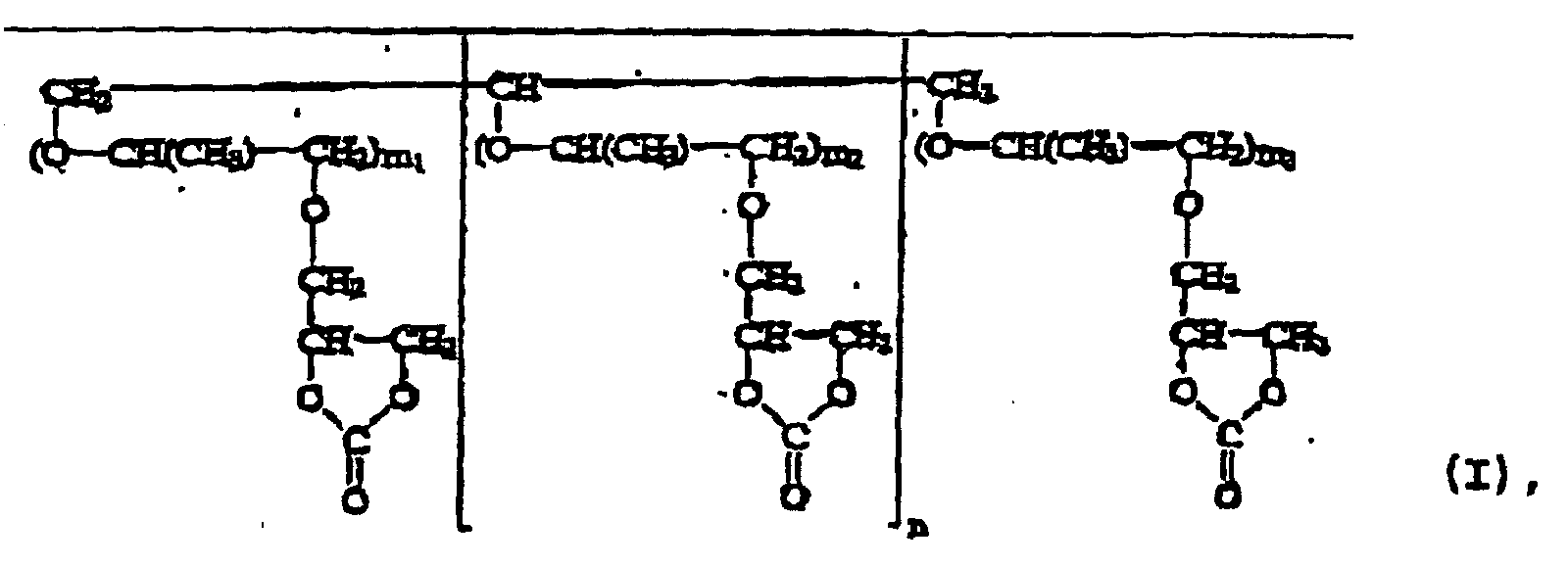
- Exemplary cyclocarbonate oligomers include but are not limited to those shown below as structures (I) and (II): where m 1 , m 2 and m 3 are independently selected over the range from 3 to 12 inclusive and 0 ⁇ n ⁇ 6; and where 0 ⁇ n ⁇ 4. Specially synthesized oligomeric cyclocarbonates, some examples of which will be described in detail in Example 1, may also be used.
- materials with multiple hydroxy or epoxy groups such as commercial triols and triepoxides, may be used as starting:materials for the formation of cyclocarbonate oligomers.
- These starting materials typically contain, as their backbones, polypropylene ethers, polyesters, alkyds, polybutadiene, polyisoprene, polysiloxane, polyphosphazine, etc.
- Polyol starting materials suitable for synthesizing cyclocarbonate oligomers useful in the present invention are well known to those in the art and include but are not limited to trimethylolethane, trimethylolpropane, ditrimethylolpropane, pentaerythritol, dipentaerythritol, tripentaerythritol and the other polyols described in further detail in the "Kirk-Othmer Encyclopedia of Chemical Technology", 4th Ed., Vol. 1, pp. 913-925 (1991) which is incorporated herein by reference.
- Epoxy starting materials suitable for use in the present invention are well known to those in the art and include but are not limited to epoxy cresol-novolak resins, epoxy phenol-novolak resins, polynuclear phenol-glycidyl ether-derived resins, triglycidyl p-aminophenol-derived resins, triazine-based resins, aliphatic glycidyl ethers and the other polyfunctional epoxides described in further detail in the "Kirk-Othmer Encyclopedia of Chemical Technology", 4th Ed., Vol. 9, pp. 730-755 (1994) which is incorporated herein by reference.
- CC terminal cyclocarbonate
- EP terminal epoxy
- cyclocarbonate oligomer as used herein includes molecules comprising only cyclocarbonate terminal groups and molecules comprising both terminal cyclocarbonate groups and a terminal epoxy group or groups.
- network polymers formed from such epoxy comprising oligomers are sometimes referred to as hybrid nonisocyanate polyurethane network polymers to distinguish them from nonisocyanate polyurethane networks formed only by the reaction of cyclocarbonate and amine terminal groups.
- hybrid nonisocyanate polyurethane network and nonisocyanate polyurethane network are synonymous.
- an epoxy modified cyclocarbonate oligomer can readily be accomplished, for example, by bubbling less than the stoichiometric amount of carbon dioxide through the liquid epoxy oligomer precursor of (II) in the presence of a catalyst. Thusly, only a portion of the epoxy groups in the precursor are converted to cyclocarbonate groups.
- oligomers comprising two, or more, EP groups might react with a diamine component of the amine terminated oligomer to form a linear polymer which, when entangled by the later-forming network, forms a clathrate.
- a clathrate were a clathrate to form, the overall network produced would be inhomogeneous. Inhomogeneity is thought to be undesirable because it may lead to a deterioration of network properties, e.g., mechanical properties. Therefore, it is preferred that substantially no cyclocarbonate oligomer comprise two, or more, EP groups per molecule so that the possibility of forming a linear polymer between a diepoxide and a diamine is eliminated.
- the terminal EP groups of the cyclocarbonate oligomer may be bonded to a primary carbon atom of the oligomer, i.e., a carbon atom with two hydrogen substituents, as illustrated in structure (III): wherein R 1 and R 2 are hydrogen and X is the remainder of the cyclocarbonate oligomer.
- the carbon atom adjacent to the EP group may be secondary, i.e., only one of R 1 and R 2 is hydrogen, or tertiary, i.e., neither one of R 1 and R 2 is hydrogen.
- the cyclocarbonate oligomer comprises a terminal EP group
- the EP group is bonded to the remainder of the cyclocarbonate oligomer by at least one primary carbon atom adjacent to the EP group.
- the desired CC:EP weight ratio of the cyclocarbonate reactant ranges from about 1:0.04 to about 1:0.12, i.e., from about 4% to about 12% by weight of terminal epoxy groups based on the weight of terminal cyclocarbonate groups present in the cyclocarbonate reactant.
- Cyclocarbonate reactants comprising terminal epoxy groups present within this range are preferred, e.g., because the networks prepared therefrom have good resistance to hydrolysis. If the amount of EP groups is too low, i.e., less than about 4 wt.%, the nonisocyanate polyurethane network resulting therefrom generally has poor tensile strength.
- the nonisocyanate polyurethane network resulting therefrom is generally brittle and has an ultimate elongation which is too low.
- mixtures of different cyclocarbonate oligomers e.g., at least one cyclocarbonate oligomer comprising a terminal EP group and at least one other cyclocarbonate oligomer comprising only terminal CC groups, it is possible to prepare cyclocarbonate oligomer compositions with the desired CC:EP weight ratio.
- Each terminal primary amine group may react with only one terminal cyclocarbonate group to form, for example, a structure labeled as (IV) in the figure below: wherein R 1 represents the remainder of a cyclocarbonate oligomer and R 2 represents the remainder of a primary amine oligomer.
- R 1 represents the remainder of a cyclocarbonate oligomer
- R 2 represents the remainder of a primary amine oligomer.
- the remaining hydrogen attached to the urethane nitrogen atom is thought to be substantially unreactive because of steric hindrance.
- each terminal primary amine group may react with up to two terminal epoxy groups to form, for example, a structure labeled as (V) in the figure below: where each primary amine of a diamine oligomer is shown to be reacted with two epoxy groups, and where R 3 represents the remainder of four cyclocarbonate oligomers comprising a terminal epoxy group, each of which may be different from or identical to any of the other above-represented cyclocarbonate oligomers, and R 4 represents the remainder of a primary diamine oligomer.
- V a structure labeled as (V) in the figure below: where each primary amine of a diamine oligomer is shown to be reacted with two epoxy groups, and where R 3 represents the remainder of four cyclocarbonate oligomers comprising a terminal epoxy group, each of which may be different from or identical to any of the other above-represented cyclocarbonate oligomers, and R 4 represents the remainder of a primary diamine oligomer.
- cyclocarbonate oligomer compositions with the desired average functionality toward primary amines, i.e., over the range of from about 2.0 to about 5.44 and, preferably, from about 2.6 to about 5.3.
- any or all of the components of such a mixture may have a functionality toward primary amine groups less than about 2.0 or greater than about 5.44, so long as the average functionality of the mixture falls within the range of from about 2.0 to about 5.44 and, preferably, from about 2.6 to about 5.3.
- a cyclocarbonate oligomer mixture comprising 20 wt.% of a tetrafunctional cyclocarbonate, i.e., functionality of 4.0, and 80 wt.% of a trifunctional cyclocarbonate oligomer wherein the reactive functional groups comprise 95 wt.% CC groups and 5 wt.% EP groups, i.e., a functionality of 3.15
- Each cyclocarbonate oligomer of the present invention typically has a number average molecular weight of from about 350 g/mol to about 3,200 g/mol and, preferably, from about 700 g/mol to about 1400 g/mol.
- Each cyclocarbonate oligomer of the present invention whether used alone or in a mixture of such oligomers, typically has a viscosity at 25°C of from about 150 mPa ⁇ s to about 8,800 mPa ⁇ s and, preferably, from about 350 mPa ⁇ s to about 1,500 mPa ⁇ s.
- Preferred cyclocarbonate oligomers include but are not limited to the di-, tri-, tetra- and penta-carbonate ester, ether or amine derivatives of aromatic or aliphatic compounds comprising from 2 to 5 terminal hydroxy and/or amine functional groups and mixtures thereof, e.g., the materials described in Examples 1-1 through 1-6.
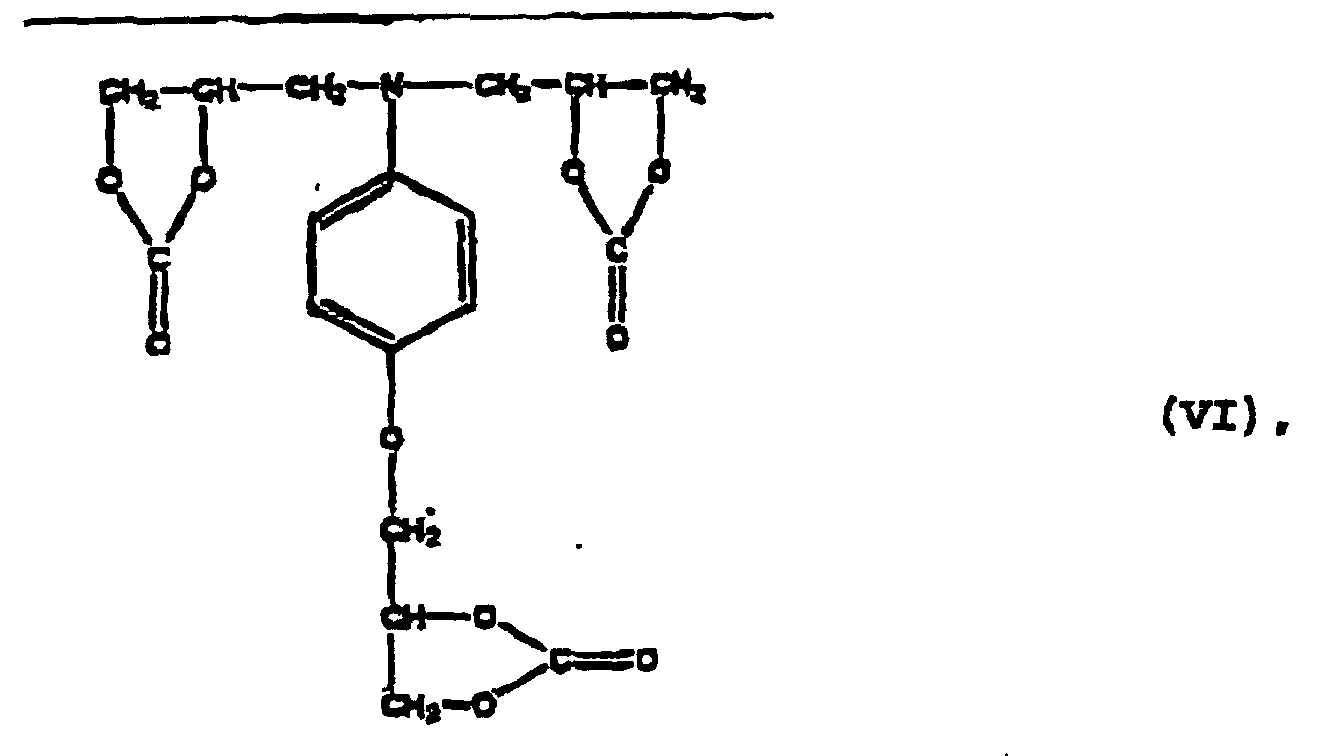
- More preferred cyclocarbonate oligomers include but are not limited to those described in structures (I) and (II) above and to those shown as structures (VI), (VII) and (VIII) below:
- the amine reactant or reactants used in the present invention are typically oligomers comprising at least two primary amine groups, i.e., -NH 2 .
- the terminal amine groups must be primary. Secondary and tertiary amine groups are not preferred.
- Exemplary primary amine oligomers include but are not limited to those shown below as structures (IX) and (X): where 2 ⁇ m ⁇ 12; and
- oligomeric amines some examples of which will be described in detail in Example 2, may also be used.
- commercial oligomeric primary amines such as polyoxypropylenetriamine (JEFFAMINE® 403, Texaco Chemical Co., believed to have a molecular weight of 400 to 550 g/mol) and tris-(3-aminopropyl)-cyanurate (BASF AG, Germany) may be used.
- the terminal primary amine groups of the amine oligomer may be bonded to a primary carbon atom of the oligomer, i.e., a carbon atom with two hydrogen substituents, as illustrated in structure (XI): wherein R 1 and R 2 are hydrogen and Y is the remainder of the primary amine oligomer.
- the carbon atom adjacent to the primary amine group may be secondary, i.e., only one of R 1 and R 2 is hydrogen. It is not desirable for the carbon atom adjacent to the primary amine group to be tertiary, i.e., neither one of R 1 and R 2 in structure (XI) above is hydrogen.
- the primary amine group is bonded to the remainder of the primary amine oligomer by at least one primary carbon atom adjacent to the amine group.
- a terminal primary amine group of the amine oligomer is bonded to the primary amine oligomer by at least two linked carbon atoms, where the carbon atom adjacent to the amine is a primary carbon atom, as illustrated in structure (XII) : wherein Z is the remainder of the primary amine oligomer.
- the carbon atom ⁇ to the primary amine group may be primary, i.e., R 3 and R 4 are hydrogen, secondary or tertiary.
- the primary amine group is bonded to the remainder of the primary amine oligomer by at least two linked primary carbon atoms adjacent to the amine group, i.e., structure (XII) above where R 3 and R 4 are hydrogen.
- the lowest molecular weight aliphatic primary amine oligomer which is effective in the present invention is 1,2-diaminoethane.
- each terminal primary amine group of the primary amine oligomer should be separated from an aromatic ring by at least two linked primary carbon atoms, e.g., when Z in structure (XII) above is aromatic, R 3 and R 4 are hydrogen.
- each primary amine group should be separated from such a ring by at least one primary carbon atom and, preferably, by at least two linked primary carbon atoms.
- the primary amine oligomer to which a terminal primary amine group is to be attached comprises siloxane groups, e.g., diphenyl-dimethoxysilane as illustrated in detail below in Example 2-1 or cyclohexyl-methyl-dimethoxysilane as illustrated in detail below in Example 2-2, it is preferred that the primary amine be separated from the siloxane by at least three linked primary carbon atoms.
- the amine is not preferred for the amine to be bonded to the remainder of the primary amine oligomer by a chain of about twelve or more linked primary carbon atoms.
- Primary amine oligomers comprising such structures are thought to be to non-polar and too difficult to dissolve in the cyclocarbonate oligomer.
- each terminal primary amine group may react with only one terminal cyclocarbonate group.
- mixtures of primary amines having a different number of terminal primary amine groups per molecule e.g., mixtures comprising diamines, triamines, tetraamines, pentaamines, hexaamines and/or heptaamines, it is possible to prepare a primary amine oligomer reactant having an average functionality toward cyclocarbonate groups over the range of from about 3.0 to about 3.8.
- any or all of the components of such a mixture may have a functionality toward terminal CC groups less than about 3.0 or greater than about 3.8, so long as the average functionality of the mixture falls within the range of from about 3.0 to about 3.8.
- the mechanism for determining the average functionality of the primary amine oligomer toward the cyclocarbonate oligomer is illustrated by the following example determination.
- Each primary amine oligomer of the present invention typically has a number average molecular weight of from about 60 g/mol to about 3,900 g/mol and, preferably, from about 180 g/mol to about 880 g/mol.
- Each primary amine oligomer of the present invention whether used alone or in a mixture of such oligomers, typically has a viscosity at 25°C of from about 10 mPa ⁇ s to about 2,800 mPa ⁇ s and, preferably, from about 50 mPa ⁇ s to about 750 mPa ⁇ s.
- Preferred primary amine oligomers include but are not limited to aminosilane oligomers with a functionality toward CC of 3 to 7, e.g., the primary amine oligomer described in Examples 2-1 and 2-2 below; oligovinyl ethers of monoethanolamine with functionality toward CC of 3 to 8; monomeric triamines, tetraamines and pentaamines, e.g., tris-(3-aminopropyl)-cyanurate; polypropylenetriamine; polypropylenepentamine; and mixtures thereof.
- More preferred primary amine oligomers include but are not limited to polyoxypropylenetriamine, tris-(3-aminopropyl)-cyanurate, polypropylenetriamine, polypropylenepentamine, those described in structures (IX) and (X) above and those shown as structure (XIII) below: where m 1 , m 2 and m 3 are independently selected over the range from 3 to 12 inclusive and 1 ⁇ n ⁇ 3
- nonisocyanate polyurethane networks of the present invention it is not preferable to have a stoichiometric amount of the cyclocarbonate oligomer react with the primary amine oligomer, e.g., a 1:1 stoichiometric ratio of terminal functional groups such that each CC group has one primary amine group available to react with it. Rather, it is necessary to have an excess of cyclocarbonate groups.
- the amount of each oligomer present should be such that the weight ratio of the amine oligomer or oligomers to the cyclocarbonate oligomer or oligomers is from about 0.93 to about 0.99 of the stoichiometric ratio, known hereafter as the "departure from the stoichiometric ratio of amine oligomer to cyclocarbonate oligomer".
- the method of mixing the reactants is not critical to the success of forming the nonisocyanate polyurethane networks of the present invention.
- the components may be, but need not be, mixed under reduced pressure, e.g:, from under atmospheric pressure, i.e., less than about 1 atm, to about 0.001 atm, to facilitate the removal of gases during mixing as is known to those with skill in the art.
- No catalyst is required for the reaction between the primary amine groups and the cyclocarbonate and epoxy groups to take place.
- No solvent is required to facilitate the reaction.
- catalysts and/or solvents may be used, if desired, as known to one skilled in the polymerization art.
- the reaction of cyclocarbonate groups and diamine groups is not highly exothermic, thus, the rate of this reaction is not particularly sensitive to reaction temperature.
- the reaction may be carried out over a temperature range of from about 10°C to about 140°C and, preferably, from about 15°C to about 30°C.
- the reaction may be carried out over a pressure range of from about 1 atm to about 10 atm, preferably, from about 2 atm to about 10 atm and, more preferably, from about 3 atm to about 5 atm.
- the pot life is at least about 15 minutes and, typically, is at least about 2 hours at 25°C.
- the nonisocyanate polyurethane network can also comprise further components, examples being solvents, pigments, dyes, plasticizers, stabilizers, fillers, including active fillers which will be discussed in detail below, microspheres, reinforcing agents, for example fibers in the form of filaments, staple, mats, etc., which will be discussed in more detail below, thixotropic agents, coupling agents, catalysts and/or leveling agents.
- solvents solvents, pigments, dyes, plasticizers, stabilizers, fillers, including active fillers which will be discussed in detail below, microspheres, reinforcing agents, for example fibers in the form of filaments, staple, mats, etc., which will be discussed in more detail below, thixotropic agents, coupling agents, catalysts and/or leveling agents.
- examples of possible components are those described in Ullmann's Encyclopedia of Industrial Chemistry, 5th Edition, Vol. A18, pp. 429-471, VCH Verlagsgesellschaft, Weinheim 1991 which is incorporated
- the amount of cross-linking in a nonisocyanate polyurethane network polymer is readily determined, e.g., by conducting a gel fraction test.
- the cross-linked fraction of the network being of extremely high molecular weight, does not dissolve in some solvents while the non-cross-linked, lower molecular weight fraction does dissolve. Therefore, as is well known to those skilled in this art, the weight fraction of cross-linked material, or gel fraction, can be determined by weighing a sample of the nonisocyanate polyurethane network, dissolving out the non-cross-linked portion, and then filtering, drying and weighing the undissolved portion.
- the nonisocyanate polyurethane network polymer formed has a gel fraction, i.e., the weight fraction of insoluble material, of not less than about 0.96.
- the nonisocyanate polyurethane network polymer formed from the cyclocarbonate oligomer and the primary amine oligomer has a gel fraction of not less than about 0.975 and, more preferably, of not less than about 0.980.
- the matrix of a composite material comprises a nonisocyanate polyurethane network of the present invention, these networks being characterized in detail above.
- Composites are generally described as a macroscopic combination of two or more components.
- One of the components of the composite is typically a fiber or a particulate, although fibers and particulates may both be present, and is used to reinforce the composite; therefore, this component is referred to herein as the reinforcement.
- the other component of the composite typically surrounds the fiber or particulate and is generally referred to as the matrix.
- the matrix comprises a nonisocyanate polyurethane network polymer.
- Fibrous reinforcements useful in the composites of the present invention include but are not limited to glass fibers, such as E-glass and S-glass; carbon fibers, such as intermediate modulus polyacrylonitrile (PAN)-based intermediate modulus fibers, very high strength fibers (VHS), ultrahigh modulus fibers (UHM) and graphite fibers; aramid fibers, such as KEVLAR® 29 and KEVLAR® 49; boron fibers; polyethylene fibers; basalt fibers; ceramic fibers; silicon carbide fibers; and mixtures thereof.
- PAN intermediate modulus polyacrylonitrile
- VHS very high strength fibers
- UHM ultrahigh modulus fibers
- aramid fibers such as KEVLAR® 29 and KEVLAR® 49
- boron fibers such as KEVLAR® 29 and KEVLAR® 49
- boron fibers such as KEVLAR® 29 and KEVLAR® 49
- boron fibers such as KEVLAR® 29 and KEVLAR® 49
- the fibrous reinforcement may be present in a variety of forms, for example, as short, discontinuous fibers randomly arranged, as continuous filaments arranged with their axis parallel to one another, as bundled continuous filaments also known as woven rovings, or as braids. Alternatively, two or more such arrangements of fibers may be used and oriented with their long axis parallel, perpendicular, or at some intermediate angle to each other.
- Such fibrous reinforcements and their arrangements are described in further detail in the "Kirk-Othmer Encyclopedia of Chemical Technology", 4th Ed., Vol. 7, pp. 1-60 (1993) which is incorporated herein by reference.
- Preferred fibrous reinforcements useful in the composites of the present invention include glass, carbon and basalt fibers.
- the nonisocyanate polyurethane network matrix is present in an amount of from about 12 wt.% to about 45 wt.%, based on the total weight of the composite, and the fiber reinforcement is present in an amount of from about 55 wt.% to about 85 wt.% in a fiber reinforced composite of the present invention.
- the present invention is also directed to an embodiment wherein the already good chemical resistance of a nonisocyanate polyurethane network is increased even further by adding a particulate, such as an inorganic powder known as an active filler, along with the oligomeric mixture being fabricated into the network.
- a particulate such as an inorganic powder known as an active filler
- Such a structure is also known as a particulate reinforced composite, where the active filler comprises the particulate and the nonisocyanate polyurethane network comprises the matrix.
- Preferred active fillers are believed to selectively interact with an aggressive medium, e.g., acids, alkalis and/or salts, their aqueous solutions, and/or water to form a system of high-strength hydrate complexes.
- an aggressive medium e.g., acids, alkalis and/or salts, their aqueous solutions, and/or water
- Such additives compliment formulations comprising nonisocyanate polyurethane networks, such as adhesives, and result in high-strength, durable inorganic filled composite adhesive cements.
- hydrate complexes also known as crystal-hydrates
- This process acts to "repair” these defects and thereby to increase the strength of the formulation.
- active fillers are thought to function as barriers which inhibit the further penetration of aggressive media.
- the volume and the specific surface area of the active filler increases. As a direct result of the increased specific surface area of the active filler, the adhesion between the filler and the nonisocyanate polyurethane is believed to become even stronger.
- Active fillers include but are not limited to metal oxides and the metal aluminate salts, i.e., compounds having the formula: M 3 (Al 2 O 3 ) v wherein M is a metal ion and v is the valency of the metal, with metal aluminate salts being preferred.
- Preferred metals all with a valency of 2 except where indicated in parenthesis, include Cu, Ca, Pb, Mg, Zn, Fe(3) and mixtures thereof. More preferred as active fillers are copper aluminate, calcium aluminate, lead aluminate and mixtures thereof. Even more preferred as active fillers are copper aluminate, calcium aluminate and mixtures thereof. The most preferred active filler, copper aluminate, is available commercially from Sigma Chemical and Alfa-Aesar.
- An active filler can be used with any of the nonisocyanate polyurethane network compositions of the invention.
- the method of mixing the reactants with the active filler is not critical to the success of forming a composite from a nonisocyanate polyurethane network of the present invention.
- the active filler is added to one reactant component before the cross-linking reaction begins.
- the mean particle size, e.g., diameter, of the active filler is not critical to the success of the invention, provided that it is less than or equal to about 30 ⁇ m.
- the mean particle diameter of the active filler typically ranges from about 2.5 ⁇ m to about 30 ⁇ m and, preferably, from about 4.5 ⁇ m to about 15 ⁇ m.
- the active filler is typically present in an amount of from about 3 parts to about 200 parts by weight based on 100 parts of nonisocyanate polyurethane network. Preferably, from about 10 parts to about 100 parts by weight and, more preferably, from about 20 parts to about 40 parts by weight of the active filler is present in the nonisocyanate polyurethane network.
- a molecular weight of 101 g/mol was used in calculating the wt.% of terminal cyclocarbonate groups of a cyclocarbonate oligomer. This molecular weight is arrived at by combining the molecular weight of a cyclocarbonate group, 87 g/mol, and the molecular weight of a -CH 2 - unit connecting the cyclocarbonate group to the remainder of the cyclocarbonate oligomer.
- a terminal cyclocarbonate group has a molecular weight of 101 g/mol and a molecular formula of C 4 H 5 O 3 .
- a molecular weight of 57 g/mol was used in calculating the wt.% of terminal epoxy groups of a cyclocarbonate oligomer. This molecular weight is arrived at by combining the molecular weight of an epoxy group, 43 g/mol, and the molecular weight of a -CH 2 - unit connecting the epoxy group to the remainder of the cyclocarbonate oligomer.
- a terminal epoxy group has a molecular weight of 57 g/mol and a molecular formula of C 3 H 5 O.
- a molecular weight of 30 g/mol was used in calculating the wt.% of terminal primary amine groups of a primary amine oligomer. This molecular weight is arrived at by combining the molecular weight of a primary amine group, 16 g/mol, and the molecular weight of a -CH 2 - unit connecting the primary amine group to the remainder of the primary amine oligomer.
- a terminal primary amine group has a molecular weight of 30 g/mol and a molecular formula of CH 4 N.
- ARALDITE® MY 0510 (Ciba Geigy AG, Switzerland) was added 0.7% by weight of tetraethyl ammonium chloride.
- the mixture was placed in a wiped-film still (Pope Scientific, Inc.) and heated to 95°C. Carbon dioxide gas was bubbled through the mixture for 190 minutes at a pressure of 7.5 atm. IR spectroscopy indicated that the synthesized oligomer had 45.4 wt.% of cyclocarbonate groups and 2.9 wt.% of epoxy groups.
- the weight ratio of cyclocarbonate groups:epoxy groups was 1:0.064.
- the molecular weight of the cyclocarbonate oligomer was 666 g/mol and its functionality, as determined by its reactivity toward primary amines, was 3.17.
- ARALDITE® MY 720 (Ciba Geigy AG) was added 0.35% by weight of hydrazine hydrochloride.
- the mixture was placed in a wiped-film still and heated to 105°C. Carbon dioxide gas was bubbled through the mixture for 290 minutes at a pressure of 8.5 atm. IR spectroscopy indicated that the synthesized oligomer had 24.9 wt.% of cyclocarbonate groups and 3.3 wt.% of epoxy groups.
- the weight ratio of cyclocarbonate groups:epoxy groups was 1:0.13.
- the molecular weight of the cyclocarbonate oligomer was 1124 g/mol and its functionality was 4.2.
- ARALDITE® PY 306 (Ciba Geigy AG) was added 0.4% by weight of tetramethyliodide of ammonium. The mixture was placed in a wiped-film still and heated to 75°C. Carbon dioxide gas was bubbled through the mixture for 210 minutes at a pressure of 9.5 atm. IR spectroscopy indicated that the synthesized oligomer had 29.4 wt.% of cyclocarbonate groups and 2.2 wt.% of epoxy groups. Thus, the weight ratio of cyclocarbonate groups:epoxy groups was 1:0.076. The molecular weight of the cyclocarbonate oligomer was 591 g/mol and its functionality was 2.07.
- the cyclocarbonate oligomers of Examples 1-1 and 1-2 were mixed in a ratio of 1:0.8 respectively by weight (55.6 g of 1-1 and 44.4 g of 1-2) for 5 minutes at 20°C in a low velocity mixer.
- This oligomer mixture, component "A” had an average functionality (determined by its reactivity toward primary amine groups) of 3.05, 32.8 wt.% of cyclocarbonate terminal groups and 2.4 wt.% of epoxy terminal groups.
- the weight ratio of cyclocarbonate groups:epoxy groups was 1:0.073.
- Polyoxypropylenetriamine known as JEFFAMINE® 403 and with a functionality of 2.98 as determined by its reactivity toward cyclocarbonate groups, and the amine oligomer of Example 2-2 were mixed in a ratio of 1:0.2 respectively by weight (72.05 g of polyoxypropylenetriamine and 14.45 g of 2-2) for 5 minutes at 20°C in a low velocity mixer.
- This mixture of such amines, component "B” had an average functionality (determined by its reactivity toward cyclocarbonate groups) of 3.475.
- the stoichiometric ratio for mixing the CC groups of the above-described A component with the primary amine groups of the above-described B component, B:A was calculated to be 0.878:1, i.e., 87.8 g of B per 100 g of A. This ratio was determined by dividing the average functionality of component A by the average functionality of component B, i.e., 3.05/3.475. An excess of cyclocarbonate groups was assured by mixing only 86.5 g of B with 100 g of A, i.e., a B:A ratio of 0.865:1.
- the actual B:A ratio of 0.865:1 differs from the stoichiometric B:A ratio of 0.878:1, being 98.5% of the latter.
- the departure from the stoichiometric ratio of amine oligomer to cyclocarbonate oligomer is 0.985.
- the A and B components were mixed at a B:A ratio of 0.865:1 for 15 minutes at 20°C in a low velocity mixer.
- the particular method of mixing is not critical to the success of the reaction.
- the mixture was then poured out and allowed to cross-link or cure for 10 days at the 20°C.
- the resulting network polymer had an intermolecular distance, as characterized by the number average molecular weight, of 882 g/mol and contained 0.987 by weight of gel. According to IR analysis, the post-reaction weight ratio of reacted CC groups to reacted EP groups was 1:0.08 (31.7 wt.% CC:2.5 wt.% EP).
- sample nonisocyanate polyurethane network compositions were prepared with various ratios of cyclocarbonate terminal groups to epoxy terminal groups, with various average functionalities of amine oligomer components, with various average functionalities of the cyclocarbonate oligomer components, and with various departures from the stoichiometric ratio of amine oligomer to cyclocarbonate oligomer components.
- sample compositions have the chemical compositions and physical properties shown in Tables 1 and 2.
- the tensile properties were determined according to the method prescribed by ASTM D 638-84.
- the gel fraction was determined by taking a 5 to 10 g sample of each network formed, weighing it, wrapping it with filter paper and placing the sample into a Soxhlet extraction apparatus. Each sample was extracted with a boiling mixture of 20% ethyl alcohol/80% toluene until it reached constant weight, generally in 3 to 7 days. The gel fraction was determined by dividing the final weight by the initial weight.
- the properties of the network are also degraded.
- the weight ratio of CC:EP groups is too high, i.e., above about 1:0.12 or above about 12 wt.% EP, the properties of the network are also degraded.
- Sample No. 9C of Table 1 with a CC:EP weight ratio of 1:0.13 the ultimate elongation and specific energy of failure are lower than the corresponding values for any of the samples of the invention, i.e., Sample Nos. 3-8.
- Sample No. 10C the tensile strength and specific energy of failure are lower than the corresponding values for any of the samples of the invention.
- the properties of the network are also degraded.
- the average functionality of the primary amine oligomer toward terminal cyclocarbonate groups is too low, i.e., below about 3.0, the properties of the network are also degraded.
- Sample Nos. 11C and 14C of Table 2 both with an amine average functionality value of 2.9, the tensile strength and specific energy of failure are lower than the corresponding values for any of the samples of the invention, i.e., Sample Nos. 12, 15, 18 and 19.
- the other sample of Table 2 with a low amine average functionality value 2.8 for Sample No. 17C, the ultimate elongation and specific energy of failure are lower than the corresponding values for any of the samples of the invention.
- Sample No. 20C with a gel fraction of 0.955 and a specific energy of failure of 1.24, has the lowest specific energy of failure for any of the samples present in Tables 1 and 2.
- Example 5 Hybrid Nonisocyanate Polyurethane Network Comprising an Active Filler
- a series of particulate reinforced composites was formed using, as a matrix, 100 parts by weight of the composition prepared as described in Example 3. Copper aluminate (Sigma Chemical) with a particle diameter of about 30 ⁇ m was used, in the amounts shown in Table 3, as the active filler. Quartz powder (Solel Bone, Ltd., Israel) with a particle diameter of about 30 ⁇ m was also present in the composites as a filler in the amounts shown in Table 3.
- the samples were fully cured for 7 days at 20°C to form particulate reinforced composite samples.
- K CR ⁇ ⁇ / ⁇ v
- ⁇ ⁇ and ⁇ v are the tensile strengths, determined as described above, for a sample exposed in 30% sulfuric acid for a time ⁇ months and an unexposed control, respectively.
- Table 3 summarizes the results obtained from a series of composite samples prepared as described above with the same hybrid nonisocyanate polyurethane network matrix and with different amounts of copper aluminate reinforcement. These samples were tested to determine their K CR after 6, 9 and 12 months exposure to 30% sulfuric acid at 20°C. Coefficient of Chemical Resistance to Aqueous 30% Sulfuric Acid SAMPLE NO. 21C 22 23 24 25 26 Copper Aluminate Content 0 10 20 40 100 160 Quartz Powder Content 160 150 140 120 60 0 Exposure Time 6 months 0.87 1.12 1.14 1.06 0.98 0.98 9 months 0.62 0.98 1.06 1.08 0.99 0.92 12 months failed 0.96 1.05 1.07 0.99 0.95
- samples 22-26 Even after 12 months of exposure to 30% sulfuric acid, by which time the control sample had failed, samples 22-26 all had excellent tensile strength retention. In fact, the tensile strength of samples 23 and 24 increased substantially over their initial tensile strength even after 12 months exposure to 30% sulfuric acid.
Landscapes
- Chemical & Material Sciences (AREA)
- Health & Medical Sciences (AREA)
- Chemical Kinetics & Catalysis (AREA)
- Medicinal Chemistry (AREA)
- Polymers & Plastics (AREA)
- Organic Chemistry (AREA)
- Polyurethanes Or Polyureas (AREA)
- Compositions Of Macromolecular Compounds (AREA)
Claims (51)
- Nichtisocyanatpolyurethan-Netzwerkpolymer, hergestellt durch Vernetzen eines Cyclocarbonatoligomers und eines Aminoligomers,
wobei das Cyclocarbonatoligomer eine durchschnittliche Funktionalität gegenüber primären Aminen von etwa 2,0 bis etwa 5,44 aufweist,
wobei das Cyclocarbonatoligomer mindestens ein Oligomer mit einem endständigen Cyclocarbonatrest aufweist, das mit einer Mehrzahl von endständigen Cyclocarbonatresten versehen ist,
wobei mindestens ein Oligomer mit einem endständigen Cyclocarbonatrest ferner etwa 4 bis etwa 12 Gew.% endständige Epoxyreste, bezogen auf das Gewicht der vorliegenden Cyclocarbonatreste, enthält,
wobei das Aminoligomer eine durchschnittliche Funktionalität gegenüber den Cyclocarbonatresten von etwa 3,0 bis etwa 3,8 aufweist,
wobei das Aminoligomer mit mindestens ein oligomer mit einem endständigen primären Aminrest aufweist, das mit einer Mehrzahl von endständigen primären Aminresten versehen ist,
wobei das Aminoligomer in einer Menge von etwa 0,93 bis etwa 0,99 bezüglich der Menge des Aminoligomers vorliegt, die nötig wäre, um ein stöchiometrisches Verhältnis der primären Aminreste das Aminoligomers zu den Cyclocarbonatresten des Cyclocarbonatoligomers zu erreichen, und
worin das gebildete Netzwerkpolymer eine Gelfraktion von nicht weniger als etwa 0,96 Gew.% aufweist. - Nichtisocyanatpolyurethan-Netzwerkpolymer nach Anspruch 1, worin die durchschnittliche Funktionalität des Cyclocarbonatoligomers gegenüber den primären Aminen im Bereich von etwa 2, 6 bis etwa 5,3 liegt.
- Nichtisocyanatpolyurethan-Netzwerkpolymer nach Anspruch 1, worin die Gelfraktion nicht weniger als etwa 0,975 beträgt.
- Nichtisocyanatpolyurethan-Netzwerkpolymer nach Anspruch 1, worin die Gelfraktion nicht weniger als etwa 0,980 beträgt.
- Nichtisocyanatpolyurethan-Netzwerkpolymer nach Anspruch 1, worin das Oligomer mit einem endständigen Cyclocarbonatrest ein zahlenmäßiges Durchschnittsmolekulargewicht von etwa 350 bis etwa 3.200 g/mol aufweist.
- Nichtisocyanatpolyurethan-Netzwerkpolymer nach Anspruch 5, worin das Oligomer mit einem endständigen Cyclocarbonatrest ein zahlenmäßiges Durchschnittsmolekulargewicht von etwa 700 bis etwa 1.400 g/mol aufweist.
- Nichtisocyanatpolyurethan-Netzwerkpolymer nach Anspruch 1, worin das Oligomer mit einen endständigen Cyclocarbonatrest bei 25 °C eine Viskosität von etwa 150 bis etwa 8.800 mPa·s aufweist.
- Nichtisocyanatpolyurethan-Netzwerkpolymer nach Anspruch 7, worin das Oligomer mit einem endständigen Cyclocarbonatrest bei 25 °C eine Viskosität von etwa 350 bis etwa 1.500 mPa·s aufweist.
- Nichtisocyanatpolyurethan-Netzwerkpolymer nach Anspruch 1, worin das Oligomer mit einem endständigen Cyclocarbonatrest mindestens einen Stoff enthält, der ausgewählt ist aus den Stoffen Dicarbonat-, Tricarbonat-, Tetracarbonat- und Pentacarbonatester, Ether- oder Aminderivate von aromatischen oder aliphatischen Verbindungen mit 2 bis 5 endständigen funktionellen Gruppen, die aus Hydroxylgruppen und Amingruppen ausgewählt sind, und Gemischen hiervon.
- Nichtisocyanatpolyurethan-Netzwerkpolymer nach Anspruch 1, worin das Oligomer mit einem endständigen Cyclocarbonatrest mindestens einen Stoff enthält, der ausgewählt ist aus den Stoffenworin m1, m2 und m3 unabhängig voneinander aus dem Bereich von 3 bis 12 einschließlich ausgewählt sind und 0 ≤ n ≤ 6 ist,
 worin 0 ≤ n ≤ 4 ist,
 und
und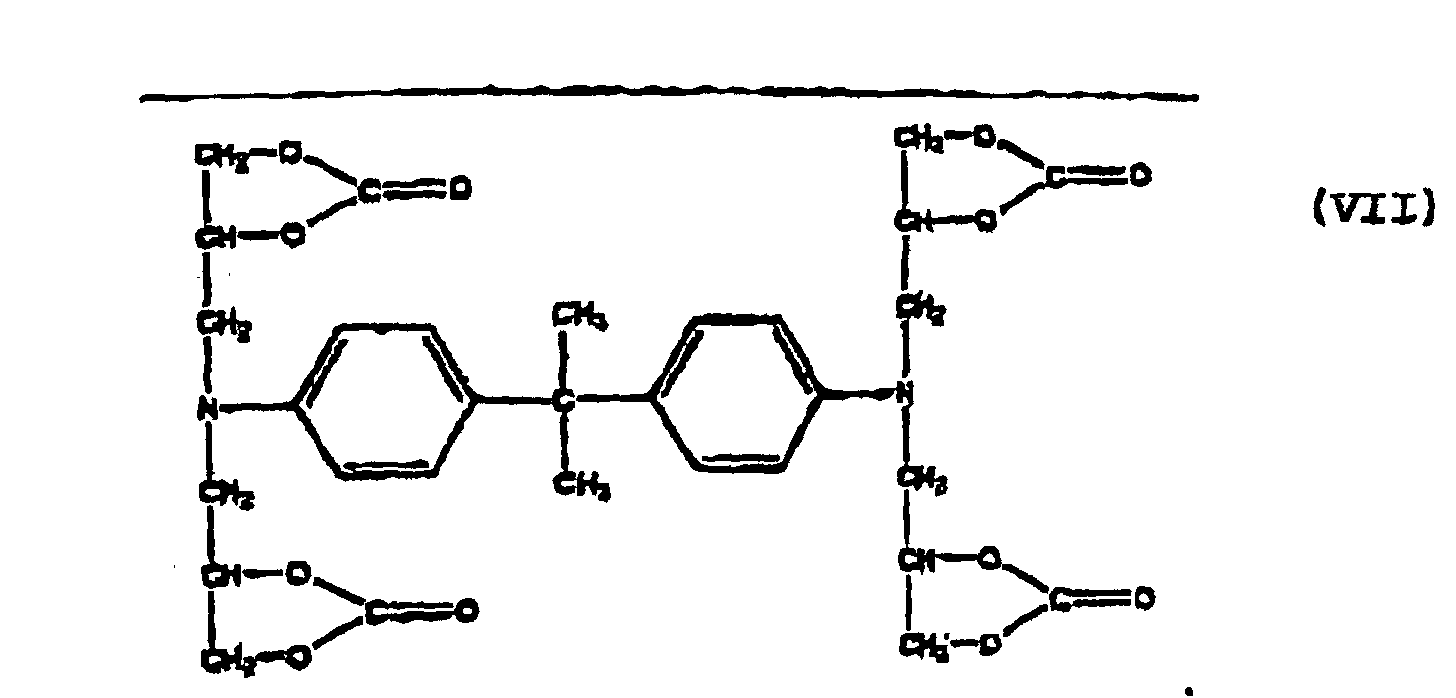

- Nichtisocyanatpolyurethan-Netzwerkpolymer nach Anspruch 1, worin das mindestens eine endständige Epoxygruppe enthaltende Oligomer mit einem Cyclocarbonatrest im wesentlichen aus einer Restgruppe und einer Epoxygruppe besteht, wobei die Epoxygruppe an die Restgruppe durch mindestens ein primäres Kohlenstoffatom gebunden ist, das der Epoxygruppe benachbart ist.
- Nichtisocyanatpolyurethan-Netzwerkpolymer nach Anspruch 1, worin das Oligomer mit einem endständigen primären Amin ein zahlenmäßiges Durchschnittsmolekulargewicht von etwa 60 bis etwa 3.900 g/mol aufweist.
- Nichtisocyanatpolyurethan-Netzwerkpolymer nach Anspruch 12, worin das Oligomer mit einem endständigen primären Amin ein zahlenmäßiges Durchschnittsmolekulargewicht von etwa 180 bis etwa 880 g/mol aufweist.
- Nichtisocyanatpolyurethan-Netzwerkpolymer nach Anspruch 1, worin das Oligomer mit einem endständigen primären Amin bei 25 °C eine Viskosität von etwa 10 bis etwa 2.800 mPa·s aufweist.
- Nichtisocyanatpolyurethan-Netzwerkpolymer nach Anspruch 14, worin das Oligomer mit einem endständigen primären Amin bei 25 °C eine Viskosität von etwa 50 bis etwa 750 mPa·s aufweist.
- Nichtisocyanatpolyurethan-Netzwerkpolymer nach Anspruch 1, worin das Oligomer mit einem endständigen primären Amin mindestens einen Stoff aufweist, der ausgewählt ist aus den Stoffen Aminosilanoligomere mit einer Funktionalität gegenüber terminalen Cyclocarbonatresten von etwa 3 bis etwa 7, Oligovinylether von Monoethanolamin mit einer Funktionalität gegenüber terminalen Cyclocarbonatresten von etwa 3 bis etwa 8, monomere Triamine, monomere Tetrasmine, Polypropylentriamin, Polypropylenpentamin und Gemische hiervon.
- Nichtisocyanatpolyurethan-Netzwerkpolymer nach Anspruch 1, worin das Oligomer mit einem endständigen primären Amin mindestens einen Stoff enthält, der ausgewählt ist aus den Stoffen Polyoxypropylentriamin, Tris-(3-aminopropyl)-cyanurat, Polypropylentriamin, Polypropylenpentamin,worin 2 ≤ m ≤ 12 ist,
 und
und worin m1, m2 und m3 unabhängig voneinander aus dem Bereich von 3 bis 12 einschließlich ausgewählt sind und 1 ≤ n ≤ 3 ist.
- Nichtisocyanatpolyurethan-Netzwerkpolymer nach Anspruch 1, worin das Oligomer mit einem endständigen primären Amin im wesentlichen aus mindestens einer primären Amingruppe und einer Restgruppe besteht, wobei die primäre Amingruppe an die Restgruppe durch mindestens ein primäres Kohlenstoffatom gebunden ist, das der primären Amingruppe benachbart ist.
- Nichtisocyanatpolyurethan-Netzwerkpolymer nach Anspruch 18, worin die primäre Amingruppe an die Restgruppe durch mindestens zwei verbundene primäre Kohlenstoffatome gebunden ist, die der primären Amingruppe benachbart sind.
- Verfahren zum Herstellen eines Nichtisocyanatpolyurethan-Netzwerkpolymers, mit den folgenden Stufen:(a) Auswählen eines ersten Oligomers in Form mindestens eines Oligomers mit einer Mehrzahl von endständigen Cyclocarbonatresten, wobei das Oligomer mit endständigen Cyclocarbonatresten ferner etwa 4 bis etwa 12 Gew.% endständige Expoxygruppen, bezogen auf das Gewicht der vorliegenden endständigen Cyclocarbonatreste, aufweist, wobei das genannte erste Oligomer eine durchschnittliche Funktionalität gegenüber primären Aminen von etwa 2,0 bis etwa 5,44 aufweist;(b) Auswählen eines zweiten Oligomers in Form mindestens eines Oligomers mit einer Mehrzahl von endständigen primären Amingruppen, wobei das genannte zweite Oligomer eine durchschnittliche Funktionalität gegenüber Cyclocarbonatresten von etwa 3,0 bis etwa 3,8 aufweist;(c) Mischen der Oligomere in einer derartigen Menge, daß ein Gemisch mit einer solchen Topfzeit gebildet wird, daß die Menge des vorliegenden zweiten Oligomers etwa 0,93 bis etwa 0,99 bezüglich der Menge des zweiten Oligomers beträgt, die nötig wäre, um ein stöchiometrisches Verhältnis der primären Amingruppe des zweiten Oligomers zu den Cyclocarbonatresten des ersten Oligomers zu erreichen, und(d) Härten des Gemisches bei einer Temperatur von etwa 10 bis etwa 140 °C, um ein Netzwerkpolymer mit einer Gelfraktion von nicht weniger als etwa 0,96 Gew.% zu bilden.
- Verfahren nach Anspruch 20, worin das erste Oligomer derart ausgewählt ist, daß es ferner mindestens ein Oligomer mit einem endständigen Cyclocarbonatrest enthält, wobei die reaktionsfähigen endständigen Reste im wesentlichen aus Cyclocarbonatresten bestehen.
- Verfahren nach Anspruch 20, worin die durchschnittliche Funktionalität des ersten Oligomers gegenüber den primären Aminen im Bereich von etwa 2,6 bis etwa 5,3 liegt.
- Verfahren nach Anspruch 20, das ferner die Bildung eines Netzwerkpolymers mit einer Gelfraktion von nicht weniger als etwa 0,975 beinhaltet.
- Verfahren nach Anspruch 20, das ferner die Bildung eines Netzwerkpolymers mit einer Gelfraktion von nicht weniger als etwa 0,980 beinhaltet.
- Verfahren nach Anspruch 20, das ferner das Mischen der Oligomere bei einem Druck von etwa 0,001 bis weniger als etwa 1 at beinhaltet.
- Verfahren nach Anspruch 20, das ferner das Härten des Gemisches bei einer Temperatur von etwa 15 bis etwa 30 °C beinhaltet.
- Verfahren nach Anspruch 20, daß ferner das Härten des Gemisches bei einem Druck von etwa 1 bis etwa 10 at beinhaltet.
- Verfahren nach Anspruch 27, das ferner das Härten des Gemisches bei einem Druck von etwa 2 bis etwa 10 at beinhaltet.
- Verfahren nach Anspruch 27, das ferner das Härten des Gemisches bei einem Druck von etwa 3 bis etwa 5 at beinhaltet.
- Verfahren nach Anspruch 20, worin die Topfzeit bei 25 °C mindestens etwa 15 Minuten beträgt.
- Verfahren nach Anspruch 20, worin die Topfzeit bei 25 °C mindestens etwa 2 Stunden beträgt.
- Verfahren nach Anspruch 20, worin jedes Oligomer mit einem endständigen Cyclocarbonat ein zahlenmäßiges Durchschnittsmolekulargewicht von etwa 350 bis etwa 3.200 g/mol aufweist.
- Verfahren nach Anspruch 21, worin jedes Oligomer mit einem endständigen Cyclocarbonat ein zahlenmäßiges Durchschnittsmolekulargewicht von etwa 350 bis etwa 3.200 g/mol aufweist.
- Verfahren nach Anspruch 20, worin jedes Oligomer mit einem endständigen Cyclocarbonat bei 25 °C eine Viskosität von etwa 150 bis etwa 8.800 mPa·s aufweist.
- Verfahren nach Anspruch 21, worin jedes Oligomer mit einem endständigen Cyclocarbonat bei 25 °C eine Viskosität von etwa 150 bis etwa 8.800 mPa·s aufweist.
- Verfahren nach Anspruch 20, worin jedes Oligomer mit einer Mehrzahl von endständigen primären Amingruppen ein zahlenmäßiges Durchschnittsmolekulargewicht von etwa 60 bis etwa 3.900 g/mol aufweist.
- Verfahren nach Anspruch 20, worin jedes Oligomer mit einer Mehrzahl von endständigen primären Amingruppen bei 25 °C eine Viskosität von etwa 10 bis etwa 2.800 mPa·s aufweist.
- Verbundmaterial mit einer Matrix und einer Verstärkung, worin die Matrix das Nichtisocyanatpolyurethan-Netzwerkpolymer gemäß Anspruch 1 enthält.
- Verbundmaterial nach Anspruch 38, worin die Matrix in einer Menge von etwa 12 bis etwa 45 Gew.% vorliegt.
- Verbundmaterial nach Anspruch 38, worin die Verstärkung aus einer Faserverstärkung, einer Partikelverstärkung oder einem Gemisch hiervon besteht.
- Verbundmaterial nach Anspruch 40, worin die Faserverstärkung aus Glasfaser, Kohlenstofffaser, Basaltfaser und Gemischen hiervon ausgewählt ist.
- Verbundmaterial nach Anspruch 40, worin die Partikelverstärkung einen aktiven Füllstoff mit einer mittleren Partikelgröße enthält, wobei der aktive Füllstoff mindestens ein Stoff ist, der aus einem Metalloxid und einem Metallaluminatsalz ausgewählt ist.
- Verbundmaterial nach Anspruch 42, worin das Metallaluminatsalz aus Kupferaluminat, Calciumaluminat, Bleialuminat, Magnesiumaluminat, Zinkaluminat, Eisenaluminat und Gemischen hiervon ausgewählt ist.
- Verbundmaterial nach Anspruch 42, worin das Metallaluminatsalz aus Kupferaluminat, Calciumaluminat und Gemischen hiervon ausgewählt ist.
- Verbundmaterial nach Anspruch 42, worin das Metallaluminatsalz Kupferaluminat ist.
- Verbundmaterial nach Anspruch 42, worin der aktive Füllstoff in einer Menge von etwa 3 bis etwa 200 Gewichtsteilen, bezogen auf 100 Teile des Nichtisocyanatpolyurethan-Netzwerkpolymers, vorliegt.
- Verbundmaterial nach Anspruch 46, worin der aktive Füllstoff in einer Menge von etwa 10 bis etwa 100 Gewichtsteilen, bezogen auf 100 Teile des Nichtisocyanatpolyurethan-Netzwerkpolymers, vorliegt.
- Verbundmaterial nach Anspruch 47, worin der aktive Füllstoff in einer Menge von etwa 20 bis etwa 40 Gewichtsteilen, bezogen auf 100 Teile des Nichtisocyanatpolyurethan-Netzwerkpolymers, vorliegt.
- Verbundmaterial nach Anspruch 42, worin die mittlere Partikelgröße des aktiven Füllstoffs etwa 30 µm oder weniger beträgt.
- Verbundmaterial nach Anspruch 42, worin der mittlere Partikeldurchmesser des aktiven Füllstoffs etwa 2,5 bis etwa 30 µm beträgt.
- Verbundmaterial nach Anspruch 50, worin der mittlere Partikeldurchmesser das aktiven Füllstoffs etwa 4,5 bis etwa 15 µm beträgt.
Applications Claiming Priority (3)
| Application Number | Priority Date | Filing Date | Title |
|---|---|---|---|
| US94864 | 1987-09-10 | ||
| US09/094,864 US6120905A (en) | 1998-06-15 | 1998-06-15 | Hybrid nonisocyanate polyurethane network polymers and composites formed therefrom |
| PCT/US1999/013413 WO1999065969A1 (en) | 1998-06-15 | 1999-06-15 | Hybrid nonisocyanate polyurethane network polymers and composites formed therefrom |
Publications (2)
| Publication Number | Publication Date |
|---|---|
| EP1088021A1 EP1088021A1 (de) | 2001-04-04 |
| EP1088021B1 true EP1088021B1 (de) | 2005-04-20 |
Family
ID=22247637
Family Applications (1)
| Application Number | Title | Priority Date | Filing Date |
|---|---|---|---|
| EP99927530A Expired - Lifetime EP1088021B1 (de) | 1998-06-15 | 1999-06-15 | Hybride nichtisocyanatpolyurethan-netzwerkpolymere und daraus hergestellte verbundwerkstoffe |
Country Status (8)
| Country | Link |
|---|---|
| US (1) | US6120905A (de) |
| EP (1) | EP1088021B1 (de) |
| JP (1) | JP2002518532A (de) |
| KR (1) | KR20010071470A (de) |
| AU (1) | AU4441099A (de) |
| CA (1) | CA2335000A1 (de) |
| DE (2) | DE1088021T1 (de) |
| WO (1) | WO1999065969A1 (de) |
Families Citing this family (71)
| Publication number | Priority date | Publication date | Assignee | Title |
|---|---|---|---|---|
| US6627761B2 (en) | 2001-03-30 | 2003-09-30 | Huntsman Petrochemical Corporation | Multifunctional carbonates and derivatives |
| AU2002337780A1 (en) * | 2001-10-01 | 2003-04-14 | Eurotech, Ltd. | Preparation of oligomeric cyclocarbonates and their use in ionisocyanate or hybrid nonisocyanate polyurethanes |
| TWI283085B (en) * | 2002-07-30 | 2007-06-21 | Dainichiseika Color Chem | Electrolyte compositions |
| EP1506975A1 (de) * | 2003-08-13 | 2005-02-16 | Vantico GmbH | Nanoverbundwerkstoffe enthaltend polyurethan oder polyurethan-epoxy Hybridharze hergestellt ohne Verwendung von Isocyanaten |
| US7763341B2 (en) * | 2004-01-23 | 2010-07-27 | Century-Board Usa, Llc | Filled polymer composite and synthetic building material compositions |
| AU2005267399A1 (en) | 2004-06-24 | 2006-02-02 | Century-Board Usa, Llc | Continuous forming apparatus for three-dimensional foamed products |
| WO2007062812A1 (en) * | 2005-11-30 | 2007-06-07 | Nv Bekaert Sa | Process for preparing a metal wire with a non-isocyanate polyurethane coating |
| WO2007112105A2 (en) * | 2006-03-24 | 2007-10-04 | Century-Board Usa, Llc | Extrusion of polyurethane composite materials |
| JP2010515794A (ja) * | 2007-01-12 | 2010-05-13 | サイテック サーフェース スペシャリティーズ、エス.エイ. | ポリマー組成物及び方法 |
| DE102008013584A1 (de) * | 2008-03-11 | 2009-09-17 | Momentive Performance Materials Gmbh | Neue Polycarbonat-Polyorganosiloxan- und/oder Polyurethan-Polyorganosiloxan-Verbindungen |
| US20100144966A1 (en) * | 2008-12-04 | 2010-06-10 | Polymate, Ltd | Liquid oligomer composition containing hydroxyamine adducts and method of manufacturing thereof |
| US9481759B2 (en) | 2009-08-14 | 2016-11-01 | Boral Ip Holdings Llc | Polyurethanes derived from highly reactive reactants and coal ash |
| US8846776B2 (en) | 2009-08-14 | 2014-09-30 | Boral Ip Holdings Llc | Filled polyurethane composites and methods of making same |
| JP5367679B2 (ja) * | 2009-11-25 | 2013-12-11 | 大日精化工業株式会社 | 擬革 |
| EP2505599B1 (de) * | 2009-11-25 | 2017-09-06 | Dainichiseika Color & Chemicals Mfg. Co., Ltd. | Polysiloxan-modifiziertes polyhydroxypolyurethanharz, herstellungsverfahren dafür, wärmeempfindliches aufzeichnungsmaterial mit dem harz, imitationsleder, thermoplastisches polyolefinharz-überzugmaterial, material für einen dichtungsstreifen und dichtungsstreifen |
| JP2011132208A (ja) * | 2009-11-25 | 2011-07-07 | Dainichiseika Color & Chem Mfg Co Ltd | 5員環環状カーボネートポリシロキサン化合物およびその製造方法 |
| JP5492652B2 (ja) * | 2010-04-30 | 2014-05-14 | 大日精化工業株式会社 | ウェザーストリップ用材料及びウェザーストリップ |
| JP5574428B2 (ja) * | 2009-11-25 | 2014-08-20 | 大日精化工業株式会社 | ポリシロキサン変性ポリヒドロキシポリウレタン樹脂、該樹脂の製造方法及び樹脂組成物 |
| JP5705511B2 (ja) * | 2009-11-26 | 2015-04-22 | 大日精化工業株式会社 | ポリシロキサン変性ポリヒドロキシポリウレタン樹脂、該樹脂含有組成物及び樹脂の製造方法 |
| JP5456647B2 (ja) * | 2009-11-26 | 2014-04-02 | 大日精化工業株式会社 | 擬革 |
| JP5501943B2 (ja) * | 2009-11-26 | 2014-05-28 | 大日精化工業株式会社 | 感熱記録材料 |
| KR101434764B1 (ko) * | 2009-11-26 | 2014-08-26 | 다이니치 세이카 고교 가부시키가이샤 | 폴리실록산 변성 폴리히드록시 폴리우레탄 수지 및 그 제조방법, 상기 수지를 이용한 감열 기록 재료, 인조 피혁, 열가소성 폴리올레핀 수지 표피재, 웨더스트립용 재료 및 웨더스트립 |
| JP5534924B2 (ja) * | 2010-04-30 | 2014-07-02 | 大日精化工業株式会社 | ウェザーストリップ用材料およびウェザーストリップ |
| JP5386468B2 (ja) * | 2009-11-26 | 2014-01-15 | 大日精化工業株式会社 | 熱可塑性ポリオレフィン樹脂製表皮材 |
| JP5554156B2 (ja) * | 2010-06-24 | 2014-07-23 | 大日精化工業株式会社 | 擬革 |
| CN102958978B (zh) * | 2010-06-24 | 2014-11-19 | 大日精化工业株式会社 | 自交联型多羟基聚氨酯树脂及其制造方法、以及使用该树脂而成的相关材料 |
| JP5554173B2 (ja) * | 2010-07-29 | 2014-07-23 | 大日精化工業株式会社 | 熱可塑性ポリオレフィン樹脂製の表皮材 |
| JP5953644B2 (ja) * | 2010-08-19 | 2016-07-20 | 日立化成株式会社 | ポリヒドロキシウレタン化合物及びその製造方法、並びに、硬化性樹脂組成物、感光性エレメント、レジストパターンの形成方法及びプリント配線板の製造方法 |
| JP5637559B2 (ja) * | 2010-12-22 | 2014-12-10 | 大日精化工業株式会社 | 擬革 |
| US10000609B2 (en) | 2010-08-26 | 2018-06-19 | Dainichiseika Color & Chemicals Mfg. Co., Ltd. | Self-crosslinking polysiloxane-modified polyhydroxy polyurethane resin, resin material containing same, method for producing same, artificial leather comprising same, and thermoplastic polyolefin skin material comprising same |
| JP5679739B2 (ja) * | 2010-08-26 | 2015-03-04 | 大日精化工業株式会社 | 自己架橋型ポリシロキサン変性ポリヒドロキシポリウレタン樹脂およびその製造方法 |
| JP5601687B2 (ja) * | 2011-01-12 | 2014-10-08 | 大日精化工業株式会社 | 熱可塑性ポリオレフィン樹脂製の表皮材 |
| US8604091B2 (en) | 2010-09-03 | 2013-12-10 | Owens Corning Intellectual Capital, Llc | Non-isocyanate spray foam |
| DE102010040762B4 (de) | 2010-09-14 | 2017-08-03 | Technische Hochschule Wildau | Anorganisch-organische polymere Hybridnetzwerke, Verfahren zu ihrer Herstellung sowie deren Verwendung |
| JP5345599B2 (ja) * | 2010-10-14 | 2013-11-20 | 大日精化工業株式会社 | 剥離性処理剤 |
| JP5277233B2 (ja) * | 2010-11-19 | 2013-08-28 | 大日精化工業株式会社 | 熱可塑性ポリヒドロキシウレタンの製造方法 |
| US9102829B2 (en) | 2011-02-15 | 2015-08-11 | Nanotech Industries, Inc. | Method of producing hybrid polyhydroxyurethane network on a base of carbonated-epoxidized unsaturated fatty acid triglycerides |
| KR101536846B1 (ko) * | 2011-02-24 | 2015-07-14 | 다이니치 세이카 고교 가부시키가이샤 | 가스 배리어층을 형성하기 위한 도료 조성물, 가스 배리어성 필름, 및 가스 배리어성 필름의 제조방법 |
| US9359719B2 (en) | 2011-04-04 | 2016-06-07 | Dainichiseika Color & Chemicals Mfg. Co., Ltd. | Self-crosslinkable polysiloxane-modified polyhydroxy polyurethane resin, process for producing said resin, resin material comprising said resin, and artificial leather produced utilizing said resin |
| JP5688038B2 (ja) * | 2012-02-20 | 2015-03-25 | 大日精化工業株式会社 | 擬革 |
| JP5809847B2 (ja) | 2011-05-02 | 2015-11-11 | 大日精化工業株式会社 | ポリヒドロキシウレタン微粒子の製造方法 |
| US9745224B2 (en) | 2011-10-07 | 2017-08-29 | Boral Ip Holdings (Australia) Pty Limited | Inorganic polymer/organic polymer composites and methods of making same |
| FR2981931B1 (fr) | 2011-10-28 | 2014-07-04 | Gen Produits Ind S E G Soc D Expl | Procede de preparation d'un compose comprenant au moins un motif beta-hydroxy-urethane et/ou au moins un motif gamma-hydroxy-urethane. |
| FR2991683B1 (fr) * | 2012-06-07 | 2015-05-15 | Arkema France | Resines portant des groupements carbonates cycliques et compositions reticulables de ces resines a faible taux de cov |
| CN102718964A (zh) * | 2012-07-09 | 2012-10-10 | 广西民族大学 | 非异氰酸酯聚氨酯的制备及在喷涂聚脲中的应用 |
| FR2997700B1 (fr) * | 2012-11-05 | 2015-01-16 | Bostik Sa | Polymeres de [4-(methylether)-1,3-dioxolane-2-one de polyether polyol] |
| US20140256874A1 (en) | 2013-03-05 | 2014-09-11 | Ppg Industries Ohio, Inc. | Curable solid particulate compositions |
| US9932457B2 (en) | 2013-04-12 | 2018-04-03 | Boral Ip Holdings (Australia) Pty Limited | Composites formed from an absorptive filler and a polyurethane |
| TWI504734B (zh) * | 2013-12-31 | 2015-10-21 | Ind Tech Res Inst | 防火耐燃複合材料、板材與塗層 |
| US9487662B1 (en) * | 2014-01-21 | 2016-11-08 | Nanotech Industries, Inc. | Radiation-curable biobased flooring compositions with nonreactive additives |
| US9062160B1 (en) | 2014-01-23 | 2015-06-23 | International Business Machines Corporation | Catalyst-free methods of forming polyurethanes from pentafluorophenyl carbonates |
| JP6377017B2 (ja) * | 2014-05-22 | 2018-08-22 | 大日精化工業株式会社 | ポリヒドロキシウレタン樹脂−シリカハイブリッド組成物、ポリヒドロキシウレタン樹脂−シリカハイブリッド溶液の製造方法 |
| JP6374236B2 (ja) * | 2014-06-30 | 2018-08-15 | 三菱瓦斯化学株式会社 | シリカ−ポリヒドロキシウレタン樹脂組成物及び有機無機ハイブリッド膜 |
| WO2016018226A1 (en) | 2014-07-28 | 2016-02-04 | Crocco Guy | The use of evaporative coolants to manufacture filled polyurethane composites |
| US9752015B2 (en) | 2014-08-05 | 2017-09-05 | Boral Ip Holdings (Australia) Pty Limited | Filled polymeric composites including short length fibers |
| WO2016118141A1 (en) | 2015-01-22 | 2016-07-28 | Boral Ip Holdings (Australia) Pty Limited | Highly filled polyurethane composites |
| WO2016195717A1 (en) | 2015-06-05 | 2016-12-08 | Boral Ip Holdings (Australia) Pty Limited | Filled polyurethane composites with lightweight fillers |
| US20170267585A1 (en) | 2015-11-12 | 2017-09-21 | Amitabha Kumar | Filled polyurethane composites with size-graded fillers |
| CN107698756B (zh) * | 2017-08-30 | 2020-11-24 | 万华化学集团股份有限公司 | 一种硅烷改性线型聚脲胶粘剂及其制备和应用 |
| JP2019112483A (ja) * | 2017-12-21 | 2019-07-11 | 日鉄ケミカル&マテリアル株式会社 | 炭素繊維強化複合材料用カーボナート樹脂組成物、プリプレグ及び炭素繊維強化複合材料 |
| WO2019164900A1 (en) | 2018-02-21 | 2019-08-29 | Cryovac, Llc | Method and formulation for an isocyanate-free foam using isocyanate-free polyurethane chemistry |
| TWI722374B (zh) * | 2018-10-24 | 2021-03-21 | 財團法人中華民國紡織業拓展會 | 無二異氰酸酯之熱塑性聚氨酯組成物 |
| CN110156987A (zh) * | 2019-05-22 | 2019-08-23 | 北京化工大学 | 自修复非异氰酸酯聚氨酯的制备方法 |
| US11932774B2 (en) | 2019-07-29 | 2024-03-19 | The University Of Akron | Waterborne isocyanate-free polyurethane epoxy hybrid coatings |
| US11822117B2 (en) * | 2019-10-08 | 2023-11-21 | Corning Incorporated | Primary coating compositions with improved microbending performance |
| MX2022014279A (es) * | 2020-05-12 | 2022-12-07 | Nanometics Llc D B A Phd Biosciences | Elastomeros de poliuretano sin isocianato y composiciones que comprenden dichos elastomeros. |
| JPWO2023080052A1 (de) * | 2021-11-02 | 2023-05-11 | ||
| NL2032226B1 (en) * | 2022-06-20 | 2024-01-08 | Filoform Bv | A method for sealing an electrical cable joint or termination with an electrically-insulating multicomponent polyurethane resin composition |
| US12005318B1 (en) | 2023-01-27 | 2024-06-11 | Acushnet Company | Golf ball coatings formed from hydroxyurethane compositions |
| US12005319B1 (en) | 2023-01-27 | 2024-06-11 | Acushnet Company | Golf ball components formed from hydroxyurethane compositions |
| CN119192967B (zh) * | 2024-08-19 | 2025-11-28 | 华南理工大学 | 一种防污、自修复的非异氰酸酯聚氨酯涂料及其制备方法 |
Family Cites Families (12)
| Publication number | Priority date | Publication date | Assignee | Title |
|---|---|---|---|---|
| DD246901A (de) * | ||||
| DE246901C (de) * | ||||
| BE436046A (de) * | 1938-08-23 | |||
| US2441298A (en) * | 1944-03-29 | 1948-05-11 | Pittsburgh Plate Glass Co | Unsaturated esters |
| SU518506A1 (ru) * | 1973-06-28 | 1976-06-25 | Отделение Института химической физики АН СССР | Способ получени полимерных материалов |
| SU1353792A1 (ru) * | 1984-01-06 | 1987-11-23 | Всесоюзный научно-исследовательский и проектный институт химической промышленности | Клей |
| JPS60242860A (ja) * | 1984-05-18 | 1985-12-02 | 日本ゼオン株式会社 | 血液ポンプの成形方法 |
| DE3617705A1 (de) * | 1986-05-26 | 1987-12-03 | Hoechst Ag | Urethangruppenhaltige polymere, deren loesungen und deren waessrige dispersionen, verfahren zu ihrer herstellung und ihre verwendung |
| DE3723782A1 (de) * | 1987-07-16 | 1989-01-26 | Dainippon Ink & Chemicals | Verfahren zur herstellung von cyclocarbonatverbindungen |
| SU1754748A1 (ru) * | 1990-04-19 | 1992-08-15 | Всесоюзный Научно-Исследовательский Институт По Защите Металлов От Коррозии | Состав дл покрытий полов |
| US5175231A (en) * | 1992-04-17 | 1992-12-29 | Fiber-Cote Corporation | Urethane oligomers and polyurethanes |
| US5340889A (en) * | 1993-07-19 | 1994-08-23 | Texaco Chemical Company | Liquification of bis-carbonates of bis-glycidyl ethers |
-
1998
- 1998-06-15 US US09/094,864 patent/US6120905A/en not_active Expired - Fee Related
-
1999
- 1999-06-15 JP JP2000554786A patent/JP2002518532A/ja active Pending
- 1999-06-15 EP EP99927530A patent/EP1088021B1/de not_active Expired - Lifetime
- 1999-06-15 CA CA002335000A patent/CA2335000A1/en not_active Abandoned
- 1999-06-15 KR KR1020007014160A patent/KR20010071470A/ko not_active Abandoned
- 1999-06-15 AU AU44410/99A patent/AU4441099A/en not_active Abandoned
- 1999-06-15 DE DE1088021T patent/DE1088021T1/de active Pending
- 1999-06-15 WO PCT/US1999/013413 patent/WO1999065969A1/en not_active Ceased
- 1999-06-15 DE DE69924845T patent/DE69924845T2/de not_active Expired - Fee Related
Also Published As
| Publication number | Publication date |
|---|---|
| DE69924845D1 (de) | 2005-05-25 |
| DE69924845T2 (de) | 2006-03-02 |
| EP1088021A1 (de) | 2001-04-04 |
| DE1088021T1 (de) | 2001-12-20 |
| CA2335000A1 (en) | 1999-12-23 |
| KR20010071470A (ko) | 2001-07-28 |
| WO1999065969A1 (en) | 1999-12-23 |
| AU4441099A (en) | 2000-01-05 |
| US6120905A (en) | 2000-09-19 |
| JP2002518532A (ja) | 2002-06-25 |
Similar Documents
| Publication | Publication Date | Title |
|---|---|---|
| EP1088021B1 (de) | Hybride nichtisocyanatpolyurethan-netzwerkpolymere und daraus hergestellte verbundwerkstoffe | |
| Figovsky et al. | Features of reaction amino‐cyclocarbonate for production of new type nonisocyanate polyurethane coatings | |
| Figovsky et al. | Ultraviolet and thermostable non-isocyanate polyurethane coatings | |
| JP5728383B2 (ja) | イソシアネート系強靱化剤を含んでなるベンゾオキサジン系組成物 | |
| EP0761722B1 (de) | Organopolysiloxan-derivate | |
| KR100536419B1 (ko) | 1액형 습기 경화성 조성물 | |
| EP0343523A2 (de) | Dichtungsmasse oder Schichtmischungen enthaltende funktionelle Haftmittel auf der Basis von Silan oder Siloxan, nicht reaktiv mit blockierten Isocyanaten | |
| Burton et al. | Epoxy formulations using Jeffamine® polyetheramines | |
| US4632970A (en) | Epoxy resin composition | |
| JPH01247412A (ja) | 硬化性混合物 | |
| JPH04234420A (ja) | 室温で硬化しうるエポキシ樹脂組成物 | |
| EP3387079B1 (de) | Aminimidzusammensetzungen | |
| JPS60156714A (ja) | Rimナイロン基ウレタンブロツク重合体組成物 | |
| KR20230093272A (ko) | 1액형 구조용 접착제 | |
| JPH0415218A (ja) | 難燃性エポキシ樹脂組成物 | |
| KR900000973B1 (ko) | 경화시 증진된 내충격성을 갖는 개선된 에폭시 수지 및 이것으로부터 제조된 피복조성물 | |
| JP7682382B2 (ja) | 二液型構造接着剤 | |
| JP2001187862A (ja) | 熱硬化型一液塗料用樹脂組成物 | |
| KR20070110850A (ko) | 내충격성 조성물 | |
| JPH02200427A (ja) | 制振鋼板 | |
| CN102924713A (zh) | 一种制作可机加工树脂板材的组合物 |
Legal Events
| Date | Code | Title | Description |
|---|---|---|---|
| PUAI | Public reference made under article 153(3) epc to a published international application that has entered the european phase |
Free format text: ORIGINAL CODE: 0009012 |
|
| 17P | Request for examination filed |
Effective date: 20010102 |
|
| AK | Designated contracting states |
Kind code of ref document: A1 Designated state(s): DE FR GB IT |
|
| EL | Fr: translation of claims filed | ||
| RAP1 | Party data changed (applicant data changed or rights of an application transferred) |
Owner name: EUROTECH, LTD |
|
| DET | De: translation of patent claims | ||
| GRAP | Despatch of communication of intention to grant a patent |
Free format text: ORIGINAL CODE: EPIDOSNIGR1 |
|
| GRAS | Grant fee paid |
Free format text: ORIGINAL CODE: EPIDOSNIGR3 |
|
| GRAA | (expected) grant |
Free format text: ORIGINAL CODE: 0009210 |
|
| AK | Designated contracting states |
Kind code of ref document: B1 Designated state(s): DE FR GB IT |
|
| REG | Reference to a national code |
Ref country code: GB Ref legal event code: FG4D |
|
| REF | Corresponds to: |
Ref document number: 69924845 Country of ref document: DE Date of ref document: 20050525 Kind code of ref document: P |
|
| PGFP | Annual fee paid to national office [announced via postgrant information from national office to epo] |
Ref country code: GB Payment date: 20050615 Year of fee payment: 7 |
|
| PGFP | Annual fee paid to national office [announced via postgrant information from national office to epo] |
Ref country code: DE Payment date: 20050616 Year of fee payment: 7 |
|
| PGFP | Annual fee paid to national office [announced via postgrant information from national office to epo] |
Ref country code: FR Payment date: 20050627 Year of fee payment: 7 |
|
| RAP2 | Party data changed (patent owner data changed or rights of a patent transferred) |
Owner name: EUROTECH, LTD. |
|
| PLBE | No opposition filed within time limit |
Free format text: ORIGINAL CODE: 0009261 |
|
| STAA | Information on the status of an ep patent application or granted ep patent |
Free format text: STATUS: NO OPPOSITION FILED WITHIN TIME LIMIT |
|
| ET | Fr: translation filed | ||
| 26N | No opposition filed |
Effective date: 20060123 |
|
| PG25 | Lapsed in a contracting state [announced via postgrant information from national office to epo] |
Ref country code: GB Free format text: LAPSE BECAUSE OF NON-PAYMENT OF DUE FEES Effective date: 20060615 |
|
| REG | Reference to a national code |
Ref country code: FR Ref legal event code: CA |
|
| PGFP | Annual fee paid to national office [announced via postgrant information from national office to epo] |
Ref country code: IT Payment date: 20060630 Year of fee payment: 8 |
|
| PG25 | Lapsed in a contracting state [announced via postgrant information from national office to epo] |
Ref country code: DE Free format text: LAPSE BECAUSE OF NON-PAYMENT OF DUE FEES Effective date: 20070103 |
|
| GBPC | Gb: european patent ceased through non-payment of renewal fee |
Effective date: 20060615 |
|
| REG | Reference to a national code |
Ref country code: FR Ref legal event code: ST Effective date: 20070228 |
|
| PG25 | Lapsed in a contracting state [announced via postgrant information from national office to epo] |
Ref country code: FR Free format text: LAPSE BECAUSE OF NON-PAYMENT OF DUE FEES Effective date: 20060630 |
|
| PG25 | Lapsed in a contracting state [announced via postgrant information from national office to epo] |
Ref country code: IT Free format text: LAPSE BECAUSE OF NON-PAYMENT OF DUE FEES Effective date: 20070615 |