EP1176949B1 - Particules lipidiques a base de melanges de lipides liquides et solides et procede pour les produire - Google Patents
Particules lipidiques a base de melanges de lipides liquides et solides et procede pour les produire Download PDFInfo
- Publication number
- EP1176949B1 EP1176949B1 EP00931138.2A EP00931138A EP1176949B1 EP 1176949 B1 EP1176949 B1 EP 1176949B1 EP 00931138 A EP00931138 A EP 00931138A EP 1176949 B1 EP1176949 B1 EP 1176949B1
- Authority
- EP
- European Patent Office
- Prior art keywords
- lipid
- lipid particle
- particle dispersion
- oil
- dispersion
- Prior art date
- Legal status (The legal status is an assumption and is not a legal conclusion. Google has not performed a legal analysis and makes no representation as to the accuracy of the status listed.)
- Expired - Lifetime
Links
Images






Classifications
-
- A—HUMAN NECESSITIES
- A61—MEDICAL OR VETERINARY SCIENCE; HYGIENE
- A61K—PREPARATIONS FOR MEDICAL, DENTAL OR TOILETRY PURPOSES
- A61K9/00—Medicinal preparations characterised by special physical form
- A61K9/48—Preparations in capsules, e.g. of gelatin, of chocolate
- A61K9/50—Microcapsules having a gas, liquid or semi-solid filling; Solid microparticles or pellets surrounded by a distinct coating layer, e.g. coated microspheres, coated drug crystals
- A61K9/5005—Wall or coating material
- A61K9/5015—Organic compounds, e.g. fats, sugars
-
- A—HUMAN NECESSITIES
- A61—MEDICAL OR VETERINARY SCIENCE; HYGIENE
- A61K—PREPARATIONS FOR MEDICAL, DENTAL OR TOILETRY PURPOSES
- A61K8/00—Cosmetics or similar toiletry preparations
- A61K8/02—Cosmetics or similar toiletry preparations characterised by special physical form
- A61K8/0241—Containing particulates characterized by their shape and/or structure
-
- A—HUMAN NECESSITIES
- A61—MEDICAL OR VETERINARY SCIENCE; HYGIENE
- A61K—PREPARATIONS FOR MEDICAL, DENTAL OR TOILETRY PURPOSES
- A61K8/00—Cosmetics or similar toiletry preparations
- A61K8/18—Cosmetics or similar toiletry preparations characterised by the composition
- A61K8/30—Cosmetics or similar toiletry preparations characterised by the composition containing organic compounds
- A61K8/33—Cosmetics or similar toiletry preparations characterised by the composition containing organic compounds containing oxygen
- A61K8/36—Carboxylic acids; Salts or anhydrides thereof
- A61K8/361—Carboxylic acids having more than seven carbon atoms in an unbroken chain; Salts or anhydrides thereof
-
- A—HUMAN NECESSITIES
- A61—MEDICAL OR VETERINARY SCIENCE; HYGIENE
- A61K—PREPARATIONS FOR MEDICAL, DENTAL OR TOILETRY PURPOSES
- A61K8/00—Cosmetics or similar toiletry preparations
- A61K8/18—Cosmetics or similar toiletry preparations characterised by the composition
- A61K8/30—Cosmetics or similar toiletry preparations characterised by the composition containing organic compounds
- A61K8/33—Cosmetics or similar toiletry preparations characterised by the composition containing organic compounds containing oxygen
- A61K8/37—Esters of carboxylic acids
-
- A—HUMAN NECESSITIES
- A61—MEDICAL OR VETERINARY SCIENCE; HYGIENE
- A61K—PREPARATIONS FOR MEDICAL, DENTAL OR TOILETRY PURPOSES
- A61K8/00—Cosmetics or similar toiletry preparations
- A61K8/18—Cosmetics or similar toiletry preparations characterised by the composition
- A61K8/30—Cosmetics or similar toiletry preparations characterised by the composition containing organic compounds
- A61K8/33—Cosmetics or similar toiletry preparations characterised by the composition containing organic compounds containing oxygen
- A61K8/37—Esters of carboxylic acids
- A61K8/375—Esters of carboxylic acids the alcohol moiety containing more than one hydroxy group
-
- A—HUMAN NECESSITIES
- A61—MEDICAL OR VETERINARY SCIENCE; HYGIENE
- A61K—PREPARATIONS FOR MEDICAL, DENTAL OR TOILETRY PURPOSES
- A61K8/00—Cosmetics or similar toiletry preparations
- A61K8/18—Cosmetics or similar toiletry preparations characterised by the composition
- A61K8/30—Cosmetics or similar toiletry preparations characterised by the composition containing organic compounds
- A61K8/60—Sugars; Derivatives thereof
-
- A—HUMAN NECESSITIES
- A61—MEDICAL OR VETERINARY SCIENCE; HYGIENE
- A61K—PREPARATIONS FOR MEDICAL, DENTAL OR TOILETRY PURPOSES
- A61K9/00—Medicinal preparations characterised by special physical form
- A61K9/14—Particulate form, e.g. powders, Processes for size reducing of pure drugs or the resulting products, Pure drug nanoparticles
- A61K9/16—Agglomerates; Granulates; Microbeadlets ; Microspheres; Pellets; Solid products obtained by spray drying, spray freeze drying, spray congealing,(multiple) emulsion solvent evaporation or extraction
- A61K9/1605—Excipients; Inactive ingredients
- A61K9/1617—Organic compounds, e.g. phospholipids, fats
-
- A—HUMAN NECESSITIES
- A61—MEDICAL OR VETERINARY SCIENCE; HYGIENE
- A61P—SPECIFIC THERAPEUTIC ACTIVITY OF CHEMICAL COMPOUNDS OR MEDICINAL PREPARATIONS
- A61P17/00—Drugs for dermatological disorders
- A61P17/16—Emollients or protectives, e.g. against radiation
-
- A—HUMAN NECESSITIES
- A61—MEDICAL OR VETERINARY SCIENCE; HYGIENE
- A61P—SPECIFIC THERAPEUTIC ACTIVITY OF CHEMICAL COMPOUNDS OR MEDICINAL PREPARATIONS
- A61P43/00—Drugs for specific purposes, not provided for in groups A61P1/00-A61P41/00
-
- A—HUMAN NECESSITIES
- A61—MEDICAL OR VETERINARY SCIENCE; HYGIENE
- A61Q—SPECIFIC USE OF COSMETICS OR SIMILAR TOILETRY PREPARATIONS
- A61Q19/00—Preparations for care of the skin
-
- A—HUMAN NECESSITIES
- A61—MEDICAL OR VETERINARY SCIENCE; HYGIENE
- A61K—PREPARATIONS FOR MEDICAL, DENTAL OR TOILETRY PURPOSES
- A61K2800/00—Properties of cosmetic compositions or active ingredients thereof or formulation aids used therein and process related aspects
- A61K2800/40—Chemical, physico-chemical or functional or structural properties of particular ingredients
- A61K2800/41—Particular ingredients further characterized by their size
- A61K2800/412—Microsized, i.e. having sizes between 0.1 and 100 microns
-
- A—HUMAN NECESSITIES
- A61—MEDICAL OR VETERINARY SCIENCE; HYGIENE
- A61K—PREPARATIONS FOR MEDICAL, DENTAL OR TOILETRY PURPOSES
- A61K2800/00—Properties of cosmetic compositions or active ingredients thereof or formulation aids used therein and process related aspects
- A61K2800/40—Chemical, physico-chemical or functional or structural properties of particular ingredients
- A61K2800/41—Particular ingredients further characterized by their size
- A61K2800/413—Nanosized, i.e. having sizes below 100 nm
Definitions
- Lipid particles of different sizes are used for controlled drug application.
- Drug-loaded lipid pellets having a size of about 0.10 - 2,0 mm are filled into hard gelatin capsules of the lipid pellets of the drug is released with a delay (commercial preparation Mucosolvan ®, [ Müller, RH, Solid Lipid Nanoparticles (SLN), in Müller, RH, Hildebrand, GE (ed.), Pharmaceutical Technology: Modern Pharmaceutical Forms,ticianliche Verlagsgesellschaft Stuttgart, 357-366, 1998 ]).
- Lipid microparticles can be used for a variety of routes of administration, from topical products (eg, O / W creams) to oral drugs to parenterals.
- One size smaller is the solid lipid nanoparticles (SLN ® ), which have an even wider range of applications. Due to the fineness of the particle size, for example, an ophthalmic application is possible.
- Lipid particles can be applied in the form of a flowable dispersion, i. the lipid particles are dispersed in an aqueous phase (e.g., in an isotonic glucose solution) or in a non-aqueous phase (e.g., in PEG 600 or oil).
- an aqueous phase e.g., in an isotonic glucose solution
- a non-aqueous phase e.g., in PEG 600 or oil
- the system When used as a dispersion, the system must generally be fluid, i. of low viscosity.
- the lipid concentration in the dispersions is usually relatively low in the range of about 1-10% (weight percent). This is sufficient for most applications. If necessary, the lipid particle concentration can be increased up to 20% without major problems (analogous to 20% emulsions for parenteral nutrition).
- lipid concentration is different with the incorporation of lipid particles into traditional drug forms such as creams, oral dosage forms such as tablets, pellets and capsules as well as parenterals with limited injection volume.
- Substantially higher lipid concentrations are required here to reduce the water content of the dispersion, e.g. for the preparation of the tablet must be removed. This is especially true at high lipid levels to be incorporated into these dosage forms, which are due to low drug loading capacity of the particles.
- the incorporation of highly concentrated lipid particles into these drug forms is unproblematic when dealing with relatively large particles (> 100 ⁇ m).
- the lipids can be ground as a coarse powder with a conventional mill.
- the particles thus obtained in a size of 100-200 ⁇ m are admixed as powders in the production process to the drug form.
- lipid microparticles and lipid nanoparticles More difficult is the situation with lipid microparticles and lipid nanoparticles.
- lipid microparticles in the range of about 1 - 100 microns, a high-energy milling is required to achieve this fineness of the particle size.
- the inevitable heat during the grinding process can lead to melting of the lipids and clumping, countercooling is usually necessary.
- Finely divided powders, especially with hydrophobic surface tend to particle aggregation.
- the wet grinding is essential, optionally with the addition of a surfactant.
- Highly fine lipid particles, ie in the range of a few micrometers and especially in the nanometer range can generally not be produced by dry grinding.
- the coarse lipid powder is dispersed in a liquid and processed with a suitable fluid mill (eg colloid mill).
- a suitable fluid mill eg colloid mill.
- Further production possibilities are high-pressure homogenization processes [ Müller, RH, Solid Lipid Nanoparticles (SLN), in Müller, RH, Hildebrand, GE (ed.), Pharmaceutical Technology: Modern Pharmaceutical Forms,ticianliche Verlagsgesellschaft Stuttgart, 357-366, 1998 ] or alternatively precipitation [ Morel, S., Ugazio, E., Cavalli, R., Gasco, MR, Thymopentin in solid lipid nanoparticles, Int. J. Pharm., 259-261, 1996 ].
- Highly fine lipid particles can generally only be incorporated in the form of a dispersion in the abovementioned dosage forms.
- lipid particle dispersions are essential for the preparation of oral dosage forms and certain parenterals.
- the aqueous lipid particle dispersion is used as granulating liquid.
- the volumes of aqueous lipid particle dispersion to be used for incorporation of a specific amount of lipid particles as granulation liquid must not be too high, since otherwise too much water has to be removed or granulation is no longer possible.
- Soft gelatin capsules can be filled with non-aqueous lipid particle dispersions. In order not to exceed the maximum possible filling volume for a given maximum drug loading capacity of the lipid, the lipid particle dispersion must also be concentrated sufficiently high in lipid particles.
- the single dose of cyclosporine in adults is approximately 200 mg.
- the lipid nanoparticles prepared using cyclosporin have a maximum loading capacity of 20%, ie the lipid matrix consists of 200 mg cyclosporin and 800 mg lipid [Müller, RH, Runge, SA, Ravelli, V. Ciclosporin pharmaceutical formulation with improved bio-pharmaceutical Properties, increased physical quality and stability, and a method of making the same, DE 198 19 273 ].
- This single dose is to be administered in two tablets of 1 g, ie 1 g of lipid-cyclosporin particles must be pasted with 1 g of excipients for tableting in the granulation process.
- 4 g of water must be removed, after removal of water to obtain 2 g of tablet mixture.
- lipid nanoparticle dispersions granulation is not possible (removal of 4 g of water from 6 g of granule mixture).
- EP 0 448 930 and EP 0 525 307 are formed by melt blending of fat and / or wax and biologically active protein, peptide or polypeptide and admixing 1 to 30% of an oil, semi-solid fat and / or fatty acid derivative followed by prilling, particles whose structures are due to a small proportion of oil, semisolid Fat, and / or fatty acid derivative are converted very rapidly from the liquid ⁇ -structure of the melt into the stable solid crystalline ⁇ -form.
- the object of the present invention is to provide lipid particle dispersions which, in addition to the possibility of being highly concentrated in terms of the lipid content, also offer the possibility of a high active substance loading capacity and improved agglomerate stability.
- microparticle lipid microparticle dispersions The preparation of microparticle lipid microparticle dispersions is described in several patents, patent applications and in the literature.
- the maximum lipid concentrations used according to patent claims or examples are, for example, 3% [Domb, A., Lipospheres for controlled delivery of substances, US-A-5,188,837, 1993 ], 30% [Gasco, MR, Method for producing solid lipid microspheres having a narrow size distribution, US-A-5,250,236, 1993 ] and 20% [Speiser, P., lipid nanopellets as a delivery system for peroral medicinal products, European Patent EP 0 167 825, 1990 ].
- the formation of gels (fat in water) or ointments is described (water dispersed in fat).
- the maximum amounts of fat used to make lipid nanoparticles is 30% [Müller, RH, Lucks, JS, Solid Lipid Particle Drug Carrier, Solid Lipid Nanospheres (SLN), European Patent EP 0 605 497, 1996 ]
- the lipid nanoparticles are also described with the formation of lipid gels (0 / W creams) when using higher lipid levels [ Freitas, C., Müller, RH, Effect of Light and Temperature on Zeta Potential and Physical Stability in Solid Lipid Nanoparticle (SLN TM) Dispersions, Int. J. Pharm., 221-229, 1998 ].
- Homogeneous particle dispersions are highlighted in the patents that perform particle preparation via homogenization techniques. Homogeneous particles tend to disperse in a homogenization medium however, to line up like a "string of pearls" and form gels.
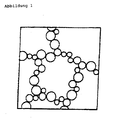
- a classic example is the gelation of uniformly sized aerosil particles, which occurs both in aqueous and non-aqueous media (eg oils) ( Fig. 1 ). These pearlescent gels are described in the textbooks [ List, PH, Pharmaceutical Formation, Scientific Publishing Company Stuttgart, p. 264, 1976 ]. However, an analogous gelation is also described for particles which are relatively polydisperse due to their production.
- Example 1 a 40% high pressure homogenized lipid dispersion contained separate nanoparticles (Example 1). Even with a further increase in the lipid content to 50%, separate nanoparticles could still be obtained (Example 2).
- a rotor stator (Ultra-Turrax, Janke & Kunkel, Germany) was used as dispersing system with lower power density for the preparation of lipid particles in the upper nanometer range or lower micrometre range (Example 3).
- the production of lipid particle dispersions of uniform particle size (monodisperse) with a solids content significantly above 74% is not physically possible.
- lipid particle dispersions of non-uniform particle size were therefore produced in a targeted manner.
- suboptimal dispersing conditions were deliberately contrary to conventional doctrine (low pressure) or suboptimal dispersers (nonuniform power density distribution) used (Example 4).
- Low pressure low pressure
- suboptimal dispersers nonuniform power density distribution
- the solids concentration of the lipid particle dispersions described in this invention is preferably in the range of 30% to 95%. As the solids content increases, the manufacturing conditions must become less than optimal, i. the particle dispersion produced polydisperse. In the upper concentration range, in addition, the lipid phase must be successively added in several steps. The gradually added lipid content is finely dispersed in the presence of already existing lipid nanoparticles in the water phase. After successful dispersion and transfer into lipid nanoparticles, another lipid fraction is added.
- the dispersion of the lipid in the outer phase can take place either in the solid state (cold homogenization) or in the liquid state (hot homogenization).
- cold homogenization the lipid is dispersed in an aqueous surfactant solution (crude dispersion) and then further processed with a suitable apparatus.
- hot homogenization the lipid is melted and poured into the heated outer phase at the same temperature and dispersed therein (crude emulsion).
- the crude emulsion obtained is then processed with another disperser.
- the concentration of the lipid phase and the physical state of the lipid are used as dispersing: High pressure homogenizers of the piston-gap homogenizer type (APV Gaulin systems, French Press).
- additives are substances that shift the pH (e.g., increasing zeta potential, affecting surfactant structure such as degree of dissociation) or specifically increase particle loading (e.g., anti-flocculants such as sodium citrate).
- Such additives may also increase the stability of the lipid particle dispersion, e.g. by influencing water structure (e.g., electrolytes) or effects on the stabilizing surfactant layer (e.g., glucose in lecithin).
- the lipid particles can be loaded with active ingredients.
- Active substances are, for example, drugs, cosmetic active ingredients, crop protection agents, food additives, chemical substances of various types (eg wood preservatives).
- the loading of active substances can take place in different ways, individually or in combination.
- the agent or agents are dissolved in the lipid particles, solubilized (e.g., with surfactants or cyclodextrins), or dispersed. Further, they may be adsorbed on the surface thereof. Due to the character of the solid, it is also possible to incorporate hydrophilic active substances in the form of an aqueous active substance solution into the lipid or lipid phase. After this incorporation and subsequent dispersion of the lipid in the aqueous dispersion medium, a system W / F / W is formed, i. Water in fat in water. The lipoid core encloses the aqueous drug solution due to its solid state better than it is possible in comparable multiple emulsions water in oil in water (W / O / W).
- the dispersed, solid at room temperature lipid core was previously loaded with one or more drugs. This can be done by dissolving or dispersing the active ingredient in the lipid, adsorbed on its surface or dispersed in the form of an aqueous solution in the lipid or incorporated simultaneously by several of these methods.
- the concentrated lipid particle dispersions are, as stated above, especially for their low water content for the production of various dosage forms such as granules (eg filling in sachets), tablets, pellets, capsules, dry products such as lyophilisates and spray-dried products.
- Essential advantage is that only small amounts of water must be removed. This reduces process time, costs and, above all, less aggregation of particles due to less process time.
- the concentrated lipid particle dispersions can be used directly as a topical dosage form (for example gel) or after the addition of viscosity-increasing substances or liquid oily phase.
- the dispersions may be sprayed with commercial equipment (e.g., nasal application) or aerosolized, e.g. with a Pariboy (Example 9) or HaloLite TM (Medic-Aid, England).
- commercial equipment e.g., nasal application
- aerosolized e.g. with a Pariboy (Example 9) or HaloLite TM (Medic-Aid, England).
- Another possible use is the production of parenteral dosage forms, especially when the volume to be administered is to be kept to a minimum. Small volumes can be realized due to the high concentration of lipid particles.
- the lipid particles can be produced aseptically or subsequently sterilized by conventional methods.
- fragrances of any type, natural, synthetic or semisynthetic origin.
- examples are essential oils such as lemon oil (Example X1), rose oil, lavender oil, bergamot oil, lemon balm oil, clove oil, cinnamon oil, orange oil, jasmine oil, rosemary oil, aniseed oil, peppermint oil, sandalwood oil or ylang-ylang oil whose isolated ingredients such as 1.8 -Cineol, menthol, terpin hydrate, limonene, ⁇ -pinene, eugenol and perfumes, especially perfume oils.
- Allure (Example X2), Coco, Egoiste, Chanel no.
- fragrances having a pleasant fragrance it is also possible to incorporate fragrances having a repellent effect, e.g. Repellents. Fragrances can be removed e.g. as warning materials (protection against accidental oral ingestion of the product) or as a repellents, e.g. be incorporated against insects.
- Examples of natural repellents are citrus oils, eucalyptus oil and camphor; examples of synthetic repellents are N, N-diethyl-toluamide (DEET), dibutyl phthalate, dimethyl phthalate, 2-ethyl-1,3-hexanediol.
- fragrances are the so-called attractants such.
- Pheromones Lipid particles with attractants may e.g. Use in cosmetics or insect killers.
- Examples of pheromones are androstenone and androstenol; In particular, human pheromones are used.
- the lipid particles may contain both attractants at the same time as an active ingredient poisons.
- attractant-containing lipid particles can be mixed with lipid particles containing poison.
- contact poisons are also used. Because of their lipophilic character, for example, the adhesion of the lipid particles to the lipophilic chitin shell of insects occurs, and the contact poison diffuses from the adhering particles into the insect.
- poisons are chlorinated hydrocarbons such as ⁇ -hexachlorocyclohexane, pyrethrins, pyrethroids, alkyl phosphates such as paraoxon, parathion, fenthion, dichlorvos and carbamic acid esters such as butoxicarboxime, bendiocarb, methomyl, Proxopur.
- chlorinated hydrocarbons such as ⁇ -hexachlorocyclohexane, pyrethrins, pyrethroids, alkyl phosphates such as paraoxon, parathion, fenthion, dichlorvos and carbamic acid esters such as butoxicarboxime, bendiocarb, methomyl, Proxopur.
- oils represent the liquid lipid component in the lipid particles, that is, the liquid perfume is mixed with a solid at room temperature lipid, in addition, one or more liquid lipids can be added. Fragrances can also be dissolved in a liquid lipid and then blended with solid lipid for particle production. Alternatively, solution in molten solid lipid is possible.
- fragrances By incorporation of the fragrances in the lipid particles, their release can be controlled, in particular controlled prolonged release can be achieved (prolonged release).
- products based on emulsions oil perfume emulsified in water, perfume dissolved in the oil phase of a 0 / W emulsion
- release the fragrance relatively quickly.
- the product loses its scent effect.
- Incorporation into the lipid particles reduces the delivery of perfumes and thus prolongs product efficacy (Examples 18 and 19).
- pleasant fragrances are cosmetic products (lotions, after shaves, etc.), pharmaceutical products (increasing patient acceptance), and hygiene and sanitary products (for example, room scenting over an extended period of time).
- markers are radioactive substances, for example iodinated lipids (iodinated, for example, with iodine 131, iodine 123) as well as lipophilic indium compounds (eg indium) for incorporation into the lipid particles according to the invention -111 oxine (8-hydroxy quinoline)) and technetium 99m, which are molecularly bound or complexed or adsorbed.
- iodinated lipids iodinated, for example, with iodine 131, iodine 123)
- lipophilic indium compounds eg indium
- Such particles can be used for gamma scintigraphy, e.g. After intravenous injection to label bone marrow and liver.
- Other markers are colored substances (dyes) or fluorescent substances (fluorescent dyes).
- labeled lipid particles can be used for both in vitro diagnostics and in vivo diagnostics.
- in vitro diagnostics are the characterization of cell lines, eg. B. Determination of phagocytic activity after differentiation of a cell line into a macrophage line.
- these particles can be used in diagnostic kits.
- in vivo diagnostics are the labeling of lymph nodes. For this purpose, the particles are injected in the vicinity of lymph nodes, there is drainage into the lymph nodes and staining. Another example is the marking of body cavities and analysis with fluorescence spectroscopy.
- the lipid particles according to the invention can also be used without incorporation of active substances as diagnostic agents in magnetic resonance tomography (MR).
- MR magnetic resonance tomography
- the introduction of magnetic resonance imaging has decisively improved imaging abdominal diagnostics, the reliable delineation of the gastrointestinal tract from normal or pathological surrounding tissue is still often difficult or impossible.
- MR images are basically possible without contrast medium, but the signal intensities and thus the intensity of the contrast are improved by the relaxation time influencing T1 and T2 contrast agents.
- contrast agents In order to improve the delineation of the tissue structures, different substances have been proposed as contrast agents. In principle, a division into negative contrast agents (magnetites) and positive contrast agents (eg Magnevist) can be carried out.
- SLN oral T1-MR contrast agents due to their high fat content.
- Advantages are low price, good acceptance (Taste, tolerability), tolerability, lack of toxicity (physiological lipids), homogeneous distribution in the gastrointestinal tract and good lining of the intestinal wall (particle size).
- Witepsol H15 hard fat C12-C18
- Witepsol E85 hard fat C12-C18
- Magnetites Fe 2 O 3 , iron oxides
- small iron oxide particles in the range of about 1 to 3 nm are incorporated into the lipid matrix. They can also be used as a contrast agent for magnetic resonance imaging.
- the fatty acid residues can oscillate relatively freely, so that the state is similar to a melt ( N. Garti, K. Sato, Crystallisation and Polymorphism of Fats and Fatty Acids, Marcel Dekker Inc., New York, Basel, 97-138, 1988. Hernqvist, Crystal Structures of Fats and Fatty Acids ).
- the formation of the stable ⁇ i / ⁇ modification leads to the undesired effect of the displacement of active ingredients incorporated in the particle matrix (so-called drug exclusion).
- drug crystals form.
- the transition from the disordered state (liquid or liquid-like ⁇ -modification) to the more stable ⁇ i / ⁇ modification reduces the number of liquid areas with dissolved drug and the number of lattice defects (and thus the possibility of accommodating drug molecules in the lipid matrix). Perfect crystals form, the active ingredient is forced out.
- the solid-liquid lipid particles according to the invention also remain in highly concentrated dispersions as individual particles, and after preparation (for example Example 6) they also have a liquid or ⁇ content after storage (Example 13).
- the liquid portion can be purposefully increased by adding liquid lipids (oils, e.g., triglycerides such as miglyoles) to solid lipids.
- liquid lipids oils, e.g., triglycerides such as miglyoles
- Small amounts of oil can be dissolved in the solid lipid (i.e., dispersed in a molecular dispersion).
- Exceeding the oil solubility in the solid lipid leads to accumulations of undissolved oil molecules, forming compartments with liquid oil in the nanometer range (so-called nano-compartments).
- active substance can be incorporated in dissolved form in the liquid nano-compartments.
- the result is a carrier consisting of a solid lipid matrix with incorporated nano-compartments of liquid lipid, the Nano-Compartment-Carrier (NCC).
- NCC Nano-Compartment-Carrier
- the particles according to the invention have a special internal structure with increased disorder (liquid compartments, liquid-crystalline fractions, amorphous structures) and are no longer completely crystalline.
- the melting enthalpy of the particles according to the invention is determined directly after production by differential scanning calorimetry (DSC) compared to bulkware. Calculation of the enthalpy of fusion of the particles as a percentage of the enthalpy of fusion of the bulk product gives the crystallinity in percent or the crystallinity index (eg 80% crystallinity corresponds to the crystallinity index 0.80, see below).
- Completely crystalline are particles with a crystallinity index of 1.0, predominantly crystalline with a crystallinity index of 0.50 or higher.
- Predominantly non-crystalline particles have a crystallinity index smaller than 0.50, with almost completely X-ray amorphous lipid particles, the crystallinity index approaches zero.
- Predominantly crystalline particles and predominantly non-crystalline particles are all partially crystalline, since at least part of the matrix is present in crystalline form.
- Liquid lipids are mixed with solid lipids, in most cases the liquid fraction is less than 50%.
- the required lack of crystallinity can also be realized by targeted production of amorphous particles.
- Amorphous structures show no crystallinity.
- the particles are formed when, as described above, a solid and liquid lipid are mixed, wherein the proportion of the liquid lipid for forming these particles is usually at least 50% and can rise to 99%.
- the oil is virtually solidified while avoiding the formation of an ordered crystalline structure.
- the particles formed are thus also partially crystalline (predominantly non-crystalline), at a temperature of 21 ° C semi-solid to solid and X-ray amorphous.
- Characteristic of the invention is that disordered and storage-stable structures are produced by admixing liquid lipids, which lead to semi-crystalline or predominantly non-crystalline particles, with semi-solid or solid state.
- Solidified oils are from the DE 197 07 309 A1 known ( Clermont-Gallerande, H., Solid cosmetic preparation based on solidified oils, 1998 ). However, these preparations are anhydrous and do not constitute a dispersion. Rather, this product is used in stick form.
- a sub-task of the present invention was therefore to provide carrier systems which consist of lipids with physiological compatibility. These carrier systems should have a high absorption capacity for active ingredients and not change substantially during storage.
- suspension or dispersion is used here as an umbrella term in its broadest sense and describes the distribution of a discontinuous phase in a continuous phase.
- the discontinuous phase can be semi-solid, partially solid or solid and is partially crystalline or predominantly non-crystalline.
- the continuous phase may be liquid, semi-solid or solid, but not gaseous.
- the oil phase of the carrier system contains at least two components.
- the first essential ingredient is a liquid oil.
- the melting point of this oil is below 4 ° C.
- Preferred oils are compounds of short chain (less than 14 carbon atoms) fatty alcohols. These include isopropyl myristate, palmitate, stearates, octyldodecanol, C 6-14 dicarboxylic acid diesters of isopropyl alcohol, C 14-20 branched chain aliphatic fatty alcohols, C 6-14 fatty acid triglycerides and diglycerides, C 12-16 octanoates, tridecyl salicylates and oils of Crodamol ® group.
- the second essential component of the oil phase is a lipophilic, solidifying substance which is solid at 37 ° C.
- lipids having a melting point above 40 ° C. and optionally the lipophilic gelling agent (eg hydrophobic polymers).
- Suitable substances are esters of long-chain fatty alcohols with long-chain fatty acids, waxes, certain glycerides and long-chain fatty alcohols, each with a melting point above 40 ° C.
- this substance is selected from the group carnauba wax, hydroxyoctacosanyl hydroxystearate, Chinese wax, cetyl palmitate, beeswax and similar waxes.
- Other examples of these solidifying substances are C 20-40 di- and triglycerides, including those containing unsaturated fatty acids, C 20-40 fatty alcohols, C 20-40 fatty amines and their compounds, sterols.
- the crystallinity index is advantageously below 0.5.
- the oil phase may contain mixtures of said components and in addition to said two essential components further lipophilic substances, as long as the resulting mixture, after heating the components to 90 ° C and then cooling with stirring to room temperature, solid or semi-solid and remains predominantly amorphous.
- lipophilic drugs and cosmetic ingredients vegetable and natural oils and fats, lipophilic antioxidants, sunscreens, essential oils, perfumes, plant extracts, etc.
- a third essential component of the carrier system according to the invention is water or a water-miscible liquid.
- the water phase contains a gelling, structuring additive, whereby the water phase becomes semi-solid and has a yield point of 5 Pa or above at 21 ° C. (determined, for example, with a rheometer).
- Suitable structuring additives are hydrophilic polymers, certain inorganic gelling agents and amphiphilic substances. Examples of polymers are alginates, cellulose derivatives, xanthan gum, starch and derivatives. Examples of inorganic gelling agents are Aerosil types and bentonites.
- amphiphilic substances with viscosity-increasing action are glycerol monostearate and poloxamer 127.
- Preferred structuring agents are polyelectrolytic polymers such as e.g. As polyacrylic acid, carboxymethyl cellulose or carrageenan.
- the water phase may contain other additives such as hydrophilic or amphiphilic drugs or cosmetic ingredients, water-soluble antioxidants, preservatives, humectants or plant extracts.
- the suspension necessarily contains substances which increase the physical stability of the suspension.
- emulsifiers are myristyl, cetyl, stearyl alcohol, polysorbates, sorbitan esters, block polymers (eg poloxamers), glycerol monofatty acid esters (eg glycerol monostearate), esters of polycarboxylic acids and fatty alcohols, mono- and diglycerides of fatty acids esterified with lactic acid, citric acid or tartaric acid (eg, glycerol stearate citrate). It is advantageous to use a combination of at least two emulsifiers. An emulsifier should be charged be (positive, negative or ampholytic). Examples of these are glycerol stearate citrate and quaternary ammonium compounds (eg cetylpyridinium chloride).
- the oil phase, water phase and suspension stabilizers are mixed to achieve intimate distribution of the oil phase in the continuous water phase.
- the size of the oil droplets is typically between 1 .mu.m and 100 .mu.m.
- the continuous water phase of the suspension may, for. B. characterized by a rapid dissolving power for hydrophilic dyes or by miscibility with water.
- the proportion of the water phase in the entire suspension is advantageously 40-95%.
- the lipid particles with a large or predominantly liquid content in the lipid mixture are explained in more detail in Examples 21 to 26.
- the active ingredient can be released as desired (Examples 14-16).
- Stimuli to initiate this transition are addition of electrolyte, temperature increase or removal of water from the NCC dispersion.
- dehydration is the drying of particle dispersions after topical application to the skin.
- Induction of modification transition and drug release can already be accomplished by the electrolytes present on the skin in sufficiently sensitive systems.
- active substances such as cyclosporin (Example 6), which, after topical application, have too little penetration into the skin in order, for example, to be able to successfully treat psoriasis.
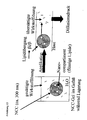
- NCC actively transports the drug from the carrier.
- the driving force is the induced formation of perfectly crystalline particles, in which there is no more space for drug molecules.
- the drug eg, cyclosporin
- the outer phase eg, water of the NCC-containing lotion or cream
- the NCC are particularly suitable for agents with bioavailability problems, eg cyclosporins (eg cyclosporin A) and structurally related molecules.
- the particles of the invention can be prepared in high solids concentration as a dispersion.
- lipid particle dispersions can not only be incorporated into tablets, film-coated tablets and dragees, but can also be applied to these.
- the tablets or dragees are sprayed with particle dispersion (for example in a ball coater (Glatt), Wurster apparatus, Fluid Bed Dryer, Accela Cota) or the lipid particle dispersion is added in a coating pan.
- Unloaded lipid particles can be used to create a protective film (e.g., against oxygen and humidity), a drug for modulation of drug ligation, or for polishing drag and film-coated tablets.
- Drug loaded particles may release a separate dose of drug in a controlled manner, e.g. Initial dose.
- Polishing of dragees and film-coated tablets is hitherto carried out by adding wax balls (eg carnauba wax) or by spraying of waxes in organic solvents.
- Use of lipid particle dispersions results in a finer distribution of the lipid on the dragee surface and avoids organic solvents compared to wax balls (diameter eg 1 cm).
- Low-concentrated lipid particle dispersions can not be used for this purpose, since due to the high water content, a dissolution of, for example, the surface of the dragee can occur.
- the particle dispersions according to the invention are distinguished by their relatively low water content.
- the dispersions can be filled directly into soft or hard gelatin capsules.
- solid PEG eg PEG 6000
- the solidified product disersion of lipid particles in solid PEG
- Example 1 Preparation of a 40% lipid particle dispersion (solids content 45%):
- the composition of the lipid particle dispersion was 40% cetyl palmitate, 5% sucrose ester S-1670 (Mitsubishi-Kagaku Foods Corporation, Tokyo, Japan) and water at 100%. Lipid was heated to 90 ° C and mixed with the hot aqueous solution of the surfactant at 8000 rpm for 2 minutes using a rotor-stator stirrer (Ultra-Turrax, Janke & Kunkel, Germany). The crude emulsion obtained was then homogenized in a Micron LAB 40 at 500 bar and 3 cycles at 80 ° C. The product was white and creamy in consistency. After cooling and crystallization of the lipid nanoparticles, the particle size in the product was determined. The diameter was 246 nm, the polydispersity index 0.179 (measurement method: photon correlation spectroscopy (PCS), instrument: Zetasizer 4, Malvern Instruments, UK).
- PCS photon correlation spectroscopy
- Example 1 The formulation of Example 1 was used, with the lipid content increased from 40% to 50%. Production and homogenization were carried out as in Example 1. The product obtained was diluted to determine the particle size, the PCS diameter was 325 nanometers, the polydispersity index was 0.190.
- composition of lipid particle dispersion 40% fat, 5% sucrose ester S-1670 (Mitsubishi-Kagaku Foods Corporation, Tokyo, Japan) and water to 100%.
- 24 g of aqueous surfactant solution were heated to 80 ° C., 4 g of molten lipid added and dispersed for 2 minutes with an Ultra-Turrax (Janke & Kunkel, Germany) at 8000 revolutions per minute for 2 minutes.
- 4 g of molten lipid were again added, dispersing conditions as before.
- There was a successive addition of each 4 g of molten lipid until the total lipid content was 40%.
- a particle size measurement in water was carried out. The diameter 50% was 12.25 microns (measurement method: laser diffractometry, device: Mastersizer E, Malvern Instruments, UK).
- a volume distribution curve was measured.
- Example 3 The formulation of Example 3 was used with 5% sucrose ester but the lipid content was increased from 40% to 70%. Preparation was carried out as in Example 3, wherein in each case successively 4 g of lipid were added until the maximum lipid concentration was 70%. After cooling, a 50% diameter of 20.68 ⁇ m was measured (laser diffractometry as in Example 3).
- Example 5 Storage stability of the highly concentrated lipid particle dispersions:
- Example 1 The dispersion of Example 1 was stored at room temperature for 14 days. Particle size determination with PCS gave a diameter of 243 nm and a polydispersity index of 0.203. There was no significant particle size increase, the dispersion is physically stable in the highly concentrated form.
- the composition of the lipid particle dispersion was 48% Imwitor 900, 2% Cyclosporin A, 5% Tween 80 and water to 100%. Lipid and drug were heated to 90 ° C and mixed with the hot aqueous solution of the surfactant at 8,000 rpm for 2 minutes using a rotor-stator stirrer (Ultra-Turrax, Janke & Kunkel, Germany). The crude emulsion obtained was then homogenized in a Micron LAB 40 at 500 bar and 3 cycles at 80 ° C.
- the cyclosporin-loaded lipid particle dispersion was examined for crystalline status by differential scanning calorimetry (DSC). The measurements show that the lipid particles predominantly in ⁇ -modification (onset temperature 51.5 ° C, peak maximum 58.7 ° C) while the pure lipid predominantly ⁇ -modification has (onset temperature 54.2 ° C, peak maximum 61.9 ° C) ( Fig. 5 ).
- Example 8 Preparation of an 80% lipid particle dispersion (solids content 85%):
- Example 1 The formulation of Example 1 was used with the lipid content increased from 40% to 80%.
- a 50% lipid particle dispersion was prepared analogously to Example 1.
- To the product obtained was successively added in increments of 10% lipid with stirring by means of a rotor-stator-stirrer at 8000 revolutions per minute until obtaining an 80% lipid particle dispersion.
- Example 9 Nebulization of a 10% Lipidpumbledispersion by means of a Pariboy (Paul Ritzau Pari-Werk GmbH, Starnberg, Germany):
- the composition of the lipid particle dispersion was 10% cetyl palmitate, 1.2% Tego Care 450 and water to 100%. Production and homogenization took place as in Example 1.
- the product obtained was nebulised by means of Pariboy and the resulting aerosol was collected in a beaker. The diameter 50% was 0.28 ⁇ m before and 0.30 ⁇ m after nebulization (laser diffractometry as in Example 3).
- the composition was 10% Imwitor, 5% Miglyol 812, 0.5% Retinol, 2.5% Miranol (sodium cocoamphoacetate) and 82% water.
- the lipids Imwitor and Miglyol were mixed in a molten state at 90 ° C and then particles were prepared as in Example 1.
- the PCS diameter was 188 nm, the polydispersity index was 0.266.
- the wide-angle X-ray diffractogram ( Fig. 5 , left) shows the predominant presence of the fat in the liquid state ( ⁇ -modification).
- Example 10 The preparation was carried out as in Example 10, the lipid Imwitor was replaced by Compritol.
- the concentration of Miranol here was 1.5%.
- the PCS diameter was 225 nm, the polydispersity index was 0.205.
- Example 12 Preparation of liquid-solid particles having different proportion of liquid lipid:
- Compritol particles were prepared as described in Example 11.
- the lipid content was constant at 15% (solid lipid Compritol + oil Miglyol) in the aqueous dispersion, changing the ratio of oil to solid lipid.
- Particles were made with 8.3%, 16.7%, 28% and 38% oil content in the lipid (ie 91.7%, 83.3%, 72% and 62% Compritol).
- the oil dissolves mainly in the solid lipid (molecular disperse distribution), there are only a few nanocompartments of liquid oil.
- the X-ray diffractograms of the particles show that in addition to the DSC-detected liquid lipid in ⁇ -modification there is also solid lipid in the unstable ⁇ '-modification (peaks at 0.38 nm and 0.42 nm spacing, Fig. 7 ).
- Example 13 Preservation of the liquid fraction in lipid particles by inhibiting the transformation of the lipid into the stable ⁇ -modification:
- aqueous SLN dispersion from Example 10 20 parts were incorporated by stirring into 80 parts of a cosmetic O / W cream (Nivea Visage, Beiersdorf, Hamburg, Germany). After 168 days of storage at room temperature, the X-ray diffractogram showed no change compared to the day after preparation ( Fig. 5 ).
- Example 14 Controlled crystallization of the liquid fraction and conversion of ⁇ / ⁇ 'into the stable ⁇ i / ⁇ modification by electrolytes:
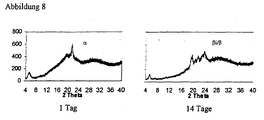
- Example 10 To 20 parts of the Imwitor particles of Example 10 are added 10 parts of glycerol and 70 parts of water. To this mixture, 0.4% Carbopol 940 (polyacrylic acid) are added as gelling agent and then added as the electrolyte 0.1% sodium hydroxide. Immediately after preparation, the liquid-solid lipid particles still show a pronounced liquid fraction ⁇ -modification ( Fig. 8 , left), which on exposure to electrolyte becomes a solid lipid particle from the stable ⁇ i / ⁇ modification ( Fig. 8 , right).
- Carbopol 940 polyacrylic acid
- Example 15 Controlled conversion of ⁇ / ⁇ 'into the stable ⁇ i / ⁇ modification by dehydration:
- a compritol particle dispersion was prepared as in Example 11, with the miglyol containing 10% retinol.
- 200 ⁇ l aqueous SLN dispersion was introduced into a flow-through Franz cell (Crown Scientific, US-Sommerville) (acceptor medium: isotonic phosphate buffer pH 7.4, flow rate medium: 1.0 ml / h, temperature: 37 ° C, membrane: cellulose nitrate filter soaked with isopropyl myristate).
- the X-ray diffractograms show that the evaporation of water leads to the formation of a solid lipid particle with stable ⁇ i-modification ( Fig. 9 , Peak at 0.46 nm spacing).
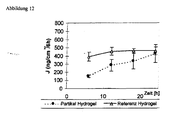
- Retinol-loaded particles were prepared as described in Example 15. To 20 parts of the particle dispersion was added 10 parts of glycerol and 70 parts of water. To this mixture was added 0.5% xanthan gum. The hydrogel formed was examined as in Example 15 in the Franz cell. Evaporation of water also produced the more stable ⁇ i-modification in the hydrogel ( Fig. 11 ), the drug was increasingly displaced from the lipid matrix and the flux (drug release) increased with time ( Fig. 12 ).
- Carnauba wax-based lipid particles were prepared by high-pressure homogenization (31% carnauba wax, 3% surfactant, water). Manufactured with a Micron LAB 40 at 95 ° C, 500 bar and 3 cycles. The PCS diameter was 420 nm, the polydispersity index was 0.185.
- a lipid particle dispersion consisting of 10% (m / m) stearic acid, 1% (m / m) lemon oil, 1.2% (m / m) Tween 80 and Water produced by high pressure homogenization.
- the mixture of lipid and emulsifier was melted at 75 ° C and dispersed in the aqueous solution with an Ultra-Turrax T25 with dispersing tool S25, Janke and Kunkel (8000 rpm, for 1 minute).
- the crude emulsion obtained was then homogenized with an APV Gaulin LAB 40 homogenizer at 500 bar with 3 cycles at 75 ° C.
- the result was lipid particles with an average LD diameter (LD d50%) of 215 nm.
- an emulsion system was prepared analogously, wherein the 10% stearic acid was replaced by 10% Miglyol 812.
- the LD d50% here was 195 nm.
- Example 19 Prolonged release of the perfume oil Allure (Chanel) from stearic acid particles in comparison to miglyol emulsions:
- lipid particle dispersion consisting of 10% (m / m) stearic acid, 1% (m / m) Allure, 1.2% (m / m) Tween ® 80, and water produced by high pressure homogenization analogously to Example eighteenth Lipid particles with a mean PCS diameter of 336 nm and a polydispersity index of 0.137 were produced.
- an emulsion system was prepared analogously, wherein the 10% stearic acid were replaced by 10% Miglyol 812.
- In vitro release experiments at 32 C which were evaluated by UV spectrophotometry, demonstrated a prolonged release from the SLN dispersion. After 6 hours, 100% of the perfume oil had already been released from the emulsion system; however, release from the SLN dispersion was only 75% at this time.
- Lipid particle dispersions with Witepsol H15 hard fat C 12- C 18
- Witepsol E85 hard fat C 12 -C 18
- the particle sizes were 119 nm and 133 nm (PCS diameter).
- the lipid particles were examined with a Bruker mini-spec pc 120 for the change of the relaxation times T1 and T2.
- FIG. 1 shows the composition of a typical suspension satisfying the requirements of this invention.
- the formula V1 is given, which does not meet the requirements of this invention.
- 1 V1 vaseline - 5.0% paraffin oil - 10.0% Dimeticone 100 - 5.0% jojoba oil - 4.0 isopropyl 10.0% - Medium chain triglycerides 10.0% - hydroxyoctacosanyl hydroxystearate 4.0% - -retinaldehyde 0.2% 0.2% glycerol 0.3% 0.3% cetyl alcohol 0.5% 0.5%
- Polysorbate 80 0.5% 0.5%
- For adjusting the pH value (pH 6 - 7) For adjusting the pH value (pH 6 - 7) sodium chloride 0.5% 0.5% water ad 100% ad 100% ad 100%
- the lipophilic components including the active ingredient, and the hydrophilic components, including the emulsifier but without the polyacrylic acid, are separately heated to 90 ° C and mixed at 90 ° C.
- the mixture is dispersed in the heat for 5 minutes with an Ultra-Turrax at 10,000 revolutions per minute.
- the polyacrylic acid is added, dispersed again for 1 minute with the Ultra-Turrax and then cooled the suspension with stirring to ambient temperature.
- the comparative formulation V1 does not show any amorphous solidified oil phase and is therefore not composed according to the invention.
- the stabilities of the two preparations containing retinaldehyde from Example 21 are listed in Table 1.
- Table 1 clearly shows that after 12 weeks of storage at 40 ° C for the carrier system according to the invention a much higher amount of the active ingredient was recovered than in a comparison emulsion.
- This example demonstrates the possibility of reducing the irritant effect of entrapped drugs.
- the active ingredient benzyl nicotinate causes a hyperaemia of the skin, which is indicated by a reddening of the affected skin areas.
- V2 isopropyl 10.0% 10.0% Medium chain triglycerides 10.0% 10.0% Hydroxyoctacosanyl hydroxystearate 5.0% - jojoba oil - 5.0% benzyl nicotinate 2.5% 2.5% glycerol 0.3% 0.3% cetyl alcohol 0.5% 0.5% Polysorbate 80 0.5% 0.5% Glycerolstearatcitrat 2.0% 2.0% sorbitol 5.0% 5.0% polyacrylic acid 0.8% 0.8% sodium hydroxide For adjusting the pH (pH 7-8) For adjusting the pH value (pH 7 - 8) sodium chloride 0.5% 0.5% water Ad 100% ad 100% ad 100%
- Preparation 2 is composed according to the invention and has a solidified oil phase, so that the active ingredient is better immobilized.
- Preparation V2 is not composed according to the invention.
- the solid wax hydroxyoctacosanyl hydroxystearate of preparation 2 has been replaced in V2 by the liquid wax jojoba oil, so that the oil phase remains completely liquid and consequently can not immobilize the active ingredient.
- the course of skin redness as a function of time is in the Fig. 15 shown.
- the arithmetic mean values of 4 persons (2 male, 2 female, left forearm, no skin diseases) are plotted.
- the Fig. 15 shows that in the emulsion 2 according to the invention (solid line) the redness starts slower and the tip of the curve is smoothed compared to V2 (dashed line). This means a reduction of the irritant effect of the active ingredient by its inclusion in the carrier system.
- the solidifying substance can build up a network in the oil droplets and thus bring about the dimensional stability. Likewise, the solidifying substance can be distributed diffusely in the matrix of the liquid oil and thus cause the dimensional stability.
- This example illustrates the crystallinity index ( KI ) defined above .
- the raw material is measured.
- Hydroxyoctacosanyl hydroxystearate at 76.5 ° C is 1245.9 mW per gram of hydroxyoctacosanyl hydroxystearate (measured with a differential heat flow calorimeter).
- 70 parts of the medium-chain triglyceride oil (Miglyol 812) are mixed with 30 parts of hydroxyoctacosanylhydroxystearate, and the mixture is heated to 90 ° C. and allowed to cool with stirring.
- the crystallinity of the raw material is drastically reduced in the mixture.
- the oil phase is predominantly non-crystalline.
- the diffractogram of Formulation V2 of Example 23 in the middle (2)
- Formulation 2 of Example 23 and below a corresponding amount of crystalline cetyl palmitate are shown.
- the formulation V2 is, as expected, predominantly X-ray amorphous (liquid oil droplets) (1).
- Formulation 2 is also X-ray amorphous despite the solid hydroxyoctacosanyl hydroxystearate present, and thus meets the requirements of this invention (2).
- Crystalline cetyl palmitate shows two intense reflexes and is therefore not amorphous (3).
- amorphous in the sense of this invention, it can be defined in particular that the intensity (height) of a reflex of the suspension is at most 50% of the intensity of the reflection of the corresponding solid raw material, based in each case on the same amount by weight of the raw material.
- Fig. 1 Structure of a gel skeleton of spherical aerosil (silica) particles.
- Fig. 2 Structure of a polydisperse gel skeleton made of magnesium aluminum silicate (bentonite).
- Fig. 3 Formation of solid bridges upon contact of lipid particles by solidification of the outer shell.
- Fig. 4 Structure of a biamphiphilic cream.
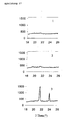
- Fig. 5 X-ray diffractograms of the Imwitor particle dispersion in creams (Examples 10 and 13) on the day after preparation (left) and after 168 days storage (right).
- Fig. 1 Structure of a gel skeleton of spherical aerosil (silica) particles.
- Fig. 2 Structure of a polydisperse gel skeleton made of magnesium aluminum silicate (bentonite).
- Fig. 3 Formation of solid bridges upon contact of lipid particles by solidification of the outer shell.
- Fig. 4 Structure of a biamphiphilic cream.
- Fig. 8 X-ray diffractograms of the Imwitor particle dispersion directly after incorporation into a Carbopol gel and after transformation into a solid particle by addition of electrolyte (Example 13)
- Fig. 9 X-ray diffractogram of the particle dispersion from Example 14 before introduction into the Franz cell (curve below) and after evaporation of water over the measurement period of 24 hours (top).
- Fig. 10 Increasing retinol flux from the dispersion with liquid-solid particles from Example 14 in the course of the transition to the solid particle in ⁇ i-modification. For comparison: constant release of retinol from liquid particles (oil drops of an emulsion).
- Fig. 11 X-ray diffractogram of the liquid-solid lipid particle-containing hydrogel from Example 15 before introduction into the Franz cell (curve below) and after evaporation of water over the measurement period of 24 hours (top, arrow: peak for ⁇ i modification).
- Fig. 12 Increasing retinol flux from the liquid-solid lipid particle-containing hydrogel from Example 15 in the course of the transition to the solid particle in ⁇ i-modification. For comparison: constant release of retinol from liquid particles (oil droplets of an emulsion) in an identical hydrogel base.
- Fig. 13 Model for drug liberating from cyclosporin lipid particles (Example 6). Fig.
- Fig. 14 Release of lemon oil at 32 ° C from SLN dispersion and emulsion.
- Fig. 15 Reduction of the irritant effect of the active ingredient by its inclusion in the carrier system.
- Fig. 16 1 H-NMR spectra of suspension 2 (upper spectrum) and comparative formulation V2 (lower spectrum) from example 23.
Landscapes
- Health & Medical Sciences (AREA)
- Life Sciences & Earth Sciences (AREA)
- Public Health (AREA)
- General Health & Medical Sciences (AREA)
- Veterinary Medicine (AREA)
- Animal Behavior & Ethology (AREA)
- Epidemiology (AREA)
- Bioinformatics & Cheminformatics (AREA)
- Birds (AREA)
- Engineering & Computer Science (AREA)
- Medicinal Chemistry (AREA)
- Pharmacology & Pharmacy (AREA)
- Chemical & Material Sciences (AREA)
- Emergency Medicine (AREA)
- Nuclear Medicine, Radiotherapy & Molecular Imaging (AREA)
- General Chemical & Material Sciences (AREA)
- Chemical Kinetics & Catalysis (AREA)
- Organic Chemistry (AREA)
- Dermatology (AREA)
- Toxicology (AREA)
- Molecular Biology (AREA)
- Biophysics (AREA)
- Medicinal Preparation (AREA)
- Investigating Or Analysing Materials By The Use Of Chemical Reactions (AREA)
- Cosmetics (AREA)
- Medicines That Contain Protein Lipid Enzymes And Other Medicines (AREA)
- Pharmaceuticals Containing Other Organic And Inorganic Compounds (AREA)
- Agricultural Chemicals And Associated Chemicals (AREA)
- Colloid Chemistry (AREA)
Claims (40)
- Dispersion de particules lipidiques, caractérisée en ce qu'elle comprend des particules lipidiques qui comprennent une matrice mixte constituée d'un lipide solide et d'un lipide liquide, sont intègres et présentent une structure interne, qui se caractérise par une cristallinité incomplète dans la modification β, telle que déterminée par analyse calorimétrique différentielle (ACD) et diffractométrie aux rayons X, le lipide liquide, ou un mélange de lipides liquides, et le lipide solide, ou un mélange de lipides solides, étant mélangés selon un rapport de 50 + 50 à 0,1 + 99,9 ou de 99 + 1 à 50 + 50, les particules lipidiques étant présentes en dispersion dans une phase extérieure (milieu de dispersion) (dispersion), les lipides étant dispersés par utilisation d'une homogénéisation sous haute pression, l'addition de la phase lipidique au milieu de dispersion ayant lieu dans le cadre d'une étape ou successivement dans le cadre d'étapes partielles, les lipides se trouvant alors au-delà de leur point de fusion à l'état liquide, et/ou à l'état solide et/ou partiellement solide, et la dispersion étant composée :a) d'une ou plusieurs huiles, en tant que constituants de particules lipidiques, qui sont liquides à 4°C,b) d'une ou plusieurs substances lipophiles, en tant que constituants des particules lipidiques, qui sont solides à 37°C et solidifient l'huile liquide,c) d'une phase aqueuse ou d'une phase miscible à l'eau, en tant que milieu de dispersion,d) d'une ou plusieurs substances pour augmenter la stabilité physique de la dispersion,e) d'aucune, d'une ou de plusieurs substances actives, qui pour l'essentiel se trouvent dans les gouttelettes lipidiques.
- Dispersion de particules lipidiques selon la revendication 1, caractérisée en ce qu'elle comprend, incorporés dans sa fraction de matrice lipidique solide, des fractions ou domaines de matrices liquides ou cristallins liquides, ayant une grosseur de gouttelettes ou une grosseur de grain dans le domaine nanométrique (nano-compartiments).
- Dispersion de particules lipidiques selon l'une des revendications 1 ou 2, caractérisée en ce que le lipide liquide, ou un mélange de lipides liquides, et le lipide solide, ou un mélange de lipides solides, sont mélangés selon un rapport de 30 + 70 à 0,1 + 99,9.
- Dispersion de particules lipidiques selon l'une des revendications 1 à 3, caractérisée en ce qu'elle comprend en outref) des antioxydants et synergistes naturels, et/oug) des substances actives ou adjuvants cosmétiques ou pharmaceutiques supplémentaires.
- Dispersion de particules lipidiques selon la revendication 4, caractérisée en ce que les substances actives sont lipophiles dans les particules lipidiques contenant des substances actives, comprennent en particulier une cyclosporine ou un agent bloquant les UV, sont hydrophiles, en particulier un peptide ou une protéine ou une hormone, ou sont insolubles, en particulier du dioxyde de titane ou de la magnétite.
- Dispersion de particules lipidiques selon l'une des revendications 1 à 5, caractérisée en ce que les particules sont fabriquées à partir des lipides individuels suivants, ou de leurs mélanges : des triglycérides naturels ou synthétiques, ou des mélanges de ceux-ci, des monoglycérides et des diglycérides, à titre individuel ou sous forme de mélanges entre eux ou avec des triglycérides, des lipides modifiés auto-émulsifiants, des cires naturelles et synthétiques, des alcools gras, y compris leurs esters et éthers, ainsi que sous forme de peptides lipidiques, d'apolipoprotéines ou de quelques mélanges que ce soit de ceux-ci.
- Dispersion de particules lipidiques selon la revendication 6, caractérisée en ce que les lipides comprennent des monoglycérides, des diglycérides et des triglycérides synthétiques, sous forme de substances individuelles ou d'un mélange (en particulier une graisse dure), des triglycérides (en particulier le trilaurate de glycérol, le myristate de glycérol, le palmitate de glycérol, le stéarate de glycérol ou le béhénate de glycérol), des cires, en particulier le palmitate de cétyle, la cire de carnauba ou la cire blanche (DAB) et/ou des hydrocarbures (en particulier la paraffine dure).
- Dispersion de particules lipidiques selon l'une des revendications 1 à 7, caractérisée en ce qu'elle présente, par rapport au poids de la dispersion, une teneur en extrait sec de 30 à 95 % en lipides et stabilisants.
- Dispersion de particules lipidiques selon la revendication 8, caractérisée en ce que la phase extérieure (le milieu de dispersion) est non aqueuse, et contient en particulier des polyéthylèneglycoles (PEG) liquides, et de préférence du PEG 400 et/ou 600.
- Dispersion de particules lipidiques selon l'une des revendications 8 à 9, caractérisée en ce que les particules sont, dans la dispersion, stabilisées par des tensioactifs, des stabilisants, en particulier des stabilisants stériques et des polymères ou des stabilisants chargés, et/ou des anti-floculants, à titre individuel ou en mélange.
- Dispersion de particules lipidiques selon la revendication 10, caractérisée en ce que les tensioactifs comprennent des savons alcalins, des savons métalliques, en particulier du dilaurate de calcium, des savons d'amines, des alkylsulfates, des alkylsulfonates, en particulier des mono-et des diglycérides, des alcools gras, en particulier l'alcool cétylique et l'alcool stéarylique, ou des acides gras, des esters d'acides gras du sorbitan, en particulier le Span, des esters et éthers de sucres ou d'alcools de sucre et d'acides gras ou d'alcools gras (de préférence le monostéarate de saccharose, le distéarate de saccharose, le cocoate de saccharose, le stéarate de saccharose, le dipalmitate de saccharose, le palmitate de saccharose, le laurate de saccharose, l'octanoate de saccharose, l'oléate de saccharose), et/ou des tensioactifs naturels, en particulier les saponines.
- Dispersion de particules lipidiques selon la revendication 10 ou 11, caractérisée en ce que les stabilisants ioniques chargés comprennent des diacétylphosphates, du phosphatidylglycérol, des lécithines de différentes origines (en particulier la lécithine du jaune d'oeuf ou la lécithine du soja), des lécithines chimiquement modifiées (en particulier les lécithines hydrogénées), des phospholipides et des sphingolipides, un mélange de lécithines et de phospholipides, des stérols (en particulier le cholestérol, les dérivés du cholestérol ou la stigmastérine) et/ou des acides gras saturés ou insaturés, des sels de l'acide gallique, du cholate de sodium, du glycocholate de sodium, du taurocholate de sodium, du désoxycholate de sodium ou des mélanges de ceux-ci, des acides aminés et des composés de l'ammonium quaternaire.
- Dispersion de particules lipidiques selon l'une des revendications 10 à 12, caractérisée en ce que les anti-floculants comprennent le citrate de sodium, le pyrophosphate de sodium et/ou le sorbate de sodium.
- Dispersion de particules lipidiques selon l'une des revendications 10 à 13, caractérisée en ce que des substances augmentant la viscosité sont ajoutées, en particulier des éthers de cellulose ou des esters de cellulose (de préférence la méthylcellulose, l'hydroxyéthylcellulose, l'hydroxypropylcellulose, la carboxyméthylcellulose sodique), des dérivés polyvinyliques, en particulier le poly(alcool vinylique), de la polyvinylpyrrolidone, du poly(acétate de vinyle), des alginates, des polyacrylates (de préférence du Carbopol), des xanthanes et/ou des pectines.
- Dispersion de particules lipidiques selon l'une des revendications 10 à 14, caractérisée en ce que les stabilisants et anti-floculants sont contenus dans la dispersion selon une concentration de 0,001 % à 30 %, de préférence de 0,01 % à 20 % (m/m), et en particulier en une quantité de 0,05 % à 10 %, à titre individuel ou en mélange, les substances augmentant la viscosité étant, quand elles sont présentes, contenues selon une concentration de 0,001 % à 30 %, de préférence en une quantité de 0,01 à 20 % et en particulier en une quantité de 0,1 % à 10 % (m/m) et de préférence en une quantité comprise dans la plage de 0,5 % à 5 %, à titre individuel ou en mélange.
- Dispersion de particules lipidiques selon l'une des revendications 8 à 15, caractérisée en ce que la grosseur de grain moyenne déterminée par diffractométrie laser (diamètre 50 %, répartition en nombre) est comprise dans la plage de 0,03 µm à 50 µm.
- Dispersion de particules lipidiques selon la revendication 16, caractérisée en ce que la grosseur de grain moyenne est comprise dans la plage de 0,03 µm à 10 µm.
- Dispersion de particules lipidiques selon la revendication 13, caractérisée en ce que la grosseur de grain moyenne est comprise dans la plage de 0,03 µm à 1 µm.
- Dispersion de particules lipidiques selon l'une des revendications 8 à 18, caractérisée en ce qu'elle a été fabriquée dans des conditions aseptiques, a été stérilisée et/ou peut être administrée par voie parentérale.
- Dispersion de particules lipidiques selon l'une des revendications 1 à 18, chargée de cyclosporines naturelles, semi-synthétiques et synthétiques, en particulier pour utilisation sur la peau et dans le tractus gastro-intestinal.
- Dispersion de particules lipidiques selon l'une des revendications 1 à 18, caractérisée en ce qu'elle contient des substances aromatiques naturelles, synthétiques, semi-synthétiques, à titre individuel ou en mélange, en particulier des huiles essentielles, des substances aromatiques, parfums, phéromones ou répulsifs isolés de ces dernières.
- Dispersion de particules lipidiques selon la revendication 21, caractérisée en ce qu'elle contient en tant qu'huiles essentielles de l'essence de citron, de l'essence de rose, de l'essence de lavande, de l'essence de bergamote, de l'essence de mélisse, de l'essence de girofle, de l'essence de cannelle, de l'essence d'orange, de l'essence de jasmin, de l'essence de romarin, de l'essence d'anis, de l'essence de menthe poivrée, de l'essence de bois de santal, de l'essence d'ylang-ylang ou leurs constituants isolés, en particulier le 1,8-cinéol, le menthol, l'hydrate de terpine, le limonène, l'α-pinène ou l'eugénol.
- Dispersion de particules lipidiques selon la revendication 21, caractérisée en ce qu'elle contient des répulsifs naturels, en particulier des essences d'agrumes, de l'essence d'eucalyptus ou du camphre, ou des répulsifs synthétiques, en particulier le N,N-diéthyltoluamide (DEET), le phtalate de dibutyle, le phtalate de diméthyle ou le 2-éthyl-1,3-hexanediol.
- Dispersion de particules lipidiques selon l'une des revendications 1 à 18, caractérisée en ce qu'elle contient des marqueurs, en particulier des composés radioactifs, des colorants et des colorants fluorescents, des oxydes de fer tels que la magnétite, en particulier sous forme de petites particules d'oxyde de fer ayant une grosseur de grain comprise dans la plage d'environ 1 à 3 nm, à titre individuel ou en mélange.
- Dispersion de particules lipidiques selon la revendication 24, caractérisée en ce qu'elle contient en tant que composés radioactifs des isotopes de l'iode, des isotopes du technétium, des isotopes de l'indium, sous forme d'ions ou sous forme d'un constituant de molécules.
- Dispersion de particules lipidiques selon la revendication 24, caractérisée en ce qu'elle contient en tant que colorant du rouge Soudan et en tant que colorants fluorescents du rouge du Nil ou de la fluorescéine.
- Dispersion de particules lipidiques selon l'une des revendications 1 à 18, caractérisée en ce qu'elle contient des lipides présentant une variation suffisante du temps de relaxation T1 et T2, de façon qu'on puisse les utiliser en tant que produits de contraste en tomographie par résonance magnétique.
- Dispersion de particules lipidiques selon l'une des revendications 1 à 18, caractérisée en ce qu'elle contient en tant que substances actives des poisons.
- Dispersion de particules lipidiques selon la revendication 28, caractérisée en ce qu'elle contient en tant que poisons des hydrocarbures chlorés, en particulier du γ-hexachlorocyclohexane, des pyréthrines, des pyréthroïdes, des alkylphosphates, en particulier le paraoxon, le parathion, le fenthion, le dichlorvos et les esters de l'acide carbamique, en particulier le butoxycarboxime, le bendiocarb, le méthomyle ou le proxopur.
- Dispersion de particules lipidiques selon l'une des revendications précédentes, caractérisée en ce que l'huile liquide est un composé d'un alcool gras à courte chaîne (14 atomes de carbone, ou moins).
- Dispersion de particules lipidiques selon l'une des revendications précédentes, caractérisée en ce que l'huile est choisie dans le groupe comprenant le myristate, le palmitate, le stéarate d'isopropyle, l'octyldodécanol, les diesters d'un acide dicarboxylique en C6-14 de l'alcool isopropylique, les alcools gras aliphatiques à chaîne ramifiée en C14-20, les triglycérides et diglycérides d'acides gras en C6-14, les octanoates en C12-16 et les tridécylsalicylates.
- Dispersion de particules lipidiques selon l'une des revendications précédentes, caractérisée en ce que la substance destinée à solidifier l'huile liquide est un lipide ayant un point de fusion supérieur à 40°C, et en particulier un composé d'un alcool gras à longue chaîne (18 atomes de carbone, ou plus).
- Dispersion de particules lipidiques selon l'une des revendications précédentes, caractérisée en ce que la substance solidifiante est choisie dans le groupe comprenant la cire de carnauba, l'hydroxystéarate d'hydroxyoctacosanyle, la cire de Chine, le palmitate de cétyle, la cire d'abeille ou des cires analogues.
- Dispersion de particules lipidiques selon l'une des revendications précédentes, caractérisée en ce que l'huile liquide, ou les mélanges de cette dernière, et la substance solidifiante, ou les mélanges de cette dernière, sont mélangées selon un rapport de 95 + 5 à 80 + 20.
- Dispersion de particules lipidiques selon l'une des revendications précédentes, caractérisée en ce que la phase aqueuse (agent de dispersion) contient un gélifiant pour épaississement, en particulier que la phase aqueuse est semi-solide sous l'effet de l'utilisation d'un gélifiant hydrophile, le seuil d'écoulement étant supérieur à 5 Pa à 21°C, et ce gélifiant étant choisi dans le groupe comprenant les alginates, les dérivés de la cellulose, la gomme xanthane, l'amidon, les bentonites et le monostéarate de glycérol, en particulier dans le groupe comprenant les polymères polyélectrolytiques, en particulier le poly(acide acrylique), la carboxyméthylcellulose ou le carraghénane.
- Utilisation de dispersions de particules lipidiques selon l'une des revendications 8 à 18 en tant que liquide de granulation dans une opération de granulation pour fabriquer un granulé sec (en particulier pour le remplissage d'un sachet, ou dans des gélules), ou après compression d'un tel granulé pour la fabrication d'un comprimé.
- Utilisation de dispersions de particules lipidiques selon l'une des revendications 8 à 18 en tant que liquide d'empâtement pour une masse d'extrusion pour la fabrication d'un produit sec, en particulier de pastilles.
- Utilisation de dispersions de particules lipidiques selon l'une des revendications 8 à 18, caractérisée en ce que les dispersions sont transvasées dans des capsules en gélatine molle en utilisant une phase extérieure non aqueuse.
- Utilisation de dispersions de particules lipidiques selon l'une des revendications 8 à 18 sous forme de pommade (en particulier d'une pommade pouvant être étalée) ou d'une lotion (en particulier sous forme d'une lotion visqueuse) pour application topique, la dispersion présentant une consistance suffisamment élevée à moyenne, qui éventuellement est encore augmentée par addition d'un gélifiant à la phase extérieure ou à la phase lipophile supplémentaire (en particulier de l'huile sous forme dispersée).
- Utilisation de la dispersion de particules lipidiques selon l'une des revendications précédentes pour la stabilisation et/ou le ralentissement de la libération et/ou pour la diminution de l'effet irritant de substances actives essentiellement incluses dans les gouttelettes d'huile, en particulier dans le cas d'une administration orale, parentérale ou topique.
Applications Claiming Priority (9)
| Application Number | Priority Date | Filing Date | Title |
|---|---|---|---|
| DE19921034 | 1999-05-07 | ||
| DE19921034 | 1999-05-07 | ||
| DE1999138371 DE19938371A1 (de) | 1999-08-09 | 1999-08-09 | Zusammensetzung, Herstellung und Verwendung einer Suspension verfestigter, amorpher Öltröpfchen |
| DE19938371 | 1999-08-09 | ||
| DE19945203A DE19945203A1 (de) | 1999-05-07 | 1999-09-21 | Fest-flüssig (halbfeste) Lipidpartikel (Nano-Compartiment-Carrier-NCC) und Verfahren zur Herstellung hochkonzentrierter Lipidpartikel |
| DE19945203 | 1999-09-21 | ||
| DE10016357 | 2000-03-31 | ||
| DE10016357 | 2000-03-31 | ||
| PCT/EP2000/004112 WO2000067728A2 (fr) | 1999-05-07 | 2000-05-08 | Particules lipidiques a base de melanges de lipides liquides et solides et procede pour les produire |
Publications (2)
| Publication Number | Publication Date |
|---|---|
| EP1176949A2 EP1176949A2 (fr) | 2002-02-06 |
| EP1176949B1 true EP1176949B1 (fr) | 2014-12-10 |
Family
ID=27437798
Family Applications (1)
| Application Number | Title | Priority Date | Filing Date |
|---|---|---|---|
| EP00931138.2A Expired - Lifetime EP1176949B1 (fr) | 1999-05-07 | 2000-05-08 | Particules lipidiques a base de melanges de lipides liquides et solides et procede pour les produire |
Country Status (8)
| Country | Link |
|---|---|
| EP (1) | EP1176949B1 (fr) |
| JP (1) | JP2002544155A (fr) |
| AU (1) | AU4917900A (fr) |
| BR (1) | BR0010354A (fr) |
| CA (1) | CA2369594A1 (fr) |
| MX (1) | MXPA01011343A (fr) |
| TR (1) | TR200103188T2 (fr) |
| WO (1) | WO2000067728A2 (fr) |
Families Citing this family (62)
| Publication number | Priority date | Publication date | Assignee | Title |
|---|---|---|---|---|
| CN1300223A (zh) | 1998-03-12 | 2001-06-20 | 宝洁公司 | 具有含酶抑制剂的皮肤护理组合物的一次性吸湿用品 |
| AU6433400A (en) * | 1999-07-13 | 2001-01-30 | Pharmasol Gmbh | Uv radiation reflecting or absorbing agents, protecting against harmful uv radiation and reinforcing the natural skin barrier |
| EP1237535A1 (fr) * | 1999-12-17 | 2002-09-11 | The Procter & Gamble Company | Compositions destinees a une liberation efficace d'ingredients actifs |
| US6696491B2 (en) | 2000-05-12 | 2004-02-24 | Meracol Corporation Limited | Treating irritable bowel syndrome or disease |
| NZ504526A (en) * | 2000-05-12 | 2003-05-30 | Meracol Corp Ltd | Treating herpes simplex symptoms using a mixture of cetyl myristate and cetyl palmitate |
| CA2408541C (fr) * | 2000-05-12 | 2009-07-28 | Meracol Corporation Limited | Traitement contre l'eczema et/ou le psoriasis |
| US20030153620A1 (en) | 2000-05-12 | 2003-08-14 | Meakin Timothy David | Treating eczema and/or psoriasis |
| DE10065217A1 (de) * | 2000-12-27 | 2002-07-18 | Pharmasol Gmbh | Transfektionskomplexe (TransoPlex) mit reduzierter Toxizität, hoher physikalischer Stabilität und hoher Transfektionseffizienz sowie Verfahren zu ihrer Herstellung |
| DE10228680A1 (de) * | 2002-06-27 | 2004-01-22 | Holden Development Limited, Tortola | Grundlage für transdermale Formulierungen (PTF) |
| US7731947B2 (en) | 2003-11-17 | 2010-06-08 | Intarcia Therapeutics, Inc. | Composition and dosage form comprising an interferon particle formulation and suspending vehicle |
| FR2852843B1 (fr) | 2003-03-24 | 2008-05-23 | Karim Ioualalen | Systeme galenique permettant le masquage du gout |
| US20040191207A1 (en) * | 2003-03-31 | 2004-09-30 | Lipari John M. | Alpha-hydroxy acid ester drug delivery compositions and methods of use |
| EP1628626B2 (fr) | 2003-05-07 | 2013-12-04 | OTC GmbH | Compositions permettant une liberation ciblee de parfums et d'aromes |
| DE10357639A1 (de) | 2003-08-27 | 2005-03-24 | Beiersdorf Ag | Kosmetische und/oder dermatologische Kapsel |
| US8741321B2 (en) | 2003-08-27 | 2014-06-03 | Beiersdorf Ag | Capsule whose envelope is separately imperceptible during the topical use thereof |
| US8741320B2 (en) | 2003-08-27 | 2014-06-03 | Beiersdorf Ag | Spherical cosmetic preparations for topical application |
| US11246913B2 (en) | 2005-02-03 | 2022-02-15 | Intarcia Therapeutics, Inc. | Suspension formulation comprising an insulinotropic peptide |
| EP2359808B1 (fr) | 2006-08-09 | 2013-05-22 | Intarcia Therapeutics, Inc | Système de libération osmotique avec ensemble de piston |
| EP2099420B8 (fr) | 2006-11-17 | 2017-03-15 | PharmaSol GmbH | Nanocristaux pour une utilisation dans des formulations cosmétiques topiques et leur procédé de fabrication |
| WO2008133908A2 (fr) | 2007-04-23 | 2008-11-06 | Intarcia Therapeutics, Inc. | Formulations en suspension de peptides insulinotropes et leurs utilisations |
| DE102007055341A1 (de) * | 2007-11-19 | 2009-05-20 | Bayer Animal Health Gmbh | Stabilisierung öliger Suspensionen enthaltend hydrophobe Kieselsäuren |
| CA2726861C (fr) | 2008-02-13 | 2014-05-27 | Intarcia Therapeutics, Inc. | Dispositifs, formulations et methodes d'administration de plusieurs agents benefiques |
| EP2229936B1 (fr) * | 2009-03-09 | 2015-05-06 | PharmaSol GmbH | Formules de testostérone de taille nano pour une meilleure biodisponibilité |
| RU2547990C2 (ru) | 2009-09-28 | 2015-04-10 | Интарсия Терапьютикс, Инк. | Быстрое достижение и/или прекращение существенной стабильной доставки лекарственного средства |
| ES2384060B1 (es) | 2010-03-24 | 2013-09-23 | Lipotec S.A. | Cápsulas de nanopartículas lipídicas. |
| EP2441441A1 (fr) * | 2010-10-14 | 2012-04-18 | Deva Holding Anonim Sirketi | Procédé de tamisage pour cetyl myristate et/ou cetyl palmitate |
| US8895537B2 (en) | 2010-10-29 | 2014-11-25 | Infirst Healthcare Ltd. | Compositions and methods for treating cardiovascular diseases |
| US9737500B2 (en) | 2010-10-29 | 2017-08-22 | Infirst Healthcare Limited | Compositions and methods for treating severe pain |
| US11730709B2 (en) | 2010-10-29 | 2023-08-22 | Infirst Healthcare Limited | Compositions and methods for treating severe pain |
| US10695432B2 (en) | 2010-10-29 | 2020-06-30 | Infirst Healthcare Limited | Solid solution compositions and use in severe pain |
| US9271950B2 (en) | 2010-10-29 | 2016-03-01 | Infirst Healthcare Limited | Compositions for treating chronic inflammation and inflammatory diseases |
| US11224659B2 (en) | 2010-10-29 | 2022-01-18 | Infirst Healthcare Limited | Solid solution compositions and use in severe pain |
| US10695431B2 (en) | 2010-10-29 | 2020-06-30 | Infirst Healthcare Limited | Solid solution compositions and use in cardiovascular disease |
| US9744132B2 (en) | 2010-10-29 | 2017-08-29 | Infirst Healthcare Limited | Solid solution compositions and use in chronic inflammation |
| US11202831B2 (en) | 2010-10-29 | 2021-12-21 | Infirst Healthcare Limited | Solid solution compositions and use in cardiovascular disease |
| US9308213B2 (en) | 2010-10-29 | 2016-04-12 | Infirst Healthcare Limited | Solid solution compositions and use in chronic inflammation |
| US9504664B2 (en) | 2010-10-29 | 2016-11-29 | Infirst Healthcare Limited | Compositions and methods for treating severe pain |
| GB201021937D0 (en) * | 2010-12-24 | 2011-02-02 | Reckitt & Colman Overseas | Skin sanitizer compositions comprising alcohol based emulsion |
| CN103459008B (zh) | 2010-12-28 | 2015-08-19 | 荷兰联合利华有限公司 | 乳化的方法 |
| US20120208755A1 (en) | 2011-02-16 | 2012-08-16 | Intarcia Therapeutics, Inc. | Compositions, Devices and Methods of Use Thereof for the Treatment of Cancers |
| EP2688560A2 (fr) * | 2011-03-24 | 2014-01-29 | Leo Pharma A/S | Composition comprenant des nanoparticules lipidiques et un corticostéroïde ou un dérivé de vitamine d |
| EP2760433B1 (fr) * | 2011-09-29 | 2023-05-31 | PLx Opco Inc. | Vecteurs dépendant du ph pour libération ciblée de produits pharmaceutiques dans le tube digestif, compositions préparées à partir de ceux-ci, et leur fabrication et leur utilisation |
| CN102688152A (zh) * | 2012-06-05 | 2012-09-26 | 东南大学 | 复合防晒剂纳米结构脂质载体及其制备方法 |
| EP2943183A1 (fr) * | 2013-01-14 | 2015-11-18 | InFirst Healthcare Limited | Compositions et procédés destinés au traitement de la douleur aiguë |
| KR102235264B1 (ko) * | 2013-01-14 | 2021-04-02 | 인퍼스트 헬스케어 리미티드 | 고용체 조성물들 및 심각한 통증에서의 이들의 용도 |
| CA2898017A1 (fr) * | 2013-02-04 | 2014-08-07 | Infirst Healthcare Limited | Composition et methodes de traitement de l'inflammation chronique et de maladies inflammatoires |
| DE102013224627A1 (de) | 2013-11-29 | 2015-06-03 | Andreas Lauterbach | Pharmazeutische Formulierung mit Lipidmikropartikeln und Herstellungsverfahren |
| US9889085B1 (en) | 2014-09-30 | 2018-02-13 | Intarcia Therapeutics, Inc. | Therapeutic methods for the treatment of diabetes and related conditions for patients with high baseline HbA1c |
| EP3247402A4 (fr) * | 2015-01-21 | 2018-08-08 | Willinsky, Michael | Composition et procédés pour améliorer la stabilité, le dosage, la pharmacodynamie et la durée de validité des cannabinoïdes endogènes, des cannabinoïdes végétaux et des cannabinoïdes synthétiques administrés par un inhalateur nasal |
| RU2730996C2 (ru) | 2015-06-03 | 2020-08-26 | Интарсия Терапьютикс, Инк. | Системы установки и извлечения имплантата |
| EP3228359A1 (fr) * | 2016-04-06 | 2017-10-11 | Infinitec Activos, S.L. | Compositions de chlorelle et leur utilisation pour réduire les cernes sous les yeux |
| KR102574993B1 (ko) | 2016-05-16 | 2023-09-06 | 인타르시아 세라퓨틱스 인코포레이티드 | 글루카곤-수용체 선택적 폴리펩티드 및 이들의 이용 방법 |
| USD860451S1 (en) | 2016-06-02 | 2019-09-17 | Intarcia Therapeutics, Inc. | Implant removal tool |
| USD840030S1 (en) | 2016-06-02 | 2019-02-05 | Intarcia Therapeutics, Inc. | Implant placement guide |
| JP7286542B2 (ja) | 2017-01-03 | 2023-06-05 | インターシア セラピューティクス,インコーポレイティド | Glp-1受容体アゴニストの持続的投与及び薬物の同時投与を含む方法 |
| EP3595638A4 (fr) | 2017-03-15 | 2020-09-16 | Cerecin Inc. | Compositions pharmaceutiques ayant des charges de médicament élevées à base de triglycérides à chaîne moyenne et méthodes associées |
| EA202092092A1 (ru) * | 2018-03-15 | 2021-02-15 | Сересин Инк. | Фармацевтические композиции с высокими лекарственными нагрузками среднецепочечных триглицеридов и связанные с ними способы |
| KR102037354B1 (ko) | 2018-12-07 | 2019-10-28 | (주) 바이노텍 | 생리활성물질 봉입을 위한 나노지질전달체 및 이의 제조방법 |
| WO2021119271A1 (fr) * | 2019-12-10 | 2021-06-17 | Capsugel Belgium Nv | Particules contenant un noyau de matrice lipidique et un ingrédient actif |
| JP2023518822A (ja) | 2020-03-26 | 2023-05-08 | ピーエルエックス オプコ インコーポレイテッド | pH依存的再構築が可能な医薬キャリア、その製造方法及び使用方法 |
| DE102023103292A1 (de) * | 2023-02-10 | 2024-08-14 | Cineolux Gmbh | Dispersion und Zubereitung zur topischen Anwendung |
| CN116406663A (zh) * | 2023-04-11 | 2023-07-11 | 贵州省中国科学院天然产物化学重点实验室(贵州医科大学天然产物化学重点实验室) | 一种含草蒿脑的果蝇驱避剂及其制备方法与应用 |
Citations (1)
| Publication number | Priority date | Publication date | Assignee | Title |
|---|---|---|---|---|
| US5250236A (en) * | 1991-08-05 | 1993-10-05 | Gasco Maria R | Method for producing solid lipid microspheres having a narrow size distribution |
Family Cites Families (8)
| Publication number | Priority date | Publication date | Assignee | Title |
|---|---|---|---|---|
| US5213810A (en) * | 1990-03-30 | 1993-05-25 | American Cyanamid Company | Stable compositions for parenteral administration and method of making same |
| ATE134873T1 (de) * | 1991-07-23 | 1996-03-15 | American Cyanamid Co | Stabile zusammensetzungen für parenterale verabrechung und ihre verwendung |
| JPH08505367A (ja) * | 1992-10-16 | 1996-06-11 | スミスクライン・ビーチャム・コーポレイション | 医薬用エマルジョン組成物 |
| US5576016A (en) * | 1993-05-18 | 1996-11-19 | Pharmos Corporation | Solid fat nanoemulsions as drug delivery vehicles |
| JP3454385B2 (ja) * | 1993-10-15 | 2003-10-06 | 啓次郎 佐藤 | O/w型皮膚用クリームの製造方法 |
| US6333021B1 (en) * | 1994-11-22 | 2001-12-25 | Bracco Research S.A. | Microcapsules, method of making and their use |
| JPH09151112A (ja) * | 1995-11-30 | 1997-06-10 | Noevir Co Ltd | 微細エマルション組成物 |
| FR2775441B1 (fr) * | 1998-02-27 | 2000-04-28 | Serobiologiques Lab Sa | Matrice pour la preparation de microparticules ou de nanoparticules, procede de fabrication de telles particules et particules obtenues |
-
2000
- 2000-05-08 BR BR0010354-3A patent/BR0010354A/pt not_active IP Right Cessation
- 2000-05-08 CA CA002369594A patent/CA2369594A1/fr not_active Abandoned
- 2000-05-08 MX MXPA01011343A patent/MXPA01011343A/es unknown
- 2000-05-08 JP JP2000616755A patent/JP2002544155A/ja active Pending
- 2000-05-08 EP EP00931138.2A patent/EP1176949B1/fr not_active Expired - Lifetime
- 2000-05-08 AU AU49179/00A patent/AU4917900A/en not_active Abandoned
- 2000-05-08 TR TR2001/03188T patent/TR200103188T2/xx unknown
- 2000-05-08 WO PCT/EP2000/004112 patent/WO2000067728A2/fr not_active Ceased
Patent Citations (1)
| Publication number | Priority date | Publication date | Assignee | Title |
|---|---|---|---|---|
| US5250236A (en) * | 1991-08-05 | 1993-10-05 | Gasco Maria R | Method for producing solid lipid microspheres having a narrow size distribution |
Also Published As
| Publication number | Publication date |
|---|---|
| WO2000067728A3 (fr) | 2001-08-09 |
| TR200103188T2 (tr) | 2002-04-22 |
| CA2369594A1 (fr) | 2000-11-16 |
| WO2000067728A2 (fr) | 2000-11-16 |
| MXPA01011343A (es) | 2002-06-04 |
| EP1176949A2 (fr) | 2002-02-06 |
| BR0010354A (pt) | 2002-03-05 |
| JP2002544155A (ja) | 2002-12-24 |
| AU4917900A (en) | 2000-11-21 |
Similar Documents
| Publication | Publication Date | Title |
|---|---|---|
| EP1176949B1 (fr) | Particules lipidiques a base de melanges de lipides liquides et solides et procede pour les produire | |
| US8663692B1 (en) | Lipid particles on the basis of mixtures of liquid and solid lipids and method for producing same | |
| AT393794B (de) | Pharmazeutische cefuroximaxetil-zusammensetzung und verfahren zu ihrer herstellung | |
| EP0605497B1 (fr) | Excipient constitue de particules lipidiques solides dites nanospheres lipidiques solides (sln) | |
| DE69431831T2 (de) | Feste lipidpartikel, partikel von bioaktiven wirkstoffen und verfahren für ihre herstellung und verwendung | |
| EP0790821B1 (fr) | Procede pour la preparation de nanosuspensions pharmaceutiques | |
| DE69107026T2 (de) | Injizierbare galenische retardzubereitung. | |
| EP1073426B1 (fr) | Formulation pharmaceutique de ciclosporine presentant de meilleures proprietes biopharmaceutiques, une meilleure qualite et stabilite en termes de physique, et procede permettant de la preparer | |
| DE60128910T2 (de) | Nullte-ordnung-freisetzung und temperatur-kontrollierte mikrokapseln sowie herstellungsverfahren | |
| Dubey et al. | Nano Structured lipid carriers: A Novel Topical drug delivery system | |
| DE69424288T2 (de) | Partikel mit modifizierten physikalisch-chemischen eigenschaften, ihre herstellung und verwendung | |
| EP1194123B1 (fr) | Procede pour la production douce de microparticules et de nanoparticules extra-fines | |
| EP0615748A1 (fr) | Matrices galénique de préférence sous forme de microsphères | |
| EP1868574A2 (fr) | Procede de production soigneuse de suspensions de particules tres fines, particules tres fines correspondantes et leur utilisation | |
| DE68907335T2 (de) | Im wesentlichen aus Triglyceriden gesättigter Fettsäuren bestehende, mit einem Wirkstoff beladene Mikrogranulate und ihre äusserliche therapeutische Anwendung. | |
| DE602004006000T2 (de) | Verringerung der teilchengrösse von bioaktiven verbindungen | |
| EP0948321B1 (fr) | Preparation sous forme d'un compose materiau matriciel-matiere auxiliaire renfermant eventuellement une matiere active | |
| DE19945203A1 (de) | Fest-flüssig (halbfeste) Lipidpartikel (Nano-Compartiment-Carrier-NCC) und Verfahren zur Herstellung hochkonzentrierter Lipidpartikel | |
| DE102013224627A1 (de) | Pharmazeutische Formulierung mit Lipidmikropartikeln und Herstellungsverfahren | |
| DE19938371A1 (de) | Zusammensetzung, Herstellung und Verwendung einer Suspension verfestigter, amorpher Öltröpfchen | |
| Muller et al. | SLN and lipopearls for topical delivery of active compounds and controlled release | |
| DE102011053068A1 (de) | Darreichungsform mit stabilisierten Wirkstoffpartikeln | |
| Sirisha et al. | World Journal of Pharmaceutical Sciences | |
| Nalla | Formulation and Evaluation of Anti-Hypertensive Solid Lipid Microparticles |
Legal Events
| Date | Code | Title | Description |
|---|---|---|---|
| PUAI | Public reference made under article 153(3) epc to a published international application that has entered the european phase |
Free format text: ORIGINAL CODE: 0009012 |
|
| 17P | Request for examination filed |
Effective date: 20011203 |
|
| AK | Designated contracting states |
Kind code of ref document: A2 Designated state(s): AT BE CH CY DE DK ES FI FR GB GR IE IT LI LU MC NL PT SE |
|
| AX | Request for extension of the european patent |
Free format text: AL;LT;LV;MK;RO;SI PAYMENT 20011203 |
|
| 17Q | First examination report despatched |
Effective date: 20040413 |
|
| GRAP | Despatch of communication of intention to grant a patent |
Free format text: ORIGINAL CODE: EPIDOSNIGR1 |
|
| INTG | Intention to grant announced |
Effective date: 20131218 |
|
| GRAS | Grant fee paid |
Free format text: ORIGINAL CODE: EPIDOSNIGR3 |
|
| GRAP | Despatch of communication of intention to grant a patent |
Free format text: ORIGINAL CODE: EPIDOSNIGR1 |
|
| INTG | Intention to grant announced |
Effective date: 20140520 |
|
| GRAS | Grant fee paid |
Free format text: ORIGINAL CODE: EPIDOSNIGR3 |
|
| GRAA | (expected) grant |
Free format text: ORIGINAL CODE: 0009210 |
|
| AK | Designated contracting states |
Kind code of ref document: B1 Designated state(s): AT BE CH CY DE DK ES FI FR GB GR IE IT LI LU MC NL PT SE |
|
| AX | Request for extension of the european patent |
Extension state: SI |
|
| REG | Reference to a national code |
Ref country code: GB Ref legal event code: FG4D Free format text: NOT ENGLISH |
|
| REG | Reference to a national code |
Ref country code: CH Ref legal event code: EP |
|
| REG | Reference to a national code |
Ref country code: IE Ref legal event code: FG4D Free format text: LANGUAGE OF EP DOCUMENT: GERMAN |
|
| REG | Reference to a national code |
Ref country code: AT Ref legal event code: REF Ref document number: 700279 Country of ref document: AT Kind code of ref document: T Effective date: 20150115 |
|
| REG | Reference to a national code |
Ref country code: DE Ref legal event code: R096 Ref document number: 50016394 Country of ref document: DE Effective date: 20150122 |
|
| REG | Reference to a national code |
Ref country code: NL Ref legal event code: VDEP Effective date: 20141210 |
|
| REG | Reference to a national code |
Ref country code: NL Ref legal event code: VDEP Effective date: 20141210 |
|
| PG25 | Lapsed in a contracting state [announced via postgrant information from national office to epo] |
Ref country code: FI Free format text: LAPSE BECAUSE OF FAILURE TO SUBMIT A TRANSLATION OF THE DESCRIPTION OR TO PAY THE FEE WITHIN THE PRESCRIBED TIME-LIMIT Effective date: 20141210 Ref country code: ES Free format text: LAPSE BECAUSE OF FAILURE TO SUBMIT A TRANSLATION OF THE DESCRIPTION OR TO PAY THE FEE WITHIN THE PRESCRIBED TIME-LIMIT Effective date: 20141210 |
|
| PG25 | Lapsed in a contracting state [announced via postgrant information from national office to epo] |
Ref country code: SE Free format text: LAPSE BECAUSE OF FAILURE TO SUBMIT A TRANSLATION OF THE DESCRIPTION OR TO PAY THE FEE WITHIN THE PRESCRIBED TIME-LIMIT Effective date: 20141210 |
|
| REG | Reference to a national code |
Ref country code: CH Ref legal event code: NV Representative=s name: R.A. EGLI AND CO, PATENTANWAELTE, CH |
|
| PG25 | Lapsed in a contracting state [announced via postgrant information from national office to epo] |
Ref country code: NL Free format text: LAPSE BECAUSE OF FAILURE TO SUBMIT A TRANSLATION OF THE DESCRIPTION OR TO PAY THE FEE WITHIN THE PRESCRIBED TIME-LIMIT Effective date: 20141210 |
|
| PG25 | Lapsed in a contracting state [announced via postgrant information from national office to epo] |
Ref country code: PT Free format text: LAPSE BECAUSE OF FAILURE TO SUBMIT A TRANSLATION OF THE DESCRIPTION OR TO PAY THE FEE WITHIN THE PRESCRIBED TIME-LIMIT Effective date: 20150410 |
|
| REG | Reference to a national code |
Ref country code: DE Ref legal event code: R097 Ref document number: 50016394 Country of ref document: DE |
|
| PLBE | No opposition filed within time limit |
Free format text: ORIGINAL CODE: 0009261 |
|
| STAA | Information on the status of an ep patent application or granted ep patent |
Free format text: STATUS: NO OPPOSITION FILED WITHIN TIME LIMIT |
|
| PG25 | Lapsed in a contracting state [announced via postgrant information from national office to epo] |
Ref country code: DK Free format text: LAPSE BECAUSE OF FAILURE TO SUBMIT A TRANSLATION OF THE DESCRIPTION OR TO PAY THE FEE WITHIN THE PRESCRIBED TIME-LIMIT Effective date: 20141210 |
|
| 26N | No opposition filed |
Effective date: 20150911 |
|
| PG25 | Lapsed in a contracting state [announced via postgrant information from national office to epo] |
Ref country code: IT Free format text: LAPSE BECAUSE OF FAILURE TO SUBMIT A TRANSLATION OF THE DESCRIPTION OR TO PAY THE FEE WITHIN THE PRESCRIBED TIME-LIMIT Effective date: 20141210 |
|
| REG | Reference to a national code |
Ref country code: CH Ref legal event code: PL |
|
| GBPC | Gb: european patent ceased through non-payment of renewal fee |
Effective date: 20150508 |
|
| PG25 | Lapsed in a contracting state [announced via postgrant information from national office to epo] |
Ref country code: MC Free format text: LAPSE BECAUSE OF FAILURE TO SUBMIT A TRANSLATION OF THE DESCRIPTION OR TO PAY THE FEE WITHIN THE PRESCRIBED TIME-LIMIT Effective date: 20141210 Ref country code: LU Free format text: LAPSE BECAUSE OF FAILURE TO SUBMIT A TRANSLATION OF THE DESCRIPTION OR TO PAY THE FEE WITHIN THE PRESCRIBED TIME-LIMIT Effective date: 20150508 Ref country code: CH Free format text: LAPSE BECAUSE OF NON-PAYMENT OF DUE FEES Effective date: 20150531 Ref country code: LI Free format text: LAPSE BECAUSE OF NON-PAYMENT OF DUE FEES Effective date: 20150531 |
|
| REG | Reference to a national code |
Ref country code: IE Ref legal event code: MM4A |
|
| REG | Reference to a national code |
Ref country code: FR Ref legal event code: ST Effective date: 20160129 |
|
| PG25 | Lapsed in a contracting state [announced via postgrant information from national office to epo] |
Ref country code: GB Free format text: LAPSE BECAUSE OF NON-PAYMENT OF DUE FEES Effective date: 20150508 Ref country code: IE Free format text: LAPSE BECAUSE OF NON-PAYMENT OF DUE FEES Effective date: 20150508 |
|
| PG25 | Lapsed in a contracting state [announced via postgrant information from national office to epo] |
Ref country code: FR Free format text: LAPSE BECAUSE OF NON-PAYMENT OF DUE FEES Effective date: 20150601 |
|
| REG | Reference to a national code |
Ref country code: AT Ref legal event code: MM01 Ref document number: 700279 Country of ref document: AT Kind code of ref document: T Effective date: 20150508 |
|
| PG25 | Lapsed in a contracting state [announced via postgrant information from national office to epo] |
Ref country code: AT Free format text: LAPSE BECAUSE OF NON-PAYMENT OF DUE FEES Effective date: 20150508 |
|
| PG25 | Lapsed in a contracting state [announced via postgrant information from national office to epo] |
Ref country code: GR Free format text: LAPSE BECAUSE OF FAILURE TO SUBMIT A TRANSLATION OF THE DESCRIPTION OR TO PAY THE FEE WITHIN THE PRESCRIBED TIME-LIMIT Effective date: 20141210 Ref country code: CY Free format text: LAPSE BECAUSE OF FAILURE TO SUBMIT A TRANSLATION OF THE DESCRIPTION OR TO PAY THE FEE WITHIN THE PRESCRIBED TIME-LIMIT Effective date: 20141210 |
|
| PG25 | Lapsed in a contracting state [announced via postgrant information from national office to epo] |
Ref country code: BE Free format text: LAPSE BECAUSE OF NON-PAYMENT OF DUE FEES Effective date: 20150531 |
|
| PGFP | Annual fee paid to national office [announced via postgrant information from national office to epo] |
Ref country code: DE Payment date: 20190423 Year of fee payment: 20 |
|
| REG | Reference to a national code |
Ref country code: DE Ref legal event code: R071 Ref document number: 50016394 Country of ref document: DE |