EP1426104A1 - Article particulaire composite et procede de preparation associe - Google Patents
Article particulaire composite et procede de preparation associe Download PDFInfo
- Publication number
- EP1426104A1 EP1426104A1 EP02762969A EP02762969A EP1426104A1 EP 1426104 A1 EP1426104 A1 EP 1426104A1 EP 02762969 A EP02762969 A EP 02762969A EP 02762969 A EP02762969 A EP 02762969A EP 1426104 A1 EP1426104 A1 EP 1426104A1
- Authority
- EP
- European Patent Office
- Prior art keywords
- article
- particulate
- composite
- water
- particulate article
- Prior art date
- Legal status (The legal status is an assumption and is not a legal conclusion. Google has not performed a legal analysis and makes no representation as to the accuracy of the status listed.)
- Withdrawn
Links
- 239000002131 composite material Substances 0.000 title claims abstract description 74
- 238000000034 method Methods 0.000 title claims description 13
- 238000002360 preparation method Methods 0.000 title description 5
- XLYOFNOQVPJJNP-UHFFFAOYSA-N water Substances O XLYOFNOQVPJJNP-UHFFFAOYSA-N 0.000 claims abstract description 69
- 239000000835 fiber Substances 0.000 claims abstract description 45
- 150000001875 compounds Chemical class 0.000 claims abstract description 42
- 239000000463 material Substances 0.000 claims abstract description 42
- 239000007788 liquid Substances 0.000 claims abstract description 17
- OKTJSMMVPCPJKN-UHFFFAOYSA-N Carbon Chemical group [C] OKTJSMMVPCPJKN-UHFFFAOYSA-N 0.000 claims description 114
- 239000007787 solid Substances 0.000 claims description 27
- 229920002972 Acrylic fiber Polymers 0.000 claims description 21
- 239000002245 particle Substances 0.000 claims description 17
- 238000011049 filling Methods 0.000 claims description 13
- 239000002352 surface water Substances 0.000 claims description 12
- 238000001035 drying Methods 0.000 claims description 10
- 238000005342 ion exchange Methods 0.000 claims description 7
- 239000002904 solvent Substances 0.000 claims description 7
- 150000002484 inorganic compounds Chemical class 0.000 claims description 6
- 229910010272 inorganic material Inorganic materials 0.000 claims description 6
- 238000002156 mixing Methods 0.000 claims description 5
- 239000011259 mixed solution Substances 0.000 claims description 4
- 238000001914 filtration Methods 0.000 claims description 3
- 238000006555 catalytic reaction Methods 0.000 abstract description 3
- 238000001179 sorption measurement Methods 0.000 abstract description 3
- 239000007789 gas Substances 0.000 description 24
- HNPSIPDUKPIQMN-UHFFFAOYSA-N dioxosilane;oxo(oxoalumanyloxy)alumane Chemical compound O=[Si]=O.O=[Al]O[Al]=O HNPSIPDUKPIQMN-UHFFFAOYSA-N 0.000 description 17
- 239000007864 aqueous solution Substances 0.000 description 16
- 229910021536 Zeolite Inorganic materials 0.000 description 14
- 239000003463 adsorbent Substances 0.000 description 14
- 239000010457 zeolite Substances 0.000 description 14
- 239000003054 catalyst Substances 0.000 description 12
- QGZKDVFQNNGYKY-UHFFFAOYSA-N Ammonia Chemical compound N QGZKDVFQNNGYKY-UHFFFAOYSA-N 0.000 description 10
- 230000018044 dehydration Effects 0.000 description 10
- 238000006297 dehydration reaction Methods 0.000 description 10
- 229910001385 heavy metal Inorganic materials 0.000 description 10
- WSFSSNUMVMOOMR-UHFFFAOYSA-N Formaldehyde Chemical compound O=C WSFSSNUMVMOOMR-UHFFFAOYSA-N 0.000 description 9
- 238000005352 clarification Methods 0.000 description 9
- 239000000126 substance Substances 0.000 description 9
- 239000011230 binding agent Substances 0.000 description 8
- 230000000052 comparative effect Effects 0.000 description 8
- 239000004744 fabric Substances 0.000 description 8
- ZAMOUSCENKQFHK-UHFFFAOYSA-N Chlorine atom Chemical compound [Cl] ZAMOUSCENKQFHK-UHFFFAOYSA-N 0.000 description 7
- VYPSYNLAJGMNEJ-UHFFFAOYSA-N Silicium dioxide Chemical compound O=[Si]=O VYPSYNLAJGMNEJ-UHFFFAOYSA-N 0.000 description 7
- -1 THM Inorganic materials 0.000 description 7
- 229910052801 chlorine Inorganic materials 0.000 description 7
- 239000000460 chlorine Substances 0.000 description 7
- 238000002474 experimental method Methods 0.000 description 7
- 241000219094 Vitaceae Species 0.000 description 5
- 229910021529 ammonia Inorganic materials 0.000 description 5
- 235000021021 grapes Nutrition 0.000 description 5
- 230000002209 hydrophobic effect Effects 0.000 description 5
- 150000002500 ions Chemical class 0.000 description 5
- 239000000203 mixture Substances 0.000 description 5
- 239000000843 powder Substances 0.000 description 5
- 238000009423 ventilation Methods 0.000 description 5
- 239000004698 Polyethylene Substances 0.000 description 4
- PNEYBMLMFCGWSK-UHFFFAOYSA-N aluminium oxide Inorganic materials [O-2].[O-2].[O-2].[Al+3].[Al+3] PNEYBMLMFCGWSK-UHFFFAOYSA-N 0.000 description 4
- 206010061592 cardiac fibrillation Diseases 0.000 description 4
- 230000000694 effects Effects 0.000 description 4
- 230000002600 fibrillogenic effect Effects 0.000 description 4
- 229920000573 polyethylene Polymers 0.000 description 4
- 239000000377 silicon dioxide Substances 0.000 description 4
- GETQZCLCWQTVFV-UHFFFAOYSA-N trimethylamine Chemical compound CN(C)C GETQZCLCWQTVFV-UHFFFAOYSA-N 0.000 description 4
- 229910000323 aluminium silicate Inorganic materials 0.000 description 3
- 235000020188 drinking water Nutrition 0.000 description 3
- 239000003651 drinking water Substances 0.000 description 3
- 239000010419 fine particle Substances 0.000 description 3
- 125000002485 formyl group Chemical class [H]C(*)=O 0.000 description 3
- 229910052588 hydroxylapatite Inorganic materials 0.000 description 3
- 238000005259 measurement Methods 0.000 description 3
- 230000001473 noxious effect Effects 0.000 description 3
- 235000019645 odor Nutrition 0.000 description 3
- XYJRXVWERLGGKC-UHFFFAOYSA-D pentacalcium;hydroxide;triphosphate Chemical compound [OH-].[Ca+2].[Ca+2].[Ca+2].[Ca+2].[Ca+2].[O-]P([O-])([O-])=O.[O-]P([O-])([O-])=O.[O-]P([O-])([O-])=O XYJRXVWERLGGKC-UHFFFAOYSA-D 0.000 description 3
- IKHGUXGNUITLKF-UHFFFAOYSA-N Acetaldehyde Chemical compound CC=O IKHGUXGNUITLKF-UHFFFAOYSA-N 0.000 description 2
- GATVIKZLVQHOMN-UHFFFAOYSA-N Chlorodibromomethane Chemical compound ClC(Br)Br GATVIKZLVQHOMN-UHFFFAOYSA-N 0.000 description 2
- HEDRZPFGACZZDS-UHFFFAOYSA-N Chloroform Chemical compound ClC(Cl)Cl HEDRZPFGACZZDS-UHFFFAOYSA-N 0.000 description 2
- 244000060011 Cocos nucifera Species 0.000 description 2
- 235000013162 Cocos nucifera Nutrition 0.000 description 2
- UQSXHKLRYXJYBZ-UHFFFAOYSA-N Iron oxide Chemical compound [Fe]=O UQSXHKLRYXJYBZ-UHFFFAOYSA-N 0.000 description 2
- CBENFWSGALASAD-UHFFFAOYSA-N Ozone Chemical compound [O-][O+]=O CBENFWSGALASAD-UHFFFAOYSA-N 0.000 description 2
- GWEVSGVZZGPLCZ-UHFFFAOYSA-N Titan oxide Chemical compound O=[Ti]=O GWEVSGVZZGPLCZ-UHFFFAOYSA-N 0.000 description 2
- 229920006231 aramid fiber Polymers 0.000 description 2
- DIKBFYAXUHHXCS-UHFFFAOYSA-N bromoform Chemical compound BrC(Br)Br DIKBFYAXUHHXCS-UHFFFAOYSA-N 0.000 description 2
- 239000003575 carbonaceous material Substances 0.000 description 2
- 239000003245 coal Substances 0.000 description 2
- 239000000598 endocrine disruptor Substances 0.000 description 2
- AMWRITDGCCNYAT-UHFFFAOYSA-L hydroxy(oxo)manganese;manganese Chemical compound [Mn].O[Mn]=O.O[Mn]=O AMWRITDGCCNYAT-UHFFFAOYSA-L 0.000 description 2
- 239000012528 membrane Substances 0.000 description 2
- 229910052751 metal Inorganic materials 0.000 description 2
- 239000002184 metal Substances 0.000 description 2
- 150000002739 metals Chemical class 0.000 description 2
- 239000011148 porous material Substances 0.000 description 2
- 239000002002 slurry Substances 0.000 description 2
- 239000000243 solution Substances 0.000 description 2
- 239000008399 tap water Substances 0.000 description 2
- 235000020679 tap water Nutrition 0.000 description 2
- NWUYHJFMYQTDRP-UHFFFAOYSA-N 1,2-bis(ethenyl)benzene;1-ethenyl-2-ethylbenzene;styrene Chemical compound C=CC1=CC=CC=C1.CCC1=CC=CC=C1C=C.C=CC1=CC=CC=C1C=C NWUYHJFMYQTDRP-UHFFFAOYSA-N 0.000 description 1
- KXGFMDJXCMQABM-UHFFFAOYSA-N 2-methoxy-6-methylphenol Chemical compound [CH]OC1=CC=CC([CH])=C1O KXGFMDJXCMQABM-UHFFFAOYSA-N 0.000 description 1
- 241000233788 Arecaceae Species 0.000 description 1
- 238000012935 Averaging Methods 0.000 description 1
- 229920002134 Carboxymethyl cellulose Polymers 0.000 description 1
- 229920003043 Cellulose fiber Polymers 0.000 description 1
- QPLDLSVMHZLSFG-UHFFFAOYSA-N Copper oxide Chemical compound [Cu]=O QPLDLSVMHZLSFG-UHFFFAOYSA-N 0.000 description 1
- 241000196324 Embryophyta Species 0.000 description 1
- 244000166124 Eucalyptus globulus Species 0.000 description 1
- LSDPWZHWYPCBBB-UHFFFAOYSA-N Methanethiol Chemical compound SC LSDPWZHWYPCBBB-UHFFFAOYSA-N 0.000 description 1
- 235000008331 Pinus X rigitaeda Nutrition 0.000 description 1
- 241000018646 Pinus brutia Species 0.000 description 1
- 235000011613 Pinus brutia Nutrition 0.000 description 1
- 102220479829 Voltage-dependent L-type calcium channel subunit beta-2_R56K_mutation Human genes 0.000 description 1
- 230000003213 activating effect Effects 0.000 description 1
- 150000001412 amines Chemical class 0.000 description 1
- 239000004760 aramid Substances 0.000 description 1
- 239000011324 bead Substances 0.000 description 1
- 238000010009 beating Methods 0.000 description 1
- FMWLUWPQPKEARP-UHFFFAOYSA-N bromodichloromethane Chemical compound ClC(Cl)Br FMWLUWPQPKEARP-UHFFFAOYSA-N 0.000 description 1
- 229950005228 bromoform Drugs 0.000 description 1
- 239000001768 carboxy methyl cellulose Substances 0.000 description 1
- 235000010948 carboxy methyl cellulose Nutrition 0.000 description 1
- 239000008112 carboxymethyl-cellulose Substances 0.000 description 1
- 239000000919 ceramic Substances 0.000 description 1
- 239000013522 chelant Substances 0.000 description 1
- 235000019504 cigarettes Nutrition 0.000 description 1
- 238000004140 cleaning Methods 0.000 description 1
- 239000000356 contaminant Substances 0.000 description 1
- 238000007796 conventional method Methods 0.000 description 1
- 238000001816 cooling Methods 0.000 description 1
- 238000005520 cutting process Methods 0.000 description 1
- 239000002270 dispersing agent Substances 0.000 description 1
- 235000013399 edible fruits Nutrition 0.000 description 1
- 230000001747 exhibiting effect Effects 0.000 description 1
- 235000013305 food Nutrition 0.000 description 1
- 239000012510 hollow fiber Substances 0.000 description 1
- 239000010800 human waste Substances 0.000 description 1
- 238000006703 hydration reaction Methods 0.000 description 1
- 239000003317 industrial substance Substances 0.000 description 1
- 229910001410 inorganic ion Inorganic materials 0.000 description 1
- 239000003456 ion exchange resin Substances 0.000 description 1
- 229920003303 ion-exchange polymer Polymers 0.000 description 1
- RLJMLMKIBZAXJO-UHFFFAOYSA-N lead nitrate Chemical compound [O-][N+](=O)O[Pb]O[N+]([O-])=O RLJMLMKIBZAXJO-UHFFFAOYSA-N 0.000 description 1
- RVPVRDXYQKGNMQ-UHFFFAOYSA-N lead(2+) Chemical compound [Pb+2] RVPVRDXYQKGNMQ-UHFFFAOYSA-N 0.000 description 1
- 238000004519 manufacturing process Methods 0.000 description 1
- 229910044991 metal oxide Inorganic materials 0.000 description 1
- 230000004048 modification Effects 0.000 description 1
- 238000012986 modification Methods 0.000 description 1
- 150000002894 organic compounds Chemical class 0.000 description 1
- 238000007254 oxidation reaction Methods 0.000 description 1
- 239000002006 petroleum coke Substances 0.000 description 1
- 239000005011 phenolic resin Substances 0.000 description 1
- 229920001568 phenolic resin Polymers 0.000 description 1
- 239000005545 pitch carbide Substances 0.000 description 1
- 229920002239 polyacrylonitrile Polymers 0.000 description 1
- 238000012545 processing Methods 0.000 description 1
- 230000001105 regulatory effect Effects 0.000 description 1
- 150000003839 salts Chemical class 0.000 description 1
- 239000010865 sewage Substances 0.000 description 1
- 208000008842 sick building syndrome Diseases 0.000 description 1
- 235000012239 silicon dioxide Nutrition 0.000 description 1
- 239000007921 spray Substances 0.000 description 1
- 238000005507 spraying Methods 0.000 description 1
- 229910001220 stainless steel Inorganic materials 0.000 description 1
- 229920002994 synthetic fiber Polymers 0.000 description 1
- 238000012360 testing method Methods 0.000 description 1
- 239000004408 titanium dioxide Substances 0.000 description 1
- 239000002341 toxic gas Substances 0.000 description 1
Images
Classifications
-
- B—PERFORMING OPERATIONS; TRANSPORTING
- B01—PHYSICAL OR CHEMICAL PROCESSES OR APPARATUS IN GENERAL
- B01J—CHEMICAL OR PHYSICAL PROCESSES, e.g. CATALYSIS OR COLLOID CHEMISTRY; THEIR RELEVANT APPARATUS
- B01J20/00—Solid sorbent compositions or filter aid compositions; Sorbents for chromatography; Processes for preparing, regenerating or reactivating thereof
-
- B—PERFORMING OPERATIONS; TRANSPORTING
- B01—PHYSICAL OR CHEMICAL PROCESSES OR APPARATUS IN GENERAL
- B01J—CHEMICAL OR PHYSICAL PROCESSES, e.g. CATALYSIS OR COLLOID CHEMISTRY; THEIR RELEVANT APPARATUS
- B01J20/00—Solid sorbent compositions or filter aid compositions; Sorbents for chromatography; Processes for preparing, regenerating or reactivating thereof
- B01J20/28—Solid sorbent compositions or filter aid compositions; Sorbents for chromatography; Processes for preparing, regenerating or reactivating thereof characterised by their form or physical properties
- B01J20/28014—Solid sorbent compositions or filter aid compositions; Sorbents for chromatography; Processes for preparing, regenerating or reactivating thereof characterised by their form or physical properties characterised by their form
- B01J20/28028—Particles immobilised within fibres or filaments
-
- B—PERFORMING OPERATIONS; TRANSPORTING
- B01—PHYSICAL OR CHEMICAL PROCESSES OR APPARATUS IN GENERAL
- B01D—SEPARATION
- B01D39/00—Filtering material for liquid or gaseous fluids
- B01D39/02—Loose filtering material, e.g. loose fibres
-
- B—PERFORMING OPERATIONS; TRANSPORTING
- B01—PHYSICAL OR CHEMICAL PROCESSES OR APPARATUS IN GENERAL
- B01J—CHEMICAL OR PHYSICAL PROCESSES, e.g. CATALYSIS OR COLLOID CHEMISTRY; THEIR RELEVANT APPARATUS
- B01J20/00—Solid sorbent compositions or filter aid compositions; Sorbents for chromatography; Processes for preparing, regenerating or reactivating thereof
- B01J20/28—Solid sorbent compositions or filter aid compositions; Sorbents for chromatography; Processes for preparing, regenerating or reactivating thereof characterised by their form or physical properties
- B01J20/28002—Solid sorbent compositions or filter aid compositions; Sorbents for chromatography; Processes for preparing, regenerating or reactivating thereof characterised by their form or physical properties characterised by their physical properties
- B01J20/28011—Other properties, e.g. density, crush strength
-
- B—PERFORMING OPERATIONS; TRANSPORTING
- B01—PHYSICAL OR CHEMICAL PROCESSES OR APPARATUS IN GENERAL
- B01J—CHEMICAL OR PHYSICAL PROCESSES, e.g. CATALYSIS OR COLLOID CHEMISTRY; THEIR RELEVANT APPARATUS
- B01J20/00—Solid sorbent compositions or filter aid compositions; Sorbents for chromatography; Processes for preparing, regenerating or reactivating thereof
- B01J20/28—Solid sorbent compositions or filter aid compositions; Sorbents for chromatography; Processes for preparing, regenerating or reactivating thereof characterised by their form or physical properties
- B01J20/28014—Solid sorbent compositions or filter aid compositions; Sorbents for chromatography; Processes for preparing, regenerating or reactivating thereof characterised by their form or physical properties characterised by their form
- B01J20/28016—Particle form
-
- C—CHEMISTRY; METALLURGY
- C02—TREATMENT OF WATER, WASTE WATER, SEWAGE, OR SLUDGE
- C02F—TREATMENT OF WATER, WASTE WATER, SEWAGE, OR SLUDGE
- C02F1/00—Treatment of water, waste water, or sewage
- C02F1/28—Treatment of water, waste water, or sewage by sorption
-
- Y—GENERAL TAGGING OF NEW TECHNOLOGICAL DEVELOPMENTS; GENERAL TAGGING OF CROSS-SECTIONAL TECHNOLOGIES SPANNING OVER SEVERAL SECTIONS OF THE IPC; TECHNICAL SUBJECTS COVERED BY FORMER USPC CROSS-REFERENCE ART COLLECTIONS [XRACs] AND DIGESTS
- Y10—TECHNICAL SUBJECTS COVERED BY FORMER USPC
- Y10T—TECHNICAL SUBJECTS COVERED BY FORMER US CLASSIFICATION
- Y10T428/00—Stock material or miscellaneous articles
- Y10T428/25—Web or sheet containing structurally defined element or component and including a second component containing structurally defined particles
Definitions
- the present invention relates to a composite particulate article and a method for preparing it. More particularly, the present invention relates to a composite particulate article, a method for preparation thereof, a gas clarifying material comprising the composite particulate article, a water clarifying material comprising the composite particulate article, and awater clarifying device using the water clarifying material.
- this article is suitable as a gas clarifying material for use in air cleaning, etc., and, since this article is excellent in adsorptivity to adsorb total trihalomethanes, free chlorine, heavy metals, etc., so that they can be adsorbed and removed in a well-balanced manner, this article is suitable also as a water clarifying material used to clarify water.
- Activated carbon is excellent in adsorbability to absorb various contaminants and malodorous/harmful substances, and has been conventionally used as an adsorbent material in various fields regardless of domestic or industrial purposes.
- delicious water having neither a chlorine odor nor a musty odor has been demanded to clarify water, and, so far, various types of water clarifying devices have been proposed in response to this demand.
- safety and hygienic concerns have also increased with regard to water quality that has been affected by total trihalomethanes, endocrinedisrupters, heavymetals, etc. , and it is insufficient to meet demand only with the activated carbon. Therefore, activated carbon is required to be used together with other adsorbent materials, such as inorganic compounds that have specific adsorbabilities.
- the Environment Agency regards heavy metals, especially lead ions, as suspected substances that constitute endocrine disrupters. Accordingly, it is of urgent necessity to develop an effective water clarifying material, considering that the lead ion concentration contained in drinking water is to be restricted from 50ppb or less, which is the current regulatory value, to 10ppb or less in 2003.
- the present applicant has developed an activated-carbon structure formed with a compound consisting of a fibrous activated carbon, titanium dioxide, silicon dioxide, and a binder, and has filed a patent application the number of which is Japanese Patent Application No. H11-62466 (Japanese Unexamined Patent Publication No. 2000-256999).
- adsorbent materials or catalyst components that have unique adsorbability and that can remove harmful substances or malodorous gases which cannot be satisfactorily removed only by the activated carbon, it will take further ingenuity to use these together with a particulate activated carbon.
- these unique adsorbent materials or catalyst components are often insoluble in a solvent like water, and a method of spraying an aqueous solution, for example, from a spray nozzle and drying them cannot be employed when they are carried on the particulate activated carbon.
- a method of carrying them through some type of binder component has a drawback in that the binder component closes a part of the pores of the activated carbon, thus hindering a part of the adsorbability inherent in the activated carbon.
- Japanese Unexamined Patent Publication No. H8-132026 proposes use of an alumino-silica inorganic ion exchanger in order to remove heavy metals, such as lead.
- its particle diameter has been limited to 100 to 500 ⁇ m in order to avoid an increase in pressure drop, and the space velocity (SV) of the water passing has been required to be 300hr -1 or less.
- Japanese Kohyo No. H6-504714 discloses the use of an amorphous titanosilicate in order to similarly remove lead, in which the amorphous titanosilicate whose particle diameter is 20 to 60 mesh (250 to 840 ⁇ m) is filled up and used without being modified.
- a compact water-clarifying device that follows the present trend cannot be realized if a particulate article having this particle size is used without making inventive modifications thereto.
- the present inventors have diligently made repeated examinations, and, as a result, have unexpectedly found that the aforementioned object can be achieved by a thoroughly new carrying method of entangling a fine particulate compound in a fibrillated fiber, thus reaching the present invention.
- the present invention is a composite particulate article that carries a fine particulate compound entangled in a fibrillated fiber on a particulate article.
- Another invention of the present invention is a method for preparing a composite particulate article formed by preparing a solid-liquid mixed solution while dispersing the fibrillated fiber and the fine particulate compound into a solvent, mixing a particulate article with the solid-liquid mixed solution, then filtering out the solid, removing surface water of the solid, newly adding a dry particulate article to the solid, and mixing and drying them together.
- Another invention of the present invention is a gas clarifying material comprising the composite particulate article, and is a water clarifying material comprising the composite particulate article. Still another invention of the present invention is a water clarifying device using this water clarifying material.
- the most significant feature of the present invention is the fact that the fibrillated fiber is used to prepare the composite particulate article.
- the composite particulate article When a container is filled with the thus structured composite particulate article and is used, the composite particulate article exhibits a reduced resistance, and also satisfactorily exerts the specific performance capabilities thereof with respect to adsorption or a catalytic reaction.
- the composite particulate article of the present invention is one that carries a fibrillated fiber in which a fine particulate compound is entangled on a particulate article, and, presumably, immense existing pores inherent in the particulate article effectively work without being crushed as a result of employment of this unique carrying method.
- the specific performance capabilities of the fine particulate compound can be given to the particulate article without detriment to the adsorptivity of the particulate article, and contact efficiency with substances to be adsorbed can be increased by mixing the fibrillated fiber in which the fine particulate compound is entangled with the particulate article in a wide area and uniformly while preventing a rise in resistance, thereby making it possible to realize a composite particulate article that has a high removability as well as low pressure drop.
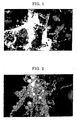
- Fig. 1 is an electron microscope photograph ( ⁇ 150) of a composite particulate article obtained by Example 1
- Fig. 2 is an electron microscope photograph ( ⁇ 300) showing a state where a fine particulate compound is entangled in fibrillated fibers
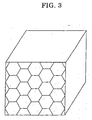
- Fig. 3 is a schematic drawing showing one example of a honeycomb-structured container.
- particulate articles such as activated carbon, alumina, silica-alumina, silica, and zeolite
- shape of the particulate article is not limited to a specific one, and a clastic particulate article whose average particle diameter is approximately 75 ⁇ m to 5mm is practical and preferable.
- fibrillated fibers used in the present invention can be fibrillated according to a known conventional method, they can be widely used regardless of synthetic materials or natural materials.
- synthetic materials or natural materials for example, acrylic fibers, polyethylene fibers, polyacrylonitrile fibers, cellulose fibers, and aramid fibers can be mentioned as such fibrillated fibers.
- the fibrillated fiber serves as an important factor that controls whether or not a composite adsorbent material to be obtained exerts performance capabilities by which harmful substances, malodorous gases, etc., can be adsorbed and removed in a well-balanced manner. Therefore, a preferred fibrillated fiber is to have a cohesive force for carrying a fine particulate compound and to serve so as not to bring about an entire massive piece. From this viewpoint, a micro-fibrillated fiber having a fiber diameter smaller than several microns, preferably smaller than 3 ⁇ m, is preferable as the fibrillated fiber.
- the micro-fibrillated fiber can be obtained by processing the aforementioned fibers with a beater or a refiner. It is preferable to use a fibrillated fiber whose fiber length is 4mm or less, in order to have a cohesive force necessary to carry the fine particulate compound and in order not to bring about a composite particulate article that has been dried into a massive article. Especially, a micro-fibrillated fiber comprising an acrylic fiber is preferable.
- a fine particulate compound that has an ion-exchange function capable of adsorbing resolvable heavy metals and that is preferably used for water clarification can be mentioned as the fine particulate compound used in the present invention.
- the fine particulate compound having the ion-exchange function is a compound that can emit ions into a salt aqueous solution while being in contact with the solution and can take the ions in the solution into the inside.
- Aluminosilicate typified by zeolite, titanosilicate, hydroxyapatite, bone charcoal, ion-exchange resin, etc. can be mentioned as concrete examples of the fine particulate compound.
- aluminosilicate or a titanosilicate-based inorganic compound which has a large ion-exchange capacity and has high selectivity with respect to heavy metals, is preferable, and, specifically, the titanosilicate-based inorganic compound is preferable.
- the fine particulate compound is shaped like a sphere whose particle diameter is 200 ⁇ m or less, preferably 3 ⁇ m to 90 ⁇ m, from the viewpoint of a carrying capability.
- the fine particulate compound may be powdery or granular.
- A-type or X-type zeolite is preferable because of its large ion-exchange capacity, and it is efficient to use amorphous titanosilicate being marketed under the trade name of ATS from Engelhard Corporation, for example, as the titanosilicate-based inorganic compound.
- a zeolite that has high hydrophobic properties and whose silica/alumina weight ratio exceeds five is excellent in its capability to adsorb ammonia or acetaldehyde.
- a hydrophobic zeolite being marketed under the trade name of Smellite or Absents from UOP Corporation can be mentioned as this zeolite.
- a composite metallic oxide being marketed under the trade name of Shoeklenz from RASA Industries, LTD. can be mentioned as an example of an inorganic fine particulate compound excellent in its capability to adsorb aldehydes or ammonia.
- particulate-article-carrying catalysts using a large surface area of a particulate article can be used for the purpose of gas clarification and water clarification. Since these catalyst components are chiefly insoluble metals or metallic compounds, the present invention can be applied as a method for carrying these catalyst components on a particulate article carrier. That is, fine particles of these metals or metallic compounds can be carried in the vicinity of the particulate article by entangling them in fibrillated fibers, and can be used as catalysts for an oxidation reaction or a hydration reaction.
- Activated carbon is preferable as the particulate article because it is excellent in its capability to adsorb various substances.
- the activated carbon should be formed by activating carbonaceous materials, and, preferably, has a specific surface area greater than 100s m 2 /g.
- Plants such as coconuts shells, palms, fruit shells, sawdust, eucalyptus, pines, coals, petroleum cokes, pitch carbide manufactured from these materials, phenolic resin, etc., can be mentioned as examples of the carbonaceous materials. It is preferable to use the coconuts shells activated carbon among them.
- the size of the particulate activated carbon can be selected in accordance with the purpose of use, and is preferably 75 ⁇ m to 1.7mm (200 mesh to 10 mesh), more preferably 100 ⁇ m to 1.4mm, from the viewpoint of workability, contact efficiency with water, or resistance to water passing when it is used for water clarification.
- fibrillated fibers and a fine particulate compound are first dispersed into a solvent so as to prepare a solid-liquid mixture.
- a dispersing agent such as carboxymethyl cellulose, can be used together on condition that the effect of the present invention is not obstructed.
- various organic compounds, water, mixtures of these, etc. can be used as the solvent, water is safe and preferable.
- the fibrillated fibers and the fine particulate compound are compounded at a ratio of 1 to 20 parts by weight, preferably 5 to 10 parts by weight, of the fine particulate compound to 1 part by weight of the fibrillated fibers, but specific limitations are not imposed thereon as long as the fibrillated fibers and the fine particulate compound mixed in the solvent can be prepared in the solvent.
- a particulate article is introduced to the solid-liquid mixture, they are then mixed equally, the solid is then filtered out therefrom, and the surface water of the solid is removed.
- a method efficient in removing the surface water is centrifugal dehydration. After removing the surface water, a dry particulate article is newly added to the solid, and they are mixed and dried. Thereby, dehydration efficiency is raised, and the fine particulate compound can be prevented from falling off from the composite particulate article, and, preferably, the yield thereof improves 2 to 10 times.
- the amount of particulate articles to be added is appropriately determined depending on the balance between the dehydrating effect and the adsorbing function.
- the fine particulate compound to be carried on the particulate article is preferably 0.1 to 30 wt%, more preferably 1.5 to 10 wt%.
- the fibrillated fiber is preferably 10 to 20 wt% of the fine particulate compound.
- Fig. 1 is an electron microscope photograph ( ⁇ 150) of the composite particulate article of the present invention
- Fig. 2 is an electron microscope photograph ( ⁇ 300) showing a state where the fine particulate compound is entangled in the fibrillated fibers like bunches of grapes.
- the resulting composite particulate article can be used as an air clarifying filter to clarify air including malodorous gases, such as aldehyde, ammonia, and amine, or as a gas clarifying material to clarify industrial exhaust gases including noxious malodorous gases, such as mercaptan, for various gas clarifiers in the form of, for example, an unwoven cloth directly filled with the article or in the form of the space in a honeycomb-structured or corrugated base material filled with the article.
- Fig. 3 is one example of a honeycomb-structured container having a honeycomb structure 50mm in length, 50mm in width, and 10mm in depth.
- the resulting composite particulate article is further formed into a cartridge serving as a water clarifying material, with which a water clarifying device is filled, so as to clarify drinking water or the like.
- a water clarifying device is filled, so as to clarify drinking water or the like.
- the composite particulate article of the present invention is particulate, automatic filling can be performed.
- the filling density thereof is preferably 0.40 to 0. 60g/mL from the viewpoint of the balance therebetween.
- the filling density in the present invention means the weight of the particulate article for each unit volume when the particulate article is poured with 100 milliliters for 50 to 100 seconds into a 100ml graduated cylinder.
- the water clarifying device may be used by being filled with only the composite particulate article of the present invention, or may be used by being filled with a combination of known adsorbent materials, ceramic filtering materials, hollow fiber membranes, etc., with the composite particulate article.
- CSF Canadian Standard Freeness
- particulate activated carbon [KURARAY COAL GW60/150 manufactured by Kuraray Chemical Co. , Ltd. (particle diameter: 0.1mm to 0.25mm, specific surface area: 800m 2 /g)] was put into the slurry-like aqueous solution, they were then stirred evenly, the solid was then filtered out, the solid was further subjected to centrifugal dehydration by use of a filter cloth, and the surface water thereof was removed. 100g of the same activated carbon GW60/150 as mentioned above that had been dried was newly added, they were then mixed, and they were dried at 135° C for 8 hours, whereby a composite particulate article was obtained.
- ATS was entangled in the fibrillation acrylic fibers like bunches of grapes and was carried on the surface of the activated carbon.
- This state is shown in Fig. 1 and Fig. 2 (whose magnifications are 150 and 300, respectively).
- the white part of Fig. 1 shows a state where ATS is entangled in the fibrillation acrylic fibers like bunches of grapes, and, from this, it is understood that ATS is carried on the activated carbon while being entangled in the fibrillation acrylic fibers like bunches of grapes.
- Fig. 2 is a view further magnifying the state where ATS is entangled in the fibrillation acrylic fibers like bunches of grapes. 3.2% was a result obtained by measuring the ignition residue of the composite particulate article according to the method prescribed in JISK1474.
- the lead removing capability was 28L/cc (activated carbon)
- the THM removing capability was 13L/cc (activated carbon)
- Example 1 Except that ventilation drying was performed at 120°C for 16 hours without newly adding activated carbon after the completion of centrifugal dehydration, a composite particulate article was made in the same way as in Example 1. The yield was half of that in Example 1.
- a water clarifying device was made by filling the same container as in Example 1 with this composite particulate article whose filling density is 0.41g/mL, and the same experiments as in Example 1 were made, and, as a result, the lead removing capability was 55L/cc (activated carbon), and the THM removing capability was 10L/cc (activated carbon).
- the ignition residue of the composite particulate article was 6.1%.
- particulate activated carbon [KURARAY COAL GW60/150 manufactured by Kuraray Chemical Co. , Ltd. (particle diameter: 0.1mm to 0.25mm, specific surface area: 800m 2 /g)] was put into the slurry-like aqueous solution, they were then stirred evenly, the solid was then filtered out, the solid was further subjected to centrifugal dehydration by use of a filter cloth, and the surface water thereof was removed. 15kg of the same activated carbon GW60/150 as mentioned above that had been dried was newly added, they were then mixed, and they were dried at 120° C for 12 hours, whereby a composite particulate article was obtained.
- a water clarifying device was made by filling the same container as in Example 1 with this composite particulate article whose filling density is 0.50g/mL, and the same raw water as in Example 1 was passed at the rate of 1. 0 L/minute.
- the lead removing capability was 32L/cc (activated carbon)
- the total trihalomethanes removing capability was 15L/cc (activated carbon).
- Hydroxyapatite was generated on the surface of 100g of the particulate activated carbon used in Example 1, whereby a composite particulate article was made. When the composite particulate article was observed through the electron microscope, a thin membrane of hydroxyapatite was generated as if to cover the surface of the activated carbon.
- a water clarifying device was made with a filling density of 0.52g/mL in the same way as in Example 1, and, as a result of the same experiment as in Example 1, the lead removing capability was 22L/cc (activated carbon), and the THM removing capability was 3L/cc (activated carbon).
- a composite particulate article was made by use of titanosilicate in the same way as in Comparative Example 1. When this composite particulate article was observed through the electron microscope, the same phenomenon as in Comparative Example 1 appeared.
- a water clarifying device was made with a filling density of 0.53g/mL in the same way as in Example 1, and, as a result of the same experiment as in Example 1, the lead removing capability was 25L/cc (activated carbon), and the THM removing capability was 0L/cc (activated carbon).
- a cylindrical container of 3cm in diameter ⁇ 6cm in length was made with a 200-mesh stainless steel wire net.
- the aforementioned slurry was put into this container, and was dried at 120° C, whereby a cylindrical structure was made.
- the filling density of this structure was 0.19g/mL.
- a water clarifying device was made by being filled with this structure.
- a polyethylene fine powder was used as a binder, and 10g of polyethylene fine powder and 16g of the same titanosilicate lead adsorbent material ATS as in Example 1 were mixed evenly. 200g of the same particulate activated carbon as in Example 1 was put into this mixture, and they were mixed evenly, and, as a result, the whole of the surface of the activated carbon became uniform with white powder. This was heated to 120°C, and, after a polyethylene binder was completely melted therein, this was cooled to room temperature. After cooling, the compound was shaped into a mass, and it was difficult to return this mass to the original particle form with a small force.
- Example 1 This mass was crushed with a grinder, and was further riddled into 60 meshes and 150 meshes.
- a water clarifying device was made with a filling density of 0.43g/mL in the same way as in Example 1.
- the lead removing capability was 1L/cc (activated carbon)
- the THM removing capability was 0L/cc (activated carbon).
- Example 1 30g of the particulate activated carbon used in Example 1 and 2g of commercially-available A-type zeolite (powdery synthetic zeolite A-4 manufactured by Wako Pure Chemical Industries, Ltd. , mean particle diameter: 3 ⁇ m) were mixed, and experiments of the water passing including lead and total trihalomethanes were performed in the same way as in Example 1 while using the water clarifying device used in Example 1.
- turbid water flowed out from the beginning of the water passing, and the lead removing capability and the total trihalomethanes removing capability were both 10L/cc (activated carbon).
- particulate activated carbon GW10/32 manufactured by Kuraray Chemical Co. , Ltd. 1kg was put into the slurry-like aqueous solution, this was then stirred evenly, the solid was then filtered out, the solid was further subjected to centrifugal dehydration by use of a filter cloth, and the surface water thereof was removed. Ventilation drying was then performed at 120° C for 12 hours, and a composite particulate article was made.
- a rectangular container having a honeycomb structure of 50mm in length and width ⁇ 10mm in thickness as shown in Fig. 3 was filled with 10g of this composite particulate article.
- air including 50ppm of formaldehyde at 20° C was passed through at a rate of 10L/minute.
- the concentration was not more than 1ppm even after 12 hours from the beginning of the passing of the air. The result was satisfactory.
- Example 5 Except that the same container as in Example 1 was filled with only a mixture of 10g of the aforementioned particulate activated carbon GW10/32 and 0.5g of the aforementioned hydrophobic zeolite, experiments to remove gas including formaldehyde were performed in the same way as in Example 5. The concentration at the outlet exceeded 3ppm after 3 hours, and, when the container was opened, the hydrophobic zeolite and the activated carbon were partially separate from each other.
- alumina beads Nao Bead manufactured by Mizusawa Industrial Chemicals, Ltd., mean particle diameter: 1mm
- alumina beads Nao Bead manufactured by Mizusawa Industrial Chemicals, Ltd., mean particle diameter: 1mm
- Ventilation drying was then performed at 120°C for 12 hours, and a composite particulate article was made.
- the same honeycomb base material as in Example 5 was filled with 10g of this composite particulate article.
- air including 10ppm of trimethylamine at 20° C was passed through at a rate of 10L/minute. When the trimethylamine concentration at the outlet was measured, the concentration was smaller than 0.3ppm even after 8 hours from the beginning of the passing of the air. The result was satisfactory.
- 200gofnaturalmordenite (IzukalitemanufacturedbyIzuka Co., Ltd., mean particle diameter: 0.5mm) was put into the slurry-like aqueous solution, they were then stirred evenly, the solid was then filtered out, the solid was further subjected to centrifugal dehydration by use of a filter cloth, and the surface water thereof was removed. Ventilation drying was then performed at 120°C for 12 hours, and a composite particulate article was made.
- the same honeycomb base material as in Example 5 was filled with 10g of this composite particulate article.
- air including 20ppm of ozone at 20° C was passed through at a rate of 3L/minute. When the ozone concentration at the outlet was measured, the concentration was smaller than 0.5ppm even after a lapse of 6 hours from the beginning of the passing of the air. The result was satisfactory.
- the present invention can provide a composite particulate article that carries a fibrillated fiber and a heavy-metal-adsorbing fine particulate compound on a particulate article. Since the composite particulate article of the present invention can adsorb and remove free chlorine, THM, and heavy metals in a well-balanced manner, the composite particulate article is suitable for water clarification, and, since it can adsorb and remove noxious gases and malodorous gases in a well-balanced manner, it is suitable also for gas clarification.
Landscapes
- Chemical & Material Sciences (AREA)
- Organic Chemistry (AREA)
- Chemical Kinetics & Catalysis (AREA)
- Analytical Chemistry (AREA)
- Life Sciences & Earth Sciences (AREA)
- Hydrology & Water Resources (AREA)
- Engineering & Computer Science (AREA)
- Environmental & Geological Engineering (AREA)
- Water Supply & Treatment (AREA)
- Water Treatment By Sorption (AREA)
- Solid-Sorbent Or Filter-Aiding Compositions (AREA)
Applications Claiming Priority (3)
| Application Number | Priority Date | Filing Date | Title |
|---|---|---|---|
| JP2001273217 | 2001-09-10 | ||
| JP2001273217 | 2001-09-10 | ||
| PCT/JP2002/008893 WO2003022425A1 (fr) | 2001-09-10 | 2002-09-02 | Article particulaire composite et procede de preparation associe |
Publications (2)
| Publication Number | Publication Date |
|---|---|
| EP1426104A1 true EP1426104A1 (fr) | 2004-06-09 |
| EP1426104A4 EP1426104A4 (fr) | 2006-04-05 |
Family
ID=19098459
Family Applications (1)
| Application Number | Title | Priority Date | Filing Date |
|---|---|---|---|
| EP02762969A Withdrawn EP1426104A4 (fr) | 2001-09-10 | 2002-09-02 | Article particulaire composite et procede de preparation associe |
Country Status (6)
| Country | Link |
|---|---|
| US (1) | US20040180190A1 (fr) |
| EP (1) | EP1426104A4 (fr) |
| JP (1) | JPWO2003022425A1 (fr) |
| KR (1) | KR20040032879A (fr) |
| CN (1) | CN1553827A (fr) |
| WO (1) | WO2003022425A1 (fr) |
Families Citing this family (20)
| Publication number | Priority date | Publication date | Assignee | Title |
|---|---|---|---|---|
| WO2004039494A1 (fr) * | 2002-10-29 | 2004-05-13 | Kuraray Chemical Co.,Ltd. | Adsorbant composite et procede de production de cet adsorbant, materiau de purification d'eau et purificateur d'eau |
| JP5062970B2 (ja) * | 2005-06-14 | 2012-10-31 | 旭化成ケミカルズ株式会社 | 廃水処理装置および方法 |
| JP5062972B2 (ja) * | 2005-06-14 | 2012-10-31 | 旭化成ケミカルズ株式会社 | イオン除去装置およびイオン除去方法 |
| JP5062973B2 (ja) * | 2005-06-14 | 2012-10-31 | 旭化成ケミカルズ株式会社 | 水処理装置及び方法 |
| JP5062974B2 (ja) * | 2005-06-14 | 2012-10-31 | 旭化成ケミカルズ株式会社 | イオン処理装置および方法 |
| JP5062971B2 (ja) * | 2005-06-14 | 2012-10-31 | 旭化成ケミカルズ株式会社 | 水処理装置および水処理方法 |
| JP5062976B2 (ja) * | 2005-06-15 | 2012-10-31 | 旭化成ケミカルズ株式会社 | 排水処理装置および排水処理方法 |
| JP5062975B2 (ja) * | 2005-06-15 | 2012-10-31 | 旭化成ケミカルズ株式会社 | 水浄化システムおよび水浄化方法 |
| WO2008140485A1 (fr) * | 2006-11-14 | 2008-11-20 | Clemson University Research Foundation | Fibres polymères à canaux capillaires modifiées pour une défense contre des contaminants chimiques et biologiques |
| CN102471096B (zh) * | 2009-08-06 | 2014-09-24 | 可乐丽化学株式会社 | 活性炭成型体以及使用该活性炭成型体的净水器 |
| EP2886529A1 (fr) * | 2013-12-20 | 2015-06-24 | Evonik Industries AG | Procédé de production de méthacrylate de méthyle |
| CN105983272B (zh) * | 2015-02-17 | 2018-05-08 | 刘朝南 | 一种纳米光触媒悬浮滤料及其制备方法 |
| CN110430933A (zh) * | 2017-03-24 | 2019-11-08 | 东丽株式会社 | 滤材和袋式过滤器 |
| CN106944009B (zh) * | 2017-04-13 | 2019-10-11 | 广西壮族自治区环境保护科学研究院 | 一种高效吸附剂及其在重金属废水中的应用 |
| JP7163006B2 (ja) * | 2017-04-27 | 2022-10-31 | 日本製紙株式会社 | 無機粒子複合繊維の製造方法 |
| JP7039395B2 (ja) * | 2018-06-08 | 2022-03-22 | 株式会社Lixil | 造粒用繊維状バインダ |
| CN109647060A (zh) * | 2018-12-05 | 2019-04-19 | 广东炜田环保新材料股份有限公司 | 一种高效节能环保健康式空调用过滤材料 |
| JP2023523251A (ja) * | 2020-04-24 | 2023-06-02 | チャーチ・アンド・ドゥワイト・カンパニー・インコーポレイテッド | 中空コア顆粒、その顆粒を組み込んだ製品、及びその顆粒を調製する方法 |
| US20230233984A1 (en) * | 2022-01-27 | 2023-07-27 | W. L. Gore & Associates, Inc. | Sorbent article with water exclusionary properties and methods of forming the same |
| WO2024248068A1 (fr) * | 2023-05-30 | 2024-12-05 | 興和株式会社 | Composition de charbon actif contenant de la zéolite et son procédé de production |
Family Cites Families (27)
| Publication number | Priority date | Publication date | Assignee | Title |
|---|---|---|---|---|
| JPS5396983A (en) * | 1977-02-04 | 1978-08-24 | Mitsubishi Rayon Co Ltd | Adsorbent-deodorant |
| US4396512A (en) * | 1979-06-01 | 1983-08-02 | Everpure, Inc. | Bacteriostatic filter media |
| JPS6154237A (ja) * | 1984-08-24 | 1986-03-18 | Toray Ind Inc | ウラン吸着性複合繊維状物の製造方法 |
| DE3500368A1 (de) * | 1985-01-08 | 1986-07-10 | Rhodia Ag, 7800 Freiburg | Filter zur abtrennung von substanzen mit lipophilen und/oder oleophilen und/oder unpolaren eigenschaften aus andersartigen fluessigkeiten, gasen und daempfen |
| JPH0832798B2 (ja) * | 1985-04-16 | 1996-03-29 | 工業技術院長 | バクテリアセルロ−ス含有高力学強度成形材料 |
| US4904343A (en) * | 1985-04-23 | 1990-02-27 | American Cyanamid Company | Non-woven activated carbon fabric |
| US4629571A (en) * | 1985-09-11 | 1986-12-16 | The Graver Company | Deoxygenation and purification of liquids |
| JPH0638813B2 (ja) * | 1987-11-20 | 1994-05-25 | ユニ・チャーム株式会社 | 吸収体 |
| DE3813563C2 (de) * | 1988-04-22 | 2002-01-17 | Mhb Filtration Gmbh & Co Kg | Adsorptionsfilter mit hoher Luftdurchlässigkeit |
| JPH07222971A (ja) * | 1992-06-26 | 1995-08-22 | Kuraray Chem Corp | 浄水器用カートリッジ |
| JP3396057B2 (ja) * | 1993-05-28 | 2003-04-14 | 有限会社林製作所 | 紙シートでない成形吸着体 |
| JP3716430B2 (ja) * | 1993-06-21 | 2005-11-16 | 日本バイリーン株式会社 | 機能性材料及びその製造方法 |
| US5879794A (en) * | 1994-08-25 | 1999-03-09 | W. L. Gore & Associates, Inc. | Adhesive-filler film composite |
| JP3343832B2 (ja) * | 1994-10-03 | 2002-11-11 | 三菱製紙株式会社 | 光反応性有害物除去剤及びこれを用いた光反応性有害物除去材 |
| CA2219830C (fr) * | 1995-05-24 | 2006-01-31 | Kimberly-Clark Worldwide, Inc. | Filtre a argiles minerales adsorbantes fixees a des surfaces individuelles exposees d'une matrice fibreuse |
| KR100227582B1 (ko) * | 1995-05-26 | 2000-03-02 | 이사오 우치가사키 | 환경 정화재 |
| US5685897A (en) * | 1995-07-06 | 1997-11-11 | Laroche Industries, Inc. | High strength, low pressure drop adsorbent wheel |
| EP0763364B1 (fr) * | 1995-09-14 | 2003-07-16 | Nippon Shokubai Co., Ltd. | Composite absorbant, article absorbant et leurs méthodes de préparation |
| JP3872548B2 (ja) * | 1995-09-14 | 2007-01-24 | 株式会社日本触媒 | 吸水性複合体、その製造方法および吸水性物品 |
| JPH0985084A (ja) * | 1995-09-22 | 1997-03-31 | Matsushita Electric Ind Co Ltd | 吸着材とこれを用いた吸着体 |
| US5696199A (en) * | 1995-12-07 | 1997-12-09 | Minnesota Mining And Manufacturing Company | Pressure-sensitive adhesive polyacrylate polymer and method of making |
| JP3444722B2 (ja) * | 1996-03-13 | 2003-09-08 | 三菱化学株式会社 | 吸水性複合体の製造方法 |
| JP3693449B2 (ja) * | 1996-04-05 | 2005-09-07 | 三菱製紙株式会社 | 抗菌防黴剤およびそれを含有する繊維状物質 |
| JPH09299725A (ja) * | 1996-05-14 | 1997-11-25 | Muromachi Kagaku Kogyo Kk | 濾過及びイオン交換機能を有する複合材料 |
| US5972808A (en) * | 1997-01-30 | 1999-10-26 | Aqf Technologies Llc | Fibrous structures with fine particles |
| US5952092A (en) * | 1997-01-30 | 1999-09-14 | Aqf Technologies Llc | Fibrous structures with labile active substance |
| JP2000325450A (ja) * | 1999-05-19 | 2000-11-28 | Taiki:Kk | 機能性シート及びその製造方法 |
-
2002
- 2002-09-02 CN CNA028176715A patent/CN1553827A/zh active Pending
- 2002-09-02 US US10/487,054 patent/US20040180190A1/en not_active Abandoned
- 2002-09-02 WO PCT/JP2002/008893 patent/WO2003022425A1/fr not_active Ceased
- 2002-09-02 KR KR10-2004-7001548A patent/KR20040032879A/ko not_active Withdrawn
- 2002-09-02 EP EP02762969A patent/EP1426104A4/fr not_active Withdrawn
- 2002-09-02 JP JP2003526545A patent/JPWO2003022425A1/ja active Pending
Also Published As
| Publication number | Publication date |
|---|---|
| WO2003022425A1 (fr) | 2003-03-20 |
| US20040180190A1 (en) | 2004-09-16 |
| KR20040032879A (ko) | 2004-04-17 |
| CN1553827A (zh) | 2004-12-08 |
| JPWO2003022425A1 (ja) | 2004-12-24 |
| EP1426104A4 (fr) | 2006-04-05 |
Similar Documents
| Publication | Publication Date | Title |
|---|---|---|
| US20040180190A1 (en) | Composite particulate article and method for preparation thereof | |
| JP6283435B2 (ja) | 活性炭成型体およびそれを用いた浄水器 | |
| KR102039506B1 (ko) | 정수기용 활성탄 및 이것을 사용한 활성탄 카트리지 | |
| US9284200B2 (en) | Thermally treated expanded perlite | |
| JP4361489B2 (ja) | 複合吸着材とその製造方法、並びに浄水材及び浄水器 | |
| CN101132856A (zh) | 沉淀二氧化硅的聚集体,其制备方法和其在气体过滤中作为过滤器介质的用途 | |
| CN101918327A (zh) | 抗微生物基质和过滤系统 | |
| JP4064309B2 (ja) | 浄水器 | |
| WO2004052497A2 (fr) | Carbone active en vue de la lutte contre les odeurs et son procede de fabrication | |
| CN121925309A (zh) | 碳质材料及其制造方法、吸附过滤器、净水器滤芯、净水器及净水设备 | |
| JP4043634B2 (ja) | 活性炭成型体、その製造方法及びそれを用いた浄水器 | |
| TW202039073A (zh) | 淨水用過濾器及具備過濾器之淨水器 | |
| JP2000342918A (ja) | 濾過フィルタおよび浄水器 | |
| RU2132729C1 (ru) | Способ очистки воды и композиционный адсорбционный материал | |
| JP2010269225A (ja) | 陰イオン吸着剤成型体およびそれを用いた浄水器 | |
| JP2003334543A (ja) | 活性炭成型体、その製造方法及びそれを用いた浄水器 | |
| JPH07256239A (ja) | 浄水器用カートリッジ | |
| JP2003010614A (ja) | 浄水器フィルター | |
| JP7777484B2 (ja) | 残留塩素除去フィルター体 | |
| RU2185877C2 (ru) | Фильтрующий материал и способ его изготовления | |
| CN113631259B (zh) | 吸附材料、重金属去除剂、以及使用它们的成形体和净水器 | |
| JP2002263637A (ja) | 浄水ユニット | |
| JPH07222971A (ja) | 浄水器用カートリッジ | |
| JPH06335632A (ja) | 成形吸着体 | |
| JP2965347B2 (ja) | 脱臭用活性炭 |
Legal Events
| Date | Code | Title | Description |
|---|---|---|---|
| PUAI | Public reference made under article 153(3) epc to a published international application that has entered the european phase |
Free format text: ORIGINAL CODE: 0009012 |
|
| 17P | Request for examination filed |
Effective date: 20040205 |
|
| AK | Designated contracting states |
Kind code of ref document: A1 Designated state(s): AT BE BG CH CY CZ DE DK EE ES FI FR GB GR IE IT LI LU MC NL PT SE SK TR |
|
| AX | Request for extension of the european patent |
Extension state: AL LT LV MK RO SI |
|
| A4 | Supplementary search report drawn up and despatched |
Effective date: 20060217 |
|
| RIC1 | Information provided on ipc code assigned before grant |
Ipc: C02F 1/28 20060101ALI20060213BHEP Ipc: B01D 39/02 20060101ALI20060213BHEP Ipc: B01J 20/28 20060101AFI20060213BHEP |
|
| STAA | Information on the status of an ep patent application or granted ep patent |
Free format text: STATUS: THE APPLICATION IS DEEMED TO BE WITHDRAWN |
|
| 18D | Application deemed to be withdrawn |
Effective date: 20070403 |