EP1445337B1 - Procede de dephosphorisation de fer en fusion - Google Patents
Procede de dephosphorisation de fer en fusion Download PDFInfo
- Publication number
- EP1445337B1 EP1445337B1 EP02770227A EP02770227A EP1445337B1 EP 1445337 B1 EP1445337 B1 EP 1445337B1 EP 02770227 A EP02770227 A EP 02770227A EP 02770227 A EP02770227 A EP 02770227A EP 1445337 B1 EP1445337 B1 EP 1445337B1
- Authority
- EP
- European Patent Office
- Prior art keywords
- oxygen
- hot metal
- flux
- blowing
- cao
- Prior art date
- Legal status (The legal status is an assumption and is not a legal conclusion. Google has not performed a legal analysis and makes no representation as to the accuracy of the status listed.)
- Expired - Lifetime
Links
Images
Classifications
-
- C—CHEMISTRY; METALLURGY
- C21—METALLURGY OF IRON
- C21C—PROCESSING OF PIG-IRON, e.g. REFINING, MANUFACTURE OF WROUGHT-IRON OR STEEL; TREATMENT IN MOLTEN STATE OF FERROUS ALLOYS
- C21C7/00—Treating molten ferrous alloys, e.g. steel, not covered by groups C21C1/00 - C21C5/00
- C21C7/04—Removing impurities by adding a treating agent
- C21C7/064—Dephosphorising; Desulfurising
-
- C—CHEMISTRY; METALLURGY
- C21—METALLURGY OF IRON
- C21C—PROCESSING OF PIG-IRON, e.g. REFINING, MANUFACTURE OF WROUGHT-IRON OR STEEL; TREATMENT IN MOLTEN STATE OF FERROUS ALLOYS
- C21C1/00—Refining of pig-iron; Cast iron
- C21C1/02—Dephosphorising or desulfurising
-
- C—CHEMISTRY; METALLURGY
- C21—METALLURGY OF IRON
- C21C—PROCESSING OF PIG-IRON, e.g. REFINING, MANUFACTURE OF WROUGHT-IRON OR STEEL; TREATMENT IN MOLTEN STATE OF FERROUS ALLOYS
- C21C1/00—Refining of pig-iron; Cast iron
- C21C1/02—Dephosphorising or desulfurising
- C21C1/025—Agents used for dephosphorising or desulfurising
-
- C—CHEMISTRY; METALLURGY
- C21—METALLURGY OF IRON
- C21C—PROCESSING OF PIG-IRON, e.g. REFINING, MANUFACTURE OF WROUGHT-IRON OR STEEL; TREATMENT IN MOLTEN STATE OF FERROUS ALLOYS
- C21C7/00—Treating molten ferrous alloys, e.g. steel, not covered by groups C21C1/00 - C21C5/00
- C21C7/04—Removing impurities by adding a treating agent
- C21C7/064—Dephosphorising; Desulfurising
- C21C7/0645—Agents used for dephosphorising or desulfurising
-
- C—CHEMISTRY; METALLURGY
- C21—METALLURGY OF IRON
- C21C—PROCESSING OF PIG-IRON, e.g. REFINING, MANUFACTURE OF WROUGHT-IRON OR STEEL; TREATMENT IN MOLTEN STATE OF FERROUS ALLOYS
- C21C7/00—Treating molten ferrous alloys, e.g. steel, not covered by groups C21C1/00 - C21C5/00
- C21C7/04—Removing impurities by adding a treating agent
- C21C7/076—Use of slags or fluxes as treating agents
-
- C—CHEMISTRY; METALLURGY
- C21—METALLURGY OF IRON
- C21C—PROCESSING OF PIG-IRON, e.g. REFINING, MANUFACTURE OF WROUGHT-IRON OR STEEL; TREATMENT IN MOLTEN STATE OF FERROUS ALLOYS
- C21C5/00—Manufacture of carbon-steel, e.g. plain mild steel, medium carbon steel or cast steel or stainless steel
- C21C5/28—Manufacture of steel in the converter
- C21C5/30—Regulating or controlling the blowing
- C21C5/32—Blowing from above
-
- Y—GENERAL TAGGING OF NEW TECHNOLOGICAL DEVELOPMENTS; GENERAL TAGGING OF CROSS-SECTIONAL TECHNOLOGIES SPANNING OVER SEVERAL SECTIONS OF THE IPC; TECHNICAL SUBJECTS COVERED BY FORMER USPC CROSS-REFERENCE ART COLLECTIONS [XRACs] AND DIGESTS
- Y02—TECHNOLOGIES OR APPLICATIONS FOR MITIGATION OR ADAPTATION AGAINST CLIMATE CHANGE
- Y02P—CLIMATE CHANGE MITIGATION TECHNOLOGIES IN THE PRODUCTION OR PROCESSING OF GOODS
- Y02P10/00—Technologies related to metal processing
- Y02P10/20—Recycling
Definitions
- the present invention relates to a process for dephosphorizing a hot metal, using a refining vessel having a top-and-bottom-blowing function, wherein oxygen is top blown and a flux is injected by bottom blowing.
- a pretreatment process for a hot metal wherein a hot metal is desiliconized and dephosphorized prior to decarbonization in a vessel different from a vessel in which the hot metal is decarbonized has come to be employed in place of the converter process by which a hot metal is desiliconized, dephosphorized and decarbonized in the same converter. It has been a common practice in the pretreatment of a hot metal to desiliconize the hot metal by adding solid oxygen sources such as iron oxide thereto, and then to conduct dephosphorization refining by adding a flux for dephosphorization thereto.
- a lime source as a flux is added to the hot metal to form a dephosphorizing slag with high basicity, and then a solid oxygen source including iron oxide is added thereto, also as a flux, to effect dephosphorization.
- a flux for dephosphorization is injected into a hot metal in a torpedo car or a ladle that is used as a refining vessel for pre-dephosphorization.
- Pretreatment of a hot metal by which desiliconization and dephosphorization are simultaneously conducted has recently been employed using a converter type refining vessel having a top-and-bottom-blowing function as a pretreatment vessel for a hot metal. Because strong stirring caused by top and bottom blowing is utilized, dephosphorization of a hot metal can be promoted even when a slag with low basicity is used. As a result, desiliconization and dephosphorization can be conducted simultaneously. Because gaseous oxygen can be used as an oxygen source, the hot metal temperature subsequent to the pretreatment can be held high in comparison with a conventional method in which solid oxygen alone is used. As a result, the heat margin in the entire refining including decarbonization can be ensured.
- a flux for pretreatment refining can be added to a hot metal by an injection method by which a flux is blown into a hot metal with a bottom blowing gas used as a carrier gas in addition to a method by which a flux is added thereto from the top of the refining vessel.
- the efficiency of dephosphorization in the pretreatment can be improved by employing flux blowing.
- Japanese Patent No. 2,958,848 describes a refining method comprising first conducting dephosphorization refining in a top-and-bottom-blowing converter, discharging a slag, and then conducting decarbonization in the same converter.
- a dephosphorizing reaction is promoted by making the sum of an iron component in iron oxide and a manganese oxide concentration (T. Fe + MnO) fall in a range from 15 to 35% under the condition that CaO/SiO 2 is not greater than 2.5 in the slag.
- the dephosphorization is conducted by blowing a flux, containing burnt lime powder as a base component, from a bottom-blowing tuyere with an inert gas as a carrier gas.
- the dephosphorizing reaction rate can be increased by mixing iron oxide powder with the burnt lime powder or blowing oxygen gas through the same tuyere.
- the dephosphorization can also be promoted by blowing oxygen gas from a top-blowing lance, and adding a flux from the top by charging, inject, blowing or the like procedure so that the iron oxide concentration in the formed slag is controlled.
- an oxygen source can be compositely added during dephosphorization by top blowing oxygen and adding iron oxide and gaseous oxygen through a bottom-blowing nozzle. Accordingly, selection of the proportion of oxygen added by bottom blowing becomes a problem.
- the ratio of a CaO mass in the flux blown with a carrier gas to a total mass of oxygen contained in iron oxide in the flux and oxygen contained in the carrier gas is herein defined as a CaO/O ratio.
- Japanese Unexamined Patent Publication (Kokai) No. 60-26608 describes that, when the CaO/O ratio is made to fall in a range from 1.5 to 2.5, the efficiency of utilizing burnt lime and oxygen for dephosphorization becomes the greatest, and consequently a high dephosphorization ratio is obtained.
- Japanese Unexamined Patent Publication (Kokai) No. 2000-212622 discloses as follows. When the CaO/O ratio is greater than 1.0, burnt lime is used during dephosphorization in an amount more than necessary. As a result, the dephosphorizing reaction itself proceeds. However, the dephosphorization efficiency is lowered. The patent publication therefore concludes that an appropriate range of the CaO/O ratio is from 0.5 to 1.0.
- a lower hot metal temperature is more advantageous in order to promote a dephosphorizing reaction.
- dephosphorization at temperature as low as 1,350°C or lower results in poor slag formation when the CaO/SiO 2 ratio becomes not smaller than 1.8 when the CaO/SiO 2 ratio fall in a range up to 2.5.
- Fluorite must therefore be added for the purpose of promoting slag formation.
- refractories of a refining vessel used for pretreatment and decarbonization show a drastic melt loss.
- the refractory melt loss index increases with an increase in a fluorine concentration in the slag, and the refractory melt loss is known to drastically increase. Accordingly, fluorite is preferably not used in view of extending the life of the refractories.
- An object of the present invention is to provide a dephosphorizing process capable of conducting excellent dephosphorization without using fluorite when dephosphorizing a hot metal, by top blowing oxygen and injecting a flux by bottom blowing, using a refining vessel having a top-and-bottom-blowing function.
- a hot metal having components and a temperature shown in Table 2 was charged into a converter, and the above flux was injected from the bottom-blowing tuyere with a nitrogen gas, as a carrier gas, while oxygen was being top blown.
- the unit requirement of the charged flux was determined to be 15 kg/ton.
- the target slag basicity (CaO/SiO 2 ) (mass ratio) after the treatment was determined to be 1.7.
- lamp of burnt lime having a size of up to 25 mm was added from the top of the converter.
- the hot metal temperature subsequent to dephosphorization was adjusted to be from 1,335 to 1,340°C.
- the total oxygen unit requirement that is the sum of top blown oxygen and oxygen in flux iron oxide was 17 Nm 3 /ton, and the mass ratio of oxygen in the flux iron oxide to the entire oxygen, namely, the solid oxygen proportion was determined to be 20%.
- the iron oxide concentration in the slag subsequent to the treatment was adjusted, by adjusting the height of the top-blowing lance, in such a manner that the sum of an iron component of the iron oxide and a manganese oxide concentration (T. Fe + MnO) in terms of % by mass fell in the following three cases: 8-11%; 22-27%; and 38-41%.
- Table 2 Initial temp. [C] [Si] [P] 1,250°C 4.6% 0.35% 0.10% (% by mass)
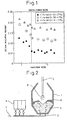
- Fig. 1 shows the relationship between a CaO/O ratio and [P] subsequent to the treatment.
- a datum point obtained when (T. Fe + MnO) fell in the range from 8 to 11% is indicated by the mark ⁇
- a datum point obtained when (T. Fe + MnO) fell in the range from 22 to 27% is indicated by the mark ⁇
- a datum point obtained when (T. Fe + MnO) fell in the range from 38 to 41% is indicated by the mark ⁇ .
- blowing flux produces a dephosphorizing reaction in the hot metal to form a dephosphorization product 3CaO ⁇ P 2 O 5 .
- the 3CaO ⁇ P 2 O 5 thus produced can form a solid solution with 2CaO ⁇ SiO 2 alone.
- the blown flux composition is required to simultaneously supply oxygen sufficient to form P 2 O 5 and CaO sufficient to form 3CaO ⁇ P 2 O 5 and 2CaO ⁇ SiO 2 .
- the sintered dust contains about 5% of SiO 2 as shown in Table 1.
- CaO and SiO 2 in the sintered dust therefore forms 2CaO ⁇ SiO 2 , which fixes 3CaO ⁇ P 2 O 5 to give a high dephosphorizing efficiency.
- the CaO/O ratio is up to 2.5, the proportion of SiO 2 supplied from the sintered dust becomes high, and an amount of 2CaO ⁇ SiO 2 formed decreases. As a result, the dephosphorizing efficiency lowers.
- the flux composition is determined so that the CaO/O ratio becomes as low as a conventional value, an amount of CaO supplied from the blown flux is restricted.
- An amount of charged lump of burnt lime increases when an attempt is made to keep a CaO/SiO 2 ratio of the slag at about 1.7. Because the slag formation rate of the lump of burnt lime is low, the practical basicity subsequent to dephosphorization lowers due to insufficient slag formation, and the dephosphorization is thought to become poor.
- a dephosphorizing process showing a good dephosphorizing efficiency without using fluorite has been realized by blowing a flux into a hot metal in such a manner that the ratio (CaO/O) of a mass of CaO in the blown flux to a total mass of oxygen contained in iron oxide in the blown flux and in the carrier gas exceeds 2.5.
- top blown oxygen gas and gaseous oxygen in the form of oxygen gas contained in the bottom blown gas can be added as oxygen sources.
- Solid oxygen sources in the form of iron oxide contained in the blown flux and in the form of iron oxide, that is added from the top of the converter, can be added.
- the mass proportion of oxygen from the solid oxygen source to the entire oxygen to be added is herein termed a solid oxygen proportion.
- the solid oxygen refers to oxygen contained in iron oxide (FeO, Fe 2 O 3 ), and the solid oxygen sources refer to substances containing iron oxide such as a flux, and iron ore, dust and mill scale that are used as coolants.
- the hot metal temperature can be easily controlled during dephosphorization by making the proportion of the solid oxygen to the entire oxygen to be added fall in the range from 5 to 40%.
- the proportion of the solid oxygen is less than 5%, the hot metal temperature rises greatly and the dephosphorizing reaction efficiency is deteriorated.
- the proportion of the solid oxygen exceeds 40%, the hot metal temperature greatly lowers, and the dephosphorizing reaction efficiency is deteriorated due to poor slag formation.
- the hot metal temperature is low, the oxidation degree of the slag is hard to control.
- the process according to (3), mentioned above, of the present invention is a combination of the processes according to (1) and (2), mentioned above, of the invention, and the effects of (1) and (2) can be simultaneously obtained.
- the process according to (4), mentioned above, of the invention controls a CaO/SiO 2 ratio in the slag at the time of finishing dephosphorization to be up to 2.5, and the sum of an iron component in iron oxide and a manganese oxide concentration (T. Fe + MnO) in the slag to be from 15 to 35%.
- the CaO/SiO 2 ratio is controlled to be up to 2.5 because slag formation becomes poor without adding fluorite when the CaO/SiO 2 ratio exceeds 2.5.
- Fe + MnO) in the slag to be from 15 to 35% under the condition that CaO/SiO 2 is not greater than 2.5 are as follows. Both the iron oxide and manganese oxide act to oxidize phosphorus in the hot metal so that the phosphorus is removed therefrom and transferred to a slag. In order to promote the dephosphorizing reaction, the sum of the iron component of iron oxide and the manganese oxide concentration in the slag must be controlled to not smaller than 15%. Moreover, when the sum exceeds 35%, a concentration of CaO necessary for stabilizing phosphorus transferred to the slag decreases, and the dephosphorizing reaction is retarded.
- the processes according to (1) to (4), mentioned above, of the present invention each have an excellent capability to dephosphorize a hot metal. Necessary dephosphorization can therefore be conducted without using fluorite in the flux as described in the process according to (5), mentioned above, of the present invention.
- Dephosphorization of the present invention was conducted using a 300-ton scale top-and-bottom-blowing converter as a refining vessel 1 as shown in Fig. 2 .
- a dephosphorizing flux composed of burnt lime powder fed from a flux hopper 4 and sintered ore powder was blown into a hot metal 5 with a nitrogen gas used as a carrier gas 7 through a bottom-blowing nozzle 2; a gaseous oxygen gas 8 was blown to the hot metal 5 through a top-blowing lance 3.
- the target [P] concentration subsequent to dephosphorization was determined to be up to 0.014%. Because [Si] in the hot metal prior to dephosphorization was 0.35%, a desiliconization reaction proceeded simultaneously during dephosphorization.
- An amount of CaO to be blown as a blown flux was determined from the target CaO/O ratio.
- the entire added CaO was assumed to form a slag 6.
- the balance, caused by the insufficiently injected CaO, was made up by top charging lump of burnt lime.
- the lamp of burnt lime had a size from 20 to 50 mm, and the injected burnt lime had a particle size of up to 1.5 mm.
- solid oxygen proportion The mass proportion of solid oxygen to the sum of top blown gaseous oxygen and solid oxygen added as iron oxide (solid oxygen proportion) was determined to be 15%.
- the hot metal temperature subsequent to dephosphorization could thus be brought to the target temperature of 1,340°C.
- solid oxygen from sintered ore injected by bottom blowing was insufficient, mill scale was charged from the top of the converter.
- a value other than 15% was employed as the solid oxygen proportion.
- the iron oxide concentration in the slag was controlled by adjusting the feed rate of oxygen from the top-blowing lance and a lance height, in such a manner that the sum of an iron component in iron oxide and a manganese oxide concentration (T. Fe + MnO) after dephosphorization fell in a range from 15 to 35%. In part of the comparative examples, the sum was adjusted to fall outside the above range to confirm the effect of controlling (T. Fe + MnO).
- Table 3 shows the treatment conditions and results. Table 3 Example 1 Example 2 Comparative Example 1 Comparative Example 2 Comparative Example 3 Comparative Example 4 Comparative Example 5 Comparative Example 6 Hot metal amt.(t/ch) 282 279 281 280 281 278 280 282 Initial temp.
- the CaO/O ratio was 5.4 in Example 1, and it was 15.5 in Example 2 in the present invention.
- the [P] concentration subsequent to dephosphorization could stably be made up to 0.014% without using fluorite as a dephosphorizing flux in both examples.
- Comparative Example 1 was an instance that was conducted in a conventionally employed CaO/O ratio region. Comparative Example 1 was conducted in the same manner as in the Examples of the present invention except that the CaO/O ratio was made 0.87. Because the CaO/O ratio was low, an amount of CaO as a blown flux was small, and the unit requirement of lump of burnt lime became 12.6 kg/ton. In order to attain a target [P] concentration without causing poor slag formation, fluorite had to be added in an amount of 0.5 kg/ton. The refining could not be conducted without using fluorite.
- Comparative Example 4 and 5 are Comparative Examples wherein the solid oxygen proportion was varied.
- the solid oxygen proportion was lowered to 4%, and the top-blown oxygen proportion was increased.
- the hot metal temperature subsequent to dephosphorization was raised to 1,352°C to lower the dephosphorizing capability, and the target [P] concentration could not be attained.
- an increase in the top-blown oxygen made the decarbonization of the hot metal proceed during dephosphorization.
- Comparative Example 5 because the top-blown oxygen proportion was lowered by increasing the solid oxygen proportion to 50%, the calorific value produced by the top-blown oxygen was decreased, and the hot metal temperature after dephosphorization was lowered to 1,314°C. Because fluorite was not added, slag formation was poor, and the target [P] concentration could not be attained.
- Comparative Example 6 the unit requirement of lump of burnt lime was made 5.4 kg/ton, the same as in Example 1 of the present invention, and the CaO/O ratio was made 1.49, and was outside the range of the invention, in order to prevent poor slag formation. As a result, the solid oxygen proportion became 26%. However, the hot metal temperature subsequent to dephosphorization was adjusted to 1,337°C by adjusting a converter post-combustion ratio and the like. Because the CaO/O ratio was outside the range of the invention, the dephosphorizing capability was lowered, and the target [P] concentration could not be attained.
- Example 1 A refining operation was conducted under the same conditions as in Example 1 or Comparative Example 2 while 20 charges were being continuously processed, respectively. It has consequently been confirmed that the melt loss amount was decreased by 20% in Example 1 of the invention in which fluorite was not used in comparison with Comparative Example 2 in which fluorite was used. The procedure of Example 1 was useful for decreasing the cost of the refractories.
- the present invention During dephosphorizing a hot metal by top blowing oxygen and injecting a flux by bottom blowing using a refining vessel having a top-and-bottom-blowing function, the present invention has made it possible to conduct excellent dephosphorization without using fluorite by blowing a flux into a hot metal in such a manner that the ratio (CaO/O) of a mass of CaO in the flux to a total mass of oxygen contained in iron oxide in the flux and in a carrier gas becomes not less than 2.5. As a result, the process has permitted decreasing the loss amount of refractories, and cutting the cost thereof.
- the present invention has also made it possible to easily control the hot metal temperature during dephosphorization by making the proportion of the solid oxygen to the entire oxygen to be added fall in the range from 5 to 40%.
- Stabilized dephosphorization can be performed in the present invention by making the CaO/SiO 2 ratio in the slag at the time of finishing dephosphorization fall in the range up to 2.5 and the sum of the iron component in iron oxide in the slag and the manganese oxide concentration (T. Fe + MnO) fall in the range from 15 to 35%.
Landscapes
- Chemical & Material Sciences (AREA)
- Engineering & Computer Science (AREA)
- Materials Engineering (AREA)
- Metallurgy (AREA)
- Organic Chemistry (AREA)
- Refinement Of Pig-Iron, Manufacture Of Cast Iron, And Steel Manufacture Other Than In Revolving Furnaces (AREA)
Claims (4)
- Procédé de déphosphoration d'un métal chaud utilisant une cuve de raffinage de type convertisseur à soufflage en haut-et-en fond présentant des tuyères de soufflage de fond, dans lequel de l'oxygène est soufflé en haut dans un métal chaud, et un fondant contenant comme constituant principal un constituant qui est un ou au moins deux substances choisies parmi de la chaux calcinée, du calcaire et de l'oxyde de fer et qui contient au moins de l'oxyde de fer est injecté dans celui-ci par un soufflage de fond avec de l'oxygène, un gaz inerte ou un mélange des deux gaz utilisé comme gaz porteur, caractérisé en ce que le procédé comprend l'étape de soufflage du fondant dans un métal chaud de telle sorte que le rapport massique de CaO dans le fondant soufflé à la masse totale d'oxygène (CaO/O) contenu dans l'oxyde de fer dans le fondant soufflé et dans le gaz porteur excède 2,5.
- Procédé de déphosphoration d'un métal chaud selon la revendication 1, dans lequel la proportion d'oxygène contenu dans l'oxyde de fer contenu dans les sources d'oxygène solides rapportée à la totalité d'oxygène ajouté se trouve dans un intervalle de 5 à 40 % en masse.
- Procédé de déphosphoration d'un métal chaud selon la revendication 1 ou 2, dans lequel le rapport CaO/SiO2 dans la scorie au moment de la fin de la déphosphoration se trouve dans un intervalle allant jusqu'à 2,5, et la somme du constituant de fer de l'oxyde de fer et de la concentration d'oxyde de manganèse (T. Fe + MnO) dans la scorie se trouve dans un intervalle de 15 à 35 % en masse.
- Procédé de déphosphoration d'un métal chaud selon l'une quelconque des revendications 1 à 3, dans lequel on n'utilise pas de fluorite pour le fondant.
Applications Claiming Priority (3)
| Application Number | Priority Date | Filing Date | Title |
|---|---|---|---|
| JP2001295875 | 2001-09-27 | ||
| JP2001295875A JP3940280B2 (ja) | 2001-09-27 | 2001-09-27 | 溶銑の脱りん方法 |
| PCT/JP2002/010105 WO2003029497A1 (fr) | 2001-09-27 | 2002-09-27 | Procede de dephosphorisation de fer en fusion |
Publications (3)
| Publication Number | Publication Date |
|---|---|
| EP1445337A1 EP1445337A1 (fr) | 2004-08-11 |
| EP1445337A4 EP1445337A4 (fr) | 2005-09-21 |
| EP1445337B1 true EP1445337B1 (fr) | 2011-12-21 |
Family
ID=19117230
Family Applications (1)
| Application Number | Title | Priority Date | Filing Date |
|---|---|---|---|
| EP02770227A Expired - Lifetime EP1445337B1 (fr) | 2001-09-27 | 2002-09-27 | Procede de dephosphorisation de fer en fusion |
Country Status (5)
| Country | Link |
|---|---|
| EP (1) | EP1445337B1 (fr) |
| JP (1) | JP3940280B2 (fr) |
| KR (1) | KR100658806B1 (fr) |
| AT (1) | ATE538219T1 (fr) |
| WO (1) | WO2003029497A1 (fr) |
Cited By (1)
| Publication number | Priority date | Publication date | Assignee | Title |
|---|---|---|---|---|
| TWI683000B (zh) * | 2018-03-07 | 2020-01-21 | 日商日本製鐵股份有限公司 | 熔銑的脫磷方法 |
Families Citing this family (7)
| Publication number | Priority date | Publication date | Assignee | Title |
|---|---|---|---|---|
| KR100909691B1 (ko) * | 2002-12-18 | 2009-07-29 | 주식회사 포스코 | 진공탈가스설비에서 고순도 산화철을 이용한 용강탈린방법 |
| JP5438527B2 (ja) * | 2010-01-15 | 2014-03-12 | 株式会社神戸製鋼所 | 極低りん鋼溶製のための脱りん方法 |
| JP5438543B2 (ja) * | 2010-02-18 | 2014-03-12 | 株式会社神戸製鋼所 | 脱りん方法 |
| JP6191437B2 (ja) * | 2013-12-16 | 2017-09-06 | 新日鐵住金株式会社 | 溶銑の精錬方法 |
| US11542566B2 (en) | 2016-12-27 | 2023-01-03 | Jfe Steel Corporation | Method for dephosphorization of hot metal, and refining agent |
| CN109371200A (zh) * | 2018-10-29 | 2019-02-22 | 甘肃酒钢集团宏兴钢铁股份有限公司 | 一种通过转炉底喷氧化铁红使铁水快速脱磷的冶炼方法 |
| CN113337673B (zh) * | 2021-04-21 | 2022-06-21 | 新疆八一钢铁股份有限公司 | 一种转炉炼钢高效脱磷剂的制备方法 |
Family Cites Families (7)
| Publication number | Priority date | Publication date | Assignee | Title |
|---|---|---|---|---|
| DE3166581D1 (en) * | 1980-06-28 | 1984-11-15 | Kawasaki Steel Co | Method of dephosphorizing molten pig iron |
| JPS5816009A (ja) * | 1981-07-22 | 1983-01-29 | Nippon Steel Corp | 溶湯の脱燐方法 |
| JPH01215916A (ja) * | 1988-02-24 | 1989-08-29 | Nippon Steel Corp | 溶銑の脱燐処理法 |
| JPH0270014A (ja) * | 1988-09-06 | 1990-03-08 | Nippon Steel Corp | 溶銑の脱燐処理法 |
| JPH0611885B2 (ja) * | 1988-09-28 | 1994-02-16 | 新日本製鐵株式会社 | 溶銑の同時脱珪・脱燐方法 |
| JPH0673427A (ja) * | 1992-08-26 | 1994-03-15 | Nippon Steel Corp | 復燐を抑制した高炭素溶鉄の精錬方法 |
| DE69423630T2 (de) * | 1993-06-30 | 2000-11-09 | Nippon Steel Corp., Tokio/Tokyo | Stahlherstellung im konverter mit entphosphorungsstufe |
-
2001
- 2001-09-27 JP JP2001295875A patent/JP3940280B2/ja not_active Expired - Lifetime
-
2002
- 2002-09-27 WO PCT/JP2002/010105 patent/WO2003029497A1/fr not_active Ceased
- 2002-09-27 KR KR1020047004547A patent/KR100658806B1/ko not_active Expired - Lifetime
- 2002-09-27 EP EP02770227A patent/EP1445337B1/fr not_active Expired - Lifetime
- 2002-09-27 AT AT02770227T patent/ATE538219T1/de active
Cited By (1)
| Publication number | Priority date | Publication date | Assignee | Title |
|---|---|---|---|---|
| TWI683000B (zh) * | 2018-03-07 | 2020-01-21 | 日商日本製鐵股份有限公司 | 熔銑的脫磷方法 |
Also Published As
| Publication number | Publication date |
|---|---|
| EP1445337A4 (fr) | 2005-09-21 |
| JP2003105417A (ja) | 2003-04-09 |
| KR100658806B1 (ko) | 2006-12-19 |
| EP1445337A1 (fr) | 2004-08-11 |
| KR20040033325A (ko) | 2004-04-21 |
| ATE538219T1 (de) | 2012-01-15 |
| WO2003029497A1 (fr) | 2003-04-10 |
| JP3940280B2 (ja) | 2007-07-04 |
Similar Documents
| Publication | Publication Date | Title |
|---|---|---|
| US9920390B2 (en) | Method for preliminary treatment of molten iron | |
| EP0714989B1 (fr) | Procede de production d'acier dephosphore au moyen d'un convertisseur | |
| JPH0770626A (ja) | 転炉製鋼法 | |
| CA1166018A (fr) | Methode de fabrication de l'acier a etapes distinctes d'affinage | |
| EP1445337A1 (fr) | Procede de dephosphorisation de fer en fusion | |
| US5868817A (en) | Process for producing steel by converter | |
| JPS63195209A (ja) | 製鋼方法 | |
| JPH11269524A (ja) | 溶銑予備処理方法 | |
| JP2958848B2 (ja) | 溶銑の脱りん方法 | |
| EP0360954B1 (fr) | Procédé de fusion de matériaux froids contenant du fer | |
| EP1457574B1 (fr) | Procede de pretraitement de fer fondu et procede de raffinage | |
| CN87100166A (zh) | 高合金钢的吹氧转炉冶炼工艺方法 | |
| JP4695312B2 (ja) | 溶銑の予備処理方法 | |
| JP3458890B2 (ja) | 溶銑精錬方法 | |
| JPH08311519A (ja) | 転炉製鋼法 | |
| KR100946128B1 (ko) | 용강의 전로 정련 방법 | |
| JP2001131625A (ja) | 転炉を用いた溶銑の脱燐方法 | |
| JP2001131624A (ja) | 脱炭滓を用いた溶銑脱燐方法 | |
| JP2004156146A (ja) | 溶銑精錬方法 | |
| JPH10102120A (ja) | 製鋼方法 | |
| JPH0813016A (ja) | 溶銑の脱燐・脱硫法 | |
| JPH032312A (ja) | 低燐銑の製造方法 | |
| JPS6214603B2 (fr) | ||
| KR20020051961A (ko) | 고린강의 전로 정련방법 | |
| JPH0480087B2 (fr) |
Legal Events
| Date | Code | Title | Description |
|---|---|---|---|
| PUAI | Public reference made under article 153(3) epc to a published international application that has entered the european phase |
Free format text: ORIGINAL CODE: 0009012 |
|
| 17P | Request for examination filed |
Effective date: 20040422 |
|
| AK | Designated contracting states |
Kind code of ref document: A1 Designated state(s): AT BE BG CH CY CZ DE DK EE ES FI FR GB GR IE IT LI LU MC NL PT SE SK TR |
|
| A4 | Supplementary search report drawn up and despatched |
Effective date: 20050810 |
|
| RIC1 | Information provided on ipc code assigned before grant |
Ipc: 7C 21C 7/064 B Ipc: 7C 21C 1/02 A |
|
| 17Q | First examination report despatched |
Effective date: 20071127 |
|
| GRAP | Despatch of communication of intention to grant a patent |
Free format text: ORIGINAL CODE: EPIDOSNIGR1 |
|
| RTI1 | Title (correction) |
Free format text: METHOD FOR DEPHOSPHORIZATION OF MOLTEN IRON |
|
| GRAC | Information related to communication of intention to grant a patent modified |
Free format text: ORIGINAL CODE: EPIDOSCIGR1 |
|
| GRAS | Grant fee paid |
Free format text: ORIGINAL CODE: EPIDOSNIGR3 |
|
| GRAA | (expected) grant |
Free format text: ORIGINAL CODE: 0009210 |
|
| AK | Designated contracting states |
Kind code of ref document: B1 Designated state(s): AT DE |
|
| REG | Reference to a national code |
Ref country code: AT Ref legal event code: REF Ref document number: 538219 Country of ref document: AT Kind code of ref document: T Effective date: 20120115 |
|
| REG | Reference to a national code |
Ref country code: DE Ref legal event code: R096 Ref document number: 60241814 Country of ref document: DE Effective date: 20120308 |
|
| PLBE | No opposition filed within time limit |
Free format text: ORIGINAL CODE: 0009261 |
|
| STAA | Information on the status of an ep patent application or granted ep patent |
Free format text: STATUS: NO OPPOSITION FILED WITHIN TIME LIMIT |
|
| 26N | No opposition filed |
Effective date: 20120924 |
|
| REG | Reference to a national code |
Ref country code: DE Ref legal event code: R097 Ref document number: 60241814 Country of ref document: DE Effective date: 20120924 |
|
| REG | Reference to a national code |
Ref country code: DE Ref legal event code: R081 Ref document number: 60241814 Country of ref document: DE Owner name: NIPPON STEEL & SUMITOMO METAL CORPORATION, JP Free format text: FORMER OWNER: NIPPON STEEL CORP., TOKIO/TOKYO, JP Effective date: 20120116 Ref country code: DE Ref legal event code: R081 Ref document number: 60241814 Country of ref document: DE Owner name: NIPPON STEEL & SUMITOMO METAL CORPORATION, JP Free format text: FORMER OWNER: NIPPON STEEL CORPORATION, TOKIO/TOKYO, JP Effective date: 20130227 Ref country code: DE Ref legal event code: R082 Ref document number: 60241814 Country of ref document: DE Representative=s name: VOSSIUS & PARTNER, DE Effective date: 20130227 Ref country code: DE Ref legal event code: R082 Ref document number: 60241814 Country of ref document: DE Representative=s name: VOSSIUS & PARTNER PATENTANWAELTE RECHTSANWAELT, DE Effective date: 20130227 |
|
| REG | Reference to a national code |
Ref country code: DE Ref legal event code: R082 Ref document number: 60241814 Country of ref document: DE Representative=s name: VOSSIUS & PARTNER PATENTANWAELTE RECHTSANWAELT, DE Ref country code: DE Ref legal event code: R081 Ref document number: 60241814 Country of ref document: DE Owner name: NIPPON STEEL CORPORATION, JP Free format text: FORMER OWNER: NIPPON STEEL & SUMITOMO METAL CORPORATION, TOKYO, JP |
|
| PGFP | Annual fee paid to national office [announced via postgrant information from national office to epo] |
Ref country code: DE Payment date: 20190917 Year of fee payment: 18 |
|
| PGFP | Annual fee paid to national office [announced via postgrant information from national office to epo] |
Ref country code: AT Payment date: 20190827 Year of fee payment: 18 |
|
| REG | Reference to a national code |
Ref country code: DE Ref legal event code: R119 Ref document number: 60241814 Country of ref document: DE |
|
| REG | Reference to a national code |
Ref country code: AT Ref legal event code: MM01 Ref document number: 538219 Country of ref document: AT Kind code of ref document: T Effective date: 20200927 |
|
| PG25 | Lapsed in a contracting state [announced via postgrant information from national office to epo] |
Ref country code: DE Free format text: LAPSE BECAUSE OF NON-PAYMENT OF DUE FEES Effective date: 20210401 |
|
| PG25 | Lapsed in a contracting state [announced via postgrant information from national office to epo] |
Ref country code: AT Free format text: LAPSE BECAUSE OF NON-PAYMENT OF DUE FEES Effective date: 20200927 |