EP1480951B1 - Synthese de composes d'indole thiazole en tant que ligands pour le recepteur ah - Google Patents
Synthese de composes d'indole thiazole en tant que ligands pour le recepteur ah Download PDFInfo
- Publication number
- EP1480951B1 EP1480951B1 EP03707863A EP03707863A EP1480951B1 EP 1480951 B1 EP1480951 B1 EP 1480951B1 EP 03707863 A EP03707863 A EP 03707863A EP 03707863 A EP03707863 A EP 03707863A EP 1480951 B1 EP1480951 B1 EP 1480951B1
- Authority
- EP
- European Patent Office
- Prior art keywords
- formula
- compound
- indole
- group
- alkyl
- Prior art date
- Legal status (The legal status is an assumption and is not a legal conclusion. Google has not performed a legal analysis and makes no representation as to the accuracy of the status listed.)
- Expired - Lifetime
Links
- 239000003446 ligand Substances 0.000 title claims description 25
- 230000015572 biosynthetic process Effects 0.000 title abstract description 9
- 238000003786 synthesis reaction Methods 0.000 title abstract description 9
- BEUIKSKUMFAMGT-UHFFFAOYSA-N 1h-indole;1,3-thiazole Chemical class C1=CSC=N1.C1=CC=C2NC=CC2=C1 BEUIKSKUMFAMGT-UHFFFAOYSA-N 0.000 title 1
- 238000000034 method Methods 0.000 claims abstract description 28
- 150000008365 aromatic ketones Chemical class 0.000 claims abstract description 8
- 230000002194 synthesizing effect Effects 0.000 claims abstract description 6
- 150000001875 compounds Chemical class 0.000 claims description 39
- -1 benzyloxy, nitro, amino Chemical group 0.000 claims description 33
- 229910052760 oxygen Inorganic materials 0.000 claims description 20
- 125000003118 aryl group Chemical group 0.000 claims description 19
- 125000006272 (C3-C7) cycloalkyl group Chemical group 0.000 claims description 18
- 229910052736 halogen Inorganic materials 0.000 claims description 17
- 150000002367 halogens Chemical group 0.000 claims description 17
- 229910052739 hydrogen Inorganic materials 0.000 claims description 17
- 239000001257 hydrogen Substances 0.000 claims description 17
- 125000006239 protecting group Chemical group 0.000 claims description 15
- 125000004169 (C1-C6) alkyl group Chemical group 0.000 claims description 14
- 229910052717 sulfur Inorganic materials 0.000 claims description 13
- 238000007363 ring formation reaction Methods 0.000 claims description 12
- DWLVFWDCSFTDOD-UHFFFAOYSA-N 2-(1h-indol-3-yl)-2-oxoacetic acid Chemical compound C1=CC=C2C(C(=O)C(=O)O)=CNC2=C1 DWLVFWDCSFTDOD-UHFFFAOYSA-N 0.000 claims description 11
- 125000004435 hydrogen atom Chemical group [H]* 0.000 claims description 11
- 125000000449 nitro group Chemical group [O-][N+](*)=O 0.000 claims description 11
- QVGXLLKOCUKJST-UHFFFAOYSA-N atomic oxygen Chemical group [O] QVGXLLKOCUKJST-UHFFFAOYSA-N 0.000 claims description 9
- 125000004356 hydroxy functional group Chemical group O* 0.000 claims description 9
- 150000001412 amines Chemical class 0.000 claims description 8
- 229910052799 carbon Inorganic materials 0.000 claims description 8
- NUJOXMJBOLGQSY-UHFFFAOYSA-N manganese dioxide Chemical compound O=[Mn]=O NUJOXMJBOLGQSY-UHFFFAOYSA-N 0.000 claims description 8
- 239000001301 oxygen Substances 0.000 claims description 8
- LFQSCWFLJHTTHZ-UHFFFAOYSA-N Ethanol Chemical compound CCO LFQSCWFLJHTTHZ-UHFFFAOYSA-N 0.000 claims description 7
- UFHFLCQGNIYNRP-UHFFFAOYSA-N Hydrogen Chemical compound [H][H] UFHFLCQGNIYNRP-UHFFFAOYSA-N 0.000 claims description 6
- 125000000217 alkyl group Chemical group 0.000 claims description 6
- 125000001424 substituent group Chemical group 0.000 claims description 6
- LMBFAGIMSUYTBN-MPZNNTNKSA-N teixobactin Chemical compound C([C@H](C(=O)N[C@@H]([C@@H](C)CC)C(=O)N[C@@H](CO)C(=O)N[C@H](CCC(N)=O)C(=O)N[C@H]([C@@H](C)CC)C(=O)N[C@@H]([C@@H](C)CC)C(=O)N[C@@H](CO)C(=O)N[C@H]1C(N[C@@H](C)C(=O)N[C@@H](C[C@@H]2NC(=N)NC2)C(=O)N[C@H](C(=O)O[C@H]1C)[C@@H](C)CC)=O)NC)C1=CC=CC=C1 LMBFAGIMSUYTBN-MPZNNTNKSA-N 0.000 claims description 6
- OKTJSMMVPCPJKN-UHFFFAOYSA-N Carbon Chemical group [C] OKTJSMMVPCPJKN-UHFFFAOYSA-N 0.000 claims description 5
- 229910021543 Nickel dioxide Inorganic materials 0.000 claims description 5
- 125000002887 hydroxy group Chemical group [H]O* 0.000 claims description 5
- 230000003647 oxidation Effects 0.000 claims description 5
- 238000007254 oxidation reaction Methods 0.000 claims description 5
- 125000003396 thiol group Chemical class [H]S* 0.000 claims description 5
- 229910003074 TiCl4 Inorganic materials 0.000 claims description 4
- 125000003545 alkoxy group Chemical group 0.000 claims description 4
- 238000012360 testing method Methods 0.000 claims description 4
- XJDNKRIXUMDJCW-UHFFFAOYSA-J titanium tetrachloride Chemical compound Cl[Ti](Cl)(Cl)Cl XJDNKRIXUMDJCW-UHFFFAOYSA-J 0.000 claims description 4
- 125000006823 (C1-C6) acyl group Chemical group 0.000 claims description 3
- 125000004191 (C1-C6) alkoxy group Chemical group 0.000 claims description 3
- 125000004453 alkoxycarbonyl group Chemical group 0.000 claims description 3
- 125000004414 alkyl thio group Chemical group 0.000 claims description 3
- 238000000338 in vitro Methods 0.000 claims description 3
- 125000002924 primary amino group Chemical class [H]N([H])* 0.000 claims description 3
- FKLJPTJMIBLJAV-UHFFFAOYSA-N Compound IV Chemical compound O1N=C(C)C=C1CCCCCCCOC1=CC=C(C=2OCCN=2)C=C1 FKLJPTJMIBLJAV-UHFFFAOYSA-N 0.000 claims 1
- NLFBCYMMUAKCPC-KQQUZDAGSA-N ethyl (e)-3-[3-amino-2-cyano-1-[(e)-3-ethoxy-3-oxoprop-1-enyl]sulfanyl-3-oxoprop-1-enyl]sulfanylprop-2-enoate Chemical compound CCOC(=O)\C=C\SC(=C(C#N)C(N)=O)S\C=C\C(=O)OCC NLFBCYMMUAKCPC-KQQUZDAGSA-N 0.000 claims 1
- KPDBTUMJILFRNQ-UHFFFAOYSA-N indole-3-glyoxal Chemical compound C1=CC=C2C(C(=O)C=O)=CNC2=C1 KPDBTUMJILFRNQ-UHFFFAOYSA-N 0.000 claims 1
- 239000000203 mixture Substances 0.000 abstract description 6
- 102000003984 Aryl Hydrocarbon Receptors Human genes 0.000 description 47
- 108090000448 Aryl Hydrocarbon Receptors Proteins 0.000 description 47
- YMWUJEATGCHHMB-UHFFFAOYSA-N Dichloromethane Chemical compound ClCCl YMWUJEATGCHHMB-UHFFFAOYSA-N 0.000 description 26
- OKKJLVBELUTLKV-UHFFFAOYSA-N Methanol Chemical compound OC OKKJLVBELUTLKV-UHFFFAOYSA-N 0.000 description 26
- UHOVQNZJYSORNB-UHFFFAOYSA-N Benzene Chemical compound C1=CC=CC=C1 UHOVQNZJYSORNB-UHFFFAOYSA-N 0.000 description 18
- HEDRZPFGACZZDS-UHFFFAOYSA-N Chloroform Chemical compound ClC(Cl)Cl HEDRZPFGACZZDS-UHFFFAOYSA-N 0.000 description 18
- 102100030907 Aryl hydrocarbon receptor nuclear translocator Human genes 0.000 description 16
- 101000690445 Caenorhabditis elegans Aryl hydrocarbon receptor nuclear translocator homolog Proteins 0.000 description 16
- 101000793115 Homo sapiens Aryl hydrocarbon receptor nuclear translocator Proteins 0.000 description 16
- 102000005962 receptors Human genes 0.000 description 15
- 108020003175 receptors Proteins 0.000 description 15
- SIKJAQJRHWYJAI-UHFFFAOYSA-N Indole Chemical compound C1=CC=C2NC=CC2=C1 SIKJAQJRHWYJAI-UHFFFAOYSA-N 0.000 description 10
- 238000006243 chemical reaction Methods 0.000 description 10
- 108090000623 proteins and genes Proteins 0.000 description 10
- CBDKQYKMCICBOF-UHFFFAOYSA-N thiazoline Chemical compound C1CN=CS1 CBDKQYKMCICBOF-UHFFFAOYSA-N 0.000 description 10
- KFZMGEQAYNKOFK-UHFFFAOYSA-N Isopropanol Chemical compound CC(C)O KFZMGEQAYNKOFK-UHFFFAOYSA-N 0.000 description 9
- ZMANZCXQSJIPKH-UHFFFAOYSA-N Triethylamine Chemical compound CCN(CC)CC ZMANZCXQSJIPKH-UHFFFAOYSA-N 0.000 description 9
- 125000001160 methoxycarbonyl group Chemical group [H]C([H])([H])OC(*)=O 0.000 description 9
- VLKZOEOYAKHREP-UHFFFAOYSA-N n-Hexane Chemical compound CCCCCC VLKZOEOYAKHREP-UHFFFAOYSA-N 0.000 description 9
- 0 Cc1c(*)c(*)c(c(C(C(*)=*)=O)c(N)[n]2*)c2c1* Chemical compound Cc1c(*)c(*)c(c(C(C(*)=*)=O)c(N)[n]2*)c2c1* 0.000 description 7
- VYPSYNLAJGMNEJ-UHFFFAOYSA-N Silicium dioxide Chemical compound O=[Si]=O VYPSYNLAJGMNEJ-UHFFFAOYSA-N 0.000 description 7
- 150000001413 amino acids Chemical class 0.000 description 7
- 239000000047 product Substances 0.000 description 7
- 238000005160 1H NMR spectroscopy Methods 0.000 description 6
- HGUFODBRKLSHSI-UHFFFAOYSA-N 2,3,7,8-tetrachloro-dibenzo-p-dioxin Chemical compound O1C2=CC(Cl)=C(Cl)C=C2OC2=C1C=C(Cl)C(Cl)=C2 HGUFODBRKLSHSI-UHFFFAOYSA-N 0.000 description 6
- OKKJLVBELUTLKV-MZCSYVLQSA-N Deuterated methanol Chemical compound [2H]OC([2H])([2H])[2H] OKKJLVBELUTLKV-MZCSYVLQSA-N 0.000 description 6
- 101001046870 Homo sapiens Hypoxia-inducible factor 1-alpha Proteins 0.000 description 6
- 102100022875 Hypoxia-inducible factor 1-alpha Human genes 0.000 description 6
- 235000001014 amino acid Nutrition 0.000 description 6
- 125000003277 amino group Chemical group 0.000 description 6
- 230000027455 binding Effects 0.000 description 6
- 239000003153 chemical reaction reagent Substances 0.000 description 6
- 238000002360 preparation method Methods 0.000 description 6
- NGRYULGZUQUJGN-UHFFFAOYSA-N 2-(1h-indol-2-yl)-2-oxoacetyl chloride Chemical compound C1=CC=C2NC(C(=O)C(=O)Cl)=CC2=C1 NGRYULGZUQUJGN-UHFFFAOYSA-N 0.000 description 5
- 108010027344 Basic Helix-Loop-Helix Transcription Factors Proteins 0.000 description 5
- 102000018720 Basic Helix-Loop-Helix Transcription Factors Human genes 0.000 description 5
- 102000008142 Cytochrome P-450 CYP1A1 Human genes 0.000 description 5
- 108010074918 Cytochrome P-450 CYP1A1 Proteins 0.000 description 5
- 206010021143 Hypoxia Diseases 0.000 description 5
- 206010028980 Neoplasm Diseases 0.000 description 5
- 125000002252 acyl group Chemical group 0.000 description 5
- 238000006356 dehydrogenation reaction Methods 0.000 description 5
- AMANDCZTVNQSNB-UHFFFAOYSA-N glyoxamide Chemical compound NC(=O)C=O AMANDCZTVNQSNB-UHFFFAOYSA-N 0.000 description 5
- PZOUSPYUWWUPPK-UHFFFAOYSA-N indole Natural products CC1=CC=CC2=C1C=CN2 PZOUSPYUWWUPPK-UHFFFAOYSA-N 0.000 description 5
- RKJUIXBNRJVNHR-UHFFFAOYSA-N indolenine Natural products C1=CC=C2CC=NC2=C1 RKJUIXBNRJVNHR-UHFFFAOYSA-N 0.000 description 5
- MCYHPZGUONZRGO-VKHMYHEASA-N methyl L-cysteinate Chemical compound COC(=O)[C@@H](N)CS MCYHPZGUONZRGO-VKHMYHEASA-N 0.000 description 5
- BPYKTIZUTYGOLE-IFADSCNNSA-N Bilirubin Chemical compound N1C(=O)C(C)=C(C=C)\C1=C\C1=C(C)C(CCC(O)=O)=C(CC2=C(C(C)=C(\C=C/3C(=C(C=C)C(=O)N\3)C)N2)CCC(O)=O)N1 BPYKTIZUTYGOLE-IFADSCNNSA-N 0.000 description 4
- IAZDPXIOMUYVGZ-WFGJKAKNSA-N Dimethyl sulfoxide Chemical compound [2H]C([2H])([2H])S(=O)C([2H])([2H])[2H] IAZDPXIOMUYVGZ-WFGJKAKNSA-N 0.000 description 4
- CSNNHWWHGAXBCP-UHFFFAOYSA-L Magnesium sulfate Chemical compound [Mg+2].[O-][S+2]([O-])([O-])[O-] CSNNHWWHGAXBCP-UHFFFAOYSA-L 0.000 description 4
- FZWLAAWBMGSTSO-UHFFFAOYSA-N Thiazole Chemical compound C1=CSC=N1 FZWLAAWBMGSTSO-UHFFFAOYSA-N 0.000 description 4
- 201000011510 cancer Diseases 0.000 description 4
- 125000002915 carbonyl group Chemical group [*:2]C([*:1])=O 0.000 description 4
- 125000000664 diazo group Chemical group [N-]=[N+]=[*] 0.000 description 4
- 238000006471 dimerization reaction Methods 0.000 description 4
- 238000010828 elution Methods 0.000 description 4
- 239000006279 endogenous AhR ligand Substances 0.000 description 4
- 239000006274 endogenous ligand Substances 0.000 description 4
- 230000014509 gene expression Effects 0.000 description 4
- 125000000623 heterocyclic group Chemical group 0.000 description 4
- 238000004128 high performance liquid chromatography Methods 0.000 description 4
- IVYPNXXAYMYVSP-UHFFFAOYSA-N indole-3-methanol Chemical compound C1=CC=C2C(CO)=CNC2=C1 IVYPNXXAYMYVSP-UHFFFAOYSA-N 0.000 description 4
- 230000006698 induction Effects 0.000 description 4
- 230000019491 signal transduction Effects 0.000 description 4
- 239000000725 suspension Substances 0.000 description 4
- 238000001644 13C nuclear magnetic resonance spectroscopy Methods 0.000 description 3
- KDDXOGDIPZSCTM-UHFFFAOYSA-N 2-[1H-indol-3-yl(oxo)methyl]-4-thiazolecarboxylic acid methyl ester Chemical compound COC(=O)C1=CSC(C(=O)C=2C3=CC=CC=C3NC=2)=N1 KDDXOGDIPZSCTM-UHFFFAOYSA-N 0.000 description 3
- YCPBCVTUBBBNJJ-UHFFFAOYSA-N 5,11-dihydridoindolo[3,2-b]carbazole Natural products N1C2=CC=CC=C2C2=C1C=C1C3=CC=CC=C3NC1=C2 YCPBCVTUBBBNJJ-UHFFFAOYSA-N 0.000 description 3
- 206010058490 Hyperoxia Diseases 0.000 description 3
- 102000002131 PAS domains Human genes 0.000 description 3
- 108050009469 PAS domains Proteins 0.000 description 3
- UIIMBOGNXHQVGW-UHFFFAOYSA-M Sodium bicarbonate Chemical compound [Na+].OC([O-])=O UIIMBOGNXHQVGW-UHFFFAOYSA-M 0.000 description 3
- 102000040945 Transcription factor Human genes 0.000 description 3
- 108091023040 Transcription factor Proteins 0.000 description 3
- XNNQFQFUQLJSQT-UHFFFAOYSA-N bromo(trichloro)methane Chemical compound ClC(Cl)(Cl)Br XNNQFQFUQLJSQT-UHFFFAOYSA-N 0.000 description 3
- 238000009833 condensation Methods 0.000 description 3
- 230000005494 condensation Effects 0.000 description 3
- 238000002330 electrospray ionisation mass spectrometry Methods 0.000 description 3
- 230000000222 hyperoxic effect Effects 0.000 description 3
- 230000007954 hypoxia Effects 0.000 description 3
- RAXXELZNTBOGNW-UHFFFAOYSA-N imidazole Natural products C1=CNC=N1 RAXXELZNTBOGNW-UHFFFAOYSA-N 0.000 description 3
- 150000002475 indoles Chemical group 0.000 description 3
- HLVSZSQYBQCBQG-UHFFFAOYSA-N indolo[3,2-b]carbazole Chemical compound C12=CC=CC=C2N=C2C1=CC1=NC3=CC=CC=C3C1=C2 HLVSZSQYBQCBQG-UHFFFAOYSA-N 0.000 description 3
- 230000007246 mechanism Effects 0.000 description 3
- 230000001404 mediated effect Effects 0.000 description 3
- 230000035790 physiological processes and functions Effects 0.000 description 3
- 230000008569 process Effects 0.000 description 3
- 230000011664 signaling Effects 0.000 description 3
- 150000003573 thiols Chemical class 0.000 description 3
- 230000009466 transformation Effects 0.000 description 3
- XLYOFNOQVPJJNP-UHFFFAOYSA-N water Substances O XLYOFNOQVPJJNP-UHFFFAOYSA-N 0.000 description 3
- CRDNMYFJWFXOCH-YPKPFQOOSA-N (3z)-3-(3-oxo-1h-indol-2-ylidene)-1h-indol-2-one Chemical compound N/1C2=CC=CC=C2C(=O)C\1=C1/C2=CC=CC=C2NC1=O CRDNMYFJWFXOCH-YPKPFQOOSA-N 0.000 description 2
- NRKYWOKHZRQRJR-UHFFFAOYSA-N 2,2,2-trifluoroacetamide Chemical compound NC(=O)C(F)(F)F NRKYWOKHZRQRJR-UHFFFAOYSA-N 0.000 description 2
- 208000005623 Carcinogenesis Diseases 0.000 description 2
- 101100016370 Danio rerio hsp90a.1 gene Proteins 0.000 description 2
- 101100285708 Dictyostelium discoideum hspD gene Proteins 0.000 description 2
- 102000004190 Enzymes Human genes 0.000 description 2
- 108090000790 Enzymes Proteins 0.000 description 2
- 102000003951 Erythropoietin Human genes 0.000 description 2
- 108090000394 Erythropoietin Proteins 0.000 description 2
- 101000616761 Homo sapiens Single-minded homolog 2 Proteins 0.000 description 2
- MHAJPDPJQMAIIY-UHFFFAOYSA-N Hydrogen peroxide Chemical compound OO MHAJPDPJQMAIIY-UHFFFAOYSA-N 0.000 description 2
- 235000000177 Indigofera tinctoria Nutrition 0.000 description 2
- 239000002841 Lewis acid Substances 0.000 description 2
- IXAQOQZEOGMIQS-ORRYEOPJSA-N Lipoxin A Natural products CCCCCC(O)C=CC=C/C=C/C=C/C(O)C(O)CCCC(=O)O IXAQOQZEOGMIQS-ORRYEOPJSA-N 0.000 description 2
- JUJWROOIHBZHMG-UHFFFAOYSA-N Pyridine Chemical compound C1=CC=NC=C1 JUJWROOIHBZHMG-UHFFFAOYSA-N 0.000 description 2
- 108091027981 Response element Proteins 0.000 description 2
- 101100071627 Schizosaccharomyces pombe (strain 972 / ATCC 24843) swo1 gene Proteins 0.000 description 2
- 102100021825 Single-minded homolog 2 Human genes 0.000 description 2
- NINIDFKCEFEMDL-UHFFFAOYSA-N Sulfur Chemical compound [S] NINIDFKCEFEMDL-UHFFFAOYSA-N 0.000 description 2
- HEDRZPFGACZZDS-MICDWDOJSA-N Trichloro(2H)methane Chemical compound [2H]C(Cl)(Cl)Cl HEDRZPFGACZZDS-MICDWDOJSA-N 0.000 description 2
- 108010073929 Vascular Endothelial Growth Factor A Proteins 0.000 description 2
- 102000005789 Vascular Endothelial Growth Factors Human genes 0.000 description 2
- 108010019530 Vascular Endothelial Growth Factors Proteins 0.000 description 2
- 125000002777 acetyl group Chemical group [H]C([H])([H])C(*)=O 0.000 description 2
- 230000009471 action Effects 0.000 description 2
- 230000010933 acylation Effects 0.000 description 2
- 238000005917 acylation reaction Methods 0.000 description 2
- 150000001298 alcohols Chemical class 0.000 description 2
- 150000001408 amides Chemical class 0.000 description 2
- 230000033115 angiogenesis Effects 0.000 description 2
- 230000001833 anti-estrogenic effect Effects 0.000 description 2
- 230000002622 anti-tumorigenesis Effects 0.000 description 2
- 150000001491 aromatic compounds Chemical class 0.000 description 2
- 125000003236 benzoyl group Chemical group [H]C1=C([H])C([H])=C(C([H])=C1[H])C(*)=O 0.000 description 2
- PUJDIJCNWFYVJX-UHFFFAOYSA-N benzyl carbamate Chemical compound NC(=O)OCC1=CC=CC=C1 PUJDIJCNWFYVJX-UHFFFAOYSA-N 0.000 description 2
- 125000000051 benzyloxy group Chemical group [H]C1=C([H])C([H])=C(C([H])=C1[H])C([H])([H])O* 0.000 description 2
- 230000036952 cancer formation Effects 0.000 description 2
- 125000003178 carboxy group Chemical group [H]OC(*)=O 0.000 description 2
- 231100000504 carcinogenesis Toxicity 0.000 description 2
- 239000000460 chlorine Substances 0.000 description 2
- 238000004440 column chromatography Methods 0.000 description 2
- 229940125898 compound 5 Drugs 0.000 description 2
- XUJNEKJLAYXESH-UHFFFAOYSA-N cysteine Natural products SCC(N)C(O)=O XUJNEKJLAYXESH-UHFFFAOYSA-N 0.000 description 2
- 235000018417 cysteine Nutrition 0.000 description 2
- 230000003247 decreasing effect Effects 0.000 description 2
- 230000001419 dependent effect Effects 0.000 description 2
- 229940105423 erythropoietin Drugs 0.000 description 2
- 239000000328 estrogen antagonist Substances 0.000 description 2
- 238000003818 flash chromatography Methods 0.000 description 2
- 230000006870 function Effects 0.000 description 2
- 238000010438 heat treatment Methods 0.000 description 2
- 230000003284 homeostatic effect Effects 0.000 description 2
- 229940097275 indigo Drugs 0.000 description 2
- COHYTHOBJLSHDF-UHFFFAOYSA-N indigo powder Natural products N1C2=CC=CC=C2C(=O)C1=C1C(=O)C2=CC=CC=C2N1 COHYTHOBJLSHDF-UHFFFAOYSA-N 0.000 description 2
- SEOVTRFCIGRIMH-UHFFFAOYSA-N indole-3-acetic acid Chemical compound C1=CC=C2C(CC(=O)O)=CNC2=C1 SEOVTRFCIGRIMH-UHFFFAOYSA-N 0.000 description 2
- 235000002279 indole-3-carbinol Nutrition 0.000 description 2
- 125000001041 indolyl group Chemical group 0.000 description 2
- 239000012442 inert solvent Substances 0.000 description 2
- 239000000543 intermediate Substances 0.000 description 2
- 150000007517 lewis acids Chemical class 0.000 description 2
- IXAQOQZEOGMIQS-SSQFXEBMSA-N lipoxin A4 Chemical compound CCCCC[C@H](O)\C=C\C=C/C=C/C=C/[C@@H](O)[C@@H](O)CCCC(O)=O IXAQOQZEOGMIQS-SSQFXEBMSA-N 0.000 description 2
- 210000004185 liver Anatomy 0.000 description 2
- 210000004072 lung Anatomy 0.000 description 2
- 229910052943 magnesium sulfate Inorganic materials 0.000 description 2
- 238000004519 manufacturing process Methods 0.000 description 2
- 230000004060 metabolic process Effects 0.000 description 2
- 239000012044 organic layer Substances 0.000 description 2
- CTSLXHKWHWQRSH-UHFFFAOYSA-N oxalyl chloride Chemical compound ClC(=O)C(Cl)=O CTSLXHKWHWQRSH-UHFFFAOYSA-N 0.000 description 2
- 150000003071 polychlorinated biphenyls Chemical class 0.000 description 2
- KMUONIBRACKNSN-UHFFFAOYSA-N potassium dichromate Chemical compound [K+].[K+].[O-][Cr](=O)(=O)O[Cr]([O-])(=O)=O KMUONIBRACKNSN-UHFFFAOYSA-N 0.000 description 2
- OXCMYAYHXIHQOA-UHFFFAOYSA-N potassium;[2-butyl-5-chloro-3-[[4-[2-(1,2,4-triaza-3-azanidacyclopenta-1,4-dien-5-yl)phenyl]phenyl]methyl]imidazol-4-yl]methanol Chemical compound [K+].CCCCC1=NC(Cl)=C(CO)N1CC1=CC=C(C=2C(=CC=CC=2)C2=N[N-]N=N2)C=C1 OXCMYAYHXIHQOA-UHFFFAOYSA-N 0.000 description 2
- 230000003389 potentiating effect Effects 0.000 description 2
- ZMRUPTIKESYGQW-UHFFFAOYSA-N propranolol hydrochloride Chemical compound [H+].[Cl-].C1=CC=C2C(OCC(O)CNC(C)C)=CC=CC2=C1 ZMRUPTIKESYGQW-UHFFFAOYSA-N 0.000 description 2
- 150000003254 radicals Chemical class 0.000 description 2
- 230000001105 regulatory effect Effects 0.000 description 2
- 230000004044 response Effects 0.000 description 2
- 230000020874 response to hypoxia Effects 0.000 description 2
- 239000000377 silicon dioxide Substances 0.000 description 2
- 239000002904 solvent Substances 0.000 description 2
- 239000011593 sulfur Substances 0.000 description 2
- XBXCNNQPRYLIDE-UHFFFAOYSA-N tert-butylcarbamic acid Chemical compound CC(C)(C)NC(O)=O XBXCNNQPRYLIDE-UHFFFAOYSA-N 0.000 description 2
- DLYUQMMRRRQYAE-UHFFFAOYSA-N tetraphosphorus decaoxide Chemical compound O1P(O2)(=O)OP3(=O)OP1(=O)OP2(=O)O3 DLYUQMMRRRQYAE-UHFFFAOYSA-N 0.000 description 2
- 125000004055 thiomethyl group Chemical group [H]SC([H])([H])* 0.000 description 2
- FYSNRJHAOHDILO-UHFFFAOYSA-N thionyl chloride Chemical compound ClS(Cl)=O FYSNRJHAOHDILO-UHFFFAOYSA-N 0.000 description 2
- 230000035897 transcription Effects 0.000 description 2
- 238000013518 transcription Methods 0.000 description 2
- APJYDQYYACXCRM-UHFFFAOYSA-N tryptamine Chemical compound C1=CC=C2C(CCN)=CNC2=C1 APJYDQYYACXCRM-UHFFFAOYSA-N 0.000 description 2
- AOFUBOWZWQFQJU-SNOJBQEQSA-N (2r,3s,4s,5r)-2,5-bis(hydroxymethyl)oxolane-2,3,4-triol;(2s,3r,4s,5s,6r)-6-(hydroxymethyl)oxane-2,3,4,5-tetrol Chemical compound OC[C@H]1O[C@](O)(CO)[C@@H](O)[C@@H]1O.OC[C@H]1O[C@H](O)[C@H](O)[C@@H](O)[C@@H]1O AOFUBOWZWQFQJU-SNOJBQEQSA-N 0.000 description 1
- OGYGFUAIIOPWQD-UHFFFAOYSA-N 1,3-thiazolidine Chemical compound C1CSCN1 OGYGFUAIIOPWQD-UHFFFAOYSA-N 0.000 description 1
- FPIPGXGPPPQFEQ-UHFFFAOYSA-N 13-cis retinol Natural products OCC=C(C)C=CC=C(C)C=CC1=C(C)CCCC1(C)C FPIPGXGPPPQFEQ-UHFFFAOYSA-N 0.000 description 1
- FSDSJTOJRXQGKB-UHFFFAOYSA-N 1h-indol-2-yl(1,3-thiazol-2-yl)methanone Chemical compound C=1C2=CC=CC=C2NC=1C(=O)C1=NC=CS1 FSDSJTOJRXQGKB-UHFFFAOYSA-N 0.000 description 1
- KIUXESQOJULGED-UHFFFAOYSA-N 1h-indole;2-oxoacetamide Chemical class NC(=O)C=O.C1=CC=C2NC=CC2=C1 KIUXESQOJULGED-UHFFFAOYSA-N 0.000 description 1
- AWMLDBKLOPNOAR-UHFFFAOYSA-N 2-(1h-indol-3-yl)-2-oxoacetamide Chemical class C1=CC=C2C(C(=O)C(=O)N)=CNC2=C1 AWMLDBKLOPNOAR-UHFFFAOYSA-N 0.000 description 1
- FPEGGKCNMYDNMW-UHFFFAOYSA-N 2-(1h-indol-3-yl)-2-oxoacetyl chloride Chemical class C1=CC=C2C(C(=O)C(=O)Cl)=CNC2=C1 FPEGGKCNMYDNMW-UHFFFAOYSA-N 0.000 description 1
- 125000001731 2-cyanoethyl group Chemical group [H]C([H])(*)C([H])([H])C#N 0.000 description 1
- ZUDXFBWDXVNRKF-UHFFFAOYSA-N 5,11-dihydroindolo[3,2-b]carbazole-12-carboxaldehyde Chemical compound N1C2=CC=CC=C2C2=C1C=C1C3=CC=CC=C3NC1=C2C=O ZUDXFBWDXVNRKF-UHFFFAOYSA-N 0.000 description 1
- ZCYVEMRRCGMTRW-UHFFFAOYSA-N 7553-56-2 Chemical group [I] ZCYVEMRRCGMTRW-UHFFFAOYSA-N 0.000 description 1
- YYVYAPXYZVYDHN-UHFFFAOYSA-N 9,10-phenanthroquinone Chemical compound C1=CC=C2C(=O)C(=O)C3=CC=CC=C3C2=C1 YYVYAPXYZVYDHN-UHFFFAOYSA-N 0.000 description 1
- NLXLAEXVIDQMFP-UHFFFAOYSA-N Ammonia chloride Chemical class [NH4+].[Cl-] NLXLAEXVIDQMFP-UHFFFAOYSA-N 0.000 description 1
- 108010049386 Aryl Hydrocarbon Receptor Nuclear Translocator Proteins 0.000 description 1
- 102000008056 Aryl Hydrocarbon Receptor Nuclear Translocator Human genes 0.000 description 1
- WKBOTKDWSSQWDR-UHFFFAOYSA-N Bromine atom Chemical group [Br] WKBOTKDWSSQWDR-UHFFFAOYSA-N 0.000 description 1
- 239000004215 Carbon black (E152) Substances 0.000 description 1
- ZAMOUSCENKQFHK-UHFFFAOYSA-N Chlorine atom Chemical group [Cl] ZAMOUSCENKQFHK-UHFFFAOYSA-N 0.000 description 1
- 108091026890 Coding region Proteins 0.000 description 1
- CRDNMYFJWFXOCH-BUHFOSPRSA-N Couroupitine B Natural products N\1C2=CC=CC=C2C(=O)C/1=C1/C2=CC=CC=C2NC1=O CRDNMYFJWFXOCH-BUHFOSPRSA-N 0.000 description 1
- LUEYTMPPCOCKBX-UHFFFAOYSA-N Curacin A Natural products C=CCC(OC)CCC(C)=CC=CCCC=CC1CSC(C2C(C2)C)=N1 LUEYTMPPCOCKBX-UHFFFAOYSA-N 0.000 description 1
- LUEYTMPPCOCKBX-KWYHTCOPSA-N Curacin A Chemical compound C=CC[C@H](OC)CC\C(C)=C\C=C\CC\C=C/[C@@H]1CSC([C@H]2[C@H](C2)C)=N1 LUEYTMPPCOCKBX-KWYHTCOPSA-N 0.000 description 1
- 102000001189 Cyclic Peptides Human genes 0.000 description 1
- 108010069514 Cyclic Peptides Proteins 0.000 description 1
- 102000002004 Cytochrome P-450 Enzyme System Human genes 0.000 description 1
- 108010015742 Cytochrome P-450 Enzyme System Proteins 0.000 description 1
- 230000004568 DNA-binding Effects 0.000 description 1
- MYMOFIZGZYHOMD-UHFFFAOYSA-N Dioxygen Chemical compound O=O MYMOFIZGZYHOMD-UHFFFAOYSA-N 0.000 description 1
- 108700013908 Drosophila PER Proteins 0.000 description 1
- 102100036448 Endothelial PAS domain-containing protein 1 Human genes 0.000 description 1
- 102000002812 Heat-Shock Proteins Human genes 0.000 description 1
- 108010004889 Heat-Shock Proteins Proteins 0.000 description 1
- 101000851937 Homo sapiens Endothelial PAS domain-containing protein 1 Proteins 0.000 description 1
- 101000720986 Homo sapiens Melanopsin Proteins 0.000 description 1
- 101001122476 Homo sapiens Mu-type opioid receptor Proteins 0.000 description 1
- 101000602930 Homo sapiens Nuclear receptor coactivator 2 Proteins 0.000 description 1
- 101000974356 Homo sapiens Nuclear receptor coactivator 3 Proteins 0.000 description 1
- 101000712576 Homo sapiens Ras-related C3 botulinum toxin substrate 3 Proteins 0.000 description 1
- 101000703681 Homo sapiens Single-minded homolog 1 Proteins 0.000 description 1
- VEXZGXHMUGYJMC-UHFFFAOYSA-N Hydrochloric acid Chemical compound Cl VEXZGXHMUGYJMC-UHFFFAOYSA-N 0.000 description 1
- 108010028501 Hypoxia-Inducible Factor 1 Proteins 0.000 description 1
- 102000016878 Hypoxia-Inducible Factor 1 Human genes 0.000 description 1
- 229910021578 Iron(III) chloride Inorganic materials 0.000 description 1
- QIVBCDIJIAJPQS-VIFPVBQESA-N L-tryptophane Chemical compound C1=CC=C2C(C[C@H](N)C(O)=O)=CNC2=C1 QIVBCDIJIAJPQS-VIFPVBQESA-N 0.000 description 1
- WHOHXJZQBJXAKL-DFWYDOINSA-N Mecysteine hydrochloride Chemical compound Cl.COC(=O)[C@@H](N)CS WHOHXJZQBJXAKL-DFWYDOINSA-N 0.000 description 1
- 102100025912 Melanopsin Human genes 0.000 description 1
- 241001465754 Metazoa Species 0.000 description 1
- PPQNQXQZIWHJRB-UHFFFAOYSA-N Methylcholanthrene Chemical compound C1=CC=C2C3=CC4=CC=C(C)C(CC5)=C4C5=C3C=CC2=C1 PPQNQXQZIWHJRB-UHFFFAOYSA-N 0.000 description 1
- 241000699670 Mus sp. Species 0.000 description 1
- 239000007832 Na2SO4 Substances 0.000 description 1
- 108090001146 Nuclear Receptor Coactivator 1 Proteins 0.000 description 1
- 102100037223 Nuclear receptor coactivator 1 Human genes 0.000 description 1
- 102100037226 Nuclear receptor coactivator 2 Human genes 0.000 description 1
- 102100022883 Nuclear receptor coactivator 3 Human genes 0.000 description 1
- ZCQWOFVYLHDMMC-UHFFFAOYSA-N Oxazole Chemical compound C1=COC=N1 ZCQWOFVYLHDMMC-UHFFFAOYSA-N 0.000 description 1
- 102100032251 Pro-thyrotropin-releasing hormone Human genes 0.000 description 1
- 241000700159 Rattus Species 0.000 description 1
- 229910006124 SOCl2 Inorganic materials 0.000 description 1
- 102100031980 Single-minded homolog 1 Human genes 0.000 description 1
- PMZURENOXWZQFD-UHFFFAOYSA-L Sodium Sulfate Chemical compound [Na+].[Na+].[O-]S([O-])(=O)=O PMZURENOXWZQFD-UHFFFAOYSA-L 0.000 description 1
- QAOWNCQODCNURD-UHFFFAOYSA-N Sulfuric acid Chemical compound OS(O)(=O)=O QAOWNCQODCNURD-UHFFFAOYSA-N 0.000 description 1
- 101800004623 Thyrotropin-releasing hormone Proteins 0.000 description 1
- QIVBCDIJIAJPQS-UHFFFAOYSA-N Tryptophan Natural products C1=CC=C2C(CC(N)C(O)=O)=CNC2=C1 QIVBCDIJIAJPQS-UHFFFAOYSA-N 0.000 description 1
- 241000251539 Vertebrata <Metazoa> Species 0.000 description 1
- FPIPGXGPPPQFEQ-BOOMUCAASA-N Vitamin A Natural products OC/C=C(/C)\C=C\C=C(\C)/C=C/C1=C(C)CCCC1(C)C FPIPGXGPPPQFEQ-BOOMUCAASA-N 0.000 description 1
- GOPYZMJAIPBUGX-UHFFFAOYSA-N [O-2].[O-2].[Mn+4] Chemical class [O-2].[O-2].[Mn+4] GOPYZMJAIPBUGX-UHFFFAOYSA-N 0.000 description 1
- 230000005856 abnormality Effects 0.000 description 1
- 239000002253 acid Substances 0.000 description 1
- 230000002378 acidificating effect Effects 0.000 description 1
- 150000007513 acids Chemical class 0.000 description 1
- 230000004913 activation Effects 0.000 description 1
- 125000005073 adamantyl group Chemical group C12(CC3CC(CC(C1)C3)C2)* 0.000 description 1
- 230000008649 adaptation response Effects 0.000 description 1
- 125000004183 alkoxy alkyl group Chemical group 0.000 description 1
- 125000005103 alkyl silyl group Chemical group 0.000 description 1
- FPIPGXGPPPQFEQ-OVSJKPMPSA-N all-trans-retinol Chemical compound OC\C=C(/C)\C=C\C=C(/C)\C=C\C1=C(C)CCCC1(C)C FPIPGXGPPPQFEQ-OVSJKPMPSA-N 0.000 description 1
- 125000000746 allylic group Chemical group 0.000 description 1
- PNEYBMLMFCGWSK-UHFFFAOYSA-N aluminium oxide Inorganic materials [O-2].[O-2].[O-2].[Al+3].[Al+3] PNEYBMLMFCGWSK-UHFFFAOYSA-N 0.000 description 1
- 230000037037 animal physiology Effects 0.000 description 1
- 230000003217 anti-cancerogenic effect Effects 0.000 description 1
- 229940046836 anti-estrogen Drugs 0.000 description 1
- 229940054051 antipsychotic indole derivative Drugs 0.000 description 1
- 230000006907 apoptotic process Effects 0.000 description 1
- 101150024767 arnT gene Proteins 0.000 description 1
- 150000004945 aromatic hydrocarbons Chemical class 0.000 description 1
- 125000003435 aroyl group Chemical group 0.000 description 1
- 125000003710 aryl alkyl group Chemical group 0.000 description 1
- 238000003556 assay Methods 0.000 description 1
- 230000008901 benefit Effects 0.000 description 1
- 125000001797 benzyl group Chemical group [H]C1=C([H])C([H])=C(C([H])=C1[H])C([H])([H])* 0.000 description 1
- 230000031018 biological processes and functions Effects 0.000 description 1
- 230000008512 biological response Effects 0.000 description 1
- 230000031709 bromination Effects 0.000 description 1
- 238000005893 bromination reaction Methods 0.000 description 1
- GDTBXPJZTBHREO-UHFFFAOYSA-N bromine Chemical group BrBr GDTBXPJZTBHREO-UHFFFAOYSA-N 0.000 description 1
- 229910052794 bromium Inorganic materials 0.000 description 1
- 125000000484 butyl group Chemical group [H]C([*])([H])C([H])([H])C([H])([H])C([H])([H])[H] 0.000 description 1
- 125000006297 carbonyl amino group Chemical group [H]N([*:2])C([*:1])=O 0.000 description 1
- 150000001728 carbonyl compounds Chemical class 0.000 description 1
- 125000001721 carboxyacetyl group Chemical group 0.000 description 1
- 239000003054 catalyst Substances 0.000 description 1
- 238000006555 catalytic reaction Methods 0.000 description 1
- 230000025084 cell cycle arrest Effects 0.000 description 1
- 230000004663 cell proliferation Effects 0.000 description 1
- 230000001413 cellular effect Effects 0.000 description 1
- 238000012512 characterization method Methods 0.000 description 1
- 239000013043 chemical agent Substances 0.000 description 1
- 239000003795 chemical substances by application Substances 0.000 description 1
- 150000008280 chlorinated hydrocarbons Chemical class 0.000 description 1
- 229910052801 chlorine Inorganic materials 0.000 description 1
- VXIVSQZSERGHQP-UHFFFAOYSA-N chloroacetamide Chemical compound NC(=O)CCl VXIVSQZSERGHQP-UHFFFAOYSA-N 0.000 description 1
- 229940126214 compound 3 Drugs 0.000 description 1
- 238000006482 condensation reaction Methods 0.000 description 1
- 238000012790 confirmation Methods 0.000 description 1
- 238000001816 cooling Methods 0.000 description 1
- ARUVKPQLZAKDPS-UHFFFAOYSA-L copper(II) sulfate Chemical compound [Cu+2].[O-][S+2]([O-])([O-])[O-] ARUVKPQLZAKDPS-UHFFFAOYSA-L 0.000 description 1
- 229910000366 copper(II) sulfate Inorganic materials 0.000 description 1
- 229910052593 corundum Inorganic materials 0.000 description 1
- 125000000753 cycloalkyl group Chemical group 0.000 description 1
- 125000001995 cyclobutyl group Chemical group [H]C1([H])C([H])([H])C([H])(*)C1([H])[H] 0.000 description 1
- 125000001559 cyclopropyl group Chemical group [H]C1([H])C([H])([H])C1([H])* 0.000 description 1
- 230000001086 cytosolic effect Effects 0.000 description 1
- 230000002950 deficient Effects 0.000 description 1
- 230000018044 dehydration Effects 0.000 description 1
- 238000006297 dehydration reaction Methods 0.000 description 1
- 238000007269 dehydrobromination reaction Methods 0.000 description 1
- 150000004827 dibenzo-1,4-dioxins Chemical class 0.000 description 1
- 150000004826 dibenzofurans Chemical class 0.000 description 1
- 230000004069 differentiation Effects 0.000 description 1
- 150000002013 dioxins Chemical class 0.000 description 1
- 229910001882 dioxygen Inorganic materials 0.000 description 1
- 229940079593 drug Drugs 0.000 description 1
- 239000003814 drug Substances 0.000 description 1
- 230000000694 effects Effects 0.000 description 1
- 230000008030 elimination Effects 0.000 description 1
- 238000003379 elimination reaction Methods 0.000 description 1
- 230000003511 endothelial effect Effects 0.000 description 1
- 230000010437 erythropoiesis Effects 0.000 description 1
- 150000002148 esters Chemical class 0.000 description 1
- RTZKZFJDLAIYFH-UHFFFAOYSA-N ether Substances CCOCC RTZKZFJDLAIYFH-UHFFFAOYSA-N 0.000 description 1
- 125000005745 ethoxymethyl group Chemical group [H]C([H])([H])C([H])([H])OC([H])([H])* 0.000 description 1
- 125000001495 ethyl group Chemical group [H]C([H])([H])C([H])([H])* 0.000 description 1
- 239000004744 fabric Substances 0.000 description 1
- 239000000706 filtrate Substances 0.000 description 1
- 239000011737 fluorine Substances 0.000 description 1
- 229910052731 fluorine Inorganic materials 0.000 description 1
- 125000001153 fluoro group Chemical group F* 0.000 description 1
- 235000013305 food Nutrition 0.000 description 1
- 125000002485 formyl group Chemical group [H]C(*)=O 0.000 description 1
- 239000012634 fragment Substances 0.000 description 1
- 230000034659 glycolysis Effects 0.000 description 1
- 230000002414 glycolytic effect Effects 0.000 description 1
- 125000006331 halo benzoyl group Chemical group 0.000 description 1
- 125000005843 halogen group Chemical group 0.000 description 1
- 210000002216 heart Anatomy 0.000 description 1
- 125000003651 hexanedioyl group Chemical group C(CCCCC(=O)*)(=O)* 0.000 description 1
- 229930195733 hydrocarbon Natural products 0.000 description 1
- 150000003840 hydrochlorides Chemical class 0.000 description 1
- 230000001146 hypoxic effect Effects 0.000 description 1
- 150000002463 imidates Chemical class 0.000 description 1
- 230000008629 immune suppression Effects 0.000 description 1
- 210000000987 immune system Anatomy 0.000 description 1
- 239000003617 indole-3-acetic acid Substances 0.000 description 1
- 230000001939 inductive effect Effects 0.000 description 1
- 230000002401 inhibitory effect Effects 0.000 description 1
- 239000011630 iodine Chemical group 0.000 description 1
- 229910052740 iodine Chemical group 0.000 description 1
- RBTARNINKXHZNM-UHFFFAOYSA-K iron trichloride Chemical compound Cl[Fe](Cl)Cl RBTARNINKXHZNM-UHFFFAOYSA-K 0.000 description 1
- 125000000959 isobutyl group Chemical group [H]C([H])([H])C([H])(C([H])([H])[H])C([H])([H])* 0.000 description 1
- CRDNMYFJWFXOCH-UHFFFAOYSA-N isoindigotin Natural products N1C2=CC=CC=C2C(=O)C1=C1C2=CC=CC=C2NC1=O CRDNMYFJWFXOCH-UHFFFAOYSA-N 0.000 description 1
- 125000001449 isopropyl group Chemical group [H]C([H])([H])C([H])(*)C([H])([H])[H] 0.000 description 1
- 230000000670 limiting effect Effects 0.000 description 1
- 231100000053 low toxicity Toxicity 0.000 description 1
- 230000014759 maintenance of location Effects 0.000 description 1
- BRMYZIKAHFEUFJ-UHFFFAOYSA-L mercury diacetate Chemical compound CC(=O)O[Hg]OC(C)=O BRMYZIKAHFEUFJ-UHFFFAOYSA-L 0.000 description 1
- 230000037353 metabolic pathway Effects 0.000 description 1
- 239000013213 metal-organic polyhedra Substances 0.000 description 1
- 238000012011 method of payment Methods 0.000 description 1
- 125000004184 methoxymethyl group Chemical group [H]C([H])([H])OC([H])([H])* 0.000 description 1
- KUWWRNNYEYGSBQ-UHFFFAOYSA-N methyl 1,3-thiazole-4-carboxylate Chemical compound COC(=O)C1=CSC=N1 KUWWRNNYEYGSBQ-UHFFFAOYSA-N 0.000 description 1
- 125000002496 methyl group Chemical group [H]C([H])([H])* 0.000 description 1
- 230000004048 modification Effects 0.000 description 1
- 238000012986 modification Methods 0.000 description 1
- 230000007935 neutral effect Effects 0.000 description 1
- 229910052759 nickel Inorganic materials 0.000 description 1
- PXHVJJICTQNCMI-UHFFFAOYSA-N nickel Substances [Ni] PXHVJJICTQNCMI-UHFFFAOYSA-N 0.000 description 1
- QJGQUHMNIGDVPM-UHFFFAOYSA-N nitrogen(.) Chemical class [N] QJGQUHMNIGDVPM-UHFFFAOYSA-N 0.000 description 1
- 231100000252 nontoxic Toxicity 0.000 description 1
- 230000003000 nontoxic effect Effects 0.000 description 1
- 230000000269 nucleophilic effect Effects 0.000 description 1
- 210000001672 ovary Anatomy 0.000 description 1
- 125000003431 oxalo group Chemical group 0.000 description 1
- 238000006213 oxygenation reaction Methods 0.000 description 1
- AXFBAIOSECPASO-UHFFFAOYSA-N pentacyclo[6.6.2.02,7.04,16.011,15]hexadeca-1(14),2(7),3,5,8(16),9,11(15),12-octaene Chemical compound C1=C(C=C23)C4=C5C3=CC=CC5=CC=C4C2=C1 AXFBAIOSECPASO-UHFFFAOYSA-N 0.000 description 1
- 125000001147 pentyl group Chemical group C(CCCC)* 0.000 description 1
- 230000002974 pharmacogenomic effect Effects 0.000 description 1
- DYFXGORUJGZJCA-UHFFFAOYSA-N phenylmethanediamine Chemical compound NC(N)C1=CC=CC=C1 DYFXGORUJGZJCA-UHFFFAOYSA-N 0.000 description 1
- UHZYTMXLRWXGPK-UHFFFAOYSA-N phosphorus pentachloride Chemical compound ClP(Cl)(Cl)(Cl)Cl UHZYTMXLRWXGPK-UHFFFAOYSA-N 0.000 description 1
- 230000001766 physiological effect Effects 0.000 description 1
- 125000005575 polycyclic aromatic hydrocarbon group Chemical group 0.000 description 1
- 230000023603 positive regulation of transcription initiation, DNA-dependent Effects 0.000 description 1
- 239000002244 precipitate Substances 0.000 description 1
- OCAAZRFBJBEVPS-UHFFFAOYSA-N prop-2-enyl carbamate Chemical compound NC(=O)OCC=C OCAAZRFBJBEVPS-UHFFFAOYSA-N 0.000 description 1
- 125000001501 propionyl group Chemical group O=C([*])C([H])([H])C([H])([H])[H] 0.000 description 1
- 125000001436 propyl group Chemical group [H]C([*])([H])C([H])([H])C([H])([H])[H] 0.000 description 1
- 235000018102 proteins Nutrition 0.000 description 1
- 102000004169 proteins and genes Human genes 0.000 description 1
- UMJSCPRVCHMLSP-UHFFFAOYSA-N pyridine Natural products COC1=CC=CN=C1 UMJSCPRVCHMLSP-UHFFFAOYSA-N 0.000 description 1
- 150000004053 quinones Chemical class 0.000 description 1
- 239000012429 reaction media Substances 0.000 description 1
- 230000009257 reactivity Effects 0.000 description 1
- 230000001850 reproductive effect Effects 0.000 description 1
- 238000000926 separation method Methods 0.000 description 1
- 230000009131 signaling function Effects 0.000 description 1
- 229910000030 sodium bicarbonate Inorganic materials 0.000 description 1
- 229910052938 sodium sulfate Inorganic materials 0.000 description 1
- 230000003595 spectral effect Effects 0.000 description 1
- 238000003756 stirring Methods 0.000 description 1
- 239000000126 substance Substances 0.000 description 1
- 125000000999 tert-butyl group Chemical group [H]C([H])([H])C(*)(C([H])([H])[H])C([H])([H])[H] 0.000 description 1
- ILMRJRBKQSSXGY-UHFFFAOYSA-N tert-butyl(dimethyl)silicon Chemical group C[Si](C)C(C)(C)C ILMRJRBKQSSXGY-UHFFFAOYSA-N 0.000 description 1
- 150000003512 tertiary amines Chemical class 0.000 description 1
- 125000003718 tetrahydrofuranyl group Chemical group 0.000 description 1
- 125000001412 tetrahydropyranyl group Chemical group 0.000 description 1
- 230000001225 therapeutic effect Effects 0.000 description 1
- 231100000419 toxicity Toxicity 0.000 description 1
- 230000001988 toxicity Effects 0.000 description 1
- 230000002463 transducing effect Effects 0.000 description 1
- 238000000844 transformation Methods 0.000 description 1
- 125000004044 trifluoroacetyl group Chemical group FC(C(=O)*)(F)F 0.000 description 1
- 125000000026 trimethylsilyl group Chemical group [H]C([H])([H])[Si]([*])(C([H])([H])[H])C([H])([H])[H] 0.000 description 1
- 230000002485 urinary effect Effects 0.000 description 1
- 230000036325 urinary excretion Effects 0.000 description 1
- 210000002700 urine Anatomy 0.000 description 1
- 235000019155 vitamin A Nutrition 0.000 description 1
- 239000011719 vitamin A Substances 0.000 description 1
- 229940045997 vitamin a Drugs 0.000 description 1
- 239000002676 xenobiotic agent Substances 0.000 description 1
- 230000002034 xenobiotic effect Effects 0.000 description 1
- 229910001845 yogo sapphire Inorganic materials 0.000 description 1
Images

Classifications
-
- C—CHEMISTRY; METALLURGY
- C07—ORGANIC CHEMISTRY
- C07D—HETEROCYCLIC COMPOUNDS
- C07D403/00—Heterocyclic compounds containing two or more hetero rings, having nitrogen atoms as the only ring hetero atoms, not provided for by group C07D401/00
- C07D403/02—Heterocyclic compounds containing two or more hetero rings, having nitrogen atoms as the only ring hetero atoms, not provided for by group C07D401/00 containing two hetero rings
- C07D403/06—Heterocyclic compounds containing two or more hetero rings, having nitrogen atoms as the only ring hetero atoms, not provided for by group C07D401/00 containing two hetero rings linked by a carbon chain containing only aliphatic carbon atoms
-
- A—HUMAN NECESSITIES
- A61—MEDICAL OR VETERINARY SCIENCE; HYGIENE
- A61P—SPECIFIC THERAPEUTIC ACTIVITY OF CHEMICAL COMPOUNDS OR MEDICINAL PREPARATIONS
- A61P15/00—Drugs for genital or sexual disorders; Contraceptives
-
- A—HUMAN NECESSITIES
- A61—MEDICAL OR VETERINARY SCIENCE; HYGIENE
- A61P—SPECIFIC THERAPEUTIC ACTIVITY OF CHEMICAL COMPOUNDS OR MEDICINAL PREPARATIONS
- A61P3/00—Drugs for disorders of the metabolism
- A61P3/02—Nutrients, e.g. vitamins, minerals
-
- A—HUMAN NECESSITIES
- A61—MEDICAL OR VETERINARY SCIENCE; HYGIENE
- A61P—SPECIFIC THERAPEUTIC ACTIVITY OF CHEMICAL COMPOUNDS OR MEDICINAL PREPARATIONS
- A61P35/00—Antineoplastic agents
-
- A—HUMAN NECESSITIES
- A61—MEDICAL OR VETERINARY SCIENCE; HYGIENE
- A61P—SPECIFIC THERAPEUTIC ACTIVITY OF CHEMICAL COMPOUNDS OR MEDICINAL PREPARATIONS
- A61P37/00—Drugs for immunological or allergic disorders
- A61P37/02—Immunomodulators
-
- A—HUMAN NECESSITIES
- A61—MEDICAL OR VETERINARY SCIENCE; HYGIENE
- A61P—SPECIFIC THERAPEUTIC ACTIVITY OF CHEMICAL COMPOUNDS OR MEDICINAL PREPARATIONS
- A61P43/00—Drugs for specific purposes, not provided for in groups A61P1/00-A61P41/00
-
- C—CHEMISTRY; METALLURGY
- C07—ORGANIC CHEMISTRY
- C07D—HETEROCYCLIC COMPOUNDS
- C07D209/00—Heterocyclic compounds containing five-membered rings, condensed with other rings, with one nitrogen atom as the only ring hetero atom
- C07D209/02—Heterocyclic compounds containing five-membered rings, condensed with other rings, with one nitrogen atom as the only ring hetero atom condensed with one carbocyclic ring
- C07D209/04—Indoles; Hydrogenated indoles
- C07D209/10—Indoles; Hydrogenated indoles with substituted hydrocarbon radicals attached to carbon atoms of the hetero ring
- C07D209/12—Radicals substituted by oxygen atoms
-
- C—CHEMISTRY; METALLURGY
- C07—ORGANIC CHEMISTRY
- C07D—HETEROCYCLIC COMPOUNDS
- C07D413/00—Heterocyclic compounds containing two or more hetero rings, at least one ring having nitrogen and oxygen atoms as the only ring hetero atoms
- C07D413/02—Heterocyclic compounds containing two or more hetero rings, at least one ring having nitrogen and oxygen atoms as the only ring hetero atoms containing two hetero rings
- C07D413/06—Heterocyclic compounds containing two or more hetero rings, at least one ring having nitrogen and oxygen atoms as the only ring hetero atoms containing two hetero rings linked by a carbon chain containing only aliphatic carbon atoms
-
- C—CHEMISTRY; METALLURGY
- C07—ORGANIC CHEMISTRY
- C07D—HETEROCYCLIC COMPOUNDS
- C07D417/00—Heterocyclic compounds containing two or more hetero rings, at least one ring having nitrogen and sulfur atoms as the only ring hetero atoms, not provided for by group C07D415/00
- C07D417/02—Heterocyclic compounds containing two or more hetero rings, at least one ring having nitrogen and sulfur atoms as the only ring hetero atoms, not provided for by group C07D415/00 containing two hetero rings
- C07D417/06—Heterocyclic compounds containing two or more hetero rings, at least one ring having nitrogen and sulfur atoms as the only ring hetero atoms, not provided for by group C07D415/00 containing two hetero rings linked by a carbon chain containing only aliphatic carbon atoms
Definitions
- the Aryl Hydrocarbon Receptor is a ligand inducible transcription factor mediating a broad spectrum of biological processes upon binding to its ligand. Besides induction of enzymes in the cytochrome P450 family, the receptor appears involved with cell proliferation, tumor promotion, immune suppression, vitamin A depletion, and developmental and reproductive abnormalities ( Fletcher, et al., Toxicol. Sci. 62(1):166-175. 2001 ; Safe, Toxicol. Let. 120:1-7, 2001 ; Gu, et al., Ann. Rev. Pharmacol. Toxicol. 40:519-561, 2000 ; Poellinger, Food Add. Contam. 17(4):261-266, 2000 ; Schmidt and Bradfield, Ann.
- the liganded receptor also causes cell cycle arrest, apoptosis, adipose differentiation, and anti-estrogen effects ( Bonnesen, et al., Cancer Res. 61(16):6120-6130, 2001 ; Elferink, et al., Mol. Pharmacol. 59(4):664-673, 2001 ; Shimba, et al., J. Cell Sci. 114(15):2809-2817, 2001 ; Shimba, et al., Biochem. Biophy. Res. Com.
- AhR is a member of an emerging basic Helix-Loop-Helix/Pas-Arnt-Sim (bHLH/PAS) transcription factor super family ( Burbach, et al., Proc. Natl. Acad. Sci. USA 89:8185-8189, 1992 ).
- the bHLH/PAS Super Family of Transcription Factors includes Drosophila Per, Arnt (Ah receptor nuclear translocator, the dimerization partner of AhR and others), SIM1, SIM2, TRH, ARNT-2, the hypoxia inducible factor-1 (HIF-1 ⁇ ), SRC-1, TIF2, RAC3, MOPs 2-5 (Gu, et al ., supra, 2000; Hogenesch, et al., J. Biol. Chem. 272:8581-8593, 1997 ; Wilk, et al., Genes Dev.
- endothelial PAS domain protein (EPAS-1) ( Tian, et al., Genes Dev. 11:72-82, 1997 ).
- bHLH proteins contain the 300 amino acid PAS domain, composed of two 50 amino acid degenerate direct repeats (Burbach, et al., supra, 1992; Dolwick, et al., Mol. Pharmacol. 44:911-917, 1993 ; Dolwick, et al., Proc. Natl. Acad. Sci. USA 90:8566-70, 1993 ).
- the basic region is important for DNA binding, and the HLH and PAS domains are involved in dimerization, and for AhR, in ligand binding ( Swanson and Bradfield, Pharmacogenetics 3:213-230, 1993 ).
- the transactivation domains of the AhR and ARNT map to their carboxyl termini ( Jain, et al., J. Biol. Chem. 269:31518-31524, 1994 ).
- Members of this super family are master developmental regulators and it is intriguing to speculate similar roles for AhR and ARNT.
- ARNT forms heterodimers also with HIF-1 ⁇ , PER, SIM, MOP2 (Hogenesch, et al ., supra , 1997), and EPAS-1 (Tian, et al ., supra , 1997) and an ARNT-related protein is postulated to heterodimerize with TRH (Wilk, et al., supra , 1996).
- This promiscuity of ARNT indicates AhR-independent roles for ARNT and suggests the possibility of cross talk between AhR and the other bHLH/PAS signaling pathways.
- HIF-1a/ARNT-Mediated Gene Expression Role of HIF-1a/ARNT-Mediated Gene Expression . Vertebrates require molecular oxygen for vital metabolic processes. Homeostatic responses elicited by hypoxia include erythropoiesis, angiogenesis, and glycolysis. These adaptive responses serve to increase oxygen delivery or activate alternative metabolic pathways that do not require oxygen in hypoxic tissues.
- HIF-1 ⁇ translocate into the nucleus where they form heterodimers with ARNT ( Gradin, et al., Mol. Cell. Biol. 16(10):5221-31, 1996 ; Schmidt and Bradfield, supra , 1996).
- the HIF-1 ⁇ /ARNT heterodimers bind to hypoxia response elements increasing transcription of genes involved in maintaining oxygenation of tissues.
- hypoxia-inducible gene products include erythropoietin (EPO), vascular endothelial growth factor (VEGF), and glycolytic enzymes ( Maltepe and Simon, J. Mol. Med. 76(6):391-401, 1998 ).
- EPO erythropoietin
- VEGF vascular endothelial growth factor
- glycolytic enzymes Maltepe and Simon, J. Mol. Med. 76(6):391-401, 1998 ).
- AhR/ARNT Signaling Pathway The Mode of Action of AhR/ARNT Signaling Pathway .
- the cytoplasmic form of AhR is associated with 2 molecules of heat shock protein (hsp90) and some other cellular factors (Poellinger, supra , 2000; Whitlock, Ann. Rev. Pharmacol. Toxicol. 30:251-277, 1990 ).
- hsp90 heat shock protein
- the hsp90 and the other factors dissociate and AhR is activated.
- the activated AhR then translocates into the nucleus and dimerizes with its partner ARNT ( Probst, et al., Mol. Pharmacol. 44:511-518, 1993 ).
- AhR/ARNT heterodimers recognize and bind the so-called xenobiotic response elements (XREs) found in promoters of AhR controlled genes to alter gene expression (Whitlock, supra , 1990).
- XREs xenobiotic response elements
- Another potential mechanism involves competition between AhR and either HIF-1 ⁇ and/or EPAS-1 for dimerization with ARNT. Since AhR, HIF-1 ⁇ and EPAS-1 require dimerization with ARNT to control the expressions of their target genes, activation of AhR might reduce the availability of free ARNT to such an extent that it becomes rate limiting for other signaling pathways.
- AhR AhR Ligands
- polycyclic aromatic hydrocarbons such as 3-methylcholanthrene and benzo[ ⁇ ]pyrene.
- TCDD 2,3,7,8-tetrachlorodibenzo-p-dioxin
- Another structural group of compounds, halogenated aromatic hydrocarbons was recognized as the receptor ligands.
- the compounds with different structural characteristics from the groups mentioned were also found to have binding affinity to AhR. This group is represented by bilirubin ( Phelan, et al., Arc. Biochem.
- TCDD is one of the most potent agents for AhR and is the prototype compound used to study the mechanism of AhR action and dioxin toxicity.
- the term "dioxins" has been used to refer to any of the PCDDs (polychlorinated dibenzo- p -dioxins), PCDFs (polychlorinated dibenzofurans), or PCBs (polychlorinated biphenyls) that cause the same biological responses, by the same mechanism as TCDD.
- the AhR Ligands with an Indole Moiety are of special interest. This group consists of tryptamine, indole acetic acid ( Heathpagliuso, et al., Biochem. 37(33):11508-11515, 1998 ), indole-3-carbinol and its derivatives ( Stephensen, et al., Nutr Cancer Internatl. J. 36(1):112-121, 2000 ; Chen, et al., Biochem. Pharmacol. 51(8):1069-1076, 1996 ; Vasiliou, et al., Biochem. Pharmacol.
- 6-formylindolo[3,2-b]carbazole derived from tryptophan by UV oxidation has higher affinity than that of TCDD to the receptor ( Rannug, et al., Chem. Biol. 2(12):841-845, 1995 ; Rannug, et al., J. Biol. Chem. 262:15422-15427, 1987 ).
- Some of the indole derived AhR ligands displayed their interesting properties: binding to the receptor, low toxicity, antiestrogenic and antitumorigenic.
- CYP1A1/1A2 induction by hyperoxia is that an endogenous ligand(s) of the AhR is produced by hyperoxia, which activates the transcription of CYP1A1/1A2 genes (Okamoto, et al ., supra, 1993). Recently two human urinary products were isolated that bind to the AhR ( Adachi, et al., J. Biol. Chem. 276(34):31475-31478, 2001 ). Whether those products are endogenous ligands or not is undetermined because the identified compounds are indigo, a commonly used fabric dye, and indirubin, an isomer of indigo.
- a decisive factor dictating the consequences in the ligand-receptor mediated signal transducing systems is the final three dimensional conformation of the liganded receptor assumes because that conformation determines the ways the liganded receptor interacts with numerous other factors to transduce signals. Given the amino acid sequence of the receptor, the final three-dimensional structure of the liganded receptor is solely dependent on the structure of the ligand, which ultimately dictates the biological outcomes of the signalling system. To completely understand the physiological functions of the Ah receptor system and the potential therapeutic benefits this system may offer, the identification and synthesis of the AhR ligand is an absolute necessity.
- thiazoline and thiazole containing amino acids reports synthetic study towards cyclic peptides and a concise synthesis of thiazoline and thiazole containing amino acids.
- a thiazole containing amino acid may be obtained by condensing a cysteine ester with an ⁇ -amino aldehyde, followed by oxidation of the resulting thiazolidine.
- both thiazoline and thiazole containing amino acids may be obtained from a simple condensation reaction between a cysteine ester and an N-protected amino ether derived from chiral amino acid.
- the present invention is a method of synthesizing aromatic ketone compositions of formula I wherein :
- R 1 may be hydrogen or can be selected from the group consisting of (C 1 -C 6 )-alkyl and (C 3 -C 7 )-cycloalkyl, and wherein the alkyl group can be substituted by (C 3 -C 7 )-cycloalkyl or can be mono- or polysubstituted by an aryl group, wherein the aryl group can be mono- or polysubstituted by halogen, (C 1 -C 6 )-alkyl, (C 3 -C 7 )-cycloalkyl, hydroxy and nitro groups; R 1 may be an aryl group, wherein the aryl group can be mono- or polysubstituted by halogen, (C 1 -C 6 )-alkyl, (C 3 -C 7 )-cycloalkyl, hydroxy and nitro groups; R 1 may further be a protecting group;
- R 2 , R 3 , R 4 , R 5 , R 6 , and R 7 may be the same or different and are each selected from the group consisting of hydrogen, (C 1 -C 6 )-alkyl, (C 3 -C 7 )-cycloalkyl, (C 1 -C 6 )-acyl, (C 1 -C 6 )-alkoxy, alkoxycarbonyl (COOR 1 ), halogen, benzyloxy, the nitro group, the amino group, the (C 1 -C 4 )-mono or dialkyl-substituted amino group, or an aryl group, wherein the aryl group can be mono- or polysubstituted by halogen, (C 1 -C 6 )-alkyl, (C 3 -C 7 )-cycloalkyl, hydroxy and nitro groups;
- X and Z may be the same or different and are each selected from the group consisting of O, S and NH.
- the method comprises the step of introducing a double bond into the 5 membered ring of the 4,5-dihydro-1,3-azoles moiety of a compound of the formula II
- stereochemical centers may have R or S configuration.
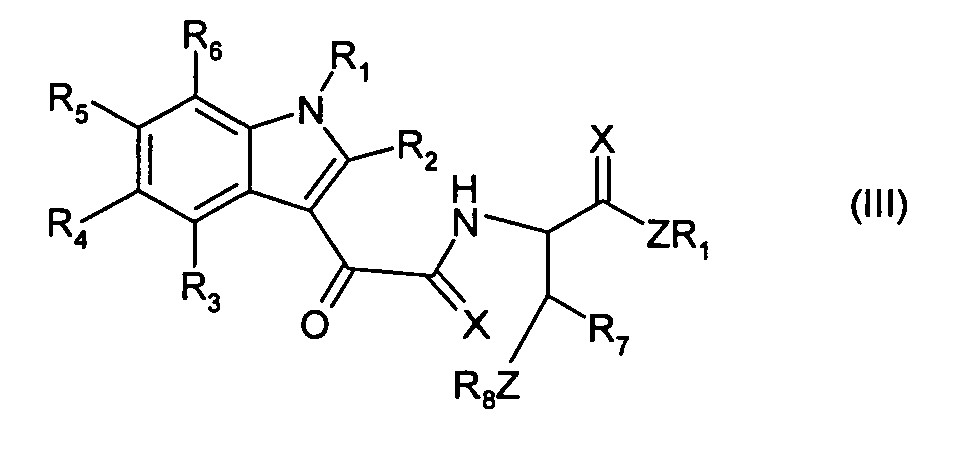
- the compound of formula II is prepared by cyclization of the derivatives of the N-substituted indole-3-glyoxylamide of formula III
- R 8 represents hydrogen or a protecting group.
- the compound of formula II is prepared by cyclization of derivatives of the indole-3-glyoxylates of formula IV
- Z' may be O or S
- R 8 represents hydrogen or the protecting group
- the derivatives of the N-substituted indole-3-glyoxylamide of formula III are obtained from derivatives of indole-3-glyoxylic acid of formula V, and the corresponding amines of formula VI
- Y is selected from amino group, halogen, hydroxyl, alkoxy group (OR 1 ), mercapto group (SH) or alkylthio group (SR 1 ).
- derivatives of formula IV are obtained from the derivatives of indole-3-glyoxylic acid of formula V, and the corresponding alcohols or thiols of formula VII.
- the present invention is a method of synthesizing aromatic ketone compositions of formula I comprising the step of introducing two double bonds into the 5 membered ring of the tetrahydro-1,3-azoles of formula XI .
- the compound of formula XI is prepared from derivatives of the indole-3-glyoxals of formula X and the corresponding amines of formula VI .
- the present invention additionally comprising the step of testing the compounds in vitro for efficacy as an AHR ligand.
- the present invention is a compound of the formula II
- R 1 , R 2 , R 3 , R 4 , R 5 , R 6 , R 7 , X, and Z are as defined in claim 1, and where the stereochemical centers, i.e., the carbons bearing C(X)ZR 1 and R 7 substituent may have R or S configuration.
- the present invention is a compound of the formula III
- R 1 , R 2 , R 3 , R 4 , R 5 , Re, R 7 , X, and Z are as defined in claim 1;
- R 8 represents hydrogen or the protecting group;
- the stereochemical centers, i.e., the carbons bearing C(X)ZR 1 and R 7 substituent may have R or S configuration; with the proviso that when R 7 and R 8 are hydrogens, and X is an oxygen, Z can not be oxygen.
- the present invention is a compound of the formula IV
- R 1 , R 2 , R 3 , R 4 , R 5 , R 6 , X, and Z are as defined in claim 1;
- R 8 represents hydrogen or the protecting group;
- Z' may be O or S the stereochemical center; i.e., the carbon bearing NHR 8 substituent may have R or S configuration.
- the present invention is a compound of the formula XI
- R 1 , R 2 , R 3 , R 4 , R 5 , R a , R 7 , X, and Z are as defined in claim 1, and where all the stereochemical centers of the tetrahydro-1,3-azole fragment may have R or S configuration.
- Fig. 1 is a scheme describing a preferred embodiment of the present invention.
- the present invention relates to a process for preparing certain aromatic ketones possessing two heterocyclic moieties attached to a carbonyl group.
- One moiety comprises an indole (or substituted indole) fragment that is attached to the carbonyl group by carbon 3 of the indole.
- the other heterocyclic moiety comprises a five-membered 1,3-azole ring of imidazole, oxazole or thiazole, attached to the carbonyl group by the carbon 2 and possessing carboxyl group (free or derivatized) as substituent at carbon 4.
- AhR ligands Compounds of the present invention are envisioned to have efficacy as AhR ligands. Characterization and function of the AhR ligand is described in U.S. provisional patent application 60/268,809 and U.S. patent application 10/074,102, filed February 12, 2002 .
- the present invention provides a process for preparing compounds represented by the general formula I:
- R 1 may be hydrogen or can be selected from the group consisting of (C 1 -C 6 )-alkyl and (C 3 -C 7 )-cycloalkyl, wherein the alkyl group can be substituted by (C 3 -C 7 )-cycloalkyl, or can be mono-or polysubstituted by the aryl group, wherein the aryl group can be mono- or polysubstituted by halogen, (C 1 -C 6 )-alkyl, (C 3 -C 7 )-cycloalkyl, hydroxy and nitro groups,
- R 1 may be an aryl group, wherein the aryl group can be mono- or polysubstituted by halogen, (C 1 -C 6 )-alkyl, (C 3 -C 7 )-cycloalkyl, hydroxy and nitro groups,
- R 1 may be a protecting group
- R 2 , R 3 , R 4 , R 5 , R 6 , and R 7 may be the same or different and are selected from the group consisting of hydrogen, (C 1 -C 6 )-alkyl, (C 3 -C 7 )-cycloalkyl, (C 1 -C 6 )-acyl, (C 1 -C 6 )-alkoxy, alkoxycarbonyl (COOR 1 ), halogen, benzyloxy, the nitro group, the amino group, the (C 1 -C 4 )-mono and dialkyl-substituted amino group or an aryl group, wherein the aryl group may be mono- or poly-substituted by halogen, (C 1 -C 6 )-alkyl, (C 3 -C 7 )-cycloalkyl, hydroxy and nitro groups, and
- X and Z may be the same or different and are selected from the group consisting of O, S and NH.
- the compounds of formula I are preferably prepared from indole derivatives of the general formula II:
- stereochemical centers i.e., the carbons bearing C(X)ZR 1 and R 7 substituent may have R or S configuration.
- Such introduction of an additional double bond to the five membered ring of the 4,5-dihydro-1,3-azoles II can be a one-step dehydrogenation or can comprise two steps.
- allylic bromination/dehydrobromination procedures are suitable.
- suitable reagents causing dehydrogenation of dihydro derivatives of nitrogen-, oxygen-, and sulfur-containing heterocycles are MnO 2 ( North and Pattenden, Tetrahedron 46:8267, 1990 ) and NiO 2 ( Minster, et al., J. Org. Chem. 43:1624, 1978 ; Evans; et al., J. Org. Chem, 44:497, 1979 ).
- reagents can be satisfactorily employed for such transformation, including sulfur, oxygen, potassium ferricyanide, mercuric acetate, hydrogen peroxide, potassium dichromate, cupric sulfate, ferric chloride, phenanthrene-9,10-dione and other quinones.
- Examples of the methods which can be used for two-step conversion of II to the fully aromatic compounds I involve a treatment with BrCCl 3 and DBU ( Williams, et al., Tetrahedron Lett. 38:331, 1997 ; Freeman and Pattenden, Tetrahedron Lett. 39:3251, 1998 ), NBS/ hv ( Meyers and Tavares, Tetrahedron Lett. 35:2481, 1994 ) and phenylselenenylation/elimination. ( Nakamura, et al., Tetrahedron Lett. 36:5059, 1995 ).
- R 8 represents hydrogen or a protecting group.
- Suitable solvents for such dehydrative cyclizations can be chlorinated hydrocarbons such as chloroform or methylene chloride. It should be added that, depending on the conditions of the reaction, such cyclization can be successfully accomplished without prior removal of S-, O- or N-protecting groups.
- N-substituted indole-3-glyoxylamides of the general formula III (where Z is NH, O or S) can be obtained from the derivatives of indole-3-glyoxylic acid V and the corresponding amines VI:
- Y is selected from amino group, halogen, hydroxyl, alkoxy group (OR 1 ), mercapto group (SH) or alkylthio group (SR 1 ).
- the derivatives of indole-3-glyoxylic acid V are the known compounds or they can be obtained by modification of the known methods.
- the reaction between V and VII can directly provide cyclised compounds of the general formula II.
- the compounds of formula I can be prepared by cyclization of the derivatives of N-substituted indole-3-glyoxylamides of the general formula VIII or condensation of the derivatives of indole-3-glyoxylamides of the general formula IX with the carbonyl compounds X:
- the preparation of the compounds of the general formula I can be achieved by the ring synthesis of the tetrahydro-1,3-azoles of the general formula XI, i.e., the formation of N,N-, N,O- or N,S-analogues of cyclic acetals of the derivatives of the indole-3-glyoxals X and their subsequent dehydrogenation:
- protecting group refers to any group commonly used for the protection of hydroxyl, thiol and amino functions during subsequent reactions. Such protecting groups are discussed by T. W. Greene and P. G. M. Wuts in chapters 2, 6 and 7, respectively, of "Protective Groups in Organic Synthesis", John Wiley and Sons, Inc., New York, 1999 .
- the "hydroxyl-protecting groups” are acyl or alkylsilyl groups such as trimethylsilyl, triethylsilyl, t-butyldimethylsilyl and analogous alkylated silyl radicals, or alkoxyalkyl groups such as methoxymethyl, ethoxymethyl, methoxyethoxymethyl, tetrahydrofuranyl or tetrahydropyranyl.
- the "thiol-protecting groups” are alkyl or arylalkyl groups such as t-butyl, benzyl, adamantyl, cyanoethyl, etc.
- amino-protecting groups are, for example, alkyl carbamates such as allyl carbamate (Alloc), t-butyl carbamate (BOC) and benzyl carbamate (Cbz) or amines can be protected as the corresponding amides such as chloroacetamide, trifluoroacetamide (TFA), etc.
- Alkyl signifies a straight-chain or branched hydrocarbon radical of 1 to 6 carbons in all its isomeric forms, such as methyl, ethyl, propyl, isopropyl, butyl, isobutyl, pentyl, etc.
- cycloalkyl is understood as meaning radicals such as, for example; cyclopropyl, cyclobutyl, cycloheksyl, etc.
- alkoxy group represents radicals such as, for example, methoxy, ethoxy, butoxy, etc.
- acyl means an alkanoyl group of 1 to 6 carbons in all its isomeric forms, such as formyl, acetyl, propionyl, etc. or an aroyl group, such as benzoyl, nitrobenzoyl or halobenzoyl, or a dicarboxylic acyl group such as oxalyl, malonyl, succinoyl, glutaroyl, or adipoyl.
- aryl signifies a phenyl-, or an alkyl-, halo-, nitro- or hydroxy-substituted phenyl group.
- halogen represents fluorine, chlorine, bromine or iodine.
- the endogenous ligand for the aryl hydrocarbon receptor (AHR), 2-(1'H-indole-3'-carbonyl)-thiazole-4-carboxylic acid methyl ester (ITE, 5, Scheme 1) has been isolated in very small quantities (ca. 20 ⁇ g) and identified through extensive spectral studies. Given the biological importance of the ligand, its chemical synthesis was obviously necessary for confirmation of the structural assignment and preparation of larger amounts of compound needed for studies of its physiological activity. Since the molecule of this aromatic ketone consists of two heterocyclic fragments, indole and 4-carbomethoxythiazole attached to the carbonyl group, we sought possible synthetic routes involving intermediate indole glyoxylamides.
- Nickel peroxide (assay ⁇ 30% active NiO 2 ) 120 mg, 1.3 mmol was added to a solution of indole-thiazoline ketone 4 (38 mg, 0.13 mmol) in anhydrous methylene chloride (30 mL). The resulting suspension was stirred for 19 hours at room temperature and then concentrated. The residue was purified by column chromatography. Elution with chloroform/methanol (99:1) gave pure product 5 (28 mg, 75%) that was crystallized from methanol.
- the spectroscopic properties of the synthesized compound were identical in all respects with those described in EXAMPLE 3a.
Landscapes
- Chemical & Material Sciences (AREA)
- Organic Chemistry (AREA)
- Health & Medical Sciences (AREA)
- General Chemical & Material Sciences (AREA)
- Medicinal Chemistry (AREA)
- Nuclear Medicine, Radiotherapy & Molecular Imaging (AREA)
- Chemical Kinetics & Catalysis (AREA)
- Pharmacology & Pharmacy (AREA)
- Life Sciences & Earth Sciences (AREA)
- Animal Behavior & Ethology (AREA)
- General Health & Medical Sciences (AREA)
- Public Health (AREA)
- Veterinary Medicine (AREA)
- Bioinformatics & Cheminformatics (AREA)
- Engineering & Computer Science (AREA)
- Immunology (AREA)
- Endocrinology (AREA)
- Diabetes (AREA)
- Hematology (AREA)
- Obesity (AREA)
- Nutrition Science (AREA)
- Reproductive Health (AREA)
- Pharmaceuticals Containing Other Organic And Inorganic Compounds (AREA)
- Indole Compounds (AREA)
- Plural Heterocyclic Compounds (AREA)
- Low-Molecular Organic Synthesis Reactions Using Catalysts (AREA)
- Heterocyclic Carbon Compounds Containing A Hetero Ring Having Nitrogen And Oxygen As The Only Ring Hetero Atoms (AREA)
- Nitrogen And Oxygen Or Sulfur-Condensed Heterocyclic Ring Systems (AREA)
Claims (13)
- Procédé de synthèse d'une cétone aromatique de formule 1 :
 - R1 représente une entité choisie parmi un atome d'hydrogène, les groupes alkyle en C1-6 et les groupes cycloalkyle en C3-7, lesquels groupes alkyle peuvent porter un substituant cycloalkyle en C3-7 ou un ou plusieurs substituants aryle, lesquels groupes aryle peuvent porter un ou plusieurs substituants halogéno, alkyle en C1-6, cycloalkyle en C3-7, hydroxy ou nitro ;- ou R1 représente un groupe aryle, lequel groupe aryle peut porter unou plusieurs substituants halogéno, alkyle en C1-6, cycloalkyle en C3-7, hydroxy ou nitro ;- ou encore R1 représente un groupe protecteur ;- R2, R3, R4, R5, R6 et R7 représentent des entités qui peuvent être identiques ou différentes et qui sont choisies chacune parmi les atomes d'hydrogène et d'halogène et les groupes alkyle en C1-6, cycloalkyle en C3-7, acyle en C1-6, alcoxy en C1-6, alcoxycarbonyle -COOR1, benzyloxy, nitro, amino, mono- ou di-(alkyle en C1-4)amino et aryle, lequel groupe aryle peut porter un ou plusieurs substituants halo-géno, alkyle en C1-6, cycloalkyle en C3-7, hydroxy ou nitro ;- et X et Z représentent des entités qui peuvent être identiques ou différentes et qui sont choisies chacune parmi un atome d'oxygène, un atome de soufre et un groupe imino de formule NH ;lequel procédé comporte une étape où l'on établit une double liaison dans le cycle à 5 chaînons du fragment de type 4,5-dihydro-1,3-azole d'un composé de formule II :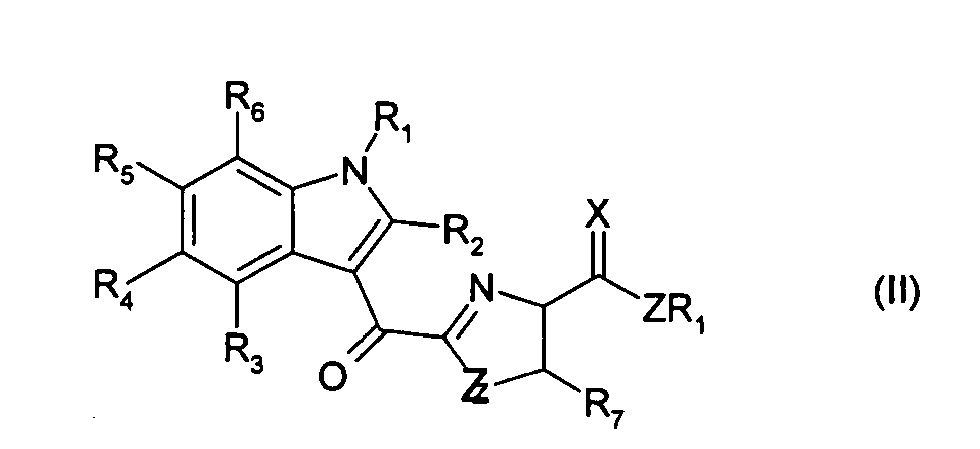
- Procédé conforme à la revendication 1, dans lequel l'étape d'établissement d'une double liaison comporte une oxydation d'un composé de formule II.
- Procédé conforme à la revendication 2, dans lequel l'oxydation comporte le fait de traiter le composé choisi avec du composé de formule MnO2 ou NiO2.
- Procédé conforme à la revendication 1, pour lequel on prépare le composé de formule II par cyclisation d'un dérivé de type indol-3-yl-glyoxylamide N-substitué, de formule III :

- Procédé conforme à la revendication 4, dans lequel la cyclisation comporte un traitement par du composé de formule TiCl4.
- Procédé conforme à la revendication 1, pour lequel on prépare le composé de formule II par cyclisation d'un dérivé de type indol-3-yl-glyoxylate, de formule IV :

- Procédé conforme à la revendication 4, pour lequel on obtient le dérivé de type indol-3-yl-glyoxylamide N-substitué, de formule III, à partir d'un dérivé d'acide indol-3-yl-glyoxylique, de formule V, et d'une amine correspondante, de formule VI :

- Procédé conforme à la revendication 6, pour lequel on obtient le dérivé de formule IV à partir d'un dérivé d'acide indol-3-yl-glyoxylique, de formule V, et d'un alcool ou thiol correspondant, de formule VII :

- Procédé de synthèse d'une cétone aromatique de formule I, lequel procédé comporte une étape où l'on établit deux doubles liaisons dans le cycle à 5 chaînons du fragment de type tétrahydro-1,3-azole d'un composé de formule XI :

- Procédé conforme à la revendication 9, pour lequel on prépare le composé de formule XI à partir d'un dérivé d'indol-3-yl-glyoxal, de formule X, et d'une amine correspondante de formule VI :

- Procédé conforme à la revendication 1, qui comporte en outre une étape où l'on teste in vitro l'efficacité du composé en tant que ligand du récepteur AHR.
- Procédé conforme à la revendication 9, qui comporte en outre une étape où l'on teste in vitro l'efficacité du composé en tant que ligand du récepteur AHR.
- Composé de formule II, III, IV ou XI :

 - les symboles R1, R2, R3, R4, R5, R6, R7, X et Z ont les significations indiquées dans la revendication 1,- R8 représente un atome d'hydrogène ou un groupe protecteur,- et les centres d'asymétrie stéréochimique, c'est-à-dire les atomes de carbone portant les substituants symbolisés par C(=X)ZR1 et R7, peuvent présenter la configuration R ou S ;sous réserve que, si R7 et R8 représentent chacun un atome d'hydrogène et X représente un atome d'oxygène, Z ne représente pas un atome d'oxygène;
 - les symboles R1, R2, R3, R4, R5, R6, R7, X et Z ont les significations indiquées dans la revendication 1,- Rg représente un atome d'hydrogène ou un groupe protecteur,- Z' représente un atome d'oxygène ou de soufre,- et le centre d'asymétrie stéréochimique, c'est-à-dire l'atome de carbone portant le substituant symbolisé par NHR8, peut présenter la configuration R ou S ;
Applications Claiming Priority (5)
| Application Number | Priority Date | Filing Date | Title |
|---|---|---|---|
| US35658502P | 2002-02-12 | 2002-02-12 | |
| US356585P | 2002-02-12 | ||
| US74102 | 2002-02-12 | ||
| US10/074,102 US6916834B2 (en) | 2001-02-14 | 2002-02-12 | Preparations and use of an Ah receptor ligand, 2-(1′H-indole-3′-carbonyl)-thiazole-4-carboxylic acid methyl ester |
| PCT/US2003/004205 WO2003068742A1 (fr) | 2002-02-12 | 2003-02-11 | Synthese de composes d'indole thiazole en tant que ligands pour le recepteur ah |
Publications (3)
| Publication Number | Publication Date |
|---|---|
| EP1480951A1 EP1480951A1 (fr) | 2004-12-01 |
| EP1480951A4 EP1480951A4 (fr) | 2006-03-22 |
| EP1480951B1 true EP1480951B1 (fr) | 2008-05-07 |
Family
ID=27736819
Family Applications (1)
| Application Number | Title | Priority Date | Filing Date |
|---|---|---|---|
| EP03707863A Expired - Lifetime EP1480951B1 (fr) | 2002-02-12 | 2003-02-11 | Synthese de composes d'indole thiazole en tant que ligands pour le recepteur ah |
Country Status (10)
| Country | Link |
|---|---|
| US (2) | US7002019B2 (fr) |
| EP (1) | EP1480951B1 (fr) |
| JP (1) | JP4445266B2 (fr) |
| CN (2) | CN1642910A (fr) |
| AT (1) | ATE394373T1 (fr) |
| AU (1) | AU2003209130B2 (fr) |
| CA (1) | CA2475331C (fr) |
| DE (1) | DE60320766D1 (fr) |
| MX (1) | MXPA04007767A (fr) |
| WO (1) | WO2003068742A1 (fr) |
Families Citing this family (38)
| Publication number | Priority date | Publication date | Assignee | Title |
|---|---|---|---|---|
| EP1365760B1 (fr) * | 2001-02-14 | 2009-05-20 | Wisconsin Alumni Research Foundation | Preparations et utilisations d'un ligand recepteur ah, ester methylique d'acide 2-(1'h-indole-3'-carbonyl)-thiazole-4-carboxylique |
| DE60221391T2 (de) | 2001-06-20 | 2008-04-17 | Wyeth | Substituierte indolsäurederivate als inhibitoren von plasminogen-aktivator-inhibitor-1 (pai-1) |
| TWI224101B (en) | 2001-06-20 | 2004-11-21 | Wyeth Corp | Substituted naphthyl indole derivatives as inhibitors of plasminogen activator inhibitor type-1 (PAI-1) |
| EP1480951B1 (fr) * | 2002-02-12 | 2008-05-07 | Wisconsin Alumni Research Foundation | Synthese de composes d'indole thiazole en tant que ligands pour le recepteur ah |
| BR0316583A (pt) | 2002-12-10 | 2005-10-04 | Wyeth Corp | Derivados de ácido acético 3-alquil e 3-arilalquil 1h-indol-1-il substituìdo como inibidores do inibidor-1 do ativador do plasminogênio (pai-1) |
| AU2003296324A1 (en) | 2002-12-10 | 2004-06-30 | Wyeth | Aryl, aryloxy, and alkyloxy substituted 1h-indol-3-yl glyoxylic acid derivatives as inhibitors of plasminogen activator inhibitor-1 (pai-1) |
| ATE430731T1 (de) * | 2002-12-10 | 2009-05-15 | Wyeth Corp | Substituierte indoloxoacetylaminoessigsäurederivate als inhibitoren des plasminogenaktivatorinhibitors-1 (pai-1) |
| UA80453C2 (en) | 2002-12-10 | 2007-09-25 | Derivatives of substituted dyhydropyranoindol-3,4-dion as inhibitors of plasminogen activator inhibitor-1 (pai-1) | |
| MXPA05006288A (es) | 2002-12-10 | 2005-08-19 | Wyeth Corp | Derivados del acido 3-carbonil-1h-indol-1-ilacetico sustituidos como inhibidores del inhibidor del activador de plasminogeno 1 (pai-1). |
| US7230133B2 (en) | 2003-05-01 | 2007-06-12 | Bristol-Myers Squibb Company | Malonamides and malonamide derivatives as modulators of chemokine receptor activity |
| US7446201B2 (en) | 2003-09-25 | 2008-11-04 | Wyeth | Substituted heteroaryl benzofuran acids |
| US7534894B2 (en) | 2003-09-25 | 2009-05-19 | Wyeth | Biphenyloxy-acids |
| US7351726B2 (en) | 2003-09-25 | 2008-04-01 | Wyeth | Substituted oxadiazolidinediones |
| US7268159B2 (en) | 2003-09-25 | 2007-09-11 | Wyeth | Substituted indoles |
| US7265148B2 (en) | 2003-09-25 | 2007-09-04 | Wyeth | Substituted pyrrole-indoles |
| US7163954B2 (en) | 2003-09-25 | 2007-01-16 | Wyeth | Substituted naphthyl benzothiophene acids |
| US7582773B2 (en) | 2003-09-25 | 2009-09-01 | Wyeth | Substituted phenyl indoles |
| US7141592B2 (en) | 2003-09-25 | 2006-11-28 | Wyeth | Substituted oxadiazolidinediones |
| US7420083B2 (en) | 2003-09-25 | 2008-09-02 | Wyeth | Substituted aryloximes |
| US7411083B2 (en) | 2003-09-25 | 2008-08-12 | Wyeth | Substituted acetic acid derivatives |
| US7442805B2 (en) | 2003-09-25 | 2008-10-28 | Wyeth | Substituted sulfonamide-indoles |
| US7342039B2 (en) | 2003-09-25 | 2008-03-11 | Wyeth | Substituted indole oximes |
| US7332521B2 (en) | 2003-09-25 | 2008-02-19 | Wyeth | Substituted indoles |
| JP2008510814A (ja) | 2004-08-23 | 2008-04-10 | ワイス | Pai−1阻害剤としてのピロロ−ナフチル酸 |
| EP1794138A2 (fr) | 2004-08-23 | 2007-06-13 | Wyeth | Acides thiazolo-naphthyliques en tant que inhibiteurs de l'inhibiteur-1 de l'activateur de plasminogene |
| MX2007002178A (es) | 2004-08-23 | 2007-04-02 | Wyeth Corp | Acidos de oxazolo-naftilo como moduladores del inhibidor del activador de plasminogeno tipo 1 (pai-1) util en el tratamiento de trombosis y enfermedades cardiovasculares. |
| CN101263115A (zh) | 2005-08-17 | 2008-09-10 | 惠氏公司 | 经取代吲哚和其用途 |
| EP2082736A1 (fr) | 2008-01-23 | 2009-07-29 | Jean Hilaire Saurat | Composition pharmaceutique à usage topique |
| US8236849B2 (en) | 2008-10-15 | 2012-08-07 | Ohio Northern University | Model for glutamate racemase inhibitors and glutamate racemase antibacterial agents |
| US10632106B2 (en) | 2009-11-02 | 2020-04-28 | Ariagen, Inc. | Methods of cancer treatment with 2-(1′H-Indole-3′-carbonyl)-thiazole-4-carboxylic acid methyl ester |
| EP3689347A1 (fr) | 2009-11-02 | 2020-08-05 | Ariagen, Inc. | Ite pour l'intervention et l'éradication de cancer |
| CN102775399A (zh) * | 2011-12-27 | 2012-11-14 | 盛世泰科生物医药技术(苏州)有限公司 | arylhydrocarbon受体(AHR)的内源性配体,2-(1’H3’-吲哚羰基)噻唑-4-羧酸甲酯的合成新方法 |
| US10711106B2 (en) * | 2013-07-25 | 2020-07-14 | The University Of Chicago | High aspect ratio nanofibril materials |
| CN107001350B (zh) * | 2014-09-12 | 2021-04-09 | 阿里根公司 | 2-(1’h-吲哚-3’-羰基)-噻唑-4-羧酸甲酯及其结构类似物的有效且可扩展的合成 |
| CN108239083B (zh) * | 2016-12-26 | 2021-08-17 | 阿里根公司 | 芳香烃受体调节剂 |
| EP3713937A2 (fr) | 2017-11-20 | 2020-09-30 | Ariagen, Inc. | Composés d'indole et leur utilisation |
| CA3137027A1 (fr) | 2019-04-15 | 2020-10-22 | Ariagen, Inc. | Composes d'indole chiraux et leur utilisation |
| US11136318B2 (en) | 2019-06-21 | 2021-10-05 | Noramco, Llc | Processes for the preparation of aryl hydrocarbon receptor ligands |
Citations (1)
| Publication number | Priority date | Publication date | Assignee | Title |
|---|---|---|---|---|
| WO2002064138A1 (fr) * | 2001-02-14 | 2002-08-22 | Wisconsin Alumni Research Foundation | Preparations et utilisations d'un ligand recepteur ah, ester methylique d'acide 2-(1'h-indole-3'-carbonyl)-thiazole-4-carboxylique |
Family Cites Families (7)
| Publication number | Priority date | Publication date | Assignee | Title |
|---|---|---|---|---|
| US3265931A (en) * | 1964-09-21 | 1966-08-09 | Martin E Gerry | Magnetic ignition distributor |
| US3285931A (en) | 1964-12-21 | 1966-11-15 | Union Carbide Corp | Preparation of substituted pyrrole derivatives |
| US5366685A (en) | 1989-07-18 | 1994-11-22 | Idemitsu Petrochemical Co., Ltd. | Process of molding thermoplastic sheet by plug assist vacuum forming |
| US6323228B1 (en) * | 2000-09-15 | 2001-11-27 | Abbott Laboratories | 3-substituted indole angiogenesis inhibitors |
| US6523228B1 (en) * | 2000-10-26 | 2003-02-25 | Avery Dennison Corporation | Tamper-proof tie |
| WO2003022274A2 (fr) * | 2001-09-13 | 2003-03-20 | Synta Pharmaceuticals Corp. | Composes 2-aroylimidazole pour traitement du cancer |
| EP1480951B1 (fr) * | 2002-02-12 | 2008-05-07 | Wisconsin Alumni Research Foundation | Synthese de composes d'indole thiazole en tant que ligands pour le recepteur ah |
-
2003
- 2003-02-11 EP EP03707863A patent/EP1480951B1/fr not_active Expired - Lifetime
- 2003-02-11 AT AT03707863T patent/ATE394373T1/de not_active IP Right Cessation
- 2003-02-11 CN CNA038063808A patent/CN1642910A/zh active Pending
- 2003-02-11 WO PCT/US2003/004205 patent/WO2003068742A1/fr not_active Ceased
- 2003-02-11 MX MXPA04007767A patent/MXPA04007767A/es active IP Right Grant
- 2003-02-11 JP JP2003567873A patent/JP4445266B2/ja not_active Expired - Lifetime
- 2003-02-11 CA CA2475331A patent/CA2475331C/fr not_active Expired - Lifetime
- 2003-02-11 CN CN2006100915364A patent/CN1915991B/zh not_active Expired - Fee Related
- 2003-02-11 US US10/364,253 patent/US7002019B2/en not_active Expired - Lifetime
- 2003-02-11 AU AU2003209130A patent/AU2003209130B2/en not_active Expired
- 2003-02-11 DE DE60320766T patent/DE60320766D1/de not_active Expired - Fee Related
-
2005
- 2005-11-23 US US11/286,537 patent/US7241900B2/en not_active Expired - Lifetime
Patent Citations (1)
| Publication number | Priority date | Publication date | Assignee | Title |
|---|---|---|---|---|
| WO2002064138A1 (fr) * | 2001-02-14 | 2002-08-22 | Wisconsin Alumni Research Foundation | Preparations et utilisations d'un ligand recepteur ah, ester methylique d'acide 2-(1'h-indole-3'-carbonyl)-thiazole-4-carboxylique |
Non-Patent Citations (1)
| Title |
|---|
| HEATH-PAGLIUSO ET AL: "Activation of the Ah Receptor by Tryptophan and Tryptophan Metabolites", BIOCHEMISTRY, vol. 37, 1998, pages 11508 - 11515 * |
Also Published As
| Publication number | Publication date |
|---|---|
| EP1480951A1 (fr) | 2004-12-01 |
| DE60320766D1 (de) | 2008-06-19 |
| WO2003068742A1 (fr) | 2003-08-21 |
| US20060079692A1 (en) | 2006-04-13 |
| CN1915991A (zh) | 2007-02-21 |
| AU2003209130B2 (en) | 2008-06-05 |
| AU2003209130A1 (en) | 2003-09-04 |
| ATE394373T1 (de) | 2008-05-15 |
| US7002019B2 (en) | 2006-02-21 |
| CN1915991B (zh) | 2010-05-26 |
| CA2475331C (fr) | 2012-06-12 |
| CA2475331A1 (fr) | 2003-08-21 |
| US20040204588A1 (en) | 2004-10-14 |
| EP1480951A4 (fr) | 2006-03-22 |
| JP2005525340A (ja) | 2005-08-25 |
| MXPA04007767A (es) | 2004-10-15 |
| CN1642910A (zh) | 2005-07-20 |
| JP4445266B2 (ja) | 2010-04-07 |
| US7241900B2 (en) | 2007-07-10 |
Similar Documents
| Publication | Publication Date | Title |
|---|---|---|
| EP1480951B1 (fr) | Synthese de composes d'indole thiazole en tant que ligands pour le recepteur ah | |
| KR100295128B1 (ko) | 인돌로일구아니딘유도체 | |
| Zelisko et al. | Crotonic, cynnamic, and propiolic acids motifs in the synthesis of thiopyrano [2, 3-d][1, 3] thiazoles via hetero-Diels–Alder reaction and related tandem processes | |
| CA2077283A1 (fr) | Inhibiteurs de la transcriptase inverse du vih | |
| CN1542011A (zh) | 含硫杂环并萘酰亚胺类化合物及其用途 | |
| CA2620662C (fr) | Derives de pyrrolopyridine et leurs utilisations comme modulateurs des recepteurs ppar | |
| EP0820446A1 (fr) | Synthese de bisindolylmaleimides | |
| EP1507758B1 (fr) | Derives d'indole et leur utilisation en tant que ligands des recepteurs cb2 | |
| Irie et al. | Synthesis of 6-substituted indolactams by microbial conversion | |
| Lei et al. | Efficient synthesis of a novel resorcyclide as anticancer agent based on Hsp90 inhibition | |
| Uludag et al. | Facile synthesis of the azocino [4, 3-b] indole framework of strychnopivotine and other Strychnos alkaloids | |
| WO2003086377A1 (fr) | Derives amide | |
| WO2001014384A1 (fr) | Derives dihydrobenzofuran tricycliques, leur procede de preparation et agents | |
| CN114041471B (zh) | 脱氢蟾蜍色胺的用途 | |
| Flink et al. | Microwave-assisted total synthesis of tangutorine | |
| HK1097838A1 (en) | Synthesis of indole thiazole compounds as ligands for the ah receptor | |
| HK1097838B (en) | Synthesis of indole thiazole compounds as ligands for the ah receptor | |
| Grzywacz et al. | A Concise Synthesis of an AHR Endogenous Ligand with the lndolecarbonylthiazole Skeleton | |
| Chuang et al. | A novel oxidative free radical reaction between 2-amino-1, 4-benzoquinones and benzoylacetonitriles | |
| Mbala et al. | Investigation towards an efficient synthesis of benzo [g] isoquinoline-1, 5, 10 (2H)-triones | |
| HK1080837A (en) | Synthesis of indole thiazole compounds as ligands for the ah receptor | |
| Gomez-Monterrey et al. | A novel approach to the synthesis of diaza-bridged heterocycle derivatives | |
| JPS6045577A (ja) | 2−アザビシクロ〔2.2.2〕オクタン誘導体 | |
| CA2061065A1 (fr) | Composes derives de beta-carbolines ligands du recepteur des benzodia zepines, ayant un effet agoniste inverse et antagoniste vis-a-vis des benzodiazepines, et medicaments en contenant | |
| Majumdar et al. | Regioselective synthesis of 7-acetyl-11c-methyl-4b, 5, 7, 11c-tetrahydro [1] benzofuro [2′, 3′: 4, 5] thiopyrano [2, 3-b] indoles by sequential Claisen rearrangement of 2-(4′-aryloxybut-2′-ynylthio)-1-acetylindoles |
Legal Events
| Date | Code | Title | Description |
|---|---|---|---|
| PUAI | Public reference made under article 153(3) epc to a published international application that has entered the european phase |
Free format text: ORIGINAL CODE: 0009012 |
|
| 17P | Request for examination filed |
Effective date: 20040906 |
|
| AK | Designated contracting states |
Kind code of ref document: A1 Designated state(s): AT BE BG CH CY CZ DE DK EE ES FI FR GB GR HU IE IT LI LU MC NL PT SE SI SK TR |
|
| AX | Request for extension of the european patent |
Extension state: AL LT LV MK RO |
|
| RIC1 | Information provided on ipc code assigned before grant |
Ipc: C07D 417/02 20060101ALI20060126BHEP Ipc: C07D 209/20 20060101AFI20030823BHEP Ipc: C07D 209/12 20060101ALI20060126BHEP |
|
| A4 | Supplementary search report drawn up and despatched |
Effective date: 20060203 |
|
| 17Q | First examination report despatched |
Effective date: 20070124 |
|
| GRAP | Despatch of communication of intention to grant a patent |
Free format text: ORIGINAL CODE: EPIDOSNIGR1 |
|
| GRAS | Grant fee paid |
Free format text: ORIGINAL CODE: EPIDOSNIGR3 |
|
| GRAA | (expected) grant |
Free format text: ORIGINAL CODE: 0009210 |
|
| AK | Designated contracting states |
Kind code of ref document: B1 Designated state(s): AT BE BG CH CY CZ DE DK EE ES FI FR GB GR HU IE IT LI LU MC NL PT SE SI SK TR |
|
| REG | Reference to a national code |
Ref country code: GB Ref legal event code: FG4D |
|
| REG | Reference to a national code |
Ref country code: CH Ref legal event code: EP |
|
| REG | Reference to a national code |
Ref country code: IE Ref legal event code: FG4D Free format text: LANGUAGE OF EP DOCUMENT: FRENCH |
|
| REF | Corresponds to: |
Ref document number: 60320766 Country of ref document: DE Date of ref document: 20080619 Kind code of ref document: P |
|
| PG25 | Lapsed in a contracting state [announced via postgrant information from national office to epo] |
Ref country code: SI Free format text: LAPSE BECAUSE OF FAILURE TO SUBMIT A TRANSLATION OF THE DESCRIPTION OR TO PAY THE FEE WITHIN THE PRESCRIBED TIME-LIMIT Effective date: 20080507 |
|
| PG25 | Lapsed in a contracting state [announced via postgrant information from national office to epo] |
Ref country code: NL Free format text: LAPSE BECAUSE OF FAILURE TO SUBMIT A TRANSLATION OF THE DESCRIPTION OR TO PAY THE FEE WITHIN THE PRESCRIBED TIME-LIMIT Effective date: 20080507 Ref country code: FI Free format text: LAPSE BECAUSE OF FAILURE TO SUBMIT A TRANSLATION OF THE DESCRIPTION OR TO PAY THE FEE WITHIN THE PRESCRIBED TIME-LIMIT Effective date: 20080507 Ref country code: ES Free format text: LAPSE BECAUSE OF FAILURE TO SUBMIT A TRANSLATION OF THE DESCRIPTION OR TO PAY THE FEE WITHIN THE PRESCRIBED TIME-LIMIT Effective date: 20080818 |
|
| NLV1 | Nl: lapsed or annulled due to failure to fulfill the requirements of art. 29p and 29m of the patents act | ||
| PG25 | Lapsed in a contracting state [announced via postgrant information from national office to epo] |
Ref country code: AT Free format text: LAPSE BECAUSE OF FAILURE TO SUBMIT A TRANSLATION OF THE DESCRIPTION OR TO PAY THE FEE WITHIN THE PRESCRIBED TIME-LIMIT Effective date: 20080507 |
|
| PG25 | Lapsed in a contracting state [announced via postgrant information from national office to epo] |
Ref country code: SE Free format text: LAPSE BECAUSE OF FAILURE TO SUBMIT A TRANSLATION OF THE DESCRIPTION OR TO PAY THE FEE WITHIN THE PRESCRIBED TIME-LIMIT Effective date: 20080807 Ref country code: DK Free format text: LAPSE BECAUSE OF FAILURE TO SUBMIT A TRANSLATION OF THE DESCRIPTION OR TO PAY THE FEE WITHIN THE PRESCRIBED TIME-LIMIT Effective date: 20080507 Ref country code: CZ Free format text: LAPSE BECAUSE OF FAILURE TO SUBMIT A TRANSLATION OF THE DESCRIPTION OR TO PAY THE FEE WITHIN THE PRESCRIBED TIME-LIMIT Effective date: 20080507 Ref country code: PT Free format text: LAPSE BECAUSE OF FAILURE TO SUBMIT A TRANSLATION OF THE DESCRIPTION OR TO PAY THE FEE WITHIN THE PRESCRIBED TIME-LIMIT Effective date: 20081007 |
|
| PG25 | Lapsed in a contracting state [announced via postgrant information from national office to epo] |
Ref country code: SK Free format text: LAPSE BECAUSE OF FAILURE TO SUBMIT A TRANSLATION OF THE DESCRIPTION OR TO PAY THE FEE WITHIN THE PRESCRIBED TIME-LIMIT Effective date: 20080507 Ref country code: BE Free format text: LAPSE BECAUSE OF FAILURE TO SUBMIT A TRANSLATION OF THE DESCRIPTION OR TO PAY THE FEE WITHIN THE PRESCRIBED TIME-LIMIT Effective date: 20080507 |
|
| PLBE | No opposition filed within time limit |
Free format text: ORIGINAL CODE: 0009261 |
|
| STAA | Information on the status of an ep patent application or granted ep patent |
Free format text: STATUS: NO OPPOSITION FILED WITHIN TIME LIMIT |
|
| 26N | No opposition filed |
Effective date: 20090210 |
|
| PG25 | Lapsed in a contracting state [announced via postgrant information from national office to epo] |
Ref country code: EE Free format text: LAPSE BECAUSE OF FAILURE TO SUBMIT A TRANSLATION OF THE DESCRIPTION OR TO PAY THE FEE WITHIN THE PRESCRIBED TIME-LIMIT Effective date: 20080507 Ref country code: BG Free format text: LAPSE BECAUSE OF FAILURE TO SUBMIT A TRANSLATION OF THE DESCRIPTION OR TO PAY THE FEE WITHIN THE PRESCRIBED TIME-LIMIT Effective date: 20080807 |
|
| PG25 | Lapsed in a contracting state [announced via postgrant information from national office to epo] |
Ref country code: IT Free format text: LAPSE BECAUSE OF FAILURE TO SUBMIT A TRANSLATION OF THE DESCRIPTION OR TO PAY THE FEE WITHIN THE PRESCRIBED TIME-LIMIT Effective date: 20080507 |
|
| PG25 | Lapsed in a contracting state [announced via postgrant information from national office to epo] |
Ref country code: MC Free format text: LAPSE BECAUSE OF NON-PAYMENT OF DUE FEES Effective date: 20090228 |
|
| REG | Reference to a national code |
Ref country code: CH Ref legal event code: PL |
|
| GBPC | Gb: european patent ceased through non-payment of renewal fee |
Effective date: 20090211 |
|
| PG25 | Lapsed in a contracting state [announced via postgrant information from national office to epo] |
Ref country code: CH Free format text: LAPSE BECAUSE OF NON-PAYMENT OF DUE FEES Effective date: 20090228 Ref country code: LI Free format text: LAPSE BECAUSE OF NON-PAYMENT OF DUE FEES Effective date: 20090228 |
|
| REG | Reference to a national code |
Ref country code: IE Ref legal event code: MM4A |
|
| REG | Reference to a national code |
Ref country code: FR Ref legal event code: ST Effective date: 20091030 |
|
| PG25 | Lapsed in a contracting state [announced via postgrant information from national office to epo] |
Ref country code: DE Free format text: LAPSE BECAUSE OF NON-PAYMENT OF DUE FEES Effective date: 20090901 Ref country code: IE Free format text: LAPSE BECAUSE OF NON-PAYMENT OF DUE FEES Effective date: 20090211 |
|
| PG25 | Lapsed in a contracting state [announced via postgrant information from national office to epo] |
Ref country code: GB Free format text: LAPSE BECAUSE OF NON-PAYMENT OF DUE FEES Effective date: 20090211 Ref country code: FR Free format text: LAPSE BECAUSE OF NON-PAYMENT OF DUE FEES Effective date: 20090302 |
|
| PG25 | Lapsed in a contracting state [announced via postgrant information from national office to epo] |
Ref country code: GR Free format text: LAPSE BECAUSE OF FAILURE TO SUBMIT A TRANSLATION OF THE DESCRIPTION OR TO PAY THE FEE WITHIN THE PRESCRIBED TIME-LIMIT Effective date: 20080808 |
|
| PG25 | Lapsed in a contracting state [announced via postgrant information from national office to epo] |
Ref country code: LU Free format text: LAPSE BECAUSE OF NON-PAYMENT OF DUE FEES Effective date: 20090211 |
|
| PG25 | Lapsed in a contracting state [announced via postgrant information from national office to epo] |
Ref country code: HU Free format text: LAPSE BECAUSE OF FAILURE TO SUBMIT A TRANSLATION OF THE DESCRIPTION OR TO PAY THE FEE WITHIN THE PRESCRIBED TIME-LIMIT Effective date: 20081108 |
|
| PG25 | Lapsed in a contracting state [announced via postgrant information from national office to epo] |
Ref country code: TR Free format text: LAPSE BECAUSE OF FAILURE TO SUBMIT A TRANSLATION OF THE DESCRIPTION OR TO PAY THE FEE WITHIN THE PRESCRIBED TIME-LIMIT Effective date: 20080507 |
|
| PG25 | Lapsed in a contracting state [announced via postgrant information from national office to epo] |
Ref country code: CY Free format text: LAPSE BECAUSE OF FAILURE TO SUBMIT A TRANSLATION OF THE DESCRIPTION OR TO PAY THE FEE WITHIN THE PRESCRIBED TIME-LIMIT Effective date: 20080507 |