EP1492396A2 - Wärme-Managements-Vorrichtung und Verfahren zu seiner Herstellung - Google Patents
Wärme-Managements-Vorrichtung und Verfahren zu seiner Herstellung Download PDFInfo
- Publication number
- EP1492396A2 EP1492396A2 EP04017844A EP04017844A EP1492396A2 EP 1492396 A2 EP1492396 A2 EP 1492396A2 EP 04017844 A EP04017844 A EP 04017844A EP 04017844 A EP04017844 A EP 04017844A EP 1492396 A2 EP1492396 A2 EP 1492396A2
- Authority
- EP
- European Patent Office
- Prior art keywords
- carbon
- thermal management
- encapsulating material
- management device
- devices
- Prior art date
- Legal status (The legal status is an assumption and is not a legal conclusion. Google has not performed a legal analysis and makes no representation as to the accuracy of the status listed.)
- Withdrawn
Links
Images


Classifications
-
- H—ELECTRICITY
- H05—ELECTRIC TECHNIQUES NOT OTHERWISE PROVIDED FOR
- H05K—PRINTED CIRCUITS; CASINGS OR CONSTRUCTIONAL DETAILS OF ELECTRIC APPARATUS; MANUFACTURE OF ASSEMBLAGES OF ELECTRICAL COMPONENTS
- H05K1/00—Printed circuits
- H05K1/02—Details
- H05K1/03—Use of materials for the substrate
- H05K1/05—Insulated conductive substrates, e.g. insulated metal substrate
-
- H—ELECTRICITY
- H10—SEMICONDUCTOR DEVICES; ELECTRIC SOLID-STATE DEVICES NOT OTHERWISE PROVIDED FOR
- H10W—GENERIC PACKAGES, INTERCONNECTIONS, CONNECTORS OR OTHER CONSTRUCTIONAL DETAILS OF DEVICES COVERED BY CLASS H10
- H10W40/00—Arrangements for thermal protection or thermal control
- H10W40/20—Arrangements for cooling
- H10W40/25—Arrangements for cooling characterised by their materials
-
- H—ELECTRICITY
- H05—ELECTRIC TECHNIQUES NOT OTHERWISE PROVIDED FOR
- H05K—PRINTED CIRCUITS; CASINGS OR CONSTRUCTIONAL DETAILS OF ELECTRIC APPARATUS; MANUFACTURE OF ASSEMBLAGES OF ELECTRICAL COMPONENTS
- H05K1/00—Printed circuits
- H05K1/02—Details
- H05K1/03—Use of materials for the substrate
- H05K1/05—Insulated conductive substrates, e.g. insulated metal substrate
- H05K1/056—Insulated conductive substrates, e.g. insulated metal substrate the metal substrate being covered by an organic insulating layer
-
- H—ELECTRICITY
- H10—SEMICONDUCTOR DEVICES; ELECTRIC SOLID-STATE DEVICES NOT OTHERWISE PROVIDED FOR
- H10W—GENERIC PACKAGES, INTERCONNECTIONS, CONNECTORS OR OTHER CONSTRUCTIONAL DETAILS OF DEVICES COVERED BY CLASS H10
- H10W40/00—Arrangements for thermal protection or thermal control
- H10W40/20—Arrangements for cooling
- H10W40/25—Arrangements for cooling characterised by their materials
- H10W40/254—Diamond
-
- H—ELECTRICITY
- H10—SEMICONDUCTOR DEVICES; ELECTRIC SOLID-STATE DEVICES NOT OTHERWISE PROVIDED FOR
- H10W—GENERIC PACKAGES, INTERCONNECTIONS, CONNECTORS OR OTHER CONSTRUCTIONAL DETAILS OF DEVICES COVERED BY CLASS H10
- H10W40/00—Arrangements for thermal protection or thermal control
- H10W40/20—Arrangements for cooling
- H10W40/25—Arrangements for cooling characterised by their materials
- H10W40/257—Arrangements for cooling characterised by their materials having a heterogeneous or anisotropic structure, e.g. powder or fibres in a matrix, wire mesh or porous structures
-
- H—ELECTRICITY
- H05—ELECTRIC TECHNIQUES NOT OTHERWISE PROVIDED FOR
- H05K—PRINTED CIRCUITS; CASINGS OR CONSTRUCTIONAL DETAILS OF ELECTRIC APPARATUS; MANUFACTURE OF ASSEMBLAGES OF ELECTRICAL COMPONENTS
- H05K2201/00—Indexing scheme relating to printed circuits covered by H05K1/00
- H05K2201/03—Conductive materials
- H05K2201/032—Materials
- H05K2201/0323—Carbon
-
- H—ELECTRICITY
- H05—ELECTRIC TECHNIQUES NOT OTHERWISE PROVIDED FOR
- H05K—PRINTED CIRCUITS; CASINGS OR CONSTRUCTIONAL DETAILS OF ELECTRIC APPARATUS; MANUFACTURE OF ASSEMBLAGES OF ELECTRICAL COMPONENTS
- H05K2201/00—Indexing scheme relating to printed circuits covered by H05K1/00
- H05K2201/09—Shape and layout
- H05K2201/09209—Shape and layout details of conductors
- H05K2201/095—Conductive through-holes or vias
- H05K2201/09609—Via grid, i.e. two-dimensional array of vias or holes in a single plane
-
- H—ELECTRICITY
- H05—ELECTRIC TECHNIQUES NOT OTHERWISE PROVIDED FOR
- H05K—PRINTED CIRCUITS; CASINGS OR CONSTRUCTIONAL DETAILS OF ELECTRIC APPARATUS; MANUFACTURE OF ASSEMBLAGES OF ELECTRICAL COMPONENTS
- H05K3/00—Apparatus or processes for manufacturing printed circuits
- H05K3/44—Manufacturing insulated metal core circuits or other insulated electrically conductive core circuits
- H05K3/445—Manufacturing insulated metal core circuits or other insulated electrically conductive core circuits having insulated holes or insulated via connections through the metal core
-
- H—ELECTRICITY
- H05—ELECTRIC TECHNIQUES NOT OTHERWISE PROVIDED FOR
- H05K—PRINTED CIRCUITS; CASINGS OR CONSTRUCTIONAL DETAILS OF ELECTRIC APPARATUS; MANUFACTURE OF ASSEMBLAGES OF ELECTRICAL COMPONENTS
- H05K3/00—Apparatus or processes for manufacturing printed circuits
- H05K3/46—Manufacturing multilayer circuits
- H05K3/4644—Manufacturing multilayer circuits by building the multilayer layer by layer, i.e. build-up multilayer circuits
-
- Y—GENERAL TAGGING OF NEW TECHNOLOGICAL DEVELOPMENTS; GENERAL TAGGING OF CROSS-SECTIONAL TECHNOLOGIES SPANNING OVER SEVERAL SECTIONS OF THE IPC; TECHNICAL SUBJECTS COVERED BY FORMER USPC CROSS-REFERENCE ART COLLECTIONS [XRACs] AND DIGESTS
- Y10—TECHNICAL SUBJECTS COVERED BY FORMER USPC
- Y10S—TECHNICAL SUBJECTS COVERED BY FORMER USPC CROSS-REFERENCE ART COLLECTIONS [XRACs] AND DIGESTS
- Y10S428/00—Stock material or miscellaneous articles
- Y10S428/901—Printed circuit
-
- Y—GENERAL TAGGING OF NEW TECHNOLOGICAL DEVELOPMENTS; GENERAL TAGGING OF CROSS-SECTIONAL TECHNOLOGIES SPANNING OVER SEVERAL SECTIONS OF THE IPC; TECHNICAL SUBJECTS COVERED BY FORMER USPC CROSS-REFERENCE ART COLLECTIONS [XRACs] AND DIGESTS
- Y10—TECHNICAL SUBJECTS COVERED BY FORMER USPC
- Y10T—TECHNICAL SUBJECTS COVERED BY FORMER US CLASSIFICATION
- Y10T428/00—Stock material or miscellaneous articles
- Y10T428/12—All metal or with adjacent metals
- Y10T428/12347—Plural layers discontinuously bonded [e.g., spot-weld, mechanical fastener, etc.]
-
- Y—GENERAL TAGGING OF NEW TECHNOLOGICAL DEVELOPMENTS; GENERAL TAGGING OF CROSS-SECTIONAL TECHNOLOGIES SPANNING OVER SEVERAL SECTIONS OF THE IPC; TECHNICAL SUBJECTS COVERED BY FORMER USPC CROSS-REFERENCE ART COLLECTIONS [XRACs] AND DIGESTS
- Y10—TECHNICAL SUBJECTS COVERED BY FORMER USPC
- Y10T—TECHNICAL SUBJECTS COVERED BY FORMER US CLASSIFICATION
- Y10T428/00—Stock material or miscellaneous articles
- Y10T428/30—Self-sustaining carbon mass or layer with impregnant or other layer
Definitions
- the present invention relates to a thermal management device for managing the dissipation of heat in, for example, electronic equipment and a method of making such a device.
- the invention relates to a thermal management device that has electrical feed through capability and can act as a direct interface to active elements.
- Thermal management systems are often used as substrates for supports for hybrid electronic circuits.
- beryllia is used as a heat sink. This has a thermal conductivity of around 280W/mK at room temperature.
- a layer of dielectric on which gold contacts are subsequently formed, thereby to enable connection to other electrical circuits.
- a disadvantage of this arrangement is that beryllia is a hazardous material, in fact it is carcinogenic, and is generally difficult to process.
- the dielectric tends to be thick thereby making the overall structure bulky.
- the overall structure is expensive to manufacture,
- An object of the present invention is to provide a thermal management system that has a high thermal conductivity but a low mass and volume.
- a thermal management device comprising anisotropic carbon encapsulated in an encapsulating material that is applied directly to the carbon and is able to improve the rigidity of the carbon, preferably wherein the encapsulating material is polyimide or epoxy resin or acrylic or polyurethane or polyester or any other suitable polymer.
- the anisotropic carbon has mosaic or full ordering.
- the anisotropic carbon is thermalised pyrolytic graphite that has mosaic or full ordering.
- the thermalised pyrolytic graphite may have an in plane thermal conductivity of 1550-1850W/mK at around room temperature.
- the thermalised pyrolitic graphite has a low value of tensile strength in the orthogonal direction.
- the anisotropic carbon may alternatively be pyrolytic graphite.
- the pyrolytic graphite may be in an "as deposited" or partially ordered form.
- the conductivity of the pyrolytic graphite may be in the range of 300-420W/mK in one plane.
- the tensile strength of the plate may be 1.5K.si in the orthogonal plane.
- the anisotropic carbon is a plate.
- the carbon plate has a thickness in the range 100-500 ⁇ m.
- the carbon plate may have a thickness in the range of 200-250 ⁇ m or 250-300 ⁇ m or 300-350 ⁇ m or 350-400 ⁇ m or 400-450 ⁇ m or 450-500 ⁇ m.
- the material encapsulating the carbon has a low thermal expansion coefficient and high degradation temperature, such as a polyimide, for example PI 2734 provided by DuPont (trade mark), where the thermal expansion coefficient is around 13ppm/C and the degradation temperature is around 500C.
- a polyimide for example PI 2734 provided by DuPont (trade mark)
- the thermal expansion coefficient is around 13ppm/C
- the degradation temperature is around 500C.
- the coating layer may have a thickness in the range from a few microns to many tens of microns. Multiple layers of coating may be formed on the carbon in order to build up a desired thickness.
- a matrix of fine holes may be formed through the carbon plate, prior to encapsulation. These holes are filled during encapsulation of the plate.
- an electrical system comprising a thermal management device in which the first aspect of the invention is embodied, on a surface of which electrical contacts and/or devices are provided.
- the devices may be deposited directly on the surface or may be glued using, for example, a thin layer of liquid glue.
- the devices are encapsulated in polyimide or epoxy resin or acrylic or polyurethane or polyester or any other suitable polymer.
- a plurality of layers of electrical components are provided, each spaced apart by layers of polyimide.
- the electrical contacts are made of thin film metal, for example aluminium.
- a thermal management device comprising:
- the method may additionally involve curing the encapsulating material.
- the step of applying involves brushing, rolling, dipping, spraying, spinning, stamping or screen-printing.
- the step of applying the coating involves brushing the polyimide or applying it using a roller.
- a cast can be used. This requires a pre-polymerised foil of the encapsulating material to be applied directly on to the clean surface. This can be useful when simple thermal management devices are required with no internal holes.
- the carbon and cast are compressed within a vacuum and at high temperature.
- the step of applying involves applying multiple layers of encapsulating material, such as polyimide or epoxy resin or acrylic or. polyurethane or polyester or any other suitable polymer, until a desired thickness is reached.
- encapsulating material such as polyimide or epoxy resin or acrylic or. polyurethane or polyester or any other suitable polymer
- the method includes cleaning a surface of the carbon thereby to produce said clean carbon surface.
- the step of cleaning involves using pumice powder under water to remove loose-materials, followed by drying.
- the step of drying involves drying the carbon by baking the carbon surface to remove moisture, for example, at 100C for one hour.
- the step of cleaning includes degreasing the carbon by, for example, rinsing it with acetone.
- the step of curing involves heating the carbon to 150C for, for example, 1 hour and subsequently temperature cycling the board to 150C for 30 minutes, 250C for 30 minutes and finally 300C for 30 minutes.
- this can consist of a single component or else be a double component mixture.
- a two stage gluing can be carried out by firstly drying the glue to remove the solvent at a given temperature, (typically around 120C) and form a solid phase, and then heating it at a higher temperature typically around 180° to complete the polymerisation.
- a given temperature typically around 120C
- the initial mixing of the components causes the polymerisation process to begin, and the process may then need anything between minutes and several hours for the process to be completed, depending upon the particular epoxy.
- the method further comprises drilling the carbon with at least one hole prior to application of the encapsulating material.
- the at least one hole may be completely infilled with encapsulating material.
- the holes may be infilled with encapsulating material that is mixed with glass fibre spheres, each sphere typically having a diameter of 30 ⁇ m. This process may be carried out before the pure polyimide coating is used to encapsulate the surface of the plate, and can improve the uniformity of coating thickness across the surface of the plate by preventing the possibility of thinning occurring around the edges of the initial holes in the plates. In either case, once the encapsulation process is completed, the said at least one hole is re-drilled, thereby to provide a through hole that is electrically insulated from the carbon core.
- a layer of a conducting material is applied to the at least one hole to produce electrical connections, thereby to enable electrical connections through the carbon.
- the conducting material is a metal, for example thin film aluminium.
- the edges that define the at least one hole may be coated with the encapsulating material in such a way as to maintain a passage through the carbon, thereby to avoid having to conduct the step of drilling through encapsulating material.
- the method may further involve forming a matrix of fine holes through the carbon. These holes are of course infilled when the plate is fully encapsulated.
- a method of fabricating an electrical component comprising the method of the third aspect of the present invention and additionally the steps of forming electrical contacts on at least one surface of the carbon and/or depositing electrical devices thereon.
- the step of depositing may involve fabricating the devices directly on the surface or forming the devices or a thin film multi-layer circuit containing the devices separately from the carbon surface and fixing them to that surface.
- the step of fixing involves applying glue to the devices or the circuit or the carbon surface and pressing the devices or circuit and the surface together at room temperature and at low vacuum.
- the electrical contacts are applied using thin film processing techniques. using, for example, aluminium.
- Figure 1 shows a carbon plate 10.
- This is typically thermalised pyrolytic graphite with mosaic or full ordering, with an in plane thermal conductivity (indicated by arrow A) of 1550-1850W/mK and a thermal conductivity of 8-25W/mK in the orthogonal direction (indicated by arrow B), with both directions having low values of tensile strength.
- This material is friable, breaks easily and so is generally difficult to handle.
- any contact with this material results in small traces of it being transferred to the surface it touched. This is disadvantageous in electrical circuits where any stray shards or pieces of conducting material can result in electrical shorts being formed.
- the plate 10 may alternatively be pyrolytic graphite in an "as deposited" or partially ordered form.
- This material is anisotropic and typically has a thermal conductivity in the region of 300-420W/mK in one plane (indicated generally by arrow A in Figure 1) and 3W/mK in the orthogonal direction (indicated by arrow B in Figure 1) with respective tensile strengths of 14Ksi and 1.5Ksi.
- the plate 10 may have a thickness in the range 100-500 ⁇ m, preferably 200 ⁇ m, although could have any thickness suitable for a given application.
- the plate 10 is directly coated with an encapsulating material.
- Suitable encapsulating materials include polyimide or epoxy resin or acrylic or polyurethane or polyester 12 or any other such polymer that can be applied directly to the carbon surface and is able to improve the rigidity of the plate without reducing significantly its thermal conductivity.
- PI 2734 is PI 2734, provided by DuPont (trade mark).
- a matrix of fine holes may be formed through the plate (not shown).
- the diameter of the holes is typically 200 ⁇ m. This has the advantage of reducing the possibility of internal delamination.
- the surface of the plate 10 is firstly brushed under water with pumice powder, thereby to remove any loose material.
- the plate 10 is dried for one hour at 100°C and degreased with, for example, acetone.
- a coat of one of the encapsulating materials, for example, PI 2734 approximately 8 ⁇ m thick is then applied to one surface of the plate using a brush and the plate 10 is heated for about one hour at 150°C to partially polymerize the polyimide. This results in one side of the plate 10 being coated with the polyimide 12, as shown in Figure 2.
- thermal management board 13 is then repeated on each side of the plate 10 until it is fully encapsulated and the desired thickness of the polyimide is reached, as shown in Figure 3, thereby forming a thermal management board 13.
- these steps are carried out on alternate surfaces so that the flatness of the board can be preserved. It is important at this stage to ensure that all sides and edges of the plate are covered. If, however, it is necessary to contact the graphite for some reason, small holes may be left in the polyimide, although these would be in-filled when the appropriate contact is made. Finally, the board 13 is thermally cycled so that it is cured.
- the thermal cycling for a carbon plate encapsulated by PI 2734 typically involves heating the board 13 to 150°C for 30 minutes, 200°C for 30 minutes, 250°C for 30 minutes and 300°C for 30 minutes. If a high level of flatness is required, then during the curing stage, the board surfaces are compressed within a press at low vacuum.
- the encapsulation process is adapted to suit the specification and geometrical form of the required thermal management structure.
- the geometric form of the substrate includes internal holes and/or a complex perimeter with the need for all surfaces and edges to be coated uniformly it is preferred to apply the encapsulating material to the cleaned carbon surfaces using a brush or a roller. This allows all surfaces and edges to be coated as required.
- the substrate could be coated using techniques such as dipping, spinning, spraying, stamping or screen printing. The drying, heating and optional low vacuum pressing steps are then carried out in the same manner and sequence as previously described.
- the processing steps for all the encapsulating materials are essentially the same, but as will be appreciated the temperatures used to cause partial polymerization and curing vary.
- the temperatures used to cause partial polymerization and curing vary.
- epoxy resin if type G10 FR4 is used, once the carbon is completely encapsulated it is heated typically to 180C for about one hour to cure the resin and thereby form the thermal management board.
- further epoxy layers can be added by repeating the steps of applying the resin and heating the board to form an encapsulation layer of the required thickness.
- epoxy resin for example STYCAST (type 1266) which is a two component epoxy resin
- all the resin processing steps can be carried out at room temperature. This minimises the possibilities of generating internal stresses or internal delamination of the substrate.
- the preparations of the substrate surfaces prior to encapsulation are carried out as previously described.
- the technique for applying the epoxy resin to the surface of the substrate, using for example screen printing or a brush or roller, is again determined by the same considerations of substrate geometry and form.
- the encapsulation process typically has a sequence of curing procedures.
- An initial low vacuum environment encourages degassing to produce a bubble-free coating. This is followed by the combined application to the board of both a low vacuum and high surface pressure. In this way, a high level of mechanical flatness can be provided for the encapsulated thermal management structure.
- the process of encapsulating the plate 10 in any one of the described encapsulation materials maintains the thermal conductivity of the plate at substantially its pre-coating level.
- the resulting thermal management board has an in-plane thermal conductivity of typically 1700W/mK at room temperature. It will be appreciated that for lower temperatures the conductivity is likely to be higher. This is advantageous.
- Another advantage of the process of encapsulating the carbon is that the flatness of the thermal management board can be maintained at typically plus or minus 5 ⁇ m across a plate that is 100mm by 100mm, provided the original material is suitably flat.
- a graphite plate 10 having a thickness of 200 ⁇ m in a polyimide or epoxy resin or acrylic or polyurethane or polyester layer having a thickness in the range of 8-30 ⁇ m, preferably 15 ⁇ m.
- a thermal management board 13 having a total thickness in the range of 208-230 ⁇ m.
- Encapsulating the plate in this amount of material results in a board having a tensile strength that is significantly higher than that of the original carbon plate, thereby making the board sufficiently strong for it to be handled easily. This is done with a negligible increase in volume and loss of thermal conductivity. This is unexpected and advantageous.
- thermal management devices are sandwiched between layers of printed circuit boards.
- a matrix of holes is formed in the graphite plate 10 by, for example, drilling. This is shown in Figure 4.
- the holes 14 should each have a diameter that is greater than the desired final diameter. Typically, the diameter of the holes 14 formed at this stage would be at least 200 ⁇ m greater than the desired diameter.
- the holes 14 can of course be formed in any desired layout.
- Polyimide or epoxy resin or acrylic or polyurethane or polyester 12 or any other suitable polymer is then applied to the plate 10 in order to coat its surfaces and fill in the holes 14, as shown in Figure 5.
- the holes could in fact be infilled with a mixture of the encapsulating material, for example polyimide, and glass spheres.
- a mixture of the encapsulating material for example polyimide, and glass spheres. This process can be carried out before the pure polyimide is used to encapsulate the surface of the plate. This improves the uniformity of the coating thickness across the surface of the plate, by preventing the possibility of thinning occurring around the edges of the initial holes.
- the plate is then processed as described above thereby to provide a rigid and highly thermally conducting board.
- the in-filled holes 14 are re-drilled to form holes 16 of a smaller diameter, typically 100 ⁇ m or greater, as shown in Figure 6.
- the graphite 10 material remains encapsulated in the polyimide or resin or acrylic or polyurethane or polyester 12 or other suitable polymer and so electrically insulated.
- Metal 18, such as aluminium is then deposited on both sides of the board, as shown in Figure 7, typically using thin film aluminium processing techniques.
- Interconnection structures 20 are subsequently etched using standard techniques on both sides of the board, as shown in Figure 8. In this way, a board 22 is produced having metalised holes through an encapsulated carbon plate, the metal of the holes being entirely insulated from the carbon 10.
- the encapsulated thermal management board 13,22 can be used as an interface to various assemblies.
- it can be used for direct thermal management of ceramic substrates such as alumina, beryllia and aluminium nitride, or metal substrates such as beryllium. This is achieved by applying, for example, a thin layer of liquid epoxy resin to one surface of the ceramic substrate, heating the substrate to 125°C to polymerize the resin, and then positioning the substrate on the carbon plate 10 or thermal management board 10,22. A high pressure, low vacuum pressing at 180°C is then applied to produce a bubble-free interface with a thickness of only a few microns.
- An alternative process is to coat the ceramic or metal substrate with a thin layer of liquid epoxy glue (typically a few microns thick), position it onto the anisotropic carbon plate or the thermal management board and attach it by allowing the epoxy to polymerise under pressing and low vacuum at room temperature, in order to produce a bubble-free interface.
- a thin layer of liquid epoxy glue typically a few microns thick
- the thermal management board 13,22 can also be used as a substrate for the custom design of thin film multi-layer circuits using alternating layers of vacuum deposited aluminium and polyimide.
- the aluminium 24 may be directly deposited onto the polyimide or resin or acrylic or polyurethane or polyester of the board 13,22 typically using thin film aluminium techniques so that layers having thicknesses of 5 ⁇ m can be deposited.
- Figure 9 shows aluminium 24 deposited onto a layer of epoxy resin 26 which is in turn deposited on one surface of plate 10. Because the coated surface of the plate 10 is flat, the resolution of the lithography used to deposit the aluminium 24 is good. This means that small features can be readily defined.
- Polyimide 28 is then applied over the aluminium by spinning or screen-printing.
- the thickness of the polyimide layer 28 can be, for example, as little as 8 ⁇ m.
- holes are then defined through the polyimide 28 in appropriate places so that subsequent layers of metal 30 that fill these holes can provide electrical contact to the aluminium 24. Between the subsequent layers of metal 30 are, typically, layers of polyimide 28. Of course this processing could be done on opposing sides of the plate 10 thereby to provide a double sided electrical component with an intrinsic thermal management capability.
- the thin-film multi-layer circuits can also be fabricated on alternative substrates, for example aluminium, and subsequently separated chemically. These circuits or other custom-designed multi-layer circuits which may be fabricated on polyimide layers or epoxy resin based layers 31 can also be interfaced to the initial anisotropic carbon plate by applying, for example, a thin layer of liquid epoxy glue 32 (typically a few microns thick) to the plate 10, placing the multi-layer circuit on that surface and allowing the epoxy to polymerise under pressing and low vacuum at room temperature, in order to produce a bubble-free interface.
- a device that has been fabricated by applying epoxy resin 32 to a carbon plate 10 is shown in Figure 10.
- FIG. 11 shows a multi-layer circuit that is interfaced using epoxy resin 32 with a surface of a carbon plate 10 that has been coated with, for example, polyimide 36.
- the compensatory layer can be mounted either by building up additional layers of encapsulating material on the board until the desired thickness is achieved or alternatively by gluing a cast of the material onto the surface of the board in a similar manner as previously described.
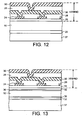
- Figure 12 shows the structure of Figure 9 onto which has been deposited a compensatory layer of polyimide 37 that has a thickness that is roughly the same as the combined thickness of layers 28 of Figure 10, assuming in this case that the thickness of the hybrid structure is dominated by the layers of polyimide 28.
- Figure 13 shows the structure of Figure 11, onto which has been glued a compensatory layer of polyimide 37, which has a thickness that is roughly the same as the combined thickness of the layers 28 and 31 of the structure of Figure 11. Again this assumes that the thickness of the hybrid structure is dominated by the layers 28 and 31.
- the anisotropic carbon plate can be inserted within a surrounding thin frame, which is preferably made of material having the same co-efficient of thermal expansion as the structure, for example, carbon fibre. In this way, a single flat surface is provided that can be coated and attached to the multi-layer circuit in the room temperature process described above.
- Hybrid devices that include, for example, multi-layer circuits and a thermal management board can be made in various ways.
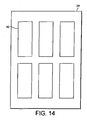
- a plurality of such devices is fabricated from one large carbon plate.
- Figure 14 shows such a plate 38 on which are six processing sites 40.
- Each processing site is coated with, for example, polyimide, onto which the multi-layer circuits can be either directly deposited or fixed using epoxy glue.
- the plate 38 is cut up to form six discrete devices.
- the uncoated sides of the carbon plate are then processed as previously described to ensure complete encapsulation of the carbon and formation of a thermal management board.
- An advantage of this particular technique is that problems associated with the edges of the carbon plate 38 are avoided.
- the thermal management board that uses thermalised pyrolytic graphite has an optimal in-plane thermal conductivity typically of 1550-1850mK at room temperature, whilst at the same time having a low mass and easy to handle structure.
- the substrates can be readily used as interfaces between other circuits.
- any geometry of the carbon can be used prior to encapsulation so that the thermal management device can be custom made for each particular application. This is advantageous because it means that the application of the process is not significantly limited.
- thermal grease is often used as an interface. It is envisaged that a thermal management device in which the invention is embodied could be used in place of the grease, it being appreciated that the device used in such an application should be relatively thin.
Landscapes
- Engineering & Computer Science (AREA)
- Microelectronics & Electronic Packaging (AREA)
- Cooling Or The Like Of Semiconductors Or Solid State Devices (AREA)
- Laminated Bodies (AREA)
- Auxiliary Devices For And Details Of Packaging Control (AREA)
- Processing And Handling Of Plastics And Other Materials For Molding In General (AREA)
- Perforating, Stamping-Out Or Severing By Means Other Than Cutting (AREA)
- Control Of Heat Treatment Processes (AREA)
- Chemical And Physical Treatments For Wood And The Like (AREA)
- Blow-Moulding Or Thermoforming Of Plastics Or The Like (AREA)
- Shaping Of Tube Ends By Bending Or Straightening (AREA)
- Control Of Temperature (AREA)
- Making Paper Articles (AREA)
- Treatments For Attaching Organic Compounds To Fibrous Goods (AREA)
- Mounting, Exchange, And Manufacturing Of Dies (AREA)
- Structures Or Materials For Encapsulating Or Coating Semiconductor Devices Or Solid State Devices (AREA)
- Encapsulation Of And Coatings For Semiconductor Or Solid State Devices (AREA)
- Compositions Of Macromolecular Compounds (AREA)
- Adhesives Or Adhesive Processes (AREA)
- Insulated Metal Substrates For Printed Circuits (AREA)
- Heating, Cooling, Or Curing Plastics Or The Like In General (AREA)
Applications Claiming Priority (7)
| Application Number | Priority Date | Filing Date | Title |
|---|---|---|---|
| GBGB9814835.6A GB9814835D0 (en) | 1998-07-08 | 1998-07-08 | A thermal management board |
| GB9814835 | 1998-07-08 | ||
| GBGB9825376.8A GB9825376D0 (en) | 1998-07-08 | 1998-11-19 | A thermal management board |
| GB9825376 | 1998-11-19 | ||
| GB9900924 | 1999-01-15 | ||
| GB9900924 | 1999-01-15 | ||
| EP99931369A EP1095545B1 (de) | 1998-07-08 | 1999-07-08 | Wärme-management-vorrichtung und verfahren zu seiner herstellung |
Related Parent Applications (2)
| Application Number | Title | Priority Date | Filing Date |
|---|---|---|---|
| EP99931369.5 Division | 1999-07-08 | ||
| EP99931369A Division EP1095545B1 (de) | 1998-07-08 | 1999-07-08 | Wärme-management-vorrichtung und verfahren zu seiner herstellung |
Publications (2)
| Publication Number | Publication Date |
|---|---|
| EP1492396A2 true EP1492396A2 (de) | 2004-12-29 |
| EP1492396A3 EP1492396A3 (de) | 2005-07-27 |
Family
ID=27269389
Family Applications (2)
| Application Number | Title | Priority Date | Filing Date |
|---|---|---|---|
| EP04017844A Withdrawn EP1492396A3 (de) | 1998-07-08 | 1999-07-08 | Wärme-Managements-Vorrichtung und Verfahren zu seiner Herstellung |
| EP99931369A Expired - Lifetime EP1095545B1 (de) | 1998-07-08 | 1999-07-08 | Wärme-management-vorrichtung und verfahren zu seiner herstellung |
Family Applications After (1)
| Application Number | Title | Priority Date | Filing Date |
|---|---|---|---|
| EP99931369A Expired - Lifetime EP1095545B1 (de) | 1998-07-08 | 1999-07-08 | Wärme-management-vorrichtung und verfahren zu seiner herstellung |
Country Status (17)
| Country | Link |
|---|---|
| US (2) | US6514616B1 (de) |
| EP (2) | EP1492396A3 (de) |
| JP (1) | JP2002520863A (de) |
| KR (1) | KR100707155B1 (de) |
| CN (1) | CN1184866C (de) |
| AT (1) | ATE277497T1 (de) |
| AU (1) | AU4790799A (de) |
| CA (1) | CA2336889C (de) |
| DE (1) | DE69920459T2 (de) |
| DK (1) | DK1095545T3 (de) |
| ES (1) | ES2229727T3 (de) |
| GB (2) | GB9814835D0 (de) |
| HK (1) | HK1040473B (de) |
| PT (1) | PT1095545E (de) |
| RU (1) | RU2214698C2 (de) |
| SI (1) | SI1095545T1 (de) |
| WO (1) | WO2000003567A1 (de) |
Cited By (3)
| Publication number | Priority date | Publication date | Assignee | Title |
|---|---|---|---|---|
| WO2004097934A3 (en) * | 2003-05-01 | 2006-01-05 | Queen Mary & Westfield College | An encased thermal management device and method of making such a device |
| US8034451B2 (en) | 2005-12-02 | 2011-10-11 | Morganite Electrical Carbon Limited | Carbon materials |
| US20230119679A1 (en) * | 2020-03-02 | 2023-04-20 | Airbus Defence And Space Sas | Space optical instrument comprising an improved thermal guard |
Families Citing this family (39)
| Publication number | Priority date | Publication date | Assignee | Title |
|---|---|---|---|---|
| GB9814835D0 (en) * | 1998-07-08 | 1998-09-09 | Europ Org For Nuclear Research | A thermal management board |
| DE60137843D1 (de) * | 2000-06-06 | 2009-04-16 | Panasonic Corp | Tragbares informationsgerät |
| US20020021997A1 (en) * | 2000-06-23 | 2002-02-21 | Akira Taomoto | Graphite sheet coated with insulating material and coating method thereof |
| US8382004B2 (en) * | 2001-04-04 | 2013-02-26 | Graftech International Holdings Inc. | Flexible graphite flooring heat spreader |
| KR100468122B1 (ko) * | 2002-07-08 | 2005-01-26 | 삼성전자주식회사 | 전자렌지 |
| WO2004097936A1 (en) * | 2003-05-01 | 2004-11-11 | Queen Mary & Westfield College | A cellular thermal management device and method of making such a device |
| US7329024B2 (en) * | 2003-09-22 | 2008-02-12 | Permlight Products, Inc. | Lighting apparatus |
| US7102172B2 (en) * | 2003-10-09 | 2006-09-05 | Permlight Products, Inc. | LED luminaire |
| GB2409341A (en) * | 2003-12-16 | 2005-06-22 | Otter Controls Ltd | Improvements relating to thermal control units |
| KR100792056B1 (ko) * | 2004-01-08 | 2008-01-04 | 히다치 가세고교 가부시끼가이샤 | 폴리우레탄이미드수지, 접착제 조성물, 및 회로접속용접착제 조성물 |
| US7918591B2 (en) | 2005-05-13 | 2011-04-05 | Permlight Products, Inc. | LED-based luminaire |
| US7797808B2 (en) * | 2005-10-11 | 2010-09-21 | General Electric Company | Thermal management system and associated method |
| US7297399B2 (en) * | 2005-10-11 | 2007-11-20 | General Electric Company | Thermal transport structure and associated method |
| US20080019097A1 (en) * | 2005-10-11 | 2008-01-24 | General Electric Company | Thermal transport structure |
| US20070251456A1 (en) * | 2006-04-27 | 2007-11-01 | Applied Materials, Inc., A Delaware Corporation | Composite heater and chill plate |
| US8148647B2 (en) * | 2006-08-23 | 2012-04-03 | Mitsubishi Electric Corporation | Printed circuit board and method of manufacturing the same |
| GB0700917D0 (en) * | 2007-01-17 | 2007-02-28 | Queen Mary & Westfield College | Structures with improved properties |
| US7808787B2 (en) * | 2007-09-07 | 2010-10-05 | Specialty Minerals (Michigan) Inc. | Heat spreader and method of making the same |
| US20090169410A1 (en) * | 2007-12-31 | 2009-07-02 | Slaton David S | Method of forming a thermo pyrolytic graphite-embedded heatsink |
| US7742307B2 (en) * | 2008-01-17 | 2010-06-22 | Raytheon Company | High performance power device |
| WO2010065035A1 (en) * | 2008-12-04 | 2010-06-10 | Hewlett-Packard Development Company, L.P. | Carbon laminated enclosure |
| US7903418B2 (en) | 2009-04-21 | 2011-03-08 | Hewlett-Packard Development Company, L.P. | Thermal mitigation device and method |
| MD249Z (ro) * | 2009-04-29 | 2011-02-28 | Институт Электронной Инженерии И Промышленных Технологий Академии Наук Молдовы | Procedeu de fabricare a răcitorului termoelectric pentru substratul circuitului integrat |
| US8477499B2 (en) | 2009-06-05 | 2013-07-02 | Laird Technologies, Inc. | Assemblies and methods for dissipating heat from handheld electronic devices |
| DE102009035850A1 (de) * | 2009-07-31 | 2011-02-03 | Vossloh-Schwabe Optoelectronic Gmbh & Co. Kg | Leiterplattenordnung mit Keramikplatte und Grafitschicht |
| GB0917098D0 (en) | 2009-09-29 | 2009-11-11 | Morganite Elect Carbon | Carbon materials |
| JP5035356B2 (ja) * | 2010-01-26 | 2012-09-26 | 株式会社デンソー | 樹脂封止型電子装置およびその製造方法 |
| RU2474004C1 (ru) * | 2011-08-16 | 2013-01-27 | Российская Федерация, от имени которой выступает Государственная корпорация по атомной энергии "Росатом" | Способ изготовления многоуровневых тонкопленочных микросхем |
| JP5619830B2 (ja) * | 2011-08-24 | 2014-11-05 | パナソニック株式会社 | 樹脂−反磁性物質複合構造体、その製造方法、およびそれを用いた半導体装置 |
| US10209016B2 (en) * | 2013-03-22 | 2019-02-19 | Toyota Motor Engineering & Manufacturing North America, Inc. | Thermal energy guiding systems including anisotropic thermal guiding coatings and methods for fabricating the same |
| US9312580B2 (en) | 2013-07-30 | 2016-04-12 | Johnson Controls Technology Company | Battery module with phase change material |
| CN107043258A (zh) * | 2014-01-26 | 2017-08-15 | 斯迪克新型材料(江苏)有限公司 | 笔记本电脑用散热片的制造方法 |
| US20180229825A1 (en) | 2014-05-01 | 2018-08-16 | Blue Robotics Inc. | Submersible electric thruster |
| CN108701880B (zh) * | 2016-03-14 | 2022-04-08 | 松下知识产权经营株式会社 | 复合片以及使用该复合片的电池组 |
| EP3479662B1 (de) * | 2016-06-29 | 2023-03-01 | At&S Austria Technologie & Systemtechnik Aktiengesellschaft | Kohlenstoffstruktur in dielektrischehülse als trägermaterial für ein kühlungselement |
| CN207939941U (zh) * | 2018-03-27 | 2018-10-02 | 京东方科技集团股份有限公司 | 用于显示面板的散热装置和显示装置 |
| CN110147127A (zh) * | 2019-05-24 | 2019-08-20 | 珠海格力智能装备有限公司 | 控制系统及方法 |
| US11497137B2 (en) * | 2020-12-18 | 2022-11-08 | Hewlett Packard Enterprise Development Lp | Method and apparatus for extended serial temperature control in a compute device |
| WO2025079195A1 (ja) * | 2023-10-12 | 2025-04-17 | 日本碍子株式会社 | 半導体製造装置用部材 |
Family Cites Families (16)
| Publication number | Priority date | Publication date | Assignee | Title |
|---|---|---|---|---|
| JPS5550646A (en) * | 1978-10-06 | 1980-04-12 | Hitachi Ltd | Integrated circuit device |
| US4318954A (en) | 1981-02-09 | 1982-03-09 | Boeing Aerospace Company | Printed wiring board substrates for ceramic chip carriers |
| FR2546878B1 (fr) | 1983-05-31 | 1988-04-08 | Slonina Jean Pierre | Plaque support d'un substrat ceramique, leger, a forte conductivite thermique et coefficient de dilatation adapte pour toutes applications dans le domaine electronique |
| US4591659A (en) | 1983-12-22 | 1986-05-27 | Trw Inc. | Multilayer printed circuit board structure |
| US4916016A (en) | 1986-01-23 | 1990-04-10 | Ici Americas Inc. | Metal or plastic-clad polyvinyl resin laminates |
| US4849858A (en) | 1986-10-20 | 1989-07-18 | Westinghouse Electric Corp. | Composite heat transfer means |
| US4791248A (en) | 1987-01-22 | 1988-12-13 | The Boeing Company | Printed wire circuit board and its method of manufacture |
| US5296310A (en) | 1992-02-14 | 1994-03-22 | Materials Science Corporation | High conductivity hydrid material for thermal management |
| CH687490A5 (de) | 1992-03-25 | 1996-12-13 | Dyconex Ag | Leiterplattenverstaerkung. |
| US5309321A (en) | 1992-09-22 | 1994-05-03 | Microelectronics And Computer Technology Corporation | Thermally conductive screen mesh for encapsulated integrated circuit packages |
| CA2124158C (en) * | 1993-06-14 | 2005-09-13 | Daniel H. Hecht | High modulus carbon and graphite articles and method for their preparation |
| EP0661916B1 (de) * | 1993-07-06 | 2000-05-17 | Kabushiki Kaisha Toshiba | Wärmeleitende platte |
| WO1996037915A1 (en) | 1995-05-26 | 1996-11-28 | Sheldahl, Inc. | Adherent film with low thermal impedance and high electrical impedance used in an electronic assembly with a heat sink |
| WO1998040431A1 (en) * | 1997-03-11 | 1998-09-17 | Amoco Corporation | Thermally conductive film and method for the preparation thereof |
| GB9814835D0 (en) * | 1998-07-08 | 1998-09-09 | Europ Org For Nuclear Research | A thermal management board |
| US6075701A (en) | 1999-05-14 | 2000-06-13 | Hughes Electronics Corporation | Electronic structure having an embedded pyrolytic graphite heat sink material |
-
1998
- 1998-07-08 GB GBGB9814835.6A patent/GB9814835D0/en not_active Ceased
- 1998-11-19 GB GBGB9825376.8A patent/GB9825376D0/en not_active Ceased
-
1999
- 1999-07-08 US US09/719,478 patent/US6514616B1/en not_active Expired - Fee Related
- 1999-07-08 CN CNB998094374A patent/CN1184866C/zh not_active Expired - Fee Related
- 1999-07-08 DK DK99931369T patent/DK1095545T3/da active
- 1999-07-08 RU RU2001103633/09A patent/RU2214698C2/ru not_active IP Right Cessation
- 1999-07-08 EP EP04017844A patent/EP1492396A3/de not_active Withdrawn
- 1999-07-08 HK HK02101746.3A patent/HK1040473B/zh not_active IP Right Cessation
- 1999-07-08 WO PCT/GB1999/002180 patent/WO2000003567A1/en not_active Ceased
- 1999-07-08 EP EP99931369A patent/EP1095545B1/de not_active Expired - Lifetime
- 1999-07-08 KR KR1020017000252A patent/KR100707155B1/ko not_active Expired - Fee Related
- 1999-07-08 PT PT99931369T patent/PT1095545E/pt unknown
- 1999-07-08 DE DE69920459T patent/DE69920459T2/de not_active Expired - Fee Related
- 1999-07-08 AT AT99931369T patent/ATE277497T1/de not_active IP Right Cessation
- 1999-07-08 JP JP2000559715A patent/JP2002520863A/ja active Pending
- 1999-07-08 CA CA002336889A patent/CA2336889C/en not_active Expired - Fee Related
- 1999-07-08 SI SI9930712T patent/SI1095545T1/xx unknown
- 1999-07-08 ES ES99931369T patent/ES2229727T3/es not_active Expired - Lifetime
- 1999-07-08 AU AU47907/99A patent/AU4790799A/en not_active Abandoned
-
2003
- 2003-01-02 US US10/336,338 patent/US6689471B2/en not_active Expired - Fee Related
Cited By (4)
| Publication number | Priority date | Publication date | Assignee | Title |
|---|---|---|---|---|
| WO2004097934A3 (en) * | 2003-05-01 | 2006-01-05 | Queen Mary & Westfield College | An encased thermal management device and method of making such a device |
| US8034451B2 (en) | 2005-12-02 | 2011-10-11 | Morganite Electrical Carbon Limited | Carbon materials |
| US20230119679A1 (en) * | 2020-03-02 | 2023-04-20 | Airbus Defence And Space Sas | Space optical instrument comprising an improved thermal guard |
| US11874432B2 (en) * | 2020-03-02 | 2024-01-16 | Airbus Defence And Space Sas | Space optical instrument comprising an improved thermal guard |
Also Published As
| Publication number | Publication date |
|---|---|
| CA2336889A1 (en) | 2000-01-20 |
| HK1040473A1 (en) | 2002-06-07 |
| CN1313023A (zh) | 2001-09-12 |
| SI1095545T1 (en) | 2005-02-28 |
| HK1040473B (zh) | 2005-05-27 |
| CN1184866C (zh) | 2005-01-12 |
| ATE277497T1 (de) | 2004-10-15 |
| CA2336889C (en) | 2008-09-30 |
| KR100707155B1 (ko) | 2007-04-16 |
| PT1095545E (pt) | 2005-01-31 |
| GB9825376D0 (en) | 1999-01-13 |
| JP2002520863A (ja) | 2002-07-09 |
| KR20010079508A (ko) | 2001-08-22 |
| AU4790799A (en) | 2000-02-01 |
| RU2214698C2 (ru) | 2003-10-20 |
| WO2000003567A1 (en) | 2000-01-20 |
| DK1095545T3 (da) | 2005-01-24 |
| US6514616B1 (en) | 2003-02-04 |
| US20030099836A1 (en) | 2003-05-29 |
| DE69920459T2 (de) | 2005-10-13 |
| EP1492396A3 (de) | 2005-07-27 |
| GB9814835D0 (en) | 1998-09-09 |
| EP1095545A1 (de) | 2001-05-02 |
| EP1095545B1 (de) | 2004-09-22 |
| US6689471B2 (en) | 2004-02-10 |
| ES2229727T3 (es) | 2005-04-16 |
| DE69920459D1 (de) | 2004-10-28 |
Similar Documents
| Publication | Publication Date | Title |
|---|---|---|
| EP1095545B1 (de) | Wärme-management-vorrichtung und verfahren zu seiner herstellung | |
| US7057896B2 (en) | Power module and production method thereof | |
| JP3312723B2 (ja) | 熱伝導シート状物とその製造方法及びそれを用いた熱伝導基板とその製造方法 | |
| CN1158006A (zh) | 具有降低应力成模衬底部分的挠性层的高密度互连电路模件 | |
| US20030042046A1 (en) | Laminate circuit structure and method of fabricating | |
| US7014731B2 (en) | Semiconductor device having a thermoset-containing dielectric material and methods for fabricating the same | |
| US5679444A (en) | Method for producing multi-layer circuit board and resulting article of manufacture | |
| JP2001203313A (ja) | 熱伝導基板およびその製造方法 | |
| JP3850956B2 (ja) | 放熱性炭素複合板 | |
| HK1073565A (en) | A thermal management device and method of making such a device | |
| CN101069283A (zh) | 封装的热能管理装置以及制造这种装置的方法 | |
| RU2256307C2 (ru) | Устройство отвода тепла (варианты), электрическая система, содержащая устройство отвода тепла (варианты), способ изготовления устройства отвода тепла (варианты) и способ изготовления электрического компонента (варианты) | |
| EP2914071A1 (de) | Wärmeverteiler in mehrschichtigen Wärmeaufbauten | |
| EP0784539A1 (de) | Thermische kontrolle für mit additiven bedruckte schaltungen | |
| JPH08236886A (ja) | 金属ベース銅張積層板 | |
| JP3614844B2 (ja) | 熱伝導基板 | |
| JPH07297509A (ja) | 金属ベース基板、およびその製造方法 | |
| JP3505170B2 (ja) | 熱伝導基板及びその製造方法 | |
| JPH0655477B2 (ja) | セラミツクコ−ト積層板の製造方法 | |
| JPH11268185A (ja) | 積層板成形用プレート及び積層板 | |
| JPH04252091A (ja) | プリント配線板およびその製法 | |
| JPH03297159A (ja) | 半導体装置 | |
| JPH11312750A (ja) | 熱伝導基板の製造方法およびその製造治具 | |
| JPH0332100A (ja) | 多層プリント配線板 | |
| JPH10242637A (ja) | 多層プリント配線板の製造方法及び多層プリント配線板 |
Legal Events
| Date | Code | Title | Description |
|---|---|---|---|
| PUAI | Public reference made under article 153(3) epc to a published international application that has entered the european phase |
Free format text: ORIGINAL CODE: 0009012 |
|
| AC | Divisional application: reference to earlier application |
Ref document number: 1095545 Country of ref document: EP Kind code of ref document: P |
|
| AK | Designated contracting states |
Kind code of ref document: A2 Designated state(s): AT BE CH CY DE DK ES FI FR GB GR IE IT LI LU MC NL PT SE |
|
| AX | Request for extension of the european patent |
Extension state: AL LT LV MK SI |
|
| RIN1 | Information on inventor provided before grant (corrected) |
Inventor name: DE OLIVEIRA, RUI Inventor name: GANDI, ANGELO Inventor name: CARTER, ANTHONY ARTHUR |
|
| PUAL | Search report despatched |
Free format text: ORIGINAL CODE: 0009013 |
|
| AK | Designated contracting states |
Kind code of ref document: A3 Designated state(s): AT BE CH CY DE DK ES FI FR GB GR IE IT LI LU MC NL PT SE |
|
| AX | Request for extension of the european patent |
Extension state: AL LT LV MK SI |
|
| REG | Reference to a national code |
Ref country code: HK Ref legal event code: DE Ref document number: 1073565 Country of ref document: HK |
|
| AKX | Designation fees paid |
Designated state(s): AT BE CH CY DE DK ES FI FR GB GR IE IT LI LU MC NL PT SE |
|
| AXX | Extension fees paid |
Extension state: SI Payment date: 20040803 |
|
| STAA | Information on the status of an ep patent application or granted ep patent |
Free format text: STATUS: THE APPLICATION IS DEEMED TO BE WITHDRAWN |
|
| 18D | Application deemed to be withdrawn |
Effective date: 20060128 |
|
| REG | Reference to a national code |
Ref country code: HK Ref legal event code: WD Ref document number: 1073565 Country of ref document: HK |