EP1518937A1 - Methode zur Anreicherung von Nukleinsäuremolekülen - Google Patents
Methode zur Anreicherung von Nukleinsäuremolekülen Download PDFInfo
- Publication number
- EP1518937A1 EP1518937A1 EP04078078A EP04078078A EP1518937A1 EP 1518937 A1 EP1518937 A1 EP 1518937A1 EP 04078078 A EP04078078 A EP 04078078A EP 04078078 A EP04078078 A EP 04078078A EP 1518937 A1 EP1518937 A1 EP 1518937A1
- Authority
- EP
- European Patent Office
- Prior art keywords
- nucleic acid
- microcapsules
- genetic elements
- gene product
- emulsion
- Prior art date
- Legal status (The legal status is an assumption and is not a legal conclusion. Google has not performed a legal analysis and makes no representation as to the accuracy of the status listed.)
- Granted
Links
Images


Classifications
-
- C—CHEMISTRY; METALLURGY
- C12—BIOCHEMISTRY; BEER; SPIRITS; WINE; VINEGAR; MICROBIOLOGY; ENZYMOLOGY; MUTATION OR GENETIC ENGINEERING
- C12N—MICROORGANISMS OR ENZYMES; COMPOSITIONS THEREOF; PROPAGATING, PRESERVING, OR MAINTAINING MICROORGANISMS; MUTATION OR GENETIC ENGINEERING; CULTURE MEDIA
- C12N15/00—Mutation or genetic engineering; DNA or RNA concerning genetic engineering, vectors, e.g. plasmids, or their isolation, preparation or purification; Use of hosts therefor
- C12N15/09—Recombinant DNA-technology
- C12N15/10—Processes for the isolation, preparation or purification of DNA or RNA
- C12N15/1034—Isolating an individual clone by screening libraries
- C12N15/1075—Isolating an individual clone by screening libraries by coupling phenotype to genotype, not provided for in other groups of this subclass
-
- A—HUMAN NECESSITIES
- A61—MEDICAL OR VETERINARY SCIENCE; HYGIENE
- A61K—PREPARATIONS FOR MEDICAL, DENTAL OR TOILETRY PURPOSES
- A61K47/00—Medicinal preparations characterised by the non-active ingredients used, e.g. carriers or inert additives; Targeting or modifying agents chemically bound to the active ingredient
- A61K47/06—Organic compounds, e.g. natural or synthetic hydrocarbons, polyolefins, mineral oil, petrolatum or ozokerite
- A61K47/24—Organic compounds, e.g. natural or synthetic hydrocarbons, polyolefins, mineral oil, petrolatum or ozokerite containing atoms other than carbon, hydrogen, oxygen, halogen, nitrogen or sulfur, e.g. cyclomethicone or phospholipids
-
- A—HUMAN NECESSITIES
- A61—MEDICAL OR VETERINARY SCIENCE; HYGIENE
- A61K—PREPARATIONS FOR MEDICAL, DENTAL OR TOILETRY PURPOSES
- A61K47/00—Medicinal preparations characterised by the non-active ingredients used, e.g. carriers or inert additives; Targeting or modifying agents chemically bound to the active ingredient
- A61K47/06—Organic compounds, e.g. natural or synthetic hydrocarbons, polyolefins, mineral oil, petrolatum or ozokerite
- A61K47/26—Carbohydrates, e.g. sugar alcohols, amino sugars, nucleic acids, mono-, di- or oligo-saccharides; Derivatives thereof, e.g. polysorbates, sorbitan fatty acid esters or glycyrrhizin
-
- A—HUMAN NECESSITIES
- A61—MEDICAL OR VETERINARY SCIENCE; HYGIENE
- A61K—PREPARATIONS FOR MEDICAL, DENTAL OR TOILETRY PURPOSES
- A61K47/00—Medicinal preparations characterised by the non-active ingredients used, e.g. carriers or inert additives; Targeting or modifying agents chemically bound to the active ingredient
- A61K47/44—Oils, fats or waxes according to two or more groups of A61K47/02-A61K47/42; Natural or modified natural oils, fats or waxes, e.g. castor oil, polyethoxylated castor oil, montan wax, lignite, shellac, rosin, beeswax or lanolin
-
- A—HUMAN NECESSITIES
- A61—MEDICAL OR VETERINARY SCIENCE; HYGIENE
- A61K—PREPARATIONS FOR MEDICAL, DENTAL OR TOILETRY PURPOSES
- A61K9/00—Medicinal preparations characterised by special physical form
- A61K9/10—Dispersions; Emulsions
- A61K9/107—Emulsions ; Emulsion preconcentrates; Micelles
-
- A—HUMAN NECESSITIES
- A61—MEDICAL OR VETERINARY SCIENCE; HYGIENE
- A61K—PREPARATIONS FOR MEDICAL, DENTAL OR TOILETRY PURPOSES
- A61K9/00—Medicinal preparations characterised by special physical form
- A61K9/14—Particulate form, e.g. powders, Processes for size reducing of pure drugs or the resulting products, Pure drug nanoparticles
- A61K9/16—Agglomerates; Granulates; Microbeadlets ; Microspheres; Pellets; Solid products obtained by spray drying, spray freeze drying, spray congealing,(multiple) emulsion solvent evaporation or extraction
- A61K9/167—Agglomerates; Granulates; Microbeadlets ; Microspheres; Pellets; Solid products obtained by spray drying, spray freeze drying, spray congealing,(multiple) emulsion solvent evaporation or extraction with an outer layer or coating comprising drug; with chemically bound drugs or non-active substances on their surface
- A61K9/1676—Agglomerates; Granulates; Microbeadlets ; Microspheres; Pellets; Solid products obtained by spray drying, spray freeze drying, spray congealing,(multiple) emulsion solvent evaporation or extraction with an outer layer or coating comprising drug; with chemically bound drugs or non-active substances on their surface having a drug-free core with discrete complete coating layer containing drug
-
- C—CHEMISTRY; METALLURGY
- C12—BIOCHEMISTRY; BEER; SPIRITS; WINE; VINEGAR; MICROBIOLOGY; ENZYMOLOGY; MUTATION OR GENETIC ENGINEERING
- C12Q—MEASURING OR TESTING PROCESSES INVOLVING ENZYMES, NUCLEIC ACIDS OR MICROORGANISMS; COMPOSITIONS OR TEST PAPERS THEREFOR; PROCESSES OF PREPARING SUCH COMPOSITIONS; CONDITION-RESPONSIVE CONTROL IN MICROBIOLOGICAL OR ENZYMOLOGICAL PROCESSES
- C12Q1/00—Measuring or testing processes involving enzymes, nucleic acids or microorganisms; Compositions therefor; Processes of preparing such compositions
- C12Q1/68—Measuring or testing processes involving enzymes, nucleic acids or microorganisms; Compositions therefor; Processes of preparing such compositions involving nucleic acids
- C12Q1/6844—Nucleic acid amplification reactions
Definitions
- the present invention relates, inter alia, to emulsions suitable for compartmentalisation of transcription/translation reactions and methods using such emulsions.
- the emulsions are useful for compartmentalisation of in vitro eukaryotic transcription/translation reactions.
- Compartmentalisation methods based on water-in-oil emulsions have recently been developed for use in repertoire selection methods (Tawfik & Griffiths 1998, Ghadessy et al 2001). Compartmentalisation segregates individual genes and their encoded products (delivered either via cells (Ghadessy et al , 2001) or expressed in situ (Tawfik & Griffiths, 1998)) into discrete, physically separate aqueous compartments, thus ensuring the linkage of genotype and phenotype during the selection process.
- WO99/02671 (which is incorporated herein by reference) describes a method for isolating one or more genetic elements encoding a gene product having a desired activity.
- Genetic elements are first compartmentalised into microcapsules, which are preferably formed by emulsification, and are then transcribed and/or translated to produce their respective gene products (RNA or protein) within the microcapsules.
- the genetic elements may be contained within microcapsules of the emulsion and transcription and/or translation (expression) of the gene product can take place within using the cellular machinery, Genetic elements that produce a gene product having a desired activity can be subsequently sorted. For example, in some cases sorting may be due to the desired activity inducing a change in the microcapsule. In other cases sorting may be due to the desired activity inducing a change in the genetic element.
- WO99/02671 works well with bacteria.
- eukaryotic cells e.g. yeast, insect or mammalian cells
- an emulsion comprising a surfactant, a hydrophobic phase and a hydrophilic phase comprising a plurality of microcapsules containing a functional in vitro eukaryotic expression system, wherein the surfactant is a chemically inert silicone-based surfactant.
- the present inventors have encountered repeated problems in maintaining efficient transcriptional/translational ability of an eukaryotic system, in particular the rabbit reticulocyte lysate system, when in emulsion.
- an eukaryotic system in particular the rabbit reticulocyte lysate system
- a number of modifications to emulsion compositions used with prokaryotic expression systems were unsuccessful in conferring such ability.
- chemically inert silicone-based surfactants were employed in the emulsion composition, the efficiency of transcription of the eukaryotic transcription/translation system was markedly improved.
- the emulsion allows the linkage of genotype and phenotype due to compartmentalisation of the eukaryotic expression system, whilst avoiding many of the disadvantages of cell-based systems. Thus, for example, it allows gene products to be obtained without the need for extraction or secretion from cells.
- a method of isolating one or more genetic elements encoding a gene product having a desired activity comprising the steps of:
- the invention provides a method for preparing a gene product, comprising the steps of
- step (a) preferably comprises preparing a repertoire of genetic elements, wherein each genetic element encodes a potentially differing gene product.
- Repertoires may be generated by conventional techniques, such as those employed for the generation of libraries intended for selection by methods such as phage display. Gene products having the desired activity may be selected from the repertoire, according to the present invention.
- a fourth aspect of the invention provides a product selected using the method of the second aspect of the invention or prepared according to the third aspect of the invention.
- a product may refer to a gene product selected or prepared according to these aspects, or the genetic element (or genetic information comprised therein).
- the invention provides a method for screening a compound or compounds capable of modulating the activity of a gene product, comprising the steps of:
- a surfactant is considered to be "chemically inert” if it is substantially free of oxidating species, such as peroxides and aldehydes, and protein denaturing species.
- oxidating species such as peroxides and aldehydes
- Isolation refers to the process of separating an entity from a heterogeneous population, for example a mixture, such that it is free of at least one substance with which it was associated before the isolation process.
- isolation refers to purification of an entity essentially to homogeneity.
- Sorting of an entity refers to the process of preferentially isolating desired entities over undesired entities. In as far as this relates to isolation of the desired entities, the terms "isolating" and “sorting” are equivalent.
- the method of the present invention permits the sorting of desired genetic elements from pools (libraries or repertoires) of genetic elements which contain the desired genetic element. Selecting is used to refer to the process (including the sorting process) of isolating an entity according to a particular property thereof.
- the sorting of genetic elements may be performed in one of essentially four techniques, details of which are given in WO99/02671.
- the "secondary encapsulation" may also be performed with genetic elements linked to gene products by other means, such as by phage display, polysome display, RNA-peptide fusion or lac repressor peptide fusion.
- the selected genetic element(s) may also be subjected to subsequent, possibly more stringent rounds of sorting in iteratively repeated steps, reapplying the method of the invention either in its entirety or in selected steps only.
- genetic elements encoding gene products having a better optimised activity may be isolated after each round of selection.
- the genetic elements isolated after a first round of sorting may be subjected to mutagenesis before repeating the sorting by iterative repetition of the steps of the method of the invention as set out above. After each round of mutagenesis, some genetic elements will have been modified in such a way that the activity of the gene products is enhanced.
- the selected genetic elements can be cloned into an expression vector to allow further characterisation of the genetic elements and their products.
- suitable vectors are known to the person skilled in the art.
- the vectors may be , for example, virus, plasmid or phage vectors provided with an origin of replication, optionally a promoter for the expression of the genetic element and optionally a regulator of the promoter.
- the vectors may contain a selectable marker gene, for example the neomycin resistance gene for a mammalian vector.
- Emulsions are heterogeneous systems of two immiscible liquid phases with one of the phases dispersed in the other as droplets of microscopic or colloidal size (Becher, 1957; Sherman, 1968; Lissant, 1984). Emulsions of the invention must enable the formation of microcapsules.
- Emulsions may be produced from any suitable combination of immiscible liquids.
- the emulsion of the present invention has a hydrophilic phase (containing the biochemical components) as the phase present in the form of finely divided droplets (the disperse, internal or discontinuous phase) and a hydrophobic, immiscible liquid (an 'oil') as the matrix in which these droplets are suspended (the nondisperse, continuous or external phase).
- Such emulsions are termed 'water-in-oil' (W/O). This has the advantage that the entire aqueous phase containing the biochemical components is compartmentalised in discreet droplets (the internal phase).
- the external phase being a hydrophobic oil, generally contains none of the biochemical components and hence is inert.
- stirrers such as magnetic stir-bars, propeller and turbine stirrers, paddle devices and whisks
- homogenisers including rotor-stator homogenisers, high-pressure valve homogenisers and jet homogenisers
- colloid mills ultrasound and 'membrane emulsification' devices
- the emulsion is stable during incubation at 30°C for at least one hour. In some cases it is preferred that it also be stable at higher temperatures, especially if thermal cycling is used during PCR or other amplification procedures.
- Emulsions of the invention are stabilised by addition of one or more surface-active agents (surfactants). These surfactants are termed emulsifying agents and act at the water/oil interface to prevent (or at least delay) separation of the phases. Many oils and many emulsifiers can be used for the generation of water-in-oil emulsions; a recent compilation listed over 16,000 surfactants, many of which are used as emulsifying agents (Ash and Ash, 1993).
- surfactants surface-active agents
- surfactants conventionally used in emulsions applications such as non-ionic surfactants (Schick, 1966), for example, sorbitan monooleate (SpanTM 80; ICI) and polyoxyethylenesorbitan monooleate (TweenTM 80; ICI) are not suitable for efficient in vitro eukaryotic expression with the rabbit reticulocyte lysate
- the chemically inert silicone-based surfactant of the emulsion is a silicone copolymer.
- the surfactant comprises a polysiloxane-polycetyl-polyethylene glycol copolymer (Cetyl Dimethicone Copolyol) e.g. Abil.® EM90 (Goldschmidt).
- a polysiloxane-polycetyl-polyethylene glycol copolymer e.g. Abil.® EM90 (Goldschmidt).
- the chemically inert silicone-based surfactant may be provided as the sole surfactant in the emulsion composition or may be provided as one of several surfactants. For example a mixture of different surfactants may be used.
- the surfactant is provided at a v/v concentration in the oil phase of the emulsion of 0.5 to 20%, preferably 1 to 10%, more preferably 3-5%.
- the surfactant is provided at a v/v concentration in the oil phase of 4%.
- the emulsion is made by adding an aqueous phase dropwise to an oil phase in the presence of a surfactant comprising about 3-5% (v/v) polysiloxane-polycetyl-polyethylene glycol copolymer in mineral oil, preferably at a ratio of oil:water phase of 2.5:1.
- a surfactant comprising about 3-5% (v/v) polysiloxane-polycetyl-polyethylene glycol copolymer in mineral oil, preferably at a ratio of oil:water phase of 2.5:1.
- the surfactant may be present initially with the hydrophobic composition.
- a composition comprising the surfactant and the hydrophobic composition therefore represents a further aspect of the present invention.
- the surfactant may be added at a later stage, e.g. during or following the mixing of the hydrophobic and hydrophilic phases.
- the surfactant may be provided in a kit, together with a hydrophobic composition.
- the kit may optionally also include a eukaryotic expression system such as rabbit reticulocyte lysate and/or a device for mixing the hydrophobic and hydrophilic phases. It may further include instructions for use in providing an emulsion of the present invention
- the surfactant may be present initially with the hydrophilic composition.
- microcapsule is synonymous with “compartment” and the terms are used interchangeably.
- a microcapsule is an artificial compartment whose delimiting borders restrict the exchange of the components of the molecular mechanisms described herein which allow the sorting of genetic elements according to the function of the gene products which they encode.
- microcapsules formed by the emulsion require appropriate physical properties to allow the working of the invention.
- the contents of each microcapsule must be isolated from the contents of surrounding microcapsules.
- the microcapsules used in the methods of the present invention will be capable of being produced in very large numbers, and thereby to compartmentalise a library of genetic elements which encodes a repertoire of gene products.
- the function of the microcapsule is to enable co-localisation of the nucleic acid and the corresponding polypeptide encoded by the nucleic acid. This is preferably achieved by the ability of the microcapsule to substantially restrict diffusion of template and product strands to other microcapsules.
- the methods of the present invention require that there are only a limited number of genetic elements per microcapsule formed in the emulsion. This ensures that the gene product of an individual genetic element will be isolated from other genetic elements. Thus, coupling between genetic element and gene product will be highly specific. The enrichment factor is greatest with on average one or fewer genetic elements per microcapsule, or two or more copies of a single genetic element per microcapsule, the linkage between nucleic acid and the activity of the encoded gene product being as tight as is possible, since the gene product of an individual genetic element will be isolated from the products of all other genetic elements.
- a ratio of 5, 10, 50, 100 or 1000 or more genetic elements per microcapsule may prove beneficial in sorting a large library.
- Subsequent rounds of sorting, including renewed encapsulation with differing genetic element distribution, will permit more stringent sorting of the genetic elements.
- the formation and the composition of the microcapsules must not abolish the function of the machinery for the expression of the genetic elements and the activity of the gene products using eukaryotic in vitro expression systems.
- microcapsules formed by the emulsion must fulfil these three requirements.
- the appropriate emulsion may vary depending on the precise nature of the requirements in each application of the invention, as will be apparent to the skilled person.
- the preferred microcapsule size will vary depending upon the precise requirements of any individual selection process that is to be performed according to the present invention. In all cases, the principle consideration is the need for required concentration of components in the individual compartments to achieve efficient transcription/translation. This may be balanced with other requirements which may relate to gene library size, enrichment, or sorting procedures.
- small microcapsules are provided, a very large number of discrete microcapsules can be provided within a small volume of emulsion. Furthermore the provision of small microcapsules increases selectivity by increasing the likelihood that only one type of gene product will be produced within a given microcapsule. It is therefore preferred that on average no more than one genetic elements that is to be transcribed and/or translated is present per compartment in order to keep the linkage between nucleic acid and the activity of encoded gene product as tight as is possible. However, even if the theoretically optimal situation of, on average, a single genetic element or less per microcapsule is not used, a ratio of 5, 10, 50, 100 or 1000 or more genetic elements per microcapsule may prove beneficial in sorting a large library. Subsequent rounds of sorting, including renewed encapsulation with differing genetic element distribution, will permit more stringent sorting of the genetic elements. Preferably, there is on average no more than a single genetic element per microcapsule.
- the mean volume of the microcapsules is less that 5.2 x 10 -16 m 3 , (corresponding to a spherical microcapsule of diameter less than 10 ⁇ m), more desirably less than 6.5 x 10 -17 m 3 (corresponding to a spherical microcapsule of diameter less than 5 ⁇ m), still more desirably about 4.2 x 10 -18 m 3 (corresponding to a spherical microcapsule of diameter of approximately 2 ⁇ m).
- the effective DNA or RNA concentration in microcapsules may be artificially increased by various methods that will be well-known to those versed in the art. These include, for example, the addition of volume excluding chemicals such as polyethylene glycols (PEG) and a variety of gene amplification techniques, including transcription using RNA polymerases including those from bacteria such as E. coli (Roberts, 1969; Blattner and Dahlberg, 1972; Roberts et al., 1975; Rosenberg et al., 1975, eukaryotes e.g.
- PEG polyethylene glycols
- microcapsules Increasing the effective local nucleic acid concentration enables microcapsules to be used more effectively.
- microcapsules having volumes of up to only about 5.2 x 10 -16 m 3 can be used for many purposes, although of course microcapsules with larger volumes can be used, if desired.
- microcapsule size must be sufficiently large to accommodate all of the required components of the biochemical reactions that are needed to occur within the microcapsule. For example, in vitro, both transcription reactions and coupled transcription-translation reactions often require a total nucleoside triphosphate concentration of about 2mM.
- the eukaryotic ribosomes necessary for the translation to occur are themselves approximately 30nm in diameter.
- the preferred lower limit for microcapsules is a diameter of approximately 0.1 ⁇ m (100nm).
- the microcapsule volume is preferably of the order of between 5.2 x 10 -22 m 3 and 5.2 x 10 -16 m 3 corresponding to a sphere of diameter between 0.1 ⁇ m and 10 ⁇ m, more preferably of between about 5.2 x 10 -19 m 3 and 6.5 x 10 -17 m 3 (1 ⁇ m and 5 ⁇ m).
- microcapsules are preferred for certain applications, such as the methods disclosed in WO99/02671, it is important to note that the present invention is in no way limited to the provision of small microcapsules and that transcription and translation systems also function in large microcapsules.
- the size of emulsion microcapsules may be varied simply by tailoring the emulsification conditions used to form the emulsion according to requirements of the selection system.
- Compartment size may be varied (within limits of emulsion stability and inactivation of RRL) by 1) increased mixing time, 2) different W/O ratios, 3) different concentrations of surfactant.
- the size distribution of microcapsules in emulsions can be determined by any method known to skilled person.
- the size distribution may be assessed using laser diffraction (e.g. using a Coulter LS230 Particle Size Analyser) or by microscopic examination.
- “Expression”, as used herein, is used in its broadest meaning, to signify that a nucleic acid contained in the genetic element is converted into its gene product.
- expression refers to the transcription of the DNA into RNA; where this RNA codes for protein, "expression” may also refer to the translation of the RNA into protein.
- expression may refer to the replication of this RNA into further RNA copies, the reverse transcription of the RNA into DNA and optionally the transcription of this DNA into further RNA molecule(s), as well as optionally the translation of any of the RNA species produced into protein.
- "expression” is performed by one or more processes selected from the group consisting of transcription, reverse transcription, replication and translation.
- “Expression” of the genetic element may thus be directed into either DNA, RNA or protein, or a nucleic acid or protein containing unnatural bases or amino acids (the gene product) within the microcapsule of the invention, so that the gene product is confined within the same microcapsule as the genetic element.
- Any appropriate in vitro eukaryotic expression system can be used in the emulsion of the invention provided that it includes components needed for transcription and/or translation. If glycosylation is desired then one or more glycosylases can also be present, as appropriate, in order to achieve a desired glycosylation pattern.
- the expression system may, for example, comprise all or part of a cell lysate or extract.
- a cell lysate or extract for example wheat germ extract may be used (Anderson et al., 1983) and is available commercially from Promega.
- the cell lysate is a mammalian cell lysate. It may be a reticulocyte lysate.
- a preferred reticulocyte lysate is a rabbit reticulocyte lysate (an "RRL").
- the RRL system is well characterised (see e.g. Pelham and Jackson, 1976) and is available commercially from Promega.
- RNA e.g. ribosomes, tRNAs, aminoacyl-tRNA synthetases, initiation, elongation and termination factors etc
- the extracts preferably supplemented with amino acids, ATP, GTP , creatine phosphate and creatine phosphokinase, other co-factors such as Mg 2+ .
- emulsions of the present invention it is possible to obtain appreciable expression of a genetic element and/or activity of a gene product using an in vitro eukaryotic expression system present within an emulsion.
- Expression and/or activity is desirably at a level of at least 1% of that of the gene product achievable with the expression system prior to formation of the emulsion. More preferably it is at least 10%, 20% or 30% of said level and/or activity.
- a “genetic element” is a molecule or molecular construct comprising a nucleic acid.
- the genetic elements of the present invention may comprise any nucleic acid (for example, DNA, RNA or any analogue, natural or artificial, thereof).
- nucleic acids encoding any appropriate gene product can be used in the in vitro transcription and/or translation systems.
- the nucleic acids may, for example, comprise promoters, operators, enhancers, translational and transcriptional initiation and termination sequences, polyadenylation sequences, splice sites, upstream and downstream regulatory regions, etc., as required for transcription and/or translation.
- promoters operators, enhancers, translational and transcriptional initiation and termination sequences, polyadenylation sequences, splice sites, upstream and downstream regulatory regions, etc.
- inducible and/or temperature sensitive promoters in order to ensure expression occurs only at a particular stage.
- the nucleic acid component of the genetic element may moreover be linked, covalently or non-covalently, to one or more molecules or structures, including polypeptides, peptides, chemical entities and groups, solid-phase supports such as magnetic beads, and the like.
- these structures or molecules can be designed to assist in the sorting and/or isolation of the genetic element encoding a gene product with the desired activity.
- the polypeptide or other molecular group or construct is a ligand or a substrate which directly or indirectly binds to or reacts with the gene product in order to tag the genetic element. This allows the sorting of the genetic element on the basis of the activity of the gene product.
- the ligand or substrate can be connected to the nucleic acid by a variety of means that will be apparent to those skilled in the art (see, for example, Hermanson, 1996). Any tag will suffice that allows for the subsequent selection of the genetic element. Sorting can be by any method which allows the preferential separation, amplification or survival of the tagged genetic element. Examples include selection by binding (including techniques based on magnetic separation, for example using DynabeadsTM), and by resistance to degradation (for example by nucleases, including restriction endonucleases).
- nucleic acid molecule may be linked to a ligand or substrate is through biotinylation. This can be done by PCR amplification with a 5'-biotinylation primer such that the biotin and nucleic acid are covalently linked.
- a biotinylated nucleic acid may be coupled to a polystyrene microbead (0.035 to 0.2 ⁇ m in diameter) that is coated with avidin or streptavidin, that will therefore bind the nucleic acid with very high affinity.
- This bead can be derivatised with substrate or ligand by any suitable method such as by adding biotinylated substrate or by covalent coupling.
- a biotinylated nucleic acid may be coupled to avidin or streptavidin complexed to a large protein molecule such as thyroglobulin (669 Kd) or ferritin (440 Kd).
- This complex can be derivatised with substrate or ligand, for example by covalent coupling to the ⁇ -amino group of lysines or through a non-covalent interaction such as biotin-avidin.
- the substrate may be present in a form unlinked to the genetic element but containing an inactive "tag” that requires a further step to activate it such as photoactivation (e.g. of a "caged" biotin analogue, (Sundberg et al., 1995; Pirrung and Huang, 1996)).
- the catalyst to be selected then converts the substrate to product.
- the "tag” could then be activated and the "tagged” substrate and/or product bound by a tag-binding molecule (e.g. avidin or streptavidin) complexed with the nucleic acid.
- a tag-binding molecule e.g. avidin or streptavidin
- an alternative is to couple the nucleic acid to a product-specific antibody (or other product-specific molecule).
- the substrate or one of the substrates
- the substrate is present in each microcapsule unlinked to the genetic element, but has a molecular "tag” (for example biotin, DIG or DNP).
- a catalyst to be selected converts the substrate to product
- the product retains the "tag” and is then captured in the microcapsule by the product-specific antibody.
- the genetic element only becomes associated with the "tag” when it encodes or produces an enzyme capable of converting substrate to product.
- the genetic elements encoding active enzymes can be enriched using an antibody or other molecule which binds, or reacts specifically with the "tag". Although both substrates and product have the molecular tag, only the genetic elements encoding active gene product will co-purify.
- the methods of the present invention are useful for sorting libraries of genetic elements.
- the invention accordingly provides a method according to preceding aspects of the invention, wherein the genetic elements are isolated from a library of genetic elements encoding a repertoire of gene products.
- library the terms "library”, “repertoire” and “pool” are used according to their ordinary signification in the art, such that a library of genetic elements encodes a repertoire of gene products.
- libraries are constructed from pools of genetic elements and have properties which facilitate sorting.
- Libraries can also be made by introducing mutations into a genetic element or pool of genetic elements 'randomly' by a variety of techniques in vivo, including; using 'mutator strains', of bacteria such as E. coli mutD5 (Liao et al., 1986; Yamagishi et al., 1990; Low et al., 1996); using the antibody hypermutation system of B-lymphocytes (Yelamos et al., 1995).
- Random mutations can also be introduced both in vivo and in vitro by chemical mutagens, and ionising or UV irradiation (see Friedberg et al., 1995), or incorporation of mutagenic base analogues (Freese, 1959; Zaccolo et al., 1996). 'Random' mutations can also be introduced into genes in vitro during polymerisation for example by using error-prone polymerases (Leung et al., 1989).
- the present invention can thus be used to produce specific, desired gene products or to produce a range of diverse gene products (which may be partially or wholly unknown) for screening purposes.
- gene product is used herein in its broadest sense to include not only polypeptides but also RNA gene products. Thus it includes the products of transcription alone, as well as the products of both transcription and translation.
- Preferred gene products are polypeptides that occur naturally in eukaryotic cells (especially mammalian or human cells) but not in prokaryotic cells, or mutant forms of such polypeptides having one or more amino acid changes relative to the wild type eukaryotic polypeptide. Mutant forms are useful in generating diversity, e.g. for screening purposes. However, if amino acid changes are made it is preferred that there is a limited number of such changes, e.g. that less than 50, less than 25, less than 10 or less than 5 amino acids are changed relative to a wild type polypeptide. Mutant forms may, for example, act as antagonists or agonists of one or more of the biological activities of a wild-type polypeptide.
- Mutations can be introduced into nucleic acids by any appropriate method.
- a nucleic acid sequence incorporating a desired sequence change can be provided by site-directed mutagenesis. This can then be used to allow the expression of an RNA or a polypeptide having a corresponding change in its sequence.
- a nucleic acid may be synthesised to include a given mutation. Mutations can also be provided by using mutagenic agents and/or irradiation.
- the expression system may be used to express a gene product useful in the replication, repair, maintenance or replication of a nucleic acid of a eukaryotic cell, preferably of a mammalian or human cell.
- the gene product may therefore have activity as a polymerase, a reverse transcriptase, a ligase, or a telomerase, for example. It may have more than one such activity. If it is involved in nucleic acid repair, it may have proofreading activity.
- Gene products can be produced in the compartments formed by the hydrophilic phase of the emulsion and containing the expression system.
- the methods can be configured to select for RNA, DNA or protein gene product molecules with catalytic, regulatory or binding activity.
- the genetic element may be linked to the gene product in the microcapsule via the ligand. Only gene products with affinity for the ligand will therefore bind to the genetic element itself and therefore only genetic elements that produce active product will be retained in the selection step.
- the genetic element will thus comprise a nucleic acid encoding the gene product linked to a ligand for the gene product.
- all the gene products to be selected contain a putative binding domain, which is to be selected for, and a common feature - a tag.
- the genetic element in each microcapsule is physically linked to the ligand. If the gene product produced from the genetic element has affinity for the ligand, it will bind to it and become physically linked to the same genetic element that encoded it, resulting in the genetic element being 'tagged'.
- all of the microcapsules are combined, and all genetic elements and gene products pooled together in one environment. Genetic elements encoding gene products exhibiting the desired binding can be selected by affinity purification using a molecule that specifically binds to, or reacts specifically with, the "tag".
- genetic elements may be sorted on the basis that the gene product, which binds to the ligand, merely hides the ligand from, for example, further binding partners.
- the genetic element rather than being retained during an affinity purification step, may be selectively eluted whilst other genetic elements are bound.
- the invention provides a method according to the second aspect of the invention, wherein in step (b) the gene products bind to genetic elements encoding them.
- the gene products together with the attached genetic elements are then sorted as a result of binding of a ligand to gene products having the desired activity.
- all gene products can contain an invariant region which binds covalently or non-covalently to the genetic element, and a second region which is diversified so as to generate the desired binding activity.
- binding pair refers to any pair of molecules capable of binding to one another.
- binding pairs include an antigen and an antibody or fragment thereof capable of binding the antigen, the biotin-avidin/streptavidin pair (Savage et al., 1994), a calcium-dependent binding polypeptide and ligand thereof (e.g. calmodulin and a calmodulin-binding peptide (Stofko et al., 1992; Montigiani et al.
- pairs of polypeptides which assemble to form a leucine zipper (Tripet et al., 1996), histidines (typically hexahistidine peptides) and chelated Cu 2+ , Zn 2+ and Ni 2+ , (e.g. Ni-NTA; Hochuli et al., 1987), RNA-binding and DNA-binding proteins (Klug, 1995) including those containing zinc-finger motifs (Klug and Schwabe, 1995) and DNA methyltransferases (Anderson, 1993), and their nucleic acid binding sites.
- affinity based selection methods may be limited. Especially with low to medium affinity interactions, the half-life of the interactions may often be too short compared with the time required to detect the interactions.
- selection methods are based on increasing the affinity of intermolecular interactions by allowing multivalent interactions to occur.
- the resulting apparent increase in affinity gained by multivalent interaction also termed avidity, is due to the fact that when two or more binding interactions take place within the same molecular complex, there is only a very small additional entropic price to be paid for the second or further interactions. This is because most degrees of freedom have already been lost when binding through one binding site immobilised the multivalent ligand.
- avidity can have particularly drastic effects on the dissociation kinetics (k off ), as all interactions must be broken before dissociation can take place.
- molecules that interact may be selected by allowing multivalent interactions to occur between the molecules, thus increasing the stability of any complex formed as compared with a corresponding monovalent interaction.
- the first and/or second interacting molecules e.g. the gene product and the ligand molecule to which it binds
- the first and/or second interacting molecules have been modified to increase their valency.
- one or more reactive groups is present on the gene product or ligand molecules, or both, such that the gene product (and/or ligand) molecules associate with each other to form multivalent gene product complexes and/or multivalent ligand molecule complexes.
- the multivalent complexes may then be selected for binding according to the invention.
- the reactive groups form a covalent bond on interaction.
- multivalent complex means a molecular complex comprising (i) at least two molecules of the gene product or at least one molecule of a multivalent gene product and (ii) a multivalent ligand molecule, wherein the at least two molecules of the gen product are interacting with the ligand molecule or the at least one molecule of a multivalent gen product is interacting with the ligand molecule via at least two valencies.
- the ligand molecule is preferably multivalent.
- the ligand molecule may be multivalent by virtue of being expressed as a fusion protein to a third polypeptide which multimerises.
- the gene product and/or ligand molecules may comprise a tag, for example a biotin or a myc epitope tag or moiety, to assist in purifying complexes formed between them, and/or to assist in recovering gene product and/or ligand molecules for analysis and identification.
- a tag for example a biotin or a myc epitope tag or moiety
- the ligand molecule is typically a multimer, such as a dimer, or capable of forming a homomultimer under the reaction conditions used in the methods of the invention.
- the ligand molecule may be a heteromultimer. It is preferred to use ligand molecules which are polypeptides that have been engineered to be multimeric but whose constituent subunits do not normally form multimers. This may be achieved by chemical linkage of two or more molecules to form a covalently linked multimer.
- the molecules may be expressed as a fusion to a third polypeptide, the third polypeptide forming homomultimers which effectively results in multimerisation of the fused ligand polypeptide sequence.
- a suitable third polypeptide referred to herein as a "hook” polypeptide
- GST glutathione-S-transferase
- Preferred hook polypeptides provide for good levels of expression of soluble products.
- hook polypeptides that are suitable for secretion into the bacterial periplasm e.g. GST after the removal of 3 surface Cys residues (Tudyka and Skerra, 1997) are preferred.
- the ligand molecule may be provided as a plurality of ligand molecules.
- the gene products are polypeptides encoded by first polynucleotides and the polynucleotides are associated with the corresponding polypeptides such that when a first polypeptide is selected during the screening methods of the present invention, the polynucleotide sequence that encodes the selected polypeptide is physically linked, or in close proximity, and can easily be recovered and, for example, sequenced to determine the identity of the selected polypeptide.
- the plurality of first polynucleotides in a compartment may be such that there is on average only one polynucleotide per using the emulsion of the present invention.
- the genetic element in each microcapsule may comprise the substrate of the reaction. If the genetic element encodes a gene product capable of acting as a catalyst, the gene product will catalyse the conversion of the substrate into the product. Therefore, at the end of the reaction the genetic element is physically linked to the product of the catalysed reaction.
- the microcapsules are combined and the reactants pooled, genetic elements encoding catalytic molecules can be enriched by selecting for any property specific to the product.
- enrichment can be by affinity purification using a molecule (e.g. an antibody) that binds specifically to the product.
- a molecule e.g. an antibody
- the gene product may have the effect of modifying a nucleic acid component of the genetic element, for example by methylation (or demethylation) or mutation of the nucleic acid, rendering it resistant to or susceptible to attack by nucleases, such as restriction endonucleases.
- selection may be performed indirectly by coupling a first reaction to subsequent reactions that takes place in the same microcapsule.
- first reaction could be reacted with, or bound by, a molecule which does not react with the substrate of the first reaction.
- a second, coupled reaction will only proceed in the presence of the product of the first reaction.
- An active genetic element can then be purified by selection for the properties of the product of the second reaction.
- the product of the reaction being selected may be the substrate or cofactor for a second enzyme-catalysed reaction.
- the enzyme to catalyse the second reaction can either be translated in situ in the microcapsules or incorporated in the reaction mixture prior to microencapsulation. Only when the first reaction proceeds will the coupled enzyme generate a selectable product.
- This concept of coupling can be elaborated to incorporate multiple enzymes, each using as a substrate the product of the previous reaction. This allows for selection of enzymes that will not react with an immobilised substrate. It can also be designed to give increased sensitivity by signal amplification if a product of one reaction is a catalyst or a cofactor for a second reaction or series of reactions leading to a selectable product (for example, see Johannsson and Bates, 1988; Johannsson, 1991). Furthermore an enzyme cascade system can be based on the production of an activator for an enzyme or the destruction of an enzyme inhibitor (see Mize et al., 1989). Coupling also has the advantage that a common selection system can be used for a whole group of enzymes which generate the same product and allows for the selection of complicated chemical transformations that cannot be performed in a single step.
- Such a method of coupling thus enables the evolution of novel "metabolic pathways" in vitro in a stepwise fashion, selecting and improving first one step and then the next.
- the selection strategy is based on the final product of the pathway, so that all earlier steps can be evolved independently or sequentially without setting up a new selection system for each step of the reaction.
- a similar system can be used to select for regulatory properties of enzymes.
- the components of the biochemical process can either be translated in situ in each microcapsule or can be incorporated in the reaction mixture prior to microencapsulation. If the genetic element being selected is to encode an activator, selection can be performed for the product of the regulated reaction, as described above in connection with catalysis. If an inhibitor is desired, selection can be for a chemical property specific to the substrate of the regulated reaction.
- microcapsules may be sorted as such when the change induced by the desired gene product either occurs or manifests itself at the surface of the microcapsule or is detectable from outside the microcapsule.
- the change may be caused by the direct action of the gene product, or indirect, in which a series of reactions, one or more of which involve the gene product having the desired activity leads to the change.
- the microcapsule may be so configured that the gene product is displayed at its surface and thus accessible to reagents. Where the microcapsule is a membranous microcapsule, the gene product may be targeted or may cause the targeting of a molecule to the membrane of the microcapsule.
- microcapsule localisation sequence such as those derived from membrane proteins, which will favour the incorporation of a fused or linked molecule into the microcapsule membrane.
- a membrane localisation sequence such as those derived from membrane proteins, which will favour the incorporation of a fused or linked molecule into the microcapsule membrane.
- a molecule having parts which are more soluble in the extra-capsular phase will arrange themselves such that they are present at the boundary of the microcapsule.
- microcapsule sorting is applied to sorting systems which rely on a change in the optical properties of the microcapsule, for example absorption or emission characteristics thereof, for example alteration in the optical properties of the microcapsule resulting from a reaction leading to changes in absorbance, luminescence, phosphorescence or fluorescence associated with the microcapsule. All such properties are included in the term "optical".
- microcapsules can be sorted by luminescence, fluorescence or phosphorescence activated sorting.
- fluorescence activated sorting is employed to sort microcapsules in which the production of a gene product having a desired activity is accompanied by the production of a fluorescent molecule in the capsule.
- the gene product itself may be fluorescent, for example a fluorescent protein such as GFP.
- the gene product may induce or modify the fluorescence of another molecule, such as by binding to it or reacting with it.
- Microcapsules may be identified by virtue of a change induced by the desired gene product which either occurs or manifests itself at the surface of the microcapsule or is detectable from the outside as described in section (iv) (Microcapsule Sorting). This change, when identified, is used to trigger the modification of the gene within the compartment.
- microcapsule identification relies on a change in the optical properties of the microcapsule resulting from a reaction leading to luminescence, phosphorescence or fluorescence within the microcapsule. Modification of the gene within the microcapsules would be triggered by identification of luminescence, phosphorescence or fluorescence.
- identification of luminescence, phosphorescence or fluorescence can trigger bombardment of the compartment with photons (or other particles or waves) which leads to modification of the genetic element.
- Modification of the genetic element may result, for example, from coupling a molecular "tag", caged by a photolabile protecting group to the genetic elements: bombardment with photons of an appropriate wavelength leads to the removal of the cage. Afterwards, all microcapsules are combined and the genetic elements pooled together in one environment. Genetic elements encoding gene products exhibiting the desired activity can be selected by affinity purification using a molecule that specifically binds to, or reacts specifically with, the "tag".
- the selection procedure may comprise two or more steps. First, transcription/replication and/or translation of each genetic element of a genetic element library may take place in a first microcapsule. Each gene product is then linked to the genetic element which encoded it (which resides in the same microcapsule). The microcapsules are then broken, and the genetic elements attached to their respective gene products optionally purified. Alternatively, genetic elements can be attached to their respective gene products using methods which do not rely on encapsulation.
- phage display Smith, G.P.,1985), polysome display (Mattheakkis et al., 1994), RNA-peptide fusion (Roberts and Szostak, 1997) or lac repressor peptide fusion (Cull, et al., 1992).
- each purified genetic element attached to its gene product is put into a second microcapsule containing components of the reaction to be selected. This reaction is then initiated. After completion of the reactions, the microcapsules are again broken and the modified genetic elements are selected.
- one or more intervening steps may be performed between the initial step of creation and linking of gene product to genetic element, and the final step of generating the selectable change in the genetic element.
- the system can be configured such that the desired binding, catalytic or regulatory activity encoded by a genetic element leads, directly or indirectly to the activation of expression of a "reporter gene" that is present in all microcapsules. Only gene products with the desired activity activate expression of the reporter gene. The activity resulting from reporter gene expression allows the selection of the genetic element (or of the compartment containing it) by any of the methods described herein.
- activation of the reporter gene may be the result of a binding activity of the gene product in a manner analogous to the "two hybrid system" (Fields and Song, 1989).
- Activation might also result from the product of a reaction catalysed by a desirable gene product.
- the reaction product could be a transcriptional inducer of the reporter gene.
- arabinose could be used to induce transcription from the araBAD promoter.
- the activity of the desirable gene product could also result in the modification of a transcription factor, resulting in expression of the reporter gene.
- the desired gene product is a kinase or phosphatase the phosphorylation or dephosphorylation of a transcription factor may lead to activation of reporter gene expression.
- the methods may comprise the further step of amplifying the genetic elements.
- Selective amplification may be used as a means to enrich for genetic elements encoding the desired gene product.
- genetic material comprised in the genetic elements may be amplified and the process repeated in iterative steps.
- Amplification may be by the polymerase chain reaction (Saiki et al., 1988) or by using one of a variety of other gene amplification techniques including; Q ⁇ replicase amplification (Cahill, Foster and Mahan, 1991; Chetverin and Spirin, 1995; Katanaev, Kumasov and Spirin, 1995); the ligase chain reaction (LCR) (Landegren et al., 1988; Barany, 1991); the self-sustained sequence replication system (Fahy, Kwoh and Gingeras, 1991) and strand displacement amplification (Walker et al., 1992).
- LCR ligase chain reaction
- Example 1 Conventional emulsions do not support efficient eukaryotic in vitro translation
- An oil phase formulation comprising 4.5% v/v sorbitan monooleate (Span 80, Fluka; 85548) and 0.4% v/v polyoxyethylenesorbitan monooleate (Tween 80, Sigma Ultra; P-8074, and 0.05% v/v t-octylphenoxypolyethoxyethanol (Triton- X 100, Sigma), in mineral oil (Sigma; M-3516) ("original CSR mix”) was used to emulsify a RRL expression reaction. All RRL reactions were performed using the TNT T7 quick coupled transcription/translation system (Promega)) expressing firefly luciferase from a plasmid template.
- a 50 ⁇ l expression reaction was set up on ice comprising 80% RRL (v/v), methionine 0.02mM, and luciferase plasmid template (1 ⁇ g).
- a 40 ⁇ l aliquot of this was emulsified by dropwise addition (1drop per 5secs) to 100 ⁇ l of ice-chilled oil phase under constant stirring (1000rpm). After addition of the last drop (approximately 20 secs) stirring was continued for an additional 3-4 minutes.
- Emulsified reactions were incubated at 30°C for 1 hour and extracted using ether as described above. Luciferase activity was measured in a 96-well plate reader using luciferase assay reagent (Promega). The non-emulsified reaction was also extracted with ether to enable just comparison of activities. This showed expression levels within emulsion to be typically a very low 0.1% that of the non-emulsified reaction.
- eIF-2 ⁇ kinases contain a sensor domain and a conserved eIF2 kinase domain. Their function is to phosphorylate eIF-2 ⁇ (which shuts down translation) in response to stimuli received through the sensor domain. This serves to protect the cell in circumstances of cellular stress from wasting resources (protein translation consumes large amounts of cellular energy) or as an antiviral defence by preventing expression of the viral genome.
- Four different kinases are known to respond to different types of stress signals (Table 1).
- Stress-responsive eIF2 kinases Name Activating signal HRI oxidative stress (low heme) PKR viral infection (dsRNA) GCN2 starvation (low amino acids, uncharged tRNA) PERK heat stress, viral infection (unfolded protein)
- the component responsible for discoloration and the inhibition of translation was identified to be contained in both the Span80 and Tween80 surfactant but not in the mineral oil.
- Luciferase activity in light units (LU)
- LU light units
- Example 6 Expression of human telomerase in emulsion using novel oil-phase.
- Telomeres are specific DNA structures found at the ends of chromosomes in eukaryotes. They are appended to the 3' end (left after removal of the RNA primer used for DNA replication) by a specialised enzyme telomerase, comprising a RNA component and a protein component. In humans the enzyme comprises human telomeric RNA (hTR) and the human telomerase polypeptide (hTERT) and appends repeated copies of a hexamer repeat (TTAGGG) to the chromosome ends. Telomerase activity has been implicated in both tumor development and progression as well as in senescence and programmed cell death.
- Telomerase has so far not been expressed successfully in functional form in prokaryotes, presumably because it requires specialised chaperones (e.g. HSP 90) and accessory factors both for assembly and function. But it can be expressed in eukaryotic cells and also in the rabbit reticulocyte lysate in vitro translation system (Weinrich et al (1997), Nat. Genet., 17, 498-502/ Beattie et al (1998, 8, 177-180).
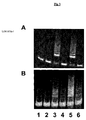
- Example 5 The oil phase from Example 5 was tested for expression of functional human telomerase in RRL.
- Linear T7-driven templates encoding either wt hTERT and hTR in tandem cloned downstream of the IRES of pCITE4a (Novagen) or hTERT cloned into pCITE4a with hTR cloned separately into a variant of pCITE 4a (in which the IRES was deleted (pCITE-E)) or an inactive deletion mutant of telomerase were prepared by PCR amplification using the respective parental plasmids and primers CITET7ba (5'-GTTTTCCCAGTCACGACGTTGTAA-3') (SEQ ID NO : 1) and CITEterfo (5'-CCGGATATAGTTCCTCCTTTCAGC-3') (SEQ ID NO : 2 ).
- Expression reactions comprised RRL (80% v/v), telomerase construct (see Fig 3 legend), methionine ( 1mM), telomerase substrate (TS (telomerase substrate) primer (5'-AATCCGTCGAGCAGAGTT-3') (Intergen) 1 ⁇ M), PCR enhancer (Promega) (3 ⁇ l), dNTPs (25 ⁇ M), DTT (20 ⁇ M).
- Emulsions were formed under chilled conditions (on ice) exactly as described above and incubated at 30°C for 1.5 hours. Emulsions were then extracted with 200 ⁇ l chloroform-isoamylalcohol, followed by extraction of aqueous phase with 1 volume phenol-chloroform.
- Telomerase reaction products were ethanol precipitated and resuspended in 20ul sterile water.
- a PCR- based TRAP (Kim 94) assay (Intergen) was then used to detect telomerase extension products formed in the emulsion. Telomerase activity produces a characteristic ladder (with 6bp spacing for each repeat) (see Fig. 3).
Landscapes
- Health & Medical Sciences (AREA)
- Chemical & Material Sciences (AREA)
- Life Sciences & Earth Sciences (AREA)
- Engineering & Computer Science (AREA)
- General Health & Medical Sciences (AREA)
- Bioinformatics & Cheminformatics (AREA)
- Pharmacology & Pharmacy (AREA)
- Veterinary Medicine (AREA)
- Genetics & Genomics (AREA)
- Medicinal Chemistry (AREA)
- Organic Chemistry (AREA)
- Epidemiology (AREA)
- Animal Behavior & Ethology (AREA)
- Public Health (AREA)
- Zoology (AREA)
- Wood Science & Technology (AREA)
- Molecular Biology (AREA)
- Chemical Kinetics & Catalysis (AREA)
- General Engineering & Computer Science (AREA)
- Biochemistry (AREA)
- Oil, Petroleum & Natural Gas (AREA)
- Biophysics (AREA)
- Biotechnology (AREA)
- Physics & Mathematics (AREA)
- General Chemical & Material Sciences (AREA)
- Biomedical Technology (AREA)
- Microbiology (AREA)
- Proteomics, Peptides & Aminoacids (AREA)
- Bioinformatics & Computational Biology (AREA)
- Plant Pathology (AREA)
- Dispersion Chemistry (AREA)
- Analytical Chemistry (AREA)
- Crystallography & Structural Chemistry (AREA)
- Immunology (AREA)
- Preparation Of Compounds By Using Micro-Organisms (AREA)
- Micro-Organisms Or Cultivation Processes Thereof (AREA)
- Measuring Or Testing Involving Enzymes Or Micro-Organisms (AREA)
- Manufacturing Of Micro-Capsules (AREA)
- Pharmaceuticals Containing Other Organic And Inorganic Compounds (AREA)
- Agricultural Chemicals And Associated Chemicals (AREA)
Applications Claiming Priority (3)
| Application Number | Priority Date | Filing Date | Title |
|---|---|---|---|
| GBGB0127564.3A GB0127564D0 (en) | 2001-11-16 | 2001-11-16 | Emulsion compositions |
| GB0127564 | 2001-11-16 | ||
| EP02777570A EP1446504B1 (de) | 2001-11-16 | 2002-11-18 | Emulsionshaltige zusammensetzngen |
Related Parent Applications (1)
| Application Number | Title | Priority Date | Filing Date |
|---|---|---|---|
| EP02777570A Division EP1446504B1 (de) | 2001-11-16 | 2002-11-18 | Emulsionshaltige zusammensetzngen |
Publications (3)
| Publication Number | Publication Date |
|---|---|
| EP1518937A1 true EP1518937A1 (de) | 2005-03-30 |
| EP1518937A8 EP1518937A8 (de) | 2005-07-06 |
| EP1518937B1 EP1518937B1 (de) | 2007-09-05 |
Family
ID=9925928
Family Applications (2)
| Application Number | Title | Priority Date | Filing Date |
|---|---|---|---|
| EP04078078A Expired - Lifetime EP1518937B1 (de) | 2001-11-16 | 2002-11-18 | Methode zur Anreicherung von Nukleinsäuremolekülen |
| EP02777570A Expired - Lifetime EP1446504B1 (de) | 2001-11-16 | 2002-11-18 | Emulsionshaltige zusammensetzngen |
Family Applications After (1)
| Application Number | Title | Priority Date | Filing Date |
|---|---|---|---|
| EP02777570A Expired - Lifetime EP1446504B1 (de) | 2001-11-16 | 2002-11-18 | Emulsionshaltige zusammensetzngen |
Country Status (11)
| Country | Link |
|---|---|
| US (6) | US7429467B2 (de) |
| EP (2) | EP1518937B1 (de) |
| JP (2) | JP4503290B2 (de) |
| AT (2) | ATE406460T1 (de) |
| AU (1) | AU2002339193B2 (de) |
| CA (1) | CA2467215C (de) |
| DE (2) | DE60222307T2 (de) |
| DK (1) | DK1446504T3 (de) |
| ES (2) | ES2312630T3 (de) |
| GB (1) | GB0127564D0 (de) |
| WO (1) | WO2003044187A2 (de) |
Cited By (1)
| Publication number | Priority date | Publication date | Assignee | Title |
|---|---|---|---|---|
| US7993842B2 (en) | 2006-03-23 | 2011-08-09 | Life Technologies Corporation | Directed enrichment of genomic DNA for high-throughput sequencing |
Families Citing this family (360)
| Publication number | Priority date | Publication date | Assignee | Title |
|---|---|---|---|---|
| US7622294B2 (en) * | 1997-03-14 | 2009-11-24 | Trustees Of Tufts College | Methods for detecting target analytes and enzymatic reactions |
| US20030027126A1 (en) | 1997-03-14 | 2003-02-06 | Walt David R. | Methods for detecting target analytes and enzymatic reactions |
| ES2283936T3 (es) | 1997-07-07 | 2007-11-01 | Medical Research Council | Procedimiento de clasificacion in vitro. |
| GB9900298D0 (en) * | 1999-01-07 | 1999-02-24 | Medical Res Council | Optical sorting method |
| US6770441B2 (en) * | 2000-02-10 | 2004-08-03 | Illumina, Inc. | Array compositions and methods of making same |
| GB0022458D0 (en) * | 2000-09-13 | 2000-11-01 | Medical Res Council | Directed evolution method |
| GB0127564D0 (en) * | 2001-11-16 | 2002-01-09 | Medical Res Council | Emulsion compositions |
| US7575865B2 (en) | 2003-01-29 | 2009-08-18 | 454 Life Sciences Corporation | Methods of amplifying and sequencing nucleic acids |
| CA2513889A1 (en) | 2003-01-29 | 2004-08-19 | 454 Corporation | Double ended sequencing |
| US7041481B2 (en) | 2003-03-14 | 2006-05-09 | The Regents Of The University Of California | Chemical amplification based on fluid partitioning |
| GB0307403D0 (en) | 2003-03-31 | 2003-05-07 | Medical Res Council | Selection by compartmentalised screening |
| GB0307428D0 (en) | 2003-03-31 | 2003-05-07 | Medical Res Council | Compartmentalised combinatorial chemistry |
| US20060078893A1 (en) | 2004-10-12 | 2006-04-13 | Medical Research Council | Compartmentalised combinatorial chemistry by microfluidic control |
| CA2531105C (en) | 2003-07-05 | 2015-03-17 | The Johns Hopkins University | Method and compositions for detection and enumeration of genetic variations |
| GB0325653D0 (en) | 2003-11-03 | 2003-12-10 | Medical Res Council | CST emulsions |
| EP1801213A3 (de) | 2003-11-03 | 2007-10-24 | Medical Research Council | Polymerase |
| ES2432040T3 (es) | 2004-01-28 | 2013-11-29 | 454 Life Sciences Corporation | Amplificación de ácido nucleico con emulsión de flujo continuo |
| US20050221339A1 (en) | 2004-03-31 | 2005-10-06 | Medical Research Council Harvard University | Compartmentalised screening by microfluidic control |
| US7968287B2 (en) | 2004-10-08 | 2011-06-28 | Medical Research Council Harvard University | In vitro evolution in microfluidic systems |
| EP2272983A1 (de) | 2005-02-01 | 2011-01-12 | AB Advanced Genetic Analysis Corporation | Reagentien, Verfahren und Bibliotheken zur Sequenzierung mit Kügelchen |
| EP2236628A3 (de) | 2005-02-01 | 2010-10-13 | AB Advanced Genetic Analysis Corporation | Reagentien, Verfahren und Bibliotheken zur Sequenzierung mit Kügelchen |
| CA2842402C (en) | 2005-03-10 | 2016-02-23 | Gen-Probe Incorporated | Systems and methods to perform assays for detecting or quantifying analytes within samples |
| EP2363205A3 (de) | 2006-01-11 | 2014-06-04 | Raindance Technologies, Inc. | Mikrofluidische Vorrichtungen Und Verfahren Zur Verwendung Bei Der Bildung Und Kontrolle Von Nanoreaktoren |
| JP2009538123A (ja) * | 2006-04-19 | 2009-11-05 | アプライド バイオシステムズ, エルエルシー | ゲル非含有ビーズベースの配列決定のための試薬、方法およびライブラリー |
| US9562837B2 (en) | 2006-05-11 | 2017-02-07 | Raindance Technologies, Inc. | Systems for handling microfludic droplets |
| EP2530168B1 (de) | 2006-05-11 | 2015-09-16 | Raindance Technologies, Inc. | Mikrofluidische Vorrichtungen |
| CA2656022C (en) * | 2006-06-19 | 2017-10-17 | The Johns Hopkins University | Single-molecule pcr on microparticles in water-in-oil emulsions |
| EP2077912B1 (de) | 2006-08-07 | 2019-03-27 | The President and Fellows of Harvard College | Fluorkohlenstoffemulsionsstabilisierende tenside |
| US7682791B2 (en) * | 2006-10-29 | 2010-03-23 | Macevicz Stephen C | Method of generating nested sets of double stranded DNA circles |
| US8772046B2 (en) | 2007-02-06 | 2014-07-08 | Brandeis University | Manipulation of fluids and reactions in microfluidic systems |
| WO2008130623A1 (en) | 2007-04-19 | 2008-10-30 | Brandeis University | Manipulation of fluids, fluid components and reactions in microfluidic systems |
| WO2008150432A1 (en) * | 2007-06-01 | 2008-12-11 | 454 Life Sciences Corporation | System and meth0d for identification of individual samples from a multiplex mixture |
| US7883265B2 (en) * | 2007-06-01 | 2011-02-08 | Applied Biosystems, Llc | Devices, systems, and methods for preparing emulsions |
| US20090053724A1 (en) * | 2007-06-28 | 2009-02-26 | 454 Life Sciences Corporation | System and method for adaptive reagent control in nucleic acid sequencing |
| EP2188386A2 (de) * | 2007-09-17 | 2010-05-26 | Universite De Strasbourg | Verfahren für den nachweis oder die quantifizierung einer verkürzten mutation |
| JP5731198B2 (ja) * | 2007-09-27 | 2015-06-10 | イムノバクシーン・テクノロジーズ・インコーポレイテッドImmunovaccine Technologies Inc. | インビボでのポリヌクレオチドの送達のための連続疎水相を含む担体におけるリポソームの使用 |
| WO2009046149A1 (en) * | 2007-10-01 | 2009-04-09 | Applied Biosystems Inc. | Chase ligation sequencing |
| AU2008329549B2 (en) | 2007-11-27 | 2013-08-22 | Human Genetic Signatures Pty Ltd | Enzymes for amplification and copying bisulphite modified nucleic acids |
| WO2009100080A1 (en) | 2008-02-04 | 2009-08-13 | Life Technologies Corporation | Composition and method for sequencing nucleic acid |
| US20090203086A1 (en) * | 2008-02-06 | 2009-08-13 | 454 Life Sciences Corporation | System and method for improved signal detection in nucleic acid sequencing |
| GB0806562D0 (en) | 2008-04-10 | 2008-05-14 | Fermentas Uab | Production of nucleic acid |
| CN102056622B (zh) | 2008-06-05 | 2016-04-06 | 免疫疫苗技术有限公司 | 包含脂质体、抗原、多核苷酸和含疏水物质的连续相的载体的组合物 |
| US7888034B2 (en) | 2008-07-01 | 2011-02-15 | 454 Life Sciences Corporation | System and method for detection of HIV tropism variants |
| US12038438B2 (en) | 2008-07-18 | 2024-07-16 | Bio-Rad Laboratories, Inc. | Enzyme quantification |
| WO2010009365A1 (en) | 2008-07-18 | 2010-01-21 | Raindance Technologies, Inc. | Droplet libraries |
| US8633015B2 (en) | 2008-09-23 | 2014-01-21 | Bio-Rad Laboratories, Inc. | Flow-based thermocycling system with thermoelectric cooler |
| US10512910B2 (en) | 2008-09-23 | 2019-12-24 | Bio-Rad Laboratories, Inc. | Droplet-based analysis method |
| US11130128B2 (en) | 2008-09-23 | 2021-09-28 | Bio-Rad Laboratories, Inc. | Detection method for a target nucleic acid |
| US9156010B2 (en) | 2008-09-23 | 2015-10-13 | Bio-Rad Laboratories, Inc. | Droplet-based assay system |
| US8951939B2 (en) | 2011-07-12 | 2015-02-10 | Bio-Rad Laboratories, Inc. | Digital assays with multiplexed detection of two or more targets in the same optical channel |
| US9132394B2 (en) | 2008-09-23 | 2015-09-15 | Bio-Rad Laboratories, Inc. | System for detection of spaced droplets |
| CA2738578C (en) | 2008-09-23 | 2021-05-04 | Quantalife, Inc. | Droplet-based assay system |
| US9492797B2 (en) | 2008-09-23 | 2016-11-15 | Bio-Rad Laboratories, Inc. | System for detection of spaced droplets |
| US8709762B2 (en) | 2010-03-02 | 2014-04-29 | Bio-Rad Laboratories, Inc. | System for hot-start amplification via a multiple emulsion |
| US9417190B2 (en) | 2008-09-23 | 2016-08-16 | Bio-Rad Laboratories, Inc. | Calibrations and controls for droplet-based assays |
| US12162008B2 (en) | 2008-09-23 | 2024-12-10 | Bio-Rad Laboratories, Inc. | Partition-based method of analysis |
| US9764322B2 (en) | 2008-09-23 | 2017-09-19 | Bio-Rad Laboratories, Inc. | System for generating droplets with pressure monitoring |
| US12090480B2 (en) | 2008-09-23 | 2024-09-17 | Bio-Rad Laboratories, Inc. | Partition-based method of analysis |
| US9598725B2 (en) | 2010-03-02 | 2017-03-21 | Bio-Rad Laboratories, Inc. | Emulsion chemistry for encapsulated droplets |
| US20100261189A1 (en) * | 2008-10-03 | 2010-10-14 | Roche Molecular Systems, Inc. | System and method for detection of HLA Variants |
| US20100087325A1 (en) * | 2008-10-07 | 2010-04-08 | Illumina, Inc. | Biological sample temperature control system and method |
| GB0904957D0 (en) | 2009-03-23 | 2009-05-06 | Univ Erasmus Medical Ct | Tumour gene profile |
| US8528589B2 (en) | 2009-03-23 | 2013-09-10 | Raindance Technologies, Inc. | Manipulation of microfluidic droplets |
| WO2010117461A2 (en) * | 2009-04-08 | 2010-10-14 | Applied Biosystems, Llc | System and method for preparing and using bulk emulsion |
| CA2767056C (en) | 2009-09-02 | 2018-12-04 | Bio-Rad Laboratories, Inc. | System for mixing fluids by coalescence of multiple emulsions |
| US10520500B2 (en) | 2009-10-09 | 2019-12-31 | Abdeslam El Harrak | Labelled silica-based nanomaterial with enhanced properties and uses thereof |
| US8609339B2 (en) * | 2009-10-09 | 2013-12-17 | 454 Life Sciences Corporation | System and method for emulsion breaking and recovery of biological elements |
| EP2504448B1 (de) | 2009-11-25 | 2016-10-19 | Bio-Rad Laboratories, Inc. | Verfahren und zusammensetzung zur erkennung von genetischem material |
| EP2517025B1 (de) | 2009-12-23 | 2019-11-27 | Bio-Rad Laboratories, Inc. | Verfahren zur reduzierung des austauschs von molekülen zwischen tröpfchen |
| JP5934657B2 (ja) | 2010-02-12 | 2016-06-15 | レインダンス テクノロジーズ, インコーポレイテッド | デジタル検体分析 |
| US9399797B2 (en) | 2010-02-12 | 2016-07-26 | Raindance Technologies, Inc. | Digital analyte analysis |
| US9366632B2 (en) | 2010-02-12 | 2016-06-14 | Raindance Technologies, Inc. | Digital analyte analysis |
| US10351905B2 (en) | 2010-02-12 | 2019-07-16 | Bio-Rad Laboratories, Inc. | Digital analyte analysis |
| CA2767182C (en) | 2010-03-25 | 2020-03-24 | Bio-Rad Laboratories, Inc. | Droplet generation for droplet-based assays |
| EP2556170A4 (de) | 2010-03-25 | 2014-01-01 | Quantalife Inc | Tröpfchentransport- und erkennungssystem |
| CA2767113A1 (en) | 2010-03-25 | 2011-09-29 | Bio-Rad Laboratories, Inc. | Detection system for droplet-based assays |
| US20190300945A1 (en) | 2010-04-05 | 2019-10-03 | Prognosys Biosciences, Inc. | Spatially Encoded Biological Assays |
| US10787701B2 (en) | 2010-04-05 | 2020-09-29 | Prognosys Biosciences, Inc. | Spatially encoded biological assays |
| AU2011237729B2 (en) | 2010-04-05 | 2014-04-03 | Prognosys Biosciences, Inc. | Spatially encoded biological assays |
| CA2793970A1 (en) | 2010-04-30 | 2011-11-03 | F. Hoffmann-La Roche Ag | System and method for purification and use of inorganic pyrophosphatase from aquifex aeolicus |
| US20110287432A1 (en) | 2010-05-21 | 2011-11-24 | 454 Life Science Corporation | System and method for tailoring nucleotide concentration to enzymatic efficiencies in dna sequencing technologies |
| US9353412B2 (en) | 2010-06-18 | 2016-05-31 | Illumina, Inc. | Conformational probes and methods for sequencing nucleic acids |
| US20120077716A1 (en) | 2010-09-29 | 2012-03-29 | 454 Life Sciences Corporation | System and method for producing functionally distinct nucleic acid library ends through use of deoxyinosine |
| WO2012045012A2 (en) | 2010-09-30 | 2012-04-05 | Raindance Technologies, Inc. | Sandwich assays in droplets |
| US20120322665A1 (en) | 2010-10-08 | 2012-12-20 | 454 Life Sciences Corporation | System and method for detection of hiv-1 clades and recombinants of the reverse transcriptase and protease regions |
| WO2012058647A1 (en) | 2010-10-28 | 2012-05-03 | Life Technologies Corporation | Chemically-enhanced primer compositions, methods and kits |
| SG190074A1 (en) | 2010-11-01 | 2013-06-28 | Bio Rad Laboratories | System for forming emulsions |
| US8951781B2 (en) | 2011-01-10 | 2015-02-10 | Illumina, Inc. | Systems, methods, and apparatuses to image a sample for biological or chemical analysis |
| EP2673380B1 (de) | 2011-02-09 | 2018-12-12 | Bio-Rad Laboratories, Inc. | Analyse von nukleinsäuren |
| EP3859011A1 (de) | 2011-02-11 | 2021-08-04 | Bio-Rad Laboratories, Inc. | Verfahren zur bildung gemischter tröpfchen |
| EP2675819B1 (de) | 2011-02-18 | 2020-04-08 | Bio-Rad Laboratories, Inc. | Zusammensetzungen und verfahren für molekulare etikettierung |
| US12097495B2 (en) | 2011-02-18 | 2024-09-24 | Bio-Rad Laboratories, Inc. | Methods and compositions for detecting genetic material |
| AU2012231098B2 (en) | 2011-03-18 | 2016-09-29 | Bio-Rad Laboratories, Inc. | Multiplexed digital assays with combinatorial use of signals |
| US20120244523A1 (en) | 2011-03-25 | 2012-09-27 | 454 Life Sciences Corporation | System and Method for Detection of HIV Integrase Variants |
| GB201106254D0 (en) | 2011-04-13 | 2011-05-25 | Frisen Jonas | Method and product |
| WO2012149042A2 (en) | 2011-04-25 | 2012-11-01 | Bio-Rad Laboratories, Inc. | Methods and compositions for nucleic acid analysis |
| US8841071B2 (en) | 2011-06-02 | 2014-09-23 | Raindance Technologies, Inc. | Sample multiplexing |
| DE202012013668U1 (de) | 2011-06-02 | 2019-04-18 | Raindance Technologies, Inc. | Enzymquantifizierung |
| US8658430B2 (en) | 2011-07-20 | 2014-02-25 | Raindance Technologies, Inc. | Manipulating droplet size |
| WO2013019751A1 (en) | 2011-07-29 | 2013-02-07 | Bio-Rad Laboratories, Inc., | Library characterization by digital assay |
| EP3623481B1 (de) | 2011-09-23 | 2021-08-25 | Illumina, Inc. | Zusammensetzungen zur nukleinsäuresequenzierung |
| GB201120711D0 (en) | 2011-12-01 | 2012-01-11 | Univ Erasmus Medical Ct | Method for classifying tumour cells |
| WO2013101896A1 (en) | 2011-12-30 | 2013-07-04 | Quest Diagnostics Investments Incorporated | Nucleic acid analysis using emulsion pcr |
| WO2013101783A2 (en) | 2011-12-30 | 2013-07-04 | Bio-Rad Laboratories, Inc. | Methods and compositions for performing nucleic acid amplification reactions |
| US9701959B2 (en) | 2012-02-02 | 2017-07-11 | Invenra Inc. | High throughput screen for biologically active polypeptides |
| US20130217023A1 (en) | 2012-02-22 | 2013-08-22 | 454 Life Sciences Corporation | System And Method For Generation And Use Of Compact Clonally Amplified Products |
| US20130261984A1 (en) | 2012-03-30 | 2013-10-03 | Illumina, Inc. | Methods and systems for determining fetal chromosomal abnormalities |
| CA3138752C (en) | 2012-04-03 | 2024-02-06 | Illumina, Inc. | Integrated optoelectronic read head and fluidic cartridge useful for nucleic acid sequencing |
| US20130274148A1 (en) | 2012-04-11 | 2013-10-17 | Illumina, Inc. | Portable genetic detection and analysis system and method |
| WO2013155531A2 (en) | 2012-04-13 | 2013-10-17 | Bio-Rad Laboratories, Inc. | Sample holder with a well having a wicking promoter |
| CN104471075B (zh) | 2012-04-19 | 2018-06-22 | 生命技术公司 | 核酸扩增 |
| EP3095879B1 (de) | 2012-04-19 | 2018-09-19 | Life Technologies Corporation | Nukleinsäureamplifikation |
| US10192024B2 (en) | 2012-05-18 | 2019-01-29 | 454 Life Sciences Corporation | System and method for generation and use of optimal nucleotide flow orders |
| US9012022B2 (en) | 2012-06-08 | 2015-04-21 | Illumina, Inc. | Polymer coatings |
| US8895249B2 (en) | 2012-06-15 | 2014-11-25 | Illumina, Inc. | Kinetic exclusion amplification of nucleic acid libraries |
| US9977861B2 (en) | 2012-07-18 | 2018-05-22 | Illumina Cambridge Limited | Methods and systems for determining haplotypes and phasing of haplotypes |
| US10273541B2 (en) | 2012-08-14 | 2019-04-30 | 10X Genomics, Inc. | Methods and systems for processing polynucleotides |
| JP6367196B2 (ja) | 2012-08-14 | 2018-08-01 | テンエックス・ジェノミクス・インコーポレイテッド | マイクロカプセル組成物および方法 |
| US10584381B2 (en) | 2012-08-14 | 2020-03-10 | 10X Genomics, Inc. | Methods and systems for processing polynucleotides |
| US10221442B2 (en) | 2012-08-14 | 2019-03-05 | 10X Genomics, Inc. | Compositions and methods for sample processing |
| US9701998B2 (en) | 2012-12-14 | 2017-07-11 | 10X Genomics, Inc. | Methods and systems for processing polynucleotides |
| US10752949B2 (en) | 2012-08-14 | 2020-08-25 | 10X Genomics, Inc. | Methods and systems for processing polynucleotides |
| US9951386B2 (en) | 2014-06-26 | 2018-04-24 | 10X Genomics, Inc. | Methods and systems for processing polynucleotides |
| US11591637B2 (en) | 2012-08-14 | 2023-02-28 | 10X Genomics, Inc. | Compositions and methods for sample processing |
| US10323279B2 (en) | 2012-08-14 | 2019-06-18 | 10X Genomics, Inc. | Methods and systems for processing polynucleotides |
| US9422602B2 (en) | 2012-08-15 | 2016-08-23 | Bio-Rad Laboratories, Inc. | Methods and compositions for determining nucleic acid degradation |
| NL2017959B1 (en) | 2016-12-08 | 2018-06-19 | Illumina Inc | Cartridge assembly |
| WO2014043143A1 (en) | 2012-09-11 | 2014-03-20 | Life Technologies Corporation | Nucleic acid amplification |
| EP3257952B1 (de) | 2012-09-11 | 2020-02-12 | Life Technologies Corporation | Nukleinsäureamplifikation |
| US9593365B2 (en) | 2012-10-17 | 2017-03-14 | Spatial Transcriptions Ab | Methods and product for optimising localised or spatial detection of gene expression in a tissue sample |
| EP3567116A1 (de) | 2012-12-14 | 2019-11-13 | 10X Genomics, Inc. | Verfahren und systeme zur verarbeitung von polynukleotiden |
| US10533221B2 (en) | 2012-12-14 | 2020-01-14 | 10X Genomics, Inc. | Methods and systems for processing polynucleotides |
| JP5878113B2 (ja) * | 2012-12-28 | 2016-03-08 | シスメックス株式会社 | 核酸増幅方法および核酸増幅反応用キット |
| KR102190198B1 (ko) | 2013-02-08 | 2020-12-14 | 10엑스 제노믹스, 인크. | 폴리뉴클레오티드 바코드 생성 |
| US9512422B2 (en) | 2013-02-26 | 2016-12-06 | Illumina, Inc. | Gel patterned surfaces |
| WO2014144495A1 (en) | 2013-03-15 | 2014-09-18 | Abvitro, Inc. | Single cell bar-coding for antibody discovery |
| EP2971071B1 (de) | 2013-03-15 | 2018-02-28 | Illumina, Inc. | Mit enzymen verknüpfte nukleotide |
| US9347095B2 (en) | 2013-03-15 | 2016-05-24 | Bio-Rad Laboratories, Inc. | Digital assays for mutation detection |
| DK3013983T3 (da) | 2013-06-25 | 2023-03-06 | Prognosys Biosciences Inc | Spatialt kodede biologiske assays ved brug af en mikrofluidisk anordning |
| MX363806B (es) | 2013-07-01 | 2019-04-03 | Illumina Inc | Funcionalización de superficies sin catalizador e injerto de polímeros.. |
| EP3241913B1 (de) | 2013-07-03 | 2019-02-20 | Illumina, Inc. | System zur sequenzierung durch orthogonale synthese |
| CN105555972B (zh) | 2013-07-25 | 2020-07-31 | 伯乐生命医学产品有限公司 | 遗传测定 |
| FI3030645T3 (fi) | 2013-08-08 | 2023-02-10 | Fluidijärjestelmä reagenssien toimittamiseen virtauskennoon | |
| EP2840148B1 (de) | 2013-08-23 | 2019-04-03 | F. Hoffmann-La Roche AG | Verfahren für nukleinsäureamplifikation |
| EP2848698A1 (de) | 2013-08-26 | 2015-03-18 | F. Hoffmann-La Roche AG | System und Methode zur automatisierten Nukleinsäure-Amplifikation |
| JP2016539343A (ja) | 2013-08-30 | 2016-12-15 | イルミナ インコーポレイテッド | 親水性または斑状親水性表面上の液滴の操作 |
| US10395758B2 (en) | 2013-08-30 | 2019-08-27 | 10X Genomics, Inc. | Sequencing methods |
| US11901041B2 (en) | 2013-10-04 | 2024-02-13 | Bio-Rad Laboratories, Inc. | Digital analysis of nucleic acid modification |
| EP3572527B1 (de) | 2013-10-17 | 2021-05-26 | Illumina, Inc. | Verfahren und zusammensetzungen zur herstellung von nukleinsäurebibliotheken |
| EP3080268A1 (de) | 2013-12-09 | 2016-10-19 | Illumina, Inc. | Verfahren und zusammensetzungen zur gezielten nukleinsäuresequenzierung |
| US9944977B2 (en) | 2013-12-12 | 2018-04-17 | Raindance Technologies, Inc. | Distinguishing rare variations in a nucleic acid sequence from a sample |
| US9824068B2 (en) | 2013-12-16 | 2017-11-21 | 10X Genomics, Inc. | Methods and apparatus for sorting data |
| US11193176B2 (en) | 2013-12-31 | 2021-12-07 | Bio-Rad Laboratories, Inc. | Method for detecting and quantifying latent retroviral RNA species |
| CA2943624A1 (en) | 2014-04-10 | 2015-10-15 | 10X Genomics, Inc. | Fluidic devices, systems, and methods for encapsulating and partitioning reagents, and applications of same |
| EP4574974A3 (de) | 2014-06-26 | 2025-10-08 | 10x Genomics, Inc. | Verfahren zur analyse von nukleinsäuren aus einzelnen zellen oder zellpopulationen |
| US12312640B2 (en) | 2014-06-26 | 2025-05-27 | 10X Genomics, Inc. | Analysis of nucleic acid sequences |
| WO2015200869A1 (en) | 2014-06-26 | 2015-12-30 | 10X Genomics, Inc. | Analysis of nucleic acid sequences |
| JP2017526046A (ja) | 2014-06-26 | 2017-09-07 | 10エックス ゲノミクス,インコーポレイテッド | 核酸配列アセンブルのプロセス及びシステム |
| EP3183577B1 (de) | 2014-08-21 | 2020-08-19 | Illumina Cambridge Limited | Reversible oberflächenfunktionalisierung |
| KR102541849B1 (ko) | 2014-09-15 | 2023-06-09 | 에이비비트로, 엘엘씨 | 고-처리량 뉴클레오티드 라이브러리 서열결정 |
| JP6802154B2 (ja) | 2014-09-18 | 2020-12-16 | イラミーナ インコーポレーテッド | 核酸シーケンシングデータを解析するための方法およびシステム |
| US20170247756A1 (en) | 2014-10-03 | 2017-08-31 | Life Technologies Corporation | Genetic sequence verification compositions, methods and kits |
| WO2016069939A1 (en) | 2014-10-29 | 2016-05-06 | 10X Genomics, Inc. | Methods and compositions for targeted nucleic acid sequencing |
| CN114805710B (zh) | 2014-10-31 | 2023-11-17 | 伊鲁米纳剑桥有限公司 | 聚合物以及dna共聚物涂层 |
| US9975122B2 (en) | 2014-11-05 | 2018-05-22 | 10X Genomics, Inc. | Instrument systems for integrated sample processing |
| ES2768762T3 (es) | 2014-11-05 | 2020-06-23 | Illumina Cambridge Ltd | Reducción del daño al ADN durante la preparación de muestras y secuenciación usando agentes quelantes sideróforos |
| CN107427808B (zh) | 2015-01-12 | 2020-10-23 | 10X基因组学有限公司 | 用于制备核酸测序文库的方法和系统以及用其制备的文库 |
| WO2016115273A1 (en) | 2015-01-13 | 2016-07-21 | 10X Genomics, Inc. | Systems and methods for visualizing structural variation and phasing information |
| CN107208156B (zh) | 2015-02-09 | 2021-10-08 | 10X基因组学有限公司 | 用于使用变异识别数据来确定结构变异和定相的系统和方法 |
| CN107532202A (zh) | 2015-02-24 | 2018-01-02 | 10X 基因组学有限公司 | 用于靶向核酸序列覆盖的方法 |
| EP3262407B1 (de) | 2015-02-24 | 2023-08-30 | 10X Genomics, Inc. | Partitionsverarbeitungsverfahren und -systeme |
| WO2016150771A1 (en) | 2015-03-20 | 2016-09-29 | Novozymes A/S | Droplet-based selection by injection |
| CN120425026A (zh) | 2015-04-10 | 2025-08-05 | 十程基因技术瑞典公司 | 生物样本的空间区别、多重核酸分析 |
| JP2018518157A (ja) | 2015-05-11 | 2018-07-12 | イラミーナ インコーポレーテッド | 治療薬剤の発見および分析のためのプラットフォーム |
| JP6956012B2 (ja) | 2015-05-18 | 2021-10-27 | サガ ダイアグノスティクス アーベー | 標的核酸及び多様体の検出 |
| JP6698708B2 (ja) | 2015-06-09 | 2020-05-27 | ライフ テクノロジーズ コーポレーション | 分子タグ付けのための方法、システム、組成物、キット、装置、及びコンピュータ可読媒体 |
| JP6612539B2 (ja) | 2015-06-30 | 2019-11-27 | シスメックス株式会社 | 遺伝子検査用検体処理装置 |
| CN107924121B (zh) | 2015-07-07 | 2021-06-08 | 亿明达股份有限公司 | 经由纳米压印的选择性表面图案化 |
| WO2017015018A1 (en) | 2015-07-17 | 2017-01-26 | Illumina, Inc. | Polymer sheets for sequencing applications |
| AU2016298541B2 (en) | 2015-07-30 | 2019-10-31 | Illumina, Inc. | Orthogonal deblocking of nucleotides |
| CN108474805A (zh) | 2015-08-24 | 2018-08-31 | 亿明达股份有限公司 | 用于生物和化学测定的线路内蓄压器和流量控制系统 |
| CN107921432A (zh) | 2015-09-02 | 2018-04-17 | 伊卢米纳剑桥有限公司 | 改善流控系统中的液滴操作的系统和方法 |
| US10647981B1 (en) | 2015-09-08 | 2020-05-12 | Bio-Rad Laboratories, Inc. | Nucleic acid library generation methods and compositions |
| CN108291257B (zh) | 2015-09-24 | 2023-12-29 | 阿布维特罗有限责任公司 | 亲和-寡核苷酸缀合物及其用途 |
| CA2999886A1 (en) | 2015-09-24 | 2017-03-30 | Abvitro Llc | Single amplicon activated exclusion pcr |
| US10928392B2 (en) | 2015-09-25 | 2021-02-23 | Abvitro Llc | High throughput process for T cell receptor target identification of natively-paired T cell receptor sequences |
| US11371094B2 (en) | 2015-11-19 | 2022-06-28 | 10X Genomics, Inc. | Systems and methods for nucleic acid processing using degenerate nucleotides |
| SG10202108763UA (en) | 2015-12-04 | 2021-09-29 | 10X Genomics Inc | Methods and compositions for nucleic acid analysis |
| WO2017123533A1 (en) | 2016-01-11 | 2017-07-20 | Illumina, Inc. | Detection apparatus having a microfluorometer, a fluidic system, and a flow cell latch clamp module |
| SG11201806757XA (en) | 2016-02-11 | 2018-09-27 | 10X Genomics Inc | Systems, methods, and media for de novo assembly of whole genome sequence data |
| PL3377226T3 (pl) | 2016-03-28 | 2021-07-26 | Illumina, Inc. | Wielopłaszczyznowe mikromacierze |
| WO2017197343A2 (en) | 2016-05-12 | 2017-11-16 | 10X Genomics, Inc. | Microfluidic on-chip filters |
| WO2017197338A1 (en) | 2016-05-13 | 2017-11-16 | 10X Genomics, Inc. | Microfluidic systems and methods of use |
| SG11201809376WA (en) | 2016-05-18 | 2018-12-28 | Illumina Inc | Self assembled patterning using patterned hydrophobic surfaces |
| WO2017214561A1 (en) | 2016-06-10 | 2017-12-14 | Life Technologies Corporation | Methods and compositions for nucleic acid amplification |
| PL3478832T3 (pl) | 2016-07-01 | 2022-06-06 | Carlsberg A/S | Sposób skriningu populacji organizmów pod kątem mutanta poprzez zastosowanie podejścia polegającego na łączeniu i dzieleniu |
| BR112019005748A2 (pt) | 2016-09-24 | 2019-06-18 | Abvitro Llc | afinidade-conjugados de oligonucleotídeo e usos destes |
| EP4439045A3 (de) | 2016-10-14 | 2024-11-27 | Illumina, Inc. | Kartuschenanordnung |
| US10815525B2 (en) | 2016-12-22 | 2020-10-27 | 10X Genomics, Inc. | Methods and systems for processing polynucleotides |
| US10011872B1 (en) | 2016-12-22 | 2018-07-03 | 10X Genomics, Inc. | Methods and systems for processing polynucleotides |
| US10550429B2 (en) | 2016-12-22 | 2020-02-04 | 10X Genomics, Inc. | Methods and systems for processing polynucleotides |
| GB201704754D0 (en) | 2017-01-05 | 2017-05-10 | Illumina Inc | Kinetic exclusion amplification of nucleic acid libraries |
| US12264411B2 (en) | 2017-01-30 | 2025-04-01 | 10X Genomics, Inc. | Methods and systems for analysis |
| EP4310183B1 (de) | 2017-01-30 | 2025-07-09 | 10X Genomics, Inc. | Verfahren und systeme zur tröpfchenbasierten einzelzellenbarcodierung |
| GB201701689D0 (en) | 2017-02-01 | 2017-03-15 | Illumia Inc | System and method with fiducials of non-closed shapes |
| GB201701686D0 (en) | 2017-02-01 | 2017-03-15 | Illunina Inc | System & method with fiducials having offset layouts |
| US11896944B2 (en) | 2017-02-01 | 2024-02-13 | Illumina, Inc. | System and method with fiducials responding to multiple excitation frequencies |
| GB201701688D0 (en) | 2017-02-01 | 2017-03-15 | Illumia Inc | System and method with fiducials in non-recliner layouts |
| US10995333B2 (en) | 2017-02-06 | 2021-05-04 | 10X Genomics, Inc. | Systems and methods for nucleic acid preparation |
| CN106967740B (zh) * | 2017-02-17 | 2020-11-13 | 芜湖天明生物技术有限公司 | 一种大肠杆菌融合表达菌丝霉素、其制备方法及应用 |
| EP3838268B1 (de) | 2017-02-24 | 2023-05-10 | The Regents of the University of California | Partikeltropfenstrukturen und verfahren zur herstellung und verwendung davon |
| US10737267B2 (en) | 2017-04-04 | 2020-08-11 | Omniome, Inc. | Fluidic apparatus and methods useful for chemical and biological reactions |
| US10161003B2 (en) | 2017-04-25 | 2018-12-25 | Omniome, Inc. | Methods and apparatus that increase sequencing-by-binding efficiency |
| CN110870018B (zh) | 2017-05-19 | 2024-11-22 | 10X基因组学有限公司 | 用于分析数据集的系统和方法 |
| CN109526228B (zh) | 2017-05-26 | 2022-11-25 | 10X基因组学有限公司 | 转座酶可接近性染色质的单细胞分析 |
| US10844372B2 (en) | 2017-05-26 | 2020-11-24 | 10X Genomics, Inc. | Single cell analysis of transposase accessible chromatin |
| MA49352A (fr) | 2017-05-26 | 2020-04-08 | Abvitro Llc | Séquençage de bibliothèque de polynucléotides à haut rendement et analyse de transcriptome |
| JP2018203724A (ja) * | 2017-05-31 | 2018-12-27 | キヤノン株式会社 | 油性組成物、およびそれを用いた分析方法 |
| WO2018232282A1 (en) * | 2017-06-15 | 2018-12-20 | Board Of Regents, The University Of Texas System | Methods and platform for screening and selecting metabolites and their receptors |
| SG11202000964UA (en) | 2017-08-15 | 2020-02-27 | Omniome Inc | Scanning apparatus and methods useful for detection of chemical and biological analytes |
| MA50079A (fr) | 2017-09-07 | 2020-07-15 | Juno Therapeutics Inc | Procédés d'identification de caractéristiques cellulaires relatives à des réponses associées à une thérapie cellulaire |
| US10837047B2 (en) | 2017-10-04 | 2020-11-17 | 10X Genomics, Inc. | Compositions, methods, and systems for bead formation using improved polymers |
| WO2019076955A1 (en) | 2017-10-18 | 2019-04-25 | Novozymes A/S | IMMUNOLOGICAL ASSAY FOR THE STABILITY OF A BIO-ACTIVE POLYPEPTIDE |
| CA3079411C (en) | 2017-10-19 | 2023-12-05 | Omniome, Inc. | Simultaneous background reduction and complex stabilization in binding assay workflows |
| WO2019084043A1 (en) | 2017-10-26 | 2019-05-02 | 10X Genomics, Inc. | METHODS AND SYSTEMS FOR NUCLEIC ACID PREPARATION AND CHROMATIN ANALYSIS |
| CN111479631B (zh) | 2017-10-27 | 2022-02-22 | 10X基因组学有限公司 | 用于样品制备和分析的方法和系统 |
| CN111051523B (zh) | 2017-11-15 | 2024-03-19 | 10X基因组学有限公司 | 功能化凝胶珠 |
| US10829815B2 (en) | 2017-11-17 | 2020-11-10 | 10X Genomics, Inc. | Methods and systems for associating physical and genetic properties of biological particles |
| WO2019108851A1 (en) | 2017-11-30 | 2019-06-06 | 10X Genomics, Inc. | Systems and methods for nucleic acid preparation and analysis |
| CN111699388B (zh) | 2017-12-12 | 2024-08-02 | 10X基因组学有限公司 | 用于单细胞处理的系统和方法 |
| CN111712579B (zh) | 2017-12-22 | 2024-10-15 | 10X基因组学有限公司 | 用于处理来自一个或多个细胞的核酸分子的系统和方法 |
| WO2019143622A1 (en) | 2018-01-19 | 2019-07-25 | Bio-Rad Laboratories, Inc. | Mutant dna polymerases |
| CA3089393C (en) | 2018-01-24 | 2023-04-04 | Sniper (Beijing) Medical Technologies Co., Ltd | Motion controlling mechanism, liquid discharging nozzle, microdroplet generating device and method, liquid driving mechanism and method, microdroplet generating method, and surface processing method of liquid discharging nozzle |
| US12542195B2 (en) | 2018-01-24 | 2026-02-03 | Sniper (Suzhou) Life Technology Co., Ltd. | Digital PCR detection apparatus, digital PCR quantitative detection method, multi-volume digital PCR quantitative analysis method, digital PCR detection method, nucleic acid detection microsphere, preparation method of nucleic acid detection microsphere, nucleic acid detection microsphere kit and high-throughput nucleic acid detection method |
| CN110064444A (zh) * | 2018-01-24 | 2019-07-30 | 思纳福(北京)医疗科技有限公司 | 微液滴生成用油相组合物及其处理方法 |
| WO2019144905A1 (zh) | 2018-01-24 | 2019-08-01 | 北京光阱管理咨询合伙企业(有限合伙) | 微液滴容器、微液滴容器制备方法、微液滴平铺方法、微液滴生成试剂盒、温控装置、微液滴生成用油相组合物及其处理方法 |
| SG11202007686VA (en) | 2018-02-12 | 2020-09-29 | 10X Genomics Inc | Methods characterizing multiple analytes from individual cells or cell populations |
| US11639928B2 (en) | 2018-02-22 | 2023-05-02 | 10X Genomics, Inc. | Methods and systems for characterizing analytes from individual cells or cell populations |
| WO2019169028A1 (en) | 2018-02-28 | 2019-09-06 | 10X Genomics, Inc. | Transcriptome sequencing through random ligation |
| WO2019195166A1 (en) | 2018-04-06 | 2019-10-10 | 10X Genomics, Inc. | Systems and methods for quality control in single cell processing |
| CA3097583A1 (en) | 2018-04-19 | 2019-10-24 | Omniome, Inc. | Improving accuracy of base calls in nucleic acid sequencing methods |
| WO2019209426A1 (en) | 2018-04-26 | 2019-10-31 | Omniome, Inc. | Methods and compositions for stabilizing nucleic acid-nucleotide-polymerase complexes |
| WO2019217758A1 (en) | 2018-05-10 | 2019-11-14 | 10X Genomics, Inc. | Methods and systems for molecular library generation |
| AU2019276719B2 (en) | 2018-05-31 | 2025-11-13 | Pacific Biosciences Of California, Inc. | Increased signal to noise in nucleic acid sequencing |
| US11932899B2 (en) | 2018-06-07 | 2024-03-19 | 10X Genomics, Inc. | Methods and systems for characterizing nucleic acid molecules |
| US11703427B2 (en) | 2018-06-25 | 2023-07-18 | 10X Genomics, Inc. | Methods and systems for cell and bead processing |
| WO2020023362A1 (en) | 2018-07-24 | 2020-01-30 | Omniome, Inc. | Serial formation of ternary complex species |
| US12188014B1 (en) | 2018-07-25 | 2025-01-07 | 10X Genomics, Inc. | Compositions and methods for nucleic acid processing using blocking agents |
| US20200032335A1 (en) | 2018-07-27 | 2020-01-30 | 10X Genomics, Inc. | Systems and methods for metabolome analysis |
| SG11202101164TA (en) | 2018-08-03 | 2021-03-30 | 10X Genomics Inc | Methods and systems to minimize barcode exchange |
| WO2020041148A1 (en) | 2018-08-20 | 2020-02-27 | 10X Genomics, Inc. | Methods and systems for detection of protein-dna interactions using proximity ligation |
| US12065688B2 (en) | 2018-08-20 | 2024-08-20 | 10X Genomics, Inc. | Compositions and methods for cellular processing |
| US11519033B2 (en) | 2018-08-28 | 2022-12-06 | 10X Genomics, Inc. | Method for transposase-mediated spatial tagging and analyzing genomic DNA in a biological sample |
| WO2020101795A1 (en) | 2018-11-15 | 2020-05-22 | Omniome, Inc. | Electronic detection of nucleic acid structure |
| CN211311438U (zh) | 2018-12-04 | 2020-08-21 | 欧姆尼欧美公司 | 流动池 |
| US11459607B1 (en) | 2018-12-10 | 2022-10-04 | 10X Genomics, Inc. | Systems and methods for processing-nucleic acid molecules from a single cell using sequential co-partitioning and composite barcodes |
| US20220290217A1 (en) | 2018-12-10 | 2022-09-15 | 10X Genomics, Inc. | Resolving spatial arrays using deconvolution |
| US12529094B2 (en) | 2018-12-10 | 2026-01-20 | 10X Genomics, Inc. | Imaging system hardware |
| BR112020026667A2 (pt) | 2018-12-19 | 2021-07-27 | Illumina, Inc. | métodos para melhorar a prioridade de clonalidade do agrupamento de polinucleotídeo |
| WO2020132350A2 (en) | 2018-12-20 | 2020-06-25 | Omniome, Inc. | Temperature control for analysis of nucleic acids and other analytes |
| US11649485B2 (en) | 2019-01-06 | 2023-05-16 | 10X Genomics, Inc. | Generating capture probes for spatial analysis |
| US11926867B2 (en) | 2019-01-06 | 2024-03-12 | 10X Genomics, Inc. | Generating capture probes for spatial analysis |
| US12169198B2 (en) | 2019-01-08 | 2024-12-17 | 10X Genomics, Inc. | Systems and methods for sample analysis |
| US11845983B1 (en) | 2019-01-09 | 2023-12-19 | 10X Genomics, Inc. | Methods and systems for multiplexing of droplet based assays |
| US11467153B2 (en) | 2019-02-12 | 2022-10-11 | 10X Genomics, Inc. | Methods for processing nucleic acid molecules |
| US11851683B1 (en) | 2019-02-12 | 2023-12-26 | 10X Genomics, Inc. | Methods and systems for selective analysis of cellular samples |
| US12275993B2 (en) | 2019-02-12 | 2025-04-15 | 10X Genomics, Inc. | Analysis of nucleic acid sequences |
| WO2020167866A1 (en) | 2019-02-12 | 2020-08-20 | 10X Genomics, Inc. | Systems and methods for transposon loading |
| WO2020167862A1 (en) | 2019-02-12 | 2020-08-20 | 10X Genomics, Inc. | Systems and methods for transfer of reagents between droplets |
| US12305239B2 (en) | 2019-02-12 | 2025-05-20 | 10X Genomics, Inc. | Analysis of nucleic acid sequences |
| EP3924505B1 (de) | 2019-02-12 | 2025-12-17 | 10X Genomics, Inc. | Verfahren zur verarbeitung von nukleinsäuremolekülen |
| WO2020167574A1 (en) | 2019-02-14 | 2020-08-20 | Omniome, Inc. | Mitigating adverse impacts of detection systems on nucleic acids and other biological analytes |
| CN113613787B (zh) | 2019-02-20 | 2023-06-13 | 加利福尼亚太平洋生物科学股份有限公司 | 用于检测化学和生物分析物的扫描装置和方法 |
| US11655499B1 (en) | 2019-02-25 | 2023-05-23 | 10X Genomics, Inc. | Detection of sequence elements in nucleic acid molecules |
| US11920183B2 (en) | 2019-03-11 | 2024-03-05 | 10X Genomics, Inc. | Systems and methods for processing optically tagged beads |
| NL2023312B1 (en) | 2019-03-21 | 2020-09-28 | Illumina Inc | Artificial intelligence-based base calling |
| WO2020191389A1 (en) | 2019-03-21 | 2020-09-24 | Illumina, Inc. | Training data generation for artificial intelligence-based sequencing |
| NL2023316B1 (en) | 2019-03-21 | 2020-09-28 | Illumina Inc | Artificial intelligence-based sequencing |
| US11210554B2 (en) | 2019-03-21 | 2021-12-28 | Illumina, Inc. | Artificial intelligence-based generation of sequencing metadata |
| NL2023310B1 (en) | 2019-03-21 | 2020-09-28 | Illumina Inc | Training data generation for artificial intelligence-based sequencing |
| NL2023314B1 (en) | 2019-03-21 | 2020-09-28 | Illumina Inc | Artificial intelligence-based quality scoring |
| NL2023311B9 (en) | 2019-03-21 | 2021-03-12 | Illumina Inc | Artificial intelligence-based generation of sequencing metadata |
| EP3947722A1 (de) | 2019-03-27 | 2022-02-09 | 10X Genomics, Inc. | Systeme und verfahren zur verarbeitung von rna aus zellen |
| US11593649B2 (en) | 2019-05-16 | 2023-02-28 | Illumina, Inc. | Base calling using convolutions |
| EP3976820A1 (de) | 2019-05-30 | 2022-04-06 | 10X Genomics, Inc. | Verfahren zum nachweis der räumlichen heterogenität einer biologischen probe |
| WO2020252186A1 (en) | 2019-06-11 | 2020-12-17 | Omniome, Inc. | Calibrated focus sensing |
| US11377655B2 (en) | 2019-07-16 | 2022-07-05 | Pacific Biosciences Of California, Inc. | Synthetic nucleic acids having non-natural structures |
| US10656368B1 (en) | 2019-07-24 | 2020-05-19 | Omniome, Inc. | Method and system for biological imaging using a wide field objective lens |
| US12235262B1 (en) | 2019-09-09 | 2025-02-25 | 10X Genomics, Inc. | Methods and systems for single cell protein analysis |
| TW202124406A (zh) | 2019-09-10 | 2021-07-01 | 美商歐姆尼歐美公司 | 核苷酸之可逆修飾 |
| MX2022004361A (es) | 2019-10-10 | 2022-05-03 | Carlsberg As | Metodos para preparar plantas mutantes. |
| WO2021076152A1 (en) | 2019-10-18 | 2021-04-22 | Omniome, Inc. | Methods and compositions for capping nucleic acids |
| WO2021092433A2 (en) | 2019-11-08 | 2021-05-14 | 10X Genomics, Inc. | Enhancing specificity of analyte binding |
| EP4081777B1 (de) | 2019-12-23 | 2026-02-18 | 10X Genomics, Inc. | Reversible fixierreagenzien und verfahren zu deren verwendung |
| EP4081656A1 (de) | 2019-12-23 | 2022-11-02 | 10X Genomics, Inc. | Zusammensetzungen und verfahren zur verwendung von fixierten biologischen proben bei partitionsbasierten tests |
| CN121022991A (zh) | 2019-12-23 | 2025-11-28 | 10X基因组学有限公司 | 使用rna模板化连接进行空间分析的方法 |
| US12365942B2 (en) | 2020-01-13 | 2025-07-22 | 10X Genomics, Inc. | Methods of decreasing background on a spatial array |
| US12405264B2 (en) | 2020-01-17 | 2025-09-02 | 10X Genomics, Inc. | Electrophoretic system and method for analyte capture |
| US11702693B2 (en) | 2020-01-21 | 2023-07-18 | 10X Genomics, Inc. | Methods for printing cells and generating arrays of barcoded cells |
| US11732299B2 (en) | 2020-01-21 | 2023-08-22 | 10X Genomics, Inc. | Spatial assays with perturbed cells |
| US20210230681A1 (en) | 2020-01-24 | 2021-07-29 | 10X Genomics, Inc. | Methods for spatial analysis using proximity ligation |
| US12076701B2 (en) | 2020-01-31 | 2024-09-03 | 10X Genomics, Inc. | Capturing oligonucleotides in spatial transcriptomics |
| US11898205B2 (en) | 2020-02-03 | 2024-02-13 | 10X Genomics, Inc. | Increasing capture efficiency of spatial assays |
| US12110541B2 (en) | 2020-02-03 | 2024-10-08 | 10X Genomics, Inc. | Methods for preparing high-resolution spatial arrays |
| WO2021158511A1 (en) | 2020-02-04 | 2021-08-12 | Omniome, Inc. | Flow cells and methods for their manufacture and use |
| US11732300B2 (en) | 2020-02-05 | 2023-08-22 | 10X Genomics, Inc. | Increasing efficiency of spatial analysis in a biological sample |
| WO2021158925A1 (en) | 2020-02-07 | 2021-08-12 | 10X Genomics, Inc. | Quantitative and automated permeabilization performance evaluation for spatial transcriptomics |
| US12449419B1 (en) | 2020-02-12 | 2025-10-21 | 10X Genomics, Inc. | Methods for detecting binding of peptide-MHC monomers to T cells |
| US12421558B2 (en) | 2020-02-13 | 2025-09-23 | 10X Genomics, Inc. | Systems and methods for joint interactive visualization of gene expression and DNA chromatin accessibility |
| US12281357B1 (en) | 2020-02-14 | 2025-04-22 | 10X Genomics, Inc. | In situ spatial barcoding |
| US12354008B2 (en) | 2020-02-20 | 2025-07-08 | Illumina, Inc. | Knowledge distillation and gradient pruning-based compression of artificial intelligence-based base caller |
| US11891654B2 (en) | 2020-02-24 | 2024-02-06 | 10X Genomics, Inc. | Methods of making gene expression libraries |
| WO2021216708A1 (en) | 2020-04-22 | 2021-10-28 | 10X Genomics, Inc. | Methods for spatial analysis using targeted rna depletion |
| US11188778B1 (en) | 2020-05-05 | 2021-11-30 | Illumina, Inc. | Equalization-based image processing and spatial crosstalk attenuator |
| CN115836135A (zh) | 2020-05-05 | 2023-03-21 | 加利福尼亚太平洋生物科学股份有限公司 | 用于修饰聚合酶-核酸复合物的组合物和方法 |
| US11851700B1 (en) | 2020-05-13 | 2023-12-26 | 10X Genomics, Inc. | Methods, kits, and compositions for processing extracellular molecules |
| WO2021237087A1 (en) | 2020-05-22 | 2021-11-25 | 10X Genomics, Inc. | Spatial analysis to detect sequence variants |
| EP4414459B1 (de) | 2020-05-22 | 2025-09-03 | 10X Genomics, Inc. | Simultane räumlich-zeitliche messung der genexpression und der zellaktivität |
| WO2021242834A1 (en) | 2020-05-26 | 2021-12-02 | 10X Genomics, Inc. | Method for resetting an array |
| US12031177B1 (en) | 2020-06-04 | 2024-07-09 | 10X Genomics, Inc. | Methods of enhancing spatial resolution of transcripts |
| WO2021252499A1 (en) | 2020-06-08 | 2021-12-16 | 10X Genomics, Inc. | Methods of determining a surgical margin and methods of use thereof |
| EP4446430A3 (de) | 2020-06-10 | 2024-12-18 | 10X Genomics, Inc. | Verfahren zur bestimmung einer position eines analyten in einer biologischen probe |
| WO2021263111A1 (en) | 2020-06-25 | 2021-12-30 | 10X Genomics, Inc. | Spatial analysis of dna methylation |
| US11761038B1 (en) | 2020-07-06 | 2023-09-19 | 10X Genomics, Inc. | Methods for identifying a location of an RNA in a biological sample |
| US11981960B1 (en) | 2020-07-06 | 2024-05-14 | 10X Genomics, Inc. | Spatial analysis utilizing degradable hydrogels |
| US12209280B1 (en) | 2020-07-06 | 2025-01-28 | 10X Genomics, Inc. | Methods of identifying abundance and location of an analyte in a biological sample using second strand synthesis |
| US11981958B1 (en) | 2020-08-20 | 2024-05-14 | 10X Genomics, Inc. | Methods for spatial analysis using DNA capture |
| US11926822B1 (en) | 2020-09-23 | 2024-03-12 | 10X Genomics, Inc. | Three-dimensional spatial analysis |
| CN112250739B (zh) * | 2020-09-25 | 2022-04-08 | 广东海纳川生物科技股份有限公司 | 一种菌丝霉素添加剂及其应用 |
| US12084715B1 (en) | 2020-11-05 | 2024-09-10 | 10X Genomics, Inc. | Methods and systems for reducing artifactual antisense products |
| US12480158B1 (en) | 2020-11-05 | 2025-11-25 | 10X Genomics, Inc. | Methods and systems for processing polynucleotides |
| US11827935B1 (en) | 2020-11-19 | 2023-11-28 | 10X Genomics, Inc. | Methods for spatial analysis using rolling circle amplification and detection probes |
| EP4121555B1 (de) | 2020-12-21 | 2026-02-25 | 10X Genomics, Inc. | Verfahren zur erfassung von sonden und/oder barcodes |
| WO2022155331A1 (en) | 2021-01-13 | 2022-07-21 | Pacific Biosciences Of California, Inc. | Surface structuring with colloidal assembly |
| US12398262B1 (en) | 2021-01-22 | 2025-08-26 | 10X Genomics, Inc. | Triblock copolymer-based cell stabilization and fixation system and methods of use thereof |
| CN120158497A (zh) | 2021-02-23 | 2025-06-17 | 10X基因组学有限公司 | 基于探针的核酸和蛋白质分析 |
| CA3210451A1 (en) | 2021-03-22 | 2022-09-29 | Illumina Cambridge Limited | Methods for improving nucleic acid cluster clonality |
| EP4323542A4 (de) | 2021-04-14 | 2025-03-05 | Partillion Bioscience Corporation | Reaktionskammern im nanomassstab und verfahren zur verwendung davon |
| EP4428246B1 (de) | 2021-04-14 | 2025-12-24 | 10X Genomics, Inc. | Verfahren zur messung der fehllokalisierung eines analyten |
| EP4320271B1 (de) | 2021-05-06 | 2025-03-19 | 10X Genomics, Inc. | Verfahren zur erhöhung der auflösung von räumlicher analyse |
| WO2022256503A1 (en) | 2021-06-03 | 2022-12-08 | 10X Genomics, Inc. | Methods, compositions, kits, and systems for enhancing analyte capture for spatial analysis |
| US12570831B2 (en) | 2021-06-15 | 2026-03-10 | Illumina, Inc. | Hydrogel-free surface functionalization for sequencing |
| WO2023003757A1 (en) | 2021-07-19 | 2023-01-26 | Illumina Software, Inc. | Intensity extraction with interpolation and adaptation for base calling |
| US11455487B1 (en) | 2021-10-26 | 2022-09-27 | Illumina Software, Inc. | Intensity extraction and crosstalk attenuation using interpolation and adaptation for base calling |
| WO2023004357A1 (en) | 2021-07-23 | 2023-01-26 | Illumina, Inc. | Methods for preparing substrate surface for dna sequencing |
| EP4196605B1 (de) | 2021-09-01 | 2024-12-04 | 10X Genomics, Inc. | Verfahren zur blockierung einer erfassungssonde auf einer räumlichen anordnung |
| WO2023049215A1 (en) | 2021-09-22 | 2023-03-30 | Illumina, Inc. | Compressed state-based base calling |
| CA3234961A1 (en) | 2021-10-20 | 2023-04-27 | Illumina, Inc. | Methods for capturing library dna for sequencing |
| DE112022005006T5 (de) | 2021-10-20 | 2024-08-08 | Tataa Biocenter Ab | Verfahren und zusammensetzungen zur detektion mutierter nukleinsäuresequenzen |
| WO2023086880A1 (en) | 2021-11-10 | 2023-05-19 | 10X Genomics, Inc. | Methods, compositions, and kits for determining the location of an analyte in a biological sample |
| WO2023102118A2 (en) | 2021-12-01 | 2023-06-08 | 10X Genomics, Inc. | Methods, compositions, and systems for improved in situ detection of analytes and spatial analysis |
| AU2023208743A1 (en) | 2022-01-20 | 2024-01-04 | Illumina, Inc. | Methods of detecting methylcytosine and hydroxymethylcytosine by sequencing |
| AR128756A1 (es) | 2022-03-11 | 2024-06-12 | Carlsberg As | Modulación de niveles de proteínas |
| US20230343414A1 (en) | 2022-03-25 | 2023-10-26 | Illumina, Inc. | Sequence-to-sequence base calling |
| JP2025526537A (ja) | 2022-06-09 | 2025-08-15 | イルミナ インコーポレイテッド | フローセル傾斜に対する塩基コーリングの依存性 |
| WO2024102809A1 (en) | 2022-11-09 | 2024-05-16 | 10X Genomics, Inc. | Methods, compositions, and kits for determining the location of multiple analytes in a biological sample |
| WO2024129969A1 (en) | 2022-12-14 | 2024-06-20 | Illumina, Inc. | Systems and methods for capture and enrichment of clustered beads on flow cell substrates |
| IL327356A (en) | 2023-10-18 | 2026-05-01 | Amgen Inc | Quantitative assessment of mRNA transcript levels using DDPCR for initial pool characterization and evaluation of single-cell clones in the cell line development process |
| WO2025240905A1 (en) | 2024-05-17 | 2025-11-20 | The Broad Institute, Inc. | Imaging-free high-resolution spatial macromolecule abundance reconstruction |
| WO2026090042A1 (en) | 2024-10-21 | 2026-04-30 | The Broad Institute, Inc. | Single-cell and spatial dna methylation measurements |
Citations (4)
| Publication number | Priority date | Publication date | Assignee | Title |
|---|---|---|---|---|
| EP0579347A1 (de) * | 1992-07-10 | 1994-01-19 | FERRING ARZNEIMITTEL GmbH | Mikroverkapselung wasserlöslicher Wirkstoffe |
| WO1994023738A1 (en) * | 1993-04-19 | 1994-10-27 | Medisorb Technologies International L.P. | Encapsulation of nucleic acids with conjugates that facilitate and target cellular uptake and gene expression |
| WO1995024929A2 (en) * | 1994-03-15 | 1995-09-21 | Brown University Research Foundation | Polymeric gene delivery system |
| WO1999002671A1 (en) * | 1997-07-07 | 1999-01-21 | Medical Research Council | In vitro sorting method |
Family Cites Families (39)
| Publication number | Priority date | Publication date | Assignee | Title |
|---|---|---|---|---|
| US4801529A (en) * | 1985-06-18 | 1989-01-31 | Brandeis University | Methods for isolating mutant microoganisms using microcapsules coated with indicator material |
| US4989892A (en) * | 1987-01-23 | 1991-02-05 | Kerins George C | Trailer hitch |
| ES2118066T3 (es) | 1989-10-05 | 1998-09-16 | Optein Inc | Sintesis y aislamiento, exentos de celulas, de nuevos genes y polipeptidos. |
| GB9107628D0 (en) * | 1991-04-10 | 1991-05-29 | Moonbrook Limited | Preparation of diagnostic agents |
| ES2130177T3 (es) | 1991-08-10 | 1999-07-01 | Medical Res Council | Tratamiento de poblaciones de celulas. |
| ES2112916T3 (es) * | 1991-10-15 | 1998-04-16 | Multilyte Ltd | Ensayo de union que utiliza un reactivo marcado. |
| US5270170A (en) | 1991-10-16 | 1993-12-14 | Affymax Technologies N.V. | Peptide library and screening method |
| US5413924A (en) * | 1992-02-13 | 1995-05-09 | Kosak; Kenneth M. | Preparation of wax beads containing a reagent for release by heating |
| IL104384A (en) | 1993-01-13 | 1996-11-14 | Yeda Res & Dev | Method for screening catalytic non-enzyme polypeptides and proteins |
| US5436149A (en) | 1993-02-19 | 1995-07-25 | Barnes; Wayne M. | Thermostable DNA polymerase with enhanced thermostability and enhanced length and efficiency of primer extension |
| JPH09500007A (ja) | 1993-04-19 | 1997-01-07 | スチュアート エイ コーフマン | 新規化合物生成に関するランダム化学 |
| WO1995011922A1 (en) | 1993-10-29 | 1995-05-04 | Affymax Technologies N.V. | In vitro peptide and antibody display libraries |
| WO1996034112A1 (en) | 1995-04-24 | 1996-10-31 | Chromaxome Corp. | Methods for generating and screening novel metabolic pathways |
| US5910408A (en) | 1995-06-07 | 1999-06-08 | The General Hospital Corporation | Catalytic DNA having ligase activity |
| DE69614768T2 (de) | 1995-06-14 | 2002-06-20 | Tonen Corp., Tokio/Tokyo | Emulsionsspaltung durch Mikroorganismen |
| DE19646372C1 (de) | 1995-11-11 | 1997-06-19 | Evotec Biosystems Gmbh | Genotyp und Phänotyp koppelnde Verbindung |
| GB9608540D0 (en) | 1996-04-25 | 1996-07-03 | Medical Res Council | Isolation of enzymes |
| US6083693A (en) | 1996-06-14 | 2000-07-04 | Curagen Corporation | Identification and comparison of protein-protein interactions that occur in populations |
| CA2236867A1 (en) | 1996-09-27 | 1998-04-02 | Icos Corporation | Method to identify compounds for disrupting protein/protein interactions |
| WO1998023733A2 (en) | 1996-11-27 | 1998-06-04 | University Of Washington | Thermostable polymerases having altered fidelity |
| US6310354B1 (en) * | 1996-12-03 | 2001-10-30 | Erkki Soini | Method and a device for monitoring nucleic acid amplification reactions |
| DK0971946T3 (da) | 1997-01-21 | 2006-10-30 | Gen Hospital Corp | Selektion af proteiner ved anvendelse af RNA-protein-fusioner |
| CA2196496A1 (en) | 1997-01-31 | 1998-07-31 | Stephen William Watson Michnick | Protein fragment complementation assay for the detection of protein-protein interactions |
| GB9703369D0 (en) | 1997-02-18 | 1997-04-09 | Lindqvist Bjorn H | Process |
| US6023540A (en) * | 1997-03-14 | 2000-02-08 | Trustees Of Tufts College | Fiber optic sensor with encoded microspheres |
| EP0975969A4 (de) | 1997-03-18 | 2002-07-31 | Chromaxome Corp | Screening-methode für verbindungen mit hilfe eingekapselter zellen |
| WO1999025738A1 (en) | 1997-11-13 | 1999-05-27 | Mayo Foundation For Medical Education And Research | Detection of pr3-specific anti-neutrophil cytoplasmic autoantibodies in human serum |
| JP2981547B1 (ja) * | 1998-07-02 | 1999-11-22 | 農林水産省食品総合研究所長 | クロスフロー型マイクロチャネル装置及び同装置を用いたエマルションの生成または分離方法 |
| EP1100889A4 (de) | 1998-07-17 | 2002-03-06 | Mirus Corp | Micell systeme |
| GB9900298D0 (en) * | 1999-01-07 | 1999-02-24 | Medical Res Council | Optical sorting method |
| EP1096489B1 (de) * | 1999-04-07 | 2007-07-18 | Kabushiki Kaisha Toshiba | System zur aufzeichnung von digitalen informationen einschliesslich audioinformationen |
| GB9921155D0 (en) | 1999-09-08 | 1999-11-10 | Medical Res Council | Selection system |
| CN1189159C (zh) * | 2000-05-05 | 2005-02-16 | 欧莱雅 | 含水溶性美容活性组分水性核的微胶囊及含其的组合物 |
| GB0022458D0 (en) | 2000-09-13 | 2000-11-01 | Medical Res Council | Directed evolution method |
| US6936264B2 (en) * | 2001-03-05 | 2005-08-30 | The Procter & Gamble Company | Delivery of reactive agents via multiple emulsions for use in shelf stable products |
| GB0114856D0 (en) | 2001-06-18 | 2001-08-08 | Medical Res Council | Selection by avidity capture |
| GB0127564D0 (en) | 2001-11-16 | 2002-01-09 | Medical Res Council | Emulsion compositions |
| EP1587940A4 (de) | 2002-12-20 | 2006-06-07 | Caliper Life Sciences Inc | Einzelmolekül amplifikation und dna-nachweis |
| CA2513889A1 (en) * | 2003-01-29 | 2004-08-19 | 454 Corporation | Double ended sequencing |
-
2001
- 2001-11-16 GB GBGB0127564.3A patent/GB0127564D0/en not_active Ceased
-
2002
- 2002-11-18 DK DK02777570T patent/DK1446504T3/da active
- 2002-11-18 CA CA2467215A patent/CA2467215C/en not_active Expired - Lifetime
- 2002-11-18 AU AU2002339193A patent/AU2002339193B2/en not_active Expired
- 2002-11-18 EP EP04078078A patent/EP1518937B1/de not_active Expired - Lifetime
- 2002-11-18 JP JP2003545810A patent/JP4503290B2/ja not_active Expired - Lifetime
- 2002-11-18 WO PCT/GB2002/005216 patent/WO2003044187A2/en not_active Ceased
- 2002-11-18 ES ES02777570T patent/ES2312630T3/es not_active Expired - Lifetime
- 2002-11-18 EP EP02777570A patent/EP1446504B1/de not_active Expired - Lifetime
- 2002-11-18 AT AT02777570T patent/ATE406460T1/de not_active IP Right Cessation
- 2002-11-18 AT AT04078078T patent/ATE372391T1/de active
- 2002-11-18 DE DE60222307T patent/DE60222307T2/de not_active Expired - Lifetime
- 2002-11-18 DE DE60228607T patent/DE60228607D1/de not_active Expired - Lifetime
- 2002-11-18 ES ES04078078T patent/ES2293162T3/es not_active Expired - Lifetime
-
2004
- 2004-05-13 US US10/844,720 patent/US7429467B2/en not_active Expired - Lifetime
- 2004-06-11 US US10/866,392 patent/US7622280B2/en not_active Expired - Lifetime
-
2007
- 2007-03-01 JP JP2007051473A patent/JP4323528B2/ja not_active Expired - Fee Related
-
2008
- 2008-03-28 US US12/079,834 patent/US7655435B2/en not_active Expired - Lifetime
-
2009
- 2009-10-06 US US12/587,432 patent/US8153402B2/en not_active Expired - Fee Related
-
2010
- 2010-01-26 US US12/694,071 patent/US8153364B2/en not_active Expired - Fee Related
-
2012
- 2012-02-29 US US13/408,071 patent/US20120184011A1/en not_active Abandoned
Patent Citations (5)
| Publication number | Priority date | Publication date | Assignee | Title |
|---|---|---|---|---|
| EP0579347A1 (de) * | 1992-07-10 | 1994-01-19 | FERRING ARZNEIMITTEL GmbH | Mikroverkapselung wasserlöslicher Wirkstoffe |
| WO1994023738A1 (en) * | 1993-04-19 | 1994-10-27 | Medisorb Technologies International L.P. | Encapsulation of nucleic acids with conjugates that facilitate and target cellular uptake and gene expression |
| WO1995024929A2 (en) * | 1994-03-15 | 1995-09-21 | Brown University Research Foundation | Polymeric gene delivery system |
| US20010020011A1 (en) * | 1994-03-15 | 2001-09-06 | Edith Mathiowitz | Polymeric gene delivery system |
| WO1999002671A1 (en) * | 1997-07-07 | 1999-01-21 | Medical Research Council | In vitro sorting method |
Cited By (1)
| Publication number | Priority date | Publication date | Assignee | Title |
|---|---|---|---|---|
| US7993842B2 (en) | 2006-03-23 | 2011-08-09 | Life Technologies Corporation | Directed enrichment of genomic DNA for high-throughput sequencing |
Also Published As
Similar Documents
| Publication | Publication Date | Title |
|---|---|---|
| US7622280B2 (en) | Emulsion compositions | |
| ES2294427T3 (es) | Procedimiento para aumentar la concentracion de una molecula de acido nucleico. | |
| CA3042974A1 (en) | Tagless encoded chemical library | |
| AU2007216633B2 (en) | Emulsion compositions | |
| CA2584931A1 (en) | Increasing the concentration of a nucleic acid |
Legal Events
| Date | Code | Title | Description |
|---|---|---|---|
| PUAI | Public reference made under article 153(3) epc to a published international application that has entered the european phase |
Free format text: ORIGINAL CODE: 0009012 |
|
| 17P | Request for examination filed |
Effective date: 20041108 |
|
| AC | Divisional application: reference to earlier application |
Ref document number: 1446504 Country of ref document: EP Kind code of ref document: P |
|
| AK | Designated contracting states |
Kind code of ref document: A1 Designated state(s): AT BE BG CH CY CZ DE DK EE ES FI FR GB GR IE IT LI LU MC NL PT SE SK TR |
|
| AX | Request for extension of the european patent |
Extension state: AL LT LV MK RO SI |
|
| RIN1 | Information on inventor provided before grant (corrected) |
Inventor name: GHADESSY, FARID,DEPARTMENT OF ONCOLOGY Inventor name: HOLLIGER, PHILIPP |
|
| RAP1 | Party data changed (applicant data changed or rights of an application transferred) |
Owner name: MEDICAL RESEARCH COUNCIL |
|
| AKX | Designation fees paid |
Designated state(s): AT BE BG CH CY CZ DE DK EE ES FI FR GB GR IE IT LI LU MC NL PT SE SK TR |
|
| GRAP | Despatch of communication of intention to grant a patent |
Free format text: ORIGINAL CODE: EPIDOSNIGR1 |
|
| GRAS | Grant fee paid |
Free format text: ORIGINAL CODE: EPIDOSNIGR3 |
|
| GRAA | (expected) grant |
Free format text: ORIGINAL CODE: 0009210 |
|
| AC | Divisional application: reference to earlier application |
Ref document number: 1446504 Country of ref document: EP Kind code of ref document: P |
|
| AK | Designated contracting states |
Kind code of ref document: B1 Designated state(s): AT BE BG CH CY CZ DE DK EE ES FI FR GB GR IE IT LI LU MC NL PT SE SK TR |
|
| REG | Reference to a national code |
Ref country code: GB Ref legal event code: FG4D |
|
| REG | Reference to a national code |
Ref country code: CH Ref legal event code: EP |
|
| REF | Corresponds to: |
Ref document number: 60222307 Country of ref document: DE Date of ref document: 20071018 Kind code of ref document: P |
|
| REG | Reference to a national code |
Ref country code: IE Ref legal event code: FG4D |
|
| REG | Reference to a national code |
Ref country code: CH Ref legal event code: NV Representative=s name: A. BRAUN, BRAUN, HERITIER, ESCHMANN AG PATENTANWAE |
|
| NLV1 | Nl: lapsed or annulled due to failure to fulfill the requirements of art. 29p and 29m of the patents act | ||
| REG | Reference to a national code |
Ref country code: ES Ref legal event code: FG2A Ref document number: 2293162 Country of ref document: ES Kind code of ref document: T3 |
|
| PG25 | Lapsed in a contracting state [announced via postgrant information from national office to epo] |
Ref country code: GR Free format text: LAPSE BECAUSE OF FAILURE TO SUBMIT A TRANSLATION OF THE DESCRIPTION OR TO PAY THE FEE WITHIN THE PRESCRIBED TIME-LIMIT Effective date: 20071206 Ref country code: NL Free format text: LAPSE BECAUSE OF FAILURE TO SUBMIT A TRANSLATION OF THE DESCRIPTION OR TO PAY THE FEE WITHIN THE PRESCRIBED TIME-LIMIT Effective date: 20070905 |
|
| EN | Fr: translation not filed | ||
| ET | Fr: translation filed | ||
| REG | Reference to a national code |
Ref country code: FR Ref legal event code: EERR Free format text: CORRECTION DE BOPI 08/18 - BREVETS EUROPEENS DONT LA TRADUCTION N A PAS ETE REMISE A L INPI. IL Y A LIEU DE SUPPRIMER : LA MENTION DE LA NON-REMISE. LA REMISE DE LA TRADUCTION EST PUBLIEE DANS LE PRESENT BOPI. |
|
| PG25 | Lapsed in a contracting state [announced via postgrant information from national office to epo] |
Ref country code: CZ Free format text: LAPSE BECAUSE OF FAILURE TO SUBMIT A TRANSLATION OF THE DESCRIPTION OR TO PAY THE FEE WITHIN THE PRESCRIBED TIME-LIMIT Effective date: 20070905 Ref country code: PT Free format text: LAPSE BECAUSE OF FAILURE TO SUBMIT A TRANSLATION OF THE DESCRIPTION OR TO PAY THE FEE WITHIN THE PRESCRIBED TIME-LIMIT Effective date: 20080206 Ref country code: SK Free format text: LAPSE BECAUSE OF FAILURE TO SUBMIT A TRANSLATION OF THE DESCRIPTION OR TO PAY THE FEE WITHIN THE PRESCRIBED TIME-LIMIT Effective date: 20070905 |
|
| REG | Reference to a national code |
Ref country code: CH Ref legal event code: PFA Owner name: MEDICAL RESEARCH COUNCIL Free format text: MEDICAL RESEARCH COUNCIL# #20 PARK CRESCENT LONDON W1B 1AL (GB) -TRANSFER TO- MEDICAL RESEARCH COUNCIL# #20 PARK CRESCENT LONDON W1B 1AL (GB) |
|
| PG25 | Lapsed in a contracting state [announced via postgrant information from national office to epo] |
Ref country code: SE Free format text: LAPSE BECAUSE OF FAILURE TO SUBMIT A TRANSLATION OF THE DESCRIPTION OR TO PAY THE FEE WITHIN THE PRESCRIBED TIME-LIMIT Effective date: 20071205 |
|
| PLBE | No opposition filed within time limit |
Free format text: ORIGINAL CODE: 0009261 |
|
| STAA | Information on the status of an ep patent application or granted ep patent |
Free format text: STATUS: NO OPPOSITION FILED WITHIN TIME LIMIT |
|
| PG25 | Lapsed in a contracting state [announced via postgrant information from national office to epo] |
Ref country code: DK Free format text: LAPSE BECAUSE OF FAILURE TO SUBMIT A TRANSLATION OF THE DESCRIPTION OR TO PAY THE FEE WITHIN THE PRESCRIBED TIME-LIMIT Effective date: 20070905 |
|
| 26N | No opposition filed |
Effective date: 20080606 |
|
| PG25 | Lapsed in a contracting state [announced via postgrant information from national office to epo] |
Ref country code: EE Free format text: LAPSE BECAUSE OF FAILURE TO SUBMIT A TRANSLATION OF THE DESCRIPTION OR TO PAY THE FEE WITHIN THE PRESCRIBED TIME-LIMIT Effective date: 20070905 |
|
| PG25 | Lapsed in a contracting state [announced via postgrant information from national office to epo] |
Ref country code: CY Free format text: LAPSE BECAUSE OF FAILURE TO SUBMIT A TRANSLATION OF THE DESCRIPTION OR TO PAY THE FEE WITHIN THE PRESCRIBED TIME-LIMIT Effective date: 20070905 |
|
| PG25 | Lapsed in a contracting state [announced via postgrant information from national office to epo] |
Ref country code: BG Free format text: LAPSE BECAUSE OF FAILURE TO SUBMIT A TRANSLATION OF THE DESCRIPTION OR TO PAY THE FEE WITHIN THE PRESCRIBED TIME-LIMIT Effective date: 20071205 Ref country code: FI Free format text: LAPSE BECAUSE OF FAILURE TO SUBMIT A TRANSLATION OF THE DESCRIPTION OR TO PAY THE FEE WITHIN THE PRESCRIBED TIME-LIMIT Effective date: 20070905 |
|
| PG25 | Lapsed in a contracting state [announced via postgrant information from national office to epo] |
Ref country code: TR Free format text: LAPSE BECAUSE OF FAILURE TO SUBMIT A TRANSLATION OF THE DESCRIPTION OR TO PAY THE FEE WITHIN THE PRESCRIBED TIME-LIMIT Effective date: 20070905 |
|
| REG | Reference to a national code |
Ref country code: CH Ref legal event code: PCAR Free format text: NEW ADDRESS: HOLBEINSTRASSE 36-38, 4051 BASEL (CH) |
|
| REG | Reference to a national code |
Ref country code: FR Ref legal event code: PLFP Year of fee payment: 14 |
|
| REG | Reference to a national code |
Ref country code: FR Ref legal event code: PLFP Year of fee payment: 15 |
|
| REG | Reference to a national code |
Ref country code: DE Ref legal event code: R082 Ref document number: 60222307 Country of ref document: DE Representative=s name: SCHMITT-NILSON SCHRAUD WAIBEL WOHLFROM PATENTA, DE |
|
| REG | Reference to a national code |
Ref country code: FR Ref legal event code: PLFP Year of fee payment: 16 |
|
| REG | Reference to a national code |
Ref country code: GB Ref legal event code: 732E Free format text: REGISTERED BETWEEN 20180419 AND 20180425 |
|
| REG | Reference to a national code |
Ref country code: CH Ref legal event code: NV Representative=s name: MICHELI AND CIE SA, CH |
|
| REG | Reference to a national code |
Ref country code: ES Ref legal event code: PC2A Owner name: UNITED KINGDOM RESEARCH AND INNOVATION Effective date: 20180927 |
|
| REG | Reference to a national code |
Ref country code: FR Ref legal event code: PLFP Year of fee payment: 17 |
|
| REG | Reference to a national code |
Ref country code: FR Ref legal event code: TP Owner name: UNITED KINGDOM RESEARCH AND INNOVATION, GB Effective date: 20181008 |
|
| REG | Reference to a national code |
Ref country code: BE Ref legal event code: PD Owner name: UNITED KINGDOM RESEARCH AND INNOVATION; GB Free format text: DETAILS ASSIGNMENT: CHANGE OF OWNER(S), AUTRE, ADRESSE; FORMER OWNER NAME: MEDICAL RESEARCH COUNCIL Effective date: 20181012 |
|
| REG | Reference to a national code |
Ref country code: LU Ref legal event code: PD Owner name: UNITED KINGDOM RESEARCH AND INNOVATION; GB Free format text: FORMER OWNER: MEDICAL RESEARCH COUNCIL Effective date: 20181128 |
|
| REG | Reference to a national code |
Ref country code: DE Ref legal event code: R082 Ref document number: 60222307 Country of ref document: DE Representative=s name: SCHMITT-NILSON SCHRAUD WAIBEL WOHLFROM PATENTA, DE Ref country code: DE Ref legal event code: R081 Ref document number: 60222307 Country of ref document: DE Owner name: UNITED KINGDOM RESEARCH AND INNOVATION, GB Free format text: FORMER OWNER: MEDICAL RESEARCH COUNCIL, LONDON, GB Ref country code: DE Ref legal event code: R081 Ref document number: 60222307 Country of ref document: DE Owner name: UNITED KINGDOM RESEARCH AND INNOVATION, GB Free format text: FORMER OWNER: MEDICAL RESEARCH COUNCIL, SWINDON, GB |
|
| REG | Reference to a national code |
Ref country code: AT Ref legal event code: PC Ref document number: 372391 Country of ref document: AT Kind code of ref document: T Owner name: UNITED KINGDOM RESEARCH AND INNOVATION, GB Effective date: 20190225 |
|
| PGFP | Annual fee paid to national office [announced via postgrant information from national office to epo] |
Ref country code: DE Payment date: 20211013 Year of fee payment: 20 Ref country code: AT Payment date: 20211027 Year of fee payment: 20 Ref country code: LU Payment date: 20211019 Year of fee payment: 20 Ref country code: IE Payment date: 20211026 Year of fee payment: 20 Ref country code: MC Payment date: 20211027 Year of fee payment: 20 Ref country code: GB Payment date: 20211028 Year of fee payment: 20 Ref country code: ES Payment date: 20211210 Year of fee payment: 20 |
|
| PGFP | Annual fee paid to national office [announced via postgrant information from national office to epo] |
Ref country code: IT Payment date: 20211115 Year of fee payment: 20 Ref country code: FR Payment date: 20211025 Year of fee payment: 20 Ref country code: CH Payment date: 20211013 Year of fee payment: 20 Ref country code: BE Payment date: 20211015 Year of fee payment: 20 |
|
| REG | Reference to a national code |
Ref country code: DE Ref legal event code: R071 Ref document number: 60222307 Country of ref document: DE |
|
| REG | Reference to a national code |
Ref country code: CH Ref legal event code: PL |
|
| REG | Reference to a national code |
Ref country code: GB Ref legal event code: PE20 Expiry date: 20221117 |
|
| REG | Reference to a national code |
Ref country code: BE Ref legal event code: MK Effective date: 20221118 |
|
| REG | Reference to a national code |
Ref country code: IE Ref legal event code: MK9A |
|
| REG | Reference to a national code |
Ref country code: AT Ref legal event code: MK07 Ref document number: 372391 Country of ref document: AT Kind code of ref document: T Effective date: 20221118 |
|
| PG25 | Lapsed in a contracting state [announced via postgrant information from national office to epo] |
Ref country code: IE Free format text: LAPSE BECAUSE OF EXPIRATION OF PROTECTION Effective date: 20221118 Ref country code: GB Free format text: LAPSE BECAUSE OF EXPIRATION OF PROTECTION Effective date: 20221117 |
|
| REG | Reference to a national code |
Ref country code: ES Ref legal event code: FD2A Effective date: 20230504 |
|
| PG25 | Lapsed in a contracting state [announced via postgrant information from national office to epo] |
Ref country code: ES Free format text: LAPSE BECAUSE OF EXPIRATION OF PROTECTION Effective date: 20221119 |