EP1590351B1 - Verfahren zur herstellung von chinazolin-alkaloiden - Google Patents
Verfahren zur herstellung von chinazolin-alkaloiden Download PDFInfo
- Publication number
- EP1590351B1 EP1590351B1 EP04704202A EP04704202A EP1590351B1 EP 1590351 B1 EP1590351 B1 EP 1590351B1 EP 04704202 A EP04704202 A EP 04704202A EP 04704202 A EP04704202 A EP 04704202A EP 1590351 B1 EP1590351 B1 EP 1590351B1
- Authority
- EP
- European Patent Office
- Prior art keywords
- compound
- iii
- process according
- salt
- formula
- Prior art date
- Legal status (The legal status is an assumption and is not a legal conclusion. Google has not performed a legal analysis and makes no representation as to the accuracy of the status listed.)
- Expired - Lifetime
Links
- 238000000034 method Methods 0.000 title claims description 61
- 229930002339 quinazoline alkaloid Natural products 0.000 title description 4
- 125000002294 quinazolinyl group Chemical class N1=C(N=CC2=CC=CC=C12)* 0.000 title 1
- 150000001875 compounds Chemical class 0.000 claims abstract description 65
- HNJBEVLQSNELDL-UHFFFAOYSA-N pyrrolidin-2-one Chemical compound O=C1CCCN1 HNJBEVLQSNELDL-UHFFFAOYSA-N 0.000 claims abstract description 23
- 150000003839 salts Chemical class 0.000 claims abstract description 21
- 238000004519 manufacturing process Methods 0.000 claims abstract description 16
- 238000006722 reduction reaction Methods 0.000 claims abstract description 13
- 238000002425 crystallisation Methods 0.000 claims description 20
- 239000011541 reaction mixture Substances 0.000 claims description 17
- HEMHJVSKTPXQMS-UHFFFAOYSA-M Sodium hydroxide Chemical compound [OH-].[Na+] HEMHJVSKTPXQMS-UHFFFAOYSA-M 0.000 claims description 15
- HCHKCACWOHOZIP-UHFFFAOYSA-N Zinc Chemical compound [Zn] HCHKCACWOHOZIP-UHFFFAOYSA-N 0.000 claims description 15
- QTBSBXVTEAMEQO-UHFFFAOYSA-N Acetic acid Chemical compound CC(O)=O QTBSBXVTEAMEQO-UHFFFAOYSA-N 0.000 claims description 14
- 238000006243 chemical reaction Methods 0.000 claims description 14
- VEXZGXHMUGYJMC-UHFFFAOYSA-N Hydrochloric acid Chemical compound Cl VEXZGXHMUGYJMC-UHFFFAOYSA-N 0.000 claims description 11
- 239000002585 base Substances 0.000 claims description 11
- 239000013078 crystal Substances 0.000 claims description 11
- 239000011701 zinc Substances 0.000 claims description 8
- 229910052725 zinc Inorganic materials 0.000 claims description 8
- 229960000583 acetic acid Drugs 0.000 claims description 7
- 239000012362 glacial acetic acid Substances 0.000 claims description 7
- 239000007788 liquid Substances 0.000 claims description 5
- QAOWNCQODCNURD-UHFFFAOYSA-N Sulfuric acid Chemical compound OS(O)(=O)=O QAOWNCQODCNURD-UHFFFAOYSA-N 0.000 claims description 4
- 239000007795 chemical reaction product Substances 0.000 claims description 4
- 239000012458 free base Substances 0.000 claims description 4
- 239000012670 alkaline solution Substances 0.000 claims description 3
- 238000001816 cooling Methods 0.000 claims description 2
- 238000010438 heat treatment Methods 0.000 claims description 2
- 238000007710 freezing Methods 0.000 claims 2
- 230000008014 freezing Effects 0.000 claims 2
- 239000002253 acid Substances 0.000 claims 1
- VARHXCYGZKSOOO-UHFFFAOYSA-N Deoxyvasicinone Natural products C1=CC=C2C(=O)N(CCC3)C3=NC2=C1 VARHXCYGZKSOOO-UHFFFAOYSA-N 0.000 description 57
- WUFQLZTXIWKION-UHFFFAOYSA-N Deoxypeganine Chemical compound C1C2=CC=CC=C2N=C2N1CCC2 WUFQLZTXIWKION-UHFFFAOYSA-N 0.000 description 43
- 230000008025 crystallization Effects 0.000 description 15
- 238000002360 preparation method Methods 0.000 description 11
- HEDRZPFGACZZDS-UHFFFAOYSA-N Chloroform Chemical compound ClC(Cl)Cl HEDRZPFGACZZDS-UHFFFAOYSA-N 0.000 description 10
- YXFVVABEGXRONW-UHFFFAOYSA-N Toluene Chemical compound CC1=CC=CC=C1 YXFVVABEGXRONW-UHFFFAOYSA-N 0.000 description 9
- 239000000047 product Substances 0.000 description 9
- VYFOAVADNIHPTR-UHFFFAOYSA-N isatoic anhydride Chemical compound NC1=CC=CC=C1CO VYFOAVADNIHPTR-UHFFFAOYSA-N 0.000 description 8
- 230000015572 biosynthetic process Effects 0.000 description 7
- 239000007858 starting material Substances 0.000 description 6
- 238000003756 stirring Methods 0.000 description 6
- 238000003786 synthesis reaction Methods 0.000 description 6
- 238000006214 Clemmensen reduction reaction Methods 0.000 description 5
- 238000000605 extraction Methods 0.000 description 5
- KTCXMTWSISEJFZ-UHFFFAOYSA-N 2,3,4,9-tetrahydro-1h-pyrrolo[2,1-b]quinazolin-10-ium;chloride Chemical compound Cl.C1C2=CC=CC=C2N=C2N1CCC2 KTCXMTWSISEJFZ-UHFFFAOYSA-N 0.000 description 4
- RTZKZFJDLAIYFH-UHFFFAOYSA-N Diethyl ether Chemical compound CCOCC RTZKZFJDLAIYFH-UHFFFAOYSA-N 0.000 description 4
- 239000006227 byproduct Substances 0.000 description 4
- 239000003814 drug Substances 0.000 description 4
- 238000005292 vacuum distillation Methods 0.000 description 4
- XLYOFNOQVPJJNP-UHFFFAOYSA-N water Substances O XLYOFNOQVPJJNP-UHFFFAOYSA-N 0.000 description 4
- 229910000669 Chrome steel Inorganic materials 0.000 description 3
- 229940079593 drug Drugs 0.000 description 3
- 238000002955 isolation Methods 0.000 description 3
- 239000012452 mother liquor Substances 0.000 description 3
- 239000003960 organic solvent Substances 0.000 description 3
- 150000003246 quinazolines Chemical class 0.000 description 3
- 238000007363 ring formation reaction Methods 0.000 description 3
- 239000012047 saturated solution Substances 0.000 description 3
- 239000002904 solvent Substances 0.000 description 3
- MHAJPDPJQMAIIY-UHFFFAOYSA-N Hydrogen peroxide Chemical compound OO MHAJPDPJQMAIIY-UHFFFAOYSA-N 0.000 description 2
- YIICVSCAKJMMDJ-UHFFFAOYSA-N L-vasicine Natural products C1=CC=C2N=C3C(O)CCN3CC2=C1 YIICVSCAKJMMDJ-UHFFFAOYSA-N 0.000 description 2
- YIICVSCAKJMMDJ-SNVBAGLBSA-N Peganine Chemical compound C1=CC=C2N=C3[C@H](O)CCN3CC2=C1 YIICVSCAKJMMDJ-SNVBAGLBSA-N 0.000 description 2
- YIICVSCAKJMMDJ-JTQLQIEISA-N Peganine Natural products C1=CC=C2N=C3[C@@H](O)CCN3CC2=C1 YIICVSCAKJMMDJ-JTQLQIEISA-N 0.000 description 2
- RWZYAGGXGHYGMB-UHFFFAOYSA-N anthranilic acid Chemical compound NC1=CC=CC=C1C(O)=O RWZYAGGXGHYGMB-UHFFFAOYSA-N 0.000 description 2
- 206010013663 drug dependence Diseases 0.000 description 2
- 230000008018 melting Effects 0.000 description 2
- 238000002844 melting Methods 0.000 description 2
- -1 phenoxyl group Chemical group 0.000 description 2
- FAIAAWCVCHQXDN-UHFFFAOYSA-N phosphorus trichloride Chemical compound ClP(Cl)Cl FAIAAWCVCHQXDN-UHFFFAOYSA-N 0.000 description 2
- 238000006798 ring closing metathesis reaction Methods 0.000 description 2
- 238000007711 solidification Methods 0.000 description 2
- 230000008023 solidification Effects 0.000 description 2
- 208000011117 substance-related disease Diseases 0.000 description 2
- PXBFMLJZNCDSMP-UHFFFAOYSA-N 2-Aminobenzamide Chemical compound NC(=O)C1=CC=CC=C1N PXBFMLJZNCDSMP-UHFFFAOYSA-N 0.000 description 1
- SYLRFDTUTMLVNM-UHFFFAOYSA-N 4-phenoxybutanoyl chloride Chemical compound ClC(=O)CCCOC1=CC=CC=C1 SYLRFDTUTMLVNM-UHFFFAOYSA-N 0.000 description 1
- 208000024827 Alzheimer disease Diseases 0.000 description 1
- WKBOTKDWSSQWDR-UHFFFAOYSA-N Bromine atom Chemical compound [Br] WKBOTKDWSSQWDR-UHFFFAOYSA-N 0.000 description 1
- 241000196324 Embryophyta Species 0.000 description 1
- 229940123685 Monoamine oxidase inhibitor Drugs 0.000 description 1
- 206010057852 Nicotine dependence Diseases 0.000 description 1
- 240000005523 Peganum harmala Species 0.000 description 1
- 235000005126 Peganum harmala Nutrition 0.000 description 1
- 229910000831 Steel Inorganic materials 0.000 description 1
- 208000025569 Tobacco Use disease Diseases 0.000 description 1
- 241000159213 Zygophyllaceae Species 0.000 description 1
- 150000001408 amides Chemical class 0.000 description 1
- 239000007864 aqueous solution Substances 0.000 description 1
- GDTBXPJZTBHREO-UHFFFAOYSA-N bromine Substances BrBr GDTBXPJZTBHREO-UHFFFAOYSA-N 0.000 description 1
- 229910052794 bromium Inorganic materials 0.000 description 1
- 229910052799 carbon Inorganic materials 0.000 description 1
- 238000006757 chemical reactions by type Methods 0.000 description 1
- 150000008280 chlorinated hydrocarbons Chemical class 0.000 description 1
- 239000000544 cholinesterase inhibitor Substances 0.000 description 1
- 238000004140 cleaning Methods 0.000 description 1
- 230000000052 comparative effect Effects 0.000 description 1
- 238000010908 decantation Methods 0.000 description 1
- 230000001419 dependent effect Effects 0.000 description 1
- 229910003460 diamond Inorganic materials 0.000 description 1
- 239000010432 diamond Substances 0.000 description 1
- 238000004821 distillation Methods 0.000 description 1
- 238000001704 evaporation Methods 0.000 description 1
- 230000008020 evaporation Effects 0.000 description 1
- 239000007789 gas Substances 0.000 description 1
- 229910052739 hydrogen Inorganic materials 0.000 description 1
- QAOWNCQODCNURD-UHFFFAOYSA-M hydrogensulfate Chemical compound OS([O-])(=O)=O QAOWNCQODCNURD-UHFFFAOYSA-M 0.000 description 1
- 239000000203 mixture Substances 0.000 description 1
- 230000004048 modification Effects 0.000 description 1
- 238000012986 modification Methods 0.000 description 1
- 239000002899 monoamine oxidase inhibitor Substances 0.000 description 1
- 238000007040 multi-step synthesis reaction Methods 0.000 description 1
- 238000010899 nucleation Methods 0.000 description 1
- 230000003647 oxidation Effects 0.000 description 1
- 238000007254 oxidation reaction Methods 0.000 description 1
- 239000003208 petroleum Substances 0.000 description 1
- 230000000144 pharmacologic effect Effects 0.000 description 1
- 238000000746 purification Methods 0.000 description 1
- 150000004040 pyrrolidinones Chemical class 0.000 description 1
- 238000001953 recrystallisation Methods 0.000 description 1
- 229920006395 saturated elastomer Polymers 0.000 description 1
- 239000010959 steel Substances 0.000 description 1
- 239000000126 substance Substances 0.000 description 1
- 238000001308 synthesis method Methods 0.000 description 1
- 230000001225 therapeutic effect Effects 0.000 description 1
- 238000002560 therapeutic procedure Methods 0.000 description 1
Classifications
-
- C—CHEMISTRY; METALLURGY
- C07—ORGANIC CHEMISTRY
- C07D—HETEROCYCLIC COMPOUNDS
- C07D487/00—Heterocyclic compounds containing nitrogen atoms as the only ring hetero atoms in the condensed system, not provided for by groups C07D451/00 - C07D477/00
- C07D487/02—Heterocyclic compounds containing nitrogen atoms as the only ring hetero atoms in the condensed system, not provided for by groups C07D451/00 - C07D477/00 in which the condensed system contains two hetero rings
- C07D487/04—Ortho-condensed systems
-
- A—HUMAN NECESSITIES
- A61—MEDICAL OR VETERINARY SCIENCE; HYGIENE
- A61P—SPECIFIC THERAPEUTIC ACTIVITY OF CHEMICAL COMPOUNDS OR MEDICINAL PREPARATIONS
- A61P25/00—Drugs for disorders of the nervous system
- A61P25/28—Drugs for disorders of the nervous system for treating neurodegenerative disorders of the central nervous system, e.g. nootropic agents, cognition enhancers, drugs for treating Alzheimer's disease or other forms of dementia
-
- A—HUMAN NECESSITIES
- A61—MEDICAL OR VETERINARY SCIENCE; HYGIENE
- A61P—SPECIFIC THERAPEUTIC ACTIVITY OF CHEMICAL COMPOUNDS OR MEDICINAL PREPARATIONS
- A61P25/00—Drugs for disorders of the nervous system
- A61P25/30—Drugs for disorders of the nervous system for treating abuse or dependence
-
- A—HUMAN NECESSITIES
- A61—MEDICAL OR VETERINARY SCIENCE; HYGIENE
- A61P—SPECIFIC THERAPEUTIC ACTIVITY OF CHEMICAL COMPOUNDS OR MEDICINAL PREPARATIONS
- A61P25/00—Drugs for disorders of the nervous system
- A61P25/30—Drugs for disorders of the nervous system for treating abuse or dependence
- A61P25/34—Tobacco-abuse
-
- A—HUMAN NECESSITIES
- A61—MEDICAL OR VETERINARY SCIENCE; HYGIENE
- A61P—SPECIFIC THERAPEUTIC ACTIVITY OF CHEMICAL COMPOUNDS OR MEDICINAL PREPARATIONS
- A61P25/00—Drugs for disorders of the nervous system
- A61P25/30—Drugs for disorders of the nervous system for treating abuse or dependence
- A61P25/36—Opioid-abuse
Definitions
- the invention relates to processes for the preparation of quinazoline alkaloids of the following formulas (I) and (III).
- Compound (III) is 1,2,3,9-tetrahydropyrrolo [2,1-b] quinazoline.
- This compound is also known by the trivial name deoxypeganine and occurs in plants of the family Zygophyllaceae. Due to its pharmacological properties, deoxypeganine is included in the group of reversible cholinesterase inhibitors. In addition, it also acts as a monoamine oxidase inhibitor. Deoxypeganine is considered as a drug for therapeutic purposes, such. Treatment of drug addiction and drug dependence ( DE-A 199 06 978 ), for the treatment of Alzheimer's dementia ( DE-A 199 06 975 ) or for the therapy of nicotine dependence ( DE-A 199 06 979 ).
- pegen- (9) -one- (8) is an important intermediate in the synthesis of deoxypeganine and other quinazoline alkaloids of this type.
- the synthesis of pegen- (9) -one- (8) can be described by SP ⁇ TH and PLATZER ( Ber. 68 (1935), 2221-2224 ) by reaction of isatoic anhydride with an equimolar amount of pyrrolidone. Subsequently, a high-vacuum distillation at 140 to 160 ° C must be carried out to separate the reaction by-products. This method is suitable only for the production of small amounts (in the gram range), but not for the production on a larger scale.
- pegenone (2,3-trimethylene-4-quinazolone) can be obtained by (i) oxidation of deoxvivasicin using hydrogen peroxide. Desoxivasicin is identical to deoxypeganine.
- the extraction of deoxypeganine is preferably carried out by isolation from the steppe diamond (Peganum harmala) or by synthesis.
- the cyclocondensation reaction is carried out in the presence of phosphorus trichloride using toluene as the solvent. Both after the first step (cyclocondensation) and after the second step (reduction) multiple chloroform extractions are required. In total, at least about 50 l of toluene and 80 l of chloroform are required for the preparation of 2 kg of deoxypeganine hydrochloride.
- the article by SARGAZAKOV et al. described synthesis method is disadvantageous for several reasons.
- the yield is only about 50%, wherein the product obtained (deoxypeganine hydrochloride) has a purity of 94-95%.
- larger amounts of organic solvents, in particular toluene and chloroform, are needed, as well as phosphorus trichloride.
- This is disadvantageous for ecological reasons, but also for safety and cost reasons.
- the process is also very time-consuming and labor-intensive, since several chloroform extraction steps must be carried out in order to achieve the stated degree of purity.
- the use of deoxypeganine as a drug the use of chlorinated hydrocarbons is particularly disadvantageous.
- 2-pyrrolidone is used in excess, based on the amount used on compound (II). That is, the amount of pyrrolidone used is greater than the equimolar amount. It is preferred to use from 1.5 to 5 mol, in particular from 2 to 4 mol, and most preferably from 2.5 to 3.5 mol, of pyrrolidone, these data relating in each case to the amount of compound (II) used.
- the reaction is carried out under heat, preferably at temperatures in the range of 50 to 200 ° C. It is preferred that initially a temperature in the range of 70 to 130 ° C and subsequently in the range of 140 to 200 ° C. is complied with; more preferably, the temperature is initially 80 to 120 ° C and subsequently 150 to 190 ° C.
- the said initial temperature is preferably maintained for a period of 0.5 to 2 hours, in particular 1 to 1.5 hours, after the start of the reaction.
- the said subsequent temperature is preferably maintained over a period of 1 to 8 hours, in particular 2 to 5 hours.
- the process is preferably carried out by initially introducing pyrrolidone and then adding compound (II) in portions.
- the reaction mixture is allowed to cool and seeded with seed crystals.
- the crystallization is carried out at room temperature, preferably at least 25 ° C, preferably at 30 to 70 ° C, most preferably at 40 to 60 ° C, whereby the course of the crystallization is accelerated.
- the crystallization process takes about 24 h to 7 days, preferably about 50 h to 100 h.
- the crystals formed have a content of pyrrolidone.
- Compound (III) is obtained in the form of a salt;
- a tetrachlorozincate salt is obtained.
- reaction product isolated by crystallization which can be obtained by the above-described methods.
- the reduction reaction is carried out using glacial acetic acid, zinc (zinc dust) and hydrochloric acid, preferably the procedure is such that compound (I) is first dissolved in glacial acetic acid and then zinc and hydrochloric acid are added.
- the reduction reaction is carried out with the addition of zinc (as zinc dust) and sulfuric acid, without the use of glacial acetic acid.
- the hydrogen sulfate of compound (III) is obtained:
- the reaction is carried out at temperatures of about 50 to 90 ° C, in particular 70 to 80 ° C; In general, the reduction is quantitative after about 2 to 3 hours.
- the excess zinc is removed by known methods, for. B. by coling removed.
- the salt of the compound (III) thus obtained can be isolated from the reaction mixture in a simple and efficient manner by crystallization.
- the reaction mixture is seeded with seed crystals.
- the remaining mother liquor is separated by methods known to those skilled in the art (eg decanting).
- step (C) of the process according to the invention for the preparation of a compound of the formula (III) the salt obtained in step (B) is then converted into the free base (III).
- a base preferably NaOH
- this step is carried out in such a way that the liberated base is obtained in molten form.
- the base in molten form can easily be optionally after solidification, are separated from the reaction mixture; Suitable methods for this purpose are known to the person skilled in the art.
- the molten base (III) is subsequently cooled and allowed to solidify.
- the solidified product is solubilized to obtain a saturated solution; preferably water is used as the solvent.
- a saturated solution which is made alkaline by addition of base (preferably NaOH), the end product deoxypeganine can be isolated in highly pure form by the subsequent crystallization process.
- the processes according to the invention enable a simple and inexpensive preparation of said compounds (I, III) in an amount and purity required for use in drug production. It is particularly advantageous that can be dispensed with the use of organic solvents.
- isatoic anhydride (formula (II)) was reacted with 3 moles of pyrrolidone.
- This pyrrolidone was placed in a heated chrome steel drum (30 1) and heated to about 100 ° C, and then added isatoic anhydride in portions with constant stirring. After about 1 h, the entire amount of isatoic anhydride was dissolved in pyrrolidone. Subsequently, 5 h at 155 to 160 ° C. heated (thereby forming CO 2 and H 2 O, see above) and finally briefly at 170 to 180 ° C.
- the mass thus obtained was inoculated after cooling to about 50 ° C with Pegenon crystals and allowed to crystallize for about 50 to 100 h at room temperature. By increasing the temperature (at least 25 ° C), the crystallization process could be accelerated (duration only about 2 to 3 days).
- the "mother liquor” was separated from the crystals by decantation.
- the starting compounds were used in a ratio of 1: 2.5 (isatoic anhydride: pyrrolidone). This allowed the proportion of crystallized pegenone to be increased to about 55%, with a purity of about 99%.
- Crystals (2.5 kg) obtained in this way were dissolved in hot water (about 11 l). NaOH was then added with stirring (about 8 kg rotulae), the batch was heated to 95 to 100 ° C. In this case, deoxypeganine was obtained in molten form and separated from the reaction mixture. After solidification, the product was again dissolved in hot water to obtain a saturated solution which was made alkaline by NaOH. From this saturated alkaline solution, deoxypeganine was isolated by crystallization.
- the recovered deoxypeganine salt was separated by crystallization from the reaction mixture.
- the release of the base was carried out according to the method described in Example 3 b).
Landscapes
- Health & Medical Sciences (AREA)
- Organic Chemistry (AREA)
- Chemical & Material Sciences (AREA)
- Addiction (AREA)
- Engineering & Computer Science (AREA)
- Bioinformatics & Cheminformatics (AREA)
- Biomedical Technology (AREA)
- Neurology (AREA)
- Neurosurgery (AREA)
- Nuclear Medicine, Radiotherapy & Molecular Imaging (AREA)
- Public Health (AREA)
- Medicinal Chemistry (AREA)
- Chemical Kinetics & Catalysis (AREA)
- Psychiatry (AREA)
- Pharmacology & Pharmacy (AREA)
- Life Sciences & Earth Sciences (AREA)
- Animal Behavior & Ethology (AREA)
- General Health & Medical Sciences (AREA)
- General Chemical & Material Sciences (AREA)
- Veterinary Medicine (AREA)
- Hospice & Palliative Care (AREA)
- Nitrogen Condensed Heterocyclic Rings (AREA)
- Pharmaceuticals Containing Other Organic And Inorganic Compounds (AREA)
- Nitrogen And Oxygen Or Sulfur-Condensed Heterocyclic Ring Systems (AREA)
- Organic Low-Molecular-Weight Compounds And Preparation Thereof (AREA)
- Pyrrole Compounds (AREA)
Abstract
Description
- Die Erfindung betrifft Verfahren zur Herstellung von Chinazolin-Alkaloiden der nachfolgenden Formeln (I) und (III).

- Bei Verbindung (III) handelt es sich um 1,2,3,9-Tetrahydropyrrolo[2,1-b]chinazolin. Diese Verbindung ist auch unter dem Trivialnamen Desoxypeganin bekannt und kommt in Pflanzen der Familie Zygophyllaceae vor. Aufgrund seiner pharmakologischen Eigenschaften wird Desoxypeganin zur Gruppe der reversibel wirkenden Cholinesterasehemmstoffe gezählt. Daneben wirkt es auch als Monoaminoxidase-Hemmer. Desoxypeganin wird als Arzneistoff für therapeutische Zwecke in Betracht gezogen, so z. B. zur Behandlung der Drogensucht und Drogenabhängigkeit (
DE-A 199 06 978 ), zur Therapie der Alzheimer'schen Demenz (DE-A 199 06 975 ) oder zur Therapie der Nikotinabhängigkeit (DE-A 199 06 979 ). - Verbindung (I), unter der Bezeichnung Pegen-(9)-on-(8) bekannt, ist ein wichtiges Zwischenprodukt bei der Synthese von Desoxypeganin und anderen Chinazolin-Alkaloiden dieses Typs. Die Synthese von Pegen-(9)-on-(8) (kurz: Pegenon) kann nach SPÄTH und PLATZER (Ber. 68 (1935), 2221-2224) durch Umsetzung von Isatosäure-Anhydrid mit einer äquimolaren Menge Pyrrolidon erfolgen. Anschließend muss zur Abtrennung der Reaktionsnebenprodukte eine Hochvakuum-Destillation bei 140 bis 160 °C durchgeführt werden. Dieses Verfahren ist nur zur Herstellung von kleinen Mengen (im Gramm-Bereich) geeignet, jedoch nicht für die Produktion im größeren Maßstab.
- Nach MORRIS, HANFORD und ADAMS (J. Amer. Chem. Soc. 57 (1935), 951-954) kann Pegenon (2,3-Trimethylen-4-chinazolon) durch (i) Oxidation von Desoxivasicin mittels Wasserstoffperoxid erhalten werden. Desoxivasicin ist mit Desoxypeganin identisch. Alternativ (ii) kann Pegenon durch eine mehrstufige Synthese erhalten werden, wobei γ-Phenoxybutyrylchlorid mit o-Aminobenzamid zu dem entsprechenden Amid umgesetzt wird. Nach Ringschluß unter Erhitzen wird die Phenoxylgruppe durch Brom ersetzt und anschließend durch einen weiteren Ringschluss 2,3°-Trimethylen-4-chinazolon (= Pegenon) erhalten.
- Falls Pegenon als Ausgangsverbindung für die Herstellung von Desoxypeganin benötigt wird, kommt - neben der bereits erwähnten Methode von SPÄTH und PLATZER - allenfalls der von MORRIS et al. vorgeschlagene Syntheseweg (ii) in Betracht. Dieser ist allerdings wegen der Anzahl der Reaktionsschritte unwirtschaftlich.
- Die Gewinnung von Desoxypeganin erfolgt vorzugsweise durch Isolierung aus der Steppenraute (Peganum harmala) oder durch Synthese.
- MORRIS, HANFORD und ADAMS (a.a.O., S. 953) beschreiben die Herstellung von Desoxyvasicin (= Desoxypeganin) durch Reduktion von 2,3-(α-Hydroxytrimethylen)-4-chinazolon oder 2,3-(α-Chlorotrimethylen)-4-chinazolon unter Verwendung von Eisessig und Zinkstaub (Reaktionstyp: Clemmensen-Reduktion). Nach Chloroform-Extraktion wurde das Produkt durch Kristallisation aus Petroleumether isoliert. Nachteilig ist hierbei, dass die Ausgangsverbindungen (2,3-(α-Hydroxytri-methylen)-4-chinazolon oder 2,3-(α-Chlorotrimethylen)-4-chinazolon) ausgehend von Peganin (= Vasicin) synthetisiert werden müssen.
- Nach SARGAZAKOV et al. (Khim. Prir. Soedin. 4 (1990), 506-507) kann Desoxypeganin-Hydrochlorid durch Cyclokondensation von Anthranilsäure mit 2-Pyrrolidon zu Desoxyvasicinon-Hydrochlorid (= Pegenon-Hydrochlorid) und nachfolgende Clemmensen-Reduktion dieses Zwischenprodukts zu Desoxypeganin-Hydrochlorid erhalten werden. Die Cyclokondensationsreaktion wird in Gegenwart von Phosphortrichlorid durchgeführt, wobei Toluol als Lösemittel verwendet wird. Sowohl nach dem ersten Schritt (Cyclokondensation) als auch nach dem zweiten Schritt (Reduktion) sind mehrfache Chloroform-Extraktionen erforderlich. Insgesamt werden für die Herstellung von 2 kg Desoxypeganin-Hydrochlorid mindestens ca. 50 1 Toluol und 80 1 Chloroform benötigt.
- Das von SARGAZAKOV et al. beschriebene Syntheseverfahren ist aus mehreren Gründen nachteilig. Die Ausbeute beträgt lediglich ca. 50 %, wobei das erhaltene Produkt (Desoxypeganin-Hydrochlorid) eine Reinheit von 94-95 % aufweist. Bei diesem Verfahren werden größere Mengen an organischen Lösungsmitteln, insbesondere Toluol und Chloroform, benötigt, sowie Phosphortrichlorid. Dies ist aus ökologischen Gründen, aber auch aus Sicherheits- und Kostengründen nachteilig. Das Verfahren ist zudem sehr zeit- und arbeitsaufwendig, da mehrere Chloroform-Extraktionsschritte durchgeführt werden müssen, um den genannten Reinheitsgrad zu erzielen. Im Hinblick auf die Verwendung von Desoxypeganin als Arzneistoff ist insbesondere die Verwendung chlorierter Kohlenwasserstoffe besonders nachteilig.
- Ferner ist bei den erwähnten bekannten Syntheseverfahren von Nachteil, dass aufgrund des hohen Anteils von Reaktionsnebenprodukten eine Isolation der Produkte durch Kristallisationsverfahren nicht möglich ist, sondern nur durch aufwendige Extraktionsschritte oder Hochvakuumdestillationen erreicht werden kann.
- Der hier beschriebenen Erfindung lag deshalb die Aufgabe zugrunde, Syntheseverfahren für die Herstellung von Chinazolin-Alkaloiden der oben genannten Formeln (I) und (III) anzugeben, wobei diese Verfahren
- Ausbeuten und Produktreinheitsgrade ermöglichen, die denjenigen bekannter Verfahren zumindest entsprechen oder diese übertreffen;
- die Herstellung von Desoxypeganin (III) für die Verwendung zur Herstellung von Medikamenten ermöglichen;
- weitgehend auf den Einsatz umwelt- oder gesundheitsgefährdender Stoffe, insbesondere organischer Lösemittel, verzichten;
- eine gute Rohstoffbilanz aufweisen;
- im wesentlichen nur solche Nebenprodukte erzeugen, die gut rezyklisierbar sind;
- mit kostengünstigen Ausgangsmaterialien durchgeführt werden können;
- insgesamt eine einfachere und kostengünstigere Herstellung der genannten Verbindungen im großtechnischen Maßstab ermöglichen.
- Diese und andere Aufgaben werden überraschenderweise durch Verfahren gemäß den unabhängigen Ansprüchen 1, 9, 18 und 20 gelöst, sowie durch die in den abhängigen Ansprüchen beschriebenen weiteren Ausführungsformen.
- Nach Anspruch 1 wird bei einem erfindungsgemäßen Verfahren eine Verbindung der Formel (II) (= Isatosäureanhydrid)

- Dies hat überraschenderweise zur Folge, dass die Bildung ungünstiger Reaktionsnebenprodukte vermindert wird und das entstehende Produkt (I) gut kristallisierbar ist. Zudem können hohe Ausbeuten (70 %) erzielt werden, wobei die Reinheit ca. 99 % beträgt (NMR). Dank der ausgezeichneten Kristallisierbarkeit kann auf aufwendige Reinigungsmethoden, wie Hochvakuumdestillation, verzichtet werden.
Da die Reinigung des Produkts auf einfache Weise durch Kristallisation erreicht werden kann, lässt sich das Verfahren auch problemlos im größeren Maßstab durchführen. - Dem Verfahren liegt folgende beispielhafte Reaktionsgleichung zugrunde:
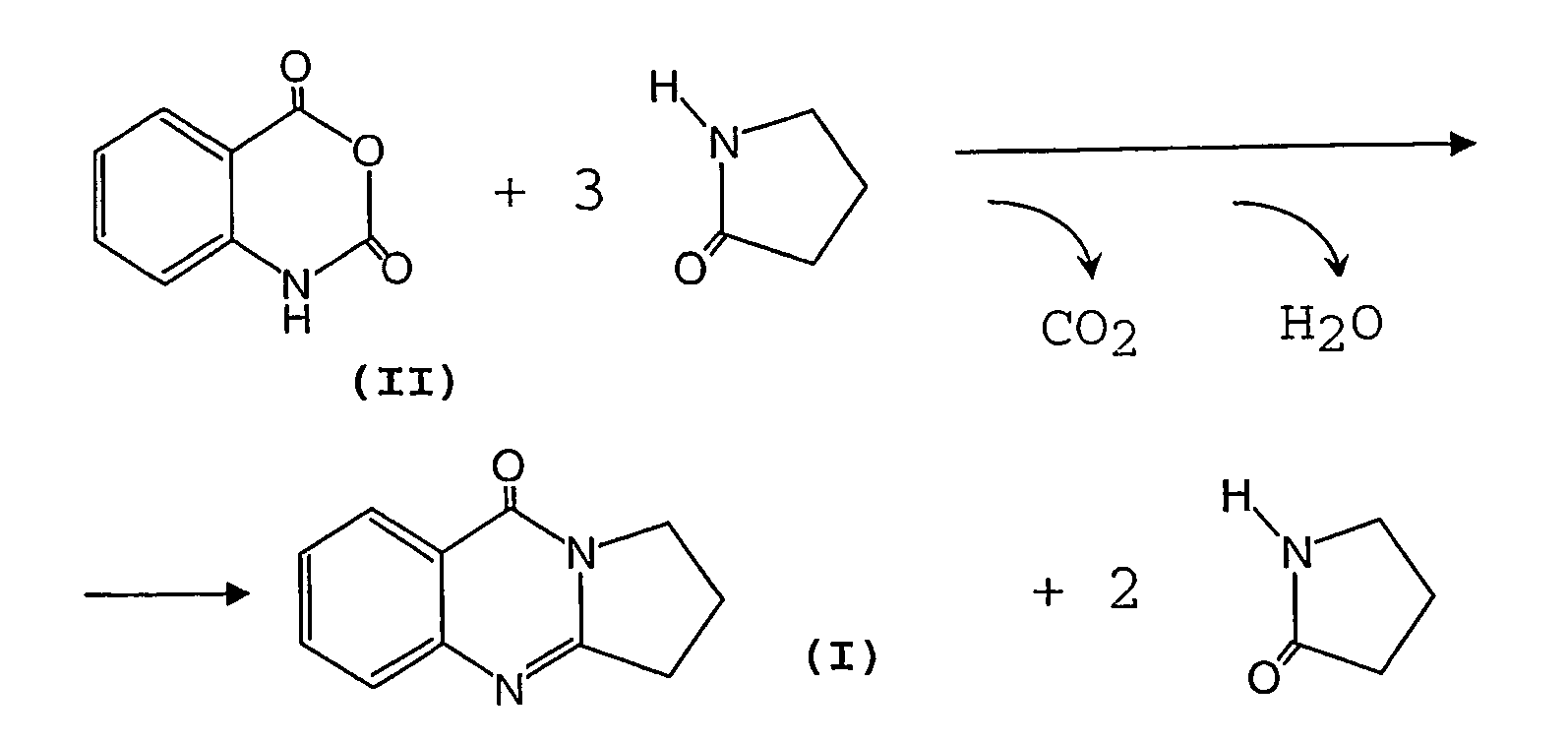
- Die Reaktion wird unter Wärmezufuhr durchgeführt, vorzugsweise bei Temperaturen im Bereich von 50 bis 200 °C. Dabei wird bevorzugt, dass anfangs eine Temperatur im Bereich von 70 bis 130 °C und nachfolgend im Bereich von 140 bis 200 °C eingehalten wird; besonders bevorzugt beträgt die Temperatur anfangs 80 bis 120 °C und nachfolgend 150 bis 190 °C.
- Die genannte anfängliche Temperatur wird vorzugsweise über einen Zeitraum von 0,5 bis 2 h, insbesondere 1 bis 1,5 h, nach Start der Reaktion eingehalten. Die genannte nachfolgende Temperatur wird vorzugsweise über einen Zeitraum von 1 bis 8 h, insbesondere 2 bis 5 h, eingehalten.
- Das Verfahren wird bevorzugt in der Weise durchgeführt, dass Pyrrolidon vorgelegt und danach Verbindung (II) portionsweise dazugegeben wird.
- Besonders vorteilhaft ist es, das Produkt (I) direkt aus dem Reaktionsgemisch durch Kristallisation zu isolieren. Zur Kristallisation der Verbindung (I) wird der Reaktionsansatz abkühlen gelassen und mit Impfkristallen angeimpft. Die Kristallisation wird bei Raumtemperatur, vorzugsweise bei mindestens 25 °C, bevorzugt bei 30 bis 70 °C, am meisten bevorzugt bei 40 bis 60 °C, durchgeführt, wodurch der Verlauf der Kristallisation beschleunigt wird. Der Kristallisationsvorgang dauert ca. 24 h bis 7 Tage, bevorzugt ca. 50 h bis 100 h. Die sich bildenden Kristalle weisen einen Gehalt an Pyrrolidon auf.
- Die vorliegende Erfindung betrifft ferner Verfahren zur Herstellung von Desoxypeganin (Verbindung gemäß Formel III). Die Verfahren umfassen im wesentlichen drei Schritte:
- (A) Herstellung von Verbindung (I) nach einem Verfahren gemäß einem der Ansprüche 1 bis 8;
- (B) Reduktionsreaktion, wobei Verbindung (III) in Salzform erhalten wird;
- (C) Freisetzung von Verbindung (III) aus dem Salz.
- Der Verlauf der Reduktionsreaktion (Clemmensen-Reduktion) lässt sich beispielhaft wie folgt darstellen:

- Verbindung (III) wird dabei in Form eines Salzes erhalten; im oben beispielhaft dargestellten Fall erhält man bei Durchführung der Reduktionsreaktion in Gegenwart von Eisessig, Zink und Salzsäure ein Tetrachlorozinkatsalz.
- Als Ausgangsverbindung (I) wird besonders bevorzugt ein durch Kristallisation isoliertes Reaktionsprodukt verwendet, das durch die oben beschriebenen Verfahren erhalten werden kann.
- Nach einer bevorzugten Ausführungsform der Erfindung wird die Reduktionsreaktion unter Verwendung von Eisessig, Zink (Zinkstaub) und Salzsäure durchgeführt, wobei vorzugsweise so vorgegangen wird, dass Verbindung (I) zunächst in Eisessig gelöst wird und nachfolgend Zink und Salzsäure dazugegeben werden.
- Nach einer weiteren bevorzugten Ausführungsform wird die Reduktionsreaktion unter Zusatz von Zink (als Zinkstaub) und Schwefelsäure durchgeführt, ohne Verwendung von Eisessig. Man erhält das Hydrogensulfat von Verbindung (III):

- Vorzugsweise wird die Reaktion bei Temperaturen von ca. 50 bis 90 °C, insbesondere 70 bis 80 °C, durchgeführt; im allgemeinen ist die Reduktion nach ca. 2 bis 3 h quantitativ erfolgt. Nach Beendigung der Reaktion wird das überschüssige Zink durch bekannte Methoden, z. B. durch Kolieren, entfernt.
- Das so erhaltene Salz der Verbindung (III) kann auf einfache und effiziente Weise durch Kristallisation aus dem Reaktionsgemisch isoliert werden. Hierzu wird der Reaktionsansatz mit Impfkristallen angeimpft. Nach erfolgter Kristallisation wird die verbleibende Mutterlauge durch dem Fachmann bekannte Methoden abgetrennt (z. B. Dekantieren).
- Im genannten Schritt (C) der erfindungsgemäßen Verfahren zur Herstellung einer Verbindung der Formel (III) wird sodann das in Schritt (B) erhaltene Salz in die freie Base (III) überführt.
- Dies erfolgt allgemein durch Zusatz einer Base, vorzugsweise NaOH, zu einer wässrigen Lösung des Salzes.
- Gemäß einer besonders bevorzugten Ausführungsform wird dieser Schritt in der Weise durchgeführt, dass die freigesetzte Base in geschmolzener Form erhalten wird. Dies wird dadurch erreicht, dass die Reaktion bei einer Temperatur durchgeführt wird, die höher ist als der Schmelzpunkt (86 °C) der freien Base (III) (=Desoxypeganin), vorzugsweise bei Temperaturen im Bereich von 90 bis 100 °C. Die in geschmolzener Form vorliegende Base kann auf einfache Weise, gegebenenfalls nach dem Erstarren, aus dem Reaktionsansatz abgetrennt werden; hierfür geeignete Methoden sind dem Fachmann bekannt.
- Nach einer weiteren besonders bevorzugten Ausführungsform wird die geschmolzene Base (III) nachfolgend abgekühlt und erstarren gelassen. Das erstarrte Produkt wird in Lösung gebracht, um eine gesättigte Lösung zu erhalten; vorzugsweise wird Wasser als Lösemittel verwendet. Aus dieser gesättigten Lösung, die durch Basenzusatz (vorzugsweise NaOH) alkalisch eingestellt wird, kann durch den sich anschließenden Kristallisationsvorgang das Endprodukt Desoxypeganin in hochreiner Form isoliert werden.
- Die Erfindung erstreckt sich somit auf Verfahren zur Herstellung von Desoxypeganin (Verbindung der Formel (III), welche einen Schritt aufweisen, bei welchem diese Verbindung in flüssiger Form aus dem Reaktionsansatz abgeschieden wird. Die Erfindung schließt insbesondere Herstellungsverfahren der genannten Art mit ein, die folgende Verfahrensschritte aufweisen:
- Reduktion der genannten Verbindung (I) zu Verbindung (III), wobei Verbindung (III) in Salzform anfällt;
- Zusatz einer Base, wodurch Verbindung (III) aus dem Salz freigesetzt und in flüssiger Form abgeschieden wird.
- Die erfindungsgemäßen Verfahren ermöglichen eine einfache und kostengünstige Herstellung der genannten Verbindungen (I, III) in einer für die Verwendung in der Arzneimittelproduktion erforderlichen Menge und Reinheit. Besonders vorteilhaft ist dabei, dass auf den Einsatz von organischen Lösemitteln verzichtet werden kann.
- Die erfindungsgemäßen Verfahren werden nachfolgend anhand von Beispielen näher erläutert.
- Herstellung von Pegen-9-(on)-(8) (identisch mit Formel (I)) durch Umsetzung von Pyrrolidon mit einer äquimolaren Menge Isatosäure-Anhydrid nach SPÄTH und PLATZER (a.a.O., S. 2221 u. 2224).
- Zwei Liter Pyrrolidon wurden mit 4 kg Isatosäureanhydrid (molares Mengenverhältnis 1:1,07) in einem Chromstahlbehälter (Fassungsvermögen 10 l) unter kräftigem Rühren auf 120 °C erhitzt bis zur beginnenden Gasentwicklung. Anschließend wurde 10 min auf 160 °C und schließlich 30 min auf 190 °C erhitzt. Von diesem Reaktionsansatz wurden 558 g (= 3 Mol) im noch heiß-flüssigen Zustand in einen 1-Liter-Kolben (NS 29) überführt. Der im Stahlbehälter zurückbleibende Rest erstarrte zu einer schwarzen, glasartigen Masse, die für die Isolierung von Pegenon ungeeignet ist.
- Aus dem in den Kolben überführten Reaktionsansatz (558 g) konnten durch Hochvakuumdestillation über eine auf 120 °C beheizte Destillationsbrücke bis zu 117 g Pegenon destilliert werden; dies entspricht einer Ausbeute von 21 %. Nach Umkristallisieren aus Ether wurde ein Schmelzpunkt von 111 °C ermittelt.
- Ein Mol Isatosäureanhydrid (Formel (II)) wurde mit 3 Mol Pyrrolidon umgesetzt. Dabei wurde Pyrrolidon in einer beheizbaren Chromstahltrommel (30 1) vorgelegt und auf ca. 100 °C erhitzt, und anschließend Isatosäureanhydrid portionsweise unter ständigem Rühren dazugegeben.
Nach ca. 1 h war die gesamte Menge Isatosäureanhydrid in Pyrrolidon gelöst. Nachfolgend wurde 5 h auf 155 bis 160 °C erhitzt (dabei Bildung von CO2 und H2O; s. o.) und schließlich kurzzeitig auf 170 bis 180 °C. - Die so erhaltene Masse wurde nach Abkühlen auf ca. 50 °C mit Pegenon-Kristallen angeimpft und ca. 50 bis 100 h bei Raumtemperatur kristallisieren gelassen. Durch Erhöhung der Temperatur (mindestens 25 °C) konnte der Kristallisationsvorgang beschleunigt werden (Dauer nur ca. 2 bis 3 Tage). Die "Mutterlauge" wurde durch Dekantieren von den Kristallen abgetrennt.
- Insgesamt wurden mehr als 90 % der eingesetzten Ausgangsverbindungen zu Pegenon umgesetzt. Die Ausbeute an kristallisiertem Pegenon betrug 40 %; der restliche Anteil des Pegenons ist in Pyrrolidon gelöst. Die erhaltenen Pegenon-Kristalle weisen gemäß NMR noch einen Gehalt an 30 Mol-% Pyrrolidon auf; die Reinheit des Pegenons beträgt ca. 99 % nach NMR.
- In einer Abwandlung dieses Verfahrens wurden die Ausgangsverbindungen in einem Mengenverhältnis von 1:2,5 (Isatosäureanhydrid:Pyrrolidon) eingesetzt. Dadurch konnte der Anteil des kristallisierten Pegenons auf ca. 55 % gesteigert werden, bei einer Reinheit von ca. 99 %.
- Gemäß Beispiel 2 hergestellte Pegenon-Kristalle (2,5 kg; mit einem Gehalt an 15 Gew.-% Pyrrolidon; entspricht 1,83 kg oder 9,81 Mol reinem Pegenon) wurden bei ca. 50 °C in 6,1 l (= 100,4 Mol) Eisessig gelöst und in einen Chromstahlbehälter (50 l) überführt. Anschließend wurden unter Rühren 3,7 kg (= 56,4 Mol) Zinkstaub in kleinen Portionen dazugegeben. Das Reaktionsgemisch wurde dabei auf ca. 60 °C temperiert. Nach ca. 1 h wurden 4 x 3 1 konzentrierte HCl (32 %; entspricht 121,74 Mol) innerhalb von 2 h in kleinen Portionen unter ständigem Rühren zugegeben. Danach (nach ca. 4 bis 5 h) wurde der überschüssige Zinkstaub durch Kolieren aus dem Reaktionsgemisch entfernt. Nach Animpfen mit Impfkristallen konnten ca. 66 % des Desoxypeganin-Salzes durch Auskristallisieren abgetrennt werden. Die verbleibende Mutterlauge wurde durch Verdunstung eingeengt, woraufhin wiederum 66 % des Desoxypeganin-Salzes auskristallisierten. Insgesamt konnten ca. 90 % des Desoxypeganinsalzes in kristalliner Form gewonnen werden.
- Auf diese Weise erhaltene Kristalle (2,5 kg) wurden in heißem Wasser (ca. 11 l) gelöst. Anschließend wurde unter Rühren NaOH zugegeben (ca. 8 kg Rotulae), wobei der Ansatz auf 95 bis 100 °C erhitzt wurde. Dabei wurde Desoxypeganin in geschmolzener Form erhalten und aus dem Reaktionsgemisch abgetrennt. Nach dem Erstarren wurde das Produkt wiederum in heißem Wasser gelöst, um eine gesättigte Lösung zu erhalten, die mittels NaOH alkalisch eingestellt wurde. Aus dieser gesättigten alkalischen Lösung wurde Desoxypeganin durch Kristallisation isoliert.
- Die Ausbeute an Desoxypeganin, bezogen auf das eingesetzte Desoxypeganin-Salz, lag über 90 %, bei einer Reinheit von 99,9 % (NMR).
- 175 g Pegenon-Kristalle (mit einem Gehalt an 30 Mol% Pyrrolidon; entspricht 150 g Pegenon; siehe Beispiel 2) wurden mit 750 ml H2SO4 (20 %ig) versetzt und ca. 30 min unter Rühren erhitzt (ca. 85 °C).
Nachfolgend wurden nach und nach 260 g Zinkstaub zugegeben (Dauer: ca. 2 h). Nach ca. 1 h wurde nochmals H2SO4 zugegeben (375 ml, 40 %ig). Nach insgesamt ca. 3 h war die Reaktion beendet, und das überschüssige Zink wurde durch Kolieren entfernt. - Wie unter Beispiel 3 a) beschrieben, wurde das gewonnene Desoxypeganin-Salz durch Kristallisation aus dem Reaktionsansatz abgetrennt. Die Freisetzung der Base erfolgte nach der unter Beispiel 3 b) beschriebenen Methode.
Claims (22)
- Verfahren zur Herstellung einer Verbindung der nachfolgenden Formel (I)

- Verfahren nach Anspruch 1, dadurch gekennzeichnet, dass das Reaktionsprodukt (I) in einem nachfolgenden Schritt direkt aus dem Reaktionsgemisch durch Kristallisation isoliert wird.
- Verfahren nach Anspruch 1 oder 2, dadurch gekennzeichnet, dass 1,5 bis 5 Mol, vorzugsweise 2 bis 4 Mol, besonders bevorzugt 2,5 bis 3,5 Mol 2-Pyrrolidon eingesetzt werden, jeweils bezogen auf die Menge an Verbindung (II).
- Verfahren nach einem der vorangehenden Ansprüche, dadurch gekennzeichnet, dass die Umsetzung bei 50 bis 200 °C durchgeführt wird.
- Verfahren nach Anspruch 4, dadurch gekennzeichnet, dass das Reaktionsgemisch anfangs auf 70 bis 130 °C, vorzugsweise auf 80 bis 120 °C, und nachfolgend auf 140 bis 200 °C, vorzugsweise 150 bis 190 °C, temperiert wird.
- Verfahren nach Anspruch 5, dadurch gekennzeichnet, dass die genannte anfängliche Temperatur über einen Zeitraum von 0,5 bis 2 h, vorzugsweise 1 bis 1,5 h, und die genannte nachfolgende Temperatur über einen Zeitraum von 1 bis 8 h, vorzugsweise von 2 bis 5 h, beibehalten wird.
- Verfahren nach Anspruch 6, dadurch gekennzeichnet, dass der Reaktionsansatz nach dem Abkühlen mit Impfkristallen der Verbindung (I) angeimpft wird und über einen Zeitraum von 24 h bis 7 Tagen, vorzugsweise 50 bis 100 h, bei Raumtemperatur, vorzugsweise bei mindestens 25 °C, gehalten wird, um das Auskristallisieren zu ermöglichen.
- Verfahren nach Anspruch 7, dadurch gekennzeichnet, dass die Kristallisation bei 30 bis 70 °C, vorzugsweise bei 40 bis 60 °C, durchgeführt wird.
- Verfahren zur Herstellung einer Verbindung der nachfolgenden Formel (III), umfassend folgende Schritte:
 (A) Herstellung von Verbindung (I) nach einem Verfahren gemäß einem der Ansprüche 1 bis 8;(B) Reduktionsreaktion, wobei Verbindung (III) in Salzform erhalten wird;(C) Freisetzung von Verbindung (III) aus dem Salz.
- Verfahren nach Anspruch 9, dadurch gekennzeichnet, dass als Verbindung (I) ein durch Kristallisation isoliertes Reaktionsprodukt nach einem der Ansprüche 1 bis 8 eingesetzt wird.
- Verfahren nach Anspruch 9 oder 10, dadurch gekennzeichnet, dass die Reduktionsreaktion (Schritt B) in Gegenwart von Zink und Säure durchgeführt wird.
- Verfahren nach Anspruch 11, dadurch gekennzeichnet, dass Verbindung (I), vorzugsweise in kristallisierter Form, zunächst in Eisessig gelöst wird und nachfolgend Zink und Salzsäure zugegeben werden.
- Verfahren nach Anspruch 12, dadurch gekenntzeichnet, dass die Reduktionsreaktion in Gegenwart von wässriger Schwefelsäure und Zinkstaub durchgeführt wird.
- Verfahren nach einem der Ansprüche 9 bis 13, dadurch gekennzeichnet, dass im Anschluss an Schritt (B) Verbindung (III) als Salz durch Kristallisation aus dem Reaktionsansatz isoliert wird.
- Verfahren nach einem der Ansprüche 9 bis 14, dadurch gekennzeichnet, dass Verbindung (III) in Schritt (C) durch Basenzusatz, vorzugsweise durch Zusatz von NaOH, aus dem Salz freigesetzt wird.
- Verfahren nach Anspruch 15, dadurch gekennzeichnet, dass Schritt (C) unter Erhitzen durchgeführt wird, wobei die aus dem Salz freigesetzte Verbindung (III) in geschmolzener Form erhalten wird.
- Verfahren nach Anspruch 16, dadurch gekennzeichnet, dass die in geschmolzener Form vorliegende Verbindung (III) abgekühlt und nach dem Erstarren aus wässriger alkalischer Lösung kristallisiert wird.
- Verfahren zur Herstellung von Verbindung (III), ausgehend von einem Salz dieser Verbindung, dadurch gekennzeichnet, dass Verbindung (III) als freie Base in geschmolzener Form aus dem Salz freigesetzt und isoliert wird.
- Verfahren nach Anspruch 18, dadurch gekennzeichnet, dass die in geschmolzener Form vorliegende Verbindung (III) abgekühlt und nach dem Erstarren aus wässriger alkalischer Lösung kristallisiert wird.
- Verfahren zur Herstellung einer Verbindung der angegebenen Formel (III), dadurch gekennzeichnet, dass es einen Schritt aufweist, bei welchem diese Verbindung in flüssiger Form aus dem Reaktionsansatz abgeschieden wird.
- Verfahren zur Herstellung einer Verbindung der angegebenen Formel (III) nach Anspruch 20, dadurch gekennzeichnet, dass es folgende Schritte umfasst:- Reduktion der genannten Verbindung (I) zu Verbindung (III), wobei Verbindung (III) in Salzform anfällt;- Zusatz einer Base, wodurch Verbindung (III) aus dem Salz freigesetzt und in flüssiger Form abgeschieden wird.
- Verwendung einer Verbindung der Formel (I), hergestellt nach einem Verfahren nach einem der Ansprüche 1 bis 9, zur Herstellung einer Verbindung der Formel (III) als freie Base oder in Form eine Salzes.
Priority Applications (1)
| Application Number | Priority Date | Filing Date | Title |
|---|---|---|---|
| SI200430943T SI1590351T1 (sl) | 2003-02-03 | 2004-01-22 | Postopki za pripravo kinazolinskih alkaloidov |
Applications Claiming Priority (3)
| Application Number | Priority Date | Filing Date | Title |
|---|---|---|---|
| DE10304141 | 2003-02-03 | ||
| DE10304141A DE10304141B4 (de) | 2003-02-03 | 2003-02-03 | Verfahren zur Herstellung von Chinazolin-Alkaloiden |
| PCT/EP2004/000485 WO2004069836A1 (de) | 2003-02-03 | 2004-01-22 | Verfahren zur herstellung von chinazolin-alkaloiden |
Publications (2)
| Publication Number | Publication Date |
|---|---|
| EP1590351A1 EP1590351A1 (de) | 2005-11-02 |
| EP1590351B1 true EP1590351B1 (de) | 2008-09-03 |
Family
ID=32747532
Family Applications (1)
| Application Number | Title | Priority Date | Filing Date |
|---|---|---|---|
| EP04704202A Expired - Lifetime EP1590351B1 (de) | 2003-02-03 | 2004-01-22 | Verfahren zur herstellung von chinazolin-alkaloiden |
Country Status (25)
| Country | Link |
|---|---|
| US (1) | US7495096B2 (de) |
| EP (1) | EP1590351B1 (de) |
| JP (1) | JP2006516578A (de) |
| KR (1) | KR20050096165A (de) |
| CN (1) | CN100558727C (de) |
| AR (1) | AR042946A1 (de) |
| AT (1) | ATE407135T1 (de) |
| AU (1) | AU2004208873B2 (de) |
| BR (1) | BRPI0407012A (de) |
| CA (1) | CA2514945A1 (de) |
| DE (2) | DE10304141B4 (de) |
| DK (1) | DK1590351T3 (de) |
| EA (1) | EA009047B1 (de) |
| ES (1) | ES2314366T3 (de) |
| MX (1) | MXPA05008179A (de) |
| MY (1) | MY141734A (de) |
| NO (1) | NO20053689L (de) |
| NZ (1) | NZ541101A (de) |
| PL (1) | PL378406A1 (de) |
| PT (1) | PT1590351E (de) |
| SI (1) | SI1590351T1 (de) |
| TW (1) | TW200418811A (de) |
| UA (1) | UA81287C2 (de) |
| WO (1) | WO2004069836A1 (de) |
| ZA (1) | ZA200505160B (de) |
Families Citing this family (3)
| Publication number | Priority date | Publication date | Assignee | Title |
|---|---|---|---|---|
| DE102004048927A1 (de) * | 2004-10-06 | 2006-04-20 | Lts Lohmann Therapie-Systeme Ag | Pharmazeutische Kombination enthaltend Desoxypeganin und Cyp2D6 Inhibitoren |
| CN111032039B (zh) | 2017-08-03 | 2024-03-26 | 卡莱克汀科学有限责任公司 | 用于预防和治疗医学障碍的化合物及其用途 |
| KR102728780B1 (ko) * | 2021-11-30 | 2024-11-08 | 이화여자대학교 산학협력단 | 데옥시바시시논을 유효성분으로 포함하는 미백용 조성물 및 상기 데옥시바시시논 제조방법 |
Family Cites Families (7)
| Publication number | Priority date | Publication date | Assignee | Title |
|---|---|---|---|---|
| SU605614A1 (ru) * | 1971-10-20 | 1978-05-05 | Ордена Трудового Красного Знамени Институт Химии Растительных Веществ Ан Узбекской Сср | Антихолинэстеразное средство |
| JP3180464B2 (ja) * | 1991-08-30 | 2001-06-25 | 新日本理化株式会社 | ジアセタール化合物の製造方法 |
| DE19530606A1 (de) * | 1995-08-21 | 1997-02-27 | Basf Ag | 1-(Pyridyl)-pyrazole |
| JP3958452B2 (ja) * | 1997-10-31 | 2007-08-15 | 大日精化工業株式会社 | 新規化学発光試薬及びその製造方法 |
| DE19906978B4 (de) | 1999-02-19 | 2004-07-08 | Lts Lohmann Therapie-Systeme Ag | Pharmazeutische Zusammensetzung enthaltend Desoxypeganin zur Behandlung der Drogenabhängigkeit |
| DE19906975B4 (de) * | 1999-02-19 | 2004-04-15 | Lts Lohmann Therapie-Systeme Ag | Arzneiform zur Behandlung von Alzheimer'scher Demenz |
| DE19906979B4 (de) | 1999-02-19 | 2004-07-08 | Lts Lohmann Therapie-Systeme Ag | Verwendung von Desoxypeganin zur Behandlung der Nikotinabhängigkeit |
-
2003
- 2003-02-03 DE DE10304141A patent/DE10304141B4/de not_active Expired - Fee Related
-
2004
- 2004-01-22 US US10/544,265 patent/US7495096B2/en not_active Expired - Fee Related
- 2004-01-22 DK DK04704202T patent/DK1590351T3/da active
- 2004-01-22 WO PCT/EP2004/000485 patent/WO2004069836A1/de not_active Ceased
- 2004-01-22 CN CNB2004800034182A patent/CN100558727C/zh not_active Expired - Fee Related
- 2004-01-22 UA UAA200507716A patent/UA81287C2/uk unknown
- 2004-01-22 AU AU2004208873A patent/AU2004208873B2/en not_active Ceased
- 2004-01-22 NZ NZ541101A patent/NZ541101A/en not_active IP Right Cessation
- 2004-01-22 EA EA200501135A patent/EA009047B1/ru not_active IP Right Cessation
- 2004-01-22 PL PL378406A patent/PL378406A1/pl not_active Application Discontinuation
- 2004-01-22 AT AT04704202T patent/ATE407135T1/de active
- 2004-01-22 MX MXPA05008179A patent/MXPA05008179A/es active IP Right Grant
- 2004-01-22 BR BR0407012-7A patent/BRPI0407012A/pt not_active Application Discontinuation
- 2004-01-22 DE DE502004007980T patent/DE502004007980D1/de not_active Expired - Lifetime
- 2004-01-22 ES ES04704202T patent/ES2314366T3/es not_active Expired - Lifetime
- 2004-01-22 EP EP04704202A patent/EP1590351B1/de not_active Expired - Lifetime
- 2004-01-22 JP JP2006501573A patent/JP2006516578A/ja active Pending
- 2004-01-22 PT PT04704202T patent/PT1590351E/pt unknown
- 2004-01-22 CA CA002514945A patent/CA2514945A1/en not_active Abandoned
- 2004-01-22 SI SI200430943T patent/SI1590351T1/sl unknown
- 2004-01-22 KR KR1020057013954A patent/KR20050096165A/ko not_active Ceased
- 2004-01-28 AR ARP040100246A patent/AR042946A1/es unknown
- 2004-01-30 MY MYPI20040294A patent/MY141734A/en unknown
- 2004-02-02 TW TW093102290A patent/TW200418811A/zh unknown
-
2005
- 2005-06-24 ZA ZA200505160A patent/ZA200505160B/en unknown
- 2005-07-29 NO NO20053689A patent/NO20053689L/no not_active Application Discontinuation
Also Published As
| Publication number | Publication date |
|---|---|
| CA2514945A1 (en) | 2004-08-19 |
| ATE407135T1 (de) | 2008-09-15 |
| EA009047B1 (ru) | 2007-10-26 |
| ZA200505160B (en) | 2007-01-31 |
| TW200418811A (en) | 2004-10-01 |
| EP1590351A1 (de) | 2005-11-02 |
| DE502004007980D1 (de) | 2008-10-16 |
| CN1745084A (zh) | 2006-03-08 |
| WO2004069836A1 (de) | 2004-08-19 |
| MXPA05008179A (es) | 2006-02-17 |
| AU2004208873B2 (en) | 2009-12-17 |
| ES2314366T3 (es) | 2009-03-16 |
| AR042946A1 (es) | 2005-07-06 |
| DK1590351T3 (da) | 2008-12-15 |
| NZ541101A (en) | 2009-03-31 |
| SI1590351T1 (sl) | 2009-02-28 |
| UA81287C2 (en) | 2007-12-25 |
| DE10304141B4 (de) | 2006-03-09 |
| KR20050096165A (ko) | 2005-10-05 |
| US20060084669A1 (en) | 2006-04-20 |
| JP2006516578A (ja) | 2006-07-06 |
| CN100558727C (zh) | 2009-11-11 |
| US7495096B2 (en) | 2009-02-24 |
| AU2004208873A1 (en) | 2004-08-19 |
| EA200501135A1 (ru) | 2006-02-24 |
| BRPI0407012A (pt) | 2006-01-10 |
| PT1590351E (pt) | 2008-11-21 |
| DE10304141A1 (de) | 2004-08-26 |
| HK1075898A1 (zh) | 2005-12-30 |
| MY141734A (en) | 2010-06-15 |
| PL378406A1 (pl) | 2006-04-03 |
| NO20053689L (no) | 2005-07-29 |
Similar Documents
| Publication | Publication Date | Title |
|---|---|---|
| DE1795808C2 (de) | Verfahren zur Herstellung von 2,2,6,6-Tetramethyl-4-oxopiperidin | |
| DE9101346U1 (de) | Neuroprotektive 3-Piperidino-4-hydroxychroman-Derivate | |
| DE2519480A1 (de) | Aryl-oxo-heptensaeuren | |
| DD140040A5 (de) | Verfahren zur herstellung von 5-alkylthio-pyrimidinen | |
| DE10304141B4 (de) | Verfahren zur Herstellung von Chinazolin-Alkaloiden | |
| EP1636199A2 (de) | Verfahren zur herstellung von phenylessig derivaten | |
| DE2251097B2 (de) | Verfahren zur gewinnung eines gemisches von (+)-cis- und (+)-trans-chrysanthemummonocarbonsaeure | |
| DE69707860T2 (de) | Verfahren zur herstellung von tetrahydroindolizinen | |
| EP0653423B1 (de) | Verfahren zur Herstellung von substituierten Chinazolin-2,4-dionen | |
| DE60108105T2 (de) | Verfahren zur Herstellung von 5-substituierten Isobenzofuranen | |
| DE2633931A1 (de) | Pyrazolderivate, deren salze mit saeuren, verfahren zu ihrer herstellung und arzneipraeparate | |
| EP0057844A1 (de) | Verfahren zur Herstellung von Polychlorbenzoylchloriden | |
| CH659464A5 (de) | Verfahren zur herstellung von 1,8-dihydroxy-10-acyl-9-anthronen. | |
| EP0353238A1 (de) | Neue zwischenprodukte und verfahren | |
| DE1935404B2 (de) | Verfahren zur Herstellung von Chinazolinonen | |
| CH646971A5 (de) | Dihalogen-substituierte anelierte pyrimidin-4-on-derivate und verfahren zu ihrer herstellung. | |
| EP0115811B1 (de) | 2,4-Dichlor-5-thiazolcarboxaldehyd und ein Verfahren zu seiner Herstellung | |
| DE2943286A1 (de) | Tricyclische orthokondensierte stickstoffhaltige verbindungen, verfahren zu ihrer herstellung und pharmazeutische zubereitungen, die diese verbindungen enthalten | |
| DE2164662A1 (de) | Indanderivate und Verfahren zu ihrer Herstellung | |
| DE3236096A1 (de) | In der 7- oder 8-stellung chlor- oder trifluormethylsubstituierte n-(chinol-4-yl)-anthranilsaeureester, verfahren zu ihrer herstellung und diese verbindungen enthaltende arzneimittel | |
| DE60000560T2 (de) | Verfahren zur Herstellung einer sehr sauberen Phenotiazin Verbindung | |
| DE2302970A1 (de) | Verfahren zur herstellung heterocyclischer verbindungen | |
| EP0423595B1 (de) | Verfahren zur Herstellung von 3-Trichlormethyl-pyridin | |
| DE915336C (de) | Verfahren zur Herstellung von 6-Methoxy-8-(aminoalkylamino)-chinolinen | |
| DE2166115A1 (de) | 2,6 Methano 3 benzazocine Ausscheidung aus 2127819 |
Legal Events
| Date | Code | Title | Description |
|---|---|---|---|
| PUAI | Public reference made under article 153(3) epc to a published international application that has entered the european phase |
Free format text: ORIGINAL CODE: 0009012 |
|
| 17P | Request for examination filed |
Effective date: 20050706 |
|
| AK | Designated contracting states |
Kind code of ref document: A1 Designated state(s): AT BE BG CH CY CZ DE DK EE ES FI FR GB GR HU IE IT LI LU MC NL PT RO SE SI SK TR |
|
| AX | Request for extension of the european patent |
Extension state: AL LT LV MK |
|
| REG | Reference to a national code |
Ref country code: HK Ref legal event code: DE Ref document number: 1075898 Country of ref document: HK |
|
| RAX | Requested extension states of the european patent have changed |
Extension state: LV Payment date: 20050706 Extension state: LT Payment date: 20050706 |
|
| GRAP | Despatch of communication of intention to grant a patent |
Free format text: ORIGINAL CODE: EPIDOSNIGR1 |
|
| GRAS | Grant fee paid |
Free format text: ORIGINAL CODE: EPIDOSNIGR3 |
|
| GRAA | (expected) grant |
Free format text: ORIGINAL CODE: 0009210 |
|
| AK | Designated contracting states |
Kind code of ref document: B1 Designated state(s): AT BE BG CH CY CZ DE DK EE ES FI FR GB GR HU IE IT LI LU MC NL PT RO SE SI SK TR |
|
| AX | Request for extension of the european patent |
Extension state: LT LV |
|
| REG | Reference to a national code |
Ref country code: GB Ref legal event code: FG4D Free format text: NOT ENGLISH |
|
| REG | Reference to a national code |
Ref country code: CH Ref legal event code: EP |
|
| REG | Reference to a national code |
Ref country code: IE Ref legal event code: FG4D Free format text: LANGUAGE OF EP DOCUMENT: GERMAN |
|
| REF | Corresponds to: |
Ref document number: 502004007980 Country of ref document: DE Date of ref document: 20081016 Kind code of ref document: P |
|
| REG | Reference to a national code |
Ref country code: PT Ref legal event code: SC4A Free format text: AVAILABILITY OF NATIONAL TRANSLATION Effective date: 20081111 |
|
| REG | Reference to a national code |
Ref country code: RO Ref legal event code: EPE |
|
| REG | Reference to a national code |
Ref country code: HK Ref legal event code: GR Ref document number: 1075898 Country of ref document: HK |
|
| REG | Reference to a national code |
Ref country code: DK Ref legal event code: T3 |
|
| REG | Reference to a national code |
Ref country code: GR Ref legal event code: EP Ref document number: 20080403285 Country of ref document: GR |
|
| REG | Reference to a national code |
Ref country code: SE Ref legal event code: TRGR |
|
| LTIE | Lt: invalidation of european patent or patent extension |
Effective date: 20080903 |
|
| REG | Reference to a national code |
Ref country code: ES Ref legal event code: FG2A Ref document number: 2314366 Country of ref document: ES Kind code of ref document: T3 |
|
| PG25 | Lapsed in a contracting state [announced via postgrant information from national office to epo] |
Ref country code: BG Free format text: LAPSE BECAUSE OF FAILURE TO SUBMIT A TRANSLATION OF THE DESCRIPTION OR TO PAY THE FEE WITHIN THE PRESCRIBED TIME-LIMIT Effective date: 20081203 |
|
| PLBE | No opposition filed within time limit |
Free format text: ORIGINAL CODE: 0009261 |
|
| STAA | Information on the status of an ep patent application or granted ep patent |
Free format text: STATUS: NO OPPOSITION FILED WITHIN TIME LIMIT |
|
| PG25 | Lapsed in a contracting state [announced via postgrant information from national office to epo] |
Ref country code: EE Free format text: LAPSE BECAUSE OF FAILURE TO SUBMIT A TRANSLATION OF THE DESCRIPTION OR TO PAY THE FEE WITHIN THE PRESCRIBED TIME-LIMIT Effective date: 20080903 |
|
| 26N | No opposition filed |
Effective date: 20090604 |
|
| PG25 | Lapsed in a contracting state [announced via postgrant information from national office to epo] |
Ref country code: MC Free format text: LAPSE BECAUSE OF NON-PAYMENT OF DUE FEES Effective date: 20090131 |
|
| PGFP | Annual fee paid to national office [announced via postgrant information from national office to epo] |
Ref country code: HU Payment date: 20110215 Year of fee payment: 8 Ref country code: IE Payment date: 20110131 Year of fee payment: 8 Ref country code: DK Payment date: 20110124 Year of fee payment: 8 |
|
| PGFP | Annual fee paid to national office [announced via postgrant information from national office to epo] |
Ref country code: CZ Payment date: 20110121 Year of fee payment: 8 Ref country code: CH Payment date: 20110211 Year of fee payment: 8 Ref country code: AT Payment date: 20110126 Year of fee payment: 8 Ref country code: SI Payment date: 20110121 Year of fee payment: 8 Ref country code: SE Payment date: 20110125 Year of fee payment: 8 Ref country code: SK Payment date: 20110120 Year of fee payment: 8 Ref country code: TR Payment date: 20110121 Year of fee payment: 8 Ref country code: RO Payment date: 20110124 Year of fee payment: 8 Ref country code: PT Payment date: 20110120 Year of fee payment: 8 Ref country code: FI Payment date: 20110125 Year of fee payment: 8 Ref country code: FR Payment date: 20110216 Year of fee payment: 8 Ref country code: NL Payment date: 20110128 Year of fee payment: 8 Ref country code: LU Payment date: 20110201 Year of fee payment: 8 Ref country code: IT Payment date: 20110128 Year of fee payment: 8 |
|
| PGFP | Annual fee paid to national office [announced via postgrant information from national office to epo] |
Ref country code: GR Payment date: 20110128 Year of fee payment: 8 |
|
| PGFP | Annual fee paid to national office [announced via postgrant information from national office to epo] |
Ref country code: ES Payment date: 20110222 Year of fee payment: 8 Ref country code: DE Payment date: 20110331 Year of fee payment: 8 Ref country code: GB Payment date: 20110128 Year of fee payment: 8 Ref country code: BE Payment date: 20110211 Year of fee payment: 8 |
|
| PG25 | Lapsed in a contracting state [announced via postgrant information from national office to epo] |
Ref country code: CY Free format text: LAPSE BECAUSE OF FAILURE TO SUBMIT A TRANSLATION OF THE DESCRIPTION OR TO PAY THE FEE WITHIN THE PRESCRIBED TIME-LIMIT Effective date: 20080903 |
|
| BERE | Be: lapsed |
Owner name: HF ARZNEIMITTELFORSCHUNG G.M.B.H. Effective date: 20120131 |
|
| REG | Reference to a national code |
Ref country code: PT Ref legal event code: MM4A Free format text: LAPSE DUE TO NON-PAYMENT OF FEES Effective date: 20120723 |
|
| REG | Reference to a national code |
Ref country code: NL Ref legal event code: V1 Effective date: 20120801 |
|
| REG | Reference to a national code |
Ref country code: CH Ref legal event code: PL |
|
| REG | Reference to a national code |
Ref country code: SE Ref legal event code: EUG |
|
| REG | Reference to a national code |
Ref country code: DK Ref legal event code: EBP |
|
| REG | Reference to a national code |
Ref country code: GR Ref legal event code: ML Ref document number: 20080403285 Country of ref document: GR Effective date: 20120802 |
|
| GBPC | Gb: european patent ceased through non-payment of renewal fee |
Effective date: 20120122 |
|
| REG | Reference to a national code |
Ref country code: SI Ref legal event code: KO00 Effective date: 20120824 |
|
| REG | Reference to a national code |
Ref country code: SK Ref legal event code: MM4A Ref document number: E 4648 Country of ref document: SK Effective date: 20120122 |
|
| REG | Reference to a national code |
Ref country code: FR Ref legal event code: ST Effective date: 20120928 |
|
| REG | Reference to a national code |
Ref country code: IE Ref legal event code: MM4A |
|
| PG25 | Lapsed in a contracting state [announced via postgrant information from national office to epo] |
Ref country code: SE Free format text: LAPSE BECAUSE OF NON-PAYMENT OF DUE FEES Effective date: 20120123 Ref country code: LI Free format text: LAPSE BECAUSE OF NON-PAYMENT OF DUE FEES Effective date: 20120131 Ref country code: CZ Free format text: LAPSE BECAUSE OF NON-PAYMENT OF DUE FEES Effective date: 20120122 Ref country code: GB Free format text: LAPSE BECAUSE OF NON-PAYMENT OF DUE FEES Effective date: 20120122 Ref country code: RO Free format text: LAPSE BECAUSE OF NON-PAYMENT OF DUE FEES Effective date: 20120122 Ref country code: FI Free format text: LAPSE BECAUSE OF NON-PAYMENT OF DUE FEES Effective date: 20120122 Ref country code: CH Free format text: LAPSE BECAUSE OF NON-PAYMENT OF DUE FEES Effective date: 20120131 Ref country code: DE Free format text: LAPSE BECAUSE OF NON-PAYMENT OF DUE FEES Effective date: 20120801 |
|
| REG | Reference to a national code |
Ref country code: DE Ref legal event code: R119 Ref document number: 502004007980 Country of ref document: DE Effective date: 20120801 |
|
| PG25 | Lapsed in a contracting state [announced via postgrant information from national office to epo] |
Ref country code: SI Free format text: LAPSE BECAUSE OF NON-PAYMENT OF DUE FEES Effective date: 20120123 Ref country code: IT Free format text: LAPSE BECAUSE OF NON-PAYMENT OF DUE FEES Effective date: 20120122 Ref country code: PT Free format text: LAPSE BECAUSE OF NON-PAYMENT OF DUE FEES Effective date: 20120723 Ref country code: GR Free format text: LAPSE BECAUSE OF NON-PAYMENT OF DUE FEES Effective date: 20120802 Ref country code: HU Free format text: LAPSE BECAUSE OF NON-PAYMENT OF DUE FEES Effective date: 20120123 Ref country code: SK Free format text: LAPSE BECAUSE OF NON-PAYMENT OF DUE FEES Effective date: 20120122 |
|
| REG | Reference to a national code |
Ref country code: AT Ref legal event code: MM01 Ref document number: 407135 Country of ref document: AT Kind code of ref document: T Effective date: 20120122 |
|
| PG25 | Lapsed in a contracting state [announced via postgrant information from national office to epo] |
Ref country code: FR Free format text: LAPSE BECAUSE OF NON-PAYMENT OF DUE FEES Effective date: 20120131 Ref country code: BE Free format text: LAPSE BECAUSE OF NON-PAYMENT OF DUE FEES Effective date: 20120131 |
|
| PG25 | Lapsed in a contracting state [announced via postgrant information from national office to epo] |
Ref country code: DK Free format text: LAPSE BECAUSE OF NON-PAYMENT OF DUE FEES Effective date: 20120131 Ref country code: IE Free format text: LAPSE BECAUSE OF NON-PAYMENT OF DUE FEES Effective date: 20120122 Ref country code: NL Free format text: LAPSE BECAUSE OF NON-PAYMENT OF DUE FEES Effective date: 20120801 Ref country code: TR Free format text: LAPSE BECAUSE OF NON-PAYMENT OF DUE FEES Effective date: 20120122 Ref country code: AT Free format text: LAPSE BECAUSE OF NON-PAYMENT OF DUE FEES Effective date: 20120122 |
|
| REG | Reference to a national code |
Ref country code: ES Ref legal event code: FD2A Effective date: 20130705 |
|
| PG25 | Lapsed in a contracting state [announced via postgrant information from national office to epo] |
Ref country code: ES Free format text: LAPSE BECAUSE OF NON-PAYMENT OF DUE FEES Effective date: 20120123 |
|
| PG25 | Lapsed in a contracting state [announced via postgrant information from national office to epo] |
Ref country code: LU Free format text: LAPSE BECAUSE OF NON-PAYMENT OF DUE FEES Effective date: 20120122 |