EP1633697B1 - Procede de production des composes d'amine 3-aryle-butyle substitue - Google Patents
Procede de production des composes d'amine 3-aryle-butyle substitue Download PDFInfo
- Publication number
- EP1633697B1 EP1633697B1 EP04739583A EP04739583A EP1633697B1 EP 1633697 B1 EP1633697 B1 EP 1633697B1 EP 04739583 A EP04739583 A EP 04739583A EP 04739583 A EP04739583 A EP 04739583A EP 1633697 B1 EP1633697 B1 EP 1633697B1
- Authority
- EP
- European Patent Office
- Prior art keywords
- methyl
- phenyl
- dimethylamine
- process according
- methoxy
- Prior art date
- Legal status (The legal status is an assumption and is not a legal conclusion. Google has not performed a legal analysis and makes no representation as to the accuracy of the status listed.)
- Expired - Lifetime
Links
- 0 *C([C@@]([C@@](*)CN(*)*)(c1c(*)c(*)c(*)c(*)c1*)O)*=* Chemical compound *C([C@@]([C@@](*)CN(*)*)(c1c(*)c(*)c(*)c(*)c1*)O)*=* 0.000 description 12
Classifications
-
- C—CHEMISTRY; METALLURGY
- C07—ORGANIC CHEMISTRY
- C07C—ACYCLIC OR CARBOCYCLIC COMPOUNDS
- C07C217/00—Compounds containing amino and etherified hydroxy groups bound to the same carbon skeleton
- C07C217/54—Compounds containing amino and etherified hydroxy groups bound to the same carbon skeleton having etherified hydroxy groups bound to carbon atoms of at least one six-membered aromatic ring and amino groups bound to acyclic carbon atoms or to carbon atoms of rings other than six-membered aromatic rings of the same carbon skeleton
- C07C217/64—Compounds containing amino and etherified hydroxy groups bound to the same carbon skeleton having etherified hydroxy groups bound to carbon atoms of at least one six-membered aromatic ring and amino groups bound to acyclic carbon atoms or to carbon atoms of rings other than six-membered aromatic rings of the same carbon skeleton with amino groups linked to the six-membered aromatic ring, or to the condensed ring system containing that ring, by carbon chains further substituted by singly-bound oxygen atoms
- C07C217/66—Compounds containing amino and etherified hydroxy groups bound to the same carbon skeleton having etherified hydroxy groups bound to carbon atoms of at least one six-membered aromatic ring and amino groups bound to acyclic carbon atoms or to carbon atoms of rings other than six-membered aromatic rings of the same carbon skeleton with amino groups linked to the six-membered aromatic ring, or to the condensed ring system containing that ring, by carbon chains further substituted by singly-bound oxygen atoms with singly-bound oxygen atoms and six-membered aromatic rings bound to the same carbon atom of the carbon chain
- C07C217/72—Compounds containing amino and etherified hydroxy groups bound to the same carbon skeleton having etherified hydroxy groups bound to carbon atoms of at least one six-membered aromatic ring and amino groups bound to acyclic carbon atoms or to carbon atoms of rings other than six-membered aromatic rings of the same carbon skeleton with amino groups linked to the six-membered aromatic ring, or to the condensed ring system containing that ring, by carbon chains further substituted by singly-bound oxygen atoms with singly-bound oxygen atoms and six-membered aromatic rings bound to the same carbon atom of the carbon chain linked by carbon chains having at least three carbon atoms between the amino groups and the six-membered aromatic ring or the condensed ring system containing that ring
-
- C—CHEMISTRY; METALLURGY
- C07—ORGANIC CHEMISTRY
- C07C—ACYCLIC OR CARBOCYCLIC COMPOUNDS
- C07C209/00—Preparation of compounds containing amino groups bound to a carbon skeleton
- C07C209/68—Preparation of compounds containing amino groups bound to a carbon skeleton from amines, by reactions not involving amino groups, e.g. reduction of unsaturated amines, aromatisation, or substitution of the carbon skeleton
- C07C209/70—Preparation of compounds containing amino groups bound to a carbon skeleton from amines, by reactions not involving amino groups, e.g. reduction of unsaturated amines, aromatisation, or substitution of the carbon skeleton by reduction of unsaturated amines
-
- C—CHEMISTRY; METALLURGY
- C07—ORGANIC CHEMISTRY
- C07C—ACYCLIC OR CARBOCYCLIC COMPOUNDS
- C07C211/00—Compounds containing amino groups bound to a carbon skeleton
- C07C211/01—Compounds containing amino groups bound to a carbon skeleton having amino groups bound to acyclic carbon atoms
- C07C211/26—Compounds containing amino groups bound to a carbon skeleton having amino groups bound to acyclic carbon atoms of an unsaturated carbon skeleton containing at least one six-membered aromatic ring
- C07C211/27—Compounds containing amino groups bound to a carbon skeleton having amino groups bound to acyclic carbon atoms of an unsaturated carbon skeleton containing at least one six-membered aromatic ring having amino groups linked to the six-membered aromatic ring by saturated carbon chains
-
- C—CHEMISTRY; METALLURGY
- C07—ORGANIC CHEMISTRY
- C07C—ACYCLIC OR CARBOCYCLIC COMPOUNDS
- C07C211/00—Compounds containing amino groups bound to a carbon skeleton
- C07C211/01—Compounds containing amino groups bound to a carbon skeleton having amino groups bound to acyclic carbon atoms
- C07C211/26—Compounds containing amino groups bound to a carbon skeleton having amino groups bound to acyclic carbon atoms of an unsaturated carbon skeleton containing at least one six-membered aromatic ring
- C07C211/28—Compounds containing amino groups bound to a carbon skeleton having amino groups bound to acyclic carbon atoms of an unsaturated carbon skeleton containing at least one six-membered aromatic ring having amino groups linked to the six-membered aromatic ring by unsaturated carbon chains
-
- C—CHEMISTRY; METALLURGY
- C07—ORGANIC CHEMISTRY
- C07C—ACYCLIC OR CARBOCYCLIC COMPOUNDS
- C07C213/00—Preparation of compounds containing amino and hydroxy, amino and etherified hydroxy or amino and esterified hydroxy groups bound to the same carbon skeleton
- C07C213/08—Preparation of compounds containing amino and hydroxy, amino and etherified hydroxy or amino and esterified hydroxy groups bound to the same carbon skeleton by reactions not involving the formation of amino groups, hydroxy groups or etherified or esterified hydroxy groups
-
- C—CHEMISTRY; METALLURGY
- C07—ORGANIC CHEMISTRY
- C07C—ACYCLIC OR CARBOCYCLIC COMPOUNDS
- C07C215/00—Compounds containing amino and hydroxy groups bound to the same carbon skeleton
- C07C215/46—Compounds containing amino and hydroxy groups bound to the same carbon skeleton having hydroxy groups bound to carbon atoms of at least one six-membered aromatic ring and amino groups bound to acyclic carbon atoms or to carbon atoms of rings other than six-membered aromatic rings of the same carbon skeleton
- C07C215/56—Compounds containing amino and hydroxy groups bound to the same carbon skeleton having hydroxy groups bound to carbon atoms of at least one six-membered aromatic ring and amino groups bound to acyclic carbon atoms or to carbon atoms of rings other than six-membered aromatic rings of the same carbon skeleton with amino groups linked to the six-membered aromatic ring, or to the condensed ring system containing that ring, by carbon chains further substituted by hydroxy groups
- C07C215/58—Compounds containing amino and hydroxy groups bound to the same carbon skeleton having hydroxy groups bound to carbon atoms of at least one six-membered aromatic ring and amino groups bound to acyclic carbon atoms or to carbon atoms of rings other than six-membered aromatic rings of the same carbon skeleton with amino groups linked to the six-membered aromatic ring, or to the condensed ring system containing that ring, by carbon chains further substituted by hydroxy groups with hydroxy groups and the six-membered aromatic ring, or the condensed ring system containing that ring, bound to the same carbon atom of the carbon chain
- C07C215/62—Compounds containing amino and hydroxy groups bound to the same carbon skeleton having hydroxy groups bound to carbon atoms of at least one six-membered aromatic ring and amino groups bound to acyclic carbon atoms or to carbon atoms of rings other than six-membered aromatic rings of the same carbon skeleton with amino groups linked to the six-membered aromatic ring, or to the condensed ring system containing that ring, by carbon chains further substituted by hydroxy groups with hydroxy groups and the six-membered aromatic ring, or the condensed ring system containing that ring, bound to the same carbon atom of the carbon chain the chain having at least three carbon atoms between the amino groups and the six-membered aromatic ring or the condensed ring system containing that ring
Definitions
- the present invention relates to a process for the dehydration of substituted 1-amino-3-aryl-butan-3-ol compounds for the preparation of substituted 3-aryl-butyl, amine compounds.
- EP 0 693 475 is a drug class of 3-aryl-butyl-amine compounds, especially dimethyl (3-aryl-butyl) -amine compounds with excellent analgesic activity and very good compatibility known.
- WO 01/049651 discloses aminomethyl-phenyl-cyclohexanone derivatives and processes for their preparation.
- the preparation of these pharmaceutical active ingredients is based on tertiary alcohols, which are first converted into the corresponding chloride compound and then reduced with zinc borohydride, zinc cyanoborohydride or tin cyanoborohydride.
- This process has the disadvantage that the preparation of the chloride compound using comparatively aggressive chlorinating agent such as thionyl chloride takes place and this must still be used in high excess.
- the hydrogenation reagents pose a considerable risk of fire and health. Furthermore, this process does not always proceed satisfactorily.
- the object of the present invention was therefore to provide a process for the elimination of the tertiary alcohol function from substituted 4-amino-2-aryl-butan-2-ol compounds, with which the correspondingly substituted 3-aryl-butyl-amine compounds under environmentally friendly conditions are obtained in good yields.
- Another object of the method is to obtain the enantiomeric purity in the case of substituted substituted stereochemically pure compounds.
- this object is achieved by providing the processes described below for dehydrating substituted 1-amino-3-aryl-butan-3-ol compounds of the general formula II given below to prepare substituted 3-aryl-butyl-amine compounds of the following general formula I solved.
- the compounds of general formula I are preferably used as pharmaceutical active ingredients in medicaments and are particularly suitable for the treatment of pain.
- An object of the present invention is therefore a process for preparing a substituted 3-aryl-butyl-amine compound of general formula I, in which R 1 is selected from H, C 1-3 -alkyl, branched or unbranched, saturated or unsaturated, unsubstituted or monosubstituted or polysubstituted, R 2 and R 3 are each independently selected from H or C 1-4 alkyl, branched or unbranched, saturated or unsaturated, unsubstituted or monosubstituted or polysubstituted, or R 2 and R 3 together form a saturated C 4-7 -cycloalkyl radical, unsubstituted or monosubstituted or polysubstituted, R 4 is selected from H, C 1-3 -alkyl, branched or unbranched, saturated or unsaturated, unsubstituted or monosubstituted or polysubstituted, R 7 and R 8 are each independently selected from H or C 1-3 alkyl,
- This process allows synthesis with high yields, good environmental compatibility and high stereoselectivity.
- alkyl or cycloalkyl radicals saturated and unsaturated (but not aromatic), branched, unbranched and cyclic hydrocarbons which may be unsubstituted or mono- or polysubstituted.
- C 1-2 alkyl is for C1 or C2 alkyl
- C 1-4 -alkyl represents C1-, C2-, C3- or C4 Alkyl, C 1-5 -alkyl for C 1 , C 2, C 3, C 4 or C 5 -alkyl, C 1-6 -alkyl for C 1 , C 2, C 3, C 4, C 5 or C 6 Alkyl, C 1-7 -alkyl for C 1, C 2, C 3, C 4, C 5, C 6 or C 7 -alkyl, C 1-8 -alkyl for C 1 -, C 2 -, C 3 -, C 4 -, C5, C6, C7 or C8 alkyl, C1-10 alkyl for C1, C2, C3, C4, C5, C6, C7, C8, - C9- or C10-alkyl and C 1-18 -alkyl for C 1, C 2, C 3, C 4, C 5, C 6, C 7,
- C 3-4 cycloalkyl or C3-C4-cycloalkyl C 3-5 cycloalkyl for C3, C4 or C5 cycloalkyl, C3-6 cycloalkyl for C3, C4, C5 or C6 Cycloalkyl, C 3-7 -cycloalkyl for C 3, C 4, C 5, C 6 or C 7 -cycloalkyl, C 3-8 -cycloalkyl for C 3, C 4, C 5, C 6, C 7 or C 8 -cycloalkyl Cycloalkyl, C 4-5 cycloalkyl for C 4 or C 5 cycloalkyl, C 4-6 cycloalkyl for C 4 , C 5 or C 6 cycloalkyl, C 4-7 cycloalkyl for C 4 , C 5 , C 6 or C 7 cycloalkyl, C 5-6 cycloalkyl for C5 or C6 cycloalkyl, and C 5-7 cycloalkyl for C5-, C
- cycloalkyl also includes saturated cycloalkyls in which one or two carbon atoms are replaced by a heteroatom, S, N or O.
- cycloalkyl also includes, in particular, mono- or polysubstituted, preferably monounsaturated, unsaturated cycloalkyls without a heteroatom in the ring, as long as the cycloalkyl is not an aromatic system.
- the alkyl or cycloalkyl radicals are methyl, ethyl, vinyl (ethenyl), propyl, allyl (2-propenyl), 1-propynyl, methylethyl, butyl, 1-methylpropyl, 2-methylpropyl, 1,1-dimethylethyl, Pentyl, 1,1-dimethylpropyl, 1,2-dimethylpropyl, 2,2-dimethylpropyl, hexyl, 1-methylpentyl, cyclopropyl, 2-methylcyclopropyl, cyclopropylmethyl, cyclobutyl, cyclopentyl, cyclopentylmethyl, cyclohexyl, cycloheptyl, cyclooctyl, but also adamantyl, CHF 2 , CF 3 or CH 2 OH and pyrazolinone, oxopyrazolinone, [1,4] dioxane
- substituted in the sense of this invention is understood to mean the substitution of at least one (if appropriate also several) unless otherwise expressly defined.
- Particularly preferred substituents here are F, Cl and OH.
- the hydrogen radical may also be represented by OC 1-3 -alkyl or C 1-3 -alkyl (in each case monosubstituted or polysubstituted or unsubstituted), in particular methyl, ethyl, n-propyl, i-propyl, CF 3 , methoxy or ethoxy, be replaced.
- (CH 2 ) 3-6 is -CH 2 -CH 2 -CH 2 -, -CH 2 -CH 2 -CH 2 -CH 2 -, -CH 2 -CH 2 -CH 2 -CH 2 - and -CH 2 -CH 2 -CH 2 -CH 2 -CH 2 - to understand under (CH 2 ) 1-4 is -CH 2 -, - CH 2 -CH 2 -, -CH 2 -CH 2 -CH 2 - and -CH 2 -CH 2 -CH 2 -CH 2 - to understand under (CH 2 ) 4-5 is - CH 2 -CH 2 -CH 2 -CH 2 - and -CH 2 -CH 2 -CH 2 -CH 2 -CH 2 - to understand, etc.
- aryl radical is understood as meaning ring systems having at least one aromatic ring but no heteroatoms in even one of the rings. Examples are phenyl, naphthyl, fluoranthenyl, fluorenyl, tetralinyl or indanyl, in particular 9H-fluorenyl or anthracenyl radicals, which may be unsubstituted or monosubstituted or polysubstituted.
- a heteroaryl radical is understood as meaning heterocyclic ring systems having at least one unsaturated ring which contain one or more heteroatoms from the group consisting of nitrogen, oxygen and / or sulfur and may also be monosubstituted or polysubstituted.
- Exemplary are from the group of heteroaryls furan, benzofuran, thiophene, benzothiophene, pyrrole, pyridine, pyrimidine, pyrazine, quinoline, isoquinoline, phthalazine, benzo-1,2,5 thiadiazole, benzothiazole, indole, benzotriazole, benzodioxolane, benzodioxane, carbazole, Indole and quinazoline listed.
- OR 23 is a halogen, preferably F and / or Cl, a CF 3 , a CN, a NO 2 , an NR R, a C 1-6 alkyl (saturated), a C 1-6 alkoxy, a C 3-8 cycloalkoxy, a C 3-8 cycloalkyl or a C 2-6 alkylene.
- the radical R 23 is H, a C 1-10 -alkyl, preferably a C 1-6 -alkyl, an aryl or heteroaryl or a bonded via a C 1-3 alkylene group aryl or heteroaryl radical, where these aryl and heteroaryl radicals may not themselves be substituted by aryl or heteroaryl radicals
- the radicals R 24 and R 25 identical or different, represent H, a C 1-10 -alkyl, preferably a C 1-6 -alkyl, an aryl, a heteroaryl or a C 1-3 Alkylene group bonded aryl or heteroaryl radical, these aryl and heteroaryl radicals may not themselves be substituted by aryl or heteroaryl radicals, or the radicals R 24 and R 25 together are CH 2 CH 2 OCH 2 CH 2 , CH 2 CH 2 NR 26 CH 2 CH 2 or (CH 2 ) 3-6 , and the radical R 26 is H, a C 1-10 -alkyl
- the term salt means any form of the active ingredient according to the invention in which it assumes an ionic form or is charged and is coupled with a counterion (a cation or anion) or is in solution.
- a counterion a cation or anion
- these also include complexes of the active ingredient with other molecules and ions, in particular complexes that are complexed via ionic interactions.
- physiologically acceptable salt in particular with cations or bases
- physiologically acceptable salt is understood in the context of this invention to be salts of at least one of Compounds according to the invention - usually a (deprotonated) acid - as an anion with at least one, preferably inorganic, cation, which are physiologically - especially when used in humans and / or mammal - compatible.
- Particularly preferred are the salts of the alkali and alkaline earth metals but also with NH 4 + , but especially (mono-) or (di) sodium, (mono-) or (di) potassium, magnesium or calcium salts.
- physiologically tolerable salt in particular with anions or acids
- physiologically tolerable salt further denotes salts of at least one of the compounds according to the invention-usually, for example, nitrogen-protonated-as a cation having at least one anion which is physiologically-in particular when used in the art Humans and / or mammals - are veurs.
- a physiologically acceptable acid namely salts of the respective active ingredient with inorganic or organic acids, which are physiologically compatible - in particular when used in humans and / or mammals.
- physiologically acceptable salts of certain acids are salts of: hydrochloric, hydrobromic, sulfuric, methanesulfonic, formic, acetic, oxalic, succinic, malic, tartaric, mandelic, fumaric, lactic, citric, glutamic, 1,1-dioxo-1,2 -dihydro1 ⁇ 6-benzo [d] isothiazol-3-one (saccharic acid), monomethyl sebacic acid, 5-oxoproline, hexane-1-sulphonic acid, nicotinic acid, 2-, 3- or 4-aminobenzoic acid, 2,4,6-trimethyl- benzoic acid, ⁇ -lipoic acid, acetylglycine, acetylsalicylic acid, hippuric acid and / or aspartic acid.
- Particularly preferred is the hydrochloride salt.
- Suitable salts in the context of this invention and in each described use and each of the medicaments described are salts of the respective active ingredient with inorganic or organic acids and / or a sugar substitute such as saccharin, cyclamate or acesulfame.
- a sugar substitute such as saccharin, cyclamate or acesulfame.
- particularly preferred is the hydrochloride.
- step a it is in some cases preferred if the product is isolated between step a and step b.
- a base preferably an ammonium compound or a hydroxide compound, in particular a solution of an alkali or alkaline earth hydroxide, preferably NaOH or KOH solution, first neutralized and / or first basic pH, preferably ⁇ pH 9, in particular ⁇ pH 10, preferably between pH 10 and pH 12.5.
- an organic solvent preferably a weakly water-soluble, polar organic solvent, in particular an organic acid ester, preferably ethyl acetate or methyl acetate, is added and stirred. This step is also possible without solvent or using diisopropyl ester.
- the remaining aqueous phase is discarded and the desired product is isolated from the organic phase, preferably by distillation, especially in vacuo.
- R 4 is selected from H or CH 3 , preferably R 4 is H.
- R 1 is selected from C 1-3 alkyl, saturated or unsaturated, substituted or unsubstituted, branched or unbranched.
- R 4 is selected from H or CH 3 , preferably R 4 is H, and or R 1 is selected from C 1-3 alkyl, saturated or unsaturated, substituted or unsubstituted, branched or unbranched.
- R 7 and R 8 are each independently selected from H or CH 3 , preferably R 7 and R 8 are H or R 7 and R 8 are CH 3 or R 7 is H and R 3 is CH 3 , in particular R 7 and R 8 are CH 3 .
- R 1 is selected off C 1-3 -alkyl, saturated and unsubstituted, branched or unbranched, preferably from CH 3 , C 2 H 5 , i-propyl or n-propyl, in particular from CH 3 or C 2 H 5 .
- R 2 and R 3 are independently selected from H, C 1-4 alkyl, saturated and unsubstituted, branched or unbranched; preferably from H, CH 3 , C 2 H 5 , i-propyl or t-butyl, in particular from H or CH 3 or C 2 H 5 .
- R 2 and R 3 together form a C 5-6 cycloalkyl radical, saturated or unsaturated, unsubstituted or mono- or polysubstituted, preferably saturated and unsubstituted, in particular cyclohexyl.
- R 2 and R 3 together form a C 5-6 cycloalkyl radical, saturated or unsaturated, unsubstituted or mono- or polysubstituted, preferably saturated and unsubstituted, in particular cyclohexyl.
- step a It is preferred for the process according to the invention if organic acids or halogen / hydrogen acids are used in step a).
- step a It is preferred for the process according to the invention if formic acid, hydrochloric acid or hydrobromic acid are used in step a).
- step a It is preferred for the process according to the invention if formic acid is used in step a).
- step a It is preferred for the process according to the invention if hydrochloric acid is used in step a).
- step a It is preferred for the process according to the invention if hydrobromic acid is used in step a).
- step a) it is preferred for the process according to the invention if the acid is used in step a) in high concentration.
- the hydrochloric acid in step a) is> 20%, preferably> 30%, in particular> 35%.
- step a) the eliminated compounds according to formula III are crystallized with hydrochloric acid gas.
- reaction time of step a) is between 2 and 10 h, preferably between 3 and 8 h, in particular between 4 and 6 h.
- the reaction temperature is between 35 and 100 ° C., preferably 45 and 80 ° C., in particular between 50 and 60 ° C.
- the solvent is selected from: H 2 O or alcohol or aqueous alcoholic solutions.
- step a) the solvent is aqueous acid.
- step a) the compound of formula II is dissolved in aqueous acid.
- step a) the compound of formula II is dissolved in aqueous hydrochloric acid.
- the solvent is selected from: H 2 O or alcohol or aqueous alcoholic or aqueous acidic solutions, preferably from aqueous acidic solutions.
- the solvent is selected from: H 2 O or ethanol or aqueous ethanolic solution or aqueous hydrochloric acid, preferably from aqueous hydrochloric acid.
- the catalyst used contains a noble metal, preferably platinum, gold or palladium, in particular palladium.
- the catalyst used is palladium on activated carbon or palladium (II) chloride.
- the catalyst used is palladium on activated carbon (1-10% by weight, preferably 5% by weight).
- step b) is maintained between 20 and 40 ° C, preferably between 20 and 35, in particular 25 ° C.
- step b) a protective gas atmosphere, in particular a nitrogen protective gas, is applied.
- step b) the hydrogenation step takes place at a hydrogen pre-pressure of 3-10 bar, preferably 4-7 bar, in particular 5 bar and or the hydrogenation step takes place at a hydrogen internal pressure of 0.5-3 bar, preferably 0.75-2 bar, in particular 1 bar.
- step b) at the beginning the starting materials are highly diluted in the solvent.
- the solvent for both steps a) and b) is an aqueous acidic solution, preferably aqueous hydrochloric acid.
- step a) it is preferred for the process according to the invention if no product is isolated between step a) and step b). It is particularly preferred if at the beginning the starting materials are highly diluted in the solvent / or the used compound of formula II is dissolved in aqueous acid, in particular the compound of formula II is dissolved in aqueous hydrochloric acid.
- a further subject of the invention is a process, mentioned in the following partial process, for the preparation of a substituted 3-aryl-butyl-amine compound of the general formula I in which R 1 is selected from H, C 1-3 -alkyl, branched or unbranched, saturated or unsaturated, unsubstituted or monosubstituted or polysubstituted, R 2 and R 3 are each independently selected from H or C 1-4 alkyl, branched or unbranched, saturated or unsaturated, unsubstituted or monosubstituted or polysubstituted, or R 2 and R 3 together form a saturated C 4 - 7 -cycloalkyl form, unsubstituted or mono- or polysubstituted, R 4 is selected from H, C 1-3 -alkyl, branched or unbranched, saturated or unsaturated, unsubstituted or monosubstituted or polysubstituted, R 7 and R 8 are each independently selected from H or C
- R 4 is selected from H or CH 3 , preferably R 4 is H.
- R 1 is selected from C 1-3 alkyl, saturated or unsaturated, substituted or unsubstituted, branched or unbranched.
- R 4 is selected from H or CH 3 , preferably R 4 is H, and or R 1 is selected from C 1-3 alkyl, saturated or unsaturated, substituted or unsubstituted, branched or unbranched.
- R 7 and R 8 are each independently selected from H or CH 3 , preferably R 7 and R 8 are H or R 7 and R 8 are CH 3 or R 7 is H and R 8 is CH 3 , in particular R 7 and R 8 are CH 3 .
- R 1 is selected off C 1-3 -alkyl, saturated and unsubstituted, branched or unbranched, preferably from CH 3 , C 2 H 5 , i-propyl or n-propyl, in particular from CH 3 or C 2 H 5 .
- R 2 and R 3 are independently selected from H, C 1-4 alkyl, saturated and unsubstituted, branched or unbranched; preferably from H, CH 3 , C 2 H 5 , i-propyl or t-butyl, in particular from H or CH 3 or C 2 H 5 ,
- R 2 and R 3 together form a C 5 - 6 cycloalkyl radical, saturated or unsaturated, unsubstituted or mono- or polysubstituted, preferably saturated and unsubstituted, in particular cyclohexyl.
- R 2 and R 3 together form a C 5 - 6 cycloalkyl radical, saturated or unsaturated, unsubstituted or mono- or polysubstituted, preferably saturated and unsubstituted, in particular cyclohexyl.
- the solvent is selected from: H 2 O or alcohol or aqueous alcoholic or aqueous acidic solutions, preferably from aqueous acidic solutions.
- the solvent is selected from: H 2 O or ethanol or aqueous ethanolic solution or aqueous hydrochloric acid, preferably from aqueous hydrochloric acid.
- the catalyst used contains a noble metal, preferably platinum, gold or palladium, in particular palladium.
- the catalyst used is palladium on activated carbon or palladium (II) chloride.
- the catalyst used is palladium on activated carbon (1-10% by weight, preferably 5% by weight).
- the temperature is maintained between 20 and 40 ° C, preferably between 20 and 35, in particular 25 ° C.
- step b) a protective gas atmosphere, in particular a nitrogen protective gas, is applied.
- the hydrogenation takes place at a hydrogen pre-pressure of 3-10 bar, preferably 4-7 bar, in particular 5 bar and or the hydrogenation step takes place at a hydrogen internal pressure of 0.5-3 bar, preferably 0.75-2 bar, in particular 1 bar.
- the products are precipitated with acid or acid gas, preferably hydrochloric acid or hydrochloric acid gas, in particular hydrochloric acid gas.
- the products are precipitated in organic solvent with acid or acid gas, preferably hydrochloric acid or hydrochloric acid gas, in particular hydrochloric acid gas.
- step a of the method according to the invention
- step a) of the process according to the invention formic acid, hydrochloric acid and hydrobromic acid are very well suited to eliminate the tertiary OH group and to achieve high yields.
- hydrochloric acid As the OH group is adjacent to a chiral center, it is necessary to perform the regioselective elimination to prevent the chiral information from being lost.
- hydrobromic acid works very well.
- the use of the inexpensive hydrochloric acid is preferred, which can be converted by neutralization in sodium chloride after the end of the reaction.
- the reaction time, reaction temperature and concentration of the acid By changing the reaction time, reaction temperature and concentration of the acid, the regioselectivity of the elimination can be further positively influenced. High concentration of the acid leads increasingly to the desired compounds.
- Highly suitable reaction conditions are 36% hydrochloric acid at 5 hours reaction time and a temperature of 55 ° C.
- step b in the process according to the invention and partial process according to the invention
- This partial process or step b) is of interest for compounds which have a chiral center in the vicinity of the OH group.
- the elimination step it is possible to control the elimination so that the chiral center is only marginally involved in the elimination.
- the (Z, E) -dimethyl- (3-aryl-pent-2-enyl) -amine compounds are depleted, so that after the hydrogenation no racemization on the neighboring C-atom to the OH group can occur.
- the (Z, E) -dimethyl- (3-aryl-pent-2-enyl) -amine compounds are not hydrogenatable on the double bond under the hydrogenation conditions described in this process, but in a first reaction a loss of the dimethyamino group occurs with sequential hydrogenation.
- the first hydrogenation was carried out in ethanol with the addition of palladium / C 10% and, surprisingly, a diastereomeric ratio of 70:30 was obtained in favor of the diastereomers desired in this process, the (R, R) - (3-aryl-2-methylpentyl) amines. It has been found that at high dilution of the starting materials in the solvent, the proportion of the desired diastereomer continues to increase up to 90%. Astonishingly, by slowly adding the double bond component to the initially introduced solvent with catalyst and hydrogen, a diastereomeric enrichment of 75% can be achieved. An addition of catalytic amounts of hydrochloric acid provides an increase of the desired diastereomer to 85% even at lower dilution. The combination of dilution and acidification with aqueous hydrochloric acid provides an increase in the desired diastereomer to 90%.
- the reaction mixture is heated to 50 ° C within 20 min and stirred at this temperature for 4-6 hours. Thereafter, the batch is cooled to 25 ° C and diluted with 13I water. Under cooling with a jacket temperature of 5 ° C were At an internal temperature of 20 ° C., about 32 l of 32% by weight sodium hydroxide solution (256 mol) were added until a pH of 10 to 12.5 was reached. Thereafter, 22.5 l Essigklathyester were added and turned off after stirring for 10 min, the stirrer for phase separation. The lower aqueous phase was drained and the upper organic phase distilled off at a maximum internal temperature of 50 ° C in a vacuum to 10 mbar.
- the reaction mixture is heated to 50 ° C within 20 min and stirred at this temperature for 4-6 hours. Thereafter, the batch is cooled to 25 ° C and diluted with 13I water. With cooling at a jacket temperature of 5 ° C., about 32 l of 32% strength by weight sodium hydroxide solution were added at an internal temperature of 20 ° C. until a pH of 10 to 12.5 was reached. Thereafter, 22.5 l Essigklaethyester were added and turned off after stirring for 10 min, the stirrer for phase separation. The lower aqueous phase was drained and the upper organic phase distilled off at a maximum internal temperature of 50 ° C in a vacuum to 10 mbar.
- the remaining light yellow oily residue is the desired mixture of (Z, E) - (2R) - [3- (3-methoxy-phenyl) -2-methyl-pent-3-enyl] -dimethyl-amine and (Z, E ) - (2S) - [3- (3-methoxyphenyl) -2-methyl-pent-3-enyl] -dimethyl-amine.
- the yield is 13.6 kg (98% of theory) with a HPLC purity of 90% and a Z / E ratio of 70:30.
- the oily residue was mixed with 150 ml of ethyl acetate and 100 ml of water. With 33% strength sodium hydroxide solution, a pH of 11 was set, the phases were separated and the ethyl acetate distilled off on a rotary evaporator at 60 ° C up to a pressure of 10 mbar.
- the oily residue consists of (Z, E) - (2R) - [3- (3-methoxyphenyl) -2-methyl-pent-3-enyl] -dimethyl-amine with a GC purity of 92%, a Z / E ratio of 2.2: 1 and a yield of 21.0 g (90% of theory).
- the solution was treated with a suspension of 750 g of palladium on activated carbon (5% by weight) in 5 l of ethanol. After renewed inerting was hydrogenated with a hydrogen pressure of 5 bar and an internal pressure of 1 bar until the hydrogen uptake was complete. After completion of the reaction, the system was re-inertized with nitrogen and the reaction mixture through a single-layer filter, covered with filter soil, filtered to remove the catalyst. The clear filtrate was concentrated on a rotary evaporator under continuously reduced pressure to constant mass.
- the remaining clear oil is a mixture of the desired (2R, 3R) - [3- (3-methoxyphenyl) -2-methylpentyl] dimethylamine and (2R, 3S) - [3- (3-methoxy-phenyl) - 2-methylpentyl] dimethylamine.
- the yield is 9.96 kg (42.3 mol) (99% of theory) with a GC purity of 90%.
- the diastereomer ratio (R, R enantiomer to R, S enantiomer) is 2.8: 1.
- the solution was admixed with a suspension of 60 g of palladium on activated carbon (5% by weight) in 51% ethanol. After renewed inerting was hydrogenated with a hydrogen pressure of 5 bar and an internal pressure of 1 bar until the hydrogen uptake is complete. After completion of the reaction, the system was re-inertized with nitrogen and the reaction mixture through a single-layer filter, covered with filter soil, filtered to remove the catalyst. The clear filtrate was concentrated on a rotary evaporator under continuously reduced pressure to constant mass.
- the remaining white solid suspension was taken up in 10 l of ethyl acetate and treated at 20 ° C with 3.7110 wt .-% sodium hydroxide solution and a pH of 10-12 set. The lower, aqueous phase was separated and discarded. The upper, organic phase was concentrated in a rotary evaporator at 45 - 50 ° C and continuously reduced pressure to constant mass.
- the remaining clear oil is a mixture of the desired (2R, 3R) - [3- (3-methoxyphenyl) -2-methylpentyl] dimethylamine and (2R, 3S) - [3- (3-methoxy-phenyl) - 2-methylpentyl] dimethylamine.
- the yield is 4.5 kg (90% of theory) with a GC purity of 90%.
- the diastereomer ratio (R, R enantiomer to R, S enantiomer) is 5.5: 1 after isolation of the base.
- the solution was treated with a suspension of 1.87 kg of palladium on activated carbon (1% by weight) in 2.5 l of ethanol and 630 g of water. After renewed inerting was hydrogenated with a hydrogen pressure of 5 bar and an internal pressure of 1 bar until the hydrogen uptake is complete. After completion of the reaction, the system was rendered inert with nitrogen and the reaction mixture over a single-layer filter, covered with filter soil, filtered to remove the catalyst. The clear filtrate was concentrated on a rotary evaporator under continuously reduced pressure to constant mass.
- the remaining clear oil is a mixture of the desired (-) (2R, 3R) - [3- (3-methoxyphenyl) -2-methylpentyl] dimethylamine and (2R, 3S) - [3- (3 methoxy-phenyl) -2-methyl-pentyl] -dimethyl-amine.
- the yield is 4.90 kg (98% of theory) with a GC purity of 89%.
- the diastereomer ratio (R, R enantiomer to R, S enantiomer) is 2.7: 1 after isolation of the base.
- the solution was treated with a suspension of 0.19 kg palladium on charcoal (10% by weight) in 2.51 ethanol and 630g of water added. After renewed inerting was hydrogenated with a hydrogen pressure of 5 bar and an internal pressure of 1 bar until the hydrogen uptake is complete. After completion of the reaction, the system was rendered inert with nitrogen and the reaction mixture over a single-layer filter, covered with filter soil, filtered to remove the catalyst. The clear filtrate was concentrated on a rotary evaporator under continuously reduced pressure to constant mass.
- the remaining clear oil is a mixture of the desired (2R, 3R) - [3- (3-methoxy-phenyl) -2-methyl-pentyl] -dimethylamine and (2R, 3S) - [3- (3-methoxy-phenyl ) -2-methyl-pentyl] -dimethyl-amine.
- the yield is 4.90 kg (98% of theory) with a GC purity of 87%.
- the diastereomer ratio (R, R enantiomer to R, S enantiomer) is 3.0: 1 after isolation of the base.
- the suspension is transferred to the hydrogenation apparatus.
- a coolable and heatable 501 jacketed hydrogenation apparatus with fixed top plate with hydrogen and nitrogen supply, electric gas stirrer, baffles, PT 100 temperature measuring device, sight glass, hand hole and gas controller "Büchi bpc" was added to the suspension under nitrogen protective gas a suspension of 0.230kg palladium on activated carbon ( 1 wt .-%) in 2.5 l of water and mixed at 25 ° C and a stirrer speed of 850 ⁇ 150 U / min.
- the reaction plant was rendered inert with nitrogen.
- the mixture was then hydrogenated with a hydrogen pressure of 5 bar and an internal pressure of 1 bar until hydrogen uptake ceased.
- the system was rendered inert with nitrogen and the reaction mixture over a single-layer filter, covered with filter soil, filtered to remove the catalyst.
- the clear filtrate was mixed with 18I 32 wt .-% sodium hydroxide solution and adjusted to a pH of 11-12, wherein a precipitate occurred. It was tert. Butyl methyl ether added a phase separation performed. The organic phase was concentrated on a rotary evaporator under continuously reduced pressure to constant mass.
- the remaining clear oil is a mixture of the desired (2R, 3R) - [3- (3-methoxyphenyl) -2-methylpentyl] dimethylamine and (2R, 3S) - [3- (3-methoxy-phenyl) - 2-methylpentyl] dimethylamine.
- the yield is 4.10 kg (76% of theory) with a GC purity of 90%.
- the diastereomer ratio (R, R enantiomer to R, S enantiomer) is 2.7: 1 after isolation of the base.
- the solution was admixed with a suspension of 0.086 kg of palladium on activated carbon (5% by weight) in 2.5 l of water. After renewed inerting was hydrogenated with a hydrogen pressure of 5 bar and an internal pressure of 1 bar until the hydrogen uptake is complete. After completion of the reaction, the system was rendered inert with nitrogen and the reaction mixture over a single-layer filter, covered with filter soil, filtered to remove the catalyst. The clear filtrate was mixed with 1.5110 wt .-% sodium hydroxide solution, wherein a precipitate occurs. It was tert. Butyl methyl ether added a phase separation performed. The organic phase was concentrated on a rotary evaporator under continuously reduced pressure to constant mass.
- the remaining clear oil is a mixture of the desired (2R, 3R) - [3- (3-methoxy-phenyl) -2-methyl-pentyl] -dimethylamine and (2R, 3S) - [3- (3-methoxy-phenyl ) -2-methyl-pentyl] -dimethyl-amine.
- the yield is 4.10kg (87% of theory) with a GC purity of 85%.
- the diastereomer ratio (R, R enantiomer to R, S enantiomer) is 2.6: 1 after isolation of the base.
- the suspension is transferred to the hydrogenation apparatus.
- a solution of 0.288kg palladium (II) was added to the suspension under nitrogen blanket in a coolable and heatable 501 jacketed hydrogenation apparatus with fixed top cover plate with hydrogen and nitrogen supply, electric gassing stirrer, baffle, PT100 temperature measuring device, sight glass, hand hole and gas controller "Büchi bpc".
- chloride in 2.5 L of water and mixed at 25 ° C and a stirrer speed of 850 ⁇ 150 U / min.
- the reaction plant was rendered inert with nitrogen.
- the mixture was then hydrogenated with a hydrogen pressure of 5 bar and an internal pressure of 1 bar until hydrogen uptake ceased.
- the system was rendered inert with nitrogen and the reaction mixture over a single-layer filter, covered with filter soil, filtered to remove the catalyst.
- the clear filtrate was mixed with 18I 32 wt .-% sodium hydroxide solution and adjusted to a pH of 11-12, wherein a precipitate occurred. It was tert. Butyl methyl ether added a phase separation performed. The organic phase was concentrated on a rotary evaporator under continuously reduced pressure to constant mass.
- the remaining clear oil is a mixture of the desired (2R, 3R) - [3- (3-methoxyphenyl) -2-methylpentyl] dimethylamine and (2R, 3S) - [3- (3-methoxy-phenyl) - 2-methylpentyl] dimethylamine.
- the yield is 4.10 kg (76% of theory) with a GC purity of 90%.
- the diastereomer ratio (R, R enantiomer to R, S enantiomer) is 10: 1 1 after isolation of the base.
- Tert-BME is added to the sample material. Hydrochlorides are released to the base with Dowex MWA-1. The clear organic phase is injected.
Landscapes
- Chemical & Material Sciences (AREA)
- Organic Chemistry (AREA)
- Chemical Kinetics & Catalysis (AREA)
- Organic Low-Molecular-Weight Compounds And Preparation Thereof (AREA)
- Pharmaceuticals Containing Other Organic And Inorganic Compounds (AREA)
- Acyclic And Carbocyclic Compounds In Medicinal Compositions (AREA)
Claims (91)
- Procédé de production d'un composé substitué de 3-aryl-butylamine de formule générale I,

R1 est choisi entre H, un reste alkyle en C1 à C3, ramifié ou non ramifié, saturé ou non saturé, non substitué ou substitué une ou plusieurs fois,
R2 et R3 sont tous deux choisis, indépendamment l'un de l'autre, entre H ou un reste alkyle en C1 à C4, ramifié ou non ramifié, saturé ou non saturé, non substitué ou substitué une ou plusieurs fois,
ou bien
R2 et R3 forment ensemble un reste cycloalkyle en C4 à C7 saturé, non substitué ou substitué une ou plusieurs fois,
R4 est choisi entre H, un reste alkyle en C1 à C3, ramifié ou non ramifié, saturé ou non saturé, non substitué ou substitué une ou plusieurs fois,
R7 et R8 sont tous deux choisis, indépendamment l'un de l'autre, entre H ou un reste alkyle en C1 à C3, ramifié ou non ramifié, saturé ou non saturé, non substitué ou substitué une ou plusieurs fois,
R9 à R13 sont tous deux choisis, indépendamment l'un de l'autre, entre H, F, Cl, Br, I, CH2F, CHF2, CF3, OH, SH, OR14, OCF3, SR14, NR17R18, SOCH3, SOCF3, SO2CH3, SO2CF3, CN, COOR14, NO2, CONR17R18, un reste alkyle en C1 à C6, ramifié ou non ramifié, saturé ou non saturé, non substitué ou substitué une ou plusieurs fois ; un reste phényle, non substitué ou substitué une ou plusieurs fois ;
R14 étant choisi entre un reste alkyle en C1 à C6 ; un reste pyridyle, thiényle, thiazolyle, phényle, benzyle ou phénéthyle, chacun non substitué ou substitué une ou plusieurs fois ; un groupe PO-(O-alkyle en C1 à C4)2, CO-(O-alkyle en C1 à C5), CONH-C6H4-(alkyle en C1 à C3), CO-(alkyle en C1 à C5), CO-CHR17-NHR18, CO-C6H4-R15, R15 étant un radical ortho-OCO-(alkyle en C1 à C3) ou méta-ou para-CH2N(R16)2 où R16 est un radical alkyle en C1 à C4 ou 4-morpholino, les groupes alkyle dans les restes R14, R15 et R16 pouvant être ramifiés ou non ramifiés, saturés ou non saturés, non substitués ou substitués une ou plusieurs fois ; R17 et R18 étant tous deux choisis, indépendamment l'un de l'autre, entre H ; un reste alkyle en C1 à C6, ramifié ou non ramifié, saturé ou non saturé, non substitué ou substitué une ou plusieurs fois ; un reste phényle, benzyle ou phénéthyle, chacun non substitué ou substitué une ou plusieurs fois
ou bien
R9 et R10 ou R10 et R11 forment ensemble un noyau OCH2O, OCH2CH2O, OCH=CH, CH=CHO, CH=C(CH3)O, OC(CH3)=CH, (CH2)4 ou OCH=CHO,
dans chaque cas sous forme de l'un de ses stéréo-isomères purs, en particulier des énantiomères ou des diastéréo-isomères, de ses racémates ou sous forme d'un mélange de stéréo-isomères, en particulier des énantiomères ou des diastéréo-isomères, dans un rapport de mélange quelconque, ou dans chaque cas sous forme d'un sel physiologiquement acceptable, ou dans chaque cas sous forme d'un produit de solvatation,
caractérisé en ce que dans une première étape a), un composé de 1-amino-3-arylbutane-3-ol de formule générale II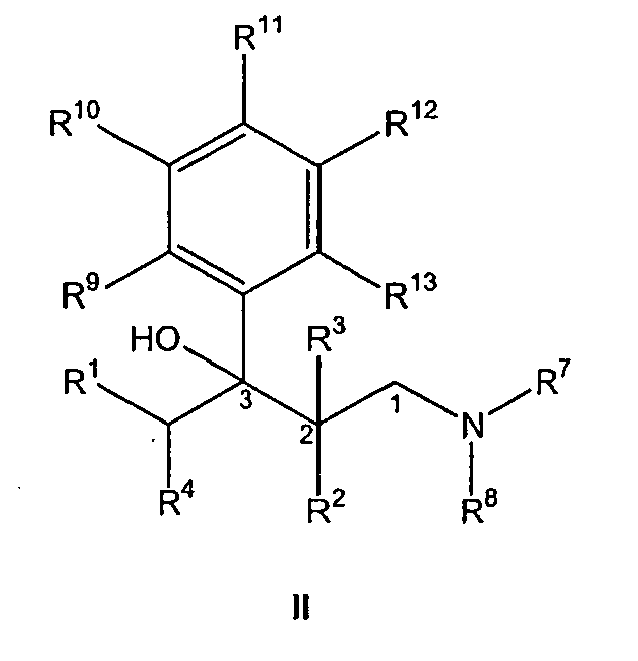

- Procédé suivant la revendication 1, caractérisé en ce que, dans des composés de formule I, de formule II et de formule III,
R4 est choisi entre H ou CH3. - Procédé suivant la revendication 1, caractérisé en ce que, dans des composés de formule I, de formule II et de formule III,
R1 est choisi entre des restes alkyle en C1 à C3, saturés ou non saturés, substitués ou non substitués, ramifiés ou non ramifiés. - Procédé suivant la revendication 1, caractérisé en ce que, dans des composés de formule I, de formule II et de formule III,
R4 est choisi entre H ou CH3,
et/ou
R1 est choisi entre des restes alkyle en C1 à C3, saturés ou non saturés, substitués ou non substitués, ramifiés ou non ramifiés. - Procédé suivant l'une des revendications 1 à 4, caractérisé en ce que, dans des composés de formule I, de formule II et de formule III,
R7 et R8 sont tous deux choisis indépendamment l'un de l'autre entre H ou CH3. - Procédé suivant l'une des revendications 1 à 5, caractérisé en ce que dans des composés de formule I, de formule II et de formule III,
R1 est choisi entre
des restes alkyle en C1 à C3, saturés et non substitués, ramifiés ou non ramifiés. - Procédé suivant l'une des revendications 1 à 6, caractérisé en ce que, dans des composés de formule I, de formule II et de formule III,
R2 et R3 sont choisis indépendamment l'un de l'autre entre H, des restes alkyle en C1 à C4, saturés et non substitués, ramifiés ou non ramifiés. - Procédé suivant la revendication 7, caractérisé en ce que, dans des composés de formule I, de formule II et de formule III,
R3 représente H et R2 est différent de H. - Procédé suivant l'une des revendications 1 à 6, caractérisé en ce que, dans des composés de formule I, de formule II et de formule III,
R2 et R3 forment ensemble un reste cycloalkyle en C5 ou C6, saturé ou non saturé, non substitué ou substitué une ou plusieurs fois. - Procédé suivant l'une des revendications 1 à 9, caractérisé en ce que, dans des composés de formule I, de formule II et de formule III,
R9 à R13, dont 3 ou 4 d'entre eux doivent représenter H, sont choisis indépendamment les uns des autres entre H, Cl, F, OH, CF2H, CF3 ou des restes alkyle en C1 à C4, saturés et non substitués, ramifiés ou non ramifiés ; OR14 ou SR14, R14 étant choisi entre des restes alkyle en C1 à C3, saturés et non substitués, ramifiés ou non ramifiés ;
ou bien R12 et R11 forment un noyau 3,4-OCH=CH. - Procédé suivant la revendication 1, caractérisé en ce que, dans des composés de formule I, de formule II et de formule III,
R1 est choisi entre
des restes alkyle en C1 à C3, saturés et non substitués, ramifiés ou non ramifiés ;
et/ou
R2 et R3 sont choisis indépendamment l'un de l'autre entre H, des restes alkyle en C1 à C4, saturés et non substitués, ramifiés ou non ramifiés ;
ou bien
R2 et R3 forment ensemble un reste cycloalkyle en C5 ou C6, saturé ou non saturé, non substitué ou substitué une ou plusieurs fois,
et/ou
R4 représente H,
et/ou
R7 et R8 sont tous deux choisis, indépendamment l'un de l'autre, entre
H ou CH3,
et/ou
R9 à R13, dont trois ou quatre d'entre eux doivent représenter H, sont choisis indépendamment les uns des autres entre
H, Cl, F, OH, CF2H, CF3 ou des restes alkyle en C1 à C4, saturés et non substitués, ramifiés ou non ramifiés ; OR14 ou SR14, R14 étant choisi entre des restes alkyle en C1 à C3, saturés et non substitués, ramifiés ou non ramifiés ;
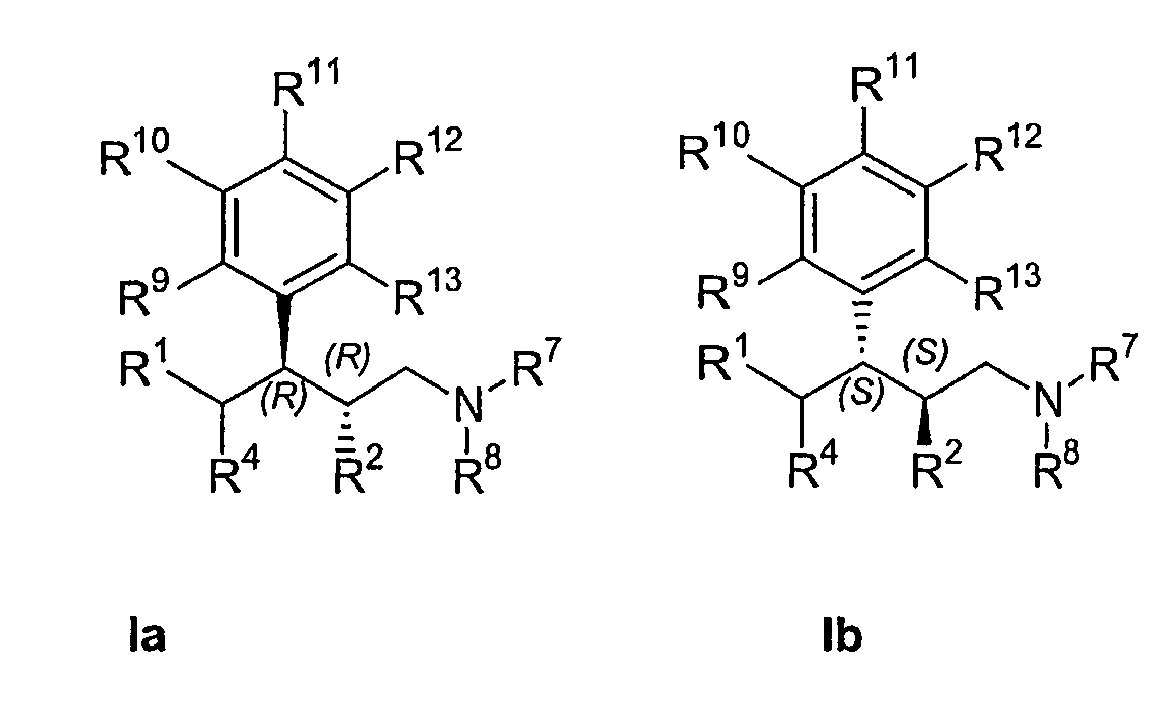
ou bien R12 et R11 forment un noyau 3,4-OCH=CH. - Procédé suivant l'une des revendications 1 à 11, caractérisé en ce que des composés de formule I, dans laquelle R3 représente H et R2 est différent de H, existent avec les configurations Ia ou Ib
- Procédé suivant l'une des revendications 1 à 12, caractérisé en ce des composés de formule II, dans laquelle R3 représente H et R2 est différent de H, existent avec les configurations IIa ou IIb


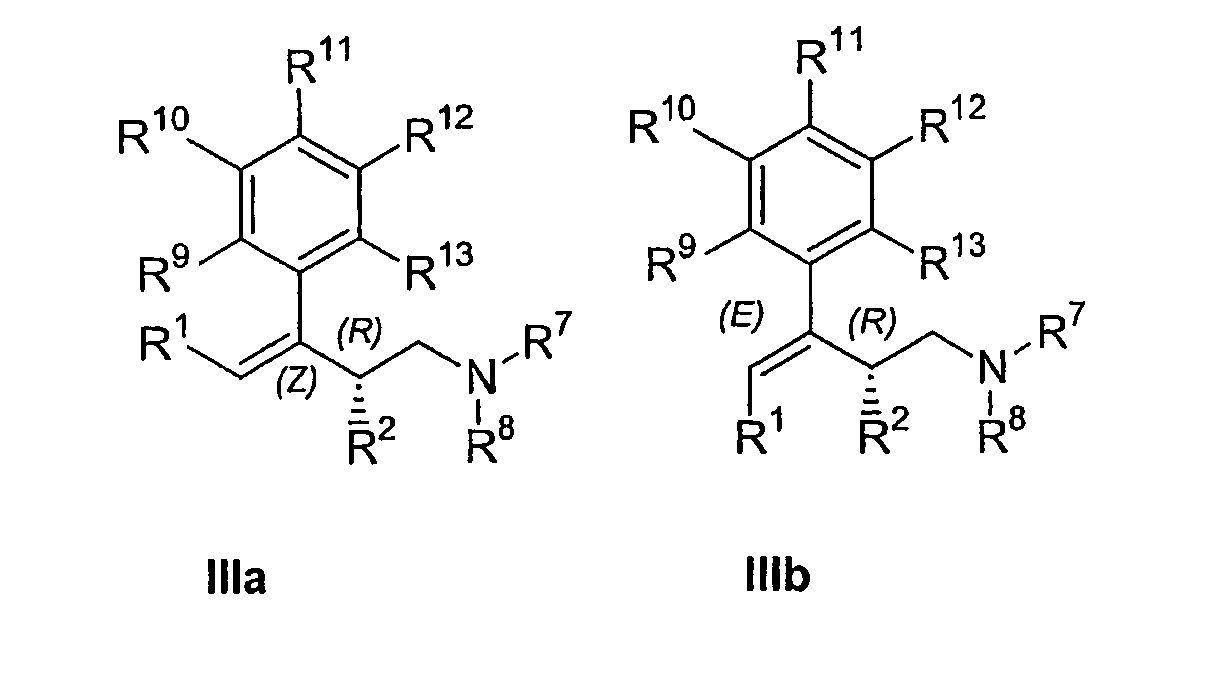
- Procédé suivant l'une des revendications 1 à 13, caractérisé en ce que des composés de formule III, dans laquelle R3 représente H, R2 est différent de H, R4 représente H et R1 est différent de H, existent avec les configurations IIIa ou IIIb


- Procédé suivant la revendication 1, caractérisé en ce que le composé ou au moins l'un des composés de formule I, avantageusement sous forme de la base libre ou sous forme du chlorhydrate, est choisi dans le groupe suivant :• 3-(3-diméthylamino-1-éthyl-2-méthyl-propyl)-phénol,• (1R,2R)-3-(3-diméthylamino-1-éthyl-2-méthyl-propyl)-phénol,• (-)-(1R,2R)-3-(3-diméthylamino-1-éthyl-2-méthyl-propyl)-phénol,• (1S,2S)-3-(3-diméthylamino-1-éthyl-2-méthyl-propyl)-phénol,• (+)-(1S,2S)-3-(3-diméthylamino-1-éthyl-2-méthyl-propyl)-phénol,• (±)-(1RS,2RS)-3-(3-diméthylamino-1-éthyl-2-méthyl-propyl)-phénol,• rac-(1RS,2RS)-3-(3-diméthylamino-1-éthyl-2-méthyl-propyl)-phénol,• [3-(3-méthoxy-phényl)-2-méthyl-pentyl]-diméthylamine,• (2R,3R)-[3-(3-méthoxy-phényl)-2-méthyl-pentyl]-diméthylamine,• (-)-(2R,3R)-[3-(3-méthoxy-phényl)-2-méthyl-pentyl]-diméthylamine,• (2S,3S)-[3-(3-méthoxy-phényl)-2-méthyl-pentyl]-diméthylamine,• (+)-(2S,3S)-[3-(3-méthoxy-phényl)-2-méthyl-pentyl]-diméthylamine,• (±)-(2RS,3RS)-[3-(3-méthoxy-phényl)-2-méthyl-pentyl]-diméthylamine,• rac-(2RS,3RS)-[3-(3-méthoxy-phényl)-2-méthyl-pentyl]-diméthylamine,• 3-{[3-(p-isopropyl-phényl-carbamoyl)-oxy-phényl]-2-méthyl-pentyl}-diméthylamine,• (2R,3R)-{3-[3-(p-isopropyl-phényl-carbamoyl)-oxy-phényl]-2-méthyl-pentyl}-diméthylamine,• (2S,3.S)-{3-[3-(p-isopropyl-phényl-carbamoyl)-oxy-phényl]-2-méthyl-pentyl}-diméthylamine,• (2SR,3SR)-{3-[3-(p-isopropyl-phényl-carbamoyl)-oxy-phényl]-2-méthyl-pentyl}-diméthylamine.
- Procédé suivant la revendication 1, caractérisé en ce que, concernant le composé mis en réaction/les composés mis en réaction répondant à la formule II, l'un d'eux au moins, avantageusement sous forme de base libre ou sous forme de chlorhydrate, est choisi dans le groupe suivant :• 3-(3-diméthylamino-1-éthyl-1-hydroxy-2-méthyl-propyl)-phénol,• (1S,2S)-3-(3-diméthylamino-1-éthyl-1-hydroxy-2-méthyl-propyl)-phénol,• (1R,2S)-3-(3-diméthylamino-1-éthyl-1-hydroxy-2-méthyl-propyl)-phénol,• (1RS,2SS)-3-(3-diméthylamino-1-éthyl-1-hydroxy-2-méthyl-propyl)-phénol,• (1S,2R)-3-(3-diméthylamino-1-éthyl-1-hydroxy-2-méthyl-propyl)-phénol,• (1R,2R)-3-(3-diméthylamino-1-éthyl-1-hydroxy-2-méthyl-propyl)-phénol,• (1RS,2RR)-3-(3-diméthylamino-1-éthyl-1-hydroxy-2-méthyl-propyl)-phénol,• [3-(3-méthoxy-phényl)-2-méthyl-pentane-3-ol]-diméthylamine,• (2S,3S)-[3-(3-méthoxy-phényl)-2-méthyl-pentane-3-ol]-diméthylamine,• (2S,3R)-[3-(3-méthoxy-phényl)-2-méthyl-pentane-3-ol]-diméthylamine,• (2SS,3RS)-[3-(3-méthoxy-phényl)-2-méthyl-pentane-3-ol]-diméthylamine,• (2R,3S)-[3-(3-méthoxy-phényl)-2-méthyl-pentane-3-ol]-diméthylamine,• (2R,3R)-[3-(3-méthoxy-phényl)-2-méthyl-pentane-3-ol]-diméthylamine,• (2RR,3RS)-[3-(3-méthoxy-phényl)-2-méthyl-pentane-3-ol]-diméthylamine,• {3-[3-(p-isopropyl-phényl-carbamoyl)-oxy-phényl]-2-méthyl-pentane-3-ol}-diméthylamine,• (2S,3R)-{3-[3-(p-isopropyl-phényl-carbamoyl)-oxy-phényl]-2-méthyl-pentane-3-ol}-diméthylamine,• (2S,3S)-{3-[3-(p-isopropyl-phényl-carbamoyl)-oxy-phényl]-2-méthyl-pentane-3-ol}-diméthylamine,• (2SS,3RS)-{3-[3-(p-isopropyl-phényl-carbamoyl)-oxy-phényl]-2-méthyl-pentane-3-ol}-diméthylamine,• (2R,3S)-{3-[3-(p-isopropyl-phényl-carbamoyl)-oxy-phényl]-2-méthyl-pentane-3-ol}-diméthylamine,• (2R,3R)-{3-[3-(p-isopropyl-phényl-carbamoyl)-oxy-phényl]-2-méthyl-pentane-3-ol}-diméthylamine,• (2RR,3RS)-{3-[3-(p-isopropyl-phényl-carbamoyl)-oxy-phényl]-2-méthyl-pentane-3-ol}-diméthylamine.
- Procédé suivant la revendication 1, caractérisé en ce que, concernant le composé/les composés de formule III, au moins l'un de ces composés, avantageusement sous forme de base libre ou sous forme de chlorhydrate, est choisi dans le groupe suivant :• 3-(3-diméthylamino-1-éthényl-2-méthyl-propyl)-phénol,• (Z)-(2R)-3-(3-diméthylamino-1-éthényl-2-méthyl-propyl)-phénol,• (E)-(2R)-3-(3-diméthylamino-1-éthényl-2-méthyl-propyl)-phénol,• (Z,E)-(2R)-3-(3-diméthylamino-1-éthényl-2-méthyl-propyl)-phénol,• (Z)-(2S)-3-(3-diméthylamino-1-éthényl-2-méthyl-propyl)-phénol,• (E)-(2S)-(3-diméthylamino-1-éthényl-2-méthyl-propyl)-phénol,• (Z,E)-(2S)-3-(3-diméthylamino-1-éthényl-2-méthyl-propyl)-phénol,• 3-(3-diméthylamino-1-éthényl-2-méthyl-propyl)-phénol,• (Z)-(2R)-3-(3-diméthylamino-1-éthényl-1-2-méthyl-propyl)-phénol,• (E)-(2R)-3-(3-diméthylamino-1-éthényl-1-2-méthyl-propyl)-phénol,• (Z,E)-(2R)-3-(3-diméthylamino-1-éthényl-1-2-méthyl-propyl)-phénol,• (Z)-(2S)-3-(3-diméthylamino-1-éthényl-1-2-méthyl-propyl)-phénol,• (E)-(2S)-(3-diméthylamino-1-éthényl-1-2-méthyl-propyl)-phénol,• (Z,E)-(2S)-3-(3-diméthylamino-1-éthényl-2-méthyl-propyl)-phénol,• [3-(3-méthoxy-phényl)-2-méthyl-pent-3-ényl]-diméthylamine,• (Z)-(2R)-[3-(3-méthoxy-phényl)-2-méthyl-pent-3-ényl]-diméthylamine,• (E)-(2R)-[3-(3-méthoxy-phényl)-2-méthyl-pent-3-ényl]-diméthylamine,• (Z,E)-(2R)-[3-(3-méthoxy-phényl)-2-méthyl-pent-3-ényl]-diméthylamine,• (Z)-(2S)-[3-(3-méthoxy-phényl)-2-méthyl-pent-3-ényl]-diméthylamine,• (E)-(2S)-[3-(3-méthoxy-phényl)-2-méthyl-pent-3-ényl]-diméthylamine,• (Z,E)-(2S)-[3-(3-méthoxy-phényl)-2-méthyl-pent-3-ényl]-diméthylamine,• {3-[3-(p-isopropyl-phényl-carbamoyl)-oxy-phényl]-2-méthyl-pent-3-ényl}-diméthylamine,• (Z)-(2R)-{3-[3-(p-isopropyl-phényl-carbamoyl)-oxy-phényl]-2-méthyl-pent-3-ényl}-diméthylamine,• (E)-(2R)-{3-[3-(p-isopropyl-phényl-carbamoyl)-oxy-phényl]-2-méthyl-pent-3-ényl}-diméthylamine,• (Z,E)-(2R)-{3-[3-(p-isopropyl-phényl-carbamoyl)-oxy-phényl]-2-méthyl-pent-3-ényl}-diméthylamine,• (Z)-(2S)-{3-[3-(p-isopropyl-phényl-carbamoyl)-oxy-phényl]-2-méthyl-pent-3-ényl}-diméthylamine,• (E)-(2S)-{3-[3-(p-isopropyl-phényl-carbamoyl)-oxy-phényl]-2-méthyl-pent-3-ényl}-diméthylamine,• (Z,E)-(2S)-{3-[3-(p-isopropyl-phényl-carbamoyl)-oxy-phényl]-2-méthyl-pent-3-ényl}-diméthylamine.
- Procédé suivant la revendication 1, caractérisé en ce qu'un centre de chiralité est présent pour le composé de formule II mis en réaction, en position 2 selon la formule II.
- Procédé suivant la revendication 1, caractérisé en ce qu'un centre de chiralité existe dans le composé de formule I en position 2 selon la formule I.
- Procédé suivant la revendication 1, caractérisé en ce qu'un centre de chiralité existe dans le composé de formule III en position 2 selon la formule III.
- Procédé suivant la revendication 1, caractérisé en ce que le composé de formule II mis en réaction est énantiomériquement pur.
- Procédé suivant la revendication 1, caractérisé en ce que le composé de formule II mis en réaction est diastéréo-isomériquement pur.
- Procédé suivant la revendication 1, caractérisé en ce que le composé de formule II mis en réaction est énantiomériquement pur et diastéréo-isomériquement pur.
- Procédé suivant la revendication 1, caractérisé en ce que le composé de formule II mis en réaction est choisi entre :• la (2S,3S)-[3-(3-méthoxy-phényl)-2-méthyl-pentane-3-ol]-diméthylamine,• la (2S,3R)-[3-(3-méthoxy-phényl)-2-méthyl-pentane-3-ol]-diméthylamine,ou bien
un mélange de (2S,3S)-[3-(3-méthoxy-phényl)-2-méthyl-pentane-3-ol]-diméthylamine et de (2S,3R)-[3-(3-méthoxy-phényl)-2-méthyl-pentane-3-ol]-diméthylamine, ou de (2SS,3RS)-[3-(3-méthoxy-phényl)-2-méthyl-pentane-3-ol]-diméthylamine, - Procédé suivant la revendication 1, caractérisé en ce que le composé de formule II mis en réaction est choisi entre :• la (2R,3R)-[3-(3-méthoxy-phényl)-2-méthyl-pentane-3-ol]-diméthylamine,• la (2R,3S)-[3-(3-méthoxy-phényl)-2-méthyl-pentane-3-ol]-diméthylamine,ou bien
un mélange de (2R,3R)-[3-(3-méthoxy-phényl)-2-méthyl-pentane-3-ol]-diméthylamine et de (2R,3S)-[3-(3-méthoxy-phényl)-2-méthyl-pentane-3-ol]-diméthylamine ou de (2RR,3RS)-[3-(3-méthoxy-phényl)-2-méthyl-pentane-3-ol]-diméthylamine. - Procédé suivant la revendication 1, caractérisé en ce que le composé de formule II mis en réaction est choisi entre :• le (2S,3S)-1-diméthylamino-3-(3-méthoxy-phényl)-2-méthyl-pentane-3-ol,• le (2S,3R)-1-diméthylamino-3-(3-méthoxy-phényl)-2-méthyl-pentane-3-olou
un mélange de (2S,3S)-1-diméthylamino-3-(3-méthoxy-phényl)-2-méthyl-pentane-3-ol et de (2S,3R)-1-diméthylamino-3-(3-méthoxy-phényl)-2-méthyl-pentane-3-ol ou de (2SS,3RS)-[3-(3-méthoxy-phényl)-2-méthyl-pentane-3-ol]-diméthylamine. - Procédé suivant la revendication 1, caractérisé en ce que le composé de formule II mis en réaction est choisi entre :• le (2R,3R)-1-diméthylamino-3-(3-méthoxy-phényl)-2-méthyl-pentane-3-ol,• le (2R,3S)-1-diméthylamino-3-(3-méthoxy-phényl)-2-méthyl-pentane-3-ol,ou
un mélange de (2R,3R)-1-diméthylamino-3-(3-méthoxy-phényl)-2-méthyl-pentane-3-ol et de (2R,3S)-1-diméthylamino-3-(3-méthoxy-phényl)-2-méthyl-pentane-3-ol ou de (2RR,3RS)-[3-(3-méthoxy-phényl)-2-méthyl-pentane-3-ol]-diméthylamine. - Procédé suivant l'une des revendications 1 à 17, caractérisé en ce qu'on utilise dans l'étape a) des acides organiques ou des hydracides halogénés.
- Procédé suivant la revendication 18, caractérisé en ce qu'on utilise dans l'étape a) de l'acide formique, de l'acide chlorhydrique ou de l'acide bromhydrique.
- Procédé suivant la revendication 18, caractérisé en ce qu'on utilise dans l'étape a) l'acide formique.
- Procédé suivant la revendication 18, caractérisé en ce qu'on utilise dans l'étape a) l'acide chlorhydrique.
- Procédé suivant la revendication 18, caractérisé en ce qu'on utilise dans l'étape a) l'acide bromhydrique.
- Procédé suivant la revendication 18, caractérisé en ce que l'acide est utilisé dans l'étape a) à une haute concentration.
- Procédé suivant la revendication 21, caractérisé en ce que l'acide chlorhydrique dans l'étape a) est à plus de 20 %.
- Procédé suivant l'une des revendications 1 à 24, caractérisé en ce que, après l'étape a), les composés éliminés de formule III sont cristallisés avec du gaz chlorhydrique.
- Procédé suivant l'une des revendications 1 à 25, caractérisé en ce que la durée de réaction de l'étape a) s'élève entre 2 et 10 heures.
- Procédé suivant l'une des revendications 1 à 26, caractérisé en ce que, dans l'étape a), la température de réaction s'élève entre 35 et 100°C.
- Procédé suivant l'une des revendications 1 à 27, caractérisé en ce que, dans l'étape a), le solvant est choisi entre :
l'eau ou un alcool ou des solutions alcooliques aqueuses. - Procédé suivant l'une des revendications 18 à 24, caractérisé en ce que, dans l'étape a), le solvant est un acide aqueux.
- Procédé suivant l'une des revendications 18 à 24, caractérisé en ce que, dans l'étape a), le composé de formule II utilisé est dissous dans un acide aqueux.
- Procédé suivant l'une des revendications 21 ou 24, caractérisé en ce que, dans l'étape a), le composé utilisé de formule II est dissous dans de l'acide chlorhydrique aqueux.
- Procédé suivant la revendication 1, caractérisé en ce que, dans l'étape b), le solvant est choisi entre :
H2O ou un alcool ou des solutions alcooliques aqueuses ou acides aqueuses. - Procédé suivant la revendication 1, caractérisé en ce que, dans l'étape b), le solvant est choisi entre :
l'eau ou l'éthanol ou une solution éthanolique aqueuse ou l'acide chlorhydrique aqueux. - Procédé suivant la revendication 1, caractérisé en ce que, dans l'étape b), le catalyseur utilisé contient un métal noble.
- Procédé suivant la revendication 44, caractérisé en ce que, dans l'étape b), le catalyseur utilisé est du palladium déposé sur du charbon actif ou du chlorure de palladium (II).
- Procédé suivant la revendication 44, caractérisé en ce que, dans l'étape b), le catalyseur utilisé est du palladium déposé sur du charbon actif (à 1 - 10 % en poids).
- Procédé suivant la revendication 1, caractérisé en ce que la température dans l'étape b) est maintenue entre 20 et 40°C.
- Procédé suivant la revendication 1, caractérisé en ce que, dans l'étape b), une atmosphère de gaz protecteur est créée avant l'hydrogénation.
- Procédé suivant la revendication 1, caractérisé en ce que, dans l'étape b), l'opération d'hydrogénation a lieu à une pression préalable d'hydrogène de 3 à 10 bars
et/ou
l'opération d'hydrogénation a lieu à une pression interne d'hydrogène de 0,5 à 3 bars. - Procédé suivant la revendication 1, caractérisé en ce que, dans l'étape b), les composés de départ, au début, sont fortement dilués ou se diluent fortement dans le solvant.
- Procédé suivant la revendication 1, caractérisé en ce que le solvant pour les deux étapes a) et b) est une solution acide aqueuse.
- Procédé suivant les revendications 1 et 51, caractérisé en ce qu'aucun produit n'est isolé entre l'étape a) et l'étape b).
- Procédé suivant la revendication 52, caractérisé en ce que les composés de départ, au début, sont fortement dilués ou se diluent fortement dans le solvant.
- Procédé suivant l'une des revendications 1 ou 52, caractérisé en ce que le composé de formule II mis en réaction est dissous dans un acide aqueux.
- Procédé suivant la revendication 54, caractérisé en ce que le composé de formule II mis en réaction est dissous dans de l'acide chlorhydrique aqueux.
- Procédé de production d'un composé substitué de 3-aryl-butylamine de formule générale I,

R1 est choisi entre H, un reste alkyle en C1 à C3, ramifié ou non ramifié, saturé ou non saturé, non substitué ou substitué une ou plusieurs fois,
R2 et R3 sont tous deux choisis, indépendamment l'un de l'autre, entre H ou un reste alkyle en C1 à C4, ramifié ou non ramifié, saturé ou non saturé, non substitué ou substitué une ou plusieurs fois,
ou bien
R2 et R3 forment ensemble un reste cycloalkyle en C4 à C7 saturé, non substitué ou substitué une ou plusieurs fois,
R4 est choisi entre H, un reste alkyle en C1 à C3, ramifié ou non ramifié, saturé ou non saturé, non substitué ou substitué une ou plusieurs fois,
R7 et R8 sont tous deux choisis, indépendamment l'un de l'autre, entre H ou un reste alkyle en C1 à C3, ramifié ou non ramifié, saturé ou non saturé, non substitué ou substitué une ou plusieurs fois,
R9 à R13 sont tous deux choisis, indépendamment l'un de l'autre, entre H, F, Cl, Br, I, CH2F, CHF2, CF3, OH, SH, OR14, OCF3, SR14, NR17R18, SOCH3, SOCF3, SO2CH3, SO2CF3, CN, COOR14, NO2, CONR17R18, un reste alkyle en C1 à C6, ramifié ou non ramifié, saturé ou non saturé, non substitué ou substitué une ou plusieurs fois ; un reste phényle, non substitué ou substitué une ou plusieurs fois ;
R14 étant choisi entre un reste alkyle en C1 à C6 ; un reste pyridyle, thiényle, thiazolyle, phényle, benzyle ou phénéthyle, chacun non substitué ou substitué une ou plusieurs fois ; un groupe PO-(O-alkyle en C1 à C4)2, CO-(O-alkyle en C1 à C5), CONH-C6H4-(alkyle en C1 à C3), CO-(alkyle en C1 à C5), CO-CHR17-NHR18, CO-C6H4-R15, R15 étant un radical ortho-OCO-(alkyle en C1 à C3) ou méta-ou para-CH2N(R16)2 où R16 est un radical alkyle en C1 à C4 ou 4-morpholino, les groupes alkyle dans les restes R14, R15 et R16 pouvant être ramifiés ou non ramifiés, saturés ou non saturés, non substitués ou substitués une ou plusieurs fois ; R17 et R18 étant tous deux choisis, indépendamment l'un de l'autre, entre H ; un reste alkyle en C1 à C6, ramifié ou non ramifié, saturé ou non saturé, non substitué ou substitué une ou plusieurs fois ; un reste phényle, benzyle ou phénéthyle, chacun non substitué ou substitué une ou plusieurs fois
ou bien
R9 et R10 ou R10 et R11 forment ensemble un noyau OCH2O, OCH2CH2O, OCH=CH, CH=CHO, CH=C(CH3)O, OC(CH3)=CH, (CH2)4 ou OCH=CHO,
dans chaque cas sous forme de l'un de ses stéréo-isomères purs, en particulier des énantiomères ou des diastéréo-isomères, de ses racémates ou sous forme d'un mélange de stéréo-isomères, en particulier des énantiomères ou des diastéréo-isomères, dans un rapport de mélange quelconque, ou dans chaque cas sous forme d'un sel physiologiquement acceptable, ou dans chaque cas sous forme d'un produit de solvatation,
caractérisé en ce qu'un composé substitué de 3-aryl-but-3-énylamine de formule générale III,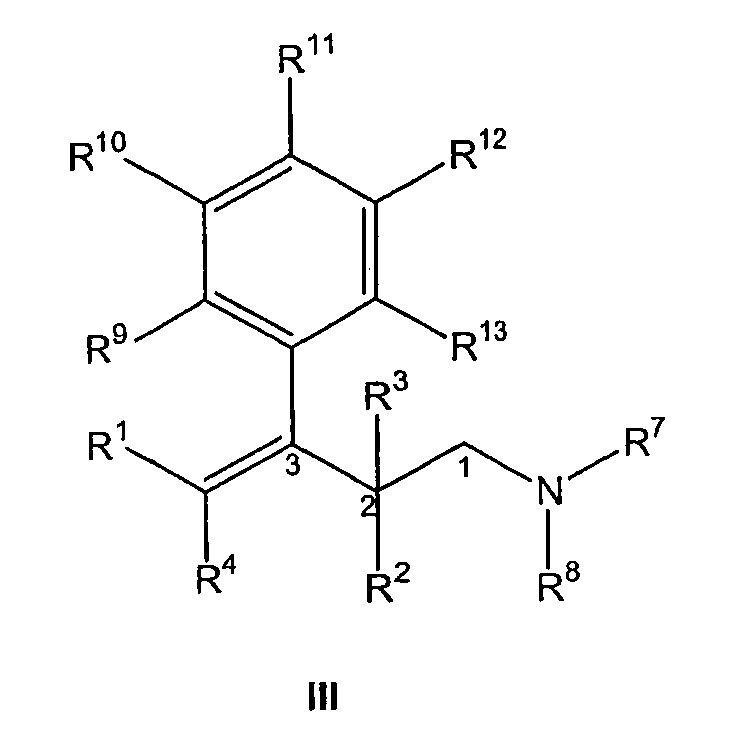
- Procédé suivant la revendication 56, caractérisé en ce que, dans les composés de formule I et de formule III,
R4 est choisi entre H ou CH3. - Procédé suivant la revendication 56, caractérisé en ce que, dans des composés de formule I et de formule III,
R1 est choisi entre des restes alkyle en C1 à C3, saturés ou non saturés, substitués ou non substitués, ramifiés ou non ramifiés. - Procédé suivant la revendication 56, caractérisé en ce que, dans des composés de formule I et de formule III,
R4 est choisi entre H ou CH3,
et/ou
R1 est choisi entre des restes alkyle en C1 à C3, saturés ou non saturés, substitués ou non substitués, ramifiés ou non ramifiés. - Procédé suivant l'une des revendications 56 à 59, caractérisé en ce que, dans des composés de formule I et de formule III,
R7 et R8 sont tous deux choisis, indépendamment l'un de l'autre, entre H ou CH3. - Procédé suivant l'une des revendications 56 à 60, caractérisé en ce que, dans des composés de formule I et de formule III,
R1 est choisi entre
des restes alkyle en C1 à C3, saturés et non substitués, ramifiés ou non ramifiés. - Procédé suivant l'une des revendications 56 à 61, caractérisé en ce que, dans des composés de formule I et de formule III,
R2 et R3 sont choisis, indépendamment l'un de l'autre, entre
H, des restes alkyle en C1 à C4, saturés et non substitués, ramifiés ou non ramifiés. - Procédé suivant la revendication 62, caractérisé en ce que, dans des composés de formule I et de formule III,
R3 représente H et R2 est différent de H. - Procédé suivant l'une des revendications 56 à 61, caractérisé en ce que, dans des composés de formule I et de formule III,
R2 et R3 forment ensemble un reste cycloalkyle en C5 ou C6, saturé ou non saturé, non substitué ou substitué une ou plusieurs fois. - Procédé suivant l'une des revendications 56 à 64, caractérisé en ce que, dans des composés de formule I et de formule III,
les restes R9 à R13, dont trois ou quatre d'entre eux doivent représenter H, sont choisis indépendamment les uns des autres entre
H, Cl, F, OH, CF2H, CF3 ou des restes alkyle en C1 à C4, saturés et non substitués, ramifiés ou non ramifiés ; OR14 ou SR14, R14 étant choisi entre des restes alkyle en C1 à C3, saturés et non substitués, ramifiés ou non ramifiés ;
ou bien R12 et R11 forment un noyau 3,4-OCH=CH. - Procédé suivant la revendication 56, caractérisé en ce que, dans des composés de formule I et de formule III,
R1 est choisi entre
des restes alkyle en C1 à C3, saturés et non substitués, ramifiés ou non ramifiés ;
et/ou
R2 et R3 sont choisis indépendamment l'un de l'autre entre H, des restes alkyle en C1 à C4, saturés et non substitués, ramifiés ou non ramifiés ;
ou bien
R2 et R3 forment ensemble un reste cycloalkyle en C5 ou C6, saturé ou non saturé, non substitué ou substitué une ou plusieurs fois,
et/ou
R4 est choisi entre H,
et/ou
R7 et R8 sont tous deux choisis, indépendamment l'un de l'autre, entre
H ou CH3,
et/ou
les restes R9 à R13, dont 3 ou 4 d'entre deux doivent représenter H, sont choisis indépendamment les uns des autres entre
H, Cl, F, OH, CF2H, CF3 ou des restes alkyle en C1 à C4, saturés et non substitués, ramifiés ou non ramifiés ; OR14 ou SR14, R14 étant choisi entre des restes alkyle en C1 à C3, saturés et non substitués, ramifiés ou non ramifiés ;
ou bien R12 et R11 forment un noyau 3,4-OCH=CH. - Procédé suivant l'une des revendications 56 à 66, caractérisé en ce que des composés de formule I dans laquelle R3 représente H et R2 est différent de H, existent avec les configurations Ia ou Ib

- Procédé suivant l'une des revendications 56 à 67, caractérisé en ce que des composés de formule III dans laquelle R3 représente H, R2 est différent de H, R4 représente H et R1 est différent de H, existent avec les configurations IIIa ou IIIb

- Procédé suivant la revendication 56, caractérisé en ce que, concernant le composé/les composés de formule I, l'un au moins de ces composés, avantageusement sous forme de base libre ou sous forme de chlorhydrate, est choisi dans le groupe suivant :• 3-(3-diméthylamino-1-éthyl-2-méthyl-propyl)-phénol,• (1R,2R)-3-(3-diméthylamino-1-éthyl-2-méthyl-propyl)-phénol,• (-)-(1R,2R)-3-(3-diméthylamino-1-éthyl-2-méthyl-propyl)-phénol,• (1S,2S)-3-(3-diméthylamino-1-éthyl-2-méthyl-propyl)-phénol,• (+)-(1S,2S)-3-(3-diméthylamino-1-éthyl-2-méthyl-propyl)-phénol,• (±)-(1RS,2RS)-3-(3-diméthylamino-1-éthyl-2-méthyl-propyl)-phénol,• rac-(1RS,2RS)-3-(3-diméthylamino-1-éthyl-2-méthyl-propyl)-phénol,• [3-(3-méthoxy-phényl)-2-méthyl-pentyl]-diméthylamine,• (2R,3R)-[3-(3-méthoxy-phényl)-2-méthyl-pentyl]-diméthylamine,• (-)-(2R,3R)-[3-(3-méthoxy-phényl)-2-méthyl-pentyl]-diméthylamine,• (2S,3S)-[3-(3-méthoxy-phényl)-2-méthyl-pentyl]-diméthylamine,• (+)-(2S,3S)-[3-(3-méthoxy-phényl)-2-méthyl-pentyl]-diméthylamine,• (±)-(2RS,3RS)-[3-(3-méthoxy-phényl)-2-méthyl-pentyl]-diméthylamine,• rac-(2RS,3RS)-[3-(3-méthoxy-phényl)-2-méthyl-pentyl]-diméthylamine,• 3-{[3-(p-isopropyl-phényl-carbamoyl)-oxy-phényl]-2-méthyl-pentyl}-diméthylamine,• (2R,3R)-{3-[3-(p-isopropyl-phényl-carbamoyl)-oxy-phényl]-2-méthyl-pentyl}-diméthylamine,• (2S,3S)-{3-[3-(p-isopropyl-phényl-carbamoyl)-oxy-phényl]-2-méthyl-pentyl}-diméthylamine,• (2SR,3SR)-{3-[3-(p-isopropyl-phényl-carbamoyl)-oxy-phényl]-2-méthyl-pentyl}-diméthylamine,
- Procédé suivant la revendication 56, caractérisé en ce que, concernant le composé utilisé/les composés utilisés de formule III, au moins l'un d'entre eux, avantageusement sous forme de base libre ou sous forme de chlorhydrate, est choisi dans le groupe suivant :• 3-(3-diméthylamino-1-éthényl-2-méthyl-propyl)-phénol,• (Z)-(2R)-3-(3-diméthylamino-1-éthényl-2-méthyl-propyl)-phénol,• (E)-(2R)-3-(3-diméthylamino-1-éthényl-2-méthyl-propyl)-phénol,• (Z,E)-(2R)-3-(3-diméthylamino-1-éthényl-2-méthyl-propyl)-phénol,• (Z)-(2S)-3-(3-diméthylamino-1-éthényl-2-méthyl-propyl)-phénol,• (E)-(2S)-(3-diméthylamino-1-éthényl-2-méthyl-propyl)-phénol,• (Z,E)-(2S)-3-(3-diméthylamino-1-éthényl-2-méthyl-propyl)-phénol,• 3-(3-diméthylamino-1-éthényl-2-méthyl-propyl)-phénol,• (Z)-(2R)-3-(3-diméthylamino-1-éthényl-1-2-méthyl-propyl)-phénol,• (E)-(2R)-3-(3-diméthylamino-1-éthényl-1-2-méthyl-propyl)-phénol,• (Z,E)-(2R)-3-(3-diméthylamino-1-éthényl-1-2-méthyl-propyl)-phénol,• (Z)-(2S)-3-(3-diméthylamino-1-éthényl-1-2-méthyl-propyl)-phénol,• (E)-(2S)-(3-diméthylamino-1-éthényl-1-2-méthyl-propyl)-phénol,• (Z,E)-(2S)-3-(3-diméthylamino-1-éthényl-2-méthyl-propyl)-phénol,• [3-(3-méthoxy-phényl)-2-méthyl-pent-3-ényl]-diméthylamine,• (Z)-(2R)-[3-(3-méthoxy-phényl)-2-méthyl-pent-3-ényl]-diméthylamine,• (E)-(2R)-[3-(3-méthoxy-phényl)-2-méthyl-pent-3-ényl]-diméthylamine,• (Z,E)-(2R)-[3-(3-méthoxy-phényl)-2-méthyl-pent-3-ényl]-diméthylamine,• (Z)-(2S)-[3-(3-méthoxy-phényl)-2-méthyl-pent-3-ényl]-diméthylamine,• (E)-(2S)-[3-(3-méthoxy-phényl)-2-méthyl-pent-3-ényl]-diméthylamine,• (Z,E)-(2S)-[3-(3-méthoxy-phényl)-2-méthyl-pent-3-ényl]-diméthylamine,• {3-[3-(p-isopropyl-phényl-carbamoyl)-oxy-phényl]-2-méthyl-pent-3-ényl}-diméthylamine,• (Z)-(2R)-{3-[3-(p-isopropyl-phényl-carbamoyl)-oxy-phényl]-2-méthyl-pent-3-ényl}-diméthylamine,• (E)-(2R)-{3-[3-(p-isopropyl-phényl-carbamoyl)-oxy-phényl]-2-méthyl-pent-3-ényl}-diméthylamine,• (Z,E)-(2R)-{3-[3-(p-isopropyl-phényl-carbamoyl)-oxy-phényl]-2-méthyl-pent-3-ényl}-diméthylamine,• (Z)-(2S)-{3-[3-(p-isopropyl-phényl-carbamoyl)-oxy-phényl]-2-méthyl-pent-3-ényl}-diméthylamine,• (E)-(2S)-{3-[3-(p-isopropyl-phényl-carbamoyl)-oxy-phényl]-2-méthyl-pent-3-ényl}-diméthylamine,• (Z,E)-(2S)-{3-[3-(p-isopropyl-phényl-carbamoyl)-oxy-phényl]-2-méthyl-pent-3-ényl}-diméthylamine.
- Procédé suivant la revendication 56, caractérisé en ce qu'un centre de chiralité existe dans le composé utilisé de formule III, en position 2 selon la formule III.
- Procédé suivant la revendication 56, caractérisé en ce qu'un centre de chiralité existe dans le composé de formule I, en position 2 selon la formule I.
- Procédé suivant la revendication 56, caractérisé en ce que le composé utilisé de formule III est énantiomériquement pur.
- Procédé suivant la revendication 56, caractérisé en ce que le composé utilisé de formule III est diastéréo-isomériquement pur.
- Procédé suivant la revendication 56, caractérisé en ce que le composé utilisé de formule III est énantiomériquement pur et diastéréo-isomériquement pur.
- Procédé suivant la revendication 56, caractérisé en ce que le composé utilisé de formule III est choisi entre :• la (Z)-(2R)-[3-(3-méthoxy-phényl)-2-méthyl-pent-3-ényl]-diméthylamine,• la (E)-(2R)-[3-(3-méthoxy-phényl)-2-méthyl-pent-3-ényl]-diméthylamine,ou
un mélange de (Z)-(2R)-[3-(3-méthoxy-phényl)-2-méthyl-pent-3-ényl]-diméthylamine et de (E)-(2R)-[3-(3-méthoxy-phényl)-2-méthyl-pent-3-ényl]-diméthylamine ou (Z,E)-(2R)-[3-(3-méthoxy-phényl)-2-méthyl-pent-3-ényl]-diméthylamine. - Procédé suivant la revendication 56, caractérisé en ce que le composé utilisé de formule III est choisi entre :• la (Z)-(2S)-[3-(3-méthoxy-phényl)-2-méthyl-pent-3-ényl]-diméthylamine,• la (E)-(2S)-[3-(3-méthoxy-phényl)-2-méthyl-pent-3-ényl]-diméthylamineou
un mélange de (Z)-(2S)-[3-(3-méthoxy-phényl)-2-méthyl-pent-3-ényl]-diméthylamine et (E)-(2S)-[3-(3-méthoxy-phényl)-2-méthyl-pent-3-ényl]-diméthylamine, ou (Z,E)-(2S)-[3-(3-méthoxy-phényl)-2-méthyl-pent-3-ényl]-diméthylamine. - Procédé suivant la revendication 56,
caractérisé en ce que le solvant est choisi entre :l'eau ou un alcool ou des solutions alcooliques aqueuses ou acides aqueuses. - Procédé suivant la revendication 56, caractérisé en ce que le solvant est choisi entre :
l'eau ou l'éthanol ou une solution éthanolique aqueuse ou de l'acide chlorhydrique aqueux. - Procédé suivant la revendication 56, caractérisé en ce que le catalyseur utilisé contient un métal noble.
- Procédé suivant la revendication 80, caractérisé en ce que le catalyseur utilisé est du palladium déposé sur du charbon actif ou du chlorure de palladium (II).
- Procédé suivant la revendication 80, caractérisé en ce que le catalyseur utilisé est du palladium déposé sur du charbon actif (à 1 - 10 % en poids).
- Procédé suivant la revendication 56, caractérisé en ce que la température est maintenue entre 20 et 40°C.
- Procédé suivant la revendication 56, caractérisé en ce qu'une atmosphère de gaz protecteur est appliquée avant l'hydrogénation.
- Procédé suivant la revendication 56, caractérisé en ce que l'étape d'hydrogénation est conduite à une pression préalable d'hydrogène de 3 - 10 bars
et/ou
l'étape d'hydrogénation est conduite à une pression interne d'hydrogène de 0,5 - 3 bars. - Procédé suivant la revendication 56, caractérisé en ce qu'au début, les composés de départ sont/ deviennent fortement dilués dans le solvant.
- Procédé suivant la revendication 56, caractérisé en ce que le composé utilisé de formule III est dissous dans de l'acide aqueux.
- Procédé suivant la revendication 87, caractérisé en ce que le composé utilisé de formule III est dissous dans de l'acide chlorhydrique aqueux.
- Procédé suivant l'une des revendications 1 ou 56, caractérisé en ce qu'à la fin du procédé, les produits sont précipités dans un solvant organique.
- Procédé suivant l'une des revendications 1 ou 56, caractérisé en ce qu'à la fin du procédé, les produits sont précipités avec un acide ou un gaz acide.
- Procédé suivant l'une des revendications 1 ou 56, caractérisé en ce qu'à la fin du procédé, les produits sont précipités dans le solvant organique avec un acide ou un gaz acide.
Priority Applications (3)
| Application Number | Priority Date | Filing Date | Title |
|---|---|---|---|
| SI200431114T SI1633697T1 (sl) | 2003-06-06 | 2004-06-04 | Postopek za pripravo substituiranih 3-aril-butilaminskih spojin |
| PL04739583T PL1633697T3 (pl) | 2003-06-06 | 2004-06-04 | Sposób wytwarzania podstawionych związków 3-arylo-butylo-aminowych |
| CY20091100536T CY1109088T1 (el) | 2003-06-06 | 2009-05-21 | Μεθοδος για την παρασκευη υποκατεστημενων ενωσεων 3-αρυλο-βουτυλ-αμινης |
Applications Claiming Priority (2)
| Application Number | Priority Date | Filing Date | Title |
|---|---|---|---|
| DE10326097A DE10326097A1 (de) | 2003-06-06 | 2003-06-06 | Verfahren zur Herstellung von Dimethyl-(3-aryl-butyl)-aminverbindungen |
| PCT/EP2004/006027 WO2004108658A1 (fr) | 2003-06-06 | 2004-06-04 | Procede de production des composes d'amine 3-aryle-butyle substitue |
Publications (2)
| Publication Number | Publication Date |
|---|---|
| EP1633697A1 EP1633697A1 (fr) | 2006-03-15 |
| EP1633697B1 true EP1633697B1 (fr) | 2009-03-11 |
Family
ID=33494923
Family Applications (1)
| Application Number | Title | Priority Date | Filing Date |
|---|---|---|---|
| EP04739583A Expired - Lifetime EP1633697B1 (fr) | 2003-06-06 | 2004-06-04 | Procede de production des composes d'amine 3-aryle-butyle substitue |
Country Status (25)
| Country | Link |
|---|---|
| US (1) | US7417170B2 (fr) |
| EP (1) | EP1633697B1 (fr) |
| JP (1) | JP4848268B2 (fr) |
| KR (1) | KR101146205B1 (fr) |
| CN (1) | CN1829681B (fr) |
| AT (1) | ATE425136T1 (fr) |
| AU (1) | AU2004245223C1 (fr) |
| BR (1) | BRPI0411268C8 (fr) |
| CA (1) | CA2528087C (fr) |
| CY (1) | CY1109088T1 (fr) |
| DE (2) | DE10326097A1 (fr) |
| DK (1) | DK1633697T3 (fr) |
| EC (1) | ECSP056218A (fr) |
| ES (1) | ES2323870T3 (fr) |
| HR (1) | HRP20090333T1 (fr) |
| IL (1) | IL172357A (fr) |
| MX (1) | MXPA05013193A (fr) |
| NO (1) | NO335587B1 (fr) |
| NZ (1) | NZ544231A (fr) |
| PL (1) | PL1633697T3 (fr) |
| PT (1) | PT1633697E (fr) |
| RU (1) | RU2380355C2 (fr) |
| SI (1) | SI1633697T1 (fr) |
| WO (1) | WO2004108658A1 (fr) |
| ZA (1) | ZA200600109B (fr) |
Families Citing this family (37)
| Publication number | Priority date | Publication date | Assignee | Title |
|---|---|---|---|---|
| DE10328316A1 (de) | 2003-06-23 | 2005-01-20 | Grünenthal GmbH | Verfahren zur Herstellung von Dimethyl-(3-aryl-buthyl)-aminverbindungen als pharmazeutische Wirkstoffe |
| DE102005052588A1 (de) | 2005-11-02 | 2007-05-10 | Grünenthal GmbH | Verfahren zur Herstellung substituierter Dimethyl-(3-aryl-butyl)-amin-Verbindungen mittels homogener Katalyse |
| MX2009000911A (es) * | 2006-07-24 | 2009-02-04 | Janssen Pharmaceutica Nv | Preparacion de (2r,3r)-3-(3-metoxifenil)-n,n,2-trimetilpentanamina . |
| TWI496762B (zh) * | 2006-07-24 | 2015-08-21 | 歌林達股份有限公司 | 製備(1r,2r)-3-(3-二甲胺基-1-乙基-2-甲基-丙基)-酚之方法 |
| TWI401237B (zh) | 2006-07-24 | 2013-07-11 | 3-〔(1r,2r)-3-(二甲基氨基)-1-乙基-2-甲基丙基〕酚之製備 | |
| CN101939287B (zh) * | 2007-12-07 | 2014-10-22 | 格吕伦塔尔有限公司 | (1r,2r)-3-(3-二甲基氨基-1-乙基-2-甲基-丙基)-苯酚的结晶变体 |
| US20100227921A1 (en) * | 2009-03-03 | 2010-09-09 | Shire Llc | Amino acid and peptide carbamate prodrugs of tapentadol and uses thereof |
| CN102002065B (zh) * | 2009-09-02 | 2014-09-10 | 上海特化医药科技有限公司 | 他喷他多的制备方法及其中间体 |
| US8288592B2 (en) | 2009-09-22 | 2012-10-16 | Actavis Group Ptc Ehf | Solid state forms of tapentadol salts |
| IT1397189B1 (it) * | 2009-12-01 | 2013-01-04 | Archimica Srl | Nuovo processo per la preparazione di tapentadol e suoi intermedi. |
| WO2011080736A1 (fr) | 2009-12-29 | 2011-07-07 | Mapi Pharma Hk Limited | Composés intermédiaires et procédés pour la préparation de tapentadol et de composés apparentés |
| WO2011092719A2 (fr) * | 2010-02-01 | 2011-08-04 | Ind-Swift Laboratories Limited | Procédé de préparation de dérivés l-phényl-3-diméthylaminopropane |
| US20130096346A1 (en) | 2010-03-05 | 2013-04-18 | Actavis Group Ptc Ehf | Resolution methods for isolating desired enantiomers of tapentadol intermediates and use thereof for the preparation of tapentadol |
| WO2011128784A2 (fr) | 2010-04-05 | 2011-10-20 | Actavis Group Ptc Ehf | Nouveau procédé de synthèse de tapentadol de pureté élevée ou de l'un de ses sels de qualité pharmaceutique |
| ITMI20100924A1 (it) * | 2010-05-21 | 2011-11-22 | Fidia Farmaceutici | Nuovo metodo di sintesi delle due forme enantiomeriche del tapentadol |
| CN103168025B (zh) * | 2010-06-15 | 2015-02-25 | 格吕伦塔尔有限公司 | 用于制备取代的3-(1-氨基-2-甲基戊烷-3-基)苯基化合物的方法 |
| IT1401109B1 (it) | 2010-07-02 | 2013-07-12 | Archimica Srl | Nuovo processo per la preparazione di tapentadol e suoi intermedi. |
| ES2860676T3 (es) * | 2010-07-23 | 2021-10-05 | Gruenenthal Gmbh | Sales o cocristales de 3- (3-dimetilamino-1-etil-2-metil-propil) -fenol |
| EP2606030B1 (fr) | 2010-08-16 | 2016-05-18 | Indoco Remedies Limited | Procédé de préparation de tapentadol |
| US8552219B2 (en) | 2010-09-20 | 2013-10-08 | Ind-Swift Laboratories Limited | Process for preparing L-phenyl-3-dimethylaminopropane derivative |
| CN102477016B (zh) * | 2010-11-26 | 2014-12-17 | 中国医学科学院药物研究所 | 他喷他多的中间体的合成与应用 |
| HUP1300623A2 (en) * | 2010-12-30 | 2014-03-28 | Zentiva Ks | O-substituted (2r,3r)-3-(3-hidroxiphenil)-2-metyil-4-pentenoic acids and a method of obtaining the same |
| CZ2010998A3 (cs) * | 2010-12-30 | 2012-02-08 | Zentiva, K.S. | Zpusob výroby (2R,3R)-N,N-dimethyl-3-(3-hydroxyfenyl)-2-methylpentylaminu (tapentadolu) |
| CZ2010997A3 (cs) * | 2010-12-30 | 2012-02-08 | Zentiva, K.S. | Zpusob výroby (2R,3R)-N,N-dimethyl-3-(3-hydroxyfenyl)-2-methylpentylaminu (tapentadolu) |
| WO2012146978A2 (fr) | 2011-04-28 | 2012-11-01 | Actavis Group Ptc Ehf | Nouveau processus de préparation de tapentadol ou d'un sel pharmaceutiquement acceptable de ce dernier |
| EP2530072A1 (fr) | 2011-06-03 | 2012-12-05 | Lacer, S.A. | Nouveaux composés, synthèse et utilisation dans le traitement de la douleur |
| WO2013016840A1 (fr) | 2011-07-29 | 2013-02-07 | 安徽省新星药物开发有限责任公司 | Nouvel intermédiaire utilisé pour préparer du tapentadol ou ses analogues |
| WO2013105109A1 (fr) | 2011-11-09 | 2013-07-18 | Indoco Remedies Limited | Procédé de préparation de tapentadol |
| US20130150622A1 (en) | 2011-12-12 | 2013-06-13 | Boehringer Ingelheim International Gmbh | Stereoselective synthesis of tapentadol and its salts |
| WO2013120466A1 (fr) | 2012-02-17 | 2013-08-22 | Zentiva, K.S. | Nouvelle forme solide du tapentadol et procédé pour sa préparation |
| EP2674414A1 (fr) | 2012-06-15 | 2013-12-18 | Siegfried AG | Appareils dýimpression |
| CN103159633B (zh) * | 2012-07-06 | 2015-08-12 | 江苏恩华药业股份有限公司 | 他喷他多的制备方法及用于制备他喷他多的化合物 |
| IN2013MU03670A (fr) | 2013-11-21 | 2015-07-31 | Unimark Remedies Ltd | |
| SI3083551T1 (en) | 2013-12-16 | 2018-04-30 | Farma Grs, D.O.O. | CRYSTAL FORM INTERMEDIATE TAPENTADOL |
| CZ307492B6 (cs) | 2014-02-04 | 2018-10-17 | Zentiva, K.S. | Pevná forma maleátu tapentadolu a způsob její přípravy |
| CA2991421C (fr) | 2015-07-10 | 2019-04-30 | Mallinckrodt Llc | Procede en deux etapes pour la preparation de phenylalkylamines 3-substituees |
| EP4269384A1 (fr) | 2022-04-26 | 2023-11-01 | KRKA, d.d., Novo mesto | PROCÉDÉ DE CRISTALLISATION d'un INTERMÉDIAIRE DE TAPENTADOL, INTERMÉDIAIRE DE TAPENTADOL DE HAUTE PURETÉ, PROCÉDÉ DE FABRICATION DE TAPENTADOL ET TAPENTADOL DE HAUTE PURETÉ |
Family Cites Families (6)
| Publication number | Priority date | Publication date | Assignee | Title |
|---|---|---|---|---|
| US3978129A (en) * | 1972-01-28 | 1976-08-31 | A. H. Robins Company, Incorporated | Alkenyl- and alkanylamines |
| DE4426245A1 (de) | 1994-07-23 | 1996-02-22 | Gruenenthal Gmbh | 1-Phenyl-3-dimethylamino-propanverbindungen mit pharmakologischer Wirkung |
| DE19609847A1 (de) * | 1996-03-13 | 1997-09-18 | Gruenenthal Gmbh | Dimethyl-(3-aryl-but-3-enyl)-aminverbindungen als pharmazeutische Wirkstoffe |
| DE19857475A1 (de) * | 1998-12-14 | 2000-06-15 | Gruenenthal Gmbh | Substituierte Cycloheptene, deren Herstellung und Verwendung |
| DE19933421A1 (de) | 1999-07-16 | 2001-01-25 | Gruenenthal Gmbh | 2-Benzyl-3-dimethylamino-1-phenyl-propanderi- vate |
| DE10000311A1 (de) * | 2000-01-05 | 2001-07-12 | Gruenenthal Gmbh | Aminomethyl-Phonyl-Cyclohexanonderivate |
-
2003
- 2003-06-06 DE DE10326097A patent/DE10326097A1/de not_active Withdrawn
-
2004
- 2004-06-04 CN CN2004800218627A patent/CN1829681B/zh not_active Expired - Lifetime
- 2004-06-04 JP JP2006508271A patent/JP4848268B2/ja not_active Expired - Lifetime
- 2004-06-04 KR KR1020057023464A patent/KR101146205B1/ko not_active Expired - Lifetime
- 2004-06-04 HR HR20090333T patent/HRP20090333T1/xx unknown
- 2004-06-04 DK DK04739583T patent/DK1633697T3/da active
- 2004-06-04 PL PL04739583T patent/PL1633697T3/pl unknown
- 2004-06-04 MX MXPA05013193A patent/MXPA05013193A/es active IP Right Grant
- 2004-06-04 WO PCT/EP2004/006027 patent/WO2004108658A1/fr not_active Ceased
- 2004-06-04 AU AU2004245223A patent/AU2004245223C1/en not_active Expired
- 2004-06-04 BR BRPI0411268A patent/BRPI0411268C8/pt not_active IP Right Cessation
- 2004-06-04 SI SI200431114T patent/SI1633697T1/sl unknown
- 2004-06-04 EP EP04739583A patent/EP1633697B1/fr not_active Expired - Lifetime
- 2004-06-04 NZ NZ544231A patent/NZ544231A/en not_active IP Right Cessation
- 2004-06-04 CA CA2528087A patent/CA2528087C/fr not_active Expired - Lifetime
- 2004-06-04 DE DE502004009142T patent/DE502004009142D1/de not_active Expired - Lifetime
- 2004-06-04 PT PT04739583T patent/PT1633697E/pt unknown
- 2004-06-04 AT AT04739583T patent/ATE425136T1/de active
- 2004-06-04 RU RU2005141518/04A patent/RU2380355C2/ru active
- 2004-06-04 ES ES04739583T patent/ES2323870T3/es not_active Expired - Lifetime
-
2005
- 2005-12-05 IL IL172357A patent/IL172357A/en not_active IP Right Cessation
- 2005-12-06 US US11/294,449 patent/US7417170B2/en not_active Expired - Lifetime
- 2005-12-13 EC EC2005006218A patent/ECSP056218A/es unknown
-
2006
- 2006-01-04 NO NO20060044A patent/NO335587B1/no unknown
- 2006-01-05 ZA ZA200600109A patent/ZA200600109B/en unknown
-
2009
- 2009-05-21 CY CY20091100536T patent/CY1109088T1/el unknown
Also Published As
Similar Documents
| Publication | Publication Date | Title |
|---|---|---|
| WO2004108658A1 (fr) | Procede de production des composes d'amine 3-aryle-butyle substitue | |
| EP0753506A1 (fr) | Composés 6-diméthylaminométhyl-1-phényl-cyclohexane comme agents pharmaceutiques | |
| EP1418170B1 (fr) | Procédé de préparation d' aminoalcools optiquement actifs par résolution optique | |
| WO2000076986A1 (fr) | Procede de preparation de thiazolidine | |
| DE60205769T2 (de) | Verfahren zur herstellung von amphetaminen aus phenylpropanolaminen | |
| EP1368299B1 (fr) | Derives de c-cyclohexylmethylamine substitues | |
| DE68908392T2 (de) | Aminomethyl-chroman- und -thiochroman-verbindungen. | |
| EP1322593B1 (fr) | Derives de 6-methyl-tramadol o-substitues | |
| DE69622862T2 (de) | Verfahren zur herstellung von zyklischen verbindungen | |
| DE68905171T2 (de) | Benzol-derivate, ihre herstellung und pharmazeutische zusammensetzungen, die diese enthalten. | |
| HUE029070T2 (en) | (1R, 4R) -6'-Fluoro (N, N-Dimethyl- and N-methyl) -4-phenyl-4 ', 9'-dihydro-3'H-spiro [cyclohexane-1,1'- pyrano- [3,4, B] indole] -4-amine | |
| DE2354931C2 (de) | trans-2-Phenylbicyclooctan-Verbindungen, Verfahren zu ihrer Herstellung und sie enthaltende pharmazeutische Zubereitungen | |
| DE602005004834T2 (de) | Ein verbessertes Verfahren für die Synthese von Methylphenidaten und Zwischenprodukten | |
| DE69527683T2 (de) | Verfahren zur herstellung von optisch aktivem n-tert-butyl-2-piperazincarboxamidamid | |
| EP0322391A1 (fr) | Nouveaux dérivés de la phénylalkylamine | |
| EP0292820B1 (fr) | 3-Phényl-2-styryl-pyrrolidines, leur préparation et utilisation | |
| EP1907350B1 (fr) | Sel d'acide fumarique et 3-(2-dimethylamino)methyle-(cyclohex-1-yle) ) phenol et ses formes cristallines | |
| EP2336103A2 (fr) | Polymorphes HCL du 3-[2-(diméthylamino)méthyl-(cyclohex-1-yl)]phénol | |
| DE10206404A1 (de) | Synthese von substituierten Sulfonylaminen | |
| EP0265388A1 (fr) | Dérivés de pyrrole, médicaments les contenant et leur utilisation | |
| WO2003068734A1 (fr) | Esters de carbamide pour traiter la douleur | |
| DE10206403A1 (de) | Synthese von Beta-Aminoketonen | |
| DE2500249A1 (de) | Amine, verfahren zu ihrer herstellung und sie enthaltende arzneimittel | |
| DE1518436B (de) | Phenylalkanolamine und deren Säure= additionssalze, Verfahren zu deren Herstellung und Arzneimittel |
Legal Events
| Date | Code | Title | Description |
|---|---|---|---|
| PUAI | Public reference made under article 153(3) epc to a published international application that has entered the european phase |
Free format text: ORIGINAL CODE: 0009012 |
|
| 17P | Request for examination filed |
Effective date: 20051119 |
|
| AK | Designated contracting states |
Kind code of ref document: A1 Designated state(s): AT BE BG CH CY CZ DE DK EE ES FI FR GB GR HU IE IT LI LU MC NL PL PT RO SE SI SK TR |
|
| AX | Request for extension of the european patent |
Extension state: HR LT LV |
|
| RIN1 | Information on inventor provided before grant (corrected) |
Inventor name: DREXLER, H.J.,INST. FUER ORG. KATALYSEFORSCHUNG Inventor name: HELLER, D.,INST. FUER ORGANISCHE KATALYSEFORSCHUNG Inventor name: HOLENZ, JOERG Inventor name: BUSCHMANN, HELMUT Inventor name: GLADOW, STEFAN,FLUKA PRODUCTION GMBH Inventor name: AKTERIES, BERNHARD Inventor name: KEGEL, MARKUS Inventor name: HELL, WOLFGANG Inventor name: LOEBERMANN, HARTMUT |
|
| RAX | Requested extension states of the european patent have changed |
Extension state: LT Payment date: 20051119 Extension state: HR Payment date: 20051119 Extension state: LV Payment date: 20051119 |
|
| REG | Reference to a national code |
Ref country code: HK Ref legal event code: DE Ref document number: 1088597 Country of ref document: HK |
|
| 17Q | First examination report despatched |
Effective date: 20071102 |
|
| GRAP | Despatch of communication of intention to grant a patent |
Free format text: ORIGINAL CODE: EPIDOSNIGR1 |
|
| GRAS | Grant fee paid |
Free format text: ORIGINAL CODE: EPIDOSNIGR3 |
|
| GRAA | (expected) grant |
Free format text: ORIGINAL CODE: 0009210 |
|
| AK | Designated contracting states |
Kind code of ref document: B1 Designated state(s): AT BE BG CH CY CZ DE DK EE ES FI FR GB GR HU IE IT LI LU MC NL PL PT RO SE SI SK TR |
|
| AX | Request for extension of the european patent |
Extension state: HR LT LV |
|
| REG | Reference to a national code |
Ref country code: GB Ref legal event code: FG4D Free format text: NOT ENGLISH |
|
| REG | Reference to a national code |
Ref country code: CH Ref legal event code: EP |
|
| REG | Reference to a national code |
Ref country code: IE Ref legal event code: FG4D Free format text: LANGUAGE OF EP DOCUMENT: GERMAN Ref country code: CH Ref legal event code: NV Representative=s name: BRAUNPAT BRAUN EDER AG |
|
| REF | Corresponds to: |
Ref document number: 502004009142 Country of ref document: DE Date of ref document: 20090423 Kind code of ref document: P |
|
| REG | Reference to a national code |
Ref country code: GR Ref legal event code: EP Ref document number: 20090401188 Country of ref document: GR |
|
| REG | Reference to a national code |
Ref country code: DK Ref legal event code: T3 |
|
| REG | Reference to a national code |
Ref country code: PT Ref legal event code: SC4A Free format text: AVAILABILITY OF NATIONAL TRANSLATION Effective date: 20090528 |
|
| REG | Reference to a national code |
Ref country code: HR Ref legal event code: TUEP Ref document number: P20090333 Country of ref document: HR |
|
| REG | Reference to a national code |
Ref country code: RO Ref legal event code: EPE |
|
| REG | Reference to a national code |
Ref country code: SE Ref legal event code: TRGR |
|
| REG | Reference to a national code |
Ref country code: ES Ref legal event code: FG2A Ref document number: 2323870 Country of ref document: ES Kind code of ref document: T3 |
|
| REG | Reference to a national code |
Ref country code: HR Ref legal event code: T1PR Ref document number: P20090333 Country of ref document: HR |
|
| REG | Reference to a national code |
Ref country code: PL Ref legal event code: T3 |
|
| REG | Reference to a national code |
Ref country code: HK Ref legal event code: GR Ref document number: 1088597 Country of ref document: HK |
|
| REG | Reference to a national code |
Ref country code: HU Ref legal event code: AG4A Ref document number: E005810 Country of ref document: HU |
|
| PLBE | No opposition filed within time limit |
Free format text: ORIGINAL CODE: 0009261 |
|
| STAA | Information on the status of an ep patent application or granted ep patent |
Free format text: STATUS: NO OPPOSITION FILED WITHIN TIME LIMIT |
|
| PG25 | Lapsed in a contracting state [announced via postgrant information from national office to epo] |
Ref country code: MC Free format text: LAPSE BECAUSE OF NON-PAYMENT OF DUE FEES Effective date: 20090630 |
|
| 26N | No opposition filed |
Effective date: 20091214 |
|
| REG | Reference to a national code |
Ref country code: FR Ref legal event code: PLFP Year of fee payment: 13 |
|
| REG | Reference to a national code |
Ref country code: FR Ref legal event code: PLFP Year of fee payment: 14 |
|
| REG | Reference to a national code |
Ref country code: FR Ref legal event code: PLFP Year of fee payment: 15 |
|
| REG | Reference to a national code |
Ref country code: CH Ref legal event code: PCAR Free format text: NEW ADDRESS: HOLEESTRASSE 87, 4054 BASEL (CH) |
|
| REG | Reference to a national code |
Ref country code: HR Ref legal event code: ODRP Ref document number: P20090333 Country of ref document: HR Payment date: 20190502 Year of fee payment: 16 |
|
| REG | Reference to a national code |
Ref country code: HR Ref legal event code: ODRP Ref document number: P20090333 Country of ref document: HR Payment date: 20200515 Year of fee payment: 17 |
|
| REG | Reference to a national code |
Ref country code: ES Ref legal event code: GD2A Effective date: 20200730 |
|
| REG | Reference to a national code |
Ref country code: GB Ref legal event code: 732E Free format text: REGISTERED BETWEEN 20200709 AND 20200715 |
|
| REG | Reference to a national code |
Ref country code: CH Ref legal event code: PLI Free format text: EXCLUSIVE LICENCE Name of requester: GRUENENTHAL PHARMA AG, CH |
|
| REG | Reference to a national code |
Ref country code: HR Ref legal event code: ODRP Ref document number: P20090333 Country of ref document: HR Payment date: 20210531 Year of fee payment: 18 |
|
| REG | Reference to a national code |
Ref country code: HR Ref legal event code: ODRP Ref document number: P20090333 Country of ref document: HR Payment date: 20220602 Year of fee payment: 19 |
|
| REG | Reference to a national code |
Ref country code: FR Ref legal event code: PLFP Year of fee payment: 20 |
|
| PGFP | Annual fee paid to national office [announced via postgrant information from national office to epo] |
Ref country code: SE Payment date: 20230314 Year of fee payment: 20 |
|
| REG | Reference to a national code |
Ref country code: HR Ref legal event code: ODRP Ref document number: P20090333 Country of ref document: HR Payment date: 20230523 Year of fee payment: 20 |
|
| PGFP | Annual fee paid to national office [announced via postgrant information from national office to epo] |
Ref country code: NL Payment date: 20230417 Year of fee payment: 20 Ref country code: LU Payment date: 20230526 Year of fee payment: 20 |
|
| PGFP | Annual fee paid to national office [announced via postgrant information from national office to epo] |
Ref country code: RO Payment date: 20230508 Year of fee payment: 20 Ref country code: PT Payment date: 20230602 Year of fee payment: 20 Ref country code: IT Payment date: 20230510 Year of fee payment: 20 Ref country code: IE Payment date: 20230412 Year of fee payment: 20 Ref country code: FR Payment date: 20230411 Year of fee payment: 20 Ref country code: EE Payment date: 20230419 Year of fee payment: 20 Ref country code: DK Payment date: 20230613 Year of fee payment: 20 Ref country code: DE Payment date: 20230412 Year of fee payment: 20 Ref country code: CZ Payment date: 20230517 Year of fee payment: 20 Ref country code: CY Payment date: 20230509 Year of fee payment: 20 Ref country code: BG Payment date: 20230420 Year of fee payment: 20 |
|
| PGFP | Annual fee paid to national office [announced via postgrant information from national office to epo] |
Ref country code: TR Payment date: 20230602 Year of fee payment: 20 Ref country code: SK Payment date: 20230425 Year of fee payment: 20 Ref country code: SI Payment date: 20230426 Year of fee payment: 20 Ref country code: PL Payment date: 20230412 Year of fee payment: 20 Ref country code: HU Payment date: 20230502 Year of fee payment: 20 Ref country code: GR Payment date: 20230511 Year of fee payment: 20 Ref country code: FI Payment date: 20230615 Year of fee payment: 20 Ref country code: AT Payment date: 20230525 Year of fee payment: 20 |
|
| PGFP | Annual fee paid to national office [announced via postgrant information from national office to epo] |
Ref country code: BE Payment date: 20230517 Year of fee payment: 20 |
|
| PGFP | Annual fee paid to national office [announced via postgrant information from national office to epo] |
Ref country code: GB Payment date: 20230413 Year of fee payment: 20 Ref country code: ES Payment date: 20230707 Year of fee payment: 20 Ref country code: CH Payment date: 20230702 Year of fee payment: 20 |
|
| REG | Reference to a national code |
Ref country code: DE Ref legal event code: R071 Ref document number: 502004009142 Country of ref document: DE |
|
| REG | Reference to a national code |
Ref country code: NL Ref legal event code: MK Effective date: 20240603 |
|
| REG | Reference to a national code |
Ref country code: DK Ref legal event code: EUP Expiry date: 20240604 |
|
| REG | Reference to a national code |
Ref country code: CH Ref legal event code: PL |
|
| REG | Reference to a national code |
Ref country code: BE Ref legal event code: MK Effective date: 20240604 |
|
| REG | Reference to a national code |
Ref country code: SK Ref legal event code: MK4A Ref document number: E 5585 Country of ref document: SK Expiry date: 20240604 |
|
| REG | Reference to a national code |
Ref country code: LT Ref legal event code: MM9A Effective date: 20240604 |
|
| REG | Reference to a national code |
Ref country code: GB Ref legal event code: PE20 Expiry date: 20240603 Ref country code: ES Ref legal event code: FD2A Effective date: 20240626 |
|
| PG25 | Lapsed in a contracting state [announced via postgrant information from national office to epo] |
Ref country code: GB Free format text: LAPSE BECAUSE OF EXPIRATION OF PROTECTION Effective date: 20240603 |
|
| REG | Reference to a national code |
Ref country code: AT Ref legal event code: MK07 Ref document number: 425136 Country of ref document: AT Kind code of ref document: T Effective date: 20240604 |
|
| PG25 | Lapsed in a contracting state [announced via postgrant information from national office to epo] |
Ref country code: ES Free format text: LAPSE BECAUSE OF EXPIRATION OF PROTECTION Effective date: 20240605 |
|
| PG25 | Lapsed in a contracting state [announced via postgrant information from national office to epo] |
Ref country code: CZ Free format text: LAPSE BECAUSE OF EXPIRATION OF PROTECTION Effective date: 20240604 |
|
| PG25 | Lapsed in a contracting state [announced via postgrant information from national office to epo] |
Ref country code: SK Free format text: LAPSE BECAUSE OF EXPIRATION OF PROTECTION Effective date: 20240604 |
|
| REG | Reference to a national code |
Ref country code: SE Ref legal event code: EUG |
|
| PG25 | Lapsed in a contracting state [announced via postgrant information from national office to epo] |
Ref country code: SK Free format text: LAPSE BECAUSE OF EXPIRATION OF PROTECTION Effective date: 20240604 Ref country code: GB Free format text: LAPSE BECAUSE OF EXPIRATION OF PROTECTION Effective date: 20240603 Ref country code: ES Free format text: LAPSE BECAUSE OF EXPIRATION OF PROTECTION Effective date: 20240605 Ref country code: CZ Free format text: LAPSE BECAUSE OF EXPIRATION OF PROTECTION Effective date: 20240604 Ref country code: SI Free format text: LAPSE BECAUSE OF EXPIRATION OF PROTECTION Effective date: 20240605 |
|
| PG25 | Lapsed in a contracting state [announced via postgrant information from national office to epo] |
Ref country code: PT Free format text: LAPSE BECAUSE OF EXPIRATION OF PROTECTION Effective date: 20240617 |
|
| PG25 | Lapsed in a contracting state [announced via postgrant information from national office to epo] |
Ref country code: PT Free format text: LAPSE BECAUSE OF EXPIRATION OF PROTECTION Effective date: 20240617 |
|
| PG25 | Lapsed in a contracting state [announced via postgrant information from national office to epo] |
Ref country code: IE Free format text: LAPSE BECAUSE OF EXPIRATION OF PROTECTION Effective date: 20240604 |
|
| PG25 | Lapsed in a contracting state [announced via postgrant information from national office to epo] |
Ref country code: IE Free format text: LAPSE BECAUSE OF EXPIRATION OF PROTECTION Effective date: 20240604 |
|
| REG | Reference to a national code |
Ref country code: HR Ref legal event code: PB20 Ref document number: P20090333 Country of ref document: HR Effective date: 20240604 |