EP1669372A1 - Modification des caractéristiques d'un polymère par contrôle du procédé - Google Patents
Modification des caractéristiques d'un polymère par contrôle du procédé Download PDFInfo
- Publication number
- EP1669372A1 EP1669372A1 EP05257476A EP05257476A EP1669372A1 EP 1669372 A1 EP1669372 A1 EP 1669372A1 EP 05257476 A EP05257476 A EP 05257476A EP 05257476 A EP05257476 A EP 05257476A EP 1669372 A1 EP1669372 A1 EP 1669372A1
- Authority
- EP
- European Patent Office
- Prior art keywords
- radical
- group
- radicals
- process according
- atom
- Prior art date
- Legal status (The legal status is an assumption and is not a legal conclusion. Google has not performed a legal analysis and makes no representation as to the accuracy of the status listed.)
- Granted
Links
- 229920000642 polymer Polymers 0.000 title claims abstract description 38
- 238000004886 process control Methods 0.000 title description 2
- 239000003054 catalyst Substances 0.000 claims abstract description 83
- 238000000034 method Methods 0.000 claims abstract description 32
- 239000001257 hydrogen Substances 0.000 claims abstract description 23
- 229910052739 hydrogen Inorganic materials 0.000 claims abstract description 23
- 238000006243 chemical reaction Methods 0.000 claims abstract description 19
- 229930195733 hydrocarbon Natural products 0.000 claims abstract description 16
- 150000002430 hydrocarbons Chemical class 0.000 claims abstract description 16
- UFHFLCQGNIYNRP-UHFFFAOYSA-N Hydrogen Chemical compound [H][H] UFHFLCQGNIYNRP-UHFFFAOYSA-N 0.000 claims abstract description 12
- 239000004215 Carbon black (E152) Substances 0.000 claims abstract description 10
- 230000009977 dual effect Effects 0.000 claims abstract description 7
- -1 alkyl radicals Chemical group 0.000 claims description 118
- VGGSQFUCUMXWEO-UHFFFAOYSA-N Ethene Chemical compound C=C VGGSQFUCUMXWEO-UHFFFAOYSA-N 0.000 claims description 35
- 239000005977 Ethylene Substances 0.000 claims description 35
- IJGRMHOSHXDMSA-UHFFFAOYSA-N Atomic nitrogen Chemical compound N#N IJGRMHOSHXDMSA-UHFFFAOYSA-N 0.000 claims description 32
- 239000011347 resin Substances 0.000 claims description 32
- 229920005989 resin Polymers 0.000 claims description 32
- 239000003446 ligand Substances 0.000 claims description 28
- 239000011541 reaction mixture Substances 0.000 claims description 26
- ZOXJGFHDIHLPTG-UHFFFAOYSA-N Boron Chemical group [B] ZOXJGFHDIHLPTG-UHFFFAOYSA-N 0.000 claims description 23
- VYPSYNLAJGMNEJ-UHFFFAOYSA-N Silicium dioxide Chemical compound O=[Si]=O VYPSYNLAJGMNEJ-UHFFFAOYSA-N 0.000 claims description 23
- 229910052796 boron Inorganic materials 0.000 claims description 23
- 229910052757 nitrogen Inorganic materials 0.000 claims description 20
- 239000012190 activator Substances 0.000 claims description 14
- 238000009826 distribution Methods 0.000 claims description 14
- 125000004435 hydrogen atom Chemical class [H]* 0.000 claims description 14
- ISWSIDIOOBJBQZ-UHFFFAOYSA-N Phenol Chemical compound OC1=CC=CC=C1 ISWSIDIOOBJBQZ-UHFFFAOYSA-N 0.000 claims description 13
- 239000000203 mixture Substances 0.000 claims description 13
- 125000000041 C6-C10 aryl group Chemical group 0.000 claims description 12
- 229910052782 aluminium Inorganic materials 0.000 claims description 12
- 125000005843 halogen group Chemical group 0.000 claims description 12
- 125000001424 substituent group Chemical group 0.000 claims description 12
- 239000004698 Polyethylene Substances 0.000 claims description 10
- 229920000573 polyethylene Polymers 0.000 claims description 10
- 239000000377 silicon dioxide Substances 0.000 claims description 10
- 150000001336 alkenes Chemical class 0.000 claims description 9
- 229910052751 metal Inorganic materials 0.000 claims description 8
- 239000002184 metal Substances 0.000 claims description 8
- 150000003254 radicals Chemical class 0.000 claims description 8
- 229910052723 transition metal Inorganic materials 0.000 claims description 8
- 150000003624 transition metals Chemical class 0.000 claims description 8
- 239000004711 α-olefin Substances 0.000 claims description 7
- 150000001875 compounds Chemical class 0.000 claims description 6
- QLNAVQRIWDRPHA-UHFFFAOYSA-N iminophosphane Chemical compound P=N QLNAVQRIWDRPHA-UHFFFAOYSA-N 0.000 claims description 6
- MDFFNEOEWAXZRQ-UHFFFAOYSA-N aminyl Chemical compound [NH2] MDFFNEOEWAXZRQ-UHFFFAOYSA-N 0.000 claims description 5
- 229910052801 chlorine Inorganic materials 0.000 claims description 5
- 125000001309 chloro group Chemical group Cl* 0.000 claims description 5
- 230000000694 effects Effects 0.000 claims description 4
- 229910052731 fluorine Inorganic materials 0.000 claims description 4
- 125000001153 fluoro group Chemical group F* 0.000 claims description 4
- 238000012685 gas phase polymerization Methods 0.000 claims description 4
- WCYWZMWISLQXQU-UHFFFAOYSA-N methyl Chemical group [CH3] WCYWZMWISLQXQU-UHFFFAOYSA-N 0.000 claims description 4
- 125000004433 nitrogen atom Chemical group N* 0.000 claims description 4
- 239000002245 particle Substances 0.000 claims description 4
- 239000011148 porous material Substances 0.000 claims description 4
- 125000004209 (C1-C8) alkyl group Chemical group 0.000 claims description 3
- OKTJSMMVPCPJKN-UHFFFAOYSA-N Carbon Chemical group [C] OKTJSMMVPCPJKN-UHFFFAOYSA-N 0.000 claims description 3
- 229920006158 high molecular weight polymer Polymers 0.000 claims description 3
- OLRJXMHANKMLTD-UHFFFAOYSA-N silyl Chemical compound [SiH3] OLRJXMHANKMLTD-UHFFFAOYSA-N 0.000 claims description 3
- 125000004178 (C1-C4) alkyl group Chemical group 0.000 claims description 2
- 125000004169 (C1-C6) alkyl group Chemical group 0.000 claims description 2
- YBYIRNPNPLQARY-UHFFFAOYSA-N 1H-indene Chemical compound C1=CC=C2CC=CC2=C1 YBYIRNPNPLQARY-UHFFFAOYSA-N 0.000 claims description 2
- SLRMQYXOBQWXCR-UHFFFAOYSA-N 2154-56-5 Chemical compound [CH2]C1=CC=CC=C1 SLRMQYXOBQWXCR-UHFFFAOYSA-N 0.000 claims description 2
- 125000000172 C5-C10 aryl group Chemical group 0.000 claims description 2
- HPYIUKIBUJFXII-UHFFFAOYSA-N Cyclopentadienyl radical Chemical compound [CH]1C=CC=C1 HPYIUKIBUJFXII-UHFFFAOYSA-N 0.000 claims description 2
- 239000007983 Tris buffer Substances 0.000 claims description 2
- CIUQDSCDWFSTQR-UHFFFAOYSA-N [C]1=CC=CC=C1 Chemical compound [C]1=CC=CC=C1 CIUQDSCDWFSTQR-UHFFFAOYSA-N 0.000 claims description 2
- 125000003545 alkoxy group Chemical group 0.000 claims description 2
- 125000003118 aryl group Chemical group 0.000 claims description 2
- 125000004429 atom Chemical group 0.000 claims description 2
- 125000004122 cyclic group Chemical group 0.000 claims description 2
- QUPDWYMUPZLYJZ-UHFFFAOYSA-N ethyl Chemical compound C[CH2] QUPDWYMUPZLYJZ-UHFFFAOYSA-N 0.000 claims description 2
- 125000001183 hydrocarbyl group Chemical group 0.000 claims description 2
- 238000002347 injection Methods 0.000 claims description 2
- 239000007924 injection Substances 0.000 claims description 2
- 125000004437 phosphorous atom Chemical group 0.000 claims description 2
- 229910052698 phosphorus Inorganic materials 0.000 claims description 2
- 229920013716 polyethylene resin Polymers 0.000 claims description 2
- 125000002221 trityl group Chemical group [H]C1=C([H])C([H])=C([H])C([H])=C1C([*])(C1=C(C(=C(C(=C1[H])[H])[H])[H])[H])C1=C([H])C([H])=C([H])C([H])=C1[H] 0.000 claims description 2
- 125000005842 heteroatom Chemical group 0.000 claims 1
- 239000007789 gas Substances 0.000 abstract description 8
- 238000010348 incorporation Methods 0.000 abstract description 6
- 239000000178 monomer Substances 0.000 abstract description 3
- YXFVVABEGXRONW-UHFFFAOYSA-N Toluene Chemical compound CC1=CC=CC=C1 YXFVVABEGXRONW-UHFFFAOYSA-N 0.000 description 42
- WYURNTSHIVDZCO-UHFFFAOYSA-N Tetrahydrofuran Chemical compound C1CCOC1 WYURNTSHIVDZCO-UHFFFAOYSA-N 0.000 description 33
- 238000006116 polymerization reaction Methods 0.000 description 23
- 238000005227 gel permeation chromatography Methods 0.000 description 21
- 239000000243 solution Substances 0.000 description 20
- LIKMAJRDDDTEIG-UHFFFAOYSA-N 1-hexene Chemical compound CCCCC=C LIKMAJRDDDTEIG-UHFFFAOYSA-N 0.000 description 19
- IMNFDUFMRHMDMM-UHFFFAOYSA-N N-Heptane Chemical compound CCCCCCC IMNFDUFMRHMDMM-UHFFFAOYSA-N 0.000 description 16
- YLQBMQCUIZJEEH-UHFFFAOYSA-N tetrahydrofuran Natural products C=1C=COC=1 YLQBMQCUIZJEEH-UHFFFAOYSA-N 0.000 description 16
- 230000002902 bimodal effect Effects 0.000 description 13
- PBKONEOXTCPAFI-UHFFFAOYSA-N 1,2,4-trichlorobenzene Chemical compound ClC1=CC=C(Cl)C(Cl)=C1 PBKONEOXTCPAFI-UHFFFAOYSA-N 0.000 description 12
- MCULRUJILOGHCJ-UHFFFAOYSA-N triisobutylaluminium Chemical compound CC(C)C[Al](CC(C)C)CC(C)C MCULRUJILOGHCJ-UHFFFAOYSA-N 0.000 description 12
- RTZKZFJDLAIYFH-UHFFFAOYSA-N Diethyl ether Chemical compound CCOCC RTZKZFJDLAIYFH-UHFFFAOYSA-N 0.000 description 10
- QWTDNUCVQCZILF-UHFFFAOYSA-N isopentane Chemical compound CCC(C)C QWTDNUCVQCZILF-UHFFFAOYSA-N 0.000 description 10
- 150000002431 hydrogen Chemical class 0.000 description 8
- 125000002887 hydroxy group Chemical group [H]O* 0.000 description 8
- NFHFRUOZVGFOOS-UHFFFAOYSA-N palladium;triphenylphosphane Chemical compound [Pd].C1=CC=CC=C1P(C=1C=CC=CC=1)C1=CC=CC=C1.C1=CC=CC=C1P(C=1C=CC=CC=1)C1=CC=CC=C1.C1=CC=CC=C1P(C=1C=CC=CC=1)C1=CC=CC=C1.C1=CC=CC=C1P(C=1C=CC=CC=1)C1=CC=CC=C1 NFHFRUOZVGFOOS-UHFFFAOYSA-N 0.000 description 8
- 239000000047 product Substances 0.000 description 8
- 239000002904 solvent Substances 0.000 description 8
- BTBUEUYNUDRHOZ-UHFFFAOYSA-N Borate Chemical compound [O-]B([O-])[O-] BTBUEUYNUDRHOZ-UHFFFAOYSA-N 0.000 description 7
- 238000001914 filtration Methods 0.000 description 7
- 239000007787 solid Substances 0.000 description 7
- UHOVQNZJYSORNB-UHFFFAOYSA-N Benzene Chemical compound C1=CC=CC=C1 UHOVQNZJYSORNB-UHFFFAOYSA-N 0.000 description 6
- 238000005033 Fourier transform infrared spectroscopy Methods 0.000 description 6
- FAPWRFPIFSIZLT-UHFFFAOYSA-M Sodium chloride Chemical compound [Na+].[Cl-] FAPWRFPIFSIZLT-UHFFFAOYSA-M 0.000 description 6
- 239000012071 phase Substances 0.000 description 6
- 238000002360 preparation method Methods 0.000 description 6
- 238000003756 stirring Methods 0.000 description 6
- OLFPYUPGPBITMH-UHFFFAOYSA-N tritylium Chemical compound C1=CC=CC=C1[C+](C=1C=CC=CC=1)C1=CC=CC=C1 OLFPYUPGPBITMH-UHFFFAOYSA-N 0.000 description 6
- 239000004793 Polystyrene Substances 0.000 description 5
- AFABGHUZZDYHJO-UHFFFAOYSA-N dimethyl butane Natural products CCCC(C)C AFABGHUZZDYHJO-UHFFFAOYSA-N 0.000 description 5
- 229920002223 polystyrene Polymers 0.000 description 5
- VXNZUUAINFGPBY-UHFFFAOYSA-N 1-Butene Chemical compound CCC=C VXNZUUAINFGPBY-UHFFFAOYSA-N 0.000 description 4
- KWKAKUADMBZCLK-UHFFFAOYSA-N 1-octene Chemical compound CCCCCCC=C KWKAKUADMBZCLK-UHFFFAOYSA-N 0.000 description 4
- LFQSCWFLJHTTHZ-UHFFFAOYSA-N Ethanol Chemical compound CCO LFQSCWFLJHTTHZ-UHFFFAOYSA-N 0.000 description 4
- 229910010062 TiCl3 Inorganic materials 0.000 description 4
- 230000015572 biosynthetic process Effects 0.000 description 4
- IJOOHPMOJXWVHK-UHFFFAOYSA-N chlorotrimethylsilane Chemical compound C[Si](C)(C)Cl IJOOHPMOJXWVHK-UHFFFAOYSA-N 0.000 description 4
- 238000010438 heat treatment Methods 0.000 description 4
- 125000004108 n-butyl group Chemical group [H]C([H])([H])C([H])([H])C([H])([H])C([H])([H])* 0.000 description 4
- 239000002667 nucleating agent Substances 0.000 description 4
- 229920000098 polyolefin Polymers 0.000 description 4
- 239000000725 suspension Substances 0.000 description 4
- 238000003786 synthesis reaction Methods 0.000 description 4
- YONPGGFAJWQGJC-UHFFFAOYSA-K titanium(iii) chloride Chemical compound Cl[Ti](Cl)Cl YONPGGFAJWQGJC-UHFFFAOYSA-K 0.000 description 4
- IMFACGCPASFAPR-UHFFFAOYSA-O tributylazanium Chemical compound CCCC[NH+](CCCC)CCCC IMFACGCPASFAPR-UHFFFAOYSA-O 0.000 description 4
- FBPFZTCFMRRESA-FSIIMWSLSA-N D-Glucitol Natural products OC[C@H](O)[C@H](O)[C@@H](O)[C@H](O)CO FBPFZTCFMRRESA-FSIIMWSLSA-N 0.000 description 3
- MZRVEZGGRBJDDB-UHFFFAOYSA-N N-Butyllithium Chemical compound [Li]CCCC MZRVEZGGRBJDDB-UHFFFAOYSA-N 0.000 description 3
- 229910003074 TiCl4 Inorganic materials 0.000 description 3
- ZMANZCXQSJIPKH-UHFFFAOYSA-N Triethylamine Chemical compound CCN(CC)CC ZMANZCXQSJIPKH-UHFFFAOYSA-N 0.000 description 3
- 239000004927 clay Substances 0.000 description 3
- 125000000058 cyclopentadienyl group Chemical group C1(=CC=CC1)* 0.000 description 3
- ZSWFCLXCOIISFI-UHFFFAOYSA-N endo-cyclopentadiene Natural products C1C=CC=C1 ZSWFCLXCOIISFI-UHFFFAOYSA-N 0.000 description 3
- 239000000706 filtrate Substances 0.000 description 3
- 239000012467 final product Substances 0.000 description 3
- 239000012968 metallocene catalyst Substances 0.000 description 3
- OFBQJSOFQDEBGM-UHFFFAOYSA-N n-pentane Natural products CCCCC OFBQJSOFQDEBGM-UHFFFAOYSA-N 0.000 description 3
- JRZJOMJEPLMPRA-UHFFFAOYSA-N olefin Natural products CCCCCCCC=C JRZJOMJEPLMPRA-UHFFFAOYSA-N 0.000 description 3
- 239000002002 slurry Substances 0.000 description 3
- 239000011780 sodium chloride Substances 0.000 description 3
- 239000000600 sorbitol Substances 0.000 description 3
- 125000000999 tert-butyl group Chemical group [H]C([H])([H])C(*)(C([H])([H])[H])C([H])([H])[H] 0.000 description 3
- XJDNKRIXUMDJCW-UHFFFAOYSA-J titanium tetrachloride Chemical compound Cl[Ti](Cl)(Cl)Cl XJDNKRIXUMDJCW-UHFFFAOYSA-J 0.000 description 3
- YWEWWNPYDDHZDI-JJKKTNRVSA-N (1r)-1-[(4r,4ar,8as)-2,6-bis(3,4-dimethylphenyl)-4,4a,8,8a-tetrahydro-[1,3]dioxino[5,4-d][1,3]dioxin-4-yl]ethane-1,2-diol Chemical compound C1=C(C)C(C)=CC=C1C1O[C@H]2[C@@H]([C@H](O)CO)OC(C=3C=C(C)C(C)=CC=3)O[C@H]2CO1 YWEWWNPYDDHZDI-JJKKTNRVSA-N 0.000 description 2
- OJJVPGJEBAZOIF-UHFFFAOYSA-N (2,3,4,5-tetrafluorophenoxy)boronic acid Chemical compound OB(O)OC1=CC(F)=C(F)C(F)=C1F OJJVPGJEBAZOIF-UHFFFAOYSA-N 0.000 description 2
- OUHOZBRDLAZZLQ-UHFFFAOYSA-N (2,3,5,6-tetrafluorophenoxy)boronic acid Chemical compound OB(O)OC1=C(F)C(F)=CC(F)=C1F OUHOZBRDLAZZLQ-UHFFFAOYSA-N 0.000 description 2
- FWUHUNUOUDQTFG-UHFFFAOYSA-N (3,4,5-trifluorophenoxy)boronic acid Chemical compound OB(O)OC1=CC(F)=C(F)C(F)=C1 FWUHUNUOUDQTFG-UHFFFAOYSA-N 0.000 description 2
- BNUHTPCULLFDEA-UHFFFAOYSA-N 1,2,2-trifluoroethenoxyboronic acid Chemical compound OB(O)OC(F)=C(F)F BNUHTPCULLFDEA-UHFFFAOYSA-N 0.000 description 2
- MYRTYDVEIRVNKP-UHFFFAOYSA-N 1,2-Divinylbenzene Chemical compound C=CC1=CC=CC=C1C=C MYRTYDVEIRVNKP-UHFFFAOYSA-N 0.000 description 2
- CHRJZRDFSQHIFI-UHFFFAOYSA-N 1,2-bis(ethenyl)benzene;styrene Chemical compound C=CC1=CC=CC=C1.C=CC1=CC=CC=C1C=C CHRJZRDFSQHIFI-UHFFFAOYSA-N 0.000 description 2
- BVUXDWXKPROUDO-UHFFFAOYSA-N 2,6-di-tert-butyl-4-ethylphenol Chemical compound CCC1=CC(C(C)(C)C)=C(O)C(C(C)(C)C)=C1 BVUXDWXKPROUDO-UHFFFAOYSA-N 0.000 description 2
- VTYYLEPIZMXCLO-UHFFFAOYSA-L Calcium carbonate Chemical compound [Ca+2].[O-]C([O-])=O VTYYLEPIZMXCLO-UHFFFAOYSA-L 0.000 description 2
- YMWUJEATGCHHMB-UHFFFAOYSA-N Dichloromethane Chemical compound ClCCl YMWUJEATGCHHMB-UHFFFAOYSA-N 0.000 description 2
- 239000004705 High-molecular-weight polyethylene Substances 0.000 description 2
- GWEVSGVZZGPLCZ-UHFFFAOYSA-N Titan oxide Chemical compound O=[Ti]=O GWEVSGVZZGPLCZ-UHFFFAOYSA-N 0.000 description 2
- RTAQQCXQSZGOHL-UHFFFAOYSA-N Titanium Chemical compound [Ti] RTAQQCXQSZGOHL-UHFFFAOYSA-N 0.000 description 2
- 229910007932 ZrCl4 Inorganic materials 0.000 description 2
- 239000000654 additive Substances 0.000 description 2
- XAGFODPZIPBFFR-UHFFFAOYSA-N aluminium Chemical compound [Al] XAGFODPZIPBFFR-UHFFFAOYSA-N 0.000 description 2
- PNEYBMLMFCGWSK-UHFFFAOYSA-N aluminium oxide Inorganic materials [O-2].[O-2].[O-2].[Al+3].[Al+3] PNEYBMLMFCGWSK-UHFFFAOYSA-N 0.000 description 2
- 238000004458 analytical method Methods 0.000 description 2
- UORVGPXVDQYIDP-UHFFFAOYSA-N borane Chemical compound B UORVGPXVDQYIDP-UHFFFAOYSA-N 0.000 description 2
- 239000003153 chemical reaction reagent Substances 0.000 description 2
- PAFZNILMFXTMIY-UHFFFAOYSA-N cyclohexylamine Chemical compound NC1CCCCC1 PAFZNILMFXTMIY-UHFFFAOYSA-N 0.000 description 2
- 239000012954 diazonium Substances 0.000 description 2
- IJGRMHOSHXDMSA-UHFFFAOYSA-O diazynium Chemical compound [NH+]#N IJGRMHOSHXDMSA-UHFFFAOYSA-O 0.000 description 2
- 239000000945 filler Substances 0.000 description 2
- ZQBFAOFFOQMSGJ-UHFFFAOYSA-N hexafluorobenzene Chemical compound FC1=C(F)C(F)=C(F)C(F)=C1F ZQBFAOFFOQMSGJ-UHFFFAOYSA-N 0.000 description 2
- DLEDOFVPSDKWEF-UHFFFAOYSA-N lithium butane Chemical compound [Li+].CCC[CH2-] DLEDOFVPSDKWEF-UHFFFAOYSA-N 0.000 description 2
- TVMXDCGIABBOFY-UHFFFAOYSA-N n-Octanol Natural products CCCCCCCC TVMXDCGIABBOFY-UHFFFAOYSA-N 0.000 description 2
- 125000001280 n-hexyl group Chemical group C(CCCCC)* 0.000 description 2
- 239000000049 pigment Substances 0.000 description 2
- 229910052719 titanium Inorganic materials 0.000 description 2
- 239000010936 titanium Substances 0.000 description 2
- IMFACGCPASFAPR-UHFFFAOYSA-N tributylamine Chemical compound CCCCN(CCCC)CCCC IMFACGCPASFAPR-UHFFFAOYSA-N 0.000 description 2
- GETQZCLCWQTVFV-UHFFFAOYSA-N trimethylamine Chemical compound CN(C)C GETQZCLCWQTVFV-UHFFFAOYSA-N 0.000 description 2
- YFTHZRPMJXBUME-UHFFFAOYSA-N tripropylamine Chemical compound CCCN(CCC)CCC YFTHZRPMJXBUME-UHFFFAOYSA-N 0.000 description 2
- 239000003039 volatile agent Substances 0.000 description 2
- XLYOFNOQVPJJNP-UHFFFAOYSA-N water Substances O XLYOFNOQVPJJNP-UHFFFAOYSA-N 0.000 description 2
- DUNKXUFBGCUVQW-UHFFFAOYSA-J zirconium tetrachloride Chemical compound Cl[Zr](Cl)(Cl)Cl DUNKXUFBGCUVQW-UHFFFAOYSA-J 0.000 description 2
- FMZUHGYZWYNSOA-VVBFYGJXSA-N (1r)-1-[(4r,4ar,8as)-2,6-diphenyl-4,4a,8,8a-tetrahydro-[1,3]dioxino[5,4-d][1,3]dioxin-4-yl]ethane-1,2-diol Chemical compound C([C@@H]1OC(O[C@@H]([C@@H]1O1)[C@H](O)CO)C=2C=CC=CC=2)OC1C1=CC=CC=C1 FMZUHGYZWYNSOA-VVBFYGJXSA-N 0.000 description 1
- OHWBOQAWKNFLRG-UEQSERJNSA-N (3s,4s,5s,6r)-1,8-bis(4-ethylphenyl)octa-1,7-diene-2,3,4,5,6,7-hexol Chemical compound C1=CC(CC)=CC=C1C=C(O)[C@@H](O)[C@@H](O)[C@H](O)[C@@H](O)C(O)=CC1=CC=C(CC)C=C1 OHWBOQAWKNFLRG-UEQSERJNSA-N 0.000 description 1
- CTPBWPYKMGMLGS-CIAFKFPVSA-N (3s,4s,5s,6r)-1,8-bis(4-methylphenyl)octa-1,7-diene-2,3,4,5,6,7-hexol Chemical compound C1=CC(C)=CC=C1C=C(O)[C@@H](O)[C@@H](O)[C@H](O)[C@@H](O)C(O)=CC1=CC=C(C)C=C1 CTPBWPYKMGMLGS-CIAFKFPVSA-N 0.000 description 1
- MPPPKRYCTPRNTB-UHFFFAOYSA-N 1-bromobutane Chemical compound CCCCBr MPPPKRYCTPRNTB-UHFFFAOYSA-N 0.000 description 1
- MNDIARAMWBIKFW-UHFFFAOYSA-N 1-bromohexane Chemical compound CCCCCCBr MNDIARAMWBIKFW-UHFFFAOYSA-N 0.000 description 1
- MRBKEAMVRSLQPH-UHFFFAOYSA-N 3-tert-butyl-4-hydroxyanisole Chemical compound COC1=CC=C(O)C(C(C)(C)C)=C1 MRBKEAMVRSLQPH-UHFFFAOYSA-N 0.000 description 1
- FBPFZTCFMRRESA-JGWLITMVSA-N D-glucitol Chemical compound OC[C@H](O)[C@@H](O)[C@H](O)[C@H](O)CO FBPFZTCFMRRESA-JGWLITMVSA-N 0.000 description 1
- 239000007832 Na2SO4 Substances 0.000 description 1
- 229910019142 PO4 Inorganic materials 0.000 description 1
- 229930040373 Paraformaldehyde Natural products 0.000 description 1
- PMZURENOXWZQFD-UHFFFAOYSA-L Sodium Sulfate Chemical compound [Na+].[Na+].[O-]S([O-])(=O)=O PMZURENOXWZQFD-UHFFFAOYSA-L 0.000 description 1
- 229910010068 TiCl2 Inorganic materials 0.000 description 1
- QCWXUUIWCKQGHC-UHFFFAOYSA-N Zirconium Chemical compound [Zr] QCWXUUIWCKQGHC-UHFFFAOYSA-N 0.000 description 1
- YACGPHWARKLDHJ-UHFFFAOYSA-N [B+2]C(CCC(C1=CC=CC=C1)(C1=CC=CC=C1)C1=CC=CC=C1)C1=CC=CC=C1.CCN(CC)C1=CC=CC=C1 Chemical compound [B+2]C(CCC(C1=CC=CC=C1)(C1=CC=CC=C1)C1=CC=CC=C1)C1=CC=CC=C1.CCN(CC)C1=CC=CC=C1 YACGPHWARKLDHJ-UHFFFAOYSA-N 0.000 description 1
- 150000001335 aliphatic alkanes Chemical class 0.000 description 1
- AZDRQVAHHNSJOQ-UHFFFAOYSA-N alumane Chemical class [AlH3] AZDRQVAHHNSJOQ-UHFFFAOYSA-N 0.000 description 1
- 150000001412 amines Chemical class 0.000 description 1
- 239000003963 antioxidant agent Substances 0.000 description 1
- 239000008346 aqueous phase Substances 0.000 description 1
- 229910000085 borane Inorganic materials 0.000 description 1
- 235000012206 bottled water Nutrition 0.000 description 1
- 239000001273 butane Substances 0.000 description 1
- 229910000019 calcium carbonate Inorganic materials 0.000 description 1
- 229910052799 carbon Inorganic materials 0.000 description 1
- 239000006229 carbon black Substances 0.000 description 1
- 239000000969 carrier Substances 0.000 description 1
- 150000001768 cations Chemical class 0.000 description 1
- 239000013043 chemical agent Substances 0.000 description 1
- 229910052570 clay Inorganic materials 0.000 description 1
- 239000002826 coolant Substances 0.000 description 1
- 238000001816 cooling Methods 0.000 description 1
- 229920001577 copolymer Polymers 0.000 description 1
- 239000003431 cross linking reagent Substances 0.000 description 1
- 239000013058 crude material Substances 0.000 description 1
- NUUNDIOOYFEMQN-UHFFFAOYSA-N cyclopenta-1,3-diene;sodium Chemical compound [Na].C1C=CC=C1 NUUNDIOOYFEMQN-UHFFFAOYSA-N 0.000 description 1
- 230000007423 decrease Effects 0.000 description 1
- 229940087101 dibenzylidene sorbitol Drugs 0.000 description 1
- XBPCUCUWBYBCDP-UHFFFAOYSA-O dicyclohexylazanium Chemical compound C1CCCCC1[NH2+]C1CCCCC1 XBPCUCUWBYBCDP-UHFFFAOYSA-O 0.000 description 1
- 150000001993 dienes Chemical class 0.000 description 1
- GGSUCNLOZRCGPQ-UHFFFAOYSA-O diethyl(phenyl)azanium Chemical compound CC[NH+](CC)C1=CC=CC=C1 GGSUCNLOZRCGPQ-UHFFFAOYSA-O 0.000 description 1
- UAOMVDZJSHZZME-UHFFFAOYSA-N diisopropylamine Chemical compound CC(C)NC(C)C UAOMVDZJSHZZME-UHFFFAOYSA-N 0.000 description 1
- JLTDJTHDQAWBAV-UHFFFAOYSA-O dimethyl(phenyl)azanium Chemical compound C[NH+](C)C1=CC=CC=C1 JLTDJTHDQAWBAV-UHFFFAOYSA-O 0.000 description 1
- 238000004821 distillation Methods 0.000 description 1
- 239000003651 drinking water Substances 0.000 description 1
- 125000006575 electron-withdrawing group Chemical group 0.000 description 1
- 230000008030 elimination Effects 0.000 description 1
- 238000003379 elimination reaction Methods 0.000 description 1
- 239000003480 eluent Substances 0.000 description 1
- 238000001704 evaporation Methods 0.000 description 1
- 230000008020 evaporation Effects 0.000 description 1
- 238000002474 experimental method Methods 0.000 description 1
- 239000008246 gaseous mixture Substances 0.000 description 1
- 229910052735 hafnium Inorganic materials 0.000 description 1
- VBJZVLUMGGDVMO-UHFFFAOYSA-N hafnium atom Chemical compound [Hf] VBJZVLUMGGDVMO-UHFFFAOYSA-N 0.000 description 1
- 239000012760 heat stabilizer Substances 0.000 description 1
- 229920001903 high density polyethylene Polymers 0.000 description 1
- 239000004700 high-density polyethylene Substances 0.000 description 1
- 150000002466 imines Chemical class 0.000 description 1
- 238000005342 ion exchange Methods 0.000 description 1
- 239000010410 layer Substances 0.000 description 1
- 239000004611 light stabiliser Substances 0.000 description 1
- FRIJBUGBVQZNTB-UHFFFAOYSA-M magnesium;ethane;bromide Chemical compound [Mg+2].[Br-].[CH2-]C FRIJBUGBVQZNTB-UHFFFAOYSA-M 0.000 description 1
- 238000004519 manufacturing process Methods 0.000 description 1
- 239000000463 material Substances 0.000 description 1
- 229910001507 metal halide Inorganic materials 0.000 description 1
- 150000005309 metal halides Chemical class 0.000 description 1
- 238000006263 metalation reaction Methods 0.000 description 1
- 150000002739 metals Chemical class 0.000 description 1
- 238000002156 mixing Methods 0.000 description 1
- 150000005673 monoalkenes Chemical class 0.000 description 1
- IJDNQMDRQITEOD-UHFFFAOYSA-N n-butane Chemical compound CCCC IJDNQMDRQITEOD-UHFFFAOYSA-N 0.000 description 1
- 238000006384 oligomerization reaction Methods 0.000 description 1
- 239000012044 organic layer Substances 0.000 description 1
- 239000012074 organic phase Substances 0.000 description 1
- 229920002866 paraformaldehyde Polymers 0.000 description 1
- 239000008188 pellet Substances 0.000 description 1
- ISWSIDIOOBJBQZ-UHFFFAOYSA-M phenolate Chemical compound [O-]C1=CC=CC=C1 ISWSIDIOOBJBQZ-UHFFFAOYSA-M 0.000 description 1
- 150000002989 phenols Chemical class 0.000 description 1
- 235000021317 phosphate Nutrition 0.000 description 1
- AQSJGOWTSHOLKH-UHFFFAOYSA-N phosphite(3-) Chemical class [O-]P([O-])[O-] AQSJGOWTSHOLKH-UHFFFAOYSA-N 0.000 description 1
- XRBCRPZXSCBRTK-UHFFFAOYSA-N phosphonous acid Chemical class OPO XRBCRPZXSCBRTK-UHFFFAOYSA-N 0.000 description 1
- 150000003013 phosphoric acid derivatives Chemical class 0.000 description 1
- 230000000704 physical effect Effects 0.000 description 1
- 239000002685 polymerization catalyst Substances 0.000 description 1
- 239000000843 powder Substances 0.000 description 1
- 238000001556 precipitation Methods 0.000 description 1
- QQONPFPTGQHPMA-UHFFFAOYSA-N propylene Natural products CC=C QQONPFPTGQHPMA-UHFFFAOYSA-N 0.000 description 1
- 125000004805 propylene group Chemical group [H]C([H])([H])C([H])([*:1])C([H])([H])[*:2] 0.000 description 1
- 238000000746 purification Methods 0.000 description 1
- 239000011819 refractory material Substances 0.000 description 1
- 238000011160 research Methods 0.000 description 1
- BPELEZSCHIEMAE-UHFFFAOYSA-N salicylaldehyde imine Chemical compound OC1=CC=CC=C1C=N BPELEZSCHIEMAE-UHFFFAOYSA-N 0.000 description 1
- 238000000926 separation method Methods 0.000 description 1
- 229910000077 silane Inorganic materials 0.000 description 1
- 239000011734 sodium Substances 0.000 description 1
- 159000000000 sodium salts Chemical class 0.000 description 1
- 229910052938 sodium sulfate Inorganic materials 0.000 description 1
- 238000007655 standard test method Methods 0.000 description 1
- 239000000126 substance Substances 0.000 description 1
- 239000000454 talc Substances 0.000 description 1
- 229910052623 talc Inorganic materials 0.000 description 1
- ZZIZZTHXZRDOFM-XFULWGLBSA-N tamsulosin hydrochloride Chemical compound [H+].[Cl-].CCOC1=CC=CC=C1OCCN[C@H](C)CC1=CC=C(OC)C(S(N)(=O)=O)=C1 ZZIZZTHXZRDOFM-XFULWGLBSA-N 0.000 description 1
- 230000002277 temperature effect Effects 0.000 description 1
- ZWYDDDAMNQQZHD-UHFFFAOYSA-L titanium(ii) chloride Chemical compound [Cl-].[Cl-].[Ti+2] ZWYDDDAMNQQZHD-UHFFFAOYSA-L 0.000 description 1
- 238000012546 transfer Methods 0.000 description 1
- VOITXYVAKOUIBA-UHFFFAOYSA-N triethylaluminium Chemical compound CC[Al](CC)CC VOITXYVAKOUIBA-UHFFFAOYSA-N 0.000 description 1
- ZMANZCXQSJIPKH-UHFFFAOYSA-O triethylammonium ion Chemical compound CC[NH+](CC)CC ZMANZCXQSJIPKH-UHFFFAOYSA-O 0.000 description 1
- 125000000026 trimethylsilyl group Chemical group [H]C([H])([H])[Si]([*])(C([H])([H])[H])C([H])([H])[H] 0.000 description 1
- RIOQSEWOXXDEQQ-UHFFFAOYSA-O triphenylphosphanium Chemical compound C1=CC=CC=C1[PH+](C=1C=CC=CC=1)C1=CC=CC=C1 RIOQSEWOXXDEQQ-UHFFFAOYSA-O 0.000 description 1
- GIIXTFIYICRGMZ-UHFFFAOYSA-N tris(2,3-dimethylphenyl)phosphane Chemical compound CC1=CC=CC(P(C=2C(=C(C)C=CC=2)C)C=2C(=C(C)C=CC=2)C)=C1C GIIXTFIYICRGMZ-UHFFFAOYSA-N 0.000 description 1
- COIOYMYWGDAQPM-UHFFFAOYSA-N tris(2-methylphenyl)phosphane Chemical compound CC1=CC=CC=C1P(C=1C(=CC=CC=1)C)C1=CC=CC=C1C COIOYMYWGDAQPM-UHFFFAOYSA-N 0.000 description 1
- 238000005292 vacuum distillation Methods 0.000 description 1
- 239000003643 water by type Substances 0.000 description 1
- 229910052726 zirconium Inorganic materials 0.000 description 1
Images


Classifications
-
- C—CHEMISTRY; METALLURGY
- C08—ORGANIC MACROMOLECULAR COMPOUNDS; THEIR PREPARATION OR CHEMICAL WORKING-UP; COMPOSITIONS BASED THEREON
- C08F—MACROMOLECULAR COMPOUNDS OBTAINED BY REACTIONS ONLY INVOLVING CARBON-TO-CARBON UNSATURATED BONDS
- C08F210/00—Copolymers of unsaturated aliphatic hydrocarbons having only one carbon-to-carbon double bond
- C08F210/16—Copolymers of ethene with alpha-alkenes, e.g. EP rubbers
-
- C—CHEMISTRY; METALLURGY
- C08—ORGANIC MACROMOLECULAR COMPOUNDS; THEIR PREPARATION OR CHEMICAL WORKING-UP; COMPOSITIONS BASED THEREON
- C08F—MACROMOLECULAR COMPOUNDS OBTAINED BY REACTIONS ONLY INVOLVING CARBON-TO-CARBON UNSATURATED BONDS
- C08F10/00—Homopolymers and copolymers of unsaturated aliphatic hydrocarbons having only one carbon-to-carbon double bond
-
- C—CHEMISTRY; METALLURGY
- C08—ORGANIC MACROMOLECULAR COMPOUNDS; THEIR PREPARATION OR CHEMICAL WORKING-UP; COMPOSITIONS BASED THEREON
- C08F—MACROMOLECULAR COMPOUNDS OBTAINED BY REACTIONS ONLY INVOLVING CARBON-TO-CARBON UNSATURATED BONDS
- C08F2400/00—Characteristics for processes of polymerization
- C08F2400/02—Control or adjustment of polymerization parameters
-
- C—CHEMISTRY; METALLURGY
- C08—ORGANIC MACROMOLECULAR COMPOUNDS; THEIR PREPARATION OR CHEMICAL WORKING-UP; COMPOSITIONS BASED THEREON
- C08F—MACROMOLECULAR COMPOUNDS OBTAINED BY REACTIONS ONLY INVOLVING CARBON-TO-CARBON UNSATURATED BONDS
- C08F4/00—Polymerisation catalysts
- C08F4/42—Metals; Metal hydrides; Metallo-organic compounds; Use thereof as catalyst precursors
- C08F4/44—Metals; Metal hydrides; Metallo-organic compounds; Use thereof as catalyst precursors selected from light metals, zinc, cadmium, mercury, copper, silver, gold, boron, gallium, indium, thallium, rare earths or actinides
- C08F4/60—Metals; Metal hydrides; Metallo-organic compounds; Use thereof as catalyst precursors selected from light metals, zinc, cadmium, mercury, copper, silver, gold, boron, gallium, indium, thallium, rare earths or actinides together with refractory metals, iron group metals, platinum group metals, manganese, rhenium technetium or compounds thereof
- C08F4/62—Refractory metals or compounds thereof
- C08F4/64—Titanium, zirconium, hafnium or compounds thereof
- C08F4/659—Component covered by group C08F4/64 containing a transition metal-carbon bond
- C08F4/65912—Component covered by group C08F4/64 containing a transition metal-carbon bond in combination with an organoaluminium compound
-
- C—CHEMISTRY; METALLURGY
- C08—ORGANIC MACROMOLECULAR COMPOUNDS; THEIR PREPARATION OR CHEMICAL WORKING-UP; COMPOSITIONS BASED THEREON
- C08F—MACROMOLECULAR COMPOUNDS OBTAINED BY REACTIONS ONLY INVOLVING CARBON-TO-CARBON UNSATURATED BONDS
- C08F4/00—Polymerisation catalysts
- C08F4/42—Metals; Metal hydrides; Metallo-organic compounds; Use thereof as catalyst precursors
- C08F4/44—Metals; Metal hydrides; Metallo-organic compounds; Use thereof as catalyst precursors selected from light metals, zinc, cadmium, mercury, copper, silver, gold, boron, gallium, indium, thallium, rare earths or actinides
- C08F4/60—Metals; Metal hydrides; Metallo-organic compounds; Use thereof as catalyst precursors selected from light metals, zinc, cadmium, mercury, copper, silver, gold, boron, gallium, indium, thallium, rare earths or actinides together with refractory metals, iron group metals, platinum group metals, manganese, rhenium technetium or compounds thereof
- C08F4/62—Refractory metals or compounds thereof
- C08F4/64—Titanium, zirconium, hafnium or compounds thereof
- C08F4/659—Component covered by group C08F4/64 containing a transition metal-carbon bond
- C08F4/65916—Component covered by group C08F4/64 containing a transition metal-carbon bond supported on a carrier, e.g. silica, MgCl2, polymer
-
- C—CHEMISTRY; METALLURGY
- C08—ORGANIC MACROMOLECULAR COMPOUNDS; THEIR PREPARATION OR CHEMICAL WORKING-UP; COMPOSITIONS BASED THEREON
- C08F—MACROMOLECULAR COMPOUNDS OBTAINED BY REACTIONS ONLY INVOLVING CARBON-TO-CARBON UNSATURATED BONDS
- C08F4/00—Polymerisation catalysts
- C08F4/42—Metals; Metal hydrides; Metallo-organic compounds; Use thereof as catalyst precursors
- C08F4/44—Metals; Metal hydrides; Metallo-organic compounds; Use thereof as catalyst precursors selected from light metals, zinc, cadmium, mercury, copper, silver, gold, boron, gallium, indium, thallium, rare earths or actinides
- C08F4/60—Metals; Metal hydrides; Metallo-organic compounds; Use thereof as catalyst precursors selected from light metals, zinc, cadmium, mercury, copper, silver, gold, boron, gallium, indium, thallium, rare earths or actinides together with refractory metals, iron group metals, platinum group metals, manganese, rhenium technetium or compounds thereof
- C08F4/62—Refractory metals or compounds thereof
- C08F4/64—Titanium, zirconium, hafnium or compounds thereof
- C08F4/659—Component covered by group C08F4/64 containing a transition metal-carbon bond
- C08F4/6592—Component covered by group C08F4/64 containing a transition metal-carbon bond containing at least one cyclopentadienyl ring, condensed or not, e.g. an indenyl or a fluorenyl ring
-
- Y—GENERAL TAGGING OF NEW TECHNOLOGICAL DEVELOPMENTS; GENERAL TAGGING OF CROSS-SECTIONAL TECHNOLOGIES SPANNING OVER SEVERAL SECTIONS OF THE IPC; TECHNICAL SUBJECTS COVERED BY FORMER USPC CROSS-REFERENCE ART COLLECTIONS [XRACs] AND DIGESTS
- Y10—TECHNICAL SUBJECTS COVERED BY FORMER USPC
- Y10S—TECHNICAL SUBJECTS COVERED BY FORMER USPC CROSS-REFERENCE ART COLLECTIONS [XRACs] AND DIGESTS
- Y10S526/00—Synthetic resins or natural rubbers -- part of the class 520 series
- Y10S526/901—Monomer polymerized in vapor state in presence of transition metal containing catalyst
-
- Y—GENERAL TAGGING OF NEW TECHNOLOGICAL DEVELOPMENTS; GENERAL TAGGING OF CROSS-SECTIONAL TECHNOLOGIES SPANNING OVER SEVERAL SECTIONS OF THE IPC; TECHNICAL SUBJECTS COVERED BY FORMER USPC CROSS-REFERENCE ART COLLECTIONS [XRACs] AND DIGESTS
- Y10—TECHNICAL SUBJECTS COVERED BY FORMER USPC
- Y10S—TECHNICAL SUBJECTS COVERED BY FORMER USPC CROSS-REFERENCE ART COLLECTIONS [XRACs] AND DIGESTS
- Y10S526/00—Synthetic resins or natural rubbers -- part of the class 520 series
- Y10S526/905—Polymerization in presence of transition metal containing catalyst in presence of hydrogen
Definitions
- the present invention relates to a process to control the ratio of the higher molecular weight component to the lower molecular weight component or the comonomer incorporation or placement (e.g. regular or reverse) in a bimodal resin produced in the presence of a mixed catalyst system on the same support.
- the original single site catalysts of the mid 1980's such as a metallocene catalyst, produced resin having a narrow polydispersity (Mw/Mn) typically in the range from about 2.5 to 3.5.
- Mw/Mn narrow polydispersity
- blending such resins or the use of different metallocene catalyst, in the same reactor could produce bimodal resins, each component having a narrow polydispersity and the blend having a broader polydispersity. It was felt such resins would provide a good balance of processability and physical properties such as resin toughness.
- United States Patent 6,309,997 issued October 30, 2001 teaches an olefin polymerization catalyst using a phenoxide (preferably a salicylaldimine) ligand for use in the polymerization of olefins.
- a phenoxide preferably a salicylaldimine
- the patent does not teach the use of mixed catalysts systems for bimodal resins nor does it teach process control to adjust the polymer characteristics such as bimodality and comonomer incorporation.
- United States patent application 2002/0077431 published June 20, 2002 in the name of Whiteker discloses a process for the polymerization and oligomerization of olefins in the presence of a mixed catalyst system in a single reactor.
- the catalyst system as disclosed comprises a first component similar to the first component in the catalyst system of the present invention except that at least one of substituents R 3 , R 4 , R 5 , R 8 , R 9 and R 10 must have a Hammett ⁇ ⁇ value (Hansch et al., Chem Rev. 1991,91,165) greater than 0.2 (i.e. at least one of these substituents needs to be a sufficiently electron withdrawing group, (e.g. CF 3 , Br, etc.)).
- a sufficiently electron withdrawing group e.g. CF 3 , Br, etc.
- R 3 , R 4 , R 5 , R 8 , R 9 and R 10 are hydrocarbyl substituents which have a Hammett value of less than 0.2. Further, the reference fails to teach or suggest the molecular weight distribution of the components in the resulting polymer may be altered or controlled by altering or controlling the reaction conditions.
- the present invention seeks to provide a relatively simple method for controlling the ratio of the molecular weight distribution of a bimodal resin and optionally the comonomer placement or distribution in a bimodal resin produced in a single gas phase reactor in the presence of a mixed catalyst system on the same support by controlling one or more steps selected from the group consisting of:
- One aspect of the present invention provides processes for controlling one or more of the ratio of high molecular weight polymer to low molecular weight polymer and comonomer incorporation, in a continuous fluidized bed gas phase polymerization in a single reactor at a temperature from 50 to 120°C of a reaction mixture comprising one or more of hydrogen, nitrogen, C 1-7 non polymerizable hydrocarbons, and C 2-8 olefins polymerized in the presence of a dual catalyst wherein both catalyst components are on the same support and the activity of each catalyst has a different response to one or more of temperature, partial pressure of hydrogen in the reaction mixture, partial pressure of ethylene in the reaction mixture, and the amount of nitrogen and inert hydrocarbons in the reaction mixture, which comprises one or more steps selected from the group consisting of:
- Polydispersity is the ratio of the weight average molecular weight (as determined by GPC) to the number average molecular weight (as determined by GPC) (i.e. Mw/Mn) of any component in the bimodal resin or the bimodal resin per se.
- cyclopentadienyl refers to a 5-member carbon ring having delocalized bonding within the ring and typically being bound to the active catalyst site, generally a group 4 metal (M) through ⁇ 5 - bonds.
- the phrase mixed catalyst or dual catalyst or catalyst system on a single support means that substantially both components (e.g. at least about 90 weight %, preferably more than 98 weight % of support contains both catalysts) are on the same support.
- the catalyst components may be deposited either sequentially or concurrently on the same support particles.
- the catalyst could be a blend of two or more catalysts each of which happen to be on the same type of or a similar type of support (e.g. different catalysts separately or supported on similar supports).
- olefins and particularly alpha olefins had been known for at least about 30 years.
- a gaseous mixture comprising from 0 to 15 mole % of hydrogen, from 0 to 30 mole % of one or more C 3-8 alpha olefins, from 15 to 100 mole % of ethylene, and from 0 to 75 mole % of nitrogen and/or a non-polymerizable hydrocarbon at a temperature from 50°C to 120°C, preferably from 60°C to 120°C, most preferably from 75°C to about 110°C, and at pressures typically not exceeding 3,500 KPa (about 500 psi), preferably not greater than 2,400 KPa (about 350 psi) are polymerized in the presence of a mixed catalyst system on a single support in a single reactor.
- Suitable olefin monomers may be ethylene and C 3-20 mono- and diolefins.
- Preferred monomers include ethylene and C 3-8 alpha olefins which are unsubstituted or substituted by up to two C 1-6 alkyl radicals.
- Illustrative non-limiting examples of such alpha olefins are one or more of propylene, 1-butene, 1-hexene and 1-octene.
- the polyethylene polymers which may be prepared in accordance with the present invention typically comprise not less than 60, preferably not less than 70, most preferably not less than 80, weight % of ethylene and the balance of one or more C 3-8 alpha olefins, preferably selected from the group consisting of 1-butene, 1-hexene and 1-octene.
- the polymers prepared in accordance with the present invention have a bimodal or multimodal molecular weight distribution.
- the weight average molecular weight (Mw) will preferably be greater than about 50,000 ranging up to 10 7 , preferably 10 5 to 10 7 .
- the polymer will have a density greater than 0.912 g/cc, preferably greater than 0.915 g/cc, typically in the range from 0.917 to 0.960 g/cc.
- the lower molecular weight component will be present in an amount from 20 to 80, preferably from 30 to 70, most preferably from 35 to 65 weight % of the total bimodal resin.
- the high molecular weight component may be present in amounts from 80 to 20, preferably 70 to 30, most preferably from about 65 to 35 weight % of the total polymer.
- the low molecular weight polyethylene may have a weight average molecular weight greater than 5,000, typically from 10,000 to 140,000, preferably from about 15,000 to about 100,000, most preferably from about 20,000 to 100,000 as estimated by deconvolution of a GPC curve.
- the low molecular weight polyethylene may have a polydispersity (Mw/Mn) greater than about 3 typically from 3 to 15, preferably from about 5 to 12.
- the high molecular weight polyethylene may have a weight average molecular weight greater than 200,000, typically from 250,000 to 600,000 as determined by deconvolution of a GPC.
- the high molecular weight polyethylene may have a polydispersity (Mw/Mn) less than about 10, typically from 2 to 8.
- the resins of the present invention are suitable for use in a number of applications including film (blown and cast), extruded articles such as pipe (for potable water or for gas), rotomolded articles, injection molded articles and blow molded articles.
- the catalyst system of the present invention may be supported on an inorganic or refractory support, including for example alumina, silica and clays or modified clays or an organic support (including polymeric support such as polystyrene or cross-linked polystyrene.
- the catalyst support may be a combination of the above components. However, preferably both catalyst components are supported on the same inorganic support or an organic support (e.g. polymeric) or mixed support.
- Some refractories include silica which may be treated to reduce surface hydroxyl groups and alumina.
- the support or carrier may be a spray-dried silica.
- the support will have an average particle size from about 0.1 to about 1,000, preferably from about 10 to 150 microns.
- the support typically will have a surface area of at least about 100 m 2 /g, preferably from about 150 to 1,500 m 2 /g.
- the pore volume of the support should be at least 0.2, preferably from about 0.3 to 5.0 ml/g.
- the refractory or inorganic support may be heated at a temperature of at least 200°C for up to 24 hours, typically at a temperature from 500°C to 800°C for about 2 to 20, preferably 4 to 10 hours.
- the resulting support will be free of adsorbed water and should have a surface hydroxyl content from about 0.1 to 5 mmol/g of support, preferably from 0.5 to 3 mmol/g.
- a silica suitable for use in the present invention has a high surface area and is amorphous.
- commercially available silicas are marketed under the trademark of Sylopol® 958 and 955 by the Davison Catalysts, a Division of W.R. Grace and Company and ES-70W by Ineos Silica.
- the amount of the hydroxyl groups in silica may be determined according to the method disclosed by J. B. Peri and A. L. Hensley, Jr., in J. Phys. Chem ., 72 (8), 2926, 1968 , the entire contents of which are incorporated herein by reference.
- OH groups While heating is the most preferred means of removing OH groups inherently present in many carriers, such as silica, the OH groups may also be removed by other removal means, such as chemical means.
- a desired proportion of OH groups may be reacted with a suitable chemical agent, such as a hydroxyl reactive aluminum compound (e.g. triethyl aluminum) or a silane compound.
- a suitable chemical agent such as a hydroxyl reactive aluminum compound (e.g. triethyl aluminum) or a silane compound.
- the support may be treated with an aluminum compound of the formula Al((O) a R 1 ) b X 3-b wherein a is either 0 or 1, b is an integer from 1 to 3, R 1 is a C 1-8 alkyl radical, and X is a chlorine atom.
- the amount of aluminum compound is such that the amount of aluminum on the support prior to adding the remaining catalyst components will be from about 0 to 2.5 weight %, preferably from 0 to 2.0 weight % based on the weight of the support.
- the clay type supports are also preferably treated to reduce adsorbed water and surface hydroxyl groups.
- the clays may be further subject to an ion exchange process which may tend to increase the separation or distance between the adjacent layers of the clay structure.
- the polymeric support may be cross linked polystyrene containing up to about 20 weight %, preferably less than 10 weight %, most preferably from about 2 to 8 weight % of a cross linking agent such as divinyl benzene.
- the two catalysts are deposited on the same support (i.e. preferably both catalysts should be on each particle of support).
- the catalysts may be used in a molar ratio of the active transition metal of the first catalyst to the second catalyst from 80:20 to 20:80 preferably from 60:40 to 40:60.
- the first catalyst comprises a catalyst of the formula I: wherein M is Zr; R 1 and R 6 are independently selected from the group consisting of C 1-6 alkyl or C 6-10 aryl radicals, preferably cyclohexyl radicals; R 2 and R 7 are independently selected from the group consisting of C 3-5 secondary or tertiary alkyl radicals, preferably t-butyl radicals; R 3 , R 4 , R 5 , R 8 , R 9 and R 10 are independently selected from the group consisting of a hydrogen atom, C 1-4 alkyl radicals, C 6-10 aryl radicals, C 1 -C 4 alkoxy radicals, which substituents have a Hammett ⁇ ⁇ value of less than 0.2; and X and X' are selected from the group consisting of a halogen atom, C 1-4 alkyl radicals, C 7-12 arylalkyl radicals, C 6-10 phenoxy radicals, amido radical
- R 4 and R 9 are selected from the group consisting of a C 1 -C 4 alkoxy radical, most preferably methoxy radicals and R 3 , R 5 , R 8 and R 10 are hydrogen.
- R 3 , R 4 , R 5 , R 8 , R 9 and R 10 has a Hammett ⁇ ⁇ value (Hansch et al., Chem Rev. 1991, 91, 165) greater than 0.2.
- the synthesis of desired ligands of the first catalyst can be accomplished by reaction of salicylaldehydes with amines. Preparation of the requisite salicylaldehydes can be accomplished using standard synthetic techniques.
- Metallation of the ligands can be accomplished by reaction with basic reagents such as Zr(CH 2 Ph) 4 . Reaction of the ligands with Zr(CH 2 Ph) 4 occurs with elimination of toluene. Alternately, ligands can be deprotonated with reagents such as BuLi, KH or Na metal and then reacted with metal halides, such as ZrCl 4 .
- the second component of the catalyst system is a catalyst of the formula II: wherein M is a group 4 metal; Pl is a phosphinimine ligand; L is a monoanionic ligand selected from the group consisting of a cyclopentadienyl-type ligand; Y is an activatable ligand; m is 1 or 2; n is 0 or 1; and p is an integer and the sum of m+n+p equals the valence state of M.
- the preferred metals (M) are from Group 4 (especially titanium, hafnium or zirconium), with titanium being most preferred.
- the phosphinimine ligand is defined by the formula: wherein each R 21 is independently selected from the group consisting of a hydrogen atom; a halogen atom; C 1-20 , preferably C 1-10 hydrocarbyl radicals which are unsubstituted by or further substituted by a halogen atom; a C 1-8 alkoxy radical; a C 6-10 aryl or aryloxy radical; an amido radical; a silyl radical of the formula: -Si-(R 22 ) 3 wherein each R 22 is independently selected from the group consisting of hydrogen, a C 1-8 alkyl or alkoxy radical, and C 6-10 aryl or aryloxy radicals; and a germanyl radical of the formula: Ge-(R 22 ) 3 wherein R 22 is as defined above.
- the preferred phosphinimines are those in which each R 21 is a hydrocarbyl radical, preferably a C 1-6 hydrocarbyl radical. Most preferably the phosphinimine ligand is tris t-butyl phosphinimine.
- Y is selected from the group consisting of a hydrogen atom; a halogen atom, a C 1-10 hydrocarbyl radical; a C 1-10 alkoxy radical; a C 5-10 aryl oxide radical; each of which said hydrocarbyl, alkoxy, and aryl oxide radicals may be unsubstituted by or further substituted by one or more substituents selected from the group consisting of a halogen atom; a C 1-8 alkyl radical; a C 1-8 alkoxy radical; a C 6-10 aryl or aryloxy radical; an amido radical which is unsubstituted or substituted by up to two C 1-8 alkyl radicals; and a phosphido radical which is unsubstituted or substituted by up to two C 1-8 alkyl radicals.
- Y is selected from the group consisting of a hydrogen atom, a chlorine atom and a C 1-4 alkyl radical.
- L is a monoanionic ligand selected from the group consisting of a cyclopentadienyl-type ligand.
- L is a cyclopentadienyl type ligand.
- L is a 5-membered carbon ring having delocalized bonding within the ring and bound to the metal atom through ⁇ 5 bonds and said ligand being unsubstituted or up to fully substituted with one or more substituents selected from the group consisting of C 1-10 hydrocarbyl radicals in which hydrocarbyl substituents are unsubstituted or further substituted by one or more substituents selected from the group consisting of a halogen atom and a C 1-8 alkyl radical; a halogen atom; a C 1-8 alkoxy radical; a C 6-10 aryl or aryloxy radical; an amido radical which is unsubstituted or substituted by up to two C 1-8 alkyl radicals; a phosphido radical which is unsubstituted or substituted by up to two C 1-8 alkyl radicals
- the catalyst systems e.g. first and second catalyst in accordance with the present invention may be activated with an activator selected from the group consisting of:
- the activator is a complex aluminum compound of the formula R 12 2 AlO(R 12 AlO) m AlR 12 2 wherein each R 12 is independently selected from the group consisting of C 1-20 hydrocarbyl radicals and m is from 3 to 50, and optionally a hindered phenol to provide a molar ratio of Al:hindered phenol from 2:1 to 5:1 if the hindered phenol is present.
- R 12 is methyl radical and m is from 10 to 40.
- the preferred molar ratio of Al:hindered phenol, if it is present, is from 3.25:1 to 4.50:1.
- the phenol is substituted in the 2, 4 and 6 position by a C 2-6 alkyl radical.
- the hindered phenol is 2,6-di-tert-butyl-4-ethyl-phenol.
- the aluminum compounds are typically used as activators in substantial molar excess compared to the amount of metal in the catalyst.
- Aluminum:transition metal molar ratios of from 10:1 to 10,000:1 are preferred, most preferably 10:1 to 500:1 especially from 10:1 to 50:1.
- Ionic activators are well known to those skilled in the art.
- the "ionic activator” may abstract one activatable ligand so as to ionize the catalyst center into a cation, but not to covalently bond with the catalyst and to provide sufficient distance between the catalyst and the ionizing activator to permit a polymerizable olefin to enter the resulting active site.
- ionic activators include:
- ionic activators include:
- the ionic activators may be used in amounts to provide a molar ratio of transition metal to boron will be from 1:1 to 1:6, preferably from 1:1 to 1:2.
- the reaction mixture in a gas phase process typically comprises from 0 to 15 mole % of hydrogen, from 0 to 30 mole % of one or more C 3-8 alpha-olefins, from 15 to 100 mole % of ethylene, and from 0 to 75 mole % of one or more non-reactive gases.
- the non-reactive gases may be selected from the group consisting of nitrogen and a C 1-7 non polymerizable hydrocarbon such as an alkane (e.g. butane, isopentane and the like).
- the reaction takes place in a single gas phase reactor.
- the product is removed from the reactor by conventional means and degassed and further treated.
- the resulting resin may typically be compounded either by the manufacturer or the converter (e.g. the company converting the resin pellets into the final product).
- the blend may contain fillers, pigments and other additives.
- the fillers are inert additives such as clay, talc, TiO 2 and calcium carbonate which may be added to the polyolefin in amounts from 0 weight % up to about 50 weight %, preferably less than 30 weight %.
- the resin may contain typical amounts of antioxidants and heat and light stabilizers such as combinations of hindered phenols and one or more of phosphates, phosphites and phosphonites typically in amounts of less than 0.5 weight % based on the weight of the resin. Pigments such as carbon black may also be added to the resin in small amounts.
- the polyethylene resin blend may contain a nucleating agent in amounts from about 1,500 to about 10,000 parts per million (ppm) based on the weight of the polyolefin.
- ppm parts per million
- the nucleating agent is used in amounts from 2,000 to 8,000 ppm, most preferably from 2,000 to 5,000 ppm based on the weight of the polyolefin.
- the nucleating agent may be selected from the group consisting of dibenzylidene sorbitol, di(p-methyl benzylidene) sorbitol, di(o-methyl benzylidene) sorbitol, di(p-ethylbenzylidene) sorbitol, bis(3,4-dimethyl benzylidene) sorbitol, bis(3,4-diethylbenzylidene) sorbitol and bis(trimethylbenzylidene) sorbitol.
- One commercially available nucleating agent is bis(3,4-dimethyl benzylidene) sorbitol.
- Mw, Mn, Mz Molecular weight distribution and molecular weight averages (Mw, Mn, Mz) of resins were determined using high temperature Gel Permeation Chromatography (GPC) according to the ASTM D6474: "Standard Test Method for Determining Molecular Weight Distribution and Molecular Weight Averages of Polyolefins".
- the system was calibrated using the 16 polystyrene standards (Mw/Mn ⁇ 1.1) in Mw range 5 x 10 3 to 8 x 10 6 and 3 Hydrocarbon Standards C 60 , C 40 , and C 20 .
- branch frequency as a function of molecular weight was carried out using high temperature Gel Permeation Chromatography (GPC) and FT-IR of the eluent. Polyethylene standards with a known branch content, polystyrene and hydrocarbons with a known molecular weight were used for calibration.
- EtMgBr 100 mL, 3M solution in diethyl ether
- THF tetrahydrofuran
- EtMgBr 100 mL, 3M solution in diethyl ether
- the resulting reaction mixture was poured into 1M HCl while cooling to 0°C.
- the organic layer was separated and the aqueous phase extracted with diethyl ether.
- the combined organic phases were dried over Na 2 SO 4 , and then evaporated to give an oily orange material.
- the oil was dissolved in ethanol (250 mL) and to the clear orange solution was added cyclohexylamine (32.9 mL).
- the reaction was stirred for 48 hours giving a dark orange solution.
- the solution was cooled in a freezer causing a yellow crystalline solid to separate.
- the product was isolated by filtration and washed with cold ethanol.
- the imine product (54 mmol) was dissolved in THF (200 mL) and added dropwise to a stirring suspension of excess NaH (70 mmol) in THF (250 mL). The yellow suspension was stirred for 48 hours, the excess NaH removed by filtration and the solvent removed to give a bright yellow solid.
- the sodium salt (46 mmol) was dissolved in THF (150 mL) and added to a suspension of ZrCl 4 .THF 2 (23 mmol) in THF (150 mL). The resulting yellow suspension was stirred for 48 hours. The solvent was removed giving impure product as a very sparingly soluble yellow residue.
- the crude material was extracted with several portions of CH 2 CI 2 followed by filtration and solvent removal to give a yellow solid which was further washed with cold CH 2 Cl 2 /ether to remove unreacted ligand.
- Sylopol® XPO-2408 silica purchased from Grace Davison, was calcined by fluidizing with air at 200°C for 2 hours and subsequently with nitrogen at 600°C for 6 hours. 44.6 grams of the calcined silica was added in 100 mL of toluene. 150.7 g of a MAO solution containing 4.5 weight % Al purchased from Albemarle was added to the silica slurry. The mixture was stirred for 1 hour at ambient temperature. The solvent was removed by vacuum, yielding a free flowing solid containing 11.5 weight % Al.
- a 2L stirred autoclave reactor was heated at 100°C for 1 hour and thoroughly purged with nitrogen. 160 g of NaCl, pre-dried in an oven at 160°C for at least a week, was added in the reactor which was subsequently pressure purged three times with nitrogen and twice with ethylene at 100°C. The reactor was then cooled to 90°C and an aliquot of 25 weight % triisobutyl aluminum (TiBAL) was added. The amount of TiBAL was such that the molar ratio of TiBAL to the total transition metal in the catalyst to be added was around 500:1. 2.0 mL of purified 1-hexene was then added and the reactor was pressurized with 100 psig (689.4 KPa gage) of ethylene.
- TiBAL triisobutyl aluminum
- 200 psig (1,378 KPa gage) of ethylene was used to push 20.7 mg of Catalyst A from a catalyst tubing into the reactor to start the reaction.
- the reactor pressure was maintained constant with 200 psig (1,378 KPa gage) of ethylene and 1-hexene was continuously fed into the reactor as 10 weight % of ethylene feeding rate using a mass flow controller.
- the polymerization was carried out at 90°C for 1 hour, yielding 38.0 g of polymer.
- Example 2 The procedure was the same as Example 1, except that 27.5 mg of Catalyst A was used for polymerization and 0.6 psi (4.1 KPa gage) of hydrogen was pre-charged to the reactor prior to polymerization, yielding 65.5 g of polymer.
- a 2L stirred autoclave reactor was heated at 100°C for 1 hr and thoroughly purged with nitrogen.
- 160 g of NaCl pre-dried in an oven at 160°C for at least a week was added in the reactor which was subsequently pressure purged three times with nitrogen and twice with ethylene at 100°C.
- the reactor was then cooled to 83°C and an aliquot of 25 weight % triisobutyl aluminum (TiBAL) was added.
- the amount of TiBAL was such that the molar ratio of TiBAL to the total transition metal in the catalyst to be added was around 500:1.
- 1.5 mL of purified 1-hexene was then added and the reactor was pressurized with 100 psig (689.4 KPa gage) of ethylene.
- 150 psig (1,034 KPa gage) of ethylene was used to push 30.9 mg of Catalyst B from a catalyst tubing into the reactor to start the reaction.
- the reactor pressure was maintained constant with 150 psig (1,034 KPa gage) of ethylene and 1-hexene was continuously fed into the reactor as 10 weight % of ethylene feeding rate using a mass flow controller.
- the polymerization was carried out at 83°C for 1 hour, yielding 37.1 g of polymer.
- a 2L stirred autoclave reactor was heated at 100°C for 1 hour and thoroughly purged with nitrogen.
- 160 g of NaCl pre-dried in an oven at 160°C for at least a week was added in the reactor which was subsequently pressure purged three times with nitrogen and twice with ethylene at 100°C.
- the reactor was then cooled to 83°C and an aliquot of 25 weight % triisobutyl aluminum (TiBAL) was added.
- TiBAL triisobutyl aluminum
- the amount of TiBAL was such that the molar ratio of TiBAL to the total transition metal in the catalyst to be added was around 500:1.
- 2.0 mL of purified 1-hexene was then added and the reactor was pressurized with 100 psig (689.4 KPa gage) of ethylene.
- 200 psig (1,378 KPa gage) of ethylene was used to push 29.6 mg of Catalyst B from a catalyst tubing into the reactor to start the reaction.
- the reactor pressure was maintained constant with 200 psig (1,378 KPa gage) of ethylene and 1-hexene was continuously fed into the reactor as 10 weight % of ethylene feeding rate using a mass flow controller.
- the polymerization was carried out at 83°C for 1 hour, yielding 45.1 g of polymer.
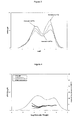
- Figure 2 shows the GPC profiles of polymers produced by Examples 3 and 4. Due to the difference in the effect of ethylene pressure on the activity of each catalyst component, the same dual catalyst can produce resins with different molecular weight distribution profiles when operated under different ethylene pressures.
- Example 4 Was carried out the same as Example 4, except that 29.9 mg of Catalyst B was used and the polymerization was conducted at 90°C, yielding 42.8 g of polymer.
- Example 4 Was carried out the same as Example 4, except that 31.6 mg of Catalyst B was used and the polymerization was conducted at 97°C, yielding 50.9 g of polymer.
- a 75 L stirred bed gas phase continuous reactor similar to that described in EP 0659 773 was used to produce copolymers containing ethylene and hexene.
- the polymerization was run at 83°C with ethylene and hexene using Catalyst B to obtain HDPE pipe bimodal resins.
- Isopentane was used in the process as a cooling agent as well as to control the molecular weight distribution of the resulting polymer. Nitrogen was used to maintain the total reactor pressure to approximately 2,100 KPa.
- the reactor composition was as follows: 55% ethylene, 0.41 % hexene, 8.5% isopentane with the balance being nitrogen.
- Figure 4 is a GPC-FTIR profile of the polymer produced in
- Polymerization reaction was similar to Example 7 but with reactor temperature at 88°C.
- Figure 5 is as GPC-FTIR profile of the polymer produced in Example 8.
- Example 9 was carried out the same as Example 7, except that isopentane was not fed into the reactor during the course of polymerization.
- Figure 6 compares the GPC profiles of polymers produced by Examples 7 and 9. In the presence of isopentane, the ratio of the high MW fraction to the low MW fraction decreases.
- the polymer composition (the ratio of the high MW fraction to the low MW fraction and the comonomer placement) can be controlled by the conditions of the polymerization process.
Landscapes
- Chemical & Material Sciences (AREA)
- Health & Medical Sciences (AREA)
- Chemical Kinetics & Catalysis (AREA)
- Medicinal Chemistry (AREA)
- Polymers & Plastics (AREA)
- Organic Chemistry (AREA)
- Transition And Organic Metals Composition Catalysts For Addition Polymerization (AREA)
- Polymerisation Methods In General (AREA)
- Addition Polymer Or Copolymer, Post-Treatments, Or Chemical Modifications (AREA)
- Polymers With Sulfur, Phosphorus Or Metals In The Main Chain (AREA)
Applications Claiming Priority (1)
| Application Number | Priority Date | Filing Date | Title |
|---|---|---|---|
| US11/006,075 US7321015B2 (en) | 2004-12-07 | 2004-12-07 | Adjusting polymer characteristics through process control |
Publications (2)
| Publication Number | Publication Date |
|---|---|
| EP1669372A1 true EP1669372A1 (fr) | 2006-06-14 |
| EP1669372B1 EP1669372B1 (fr) | 2008-07-23 |
Family
ID=36072031
Family Applications (1)
| Application Number | Title | Priority Date | Filing Date |
|---|---|---|---|
| EP05257476A Expired - Lifetime EP1669372B1 (fr) | 2004-12-07 | 2005-12-05 | Modification des caractéristiques d'un polymère par contrôle du procédé |
Country Status (7)
| Country | Link |
|---|---|
| US (1) | US7321015B2 (fr) |
| EP (1) | EP1669372B1 (fr) |
| JP (1) | JP5086537B2 (fr) |
| AT (1) | ATE402194T1 (fr) |
| CA (1) | CA2527579C (fr) |
| DE (1) | DE602005008347D1 (fr) |
| ES (1) | ES2311199T3 (fr) |
Cited By (6)
| Publication number | Priority date | Publication date | Assignee | Title |
|---|---|---|---|---|
| WO2011075258A1 (fr) * | 2009-12-18 | 2011-06-23 | Univation Technologies, Llc | Procédés pour préparer des produits de polyoléfine ayant différentes propriétés de fluidification par cisaillement et trouble |
| WO2011103280A1 (fr) * | 2010-02-18 | 2011-08-25 | Univation Technologies, Llc | Procédés d'exploitation d'un réacteur de polymérisation |
| KR101072676B1 (ko) | 2010-02-10 | 2011-10-11 | 삼성토탈 주식회사 | 기상 중합 반응의 전이공정 |
| CN103304869A (zh) * | 2012-03-09 | 2013-09-18 | 中国石油天然气股份有限公司 | 一种多峰聚乙烯管材树脂组合物及其制备方法 |
| EP2925794A4 (fr) * | 2012-12-03 | 2016-07-27 | Nova Chem Int Sa | Régulation des propriétés de résine dans un processus de polymérisation en phase gazeuse |
| CN106699943A (zh) * | 2015-11-13 | 2017-05-24 | 中国石油化工股份有限公司 | 高刚性聚乙烯滚塑树脂的聚合生产工艺 |
Families Citing this family (20)
| Publication number | Priority date | Publication date | Assignee | Title |
|---|---|---|---|---|
| US7323523B2 (en) * | 2004-12-07 | 2008-01-29 | Nova Chemicals (International) S.A. | Adjusting polymer characteristics through process control |
| US7531602B2 (en) * | 2005-10-05 | 2009-05-12 | Nova Chemicals (International) S.A. | Polymer blends |
| US7754834B2 (en) * | 2007-04-12 | 2010-07-13 | Univation Technologies, Llc | Bulk density promoting agents in a gas-phase polymerization process to achieve a bulk particle density |
| US8022154B2 (en) * | 2008-11-06 | 2011-09-20 | Exxonmobil Chemical Patents Inc. | Ethylene polymers, their production and use |
| CA2734167C (fr) | 2011-03-15 | 2018-03-27 | Nova Chemicals Corporation | Film de polyethylene |
| CA2749835C (fr) | 2011-08-23 | 2018-08-21 | Nova Chemicals Corporation | Approvisionnement de catalyseurs de phosphinimine tres actifs dans un reacteur en phase gazeuse |
| CA2777461C (fr) | 2012-05-17 | 2019-01-15 | Nova Chemicals Corporation | Synthese des ligands amelioree |
| US20160145359A1 (en) * | 2013-06-29 | 2016-05-26 | Dow Global Technologies Llc | A polyethylene composition and process for polymerizing the same |
| US9217049B2 (en) | 2013-11-19 | 2015-12-22 | Chevron Phillips Chemical Company Lp | Dual catalyst systems for producing polymers with a broad molecular weight distribution and a uniform short chain branch distribution |
| ES2665432T3 (es) | 2013-11-19 | 2018-04-25 | Chevron Phillips Chemical Company Lp | Sistemas de catalizadores que contienen compuestos metalocenos de ciclopentadienilo-fluorenilo con puente de boro con un sustituyente alquenilo |
| WO2015077100A2 (fr) | 2013-11-19 | 2015-05-28 | Chevron Phillips Chemical Company Lp | Systèmes de catalyseur à base de bis-indényl-métallocène à pont boré et polymères produits à partir de ceux-ci |
| US9540465B2 (en) | 2013-11-19 | 2017-01-10 | Chevron Phillips Chemical Company Lp | Boron-bridged metallocene catalyst systems and polymers produced therefrom |
| WO2016086039A1 (fr) | 2014-11-25 | 2016-06-02 | Univation Technologies, Llc | Procédés de commande de l'indice de fluidité de la polyoléfine |
| US11302459B2 (en) | 2017-10-06 | 2022-04-12 | Exxonmobil Chemical Patents Inc. | Polyethylene extrudates and methods of making the same |
| CN111902467B (zh) | 2018-02-05 | 2022-11-11 | 埃克森美孚化学专利公司 | 通过添加超高分子量高密度聚乙烯增强的lldpe的加工性 |
| EP4716706A1 (fr) | 2023-05-23 | 2026-04-01 | ExxonMobil Technology and Engineering Company | Catalyseurs, polyéthylènes, polymérisations de ceux-ci, et films associés |
| WO2024242932A1 (fr) | 2023-05-23 | 2024-11-28 | ExxonMobil Technology and Engineering Company | Polyéthylènes, catalyseurs pour leur polymérisation et films associés |
| EP4716705A1 (fr) | 2023-05-23 | 2026-04-01 | ExxonMobil Technology and Engineering Company | Poléthylènes de faible densité, films à base de poléthylènes, procédés et catalyseurs pour leur production |
| EP4716707A1 (fr) | 2023-05-23 | 2026-04-01 | ExxonMobil Technology and Engineering Company | Catalyseurs et polymérisations pour polyoléfines améliorées |
| WO2024242949A1 (fr) | 2023-05-23 | 2024-11-28 | ExxonMobil Technology and Engineering Company | Polyéthylènes ayant une aptitude au traitement améliorée et films associés |
Citations (13)
| Publication number | Priority date | Publication date | Assignee | Title |
|---|---|---|---|---|
| US4530914A (en) | 1983-06-06 | 1985-07-23 | Exxon Research & Engineering Co. | Process and catalyst for producing polyethylene having a broad molecular weight distribution |
| US4719193A (en) | 1986-09-30 | 1988-01-12 | Union Carbide Corporation | Processes for preparing polyethylene catalysts by heating catalyst precursors |
| EP0659773A1 (fr) | 1993-12-21 | 1995-06-28 | Union Carbide Chemicals & Plastics Technology Corporation | Préparation de polyoléfines possédant des ramifications à chaîne longue par un procédé en phase gazeuse |
| EP0989141A1 (fr) * | 1998-09-25 | 2000-03-29 | Fina Research S.A. | Elaboration de polyéthylène multimodal |
| US20010034423A1 (en) * | 1999-12-16 | 2001-10-25 | Oskam John H. | Polymerization catalyst compositions |
| US6309997B1 (en) | 1997-04-25 | 2001-10-30 | Mitsui Chemicals, Inc. | Olefin polymerization catalysts, transition metal compounds, processes for olefin polymerization, and α-olefin/conjugated diene copolymers |
| US20020045711A1 (en) | 1998-10-14 | 2002-04-18 | Mats Backman | Polymer composition for pipes |
| US20020077431A1 (en) | 2000-12-19 | 2002-06-20 | Whiteker Gregory T. | Olefin oligomerization catalysts, their production and use |
| US20020103310A1 (en) * | 2000-12-04 | 2002-08-01 | Szul John F. | Catalyst composition, method of polymerization and polymer therefrom |
| WO2003044061A1 (fr) * | 2001-11-15 | 2003-05-30 | Exxonmobil Chemical Patents Inc. | Surveillance et commande de polymerisation a l'aide d'indicateurs avances |
| US20040030070A1 (en) * | 1999-10-22 | 2004-02-12 | Loveday Donald R. | Catalyst composition, method of polymerization, and polymer therefrom |
| US20040063871A1 (en) * | 2002-09-27 | 2004-04-01 | Parrish John R. | Control of resin properties |
| WO2005040227A2 (fr) * | 2003-10-17 | 2005-05-06 | Univation Technologies, Llc | Surveillance et controle de polymerisation a l'aide d'indicateurs avances ameliores |
Family Cites Families (12)
| Publication number | Priority date | Publication date | Assignee | Title |
|---|---|---|---|---|
| DE69518104T2 (de) * | 1994-04-07 | 2000-12-14 | Bp Chemicals Ltd., London | Polymerisationsverfahren |
| CA2228923A1 (fr) * | 1998-02-06 | 1999-08-06 | Nova Chemicals Ltd. | Procede de preparation de catalyseur sur support pour la polymerisation d'olefines |
| ID26574A (id) * | 1998-03-12 | 2001-01-18 | Bp Chem Int Ltd | Katalis-katalis polimerisasi |
| CA2247703C (fr) * | 1998-09-22 | 2007-04-17 | Nova Chemicals Ltd. | Processus de polymerisation ethylene a reaction double |
| CA2278042C (fr) * | 1999-07-19 | 2008-12-16 | Nova Chemicals Corporation | Catalyseur a base de plusieurs phosphinimines |
| US6420298B1 (en) * | 1999-08-31 | 2002-07-16 | Exxonmobil Oil Corporation | Metallocene catalyst compositions, processes for making polyolefin resins using such catalyst compositions, and products produced thereby |
| AU767697B2 (en) * | 1999-10-22 | 2003-11-20 | Univation Technologies Llc | Catalyst compositions, methods of polymerization, and polymers therefrom |
| JP2002105132A (ja) * | 2000-07-26 | 2002-04-10 | Mitsui Chemicals Inc | ポリマーおよびその製造方法 |
| US6964937B2 (en) * | 2000-11-30 | 2005-11-15 | Univation Technologies, Llc | Bimetallic catalyst for producing polyethylene resins with bimodal molecular weight distribution, its preparation and use |
| JP2003105016A (ja) * | 2001-07-27 | 2003-04-09 | Japan Polyolefins Co Ltd | エチレン系重合体製造用触媒、エチレン系重合体の製造方法およびエチレン−α−オレフィン共重合体 |
| US6828395B1 (en) * | 2003-10-15 | 2004-12-07 | Univation Technologies, Llc | Polymerization process and control of polymer composition properties |
| US7323523B2 (en) * | 2004-12-07 | 2008-01-29 | Nova Chemicals (International) S.A. | Adjusting polymer characteristics through process control |
-
2004
- 2004-12-07 US US11/006,075 patent/US7321015B2/en not_active Expired - Lifetime
-
2005
- 2005-11-22 CA CA2527579A patent/CA2527579C/fr not_active Expired - Lifetime
- 2005-12-05 DE DE602005008347T patent/DE602005008347D1/de not_active Expired - Lifetime
- 2005-12-05 AT AT05257476T patent/ATE402194T1/de not_active IP Right Cessation
- 2005-12-05 EP EP05257476A patent/EP1669372B1/fr not_active Expired - Lifetime
- 2005-12-05 ES ES05257476T patent/ES2311199T3/es not_active Expired - Lifetime
- 2005-12-06 JP JP2005351598A patent/JP5086537B2/ja not_active Expired - Fee Related
Patent Citations (13)
| Publication number | Priority date | Publication date | Assignee | Title |
|---|---|---|---|---|
| US4530914A (en) | 1983-06-06 | 1985-07-23 | Exxon Research & Engineering Co. | Process and catalyst for producing polyethylene having a broad molecular weight distribution |
| US4719193A (en) | 1986-09-30 | 1988-01-12 | Union Carbide Corporation | Processes for preparing polyethylene catalysts by heating catalyst precursors |
| EP0659773A1 (fr) | 1993-12-21 | 1995-06-28 | Union Carbide Chemicals & Plastics Technology Corporation | Préparation de polyoléfines possédant des ramifications à chaîne longue par un procédé en phase gazeuse |
| US6309997B1 (en) | 1997-04-25 | 2001-10-30 | Mitsui Chemicals, Inc. | Olefin polymerization catalysts, transition metal compounds, processes for olefin polymerization, and α-olefin/conjugated diene copolymers |
| EP0989141A1 (fr) * | 1998-09-25 | 2000-03-29 | Fina Research S.A. | Elaboration de polyéthylène multimodal |
| US20020045711A1 (en) | 1998-10-14 | 2002-04-18 | Mats Backman | Polymer composition for pipes |
| US20040030070A1 (en) * | 1999-10-22 | 2004-02-12 | Loveday Donald R. | Catalyst composition, method of polymerization, and polymer therefrom |
| US20010034423A1 (en) * | 1999-12-16 | 2001-10-25 | Oskam John H. | Polymerization catalyst compositions |
| US20020103310A1 (en) * | 2000-12-04 | 2002-08-01 | Szul John F. | Catalyst composition, method of polymerization and polymer therefrom |
| US20020077431A1 (en) | 2000-12-19 | 2002-06-20 | Whiteker Gregory T. | Olefin oligomerization catalysts, their production and use |
| WO2003044061A1 (fr) * | 2001-11-15 | 2003-05-30 | Exxonmobil Chemical Patents Inc. | Surveillance et commande de polymerisation a l'aide d'indicateurs avances |
| US20040063871A1 (en) * | 2002-09-27 | 2004-04-01 | Parrish John R. | Control of resin properties |
| WO2005040227A2 (fr) * | 2003-10-17 | 2005-05-06 | Univation Technologies, Llc | Surveillance et controle de polymerisation a l'aide d'indicateurs avances ameliores |
Non-Patent Citations (3)
| Title |
|---|
| HANSCH, CHEM REV., vol. 91, 1991, pages 165 |
| J. B. PERI; A. L. HENSLEY, JR., J. PHYS. CHEM., vol. 72, no. 8, 1968, pages 2926 |
| NOSHAY A.; KAROL F.J.: "TRANSITION METAL CATALYZED POLYMERIZATIONS", vol. 396, 1989 |
Cited By (10)
| Publication number | Priority date | Publication date | Assignee | Title |
|---|---|---|---|---|
| WO2011075258A1 (fr) * | 2009-12-18 | 2011-06-23 | Univation Technologies, Llc | Procédés pour préparer des produits de polyoléfine ayant différentes propriétés de fluidification par cisaillement et trouble |
| CN102656195A (zh) * | 2009-12-18 | 2012-09-05 | 尤尼威蒂恩技术有限责任公司 | 制备具有不同的剪切变稀性能和雾度的聚烯烃产品的方法 |
| US8637615B2 (en) | 2009-12-18 | 2014-01-28 | Univation Technologies, Llc | Methods for making polyolefin products having different shear thinning properties and haze |
| KR101072676B1 (ko) | 2010-02-10 | 2011-10-11 | 삼성토탈 주식회사 | 기상 중합 반응의 전이공정 |
| WO2011103280A1 (fr) * | 2010-02-18 | 2011-08-25 | Univation Technologies, Llc | Procédés d'exploitation d'un réacteur de polymérisation |
| US8598283B2 (en) | 2010-02-18 | 2013-12-03 | Univation Technologies, Llc | Methods for operating a polymerization reactor |
| CN103304869A (zh) * | 2012-03-09 | 2013-09-18 | 中国石油天然气股份有限公司 | 一种多峰聚乙烯管材树脂组合物及其制备方法 |
| CN103304869B (zh) * | 2012-03-09 | 2015-05-13 | 中国石油天然气股份有限公司 | 一种多峰聚乙烯管材树脂组合物及其制备方法 |
| EP2925794A4 (fr) * | 2012-12-03 | 2016-07-27 | Nova Chem Int Sa | Régulation des propriétés de résine dans un processus de polymérisation en phase gazeuse |
| CN106699943A (zh) * | 2015-11-13 | 2017-05-24 | 中国石油化工股份有限公司 | 高刚性聚乙烯滚塑树脂的聚合生产工艺 |
Also Published As
| Publication number | Publication date |
|---|---|
| EP1669372B1 (fr) | 2008-07-23 |
| ATE402194T1 (de) | 2008-08-15 |
| CA2527579C (fr) | 2013-03-19 |
| US20060122342A1 (en) | 2006-06-08 |
| CA2527579A1 (fr) | 2006-06-07 |
| JP2006161047A (ja) | 2006-06-22 |
| US7321015B2 (en) | 2008-01-22 |
| DE602005008347D1 (de) | 2008-09-04 |
| JP5086537B2 (ja) | 2012-11-28 |
| ES2311199T3 (es) | 2009-02-01 |
Similar Documents
| Publication | Publication Date | Title |
|---|---|---|
| EP1669372B1 (fr) | Modification des caractéristiques d'un polymère par contrôle du procédé | |
| EP1669376B1 (fr) | Catalyseur double sur un support unique | |
| US7531602B2 (en) | Polymer blends | |
| US20080108763A1 (en) | Adjusting polymer characteristics through process control | |
| CA2285723C (fr) | Tuyau en polyolefine a distribution multimodale de masses moleculaires | |
| EP2190888B1 (fr) | Système de catalyseurs co-supportés comprenant du chrome et un complexe de métal du groupe 4 | |
| US20060189769A1 (en) | Broad/bimodal resins with controlled comonomer distribution | |
| WO2012075560A1 (fr) | Activation catalytique dans un procédé à deux réacteurs | |
| CA2254841C (fr) | Ligand de phosphinimine susbtituee sur l'atome d'azote | |
| EP2195352B1 (fr) | Procédé de polymérisation à l'aide d'un système catalyseur mixte | |
| US7816488B2 (en) | Method to estimate pent values |
Legal Events
| Date | Code | Title | Description |
|---|---|---|---|
| PUAI | Public reference made under article 153(3) epc to a published international application that has entered the european phase |
Free format text: ORIGINAL CODE: 0009012 |
|
| AK | Designated contracting states |
Kind code of ref document: A1 Designated state(s): AT BE BG CH CY CZ DE DK EE ES FI FR GB GR HU IE IS IT LI LT LU LV MC NL PL PT RO SE SI SK TR |
|
| AX | Request for extension of the european patent |
Extension state: AL BA HR MK YU |
|
| 17P | Request for examination filed |
Effective date: 20060928 |
|
| AKX | Designation fees paid |
Designated state(s): AT BE BG CH CY CZ DE DK EE ES FI FR GB GR HU IE IS IT LI LT LU LV MC NL PL PT RO SE SI SK TR |
|
| GRAP | Despatch of communication of intention to grant a patent |
Free format text: ORIGINAL CODE: EPIDOSNIGR1 |
|
| GRAS | Grant fee paid |
Free format text: ORIGINAL CODE: EPIDOSNIGR3 |
|
| GRAA | (expected) grant |
Free format text: ORIGINAL CODE: 0009210 |
|
| AK | Designated contracting states |
Kind code of ref document: B1 Designated state(s): AT BE BG CH CY CZ DE DK EE ES FI FR GB GR HU IE IS IT LI LT LU LV MC NL PL PT RO SE SI SK TR |
|
| REG | Reference to a national code |
Ref country code: GB Ref legal event code: FG4D |
|
| REG | Reference to a national code |
Ref country code: CH Ref legal event code: EP |
|
| REG | Reference to a national code |
Ref country code: IE Ref legal event code: FG4D |
|
| REF | Corresponds to: |
Ref document number: 602005008347 Country of ref document: DE Date of ref document: 20080904 Kind code of ref document: P |
|
| PG25 | Lapsed in a contracting state [announced via postgrant information from national office to epo] |
Ref country code: LT Free format text: LAPSE BECAUSE OF FAILURE TO SUBMIT A TRANSLATION OF THE DESCRIPTION OR TO PAY THE FEE WITHIN THE PRESCRIBED TIME-LIMIT Effective date: 20080723 Ref country code: IS Free format text: LAPSE BECAUSE OF FAILURE TO SUBMIT A TRANSLATION OF THE DESCRIPTION OR TO PAY THE FEE WITHIN THE PRESCRIBED TIME-LIMIT Effective date: 20081123 |
|
| REG | Reference to a national code |
Ref country code: ES Ref legal event code: FG2A Ref document number: 2311199 Country of ref document: ES Kind code of ref document: T3 |
|
| PG25 | Lapsed in a contracting state [announced via postgrant information from national office to epo] |
Ref country code: BG Free format text: LAPSE BECAUSE OF FAILURE TO SUBMIT A TRANSLATION OF THE DESCRIPTION OR TO PAY THE FEE WITHIN THE PRESCRIBED TIME-LIMIT Effective date: 20081023 Ref country code: LV Free format text: LAPSE BECAUSE OF FAILURE TO SUBMIT A TRANSLATION OF THE DESCRIPTION OR TO PAY THE FEE WITHIN THE PRESCRIBED TIME-LIMIT Effective date: 20080723 Ref country code: AT Free format text: LAPSE BECAUSE OF FAILURE TO SUBMIT A TRANSLATION OF THE DESCRIPTION OR TO PAY THE FEE WITHIN THE PRESCRIBED TIME-LIMIT Effective date: 20080723 Ref country code: FI Free format text: LAPSE BECAUSE OF FAILURE TO SUBMIT A TRANSLATION OF THE DESCRIPTION OR TO PAY THE FEE WITHIN THE PRESCRIBED TIME-LIMIT Effective date: 20080723 Ref country code: SI Free format text: LAPSE BECAUSE OF FAILURE TO SUBMIT A TRANSLATION OF THE DESCRIPTION OR TO PAY THE FEE WITHIN THE PRESCRIBED TIME-LIMIT Effective date: 20080723 |
|
| PG25 | Lapsed in a contracting state [announced via postgrant information from national office to epo] |
Ref country code: EE Free format text: LAPSE BECAUSE OF FAILURE TO SUBMIT A TRANSLATION OF THE DESCRIPTION OR TO PAY THE FEE WITHIN THE PRESCRIBED TIME-LIMIT Effective date: 20080723 Ref country code: DK Free format text: LAPSE BECAUSE OF FAILURE TO SUBMIT A TRANSLATION OF THE DESCRIPTION OR TO PAY THE FEE WITHIN THE PRESCRIBED TIME-LIMIT Effective date: 20080723 |
|
| PG25 | Lapsed in a contracting state [announced via postgrant information from national office to epo] |
Ref country code: SK Free format text: LAPSE BECAUSE OF FAILURE TO SUBMIT A TRANSLATION OF THE DESCRIPTION OR TO PAY THE FEE WITHIN THE PRESCRIBED TIME-LIMIT Effective date: 20080723 Ref country code: RO Free format text: LAPSE BECAUSE OF FAILURE TO SUBMIT A TRANSLATION OF THE DESCRIPTION OR TO PAY THE FEE WITHIN THE PRESCRIBED TIME-LIMIT Effective date: 20080723 Ref country code: CZ Free format text: LAPSE BECAUSE OF FAILURE TO SUBMIT A TRANSLATION OF THE DESCRIPTION OR TO PAY THE FEE WITHIN THE PRESCRIBED TIME-LIMIT Effective date: 20080723 |
|
| PLBE | No opposition filed within time limit |
Free format text: ORIGINAL CODE: 0009261 |
|
| STAA | Information on the status of an ep patent application or granted ep patent |
Free format text: STATUS: NO OPPOSITION FILED WITHIN TIME LIMIT |
|
| 26N | No opposition filed |
Effective date: 20090424 |
|
| PG25 | Lapsed in a contracting state [announced via postgrant information from national office to epo] |
Ref country code: MC Free format text: LAPSE BECAUSE OF NON-PAYMENT OF DUE FEES Effective date: 20081231 |
|
| REG | Reference to a national code |
Ref country code: IE Ref legal event code: MM4A |
|
| PG25 | Lapsed in a contracting state [announced via postgrant information from national office to epo] |
Ref country code: IE Free format text: LAPSE BECAUSE OF NON-PAYMENT OF DUE FEES Effective date: 20081205 |
|
| PG25 | Lapsed in a contracting state [announced via postgrant information from national office to epo] |
Ref country code: SE Free format text: LAPSE BECAUSE OF FAILURE TO SUBMIT A TRANSLATION OF THE DESCRIPTION OR TO PAY THE FEE WITHIN THE PRESCRIBED TIME-LIMIT Effective date: 20081023 |
|
| PG25 | Lapsed in a contracting state [announced via postgrant information from national office to epo] |
Ref country code: PL Free format text: LAPSE BECAUSE OF FAILURE TO SUBMIT A TRANSLATION OF THE DESCRIPTION OR TO PAY THE FEE WITHIN THE PRESCRIBED TIME-LIMIT Effective date: 20080723 |
|
| PG25 | Lapsed in a contracting state [announced via postgrant information from national office to epo] |
Ref country code: CY Free format text: LAPSE BECAUSE OF FAILURE TO SUBMIT A TRANSLATION OF THE DESCRIPTION OR TO PAY THE FEE WITHIN THE PRESCRIBED TIME-LIMIT Effective date: 20080723 Ref country code: HU Free format text: LAPSE BECAUSE OF FAILURE TO SUBMIT A TRANSLATION OF THE DESCRIPTION OR TO PAY THE FEE WITHIN THE PRESCRIBED TIME-LIMIT Effective date: 20090124 Ref country code: LU Free format text: LAPSE BECAUSE OF NON-PAYMENT OF DUE FEES Effective date: 20081205 |
|
| REG | Reference to a national code |
Ref country code: CH Ref legal event code: PL |
|
| PG25 | Lapsed in a contracting state [announced via postgrant information from national office to epo] |
Ref country code: TR Free format text: LAPSE BECAUSE OF FAILURE TO SUBMIT A TRANSLATION OF THE DESCRIPTION OR TO PAY THE FEE WITHIN THE PRESCRIBED TIME-LIMIT Effective date: 20080723 |
|
| PG25 | Lapsed in a contracting state [announced via postgrant information from national office to epo] |
Ref country code: CH Free format text: LAPSE BECAUSE OF NON-PAYMENT OF DUE FEES Effective date: 20091231 Ref country code: GR Free format text: LAPSE BECAUSE OF FAILURE TO SUBMIT A TRANSLATION OF THE DESCRIPTION OR TO PAY THE FEE WITHIN THE PRESCRIBED TIME-LIMIT Effective date: 20081024 Ref country code: LI Free format text: LAPSE BECAUSE OF NON-PAYMENT OF DUE FEES Effective date: 20091231 |
|
| PG25 | Lapsed in a contracting state [announced via postgrant information from national office to epo] |
Ref country code: PT Free format text: LAPSE BECAUSE OF FAILURE TO SUBMIT A TRANSLATION OF THE DESCRIPTION OR TO PAY THE FEE WITHIN THE PRESCRIBED TIME-LIMIT Effective date: 20080723 |
|
| PGFP | Annual fee paid to national office [announced via postgrant information from national office to epo] |
Ref country code: DE Payment date: 20121128 Year of fee payment: 8 |
|
| PGFP | Annual fee paid to national office [announced via postgrant information from national office to epo] |
Ref country code: IT Payment date: 20121220 Year of fee payment: 8 Ref country code: ES Payment date: 20121227 Year of fee payment: 8 Ref country code: GB Payment date: 20121205 Year of fee payment: 8 |
|
| PGFP | Annual fee paid to national office [announced via postgrant information from national office to epo] |
Ref country code: NL Payment date: 20121208 Year of fee payment: 8 Ref country code: FR Payment date: 20130107 Year of fee payment: 8 |
|
| PGFP | Annual fee paid to national office [announced via postgrant information from national office to epo] |
Ref country code: BE Payment date: 20121217 Year of fee payment: 8 |
|
| BERE | Be: lapsed |
Owner name: NOVA CHEMICALS (INTERNATIONAL) S.A. Effective date: 20131231 |
|
| REG | Reference to a national code |
Ref country code: DE Ref legal event code: R119 Ref document number: 602005008347 Country of ref document: DE |
|
| REG | Reference to a national code |
Ref country code: NL Ref legal event code: V1 Effective date: 20140701 |
|
| GBPC | Gb: european patent ceased through non-payment of renewal fee |
Effective date: 20131205 |
|
| REG | Reference to a national code |
Ref country code: DE Ref legal event code: R119 Ref document number: 602005008347 Country of ref document: DE Effective date: 20140701 |
|
| REG | Reference to a national code |
Ref country code: FR Ref legal event code: ST Effective date: 20140829 |
|
| PG25 | Lapsed in a contracting state [announced via postgrant information from national office to epo] |
Ref country code: BE Free format text: LAPSE BECAUSE OF NON-PAYMENT OF DUE FEES Effective date: 20131231 Ref country code: DE Free format text: LAPSE BECAUSE OF NON-PAYMENT OF DUE FEES Effective date: 20140701 Ref country code: NL Free format text: LAPSE BECAUSE OF NON-PAYMENT OF DUE FEES Effective date: 20140701 |
|
| PG25 | Lapsed in a contracting state [announced via postgrant information from national office to epo] |
Ref country code: FR Free format text: LAPSE BECAUSE OF NON-PAYMENT OF DUE FEES Effective date: 20131231 Ref country code: GB Free format text: LAPSE BECAUSE OF NON-PAYMENT OF DUE FEES Effective date: 20131205 |
|
| REG | Reference to a national code |
Ref country code: ES Ref legal event code: FD2A Effective date: 20150709 |
|
| PG25 | Lapsed in a contracting state [announced via postgrant information from national office to epo] |
Ref country code: ES Free format text: LAPSE BECAUSE OF NON-PAYMENT OF DUE FEES Effective date: 20131206 |
|
| PG25 | Lapsed in a contracting state [announced via postgrant information from national office to epo] |
Ref country code: IT Free format text: LAPSE BECAUSE OF NON-PAYMENT OF DUE FEES Effective date: 20131231 |
|
| PG25 | Lapsed in a contracting state [announced via postgrant information from national office to epo] |
Ref country code: IT Free format text: LAPSE BECAUSE OF NON-PAYMENT OF DUE FEES Effective date: 20131205 |