EP1724385A1 - Procédé pour la production d'un tricot sur un métier à tricoter rectiligne - Google Patents
Procédé pour la production d'un tricot sur un métier à tricoter rectiligne Download PDFInfo
- Publication number
- EP1724385A1 EP1724385A1 EP05011045A EP05011045A EP1724385A1 EP 1724385 A1 EP1724385 A1 EP 1724385A1 EP 05011045 A EP05011045 A EP 05011045A EP 05011045 A EP05011045 A EP 05011045A EP 1724385 A1 EP1724385 A1 EP 1724385A1
- Authority
- EP
- European Patent Office
- Prior art keywords
- knitting
- thread
- needle
- guide
- yarn guide
- Prior art date
- Legal status (The legal status is an assumption and is not a legal conclusion. Google has not performed a legal analysis and makes no representation as to the accuracy of the status listed.)
- Granted
Links
Images


Classifications
-
- D—TEXTILES; PAPER
- D04—BRAIDING; LACE-MAKING; KNITTING; TRIMMINGS; NON-WOVEN FABRICS
- D04B—KNITTING
- D04B7/00—Flat-bed knitting machines with independently-movable needles
- D04B7/24—Flat-bed knitting machines with independently-movable needles for producing patterned fabrics
- D04B7/26—Flat-bed knitting machines with independently-movable needles for producing patterned fabrics with colour patterns
-
- D—TEXTILES; PAPER
- D04—BRAIDING; LACE-MAKING; KNITTING; TRIMMINGS; NON-WOVEN FABRICS
- D04B—KNITTING
- D04B1/00—Weft knitting processes for the production of fabrics or articles not dependent on the use of particular machines; Fabrics or articles defined by such processes
- D04B1/10—Patterned fabrics or articles
- D04B1/12—Patterned fabrics or articles characterised by thread material
- D04B1/126—Patterned fabrics or articles characterised by thread material with colour pattern, e.g. intarsia fabrics
Definitions
- the invention relates to a method for the production of knitted fabrics on a flat knitting machine with at least two knitting systems arranged on a carriage and with at least one yarn guide.
- the carriages typically have several knitting systems consisting of a knitting cam and a needle selection device associated therewith. These knitting systems can be stopped at any position within a knit row at a defined distance to a certain needle and moved in the opposite direction over a defined number of knitting needles, without these knitting needles perform a propulsion and / or retraction movement.
- Thread guides known which have a separate drive and therefore can be moved freely in each direction of movement, as long as they are not required for thread insertion.
- the present invention has for its object to provide methods by which the knit fabrics described above can be produced much faster and therefore more cost-effective than with the methods of the prior art.
- the object is achieved with a method for producing knitted fabrics on a flat knitting machine having at least two knitting systems arranged on a slide and with at least one thread guide, which according to the invention is characterized in that in a knitting row in front of a needle area, in which with a different knitting system than before continue to knit, the yarn guide, which has been fed to the needles thread, is brought into an inoperative position while the carriage continues to move in the original knitting direction, and the yarn guide then brought back in the original knitting direction or in the opposite direction of knitting back into the operating position becomes while the carriage continues to move without changing the knitting direction and without stopping.
- tubular knitted fabrics with intarsia fields can be formed much more efficiently than before.
- the sliding movements of the yarn guides required in the edge area of the intarsia field are now possible without stopping and moving back the carriage.
- the renewed activation of the thread guide takes place without change of direction or change in speed of the carriage.
- the method according to the invention can be carried out with knitting machines which have thread guide devices in accordance with the abovementioned three European patent applications. Although flat knitting machines with such yarn guide devices are already partially available on the market, they have hitherto not been used for carrying out a method according to the invention or such an insert has been excited.
- the thread guide can be brought into action either by a movement of only his Faden organizationsarms with the nut arranged thereon or by a movement of the entire yarn guide out of action and again.
- the Fadenterrorismarm is brought by pivoting or moving opposite its previous direction of movement out of action.
- the at least one yarn guide can be driven by its own drive means, be moved by the knitting systems, stopped and brought into and out of action or moved by the knitting systems and brought by a separate adjustment in and out of action.
- the flat knitting machines used for carrying out the method can do this with yarn guides according to the above-mentioned EP 0 872 587 .
- EP 0 526 406 or EP 05008709.7 be equipped.
- the inventive method can be configured in different variants.
- the thread guide can be activated again after its introduction into its off-mode position in the same direction of knitting and with him and at least one other knitting system more stitches are formed in the knitting sequence.
- the at least one further knitting system meshes of a different size than before the decommissioning of the thread guide can be formed.
- knits can thus be produced which have as many successive stitch areas of different mesh size in a knitting row as the knitting machine has knitting systems.
- the method brings particular advantages when at least one stitch is in the direction of knitted outer edge is transferred to widen the knitted piece, so that at least one empty needle between the outwardly hung stitches and the remaining knitted fabric, and with the yarn guide and a first knitting mesh on the needles are formed with the outwardly hung stitches and the first needle following the empty needle, the yarn guide is brought into an out-of-position position outside the empty needle and then activated again in the unaltered knitting direction of the carriage and with it and a second knitting system Thread is inserted into the empty needle and by stitching on the other needles of the knitted fabric the knitting row is completed.
- the so-called "cover hole" resulting from the widening of crocheted fabric can be partially covered by a fleece thread.
- a first thread guide is brought into an off-mode position in order to bring a second thread guide in an out-of-action position in which he does not obstruct the further thread insert by the first thread guide before the first thread guide is activated in the original direction of knitting again and with it and a second knitting system in the original knitting direction further stitches are formed.
- this process variant for example, tube-round intarsia knits can be formed.
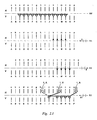
- a knitting method is shown in which regions of different mesh size are produced with the same yarn guide in a knitting row.
- Each knitting system S1, S2 is associated with a mesh area in which a mesh size is generated, as dictated by the needle core setting of the respective knitting system S1, S2.
- the areas of different mesh size immediately adjoin one another.
- Row R0 shows a complete knitting course of the knitted fabric formed with the same yarn guide and the same yarn, the stitches of the needles H - O forming a single knitted fabric being larger than the stitches of the needles B - G and b - g form a double-sided fabric part.
- the needles g, H are the limit needles of the two areas of different mesh size. Since the fabric has two regions of different mesh sizes, a flat knitting machine having at least two knitting systems S1, S2 must be used for its production.
- the second knitting system S2 grasps the thread guide 1 in position 1, V or brings its thread guide arm into working position to form the stitches of the double-meshed knitted fabric with the needles G-B and g-b. After the yarn guide 1 has fed the yarn to the last needle B of the double-surface stitch area, it stops at a defined distance after the needle B and is in its normal parking position 1, A.
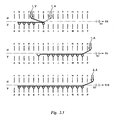
- FIGS. 2.1 to 2.3 a variant of the method is shown with which it is possible to conceal a "cover hole", which results from the widening of a knitted fabric, by a floss thread.
- the "hole” arises on those or those needles, which are freed from his or her stitches, if to widen one one or more stitches are hung on the fabric edge away from the knit center to the outside.
- Row R0 shows the last row of knitting of a monofilament knit on the front needle bed V, which occupies the needles C - N.
- row R1 in the direction of knitting from right to left, with a first knitting system S1, the stitches of the needles N, M, L and K are transferred to their opposite needles of the rear needle bed H.
- the stitches k, l, m and n of the back needle bed H are transferred to their opposite needles L, M, N and O of the front needle bed V umgecher.
- the rear needle bed H is brought back into its basic position and in the knitting direction from right to left with the first knitting system S1 and the thread guide 1, the needles O - L and J fed the yarn and stitches formed for the first section of the knitting sequence.
- a floss thread is laid from the needle L to the needle J.
- the second knitting system S2 detects the thread guide 1 in its position 1, V or pivots its thread guide arm into its working position and detects the thread guide 1 in the position 1, A in order to insert a tuck into the needle K while the knitting direction remains the same.
- the yarn guide 1 After the yarn guide 1 has fed the yarn to the last needle C of the knitting line, it stops at a defined distance from the needle C and is then in its normal parking position 1, A.
- the rear needle bed H is brought to its basic position in row R8 and in the knitting direction from left to right with the first knitting system S1 and the thread guide 1 to the needles B - E and G fed the thread and formed stitches for the first section of the knitting sequence.
- a floss thread is laid from the needle E to the needle G.
- the yarn guide 1 of the needle G has fed the yarn, it stops at a defined distance from the needle G.
- the yarn guide 1 and its Faden organizingarm in position 1, V is moved counter to the knitting direction, so that the yarn guide 1 at a loading by a subsequent Knitting system in the hook of the needle F can insert a thread.
- the second knitting system S2 detects the thread guide 1 in its position V or pivots the thread guide arm in the operating position and detects the thread guide 1 in position 1, A to insert a tuck into the needle F, over the area of the needle G a To lay flat yarn and to form with the needles H - O stitches.
- the yarn guide 1 After the yarn guide 1 has fed the yarn to the last needle O of the knitting line, it stops in its normal parking position 1, A. Subsequently, stitches are formed in the same knitting direction with the third knitting system S3 and the yarn guide 2 with the needles B-O. The number of stitches of the knitting line has increased on the left side around the stitch of the needle B.
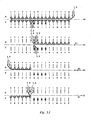
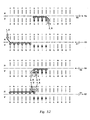
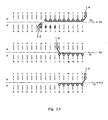
- Fig. 3 shows a knitting method for producing a tube-round intarsia knit.
- the tubular knitted fabric has an intarsia panel on its front side, formed by the needles G - J of the front needle bed.
- Row R0 shows the last knit of a knitting cycle as described in the following series R1 - R10.
- the yarn guide 1, which supplies the needles the thread of the primary color, is in its Abstellposition 1, A next to the needles P, p of the front and rear needle bed V, H.
- the yarn guide 2, the needles the thread in the color of Intarsiafeldes supplies, is in its parking position 2, A next to the needles G, g.
- the needles p - g of the back needle bed H are supplied with the basic color yarn and stitches are formed for the first section of the back fabric side.
- the yarn guide 1 After the yarn guide 1 has fed the yarn to the needle g, it stops in one defined distance to this needle in position 1, A. Subsequently, he or at least his Fadenterrorismarm is moved back in position 1, V, while the knitting systems continue to move in the previous knitting direction. In position 1, V, the thread guide 1 or its thread guide arm can be acted upon by the following knitting system and can thus feed the thread to the needle.
- the yarn guide 2 is in a position in which he would impede the yarn guide 1 in the further thread insert into the needle f.
- the second knitting system S2 impinges on the thread guide 1 in its position 1, V in a constant knitting direction or brings the thread guide arm into working position and then detects the thread guide 1 in its position 1, A, starting from the needle f to the needle a Insert thread and form the second section of the back fabric side. After the yarn guide 1 of the last needle a of the row of knitting has fed the thread, it stops at a defined distance from the needle a in its normal parking position 1, A.
- the yarn guide 2 or its yarn guide arm is then moved so far opposite to the direction of movement of the knitting systems with the direction of movement of the knitting systems that the yarn guide 2 can insert yarn from the needle G.
- the intarsia field is then formed with the second knitting system S2 and the thread guide 2.
- the yarn guide 2 After the yarn guide 2 has fed the last needle J of the intarsia field, it stops at a defined distance from the needle J in its normal parking position 2, A, before in row R5 in the direction of knitting from right to left the thread guide 1 or its Fadenterrorismarm as far as opposite Moving direction of the knitting systems is moved, that the yarn guide 1 from the needle F can insert thread.
- the second knitting course of the first section of the front fabric side is then formed with the first knitting system S1 and the yarn guide 1.
- the yarn guide 1 of the needle A After the yarn guide 1 of the needle A has fed the thread, it stops at a defined distance from the needle A in its normal parking position 1, A.
- the second knitting course of the intarsia panel is formed in the same knitting direction with the second knitting system S2 and the thread guide 2 from the needle J to the needle G.
- the yarn guide 2 of the needle G After the yarn guide 2 of the needle G has fed the yarn, it stops in position 2, A and is then moved back into position 2, V opposite to the knitting direction or pivoted his Fadenterrorismarm in this position. In position 2, V he does not interfere with the next knitting the thread guide 1 when inserting the thread.
- the second knitting course for the second section of the back fabric side is formed in the knitting direction from left to right with the first knitting system S1 and the yarn guide 1 from the needle a to the needle g.
- the yarn guide 1 After the yarn guide 1 has fed the yarn to the needle g, it stops in position 1, A and is then moved by itself or at least its yarn guide arm counter to the knitting direction so that it can insert the yarn into the needle h in the subsequent knitting movement (yarn guide). or yarn guide arm position 1, V) while the knitting systems continue to move in the previous knitting direction.
- the yarn guide 2 or its yarn guide arm is moved in line R8 in the same direction knitting direction contrary to the knitting direction so far that he can not hinder the yarn guide 1 in the thread insert into the needle h.
- the second knitting system S2 acts on the thread guide 1 in position 1, V or brings the Fadenterrorismarm the thread guide 1 in its working position and detects the thread guide 1 in position 1, A to insert from the needle h to the needle p thread and the second row of knitting to form for the first section of the back knitted row.
- the yarn guide 1 of the last needle p of the knitting line has fed the yarn, it stops at a defined distance from the needle p in its normal parking position 1, A.
- the intarsia panel is located on the front of the tubular knit. If the intarsia field is to be formed on the back side of the tubular knit, the knitting courses on the front and rear needle bed V, H are reversed. It is also possible to form a plurality of intarsia fields on the front side and / or the back side of the tubular knit, provided that correspondingly more thread guides and knitting systems are available.
Landscapes
- Engineering & Computer Science (AREA)
- Textile Engineering (AREA)
- Knitting Machines (AREA)
Priority Applications (2)
| Application Number | Priority Date | Filing Date | Title |
|---|---|---|---|
| EP05011045.1A EP1724385B1 (fr) | 2005-05-21 | 2005-05-21 | Procédé pour la production d'un tricot sur un métier à tricoter rectiligne |
| CN2006100916615A CN1865563B (zh) | 2005-05-21 | 2006-05-19 | 用于横机上编织针织物的方法以及针织物 |
Applications Claiming Priority (1)
| Application Number | Priority Date | Filing Date | Title |
|---|---|---|---|
| EP05011045.1A EP1724385B1 (fr) | 2005-05-21 | 2005-05-21 | Procédé pour la production d'un tricot sur un métier à tricoter rectiligne |
Publications (2)
| Publication Number | Publication Date |
|---|---|
| EP1724385A1 true EP1724385A1 (fr) | 2006-11-22 |
| EP1724385B1 EP1724385B1 (fr) | 2016-05-18 |
Family
ID=36087896
Family Applications (1)
| Application Number | Title | Priority Date | Filing Date |
|---|---|---|---|
| EP05011045.1A Expired - Lifetime EP1724385B1 (fr) | 2005-05-21 | 2005-05-21 | Procédé pour la production d'un tricot sur un métier à tricoter rectiligne |
Country Status (2)
| Country | Link |
|---|---|
| EP (1) | EP1724385B1 (fr) |
| CN (1) | CN1865563B (fr) |
Cited By (5)
| Publication number | Priority date | Publication date | Assignee | Title |
|---|---|---|---|---|
| EP2835459A1 (fr) * | 2013-08-08 | 2015-02-11 | H. Stoll GmbH & Co. KG | Procédé de fabrication d'une pièce de textile tricoté sur une machine à tricoter rectiligne, dans laquelle des guide-fils à entraînement autonome sont déplacés par des aiguilles expulsées dans le sens inverse du tricotage |
| EP2835458A1 (fr) * | 2013-08-08 | 2015-02-11 | H. Stoll GmbH & Co. KG | Procédé de fabrication d'un textile tricoté avec des ajours |
| EP2835457A1 (fr) * | 2013-08-06 | 2015-02-11 | H. Stoll GmbH & Co. KG | Procédé de fabrication d'une pièce de tricot sur une machine à tricoter plate, les guide-fils étant déplacés entre les systèmes de tricot |
| ITUB20155029A1 (it) * | 2015-11-02 | 2017-05-02 | Logica S R L | Procedimento per realizzare articoli tessili su una macchina tessile rettilinea |
| CN113789603A (zh) * | 2021-08-14 | 2021-12-14 | 信泰(福建)科技有限公司 | 一种可隐藏杂色的半透挑孔编织面料及其编织方法、应用 |
Families Citing this family (2)
| Publication number | Priority date | Publication date | Assignee | Title |
|---|---|---|---|---|
| JP5881412B2 (ja) * | 2011-12-27 | 2016-03-09 | 株式会社島精機製作所 | 横編機用の編成データの生成方法とその装置 |
| CN105256455B (zh) * | 2015-09-14 | 2017-03-08 | 宁波慈星股份有限公司 | 一种引线方法 |
Citations (4)
| Publication number | Priority date | Publication date | Assignee | Title |
|---|---|---|---|---|
| WO1994003667A1 (fr) | 1992-07-30 | 1994-02-17 | Universal Maschinenfabrik Dr. Rudolf Schieber Gmbh & Co. Kg | Procede et dispositif de tricotage intarsia |
| EP0872587A2 (fr) | 1997-04-15 | 1998-10-21 | Shima Seiki Manufacturing, Ltd. | Dispositif d'alimentation en fil pour un métier à tricoter rectiligne |
| EP0940491A2 (fr) * | 1998-03-06 | 1999-09-08 | Shima Seiki Manufacturing, Ltd. | Procédé pour obtenir des augmentations |
| EP1203837A1 (fr) | 1999-04-20 | 2002-05-08 | Shima Seiki Mfg., Ltd | Tissu tricote et son procede de tricotage |
Family Cites Families (2)
| Publication number | Priority date | Publication date | Assignee | Title |
|---|---|---|---|---|
| JPH07324259A (ja) | 1994-05-27 | 1995-12-12 | Shima Seiki Mfg Ltd | インターシャ編地の編成方法及びそれを実施するためのカムロック |
| WO2003046267A1 (fr) * | 2001-11-26 | 2003-06-05 | Shima Seiki Mfg., Ltd. | Procede de tricotage de motif intersia |
-
2005
- 2005-05-21 EP EP05011045.1A patent/EP1724385B1/fr not_active Expired - Lifetime
-
2006
- 2006-05-19 CN CN2006100916615A patent/CN1865563B/zh active Active
Patent Citations (4)
| Publication number | Priority date | Publication date | Assignee | Title |
|---|---|---|---|---|
| WO1994003667A1 (fr) | 1992-07-30 | 1994-02-17 | Universal Maschinenfabrik Dr. Rudolf Schieber Gmbh & Co. Kg | Procede et dispositif de tricotage intarsia |
| EP0872587A2 (fr) | 1997-04-15 | 1998-10-21 | Shima Seiki Manufacturing, Ltd. | Dispositif d'alimentation en fil pour un métier à tricoter rectiligne |
| EP0940491A2 (fr) * | 1998-03-06 | 1999-09-08 | Shima Seiki Manufacturing, Ltd. | Procédé pour obtenir des augmentations |
| EP1203837A1 (fr) | 1999-04-20 | 2002-05-08 | Shima Seiki Mfg., Ltd | Tissu tricote et son procede de tricotage |
Cited By (7)
| Publication number | Priority date | Publication date | Assignee | Title |
|---|---|---|---|---|
| EP2835457A1 (fr) * | 2013-08-06 | 2015-02-11 | H. Stoll GmbH & Co. KG | Procédé de fabrication d'une pièce de tricot sur une machine à tricoter plate, les guide-fils étant déplacés entre les systèmes de tricot |
| EP2835459A1 (fr) * | 2013-08-08 | 2015-02-11 | H. Stoll GmbH & Co. KG | Procédé de fabrication d'une pièce de textile tricoté sur une machine à tricoter rectiligne, dans laquelle des guide-fils à entraînement autonome sont déplacés par des aiguilles expulsées dans le sens inverse du tricotage |
| EP2835458A1 (fr) * | 2013-08-08 | 2015-02-11 | H. Stoll GmbH & Co. KG | Procédé de fabrication d'un textile tricoté avec des ajours |
| CN104342841A (zh) * | 2013-08-08 | 2015-02-11 | H.斯托尔两合公司 | 用于制造带有透孔的织物的方法 |
| ITUB20155029A1 (it) * | 2015-11-02 | 2017-05-02 | Logica S R L | Procedimento per realizzare articoli tessili su una macchina tessile rettilinea |
| CN113789603A (zh) * | 2021-08-14 | 2021-12-14 | 信泰(福建)科技有限公司 | 一种可隐藏杂色的半透挑孔编织面料及其编织方法、应用 |
| CN113789603B (zh) * | 2021-08-14 | 2023-09-05 | 信泰(福建)科技有限公司 | 一种可隐藏杂色的半透挑孔编织面料及其编织方法、应用 |
Also Published As
| Publication number | Publication date |
|---|---|
| CN1865563A (zh) | 2006-11-22 |
| CN1865563B (zh) | 2011-03-02 |
| EP1724385B1 (fr) | 2016-05-18 |
Similar Documents
| Publication | Publication Date | Title |
|---|---|---|
| EP2664701B1 (fr) | Procédé de fabrication d'un tricot avec au moins un fil flottant et textile obtenu | |
| EP2431508B1 (fr) | Procédé de fabrication d'un tube tricoté et tricot tubulaire obtenu | |
| EP1724385B1 (fr) | Procédé pour la production d'un tricot sur un métier à tricoter rectiligne | |
| EP0616064A1 (fr) | Procédé pour la formation d'un noeud de sécurité des fils dans un métier à tricoter rectilique | |
| DE69417654T2 (de) | Verfahren zum Maschenweitern an einer Zwischenposition in einer Maschenreihe eines Rippgestricks | |
| EP0748889A2 (fr) | Procédé pour la fabrication d'un tricot entretoise et tricot entretoise ainsi obtenu | |
| DE102016000935A1 (de) | Verfahren zum Einrichten eines Gestricks | |
| DE69825650T2 (de) | Verfahren zum Stricken von Schlauchwaren | |
| DE102015100936A1 (de) | Verfahren zur Herstellung eines Gestrickteils, insbesondere einer Bandage, sowie Gestrickteil | |
| DE102010010892B4 (de) | Verfahren zur Herstellung eines Gestricks und Flachstrickmaschine | |
| EP2003231B1 (fr) | Procédé pour relier un bout de commencement et/ou bout de fin d'un fil | |
| EP2835458B1 (fr) | Procédé de fabrication d'un textile tricoté avec des ajours | |
| DE19630006A1 (de) | Verfahren zur Herstellung von nahtlos zu offen oder geschlossenen an den Rändern verbundenen Flachgestricken | |
| EP1522616B1 (fr) | Procédé pour la production d'un vêtement tricoté | |
| EP1829994B1 (fr) | Procédé pour produire un tricot à motif | |
| DE102011108702B4 (de) | Verfahren zur Herstellung eines Gestricks mit Zierstichen sowie Gestrick | |
| DE4301242A1 (de) | Verfahren und Einrichtung zur Herstellung textiler Abstandsflächengebilde | |
| DE4301231A1 (de) | Verfahren und Einrichtung zur Herstellung textiler netzartiger Flächengebilde | |
| DE19738213B4 (de) | Verfahren zur Herstellung eines Gestrickes auf einer Flachstrickmaschine | |
| EP1914335B1 (fr) | Procédé pour obtenir un tricot avec de motifs en forme de tresse | |
| EP3309282B1 (fr) | Tricoteuse rectiligne destinée à poser des fils de trame | |
| EP1288360B1 (fr) | Procédé pour la réalisation des mailles s'étendant sur plusieurs aiguilles | |
| EP1595988B1 (fr) | Procédé pour l'augmentation en nombre des mailles autour de l'ouverture d'une encolure | |
| DE19654027A1 (de) | Verfahren zur Herstellung eines schlauchförmigen Gestricks | |
| EP4261333B1 (fr) | Métier à tricoter rectiligne et procédé de fabrication d'un tricot vanisé double face, en particulier d'un tricot filigrane |
Legal Events
| Date | Code | Title | Description |
|---|---|---|---|
| PUAI | Public reference made under article 153(3) epc to a published international application that has entered the european phase |
Free format text: ORIGINAL CODE: 0009012 |
|
| AK | Designated contracting states |
Kind code of ref document: A1 Designated state(s): AT BE BG CH CY CZ DE DK EE ES FI FR GB GR HU IE IS IT LI LT LU MC NL PL PT RO SE SI SK TR |
|
| AX | Request for extension of the european patent |
Extension state: AL BA HR LV MK YU |
|
| 17P | Request for examination filed |
Effective date: 20070516 |
|
| AKX | Designation fees paid |
Designated state(s): DE ES IT |
|
| 17Q | First examination report despatched |
Effective date: 20101123 |
|
| RAP1 | Party data changed (applicant data changed or rights of an application transferred) |
Owner name: H. STOLL AG & CO. KG |
|
| GRAP | Despatch of communication of intention to grant a patent |
Free format text: ORIGINAL CODE: EPIDOSNIGR1 |
|
| INTG | Intention to grant announced |
Effective date: 20160215 |
|
| GRAS | Grant fee paid |
Free format text: ORIGINAL CODE: EPIDOSNIGR3 |
|
| GRAA | (expected) grant |
Free format text: ORIGINAL CODE: 0009210 |
|
| AK | Designated contracting states |
Kind code of ref document: B1 Designated state(s): DE ES IT |
|
| REG | Reference to a national code |
Ref country code: DE Ref legal event code: R081 Ref document number: 502005015225 Country of ref document: DE Owner name: KARL MAYER STOLL R&D GMBH, DE Free format text: FORMER OWNER: H. STOLL GMBH & CO. KG, 72760 REUTLINGEN, DE |
|
| REG | Reference to a national code |
Ref country code: DE Ref legal event code: R096 Ref document number: 502005015225 Country of ref document: DE |
|
| PG25 | Lapsed in a contracting state [announced via postgrant information from national office to epo] |
Ref country code: ES Free format text: LAPSE BECAUSE OF FAILURE TO SUBMIT A TRANSLATION OF THE DESCRIPTION OR TO PAY THE FEE WITHIN THE PRESCRIBED TIME-LIMIT Effective date: 20160518 |
|
| REG | Reference to a national code |
Ref country code: DE Ref legal event code: R097 Ref document number: 502005015225 Country of ref document: DE |
|
| PLBE | No opposition filed within time limit |
Free format text: ORIGINAL CODE: 0009261 |
|
| STAA | Information on the status of an ep patent application or granted ep patent |
Free format text: STATUS: NO OPPOSITION FILED WITHIN TIME LIMIT |
|
| 26N | No opposition filed |
Effective date: 20170221 |
|
| REG | Reference to a national code |
Ref country code: DE Ref legal event code: R082 Ref document number: 502005015225 Country of ref document: DE Representative=s name: KOHLER SCHMID MOEBUS PATENTANWAELTE PARTNERSCH, DE Ref country code: DE Ref legal event code: R081 Ref document number: 502005015225 Country of ref document: DE Owner name: KARL MAYER STOLL R&D GMBH, DE Free format text: FORMER OWNER: H. STOLL AG & CO. KG, 72760 REUTLINGEN, DE |
|
| P01 | Opt-out of the competence of the unified patent court (upc) registered |
Effective date: 20230630 |
|
| PGFP | Annual fee paid to national office [announced via postgrant information from national office to epo] |
Ref country code: DE Payment date: 20240529 Year of fee payment: 20 |
|
| PGFP | Annual fee paid to national office [announced via postgrant information from national office to epo] |
Ref country code: IT Payment date: 20240524 Year of fee payment: 20 |
|
| REG | Reference to a national code |
Ref country code: DE Ref legal event code: R071 Ref document number: 502005015225 Country of ref document: DE |