EP1828181B1 - Pyrrolo[2,3-b]pyridin-4-yl-amines et pyrrolo[2m3-b]pyrimidin-4-yl-amines utilisées en tant qu'inhibiteurs des janus kinases - Google Patents
Pyrrolo[2,3-b]pyridin-4-yl-amines et pyrrolo[2m3-b]pyrimidin-4-yl-amines utilisées en tant qu'inhibiteurs des janus kinases Download PDFInfo
- Publication number
- EP1828181B1 EP1828181B1 EP05854854.6A EP05854854A EP1828181B1 EP 1828181 B1 EP1828181 B1 EP 1828181B1 EP 05854854 A EP05854854 A EP 05854854A EP 1828181 B1 EP1828181 B1 EP 1828181B1
- Authority
- EP
- European Patent Office
- Prior art keywords
- methyl
- alkyl
- pyridin
- pyrrolo
- amino
- Prior art date
- Legal status (The legal status is an assumption and is not a legal conclusion. Google has not performed a legal analysis and makes no representation as to the accuracy of the status listed.)
- Expired - Lifetime
Links
- 0 CN(*C1CN(Cc2ccccc2)CCC1)c1c(cc[n]2)c2ncc1 Chemical compound CN(*C1CN(Cc2ccccc2)CCC1)c1c(cc[n]2)c2ncc1 0.000 description 4
- AMFACGFWTFAORA-NCYVPVAZSA-N CC(CCN(C1)C(N(CC2)C[C@H]2C#N)=O)C1N(C)c1ccnc2c1C=CCC2=C Chemical compound CC(CCN(C1)C(N(CC2)C[C@H]2C#N)=O)C1N(C)c1ccnc2c1C=CCC2=C AMFACGFWTFAORA-NCYVPVAZSA-N 0.000 description 1
- ZMBBLESKAIBNJS-HNOJIDRFSA-N CC/C=C\c(c(I)ncc1)c1N(C)C(C1)[C@H](C)CCN1C(N(C)C)=O Chemical compound CC/C=C\c(c(I)ncc1)c1N(C)C(C1)[C@H](C)CCN1C(N(C)C)=O ZMBBLESKAIBNJS-HNOJIDRFSA-N 0.000 description 1
- XKVQUXSVVDPXNH-ZRKZCGFPSA-N C[C@H](CCN(C1)C(C)=O)C1N(C)c1c(cc[nH]2)c2ncc1 Chemical compound C[C@H](CCN(C1)C(C)=O)C1N(C)c1c(cc[nH]2)c2ncc1 XKVQUXSVVDPXNH-ZRKZCGFPSA-N 0.000 description 1
- YTLUJNKVCWZYJZ-UJONTBEJSA-N C[C@H](CCN(C1)S(c(cc2)ccc2-c2cnc[o]2)(=O)=O)C1N(C)c1c(cc[nH]2)c2ncc1 Chemical compound C[C@H](CCN(C1)S(c(cc2)ccc2-c2cnc[o]2)(=O)=O)C1N(C)c1c(cc[nH]2)c2ncc1 YTLUJNKVCWZYJZ-UJONTBEJSA-N 0.000 description 1
- HRKDBKDDKOEIPG-NYRJJRHWSA-N C[C@H](CCN(C1)S(c(cccc2)c2[I]=C)(=O)=O)C1N(C)c1c(cc[nH]2)c2ncc1 Chemical compound C[C@H](CCN(C1)S(c(cccc2)c2[I]=C)(=O)=O)C1N(C)c1c(cc[nH]2)c2ncc1 HRKDBKDDKOEIPG-NYRJJRHWSA-N 0.000 description 1
- DQVDQLDISZMOOY-FWJOYPJLSA-N C[C@H](CCN(C1)S(c2c[n](C)c(C)n2)(=O)=O)C1N(C)c1c(cc[nH]2)c2ncc1 Chemical compound C[C@H](CCN(C1)S(c2c[n](C)c(C)n2)(=O)=O)C1N(C)c1c(cc[nH]2)c2ncc1 DQVDQLDISZMOOY-FWJOYPJLSA-N 0.000 description 1
- VYBBICLKXWLMNW-QRIPLOBPSA-N C[C@H](CCN(C1)S(c2cc(C)ccc2)(=O)=O)C1N(C)c1c(cc[nH]2)c2ncc1 Chemical compound C[C@H](CCN(C1)S(c2cc(C)ccc2)(=O)=O)C1N(C)c1c(cc[nH]2)c2ncc1 VYBBICLKXWLMNW-QRIPLOBPSA-N 0.000 description 1
- HNTZVGMWXCFCTA-UHFFFAOYSA-N Clc1ccnc2c1cc[nH]2 Chemical compound Clc1ccnc2c1cc[nH]2 HNTZVGMWXCFCTA-UHFFFAOYSA-N 0.000 description 1
Images


Classifications
-
- C—CHEMISTRY; METALLURGY
- C07—ORGANIC CHEMISTRY
- C07D—HETEROCYCLIC COMPOUNDS
- C07D471/00—Heterocyclic compounds containing nitrogen atoms as the only ring hetero atoms in the condensed system, at least one ring being a six-membered ring with one nitrogen atom, not provided for by groups C07D451/00 - C07D463/00
- C07D471/02—Heterocyclic compounds containing nitrogen atoms as the only ring hetero atoms in the condensed system, at least one ring being a six-membered ring with one nitrogen atom, not provided for by groups C07D451/00 - C07D463/00 in which the condensed system contains two hetero rings
- C07D471/04—Ortho-condensed systems
-
- A—HUMAN NECESSITIES
- A61—MEDICAL OR VETERINARY SCIENCE; HYGIENE
- A61P—SPECIFIC THERAPEUTIC ACTIVITY OF CHEMICAL COMPOUNDS OR MEDICINAL PREPARATIONS
- A61P1/00—Drugs for disorders of the alimentary tract or the digestive system
- A61P1/04—Drugs for disorders of the alimentary tract or the digestive system for ulcers, gastritis or reflux esophagitis, e.g. antacids, inhibitors of acid secretion, mucosal protectants
-
- A—HUMAN NECESSITIES
- A61—MEDICAL OR VETERINARY SCIENCE; HYGIENE
- A61P—SPECIFIC THERAPEUTIC ACTIVITY OF CHEMICAL COMPOUNDS OR MEDICINAL PREPARATIONS
- A61P17/00—Drugs for dermatological disorders
-
- A—HUMAN NECESSITIES
- A61—MEDICAL OR VETERINARY SCIENCE; HYGIENE
- A61P—SPECIFIC THERAPEUTIC ACTIVITY OF CHEMICAL COMPOUNDS OR MEDICINAL PREPARATIONS
- A61P17/00—Drugs for dermatological disorders
- A61P17/06—Antipsoriatics
-
- A—HUMAN NECESSITIES
- A61—MEDICAL OR VETERINARY SCIENCE; HYGIENE
- A61P—SPECIFIC THERAPEUTIC ACTIVITY OF CHEMICAL COMPOUNDS OR MEDICINAL PREPARATIONS
- A61P19/00—Drugs for skeletal disorders
- A61P19/02—Drugs for skeletal disorders for joint disorders, e.g. arthritis, arthrosis
-
- A—HUMAN NECESSITIES
- A61—MEDICAL OR VETERINARY SCIENCE; HYGIENE
- A61P—SPECIFIC THERAPEUTIC ACTIVITY OF CHEMICAL COMPOUNDS OR MEDICINAL PREPARATIONS
- A61P25/00—Drugs for disorders of the nervous system
-
- A—HUMAN NECESSITIES
- A61—MEDICAL OR VETERINARY SCIENCE; HYGIENE
- A61P—SPECIFIC THERAPEUTIC ACTIVITY OF CHEMICAL COMPOUNDS OR MEDICINAL PREPARATIONS
- A61P29/00—Non-central analgesic, antipyretic or antiinflammatory agents, e.g. antirheumatic agents; Non-steroidal antiinflammatory drugs [NSAID]
-
- A—HUMAN NECESSITIES
- A61—MEDICAL OR VETERINARY SCIENCE; HYGIENE
- A61P—SPECIFIC THERAPEUTIC ACTIVITY OF CHEMICAL COMPOUNDS OR MEDICINAL PREPARATIONS
- A61P3/00—Drugs for disorders of the metabolism
- A61P3/08—Drugs for disorders of the metabolism for glucose homeostasis
- A61P3/10—Drugs for disorders of the metabolism for glucose homeostasis for hyperglycaemia, e.g. antidiabetics
-
- A—HUMAN NECESSITIES
- A61—MEDICAL OR VETERINARY SCIENCE; HYGIENE
- A61P—SPECIFIC THERAPEUTIC ACTIVITY OF CHEMICAL COMPOUNDS OR MEDICINAL PREPARATIONS
- A61P31/00—Antiinfectives, i.e. antibiotics, antiseptics, chemotherapeutics
- A61P31/12—Antivirals
-
- A—HUMAN NECESSITIES
- A61—MEDICAL OR VETERINARY SCIENCE; HYGIENE
- A61P—SPECIFIC THERAPEUTIC ACTIVITY OF CHEMICAL COMPOUNDS OR MEDICINAL PREPARATIONS
- A61P31/00—Antiinfectives, i.e. antibiotics, antiseptics, chemotherapeutics
- A61P31/12—Antivirals
- A61P31/14—Antivirals for RNA viruses
-
- A—HUMAN NECESSITIES
- A61—MEDICAL OR VETERINARY SCIENCE; HYGIENE
- A61P—SPECIFIC THERAPEUTIC ACTIVITY OF CHEMICAL COMPOUNDS OR MEDICINAL PREPARATIONS
- A61P31/00—Antiinfectives, i.e. antibiotics, antiseptics, chemotherapeutics
- A61P31/12—Antivirals
- A61P31/14—Antivirals for RNA viruses
- A61P31/18—Antivirals for RNA viruses for HIV
-
- A—HUMAN NECESSITIES
- A61—MEDICAL OR VETERINARY SCIENCE; HYGIENE
- A61P—SPECIFIC THERAPEUTIC ACTIVITY OF CHEMICAL COMPOUNDS OR MEDICINAL PREPARATIONS
- A61P31/00—Antiinfectives, i.e. antibiotics, antiseptics, chemotherapeutics
- A61P31/12—Antivirals
- A61P31/20—Antivirals for DNA viruses
-
- A—HUMAN NECESSITIES
- A61—MEDICAL OR VETERINARY SCIENCE; HYGIENE
- A61P—SPECIFIC THERAPEUTIC ACTIVITY OF CHEMICAL COMPOUNDS OR MEDICINAL PREPARATIONS
- A61P35/00—Antineoplastic agents
-
- A—HUMAN NECESSITIES
- A61—MEDICAL OR VETERINARY SCIENCE; HYGIENE
- A61P—SPECIFIC THERAPEUTIC ACTIVITY OF CHEMICAL COMPOUNDS OR MEDICINAL PREPARATIONS
- A61P37/00—Drugs for immunological or allergic disorders
-
- A—HUMAN NECESSITIES
- A61—MEDICAL OR VETERINARY SCIENCE; HYGIENE
- A61P—SPECIFIC THERAPEUTIC ACTIVITY OF CHEMICAL COMPOUNDS OR MEDICINAL PREPARATIONS
- A61P37/00—Drugs for immunological or allergic disorders
- A61P37/02—Immunomodulators
-
- A—HUMAN NECESSITIES
- A61—MEDICAL OR VETERINARY SCIENCE; HYGIENE
- A61P—SPECIFIC THERAPEUTIC ACTIVITY OF CHEMICAL COMPOUNDS OR MEDICINAL PREPARATIONS
- A61P37/00—Drugs for immunological or allergic disorders
- A61P37/02—Immunomodulators
- A61P37/06—Immunosuppressants, e.g. drugs for graft rejection
-
- A—HUMAN NECESSITIES
- A61—MEDICAL OR VETERINARY SCIENCE; HYGIENE
- A61P—SPECIFIC THERAPEUTIC ACTIVITY OF CHEMICAL COMPOUNDS OR MEDICINAL PREPARATIONS
- A61P37/00—Drugs for immunological or allergic disorders
- A61P37/08—Antiallergic agents
-
- A—HUMAN NECESSITIES
- A61—MEDICAL OR VETERINARY SCIENCE; HYGIENE
- A61P—SPECIFIC THERAPEUTIC ACTIVITY OF CHEMICAL COMPOUNDS OR MEDICINAL PREPARATIONS
- A61P43/00—Drugs for specific purposes, not provided for in groups A61P1/00-A61P41/00
-
- A—HUMAN NECESSITIES
- A61—MEDICAL OR VETERINARY SCIENCE; HYGIENE
- A61P—SPECIFIC THERAPEUTIC ACTIVITY OF CHEMICAL COMPOUNDS OR MEDICINAL PREPARATIONS
- A61P5/00—Drugs for disorders of the endocrine system
- A61P5/14—Drugs for disorders of the endocrine system of the thyroid hormones, e.g. T3, T4
-
- C—CHEMISTRY; METALLURGY
- C07—ORGANIC CHEMISTRY
- C07D—HETEROCYCLIC COMPOUNDS
- C07D487/00—Heterocyclic compounds containing nitrogen atoms as the only ring hetero atoms in the condensed system, not provided for by groups C07D451/00 - C07D477/00
- C07D487/02—Heterocyclic compounds containing nitrogen atoms as the only ring hetero atoms in the condensed system, not provided for by groups C07D451/00 - C07D477/00 in which the condensed system contains two hetero rings
- C07D487/04—Ortho-condensed systems
Definitions
- the present invention provides pyrrolo[2,3-b]pyridine-4-yl amines and pyrrolo[2,3-b]pyrimidin-4-yl amines that modulate the activity of Janus kinases and are useful in the treatment of diseases related to activity of Janus kinases including, for example, immune-related diseases, skin disorders, and cancer.
- Cytokines are low-molecular weight polypeptides or glycoproteins that stimulate biological responses in virtually all cell types. For example, cytokines regulate many of the pathways involved in the host inflammatory response to sepsis. Cytokines influence cell differentiation, proliferation and activation, and they can modulate both proinflammatory and anti-inflammatory responses to allow the host to react appropriately to pathogens.
- cytokine binding initiates intracellular signaling cascades that transduce the extracellular signal to the nucleus, ultimately leading to changes in gene expression.
- the pathway involving the Janus kinase family of protein tyrosine kinases (JAKs) and Signal Transducers and Activators of Transcription (STATs) is engaged in the signaling of a wide range of cytokines.
- JAKs fulfill this function.
- Cytokines bind to their receptors, causing receptor dimerization, and this enables JAKs to phosphorylate each other as well as specific tyrosine motifs within the cytokine receptors.
- STATs that recognize these phosphotyrosine motifs are recruited to the receptor, and are then themselves activated by a JAK-dependent tyrosine phosphorylation event.
- STATs dissociate from the receptors, dimerize, and translocate to the nucleus to bind to specific DNA sites and alter transcription ( Scott, M. J., C. J. Godshall, et al. (2002). "Jaks, STATs, Cytokines, and Sepsis.” Clin Diagn Lab Immunol 9(6): 1153-9 ).
- JAK1 also known as Janus kinase-1
- JAK2 also known as Janus kinase-2
- JAK3 also known as Janus kinase, leukocyte
- JAKL also known as Janus kinase-2
- TYK2 also known as protein-tyrosine kinase 2
- JAK proteins range in size from 120 to 140 kDa and comprise seven conserved JAK homology (JH) domains; one of these is a functional catalytic kinase domain, and another is a pseudokinase domain potentially serving a regulatory function and/or serving as a docking site for STATs (Scott, Godshall et al. 2002, supra ).
- JH JAK homology
- JAK3 is reported to be preferentially expressed in natural killer (NK) cells and not resting T cells, suggesting a role in lymphoid activation ( Kawamura, M., D. W. McVicar, et al. (1994). "Molecular cloning of L-JAK, a Janus family protein-tyrosine kinase expressed in natural killer cells and activated leukocytes.” Proc Natl Acad Sci U S A 91(14): 6374-8 ).
- cytokine-stimulated immune and inflammatory responses contribute to normal host defense, they also play roles in the pathogenesis of diseases: pathologies such as severe combined immunodeficiency (SCID) arise from hypoactivity and suppression of the immune system, and a hyperactive or inappropriate immune / inflammatory response contributes to the pathology of autoimmune diseases such as rheumatoid and psoriatic arthritis, asthma and systemic lupus erythematosus, as well as illnesses such as scleroderma and osteoarthritis ( Ortmann, R. A., T. Cheng, et al. (2000).
- SCID severe combined immunodeficiency
- Jak1-/- mice are runted at birth, fail to nurse, and die perinatally ( Rodig, S. J., M. A. Meraz, et al. (1998). "Disruption of the Jak1 gene demonstrates obligatory and nonredundant roles of the Jaks in cytokine-induced biologic responses.” Cell 93(3): 373-83 ). Jak2-/- mouse embryos are anemic and die around day 12.5 postcoitum due to the absence of definitive erythropoiesis. JAK2-deficient fibroblasts do not respond to IFNgamma, although responses to IFNalpha/beta and IL-6 are unaffected.
- JAK2 functions in signal transduction of a specific group of cytokine receptors required in definitive erythropoiesis ( Neubauer, H., A. Cumano, et al. (1998). Cell 93(3): 397-409 ; Parganas, E., D. Wang, et al. (1998). Cell 93(3): 385-95 .). JAK3 appears to play a role in normal development and function of B and T lymphocytes. Mutations of JAK3 are reported to be responsible for autosomal recessive severe combined immunodeficiency (SCID) in humans ( Candotti, F., S. A. Oakes, et al. (1997). "Structural and functional basis for JAK3-deficient severe combined immunodeficiency.” Blood 90(10): 3996-4003 ).
- SCID autosomal recessive severe combined immunodeficiency
- the JAK/STAT pathway and in particular all four members of the JAK family, are believed to play a role in the pathogenesis of the asthmatic response.
- the inappropriate immune responses that characterize asthma are orchestrated by a subset of CD4+ T helper cells termed T helper 2 (Th2) cells.
- T helper 2 (Th2) cells CD4+ T helper cells termed T helper 2 (Th2) cells.
- Signaling through the cytokine receptor IL-4 stimulates JAK1 and JAK3 to activate STAT6, and signaling through IL-12 stimulates activation of JAK2 and TYK2, and subsequent phosphorylation of STAT4.
- STAT4 and STAT6 control multiple aspects of CD4+ T helper cell differentiation ( Pernis, A. B. and P. B. Rothman (2002).
- JAK/STAT pathway and in particular, JAK3, also plays a role in cancers of the immune system.
- human CD4+ T cells acquire a transformed phenotype, an event that correlates with acquisition of constitutive phosphorylation of JAKs and STATs.
- JAK3 and STAT-1, STAT-3, and STAT-5 activation and cell-cycle progression was demonstrated by both propidium iodide staining and bromodeoxyuridine incorporation in cells of four ATLL patients tested.
- JAK/STAT activation is associated with replication of leukemic cells and that therapeutic approaches aimed at JAK/STAT inhibition may be considered to halt neoplastic growth ( Takemoto, S., J. C. Mulloy, et al. (1997). "Proliferation of adult T cell leukemia/lymphoma cells is associated with the constitutive activation of JAK/STAT proteins.” Proc Natl Acad Sci U S A 94(25): 13897-902 ).
- Cytokines of the interleukin 6 (IL-6) family which activate the signal transducer gp130, are major survival and growth factors for human multiple myeloma (MM) cells.
- the signal transduction of gp130 is believed to involve JAK1, JAK2 and Tyk2 and the downstream effectors STAT3 and the mitogen-activated protein kinase (MAPK) pathways.
- JAK2 inhibitor tyrphostin AG490 JAK2 kinase activity and ERK2 and STAT3 phosphorylation were inhibited.
- JAK3 Janus kinase 3
- GVHD graft versus host disease
- JAK3 inhibitor WHI-P-154 prevented these effects arresting the DCs at an immature level, suggesting that immunosuppressive therapies targeting the tyrosine kinase JAK3 may also affect the function of myeloid cells ( Saemann, M. D., C. Diakos, et al. (2003). "Prevention of CD40-triggered dendritic cell maturation and induction of T-cell hyporeactivity by targeting of Janus kinase 3.” Am J Transplant 3(11): 1341-9 ). In the mouse model system, JAK3 was also shown to be an important molecular target for treatment of autoimmune insulin-dependent (type 1) diabetes mellitus.
- JAK3 inhibitor JANEX-1 exhibited potent immunomodulatory activity and delayed the onset of diabetes in the NOD mouse model of autoimmune type 1 diabetes ( Cetkovic-Cvrlje, M., A. L. Dragt, et al. (2003). "Targeting JAK3 with JANEX-1 for prevention of autoimmune type 1 diabetes in NOD mice.” Clin Immunol 106(3): 213-25 ).
- Myeloprofiferative disorder includes polycythemia vera (PV), essential thrombocythemia (ET), myeloid metaplasia with myelofibrosis (MMM), chronic myelogenous leukemia (CML), chronic myelomonocytic leukemia (CMML), hypereosinophilic syndrome (HES) and systemic mast cell disease (SMCD).
- PV polycythemia vera
- ETD essential thrombocythemia
- MMM myeloid metaplasia with myelofibrosis
- CML chronic myelogenous leukemia
- CMML chronic myelomonocytic leukemia
- HES hypereosinophilic syndrome
- SMCD systemic mast cell disease
- the myeloproliferative disorder (such as PV, ET and MMM) are thought to be caused by acquired somatic mutation in hematopoietic progenitors, the genetic basis for these diseases has not been known. However, it has been reported that hematopoietic cells from a majority of patients with PV and a significant number of patients with ET and MMM possess a recurrent somatic activing mutation in the JAK2 tyrosine kinase.
- JAK2V617F kinase has also been reported that inhibition of the JAK2V617F kinase with a small molecule inhibtor leads to inhibition of proliferation of hematopoietic cells, suggesting that the JAK2 tyrosine kinase is a potential target for pharmacologic inhibition in patients with PV, ET and MMM.
- Inhibition of the Jak kinases is also envisioned to have therapeutic benefits in patients suffering from skin immune disorders such as psoriasis, and skin sensitization.
- skin immune disorders such as psoriasis, and skin sensitization.
- psoriasis vulgaris the most common form of psoriasis, it has been generally accepted that activated T lymphocytes are important for the maintenance of the disease and its associated psoriatic plaques ( Gottling, A.B., et al, Nat Rev Drug Disc., 4:19-34 ).
- Psoriatic plaques contain a significant immune infiltrate, including leukocytes and monocytes, as well as multiple epidermal layers with increased keratinocyte proliferation.
- Jak kinases such as topical or systemic administration of a Jak inhibitor, may prevent or ameliorate the side effects of immune reactions (skin irritation, skin rash, contact dermatitis, allergic contact sensitization, or diarrhea) caused by some other therapeutics.
- the Jak inhibitor can be administered before, during or after the treatment of the other therapeutics to prevent or lessen the side effects.
- Inhibitors of Janus kinases or related kinases are widely sought and several publications report effective classes of compounds. For example, certain inhibitors are reported in US 2004/0198737 ; WO 2004/099204 ; WO 2004/099205 ; and WO 01/42246 .
- autoimmune diseases e.g., multiple sclerosis, rheumatoid arthritis, asthma, type I diabetes, inflammatory bowel disease, Crohn's disease, autoimmune thyroid disorders, Alzheimer's disease
- diseases involving a hyperactive inflammatory response e.g., eczema
- allergies e.g., cancer
- cancer e.g., prostate, leukemia, multiple myeloma
- immune reactions e.g., skin rash or contact dermatitis or diarrhea caused by other therapeutics.
- the compounds, compositions and methods described herein are directed toward these and other ends.
- the present invention provides compounds of Formula I-A: or pharmaceutically acceptable salt forms thereof, wherein constituent members are provided hereinbelow.
- compositions comprising Formula I-A and a pharmaceutically acceptable carrier.
- Compounds of Formula I-A may be used in methods of modulating an activity of JAK comprising contacting JAK with a compound of Formula I-A.
- the present invention further provides a compound of Formula I-A, or a pharmaceutically acceptable salt thereof, for use in methods of treating a disease in a patient, where the disease is associated with JAK activity, comprising administering to the patient a therapeutically effective amount of a compound of Formula I-A.
- compositions for topical administration where the compositions comprise a compound of Formula I-A and a pharmaceutically acceptable carrier.
- the present invention further provides a compound of Formula I-A, or a pharmaceutically acceptable salt thereof, for use in methods of treating skin disorders in a patient by topically administering a therapeutically effective amount of a compound of Formula I-A.
- the present invention further provides a compound of Formula I-A for use an therapy.
- the present invention further provides use of a compound of Formula I-A for the preparation of a medicament for use in therapy.
- the present invention provides, inter alia, compounds of Formula I-A: or pharmaceutically acceptable salt forms thereof, wherein:
- A is CR 1 .
- R 1 is H.
- R 2 is H.
- R 3 is H.
- R 4 is methyl
- W 2 is SO 2 CO, COO, C(S)NR 12 , or CONR 12 .
- W 2 is SO 2 CO, COO, C(S)NH, CONH or -CON(C 1-4 alkyl)-.
- W 2 is SO 2 or CO.
- R 13 is halo, C 1-6 alkyl, C 2-6 alkenyl, C 2-6 alkynyl, C 1-6 haloalkyl, aryl, cycloalkyl, heteroaryl, heterocycloalkyl, arylalkyl, cycloalkylalkyl, heteroarylalkyl, heterocycloalkylalkyl, CN, NO 2 , OR a" , SR a" , C(O)R b" , C(O)NR c" R d" , C(O)OR a" , OC(O)R b" , OC(O)NR c "R d ", NR c" R d" , NR c" C(O)R d” , NR c" C(O)OR a" , S(O)R b” , S(O)NR c" R d" , S(O) 2 R b"
- R 13 is C 1-6 alkyl, C 2-6 alkenyl, C 2-6 alkynyl, C 1-6 haloalkyl, aryl, cycloalkyl, heteroaryl, heterocycloalkyl, arylalkyl, cycloalkylalkyl, heteroarylalkyl or heterocycloalkylalkyl, each optionally substituted by 1, 2, 3, 4 or 5 substituents independently selected from:
- R 13 is aryl, cycloalkyl, heteroaryl, heterocycloalkyl, arylalkyl, cycloalkylalkyl, heteroarylalkyl or heterocycloalkylalkyl, each optionally substituted by 1, 2, 3, 4 or 5 substituents independently selected from:
- R 13 is C 1-6 alkyl, C 1-6 haloalkyl, aryl, cycloalkyl, heteroaryl, heterocycloalkyl, arylalkyl, cycloalkylalkyl, heteroarylalkyl or heterocycloalkylalkyl, each optionally substituted by 1, 2, 3, 4 or 5 substituents independently selected from:
- R 13 is C 1-6 alkyl, C 1-6 haloalkyl, aryl, cycloalkyl, heteroaryl, heterocycloalkyl, arylalkyl, cycloalkylalkyl, heteroarylalkyl or heterocycloalkylalkyl, each optionally substituted by 1, 2, 3, 4 or 5 substituents independently selected from C 1-6 alkyl, C 1-6 haloalkyl, aryl, heteroaryl, halo, CN, OR a" , SR a" , C(O)R b" , C(O)OR a" , NR c" C(O)R d" , S(O) 2 R b" , and -(C 1-6 alkyl)-CN.
- R 13 is aryl, cycloalkyl, heteroaryl, heterocycloalkyl, arylalkyl, cycloalkylalkyl, heteroarylalkyl or heterocycloalkylalkyl, each optionally substituted by 1, 2, 3, 4 or 5 substituents independently selected from C 1-6 alkyl, C 1-6 haloalkyl, aryl, heteroaryl, halo, CN, OR a" , SR a" , C(O)R b" , C(O)OR a" , NR c" C(O)R d" , S(O) 2 R b" , and -(C 1-6 alkyl)-CN.
- R 13 is C 1-6 alkyl, C 1-6 haloalkyl, aryl, cycloalkyl, heteroaryl, heterocycloalkyl, arylalkyl, cycloalkylalkyl, heteroarylalkyl or heterocycloalkylalkyl, each optionally substituted by 1, 2, 3, 4 or 5 substituents independently selected from C 1-6 alkyl, C 1-6 haloalkyl, aryl, heteroaryl, halo, CN, OH, C 1-4 alkoxy, C 1-4 haloalkoxy, heteroaryloxy, aryloxy, -SC 1-6 alkyl, -C(O)-C 1-6 alkyl, -C(O)OC 1-6 alkyl, -S(O) 2 C 1-6 alkyl, -NHC(O)-C 1-6 alkyl, and -(C 1-6 alkyl)-CN.
- R 13 is aryl, cycloalkyl, heteroaryl, heterocycloalkyl, arylalkyl, cycloalkylalkyl, heteroarylalkyl or heterocycloalkylalkyl, each optionally substituted by 1, 2, 3, 4 or 5 substituents independently selected from C 1-6 alkyl, C 1-6 haloalkyl, aryl, heteroaryl, halo, CN, OH, C 1-4 alkoxy, C 1-4 haloalkoxy, heteroaryloxy, aryloxy, -SC 1-6 alkyl, -C(O)-C 1-6 alkyl, -C(O)OC 1-6 alkyl, -S(O) 2 C 1-6 alkyl, -NHC(O)-C 1-6 alkyl, and -(C 1-6 alkyl)-CN.
- R 13 is aryl, cycloalkyl, heteroaryl or heterocycloalkyl, each optionally substituted by 1, 2, 3, 4 or 5 substituents independently selected from C 1-6 alkyl, C 1-6 haloalkyl, aryl, heteroaryl, halo, CN, OH, C 1-4 alkoxy, C 1-4 haloalkoxy, heteroaryloxy, aryloxy, -SC 1-6 alkyl, -C(O)-C 1-6 alkyl, -C(O)OC 1-6 alkyl, -S(O) 2 C 1-6 alkyl, -NHC(O)-C 1-6 alkyl, and -(C 1-6 alkyl)-CN.
- R 13 is arylalkyl, cycloalkylalkyl, heteroarylalkyl or heterocycloalkylalkyl, each optionally substituted by 1, 2, 3, 4 or 5 substituents independently selected from C 1-6 alkyl, C 1-6 haloalkyl, aryl, heteroaryl, halo, CN, OH, C 1-4 alkoxy, C 1-4 haloalkoxy, heteroaryloxy, aryloxy, -SC 1-6 alkyl, -C(O)-C 1-6 alkyl, -C(O)OC 1-6 alkyl, - S(O) 2 C 1-6 alkyl, -NHC(O)-C 1-6 alkyl, and -(C 1-6 alkyl)-CN.
- R 13 is OH or CN.
- the compounds of formula I of the present invention have the structure of Formula I-A: wherein t is 0, 1 or 2.
- the compounds of the invention have Formula I-A wherein:
- t is 0.
- t is 1.
- t is 2.
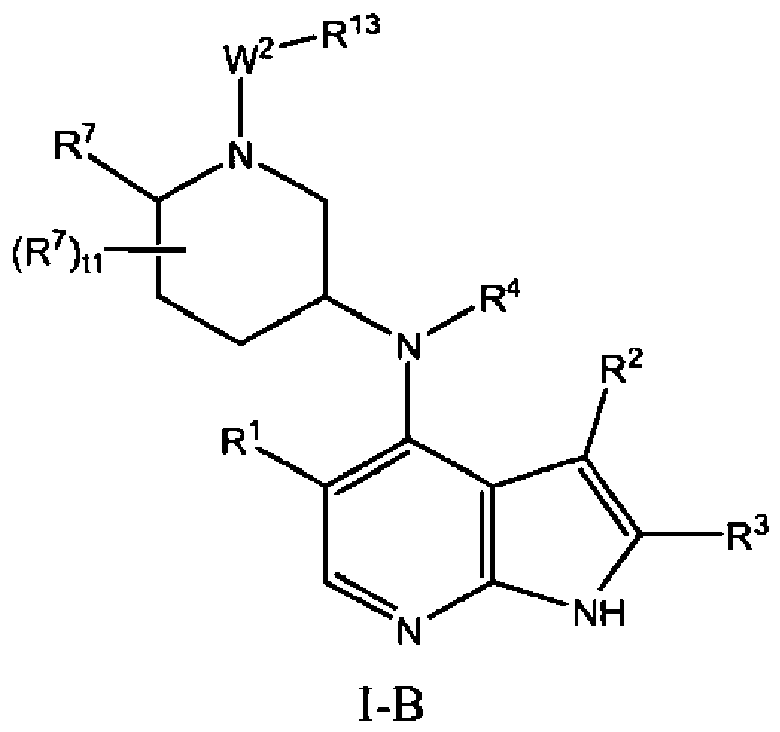
- the compounds of the present invention have the structure of Formula I-B: wherein t is 0 or 1.
- the compounds of the invention have Formula I-B wherein:
- t1 is 0.
- t1 is 1.
- substituents of compounds of the invention are disclosed in groups or in ranges. It is specifically intended that the invention include each and every individual subcombination of the members of such groups and ranges.
- C 1-6 alkyl is specifically intended to individually disclose methyl, ethyl, C 3 alkyl, C 4 alkyl, C 5 alkyl, and C 6 alkyl.
- each variable can be a different moiety selected from the Markush group defining the variable.
- the two R groups can represent different moieties selected from the Markush group defined for R.
- alkyl is meant to refer to a saturated hydrocarbon group which is straight-chained or branched.
- Example alkyl groups include methyl (Me), ethyl (Et), propyl ( e.g., n-propyl and isopropyl), butyl ( e.g., n-butyl, isobutyl, t-butyl), pentyl (e.g., n-pentyl, isopentyl, neopentyl), and the like.
- alkyl group can contain from 1 to about 20, from 2 to about 20, from 1 to about 10, from 1 to about 8, from 1 to about 6, from 1 to about 4, or from 1 to about 3 carbon atoms.
- alkylenyl refers to a bivalent alkyl group.
- alkenyl refers to an alkyl group having one or more double carbon-carbon bonds.
- Example alkenyl groups include ethenyl, propenyl, cyclohexenyl, and the like.
- alkenylenyl refers to a bivalent alkenyl group.
- alkynyl refers to an alkyl group having one or more triple carbon-carbon bonds.
- Example alkynyl groups include ethynyl, propynyl, and the like.
- alkynylenyl referes to a bivalent alkynyl group.
- haloalkyl refers to an alkyl group having one or more halogen substituents.
- Example haloalkyl groups include CF 3 , C 2 F 5 , CHF 2 , CCl 3 , CHCl 2 , C 2 Cl 5 , and the like.
- aryl refers to monocyclic or polycyclic (e.g., having 2, 3 or 4 fused rings) aromatic hydrocarbons such as, for example, phenyl, naphthyl, anthracenyl, phenanthrenyl, indanyl, indenyl, and the like. In some embodiments, aryl groups have from 6 to about 20 carbon atoms.
- cycloalkyl refers to non-aromatic carbocycles including cyclized alkyl, alkenyl, and alkynyl groups.
- Cycloalkyl groups can include mono- or polycyclic (e.g., having 2, 3 or 4 fused rings) ring systems.
- moieties that have one or more aromatic rings fused (i.e., having a bond in common with) to the cycloalkyl ring, for example, benzo derivatives of pentane, pentene, hexane, and the like.
- One or more ring-forming carbon atoms of a cycloalkyl group can be oxidized, for example, having an oxo or sulfido substituent.
- Example cycloalkyl groups include cyclopropyl, cyclobutyl, cyclopentyl, cyclohexyl, cycloheptyl, cyclopentenyl, cyclohexenyl, cyclohexadienyl, cycloheptatrienyl, norbornyl, norpinyl, norcarnyl, adamantyl, and the like.
- heteroaryl groups refer to an aromatic heterocycle having at least one heteroatom ring member such as sulfur, oxygen, or nitrogen. Heteroaryl groups include monocyclic and polycyclic (e.g., having 2, 3 or 4 fused rings) systems. Any ring-forming N atom in a heteroaryl group can also be oxidized to form an N-oxo moiety.
- heteroaryl groups include without limitation, pyridyl, N-oxopyridyl, pyrimidinyl, pyrazinyl, pyridazinyl, triazinyl, furyl, quinolyl, isoquinolyl, thienyl, imidazolyl, thiazolyl, indolyl, pyrryl, oxazolyl, benzofuryl, benzothienyl, benzthiazolyl, isoxazolyl, pyrazolyl, triazolyl, tetrazolyl, indazolyl, 1,2,4-thiadiazolyl, isothiazolyl, benzothienyl, purinyl, carbazolyl, benzimidazolyl, indolinyl, and the like.
- the heteroaryl group has from 1 to about 20 carbon atoms, and in further embodiments from about 3 to about 20 carbon atoms. In some embodiments, the heteroaryl group contains 3 to about 14, 3 to about 7, or 5 to 6 ring-forming atoms. In some embodiments, the heteroaryl group has 1 to about 4, 1 to about 3, or 1 to 2 heteroatoms.
- heterocycloalkyl refers to non-aromatic heterocycles containing at least one ring-forming heteroatom such as an O, N, or S atom.
- Heterocycloalkyl groups can include mono- or polycyclic (e.g., having 2, 3 or 4 fused rings) ring systems. Any ring-forming heteroatom or ring-forming carbon atom of a heterocycloalkyl group can also be oxidized by one or two oxo or sulfido substituents.
- heterocycloalkyl groups include morpholino, thiomorpholino, piperazinyl, tetrahydrofuranyl, tetrahydrothienyl, 2,3-dihydrobenzofuryl, 1,3-benzodioxole, benzo-1,4-dioxane, piperidinyl, pyrrolidinyl, isoxazolidinyl, isothiazolidinyl, pyrazolidinyl, oxazolidinyl, thiazolidinyl, imidazolidinyl, and the like.
- heterocycloalkyl moieties that have one or more aromatic rings fused (i.e., having a bond in common with) to the nonaromatic heterocyclic ring, for example phthalimidyl, naphthalimidyl, and benzo derivatives of heterocycles such as indolene and isoindolene groups.
- the heterocycloalkyl group has from 1 to about 20 carbon atoms, and in further embodiments from about 3 to about 20 carbon atoms.
- the heterocycloalkyl group contains 3 to about 14, 3 to about 7, or 5 to 6 ring-forming atoms.
- the heterocycloalkyl group has 1 to about 4, 1 to about 3, or 1 to 2 heteroatoms. In some embodiments, the heterocycloalkyl group contains 0 to 3 double bonds. In some embodiments, the heterocycloalkyl group contains 0 to 2 triple bonds.
- halo or halogen includes fluoro, chloro, bromo, and iodo.
- alkoxy refers to an -O-alkyl group.
- Example alkoxy groups include methoxy, ethoxy, propoxy ( e.g ., n-propoxy and isopropoxy), t-butoxy, and the like.
- haloalkoxy refers to an -O-haloalkyl group.
- An example haloalkoxy group is OCF 3 .
- aryloxy refers to an -O-aryl group.
- An example aryloxy group is phenoxy.
- heteroaryloxy refers to an -O-heteroaryl group.
- An example heteroaryloxy group is pyridin-2-yloxy or pyridin-3-yloxy.
- amino refers to NH 2 .
- alkylamino refers to an amino group substituted by an alkyl group.
- dialkylamino refers to an amino group substituted by two alkyl groups.
- arylalkyl refers to an alkyl group substituted by an aryl group.
- heteroarylalkyl refers to an alkyl group substituted by a heteroaryl group.
- cycloalkylalkyl refers to an alkyl group substituted by a cycloalkyl group.
- heterocycloalkylalkyl refers to an alkyl group substituted by a heterocycloalkyl group.
- acyl refers to -C(O)-alkyl.
- acyloxy refers to -OC(O)-alkyl.
- acylamino refers to an amino group substituted with an acyl group.
- the compounds described herein can be asymmetric (e.g., having one or more stereocenters). All stereoisomers, such as enantiomers and diastereomers, are intended unless otherwise indicated.
- An example method includes fractional recrystallizaion using a "chiral resolving acid" which is an optically active, salt-forming organic acid.
- Suitable resolving agents for fractional recrystallization methods are, for example, optically active acids, such as the D and L forms of tartaric acid, diacetyltartaric acid, dibenzoyltartaric acid, mandelic acid, malic acid, lactic acid or the various optically active camphorsulfonic acids such as ⁇ -camphorsulfonic acid.
- resolving agents suitable for fractional crystallization methods include stereoisomerically pure forms of ⁇ -methylbenzylamine (e.g., S and R forms, or diastereomerically pure forms), 2-phenylglycinol, norephedrine, ephedrine, N-methylephedrine, cyclohexylethylamine, 1,2-diaminocyclohexane, and the like.
- Resolution of racemic mixtures can also be carried out by elution on a column packed with an optically active resolving agent (e.g., dinitrobenzoylphenylglycine).
- an optically active resolving agent e.g., dinitrobenzoylphenylglycine
- Suitable elution solvent composition can be determined by one skilled in the art.
- Compounds of the invention also include tautomeric forms, such as keto-enol tautomers.
- Compounds of the invention can also include all isotopes of atoms occurring in the intermediates or final compounds.
- Isotopes include those atoms having the same atomic number but different mass numbers.
- isotopes of hydrogen include tritium and deuterium.
- phrases "pharmaceutically acceptable” is employed herein to refer to those compounds, materials, compositions, and/or dosage forms which are, within the scope of sound medical judgement, suitable for use in contact with the tissues of human beings and animals without excessive toxicity, irritation, allergic response, or other problem or complication, commensurate with a reasonable benefit/risk ratio.
- the present invention also includes pharmaceutically acceptable salts of the compounds described herein.
- pharmaceutically acceptable salts refers to derivatives of the disclosed compounds wherein the parent compound is modified by converting an existing acid or base moiety to its salt form.
- pharmaceutically acceptable salts include, but are not limited to, mineral or organic acid salts of basic residues such as amines; alkali or organic salts of acidic residues such as carboxylic acids; and the like.
- the pharmaceutically acceptable salts of the present invention include the conventional non-toxic salts or the quaternary ammonium salts of the parent compound formed, for example, from non-toxic inorganic or organic acids.
- the pharmaceutically acceptable salts of the present invention can be synthesized from the parent compound which contains a basic or acidic moiety by conventional chemical methods.
- such salts can be prepared by reacting the free acid or base forms of these compounds with a stoichiometric amount of the appropriate base or acid in water or in an organic solvent, or in a mixture of the two; generally, nonaqueous media like ether, ethyl acetate, ethanol, isopropanol, or acetonitrile are preferred.
- Lists of suitable salts are found in Remington's Pharmaceutical Sciences, 17th ed., Mack Publishing Company, Easton, Pa., 1985, p. 1418 and Journal of Pharmaceutical Science, 66, 2 (1977 ).
- prodrugs refer to any covalently bonded carriers which release the active parent drug when administered to a mammalian subject.
- Prodrugs can be prepared by modifying functional groups present in the compounds in such a way that the modifications are cleaved, either in routine manipulation or in vivo, to the parent compounds.
- Prodrugs include compounds wherein hydroxyl, amino, sulfhydryl, or carboxyl groups are bonded to any group that, when administered to a mammalian subject, cleaves to form a free hydroxyl, amino, sulfhydryl, or carboxyl group respectively.
- prodrugs include, but are not limited to, acetate, formate and benzoate derivatives of alcohol and amine functional groups in the compounds of the invention. Preparation and use of prodrugs is discussed in T. Higuchi and V. Stella, "Pro-drugs as Novel Delivery Systems," Vol. 14 of the A.C.S. Symposium Series , and in Bioreversible Carriers in Drug Design, ed. Edward B. Roche, American Pharmaceutical Association and Pergamon Press, 1987 .
- the reactions for preparing compounds of the invention can be carried out in suitable solvents which can be readily selected by one of skill in the art of organic synthesis.
- suitable solvents can be substantially nonreactive with the starting materials (reactants), the intermediates, or products at the temperatures at which the reactions are carried out, e.g., temperatures which can range from the solvent's freezing temperature to the solvent's boiling temperature.
- a given reaction can be carried out in one solvent or a mixture of more than one solvent.
- suitable solvents for a particular reaction step can be selected.
- Preparation of compounds of the invention can involve the protection and deprotection of various chemical groups.
- the need for protection and deprotection, and the selection of appropriate protecting groups can be readily determined by one skilled in the art.
- the chemistry of protecting groups can be found, for example, in T.W. Green and P.G.M. Wuts, Protective Groups in Organic Synthesis, 3rd. Ed., Wiley & Sons, Inc., New York (1999 ).
- Reactions can be monitored according to any suitable method known in the art.
- product formation can be monitored by spectroscopic means, such as nuclear magnetic resonance spectroscopy (e.g., 1 H or 13 C) infrared spectroscopy, spectrophotometry (e.g., UV-visible), or mass spectrometry, or by chromatography such as high performance liquid chromatography (HPLC) or thin layer chromatography.
- spectroscopic means such as nuclear magnetic resonance spectroscopy (e.g., 1 H or 13 C) infrared spectroscopy, spectrophotometry (e.g., UV-visible), or mass spectrometry
- chromatography such as high performance liquid chromatography (HPLC) or thin layer chromatography.
- Scheme 1 shows an example synthesis of compounds of the invention starting with pyrrolo[2,3-b]pyridines 1-1 from which the N-oxo analog ( 1-2 ) is made by treatment with an oxidant such as m-CPBA.
- the N-oxide 1-2 can be halogenated with a halogenating agent such as MeSO 2 Cl, to form a 4-halo compound 1-3 (Y is halo such as Cl).
- the 4-amino compounds of the invention ( 1-4 ) can be generated by treatment of 1-3 with an appropriate amine (NHR 4 R 5 ), optionally in the presence of heat.
- the pyrrolo amine of 1-3 can be protected with a suitable amino protecting group prior to reaction with NHR 4 R 5 , and the amino protecting group can be removed after the reaction with NHR 4 R 5 .
- Scheme 2 provides an example synthesis of compounds of the invention where R 5 is piperidin-3-yl.
- a 4-chloro compound 2-1 (wherein the pyrrolo amine group can optionally be protected by an appropriate amino protecting group; in cases where the pyrrolo amine group is protected, the protecting group can be removed in a later stage), can be treated with a protected piperidine 2-2 to form a 4-piperidine compound 2-3.
- the protecting group at the N-atom on the piperidine moiety of 2-3 can be removed by routine methods (e.g., hydrogenation in the presence of Pd catalyst and HCl to remove benzyl protecting group) to form a compound 2-4 .
- R 6 -X Alkylation or acylation of the N-atom on the piperidine moiety of 2-4 with a reagent such as R 6 -X, where X is a leaving group such as halo, hydroxyl, mesylate, tosylate, etc., affords a compound 2-5 of the invention.
- R 6 -X can be a carboxylic acid, acid chloride, alkyl/aryl sulfonyl chloride, haloalkane, etc.
- Compounds of the invention can modulate activity of one or more Janus kinases (JAKs).
- the term “modulate” is meant to refer to an ability to increase or decrease the activity of one or more members of the JAK family of kinases.
- compounds of the invention can be used in methods of modulating a JAK by contacting the JAK with any one or more of the compounds or compositions described herein.
- compounds of the present invention can act as inhibitors of one or more JAKs.
- compounds of the present invention can act to stimulate the activity of one or more JAKs.
- the compounds of the invention can be used to modulate activity of a JAK in an individual in need of modulation of the receptor by administering a modulating amount of a compound of the invention.
- JAKs to which the present compounds bind and/or modulate include any member of the JAK family.
- the JAK is JAK1, JAK2, JAK3 or TYK2.
- the JAK is JAK1 or JAK2.
- the JAK is JAK2.
- the compounds of the invention can be selective.
- selective is meant that the compound binds to or inhibits a JAK with greater affinity or potency, respectively, compared to at least one other JAK.
- the compounds of the invention are selective inhibitors of JAK1 or JAK2 over JAK3 and/or TYK2.
- the compounds of the invention are selective inhibitors of JAK2 (e.g., over JAK1, JAK3 and TYK2).
- a compound which is selective for JAK2 over JAK3 and which is useful in the treatment of cancer can offer the additional advantage of having fewer immunosuppressive side effects.
- Selectivity can be at least about 5-fold, 10-fold, at least about 20-fold, at least about 50-fold, at least about 100-fold, at least about 200-fold, at least about 500-fold or at least about 1000-fold. Selectivity can be measured by methods routine in the art. In some embodiments, selectivity can be tested at the Km of each enzyme. In some embodiments, selectivity of compounds of the invention for JAK2 over JAK3 can be determined by the cellular ATP concentration.
- a JAK-associated disease can include any disease, disorder or condition that is directly or indirectly linked to expression or activity of the JAK, including overexpression and/or abnormal activity levels.
- a JAK-associated disease can also include any disease, disorder or condition that can be prevented, ameliorated, or cured by modulating JAK activity.
- JAK-associated diseases include diseases involving the immune system including, for example, organ transplant rejection (e.g., allograft rejection and graft versus host disease). Further examples of JAK-associated diseases include autoimmune diseases such as multiple sclerosis, rheumatoid arthritis, juvenile arthritis, type I diabetes, lupus, psoriasis, inflammatory bowel disease, ulcerative colitis, Crohn's disease, or autoimmune thyroid disorders. Further examples of JAK-associated diseases include allergic conditions such as asthma, food allergies, atopic dermatitis and rhinitis.
- JAK-assoicated diseases include viral diseases such as Epstein Barr Virus (EBV), Hepatitis B, Hepatitis C, HIV, HTLV 1, Varicella-Zoster Virus (VZV) and Human Papilloma Virus (HPV).
- EBV Epstein Barr Virus
- HBV Human Papilloma Virus
- Futher examples of JAK-associated diseases or conditions include skin disorders such as atopic dermatitis, psoriasis (for example, psoriasis vulgaris), skin sensitization, and the like.
- JAK-associated diseases are those involving IL-6 pathways including Castleman's disease, Kaposi's sarcoma, and others.
- JAK-associated diseases or conditions include immune reactions (such as diarrhea, skin irritation, skin rash, contact dermatitis or allergic contact sensitization) caused by certain therapeutics in some patients.
- Further examples of JAK-associated diseases include hyperpropliferative disorders including polycythemia vera, essential thrombocytopenia, myeloid metaplasia with myelofibrosis, and the like.
- the JAK-associated disease is cancer such as, for example, prostate, renal, hepatocellular, pancreatic, gastric, breast, lung, cancers of the head and neck, glioblastoma, leukemia, lymphoma or multiple myeloma.
- contacting refers to the bringing together of indicated moieties in an in vitro system or an in vivo system.
- "contacting" a JAK with a compound of the invention includes the administration of a compound of the present invention to an individual or patient, such as a human, having a JAK, as well as, for example, introducing a compound of the invention into a sample containing a cellular or purified preparation containing the JAK.
- the term "individual” or “patient,” used interchangeably, refers to any animal, including mammals, preferably mice, rats, other rodents, rabbits, dogs, cats, swine, cattle, sheep, horses, or primates, and most preferably humans.
- terapéuticaally effective amount refers to the amount of active compound or pharmaceutical agent that elicits the biological or medicinal response in a tissue, system, animal, individual or human that is being sought by a researcher, veterinarian, medical doctor or other clinician, which includes one or more of the following:
- One or more additional pharmaceutical agents such as, for example, chemotherapeutics, anti-inflammatory agents, and/or immunosuppressants can be used in combination with the compounds of the present invention for treatment of JAK-associated diseases, disorders or conditions.
- a JAK inhibitor used in combination with a chemotherapeutic in the treatment of multiple myeloma may improve the treatment response as compared to the response to the chemotherapeutic agent alone, without exacerbation of its toxic effects.
- additional pharmaceutical agents used in the treatment of multiple myeloma for example, can include, without limitation, melphalan, melphalan plus prednisone [MP], doxorubicin, dexamethasone, and velcade.
- Additive or synergistic effects are desirable outcomes of combining a JAK inhibitor of the present invention with an additional agent. Furthermore, resistance of multiple myeloma cells to agents such as dexamethasome may be reversible upon treatment with a JAK inhibitor of the present invention.
- the agents can be combined with the present compounds in a single or continuous dosage form, or the agents can be administered simultaneously or sequentially as separate dosage forms.
- compositions When employed as pharmaceuticals, the compounds described herein can be administered in the form of pharmaceutical compositions. These compositions can be prepared in a manner well known in the pharmaceutical art, and can be administered by a variety of routes, depending upon whether local or systemic treatment is desired and upon the area to be treated. Administration may be topical (including transdermal, epidermal, ophthalmic and to mucous membranes including intranasal, vaginal and rectal delivery), pulmonary (e.g., by inhalation or insufflation of powders or aerosols, including by nebulizer; intratracheal or intranasal), oral or parenteral.
- topical including transdermal, epidermal, ophthalmic and to mucous membranes including intranasal, vaginal and rectal delivery
- pulmonary e.g., by inhalation or insufflation of powders or aerosols, including by nebulizer; intratracheal or intranasal
- oral or parenteral e.
- Parenteral administration includes intravenous, intraarterial, subcutaneous, intraperitoneal intramuscular or injection or infusion; or intracranial, e.g., intrathecal or intraventricular, administration.
- Parenteral administration can be in the form of a single bolus dose, or may be, for example, by a continuous perfusion pump.
- Pharmaceutical compositions and formulations for topical administration may include transdermal patches, ointments, lotions, creams, gels, drops, suppositories, sprays, liquids and powders.
- Conventional pharmaceutical carriers, aqueous, powder or oily bases, thickeners and the like may be necessary or desirable. Coated condoms, gloves and the like may also be useful.
- compositions which contain, as the active ingredient, one or more of the compounds of Formulas I and II above in combination with one or more pharmaceutically acceptable carriers (excipients).
- the active ingredient is typically mixed with an excipient, diluted by an excipient or enclosed within such a carrier in the form of, for example, a capsule, sachet, paper, or other container.
- the excipient serves as a diluent, it can be a solid, semi-solid, or liquid material, which acts as a vehicle, carrier or medium for the active ingredient.
- compositions can be in the form of tablets, pills, powders, lozenges, sachets, cachets, elixirs, suspensions, emulsions, solutions, syrups, aerosols (as a solid or in a liquid medium), ointments containing, for example, up to 10% by weight of the active compound, soft and hard gelatin capsules, suppositories, sterile injectable solutions, and sterile packaged powders.
- the active compound can be milled to provide the appropriate particle size prior to combining with the other ingredients. If the active compound is substantially insoluble, it can be milled to a particle size of less than 200 mesh. If the active compound is substantially water soluble, the particle size can be adjusted by milling to provide a substantially uniform distribution in the formulation, e.g. about 40 mesh.
- excipients include lactose, dextrose, sucrose, sorbitol, mannitol, starches, gum acacia, calcium phosphate, alginates, tragacanth, gelatin, calcium silicate, microcrystalline cellulose, polyvinylpyrrolidone, cellulose, water, syrup, and methyl cellulose.
- the formulations can additionally include: lubricating agents such as talc, magnesium stearate, and mineral oil; wetting agents; emulsifying and suspending agents; preserving agents such as methyl- and propylhydroxy-benzoates; sweetening agents; and flavoring agents.
- the compositions of the invention can be formulated so as to provide quick, sustained or delayed release of the active ingredient after administration to the patient by employing procedures known in the art.
- compositions can be formulated in a unit dosage form, each dosage containing from about 5 to about 1000 mg (1 g), more usually about 100 to about 500 mg, of the active ingredient.
- unit dosage forms refers to physically discrete units suitable as unitary dosages for human subjects and other mammals, each unit containing a predetermined quantity of active material calculated to produce the desired therapeutic effect, in association with a suitable pharmaceutical excipient.
- the active compound can be effective over a wide dosage range and is generally administered in a pharmaceutically effective amount. It will be understood, however, that the amount of the compound actually administered will usually be determined by a physician, according to the relevant circumstances, including the condition to be treated, the chosen route of administration, the actual compound administered, the age, weight, and response of the individual patient, the severity of the patient's symptoms, and the like.
- the principal active ingredient is mixed with a pharmaceutical excipient to form a solid preformulation composition containing a homogeneous mixture of a compound of the present invention.
- a solid preformulation composition containing a homogeneous mixture of a compound of the present invention.
- the active ingredient is typically dispersed evenly throughout the composition so that the composition can be readily subdivided into equally effective unit dosage forms such as tablets, pills and capsules.
- This solid preformulation is then subdivided into unit dosage forms of the type described above containing from, for example, about 0.1 to about 1000 mg of the active ingredient of the present invention.
- the tablets or pills of the present invention can be coated or otherwise compounded to provide a dosage form affording the advantage of prolonged action.
- the tablet or pill can comprise an inner dosage and an outer dosage component, the latter being in the form of an envelope over the former.
- the two components can be separated by an enteric layer which serves to resist disintegration in the stomach and permit the inner component to pass intact into the duodenum or to be delayed in release.
- enteric layers or coatings such materials including a number of polymeric acids and mixtures of polymeric acids with such materials as shellac, cetyl alcohol, and cellulose acetate.
- liquid forms in which the compounds and compositions of the present invention can be incorporated for administration orally or by injection include aqueous solutions, suitably flavored syrups, aqueous or oil suspensions, and flavored emulsions with edible oils such as cottonseed oil, sesame oil, coconut oil, or peanut oil, as well as elixirs and similar pharmaceutical vehicles.
- compositions for inhalation or insufflation include solutions and suspensions in pharmaceutically acceptable, aqueous or organic solvents, or mixtures thereof, and powders.
- the liquid or solid compositions may contain suitable pharmaceutically acceptable excipients as described supra.
- the compositions are administered by the oral or nasal respiratory route for local or systemic effect.
- Compositions in can be nebulized by use of inert gases. Nebulized solutions may be breathed directly from the nebulizing device or the nebulizing device can be attached to a face masks tent, or intermittent positive pressure breathing machine. Solution, suspension, or powder compositions can be administered orally or nasally from devices which deliver the formulation in an appropriate manner.
- compositions can be administered to a patient already suffering from a disease in an amount sufficient to cure or at least partially arrest the symptoms of the disease and its complications. Effective doses will depend on the disease condition being treated as well as by the judgment of the attending clinician depending upon factors such as the severity of the disease, the age, weight and general condition of the patient, and the like.
- compositions administered to a patient can be in the form of pharmaceutical compositions described above. These compositions can be sterilized by conventional sterilization techniques, or may be sterile filtered. Aqueous solutions can be packaged for use as is, or lyophilized, the lyophilized preparation being combined with a sterile aqueous carrier prior to administration.
- the pH of the compound preparations typically will be between 3 and 11, more preferably from 5 to 9 and most preferably from 7 to 8. It will be understood that use of certain of the foregoing excipients, carriers, or stabilizers will result in the formation of pharmaceutical salts.
- the therapeutic dosage of the compounds of the present invention can vary according to, for example, the particular use for which the treatment is made, the manner of administration of the compound, the health and condition of the patient, and the judgment of the prescribing physician.
- the proportion or concentration of a compound of the invention in a pharmaceutical composition can vary depending upon a number of factors including dosage, chemical characteristics (e.g., hydrophobicity), and the route of administration.
- the compounds of the invention can be provided in an aqueous physiological buffer solution containing about 0.1 to about 10% w/v of the compound for parenteral adminstration. Some typical dose ranges are from about 1 ⁇ g/kg to about 1 g/kg of body weight per day.
- the dose range is from about 0.01 mg/kg to about 100 mg/kg of body weight per day.
- the dosage is likely to depend on such variables as the type and extent of progression of the disease or disorder, the overall health status of the particular patient, the relative biological efficacy of the compound selected, formulation of the excipient, and its route of administration. Effective doses can be extrapolated from dose-response curves derived from in vitro or animal model test systems.
- Another aspect of the present invention relates to labeled compounds of the invention (radio-labeled, fluorescent-labeled, etc.) that would be useful not only in imaging techniques but also in assays, both in vitro and in vivo, for localizing and quantitating JAK in tissue samples, including human, and for identifying JAK ligands by inhibition binding of a labeled compound. Accordingly, the present invention includes JAK assays that contain such labeled compounds.
- the present invention further discloses isotopically-labeled compounds of the invention.
- An “isotopically” or “radio-labeled” compound is a compound of the invention where one or more atoms are replaced or substituted by an atom having an atomic mass or mass number different from the atomic mass or mass number typically found in nature (i.e., naturally occurring).
- Suitable radionuclides that may be incorporated in compounds of the present invention include but are not limited to 2 H (also written as D for deuterium), 3 H (also written as T for tritium), 11 C, 13 C, 14 C, 13 N, 15 N, 15 O, 17 O, 18 O, 18 F, 35 S, 36 Cl, 82 Br, 75 Br, 76 Br, 77 Br, 123 I, 124 I, 125 I and 131 I.
- the radionuclide that is incorporated in the instant radio-labeled compounds will depend on the specific application of that radio-labeled compound.
- a “radio-labeled” or “labeled compound” is a compound that has incorporated at least one radionuclide.
- the radionuclide is selected from the group consisting of 3 H, 14 C, 125 I, 35 S and 82 Br.
- the present invention can further include synthetic methods for incorporating radio-isotopes into compounds of the invention. Synthtic methods for incorporating radio-isotopes into organic compounds are well known in the art, and an ordinary skill in the art will readily recognize the methods applicable for the compounds of invention.
- a labeled compound of the invention can be used in a screening assay to identify/evaluate compounds.
- a newly synthesized or identified compound i.e., test compound
- a test compound which is labeled can be evaluated for its ability to bind a JAK by monitering its concentration variation when contacting with the JAK, through tracking of the labeling.
- a test compound (labeled) can be evaluated for its ability to reduce binding of another compound which is known to bind to a JAK (i.e., standard compound). Accordingly, the ability of a test compound to compete with the standard compound for binding to the JAK directly correlates to its binding affinity.
- the standard compound is labled and test compounds are unlabeled. Accordingly, the concentration of the labled standard compound is monitored in order to evaluate the competition between the standard compound and the test compound, and the relative binding affinity of the test compound is thus ascertained.
- kits useful useful, for example, in the treatment or prevention of JAK-associated diseases or disorders, such as cancer, which include one or more containers containing a pharmaceutical composition comprising a therapeutically effective amount of a compound described herein.
- kits can further include, if desired, one or more of various conventional pharmaceutical kit components, such as, for example, containers with one or more pharmaceutically acceptable carriers, additional containers, etc., as will be readily apparent to those skilled in the art.
- Instructions, either as inserts or as labels, indicating quantities of the components to be administered, guidelines for administration, and/or guidelines for mixing the components, can also be included in the kit.
- Step 3 N-(1-benzylpiperidin-3-yl)-N-methyl-N-(1H-pyrrolo[2,3-b]pyridin-4-yl)-amine
- Step 5 3-3-[methyl(1H-pyrrolo[2,3-b]pyridin-4-yl)amino]piperidin-1-yl-3-oxopropanenitrile
- N-methyl-N-piperidin-3-yl-N-(1H-pyrrolo[2,3-b]pyridin-4-yl)-amine trihydrochloride 0.092 g, 0.00027 mol
- N,N-dimethylformamide 2 mL, 0.02 mol
- N,N-diisopropylethylamine 190 ⁇ L, 0.0011 mol
- cyanoacetic acid 28 mg, 0.00032 mol
- 1-hydroxybenzotriazole 36 mg, 0.00027 mol
- N-(3-dimethylaminopropyl)-N'-ethylcarbodiimide hydrochloride 62 mg, 0.00032 mol.
- Step 2 N-[(3R,4R)-1-benzyl-4-methylpiperidin-3-yl]-N-methyl-1-[2-(trimethylsilyl)-ethoxy]methyl-N-(1H-pyrrolo[2,3-b]pyridin-4-yl)-amine
- Step 3 N-[(3R,4R)-1-benzyl-4-methylpiperidin-3-yl]-N-methyl-N-(1H-pyrrolo[2,3-b]pyridin-4yl)-amine
- Step 4 N-methyl-N-[(3R,4R)-4-methylpiperidin-3-yl]-N-(1H-pyrrolo[2,3-b]pyridin-4-yl)-amine
- Step 5 3- ⁇ (3R,4R)-4-Methyl-3-[methyl(1H-pyrrolo[2,3-b]pyridin-4-yl)amino]piperidin-1-yl ⁇ -3-oxopropanenitrile
- Jak targets Compounds herein were tested for inhibitory activity of Jak targets according to the following in vitro assay described in Park et al., Analytical Biochemistry 1999, 269, 94-104 .
- the catalytic domains of human Jak1 (a.a. 837-1142), Jak2 (a.a. 828-1132) and Jak3 (a.a. 781-1124) with an N-terminal His tag were expressed using baculovirus in insect cells and purified.
- the catalytic activity of JAK1, JAK2 or JAK3 was assayed by measuring the phosphorylation of a biotinylated peptide.
- the phosphorylated peptide was detected by homogenous time resolved fluorescence (HTRF).
- IC 50 s of compounds were measured for each kinase in the reactions that contain the enzyme, ATP and 500 nM peptide in 50 mM Tris (pH 7.8) buffer with 100 mM NaCl, 5 mM DTT, and 0.1 mg/ml (0.01%) BSA.
- the ATP concentration in the reactions was 90 ⁇ M for Jak1, 30 ⁇ M for Jak2 and 3 ⁇ M for Jak3.
- Reactions were carried out at room temperature for 1 hr and then stopped with 20 ⁇ L 45 mM EDTA, 300 nM SA-APC, 6 nM Eu-Py20 in assay buffer (Perkin Elmer, Boston, MA).
- Binding to the Europium labeled antibody took place for 40 minutes and HTRF signal was measured on a Fusion plate reader (Perkin Elmer, Boston, MA). Compounds having an IC 50 of 10 ⁇ M or less for any of the above-mentioned Jak targets were considered active.
- the murine skin contact delayed-type hypersensitivity (DTH) response is considered to be a valid model of clinical contact dermatitis, and other T-lymphocyte mediated immune disorders of the skin, such as psoriasis ( Immunol Today. 1998 Jan;19(1):37-44 ).
- Murine DTH shares multiple characteristics with psoriasis, including the immune infiltrate, the accompanying increase in inflammatory cytokines, and keratinocyte hyperproliferation.
- many classes of agents that are efficacious in treating psoriasis in the clinic are also effective inhibitors of the DTH response in mice ( Agents Actions. 1993 Jan;38(1-2):116-21 ).
- Test compound 3- ⁇ (3R,4R)-4-methyl-3-[methyl-(7H-pyrrolo[2,3-d]pyrimidin-4-yl)amino]-piperidin-1-yl ⁇ -3-oxo-propionitrile was administered continuously using mini-osmotic pumps to deliver the compound at 150 mg/kg/d.
- the inflammatory response was monitored by measuring the ear thickness prior to and after immune challenge. Differences in ear thickness were calculated for each mouse and then averaged for the group.
- test compound inhibited ear swelling by 95% and histological analysis of hematoxolyin and eosin stained tissue sections confirmed a near complete inhibition of ear swelling.
- a further murine DTH experiment was conducted by treating mice with 3- ⁇ (3R,4R)-4-methyl-3-[methyl-(7H-pyrrolo[2,3-d]pyrimidin-4-yl)amino]-piperidin-1-yl ⁇ -3-oxo-propionitrile either systemically or topically (3%, BID) after the sensitization phase was complete.
- treatment with the test compound significantly (> 50%) inhibited ear swelling when administered by either route during the challenge phase ( Figure 1 ).
- JakJak mutant Jak
- Activating mutations residing anywhere within the coding region of the Jak DNA, cDNA, or mRNA, can be introduced to nucleic acid sequences encoding for Jaks using standard molecular biology techniques (e.g. nucleotide mutagenesis) familiar to those schooled in the art. This includes, but is not limited to mutations in the codon for a.a. 617 that results in a substitution of the wild-type valine with a phenylalanine.
- the kinase domain (a.a. 828-1132), the pseudo-kinase and kinase domains (a.a. 543-827 and 828-1132, respectively), or the entire Jak protein, with an N-terminal His tag, can be expressed using baculovirus in insect cells and purified. Similar strategies can be employed to generate mutant Jak1, Jak3, or Tyk2. The catalytic activity of Jak can then be assayed by measuring the phosphorylation of a biotinylated peptide.
- the phosphorylated peptide can be detected by h omogenous t ime r esolved f luorescence (HTRF) using suitable and optimized buffers and concentrations of ATP, peptide, kinase, etc.
- HTRF h omogenous t ime r esolved f luorescence
- Compounds having an IC 50 of about 10 ⁇ M or less for any of the above-mentioned Jak targets will typically be considered active.
- cells expressing the mutated form(s) of Jak may be identified (e.g. HEL cells, ATCC) or constructed (by transfection, infection, or similar technique to introduce the nucleic acid encoding for the Jak) using techniques familiar to those schooled in the art. Cells may then be treated with compounds for various times (usually between 0 and 4 hours) and collected for protein extraction using methods familiar to those schooled in the art.
- Cellular protein extracts can then be analyzed for both total and phospho-Jak using, for example, the following antibodies: total Jak1 (Cell Signaling, #9138), phospho-Jak1 (Abcam, #ab5493), total Jak2 (Upstate #06-255), phospho-Jak (Cell Signaling, #3771), total Jak3 (Santa Cruz, #sc-513 ), phospho-Jak3 (Santa Cruz, #sc-16567), total Tyk2 (Santa Cruz #sc-169 ), phospho-Tyk2 (Cell Signal #9321), and phospho-tyrosine (Upstate, #05-231).
- Methodologies to perform these analyses include but are not limited to immunoblotting, immunoprecipitation, ELISA, RIA, immunocytochemistry, and FACS.
Landscapes
- Health & Medical Sciences (AREA)
- Chemical & Material Sciences (AREA)
- Organic Chemistry (AREA)
- Life Sciences & Earth Sciences (AREA)
- Nuclear Medicine, Radiotherapy & Molecular Imaging (AREA)
- Veterinary Medicine (AREA)
- Chemical Kinetics & Catalysis (AREA)
- General Chemical & Material Sciences (AREA)
- Medicinal Chemistry (AREA)
- Public Health (AREA)
- Pharmacology & Pharmacy (AREA)
- Animal Behavior & Ethology (AREA)
- General Health & Medical Sciences (AREA)
- Engineering & Computer Science (AREA)
- Bioinformatics & Cheminformatics (AREA)
- Immunology (AREA)
- Virology (AREA)
- Diabetes (AREA)
- Communicable Diseases (AREA)
- Oncology (AREA)
- Molecular Biology (AREA)
- Dermatology (AREA)
- Endocrinology (AREA)
- Rheumatology (AREA)
- Tropical Medicine & Parasitology (AREA)
- Neurology (AREA)
- Pulmonology (AREA)
- Biotechnology (AREA)
- AIDS & HIV (AREA)
- Obesity (AREA)
- Pain & Pain Management (AREA)
- Hematology (AREA)
- Biomedical Technology (AREA)
- Transplantation (AREA)
- Neurosurgery (AREA)
- Orthopedic Medicine & Surgery (AREA)
- Physical Education & Sports Medicine (AREA)
- Emergency Medicine (AREA)
- Pharmaceuticals Containing Other Organic And Inorganic Compounds (AREA)
- Nitrogen Condensed Heterocyclic Rings (AREA)
Claims (26)
- Composé de Formule I-A :
 R1 représente H ;R2 représente H ;R3 représente H ;R4 représente un groupement méthyle ;W2 représente un groupement SO2, CO, COO, C(S)NR12 ouCONR12 ;R7 représente un groupement halogéno, alkyle en C1-6,alcényle en C2-6, alcynyle en C2-6, halogénoalkyle en C1-6, aryle, cycloalkyle, hétéroaryle, hétérocycloalkyle, arylalkyle, cycloalkylalkyle, hétéroarylalkyle, hétérocycloalkylalkyle, CN, NO2, ORa", SRa", C(O)Rb", C(O)NRc"Rd", C(O)ORa", OC(O)Rb", OC(O)NRc"Rd", NRc"Rd", NRc"C(O)Rd", NRc"C(O)ORa", S(O)Rb", S(O)NRc"Rd", S(O)2Rb", S(O)2NRc"Rd", -(alkyle en C1-6)-CN, -(alkyle en C1-6)-NO2, -(alkyle en C1-6)-ORa", -(alkyle en C1-6)-SRa", - (alkyle en C1-6)-C(O)Rb", - (alkyle en C1-6)-C(O)NRc"Rd", - (alkyle en C1-6)-C(O)Ra", (alkyle en C1-6)-OC(O)Rb", - (alkyle en C1-6)-OC(O)NRc"Rd", -(alkyle en C1-6)-NRc"Rd", - (alkyle en C1-6)-NRc"C(O)Rd", - (alkyle en C1-6) - NRc"C(O)ORa", - (alkyle en C1-6)-S(O)Rb", - (alkyle en C1-6)-S(O)NRc"Rd", - (alkyle en C1-6)-S(O)2Rb" ou - (alkyle en C1-6)-S(O)2NRc"Rd";R12 représente H ou un groupement alkyle en C1-6 éventuellement substitué par 1, 2 ou 3 substituants choisis parmi OH, CN, NO2, amino, (alkyle en C1-4)-amino, (dialkyle en C2-8)-amino, halogénoalkyle en C1-6, acyle en C1-6, acyloxy en C1-6, (acyle en C1-6)-amino, - (alkyle en C1-6) -CN, et - (alkyle en C1-6) -NO2 ;R13 représente un groupement halogéno, alkyle en C1-6, alcényle en C2-6, alcynyle en C2-6, halogénoalkyle en C1-6, aryle, cycloalkyle, hétéroaryle, hétérocycloalkyle, arylalkyle, cycloalkylalkyle, hétéroarylalkyle, hétérocycloalkylalkyle, CN, NO2, ORa", SRa", C(O)Rb", C(O)NRc"Rd", C(O)ORa", OC(O)Rb", OC(O)NRc"Rd", NRc"Rd", NRc"C(O)Rd", NRc"C(O)ORa", S(O)Rb", S(O)NRc"Rd", S(O)2Rb", S(O)2NRc"Rd", -(alkyle en C1-6)-CN, -(alkyle en C1-6)-NO2, -(alkyle en C1-6)-ORa", -(alkyle en C1-6)-SRa", -(alkyle en C1-6)-C(O)Rb", -(alkyle en C1-6)-C(O)NRc"Rd", -(alkyle en C1-6)-C(O)ORa", -(alkyle en C1-6)-OC(O)Rb", - (alkyle en C1-6)-OC(O)NRc"Rd", -(alkyle en C1-6) -NRc"Rd", -(alkyle en C1-6) -NRc"C(O)Rd", - (alkyle en C1-6) - NRc"C(O)ORa", - (alkyle en C1-6) -S(O)Rb", - (alkyle en C1-6) -S(O)NRc"Rd", - (alkyle en C1-6)-S(O)2Rb" ou - (alkyle en C1-6) -S(O)2NRc"Rd", où chacun desdits groupements alkyle en C1-6, alcényle en C2-6, alcynyle en C2-6, halogénoalkyle en C1-6, aryle, cycloalkyle, hétéroaryle, hétérocycloalkyle, arylalkyle, cycloalkylalkyle, hétéroarylalkyle ou hétérocycloalkylalkyle est éventuellement substitué par 1, 2, 3, 4 ou 5 substituants indépendamment choisis parmi les groupements :alkyle en C1-6, alcényle en C2-6, alcynyle en C2-6, halogénoalkyle en C1-6, aryle, cycloalkyle, hétéroaryle, hétérocycloalkyle, arylalkyle, cycloalkylalkyle, hétéroarylalkyle, hétérocycloalkylalkyle, halogéno, CN, NO2, ORa", SRa", C(O)Rb", C(O)NRc"Rd", C(O)ORa", OC(O)Rb", OC(O)NRc"Rd", NRc"Rd", NRc"C(O)Rd", NRc"C(O)ORa", S(O)Rb", S(O)NRc"Rd", S(O)2Rb", S(O)2NRc"Rd", -(alkyle en C1-6)-CN, -(alkyle en C1-6) -NO2, - (alkyle en C1-6)-ORa", -(alkyle en C1-6)-SRa", -(alkyle en C1-6)-C(O)Rb", -(alkyle en C1-6)-C(O)NRc"Rd", -(alkyle en C1-6)-C(O)ORa", -(alkyle en C1-6)-OC(O)Rb", -(alkyle en C1-6) -OC(O)NRc"Rd", - (alkyle en C1-6) -NRc"Rd", - (alkyle en C1-6) -NRc"C(O)Rd", - (alkyle en C1-6)-NRc"C(O)ORa", -(alkyle en C1-6)-S(O)Rb", -(alkyle en C1-6)-S(O)NRc"Rd", - (alkyle en C1-6)-S(O)2Rb", et - (alkyle en C1-6)-S(O)2NRc"Rd" ;chacun des radicaux Ra" représente indépendamment H ou un groupement alkyle en C1-6, halogénoalkyle en C1-6, alcényle en C2-6, alcynyle en C2-6, aryle, cycloalkyle, hétéroaryle ou hétérocycloalkyle ;chacun des radicaux Rb" représente indépendamment H ou un groupement alkyle en C1-6, halogénoalkyle en C1-6, alcényle en C2-6, alcynyle en C2-6, aryle, cycloalkyle, hétéroaryle ou hétérocycloalkyle ;chacun des radicaux Rc" et Rd" représente indépendamment H ou un groupement alkyle en C1-6, halogénoalkyle en C1-6, alcényle en C2-6, alcynyle en C2-6, aryle, cycloalkyle, arylalkyle ou cycloalkylalkyle ; ou Rc" et Rd" forment ensemble et avec l'atome N auquel ils sont liés un groupement hétérocycloalkyle à 4, 5, 6 ou 7 chaînons ; etoù t est égal à 0, 1 ou 2.
 - Composé selon la revendication 1, ou l'une des formes salines pharmaceutiquement acceptables de celui-ci, où W2 représente un groupement SO2, CO, COO, C(S)NH, CONH ou -CON- (alkyle en C1-4) -.
- Composé selon la revendication 1, ou l'une des formes salines pharmaceutiquement acceptables de celui-ci, où W2 représente un groupement SO2 ou CO.
- Composé selon la revendication 1, ou l'une des formes salines pharmaceutiquement acceptables de celui-ci, où R13 représente un groupement alkyle en C1-6, alcényle en C2-6, alcynyle en C2-6, halogénoalkyle en C1-6, aryle, cycloalkyle, hétéroaryle, hétérocycloalkyle, arylalkyle, cycloalkylalkyle, hétéroarylalkyle ou hétérocycloalkylalkyle, chacun étant éventuellement substitué par 1, 2, 3, 4 ou 5 substituants indépendamment choisis parmi les groupements :alkyle en C1-6, alcényle en C2-6, alcynyle en C2-6, halogénoalkyle en C1-6, aryle, cycloalkyle, hétéroaryle, hétérocycloalkyle, arylalkyle, cycloalkylalkyle, hétéroarylalkyle, hétérocycloalkylalkyle, halogéno, CN, NO2, ORa", SRa", C(O)Rb", C(O)NRc"Rd", C(O)ORa", OC(O)Rb", OC(O)NRc"Rd", NRc"Rd", NRc"C(O)Rd", NRc"C(O)ORa", S(O)Rb", S(O)NRc"Rd", S(O)2Rb", S(O)2NRc"Rd", - (alkyle en C1-6)-CN, -(alkyle en C1-6)-NO2, -(alkyle en C1-6) -ORa"', -(alkyle en C1-6)-SRa", -(alkyle en C1-6)-C(O)Rb", -(alkyle en C1-6)-C(O)NRc"Rd", -(alkyle en C1-6)-C(O)ORa", -(alkyle en C1-6)-OC(O)Rb", -(alkyle en C1-6) -OC (O)NRc"Rd", - (alkyle en C1-6) -NRc"Rd", - (alkyle en C1-6) -NRc"C(O)Rd'', - (alkyle en C1-6) - NRc"C(O)ORa", - (alkyle en C1-6)-S(O)Rb", - (alkyle en C1-6)-S(O)NRc"Rd", - (alkyle en C1-6)-S(O)2Rb", et - (alkyle en C1-6)-S(O)2NRc"Rd".
- Composé selon la revendication 1, ou l'une des formes salines pharmaceutiquement acceptables de celui-ci, où R13 représente un groupement alkyle en C1-6, halogénoalkyle en C1-6, aryle, cycloalkyle, hétéroaryle, hétérocycloalkyle, arylalkyle, cycloalkylalkyle, hétéroarylalkyle ou hétérocycloalkylalkyle, chacun étant éventuellement substitué par 1, 2, 3, 4 ou 5 substituants indépendamment choisis parmi les groupements :alkyle en C1-6, alcényle en C2-6, alcynyle en C2-6, halogénoalkyle en C1-6, aryle, cycloalkyle, hétéroaryle, hétérocycloalkyle, arylalkyle, cycloalkylalkyle, hétéroarylalkyle, hétérocycloalkylalkyle, halogéno, CN, NO2, ORa", SRa", C (0) Rb", C(O)NRc"Rd", C(O)ORa", OC(O)Rb", OC(O)NRc"Rd", NRc"Rd", NRc"C(O)Rd", NRc"C(O)ORa", S(O)Rb", S(O)NRc"Rd", S(O)2Rb", S(O)2NRc"Rd", - (alkyle en C1-6)-CN, - (alkyle en C1-6)-NO2, - (alkyle en C1-6) -ORa", -(alkyle en C1-6)-SRa", -(alkyle en C1-6)-C(O)Rb", -(alkyle en C1-6) -C(O)NRc"Rd", -(alkyle en C1-6)-C(O)ORa", -(alkyle en C1-6)-OC(O)Rb", - (alkyle en C1-6)-OC(O)NRc"Rd", - (alkyle en C1-6) -NRc"Rd", - (alkyle en C1-6) -NRc"C(O)Rd", - (alkyle en C1-6)-NRc"C(O)ORa", - (alkyle en C1-6)-S(O)Rb", - (alkyle en C1-6)-S(O)NRc"Rd", - (alkyle en C1-6)-S(O)2Rb", et - (alkyle en C1-6)-S(O)2NRc"Rd".
- Composé selon la revendication 1, ou l'une des formes salines pharmaceutiquement acceptables de celui-ci, où R13 représente un groupement alkyle en C1-6, halogénoalkyle en C1-6, aryle, cycloalkyle, hétéroaryle, hétérocycloalkyle, arylalkyle, cycloalkylalkyle, hétéroarylalkyle ou hétérocycloalkylalkyle, chacun étant éventuellement substitué par 1, 2, 3, 4 ou 5 substituants indépendamment choisis parmi les groupements alkyle en C1-6, halogénoalkyle en C1-6, aryle, hétéroaryle, halogéno, CN, ORa", SRa", C(O)Rb", C(O)ORa", NRc"C(O)Rd", S(O)2Rb" et - (alkyle en C1-6)-CN.
- Composé selon la revendication 1, ou l'une des formes salines pharmaceutiquement acceptables de celui-ci, où R13 représente un groupement alkyle en C1-6, halogénoalkyle en C1-6, aryle, cycloalkyle, hétéroaryle, hétérocycloalkyle, arylalkyle, cycloalkylalkyle, hétéroarylalkyle ou hétérocycloalkylalkyle, chacun étant éventuellement substitué par 1, 2, 3, 4 ou 5 substituants indépendamment choisis parmi les groupements alkyle en C1-6, halogénoalkyle en C1-6, aryle, hétéroaryle, halogéno, CN, OH, alkoxy en C1-4, halogénoalkoxy en C1-4, hétéroaryloxy, aryloxy, -S-(alkyle en C1-6, -C(O)-(alkyle en C1-6, -C(O)O-(alkyle en C1-6), -S(O)2-(alkyle en C1-6), -NH-C (0) - (alkyle en C1-5) et - (alkyle en C1-6)-CN.
- Composé selon la revendication 1, ou l'une des formes salines pharmaceutiquement acceptables de celui-ci, où R13 représente un groupement OH ou CN.
- Composé selon la revendication 1, ou l'une des formes salines pharmaceutiquement acceptables de celui-ci, où :W2 représente un groupement SO2, CO, COO, C(S)NR12 ou CONR12 ; etR13 représente un groupement alkyle en C1-6, halogénoalkyle en C1-6, aryle, cycloalkyle, hétéroaryle, hétérocycloalkyle, arylalkyle, cycloalkylalkyle, hétéroarylalkyle ou hétérocycloalkylalkyle, chacun étant éventuellement substitué par 1, 2, 3, 4 ou 5 substituants indépendamment choisis parmi les groupements :alkyle en C1-6, alcényle en C2-6, alcynyle en C2-6, halogénoalkyle en C1-6, aryle, cycloalkyle, hétéroaryle, hétérocycloalkyle, arylalkyle, cycloalkylalkyle, hétéroarylalkyle, hétérocycloalkylalkyle, halogéno, CN, NO2, ORa", SRa", C(O)Rb", C(O)NRc"Rd", C(O)ORa", OC(O)Rb", OC(O)NRc"Rd", NRc"Rd", NRc"C(O)Rd", NRc"C(O)ORa", S(O)Rb", S(O)NRc"Rd", S(O)2Rb", S(O)2NRc"Rd", - (alkyle en C1-6)-CN, -(alkyle en C1-6)-NO2, -(alkyle en C1-6)-ORa", -(alkyle en C1-6)-SRa", -(alkyle en C1-6)-C(O)Rb", -(alkyle en C1-6)-C(O)NRc"Rd", -(alkyle en C1-6)-C(O)ORa", -(alkyle en C1-6)-OC(O)Rb", -(alkyle en C1-6) -OC(O)NRc"Rd", - (alkyle en C1-6) -NRc"Rd", - (alkyle en C1-6) -NRc"C(O)Rd", - (alkyle en C1-6) - NRc"C(O)ORa", - (alkyle en C1-6)-S(O)Rb", - (alkyle en C1-6)-S(O)NRc"Rd", -(alkyle en C1-6)-S(O)2Rb", et - (alkyle en C1-6)-S(O)2NRc"Rd".
- Composé selon la revendication 1, ou l'une des formes salines pharmaceutiquement acceptables de celui-ci, répondant à la structure de Formule I-B :
- Composé selon la revendication 10, ou l'une des formes salines pharmaceutiquement acceptables de celui-ci, où
R13 représente un groupement alkyle en C1-6, halogénoalkyle en C1-6, aryle, cycloalkyle, hétéroaryle, hétérocycloalkyle, arylalkyle, cycloalkylalkyle, hétéroarylalkyle ou hétérocycloalkylalkyle, chacun étant éventuellement substitué par 1, 2, 3, 4 ou 5 substituants indépendamment choisis parmi les groupements alkyle en C1-6, halogénoalkyle en C1-6, aryle, hétéroaryle, halogéno, CN, ORa", SRa", C(O)Rb", C(O)ORa", NRc"C(O)Rd", S(O)2Rb" et - (alkyle en C1-6)-CN ; W2 représente un groupement SO2, CO, COO, C(S)NH, CONH ou -CON- (alkyle en C1-4) - ; et
R4 représente un groupement alkyle en C1-4, alcényle en C2-4, alcynyle en C2-4, S(O)2R9, SOR9, cycloalkyle ou hétérocycloalkyle, où chacun desdits groupements alkyle en C1-4, alcényle en C2-4, alcynyle en C2-4, cycloalkyle, hétérocycloalkyle est éventuellement substitué par 1, 2 ou 3 substituants choisis parmi les groupements halogéno, alkyle en C1-4, alcényle en C2-4, alcynyle en C2-4, halogénoalkyle en C1-4, aryle, cycloalkyle, hétéroaryle, hétérocycloalkyle, CN, NO2, ORa, SRa, C(O)Rb, C(O)NRcRd, C(O)ORa, OC(O)Rb, OC(O)NRcRd, NRcRd, NRcC(O)Rd, NRcC(O)ORa, S(O)Rb, S(O)NRcRd, S(O)2Rb et S(O)2NRcRd. - Composé selon la revendication 1 choisi parmi les suivants :3-{3-[méthyl(1H-pyrrolo[2,3-b]pyridin-4-yl)amino]pipéridin-l-yl}-3-oxopropanenitrile ;3-{((3R,4R)-4-méthyl-3-[méthyl(1H-pyrrolo[2,3-b]pyridin-4-yl)amino]pipéridin-1-yl}-3-oxopropanenitrile ;N-méthyl-N-[(3R,4R)-4-méthyl-1-(phénylsulfonyl)pipéridin-3-yl]-N-(1H-pyrrolo[2,3-b]pyridin-4-yl)-amine ;N-[(3R,4R)-1-(méthoxyacétyl)-4-méthylpipéridin-3-yl]-N-méthyl-N-(1H-pyrrolo[2,3-b]pyridin-4-yl)-amine ;(3R,4R)-4-méthyl-3-[méthyl(1H-pyrrolo[2,3-b]pyridin-4-yl)amino]-N-phénylpipéridine-1-carboxamide ;(3R,4R)-N-benzyl-4-méthyl-3-[méthyl(1H-pyrrolo[2,3-b]pyridin-4-yl)amino]pipéridine-1-carboxamide ;(3R,4R)-N-éthyl-4-méthyl-3-[méthyl(1H-pyrrolo[2,3-b]pyridin-4-yl)amino]pipéridine-1-carboxamide ;(3R,4R)-N-isopropyl-4-méthyl-3-[méthyl(1H-pyrrolo[2,3-b]pyridin-4-yl)amino]pipéridine-1-carboxamide ;N-[(3R,4R)-1-isobutyryl-4-méthylpipéridin-3-yl]-N-méthyl-N-(1H-pyrrolo[2,3-b]pyridin-4-yl)-amine ;N-méthyl-N-[(3R,4R)-4-méthyl-1-(morpholin-4-ylcarbonyl)pipéridin-3-yl]-N-(1H-pyrrolo[2,3-b]pyridin-4-yl)-amine ;N-[(3R,4R)-1-acétyl-4-méthylpipéridin-3-yl]-N-méthyl-N-(1H-pyrrolo[2,3-b]pyridin-4-yl)-amine ;N-méthyl-N-[(3R,4R)-4-méthyl-1-(3-méthylbutanoyl)pipéridin-3-yl]-N-(1H-pyrrolo[2,3-b]pyridin-4-yl)-amine ;N-[(3R,4R)-1-benzoyl-4-méthylpipéridin-3-yl]-N-méthyl-N-(1H-pyrrolo[2,3-b]pyridin-4-yl)-amine ;(3R,4R)-N,N,4-triméthyl-3-[méthyl(1H-pyrrolo[2,3-b]pyridin-4-yl)amino]pipéridine-1-carboxamide ;4-({((3R,4R)-4-méthyl-3-[méthyl(1H-pyrrolo[2,3-b]pyridin-4-yl)amino]pipéridin-1-yl}carbonyl)benzonitrile ;N-[(3R,4R)-1-(cyclopropylcarbonyl)-4-méthylpipéridin-3-yl]-N-méthyl-N-(1H-pyrrolo[2,3-b]pyridin-4-yl)-amine ;N-[(3R,4R)-1-isonicotinoyl-4-méthylpipéridin-3-yl]-N-méthyl-N-(1H-pyrrolo[2,3-b]pyridin-4-yl)-amine ;N-{(3R,4R)-1-[(1-acétylpipéridin-4-yl)carbonyl]-4-méthylpipéridin-3-yl}-N-méthyl-N-(1H-pyrrolo[2,3-b]pyridin-4-yl)-amine ;(3R,4R)-4-Méthyl-3-[méthyl(1H-pyrrolo[2,3-b]pyridin-4-yl)amino]pipéridine-1-carboxylate de phényle ;(3R,4R)-4-Méthyl-3-[méthyl(1H-pyrrolo[2,3-b]pyridin-4-yl)amino]pipéridine-1-carboxylate de méthyle ;N-méthyl-N-[(3R,4R)-4-méthyl-1-(trifluoroacétyl)pipéridin-3-yl]-N-(1H-pyrrolo[2,3-b]pyridin-4-yl)-amine ;N-[(3R,4R)-1-(2-furoyl)-4-méthylpipéridin-3-yl]-N-méthyl-N-(1H-pyrrolo[2,3-b]pyridin-4-yl)-amine ;(3R,4R)-N-(4-cyanophényl)-4-méthyl-3-[méthyl(1H-pyrrolo[2,3-b]pyridin-4-yl)amino]pipéridine-1-carboxamide ;(3R,4R)-N-(3-cyanophényl)-4-méthyl-3-[méthyl(1H-pyrrolo[2,3-b]pyridin-4-yl)amino]pipéridine-1-carboxamide ;(3R,4R)-4-méthyl-3-[méthyl(1H-pyrrolo[2,3-b]pyridin-4-yl)amino]-N-(2-phényléthyl)pipéridine-1-carboxamide ;(3R,4R)-N-(2-furylméthyl)-4-méthyl-3-[méthyl(1H-pyrrolo[2,3-b]pyridin-4-yl)amino]pipéridine-1-carboxamide ;N-méthyl-N-[(3R,4R)-4-méthyl-1-(propylsulfonyl)pipéridin-3-yl]-N-(1H-pyrrolo[2,3-b]pyridin-4-yl)-amine ;N-[(3R,4R)-1-(isopropylsulfonyl)-4-méthylpipéridin-3-yl]-N-méthyl-N-(1H-pyrrolo[2,3-b]pyridin-4-yl)-amine ;4-({((3R,4R)-4-méthyl-3-[méthyl(1H-pyrrolo[2,3-b]pyridin-4-yl)amino]pipéridin-1-yl}sulfonyl)benzonitrile ;2-({((3R,4R)-4-méthyl-3-[méthyl(1H-pyrrolo[2,3-b]pyridin-4-yl)amino]pipéridin-1-yl}sulfonyl)benzonitrile ;N-méthyl-N-[(3R,4R)-4-méthyl-1-(méthylsulfonyl)pipéridin-3-yl]-N-(1H-pyrrolo[2,3-b]pyridin-4-yl)-amine ;N-méthyl-N-{(3R,4R)-4-méthyl-1-[(trifluorométhyl)sulfonyl]pipéridin-3-yl}-N-(1H-pyrrolo[2,3-b]pyridin-4-yl)-amine ;N-méthyl-N-[(3R,4R)-4-méthyl-1-(pyridin-3-ylsulfonyl)pipéridin-3-yl]-N-(1H-pyrrolo[2,3-b]pyridin-4-yl)-amine ;2-fluoro-5-({(3R,4R)-4-méthyl-3-[méthyl(1H-pyrrolo[2,3-b]pyridin-4-yl)amino]pipéridin-1-yl}sulfonyl)benzonitrile ;N-méthyl-N-[(3R,4R)-4-méthyl-1-(3-pyridin-3-ylpropanoyl)pipéridin-3-yl]-N-(1H-pyrrolo[2,3-b]pyridin-4-yl)-amine ;N-méthyl-N-[(3R,4R)-4-méthyl-1-(3,3,3-trifluoropropanoyl)pipéridin-3-yl]-N-(1H-pyrrolo[2,3-b]pyridin-4-yl)-amine ;N-méthyl-N-[(3R,4R)-4-méthyl-1-(tétrahydrofuran-2-ylcarbonyl)pipéridin-3-yl]-N-(1H-pyrrolo[2,3-b]pyridin-4-yl)-amine ;(2R)-1-{(3R,4R)-4-méthyl-3-[méthyl(1H-pyrrolo[2,3-b]pyridin-4-yl)aminolpipéridin-1-yl}-1-oxopropan-2-ol ;(2S)-1-{(3R,4R)-4-méthyl-3-[méthyl(1H-pyrrolo[2,3-b]pyridin-4-yl)aminolpipéridin-1-yl}-1-oxopropan-2-ol ; N-méthyl-N-[(3R,4R)-4-méthyl-1-(3-phénylpropanoyl)pipéridin-3-yl]-N-(1H-pyrrolo[2,3-b]pyridin-4-yl)-amine ;(3R,4R)-N-(4-cyanophényl)-4-méthyl-3-[méthyl(1H-pyrrolo[2,3-b]pyridin-4-yl)amino]pipéridine-1-carbothioamide ;N-méthyl-N-{(3R,4R)-4-méthyl-1-[(5-méthylisoxazol-4-yl)sulfonyl]pipéridin-3-yl}-N-(1H-pyrrolo[2,3-b]pyridin-4-yl)-amine ;N-méthyl-N-{(3R,4R)-4-méthyl-1-[(1-méthyl-1H-imidazol-4-yl)sulfonyl]pipéridin-3-yl}-N-(1H-pyrrolo[2,3-b]pyridin-4-yl)-amine ;N-{(3R,4R)-1-[(3,5-diméthylisoxazol-4-yl)carbonyl]-4-méthylpipéridin-3-yl}-N-méthyl-N-(1H-pyrrolo[2,3-b]pyridin-4-yl)-amine ;(3R,4R)-4-méthyl-3-[méthyl(1H-pyrrolo[2,3-b]pyridin-4-yl)amino]-N-2-thiénylpipéridine-1-carboxamide ;N-[(3R,4R)-1-(isoxazol-5-ylcarbonyl)-4-méthylpipéridin-3-yl]-N-méthyl-N-(1H-pyrrolo[2,3-b]pyridin-4-yl)-amine ;N-{(3R,4R)-1-[(1,2-diméthyl-1H-imidazol-4-yl)sulfonyl]-4-méthylpipéridin-3-yl}-N-méthyl-N-(1H-pyrrolo[2,3-b]pyridin-4-yl)-amine ;N-[4-méthyl-5-({(3R,4R)-4-méthyl-3-[méthyl(1H-pyrrolo[2,3-b]pyridin-4-yl)amino]pipéridin-1-yl}sulfonyl)-1,3-thiazol-2-yl]acétamide;N-{(3R,4R)-1-[(2,4-diméthyl-1,3-thiazol-5-yl)sulfonyl]-4-méthylpipéridin-3-yl}-N-méthyl-N-(1H-pyrrolo[2,3-b]pyridin-4-yl)-amine ;N-méthyl-N-{(3R,4R)-4-méthyl-1-[(1,3,5-triméthyl-1H-pyrazol-4-yl)sulfonyl]pipéridin-3-yl}-N-(1H-pyrrolo[2,3-b]pyridin-4-yl)-amine ;N-{(3R,4R)-1-[(3,5-diméthylisoxazol-4-yl)sulfonyl]-4-méthylpipéridin-3-yl}-N-méthyl-N-(1H-pyrrolo[2,3-b]pyridin-4-yl)-amine ;N-méthyl-N-{(3R,4R)-4-méthyl-1-[(pyridin-4-ylméthyl)sulfonyl]pipéridin-3-yl}-N-(1H-pyrrolo[2,3-b]pyridin-4-yl)-amine ;N-méthyl-N-{(3R,4R)-4-méthyl-1-[(pyridin-3-ylméthyl)sulfonyl]pipéridin-3-yl}-N-(1H-pyrrolo[2,3-b]pyridin-4-yl)-amine ;N-méthyl-N-{(3R,4R)-4-méthyl-1-[(pyridin-2-ylméthyl)sulfonyl]pipéridin-3-yl}-N-(1H-pyrrolo[2,3-b]pyridin-4-yl)-amine ;4-({((3R,4R)-4-méthyl-3-[méthyl(1H-pyrrolo[2,3-b]pyridin-4-yl)amino]pipéridin-1-yl}sulfonyl)benzonitrile ;(3R,4R)-N-(4-cyanophényl)-N,4-diméthyl-3-[méthyl(1H-pyrrolo[2,3-b]pyridin-4-yl)amino]pipéridine-1-carboxamide ;(3R,4R)-N-(4-cyanophényl)-N-éthyl-4-méthyl-3-[méthyl(1H-pyrrolo[2,3-b]pyridin-4-yl)amino]pipéridine-1-carboxamide ;(3R,4R)-4-méthyl-3-[méthyl(1H-pyrrolo[2,3-b]pyridin-4-yl)amino]-N-1,3-thiazol-2-ylpipéridine-1-carboxamide ;(3R,4R)-4-méthyl-N-(3-méthylisoxazol-5-yl)-3-[méthyl(1H-pyrrolo[2,3-b]pyridin-4-yl)amino]pipéridine-1-carboxamide ;3-chloro-4-({(3R,4R)-4-méthyl-3-[méthyl(1H-pyrrolo[2,3-b]pyridin-4-yl)amino]pipéridin-1-yl}sulfonyl)benzonitrile ;(3R,4R)-4-méthyl-N-(5-méthylisoxazol-3-yl)-3-[méthyl(1H-pyrrolo[2,3-b]pyridin-4-yl)amino]pipéridine-1-carboxamide ;(3R,4R)-N-isoxazol-3-yl-4-méthyl-3-[méthyl(1H-pyrrolo[2,3-b]pyridin-4-yl)amino]pipéridine-1-carboxamide ;N-méthyl-N-{(3R,4R)-4-méthyl-1-[(5-pyridin-3-yl-2-thiényl)sulfonyl]pipéridin-3-yl}-N-(1H-pyrrolo[2,3-b]pyridin-4-yl)-amine ;(3R,4R)-N-(3-cyano-2-thiényl)-4-méthyl-3-[méthyl(1H-pyrrolo[2,3-b]pyridin-4-yl)amino]pipéridine-1-carboxamide ;(3R,4R)-N-1,3-benzothiazol-2-yl-4-méthyl-3-[méthyl(1H-pyrrolo[2,3-b]pyridin-4-yl)amino]pipéridine-1-carboxamide ;N-[(3R,4R)-1-(2,3-dihydro-1H-indol-1-ylcarbonyl)-4-méthylpipéridin-3-yl]-N-méthyl-N-(1H-pyrrolo[2,3-b]pyridin-4-yl)-amine ;N-méthyl-N-{(3R,4R)-4-méthyl-1-[(méthylthio)acétyl]pipéridin-3-yl}-N-(1H-pyrrolo[2,3-b]pyridin-4-yl)-amine ;(3R,4R)-N-(4,5-dihydro-1,3-thiazol-2-yl)-4-méthyl-3-[méthyl(1H-pyrrolo[2,3-b]pyridin-4-yl)amino]pipéridine-1-carboxamide ;(3R,4R)-4-méthyl-3-[méthyl(1H-pyrrolo[2,3-b]pyridin-4-yl)amino]-N-(1,3-thiazo1-2-ylméthyl)pipéridine-1-carboxamide ;1-({((3R,4R)-4-méthyl-3-[méthyl(1H-pyrrolo[2,3-b]pyridin-4-yl)amino]pipéridin-1-yl}carbonyl)pipéridine-4-carbonitrile ;1-({((3R,4R)-4-méthyl-3-[méthyl(1H-pyrrolo[2,3-b]pyridin-4-yl)amino]pipéridin-1-yl}carbonyl)pipéridine-3-carbonitrile ;1-({((3R,4R)-4-méthyl-3-[méthyl(1H-pyrrolo[2,3-b]pyridin-4-yl)amino]pipéridin-1-yl}carbonyl)pyrrolidine-3-carbonitrile ;(3R,4R)-4-méthyl-3-[méthyl(1H-pyrrolo[2,3-b]pyridin-4-yl)amino]-N-(3-thiénylméthyl)pipéridine-1-carboxamide ;(3R,4R)-N-(2-benzothién-1-ylméthyl)-4-méthyl-3-[méthyl(1H-pyrrolo[2,3-b]pyridin-4-yl)amino]pipéridine-1-carboxamide ;(3R,4R)-N-(1,3-benzothiazol-2-ylméthyl)-4-méthyl-3-[méthyl(1H-pyrrolo[2,3-b]pyridin-4-yl)amino]pipéridine-1-carboxamide ;N-[(3R,4R)-1-(3-furylacétyl)-4-méthylpipéridin-3-yl]-N-méthyl-N-(1H-pyrrolo[2,3-b]pyridin-4-yl)-amine ;3-((2-{(3R,4R)-4-méthyl-3-[méthyl(1H-pyrrolo[2,3-b]pyridin-4-yl)amino]pipéridin-1-yl}-2-oxoéthyl)-1,3-thiazolidine-2,4-dione ;3-((2-{(3R,4R)-4-méthyl-3-[méthyl(1H-pyrrolo[2,3-b]pyridin-4-yl)amino]pipéridin-1-yl]-2-oxoéthyl)-1,3-benzothiazol-2(3H)-one ;(3R,4R)-N-[5-(cyanométhyl)-4,5-dihydro,-1,3-thiazol-2-yl]-3-[méthyl-(1H-pyrrolo[2,3-b]pyridin-4-yl)amino]-4-méthyl-pipéridine-1-carboxamide ;(3S)-1-({(3R,4R)-4-méthyl-3-[méthyl(1H-pyrrolo[2,3-b]pyridin-4-yl)amino]pipéridin-1-yl}carbonyl)pyrrolidine-3-carbonitrile ;(3R)-1-({(3R,4R)-4-méthyl-3-[méthyl(1H-pyrrolo[2,3-b]pyridin-4-yl)amino]pipéridin-1-yl}carbonyl)pyrrolidine-3-carbonitrile ;1-({((3R,4R)-4-méthyl-3-[méthyl(1H-pyrrolo[2,3-b]pyridin-4-yl)amino]pipéridin-1-yl}carbonyl)-4-phénylpipéridine-4-carbonitrile ;N-méthyl-N-((3R,4R)-4-méthyl-1-{[3-(trifluorométhyl)pyrrolidin-1-yl]carbonyl}pipéridin-3-yl)-N-(1H-pyrrolo[2,3-b]pyridin-4-yl)-amine ;1-({((3R,4R)-4-méthyl-3-[méthyl(1H-pyrrolo[2,3-b]pyridin-4-yl)amino]pipéridin-1-yl}carbonyl)azétidine-3-carbonitrile ;4-méthyl-1-({(3R,4R)-4-méthyl-3-[méthyl(1H-pyrrolo[2,3-b]pyridin-4-yl)amino]pipéridin-1-yl}carbonyl)pyrrolidine-3-carbonitrile ;1-({((3R,4R)-4-méthyl-3-[méthyl(1H-pyrrolo[2,3-b]pyridin-4-yl)amino]pipéridin-1-yl}carbonyl)pyrrolidine-3,4-dicarbonitrile ;3-méthyl-1-({(3R,4R)-4-méthyl-3-[méthyl(1H-pyrrolo[2,3-b]pyridin-4-yl)amino]pipéridin-1-yl}carbonyl)pyrrolidine-3-carbonitrile ;(3R,4R)-N-(2-cyanoéthyl)-4-méthyl-3-[méthyl(1H-pyrrolo[2,3-b]pyridin-4-yl)amino]pipéridine-1-carboxamide ;4-méthoxy-1-({(3R,4R)-4-méthyl-3-[méthyl(1H-pyrrolo[2,3-b]pyridin-4-yl)amino]pipéridin-1-yl} carbonyl)pyrrolidine-3-carbonitrile ;N-{(3R,4R)-1-[(2R)-2-aminopropanoyl]-4-méthylpipéridin-3-yl}-N-méthyl-N-(1H-pyrrolo[2,3-b]pyridin-4-yl)-amine ;N-[(3R,4R)-1-(aminoacétyl)-4-méthylpipéridin-3-yl]-N-méthyl-N-(1H-pyrrolo[2,3-b]pyridin-4-yl)-amine ;1-((2-{(3R,4R)-4-méthyl-3-[méthyl(1H-pyrrolo[2,3-b]pyridin-4-yl)amino]pipéridin-1-yl}-2-oxoéthyl)pipéridine-4-carbonitrile ;N-méthyl-N-[(3R,4R)-4-méthyl-1-(1,3-thiazol-4-ylcarbonyl)pipéridin-3-yl]-N-(1H-pyrrolo[2,3-b]pyridin-4-yl)-amine bis(trifluoroacétate) ;3-[({((3R,4R)-4-Méthyl-3-[méthyl(1H-pyrrolo[2,3-b]pyridin-4-yl)amino]pipéridine-1-yl}carbonyl)-amino]benzoate de méthyle ;(3R,4R)-N-(4-trifluorométhoxyphényl)-4-méthyl-3-[méthyl-(1H-pyrrolo[2,3-b]pyridin-4-yl)amino]pipéridine-1-carboxamide ;(3R,4R)-N-(4-fluorophényl)-4-méthyl-3-[méthyl-(1H-pyrrolo[2,3-b]pyridin-4-yl)amino]pipéridine-1-carboxamide ;(3R,4R)-N-(3-fluorophényl)-4-méthyl-3-[méthyl-(1H-pyrrolo[2,3-b]pyridin-4-yl)amino]pipéridine-1-carboxamide ;(3R,4R)-N-(2-fluorophényl)-4-méthyl-3-[méthyl-(1H-pyrrolo[2,3-b]pyridin-4-yl)amino]pipéridine-1-carboxamide ;(3R,4R)-N-(4-trifluorométhylphényl)-4-méthyl-3-[méthyl-(1H-pyrrolo[2,3-b]pyridin-4-yl)amino]pipéridine-1-carboxamide ;(3R,4R)-N-(2-méthoxyphényl)-4-méthyl-3-[méthyl(1H-pyrrolo[2,3-b]pyridin-4-yl)amino]pipéridine-1-carboxamide ;(3R,4R)-4-méthyl-N-(4-méthylphényl)-3-[méthyl(1H-pyrrolo[2,3-b]pyridin-4-yl)-amino]pipéridine-1-carboxamide ;N-méthyl-N-{(3R,4R)-4-méthyl-1-[4-(pyridin-2-yloxy)phényl]sulfonyl-pipéridin-3-yl}-N-(1H-pyrrolo[2,3-b]pyridin-4-yl)-amine ;N-méthyl-N-{(3R,4R)-4-méthyl-1-[4-(1,3-oxazol-5-yl)phényl]sulfonyl-pipéridin-3-yl}-N-(1H-pyrrolo[2,3-b]pyridin-4-yl)-amine ;N-méthyl-N-{(3R,4R)-4-méthyl-1-[5-(1,3-oxazol-5-yl)thiényl]sulfonyl-pipéridin-3-yl}-N-(1H-pyrrolo[2,3-b]pyridin-4-yl)-amine ;N-méthyl-N-{(3R,4R)-4-méthyl-1-[(6-phénoxy-pyridin-3-yl)sulfonyl]pipéridin-3-yl}-(1H-pyrrolo[2,3-b]pyridin-4-yl)amine ;N-{(3R,4R)-1-[(2,6-dichlorophényl)sulfonyl]-4-méthylpipéridin-3-yl}-N-méthyl-(1H-pyrrolo[2,3-b]pyridin-4-yl)-amine ;N-{(3R,4R)-1-[(4-fluorophényl)sulfonyl]-4-méthylpipéridin-3-yl}-N-méthyl-(1H-pyrrolo[2,3-b]pyridin-4-yl)-amine ;N-{(3R,4R)-1-[(3-fluorophényl)sulfonyl]-4-méthylpipéridin-3-yl}-N-méthyl-(1H-pyrrolo[2,3-b]pyridin-4-yl)-amine ;N-{(3R,4R)-1-[(2-fluorophényl)sulfonyl]-4-méthylpipéridin-3-yl}-N-méthyl-(1H-pyrrolo[2,3-b]pyridin-4-yl)-amine ;N-{(3R,4R)-4-méthyl-1-[4-(trifluorométhyl)phényl]sulfonyl-pipéridin-3-yl}-N-(1H-pyrrolo[2,3-b]pyridin-4-yl)-amine ;N-{(3R,4R)-4-méthyl-1-[3-(trifluorométhyl)phényl]sulfonyl-pipéridin-3-yl}-N-(1H-pyrrolo[2,3-b]pyridin-4-yl)-amine ;N-{(3R,4R)-4-méthyl-1-[2-(trifluorométhyl)phényl]sulfonyl-pipéridin-3-yl}-N-(1H-pyrrolo[2,3-b]pyridin-4-yl)-amine ;N-{(3R,4R)-1-[(4-méthoxyphényl)sulfonyl]-4-méthylpipéridin-3-yl}-N-méthyl-N-(1H-pyrrolo[2,3-b]pyridin-4-yl)-amine ;N-{(3R,4R)-1-[(3-méthoxyphényl)sulfonyl]-4-méthylpipéridin-3-yl}-N-méthyl-N-(1H-pyrrolo[2,3-b]pyridin-4-yl)-amine;N-méthyl-N-{(3R,4R)-4-méthyl-1-[(4-méthylphényl)sulfonyl]pipéridin-3-yl}-N-(1H-pyrrolo[2,3-b]pyridin-4-yl)-amine ;N-méthyl-N-{(3R,4R)-4-méthyl-1-[(3-méthylphényl)sulfonyl]pipéridin-3-yl}-N-(1H-pyrrolo[2,3-b]pyridin-4-yl)-amine ;N-méthyl-N-{(3R,4R)-4-méthyl-1-[(2-méthylphényl)sulfonyl]pipéridin-3-yl}-N-(1H-pyrrolo[2,3-b]pyridin-4-yl)-amine ;N-{(3R,4R)-1-[(4-chlorophényl)sulfonyl]-4-méthylpipéridin-3-yl}-N-méthyl-N-(1H-pyrrolo[2,3-b]pyridin-4-yl)-amine ;N-{(3R,4R)-1-[(3-chlorophényl)sulfonyl]-4-méthylpipéridin-3-yl)-N-méthyl-N-(1H-pyrrolo[2,3-b]pyridin-4-yl)-amine; etN-{(3R,4R)-1-[(2-chlorophényl)sulfonyl]-4-méthylpipéridin-3-yl}-N-méthyl-N-(1H-pyrrolo[2,3-b]pyridin-4-yl)-amine,ou l'un de leurs sels pharmaceutiquement acceptables.
- Composition incluant un composé selon l'une quelconque des revendications 1 à 12, ou l'une des formes salines pharmaceutiquement acceptables de celui-ci, et un vecteur pharmaceutiquement acceptable.
- Composé selon l'une quelconque des revendications 1 à 12, ou l'une des formes salines pharmaceutiquement acceptables de celui-ci, pour utilisation dans le traitement d'une pathologie chez un patient, où ladite pathologie est une maladie auto-immune ou un cancer.
- Composé pour utilisation selon la revendication 14, ou l'une des formes salines pharmaceutiquement acceptables de celui-ci, où ladite maladie est une maladie auto-immune.
- Composé pour utilisation selon la revendication 15, ou l'une des formes salines pharmaceutiquement acceptables de celui-ci, où ladite maladie auto-immune est un trouble cutané, la sclérose en plaques, la polyarthrite rhumatoïde, un lupus ou le psoriasis.
- Composé pour utilisation selon la revendication 14, ou l'une des formes salines pharmaceutiquement acceptables de celui-ci, où ladite maladie est un cancer.
- Composé pour utilisation selon la revendication 17, ou l'une des formes salines pharmaceutiquement acceptables de celui-ci, où ledit cancer est un cancer de la prostate, un lymphome, une leucémie ou un myélome multiple.
- Composé pour utilisation selon la revendication 17, ou l'une des formes salines pharmaceutiquement acceptables de celui-ci, où ledit cancer est un myélome multiple.
- Composition pharmaceutique pour administration topique comprenant un composé selon l'une quelconque des revendications 1 à 12.
- Composition selon la revendication 21, ou l'une des formes salines pharmaceutiquement acceptables de celle-ci, où ladite administration topique comprend l'administration transdermique.
- Composition selon la revendication 21, ou l'une des formes salines pharmaceutiquement acceptables de celle-ci, qui est sous la forme d'un timbre transdermique, d'un onguent, d'une lotion, d'une crème ou d'un gel.
- Composé pour utilisation dans le traitement topique d'un trouble cutané chez un patient, où le composé est un composé selon l'une quelconque des revendications 1 à 12.
- Composé pour utilisation selon la revendication 23, ou l'une des formes salines pharmaceutiquement acceptables de celui-ci, où ledit trouble cutané est la dermatite atopique ou le psoriasis.
- Composé pour utilisation selon la revendication 23, ou l'une des formes salines pharmaceutiquement acceptables de celui-ci, où ledit trouble cutané est une sensibilisation cutanée, une irritation cutanée, une éruption cutanée, la dermatite de contact ou une sensibilisation allergique de contact.
- Composition selon la revendication 23, ou l'une des formes salines pharmaceutiquement acceptables de celle-ci, où ledit composé est administré sous la forme d'un timbre transdermique, d'un onguent, d'une lotion, d'une crème ou d'un gel.
Priority Applications (4)
| Application Number | Priority Date | Filing Date | Title |
|---|---|---|---|
| EP13171524.5A EP2671882B1 (fr) | 2004-12-22 | 2005-12-21 | Pyrrolo[2,3-b] pyridin-4-yl-amines et pyrrolo [2m3-b]pyrimidin-4-yl-amines en tant qu'inhibiteurs de janus kinase |
| DK13171524.5T DK2671882T3 (en) | 2004-12-22 | 2005-12-21 | Pyrrolo [2,3-b] pyridin-4-yl amines and pyrrolo [2,3-b] pyrimidin-4-yl amines as janus kinase inhibitors |
| PL13171524T PL2671882T3 (pl) | 2004-12-22 | 2005-12-21 | Pirolo[2,3-b]pirydyn-4-yloaminy i pirolo[2,3-b]pirymidyn-4-ylo-aminy jako inhibitory kinazy Janusowej |
| CY20181100521T CY1120257T1 (el) | 2004-12-22 | 2018-05-18 | ΠΥΡΡΟΛΟ[2,3b]ΠΥΡΙΔΙΝ-4-ΥΛΑΜΙΝΕΣ ΚΑΙ ΠΥΡΡΟΛΟ[2,3b]ΠΥΡΙΜΙΔΙΝ-4-ΥΛΑΜΙΝΕΣ ΩΣ ΑΝΑΣΤΟΛΕΙΣ ΚΙΝΑΣΩΝ JANUS |
Applications Claiming Priority (3)
| Application Number | Priority Date | Filing Date | Title |
|---|---|---|---|
| US63847404P | 2004-12-22 | 2004-12-22 | |
| US72628905P | 2005-10-13 | 2005-10-13 | |
| PCT/US2005/046207 WO2006069080A2 (fr) | 2004-12-22 | 2005-12-21 | Pyrrolo[2,3-b]pyridin-4-yl-amines et pyrrolo[2m3-b]pyrimidin-4-yl-amines utilisees en tant qu'inhibiteurs des janus kinases |
Related Child Applications (2)
| Application Number | Title | Priority Date | Filing Date |
|---|---|---|---|
| EP13171524.5A Division-Into EP2671882B1 (fr) | 2004-12-22 | 2005-12-21 | Pyrrolo[2,3-b] pyridin-4-yl-amines et pyrrolo [2m3-b]pyrimidin-4-yl-amines en tant qu'inhibiteurs de janus kinase |
| EP13171524.5A Division EP2671882B1 (fr) | 2004-12-22 | 2005-12-21 | Pyrrolo[2,3-b] pyridin-4-yl-amines et pyrrolo [2m3-b]pyrimidin-4-yl-amines en tant qu'inhibiteurs de janus kinase |
Publications (3)
| Publication Number | Publication Date |
|---|---|
| EP1828181A2 EP1828181A2 (fr) | 2007-09-05 |
| EP1828181A4 EP1828181A4 (fr) | 2010-08-25 |
| EP1828181B1 true EP1828181B1 (fr) | 2015-02-18 |
Family
ID=36602272
Family Applications (2)
| Application Number | Title | Priority Date | Filing Date |
|---|---|---|---|
| EP13171524.5A Expired - Lifetime EP2671882B1 (fr) | 2004-12-22 | 2005-12-21 | Pyrrolo[2,3-b] pyridin-4-yl-amines et pyrrolo [2m3-b]pyrimidin-4-yl-amines en tant qu'inhibiteurs de janus kinase |
| EP05854854.6A Expired - Lifetime EP1828181B1 (fr) | 2004-12-22 | 2005-12-21 | Pyrrolo[2,3-b]pyridin-4-yl-amines et pyrrolo[2m3-b]pyrimidin-4-yl-amines utilisées en tant qu'inhibiteurs des janus kinases |
Family Applications Before (1)
| Application Number | Title | Priority Date | Filing Date |
|---|---|---|---|
| EP13171524.5A Expired - Lifetime EP2671882B1 (fr) | 2004-12-22 | 2005-12-21 | Pyrrolo[2,3-b] pyridin-4-yl-amines et pyrrolo [2m3-b]pyrimidin-4-yl-amines en tant qu'inhibiteurs de janus kinase |
Country Status (18)
| Country | Link |
|---|---|
| US (7) | US7335667B2 (fr) |
| EP (2) | EP2671882B1 (fr) |
| JP (2) | JP5048514B2 (fr) |
| AR (1) | AR054416A1 (fr) |
| CA (1) | CA2592119C (fr) |
| CY (1) | CY1120257T1 (fr) |
| DK (1) | DK2671882T3 (fr) |
| ES (2) | ES2666819T3 (fr) |
| HR (1) | HRP20180578T1 (fr) |
| HU (1) | HUE037435T2 (fr) |
| LT (1) | LT2671882T (fr) |
| ME (1) | ME03017B (fr) |
| PL (1) | PL2671882T3 (fr) |
| PT (1) | PT2671882T (fr) |
| RS (1) | RS57302B1 (fr) |
| SI (1) | SI2671882T1 (fr) |
| TW (2) | TW201414732A (fr) |
| WO (1) | WO2006069080A2 (fr) |
Families Citing this family (132)
| Publication number | Priority date | Publication date | Assignee | Title |
|---|---|---|---|---|
| WO2005105814A1 (fr) * | 2004-04-28 | 2005-11-10 | Incyte Corporation | Inhibiteurs tetracycliques de janus kinases |
| BRPI0514094A (pt) | 2004-08-02 | 2008-05-27 | Osi Pharm Inc | composto, composição, e, método de tratamento de distúrbio hiperproliferativo |
| AR054416A1 (es) * | 2004-12-22 | 2007-06-27 | Incyte Corp | Pirrolo [2,3-b]piridin-4-il-aminas y pirrolo [2,3-b]pirimidin-4-il-aminas como inhibidores de las quinasas janus. composiciones farmaceuticas. |
| US7884109B2 (en) | 2005-04-05 | 2011-02-08 | Wyeth Llc | Purine and imidazopyridine derivatives for immunosuppression |
| WO2006127587A1 (fr) * | 2005-05-20 | 2006-11-30 | Vertex Pharmaceuticals Incorporated | Pyrrolopyridines utiles en tant qu'inhibiteurs de proteines kinases |
| EP2251341A1 (fr) * | 2005-07-14 | 2010-11-17 | Astellas Pharma Inc. | Hétérocycles inhibiteurs de Janus kinase-3 |
| WO2007007919A2 (fr) | 2005-07-14 | 2007-01-18 | Astellas Pharma Inc. | Nouveaux composes |
| EP2270014A1 (fr) | 2005-09-22 | 2011-01-05 | Incyte Corporation | Inhibiteurs de l'azépine de janus kinases |
| EP2455382B1 (fr) | 2005-12-13 | 2016-10-26 | Incyte Holdings Corporation | Pyrrolo[2,3-b]pyridines et pyrrolo[2,3-b]pyrimidines à substitution hétéroaryle en tant qu'inhibiteurs de la janus kinase |
| US7989459B2 (en) | 2006-02-17 | 2011-08-02 | Pharmacopeia, Llc | Purinones and 1H-imidazopyridinones as PKC-theta inhibitors |
| TW200831104A (en) | 2006-10-04 | 2008-08-01 | Pharmacopeia Inc | 6-substituted 2-(benzimidazolyl)purine and purinone derivatives for immunosuppression |
| TW200837064A (en) | 2006-10-04 | 2008-09-16 | Pharmacopeia Inc | 8-substituted 2-(benzimidazolyl)purine derivatives for immunosuppression |
| US7902187B2 (en) | 2006-10-04 | 2011-03-08 | Wyeth Llc | 6-substituted 2-(benzimidazolyl)purine and purinone derivatives for immunosuppression |
| JP2010510211A (ja) * | 2006-11-16 | 2010-04-02 | ファーマコペイア・リミテッド・ライアビリティ・カンパニー | 免疫抑制用7−置換プリン誘導体 |
| AU2007322033B2 (en) | 2006-11-20 | 2013-07-11 | President And Fellows Of Harvard College | Methods, compositions, and kits for treating pain and pruritis |
| US8071779B2 (en) | 2006-12-18 | 2011-12-06 | Inspire Pharmaceuticals, Inc. | Cytoskeletal active rho kinase inhibitor compounds, composition and use |
| US20100022517A1 (en) * | 2006-12-18 | 2010-01-28 | Richards Lori A | Ophthalmic formulation of rho kinase inhibitor compound |
| EP2121692B1 (fr) * | 2006-12-22 | 2013-04-10 | Incyte Corporation | Hétérocycles substitués servant d'inhibiteurs de janus kinases |
| JP5571387B2 (ja) | 2007-01-11 | 2014-08-13 | クリティカル・アウトカム・テクノロジーズ・インコーポレイテッド | 癌の治療のための化合物および方法 |
| EP2123651A4 (fr) * | 2007-01-12 | 2011-05-04 | Astellas Pharma Inc | Composé de pyridine condensée |
| US8063094B2 (en) | 2007-02-08 | 2011-11-22 | Boehringer Ingelheim International Gmbh | Anti-cytokine heterocyclic compounds |
| EP3070090B1 (fr) | 2007-06-13 | 2018-12-12 | Incyte Holdings Corporation | Utilisation des sels de l'inhibiteur de janus kinase (r)-3-(4- (7h-pyrrolo [2,3-d] pyrimidin-4-yl)-1h-pyrazol-1-yl) -3-cyclopentylpropanenitrile |
| CL2008001709A1 (es) | 2007-06-13 | 2008-11-03 | Incyte Corp | Compuestos derivados de pirrolo [2,3-b]pirimidina, moduladores de quinasas jak; composicion farmaceutica; y uso en el tratamiento de enfermedades tales como cancer, psoriasis, artritis reumatoide, entre otras. |
| DE102007027800A1 (de) | 2007-06-16 | 2008-12-18 | Bayer Healthcare Ag | Substituierte bicyclische Heteroaryl-Verbindungen und ihre Verwendung |
| WO2009064835A1 (fr) * | 2007-11-16 | 2009-05-22 | Incyte Corporation | 4-pyrazolyl-n-arylpyrimidin-2-amines et 4-pyrazolyl-n-hétéroarylpyrimidin-2-amines en tant qu'inhibiteurs de janus kinase |
| CA2710039C (fr) | 2007-12-26 | 2018-07-03 | Critical Outcome Technologies, Inc. | Semicarbazones, thiosemicarnazones et composes associes, et methodes de traitement du cancer |
| US8158616B2 (en) | 2008-03-11 | 2012-04-17 | Incyte Corporation | Azetidine and cyclobutane derivatives as JAK inhibitors |
| BRPI0909945A2 (pt) * | 2008-06-20 | 2015-07-28 | Genentech Inc | "composto, composição farmacêutica, método para tratar ou atenuar a gravidade de uma doença ou condição responsiva à inibição da atividade jak2 quinase em um paciente, kit para o tratamento de uma doença ou distúrbio responsivo à inibição da jak quinase" |
| EP2288260A4 (fr) * | 2008-06-20 | 2013-10-23 | Genentech Inc | Composés triazolopyridine inhibiteurs de jak kinase et procédés |
| EP2318406B1 (fr) | 2008-07-17 | 2016-01-27 | Critical Outcome Technologies, Inc. | Composés inhibiteurs et procédés de traitement du cancer |
| US20110165183A1 (en) * | 2008-08-01 | 2011-07-07 | Biocryst Pharmaceuticals, Inc. | Piperidine derivatives as jak3 inhibitors |
| JP4884570B2 (ja) | 2008-08-20 | 2012-02-29 | ファイザー・インク | ピロロ[2,3−d]ピリミジン化合物 |
| CL2009001884A1 (es) * | 2008-10-02 | 2010-05-14 | Incyte Holdings Corp | Uso de 3-ciclopentil-3-[4-(7h-pirrolo[2,3-d]pirimidin-4-il)-1h-pirazol-1-il)propanonitrilo, inhibidor de janus quinasa, y uso de una composición que lo comprende para el tratamiento del ojo seco. |
| CA3121743A1 (fr) | 2009-01-15 | 2010-07-22 | Incyte Holdings Corporation | Procedes de preparation d'inhibiteurs de jak et composes intermediaires apparentes |
| CA2752150A1 (fr) | 2009-02-11 | 2010-08-19 | Reaction Biology Corp. | Inhibiteurs de kinase selectifs |
| AU2010237859A1 (en) * | 2009-04-14 | 2011-11-03 | Astellas Pharma Inc. | Fused pyrrolopyridine derivative |
| JP5775070B2 (ja) * | 2009-05-22 | 2015-09-09 | インサイト・コーポレイションIncyte Corporation | ヤヌスキナーゼ阻害剤としてのピラゾール−4−イル−ピロロ[2,3−d]ピリミジンおよびピロール−3−イル−ピロロ[2,3−d]ピリミジンのN−(ヘテロ)アリール−ピロリジン誘導体 |
| SG176111A1 (en) * | 2009-05-22 | 2011-12-29 | Incyte Corp | 3-[4-(7h-pyrrolo[2,3-d]pyrimidin-4-yl)-1h-pyrazol-1-yl]octane- or heptane-nitrile as jak inhibitors |
| US9346809B2 (en) | 2009-07-08 | 2016-05-24 | Leo Pharma A/S | Heterocyclic compounds as JAK receptor and protein tyrosine kinase inhibitors |
| JP6205133B2 (ja) | 2009-07-10 | 2017-09-27 | プレジデント アンド フェローズ オブ ハーバード カレッジ | 抗炎症剤としての恒久的に荷電したナトリウムおよびカルシウムチャンネルブロッカー |
| TWI466885B (zh) * | 2009-07-31 | 2015-01-01 | Japan Tobacco Inc | 含氮螺環化合物及其醫藥用途 |
| CN102066372B (zh) | 2009-08-24 | 2014-09-17 | 苏州爱斯鹏药物研发有限责任公司 | 含脲基的5,6元杂芳双环化合物作为激酶抑制剂 |
| AR078012A1 (es) * | 2009-09-01 | 2011-10-05 | Incyte Corp | Derivados heterociclicos de las pirazol-4-il- pirrolo (2,3-d) pirimidinas como inhibidores de la quinasa janus |
| KR101921850B1 (ko) | 2009-10-09 | 2018-11-23 | 인사이트 홀딩스 코포레이션 | 3-(4-(7H-피롤로〔2,3-d〕피리미딘-4-일)-1H-피라졸-1-일)-3-사이클로펜틸프로판니트릴의 하이드록실, 케토 및 글루쿠로나이드 유도체 |
| CA2776028C (fr) * | 2009-10-15 | 2015-12-01 | Pfizer Inc. | Composes pyrrolo[2,3-d]pyrimidine |
| JP2013516420A (ja) | 2009-12-30 | 2013-05-13 | アークル インコーポレイテッド | 置換されたピロロ−アミノピリミジン化合物 |
| EP2536729A1 (fr) * | 2010-02-18 | 2012-12-26 | Incyte Corporation | Dérivés de cyclobutane et de méthylcyclobutane comme inhibiteurs de janus kinases |
| WO2011109217A2 (fr) * | 2010-03-02 | 2011-09-09 | Immunodiagnostics, Inc. | Méthodes de traitement prophylactique ou thérapeutique de troubles viraux dépendants de l'arn polymérase par administration d'inhibiteurs de la jak2 kinase |
| PT3354652T (pt) | 2010-03-10 | 2020-07-20 | Incyte Holdings Corp | Derivados de piperidin-4-ilazetidina como inibidores de jak1 |
| CA2999435A1 (fr) | 2010-04-01 | 2011-10-06 | Critical Outcome Technologies Inc. | Composes et methodes pour le traitement du vih |
| RS54824B1 (sr) | 2010-05-21 | 2016-10-31 | Incyte Holdings Corp | Topikalna formulacija za inhibiciju jak-a |
| EP2629777B1 (fr) * | 2010-10-22 | 2018-12-19 | Merck Sharp & Dohme Corp. | Diamines bicycliques utiles en tant qu'inhibiteurs des kinases janus |
| CA2818542A1 (fr) | 2010-11-19 | 2012-05-24 | Incyte Corporation | Derives pyrrolopyridine et pyrrolopyrimidine a substitution cyclobutyle utilises comme inhibiteurs des jak |
| WO2012068440A1 (fr) | 2010-11-19 | 2012-05-24 | Incyte Corporation | Pyrrolopyridines et pyrrolopyrimidines à substitution hétérocyclique utilisées en tant qu'inhibiteurs des jak |
| BR112013017184A2 (pt) * | 2011-01-07 | 2016-09-20 | Leo Pharma As | composto, composição farmacêutica, uso de um composto, e, método para evitar, tratar ou melhorar doenças |
| CA2827673C (fr) | 2011-02-18 | 2020-10-27 | Novartis Pharma Ag | Pluritherapie impliquant un inhibiteur de mtor et un inhibiteur de jak |
| RU2013144975A (ru) * | 2011-04-08 | 2015-05-20 | Пфайзер Инк. | Кристаллические и некристаллические формы тофацитиниба и фармацевтическая композиция, содержащая тофацитиниб, и усилитель проникновения |
| MY165963A (en) | 2011-06-20 | 2018-05-18 | Incyte Holdings Corp | Azetidinyl phenyl, pyridyl or pyrazinyl carboxamide derivatives as jak inhibitors |
| EP2741747A1 (fr) | 2011-08-10 | 2014-06-18 | Novartis Pharma AG | Polythérapie par jak p13k/mtor |
| TW201313721A (zh) | 2011-08-18 | 2013-04-01 | Incyte Corp | 作為jak抑制劑之環己基氮雜環丁烷衍生物 |
| UA111854C2 (uk) | 2011-09-07 | 2016-06-24 | Інсайт Холдінгс Корпорейшн | Способи і проміжні сполуки для отримання інгібіторів jak |
| EP4556010A3 (fr) | 2011-11-30 | 2025-07-23 | Emory University | Inhibiteurs jak destinées à la prévention ou au traitement d'une maladie causé par une coronaviridée |
| KR102032934B1 (ko) * | 2011-12-21 | 2019-10-16 | 지앙수 헨그루이 메디슨 컴퍼니 리미티드 | 피롤 6원 헤테로아릴 고리 유도체, 그의 제조 방법, 및 그의 의약 용도 |
| TW201406761A (zh) | 2012-05-18 | 2014-02-16 | Incyte Corp | 做爲jak抑制劑之哌啶基環丁基取代之吡咯并吡啶及吡咯并嘧啶衍生物 |
| JP6280546B2 (ja) | 2012-06-26 | 2018-02-14 | デル マー ファーマシューティカルズ | ジアンヒドロガラクチトール、ジアセチルジアンヒドロガラクチトール、ジブロモズルシトール、又はこれらの類似体若しくは誘導体を用いた、遺伝子多型又はahi1の調節不全若しくは変異を有する患者におけるチロシンキナーゼインヒビター抵抗性悪性腫瘍を処置するための方法 |
| CN104918945B (zh) | 2012-11-01 | 2018-01-05 | 因赛特公司 | 作为jak抑制剂的三环稠合噻吩衍生物 |
| CN113384546A (zh) | 2012-11-15 | 2021-09-14 | 因赛特公司 | 鲁索利替尼的缓释剂型 |
| US10130632B2 (en) | 2012-11-27 | 2018-11-20 | Beth Israel Deaconess Medical Center, Inc. | Methods for treating renal disease |
| US9260426B2 (en) | 2012-12-14 | 2016-02-16 | Arrien Pharmaceuticals Llc | Substituted 1H-pyrrolo [2, 3-b] pyridine and 1H-pyrazolo [3, 4-b] pyridine derivatives as salt inducible kinase 2 (SIK2) inhibitors |
| CN103896946B (zh) * | 2012-12-28 | 2018-04-03 | 浙江导明医药科技有限公司 | 用于预防及治疗多种自身免疫疾病的新化合物 |
| EP2945630A4 (fr) * | 2013-01-16 | 2016-06-22 | Merck Sharp & Dohme | Antagonistes des récepteurs de l'orexine de type composés de 4-fluoropipéridine |
| CU24275B1 (es) | 2013-02-22 | 2017-10-05 | Pfizer | Derivados de cicloalquilo pirrolo [2,3-d] pirimidina-4-il amino útiles como inhibidores de quinasas janus relacionadas y composiciones farmacéuticas que contienen tales compuestos |
| WO2014138168A1 (fr) | 2013-03-06 | 2014-09-12 | Incyte Corporation | Procédés et intermédiaires pour la génération d'un inhibiteur de jak |
| SG10201801069QA (en) | 2013-08-07 | 2018-03-28 | Incyte Corp | Sustained release dosage forms for a jak1 inhibitor |
| KR102325163B1 (ko) * | 2013-08-22 | 2021-11-11 | 제넨테크, 인크. | 화합물의 제조 방법 |
| WO2015027090A1 (fr) * | 2013-08-22 | 2015-02-26 | Genentech, Inc. | Intermédiaires et procédés pour la préparation de composés |
| MX368464B (es) * | 2013-12-05 | 2019-10-02 | Pfizer | Acrilamidas de pirrolo[2,3-d]pirimidinilo, pirrolo[2,3-b]pirazinil o y pirrolo[2,3-d]piridinilo. |
| EP2924026A1 (fr) | 2014-03-28 | 2015-09-30 | Novartis Tiergesundheit AG | Aminosulfonylméthylcyclohexanes comme inhibiteurs de JAK |
| CN106687462A (zh) | 2014-04-30 | 2017-05-17 | 因赛特公司 | Jak1抑制剂的制备方法以及其新形式 |
| US9498467B2 (en) | 2014-05-30 | 2016-11-22 | Incyte Corporation | Treatment of chronic neutrophilic leukemia (CNL) and atypical chronic myeloid leukemia (aCML) by inhibitors of JAK1 |
| EP3180344B1 (fr) | 2014-08-12 | 2019-09-18 | Pfizer Inc | Dérivés de pyrrolo[2,3-d]pyrimidine utiles pour inhiber la janus kinase |
| AU2016301282B2 (en) | 2015-08-03 | 2022-03-17 | Children's Medical Center Corporation | Charged ion channel blockers and methods for use |
| KR101771219B1 (ko) * | 2015-08-21 | 2017-09-05 | 양지화학 주식회사 | 야누스 키나제 1 선택적 억제제 및 그 의약 용도 |
| CN108472298B (zh) | 2015-11-24 | 2021-04-20 | 深圳阿拉丁医疗科技有限公司 | 选择性激酶抑制剂 |
| US9630968B1 (en) | 2015-12-23 | 2017-04-25 | Arqule, Inc. | Tetrahydropyranyl amino-pyrrolopyrimidinone and methods of use thereof |
| TW201811795A (zh) | 2016-08-24 | 2018-04-01 | 美商亞闊股份有限公司 | 胺基-吡咯并嘧啶酮化合物及其用途 |
| EP3528816A4 (fr) * | 2016-10-21 | 2020-04-08 | Nimbus Lakshmi, Inc. | Inhibiteurs de tyk2 et leurs utilisations |
| CN110291090A (zh) * | 2017-01-20 | 2019-09-27 | 利奥制药有限公司 | 作为新型jak激酶抑制剂的双环胺 |
| WO2018154133A1 (fr) * | 2017-02-27 | 2018-08-30 | Janssen Pharmaceutica Nv | Dérivés de [1,2,4]-triazolo [1,5-a]-pyrimidinyle substitués par de la pipéridine, de la morpholine ou de la pipérazine utilisés en tant qu'inhibiteurs d'oga |
| EP3710431A4 (fr) | 2017-11-03 | 2021-07-07 | Aclaris Therapeutics, Inc. | Inhibiteurs de jak à base de pyrrolopyrimidine substituée et leurs procédés de fabrication et d'utilisation |
| AR113922A1 (es) | 2017-12-08 | 2020-07-01 | Incyte Corp | Terapia de combinación de dosis baja para el tratamiento de neoplasias mieloproliferativas |
| EA202091830A1 (ru) | 2018-01-30 | 2020-12-29 | Инсайт Корпорейшн | Способы и промежуточные соединения для получения ингибитора jak |
| IL311485B1 (en) | 2018-02-16 | 2026-01-01 | Incyte Corp | JAK1 pathway inhibitors for the treatment of cytokine-related disorders |
| MD3773593T2 (ro) | 2018-03-30 | 2024-10-31 | Incyte Corp | Tratament hidradenitei supurative utilizând inhibitori ai JAK |
| WO2019191679A1 (fr) | 2018-03-30 | 2019-10-03 | Incyte Corporation | Biomarqueurs pour maladie cutanée inflammatoire |
| CA3097025A1 (fr) | 2018-04-13 | 2019-10-17 | Incyte Corporation | Biomarqueurs pour une maladie du greffon contre l'hote |
| WO2020033955A1 (fr) | 2018-08-10 | 2020-02-13 | Aclaris Therapeutics, Inc. | Inhibiteurs de pyrrolopyrimidine itk |
| CA3117969A1 (fr) | 2018-10-31 | 2020-05-07 | Incyte Corporation | Polytherapie pour le traitement de maladies hematologiques |
| ES2974634T3 (es) | 2018-12-21 | 2024-06-28 | Celgene Corp | Inhibidores de tienopiridinas de RIPK2 |
| NL2022471B1 (en) | 2019-01-29 | 2020-08-18 | Vationpharma B V | Solid state forms of oclacitinib |
| CN113811305A (zh) | 2019-03-11 | 2021-12-17 | 诺西恩医疗公司 | 带电的离子通道阻滞剂及其使用方法 |
| US10780083B1 (en) | 2019-03-11 | 2020-09-22 | Nocion Therapeutics, Inc. | Charged ion channel blockers and methods for use |
| US10786485B1 (en) | 2019-03-11 | 2020-09-29 | Nocion Therapeutics, Inc. | Charged ion channel blockers and methods for use |
| AU2020234961C1 (en) | 2019-03-11 | 2025-08-14 | Nocion Therapeutics, Inc. | Charged ion channel blockers and methods for use |
| BR112021017809A2 (pt) | 2019-03-11 | 2021-11-23 | Nocion Therapeutics Inc | Bloqueadores de canais iônicos substituídos por éster e métodos para uso |
| US20220143049A1 (en) | 2019-03-21 | 2022-05-12 | Onxeo | A dbait molecule in combination with kinase inhibitor for the treatment of cancer |
| WO2020223728A1 (fr) | 2019-05-02 | 2020-11-05 | Aclaris Therapeutics, Inc. | Pyrrolopyridines substituées en tant qu'inhibiteurs de jak |
| WO2021022178A1 (fr) * | 2019-07-31 | 2021-02-04 | Aclaris Therapeutics, Inc. | Pyrrolopyridines de sulfonamide substituées servant d'inhibiteurs de jak |
| CN114761013A (zh) | 2019-09-27 | 2022-07-15 | 迪斯克医药公司 | 治疗骨髓纤维化和相关病症的方法 |
| US12360120B2 (en) | 2019-10-10 | 2025-07-15 | Incyte Corporation | Biomarkers for graft-versus-host disease |
| EP4041204A1 (fr) | 2019-10-10 | 2022-08-17 | Incyte Corporation | Biomarqueurs de la maladie du greffon contre l'hôte |
| WO2021091586A1 (fr) | 2019-11-06 | 2021-05-14 | Nocion Therapeutics, Inc. | Bloqueurs de canaux ioniques chargés et leurs procédés d'utilisation |
| WO2021091585A1 (fr) | 2019-11-06 | 2021-05-14 | Nocion Therapeutics, Inc. | Bloqueurs de canaux ioniques chargés et leurs procédés d'utilisation |
| EP4054579A1 (fr) | 2019-11-08 | 2022-09-14 | Institut National de la Santé et de la Recherche Médicale (INSERM) | Méthodes pour le traitement de cancers qui ont acquis une résistance aux inhibiteurs de kinase |
| CN115038443A (zh) | 2019-11-22 | 2022-09-09 | 因西特公司 | 包含alk2抑制剂和jak2抑制剂的组合疗法 |
| WO2021148581A1 (fr) | 2020-01-22 | 2021-07-29 | Onxeo | Nouvelle molécule dbait et son utilisation |
| US12162851B2 (en) | 2020-03-11 | 2024-12-10 | Nocion Therapeutics, Inc. | Charged ion channel blockers and methods for use |
| US11332446B2 (en) | 2020-03-11 | 2022-05-17 | Nocion Therapeutics, Inc. | Charged ion channel blockers and methods for use |
| WO2021231798A1 (fr) | 2020-05-13 | 2021-11-18 | Disc Medicine, Inc. | Anticorps anti-hémojuvéline (hjv) pour le traitement de la myélofibrose |
| US11833155B2 (en) | 2020-06-03 | 2023-12-05 | Incyte Corporation | Combination therapy for treatment of myeloproliferative neoplasms |
| CR20230130A (es) | 2020-08-18 | 2023-07-13 | Incyte Corp | Proceso e intermedios para preparar un inhibidor de jak1 |
| CA3192099A1 (fr) | 2020-08-18 | 2022-02-24 | Incyte Corporation | Procede et intermediaires pour la preparation d'un inhibiteur de jak |
| EP4211132A1 (fr) | 2020-09-08 | 2023-07-19 | Galderma Holding SA | Nouveaux composés inhibiteur de jak, leur procédé de synthèse et leur utilisation |
| CA3191598A1 (fr) * | 2020-09-11 | 2022-03-17 | Gilles Ouvry | Nouveaux composes inhibiteurs de jak, leur procede de synthese et leur utilisation |
| WO2022125670A1 (fr) | 2020-12-08 | 2022-06-16 | Incyte Corporation | Inhibiteurs de la voie jak1 destinés au traitement du vitiligo |
| EP4308568A1 (fr) * | 2021-03-15 | 2024-01-24 | Chiesi Farmaceutici S.p.A. | Dérivés hétérocycliques utilisés en tant qu'inhibiteurs de janus kinase |
| RS67455B1 (sr) | 2021-05-03 | 2025-12-31 | Incyte Corp | Inhibitori jak1 puta za lečenje prurigo nodularisa |
| US20240309095A1 (en) | 2021-07-07 | 2024-09-19 | Incyte Corporation | Anti-b7-h4 antibodies and uses thereof |
| CN118317946A (zh) | 2021-07-12 | 2024-07-09 | 因赛特公司 | 用于制备巴瑞替尼的方法和中间体 |
| US20230272055A1 (en) | 2021-12-08 | 2023-08-31 | Incyte Corporation | Anti-mutant calreticulin (calr) antibodies and uses thereof |
| AU2024232254A1 (en) | 2023-03-06 | 2025-08-21 | Zoetis Services Llc | Topical compositions containing a janus kinase inhibitor |
| WO2025096716A1 (fr) | 2023-11-01 | 2025-05-08 | Incyte Corporation | Conjugués anticorps anti-calréticuline (calr) mutant-médicament et leurs utilisations |
Family Cites Families (31)
| Publication number | Priority date | Publication date | Assignee | Title |
|---|---|---|---|---|
| DE3036390A1 (de) * | 1980-09-26 | 1982-05-13 | Troponwerke GmbH & Co KG, 5000 Köln | Neue pyrrolo-pyrimidine, verfahren zu ihrer herstellung und ihre verwendung bei der herstellung von biologischen wirkstoffen |
| DK0641781T3 (da) * | 1991-09-06 | 2000-09-18 | Yoshitomi Pharmaceutical | 4-Amino(alkyl)cyclohexan-1-carboxamidforbindelser og anvendelse af disse |
| NZ513800A (en) * | 1996-08-12 | 2001-09-28 | Welfide Corp | Treatment of diseases using Rho kinase inhibitors |
| JPH11130751A (ja) * | 1997-10-30 | 1999-05-18 | Yoshitomi Pharmaceut Ind Ltd | アミド化合物およびそれらの酸付加塩の標識化合物 |
| US6232320B1 (en) | 1998-06-04 | 2001-05-15 | Abbott Laboratories | Cell adhesion-inhibiting antiinflammatory compounds |
| CA2333770A1 (fr) | 1998-06-04 | 1999-12-09 | Abbott Laboratories | Composes anti-inflammatoires inhibant l'adhesion cellulaire |
| PA8474101A1 (es) | 1998-06-19 | 2000-09-29 | Pfizer Prod Inc | Compuestos de pirrolo [2,3-d] pirimidina |
| BR9911365A (pt) * | 1998-06-19 | 2001-03-13 | Pfizer Prod Inc | Compostos pirrolo[2,3-d]pirimidina |
| US6080747A (en) | 1999-03-05 | 2000-06-27 | Hughes Institute | JAK-3 inhibitors for treating allergic disorders |
| EP1382339B1 (fr) * | 1999-12-10 | 2007-12-05 | Pfizer Products Inc. | Compositions contenant des dérivés de pyrrolo¬2,3-d pyrimidine |
| OA12514A (en) | 1999-12-24 | 2006-05-29 | Aventis Pharma Ltd | Azaindoles. |
| US6335342B1 (en) * | 2000-06-19 | 2002-01-01 | Pharmacia & Upjohn S.P.A. | Azaindole derivatives, process for their preparation, and their use as antitumor agents |
| ES2344831T3 (es) | 2000-06-23 | 2010-09-08 | Mitsubishi Tanabe Pharma Corporation | Potenciadores de un efecto antitumoral. |
| IL152771A0 (en) * | 2000-06-26 | 2003-06-24 | Pfizer Prod Inc | PYRROLO(2,3-d) PYRIMIDINE COMPOUNDS AS IMMUNOSUPPRESSIVE AGENTS |
| US20040102455A1 (en) | 2001-01-30 | 2004-05-27 | Burns Christopher John | Method of inhibiting kinases |
| US7301023B2 (en) | 2001-05-31 | 2007-11-27 | Pfizer Inc. | Chiral salt resolution |
| GB0115109D0 (en) * | 2001-06-21 | 2001-08-15 | Aventis Pharma Ltd | Chemical compounds |
| PY0228255A (es) | 2001-12-06 | 2004-06-01 | Pfizer Prod Inc | Compuestos cristalinos novedosos |
| DE60317198T2 (de) | 2002-05-23 | 2008-12-04 | Cytopia Research Pty. Ltd., Richmond | Proteinkinaseinhibitoren |
| NZ539901A (en) | 2002-11-26 | 2007-09-28 | Pfizer Prod Inc | Method of treatment of transplant rejection |
| SE0301372D0 (sv) | 2003-05-09 | 2003-05-09 | Astrazeneca Ab | Novel compounds |
| SE0301373D0 (sv) | 2003-05-09 | 2003-05-09 | Astrazeneca Ab | Novel compounds |
| JP2007512316A (ja) | 2003-11-25 | 2007-05-17 | ファイザー・プロダクツ・インク | アテローム性動脈硬化症の治療方法 |
| JP2007514729A (ja) | 2003-12-17 | 2007-06-07 | ファイザー・プロダクツ・インク | 移植拒絶反応の治療方法 |
| WO2005067546A2 (fr) * | 2004-01-13 | 2005-07-28 | Ambit Biosciences Corporation | Derives et analogues de pyrrolopyrimidine et utilisation de ceux-ci dans le traitement a la prevention de maladies |
| WO2005105814A1 (fr) | 2004-04-28 | 2005-11-10 | Incyte Corporation | Inhibiteurs tetracycliques de janus kinases |
| AU2005237254B2 (en) | 2004-05-03 | 2010-02-04 | Novartis Ag | Combinations comprising a S1P receptor agonist and a JAK3 kinase inhibitor |
| WO2006013114A1 (fr) | 2004-08-06 | 2006-02-09 | Develogen Aktiengesellschaft | Utilisation d'un produit proteique timp-2 secrete pour la prevention et le traitement d'affections du pancreas, de l'obesite et/ou du syndrome metabolique |
| RU2007123675A (ru) | 2004-11-24 | 2008-12-27 | Новартис АГ (CH) | Комбинации ингибиторов jak |
| AR054416A1 (es) | 2004-12-22 | 2007-06-27 | Incyte Corp | Pirrolo [2,3-b]piridin-4-il-aminas y pirrolo [2,3-b]pirimidin-4-il-aminas como inhibidores de las quinasas janus. composiciones farmaceuticas. |
| EP2455382B1 (fr) | 2005-12-13 | 2016-10-26 | Incyte Holdings Corporation | Pyrrolo[2,3-b]pyridines et pyrrolo[2,3-b]pyrimidines à substitution hétéroaryle en tant qu'inhibiteurs de la janus kinase |
-
2005
- 2005-12-20 AR ARP050105384A patent/AR054416A1/es not_active Application Discontinuation
- 2005-12-21 ES ES13171524.5T patent/ES2666819T3/es not_active Expired - Lifetime
- 2005-12-21 PT PT131715245T patent/PT2671882T/pt unknown
- 2005-12-21 JP JP2007548399A patent/JP5048514B2/ja not_active Expired - Fee Related
- 2005-12-21 HU HUE13171524A patent/HUE037435T2/hu unknown
- 2005-12-21 CA CA2592119A patent/CA2592119C/fr not_active Expired - Lifetime
- 2005-12-21 TW TW102125796A patent/TW201414732A/zh unknown
- 2005-12-21 ES ES05854854.6T patent/ES2536331T3/es not_active Expired - Lifetime
- 2005-12-21 EP EP13171524.5A patent/EP2671882B1/fr not_active Expired - Lifetime
- 2005-12-21 SI SI200532196T patent/SI2671882T1/en unknown
- 2005-12-21 ME MEP-2018-99A patent/ME03017B/fr unknown
- 2005-12-21 WO PCT/US2005/046207 patent/WO2006069080A2/fr not_active Ceased
- 2005-12-21 DK DK13171524.5T patent/DK2671882T3/en active
- 2005-12-21 US US11/313,394 patent/US7335667B2/en not_active Expired - Lifetime
- 2005-12-21 EP EP05854854.6A patent/EP1828181B1/fr not_active Expired - Lifetime
- 2005-12-21 TW TW094145677A patent/TWI439459B/zh not_active IP Right Cessation
- 2005-12-21 LT LTEP13171524.5T patent/LT2671882T/lt unknown
- 2005-12-21 RS RS20180426A patent/RS57302B1/sr unknown
- 2005-12-21 PL PL13171524T patent/PL2671882T3/pl unknown
-
2007
- 2007-10-30 US US11/980,314 patent/US8053433B2/en active Active
-
2011
- 2011-09-26 US US13/245,333 patent/US8445488B2/en not_active Expired - Lifetime
-
2012
- 2012-04-23 JP JP2012097921A patent/JP5970676B2/ja not_active Expired - Fee Related
-
2013
- 2013-05-08 US US13/889,618 patent/US8741895B2/en not_active Expired - Lifetime
-
2014
- 2014-04-17 US US14/255,092 patent/US9090611B2/en not_active Expired - Lifetime
-
2015
- 2015-07-15 US US14/799,777 patent/US9580419B2/en not_active Expired - Lifetime
-
2017
- 2017-01-18 US US15/409,085 patent/US9879010B2/en not_active Expired - Fee Related
-
2018
- 2018-04-11 HR HRP20180578TT patent/HRP20180578T1/hr unknown
- 2018-05-18 CY CY20181100521T patent/CY1120257T1/el unknown
Also Published As
Similar Documents
| Publication | Publication Date | Title |
|---|---|---|
| EP1828181B1 (fr) | Pyrrolo[2,3-b]pyridin-4-yl-amines et pyrrolo[2m3-b]pyrimidin-4-yl-amines utilisées en tant qu'inhibiteurs des janus kinases | |
| EP2121692B1 (fr) | Hétérocycles substitués servant d'inhibiteurs de janus kinases | |
| US8765727B2 (en) | Macrocyclic compounds and their use as kinase inhibitors | |
| US8835423B2 (en) | Azepine inhibitors of janus kinases | |
| US20090215766A1 (en) | Tetracyclic inhibitors of janus kinases | |
| AU2016355103B2 (en) | Pyrropyrimidine compounds as MNKs inhibitors | |
| HK1108443B (en) | Pyrrolo[2,3-b]pyridin-4-yl-amines and pyrrolo[2m3-b]pyrimidin-4-yl-amines as janus kinase inhibitors | |
| EA039962B1 (ru) | Гетероарил-замещенные пирроло[2,3-d]пиримидины в качестве ингибиторов янус-киназы |
Legal Events
| Date | Code | Title | Description |
|---|---|---|---|
| PUAI | Public reference made under article 153(3) epc to a published international application that has entered the european phase |
Free format text: ORIGINAL CODE: 0009012 |
|
| 17P | Request for examination filed |
Effective date: 20070618 |
|
| AK | Designated contracting states |
Kind code of ref document: A2 Designated state(s): AT BE BG CH CY CZ DE DK EE ES FI FR GB GR HU IE IS IT LI LT LU LV MC NL PL PT RO SE SI SK TR |
|
| AX | Request for extension of the european patent |
Extension state: AL BA HR MK YU |
|
| REG | Reference to a national code |
Ref country code: HK Ref legal event code: DE Ref document number: 1108443 Country of ref document: HK |
|
| A4 | Supplementary search report drawn up and despatched |
Effective date: 20100727 |
|
| 17Q | First examination report despatched |
Effective date: 20110601 |
|
| GRAP | Despatch of communication of intention to grant a patent |
Free format text: ORIGINAL CODE: EPIDOSNIGR1 |
|
| INTG | Intention to grant announced |
Effective date: 20140708 |
|
| GRAS | Grant fee paid |
Free format text: ORIGINAL CODE: EPIDOSNIGR3 |
|
| GRAA | (expected) grant |
Free format text: ORIGINAL CODE: 0009210 |
|
| AK | Designated contracting states |
Kind code of ref document: B1 Designated state(s): AT BE BG CH CY CZ DE DK EE ES FI FR GB GR HU IE IS IT LI LT LU LV MC NL PL PT RO SE SI SK TR |
|
| AX | Request for extension of the european patent |
Extension state: AL BA HR MK YU |
|
| REG | Reference to a national code |
Ref country code: GB Ref legal event code: FG4D |
|
| REG | Reference to a national code |
Ref country code: CH Ref legal event code: EP |
|
| RAP2 | Party data changed (patent owner data changed or rights of a patent transferred) |
Owner name: INCYTE CORPORATION |
|
| REG | Reference to a national code |
Ref country code: AT Ref legal event code: REF Ref document number: 710625 Country of ref document: AT Kind code of ref document: T Effective date: 20150315 |
|
| REG | Reference to a national code |
Ref country code: IE Ref legal event code: FG4D |
|
| REG | Reference to a national code |
Ref country code: DE Ref legal event code: R096 Ref document number: 602005045856 Country of ref document: DE Effective date: 20150402 |
|
| REG | Reference to a national code |
Ref country code: ES Ref legal event code: FG2A Ref document number: 2536331 Country of ref document: ES Kind code of ref document: T3 Effective date: 20150522 |
|
| REG | Reference to a national code |
Ref country code: NL Ref legal event code: VDEP Effective date: 20150218 |
|
| REG | Reference to a national code |
Ref country code: AT Ref legal event code: MK05 Ref document number: 710625 Country of ref document: AT Kind code of ref document: T Effective date: 20150218 |
|
| REG | Reference to a national code |
Ref country code: LT Ref legal event code: MG4D |
|
| PG25 | Lapsed in a contracting state [announced via postgrant information from national office to epo] |
Ref country code: LT Free format text: LAPSE BECAUSE OF FAILURE TO SUBMIT A TRANSLATION OF THE DESCRIPTION OR TO PAY THE FEE WITHIN THE PRESCRIBED TIME-LIMIT Effective date: 20150218 Ref country code: SE Free format text: LAPSE BECAUSE OF FAILURE TO SUBMIT A TRANSLATION OF THE DESCRIPTION OR TO PAY THE FEE WITHIN THE PRESCRIBED TIME-LIMIT Effective date: 20150218 Ref country code: FI Free format text: LAPSE BECAUSE OF FAILURE TO SUBMIT A TRANSLATION OF THE DESCRIPTION OR TO PAY THE FEE WITHIN THE PRESCRIBED TIME-LIMIT Effective date: 20150218 |
|
| PG25 | Lapsed in a contracting state [announced via postgrant information from national office to epo] |
Ref country code: NL Free format text: LAPSE BECAUSE OF FAILURE TO SUBMIT A TRANSLATION OF THE DESCRIPTION OR TO PAY THE FEE WITHIN THE PRESCRIBED TIME-LIMIT Effective date: 20150218 Ref country code: GR Free format text: LAPSE BECAUSE OF FAILURE TO SUBMIT A TRANSLATION OF THE DESCRIPTION OR TO PAY THE FEE WITHIN THE PRESCRIBED TIME-LIMIT Effective date: 20150519 Ref country code: LV Free format text: LAPSE BECAUSE OF FAILURE TO SUBMIT A TRANSLATION OF THE DESCRIPTION OR TO PAY THE FEE WITHIN THE PRESCRIBED TIME-LIMIT Effective date: 20150218 Ref country code: IS Free format text: LAPSE BECAUSE OF FAILURE TO SUBMIT A TRANSLATION OF THE DESCRIPTION OR TO PAY THE FEE WITHIN THE PRESCRIBED TIME-LIMIT Effective date: 20150618 Ref country code: AT Free format text: LAPSE BECAUSE OF FAILURE TO SUBMIT A TRANSLATION OF THE DESCRIPTION OR TO PAY THE FEE WITHIN THE PRESCRIBED TIME-LIMIT Effective date: 20150218 |
|
| PG25 | Lapsed in a contracting state [announced via postgrant information from national office to epo] |
Ref country code: DK Free format text: LAPSE BECAUSE OF FAILURE TO SUBMIT A TRANSLATION OF THE DESCRIPTION OR TO PAY THE FEE WITHIN THE PRESCRIBED TIME-LIMIT Effective date: 20150218 Ref country code: RO Free format text: LAPSE BECAUSE OF FAILURE TO SUBMIT A TRANSLATION OF THE DESCRIPTION OR TO PAY THE FEE WITHIN THE PRESCRIBED TIME-LIMIT Effective date: 20150218 Ref country code: CZ Free format text: LAPSE BECAUSE OF FAILURE TO SUBMIT A TRANSLATION OF THE DESCRIPTION OR TO PAY THE FEE WITHIN THE PRESCRIBED TIME-LIMIT Effective date: 20150218 Ref country code: EE Free format text: LAPSE BECAUSE OF FAILURE TO SUBMIT A TRANSLATION OF THE DESCRIPTION OR TO PAY THE FEE WITHIN THE PRESCRIBED TIME-LIMIT Effective date: 20150218 Ref country code: SK Free format text: LAPSE BECAUSE OF FAILURE TO SUBMIT A TRANSLATION OF THE DESCRIPTION OR TO PAY THE FEE WITHIN THE PRESCRIBED TIME-LIMIT Effective date: 20150218 |
|
| REG | Reference to a national code |
Ref country code: DE Ref legal event code: R097 Ref document number: 602005045856 Country of ref document: DE |
|
| REG | Reference to a national code |
Ref country code: HK Ref legal event code: GR Ref document number: 1108443 Country of ref document: HK |
|
| PG25 | Lapsed in a contracting state [announced via postgrant information from national office to epo] |
Ref country code: PL Free format text: LAPSE BECAUSE OF FAILURE TO SUBMIT A TRANSLATION OF THE DESCRIPTION OR TO PAY THE FEE WITHIN THE PRESCRIBED TIME-LIMIT Effective date: 20150218 |
|
| RAP2 | Party data changed (patent owner data changed or rights of a patent transferred) |
Owner name: INCYTE HOLDINGS CORPORATION |
|
| REG | Reference to a national code |
Ref country code: FR Ref legal event code: PLFP Year of fee payment: 11 |
|
| PLBE | No opposition filed within time limit |
Free format text: ORIGINAL CODE: 0009261 |
|
| STAA | Information on the status of an ep patent application or granted ep patent |
Free format text: STATUS: NO OPPOSITION FILED WITHIN TIME LIMIT |
|
| 26N | No opposition filed |
Effective date: 20151119 |
|
| REG | Reference to a national code |
Ref country code: DE Ref legal event code: R082 Ref document number: 602005045856 Country of ref document: DE Representative=s name: MUELLER-BORE & PARTNER PATENTANWAELTE PARTG MB, DE Ref country code: DE Ref legal event code: R081 Ref document number: 602005045856 Country of ref document: DE Owner name: INCYTE HOLDINGS CORPORATION, WILMINGTON, US Free format text: FORMER OWNER: INCYTE CORP., WILMINGTON, DEL., US |
|
| PG25 | Lapsed in a contracting state [announced via postgrant information from national office to epo] |
Ref country code: SI Free format text: LAPSE BECAUSE OF FAILURE TO SUBMIT A TRANSLATION OF THE DESCRIPTION OR TO PAY THE FEE WITHIN THE PRESCRIBED TIME-LIMIT Effective date: 20150218 |
|
| REG | Reference to a national code |
Ref country code: GB Ref legal event code: 732E Free format text: REGISTERED BETWEEN 20160218 AND 20160224 |
|
| PG25 | Lapsed in a contracting state [announced via postgrant information from national office to epo] |
Ref country code: BE Free format text: LAPSE BECAUSE OF FAILURE TO SUBMIT A TRANSLATION OF THE DESCRIPTION OR TO PAY THE FEE WITHIN THE PRESCRIBED TIME-LIMIT Effective date: 20150218 |
|
| PG25 | Lapsed in a contracting state [announced via postgrant information from national office to epo] |
Ref country code: LU Free format text: LAPSE BECAUSE OF FAILURE TO SUBMIT A TRANSLATION OF THE DESCRIPTION OR TO PAY THE FEE WITHIN THE PRESCRIBED TIME-LIMIT Effective date: 20151221 Ref country code: MC Free format text: LAPSE BECAUSE OF FAILURE TO SUBMIT A TRANSLATION OF THE DESCRIPTION OR TO PAY THE FEE WITHIN THE PRESCRIBED TIME-LIMIT Effective date: 20150218 |
|
| REG | Reference to a national code |
Ref country code: CH Ref legal event code: PL |
|
| REG | Reference to a national code |
Ref country code: FR Ref legal event code: TP Owner name: INCYTE HOLDINGS CORPORATION, US Effective date: 20160927 |
|
| PG25 | Lapsed in a contracting state [announced via postgrant information from national office to epo] |
Ref country code: CH Free format text: LAPSE BECAUSE OF NON-PAYMENT OF DUE FEES Effective date: 20151231 Ref country code: LI Free format text: LAPSE BECAUSE OF NON-PAYMENT OF DUE FEES Effective date: 20151231 |
|
| REG | Reference to a national code |
Ref country code: FR Ref legal event code: PLFP Year of fee payment: 12 |
|
| PG25 | Lapsed in a contracting state [announced via postgrant information from national office to epo] |
Ref country code: IT Free format text: LAPSE BECAUSE OF NON-PAYMENT OF DUE FEES Effective date: 20151221 |
|
| PG25 | Lapsed in a contracting state [announced via postgrant information from national office to epo] |
Ref country code: BG Free format text: LAPSE BECAUSE OF FAILURE TO SUBMIT A TRANSLATION OF THE DESCRIPTION OR TO PAY THE FEE WITHIN THE PRESCRIBED TIME-LIMIT Effective date: 20150218 Ref country code: HU Free format text: LAPSE BECAUSE OF FAILURE TO SUBMIT A TRANSLATION OF THE DESCRIPTION OR TO PAY THE FEE WITHIN THE PRESCRIBED TIME-LIMIT; INVALID AB INITIO Effective date: 20051221 |
|
| PG25 | Lapsed in a contracting state [announced via postgrant information from national office to epo] |
Ref country code: CY Free format text: LAPSE BECAUSE OF FAILURE TO SUBMIT A TRANSLATION OF THE DESCRIPTION OR TO PAY THE FEE WITHIN THE PRESCRIBED TIME-LIMIT Effective date: 20150218 |
|
| PG25 | Lapsed in a contracting state [announced via postgrant information from national office to epo] |
Ref country code: IT Free format text: LAPSE BECAUSE OF NON-PAYMENT OF DUE FEES Effective date: 20151221 Ref country code: TR Free format text: LAPSE BECAUSE OF FAILURE TO SUBMIT A TRANSLATION OF THE DESCRIPTION OR TO PAY THE FEE WITHIN THE PRESCRIBED TIME-LIMIT Effective date: 20150218 |
|
| PGRI | Patent reinstated in contracting state [announced from national office to epo] |
Ref country code: IT Effective date: 20170710 |
|
| REG | Reference to a national code |
Ref country code: FR Ref legal event code: PLFP Year of fee payment: 13 |
|
| PG25 | Lapsed in a contracting state [announced via postgrant information from national office to epo] |
Ref country code: PT Free format text: LAPSE BECAUSE OF FAILURE TO SUBMIT A TRANSLATION OF THE DESCRIPTION OR TO PAY THE FEE WITHIN THE PRESCRIBED TIME-LIMIT Effective date: 20150218 |
|
| P01 | Opt-out of the competence of the unified patent court (upc) registered |
Effective date: 20230524 |
|
| P02 | Opt-out of the competence of the unified patent court (upc) changed |
Effective date: 20230527 |
|
| PGFP | Annual fee paid to national office [announced via postgrant information from national office to epo] |
Ref country code: GB Payment date: 20231227 Year of fee payment: 19 |
|
| PGFP | Annual fee paid to national office [announced via postgrant information from national office to epo] |
Ref country code: IT Payment date: 20231220 Year of fee payment: 19 Ref country code: IE Payment date: 20231227 Year of fee payment: 19 Ref country code: FR Payment date: 20231227 Year of fee payment: 19 |
|
| PGFP | Annual fee paid to national office [announced via postgrant information from national office to epo] |
Ref country code: ES Payment date: 20240102 Year of fee payment: 19 |
|
| PGFP | Annual fee paid to national office [announced via postgrant information from national office to epo] |
Ref country code: DE Payment date: 20231229 Year of fee payment: 19 |
|
| REG | Reference to a national code |
Ref country code: DE Ref legal event code: R119 Ref document number: 602005045856 Country of ref document: DE |
|
| GBPC | Gb: european patent ceased through non-payment of renewal fee |
Effective date: 20241221 |
|
| PG25 | Lapsed in a contracting state [announced via postgrant information from national office to epo] |
Ref country code: DE Free format text: LAPSE BECAUSE OF NON-PAYMENT OF DUE FEES Effective date: 20250701 |
|
| PG25 | Lapsed in a contracting state [announced via postgrant information from national office to epo] |
Ref country code: GB Free format text: LAPSE BECAUSE OF NON-PAYMENT OF DUE FEES Effective date: 20241221 |
|
| PG25 | Lapsed in a contracting state [announced via postgrant information from national office to epo] |
Ref country code: FR Free format text: LAPSE BECAUSE OF NON-PAYMENT OF DUE FEES Effective date: 20241231 |
|
| PG25 | Lapsed in a contracting state [announced via postgrant information from national office to epo] |
Ref country code: IE Free format text: LAPSE BECAUSE OF NON-PAYMENT OF DUE FEES Effective date: 20241221 |
|
| REG | Reference to a national code |
Ref country code: ES Ref legal event code: FD2A Effective date: 20260130 |
|
| PG25 | Lapsed in a contracting state [announced via postgrant information from national office to epo] |
Ref country code: ES Free format text: LAPSE BECAUSE OF NON-PAYMENT OF DUE FEES Effective date: 20241222 |