EP1829005B1 - Verfahren und vorrichtung zum schutz von kochprodukten - Google Patents
Verfahren und vorrichtung zum schutz von kochprodukten Download PDFInfo
- Publication number
- EP1829005B1 EP1829005B1 EP05854930A EP05854930A EP1829005B1 EP 1829005 B1 EP1829005 B1 EP 1829005B1 EP 05854930 A EP05854930 A EP 05854930A EP 05854930 A EP05854930 A EP 05854930A EP 1829005 B1 EP1829005 B1 EP 1829005B1
- Authority
- EP
- European Patent Office
- Prior art keywords
- security tag
- tag
- elbows
- conductive traces
- dielectric layer
- Prior art date
- Legal status (The legal status is an assumption and is not a legal conclusion. Google has not performed a legal analysis and makes no representation as to the accuracy of the status listed.)
- Expired - Lifetime
Links
Images


Classifications
-
- G—PHYSICS
- G08—SIGNALLING
- G08B—SIGNALLING SYSTEMS, e.g. PERSONAL CALLING SYSTEMS; ORDER TELEGRAPHS; ALARM SYSTEMS
- G08B13/00—Burglar, theft or intruder alarms
- G08B13/22—Electrical actuation
- G08B13/24—Electrical actuation by interference with electromagnetic field distribution
- G08B13/2402—Electronic Article Surveillance [EAS], i.e. systems using tags for detecting removal of a tagged item from a secure area, e.g. tags for detecting shoplifting
- G08B13/2405—Electronic Article Surveillance [EAS], i.e. systems using tags for detecting removal of a tagged item from a secure area, e.g. tags for detecting shoplifting characterised by the tag technology used
- G08B13/2414—Electronic Article Surveillance [EAS], i.e. systems using tags for detecting removal of a tagged item from a secure area, e.g. tags for detecting shoplifting characterised by the tag technology used using inductive tags
-
- B—PERFORMING OPERATIONS; TRANSPORTING
- B65—CONVEYING; PACKING; STORING; HANDLING THIN OR FILAMENTARY MATERIAL
- B65D—CONTAINERS FOR STORAGE OR TRANSPORT OF ARTICLES OR MATERIALS, e.g. BAGS, BARRELS, BOTTLES, BOXES, CANS, CARTONS, CRATES, DRUMS, JARS, TANKS, HOPPERS, FORWARDING CONTAINERS; ACCESSORIES, CLOSURES, OR FITTINGS THEREFOR; PACKAGING ELEMENTS; PACKAGES
- B65D81/00—Containers, packaging elements, or packages, for contents presenting particular transport or storage problems, or adapted to be used for non-packaging purposes after removal of contents
- B65D81/34—Containers, packaging elements, or packages, for contents presenting particular transport or storage problems, or adapted to be used for non-packaging purposes after removal of contents for packaging foodstuffs or other articles intended to be cooked or heated within the package
- B65D81/3446—Containers, packaging elements, or packages, for contents presenting particular transport or storage problems, or adapted to be used for non-packaging purposes after removal of contents for packaging foodstuffs or other articles intended to be cooked or heated within the package specially adapted to be heated by microwaves
- B65D81/3453—Rigid containers, e.g. trays, bottles, boxes, cups
-
- G—PHYSICS
- G08—SIGNALLING
- G08B—SIGNALLING SYSTEMS, e.g. PERSONAL CALLING SYSTEMS; ORDER TELEGRAPHS; ALARM SYSTEMS
- G08B13/00—Burglar, theft or intruder alarms
- G08B13/22—Electrical actuation
- G08B13/24—Electrical actuation by interference with electromagnetic field distribution
- G08B13/2402—Electronic Article Surveillance [EAS], i.e. systems using tags for detecting removal of a tagged item from a secure area, e.g. tags for detecting shoplifting
- G08B13/2428—Tag details
- G08B13/2437—Tag layered structure, processes for making layered tags
-
- G—PHYSICS
- G08—SIGNALLING
- G08B—SIGNALLING SYSTEMS, e.g. PERSONAL CALLING SYSTEMS; ORDER TELEGRAPHS; ALARM SYSTEMS
- G08B13/00—Burglar, theft or intruder alarms
- G08B13/22—Electrical actuation
- G08B13/24—Electrical actuation by interference with electromagnetic field distribution
- G08B13/2402—Electronic Article Surveillance [EAS], i.e. systems using tags for detecting removal of a tagged item from a secure area, e.g. tags for detecting shoplifting
- G08B13/2428—Tag details
- G08B13/2437—Tag layered structure, processes for making layered tags
- G08B13/2445—Tag integrated into item to be protected, e.g. source tagging
-
- B—PERFORMING OPERATIONS; TRANSPORTING
- B65—CONVEYING; PACKING; STORING; HANDLING THIN OR FILAMENTARY MATERIAL
- B65D—CONTAINERS FOR STORAGE OR TRANSPORT OF ARTICLES OR MATERIALS, e.g. BAGS, BARRELS, BOTTLES, BOXES, CANS, CARTONS, CRATES, DRUMS, JARS, TANKS, HOPPERS, FORWARDING CONTAINERS; ACCESSORIES, CLOSURES, OR FITTINGS THEREFOR; PACKAGING ELEMENTS; PACKAGES
- B65D2211/00—Anti-theft means
-
- B—PERFORMING OPERATIONS; TRANSPORTING
- B65—CONVEYING; PACKING; STORING; HANDLING THIN OR FILAMENTARY MATERIAL
- B65D—CONTAINERS FOR STORAGE OR TRANSPORT OF ARTICLES OR MATERIALS, e.g. BAGS, BARRELS, BOTTLES, BOXES, CANS, CARTONS, CRATES, DRUMS, JARS, TANKS, HOPPERS, FORWARDING CONTAINERS; ACCESSORIES, CLOSURES, OR FITTINGS THEREFOR; PACKAGING ELEMENTS; PACKAGES
- B65D2581/00—Containers, packaging elements, or packages, for contents presenting particular transport or storage problems, or adapted to be used for non-packaging purposes after removal of contents
- B65D2581/34—Containers, packaging elements, or packages, for contents presenting particular transport or storage problems, or adapted to be used for non-packaging purposes after removal of contents for packaging foodstuffs or other articles intended to be cooked or heated within
- B65D2581/3437—Containers, packaging elements, or packages, for contents presenting particular transport or storage problems, or adapted to be used for non-packaging purposes after removal of contents for packaging foodstuffs or other articles intended to be cooked or heated within specially adapted to be heated by microwaves
- B65D2581/3486—Dielectric characteristics of microwave reactive packaging
Definitions
- the invention concerns a security tag comprising the features of the preamble of independent claim 1.
- the preamble is based on US-B1-6 724 310 (Gershenfeld Neil et al ).
- the security tag is designed for use with food items that are sold, specifically for foods such as meats, fish, and delicatessens. However, it is envisioned that this security tag can be used with any food product.
- This tag's coating provides both protection to the circuitry from water and shock.
- the purpose of the security tag is to activate security alarms in the store should a customer attempt to leave the store without purchasing the product. If the item is purchased, the security tag is deactivated (usually at the point of sale) to prevent setting off the alarms when the customer leaves the store; thus, the functional life of the security tag is completed.
- Food products sold by stores also now include such security tags and many of these food products are microwavable.
- a warning is typically provided that instructs the customer to discard the packaging before microwaving the food product.
- the security tag is located somewhere other than the outside packaging (e.g., in the tray of a meat product)
- US-B1-6 724 310 relates to a security tag which is microwave resistant.
- the problem of the invention is to further reduce the occurrence of electric arcing.
- the tag 20 of the present invention enhances microwave safety. Since the current tag 20 is envisioned to be used in the culinary art, it is necessary that the tag be resistant to microwave energy. As mentioned earlier, it is envisioned that customers may accidentally place this tag in their microwave ovens which may create a safety hazard. In particular, as is known, microwave ovens emit microwave energy which will induce an electric current through a circuit within the microwave field. In the case of a security tag, the current will be induced along the antenna trace. When the voltage becomes great enough the electric current can arc across the antenna traces creating sparks, heat, and possibly fires. The tag 20 of the present invention addresses this problem to create a microwave safe tag that can function after being exposed to microwave energy.
- the tag In addition to generating a microwave safe tag, the tag has several unique uses.
- the tag of the current invention can be created with plastics of varying rigidity and melting temperatures. Different plastics have varying advantages in terms of safety, flexibility, and cost. Polypropylene is the preferred material for the tag.
- the tag 20 of the present invention is designed to work with foods of all types. A major reason RF tags have not become commonplace in the food retail industry is many tags contain toxic chemicals.
- the tag 20 of the present invention is devoid of any such materials.
- One preferred use of this tag is in the meat packing industry.
- the tag 20 can potentially be packaged with the meat by placing onto the foam meat tray. Additionally, the tag 20 may be attached to a plastic wrap of the food product, e.g., the wrap that surrounds and protects the meat and tray.
- this tag 20 can be used with any food product whether or not the food can be microwaved. Non-limiting examples of some of these uses are in cereal, candy, dairy, products, chips, and noodles.
- the tag 20 is non-toxic, even when heated. Moreover, the tag 20 uses plastic materials which do not emit noxious fumes when heated, do not form noxious liquids when melted, and do not contaminate foods in any manner.
- the materials used to construct the tag are F.D.A. approved materials for use with food products. In the event the tag is heated in a conventional oven, the tag will melt slightly and become inactive, but will not damage the food.
- the tag 20 of the current invention also has a polymeric layer sandwiching an RF circuit.
- the tag of the current invention is water-resistant or waterproof.
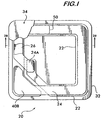
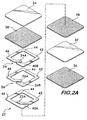
- the tag 20 comprises a first coil layer 22 comprising a single open loop and a second coil layer 24 also comprising a single open loop that are separated by a dielectric layer (e.g., any polymer) 26 that matches the shape of the first and second coil layers 22/24.
- a dielectric layer e.g., any polymer
- the term "single open loop" means that the trace forms only one loop (e.g., there are no concentric inner or outer coil loops as there are in Fig. 4 ); and whereby the trace has endpoints that are not connected; these coil layers may comprise any conductive material, preferably aluminum, copper, etc.
- First 28 and second 30 adhesive layers are then applied to the respective coil layers 22/24.
- the first and second coil layers 22/24 are electrically-coupled at contact points 22A and 24A by a crimping action that pierces the dielectric layer at region 26A.
- large capacitor plates 40A and 40B are used; region 26B of the dielectric layer 26 forms the dielectric between these capacitor plates 40A/40B. It should be understood that the majority of the capacitance is distributed capacitance that is provided by the combination of the single open loop conductive traces 22/24 sandwiching the dielectric layer 26; the large capacitor plates 40A/40B provide a tuning provision for the tag 20.
- each coil layer trace 22/24 comprises three elbows (42-46) and is connected to a respective capacitor plate 40B and 40A, respectively.
- An elbow 42, 44 and 46 is defined as a change in direction of the trace of at least 60 degrees.
- the elbows 42-46 typically have a radius of curvature of 3,81 mm (0.15 in.).
- Each of the capacitor plates 40A and 40B form a fourth elbow of the respective coil layer trace (22/24), thereby giving the traces 22/24 a square appearance.
- the pair of traces 22/24 are separated by a dielectric layer 26.
- plastic membrane or layers 32/34 encapsulate the tag 20.
- Polypropylene is one preferred material for the tag 20 of the present invention because it is a FDA-approved material suitable to be used in conjunction with microwavable foods. Another advantage of polypropylene is that it is flexible and can be used in lamination devices easily. Depending on the attributes needed, various plastics could be substituted for polypropylene. Some uses of this tag 20 may require a more flexible or rigid plastic, or one providing more waterproofing capabilities.
- the tag 20 of the present invention was originally designed for use with the meat packing industry. Meat is an expensive product in retail stores and has widely not been successfully protected by RF technology. The delicate RF circuitry does not work if it is exposed to blood or water. Additionally, most conventional tags cannot produce a strong enough signal when covered with the meat product.
- the plastic casing (e.g., layers 32/34) of the tag 20 provides a novel solution to this problem and allows the tag 20 to be hidden in the soaker pad (also known as "towelette") found under most meat products. It is contemplated that this tag 20 could be placed adjacent the towelette. Additionally, meat products without towelettes can be protected.
- the general method for packaging the meat product is therefore encapsulating a tray, the tag, the towlette, and the meat with a plastic wrap. The most preferred embodiment is having the wrap sealing the meat in the tray, with a tag on the top of the wrap.
- Fig. 3 depicts the tag 20 positioned in between a soaker pad 10 that is formed by an upper portion 10A and a lower portion 10B.
- Each soaker pad portion comprises an absorbent paper layer 11 in contact with the polypropylene layers 32 and 34.
- the absorbent paper layer 11 is then covered by a perforated polypropylene layer 12.
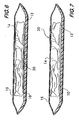
- Fig. 6 provides an overall view of a packaged meat product showing the position of a soaker pad 10 including the tag 20 of the present invention disposed therein.
- the soaker pad 10 is positioned inside a tray (e.g., polystyrene) or holder 13.
- the meat product 14 is then placed on top of the soaker pad 10.
- a transparent cover (e.g., cellophane or shrink wrap, etc.) 15 is then secured over the meat product 14 and sealed to the tray 13.
- the tag 20 may comprise a part of the label that specifies the product details for the customer; the label is typically bonded (e.g., adhesively-secured) to the transparent cover 15.
- the tag 20 may be adhesively secured to the label (or alternatively, may be formed as a part of the label, etc.), as shown in Fig. 7 .
- the tag of present invention can be used to protect other products that are currently very difficult to protect because of moisture, health concerns, or microwave safety.
- An embodiment of this tag can be created with a waterproof seal that allows that tag to remain submerged in a liquid, such as wine or milk. This would provide a tag that cannot be removed, while providing all the benefits of RF protection, and without damaging the product.
- tags of this invention can be used in dairy products, cereal, frozen foods, bread, and pastas. While these foods can be protected by using conventional RF technology, limitations of those tags prevented the tags from being placed in direct contact with the food because of signal strength problems, health problems, or microwave safety.
- the tags of the current invention fulfill the long-felt need to solve these problems, and can effectively protect consumable items in a way not previously possible.
- the preferred dimensions of the tag 20 are selected to give maximum output of the tag 20 while solving the four problems surrounding the RF food protection industry. These problems are microwave safety, waterproof capability, protection of the food from tag contamination, creation of a tag that can minimize the effects of RF interference caused by the food.
- the following dimensions are disclosed by way ofexample only, and in some cases the dimensions could be modified in order to satisfy particular food product needs but without deviating from the scope of the invention.
- the dimensions of the tag 20 are approximately 4,37 cm by 4,37 cm (1.72 inches by 1.72 inches).
- the width (also referred to as "line width") of the first coil layer 22 is approximately 0,518 cm (0.20 inches); the line width of the second coil layer 24 is approximately 0,66 cm (0.26 inches).
- the conductive trace (i.e., coil layer) width should be at least 1/10 of the length of the tag 20.
- the capacitor area is 1,41 cm 2 (0.2191 square inches).
- the thickness of layer 24 is approximately 50 microns and the thickness of the layer 22 is approximately 38 microns.
- the thickness of the dielectric layer 26 is approximately 2.5 microns.
- the frequency the tag 20 returns the resonant signal is 8,2 MHz.
- the Q of the tag ("quality factor," which is a measure of frequency selectivity or sharpness of the peak of a resonant circuit) is approximately 88-90.
- the assignee of this application namely, Checkpoint Systems, Inc., of Thorofare, NJ, has established a "gold standard" or reference which one can compare the performance of the tag 20 of the present invention.
- the gold standard is the measure of a transceiver's measured signal strength of a Series 410 tag, sold by Checkpoint Systems, Inc. (see Table 1, as well as Figs. 3-4 ) versus the tag 20 of the present invention.
- an RF tag returns a certain EM-field when it is energized by a transmitter.
- the strength of a magnetic field is measured in Gauss or Teslas.
- the magnetic field generated by the tag induces a current across an inductor which resides in the antenna of the receiver.
- the induced current is run across a load which creates a voltage difference across the load.
- This voltage should be approximately 1 GST (gold standard tag) for a series 410 tag.
- the tag of the current invention generates a signal 1,7 times more powerful than the Series 410 tag.
- the tag 20 of the current invention has a power of 1,7 GST because the transceiver measures a 1,7 voltage difference for this tag and 1,0 GST for a series 410 tag.
- Table 1 CHECKPOINT SYSTEMS, INC. #410 TAG Front Area Etched 3,75 cm 2 (.5807 sq.
- one of the key features of the tag 20 of the present invention is that enhances microwave safety.
- a tag is placed inadvertently inside of a microwave oven (e.g., the user forgets to remove the food packaging which contains the security tag)
- the tag will be energized by the applied microwaves.
- Energy is stored in the tag's capacitor and throughout the traces (the antenna.) Because the traces have a resistance (though minor) there is a voltage difference between one trace and another. If the tag receives a large amount of energy, as it would if it were microwaved, the small distance between the traces and large voltage difference may cause electric arcing to occur. This can lead to fires if the electrical arc comes near or into contact with a flammable substance.
- the tag 20 of the present invention is designed to have only one trace.
- a very thick trace 50 ( Fig. 1 ) is used.
- the elbows 42-46 of the layers 22/24 are rounded rather than pointed.
- Microwave energy is characterized as "high intensity” which is defined as energy greater than 1100 watts, and prolonged exposure greater than four minutes (limited exposure is a time of less than three minutes).
- high intensity is defined as energy greater than 1100 watts, and prolonged exposure greater than four minutes (limited exposure is a time of less than three minutes).
- limited exposure is a time of less than three minutes.
- the Assignee of the present invention engaged a testing and certification company, namely, TÜV Rheinland of North America of Youngsville, North Carolina, a certification company, to prepare a novel test of the tag 20 of the present invention. It is believed that before then, there was no standard test for the microwave safety of a security tag.
- the microwave test involves using different styles of meat that are cut into 226,8 g (0.5 1b) (beef) and 453,6 g (11b) (pork & chicken); the poundage being determined by the amount of moisture content within that particular meat.
- the tag 20 of the present invention is placed on the outside or inside the soaker pad of each meat package and then they are packaged using Styrofoam meat trays and shrink-wrap. The packages are then placed in a freezer for a 24.- 48 hour period. Every cut and style of meat has a minimum of 3 duplicates (one for each type of microwave).
- the meat product including the tag 20 on the label is then placed in (three packages, same weight, cut & style) and is placed into three different microwaves (see microwave types & power levels below) for 3 minutes on high power (i.e., the maximum power level of the microwave oven).
- the test is considered a success, if after 3 full minutes at high power in the microwave the tag 20 of the present invention has not arced or sparked. This test is performed roughly 80 times per microwave type (3 types see below) or 240 total tests.
Landscapes
- Physics & Mathematics (AREA)
- Engineering & Computer Science (AREA)
- Automation & Control Theory (AREA)
- Computer Security & Cryptography (AREA)
- Electromagnetism (AREA)
- General Physics & Mathematics (AREA)
- Mechanical Engineering (AREA)
- Food Science & Technology (AREA)
- Life Sciences & Earth Sciences (AREA)
- Packages (AREA)
- Cookers (AREA)
- Wrappers (AREA)
- Radar Systems Or Details Thereof (AREA)
- Details Of Rigid Or Semi-Rigid Containers (AREA)
- Details Of Aerials (AREA)
- Baking, Grill, Roasting (AREA)
- Vending Machines For Individual Products (AREA)
- Burglar Alarm Systems (AREA)
Claims (17)
- Sicherheitsetikett, das mikrowellenbeständig ist und aufweist:eine erste leitfähige Bahn (22), die eine erste einzelne offene Leiterschleife bildet;eine zweite leitfähige Bahn (24), die eine zweite einzelne offene Leiterschleife bildet;eine dielektrische Schicht (26), die zwischen der ersten und der zweiten leitfähigen Bahn angeordnet ist;wobei die erste und die zweite leitfähige Bahn (22, 24) an einem Ort, der die dielektrische Schicht (26) durchdringt, elektrisch gekoppelt sind;
wobei die erste und die zweite einzelne offene Leiterschleife jeweils wenigstens drei Ellbogen (42, 44, 46) aufweisen,
dadurch gekennzeichnet,
dass die dielektrische Schicht (26) eine einzelne offene Isolatorschleife bildet, dass die erste leitfähige Bahn (22), die zweite leitfähige Bahn (24) und die dielektrische Schicht (26) in Kunststoffschichten (32, 34) eingekapselt sind und dass jeder der wenigstens drei Ellbogen (42, 44, 46) eine abgerundete Ecke aufweist. - Sicherheitsetikett nach Anspruch 1, wobei die einzelne offene Isolatorschleife wenigstens drei Ellbogen (42, 44, 46) aufweist.
- Sicherheitsetikett nach Anspruch 1, wobei jeder der wenigstens drei Ellbogen (42, 44, 46) von jeder der leitfähigen Bahnen (22, 24) eine Richtungsänderung der leitfähigen Bahn von wenigstens 60° darstellt.
- Sicherheitsetikett nach Anspruch 1, wobei die erste leitfähige Bahn (22) und die zweite leitfähige Bahn (24) jeweils vier Ellbogen aufweisen und wobei einer der Ellbogen einen Kondensatorbelag (40A, 40B) bildet.
- Sicherheitsetikett nach Anspruch 4, wobei jeder der Kondensatorbeläge (40A, 40B) ungefähr 1,414 cm2 (0.2191 Quadratzoll) ist.
- Sicherheitsetikett nach Anspruch 4, wobei ein Verhältnis einer Breite von jeder der leitfähigen Bahnen (22, 24) zu einer Länge des Sicherheitsetiketts wenigstens 1 bis 10 beträgt.
- Sicherheitsetikett nach einem der Ansprüche 1 bis 6, wobei jeder der wenigstens drei Ellbogen (42, 44, 46) einen Krümmungsradius von ungefähr 3,81 mm (0.15 Zoll) hat.
- Sicherheitsetikett nach einem der Ansprüche 1 bis 7, wobei die Kunststoffschichten (32, 34) Polypropylen umfassen.
- Sicherheitsetikett nach einem der Ansprüche 1 bis 8, wobei die dielektrische Schicht (26) ein Polymer umfasst.
- Sicherheitsetikett nach einem der Ansprüche 1 bis 9, wobei die erste und die zweite leitfähige Bahn (22, 24) Aluminium umfassen.
- Sicherheitsetikett nach einem der Ansprüche 1 bis 10, wobei die Kunststoffschichten (32, 34) umfassen:eine erste Kunststoffschicht (32), die an der ersten leitfähigen Bahn (22) durch Kleben befestigt ist;eine zweite Kunststoffschicht (34), die an der zweiten leitfähigen Bahn (24) durch Kleben befestigt ist; undwobei die erste Kunststoffschicht (32) und die zweite Kunststoffschicht (34) jeweils Überlappungsgebiete umfassen, die miteinander verschweißt sind.
- Sicherheitsetikett nach einem der Ansprüche 1 bis 11, wobei die erste und die zweite leitfähige Bahn (22, 24) und die dielektrische Schicht (26) einen elektrischen Kreis bilden, der bei 8,2 MHz in Resonanz schwingt.
- Sicherheitsetikett nach Anspruch 12, wobei der elektrische Kreis einen Gütefaktor (Q) von ungefähr 88-90 hat.
- Sicherheitsetikett nach einem der Ansprüche 1 bis 13, wobei die erste und die zweite leitfähige Bahn (22, 24) durch Quetschen miteinander verbunden sind, um die elektrische Kopplung zu bilden.
- Sicherheitsetikett nach Anspruch 12, wobei das Etikett ein Antwortsignal emittiert, das eine Energie von etwa dem 1,7-fachen der Energie eines Antwortsignals eines Etiketts der Serie 410 der Anmelderin hat, welches mehrere leitfähige Bahnschleifen (22, 24) hat.
- Verfahren zum Schaffen eines Sicherheitsetiketts (20), welches einer Verpackung eines Fleisch- oder Fischprodukts (14) zugeordnet ist, die ein Saugkissen (10) enthält, wobei das Verfahren die Schritte umfasst:Bereitstellen eines Sicherheitsetiketts (20) nach einem der Ansprüche 1-15 und Anordnen des Sicherheitsetiketts innerhalb des Saugkissens (10).
- Verfahren zum Schaffen eines Sicherheitsetiketts (20), welches einer Verpackung eines Fleisch- oder Fischprodukts (14) zugeordnet ist, auf der ein Etikett angebracht ist, wobei das Verfahren die Schritte umfasst:Bereitstellen eines Sicherheitsetiketts (20) nach einem der Ansprüche 1 bis 15; Auftragen eines Klebstoffes (36) auf eine Seite des Sicherheitsetiketts (20); undBefestigen des Sicherheitsetiketts (20) auf dem Etikett.
Applications Claiming Priority (3)
| Application Number | Priority Date | Filing Date | Title |
|---|---|---|---|
| US63846704P | 2004-12-23 | 2004-12-23 | |
| US11/225,417 US7355516B2 (en) | 2004-12-23 | 2005-09-13 | Method and apparatus for protecting culinary products |
| PCT/US2005/046292 WO2006071662A2 (en) | 2004-12-23 | 2005-12-21 | Method and apparatus for protecting culinary products |
Publications (2)
| Publication Number | Publication Date |
|---|---|
| EP1829005A2 EP1829005A2 (de) | 2007-09-05 |
| EP1829005B1 true EP1829005B1 (de) | 2009-04-01 |
Family
ID=36192140
Family Applications (1)
| Application Number | Title | Priority Date | Filing Date |
|---|---|---|---|
| EP05854930A Expired - Lifetime EP1829005B1 (de) | 2004-12-23 | 2005-12-21 | Verfahren und vorrichtung zum schutz von kochprodukten |
Country Status (11)
| Country | Link |
|---|---|
| US (2) | US7355516B2 (de) |
| EP (1) | EP1829005B1 (de) |
| JP (1) | JP4769821B2 (de) |
| AT (1) | ATE427539T1 (de) |
| AU (1) | AU2005322200B2 (de) |
| CA (1) | CA2592443C (de) |
| DE (1) | DE602005013696D1 (de) |
| ES (1) | ES2324234T3 (de) |
| MX (1) | MX2007007833A (de) |
| TW (1) | TW200636625A (de) |
| WO (1) | WO2006071662A2 (de) |
Families Citing this family (13)
| Publication number | Priority date | Publication date | Assignee | Title |
|---|---|---|---|---|
| US7725385B2 (en) * | 2000-03-29 | 2010-05-25 | American Express Travel Related Services Company, Inc. | System and method for facilitating the handling of a dispute using disparate architectures |
| US7535366B2 (en) * | 2006-12-13 | 2009-05-19 | 3M Innovative Properties Company | Microwaveable radio frequency identification tags |
| US20080198013A1 (en) * | 2007-02-15 | 2008-08-21 | Vogt Eric E | Methods and systems for providing mechanisms for authenticating contents of a bottle during its progress through a distribution channel |
| US9013310B2 (en) * | 2008-07-24 | 2015-04-21 | International Business Machines Corporation | Circuit structure and method of fabrication for facilitating radio frequency identification (RFID) |
| EP2834155B1 (de) * | 2012-03-27 | 2017-08-16 | Robert Bosch GmbH | Verpackungssystem und dessen herstellung |
| US11227825B2 (en) * | 2015-12-21 | 2022-01-18 | Intel Corporation | High performance integrated RF passives using dual lithography process |
| CN206451315U (zh) * | 2017-01-09 | 2017-08-29 | 杭州泰铭信息技术有限公司 | 可检测是否处于锁定状态的防盗报警标签 |
| KR102494352B1 (ko) * | 2017-10-20 | 2023-02-03 | 삼성전기주식회사 | 코일 전자부품 |
| EP3814995B1 (de) * | 2018-06-27 | 2025-01-08 | Avery Dennison Retail Information Services LLC | Mikrowellenofen resistente rfid-etiketten |
| CN110443338B (zh) * | 2019-07-11 | 2023-05-30 | 永道射频技术股份有限公司 | 一种可在微波炉内安全使用的rfid标签 |
| CN110399965B (zh) * | 2019-07-31 | 2023-05-30 | 永道射频技术股份有限公司 | 一种用于微波炉内加热或加工的rfid标签结构 |
| JP7624005B2 (ja) | 2019-12-30 | 2025-01-29 | エイヴェリー デニソン リテール インフォメーション サービシズ リミテッド ライアビリティ カンパニー | 金属探知機耐性rfidタグ |
| IL286933B2 (en) * | 2021-10-03 | 2023-08-01 | Tadbik Advanced Tech Ltd | A multi-functional tag for the entire life cycle of the plant |
Family Cites Families (50)
| Publication number | Priority date | Publication date | Assignee | Title |
|---|---|---|---|---|
| US4369557A (en) * | 1980-08-06 | 1983-01-25 | Jan Vandebult | Process for fabricating resonant tag circuit constructions |
| US4560445A (en) * | 1984-12-24 | 1985-12-24 | Polyonics Corporation | Continuous process for fabricating metallic patterns on a thin film substrate |
| JPH0780386B2 (ja) * | 1989-01-25 | 1995-08-30 | 東海金属株式会社 | 共振タグおよびその製造方法 |
| US5142270A (en) * | 1991-05-22 | 1992-08-25 | Checkpoint Systems Inc. | Stabilized resonant tag circuit and deactivator |
| US5241299A (en) * | 1991-05-22 | 1993-08-31 | Checkpoint Systems, Inc. | Stabilized resonant tag circuit |
| US5182544A (en) * | 1991-10-23 | 1993-01-26 | Checkpoint Systems, Inc. | Security tag with electrostatic protection |
| DE9210781U1 (de) | 1992-08-12 | 1992-10-29 | Esselte Meto International Produktions GmbH, 6932 Hirschhorn | Diebstahlsicherungsetikett |
| US5494550A (en) * | 1993-09-07 | 1996-02-27 | Sensormatic Electronics Corporation | Methods for the making of electronic article surveillance tags and improved electronic article surveillance tags produced thereby |
| US5751256A (en) * | 1994-03-04 | 1998-05-12 | Flexcon Company Inc. | Resonant tag labels and method of making same |
| US6441736B1 (en) * | 1999-07-01 | 2002-08-27 | Keith R. Leighton | Ultra-thin flexible durable radio frequency identification devices and hot or cold lamination process for the manufacture of ultra-thin flexible durable radio frequency identification devices |
| FR2742251B1 (fr) | 1995-12-07 | 1998-02-20 | Mamou Patrick | Procede pour proteger une etiquette antivol, etiquette antivol s'y rapportant, et article notamment vestimentaire ou analogue equipe d'une telle etiquette |
| US5754110A (en) * | 1996-03-07 | 1998-05-19 | Checkpoint Systems, Inc. | Security tag and manufacturing method |
| US6262663B1 (en) * | 1996-08-06 | 2001-07-17 | Richard Altwasser | Electronic anti-theft element |
| US5963132A (en) * | 1996-10-11 | 1999-10-05 | Avid Indentification Systems, Inc. | Encapsulated implantable transponder |
| TW350054B (en) * | 1996-11-29 | 1999-01-11 | Mitsubishi Materials Corp | Burglarproof label |
| US6144301A (en) * | 1997-02-10 | 2000-11-07 | Safetrac Control Systems, Inc. | Electronic tracking tag |
| DE19719434A1 (de) * | 1997-05-12 | 1998-11-19 | Meto International Gmbh | Universelles Sicherungselement und Verfahren zu seiner Herstellung |
| US5841350A (en) * | 1997-06-27 | 1998-11-24 | Checkpoint Systems, Inc. | Electronic security tag useful in electronic article indentification and surveillance system |
| AU9261598A (en) * | 1997-08-08 | 1999-03-01 | Ird A/S | Polymeric radio frequency resonant tags and method for manufacture |
| US5861809A (en) * | 1997-09-22 | 1999-01-19 | Checkpoint Systems, Inc. | Deactivateable resonant circuit |
| JP2001510670A (ja) * | 1997-12-05 | 2001-07-31 | コーニンクレッカ フィリップス エレクトロニクス エヌ ヴィ | 識別トランスポンダ |
| US6087940A (en) * | 1998-07-28 | 2000-07-11 | Novavision, Inc. | Article surveillance device and method for forming |
| AU5809099A (en) * | 1998-09-11 | 2000-04-03 | Motorola, Inc. | Radio frequency identification tag apparatus and related method |
| SE513359C2 (sv) * | 1998-12-01 | 2000-09-04 | Allgon Ab | Mikrostrip- filteranordning |
| US6091607A (en) * | 1998-12-10 | 2000-07-18 | Checkpoint Systems, Inc. | Resonant tag with a conductive composition closing an electrical circuit |
| DE19857583A1 (de) * | 1998-12-14 | 2000-06-15 | Meto International Gmbh | Sicherungselement für die elektronische Artikelsicherung und Verfahren zur Herstellung eines Sicherungselementes |
| US6262692B1 (en) * | 1999-01-13 | 2001-07-17 | Brady Worldwide, Inc. | Laminate RFID label and method of manufacture |
| WO2000047410A1 (en) | 1999-02-10 | 2000-08-17 | Nedblake Greydon W Jr | Device for products with labels |
| US6645327B2 (en) * | 1999-04-21 | 2003-11-11 | Intermec Ip Corp. | RF tag application system |
| US6278371B1 (en) * | 1999-04-30 | 2001-08-21 | Paper-Pak Products, Inc. | Absorbent pads having theft alarm activators therein |
| US6121880A (en) * | 1999-05-27 | 2000-09-19 | Intermec Ip Corp. | Sticker transponder for use on glass surface |
| DE19951561A1 (de) * | 1999-10-27 | 2001-05-03 | Meto International Gmbh | Sicherungselement für die elektronischen Artikelsicherung |
| JP3390389B2 (ja) * | 1999-12-08 | 2003-03-24 | チェックポイント・マニュファクチュアリング・ジャパン株式会社 | 共振タグ |
| JP2001317741A (ja) * | 2000-02-28 | 2001-11-16 | Dainippon Printing Co Ltd | 食品の自動調理システムと電子レンジ |
| US6478229B1 (en) * | 2000-03-14 | 2002-11-12 | Harvey Epstein | Packaging tape with radio frequency identification technology |
| US6400271B1 (en) * | 2000-03-20 | 2002-06-04 | Checkpoint Systems, Inc. | Activate/deactiveable security tag with enhanced electronic protection for use with an electronic security system |
| US6796508B2 (en) * | 2000-03-28 | 2004-09-28 | Lucatron Ag | Rfid-label with an element for regulating the resonance frequency |
| US6724310B1 (en) * | 2000-10-10 | 2004-04-20 | Massachusetts Institute Of Technology | Frequency-based wireless monitoring and identification using spatially inhomogeneous structures |
| US6424263B1 (en) * | 2000-12-01 | 2002-07-23 | Microchip Technology Incorporated | Radio frequency identification tag on a single layer substrate |
| US6407669B1 (en) * | 2001-02-02 | 2002-06-18 | 3M Innovative Properties Company | RFID tag device and method of manufacturing |
| US7095324B2 (en) * | 2001-03-06 | 2006-08-22 | Intermec Ip Corp | Tamper evident smart label with RF transponder |
| US6835412B2 (en) * | 2001-05-04 | 2004-12-28 | Micrometal Technologies, Inc. | Metalized dielectric substrates for EAS tags |
| JP2003006593A (ja) * | 2001-06-21 | 2003-01-10 | Osaka Gas Co Ltd | パッケージマーカー及びその製造方法 |
| FR2842950B1 (fr) * | 2002-07-25 | 2004-10-22 | Framatome Connectors Int | Antenne capacitive et procede de realisation |
| US6982640B2 (en) * | 2002-11-21 | 2006-01-03 | Kimberly-Clark Worldwide, Inc. | RFID system and method for tracking food freshness |
| FR2848324B3 (fr) * | 2002-12-06 | 2005-01-21 | Lionel Prat | Dispositif de securite contre le vol a l'etalage, du type etiquette |
| US6940408B2 (en) * | 2002-12-31 | 2005-09-06 | Avery Dennison Corporation | RFID device and method of forming |
| DE20303318U1 (de) * | 2003-02-28 | 2004-07-08 | Checkpoint Systems International Gmbh | Sicherheitsetikett |
| JP3870921B2 (ja) * | 2003-04-01 | 2007-01-24 | セイコーエプソン株式会社 | 非接触識別タグ |
| US7176799B1 (en) * | 2003-12-04 | 2007-02-13 | George Schmitt & Company | Assembling pressure sensitive labels with RFID tags |
-
2005
- 2005-09-13 US US11/225,417 patent/US7355516B2/en not_active Expired - Lifetime
- 2005-12-21 DE DE602005013696T patent/DE602005013696D1/de not_active Expired - Lifetime
- 2005-12-21 WO PCT/US2005/046292 patent/WO2006071662A2/en not_active Ceased
- 2005-12-21 JP JP2007548415A patent/JP4769821B2/ja not_active Expired - Fee Related
- 2005-12-21 ES ES05854930T patent/ES2324234T3/es not_active Expired - Lifetime
- 2005-12-21 AT AT05854930T patent/ATE427539T1/de not_active IP Right Cessation
- 2005-12-21 EP EP05854930A patent/EP1829005B1/de not_active Expired - Lifetime
- 2005-12-21 CA CA2592443A patent/CA2592443C/en not_active Expired - Fee Related
- 2005-12-21 AU AU2005322200A patent/AU2005322200B2/en not_active Ceased
- 2005-12-21 MX MX2007007833A patent/MX2007007833A/es active IP Right Grant
- 2005-12-22 TW TW094145777A patent/TW200636625A/zh unknown
-
2008
- 2008-02-20 US US12/034,324 patent/US7692547B2/en not_active Expired - Fee Related
Also Published As
| Publication number | Publication date |
|---|---|
| ES2324234T3 (es) | 2009-08-03 |
| JP4769821B2 (ja) | 2011-09-07 |
| US7692547B2 (en) | 2010-04-06 |
| TW200636625A (en) | 2006-10-16 |
| WO2006071662A2 (en) | 2006-07-06 |
| US7355516B2 (en) | 2008-04-08 |
| ATE427539T1 (de) | 2009-04-15 |
| AU2005322200B2 (en) | 2009-03-26 |
| AU2005322200A1 (en) | 2006-07-06 |
| CA2592443C (en) | 2011-02-22 |
| EP1829005A2 (de) | 2007-09-05 |
| MX2007007833A (es) | 2008-02-11 |
| CA2592443A1 (en) | 2006-07-06 |
| JP2008525893A (ja) | 2008-07-17 |
| DE602005013696D1 (de) | 2009-05-14 |
| WO2006071662A3 (en) | 2006-08-17 |
| US20080150729A1 (en) | 2008-06-26 |
| US20060145869A1 (en) | 2006-07-06 |
Similar Documents
| Publication | Publication Date | Title |
|---|---|---|
| US7692547B2 (en) | Method and apparatus for protecting culinary products | |
| CN114781571B (zh) | 用于结合至可微波食品包装中的具有屏蔽结构的rfid标签 | |
| AU2005307753B2 (en) | Combination EAS and RFID label or tag | |
| EP0550443B1 (de) | Sicherheitsetikett für kompaktplattenlagerbehälter | |
| US5508684A (en) | Article tag | |
| US7059518B2 (en) | RFID device detection system and method | |
| EP2558381B1 (de) | Containerdichtung mit funkfrequenz-identifikationstag. | |
| EP2045190A1 (de) | Sicherheitsvorrichtung zum Verfolgen von Behältern mit metallteilen und Verfahren zur Kennzeichnung von einem Behälter | |
| WO1993008548A1 (en) | Security tag with electrostatic protection | |
| WO2002080623A9 (en) | Functional food storage and cook-in bag | |
| EP0702650B1 (de) | Absorbierendes kissen mit diebstahlalarm | |
| EP4081463B1 (de) | Zweiteilige rfid-etiketten zum einsatz bei mikrowellentauglichen lebensmittelverpackungen | |
| EP1485303B1 (de) | Einwegeventil für den einmaligen gebrauch für lebensmittelverpackungen, das bei ausreichender erhitzung ein signal abgibt | |
| CN101107638A (zh) | 保护烹饪产品的方法与仪器 | |
| CA2205213C (en) | A device and a method for safeguarding an article against theft | |
| JPH1072070A (ja) | 電子レンジ用包装体 | |
| JP2020035234A (ja) | Rfタグ付き包装体およびrfタグ付き包装材 | |
| MX2012006341A (es) | Mecanismo para el control de inventario y/o disuasion de robo de una almohadilla absorbente. | |
| EP3103738A1 (de) | Leckdetektionssystem | |
| JP2004317765A (ja) | インジケータ機能付き共振タグ | |
| JPH0619504Y2 (ja) | 加熱容器 | |
| JP4359801B2 (ja) | 吊り下げ用ラベル | |
| WO2025221742A9 (en) | Rfid antenna for rejecting unwanted rf signals | |
| JP2006149601A (ja) | 電気調理器 | |
| JPH0796981A (ja) | カッターを内蔵した電子レンジ用包装袋 |
Legal Events
| Date | Code | Title | Description |
|---|---|---|---|
| PUAI | Public reference made under article 153(3) epc to a published international application that has entered the european phase |
Free format text: ORIGINAL CODE: 0009012 |
|
| 17P | Request for examination filed |
Effective date: 20070627 |
|
| AK | Designated contracting states |
Kind code of ref document: A2 Designated state(s): AT BE BG CH CY CZ DE DK EE ES FI FR GB GR HU IE IS IT LI LT LU LV MC NL PL PT RO SE SI SK TR |
|
| DAX | Request for extension of the european patent (deleted) | ||
| 17Q | First examination report despatched |
Effective date: 20080314 |
|
| GRAP | Despatch of communication of intention to grant a patent |
Free format text: ORIGINAL CODE: EPIDOSNIGR1 |
|
| GRAS | Grant fee paid |
Free format text: ORIGINAL CODE: EPIDOSNIGR3 |
|
| GRAA | (expected) grant |
Free format text: ORIGINAL CODE: 0009210 |
|
| AK | Designated contracting states |
Kind code of ref document: B1 Designated state(s): AT BE BG CH CY CZ DE DK EE ES FI FR GB GR HU IE IS IT LI LT LU LV MC NL PL PT RO SE SI SK TR |
|
| REG | Reference to a national code |
Ref country code: GB Ref legal event code: FG4D |
|
| REG | Reference to a national code |
Ref country code: CH Ref legal event code: EP |
|
| REG | Reference to a national code |
Ref country code: IE Ref legal event code: FG4D |
|
| REF | Corresponds to: |
Ref document number: 602005013696 Country of ref document: DE Date of ref document: 20090514 Kind code of ref document: P |
|
| PG25 | Lapsed in a contracting state [announced via postgrant information from national office to epo] |
Ref country code: SI Free format text: LAPSE BECAUSE OF FAILURE TO SUBMIT A TRANSLATION OF THE DESCRIPTION OR TO PAY THE FEE WITHIN THE PRESCRIBED TIME-LIMIT Effective date: 20090401 |
|
| REG | Reference to a national code |
Ref country code: ES Ref legal event code: FG2A Ref document number: 2324234 Country of ref document: ES Kind code of ref document: T3 |
|
| PG25 | Lapsed in a contracting state [announced via postgrant information from national office to epo] |
Ref country code: AT Free format text: LAPSE BECAUSE OF FAILURE TO SUBMIT A TRANSLATION OF THE DESCRIPTION OR TO PAY THE FEE WITHIN THE PRESCRIBED TIME-LIMIT Effective date: 20090401 Ref country code: LT Free format text: LAPSE BECAUSE OF FAILURE TO SUBMIT A TRANSLATION OF THE DESCRIPTION OR TO PAY THE FEE WITHIN THE PRESCRIBED TIME-LIMIT Effective date: 20090401 Ref country code: EE Free format text: LAPSE BECAUSE OF FAILURE TO SUBMIT A TRANSLATION OF THE DESCRIPTION OR TO PAY THE FEE WITHIN THE PRESCRIBED TIME-LIMIT Effective date: 20090401 Ref country code: PT Free format text: LAPSE BECAUSE OF FAILURE TO SUBMIT A TRANSLATION OF THE DESCRIPTION OR TO PAY THE FEE WITHIN THE PRESCRIBED TIME-LIMIT Effective date: 20090902 Ref country code: FI Free format text: LAPSE BECAUSE OF FAILURE TO SUBMIT A TRANSLATION OF THE DESCRIPTION OR TO PAY THE FEE WITHIN THE PRESCRIBED TIME-LIMIT Effective date: 20090401 |
|
| PG25 | Lapsed in a contracting state [announced via postgrant information from national office to epo] |
Ref country code: IS Free format text: LAPSE BECAUSE OF FAILURE TO SUBMIT A TRANSLATION OF THE DESCRIPTION OR TO PAY THE FEE WITHIN THE PRESCRIBED TIME-LIMIT Effective date: 20090801 Ref country code: SE Free format text: LAPSE BECAUSE OF FAILURE TO SUBMIT A TRANSLATION OF THE DESCRIPTION OR TO PAY THE FEE WITHIN THE PRESCRIBED TIME-LIMIT Effective date: 20090701 Ref country code: PL Free format text: LAPSE BECAUSE OF FAILURE TO SUBMIT A TRANSLATION OF THE DESCRIPTION OR TO PAY THE FEE WITHIN THE PRESCRIBED TIME-LIMIT Effective date: 20090401 Ref country code: LV Free format text: LAPSE BECAUSE OF FAILURE TO SUBMIT A TRANSLATION OF THE DESCRIPTION OR TO PAY THE FEE WITHIN THE PRESCRIBED TIME-LIMIT Effective date: 20090401 |
|
| PG25 | Lapsed in a contracting state [announced via postgrant information from national office to epo] |
Ref country code: CZ Free format text: LAPSE BECAUSE OF FAILURE TO SUBMIT A TRANSLATION OF THE DESCRIPTION OR TO PAY THE FEE WITHIN THE PRESCRIBED TIME-LIMIT Effective date: 20090401 Ref country code: DK Free format text: LAPSE BECAUSE OF FAILURE TO SUBMIT A TRANSLATION OF THE DESCRIPTION OR TO PAY THE FEE WITHIN THE PRESCRIBED TIME-LIMIT Effective date: 20090401 Ref country code: RO Free format text: LAPSE BECAUSE OF FAILURE TO SUBMIT A TRANSLATION OF THE DESCRIPTION OR TO PAY THE FEE WITHIN THE PRESCRIBED TIME-LIMIT Effective date: 20090401 |
|
| PLBE | No opposition filed within time limit |
Free format text: ORIGINAL CODE: 0009261 |
|
| STAA | Information on the status of an ep patent application or granted ep patent |
Free format text: STATUS: NO OPPOSITION FILED WITHIN TIME LIMIT |
|
| PG25 | Lapsed in a contracting state [announced via postgrant information from national office to epo] |
Ref country code: SK Free format text: LAPSE BECAUSE OF FAILURE TO SUBMIT A TRANSLATION OF THE DESCRIPTION OR TO PAY THE FEE WITHIN THE PRESCRIBED TIME-LIMIT Effective date: 20090401 |
|
| 26N | No opposition filed |
Effective date: 20100105 |
|
| PG25 | Lapsed in a contracting state [announced via postgrant information from national office to epo] |
Ref country code: BG Free format text: LAPSE BECAUSE OF FAILURE TO SUBMIT A TRANSLATION OF THE DESCRIPTION OR TO PAY THE FEE WITHIN THE PRESCRIBED TIME-LIMIT Effective date: 20090701 |
|
| PG25 | Lapsed in a contracting state [announced via postgrant information from national office to epo] |
Ref country code: MC Free format text: LAPSE BECAUSE OF NON-PAYMENT OF DUE FEES Effective date: 20100701 |
|
| REG | Reference to a national code |
Ref country code: CH Ref legal event code: PL |
|
| PG25 | Lapsed in a contracting state [announced via postgrant information from national office to epo] |
Ref country code: LI Free format text: LAPSE BECAUSE OF NON-PAYMENT OF DUE FEES Effective date: 20091231 Ref country code: GR Free format text: LAPSE BECAUSE OF FAILURE TO SUBMIT A TRANSLATION OF THE DESCRIPTION OR TO PAY THE FEE WITHIN THE PRESCRIBED TIME-LIMIT Effective date: 20090702 Ref country code: CH Free format text: LAPSE BECAUSE OF NON-PAYMENT OF DUE FEES Effective date: 20091231 Ref country code: IE Free format text: LAPSE BECAUSE OF NON-PAYMENT OF DUE FEES Effective date: 20091221 |
|
| PG25 | Lapsed in a contracting state [announced via postgrant information from national office to epo] |
Ref country code: LU Free format text: LAPSE BECAUSE OF NON-PAYMENT OF DUE FEES Effective date: 20091221 |
|
| PG25 | Lapsed in a contracting state [announced via postgrant information from national office to epo] |
Ref country code: HU Free format text: LAPSE BECAUSE OF FAILURE TO SUBMIT A TRANSLATION OF THE DESCRIPTION OR TO PAY THE FEE WITHIN THE PRESCRIBED TIME-LIMIT Effective date: 20091002 |
|
| PG25 | Lapsed in a contracting state [announced via postgrant information from national office to epo] |
Ref country code: TR Free format text: LAPSE BECAUSE OF FAILURE TO SUBMIT A TRANSLATION OF THE DESCRIPTION OR TO PAY THE FEE WITHIN THE PRESCRIBED TIME-LIMIT Effective date: 20090401 |
|
| PG25 | Lapsed in a contracting state [announced via postgrant information from national office to epo] |
Ref country code: CY Free format text: LAPSE BECAUSE OF FAILURE TO SUBMIT A TRANSLATION OF THE DESCRIPTION OR TO PAY THE FEE WITHIN THE PRESCRIBED TIME-LIMIT Effective date: 20090401 |
|
| REG | Reference to a national code |
Ref country code: DE Ref legal event code: R082 Ref document number: 602005013696 Country of ref document: DE Representative=s name: SCHUMACHER & WILLSAU PATENTANWALTSGESELLSCHAFT, DE |
|
| REG | Reference to a national code |
Ref country code: FR Ref legal event code: PLFP Year of fee payment: 11 |
|
| PGFP | Annual fee paid to national office [announced via postgrant information from national office to epo] |
Ref country code: GB Payment date: 20151216 Year of fee payment: 11 Ref country code: DE Payment date: 20151215 Year of fee payment: 11 |
|
| PGFP | Annual fee paid to national office [announced via postgrant information from national office to epo] |
Ref country code: FR Payment date: 20151110 Year of fee payment: 11 Ref country code: BE Payment date: 20151207 Year of fee payment: 11 Ref country code: ES Payment date: 20151112 Year of fee payment: 11 Ref country code: NL Payment date: 20151210 Year of fee payment: 11 |
|
| PGFP | Annual fee paid to national office [announced via postgrant information from national office to epo] |
Ref country code: IT Payment date: 20151221 Year of fee payment: 11 |
|
| PG25 | Lapsed in a contracting state [announced via postgrant information from national office to epo] |
Ref country code: BE Free format text: LAPSE BECAUSE OF NON-PAYMENT OF DUE FEES Effective date: 20161231 |
|
| REG | Reference to a national code |
Ref country code: DE Ref legal event code: R119 Ref document number: 602005013696 Country of ref document: DE |
|
| REG | Reference to a national code |
Ref country code: NL Ref legal event code: MM Effective date: 20170101 |
|
| GBPC | Gb: european patent ceased through non-payment of renewal fee |
Effective date: 20161221 |
|
| PG25 | Lapsed in a contracting state [announced via postgrant information from national office to epo] |
Ref country code: NL Free format text: LAPSE BECAUSE OF NON-PAYMENT OF DUE FEES Effective date: 20170101 |
|
| REG | Reference to a national code |
Ref country code: FR Ref legal event code: ST Effective date: 20170831 |
|
| PG25 | Lapsed in a contracting state [announced via postgrant information from national office to epo] |
Ref country code: IT Free format text: LAPSE BECAUSE OF NON-PAYMENT OF DUE FEES Effective date: 20161221 Ref country code: FR Free format text: LAPSE BECAUSE OF NON-PAYMENT OF DUE FEES Effective date: 20170102 |
|
| PG25 | Lapsed in a contracting state [announced via postgrant information from national office to epo] |
Ref country code: GB Free format text: LAPSE BECAUSE OF NON-PAYMENT OF DUE FEES Effective date: 20161221 Ref country code: DE Free format text: LAPSE BECAUSE OF NON-PAYMENT OF DUE FEES Effective date: 20170701 |
|
| REG | Reference to a national code |
Ref country code: BE Ref legal event code: MM Effective date: 20161231 |
|
| PG25 | Lapsed in a contracting state [announced via postgrant information from national office to epo] |
Ref country code: ES Free format text: LAPSE BECAUSE OF NON-PAYMENT OF DUE FEES Effective date: 20161222 |
|
| REG | Reference to a national code |
Ref country code: ES Ref legal event code: FD2A Effective date: 20181119 |