EP1856065B1 - Derives de 1 ,2,4-triazines, leur preparation et leur application en therapeutique humaine - Google Patents
Derives de 1 ,2,4-triazines, leur preparation et leur application en therapeutique humaine Download PDFInfo
- Publication number
- EP1856065B1 EP1856065B1 EP06726008A EP06726008A EP1856065B1 EP 1856065 B1 EP1856065 B1 EP 1856065B1 EP 06726008 A EP06726008 A EP 06726008A EP 06726008 A EP06726008 A EP 06726008A EP 1856065 B1 EP1856065 B1 EP 1856065B1
- Authority
- EP
- European Patent Office
- Prior art keywords
- methyl
- ethyl
- dioxo
- triazin
- tetrahydro
- Prior art date
- Legal status (The legal status is an assumption and is not a legal conclusion. Google has not performed a legal analysis and makes no representation as to the accuracy of the status listed.)
- Expired - Lifetime
Links
- 0 CN(C(N1)=O)N=C(**)C1=O Chemical compound CN(C(N1)=O)N=C(**)C1=O 0.000 description 9
- KBWLZJQNRXZDLW-UHFFFAOYSA-N CC(C)(C(O)=O)Sc1ccc(CCNC(C(N2C)=O)=NN(CCCC(F)(F)F)C2=O)cc1 Chemical compound CC(C)(C(O)=O)Sc1ccc(CCNC(C(N2C)=O)=NN(CCCC(F)(F)F)C2=O)cc1 KBWLZJQNRXZDLW-UHFFFAOYSA-N 0.000 description 1
- XRNCJMYAGUAALI-UHFFFAOYSA-N CCCCCCCN(C(C(OCCc(cc1)ccc1OC(C)(C)C(OCC)=O)=NN1C)=O)C1=O Chemical compound CCCCCCCN(C(C(OCCc(cc1)ccc1OC(C)(C)C(OCC)=O)=NN1C)=O)C1=O XRNCJMYAGUAALI-UHFFFAOYSA-N 0.000 description 1
- FFTHBFSOJNWTGV-UHFFFAOYSA-N CCCCCCCN(C(C(OCc(cc1)ccc1OC(C)(C)C(OCC)=O)=NN1C)=O)C1=O Chemical compound CCCCCCCN(C(C(OCc(cc1)ccc1OC(C)(C)C(OCC)=O)=NN1C)=O)C1=O FFTHBFSOJNWTGV-UHFFFAOYSA-N 0.000 description 1
- CMEJGOLMNVNMAP-UHFFFAOYSA-N CCCCCCCN(C(N(C)C1=O)=O)N=C1Br Chemical compound CCCCCCCN(C(N(C)C1=O)=O)N=C1Br CMEJGOLMNVNMAP-UHFFFAOYSA-N 0.000 description 1
- OVZZGPNMQGHUBX-UHFFFAOYSA-N CCCCCCCN(C(N(C)C1=O)=O)N=C1NCCc(cc1)ccc1SC(C)(C)C(O)=O Chemical compound CCCCCCCN(C(N(C)C1=O)=O)N=C1NCCc(cc1)ccc1SC(C)(C)C(O)=O OVZZGPNMQGHUBX-UHFFFAOYSA-N 0.000 description 1
- WHBGERRQRVAKTQ-UHFFFAOYSA-N CCCCCCCN(C(N(C)C1=O)=O)N=C1OCCCc1cc(SC(C)(C)C(OCC)=O)ccc1 Chemical compound CCCCCCCN(C(N(C)C1=O)=O)N=C1OCCCc1cc(SC(C)(C)C(OCC)=O)ccc1 WHBGERRQRVAKTQ-UHFFFAOYSA-N 0.000 description 1
- YZPFJWISDFBBQG-UHFFFAOYSA-N CCCCCCCN(C(N(C)C1=O)=O)N=C1OCCCc1cccc(OC(C)(C)C(OCC)=O)c1 Chemical compound CCCCCCCN(C(N(C)C1=O)=O)N=C1OCCCc1cccc(OC(C)(C)C(OCC)=O)c1 YZPFJWISDFBBQG-UHFFFAOYSA-N 0.000 description 1
- TXFLEOJNVKWNBA-UHFFFAOYSA-O CCCCCCC[NH+](C(N(Cc1ccccc1)C1=O)=O)N=C1NCCCCc1cccc(SC(C)(C)C(OCC)=O)c1 Chemical compound CCCCCCC[NH+](C(N(Cc1ccccc1)C1=O)=O)N=C1NCCCCc1cccc(SC(C)(C)C(OCC)=O)c1 TXFLEOJNVKWNBA-UHFFFAOYSA-O 0.000 description 1
- ORBIARRZKLTRDG-UHFFFAOYSA-N CCOC(C(C)(C)Oc(cc1)ccc1OCCCOC(C(N1CCCC(F)(F)F)=O)=NN(CCCC(F)(F)F)C1=O)=O Chemical compound CCOC(C(C)(C)Oc(cc1)ccc1OCCCOC(C(N1CCCC(F)(F)F)=O)=NN(CCCC(F)(F)F)C1=O)=O ORBIARRZKLTRDG-UHFFFAOYSA-N 0.000 description 1
- BGSYSMQOJXPMEV-UHFFFAOYSA-O CCOC(C(C)(C)Oc1cc(CCOC(C(N2CCCC(F)(F)[FH+])=O)=[NH+]N(C)C2=O)ccc1)=O Chemical compound CCOC(C(C)(C)Oc1cc(CCOC(C(N2CCCC(F)(F)[FH+])=O)=[NH+]N(C)C2=O)ccc1)=O BGSYSMQOJXPMEV-UHFFFAOYSA-O 0.000 description 1
- CCCGKZLABLOPKV-UHFFFAOYSA-N CCOC(C(C)(C)Oc1ccc(CCNC(C(N2CCCC(F)(F)F)=O)=NN(CCCC3CCCCC3)C2=O)cc1)=O Chemical compound CCOC(C(C)(C)Oc1ccc(CCNC(C(N2CCCC(F)(F)F)=O)=NN(CCCC3CCCCC3)C2=O)cc1)=O CCCGKZLABLOPKV-UHFFFAOYSA-N 0.000 description 1
- SVQIWINJZUQBLK-UHFFFAOYSA-N CCOC(C(C)(C)Oc1ccc(COC(C(N2CCCC(F)(F)F)=O)=NN(C)C2=O)cc1)=O Chemical compound CCOC(C(C)(C)Oc1ccc(COC(C(N2CCCC(F)(F)F)=O)=NN(C)C2=O)cc1)=O SVQIWINJZUQBLK-UHFFFAOYSA-N 0.000 description 1
- VIXQEVQCCVRNAN-UHFFFAOYSA-N CCOC(C(C)(C)Oc1cccc(CCCNC(C(N2C)=O)=NN(CCNC)C2=O)c1)=O Chemical compound CCOC(C(C)(C)Oc1cccc(CCCNC(C(N2C)=O)=NN(CCNC)C2=O)c1)=O VIXQEVQCCVRNAN-UHFFFAOYSA-N 0.000 description 1
- NVTRDJXDWNUWKL-UHFFFAOYSA-N CCOC(C(C)(C)Sc1cc(CCCCNC(C(N2Cc3ccccc3)=O)=NN(CCCC(F)(F)F)C2=O)ccc1)=O Chemical compound CCOC(C(C)(C)Sc1cc(CCCCNC(C(N2Cc3ccccc3)=O)=NN(CCCC(F)(F)F)C2=O)ccc1)=O NVTRDJXDWNUWKL-UHFFFAOYSA-N 0.000 description 1
- BVJSUAQZOZWCKN-UHFFFAOYSA-N OCc(cc1)ccc1O Chemical compound OCc(cc1)ccc1O BVJSUAQZOZWCKN-UHFFFAOYSA-N 0.000 description 1
Classifications
-
- C—CHEMISTRY; METALLURGY
- C07—ORGANIC CHEMISTRY
- C07D—HETEROCYCLIC COMPOUNDS
- C07D253/00—Heterocyclic compounds containing six-membered rings having three nitrogen atoms as the only ring hetero atoms, not provided for by group C07D251/00
- C07D253/02—Heterocyclic compounds containing six-membered rings having three nitrogen atoms as the only ring hetero atoms, not provided for by group C07D251/00 not condensed with other rings
- C07D253/06—1,2,4-Triazines
- C07D253/065—1,2,4-Triazines having three double bonds between ring members or between ring members and non-ring members
- C07D253/07—1,2,4-Triazines having three double bonds between ring members or between ring members and non-ring members with hetero atoms, or with carbon atoms having three bonds to hetero atoms with at the most one bond to halogen, e.g. ester or nitrile radicals, directly attached to ring carbon atoms
- C07D253/075—Two hetero atoms, in positions 3 and 5
-
- A—HUMAN NECESSITIES
- A61—MEDICAL OR VETERINARY SCIENCE; HYGIENE
- A61K—PREPARATIONS FOR MEDICAL, DENTAL OR TOILETRY PURPOSES
- A61K31/00—Medicinal preparations containing organic active ingredients
- A61K31/66—Phosphorus compounds
-
- A—HUMAN NECESSITIES
- A61—MEDICAL OR VETERINARY SCIENCE; HYGIENE
- A61P—SPECIFIC THERAPEUTIC ACTIVITY OF CHEMICAL COMPOUNDS OR MEDICINAL PREPARATIONS
- A61P17/00—Drugs for dermatological disorders
-
- A—HUMAN NECESSITIES
- A61—MEDICAL OR VETERINARY SCIENCE; HYGIENE
- A61P—SPECIFIC THERAPEUTIC ACTIVITY OF CHEMICAL COMPOUNDS OR MEDICINAL PREPARATIONS
- A61P17/00—Drugs for dermatological disorders
- A61P17/06—Antipsoriatics
-
- A—HUMAN NECESSITIES
- A61—MEDICAL OR VETERINARY SCIENCE; HYGIENE
- A61P—SPECIFIC THERAPEUTIC ACTIVITY OF CHEMICAL COMPOUNDS OR MEDICINAL PREPARATIONS
- A61P17/00—Drugs for dermatological disorders
- A61P17/10—Anti-acne agents
-
- A—HUMAN NECESSITIES
- A61—MEDICAL OR VETERINARY SCIENCE; HYGIENE
- A61P—SPECIFIC THERAPEUTIC ACTIVITY OF CHEMICAL COMPOUNDS OR MEDICINAL PREPARATIONS
- A61P3/00—Drugs for disorders of the metabolism
-
- A—HUMAN NECESSITIES
- A61—MEDICAL OR VETERINARY SCIENCE; HYGIENE
- A61P—SPECIFIC THERAPEUTIC ACTIVITY OF CHEMICAL COMPOUNDS OR MEDICINAL PREPARATIONS
- A61P3/00—Drugs for disorders of the metabolism
- A61P3/04—Anorexiants; Antiobesity agents
-
- A—HUMAN NECESSITIES
- A61—MEDICAL OR VETERINARY SCIENCE; HYGIENE
- A61P—SPECIFIC THERAPEUTIC ACTIVITY OF CHEMICAL COMPOUNDS OR MEDICINAL PREPARATIONS
- A61P3/00—Drugs for disorders of the metabolism
- A61P3/06—Antihyperlipidemics
-
- A—HUMAN NECESSITIES
- A61—MEDICAL OR VETERINARY SCIENCE; HYGIENE
- A61P—SPECIFIC THERAPEUTIC ACTIVITY OF CHEMICAL COMPOUNDS OR MEDICINAL PREPARATIONS
- A61P3/00—Drugs for disorders of the metabolism
- A61P3/08—Drugs for disorders of the metabolism for glucose homeostasis
- A61P3/10—Drugs for disorders of the metabolism for glucose homeostasis for hyperglycaemia, e.g. antidiabetics
-
- A—HUMAN NECESSITIES
- A61—MEDICAL OR VETERINARY SCIENCE; HYGIENE
- A61P—SPECIFIC THERAPEUTIC ACTIVITY OF CHEMICAL COMPOUNDS OR MEDICINAL PREPARATIONS
- A61P37/00—Drugs for immunological or allergic disorders
- A61P37/08—Antiallergic agents
-
- A—HUMAN NECESSITIES
- A61—MEDICAL OR VETERINARY SCIENCE; HYGIENE
- A61P—SPECIFIC THERAPEUTIC ACTIVITY OF CHEMICAL COMPOUNDS OR MEDICINAL PREPARATIONS
- A61P39/00—General protective or antinoxious agents
-
- A—HUMAN NECESSITIES
- A61—MEDICAL OR VETERINARY SCIENCE; HYGIENE
- A61P—SPECIFIC THERAPEUTIC ACTIVITY OF CHEMICAL COMPOUNDS OR MEDICINAL PREPARATIONS
- A61P43/00—Drugs for specific purposes, not provided for in groups A61P1/00-A61P41/00
-
- A—HUMAN NECESSITIES
- A61—MEDICAL OR VETERINARY SCIENCE; HYGIENE
- A61P—SPECIFIC THERAPEUTIC ACTIVITY OF CHEMICAL COMPOUNDS OR MEDICINAL PREPARATIONS
- A61P9/00—Drugs for disorders of the cardiovascular system
- A61P9/10—Drugs for disorders of the cardiovascular system for treating ischaemic or atherosclerotic diseases, e.g. antianginal drugs, coronary vasodilators, drugs for myocardial infarction, retinopathy, cerebrovascula insufficiency, renal arteriosclerosis
Definitions
- the present invention relates to novel 3,5-dioxo- (2H, 4H) -1,2,4-triazine derivatives functionalized in 2, 4 and 6, activating the PPAR alpha and / or gamma receptors, their preparation. and their application in human therapy.
- the metabolic syndrome is the result of increased peripheral insulin resistance, and is characterized by hyperinsulinemia, glucose intolerance, impaired lipid metabolism, high blood pressure ( Grundy, SM: Hypertriglyceridemia, insulin resistance, and the metabolic syndrome. Am. J. Cardiol.15 1999, 83, 25F-29F ). Obesity is often associated with these metabolic disorders, and the conjunction of these multiple risk factors favors the development of the atheromatous pathology causing arterial thrombosis, now the leading cause of death in industrialized regions.
- Peroxisome proliferator receptors PPARs
- the compounds of the present invention are characterized by their original structure, their affinity for PPAR alpha and / or PPAR gamma receptors and their pharmacological profile.
- the invention covers the salts of the compounds of the general formula I with the pharmaceutically acceptable bases, as well as the different enantiomers of the compounds having asymmetric carbons, as well as their mixtures in all proportions including in particular the racemic mixtures.
- the compounds of the present invention can be synthesized using the synthetic routes described below or using synthetic methods known to those skilled in the art.
- the intermediate and final compounds may be, if desired, purified according to one or more purification methods chosen from extraction, filtration, silica gel chromatography, preparative HPLC on normal or reverse phase, crystallization. .
- intermediates 8a-8b The synthesis of intermediates 8a-8b is carried out from intermediate 2f according to the procedure described for the synthesis of 4a using various RX halogenated derivatives .
- EP-AcOEt: 80-20 Rf 0.46 oil
- 8a 4-Benzyl-6-bromo-2- (4,4,4-trifluorobutyl) -2H- [1,2,4] triazine-3,5-dione 98%
- EP-AcOEt: 80-20 Rf 0.66 oil
- the synthesis of the 11b-11e intermediates is carried out from variously substituted thiophenols (G) listed in Table 12 according to the procedure described for the synthesis of 11a using ethyl or tert-butyl bromoisobutyrate.
- intermediates 14b-14c are carried out from intermediate 13a according to the procedure described for the synthesis of 14a using different carboxylic acids.
- Table ⁇ b> 16 ⁇ / b>: Intermediates ⁇ b> 14b-14c ⁇ / b> Carboxylic acids Total return Eluent Form Intermediates 14b-14c 78% CH 2 Cl 2 -MeOH: 90-10 Rf 0.37
- Oil 14c ethyl 2-Methyl-2- ⁇ 4- [2- (3-phenyl-propylamino) -ethyl] -phenoxy ⁇ -propionate
- TLC silica gel 60 F 254 Merck
- Example 1 2- ⁇ 2- [2- (4-Butyl-2-methyl-3,5-dioxo-2,3,4,5-tetrahydro- [1,2,4] triazin-6-yloxy) ethyl] -phenoxy ⁇ -2-methyl-ethyl propionate (1)
- Compound 2 (oil) is prepared from triazine 4b and intermediate 10h according to synthetic method 1 .
- TLC silica gel 60 F 254 Merck, CH 2 Cl 2 -AcOEt: 90-10, Rf 0.62.
- Compound 3 (oil) is prepared from triazine 6a and intermediate 10h according to synthetic method 1 .
- TLC silica gel 60 F 254 Merck, CH 2 Cl 2 -AcOEt: 90-10, Rf 0.57.
- Compound 4 (oil) is prepared from triazine 4b and intermediate 12a according to synthetic method 1 .
- TLC silica gel 60 F 254 Merck, petroleum ether-AcOEt: 70-30, Rf 0.30.
- Example 5 2- ⁇ 3- [3- (2-Heptyl-4-methyl-3,5-dioxo-2,3,4,5-tetrahydro- [1,2,4] triazin-6-yloxy) propyl] -phenoxy ⁇ -2-methyl-ethyl propionate (5).
- Compound 5 (oil) is prepared from triazine 4b and intermediate 12a according to synthetic method 1 .
- TLC silica gel 60 F 254 Merck, petroleum ether-AcOEt: 70-30, Rf 0.52.
- Compound 6 (oil) is prepared from triazine 6a and intermediate 12a according to synthetic method 1 .
- TLC silica gel 60 F 254 Merck, petroleum ether-AcOEt: 70-30, Rf 0.46.
- Compound 7 (oil) is prepared from triazine 7a and intermediate 12a according to synthetic method 1 .
- TLC silica gel 60 F 254 Merck, petroleum ether-AcOEt: 70-30, Rf 0.61.
- Example 8 2- (3- ⁇ 3- [4-Heptyl-3,5-dioxo-2- (4,4,4-trifluoro-butyl) -2,3,4,5-tetrahydro- [1,2 Ethyl] 4-triazin-6-yloxy] -propyl ⁇ -phenoxy) -2-methyl-propionate (8)
- Compound 8 (oil) is prepared from triazine 7b and intermediate 12a according to synthetic method 1 .
- TLC silica gel 60 F 254 Merck, petroleum ether-AcOEt: 70-30, Rf 0.53.
- Compound 9 (oil) is prepared from triazine 4a and intermediate 12b according to synthetic method 1 .
- TLC silica gel 60 F 254 Merck, petroleum ether-AcOEt: 80-20, Rf 0.34.
- Compound 10 (oil) is prepared from triazine 4b and intermediate 12b according to synthetic method 1 .
- TLC silica gel 60 F 254 Merck, petroleum ether-AcOEt: 70-30, Rf 0.54.
- Compound 11 (oil) is prepared from triazine 5a and intermediate 12b according to synthetic method 1 .
- TLC silica gel 60 F 254 Merck, petroleum ether-AcOEt: 80-20, Rf 0.29.
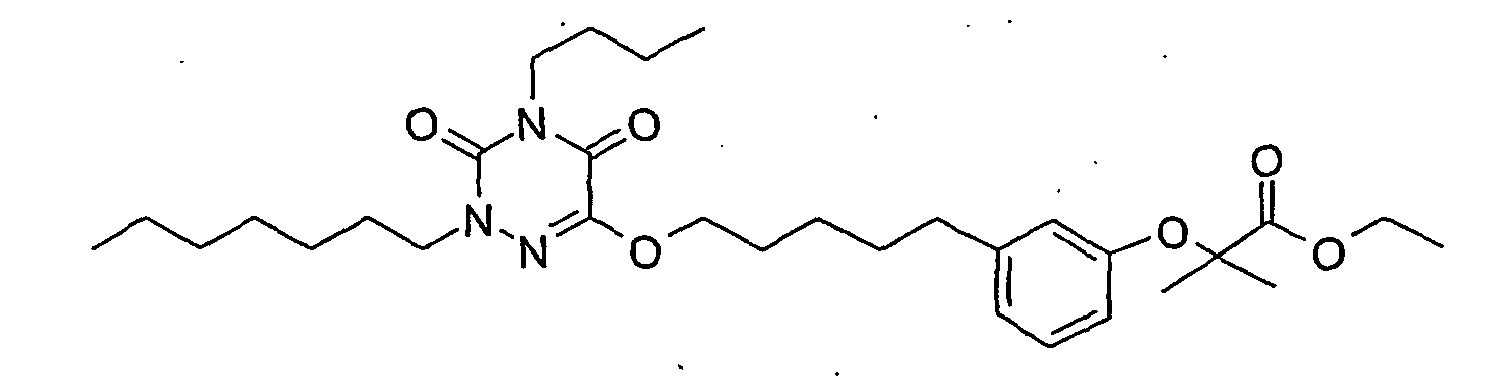
- Example 13 2- ⁇ 3- [5- (2,4-Dibutyl-3,5-dioxo-2,3,4,5-tetrahydro- [1,2,4] triazin-6-yloxy) -pentyl] -phenoxy ⁇ -2-methyl-ethyl propionate (13)
- Compound 13 (oil) is prepared from triazine 1c and intermediate 12b according to synthetic method 1 .
- TLC silica gel 60 F 254 Merck, petroleum ether-AcOEt: 80-20, Rf 0.63.
- Example 14 2- (3- ⁇ 5- [4-Butyl-3,5-dioxo-2- (4,4,4-trifluoro-butyl) -2,3,4,5-tetrahydro- [1,2] , 4] triazin-6-yloxy] -pentyl ⁇ -phenoxy) -2-methyl-ethyl propionate (14)
- Compound 14 (oil) is prepared from triazine 5b and intermediate 12b according to synthetic method 1 .
- TLC silica gel 60 F 254 Merck, petroleum ether-AcOEt: 80-20, Rf 0.35.
- Compound 15 (oil) is prepared from triazine 5c and intermediate 12b according to synthetic method 1 .
- TLC silica gel 60 F 254 Merck, petroleum ether-AcOEt: 80-20, Rf 0.53.
- Compound 16 (oil) is prepared from triazine 6a and intermediate 12b according to synthetic method 1.
- TLC silica gel 60 F 254 Merck, petroleum ether-AcOEt: 80-20, Rf 0.33.
- Compound 17 (oil) is prepared from triazine 7a and intermediate 12b according to synthetic method 1.
- TLC silica gel 60 F 254 Merck, petroleum ether-AcOEt: 80-20, Rf 0.36.
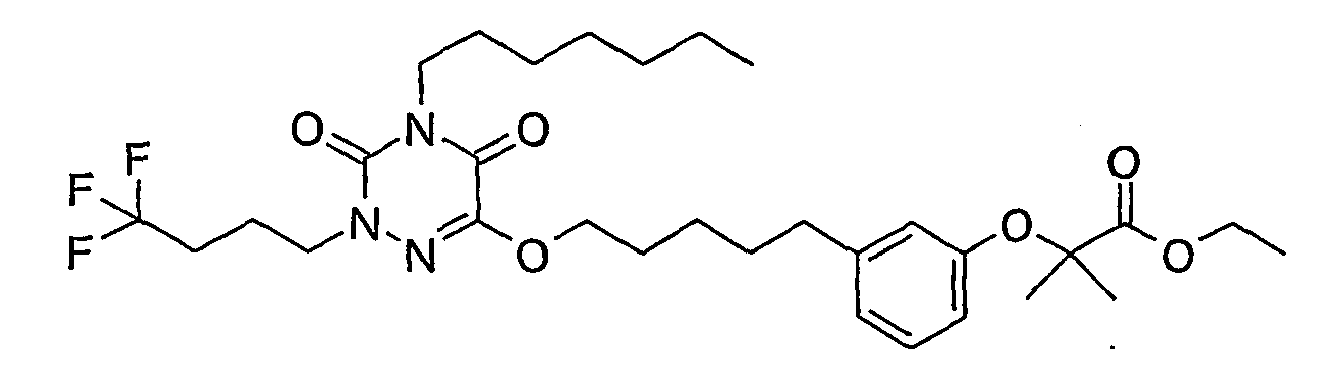
- Example 18 2- (3- ⁇ 5- [4-Heptyl-3,5-dioxo-2- (4,4,4-trifluoro-butyl) -2,3,4,5-tetrahydro- [1,2 , 4] triazin-6-yloxy] -pentyl ⁇ -phenoxy ⁇ -2-methyl-ethyl propionate (18)
- Compound 18 (oil) is prepared from triazine 7b and intermediate 12b according to synthetic method 1.
- Compound 19 (oil) is prepared from triazine 7c and intermediate 12b according to synthetic method 1.
- TLC silica gel 60 F 254 Merck, petroleum ether-AcOEt: 80-20, Rf 0.51.
- Compound 20 (oil) is prepared from triazine 4b and intermediate 10f according to synthetic method 1.
- TLC silica gel 60 F 254 Merck, petroleum ether-AcOEt: 80-20, Rf 0.28.
- Compound 22 (oil) is prepared from triazine 7a and intermediate 10f according to synthetic method 1.
- TLC silica gel 60 F 254 Merck, petroleum ether-AcOEt: 80-20, Rf 0.34.
- Compound 23 (oil) is prepared from triazine 7b and intermediate 10f according to synthetic method 1 .
- TLC silica gel 60 F 254 Merck, petroleum ether-AcOEt: 90-10, Rf 0.61.
- Compound 24 (oil) is prepared from triazine 4a and intermediate 10 by synthetic method 1.
- TLC silica gel 60 F 254 Merck, CH 2 Cl 2 -AcOEt: 90-10, Rf 0.45.
- Compound 26 (oil) is prepared from triazine 7a and intermediate 10j according to synthetic method 1.
- TLC silica gel 60 F 254 Merck, petroleum ether-AcOEt: 70-30, Rf 0.46.
- Compound 27 (oil) is prepared from triazine 4b and intermediate 12c according to synthetic method 1.
- TLC silica gel 60 F 254 Merck, petroleum ether-AcOEt: 70-30, Rf 0.33.
- Compound 28 (oil) is prepared from triazine 4a and intermediate 12d according to synthetic method 1.
- TLC silica gel 60 F 254 Merck, petroleum ether-AcOEt: 70-30, Rf 0.31.
- Compound 29 (oil) is prepared from triazine 4b and intermediate 12d according to synthetic method 1.
- TLC silica gel 60 F 254 Merck, petroleum ether-AcOEt: 70-30, Rf 0.49.
- Compound 30 (oil) is prepared from triazine 6a and intermediate 12d according to synthetic method 1.
- TLC silica gel 60 F 254 Merck, petroleum ether-AcOEt: 70-30, Rf 0.35.
- Compound 31 (oil) is prepared from triazine 7b and intermediate 12d according to synthetic method 1.
- TLC silica gel 60 F 254 Merck, petroleum ether-AcOEt: 80-20, Rf 0.51.
- Example 32 2- ⁇ 3- [3- (2-Heptyl-4-methyl-3,5-dioxo-2,3,4,5-tetrahydro- [1,2,4] triazin-6-yloxy) propyl] -phenylsulfanyl ⁇ -2-methyl-ethyl propionate (32)
- Compound 32 (oil) is prepared from triazine 4b and intermediate 12e according to synthetic method 1.
- TLC silica gel 60 F 254 Merck, petroleum ether-AcOEt: 80-20, Rf 0.37.
- Example 33 2- ⁇ 3- [3- (2-Heptyl-4-methyl-3,5-dioxo-2,3,4,5-tetrahydro- [1,2,4] triazin-6-yloxy) propoxy] -phenoxy ⁇ -2-methyl-ethyl propionate (33)
- Example 34 2- ⁇ 3- [3- (2-Heptyl-4-methyl-3,5-dioxo-2,3,4,5-tetrahydro- [1,2,4] triazin-6-yloxy) propoxy] -phenylsulfanyl ⁇ -2-methyl-ethyl propionate (34)
- Compound 34 (oil) is prepared from triazine 9q and intermediate 11c according to synthesis method 2.
- TLC silica gel 60 F 254 Merck, heptane-AcOEt: 50-50, Rf 0.33.
- Example 35 2- (3- ⁇ 3- [3,5-Dioxo-2,4-bis (4,4,4-trifluorobutyl) -2,3,4,5-tetrahydro- [1,2 Ethyl] 4-triazin-6-yloxy] -propoxy ⁇ -phenoxy) -2-methyl-propionate (35)
- Compound 35 (oil) is prepared from triazine 9r and intermediate 10b according to synthetic method 2.
- TLC silica gel 60 F 254 Merck, heptane-AcOEt: 50-50, Rf 0.50.
- Example 36 -2- ⁇ 3- [4- (2-Heptyl-4-methyl-3,5-dioxo-2,3,4,5-tetrahydro [1,2,4] triazin-6-yloxy) butoxy] -phenoxy ⁇ -2-methyl-ethyl propionate (36)
- Compound 36 (oil) is prepared from triazine 9s and intermediate 10b according to synthetic method 2.
- TLC silica gel 60 F 254 Merck, heptane-AcOEt: 50-50, Rf 0.34.
- Example 37 2- ⁇ 3- [4- (2-Heptyl-4-methyl-3,5-dioxo-2,3,4,5-tetrahydro- [1,2,4] triazin-6-yloxy) butoxy] -phenylsulfanyl ⁇ -2-methyl-ethyl propionate (37)
- Compound 37 (oil) is prepared from triazine 9s and intermediate 11c according to synthesis method 2.
- TLC silica gel 60 F 254 Merck, heptane-AcOEt: 50-50, Rf 0.37.
- Example 38 2- ⁇ 4- [2- (2-Heptyl-4-methyl-3,5-dioxo-2,3,4,5-tetrahydro- [1,2,4] triazin-6-yloxy) ethoxy] -phenylsulfanyl ⁇ -2-methyl-ethyl propionate (38)
- Compound 38 (oil) is prepared from the triazine 9p and Intermediate 11 according to the synthesis method 2.
- TLC silica gel 60 F 254 Merck, heptane-AcOEt: 50-50, Rf 0.33.
- Example 39 2- (4- ⁇ 3- [3,5-Dioxo-2,4-bis (4,4,4-trifluoro-butyl) -2,3,4,5-tetrahydro- [1,2 , 4] triazin-6-yloxy] -propoxy-phenoxy) -2-methyl-propionic acid (39)
- Compound 39 (oil) is prepared from triazine 9r and intermediate 10c according to synthesis method 2.
- TLC silica gel 60 F 254 Merck, heptane-AcOEt: 50-50, Rf 0.50.
- Compound 40 (oil) is prepared from triazine 9b and intermediate 10c according to synthetic method 2.
- TLC silica gel 60 F 254 Merck, petroleum ether-AcOEt: 80-20, Rf 0.29.
- Compound 41 (oil) is prepared from the triazine 9a and intermediate 10c according to synthesis method 2.
- TLC silica gel 60 F 254 Merck, petroleum ether-AcOEt: 80-20, Rf 0.50.
- Compound 42 (oil) is prepared from 9c triazine and intermediate 10c according to synthesis method 2.
- TLC silica gel 60 F 254 Merck, petroleum ether-AcOEt: 80-20, Rf 0.85.
- Compound 43 (oil) is prepared from triazine 9d and intermediate 10c according to synthesis method 2.
- TLC silica gel 60 F 254 Merck, heptane-AcOEt: 80-20, Rf 0.85.
- Compound 44 (oil) is prepared from triazine 9f and intermediate 10c according to synthesis method 2.
- TLC silica gel 60 F 254 Merck, petroleum ether-AcOEt: 70-30, Rf 0.36.
- Compound 45 (oil) is prepared from triazine 9g and intermediate 10c according to synthesis method 2.
- TLC silica gel 60 F 254 Merck, petroleum ether-AcOEt: 70-30, Rf 0.48.
- Example 46 2-Methyl-2- (4- ⁇ 3- [2-methyl-3,5-dioxo-4- (4,4,4-trifluoro-butyl) -2,3,4,5-tetrahydro- Ethyl [1,2,4] triazin-6-ylamino] -propoxy ⁇ -phenoxy) -propionate (46)
- Compound 47 (oil) is prepared from triazine 9i and intermediate 10c according to synthesis method 2.
- TLC silica gel 60 F 254 Merck, petroleum ether-AcOEt: 80-20, Rf 0.30.
- Example 48 2- (4- ⁇ 3- [4-Heptyl-3,5-dioxo-2- (4,4,4-trifluoro-butyl) -2,3,4,5-tetrahydro- [1,2] , 4] triazin-6-ylamino] -propoxy-phenoxy) -2-methyl-propionic acid ethyl ester (48)
- Compound 48 (oil) is prepared from triazine 9j and intermediate 10c according to synthesis method 2.
- TLC silica gel 60 F 254 Merck, petroleum ether-AcOEt: 80-20, Rf 0.50.
- Compound 49 (oil) is prepared from triazine 9i and Intermediate 11 according to the synthesis method 2.
- TLC silica gel 60 F 254 Merck, petroleum ether-AcOEt: 80-20, Rf 0.46.
- Compound 50 (oil) is prepared from triazine 9I and intermediate 10c according to synthesis method 2.
- TLC silica gel 60 F 254 Merck, petroleum ether-AcOEt: 80-20, Rf 0.50.
- Example 51 2- (3- ⁇ 3 - [(2-Heptyl-4-methyl-3,5-dioxo-2,3,4,5-tetrahydro- [1,2,4] triazin-6-yl) Ethyl (4,4,4-trifluoro-butyl) -amino] -propoxy-phenoxy) -2-methyl-propionate (51)
- the compound 51 (oil) is prepared from the 9m triazine and the intermediate 10b according to the method of synthesis 3 using Mitsunobu coupling conditions such as those described for example 33.
- TLC silica gel 60 F 254 Merck, petroleum ether-AcOEt: 90-10, Rf 0.56.
- Example 52 2- (3- ⁇ 3 - [(2,4-Dimethyl-3,5-dioxo-2,3,4,5-tetrahydro- [1,2,4] triazin-6-yl) heptyl amino-propoxy-phenylsulfanyl) -2-methyl-propionate (52)
- Compound 52 (oil) is prepared from triazine 9n and intermediate 11c according to synthesis method 3 using coupling conditions such as those described for Example 33.
- TLC silica gel 60 F 254 Merck, heptane-AcOEt: 70-30, Rf 0.22.
- Example 53 2- (4- ⁇ 3 - [(2,4-Dimethyl-3,5-dioxo-2,3,4,5-tetrahydro- [1,2,4] triazin-6-yl) heptyl amino-propoxy-phenylsulfanyl) -2-methyl-propionate (53)
- Compound 53 (oil) is prepared from triazine 9n and intermediate 11d according to synthesis method 3 using coupling conditions such as those described for Example 33.
- TLC silica gel 60 F 254 Merck, heptane-AcOEt: 80-20, Rf 0.45.
- Example 54 2- (3- ⁇ 4 - [(2,4-Dimethyl-3,5-dioxo-2,3,4,5-tetrahydro- [1,2,4] triazin-6-yl) heptyl -amino] -butoxy) -phenylsulfanyl) -2-methyl-ethyl propionate (54)
- Compound 54 (oil) is prepared from triazine 9o and intermediate 11c according to synthesis method 3 using coupling conditions such as those described for Example 33.
- TLC silica gel 60 F 254 Merck, heptane-AcOEt: 70-30, Rf 0.25.
- Example 55 2- (2- ⁇ 2- [3,5-Dioxo-2,4-bis (4,4,4-trifluoro-butyl) -2,3,4,5-tetrahydro- [1,2 Ethyl] 4-triazin-6-ylamino] -ethyl ⁇ -phenoxy) -2-methyl-propionate (55)
- Compound 55 is prepared according to the synthetic method 4: 6.6 g (16,1mmol) triazine 1d, 2 g (13,4mmol) of 2- (2-methoxy-phenyl) -ethylamine and 4,7ml (33,9mmol ) of triethylamine are placed in 20ml of n-butanol at 120 ° C for 28h. After concentration of the reaction medium to dryness, the residue obtained is taken up in H 2 O and extracted with AcOEt. The organic phases are dried over MgSO 4 and then concentrated to dryness. The oil obtained is purified by flash chromatography on silica (petroleum ether-AcOEt: 90-10).
- Compound 57 (oil) is prepared from triazine 4b and intermediate 13b according to synthetic method 1 .
- TLC silica gel 60 F 254 Merck, petroleum ether-AcOEt: 70-30, Rf 0.44.
- Compound 58 (oil) is prepared from triazine 6a and intermediate 13b according to synthetic method 1.
- TLC silica gel 60 F 254 Merck, petroleum ether-AcOEt: 80-20, Rf 0.33.
- Compound 59 (oil) is prepared from triazine 7a and intermediate 13b according to synthetic method 1.
- TLC silica gel 60 F 254 Merck, petroleum ether-AcOEt: 80-20, Rf 0.50.
- Example 60 2- (3- ⁇ 2- [4-Heptyl-3,5-dioxo-2- (4,4,4-trifluoro-butyl) -2,3,4,5-tetrahydro- [1,2 Ethyl] 4-triazin-6-ylamino] -ethyl ⁇ -phenoxy) -2-methyl-propionate (60)
- Compound 60 (oil) is prepared from triazine 7b and intermediate 13b according to synthetic method 1.
- TLC silica gel 60 F 254 Merck, petroleum ether-AcOEt: 90-10, Rf 0.22.
- Compound 61 (oil) is prepared from triazine 7a and intermediate 13d according to synthetic method 1.
- TLC silica gel 60 F 254 Merck, petroleum ether-AcOEt: 70-30, Rf 0.61.
- Example 62 2-Methyl-2- (3- ⁇ 3- [4-methyl-3,5-dioxo-2- (4,4,4-trifluoro-butyl) -2,3,4,5-tetrahydro- Ethyl [1,2,4] triazin-6-ylamino] propyl ⁇ -phenoxy) propionate (62)
- Compound 62 (oil) is prepared from triazine 4a and intermediate 13j according to synthetic method 4.
- TLC silica gel 60 F 254 Merck, CH 2 Cl 2 -AcOEt: 90-10, Rf 0.60.
- Compound 63 (oil) is prepared from triazine 3a and intermediate 13j according to synthetic method 4.
- TLC silica gel 60 F 254 Merck, petroleum ether-AcOEt: 80-20, Rf 0.44.
- Example 64 2- ⁇ 3- [3- (2-Heptyl-4-methyl-3,5-dioxo-2,3,4,5-tetrahydro- [1,2,4] triazin-6-ylamino) propyl] -phenoxy) -2-methyl-ethyl propionate (64)
- Compound 64 (oil) is prepared from triazine 4b and intermediate 13j according to synthetic method 4.
- TLC silica gel 60 F 254 Merck, petroleum ether-AcOEt: 80-20, Rf 0.20.
- Example 65 2-Methyl-2- (3- ⁇ 3- [2-methyl-3,5-dioxo-4- (4,4,4-trifluoro-butyl) -2,3,4,5-tetrahydro- Ethyl [1,2,4] triazin-6-ylamino] propyl ⁇ -phenoxy) propionate (65)
- Example 66 2- (3- ⁇ 3- [3,5-Dioxo-2,4-bis (4,4,4-trifluoro-butyl) -2,3,4,5-tetrahydro- [1,2] 4] triazin-6-ylamino] propyl-phenoxy) -2-methyl-propionic acid ethyl ester (66)
- Compound 66 (oil) is prepared from triazine 1d and intermediate 131 according to synthetic method 4 .
- TLC silica gel 60 F 254 Merck, petroleum ether-AcOEt: 70-30, Rf 0.49.
- Compound 67 (oil) is prepared from triazine 7a and intermediate 13c according to synthetic method 1 .
- TLC silica gel 60 F 254 Merck, petroleum ether-AcOEt: 80-20, Rf 0.50.
- Example 68 2- (3- ⁇ 3- [4-Heptyl-3,5-dioxo-2- (4,4,4-trifluoro-butyl) -2,3,4,5-tetrahydro- [1,2 4] triazin-6-ylamino] propyl-phenoxy) -2-methyl-propionic acid (68)
- Compound 68 (oil) is prepared from triazine 7b and intermediate 13j according to synthetic method 4 .
- TLC silica gel 60 F 254 Merck, petroleum ether-AcOEt: 80-20, Rf 0.63.
- Compound 69 (oil) is prepared from triazine 1e and intermediate 13j according to synthesis method 4 .
- TLC silica gel 60 F 254 Merck, petroleum ether-AcOEt: 80-20, Rf 0.53.
- Example 70 2- ⁇ 3- [3- (2-Benzyl-4-heptyl-3,5-dioxo-2,3,4,5-tetrahydro- [1,2,4] triazin-6-ylamino) propyl] -phenoxy ⁇ -2-methyl-ethyl propionate (70)
- Compound 70 (oil) is prepared from triazine 7c and intermediate 13j according to synthetic method 4 .
- TLC silica gel 60 F 254 Merck, petroleum ether-AcOEt: 80-20, Rf 0.47.
- Example 71 2- (3- ⁇ 3- [4-Benzyl-3,5-dioxo-2- (4,4,4-trifluoro-butyl) -2,3,4,5-tetrahydro- [1,2 4] triazin-6-ylamino] propyl-phenoxy) -2-methyl-propionic acid (71)
- Compound 71 (oil) is prepared from triazine 8a and intermediate 13j according to synthesis method 4 .
- TLC silica gel 60 F 254 Merck, petroleum ether-AcOEt: 80-20, Rf 0.30.
- Example 72 2- ⁇ 3- [3- (4-Benzyl-2-heptyl-3,5-dioxo-2,3,4,5-tetrahydro- [1,2,4] triazin-6-ylamino) propyl] -phenoxy ⁇ -2-methyl-ethyl propionate (72)
- Compound 72 (oil) is prepared from triazine 8b and intermediate 13j according to synthetic method 4 .
- TLC silica gel 60 F 254 Merck, petroleum ether-AcOEt: 80-20, Rf 0.42.
- Example 73 2- ⁇ 3- [3- (4-Heptyl-2-methyl-3,5-dioxo-2,3,4,5-tetrahydro- [1,2,4] triazin-6-ylamino) propyl] -phenylsulfanyl ⁇ -2-methyl-ethyl propionate (73)
- Compound 73 (oil) is prepared from triazine 7a and intermediate 13e according to synthetic method 1 .
- TLC silica gel 60 F 254 Merck, petroleum ether-AcOEt: 80-20, Rf 0.58.
- Example 74 2-Methyl-2- (3- ⁇ 4- [4-methyl-3,5-dioxo-2- (4,4,4-trifluoro-butyl) -2,3,4,5-tetrahydro [ 1,2,4] triazin-6-ylamino] butyl ⁇ -phenoxy) -propionic acid (74)
- Compound 74 (oil) is prepared from triazine 4a and intermediate 13m according to synthesis method 4.
- TLC silica gel 60 F 254 Merck, petroleum ether-AcOEt: 80-20, Rf 0.21.
- Compound 75 (oil) is prepared from triazine 4b and intermediate 13m according to synthesis method 4.
- TLC silica gel 60 F 254 Merck, petroleum ether-AcOEt: 80-20, Rf 0.44.
- Example 76 2-Methyl-2- (3- ⁇ 4- [4- (3-methyl-but-2-enyl) -3,5-dioxo-2- (4,4,4-trifluorobutyl) - Ethyl 2,3,4,5-tetrahydro- [1,2,4] triazin-6-ylamino] butyl ⁇ -phenoxy) -propionate (76)
- Compound 76 (oil) is prepared from triazine 5d and intermediate 13m according to synthesis method 4.
- TLC silica gel 60 F 254 Merck, petroleum ether-AcOEt: 80-20, Rf 0.50.
- Compound 77 (oil) is prepared from triazine 6a and intermediate 13k according to synthesis method 4.
- TLC silica gel 60 F 254 Merck, petroleum ether-AcOEt: 80-20, Rf 0.35.
- Compound 78 (oil) is prepared from triazine 6a and intermediate 13m according to synthesis method 4 using the last step tert-butyl bromoisobutyrate.
- TLC silica gel 60 F 254 Merck, heptane-AcOEt: 60-40, Rf 0.35.
- Example 80 2- (3- ⁇ 4- [3,5-Dioxo-2,4-bis (4,4,4-trifluoro-butyl) -2,3,4,5-tetrahydro- [1,2] , 4] triazin-6-ylamino] butyl ⁇ -phenoxy) -2-methyl-ethyl propionate (80)
- Compound 80 (oil) is prepared from triazine 1d and intermediate 13m according to synthesis method 4.
- TLC silica gel 60 F 254 Merck, petroleum ether-AcOEt: 80-20, Rf 0.32.
- Example 81 2- (3- ⁇ 4- [2- (2-Cyano-ethyl) -3,5-dioxo-4- (4,4,4-trifluoro-butyl) -2,3,4,5- ethyl tetrahydro- [1,2,4] triazin-6-ylamino] butyl ⁇ -phenoxy) -2-methyl-propionate (81)
- Compound 81 (oil) is prepared from triazine 3b and intermediate 13k according to synthesis method 4.
- TLC silica gel 60 F 254 Merck, petroleum ether-AcOEt: 70-30, Rf 0.20.
- Example 82 2- (3- ⁇ 4- [2-Heptyl-3,5-dioxo-4- (4,4,4-trifluoro-butyl) -2,3,4,5-tetrahydro- [1,2 Ethyl 4-triazin-6-ylamino] butyl ⁇ -phenoxy) -2-methyl-propionate (82)
- Compound 82 (oil) is prepared from triazine 6b and intermediate 13k according to synthetic method 4.
- TLC silica gel 60 F 254 Merck, petroleum ether-AcOEt: 80-20, Rf 0.37.
- Example 83 2- (3- ⁇ 4- [2-Heptyl-3,5-dioxo-4- (4,4,4-trifluoro-butyl) -2,3,4,5-tetrahydro- [1,2 Tert -butyl [4-triazin-6-ylamino] butyl] -phenoxy) -2-methyl-propionate (83)
- Compound 83 (oil) is prepared from triazine 6b and intermediate 13m according to synthesis method 4 using the last step tert-butyl bromoisobutyrate.
- TLC silica gel 60 F 254 Merck, heptane-AcOEt: 60-40, Rf 0.43.
- Example 84 2- (3- ⁇ 4- [2-Heptyl-3,5-dioxo-4- (4,4,4-trifluoro-butyl) -2,3,4,5-tetrahydro- [1, 2,4] triazin-6-ylamino] butyl ⁇ -phenoxy) -2-methyl-propionic (84)
- Example 85 2- (3- ⁇ 4- [4-Heptyl-3,5-dioxo-2- (4,4,4-trifluoro-butyl) -2,3,4,5-tetrahydro- [1,2] Ethyl 4-triazin-6-ylamino] butyl ⁇ -phenoxy) -2-methyl-propionate (85)
- Compound 85 (oil) is prepared from triazine 7b and intermediate 13m according to synthetic method 4.
- TLC silica gel 60 F 254 Merck, petroleum ether-AcOEt: 80-20, Rf 0.75.
- Compound 86 (oil) is prepared from triazine 3c and intermediate 13m according to synthetic method 4.
- TLC silica gel 60 F 254 Merck, petroleum ether-AcOEt: 70-30, Rf 0.51.
- Example 87 4- (6- ⁇ 4- [3- (1-Ethoxycarbonyl-1-methyl-ethoxy) -phenyl] -butylamino ⁇ -4-heptyl-3,5-dioxo-4,5-dihydro-3H- Ethyl [1,2,4] triazin-2-yl) -but-2-enonate (87)
- Compound 87 (oil) is prepared according to synthesis method 6: 0.2 g (5 mmol) of NaH (60% in paraffin) are suspended in 10 ml of DMF at 0 ° C. under nitrogen. 1.4 g (2.6 mmol) of compound 86 diluted in 4 ml of DMF are poured dropwise. The mixture is stirred for 4.5 hours at room temperature and then concentrated to dryness. The residue obtained is taken up in H 2 O and extracted with AcOEt. The organic phases are dried over MgSO 4 and then concentrated to dryness. The oil obtained is purified by flash chromatography on silica (CH 2 Cl 2 -AcOEt: 90-10) and 0.8 g of solid are isolated (yield: 63%).
- Compound 88 (oil) is prepared from triazine 1e and intermediate 13k according to synthesis method 4.
- TLC silica gel 60 F 254 Merck, petroleum ether-AcOEt: 80-20, Rf 0.53.
- Compound 90 (oil) is prepared from triazine 8a and intermediate 13k according to synthesis method 4.
- TLC silica gel 60 F 254 Merck, petroleum ether-AcOEt: 80-20, Rf 0.46.
- Compound 91 (oil) is prepared from triazine 8b and intermediate 13k according to synthesis method 4.
- TLC silica gel 60 F 254 Merck, petroleum ether-AcOEt: 80-20, Rf 0.60.
- Example 92 2- (3- ⁇ 5- [3,5-Dioxo-2,4-bis (4,4,4-trifluoro-butyl) -2,3,4,5-tetrahydro- [1,2] 4] Triazin-6-ylamino] -pentyl-phenoxy) -2-methyl-propionic acid ethyl ester (92)
- Compound 92 (oil) is prepared from triazine 1d and intermediate 13n according to synthetic method 4.
- TLC silica gel 60 F 254 Merck, petroleum ether-AcOEt: 80-20, Rf 0.45.
- Example 93 2-Methyl-2- (3- ⁇ 4- [4-methyl-3,5-dioxo-2- (4,4,4-trifluoro-butyl) -2,3,4,5-tetrahydro Ethyl [1,2,4] triazin-6-ylamino] butyl ⁇ -phenylsulfanyl) propionate (93)
- Compound 93 (oil) is prepared from triazine 4a and intermediate 13f according to synthetic method 1.
- TLC silica gel 60 F 254 Merck, petroleum ether-AcOEt: 80-20, Rf 0.45.
- Compound 94 (oil) is prepared from triazine 4b and intermediate 13f according to synthetic method 1.
- TLC silica gel 60 F 254 Merck, petroleum ether-AcOEt: 80-20, Rf 0.26.
- Compound 95 is prepared from triazine 6a and intermediate 13f according to synthetic method 1.
- TLC silica gel 60 F 254 Merck, petroleum ether-AcOEt: 80-20, Rf 0.34.
- Example 96 2-Methyl-2- (3- ⁇ 4- [2-methyl-3,5-dioxo-4- (4,4,4-trifluoro-butyl) -2,3,4,5-tetrahydroic acid - [1,2,4] triazin-6-ylamino] butyl ⁇ -phenylsulfanyl) -propionic (96)
- Compound 97 (oil) is prepared from triazine 7b and intermediate 13f according to synthetic method 1.
- TLC silica gel 60 F 254 Merck, petroleum ether-AcOEt: 80-20, Rf 0.74.
- Compound 98 (oil) is prepared from triazine 1e and intermediate 13f according to synthetic method 1.
- TLC silica gel 60 F 254 Merck, petroleum ether-AcOEt: 80-20, Rf 0.53.
- Compound 99 is prepared from triazine 7c and intermediate 13f according to synthetic method 1.
- TLC silica gel 60 F 254 Merck, petroleum ether-AcOEt: 80-20, Rf 0.43.
- Example 100 2- (3- ⁇ 4- [4-Benzyl-3,5-dioxo-2- (4,4,4-trifluoro-butyl) -2,3,4,5-tetrahydro- [1,2] Ethyl 4-triazin-6-ylamino] butyl ⁇ -phenylsulfanyl) -2-methyl-propionate (100)
- Compound 100 is prepared from triazine 8a and intermediate 13f according to synthetic method 1.
- TLC silica gel 60 F 254 Merck, petroleum ether-AcOEt: 80-20, Rf 0.27.
- Example 101 2- ⁇ 3- [4- (4-Benzyl-2-heptyl-3,5-dioxo-2,3,4,5-tetrahydro- [1,2,4] triazin-6-ylamino) butyl] -phenylsulfanyl ⁇ -2-methyl-ethyl propionate (101)
- Compound 101 is prepared from triazine 8b and intermediate 13f according to synthetic method 1.
- TLC silica gel 60 F 254 Merck, petroleum ether-AcOEt: 80-20, Rf 0.39.
- Example 102 2-Methyl-2- (4- ⁇ 2- [4-methyl-3,5-dioxo-2- (4,4,4-trifluoro-butyl) -2,3,4,5-tetrahydro- Ethyl [1,2,4] triazin-6-ylamino] -ethyl ⁇ -phenoxy) propionate (102)
- Compound 102 (oil) is prepared from triazine 4a and intermediate 13a according to synthetic method 1.
- TLC silica gel 60 F 254 Merck, petroleum ether-AcOEt: 80-20, Rf 0.22.
- Example 103 2- ⁇ 4- [2- (2-Heptyl-4-methyl-3,5-dioxo-2,3,4,5-tetrahydro- [1,2,4] triazin-6-ylamino) ethyl] -phenoxy ⁇ -2-methyl-ethyl propionate (103)
- Compound 103 (oil) is prepared from triazine 4b and intermediate 13a according to synthetic method 1.
- TLC silica gel 60 F 254 Merck, CH 2 Cl 2 -A C EOt: 90-10, Rf 0.54.
- Example 104 4- [6- ⁇ 2- [4- (1-Ethoxycarbonyl-1-methyl-ethoxy) -phenyl] -ethylamino ⁇ -3,5-dioxo-4- (4,4,4-trifluorobutyl) Ethyl -4,5-dihydro-3H- [1,2,4] triazin-2-yl] but-2-enoate (104)
- Compound 104 (oil) is prepared from triazine 3b and intermediate 13a according to synthetic method 6 by carrying out the alkylation step with ethyl 4-bromo-but-2-enoate.
- TLC silica gel 60 F 254 Merck, petroleum ether-AcOEt: 80-20, Rf 0.34.
- Example 105 2- (4- ⁇ 2- [2- (3-Cyclohexyl-propyl) -3,5-dioxo-4- (4,4,4-trifluorobutyl) -2,3,4,5-tetrahydro- Ethyl [1,2,4] triazin-6-ylamino] -ethyl ⁇ -phenoxy) -2-methyl-propionate (105)
- Compound 105 (oil) is prepared from triazine 6c and intermediate 13a according to synthetic method 1.
- TLC silica gel 60 F 254 Merck, petroleum ether-AcOEt: 80-20, Rf 0.44.
- Example 106 2- ⁇ 4- [2- (4-Heptyl-2-methyl-3,5-dioxo-2,3,4,5-tetrahydro- [1, 2,4] triazin-6-ylamino) - ethyl] -phenoxy ⁇ -2-methyl-ethyl propionate (106)
- Compound 106 (solid) is prepared from triazine 7a and intermediate 13a according to synthetic method 1.
- Example 107 2- (4- ⁇ 2- [4-Heptyl-3,5-dioxo-2- (4,4,4-trifluoro-butyl) -2,3,4,5-tetrahydro- [1,2 Ethyl 4-triazin-6-ylamino] -ethyl ⁇ -phenoxy) -2-methyl-propionate (107)
- Compound 107 (solid) is prepared from triazine 7b and intermediate 13a according to synthetic method 1.
- Example 108 2- ⁇ 4- [2- (2,4-Diheptyl-3,5-dioxo-2,3,4,5-tetrahydro- [1,2,4] triazin-6-ylamino) -ethyl] -phenoxy ⁇ -2-methyl-ethyl propionate (108)
- Compound 108 (oil) is prepared from triazine 1e and intermediate 13a according to synthetic method 1.
- TLC silica gel 60 F 254 Merck, petroleum ether-AcOEt: 80-20, Rf 0.57.
- Compound 109 (solid) is prepared from triazine 8b and intermediate 13a according to synthetic method 1.
- Example 110 2- ⁇ 4- [2- (2,4-Bis-benzyloxymethyl-3,5-dioxo-2,3,4,5-tetrahydro- [1,2,4] triazin-6-ylamino ) -ethyl] -phenoxy ⁇ -2-methyl-ethyl propionate (110)
- Compound 110 (oil) is prepared from triazine 1g and intermediate 13a according to synthetic method 1.
- TLC silica gel 60 F 254 Merck, petroleum ether-AcOEt: 80-20, Rf 0.34.
- Example 111 2- (4- ⁇ 2 - [(2,4-Dimethyl-3,5-dioxo-2,3,4,5-tetrahydro- [1,2,4] triazin-6-yl) - ( 4,4,4-trifluoro-butyl) -amino] -ethyl ⁇ -phenoxy) -2-methyl-ethyl propionate (111)
- the compound III is prepared according to the synthesis method 5: 3.2 g (14.7 mmol) of triazine 1 b and 5.4 ml (36.8 mmol) of 2- (4-methoxy-phenyl) ethylamine are placed in 30 ml of nBuOH in the presence of 5.1ml (36.8mmol) of triethylamine at 130 ° C for 10.5h. After concentration to dryness, the residue obtained is taken up in H 2 O and extracted with AcOEt. The organic phases are dried over MgSO 4 and then concentrated to dryness.
- 0.48 g (12 mmol) of NaH (60% in paraffin) are suspended in 15 ml of DMF at 0 ° C. under nitrogen.
- 2.3 g (7.9 mmol) of previously isolated solid diluted in 5 ml of DMF are poured dropwise.
- the mixture is agitated 0.5h at room temperature and then 4.7g (19.8mmol) of 1,1,1-trifluoro-4-iodo-butane are added and stirring is continued for 6.5h. After concentration to dryness, the residue obtained is taken up in H 2 O and extracted with AcOEt.
- Compound 112 (oil) is prepared from triazine 1b and intermediate 14a according to synthetic method 1.
- TLC silica gel 60 F 254 Merck, CH 2 Cl 2 -AcOEt: 70-30, Rf 0.70.
- Example 113 2- (4- ⁇ 2 - [(2,4-Dimethyl-3,5-dioxo-2,3,4,5-tetrahydro- [1,2,4] triazin-6-yl) - heptyl-amino] -ethyl ⁇ -phenoxy) -2-methyl-propionic (113)
- Example 114 2- (4- ⁇ 2 - [(2,4-Dimethyl-3,5-dioxo-2,3,4,5-tetrahydro- [1,2,4] triazin-6-yl) -phénéthyl amino-ethyl-phenoxy) -2-methyl-ethyl propionate (114)
- Compound 114 (oil) is prepared from triazine 1b and intermediate 14b according to synthetic method 1.
- TLC silica gel 60 F 254 Merck, CH 2 Cl 2 -AcOEt: 90-10, Rf 0.74.
- Example 115 2- (4- ⁇ 2 - [(2,4-Dimethyl-3,5-dioxo-2,3,4,5-tetrahydro- [1,2,4] triazin-6-yl) - ( Ethyl 3-phenyl-propyl) -amino] -ethyl ⁇ -phenoxy) -2-methyl-propionate (115)
- Compound 115 (oil) is prepared from triazine 1b and intermediate 14c according to synthetic method 1.
- TLC silica gel 60 F 254 Merck, CH 2 Cl 2 -A C EOt: 90-10, Rf 0.63.
- Example 116 2- (4- ⁇ 2 - [(4-Heptyl-2-methyl-3,5-dioxo-2,3,4,5-tetrahydro- [1,2,4] triazin-6-yl) -phenethyl-amino] -ethyl ⁇ -phenoxy) -2-methyl-ethyl propionate (116)
- Compound 116 (oil) is prepared from triazine 7a and intermediate 14b according to synthetic method 1.
- TLC silica gel 60 F 254 Merck, CH 2 Cl 2 , Rf 0.52.
- Compound 117 (oil) is prepared from triazine 7a and intermediate 14c according to synthetic method 1.
- TLC silica gel 60 F 254 Merck, CH 2 Cl 2 , Rf 0.46.
- Compound 119 (oil) is prepared from triazine 4b and intermediate 13g according to synthetic method 1.
- TLC silica gel 60 F 254 Merck, petroleum ether-AcOEt: 80-20, Rf 0.60.
- Example 120 2- ⁇ 4- [2- (2-Heptyl-4-methyl-3,5-dioxo-2,3,4,5-tetrahydro- [1,2,4] triazin-6-ylamino) -ethyl] -phenylsulfanyl ⁇ -2-methyl-propionic (120)
- Example 121 2- ⁇ 4- [2- (4-Butyl-2-heptyl-3,5-dioxo-2,3,4,5-tetrahydro- [1,2,4] triazin-6-ylamino) -ethyl] -phenylsulfanyl ⁇ -2-methyl-propionic (121)
- Example 122 2- ⁇ 4- [2- (4-Heptyl-2-methyl-3,5-dioxo-2,3,4,5-tetrahydro- [1,2,4] triazin-6-ylamino) ethyl] -phenylsulfanyl ⁇ -2-methyl-ethyl propionate (122)
- Compound 122 (solid) is prepared from triazine 7a and intermediate 13g according to synthetic method 1.
- Example 123 2- (4- ⁇ 2- [4-Heptyl-3,5-dioxo-2- (4,4,4-trifluoro-butyl) -2,3,4,5-tetrahydro- [1, 2,4] triazin-6-ylamino] -ethyl ⁇ -phenylsulfanyl) -2-methyl-propionic (123)
- Example 124 2- ⁇ 4- [3- (2-Heptyl-4-methyl-3,5-dioxo-2,3,4,5-tetrahydro- [1,2,4] triazin-6-ylamino) propyl] -phenylsulfanyl ⁇ -2-methyl-ethyl propionate (124)
- Compound 125 (oil) is prepared from triazine 4b and intermediate 13h according to synthetic method 1.
- TLC silica gel 60 F 254 Merck, petroleum ether-AcOEt: 80-20, Rf 0.20.
- reporter gene assay Activation of transcription (transactivation) of the reporter gene controlled by specific response elements after binding of the ligand to the receptor (reporter gene assay).
- Subconfluent Cos-7 (ATCC, CRL-1651) cells are transfected with (i) the chimeric receptors containing the ligand binding domain of PPAR ⁇ or PPAR ⁇ or human PPAR ⁇ fused to the galactosidase DNA binding domain.
- yeast yeast
- the reporter plasmid containing five copies of the Gal-4 response element upstream of the thymidine kinase promoter adjacent to the luciferase gene (p5xUAS-tk- Luc) on the other hand.
- these cells are treated for the next 24 hours by the compounds or their vehicle and the luciferase activity is evaluated after cell extraction according to the supplier's recommendations (Promega).
- Table 17 The results are reported in Table 17 below, in which the mention “hit” designates a compound whose level of transactivation is significant without defining an EC 50 , the word “nd” means that the measure n has not been realized.
- Examples hPPAR - GAL4 alpha EC 50 ( ⁇ M) hPPAR - GAL4 gamma EC 50 ( ⁇ M) hPPAR - GAL4 delta EC 50 ( ⁇ M) Fenofibric acid 16.9 65.2 > 100 rosiglitazone 0 1.12 0 pioglitazone > 10 4.77 0 1 3-10 0 0 2 > 10 ⁇ 10 0 3 -3 0 0 4 > 10 0 0 5 -3 ⁇ 10 0 6 0.3 ⁇ 0 0 7 0.3-1 1-3 0 8 0.3 ⁇ 3-10.
- the present invention relates, as novel drugs useful in the treatment of diseases requiring PPAR alpha and / or PPAR gamma receptor agonists, the compounds of formula I previously defined.
- These compounds are useful in the prevention and treatment of diseases such as diabetic dyslipidemia, hypertriglyceridemia, hypercholesterolemia, hyperinsulinemia, hyperglycemia, metabolic syndrome, obesity, atherosclerosis, or in dermatology, in pathologies with an inflammatory component or resulting from abnormal cell differentiation, as well as in the treatment of diseases such as psoriasis, acne, atopic dermatitis, skin aging, photoaging.
- the invention relates to pharmaceutical compositions containing as active principle at least one compound of formula I previously defined, preferably in combination with any suitable excipient.
Landscapes
- Health & Medical Sciences (AREA)
- Chemical & Material Sciences (AREA)
- Organic Chemistry (AREA)
- Medicinal Chemistry (AREA)
- Veterinary Medicine (AREA)
- Public Health (AREA)
- General Health & Medical Sciences (AREA)
- Animal Behavior & Ethology (AREA)
- Life Sciences & Earth Sciences (AREA)
- Pharmacology & Pharmacy (AREA)
- Chemical Kinetics & Catalysis (AREA)
- General Chemical & Material Sciences (AREA)
- Nuclear Medicine, Radiotherapy & Molecular Imaging (AREA)
- Bioinformatics & Cheminformatics (AREA)
- Engineering & Computer Science (AREA)
- Diabetes (AREA)
- Obesity (AREA)
- Hematology (AREA)
- Dermatology (AREA)
- Endocrinology (AREA)
- Pulmonology (AREA)
- Urology & Nephrology (AREA)
- Vascular Medicine (AREA)
- Cardiology (AREA)
- Child & Adolescent Psychology (AREA)
- Toxicology (AREA)
- Emergency Medicine (AREA)
- Immunology (AREA)
- Heart & Thoracic Surgery (AREA)
- Epidemiology (AREA)
- Pharmaceuticals Containing Other Organic And Inorganic Compounds (AREA)
- Plural Heterocyclic Compounds (AREA)
- Liquid Crystal Substances (AREA)
Abstract
Description
- La présente invention a pour objet de nouveaux dérivés de la 3,5-dioxo-(2H,4H)-1,2,4-triazine fonctionnalisés en 2, 4 et 6, activant les récepteurs PPAR alpha et/ou gamma, leur préparation et leur application en thérapeutique humaine.
- Le syndrome métabolique est le résultat d'une résistance périphérique à l'insuline accrue, et se caractérise par une hyper-insulinémie, une intolérance au glucose, une altération du métabolisme des lipides, une hypertension artérielle (Grundy, S.M. : Hypertriglyceridemia, insulin résistance, and the metabolic syndrome. Am. J. Cardiol.15 1999, 83, 25F-29F ). L'obésité est souvent associée à ces troubles métaboliques, et la conjonction de ces multiples facteurs de risque favorise le développement de la pathologie athéromateuse à l'origine de la thrombose artérielle, aujourd'hui première cause de mortalité dans les régions industrialisées. Les récepteurs aux agents proliférateurs de peroxisomes (PPAR) appartiennent à la superfamille des récepteurs nucléaires des facteurs de transcription. Après activation, ils forment un hétérodimère avec le récepteur de l'acide 9-cis rétinoïque (RXR) ; ce complexe (PPAR-RXR) se lie spécifiquement sur des séquences d'ADN situées dans des régions régulatrices de gènes impliqués dans le métabolisme des lipides et glucides (Pineda Torra, I., Gervois, P. and Staels, B. :Peroxisome proliferator-activated receptor alpha in metabolic disease, inflammation, atherosclerosis and aging. Curr. Opin. Lipidol. 1999, 10, 151-159. Vamecq, J. and Latruffe, N. : Medical signifiance of peroxisome proliferator-activated receptors. Lancet 1999, 354, 141-148 .). L'activation des PPARs d'une part restaure certaines voies métaboliques altérées qui prédisposent à l'athérosclérose, d'autre part réduit les événements inflammatoires qui favorisent le développement et la fissuration de la plaque d'athérome.
- La demande internationale
WO 95/01965 - Les composés de la présente invention se caractérisent par leur structure originale, leur affinité vis-à-vis des récepteurs PPAR alpha et/ou PPAR gamma et leur profil pharmacologique.
- Les composés de l'invention correspondent à la formule générale I.

- R1 et R2 peuvent être identiques ou différents et représentent un radical alkyle ou alkènyle linéaire ou branché en C1-C7, un radical alkyle en C1-C6 substitué par des groupements tels que, trifluorométhyle, cycloalkyle en C5-C6, nitrile, alkoxycarbonylvinyle en C1-C4, hydroxycarbonylvinyle, alkoxycarbonyle en C1-C4, carboxylate, benzyloxy ou phényle (pour lesquels le noyau phényle est éventuellement substitué par un ou plusieurs groupements tels que alcoyle en C1-C4, alkoxy en C1-C4, nitro, halogène, trifluorométhyle).
- YR3 représente l'oxygène ou NR3 pour lequel R3 représente l'hydrogène, un radical alcoyle ou alkènyle linéaire ou branché en C1-C7, un radical alkyle en C1-C6 substitué par des groupements tels que, trifluorométhyle ou phényle (pour lesquels le noyau phényle est éventuellement substitué par un ou plusieurs groupements tels que alcoyle en C1-C4, alkoxy en C1-C4, nitro, halogène, trifluorométhyle)
- Z représente un atome d'oxygène ou un atome de carbone pouvant être lié aux positions ortho, méta ou para du groupement phényle de la formule I
- n peut-être égal à 0 à 5 lorsque Z=C ou 2 à 4 lorsque Z=O,
- X représente l'oxygène ou le soufre
- R4, R5, R6, R7 et R8 représentent l'hydrogène ou le fluor,
- R9, R10 et R11 représentent l'hydrogène ou un groupement alkyle en C1-C5 linéaire ou branché
- L'invention concerne en particulier les composés de formule 1 dans laquelle
- R1 et R2 représentent indépendamment l'un de l'autre, un radical alkyle ou alkènyle linéaire ou branché en C1-C7; un radical alkyle en C1-C6 substitué par des groupements tels que, trifluorométhyle, cycloalkyle en C6, nitrile, phényle (pour lesquels le noyau phényle est éventuellement substitué par un ou plusieurs groupements tels que alcoyle en C1-C4, alkoxy en C1-C4, nitro, halogène, trifluorométhyle),
- YR3 représente l'oxygène ou NR3 pour lequel R3 représente l'hydrogène, un radical alcoyle ou alkènyle linéaire ou branché en C1-C7, un radical alkyle en C1-C6 substitué par des groupements tels que, trifluorométhyle où phényle,
- Z représente un atome d'oxygène ou un atome de carbone pouvant être lié aux positions ortho, méta ou para du groupement phényle de la formule I
- n peut-être égal à 0 à 5 lorsque Z=C ou 2 à 4 lorsque Z=O,
- X représente l'oxygène ou le soufre
- R4, R5, R6, R7 et R8 représentent l'hydrogène ou le fluor,
- R9, R10 et R11 représentent l'hydrogène ou un groupement alkyle en C1-C5 linéaire ou branché
- L'invention concerne plus particulièrement les composés de formule 1 dans laquelle :
- R1 et R2 représentent indépendamment l'un de l'autre, un radical alkyle ou alkènyle linéaire ou branché en C1-C7, un radical alkyle en C1-C6 substitué par des groupements tels que, trifluorométhyle ou nitrile,
- YR3 représente l'oxygène ou NR3 pour lequel R3 représente l'hydrogène ou un radical alcoyle linéaire ou branché en C1-C7,
- Z représente un atome de carbone pouvant être lié aux positions ortho, méta ou para du groupement phényle de la formule I
- n peut-être égal à 0 à 5,
- X représente l'oxygène ou le soufre
- R4, R5, R6, R7 et R8 représentent l'hydrogène ou le fluor,
- R9, R10 et R11 représentent l'hydrogène ou un groupements alkyle en C1-C5 linéaire ou branché, en particulier R9 et R10 représentent le groupement méthyle et R11 l'hydrogène ou le groupement éthyle,
- L'invention concerne encore plus particulièrement des dérivés de la 3,5-dioxo-(2H,4H)-1,2,4-triazine de formule I dans laquelle :
- R1 et R2 représentent indépendamment l'un de l'autre, un radical alkyle ou alkènyle linéaire ou ramifié en C1-C7 éventuellement substitué en bout de chaîne par un groupement trifluorométhyle,
- YR3 représente l'oxygène ou NR3 pour lequel R3 représente l'hydrogène ou un radical alcoyle linéaire ou branché en C1-C7,
- Z représente un atome de carbone pouvant être lié aux positions méta ou para du groupement phényle de la formule I
- n peut-être égal à 1 à 5,
- X représente l'oxygène ou le soufre
- R4 à R8 représentent l'hydrogène,
- R9 et R10 représentent un radical méthyl
- R11 représente l'hydrogène ou un radical éthyl
- L'invention couvre les sels des composés de formule générale I avec les bases pharmaceutiquement acceptables, ainsi que les différents énantiomères des composés possédant des carbones asymétriques, ainsi que leurs mélanges en toutes proportions incluant notamment les mélanges racémiques.
- Les composés de la présente invention peuvent être synthétisés en utilisant les voies de synthèse décrites ci-dessous ou en utilisant des méthodes de synthèse connues de l'homme de métier.
- La synthèse des composés de formule générale I est caractérisée (schéma 1) en ce que l'on condense un dérivé de formule générale II


- Cette méthode de synthèse des composés dé formule générale I pour lesquels Z=O (schéma 2) est caractérisée en ce que:
- 1) l'on condense un dérivé de formule générale II


- 2) l'on condense le dérivé obtenu V


- Cette méthode de synthèse des composés de formule générale I pour lesquels Z=O (schéma 3) est caractérisée en ce que:
- 1) l'on protège la fonction alcool d'un dérivé de formule générale VII


- 2) l'on alkyle l'azote du composé VIII précédemment obtenu par un dérivé halogéné R3 Hal dans lequel le groupement Hal représente un halogène tel que CI, Br ou I est R3 est tel que décrit précédemment dans la formule I, dans des conditions opératoires telles que NaH ou tBuOK dans le DMF.

- 3) l'on déprotège le composé IX ainsi obtenu dans des conditions opératoires telles que le fluorure de tétrabutylammonium dans le THF.
- 4) l'on condense le dérivé obtenu X


- Cette méthode s'applique lorsque Y=N, Z=C et elle est caractérisée (schéma 4) en ce que :
- 1) l'on condense un dérivé de formule générale II


- 2) après déméthylation (si A=Me, dans des conditions telles que BBr3 dans le dichlorométhane), on alkyle la fonction phénol du dérivé XII

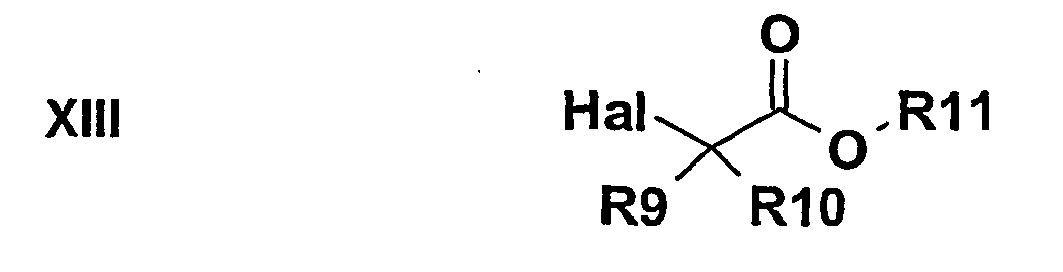

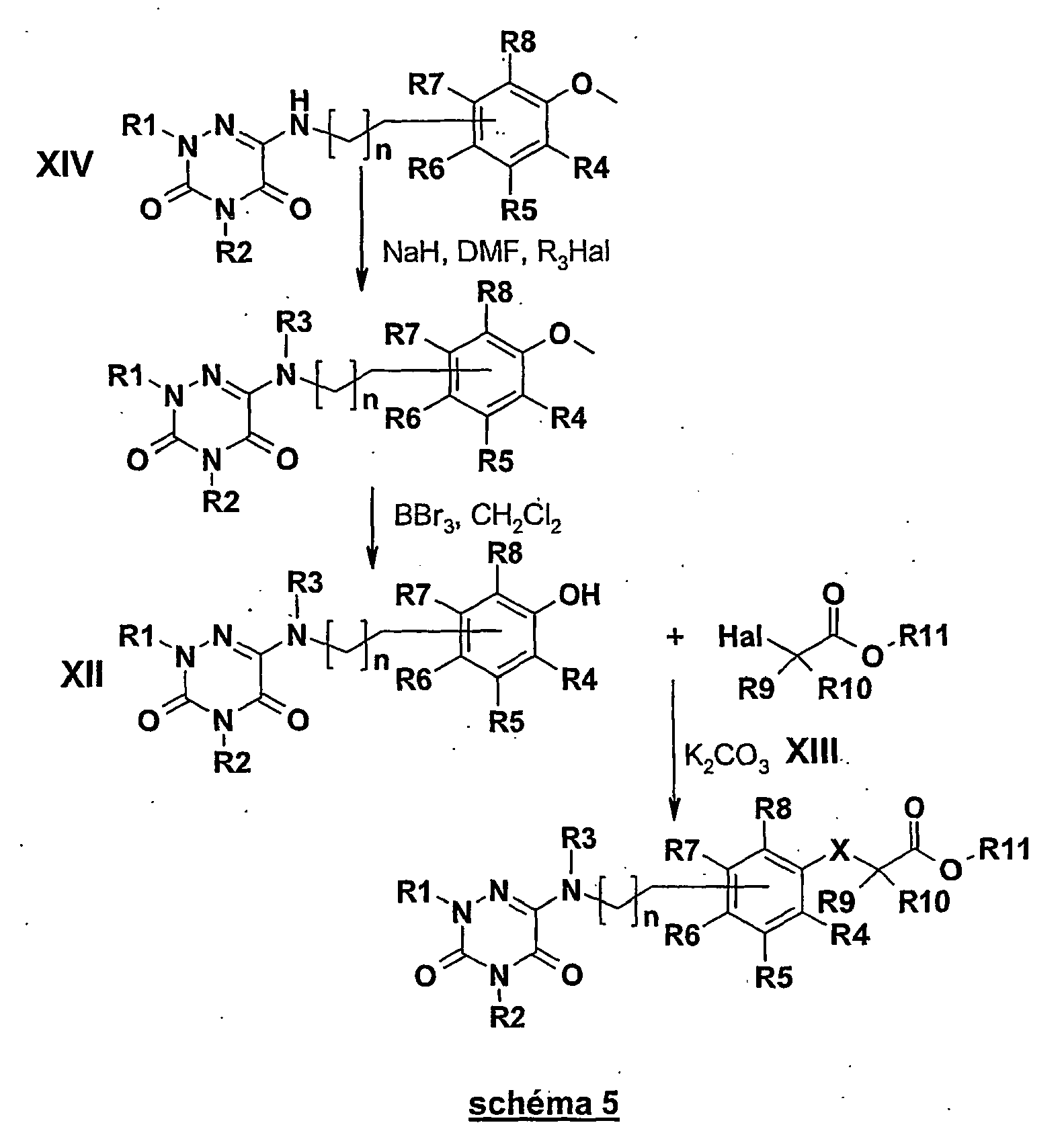
- Cette méthode s'applique lorsque Y=N, Z=C et elle est caractérisée (schéma 5) en ce que :
- 1) l'on alkyle un dérivé de formule générale XIV

- 2) après déméthylation dans des conditions telles que BBr3 dans le dichlorométhane, on alkyle la fonction phénol du dérivé XII ainsi obtenu


- Cette méthode est caractérisée (schéma 6) en ce que :
- 1) l'on place un dérivé de formule générale I

- 2) on alkyle ensuit l'azote de la triazine du dérivé XIVa ou XIVb ainsi obtenu


- Les composés intermédiaires et finaux peuvent être, si on le désire, purifiés suivant une ou plusieurs méthodes de purification choisies parmi, l'extraction, la filtration, la chromatographie sur gel de silice, l'HPLC préparative sur phase normale ou inverse, la cristallisation.
- Les matières premières utilisées dans les procédés décrits précédemment sont commerciales ou aisément accessibles à l'homme de métier selon des procédés décrits dans la littérature.
- Les exemples suivants illustrent l'invention sans en limiter la portée.
- Les analyses élémentaires et les spectres IR et RMN confirment les structures des composés.
-

- La 2H-[1,2,4]triazin-3,5-dione (50 g, 442 mmol) est placée en présence de 60 ml de brome dans 800 ml d'eau à 60°C pendant 10 h. Le milieu réactionnel est ensuite coulé lentement sur une solution d'ammoniaque jusqu'à pH=5. Il est ensuite extrait à l'acétate d'éthyle et les phases organiques sont séchées sur MgSO4. Après filtration et concentration à sec, 1a est isolé sous forme de solide blanc (79,2 g, rendement=93%). CCM gel de silice 60 F 254 Merck, CH2Cl2-MeOH :90-10, Rf = 0,32.
-

- 11,8g (295mmol) de NaH (60% dans la paraffine) sont placés en suspension à 0°C dans 250ml de DMF sous azote. 25,80g (135mmol) d'intermédiaire 1a dilués dans 150ml de DMF sont coulés goutte à goutte. Cette solution est ensuite placée à température ambiante, puis 18,4mil (296mmol) d'iodure de méthyle sont coulés goutte à goutte. Après une nuit d'agitation et concentration à sec du milieu réactionnel, le résidu obtenu est repris par l'eau et extrait à l'acétate d'éthyle. Les phases organique sont lavées à la saumure, séchées sur sulfate de magnésium puis concentrées à sec. Le résidu obtenu, repris par l'éther, cristallise et une première fraction de cristaux est isolée. Le filtrat est concentré à sec puis purifié par chromatographie flash sur silice (heptane-AcOEt :50-50). 24g d'intermédiaire 1b sont ainsi isolés (rendement 81 %). CCM gel de silice 60 F 254 Merck, CH2Cl2-AcOEt: 80-20, Rf = 0,59.
-

Tableau 1 : intermédiaires 1c-1g RX Rdt CCM Etat Intermédiaires 1c-1g 
80% EP-AcOEt :80-20 Rf=0,42 huile 1 c:6-Bromo-2,4-dibutyl-2H-[1,2,4]triazine-3,5-dione 
95% EP-AcOEt :80-20 Rf=0,75 solide 1d: 6-Bromo-2,4-bis-(4,4,4-trifluoro-butyl)-2H-[1,2,4]-triazine-3,5-dione 
95% EP-AcOEt :90-10 Rf=0,81 huile 1e:6-Bromo-2,4-diheptyl-2H-[1,2,4]triazine-3,5-dione 
92% EP-AcOEt :90-10 Rf=0,82 huile 1f:6-Bromo-2,4-bis-(3-cyclo-hexyl-propyl)-2H-[1,2,4] triazine-3,5-dione 
98% EP-AcOEt :70-30 Rf=0,62 huile 1g:2,4-Bis-benzyloxyméthyl-6-bromo-2H-[1,2,4] triazine-3,5-dione CCM : gel de silice 60 F 254 Merck, EP=éther de pétrole -

-

Tableau 2: intermédiaires 2b-2f RX Rdt total CCM Etat Intermédiaires 2b-2f 
73% EP-AcOEt:80-20 Rf=0,28 solide 2b: 6-Bromo-4-butyl-2H-[1,2,4] triazine-3,5-dione 
60% EP-AcOEt:80-20 Rf=0,26 solide 2c: 6-Bromo-4-(3-méthyl-but-2-ènyl)-2H-[1,2,4]triazine-3,5-dione 
76% CH2Cl2-AcOEt:90-10 Rf=0,45 solide 2d: 6-Brbmo-4-(4,4,4-trifluoro-butyl)-2H-[1,2,4] triazine-3,5-dione 
84% EP-AcOEt:70-30 Rf=0,73 solide 2e: 6-Bromo-4-heptyl-2H-[1,-2,4]triazine-3,5-dione 
82% EP-AcOEt:70-30 Rf=0,25 solide 2f: 4-Benzyl-6-bromo-2H-[1,2,4]triazine-3,5-dione CCM : gel de silice 60 F 254 Merck, EP=éther de pétrole -

-

Tableau 3: intermédiaires 3b et 3c Synthons de départ Rdt CCM Etat Intermédiaires 3b-3c 2d 91 % EP-AcOEt:70-30 Rf=0,34 solide 3b: 3-[6-Bromo-3,5-dioxo-4-(4,4,4-trifluoro-butyl)-4,5-dihydro-3H-[1,2,4]triazin-2-yl]-propionitrile 2e 95% CH2Cl2-AcOEt:70-30 Rf=0,51 solide 3c: 3-(6-Bromo-4-heptyl-3,5-dioxo-4,5-dihydro-3H-[1,2,4] triazin-2-yl)-propionitrile CCM : gel de silice 60 F 254 Merck, EP=éther de pétrole -

-

-

Tableau 4: intermédiaires 5a-5d R1X Rdt CCM Etat Intermédiaires 5a-5c -I 64% CH2Cl2- AcOEt : 95-5 Rf=0,75 solide 5a: 6-Bromo-4-butyl-2-méthyl-2H-[1,2,4] triazine-3,5-dione 
95% EP-AcOEt:80-20 Rf=0,61 huile 5b: 6-Bromo-4-butyl-2-(4,4,4-trifluoro-butyl)-2H-[1,2,4]triazine-3,5-dione 
72% EP-AcOEt:80-20 Rf=0,75 huile 5c: 6-Bromo-4-butyl-2-heptyl-2H-[1,2,4] triazine-3,5-dione 
90% EP-AcOEt:80-20 Rf=0,58 huile 5d: 6-Bromo-4-(3-méthyl-but-2-ènyl)-2-(4,4,4-trifluoro-butyl)-2H-[1,2,4]triazine-3,5-dione CCM : gel de silice 60 F 254 Merck, EP=éther de pétrole -

Tableau 5: intermédiaires 6a-6c RX Rdt CCM Etat Intermédiaires 6a-6b -I 91 % EP-AcOEt:70-30 Rf=0,61 Solide 6a: 6-Bromo-2-méthyl-4-(4,4,4-trifluoro-butyl)-2H-[1,2,4]triazine-3,5-dione 
88% EP-AcOEt:60-40 Rf=0,53 Huile 6b: 6-Bromo-2-heptyl-4-(4,4,4-trifluoro-butyl)-2H-[1,2,4]triazine-3,5-dione 
80% EP-AcOEt:60-40 Rf=0,43 Huile 6c:6-Bromo-2-(3-cyclohexyl-propyl)-4-(4,4,4-trifluoro-butyl)-2H-[1,2,4]triazine-3,5-dione CCM : gel de silice 60 F 254 Merck, EP=éther de pétrole -

Tableau 6: intermédiaires 7a-7d RX Rdt CCM Etat Intermédiaires 7a-7d -I 92% CH2Cl2-MeOH: 95-5 Rf=0,65 huile 7a: 6-Bromo-4-heptyl-2-méthyl-2H-[1,2,4]triazine-3,5-dione 
98% EP-AcOEt:70-30 Rf=0,81 huile 7b: 6-Bromo-4-heptyl-2-(4,4,4-trifluoro-butyl)-2H-[1,2,4]triazine-3,5-dione 
80% EP-AcOEt:80-20 Rf=0,60 huile 7c: 2-Benzyl-6-bromo-4-heptyl-2H-[1,2,4]triazine-3,5-dione 
78% EP-AcOEt:80-20 Rf=0,59 huile 7d: 6-Bromo-2-cyclohexylméthyl-4-heptyl-2H-[1,2,4]triazine-3,5-dione CCM : gel de silice 60 F 254 Merck, EP=éther de pétrole -

Tableau 7: intermédiaires 8a-8b RX Rdt CCM Etat Intermédiaires 8a-8b 
93% EP-AcOEt:80-20 Rf=0,46 huile 8a:4-Benzyl-6-bromo-2-(4,4,4-trifluoro-butyl)-2H-[1,2,4]triazine-3,5-dione 
98% EP-AcOEt:80-20 Rf=0,66 huile 8b: 4-Benzyl-6-bromo-2-heptyl-2H-[1,2,4]triazine-3,5-dione CCM : gel de silice 60 F 254 Merck, EP=éther de pétrole -

-
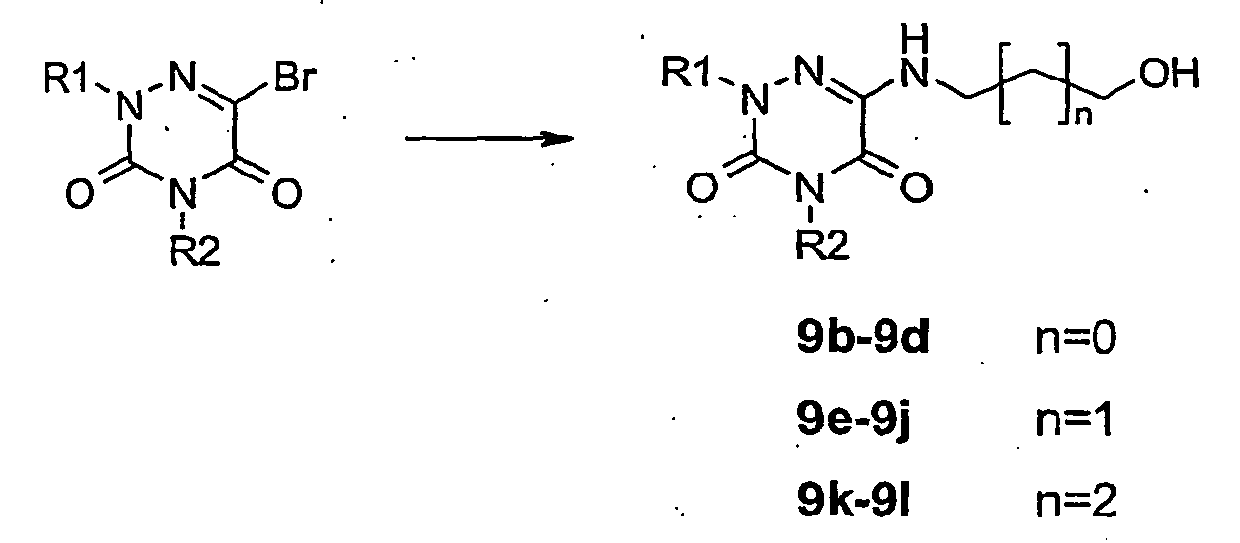
Tableau 8: intermédiaires 9b-9I Synthons de départ Amino alcool Rdt CCM Etat Intermédiaires 9b-9k 4b Ethanol-amine 77% CH2Cl2-AcOEt:60-40 Rf=0,28 solide 9b:2-Heptyl-6-(2-hydroxy-éthylamino)-4-méthyl-2H-[1,2,4]triazine-3,5-dione le Ethanol-amine 67% EP-AcOEt:70-30 Rf=0,56, huile 9c: 2,4-Diheptyl-6-(2-hydroxy éthylamino)-2H-[1,2,4] triazine-3,5-dione 1f Ethanol-amine 56% EP-AcOEt:80-20 Rf=0,18 huile 9d:2,4-Bis-(3-cyclohexyl-propyl)-6-(2-hydroxy-éthylamino)-2H-[1,2,4]triazine-3,5-dione 1b Amino-propanol 18% AcOEt Rf=0,42 huile 9e:6-(3-Hydroxy-propyl-amino)-2,4-diméthyl-2H-[1,2,4] triazine-3,5-dione 4a Amino-propanol 44% EP-AcOEt:70-30 Rf=0,13 solide 9f: 6-(3-Hydroxy-propylamino)-4-méthyl-2-(4,4,4-trifluoro-butyl)-2H-[1,2,4]triazine-3,5-dione 4b Amino-propanol 67% CH2Cl2-AcOEt:60-40 Rf=0,32 solide 9g: 2-Heptyl-6-(3-hydroxy-propylamino)-4-méthyl-2H-[1,2,4]triazine-3,5-dione 6a Amino-propanol 45% EP-AcOEt:80-20 Rf=0,05 solide 9h: 6-(3-Hydroxy-propyl-amino)-2-méthyl-4-(4,4,4-trifluoro-butyl)-2H-[1,2,4]triazine-3,5-dione 7a Amino-propanol 34% CH2Cl2-MeOH:90-10 Rf=0,47 solide 9i:4-Heptyl-6-(3-hydroxy-propylamino)-2-méthyl-2H-[1,2,4]triazine-3,5-dione 7b Amino-propanol 64% EP-AcOEt:70-30 Rf=0,30 solide 9j: 4-Heptyl-6-(3-hydroxy-propylamino)-2-(4,4;4-trifluoro-butyl)-2H-[1,2,4]triazine-3,5-dione 1b Amino-butanol 50% AcOEt Rf=0,35 solide 9k : 6-(4-Hydroxy-butyl-amino)-2,4-diméthyl-2H-. [1,2,4]triazine-3,5-dione 7a Amino-butanol 21% CH2Cl2-MeOH:90-10 Rf=0,45 solide 9I: 4-Heptyl-6-(4-hydroxy-butylamino)-2-méthyl-2H- [1,2,4]triazine-3,5-dione CCM : gel de silice 60 F 254 Merck, EP=éther de pétrole -

-

Tableau 9: intermédiaires 9n-9o Synthons de départ Rdt CCM Etat Intermédiaires 9n-9o 9e 59% heptane-AcOEt:50-50 Rf=0,16 huile 9n : 6-[Heptyl-(3-hydroxy-propyl)-amino]-2,4-diméthyl-2H-[1,2,4]triazine-3, 5-dione 9k 59% heptane-AcOEt:50-50 Rf=0,24 huile 9o: 6-[Heptyl-(4-hydroxy-butyl)-amino]- 2,4-diméthyl-2H-[1,2,4]triazine-3,5-dione CCM : gel de silice 60 F 254 Merck, EP=éther de pétrole -

-

Tableau 10: intermédiaires 9q-9s Synthons de départ diol Rdt CCM Etat Intermédiaires 9q-9s 4b 
78% AcOEt Rf=0,41 huile 9q: 2-Heptyl-6-(3-hydroxy-propoxy)-4-méthyl-2H-[1,2,4] triazine-3,5-dione 1d 
67% AcOEt Rf=0,44 huile 9r: 6-(3-Hydroxy-propoxy)-2,4-bis-(4,4,4-trifluoro-butyl)-2H-[1,2,4]triazine-3,5-dione 4b 
70% AcOEt Rf=0,31 huile 9s: 2-Heptyl-6-(4-hydroxy-butoxy)-4-méthyl-2H-[1,2,4]triazine-3,5-dione CCM : gel de silice 60 F 254 Merck -

- 11,3 g d'acide (3-hydroxy-phényl)-acétique (74,2 mmol) sont placés dans 100 ml de THF à 0°C sous azote. 100ml d'une solution de LiAIH4 (1M dans le THF) sont coulés goutte à goutte à cette température. Le mélange est ensuite placé à 60°C pendant 2h. Il est ensuite neutralisé lentement avec une solution HCl 6N puis extrait avec l'éther diéthylique. Les phases organiques sont lavées à l'eau, séchées sur MgSO4, puis concentrées à sec. Le résidu obtenu est purifié par chromatographie flash sur silice (CH2Cl2-AcOEt :70-30). 9g d'huile correspondant à l'intermédiaire 10a sont ainsi isolés (rendement 88%). CCM gel de silice 60 F 254 Merck, CH2Cl2-AcOEt :70-30, Rf=0,18.
-

- 15 g de résorcinol (136 mmol) sont additionnés à 120ml d'une solution de sodium (6,3g, 274mmol) dans l'éthanol. Le mélange est placé à reflux pendant 1h puis une solution de bromoisobutyrate d'éthyle (13,2ml, 90mmol) dans 30ml d'éthanol est coulée goutte à goutte. Le chauffage est maintenu pendant 3h puis le milieu réactionnel est concentré à sec. Le résidu obtenu est repris par une solution d'eau et d'acide acétique puis extrait avec l'AcOEt. Les phases organiques sont lavées à l'eau, séchées sur MgSO4, puis concentrées à sec. Le résidu obtenu est purifié par chromatographie flash sur silice (CH2Cl2-AcOEt :90-10): 14,4g d'huile correspondant à l'intermédiaire 10b sont ainsi isolés (rendement 72%). CCM gel de silice 60 F 254 Merck, CH2Cl2-AcOEt :70-30, Rf=0,66.
-

- 11g d'hydroquinone (100 mmol) dans 100ml de DMF sont placés à 80°C pendant 2h. Ce mélange est refroidi à température ambiante puis une solution de bromoisobutyrate d'éthyle (14,7ml, 100mmol) dans 30ml de DMF est coulée goutte à goutte. Le mélange est agité pendant 3h puis le milieu réactionnel est concentré à sec. Le résidu obtenu est repris par une solution d'HCl 1N puis extrait avec l'AcOEt. Les phases organiques sont lavées à l'eau, séchées sur MgSO4, puis concentrées à sec. Le résidu obtenu est purifié par chromatographie flash sur silice (éther de pétrole-AcOEt :80-20). 9g d'huile correspondant à l'intermédiaire 10c sont ainsi isolés (rendement 40%). CCM gel de silice 60 F 254 Merck, éther de pétrole-AcOEt :70-30, Rf=0,50.
-

- 25 g (144,5 mmol) de 3-bromophénol sont placés en présence de K2CO3 (21 g, 152 mmol) dans 75 ml de 2-bromoisobutyrate d'éthyle et chauffés à reflux pendant 7 h. Après élimination de K2CO3 par filtration, le milieu réactionnel est concentré à sec. Après purification par chromatographie flash sur silice (éther de pétrole-AcOEt :90-10), on recueille 37 g d'intermédiaire 10d sous forme d'huile claire (rendement=89%). CCM gel de silice 60 F 254 Merck, éther de pétrole-AcOEt: 90-10, Rf = 0,40.
-

Tableau 11: intermédiaires 10e-10j Phénols de départ Rdt CCM Etat Intermédiaires 10e-10j 
98% EP-AcOEt:90-10 Rf=0,52 huile 10e:2-(4-Bromo-phénoxy)-2-méthyl-propionate d'éthyle 
52% CH2Cl2-AcOEt:80-20 Rf=0,36 huile 10f:2-(4-Hydroxyméthyl-phénoxy)-2-méthyl-propionate d'éthyle 
19% CH2Cl2-AcOEt:90-10 Rf=0,50 huile 10g:2-[2-(2-Hydroxy-éthyl)-phénoxy]-2-méthyl-propionate d'éthyle 10a 9% CH2Cl2-AcOEt:70-30 Rf=0,68 huile 10h: 2-[3-(2-Hydroxy-éthyl)-phénoxy]-2-méthyl-propionate d'éthyle 
61 % CH2Cl2-AcOEt:90-10 Rf=0,21 huile 10j: 2-[4-(2-Hydroxy-éthyl)-phénoxy]-2-méthyl-propionate d'éthyle CCM : gel de silice 60 F 254 Merck, EP=éther de pétrole -

- 10 g (52,9 mmol) de 3-bromothiophénol sont placés en présence de 9,4 ml (63,5 mmol) de bromoisobutyrate d'éthyle et 8 g (57,9 mmol) de K2CO3 dans 100 ml d'EtOH. Ce mélange est agité à reflux pendant 4h puis concentré à sec. Le résidu est repris par l'eau et après extraction à l'AcOEt, puis séchage sur MgSO4, les phases organiques sont concentrées à sec. L'huile obtenue est purifiée par chromatographie flash sur silice (éther de pétrole-AcOEt :90-10) et 11a est isolé sous forme d'huile claire (16,8 g, rendement quantitatif). CCM gel de silice 60 F 254 Merck, éther de pétrole-AcOEt :90-10, Rf=0,72.
-

Tableau 12: intermédiaires 11b-11e Thiophénols de départ 
Rdt CCM Etat Intermédiaires 11b-11e 
bromoisobutyrate d'éthyle 87% EP-AcOEt:90-10 Rf=0,70 huile 11b 2-(4-Bromo-phénylsulfanyl)-2-méthyl-propionate d'éthyle 
bromoisobutyrate d'éthyle 74% Heptane-AcOEt: 80-20 Rf=0,50 huile 11c:2-(3-Hydroxy-phénylsulfanyl)-2-méthyl-propionate d'éthyle 
bromoisobutyrate d'éthyle 64% Heptane-AcOEt: 80-20 Rf=0,20 huile 11d:2-(4-Hydroxy-phénylsulfanyl)-2-méthyl-propionate d'éthyle 
bromoisobutyrate de tert-butyle 98% EP-AcOEt:90-10 Rf=0,70 solide 11e:2-(4-Bromo-phényl-sulfanyl)-2-méthyl-propionate de tert-butyle CCM : gel de silice 60 F 254 Merck, EP=éther de pétrole -

- 10d (50g, 175 mmol) est placé en présence de 2-propynol (12 ml, 210 mmol) dans 400 ml de diisopropylamine, sous azote. Pd(PPh3)2Cl2 (3,5 g) et Cul (500 mg) sont ajoutés et le milieu réactionnel est agité à reflux pendant 5 h. Le précipité formé en cours de réaction est filtré sur célite et le milieu réactionnel est concentré à sec. L'huile obtenue est purifiée par chromatographie flash sur silice (éther de pétrole-AcOEt :80-20). Elle est ensuite placée dans une solution de 250ml de THF et 150ml d'EtOH en présence de Pd/C sous 6bars d'hydrogène. Ce mélange est agité 24h à température ambiante. Après filtration sur célite, le milieu réactionnel est concentré à sec et 12a est isolé sous forme d'huile claire (32 g, rendement=69%). CCM gel de silice 60 F 254 Merck, heptane-AcOEt : 80-20, Rf=0,56.
-

Tableau 13: intermédiaires 12b-12e Synthons de départ alkynol Rdt CCM Etat Intermédiaires 12b-12d 10d 
76% Heptane-AcOEt: 60-40 Rf=0,37 huile 12b: 2-[3-(5-Hydroxy-pentyl)-phénoxy]-2-méthyl-propionate d'éthyle 10e 
5% Heptane-AcOEt: 60-40 Rf=0,33 huile 12c: 2-[4-(3-Hydroxy-propyl)-phénoxy]-2-méthyl-propionate d'éthyle 10e 
55% EP-AcOEt:80-20 Rf=0,14 huile 12d: 2-[4-(4-Hydroxy-butyl) -phénoxy]-2-méthyl-propionate d'éthyle 11a 
73% EP-AcOEt:70-30 Rf=0,26 huile 12e: 2-[3-(3-Hydroxy-propyl)-phénylsulfanyl]-2-méthyl-propionate d'éthyle CCM : gel de silice 60 F 254 Merck, EP=éther de pétrole. -

- 10,1g, (73,6 mmol) de tyramine sont placés en présence de bicarbonate de sodium (6,1 g, 72,6 mmol) dans un mélange de 100ml d'eau et 50ml d'acétone à 0°C. 11,6ml (81,2mmol) de chloroformiate de benzyle sont coulés goutte à goutte à cette température puis le milieu réactionnel est agité 4h à température ambiante. Après concentration à sec, le résidu obtenu est repris par l'eau puis extrait à l'AcOEt. Après séchage sur MgSO4, les phases organiques sont concentrées à sec et le solide obtenu est recristallisé dans l'éther diéthylique : 17,2g de solide sont ainsi obtenus (rendement 86%). Ils sont ensuite placés dans 37ml de bromoisobutyrate d'éthyle en présence de 8,8g (63,7mmol) de carbonate de potassium à 130°C pendant 5h. Après filtration, le milieu réactionnel est concentré à sec et le résidu obtenu est purifié par chromatographie flash sur silice (éther de pétrole-AcOEt :70-30). 22,7g d'huile claire sont obtenus (rendement=93%). Cette huile est ensuite placée dans 200ml d'EtOH en présence de palladium sur charbon sous 3bars d'hydrogène puis cette solution est agitée pendant 3h à température ambiante. Après filtration sur célite, le milieu réactionnel est concentré à sec et 14,7g d'intermédiaire 13a sont ainsi isolés sous forme d'huile (rendement quantitatif). CCM gel de silice 60 F 254 Merck, CH2Cl2-MeOH :90-10, Rf=0,11.
-

- 10d (14g, 49 mmol) est placé en présence de N-vinylphtalimide (11 g, 63 mmol) et de 27ml (194mmol) de triéthylamine dans 160 ml de DMF. Pd(OAc)2 (0,3 g) et P(oTol)3 (0,4g) sont ajoutés et le milieu réactionnel est agité à 110°C pendant 10 h. Le milieu réactionnel est concentré à sec et le résidu obtenu est repris par l'eau et extrait à l'AcOEt. Après séchage sur MgSO4, les phases organiques sont concentrées à sec et l'huile isolée est purifiée par chromatographie flash sur silice (heptane-AcOEt :90-10). 11,5g d'huile sont obtenus (rendement 62%) puis placés dans une solution de 70ml de THF et 70ml d'EtOH en présence de Pd/C sous 6bar d'hydrogène. Ce mélange est agité 72h à température ambiante. Après filtration sur célite, le milieu réactionnel est concentré à sec et le résidu obtenu est purifié par chromatographie flash sur silice (éther de pétrole-AcOEt :80-20). 10,9g d'huile claire sont obtenus (rendement=94%). Cette huile est ensuite placée dans 140ml d'EtOH en présence de 3,5ml d'hydrate d'hydrazine puis cette solution est chauffée à reflux pendant 4h. Après filtration des insolubles, le milieu réactionnel est concentré à sec puis le résidu obtenu est purifié par chromatographie flash sur silice (CH2Cl2-MeOH-NH4OH :90-9-1). 5,7g d'intermédiaire 13b sont ainsi isolés sous forme d'huile (rendement=80%). CCM gel de silice 60 F 254 Merck, CH2Cl2-MeOH-NH4OH :90-9-1, Rf=0,28.
-

Tableau 14: intermédiaires 13b:13i Synthons de départ Phtalimides N-substitués Rdt total CCM Forme Etat Intermédiaires 13c-13h 10d N-allylphtalimide 80% CH2Cl2-MeOH:90-10 Rf=0,12 huile 13c:2-[3-(3-Amino-propyl)-phénoxy]-2-méthyl-propionate d'éthyle 11a N-vinylphtalimide 66% CH2Cl2-MeOH-NH4OH : 90-9-1 Rf=0,20 huile 13d : 2-[3-(2-Amino-éthyl)-phénylsulfanyl]-2-méthyl-propionate d'éthyle 11a N-allylphtalimide 70% CH2Cl2-MeOH-NH4OH : 90-9-1 Rf=0,30 huile 13e:2-[3-(3-Amino-propyl)-phénylsulfanyl]-2-méthyl-propionate d'éthyle 11a N-but-3-enyl-phtalimide 38% CH2Cl2-MeOH-NH4OH :90-9-1 Rf=0,27 huile 13f : 2-[3-(4-Amino-butyl)-phénylsulfanyl]-2-méhyl-propionate d'éthyle 11b N-vinylphtalimide 41% CH2Cl2-MeOH-NH4OH :90-9-1 Rf=0,28 huile 13g:2-[4-(2-Amino-éthyl)-phénylsulfanyl]-2-méthyl-propionate d'éthyle 11b N-allylphtalimide 38% CH2Cl2-MeOH-NH4OH :90-9-1 Rf=0,23 huile 13h: 2-[4-(3-Amino-propyl)-phénylsulfanyl]-2-méthyl-propionate d'éthyle 11e N-vinylphtalimide 63% CH2Cl2-MeOH:90-10 Rf=0,18 huile 13i:2-[4-(2-Amino-éthyl)-phénylsulfanyl]-2-méthyl-propionate de tert-butyle CCM : gel de silice 60 F 254 Merck -

Tableau 15: intermédiaires 13j-13n Synthons de départ Phtalimides N-substitués Rdt CCM Etat Intermédiaires 13i-13n 
N-allylphtalimide 47% CH2Cl2-MeOH-NH4OH :80-18-2 Rf=0,25 solide 13j : 3-(3-Amino-propyl)-phénol 
N-but-3-ènylphtalimide 49% CH2Cl2-MeOH-NH4OH :80-18-2 Rf=0,24 huile 13k: 3-(4-Amino-butyl)-phénol 
N-allylphtalimide 59% CH2Cl2-MeOH-NH4OH :80-18-2 Rf=0,20 huile 13l: 3-(3-Méthoxy-phényl)-propylamine 
N-but-3-ènylphtalimide 77% CH2Cl2-MeOH-NH4OH :80-18-2 Rf=0,28 huile 13m : 4-(3-Méthoxy-phényl)-butylamine 
N-pent-4-ènyl-phtalimide 24% CH2Cl2-MeOH-NH4OH :90-9-1 Rf=0,45 huile 13n: 5-(3-Méthoxy-phényl)-pentylamine CCM : gel de silice 60 F 254 Merck -

- 13a (4,1g, 5mmol) est placé en présence d'acide heptanoique (2,3ml, 16,5mmol) dans 42ml de dichlorométhane. 2,3ml (16,5mmol) de triéthylamine sont additionnés suivis de 2,8ml (18,2mmol) de diéthylcyanophosphonate. Ce mélange est agité 24h à température ambiante puis le milieu réactionnel est concentré à sec. Le résidu obtenu est repris par H2O puis extrait à l'AcOEt. Après séchage sur MgSO4, les phases organiques sont concentrées à sec et l'huile isolée est purifiée par chromatographie flash sur silice (CH2Cl2-MeOH :90-10). 4,7g d'huile sont obtenus (rendement=78%). 13ml d'une solution BH3/THF (1M) sont placés à O°C sous azote puis l'huile précédemment obtenue, diluée dans 20ml de THF, est coulée goutte à goutte. Ce mélange est placé à reflux pendant 2h puis neutralisé par 10ml d'EtOH/HCl (1,5N). La solution est à nouveau placée à reflux pendant 1 h puis concentrée à sec. Le résidu obtenu est repris par une solution saturée de bicarbonate de sodium puis extrait au dichlorométhane. Après séchage sur MgSO4, les phases organiques sont concentrées à sec et l'huile isolée est purifiée par chromatographie flash sur silice (CH2Cl2-MeOH :90-10). 1,6g d'intermédiaire 14a sont ainsi isolés sous forme d'huile (rendement=73%). CCM gel de silice 60 F 254 Merck, CH2Cl2-MeOH-NH4OH :90-9-1, Rf=0,50.
-

Tableau 16: intermédiaires 14b-14c Acides carboxyliques Rdt total Eluant Forme Intermédiaires 14b-14c 
78% CH2Cl2-MeOH : 90-10 Rf=0,37 Huile 14b: 2-Méthyl-2-[4-(2-phénéthylamino-éthyl)-phénoxy]-propionate d'éthyle 
65% CH2Cl2-MeOH : 90-10 Rf=0,44 Huile 14c: 2-Méthyl-2-{4-[2-(3-phényl-propylamino)-éthyl]-phénoxy}-propionate d'éthyle CCM : gel de silice 60 F 254 Merck -

CCM gel de silice 60 F 254 Merck, CH2Cl2-AcOEt :95-5, Rf=0,40. F=76°C
RMN 1H (CDCl3) : 0,94ppm (t, 3H, J=7,4Hz), 1,20ppm (t, 3H, J=7,2Hz), 1,39ppm (m, 2H, J=7,5ppm), 1,63ppm (m, 8H), 3,16ppm (t, 2H, J=7,6Hz), 3,50ppm (s, 3H), 3,95ppm (t, 2H, J=7,6Hz), 4,22ppm (q, 2H, J=7,0Hz), 4,37ppm (t, 2H, J=7,6Hz), 7,00ppm (m, 4H). -

CCM gel de silice 60 F 254 Merck, CH2Cl2-AcOEt :90-10, Rf=0,62. -

CCM gel de silice 60 F 254 Merck, CH2Cl2-AcOEt :90-10, Rf=0,57. -

CCM gel de silice 60 F 254 Merck, éther de pétrole-AcOEt :70-30, Rf=0,30. -

CCM gel de silice 60 F 254 Merck, éther de pétrole-AcOEt :70-30, Rf=0,52. -

CCM gel de silice 60 F 254 Merck, éther de pétrole-AcOEt :70-30, Rf=0,46. -

CCM gel de silice 60 F 254 Merck, éther de pétrole-AcOEt :70-30, Rf=0,61. -

CCM gel de silice 60 F 254 Merck, éther de pétrole-AcOEt :70-30, Rf=0,53. -

CCM gel de silice 60 F 254 Merck, éther de pétrole-AcOEt :80-20, Rf=0,34. -

CCM gel de silice 60 F 254 Merck, éther de pétrole-AcOEt :70-30, Rf=0,54. -

CCM gel de silice 60 F 254 Merck, éther de pétrole-AcOEt :80-20, Rf=0,29. -
CCM gel de silice 60 F 254 Merck, CH2Cl2-MeOH:90-10, Rf=0,43. -

CCM gel de silice 60 F 254 Merck, éther de pétrole-AcOEt :80-20, Rf=0,63. -

CCM gel de silice 60 F 254 Merck, éther de pétrole-AcOEt :80-20, Rf=0,35. -
CCM gel de silice 60 F 254 Merck, éther de pétrole-AcOEt :80-20, Rf=0,53. -

CCM gel de silice 60 F 254 Merck, éther de pétrole-AcOEt :80-20, Rf=0,33. -

CCM gel de silice 60 F 254 Merck, éther de pétrole-AcOEt :80-20, Rf=0,36. -
- CCM gel de silice 60 F 254 Merck, heptane-AcOEt :70-30, Rf=0,35.
-

CCM gel de silice 60 F 254 Merck, éther de pétrole-AcOEt :80-20, Rf=0,51. -

CCM gel de silice 60 F 254 Merck, éther de pétrole-AcOEt :80-20, Rf=0,28. -

CCM gel de silice 60 F 254 Merck, éther de pétrole-AcOEt :60-40, Rf=0,46. -

CCM gel de silice 60 F 254 Merck, éther de pétrole-AcOEt :80-20, Rf=0,34. -

CCM gel de silice 60 F 254 Merck, éther de pétrole-AcOEt :90-10, Rf=0,61. -

CCM gel de silice 60 F 254 Merck, CH2Cl2-AcOEt :90-10, Rf=0,45. -

CCM gel de silice 60 F 254 Merck, éther de pétrole-ACOEt :80-20, Rf=0,45. -

CCM gel de silice 60 F 254 Merck, éther de pétrole-AcOEt :70-30, Rf=0,46. -

CCM gel de silice 60 F 254 Merck, éther de pétrole-AcOEt :70-30, Rf=0,33. -

CCM gel de silice 60 F 254 Merck, éther de pétrole-AcOEt :70-30, Rf=0,31. -

CCM gel de silice 60 F 254 Merck, éther de pétrole-AcOEt :70-30, Rf=0,49. -

CCM gel de silice 60 F 254 Merck, éther de pétrole-AcOEt :70-30, Rf=0,35. -

CCM gel de silice 60 F 254 Merck, éther de pétrole-AcOEt :80-20, Rf=0,51. -

CCM gel de silice 60 F 254 Merck, éther de pétrole-AcOEt :80-20, Rf=0,37. -

CCM gel de silice 60 F 254 Merck, heptane-AcOEt :50-50, Rf=0,30. -

CCM gel de silice 60 F 254 Merck, heptane-AcOEt :50-50, Rf=0,33. -

CCM gel de silice 60 F 254 Merck, heptane-AcOEt :50-50, Rf=0,50. -

CCM gel de silice 60 F 254 Merck, heptane-AcOEt :50-50, Rf=0,34. -
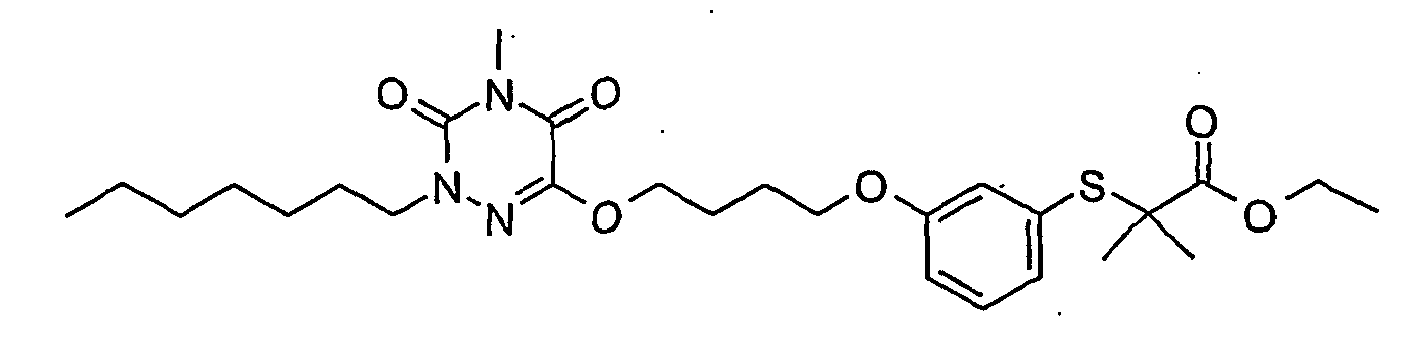
CCM gel de silice 60 F 254 Merck, heptane-AcOEt :50-50, Rf=0,37. -

CCM gel de silice 60 F 254 Merck, heptane-AcOEt :50-50, Rf=0,33. -

CCM gel de silice 60 F 254 Merck, heptane-AcOEt :50-50, Rf=0,50. -

CCM gel de silice 60 F 254 Merck, éther de pétrole-AcOEt :80-20, Rf=0,29. -

CCM gel de silice 60 F 254 Merck, éther de pétrole-AcOEt :80-20, Rf=0,50. -
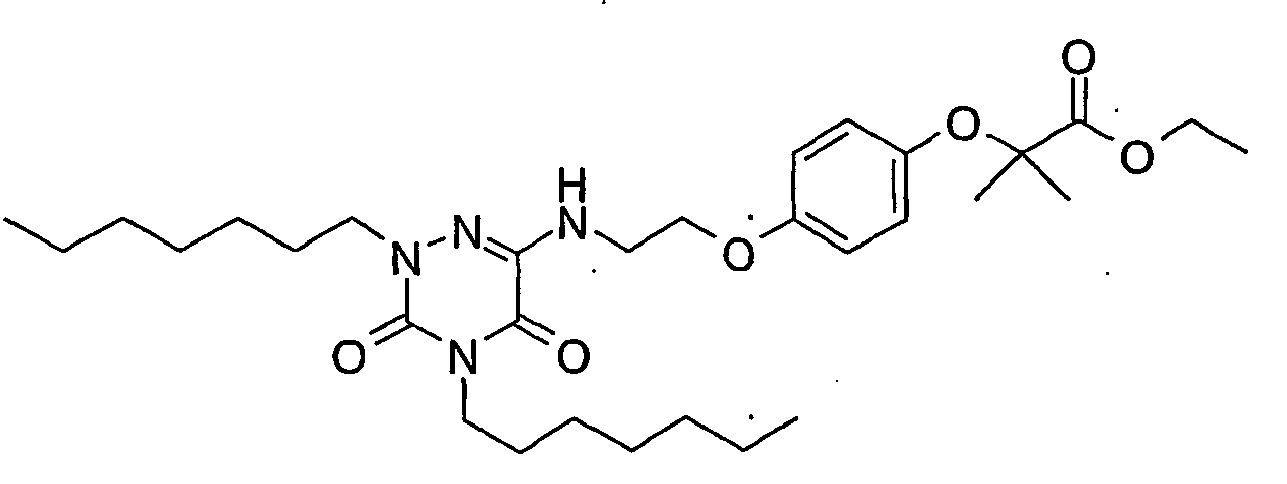
CCM gel de silice 60 F 254 Merck, éther de pétrole-AcOEt :80-20, Rf=0,85. -
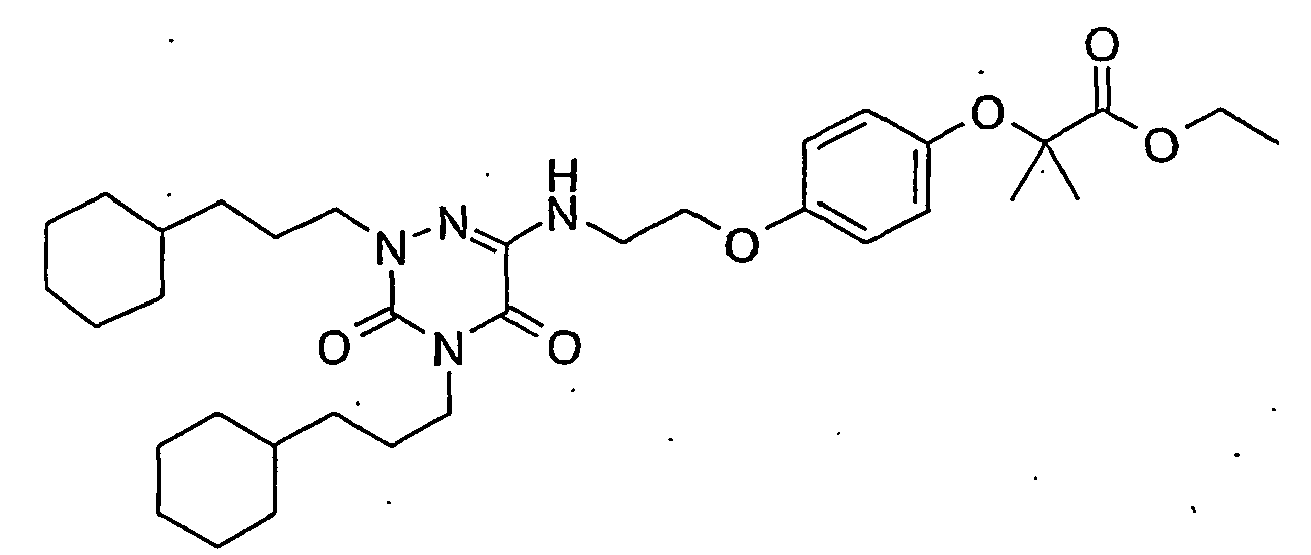
CCM gel de silice 60 F 254 Merck, heptane-AcOEt :80-20, Rf=0,85. -

CCM gel de silice 60 F 254 Merck, éther de pétrole-AcOEt :70-30, Rf=0,36. -

CCM gel de silice 60 F 254 Merck, éther de pétrole-AcOEt :70-30, Rf=0,48. -

CCM gel de silice 60 F 254 Merck, éther de pétrole-AcOEt :70-30, Rf=0,37. F=116°C -

CCM gel de silice 60 F 254 Merck, éther de pétrole-AcOEt :80-20, Rf=0,30. -

CCM gel de silice 60 F 254 Merck, éther de pétrole-AcOEt :80-20, Rf=0,50. -
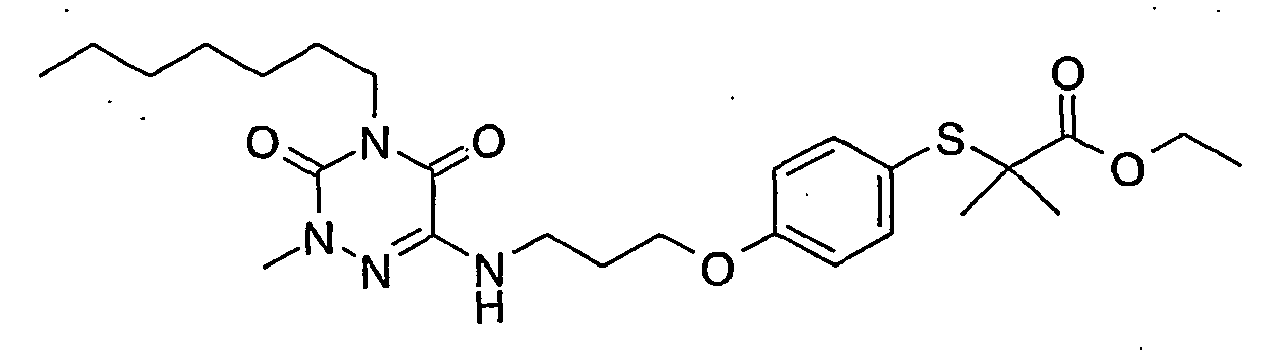
CCM gel de silice 60 F 254 Merck, éther de pétrole-AcOEt :80-20, Rf=0,46. -

CCM gel de silice 60 F 254 Merck, éther de pétrole-AcOEt :80-20, Rf=0,50. -

-

CCM gel de silice 60 F 254 Merck, heptane-AcOEt :70-30, Rf=0,22. -

CCM gel de silice 60 F 254 Merck, heptane-AcOEt :80-20, Rf=0,45. -

CCM gel de silice 60 F 254 Merck, heptane-AcOEt :70-30, Rf=0,25. -

- On isole 1,9g de phénol correspondant (rendement=65%) qui est ensuite placé dans 2ml de DMF en présence de 1,9ml (12,5mmol) de bromoisobutyrate d'éthyle et 0,6g (4,3mmol) de K2CO3. Le milieu réactionnel est chauffé à 130°C pendant 22h puis filtré et concentré à sec. L'huile obtenue est purifiée par chromatographie flash sur silice (CH2Cl2-AcOEt :98-2). 0,8g de composé 55 (rendement=34%) sous forme d'huile est isolé.
CCM gel de silice 60 F 254 Merck, CH2Cl2-AcOEt :95-5, Rf=0,66. -

CCM gel de silice 60 F 254 Merck, éther de pétrole-AcOEt :80-20, Rf=0,19. -

CCM gel de silice 60 F 254 Merck, éther de pétrole-AcOEt : 70-30, Rf=0,44. -

CCM gel de silice 60 F 254 Merck, éther de pétrole-AcOEt :80-20, Rf=0,33. -

CCM gel de silice 60 F 254 Merck, éther de pétrole-AcOEt :80-20, Rf=0,50. -

CCM gel de silice 60 F 254 Merck, éther de pétrole-AcOEt :90-10, Rf=0,22. -

CCM gel de silice 60 F 254 Merck, éther de pétrole-AcOEt :70-30, Rf=0,61. -

CCM gel de silice 60 F 254 Merck, CH2Cl2-AcOEt :90-10, Rf=0,60. -

CCM gel de silice 60 F 254 Merck, éther de pétrole-AcOEt :80-20, Rf=0,44. -

CCM gel de silice 60 F 254 Merck, éther de pétrole-AcOEt :80-20, Rf=0,20. -

CCM gel de silice 60 F 254 Merck, CH2Cl2-AcOEt :90-10, Rf=0,78. -

CCM gel de silice 60 F 254 Merck, éther de pétrole-AcOEt :70-30, Rf=0,49. -

CCM gel de silice 60 F 254 Merck, éther de pétrole-AcOEt :80-20, Rf=0,50. -

CCM gel de silice 60 F 254 Merck, éther de pétrole-AcOEt :80-20, Rf=0,63. -

CCM gel de silice 60 F 254 Merck, éther de pétrole-AcOEt :80-20, Rf=0,53. -

CCM gel de silice 60 F 254 Merck, éther de pétrole-AcOEt :80-20, Rf=0,47. -
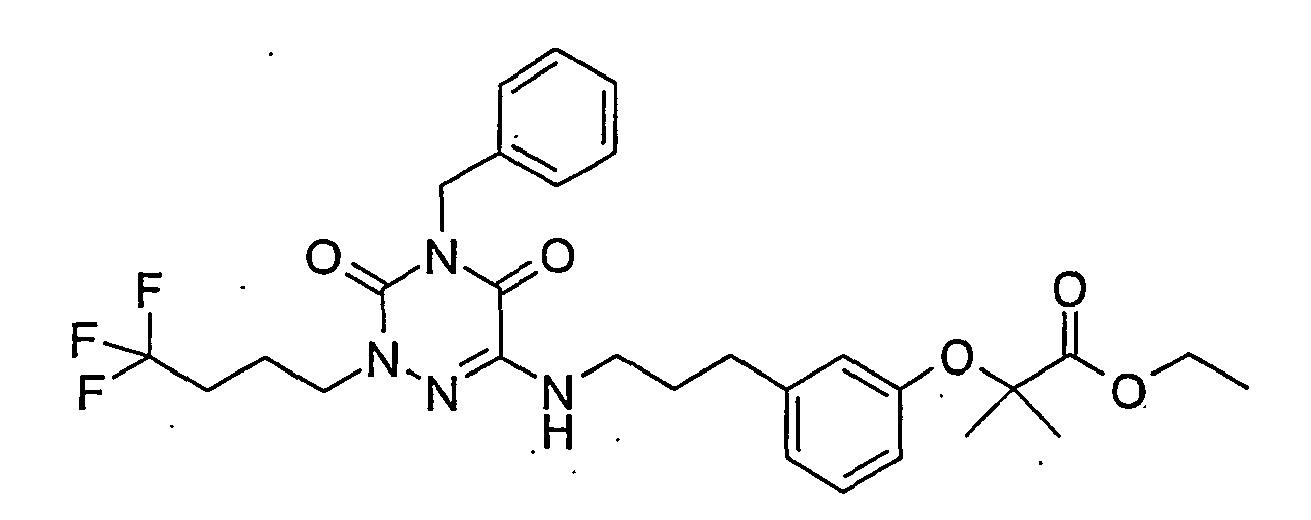
CCM gel de silice 60 F 254 Merck, éther de pétrole-AcOEt :80-20, Rf=0,30. -

CCM gel de silice 60 F 254 Merck, éther de pétrole-AcOEt :80-20, Rf=0,42. -

CCM gel de silice 60 F 254 Merck, éther de pétrole-AcOEt :80-20, Rf=0,58. -

CCM gel de silice 60 F 254 Merck, éther de pétrole-AcOEt :80-20, Rf=0,21. -

CCM gel de silice 60 F 254 Merck, éther de pétrole-AcOEt :80-20, Rf=0,44. -

CCM gel de silice 60 F 254 Merck, éther de pétrole-AcOEt :80-20, Rf=0,50. -

CCM gel de silice 60 F 254 Merck, éther de pétrole-AcOEt :80-20, Rf=0,35. -

CCM gel de silice 60 F 254 Merck, heptane-AcOEt :60-40, Rf=0,35. -

CCM gel de silice 60 F 254 Merck, CH2Cl2-MeOH:90-10, Rf=0,73. F=116°C. -

CCM gel de silice 60 F 254 Merck, éther de pétrole-AcOEt :80-20, Rf=0,32. -

CCM gel de silice 60 F 254 Merck, éther de pétrole-AcOEt :70-30, Rf=0,20. -

CCM gel de silice 60 F 254 Merck, éther de pétrole-AcOEt :80-20, Rf=0,37.. -

CCM gel de silice 60 F 254 Merck, heptane-AcOEt :60-40, Rf=0,43. -

CCM gel de silice 60 F 254 Merck, CH2Cl2-MeOH:95-5, Rf=0,39. -

CCM gel de silice 60 F 254 Merck, éther de pétrole-AcOEt :80-20, Rf=0,75. -
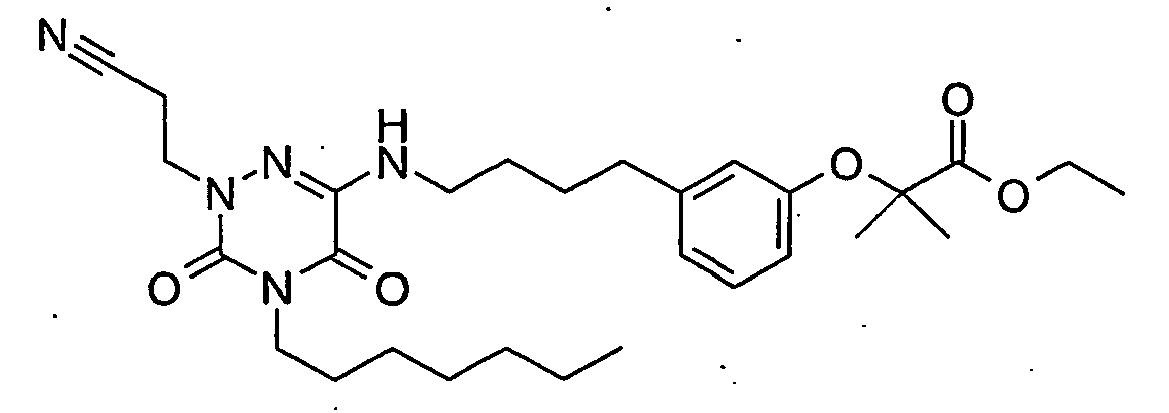
CCM gel de silice 60 F 254 Merck, éther de pétrole-AcOEt :70-30, Rf=0,51. -

CCM gel de silice 60 F 254 Merck, éther de pétrole-AcOEt :80-20, Rf=0,33. -

CCM gel de silice 60 F 254 Merck, éther de pétrole-AcOEt :80-20, Rf=0,53. -

CCM gel de silice 60 F 254 Merck, éther de pétrole-AcOEt :80-20, Rf=0,37. F=58°C. -
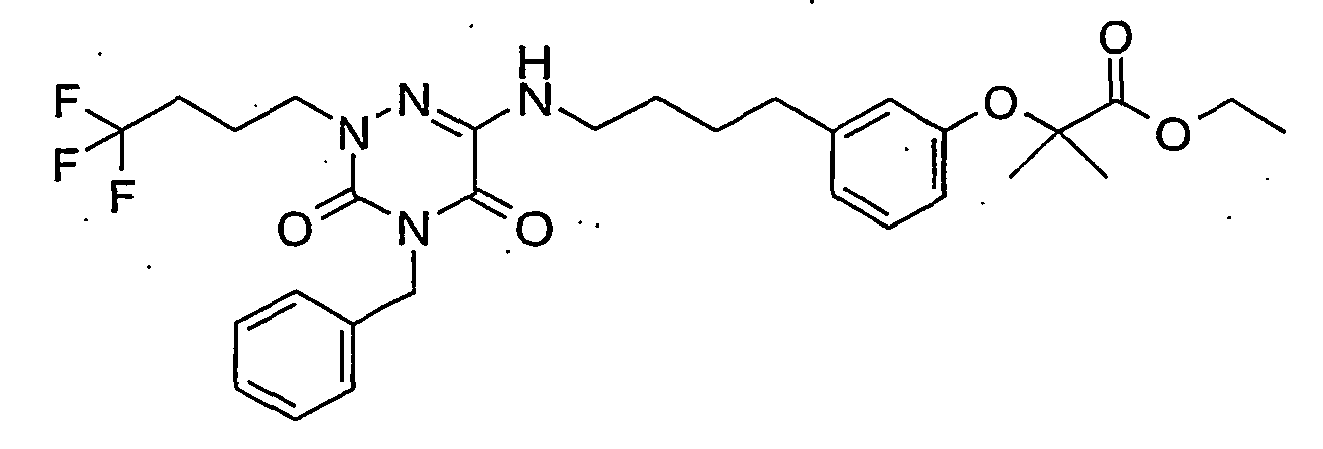
CCM gel de silice 60 F 254 Merck, éther de pétrole-AcOEt :80-20, Rf=0,46. -

CCM gel de silice 60 F 254 Merck, éther de pétrole-AcOEt :80-20, Rf=0,60. -

CCM gel de silice 60 F 254 Merck, éther de pétrole-AcOEt :80-20, Rf=0,45. -

CCM gel de silice 60 F 254 Merck, éther de pétrole-AcOEt :80-20, Rf=0,45. -

CCM gel de silice 60 F 254 Merck, éther de pétrole-AcOEt :80-20, Rf=0,26. -

CCM gel de silice 60 F 254 Merck, éther de pétrole-AcOEt :80-20, Rf=0,34. -

CCM gel de silice 60 F 254 Merck, CH2Cl2-AcOEt :80-20, Rf=0,24. F=106°C -

CCM gel de silice 60 F 254 Merck, éther de pétrole-AcOEt :80-20, Rf=0,74. -

CCM gel de silice 60 F 254 Merck, éther de pétrole-AcOEt :80-20, Rf=0,53. -

CCM gel de silice 60 F 254 Merck, éther de pétrole-AcOEt :80-20, Rf=0,43. -

CCM gel de silice 60 F 254 Merck, éther de pétrole-AcOEt :80-20, Rf=0,27. -

CCM gel de silice 60 F 254 Merck, éther de pétrole-AcOEt :80-20, Rf=0,39. -

CCM gel de silice 60 F 254 Merck, éther de pétrole-AcOEt :80-20, Rf=0,22. -

CCM gel de silice 60 F 254 Merck, CH2Cl2-ACOEt :90-10, Rf=0,54. -

CCM gel de silice 60 F 254 Merck, éther de pétrole-AcOEt :80-20, Rf=0,34. -
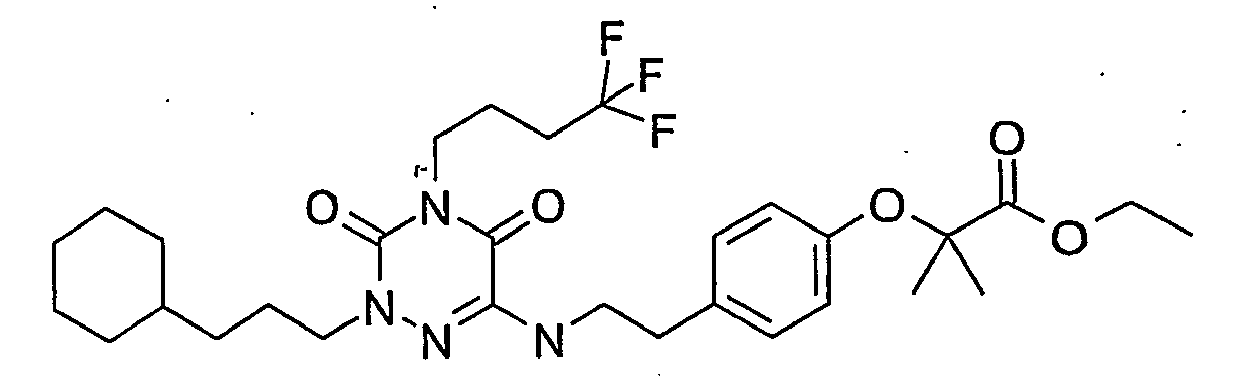
CCM gel de silice 60 F 254 Merck, éther de pétrole-AcOEt :80-20, Rf=0,44. -

CCM gel de silice 60 F 254 Merck, éther de pétrole-AcOEt :70-30, Rf=0,60. F=54°C.. -

CCM gel de silice 60 F 254 Merck, éther de pétrole-AcOEt :80-20, Rf=0,47. F=63°C. -

CCM gel de silice 60 F 254 Merck, éther de pétrole-AcOEt :80-20, Rf=0,57. -

CCM gel de silice 60 F 254 Merck, éther de pétrole-AcOEt :80-20, Rf=0,60. F=65°C. -

CCM gel de silice 60 F 254 Merck, éther de pétrole-AcOEt :80-20, Rf=O,34. -

CCM gel de silice 60 F 254 Merck, CH2Cl2-AcOEt :90-10, Rf=0,65. -

CCM gel de silice 60 F 254 Merck, CH2Cl2-AcOEt :70-30, Rf=0,70. -

CCM gel de silice 60 F 254 Merck, CH2Cl2-MeOH:90-10, Rf=0,43. -

CCM gel de silice 60 F 254 Merck, CH2Cl2-AcOEt :90-10, Rf=0,74. -

CCM gel de silice 60 F 254 Merck, CH2Cl2-ACOEt :90-10, Rf=0,63. -

CCM gel de silice 60 F 254 Merck, CH2Cl2, Rf=0,52. -

CCM gel de silice 60 F 254 Merck, CH2Cl2, Rf=0,46. -

CCM gel de silice 60 F 254 Merck, AcOEt, Rf=0,42. F=128°C. -

CCM gel de silice 60 F 254 Merck, éther de pétrole-AcOEt :80-20, Rf=0,60. -

CCM gel de silice 60 F 254 Merck, CH2Cl2-MeOH :90-10, Rf=0,34. F=70°C. -

CCM gel de silice 60 F 254 Merck, CH2Cl2-MeOH :98-2, Rf=0,46. -

CCM gel de silice 60 F 254 Merck, éther de pétrole-AcOEt :80-20, Rf=0,67. F=49°C. -

CCM gel de silice 60 F 254 Merck, éther de pétrole-AcOEt :80-20, Rf=0,19. F=86°C. -
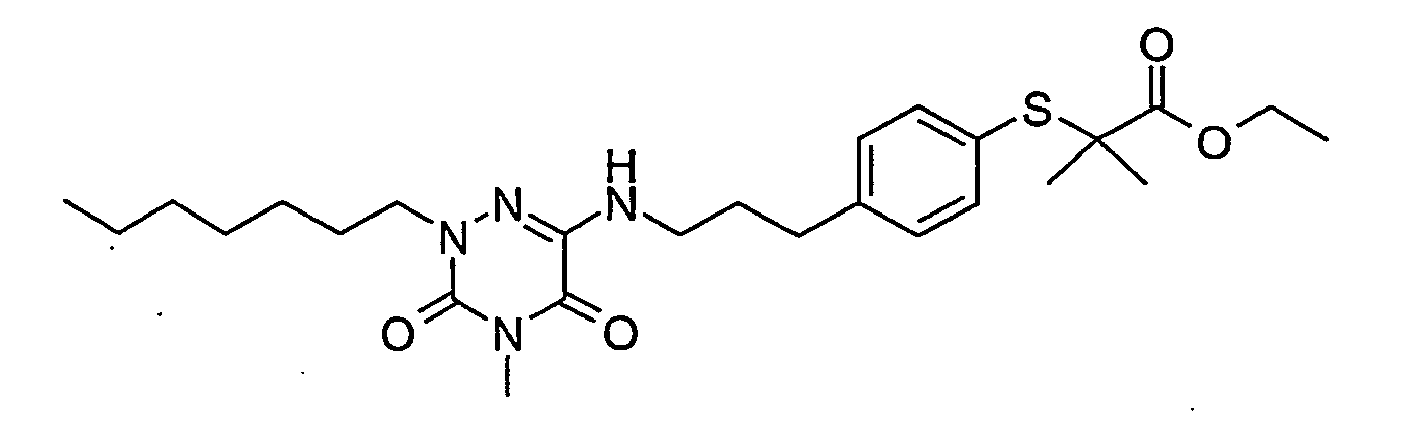
CCM gel de silice 60 F 254 Merck, éther de pétrole-AcOEt :80-20, Rf=0,20. - Activation de la transcription (transactivation) du gène rapporteur contrôlé par des éléments de réponse spécifiques après liaison du ligand au récepteur (reporter gene assay)..
- Ces expériences sont réalisées selon J.M. Lehmann et al. (J. Biol. Chem 1995; 270 :12953-12956) avec quelques modifications. Des cellules Cos-7 (ATCC, CRL-1651) sub-confluentes sont transfectées avec (i) les récepteurs chimériques contenant le domaine de liaison au ligand de PPARα ou PPARγ ou PPARδ humain fusionné au domaine de liaison à l'ADN de la galactosidase de levure (Gal-4) d'une part, (ii) le plasmide rapporteur contenant cinq copies de l'élément de réponse de Gal-4 en amont du promoteur de la thymidine kinase adjacent au gène de la luciférase (p5xUAS-tk-Luc) d'autre part. Après 24 heures, ces cellules sont traitées pendant les 24 heures suivantes par les composés ou leur véhicule et l'activité luciférase est évaluée après extraction cellulaire selon les recommandations du fournisseur (Promega).
- Les résultats ont été reportés dans le tableau 17 ci-après, dans lequel la mention "hit" désigne un composé dont le niveau de transactivation est significatif sans pour autant permettre de définir une EC50, la mention"nd" signifie que la mesure n'a pas été réalisée.
Tableau 17 : transactivation de gène rapporteur avec les différents sous-types de PPAR d'origine humaine Exemples hPPAR - GAL4 alpha EC50 (µM) hPPAR - GAL4 gamma EC50 (µM) hPPAR - GAL4 delta EC50 (µM) Acide fenofibrique 16,9 65,2 >100 Rosiglitazone 0 1,12 0 Pioglitazone > 10 4,77 0 1 3-10 0 0 2 >10 ~10 0 3 -3 0 0 4 >10 0 0 5 -3 ~10 0 6 ~0,3 0 0 7 0,3-1 1-3 0 8 ~0,3 3-10. 0 9 3-10 ~10 0 10 0,3-1 ~1 0 11 0,3-1 1-3 0 12 ~0,03 1-3 hit 13 0,01-0,03 0,1-0, 3 ~3 14 0,01-0,03 ~1 -10 15 0,001-0,003 0,1-0,3 hit 16 -0,1 3-10 0 17 0,3-1 -0,3 0 18 0,03-0,1 ~1 0 19 ~3 3-10 0 20 hit hit 0 21 3-10 0 0 22 10 hit 0 23 1 hit 0 24 >10 0 0 25 hit >10 hit 26 >10 0 0 27 -3 3-10 3-10 28 ~10 hit 0 29 3-10 3-10 3-10 30 0,03-0,1 >10 hit 31 ~0,1 ~-1 3-10 32 1-3 hit 0 33 -3 -3 0 34 >10 >10 0 35 0,03-0,1 3-10 ~10 36 0,3-1 3-10 hit 37 >10 ~10 0 38 >10 >10 0 39 0,1-0,3 3-10 ~3 40 3-10 -10 >10 41 ~0,1 ~10 1-3 42 ~1 >10 1-3 43 ~3 hit 0 44 >10 3-10 0 45 1-3 -3 hit 46 0,3-1 0 0 47 ~0,3 ~0,3 hit 48 0,3-1 0,3-1 ~3 49 >10 >10 0 50 >10 -10 0 51 3-10 >10 0 52 hit 0 0 53 1-3 0 0 54 >10 0 0 55 >10 0 0 56 hit hit 0 57 ~3 1-3 hit 58 >10 0 0 59 1-3 nd 0 60 >10 hit 0 61 ~3 nd 0 62 >10 0 0 63 0 hit 0 64 >10 3-10 hit 65 0,1-0,3 >10 0 66 0,03-0,1 >10 -10 67 ~1 nd 0 68 0,1-0,3 3-10 0 69 . 1-3 -10 0 70 ~1 ~10 0 71 ~1 hit 0 72 3-10 3-10 0 73 0,1-0,3 nd 0 74 ~ 1 3-10 0 75 3-10 3-10 0 76 0,01-0,03 1-3 3-10 77. ~0,3 3-10 0 78 >10 0 0 79 ~0,03 3-10 0 80 0,01-0,03 0,3-1 >10 81 0,3-1 >10 0 82 -0,01 0,1-0,3 hit 83 >10 0 0 84 0,003-0,01 ~0,3 1-3 85 ~0,03 1-3 hit 86 >10 ~1 hit 87 ~0,3 0,1-0,3 hit 88 ~0,3 ~10 0 89 >10 1-3 3-10 90 ~0,1 ~10 0 91 0,3-1 3-10 0 92 0,003-0,01 3-10 0 93 >10 hit 0 94 3-10 3-10 0 95 1-3 >10 0 96 0,03-0,1 -10 >10 97 1-3 hit 0 98 >10 0 0 99 >10 3-10 0 100 1-3 >10 0 101 1-3 0 0 102 >10 hit 0 104 1-3 > 10 0 105 1-3 ~10 0 106 ~1 nd >10 107 ~1 hit 0 108 >10 hit 0 109 ~1 nd 3-10 110 1-3 hit >10 111 0 hit 0 112 1-3 ~10 1-3 113 0,3-1 3-10 0,3-1 114 ~10 nd 0 115 ~3 nd >10 116 ~10 nd 0 117 ~10 nd 0 118 1-3 ~10 0 119 0,3 0,3 hit 120 0,3-1 1-3 hit 121 0,03-0,1 1-3 hit 122 ~0,3 nd >10 123 0,1-0,3 ~10 0 124 0,3-1 >10 0 - Normalisation des paramètres métaboliques (cholestérol, triglycérides plasmatiques) chez le rat mâle insulino-résistant (Ico : ZUCKER - fa/fa) à jeun (depuis 16-18 heures) après traitement par voie orale, une fois par jour pendant quatre jours, avec les composés à évaluer ou leur véhicule d'administration.
- Ces paramètres métaboliques sont mesurés par spectrophotométrie en début et en fin de traitement sur chaque animal.
Tableau 18 : Normalisation des paramètres métaboliques Exemples Plasma triglycérides Plasma cholestérol 11 inactif à 2,5 mg/kg
-37% à 10 mg/kg-25% à 2,5 mg/kg
-25% à 10 mg/kg13 inactif à 2,5 mg/kg
-28% à 10 mg/kg-8% à 2,5 mg/kg
-12% à 10 mg/kg15 -22% à 2,5 mg/kg
-63% à 10 mg/kg-4% à 2,5 mg/kg
-8% à 10 mg/kg16 inactif à 2,5 mg/kg
-15% à 10 mg/kg-14% à 2,5 mg/kg
-25% à 10 mg/kg17 -37% à 10 mg/kg actif à 10 mg/kg 41 inactif à 10 mg/kg -28% à 10 mg/kg 45 inactif à 10 mg/kg -16% à 10 mg/kg 46 -32% à 10 mg/kg -13% à 10 mg/kg 47 -45% à 10 mg/kg -25% à 10 mg/kg 53 inactif à 10 mg/kg -7% à 2,5 mg/kg
-28% à 10 mg/kg59 -13% à 2,5 mg/kg -37% à 2,5 mg/kg 65 inactif à 2,5 mg/kg
-13% à 10 mg/kg-13% à 2,5 mg/kg
-23% à 10 mg/kg66 inactif à 10 mg/kg -9% à 10 mg/kg 67 -23% à 10 mg/kg -14% à 10 mg/kg 68 actif à 10 mg/kg -21 % à 10 mg/kg 72 inactif à 10 mg/kg -21 % à 10 mg/kg 73 inactif à 10 mg/kg -14% à 10 mg/kg 74 inactif à 2,5 mg/kg
-26% à 10 mg/kg-18% à 2,5 mg/kg
-29% à 10 mg/kg75 actif à 10 mg/kg -19% à 2,5 mg/kg
-13% à 10 mg/kg76 -7% à 10 mg/kg -16% à 2,5 mg/kg
-22% à 10 mg/kg77 actif à 10 mg/kg -29% à 2,5 mg/kg
-35% à 10 mg/kg79 -55% à 2,5 mg/kg -32% à 2,5 mg/kg 80 inactif à 10 mg/kg -16% à 10 mg/kg 81 -17% à 10 mg/kg -12% à 10 mg/kg 82 actif à 10 mg/kg -13% à 10 mg/kg 84 inactif à 2,5 mg/kg
-7% à 10 mg/kginactif à 2,5 mg/kg
-13% à 10 mg/kg85 actif à 10 mg/kg -21 % à 10 mg/kg 92 inactif à 10 mg/kg -18% à 10 mg/kg 95 inactif à 10 mg/kg -18% à 2,5 mg/kg
-40% à 10 mg/kg96 -26% à 2,5 mg/kg
-60% à 10 mg/kg-28% à 2,5 mg/kg
-21 % à 10 mg/kg112 -31 % à 10 mg/kg -43% à 10 mg/kg 113 inactif à 2,5 mg/kg
-26% à 10 mg/kg-30% à 2,5 mg/kg
-40% à 10 mg/kg119 actif à 2,5 mg/kg
-29% à 10 mg/kg-21 % à 2,5 mg/kg
-32% à 10 mg/kg120 -27% à 2,5 mg/kg
-73% à 10 mg/kg-32% à 2,5 mg/kg
-33 % à 10 mg/kg121 -24% at 2.5 mg/kg -7% at 2.5 mg/kg 122 -35% à 10 mg/kg -22% à 10 mg/kg 123 -6% à 2,5 mg/kg
-20% à 10 mg/kg-8% à 2,5 mg/kg
-14% à 10 mg/kg - Ainsi, la présente invention concerne, à titre de médicaments nouveaux utilisables dans le traitement des maladies nécessitant des agonistes des récepteurs PPAR alpha et/ou PPAR gamma, les composés de formule I précédemment définis. Ces composés sont utiles dans la prévention et le traitement des maladies telles que les dyslipidémies diabétiques, l'hypertriglycéridémie, l'hypercholestérolémie, l'hyper-insulinémie, l'hyperglycémie, le syndrome métabolique, l'obésité, l'athérosclérose, ou encore en dermatologie, dans des pathologies à composante inflammatoire ou résultant d'une différentiation cellulaire anormale, ainsi que dans le traitement des maladies telles que le psoriasis, l'acné, les dermatites atopiques, le vieillissement cutané, le photovieillissement.
- Enfin, l'invention concerne des compositions pharmaceutiques contenant à titre de principe actif au moins un composé de formule I précédemment définis, de préférence en association avec tout excipient approprié.
Claims (16)
- Dérivés de la 3,5-dioxo-(2H,4H)-1,2,4-triazine de formule générale I
 - R1 et R2 peuvent être identiques ou différents et représentent un radical alkyle ou alkènyle linéaire ou branché en C1-C7, un radical alkyle en C1-C6 substitué par des groupements tels que, trifluorométhyle, cycloalkyle en C5-C6, nitrile, alkoxycarbonylvinyle en C1-C4, hydroxycarbonylvinyle, alkoxycarbonyle en C1-C4, carboxylate, benzyloxy ou phényle (pour lesquels le noyau phényle est éventuellement substitué par un ou plusieurs groupements tels que alcoyle en C1-C4, alkoxy en C1-C4, nitro, halogène, trifluorométhyle).- YR3 représente l'oxygène ou NR3 pour lequel R3 représente l'hydrogène, un radical alcoyle ou alkènyle linéaire ou branché en C1-C7, un radical alkyle en C1-C6 substitué par des groupements tels que, trifluorométhyle ou phényle (pour lesquels le noyau phényle est éventuellement substitué par un ou plusieurs groupements tels que alcoyle en C1-C4, alkoxy en C1-C4, nitro, halogène, trifluorométhyle)- Z représente un atome d'oxygène ou un atome de carbone pouvant être lié aux positions ortho, méta ou para du groupement phényle de la formule I- n peut-être égal à 0 à 5 lorsque Z=C ou 2 à 4 lorsque Z=O,- X représente l'oxygène ou le soufre- R4, R5, R6, R7 et R8 représentent l'hydrogène ou le fluor,- R9, R10 et R11 représentent l'hydrogène ou un groupement alkyle en C1-C5 linéaire ou branchéainsi que les sels d'addition avec les bases pharmaceutiquement acceptables, et les différents énantiomères des composés possédant des carbones asymétriques, ainsi que leurs mélanges en toutes proportions incluant notamment les mélanges racémiques.
 - Dérivés de la 3,5-dioxo-(2H,4H)-1,2,4-triazine de formule générale I selon la revendication 1 dans laquelle :- R1 et R2 représentent indépendamment, l'un de l'autre, un radical alkyle ou alkènyle linéaire ou branché en C1-C7, un radical alkyle en C1-C6 substitué par des groupements tels que, trifluorométhyle, cycloalkyle en C6, nitrile, phényle (pour lesquels le noyau phényle est éventuellement substitué par un ou plusieurs groupements tels que alcoyle en C1-C4, alkoxy en C1-C4, nitro, halogène, trifluorométhyle),- YR3 représente l'oxygène ou NR3 pour lequel R3 représente l'hydrogène, un radical alcoyle ou alkènyle linéaire ou branché en C1-C7, un radical alkyle en C1-C6 substitué par des groupements tels que, trifluorométhyle ou phényle,- Z représente un atome d'oxygène ou un atome de carbone pouvant être lié aux positions ortho, méta ou para du groupement phényle de la formule I- n peut-être égal à 0 à 5 lorsque Z=C ou 2 à 4 lorsque Z=O,- X représente l'oxygène ou le soufre- R4, R5, R6, R7 et R8 représentent l'hydrogène ou le fluor,- R9, R10 et R11 représentent l'hydrogène ou un groupement alkyle en C1-C5 linéaire ou branché
- Dérivés de la 3,5-dioxo-(2H,4H)-1,2,4-triazine de formule générale I selon l'une des revendications 1 et 2 dans laquelle :- R1 et R2 représentent indépendamment l'un de l'autre, un radical alkyle ou alkènyle linéaire ou branché en C1-C7, un radical alkyle en C1-C6 substitué par des groupements tels que, trifluorométhyle ou nitrile,- YR3 représente l'oxygène ou NR3 pour lequel R3 représente l'hydrogène ou un radical alcoyle linéaire ou branché en C1-C7,- Z représente un atome de carbone pouvant être lié aux positions ortho, méta ou para du groupement phényle de à formule I- n peut-être égal à 0 à 5,- X représente l'oxygène ou le soufre- R4, R5, R6, R7 et R8 représentent l'hydrogène ou le fluor,- R9, R10 et R11 représentent l'hydrogène ou un groupement alkyle en C1-C5 linéaire ou branché, en particulier R9 et R10 représentent le groupement méthyle et R11 l'hydrogène ou le groupement éthyle,
- Dérivés de la 3,5-dioxo-(2H,4H)-1,2,4-triazine de formule générale 1 selon l'une des revendications 1 à 3 dans laquelle :- R1 et R2 représentent indépendamment l'un de l'autre, un radical alkyle ou alkènyle linéaire ou ramifié en C1-C7 éventuellement substitué en bout de chaîne par un groupement trifluorométhyle,- YR3 représente l'oxygène ou NR3 pour lequel R3 représente l'hydrogène ou un radical alcoyle linéaire ou branché en C1-C7,- Z représente un atome de carbone pouvant être lié aux positions méta ou para du groupement phényle de la formule I- n peut-être égal à 1 à 5,- X représente l'oxygène ou le soufre- R4 à R8 représentent l'hydrogène,- R9 et R10 représentent un radical méthyl- R11 représente l'hydrogène ou un radical éthyl
- Composés de formule générale I selon la revendication 1) caractérisés en ce qu'ils sont choisis parmi :1. 2-{2-[2-(4-Butyl-2-méthyl-3,5-dioxo-2,3,4,5-tétrahydro-[1,2,4]triazin-6-yloxy)-éthyl]-phénoxy}-2-méthyl-propionate d'éthyle2. 2-{3-[2-(2-Heptyl-4-méthyl-3,5-dioxo-2,3,4,5-tétrahydro-[1,2,4]triazin-6-yloxy)-éthyl]-phénoxy}-2-méthyl-propionate d'éthyle3. 2-Méthyl-2-(3-{2-[2-méthyl-3,5-dioxo-4-(4,4,4-trifluoro-butyl)-2,3,4,5-tétrahydro-[1,2,4]triazin-6-yloxy]-éthyl}-phénoxy)-propionate d'éthyle4. 2-Méthyl-2-(3-{3-[4-m éthyl-3, 5-d ioxo-2-(4,4,4-trifluoro-butyl )-2,3,4,5-tétrahydro-[1,2,4]triazin-6-yloxy]-propyl}-phénoxy)-propionate d'éthyle5. 2-{3-[3-(2-Heptyl-4-méthyl-3,5-dioxo-2,3,4,5-tétrahydro-[1,2,4]triazin-6-yloxy)-propyl]-phénoxy}-2-méthyl-propionate d'éthyle6. 2-Méthyl-2-(3-{3-[2-méthyl-3,5-dioxo-4-(4,4,4-trifluoro-butyl)-2,3,4,5-tétrahydro-[1,2,4]triazin-6-yloxy]-propyl}-phénoxy)-propionate d'éthyle7. 2-{3-[3-(4-Heptyl-2-méthyl-3,5-dioxo-2,3,4,5-tétrahydro-[1,2,4]triazin-6-yloxy)-propyl]-phénoxy}-2-méthyl-propionate d'éthyle8. 2-(3-{3-[4-Heptyl-3,5-dioxo-2-(4,4,4-trifluoro-butyl)-2,3,4,5-tétrahydro-[1,2,4]triazin-6-yloxy]-propyl}-phénoxy)-2-méthyl-propionate d'éthyle ,9. 2-Méthyl-2-(3-{5-[4-méthyl-3,5-dioxo-2-(4,4,4-trifluoro-butyl)-2,3,4,5-tétrahydro-[1,2,4]triazin-6-yloxy]-pentyl}-phénoxy)-propionate d'éthyle10. 2-{3-[5-(2-Heptyl-4-méthyl-3,5-dioxo-2,3,4,5-tétrahydro-[1,2,4]triazin-6-yloxy)-pentyl]-phénoxy}-2-méthyl-propionate d'éthyle11. 2-{3-[5-(4-Butyl-2-méthyl-3,5-dioxo-2,3,4,5-tétrahydro-[1,2,4]triazin-6-yloxy)-pentyl]-phénoxy}-2-méthyl-propionate d'éthyle12. Acide 2-{3-[5-(4-butyl-2-méthyl-3,5-dioxo-2,3,4,5-tétrahydro-[1,2,4]triazin-6-yloxy)-pentyl]-phénoxy}-2-méthyl-propionique13. 2-{3-[5-(2,4-Dibutyl-3,5-dioxo-2,3,4,5-tétrahydro-[1,2,4]triazin-6-yloxy)-pentyl]-phénoxy}-2-méthyl-propionate d'éthyle14. 2-(3-{5-[4-Butyl-3,5-dioxo-2-(4,4,4-trifluoro-butyl)-2,3,4,5-tétrahydro-[1,2,4]triazin-6-yloxy]-pentyl}-phénoxy)-2-méthyl-propionate d'éthyle15. 2-{3-[5-(4-Butyl-2-heptyl-3,5-dioxo-2,3,4,5-tétrahydro-[1,2,4]triazin-6-yloxy)-pentyl]-phénoxy}-2-méthyl-propionate d'éthyle16. 2-Méthyl-2-(3-{5-[2-méthyl-3,5-dioxo-4-(4,4,4-trifluoro-butyl)-2,3,4,5-tétrahydro-[1,2,4]triazin-6-yloxy]-pentyl}-phénoxy)-propionate d'éthyle17. 2-{3-[5-(4-Heptyl-2-méthyl-3,5-dioxo-2,3,4,5-tétrahydro-[1,2,4]triazin-6-yloxy)-pentyl]-phénoxy}-2-méthyl propionate d'éthyle18. 2-(3-{5-[4-Heptyl-3,5-dioxo-2-(4,4,4-trifluoro-butyl)-2,3,4,5-tétrahydro-[1,2,4]triazin-6-yloxy]-pentyl}-phénoxy)-2-méthyl-propionate d'éthyle19. 2-{3-[5-(2-Benzyl-4-heptyl-3,5-dioxo-2,3,4,5-tétrahydro-[1,2,4]triazin-6-yloxy)-pentyl]-phénoxy}-2-méthyl-propionate d'éthyle20. 2-[4-(2-Heptyl-4-méthyl-3,5-dioxo-2,3,4,5-tétrahydro-[1,2,4]triazin-6-yloxymethyl)-phénoxy]-2-méthyl-propionate d'éthyle21. 2-Méthyl-2-{4-[2-méthyl-3,5-dioxo-4-(4,4,4-triffluoro-butyl)-2,3,4,5-tétrahydro-[1,2,4]triazin-6-yloxyrnéthyl]-phénoxy}-propionate d'éthyle22. 2-[4-(4-Heptyl-2-méthyl-3,5-dioxo-2,3,4,5-tétrahydro-[1,2,4]triazin-6-yloxyméthyl)-phénoxy]-2-méthyl-propionate d'éthyle23. 2-{4-[4-Heptyl-3,5-dioxo-2-(4,4,4-trifluoro-butyl)-2,3,4,5-tétrahydro-[1,2,4]triazin-6-yloxyméthyl]-phénoxy}-2-méthyl-propionate d'éthyle24. 2-Méthyl-2-(4-{2-[4-méthyl-3,5-dioxo-2-(4,4,4-trifluoro-butyl)-2,3,4,5-tétrahydro-[1,2,4]triazin-6-yloxy]-éthyl}-phénoxy)-propionate d'éthyle25. 2-{4-[2-(2-Heptyl-4-méthyl-3,5-dioxo-2,3,4,5-tétrahydro-[1,2,4]triazin-6-yloxy)-éthyl]-phénoxy}-2-méthyl-propionate d'éthyle26. 2-{4-[2-(4-Heptyl-2-méthyl-3,5-dioxo-2,3,4,5-tétrahydro-[1,2,4]triazin-6-yloxy)-éthyl]-phénoxy}-2-méthyl-propionate d'éthyle27. 2-{4-[3-(2-Heptyl-4-méthyl-3,5-dioxo-2,3,4,5-tétrahydro-[1,2,4]triazin-6-yloxy)-propyl]-phénoxy}-2-méthyl-propionate d'éthyle28. 2-Méthyl-2-(4-{4-[4-méthyl-3,5-dioxo-2-(4,4,4-trifluoro-butyl)-2,3,4,5-tétrahydro-[1,2,4]triazin-6-yloxy]-butyl}-phénoxy)-propionate d'éthyle29. 2-{4-[4-(2-Heptyl-4-méthyl-3,5-dioxo-2,3,4,5-tétrahydro-[1,2,4]triazin-6-yloxy)-butyl]-phénoxy}-2-méthyl-propionate d'éthyle30. 2-Méthyl-2-(4-{4-[2-méthyl-3,5-dioxo-4-(4,4,4-trifluoro-butyl)-2,3,4,5-tétrahydro-[1,2,4]triazin-6-yloxy]-butyl}-phénoxy)-propionate d'éthyle31. 2-(4-{4-[4-Heptyl-3,5-dioxo-2-(4,4,4-trifluoro-butyl)-2,3,4,5-tétrahydro-[1,2,4]triazin-6-yloxy]-butyl}-phénoxy)-2-méthyl-propionate d'éthyle32. 2-{3-[3-(2-Heptyl-4-méthyl-3,5-dioxo-2,3,4,5-tétrahydro-[1,2,4]triazin-6-yloxy)-propyl]-phénylsulfanyl}-2-méthyl-propionate d'éthyle33. 2-{3-[3-(2-Heptyl-4-méthyl-3,5-dioxo-2,3,4,5-tétrahydro-[1,2,4]triazin-6-yloxy)-propoxy]-phénoxy}-2-méthyl-propionate d'éthyle34. 2-{3-[3-(2-Heptyl-4-méthyl-3,5-dioxo-2,3,4,5-tétrahydro-[1,2,4]triazin-6-yloxy)-propoxy]-phénylsulfanyl}-2-méthyl-propionate d'éthyle35. 2-(3-{3-[3,5-Dioxo-2,4-bis-(4,4,4-trifluoro-butyl)-2,3,4,5-tétrahydro-[1,2,4]triazin-6-yloxy]-propoxy}-phénoxy)-2-méthyl-propionate d'éthyle36. 2-{3-[4-(2-Heptyl-4-méthyl-3,5-dioxo-2,3,4,5-tétrahydro-[1,2,4]triazin-6-yloxy)-butoxy]-phénoxy}-2-méthyl-propionate d'éthyle37. 2-{3-[4-(2-Heptyl-4-méthyl-3,5-dioxo-2,3,4,5-tétrahydro-[1,2,4]triazin-6-yloxy)-butoxy]-phénylsulfanyl}-2-méthyl-propionate d'éthyle38. 2-{4-[2-(2-Heptyl-4-méthyl-3,5-dioxo-2,3,4,5-tétrahydro-[1,2,4]triazin-6-yloxy)-éthoxy]-phénylsulfanyl}-2-méthyl-propionate d'éthyle39. 2-(4-{3-[3,5-Dioxo-2,4-bis-(4,4,4-trifluoro-butyl)-2,3,4,5-tétrahydro-[1,2,4]triazin-6-yloxy]-propoxy}-phénoxy)-2-méthyl-propionate d'éthyle40. 2-{4-[2-(2-Heptyl-4-méthyl-3,5-dioxo-2,3,4,5-tétrahydro-[1,2,4]triazin-6-ylamino)-éthoxy]-phénoxy}-2-méthyl-propionate d'éthyle41. 2-(4-{2-[3,5-Dioxo-2,4-bis-(4,4,4-trifluoro-butyl)-2,3,4,5-tétrahydro-[1,2,4]triazin-6-ylamino]-éthoxy}-phénoxy)-2-méthyl-propionate d'éthyle42. 2-{4-[2-(2,4-Diheptyl-3,5-dioxo-2,3,4,5-tétrahydro-[1,2,4]triazin-6-ylamino)-éthoxy]-phénoxy}-2-méthyl-propionate d'éthyle43. 2-(4-{2-[2,4-Bis-(3-cyclohexyl-propyl)-3, 5-dioxo-2,3,4,5-tétrahydro-[1,2,4]triazin-6-ylamino]-éthoxy}-phénoxy)-2-méthyl-propionate d'éthyle44. 2-Méthyl-2-(4-{3-[4-méthyl-3,5-dioxo-2-(4,4,4-trifluoro-butyl)-2,3,4,5-tétrahydro-[1,2,4]triazin-6-ylamino]-propoxy}-phénoxy)-propionate d'éthyle45. 2-{4-[3-(2-Heptyl-4-méthyl-3,5-dioxo-2,3,4,5-tétrahydro-[1,2,4]triazin-6-ylamino)-propoxy]-phénoxy}-2-méthyl-propionate d'éthyle46. 2-Méthyl-2-(4-{3-[2-méthyl-3,5-dioxo-4-(4,4,4-trifluoro-butyl)-2,3,4,5-tétrahydro-[1,2,4]triazin-6-ylamino]-propoxy}-phénoxy)-propionate d'éthyle47. 2-{4-[3-(4-Heptyl-2-méthyl-3,5-dioxo-2,3,4,5-tétrahydro-[1,2,4]triazin-6-ylamino)-propoxy]-phénoxy}-2-méthyl-propionate d'éthyle48. 2-(4-{3-[4-Heptyl-3,5-dioxo-2-(4,4,4-trifluoro-butyl)-2,3,4,5-tétrahydro-[1,2,4]triazin-6-ylamino]-propoxy}-phénoxy)-2-méthyl-propionate d'éthyle49. 2-{4-[3-(4-Heptyl-2-méthyl-3,5-dioxo-2,3,4,5-tétrahydro-[1,2,4]triazin-6-ylamino)-propoxy]-phénylsulfanyl}-2-méthyl-propionate d'éthyle50. 2-{4-[4-(4-Heptyl-2-méthyl-3,5-dioxo-2,3,4,5-tétrahydro-[1,2,4]triazin-6-ylamino)-butoxy]-phénoxy}-2-méthyl-propionate d'éthyle51. 2-(3-{3-[(2-Heptyl-4-méthyl-3,5-dioxo-2,3,4,5-tétrahydro-[1,2,4]triazin-6-yl)-(4,4,4-trifluoro-butyl)-amino]-propoxy}-phénoxy)-2-méthyl-propionate d'éthyle52. 2-(3-{3-[(2,4-Diméthyl-3,5-dioxo-2,3,4,5-tétrahydro-[1,2,4]triazin-6-yl)-heptyl-amino]-propoxy}-phénylsulfanyl)-2-méthyl-propionate d'éthyle53. 2-(4-{3-[(2,4-Diméthyl-3,5-dioxo-2,3,4,5-tétrahydro-[1,2,4]triazin-6-yl)-heptyl-amino]-propoxy}-phénylsulfanyl)-2-méthyl-propionate d'éthyle54. 2-(3-{4-[(2,4-Diméthyl-3,5-dioxo-2,3,4,5-tétrahydro-[1,2,4] triazin-6-yl)-heptyl-amino]-butoxy}-phénylsulfanyl)-2-méthyl-propionate d'éthyle55. 2-(2-{2-[3,5-Dioxo-2,4-bis-(4,4,4-trifluro-butyl)-2,3,4,5-tétrahydro-[1,2,4]triazin-6-ylamino]-éthyl}-phénoxy)-2-méthyl-propionate d'éthyle56. 2-Méthyl-2-(3-{2-[4-méthyl-3,5-dioxo-2-(4,4,4-trifluoro-butyl)-2,3,4,5-tétrahydro-[1,2,4]triazin-6-ylamino]-éthyl}-phénoxy)-propionate d'éthyle57. 2-{3-[2-(2-Heptyl-4-méthyl-3,5-dioxo-2,3,4,5-tétrahydro-[1,2,4]triazin-6-ylamino)-éthyl]-phénoxy}-2-méthyl-propionate d'éthyle58. 2-Méthyl-2-(3-{2-[2-méthyl-3,5-dioxo-4-(4,4,4-trifluoro-butyl)-2,3,4,5-tétrahydro-[1,2,4]triazin-6-ylamino]-éthyl)-phénoxy)-propionate d'éthyle59. 2-{3-[2-(4-Heptyl-2-méthyl-3,5-dioxo-2,3,4,5-tétrahydro-[1,2,4]triazin-6-ylamino)-éthyl]-phénoxy}-2-méthyl-propionate d'éthyle60. 2-(3-{2-[4-Heptyl-3,5-dioxo-2-(4,4,4-trifluoro-butyl)-2,3,4,5-tétrahydro-[1,2,4]triazin-6-ylamino]-éthyl}-phénoxy)-2-méthyl-propionate d'éthyle61. 2-{3-[2-(4-Heptyl-2-méthyl-3,5-dioxo-2,3,4,5-tétrahydro-[1,2,4]triazin-6-ylamino)-éthyl]-phénylsulfanyl}-2-méthyl-propionate d'éthyle62. 2-Méthyl-2-(3-{3-[4-méthyl-3,5-dioxo-2-(4,4,4-trifluoro-butyl)-2,3,4,5-tétrahydro-[1,2,4]triazin-6-ylamino]-propyl}-phénoxy)-propionate d'éthyle63. 2-(3-{3-[2-(2-Cyano-éthyl)-4-méthyl-3,5-dioxo-2,3,4,5-tétrahydro-[1,2,4]triazin-6-ylamino]-propyl}-phénoxy)-2-méthyl-propionate d'éthyle -64. 2-{3-[3-(2-Heptyl-4-méthyl-3,5-dioxo-2,3,4,5-tétrahydro-[1,2,4]triazin-6-ylamino)-propyl]-phénoxy}-2-méthyl-propionate d'éthyle65. 2-Méthyl-2-(3-{3-[2-méthyl-3,5-dioxo-4-(4,4,4-trifluoro-butyl)-2,3,4,5-tétrahydro-[1,2,4]triazin-6-ylamino]-propyl}-phénoxy)-propionate d'éthyle66. 2-(3-{3-[3,5-Dioxo-2,4-bis-(4,4,4-triftuoro-butyl)-2,3,4,5-tétrahydro-[1,2,4]triazin-6-ylamino]-propyl}-phénoxy)-2-méthyl-propionate d'éthyle67. 2-{3-[3-(4-Heptyl-2-méthyl-3,5-dioxo-2,3,4,5-tétrahydro-[1,2,4]triazin-6-ylamino)-propyl]-phénoxy}-2-méthyl-propionate d'éthyle68. 2-(3-{3-[4-Heptyl-3,5-dioxo-2-(4,4,4-trifluoro-butyl)-2,3,4,5-tétrahydro-[1,2,4]triazin-6-ylamino]-propyl}-phénoxy)-2-méthyl-propionate d'éthyle69. 2-{3-[3-(2,4-Diheptyl-3,5-dioxo-2,3,4,5-tétrahydro-[1,2,4]triazin-6-ylamino)-propyl]-phénoxy}-2-méthyl-propionate d'éthyle70. 2-{3-[3-(2-Benzyl-4-heptyl-3,5-dioxo-2,3,4,5-tétrahydro-[1,2,4]triazin-6-ylamino)-propyl]-phénoxy}-2-méthyl-propionate d'éthyle71. 2-(3-{3-[4-Benzyl-3,5-dioxo-2-(4,4,4-trifluoro-butyl)-2,3,4,5-tétrahydro-[1,2,4]triazin-6-ylamino]-propyl}-phénoxy)-2-méthyl-propionate d'éthyle72. 2-{3-[3-(4-Benzy)-2-heptyl-3,5-dioxo-2,3,4,5-tétrahydro-[1,2,4]triazin-6-ylamino)-propyl]-phénoxy}-2-méthyl-propionate d'éthyle73. 2-{3-[3-(4-Hepiyl-2-méthyl-3,5-dioxo-2,3,4,5-tétrahydro-[1,2,4]triazin-6-ylamino)-propyl]-phénylsulfanyl}-2-méthyl-propionate d'éthyle74. 2-Méthyl-2-(3-{4-[4-méthyl-3,5-dioxo-2-(4,4,4-trifluoro-butyl)-2,3,4,5-tétrahydro-[1,2,4]triazin-6-ylamino]-butyl}-phénoxy)-propionate d'éthyle 11075. 2-{3-[4-(2-Heptyl-4-méthyl-3,5-dioxo-2,3,4,5-tétrahydro-[1,2,4]triazin-6-ylamino)-butyl]-phénoxy}-2-méthyl-propionate d'éthyle76. 2-Méthyl-2-(3-{4-[4-(3-méthyl-but-2-ènyl)-3,5-dioxo-2-(4,4,4-trifluoro-butyl)-2,3,4,5-tétrahydro-[1,2,4]triazin-6-ylamino]-butyl}-phénoxy)-propionate d'éthyle77. 2-Méthyl-2-(3-{4-[2-méthyl-3,5-dioxo-4-(4,4,4-trifluoro-butyl)-2,3,4,5-tétrahydro-[1,2,4]triazin-6-ylamino]-butyl}-phénoxy)-propionate d'éthyle78. 2-Méthyl-2-(3-{4-[2-méthyl-3,5-dioxo-4-(4,4,4-trifluoro-butyl)-2,3,4,5-tétrahydro-[1,2,4]triazin-ylamino]-butyl}-phénoxy)-propionate de tert-butyle79. Acide 2-méthyl-2-(3-{4-[2-méthyl-3,5-dioxo-4-(4,4,4-trifluoro-butyl)-2,3,4,5-tétrahydro-[1,2,4]triazin-6-ylamino]-butyl}-phénoxy)-propionique80. 2-(3-{4-[3,5-Dioxo-2,4-bis-(4,4,4-trifluoro-butyl)-2,3,4,5-tétrahydro-[1,2,4] triazin-6-ylamino]-butyl}-phénoxy)-2-méthyl-propionate d'éthyle81. 2-(3-{4-[2-(2-Cyano-éthyl)-3,5-dioxo-4-(4,4,4-trifluoro-butyl)-2,3,4,5-tétrahydro-[1,2,4]triazin-6-ylamino]-butyl}-phénoxy)-2-méthyl-propionate d'éthyle82. 2-(3-{4-[2-Heptyl-3,5-dioxo-4-(4,4,4-trifluoro-butyl)-2,3,4,5-tétrahydro-[1,2,4]triazin-6-ylamino]-butyl}-phénoxy)-2-méthyl-propionate d'éthyle83. 2-(3-{4-[2-Heptyl-3,5-dioxo-4-(4,4,4-trifluoro-butyl)-2,3,4,5-tétrahydro-[1,2,4]triazin-6-ylamino]-butyl}-phénoxy)-2-méthyl-propionate de tert-butyle84. Acide 2-(3-{4-[2-Heptyl-3,5-dioxo-4-(4,4,4-trifluoro-butyl)-2,3,4,5-tétrahydro-[1,2,4]triazin-6-ylamino]-butyl}-phénoxy)-2-méthyl-propionique85. 2-(3-{4-[4-Heptyl-3,5-dioxo-2-(4,4,4-trifluoro-butyl)-2,3,4,5-tétrahydro-[1,2,4]triazin-6-ylamino]-butyl}-phénoxy)-2-méthyl-propionate d'éthyle86. 2-(3-{4-[2-(2-Cyano-éthyl)-4-heptyl-3,5-dioxo-2,3,4,5-tétrahydro-[1,2,4]triazin-6-ylamino]-butyl}-phénoxy)-2-méthyl-propionate d'éthyle87. 4-(6-{4-[3-(1-Ethoxycarbonyl-1-méthyl-éthoxy)-phényl]-butylamino}-4-heptyl-3,5-dioxo-4,5-dihydro-3H-[1,2,4]triazin-2-yl)-but-2-enonate d'éthyle88. 2-{3-[4-(2,4-Diheptyl-3,5-dioxo-2,3,4,5-tétrahydro-[1,2,4]triazin-6-ylamino)-butyl]-phénoxy}-2-méthyl-propionate d'éthyle89. 2-{3-[4-(2-Benzyl-4-heptyl-3,5-dioxo-2,3,4,5-tétrahydro-[1,2,4]triazin-6-ylamino)-butyl]-phénoxy}-2-méthyl-propionate d'éthyle90. 2-(3-{4-[4-Benzyl-3,5-dioxo-2-(4,4,4-trifluoro-butyl)-2,3,4,5-tétrahydro-[1,2,4]triazin-6-ylamino]-butyl}-phénoxy)-2-méthyl-propionate d'éthyle91. 2-{3-[4-(4-Benzyl-2-heptyl-3,5-dioxo-2,3,4,5-tetrahydro-[1,2,4]triazin-6-ylamino)-butyl]-phénoxy}-2-méthyl-propionate d'éthyle92. 2-(3-{5-[3,5-Dioxo-2,4-bis-(4,4,4-trifluoro-butyl)-2,3,4,5-tétrahydro-[1,2,4]triazin-6-ylamino]-pentyl}-phénoxy)-2-méthyl-propionate d'éthyle93. 2-Méthyl-2-(3-{4-[4-méthyl-3,5-dioxo-2-(4,4,4-trifluoro-butyl)-2,3,4,5-tetrahydro-[1,2,4]triazin-6-ylamino]-butyl}-phénylsulfanyl)-propionate d'éthyle94. 2-{3-[4-(2-Heptyl-4-méthyl-3,5-dioxo-2,3,4,5-tétrahydro-[1,2,4]triazin-6-ylamino)-butyl]-phénylsulfanyl}-2-méthyl-propionate d'éthyle95. 2-Méthyl-2-(3-{4-[2-méthyl-3,5-dioxo-4-(4,4,4-trifluoro-butyl)-2,3,4,5-tétrahydro-[1,2,4]triazin-6-ylamino]-butyl}-phénylsulfanyl)-propionate d'éthyle96. Acide 2-méthyl-2-(3-{4-[2-méthyl-3,5-dioxo-4-(4,4,4-trifluoro-butyl)-2,3,4,5-tétrahydro-[1,2,4]triazin-6-ylamino]-butyl}-phénylsulfanyl)-propionique97. 2-(3-{4-[4-Heptyl-3,5-dioxo-2-(4,4,4-trifluoro-butyl)-2,3,4,5-tétrahydro-[1,2,4]triazin-6-ylamino]-butyl}-phénylsulfanyl)-2-méthyl-propionate d'éthyle98. 2-{3-[4-(2,4-Diheptyl-3,5-dioxo-2,3,4,5-tetrahydro-[1,2,4]triazin-6-ylamino)-butyl]-phénylsulfanyl}-2-méthyl-propionate d'éthyle99. 2-{3-[4-(2-Benzyl-4-heptyl-3,5-dioxo-2,3,4,5-tétrahydro-[1,2,4]triazin-6-ylamino)-butyl]-phénylsulfanyl}-2-méthyl-propionate d'éthyle100. 2-(3-{4-[4-Benzyl-3,5-dioxo-2-(4,4,4-trifluoro-butyl)-2,3,4,5-tétrahydro-[1,2,4]triazin-6-ylamino]-butyl}-phénylsulfanyl)-2-méthyl-propionate d'éthyle101. 2-{3-[4-(4-Benzyl-2-heptyl-3,5-dioxo-2,3,4,5-tétrahydro-[1,2,4]triazin-6-ylamino)-butyl]-phénylsulfanyl}-2-méthyl-propionate d'éthyle102. 2-Méthyl-2-(4-{2-[4-méthyl-3,5-dioxo-2-(4,4,4-trifluoro-butyl)-2,3,4,5-tétrahydro-[1,2,4]triazin-6-ylamino]-éthyl}-phénoxy)-propionate d'éthyle103. 2-{4-[2-(2-Heptyl-4-méthyl-3,5-dioxo-2,3,4,5-tétrahydro-[1,2,4]triazin-6-ylamino)-éthyl]-phénoxy}-2-méthyl-propionate d'éthyle104. 4-[6-{2-[4-(1-Ethoxycarbonyl-1-méthyl-éthoxy)-phényl]-éthylamino}-3,5-dioxo-4-(4,4,4-trifluoro-butyl)-4,5-dihydro-3H-[1,2,4]triazin-2-yl]-but-2-ènoate d'éthyle105. 2-(4-{2-[2-(3-Cyclohexyl-propyl)-3,5-dioxo-4-(4,4,4-trifluoro-butyl)-2,3,4,5-tétrahydro-[1,2,4]triazin-6-ylamino]-éthyl}-phénoxy)-2-méthyl-propionate d'éthyle106. 2-{4-[2-(4-Heptyl-2-méthyl-3,5-dioxo-2,3,4,5-tétrahydro-[1,2,4]triazin-6-ylamino)-éthyl]-phénoxy}-2-méthyl-propionate d'éthyle107. 2-(4-{2-[4-Heptyl-3,5-dioxo-2-(4,4,4-trifluoro-butyl)-2,3,4,5-tétrahydro-[1,2,4]triazin-6-ylamino]-éthyl}-phénoxy)-2-méthyl-propionate d'éthyle108. 2-{4-[2-(2,4-Diheptyl-3,5-dioxo-2,3,4,5-tétrahydro-[1,2,4]triazin-6-ylamino)-éthyl]-phénoxy}-2-méthyl-propionate d'éthyle109. 2-{4-[2-(4-Benzyl-2-heptyl-3,5-dioxo-2,3,4,5-tétrahydro-[1,2,4]triazin-6-ylamino)-éthyl]-phénoxy}-2-méthyl-propionate d'éthyle110. 2-{4-[2-(2,4-Bis-benzyloxyméthyl-3,5-dioxo-2,3,4,5-tétrahydro-[1,2,4] triazin-6-ylamino)-éthyl]-phénoxy}-2-méthyl-propionate d'éthyle111. 2-(4-{2-[(2,4-Diméthyl-3,5-dioxo-2,3,4,5-tétrahydro-[1,2,4]triazin-6-yl)-(4,4,4-trifluoro-butyl)-amino]-éthyl}phénoxy)-2-méthyl-propionate d'éthyle112. 2-(4-{2-[(2,4-Diméthyl-3,5-dioxo-2,3,4,5-tétrahydro-[1,2,4]triazin-6-yl)-heptyl-amino]-éthyl}-phénoxy)-2-méthyl-propionate d'éthyle113. Acide 2-(4-{2-[(2,4-diméthyl-3,5-dioxo-2,3,4,5-tétrahydro-[1,2,4]triazin-6-yl)-heptyl-amino]-éthyl}-phénoxy)-2-méthyl-propionique114. 2-(4-{2-[(2,4-Diméthyl-3,5-dioxo-2,3,4,5-tétrahydro-[1,2,4]triazin-6-yl)-phénéthyl-amino]-éthyl}-phénoxy)-2-méthyl-propionate d'éthyle115. 2-(4-{2-[(2,4-Diméthyl-3,5-dioxo-2,3,4,5-tétrahydro-[1,2,4]triazin-6-yl)-(3-phényl-propyl)-amino]-éthyl}-phénoxy)-2-méthyl-propionate d'éthyle116. 2-(4-{2-[(4-Heptyl-2-méthyl-3,5-dioxo-2,3,4,5-tétrahydro-[1,2,4]triazin-6-yl)-phénéthyl-amino]-éthyl}-phénoxy)-2-méthyl-propionate d'éthyle117. 2-(4-{2-[(4-Heptyl-2-méthyl-3,5-dioxo-2,3,4,5-tétrahydro-[1,2,4]triazin-6-yl)-(3-phényl-propyl)-amino]-éthyl}-phénoxy)-2-méthyl-propionate d'éthyle118. Acide 2-méthyl-2-(4-{2-[4-méthyl-3,5-dioxo-2-(4,4,4-trifluoro-butyl)-2,3,4,5-tétrahydro-[1,2,4]triazin-6-ylamino]-éthyl}-phénylsulfanyl)-propionique119. 2-{4-[2-(2-Heptyl-4-méthyl-3,5-dioxo-2,3,4,5-tétrahydro-[1,2,4]triazin-6-ylamino)-éthyl]-phénylsulfanyl}-2-méthyl-propionate d'éthyle120. Acide 2-{4-[2-(2-Heptyl-4-méthyl-3,5-dioxo-2,3,4,5-tétrahydro-[1,2,4]triazin-6-ylamino)-éthyl]-phénylsulfanyl}-2-méthyl-propionique121. Acide 2-{4-[2-(4-butyl-2-heptyl-3,5-dioxo-2,3,4,5-tétrahydro-[1,2,4]triazin-6-ylamino)-éthyl]-phénylsulfanyl}-2-méthyl-propionique122. 2-{4-[2-(4-Heptyl-2-méthyl-3,5-dioxo-2,3,4,5-tétrahydro-[1,2,4]triazin-6-ylamino)-éthyl]-phénylsulfanyl}-2-méthyl-propionate d'éthyle123. Acide 2-(4-{2-[4-Heptyl-3,5-dioxo-2-(4,4,4-trifluoro-butyl)-2,3,4,5-tétrahydro-[1,2,4]triazin-6-ylamino]-éthyl}-phénylsulfanyl)-2-méthyl-propionique124. 2-{4-[3-(2-Heptyl-4-méthyl-3,5-dioxo-2,3,4,5-tétrahydro-[1,2,4]triazin-6-ylamino)-propyl]-phénylsulfanyl}-2-méthyl-propionate d'éthyle
- Procédé de préparation des composés chimiques selon l'une des revendications 1) à 5) caractérisé en ce que :l'on condense un dérivé de formule générale IIdans lequel R1 et R2 représentent les groupements tels que décrits précédemment dans la formule I avec un dérivé de formule générale III


- Procédé de préparation des composés chimiques selon l'une des revendications 1) à 5) de formule générale I pour lesquels Z=O caractérisé en ce que :a) l'on condense un dérivé de formule générale II
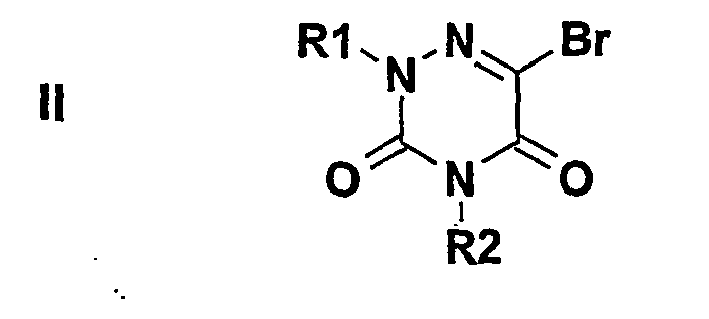
 b) l'on condense le dérivé obtenu Voù X, R4, R5, R6, R7, R8, R9, R10 et R11 sont tels que décrits précédemment dans la formule I, notamment dans des conditions telles que celles de la réaction de Mitsunobu en présence dé triphénylphosphine et de diéthylazodicarboxylate dans le THF.

- Procédé de préparation des composés chimiques selon l'une des revendications 1) à 5) de formule générale I pour lesquels Z=O caractérisé en ce que :a) l'on protège la fonction alcool d'un dérivé de formule générale VII

 b) l'on alkyle l'azote du composé VIII précédemment obtenu par un dérivé halogéné R3 Hal dans lequel le groupement Hal représente un halogène tel que CI, Br ou I est R3 est tel que décrit précédemment dans la formule I, dans des conditions opératoires telles que NaH ou tBuOK dans le DMF.
 c) l'on déprotège le composé IX ainsi obtenu dans des conditions opératoires telles que le fluorure de tétrabutylammonium dans le THF.d) l'on condense le dérivé obtenu Xoù X, R4, R5, R6, R7, R8, R9, R10 et R11 sont tels que décrits précédemment dans la formule I, notamment dans des conditions telles que celles de la réaction de Mitsunobu en présence de triphénylphosphine et de diéthylazodicarboxylate dans le THF.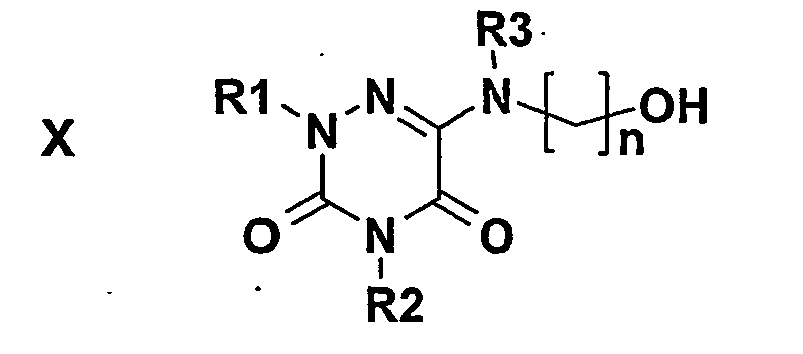

- Procédé de préparation des composés chimiques selon l'une des revendications 1) à 5) de formule générale I lorsque Y=N et Z=C caractérisé en ce que :a) l'on condense un dérivé de formule générale II

 b) après déméthylation (si A=Me, dans des conditions telles que BBr3 dans le dichlorométhane), on alkyle la fonction phénol du dérivé XII

- Procédé de préparation des composés chimiques selon l'une des revendications 1) à 5) de formule générale I lorsque Y=N, Z=C caractérisé en ce que :a) l'on alkyle un dérivé de formule générale XIV
 b) après déméthylation dans des conditions telles que BBr3 dans le dichlorométhane, on alkyle la fonction phénol du dérivé XII ainsi obtenu

- Procédé de préparation des composés chimiques selon l'une des revendications 1) à 5) caractérisé en ce que :a) l'on place un dérivé de formule générale I
 b) on alkyle ensuite l'azote de la triazine du dérivé XIVa ou XIVb ainsi obtenu
- A titre de médicaments nouveaux utilisables dans le traitement des maladies nécessitant des agonistes des récepteurs PPAR alpha et/ou PPAR gamma, les composés définis selon l'une des revendications 1) à 5).
- A titre de médicaments nouveaux utilisables dans la prévention et le traitement des maladies telles que les dyslipidémies diabétiques, l'hypertriglycéridémie, l'hypercholestérolémie, l'hyperinsulinémie, l'hyperglycémie, le syndrome métabolique, l'obésité, l'athérosclérose, les composés définis selon l'une des revendications 1) à 5).
- A titre de médicaments nouveaux utilisables en dermatologie, dans des pathologies à composante inflammatoire ou résultant d'une différentiation cellulaire anormale, les composés définis selon l'une des revendications 1) à 5).
- A titre de médicaments nouveaux utilisables dans le traitement des maladies telles que le psoriasis, l'acné, les dermatites atopiques, le vieillissement cutané, le photovieillissement, les composés définis selon l'une des revendications 1) à 5).
- Composition pharmaceutique caractérisée en ce qu'elle contient à titre de principe actif un composé défini selon l'une des revendications 1) à 5) en association avec tout excipient approprié.
Priority Applications (1)
| Application Number | Priority Date | Filing Date | Title |
|---|---|---|---|
| PL06726008T PL1856065T3 (pl) | 2005-03-03 | 2006-03-02 | Pochodne 1,2,4-triazyny, wytwarzanie i ich zastosowanie w terapii ludzi |
Applications Claiming Priority (2)
| Application Number | Priority Date | Filing Date | Title |
|---|---|---|---|
| FR0502152A FR2882750B1 (fr) | 2005-03-03 | 2005-03-03 | Derives de 1,2,4-triazines, leur preparation et leur application en therapeutique humaine |
| PCT/FR2006/000469 WO2006092507A1 (fr) | 2005-03-03 | 2006-03-02 | Derives de 1 ,2,4-triazines, leur preparation et leur application en therapeutique humaine |
Publications (2)
| Publication Number | Publication Date |
|---|---|
| EP1856065A1 EP1856065A1 (fr) | 2007-11-21 |
| EP1856065B1 true EP1856065B1 (fr) | 2009-11-11 |
Family
ID=35116027
Family Applications (1)
| Application Number | Title | Priority Date | Filing Date |
|---|---|---|---|
| EP06726008A Expired - Lifetime EP1856065B1 (fr) | 2005-03-03 | 2006-03-02 | Derives de 1 ,2,4-triazines, leur preparation et leur application en therapeutique humaine |
Country Status (27)
| Country | Link |
|---|---|
| US (1) | US7713971B2 (fr) |
| EP (1) | EP1856065B1 (fr) |
| JP (1) | JP5269420B2 (fr) |
| KR (1) | KR20070112230A (fr) |
| CN (1) | CN101155790A (fr) |
| AR (1) | AR053155A1 (fr) |
| AT (1) | ATE448211T1 (fr) |
| AU (1) | AU2006219802A1 (fr) |
| BR (1) | BRPI0607567A2 (fr) |
| CA (1) | CA2599848A1 (fr) |
| CR (1) | CR9366A (fr) |
| DE (1) | DE602006010337D1 (fr) |
| ES (1) | ES2336823T3 (fr) |
| FR (1) | FR2882750B1 (fr) |
| IL (1) | IL185586A0 (fr) |
| MA (1) | MA29343B1 (fr) |
| MX (1) | MX2007010787A (fr) |
| MY (1) | MY140662A (fr) |
| NI (1) | NI200700224A (fr) |
| NO (1) | NO20074881L (fr) |
| PL (1) | PL1856065T3 (fr) |
| PT (1) | PT1856065E (fr) |
| RU (1) | RU2007136027A (fr) |
| TN (1) | TNSN07335A1 (fr) |
| TW (1) | TW200643016A (fr) |
| WO (1) | WO2006092507A1 (fr) |
| ZA (1) | ZA200707730B (fr) |
Families Citing this family (8)
| Publication number | Priority date | Publication date | Assignee | Title |
|---|---|---|---|---|
| GB2463151A (en) * | 2008-09-05 | 2010-03-10 | Acucela Inc | Amine derivative compounds for treating ophthalmic diseases and disorders |
| AU2011296737A1 (en) | 2010-08-31 | 2013-04-11 | Snu R&Db Foundation | Use of the fetal reprogramming of a PPAR delta agonist |
| EP3189046B1 (fr) * | 2014-09-05 | 2020-08-26 | Genentech, Inc. | Composés thérapeutiques et leurs utilisations |
| TWI884745B (zh) | 2018-10-12 | 2025-05-21 | 美商拓臻股份有限公司 | 甲狀腺素受體β促效劑化合物 |
| CN111320609A (zh) | 2018-12-13 | 2020-06-23 | 拓臻股份有限公司 | 一种THRβ受体激动剂化合物及其制备方法和用途 |
| AU2020336272A1 (en) | 2019-08-23 | 2022-04-14 | Terns Pharmaceuticals, Inc. | Thyroid hormone receptor beta agonist compounds |
| EP4028008A4 (fr) | 2019-09-12 | 2023-09-13 | Terns Pharmaceuticals, Inc. | Composés agonistes du récepteur bêta de l'hormone thyroïdienne |
| WO2024211898A1 (fr) | 2023-04-07 | 2024-10-10 | Terns Pharmaceuticals, Inc. | Association comprenant un agoniste thrbeta anda glp-1r destiné à être utilisé dans le traitement d'un trouble du foie ou d'une maladie cardiométabolique |
Family Cites Families (4)
| Publication number | Priority date | Publication date | Assignee | Title |
|---|---|---|---|---|
| FR2707294B1 (fr) * | 1993-07-06 | 1995-09-29 | Pf Medicament | Nouveaux dérivés de la 3,5-dioxo-(2H,4H)-1,2,4-triazine, leur préparation et leur application en thérapeutique humaine. |
| UA82048C2 (uk) * | 2000-11-10 | 2008-03-11 | Эли Лилли Энд Компани | Агоністи альфа-рецепторів, активованих проліфератором пероксисом |
| GB0113233D0 (en) * | 2001-05-31 | 2001-07-25 | Glaxo Group Ltd | Chemical compounds |
| FR2866339B1 (fr) * | 2004-02-18 | 2006-05-05 | Pf Medicament | Derives de 1,2,4-triazines, leur preparation et leur application en therapeutique humaine |
-
2005
- 2005-03-03 FR FR0502152A patent/FR2882750B1/fr not_active Expired - Fee Related
-
2006
- 2006-03-02 AU AU2006219802A patent/AU2006219802A1/en not_active Abandoned
- 2006-03-02 PL PL06726008T patent/PL1856065T3/pl unknown
- 2006-03-02 ES ES06726008T patent/ES2336823T3/es not_active Expired - Lifetime
- 2006-03-02 PT PT06726008T patent/PT1856065E/pt unknown
- 2006-03-02 US US11/885,630 patent/US7713971B2/en not_active Expired - Fee Related
- 2006-03-02 AR ARP060100797A patent/AR053155A1/es unknown
- 2006-03-02 BR BRPI0607567-3A patent/BRPI0607567A2/pt not_active IP Right Cessation
- 2006-03-02 TW TW095107034A patent/TW200643016A/zh unknown
- 2006-03-02 AT AT06726008T patent/ATE448211T1/de not_active IP Right Cessation
- 2006-03-02 JP JP2007557542A patent/JP5269420B2/ja not_active Expired - Fee Related
- 2006-03-02 MX MX2007010787A patent/MX2007010787A/es active IP Right Grant
- 2006-03-02 CN CNA2006800114913A patent/CN101155790A/zh active Pending
- 2006-03-02 WO PCT/FR2006/000469 patent/WO2006092507A1/fr not_active Ceased
- 2006-03-02 EP EP06726008A patent/EP1856065B1/fr not_active Expired - Lifetime
- 2006-03-02 KR KR1020077022414A patent/KR20070112230A/ko not_active Abandoned
- 2006-03-02 DE DE602006010337T patent/DE602006010337D1/de not_active Expired - Lifetime
- 2006-03-02 RU RU2007136027/04A patent/RU2007136027A/ru not_active Application Discontinuation
- 2006-03-02 CA CA002599848A patent/CA2599848A1/fr not_active Abandoned
- 2006-03-03 MY MYPI20060914A patent/MY140662A/en unknown
-
2007
- 2007-08-29 IL IL185586A patent/IL185586A0/en unknown
- 2007-08-30 NI NI200700224A patent/NI200700224A/es unknown
- 2007-08-31 TN TNP2007000335A patent/TNSN07335A1/fr unknown
- 2007-09-04 CR CR9366A patent/CR9366A/es not_active Application Discontinuation
- 2007-09-10 ZA ZA200707730A patent/ZA200707730B/en unknown
- 2007-09-25 MA MA30243A patent/MA29343B1/fr unknown
- 2007-09-25 NO NO20074881A patent/NO20074881L/no not_active Application Discontinuation
Also Published As
| Publication number | Publication date |
|---|---|
| NI200700224A (es) | 2008-03-27 |
| ZA200707730B (en) | 2008-05-28 |
| FR2882750A1 (fr) | 2006-09-08 |
| ATE448211T1 (de) | 2009-11-15 |
| ES2336823T3 (es) | 2010-04-16 |
| TW200643016A (en) | 2006-12-16 |
| JP2008531662A (ja) | 2008-08-14 |
| RU2007136027A (ru) | 2009-04-10 |
| IL185586A0 (en) | 2008-01-06 |
| PL1856065T3 (pl) | 2010-04-30 |
| US7713971B2 (en) | 2010-05-11 |
| BRPI0607567A2 (pt) | 2011-10-18 |
| EP1856065A1 (fr) | 2007-11-21 |
| WO2006092507A1 (fr) | 2006-09-08 |
| MA29343B1 (fr) | 2008-03-03 |
| AU2006219802A1 (en) | 2006-09-08 |
| US20080167313A1 (en) | 2008-07-10 |
| WO2006092507A8 (fr) | 2007-11-01 |
| PT1856065E (pt) | 2010-02-10 |
| KR20070112230A (ko) | 2007-11-22 |
| CN101155790A (zh) | 2008-04-02 |
| CA2599848A1 (fr) | 2006-09-08 |
| JP5269420B2 (ja) | 2013-08-21 |
| DE602006010337D1 (de) | 2009-12-24 |
| TNSN07335A1 (fr) | 2008-12-31 |
| CR9366A (es) | 2008-02-12 |
| FR2882750B1 (fr) | 2007-05-11 |
| MY140662A (en) | 2010-01-15 |
| NO20074881L (no) | 2007-11-27 |
| AR053155A1 (es) | 2007-04-25 |
| MX2007010787A (es) | 2007-09-25 |
Similar Documents
| Publication | Publication Date | Title |
|---|---|---|
| EP0202164B1 (fr) | Dérivés de (benzoyl-4 pipéridino)-2 phenyl-1 alcanols, leur préparation et leur application en thérapeutique | |
| EP0389370B1 (fr) | Nouveaux stéroides 19-Nor 3-céto comportant une chaîne en 17 aminosubstituée, leur procédé de préparation et les intermédiaires de ce procédé,leur application comme médicaments et les compositions pharmaceutiques les contenant | |
| EP0210084B1 (fr) | Amides, procédés pour leur préparation et médicaments les contenant | |
| CH653025A5 (fr) | Oxazolidine-2,4-diones substituees en position 5 douees d'activite hypoglycemique. | |
| EP0918759A1 (fr) | Nouveaux derives de thiazolidine-2,4-dione substitues, leurs procedes d'obtention et les compositions pharmaceutiques en renfermant | |
| CA2121571C (fr) | Nouveaux acides et esters phenoxy isobutyriques substitues | |
| EP0662971B1 (fr) | DERIVES DE 5H,10H-IMIDAZO[1,2-a]INDENO[1,2-e]PYRAZINE-4-ONE, LEUR PREPARATION ET LES MEDICAMENTS LES CONTENANT | |
| EP0709383B1 (fr) | Dérivés de la diosmétine, leur procédé de préparation et les compositions pharmaceutiques les contenant | |
| JP5269420B2 (ja) | 1,2,4−トリアジン誘導体、その製造方法およびヒト治療におけるその使用 | |
| CH616161A5 (fr) | ||
| EP1502590B1 (fr) | Dérivés d'oximes hétérocycliques, leur procédé de préparation et leur utilisation dans le traitement du diabète de type II | |
| EP0251937B1 (fr) | Nouveaux dérivés tricycliques agonistes des récepteurs cholinergiques et médicaments en contenant | |
| EP0172083B1 (fr) | Nouveaux amides substitués, leur préparation et les médicaments qui les contiennent | |
| EP0551034A2 (fr) | Nouvelles céphalosporines comportant en position 7 un radical benzyloxyimino substitué, leur procédé de préparation, leur application comme médicaments | |
| EP0117771A1 (fr) | Imino-2 pyrrolidines, leur procédé de préparation et leurs applications en thérapeutique | |
| EP0754693A2 (fr) | Nouveaux dérivés d'acide aminophénylphosphonique, leur procédé de préparation et les compositions pharmaceutiques qui les contiennent | |
| FR2866339A1 (fr) | Derives de 1,2,4-triazines, leur preparation et leur application en therapeutique humaine | |
| FR2781797A1 (fr) | Derives de piperazine antidiabetiques, leurs procedes de preparation et compositions pharmaceutiques les contenant | |
| EP1885695B1 (fr) | Composes de l'indoline | |
| EP0294258A1 (fr) | Dérivés d'hydrazine, procédé d'obtention et compositions pharmaceutiques les contenant | |
| EP0275762B1 (fr) | Dérivés de l'indole carboxamide ainsi que leurs sels, procédé et intermédiaires de préparation, application à titre de médicaments de ces dérivés et compositions les renfermant | |
| HK1110863A (en) | 1,2,4-triazine derivatives, preparation and use thereof in human therapy | |
| HU191639B (en) | Process for pruducing of 6-anilino-5,8-chinoxalindion derivates | |
| CH594650A5 (en) | Antiinflammatory (1,2)-benzothiazine derivs. prepn. | |
| EP1023287A1 (fr) | Derives de la 3-oxo-2(h)-1,2,4-triazine en tant que ligands des recepteurs 5ht1a |
Legal Events
| Date | Code | Title | Description |
|---|---|---|---|
| PUAI | Public reference made under article 153(3) epc to a published international application that has entered the european phase |
Free format text: ORIGINAL CODE: 0009012 |
|
| 17P | Request for examination filed |
Effective date: 20070927 |
|
| AK | Designated contracting states |
Kind code of ref document: A1 Designated state(s): AT BE BG CH CY CZ DE DK EE ES FI FR GB GR HU IE IS IT LI LT LU LV MC NL PL PT RO SE SI SK TR |
|
| AX | Request for extension of the european patent |
Extension state: AL BA HR MK YU |
|
| GRAP | Despatch of communication of intention to grant a patent |
Free format text: ORIGINAL CODE: EPIDOSNIGR1 |
|
| GRAS | Grant fee paid |
Free format text: ORIGINAL CODE: EPIDOSNIGR3 |
|
| GRAA | (expected) grant |
Free format text: ORIGINAL CODE: 0009210 |
|
| AK | Designated contracting states |
Kind code of ref document: B1 Designated state(s): AT BE BG CH CY CZ DE DK EE ES FI FR GB GR HU IE IS IT LI LT LU LV MC NL PL PT RO SE SI SK TR |
|
| AX | Request for extension of the european patent |
Extension state: AL BA HR MK YU |
|
| REG | Reference to a national code |
Ref country code: GB Ref legal event code: FG4D Free format text: NOT ENGLISH |
|
| REG | Reference to a national code |
Ref country code: CH Ref legal event code: EP |
|
| REG | Reference to a national code |
Ref country code: IE Ref legal event code: FG4D |
|
| REF | Corresponds to: |
Ref document number: 602006010337 Country of ref document: DE Date of ref document: 20091224 Kind code of ref document: P |
|
| REG | Reference to a national code |
Ref country code: CH Ref legal event code: NV Representative=s name: MICHELI & CIE SA |
|
| REG | Reference to a national code |
Ref country code: PT Ref legal event code: SC4A Free format text: AVAILABILITY OF NATIONAL TRANSLATION Effective date: 20100203 |
|
| REG | Reference to a national code |
Ref country code: SE Ref legal event code: TRGR |
|
| REG | Reference to a national code |
Ref country code: GR Ref legal event code: EP Ref document number: 20100400219 Country of ref document: GR |
|
| REG | Reference to a national code |
Ref country code: ES Ref legal event code: FG2A Ref document number: 2336823 Country of ref document: ES Kind code of ref document: T3 |
|
| LTIE | Lt: invalidation of european patent or patent extension |
Effective date: 20091111 |
|
| PG25 | Lapsed in a contracting state [announced via postgrant information from national office to epo] |
Ref country code: IS Free format text: LAPSE BECAUSE OF FAILURE TO SUBMIT A TRANSLATION OF THE DESCRIPTION OR TO PAY THE FEE WITHIN THE PRESCRIBED TIME-LIMIT Effective date: 20100311 Ref country code: FI Free format text: LAPSE BECAUSE OF FAILURE TO SUBMIT A TRANSLATION OF THE DESCRIPTION OR TO PAY THE FEE WITHIN THE PRESCRIBED TIME-LIMIT Effective date: 20091111 Ref country code: LT Free format text: LAPSE BECAUSE OF FAILURE TO SUBMIT A TRANSLATION OF THE DESCRIPTION OR TO PAY THE FEE WITHIN THE PRESCRIBED TIME-LIMIT Effective date: 20091111 |
|
| REG | Reference to a national code |
Ref country code: PL Ref legal event code: T3 |
|
| PG25 | Lapsed in a contracting state [announced via postgrant information from national office to epo] |
Ref country code: CY Free format text: LAPSE BECAUSE OF FAILURE TO SUBMIT A TRANSLATION OF THE DESCRIPTION OR TO PAY THE FEE WITHIN THE PRESCRIBED TIME-LIMIT Effective date: 20091111 Ref country code: SI Free format text: LAPSE BECAUSE OF FAILURE TO SUBMIT A TRANSLATION OF THE DESCRIPTION OR TO PAY THE FEE WITHIN THE PRESCRIBED TIME-LIMIT Effective date: 20091111 Ref country code: LV Free format text: LAPSE BECAUSE OF FAILURE TO SUBMIT A TRANSLATION OF THE DESCRIPTION OR TO PAY THE FEE WITHIN THE PRESCRIBED TIME-LIMIT Effective date: 20091111 |
|
| REG | Reference to a national code |
Ref country code: IE Ref legal event code: FD4D |
|
| PG25 | Lapsed in a contracting state [announced via postgrant information from national office to epo] |
Ref country code: AT Free format text: LAPSE BECAUSE OF FAILURE TO SUBMIT A TRANSLATION OF THE DESCRIPTION OR TO PAY THE FEE WITHIN THE PRESCRIBED TIME-LIMIT Effective date: 20091111 |
|
| PG25 | Lapsed in a contracting state [announced via postgrant information from national office to epo] |
Ref country code: IE Free format text: LAPSE BECAUSE OF FAILURE TO SUBMIT A TRANSLATION OF THE DESCRIPTION OR TO PAY THE FEE WITHIN THE PRESCRIBED TIME-LIMIT Effective date: 20091111 Ref country code: EE Free format text: LAPSE BECAUSE OF FAILURE TO SUBMIT A TRANSLATION OF THE DESCRIPTION OR TO PAY THE FEE WITHIN THE PRESCRIBED TIME-LIMIT Effective date: 20091111 Ref country code: RO Free format text: LAPSE BECAUSE OF FAILURE TO SUBMIT A TRANSLATION OF THE DESCRIPTION OR TO PAY THE FEE WITHIN THE PRESCRIBED TIME-LIMIT Effective date: 20091111 Ref country code: BG Free format text: LAPSE BECAUSE OF FAILURE TO SUBMIT A TRANSLATION OF THE DESCRIPTION OR TO PAY THE FEE WITHIN THE PRESCRIBED TIME-LIMIT Effective date: 20100211 Ref country code: DK Free format text: LAPSE BECAUSE OF FAILURE TO SUBMIT A TRANSLATION OF THE DESCRIPTION OR TO PAY THE FEE WITHIN THE PRESCRIBED TIME-LIMIT Effective date: 20091111 |
|
| PG25 | Lapsed in a contracting state [announced via postgrant information from national office to epo] |
Ref country code: SK Free format text: LAPSE BECAUSE OF FAILURE TO SUBMIT A TRANSLATION OF THE DESCRIPTION OR TO PAY THE FEE WITHIN THE PRESCRIBED TIME-LIMIT Effective date: 20091111 Ref country code: CZ Free format text: LAPSE BECAUSE OF FAILURE TO SUBMIT A TRANSLATION OF THE DESCRIPTION OR TO PAY THE FEE WITHIN THE PRESCRIBED TIME-LIMIT Effective date: 20091111 |
|
| PLBE | No opposition filed within time limit |
Free format text: ORIGINAL CODE: 0009261 |
|
| STAA | Information on the status of an ep patent application or granted ep patent |
Free format text: STATUS: NO OPPOSITION FILED WITHIN TIME LIMIT |
|
| 26N | No opposition filed |
Effective date: 20100812 |
|
| PG25 | Lapsed in a contracting state [announced via postgrant information from national office to epo] |
Ref country code: MC Free format text: LAPSE BECAUSE OF NON-PAYMENT OF DUE FEES Effective date: 20100331 |
|
| PG25 | Lapsed in a contracting state [announced via postgrant information from national office to epo] |
Ref country code: HU Free format text: LAPSE BECAUSE OF FAILURE TO SUBMIT A TRANSLATION OF THE DESCRIPTION OR TO PAY THE FEE WITHIN THE PRESCRIBED TIME-LIMIT Effective date: 20100512 Ref country code: LU Free format text: LAPSE BECAUSE OF NON-PAYMENT OF DUE FEES Effective date: 20100302 |
|
| PG25 | Lapsed in a contracting state [announced via postgrant information from national office to epo] |
Ref country code: TR Free format text: LAPSE BECAUSE OF FAILURE TO SUBMIT A TRANSLATION OF THE DESCRIPTION OR TO PAY THE FEE WITHIN THE PRESCRIBED TIME-LIMIT Effective date: 20091111 |
|
| REG | Reference to a national code |
Ref country code: FR Ref legal event code: PLFP Year of fee payment: 11 |
|
| REG | Reference to a national code |
Ref country code: FR Ref legal event code: PLFP Year of fee payment: 12 |
|
| REG | Reference to a national code |
Ref country code: FR Ref legal event code: PLFP Year of fee payment: 13 |
|
| PGFP | Annual fee paid to national office [announced via postgrant information from national office to epo] |
Ref country code: NL Payment date: 20190212 Year of fee payment: 14 |
|
| PGFP | Annual fee paid to national office [announced via postgrant information from national office to epo] |
Ref country code: CH Payment date: 20190320 Year of fee payment: 14 Ref country code: IT Payment date: 20190312 Year of fee payment: 14 Ref country code: FR Payment date: 20190329 Year of fee payment: 14 Ref country code: DE Payment date: 20190312 Year of fee payment: 14 Ref country code: GB Payment date: 20190320 Year of fee payment: 14 Ref country code: PL Payment date: 20190215 Year of fee payment: 14 |
|
| PGFP | Annual fee paid to national office [announced via postgrant information from national office to epo] |
Ref country code: BE Payment date: 20190325 Year of fee payment: 14 Ref country code: GR Payment date: 20190218 Year of fee payment: 14 Ref country code: SE Payment date: 20190315 Year of fee payment: 14 |
|
| PGFP | Annual fee paid to national office [announced via postgrant information from national office to epo] |
Ref country code: PT Payment date: 20190227 Year of fee payment: 14 Ref country code: ES Payment date: 20190410 Year of fee payment: 14 |
|
| REG | Reference to a national code |
Ref country code: DE Ref legal event code: R119 Ref document number: 602006010337 Country of ref document: DE |
|
| REG | Reference to a national code |
Ref country code: CH Ref legal event code: PL |
|
| REG | Reference to a national code |
Ref country code: NL Ref legal event code: MM Effective date: 20200401 |
|
| REG | Reference to a national code |
Ref country code: BE Ref legal event code: MM Effective date: 20200331 |
|
| PG25 | Lapsed in a contracting state [announced via postgrant information from national office to epo] |
Ref country code: NL Free format text: LAPSE BECAUSE OF NON-PAYMENT OF DUE FEES Effective date: 20200401 |
|
| PG25 | Lapsed in a contracting state [announced via postgrant information from national office to epo] |
Ref country code: PT Free format text: LAPSE BECAUSE OF NON-PAYMENT OF DUE FEES Effective date: 20201006 Ref country code: CH Free format text: LAPSE BECAUSE OF NON-PAYMENT OF DUE FEES Effective date: 20200331 Ref country code: DE Free format text: LAPSE BECAUSE OF NON-PAYMENT OF DUE FEES Effective date: 20201001 Ref country code: SE Free format text: LAPSE BECAUSE OF NON-PAYMENT OF DUE FEES Effective date: 20200303 Ref country code: LI Free format text: LAPSE BECAUSE OF NON-PAYMENT OF DUE FEES Effective date: 20200331 Ref country code: GR Free format text: LAPSE BECAUSE OF NON-PAYMENT OF DUE FEES Effective date: 20201008 Ref country code: FR Free format text: LAPSE BECAUSE OF NON-PAYMENT OF DUE FEES Effective date: 20200331 |
|
| PG25 | Lapsed in a contracting state [announced via postgrant information from national office to epo] |
Ref country code: BE Free format text: LAPSE BECAUSE OF NON-PAYMENT OF DUE FEES Effective date: 20200331 |
|
| GBPC | Gb: european patent ceased through non-payment of renewal fee |
Effective date: 20200302 |
|
| PG25 | Lapsed in a contracting state [announced via postgrant information from national office to epo] |
Ref country code: GB Free format text: LAPSE BECAUSE OF NON-PAYMENT OF DUE FEES Effective date: 20200302 |
|
| REG | Reference to a national code |
Ref country code: ES Ref legal event code: FD2A Effective date: 20210727 |
|
| PG25 | Lapsed in a contracting state [announced via postgrant information from national office to epo] |
Ref country code: IT Free format text: LAPSE BECAUSE OF NON-PAYMENT OF DUE FEES Effective date: 20200302 |
|
| PG25 | Lapsed in a contracting state [announced via postgrant information from national office to epo] |
Ref country code: ES Free format text: LAPSE BECAUSE OF NON-PAYMENT OF DUE FEES Effective date: 20200303 |
|
| PG25 | Lapsed in a contracting state [announced via postgrant information from national office to epo] |
Ref country code: PL Free format text: LAPSE BECAUSE OF NON-PAYMENT OF DUE FEES Effective date: 20200302 |