EP1859224B1 - Munitionshülse - Google Patents
Munitionshülse Download PDFInfo
- Publication number
- EP1859224B1 EP1859224B1 EP06724963A EP06724963A EP1859224B1 EP 1859224 B1 EP1859224 B1 EP 1859224B1 EP 06724963 A EP06724963 A EP 06724963A EP 06724963 A EP06724963 A EP 06724963A EP 1859224 B1 EP1859224 B1 EP 1859224B1
- Authority
- EP
- European Patent Office
- Prior art keywords
- article according
- ammunition article
- casing
- notched izod
- impact strength
- Prior art date
- Legal status (The legal status is an assumption and is not a legal conclusion. Google has not performed a legal analysis and makes no representation as to the accuracy of the status listed.)
- Expired - Lifetime
Links
Images



Classifications
-
- F—MECHANICAL ENGINEERING; LIGHTING; HEATING; WEAPONS; BLASTING
- F42—AMMUNITION; BLASTING
- F42B—EXPLOSIVE CHARGES, e.g. FOR BLASTING, FIREWORKS, AMMUNITION
- F42B5/00—Cartridge ammunition, e.g. separately-loaded propellant charges
- F42B5/26—Cartridge cases
- F42B5/30—Cartridge cases of plastics, i.e. the cartridge-case tube is of plastics
- F42B5/307—Cartridge cases of plastics, i.e. the cartridge-case tube is of plastics formed by assembling several elements
-
- C—CHEMISTRY; METALLURGY
- C08—ORGANIC MACROMOLECULAR COMPOUNDS; THEIR PREPARATION OR CHEMICAL WORKING-UP; COMPOSITIONS BASED THEREON
- C08J—WORKING-UP; GENERAL PROCESSES OF COMPOUNDING; AFTER-TREATMENT NOT COVERED BY SUBCLASSES C08B, C08C, C08F, C08G or C08H
- C08J9/00—Working-up of macromolecular substances to porous or cellular articles or materials; After-treatment thereof
- C08J9/0061—Working-up of macromolecular substances to porous or cellular articles or materials; After-treatment thereof characterized by the use of several polymeric components
-
- C—CHEMISTRY; METALLURGY
- C08—ORGANIC MACROMOLECULAR COMPOUNDS; THEIR PREPARATION OR CHEMICAL WORKING-UP; COMPOSITIONS BASED THEREON
- C08L—COMPOSITIONS OF MACROMOLECULAR COMPOUNDS
- C08L65/00—Compositions of macromolecular compounds obtained by reactions forming a carbon-to-carbon link in the main chain; Compositions of derivatives of such polymers
- C08L65/02—Polyphenylenes
-
- C—CHEMISTRY; METALLURGY
- C08—ORGANIC MACROMOLECULAR COMPOUNDS; THEIR PREPARATION OR CHEMICAL WORKING-UP; COMPOSITIONS BASED THEREON
- C08L—COMPOSITIONS OF MACROMOLECULAR COMPOUNDS
- C08L69/00—Compositions of polycarbonates; Compositions of derivatives of polycarbonates
-
- C—CHEMISTRY; METALLURGY
- C08—ORGANIC MACROMOLECULAR COMPOUNDS; THEIR PREPARATION OR CHEMICAL WORKING-UP; COMPOSITIONS BASED THEREON
- C08L—COMPOSITIONS OF MACROMOLECULAR COMPOUNDS
- C08L81/00—Compositions of macromolecular compounds obtained by reactions forming in the main chain of the macromolecule a linkage containing sulfur with or without nitrogen, oxygen or carbon only; Compositions of polysulfones; Compositions of derivatives of such polymers
- C08L81/06—Polysulfones; Polyethersulfones
-
- F—MECHANICAL ENGINEERING; LIGHTING; HEATING; WEAPONS; BLASTING
- F42—AMMUNITION; BLASTING
- F42B—EXPLOSIVE CHARGES, e.g. FOR BLASTING, FIREWORKS, AMMUNITION
- F42B5/00—Cartridge ammunition, e.g. separately-loaded propellant charges
- F42B5/26—Cartridge cases
- F42B5/28—Cartridge cases of metal, i.e. the cartridge-case tube is of metal
- F42B5/295—Cartridge cases of metal, i.e. the cartridge-case tube is of metal coated
- F42B5/297—Cartridge cases of metal, i.e. the cartridge-case tube is of metal coated with plastics
-
- F—MECHANICAL ENGINEERING; LIGHTING; HEATING; WEAPONS; BLASTING
- F42—AMMUNITION; BLASTING
- F42B—EXPLOSIVE CHARGES, e.g. FOR BLASTING, FIREWORKS, AMMUNITION
- F42B5/00—Cartridge ammunition, e.g. separately-loaded propellant charges
- F42B5/26—Cartridge cases
- F42B5/30—Cartridge cases of plastics, i.e. the cartridge-case tube is of plastics
-
- F—MECHANICAL ENGINEERING; LIGHTING; HEATING; WEAPONS; BLASTING
- F42—AMMUNITION; BLASTING
- F42B—EXPLOSIVE CHARGES, e.g. FOR BLASTING, FIREWORKS, AMMUNITION
- F42B5/00—Cartridge ammunition, e.g. separately-loaded propellant charges
- F42B5/26—Cartridge cases
- F42B5/30—Cartridge cases of plastics, i.e. the cartridge-case tube is of plastics
- F42B5/307—Cartridge cases of plastics, i.e. the cartridge-case tube is of plastics formed by assembling several elements
- F42B5/313—Cartridge cases of plastics, i.e. the cartridge-case tube is of plastics formed by assembling several elements all elements made of plastics
-
- C—CHEMISTRY; METALLURGY
- C08—ORGANIC MACROMOLECULAR COMPOUNDS; THEIR PREPARATION OR CHEMICAL WORKING-UP; COMPOSITIONS BASED THEREON
- C08G—MACROMOLECULAR COMPOUNDS OBTAINED OTHERWISE THAN BY REACTIONS ONLY INVOLVING UNSATURATED CARBON-TO-CARBON BONDS
- C08G2261/00—Macromolecular compounds obtained by reactions forming a carbon-to-carbon link in the main chain of the macromolecule
- C08G2261/30—Monomer units or repeat units incorporating structural elements in the main chain
- C08G2261/31—Monomer units or repeat units incorporating structural elements in the main chain incorporating aromatic structural elements in the main chain
- C08G2261/312—Non-condensed aromatic systems, e.g. benzene
Definitions
- the present invention relates to ammunition articles, and, more particularly, to ammunition cartridge casings, where at least a portion of the casing is comprised of a polymeric material.
- Brass, steel, and, to a lesser degree, aluminum cartridge casings suffer from a number of disadvantages, the most important of which are heavy weight and corrosion concerns.
- Aluminum has an added disadvantage of potential explosive oxidative degradation and is thus used only in low-pressure cartridges or in applications that can tolerate relatively thick casing walls.
- desirable materials for ammunition cartridge casing fabrication would be lightweight and impervious to corrosion while having mechanical properties suitable for use in ammunition applications.
- Many lightweight polymeric materials are sufficiently corrosion resistant; however, to date, polymers have been used only in niche ammunition applications where their inferior mechanical and thermal properties can be tolerated (e.g., shotgun shells contain polyethylene components).
- a firearm's cartridge chamber closely fits the outside of a cartridge and thus supports the majority of the cartridge casing wall in the radial direction; however, in many firearms, a portion of the cartridge base end protrudes from the chamber and is thus unsupported.
- a stress profile is developed along the cartridge casing, with the greatest stresses being concentrated at the base end. Therefore, the cartridge base end must posses the greatest mechanical strength, while a gradual decrease in material strength is acceptable axially along the casing toward the forward end which receives the projectile.
- a typical brass cartridge casing is engineered to provide a strength profile along the casing length which reflects the varying mechanical demands, with the strongest and hardest material located at the cartridge base end.
- a strength profile is easily induced by varying the heat treatment conditions from one end of the casing to the other, but this is not an option for polymers.
- a mechanical strength profile can be achieved in a polymeric ammunition cartridge casing by varying the casing wall thickness; however, where the casing external geometry is fixed by existing firearm chamber size, an increased casing wall thickness often results in a casing with insufficient internal volume to accept the required propellant charge.
- the top or forward portion of the casing must meet several material requirements as well.
- the casing material must possess adequate ductility to absorb the shock of the explosion without experiencing brittle fracture. Also, the material must possess sufficient rigidity and strength to avoid creep, flow, or other deformation.
- US-A-3 745 924 describes a cartridge having a drawn plastic casing made of a thermoplastic material selected from the group consisting of plastics and blends of plastics having high impact strength, dimensional stability, high flexural modulus, and high deflection temperature, consisting of polycarbonates, polysulfone, blends of minor portions of polyethylene with polycarbonates, blends of minor portions of polyethylene with polysulfone, and alloys of polysulfones and polycarbonates (see Claim 7).
- the polyethylene is added in small amounts to make a blend with polycarbonate and polysulfone in order to make the plastic blend compatible with solvents and the environment, e.g. to relieve stress cracking.
- an ammunition article comprising a cartridge casing
- the casing is comprised of a polymeric material that has a room temperature (23°C) notched Izod impact strength or value greater than 534 J/m (10 ft-lb/in) (as measured by ASTM D256-00) and that has a ratio of notched Izod strength value at room temperature to notched Izod impact value at -40°C of less than 4.
- an ammunition article comprising a cartridge casing
- the casing is comprised of two or more pieces or portions and at least one portion of the casing is comprised of a polymeric material that has a room temperature (23°C) notched Izod impact strength greater than 534 J/m (10 ft-lb/in) (as measured by ASTM D256-00) and that has a ratio of notched Izod impact strength at room temperature to notched Izod impact strength at -40°C of less than 4.
- a method of making an ammunition article comprising a casing wherein at least a portion of the casing is formed from a polymeric material having a room temperature (23°C) notched Izod impact strength, measured according to ASTM D256-00, of at least 534 J/m (10 ft-lb/in) and having a ratio of notched Izod impact strength values measured at room temperature to notched Izod impact strength values at -40°C of less than 4.
- a method of selecting a polymeric material for use in the fabrication of an ammunition cartridge casing or cartridge casing component comprising : comparing the material's notched Izod impact strength measured at room temperature (23°C) to its notched Izod impact strength measured at -40°C (both measured by ASTM D256-00) ; and ; selecting the polymeric materials that have a ratio of notched Izod impact strength at room temperature to notched Izod impact strength at 40°C of less than 4.
- an ammunition article refers to a complete, assembled round of ammunition that is ready to be loaded into a firearm and fired.
- An ammunition article may be a live round fitted with a projectile, or a blank round with no projectile.
- An ammunition article may be any caliber of pistol or rifle ammunition and may also be other types such as non-lethal rounds, rounds containing rubber bullets or other non-metallic projectiles, rounds containing multiple projectiles (shot), and rounds containing projectiles other than bullets such as fluid-filled canisters and capsules.
- An ammunition article may be of a known type or of a type or design developed subsequent to this disclosure.
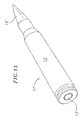
- FIG. 1 there is shown a semi-schematic perspective view of an exemplary embodiment of an ammunition article 10 provided in accordance with practice of the present invention.
- the ammunition article 10 comprises a cartridge casing (or simply "casing") 12 which is the component that holds the propellant charge (not shown), the primer 13, and the projectile 14.
- the cartridge casing 12 is the portion of an ammunition article that remains intact after firing.
- a cartridge casing may be of one-piece or multi-piece construction.
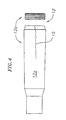
- the casing 12 is of two piece construction wherein the casing includes a "caselet" portion 12a which comprises the forward piece or portion of the casing and a "cap” portion 12b which comprises the closed end of the cartridge casing where the primer 13 is positioned.
- the caselet portion 12a and the cap portion 12b are held together by means of ribs 16 on the outside surface of an extension 18 on the caselet 12a and ribs 20 on the inside surface of the cap 12b which snap fit together when the cap is press fit onto the caselet.
- an ammunition article 10' which comprises a one piece casing 12', a primer 13' and a projectile 14'.
- high modulus polymer or polymeric material means a polymer or copolymer having a room temperature flexural modulus of at least 3.447 GPa (500,000 psi), more preferably at least 5.171 GPa (750,000 psi), and even more preferably at least 6.205 GPa (900,000 psi) measured in accordance with ASTM D790. Other measures of modulus may also be used including but not limited to tensile modulus, and shear modulus.
- room temperature is well-familiar to the skilled in the art ; it denotes a temperature of 23°C.
- a property for example, impact strength
- a usable part for example, an ammunition casing component
- some processing of the material may be necessary for property measurement (for example, a test specimen of appropriate geometry must be molded for impact testing), and we do not intend to imply departure from standard methodologies.
- a part such as a cartridge casing is comprised of a polymeric material having certain properties, we do not mean those properties of the material as they exist in the "as-molded" part, but properties of the material from which the part was formed.
- the raw material may be a pure polymer or copolymer resin, and may also contain any combination of additives, modifiers, blend components .
- a necessary property of a polymeric material used in ammunition cartridge casings provided in accordance with practice of the present invention is the material's ability to absorb large amounts of energy at high strain rates.
- An indication of such energy absorbing characteristics is a material's impact strength, or its response to flexural shock.
- Some of the best currently available commercial polymeric materials used for energy absorption include amorphous resins such as Bisphenol-A polycarbonates (e.g., bullet-proof glass) and semicrystalline resins such as elastomer-modified polyamides (e.g., sporting equipment).
- Bisphenol-A polycarbonate is provided by GE plastics under the trademark LEXAN ® 141 R; one such elastomer-modified polyamide is provided by DuPont under the trademark Zytel FE 8194 NC 010.
- Izod impact strength values for a given polymeric material will exhibit some degree of variability from sample to sample and from test to test.
- Izod impact strength values stated herein are not exact, but represent average values around which actual experimental values will deviate within acceptable limits.
- test specimen fabrication including but not limited to processing technology, mold design, molding conditions, and thermal treatments; method of notching, speed of notching tool, design of notching apparatus, and quality of the notch; time between notching and test; test specimen thickness and test specimen width under notch; and environmental conditioning (ASTM D256-00). Therefore, when comparing Izod impact strengths of a given material at different temperatures, it is preferable that specimen temperature be the only variable between impact strength measurements.
- polymeric cartridge casings will survive more than 99 % of live ammunition firings; more preferably, more than 99.9 %; even more preferably, more than 99.99 %; still more preferably, more than 99.999 %. Even higher success rates are more preferable, the most preferable scenario being 100 % casing survival.
- S-PC siloxane-modified Bisphenol-A polycarbonates
- B-PC polycarbonates containing biphenyl linkages
- PPSU polyphenylsulfones
- the polymer material energy-absorbing capabilities as measured by the notched Izod testing (ASTM D256, room temperature of 23°C, same as above) are given in Table II. TABLE II. Room temperature notched Izod impact strengths of selected thermonlastics. (ASTM D256) Polymer Acronym Impact Strength Siloxane-modified Bisphenol-A polycarbonate S-PC 801 J/m (15 ft-lb/in) Bisphenol-A polycarbonate with biphenyl linkages B-PC 694 J/m (13 ft-lb/in) Polyphenylsulfone PPSU 667 J/m (12.5 ft-lb/in)
- Table III below lists notched Izod impact strengths for the five materials mentioned above measured at temperatures far below room temperature. Low temperature notched Izod impact strength values are less readily available than room temperature data. As a result, the data reported in Table III were not obtained at exactly the same low temperature for all materials.
- Table III The data provided in Table III was derived from the following data sheets: (1) Solvay Advanced Polymers, Low Temperature Notched Izod Impact of Radel ® R-5xxx Resins, Radel ® R 5700 NT and (2) "A Guide to Polycarbonate in General", provided by Engineering Polymer Specialists. Acceptable materials for ammunition cartridge casings are those that retain a substantial quantity of their impact strengths upon cooling. Surprisingly, a polymeric material that is suitable for ammunition cartridge casings is one whose ratio of notched Izod impact strength measured at room temperature to notched Izod impact strength measured at -40°C (or lower) has a value less than 4.
- the low temperature data point for the B-PC material is reported at -30°C. This reflects the data reported in the referenced Makrolon ® data sheet for the ASTM D256 impact test. Notched Izod impact data are reported for this material as measured by an alternate test method, ISO 180-4, as follows : 60 kJ/m 2 at 23°C, 55 kJ/m 2 at -30°C, and 50 kJ/m 2 at -60°C. Though a direct correlation between the ISO and ASTM test methods does not exist, the ratio of notched Izod values measured by a given method will be comparable from method to method.
- the ISO data for the B-PC material reveal that the material does not experience a significant reduction in ductility when cooled from 23°C to -60°C. In fact the ratio of reported impact strengths at these temperatures has a value of 1.2, far less than 4. This is a qualitative indication that the material's impact strength ratio at room temperature and -40°C measured by the ASTM method will be significantly less than 4. Therefore, the B-PC material is categorized with the PPSU material as outperforming the PC and PA612 materials in the Table III comparison.
- the polymeric materials useful for cartridge casings provided according to practice of the present invention will have room temperature notched Izod values greater than 534 J/m (10 ft lbs/in) (as measured by ASTM D256) and have the ratio of notched Izod values at room temperature to notched Izod values at -40°C of less than 4.
- the polymeric materials useful for cartridge casings provided according to practice of the present invention have room temperature notched Izod values greater than 534 J/m (10 ft lbs/in) (as measured by ASTM D256) and have the ratio of notched Izod values at room temperature to notched Izod values at -40°C of less than 3.5.
- the polymeric materials useful for cartridge casings provided according to the present invention have room temperature notched Izod values greater than 641 J/m (12 ft lbs/in) (as measured by ASTM D256) and have the ratio of notched Izod values at room temperature to notched Izod values at about -40°C of less than 4.
- the polymeric materials useful for cartridge casings provided according to practice of the present invention will have room temperature notched Izod values greater than 641 J/m (12 ft lbs/in) (as measured by ASTM D256) and have the ratio of notched Izod values at room temperature to notched Izod values -40°C of less than 3.5.
- the ratio of notched Izod values at room temperature to notched Izod values at -40°C may be less than about 3 or less than about 2.5 or even less. Lower ratio values indicate superior low temperature impact performance and are thus preferable in practice of the present invention.
- polymeric materials useful for cartridge casings provided according to the present invention have room temperature notched Izod values greater than 534 J/m (10 ft lbs/in) (as measured by ASTM D256) and have the ratio of notched Izod values at room temperature to notched Izod values at -40°C of less than 3.
- the ratio of notched Izod values at room temperature to notched Izod values at -40°C may be less than about 2.5 or even less. Again, even lower ratio values are more preferred.
- the low temperature impact strength may be measured at a temperature near -45°C, or near -50°C, or near -55°C, or near - 60°C, or at even lower temperatures.
- a ratio of notched Izod at room temperature to notched Izod at -45°C (or lower) of 4 or less will generally mean that the ratio taken between room temperature and -40PC is also 4 or less; therefore, any such material is also useful in the practice of the present invention. Also, a skilled artisan will recognize that, though not as preferable, the impact strength ratio could be determined from values measured at room temperature and at temperatures slightly greater than -40°C.
- an ammunition cartridge casing is comprised of a polymeric material having a room temperature notched Izod value greater than 534 J/m 10 ft lbs/in) (as measured by ASTM D256) wherein the ratio of notched Izod values at room temperature to notched Izod values at -50°C is less than 4.
- an ammunition cartridge casing is comprised of a polymeric material having a room temperature notched Izod values greater than 534 J/m (10 ft lbs/in) (as measured by ASTM D256) wherein the ratio of notched Izod value at room temperature to notched Izod values at -50°C is less than about 3.5.
- an ammunition cartridge casing is comprised of a polymeric material having a room temperature notched Izod value greater than 641 J/m (12 ft lbs/in) (as measured by ASTM D256) wherein the ratio of notched Izod values at room temperature to notched Izod values at - 50°C of less than 4.
- an ammunition cartridge casing is comprised of a polymeric material having room temperature notched Izod value greater than 641 J/m (12 ft lbs/in) (as measured by ASTM D256) wherein the ratio of notched Izod values at room temperature to notched Izod values at -50°C of less than 3.5.
- the notched Izod impact test is used herein as a standard of comparison in describing the present invention. It is noted, however, that other test methods such as the Izod (unnotched) and Charpy tests provide measures of impact strength and are thus indirectly applicable in the practice of the present invention. Though actual impact strength values and, consequently, strength ratios do not correlate directly, a polymeric material having a small (less than 4 or 5) ratio of impact strengths at room temperature and low temperature (-40°C or lower) as measured by any impact test method is potentially useful for ammunition cartridge casings provided in accordance with practice of the present invention.
- a material that demonstrates good low temperature impact strength retention when subjected to other impact test methods should also exhibit similar performance in a notched Izod test. Therefore, room temperature versus low temperature impact strength measured using any standard impact testing procedure can be used to qualitatively evaluate a material for cartridge casing performance, but notched Izod data should be collected according to ASTM D256 if not already available to determine whether a material meets the criteria for casing components according to the present invention.
- Ductility alone is not the only factor guiding the suitability of a given polymeric material for use as an ammunition casing material. We do not intend to suggest that every material meeting the impact criteria of this invention is useful for every ammunition application.
- the material impact requirements established by the present invention must be viewed in the context of additional factors such as creep resistance, thermal properties such as melting and glass transition points, chemical resistance, non-combustibility, dimensional stability, particular application requirements, coefficient of friction between the chamber and the case, and the like.
- the absence of sufficient ductility, or excessive loss of ductility upon cooling does disqualify a given material from being useful as the case material as the material does not have sufficient energy absorbing capabilities to handle the demands placed on it by the firing event.
- polymeric materials are seldom single-component materials but are most often blends and mixtures of a number of components.
- S-PC materials useful in accordance with practice of the present invention
- the materials useful in accordance with practice of this invention also include those provided by mixing together the polymers described above with other components designed to improve certain characteristics, with a caveat of not compromising the ductility requirements described above.
- additives for the present invention are not limited to pure polymeric resins that meet the impact strength requirements described herein.
- additives and fillers are often introduced into polymeric materials and can also be used in ammunition casing materials.
- Additives may include, but are not limited to, any combinations of plasticizers, lubricants, molding agents, fillers, thermo-oxidative stabilizers, flame-retardants, coloring agents, compatibilizers, impact modifiers, release agents, reinforcing fibers and others. Also, additives can be included in blends of more than one polymer or copolymer.
- a non-limiting example of a useful cartridge casing material provided in accordance with the present invention could be produced by blending a high modulus polymeric material with a resin material that meets the impact requirements of this invention.
- the high modulus polymer would improve the creep and viscoelastic relaxation resistance of the base material, improving its mechanical integrity at high temperatures. While the polymers could be blended in any proportions, the amount of high modulus material is to be balanced so that the ductility of the resulting blend is sufficient to serve as an ammunition casing material.
- Non-limiting examples of amounts of high modulus material are about 50 % by weight, more preferably about 25 %, even more preferably about 15 %, yet more preferably about 10 %, even more preferably about 5 %. Amounts less than 2.5 %, less than 1 %, or even less than 0.1 % may have sufficient effect on mechanical properties as to be useful for the practice of the present invention. No lower limit of the percent of high modulus material is implied.
- an ammunition cartridge caselet is injection molded from a blend of siloxane-modified Bisphenol-A polycarbonate and a high modulus polymer or copolymer.
- an ammunition cartridge caselet is injection molded from a blend of Bisphenol-A polycarbonate with biphenyl linkages and a high modulus polymer or copolymer.
- Blending either of these high impact polycarbonate based materials with a high modulus material is an example of a method for achieving improved viscoelastic relaxation properties.
- One method of improving the low temperature impact strength of a plastic is blending the plastic with a flexible polymer or copolymer. Therefore, an example of a useful blend would be a Bisphenol-A polycarbonate alloyed with acrylic elastomer such as a material provided by RTP Company of Winona, MN and identified as RTP 1899A X 83675. Notched Izod impact properties of RTP 1899A X 83675 are reported as follows : 1388 J/m (26 ft lbs/in) at 23°C, and 908 J/m (17 ft lbs/in) at -40°C (values obtained from RTP Company, March 4, 2005).
- the high temperature mechanical integrity of the RTP 1899A X 83675 material could be further improved by the addition of a high modulus polymer or copolymer. Blended materials of this type which meet the notched Izod ratio requirements described herein are useful in the practice of the present invention.
- thermoplastic materials Other methods known in the art can be used to improve the low temperature impact properties of thermoplastic materials.
- the impact strength ratio requirements of the present invention may be met by modifying a number of known polymeric materials.
- Methods for increasing low temperature impact strengths of thermoplastic polymers include, but are not limited to :
- the designated polymeric materials may comprise any portion of an ammunition cartridge casing. Because of the more stringent mechanical demands on the bottom or base end of the cartridge casing as compared to the top end which secures the projectile, a two-piece or multi-piece cartridge casing may be preferred in which one piece is a high strength material that forms the base of the casing, e.g., the base may comprise a metal or a polymeric or composite material.
- Hybrid polymer-metal cartridge casings are well known in the art and are preferred in the practice of the present invention.
- a polymeric caselet constitutes the forward portion of a cartridge casing, and a metallic cap forms the closed, rearward casing portion.
- the proportion of plastic to metal can vary, a larger percentage of plastic being preferred to maximize weight reduction, to enhance corrosion resistance, and to provide other advantages inherent in plastics.
- the amount of metal present is determined by the smallest metal cap size necessary to prevent cartridge failure during firing.
- Non-limiting amounts of polymeric material in a cartridge casing by weight are 10 %, more preferably 20 %, even more preferably 30 %, still more preferably 40 %, yet more preferably 50 %, even more preferably 60 %, more preferably 70 % and up.
- Casings for such articles may be of a one-piece polymeric construction, provided that the material thickness can be designed to withstand the mechanical demands of the ammunition application.
- One-piece polymeric cartridge casings provided according to the present invention are comprised of a polymeric material which meets the mechanical property guidelines of the invention.
- Material selection is only one aspect of successfully designing polymeric cased ammunition articles. Where polymeric cartridge casings or casing components are desired, materials of the invention must be used along with proper design of the polymeric part geometry. Obviously, a thicker casing wall improves the likelihood of casing survival during a firing event. Based on prior art, a skilled artisan is capable of designing, fabricating, and testing casing geometries and configurations in a logical manner to optimize the polymeric part design. Likewise, ammunition must be evaluated based on ballistic performance. Ordinary skill in the art will allow an individual to vary pertinent factors such as propellant type and load to optimize ballistic performance for a given application. Material property requirements as disclosed herein, however, are not known in the current state of the art and must be applied in conjunction with prior art knowledge of munitions.
- casing wall thickness and, consequently, to material selection is that casing external geometries are fixed by the corresponding chamber internal geometry in existing firearms. In other words, new polymeric cased ammunition cartridges must be properly sized to fit into existing firearm chambers. Additionally, the minimum diameter of the casing forward end is set by the existing projectile diameter for a given caliber firearm. The significance is that though the part material and geometry together determine performance, limits on the flexibility of part design necessitate skilled material selection as disclosed herein.
- Casing geometrical limitations may be avoided by designing new firearm systems such that the chambers can accept cartridges having selected external dimensions, thus allowing, for example, thicker casing walls.
- An example of a developmental firearm system which could be designed to accommodate polymeric cased ammunition is one which fires case telescoped ammunition.
- An exemplary embodiment of a non-traditional ammunition article 100 is the experimental case telescoped ammunition, shown semi-schematically in FIG. 5 , which incorporates a projectile 140 within the body of the cartridge casing 120. During the firing event, the projectile exits the cartridge casing 120 through either an opening in the forward end 150 of the cartridge or by penetrating a thin barrier 160 designed for penetration.
- the barrier 160 can be formed of the same material as forms the casing and can be any of the materials provided in accordance with the present invention as identified above.
- the firing chamber of such a firearm could, in principle, be constructed to fully support the cartridge casing along its entire length, thereby increasing the potential success of a one-piece polymeric casing design.
- an ammunition article having a multi-piece cartridge casing.
- the casing is comprised of a metallic cap portion joined to a polymeric caselet portion, with the caselet comprising a material meeting the impact strength requirements defined above.
- the cap houses a live primer and is joined securely to the caselet.
- a propellant charge is introduced into the interior cavity formed by the assembled casing.
- a projectile is inserted into the open caselet end and secured with adhesive.
- the assembled ammunition article is loaded into a firearm chamber and fired.
- the cap portion of the cartridge casings may be made of any material that is mechanically capable of withstanding a firing event.
- Non-limiting cap materials include any grade of brass, steel and steel alloys, aluminum and its alloys, ceramics, composites, and others.
- a polymeric caselet is injection molded from a material having a room temperature notched Izod impact strength greater than about 534 J/m (10 ft lbs/in) (as measured by ASTM D256) and having the ratio of notched Izod values at room temperature to notched Izod values at -40°C of less than 4.
- a casing cap is fabricated from aluminum, steel, or brass, and designed to receive a primer. Aluminum is the preferred cap material because of its low cost and lightweight as compared to brass or steel.
- the caselet and cap are securely joined to form the cartridge casing. The casing is loaded with a propellant charge, and a projectile is inserted into the open end and secured. The assembled ammunition article is then loaded into a firearm and fired.
- polymeric materials that meet the impact strength requirements of the invention may be used to produce ammunition components for various calibers of firearms.
- Non limiting examples include .22, .22-250, .223, .243, .25-06, .270, .300, .30-30, .30-40, 30.06, .303, .308, .357, .38, .40, 44, .45, .45-70, .50 BMG, 5.45mm, 5.56mm, 6.5mm, 6.8mm, 7mm, 7.62mm, 8mm, 9mm, 10mm, 12.7mm, 14.5mm, 20 mm, 25mm, 30mm, 40 mm and others.
- the first step is to identify a candidate polymeric material.
- Room temperature and low temperature notched Izod impact data collected using ASTM D256 is available from the manufactures and distributors for many commercially available materials.
- One method of selecting a material in accordance with practice of the present invention is to review published data and identify materials having room temperature notched Izod impact strengths greater than 534 J/m (10 ft-lb/in).
- the ratio of room temperature notched Izod impact strength to notched Izod impact strength at -40°C or colder is calculated. If the ratio is 4 or less, then the material is identified in accordance with the invention as a candidate for use in ammunition cartridge casings of the present invention.
- a polymeric material's notched Izod impact strength at either room temperature or at -40°C (or below) or both are unavailable from the material provider or from other reliable sources, then the material can first be qualitatively evaluated.
- impact strengths measured by impact test methods other than ASTM D256 e.g., unnotched Izod, Charpy, or ISO 180/4A, 180/1A, or 180/4U tests. Using these or other impact tests, if a material found to retain a significant portion of its impact strength when cooled from room temperature to -40°C, then the material is likely suited for forming ammunition casings of the present invention.
- Another method of practicing the present invention involves modifying an existing polymeric material to meet the impact requirements provided by the invention.
- a high impact polymer such as polycarbonate could be added to and blended with any number of other materials in various combinations and amounts to improve the low temperature impact strength and other properties.
- Unlimited compositions could be produced and tested for notched Izod impact strength at room temperature and at -40°C to determine if the impact strength ratio is 4 or less. If a material is found to meet the impact strength requirements of the invention, then the material is considered suitable for use in ammunition cartridge casings provided in accordance with the present invention.
- a series of polymer blends is prepared from a high impact thermoplastic such as PC with varying amounts of a high modulus polymer.
- Blends with iterative amounts of high modulus polymer varying from 0.1 % by weight to 25 % by weight are prepared using a known blending method such as heated extrusion.
- Samples of the blended materials are molded and impact tested at 23°C and -40°C according to ASTM D256. The ratio of impact strength at room temperature and low temperature is calculated for each blend composition. Of the samples having high room-temperature impact strength (greater than 534 J/m (10 ft-lb/in)), the blend having the lowest calculated impact strength ratio contains the optimum amount of high modulus material.
- the material is identified as a candidate for use in cartridge casings provided in accordance with practice of the present invention.
- the particular materials given in this example are representative and are non-limiting. Many types of additives known in the art could be compounded with many base resins and tested as described to determine whether the resulting material meets the impact property requirements of the invention.
- This method illustrates a general procedure for identifying casing materials according to the invention.
- Testing polymer cased ammunition produced using the materials of the present invention is done by firing fully assembled live ammunition articles.
- materials which have been identified as useful for casing components are molded using standard methods and equipment (e.g., injection molding) to form polymeric cartridge caselets.
- the caselets are joined to metallic caps with pre-inserted primers.
- the resulting cartridges are loaded with a propellant charge, the type and amount of which can be readily determined by a skilled artisan.
- a projectile is inserted into the open end of the cartridge and secured. The article is thus prepared for test firing. Any size, caliber, or type of ammunition article can be assembled for live testing.
- the cartridge casings provided in accordance with practice of this invention can, for example, be formed by injection molding, machining from a stock shape, thermoforming, compression molding, blow molding, and/or extrusion .
- Test firing polymer cased ammunition provided by this invention can be performed using any type of firearm corresponding to the size or caliber of the ammunition article produced.
- Ammunition articles can be test fired from a single shot firearm, a semi-automatic firearm, or an automatic firearm. Ammunition may be fired individually or from a clip, magazine, or belt containing multiple ammunition articles. Ammunition articles may be fired intermittently or in rapid succession; the rate of fire is limited only by the capabilities of the firearm.
- the assembled caselet geometry was modeled after standard brass. 50 caliber ammunition including a wall thickness ranging from 0.0406 mm (0016 inch) at its forward end to a maximum thickness of 0.0991 mm (0.0039 inch) along its length.
- Example 1 The procedure outlined in Example 1 was repeated using a different caselet material.
- Four lightweight polymeric ammunition articles (.50-caliber / 12.7 mm) were assembled using caselets injection molded from B-PC (Makrolon ® DP1-1848).
- the steel caps, propellant loads, and projectiles were identical to those used in Example 1.
- Measured pressures and velocities were comparable to those obtained using brass ammunition, and all four cartridge casings survived the firing intact.
- Example 1 The procedure outlined in Example 1 was repeated using a different caselet material.
- Four lightweight polymeric ammunition articles (.50-caliber / 12.7 mm) were assembled using caselets injection molded from PPSU (Radel ® R-5800 NT).
- the steel caps, propellant loads, and projectiles were identical to those used in Example 1.
- Measured pressures and velocities were comparable to those obtained using brass ammunition, and all four cartridge casings survived the firing intact.
- Example 1 The procedure outlined in Example 1 is repeated using another caselet material.
- Four lightweight polymeric ammunition articles (.50-caliber / 12.7 mm) are assembled using caselets injection molded from a PC/PMMA blend (RTP 1899A X 83675).
- the steel caps, propellant loads, and projectiles are identical to those used in Example 1. Measured pressures and velocities are comparable to those obtained using brass ammunition, and all four cartridge casings survive the firing intact.
- Example 1 The procedure outlined in Example 1 was repeated using a different cap material.
- Four lightweight polymeric ammunition articles (.50-caliber / 12.7 mm) were assembled using caps machined from an aluminum alloy (A1 7068) and caselets injection molded from S-PC (Lexan ® EXL 9330).
- the propellant loads and projectiles were identical to those in Example 1. Measured pressures and velocities were comparable to those obtained using brass ammunition, and all four cartridge casings survived the firing intact.
- Example 1 The procedure outlined in Example 1 was repeated using a different cap material.
- Four lightweight polymeric ammunition articles (.50-caliber / 12.7 mm) were assembled using caps machined from brass (70:30) and caselets injection molded from S-PC (Lexan ® EXL 9330).
- the propellant loads and projectiles were identical to those in Example 1. Measured pressures and velocities were comparable to those obtained using brass ammunition, and all four cartridge casings survived the firing intact.
- Example 1 A control experiment was performed according to the procedure outlined in Example 1 using a polymeric caselet material that does not meet the material specifications described in the present invention.
- Four lightweight polymeric ammunition articles (.50-caliber / 12.7 mm) were assembled using caps machined from a steel alloy (P20) and caselets injection molded from Bisphenol-A polycarbonate (Lexan ® 141R).
- the propellant loads and projectiles were identical to those in Example 1.
- Ten lightweight polymeric ammunition articles (.223-caliber / 5.56 mm) were assembled from injection molded S-PC (Lexan ® EXL 9330) caselets and caps machined from brass (70:30). Each cap had a pre-installed primer (CCI #41).
- the caselets were designed with ridges around the lower portion which created a snap interference fit with corresponding grooves on the cap interior, thus joining the caselet and cap securely.
- the cartridges were then filled with propellant (1.49g 23 grains of WC 844). After loading the propellant, the projectiles (4g 62 grains) were inserted into the cartridge and attached using an adhesive.
- Example 8 The procedure outlined in Example 8 was repeated using a different caselet material.
- Ten lightweight polymeric ammunition articles (.223-caliber / 5.56 mm) were assembled using caselets injection molded from B-PC (Makrolon ® DP1-1848).
- the brass caps, propellant loads, and projectiles were identical to those used in Example 8.
- Measured pressures and velocities were comparable to those obtained using brass ammunition, and all ten cartridge casings survived the firing intact.
- Example 8 The procedure outlined in Example 8 was repeated using another caselet material.
- Ten lightweight polymeric ammunition articles (.223-caliber / 5.56 mm) were assembled using caselets injection molded from PPSU (Radel ® R-5800 NT).
- the brass caps, propellant loads, and projectiles were identical to those used in Example 8. Measured pressures and velocities were comparable to those obtained using brass ammunition, and all ten cartridge casings survived the firing intact.
- Example 8 The procedure outlined in Example 8 is repeated using another caselet material.
- Ten lightweight polymeric ammunition articles (.223-caliber / 5.56 mm) are assembled using caselets injection molded from a PC/PMMA blend (RTP 1899A X 83675).
- the brass caps, propellant loads, and projectiles are identical to those used in Example 8. Measured pressures and velocities are comparable to those obtained using brass ammunition, and all ten cartridge casings survive the firing intact.
- Example 8 The procedure outlined in Example 8 is repeated using a different cap material.
- Ten lightweight polymeric ammunition articles (.223-caliber / 5.56 mm) are assembled using caps machined from an aluminum alloy (A1 7068) and caselets injection molded from S-PC (Lexan ® EXL 9330).
- the propellant loads and projectiles are identical to those used in Example 8. Measured pressures and velocities are comparable to those obtained using brass ammunition, and all ten cartridge casings survive the firing intact.
- Example 8 The procedure outlined in Example 8 was repeated using a different cap material.
- Ten lightweight polymeric ammunition articles (.223-caliber / 5.56 mm) were assembled using caps machined from a steel alloy (P20) and caselets injection molded from S-PC (Lexan ® EXL 9330).
- the propellant loads and projectiles were identical to those used in Example 8. Measured pressures and velocities were comparable to those obtained using brass ammunition, and all ten cartridge casings survived the firing intact.
- Example 8 A control experiment was performed according to the procedure outlined in Example 8 using a polymeric caselet material that does not meet the material specifications described in the present invention.
- Ten lightweight polymeric ammunition articles (.223-caliber / 5.56 mm) were assembled using caps machined from brass (70:30) and caselets injection molded from an elastomer-modified, high-impact PA612 (Zytel ® FE 8194 NC010).
- the propellant loads and projectiles were identical to those in Example 8. Only eight of the ten rounds fully survived the firing event. Examination of the spent casings revealed significant stretching or elongation of the neck region, which secured the projectile in one sample and a crack near the caselet/cap interface in a second sample.
- Two hundred polymeric ammunition articles (.223-caliber / 5.56 mm) are assembled from injection molded rubber filled polyamide (Zytel ® FE8194 NC010) caselets and caps machined from brass (70:30). Each cap has a pre-installed primer.
- the caselets are designed with ridges around the lower portion which create a snap interference fit with corresponding grooves on the cap interior, thus joining the caselet and cap securely.
- the cartridges are then filled with propellant 1.49g (23 grains of WC 844). After loading the propellant, the projectiles 3.56g (55 grains) are inserted into the cartridge and attached using an adhesive.
- the articles After assembling two hundred ammunition articles, the articles are loaded into seven thirty-round magazines.
- the ammunition is tested using a fully-automatic, .223-caliber rifle (M-4).
- M-4 fully-automatic, .223-caliber rifle
- the weapon is continuously fired by emptying and then quickly exchanging magazines. The weapon jams before completing the test. Inspection reveals that the cartridge casings overheat and fail in the hot chamber.
- Lightweight polymeric ammunition articles (.223-caliber / 5.56 mm were assembled from injection molded rubber filled polyamide (Zytel FESI 94 NCOI 0) caselets and caps machined from brass (70:30). Each cap had a pre-installed primer.
- the caselets were designed with ridges around the lower portion which created a snap interference fit with corresponding grooves on the cap in tenor, thus joining the caselet and cap securely.
- the cartridges were then filled with propellant 1.49g (23 grains of WC 844). After loading the propellant, the projectiles 3.56g (55 grains) were inserted into the cartridge and attached using an adhesive.
- a fully-automatic .223 caliber (5.56 mm) M-4 rifle was used to test the assembled ammunition. Brass ammunition was fired in fully automatic mode to heat the cartridge chamber. The chamber temperature was approximately measured by a thermocouple strapped to the exterior of the chamber. After firing many brass rounds the thermocouple indicated an external chamber temperature of 250°C, a 30-round magazine of the polymer cased ammunition of this example was quickly inserted into the firearm and a 2-3 round, burst was fired, leaving the subsequent round in the hot chamber. After a 1- minute heat soak, the round was fired and the firearm jammed severely. Inspection revealed that the cartridge case softened in the chamber and collapsed upon fifing, lodging the case in the chamber. Thus, subsequent cased rounds produced from the Zytel material could not be fired.
Landscapes
- Chemical & Material Sciences (AREA)
- Health & Medical Sciences (AREA)
- Chemical Kinetics & Catalysis (AREA)
- Medicinal Chemistry (AREA)
- Polymers & Plastics (AREA)
- Organic Chemistry (AREA)
- Engineering & Computer Science (AREA)
- General Engineering & Computer Science (AREA)
- Materials Engineering (AREA)
- Compositions Of Macromolecular Compounds (AREA)
- Closures For Containers (AREA)
- Laminated Bodies (AREA)
- Fluid-Damping Devices (AREA)
- Harvester Elements (AREA)
- Lifting Devices For Agricultural Implements (AREA)
Claims (62)
- Munitionsgegenstand, eine Hülse umfassend, wobei die Hülse aus einem Polymermaterial besteht, das bei Raumtemperatur (23°C) eine gemäß ASTM D256-00 gemessene Izod-Kerbschlagzähigkeit aufweist, die größer als 534 J/m (10 ft lbs/in) ist, und das ein Verhältnis der Izod-Kerbschlagzähigkeit bei Raumtemperatur zur Izod-Kerbschlagzähigkeit bei -40 C von kleiner als 4 aufweist.
- Munitionsgegenstand nach Anspruch 1, dadurch gekennzeichnet, dass die Hülse zwei oder mehr einzelne Komponenten umfasst und mindestens eine Komponente aus dem Polymermaterial besteht.
- Munitionsgegenstand nach Anspruch 1 oder 2, dadurch gekennzeichnet, dass das Polymermaterial zusätzlich eine beliebige Kombination aus Weichmachern, Schmiermitteln, Schmelzmitteln, Füllstoffen, thermooxidativen Stabilisatoren, Flammschutzmitteln, Färbemitteln, Verträglichkeitsvermittlern, Schlagzähigkeitsverbesserern, Trennmitteln und verstärkenden Fasern umfasst.
- Munitionsgegenstand nach Anspruch 1 oder 2, dadurch gekennzeichnet, dass das Polymermaterial mehr als ein Polymer oder Copolymer umfasst, die vermischt oder in anderer Weise miteinander vermengt sind.
- Munitionsgegenstand nach Anspruch 1 oder 2, dadurch gekennzeichnet, dass er zusätzlich ein Projektil umfasst.
- Munitionsgegenstand nach Anspruch 5, dadurch gekennzeichnet, dass das Projektil an der Hülse befestigt ist, indem das Polymermaterial um das Projektil ausgeformt ist.
- Munitionsgegenstand nach Anspruch 5, dadurch gekennzeichnet, dass das Projektil durch mechanischen Eingriff an der Hülse befestigt ist.
- Munitionsgegenstand nach Anspruch 5, dadurch gekennzeichnet, dass das Projektil durch einen Klebstoff an der Hülse befestigt ist.
- Munitionsgegenstand nach Anspruch 5, dadurch gekennzeichnet, dass das Projektil durch Ultraschallschweißen an der Hülse befestigt ist.
- Munitionsgegenstand nach Anspruch 5, dadurch gekennzeichnet, dass das Projektil durch die Kombination von direktem Ausformen und Klebstoff an der Hülse befestigt ist.
- Munitionsgegenstand nach Anspruch 5, dadurch gekennzeichnet, dass das Projektil an der Hülse befestigt ist, indem nach dem Vorgang des Ausformens ein Heißcrimpen erfolgt.
- Munitionsgegenstand nach Anspruch 1, dadurch gekennzeichnet, dass die Hülse aus Polyphenylsulfon besteht.
- Munitionsgegenstand nach Anspruch 2, dadurch gekennzeichnet, dass mindestens eine Komponente aus Polyphenylsulfon besteht.
- Munitionsgegenstand nach Anspruch 1, dadurch gekennzeichnet, dass die Hülse aus siloxanmodifiziertem Bisphenol-A-Polycarbonat besteht.
- Munitionsgegenstand nach Anspruch 2, dadurch gekennzeichnet, dass mindestens eine Komponente aus siloxanmodifiziertem Bisphenol-A-Polycarbonat besteht.
- Munitionsgegenstand nach Anspruch 1, dadurch gekennzeichnet, dass die Hülse aus einer Mischung aus siloxanmodifiziertem Bisphenol-A-Polycarbonat und einem hochmoduligen Polymer oder Copolymer mit einem gemäß ASTM D790 gemessenen Biegemodul bei Raumtemperatur von mindestens 3,447 GPa (500.000 psi) besteht.
- Munitionsgegenstand nach Anspruch 2, dadurch gekennzeichnet, dass mindestens eine Komponente aus einer Mischung aus siloxanmodifiziertem Bisphenol-A-Polycarbonat und einem hochmoduligen Polymer oder Copolymer mit einem gemäß ASTM D790 gemessenen Biegemodul bei Raumtemperatur von mindestens 3,447 GPa (500.000 psi) besteht.
- Munitionsgegenstand nach Anspruch 1, dadurch gekennzeichnet, dass die Hülse aus Bisphenol-A-Polycarbonat mit Biphenylbindungen besteht.
- Munitionsgegenstand nach Anspruch 2, dadurch gekennzeichnet, dass mindestens eine Komponente aus Bisphenol-A-Polycarbonat mit Biphenylbindungen besteht.
- Munitionsgegenstand nach Anspruch 1, dadurch gekennzeichnet, dass die Hülse aus einer Mischung aus Bisphenol-A-Polycarbonat mit Biphenylbindungen und einem hochmoduligen Polymer oder Copolymer mit einem gemäß ASTM D790 gemessenen Biegemodul bei Raumtemperatur von mindestens 3,447 GPa (500.000 psi) besteht.
- Munitionsgegenstand nach Anspruch 2, dadurch gekennzeichnet, dass mindestens eine Komponente aus einer Mischung aus Bisphenol-A-Polycarbonat mit Biphenylbindungen und einem hochmoduligen Polymer oder Copolymer mit einem gemäß ASTM D790 gemessenen Biegemodul bei Raumtemperatur von mindestens 3,447 GPa (500.000 psi) besteht.
- Munitionsgegenstand nach Anspruch 1, dadurch gekennzeichnet, dass die Hülse aus einer Mischung besteht, die Bisphenol-A-Polycarbonat und ein Acrylelastomer umfasst.
- Munitionsgegenstand nach Anspruch 2, dadurch gekennzeichnet, dass mindestens eine Komponente aus einer Mischung besteht, die Bisphenol-A-Polycarbonat und ein Acrylelastomer umfasst.
- Munitionsgegenstand nach Anspruch 1, dadurch gekennzeichnet, dass die Hülse aus einer Mischung besteht, die Bisphenol-A-Polycarbonat, ein Acrylelastomer und ein hochmoduliges Polymer oder Copolymer mit einem gemäß ASTM D790 gemessenen Biegemodul bei Raumtemperatur von mindestens 3,447 GPa (500.000 psi) umfasst.
- Munitionsgegenstand nach Anspruch 2, dadurch gekennzeichnet, dass mindestens eine Komponente aus einer Mischung besteht, die Bisphenol-A-Polycarbonat, ein Acrylelastomer und ein hochmoduliges Polymer oder Copolymer mit einem gemäß ASTM D790 gemessenen Biegemodul bei Raumtemperatur von mindestens 3,447 GPa (500.000 psi) umfasst.
- Munitionsgegenstand nach Anspruch 1, dadurch gekennzeichnet, dass das Polymermaterial eine Polymermischung ist und mindestens eines der Polymere der Polymermischung ein hochmoduliges Polymer oder Copolymer mit einem gemäß ASTM D790 gemessenen Biegemodul bei Raumtemperatur von mindestens 3,447 GPa (500.000 psi) ist.
- Munitionsgegenstand nach Anspruch 26, dadurch gekennzeichnet, dass das hochmodulige Polymer oder Copolymer einen gemäß ASTM D790 gemessenen Biegemodul bei Raumtemperatur von mindestens 6,205 GPa (900.000 psi) aufweist.
- Munitionsgegenstand nach Anspruch 26, dadurch gekennzeichnet, dass das hochmodulige Polymer oder Copolymer weniger als 25 Gew.-% des Gesamtgewichts des Polymermaterials umfasst.
- Munitionsgegenstand nach Anspruch 26, dadurch gekennzeichnet, dass das hochmodulige Polymer oder Copolymer weniger als 15 Gew.-% des Gesamtgewichts des Polymermaterials umfasst.
- Munitionsgegenstand nach Anspruch 26, dadurch gekennzeichnet, dass das hochmodulige Polymer oder Copolymer weniger als 10 Gew.-% des Gesamtgewichts des Polymermaterials umfasst.
- Munitionsgegenstand nach Anspruch 26, dadurch gekennzeichnet, dass das hochmodulige Polymer oder Copolymer weniger als 5 Gew.-% des Gesamtgewichts des Polymermaterials umfasst.
- Munitionsgegenstand nach Anspruch 26, dadurch gekennzeichnet, dass das hochmodulige Polymer oder Copolymer weniger als 2,5 Gew.-% des Gesamtgewichts des Polymermaterials umfasst.
- Munitionsgegenstand nach Anspruch 26, dadurch gekennzeichnet, dass das hochmodulige Polymer oder Copolymer weniger als 1 Gew.-% des Gesamtgewichts des Polymermaterials umfasst.
- Munitionsgegenstand nach Anspruch 26, dadurch gekennzeichnet, dass das hochmodulige Polymer oder Copolymer weniger als 0,1 Gew.-% des Gesamtgewichts des Polymermaterials umfasst.
- Munitionsgegenstand nach Anspruch 1, dadurch gekennzeichnet, dass die Hülse eine zweiteilige Patronenhülse ist, die aus einer kleinen Polymerhülse und einer Haube besteht, wobei die kleine Hülse aus dem Polymermaterial besteht.
- Munitionsgegenstand nach Anspruch 35, dadurch gekennzeichnet, dass die Haubenkomponente aus Stahl besteht.
- Munitionsgegenstand nach Anspruch 35, dadurch gekennzeichnet, dass die Haubenkomponente aus einer Aluminiumlegierung besteht.
- Munitionsgegenstand nach Anspruch 35, dadurch gekennzeichnet, dass die Haubenkomponente aus Messing besteht.
- Munitionsgegenstand nach Anspruch 35, dadurch gekennzeichnet, dass die Haube aus einer Magnesiumlegierung besteht.
- Munitionsgegenstand nach Anspruch 35, dadurch gekennzeichnet, dass die Haube aus einem Verbundstoff besteht.
- Munitionsgegenstand nach Anspruch 35, dadurch gekennzeichnet, dass die Haube aus einem Polymer besteht.
- Munitionsgegenstand nach Anspruch 35, dadurch gekennzeichnet, dass die kleine Hülse an ihrer Vorderseite geschlossen ist und kein Projektil enthält.
- Verfahren zur Herstellung eines Munitionsgegenstandes, der eine Hülse umfasst, wobei mindestens ein Abschnitt der Hülse aus einem Polymermaterial gebildet ist, das bei Raumtemperatur (23°C) eine gemäß ASTM D256-00 gemessene Izod-Kerbschlagzähigkeit von mindestens 534 J/m (10 ft-1bs/in) aufweist und das ein Verhältnis der bei Raumtemperatur gemessenen Izod-Kerbschlagzähigkeitswerte zu den Izod-Kerbschlagzähigkeitswerten bei -40°C von kleiner als 4 aufweist.
- Verfahren nach Anspruch 43, dadurch gekennzeichnet, dass die Hülse aus einer kleinen Polymerhülse und einer Haube zusammengesetzt wird.
- Verfahren nach Anspruch 43, dadurch gekennzeichnet, dass der Polymerhülsenabschnitt durch Spritzgießen gebildet wird.
- Verfahren nach Anspruch 43, dadurch gekennzeichnet, dass der Polymerhülsenabschnitt aus einem Halbzeug gearbeitet wird.
- Verfahren nach Anspruch 43, dadurch gekennzeichnet, dass der Polymerhülsenabschnitt durch Thermoformen gebildet wird.
- Verfahren nach Anspruch 43, dadurch gekennzeichnet, dass der Polymerhülsenabschnitt durch Formpressen gebildet wird.
- Verfahren nach Anspruch 43, dadurch gekennzeichnet, dass der Polymerhülsenabschnitt durch Blasformen gebildet wird.
- Verfahren nach Anspruch 43, dadurch gekennzeichnet, dass der Polymerhülsenabschnitt durch Extrusion gebildet wird.
- Munitionsgegenstand nach Anspruch 1, dadurch gekennzeichnet, dass das Polymermaterial bei Raumtemperatur (23°C) eine gemäß ASTM D256-00 gemessene Izod-Kerbschlagzähigkeit von mehr als 641 J/m (12 ft lbs/in) aufweist.
- Munitionsgegenstand nach Anspruch 1, dadurch gekennzeichnet, dass das Polymermaterial ein Verhältnis der Izod-Kerbschlagzähigkeit bei Raumtemperatur zur Izod-Kerbschlagzähigkeit bei -40°C von kleiner als 3 aufweist.
- Munitionsgegenstand nach Anspruch 1, dadurch gekennzeichnet, dass das Polymermaterial bei Raumtemperatur (23°C) eine gemäß ASTM D256-00 gemessene Izod-Kerbschlagzähigkeit von mehr als 641 J/m (12 ft lbs/in) aufweist und ein Verhältnis der Izod-Kerbschlagzähigkeit bei Raumtemperatur zur Izod-Kerbschlagzähigkeit bei -40°C von kleiner als 3 aufweist.
- Munitionsgegenstand nach Anspruch 1, dadurch gekennzeichnet, dass das Polymermaterial ein Verhältnis der Izod-Kerbschlagzähigkeit bei Raumtemperatur zur Izod-Kerbschlagzähigkeit bei -40°C von kleiner als 2 aufweist.
- Munitionsgegenstand nach Anspruch 1, dadurch gekennzeichnet, dass das Polymermaterial bei Raumtemperatur (23°C) eine gemäß ASTM D256-00 gemessene Izod-Kerbschlagzähigkeit von mehr als 641 J/m (12 ft lbs/in) aufweist und ein Verhältnis der Izod-Kerbschlagzähigkeit bei Raumtemperatur zur Izod-Kerbschlagzähigkeit bei -40°C von kleiner als 2 aufweist.
- Munitionsgegenstand nach Anspruch 2, dadurch gekennzeichnet, dass das Polymermaterial bei Raumtemperatur (23°C) eine gemäß ASTM D256-00 gemessene Izod-Kerbschlagzähigkeit von mehr als 641 J/m (12 ft lbs/in) aufweist.
- Munitionsgegenstand nach Anspruch 2, dadurch gekennzeichnet, dass das Polymermaterial ein Verhältnis der Izod-Kerbschlagzähigkeit bei Raumtemperatur zur Izod-Kerbschlagzähigkeit bei -40°C von kleiner als 3 aufweist.
- Munitionsgegenstand nach Anspruch 2, dadurch gekennzeichnet, dass das Polymermaterial bei Raumtemperatur (23°C) eine gemäß ASTM D256-00 gemessene Izod-Kerbschlagzähigkeit von mehr als 641 J/m (12 ft lbs/in) aufweist und ein Verhältnis der Izod-Kerbschlagzähigkeit bei Raumtemperatur zur Izod-Kerbschlagzähigkeit bei -40°C von kleiner als 3 aufweist.
- Munitionsgegenstand nach Anspruch 2, dadurch gekennzeichnet, dass das Polymermaterial ein Verhältnis der Izod-Kerbschlagzähigkeit bei Raumtemperatur zur Izod-Kerbschlagzähigkeit bei -40°C von kleiner als 2 aufweist.
- Munitionsgegenstand nach Anspruch 2, dadurch gekennzeichnet, dass das Polymermaterial bei Raumtemperatur (23°C) eine gemäß ASTM D256-00 gemessene Izod-Kerbschlagzähigkeit von mehr als 641 J/m (12 ft lbs/in) aufweist und ein Verhältnis der Izod-Kerbschlagzähigkeit bei Raumtemperatur zur Izod-Kerbschlagzähigkeit bei -40°C von kleiner als 2 aufweist.
- Munitionsgegenstand nach einem der Ansprüche 1 bis 42 und 51 bis 60, dadurch gekennzeichnet, dass er eine Munitionspatronenhülse ist, von der mindestens ein Abschnitt aus dem Polymermaterial besteht.
- Verfahren zur Auswahl eines Polymermaterials zur Verwendung bei der Herstellung einer Munitionspatronenhülse oder einer Patronenhülsenkomponente, Folgendes umfassend :Vergleichen der bei Raumtemperatur (23°C) gemessenen Izod-Kerbschlagzähigkeit des Materials mit seiner Izod-Kerbschlagzähigkeit bei - 40°C (jeweils gemäß ASTM D256-00 gemessen) undAuswählen des Polymermaterials, das ein Verhältnis der Izod-Kerbschlagzähigkeit bei Raumtemperatur zur Izod-Kerbschlagzähigkeit bei - 40°C von kleiner als 4 aufweist.
Applications Claiming Priority (2)
| Application Number | Priority Date | Filing Date | Title |
|---|---|---|---|
| US11/074,616 US8240252B2 (en) | 2005-03-07 | 2005-03-07 | Ammunition casing |
| PCT/EP2006/060533 WO2006094987A1 (en) | 2005-03-07 | 2006-03-07 | Ammunition casing |
Publications (2)
| Publication Number | Publication Date |
|---|---|
| EP1859224A1 EP1859224A1 (de) | 2007-11-28 |
| EP1859224B1 true EP1859224B1 (de) | 2011-08-17 |
Family
ID=36602732
Family Applications (2)
| Application Number | Title | Priority Date | Filing Date |
|---|---|---|---|
| EP06724964A Expired - Lifetime EP1858977B1 (de) | 2005-03-07 | 2006-03-07 | Polyphenylen-poly(arylethersulfon)-blends, gegenstände und verfahren |
| EP06724963A Expired - Lifetime EP1859224B1 (de) | 2005-03-07 | 2006-03-07 | Munitionshülse |
Family Applications Before (1)
| Application Number | Title | Priority Date | Filing Date |
|---|---|---|---|
| EP06724964A Expired - Lifetime EP1858977B1 (de) | 2005-03-07 | 2006-03-07 | Polyphenylen-poly(arylethersulfon)-blends, gegenstände und verfahren |
Country Status (13)
| Country | Link |
|---|---|
| US (5) | US8240252B2 (de) |
| EP (2) | EP1858977B1 (de) |
| JP (2) | JP5148473B2 (de) |
| KR (2) | KR101265869B1 (de) |
| CN (3) | CN101137886B (de) |
| AT (2) | ATE520954T1 (de) |
| AU (1) | AU2006221935B2 (de) |
| DE (1) | DE602006007220D1 (de) |
| IL (1) | IL185667A (de) |
| IN (2) | IN2007CH03887A (de) |
| NO (1) | NO338386B1 (de) |
| RU (1) | RU2406058C2 (de) |
| WO (2) | WO2006094988A2 (de) |
Cited By (2)
| Publication number | Priority date | Publication date | Assignee | Title |
|---|---|---|---|---|
| RU2562888C1 (ru) * | 2014-05-30 | 2015-09-10 | Петр Никифорович Лищук | Гильза патрона |
| RU218872U1 (ru) * | 2023-02-16 | 2023-06-15 | Федеральное государственное казенное военное образовательное учреждение высшего образования "ВОЕННАЯ АКАДЕМИЯ МАТЕРИАЛЬНО-ТЕХНИЧЕСКОГО ОБЕСПЕЧЕНИЯ имени генерала армии А.В. Хрулева" | 5,45-мм композиционная гильза |
Families Citing this family (198)
| Publication number | Priority date | Publication date | Assignee | Title |
|---|---|---|---|---|
| US8240252B2 (en) | 2005-03-07 | 2012-08-14 | Nikica Maljkovic | Ammunition casing |
| US7610858B2 (en) * | 2005-12-27 | 2009-11-03 | Chung Sengshiu | Lightweight polymer cased ammunition |
| ATE517946T1 (de) * | 2006-03-07 | 2011-08-15 | Solvay Advanced Polymers Llc | Neue polyarylenzusammensetzung |
| US20080312387A1 (en) * | 2006-08-11 | 2008-12-18 | Solvay Advanced Polymers, L.L.C. | New Polyarylene Composition |
| US7820767B2 (en) * | 2006-03-07 | 2010-10-26 | Solvay Advanced Polymers, L.L.C. | Aromatic polyimide composition |
| US20090211483A1 (en) * | 2006-06-08 | 2009-08-27 | Kramer Lawrence S | Cartridge for m16/ar15 rifles |
| DE602007011298D1 (de) * | 2006-09-06 | 2011-01-27 | Solvay Advanced Polymers Llc | Neue aromatisches polycarbonat enthaltende zusammensetzung |
| GB0701896D0 (en) | 2007-02-01 | 2007-03-14 | Regentec Ltd | Composition |
| JP5208140B2 (ja) | 2007-03-23 | 2013-06-12 | ソルヴェイ アドバンスド ポリマーズ リミテッド ライアビリティ カンパニー | 改良布 |
| EP2134789B1 (de) * | 2007-04-02 | 2015-01-21 | Solvay Specialty Polymers USA, LLC. | Neues flexibles rohr |
| US8119764B2 (en) * | 2007-09-11 | 2012-02-21 | Solvay Advanced Polymers, L.L.C. | Medical devices made of a polymer material |
| EP2200672B1 (de) | 2007-09-11 | 2012-06-27 | Solvay Specialty Polymers USA, LLC. | Verbesserte prothesenvorrichtungen |
| US8742064B2 (en) | 2007-10-23 | 2014-06-03 | Solvay Advanced Polymers, L.L.C. | Medical tubings made of a polymer material |
| ATE537220T1 (de) | 2007-12-18 | 2011-12-15 | Solvay Specialty Polymers Usa | Polyphenylsulfonketon-copolymere |
| CN102307919A (zh) | 2009-02-05 | 2012-01-04 | 阿科玛股份有限公司 | 包含聚醚酮酮结系层的组件 |
| KR200454865Y1 (ko) | 2009-02-15 | 2011-08-02 | 고려화공 주식회사 | 40 밀리미터 연습유탄 |
| US20120174813A1 (en) * | 2009-05-06 | 2012-07-12 | Vin Battaglia | Modular case ammunition and methods of assembly |
| US8210616B2 (en) * | 2009-08-26 | 2012-07-03 | Envio Products, Llc | Faux wood building materials and articles therefrom |
| US9068807B1 (en) | 2009-10-29 | 2015-06-30 | Lockheed Martin Corporation | Rocket-propelled grenade |
| US20110179965A1 (en) * | 2009-11-02 | 2011-07-28 | Mark Mason | Ammunition assembly |
| US8734156B2 (en) | 2010-01-19 | 2014-05-27 | Oren Louis Uhr | Dry fire training device |
| US8584587B2 (en) * | 2010-01-19 | 2013-11-19 | Oren Louis Uhr | Drill cartridges, adaptors, and methods for multi-caliber drill cartridge training |
| US12247819B2 (en) | 2010-07-30 | 2025-03-11 | Pcp Tactical, Llc | Two-piece insert and/or flash tube for polymer ammunition cartridges |
| US20120180687A1 (en) * | 2011-01-14 | 2012-07-19 | Pcp Ammunition Company Llc | High strength polymer-based cartridge casing for blank and subsonic ammunition |
| US8573126B2 (en) * | 2010-07-30 | 2013-11-05 | Pcp Tactical, Llc | Cartridge base and plastic cartridge case assembly for ammunition cartridge |
| US8807008B2 (en) | 2011-01-14 | 2014-08-19 | Pcp Tactical, Llc | Polymer-based machine gun belt links and cartridge casings and manufacturing method |
| US8763535B2 (en) | 2011-01-14 | 2014-07-01 | Pcp Tactical, Llc | Narrowing high strength polymer-based cartridge casing for blank and subsonic ammunition |
| WO2012047615A1 (en) * | 2010-10-07 | 2012-04-12 | Nylon Corporation Of America, Inc. | Ammunition cartridge case bodies made with polymeric nanocomposite material |
| US10041770B2 (en) | 2010-11-10 | 2018-08-07 | True Velocity, Inc. | Metal injection molded ammunition cartridge |
| US10876822B2 (en) | 2017-11-09 | 2020-12-29 | True Velocity Ip Holdings, Llc | Multi-piece polymer ammunition cartridge |
| US10591260B2 (en) | 2010-11-10 | 2020-03-17 | True Velocity Ip Holdings, Llc | Polymer ammunition having a projectile made by metal injection molding |
| US11209252B2 (en) | 2010-11-10 | 2021-12-28 | True Velocity Ip Holdings, Llc | Subsonic polymeric ammunition with diffuser |
| US11215430B2 (en) | 2010-11-10 | 2022-01-04 | True Velocity Ip Holdings, Llc | One piece polymer ammunition cartridge having a primer insert and methods of making the same |
| US11313654B2 (en) | 2010-11-10 | 2022-04-26 | True Velocity Ip Holdings, Llc | Polymer ammunition having a projectile made by metal injection molding |
| US10081057B2 (en) | 2010-11-10 | 2018-09-25 | True Velocity, Inc. | Method of making a projectile by metal injection molding |
| US8561543B2 (en) | 2010-11-10 | 2013-10-22 | True Velocity, Inc. | Lightweight polymer ammunition cartridge casings |
| US10048049B2 (en) | 2010-11-10 | 2018-08-14 | True Velocity, Inc. | Lightweight polymer ammunition cartridge having a primer diffuser |
| US9644930B1 (en) | 2010-11-10 | 2017-05-09 | True Velocity, Inc. | Method of making polymer ammunition having a primer diffuser |
| US10704876B2 (en) | 2010-11-10 | 2020-07-07 | True Velocity Ip Holdings, Llc | One piece polymer ammunition cartridge having a primer insert and methods of making the same |
| US9885551B2 (en) | 2010-11-10 | 2018-02-06 | True Velocity, Inc. | Subsonic polymeric ammunition |
| US11300393B2 (en) | 2010-11-10 | 2022-04-12 | True Velocity Ip Holdings, Llc | Polymer ammunition having a MIM primer insert |
| US10704877B2 (en) | 2010-11-10 | 2020-07-07 | True Velocity Ip Holdings, Llc | One piece polymer ammunition cartridge having a primer insert and methods of making the same |
| US10480915B2 (en) | 2010-11-10 | 2019-11-19 | True Velocity Ip Holdings, Llc | Method of making a polymeric subsonic ammunition cartridge |
| US10048052B2 (en) | 2010-11-10 | 2018-08-14 | True Velocity, Inc. | Method of making a polymeric subsonic ammunition cartridge |
| US10408592B2 (en) | 2010-11-10 | 2019-09-10 | True Velocity Ip Holdings, Llc | One piece polymer ammunition cartridge having a primer insert and methods of making the same |
| US11340050B2 (en) | 2010-11-10 | 2022-05-24 | True Velocity Ip Holdings, Llc | Subsonic polymeric ammunition cartridge |
| US10352670B2 (en) * | 2010-11-10 | 2019-07-16 | True Velocity Ip Holdings, Llc | Lightweight polymer ammunition cartridge casings |
| US11047663B1 (en) | 2010-11-10 | 2021-06-29 | True Velocity Ip Holdings, Llc | Method of coding polymer ammunition cartridges |
| US10190857B2 (en) | 2010-11-10 | 2019-01-29 | True Velocity Ip Holdings, Llc | Method of making polymeric subsonic ammunition |
| US11231257B2 (en) | 2010-11-10 | 2022-01-25 | True Velocity Ip Holdings, Llc | Method of making a metal injection molded ammunition cartridge |
| US11118875B1 (en) | 2010-11-10 | 2021-09-14 | True Velocity Ip Holdings, Llc | Color coded polymer ammunition cartridge |
| US11047664B2 (en) | 2010-11-10 | 2021-06-29 | True Velocity Ip Holdings, Llc | Lightweight polymer ammunition cartridge casings |
| US11293732B2 (en) | 2010-11-10 | 2022-04-05 | True Velocity Ip Holdings, Llc | Method of making polymeric subsonic ammunition |
| US10429156B2 (en) | 2010-11-10 | 2019-10-01 | True Velocity Ip Holdings, Llc | Subsonic polymeric ammunition cartridge |
| US9140528B1 (en) | 2010-11-16 | 2015-09-22 | Lockheed Martin Corporation | Covert taggant dispersing grenade |
| US8869702B2 (en) | 2011-01-14 | 2014-10-28 | Pcp Tactical, Llc | Variable inside shoulder polymer cartridge |
| US10197366B2 (en) | 2011-01-14 | 2019-02-05 | Pcp Tactical, Llc | Polymer-based cartridge casing for blank and subsonic ammunition |
| AU2012205378B2 (en) * | 2011-01-14 | 2015-12-03 | Pcp Tactical, Llc | High strength polymer-based cartridge casing and manufacturing method |
| US20150241183A1 (en) * | 2011-01-14 | 2015-08-27 | Pcp Tactical, Llc | Overmolded high strength polymer-based cartridge casing for blank and subsonic ammunition |
| FR2975770B1 (fr) * | 2011-05-24 | 2018-06-29 | Mbda France | Element de jonction pour un corps en materiau composite d'un projectile militaire de perforation |
| EP2543954A1 (de) * | 2011-07-06 | 2013-01-09 | Neugebauer, Hans-Jürgen | Kartuschengehäuse und Verfahren zur Herstellung eines Kartuschengehäuses |
| US9182204B2 (en) | 2011-07-28 | 2015-11-10 | Mac, Llc | Subsonic ammunition casing |
| EP2737275A4 (de) * | 2011-07-28 | 2014-09-17 | Mac Llc | Polymere munitionshülsengeometrie |
| WO2013031989A1 (ja) * | 2011-08-31 | 2013-03-07 | 住友化学株式会社 | 発泡成形体の製造方法、樹脂材料、発泡体、断熱部材および流体保持部材 |
| USD705693S1 (en) * | 2011-09-25 | 2014-05-27 | Anthony B. Thompson | Ammunition jewelry |
| USD861118S1 (en) * | 2011-11-09 | 2019-09-24 | True Velocity Ip Holdings, Llc | Primer insert |
| US20140343184A1 (en) * | 2011-12-22 | 2014-11-20 | Solvay Specialty Polymers Usa, Llc. | Thermoformed foam articles |
| USD715888S1 (en) | 2012-01-13 | 2014-10-21 | Pcp Tactical, Llc | Radiused insert |
| US9200880B1 (en) | 2012-03-09 | 2015-12-01 | Carolina PCA, LLC | Subsonic ammunication articles having a rigid outer casing or rigid inner core and methods for making the same |
| US9032855B1 (en) | 2012-03-09 | 2015-05-19 | Carolina PCA, LLC | Ammunition articles and methods for making the same |
| CN102840795A (zh) * | 2012-09-14 | 2012-12-26 | 熊尚礼 | 一种瓶颈式弹壳 |
| BR112015008010A2 (pt) * | 2012-10-12 | 2017-07-04 | Solvay Specialty Polymers Usa | materiais de espuma de sulfona (hts) de alta temperatura |
| EP2928947B1 (de) | 2012-12-06 | 2016-11-16 | Solvay Specialty Polymers USA, LLC. | Polyarylenschaummaterialen |
| US9423222B1 (en) | 2013-03-14 | 2016-08-23 | Lockheed Martin Corporation | Less-than-lethal cartridge |
| US10907943B2 (en) | 2013-03-15 | 2021-02-02 | Cybernet Systems Corp. | Integrated polymer and metal case ammunition manufacturing system and method |
| WO2015076901A2 (en) * | 2013-09-05 | 2015-05-28 | Miller Brandon W | Automatic/semi-automatic rifle assembly for large caliber belted cartridges |
| USD728857S1 (en) * | 2013-12-06 | 2015-05-05 | Craft Supplies USA | Razor |
| USD728858S1 (en) * | 2013-12-06 | 2015-05-05 | Craft Supplies USA | Razor |
| WO2015130409A2 (en) | 2014-01-13 | 2015-09-03 | Mac Llc | Neck polymeric ammuniti0n casing geometry |
| US9200876B1 (en) | 2014-03-06 | 2015-12-01 | Lockheed Martin Corporation | Multiple-charge cartridge |
| US10267582B2 (en) * | 2014-04-01 | 2019-04-23 | The United States Of America, As Represented By The Secretary Of The Navy | Apparatus for measuring the temperature of chambered projectile |
| WO2015154079A1 (en) | 2014-04-04 | 2015-10-08 | Mac, Llc | Method for producing subsonic ammunition casing |
| USD759189S1 (en) * | 2014-06-26 | 2016-06-14 | Sipdark Llc | Whiskey bullet |
| USD754223S1 (en) | 2014-06-26 | 2016-04-19 | Sipdark Llc | Whiskey bullet |
| USD754222S1 (en) | 2014-06-26 | 2016-04-19 | Sipdark Llc | Whiskey bullet |
| USD883421S1 (en) | 2014-09-05 | 2020-05-05 | Guardian Defense, LLC | Bolt carrier for a rifle |
| CN104567560B (zh) * | 2014-12-01 | 2016-04-20 | 中北大学 | 适用于中低膛压的轻质复合材料药筒 |
| WO2016092087A1 (en) * | 2014-12-12 | 2016-06-16 | Solvay Specialty Polymers Usa, Llc | Poly(aryl ether) compositions for polymer-metal junctions and polymer-metal junctions and corresponding fabrication methods |
| WO2016102113A1 (en) * | 2014-12-22 | 2016-06-30 | Solvay Specialty Polymers Usa, Llc | Polyphenylene fibers and corresponding fabrication methods |
| USD773009S1 (en) | 2015-02-04 | 2016-11-29 | William R. Bowers | Case for an ammunition cartridge |
| USD781394S1 (en) | 2015-02-04 | 2017-03-14 | William R. Bowers | Ammunition cartridge for a firearm |
| USD768802S1 (en) | 2015-02-04 | 2016-10-11 | William R. Bowers | Ammunition cartridge for a firearm |
| USD779021S1 (en) | 2015-04-28 | 2017-02-14 | True Velocity, Inc. | Cylindrically square cartridge base insert |
| USD781393S1 (en) | 2015-04-28 | 2017-03-14 | True Velocity, Inc. | Notched cartridge base insert |
| USD778391S1 (en) | 2015-04-28 | 2017-02-07 | True Velocity, Inc. | Notched cartridge base insert |
| USD780283S1 (en) | 2015-06-05 | 2017-02-28 | True Velocity, Inc. | Primer diverter cup used in polymer ammunition |
| WO2017003846A1 (en) * | 2015-06-30 | 2017-01-05 | Sabic Global Technologies B.V. | Compatibilized compositions, articles formed therefrom, and methods of manufacture thereof |
| US10590240B2 (en) | 2015-06-30 | 2020-03-17 | Sabic Global Technologies B.V. | Thermoplastic composition with balanced chemical resistance and impact properties |
| USD779022S1 (en) | 2015-08-07 | 2017-02-14 | True Velocity, Inc. | Projectile aperture wicking pattern |
| USD779024S1 (en) | 2015-08-07 | 2017-02-14 | True Velocity, Inc. | Projectile aperture wicking pattern |
| USD778393S1 (en) | 2015-08-07 | 2017-02-07 | True Velocity, Inc. | Projectile aperture wicking pattern |
| USD779023S1 (en) | 2015-08-07 | 2017-02-14 | True Velocity, Inc. | Projectile aperture wicking pattern |
| USD779624S1 (en) | 2015-08-07 | 2017-02-21 | True Velocity, Inc. | Projectile aperture wicking pattern |
| USD778394S1 (en) | 2015-08-07 | 2017-02-07 | True Velocity, Inc. | Projectile aperture wicking pattern |
| USD778395S1 (en) | 2015-08-11 | 2017-02-07 | True Velocity, Inc. | Projectile aperture wicking pattern |
| US9587918B1 (en) | 2015-09-24 | 2017-03-07 | True Velocity, Inc. | Ammunition having a projectile made by metal injection molding |
| CN105602242A (zh) * | 2016-03-03 | 2016-05-25 | 宜宾市富通塑胶有限责任公司 | 基于尼龙的射钉弹弹夹及生产方法 |
| CN105602224A (zh) * | 2016-03-03 | 2016-05-25 | 宜宾市富通塑胶有限责任公司 | 基于聚碳酸酯的射钉弹弹夹及生产方法 |
| KR101670204B1 (ko) | 2016-03-08 | 2016-10-27 | 주식회사 한화 | 소진탄피의 제조방법 |
| US9869536B2 (en) | 2016-03-09 | 2018-01-16 | True Velocity, Inc. | Method of making a two-piece primer insert |
| US9523563B1 (en) | 2016-03-09 | 2016-12-20 | True Velocity, Inc. | Method of making ammunition having a two-piece primer insert |
| US9506735B1 (en) | 2016-03-09 | 2016-11-29 | True Velocity, Inc. | Method of making polymer ammunition cartridges having a two-piece primer insert |
| US9835427B2 (en) | 2016-03-09 | 2017-12-05 | True Velocity, Inc. | Two-piece primer insert for polymer ammunition |
| US9518810B1 (en) | 2016-03-09 | 2016-12-13 | True Velocity, Inc. | Polymer ammunition cartridge having a two-piece primer insert |
| US9551557B1 (en) | 2016-03-09 | 2017-01-24 | True Velocity, Inc. | Polymer ammunition having a two-piece primer insert |
| US11118851B2 (en) | 2016-03-25 | 2021-09-14 | Vista Outdoor Operations Llc | Reduced energy MSR system |
| IL273019B2 (en) | 2016-03-25 | 2023-09-01 | Vista Outdoor Operations Llc | energy reduced msr kit |
| US20170328690A1 (en) | 2016-05-11 | 2017-11-16 | U.S. Government As Represented By The Secretary Of The Army | Lightweight Cartridge Case and Weapon System |
| CN110573323B (zh) * | 2017-04-24 | 2021-10-26 | 索尔维特殊聚合物美国有限责任公司 | 使用ppsu制造三维物体的方法 |
| US10760882B1 (en) | 2017-08-08 | 2020-09-01 | True Velocity Ip Holdings, Llc | Metal injection molded ammunition cartridge |
| US20190049223A1 (en) * | 2017-08-14 | 2019-02-14 | Mac Llc | Ammunition with Energy Absorbing Features |
| USD881323S1 (en) | 2018-04-20 | 2020-04-14 | True Velocity Ip Holdings, Llc | Ammunition cartridge |
| USD882033S1 (en) | 2018-04-20 | 2020-04-21 | True Velocity Ip Holdings, Llc | Ammunition cartridge |
| USD882031S1 (en) | 2018-04-20 | 2020-04-21 | True Velocity Ip Holdings, Llc | Ammunition cartridge |
| USD913403S1 (en) | 2018-04-20 | 2021-03-16 | True Velocity Ip Holdings, Llc | Ammunition cartridge |
| USD882724S1 (en) | 2018-04-20 | 2020-04-28 | True Velocity Ip Holdings, Llc | Ammunition cartridge |
| USD882029S1 (en) | 2018-04-20 | 2020-04-21 | True Velocity Ip Holdings, Llc | Ammunition cartridge |
| USD881327S1 (en) | 2018-04-20 | 2020-04-14 | True Velocity Ip Holdings, Llc | Ammunition cartridge |
| USD903039S1 (en) | 2018-04-20 | 2020-11-24 | True Velocity Ip Holdings, Llc | Ammunition cartridge |
| USD882019S1 (en) | 2018-04-20 | 2020-04-21 | True Velocity Ip Holdings, Llc | Ammunition cartridge |
| USD882722S1 (en) | 2018-04-20 | 2020-04-28 | True Velocity Ip Holdings, Llc | Ammunition cartridge |
| USD882720S1 (en) | 2018-04-20 | 2020-04-28 | True Velocity Ip Holdings, Llc | Ammunition cartridge |
| USD882028S1 (en) | 2018-04-20 | 2020-04-21 | True Velocity Ip Holdings, Llc | Ammunition cartridge |
| USD881325S1 (en) | 2018-04-20 | 2020-04-14 | True Velocity Ip Holdings, Llc | Ammunition cartridge |
| USD882026S1 (en) | 2018-04-20 | 2020-04-21 | True Velocity Ip Holdings, Llc | Ammunition cartridge |
| USD882032S1 (en) | 2018-04-20 | 2020-04-21 | True Velocity Ip Holdings, Llc | Ammunition cartridge |
| USD881326S1 (en) | 2018-04-20 | 2020-04-14 | True Velocity Ip Holdings, Llc | Ammunition cartridge |
| USD881324S1 (en) | 2018-04-20 | 2020-04-14 | True Velocity Ip Holdings, Llc | Ammunition cartridge |
| USD882024S1 (en) | 2018-04-20 | 2020-04-21 | True Velocity Ip Holdings, Llc | Ammunition cartridge |
| USD882723S1 (en) | 2018-04-20 | 2020-04-28 | True Velocity Ip Holdings, Llc | Ammunition cartridge |
| USD882025S1 (en) | 2018-04-20 | 2020-04-21 | True Velocity Ip Holdings, Llc | Ammunition cartridge |
| USD882721S1 (en) | 2018-04-20 | 2020-04-28 | True Velocity Ip Holdings, Llc | Ammunition cartridge |
| USD884115S1 (en) | 2018-04-20 | 2020-05-12 | True Velocity Ip Holdings, Llc | Ammunition cartridge |
| USD882030S1 (en) | 2018-04-20 | 2020-04-21 | True Velocity Ip Holdings, Llc | Ammunition cartridge |
| USD882022S1 (en) | 2018-04-20 | 2020-04-21 | True Velocity Ip Holdings, Llc | Ammunition cartridge |
| USD882023S1 (en) | 2018-04-20 | 2020-04-21 | True Velocity Ip Holdings, Llc | Ammunition cartridge |
| USD903038S1 (en) | 2018-04-20 | 2020-11-24 | True Velocity Ip Holdings, Llc | Ammunition cartridge |
| USD882027S1 (en) | 2018-04-20 | 2020-04-21 | True Velocity Ip Holdings, Llc | Ammunition cartridge |
| USD882021S1 (en) | 2018-04-20 | 2020-04-21 | True Velocity Ip Holdings, Llc | Ammunition cartridge |
| USD881328S1 (en) | 2018-04-20 | 2020-04-14 | True Velocity Ip Holdings, Llc | Ammunition cartridge |
| USD882020S1 (en) | 2018-04-20 | 2020-04-21 | True Velocity Ip Holdings, Llc | Ammunition cartridge |
| CA3083853C (en) * | 2017-12-08 | 2025-06-17 | Rabuffo Sa | AMMUNITION CARTRIDGE |
| US12264903B2 (en) | 2017-12-08 | 2025-04-01 | Rabuffo Sa | Ammunition cartridge |
| USD886937S1 (en) | 2017-12-19 | 2020-06-09 | True Velocity Ip Holdings, Llc | Ammunition cartridge |
| USD886231S1 (en) | 2017-12-19 | 2020-06-02 | True Velocity Ip Holdings, Llc | Ammunition cartridge |
| CN111479874A (zh) * | 2017-12-27 | 2020-07-31 | 索尔维特殊聚合物美国有限责任公司 | 用于制造三维物体的方法 |
| WO2019143974A1 (en) | 2018-01-19 | 2019-07-25 | Pcp Tactical Llc | Polymer cartridge with snapfit metal insert |
| US11067370B2 (en) | 2018-01-21 | 2021-07-20 | Sig Sauer, Inc. | Multi-piece cartridge casing and method of making |
| US10866072B2 (en) | 2018-01-21 | 2020-12-15 | Sig Sauer, Inc. | Multi-piece cartridge casing and method of making |
| US11435171B2 (en) | 2018-02-14 | 2022-09-06 | True Velocity Ip Holdings, Llc | Device and method of determining the force required to remove a projectile from an ammunition cartridge |
| US11733015B2 (en) | 2018-07-06 | 2023-08-22 | True Velocity Ip Holdings, Llc | Multi-piece primer insert for polymer ammunition |
| AU2019299431B2 (en) | 2018-07-06 | 2023-06-15 | True Velocity Ip Holdings, Llc | Three-piece primer insert for polymer ammunition |
| IL312453B2 (en) | 2018-07-30 | 2026-04-01 | Pcp Tactical Llc | Polymer cartridge with metal insert for improved click and thickness ratios |
| US11578955B2 (en) * | 2018-07-30 | 2023-02-14 | Shpp Global Technologies B.V. | Lightweight ammunition articles comprising a polymer cartridge case |
| AU2019314263B2 (en) | 2018-07-30 | 2024-12-05 | Pcp Tactical, Llc | Polymer ammunition article designed for use across a wide temperature range |
| KR102088806B1 (ko) * | 2018-08-30 | 2020-03-13 | 주식회사 풍산 | 경량 카트리지 탄약 |
| CN113195081A (zh) * | 2018-12-20 | 2021-07-30 | 索尔维特殊聚合物美国有限责任公司 | 用于高压过滤的多孔膜 |
| US12064731B2 (en) | 2018-12-20 | 2024-08-20 | Solvay Specialty Polymers Usa, Llc | Porous membranes for high pressure filtration |
| JP7160951B2 (ja) * | 2019-01-25 | 2022-10-25 | 株式会社ダイセル | 耐亀裂性部材 |
| US10731957B1 (en) | 2019-02-14 | 2020-08-04 | True Velocity Ip Holdings, Llc | Polymer ammunition and cartridge having a convex primer insert |
| US10704872B1 (en) | 2019-02-14 | 2020-07-07 | True Velocity Ip Holdings, Llc | Polymer ammunition and cartridge having a convex primer insert |
| US10921106B2 (en) | 2019-02-14 | 2021-02-16 | True Velocity Ip Holdings, Llc | Polymer ammunition and cartridge having a convex primer insert |
| US10704879B1 (en) | 2019-02-14 | 2020-07-07 | True Velocity Ip Holdings, Llc | Polymer ammunition and cartridge having a convex primer insert |
| US10704880B1 (en) | 2019-02-14 | 2020-07-07 | True Velocity Ip Holdings, Llc | Polymer ammunition and cartridge having a convex primer insert |
| USD893667S1 (en) | 2019-03-11 | 2020-08-18 | True Velocity Ip Holdings, Llc | Ammunition cartridge nose having an angled shoulder |
| USD893666S1 (en) | 2019-03-11 | 2020-08-18 | True Velocity Ip Holdings, Llc | Ammunition cartridge nose having an angled shoulder |
| USD893665S1 (en) | 2019-03-11 | 2020-08-18 | True Velocity Ip Holdings, Llc | Ammunition cartridge nose having an angled shoulder |
| USD893668S1 (en) | 2019-03-11 | 2020-08-18 | True Velocity Ip Holdings, Llc | Ammunition cartridge nose having an angled shoulder |
| USD891569S1 (en) | 2019-03-12 | 2020-07-28 | True Velocity Ip Holdings, Llc | Ammunition cartridge nose having an angled shoulder |
| USD891568S1 (en) | 2019-03-12 | 2020-07-28 | True Velocity Ip Holdings, Llc | Ammunition cartridge nose having an angled shoulder |
| USD891570S1 (en) | 2019-03-12 | 2020-07-28 | True Velocity Ip Holdings, Llc | Ammunition cartridge nose |
| USD892258S1 (en) | 2019-03-12 | 2020-08-04 | True Velocity Ip Holdings, Llc | Ammunition cartridge nose having an angled shoulder |
| USD891567S1 (en) | 2019-03-12 | 2020-07-28 | True Velocity Ip Holdings, Llc | Ammunition cartridge nose having an angled shoulder |
| EP3942250A4 (de) | 2019-03-19 | 2022-12-14 | True Velocity IP Holdings, LLC | Verfahren und vorrichtungen zum dosieren und verdichten von sprengstoffpulvern |
| USD894320S1 (en) | 2019-03-21 | 2020-08-25 | True Velocity Ip Holdings, Llc | Ammunition Cartridge |
| WO2021040903A2 (en) | 2019-07-16 | 2021-03-04 | True Velocity Ip Holdings, Llc | Polymer ammunition having an alignment aid, cartridge and method of making the same |
| CN111152159B (zh) * | 2020-01-10 | 2022-04-26 | 重庆望江工业有限公司 | 一种旋转药室和内膛的大过盈量装配工艺 |
| CN113321920A (zh) * | 2020-02-28 | 2021-08-31 | 中国科学院大连化学物理研究所 | 一种聚芳醚酮(砜)共混合金的泡沫材料及其制备方法 |
| US11434368B2 (en) * | 2020-03-30 | 2022-09-06 | Ticona Llc | Ammunition cartridge containing a polymer composition |
| CN111595207B (zh) * | 2020-06-24 | 2025-03-11 | 湖南天合终极防务科技实业有限公司 | 一种子弹 |
| WO2022098537A1 (en) * | 2020-11-03 | 2022-05-12 | Cesaroni Aerospace Incorporated | Ammunition cartridge cases |
| CN112341301A (zh) * | 2020-11-04 | 2021-02-09 | 山西壶化集团股份有限公司 | 一种雷管药头保护液及其制备方法 |
| CA3208606A1 (en) | 2021-02-19 | 2022-10-13 | Cesaroni Aerospace Incorporated | Rocket motor |
| KR20230148412A (ko) * | 2021-02-22 | 2023-10-24 | 솔베이 스페셜티 폴리머즈 유에스에이, 엘.엘.씨. | 고 경도 필름 |
| US11965723B2 (en) | 2021-08-06 | 2024-04-23 | True Velocity Ip Holdings, Llc | Polymer jacketed powder core projectile |
| US11821718B2 (en) | 2021-09-07 | 2023-11-21 | True Velocity Ip Holdings, Llc | Method of producing plated powder-core projectile |
| CN114279271A (zh) * | 2021-09-23 | 2022-04-05 | 深圳市德力塑化工科技有限公司 | 一种轻量弹药制品 |
| US12066279B2 (en) | 2022-05-06 | 2024-08-20 | Innovative Performance Applications, Llc | Polymer ammunition casing |
Family Cites Families (71)
| Publication number | Priority date | Publication date | Assignee | Title |
|---|---|---|---|---|
| GB672706A (en) | 1949-05-23 | 1952-05-28 | Charles Paris | Improvements in military cartridge cases |
| GB732633A (en) | 1953-06-27 | 1955-06-29 | Ringdal Lars | Improvements in ammunition cartridges |
| US3060856A (en) * | 1959-03-02 | 1962-10-30 | Plastic Training Products Comp | Practice round of ammunition |
| US3144827A (en) * | 1962-11-19 | 1964-08-18 | John T Boutwell | Blank cartridge |
| US4175175A (en) * | 1963-07-16 | 1979-11-20 | Union Carbide Corporation | Polyarylene polyethers |
| DE1545106C3 (de) * | 1963-07-16 | 1979-05-31 | Union Carbide Corp., New York, N.Y. (V.St.A.) | Verfahren zur Herstellung von linearen Polyarylenpolyäthern |
| US3675576A (en) * | 1970-02-18 | 1972-07-11 | Colorado Business Dev Corp | Reloadable two-piece shotgun cartridge |
| US3745924A (en) * | 1970-03-30 | 1973-07-17 | Remington Arms Co Inc | Plastic cartridge case |
| US3989792A (en) * | 1974-04-01 | 1976-11-02 | The United States Of America As Represented By The Secretary Of The Navy | Method for fabricating a consumable cartridge casing |
| US3990366A (en) * | 1975-02-06 | 1976-11-09 | Remington Arms Company, Inc. | Composite ammunition casing with forward metallic portion |
| DE2549529C2 (de) * | 1975-11-05 | 1983-06-09 | Basf Ag, 6700 Ludwigshafen | Aromatische Polyäthersulfone und ein Verfahren zu ihrer Herstellung |
| CH611703A5 (en) | 1976-02-17 | 1979-06-15 | Kupag Kunststoff Patent Verwal | Cartridge for firearms, especially rifles |
| US4147107A (en) * | 1976-02-17 | 1979-04-03 | Kupag Kunststoff-Patent-Verwaltungs Ag | Ammunition cartridge |
| JPS5465747A (en) * | 1977-11-04 | 1979-05-26 | Motoo Takayanagi | High molecular composite body |
| US4326462A (en) * | 1979-09-21 | 1982-04-27 | Schlumberger Technology Corporation | Shaped charge retention and barrier clip |
| AU8824682A (en) | 1981-07-06 | 1983-02-02 | Palcher, J.J. | Ammunition casing and bullet |
| US4614157A (en) * | 1983-07-05 | 1986-09-30 | Olin Corporation | Plastic cartridge case |
| US4569288A (en) * | 1983-07-05 | 1986-02-11 | Olin Corporation | Plastic cartridge case |
| US4574703A (en) * | 1984-03-01 | 1986-03-11 | Olin Corporation | High velocity ammunition sabot |
| US4565131A (en) * | 1984-09-17 | 1986-01-21 | Buchner Delmer B | Cartridge assembly |
| CA1276740C (en) * | 1984-09-28 | 1990-11-20 | Lloyd Mahlon Robeson | Blends of a biphenyl containing poly(aryl ether sulfone) and a poly(aryl ether ketone) |
| JPS61184400A (ja) * | 1985-02-04 | 1986-08-18 | オリン コ−ポレ−シヨン | プラスチツク薬莢及び製法 |
| US4726296A (en) * | 1985-04-22 | 1988-02-23 | Action Manufacturing Company | Stress modulator ring and microgrooved base for an ammunition cartridge having a plastic case |
| US5434224A (en) * | 1987-10-05 | 1995-07-18 | Imperial Chemical Industries Plc | Thermoset and polyarylsulfone resin system that forms an interpenetrating network |
| US5033386A (en) * | 1988-02-09 | 1991-07-23 | Vatsvog Marlo K | Composite cartridge for high velocity rifles and the like |
| US5259288A (en) * | 1988-02-09 | 1993-11-09 | Vatsvog Marlo K | Pressure regulating composite cartridge |
| AR244428A1 (es) | 1988-02-09 | 1993-10-29 | Vatsvog Marlo K | Cartucho mejorado para rifles de alto poder y similares |
| US5151555A (en) * | 1988-02-09 | 1992-09-29 | Vatsvog Marlo K | Composite cartridge for high velocity rifles and the like |
| US5646231A (en) * | 1988-02-17 | 1997-07-08 | Maxdem, Incorporated | Rigid-rod polymers |
| US5565543A (en) * | 1988-02-17 | 1996-10-15 | Maxdem Incorporated | Rigid-rod polymers |
| US5654392A (en) * | 1988-02-17 | 1997-08-05 | Maxdem Incorporated | Rigid-rod polymers |
| US5227457A (en) * | 1988-02-17 | 1993-07-13 | Maxdem Incorporated | Rigid-rod polymers |
| US4897448A (en) * | 1988-04-01 | 1990-01-30 | Eastman Kodak Company | Polyester/polycarbonate blends |
| US4839435A (en) * | 1988-06-08 | 1989-06-13 | Shell Oil Company | Polymer blend of carbon monoxide/olefin copolymer and a poly(arylsulfone) polymer |
| DE3900674A1 (de) * | 1989-01-12 | 1990-07-19 | Basf Ag | Hochtemperaturbestaendige polysulfon-polyimid-blockcopolykondensate, verfahren zu ihrer herstellung und ihre verwendung |
| US4929676A (en) * | 1989-04-24 | 1990-05-29 | The Dow Chemical Company | Impact and chemical resistant polycarbonate blend |
| CN2071326U (zh) * | 1989-05-23 | 1991-02-13 | 张景彬 | 塑料气枪子弹 |
| DE4001915A1 (de) | 1989-12-06 | 1991-06-13 | Bayer Ag | Mischungen aus substituierten homo-poly-p-phenylenen und thermoplasten |
| DE4015542A1 (de) | 1990-05-15 | 1991-11-21 | Bayer Ag | Mischungen aus substituierten co-poly-p-phenylenen und polycarbonaten und/oder polyestercarbonaten |
| US5017622A (en) | 1990-10-16 | 1991-05-21 | The Dow Chemical Company | Sulfone polymer foam produced with aqueous blowing agent |
| EP0599886B1 (de) * | 1991-08-19 | 2001-03-21 | Mississippi Polymer Technologies, Inc. | Macromonomere mit reaktiven endgruppen |
| US5869592A (en) * | 1991-08-19 | 1999-02-09 | Maxdem Incorporated | Macromonomers having reactive side groups |
| EP0629217B1 (de) * | 1992-03-06 | 2003-05-07 | Mississippi Polymer Technologies, Inc. | Feste, stäbchenförmige polymere |
| US5519094A (en) * | 1992-03-06 | 1996-05-21 | B. F. Goodrich Company | Fiber-reinforced thermoplastic molding compositions using a modified thermoplastic polyurethane |
| JPH0673290A (ja) * | 1992-08-25 | 1994-03-15 | Ube Ind Ltd | 熱可塑性樹脂組成物 |
| AU5589894A (en) | 1993-11-08 | 1995-05-29 | Amtech Overseas, Inc. | Pressure-regulating composite cartridge with gas expansion zone |
| TW360681B (en) * | 1995-06-07 | 1999-06-11 | Gen Electric | Phosphate flame retardant polymers |
| US5886130A (en) * | 1995-11-02 | 1999-03-23 | Maxdem Incorporated | Polyphenylene co-polymers |
| US5668245A (en) * | 1995-11-02 | 1997-09-16 | Maxdem Incorporated | Polymers with heterocyclic side groups |
| US5827527A (en) * | 1997-03-24 | 1998-10-27 | Leonard; Dana B. | Medicated candy product |
| US6228970B1 (en) * | 1998-09-25 | 2001-05-08 | Bp Amoco Corporation | Poly (biphenyl ether sulfone) |
| US6752084B1 (en) * | 1999-01-15 | 2004-06-22 | Amtech, Inc. | Ammunition articles with plastic components and method of making ammunition articles with plastic components |
| JP4794026B2 (ja) * | 1999-04-19 | 2011-10-12 | モーメンティブ・パフォーマンス・マテリアルズ・インク | 熱可塑性成形用組成物 |
| US6630538B1 (en) * | 1999-05-13 | 2003-10-07 | Maria D. Ellul | Polypropylene thermoplastic elastomer compositions having improved processing properties and physical property balance |
| JP4031595B2 (ja) | 1999-07-15 | 2008-01-09 | 独立行政法人科学技術振興機構 | ポリアリーレン及びその製造方法 |
| RU2148241C1 (ru) * | 1999-07-29 | 2000-04-27 | Государственное унитарное предприятие - машиностроительный завод "Штамп" им.Б.Л.Ванникова | Сборная артиллерийская гильза |
| US6673872B2 (en) * | 2000-05-17 | 2004-01-06 | General Electric Company | High performance thermoplastic compositions with improved melt flow properties |
| CN1310331A (zh) * | 2000-12-25 | 2001-08-29 | 林炜 | 一种导弹及其发射系统 |
| JP2002256152A (ja) * | 2001-02-28 | 2002-09-11 | Daicel Degussa Ltd | 熱可塑性樹脂組成物材料及び該材料からなる成形品 |
| TW594799B (en) * | 2001-06-01 | 2004-06-21 | Furukawa Electric Co Ltd | Multilayer insulated wire and transformer using the same |
| US7091267B2 (en) * | 2002-03-19 | 2006-08-15 | General Electric Company | Resinous compositions, method of manufacture thereof and articles fabricated from the composition |
| CN1195002C (zh) * | 2002-05-31 | 2005-03-30 | 四川大学 | 聚芳硫醚砜及其制备方法 |
| JP4012439B2 (ja) * | 2002-07-01 | 2007-11-21 | 出光興産株式会社 | ポリカーボネート樹脂組成物及びそれからなる成形体 |
| US20050005807A1 (en) * | 2002-10-29 | 2005-01-13 | Polytech Ammunition Company | Lead free, composite polymer based bullet and cartridge case, and method of manufacturing |
| RU2241952C2 (ru) * | 2003-02-20 | 2004-12-10 | Хватов Андрей Сергеевич | Пластмассовая патронная гильза и патрон |
| CN100540606C (zh) * | 2003-03-07 | 2009-09-16 | 青岛科技大学 | 聚醚醚酮复合材料及其制备方法 |
| US7628152B2 (en) * | 2003-04-25 | 2009-12-08 | Sti Licensing Corp. | Breathing regulator with nonlinear positive pressure spring |
| US7404884B2 (en) * | 2003-04-25 | 2008-07-29 | Siemens Water Technologies Holding Corp. | Injection bonded articles and methods |
| US20060069236A1 (en) * | 2004-09-27 | 2006-03-30 | General Electric Company | Polyethersulfone compositions with high heat and good impact resistance |
| US8240252B2 (en) | 2005-03-07 | 2012-08-14 | Nikica Maljkovic | Ammunition casing |
| US7932310B2 (en) * | 2005-09-16 | 2011-04-26 | Sabic Innovative Plastics Ip B.V. | Flame retardant polysulfone blends |
-
2005
- 2005-03-07 US US11/074,616 patent/US8240252B2/en active Active
-
2006
- 2006-03-07 CN CN200680007462XA patent/CN101137886B/zh not_active Expired - Lifetime
- 2006-03-07 AT AT06724963T patent/ATE520954T1/de not_active IP Right Cessation
- 2006-03-07 AU AU2006221935A patent/AU2006221935B2/en not_active Expired
- 2006-03-07 WO PCT/EP2006/060535 patent/WO2006094988A2/en not_active Ceased
- 2006-03-07 AT AT06724964T patent/ATE433478T1/de not_active IP Right Cessation
- 2006-03-07 JP JP2008500189A patent/JP5148473B2/ja not_active Expired - Lifetime
- 2006-03-07 EP EP06724964A patent/EP1858977B1/de not_active Expired - Lifetime
- 2006-03-07 CN CN2006800155985A patent/CN101171299B/zh not_active Expired - Lifetime
- 2006-03-07 RU RU2007137053/02A patent/RU2406058C2/ru active
- 2006-03-07 JP JP2008500188A patent/JP5087534B2/ja not_active Expired - Lifetime
- 2006-03-07 EP EP06724963A patent/EP1859224B1/de not_active Expired - Lifetime
- 2006-03-07 DE DE602006007220T patent/DE602006007220D1/de not_active Expired - Lifetime
- 2006-03-07 KR KR1020077022591A patent/KR101265869B1/ko not_active Expired - Lifetime
- 2006-03-07 WO PCT/EP2006/060533 patent/WO2006094987A1/en not_active Ceased
- 2006-03-07 KR KR1020077022825A patent/KR101273022B1/ko not_active Expired - Lifetime
-
2007
- 2007-03-06 CN CN2007800075877A patent/CN101395220B/zh active Active
- 2007-09-03 IL IL185667A patent/IL185667A/en active IP Right Grant
- 2007-09-06 US US11/850,739 patent/US7750091B2/en active Active
- 2007-09-06 IN IN3887CH2007 patent/IN2007CH03887A/en unknown
- 2007-09-06 IN IN3885CH2007 patent/IN2007CH03885A/en unknown
- 2007-09-11 NO NO20074595A patent/NO338386B1/no unknown
-
2010
- 2010-08-09 US US12/853,128 patent/US20100305261A1/en not_active Abandoned
-
2012
- 2012-07-10 US US13/545,475 patent/US8813650B2/en not_active Expired - Lifetime
- 2012-09-27 US US13/628,200 patent/US8850985B2/en not_active Expired - Lifetime
Cited By (2)
| Publication number | Priority date | Publication date | Assignee | Title |
|---|---|---|---|---|
| RU2562888C1 (ru) * | 2014-05-30 | 2015-09-10 | Петр Никифорович Лищук | Гильза патрона |
| RU218872U1 (ru) * | 2023-02-16 | 2023-06-15 | Федеральное государственное казенное военное образовательное учреждение высшего образования "ВОЕННАЯ АКАДЕМИЯ МАТЕРИАЛЬНО-ТЕХНИЧЕСКОГО ОБЕСПЕЧЕНИЯ имени генерала армии А.В. Хрулева" | 5,45-мм композиционная гильза |
Also Published As
Similar Documents
| Publication | Publication Date | Title |
|---|---|---|
| AU2006221935B2 (en) | Ammunition casing | |
| US9335137B2 (en) | Polymeric ammunition casing geometry | |
| US9395165B2 (en) | Subsonic ammunition casing | |
| US11243060B2 (en) | Primer insert having a primer pocket groove | |
| US10488165B2 (en) | Primer insert having a primer pocket groove | |
| US20210348894A1 (en) | Diffuser for polymer ammunition cartridges | |
| US20220011083A1 (en) | Primer diffuser for polymer ammunition cartridges | |
| CN112513557B (zh) | 包含聚合物药筒壳的轻量弹药制品 | |
| AU2019314263B2 (en) | Polymer ammunition article designed for use across a wide temperature range |
Legal Events
| Date | Code | Title | Description |
|---|---|---|---|
| PUAI | Public reference made under article 153(3) epc to a published international application that has entered the european phase |
Free format text: ORIGINAL CODE: 0009012 |
|
| 17P | Request for examination filed |
Effective date: 20071008 |
|
| AK | Designated contracting states |
Kind code of ref document: A1 Designated state(s): AT BE BG CH CY CZ DE DK EE ES FI FR GB GR HU IE IS IT LI LT LU LV MC NL PL PT RO SE SI SK TR |
|
| DAX | Request for extension of the european patent (deleted) | ||
| 17Q | First examination report despatched |
Effective date: 20080910 |
|
| GRAP | Despatch of communication of intention to grant a patent |
Free format text: ORIGINAL CODE: EPIDOSNIGR1 |
|
| GRAS | Grant fee paid |
Free format text: ORIGINAL CODE: EPIDOSNIGR3 |
|
| GRAA | (expected) grant |
Free format text: ORIGINAL CODE: 0009210 |
|
| RIN1 | Information on inventor provided before grant (corrected) |
Inventor name: MALJKOVIC, NIKICA Inventor name: RUSHING, TODD S. |
|
| AK | Designated contracting states |
Kind code of ref document: B1 Designated state(s): AT BE BG CH CY CZ DE DK EE ES FI FR GB GR HU IE IS IT LI LT LU LV MC NL PL PT RO SE SI SK TR |
|
| REG | Reference to a national code |
Ref country code: GB Ref legal event code: FG4D |
|
| REG | Reference to a national code |
Ref country code: CH Ref legal event code: EP |
|
| REG | Reference to a national code |
Ref country code: IE Ref legal event code: FG4D |
|
| REG | Reference to a national code |
Ref country code: DE Ref legal event code: R096 Ref document number: 602006023830 Country of ref document: DE Effective date: 20111117 |
|
| REG | Reference to a national code |
Ref country code: NL Ref legal event code: T3 |
|
| LTIE | Lt: invalidation of european patent or patent extension |
Effective date: 20110817 |
|
| PG25 | Lapsed in a contracting state [announced via postgrant information from national office to epo] |
Ref country code: SE Free format text: LAPSE BECAUSE OF FAILURE TO SUBMIT A TRANSLATION OF THE DESCRIPTION OR TO PAY THE FEE WITHIN THE PRESCRIBED TIME-LIMIT Effective date: 20110817 Ref country code: PT Free format text: LAPSE BECAUSE OF FAILURE TO SUBMIT A TRANSLATION OF THE DESCRIPTION OR TO PAY THE FEE WITHIN THE PRESCRIBED TIME-LIMIT Effective date: 20111219 Ref country code: FI Free format text: LAPSE BECAUSE OF FAILURE TO SUBMIT A TRANSLATION OF THE DESCRIPTION OR TO PAY THE FEE WITHIN THE PRESCRIBED TIME-LIMIT Effective date: 20110817 Ref country code: LT Free format text: LAPSE BECAUSE OF FAILURE TO SUBMIT A TRANSLATION OF THE DESCRIPTION OR TO PAY THE FEE WITHIN THE PRESCRIBED TIME-LIMIT Effective date: 20110817 Ref country code: IS Free format text: LAPSE BECAUSE OF FAILURE TO SUBMIT A TRANSLATION OF THE DESCRIPTION OR TO PAY THE FEE WITHIN THE PRESCRIBED TIME-LIMIT Effective date: 20111217 |
|
| REG | Reference to a national code |
Ref country code: AT Ref legal event code: MK05 Ref document number: 520954 Country of ref document: AT Kind code of ref document: T Effective date: 20110817 |
|
| PG25 | Lapsed in a contracting state [announced via postgrant information from national office to epo] |
Ref country code: LV Free format text: LAPSE BECAUSE OF FAILURE TO SUBMIT A TRANSLATION OF THE DESCRIPTION OR TO PAY THE FEE WITHIN THE PRESCRIBED TIME-LIMIT Effective date: 20110817 Ref country code: GR Free format text: LAPSE BECAUSE OF FAILURE TO SUBMIT A TRANSLATION OF THE DESCRIPTION OR TO PAY THE FEE WITHIN THE PRESCRIBED TIME-LIMIT Effective date: 20111118 Ref country code: SI Free format text: LAPSE BECAUSE OF FAILURE TO SUBMIT A TRANSLATION OF THE DESCRIPTION OR TO PAY THE FEE WITHIN THE PRESCRIBED TIME-LIMIT Effective date: 20110817 Ref country code: PL Free format text: LAPSE BECAUSE OF FAILURE TO SUBMIT A TRANSLATION OF THE DESCRIPTION OR TO PAY THE FEE WITHIN THE PRESCRIBED TIME-LIMIT Effective date: 20110817 Ref country code: AT Free format text: LAPSE BECAUSE OF FAILURE TO SUBMIT A TRANSLATION OF THE DESCRIPTION OR TO PAY THE FEE WITHIN THE PRESCRIBED TIME-LIMIT Effective date: 20110817 Ref country code: CY Free format text: LAPSE BECAUSE OF FAILURE TO SUBMIT A TRANSLATION OF THE DESCRIPTION OR TO PAY THE FEE WITHIN THE PRESCRIBED TIME-LIMIT Effective date: 20110817 |
|
| PG25 | Lapsed in a contracting state [announced via postgrant information from national office to epo] |
Ref country code: BE Free format text: LAPSE BECAUSE OF FAILURE TO SUBMIT A TRANSLATION OF THE DESCRIPTION OR TO PAY THE FEE WITHIN THE PRESCRIBED TIME-LIMIT Effective date: 20110817 |
|
| PG25 | Lapsed in a contracting state [announced via postgrant information from national office to epo] |
Ref country code: SK Free format text: LAPSE BECAUSE OF FAILURE TO SUBMIT A TRANSLATION OF THE DESCRIPTION OR TO PAY THE FEE WITHIN THE PRESCRIBED TIME-LIMIT Effective date: 20110817 Ref country code: CZ Free format text: LAPSE BECAUSE OF FAILURE TO SUBMIT A TRANSLATION OF THE DESCRIPTION OR TO PAY THE FEE WITHIN THE PRESCRIBED TIME-LIMIT Effective date: 20110817 |
|
| PG25 | Lapsed in a contracting state [announced via postgrant information from national office to epo] |
Ref country code: RO Free format text: LAPSE BECAUSE OF FAILURE TO SUBMIT A TRANSLATION OF THE DESCRIPTION OR TO PAY THE FEE WITHIN THE PRESCRIBED TIME-LIMIT Effective date: 20110817 Ref country code: IT Free format text: LAPSE BECAUSE OF FAILURE TO SUBMIT A TRANSLATION OF THE DESCRIPTION OR TO PAY THE FEE WITHIN THE PRESCRIBED TIME-LIMIT Effective date: 20110817 Ref country code: EE Free format text: LAPSE BECAUSE OF FAILURE TO SUBMIT A TRANSLATION OF THE DESCRIPTION OR TO PAY THE FEE WITHIN THE PRESCRIBED TIME-LIMIT Effective date: 20110817 |
|
| PLBE | No opposition filed within time limit |
Free format text: ORIGINAL CODE: 0009261 |
|
| STAA | Information on the status of an ep patent application or granted ep patent |
Free format text: STATUS: NO OPPOSITION FILED WITHIN TIME LIMIT |
|
| PG25 | Lapsed in a contracting state [announced via postgrant information from national office to epo] |
Ref country code: DK Free format text: LAPSE BECAUSE OF FAILURE TO SUBMIT A TRANSLATION OF THE DESCRIPTION OR TO PAY THE FEE WITHIN THE PRESCRIBED TIME-LIMIT Effective date: 20110817 |
|
| 26N | No opposition filed |
Effective date: 20120521 |
|
| REG | Reference to a national code |
Ref country code: DE Ref legal event code: R097 Ref document number: 602006023830 Country of ref document: DE Effective date: 20120521 |
|
| PG25 | Lapsed in a contracting state [announced via postgrant information from national office to epo] |
Ref country code: MC Free format text: LAPSE BECAUSE OF NON-PAYMENT OF DUE FEES Effective date: 20120331 |
|
| REG | Reference to a national code |
Ref country code: CH Ref legal event code: PL |
|
| REG | Reference to a national code |
Ref country code: IE Ref legal event code: MM4A |
|
| PG25 | Lapsed in a contracting state [announced via postgrant information from national office to epo] |
Ref country code: CH Free format text: LAPSE BECAUSE OF NON-PAYMENT OF DUE FEES Effective date: 20120331 Ref country code: IE Free format text: LAPSE BECAUSE OF NON-PAYMENT OF DUE FEES Effective date: 20120307 Ref country code: LI Free format text: LAPSE BECAUSE OF NON-PAYMENT OF DUE FEES Effective date: 20120331 |
|
| PG25 | Lapsed in a contracting state [announced via postgrant information from national office to epo] |
Ref country code: ES Free format text: LAPSE BECAUSE OF FAILURE TO SUBMIT A TRANSLATION OF THE DESCRIPTION OR TO PAY THE FEE WITHIN THE PRESCRIBED TIME-LIMIT Effective date: 20111128 |
|
| PG25 | Lapsed in a contracting state [announced via postgrant information from national office to epo] |
Ref country code: BG Free format text: LAPSE BECAUSE OF FAILURE TO SUBMIT A TRANSLATION OF THE DESCRIPTION OR TO PAY THE FEE WITHIN THE PRESCRIBED TIME-LIMIT Effective date: 20111117 |
|
| PG25 | Lapsed in a contracting state [announced via postgrant information from national office to epo] |
Ref country code: TR Free format text: LAPSE BECAUSE OF FAILURE TO SUBMIT A TRANSLATION OF THE DESCRIPTION OR TO PAY THE FEE WITHIN THE PRESCRIBED TIME-LIMIT Effective date: 20110817 |
|
| PG25 | Lapsed in a contracting state [announced via postgrant information from national office to epo] |
Ref country code: LU Free format text: LAPSE BECAUSE OF NON-PAYMENT OF DUE FEES Effective date: 20120307 |
|
| PG25 | Lapsed in a contracting state [announced via postgrant information from national office to epo] |
Ref country code: HU Free format text: LAPSE BECAUSE OF FAILURE TO SUBMIT A TRANSLATION OF THE DESCRIPTION OR TO PAY THE FEE WITHIN THE PRESCRIBED TIME-LIMIT Effective date: 20060307 |
|
| REG | Reference to a national code |
Ref country code: FR Ref legal event code: PLFP Year of fee payment: 11 |
|
| REG | Reference to a national code |
Ref country code: FR Ref legal event code: PLFP Year of fee payment: 12 |
|
| REG | Reference to a national code |
Ref country code: FR Ref legal event code: PLFP Year of fee payment: 13 |
|
| P01 | Opt-out of the competence of the unified patent court (upc) registered |
Effective date: 20230624 |
|
| PGFP | Annual fee paid to national office [announced via postgrant information from national office to epo] |
Ref country code: NL Payment date: 20250217 Year of fee payment: 20 |
|
| PGFP | Annual fee paid to national office [announced via postgrant information from national office to epo] |
Ref country code: DE Payment date: 20250204 Year of fee payment: 20 |
|
| PGFP | Annual fee paid to national office [announced via postgrant information from national office to epo] |
Ref country code: FR Payment date: 20250210 Year of fee payment: 20 |
|
| PGFP | Annual fee paid to national office [announced via postgrant information from national office to epo] |
Ref country code: GB Payment date: 20250130 Year of fee payment: 20 |
|
| REG | Reference to a national code |
Ref country code: DE Ref legal event code: R071 Ref document number: 602006023830 Country of ref document: DE |
|
| REG | Reference to a national code |
Ref country code: NL Ref legal event code: MK Effective date: 20260306 |
|
| REG | Reference to a national code |
Ref country code: GB Ref legal event code: PE20 Expiry date: 20260306 |