EP1948582B1 - Verfahren zur herstellung einer mischung aus acetol, propylenglykcol und ethylenglykol aus glycerin - Google Patents
Verfahren zur herstellung einer mischung aus acetol, propylenglykcol und ethylenglykol aus glycerin Download PDFInfo
- Publication number
- EP1948582B1 EP1948582B1 EP06836781A EP06836781A EP1948582B1 EP 1948582 B1 EP1948582 B1 EP 1948582B1 EP 06836781 A EP06836781 A EP 06836781A EP 06836781 A EP06836781 A EP 06836781A EP 1948582 B1 EP1948582 B1 EP 1948582B1
- Authority
- EP
- European Patent Office
- Prior art keywords
- glycerol
- catalyst
- reaction
- acetol
- reactor
- Prior art date
- Legal status (The legal status is an assumption and is not a legal conclusion. Google has not performed a legal analysis and makes no representation as to the accuracy of the status listed.)
- Active
Links
Images





Classifications
-
- C—CHEMISTRY; METALLURGY
- C07—ORGANIC CHEMISTRY
- C07C—ACYCLIC OR CARBOCYCLIC COMPOUNDS
- C07C29/00—Preparation of compounds having hydroxy or O-metal groups bound to a carbon atom not belonging to a six-membered aromatic ring
- C07C29/132—Preparation of compounds having hydroxy or O-metal groups bound to a carbon atom not belonging to a six-membered aromatic ring by reduction of an oxygen containing functional group
- C07C29/136—Preparation of compounds having hydroxy or O-metal groups bound to a carbon atom not belonging to a six-membered aromatic ring by reduction of an oxygen containing functional group of >C=O containing groups, e.g. —COOH
- C07C29/143—Preparation of compounds having hydroxy or O-metal groups bound to a carbon atom not belonging to a six-membered aromatic ring by reduction of an oxygen containing functional group of >C=O containing groups, e.g. —COOH of ketones
- C07C29/145—Preparation of compounds having hydroxy or O-metal groups bound to a carbon atom not belonging to a six-membered aromatic ring by reduction of an oxygen containing functional group of >C=O containing groups, e.g. —COOH of ketones with hydrogen or hydrogen-containing gases
-
- C—CHEMISTRY; METALLURGY
- C07—ORGANIC CHEMISTRY
- C07C—ACYCLIC OR CARBOCYCLIC COMPOUNDS
- C07C29/00—Preparation of compounds having hydroxy or O-metal groups bound to a carbon atom not belonging to a six-membered aromatic ring
- C07C29/60—Preparation of compounds having hydroxy or O-metal groups bound to a carbon atom not belonging to a six-membered aromatic ring by elimination of -OH groups, e.g. by dehydration
-
- C—CHEMISTRY; METALLURGY
- C07—ORGANIC CHEMISTRY
- C07C—ACYCLIC OR CARBOCYCLIC COMPOUNDS
- C07C45/00—Preparation of compounds having >C = O groups bound only to carbon or hydrogen atoms; Preparation of chelates of such compounds
- C07C45/51—Preparation of compounds having >C = O groups bound only to carbon or hydrogen atoms; Preparation of chelates of such compounds by pyrolysis, rearrangement or decomposition
- C07C45/52—Preparation of compounds having >C = O groups bound only to carbon or hydrogen atoms; Preparation of chelates of such compounds by pyrolysis, rearrangement or decomposition by dehydration and rearrangement involving two hydroxy groups in the same molecule
-
- C—CHEMISTRY; METALLURGY
- C09—DYES; PAINTS; POLISHES; NATURAL RESINS; ADHESIVES; COMPOSITIONS NOT OTHERWISE PROVIDED FOR; APPLICATIONS OF MATERIALS NOT OTHERWISE PROVIDED FOR
- C09K—MATERIALS FOR MISCELLANEOUS APPLICATIONS, NOT PROVIDED FOR ELSEWHERE
- C09K5/00—Heat-transfer, heat-exchange or heat-storage materials, e.g. refrigerants; Materials for the production of heat or cold by chemical reactions other than by combustion
- C09K5/20—Antifreeze additives therefor, e.g. for radiator liquids
-
- C—CHEMISTRY; METALLURGY
- C12—BIOCHEMISTRY; BEER; SPIRITS; WINE; VINEGAR; MICROBIOLOGY; ENZYMOLOGY; MUTATION OR GENETIC ENGINEERING
- C12C—BEER; PREPARATION OF BEER BY FERMENTATION; PREPARATION OF MALT FOR MAKING BEER; PREPARATION OF HOPS FOR MAKING BEER
- C12C11/00—Fermentation processes for beer
- C12C11/02—Pitching yeast
Definitions
- This invention relates to a process that converts glycerol to acetol and/or propylene glycol, which is also known as 1, 2 propanediol.
- a crude glycerol feed may be used, such as is obtainable from the transesterification of fats and oils, but needs to be refined by short path distillation to remove contaminants, such as sulfuric acid that is commonly utilized in the transesterification process.
- the feed should contain glycerol in high purity with not more than 20% water by weight.
- Process conditions include a pressure ranging from 100 psi to 15,000 psi and a temperature ranging from 75°C to 250°C.
- Preferred process conditions include a temperature ranging from 100°C to 200°C and a pressure ranging from 200 to 10,000 psi.
- the reaction uses basic reaction conditions, such as may be provided by an amine or amide solvent, a metal hydroxide, a metal carbonate, or a quaternary ammonium compound.
- the concentration of solvent may be from 5 to 100 ml solvent per gram of glycerol.
- Carbon monoxide is used to stabilize and activate the catalyst.
- process yields may be altered by using different catalysts, for example, where the yield of propanediols may be adjusted from 0% to 36% based upon the reported weight of glycerol reagent.
- Process conditions include a pressure ranging from 5 MPa to 20 MPa and a temperature greater than 200°C.
- Preferred process conditions include a pressure ranging from 10 to 15 MPa and a temperature ranging from 220°C to 280°C.
- the concentration of glycerol may range from 20% to 60% by weight in water or alcohol, and this is preferably from 30% to 40% by weight.
- the reaction may be adjusted to produce significant amounts of hydrocarbon gas and/or lactic acid, such that gas generation is high when lactic acid formation is low and lactic acid formation is high when gas generation is low. This difference is a function of the amount of base, i.e., sodium hydroxide, which is added to the solvent.
- Alcohol reaction products may range from 0% to 13% of hydrocarbon products in the reaction mixture by molar percentages, and propanediols from 27% to 80%.
- Glycerol conversion efficiency exists within a range from 6% to 100%.
- WO 2005/095536 A2 discloses a process for converting glycerol to acetol with high selectivity, comprising combining a glycerol-containing feedstock with less than 50% by weight water with a catalyst that is capable of dehydrating glycerol, to form a reaction mixture, and heating the reaction mixture to a temperature ranging from 150° to 250°C over a reaction time interval ranging from more than 0 to 24 hours at a pressure ranging from 0.2 and 25 bar.
- a catalyst that is capable of dehydrating glycerol
- hydrogenolysis of glycerol to propylene glycol may be performed using nickel, palladium, platinum, copper, and copper-chromite catalysts at 200 psi and 200 °C, which pressures and temperaures are significantly lower than those reported in the literature, while maintaining high selectivities and good conversions.
- the yield of propylene glycol increases with decreasing water content.
- a new reaction pathway for converting glycerol to propylene glycol via an intermediate was validated by isolating the acetol intermediate.
- the presently disclosed instrumentalities advance the art and overcomes the problems outlined above by producing value-added products in exceptionally high yield and purity from hydrogenation of natural glycerol feed stocks.
- the disclosure pertains to the manufacture of products that do not require exceptionally high yield and purity, such as antifreeze.
- a process for converting glycerol to acetol with high selectivity commences with providing a glycerol-containing material that has 50% or less by weight water.
- This material may be, for example, a byproduct of biodiesel manufacture.
- the glycerol-containing material is contacted with a catalyst that is capable of hydrogenating glycerol, in order to form a reaction mixture.
- Conditions for reaction of the reaction mixture are established to include a temperature within a range from 150° C to 250°C and a pressure within a range from 0.1 bar to 25 bar.
- the reaction mixture is reacted under the conditions for reaction to dehydrate the glycerol with resultant formation of acetol as a reaction product.
- the reaction may be performed at temperatures of up to 270°C, 280°C or even 290°C or 300°C; however, the use of these increased temperature results in thermal degradation of the reaction product together with die-reactions, and so is not recommended for applications where high purity of the reaction product is required.
- the inclusion of increased amounts of water in the reagent stream facilitates improved selectivity it is possible by use of this process according to one or more of the embodiments described below to achieve, for example, propylene glycol that is 90% pr even 98% pure at a high yield of better than 85% or even 95%.
- the lower end of this range is preferably at least 150°C to fully activate the catalyst and accelerate the reaction, but in some embodiments it is feasible to conduct the reaction in the range les than 150°C, such as down to 80°C.
- the catalyst is a heterogenous catalyst that contains at least one element from Groups I or VIII of the Periodic Table.
- the catalyst is a heterogeneous catalyst including at least one material selected from the group consisting of palladium, nickel, rhodium, copper, zinc, chromium and combinations thereof.
- the dehydration catalyst may, for example, contain from 5 wt% to 95 wt% chromium, and may be comprised of compositions of copper expressed as CuO and chromium expressed as Cr 2 O 3 at 30-80 wt% of CuO and 20-60 wt% of Cr 2 O 3 . In one example, the catalyst may be expressed as Cr 2 O 3 at 40-60 wt% of CuO and 40-50 wt% of Cr 2 O 3 .
- the presence of hydrogen reduces these oxides with their reduced form which is the active form of the catalyst for hydrogenation of acetol.
- a small amount of hydrogen is added to deter the acetol reaction product during formation from scavenging hydrogen from other hydrocarbon materials in the reaction mixture. If acetol is the desired final product, the partial pressure of hydrogen may be sufficiently low, such as 0.1 bar, to prevent substantial conversion of acetol to propylene glycol..
- a greater amount of hydrogen may be added to facilitate conversion of the acetol to other products.
- the dominant product is suitably propylene glycol.
- reaction product may include acetol and propylene glycol.
- the glycerol-containing material is in liquid phase and the process entails removing the reaction product(s) during the step of reacting. This may be done by facilitating selective release of acetol as vapor from the reaction mixture by action of partial pressure through contact with a gas, such as nitrogen or a noble gas, that is essentially inert to the reaction mixture and the acetol reaction product.
- a gas such as nitrogen or a noble gas
- the acetol may be condensed and further reacted to form downstream products, such as by reaction with hydrogen to produce propylene glycol or lactaldehyde.
- a condenser for this purpose suitably operates at a temperature between 25°C and 150°C, or more preferably from 25°C to 60°C.
- One process for converting acetol to propylene glycol with high selectivity entails contacting an acetol-containing feedstock that contains less than 50% by weight water with a catalyst that is capable of hydrogenating acetol to form a reaction mixture; and heating the reaction mixture to a temperature between 50° to 250°C at a pressure between 1 and 500 bar to form propylene glycol.
- the gas that strips reaction products from the initial reaction mixture may be reactive with the acetol reaction product, such as hydrogen gas is reactive with the acetol. Accordingly, the stripper gas may be supplemented with hydrogen for this effect, such that a different reaction product is condensed.
- This different reaction product may be propylene glycol. Unused hydrogen may be recycled from the condenser back to the reactor vessel.
- a more preferred temperature range for facilitating the reaction is from 180°C to 220°C.
- the reaction may persist for a duration in a slurry phase with reaction limited by catalyst within a range from 0.1 hour to 96 hours, such as from 4 to 46 hours or from 4 to 28 hours. It is possible to operate the reaction at higher catalyst loadings and even in a gas phase with much shorter reaction times within the range from 0.001 to 8 hours, or more-preferably 0.002 to 1 hour, or even more preferably from 0.05 to 0.5 hours.
- the reaction does, in other methods not forming part of the invention, not require a glycerol feed, but may be a polyhydric material, such as a three-carbon or greater sugar or polysaccharide.
- the process equipment in use on these materials may form an alcohol product having a boiling point less than 200° C.
- Batch reactor effluent may be used as an antifreeze, anti-icing agent or de-icing agent, for example, as may be obtained from the crude glycerol byproduct of the C1 to C4 alkyl alcohol alcoholysis of a glyceride.
- An alternative glycerol source is the crude from hydrolysis of a glyceride.
- Such materials as this may contain, on a water-free basis, from 0.5% to about 60% glycerol, and from about 20% to 85% propylene glycol.
- Another such composition may contain, on a water-free basis, from 10% to 35% glycerol, from 40% to 75% propylene glycol, and from 0.2% to about 10% C1 to C4 alkyl alcohol.
- the compositions may also contain from 1% to 15% residue by-product from a reaction of glycerol.
- a process for producing antifreeze from a crude glycerol byproduct of a C 1 to C 4 alkyl alcohol alcoholysis of a glyceride which is not part of the invention, entails neutralizing the crude glycerol to achieve a pH between 5 and 12. This is followed by separating C 1 to C 4 alcohol and water from the crude glycerol such that the combined concentrations of water and C 1 to C 4 alcohols is less than 5(wt)%.
- the separated crude glycerol is contacted with a hydrogenation catalyst and hydrogen at a pressure of between 0.1 and 200 bar and at a temperature between 100°C and 280°C for a period of time sufficient to achieve a conversion of the glycerol of between 60 and 90% on the basis of glycerol in the crude glycerol.
- the pressure is more preferably within a range from 0.1 to 25 bar and is even more preferably from 1 to 20 bar.
- the hydrogenation catalyst may contain at least one metal from the group consisting of palladium, nickel, zinc, copper, platinum, rhodium, chromium, and ruthenium.
- a gas phase reaction is, according to the invention, performed for converting glycerol to a product at high selectivity to propylene glycol and low selectivity to ethylene glycol.
- the reaction commences with providing a gas phase reaction mixture that is free of liquid and contains: glycerol with a partial pressure of glycerol in a range from 0.01 bars and 0.5 bars of glycerol, and hydrogen with a partial pressure of hydrogen between 0.01 and 5 bars of hydrogen.
- the reaction mixture is maintained at a total pressure between 0.02 and 5 bars and contacts a heterogeneous catalyst at a temperature between 150°C and 280°C to form propylene glycol.
- a partial pressure of glycerol is preferably less than glycerol's dew point partial pressure in the reaction mixture, and greater than one fourth the dew point partial pressure in the reaction mixture. This partial pressure is also preferably greater than half the dew point partial pressure in the reaction mixture.
- the gas phase reaction mixture contains no liquid and has a partial pressure of glycerol between 0.01 and 0.5 bars of glycerol and a partial pressure of hydrogen between 0.01 and 5 bars of hydrogen ; and the reaction is performed at a temperature between 150°C and 280°C to facilitate a reaction by use of the same catalysts described above.
- the total pressure of reaction is between 0.02 and 5 bars.
- the process may be tuned to produce increased amounts of lactaldehyde with high selectivity. This is not part of the invention This is done by combining a glycerol-containing feedstock with less than 50% by weight water with a catalyst that is capable of dehydrating glycerol to form a reaction mixture; and heating the reaction mixture to a temperature between 150° to 200°C at a pressure between 0.01 and 25 bar. A preferred temperature range for this reaction is from 165°C to 185°C, while the pressure exists within a range from 0.02 to 2 bars.
- the lactaldehyde condenser may operate at a temperature between 0°C to 140°C
- the propylene glycol product may be produced in high purity. especially from the gas-phase reaction.
- the propylene glycol reaction product may be further purified by adding a base to the said propylene glycol product to achieve a pH greater than 8.0 and distilling the propylene glycol from the product having a pH greater than 8.0.
- the base may be selected from the group comprised of sodium hydroxide, potassium hydroxide, and calcium oxide.
- One reactor for use with highly exothermic reactions comprised of an outer shell containing U-tubes with an orientation such that the U-end of the U-Tubes is facing upward.
- the shell has an upper removable head where catalyst is loaded between shell and tubes from the top by removing the upper head.
- An inert packing may be is placed in the lowest portion of the space between the shell and U-Tubes at a depth between 2 and 24 inches
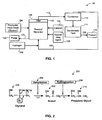
- Fig. 1 is a schematic block flow diagram illustrating a reactor-separator with a reactor, condenser, and condensate tank, and recycle of unreacted hydrogen (not part of the invention).
- Fig. 2 is a schematic of the proposed reaction mechanism for conversion of glycerol to propylene glycol via acetol intermediate.
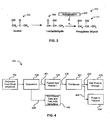
- Fig. 3 is a schematic of a two-step alternative way for converting glycerol to acetol and then converting acetol to propylene glycol, where it will be noted that the mechanism of Fig. 2 may be prevented form reaching the propylene glycol product by an absence of hydrogen.
- Fig. 4 is a schematic of a two-step alternative way for converting glycerol to acetol and then converting acetol to propylene glycol, where the process equipment may also be used to make propylene glycol with no intermediate step;
- Fig. 5 is a schematic of laboratory process equipment that may be used to demonstrate the process equipment of Figs. 4 or 6 .
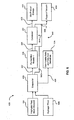
- Fig. 6 is a schematic of a two-step alternative way for converting glycerol to acetol and then converting acetol to propylene glycol where hydrogen is used for the first reactor at a lower pressure and water is removed from the vapor effluents from the first reactor to allow purging of the water from the system.
- Fig. 7 is a schematic block flow diagram illustrating a packed-bed reactor with an evaporator, reactor, and condenser for use in the invention.
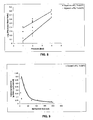
- Fig. 8 shows pressure dependence of the glycerol to propylene glycol reaction at temperatures of 220°C, and 240°C.
- Fig. 9 shows glycerol to propylene glycol reaction effect of H 2 : glycerol mole ratio on catalyst productivity at 220°C.
- Fig. 10 shows glycerol to PG reaction: effect of H2: Glycerol mole ratio on catalyst productivity at 220°C.
- Figs. 11A, 11B and 11C show a preferred reactor configuration.
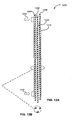
- Figs. 12a an d12 B show a pilot scale reactor.
- Fig. 13 illustrates a packed-bed reactor with optional gas feed to evaporator (not part of the invention)
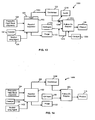
- Fig. 14 is a schematic block flow diagram illustrating a preferred packed-bed reactor system including recycle of product to improve temperature control and purification of the reactor effluent in a separator (not part of the invention).
- Fig. 15 is a schematic block flow diagram illustrating a preferred packed-bed reactor system including recycle of product to improve temperature control and purification of the reactor effluent in a separator (not part of the invention)
- Fig. 16 is a process flow diagram illustrating a device that recycles water, hydrogen, and/or heat to reduce byproduct formation when converting glycerol to acetol and then to propylene glycol (not part of invention).
- reaction product mixtures that are derived from the process include but are not limited to deicing fluids, anti-icing fluids, and antifreeze applications.
- deicing fluids include but are not limited to deicing fluids, anti-icing fluids, and antifreeze applications.
- propylene glycol-based antifreezes displace the use of toxic and non-renewable ethylene glycol with non-toxic and renewable glycerol-derived antifreeze.
- propylene glycol that is derived from natural glycerol is a renewable alternative to petroleum-derived propylene glycol.
- Other downstream uses for propylene glycol include any substitution or replacement of ethylene glycol or glycerol with propylene glycol.
- One method, which is not part of the invention,of preparing antifreeze from glycerol includes reaction at a temperature ranging from 150° to 250°C and in some embodiments this temperature is more preferably from 180°C to 220°C.
- the reaction occurs in a reaction vessel.
- the pressures in the reaction vessel are preferably from 1 to 25 bars and in some embodiments this pressure is more-preferably between 5 and 18 bars.
- the process equipment may include, for example, a reactor at these temperature and pressure conditions connected to a condenser and condensate tank where the condenser is preferably at a temperature between about 25°C and 150°C and in some embodiments this is more preferably between 25° and 60°C.
- Fig. 1 provides a block flow diagram of process equipment 100 including a reactor-separator 102.
- a polyhydric feed stock 104 for example, containing glycerol, is introduced stepwise or continuously into the reactor separator 102.
- Hydrogen 106 is added to hydrogen line 108 to promote conversion of glycerol 104 to propylene glycol within the reactor-separator 102.
- the process temperatures are such that a distillation occurs with the formation or presence of propylene glycol, short chain alcohols, and water, which vaporize and flow through overhead line 110 to a condenser 112.
- Reaction products 118 are removed from the condensate tank 112 through discharge line 116, and the reaction mixture inside reactor-separator 102 may be purged periodically or at a slow flow rate through purge line 120 to obtain purge mixture 122. Purging is necessary or desirable when non-volatile reaction by-products are formed and when metals or inorganic acids, such as residual biodiesel catalysts, are present in the polyhydric feed stock 104. Catalysts and useful components, such as glycerol and propylene glycol, are preferably recovered from the purge mixture 122.
- the reaction inside reactor-separator 102 is catalyzed, and may be facilitated at periodic intervals or by the continuous introduction of a suitable catalyst 124, which may be any catalyst that is suitable for use in converting glycerol into lower alcohols, such as acetol and/or propylene glycol.
- the catalyst 124 may reside within the reactor-separator as a packed bed, or distribution of the catalyst 124 inside reactor-separator 102 may be improved by using the hydrogen gas 108 to provide a fluidized bed, or by stirring (not shown). Agitated slurry reactors of a liquid phase reaction with a vapor overhead product are preferred.
- the catalyst 124 is mixed with the polyhydric feedstock 104 that is undergoing reaction in the reactor separator 102 to facilitate breaking of carbon-oxygen or carbon-carbon bonds including but not limited to hydrogenation.
- hydrogenolysis and hydrogenation are interchangeable terms.
- Suitable catalysts for this purpose may include, without limitation, such metals as platinum, palladium, ruthenium, chromium, nickel, copper, zinc, rhodium, chromium, ruthenium, and combinations thereof. Catalysts may be deposited on a substrate, such as an alumina substrate. In a broader sense, suitable catalysts may include those catalyst containing one or more elements of the subgroups from Group I, Group VI, and/or Group VIII of the Periodic Table.
- the best catalysts are non-volatile, and are preferably prevented from exiting the reactor separator 102 into the condensate tank 114.
- a filter 125 in the overhead discharge line 110 from the reactor separator 102 retains solid catalysts in the reactor separator 102. No limitations are placed or implied on whether the catalyst is soluble or solid, the oxidative state of the catalyst, or the use of solid supports or soluble chelates.
- Reaction times at preferred conditions may range from a few minutes to 96 hours.
- Reaction time may be defined as the volume of liquid in the reactor divided by the time-averaged flow rate of liquids into the reactor. While the preferred reaction times are greater than 2 hours, the average residence time at higher loadings of catalyst 124 can be less than an hour and typically longer than 0.5 hours. While preferred temperatures are up to 250°C, the reactor-separator may be operated at temperatures up to 270°C with satisfactory results.
- the polyhydric feed stock 104 preferably contains glycerol.
- polyhydric feedstock 104 may contain, for example, from 5% to substantially 100% of a polyol, for example, glycerol, sorbitol, 6-carbon sugars, 12-carbon sugars, starches and/or cellulose.
- the process equipment 100 is preferably configured to provide hydrogen 106 as a reagent; however, the use of hydrogen is optional.
- Commercially valuable products may be formed as intermediates that collect in the condensate tank in the absence of hydrogen. Accordingly, use of hydrogen 106 is preferred, but not necessary.
- the intermediates collecting in condensate tank 114 may include acetol (hydroxy-2-propanone), which may be subjected to hydrogenolysis by at least two mechanisms as shown in Figs. 2 and 3 .
- the material within reactor separator 102 may contain water, salts, or catalysts residue from previous processes.
- polyhydric feedstock 104 may contain glycerol that is prepared by transesterification of oils or fatty acids, for example, as described in copending application serial number 10/420,047 filed April 23, 2003 , which is incorporated by reference to the same extent as though fully replicated herein.
- water may be present in an amount ranging from 0% to 70%. More preferably, water is present in an amount ranging from 5% to 15%. Water may be added to reduce side-reactions, such as the formation of oligomers.
- One advantage of using the process equipment 100 is that volatile alcohol products are removed from the reaction mixture as they are formed inside reactor separator 102. The possibility of degrading these products by continuing exposure to the reaction conditions is commensurately decreased by virtue of this removal. In addition, the volatile reaction products are inherently removed from the catalysts to provide relatively clean products. This reaction-separation technique is especially advantageous for catalysts that are soluble with or emulsified in the reaction mixture.
- a preferred class of catalyst 124 is the copper chromite catalyst, (CuO) x (Cr2O3) y .
- This type of catalyst is useful in the process and is generally available commercially.
- the nominal compositions of copper expressed as CuO and chromium expressed as Cr 2 O 3 may vary from about 30-80 wt% of CuO and 20-60 wt% of Cr 2 O 3 .
- Catalyst compositions containing about 40-60 wt% copper and 40-50 wt% of chromium are preferred.
- Preferred catalysts for use as catalyst 124 in addition to the copper and chromium previously described, also include barium oxide and manganese oxide or any of their combinations. Use of barium and manganese is known to increase the stability of the catalyst, i.e., the effective catalyst life.
- the nominal compositions for barium expressed as barium oxide can vary 0-20 wt% and that for manganese expressed as manganese oxide can vary from 0-10 wt%.
- the most preferred catalyst compositions comprise from 40%-60 wt% of CuO 40-55 wt % of Cr 2 O 3 , 0-10 wt% of barium oxide and 0-5 wt% manganese oxide.
- Fig. 2 shows a preferred reaction mechanism 200 for use in the reactor-separator 102 of Fig. 1 , and for which process conditions may be suitably adjusted as described above.
- hydroxyacetone (acetol) 202 is formed, and this is possibly an intermediate of an alternative path for forming propylene glycol by a different mechanism.
- the acetol 202 is formed by dehydration 204 of a glycerol molecule 206 that undergoes intramolecular rearrangements as shown.
- the acetol 202 further reacts with hydrogen to form propylene glycol 210 with one mole of water by-product resulting from the dehydration step 204.
- Step 1 An experiment was performed to validate the reaction mechanism 200. Reactions were conducted in two steps, namely, Steps 1 and 2.
- step 1 relatively pure acetol was isolated from glycerol. Temperature ranged from 150°C to 250°C and more specifically from 180°C to 220°C. There was an absence of hydrogen. Pressure ranged from 1 to 14 psi (6.9 MPa to 96 MPa) more specifically from 5 to 10 psi (34 MPa to 69 MPa). A copper-chromite catalyst was present.
- Step 2 the acetol formed in Step 1 was further reacted in presence of hydrogen to form propylene glycol at a temperature ranging from 150°C to 250°C and more preferably between 180 to 220°C. Excess hydrogen was added at a hydrogen over pressure between 1 to 25 bars using the same catalyst.
- lactaldehyde represents an alternative path for forming propylene glycol from acetol.
- Fig. 3 shows this mechanism 300 where the acetol undergoes a rearrangement of the oxygen double bond to form lactaldehyde 302, but the dehydrogenation step 208 acting upon the lactaldehyde 302 also results in the formation of propylene glycol 210. It was also observed that the formation of lactaldehyde intermediate was predominant at lower reaction temperatures in the range of from 50°C to 150°C (see Example 8 below).
- a process for converting glycerol to lactaldehyde with high selectivity preferably includes the steps of combining a glycerol-containing feedstock with less than 50% by weight water with a catalyst that is capable of dehydrating glycerol to form a reaction mixture; and heating the reaction mixture to a temperature between 150° C to 200°C over a reaction time interval between 0 to 24 hours at a pressure between 0.02 and 25 bar.
- the catalyst used in the step of combining is contains an element of the subgroups from Group I, Group VI, and/or Group VIII of the Periodic Table.
- the glycerol-containing feedstock used in the step of combining contains from 0% to 15% water in glycerol by weight.
- the catalyst used in the step of combining is a heterogeneous catalyst selected from the group consisting of palladium, nickel, rhodium, copper, zinc, chromium and combinations thereof.
- the process includes a step of removing reaction product vapors that form during the step of heating.
- the process includes a step of condensing the vapors to yield liquid reaction product.
- temperature used in the heating step exists within a range from 165°C to 185°C.
- the pressure used in the heating step exists within a range from 0.02 to 2 bars.
- the step of condensing occurs using a condenser operating at a temperature between 0°C to 140°C
- reaction efficiency may be optimized at any process conditions, such as reaction time, temperature, pressure and flash condition by the selection or choice of catalyst for a given polyhydric feedstock.
- Table 1 reports the results of reacting glycerol in the presence of hydrogen and catalyst to form a mixture containing propylene glycol.
- the reaction vessel contained 80 grams of refined glycerol, 20 grams of water, 10 grams of catalyst, and a hydrogen overpressure of 200 psig.
- the reactor was a closed reactor that was topped off with excess hydrogen. The reaction occurred for 24 hours at a temperature of 200°C. All catalysts used in this Example were purchased on commercial order and used in the condition in which they arrived. Table 1. Summary of catalyst performances based on 80 grams of glycerol reported on a 100 grams basis.
- Table 2 summarizes reaction performance with a higher initial water content, namely, 30 grams of refined glycerol and 70 grams of water.
- the reactions were conducted at the following initial conditions: 5% wt of catalyst, and a hydrogen overpressure of 1400 kPa.
- the following table presents compositions after reacting in a closed reactor (with topping off of hydrogen) for 24 hours at a reaction temperature of 200°C.
- Table 2. Summary of catalyst performances based on 30 grams initial loading of glycerol and 70 grams of water.
- Table 3 summarizes the performance of a copper chromium catalyst in the presence of 20 percent of water. The reactions were conducted at the following initial conditions: 5% wt of catalyst, and a hydrogen overpressure of 1400 kPa. The following table presents compositions after reacting in a closed reactor (with topping off of hydrogen) for 24 hours at a reaction temperature of 200°C. Table 3. Summary of copper chromium catalyst performance based on 80 grams initial loading of glycerol and 20 grams of water. Initial Loading (g) Best Possible (g) Catalyst Copper Chromium (g) Glycerol 80 0 33.1 Propylene glycol 0 66.1 44.8 Ethylene Glycol 0 0 0 Acetol 0 0 3.2
- Table 4 summarizes the impact of initial water content in the reactants on formation of propylene glycol from glycerol.
- the reactions were conducted at the following initial conditions: 5% wt of catalyst, and a hydrogen overpressure of 1400 kPa.
- the catalyst was purchased from Sud-Chemie as a powder catalyst having 30 m 2 /g surface area, 45% CuO, 47% Cr 2 O 3 , 3.5% MnO 2 and 2.7% BaO.
- the following table presents compositions after reacting in a closed reactor (with topping off of hydrogen) for 24 hours at a reaction temperature of 200°C.
- reaction was performed using a small scale reaction distillation system like that shown as process equipment 100 in Fig. 1 to process a reaction mixture including 46.5 grams of refined glycerol and 53.5 grams water.
- the catalyst was purchased from Sud-Chemie as a powder catalyst having 30 m 2 /g surface area, 45% CuO, 47% Cr 2 O 3 , 3.5% MnO 2 and 2.7% BaO.
- Table 5 summarizes performance with higher initial water content using a small reaction distillation system. Table 5.
- One preferred source of the polyhydric feedstock 104 is crude natural glycerol byproducts or intermediates, for example, as may be obtained from processes that make or refine fatty acid glycerides from bio-renewable resources. These are particularly preferred feedstocks for making an antifreeze mixture.
- the antifreeze mixture is prepared as explained above by hydrogenation of glycerol over a catalyst, which is preferably a heterogeneous catalyst.
- the reactor-separator 102 may, for example, be a packed bed reactor, slurry, stirred or fluidized bed reactor. When the hydrogenation reaction is performed in a packed-bed reactor, the reactor effluent is largely free of catalyst.
- a heterogeneous catalyst may be filtered from the reactor effluent.
- the reactor-separator 102 may be used for slurry reactions by circulating hydrogen from the top vapor phase to the bottom of the reactor to create increased agitation and by preferably using a catalyst that has a density similar to the density of the liquid in the reactor.
- a fluidized bed may be used where the densities differ, where a catalyst bed is fluidized by the incoming hydrogen from line 108.
- Conventional agitation may also promote hydrogen contact in the liquid.
- the process conditions need only provide moderate hydrogenation conversions of glycerol, e.g., those ranging from 60% to 90% conversion. This is because from 0% to 40% of the glycerol in the polyhydric feedstock 104 on a water-free basis may remain with propylene glycol products in the antifreeze product.
- the final antifreeze product may suitably contain up to 60% glycerol.
- the purge materials 122 may be mixed with the contents of condensate tank 114, for example, after filtering, to form a salable product that may be directly discharged from the process equipment 100.
- polyhydric feedstock 104 for the reaction is the natural glycerol byproduct that is produced during the value-added processing of naturally occurring renewable fats and oils.
- the glycerol byproduct may be a vegetable oil derivative, such as a soy oil derivative.
- This variety of polyhydric feedstock 104 may contain water, soluble catalysts, and other organic matter that are present in intermediate mixtures which are produced in the manufacture of glycerol for sale into the glycerol market.
- One advantage of the present instrumentalities is that little or no refining of these intermediates are necessary for their use as polyhydric feedstock 104 in making commercial antifreeze or deicing mixtures.
- These intermediates and other polyhydric feedstocks 104 may contain high amounts of water.
- the ability to use polyhydric feedstocks 104 that contain high amounts of water advantageously reduces costs for this process over other uses for the glycerol.
- the water content both in the polyhydric feedstock 104 prior to the reaction and in the salable reaction product is generally between 0 and 50%.
- the polyhydric feedstock 104 may contain residual catalyst that was added during alcoholysis of these intermediates.
- the fate of soluble residual catalysts, i.e., those that remain from alcoholysis in the polyhydric feedstock 104 and which are in the purge material 122 depends upon:
- the residual catalyst content in the glycerol feedstock 104 from the processing of bio-renewable fats and oils is commonly between 0% and 4% or even up to 10% by weight on a water-free basis.
- One way to reduce the residual catalyst content is to minimize the amount that is initially used in alcoholysis of the fatty acid glyceride.
- the alcoholysis may, for example, be acid-catalyzed.
- Neutralizing the residual catalyst with an appropriate counter-ion to create a salt species that is compatible with the antifreeze specifications is preferred to removing the residual catalyst.
- neutralization can be performed to precipitate the catalyst from the liquid glycerol.
- Calcium-containing base or salt may be used to neutralize the residual catalyst in the polyhydric feedstock 104, and the solid salts generated from this neutralization may be separated from the liquid, for example, by filtration or centrifugation of effluent from reactor-separator 102, such as by filtering purge material 122.
- Acid-base neutralization to form soluble or insoluble salts is also an acceptable method of facilitating separation. Specifically, neutralizing potassium hydroxide with sulfuric acid to form the dibasic salt is a acceptable procedure. As shown by way of example in Fig.
- neutralization of sodium or potassium catalyst which is sometimes introduced into the value-added processing method for fats and oils, can be achieved by adding stoichiometric equivalent amounts of a neutralizing agent 126, such as calcium oxide and/or sulfuric acid, to form the calcium salt of the catalyst.
- a neutralizing agent 126 such as calcium oxide and/or sulfuric acid
- These salts are largely insoluble and may be filtered from the purge material 122.
- the water content is preferably reduced to less than 20% by weight and the filtration is preferably performed at temperatures less than 40°C and more preferably below 30°C.
- the optimal filtration temperature depends upon composition where the reduced solubility of salts at lower temperatures is weighed against lower viscosities at higher temperatures to identify the best filtration conditions.
- One general embodiment for processing of crude glycerol to antifreeze in the fatty acid glyceride refinery embodiment follows a C 1 to C 4 alkyl alcohol alcoholysis process.
- the incoming crude glycerol feedstock 104 is neutralized by the addition of a neutralizing agent 126 to achieve a pH between 5 and 12, which is more preferably a pH between 5 and 9.
- the C 1 to C 4 alcohol and water are separated by distillation from the crude glycerol, such that the combined concentrations of water and C 1 to C 4 alcohols within reactor-separator 102 are less than 20 wt% by weight and, preferably, less than 5% by weight.
- fractional distillation In a stepwise process where the polyhydric feedstock 104 is added to the reactor-separator 104 at periodic intervals, selected components of these alcohols and/or their reaction products may be isolated by fractional distillation through overhead line 110 and discharged from condensate tank 114. This may be done by flash liberation of such alcohols at suitable times to avoid or limit their combining with propanediols, according to the principle of fractional distillation.
- Subsequent hydrogenation of the flashed glycerol within reactor-separator 102 suitably occurs by contacting the crude glycerol with a hydrogenation catalyst and hydrogen at a pressure ranging from 1 bar to 200 bar and at a temperature ranging from 100° to 290°C until a conversion of the glycerol between 60% and 90% is achieved. More preferably, process conditions entail the contact pressure for hydrogenation ranging from 1 to 20 bar.
- Separating the C 1 to C 4 alcohol and water is preferably achieved by selective flash separation at temperatures greater than 60°C and less than 300°C.
- separating the C 1 to C 4 alcohol and water may be achieved in a process based on thermal diffusion, as is described in related application 10/420,047 , where for example the reactor-separator 102 is a thermal diffusion reactor.
- water is added prior to hydrogenation as water promotes hydrogenation in the presence of certain catalysts.
- the amount of organic matter in the polyhydric feedstock is substantially dependent upon the fat or oil from which the glycerol was obtained.
- the organic matter (other than glycerol) is typically fatty acid derivatives.
- One method for mitigating residual organic matter is by filtration.
- the flash point of the mixture is preferably increased to greater than 100°C by flash separation of volatiles from the glycerol-water mixture.
- the residual C 1 to C 4 alkyl alcohol content in the feedstock is flash liberated to achieve feedstock concentrations that are preferably less than 1 % alkyl alcohol.
- vacuum may need to be applied to reach achieve the 1% alkyl alcohol concentration.
- reaction conditions for conversion for use in processing these feedstocks are similar but not exactly the same as preferred +conditions that have been previously described for use in the reactor-separator 102.
- the reaction temperature is 150°C to 250°C.
- the reaction time is from 4 to 28 hours.
- Heterogeneous catalysts are used which are known to be effective for hydrogenation, such as palladium, nickel, ruthenium, copper, copper zinc, copper chromium and others known in the art.
- Reaction pressure is from 1 to 20 bar, but higher pressures also work.
- Water in the polyhydric feedstock is preferably from 0% to 50% by weight, and more preferably from 5 to 15% water by weight.
- the preferred reaction conditions provide a number of performance advantages. Operating at temperatures less than 250°C dramatically reduces the amount of unintended by-product formation, for example, where lower concentrations of water may be used without formation of polymers or oligomers. Furthermore, operation at temperatures near 200°C, as compared to near 300°C, provides an increased relative volatility of propylene glycol that facilitates an improved separation of propylene glycol from the glycerol reaction mixture.
- the use of lower pressures allows the use of less expensive reaction vessels, for example, as compared to highpressure vessels that operate above about 28 bars, while also permitting the propylene glycol to distill from solution at these temperatures. Even so, some embodiments are not limited to use at pressures less than 20 bars, and may in fact be practiced at very high hydrogen pressures.
- the disclosed process conditions are viable at lower pressures (less than 20 bar) whereas most other processes to produce similar products require much higher pressures.
- glycerol may also be hydrogenolysed to 1, 2 and 1, 3 propanediols.
- the 1, 3 propanediol may be optionally separated from this mixture by methods known in the science and used as a monomer while the remaining glycerol and propanediols are preferably used as antifreeze.
- One method of preparing acetol and propylene glycol from glycerol includes a gas phase reaction at a temperature ranging from 150° to 280°C in a packed-bed reactor. In some embodiments this temperature is more preferably from 180°C to 240°C or 250°C to avoid thermal degradation of reaction products.
- the reactions described herein occurred in a packed-bed reactor.
- the pressures in the reaction vessel are preferably from 0.02 to 5 bars. Most preferably, the reaction pressure exists within a range from 0.2 and 1.2 bars.
- Fig. 4 provides a block flow diagram of process equipment 400 including an evaporator 426 for creating a vapor reaction mixture 427.
- Non-volatile components 428 in the polyhydric feed 104 are removed from the evaporator 426 in a continuous or semi-batch mode.
- the evaporator 426 is particularly effective for processing crude glycerol that contains salts where, otherwise, the salts poison the catalyst.
- a polyhydric feed stock 104 for example, containing glycerol, is introduced stepwise or continuously into the evaporator 426.
- the vapor reaction mixture 427 proceeds to the packed-bed reactor 425 where the heterogeneous catalyst promotes conversion of glycerol 104 to acetol and propylene glycol in sequential reactions.
- the vapor product mixture 430 proceeds to the condenser 431 where a condensate product is formed 432 and proceeds to product storage 433.
- the gas effluent may disposed through purge or vacuum 434.
- Water is produced as a reaction byproduct and may be kept with the propylene glycol product or removed.
- a major advantage of the current process over other processes in the literature is the very low concentration or absence of ethylene glycol resultant from either the use of copper chromite catalyst or formation and purification of acetol as an intermediate.
- the acetol can be readily purified from any ethylene glycol prior to hydrogenation by distillation.
- the processes of this operation may be maintained at pressures below 1 bar through the use of a vacuum source preferably connected to the condensation process at the end of the process.
- a vacuum source preferably connected to the condensation process at the end of the process.
- the condenser 431 itself can maintain pressures less than 1 bar; however, from a practical perspective, a vacuum is needed to pull off any inert gases (nitrogen) that may accumulate in the system.
- Fig. 5 provides a schematic diagram of the laboratory equipment 500 showing a variation of this equipment 500, which includes an evaporator 526 connected to the packed bed reactor 525. Vapor effluent from packed bed reactor 525 is condensed in the condenser 531 by action of a cold bath to draw heat 538. Heat 540 is applied to the evaporator 526 to create the vapor reagent. A vacuum 542 connected to the condenser 531 literally pulls the vapors through the system and allows the glycerol feed to evaporate at lower temperatures than would occur at atmospheric pressure.
- An oil bath 534 maintains the packed bed reactor 535 at a predetermined temperature or temperature range by flow of heat 542.
- the glycerol is loaded into the evaporator 526 at the start of the experiment and may be added through an auxiliary feed to the evaporator (not shown) during the experiment.
- An optional gas feed 544 that contains nitrogen and may also contain hydrogen is directed to the evaporator 526.
- Reaction G1 of Table 6 provides example conversion data over 3.3 mm cylindrical pellets of copper chromite catalyst. The pressure of this reaction was less than 0.1 bar, and the temperature is about 230°C. Reaction G1 illustrates the effectiveness of the gas phase reaction over a packed-bed of catalyst for producing acetol in high selectivity. Table 6. Summary of gas phase reactor performances in packed-bed reactor.
- propylene glycol was produced in illustrative example G1 of Table 6. Since the only source of hydrogen for reacting with acetol (or glycerol) to form propylene glycol was from another acetol or glycerol molecule it was hypothesized that the absence of free hydrogen in the system led to scavenging of hydrogen from the glycerol and that this scavenging led to undesired byproducts and loss in yield.
- Fig. 6 illustrates the preferred packed-bed reaction process equipment 600 with hydrogen feed 636 as a modification to the process equipment of Fig. 4
- the hydrogen feed 636 was introduced to the evaporator 426 since this gas diluents, in addition to being useful in hydrogenating acetol, also promotes evaporation of glycerol. Since glycerol has a vapor pressure of a mere 0.15 bar at 230°C, the hydrogen overpressure can add to this pressure to increase overall pressure-but this is primarily possible if glycerol is evaporated in the presence of a gas like hydrogen.
- the condenser 431 condenses the acetol and propylene glycol from unreacted gas. although the unreacted gas may be purged 434, a recycle loop 640 may be used to resupply the evaporator 426, packed bed reactor 425, or condenser 431 by selective arrangement of valves 642, 644, 646.
- Reaction G2 of Table 6 provides example conversion data illustrating the beneficial impact of a hydrogen feed (purge) 544 (see Fig. 5 ) as the hydrogen feed 636 of Fig. 6 combined with the glycerol feed in the packed-bed reactor 425.
- the pressure of was 0.13 bars, and the temperature was 230°C. A higher yield to acetol and propylene glycol was observed.
- the desired dehydration reactions produce one water molecule for every acetol (or propylene glycol) molecule that is formed. Water present in excess of this indicates excess dehydration and lower selectivities.
- the ratio of actual to theoretical water content decreased from 2.3-3.6 to 1.07-1.17 as a result of hydrogen being present during the dehydration reaction.
- a GC peak at 10.77 minutes is a by-product. The ratio of this peak area to the mass fractions of desired acetol and propylene glycol decreased from 0.76-0.9 to 0.47-0.63 as a result of hydrogen being present during the dehydration reaction.
- experiment G3 was performed using nitrogen instead of hydrogen.
- the ratio of actual to theoretic water increased to 1.51 with nitrogen.
- the ratio of the 10.77 minute peak increased to 1.56.
- the preferred process uses a hydrogen diluent and reagent 636 introduced to the evaporator 426.
- Fig. 7 shows a more preferred process of preparing propylene glycol from glycerol.
- Fig. 7 provides a block flow diagram of process equipment 700 including glycerol (or polyhydric) 704 and hydrogen feeds 736.
- the hydrogen is contacted with the glycerol in an evaporator 726 operated between about 200 and 250°C, which promotes evaporation of glycerol to form a vapor reactor enfluent 727.
- a first packed-bed reactor 725 converts glycerol to acetol with some formation of propylene glycol.
- the acetol will react with hydrogen to form propylene glycol in the first packed-bed reactor 725. At low hydrogen partial pressures, about 0.1 bar, acetol is predominantly formed. At higher hydrogen pressures, more propylene glycol is formed. The formation of acetol is predominantly rate limited. The reaction of acetol to propylene glycol is fast relative to the reaction of glycerol to acetol; however, the acetol to propylene glycol reaction is equilibrium limited. Since reaction of acetol to propylene glycol is equilibrium limited, recycle of acetol is useful to maximize production of propylene glycol. Distillation can be used to concentrate acetol from the product stream for recycle to the evaporator or other locations prior to the reactor.
- One method of operating the process of Fig. 7 is to add additional hydrogen to stream 741 whereby acetol is primarily formed in the first packed-bed reactor 725 and propylene glycol is primarily formed in the second packed-bed reactor 738.
- the dehydration reaction in the first packed-bed reactor 725 is highly exothermic.
- the heat of reaction will increase glycerol initially at 200°C to acetol at 414°C at 100% conversion and without any solvent/diluent.
- the higher temperatures lead to a loss of production and generation of undesired by-products.
- Heat must be continuously or stepwise removed from the reaction mixture to maintain temperatures below 250°C, preferably below 230°C, and most preferably below 220°C.
- the mixture is preferably cooled to about 220°C in a heat exchanger 740 prior to hydrogenolysis 741 in packed-bed reactor two 738.
- Reactor two 738 is preferably a packed-bed reactor.
- Copper chromite catalyst is effective in reactor two; however, other hydrogenation catalysts may also be used such as Raney-nickel catalyst.
- the hydrogenolysis reaction is also highly exothermic.
- a separator 745 is used to further purify the product 733.
- the reactor 1 effluent 730 and reactor 2 effluent 739 are recycled 742/743 along with the overheads 747 of the separator 745.
- a blower 744 is used to overcome pressure drops for the recycle.
- the hot recycle streams 742/743 may have temperatures up to 300°C and reduce or eliminate the need for auxiliary heat addition to the evaporator 726. This direct contact heat exchange and evaporation is very efficient. These recycle streams serve the addition purpose of providing additional heat capacity to the reactor enfluents 727/741, and this additional heat capacity minimizes temperature increases in the reactors. Minimizing temperature increases maximizes yields of acetol and propylene glycol.
- Recycled vapors 742/743/747 add additional partial pressures from acetol, water, and propylene glycol; combined, these may add from 0.2 to 1.2 bars of partial pressure.
- Recycle stream 1042 has the advantage of providing heat to the evaporator 1026, but has the disadvantage of increasing the residence time of acetol that can degrade acetol.
- Recycle stream has advantages associated with providing heat to the evaporator.
- Recycle stream 1047 can be enriched in hydrogen as a recycle, which is advantageous for the reaction, but is not advantageous for providing heat to he evaporator.
- the corresponding total pressure in the evaporator and downstream unit operations is about 0.3 to 1.5 bars.
- the preferred pressure is about 1.1 bars such that about 0.3 bars is fresh feed glycerol and hydrogen, about 0.4 bars is recycled hydrogen, and about 0.4 bars is recycled water vapor-heat exchangers are preferred to recover heat from the hot reaction products into the evaporator and vapors recycled to the evaporator.
- temperature control is most important.
- the preferred means to control temperature is to use recycled water and hydrogen as a diluent in combination with heat exchangers between a first and second reactor. More than two reactors is optional.
- cold shots of propylene glycol from the product stream 1046 can be used to maintain temperatures less than 250°C throughout the system.
- Table 7 and Fig. 8 show the impact of temperature and pressure on the ratio of propylene glycol to acetol in the product for a reaction at a residence time slightly longer than is necessary to fully react all the glycerol.
- Table 7 summarizes the ratio of propylene glycol to acetol where propylene glycol was used as the feed (not glycerol in the system). The fact that propylene glycol reacts to form acetol fully validates that this reaction is equilibrium limited. The fact that the forward (glycerol as reactant) and backward (propylene glycol is reactant) produce essentially the same ratios of propylene glycol at similar temperatures and pressures indicates that the acetol to propylene glycol reaction is predominantly equilibrium limited rather than rate limited.
- Fig. 8 illustrates the data of Table 7 as pressure dependence of the glycerol to propylene glycol reaction, at temperatures of 220°C. and 240°C.
- Table 9 summarizes conversion data on a 15 foot reactor loaded with 760 and 1160 grams of 3 X 3 mm pellet copper chromium catalyst. The reactions were evaluated with glycerol evaporated at 230°C. The by controlling the vacuum at the exit from the cold trap (condenser), the pressure of the system was able to be operated at 27, 19, and 8 inches of mercury in vacuum (0.074, 0.34, and 0.71 bars absolute pressure). This increase in pressure causes the partial pressure and the stoichiometric excess of hydrogen to increase. Table 9 . Summary of gas phase reactor performances in "cobra' (15 flexible steel tube, 0.5 inch ID) packed-bed reactor.
- the preferred operation of the evaporator is at a temperature near 230°C, and contact of glycerin with gases is such that glycerin attains a partial pressure of about 0.15 bars.
- a preferred stoichiometric addition of hydrogen feed 1036 will add an additional partial pressure of about 0.15 bars or more of hydrogen.
- the first reactor could be a reactive distillation reactor operated at lower pressures or it could be a packed-bed reactor operated at lower pressures. There is little advantage to using higher pressures in the first reactor if the goal is to form acetol; the acetol is preferably produced from a process operated at a pressure less than 5 bars.
- the advantage of using a reactor where acetol is a liquid for converting acetol to propylene glycol is that the liquid product can be selectively removed (rather than hydrogen) from the reaction environment. This can reduce separation costs and the costs of recycling hydrogen.
- An additional advantage is that the high pressures and lower temperatures (less than 220°C) can substantially overcome the equilibrium limitations of the acetol-to-propylene glycol hydrogenation.
- the advantage of using a gas-phase packed-bed reactor is that lower pressures are required.
- An additional advantage of using a gas-phase packed-bed reactor is that by-product formation tends to be promoted in liquid phases-especially the formation of tar.
- the first reactor is operated to promote conversion of glycerol predominantly to propylene glycol and the second reactor is operated at lower temperatures that create equilibrium favorable for further conversion of acetol to propylene glycol.
- the first reactor preferably has reaction temperatures greater than 200°C and the second reactor preferably has temperatures less than 220°C.
- the glycerol concentration entering the second reactor is less than half the glycerol concentration entering the first reaction step. More preferably, the first reaction step has reaction temperatures greater than 210°C and the second reaction step has temperatures less than 210°C.
- Liquids exhibit increased rates of by-product formation.
- At a given pressure there is a minimum temperature below which liquids form. This temperature is a function of composition.
- the least volatile component is glycerol, and so, higher glycerol concentrations necessitate operating at higher temperatures, hence, in a two-reactor system the first reactor is operated at a higher temperature because the first reactor has the higher glycerol concentration.
- the partial pressure of glycerol is the key parameter to be followed and controlled to avoid formation of liquids in the gas-phase packed-bed reactor.
- the partial pressure of glycerol must be kept below glycerol's dew point partial pressure.
- Glycerol's dew point partial pressure is defined as the partial pressure of glycerol below which glycerol does not form dew and at which a dew is formed that contains glycerol-this definition implies that the glycerol-free ratios of all other components in the system remain constant and the temperature is constant as the partial pressure of glycerol is increased until the a dew is formed. Being defined in this manner, glycerol's dew point partial pressure is a state property that is a function of temperature and the glycerol-free concentration of other components in the gas.
- the preferred processes of this embodiment have a partial pressure of glycerol less than glycerol's dew point partial pressure in the reaction mixture and greater than one fourth the dew point partial pressure in the reaction mixture. More preferably, the partial pressure of glycerol is greater than half the dew point partial pressure in the reaction mixture.
- the reaction temperature is preferably below 230°C because at higher temperatures, byproduct formation is favored. When the temperature gets too low (such as 180°C), glycerol's dew point pressure becomes so low that reactor throughput can become too low to be economically viable. Also, at lower temperatures the dehydration of glycerol becomes slower, further leading to increased reactor sizes.
- y Dew Glyc the dew point mole fraction of glycerol in the gas phase
- P is total pressure
- P Sat Gly is the saturation pressure of pure glycerol at the temperature of the system.
- the dew point mole fraction of glycerol is the maximum that can be held in the gas phase.
- Table 10 summarizes dew point mole fractions at 1, 10, and 100 bar total pressure. Table 10. Maximum mole fractions of glycerol in system at indicated temperature above which liquids will form in system. T (°C) Vapor Pressure Glycerol (bar) Maximum y Glyc (Dew Point) @ 1 bar Maximum y Glyc (Dew Point) @ 10 bar Maximum y Glyc (Dew Point) @ 100 bar 150 0.007 0.007 0.0007 0.00007 180 0.025 0.025 0.0025 0.00025 200 0.058 0.058 0.0058 0.00058 220 0.126 0.126 0.0126 0.00126 250 0.345 0.345 0.0345 0.00345
- Fig. 9 and Table 11 summarize the impact of the molar ratio of hydrogen to glycerol on catalyst productivity (measured in grams of propylene glycol produced per hour per gram of catalyst in the packed-bed reactor).
- the maximum catalyst productivity is at a mole fraction of glycerol right below the dew point mole fraction of glycerol.
- the previously indicated preferred concentrations of glycerol expressed in terms of partial pressure indirectly specify the preferred molar ratios-the partial pressure specification is independent of total system pressure.
- a process for converting glycerol to a product at high selectivity to propylene glycol and low selectivity to ethylene glycol preferably includes a reaction by: contacting a gas phase reaction mixture containing no liquid and containing a partial pressure of glycerol between 0.01 and 0.5 bars of glycerol and a total pressure between 25 and 500 bars with a heterogeneous catalyst at a temperature between 150°C and 280°C for a reaction time interval between 0.01 to 60 seconds.
- the solid catalyst preferably contains an element of the subgroups from Group I, Group VI, and/or Group VIII of the Periodic Table.
- the partial pressure of glycerol is less than glycerol's dew point partial pressure in the reaction mixture and greater than one fourth the dew point partial pressure in the reaction mixture. More-preferably, the process of claim 72 where the partial pressure of glycerol is greater than half the dew point partial pressure in the reaction mixture.
- a gas phase reactor can be used to produce acetol where pressures beyond 1 bar little advantage-pressures lower than one bar can present a hazard if air leaks into the system.
- a process for converting glycerol to a product at high selectivity to a mixture of acetol and propylene glycol and low selectivity to ethylene glycol preferably includes a reaction comprising: contacting a gas phase reaction mixture containing no liquid and containing a partial pressure of glycerol between 0.01 and 0.5 bars of glycerol and a partial pressure of hydrogen between 0.01 and 5 bars of hydrogen with a heterogeneous catalyst at a temperature between 150°C and 280°C for a reaction time interval between 0.01 to 60 seconds.
- the solid catalyst preferably contains an element of the subgroups from Group I, Group VI, and/or Group VIII.
- the partial pressure of glycerol is less than glycerol's dew point partial pressure in the reaction mixture and greater than one fourth the dew point partial pressure in the reaction mixture. More-preferably, the process of claim 72 where the partial pressure of glycerol is greater than half the dew point partial pressure in the reaction mixture. The slight amount of hydrogen in the system reduces by-product formation.
- the most preferred catalyst loading in the reactor is about 4 grams of catalyst per gram of propylene glycol produced per hour (a 4:1 ratio ). Ratios from 1:0.4 to 1:0.05 are preferred. Higher catalyst loadings at the previously indicated preferred partial pressures of glycerol can lead to excessive product loss to by-products.
- Reaction by-products from the gas phase reaction include multiple esters of propylene glycol and ethylene glycol. Ethylene glycol is at times observed in concentrations less than 2%.
- One method of purifying the reaction products is to convert the esters back to propylene glycol and ethylene glycol (along with corresponding acid) using a base (the reaction is effective at room temperature as well as temperatures higher than room temperature). After this hydrolysis reaction, the glycols can be evaporated/distilled from the salt formed from reaction of the base with the ester's acid. The glycols can than be purified by distillation.
- the preferred product purifying process includes the steps of: adding a base to the said propylene glycol product to achieve a pH greater than 8.0 and distilling the propylene glycol from the product having a pH greater than 8.0.
- the base is preferably selected from the group comprised of sodium hydroxide, potassium hydroxide, and calcium oxide.
- the preferred reactor is a novel reactor for use with highly exothermic reactions comprised of an outer shell containing U-tubes with an orientation such that the U-end of the U-Tubes is facing upward, said shell having an upper removable head where catalyst is loaded between shell and tubes from the top by removing the upper head.
- An inert packing may be placed in the lowest portion of the space between the shell and U-Tubes at a depth between 5.06 cm and 60.72 cm (2 and 24 inches).
- the design recommendation is to use a reactor sizing and loading of 4 Ib of catalyst for each lb/hr of PG production. It is anticipated that at least 2000 Ibs of propylene glycol (PG) is expected to be produced per pound of catalyst.
- Table 12 summarizes the catalyst loadings based on anticipated capacity. Herein and in the following, 1 lb is equal to 454g ,and 1 ft is equal to 30,48 cm. Table 12. Summary of catalyst loading recommendations.
- An initial total catalyst loading of 30,000 Ib (assumes 0.25 Ib PG /[Ib cat X hr])) (4 Ib catalyst per Ib/hr of PG production) may be appropriate if the initial capacity is targeted at 60 million Ib per year.
- One design uses three reactors arranged to operate in series with each reactor capable of holding 33,000 Ib of catalyst when full and with the intent of only operating two in series at any time. Initially, each reactor would be 75% full and catalyst would be added as the initial loading deactivates-catalyst will be added until the reactor is full of catalyst. When catalyst activity is too low to meet production capacity, the first reactor in the series will be removed from operation and the reserve reactor will be placed as the second reactor in series with an initial catalyst loading of 50-75%. Inert material should be used in the first reactor for initial startup. After this startup, no inert material should be required in any of the reactors because the catalyst will be sufficiently deactivated in the second reactor by the time it is placed first in the series. This is with the exception that inert packing is always to be placed in the bottom 6 inches of the reactor as it is in this location were dead spots might occur relative to flow.
- the design recommendation on the reactors is for use of tube-and-shell heat exchanger reactors that have U-tube internals.
- the reactors should be configured with the U end of the tube upward and a flanged/removable head on this upward U-tube side.
- Catalyst is to be loaded from the top with precautions taken to assure catalyst level is even through out all the spaces between U-tubes. More catalyst can be added to the reactor (added to top of catalyst bed) as the reaction proceeds. An upward flow is recommended.
- the packing is on the shell side (not tube side).
- the desired catalyst loading to provide an ultimate capacity of 100 million Ib/yr of PG production is summarized in Table 13 and can be met with 3, 6, or 9 reactors at the sizes and configurations indicated.
- Table 13 Summary of reactor configuration options to meet catalyst capacity. Assumes 3 ⁇ 4 inch tubes with wall-to-wall spacing of 1 inch in triangular configuration. # Reactors Length of Shell (ft) Diameter of Shell (ft) Description 3 12' 7.5 3 in series 3 16' 6.5 3 in series 6 12' 5.3 Two sets of 3 in series 6 16' 4.6 Two sets of 3 in series 9 12' 4.3 Three sets of 3 in series 9 16' 3.8 Three sets of 3 in series
- the design productivity ratio is 0.25 [Ib PG / Ib cat - hr]), but the system is capable of producing at "worst case" rates of 0.125 [Ib PG / Ib cat - hr]). This should be an ample safety factor to guarantee the design capacity.
- the catalyst density is 111 lb / ft 3 (some error exists due to the non-dry nature of the catalysts, all masses assume that free liquids are removed but catalyst surfaces are moist). This translates to 33,300 Ib / 111 Ib/ft 3 , or 300 cubic feet of void volume per reactor.
- the void volume is estimated to be 83%. Assuming a slight packing inefficiency, a value of 75% void volume (shell volume available for packing, not occupied by tubes) is warranted. Thus, the volume of the shell (not including heads) should be 400 cubic feet.
- An area of 400 cubic feed divided by 12 ft length (length of heat exchanger) translates to a void cross sectional areas of 33.3 ft 2 (400/12) or shell cross sectional areas (75% void volume) of 44.4 ft 2 .
- This translates to a shell of 7.5 ft ID.
- the area in inches is 6400 in 2 .
- 1 in is equal to 2,53 cm
- 1 in 2 is equal to 6.4 cm 2 .
- each heat exchanger would have 4828 tubes of 3 ⁇ 4" OD (or 2414 U-tubes). Results from these calculations are summarized in Table 12.
- Figure 10 shows results from such a reactor as modeled by COBRA software.
- the catalyst productivity is approximately 625 grams of PG/hr divided by 3.6 kg of catalyst (or 0.174 [Ib PG / Ib cat-hr]).
- the performance in the current multi-tube reactor is limited by the evaporator and not the amount of catalyst.
- acetol recycle is expected to increase catalyst productivity by up to 50%.
- the recommended catalyst loading is 0.25 [Ib PG / Ib cat-hr] (4 Ib of catalyst per 1 [Ib/hr] PG production) rather than 0.174 [Ib PG / Ib cat-hr].
- the mass of catalyst loading is calculated by taking the hourly production rate of PG and multiplying this number times 4 hrs.
- a shell-side reactor 1100 has a feed or inlet port 1102, that within the confines of reactor 1100 is in fluidic communication with exit or outlet port 1104. the reactor 1100 is used to perform the reactions describe above.
- the reactor 1100 has an outer shell 1105 that may be filled with one or more U-tubes i106 for use as heat exchangers within a jacket 1108 A top 1110 (see Fig. 11 A) may be removed to permit top access to the jacket and to the reactor interior, core.
- the reactor interior core 1112 may be filled with material including a bed of insert packing 1114 beneath a catalyst 1116, as described above.
- Pilot scale reactor validation of the "shell-side" approach to packing the catalyst was successful and is considered fully scalable.
- This pilot reactor had a 2" ID with three 0.5" OD tubes in which oil was circulated to cool the reactor.
- Various operational aspects validated in the pilot production run included the following:
- Fig. 12 shows an axial and radial cross section of the pilot reactor 1200.
- the heat transfer in this reactor is over the same dimensions as heat exchange in the reactors specified above
- the reactor 1200 is fully scalable by simply increasing the shell diameter while keeping the spacing of the oil-filled circulating heat exchange tubes 1204, 1206, 1208 the same.
- the shell surface 1210 was insulated against heat loss.
- Reactor feed inlet 1212 and reactor feed outlet 1214 are in fluidic communication through a catalyst-packed chamber 1214.
- a preferred pressure drop from compressor exit to compressor entrance is 14.7 psi.
- the pilot scale system has operated for several days at a pressure drop of 7.5 psi. This validates the capability to operate at the needed low pressure drop.
- 1 psi is equal to 0,0689 bar.
- the 5 psi pressure drop in the evaporator is consistent with a "long" travel path of at least 100 feet of evaporator tubing.
- the targeted evaporator pressure drop for the commercial system is 3 psi.
- the targeted pressure drop for all other aspects is 3 psi.
- Biodiesel is one type of product that can be produced from a fatty acid glycerin refinery.
- the methoxylation catalyst is preferably removed by filtration from a slurry reaction system.
- Other methods such as centrifugation or precipitation, may be used to remove soluble catalysts from the glycerol by-product of the biodiesel methanolysis reaction process.
- These processes are compatible with either batch or continuous operation. Methods known in the art may be used to convert the batch process procedures (described herein) to flow process procedures.
- Hydrogenation of the glycerol is performed to prepare a glycerol byproduct that preferably contains, on a water-free basis, from 0.5% to 60% glycerol, and 20% to 85% propylene glycol. More preferably, the glycerol byproduct contains on a water-free basis from 10% to 35% glycerol, and 40% to 75% propylene glycol.
- the more preferable product also contains 0.2% to 10% C1 to C4 alkyl alcohol and 0 to 5% salt of the neutralized alcoholysis catalyst (more preferably 0.2 to 5% salt).
- the glycerol conversion reactions have been observed to form a residue by-product.
- the preferred application is to add it to the antifreeze product.
- the antifreeze may contain 1% to 15% of this residue by-product.
- antifreeze products of this invention are commonly referred to as antifreeze, these same mixtures or variations thereof may be used as deicing fluids and anti-icing fluids.
- the catalyst used for most of the process development was a Sud-Chemie powder catalyst at 30 m 2 /g surface area, 45% CuO, 47% Cr 2 O 3 , 3.5% MnO 2 and 2.7% BaO. Also used was a Sud-Chemie tablet catalyst at 49% CuO, 35% Cr 2 O 3 , 10% SiO 2 and 6% BaO. Also used was a Sud-Chemie powder catalyst at 54% CuO and 45%.
- Crude glycerol obtained as a by product of the biodiesel industry was used instead of refined glycerol.
- Biodiesel is produced using alcoholysis of bio-renewable fats and oils.
- the composition of feedstock 104 used in this example had an approximate composition as follows: glycerol (57%), methyl alcohol (23%), and other materials (soaps, residual salts, water) (20%).
- the above feedstock was reacted in the presence of hydrogen and catalyst to form a mixture containing propylene glycol. The reaction proceeded using 10 grams of the crude feedstock, 5% by weight of catalyst, and a hydrogen overpressure of 1400 kPa.
- Table 15 presents compositions after reacting in a closed reactor (with topping off of hydrogen) for 24 hours at a temperature of 200°C.
- the copper chromium catalyst used in this Example was reduced in presence of hydrogen at a temperature of 300°C for 4 hours prior to the reaction.
- Table 15 Summary of catalyst performances based on 10 grams of crude glycerol. Initial Loading (g) Best Possible (g) Final Product (g) Crude Glycerol 5.7 0 0.8 Acetol 0 0 0 Propylene glycol 0 4.6 3.1 Water 1 2.1 2.6
- Fig. 13 shows a modified version of the process equipment that has been previously described.
- Process equipment 1300 is useful for forming acetol or other alcohols having boiling points less than about 200°C. Dehydration is the preferred reaction method, but cracking reactions may be used with feed stocks containing sugars or polysaccharides having carbon numbers greater than 3.
- the process equipment 1300 is used for converting a three-carbon or greater sugar or polysaccharide to an alcohol dehydration product having a boiling point less than about 200° C.
- a sugar or polysaccharide-containing feedstock with less than 50% by weight water is combined with a catalyst that is capable of dehydrating glycerol to form a reaction mixture.
- the reaction mixture is heated to a temperature ranging from 170° to 270°C over a reaction time interval ranging from 0.5 to 24 hours at a pressure ranging from 0.2 to 25 bar.
- One method of converting glycerol to acetol is in a semi-batch slurry reaction where glycerol is continuously added and acetol is removed as a vapor.
- residence time may be less than 0.5 hours, depending upon catalyst loading.
- pressures as low as 0.02 bar will successfully pull off the acetol as a vapor that can then be condensed to form a liquid product.
- the preferred reaction conditions for conversion of glycerol to form acetol include a process temperature ranging from 170°C to 270°C, and this is more preferably from 180°C to 240°C.
- the preferred reaction time exists within a range from 0.5 to 24 hours.
- Heterogeneous catalysts that are known to be effective for dehydration may be used, such as nickel, copper, zinc, copper chromium, activated alumina and others known in the art.
- the preferred reaction pressure exists within a range from 0.2 to 25 bar, and this is more preferably from The 0.5 to 3 bar.
- the feedstock may contain from 0% to 50% and more preferably 0 to 15% water by weight.
- glycerol may be dehydrated to acetol.
- Selective formation of acetol is documented for the copper-chromium catalyst by Examples 5 through 7 below.
- the same reaction conditions with different catalyst are effective for forming other alcohol products where the products have fewer alcohol functional groups than do the reagents.
- Fractional isolation of intermediates through reactive-distillation is particularly effective to increase yields and the embodiments is inclusive of processes to produce a range of products including but not limited to 1,3 propanediol and acrolein.
- Fig. 13 shows process equipment 1300 for the selective conversion of glycol to acetol.
- the reactor separator 102 as shown in Fig. 13 functions as a dehydration reactor.
- the polyhydric feedstock 104 and catalyst 124 enter reactor-separator 102 for a reaction that is limited to the dehydration step 204 of Fig. 2 by the absence of hydrogen, and in consequence the hydrogenation step 208 does not occur at this time.
- the dominant reaction product is acetol 202. Volatile fractions including acetol vapor exit the reactor-separator 102 through an overhead intermediate line 1302 and liquefy in condenser 112.
- a follow-on reactor 1304 functions as a hydrogenolysis reactor that accepts acetol and other liquids from condenser 112, and contacts the acetol with hydrogen to form propylene glycol as product 118.
- the catalyst 1306 may be the same as or different from catalyst 126.
- the condenser 112 preferably operates at a temperature ranging from 25°C to 150°C and this is more-preferably from 25°C to 60°C. It will be appreciated that the condenser 112 may be eliminated or positioned downstream of the follow-on reactor 1304 if the follow-on reactor 1304 operates as a vapor phase reactor.
- a hydrogen recycle loop 1312 recycles excess hydrogen from the follow-on reactor 1304. This step preferably recycles unused hydrogen from the condenser back to the subsequent step reaction mixture.
- the reaction time of this subsequent step reaction exists within a range from 0.2 to 24 hours and more-preferably exists within a range from 1 to 6 hours.
- Step 1 relatively pure acetol was isolated from glycerol in absence of hydrogen at a reaction pressure of 98 kPa (vac).
- Step 2 the acetol from Step 1 was further reacted in presence of hydrogen to propylene glycol at 1400 kPa hydrogen over pressure using similar catalyst that is used for the formation of acetol.
- the catalyst used in the step 1 of this Example is used in the condition in which they arrived and the catalyst used in the Step 2 was reduced in presence of hydrogen at a temperature of 300°C for 4 hours prior to the reaction.
- Step 1 Formation and isolation of acetol intermediate from glycerol using copper-chromite catalyst.
- Step 1 Formation and isolation of acetol intermediate from glycerol using copper-chromite catalyst.
- Glycerol was reacted in presence of copper chromium catalyst to form acetol by each of two process modes: batch and semi batch. Relatively pure acetol was isolated from glycerol in absence of hydrogen at a reaction pressure of 98 kPa (vac). In this reaction 92 grams of glycerol would form a maximum of 74 grams acetol at the theoretical maximum 100% yield. Either process mode produced a residue. When dried, the residue was a dark solid coated on the catalyst that was not soluble in water.
- the copper chromium catalysts used in this Illustrative Example were used in the condition in which they arrived. Process runs were made using the conditions described in Table 17. Table 17. Comparison of Semi-Batch (Continuous) Reactive-distillation and Batch Reactive-distillation. Formation and isolation of acetol intermediate from glycerol using copper-chromite catalyst.
- Catalyst - 5% unreduced copper chromium powder Reaction conditions Reaction Pressure-98 kPa (vac) Reaction temperature-240°C Reaction complete time-2 hr Glycerol feed rate-33.33 g/hr for Semi-Batch Reactions The following three reactions were conducted: RXN 8.1 - Semi-Batch reaction at 5% catalyst loading RXN 8.2 - Semi-Batch reaction at 2.5% catalyst loading RXN 8.3 - Batch reaction 5% catalyst loading
- Table 18 provides reaction details of reaction conditions RXN 8.1 of Table 17. Initial loading of glycerol was 54.29 grams; glycerol in distillate was 4.91 grams; residue was 3.80 grams, and the amount of glycerol reacted was 49.38 grams. Table 18 . Mass balance details on RXN 8.1. Catalyst loading was 5%. Reacted Glycerol (g) Best possible (g) Distillate (g) Glycerol 49.38 0 3.64 Acetol 0 39.71 35.99 Propylene glycol 0 0 1.65 Water 0 9.66 5.79
- Table 19 provides details of reaction 8.2: Initial loading of glycerol was 52.8 grams; glycerol in distillate was 3.85 grams; residue was 4.91 grams; and the amount of glycerol reacted was 48.95 grams. Table 19 . Mass balance details on RXN 8.2. Catalyst loading was 2.5%. Reacted Glycerol (g) Best possible (g) Distillate (g) Glycerol 48.95 0 3.85 Acetol 0 39.37 33.51 Propylene glycol 0 0 1.63 water 0 9.58 6.24
- Table 20 provides details of reaction 8.2: Initial loading of glycerol was 42.48 grams; glycerol in distillate was 3.64 grams; residue was 5.68; and the amount of glycerol reacted was 33.16 grams. Table 20 . Mass balance details on RXN 8.3. Catalyst loading was 5%. Reacted Glycerol (g) Best possible (g) Distillate (g) Glycerol 36.80 0 3.64 Acetol 0 29.60 23.73 Propylene glycol 0 0 1.67 water 0 7.2 6.99
- Glycerol was reacted in presence of copper chromium catalyst to form acetol at conditions similar to Illustrative Example 5 with 2.5% catalyst loading and in a semi-batch reactor method. Water was added to the glycerol to evaluate if water would decrease the accumulation of the water-insoluble residue. Table 21 summarizes the conversion results. These data illustrate that a small amount of water reduces the tendency for residue to form.
- the copper chromium catalyst used in this Illustrative Example was used in the condition in which they arrived.
- Glycerol was reacted in presence of copper chromium catalyst to form acetol in a semi-batch reactor method.
- the impact of lowering catalyst loadings was evaluated to determine the impact of catalyst loading on acetol yield and residue formation.
- Table 22 summarizes the conversion results. These data illustrate that the formation of residue may be autocatalytic-it increases more than linearly with increasing throughput of glycerol over the catalyst. Also, the selectivity decreases with increasing throughput of glycerol over a fixed catalyst loading in the reactor.
- the copper chromium catalyst used in this Illustrative Example was used in the condition in which they arrived.
- This example illustrates the stability of the copper chromium catalyst for the formation of propyelene glycol from acetol.
- the following were the approximate initial conditions: 4.5 grams of acetol, 2 wt% of catalyst, and a hydrogen overpressure of 1400 kPa.
- the following table presents compositions after reacting in a closed reactor (with topping off of hydrogen) for 4 hours at a reaction temperature of 185°C.
- the copper chromium catalyst was reduced in presence of hydrogen at a temperature of 300°C for 4 hours prior to the reaction.
- the catalyst after each run was filtered from the reaction products, washed with methanol and then dried in a furnace at temperature of 80°C. This regenerated catalyst was reused in the subsequent reactions. Similar regeneration procedure is repeated 10 times and the results are summarized in Table 23. These data illustrate the ability to reuse catalyst for the hydrogenation of acetol.
- the copper chromium catalyst used in this Illustrative Example was reduced in presence of hydrogen at a temperature of 300°C for 4 hours prior to the reaction.
- Table 23 Summary of catalyst performances based on 4.5 grams of acetol.
- This example illustrates that a powder catalysts may be treated or reactivated by hydrogen treatment, but also that one powder catalyst that contains 54% CuO and 45% Cr 2 O 3 has better reuse properties than does another powder catalyst at 30 m 2 /g surface area, 45% CuO, 47% Cr 2 O 3 , 3.5% MnO 2 and 2.7% BaO.
- the data of Table 24 demonstrate that residue formation rate is similar to that of the powder catalyst at 30 m 2 /g surface area, 45% CuO, 47% Cr 2 O 3 , 3.5% MnO 2 and 2.7% BaO (Table 23).
- the data of Table 25 demonstrate the 54% CuO and 45% Cr 2 O 3 catalyst can be used repeatedly (at laboratory scale, 1-3% of the catalyst was not recovered from reaction to reaction).
- the data of Table 26 demonstrate that reuse is more difficult with the 45% CuO, 47% Cr 2 O 3 , 3.5% MnO 2 and 2.7% BaO Catalyst.
- Table 25 Impact of reuse on powder catalyst at 54% CuO and 45%. Catalyst is loaded at 5% and is unreduced. Catalyst - 2.5g unreduced Cu/Cr, powder catalyst at 54% CuO and 45% Cr 2 O 3 .
- the two catalysts at initial condition performed about the same for the acetol forming reaction; however, the 45% CuO, 47% Cr 2 O 3 , 3.5% MnO 2 and 2.7% BaO catalyst at a loading of lesser than 5% formed a different type of residue that was more resistant to catalyst recovery.
- the reaction rates tended to reduce.
- a digestion of the mixture was induced by stopping the feed and allowing the reaction to proceed for about 30 min to an hour-during this digestion the volume of the reaction mixture decreased and the residue became more apparent.
- the residue tends to be stable.
- This residue takes a solid form in room temperature and a slurry form at the reaction temperature during the long period of reaction time.
- a methanol wash readily removed the residue, allowing the catalyst to be reused multiple times.
- the solid was soft and tacky in nature and readily dissolved in methanol to form slurry.
- the catalyst was washed with methanol until the wash was clear and then the catalyst was dried in a furnace at 80° C to remove the methanol. The physical appearance of this catalyst after washing was similar to that of the new catalyst.
- Acetol was hydrogenated in presence of copper chromium catalyst to form a mixture containing propylene glycol.
- the following table presents compositions after reacting in a closed reactor (with topping off of hydrogen) for 4 hours at a reaction temperature of 190°C.
- Table 27 shows the effect of reaction temperature on the formation of propylene glycol from acetol. The data illustrate that good conversions are attainable at 190°C. The data illustrate that the co-product (likely undesirable) of lactaldehyde is produced at lower selectivities at temperatures greater than 150°C. Optimal temperatures appear to be 190°C or higher.
- the copper chromium catalyst used in this Illustrative Example was reduced in presence of hydrogen at a temperature of 300°C for 4 hours prior to the reaction.
- Table 27 Summary of catalyst performances based on 9 grams of acetol. The pressure is 1400 kPa with a 5% catalyst loading.
- Temperature C Acetol g
- Propylene glycol g
- Lactaldehyde g
- Unreacted 10 0 0 50 8.25 1.86 0.13 100 5.74 3.93 0.47 150 3.10 4.31 2.82 180 1.64 7.90 0.89 190 0.56 9.17 0.58
- Table 28 shows the effect of initial water content in the reactants on the formation of propylene glycol from acetol.
- the data illustrate that water can improve yields to propylene glycol. Selectivity to propylene glycol decreases as the reaction goes beyond 10-12 hrs.
- the reaction temperature is 190°C, at a pressure of 1400 kPa, a 5% catalyst loading and a reaction time of 24 hours.
- the total loading of water with acetol is 10 grams.
- Table 29 shows the effect of initial catalyst concentration on the formation of propylene glycol from acetol. The data illustrate that the highest yields are attained at the higher catalyst loadings. Table 29 . Summary of catalyst performances based on 4.5 grams of acetol. The reaction temperature is 190°C, at a pressure of 1400 kPa, and no added water. Catalyst Concentration (Wt%) Reaction Time (h) Acetol (g) Propylene glycol (g) Lactaldehyde (g) Initial - 4.5 0 0 5% 4 0.29 4.46 0.22 2% 4 0.14 4.27 0.2 1% 4 1.32 3.45 0.29 0.5% 4 1.56 3.14 0.32 1% 6 0.58 3.78 0.25 0.5% 6 1.27 3.29 0.33
- reactor-separator 102 is very effective for converting glycerol to acetol as illustrated by the foregoing Examples. These examples illustrate, for example, the effective use of water and catalyst loading to reduce formation of residue. Two disadvantages of the reactions were the formation of residual and operation at small amounts of vacuum.
- the most preferred approach overcomes the vacuum operation by using a gas to strip the acetol from solution.
- the process equipment operates at a more optimal pressure, such as slightly over atmospheric pressure, to make advantageous use of fugacity (partial pressures) for the selective removal of vapor from the reaction mixture.
- the stripper gases may be inert gases such as nitrogen to strip out the acetol. Steam may also be used to strip out the acetol.
- the most-preferred stripping gas is hydrogen.
- the preferred reaction process includes a first reactor.
- the first product and alternative product are removed as vapor effluents from a liquid reaction where a sufficient hydrogen pressure is present to reduce the residue formation by at least 50% as compared to the residue formation rate without hydrogen present.
- the preferred hydrogen partial pressures are between 0.2 and 50 bars, more preferably between 0.5 and 30 bars, and most preferably between 0.8 and 5 bars.
- the first product may be reacted in a second reactor that is operated at higher partial pressures of hydrogen.
- the partial pressure of hydrogen is at least twice the partial pressure of hydrogen in the second reactor, more preferably the partial pressure of hydrogen is at least four times the partial pressure of hydrogen in the first reactor.
- the respective temperatures of the first and second reactors are preferably above the normal boiling point of the first product.
- the use of hydrogen has an additional advantage of reducing residue that tends to deactivate catalysts which are useful in the disclosed process.
- the hydrogen may be used as the gas purge or stripper gas, as well as a reagent in the first reactor.
- the hydrogen reduces the formation of residue that tends to deactivate of the catalyst; however, the use of hydrogen is more expensive than cracking of petroleum in the absence of hydrogen.
- considerable catalytic cracking is performed in the absence of hydrogen with product loss, and specialized equipment is devoted to regenerating the deactivated catalyst.
- Fig. 14 shows one embodiment that implements these concepts.
- Process equipment 1400 the process where the hydrogen is compressed to proceed to the second reaction.
- like numbering is maintained with respect to identical elements as shown in Fig. 13 .
- the reaction process proceeds as described with respect to Fig. 13 , except low pressure hydrogen stripper gas 1402 is applied to reactor separator 102, for example, at a pressure slightly above atmospheric pressure. Although some of this gas does result in the production of propylene glycol, the stripping of acetol is predominant.
- a mixture of acetol, propylene glycol and water vapor flows through overhead line 402 to condenser 1404, which condenses the vapors for use in the follow-on reactor 404.
- the extant hydrogen is optionally supplemented by additional hydrogen 106 to establish the preferred reaction conditions discussed above.
- Fig. 15 shows another embodiment, that of process equipment 1500.
- the effluent through intermediate overhead line 402 is applied to a series of condensers 1502, 1504 that decrease in their relative temperatures to condense first the acetol in acetol condenser 1504 and then water in water condenser 1504.
- the condensed acetol is applied to line 1506, e.g., by pumping at the requisite pressure, for delivery to the follow-on reactor 404.
- Water effluent from water condenser 604 is discharged as water purge 1508.
- the hydrogen pressures (or partial pressures) for this process in the respective reactor vessels may be lower than is required for "good” hydrocracking and/or hydrogenolysis but sufficient to stop catalyst deactivation.
- solvent can reduce residue formation or dissolve the residue therein extending catalyst life.
- Solvents are preferably not reactive liquids.
- Supercritical solvents, such as carbon dioxide, have also been demonstrated as effective for extending catalyst life when residue formation otherwise coats the catalyst.
- Water is effective in reducing by-product formation for gas phase reactions and generally increasing product selectivity.
- Preferred water contents are from 0% to 90% with the remainder glycerol, acetol, and/or hydrogen, depending on whether the targeted reaction is dehydration, hydrogenation, or both dehydration and hydrogenation. More preferred water contents are from 25% to 75% with optimal water contents near 33%.
- a disadvantage of higher water content is an increase in energies for creating the gas phase for reaction-higher energy costs increase production costs.
- Advantages of higher water content include lower byproduct formation at the same temperature of reaction or use of higher temperatures with lower catalyst loadings while keeping the conversions the same. The data of Example 11 illustrate that higher water content leads to a better ratio of desired products to undesired by-products.
- Table 30 summarizes reaction conditions and reaction conversions with the purpose of evaluating the impact of water and hydrogen on product quality. Higher product qualities have higher ratios of desired products divided by by-products. Both acetol and propylene glycol are desired products. In all cases, higher water contents provided improved ratios. These data indicate that ethylene glycol is produced directly form reaction with glycerol as evident from the lack of ethylene glycol in the product when acetol is the feed. Table 30 Impact of water on reaction. Reactions include gas phase flow through a 0.5 inch ID reactor packed with about 85 g of copper-chromite catalyst with glycerol (or acetol) feed rates of about 200 g/hr.
- Abbreviations include Glyc., H2, PG, and EG for glycerol, hydrogen, propylene glycol, and ethylene glycol.
- the percent glycerol is the percent glycerol in the liquid feed with the remainder water except with the feed was a mixture of acetol and water. Peak Area (divided by 1000,000) T Glyc.
- Table 41 summarizes a survey of additional catalysts for the hydrogenation of acetol to propylene glycol.
- Table 41 Effect of the residence time on byproducts of the acetol to propylene glycol reaction. The reactions were at 185°C, 14 bars of hydrogen overpressure, and the reaction time was 4 hours.
- a first class of liquid phase catalytic reaction occurs where a reactant (e.g. glycerol) distributes predominantly in a liquid phase and the reactant is converted to at least a first product (e.g. acetol) that that has a boiling point at least 20° C lower in temperature than the reactant.
- a reactant e.g. glycerol
- a first product e.g. acetol
- a second class of liquid phase catalytic reaction occurs where the reactant reacts in a parallel mechanism with hydrogen to form at least one alternative product (e.g. propylene glycol) where the alternative product has a boiling point that is at least 20° C lower in temperature than the reactant.
- the selectivity to formation of the alternative produce(s) from this second reaction is greater than 0.5 when in the presence of hydrogen and hydrogen partial pressures in excess of 100 bars.
- a third class of reaction proceeds substantially in parallel the first reaction including the reactant forming a higher molecular weight residue species that directly or indirectly reduces the effectiveness of the catalyst promoting the first reaction.
- a fourth class of reaction that occurs when hydrogen is present that substantially inhibits the formation of the residue of the third reaction where the rate of formation of residue is reduced by at least 50% with the hydrogen partial pressure in 50 bars.
- the process includes use in appropriate reactor configurations, such as the process equipment discussed above.
Landscapes
- Chemical & Material Sciences (AREA)
- Organic Chemistry (AREA)
- Engineering & Computer Science (AREA)
- Life Sciences & Earth Sciences (AREA)
- General Engineering & Computer Science (AREA)
- Wood Science & Technology (AREA)
- Food Science & Technology (AREA)
- Health & Medical Sciences (AREA)
- Biochemistry (AREA)
- Bioinformatics & Cheminformatics (AREA)
- Microbiology (AREA)
- General Health & Medical Sciences (AREA)
- Genetics & Genomics (AREA)
- Mycology (AREA)
- Zoology (AREA)
- Physics & Mathematics (AREA)
- Chemical Kinetics & Catalysis (AREA)
- Combustion & Propulsion (AREA)
- Thermal Sciences (AREA)
- Materials Engineering (AREA)
- Organic Low-Molecular-Weight Compounds And Preparation Thereof (AREA)
Claims (9)
- Verfahren zum Umsetzen von Glycerin in ein Produkt, mit hoher Selektivität in ein Gemisch von Acetol und Propylenglycol in einer beliebigen Kombination und mit niedriger Selektivität in Ethylenglycol, das umfasst:Kontaktieren eines Gasphasenreaktionsgemisches mit einem heterogenen Katalysator,wobei das Gasphasenreaktionsgemisch keine Flüssigkeit enthält und einen Partialdruck von Glycerin zwischen 0,01 und 0,5 bar Glycerin und einen Partialdruck von Wasserstoff zwischen 0,01 und 5 bar Wasserstoff aufweist;wobei das Gasphasenreaktionsgemisch einen Gesamtdruck zwischen 0,02 und 5 bar aufweist; undHerstellen einer Temperatur in einem Bereich von 150 °C bis 280 °C, um eine Reaktion zu erleichtern.
- Verfahren nach Anspruch 1, wobei der Partialdruck von Wasserstoff 0,01 bis 0,1 bar Wasserstoff ist, um vorwiegend die Erzeugung des Acetolprodukts zu erleichtern.
- Verfahren nach Anspruch 2 mit einem Schritt zum Kondensieren von Verfahrensabstromdämpfen unter Gewinnung von flüssigem Acetol.
- Verfahren nach Anspruch 3 mit einem Schritt zur weiteren Reaktion des flüssigen Acetols.
- Verfahren nach Anspruch 4, wobei der Schritt zur weiteren Reaktion das Einführen von Wasserstoffgas in das flüssige Acetol mit einem Katalysator, der in der Lage ist, Acetol unter Bildung eines Reaktionsgemisches zu hydrieren, und das Erhitzen des Reaktionsgemisches auf eine Temperatur zwischen 50 °C und 250 °C bei einem Druck zwischen 1 und 500 bar umfasst, um Propylenglycol als zweites Reaktionsprodukt zu bilden.
- Verfahren nach Anspruch 5, das außerdem einen Schritt zum Entfernen des Propylenglycols aus der Flüssigkeit durch Abscheidung mit einem Gas umfasst.
- Verfahren nach Anspruch 6, das außerdem einen Schritt zum Kondensieren des Propylenglycols aus dem Gas in einem zweiten Kondensator umfasst, um flüssiges Propylenglycol bereitzustellen.
- Verfahren nach Anspruch 7, wobei der Schritt der weiteren Reaktion ungenutzten Wasserstoff ergibt, und das außerdem den Schritt des Zurückführens des ungenutzten Wasserstoffs zum flüssigen Acetol umfasst.
- Verfahren nach Anspruch 1, wobei der im Schritt zum Kontaktieren verwendete heterogene Katalysator mindestens ein Element aus der Gruppe I oder VIII des Periodensystems, Ruthenium, Kupfer, Chromit und eine Kombination davon enthält, wobei der Gesamtdruck der Reaktion zwischen 0,02 und 25 bar liegt, wobei der Partialdruck von Glycerin geringer als der Taupunkt-Partialdruck des Glycerins im Reaktionsgemisch und größer als ein Viertel des Taupunkt-Partialdrucks im Reaktionsgemisch ist.
Priority Applications (1)
| Application Number | Priority Date | Filing Date | Title |
|---|---|---|---|
| PL06836781T PL1948582T3 (pl) | 2005-10-31 | 2006-10-31 | Sposób wytwarzania mieszaniny acetolu, glikolu propylenowego i glikolu etylenowego z glicerolu |
Applications Claiming Priority (3)
| Application Number | Priority Date | Filing Date | Title |
|---|---|---|---|
| US73167305P | 2005-10-31 | 2005-10-31 | |
| US11/510,992 US8017816B2 (en) | 2002-04-22 | 2006-08-28 | Method of producing lower alcohols from glycerol |
| PCT/US2006/042707 WO2007053705A2 (en) | 2005-10-31 | 2006-10-31 | Method of producing lower alcohols from glycerol |
Publications (2)
| Publication Number | Publication Date |
|---|---|
| EP1948582A2 EP1948582A2 (de) | 2008-07-30 |
| EP1948582B1 true EP1948582B1 (de) | 2011-12-07 |
Family
ID=37716027
Family Applications (1)
| Application Number | Title | Priority Date | Filing Date |
|---|---|---|---|
| EP06836781A Active EP1948582B1 (de) | 2005-10-31 | 2006-10-31 | Verfahren zur herstellung einer mischung aus acetol, propylenglykcol und ethylenglykol aus glycerin |
Country Status (9)
| Country | Link |
|---|---|
| US (2) | US8017816B2 (de) |
| EP (1) | EP1948582B1 (de) |
| CN (1) | CN101410361B (de) |
| AT (1) | ATE536338T1 (de) |
| BR (1) | BRPI0618120B1 (de) |
| ES (1) | ES2379622T3 (de) |
| PL (1) | PL1948582T3 (de) |
| PT (1) | PT1948582E (de) |
| WO (1) | WO2007053705A2 (de) |
Families Citing this family (41)
| Publication number | Priority date | Publication date | Assignee | Title |
|---|---|---|---|---|
| US8017816B2 (en) | 2002-04-22 | 2011-09-13 | The Curators Of The University Of Missouri | Method of producing lower alcohols from glycerol |
| US7663004B2 (en) | 2002-04-22 | 2010-02-16 | The Curators Of The University Of Missouri | Method of producing lower alcohols from glycerol |
| US8252961B2 (en) | 2002-04-22 | 2012-08-28 | The Curators Of The University Of Missouri | Method of producing lower alcohols from glycerol |
| AU2006332008C1 (en) | 2005-12-21 | 2014-02-20 | Virent, Inc. | Catalysts and methods for reforming oxygenated compounds |
| WO2008069830A2 (en) | 2006-05-08 | 2008-06-12 | Virent Energy Systems, Inc. | Methods and systems for generating polyols |
| CA2671730A1 (en) | 2006-12-20 | 2008-11-20 | Virent Energy Systems, Inc. | Reactor system for producing gaseous products |
| US8053615B2 (en) | 2007-03-08 | 2011-11-08 | Virent Energy Systems, Inc. | Synthesis of liquid fuels and chemicals from oxygenated hydrocarbons |
| US20090012334A1 (en) | 2007-05-18 | 2009-01-08 | Primafuel, Inc. | Short chain alcohol production from glycerin |
| BRPI0815783A2 (pt) * | 2007-08-31 | 2015-02-24 | Basf Se | Processo para a preparação de 1,2-propanodiol. |
| BRPI0815971B1 (pt) * | 2007-08-31 | 2017-10-24 | Basf Se | Method for preparing 1,2-propanodiol |
| GB0724232D0 (en) * | 2007-12-12 | 2008-01-23 | Davy Process Techn Ltd | Process |
| WO2009079667A1 (en) | 2007-12-19 | 2009-06-25 | The Curators Of The University Of Missouri | Method of producing lower alcohols from glycerol |
| JP5305669B2 (ja) | 2008-01-21 | 2013-10-02 | 花王株式会社 | 多価アルコールの水素化分解物の製造方法 |
| AR072446A1 (es) * | 2008-03-02 | 2010-09-01 | Dow Global Technologies Inc | Proceso de hidrogenacion mejorado |
| US20090246430A1 (en) | 2008-03-28 | 2009-10-01 | The Coca-Cola Company | Bio-based polyethylene terephthalate polymer and method of making same |
| BRPI0909963A2 (pt) * | 2008-06-05 | 2019-03-06 | Huntsman Petrochemical Llc | processo para a produção e purificação de propileno glicol |
| JP5486491B2 (ja) * | 2008-06-13 | 2014-05-07 | 三井化学株式会社 | プロピレングリコールの製造方法 |
| US8137527B1 (en) | 2008-07-28 | 2012-03-20 | Primafuel, Inc. | Carbon dioxide isolation and generation |
| MY153726A (en) | 2008-08-27 | 2015-03-13 | Virent Inc | Synthesis of liquid fuels from biomass |
| WO2010094769A1 (de) * | 2009-02-20 | 2010-08-26 | Basf Se | Verfahren zur herstellung von 1,2-propandiol |
| CN105254858A (zh) | 2009-03-03 | 2016-01-20 | 可口可乐公司 | 生物基聚对苯二甲酸乙二酯包装及制备其的方法 |
| WO2011009936A2 (en) * | 2009-07-24 | 2011-01-27 | Basf Se | Process for the preparation of 1,2-propanediol from glycerol |
| US8443623B2 (en) * | 2009-10-13 | 2013-05-21 | Tegrant Diversified Brands | Thermally-controlled packaging device and method of making |
| US8383864B2 (en) * | 2009-12-08 | 2013-02-26 | Iowa State University Research Foundation, Inc. | Method for the conversion of cellulose and related carbohydrate materials to low-molecular-weight compounds |
| US8686192B2 (en) | 2009-12-08 | 2014-04-01 | Iowa State University Research Foundation, Inc. | Method for the conversion of cellulose and related carbohydrate materials to low-molecular-weight compounds |
| US8937202B2 (en) * | 2010-02-23 | 2015-01-20 | Battelle Memorial Institute | Processes and systems for the production of propylene glycol from glycerol |
| BRPI1000430A2 (pt) | 2010-02-24 | 2011-10-25 | Petroleo Brasileiro Sa | produção de propilenoglicol a partir de glicerina |
| WO2011138643A2 (en) * | 2010-02-26 | 2011-11-10 | Council Of Scientific & Industrial Research (An Indian Registered Body Incorporated Under The Registration Of Societies Act (Act Xxxi Of 1860) | A process for preparation of hydroxyacetone or propylene glycol |
| IS8889A (is) * | 2010-03-18 | 2011-09-19 | Efnaferli Ehf | Vetnismeðhöndlun glýseríns við lágan þrýsting til að framleiða blandaðar afurðir |
| JP5861024B2 (ja) | 2011-01-13 | 2016-02-16 | Jnc株式会社 | 多価アルコールからのグリコールの製造方法 |
| US8969634B2 (en) | 2011-09-26 | 2015-03-03 | Honeywell International Inc. | Combination reactor system |
| CN102399131A (zh) * | 2011-09-30 | 2012-04-04 | 西南化工研究设计院 | 一种由生物甘油低温低压加氢制备1,2-丙二醇的工艺 |
| US8975453B2 (en) | 2012-03-13 | 2015-03-10 | University Of Idaho | Catalytic conversion of glycerol or acetol to alcohols |
| WO2014034956A1 (ja) * | 2012-09-03 | 2014-03-06 | 住友化学株式会社 | 4-(メチルチオ)ブタン-1,2-ジオールの製造方法 |
| EP3087046B1 (de) * | 2013-12-23 | 2022-01-26 | Archer Daniels Midland Company | Verbesserte verfahren zur herstellung von propylenglycol |
| KR101648341B1 (ko) * | 2014-04-30 | 2016-08-16 | 한국화학연구원 | 글리세롤의 수소첨가반응에 의한 프로필렌 글리콜 제조 방법 및 이에 사용되는 촉매 |
| US10235176B2 (en) | 2015-12-17 | 2019-03-19 | The Charles Stark Draper Laboratory, Inc. | Techniques for metadata processing |
| US20190367436A1 (en) * | 2017-01-13 | 2019-12-05 | Archer Daniels Midland Company | Improved process of making bioderived propylene glycol |
| WO2023196469A1 (en) * | 2022-04-08 | 2023-10-12 | Ayas Renewables, Inc. | Improved methods of producing lower alcohols from glycerol |
| CN116751117B (zh) * | 2023-05-15 | 2025-07-01 | 大连理工大学 | 一种甘油光催化转化制备丙酮醇和合成气的方法 |
| EP4791707A1 (de) | 2023-10-13 | 2026-08-19 | Basf Se | Verfahren zur herstellung eines hydroxyaceton enthaltenden produktgemisches |
Family Cites Families (29)
| Publication number | Priority date | Publication date | Assignee | Title |
|---|---|---|---|---|
| DE524101C (de) | 1926-01-13 | 1931-05-11 | I G Farbenindustrie Akt Ges | Verfahren zur UEberfuehrung von hoeherwertigen Alkoholen in niedrigerwertige |
| GB490211A (en) | 1936-02-07 | 1938-08-05 | Ass Of American Soap And Glyce | Method of converting aliphatic polyhydric alcohols to alcohols of lower molecular weight |
| BE793928A (fr) | 1972-01-13 | 1973-05-02 | Deggendorfer Werft Eisenbau | Appareil pour la mise en oeuvre de processus chimiques exothermiques et endothermiques |
| US4451677A (en) * | 1981-08-20 | 1984-05-29 | Davy Mckee (London) Limited | Multistage aldehyde hydrogenation |
| US4516632A (en) | 1982-08-31 | 1985-05-14 | The United States Of America As Represented By The United States Deparment Of Energy | Microchannel crossflow fluid heat exchanger and method for its fabrication |
| US4642394A (en) | 1985-07-16 | 1987-02-10 | Celanese Corporation | Production of propanediols |
| US4626604A (en) * | 1985-09-11 | 1986-12-02 | Davy Mckee (London) Limited | Hydrogenation process |
| GB8917862D0 (en) * | 1989-08-04 | 1989-09-20 | Davy Mckee London | Process |
| IT1249956B (it) | 1991-07-10 | 1995-03-30 | Menon S R L | Procedimento di idrogenazione catalitica della glicerina |
| IT1249955B (it) | 1991-07-10 | 1995-03-30 | Menon S R L | Procedimento di idrogenazione della glicerina |
| DE4128692A1 (de) | 1991-08-29 | 1993-03-04 | Henkel Kgaa | Verfahren zum herstellen von acetol |
| DE4138792A1 (de) | 1991-11-26 | 1993-05-27 | Basf Ag | Verfahren zur herstellung von 1,2-propylenglykol |
| US5266181A (en) | 1991-11-27 | 1993-11-30 | C. Uyemura & Co., Ltd. | Controlled composite deposition method |
| DE4238492C2 (de) * | 1992-11-14 | 1995-06-14 | Degussa | Verfahren zur Herstellung von 1,2- und 1,3-Propandiol |
| DE4302464A1 (de) | 1993-01-29 | 1994-08-04 | Henkel Kgaa | Herstellung von 1,2-Propandiol aus Glycerin |
| DE4442124A1 (de) | 1994-11-26 | 1996-05-30 | Basf Ag | Verfahren zur Herstellung von Propandiol-1,2 |
| US5811597A (en) | 1996-08-26 | 1998-09-22 | Huntsman Specialty Chemicals Corp. | Method for the manufacture of methyl tertiary butyl ether from tertiary butyl alcohol and methanol |
| JP3493266B2 (ja) | 1996-08-27 | 2004-02-03 | 高砂香料工業株式会社 | 新規な光学活性ジホスフィン化合物、該化合物を製造す る方法、該化合物を配位子とする遷移金属錯体並びに該 錯体を用いた光学活性体の製造方法 |
| DE19716310A1 (de) | 1997-04-18 | 1998-10-22 | Metallgesellschaft Ag | Verfahren zum Regenerieren einer beladenen Waschflüssigkeit, die aus einer Anlage zur Entschwefelung eines Wasserstoff und Kohlenoxide enthaltenden Gasgemisches kommt |
| TW476746B (en) | 1997-07-23 | 2002-02-21 | Shell Int Research | Hydrogenolysis of glycerol |
| US6410804B1 (en) | 1999-12-21 | 2002-06-25 | Exxon Mobil Oil Corporation | Production of phenol using reactive distillation |
| US6291725B1 (en) | 2000-03-03 | 2001-09-18 | Board Of Trustees Operating Michigan State University | Catalysts and process for hydrogenolysis of sugar alcohols to polyols |
| US6518465B2 (en) | 2000-10-16 | 2003-02-11 | Eastman Chemical Company | Reactive distillation process for hydrolysis of esters |
| JP2002265986A (ja) | 2001-03-15 | 2002-09-18 | Akio Kobayashi | 脂肪酸アルキルエステル及びグリセリンの製造方法 |
| AU2003239799A1 (en) | 2002-04-18 | 2003-10-27 | Dsm Ip Assets B.V. | Continuous process for the manufacture of 3-hydroxy propionitrile |
| US7663004B2 (en) | 2002-04-22 | 2010-02-16 | The Curators Of The University Of Missouri | Method of producing lower alcohols from glycerol |
| US8017816B2 (en) | 2002-04-22 | 2011-09-13 | The Curators Of The University Of Missouri | Method of producing lower alcohols from glycerol |
| EP2298720B1 (de) | 2004-03-25 | 2020-01-01 | Galen J. Suppes | Verfahren zur umwandlung von glycerol zu propylenglycol |
| US7619118B2 (en) | 2006-06-07 | 2009-11-17 | The Procter & Gamble Company | Process for the conversion of glycerol to propylene glycol and amino alcohols |
-
2006
- 2006-08-28 US US11/510,992 patent/US8017816B2/en not_active Expired - Fee Related
- 2006-10-31 PL PL06836781T patent/PL1948582T3/pl unknown
- 2006-10-31 CN CN2006800501776A patent/CN101410361B/zh active Active
- 2006-10-31 WO PCT/US2006/042707 patent/WO2007053705A2/en not_active Ceased
- 2006-10-31 ES ES06836781T patent/ES2379622T3/es active Active
- 2006-10-31 PT PT06836781T patent/PT1948582E/pt unknown
- 2006-10-31 BR BRPI0618120A patent/BRPI0618120B1/pt active IP Right Grant
- 2006-10-31 EP EP06836781A patent/EP1948582B1/de active Active
- 2006-10-31 AT AT06836781T patent/ATE536338T1/de active
- 2006-10-31 US US12/278,634 patent/US20100019192A1/en not_active Abandoned
Non-Patent Citations (1)
| Title |
|---|
| "Handbook of Chemistry and Physics, 64th edition", pages: D-201 * |
Also Published As
| Publication number | Publication date |
|---|---|
| PL1948582T3 (pl) | 2012-05-31 |
| BRPI0618120A2 (pt) | 2011-08-16 |
| CN101410361A (zh) | 2009-04-15 |
| WO2007053705A3 (en) | 2007-08-23 |
| CN101410361B (zh) | 2013-05-08 |
| US20100019192A1 (en) | 2010-01-28 |
| US20080315151A1 (en) | 2008-12-25 |
| ES2379622T3 (es) | 2012-04-30 |
| ATE536338T1 (de) | 2011-12-15 |
| US8017816B2 (en) | 2011-09-13 |
| PT1948582E (pt) | 2012-03-09 |
| WO2007053705A2 (en) | 2007-05-10 |
| BRPI0618120B1 (pt) | 2016-07-05 |
| EP1948582A2 (de) | 2008-07-30 |
Similar Documents
| Publication | Publication Date | Title |
|---|---|---|
| US8017816B2 (en) | Method of producing lower alcohols from glycerol | |
| EP2298721B1 (de) | Verfahren zur Herstellung eines Gefrierschutzmittels enthaltend niedere Alkohle und Glycerol durch Alkoholyse eines Glycerids | |
| US9404027B2 (en) | Method of producing lower alcohols from glycerol | |
| US7663004B2 (en) | Method of producing lower alcohols from glycerol | |
| KR101952690B1 (ko) | 글리콜의 제조장치 및 제조방법 | |
| KR20120004513A (ko) | 1,6-헥산디올 및 카프로락톤을 제조하기 위한 방법 | |
| KR20120005018A (ko) | 1,6-헥산디올을 제조하기 위한 방법 | |
| EP2240429B1 (de) | Verfahren zur herstellung niederer alkohole aus glycerol | |
| ZA200607633B (en) | Process for production of purified alcohols | |
| EP2262752B1 (de) | Verbessertes hydrierverfahren | |
| JP5969047B2 (ja) | トリメチロールプロパン製造の副流からトリメチロールプロパンが富化された生成物流を得る方法 | |
| US20250243138A1 (en) | Improved methods of producing lower alcohols from glycerol | |
| EP2540692B1 (de) | Herstellung von propylenglycol aus glycerin |
Legal Events
| Date | Code | Title | Description |
|---|---|---|---|
| PUAI | Public reference made under article 153(3) epc to a published international application that has entered the european phase |
Free format text: ORIGINAL CODE: 0009012 |
|
| 17P | Request for examination filed |
Effective date: 20080527 |
|
| AK | Designated contracting states |
Kind code of ref document: A2 Designated state(s): AT BE BG CH CY CZ DE DK EE ES FI FR GB GR HU IE IS IT LI LT LU LV MC NL PL PT RO SE SI SK TR |
|
| RIN1 | Information on inventor provided before grant (corrected) |
Inventor name: SUPPES, GALEN, J. Inventor name: SUTTERLIN, WILLIAM, RUSTY |
|
| 17Q | First examination report despatched |
Effective date: 20100420 |
|
| RTI1 | Title (correction) |
Free format text: PROCESS FOR PRODUCING A MIXTURE OF ACETOL, PROPYLENE GLYCOL AND ETHYLENE GLYCOL FROM GLYCEROL |
|
| GRAP | Despatch of communication of intention to grant a patent |
Free format text: ORIGINAL CODE: EPIDOSNIGR1 |
|
| DAX | Request for extension of the european patent (deleted) | ||
| GRAS | Grant fee paid |
Free format text: ORIGINAL CODE: EPIDOSNIGR3 |
|
| GRAA | (expected) grant |
Free format text: ORIGINAL CODE: 0009210 |
|
| AK | Designated contracting states |
Kind code of ref document: B1 Designated state(s): AT BE BG CH CY CZ DE DK EE ES FI FR GB GR HU IE IS IT LI LT LU LV MC NL PL PT RO SE SI SK TR |
|
| REG | Reference to a national code |
Ref country code: GB Ref legal event code: FG4D |
|
| REG | Reference to a national code |
Ref country code: CH Ref legal event code: EP |
|
| REG | Reference to a national code |
Ref country code: IE Ref legal event code: FG4D |
|
| REG | Reference to a national code |
Ref country code: DE Ref legal event code: R096 Ref document number: 602006026295 Country of ref document: DE Effective date: 20120209 |
|
| REG | Reference to a national code |
Ref country code: NL Ref legal event code: T3 |
|
| REG | Reference to a national code |
Ref country code: PT Ref legal event code: SC4A Free format text: AVAILABILITY OF NATIONAL TRANSLATION Effective date: 20120229 |
|
| PG25 | Lapsed in a contracting state [announced via postgrant information from national office to epo] |
Ref country code: LT Free format text: LAPSE BECAUSE OF FAILURE TO SUBMIT A TRANSLATION OF THE DESCRIPTION OR TO PAY THE FEE WITHIN THE PRESCRIBED TIME-LIMIT Effective date: 20111207 |
|
| REG | Reference to a national code |
Ref country code: ES Ref legal event code: FG2A Ref document number: 2379622 Country of ref document: ES Kind code of ref document: T3 Effective date: 20120430 |
|
| LTIE | Lt: invalidation of european patent or patent extension |
Effective date: 20111207 |
|
| PG25 | Lapsed in a contracting state [announced via postgrant information from national office to epo] |
Ref country code: SI Free format text: LAPSE BECAUSE OF FAILURE TO SUBMIT A TRANSLATION OF THE DESCRIPTION OR TO PAY THE FEE WITHIN THE PRESCRIBED TIME-LIMIT Effective date: 20111207 Ref country code: LV Free format text: LAPSE BECAUSE OF FAILURE TO SUBMIT A TRANSLATION OF THE DESCRIPTION OR TO PAY THE FEE WITHIN THE PRESCRIBED TIME-LIMIT Effective date: 20111207 Ref country code: GR Free format text: LAPSE BECAUSE OF FAILURE TO SUBMIT A TRANSLATION OF THE DESCRIPTION OR TO PAY THE FEE WITHIN THE PRESCRIBED TIME-LIMIT Effective date: 20120308 Ref country code: SE Free format text: LAPSE BECAUSE OF FAILURE TO SUBMIT A TRANSLATION OF THE DESCRIPTION OR TO PAY THE FEE WITHIN THE PRESCRIBED TIME-LIMIT Effective date: 20111207 |
|
| REG | Reference to a national code |
Ref country code: PL Ref legal event code: T3 |
|
| PG25 | Lapsed in a contracting state [announced via postgrant information from national office to epo] |
Ref country code: CY Free format text: LAPSE BECAUSE OF FAILURE TO SUBMIT A TRANSLATION OF THE DESCRIPTION OR TO PAY THE FEE WITHIN THE PRESCRIBED TIME-LIMIT Effective date: 20111207 |
|
| RAP2 | Party data changed (patent owner data changed or rights of a patent transferred) |
Owner name: THE CURATORS OF THE UNIVERSITY OF MISSOURI |
|
| REG | Reference to a national code |
Ref country code: NL Ref legal event code: TD Effective date: 20120717 |
|
| PG25 | Lapsed in a contracting state [announced via postgrant information from national office to epo] |
Ref country code: BG Free format text: LAPSE BECAUSE OF FAILURE TO SUBMIT A TRANSLATION OF THE DESCRIPTION OR TO PAY THE FEE WITHIN THE PRESCRIBED TIME-LIMIT Effective date: 20120307 Ref country code: EE Free format text: LAPSE BECAUSE OF FAILURE TO SUBMIT A TRANSLATION OF THE DESCRIPTION OR TO PAY THE FEE WITHIN THE PRESCRIBED TIME-LIMIT Effective date: 20111207 Ref country code: SK Free format text: LAPSE BECAUSE OF FAILURE TO SUBMIT A TRANSLATION OF THE DESCRIPTION OR TO PAY THE FEE WITHIN THE PRESCRIBED TIME-LIMIT Effective date: 20111207 Ref country code: IS Free format text: LAPSE BECAUSE OF FAILURE TO SUBMIT A TRANSLATION OF THE DESCRIPTION OR TO PAY THE FEE WITHIN THE PRESCRIBED TIME-LIMIT Effective date: 20120407 |
|
| REG | Reference to a national code |
Ref country code: DE Ref legal event code: R082 Ref document number: 602006026295 Country of ref document: DE Representative=s name: KUDLEK & GRUNERT PATENTANWAELTE, DE |
|
| PG25 | Lapsed in a contracting state [announced via postgrant information from national office to epo] |
Ref country code: RO Free format text: LAPSE BECAUSE OF FAILURE TO SUBMIT A TRANSLATION OF THE DESCRIPTION OR TO PAY THE FEE WITHIN THE PRESCRIBED TIME-LIMIT Effective date: 20111207 |
|
| REG | Reference to a national code |
Ref country code: AT Ref legal event code: HC Ref document number: 536338 Country of ref document: AT Kind code of ref document: T Owner name: THE CURATORS OF THE UNIVERSITY OF MISSOURI, US Effective date: 20120808 |
|
| PLBE | No opposition filed within time limit |
Free format text: ORIGINAL CODE: 0009261 |
|
| STAA | Information on the status of an ep patent application or granted ep patent |
Free format text: STATUS: NO OPPOSITION FILED WITHIN TIME LIMIT |
|
| REG | Reference to a national code |
Ref country code: DE Ref legal event code: R081 Ref document number: 602006026295 Country of ref document: DE Owner name: THE CURATORS OF THE UNIVERSITY OF MISSOURI, US Free format text: FORMER OWNER: UNIVERSITY OF MISSOURI BOARD OF CURATORS, COLUMBIA, US Effective date: 20120829 Ref country code: DE Ref legal event code: R082 Ref document number: 602006026295 Country of ref document: DE Representative=s name: KUDLEK & GRUNERT PATENTANWAELTE, DE Effective date: 20120829 Ref country code: DE Ref legal event code: R081 Ref document number: 602006026295 Country of ref document: DE Owner name: THE CURATORS OF THE UNIVERSITY OF MISSOURI, CO, US Free format text: FORMER OWNER: UNIVERSITY OF MISSOURI BOARD OF CURATORS, COLUMBIA, MO., US Effective date: 20120829 Ref country code: DE Ref legal event code: R082 Ref document number: 602006026295 Country of ref document: DE Representative=s name: KUDLEK GRUNERT & PARTNER PATENTANWAELTE MBB, DE Effective date: 20120829 |
|
| PG25 | Lapsed in a contracting state [announced via postgrant information from national office to epo] |
Ref country code: DK Free format text: LAPSE BECAUSE OF FAILURE TO SUBMIT A TRANSLATION OF THE DESCRIPTION OR TO PAY THE FEE WITHIN THE PRESCRIBED TIME-LIMIT Effective date: 20111207 |
|
| 26N | No opposition filed |
Effective date: 20120910 |
|
| REG | Reference to a national code |
Ref country code: HU Ref legal event code: AG4A Ref document number: E014190 Country of ref document: HU |
|
| REG | Reference to a national code |
Ref country code: DE Ref legal event code: R097 Ref document number: 602006026295 Country of ref document: DE Effective date: 20120910 |
|
| PG25 | Lapsed in a contracting state [announced via postgrant information from national office to epo] |
Ref country code: MC Free format text: LAPSE BECAUSE OF NON-PAYMENT OF DUE FEES Effective date: 20121031 |
|
| REG | Reference to a national code |
Ref country code: CH Ref legal event code: PL |
|
| PG25 | Lapsed in a contracting state [announced via postgrant information from national office to epo] |
Ref country code: CH Free format text: LAPSE BECAUSE OF NON-PAYMENT OF DUE FEES Effective date: 20121031 Ref country code: LI Free format text: LAPSE BECAUSE OF NON-PAYMENT OF DUE FEES Effective date: 20121031 |
|
| REG | Reference to a national code |
Ref country code: IE Ref legal event code: MM4A |
|
| PG25 | Lapsed in a contracting state [announced via postgrant information from national office to epo] |
Ref country code: IE Free format text: LAPSE BECAUSE OF NON-PAYMENT OF DUE FEES Effective date: 20121031 |
|
| PG25 | Lapsed in a contracting state [announced via postgrant information from national office to epo] |
Ref country code: TR Free format text: LAPSE BECAUSE OF FAILURE TO SUBMIT A TRANSLATION OF THE DESCRIPTION OR TO PAY THE FEE WITHIN THE PRESCRIBED TIME-LIMIT Effective date: 20111207 |
|
| PG25 | Lapsed in a contracting state [announced via postgrant information from national office to epo] |
Ref country code: LU Free format text: LAPSE BECAUSE OF NON-PAYMENT OF DUE FEES Effective date: 20121031 |
|
| REG | Reference to a national code |
Ref country code: FR Ref legal event code: PLFP Year of fee payment: 10 |
|
| REG | Reference to a national code |
Ref country code: FR Ref legal event code: PLFP Year of fee payment: 11 |
|
| REG | Reference to a national code |
Ref country code: FR Ref legal event code: PLFP Year of fee payment: 12 |
|
| REG | Reference to a national code |
Ref country code: FR Ref legal event code: PLFP Year of fee payment: 13 |
|
| REG | Reference to a national code |
Ref country code: DE Ref legal event code: R082 Ref document number: 602006026295 Country of ref document: DE Representative=s name: DEHNS GERMANY PARTNERSCHAFT MBB, DE Ref country code: DE Ref legal event code: R082 Ref document number: 602006026295 Country of ref document: DE Representative=s name: DEHNSGERMANY PARTNERSCHAFT VON PATENTANWAELTEN, DE |
|
| PGFP | Annual fee paid to national office [announced via postgrant information from national office to epo] |
Ref country code: NL Payment date: 20241031 Year of fee payment: 19 |
|
| PGFP | Annual fee paid to national office [announced via postgrant information from national office to epo] |
Ref country code: PT Payment date: 20241031 Year of fee payment: 19 |
|
| PGFP | Annual fee paid to national office [announced via postgrant information from national office to epo] |
Ref country code: HU Payment date: 20241113 Year of fee payment: 19 |
|
| PGFP | Annual fee paid to national office [announced via postgrant information from national office to epo] |
Ref country code: DE Payment date: 20241101 Year of fee payment: 19 |
|
| PGFP | Annual fee paid to national office [announced via postgrant information from national office to epo] |
Ref country code: FI Payment date: 20241031 Year of fee payment: 19 Ref country code: BE Payment date: 20241031 Year of fee payment: 19 Ref country code: PL Payment date: 20241031 Year of fee payment: 19 |
|
| PGFP | Annual fee paid to national office [announced via postgrant information from national office to epo] |
Ref country code: GB Payment date: 20241031 Year of fee payment: 19 |
|
| PGFP | Annual fee paid to national office [announced via postgrant information from national office to epo] |
Ref country code: FR Payment date: 20241031 Year of fee payment: 19 Ref country code: AT Payment date: 20241031 Year of fee payment: 19 |
|
| PGFP | Annual fee paid to national office [announced via postgrant information from national office to epo] |
Ref country code: CZ Payment date: 20241031 Year of fee payment: 19 |
|
| PGFP | Annual fee paid to national office [announced via postgrant information from national office to epo] |
Ref country code: IT Payment date: 20241031 Year of fee payment: 19 Ref country code: ES Payment date: 20241114 Year of fee payment: 19 |
|
| REG | Reference to a national code |
Ref country code: DE Ref legal event code: R119 Ref document number: 602006026295 Country of ref document: DE |
|
| REG | Reference to a national code |
Ref country code: NL Ref legal event code: MM Effective date: 20251101 |
|
| REG | Reference to a national code |
Ref country code: AT Ref legal event code: MM01 Ref document number: 536338 Country of ref document: AT Kind code of ref document: T Effective date: 20251031 |
|
| REG | Reference to a national code |
Ref country code: BE Ref legal event code: MM Effective date: 20251031 |
|
| PG25 | Lapsed in a contracting state [announced via postgrant information from national office to epo] |
Ref country code: HU Free format text: LAPSE BECAUSE OF NON-PAYMENT OF DUE FEES Effective date: 20251101 |
|
| GBPC | Gb: european patent ceased through non-payment of renewal fee |
Effective date: 20251031 |
|
| PG25 | Lapsed in a contracting state [announced via postgrant information from national office to epo] |
Ref country code: PT Free format text: LAPSE BECAUSE OF FAILURE TO SUBMIT A TRANSLATION OF THE DESCRIPTION OR TO PAY THE FEE WITHIN THE PRESCRIBED TIME-LIMIT Effective date: 20251031 Ref country code: GB Free format text: LAPSE BECAUSE OF NON-PAYMENT OF DUE FEES Effective date: 20251031 |
|
| PG25 | Lapsed in a contracting state [announced via postgrant information from national office to epo] |
Ref country code: DE Free format text: LAPSE BECAUSE OF NON-PAYMENT OF DUE FEES Effective date: 20260501 |
|
| PG25 | Lapsed in a contracting state [announced via postgrant information from national office to epo] |
Ref country code: FI Free format text: LAPSE BECAUSE OF NON-PAYMENT OF DUE FEES Effective date: 20251031 Ref country code: AT Free format text: LAPSE BECAUSE OF NON-PAYMENT OF DUE FEES Effective date: 20251031 |
|
| PG25 | Lapsed in a contracting state [announced via postgrant information from national office to epo] |
Ref country code: BE Free format text: LAPSE BECAUSE OF NON-PAYMENT OF DUE FEES Effective date: 20251031 |
|
| PG25 | Lapsed in a contracting state [announced via postgrant information from national office to epo] |
Ref country code: PT Free format text: LAPSE BECAUSE OF NON-PAYMENT OF DUE FEES Effective date: 20260430 |
|
| PG25 | Lapsed in a contracting state [announced via postgrant information from national office to epo] |
Ref country code: NL Free format text: LAPSE BECAUSE OF NON-PAYMENT OF DUE FEES Effective date: 20251101 Ref country code: CZ Free format text: LAPSE BECAUSE OF NON-PAYMENT OF DUE FEES Effective date: 20251031 |
|
| PG25 | Lapsed in a contracting state [announced via postgrant information from national office to epo] |
Ref country code: FR Free format text: LAPSE BECAUSE OF NON-PAYMENT OF DUE FEES Effective date: 20251031 |