EP1976018B1 - Transistor à effet de champ à couche mince et affichage - Google Patents
Transistor à effet de champ à couche mince et affichage Download PDFInfo
- Publication number
- EP1976018B1 EP1976018B1 EP08005583.3A EP08005583A EP1976018B1 EP 1976018 B1 EP1976018 B1 EP 1976018B1 EP 08005583 A EP08005583 A EP 08005583A EP 1976018 B1 EP1976018 B1 EP 1976018B1
- Authority
- EP
- European Patent Office
- Prior art keywords
- active layer
- electric resistance
- layer
- field effect
- thin film
- Prior art date
- Legal status (The legal status is an assumption and is not a legal conclusion. Google has not performed a legal analysis and makes no representation as to the accuracy of the status listed.)
- Active
Links
Images



Classifications
-
- G—PHYSICS
- G02—OPTICS
- G02F—OPTICAL DEVICES OR ARRANGEMENTS FOR THE CONTROL OF LIGHT BY MODIFICATION OF THE OPTICAL PROPERTIES OF THE MEDIA OF THE ELEMENTS INVOLVED THEREIN; NON-LINEAR OPTICS; FREQUENCY-CHANGING OF LIGHT; OPTICAL LOGIC ELEMENTS; OPTICAL ANALOGUE/DIGITAL CONVERTERS
- G02F1/00—Devices or arrangements for the control of the intensity, colour, phase, polarisation or direction of light arriving from an independent light source, e.g. switching, gating or modulating; Non-linear optics
- G02F1/01—Devices or arrangements for the control of the intensity, colour, phase, polarisation or direction of light arriving from an independent light source, e.g. switching, gating or modulating; Non-linear optics for the control of the intensity, phase, polarisation or colour
- G02F1/13—Devices or arrangements for the control of the intensity, colour, phase, polarisation or direction of light arriving from an independent light source, e.g. switching, gating or modulating; Non-linear optics for the control of the intensity, phase, polarisation or colour based on liquid crystals, e.g. single liquid crystal display cells
- G02F1/133—Constructional arrangements; Operation of liquid crystal cells; Circuit arrangements
- G02F1/136—Liquid crystal cells structurally associated with a semi-conducting layer or substrate, e.g. cells forming part of an integrated circuit
-
- H—ELECTRICITY
- H10—SEMICONDUCTOR DEVICES; ELECTRIC SOLID-STATE DEVICES NOT OTHERWISE PROVIDED FOR
- H10D—INORGANIC ELECTRIC SEMICONDUCTOR DEVICES
- H10D30/00—Field-effect transistors [FET]
- H10D30/60—Insulated-gate field-effect transistors [IGFET]
- H10D30/67—Thin-film transistors [TFT]
- H10D30/674—Thin-film transistors [TFT] characterised by the active materials
- H10D30/6755—Oxide semiconductors, e.g. zinc oxide, copper aluminium oxide or cadmium stannate
-
- H—ELECTRICITY
- H10—SEMICONDUCTOR DEVICES; ELECTRIC SOLID-STATE DEVICES NOT OTHERWISE PROVIDED FOR
- H10D—INORGANIC ELECTRIC SEMICONDUCTOR DEVICES
- H10D30/00—Field-effect transistors [FET]
- H10D30/60—Insulated-gate field-effect transistors [IGFET]
- H10D30/67—Thin-film transistors [TFT]
- H10D30/6704—Thin-film transistors [TFT] having supplementary regions or layers in the thin films or in the insulated bulk substrates for controlling properties of the device
- H10D30/6706—Thin-film transistors [TFT] having supplementary regions or layers in the thin films or in the insulated bulk substrates for controlling properties of the device for preventing leakage current
-
- H—ELECTRICITY
- H10—SEMICONDUCTOR DEVICES; ELECTRIC SOLID-STATE DEVICES NOT OTHERWISE PROVIDED FOR
- H10D—INORGANIC ELECTRIC SEMICONDUCTOR DEVICES
- H10D30/00—Field-effect transistors [FET]
- H10D30/60—Insulated-gate field-effect transistors [IGFET]
- H10D30/67—Thin-film transistors [TFT]
- H10D30/6704—Thin-film transistors [TFT] having supplementary regions or layers in the thin films or in the insulated bulk substrates for controlling properties of the device
- H10D30/6713—Thin-film transistors [TFT] having supplementary regions or layers in the thin films or in the insulated bulk substrates for controlling properties of the device characterised by the properties of the source or drain regions, e.g. compositions or sectional shapes
-
- H—ELECTRICITY
- H10—SEMICONDUCTOR DEVICES; ELECTRIC SOLID-STATE DEVICES NOT OTHERWISE PROVIDED FOR
- H10D—INORGANIC ELECTRIC SEMICONDUCTOR DEVICES
- H10D30/00—Field-effect transistors [FET]
- H10D30/60—Insulated-gate field-effect transistors [IGFET]
- H10D30/67—Thin-film transistors [TFT]
- H10D30/6757—Thin-film transistors [TFT] characterised by the structure of the channel, e.g. transverse or longitudinal shape or doping profile
Definitions
- the present invention relates to a thin film field effect transistor and a display using the same. Particularly, it relates to a thin film field effect transistor in which an amorphous oxide semiconductor is used for an active layer, and a display using the same.
- an organic electroluminescence element (hereinafter referred to as an "organic EL element") formed using a thin film material which emits light by excitation due to application of electric current can provide light emission of high brightness at a low voltage, and thus is expected to achieve reduction in device thickness, weight, and size, and power saving, etc. in wide ranging applications including mobile phone displays, personal digital assistants (PDA), computer displays, car information displays, TV monitors, and general illumination.
- PDA personal digital assistants
- FPDs are driven by an active matrix circuit including field effect-type thin film transistors each using, as an active layer, an amorphous silicon thin film or a polycrystalline silicon thin film provided on a glass substrate.
- an active matrix circuit including field effect-type thin film transistors each using, as an active layer, an amorphous silicon thin film or a polycrystalline silicon thin film provided on a glass substrate.
- the field effect-type thin film transistor is sometimes referred to as a "thin film transistor" or "TFT”.
- TFTs have been actively developed using, as a semiconductor thin film, a film of an amorphous oxide, such as an In-Ga-Zn-O-based amorphous oxide, which can be formed at a low temperature, as disclosed in Japanese Patent Application Laid-Open (JP-A) No. 2006-165529 and IDW/AD'05, pages 845-846 (December 6, 2005 ).
- JP-A Japanese Patent Application Laid-Open
- the films for a TFT made with an amorphous oxide semiconductor can be formed at room temperature, the TFT can be prepared on a film (flexible substrate). Therefore, amorphous oxide semiconductors have been attracting attention as a material for active layers of film (flexible) TFTs lately. Particularly, Prof. Hosono et al. of the Tokyo Institute of Technology have reported that a TFT formed using a-IGZO has a field effect mobility of about 10 cm 2 /Vs even on a PEN substrate, which is higher than that of an a-Si TFT on glass. Since then, TFTs formed using an amorphous oxide semiconductor have especially drawn attention, especially as film TFTs. (See for example, NATURE, vol. 432, pages 488-492, November 25, 2004 .)
- the present invention has been made in view of the above circumstances and provides a thin film field effect transistor according to claims 1-9 and a display using the same according to claim 10.
- the thin film field effect transitor of the invention is characterized in that, it includes at least a gate electrode, a gate insulating layer, an active layer, a source electrode and a drain electrode on a substrate, wherein an electric resistance layer is disposed between the active layer and at least one of the source electrode or the drain electrode.
- the electric resistance layer has an electric conductivity lower than that of the active layer.
- the active layer is in contact with the gate insulating layer, and the electric resistance layer is in contact with at least one of the source electrode or the drain electrode.
- the electric resistance layer is thicker than the active layer.
- the electric conductivity preferably continuously changes in the active layer between the electric resistance layer and the active layer.
- the active layer includes an oxide semiconductor.
- the oxide semiconductor is an amorphous oxide semiconductor.
- the electric resistance layer includes an oxide semiconductor.
- the oxide semiconductor is an amorphous oxide semiconductor.
- the active layer is preferably lower in oxygen concentration than the electric resistance layer.
- the oxide semiconductor preferably includes at least one material selected from a group consisting of indium, gallium and zinc, or a composite oxide of a combination of materials selected from the group consisting of indium, gallium and zinc. More preferably, the oxide semiconductor includes indium (In) and zinc (Zn), and the composition ratio of Zn to In (i.e., Zn/In) in the electric resistance layer is larger than that in the active layer.
- the electric conductivity of the active layer is preferably 10 -1 Scm -1 or more and less than 10 2 Scm -1 .
- a ratio of the electric conductivity of the active layer to the electric conductivity of the electric resistance layer is preferably from 10 2 to 10 8 .
- the substrate is preferably a flexible resin substrate.
- An amorphous oxide semiconductor used in TFTs has been attracting attention as a material for an active layer of a film (flexible) TFT, because an amorphous oxide semiconductor film can be formed at room temperature, which allows a TFT to be prepared using a flexible plastic film as a substrate.
- a TFT which is formed on a PET film and has good performance such as a field effect mobility of 10 cm 2 /Vs and an ON-OFF ratio of over 10 3 was achieved by using an In-Ga-Zn-O-based oxide as a semiconductor layer (i.e., an active layer).
- an active layer i.e., an active layer
- the concentration of electron carriers in the active layer is less than 10 18 /cm 3 .
- an amorphous oxide semiconductor used for the active layer tends to have low electron mobility when the concentration of electron carriers is decreased, so that it has been difficult to form a TFT which can achieve both of good OFF characteristics and high mobility at the same time.
- the inventors have conducted intensive research to find a means for increasing the field effect mobility of a TFT and improving the ON-OFF ratio.
- the problems can be solved by a thin film field effect transistor which has at least a gate electrode, a gate insulating layer, an active layer including an amorphous oxide semiconductor, a source electrode, and a drain electrode in this order, arranged so that an electric resistance layer is positioned between the active layer and at least one of the source electrode or the drain electrode, whereby the inventors achieved the present invention.
- a layer arrangement wherein at least the electric resistance layer and the active layer are layered on the substrate, arranged so that the active layer is in contact with the gate insulating layer, and the electric resistance layer is in contact with at least one of the source electrode or the drain electrode, is an effective means.
- the invention it is possible to provide a thin film field effect transistor which exhibits high field effect mobility and a large ON-OFF ratio, and a display using such a thin film field effect transistor.
- a thin film field effect transistor which is useful as a film (flexible) TFT using a flexible substrate and a display using such a thin film field effect transistor.
- the thin film field effect transistor of the invention is an active device which has at least a gate electrode, a gate insulating layer, an active layer, a source electrode and a drain electrode in this order, and has the function of switching current between the source electrode and the drain electrode, in which the current passing through the active layer is controlled by applying voltage to the gate electrode.
- the TFT structure either of a stagger structure and a reversed stagger structure may be formed.
- the active layer and an electric resistance layer are connected electrically, wherein the electric resistance layer is positioned between the active layer and at least one of the source electrode or the drain electrode, and an electric conductivity of the electric resistance layer is lower than that of the active layer.
- At least the electric resistance layer and the active layer are layered on the substrate, and the active layer is in contact with the gate insulating layer, and the electric resistance layer is in contact with at least one of the source electrode or the drain electrode.
- the electric conductivity of the active layer is 10 -4 Scm -1 or more and less than 10 2 Scm -1 , and more preferably 10 -1 Scm -1 or more and less than 10 2 Scm -1 .
- the electric conductivity of the electric resistance layer is lower than that of the active layer, and is preferably 10 -2 Scm -1 or less, and more preferably 10 -9 Scm -1 or more and less than 10 -3 Scm -1 . More preferably, the ratio of the electric conductivity of the active layer to that of the electric resistance layer (i.e., the electric conductivity of the active layer/the electric conductivity of the electric resistance layer) is from 10 2 to 10 8 .
- the electric resistance layer is thicker than the active layer. More preferably, the ratio of the thickness of the electric resistance layer to that of the active layer is more than 1 and 100 or less, and even more preferably the ratio is more than 1 and 10 or less.
- these layers include an oxide semiconductor. It is preferable that the oxide semiconductor is in an amorphous state.
- the oxide semiconductor included in the active layer is lower in oxygen concentration than the oxide semiconductor included in the electric resistance layer.
- the oxide semiconductor includes at least one material selected from the group consisting of indium (In), gallium (Ga) and zinc (Zn), or a composite oxide of a combination of materials selected from the group consisting of indium (In), gallium (Ga) and zinc (Zn). More preferably, the oxide semiconductor includes In and Zn, and the composition ratio of zinc to indium, i.e., Zn/In, in the electric resistance layer is larger than that in the active layer. The ratio of Zn/In of the electric resistance layer is preferably larger than that of the active layer by 3% or more, and more preferably larger by 10% or more.
- the substrate is a flexible resin substrate.
- Fig. 1 is a schematic diagram showing an example of the reversed stagger structure of the thin film field effect transistor of the invention.
- the thin film field effect transistor has an insulating layer 6 disposed on one surface of the substrate 1, and on the insulating layer 6, a gate electrode 2, a gate insulating layer 3, an active layer 4-1, and an electric resistance layer 4-2 are stacked.
- a source electrode 5-1 and a drain electrode 5-2 are disposed on the surface of the structure thus constructed.
- the active layer 4-1 borders on the gate insulating layer 3, and the electric resistance layer 4-2 borders on the source electrode 5-1 and the drain electrode 5-2.
- compositions of the active layer 4-1 and electric resistance layer 4-2 are determined so that the electric conductivity of the active layer 4-1 is higher than that of the electric resistance layer 4-2 when no voltage is applied to the gate electrode.
- oxide semiconductors disclosed in JP-A No. 2006-165529 e.g., In-Ga-Zn-O-based oxide semiconductors. It is known that in these oxide semiconductors, the higher the concentration of electron carriers is, the higher the electron mobility is. In other words, the higher the electric conductivity is, the higher the electron mobility is.
- the active layer which becomes a channel has high electric conductivity.
- the field effect mobility of the transistor is increased and a large ON current can be obtained.
- the electric resistance layer has a high resistance because of its low electric conductivity, and the OFF current is kept low.
- the ON-OFF ratio is remarkably improved.
- Fig. 2 is a schematic diagram showing an example of a conventional thin film field effect transistor with a reversed stagger structure.
- the active layer 4 has no particular distribution of the electric conductivity in the direction of its thickness. With the conventional arrangement, the resistance value of the active layer 4 needs to be lowered to reduce OFF current, and it is required to decrease the carrier concentration of the active layer 4.
- JP-A No. 2006-165529 discloses that to achieve a good ON-OFF ratio, the concentration of electron carriers needs to be made less than 10 18 /cm 3 , and more preferably less than 10 16 /cm 3 for reducing the electric conductivity of the amorphous oxide semiconductor of the active layer 4. However, as shown in Fig. 2 of JP-A No.
- the point of the invention is to provide a semiconductor layer (the semiconductor layer in the present invention means a layer including an active layer and an electric resistance layer) whose electric conductivity near the gate insulating layer is higher than that near the source electrode and the drain electrode.
- the means for achieving this is not limited to providing a plurality of semiconductor layers as shown in Fig. 1 .
- the electric conductivity may be changed continuously.
- Fig. 3 is a schematic diagram showing an example of the top gate structure of the thin film field effect transistor according to the invention.
- the thin film field effect transistor has an insulating layer 16 disposed on one surface of the substrate 11, a source electrode 5-11 and a drain electrode 5-12 are provided on the insulating layer, an electric resistance layer 4-12 and an active layer 4-11 are stacked, and then a gate insulating layer 13 and a gate electrode 12 are provided.
- the active layer 4-11 (which is a high-electric conductivity layer) borders on the gate insulating layer 13, and the electric resistance layer 4-12 (which is a low-electric conductivity layer) borders on the source electrode 5-11 and the drain electrode 5-12.
- the compositions of the active layer 4-11 and electric resistance layer 4-12 are determined so that the electric conductivity of the active layer 4-11 is higher than that of the electric resistance layer 4-12 when no voltage is applied to the gate electrode.
- Fig. 4 is a schematic diagram showing an example of the structure of a thin film field effect transistor with top gate structure for comparison.
- an active layer is composed of a high-oxygen-concentration layer 7 and a low-oxygen-concentration layer 8.
- the high-oxygen-concentration layer 7 is a layer with a low electron carrier concentration, i.e., a layer with low electric conductivity.
- the low-oxygen-concentration layer 8 is a layer with a high electron carrier concentration, i.e., a layer with high electric conductivity.
- the active layer bordering the gate insulating layer 23, which becomes a channel is low in both electron carrier concentration and electron mobility. Therefore, the structure cannot achieve high field effect mobility.
- Fig. 6 is a schematic diagram showing an example of the top gate structure of another configuration of the thin film field effect transistor according to the invention.
- the electric conductivity of the semiconductor layer continuously changes in the layer, so that the electric conductivity becomes higher in a region closer to the gate insulating layer and lower in a region closer to the source electrode and the drain electrode.
- the region of an active layer 4-21, which is close to the gate insulating layer 15, has high electric conductivity, and the region close to the source elecrode 16 and drain elecrode 17 has low electric conductivity and forms an electric resistance layer 4-22.
- a semiconductor layer with this structure can be prepared by continuously changing the sputtering conditions of the target compound during deposition of the semiconductor layer.
- Fig. 7 is a schematic diagram showing, as an example of the reversed stagger structure of another configuration of the thin film field effect transistor according to the invention.
- An active layer 4-31 is formed on a gate insulating layer 33, and on the active layer 4-31 an electric resistance layer is stacked.
- the electric resistance layer is subjected to patterning so that electric resistance layers 4-32a and 4-32b are formed only in the areas corresponding to the places where a source electrode 5-31 and a drain electrode 5-32 are to be provided.
- the field effect mobility of the transistor is made higher and thus a high ON current can be obtained because the active layer 4-31 forming the channel has high electric conductivity.
- the ON-OFF ratio is remarkably improved.
- Fig. 8 is a schematic diagram showing a reversed stagger structure as another example of the thin film field effect transistor according to the invention.
- An active layer 4-41 is formed on a gate insulating layer 43, and an electric resistance layer 4-42 is stacked on the active layer 4-41.
- the electric resistance layer 4-42 is subjected to patterning so that the electric resistance layer 4-42 is formed only in the area corresponding to the place where a source electrode 5-41 is to be provided.
- the OFF current is kept low because the electric resistance layer 4-42 which has higher electric resistance is interposed between the source electrode 5-41 and the active layer 4-41.
- the ON-OFF ratio is remarkably improved.
- the source electrode 5-41 and the drain electrode 5-42 in the structure shown in Fig. 8 may be interchanged, of course; in this case, the drain electrode 5-42 is connected with the electric resistance layer 4-42.
- Fig. 9 is a schematic diagram showing a reversed stagger structure which is another example of the thin film field effect transistor according to the invention.
- a gate insulating layer 53 electric resistance layers 4-52a and 4-52b, and an active layer 4-51 are stacked by patterning so that the electric resistance layers 4-52a and 4-52b are disposed in the areas corresponding to the places where a source electrode 5-51 and a drain electrode 5-52 are to be provided, and the active layer 4-51 is disposed between the electric resistance layers 4-52a and 4-52b.
- the active layer 4-51 is electrically connected to the source electrode 5-51 and the drain electrode 5-52 not directly, but indirectly through the electric resistance layers 4-52a and 4-52b.
- Fig. 10 is a schematic diagram showing a reversed stagger structure which is another example of the thin film field effect transistor according to the invention.
- an electric resistance layer 4-62 and an active layer 4-61 are formed by patterning so that the electric resistance layer 4-62 lies in the area corresponding to the place where a source electrode 5-61 is to be provided, and the active layer 4-61 is located in an area other than the area where the electric resistance layer 4-62 is disposed.
- the active layer 4-61 is electrically connected to the source electrode 5-61 not directly, but indirectly through the electric resistance layer 4-62.
- the field effect mobility of the transistor is made higher and thus a high ON current can be obtained because the active layer 4-61 which becomes the channel has high electric conductivity.
- the electric resistance layer 4-62 which has high electric resistance keeps the OFF current low.
- the ON-OFF ratio is remarkably improved.
- the source electrode 5-61 and drain electrode 5-62 in the structure shown in Fig. 10 may be interchanged, of course; in this case, the drain electrode 5-62 is connected with the electric resistance layer 4-62.
- Fig. 11 is a schematic diagram showing a top gate structure which is another example of the thin film field effect transistor according to the invention.
- electric resistance layers 4-72a and 4-72b, and an active layer 4-71 are formed on an insulating layer 76.
- the electric resistance layers 4-72a and 4-72b are formed by patterning so as to lie in the areas corresponding to the places where a source electrode 5-71 and a drain electrode 5-72 are to be provided.
- the active layer 4-71 is formed by patterning so as to be located in an area other than the places where the electric resistance layers 4-72a and 4-72b are disposed. According to this arrangement, the active layer 4-71 is electrically connected to the source electrodes 5-71 and the drain electrode 5-72 not directly, but indirectly through the electric resistance layers 4-72a and 4-72b.
- Fig. 12 is a schematic diagram showing an example of top gate structure which is another example of the thin film field effect transistor according to the invention.
- An electric resistance layer 4-82 and an active layer 4-81 are formed by patterning so that the electric resistance layer 4-82 lies in the area corresponding to the place where the source electrode 5-81 is to be provided, and the active layer 4-81 is located in an area other than the place where the electric resistance layer 4-82 is disposed. According to this arrangement, the active layer 4-81 is electrically connected to the source electrode 5-81 not directly, but indirectly through the electric resistance layer 4-82.
- the field effect mobility of the transistor is made higher and thus a high ON current can be obtained because the active layer 4-81 which becomes the channel has high electric conductivity.
- the electric resistance layer 4-82 which has high electric resistance keeps the OFF current low.
- the ON-OFF ratio is remarkably improved.
- the source electrode 5-81 and a drain electrode 5-82 in the structure shown in Fig. 12 may be interchanged, of course; in this case, the drain electrode 5-82 is connected with the electric resistance layer 4-82.
- Fig. 13 is a schematic diagram showing an example of top gate structure which is another example of the thin film field effect transistor according to the invention.
- electric resistance layers 4-92a and 4-92b, and an active layer 4-91 are formed by patterning so that they are arrayed, in a direction parallel with a surface of a substrate in the order of a source electrode 5-91, the electric resistance layer 4-92a, the active layer 4-91, the electric resistance layer 4-92b, and a drain electrode 5-92.
- the active layer 4-91 is electrically connected to the source electrode 5-91 and the drain electrode 5-92 not directly, but indirectly through the electric resistance layers 4-92a and 4-92b.
- Fig. 14 is a schematic diagram showing a top gate structure which is another example of the thin film field effect transistor according to the invention.
- an electric resistance layer 4-102 and an active layer 4-101 are formed by patterning so that they are arrayed, in a direction parallel with a surface of a substrate, in the order of a source electrode 5-101, the active layer 4-101, the electric resistance layer 4-102, and a drain electrode 5-102.
- the active layer 4-101 is electrically connected to the drain electrode 5-102 not directly, but indirectly through the electric resistance layer 4-102.
- the field effect mobility of the transistor is made higher and thus a high ON current can be obtained because the active layer 4-101 which becomes the channel has high electric conductivity.
- the electric resistance layer 4-102 which has high electric resistance keeps the OFF current low.
- the ON-OFF ratio is remarkably improved.
- the source electrode 5-101 and the drain electrode 5-102 may be replaced with each other in the structure shown in Fig. 14 , of course; in this case, the source electrode 5-101 is connected with the electric resistance layer 4-102.
- Fig. 15 is a schematic diagram showing, as an example of the reversed stagger structure, another structure of the thin film field effect transistor according to the invention.
- a gate insulating layer 113 electric resistance layers 4-112a and 4-112b and an active layer 4-111 are formed by patterning so that they are arrayed, in a direction parallel with a surface of a substrate, in the order of a source electrode 5-111, the electric resistance layer 4-112a, the active layer 4-111, the electric resistance layer 4-112b, and a drain electrode 5-112.
- the active layer 4-111 is electrically connected to the source electrode 5-111 and the drain electrode 5-112 not directly, but indirectly through the electric resistance layers 4-112a and 4112b.
- Fig. 16 is a schematic diagram showing, as an example of the reversed stagger structure, another structure of the thin film field effect transistor according to the invention.
- an electric resistance layer 4-122 and an active layer 4-121 are formed by patterning so that they are arrayed, in a direction parallel with a surface of a substrate, in the order of a source electrode 5-121, the electric resistance layer 4-122, the active layer 4-121, and a drain electrode 5-122.
- the active layer 4-121 is electrically connected to the source electrode 5-121 not directly, but indirectly through the electric resistance layer 4-122.
- the field effect mobility of the transistor is made higher and thus a high ON current can be obtained because the active layer 4-121 which becomes the channel has high electric conductivity.
- the electric resistance layer 4-122 which has high electric resistance keeps the OFF current low.
- the ON-OFF ratio is remarkably improved.
- the source electrode 5-121 and drain electrode 5-122 in the structure shown in Fig. 16 may be interchanged, of course; in this case, the drain electrode 5-122 is connected with the electric resistance layer 4-122.
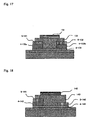
- Fig. 17 is a schematic diagram showing a top gate structure which is another example of the thin film field effect transistor according to the invention.
- an active layer 4-131 is formed, and electric resistance layers 4-132a and 4-132b are formed on the active layer 4-131 by patterning so that the electric resistance layer 4-132a is disposed between a source electrode 5-131 and the active layer 4-131, and the electric resistance layer 4-132b is disposed between a drain electrode 5-132 and the active layer 4-131.
- the active layer 4-131 is electrically connected to the source electrode 5-131 and the drain electrode 5-132 not directly, but indirectly through the electric resistance layers 4-132a and 4-132b.
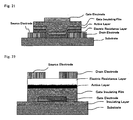
- Fig. 18 is a schematic diagram showing a top gate structure which is another example of the thin film field effect transistor according to the invention.
- an active layer 4-141 is formed, and an electric resistance layer 4-142 is formed on the active layer 4-141 by patterning so as to be disposed between a source electrode 5-141 and the active layer 4-141.
- the active layer 4-141 is electrically connected to the source electrode 5-141 not directly, but indirectly through the electric resistance layer 4-142.
- the source electrode 5-141 and drain electrode 5-142 in the structure shown in Fig. 18 may be interchanged, of course; in this case, the drain electrode 5-142 is connected with the electric resistance layer 4-142.
- Fig. 19 is a schematic diagram of an equivalent circuit of an active matrix-driving type liquid crystal display which uses TFT devices according to the invention.
- the circuit of the display according to the invention is not particularly limited to that shown in Fig. 19 .
- a circuit which is conventionally known in the art may be applied as-is.
- the electric conductivity is a physical property which indicates how much electricity a substance can conduct.
- n the carrier concentration of a substance
- ⁇ the carrier mobility
- the carrier is an electron.
- the carrier concentration refers to the concentration of electron carriers
- the carrier mobility refers to the electron mobility.
- the carrier concentration and carrier mobility of a substance can be determined by Hall measurements.
- the electric conductivity of a film can be determined by measuring the sheet resistance of the film, provided that the thickness of the film is known.
- the electric conductivity of a semiconductor changes depending on the temperature, and the electric conductivity cited herein refers to the electric conductivity at room temperature (20°C).
- an insulator such as SiO 2 , SiN x , SiON, Al 2 O 3 , Y 2 O 3 , Ta 2 O 5 , HfO 2 and the like, or a mixed crystal compound containing at least two of these is used.
- a polymeric insulator such as polyimide may be used for the gate insulating layer.
- the gate insulating layer has a thickness from 10 nm to 10 ⁇ m. To reduce the leak current and raise the voltage resistance, it is required to make the gate insulating layer thicker to a certain extent. However, an increase in the thickness of the gate insulating layer results in a rise in the voltage needed for driving the TFT. Therefore, it is preferable that the thickness of the gate insulating layer is from 50 nm to 1000 nm for an inorganic insulator, and from 0.5 ⁇ m to 5 ⁇ m for a polymeric insulator. Especially, it is particularly preferable to use an insulator with a high dielectric constant, such as HfO 2 , for the gate insulating layer, because then the TFT can be driven with low voltage even when it is made thicker.
- a high dielectric constant such as HfO 2
- an oxide semiconductor is used for the active layer and the electric resistance layer in this invention.
- an amorphous oxide semiconductor is preferable.
- Films of oxide semiconductors, particularly amorphous oxide semiconductors can be formed at a low temperature, and so can be prepared on a flexible substrate made of a resin such as plastic.
- Satisfactory amorphous oxide semiconductors which can be prepared at a low temperature include an oxide containing In, an oxide containing In and Zn, and an oxide containing In, Ga and Zn, as disclosed in JP-A No. 2006-165529 .
- amorphous oxide semiconductors of InGaO 3 (ZnO) m (m is a natural number less than 6) are preferable.
- oxide semiconductors are n-type semiconductors, in which electrons serve as carriers.
- p-type oxide semiconductors such as ZnO/Rh 2 O 3 , CuGaO 2 , and SrCu 2 O 2 may be used for the active layer and the electric resistance layer.
- an amorphous oxide semiconductor according to the invention preferably has a consititution including In-Ga-Zn-O.
- the amorphous oxide semiconductor is preferably an amorphous oxide semiconductor with a composition of InGaO 3 (ZnO) m (m is a natural number less than 6) in a crystalline state. Particularly, InGaZnO 4 is more preferable.
- An amorphous oxide semiconductor of such composition has a feature that the electron mobility tends to increase with an increase in the electric conductivity.
- the control of the electric conductivity it is disclosed in JP-A No. 2006-165529 that the electric conductivity can be controlled by controlling the partial pressure of oxygen during the film formation.
- the active layer of the invention is characterized in that it is in contact with the gate insulating layer, and the electric conductivity thereof is higher than that of the electric resistance layer which is near the source electrode and the drain electrode.
- the ratio of the electric conductivity of the active layer to the electric conductivity of the electric resistance layer is preferably from 10 1 to 10 10 , and more preferably from 10 2 to 10 8 .
- the electric conductivity of the active layer is preferably 10 -4 Scm -1 or more and less than 10 2 Scm -1 , and more preferably 10 -1 Scm -1 or more and less than 10 2 Scm -1 .
- the electric conductivity of the electric resistance layer is preferably 10 -2 Scm -1 or less, and more preferably 10 -9 Scm -1 or more and less than 10 -3 Scm -1 .
- the electric resistance layer is thicker than the active layer. More preferably, the ratio of a thickness of the electric resistance layer to that of the active layer is more than 1 and 100 or less, and even more preferably the ratio is more than 1 and 10 or less.
- the thickness of the active layer is from 1 nm to 100 nm, and more preferably, from 2.5 nm to 30 nm.
- the thickness of the electric resistance layer is from 5 nm to 500 nm, and more preferably, from 10 nm to 100 nm.
- Use of the active layer and the electric resistance layer arranged as described above achieves a TFT characterized by an ON-OFF ratio of 10 6 or higher and high mobility of 10 cm 2 /V/sec or higher.
- the means for adjusting the electric conductivity are what are described in the following items (1) to (4).
- means for controlling the quantity of oxygen vacancies include adjusting the partial pressure of oxygen during the time of film formation, and oxygen concentration and treatment time of an after-treatment after the film formation.
- examples of this after-treatment include heat treatment at a temperature of 100°C or higher, processing by oxygen plasma, and UV ozone treatment.
- the method involving controlling the partial pressure of oxygen during the time of film formation is preferable in view of its productivity. It has been disclosed in JP-A No. 2006-165529 that the electric conductivity of an oxide semiconductor can be controlled by adjusting the partial pressure of oxygen during the time of film formation, and therefore this method is usable.
- means for changing the composition ratio for example in the case of a method of forming a film by sputtering include a means using targets with different composition ratios.
- multiple targets may be cosputtered, changing the composition ratio of the resultant film by individually adjusting the sputtering rates for the targets.
- JP-A No. 2006-165529 it has been disclosed in JP-A No. 2006-165529 that when elements such as La, Na, Mn, Ni, Pd, Cu, Cd, C, N, and P are selectively added to an oxide semiconductor as an impurity, the concentration of electron carriers can be reduced, and therefore the electric conductivity can be made lower.
- Means for adding an impurity include co-vapor deposition of the oxide semiconductor and the impurity, and ion-doping of an oxide semiconductor film which has already been formed with ions of the impurity element.
- the electric conductivity can be changed by changing the oxide semiconductor material.
- the electric conductivity of SnO 2 -based oxide semiconductors is lower than In 2 O 3 -based oxide semiconductors.
- the electric conductivity can be adjusted by changing the oxide semiconductor material.
- oxide insulator materials such as Al 2 O 3 , Ga 2 O 3 , ZrO 2 , Y 2 O 3 , Ta 2 O 3 , MgO, HfO 3 , and the like are known, and it is possible to use these materials.
- the means stated in the above (1) to (4) may be used independently or in combination.
- the means for forming a film of the active layer and the electric resistance layer it is suitable to adopt a vapor-phase film forming method using, as a target, a polycrystalline sintered compact of an oxide semiconductor.
- a vapor-phase film forming method sputtering mehod and pulsed laser deposition method (PLD metnod) are adequate.
- PLD metnod pulsed laser deposition method
- sputtering method is preferable.
- a film can be formed while controlling the vacuum level and flow rate of oxygen.
- the resultant film is an amorphous film.
- the thickness of the film can be determined by contact stylus-type surface profile measurement.
- the composition ratio can be determined by RBS analysis (Rutherford Backscattering Spectrometry).
- the following materials are among those which are preferable for the gate electrode: a metal such as Al, Mo, Cr, Ta, Ti, Au or Ag, an alloy such as Al-Nd or APC; a metal oxide conductive film of e.g., tin oxide, zinc oxide, indium oxide, indium-tin oxide (ITO), or indium-zinc oxide (IZO); an organic conductive compound such as polyaniline, polythiophene, or polypyrrole; or a mixture thereof.
- a metal such as Al, Mo, Cr, Ta, Ti, Au or Ag
- an alloy such as Al-Nd or APC
- an organic conductive compound such as polyaniline, polythiophene, or polypyrrole; or a mixture thereof.
- the thickness of the gate electrode is preferably from 10 nm to 1000 nm.
- the method of forming the electrode is not particularly limited.
- the film can be formed on the substrate according to a method which is appropriately selected from among wet methods such as a printing method and a coating method, physical methods such as a vacuum deposition method, a sputtering method and an ion plating method, chemical methods such as a CVD and plasma CVD method, and the like in consideration of the suitability with the material described above.
- wet methods such as a printing method and a coating method
- physical methods such as a vacuum deposition method, a sputtering method and an ion plating method, chemical methods such as a CVD and plasma CVD method, and the like in consideration of the suitability with the material described above.
- the film can be formed according to a DC or RF sputtering method, a vacuum deposition method, or an ion plating method.
- the film formation can be performed according to a wet film-forming method.
- the following are suitable for the material of the source electrode and the drain electrode: metals such as Al, Mo, Cr, Ta, Ti, Au and Ag; alloys such as Al-Nd and APC; metal oxide conductive films of, for example, tin oxide, zinc oxide, indium oxide, indium-tin oxide (ITO) and indium-zinc oxide (IZO); and organic conductive compounds such as polyaniline, polythiophene and polypyrrole, and mixtures thereof.
- metals such as Al, Mo, Cr, Ta, Ti, Au and Ag
- alloys such as Al-Nd and APC
- organic conductive compounds such as polyaniline, polythiophene and polypyrrole, and mixtures thereof.
- the thickness of the source electrode and the drain electrode is preferably from 10 nm to 1000 nm.
- the method of forming the electrodes is not particularly limited.
- the films can be formed on the substrate according to a method which is appropriately selected from among wet methods such as a printing method and a coating method, a physical methods such as a vacuum deposition method, a sputtering method and an ion plating method, a chemical methods such as a CVD and plasma CVD method, and the like in consideration of the suitability with the material described above.
- wet methods such as a printing method and a coating method
- a physical methods such as a vacuum deposition method, a sputtering method and an ion plating method
- a chemical methods such as a CVD and plasma CVD method, and the like in consideration of the suitability with the material described above.
- the films can be formed according to a DC or RF sputtering method, a vacuum deposition method, an ion plating method, etc.
- the film formation can be performed according to a wet film-forming method.
- the substrate used herein is not particularly limited.
- the following materials are for example suitable for the substrate: inorganic materials such as YSZ (zirconia stabilized yttrium) and glass; and organic materials including polyesters such as polyethylene terephthalate, polybutylene terephthalate and polyethylene naphthalate, and synthetic resins such as polystyrene, polycarbonate, polyether sulfone, polyarylate, allyl diglycol carbonate, polyimide, polycycloolefin, norbornene resin, and polychlorotrifluoroethylene.
- inorganic materials such as YSZ (zirconia stabilized yttrium) and glass
- organic materials including polyesters such as polyethylene terephthalate, polybutylene terephthalate and polyethylene naphthalate, and synthetic resins such as polystyrene, polycarbonate, polyether sulfone, polyarylate, allyl diglycol carbonate, polyimide,
- a flexible substrate As for the material used for the flexible substrate, an organic plastic film which has high transmittance is preferable.
- the following materials can be used: polyesters such as polyethylene terephthalate, polybutylene phthalate and polyethylene naphthalate; and plastic films such as polystyrene, polycarbonate, polyether sulfone, polyarylate, polyimide; polycycloolefin, norbornene resin, and polychlorotrifluoroethylene.
- such film-shaped plastic substrate has an insulating layer in the case where the insulation is insufficient, a gas-barrier layer for preventing moisture and oxygen from penetrating through the substrate, an undercoat layer for enhancing the planarity and the adhesion with the electrode or active layer of the film-shaped plastic substrate., or the like
- the thickness of the flexible substrate is from 50 nm to 500 ⁇ m. The reason for this is that when the thickness of the flexible substrate is less than 50 ⁇ m, it is hard for the substrate to maintain sufficient planarity itself, and when the flexible substrate is thicker than 500 ⁇ m, it becomes difficult to bend the substrate itself freely, i.e., the flexibility of the substrate becomes insufficient.
- a protective insulating film may be provided on TFT.
- the protective insulating film has a function to protect semiconductor layers including active layers and electric resistance layers from deterioration by air, and to insulate a device formed on TFT from TFT.
- materials for the protective insulating film include metal oxides such as MgO, SiO, SiO 2 , Al 2 O 3 , GeO, NiO, CaO, BaO, Fe 2 O 3 , Y 2 O 3 , TiO 2 and the like; metal nitrides such as SiN x , SiN x O y and the like; metal fluorides such as MgF 2 , LiF, AlF 3 , CaF 2 and the like; polyethylene; polypropylene; polymethyl methacrylate; polyimide; polyurea; polytetrafluoroethylene; polychlorotrifluoroethylene; polydichlorodifluoroethylene; a copolymer of chlorotrifluoroethylene and dichlorodifluoroethylene; copolymers obtained by copolymerizing a monomer mixture containing tetrafluoroethylene and at least one comonomer; fluorine-containing copolymers each having a cyclic structure in the copo
- a method for forming the protective insulating film there is no particular limitation as to a method for forming the protective insulating film.
- a vacuum deposition method a sputtering method, a reactive sputtering method, an MBE (molecular beam epitaxial) method, a cluster ion beam method, an ion plating method, a plasma polymerization method (high-frequency excitation ion plating method), a plasma CVD method, a laser CVD method, a thermal CVD method, a gas source CVD method, a coating method, a printing method, or a transfer method may be applied.
- a vacuum deposition method a sputtering method, a reactive sputtering method, an MBE (molecular beam epitaxial) method, a cluster ion beam method, an ion plating method, a plasma polymerization method (high-frequency excitation ion plating method), a plasma CVD method, a laser CVD method, a thermal CV
- heating treatment may be conducted as an after treatment for TFT.
- the heating treatment is performed under air or nitrogen environment at 100°C or higher.
- the heating treatment may be conducted after film forming or at a last step of TFT fabrication steps.
- the heating treatment has results in that a fluctuation of TFT properties within a set of TFT is prevented, and drive stability is improved.
- the field effect-type thin film transistor according to the invention is preferably used for an image display with a liquid crystal or EL device incorporated therein, and particularly for a flat panel display (Flat Panel Display: FPD). More preferably, it is used for a flexible display in which a flexible substrate such as an organic plastic film is used as its substrate. Particularly, the field effect-type thin film transistor according to the invention has a high mobility, and therefore it is most preferably used for a display incorporating an organic EL device, a flexible organic EL display.
- the field effect-type thin film transistor according to the invention can be used in an image display with a liquid crystal or EL device incorporated therein, and especially it can be used as a switching device or a driving device of an FPD. It is suitable to use the field effect-type thin film transistor as a switching device or a driving device of a flexible FPD device.
- a display incorporating the field effect-type thin film transistor according to the invention has such wide ranging applications as a mobile phone display, a personal digital assistant (PDA), a computer display, a car information display, a TV monitor, and general illumination.
- the field effect-type thin film transistor according to the invention can be applied extensively to e.g., IC cards, and ID tags, in which the field effect-type thin film transistor is formed on a flexible substrate such as an organic plastic film.
- the thin film field effect transistor according to the invention will be described below based on the examples. However, the invention is not limited to the examples.
- RF magnetron sputtering vacuum deposition was performed under the condition where argon (Ar) and oxygen (O 2 ) flow rates are 12 sccm and 0.2 sccm respectively, an RF power is 200 watts, and a pressure is 0.4 Pa.
- RF magnetron sputtering vacuum deposition was performed under conditions similar to Condition 1 except that the O 2 flow rate was changed to 0.6 sccm.
- RF magnetron sputtering vacuum deposition was performed under conditions similar to Condition 1 except that the O 2 flow rate was changed to 1.4 sccm.
- RF magnetron sputtering vacuum deposition was performed under conditions similar to Condition 1 except that the O 2 flow rate was changed to 1.5 sccm.
- RF magnetron sputtering vacuum deposition was performed under conditions similar to Condition 1 except that the O 2 flow rate was changed to 1.8 sccm.
- Samples for measurements of physical properties were prepared under Conditions 1 to 5, in which a layer of 100 nm was provided directly on a non-alkali glass substrate (Corning #1737).
- the samples for measurements of physical properties were analyzed by the conventional X-ray diffraction. As a result, it was verified that the resultant films were amorphous films. Further, the samples for measurements of physical properties were measured in electric conductivity, and their carrier concentrations and composition ratios were measured by Hall measurements. Table 1 shows the results of the measurements.
- the electric conductivity of the sample for measurement of physical properties was determined by calculation based on measured sheet resistance and film thickness of the sample.
- the sheet resistance is expressed by ⁇ ( ⁇ / ⁇ )
- the thickness is expressed by d (cm)
- the measurements were executed by a Loresta GP (manufactured by Mitsubishi Chemical Corp.) for the region of the samples for measurement of physical properties with sheet resistance less than 10 7 ( ⁇ / ⁇ ), and the measurements were executed by a Hiresta UP (manufactured by Mitsubishi Chemical Corp.) for the region of sheet resistance of 10 7 ( ⁇ / ⁇ ) or more.
- a contact stylus-type surface profiler DekTak-6M manufactured by ULVAC, Inc.
- Carrier concentrations of the samples for measurements of physical properties were determined using a ResiTest8300 (manufactured by TOYO Corporation) to make Hall effect measurements.
- the Hall effect measurements were performed under an environment of 20°C. It is noted that not only the carrier concentration but also the hole mobility of carriers could be determined by making Hall effect measurements.
- composition ratios of the samples for measurements of physical properties were determined by RBS (Rutherford Backscattering Spectrometry) analysis.
- Inventive TFT Device Nos. 1 and 2 and Comparative TFT Devices Nos. 1 and 2 were prepared.
- the cross-sectional structure of the Inventive TFT Device Nos. 1 and 2 and Comparative TFT Devices Nos. 1 and 2 are shown in Fig. 20 .
- a non-alkali glass plate (Corning No. 1737) was used.
- the substrate was subjected to ultrasonic cleaning with pure water for 15 minutes, with acetone for 15 minutes, and again with pure water for 15 minutes in this order.
- ITO indium-tin oxide
- a gate insulating layer was formed as described below.
- the gate insulating layer was provided by performing RF magnetron sputtering vacuum deposition of SiO 2 to form a 200-nm film (under the conditions: a target of SiO 2 ; film-forming temperature of 54°C; Ar sputter gas with flow rate of 12 sccm; O 2 sputter gas with flow rate of 2 sccm; RF power of 400 watts; and film-forming pressure of 0.4 Pa). Patterning of SiO 2 for the gate insulating layer was performed using a shadow mask during sputtering.
- ITO for source electrode and the drain electrode was deposited to a thickness of 40 nm by RF magnetron sputtering (under the conditions: film-forming temperature 43°C; an Ar sputter gas with flow rate 12 sccm; RF power 40 watts; and film-forming pressure 0.4 Pa). Patterning of the source electrode and the drain electrode was performed using a shadow mask during sputtering.
- the Inventive TFT Device Nos. 1 and 2 and Comparative TFT Device Nos. 1 and 2 each of which has a reversed stagger structure with a channel length L of 200 ⁇ m and a channel width W of 1000 ⁇ m, were prepared.
- the measurements of TFT transfer characteristics were performed using a semiconductor parameter analyzer 4156C (manufactured by Agilent Technologies, Inc.).
- Fig. 5 shows current-voltage characteristic curves showing the TFT transfer characteristics of the devices, in which the horizontal axis indicates gate voltage V g and the vertical axis indicates drain current Id.
- the ON-OFF ratios were determined from the TFT transfer characteristics; specifically, from the ratio of the maximum value Id max of the drain current Id to the minimum value Id min of the drain current Id, i.e., Id max /Id min .
- the TFT characteristics obtained from the results of the measurements of TFT transfer characteristics shown in Fig. 5 are presented in Table 2. From the results shown in Table 2, it is shown that the Inventive Device Nos. 1 and 2 have higher field effect mobility and higher ON-OFF ratios, and are superior in performance to the devices for comparison. On the other hand, Comparative Device No. 1 whose active layer consists of one layer with medium conductivity has low field effect mobility. Further, Comparative Device No. 2, wherein the active layer and the electric resistance layer are changed each other, that is, the active layer having low electric conductivity and the electric resistance layer having high electric conductivity, has an extremely low ON-OFF ratio.
- the Inventive TFT Device No. 3 was prepared according to the preparation of Inventive TFT Device #1 except for the following: the 30nm-thick ITO film constituting the gate electrode was changed to a 40nm-thick molybdenum film, and the electric resistance layer was prepared according to the Condition 5 for preparation of electric resistance layer in Example 1. Further, the thicknesses of the electric resistance layer and the active layer were changed to 30 nm and 20 nm respectively.
- the molybdenum film was formed by a DC magnetron sputtering deposition method (under the sputtering conditions: DC power of 380 watts; Ar sputter gas with a flow rate of 12 sccm; and pressure of 0.4 Pa).
- the Device No. 3 was evaluated with respect to TFT device performance in a manner similar to Example 1. Results of the evaluation are presented in Table 2.
- Inventive TFT Device No. 3 was found to have still higher field effect mobility and still higher ON-OFF ratio, and had performance superior to the Inventive TFT Device Nos. 1 and 2. However, when the measurement of the TFT transfer characteristics was performed repeatedly, it was shown that the Inventive TFT Device Nos. 1 and 2 had less deterioration in ON-OFF ratio and were superior in durability to Inventive TFT Device No. 3.
- Inventive TFT Device No. 4 was prepared in a similar manner to the process in the preparation of Inventive TFT Device No. 1 except for the following: a film with a barrier comprising insulating layers with a barrier function made of polyethylene naphthalate on both sides of the film was used as the substrate, and the 30nm-thick ITO film which becomes the gate electrode formed over the barrier film was changed to a 40nm-thick molybdenum film.
- the molybdenum film was formed under conditions similar to Example 2.
- the insulating layer was provided by performing deposition of SiON to form a film having a thickness of 500 nm.
- SiON was deposited by an RF magnetron sputtering method (under the sputtering conditions: a target of Si 3 N 4 ; RF power of 400 watts; Ar gas with flow a rate of 12 sccm; 02 gas with a flow rate of 3 sccm; and film-forming pressure of 0.45 Pa).
- the Device No. 4 was evaluated with respect to TFT device performance in a manner similar to Example 1. Results of the evaluation are presented in Table 2.
- Inventive TFT Device No. 4 exhibited field effect mobility and an ON-OFF ratio which were comparable to those of Inventive TFT Device No. 1 prepared on a glass substrate. From this fact, it is shown that the TFT device according to the invention exhibits excellent high mobility and a large ON-OFF ratio even when it is provided on a flexible substrate composed of an organic plastic film.
- a top gate type TFT device according to the invention was prepared following the procedures.
- the cross-sectional structure of the TFT device of the Example is shown in Fig. 21 .
- a non-alkali glass plate (Corning No. 1737) was used as the substrate as in Example 1, on which an ITO film was formed (to a thickness of 40 nm) for source electrode and drain electrode.
- the ITO film was formed under the same conditions as those in Example 1. Patterning of the source electrode and drain electrode was performed using a shadow mask as in Example 1.
- Example 4 an electric resistance layer with a thickness of 40 nm was provided under Condition 4, and an active layer with a thickness of 10 nm was provided thereon under Condition 1 in Example 1. Patterning of these layers was performed using a shadow mask as in Example 1.
- a 200nm-thick film of SiO 2 was provided as a gate insulating layer.
- the film of SiO 2 was formed under the same conditions as in Example 1. Patterning of the gate insulating layer was carried out using a shadow mask as in Example 1.
- ITO with a thickness of 30 nm was provided as a gate electrode.
- the ITO film was formed under the same conditions as in the Example 1. Patterning of the gate electrode was performed using a shadow mask as in Example 1.
- a top gate type TFT device which had a channel length L of 200 ⁇ m and a channel width W of 1000 ⁇ m was obtained.
- the device was evaluated with respect to TFT device performance as in Example 1. As a result, the field effect mobility was 17.7 cm 2 /Vs, and the ON-OFF ratio was 3 ⁇ 10 6 . Hence, even in the case of a top gate type TFT, excellent high mobility and a large ON-OFF ratio were achieved.
- a TFT device was prepared by procedures similar to Example 1, except that the preparation of the electric resistance layer and the active layer in Example 3 was changed as follows. According to the conditions given below, the active layer was formed to have a structure such that its electric conductivity was made high in the region adjacent to the gate insulating layer, and low in the region of the electric resistance layer adjacent to the source electrode and the drain electrode, continuously changing the electric conductivity in the region therebetween.
- Fig. 22 shows the cross-sectional structure of the TFT device of the Example.
- a target of InGaZnO 4 was used as a target to prepare the continuous electric resistance layer and active layer using the same sputtering system as in Example 1.
- the layer Under the sputtering conditions: RF power of 200 watts, Ar sputter gas with a flow rate of 12 sccm, and pressure of 0.4 Pa, the layer was formed to a thickness of 50 nm while continuously changing the oxygen flow rate from 0.6 sccm to 1.8 sccm.
- the resultant TFT device thus prepared was evaluated as in Example 1. As a result, the device showed excellent TFT characteristics, i.e., mobility of 8.9 cm 2 /Vs, and an ON-OFF ratio of 1.0 ⁇ 10 6 .
Landscapes
- Physics & Mathematics (AREA)
- Nonlinear Science (AREA)
- Optics & Photonics (AREA)
- Thin Film Transistor (AREA)
- Chemical & Material Sciences (AREA)
- Crystallography & Structural Chemistry (AREA)
- Microelectronics & Electronic Packaging (AREA)
- General Physics & Mathematics (AREA)
- Engineering & Computer Science (AREA)
- Mathematical Physics (AREA)
- Liquid Crystal (AREA)
- Electroluminescent Light Sources (AREA)
- Dram (AREA)
- Devices For Indicating Variable Information By Combining Individual Elements (AREA)
- Inorganic Compounds Of Heavy Metals (AREA)
- Physical Vapour Deposition (AREA)
Claims (10)
- Transistor à effet de champ à couches minces comprenant au moins une électrode de grille, une couche d'isolation de grille, une couche active, une électrode de source et une électrode de drain sur un substrat, dans lequel :une couche de résistance électrique est prévue entre la couche active et au moins l'une de l'électrode de source ou de l'électrode de drain,la couche de résistance électrique a une conductivité électrique inférieure à celle de la couche active,la couche active est en contact avec la couche d'isolation de grille,la couche de résistance électrique est en contact avec au moins l'une de l'électrode de source ou de l'électrode de drain,la couche de résistance électrique est plus épaisse que la couche active, etla couche active et la couche de résistance électrique contiennent un semi-conducteur à base d'oxydes.
- Transistor à effet de champ à couches minces selon la revendication 1, dans lequel la conductivité électrique change de façon continue entre la couche de résistance électrique et la couche active dans la couche active.
- Transistor à effet de champ à couches minces selon la revendication 1, dans lequel le semi-conducteur à base d'oxydes comprend un semi-conducteur amorphe.
- Transistor à effet de champ à couches minces selon la revendication 1, dans lequel la couche active a une concentration en oxygène inférieure à celle de la couche de résistance électrique.
- Transistor à effet de champ à couches minces selon la revendication 1, dans lequel le semi-conducteur à base d'oxydes contient au moins un matériau sélectionné dans le groupe consistant en l'indium, le gallium et le zinc, ou un oxyde composite d'une combinaison de matériaux sélectionnés dans le groupe consistant en l'indium, le gallium et le zinc.
- Transistor à effet de champ à couches minces selon la revendication 5, dans lequel le semi-conducteur à base d'oxydes contient de l'indium et du zinc, et un rapport de composition du zinc (Zn) sur l'indium (In), à savoir Zn/In, dans la couche de résistance électrique est supérieur à celui de la couche active.
- Transistor à effet de champ à couches minces selon la revendication 1, dans lequel la conductivité électrique de la couche active est de 10-1 Scm-1 ou plus et moins de 102 Scm-1.
- Transistor à effet de champ à couches minces selon la revendication 1, dans lequel un rapport de la conductivité électrique de la couche active sur la conductivité électrique de la couche de résistance électrique (à savoir la conductivité électrique de la couche active/la conductivité électrique de la couche de résistance électrique) est comprise entre 102 et 108.
- Transistor à effet de champ à couches minces selon la revendication 1, dans lequel le substrat est un substrat de résine flexible.
- Dispositif d'affichage comprenant le transistor à effet de champ à couches minces selon l'une quelconque des revendications 1 à 9.
Applications Claiming Priority (2)
| Application Number | Priority Date | Filing Date | Title |
|---|---|---|---|
| JP2007082859 | 2007-03-27 | ||
| JP2008025619 | 2008-02-05 |
Publications (3)
| Publication Number | Publication Date |
|---|---|
| EP1976018A2 EP1976018A2 (fr) | 2008-10-01 |
| EP1976018A3 EP1976018A3 (fr) | 2011-05-11 |
| EP1976018B1 true EP1976018B1 (fr) | 2013-05-08 |
Family
ID=39577862
Family Applications (1)
| Application Number | Title | Priority Date | Filing Date |
|---|---|---|---|
| EP08005583.3A Active EP1976018B1 (fr) | 2007-03-27 | 2008-03-26 | Transistor à effet de champ à couche mince et affichage |
Country Status (4)
| Country | Link |
|---|---|
| US (1) | US8178926B2 (fr) |
| EP (1) | EP1976018B1 (fr) |
| JP (3) | JP4727684B2 (fr) |
| KR (2) | KR101477804B1 (fr) |
Cited By (1)
| Publication number | Priority date | Publication date | Assignee | Title |
|---|---|---|---|---|
| US8748223B2 (en) | 2009-09-24 | 2014-06-10 | Semiconductor Energy Laboratory Co., Ltd. | Method for manufacturing oxide semiconductor film and method for manufacturing semiconductor device |
Families Citing this family (133)
| Publication number | Priority date | Publication date | Assignee | Title |
|---|---|---|---|---|
| JP3217137B2 (ja) * | 1992-07-28 | 2001-10-09 | 株式会社日立製作所 | 映像信号記録装置、再生装置及び伝送装置 |
| KR100998527B1 (ko) | 2004-11-10 | 2010-12-07 | 고쿠리츠다이가쿠호진 토쿄고교 다이가꾸 | 비정질 산화물 및 전계 효과 트랜지스터 |
| JP4609797B2 (ja) * | 2006-08-09 | 2011-01-12 | Nec液晶テクノロジー株式会社 | 薄膜デバイス及びその製造方法 |
| JP2008276212A (ja) * | 2007-04-05 | 2008-11-13 | Fujifilm Corp | 有機電界発光表示装置 |
| JP2009130209A (ja) * | 2007-11-26 | 2009-06-11 | Fujifilm Corp | 放射線撮像素子 |
| JP4555358B2 (ja) * | 2008-03-24 | 2010-09-29 | 富士フイルム株式会社 | 薄膜電界効果型トランジスタおよび表示装置 |
| KR100941850B1 (ko) * | 2008-04-03 | 2010-02-11 | 삼성모바일디스플레이주식회사 | 박막 트랜지스터, 그의 제조 방법 및 박막 트랜지스터를구비하는 평판 표시 장치 |
| KR101496150B1 (ko) * | 2008-08-19 | 2015-02-27 | 삼성전자주식회사 | 산화물 반도체 및 이를 포함하는 박막 트랜지스터 |
| KR101657957B1 (ko) | 2008-09-12 | 2016-09-20 | 가부시키가이샤 한도오따이 에네루기 켄큐쇼 | 표시 장치 |
| EP2172804B1 (fr) | 2008-10-03 | 2016-05-11 | Semiconductor Energy Laboratory Co, Ltd. | Dispositif d'affichage |
| CN101714546B (zh) | 2008-10-03 | 2014-05-14 | 株式会社半导体能源研究所 | 显示装置及其制造方法 |
| KR101652693B1 (ko) | 2008-10-03 | 2016-09-01 | 가부시키가이샤 한도오따이 에네루기 켄큐쇼 | 표시 장치 |
| US8187919B2 (en) | 2008-10-08 | 2012-05-29 | Lg Display Co. Ltd. | Oxide thin film transistor and method of fabricating the same |
| KR101298611B1 (ko) * | 2008-10-08 | 2013-08-26 | 엘지디스플레이 주식회사 | 산화물 박막 트랜지스터 및 그 제조방법 |
| KR101322314B1 (ko) * | 2008-10-10 | 2013-10-25 | 엘지디스플레이 주식회사 | 산화물 박막 트랜지스터의 제조방법 |
| KR101525590B1 (ko) * | 2008-10-08 | 2015-06-04 | 삼성디스플레이 주식회사 | 표시 기판 및 이의 제조 방법 |
| KR101586674B1 (ko) * | 2008-10-28 | 2016-01-20 | 엘지디스플레이 주식회사 | 산화물 박막 트랜지스터의 제조방법 |
| TWI567829B (zh) * | 2008-10-31 | 2017-01-21 | 半導體能源研究所股份有限公司 | 半導體裝置及其製造方法 |
| TWI574423B (zh) | 2008-11-07 | 2017-03-11 | 半導體能源研究所股份有限公司 | 半導體裝置和其製造方法 |
| KR101659703B1 (ko) * | 2008-11-07 | 2016-09-26 | 가부시키가이샤 한도오따이 에네루기 켄큐쇼 | 반도체 장치 |
| TWI656645B (zh) | 2008-11-13 | 2019-04-11 | 日商半導體能源研究所股份有限公司 | 半導體裝置及其製造方法 |
| JP2010153802A (ja) * | 2008-11-20 | 2010-07-08 | Semiconductor Energy Lab Co Ltd | 半導体装置及び半導体装置の作製方法 |
| TWI508304B (zh) | 2008-11-28 | 2015-11-11 | 半導體能源研究所股份有限公司 | 半導體裝置和其製造方法 |
| JP5538797B2 (ja) * | 2008-12-12 | 2014-07-02 | キヤノン株式会社 | 電界効果型トランジスタ及び表示装置 |
| KR101648927B1 (ko) | 2009-01-16 | 2016-08-17 | 가부시키가이샤 한도오따이 에네루기 켄큐쇼 | 반도체 장치 및 그 제작 방법 |
| JP5210187B2 (ja) | 2009-01-22 | 2013-06-12 | ユー・ディー・シー アイルランド リミテッド | 有機電界発光素子 |
| US8492756B2 (en) | 2009-01-23 | 2013-07-23 | Semiconductor Energy Laboratory Co., Ltd. | Semiconductor device and method for manufacturing the same |
| US8367486B2 (en) | 2009-02-05 | 2013-02-05 | Semiconductor Energy Laboratory Co., Ltd. | Transistor and method for manufacturing the transistor |
| JP5504008B2 (ja) | 2009-03-06 | 2014-05-28 | 株式会社半導体エネルギー研究所 | 半導体装置 |
| JP2010245366A (ja) * | 2009-04-08 | 2010-10-28 | Fujifilm Corp | 電子素子及びその製造方法、並びに表示装置 |
| TWI476917B (zh) | 2009-04-16 | 2015-03-11 | 半導體能源研究所股份有限公司 | 半導體裝置和其製造方法 |
| EP2256814B1 (fr) | 2009-05-29 | 2019-01-16 | Semiconductor Energy Laboratory Co, Ltd. | Dispositif semi-conducteur d'oxide et son procédé de fabrication |
| WO2011001880A1 (fr) | 2009-06-30 | 2011-01-06 | Semiconductor Energy Laboratory Co., Ltd. | Procédé de fabrication de dispositif à semi-conducteurs |
| SG10201403913PA (en) * | 2009-07-10 | 2014-10-30 | Semiconductor Energy Lab | Method for manufacturing semiconductor device |
| WO2011007677A1 (fr) * | 2009-07-17 | 2011-01-20 | Semiconductor Energy Laboratory Co., Ltd. | Dispositif à semi-conducteur et son procédé de fabrication |
| KR102490468B1 (ko) | 2009-07-31 | 2023-01-19 | 가부시키가이샤 한도오따이 에네루기 켄큐쇼 | 표시 장치 |
| WO2011013502A1 (fr) | 2009-07-31 | 2011-02-03 | Semiconductor Energy Laboratory Co., Ltd. | Dispositif à semi-conducteur et son procédé de fabrication |
| WO2011013523A1 (fr) * | 2009-07-31 | 2011-02-03 | Semiconductor Energy Laboratory Co., Ltd. | Dispositif semi-conducteur et procédé de fabrication de celui-ci |
| CN102473734B (zh) * | 2009-07-31 | 2015-08-12 | 株式会社半导体能源研究所 | 半导体装置及其制造方法 |
| KR20120051727A (ko) | 2009-07-31 | 2012-05-22 | 가부시키가이샤 한도오따이 에네루기 켄큐쇼 | 반도체 디바이스 및 그 형성 방법 |
| JP4598136B1 (ja) | 2009-07-31 | 2010-12-15 | 富士フイルム株式会社 | 有機電界発光素子及びその製造方法 |
| WO2011013626A1 (fr) | 2009-07-31 | 2011-02-03 | 富士フイルム株式会社 | Matériau de dépôt en phase vapeur pour dispositif organique et procédé de fabrication de dispositif organique |
| TWI528342B (zh) * | 2009-09-16 | 2016-04-01 | 半導體能源研究所股份有限公司 | 顯示裝置及其驅動方法 |
| EP3540772A1 (fr) * | 2009-09-16 | 2019-09-18 | Semiconductor Energy Laboratory Co., Ltd. | Transistor et afficheur |
| WO2011039853A1 (fr) * | 2009-09-30 | 2011-04-07 | キヤノン株式会社 | Transistor à couches minces |
| KR20120084751A (ko) | 2009-10-05 | 2012-07-30 | 가부시키가이샤 한도오따이 에네루기 켄큐쇼 | 반도체 장치 및 그 제작 방법 |
| KR101376461B1 (ko) * | 2009-10-08 | 2014-03-19 | 가부시키가이샤 한도오따이 에네루기 켄큐쇼 | 산화물 반도체층 및 반도체 장치 |
| CN106200185A (zh) | 2009-10-16 | 2016-12-07 | 株式会社半导体能源研究所 | 显示设备 |
| KR102142450B1 (ko) | 2009-10-30 | 2020-08-10 | 가부시키가이샤 한도오따이 에네루기 켄큐쇼 | 반도체 장치 및 반도체 장치의 제작방법 |
| CN102598279B (zh) * | 2009-11-06 | 2015-10-07 | 株式会社半导体能源研究所 | 半导体装置 |
| JP2011100944A (ja) | 2009-11-09 | 2011-05-19 | Fujifilm Corp | 有機電界発光素子 |
| KR102393447B1 (ko) | 2009-11-13 | 2022-05-03 | 가부시키가이샤 한도오따이 에네루기 켄큐쇼 | 반도체 장치 및 그 제작 방법 |
| KR20120094013A (ko) * | 2009-11-13 | 2012-08-23 | 가부시키가이샤 한도오따이 에네루기 켄큐쇼 | 스퍼터링 타겟 및 그 제조방법, 및 트랜지스터 |
| KR101506304B1 (ko) | 2009-11-27 | 2015-03-26 | 가부시키가이샤 한도오따이 에네루기 켄큐쇼 | 반도체 장치 및 반도체 장치의 제작방법 |
| KR20120099450A (ko) * | 2009-11-27 | 2012-09-10 | 가부시키가이샤 한도오따이 에네루기 켄큐쇼 | 반도체 장치 |
| WO2011070900A1 (fr) | 2009-12-08 | 2011-06-16 | Semiconductor Energy Laboratory Co., Ltd. | Dispositif semi-conducteur et son procédé de fabrication |
| JP5727204B2 (ja) * | 2009-12-11 | 2015-06-03 | 株式会社半導体エネルギー研究所 | 半導体装置の作製方法 |
| KR101035357B1 (ko) * | 2009-12-15 | 2011-05-20 | 삼성모바일디스플레이주식회사 | 산화물 반도체 박막 트랜지스터, 그 제조방법 및 산화물 반도체 박막 트랜지스터를 구비한 유기전계 발광소자 |
| KR101097322B1 (ko) | 2009-12-15 | 2011-12-23 | 삼성모바일디스플레이주식회사 | 산화물 반도체 박막 트랜지스터, 그 제조방법 및 산화물 반도체 박막 트랜지스터를 구비한 유기전계 발광소자 |
| JP5185357B2 (ja) * | 2009-12-17 | 2013-04-17 | 株式会社半導体エネルギー研究所 | 半導体装置 |
| EP2513893A4 (fr) | 2009-12-18 | 2016-09-07 | Semiconductor Energy Lab | Dispositif d'affichage à cristaux liquides et dispositif électronique |
| KR102111309B1 (ko) * | 2009-12-25 | 2020-05-15 | 가부시키가이샤 한도오따이 에네루기 켄큐쇼 | 반도체 장치 제작 방법 |
| KR101623956B1 (ko) * | 2010-01-15 | 2016-05-24 | 삼성전자주식회사 | 트랜지스터와 그 제조방법 및 트랜지스터를 포함하는 전자소자 |
| KR101701208B1 (ko) * | 2010-01-15 | 2017-02-02 | 삼성디스플레이 주식회사 | 표시 기판 |
| CN102714023B (zh) * | 2010-01-20 | 2016-05-04 | 株式会社半导体能源研究所 | 液晶显示设备的驱动方法 |
| WO2011090087A1 (fr) * | 2010-01-20 | 2011-07-28 | Semiconductor Energy Laboratory Co., Ltd. | Procédé d'affichage pour dispositif d'affichage |
| KR101803987B1 (ko) | 2010-01-20 | 2017-12-01 | 가부시키가이샤 한도오따이 에네루기 켄큐쇼 | 표시 장치 |
| KR102174859B1 (ko) * | 2010-01-22 | 2020-11-05 | 가부시키가이샤 한도오따이 에네루기 켄큐쇼 | 반도체 장치 |
| KR20130009978A (ko) * | 2010-02-26 | 2013-01-24 | 가부시키가이샤 한도오따이 에네루기 켄큐쇼 | 반도체 소자의 제조 방법 및 성막 장치 |
| WO2011105310A1 (fr) | 2010-02-26 | 2011-09-01 | Semiconductor Energy Laboratory Co., Ltd. | Dispositif à semi-conducteur |
| KR101867272B1 (ko) | 2010-03-05 | 2018-06-15 | 가부시키가이샤 한도오따이 에네루기 켄큐쇼 | 반도체 장치와 그의 제작 방법 |
| WO2011108346A1 (fr) * | 2010-03-05 | 2011-09-09 | Semiconductor Energy Laboratory Co., Ltd. | Procédé de production de film d'oxyde semi-conducteur et procédé de production de transistor |
| JP5506475B2 (ja) | 2010-03-15 | 2014-05-28 | ユー・ディー・シー アイルランド リミテッド | 有機電界発光素子の製造方法 |
| KR101921047B1 (ko) * | 2010-03-26 | 2018-11-23 | 가부시키가이샤 한도오따이 에네루기 켄큐쇼 | 반도체 장치를 제작하는 방법 |
| WO2011118741A1 (fr) | 2010-03-26 | 2011-09-29 | Semiconductor Energy Laboratory Co., Ltd. | Procédé de fabrication d'un dispositif semi-conducteur |
| DE112011101069B4 (de) | 2010-03-26 | 2018-05-03 | Semiconductor Energy Laboratory Co., Ltd. | Halbleitervorrichtung und Verfahren zur Herstellung der Halbleitervorrichtung |
| WO2011125940A1 (fr) * | 2010-04-06 | 2011-10-13 | 株式会社日立製作所 | Transistor à couches minces et son procédé de fabrication |
| KR101465192B1 (ko) | 2010-04-09 | 2014-11-25 | 가부시키가이샤 한도오따이 에네루기 켄큐쇼 | 반도체 장치 |
| KR101877377B1 (ko) | 2010-04-23 | 2018-07-11 | 가부시키가이샤 한도오따이 에네루기 켄큐쇼 | 반도체 장치의 제작 방법 |
| KR101689378B1 (ko) | 2010-04-23 | 2016-12-26 | 가부시키가이샤 한도오따이 에네루기 켄큐쇼 | 반도체 장치의 제작 방법 |
| WO2011132591A1 (fr) | 2010-04-23 | 2011-10-27 | Semiconductor Energy Laboratory Co., Ltd. | Procédé de fabrication d'un dispositif semi-conducteur |
| CN111326435B (zh) | 2010-04-23 | 2023-12-01 | 株式会社半导体能源研究所 | 半导体装置的制造方法 |
| JP5557595B2 (ja) * | 2010-05-14 | 2014-07-23 | 富士フイルム株式会社 | 電子デバイスの製造方法、薄膜トランジスタ、電気光学装置及びセンサー |
| KR101806271B1 (ko) | 2010-05-14 | 2017-12-07 | 가부시키가이샤 한도오따이 에네루기 켄큐쇼 | 반도체 장치의 제작 방법 |
| US8698852B2 (en) | 2010-05-20 | 2014-04-15 | Semiconductor Energy Laboratory Co., Ltd. | Display device and method for driving the same |
| US8629438B2 (en) | 2010-05-21 | 2014-01-14 | Semiconductor Energy Laboratory Co., Ltd. | Semiconductor device and manufacturing method thereof |
| US8766252B2 (en) | 2010-07-02 | 2014-07-01 | Semiconductor Energy Laboratory Co., Ltd. | Semiconductor device comprising an oxide semiconductor |
| US20120001179A1 (en) * | 2010-07-02 | 2012-01-05 | Semiconductor Energy Laboratory Co., Ltd. | Semiconductor device |
| KR101856722B1 (ko) * | 2010-09-22 | 2018-05-10 | 가부시키가이샤 한도오따이 에네루기 켄큐쇼 | 파워 절연 게이트형 전계 효과 트랜지스터 |
| TWI657580B (zh) * | 2011-01-26 | 2019-04-21 | Semiconductor Energy Laboratory Co., Ltd. | 半導體裝置及其製造方法 |
| US8643007B2 (en) * | 2011-02-23 | 2014-02-04 | Semiconductor Energy Laboratory Co., Ltd. | Semiconductor device |
| JP6053098B2 (ja) * | 2011-03-28 | 2016-12-27 | 株式会社半導体エネルギー研究所 | 半導体装置 |
| JP2012235104A (ja) * | 2011-04-22 | 2012-11-29 | Kobe Steel Ltd | 薄膜トランジスタ構造、ならびにその構造を備えた薄膜トランジスタおよび表示装置 |
| US20140083841A1 (en) * | 2011-05-13 | 2014-03-27 | Sharp Kabushiki Kaisha | Thin film-forming method |
| JP5871263B2 (ja) | 2011-06-14 | 2016-03-01 | 富士フイルム株式会社 | 非晶質酸化物薄膜の製造方法 |
| US9166055B2 (en) | 2011-06-17 | 2015-10-20 | Semiconductor Energy Laboratory Co., Ltd. | Semiconductor device and method for manufacturing the same |
| US9214474B2 (en) | 2011-07-08 | 2015-12-15 | Semiconductor Energy Laboratory Co., Ltd. | Semiconductor device and method for manufacturing semiconductor device |
| US8952377B2 (en) | 2011-07-08 | 2015-02-10 | Semiconductor Energy Laboratory Co., Ltd. | Semiconductor device and manufacturing method thereof |
| WO2013021632A1 (fr) * | 2011-08-11 | 2013-02-14 | 出光興産株式会社 | Transistor à couche mince |
| JP6076038B2 (ja) | 2011-11-11 | 2017-02-08 | 株式会社半導体エネルギー研究所 | 表示装置の作製方法 |
| JP6122275B2 (ja) | 2011-11-11 | 2017-04-26 | 株式会社半導体エネルギー研究所 | 表示装置 |
| JP2013125782A (ja) * | 2011-12-13 | 2013-06-24 | Hitachi Ltd | 酸化物半導体装置 |
| KR101300791B1 (ko) * | 2011-12-15 | 2013-08-29 | 한국생산기술연구원 | 전자빔 조사를 이용한 몰리브덴 박막의 전도도 향상 방법 |
| JP6175740B2 (ja) | 2012-03-30 | 2017-08-09 | 株式会社Joled | 薄膜トランジスタおよびその製造方法並びに表示装置および電子機器 |
| CN103367404A (zh) * | 2012-04-02 | 2013-10-23 | 鸿富锦精密工业(深圳)有限公司 | 薄膜晶体管 |
| US9035364B2 (en) | 2012-04-13 | 2015-05-19 | Au Optronics Corporation | Active device and fabricating method thereof |
| KR102932705B1 (ko) | 2012-04-13 | 2026-02-27 | 가부시키가이샤 한도오따이 에네루기 켄큐쇼 | 반도체 장치 |
| CN102751240B (zh) * | 2012-05-18 | 2015-03-11 | 京东方科技集团股份有限公司 | 薄膜晶体管阵列基板及其制造方法、显示面板、显示装置 |
| TWI681233B (zh) | 2012-10-12 | 2020-01-01 | 日商半導體能源研究所股份有限公司 | 液晶顯示裝置、觸控面板及液晶顯示裝置的製造方法 |
| JP6351947B2 (ja) | 2012-10-12 | 2018-07-04 | 株式会社半導体エネルギー研究所 | 液晶表示装置の作製方法 |
| TWI582993B (zh) | 2012-11-30 | 2017-05-11 | 半導體能源研究所股份有限公司 | 半導體裝置 |
| JP2014135478A (ja) * | 2012-12-03 | 2014-07-24 | Semiconductor Energy Lab Co Ltd | 半導体装置およびその作製方法 |
| JPWO2014125820A1 (ja) * | 2013-02-13 | 2017-02-02 | 出光興産株式会社 | 薄膜トランジスタ |
| KR102238682B1 (ko) | 2013-02-28 | 2021-04-08 | 가부시키가이샤 한도오따이 에네루기 켄큐쇼 | 반도체 장치와 그 제작 방법 |
| JP6141777B2 (ja) | 2013-02-28 | 2017-06-07 | 株式会社半導体エネルギー研究所 | 半導体装置の作製方法 |
| JP6151070B2 (ja) * | 2013-04-11 | 2017-06-21 | 株式会社ジャパンディスプレイ | 薄膜トランジスタ及びそれを用いた表示装置 |
| US10304859B2 (en) | 2013-04-12 | 2019-05-28 | Semiconductor Energy Laboratory Co., Ltd. | Semiconductor device having an oxide film on an oxide semiconductor film |
| TWI631711B (zh) * | 2013-05-01 | 2018-08-01 | 半導體能源研究所股份有限公司 | 半導體裝置 |
| TWI632688B (zh) | 2013-07-25 | 2018-08-11 | 半導體能源研究所股份有限公司 | 半導體裝置以及半導體裝置的製造方法 |
| JP6235426B2 (ja) * | 2014-07-10 | 2017-11-22 | 株式会社東芝 | 半導体装置およびその製造方法 |
| CN105810746B (zh) * | 2014-12-31 | 2019-02-05 | 清华大学 | N型薄膜晶体管 |
| CN105810749B (zh) * | 2014-12-31 | 2018-12-21 | 清华大学 | N型薄膜晶体管 |
| US20160225915A1 (en) * | 2015-01-30 | 2016-08-04 | Cindy X. Qiu | Metal oxynitride transistor devices |
| JP6367167B2 (ja) * | 2015-09-10 | 2018-08-01 | 東芝メモリ株式会社 | 半導体装置 |
| US10115657B2 (en) | 2016-03-23 | 2018-10-30 | Eaton Intelligent Power Limited | Dielectric heat path devices, and systems and methods using the same |
| US10283945B2 (en) | 2016-03-23 | 2019-05-07 | Eaton Intelligent Power Limited | Load center thermally conductive component |
| CN106486551A (zh) * | 2016-12-07 | 2017-03-08 | 电子科技大学 | 一种铟镓锌氧薄膜晶体管及其制备方法 |
| CN115483271B (zh) * | 2021-05-31 | 2025-12-12 | 松山湖材料实验室 | 光电器件、选择开关、深紫外探测器、薄膜晶体管及应用 |
| JP7465922B2 (ja) * | 2021-09-03 | 2024-04-11 | エルジー ディスプレイ カンパニー リミテッド | 薄膜トランジスタ、その製造方法およびそれを含む表示装置 |
| JP2024154366A (ja) * | 2023-04-18 | 2024-10-30 | 株式会社コベルコ科研 | 薄膜トランジスタの製造方法、スパッタリングターゲットおよび焼結体 |
| CN120753019A (zh) * | 2023-04-18 | 2025-10-03 | 株式会社神钢科研 | 薄膜晶体管的制造方法、溅射靶及烧结体 |
| KR20250015750A (ko) | 2023-07-20 | 2025-02-03 | (주)시지바이오 | 척추경 나사못 조립체 |
| KR102854079B1 (ko) * | 2024-06-11 | 2025-09-03 | 한국항공대학교산학협력단 | 시냅스 소자, 이를 포함하는 광 검출 소자, 이를 포함하는 전자 장치, 및 이의 제조 방법 |
Family Cites Families (19)
| Publication number | Priority date | Publication date | Assignee | Title |
|---|---|---|---|---|
| JPS60160170A (ja) * | 1984-01-31 | 1985-08-21 | Seiko Instr & Electronics Ltd | 薄膜トランジスタ |
| JPS60198864A (ja) * | 1984-03-23 | 1985-10-08 | Nec Corp | 薄膜トランジスタ |
| JPS615578A (ja) * | 1984-06-19 | 1986-01-11 | Nec Corp | 薄膜トランジスタ |
| JPH0650778B2 (ja) * | 1985-08-20 | 1994-06-29 | 松下電器産業株式会社 | 薄膜トランジスタおよびその製造方法 |
| JPS63258072A (ja) * | 1987-04-15 | 1988-10-25 | Nec Corp | 電界効果トランジスタ |
| JP2000124456A (ja) * | 1998-10-12 | 2000-04-28 | Shoka Kagi Kofun Yugenkoshi | 高エネルギーギャップオフセット層構造を有するtft素子 |
| US6562671B2 (en) * | 2000-09-22 | 2003-05-13 | Semiconductor Energy Laboratory Co., Ltd. | Semiconductor display device and manufacturing method thereof |
| JP3997731B2 (ja) * | 2001-03-19 | 2007-10-24 | 富士ゼロックス株式会社 | 基材上に結晶性半導体薄膜を形成する方法 |
| EP1443130B1 (fr) * | 2001-11-05 | 2011-09-28 | Japan Science and Technology Agency | Film mince monocristallin homologue a super-reseau naturel, procede de preparation et dispositif dans lequel est utilise ledit film mince monocristallin |
| JP2004235180A (ja) * | 2003-01-28 | 2004-08-19 | Sanyo Electric Co Ltd | 半導体装置及びその製造方法 |
| JP5138163B2 (ja) * | 2004-11-10 | 2013-02-06 | キヤノン株式会社 | 電界効果型トランジスタ |
| JP5126729B2 (ja) * | 2004-11-10 | 2013-01-23 | キヤノン株式会社 | 画像表示装置 |
| JP4981283B2 (ja) * | 2005-09-06 | 2012-07-18 | キヤノン株式会社 | アモルファス酸化物層を用いた薄膜トランジスタ |
| JP4850457B2 (ja) | 2005-09-06 | 2012-01-11 | キヤノン株式会社 | 薄膜トランジスタ及び薄膜ダイオード |
| KR100646949B1 (ko) * | 2005-09-28 | 2006-11-23 | 삼성에스디아이 주식회사 | 평판표시장치 및 그 구동방법 |
| US20070069995A1 (en) * | 2005-09-28 | 2007-03-29 | Shin Hyun S | Flat panel display and a method of driving the same |
| CN101577231B (zh) * | 2005-11-15 | 2013-01-02 | 株式会社半导体能源研究所 | 半导体器件及其制造方法 |
| JP5121254B2 (ja) | 2007-02-28 | 2013-01-16 | キヤノン株式会社 | 薄膜トランジスタおよび表示装置 |
| JP5339825B2 (ja) * | 2008-09-09 | 2013-11-13 | 富士フイルム株式会社 | 薄膜電界効果型トランジスタおよびそれを用いた表示装置 |
-
2008
- 2008-03-24 JP JP2008076495A patent/JP4727684B2/ja active Active
- 2008-03-25 US US12/055,137 patent/US8178926B2/en active Active
- 2008-03-26 EP EP08005583.3A patent/EP1976018B1/fr active Active
- 2008-03-26 KR KR1020080028018A patent/KR101477804B1/ko active Active
- 2008-09-08 JP JP2008230243A patent/JP2015038895A/ja active Pending
-
2009
- 2009-01-26 JP JP2009014814A patent/JP5191409B2/ja active Active
-
2014
- 2014-09-23 KR KR1020140127155A patent/KR101497878B1/ko active Active
Cited By (2)
| Publication number | Priority date | Publication date | Assignee | Title |
|---|---|---|---|---|
| US8748223B2 (en) | 2009-09-24 | 2014-06-10 | Semiconductor Energy Laboratory Co., Ltd. | Method for manufacturing oxide semiconductor film and method for manufacturing semiconductor device |
| US9224838B2 (en) | 2009-09-24 | 2015-12-29 | Semiconductor Energy Laboratory Co., Ltd. | Method for manufacturing oxide semiconductor film and method for manufacturing semiconductor device |
Also Published As
| Publication number | Publication date |
|---|---|
| JP4727684B2 (ja) | 2011-07-20 |
| KR20140128286A (ko) | 2014-11-05 |
| JP2009212497A (ja) | 2009-09-17 |
| JP2015038895A (ja) | 2015-02-26 |
| US20080237598A1 (en) | 2008-10-02 |
| KR101497878B1 (ko) | 2015-03-04 |
| EP1976018A3 (fr) | 2011-05-11 |
| JP2009212476A (ja) | 2009-09-17 |
| KR20080087744A (ko) | 2008-10-01 |
| KR101477804B1 (ko) | 2014-12-30 |
| US8178926B2 (en) | 2012-05-15 |
| JP5191409B2 (ja) | 2013-05-08 |
| EP1976018A2 (fr) | 2008-10-01 |
Similar Documents
| Publication | Publication Date | Title |
|---|---|---|
| EP1976018B1 (fr) | Transistor à effet de champ à couche mince et affichage | |
| US8203143B2 (en) | Thin film field effect transistor | |
| JP2009212497A5 (fr) | ||
| US20090134389A1 (en) | Thin film field effect transistor and electroluminescence display using the same | |
| JP5467728B2 (ja) | 薄膜電界効果型トランジスタおよびその製造方法 | |
| US7906780B2 (en) | Field effect transistor | |
| EP2240965B1 (fr) | Transistor à effet de champ | |
| EP1984954B1 (fr) | Transistor a effet de champ utilisant un film d'oxyde pour canal et son procede de fabrication | |
| EP2197034B1 (fr) | Transistor à effet de champ et appareil d'affichage | |
| JP5322530B2 (ja) | 薄膜電界効果型トランジスタの製造方法及び該製造方法によって製造された薄膜電界効果型トランジスタ | |
| JP5258475B2 (ja) | 薄膜電界効果型トランジスタ | |
| KR101634101B1 (ko) | 박막 트랜지스터의 제조 방법, 박막 트랜지스터, 표시 장치, 센서 및 x 선 디지털 촬영 장치 | |
| JP5371467B2 (ja) | 電界効果型トランジスタ及び電界効果型トランジスタの製造方法 | |
| JP2010016126A (ja) | 薄膜電界効果型トランジスタ、その製造方法、およびそれを用いた表示装置 | |
| JP5274165B2 (ja) | 薄膜電界効果型トランジスタ及びその製造方法 | |
| JP2010045243A (ja) | 薄膜電界効果型トランジスタ及びその製造方法 |
Legal Events
| Date | Code | Title | Description |
|---|---|---|---|
| PUAI | Public reference made under article 153(3) epc to a published international application that has entered the european phase |
Free format text: ORIGINAL CODE: 0009012 |
|
| AK | Designated contracting states |
Kind code of ref document: A2 Designated state(s): AT BE BG CH CY CZ DE DK EE ES FI FR GB GR HR HU IE IS IT LI LT LU LV MC MT NL NO PL PT RO SE SI SK TR |
|
| AX | Request for extension of the european patent |
Extension state: AL BA MK RS |
|
| PUAL | Search report despatched |
Free format text: ORIGINAL CODE: 0009013 |
|
| AK | Designated contracting states |
Kind code of ref document: A3 Designated state(s): AT BE BG CH CY CZ DE DK EE ES FI FR GB GR HR HU IE IS IT LI LT LU LV MC MT NL NO PL PT RO SE SI SK TR |
|
| AX | Request for extension of the european patent |
Extension state: AL BA MK RS |
|
| 17P | Request for examination filed |
Effective date: 20110909 |
|
| AKX | Designation fees paid |
Designated state(s): AT BE BG CH CY CZ DE DK EE ES FI FR GB GR HR HU IE IS IT LI LT LU LV MC MT NL NO PL PT RO SE SI SK TR |
|
| GRAP | Despatch of communication of intention to grant a patent |
Free format text: ORIGINAL CODE: EPIDOSNIGR1 |
|
| RTI1 | Title (correction) |
Free format text: THIN FILM FIELD EFFECT TRANSISTOR AND DISPLAY |
|
| GRAC | Information related to communication of intention to grant a patent modified |
Free format text: ORIGINAL CODE: EPIDOSCIGR1 |
|
| GRAS | Grant fee paid |
Free format text: ORIGINAL CODE: EPIDOSNIGR3 |
|
| GRAA | (expected) grant |
Free format text: ORIGINAL CODE: 0009210 |
|
| AK | Designated contracting states |
Kind code of ref document: B1 Designated state(s): AT BE BG CH CY CZ DE DK EE ES FI FR GB GR HR HU IE IS IT LI LT LU LV MC MT NL NO PL PT RO SE SI SK TR |
|
| REG | Reference to a national code |
Ref country code: GB Ref legal event code: FG4D |
|
| REG | Reference to a national code |
Ref country code: CH Ref legal event code: EP Ref country code: AT Ref legal event code: REF Ref document number: 611449 Country of ref document: AT Kind code of ref document: T Effective date: 20130515 |
|
| REG | Reference to a national code |
Ref country code: IE Ref legal event code: FG4D |
|
| REG | Reference to a national code |
Ref country code: DE Ref legal event code: R096 Ref document number: 602008024372 Country of ref document: DE Effective date: 20130704 |
|
| REG | Reference to a national code |
Ref country code: AT Ref legal event code: MK05 Ref document number: 611449 Country of ref document: AT Kind code of ref document: T Effective date: 20130508 |
|
| REG | Reference to a national code |
Ref country code: LT Ref legal event code: MG4D |
|
| REG | Reference to a national code |
Ref country code: NL Ref legal event code: VDEP Effective date: 20130508 |
|
| PG25 | Lapsed in a contracting state [announced via postgrant information from national office to epo] |
Ref country code: FI Free format text: LAPSE BECAUSE OF FAILURE TO SUBMIT A TRANSLATION OF THE DESCRIPTION OR TO PAY THE FEE WITHIN THE PRESCRIBED TIME-LIMIT Effective date: 20130508 Ref country code: LT Free format text: LAPSE BECAUSE OF FAILURE TO SUBMIT A TRANSLATION OF THE DESCRIPTION OR TO PAY THE FEE WITHIN THE PRESCRIBED TIME-LIMIT Effective date: 20130508 Ref country code: ES Free format text: LAPSE BECAUSE OF FAILURE TO SUBMIT A TRANSLATION OF THE DESCRIPTION OR TO PAY THE FEE WITHIN THE PRESCRIBED TIME-LIMIT Effective date: 20130819 Ref country code: SI Free format text: LAPSE BECAUSE OF FAILURE TO SUBMIT A TRANSLATION OF THE DESCRIPTION OR TO PAY THE FEE WITHIN THE PRESCRIBED TIME-LIMIT Effective date: 20130508 Ref country code: PT Free format text: LAPSE BECAUSE OF FAILURE TO SUBMIT A TRANSLATION OF THE DESCRIPTION OR TO PAY THE FEE WITHIN THE PRESCRIBED TIME-LIMIT Effective date: 20130909 Ref country code: GR Free format text: LAPSE BECAUSE OF FAILURE TO SUBMIT A TRANSLATION OF THE DESCRIPTION OR TO PAY THE FEE WITHIN THE PRESCRIBED TIME-LIMIT Effective date: 20130809 Ref country code: NO Free format text: LAPSE BECAUSE OF FAILURE TO SUBMIT A TRANSLATION OF THE DESCRIPTION OR TO PAY THE FEE WITHIN THE PRESCRIBED TIME-LIMIT Effective date: 20130808 Ref country code: AT Free format text: LAPSE BECAUSE OF FAILURE TO SUBMIT A TRANSLATION OF THE DESCRIPTION OR TO PAY THE FEE WITHIN THE PRESCRIBED TIME-LIMIT Effective date: 20130508 Ref country code: SE Free format text: LAPSE BECAUSE OF FAILURE TO SUBMIT A TRANSLATION OF THE DESCRIPTION OR TO PAY THE FEE WITHIN THE PRESCRIBED TIME-LIMIT Effective date: 20130508 Ref country code: IS Free format text: LAPSE BECAUSE OF FAILURE TO SUBMIT A TRANSLATION OF THE DESCRIPTION OR TO PAY THE FEE WITHIN THE PRESCRIBED TIME-LIMIT Effective date: 20130908 |
|
| PG25 | Lapsed in a contracting state [announced via postgrant information from national office to epo] |
Ref country code: PL Free format text: LAPSE BECAUSE OF FAILURE TO SUBMIT A TRANSLATION OF THE DESCRIPTION OR TO PAY THE FEE WITHIN THE PRESCRIBED TIME-LIMIT Effective date: 20130508 Ref country code: BG Free format text: LAPSE BECAUSE OF FAILURE TO SUBMIT A TRANSLATION OF THE DESCRIPTION OR TO PAY THE FEE WITHIN THE PRESCRIBED TIME-LIMIT Effective date: 20130808 Ref country code: CY Free format text: LAPSE BECAUSE OF FAILURE TO SUBMIT A TRANSLATION OF THE DESCRIPTION OR TO PAY THE FEE WITHIN THE PRESCRIBED TIME-LIMIT Effective date: 20130508 Ref country code: HR Free format text: LAPSE BECAUSE OF FAILURE TO SUBMIT A TRANSLATION OF THE DESCRIPTION OR TO PAY THE FEE WITHIN THE PRESCRIBED TIME-LIMIT Effective date: 20130508 |
|
| PG25 | Lapsed in a contracting state [announced via postgrant information from national office to epo] |
Ref country code: LV Free format text: LAPSE BECAUSE OF FAILURE TO SUBMIT A TRANSLATION OF THE DESCRIPTION OR TO PAY THE FEE WITHIN THE PRESCRIBED TIME-LIMIT Effective date: 20130508 |
|
| PG25 | Lapsed in a contracting state [announced via postgrant information from national office to epo] |
Ref country code: DK Free format text: LAPSE BECAUSE OF FAILURE TO SUBMIT A TRANSLATION OF THE DESCRIPTION OR TO PAY THE FEE WITHIN THE PRESCRIBED TIME-LIMIT Effective date: 20130508 Ref country code: CZ Free format text: LAPSE BECAUSE OF FAILURE TO SUBMIT A TRANSLATION OF THE DESCRIPTION OR TO PAY THE FEE WITHIN THE PRESCRIBED TIME-LIMIT Effective date: 20130508 Ref country code: BE Free format text: LAPSE BECAUSE OF FAILURE TO SUBMIT A TRANSLATION OF THE DESCRIPTION OR TO PAY THE FEE WITHIN THE PRESCRIBED TIME-LIMIT Effective date: 20130508 Ref country code: EE Free format text: LAPSE BECAUSE OF FAILURE TO SUBMIT A TRANSLATION OF THE DESCRIPTION OR TO PAY THE FEE WITHIN THE PRESCRIBED TIME-LIMIT Effective date: 20130508 Ref country code: SK Free format text: LAPSE BECAUSE OF FAILURE TO SUBMIT A TRANSLATION OF THE DESCRIPTION OR TO PAY THE FEE WITHIN THE PRESCRIBED TIME-LIMIT Effective date: 20130508 |
|
| PG25 | Lapsed in a contracting state [announced via postgrant information from national office to epo] |
Ref country code: NL Free format text: LAPSE BECAUSE OF FAILURE TO SUBMIT A TRANSLATION OF THE DESCRIPTION OR TO PAY THE FEE WITHIN THE PRESCRIBED TIME-LIMIT Effective date: 20130508 Ref country code: IT Free format text: LAPSE BECAUSE OF FAILURE TO SUBMIT A TRANSLATION OF THE DESCRIPTION OR TO PAY THE FEE WITHIN THE PRESCRIBED TIME-LIMIT Effective date: 20130508 Ref country code: RO Free format text: LAPSE BECAUSE OF FAILURE TO SUBMIT A TRANSLATION OF THE DESCRIPTION OR TO PAY THE FEE WITHIN THE PRESCRIBED TIME-LIMIT Effective date: 20130508 |
|
| PLBE | No opposition filed within time limit |
Free format text: ORIGINAL CODE: 0009261 |
|
| STAA | Information on the status of an ep patent application or granted ep patent |
Free format text: STATUS: NO OPPOSITION FILED WITHIN TIME LIMIT |
|
| 26N | No opposition filed |
Effective date: 20140211 |
|
| REG | Reference to a national code |
Ref country code: DE Ref legal event code: R097 Ref document number: 602008024372 Country of ref document: DE Effective date: 20140211 |
|
| PG25 | Lapsed in a contracting state [announced via postgrant information from national office to epo] |
Ref country code: LU Free format text: LAPSE BECAUSE OF FAILURE TO SUBMIT A TRANSLATION OF THE DESCRIPTION OR TO PAY THE FEE WITHIN THE PRESCRIBED TIME-LIMIT Effective date: 20140326 |
|
| REG | Reference to a national code |
Ref country code: CH Ref legal event code: PL |
|
| REG | Reference to a national code |
Ref country code: IE Ref legal event code: MM4A |
|
| PG25 | Lapsed in a contracting state [announced via postgrant information from national office to epo] |
Ref country code: IE Free format text: LAPSE BECAUSE OF NON-PAYMENT OF DUE FEES Effective date: 20140326 Ref country code: LI Free format text: LAPSE BECAUSE OF NON-PAYMENT OF DUE FEES Effective date: 20140331 Ref country code: CH Free format text: LAPSE BECAUSE OF NON-PAYMENT OF DUE FEES Effective date: 20140331 |
|
| REG | Reference to a national code |
Ref country code: FR Ref legal event code: PLFP Year of fee payment: 9 |
|
| PG25 | Lapsed in a contracting state [announced via postgrant information from national office to epo] |
Ref country code: MT Free format text: LAPSE BECAUSE OF FAILURE TO SUBMIT A TRANSLATION OF THE DESCRIPTION OR TO PAY THE FEE WITHIN THE PRESCRIBED TIME-LIMIT Effective date: 20130508 |
|
| PG25 | Lapsed in a contracting state [announced via postgrant information from national office to epo] |
Ref country code: MC Free format text: LAPSE BECAUSE OF FAILURE TO SUBMIT A TRANSLATION OF THE DESCRIPTION OR TO PAY THE FEE WITHIN THE PRESCRIBED TIME-LIMIT Effective date: 20130508 |
|
| PG25 | Lapsed in a contracting state [announced via postgrant information from national office to epo] |
Ref country code: HU Free format text: LAPSE BECAUSE OF FAILURE TO SUBMIT A TRANSLATION OF THE DESCRIPTION OR TO PAY THE FEE WITHIN THE PRESCRIBED TIME-LIMIT; INVALID AB INITIO Effective date: 20080326 Ref country code: TR Free format text: LAPSE BECAUSE OF FAILURE TO SUBMIT A TRANSLATION OF THE DESCRIPTION OR TO PAY THE FEE WITHIN THE PRESCRIBED TIME-LIMIT Effective date: 20130508 |
|
| REG | Reference to a national code |
Ref country code: FR Ref legal event code: PLFP Year of fee payment: 10 |
|
| REG | Reference to a national code |
Ref country code: FR Ref legal event code: PLFP Year of fee payment: 11 |
|
| REG | Reference to a national code |
Ref country code: GB Ref legal event code: 732E Free format text: REGISTERED BETWEEN 20230216 AND 20230222 |
|
| REG | Reference to a national code |
Ref country code: DE Ref legal event code: R081 Ref document number: 602008024372 Country of ref document: DE Owner name: SAMSUNG DISPLAY CO., LTD., KR Free format text: FORMER OWNER: FUJIFILM CORPORATION, TOKYO, MINATO-KU, JP Ref country code: DE Ref legal event code: R082 Ref document number: 602008024372 Country of ref document: DE Representative=s name: MARKS & CLERK (LUXEMBOURG) LLP, LU |
|
| P01 | Opt-out of the competence of the unified patent court (upc) registered |
Effective date: 20230516 |
|
| REG | Reference to a national code |
Ref country code: DE Ref legal event code: R079 Ref document number: 602008024372 Country of ref document: DE Free format text: PREVIOUS MAIN CLASS: H01L0029786000 Ipc: H10D0030670000 |
|
| PGFP | Annual fee paid to national office [announced via postgrant information from national office to epo] |
Ref country code: GB Payment date: 20260224 Year of fee payment: 19 |
|
| PGFP | Annual fee paid to national office [announced via postgrant information from national office to epo] |
Ref country code: DE Payment date: 20260220 Year of fee payment: 19 |
|
| PGFP | Annual fee paid to national office [announced via postgrant information from national office to epo] |
Ref country code: FR Payment date: 20260224 Year of fee payment: 19 |