EP2045336A2 - Caractérisation de fonction de gène utilisant une inhibition ARN à double brin - Google Patents
Caractérisation de fonction de gène utilisant une inhibition ARN à double brin Download PDFInfo
- Publication number
- EP2045336A2 EP2045336A2 EP08022353A EP08022353A EP2045336A2 EP 2045336 A2 EP2045336 A2 EP 2045336A2 EP 08022353 A EP08022353 A EP 08022353A EP 08022353 A EP08022353 A EP 08022353A EP 2045336 A2 EP2045336 A2 EP 2045336A2
- Authority
- EP
- European Patent Office
- Prior art keywords
- ssp
- promoter
- dna
- promoters
- elegans
- Prior art date
- Legal status (The legal status is an assumption and is not a legal conclusion. Google has not performed a legal analysis and makes no representation as to the accuracy of the status listed.)
- Withdrawn
Links
Images








Classifications
-
- C—CHEMISTRY; METALLURGY
- C12—BIOCHEMISTRY; BEER; SPIRITS; WINE; VINEGAR; MICROBIOLOGY; ENZYMOLOGY; MUTATION OR GENETIC ENGINEERING
- C12N—MICROORGANISMS OR ENZYMES; COMPOSITIONS THEREOF; PROPAGATING, PRESERVING, OR MAINTAINING MICROORGANISMS; MUTATION OR GENETIC ENGINEERING; CULTURE MEDIA
- C12N15/00—Mutation or genetic engineering; DNA or RNA concerning genetic engineering, vectors, e.g. plasmids, or their isolation, preparation or purification; Use of hosts therefor
- C12N15/09—Recombinant DNA-technology
- C12N15/63—Introduction of foreign genetic material using vectors; Vectors; Use of hosts therefor; Regulation of expression
-
- C—CHEMISTRY; METALLURGY
- C12—BIOCHEMISTRY; BEER; SPIRITS; WINE; VINEGAR; MICROBIOLOGY; ENZYMOLOGY; MUTATION OR GENETIC ENGINEERING
- C12N—MICROORGANISMS OR ENZYMES; COMPOSITIONS THEREOF; PROPAGATING, PRESERVING, OR MAINTAINING MICROORGANISMS; MUTATION OR GENETIC ENGINEERING; CULTURE MEDIA
- C12N15/00—Mutation or genetic engineering; DNA or RNA concerning genetic engineering, vectors, e.g. plasmids, or their isolation, preparation or purification; Use of hosts therefor
- C12N15/09—Recombinant DNA-technology
- C12N15/10—Processes for the isolation, preparation or purification of DNA or RNA
- C12N15/1034—Isolating an individual clone by screening libraries
- C12N15/1079—Screening libraries by altering the phenotype or phenotypic trait of the host
-
- C—CHEMISTRY; METALLURGY
- C12—BIOCHEMISTRY; BEER; SPIRITS; WINE; VINEGAR; MICROBIOLOGY; ENZYMOLOGY; MUTATION OR GENETIC ENGINEERING
- C12N—MICROORGANISMS OR ENZYMES; COMPOSITIONS THEREOF; PROPAGATING, PRESERVING, OR MAINTAINING MICROORGANISMS; MUTATION OR GENETIC ENGINEERING; CULTURE MEDIA
- C12N15/00—Mutation or genetic engineering; DNA or RNA concerning genetic engineering, vectors, e.g. plasmids, or their isolation, preparation or purification; Use of hosts therefor
- C12N15/02—Preparation of hybrid cells by fusion of two or more cells, e.g. protoplast fusion
-
- C—CHEMISTRY; METALLURGY
- C12—BIOCHEMISTRY; BEER; SPIRITS; WINE; VINEGAR; MICROBIOLOGY; ENZYMOLOGY; MUTATION OR GENETIC ENGINEERING
- C12N—MICROORGANISMS OR ENZYMES; COMPOSITIONS THEREOF; PROPAGATING, PRESERVING, OR MAINTAINING MICROORGANISMS; MUTATION OR GENETIC ENGINEERING; CULTURE MEDIA
- C12N15/00—Mutation or genetic engineering; DNA or RNA concerning genetic engineering, vectors, e.g. plasmids, or their isolation, preparation or purification; Use of hosts therefor
- C12N15/09—Recombinant DNA-technology
- C12N15/10—Processes for the isolation, preparation or purification of DNA or RNA
- C12N15/1034—Isolating an individual clone by screening libraries
- C12N15/1093—General methods of preparing gene libraries, not provided for in other subgroups
-
- C—CHEMISTRY; METALLURGY
- C12—BIOCHEMISTRY; BEER; SPIRITS; WINE; VINEGAR; MICROBIOLOGY; ENZYMOLOGY; MUTATION OR GENETIC ENGINEERING
- C12N—MICROORGANISMS OR ENZYMES; COMPOSITIONS THEREOF; PROPAGATING, PRESERVING, OR MAINTAINING MICROORGANISMS; MUTATION OR GENETIC ENGINEERING; CULTURE MEDIA
- C12N15/00—Mutation or genetic engineering; DNA or RNA concerning genetic engineering, vectors, e.g. plasmids, or their isolation, preparation or purification; Use of hosts therefor
- C12N15/09—Recombinant DNA-technology
- C12N15/63—Introduction of foreign genetic material using vectors; Vectors; Use of hosts therefor; Regulation of expression
- C12N15/79—Vectors or expression systems specially adapted for eukaryotic hosts
- C12N15/82—Vectors or expression systems specially adapted for eukaryotic hosts for plant cells, e.g. plant artificial chromosomes (PACs)
- C12N15/8216—Methods for controlling, regulating or enhancing expression of transgenes in plant cells
-
- C—CHEMISTRY; METALLURGY
- C12—BIOCHEMISTRY; BEER; SPIRITS; WINE; VINEGAR; MICROBIOLOGY; ENZYMOLOGY; MUTATION OR GENETIC ENGINEERING
- C12N—MICROORGANISMS OR ENZYMES; COMPOSITIONS THEREOF; PROPAGATING, PRESERVING, OR MAINTAINING MICROORGANISMS; MUTATION OR GENETIC ENGINEERING; CULTURE MEDIA
- C12N15/00—Mutation or genetic engineering; DNA or RNA concerning genetic engineering, vectors, e.g. plasmids, or their isolation, preparation or purification; Use of hosts therefor
- C12N15/09—Recombinant DNA-technology
- C12N15/63—Introduction of foreign genetic material using vectors; Vectors; Use of hosts therefor; Regulation of expression
- C12N15/79—Vectors or expression systems specially adapted for eukaryotic hosts
- C12N15/82—Vectors or expression systems specially adapted for eukaryotic hosts for plant cells, e.g. plant artificial chromosomes (PACs)
- C12N15/8216—Methods for controlling, regulating or enhancing expression of transgenes in plant cells
- C12N15/8218—Antisense, co-suppression, viral induced gene silencing [VIGS], post-transcriptional induced gene silencing [PTGS]
-
- C—CHEMISTRY; METALLURGY
- C12—BIOCHEMISTRY; BEER; SPIRITS; WINE; VINEGAR; MICROBIOLOGY; ENZYMOLOGY; MUTATION OR GENETIC ENGINEERING
- C12N—MICROORGANISMS OR ENZYMES; COMPOSITIONS THEREOF; PROPAGATING, PRESERVING, OR MAINTAINING MICROORGANISMS; MUTATION OR GENETIC ENGINEERING; CULTURE MEDIA
- C12N15/00—Mutation or genetic engineering; DNA or RNA concerning genetic engineering, vectors, e.g. plasmids, or their isolation, preparation or purification; Use of hosts therefor
- C12N15/09—Recombinant DNA-technology
- C12N15/63—Introduction of foreign genetic material using vectors; Vectors; Use of hosts therefor; Regulation of expression
- C12N15/79—Vectors or expression systems specially adapted for eukaryotic hosts
- C12N15/82—Vectors or expression systems specially adapted for eukaryotic hosts for plant cells, e.g. plant artificial chromosomes (PACs)
- C12N15/8241—Phenotypically and genetically modified plants via recombinant DNA technology
- C12N15/8261—Phenotypically and genetically modified plants via recombinant DNA technology with agronomic (input) traits, e.g. crop yield
- C12N15/8271—Phenotypically and genetically modified plants via recombinant DNA technology with agronomic (input) traits, e.g. crop yield for stress resistance, e.g. heavy metal resistance
- C12N15/8279—Phenotypically and genetically modified plants via recombinant DNA technology with agronomic (input) traits, e.g. crop yield for stress resistance, e.g. heavy metal resistance for biotic stress resistance, pathogen resistance, disease resistance
-
- C—CHEMISTRY; METALLURGY
- C12—BIOCHEMISTRY; BEER; SPIRITS; WINE; VINEGAR; MICROBIOLOGY; ENZYMOLOGY; MUTATION OR GENETIC ENGINEERING
- C12N—MICROORGANISMS OR ENZYMES; COMPOSITIONS THEREOF; PROPAGATING, PRESERVING, OR MAINTAINING MICROORGANISMS; MUTATION OR GENETIC ENGINEERING; CULTURE MEDIA
- C12N15/00—Mutation or genetic engineering; DNA or RNA concerning genetic engineering, vectors, e.g. plasmids, or their isolation, preparation or purification; Use of hosts therefor
- C12N15/09—Recombinant DNA-technology
- C12N15/63—Introduction of foreign genetic material using vectors; Vectors; Use of hosts therefor; Regulation of expression
- C12N15/79—Vectors or expression systems specially adapted for eukaryotic hosts
- C12N15/82—Vectors or expression systems specially adapted for eukaryotic hosts for plant cells, e.g. plant artificial chromosomes (PACs)
- C12N15/8241—Phenotypically and genetically modified plants via recombinant DNA technology
- C12N15/8261—Phenotypically and genetically modified plants via recombinant DNA technology with agronomic (input) traits, e.g. crop yield
- C12N15/8271—Phenotypically and genetically modified plants via recombinant DNA technology with agronomic (input) traits, e.g. crop yield for stress resistance, e.g. heavy metal resistance
- C12N15/8279—Phenotypically and genetically modified plants via recombinant DNA technology with agronomic (input) traits, e.g. crop yield for stress resistance, e.g. heavy metal resistance for biotic stress resistance, pathogen resistance, disease resistance
- C12N15/8285—Phenotypically and genetically modified plants via recombinant DNA technology with agronomic (input) traits, e.g. crop yield for stress resistance, e.g. heavy metal resistance for biotic stress resistance, pathogen resistance, disease resistance for nematode resistance
-
- C—CHEMISTRY; METALLURGY
- C12—BIOCHEMISTRY; BEER; SPIRITS; WINE; VINEGAR; MICROBIOLOGY; ENZYMOLOGY; MUTATION OR GENETIC ENGINEERING
- C12N—MICROORGANISMS OR ENZYMES; COMPOSITIONS THEREOF; PROPAGATING, PRESERVING, OR MAINTAINING MICROORGANISMS; MUTATION OR GENETIC ENGINEERING; CULTURE MEDIA
- C12N15/00—Mutation or genetic engineering; DNA or RNA concerning genetic engineering, vectors, e.g. plasmids, or their isolation, preparation or purification; Use of hosts therefor
- C12N15/09—Recombinant DNA-technology
- C12N15/63—Introduction of foreign genetic material using vectors; Vectors; Use of hosts therefor; Regulation of expression
- C12N15/79—Vectors or expression systems specially adapted for eukaryotic hosts
- C12N15/85—Vectors or expression systems specially adapted for eukaryotic hosts for animal cells
- C12N15/86—Viral vectors
-
- C—CHEMISTRY; METALLURGY
- C12—BIOCHEMISTRY; BEER; SPIRITS; WINE; VINEGAR; MICROBIOLOGY; ENZYMOLOGY; MUTATION OR GENETIC ENGINEERING
- C12Q—MEASURING OR TESTING PROCESSES INVOLVING ENZYMES, NUCLEIC ACIDS OR MICROORGANISMS; COMPOSITIONS OR TEST PAPERS THEREFOR; PROCESSES OF PREPARING SUCH COMPOSITIONS; CONDITION-RESPONSIVE CONTROL IN MICROBIOLOGICAL OR ENZYMOLOGICAL PROCESSES
- C12Q1/00—Measuring or testing processes involving enzymes, nucleic acids or microorganisms; Compositions therefor; Processes of preparing such compositions
- C12Q1/68—Measuring or testing processes involving enzymes, nucleic acids or microorganisms; Compositions therefor; Processes of preparing such compositions involving nucleic acids
-
- C—CHEMISTRY; METALLURGY
- C12—BIOCHEMISTRY; BEER; SPIRITS; WINE; VINEGAR; MICROBIOLOGY; ENZYMOLOGY; MUTATION OR GENETIC ENGINEERING
- C12Q—MEASURING OR TESTING PROCESSES INVOLVING ENZYMES, NUCLEIC ACIDS OR MICROORGANISMS; COMPOSITIONS OR TEST PAPERS THEREFOR; PROCESSES OF PREPARING SUCH COMPOSITIONS; CONDITION-RESPONSIVE CONTROL IN MICROBIOLOGICAL OR ENZYMOLOGICAL PROCESSES
- C12Q1/00—Measuring or testing processes involving enzymes, nucleic acids or microorganisms; Compositions therefor; Processes of preparing such compositions
- C12Q1/68—Measuring or testing processes involving enzymes, nucleic acids or microorganisms; Compositions therefor; Processes of preparing such compositions involving nucleic acids
- C12Q1/6869—Methods for sequencing
-
- C—CHEMISTRY; METALLURGY
- C12—BIOCHEMISTRY; BEER; SPIRITS; WINE; VINEGAR; MICROBIOLOGY; ENZYMOLOGY; MUTATION OR GENETIC ENGINEERING
- C12N—MICROORGANISMS OR ENZYMES; COMPOSITIONS THEREOF; PROPAGATING, PRESERVING, OR MAINTAINING MICROORGANISMS; MUTATION OR GENETIC ENGINEERING; CULTURE MEDIA
- C12N2795/00—Bacteriophages
- C12N2795/00011—Details
- C12N2795/10011—Details dsDNA Bacteriophages
- C12N2795/10211—Podoviridae
- C12N2795/10241—Use of virus, viral particle or viral elements as a vector
- C12N2795/10243—Use of virus, viral particle or viral elements as a vector viral genome or elements thereof as genetic vector
-
- C—CHEMISTRY; METALLURGY
- C12—BIOCHEMISTRY; BEER; SPIRITS; WINE; VINEGAR; MICROBIOLOGY; ENZYMOLOGY; MUTATION OR GENETIC ENGINEERING
- C12N—MICROORGANISMS OR ENZYMES; COMPOSITIONS THEREOF; PROPAGATING, PRESERVING, OR MAINTAINING MICROORGANISMS; MUTATION OR GENETIC ENGINEERING; CULTURE MEDIA
- C12N2800/00—Nucleic acids vectors
- C12N2800/40—Systems of functionally co-operating vectors
-
- C—CHEMISTRY; METALLURGY
- C12—BIOCHEMISTRY; BEER; SPIRITS; WINE; VINEGAR; MICROBIOLOGY; ENZYMOLOGY; MUTATION OR GENETIC ENGINEERING
- C12N—MICROORGANISMS OR ENZYMES; COMPOSITIONS THEREOF; PROPAGATING, PRESERVING, OR MAINTAINING MICROORGANISMS; MUTATION OR GENETIC ENGINEERING; CULTURE MEDIA
- C12N2830/00—Vector systems having a special element relevant for transcription
- C12N2830/001—Vector systems having a special element relevant for transcription controllable enhancer/promoter combination
- C12N2830/002—Vector systems having a special element relevant for transcription controllable enhancer/promoter combination inducible enhancer/promoter combination, e.g. hypoxia, iron, transcription factor
-
- C—CHEMISTRY; METALLURGY
- C12—BIOCHEMISTRY; BEER; SPIRITS; WINE; VINEGAR; MICROBIOLOGY; ENZYMOLOGY; MUTATION OR GENETIC ENGINEERING
- C12N—MICROORGANISMS OR ENZYMES; COMPOSITIONS THEREOF; PROPAGATING, PRESERVING, OR MAINTAINING MICROORGANISMS; MUTATION OR GENETIC ENGINEERING; CULTURE MEDIA
- C12N2830/00—Vector systems having a special element relevant for transcription
- C12N2830/008—Vector systems having a special element relevant for transcription cell type or tissue specific enhancer/promoter combination
-
- C—CHEMISTRY; METALLURGY
- C12—BIOCHEMISTRY; BEER; SPIRITS; WINE; VINEGAR; MICROBIOLOGY; ENZYMOLOGY; MUTATION OR GENETIC ENGINEERING
- C12N—MICROORGANISMS OR ENZYMES; COMPOSITIONS THEREOF; PROPAGATING, PRESERVING, OR MAINTAINING MICROORGANISMS; MUTATION OR GENETIC ENGINEERING; CULTURE MEDIA
- C12N2830/00—Vector systems having a special element relevant for transcription
- C12N2830/42—Vector systems having a special element relevant for transcription being an intron or intervening sequence for splicing and/or stability of RNA
-
- Y—GENERAL TAGGING OF NEW TECHNOLOGICAL DEVELOPMENTS; GENERAL TAGGING OF CROSS-SECTIONAL TECHNOLOGIES SPANNING OVER SEVERAL SECTIONS OF THE IPC; TECHNICAL SUBJECTS COVERED BY FORMER USPC CROSS-REFERENCE ART COLLECTIONS [XRACs] AND DIGESTS
- Y02—TECHNOLOGIES OR APPLICATIONS FOR MITIGATION OR ADAPTATION AGAINST CLIMATE CHANGE
- Y02A—TECHNOLOGIES FOR ADAPTATION TO CLIMATE CHANGE
- Y02A40/00—Adaptation technologies in agriculture, forestry, livestock or agroalimentary production
- Y02A40/10—Adaptation technologies in agriculture, forestry, livestock or agroalimentary production in agriculture
- Y02A40/146—Genetically Modified [GMO] plants, e.g. transgenic plants
Definitions
- the present invention is concerned with characterization or identification of gene function using double stranded RNA inhibition (dsRNAi) and methods of identifying DNA responsible for inducing a specific phenotype in a cell and a method of assigning function to known gene sequences.
- dsRNAi double stranded RNA inhibition
- the present inventors have utilized this technique and applied it further to devise novel and inventive methods of assigning functions to genes or DNA fragments, which have been sequenced in various projects, such as, for example, the human genome project and which have yet to be accorded a particular function and for use in identifying DNA responsible for conferring a particular phenotype.
- a method of identifying DNA responsible for conferring a phenotype in a cell comprises a) constructing a cDNA or genomic library of the DNA of said cell in an orientation relative to a promoter(s) capable of promoting transcription of said cDNA or DNA to double stranded (ds) RNA upon binding of an appropriate transcription factor to said promoter(s), b) introducing said library into one or more of said cells comprising said transcription factor, and c) identifying and isolating a desired phenotype of said cell comprising said library and identifying the DNA or cDNA fragment from said library responsible for conferring said phenotype.
- the library may be organised into hierarchical pools as described in more detail in the examples provided, prior to step b) such as to include, for example, gene families.
- a method of assigning function to a known DNA sequence comprises a)identifying a homologue(s) of said DNA in a cell, b) isolating the relevant DNA homologue(s) or a fragment thereof from said cell, c) cloning said homologue or fragment into an appropriate vector in an orientation relative to a promoter(s) capable of promoting transcription of dsRNA upon binding of an appropriate transcription factor to said promoters, d) introducing said vector into said cell from step a) comprising said transcription factor, and e) identifying the phenotype of said cell compared to wild type.
- the nucleotide or DNA sequence may either be provided in a sense and an antisense orientation relative to a single promoter which has the properties defined above, or alternatively it may be provided between two identical promoters.
- dsRNA is provided from the transcription initiated from the promoter following binding of its appropriate transcription factor.
- the cell according to the invention may be derived from or contained in an organism. Where the cell is contained within an organism, the organism may be adapted to express the appropriate transcription factor.
- the organism may be any of a plant, animal, fungus or yeast but preferably may be the nematode worm C . elegans, which may be any of a wild type, a nuc-1 or pha-ts mutant of C . elegans or a combination of said mutations.
- the DNA or cDNA library or the DNA homologue or fragment thereof may, advantageously, be transfected or transformed into a microorganism, such as a bacterial or yeast cell, which may be fed to the organism, which is preferably the nematode worm C . elegans.
- the microorganism may be adapted to express the appropriate transcription factor.
- the microorganism is E. coli.
- the DNA library, DNA homologue or DNA fragment may be constructed in a suitable DNA vector which comprises a sequence of nucleotides which encode said transcription factor.
- said transcription factor is encoded by a further vector.
- the cell or organism may express or be adapted to express said transcription factor.
- any of the vectors used in the method according to the invention comprises a selectable marker which may be, for example, a nucleotide sequence encoding sup-35 or a fragment thereof.
- the nucleotide sequence may be orientated relative to a promoter such that binding of a transcription factor to the promoter initiates transcription of the DNA into double stranded RNA.
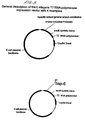
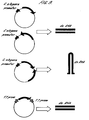
- Figure 10 illustrates the vectors and the orientation of the DNA sequence which enable double stranded RNA production in C . elegans.
- the DNA is located between two promoters on a vector capable of expressing dsRNA upon binding of an appropriate transcription factor to said promoters.
- the vector comprises two copies of the DNA sequence organised in a sense and antisense orientation relative to the promoter and which marker is selectable when contained in a pha-1 mutant C . elegans.
- the promoters are any of T7, T3 or SP6 promoters and the transcription factor comprises the appropriate polymerase.
- the selectable marker comprises a nucleotide sequence capable of inhibiting or preventing expression of a gene in said cell and which gene is responsible for conferring a known phenotype.
- This nucleotide sequence may be part of or identical to said gene conferring said phenotype, and which nucleotide sequence is itself oriented relative to a suitable promoter(s) capable of initiating transcription of double stranded RNA upon binding of an appropriate transcription factor to said promoter(s).
- the nucleotide sequence may be a part of or identical to said gene sequence conferring said phenotype, and which nucleotide sequence is such as to permit integration of said suitable or further vector by homologous recombination in the genome of said cell and following said integration said nucleotide sequence is capable of inhibiting expression of said gene sequence conferring said phenotype.
- said nucleotide sequence comprises stop codons sufficient to prevent translation of said nucleotide sequence following its integration into said genome.
- Compounds can, advantageously, in said method be added to said cell or organism for the purposes of screening for desired phenotypes, such as for example, resistance or sensitivity to the compound when compared to wild type.
- the promoters are preferably inducible.
- the transcription factor may in some embodiments be phage derived, such as for example, a T7 polymerase driven by a phage promoter.
- a worm specific or tissue specific promoter can be used, such as for example, let858, SERCA, UL6, myo-2 or myo-3.
- the E . coil strain is an RNAaseIII and even more preferably an Rnase negative strain.
- a further aspect of the present invention provides a method of generating a transgenic non-human organism comprising an exogenous transcription factor and a transgene comprising a promoter operably linked to DNA fragment which is expressed upon binding of said transcription factor thereto, the method comprising a) providing a first transgenic organism comprising a first construct incorporating DNA encoding an exogenous transcription factor and a second transgenic organism comprising a second construct including at least one promoter operably linked to a desired DNA sequence which is expressed upon binding of the transcription factor of said first transgenic organism thereto b) crossing said first and second transgenic organisms and selecting offspring expressing said desired DNA sequence.
- said first and second transgenic organisms are generated by transforming said first and second constructs into respective microorganisms for subsequent feeding to the respective organism.
- said second construct comprises said desired DNA sequence in an orientation relative to said promoter so as to be capable of initiating transcription of said DNA to dsRNA upon binding of said transcription factor thereto.
- said second construct comprises two promoters flanking said desired DNA sequence which promoters can initiate transcription of said DNA sequence to dsRNA upon binding of said transcription factor to said promoters.
- said DNA sequence is provided in a sense and an antisense orientation relative to said promoter so as to produce dsRNA upon binding of the transcription factor to the promoters.
- the first and/or second constructs may preferably be provided with a reporter gene operably linked to a promoter which is capable of initiating transcription of said reporter upon binding of said transcription factor thereto.
- the reporter gene encodes any of Luciferase, Green Fluorescent protein, ⁇ galactosidase or ⁇ -lactamase.
- the present invention also includes a method of validating clones identified in yeast two hybrid vector experiments which experiments are well known to those skilled in the art and which experiments were first proposed by Chien et al . (1991) to detect protein - protein interactions.
- the method according to the invention comprises providing a construct including the DNA encoding a protein identified in a two hybrid vector experiment, which construct is such that said DNA is provided in an orientation relative to one or more promoters capable of promoting transcription of said DNA to double stranded RNA upon binding of an appropriate transcription factor to said promoters, transforming a cell, such as a bacterial cell or alternatively transforming an organism comprising said transcription factor with said constructs and identifying a phenotypic change in said cell or organism, which may be C .
- the transcription factor is inducible in the cell or organism.
- the DNA sequence may be located between two promoters or in both a sense and antisense orientation relative to a single promoter, as described above.
- the promoter is a phage polymerase promoter and said transcription factor is a RNA polymerase, and preferably T7 polymerases.
- vectors used to transform said cells or organisms and the cells or organisms themselves are also encompassed with the scope of the present invention.
- a method of alleviating pest infestation of plants comprises a) identifying a DNA sequence from said pest which is critical either for its survival, growth, proliferation or reproduction, b) cloning said sequence from step a) or a fragment thereof in a suitable vector relative to one or more promoters capable of transcribing said sequence to RNA or dsRNA upon binding of an appropriate transcription factor to said promoters, and c) introducing said vector into the plant.
- the method according to the invention provides a particularly selective mechanism for alleviating pest infestation, and in some cases parasitic infestation of plants, such that when the pest feeds on the plant it will digest the expressed dsRNA in the plant thus inhibiting the expression of the DNA within the pest which is critical for its growth, survival, proliferation or reproduction.
- the pest may be any of Tylenchulus ssp.
- Radopholus ssp. Rhadinaphelenchus ssp., Heterodera ssp., Rotylenchulus ssp., Pratylenchus ssp., Belonolaimus ssp., Canjanus ssp., Meloidogyne ssp., Globodera ssp., Nacobbus ssp., Ditylenchus ssp., Aphelenchoides ssp., Hirschmenniella ssp., Anguina ssp., Hoplolaimus ssp., Heliotylenchus ssp., Criconemellassp., Xiphinemassp., Longidorus ssp., Trichodorus ssp., Paratrichodorus ssp., Aphelenchs sp.
- the DNA sequence or fragment thereof according to this aspect of the invention may be
- a further aspect of the invention concerns the vector used in each of the methods of the invention for constructing said library, which vector comprises two identical promoters oriented such that they are capable of initiating transcription of DNA sequence located between said promoters to dsRNA upon binding of an appropriate transcription factor to said promoters.
- the DNA sequence may, for example, include a multiple cloning site.
- the expression vector comprises a nucleotide sequence encoding a selectable marker.
- the nucleotide sequence encoding said selectable marker is located between two identical promoters oriented such that they are capable of initiating transcription of DNA located between said promoters to double stranded RNA upon binding of an appropriate transcription factor to said promoters.
- the selectable marker comprises a nucleotide sequence encoding sup-35, for introduction into C . elegans having a pha-1 mutation.
- the transcription factor comprises either a phage polymerase which binds to its corresponding promoter or a C . elegans specific promoter and even more preferably T7 polymerase.
- the vector includes a multiple cloning site between said identical promoters.
- an expression vector for expressing an appropriate transcription factor for use in a method according to the invention which vector comprises a sequence of nucleotides encoding said transcription factor operably linked to suitable expression control sequences.
- the expression control sequences include promoters which are inducible, constitutive, general or tissue specific promoters, or combinations thereof.
- the transcription factor comprises a phage polymerase, and preferably T7, T3 or SP6, RNA polymerase.
- a further aspect of the invention provides a selection system for identifying transformation of a cell or organism with a vector according to the invention which system comprises a vector according to the invention wherein said selectable marker comprises a nucleotide sequence capable of inhibiting or preventing expression of a gene in said cell or organism which gene is responsible for conferring a known phenotype.
- said nucleotide sequence corresponds to a part of or is identical to said gene conferring said known phenotype, and which nucleotide sequence is itself located between two identical promoters capable of initiating transcription of double stranded RNA upon binding of an appropriate transcription factor thereto.
- the nucleotide sequence comprises a nucleotide sequence which is a part of or identical to said gene sequence which confers a known phenotype on said cell or organism, and which is such that following integration of said vector by homologous recombination in the chromosome of said cell or organism said sequence inhibits expression of said gene sequence conferring said known phenotype.
- the nucleotide sequence comprises stop codons sufficient to prevent translation of the nucleotide sequence following integration into said chromosome.
- the known gene sequence comprises a sup-35 gene or a fragment thereof which is selectable by identifying offspring growing at a temperature above 25°C following introduction in a pha-1 et123ts mutant C. elegans worm.
- said known gene sequence comprises a sup-35 gene or a fragment thereof which is selectable by identifying offspring growing at a temperature above 25°C following introduction of said vector in a pha-1 et123ts mutant C . elegans worm.
- An even further aspect comprises a method of assigning function to a DNA sequence of a multicellular organism which method comprises a) providing i) a construct comprising said DNA fragment cloned between two promoters capable of promoting transcription in said multicellular organism, in a multicellular organism capable of initiating transcription from said promoter; b) identifying the phenotype of said multicellular organism compared to wild type.
- Example A Construction of an ordered and hierarchical pooled cDNA library and applications thereof.
- a random ordered and pooled library :
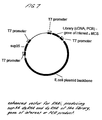
- the vector is an E . coli vector harboring two T7 promoters, with a multiple cloning site (MCS) in between.
- the two promoters are orientated towards each other, and towards the MCS.
- T7 RNA polymerase expressed in E . coli , C . elegans or any other organism, RNA will be produced, starting from the two T7 promoters. As these are oriented in the opposite sense, both strands of RNA will be produced from the DNA inserted (cloned) into the MCS in between the two promoters which results in the generation of double stranded RNA (dsRNA) upon binding of the T7 RNA polymerase thereto.
- dsRNA double stranded RNA
- a C. elegans cDNA library is constructed in the MCS using standard molecular biological techniques.
- the library is transformed into E. coli, and the resulting E. coli are grown in culture and stored in 96 multi-well plates.
- plasmid DNA can be isolated and stored in 96-multi-well plates corresponding to those of the E . coli colonies. Approximately 100,000 colonies are scored. In this way, the library will harbor approximately 5 times the total expressed cDNA variation of C . elegans, which gives the opportunity for low expressed sequences to be present in the library. This will result in approximately 1041 96-well plates.
- the plates are hierarchical pooled as necessary. For the present pooling of the clones is arranged in a range of 10 to 100.
- Hierarchical pooling is per 8 or 12 (numbers are more convenient as 96-well plates have a 8 to 12 grid), this will result in approximately 87 multi-well plates and approximately 8352 wells. If hierarchical pooling is per 96 wells, which is a full plate, this results in approximately 11 plates and approximately 1041 wells. At any stage of the hierarchical pooling, plasmid DNA can be isolated, which would be less elaborate as less plates are used, but will result in a loss of complexity although this should not be the case in the pooling per 12. The pooling of the DNA can also be carried out with the original DNA.
- Every gene of the C . elegans genome can be cloned using PCR technology.
- exons will be cloned with a minimal length of 500 bp. If the exons are too small, smaller fragments will be isolated with PCR, or even parts of introns and neighboring exons will be isolated with PCR technology so that at least a sufficient part of the translated region of the gene is cloned. For this, at least 17000 PCR reactions need to be performed.
- This collection of PCR products will be cloned in a T7 vector as described (two T7 promoters oriented towards each other with a multiple cloning site in between). Every PCR product is cloned independently, or can be used to generate a random library, analogous to the described cDNA library. If every PCR product is cloned individually, the resulting bacteria and plasmid DNA can be pooled in various ways. Firstly, this collection of individually cloned PCR products in the T7 RNAi vector can be pooled randomly, as described in the random library. This pooling can also be done in a more rational way. For instance, the genes of the C .
- elegans genome can be analyzed using bioinformatic tools (in silico biology). Various genes of the genome will belong to a gene family, or will have homologues in the genome. These members of the gene family will be pooled, or the members, being homologues will be pooled. In this way the total number of about 17000 clones is reduced to a more useable quantity.
- This library can be used to screen for phenotypes in the methods according to the invention. The resulting phenotype gives a functional description to the gene or gene family or gene homologues of the C . elegans genome. As the library consists of a part of every gene in the genome, this method enables description of the full genome in functional-phenotypic terms. For this the double stranded RNA (dsRNA) needs to be introduced in the worm. This introduction of clones alone, or pooled clones, being random pooling or rational pooling can be achieved in several ways as described.
- dsRNA double stranded
- Any vector containing a T7 promoter may be used, and which contains a multiple cloning site (there are many commercially available). Primers containing the T7 promoter and a primer with the reverse complementary strand, both with the appropriate ends are designed. These primers can be hybridized, and if well designed, cloned in the vector of choice.
- the minimal sequence for a T7 promoter is TAATACGACTCACTATAGGGCGA.
- RNA may be isolated from every organism that is sensitive to RNAi. In general the isolated RNA is then copied into double stranded cDNA, and subsequently prepared in suitable vectors for cloning. Several procedures exist and molecular biology kits can be purchased from various firms including promega, clontech, boehringer Mannheim, BRL, etc which enable:
- the resulting ligation mixture can be considered as the cDNA library.
- the ligation contains all cDNA of the procedure ligated into the vector of interest. To order the library, the ligation needs to be transformed into E . coli strains.
- CMOS complementary metal-oxide-semiconductor
- CMOS complementary metal-oxide-semiconductor
- PCR primers are developed and the cDNA fragment is isolated using PCR technology. PCR can be performed on the hierarchical pools. The positive pool or individual wells harboring the bacteria that has the appropriate cDNA is fed to C . elegans and the phenotype is scored.
- PCR can be performed on cDNA isolated from C . elegans.
- the resulting DNA can be cloned in the T7 vector and transformed in the dsRNA producing E. coli on which the C . elegans worms are then fed. Depending on which way is faster and more reliable a choice needs to be made.
- the worm may need to be fed on a mixture of bacteria. Each of them harboring a part of the member of the gene family. E. coli strains, growth conditions, combinations with compounds can be performed as described above.
- the library rational in which all the genes of C . elegans are cloned in a organized and structured way, the C . elegans homologue and eventually the other homologues, orthologues, and members of the gene family can be traced back easily in the library using a silico biology. No PCR is involved in this step, and the bacteria and or DNA can be isolated on which the worm will be grown.
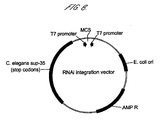
- An E . coli vector can be constructed harboring the following features; Two T7 promoters directed towards each other, with a restriction site or a multiple cloning site in between. Furthermore, the vector may contain the C . elegans sup35 genomic DNA, engineered in such a way that it contains several stopcodons at various intervals, so that no full length protein can be expressed form the sup35 genomic DNA fragment as illustrated in Figure 8 . Any cDNA or cDNA fragment can be cloned in the multiple cloning site between the two T7 promoters. When this vector is introduced in a C. elegans strain which expresses T7 RNA polymerase, the cDNA or DNA fragment cloned between the two T7 promoters will be transcribed, generating dsRNA from the cloned fragment.
- the vector is designed to be used in pha-1 (e2123) mutant worms expressing T7 RNA polymerase.
- the expression of the T7 RNA polymerase may be constitutive or regulated, general or tissue specific.
- These pha-1 (e2123) worms cannot produce offspring at temperatures higher than 25°C, which is due to a development problem in embryogenesis. When sup-35 is inhibited or knocked-out in this stain, offspring may grow at this temperature.
- the vector When the vector is introduced in the worm, the vector may integrate by homologous recombination (Campbell-like integration). It has been shown that homologous recombination occurs in C . elegans, although at low frequencies ( Plasterk and Groenen, EMBO J. 11:287-290, 1992 ). Homologous recombination at the sup35 gene will result in a knock-out of the gene as the two resulting sup - 35 genes will harbor the stopcodons. The resulting worm, and its offspring, if this recombination happens in the eggs, will have a copy of the vector integrated in the genome.
- homologous recombination occurs in C . elegans, although at low frequencies ( Plasterk and Groenen, EMBO J. 11:287-290, 1992 ). Homologous recombination at the sup35 gene will result in a knock-out of the gene as the two resulting sup -
- the DNA may be delivered to the worm by several techniques, including injection, ballistic transformation, soaking in the DNA solution, feeding with bacteria. New and other methods that increase the transformation efficiencies can be considered.
- the target C . elegans strain may in addition, have other mutations than the pha-1 (e2123) mutation, and may express other genes than T7 RNA polymerase.
- EXAMPLE B a Yeast two-hybrid-RNAi vector
- a yeast two hybrid vector can be constructed harboring the two T7 promoters.
- the vectors can be designed to replicate both in yeast and in E . coil.
- cDNA libraries for the yeast two hybrid system are made in the Ga14 or LexA vectors.
- The, library is constructed in vectors having the activation domain of one of these genes.
- a vector can be constructed that can still perform in the yeast two hybrid screen but which also contains two T7 promoters orientated towards each other, with a cloning site therein between. The order of the sequences in the plasmid will then be "plasmid backbone, (GAL4-T7), MCS, T7, backbone".
- GAL4-T7 plasmid backbone
- elegans cDNA library constructed in this vector can be used as a standard yeast two hybrid library in an experiment to isolate interacting proteins with a given protein.
- the plasmid can be introduced in an E . coil strain expressing the T7 RNA polymerase, and hence will produce dsRNA of the cloned fragment.
- the bacteria producing this dsRNA can be fed to the worm and phenotypes can be scored.
- this validation procedure for a newly isolated yeast two hybrid clone is remarkably shorter than the standard procedure, which requires PCR and/or cloning steps, RNA experiments and/or knock-out experiments.
- isolated clones are sequenced first, and on the basis of the sequence, a decision is made to continue with further experiments.
- every isolated clone can easily be introduced into the appropriate E . coli and fed to the worm. Validation is then performed by phenotype analysis.
- yeast two hybrid was performed using a known gene as bait and the newly constructed library as the target. Proteins coded by the clones in the target that interact with the bait protein, will result in positive yeast clones expressing the reporter molecule such as can be observed by LacZ staining with X-gal.
- the plasmid coding for the target protein is isolated directly from the yeast strain and introduced in E . coli.
- the E. coli is T7 RNA polymerase producing E . coli.
- double stranded RNA is produced from the DNA cloned in the multiple cloning site of the vector. When this dsRNA is fed to the worm using the methods described previously, the gene has inhibited in the worm, resulting in a particular phenotype.
- a C. elegans strain can be constructed that expresses T7 RNA polymerase.
- the expression can be general and constitutive, but could also be regulated under a tissue specific promoter, an inducible promoter, or a temporal promoter or a promoter that harbors one of these characteristics or combination of characteristics.
- DNA can be introduced in this C . elegans strain. This is done either by injection, by shooting with particles, by electroporation or as aforementioned by feeding. If the DNA is a plasmid as described in the previous examples, i.e.
- the introduced DNA can have an efficient transient down regulation.
- the introduced DNA can form an extrachromosomal array, which array might result in a more catalytic knock-out or reduction of function phenotype.
- the plasmid might also integrate into the genome of the organism, resulting in the same catalytic knock out or reduction of function phenotype, but which is stably transmittable.
- the T7 polymerase can be expressed under various promoters, being inducible promoters, constitutive promoters, general promoters and tissue (cell) specific promoters, or combinations of those. Examples of these promoters are the heatshock promoter hsp-16, the gut promoter ges 1, the promoter from cet858, but also the promoter of dpy 7 and the promoter element GATA1.
- the T7 RNA polymerase is expressed under the control of the hsp-16 promoter that is available in the pPD49.78 vector.
- the T7 RNA polymerase is isolated as a PCR product using the primers of GN3 an GN4.
- the resulting PCR product is digested with NheI and NcoI, as is the vector in which we want to clone, being the Fire vector pPD49.78.
- the resulting vector is pGN100 illustrated in Figure 2 oGN3: CAT GGC AGG ATG AAC ACG ATT AAC ATC GC oGN4: ATG GCC CCA TGG TTA CGG GAA CGC GAA GTC CG pGN100 is included.
- the vector is introduced into the worm using standard techniques, such as micro injection, for example.
- All of these strains are able to produce T7 RNA polymerase when temperature induced or alternatively by metals such as application of heavy cadmium or mercury.
- the procedure for temperature induction is to shift the animal to a temperature of 30-33°C for at least one hour, then the animal can be shifted back to standard temperatures (15-25°C).
- the wild type strain producing T7 RNA polymerase can be used for the production of any RNA in the worm. More specifically, the plasmids from the described libraries can be introduced in these worms, and phenotypes can be scored.
- the nuc-1 mutant worm will be used to introduce DNA via bacteria on which the worm feed. As the nuc-1 worm does not digest the DNA, the plasmid DNA can cross the gut wall. If taken up by the cells that produce the T7 RNA polymerase, dsRNA will be produced thus inhibiting the gene from which the RNA was transcribed.
- the pha-1 mutant strain that produced T7 RNA polymerase can be used to enhance the procedures as described above.
- DNA can be introduced by shooting, micro injection or feeding. More specifically this strain can be used for the vectors that produce dsRNA from sup-35 and from the gene of interest, the latter can be a PCR product, a cDNA, or a library as described.
- the pha-1; nuc-1 mutant producing T7 RNA polymerase can be used for the bacterial delivery of the DNA.
- DNA will preferentially be the plasmid that produce dsRNA from both sup-35 and the gene of interest.
- the worm strain will preferentially produce the T7 RNA polymerase in the gut. Delivery will preferentially happen by feeding the worm on bacteria harboring the plasmid.
- Nematodes are responsible a large part of the damage inflicted on plants and more particularly to plants used in the agricultural industry.
- the RNAi procedures according to the invention can be applied to plants to prevent these parasitic nematodes from feeding longer.
- a DNA fragment is isolated from the parasitic plant nematode that is critical for the animals survival or growth, or to feed or to proliferate. Any gene from which the expression is essential is suitable for this purpose.
- an exon or cDNA is cloned.
- This DNA fragment can be cloned under the influence of a tissue specific promoter preferably a root specific promoter even more preferably between two root specific promoters.
- the DNA of the cloned gene under the control of the root specific promoter can be introduced in the plant of interest, using plant transgenic technology. For every parasitic nematode, a different piece of DNA may be required and likewise for every plant race, a different promoter will be needed.
- the root will produce RNA or dsRNA from the introduced piece of DNA when root specific promoter is utilised.
- the RNA and/or dsRNA will be consumed or ingested by the nematode.
- the RNA and/or dsRNA can enter the cells of the nematode and perform its inhibitory action on the target DNA.
- the nematode will not be able to survive, to eat, proliferate, etc in any case preventing the animal of feeding longer on the plant, and thus protecting the plant.
- T7 RNA polymerase or other RNA polymerases in animals, and more particularly in nematodes and most particularly in C. elegans, several possibilities can be envisaged.
- the T7 RNA polymerase can be expressed under various promoters. These promoters may be inducible promoters, constitutive promoters, general promoters, tissue specific promoters, or combinations of those.
- the T7 polymerase coding sequence was PCR amplified from_ ⁇ CE6 (Novagen, Madison, USA)using the primers oGN26 (ATGGAATTCTTACGCGAACGCGAAGTCCG) and oGN46 (CTCACCGGTAATGAACACGATTAACATCGC), using standard procedures ( PCR, A practical A practical approach, 1993, Ed. J. McPherson, et al, IRL Press ).
- the resulting DNA fragment encoding for the T7 RNA polymerase was digested with AgeI and EcoRI and inserted into the Fire vector pPD97.82 digested with AgeI and EcoRI.
- the resulting construct encodes for an open reading frame of T7 RNA polymerase in fusion with the SV40 large T antigen nuclear localization signal (NLS) with amino acid sequence MTAPKKKRKVPV.
- This nuclear localization signal sequence is required to translocate the T7 RNA polymerase from the cytoplasm to the nucleus, where it is able to bind to its specific promoters, designated T7 promoters.
- Upstream of the coding sequence for the T7polymerasefusion protein is a minimal promoter (myo-2) preceded by a multiple cloning site (MCS) in which several C. elegans promoters can be inserted.
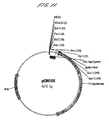
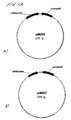
- This plasmid ( pGN105 shown in Figure 11 ) is a basic T7 RNA polymerase plasmid which enables the expression of T7polymerase in C. elegans. Derivatives of this plasmid wherein promoters are cloned into the multiple cloning site, allow for the inducible, constitutive, general and tissue specific expression of T7 RNA polymerase in C. elegans, as expression will be regulated by the promoter cloned in the multiple cloning site.
- let-858 ubiquitous expression
- myo-2 pharynx expression
- myo-3 body wall muscles
- egl-15 vulval muscles
- unc-119 pan-neuron
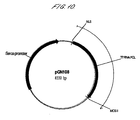
- the T7 RNA polymerase coding sequence was PCR amplified from_ ⁇ CE6 using the primers oGN43 (GCCACCGGTGCGAGCTCATGAACACGATTAACATCGC) and oGN44 (CACTAGTGGGCCCTTACGCGAACGCGAAGTCCG) digested with AgeI/SpeI and inserted in the pGK13 vector digested with AgeI/SpeI.
- This vector contains the strong SERCA promoter which drives expression in the pharynx, the vulval muscle, the tail and the body wall muscle).
- a nuclear localization signal (NLS) of SV40 large T antigen was inserted in front of the T7 polymerase coding sequence by insertion of two overlapping oligo's oGN45 (CCGGATGACTGCTCCAAAGAAGAAGCGTAAGCT) and oGN46 (CTCACCGGTAATGAACACGATTAACATCGC) into the SacI/AgeI restriction sites.
- the resulting construct was called pGN108 as shown in Figure 10 .
- Introduction of this plasmid into C. elegans results in the expression of T7 RNA polymerase in the pharynx, vulva muscle, tail and body wall muscles.
- pGN108 which encodes the T7RNA polymerase under the control of the SERCA promoter was injected into C . elegans .
- a test vector was coinjected.
- This test vector encodes for GFP under the control of a T7 promoter ( pGN401 in Figure 13 ).
- the plasmid pGN401 was constructed by inserting two overlapping oligo's oGN41 (CCCGGGATTAATACGACTCACTATA) and oGN42 (CCGGTATAGTGAGTCGTATTAATCCCGGGAGCT) in the SacI/AgeI opened Fire vector pPD97.82. generating a T7 promoter.
- Transgenic F1 could easy be isolated as they display the rol 6 phenotype.
- These transgenic C. elegans all expressed GFP in the pharynx, the vulval muscle, the tail and the body wall muscle.
- T7 RNA polymerase is functionally expressed under the regulation of the SERCA promoter, and that the expressed T7 RNA polymerase binds to the T7 promoter present in pGN401 and initiates transcription of the GFP gene, which is then functionally expressed, resulting in fluorescence in the muscle tissues where SERCA is inducing the expression of the T7 RNA polymerase.
- the NLS-T7 RNA polymerase fusion gene was isolated from pGN108 with XmaI/Bsp1201 and cloned into the Fire vector pPD103.05 digested with XmaI/Bsp120I.This results in a vector wherein the T7 RNA polymerase is cloned under the regulation of the let858 promoter. This specific promoter enables the expression of T7 RNA polymerase in all tissues.
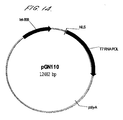
- the resulting plasmid was named pGN110 ( Figure 14 ).
- the Fire vector pPD97.82 was digested with SacI / AgeI and a T7 promoter sequence was generated by insertion of two overlapping oligo's oGN41 (CCCGGGATTAATACGACTCACTATA) and oGN42 (CCGGTATAGTGAGTCGTATTAATCCCGGGAGCT) into the SacI/Age/ restriction endonuclease sites.
- This construct ( pGN400 Figure 12 ) contains a GFP open reading frame cloned between SacI and EcoRI restriction endonuclease sites under the regulation of the T7 promoter.
- any gene, cDNA, or DNA fragment can be cloned in this vector by deleting the GFP gene as a AgeI/ SacI fragment and cloning the DNA fragment of interest into the vector.
- the DNA fragment of interest can be obtained by PCR amplification, inserting the SacI/AfeI sites in the primers.
- the resulting DNA fragment after PCR amplification is the digested and the GFP gene in pGN400 is replaced by the amplified DNA fragment.
- Every vector that contains a T7 promoter could be used for the purpose of T7 RNA polymerase induced expression in C. elegans, such as the commercially available pGEM vectors and the pBluescript vectors. This is clearly shown by the pGN401 vector which expresses GFP under the regulation of the T7 promoter in a transgenic C. elegans which expresses T7 RNA polymerase.
- pGN400 has the advantage that the vector includes a 3'UTR fragment from unc-54 which enhances the transcription or stability of the RNA.
- C. elegans gene knock outs in C. elegans are obtained after random, large scale mutagenesis and PCR base sib-selection. This method is bulky, very time consuming and tedious. It has been described that introducing double stranded RNA into a cell results in potent and specific interference of expression of endogenous genes.
- gene expression can be down regulated by injection of RNA into the body cavity of the worm, soaking the worm in a solution containing dsRNA or feeding E. coli that express dsRNA corresponding to the gene of interest.
- C. elegans cells have the ability to take in dsRNA from their extracellular environment.
- RNAi mediated genetic interference It has been reported that mRNA is the target of this ds RNA mediated genetic interference (Montgomery and Fire 1998). It is also suggested that the targeted RNA is degraded in the nucleus before translation can occur. Although the RNAi mediated reduction of gene expression can be passed on to the next generations, heritability is poor and the effect is rapidly lost during further offspring. This is probably due to a continued decrease of the dsRNA pool.
- elegans lines by introducing plasmids containing cDNA fragments of the target gene in the sense and antisense orientation under control of a worm promoter or by transcription of an inverted repeat of the cDNA from a single construct.
- ds RNA can be transcribed from a vector harboring a cDNA flanked by two T7 promoters in a C. elegans strain that expresses T7 polymerase. The result is a transgenic worm with an heritable stable "pseudo knock-out" phenotype.
- the expression of the cDNA or the T7 polymerase can be general and constitutive but could also be regulated under a tissue specific promoter. In contrast to RNAi induced by external ds RNAi (injected, soaked or feeded) this method would enable to obtain conditional, tissue specific inhibition of gene expression.
- RNA interference results in a "twitching" phenotype.
- Unc 22 cDNA (exon 22) was cloned in sense and antisense orientation in pPD103.05. (A. Fire nr L2865) containing the let 858 promoter that is capable of expressing RNA sequences in all tissues.
- the resulting plasmids were named pGN205 ( Figure 19a ) and pGN207 ( Figure 19 b) .
- These constructs were introduced into C. elegans together with a selectable marker (rol-6; GFP).
- Transgenic F1 individuals (expressing rol-6 or GFP) showed a "twitching" phenotype indicating that RNAi could be mediated by endogenous transcription of RNA from transgenic DNA.
- the RNAi phenotype co-segregated with the selectable marker into further offspring. This resulted in the generation of C. elegans lines with permanent RNAi phenotype.
- RNA polymerase An expression system in C. elegans based on an exogenous RNA polymerase demands two plasmids. One is encoded for the RNA polymerase under the control of a specific promoter, while the other plasmid encodes for the DNA fragment to be expressed, under the regulation of the T7 promoter. In the case of semi stable RNAi also designated pseudo stable knockouts, the DNA of interest is cloned between two T7 promoters so that dsRNA can be produced.
- RNA polymerase expression system As the T7 RNA polymerase expression system is known to be a high expression system this will result in problems to generate dually transgenic animals. If the gene to be expressed in the C. elegans nematode is toxic, this will result in lethal effects and hence in the construction of a C. elegans without highly regulated stable expression of the gene of interest. If the gene of interest is essential for the survival of the organism, RNAi with a DNA fragment from this gene will also result in lethal effects, so that pseudo- stable knockouts are not possible.
- the present inventors have designed a system consisting of two transgenic animals.
- the first animal is transgenic for the T7 RNA polymerase, This T7 RNA polymerase can be expressed in all cells or specific cells or tissues as has been shown in previous examples.
- the second transgenic animal is transgenic for the DNA fragment of interest. This can be a gene or cDNA linked to a T7 promoter, or if one wants to perform RNAi a DNA fragment of such gene cloned between two T7 promoters.
- Both transgenic animals are viable and do not show any aberrant phenotypes. This is because the T7RNA polymerase expressed in the first transgenic organism is not toxic for the organism, even if expressed at relative high levels. In the second transgenic organism, the gene of interest is not expressed or the dsRNA is not produced as these transgenic animals do not contain the T7 RNA polymerase.
- Expression of the gene or cDNA of interest or RNAi with a DNA fragment can now be obtained by mating the two transgenic animals.
- the offspring of these are dually transgenic and express the gene of interest or express dsRNa of the DNA fragment of interest.
- one of the transgenic animals males can be a C. elegans mutant with a phenotype favouring generation of males.
- An Example of such a mutant is him-5.
- Preferentially such a mutant will be used to make a C. elegans transgenic for T7 RNA polymerase, while the hermaphrodite harbors the DNA fragment under the regulation of the T7 promoter.
- a second transgene can be introduced in the second transgenic animal.
- This transgene contains a reporter gene under the regulation of the T7 promoter.
- the reporter gene can be GFP, luciferase, Beta galmactosidase, or beta-lactamase.
- an example of such a ttransgene are the vectors pGN400 and pGN401.
- tissue specific expression of a transgene in C. elegans we can make male stock (i.e. him-5) carrying the T7 polymerase construct under the control of different C. elegans promoters that enable tissue specific expression such as). This males can be crossed with hermaphrodites carrying the gene of interest under the control of a T7 promoter.
- the transgenes can be integrated into the genome of the animal.
- Methods to generate stable integration of a plasmid into the genome of the animal have been described ( Methods in cell biology, Vol. 48, 1995, ed. by epstein and Shakes, academic press ) and involve radiation of the animal. This can be done for both animals animals, but preferentially, the animals expressing the T7 RNA polymerase are subject to such traetment. This result in a collection of C. elegans nematodes that stably express T7 RNA polymerase under the control of various promoters.
- promoters examples include the myo-2 (pharynx expression), myo-3 (body wall muscles), egl-15 (vulval muscles), unc-119 (pan-neuron), SERCA (muscles), let858 (all cells) ges-1 (gut).
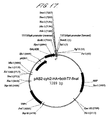
- a cDNA library is cloned in plasmid pGAD424 ( Figure 16 ) which has been engineered with additional restriction sites in the polylinker such as a Ncol site (Clontech).
- This library allows for screening of binding proteins in a yeast two hybrid experiment.
- T7- linker consisting of the following primers aattcttaatacgactcactatagggcc and catgggccctatagtgagtcgtattaag
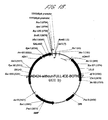
- the resulting vector was designated pGAD424-without-FULL-ICE-both-T7. Care was taken to eliminate stop codons and using maximal polylinker compatible amino acids.
- the SalI site is important as most libraries are cloned in this site, adapters are available. This makes the newly constructed vector compatible with existing vectors.
- the EcoRI restriction site which is located between the DNA sequence encoding for GAL4DB and HA (epitope) becomes unique for the plasmid, and can be used to subsitute HA with a T7 promoter containing linker. This ensures persistence of all restriction sites, allowing both in frame cloning and compatibility with previous vectors and pGAD424.
- linker primers: aattcttaatacgactcactatagggca and tatgccctatagtgagtcgtattaag
- T7 promoter or alternatively the T3, or SP6 promoter
- pGAD424 allows to go quickly from interacting protein to RNAi and assigning function to the isolated DNA fragment.
- An additional advantage is the ability to make by in vitro transcription coupled to in vitro translation (There is an ATG in frame with either GAL4DB or GAL4AD) labeled protein which can be used for in vitro controls (e.g. pull down assays) of the actual protein-protein interaction.
Landscapes
- Health & Medical Sciences (AREA)
- Life Sciences & Earth Sciences (AREA)
- Genetics & Genomics (AREA)
- Engineering & Computer Science (AREA)
- Chemical & Material Sciences (AREA)
- Organic Chemistry (AREA)
- Zoology (AREA)
- Wood Science & Technology (AREA)
- Biotechnology (AREA)
- General Engineering & Computer Science (AREA)
- Bioinformatics & Cheminformatics (AREA)
- Biomedical Technology (AREA)
- Molecular Biology (AREA)
- Biophysics (AREA)
- Microbiology (AREA)
- Physics & Mathematics (AREA)
- Biochemistry (AREA)
- General Health & Medical Sciences (AREA)
- Plant Pathology (AREA)
- Cell Biology (AREA)
- Proteomics, Peptides & Aminoacids (AREA)
- Crystallography & Structural Chemistry (AREA)
- Virology (AREA)
- Bioinformatics & Computational Biology (AREA)
- Analytical Chemistry (AREA)
- Immunology (AREA)
- Micro-Organisms Or Cultivation Processes Thereof (AREA)
- Measuring Or Testing Involving Enzymes Or Micro-Organisms (AREA)
- Pharmaceuticals Containing Other Organic And Inorganic Compounds (AREA)
- Agricultural Chemicals And Associated Chemicals (AREA)
- Breeding Of Plants And Reproduction By Means Of Culturing (AREA)
- Preparation Of Compounds By Using Micro-Organisms (AREA)
- Saccharide Compounds (AREA)
- Catching Or Destruction (AREA)
- Medicines Containing Material From Animals Or Micro-Organisms (AREA)
Priority Applications (1)
| Application Number | Priority Date | Filing Date | Title |
|---|---|---|---|
| EP10182431A EP2374901A1 (fr) | 1998-07-03 | 1999-07-02 | Caractérisation de fonction de gène utilisant une inhibition ARN à double brin |
Applications Claiming Priority (4)
| Application Number | Priority Date | Filing Date | Title |
|---|---|---|---|
| GBGB9814536.0A GB9814536D0 (en) | 1998-07-03 | 1998-07-03 | Characterisation of gene function using double stranded rna inhibition |
| GBGB9827152.1A GB9827152D0 (en) | 1998-07-03 | 1998-12-09 | Characterisation of gene function using double stranded rna inhibition |
| EP01129274.5A EP1197567B2 (fr) | 1998-07-03 | 1999-07-02 | Caractérisation de la fonction d'un gène en utilisant l'inhibition de l'ARN double brin |
| EP99932836A EP1093526A2 (fr) | 1998-07-03 | 1999-07-02 | Caracterisation d'une fonction de gene par inhibition d'arn double brin |
Related Parent Applications (2)
| Application Number | Title | Priority Date | Filing Date |
|---|---|---|---|
| EP01129274.5A Division EP1197567B2 (fr) | 1998-07-03 | 1999-07-02 | Caractérisation de la fonction d'un gène en utilisant l'inhibition de l'ARN double brin |
| EP01129274.5A Division-Into EP1197567B2 (fr) | 1998-07-03 | 1999-07-02 | Caractérisation de la fonction d'un gène en utilisant l'inhibition de l'ARN double brin |
Publications (2)
| Publication Number | Publication Date |
|---|---|
| EP2045336A2 true EP2045336A2 (fr) | 2009-04-08 |
| EP2045336A3 EP2045336A3 (fr) | 2009-06-10 |
Family
ID=26313977
Family Applications (5)
| Application Number | Title | Priority Date | Filing Date |
|---|---|---|---|
| EP01129274.5A Expired - Lifetime EP1197567B2 (fr) | 1998-07-03 | 1999-07-02 | Caractérisation de la fonction d'un gène en utilisant l'inhibition de l'ARN double brin |
| EP08022353A Withdrawn EP2045336A3 (fr) | 1998-07-03 | 1999-07-02 | Caractérisation de fonction de gène utilisant une inhibition ARN à double brin |
| EP04011161A Revoked EP1484415B1 (fr) | 1998-07-03 | 1999-07-02 | Méthode pour alléger l'infestation des plantes par des nuisibles |
| EP99932836A Withdrawn EP1093526A2 (fr) | 1998-07-03 | 1999-07-02 | Caracterisation d'une fonction de gene par inhibition d'arn double brin |
| EP10182431A Withdrawn EP2374901A1 (fr) | 1998-07-03 | 1999-07-02 | Caractérisation de fonction de gène utilisant une inhibition ARN à double brin |
Family Applications Before (1)
| Application Number | Title | Priority Date | Filing Date |
|---|---|---|---|
| EP01129274.5A Expired - Lifetime EP1197567B2 (fr) | 1998-07-03 | 1999-07-02 | Caractérisation de la fonction d'un gène en utilisant l'inhibition de l'ARN double brin |
Family Applications After (3)
| Application Number | Title | Priority Date | Filing Date |
|---|---|---|---|
| EP04011161A Revoked EP1484415B1 (fr) | 1998-07-03 | 1999-07-02 | Méthode pour alléger l'infestation des plantes par des nuisibles |
| EP99932836A Withdrawn EP1093526A2 (fr) | 1998-07-03 | 1999-07-02 | Caracterisation d'une fonction de gene par inhibition d'arn double brin |
| EP10182431A Withdrawn EP2374901A1 (fr) | 1998-07-03 | 1999-07-02 | Caractérisation de fonction de gène utilisant une inhibition ARN à double brin |
Country Status (27)
| Country | Link |
|---|---|
| US (3) | US20030061626A1 (fr) |
| EP (5) | EP1197567B2 (fr) |
| JP (3) | JP4353639B2 (fr) |
| KR (4) | KR20060071438A (fr) |
| CN (3) | CN1657620A (fr) |
| AT (2) | ATE433500T1 (fr) |
| AU (1) | AU769223B2 (fr) |
| BR (1) | BR9911802A (fr) |
| CA (2) | CA2332619C (fr) |
| CY (2) | CY1108920T1 (fr) |
| CZ (2) | CZ303494B6 (fr) |
| DE (5) | DE29924298U1 (fr) |
| DK (2) | DK1197567T4 (fr) |
| ES (2) | ES2320527T5 (fr) |
| GB (4) | GB9827152D0 (fr) |
| HU (1) | HU230602B1 (fr) |
| IL (3) | IL140467A0 (fr) |
| IN (2) | IN2001DE00006A (fr) |
| IS (1) | IS2816B (fr) |
| MX (1) | MX234065B (fr) |
| NO (1) | NO327729B1 (fr) |
| NZ (1) | NZ509182A (fr) |
| PL (3) | PL216779B1 (fr) |
| PT (2) | PT1197567E (fr) |
| RU (1) | RU2240349C2 (fr) |
| WO (1) | WO2000001846A2 (fr) |
| ZA (1) | ZA200007653B (fr) |
Families Citing this family (257)
| Publication number | Priority date | Publication date | Assignee | Title |
|---|---|---|---|---|
| US6506559B1 (en) | 1997-12-23 | 2003-01-14 | Carnegie Institute Of Washington | Genetic inhibition by double-stranded RNA |
| AUPP249298A0 (en) * | 1998-03-20 | 1998-04-23 | Ag-Gene Australia Limited | Synthetic genes and genetic constructs comprising same I |
| CN101818145A (zh) | 1998-03-20 | 2010-09-01 | 联邦科学和工业研究组织 | 控制基因表达 |
| GB9827152D0 (en) * | 1998-07-03 | 1999-02-03 | Devgen Nv | Characterisation of gene function using double stranded rna inhibition |
| CA2361201A1 (fr) * | 1999-01-28 | 2000-08-03 | Medical College Of Georgia Research Institute, Inc. | Composition et methode destinees a l'attenuation in vivo et in vitro de l'expression genique utilisant de l'arn double brin |
| DE19956568A1 (de) | 1999-01-30 | 2000-08-17 | Roland Kreutzer | Verfahren und Medikament zur Hemmung der Expression eines vorgegebenen Gens |
| US7601494B2 (en) | 1999-03-17 | 2009-10-13 | The University Of North Carolina At Chapel Hill | Method of screening candidate compounds for susceptibility to biliary excretion |
| US20040138168A1 (en) * | 1999-04-21 | 2004-07-15 | Wyeth | Methods and compositions for inhibiting the function of polynucleotide sequences |
| KR20070118315A (ko) * | 1999-04-21 | 2007-12-14 | 와이어쓰 | 폴리뉴클레오티드 서열의 기능을 억제하기 위한 조성물 |
| US6924109B2 (en) * | 1999-07-30 | 2005-08-02 | Agy Therapeutics, Inc. | High-throughput transcriptome and functional validation analysis |
| US6423885B1 (en) | 1999-08-13 | 2002-07-23 | Commonwealth Scientific And Industrial Research Organization (Csiro) | Methods for obtaining modified phenotypes in plant cells |
| HK1047109A1 (zh) | 1999-10-15 | 2003-02-07 | University Of Massachusetts | 作为指定基因干预工具的rna干预轨迹基因 |
| GB9927444D0 (en) * | 1999-11-19 | 2000-01-19 | Cancer Res Campaign Tech | Inhibiting gene expression |
| US7829693B2 (en) | 1999-11-24 | 2010-11-09 | Alnylam Pharmaceuticals, Inc. | Compositions and methods for inhibiting expression of a target gene |
| DE10100586C1 (de) | 2001-01-09 | 2002-04-11 | Ribopharma Ag | Verfahren zur Hemmung der Expression eines Ziegens |
| GB9930691D0 (en) * | 1999-12-24 | 2000-02-16 | Devgen Nv | Improvements relating to double-stranded RNA inhibition |
| US7833992B2 (en) | 2001-05-18 | 2010-11-16 | Merck Sharpe & Dohme | Conjugates and compositions for cellular delivery |
| US7491805B2 (en) | 2001-05-18 | 2009-02-17 | Sirna Therapeutics, Inc. | Conjugates and compositions for cellular delivery |
| US8202979B2 (en) | 2002-02-20 | 2012-06-19 | Sirna Therapeutics, Inc. | RNA interference mediated inhibition of gene expression using chemically modified short interfering nucleic acid |
| US8273866B2 (en) | 2002-02-20 | 2012-09-25 | Merck Sharp & Dohme Corp. | RNA interference mediated inhibition of gene expression using chemically modified short interfering nucleic acid (SINA) |
| US8202846B2 (en) | 2000-03-16 | 2012-06-19 | Cold Spring Harbor Laboratory | Methods and compositions for RNA interference |
| EP1272630A2 (fr) | 2000-03-16 | 2003-01-08 | Genetica, Inc. | Procedes et compositions d'interference d'arn |
| ES2336887T5 (es) | 2000-03-30 | 2019-03-06 | Whitehead Inst Biomedical Res | Mediadores de interferencia por ARN específicos de secuencias de ARN |
| US7083947B2 (en) | 2000-05-19 | 2006-08-01 | Devgen Nv | Assay techniques using nematode worms |
| GB0012233D0 (en) * | 2000-05-19 | 2000-07-12 | Devgen Nv | Vector constructs |
| GB2362383B (en) * | 2000-05-19 | 2003-12-31 | Devgen Nv | Gene expression system |
| GB0012229D0 (en) | 2000-05-19 | 2000-07-12 | Devgen Nv | Lipid uptake assays |
| AU2001275474A1 (en) * | 2000-06-12 | 2001-12-24 | Akkadix Corporation | Materials and methods for the control of nematodes |
| US20030190635A1 (en) * | 2002-02-20 | 2003-10-09 | Mcswiggen James A. | RNA interference mediated treatment of Alzheimer's disease using short interfering RNA |
| CA2429814C (fr) | 2000-12-01 | 2014-02-18 | Thomas Tuschl | Petites molecules d'arn mediant l'interference arn |
| US7767802B2 (en) | 2001-01-09 | 2010-08-03 | Alnylam Pharmaceuticals, Inc. | Compositions and methods for inhibiting expression of anti-apoptotic genes |
| US7423142B2 (en) | 2001-01-09 | 2008-09-09 | Alnylam Pharmaceuticals, Inc. | Compositions and methods for inhibiting expression of anti-apoptotic genes |
| KR20030090626A (ko) * | 2001-01-25 | 2003-11-28 | 비륵시스 코포레이션 | 유전자 기능을 동정하기 위한 방법 및 조성물 |
| EP1354035B1 (fr) | 2001-01-26 | 2016-08-24 | Commonwealth Scientific and Industrial Research Organisation | Procedes et moyens d'elaboration par clonage recombinatoire d'un produit de recombinaison permettant une attenuation transcriptionnelle efficace |
| CA2369944A1 (fr) | 2001-01-31 | 2002-07-31 | Nucleonics Inc. | Utilisation de l'inhibition genetique post-transcriptionnelle pour identifier les sequences d'acides nucleiques qui modulent la fonction d'une cellule |
| AU2002249170B2 (en) * | 2001-02-02 | 2007-02-08 | Max-Planck-Gesellschaft Zur Forderung Der Wissenschaften E.V | Method for identifying functional nucleic acids |
| EP2415486B1 (fr) | 2001-05-18 | 2017-02-22 | Sirna Therapeutics, Inc. | Conjugués et compositions pour la fourniture cellulaire |
| US20050148530A1 (en) | 2002-02-20 | 2005-07-07 | Sirna Therapeutics, Inc. | RNA interference mediated inhibition of vascular endothelial growth factor and vascular endothelial growth factor receptor gene expression using short interfering nucleic acid (siNA) |
| WO2003070887A2 (fr) * | 2002-02-20 | 2003-08-28 | Sirna Therapeutics, Inc. | Inhibition mediee par interference d'arn de l'expression du gene de la proteine ezh2 du groupe polycomb a l'aide d'un acide nucleique court interferent (sina) |
| US9994853B2 (en) | 2001-05-18 | 2018-06-12 | Sirna Therapeutics, Inc. | Chemically modified multifunctional short interfering nucleic acid molecules that mediate RNA interference |
| US7109165B2 (en) | 2001-05-18 | 2006-09-19 | Sirna Therapeutics, Inc. | Conjugates and compositions for cellular delivery |
| WO2003070884A2 (fr) * | 2002-02-20 | 2003-08-28 | Sirna Therapeutics, Inc. | Inhibition de l'expression du gene de la mdr p-glycoproteine induite par l'interference d'arn, au moyen d'acide nucleique interferant court (sina) |
| US7517864B2 (en) | 2001-05-18 | 2009-04-14 | Sirna Therapeutics, Inc. | RNA interference mediated inhibition of vascular endothelial growth factor and vascular endothelial growth factor receptor gene expression using short interfering nucleic acid (siNA) |
| IL159756A0 (en) | 2001-07-12 | 2004-06-20 | Univ Massachusetts | IN VIVO PRODUCTION OF SMALL INTERFERING RNAs THAT MEDIATE GENE SILENCING |
| US7612194B2 (en) * | 2001-07-24 | 2009-11-03 | Monsanto Technology Llc | Nucleic acid sequences from Diabrotica virgifera virgifera LeConte and uses thereof |
| ATE465258T1 (de) | 2001-08-31 | 2010-05-15 | Riken | Pflanzensystem zur umfassenden genfunktionsanalyse unter verwendung einer vollängen-cdna |
| DE10163098B4 (de) | 2001-10-12 | 2005-06-02 | Alnylam Europe Ag | Verfahren zur Hemmung der Replikation von Viren |
| US7745418B2 (en) | 2001-10-12 | 2010-06-29 | Alnylam Pharmaceuticals, Inc. | Compositions and methods for inhibiting viral replication |
| US20030150017A1 (en) * | 2001-11-07 | 2003-08-07 | Mesa Jose Ramon Botella | Method for facilitating pathogen resistance |
| DE10202419A1 (de) | 2002-01-22 | 2003-08-07 | Ribopharma Ag | Verfahren zur Hemmung der Expression eines durch eine Chromosomen-Aberration entstandenen Zielgens |
| US20060009409A1 (en) | 2002-02-01 | 2006-01-12 | Woolf Tod M | Double-stranded oligonucleotides |
| EP1572902B1 (fr) * | 2002-02-01 | 2014-06-11 | Life Technologies Corporation | Courts fragments d'arn interferant haute activite visant a reduire l'expression de genes cibles |
| ATE556714T1 (de) | 2002-02-01 | 2012-05-15 | Life Technologies Corp | Doppelsträngige oligonukleotide |
| AU2003213057A1 (en) * | 2002-02-20 | 2003-09-09 | Ribozyme Pharmaceuticals, Incoporated | Rna interference mediated inhibition of checkpoint kinase-1 (chk-1) gene expression using short interfering nucleic acid |
| EP1474433A4 (fr) * | 2002-02-20 | 2005-02-23 | Sirna Therapeutics Inc | VALIDATION ET IDENTIFICATION DE CIBLES FACILITEES PAR INTERFERENCE D'ARN AU MOYEN D'ACIDE NUCLEIQUE INTERFERENT COURT (siNA) |
| EP1432724A4 (fr) | 2002-02-20 | 2006-02-01 | Sirna Therapeutics Inc | Inhibition a mediation par interference d'arn de genes de map kinase |
| US7667029B2 (en) | 2002-02-20 | 2010-02-23 | Sirna Therapeutics, Inc. | RNA interference mediated inhibition of checkpoint kinase-1 (CHK-1) gene expression using short interfering nucleic acid (siNA) |
| AU2003219833A1 (en) * | 2002-02-20 | 2003-09-09 | Sirna Therapeutics Inc. | RNA INTERFERENCE MEDIATED INHIBITION OF CHROMOSOME TRANSLOCATION GENE EXPRESSION USING SHORT INTERFERING NUCLEIC ACID (siNA) |
| US9181551B2 (en) | 2002-02-20 | 2015-11-10 | Sirna Therapeutics, Inc. | RNA interference mediated inhibition of gene expression using chemically modified short interfering nucleic acid (siNA) |
| US9657294B2 (en) | 2002-02-20 | 2017-05-23 | Sirna Therapeutics, Inc. | RNA interference mediated inhibition of gene expression using chemically modified short interfering nucleic acid (siNA) |
| AU2003228667A1 (en) * | 2002-04-22 | 2003-12-19 | Sirna Therapeutics Inc. | Nucleic acid mediated disruption of hiv fusogenic peptide interactions |
| US20040180438A1 (en) | 2002-04-26 | 2004-09-16 | Pachuk Catherine J. | Methods and compositions for silencing genes without inducing toxicity |
| WO2003095652A2 (fr) * | 2002-05-08 | 2003-11-20 | Xantos Biomedicine Ag | Produits de recombinaison d'expression utilises pour produire des arn bicatenaires a brin double et leur utilisation |
| WO2003100094A2 (fr) * | 2002-05-23 | 2003-12-04 | Devgen Nv | Procede pour determiner l'influence d'un compose dans le transport du cholesterol |
| WO2004001044A1 (fr) * | 2002-06-21 | 2003-12-31 | Sinogenomax Company Ltd. | Bibliotheques d'adn et bibliotheques d'arn a double brin preparees au hasard, leur utilisateur et leur procede de production |
| BR0312580A (pt) * | 2002-07-10 | 2006-10-10 | Univ Kansas State | composições e métodos para controlar nematódeos parasitas |
| US7655790B2 (en) | 2002-07-12 | 2010-02-02 | Sirna Therapeutics, Inc. | Deprotection and purification of oligonucleotides and their derivatives |
| DE60310944T3 (de) | 2002-08-05 | 2017-08-03 | Silence Therapeutics Gmbh | Weitere neue formen von interferierende rns moleküle |
| AU2003261449A1 (en) | 2002-08-07 | 2004-02-25 | Compositions for rna interference and methods of use thereof | |
| WO2004022782A2 (fr) * | 2002-09-04 | 2004-03-18 | Provost, Fellows And Scholars Of The College Of The Holy And Undivided Trinity Of Queen Elizabeth Near Dublin | Compositions et methodes d'inhibition a specificite ou declenchement tissulaire de l'expression de genes |
| US7923547B2 (en) | 2002-09-05 | 2011-04-12 | Sirna Therapeutics, Inc. | RNA interference mediated inhibition of gene expression using chemically modified short interfering nucleic acid (siNA) |
| AU2003298733B2 (en) | 2002-11-27 | 2009-06-18 | Agena Bioscience, Inc. | Fragmentation-based methods and systems for sequence variation detection and discovery |
| EP1597361A2 (fr) * | 2002-12-23 | 2005-11-23 | Devgen NV | Sequences de kinases utilisees dans la mise au point de composes destines a prevenir et/ou a traiter des maladies metaboliques, et sequences nucleotidiques codant pour lesdites sequences de kinases |
| EP3222294A1 (fr) | 2003-04-30 | 2017-09-27 | Sirna Therapeutics, Inc. | Conjugués et compositions pour délivrer des composés au niveau cellulaire |
| IL155783A (en) | 2003-05-05 | 2010-11-30 | Technion Res & Dev Foundation | Multicellular systems of pluripotent human embryonic stem cells and cancer cells and uses thereof |
| WO2004101756A2 (fr) | 2003-05-09 | 2004-11-25 | Diadexus, Inc. | Compositions d'anticorps anti-ovr110, et leur procede d'utilisation |
| US20070092910A1 (en) * | 2003-06-17 | 2007-04-26 | Devgen Nv | Alcohol dehydrogenase sequences useful for developing compounds for the prevention and/or treatment of metabolic diseases |
| WO2005024068A2 (fr) | 2003-09-05 | 2005-03-17 | Sequenom, Inc. | Analyse de variations de sequences alleles specifiques |
| PL1687435T3 (pl) * | 2003-11-17 | 2012-02-29 | Bayer Cropscience Nv | Odporność na owady z użyciem hamowania ekspresji genów |
| CN102989009B (zh) | 2003-12-31 | 2015-06-03 | 宾夕法尼亚州研究基金会 | 预测并克服对卵巢癌化疗的抗性的方法及预测结肠癌发生的方法 |
| ATE452188T1 (de) | 2004-02-10 | 2010-01-15 | Sirna Therapeutics Inc | Rna-interferenz-vermittelte hemmung der genexpression unter verwendung multifunktioneller sina (short interfering nucleic acid) |
| US20060019914A1 (en) | 2004-02-11 | 2006-01-26 | University Of Tennessee Research Foundation | Inhibition of tumor growth and invasion by anti-matrix metalloproteinase DNAzymes |
| US7622301B2 (en) * | 2004-02-24 | 2009-11-24 | Basf Plant Science Gmbh | Compositions and methods using RNA interference for control of nematodes |
| CA2561381C (fr) | 2004-03-26 | 2015-05-12 | Sequenom, Inc. | Clivage specifique de base de produits d'amplification specifiques de la methylation en combinaison avec une analyse de masse |
| US7608394B2 (en) * | 2004-03-26 | 2009-10-27 | Sequenom, Inc. | Methods and compositions for phenotype identification based on nucleic acid methylation |
| AU2005229015C1 (en) | 2004-04-02 | 2013-01-17 | The Regents Of The University Of California | Methods and compositions for treating and preventing disease associated with alphaVbeta5 integrin |
| AU2005244258B2 (en) | 2004-04-09 | 2010-07-01 | Monsanto Technology Llc | Compositions and methods for control of insect infestations in plants |
| EP1747022A4 (fr) | 2004-04-23 | 2010-03-31 | Univ Columbia | Inhibition d'un arnm associe a une proteine du gene hairless (sans poil) |
| US10508277B2 (en) | 2004-05-24 | 2019-12-17 | Sirna Therapeutics, Inc. | Chemically modified multifunctional short interfering nucleic acid molecules that mediate RNA interference |
| ATE501252T1 (de) | 2004-06-22 | 2011-03-15 | Univ Illinois | Verfahren zur inhibierung von tumorzellwachstum mit foxm1 sirns |
| US7968762B2 (en) | 2004-07-13 | 2011-06-28 | Van Andel Research Institute | Immune-compromised transgenic mice expressing human hepatocyte growth factor (hHGF) |
| US20100132058A1 (en) | 2004-07-23 | 2010-05-27 | Diatchenko Luda B | Methods and materials for determining pain sensitivity and predicting and treating related disorders |
| US20080255065A1 (en) | 2004-08-18 | 2008-10-16 | Genesense Technologies, Inc. | Small Interfering Rna Molecules Against Ribonucleotide Reductase and Uses Thereof |
| EP1799028B1 (fr) * | 2004-09-24 | 2015-03-04 | J.R. Simplot Company | Extinction genique |
| US20060247197A1 (en) | 2004-10-04 | 2006-11-02 | Van De Craen Marc | Method for down-regulating gene expression in fungi |
| EP1799029B1 (fr) | 2004-10-13 | 2012-05-16 | University Of Georgia Research Foundation, Inc. | Végétaux transgéniques resistant aux nématodes |
| NZ582988A (en) | 2004-10-21 | 2011-07-29 | Venganza Inc | Methods and materials for conferring resistance to pests and pathogens of plants |
| US20100170000A9 (en) | 2004-10-25 | 2010-07-01 | Devgen Nv | Rna constructs |
| WO2006045591A2 (fr) * | 2004-10-25 | 2006-05-04 | Devgen N.V. | Procede et produits de synthese permettant d'administrer un arn en double brin a des organismes de parasites |
| EP2230517A1 (fr) | 2005-01-07 | 2010-09-22 | Diadexus, Inc. | Compositions d'anticorps OVR11 et procédés d'utilisation |
| US8088976B2 (en) * | 2005-02-24 | 2012-01-03 | Monsanto Technology Llc | Methods for genetic control of plant pest infestation and compositions thereof |
| DE202005004135U1 (de) * | 2005-03-11 | 2005-05-19 | Klocke Verpackungs-Service Gmbh | Mehrkomponentenverpackung mit Applikator |
| JP2008537551A (ja) | 2005-03-31 | 2008-09-18 | カランド ファーマシューティカルズ, インコーポレイテッド | リボヌクレオチドレダクターゼサブユニット2の阻害剤およびその使用 |
| EP1888052A2 (fr) | 2005-05-12 | 2008-02-20 | Wisconsin Alumni Research Foundation | Blocage de pin1 pour empecher le production de cytokines par les cellules immunitaires activees |
| EP2500429A3 (fr) | 2005-05-31 | 2015-10-28 | Devgen N.V. | ARNi pour le contrôle des insectes et des arachnides |
| US8703769B2 (en) | 2005-07-15 | 2014-04-22 | The University Of North Carolina At Chapel Hill | Use of EGFR inhibitors to prevent or treat obesity |
| ATE548459T1 (de) | 2005-09-16 | 2012-03-15 | Monsanto Technology Llc | Verfahren zur genetischen kontrolle von insektenbefall bei pflanzen und zusammensetzungen |
| EP2281896A3 (fr) | 2005-09-16 | 2012-04-11 | deVGen N.V. | Méthodes à base de plantes transgéniques contre les insectes utilisant l'ARNi |
| CA2622671C (fr) | 2005-09-16 | 2020-12-22 | Devgen Nv | Procede de protection phytosanitaire a base d'interference arn |
| WO2007039454A1 (fr) | 2005-09-20 | 2007-04-12 | Basf Plant Science Gmbh | Methodes de regulation de l'expression genique utilisant ta-siarn |
| US9286469B2 (en) * | 2005-12-16 | 2016-03-15 | Cisco Technology, Inc. | Methods and apparatus providing computer and network security utilizing probabilistic signature generation |
| BRPI0706368A2 (pt) * | 2006-01-06 | 2011-03-22 | Univ Georgia | composição, vetor, método para fornecer resistência ao cisto nematódeo a uma planta, proteìna de fusão, método para inibir atividade biológica, ácido nucléico isolado |
| EP2348115A3 (fr) | 2006-01-12 | 2012-01-18 | deVGen N.V. | Procédés à base de plantes transgéniques pour parasites de plantes au moyen d'ARNi |
| CA2627795C (fr) | 2006-01-12 | 2019-01-22 | Devgen N.V. | Procedes destines a lutter contre des parasites au moyen d'arni |
| US8906876B2 (en) | 2006-01-12 | 2014-12-09 | Devgen Nv | Methods for controlling pests using RNAi |
| US20080022423A1 (en) * | 2006-02-03 | 2008-01-24 | Monsanto Technology Llc | IN PLANTA RNAi CONTROL OF FUNGI |
| WO2007095469A2 (fr) | 2006-02-10 | 2007-08-23 | Monsanto Technology Llc | Identification et utilisation de genes cibles en vue de lutter contre des nematodes parasites de plantes |
| CN105385679B (zh) * | 2006-02-13 | 2020-05-26 | 孟山都技术有限公司 | 选择和稳定dsRNA构建体 |
| US20100068172A1 (en) * | 2006-03-16 | 2010-03-18 | Devgen N.V. | Nematode Control |
| WO2007123777A2 (fr) | 2006-03-30 | 2007-11-01 | Duke University | Inhibition de l'activation hif-1 pour des réponses antitumorales et anti-inflammatoires |
| PL216037B1 (pl) * | 2006-06-09 | 2014-02-28 | Inst Biotechnologii I Antybiotykow | Kaseta ekspresyjna, zastosowanie kasety ekspresyjnej, wektor, komórka gospodarza oraz sposób otrzymywania polipeptydu |
| ES2479668T3 (es) | 2006-07-11 | 2014-07-24 | University Of Medicine And Dentistry Of New Jersey | Proteínas de reparación de la membrana celular, ácidos nucleicos que las codifican y métodos de uso asociados |
| CA2658786A1 (fr) | 2006-07-28 | 2008-01-31 | Children's Memorial Hospital | Procedes d'inhibition de l'agressivite des cellules tumorales a l'aide du microenvironnement des cellules souches embryonnaires humaines |
| JP5391073B2 (ja) | 2006-11-27 | 2014-01-15 | ディアデクサス インコーポレーテッド | Ovr110抗体組成物および使用方法 |
| CN101195821A (zh) * | 2006-12-04 | 2008-06-11 | 中国科学院上海生命科学研究院 | 利用RNAi技术改良植物抗虫性的方法 |
| US20100129358A1 (en) | 2006-12-22 | 2010-05-27 | University Of Utah Research Foundation | Method of detecting ocular diseases and pathologic conditions and treatment of same |
| CN101641010A (zh) | 2007-01-26 | 2010-02-03 | 路易斯维尔大学研究基金会公司 | 用作疫苗的外来体组分的修饰 |
| US20080184391A1 (en) * | 2007-01-29 | 2008-07-31 | Kuppuswamy Subramaniam | Pathogen resistant transgenic plants, associated nucleic acids and techniques involving the same |
| EP2115141A4 (fr) | 2007-02-20 | 2010-08-04 | Monsanto Technology Llc | Micro-arn d'invertebres |
| EP2129680B1 (fr) | 2007-03-21 | 2015-05-06 | Brookhaven Science Associates, LLC | Compositions combinees de boucle en epingle a cheveux - antisens et procedes pour moduler l'expression |
| WO2009014565A2 (fr) | 2007-04-26 | 2009-01-29 | Ludwig Institute For Cancer Research, Ltd. | Procédés pour le diagnostic et le traitement des astrocytomes |
| EP2607477B1 (fr) | 2007-05-03 | 2020-09-23 | The Brigham and Women's Hospital, Inc. | Cellules souches multipotentes et leurs utilisations |
| US8097422B2 (en) | 2007-06-20 | 2012-01-17 | Salk Institute For Biological Studies | Kir channel modulators |
| CN107129957A (zh) * | 2007-06-29 | 2017-09-05 | 北京强新生物科技有限公司 | 促使长dsRNA可用于哺乳动物和其他所选动物细胞中的基因寻靶 |
| US9689031B2 (en) | 2007-07-14 | 2017-06-27 | Ionian Technologies, Inc. | Nicking and extension amplification reaction for the exponential amplification of nucleic acids |
| WO2009012263A2 (fr) | 2007-07-18 | 2009-01-22 | The Trustees Of Columbia University In The City Of New York | Micro-arn à spécificité cellulaire et compositions et utilisations de ces micro-arn |
| AU2008286701B2 (en) | 2007-08-14 | 2015-02-12 | Commonwealth Scientific And Industrial Research Organisation | Improved gene silencing methods |
| KR101142209B1 (ko) | 2007-09-22 | 2012-05-04 | 재단법인서울대학교산학협력재단 | 섭취 RNAi를 이용한 꼬마선충에서 두 유전자의동시발현 억제방법 |
| US7968525B1 (en) | 2007-12-03 | 2011-06-28 | University Of Florida Research Foundation, Inc. | Use of RNA interference to validate new termiticide target sites and a method of termite control |
| AU2009232355A1 (en) | 2008-04-04 | 2009-10-08 | Calando Pharmaceuticals, Inc. | Compositions and use of EPAS1 inhibitors |
| CN102027121B (zh) | 2008-04-10 | 2017-08-08 | 孟山都技术公司 | 用于根结线虫防治的方法和组合物 |
| GB0807018D0 (en) | 2008-04-17 | 2008-05-21 | Fusion Antibodies Ltd | Antibodies and treatment |
| EP2727996A1 (fr) | 2008-11-06 | 2014-05-07 | The Johns-Hopkins University | Traitement des inflammations chroniques des voies respiratoires avec des inhibiteurs de NP1 |
| US8735082B2 (en) | 2008-11-10 | 2014-05-27 | The United States Of America, As Represented By The Secretary, Department Of Health And Human Services | Gene signature for predicting prognosis of patients with solid tumors |
| WO2010075956A1 (fr) | 2008-12-16 | 2010-07-08 | C-Lecta Gmbh | Vecteur d'expression |
| WO2010074783A1 (fr) | 2008-12-23 | 2010-07-01 | The Trustees Of Columbia University In The City Of New York | Inhibiteurs de la phosphodiestérase et utilisations de ces derniers |
| JP2012513464A (ja) | 2008-12-23 | 2012-06-14 | ザ トラスティーズ オブ コロンビア ユニヴァーシティ イン ザ シティ オブ ニューヨーク | ホスホジエステラーゼ阻害剤及びその使用 |
| US20120029054A1 (en) | 2009-03-19 | 2012-02-02 | Merck Sharp & Dohme Corp. | RNA Interference Mediated Inhibition of GATA Binding Protein 3 (GATA3) Gene Expression Using Short Intefering Nucleic Acid (siNA) |
| EP2408916A2 (fr) | 2009-03-19 | 2012-01-25 | Merck Sharp&Dohme Corp. | Inhibition médiée par arn interférence de l'expression génique de facteur de croissance de tissu conjonctif (ctgf) en utilisant un acide nucléique interférant court (ansi) |
| JP2012520684A (ja) | 2009-03-19 | 2012-09-10 | メルク・シャープ・エンド・ドーム・コーポレイション | 低分子干渉核酸(siNA)を用いたBTBandCNCHomology1(塩基性ロイシンジッパー転写因子1)(Bach1)遺伝子発現のRNA干渉媒介性阻害 |
| EP2408458A1 (fr) | 2009-03-19 | 2012-01-25 | Merck Sharp&Dohme Corp. | INHIBITION INDUITE PAR ARN INTERFÉRENCE DE L'EXPRESSION DU GÈNE TRANSDUCTEUR DE SIGNAL ET ACTIVITATEUR DE TRANSCRIPTION 6 (STAT6) AU MOYEN D'UN ACIDE NUCLÉIQUE INTERFÉRENT COURT (ANsi) |
| EP2411520A2 (fr) | 2009-03-27 | 2012-02-01 | Merck Sharp&Dohme Corp. | Inhibition à médiation par l'interférence arn de l'expression du gène de la lymphopoïétine stromale thymique (tslp) faisant appel à de courts acides nucléiques interférents (ansi) |
| WO2010111497A2 (fr) | 2009-03-27 | 2010-09-30 | Merck Sharp & Dohme Corp. | Inhibition à médiation par l'interférence arn de l'expression du gène de la molécule d'adhésion intercellulaire 1 (icam-1) faisant appel à de courts acides nucléiques interférents (ansi) |
| EP2411018A2 (fr) | 2009-03-27 | 2012-02-01 | Merck Sharp&Dohme Corp. | INHIBITION PAR INTERFÉRENCE ARN DE L'EXPRESSION DU GÈNE DE LA CHAÎNE BÊTA DU FACTEUR DE CROISSANCE DES NERFS (NGFß) AU MOYEN D'UN ACIDE NUCLÉIQUE INTERFÉRENT COURT (ANSI) |
| WO2010111471A2 (fr) | 2009-03-27 | 2010-09-30 | Merck Sharp & Dohme Corp. | Inhibition par interférence arn de l'expression du gène du signal transducteur et activateur de la transcription 1 (stat1) au moyen d'un acide nucléique interférent court (ansi) |
| JP2012521760A (ja) | 2009-03-27 | 2012-09-20 | メルク・シャープ・エンド・ドーム・コーポレイション | 低分子干渉核酸(siNA)を用いたアポトーシスシグナル調節キナーゼ1(ASK1)遺伝子発現のRNA干渉媒介性阻害 |
| US20100257634A1 (en) * | 2009-04-03 | 2010-10-07 | Venganza Inc. | Bioassay for gene silencing constructs |
| US8283332B2 (en) | 2009-04-17 | 2012-10-09 | University Of Louisville Research Foundation, Inc. | PFKFB4 inhibitors and methods of using the same |
| EP2258858A1 (fr) | 2009-06-05 | 2010-12-08 | Universitätsklinikum Freiburg | Modèle animal pour le cancer transgénique pour LSD1 |
| EP3000481A3 (fr) | 2009-07-14 | 2016-05-11 | Mayo Foundation for Medical Education and Research | Administration non covalente d'agents actifs par l'intermédiaire d'un peptide à travers la barrère hémato-encéphalique |
| EP2456460A4 (fr) | 2009-07-24 | 2013-02-20 | Univ California | Procédés et compositions destinés à traiter et à prévenir des maladies associées à l'intégrine v 5 |
| EP3401404A1 (fr) | 2009-08-28 | 2018-11-14 | E. I. du Pont de Nemours and Company | Compositions et méthodes pour le contrôle des insectes nuisibles |
| WO2011071916A2 (fr) | 2009-12-07 | 2011-06-16 | The Johns Hopkins University | Sr-bi en tant qu'indicateur de la stérilité de la femme et de la réactivité au traitement |
| WO2011072082A2 (fr) | 2009-12-09 | 2011-06-16 | Nitto Denko Corporation | Modulation de l'expression de hsp47 |
| ES2907862T3 (es) | 2009-12-10 | 2022-04-26 | Univ Columbia | Activadores de histona acetiltransferasa y usos de los mismos |
| US10640457B2 (en) | 2009-12-10 | 2020-05-05 | The Trustees Of Columbia University In The City Of New York | Histone acetyltransferase activators and uses thereof |
| EP3000885B1 (fr) | 2009-12-18 | 2018-07-25 | Arrowhead Pharmaceuticals, Inc. | Compositions organiques de traitement des pathologies liées à hsf1 |
| CA3009891C (fr) | 2009-12-23 | 2020-09-15 | Novartis Ag | Lipides, compositions lipidiques, et procedes d'utilisation associes |
| EP2529033B1 (fr) | 2010-01-26 | 2017-05-24 | National Jewish Health | Procédés pour la prédiction des risques, le diagnostic, le pronostic de troubles pulmonaires |
| US20120296403A1 (en) | 2010-02-10 | 2012-11-22 | Novartis Ag | Methods and compounds for muscle growth |
| CA2800065A1 (fr) | 2010-05-21 | 2011-11-24 | Peptimed, Inc. | Reactifs et methodes pour le traitement du cancer |
| GB201009601D0 (en) | 2010-06-08 | 2010-07-21 | Devgen Private Ltd | Method for down-grading gene expression in fungi |
| US9168297B2 (en) | 2010-06-23 | 2015-10-27 | The United States Of America, As Represented By The Secretary, Department Of Health And Human Services | Regulation of skin pigmentation by neuregulin-1 (NRG-1) |
| EP3330377A1 (fr) | 2010-08-02 | 2018-06-06 | Sirna Therapeutics, Inc. | Inhibition à médiation par interférence arn de caténine (protéine associée à cadhérine), expression du gène bêta 1 (ctnnb1) à l'aide de petit acide nucléique interférent (sian) |
| US9029341B2 (en) | 2010-08-17 | 2015-05-12 | Sirna Therapeutics, Inc. | RNA interference mediated inhibition of hepatitis B virus (HBV) gene expression using short interfering nucleic acid (siNA) |
| US9243246B2 (en) | 2010-08-24 | 2016-01-26 | Sirna Therapeutics, Inc. | Single-stranded RNAi agents containing an internal, non-nucleic acid spacer |
| WO2012027467A1 (fr) | 2010-08-26 | 2012-03-01 | Merck Sharp & Dohme Corp. | Inhibition médiée par interférence arn de l'expression du gène phd2 (prolyl hydroxylase domaine 2) utilisant un petit acide nucléique interférent (pani) |
| US20140134231A1 (en) | 2010-10-11 | 2014-05-15 | Sanford-Burnham Medical Research Institute | Mir-211 expression and related pathways in human melanoma |
| WO2012051567A2 (fr) | 2010-10-15 | 2012-04-19 | The Trustees Of Columbia University In The City Of New York | Gènes de l'obésité, leurs protéines et leurs utilisations |
| WO2012058210A1 (fr) | 2010-10-29 | 2012-05-03 | Merck Sharp & Dohme Corp. | INHIBITION FACILITÉE PAR L'INTERFÉRENCE D'ARN DE L'EXPRESSION D'UN GÈNE AU MOYEN D'ACIDES NUCLÉIQUES INTERFÉRENTS COURTS (siNA) |
| BR112013010911A2 (pt) | 2010-11-01 | 2017-05-02 | Peptimed Inc | composições de um sistema à base de peptídeo para direcionamento para céllas específicas |
| US9198911B2 (en) | 2010-11-02 | 2015-12-01 | The Trustees Of Columbia University In The City Of New York | Methods for treating hair loss disorders |
| WO2012061537A2 (fr) | 2010-11-02 | 2012-05-10 | The Trustees Of Columbia University In The City Of New York | Méthodes de traitement de troubles capillaires |
| US9150926B2 (en) | 2010-12-06 | 2015-10-06 | The United States Of America, As Represented By The Secretary, Department Of Health And Human Services | Diagnosis and treatment of adrenocortical tumors using human microRNA-483 |
| AU2011338682B2 (en) | 2010-12-06 | 2017-04-27 | Quark Pharmaceuticals, Inc. | Double stranded oligonucleotide compounds comprising threose modifications |
| EP2654428B1 (fr) | 2010-12-22 | 2018-02-14 | The Trustees of Columbia University in the City of New York | Modulateurs de l'histone acétyltransférase et leurs utilisations |
| EP2681314B1 (fr) | 2011-03-03 | 2017-11-01 | Quark Pharmaceuticals, Inc. | Compositions et procédés pour traiter des maladies et des lésions pulmonaires |
| US10196637B2 (en) | 2011-06-08 | 2019-02-05 | Nitto Denko Corporation | Retinoid-lipid drug carrier |
| TWI658830B (zh) | 2011-06-08 | 2019-05-11 | 日東電工股份有限公司 | Hsp47表現調控強化用類視色素脂質體 |
| CN103930165B (zh) | 2011-09-02 | 2018-05-25 | 纽约市哥伦比亚大学理事会 | 用以治疗肥胖症的代谢紊乱的CaMKII、IP3R、钙调神经磷酸酶、P38和MK2/3抑制剂 |
| US9352312B2 (en) | 2011-09-23 | 2016-05-31 | Alere Switzerland Gmbh | System and apparatus for reactions |
| BR112014008862A2 (pt) | 2011-10-14 | 2018-08-07 | Genentech Inc | anticorpo isolado que se liga à htra1, ácido nucleico isolado, célula hospedeira, imunoconjugado, formulação farmacêutica, métodos e usos |
| CN107266391B (zh) | 2011-10-18 | 2020-04-17 | 迪克纳制药公司 | 胺阳离子脂质及其用途 |
| AU2012332517B9 (en) | 2011-11-03 | 2017-08-10 | Quark Pharmaceuticals, Inc. | Methods and compositions for neuroprotection |
| DK2830662T3 (da) | 2012-03-29 | 2019-01-02 | Univ Columbia | Fremgangsmåder til behandlng af hårtabsforstyrrelser |
| UY34752A (es) | 2012-04-20 | 2013-11-29 | Futuragene Israel Ltd | Agentes para el control de la chinche del eucalipto |
| CN104508134A (zh) | 2012-04-23 | 2015-04-08 | 富优基尼以色列股份有限公司 | 赤桉木虱防治剂 |
| US20150299696A1 (en) | 2012-05-02 | 2015-10-22 | Sirna Therapeutics, Inc. | SHORT INTERFERING NUCLEIC ACID (siNA) COMPOSITIONS |
| ES2817897T3 (es) | 2012-07-23 | 2021-04-08 | La Jolla Inst Allergy & Immunology | PTPRS y proteoglicanos en enfermedad autoinmune |
| WO2014053910A2 (fr) | 2012-10-03 | 2014-04-10 | Futuragene Israel Ltd. | Agents de lutte contre les cypinidés |
| EP3677310A1 (fr) | 2012-10-08 | 2020-07-08 | St. Jude Children's Research Hospital | Thérapies fondées sur la régulation de la stabilité et de la fonction des lymphocytes t régulateurs par l'intermédiaire d'un axe neuropiline-1:sémaphorine |
| US9920316B2 (en) | 2013-03-14 | 2018-03-20 | Pioneer Hi-Bred International, Inc. | Compositions and methods to control insect pests |
| EP2968551B1 (fr) | 2013-03-15 | 2021-05-05 | The Trustees of Columbia University in the City of New York | Protéines de fusion et procédés correspondants |
| EP2810952A1 (fr) | 2013-06-03 | 2014-12-10 | Fraunhofer-Gesellschaft zur Förderung der angewandten Forschung e.V. | Nouveaux procédés de lutte contre les nuisibles |
| WO2015002969A1 (fr) | 2013-07-03 | 2015-01-08 | City Of Hope | Associations anti-cancer |
| US10584387B2 (en) | 2013-10-09 | 2020-03-10 | The United States Of America, As Represented By The Secretary, Department Of Health And Human Services | Detection of hepatitis delta virus (HDV) for the diagnosis and treatment of Sjögren's syndrome and lymphoma |
| US10004814B2 (en) | 2013-11-11 | 2018-06-26 | Sirna Therapeutics, Inc. | Systemic delivery of myostatin short interfering nucleic acids (siNA) conjugated to a lipophilic moiety |
| US9682123B2 (en) | 2013-12-20 | 2017-06-20 | The Trustees Of Columbia University In The City Of New York | Methods of treating metabolic disease |
| US10174111B2 (en) | 2013-12-27 | 2019-01-08 | National University Corporation Kochi University | Therapeutic drug for malignant tumors |
| CN106794141B (zh) | 2014-07-16 | 2021-05-28 | 诺华股份有限公司 | 将核酸包封在脂质纳米粒主体中的方法 |
| WO2016059187A1 (fr) * | 2014-10-16 | 2016-04-21 | Universite De Strasbourg | Procédé de capture et d'identification de nouveaux arn |
| WO2016077624A1 (fr) | 2014-11-12 | 2016-05-19 | Nmc, Inc. | Plantes transgéniques ayant une modulation sensible à l'oxydoréduction modifiée de pigments complexes d'antenne photosynthétique et leurs procédés de fabrication |
| EP3925979A3 (fr) | 2014-12-23 | 2022-03-23 | The Trustees of Columbia University in the City of New York | Protéines de fusion fgfr-tacc et utilisations associées |
| US10264976B2 (en) | 2014-12-26 | 2019-04-23 | The University Of Akron | Biocompatible flavonoid compounds for organelle and cell imaging |
| WO2016145005A1 (fr) | 2015-03-09 | 2016-09-15 | University Of Kentucky Research Foundation | Nanoparticules d'arn pour le traitement d'une tumeur cérébrale |
| CN107429251A (zh) | 2015-03-09 | 2017-12-01 | 肯塔基大学研究基金会 | 用于治疗乳腺癌的miRNA |
| US10781446B2 (en) | 2015-03-09 | 2020-09-22 | University Of Kentucky Research Foundation | RNA nanoparticle for treatment of gastric cancer |
| US11279768B1 (en) | 2015-04-03 | 2022-03-22 | Precision Biologics, Inc. | Anti-cancer antibodies, combination therapies, and uses thereof |
| WO2016168784A2 (fr) | 2015-04-17 | 2016-10-20 | University Of Kentucky Research Foundation | Nanoparticules d'arn et procédé d'utilisation de celles-ci |
| WO2016176617A2 (fr) | 2015-04-29 | 2016-11-03 | New York University | Procédé pour le traitement de gliomes de haut grade |
| US10669528B2 (en) | 2015-06-25 | 2020-06-02 | Children's Medical Center Corporation | Methods and compositions relating to hematopoietic stem cell expansion, enrichment, and maintenance |
| US10072065B2 (en) | 2015-08-24 | 2018-09-11 | Mayo Foundation For Medical Education And Research | Peptide-mediated delivery of immunoglobulins across the blood-brain barrier |
| AU2016321298A1 (en) | 2015-09-09 | 2018-03-29 | The Trustees Of Columbia University In The City Of New York | Reduction of ER-MAM localized APP-C99 and methods of treating Alzheimer's Disease |
| WO2017059118A1 (fr) | 2015-09-29 | 2017-04-06 | Duke University | Compositions et méthodes pour identifier et traiter des troubles dystoniques |
| MY196448A (en) | 2015-10-30 | 2023-04-12 | Genentech Inc | Anti-Htra1 Antibodies and Methods of use Thereof |
| BR112018008344A2 (pt) | 2015-12-13 | 2018-10-30 | Nitto Denko Corp | molécula de ácido nucleico, composição farmacêutica, vetor ou célula, método para prevenir, tratar ou melhorar uma doença, e, uso de uma composição |
| WO2017152073A1 (fr) | 2016-03-04 | 2017-09-08 | University Of Louisville Research Foundation, Inc. | Procédés et compositions pour l'expansion ex vivo de très petites cellules souches de type embryonnaire (vsel) |
| EP4049665B1 (fr) | 2016-03-15 | 2025-03-12 | The Children's Medical Center Corporation | Procédés et compositions associées à l'expansion de cellules souches hématopoïétiques |
| WO2017173327A1 (fr) | 2016-03-31 | 2017-10-05 | The Schepens Eye Research Institute, Inc. | Inhibiteur de l'endomucine utilisé comme agent anti-angiogénique |
| WO2018057575A1 (fr) | 2016-09-21 | 2018-03-29 | Alnylam Pharmaceuticals, Inc | Compositions d'arni de myostatine et procédés d'utilisation associés |
| CN107858405B (zh) * | 2017-10-12 | 2021-09-24 | 华南农业大学 | 一种测定外源dsRNA对瓢虫毒性影响的方法 |
| US20210162007A1 (en) | 2018-04-09 | 2021-06-03 | President And Fellows Of Harvard College | Modulating nuclear receptors and methods of using same |
| CN109266677B (zh) * | 2018-08-31 | 2021-11-23 | 中国烟草总公司郑州烟草研究院 | 一种全长转录因子酵母双杂交文库的构建方法 |
| CN109183158B (zh) * | 2018-08-31 | 2021-11-23 | 中国烟草总公司郑州烟草研究院 | 一种全长转录因子酵母单杂交文库的构建方法 |
| WO2020061381A1 (fr) | 2018-09-19 | 2020-03-26 | La Jolla Institute For Immunology | Ptprs et protéoglycanes pour la polyarthrite rhumatoïde |
| JP7667077B2 (ja) | 2018-11-16 | 2025-04-22 | 日東電工株式会社 | Rna干渉送達製剤及び悪性腫瘍のための方法 |
| JP7317379B2 (ja) * | 2019-01-04 | 2023-07-31 | 国立大学法人京都大学 | 潰瘍性大腸炎及び原発性硬化性胆管炎の検査方法 |
| US12215382B2 (en) | 2019-03-01 | 2025-02-04 | The General Hospital Corporation | Liver protective MARC variants and uses thereof |
| CN110229839B (zh) * | 2019-06-04 | 2021-06-08 | 中国农业大学 | 一种提升大肠杆菌dsRNA表达产率的方法 |
| CN110804088A (zh) * | 2019-11-18 | 2020-02-18 | 维塔恩(广州)医药有限公司 | 巨细胞病毒相关抗原短肽及其应用 |
| CN110746497A (zh) * | 2019-11-18 | 2020-02-04 | 维塔恩(广州)医药有限公司 | 肺炎衣原体相关抗原短肽及其应用 |
| EP3825408A1 (fr) | 2019-11-19 | 2021-05-26 | FRAUNHOFER-GESELLSCHAFT zur Förderung der angewandten Forschung e.V. | Procédés de lutte contre les insectes nuisibles multi-espèces |
| JP7846007B2 (ja) | 2019-12-18 | 2026-04-14 | ノバルティス アーゲー | 異常ヘモグロビン症の治療用組成物及び方法 |
| PH12022551482A1 (en) | 2019-12-18 | 2023-11-29 | Novartis Ag | 3-(5-methoxy-1-oxoisoindolin-2-yl)piperidine-2,6-dione derivatives and uses thereof |
| CN115243763A (zh) | 2020-01-08 | 2022-10-25 | 里珍纳龙药品有限公司 | 治疗进行性骨化性纤维发育不良 |
| US20210222128A1 (en) | 2020-01-22 | 2021-07-22 | Massachusetts Institute Of Technology | Inducible tissue constructs and uses thereof |
| US11642407B2 (en) | 2020-02-28 | 2023-05-09 | Massachusetts Institute Of Technology | Identification of variable influenza residues and uses thereof |
| CN113638055B (zh) * | 2020-05-22 | 2023-07-07 | 江苏省疾病预防控制中心(江苏省公共卫生研究院) | 一种制备双链rna测序文库的方法 |
| WO2022147480A1 (fr) | 2020-12-30 | 2022-07-07 | Ansun Biopharma, Inc. | Virus oncolytique codant pour la sialidase et agent de ciblage de cellule immunitaire multispécifique |
| US20250127809A1 (en) | 2021-06-23 | 2025-04-24 | Novartis Ag | Compositions and methods for the treatment of hemoglobinopathies |
| WO2023012165A1 (fr) | 2021-08-02 | 2023-02-09 | Universite De Montpellier | Compositions et méthodes de traitement des maladies cmt1a ou cmt1e avec des molécules d'arni ciblant pmp22 |
| CN113533007B (zh) * | 2021-08-06 | 2023-11-24 | 青岛瑞斯凯尔生物科技有限公司 | 一种抗体染色标记装置及其方法 |
| JP2024537991A (ja) | 2021-10-14 | 2024-10-18 | アーセナル バイオサイエンシズ インコーポレイテッド | 共発現されるshRNAと論理ゲートシステムとを有する免疫細胞 |
| PE20251319A1 (es) | 2022-09-13 | 2025-05-16 | Arsenal Biosciences Inc | Celulas inmunitarias que coexpresan arnhc de tgfbr |
| EP4587570A2 (fr) | 2022-09-16 | 2025-07-23 | Arsenal Biosciences, Inc. | Cellules immunitaires à perturbations géniques combinées |
| IL322949A (en) | 2023-03-03 | 2025-10-01 | Arsenal Biosciences Inc | Systems targeting PSMA and CA9 |
| US20250297255A1 (en) | 2024-03-20 | 2025-09-25 | Arsenal Biosciences, Inc. | Systems targeting tmprss4 and slc34a2 |
Family Cites Families (38)
| Publication number | Priority date | Publication date | Assignee | Title |
|---|---|---|---|---|
| US589801A (en) * | 1897-09-07 | woltereck | ||
| ATE201444T1 (de) | 1985-03-21 | 2001-06-15 | Johnston Stephen Ph D | Vom parasit abgeleiteter widerstand |
| US6608241B1 (en) | 1985-10-29 | 2003-08-19 | Monsanto Technology Llc | Protection of plants against viral infection |
| NZ219472A (en) | 1986-03-28 | 1990-08-28 | Calgene Inc | Regulation of phenotype in plant cells using dsdna constructs |
| US5017488A (en) * | 1986-04-01 | 1991-05-21 | University Of Medicine And Dentistry Of New Jersey | Highly efficient dual T7/T3 promoter vector PJKF16 and dual SP6/T3 promoter vector PJFK15 |
| US4970168A (en) * | 1989-01-27 | 1990-11-13 | Monsanto Company | Virus-resistant plants |
| EP0473576A4 (en) * | 1989-05-19 | 1993-03-10 | Hem Research, Inc. | Short therapeutic dsrna of defined structure |
| HUT57265A (en) | 1989-11-03 | 1991-11-28 | Zaadunie Bv | Process for producing plants of diminished infection-sensitivity |
| US5837848A (en) * | 1990-03-16 | 1998-11-17 | Zeneca Limited | Root-specific promoter |
| EP0524254A4 (en) * | 1990-03-30 | 1993-04-28 | The President And Fellows Of Harvard College | A binary genetic system to control expression of a transgene in a transgenic animal |
| US5831011A (en) * | 1990-07-27 | 1998-11-03 | Mycogen Corporation | Bacillus thuringiensis genes encoding nematode-active toxins |
| US5459252A (en) * | 1991-01-31 | 1995-10-17 | North Carolina State University | Root specific gene promoter |
| EP0631629B1 (fr) | 1992-03-20 | 2003-12-03 | Max-Planck-Gesellschaft zur Förderung der Wissenschaften e.V. | Gene chimerique sensible aux champignons |
| DE4234131C2 (de) * | 1992-10-09 | 1995-08-24 | Max Planck Gesellschaft | Transgener pathogen-resistenter Organismus |
| CA2088379A1 (fr) * | 1993-01-29 | 1994-07-30 | University Of British Columbia | Systemes biologiques comportant des genes inductibles par le stress et proteines decelables pour la biosurveillance et la toxicologie environnementale |
| IL104830A (en) * | 1993-02-23 | 2001-01-28 | Yissum Res Dev Co | A chimeric plasmid containing a non-structural gene for the protease of the potato virus and its various uses |
| DE4317845A1 (de) | 1993-05-28 | 1994-12-01 | Bayer Ag | Desoxyribonukleinsäuren |
| US5482845A (en) * | 1993-09-24 | 1996-01-09 | The Trustees Of Columbia University In The City Of New York | Method for construction of normalized cDNA libraries |
| WO1995034680A1 (fr) * | 1994-06-15 | 1995-12-21 | The Trustees Of Columbia University In The City Of New York | Procede d'identification de genes suppresseurs de tumeur |
| US5691140A (en) * | 1995-05-18 | 1997-11-25 | New England Biolabs, Inc. | Bidirectional in vitro transcription vectors utilizing a single RNA polymerase for both directions |
| GB9510944D0 (en) * | 1995-05-31 | 1995-07-26 | Bogaert Thierry | Assays and processes for the identification of compounds which control cell behaviour,the compounds identified and their use in the control of cell behaviour |
| WO1996038553A1 (fr) * | 1995-06-02 | 1996-12-05 | M&E Biotech A/S | Procede d'identification de peptides et d'acides nucleiques biologiquement actifs |
| US5679551A (en) * | 1995-10-31 | 1997-10-21 | Board Of Regents, The University Of Texas System | Unique double-stranded RNAS associated with the Trichomonas vaginalis virus |
| US5898031A (en) * | 1996-06-06 | 1999-04-27 | Isis Pharmaceuticals, Inc. | Oligoribonucleotides for cleaving RNA |
| DE19631919C2 (de) * | 1996-08-07 | 1998-07-16 | Deutsches Krebsforsch | Anti-Sinn-RNA mit Sekundärstruktur |
| DK1493817T3 (da) * | 1996-08-09 | 2011-03-28 | Keygene Nv | Resistens over for planteskadegørere |
| EP0927262A1 (fr) * | 1996-09-18 | 1999-07-07 | Christian Jung | Gene de resistance aux nematodes |
| WO1998014536A1 (fr) | 1996-10-03 | 1998-04-09 | Hajime Kato | .procede de reformage d'hydrocarbures a l'aide de vapeur |
| CA2271120A1 (fr) | 1996-12-18 | 1998-06-25 | Anthony Jay Dias | Melanges de polymeres compatibilises formes au moyen d'un agent multifonctionnel |
| GB9703146D0 (en) | 1997-02-14 | 1997-04-02 | Innes John Centre Innov Ltd | Methods and means for gene silencing in transgenic plants |
| US6506559B1 (en) * | 1997-12-23 | 2003-01-14 | Carnegie Institute Of Washington | Genetic inhibition by double-stranded RNA |
| AUPP249298A0 (en) * | 1998-03-20 | 1998-04-23 | Ag-Gene Australia Limited | Synthetic genes and genetic constructs comprising same I |
| CN1202246C (zh) * | 1998-04-08 | 2005-05-18 | 联邦科学和工业研究组织 | 获得修饰表型的方法和措施 |
| AR020078A1 (es) * | 1998-05-26 | 2002-04-10 | Syngenta Participations Ag | Metodo para alterar la expresion de un gen objetivo en una celula de planta |
| GB9827152D0 (en) | 1998-07-03 | 1999-02-03 | Devgen Nv | Characterisation of gene function using double stranded rna inhibition |
| GB9814536D0 (en) | 1998-07-03 | 1998-09-02 | Devgen Nv | Characterisation of gene function using double stranded rna inhibition |
| AUPR621501A0 (en) | 2001-07-06 | 2001-08-02 | Commonwealth Scientific And Industrial Research Organisation | Delivery of ds rna |
| ATE548459T1 (de) | 2005-09-16 | 2012-03-15 | Monsanto Technology Llc | Verfahren zur genetischen kontrolle von insektenbefall bei pflanzen und zusammensetzungen |
-
1998
- 1998-12-09 GB GBGB9827152.1A patent/GB9827152D0/en not_active Ceased
-
1999
- 1999-07-02 CN CN200510052742XA patent/CN1657620A/zh active Pending
- 1999-07-02 EP EP01129274.5A patent/EP1197567B2/fr not_active Expired - Lifetime
- 1999-07-02 HU HU0103571A patent/HU230602B1/hu not_active IP Right Cessation
- 1999-07-02 KR KR1020067011420A patent/KR20060071438A/ko not_active Ceased
- 1999-07-02 BR BR9911802-5A patent/BR9911802A/pt active Search and Examination
- 1999-07-02 CA CA2332619A patent/CA2332619C/fr not_active Expired - Fee Related
- 1999-07-02 GB GB0118514A patent/GB2362885B/en not_active Expired - Fee Related
- 1999-07-02 CZ CZ20010014A patent/CZ303494B6/cs not_active IP Right Cessation
- 1999-07-02 EP EP08022353A patent/EP2045336A3/fr not_active Withdrawn
- 1999-07-02 RU RU2000133315/13A patent/RU2240349C2/ru not_active IP Right Cessation
- 1999-07-02 WO PCT/EP1999/004718 patent/WO2000001846A2/fr not_active Ceased
- 1999-07-02 CN CNA2006100944808A patent/CN1900319A/zh active Pending
- 1999-07-02 NZ NZ509182A patent/NZ509182A/en not_active IP Right Cessation
- 1999-07-02 PL PL390495A patent/PL216779B1/pl unknown
- 1999-07-02 GB GB0206600A patent/GB2370275B/en not_active Expired - Fee Related
- 1999-07-02 MX MXPA00012955 patent/MX234065B/es not_active IP Right Cessation
- 1999-07-02 PT PT01129274T patent/PT1197567E/pt unknown
- 1999-07-02 IL IL14046799A patent/IL140467A0/xx active IP Right Grant
- 1999-07-02 KR KR1020077005038A patent/KR20070041607A/ko not_active Ceased
- 1999-07-02 AU AU49079/99A patent/AU769223B2/en not_active Ceased
- 1999-07-02 PL PL347978A patent/PL201425B1/pl unknown
- 1999-07-02 EP EP04011161A patent/EP1484415B1/fr not_active Revoked
- 1999-07-02 EP EP99932836A patent/EP1093526A2/fr not_active Withdrawn
- 1999-07-02 DE DE29924298U patent/DE29924298U1/de not_active Expired - Lifetime
- 1999-07-02 DK DK01129274.5T patent/DK1197567T4/en active
- 1999-07-02 KR KR1020017000068A patent/KR100563295B1/ko not_active Expired - Fee Related
- 1999-07-02 PL PL384205A patent/PL213379B1/pl unknown
- 1999-07-02 GB GB0020485A patent/GB2349885B/en not_active Expired - Fee Related
- 1999-07-02 DE DE29924299U patent/DE29924299U1/de not_active Expired - Lifetime
- 1999-07-02 ES ES01129274.5T patent/ES2320527T5/es not_active Expired - Lifetime
- 1999-07-02 KR KR20047010184A patent/KR20040066200A/ko not_active Ceased
- 1999-07-02 CZ CZ2012-309A patent/CZ304897B6/cs not_active IP Right Cessation
- 1999-07-02 DE DE1093526T patent/DE1093526T1/de active Pending
- 1999-07-02 AT AT04011161T patent/ATE433500T1/de active
- 1999-07-02 DK DK04011161T patent/DK1484415T3/da active
- 1999-07-02 AT AT01129274T patent/ATE419383T1/de active
- 1999-07-02 JP JP2000558236A patent/JP4353639B2/ja not_active Expired - Fee Related
- 1999-07-02 EP EP10182431A patent/EP2374901A1/fr not_active Withdrawn
- 1999-07-02 DE DE69940984T patent/DE69940984D1/de not_active Expired - Lifetime
- 1999-07-02 ES ES04011161T patent/ES2327334T3/es not_active Expired - Lifetime
- 1999-07-02 CA CA2789083A patent/CA2789083C/fr not_active Expired - Fee Related
- 1999-07-02 CN CNB998101966A patent/CN1198938C/zh not_active Expired - Fee Related
- 1999-07-02 DE DE69940219T patent/DE69940219D1/de not_active Expired - Lifetime
- 1999-07-02 PT PT04011161T patent/PT1484415E/pt unknown
-
2000
- 2000-12-19 ZA ZA200007653A patent/ZA200007653B/en unknown
- 2000-12-21 IL IL140467A patent/IL140467A/en not_active IP Right Cessation
-
2001
- 2001-01-02 IN IN6DE2001 patent/IN2001DE00006A/en unknown
- 2001-01-02 IS IS5802A patent/IS2816B/is unknown
- 2001-01-02 NO NO20010019A patent/NO327729B1/no not_active IP Right Cessation
-
2002
- 2002-01-25 US US10/057,108 patent/US20030061626A1/en not_active Abandoned
-
2003
- 2003-12-17 US US10/738,886 patent/US20040133943A1/en not_active Abandoned
-
2004
- 2004-04-16 US US10/826,522 patent/US8114980B2/en not_active Expired - Fee Related
-
2006
- 2006-06-20 IN IN3568DE2006 patent/IN2006DE03568A/en unknown
-
2007
- 2007-03-06 IL IL181727A patent/IL181727A/en not_active IP Right Cessation
-
2009
- 2009-01-07 JP JP2009001591A patent/JP2009112311A/ja active Pending
- 2009-03-23 CY CY20091100345T patent/CY1108920T1/el unknown
- 2009-08-31 CY CY20091100907T patent/CY1109324T1/el unknown
-
2013
- 2013-09-09 JP JP2013186110A patent/JP5847776B2/ja not_active Expired - Fee Related
Non-Patent Citations (5)
| Title |
|---|
| "Methods in cell biology", vol. 48, 1995, ACADEMIC PRESS |
| "PCR, A practical A practical approach", 1993, IRL PRESS |
| KINDER ET AL., MOL. GEN. GENET, vol. 126, 1973, pages 53 |
| NATURE, vol. 391, February 1998 (1998-02-01), pages 806 - 811 |
| PLASTERK; GROENEN, EMBO J., vol. 11, 1992, pages 287 - 290 |
Also Published As
Similar Documents
| Publication | Publication Date | Title |
|---|---|---|
| EP1197567B1 (fr) | Caractérisation de la fonction d'un gène en utilisant l'inhibition de l'ARN double brin | |
| Ryder et al. | Transposable elements as tools for genomics and genetics in Drosophila | |
| El Mouridi et al. | Modular safe-harbor transgene insertion for targeted single-copy and extrachromosomal array integration in Caenorhabditis elegans | |
| US7005423B1 (en) | Characterization of gene function using double stranded RNA inhibition | |
| AU2004200852B2 (en) | Characterisation of gene function using double stranded RNA inhibition | |
| El Mouridi et al. | Targeted and random transposon-assisted single-copy transgene insertion in C. elegans | |
| Aljohani | Harnessing Synthetic Chromosomes and Microarray DNA Synthesis: Controlled Germline Expression and Genome-wide CRISPR Platforms in C. elegans | |
| Al Johani | Single-Copy Insertion of Split-GFP for the Restriction of Germline Expression in Caenorhabditis elegans | |
| Hongbao | Brookdale University Hospital and Medical Center, Brooklyn, New York 11212, USA ma8080@ gmail. com |
Legal Events
| Date | Code | Title | Description |
|---|---|---|---|
| PUAI | Public reference made under article 153(3) epc to a published international application that has entered the european phase |
Free format text: ORIGINAL CODE: 0009012 |
|
| 17P | Request for examination filed |
Effective date: 20081223 |
|
| AC | Divisional application: reference to earlier application |
Ref document number: 1197567 Country of ref document: EP Kind code of ref document: P Ref document number: 1093526 Country of ref document: EP Kind code of ref document: P |
|
| AK | Designated contracting states |
Kind code of ref document: A2 Designated state(s): AT BE CH CY DE DK ES FI FR GB GR IE IT LI LU MC NL PT SE |
|
| PUAL | Search report despatched |
Free format text: ORIGINAL CODE: 0009013 |
|
| RIN1 | Information on inventor provided before grant (corrected) |
Inventor name: MORTIER, KATHERINE Inventor name: PLATTEEUW, CHRIST Inventor name: BOGAERT, THIERRY Inventor name: PLAETINCK, GEERT |
|
| AK | Designated contracting states |
Kind code of ref document: A3 Designated state(s): AT BE CH CY DE DK ES FI FR GB GR IE IT LI LU MC NL PT SE |
|
| 17Q | First examination report despatched |
Effective date: 20100108 |
|
| AKX | Designation fees paid |
Designated state(s): AT BE CH CY DE DK ES FI FR GB GR IE IT LI LU MC NL PT SE |
|
| STAA | Information on the status of an ep patent application or granted ep patent |
Free format text: STATUS: THE APPLICATION IS DEEMED TO BE WITHDRAWN |
|
| 18D | Application deemed to be withdrawn |
Effective date: 20180201 |