EP2053134A2 - Erkennbar etikettierte Doppelkonformations-Oligonukleotidsonden, Assays und Kits - Google Patents
Erkennbar etikettierte Doppelkonformations-Oligonukleotidsonden, Assays und Kits Download PDFInfo
- Publication number
- EP2053134A2 EP2053134A2 EP08018375A EP08018375A EP2053134A2 EP 2053134 A2 EP2053134 A2 EP 2053134A2 EP 08018375 A EP08018375 A EP 08018375A EP 08018375 A EP08018375 A EP 08018375A EP 2053134 A2 EP2053134 A2 EP 2053134A2
- Authority
- EP
- European Patent Office
- Prior art keywords
- probe
- target
- probes
- nucleic acid
- sequence
- Prior art date
- Legal status (The legal status is an assumption and is not a legal conclusion. Google has not performed a legal analysis and makes no representation as to the accuracy of the status listed.)
- Granted
Links
- 238000003556 assay Methods 0.000 title claims abstract description 204
- 108020005187 Oligonucleotide Probes Proteins 0.000 title description 7
- 239000002751 oligonucleotide probe Substances 0.000 title description 7
- 230000009977 dual effect Effects 0.000 title 1
- 239000000523 sample Substances 0.000 claims abstract description 627
- 230000000295 complement effect Effects 0.000 claims abstract description 195
- 150000007523 nucleic acids Chemical class 0.000 claims abstract description 123
- 239000002773 nucleotide Substances 0.000 claims abstract description 108
- 125000003729 nucleotide group Chemical group 0.000 claims abstract description 107
- 108020004707 nucleic acids Proteins 0.000 claims abstract description 92
- 102000039446 nucleic acids Human genes 0.000 claims abstract description 92
- 230000002452 interceptive effect Effects 0.000 claims abstract description 88
- 238000009396 hybridization Methods 0.000 claims abstract description 85
- 230000015572 biosynthetic process Effects 0.000 claims description 41
- SJQRQOKXQKVJGJ-UHFFFAOYSA-N 5-(2-aminoethylamino)naphthalene-1-sulfonic acid Chemical compound C1=CC=C2C(NCCN)=CC=CC2=C1S(O)(=O)=O SJQRQOKXQKVJGJ-UHFFFAOYSA-N 0.000 claims description 35
- WCKQPPQRFNHPRJ-UHFFFAOYSA-N 4-[[4-(dimethylamino)phenyl]diazenyl]benzoic acid Chemical compound C1=CC(N(C)C)=CC=C1N=NC1=CC=C(C(O)=O)C=C1 WCKQPPQRFNHPRJ-UHFFFAOYSA-N 0.000 claims description 34
- 108091028043 Nucleic acid sequence Proteins 0.000 claims description 23
- 238000002866 fluorescence resonance energy transfer Methods 0.000 claims description 14
- 230000001419 dependent effect Effects 0.000 claims description 5
- 238000004519 manufacturing process Methods 0.000 claims description 4
- 108020004635 Complementary DNA Proteins 0.000 claims 3
- 238000003745 diagnosis Methods 0.000 claims 3
- 238000000099 in vitro assay Methods 0.000 claims 2
- 238000001514 detection method Methods 0.000 abstract description 50
- 230000003993 interaction Effects 0.000 abstract description 22
- 230000002829 reductive effect Effects 0.000 abstract description 4
- 108091034117 Oligonucleotide Proteins 0.000 description 91
- 238000006243 chemical reaction Methods 0.000 description 44
- 238000002844 melting Methods 0.000 description 34
- 230000008018 melting Effects 0.000 description 34
- 238000000034 method Methods 0.000 description 34
- 238000003752 polymerase chain reaction Methods 0.000 description 31
- 238000010791 quenching Methods 0.000 description 28
- 238000003199 nucleic acid amplification method Methods 0.000 description 26
- 230000000171 quenching effect Effects 0.000 description 25
- 238000003786 synthesis reaction Methods 0.000 description 25
- 230000003321 amplification Effects 0.000 description 24
- 238000012360 testing method Methods 0.000 description 24
- 108020004414 DNA Proteins 0.000 description 22
- JLCPHMBAVCMARE-UHFFFAOYSA-N [3-[[3-[[3-[[3-[[3-[[3-[[3-[[3-[[3-[[3-[[3-[[5-(2-amino-6-oxo-1H-purin-9-yl)-3-[[3-[[3-[[3-[[3-[[3-[[5-(2-amino-6-oxo-1H-purin-9-yl)-3-[[5-(2-amino-6-oxo-1H-purin-9-yl)-3-hydroxyoxolan-2-yl]methoxy-hydroxyphosphoryl]oxyoxolan-2-yl]methoxy-hydroxyphosphoryl]oxy-5-(5-methyl-2,4-dioxopyrimidin-1-yl)oxolan-2-yl]methoxy-hydroxyphosphoryl]oxy-5-(6-aminopurin-9-yl)oxolan-2-yl]methoxy-hydroxyphosphoryl]oxy-5-(6-aminopurin-9-yl)oxolan-2-yl]methoxy-hydroxyphosphoryl]oxy-5-(6-aminopurin-9-yl)oxolan-2-yl]methoxy-hydroxyphosphoryl]oxy-5-(6-aminopurin-9-yl)oxolan-2-yl]methoxy-hydroxyphosphoryl]oxyoxolan-2-yl]methoxy-hydroxyphosphoryl]oxy-5-(5-methyl-2,4-dioxopyrimidin-1-yl)oxolan-2-yl]methoxy-hydroxyphosphoryl]oxy-5-(4-amino-2-oxopyrimidin-1-yl)oxolan-2-yl]methoxy-hydroxyphosphoryl]oxy-5-(5-methyl-2,4-dioxopyrimidin-1-yl)oxolan-2-yl]methoxy-hydroxyphosphoryl]oxy-5-(5-methyl-2,4-dioxopyrimidin-1-yl)oxolan-2-yl]methoxy-hydroxyphosphoryl]oxy-5-(6-aminopurin-9-yl)oxolan-2-yl]methoxy-hydroxyphosphoryl]oxy-5-(6-aminopurin-9-yl)oxolan-2-yl]methoxy-hydroxyphosphoryl]oxy-5-(4-amino-2-oxopyrimidin-1-yl)oxolan-2-yl]methoxy-hydroxyphosphoryl]oxy-5-(4-amino-2-oxopyrimidin-1-yl)oxolan-2-yl]methoxy-hydroxyphosphoryl]oxy-5-(4-amino-2-oxopyrimidin-1-yl)oxolan-2-yl]methoxy-hydroxyphosphoryl]oxy-5-(6-aminopurin-9-yl)oxolan-2-yl]methoxy-hydroxyphosphoryl]oxy-5-(4-amino-2-oxopyrimidin-1-yl)oxolan-2-yl]methyl [5-(6-aminopurin-9-yl)-2-(hydroxymethyl)oxolan-3-yl] hydrogen phosphate Polymers Cc1cn(C2CC(OP(O)(=O)OCC3OC(CC3OP(O)(=O)OCC3OC(CC3O)n3cnc4c3nc(N)[nH]c4=O)n3cnc4c3nc(N)[nH]c4=O)C(COP(O)(=O)OC3CC(OC3COP(O)(=O)OC3CC(OC3COP(O)(=O)OC3CC(OC3COP(O)(=O)OC3CC(OC3COP(O)(=O)OC3CC(OC3COP(O)(=O)OC3CC(OC3COP(O)(=O)OC3CC(OC3COP(O)(=O)OC3CC(OC3COP(O)(=O)OC3CC(OC3COP(O)(=O)OC3CC(OC3COP(O)(=O)OC3CC(OC3COP(O)(=O)OC3CC(OC3COP(O)(=O)OC3CC(OC3COP(O)(=O)OC3CC(OC3COP(O)(=O)OC3CC(OC3COP(O)(=O)OC3CC(OC3COP(O)(=O)OC3CC(OC3CO)n3cnc4c(N)ncnc34)n3ccc(N)nc3=O)n3cnc4c(N)ncnc34)n3ccc(N)nc3=O)n3ccc(N)nc3=O)n3ccc(N)nc3=O)n3cnc4c(N)ncnc34)n3cnc4c(N)ncnc34)n3cc(C)c(=O)[nH]c3=O)n3cc(C)c(=O)[nH]c3=O)n3ccc(N)nc3=O)n3cc(C)c(=O)[nH]c3=O)n3cnc4c3nc(N)[nH]c4=O)n3cnc4c(N)ncnc34)n3cnc4c(N)ncnc34)n3cnc4c(N)ncnc34)n3cnc4c(N)ncnc34)O2)c(=O)[nH]c1=O JLCPHMBAVCMARE-UHFFFAOYSA-N 0.000 description 22
- 239000000047 product Substances 0.000 description 22
- 108091032973 (ribonucleotides)n+m Proteins 0.000 description 19
- 238000000926 separation method Methods 0.000 description 18
- 230000008859 change Effects 0.000 description 17
- 238000005406 washing Methods 0.000 description 17
- 239000000243 solution Substances 0.000 description 16
- 210000004027 cell Anatomy 0.000 description 15
- TWRXJAOTZQYOKJ-UHFFFAOYSA-L Magnesium chloride Chemical compound [Mg+2].[Cl-].[Cl-] TWRXJAOTZQYOKJ-UHFFFAOYSA-L 0.000 description 14
- 230000036425 denaturation Effects 0.000 description 14
- 238000004925 denaturation Methods 0.000 description 14
- 238000013461 design Methods 0.000 description 14
- 239000011541 reaction mixture Substances 0.000 description 14
- 229940046166 oligodeoxynucleotide Drugs 0.000 description 13
- 210000001519 tissue Anatomy 0.000 description 12
- 238000012544 monitoring process Methods 0.000 description 11
- LFQSCWFLJHTTHZ-UHFFFAOYSA-N Ethanol Chemical compound CCO LFQSCWFLJHTTHZ-UHFFFAOYSA-N 0.000 description 10
- 102000004190 Enzymes Human genes 0.000 description 9
- 108090000790 Enzymes Proteins 0.000 description 9
- 238000000137 annealing Methods 0.000 description 9
- GNBHRKFJIUUOQI-UHFFFAOYSA-N fluorescein Chemical compound O1C(=O)C2=CC=CC=C2C21C1=CC=C(O)C=C1OC1=CC(O)=CC=C21 GNBHRKFJIUUOQI-UHFFFAOYSA-N 0.000 description 9
- 239000000203 mixture Substances 0.000 description 9
- -1 phosphorodithionates Chemical class 0.000 description 9
- 239000007787 solid Substances 0.000 description 9
- 108700028369 Alleles Proteins 0.000 description 8
- 230000027455 binding Effects 0.000 description 8
- 239000012071 phase Substances 0.000 description 8
- 239000007984 Tris EDTA buffer Substances 0.000 description 7
- 239000011324 bead Substances 0.000 description 7
- 230000021615 conjugation Effects 0.000 description 7
- 238000006073 displacement reaction Methods 0.000 description 7
- 238000001727 in vivo Methods 0.000 description 7
- 238000011065 in-situ storage Methods 0.000 description 7
- 229910001629 magnesium chloride Inorganic materials 0.000 description 7
- 150000003839 salts Chemical class 0.000 description 7
- UIIMBOGNXHQVGW-UHFFFAOYSA-M Sodium bicarbonate Chemical compound [Na+].OC([O-])=O UIIMBOGNXHQVGW-UHFFFAOYSA-M 0.000 description 6
- 239000003153 chemical reaction reagent Substances 0.000 description 6
- 238000002474 experimental method Methods 0.000 description 6
- 125000005647 linker group Chemical group 0.000 description 6
- 238000005259 measurement Methods 0.000 description 6
- 108090000623 proteins and genes Proteins 0.000 description 6
- 125000006850 spacer group Chemical group 0.000 description 6
- 238000013518 transcription Methods 0.000 description 6
- 230000035897 transcription Effects 0.000 description 6
- QKNYBSVHEMOAJP-UHFFFAOYSA-N 2-amino-2-(hydroxymethyl)propane-1,3-diol;hydron;chloride Chemical compound Cl.OCC(N)(CO)CO QKNYBSVHEMOAJP-UHFFFAOYSA-N 0.000 description 5
- 229910019142 PO4 Inorganic materials 0.000 description 5
- 239000003795 chemical substances by application Substances 0.000 description 5
- 238000012217 deletion Methods 0.000 description 5
- 230000037430 deletion Effects 0.000 description 5
- 239000007850 fluorescent dye Substances 0.000 description 5
- 239000012634 fragment Substances 0.000 description 5
- 238000004128 high performance liquid chromatography Methods 0.000 description 5
- 238000011534 incubation Methods 0.000 description 5
- 239000002502 liposome Substances 0.000 description 5
- 230000007246 mechanism Effects 0.000 description 5
- 238000007899 nucleic acid hybridization Methods 0.000 description 5
- 239000010452 phosphate Substances 0.000 description 5
- 125000002924 primary amino group Chemical group [H]N([H])* 0.000 description 5
- 230000002285 radioactive effect Effects 0.000 description 5
- 230000010076 replication Effects 0.000 description 5
- YBJHBAHKTGYVGT-ZKWXMUAHSA-N (+)-Biotin Chemical compound N1C(=O)N[C@@H]2[C@H](CCCCC(=O)O)SC[C@@H]21 YBJHBAHKTGYVGT-ZKWXMUAHSA-N 0.000 description 4
- 102000053602 DNA Human genes 0.000 description 4
- 241000713772 Human immunodeficiency virus 1 Species 0.000 description 4
- 108010066717 Q beta Replicase Proteins 0.000 description 4
- DZBUGLKDJFMEHC-UHFFFAOYSA-N acridine Chemical compound C1=CC=CC2=CC3=CC=CC=C3N=C21 DZBUGLKDJFMEHC-UHFFFAOYSA-N 0.000 description 4
- 238000003149 assay kit Methods 0.000 description 4
- 238000010276 construction Methods 0.000 description 4
- 235000019441 ethanol Nutrition 0.000 description 4
- 230000001404 mediated effect Effects 0.000 description 4
- 239000003068 molecular probe Substances 0.000 description 4
- 239000013612 plasmid Substances 0.000 description 4
- 239000013641 positive control Substances 0.000 description 4
- 238000002360 preparation method Methods 0.000 description 4
- 230000008569 process Effects 0.000 description 4
- 238000011897 real-time detection Methods 0.000 description 4
- SQGYOTSLMSWVJD-UHFFFAOYSA-N silver(1+) nitrate Chemical compound [Ag+].[O-]N(=O)=O SQGYOTSLMSWVJD-UHFFFAOYSA-N 0.000 description 4
- 239000000126 substance Substances 0.000 description 4
- 125000003396 thiol group Chemical group [H]S* 0.000 description 4
- RWBNMHKFKUFMLK-FBGCOTALSA-N 2-amino-9-[(2r,3r,4s,5r)-3,4-dihydroxy-5-(hydroxymethyl)oxolan-2-yl]-3h-purin-6-one;4-amino-1-[(2r,3r,4s,5r)-3,4-dihydroxy-5-(hydroxymethyl)oxolan-2-yl]pyrimidin-2-one Chemical compound O=C1N=C(N)C=CN1[C@H]1[C@H](O)[C@H](O)[C@@H](CO)O1.C1=NC=2C(=O)NC(N)=NC=2N1[C@@H]1O[C@H](CO)[C@@H](O)[C@H]1O RWBNMHKFKUFMLK-FBGCOTALSA-N 0.000 description 3
- WEVYAHXRMPXWCK-UHFFFAOYSA-N Acetonitrile Chemical compound CC#N WEVYAHXRMPXWCK-UHFFFAOYSA-N 0.000 description 3
- 108010061833 Integrases Proteins 0.000 description 3
- ZMXDDKWLCZADIW-UHFFFAOYSA-N N,N-Dimethylformamide Chemical compound CN(C)C=O ZMXDDKWLCZADIW-UHFFFAOYSA-N 0.000 description 3
- 101710163270 Nuclease Proteins 0.000 description 3
- 108020004711 Nucleic Acid Probes Proteins 0.000 description 3
- YXFVVABEGXRONW-UHFFFAOYSA-N Toluene Chemical compound CC1=CC=CC=C1 YXFVVABEGXRONW-UHFFFAOYSA-N 0.000 description 3
- ZMANZCXQSJIPKH-UHFFFAOYSA-N Triethylamine Chemical compound CCN(CC)CC ZMANZCXQSJIPKH-UHFFFAOYSA-N 0.000 description 3
- 230000015556 catabolic process Effects 0.000 description 3
- 239000000470 constituent Substances 0.000 description 3
- 238000005859 coupling reaction Methods 0.000 description 3
- 230000006378 damage Effects 0.000 description 3
- 230000003247 decreasing effect Effects 0.000 description 3
- 238000006731 degradation reaction Methods 0.000 description 3
- 230000029087 digestion Effects 0.000 description 3
- 238000001962 electrophoresis Methods 0.000 description 3
- 230000007274 generation of a signal involved in cell-cell signaling Effects 0.000 description 3
- 239000000463 material Substances 0.000 description 3
- 239000013642 negative control Substances 0.000 description 3
- 239000002853 nucleic acid probe Substances 0.000 description 3
- 239000002245 particle Substances 0.000 description 3
- 239000008191 permeabilizing agent Substances 0.000 description 3
- NBIIXXVUZAFLBC-UHFFFAOYSA-K phosphate Chemical group [O-]P([O-])([O-])=O NBIIXXVUZAFLBC-UHFFFAOYSA-K 0.000 description 3
- 229920003023 plastic Polymers 0.000 description 3
- 238000002264 polyacrylamide gel electrophoresis Methods 0.000 description 3
- 238000000746 purification Methods 0.000 description 3
- 230000005855 radiation Effects 0.000 description 3
- 230000009467 reduction Effects 0.000 description 3
- 230000001105 regulatory effect Effects 0.000 description 3
- 230000004044 response Effects 0.000 description 3
- 230000035945 sensitivity Effects 0.000 description 3
- 229910000030 sodium bicarbonate Inorganic materials 0.000 description 3
- 235000017557 sodium bicarbonate Nutrition 0.000 description 3
- 230000010512 thermal transition Effects 0.000 description 3
- VKIGAWAEXPTIOL-UHFFFAOYSA-N 2-hydroxyhexanenitrile Chemical compound CCCCC(O)C#N VKIGAWAEXPTIOL-UHFFFAOYSA-N 0.000 description 2
- USFZMSVCRYTOJT-UHFFFAOYSA-N Ammonium acetate Chemical compound N.CC(O)=O USFZMSVCRYTOJT-UHFFFAOYSA-N 0.000 description 2
- 239000005695 Ammonium acetate Substances 0.000 description 2
- 108090000626 DNA-directed RNA polymerases Proteins 0.000 description 2
- 102000004163 DNA-directed RNA polymerases Human genes 0.000 description 2
- RTZKZFJDLAIYFH-UHFFFAOYSA-N Diethyl ether Chemical compound CCOCC RTZKZFJDLAIYFH-UHFFFAOYSA-N 0.000 description 2
- 102100034343 Integrase Human genes 0.000 description 2
- JLVVSXFLKOJNIY-UHFFFAOYSA-N Magnesium ion Chemical compound [Mg+2] JLVVSXFLKOJNIY-UHFFFAOYSA-N 0.000 description 2
- 238000012408 PCR amplification Methods 0.000 description 2
- 108091005804 Peptidases Proteins 0.000 description 2
- 102000035195 Peptidases Human genes 0.000 description 2
- 108010021757 Polynucleotide 5'-Hydroxyl-Kinase Proteins 0.000 description 2
- 102000008422 Polynucleotide 5'-hydroxyl-kinase Human genes 0.000 description 2
- 239000004365 Protease Substances 0.000 description 2
- 108010090804 Streptavidin Proteins 0.000 description 2
- XSQUKJJJFZCRTK-UHFFFAOYSA-N Urea Chemical compound NC(N)=O XSQUKJJJFZCRTK-UHFFFAOYSA-N 0.000 description 2
- 241000219094 Vitaceae Species 0.000 description 2
- 230000009471 action Effects 0.000 description 2
- 235000019257 ammonium acetate Nutrition 0.000 description 2
- 229940043376 ammonium acetate Drugs 0.000 description 2
- 238000004458 analytical method Methods 0.000 description 2
- 230000008901 benefit Effects 0.000 description 2
- 229960002685 biotin Drugs 0.000 description 2
- 235000020958 biotin Nutrition 0.000 description 2
- 239000011616 biotin Substances 0.000 description 2
- 210000004369 blood Anatomy 0.000 description 2
- 239000008280 blood Substances 0.000 description 2
- 239000000872 buffer Substances 0.000 description 2
- 239000004202 carbamide Substances 0.000 description 2
- 239000007795 chemical reaction product Substances 0.000 description 2
- 210000000349 chromosome Anatomy 0.000 description 2
- 238000001816 cooling Methods 0.000 description 2
- 239000003398 denaturant Substances 0.000 description 2
- 239000003599 detergent Substances 0.000 description 2
- 238000010790 dilution Methods 0.000 description 2
- 239000012895 dilution Substances 0.000 description 2
- VHJLVAABSRFDPM-QWWZWVQMSA-N dithiothreitol Chemical compound SC[C@@H](O)[C@H](O)CS VHJLVAABSRFDPM-QWWZWVQMSA-N 0.000 description 2
- ZMMJGEGLRURXTF-UHFFFAOYSA-N ethidium bromide Chemical compound [Br-].C12=CC(N)=CC=C2C2=CC=C(N)C=C2[N+](CC)=C1C1=CC=CC=C1 ZMMJGEGLRURXTF-UHFFFAOYSA-N 0.000 description 2
- 229960005542 ethidium bromide Drugs 0.000 description 2
- 239000000834 fixative Substances 0.000 description 2
- 238000005194 fractionation Methods 0.000 description 2
- 238000001502 gel electrophoresis Methods 0.000 description 2
- 235000021021 grapes Nutrition 0.000 description 2
- 238000010438 heat treatment Methods 0.000 description 2
- 125000002887 hydroxy group Chemical group [H]O* 0.000 description 2
- 239000012678 infectious agent Substances 0.000 description 2
- 208000015181 infectious disease Diseases 0.000 description 2
- 239000003112 inhibitor Substances 0.000 description 2
- 239000003446 ligand Substances 0.000 description 2
- 238000004020 luminiscence type Methods 0.000 description 2
- 229910001425 magnesium ion Inorganic materials 0.000 description 2
- 230000005291 magnetic effect Effects 0.000 description 2
- 238000013508 migration Methods 0.000 description 2
- 230000005012 migration Effects 0.000 description 2
- 230000035772 mutation Effects 0.000 description 2
- 238000001668 nucleic acid synthesis Methods 0.000 description 2
- 230000003287 optical effect Effects 0.000 description 2
- 230000005298 paramagnetic effect Effects 0.000 description 2
- 244000045947 parasite Species 0.000 description 2
- 239000002243 precursor Substances 0.000 description 2
- 238000011160 research Methods 0.000 description 2
- 229910001961 silver nitrate Inorganic materials 0.000 description 2
- 230000003595 spectral effect Effects 0.000 description 2
- 230000000087 stabilizing effect Effects 0.000 description 2
- 230000004936 stimulating effect Effects 0.000 description 2
- COIVODZMVVUETJ-UHFFFAOYSA-N sulforhodamine 101 Chemical compound OS(=O)(=O)C1=CC(S([O-])(=O)=O)=CC=C1C1=C(C=C2C3=C4CCCN3CCC2)C4=[O+]C2=C1C=C1CCCN3CCCC2=C13 COIVODZMVVUETJ-UHFFFAOYSA-N 0.000 description 2
- 238000005382 thermal cycling Methods 0.000 description 2
- 238000012546 transfer Methods 0.000 description 2
- 238000012800 visualization Methods 0.000 description 2
- OZNBTMLHSVZFLR-GWTDSMLYSA-N 2-amino-9-[(2r,3r,4s,5r)-3,4-dihydroxy-5-(hydroxymethyl)oxolan-2-yl]-3h-purin-6-one;6-amino-1h-pyrimidin-2-one Chemical compound NC=1C=CNC(=O)N=1.C1=NC=2C(=O)NC(N)=NC=2N1[C@@H]1O[C@H](CO)[C@@H](O)[C@H]1O OZNBTMLHSVZFLR-GWTDSMLYSA-N 0.000 description 1
- FJMMKGQMPBCKPC-RGMNGODLSA-N 2-aminobenzamide;(2s)-2-amino-3-(4-hydroxy-3-nitrophenyl)propanoic acid Chemical compound NC(=O)C1=CC=CC=C1N.OC(=O)[C@@H](N)CC1=CC=C(O)C([N+]([O-])=O)=C1 FJMMKGQMPBCKPC-RGMNGODLSA-N 0.000 description 1
- 125000000022 2-aminoethyl group Chemical group [H]C([*])([H])C([H])([H])N([H])[H] 0.000 description 1
- BFSVOASYOCHEOV-UHFFFAOYSA-N 2-diethylaminoethanol Chemical compound CCN(CC)CCO BFSVOASYOCHEOV-UHFFFAOYSA-N 0.000 description 1
- ZMERMCRYYFRELX-UHFFFAOYSA-N 5-{[2-(iodoacetamido)ethyl]amino}naphthalene-1-sulfonic acid Chemical compound C1=CC=C2C(S(=O)(=O)O)=CC=CC2=C1NCCNC(=O)CI ZMERMCRYYFRELX-UHFFFAOYSA-N 0.000 description 1
- 108020005037 A-Form DNA Proteins 0.000 description 1
- DLFVBJFMPXGRIB-UHFFFAOYSA-N Acetamide Chemical compound CC(N)=O DLFVBJFMPXGRIB-UHFFFAOYSA-N 0.000 description 1
- 102000002260 Alkaline Phosphatase Human genes 0.000 description 1
- 108020004774 Alkaline Phosphatase Proteins 0.000 description 1
- 108090001008 Avidin Proteins 0.000 description 1
- NOWKCMXCCJGMRR-UHFFFAOYSA-N Aziridine Chemical compound C1CN1 NOWKCMXCCJGMRR-UHFFFAOYSA-N 0.000 description 1
- 241000894006 Bacteria Species 0.000 description 1
- KXDHJXZQYSOELW-UHFFFAOYSA-M Carbamate Chemical compound NC([O-])=O KXDHJXZQYSOELW-UHFFFAOYSA-M 0.000 description 1
- BVKZGUZCCUSVTD-UHFFFAOYSA-L Carbonate Chemical compound [O-]C([O-])=O BVKZGUZCCUSVTD-UHFFFAOYSA-L 0.000 description 1
- 206010008805 Chromosomal abnormalities Diseases 0.000 description 1
- 208000031404 Chromosome Aberrations Diseases 0.000 description 1
- 208000035473 Communicable disease Diseases 0.000 description 1
- 102000012410 DNA Ligases Human genes 0.000 description 1
- 108010061982 DNA Ligases Proteins 0.000 description 1
- 108020003215 DNA Probes Proteins 0.000 description 1
- 239000003298 DNA probe Substances 0.000 description 1
- KCXVZYZYPLLWCC-UHFFFAOYSA-N EDTA Chemical compound OC(=O)CN(CC(O)=O)CCN(CC(O)=O)CC(O)=O KCXVZYZYPLLWCC-UHFFFAOYSA-N 0.000 description 1
- 241000196324 Embryophyta Species 0.000 description 1
- 241001481828 Glyptocephalus cynoglossus Species 0.000 description 1
- 108010001336 Horseradish Peroxidase Proteins 0.000 description 1
- 101710203526 Integrase Proteins 0.000 description 1
- 108091092195 Intron Proteins 0.000 description 1
- 241001465754 Metazoa Species 0.000 description 1
- 238000000636 Northern blotting Methods 0.000 description 1
- 108091093037 Peptide nucleic acid Proteins 0.000 description 1
- 108091000080 Phosphotransferase Proteins 0.000 description 1
- 102000002067 Protein Subunits Human genes 0.000 description 1
- 108010001267 Protein Subunits Proteins 0.000 description 1
- 230000006819 RNA synthesis Effects 0.000 description 1
- 108091028664 Ribonucleotide Proteins 0.000 description 1
- VMHLLURERBWHNL-UHFFFAOYSA-M Sodium acetate Chemical compound [Na+].CC([O-])=O VMHLLURERBWHNL-UHFFFAOYSA-M 0.000 description 1
- 238000002105 Southern blotting Methods 0.000 description 1
- 108010006785 Taq Polymerase Proteins 0.000 description 1
- RYYWUUFWQRZTIU-UHFFFAOYSA-N Thiophosphoric acid Chemical class OP(O)(S)=O RYYWUUFWQRZTIU-UHFFFAOYSA-N 0.000 description 1
- 241000700605 Viruses Species 0.000 description 1
- 238000000862 absorption spectrum Methods 0.000 description 1
- 238000009825 accumulation Methods 0.000 description 1
- 125000003282 alkyl amino group Chemical group 0.000 description 1
- 125000000217 alkyl group Chemical group 0.000 description 1
- 230000001668 ameliorated effect Effects 0.000 description 1
- 238000012197 amplification kit Methods 0.000 description 1
- 239000000427 antigen Substances 0.000 description 1
- QVGXLLKOCUKJST-UHFFFAOYSA-N atomic oxygen Chemical compound [O] QVGXLLKOCUKJST-UHFFFAOYSA-N 0.000 description 1
- 239000007853 buffer solution Substances 0.000 description 1
- 229910052799 carbon Inorganic materials 0.000 description 1
- 150000001768 cations Chemical class 0.000 description 1
- 210000000170 cell membrane Anatomy 0.000 description 1
- 238000005119 centrifugation Methods 0.000 description 1
- 230000003196 chaotropic effect Effects 0.000 description 1
- 239000013043 chemical agent Substances 0.000 description 1
- 238000004587 chromatography analysis Methods 0.000 description 1
- 230000002860 competitive effect Effects 0.000 description 1
- 239000002299 complementary DNA Substances 0.000 description 1
- 230000001268 conjugating effect Effects 0.000 description 1
- 238000011109 contamination Methods 0.000 description 1
- 230000008878 coupling Effects 0.000 description 1
- 238000010168 coupling process Methods 0.000 description 1
- 230000001351 cycling effect Effects 0.000 description 1
- 238000003936 denaturing gel electrophoresis Methods 0.000 description 1
- 239000005547 deoxyribonucleotide Substances 0.000 description 1
- 125000002637 deoxyribonucleotide group Chemical group 0.000 description 1
- 238000011161 development Methods 0.000 description 1
- 239000000539 dimer Substances 0.000 description 1
- 230000003292 diminished effect Effects 0.000 description 1
- KPUWHANPEXNPJT-UHFFFAOYSA-N disiloxane Chemical class [SiH3]O[SiH3] KPUWHANPEXNPJT-UHFFFAOYSA-N 0.000 description 1
- 238000004090 dissolution Methods 0.000 description 1
- 239000000975 dye Substances 0.000 description 1
- 230000000694 effects Effects 0.000 description 1
- 238000000295 emission spectrum Methods 0.000 description 1
- 238000005516 engineering process Methods 0.000 description 1
- 230000002255 enzymatic effect Effects 0.000 description 1
- YQGOJNYOYNNSMM-UHFFFAOYSA-N eosin Chemical compound [Na+].OC(=O)C1=CC=CC=C1C1=C2C=C(Br)C(=O)C(Br)=C2OC2=C(Br)C(O)=C(Br)C=C21 YQGOJNYOYNNSMM-UHFFFAOYSA-N 0.000 description 1
- IINNWAYUJNWZRM-UHFFFAOYSA-L erythrosin B Chemical compound [Na+].[Na+].[O-]C(=O)C1=CC=CC=C1C1=C2C=C(I)C(=O)C(I)=C2OC2=C(I)C([O-])=C(I)C=C21 IINNWAYUJNWZRM-UHFFFAOYSA-L 0.000 description 1
- 230000005284 excitation Effects 0.000 description 1
- 230000005281 excited state Effects 0.000 description 1
- 235000013305 food Nutrition 0.000 description 1
- 230000014509 gene expression Effects 0.000 description 1
- 230000002068 genetic effect Effects 0.000 description 1
- ZJYYHGLJYGJLLN-UHFFFAOYSA-N guanidinium thiocyanate Chemical compound SC#N.NC(N)=N ZJYYHGLJYGJLLN-UHFFFAOYSA-N 0.000 description 1
- 230000002209 hydrophobic effect Effects 0.000 description 1
- 125000002768 hydroxyalkyl group Chemical group 0.000 description 1
- 238000012296 in situ hybridization assay Methods 0.000 description 1
- 238000000338 in vitro Methods 0.000 description 1
- 238000005462 in vivo assay Methods 0.000 description 1
- 238000010348 incorporation Methods 0.000 description 1
- 238000013101 initial test Methods 0.000 description 1
- 238000002347 injection Methods 0.000 description 1
- 239000007924 injection Substances 0.000 description 1
- 238000003780 insertion Methods 0.000 description 1
- 230000037431 insertion Effects 0.000 description 1
- 238000009830 intercalation Methods 0.000 description 1
- 230000002687 intercalation Effects 0.000 description 1
- 238000011901 isothermal amplification Methods 0.000 description 1
- 230000002147 killing effect Effects 0.000 description 1
- 229920002521 macromolecule Polymers 0.000 description 1
- 239000011777 magnesium Substances 0.000 description 1
- 159000000003 magnesium salts Chemical class 0.000 description 1
- 238000012423 maintenance Methods 0.000 description 1
- 230000014759 maintenance of location Effects 0.000 description 1
- 201000004792 malaria Diseases 0.000 description 1
- 238000013507 mapping Methods 0.000 description 1
- 239000012528 membrane Substances 0.000 description 1
- 230000028161 membrane depolarization Effects 0.000 description 1
- FQPSGWSUVKBHSU-UHFFFAOYSA-N methacrylamide Chemical compound CC(=C)C(N)=O FQPSGWSUVKBHSU-UHFFFAOYSA-N 0.000 description 1
- YACKEPLHDIMKIO-UHFFFAOYSA-N methylphosphonic acid Chemical class CP(O)(O)=O YACKEPLHDIMKIO-UHFFFAOYSA-N 0.000 description 1
- 238000002156 mixing Methods 0.000 description 1
- 238000012986 modification Methods 0.000 description 1
- 230000004048 modification Effects 0.000 description 1
- 230000007935 neutral effect Effects 0.000 description 1
- 230000009871 nonspecific binding Effects 0.000 description 1
- 102000044158 nucleic acid binding protein Human genes 0.000 description 1
- 108700020942 nucleic acid binding protein Proteins 0.000 description 1
- 238000002515 oligonucleotide synthesis Methods 0.000 description 1
- 210000003463 organelle Anatomy 0.000 description 1
- 229910052760 oxygen Inorganic materials 0.000 description 1
- 239000001301 oxygen Substances 0.000 description 1
- 238000010422 painting Methods 0.000 description 1
- 230000036961 partial effect Effects 0.000 description 1
- 125000002467 phosphate group Chemical group [H]OP(=O)(O[H])O[*] 0.000 description 1
- SXADIBFZNXBEGI-UHFFFAOYSA-N phosphoramidous acid Chemical class NP(O)O SXADIBFZNXBEGI-UHFFFAOYSA-N 0.000 description 1
- 102000020233 phosphotransferase Human genes 0.000 description 1
- 238000006116 polymerization reaction Methods 0.000 description 1
- 239000002244 precipitate Substances 0.000 description 1
- 238000012545 processing Methods 0.000 description 1
- 125000006239 protecting group Chemical group 0.000 description 1
- 238000012205 qualitative assay Methods 0.000 description 1
- 238000011002 quantification Methods 0.000 description 1
- 238000012207 quantitative assay Methods 0.000 description 1
- 239000010453 quartz Substances 0.000 description 1
- 238000009877 rendering Methods 0.000 description 1
- 108091008146 restriction endonucleases Proteins 0.000 description 1
- 230000002441 reversible effect Effects 0.000 description 1
- 238000012552 review Methods 0.000 description 1
- 239000002336 ribonucleotide Substances 0.000 description 1
- 125000002652 ribonucleotide group Chemical group 0.000 description 1
- 108020004418 ribosomal RNA Proteins 0.000 description 1
- 238000011896 sensitive detection Methods 0.000 description 1
- 238000004904 shortening Methods 0.000 description 1
- 238000007086 side reaction Methods 0.000 description 1
- 230000011664 signaling Effects 0.000 description 1
- VYPSYNLAJGMNEJ-UHFFFAOYSA-N silicon dioxide Inorganic materials O=[Si]=O VYPSYNLAJGMNEJ-UHFFFAOYSA-N 0.000 description 1
- 238000005475 siliconizing Methods 0.000 description 1
- 239000001632 sodium acetate Substances 0.000 description 1
- 235000017281 sodium acetate Nutrition 0.000 description 1
- 238000010532 solid phase synthesis reaction Methods 0.000 description 1
- 241000894007 species Species 0.000 description 1
- 108010068698 spleen exonuclease Proteins 0.000 description 1
- 238000010186 staining Methods 0.000 description 1
- 239000000758 substrate Substances 0.000 description 1
- 239000006228 supernatant Substances 0.000 description 1
- 230000007704 transition Effects 0.000 description 1
- 210000002700 urine Anatomy 0.000 description 1
- 229920002554 vinyl polymer Polymers 0.000 description 1
- 230000000007 visual effect Effects 0.000 description 1
- XLYOFNOQVPJJNP-UHFFFAOYSA-N water Substances O XLYOFNOQVPJJNP-UHFFFAOYSA-N 0.000 description 1
Images






Classifications
-
- C—CHEMISTRY; METALLURGY
- C12—BIOCHEMISTRY; BEER; SPIRITS; WINE; VINEGAR; MICROBIOLOGY; ENZYMOLOGY; MUTATION OR GENETIC ENGINEERING
- C12Q—MEASURING OR TESTING PROCESSES INVOLVING ENZYMES, NUCLEIC ACIDS OR MICROORGANISMS; COMPOSITIONS OR TEST PAPERS THEREFOR; PROCESSES OF PREPARING SUCH COMPOSITIONS; CONDITION-RESPONSIVE CONTROL IN MICROBIOLOGICAL OR ENZYMOLOGICAL PROCESSES
- C12Q1/00—Measuring or testing processes involving enzymes, nucleic acids or microorganisms; Compositions therefor; Processes of preparing such compositions
- C12Q1/68—Measuring or testing processes involving enzymes, nucleic acids or microorganisms; Compositions therefor; Processes of preparing such compositions involving nucleic acids
- C12Q1/6813—Hybridisation assays
- C12Q1/6816—Hybridisation assays characterised by the detection means
-
- C—CHEMISTRY; METALLURGY
- C12—BIOCHEMISTRY; BEER; SPIRITS; WINE; VINEGAR; MICROBIOLOGY; ENZYMOLOGY; MUTATION OR GENETIC ENGINEERING
- C12Q—MEASURING OR TESTING PROCESSES INVOLVING ENZYMES, NUCLEIC ACIDS OR MICROORGANISMS; COMPOSITIONS OR TEST PAPERS THEREFOR; PROCESSES OF PREPARING SUCH COMPOSITIONS; CONDITION-RESPONSIVE CONTROL IN MICROBIOLOGICAL OR ENZYMOLOGICAL PROCESSES
- C12Q1/00—Measuring or testing processes involving enzymes, nucleic acids or microorganisms; Compositions therefor; Processes of preparing such compositions
- C12Q1/68—Measuring or testing processes involving enzymes, nucleic acids or microorganisms; Compositions therefor; Processes of preparing such compositions involving nucleic acids
- C12Q1/6813—Hybridisation assays
- C12Q1/6816—Hybridisation assays characterised by the detection means
- C12Q1/6818—Hybridisation assays characterised by the detection means involving interaction of two or more labels, e.g. resonant energy transfer
-
- C—CHEMISTRY; METALLURGY
- C12—BIOCHEMISTRY; BEER; SPIRITS; WINE; VINEGAR; MICROBIOLOGY; ENZYMOLOGY; MUTATION OR GENETIC ENGINEERING
- C12Q—MEASURING OR TESTING PROCESSES INVOLVING ENZYMES, NUCLEIC ACIDS OR MICROORGANISMS; COMPOSITIONS OR TEST PAPERS THEREFOR; PROCESSES OF PREPARING SUCH COMPOSITIONS; CONDITION-RESPONSIVE CONTROL IN MICROBIOLOGICAL OR ENZYMOLOGICAL PROCESSES
- C12Q1/00—Measuring or testing processes involving enzymes, nucleic acids or microorganisms; Compositions therefor; Processes of preparing such compositions
- C12Q1/68—Measuring or testing processes involving enzymes, nucleic acids or microorganisms; Compositions therefor; Processes of preparing such compositions involving nucleic acids
- C12Q1/6813—Hybridisation assays
- C12Q1/6827—Hybridisation assays for detection of mutation or polymorphism
-
- C—CHEMISTRY; METALLURGY
- C12—BIOCHEMISTRY; BEER; SPIRITS; WINE; VINEGAR; MICROBIOLOGY; ENZYMOLOGY; MUTATION OR GENETIC ENGINEERING
- C12Q—MEASURING OR TESTING PROCESSES INVOLVING ENZYMES, NUCLEIC ACIDS OR MICROORGANISMS; COMPOSITIONS OR TEST PAPERS THEREFOR; PROCESSES OF PREPARING SUCH COMPOSITIONS; CONDITION-RESPONSIVE CONTROL IN MICROBIOLOGICAL OR ENZYMOLOGICAL PROCESSES
- C12Q1/00—Measuring or testing processes involving enzymes, nucleic acids or microorganisms; Compositions therefor; Processes of preparing such compositions
- C12Q1/68—Measuring or testing processes involving enzymes, nucleic acids or microorganisms; Compositions therefor; Processes of preparing such compositions involving nucleic acids
- C12Q1/6813—Hybridisation assays
- C12Q1/6841—In situ hybridisation
Definitions
- the present invention relates to the field of assays which involve nucleic acid hybridization probes.
- Assays are useful for the detection of specific genes, gene segments, RNA molecules and' other nucleic acids.
- Such assays are used clinically, for e.g., tissue, blood and urine samples, as well as in food technology, agriculture and biological research.
- Nucleic acid hybridization probes are used to detect specific target sequences in a complex mixture.
- Conventional, heterogeneous, hybridization assays such as those described in Gillespie and Spiegelman (1965), typically comprise the following steps: immobilization of at least the target nucleic acid on paper, beads, or plastic surfaces, with or without using capture probes; addition of an excess of labelled probes that are complementary to the sequence of the target; hybridization; removal of unhybridized probes; and detection of the probes remaining bound to the immobilized target.
- Unhybridized probes are removed by extensive washing of the hybrids. This is generally the most time-consuming part of the procedure, and often utilizes complex formats such as sandwich hybridization.
- the use of solid surfaces lengthens the time it takes for hybridization by restricting the mobility of, or access to, the target. The large area presented by the solid surfaces nonspecifically retains unhybridized probes, leading to background signal. Additionally, solid surfaces may interfere with signal from the probes.
- the requirement that the probe-target hybrids be isolated precludes in vivo detection and concurrent detection of nucleic acids during synthesis reactions (real-time detection).
- homogeneous assays Several solution-phase detection schemes, sometimes referred to as homogeneous assays, are known.
- homogeneous we mean assays that are performed without separating unhybridized probes from probe-target hybrids. These schemes often utilize the fact that the fluorescence of many fluorescent labels can be affected by the immediate chemical environment.
- One such scheme is described by Heller et al. (1983) and also by Cardullo et al. (1988). It uses a pair of oligodeoxynucleotide probes complementary to contiguous regions of a target DNA strand. One probe contains a fluorescent label on its 5' end and the other probe contains a different fluorescent label on its 3' end.
- the two labels are very close to each other.
- FRET fluorescence resonance energy transfer
- This energy transfer produces a measurable change in spectral response, indirectly signaling the presence of target.
- the labels are sometimes referred to as FRET pairs.
- the altered spectral properties are subtle, and the changes are small relative to background signal. Monitoring requires sophisticated instruments, and, even so, sensitivity is limited.
- the hybridization signal is, in some cases, a negative one; i.e., the presence of target results in a reduction in the amount of fluorescence measured at a particular wavelength.
- This technique requires that two unassociated probes bind simultaneously to a single-stranded target sequence.
- the kinetics of this tri-molecular hybridization are too slow for this technique to be suitable for real-time detection.
- the requirement that target be single-stranded makes the technique unsuitable for in vivo detection of double-stranded nucleic acids.
- Another solution-phase scheme also utilizes a pair of oligodeoxynucleotide probes.
- the two probes are completely complementary both to each other and to complementary strands of a target DNA (Morrison, 1987; Morrison, 1989; Morrison et al., 1989; Morrison and Stols, 1993).
- Each probe includes a fluorophore conjugated to its 3' end and a quenching moiety conjugated to its 5' end.
- the fluorophore of each probe is held in close proximity to the quenching moiety of the other probe. If the fluorescent label is then stimulated by an appropriate frequency of light, the fluorescence is quenched by the quenching moiety. However, when either probe is bound to a target, the quenching effect of the complementary probe is absent.
- the probes are sufficiently long that they do not self-quench when target-bound.
- An assay according to this scheme begins by melting a mixture of probes and sample that may contain target sequences. The temperature is then lowered, leading to competitive hybridization. Some probes will hybridize to target, if present; some will hybridize to complementary probes; and some will not hybridize and create background signal. A parallel control assay is run with no target, giving only a background level of fluorescence. If the sample contains sufficient target, a detectably higher level of residual fluorescence is obtained.
- probe complex Another solution-phase scheme utilizing the phenomenon known as strand displacement is described by Diamond et al., 1968.
- these assays involve a bimolecular nucleic acid probe complex.
- a shorter single-strand comprising a subset of the target sequence is annealed to a longer probe single-strand which comprises the entire target binding region of the probe.
- the probe complex reported thus comprises both single-stranded and double-stranded portions.
- the reference proposed that these probe complexes may further comprise either a 32 P label attached to the shorter strand or a fluorophore and a quencher moiety which could be held in proximity to each other when the probe complex is formed.
- target detection is accomplished by a two-step process.
- the single-stranded portion of the complex hybridizes with the target.
- target recognition follows thereafter when, through the mechanism of branch migration, the target nucleic acid displaces the shorter label-bearing strand from the probe complex.
- the label-bearing strand is said to be released into solution, from (which it may be isolated and detected.
- the two single-stranded nucleic acids are linked together into a single molecule.
- strand-displacement probe complexes have drawbacks.
- the mechanism is two-step, in that the probe complex must first bind to the target and then strand-displacement, via branch migration, must occur before a target is recognized and a signal is generated.
- Bimolecular probe complexes are not reported to form with high efficiency, resulting in probe preparations wherein the majority of the target binding regions may not be annealed to a labeled strand. This may lead to competition between label-bearing and label-free target binding regions for the same target sequence. Additionally, there may be problems with non-specific fall-off of labeled strands. Moreover, the displaced labeled strand may need to be separated from the unhybridized probe complexes before a signal may be detected. This requirement would make such a probe complex unsuitable for a homogeneous assay.
- a drawback of prior art homogeneous and heterogeneous assays employing labeled probes is the difficulty in achieving hybridization to a preselected target sequence while avoiding hybridization to other sequences differing slightly from the target sequence.
- the permissible range of conditions tends to be both small and different from one target to another. Consequently, assay conditions must be varied for different target-probe combinations, whereas common assay conditions are desirable from the standpoint of those performing assays and from the standpoint of those developing and marketing assays and kits.
- Another object of this invention is hybridization probes that generate a signal upon hybridization with a target nucleic acid sequence but exhibit little or no signal generation when unhybridized, and assays using these probes.
- kits that can be used to make such nucleic acid probes specific for target sequences of choice.
- a further object of this invention is homogeneous assays using such probes.
- a further object of this invention is hybridization probes and rapid methods wherein detection is performed quickly and without delay.
- a further object of this invention is hybridization probes and methods that can detect nucleic acids in vivo .
- a further object of this invention is hybridization probes and methods that can detect nucleic acids in situ .
- a further object of this invention is hybridization probes and methods that can detect nucleic acid target sequences in nucleic acid amplification and other synthesis reactions in realtime mode.
- a further object of this invention is hybridization probes and assays that permit detection of nucleic acid targets without the use of expensive equipment.
- a further object of this invention is labeled hybridization probes with improved ability to discriminate between genetic alleles and other closely related nucleic acid sequences, including sequences differing by only one nucleotide, and assays using such probes.
- a further object of this invention is labeled hybridization probes whose construction can be modified for improved allele-discrimination in a wide range of assay conditions or using easily standardized hybridization conditions.
- the probe should permit monitoring of the progress of reactions that produce nucleic acids witch either linear or exponential kinetics.
- the probe should allow detection of nucleic acids in vivo (and in situ ) without the destruction of the tissue or cell.
- the probe should also be useful in conventional hybridization assays.
- the assays should permit very sensitive detection of targets either directly or in conjunction with amplification techniques.
- the probe should be capable of generating a hybridization signal detectable by the naked eye.
- the probes should permit detection of different targets in a single assay. Objects of this invention are nucleic acid hybridization assays and probes that satisfy all or nearly all of these requirements.
- Probes according to this invention are labeled probes that have a nucleic acid target complement sequence flanked by members of an affinity pair, or arms, that, under assay conditions in the absence of target, interact with one another to form a stem duplex. Hybridization of the probes to their preselected target sequences produces a conformational change in the probes, forcing the arms apart and eliminating the stem duplex.
- Embodiments of probes according to this invention employ interactive labels, whereby that conformational change can be detected, or employ a specially limited allele-discriminating structure, or both.
- the invention includes conformationally detectable hybridization probes, assays and kits. It also includes universal stems and kits including said stems for making probes.
- Probes according to this invention having interactive labels are "unitary", by which we mean either bimolecular probes linked as a pair and operable in an assay as linked, or unimolecular, single strands. They comprise at least: a single-stranded nucleic acid sequence that is complementary to a desired target nucleic acid, herein referred to as a "target complement sequence;” 5' and 3' regions flanking the target complement sequence that reversibly interact by means of either complementary nucleic acid sequences or by attached members of ' another affinity pair; and interactive label moieties for generating a signal.
- Preferred probes of this invention include complementary nucleic acid sequences, or "arms,” that reversibly interact by hybridizing to one another under the conditions of detection when the target complement sequence is not bound to the target.
- the unitary probe is unimolecular, all the above components are in one molecule. All allele-discriminating embodiments are unimolecular.
- the unitary probe is bimolecular, half, or roughly half, cf the target complement sequence, one member of the affinity pair and one member of the label pair are in each molecule.
- the signal generating label moieties of probes according to this invention having interactive labels are "pairs" matched such that at least one label moiety can alter at least one physically measurable characteristic of another label moiety when in close proximity but not when sufficiently separated.
- the label moieties are conjugated to the probe such that the proximity of the label moieties to each other is regulated by the status of the interaction of the affinity pair. In the absence of target, the label moieties are held in close proximity to each other by the linking interaction of the affinity pair. We refer to this conformation as the "closed" state. When the target-indicating detectable signal is not generated in the closed state, which is the fact with most embodiments, we say that the closed state is the "off" state.
- Probes according to this invention having interactive labels have a measurable characteristic, which we sometimes refer to as a "signal", that differs depending on whether the probes are open or closed.
- the measurable characteristic is a function of the interaction of the label moieties and the degree of interaction between those moieties varies as a function of their separation.
- unitary probes according to this invention have a closed conformation and an open conformation. The label moieties are more separated in the open conformation than in the closed conformation, and this difference is sufficient to produce a detectable change in at least one measurable characteristic.
- the label moieties are "proximate" to one another, that is, they are sufficiently close to interact so that the measurable characteristic differs in detectable amount, quality, or level, from the open conformation, when they do not so interact. It is desirable, of course, that the difference be as large as possible. In some cases it is desirable that in the "off" state the measurable characteristic be a signal as close as possible to zero.
- the measurable characteristic may be a characteristic light signal that results from stimulating at least one member of a fluorescence resonance energy transfer (FRET) pair. It may be a color change that results from the action of an enzyme/suppressor pair or an enzyme/cofactor pair on a substrate to form a detectable product.
- FRET fluorescence resonance energy transfer
- a detectable signal may be generated by the probe in either the open or closed conformation.
- label moieties dictates in which state a signal is generated or that different signals are generated in each state.
- Our most preferred interactive label moieties are a fluorophore/quencher pair, preferably covalently conjugated to the probe, most preferably to arm portions that are not complementary to the target.
- Our most preferred probes thus generate a positive fluorescent signal of a particular wavelength when bound to the target in the open state and stimulated with an appropriate light source. When referring to these probes we also refer to this conformation as the "on" state.
- the invention also includes "universal stems" and kits containing them.
- a universal stem according to this invention may be used to construct probes according to this invention for the detection of one or another target sequence by ligating or otherwise covalently linking to the universal stem an oligonucleotide or oligonucleotides containing a sequence complementary to the desired target sequence.
- the invention further comprises assay methods which utilize at least one interactively labeled, unitary probe according to this invention.
- assays of this invention may be used for targets that are single-stranded or double-stranded. However, for assays that include a step or steps that may separate the affinity pair in a target-independent manner, only unimolecular probes are suitable.
- Assays according to this invention may be performed in vitro or in vivo . Such assays may be performed in situ in living or fixed tissue without destruction of the tissue. Preferred are assays that do not require separation or washing to remove unbound probes, although washing may improve performance.
- Our most preferred assays using interactively labeled, unitary probes are homogeneous assays.
- Assays according to this invention using interactively labeled probes comprise at least adding at least one unitary probe according to this invention to a sample suspected to contain nucleic acid strands containing a target sequence, under assay conditions appropriate for the probe, and ascertaining whether or not there is a change in the probe's measurable characteristic as compared to that characteristic under the same conditions in the absence of target sequence.
- the assays may be qualitative or quantitative. In some embodiments, it may be desirable to run a control containing no target and to compare the response of the sample to the response of the control. The level of signal may be measured for quantitative determinations. A change may simply be detected for qualitative assays. When a control is used, the difference in signal change between the sample and the control may be calculated.
- Assays according to this invention using probes with interactive labels may include contacting at least one unimolecular probe of the invention with amplification or other nucleic acid synthesis reactions, for example: polymerase chain reactions, PCR, (Erlich et al., 1991); Q-beta replicase-mediated amplification reactions, (Lomeli et al., 1989); strand-displacement amplification reactions, SDA, (Walker et al., 1992) ; self-sustained sequence reactions, 3SR, (Guatelli et al., 1990) ; and transcription and replication reactions.
- amplification or other nucleic acid synthesis reactions for example: polymerase chain reactions, PCR, (Erlich et al., 1991); Q-beta replicase-mediated amplification reactions, (Lomeli et al., 1989); strand-displacement amplification reactions, SDA, (Walker et al., 1992) ; self-sustained sequence reactions, 3SR
- Bimolecular probes are not suitable for use in any reaction, e.g., PCR, in which the affinity pair would be separated in a target-independent manner; but they may be used in other reactions, e.g., transcription. In any such reaction we prefer unimolecular probes, however. These assays may be qualitative or quantitative. They may detect synthesized target in real-time mode. Of course, either unimolecular or bimolecular probes of the invention can be used in assays of completed reactions.
- nucleic acid probes according to this invention as "allele-discriminating" probes. These are labeled, unimolecular probes having relatively short target complement sequences flanked by nucleic acid arms that are complementary to one another. Allele-discriminating embodiments preferentially hybridize to perfectly complementary target sequences. They discriminate against sequences that vary by as little as one internally located nucleotide, which for these probes are non-targets. Allele-discriminating embodiments may include interactive labels, in which case the probes are a subset of the interactively labeled probes whose construction, operation and use in assays is described above.
- allele-discriminating probes of this invention may have labels that are not interactive, such as, for example, radioactive labels, in which case signal level does not differ depending on whether probes are open or closed.
- labels that are not interactive such as, for example, radioactive labels, in which case signal level does not differ depending on whether probes are open or closed.
- bound (hybridized to target sequence) and unbound probes must be separated. Numerous techniques for separating bound and unbound (not hybridized) probes are well known to persons skilled in the art of nucleic acid hybridization assays.
- Allele-discriminating probes according to this invention both probes with interactive labels and probes with non-interactive labels, have a superior ability to discriminate between target sequences and non-target sequences differing by a single nucleotide as compared to labeled nucleic acid hybridization probes that are not structured. They also have a larger permissible range of assay conditions for proper functioning. Additionally, their performance under particular conditions can be adjusted by altering the construction of their stem duplex, a design variable not possessed by oligonucleotide probes generally. The improved characteristics of allele-discriminating probes according to this invention permit multiple assays under common conditions and multiplexed assays including multiple probes and targets in the same assay.
- Assays according to this invention employing allele-discriminating probes are particularly useful to determine the allelic status of a plant or a human or other animal. They are also useful to discriminate between or among closely related viruses, bacteria and other organisms, for example, species, subspecies and variants.
- Embodiments of assays utilizing interactively labeled allele-discriminating probes are a subset of assays, described above, using interactively labeled probes.
- Embodiments of assays utilizing non-interactively labeled probes include traditional separation techniques.
- These embodiments may include, for example, adding at least one unimolecular probe having non-interactive labels according to this invention to a sample suspected to contain nucleic acid strands containing a target sequence under assay conditions appropriate for the probe, removing unhybridized probes, and ascertaining whether or not the non-interactive signal is present.
- a positive or negative control may be employed.
- the level of non-interactive signal may be measured for quantitative determinations or a change in signal level may be detected for qualitative determinations. When a control is used, the difference between the control and the non-interactive signal may be calculated.
- This invention also provides a means for locating and isolating amplified target. For example, utilizing a preferred probe comprising a fluorophore/quencher label pair, PCR products can be identified, quantified and, optionally, isolated after electrophoresis in a gel by stimulating the hybridized probe in the gel, any resulting signal indicating the presence, amount and location of the target. Similarly, this invention provides a means for identifying and, optionally, isolating any desired nucleic acid from a mixture of nucleic acids that is separated by physical means, as by chromatography or electrophoresis.
- the invention also includes kits of reagents and macromolecules for carrying out assays according to this invention.
- probe In this description we sometimes refer to "probe,” “target,” “oligonucleotide,” “nucleic acid”, “strand” and other like terms in the singular. It will be understood by workers in the art that many terms used to describe molecules may be used in the singular and refer to either a single molecule or to a multitude. For example, although a target sequence may be detected by a probe in an assay (and in fact each individual probe interacts with an individual target sequence), assays require many copies of probe and many copies of target. In such instances, terms are to be understood in context. Such terms are not to be limited to meaning either a single molecule or multiple molecules.
- Hybridization probes of the invention can be made from DNA, RNA, or some combination of the two.
- the probes may include modified nucleotides.
- Modified internucleotide linkages are useful in probes comprising deoxyribonucleotides and ribonucleotides to alter, for example, hybridization strength and resistance to non-specific degradation and nucleases.
- the links between nucleotides in the probes may include bonds other than phosphodiester bonds, for example, peptide bonds.
- Modified internucleotide linkages are well known in the art and include methylphosphonates, phosphorothioates, phosphorodithionates, phosphoroamidites and phosphate ester linkages.
- Dephospho-linkages are also known, as bridges, between nucleotides and include siloxane, carbonate, carboxymethyl ester, acetamidate, carbamate, and thioether bridges.
- "Plastic DNA” having for example N -vinyl, methacryloxyethyl, methacrylamide or ethyleneimine internucleotide linkages can also be used in probes (see e.g. Uhlmann and Peyman (1990) pp. 545-569)
- PNA Peptide Nucleic Acid
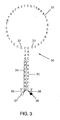
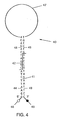
- FIG. 1 schematically shows a bimolecular version of unitary probe 1 with interactive labels.
- Probe 1 includes a single-stranded target complement sequence 2 having a 5' terminus and a 3' terminus, which in bimolecular probe 1 includes sequence 2a and sequence 2b, which together are complementary to a preselected target sequence contained within a nucleic acid target strand.
- Probe 1 can be considered as a single strand, the unimolecular version, in which a single target complement sequence 2 is severed at about its midpoint.
- the following description describes probe 1 as so considered, that is, as the unimolecular version, for convenience. The description thus applies to both the bimolecular and unimolecular versions.
- an affinity pair Extending from sequence 2, and linked thereto, are an affinity pair, herein depicted as oligonucleotide arms 3, 4.
- An affinity pair is a pair of moieties which have affinity for each other.
- affinity pairs can be used. Examples include protein-ligand, antibody-antigen, protein subunits, and nucleic acid binding proteins-binding sites. Additional examples will be apparent to those skilled in the art. In some cases, use of more than one affinity pair may be appropriate to provide the proper strength to the interaction.
- the affinity pair reversibly interacts sufficiently strongly to maintain the probe in the closed state under detection conditions in the absence of target sequence but sufficiently weakly that the hybridization of the target complement sequence and its target sequence is thermodynamically favored over the interaction of the affinity pair. This balance allows the probe to undergo a conformational change from the closed state to the open state. Additionally, the affinity pair should separate only when probe binds to target and not when probe is non-specifically bound.
- arms 3, 4 are chosen so that under preselected assay conditions, including a detection temperature, they hybridize to each other, forming stem duplex 5, which we sometimes refer to as an arm stem. In the absence of target, association of arms 3, 4 is thermodynamically favored and maintains stem duplex 5, holding the probe 1 in the closed conformation depicted in FIG. 1 .
- target complement sequence 2 (comprising sequences 2a and 2b) is hybridized to target sequence 8 of target nucleic acid 9.
- That hybridization forms a relatively rigid double-helix of appropriate length.
- the probe with interactive labels depicted in FIG. 2 it is a nicked helix.
- formation of a helix by interaction of the target complement sequence and the target sequence is thermodynamically favored under assay conditions at the detection temperature and drives the separation of arms 3, 4, resulting in dissolution of stem duplex 5 and the maintenance of the open conformation depicted in FIG. 2 .
- Arm regions 3 and 4 do not interact with each other to form the stem duplex when target complement sequence 2 is hybridized to the target sequence 8.
- the interaction of the target complement sequence 2 with the target sequence 8 drives the separation of the arms 3 and 4, we sometimes refer to this mechanism as a "spring.”
- the shift from the closed conformation to the open conformation occurs when the target complement sequence hybridizes to the target sequence despite the presence of a nick or the presence of one or more nucleotide mismatches.
- non-specific binding of the probe does not overcome the association of the arms in this manner. This feature leads to very low background signal from inappropriately "opened” probes.
- the affinity pair illustrated in the preferred embodiment of FIGS. 1 and 2 is a pair of complementary nucleic acid sequences. Arms 3, 4 are chosen so that stem duplex 5 ( FIG. 1 ) is a smaller hybrid than the hybrid of target complement sequence 2 and target sequence 8 ( FIG. 2 ). In the bimolecular version, stem duplex 5 should be smaller than either portion of the nicked helix that includes 2a or 2b. If that limitation is satisfied, we say that each of 2a and 2b contains "approximately half" of target complement sequence 2.
- Other affinity pairs, as indicated, may be conjugated to the target complement sequence, in some cases through non-complementary arms or to non-nucleic acid arms. Appropriate affinity pairs may be conjugated to the target complement sequence by methods known in the art. We prefer that the affinity pair be covalently linked directly to the target complement sequence.
- a unitary probe having interactive labels according to this invention has a measurable characteristic, which we sometimes call a characteristic signal or simply the signal, due to the label pair.
- Probe 1 includes label moieties 6, 7 conjugated to and forming part of probe 1 at the 5' and 3' termini, respectively, of the stem duplex 5. Label moieties 6, 7 are placed such that their proximity, and therefore their interaction with each other, is altered by the interaction of arms 3, 4. Label moieties 6, 7 could be conjugated elsewhere to arms 3, 4 or to sequence 2 near its linkage with the stem 5, that is, close to arms 3, 4. Some label moieties will interact to a detectably higher degree when conjugated internally along the arms. This is because they will not be affected by unraveling of the termini.
- More than one pair of label moieties may be used. Further, there is no requirement for a one-to-one molecular correspondence between members of a label pair, especially where one member can affect, or be affected by, more than one molecule of the other member.
- Label moieties suitable for use in probes of this invention interact so that at least one moiety can alter at least one physically measurable characteristic of another label moiety in a proximity-dependent manner. The characteristic signal of the label pair is detectably different depending on whether the probe is in the open conformation or the closed conformation.
- the preferred label, moieties are a FRET pair, most preferably fluorophore 7 and quencher 6.
- the characteristic signal is fluorescence of a particular wavelength.
- label moiety 6 quenches fluorescence from moiety 7.
- moiety 7 is stimulated by an appropriate frequency of light, a fluorescent signal is generated from the probe at a first level, (which may be zero. Probe 1 is "off.”
- probe 1 is in the open state ( FIG. 2 )
- label moiety 6 is sufficiently separated from label moiety 7 that fluorescence resonance energy transfer between them is substantially, if not completely, precluded.
- Label moiety 6 is therefore unable to quench effectively the fluorescence from label moiety 7. If moiety 7 is stimulated, a fluorescent signal of a second level, higher than the first is generated. Probe 1 is "on.” The difference between the two levels of fluorescence is detectable and measurable. Utilizing fluorescent and quencher moieties in this manner, the probe is only “on” in the "open” conformation and indicates that the probe is bound to the target by emanating an easily detectable signal. The conformational state of the probe alters the signal generated from the probe by regulating the interaction between the label moieties.
- lengths of target complement sequences and arm sequences are chosen for the proper thermodynamic functioning of the probe under the conditions of the projected hybridization assay.
- pertinent conditions include probe, target and solute concentrations, detection temperature, the presence of denaturants and volume excluders, and other hybridization-influencing factors.
- the length of a target complement sequence can range from 7 to about 140 nucleotides, preferably from 10 nucleotides to about 140 nucleotides. If the probe is also an allele-discriminating probe, the length is more restricted, as is discussed later.
- each portion of the target complement sequence should have a length of at least 10 nucleotides.
- the lower limit is set by the minimum distance at which there is no detectable difference in the measurable characteristic (or characteristic signal) affected by the interaction between the label moieties used when the probe is closed, from when the probe is opened.
- the minimum length of the target complement sequence 2 for a particular probe depends upon the identity of the label pair and its conjugation to the probe.
- Our most preferred label moieties are the fluorescent moiety 5-[(2-aminoethyl) amino] naphthelene-1-sulfonic acid (EDANS) and quenching moiety 4-(4-dimethylaminophenylazo) benzoic acid (DABCYL).
- target complement sequence 2 comprising 2a and 2b, should be at least 20 nucleotides long. Shortening sequence 2 will progressively weaken the signal from hybridized probes and thereby reduce the difference in signal level between open and closed probes.
- the maximum length of probe embodiments that are not allele-discriminating probes is less strict and is set by the known flexibility of double-helical nucleic acid molecules (Shore et al., 1981). Because of flexibility in the probe-target hybrid, it is possible for the ends of double-helical nucleic acid molecules to touch each other if the length of the probe-target double-helix exceeds about 140 nucleotide pairs. As will be apparent to those skilled in the art, this distance may vary depending on the nucleic acids in the double-helix (DNA:DNA, DNA:RNA or RNA:RNA) and the type of double-helix formed (A-form, B-form, Z-form, etc.). For example, if the target complement sequence 2 ( FIG.
- the maximum length of a target complement sequence is restrained by the functional requirement that a probe assume a thermodynamically favored open conformation when bound to target.
- Excessively long target complement sequences form probe-target double-helices with sufficient flexibility that both the probe-target helix and the arm stem helix may be present in the same complex. The probe would then remain in the closed state. Therefore, the maximum length of the target complement sequence must be short enough, and the resulting probe-target helix thereby rigid enough, that the probe assumes an open conformation when bound to the target.
- the maximum length of the target complement sequence should not exceed in any event about 140 nucleotides, by which we mean within ten percent of that number depending on the factors discussed above.
- the choice of a 6-, 16-, 26-, 37-, 47-, 58-, 68-, or 79-nucleotide-long target complement sequence will achieve maximum separation by orienting the label moieties in a trans configuration on opposite sides of the double-helix, as label moieties 6, 7 are shown in FIG. 2 .
- target complement sequences which are within 1 to 3 nucleotides of these lengths.
- the target complement sequences of our most preferred embodiments constructed to date are 15 and 35 nucleotides.
- the arm sequences should be of sufficient length that under the conditions of the assay and at the detection temperature, when the probe is not bound to a target, the arms are associated, and the label moieties are kept in close proximity to each other.
- 3-25 nucleotide arm lengths can perform this function.
- An intermediate range of 4-15, and more preferably 5-11, nucleotides is often appropriate.
- the actual length will be chosen with reference to the target complement sequence such that the probe remains in the closed conformation in the absence of target and assumes an open conformation when bound to target.
- the arm length may increase up to 15-25 nucleotides. Above a 100 nucleotide-long target complement sequence, the arm length is not increased further. If the probe is also an allele-discriminating probe, the arm lengths are more restricted, as is discussed later.
- the upper limit of the length of the arms is governed by two criteria related to the thermodynamics of probes according to the invention.
- the melting temperature of the arm stem under assay conditions, be higher than the detection temperature of the assay.
- the energy released by the formation of the stem should be less than the energy released by the formation of the target complement sequence-target sequence hybrid so that target-mediated opening of the probe is thermodynamically favored.
- the melting temperature of the target complement sequence-target sequence hybrid is higher than the melting temperature of the stem. Therefore, arm sequences should be shorter than the target complement sequence.
- the arm sequences should be shorter than each portion of the target complement sequence.
- the melting temperature of the arm stem must be above the assay temperature, so that the probe does not open before the target complement sequence hybridizes to a target, and yet sufficiently below the melting temperature of the hybrid, complete or nicked, of the target complement sequence with the target sequence to assure proper probe functioning and, thereby, generation of a detectable signal.
- the melting temperature of the arm stem be at least 5°C, more preferably at least 10°C, above the assay temperature and at least about 20°C below the melting temperature of the hybrid of the target complement sequence with the target sequence.
- Embodiments of probes according to this invention also include allele-discriminating probes, which are labeled unimolecular probes having complementary oligonucleotide arms. Allele-discriminating probes do not shift from the closed conformation to the open conformation when there is one or more internally located nucleotide mismatches between a target-like sequence and the target complement sequence. By “internally located” we mean not at a terminal or penultimate nucleotide of the target complement sequence. Allele-discriminating probes may also be used to detect internally located insertions or deletions. We prefer that the target complement sequence be designed such that the mismatch, deletion or addition occurs as close to the middle as possible. Allele-discriminating probes open and close by the same thermodynamic mechanism described above for unimolecular probes according to this invention.
- Allele-discriminating probes must be designed such that, under the assay conditions used, hybridization and the shift to the open conformation will occur only when the target complement sequence finds a perfectly complementary target sequence.
- the difference in energy released by forming a target complement sequence-perfectly complementary target sequence hybrid versus the energy that would be released in the formation of a target complement sequence-imperfectly complementary sequence hybrid must be considered with reference to the energy released in forming the stem duplex.
- the energy released under assay conditions in forming a perfect hybrid between the target complement sequence and the target sequence must be greater than the energy released in the formation of the stem duplex.
- the energy that would be released under the same assay conditions in forming an imperfect hybrid between the target complement sequence and a non-target sequence having one internally located mismatch must be less than the energy released in formation of the stem duplex.
- a probe designed within these parameters will hybridize and shift to the open conformation only when the target sequence is a perfect complement to the target complement sequence.
- probes having target complement sequences from 7 to 25 nucleotides, combined with arm sequences from 3 to 8 nucleotides may be designed within these parameters.
- the guanosine-cytidine content of the stem duplex and probe-target hybrids, salt, and assay temperature should all be considered.
- magnesium salts have has a strong stabilizing effect that is particularly important to consider when designing short, allele-discriminating probes.
- One may calculate the free energy released in the formation of any particular hybrid according to known methods, including the methods of Tinoco et al., (1973) and Freier et al., (1986). However, in most instances, it is simplest to approximate the energetics, synthesize a probe, and test the probe against targets and imperfect non-targets to be discriminated against, under the assay conditions to be used.
- an allele-discriminating probe is to have a target complement sequence near the upper limits of 25 nucleotides long, the sequence should be designed such that a single nucleotide mismatch to be discriminated against occurs at or near the middle of the target complement sequence.
- probes with 21 nucleotide long probe sequences should preferably be designed so that the mismatch occurs opposite one of 14 most centrally located nucleotides of the target complement sequence and most preferably opposite one of the 7 most centrally located nucleotides. Designing a probe so that the mismatch to be discriminated against occurs in or near the middle of the target complement sequence-imperfect target sequence is believed to improve the performance of an allele-discriminating probe.
- the probe must be constructed to function as described above under the conditions of the assay in which it is to be used in order to be a probe according to this invention.
- a particular construction may be a probe according to this invention under one set of assay conditions but not under another set of assay conditions.
- the length of the arms and their guanosine-cytidine content affect the melting temperature of a stem duplex. For a desired melting temperature, under particular assay conditions, a length and a guanosine-cytidine content of the arms can easily be calculated by those skilled in the art.
- the melting temperature of the duplex stem of a probe can be empirically determined for given assay conditions using the methods described below in Example V.
- thermodynamics of probes having nucleic acid stems will vary with length and nucleotide composition of the stem and target complement sequence, as well as assay conditions.
- An advantage of the present probes over "linear" oligonucleotide probes, by which we mean probes having no closed conformation, is that one has much greater latitude to design probes according to the assay conditions, rather than, as typically done, to vary assay conditions to suit a linear oligonucleotide probe.
- stem duplex of an allele-discriminating probe provides a release of free energy countervailing the release of free energy of formation of a mismatched hybrid with the target complement sequence. Therefore, the presence of the stem duplex prevents the formation of a mismatched hybrid under assay conditions in which a linear oligonucleotide forms a mismatched hybrid.
- An allele-discriminating probe according to this invention may have interactive labels as described above. It may, however, have a non-interactive label which emits a non-interactive signal. In such probes according to this invention, the non-interactive signal can be generated irrespective of whether the probe is in the open or closed position.
- Non-interactive labels are commonly known in the art and include labels such as radioisotopes, enzymes such as alkaline phosphatase or horseradish peroxidase, fluorophores and label moieties for the generation of light through radioluminescent, bioluminescent, chemiluminescent or electrochemiluminescent reactions.
- Non-interactive label moieties may be anywhere in the probe or may be conjugated to the probe at any location, as long as probe function, particularly hybridization to target, is not substantially interfered with.
- each arm forms an internal secondary structure, such as a hairpin stem, when the probe is open.
- a unitary probe 90 of this design, having interactive labels, is illustrated in FIG. 9 .
- Probe 90 is unimolecular, but this design feature applies to bimolecular probes as well.
- the hairpins are comprised of neighboring complementary sequences that form a stem that is at least three nucleotide pairs in length. This stabilizes the open conformation, because additional energy is released when each separated arm 94, 95 forms an internal hairpin structure. Additionally, arms containing these hairpin structures are effectively shortened and are thus less likely to interact with each other. With this feature it may be possible to use arms, within the 10-25 nucleotide range, that are relatively longer than would be appropriate for arms without this feature, to hold the label moieties more tightly together in the closed conformation. Consequently, probes with this feature may exhibit a sharper signal because of a lower level of background in the closed conformation.
- Another means of stabilizing the open conformation is to have one or both arm sequences be at least partially complementary to sequences adjacent to the target sequence.
- Complementary sequences may be placed within an arm at locations proximal or distal to the junction of the arm and target complement sequence.
- one arm sequence may be completely complementary to sequences adjacent to the target without putting undue restriction on the design of a probe tailored to a specific target. This feature increases the thermodynamic stability of the open conformation.
- portions of the arms may be complementary to the target, interaction of the target complement sequence with the target sequence must be sufficient to shift the probe to the open conformation. This design feature applies both to unimolecular embodiments and bimolecular embodiments.
- FIGS. 1-5 show our preferred label pair as a luminescent moiety (7, 37, 46, 55) and a quenching moiety (6, 38, 45, 56).
- Any label pair can be used to generate a signal where one member of the pair can detectably alter at least one physically measurable characteristic of the other when in close proximity, but to a different extent when apart. Alternatively, both members may detectably alter such a characteristic of one member when in close proximity, but differently when apart. Additionally, it is necessary that the label moieties must be conjugatable to the probe.
- Luminescent label moieties to be paired with appropriate quenching moieties can be selected from any one of the following known categories: a fluorescent label, a radioluminescent label, a chemiluminescent label, a bioluminescent label and an electrochemiluminescent label.
- a fluorescent label a radioluminescent label
- a chemiluminescent label a chemiluminescent label
- a bioluminescent label an electrochemiluminescent label.
- electrochemiluminescent label electrochemiluminescent label.
- the use of multiple quenching moieties with a single luminescent moiety will increase quenching.
- a label pair comprises one fluorescent moiety "paired" to several quenching moieties.
- Other useful label pairs include a reporter enzyme and appropriate inhibitor.
- a useful label pair may generate a signal in the closed conformation and be inactive in the open conformation.
- Examples of such pairs are an enzyme and its cofactor and fragments or subunits of enzymes that must be close to each other for the enzyme to be active.
- the closed conformation is the "on" state.
- our preferred labels are chosen such that fluorescence resonance energy transfer is the mode of interaction between the two labels.
- the measurable physical characteristics of the labels could be a decrease in the lifetime of the excited state of one label, a complete or partial quenching of the fluorescence of one label, an enhancement of the fluorescence of one label or a depolarization of the fluorescence of one label.
- the labels could be excited with a narrow wavelength band of radiation or a wide wavelength band of radiation.
- the emitted radiation could be monitored in a narrow or a wide range of wavelengths, either with the aid of an instrument or by direct visual observation.
- Examples of such pairs are fluorescein/sulforhodamine 101, fluorescein/pyrenebutanoate, fluorescein/fluorescein, acridine/fluorescein, acridine/sulforhodamine 101, fluorescein/ethenoadenosine, fluorescein/eosin, fluorescein/erythrosin and anthranilamide-3-nitrotyrosine/fluorescein.
- fluorescein/sulforhodamine 101 fluorescein/pyrenebutanoate
- fluorescein/fluorescein acridine/fluorescein
- acridine/sulforhodamine 101 fluorescein/ethenoadenosine
- fluorescein/eosin fluorescein/erythrosin
- anthranilamide-3-nitrotyrosine/fluorescein anthranilamide-3-nitrotyrosine/fluoresc
- our most preferred probes allow detection of hybridization by the naked eye and require only a simple ultraviolet lamp as an excitation device. These probes satisfy the following criteria: only one label moiety is fluorescent, and its fluorescence is visible to the naked eye; the other label moiety quenches this fluorescence extremely efficiently; and no significant quenching occurs at distances greater than about two turns of a nucleic acid double-helix. Of course, multiple copies of one or both label moieties may be used.
- DABCYL Our most preferred fluorescent label is EDANS and our most preferred quenching moiety is DABCYL.
- the absorption spectrum of DABCYL has a good overlap with the emission spectrum of EDANS, leading to very efficient energy transfer. It has been shown that one can achieve a 40-fold reduction in the fluorescence of EDANS by linking it to DABCYL through an octapeptide spacer, and more than a 200-fold reduction in fluorescence by linking EDANS directly to DABCYL. Also, there is no quenching of the fluorescence of EDANS by DABCYL at distances greater than 60 Angstroms. Finally, DABCYL has no fluorescence of its own (Matayoshi et al., 1990; Wang et al., 1991).
- EDANS and DABCYL are conjugated to the probe in the region of the oligonucleotide arms or other affinity pair.
- both unimolecular and bimolecular, EDANS and DABCYL are covalently linked to the free 5' and 3' termini of the arms, distal to the linkage of the arms and the target complement sequence.
- the positions of EDANS and DABCYL at, respectively, the 5' and the 3' termini can, of course, be reversed.
- the EDANS and DABCYL moieties could be conjugated anywhere along the terminal portions of the probe, as long as they are proximate to each other in the closed conformation of the probe and sufficiently separated from each other in the open conformation. We sometimes refer to a probes so labeled as oppositely terminally labeled probes.
- locating the label moieties along the stem duplex 5, rather than at the free 5' and 3' termini of the arms, may increase the interaction between the label moieties when the probe is in the closed conformation. It is well known that the terminal nucleotides of a double-helix will unravel and rehybridize in a random fashion at a rate dependent on temperature. Therefore, placing the moieties internally along the stem will result in less separation of the moieties due to the unraveling of the termini.
- moieties When placing moieties along the stem duplex, consideration may be given to the helical structure of the stem duplex.
- the moieties may be conjugated to nucleotides staggered along each arm such that when the arms anneal, the moieties will lie on the same side of the stem-duplex helix. This positioning will further maximize interaction of the label moieties in the closed conformation.
- multiple labels e.g., multiple EDANS and DABCYL moieties
- Multiple labels permit assays with higher sensitivity.
- a multiplicity of labels can be achieved by distributing a number of EDANS moieties on one arm and a corresponding number of DABCYL moieties on the other arm, such that each EDANS moiety can be close to a DABCYL moiety when the arm stem helix forms.
- Multiplicity can also be achieved by covalently linking multiple labels to the arms, in a manner resembling a bunch of grapes. A multiplicity of labels should not be used with label moieties that self-quench.
- quenching in the closed conformation may be enhanced by placing a single EDANS moiety on one arm and multiple DABCYL moieties on the other arm such that when the stem helix is formed, at least one DABCYL moiety is adjacent to an SEDANS moiety at any given instant.
- conjugation of the label moieties to any location on the probe must be stable under the conditions of the assay. conjugation may be covalent, which we prefer. Examples of noncovalent conjugation include, without limitation, ionic bonding, intercalation, protein-ligand binding and hydrophobic and hydrophilic interactions. Appropriately stable means of association of label moieties to the probes will be apparent to those skilled in the art.
- conjugation encompasses all means of association of the label moieties to the probe which are stable under the conditions of use. We consider stably conjugated label moieties to be included within the probe molecule to which they are conjugated.
- spacers preferably linear alkyl spacers.
- the nature of the spacer is not critical.
- EDANS and DABCYL may be linked via six-carbon-long alkyl spacers well known and commonly used in the art.
- the alkyl spacers give the label moieties enough flexibility to interact with each other for efficient fluorescence resonance energy transfer, and consequently, efficient quenching.
- the chemical constituents of suitable spacers will be appreciated by persons skilled in the art.
- the length of a carbon-chain spacer can vary considerably, at least from 1 to 15 carbons. However, in the case of multiple labels conjugated to an arm in a "bunch of grapes" configuration, a multiply bifurcated spacer is desirable.
- labels may be conjugated to the probes as described above.
- radioactive labels may be incorporated in the probes by synthesis with radioactive nucleotides or by a kinase reaction, as is known in the art.
- the hybridization probes and universal stems of this invention may comprise nucleic acid molecules that can be assembled by commonly known methods of solid-phase synthesis, by ligation of synthetic sequences or restriction fragments or by a combination of these techniques.
- the simplest probes can be assembled by synthesis of a single oligonucleotide comprising arm sequences flanking the target complement sequence. Label moieties are then conjugated to the termini of the oligonucleotide.
- labeled nucleotides can be used in oligonucleotide synthesis.
- a bimolecular probe may be prepared as two separately synthesized, labeled oligonucleotides.
- a bimolecular probe can be converted to the corresponding unimolecular probe by linking the target complement sequence portions, as by ligation on a splint. Direct synthesis is particularly appropriate in cases where it can be performed with acceptable yield.
- One use of a combination of synthesis and ligation is illustrated by the assembly of a unimolecular DNA probe from two directly synthesized oligodeoxynucleotides.
- One oligonucleotide contains the target complement sequence, a complete first arm sequence covalently linked to one of the label moieties, and a portion of the second arm sequence. The arm and arm portion of this oligonucleotide hybridize to each other.
- the second oligonucleotide comprises the remainder of the second arm sequence covalently linked to the other label moiety.
- the second oligonucleotide is complementary to the unhybridized, or overhang region of the first.
- the two oligonucleotides are annealed to each ether. Finally, the probe is assembled by ligation of the annealed complex.
- two oligonucleotides are synthesized, each comprising a substantial portion, "approximately half" as we use that term, of the target complement sequence, an arm sequence located 5' on one oligonucleotide and 3' on the other and appropriate label moieties.
- a unimolecular probe is desired, these two oligonucleotides are annealed across a splint oligonucleotide and ligated. The probe is then purified from the splint by gel purification or other means known in the art. If a bimolecular probe is desired, the probe is assembled by annealing the two oligonucleotides.
- the present invention includes kits containing a universal stem and instructions to use the universal stem to prepare probes according to the invention for the detection of a variety of preselected target sequences.
- the universal stem comprises portions of arm regions, each conjugated to a member of a label pair.
- a stem may be supplied and used as a unit, with the arms hybridized to each other, such that a linking end of the duplex, comprising reactive groups, is formed.
- the linking end may include a ligatable blunt end or overhang.
- other biochemical linking agents, or chemical agents may be present at the 5' and 3' linking termini of the universal stem. Chemical ligation may involve reactive groups, such as hydroxyl, phosphate, sulfhydryl, amino, alkyl phosphate, alkyl amino or hydroxy alkyl. We prefer covalently reactive groups.
- the universal stem hybridized at the time a probe is prepared is advantageous, because that automatically avoids' linking the same arm region at both ends of the probe.
- the universal stem need not be hybridized during probe preparation if mutually exclusive attachment reactions are used for each arm portion.
- the arm portions may be kept separated for sequential reaction, but we still refer to the arm portions as a universal stem.
- the two stem parts be supplied and used separately.
- oligonucleotide arm portions 5 to 20 nucleotides in length.
- the nucleotides of the arm portions in a universal stem according to this invention need not be involved in target sequence recognition and will not be except in special cases, as will be understood.
- the stem need only participate in regulating the conformational state of the unitary probe.
- Our preferred universal stems include FRET pairs as label moieties, most preferably EDANS and DABCYL, each conjugated to one terminus of the stem duplex, distal to the linking end, as described below.
- stems possessing an oligonucleotide comprising an overhang sequence that is complementary to itself can lead to undesirable association of two stems. It is thus preferred, although not required, to avoid the use of oligonucleotides that will form such dimers.
- Using a universal stem according to this invention may include synthesis of an oligonucleotide comprising a target complement sequence flanked by the remaining portions of the arm sequences of the final probe. This oligonucleotide self-hybridizes via the remaining arm portions, creating a linkable terminus. If the universal stem includes an overhang, the oligonucleotide should have an overhang complementary to the overhang on the universal stem. This oligonucleotide is then linked to the universal stem, preferably by enzymatic or chemical ligation, as described above. The universal stem is thereby incorporated into the final probe stem of a unimolecular probe according to the invention.
- a universal stem according to this invention is of particular benefit to a researcher wishing to design a variety of unimolecular or bimolecular probes.
- Universal stems may be part t of a kit comprising one or more stems and instructions for preparing appropriate target complement sequence oligonucleotides, or appropriate restriction fragments, and subsequently linking to a stem.
- the instructions should describe the portions of the arm sequences, if any, required to flank the target complement sequence and form the appropriate linkable terminus, described above.
- a kit may include multiple universal stems varying by the melting temperature and/or length of the final probe stem to be formed.
- a kit could have one common stem oligonucleotide and multiple versions of the other stem oligonucleotide varying in length.
- kits may include stems appropriate for preparation of probes according to this invention with several lengths of target sequence or with the same target sequence for use under a variety of different preselected assay conditions. Instructions in such a kit would direct the user to the proper universal stem for use with a particular target complement sequence according to the teachings herein. Kits may also optionally include enzymes and reagents, so that the kit user may easily use the universal stems to design and prepare probes of the present invention.
- Assays according to this invention which may be qualitative or quantitative, do not require washing to remove unbound probes, if interactive labels are used.
- An assay according to this invention may thus comprise adding a unitary probe according to this invention to a sample suspected to contain strands containing target sequence and ascertaining whether or not a detectable signal occurs under assay conditions at the detection temperature.
- Homogeneous assays are preferred, although probes with interactive labels according to this invention may be used in heterogeneous hybridization assays.
- Assays according to this invention employing allele-discriminating probes with non-interactive labels are heterogeneous hybridization assays, that include separation or washing steps.
- a control without target sequence may be run simultaneously, in which case signal generation of the sample and the control may be compared, either qualitatively or quantitatively by measuring the two and calculating a difference.
- Assays of this invention include real-time and end-point detection of specific single-stranded or double-stranded products of nucleic acid synthesis reactions, such as transcription, replication, polymerase chain reaction (PCR), self-sustained sequence reaction (3SR), strand-displacement amplification reaction (SDA), and Q-beta replicase-mediated amplification reaction.
- PCR polymerase chain reaction
- SDA strand-displacement amplification reaction
- Q-beta replicase-mediated amplification reaction Q-beta replicase-mediated amplification reaction.
- the unitary probes will be subjected to melting or other denaturation, the probes must be unimolecular.
- Assays with allele-discriminating probes include, for example, amplifying a sequence or genomic region that contains either a target sequence or an allele of that target sequence, and adding probe to detect which allelic variant is present in the amplified product. If the probe has interactive labels, the assay can be homogeneous. If the probe has a non-interactive label, separation of bound from unbound probes is included in the assay.
- Quantitative assays can employ quantitating methods known in the art.
- An end point for a sample may be compared to end points of a target dilution series, for example.
- readings may be taken over time and compared to readings of a positive or negative control, or both, or compared to curves of one or more members of a target dilution series.
- Assays according to the invention employing probes with interactive labels include in situ detection, qualitative or quantitative, of nucleic acids in, for example, fixed tissues without destruction of the tissue. Because a large excess of probes can be used without the need for washing and without generation of a large background signal, in situ assays of this invention are particularly useful.
- In situ hybridization assays, according to this invention include "chromosome painting,” for the purposes of mapping chromosomes, and for detecting chromosomal abnormalities (Lichter et al., 1990).
- Assays of this invention employing probes with interactive labels include in vivo assays. A large excess of probes can be used without the need to wash.
- the assays can be for double-stranded targets, as well as single- stranded targets.
- Probes according to this invention are useful as "vital stains" (agents that can stain specific constituents of cells without killing them) in assays for the detection of targets in vivo . They can be used in assays to locate specific nucleic acids within various living cells or organelles within living cells. They can be used in assays to identify specific cell types within a tissue or within a living organism.
- probes can be delivered to the interior of cells via known techniques, e.g., by liposomes or by making the cell membranes porous to nucleic acid molecules. For studying gene expression during development we prefer direct injection.
- assays of this invention can detect multiple targets in a single assay. Also, multiple probes, each specific for different regions of the same target nucleic acid, yet having the same label pair, can be used in order to enhance the signal. If multiple probes are used for the same target, they should bind to the target such that neighboring probes do not quench each other. Similarly, one can use multiple allele-discriminating probes with different, distinguishable but non-interactive labels in assays that include separation of hybridized probes from unhybridized probes.
- probes according to this invention can be designed to detect multiple target sequences. If multiple target complement sequences are incorporated into one probe, the probe design must be such that hybridization of any one sequence to its target causes the probe to shift from the closed conformation to the open conformation.
- Certain preferred embodiments of assays according to this invention comprise addition of probes with interactive labels according to this invention to a sample and visualization with the naked eye for detection of a specific target nucleic acid sequence in a complex mixture.
- visualization can be roughly quantitative.
- nucleic acid in the sample can first be fractionated by non-denaturing gel electrophoresis, and then the gel itself can be assayed directly.
- hybridization can be carried out on restriction fragments, either without fractionation or prior to fractionation, as in Example VI.
- probes of the present invention are also very useful in such heterogeneous assays.
- our preferred probes both unimolecular and bimolecular, with interactive labels, emanate a high level of positive signal only in the target-bound, open conformation and little-to-no signal in the closed conformation. Furthermore, our preferred probes do not assume the open conformation unless bound to target, remaining closed when non-specifically bound. As described above, this leads to a background signal that is nonexistent or naturally very low. Therefore, the use of these probes greatly simplifies conventional, heterogeneous assays because either no washing is required or only mild, low stringency washing is used to further reduce any background signal present after hybridization. Additionally, conventional hybridizations may be carried out under generally less stringent conditions.
- Heterogeneous assays according to the present invention may include the use of capture probes.
- a capture probe is attached to a surface either before or after capturing a target strand.
- Surface attachment means and steps are well known in the art and include reaction of biotin-labeled capture probes to avidin-coated surfaces, for example, magnetic beads.
- the capture probe includes a sequence complementary to a sequence in the target strand and hybridizes to the target strand to capture it.
- Probes according to this invention, having a target complement sequence that hybridizes to the target at a location other than the location where the capture probe hybridizes, may be added before or after or at the same time as the capture probes and before or after washing the capture probe-target strand hybrids.
- a probe with interactive label moieties is used, washing is not required, although mild washing may enhance the assay result by lowering background. If a probe with a non-interactive label is added, then surface bearing the capture probe-target strand-probe hybrids should be washed as in a typical heterogeneous assay.
- Probes according to the invention open very quickly upon interaction with a target sequence.
- the ability to interact is concentration dependent, as workers skilled in hybridization assays recognize.
- Assay conditions may be selected in which the probes with interactive labels respond to the presence of target nucleic acids and generate signal very quickly.
- assays according to this invention include real-time monitoring of production of specific nucleic acids. Synthesis processes such as transcription, replication or amplification can be monitored by including probes in the reaction mixture and continuously or intermittently measuring the fluorescence. Probes are used in substantial excess so that the relatively abundant probes find their targets in nascent nucleic acid strands before the targets are sequestered by the binding of complementary strands.
- probes of this invention with interactive labels in assays for the identification of products of nucleic acid amplification reactions generally eliminates the need for post-amplification analysis to detect desired products and distinguish desired products from unwanted side reactions or background products.
- probes according to the invention can be added at the end of a synthesis process for end-point detection of products.
- the probes can be present during synthesis.
- the presence of probes improves the accuracy, precision and dynamic range of the estimates of the target nucleic acid concentration. Reactions in closed tubes may be monitored without ever opening the tubes. Therefore, assays using these probes with interactive labels can limit the number of false positives, because contamination can be limited.
- Unimolecular probes with interactive labels according to the invention are particularly useful in assays for tracking polymerase chain reactions, since the probes according to this invention can open and close with a speed that is faster than the speed of thermal cycling.
- a probe preferably one that is "off" in the closed position, and includes a target complement sequence having complementarity to an expected amplification product, is included in a polymerase chain reaction mixture.
- the probe has a melting temperature such that the probe remains closed under the reaction conditions at the annealing temperature of the polymerase chain reaction.
- the probe may, but need not, remain closed at the extension temperature, if that is higher than the annealing temperature.
- the target complement sequence hybridizes to its target and the probe generates signal.
- the signal e.g. fluorescence
- the signal may therefore be read at the annealing temperature. It is also possible to program into the reaction cycle a distinct temperature at which the fluorescence is read.
- a probe for use in a PCR reaction one would naturally choose a target complement sequence that is not complementary to one of the PCR primers.
- Some probes can be displaced from their target sequence by the annealing of the product's complementary strand, as can PCR primers. This can be overcome by increasing the concentration of the probes or by designing an asymmetry into the synthesis of the product strands in the polymerase chain reaction. In asymmetric amplification, more of the strand containing the target is synthesized relative to the synthesis of the complementary strand.
- probes of this invention can be monitored, or assayed, with embodiments of probes of this invention with interactive labels.
- Appropriate probes can be used, for example, in Q-beta replicase-mediated amplification, self-sustained sequence replication, transcription-based amplification, and strand-displacement amplification reactions, without any modification in the scheme of amplification.
- the probes For monitoring amplifications that utilize DNA-directed RNA polymerase, for example transcription, the probes must not be templates for the polymerase; for example, the probes can be RNA.
- assays according to the present invention utilize multiple hybridization probes with interactive labels linked to a solid surface or surfaces. Because probes of this invention are used, washing is not required. When probes are linked to a solid surface, we refer to them as “tethered probes.” Tethered probes according to this invention must have interactive labels. They may, but need not be, allele-discriminating probes as well.
- a probe of this type is depicted in FIG. 10 , which shows a probe 101 having a target complement sequence 104, complementary arms 105 and 106, and label pair 107, 108 conjugated to arms 105, 106. Probe 101 is tethered to solid surface 103 by a linking moiety 102.
- Linking moiety 102 may be covalent or noncovalent. We prefer covalent linkage. Any type of surface 103 may be used, including beads, membranes, microtiter wells, and dipsticks. We prefer surfaces that are neutral with respect to the components of the probe, that is, surfaces that do not interact with nucleic acids, do not interact with the label moieties and do not interfere with the probe signal. An example of such a surface is a surface coated with a siliconizing agent.
- a useful surface does not significantly interfere with: a) the ability of the affinity pair, preferably arm sequences, of the probe to maintain the closed conformation; b) the hybridization of the target complement sequence to the target; c) the ability of the affinity pair to remain displaced, preferably of arm sequences of the probe to remain unhybridized to each other, when in the open conformation; d) the interaction of proximate label moieties in the closed conformation, preferably the quenching of a luminescent moiety by a quenching moiety; and e) the action of label moieties in the open conformation, preferably the ability of a luminescent moiety to luminescence when stimulated by light of an appropriate frequency.
- Such surfaces are known in the art.
- Probes of this invention may be tethered by numerous molecular linking moieties 102 known to those skilled in the art.
- a suitable linking moiety 102 comprises an alkyl chain or an oligonucleotide chain (such as oligouridine).
- oligonucleotide linking moieties because they are easily incorporated into probes.
- the nucleotide sequence of such an oligonucleotide linking moiety should not be substantially complementary to any other sequence in the probe.
- Tethered probes according to this invention are advantageously useful in assays for the simultaneous determination of a predetermined set of target sequences.
- a series of luminescent probes can be prepared, each comprising a different target complement sequence.
- Each probe may be linked to the same support surface, such as a dipstick, at its own predetermined location. After contacting the support and the sample under hybridization conditions, the support may be stimulated with light of an appropriate frequency. Luminescence will occur at those locations where tethered probes have formed hybrids with target molecules from the sample. If the tethered probes are allele-discriminating probes, a single assay can determine which mutations or alleles of a particular gene are present, for example.
- Such assays are particularly useful in clinical situations, e.g., in which a patient has an obvious infection, and the physician needs to know the identity of the infectious agent in order to prescribe effective treatment rapidly.
- kits include at least one probe of this invention and instructions for performing an assay.
- Kits may also include assay reagents, e.g., salts, buffers, nuclease inhibitors, restriction enzymes and denaturants.
- Kits may include a target or model target for a positive control test, and a target-less "sample” for a negative control test.
- Amplification assay kits may include, in addition to some or all of the above, primers, nucleotides, polymerases and polymerase templates for the assay and for control assays.
- Vital stain kits may include, in addition to probe and instructions, permeabilizing agents, liposome precursors, buffers, salts, counterstains and optical filters.
- In situ kits may include, in addition to probe and instructions, fixatives, dehydrating agents, proteases, counterstains, detergents, optical filters and coated microscope slides.
- Kits may include probes which are allele-discriminating probes. Such kits are useful in ascertaining the allelic status of an organism and to discriminate between closely related organisms. Allele-discriminating probe kits with non-interactively labeled probes may include capture probes and magnetic beads for use in separation of bound probes from unbound probes. Where appropriate to the chosen label, a kit may include detection reagents.
- Field kits may include, in addition to instructions, tethered probes with interactive labels according to this invention. At least one probe may be tethered to beads, wells or a dipstick. Multiple probes may be included, including a positive control probe that will hybridize to a component of uninfected samples.
- Field kits may include, in addition to instructions, untethered probes according to this invention. Such kits may be for infectious agents or genes. Kits for genes may include negative and, sometimes, positive targets.
- Probe constructs may be tested to determine whether they are unitary probes of the present invention under particular assay conditions.
- a test may be designed which is appropriate to the affinity pair and label moieties used in the probe construct.
- the test should be conducted under the conditions of the hybridization assay, using the detector to be used, and generally comprises the following steps: first, one measures the level of signal that is generated in the absence of target, then one measures the level of signal that is generated when there is an excess of probes in the presence of the minimum level of target which one needs to detect. If the level of signal from the first measurement is in accord with the level expected from proximate label moieties, if the level of signal from the second measurement is in accord with the level expected due to opening of the probes, and if the detector can reliably distinguish between the levels of signal from the two measurements, the construct is a probe according to this invention in that assay.
- the probe construct If the probe construct has oligonucleotide arms as the affinity pair, the probe construct must pass the test described in Example V to be a probe according to this invention.
- a probe with non-interactive labels is an allele-discriminating probe according to this invention, it must be determined whether or not that probe, under the assay conditions to be used, forms a stem duplex in the absence of its target sequence and shifts to the open conformation by hybridizing to its target sequence.
- This can be done by making a variant of the probe in which the interactive label pair DABCYL and EDANS are substituted for the intended non-interactive label, and submitting the variant, under the intended assay conditions, to the test described in Example V.
- Probe F radioactively labeled Probe F, described below, we did this by testing Probe D, which has the same nucleotide sequence but interactive labels. Often, it will be possible to add DABCYL and EDANS to the non-interactively labeled probe in question, rather than substituting the pair for the non-interactive label.
- the probe is further tested against non-targets having an internally located mismatch. If the level of signal detected in a test assay using perfectly complementary target is at least five times higher above background than signal above background in a test assay using a non-target with a single internally located mismatch, the probe is an allele-discriminating probe according to this invention under the assay conditions. We prefer, however, that this ratio be even higher, preferably at least ten times higher or more preferably at least twenty times higher.
- the probe is further tested in common heterogeneous assays against perfect target sequences and non-targets having an internally located mismatch. If the level of non-interactive signal detected in a test assay using perfectly complementary target is at least three times higher above background than non-interactive signal above background in an identical test assay using a non-target with a single mismatch, the probe is an allele-discriminating probe according to this invention under the assay conditions. We prefer, however, that this ratio be even higher, preferably at least five times higher, more preferably at least ten times higher and most preferably at least twenty times higher.
- FIG. 3 shows the nucleotide sequence of a unimolecular probe 30 comprising target complement sequence 31 and complementary arms.
- the particular probe depicted in FIG. 3 is for detection of the integrase gene of the human immunodeficiency virus HIV-1 (Muesing et al., 1985).
- Target complement sequence 31, extending, 5' to 3', from nucleotide 32 to nucleotide 33 is complementary to the 35nucleotide long target sequence 5'-AATGGCAGCAATTTCACCAGTACTACAGTTAAGGC-3'. It will be appreciated that a target complement sequence of the same length, complementary to another target, could be substituted.
- Probe 30 was assembled using the first two-oligonucleotide ligation method described above.
- Each of the two oligonucleotides 34, 35 were prepared by solid-state synthesis.
- a modified nucleotide was introduced at the 5' terminus. This nucleotide comprises a sulfhydryl group covalently bonded to the 5' phosphate via a hexa-alkyl spacer.
- Oligonucleotide 34 was then coupled to the EDANS label moiety 37.
- oligonucleotide 35 was kinased at its 5' end with 32 P using T4 polynucleotide kinase. The 32 P was used to trace the oligonucleotide during synthesis and purification.
- Kinased oligonucleotide 35 was then dissolved in 300 ⁇ l of 0.2 M sodium bicarbonate and reacted with 300 ⁇ l 60 mg/ml of the amino-reactive form of label moiety 38, DABCYL succinimidyl ester (Molecular Probes, Eugene, Oregon). The amino-reactive DABCYL was added to a continuously stirred reaction mixture in fifteen aliquots of 20 ⁇ l each, over a 72-hour period.
- the reaction mixture was then precipitated with ethyl alcohol by adding ammonium acetate followed by ethyl alcohol.
- Oligonucleotide 35 was then purified by HPLC. Oligonucleotides 34 and 35 were then annealed to each other and ligated by incubation with T4 DNA ligase, at 16°C. The ligated product was purified by polyacrylamide gel electrophoresis in the presence of 7 M urea. The band containing Probe A showed blue-white fluorescence in the presence of urea (due to the EDANS), was orange in color (due to the DABCYL), and was radioactive (due to the 32 P). Purified Probe A was eluted from the gel and was stored in 10 mM Tris-HCl, pH 8.0 containing 1 mM EDTA (TE buffer).
- FIG. 4 shows probe 40, also referred to herein as Probe B, designed using a universal stem according to this invention.
- universal stem 41 delineated by line 42 for clarity, comprises arm regions 43, 44, to which may be ligated a strand containing any target complement sequence, as described below.
- oligonucleotide 43 was kinased using T4 polynucleotide kinase. Oligonucleotides 43, 44 are complementary. One, in this case oligonucleotide 43, is 5 nucleotides longer than the other, oligonucleotide 44. Referring to FIG. 4 , those five nucleotides are 5'-ATCCG. Oligonucleotide 43 was conjugated to label moiety 45, a DABCYL moiety, at its 3' terminus.
- Oligonucleotide 44 was conjugated to label moiety 46, an EDANS moiety, at its 5' terminus. These conjugations were performed and the conjugated oligonucleotides were purified as described in Example I. Oligonucleotides 43, 44 were then annealed, thereby placing label moieties 45, 46 in close proximity to each other.
- Oligonucleotide 47 prepared by solid-state synthesis, includes a target complement sequence, depicted as a line in FIG. 4 , flanked by regions comprising the remaining portions 48, 49 of the arm sequences. Arm portions 48, 49 were annealed to each other to form an overhang complementary to the overhang on the universal stem. The overhang, 5'-CGGAT, comprises the first five nucleotides of arm portion 48. Oligonucleotide 47 was then annealed to universal stem 41 and ligated to it, under the conditions of Example I. Probe B was isolated from the ligation mixture by gel electrophoresis. Although stem sequences 43, 44 and arm portions 48, 49 were annealed separately prior to being mixed, they could have been annealed after mixing. The final arm stem of probe 40 comprises the combination of regions 44 and 48 and regions 43 and 49, respectively.
- Probe C a unimolecular probe depicted in FIG. 5 , was constructed by the second two-oligonucleotide method described above. Oligonucleotide 51, extending from the 5' end of probe 50 to nucleotide 52, and oligonucleotide 53, extending from nucleotide 54 to the 3' terminus of probe 50 were prepared by solid-state synthesis. Oligonucleotide 51 was conjugated to EDANS 55 at its 5' terminus and oligonucleotide 53 was conjugated to DABCYL 56 at its 3' terminus. The conjugations and purification of the conjugated oligonucleotides were performed as described in Example I.
- oligonucleotides 51 and 53 can be annealed to form a bimolecular probe of this invention.
- a unimolecular probe was formed from these oligonucleotides by annealing them to an oligonucleotide splint having the sequence 5'-AATGGCAGCAATTTCACCAGTACTACAGTTAAGGC-3' and ligated at the junction of nucleotides 52 and 54.
- the unimolecular probe was then electrophoretically purified as described in Example I.
- Probe C has the same target complement sequence as Probe A but was designed for use under different conditions.
- the target complement sequence extends, 5' to 3', from nucleotide 57 to nucleotide 58.
- the stem duplex 59 of probe C is eight base pairs long.
- Oligodeoxynucleotides that contain a protected sulfhydryl group at their 5' end and a primary amino group at their 3' end were purchased from the Midland Certified Reagent Company. In these oligodeoxynucleotides the sulfhydryl group was connected to the 5' phosphate via a -(CH 2 ) 6 - spacer and the primary amino group was linked to the 3' hydroxyl group via a -(CH 2 ) 7 - spacer. The first coupling reaction links a DABCYL moiety to each 3'-amino group.
- oligonucleotide For each oligonucleotide a 500 ⁇ l solution containing 0.6 mM oligodeoxynucleotide and 0.1 M sodium bicarbonate was reacted with a 500 ⁇ l solution of 60 mg/ml of the succinimidyl ester of DABCYL (Molecular Probes, Eugene, OR.); dissolved in N,N-dimethyl formamide. The succinimidyl ester of DABCYL was then added in small aliquots to a continuously stirred reaction mixture at room temperature over a 72 hour period. The oligonucleotide in this reaction mixture was then precipitated by the addition of 300 ⁇ l of 3 M sodium acetate, 1.7 ml water and 7.5 ml ethanol in order to remove the excess dye.
- DABCYL succinimidyl ester of DABCYL
- the second coupling reaction linked EDANS to the 5'-sulfhydryl group was performed just before coupling the oligonucleotide with EDANS.
- the S-trityl protective group was removed from the 5' end of the oligodeoxynucleotide.
- the precipitated oligonucleotide was dissolved in 1 ml of 0.1 M triethylamine (pH 6.5). This solution was treated with 10 ⁇ l of 0.15 M silver nitrate (a 5-fold molar excess of silver nitrate) for 30 minutes at room temperature. Fourteen ⁇ l of 0.15 M dithiothreitol (7-fold excess of dithiothreitol) was then added to this mixture.
- the modified oligonucleotide in the supernatant was then treated with a 500 ⁇ l of 3M 1,5 IAEDANS (Molecular Probes, Eugene, OR) dissolved in 0.2 M sodium bicarbonate (a 5-fold molar excess of the sulfhydryl-reactive form of EDANS) for one hour at room temperature (Connolly and Rider 1985, herein incorporated by reference).
- the modified oligonucleotide was then precipitated by the addition of ammonium acetate and ethanol.
- the oligodeoxynucleotide containing both EDANS and DABCYL was purified by high pressure liquid chromatography (Beckman) as follows: The precipitated oligonucleotide was dissolved in 1 ml of triethylammonium acetate (pH 6.5). This mixture was fractionated on a C-18 reverse phase column (Nucleogen DEAE 60-7), using a linear gradient of 0-75% Acetonitrile containing 0.1 M triethylammonium acetate (pH 6.5), run for 40 minutes at a flow rate of 1 ml/min. The fractions that absorbed at 260 and 336 nm and that exhibited fluorescent emission at 490 nm were isolated. These fractions had the characteristic fluorescence of EDANS and exhibited the melting thermal denaturation profile discussed below.
- Probe D was. EDANS-5'-GCGAGAAGTTAAGACCTATG CTCGC -3'-DABCYL and of Probe E was EDANS-5' GCGAGTG CGCCTTAACTGTAGTACTGGTGAAATTGCTGCCATT GCACTCGC -3'-DABCYL, where in each case the underlined segments are the arms, which participate in the formation of the stem, and the intervening sequence constitutes the target complement sequence.
- Probe E had the same nucleotide sequence as Probe C ( FIG. 5 ).
- This example describes the test to determine whether or not a probe constructed with nucleic acid arm sequences is a probe according to this invention under particular assay conditions. Data for one such probe construct, Probe A, is provided and evaluated. Probe A was found to be a probe of this invention in an assay at 20°C without any salt.
- Probes of this invention exhibit a characteristic melting temperature, Tm, the temperature at which two hybridized nucleic acid strands separate due to thermal energy.
- Tm characteristic melting temperature
- the melting temperature of Probe A was determined by monitoring the level of its fluorescent signal as temperature was increased from 10°C to 80°C under preselected assay conditions: TE buffer with no added salt. The concentration of probes was 150 pmoles in a volume of 2 ml TE buffer. Thermal denaturation or transition curves were recorded with a Perkin-Elmer LS-5B fluorometer. The EDANS moiety of Probe A was excited at 336 nm, and the level of fluorescence at 490 nm was monitored. The results are shown in FIG. 6 . Instrumental tracing 60 represents the thermal denaturation curve of Probe A under these assay conditions. The Tm of a probe is indicated by the inflection point of its thermal denaturation curve. The melting temperature, Tm, of Probe A was 27°C.
- a probe construct is a probe of this invention under the preselected assay conditions if under those conditions at the detection temperature, addition of excess of model target results in a change in the signal level in the direction toward the level at Tm+10+°C by an amount equal to at least ten percent of the difference between the signal levels at Tm-10°C and Tm+10°C.
- Model target is a nucleic acid strand containing a sequence complementary to the target complement sequence of the probe construct and no more than one additional nucleotide immediately adjacent, 5' or 3', thereto. Often, actual target will meet this definition.
- concentration of probe constructs used to measure the signal level in the presence of model target is the same concentration used to measure the signal levels in the absence of target, i.e., the concentration used to obtain the thermal denaturation curve.
- Probe A signal levels were determined from instrumental tracing 60 presented in FIG. 6 , as follows: at Tm-10°C, a level of 2 units; at Tm+10°C, a level of 16 units; and at the detection temperature, 20°C, a level of 2.5 units. Addition of excess target at the detection temperature shifted the level from 2.5 units to 14.5 units in 3 hours using a large excess of model target, as described below. Thus, Probe A is a probe of this invention under these preselected assay conditions.
- the model target was a DNA strand having the sequence: 5'-CAGAC AATGGCAGCAATTTCACCAGTACTACAGTTAAGGC CGCCTGT-3' which was produced by solid-state synthesis and purified by HPLC.
- the underlined subsequence identifies the 35-nucleotide long target sequence for Probe A.
- Model target 25 nmoles, was added to 2 ml TE buffer containing 150 pmoles of Probe A. Fluorescence was monitored over time in a Perkin-Elmer LS-5B fluorometer with a quartz cuvette maintained at the detection temperature. Instrumental tracing 82 in FIG. 8 shows the results.
- FIG. 8 shows that a high rate of change of fluorescence occurred early, diminished over time and approached a plateau.
- the test point is the plateau level, although, as in this case, one need not wait that long if a "test passing" level is achieved earlier.
- the time to the plateau level depends on the concentration of model target. For example, when we reduced the model target concentration five-fold, instrumental tracing 81 in FIG. 8 , the plateau was not reached even after ten hours.
- Probe C was tested under different preselected assay conditions, 10 mM MgCl 2 in TE buffer at 37°C. Its thermal denaturation curve, instrumental tracing 61 in FIG. 6 , gives its Tm as 61°C. From the data in instrumental tracing 61, and from measurement of signal in the presence of excess model target at 37°C, Probe C was found to be a probe according to this invention under the preselected assay conditions.
- a bimolecular embodiment of unitary Probe C was tested under the same assay conditions used to test the unimolecular embodiment of unitary Probe C. The bimolecular probe was also found to be a probe of the present invention. Bimolecular probes exhibit virtually the same hybridization kinetics as their unimolecular counterparts.
- the fluorescence of a 150 microliter solution (170 nM Probe D, 100 mM Tris-HCl, 1.0 mM MgCl 2 pH 8.0) was monitored as the temperature was changed from 25°C to 75°C at a rate of 2°C/min.
- the thermal denaturation profile is shown in FIG. 11 (curve 111).
- the temperature of a solution containing the probe was increased, its fluorescence changed in a manner which is characteristic of the melting of a nucleic acid double helix.
- the display of a distinct thermal transition indicates that at a low temperatures the arms formed a stem duplex and at high temperatures the helical order of the stem melted, and the probe assumed a random-coil configuration.
- the melting temperature of probes according to this invention depend upon the length and the guanosine-cytosine content of the arm sequences and the concentration of Mg and other salts in the medium. Compare, for example, the melting behavior ( FIG. 6 ) of Probes A and C, which have 35-nucleotide long target complement sequences but different arms and different test assay conditions. Divalent cations have a particularly powerful influence upon the melting temperature. For example, the melting temperature of Probe A ( FIG. 3 ), was 27°C in the absence of magnesium ions, but was 56°C in the presence of as little as 1 mM MgCl 2 .
- Probes according to this invention with even shorter (eight or five nucleotide-long) arms were found to exist as random coils in the absence of magnesium ions. They formed stable stem duplexes in presence of as little as 1 mM MgCl 2 .
- the vertical axis in FIG. 11 is a linear scale of fluorescence ranging from 0 to 100.
- the minimum limit of the scale is set by the level of fluorescence of the buffer solution (100 mM Tris-HCl and 1 mM MgCl 2 pH 8.0), and the maximum limit is set by the fluorescence of a 170 nM solution of Probe D bound to its target sequence.
- Probe D has been determined to be a probe according to this invention under the described assay conditions by comparing its thermal denaturation curve ( FIG. 11 , curve 111) with its hybridization curve 121 ( FIG. 12 ).
- the solution of Probe D specified above was first maintained at 25°C, and fluorescence was monitored. After confirming that the level of fluorescence was constant over the first two minutes, 5 ⁇ l of a 2.25 ⁇ M solution containing a model target oligodeoxynucleotide (5'-CATAGGTCTTAACTT-3') were added. There was a 5-fold molar excess of model target compared to the concentration of the probe. The level of fluorescence was recorded every second.
- Probe D was visualized without the aid of an instrument.
- Two tubes were prepared, each containing 10 ⁇ l of 16.4 micromolar Probe D, 100 mM Tris-HCl, 1 mM MgCl 2 .
- 1.5 ⁇ l of a 250 micromolar solution of the fully complementary model target was added.
- the fluorescence of that tube at room temperature was visible to the naked eye when both tubes were illuminated with a broad-wavelength ultraviolet light source (Transilluminator, Model No. 3-3100, Fotodyne, New Berlin, Wisconsin).
- the other tube had virtually no fluorescence.
- the fluorescent signal appeared virtually instantaneously.
- the tubes were successfully photographed without filters using Kodak Ektachrome ASA 200 film and an exposure time of 0.25 second.
- Probe A was tested with an excess of DNA target and with an excess of RNA target.
- the DNA target was the model target described in Example V above.
- the RNA target was an 880nucleotide RNA corresponding to the integrase gene of HIV-1 (Muesing et al., 1985).
- the sequence of the DNA model target is contained within the sequence of the RNA target.
- the target nucleic acids and Probe A were suspended in TE buffer.
- Five 0.5 ml plastic snap-capped tubes were prepared containing: 1) 1,000 pmoles of DNA target; 2) 80 pmoles of RNA target; 3) 80 pmoles of RNA target and 15 pmoles of Probe A; 4) 1,000 pmoles of DNA target and 15 pmoles of Probe A; and 5) 15 pmoles of Probe A.
- the final volume of each test was adjusted to 6 ⁇ l with TE buffer.
- probe-target hybridization can produce a signal change detectable by the human eye
- probes of this invention work with either RNA or DNA targets
- probes of this invention can turn "on” very rapidly, within a few seconds.
- rapid heating and cooling of Probe A in the absence of target sequence demonstrated that the probe also turned “off” very rapidly, virtually instantaneously.
- FIG. 12 demonstrates that Probe D is an "allele-discriminating probe" according to this invention under the assay conditions reported above.
- Curve 121 shows the large increase in fluorescence due to the hybridization of Probe D to its fully complementary model target.
- an oligodeoxynucleotide that contained a single nucleotide mismatch in its center was added to a solution of Probe D, practically no increase in fluorescence was observed (curve 122).
- addition of an oligonucleotide that contained a single nucleotide deletion lead to practically no increase in fluorescence (curve 123).
- the addition of unrelated nucleic acids also did not lead to any increase in fluorescence under the reported assay conditions.
- Curve 121 demonstrates that Probe D recognized and bound to its fully complementary model target by hybridization of the target complement sequence to the preselected nucleic acid target sequence. Curves 122 and 123 prove that Probe D did not hybridize to minimally imperfectly matched oligonucleotides. Curves 122 and 123, in conjunction with curve 121, demonstrate that Probe D effectively discriminates between the fully complementary model target and oligonucleotides in which a single nucleotide was either changed or deleted.
- Probe D discriminates against the slightly mismatched oligonucleotides, we refrain from calling those oligonucleotides "model targets.” Only perfectly complementary sequence and possibly sequences varying in hybridization energy by less than does a sequence with one internally located mismatch are targets for allele-discriminating probes according to this invention under appropriate assay conditions.
- allele-discriminating probes can be designed so that a hybrid forms virtually only with a perfectly matched target sequence. If a probe with non-interacting label(s) is used, washing can be employed to separate "allele-discriminating probes" hybridized to an intended allele from probes not so hybridized.
- Assays that utilize the probes of this invention begin simply by addition of the probes to the material of interest under conditions that are conducive to hybridization.
- the methods of processing the samples and monitoring the fluorescence signal may vary with the nature of the samples. Tissues may be disrupted mechanically or by incubation with chaotropic salts. Most disrupted tissues may be used directly in the assays. Some tissues, however, contain naturally fluorescent materials that may interfere with the detection of signal. In such cases, the nucleic acids may be isolated from the fluorescent materials either before or after hybridization. The fluorescence of opened probes can be monitored by fluorometers.
- Preferred unitary probes of the present invention are useful in field tests for infectious diseases.
- a test for malaria may begin by addition of guanidine thiocyanate to a sample of blood to lyse the cells, detoxify the cells and denature the constituents.
- a large excess of interactively labeled probe (relative to the expected maximal target concentration) which is complementary to the ribosomal RNA of the malarial parasite may then be added, and hybridization allowed to proceed. Fluorescence of open probes may be monitored either visually or with help of a fluorometer. Detection of a positive fluorescent signal indicates an infection by the malarial parasite.
- Probes with interactive labels can be used to locate particular nucleic acid fragments in a gel or other medium, for example where information on the size of a specific nucleic acid is desired.
- the nucleic acids in the sample can first be fractionated by gel electrophoresis and then the gel itself bathed in a solution containing the probes. The location in the gel where the target nucleic acid migrates will be detectable by the characteristic signal as a result of hybridization.
- Probes with interactive labels of the present invention can be used as vital stains for the detection of cells that harbor a target nucleic acid. Modified nucleotides are especially useful for such probes.
- a permeabilizing agent such as toluene
- probes can be encapsulated into liposomes and these liposomes fused with the cells. After the delivery of probes, hybridization takes place inside the cells. When the tissue is observed under a fluorescent microscope, the cells that contain the target nucleic acid will appear fluorescent. The subcellular location of a target nucleic acid can also be discerned in these experiments.
- Production of nucleic acids in synthesis reactions may be monitored by including appropriately designed probes with interactive labels in the reaction mixture and monitoring the level of signal, e.g., fluorescence, in real-time.
- the probes should be designed to be complementary to a segment of the nucleic acid that is produced. Examples of such reactions are RNA synthesis by DNA-dependent RNA polymerases and by Q-beta replicase. Unimolecular probes are particularly useful in tracking a polymerase chain reaction, since they open and close within a time period that is far shorter than the duration of an incubation step used in this reaction. An additional temperature in each cycle, which is 5-12°C lower than the melting temperature of the stem of the probe, can be included as the detection temperature.
- the level of fluorescence will indicate the amount of target DNA strand present.
- An excess of the probes, as an excess of PCR primers, in the reaction mixture should be used.
- the PCR may be asymmetric. Real-time monitoring of the correct products, as opposed to end-point detection, improves the precision and the dynamic range of the estimates of the target nucleic acid concentrations by polymerase chain reactions and obviates the need for post-amplification analysis.
- Probe E is an interactively labeled probe according to this invention under conditions typical for polymerase chain reactions. We used it to monitor the progress of a reaction.
- the target complement sequence of Probe E is complementary to the middle region of a 130-nucleotide-long target DNA fragment. This target is produced when primers 5'-CTCTTAAAATTAGCAGGAAG-3' and 5'-TGTAGGGAATGCCAAATTCC-3', and template plasmid that contained the integrase portion of the HIV-1 genome are used in a polymerase chain reaction.
- the template plasmid was constructed as follows. A cDNA encoding a portion of the polymerase gene of HIV-1 strain NL4-3 (Adachi et al., (1986), listed in the Genbank database as HIVNL43) was subcloned between the Hind III and Xma I restriction sites in the polylinker of plasmid pGEM-4Z (Promega). The resulting plasmid, pGEM-Int, was used as template below.
- PCR polymerase chain reaction
- T 13.51.1180 975 MB GPM citing Tindall, et al. 1988] and 0.27 ⁇ M Probe E.
- FIG. 13 shows that the progress of a PCR amplification can be monitored and the identity of the amplified product confirmed.
- Fluorescence at 37°C increased as the PCR amplification progressed (curves 131 and 132), reporting the accumulation of the expected amplified DNA.
- the profile of the rise in fluorescence was characterized by an exponential phase in which the amount of amplified DNA was too little to be seen, followed by a linear phase, where the signal became visible.
- the exponential phase took about ten cycles to complete.
- the exponential phase took about seventeen cycles to complete.
- the linear rises in fluorescence of the two reactions were parallel to each other.
- the positive fluorescent signals were easily distinguishable from this background.
- the observed increase in background fluorescence ( FIG. 13 ) over the course of amplification could be decreased by reducing the amount of polymerase.
- reaction mixtures from the first series were analyzed further. Reactions stopped at various cycles were heated to 95°C and were allowed to cool to 37°C. The fluorescence of each reaction mixture was measured and plotted as a function of temperature. FIG. 14 shows the results of this experiment.
- the PCR reaction products were also quantified using polyacrylamide gel electrophoresis and ethidium bromide staining. A strong correlation was observed between the fluorescence of samples containing Probe E and the fluorescence of samples containing ethidium bromide. The results also demonstrated that the two quantification methods were similar in terms of their sensitivities.
- the probes of this invention with interactive labels may also be used for monitoring other nucleic acid amplification reactions, such as strand displacement amplification reactions and self-sustained sequence replication reactions.
- Useful probes are designed and used in a manner similar to the probes for polymerase chain reaction products. For isothermal amplifications, fluorescence at any time during the reaction is a direct measure of the amount of nucleic acid synthesized.
- the first probe, Probe F was an allele-discriminating probe of this invention.
- Probe F had a target complement sequence of 15 nucleotides and complementary arms of 5 nucleotides each.
- the nucleotide sequence of Probe F was identical to the nucleotide sequence of Probe D. Having been tested as a variant with interactive labels, Probe F was thereby shown to be a probe according to this invention under the test conditions for Probe D set forth in Example V.
- the second probe, Probe G had the same target complement sequence as Probe D; however, the nucleotides in one of its arms were synthesized in a different order so that its two arms were non-complementary.
- the third probe, Probe H had the same target complement sequence as Probe D, but did not have arm sequences.
- Probes F, G and H possessed a noninteractive label, a radioactive phosphate atom at their 5' ends, rather than an interactive label as in Probe D.
- the two possible oligonucleotide targets were 19-nucleotides long and were bound to streptavidin-coated paramagnetic particles (Promega) by a biotin group at their 5' end.
- a target sequence fully complementary to the target complement sequence of Probes F, G and H was located at the 3' end of the first possible target.
- the second possible target was identical to the first except that the eighth nucleotide from the 3' end was a G, a single internally located mismatch with the target complement sequences of Probes F, G, and H.
- Each probe was hybridized to each target under the same conditions reported above for the hybridization of Probe D.
- the hybrids were captured on the surface of streptavidin-coated paramagnetic particles. The particles were then washed to remove unhybridized probes. After washing, radioactivity bound to the beads was measured with a scintillation counter. By repeating these reactions without targets present, we estimated that the background from probes sticking to the beads was about 6000 counts per minutes.
- the first probe gave a reading above background level against the first target (59,000 counts per minute) over five times higher than against the second target (11,000 per minute).
- the second and third probes gave readings above background against the first target only about 2.5 times higher than against the second target (45,000 to 21,000 and 135,000 to 54,000 counts per minute respectively).
- the improved discriminating power of the allele-discriminating probes according to this invention is a surprising discovery. We believe the enhanced discriminatory ability is due to the presence of the nucleic acid affinity pair which allows the probe to assume a conformation which is energetically favored over hybridization to a mismatched sequence, but which is not favored over hybridization to a perfectly complementary target sequence.
- Probes of the present invention with interactive labels may be used in assays wherein they are tethered to a solid support as discussed above and depicted in FIG. 10 .
- each probe contains a unique target complement sequence. All may contain the same label pair, a fluorophore and a quencher. Each probe also includes an oligonucleotide chain extending from the end of one arm.
- each probe is tethered via an oligonucleotide chain to a specific location on a dipstick assigned to it. This design leaves the target complement sequences free to participate in homogeneous hybridization.
- the dipstick is contacted with a sample that may contain one or several different target sequences.
- the tethered probes then interact with their corresponding target sequences. Those probes so interacting will shift to the open state.
- the dipstick is illuminated with light of an appropriate frequency. Fluorescence from particular locations on the dipstick indicates the presence of corresponding target sequences. Additional configurations of tethered probe assays will be apparent to those skilled in the art.
- Tethered probes may be allele-discriminating probes having interactive labels.
Landscapes
- Chemical & Material Sciences (AREA)
- Organic Chemistry (AREA)
- Life Sciences & Earth Sciences (AREA)
- Zoology (AREA)
- Wood Science & Technology (AREA)
- Proteomics, Peptides & Aminoacids (AREA)
- Health & Medical Sciences (AREA)
- Engineering & Computer Science (AREA)
- Microbiology (AREA)
- Biochemistry (AREA)
- Physics & Mathematics (AREA)
- Molecular Biology (AREA)
- Biotechnology (AREA)
- Biophysics (AREA)
- Analytical Chemistry (AREA)
- Immunology (AREA)
- Bioinformatics & Cheminformatics (AREA)
- General Engineering & Computer Science (AREA)
- General Health & Medical Sciences (AREA)
- Genetics & Genomics (AREA)
- Measuring Or Testing Involving Enzymes Or Micro-Organisms (AREA)
- Saccharide Compounds (AREA)
Applications Claiming Priority (2)
| Application Number | Priority Date | Filing Date | Title |
|---|---|---|---|
| US08/439,819 US5925517A (en) | 1993-11-12 | 1995-05-12 | Detectably labeled dual conformation oligonucleotide probes, assays and kits |
| EP96303544A EP0745690B1 (de) | 1995-05-12 | 1996-05-10 | Markierte zwei-konformations oligonukleotid Sonden, Verfahren und Testsätze |
Related Parent Applications (2)
| Application Number | Title | Priority Date | Filing Date |
|---|---|---|---|
| EP96303544.9 Division | 1996-05-10 | ||
| EP96303544A Division EP0745690B1 (de) | 1995-05-12 | 1996-05-10 | Markierte zwei-konformations oligonukleotid Sonden, Verfahren und Testsätze |
Related Child Applications (2)
| Application Number | Title | Priority Date | Filing Date |
|---|---|---|---|
| EP10185002.2 Division-Into | 2010-09-30 | ||
| EP10185002 Division-Into | 2010-09-30 |
Publications (3)
| Publication Number | Publication Date |
|---|---|
| EP2053134A2 true EP2053134A2 (de) | 2009-04-29 |
| EP2053134A3 EP2053134A3 (de) | 2011-09-07 |
| EP2053134B1 EP2053134B1 (de) | 2014-11-05 |
Family
ID=23746258
Family Applications (2)
| Application Number | Title | Priority Date | Filing Date |
|---|---|---|---|
| EP08018375.9A Expired - Lifetime EP2053134B1 (de) | 1995-05-12 | 1996-05-10 | Erkennbar etikettierte Doppelkonformations-Oligonukleotidsonden, Assays und Kits |
| EP96303544A Expired - Lifetime EP0745690B1 (de) | 1995-05-12 | 1996-05-10 | Markierte zwei-konformations oligonukleotid Sonden, Verfahren und Testsätze |
Family Applications After (1)
| Application Number | Title | Priority Date | Filing Date |
|---|---|---|---|
| EP96303544A Expired - Lifetime EP0745690B1 (de) | 1995-05-12 | 1996-05-10 | Markierte zwei-konformations oligonukleotid Sonden, Verfahren und Testsätze |
Country Status (9)
| Country | Link |
|---|---|
| US (2) | US5925517A (de) |
| EP (2) | EP2053134B1 (de) |
| JP (1) | JP3850914B2 (de) |
| AT (1) | ATE412066T1 (de) |
| AU (1) | AU702598B2 (de) |
| CA (1) | CA2176266C (de) |
| DE (1) | DE69637719D1 (de) |
| DK (1) | DK0745690T3 (de) |
| PT (1) | PT745690E (de) |
Cited By (1)
| Publication number | Priority date | Publication date | Assignee | Title |
|---|---|---|---|---|
| US9759719B1 (en) | 2014-07-21 | 2017-09-12 | Verily Life Sciences Llc | Nanodiamond counting |
Families Citing this family (883)
| Publication number | Priority date | Publication date | Assignee | Title |
|---|---|---|---|---|
| US6576419B1 (en) * | 1993-07-23 | 2003-06-10 | University Of Utah Research Foundation | Assay procedure using fluorogenic tracers |
| US5925517A (en) * | 1993-11-12 | 1999-07-20 | The Public Health Research Institute Of The City Of New York, Inc. | Detectably labeled dual conformation oligonucleotide probes, assays and kits |
| US6821727B1 (en) | 1993-11-15 | 2004-11-23 | Applera Corporation | Hybridization assay using self-quenching fluorescence probe |
| US5538848A (en) | 1994-11-16 | 1996-07-23 | Applied Biosystems Division, Perkin-Elmer Corp. | Method for detecting nucleic acid amplification using self-quenching fluorescence probe |
| US6287850B1 (en) * | 1995-06-07 | 2001-09-11 | Affymetrix, Inc. | Bioarray chip reaction apparatus and its manufacture |
| US5801155A (en) * | 1995-04-03 | 1998-09-01 | Epoch Pharmaceuticals, Inc. | Covalently linked oligonucleotide minor grove binder conjugates |
| AU693023B2 (en) * | 1995-05-05 | 1998-06-18 | Applied Biosystems, Llc | Methods and reagents for combined PCR amplification and hybridization probing assay |
| US5854033A (en) | 1995-11-21 | 1998-12-29 | Yale University | Rolling circle replication reporter systems |
| WO1997032044A1 (en) * | 1996-03-01 | 1997-09-04 | E.I. Du Pont De Nemours And Company | A method for the amplification and detection of a nucleic acid fragment of interest |
| US6825047B1 (en) * | 1996-04-03 | 2004-11-30 | Applera Corporation | Device and method for multiple analyte detection |
| US7235406B1 (en) | 1996-04-03 | 2007-06-26 | Applera Corporation | Nucleic acid analysis device |
| US7244622B2 (en) * | 1996-04-03 | 2007-07-17 | Applera Corporation | Device and method for multiple analyte detection |
| AU713667B2 (en) * | 1996-04-12 | 1999-12-09 | Phri Properties, Inc. | Detection probes, kits and assays |
| JP4540754B2 (ja) * | 1996-06-04 | 2010-09-08 | ユニバーシティ オブ ユタ リサーチ ファウンデーション | Pcr中のハイブリダイゼーションのモニタリング |
| JP2000514307A (ja) * | 1996-07-16 | 2000-10-31 | ジェン―プローブ・インコーポレーテッド | 増加した標的特異的t▲下m▼を持つ修飾オリゴヌクレオチドを用いた核酸配列の検出および増幅のための方法 |
| US7070925B1 (en) * | 1996-07-16 | 2006-07-04 | Gen-Probe Incorporated | Method for determining the presence of an RNA analyte in a sample using a modified oligonucleotide probe |
| US7312302B2 (en) | 1997-02-20 | 2007-12-25 | Oncolmmunin, Inc. | Compositions for the detection of enzyme activity in biological samples and methods of use thereof |
| US6037137A (en) | 1997-02-20 | 2000-03-14 | Oncoimmunin, Inc. | Fluorogenic peptides for the detection of protease activity |
| US6893868B2 (en) * | 1997-02-20 | 2005-05-17 | Onco Immunin, Inc. | Homo-doubly labeled compositions for the detection of enzyme activity in biological samples |
| US7803528B1 (en) | 1997-02-28 | 2010-09-28 | Quest Diagnostics Incorporated | Fluorescence energy transfer by competitive hybridization |
| EP1666609B1 (de) * | 1997-02-28 | 2012-09-26 | Quest Diagnostics Investments Incorporated | Fluoreszens-Energie-Transfer durch kompetitive Hybridisierung |
| DE69840669D1 (de) | 1997-04-10 | 2009-04-30 | Stichting Katholieke Univ | Pca3, pca3-gene und verfahren zu ihrer verwendung |
| US7314711B2 (en) | 1997-05-23 | 2008-01-01 | Bioveris Corporation | Assays employing electrochemiluminescent labels and electrochemiluminescence quenchers |
| CA2303414C (en) | 1997-09-12 | 2008-05-20 | Phri Properties, Inc. | Non-competitive co-amplification methods |
| US6485901B1 (en) | 1997-10-27 | 2002-11-26 | Boston Probes, Inc. | Methods, kits and compositions pertaining to linear beacons |
| ATE478090T1 (de) | 1997-10-27 | 2010-09-15 | Boston Probes Inc | SICH AUF ßPNA MOLECULAR BEACONSß BEZIEHENDE VERFAHREN, TESTSÄTZE UND ZUSAMMENSETZUNGEN |
| GB9725197D0 (en) | 1997-11-29 | 1998-01-28 | Secr Defence | Detection system |
| DE19808884A1 (de) * | 1998-03-03 | 1999-09-16 | November Ag Molekulare Medizin | Vorrichtung und Verfahren zum Nachweis chemischer Substanzen |
| DE19811730A1 (de) * | 1998-03-18 | 1999-09-23 | November Ag Molekulare Medizin | Verfahren und Vorrichtung zum Identifizieren einer Markierung |
| DE19811729C2 (de) * | 1998-03-18 | 2000-05-18 | November Ag Molekulare Medizin | Verfahren und Vorrichtung zum Nachweis einer Nukleotidsequenz |
| WO1999049293A2 (en) | 1998-03-24 | 1999-09-30 | Boston Probes, Inc. | Methods, kits and compositions pertaining to detection complexes |
| ES2286750T3 (es) | 1998-05-01 | 2007-12-01 | Gen-Probe Incorporated | Dispositivo para agitar el contenido liquido de un contenedor. |
| US8198096B2 (en) * | 1998-05-05 | 2012-06-12 | Massachusetts Institute Of Technology | Emissive polymers and devices incorporating these polymers |
| DE69915466T2 (de) * | 1998-05-05 | 2005-01-20 | Massachusetts Institute Of Technology, Cambridge | Lichtemittierende polymere und vorrichtungen, die diese enthalten |
| US20050147534A1 (en) * | 1998-05-05 | 2005-07-07 | Massachusetts Institute Of Technology | Emissive sensors and devices incorporating these sensors |
| US6468743B1 (en) * | 1998-05-18 | 2002-10-22 | Conagra Grocery Products Company | PCR techniques for detecting microbial contaminants in foodstuffs |
| GB9812768D0 (en) * | 1998-06-13 | 1998-08-12 | Zeneca Ltd | Methods |
| AU762728B2 (en) * | 1998-07-02 | 2003-07-03 | Gen-Probe Incorporated | Molecular torches |
| US6037130A (en) * | 1998-07-28 | 2000-03-14 | The Public Health Institute Of The City Of New York, Inc. | Wavelength-shifting probes and primers and their use in assays and kits |
| US6399302B1 (en) * | 1998-08-21 | 2002-06-04 | University Of Virginia Patent Foundation | Signal generating oligonucleotide-based biosensor |
| GB9819418D0 (en) * | 1998-09-07 | 1998-10-28 | Secr Defence | Amplification method |
| GB9819417D0 (en) * | 1998-09-07 | 1998-10-28 | Secr Defence | Reaction method |
| WO2000026412A1 (en) * | 1998-11-02 | 2000-05-11 | Kenneth Loren Beattie | Nucleic acid analysis using sequence-targeted tandem hybridization |
| WO2000034521A1 (en) * | 1998-12-08 | 2000-06-15 | Boston Probes, Inc. | Methods, kits and compositions for the identification of nucleic acids electrostatically bound to matrices |
| US6815163B1 (en) | 1998-12-23 | 2004-11-09 | Rutgers, The State University | Methods and kits for screening nucleic acid duplex stability |
| US7468250B2 (en) | 1998-12-23 | 2008-12-23 | Rutgers, The State University Of New Jersey | Methods and kits for screening nucleic acid duplex stability |
| CA2355920A1 (en) * | 1998-12-23 | 2000-06-29 | Rutgers, The State University | Methods and kits for screening nucleic acid duplex stability |
| US6235504B1 (en) | 1999-01-11 | 2001-05-22 | The Rockefeller University | Methods for identifying genomic equivalent markers and their use in quantitating cells and polynucleotide sequences therein |
| US6312906B1 (en) | 1999-01-15 | 2001-11-06 | Imperial College Innovations, Ltd. | Immobilized nucleic acid hybridization reagent and method |
| WO2000065093A2 (en) * | 1999-04-22 | 2000-11-02 | Science And Technology Corporation | In situ hybridization methods for reducing the occurrence of false positives and for targeting multiple microorganisms |
| WO2000064988A1 (en) | 1999-04-23 | 2000-11-02 | Molecular Probes, Inc. | Xanthene dyes and their application as luminescence quenching compounds |
| WO2000066783A2 (en) * | 1999-05-04 | 2000-11-09 | Ortho-Clinical Diagnostics, Inc. | Rapid and efficient capture of dna from sample without using cell lysing reagent |
| US6680377B1 (en) * | 1999-05-14 | 2004-01-20 | Brandeis University | Nucleic acid-based detection |
| US6277607B1 (en) | 1999-05-24 | 2001-08-21 | Sanjay Tyagi | High specificity primers, amplification methods and kits |
| JP2003530817A (ja) | 1999-06-01 | 2003-10-21 | ベイラー カレッジ オブ メディスン | 聴覚障害、変形性関節症および細胞の異常増殖に関するatonal関連配列の治療用途のための組成物および方法 |
| EP1185709B1 (de) * | 1999-06-15 | 2004-05-12 | november Aktiengesellschaft Gesellschaft für Molekulare Medizin | Vorrichtung und verfahren zum speichern von informationen |
| WO2000079009A2 (en) | 1999-06-22 | 2000-12-28 | Invitrogen Corporation | Improved primers and methods for the detection and discrimination of nucleic acids |
| US6830902B1 (en) | 1999-07-02 | 2004-12-14 | Invitrogen Corporation | Compositions and methods for enhanced sensitivity and specificity of nucleic acid synthesis |
| US6458536B1 (en) * | 1999-07-23 | 2002-10-01 | The Regents Of The University Of California | Modified SSCP method using sequential electrophoresis of multiple nucleic acid segments |
| US6440706B1 (en) * | 1999-08-02 | 2002-08-27 | Johns Hopkins University | Digital amplification |
| WO2001013086A2 (en) * | 1999-08-13 | 2001-02-22 | Brandeis University | Detection of nucleic acids |
| US6586177B1 (en) * | 1999-09-08 | 2003-07-01 | Exact Sciences Corporation | Methods for disease detection |
| US6673352B1 (en) * | 1999-09-14 | 2004-01-06 | The General Hospital Corporation | Use of Mullerian inhibiting substance for treating excess androgen states |
| EP1222266B1 (de) * | 1999-09-29 | 2006-03-29 | Diagnocure Inc. | Pca3 mrna in gutartigen und bösartigen prostatageweben |
| DE60030145T2 (de) | 1999-10-22 | 2008-01-10 | PHRI Properties, Inc., Newark | Nachweisverfahren für kurze sequenzvarianten |
| US6528254B1 (en) | 1999-10-29 | 2003-03-04 | Stratagene | Methods for detection of a target nucleic acid sequence |
| US7534568B2 (en) | 1999-10-29 | 2009-05-19 | Hologic Inc. | Methods for detection of a target nucleic acid by forming a cleavage structure with a cleavage resistant probe |
| US7118860B2 (en) * | 1999-10-29 | 2006-10-10 | Stratagene California | Methods for detection of a target nucleic acid by capture |
| US20080008995A1 (en) * | 1999-10-29 | 2008-01-10 | Stratagene California | Compositions and methods for the detection of a nucleic acid using a cleavage reaction |
| EP1230398B1 (de) * | 1999-11-16 | 2004-06-30 | Atto-tec GmbH | Farbstoffmarkiertes oligonukleotid zum markieren eines nukleinsäuremoleküls |
| US6692965B1 (en) | 1999-11-23 | 2004-02-17 | Chromocell Corporation | Isolation of living cells and preparation of cell lines based on detection and quantification of preselected cellular ribonucleic acid sequences |
| WO2001038585A2 (en) * | 1999-11-24 | 2001-05-31 | The Regents Of The University Of California | Polymer arrays and methods of using labeled probe molecules to identify and quantify target molecule expression |
| AU1728001A (en) * | 1999-11-29 | 2001-06-04 | Gamida Sense Diagnostics Ltd. | Oligonucleotides and assemblies thereof useful in the detection of the presence or absence of target nucleic acid sequences in a sample |
| GB2359625B (en) * | 1999-12-10 | 2004-10-20 | Molecular Light Tech Res Ltd | Monitoring oligonucleotide binding process using chemiluminescence quenching |
| JP2003516743A (ja) * | 1999-12-14 | 2003-05-20 | ジェノボ, インコーポレイテッド | 複製不能アデノウイルスの製造のための方法および組成物 |
| US7309569B2 (en) * | 1999-12-21 | 2007-12-18 | Ingeneus, Inc. | Parallel or antiparallel, homologous or complementary binding of nucleic acids or analogues thereof to form duplex, triplex or quadruplex complexes |
| JP2003517842A (ja) * | 1999-12-21 | 2003-06-03 | オーソ−クリニカル・ダイアグノスティックス・インコーポレイテッド | 核酸の検出方法 |
| US7250252B2 (en) * | 1999-12-30 | 2007-07-31 | David Aaron Katz | Amplification based polymorphism detection |
| DE10000629C5 (de) * | 2000-01-10 | 2010-06-02 | november Aktiengesellschaft, Gesellschaft für Molekulare Medizin | Verfahren zur Identifizierung einer auf einen festen Körper aufgebrachten Markierung |
| WO2001053537A2 (en) * | 2000-01-24 | 2001-07-26 | Dzgenes, Llc | Nitric oxide synthase gene diagnostic polymorphisms |
| AU2001234595A1 (en) | 2000-01-26 | 2001-08-07 | University Of Cincinnati | Detection of nucleic acid target sequences by electron paramagnetic resonance spectroscopy |
| FI20000333A0 (fi) * | 2000-02-16 | 2000-02-16 | Jussi Nurmi | Homogeeninen menetelmä polynukleotidin havaitsemiseksi |
| US6579680B2 (en) | 2000-02-28 | 2003-06-17 | Corning Incorporated | Method for label-free detection of hybridized DNA targets |
| US20040009514A1 (en) * | 2000-02-28 | 2004-01-15 | Frutos Anthony G. | Assembly for label-free detection of hybridized nucleic targets |
| US7205129B1 (en) | 2000-02-28 | 2007-04-17 | Qiagen Gmbh | Method for reducing artifacts in nucleic acid amplification |
| JP2004500109A (ja) * | 2000-03-22 | 2004-01-08 | クァンタム・ドット・コーポレイション | ビーズベースの核酸アッセイにおける半導体ナノクリスタルの使用方法 |
| WO2001073128A1 (en) * | 2000-03-24 | 2001-10-04 | Dzgenes, Llc | DIAGNOSTIC POLYMORPHISMS OF TGF-β-RII PROMOTER |
| AU2001287278A1 (en) * | 2000-03-24 | 2001-10-08 | Dzgenes, Llc | Diagnostic polymorphisms of tgf-beta 1 promoter |
| US6593092B2 (en) | 2000-04-04 | 2003-07-15 | Abbott Laboratories | Beta 2 adrenergic polymorphism detection |
| US7211381B1 (en) | 2000-04-04 | 2007-05-01 | Abbott Laboratories | β2 andrenergic polymorphism detection |
| AU2001255754A1 (en) * | 2000-04-28 | 2001-11-12 | Montclair Group | Methods and compositions for the manufacture of molecular beacons |
| US7262006B1 (en) | 2000-05-01 | 2007-08-28 | Ortho-Clinical Diagnostics, Inc. | Rapid and efficient capture of DNA from sample without using cell lysing reagent |
| WO2001083828A1 (en) * | 2000-05-04 | 2001-11-08 | Dzgenes, Llc | TGFβ-RII PROMOTER POLYMORPHISMS |
| US7019129B1 (en) * | 2000-05-09 | 2006-03-28 | Biosearch Technologies, Inc. | Dark quenchers for donor-acceptor energy transfer |
| US6323337B1 (en) | 2000-05-12 | 2001-11-27 | Molecular Probes, Inc. | Quenching oligonucleotides |
| US6656700B2 (en) | 2000-05-26 | 2003-12-02 | Amersham Plc | Isoforms of human pregnancy-associated protein-E |
| US6686188B2 (en) * | 2000-05-26 | 2004-02-03 | Amersham Plc | Polynucleotide encoding a human myosin-like polypeptide expressed predominantly in heart and muscle |
| WO2001094625A2 (en) | 2000-06-06 | 2001-12-13 | Tm Bioscience Corporation | Capture moieties for nucleic acids and uses thereof |
| US6887664B2 (en) | 2000-06-06 | 2005-05-03 | Applera Corporation | Asynchronous primed PCR |
| US6531283B1 (en) | 2000-06-20 | 2003-03-11 | Molecular Staging, Inc. | Protein expression profiling |
| DE60117556T2 (de) * | 2000-06-21 | 2006-11-02 | Bioarray Solutions Ltd. | Multianalytische molekularanalyse durch verwendung anwendungsspezifischer zufallspartikelarrays |
| US7846733B2 (en) | 2000-06-26 | 2010-12-07 | Nugen Technologies, Inc. | Methods and compositions for transcription-based nucleic acid amplification |
| CA2411794A1 (en) | 2000-06-30 | 2002-01-10 | Molecular Staging, Inc. | Signal amplification with lollipop probes |
| GB0016836D0 (en) * | 2000-07-07 | 2000-08-30 | Lee Helen | Improved dipstick assays (1) |
| GB0016813D0 (en) * | 2000-07-07 | 2000-08-30 | Lee Helen | Improved dipstick assays (4) |
| EP1172445A1 (de) * | 2000-07-14 | 2002-01-16 | Praenadia GmbH | Verfahren zur direkten genetischen Analyse von Zielzellen anhand Fluoreszentensonden |
| EP1305446A4 (de) * | 2000-07-25 | 2004-10-06 | Dz Genes Llc | Diagnostisch verwendbare polymorphismen des ecnos-promotors |
| EP1307590A4 (de) * | 2000-07-25 | 2005-01-12 | Dz Genes Llc | POLYMORPHISMEN FüR DIE DIAGNOSTIK DES TGF-BETA1 PROMOTERS |
| US20030082549A1 (en) * | 2000-08-30 | 2003-05-01 | Xiangjun Liu | Method for determining alleles |
| US7081527B2 (en) * | 2000-09-12 | 2006-07-25 | Gen-Probe Incorporated | Compositions, methods and kits for determining the presence of Cryptosporidium parvum organisms in a test sample |
| US7465540B2 (en) | 2000-09-21 | 2008-12-16 | Luminex Corporation | Multiple reporter read-out for bioassays |
| EP1349958B1 (de) | 2000-09-26 | 2009-06-03 | Boston Probes, Inc. | Sonden, sondensätzen,verfahren und kits zur nachweis, identifizierung und/oder die zählung von bakterien |
| US20020123474A1 (en) * | 2000-10-04 | 2002-09-05 | Shannon Mark E. | Human GTP-Rho binding protein2 |
| JP2004537257A (ja) | 2000-10-06 | 2004-12-16 | ニューゲン テクノロジーズ, インコーポレイテッド | 核酸配列の検出および/または定量のための、方法およびプローブ |
| CN1348096A (zh) * | 2000-10-10 | 2002-05-08 | 栾国彦 | 一种均相特异性检测核酸的探针及应用方法 |
| WO2002033045A2 (en) * | 2000-10-12 | 2002-04-25 | The Public Health Research Institute Of The City Of New York, Inc. | Oligonucleotide - facilitated coalescence |
| WO2002061133A2 (en) * | 2000-11-09 | 2002-08-08 | Yale University | Nucleic acid detection using structured probes |
| CA2430329A1 (en) | 2000-12-13 | 2002-06-20 | Nugen Technologies, Inc. | Methods and compositions for generation of multiple copies of nucleic acid sequences and methods of detection thereof |
| FR2819524B1 (fr) * | 2001-01-18 | 2003-07-04 | Antonios Vekris | Hybridation differentielle par competition |
| US20030165865A1 (en) * | 2001-01-29 | 2003-09-04 | Hinkel Christopher A. | Methods of analysis of nucleic acids |
| US7691571B2 (en) * | 2001-01-31 | 2010-04-06 | Mayo Foundation For Medical Education And Research | Detection of bordetella |
| DE60236068D1 (de) * | 2001-01-31 | 2010-06-02 | Mayo Foundation | Nachweis von herpex-simplex-virus |
| WO2002061141A1 (en) * | 2001-01-31 | 2002-08-08 | Mayo Foundation For Medical Education And Research | Detection of bordetella |
| DE10105339B4 (de) * | 2001-02-05 | 2004-05-13 | november Aktiengesellschaft Gesellschaft für Molekulare Medizin | Verfahren zur fälschungssicheren Markierung, fälschungssichere Markierung und Kit |
| US6573051B2 (en) * | 2001-03-09 | 2003-06-03 | Molecular Staging, Inc. | Open circle probes with intramolecular stem structures |
| MXPA02012739A (es) * | 2001-03-09 | 2004-04-20 | Nugen Technologies Inc | Metodos y composiciones para amplificacion de secuencias de arn. |
| EP1241267A3 (de) * | 2001-03-14 | 2004-01-02 | Viscum AG | Enzym-Aktivitätstest mittels fluoreszenzmarkierter Oligonukleotid-Substrate |
| EP1423400B2 (de) | 2001-03-19 | 2013-05-22 | President and Fellows of Harvard College | Entwicklung neuer molekularer funktionen |
| CA2444174A1 (en) * | 2001-04-17 | 2002-10-24 | The New York Blood Center, Inc. | Universal multi-variant detection system |
| US20040137458A1 (en) * | 2001-05-03 | 2004-07-15 | Christian Archambault | Molecular tag code for monitoring a product and process using same |
| US8026051B2 (en) * | 2001-05-18 | 2011-09-27 | Boston Probes, Inc. | PNA probes, probe sets, methods and kits pertaining to the detection of Candida |
| GB0112868D0 (en) | 2001-05-25 | 2001-07-18 | Secr Defence | Detection system |
| US6632938B2 (en) * | 2001-06-07 | 2003-10-14 | Isis Pharmaceuticals, Inc. | Processes of purifying oligonucleotides |
| US7901713B2 (en) * | 2001-06-20 | 2011-03-08 | Metaproteomics, Llc | Inhibition of COX-2 and/or 5-LOX activity by fractions isolated or derived from hops |
| AU2002345746A1 (en) * | 2001-06-21 | 2003-01-08 | The Regents Of The University Of California | Electrochemical detection of mismatch nucleic acids |
| US7297494B2 (en) * | 2001-06-25 | 2007-11-20 | Georgia Tech Research Corporation | Activatable probes and methods for in vivo gene detection |
| JP4537053B2 (ja) * | 2001-06-25 | 2010-09-01 | ジョージア テック リサーチ コーポレーション | 二重共鳴エネルギー転移核酸プローブ |
| US20030082584A1 (en) * | 2001-06-29 | 2003-05-01 | Liang Shi | Enzymatic ligation-based identification of transcript expression |
| US20030170695A1 (en) * | 2001-06-29 | 2003-09-11 | Liang Shi | Enzymatic ligation-based identification of nucleotide sequences |
| DE10133308A1 (de) * | 2001-07-12 | 2003-01-23 | Praenadia Gmbh | Verfahren zum Nachweis einer Nukleinsäure |
| AU2002365028A1 (en) * | 2001-07-17 | 2003-06-30 | Stratagene | Methods for detection of a target nucleic acid using multi-subunit probes |
| US20030027150A1 (en) * | 2001-08-03 | 2003-02-06 | Katz David A. | Method of haplotyping and kit therefor |
| US20040166491A1 (en) * | 2001-08-09 | 2004-08-26 | Henderson Lee A | Vhl promoter diagnostic polymorphism |
| US20060073530A1 (en) * | 2001-08-15 | 2006-04-06 | Olaf Schneewind | Methods and compositions involving sortase B |
| US20030082547A1 (en) * | 2001-08-27 | 2003-05-01 | Ewing Gregory J. | Non-fluorescent quencher compounds and biomolecular assays |
| US20030087309A1 (en) * | 2001-08-27 | 2003-05-08 | Shiping Chen | Desktop drug screening system |
| US20050032060A1 (en) * | 2001-08-31 | 2005-02-10 | Shishir Shah | Arrays comprising pre-labeled biological molecules and methods for making and using these arrays |
| US20030108972A1 (en) * | 2001-12-06 | 2003-06-12 | Zweig Stephen Eliot | Tethered receptor-ligand reagent and assay |
| US6852491B2 (en) | 2001-09-04 | 2005-02-08 | Abbott Laboratories | Amplification and detection reagents for HIV-1 |
| US20040191774A1 (en) * | 2001-09-11 | 2004-09-30 | Moskowitz David W | Endothelin-1 promoter polymorphism |
| WO2003025540A2 (en) * | 2001-09-18 | 2003-03-27 | U.S. Genomics, Inc. | Differential tagging of polymers for high resolution linear analysis |
| US6593091B2 (en) | 2001-09-24 | 2003-07-15 | Beckman Coulter, Inc. | Oligonucleotide probes for detecting nucleic acids through changes in flourescence resonance energy transfer |
| US7070933B2 (en) * | 2001-09-28 | 2006-07-04 | Gen-Probe Incorporated | Inversion probes |
| US20040106109A1 (en) * | 2001-10-02 | 2004-06-03 | Belly Robert T | Detection of ras mutations |
| GB0212544D0 (en) * | 2002-05-30 | 2002-07-10 | Microsens Biophage Ltd | Methods for detection of target molecules and molecular interactions |
| US7297485B2 (en) | 2001-10-15 | 2007-11-20 | Qiagen Gmbh | Method for nucleic acid amplification that results in low amplification bias |
| US6617137B2 (en) | 2001-10-15 | 2003-09-09 | Molecular Staging Inc. | Method of amplifying whole genomes without subjecting the genome to denaturing conditions |
| US6977148B2 (en) | 2001-10-15 | 2005-12-20 | Qiagen Gmbh | Multiple displacement amplification |
| US20030165859A1 (en) * | 2001-10-23 | 2003-09-04 | Invitrogen Corporation | Primers and methods for the detection and discrimination of nucleic acids |
| EP1444365A4 (de) * | 2001-10-25 | 2005-07-20 | Gorilla Genomics Inc | Asymmetrische pcr mit nukleasefreier polymerase oder nukleaseresistenten molecular beacons |
| DE60211829T2 (de) * | 2001-11-02 | 2007-05-16 | Roche Diagnostics Gmbh | Nachweis von Variola Virus |
| AUPR882701A0 (en) * | 2001-11-12 | 2001-12-06 | Biogemma | Novel isoamylase and associated methods and products |
| US20030124599A1 (en) * | 2001-11-14 | 2003-07-03 | Shiping Chen | Biochemical analysis system with combinatorial chemistry applications |
| US20030165935A1 (en) * | 2001-11-21 | 2003-09-04 | Vann Charles S. | Digital assay |
| DE10158516A1 (de) * | 2001-11-29 | 2003-06-12 | Focusgenomics Gmbh | Verfahren zum Nachweis von Hybridisierungsereignissen in Nukleinsäuren |
| US7462325B2 (en) * | 2001-11-30 | 2008-12-09 | Nomadics, Inc. | Luminescent polymer particles |
| US20030224385A1 (en) * | 2001-12-07 | 2003-12-04 | German Pihan | Targeted genetic risk-stratification using microarrays |
| US7198897B2 (en) | 2001-12-19 | 2007-04-03 | Brandeis University | Late-PCR |
| US20040086879A1 (en) * | 2001-12-20 | 2004-05-06 | Yingufu Li | Tripartite molecular beacons |
| ATE556714T1 (de) | 2002-02-01 | 2012-05-15 | Life Technologies Corp | Doppelsträngige oligonukleotide |
| EP1572902B1 (de) | 2002-02-01 | 2014-06-11 | Life Technologies Corporation | HOCHWIRKSAME siRNAS ZUR REDUZIERUNG DER EXPRESSION VON ZIELGENEN |
| US20060009409A1 (en) | 2002-02-01 | 2006-01-12 | Woolf Tod M | Double-stranded oligonucleotides |
| US7553619B2 (en) | 2002-02-08 | 2009-06-30 | Qiagen Gmbh | Detection method using dissociated rolling circle amplification |
| DE10211321A1 (de) * | 2002-03-14 | 2003-09-25 | Gnothis Holding Sa Ecublens | Verwendung von Abfangsonden beim Nachweis von Nukleinsäuren |
| KR20050008693A (ko) * | 2002-04-22 | 2005-01-21 | 호쿠토카가쿠산교 카부시키사이샤 | 유전자 검출용구, 검출방법 및 검출용 키트 |
| US7015317B2 (en) * | 2002-05-02 | 2006-03-21 | Abbott Laboratories | Polynucleotides for the detection and quantification of hepatitis B virus nucleic acids |
| DE10220935B3 (de) * | 2002-05-10 | 2004-02-05 | Siemens Ag | Verfahren für die biochemische Analytik von DNA und zugehörige Anordnung |
| US20030215814A1 (en) * | 2002-05-17 | 2003-11-20 | Cockerill Franklin R. | Detection of Shiga toxin- or Shiga-like toxin-producing organisms |
| US7371520B2 (en) * | 2002-05-28 | 2008-05-13 | U.S. Genomics, Inc. | Methods and apparati using single polymer analysis |
| US20050221349A1 (en) * | 2002-05-30 | 2005-10-06 | Stuart Wilson | Methods of detecting target molecules and molecular interactions |
| EP1509624A2 (de) * | 2002-05-31 | 2005-03-02 | Secretary, Department Of Atomic Energy | Methode für den nukleinsäurenachweis basierend auf met/fret wobei sich die fluorophoren gruppen auf komplementären strängen befinden |
| JP4233807B2 (ja) * | 2002-05-31 | 2009-03-04 | 住友精密工業株式会社 | 生化学反応体の検出方法とバイオチップ |
| FR2840611B1 (fr) * | 2002-06-06 | 2005-09-09 | Cis Bio Int | Entite fluorescente comportant un fluorophore lie de maniere covalente a au moins un oligonucleotide et comportant au moins un groupe fonctionnel et ses utilisations |
| ATE519861T1 (de) | 2002-06-14 | 2011-08-15 | Gen Probe Inc | Zusammensetzungen zum nachweis von hepatitis-b- virus |
| US7005265B1 (en) | 2002-06-20 | 2006-02-28 | Wenhong Fan | Nonenzymatic catalytic signal amplification for nucleic acid hybridization assays |
| US6713262B2 (en) * | 2002-06-25 | 2004-03-30 | Agilent Technologies, Inc. | Methods and compositions for high throughput identification of protein/nucleic acid binding pairs |
| US7749699B2 (en) * | 2002-07-18 | 2010-07-06 | The Board Of Trustees Of The Leland Stanford Junior University | Detection of chemical ligation using fluorescence quenching leaving groups |
| WO2007116408A2 (en) * | 2006-04-11 | 2007-10-18 | Nanodiagnostics Israel Ltd. | Pluripotent stem cells characterized by expression of germline specific genes |
| CA2493768A1 (en) * | 2002-07-23 | 2004-01-29 | Nanodiagnostics, Inc. | Embryonic stem cell markers and uses thereof |
| US7582470B2 (en) * | 2002-07-31 | 2009-09-01 | Gen-Probe Incorporated | Device for amplifying and detecting a target nucleic acid |
| EP1389638A1 (de) * | 2002-08-06 | 2004-02-18 | Roche Diagnostics GmbH | Verbesserte Proben für FRET |
| EP1403382A3 (de) * | 2002-08-06 | 2004-05-06 | Roche Diagnostics GmbH | Verbesserte Proben für FRET |
| KR20120002613A (ko) | 2002-08-12 | 2012-01-06 | 제네렉스, 인코포레이티드 | 폭스바이러스 및 암과 관련된 방법 및 조성물 |
| WO2004016767A2 (en) * | 2002-08-19 | 2004-02-26 | The President And Fellows Of Harvard College | Evolving new molecular function |
| WO2004020667A1 (en) * | 2002-09-02 | 2004-03-11 | Pamgene B.V. | Novel integrated microarray analysis |
| US7074598B2 (en) * | 2002-09-25 | 2006-07-11 | Mayo Foundation For Medical Education And Research | Detection of vancomycin-resistant enterococcus spp. |
| US20070184453A1 (en) * | 2002-10-02 | 2007-08-09 | Roche Molecular Systems, Inc | Fret process |
| EP1405920A3 (de) * | 2002-10-02 | 2004-04-14 | Roche Diagnostics GmbH | Verbesserte FRET Methode |
| WO2004033476A1 (en) * | 2002-10-11 | 2004-04-22 | Ahram Biosystems Inc. | Target detection system having a conformationally sensitive probe comprising a nucleic acid based signal transducer |
| US20050118603A1 (en) * | 2002-10-11 | 2005-06-02 | Ahram Biosystems Inc. | Target detection system having a conformationally sensitive probe comprising a nucleic acid based signal transducer |
| JP4310616B2 (ja) * | 2002-10-16 | 2009-08-12 | 泰三 山本 | 扁平錠剤の外観検査機 |
| US7115374B2 (en) | 2002-10-16 | 2006-10-03 | Gen-Probe Incorporated | Compositions and methods for detecting West Nile virus |
| US7807802B2 (en) | 2002-11-12 | 2010-10-05 | Abbott Lab | Polynucleotides for the amplification and detection of Chlamydia trachomatis and Neisseria gonorrhoeae |
| CA2505603A1 (en) * | 2002-11-18 | 2004-06-03 | Genospectra, Inc. | Caged sensors, regulators and compounds and uses thereof |
| WO2004048594A2 (en) | 2002-11-21 | 2004-06-10 | Epicentre Technologies | Preparation and use of single-stranded transcription substrates for synthesis of transcription products corresponding to target sequences |
| WO2004050916A1 (en) * | 2002-12-02 | 2004-06-17 | Solexa Limited | Recovery of original template |
| EP2031070B1 (de) | 2002-12-04 | 2013-07-17 | Life Technologies Corporation | Multiplexverstärkung von Polynucleotiden |
| US7291459B2 (en) * | 2002-12-10 | 2007-11-06 | University Of Alabama At Huntsville | Nucleic acid detector and method of detecting targets within a sample |
| US20040121337A1 (en) * | 2002-12-19 | 2004-06-24 | Nomadics, Inc. | Luminescent polymers and methods of use thereof |
| US9487823B2 (en) | 2002-12-20 | 2016-11-08 | Qiagen Gmbh | Nucleic acid amplification |
| US7560231B2 (en) * | 2002-12-20 | 2009-07-14 | Roche Molecular Systems, Inc. | Mannitol and glucitol derivatives |
| US8275554B2 (en) * | 2002-12-20 | 2012-09-25 | Caliper Life Sciences, Inc. | System for differentiating the lengths of nucleic acids of interest in a sample |
| JP4395133B2 (ja) | 2002-12-20 | 2010-01-06 | カリパー・ライフ・サイエンシズ・インク. | Dnaの単一分子増幅および検出 |
| US7955795B2 (en) * | 2003-06-06 | 2011-06-07 | Qiagen Gmbh | Method of whole genome amplification with reduced artifact production |
| US20050042639A1 (en) * | 2002-12-20 | 2005-02-24 | Caliper Life Sciences, Inc. | Single molecule amplification and detection of DNA length |
| DK2311848T3 (da) | 2002-12-23 | 2013-10-14 | Vical Inc | Kodon-optimerede polynukleotidbaserede vacciner mod human cytomegalovirus-infektion |
| US6977153B2 (en) | 2002-12-31 | 2005-12-20 | Qiagen Gmbh | Rolling circle amplification of RNA |
| WO2004068112A2 (en) * | 2003-01-28 | 2004-08-12 | Gorilla Genomics, Inc. | Hairpin primer amplification |
| WO2004069850A2 (en) * | 2003-02-04 | 2004-08-19 | Borer Philip N | Switchable nucleic acids for diagnostics, screening and molecular electronics |
| EP1592809B1 (de) | 2003-02-07 | 2013-04-10 | Diagnocure Inc. | Verfahren zum nachweis von prostatakrebs in einer probe |
| CN100439515C (zh) * | 2003-03-03 | 2008-12-03 | 清华大学 | 一种核酸分析芯片实验室系统与应用 |
| WO2004079349A1 (en) * | 2003-03-07 | 2004-09-16 | Luxcel Biosciences Limited | An oxygen sensitive probe |
| US7741031B2 (en) * | 2003-03-07 | 2010-06-22 | The Public Health Research Institute Of The City Of New York | Optically decodable microcarries, arrays and methods |
| FR2852317B1 (fr) * | 2003-03-13 | 2006-08-04 | Biopuces a sondes et leurs methodes d'utilisation | |
| US7238792B2 (en) * | 2003-03-18 | 2007-07-03 | Washington State University Research Foundation | Foldable polymers as probes |
| US8017323B2 (en) * | 2003-03-26 | 2011-09-13 | President And Fellows Of Harvard College | Free reactant use in nucleic acid-templated synthesis |
| US8043834B2 (en) | 2003-03-31 | 2011-10-25 | Qiagen Gmbh | Universal reagents for rolling circle amplification and methods of use |
| CA2463719A1 (en) * | 2003-04-05 | 2004-10-05 | F. Hoffmann-La Roche Ag | Nucleotide analogs with six membered rings |
| US7402386B2 (en) | 2003-04-14 | 2008-07-22 | Nugen Technologies, Inc. | Global amplification using random priming by a composite primer |
| US20040203005A1 (en) * | 2003-04-14 | 2004-10-14 | White Wanda L. B. | Dual hybridization of complex nucleic acid samples for sequencing and single-nucleotide polymorphism identification |
| CA2520146A1 (en) * | 2003-04-17 | 2004-11-04 | Gen-Probe Incorporated | Compositions and methods for determining the presence of sars coronavirus in a sample |
| JP2006525027A (ja) | 2003-05-01 | 2006-11-09 | ジェン−プロウブ インコーポレイテッド | 分子スイッチを含むオリゴヌクレオチド |
| CN1280428C (zh) * | 2003-05-19 | 2006-10-18 | 清华大学 | 一种基于微小颗粒的生物芯片系统及其应用 |
| EP1633893B1 (de) | 2003-05-19 | 2012-01-25 | Gen-Probe Incorporated | Zusammensetzungen, verfahren und kits zur bestimmung des vorhandenseins von trichomonas vaginalis in einer testprobe |
| DE602004030785D1 (de) * | 2003-05-19 | 2011-02-10 | Univ Brandeis | Verfahren, kits und vorrichtungen zur prozessierung von nukleinsäuren |
| US20040248103A1 (en) * | 2003-06-04 | 2004-12-09 | Feaver William John | Proximity-mediated rolling circle amplification |
| JP2007525967A (ja) * | 2003-06-25 | 2007-09-13 | ジョージア テック リサーチ コーポレイション | 修飾分子ビーコン |
| NZ544959A (en) * | 2003-07-07 | 2009-02-28 | One Cell Systems Inc | Hairpin-labeled probes and methods of use |
| CA2445420A1 (en) | 2003-07-29 | 2005-01-29 | Invitrogen Corporation | Kinase and phosphatase assays |
| US7619059B2 (en) | 2003-07-29 | 2009-11-17 | Life Technologies Corporation | Bimolecular optical probes |
| US7727752B2 (en) | 2003-07-29 | 2010-06-01 | Life Technologies Corporation | Kinase and phosphatase assays |
| AU2004261999B2 (en) * | 2003-08-01 | 2010-05-20 | Dynal Biotech Inc. | Self-hybridizing multiple target nucleic acid probes and methods of use |
| CA2534402C (en) * | 2003-08-04 | 2013-06-25 | Emory University | Porous materials embedded with nanospecies, methods of fabrication thereof, and methods of use thereof |
| US7271265B2 (en) * | 2003-08-11 | 2007-09-18 | Invitrogen Corporation | Cyanine compounds and their application as quenching compounds |
| JP4397659B2 (ja) * | 2003-09-11 | 2010-01-13 | 独立行政法人科学技術振興機構 | 蛍光性分子のモノマー発光とエキシマー発光のスイッチングを利用した分子ビーコンを用いるdna検出法 |
| US20060029948A1 (en) * | 2003-09-19 | 2006-02-09 | Gary Lim | Sealing cover and dye compatibility selection |
| US7417726B2 (en) * | 2003-09-19 | 2008-08-26 | Applied Biosystems Inc. | Normalization of data using controls |
| WO2005029041A2 (en) * | 2003-09-19 | 2005-03-31 | Applera Corporation | High density sequence detection methods and apparatus |
| US7570443B2 (en) | 2003-09-19 | 2009-08-04 | Applied Biosystems, Llc | Optical camera alignment |
| US20060040275A1 (en) * | 2003-10-16 | 2006-02-23 | David Rosmarin | C-shaped probe |
| US7381818B2 (en) * | 2003-10-28 | 2008-06-03 | Epoch Biosciences, Inc. | Fluorescent probes containing 5′-minor groove binder, fluorophore and quenching moieties and methods of use thereof |
| JP4912151B2 (ja) | 2003-11-12 | 2012-04-11 | バイエル・ヘルスケア・エルエルシー | 西ナイルウイルスを検出するためのオリゴヌクレオチドおよび方法 |
| US7427475B2 (en) * | 2003-11-18 | 2008-09-23 | Mayo Foundation For Medical Education And Research | Detection of group B streptococcus |
| EP1689764B1 (de) * | 2003-11-19 | 2013-01-02 | AlleLogic Biosciences Corporation | Mit mehreren fluorophoren markierte oligonukleotide |
| ES2385485T3 (es) | 2003-12-03 | 2012-07-25 | Abbott Laboratories | Sonda de ácido nucleico lineal de doble hebra y usos de la misma |
| US7776529B2 (en) | 2003-12-05 | 2010-08-17 | Life Technologies Corporation | Methine-substituted cyanine dye compounds |
| EP2607431B1 (de) * | 2003-12-05 | 2016-08-24 | Life Technologies Corporation | Cyanin Farbstoffverbindungen |
| ES2332712T3 (es) * | 2003-12-16 | 2010-02-11 | Bio-Rad Pasteur | Oligonucleotidos para la deteccion del virus de la hepatitis b. |
| EP2251442B9 (de) | 2003-12-19 | 2012-04-25 | Gen-Probe Incorporated | Zusammensetzungen, Verfahren und Kits zum Nachweis der Nukleinsäuren von HIV-1 und HIV-2 |
| WO2005104813A2 (en) * | 2004-01-02 | 2005-11-10 | University Of Rochester | Method of identifying hairpin dna probes by partial fold analysis |
| MXPA06008498A (es) * | 2004-01-30 | 2008-02-13 | Univ California | Deteccion del adn de un rumiante mediante pcr. |
| DE102004004882A1 (de) * | 2004-01-30 | 2005-08-18 | Dade Behring Marburg Gmbh | Testsystem und Verfahren zum Nachweis von Analyten |
| EP2251441B1 (de) * | 2004-02-10 | 2013-05-08 | F. Hoffmann-La Roche AG | Neue Primer und Sonden zur Detektion von Parvovirus B19 |
| WO2005077125A2 (en) * | 2004-02-11 | 2005-08-25 | Applera Corporation | Methods and compositions for detecting nucleic acids |
| EP2806035B1 (de) * | 2004-02-18 | 2017-09-13 | Chromocell Corporation | Verfahren und Materialien, die Signalsonden verwenden |
| WO2005080596A1 (en) * | 2004-02-19 | 2005-09-01 | University College Cork - National University Of Ireland, Cork | Detection of biologically active compounds |
| WO2005085475A1 (en) | 2004-03-01 | 2005-09-15 | Applera Corporation | Methods, compositions and kits for use in polynucleotide amplification |
| EP2286845B1 (de) | 2004-03-05 | 2016-11-16 | Gen-Probe Incorporated | Reagentien und Verfahren zur Deaktivierung von Nukleinsäuren |
| WO2005089524A2 (en) * | 2004-03-19 | 2005-09-29 | U.S. Genomics, Inc. | Compositions and methods for detection of single molecules |
| US8049069B2 (en) | 2004-03-31 | 2011-11-01 | Commonwealth Scientific And Industrial Research Organisation | Genes involved in plant fibre development |
| CN102329880B (zh) | 2004-04-26 | 2014-05-14 | 和光纯药工业株式会社 | 结核菌检测用的引物和探针以及使用它们检测人型结核菌的方法 |
| US10066268B2 (en) | 2004-05-07 | 2018-09-04 | The Henry M. Jackson Foundation For The Advancement Of Military Medicine, Inc. | Methods of diagnosing or treating prostate cancer using the ERG gene, alone or in combination with other over or under expressed genes in prostate cancer |
| US20050255485A1 (en) * | 2004-05-14 | 2005-11-17 | Livak Kenneth J | Detection of gene duplications |
| EP1766021B1 (de) * | 2004-05-20 | 2012-05-09 | AES Chemunex S.A. | Polynukleotide zum nachweis von escherichia coli o157:h7- und escherichia coli o157:nm-verotoxinproduzenten |
| EP2290073A3 (de) | 2004-05-28 | 2011-08-31 | Asuragen, Inc. | Verfahren und Zusammensetzungen mit MicroRNA |
| US20080028480A1 (en) * | 2004-06-14 | 2008-01-31 | Lindsay Megan P | Markers for Salinity Tolerance in Wheat Plants and the Use Thereof in Breeding Programs |
| US20060008828A1 (en) * | 2004-06-30 | 2006-01-12 | Daisy Vanrompay | Genotype specific detection of Chlamydophila psittaci |
| US20060003337A1 (en) * | 2004-06-30 | 2006-01-05 | John Brandis | Detection of small RNAS |
| CA2572472C (en) | 2004-07-01 | 2013-08-13 | Gen-Probe Incorporated | Methods and compositions to detect nucleic acids in a biological sample |
| CA2576511A1 (en) | 2004-08-03 | 2006-07-20 | Syracuse University | Branched and multi-chain nucleic acid switches for sensing and screening |
| CA2957197C (en) * | 2004-08-27 | 2017-12-12 | Gen-Probe Incorporated | Single-primer nucleic acid amplification methods |
| US7713697B2 (en) * | 2004-08-27 | 2010-05-11 | Gen-Probe Incorporated | Methods and kits for amplifying DNA |
| CA2581086C (en) | 2004-09-14 | 2023-11-07 | The Regents Of The University Of Colorado, A Body Corporate | Method for treatment with bucindolol based on genetic targeting |
| US8617819B2 (en) * | 2004-09-17 | 2013-12-31 | Massachusetts Institute Of Technology | Polymers for analyte detection |
| US7642055B2 (en) | 2004-09-21 | 2010-01-05 | Applied Biosystems, Llc | Two-color real-time/end-point quantitation of microRNAs (miRNAs) |
| US7851152B2 (en) * | 2004-09-25 | 2010-12-14 | Yaodong Chen | Fluorescent base analogues' usage in the characterization of nucleic acid molecules and their interactions |
| DK2975139T3 (da) | 2004-09-30 | 2019-12-09 | Gen Probe Inc | Assay til at detektere og kvantificere hiv-1 |
| ATE541055T1 (de) * | 2004-10-18 | 2012-01-15 | Univ Brandeis | Reagenzien und verfahren zur verbesserung der reproduzierbarkeit und zur reduzierung des mispriming bei der pcr-amplifikation |
| RU2460804C2 (ru) | 2004-10-18 | 2012-09-10 | Брандейс Юнивесити | Способ гомогенной детекции по меньшей мере одного продукта одноцепочечной амплификации |
| US20060147954A1 (en) * | 2004-10-19 | 2006-07-06 | Wallac Oy | Novel probe and its use in bioaffinity assays |
| AU2005299590B2 (en) | 2004-10-27 | 2010-09-16 | Cepheid | Closed-system multi-stage nucleic acid amplification reactions |
| JPWO2006049297A1 (ja) * | 2004-11-08 | 2008-05-29 | 独立行政法人理化学研究所 | 新規なヌクレオシド若しくはヌクレオチド誘導体及びその利用 |
| WO2006137939A2 (en) * | 2004-11-09 | 2006-12-28 | Gen-Probe Incorporated | Compositions and methods for detecting group a streptococci |
| EP2302055B1 (de) | 2004-11-12 | 2014-08-27 | Asuragen, Inc. | Verfahren und Zusammensetzungen, die miRNAs und miRNAa-inhibitorischen Molekülen verbunden sind |
| US20060275792A1 (en) * | 2004-11-15 | 2006-12-07 | Lee Jun E | Enhancement of nucleic acid amplification using double-stranded DNA binding proteins |
| US20060105348A1 (en) * | 2004-11-15 | 2006-05-18 | Lee Jun E | Compositions and methods for the detection and discrimination of nucleic acids |
| US7842794B2 (en) | 2004-12-17 | 2010-11-30 | Roche Molecular Systems, Inc. | Reagents and methods for detecting Neisseria gonorrhoeae |
| CA2491067A1 (en) | 2004-12-24 | 2006-06-24 | Stichting Katholieke Universiteit | Mrna rations in urinary sediments and/or urine as a prognostic marker for prostate cancer |
| US20060228726A1 (en) * | 2005-01-06 | 2006-10-12 | Martin Patrick K | Polypeptides having nucleic acid binding activity and compositions and methods for nucleic acid amplification |
| ATE490342T1 (de) * | 2005-02-07 | 2010-12-15 | Gen Probe Inc | Zusammensetzungen und verfahren zum nachweis von streptokokken der gruppe b |
| CA2597330A1 (en) * | 2005-02-09 | 2006-08-17 | Stratagene California | Key probe compositions and methods for polynucleotide detection |
| US7393665B2 (en) | 2005-02-10 | 2008-07-01 | Population Genetics Technologies Ltd | Methods and compositions for tagging and identifying polynucleotides |
| US20070015176A1 (en) * | 2005-02-18 | 2007-01-18 | Applera Corporation | Small nucleic acid detection probes and uses thereof |
| US20060194240A1 (en) * | 2005-02-28 | 2006-08-31 | Gen-Probe Incorporated | Compositions and methods of detecting an analyte by using a nucleic acid hybridization switch probe |
| EP1930730B1 (de) | 2005-03-10 | 2019-08-14 | Gen-Probe Incorporated | Systeme und Verfahren zur Durchführung von Tests zum Nachweis oder zur Quantifizierung von Analyten |
| US7964413B2 (en) | 2005-03-10 | 2011-06-21 | Gen-Probe Incorporated | Method for continuous mode processing of multiple reaction receptacles in a real-time amplification assay |
| US7601498B2 (en) * | 2005-03-17 | 2009-10-13 | Biotium, Inc. | Methods of using dyes in association with nucleic acid staining or detection and associated technology |
| US7776567B2 (en) | 2005-03-17 | 2010-08-17 | Biotium, Inc. | Dimeric and trimeric nucleic acid dyes, and associated systems and methods |
| US20110027776A1 (en) * | 2005-03-28 | 2011-02-03 | Dephillipo John R | Kits and methods for assessing antioxidant requirement of a human |
| US8309303B2 (en) | 2005-04-01 | 2012-11-13 | Qiagen Gmbh | Reverse transcription and amplification of RNA with simultaneous degradation of DNA |
| WO2007008276A2 (en) * | 2005-05-03 | 2007-01-18 | Ensemble Discovery Corporation | Turnover probes and use thereof for nucleic acid detection |
| EP2471805A3 (de) | 2005-05-06 | 2013-01-16 | Gen-Probe Incorporated | Zusammensetzungen und Verfahren zur spezifischen Detektion von Nukleinsäuren der Viren Influenza A oder B |
| JP5306811B2 (ja) * | 2005-05-11 | 2013-10-02 | ライフ テクノロジーズ コーポレーション | 2本鎖dnaへの高い選択性を有する蛍光化学物質及びそれらの使用 |
| EP2623597B1 (de) | 2005-05-13 | 2014-10-01 | Wako Pure Chemical Industries, Ltd. | Primer und Sonde zur Verwendung bei der Erkennung von Mycobacterium kansasii und diesbezügliche Verfahren zur Erkennung von Mycobacterium kansasii |
| US7584947B2 (en) * | 2005-05-20 | 2009-09-08 | The Boeing Company | Reconfigurable workpiece support fixture |
| US8357801B2 (en) | 2005-05-24 | 2013-01-22 | Enzo Life Sciences, Inc. | Labeling of target molecules, identification of organelles and other applications, novel compositions, methods and kits |
| US8362250B2 (en) | 2005-05-24 | 2013-01-29 | Enzo Biochem, Inc. | Fluorescent dyes and compounds, methods and kits useful for identifying specific organelles and regions in cells of interest |
| US7737281B2 (en) * | 2005-05-24 | 2010-06-15 | Enzo Life Sciences, Inc. C/O Enzo Biochem, Inc. | Purine based fluorescent dyes |
| US7569695B2 (en) * | 2005-05-24 | 2009-08-04 | Enzo Life Sciences, Inc. | Dyes for the detection or quantification of desirable target molecules |
| WO2006133385A2 (en) * | 2005-06-06 | 2006-12-14 | Gen-Probe Incorporated | Compositions, methods and kits for determining the presence of chlamydophila pneumoniae in a test sample |
| EP3257949A1 (de) | 2005-06-15 | 2017-12-20 | Complete Genomics Inc. | Nukleinsäureanalyse durch zufällige mischungen von nichtüberlappenden fragmenten |
| EP1892302A1 (de) * | 2005-06-16 | 2008-02-27 | BIOTOOLS BIOTECHNOLOGICAL & MEDICAL LABORATORIES, S.A. | Nukleinsäurenachweisverfahren mit direkter erzeugung eines messbaren signals |
| JP5319281B2 (ja) * | 2005-07-26 | 2013-10-16 | ユニバーシティ オブ メディシン アンド デンティストリー オブ ニュージャージー | エキノカンジン系薬物に対する耐性の分析法並びに同分析法のためのオリゴヌクレオチド・セット及び試薬キット |
| US7410763B2 (en) * | 2005-09-01 | 2008-08-12 | Intel Corporation | Multiplex data collection and analysis in bioanalyte detection |
| KR101772375B1 (ko) * | 2005-09-07 | 2017-08-29 | 신라젠(주) | Gm-csf를 발현하는 폭스바이러스를 사용한 전이성 및/또는 전신 파종성 암의 전신 치료법 |
| US8980246B2 (en) | 2005-09-07 | 2015-03-17 | Sillajen Biotherapeutics, Inc. | Oncolytic vaccinia virus cancer therapy |
| CA2621267A1 (en) | 2005-09-07 | 2007-03-15 | Nugen Technologies, Inc. | Improved nucleic acid amplification procedure |
| US20070059713A1 (en) * | 2005-09-09 | 2007-03-15 | Lee Jun E | SSB-DNA polymerase fusion proteins |
| EP1762627A1 (de) | 2005-09-09 | 2007-03-14 | Qiagen GmbH | Verfahren zur Aktivierung einer Nukleinsäure für eine Polymerase-Reaktion |
| US9957569B2 (en) * | 2005-09-12 | 2018-05-01 | The Regents Of The University Of Michigan | Recurrent gene fusions in prostate cancer |
| CA2814598A1 (en) | 2005-09-12 | 2007-03-22 | The Regents Of The University Of Michigan | Recurrent gene fusions in prostate cancer |
| WO2007047912A2 (en) | 2005-10-17 | 2007-04-26 | Gen-Probe Incorporated | Compositions and methods to detect legionella pneumophila nucleic acid |
| EP1947925B1 (de) * | 2005-10-20 | 2013-12-25 | Commonwealth Scientific And Industrial Research Organisation | Getreide mit veränderter Keimruhe |
| WO2007120192A2 (en) * | 2005-10-27 | 2007-10-25 | The President And Fellows Of Harvard College | Methods and compositions for labeling nucleic acids |
| JP2009513681A (ja) | 2005-10-28 | 2009-04-02 | インヴィトロジェン コーポレーション | キナーゼおよびユビキネーションアッセイ法 |
| US8017331B2 (en) | 2005-11-04 | 2011-09-13 | Mannkind Corporation | IRE-1α substrates |
| US20100248220A1 (en) | 2005-11-07 | 2010-09-30 | Siemens Healthcare Diagnostics Inc. | Chlamydia Trachomatis Specific Oligonucleotide Sequences |
| EP2468901B1 (de) | 2005-11-29 | 2017-04-05 | Cambridge Enterprise Limited | Marker für Brustkrebs |
| WO2007076128A2 (en) | 2005-12-23 | 2007-07-05 | Nanostring Technologies, Inc. | Nanoreporters and methods of manufacturing and use thereof |
| CA2634987C (en) | 2006-01-17 | 2017-01-03 | Somalogic, Inc. | Multiplexed analyses of test samples |
| US20070269822A1 (en) * | 2006-02-03 | 2007-11-22 | The Regents Of The University Of California | Detection of contaminating DNA via apmplification of sequences of less than 100 bp |
| KR20080114773A (ko) * | 2006-03-01 | 2008-12-31 | 펄리건 사이언시스, 인코퍼레이티드 | 중독에 대한 마커 |
| US20110143344A1 (en) * | 2006-03-01 | 2011-06-16 | The Washington University | Genetic polymorphisms and substance dependence |
| EP1992703B1 (de) | 2006-03-13 | 2012-04-11 | Wako Pure Chemical Industries, Ltd. | Verfahren zur erkennung eines mutierten gens |
| US20090104614A1 (en) * | 2006-03-15 | 2009-04-23 | The Trustees Of The University Of Pennsylvania | Quantitative molecular probes |
| CA2645136C (en) * | 2006-03-16 | 2017-09-19 | Pentabase Aps | Oligonucleotides comprising signalling pairs and hydrophobic nucleotides, stemless beacons, for detection of nucleic acids, methylation status and mutants of nucleic acids |
| US7488581B2 (en) * | 2006-03-20 | 2009-02-10 | Kabushiki Kaisha Toshiba | Method for detecting a target nucleic acid sequence |
| RU2394915C2 (ru) * | 2006-03-24 | 2010-07-20 | Александр Борисович Четверин | Бесконтактные способы обнаружения молекулярных колоний, наборы реагентов и устройство для их осуществления |
| WO2007115242A2 (en) | 2006-03-31 | 2007-10-11 | Columbia University | Binary probes for fluorescent analysis of nucleic acids |
| CN101490275A (zh) | 2006-04-07 | 2009-07-22 | 西门子医疗保健诊断公司 | 淋病奈瑟氏球菌特异性寡核苷酸序列 |
| CA2649770C (en) | 2006-04-18 | 2017-08-15 | The Trustees Of The University Of Pennsylvania | Mutated acvr1 for diagnosis and treatment of fibrodysplasia ossificans progressiva (fop) |
| US8859752B2 (en) | 2006-04-18 | 2014-10-14 | The Trustees Of The University Of Pennsylvania | SIRNA-based therapy of Fibrodyplasia Ossificans Progressiva (FOP) |
| WO2007127992A2 (en) | 2006-04-28 | 2007-11-08 | Igor Kutyavin | Use of base-modified deoxynucleoside triphosphates |
| EP2021506B1 (de) | 2006-04-28 | 2016-03-16 | Igor Kutyavin | Verwendung von pcr-amplifikationsprodukten mit elementen sekundärer struktur für verbesserten pcr-basierten nukleinsäurenachweis |
| EP2020988B1 (de) | 2006-04-28 | 2017-08-16 | Children's Hospital Medical Center | Zusammensetzungen mit fusogenen proteinen oder polypeptiden aus prosaposin zur anwendung auf transmembrane wirkstofffreisetzungssysteme |
| US8900828B2 (en) | 2006-05-01 | 2014-12-02 | Cepheid | Methods and apparatus for sequential amplification reactions |
| EP2011871A4 (de) | 2006-05-02 | 2010-01-27 | Wako Pure Chem Ind Ltd | Primer und sonde zum nachweis von mycobacterium intracellulare und verfahren zum nachweis von mycobacterium intracellulare unter verwendung des primers und der sonde |
| CA2651946A1 (en) * | 2006-05-12 | 2007-11-22 | Gen-Probe Incorporated | Compositions and methods to detect enterococci nucleic acid |
| EP2027293B1 (de) | 2006-05-24 | 2014-11-19 | Gen-Probe Incorporated | Verfahren zum lysieren von mycobacterium und amplifikation seiner nukleinsäuren |
| US11001881B2 (en) | 2006-08-24 | 2021-05-11 | California Institute Of Technology | Methods for detecting analytes |
| DE602007012045D1 (de) | 2006-06-06 | 2011-03-03 | Gen Probe Inc | Markierte oligonukleotide und ihre verwendung in nukleinsäureverstärkungsverfahren |
| EP1870478A1 (de) * | 2006-06-20 | 2007-12-26 | Hitachi, Ltd. | Biosensorelement und Herstellungsverfahren dafür |
| US7972786B2 (en) * | 2006-07-07 | 2011-07-05 | Brandeis University | Detection and analysis of influenza virus |
| US8536429B2 (en) * | 2006-07-12 | 2013-09-17 | Commonwealth Scientific And Industrial Research Organisation | Polynucleotides encoding a NAX2 polypeptide and methods for enhancing salinity tolerance in plants |
| EP2046989B1 (de) | 2006-07-17 | 2013-03-20 | Brandeis University | Spezialisierte oligonukleotide und deren verwendung bei nukleinsäureamplifikation und -nachweis |
| US8048626B2 (en) | 2006-07-28 | 2011-11-01 | California Institute Of Technology | Multiplex Q-PCR arrays |
| US11525156B2 (en) | 2006-07-28 | 2022-12-13 | California Institute Of Technology | Multiplex Q-PCR arrays |
| AU2007281535A1 (en) | 2006-08-01 | 2008-02-07 | Applied Biosystems, Llc. | Detection of analytes and nucleic acids |
| WO2008019086A2 (en) * | 2006-08-04 | 2008-02-14 | Massachusetts Institute Of Technology | Detection of explosives, toxins and other compositions |
| EP2056709A4 (de) | 2006-08-11 | 2013-05-01 | Univ New Jersey Med | Zweifachsensibilisator mit lumineszenzverbindungen, konjugaten und verwendung |
| JP5088034B2 (ja) * | 2006-08-14 | 2012-12-05 | ソニー株式会社 | 物質の検出等に有用な核酸鎖とその方法 |
| EP2059614A4 (de) * | 2006-08-15 | 2010-06-30 | Zygene Biotech Llc | Sonden-gegensonden-zusammensetzungen und verfahren für dna- oder rna-nachweis |
| US11560588B2 (en) | 2006-08-24 | 2023-01-24 | California Institute Of Technology | Multiplex Q-PCR arrays |
| WO2009016433A2 (en) | 2006-09-15 | 2009-02-05 | Ottawa Health Research Institute | Oncolytic rhabdovirus |
| DE102006044349A1 (de) * | 2006-09-18 | 2008-03-27 | Identif Gmbh | Verfahren zum Vor-Ort-Authentifizieren einer Substanz |
| US8283423B2 (en) | 2006-09-29 | 2012-10-09 | Massachusetts Institute Of Technology | Polymer synthetic technique |
| US8802447B2 (en) * | 2006-10-05 | 2014-08-12 | Massachusetts Institute Of Technology | Emissive compositions with internal standard and related techniques |
| US20090215189A1 (en) | 2006-10-27 | 2009-08-27 | Massachusetts Institute Of Technology | Sensor of species including toxins and chemical warfare agents |
| GB0621864D0 (en) | 2006-11-02 | 2006-12-13 | Univ Manchester | Assay for fungal infection |
| TW200827703A (en) * | 2006-11-09 | 2008-07-01 | Basf Ag | Photographic determination of analytes |
| JP2010511385A (ja) * | 2006-11-30 | 2010-04-15 | クロモセル コーポレイション | タンパク質産生のための至適化された宿主細胞 |
| US20080131878A1 (en) * | 2006-12-05 | 2008-06-05 | Asuragen, Inc. | Compositions and Methods for the Detection of Small RNA |
| EP2104734A2 (de) * | 2006-12-08 | 2009-09-30 | Asuragen, INC. | Mir-20-regulierte gene und pfade als ziele für therapeutische interventionen |
| CN102851369B (zh) | 2006-12-13 | 2015-01-21 | 卢米耐克斯公司 | 用于实时pcr多重分析的系统和方法 |
| ATE522608T1 (de) | 2006-12-18 | 2011-09-15 | Wako Pure Chem Ind Ltd | Primer und sonde zum nachweis von mycobacterium avium sowie verfahren zum nachweis von mycobacterium avium unter verwendung des primers bzw. der sonde |
| US9938641B2 (en) * | 2006-12-18 | 2018-04-10 | Fluidigm Corporation | Selection of aptamers based on geometry |
| EP3095873B1 (de) | 2006-12-21 | 2018-04-18 | Gen-Probe Incorporated | Verfahren und zusammensetzungen zur amplifizierung von nukleinsäuren |
| US9273345B2 (en) * | 2006-12-28 | 2016-03-01 | Conceptual Mindworks, Inc. | Methods and compositions for processes of rapid selection and production of nucleic acid aptamers |
| US20110158913A1 (en) * | 2007-01-19 | 2011-06-30 | University Of Massachusetts | Antisense and pretargeting optical imaging |
| EP2126114B1 (de) * | 2007-02-01 | 2016-09-28 | Abacus Diagnostica OY | Verfahren zum nachweis des vorliegens von zielpolynukleotid in proben |
| ES2665690T3 (es) | 2007-02-02 | 2018-04-26 | Genera Biosystems Limited | Generación de moléculas de ácido nucleico |
| WO2008096146A1 (en) | 2007-02-07 | 2008-08-14 | Solexa Limited | Preparation of templates for methylation analysis |
| US8183359B2 (en) * | 2007-03-01 | 2012-05-22 | Gen-Probe Incorporated | Kits for amplifying DNA |
| EP1978111B1 (de) | 2007-04-02 | 2013-03-27 | Gen-Probe Incorporated | Zusammensetzungen, Kits und zugehörige Verfahren zur Erkennung und/oder Überwachung von Pseudomonas aeruginosa |
| CA2682761C (en) * | 2007-04-04 | 2015-10-13 | Network Biosystems, Inc. | Methods for rapid multiplexed amplification of target nucleic acids |
| CA2684570A1 (en) | 2007-04-19 | 2008-10-30 | Molecular Detection Inc. | Methods, compositions and kits for detection and analysis of antibiotic-resistant bacteria |
| US20080269065A1 (en) * | 2007-04-30 | 2008-10-30 | Syntrix Biosystems, Inc. | Conformationally Constrained Analytical Probes |
| US20080274458A1 (en) * | 2007-05-01 | 2008-11-06 | Latham Gary J | Nucleic acid quantitation methods |
| CA2688155C (en) * | 2007-05-31 | 2020-02-11 | The Regents Of The University Of California | High specificity and high sensitivity detection based on steric hindrance & enzyme-related signal amplification |
| US9458451B2 (en) | 2007-06-21 | 2016-10-04 | Gen-Probe Incorporated | Multi-channel optical measurement instrument |
| EP2171097A2 (de) | 2007-06-29 | 2010-04-07 | Population Genetics Technologies LTD. | Verfahren und zusammensetzungen zur isolierung der varianten von nukleinsäuresequenzen |
| CA2691942C (en) * | 2007-07-03 | 2017-12-05 | Genaphora Ltd. | Methods and kits using chimeric probes for reducing or eliminating formation of artifacts and non-specific amplification products |
| EP2604701B1 (de) | 2007-07-06 | 2015-11-04 | The Regents Of The University Of Michigan | Rezidivierende Genfusionen bei Prostatakrebs |
| CA2692793C (en) | 2007-07-06 | 2014-05-20 | The Regents Of The University Of Michigan | Mipol1-etv1 gene rearrangements |
| CN101802225B (zh) | 2007-07-17 | 2013-10-30 | 私募蛋白质体公司 | 检测样品的多元分析 |
| WO2009036332A1 (en) | 2007-09-14 | 2009-03-19 | Asuragen, Inc. | Micrornas differentially expressed in cervical cancer and uses thereof |
| WO2009052386A1 (en) * | 2007-10-18 | 2009-04-23 | Asuragen, Inc. | Micrornas differentially expressed in lung diseases and uses thereof |
| US8957002B2 (en) | 2007-11-05 | 2015-02-17 | University Of Rochester | DNA microarray having hairpin probes tethered to nanostructured metal surface |
| WO2009070805A2 (en) | 2007-12-01 | 2009-06-04 | Asuragen, Inc. | Mir-124 regulated genes and pathways as targets for therapeutic intervention |
| EP2077336A1 (de) * | 2007-12-19 | 2009-07-08 | Koninklijke Philips Electronics N.V. | Vorrichtung und Verfahren zur parallelen quantitativen Analyse mehrerer Nukleinsäuren |
| US7595164B2 (en) * | 2007-12-26 | 2009-09-29 | Gen-Probe Incorporated | Compositions and methods to detect Candida albicans nucleic acid |
| US8367899B2 (en) | 2007-12-31 | 2013-02-05 | E I Du Pont De Neumours And Company | Gray leaf spot tolerant maize and methods of production |
| US8852864B2 (en) | 2008-01-17 | 2014-10-07 | Sequenom Inc. | Methods and compositions for the analysis of nucleic acids |
| KR101463874B1 (ko) * | 2008-01-24 | 2014-12-05 | 삼성전자 주식회사 | 검출용 올리고머 및 이를 이용한 바이오 칩의 qc 방법 |
| US20100323365A1 (en) | 2008-02-08 | 2010-12-23 | Tomokazu Ishikawa | Primer and probe for detecting chlamydophila caviae, as well as a chlamydophila caviae detection method using the same |
| US8034568B2 (en) * | 2008-02-12 | 2011-10-11 | Nugen Technologies, Inc. | Isothermal nucleic acid amplification methods and compositions |
| WO2009117698A2 (en) | 2008-03-21 | 2009-09-24 | Nugen Technologies, Inc. | Methods of rna amplification in the presence of dna |
| JP2011518126A (ja) * | 2008-03-25 | 2011-06-23 | ザ リージェンツ オブ ザ ユニバーシティ オブ ミシガン | IKKi阻害剤の処置方法およびスクリーニング方法、ならびに関連するIKKi診断方法 |
| WO2009124150A2 (en) | 2008-04-01 | 2009-10-08 | Biosearch Technologies, Inc. | Stabilized nucleic acid dark quencher-fluorophore probes |
| WO2009126726A1 (en) * | 2008-04-08 | 2009-10-15 | Asuragen, Inc | Methods and compositions for diagnosing and modulating human papillomavirus (hpv) |
| EP3957754B1 (de) | 2008-04-21 | 2026-01-28 | Gen-Probe Incorporated | Verfahren zur erkennung des chikungunya-virus |
| WO2009137807A2 (en) * | 2008-05-08 | 2009-11-12 | Asuragen, Inc. | Compositions and methods related to mirna modulation of neovascularization or angiogenesis |
| US10316352B2 (en) * | 2008-05-13 | 2019-06-11 | Gen-Probe Incorporated | Methods of capturing a target nucleic acid for amplification and detection using an inactivatable target capture oligomer |
| EP2284262A4 (de) | 2008-05-28 | 2012-02-22 | Wako Pure Chem Ind Ltd | Primer und sonde für den nachweis von mycobacterium intracellulare und verfahren für den nachweis von mycobacterium intracellulare mit dem primer oder der sonde |
| AU2009253675A1 (en) | 2008-05-28 | 2009-12-03 | Genomedx Biosciences, Inc. | Systems and methods for expression-based discrimination of distinct clinical disease states in prostate cancer |
| AU2009262870B2 (en) | 2008-05-30 | 2014-03-20 | Gen-Probe Incorporated | Compositions, kits and related methods for the detection and/or monitoring of Salmonella |
| DE202008009713U1 (de) | 2008-06-26 | 2009-08-06 | InBio Prof. Jürgen Büddefeld Dr. Peter Klauth Prof. Manfred Rietz GbR (vertretungsberechtigter Gesellschafter: Dr. Peter Klauth, 41189 Mönchengladbach) | Abstandsgesteuerte Energietransfer-Farbstoffkomplexe |
| US8211644B2 (en) * | 2008-07-13 | 2012-07-03 | Ribomed Biotechnologies, Inc. | Molecular beacon-based methods for detection of targets using abscription |
| EP2147981A1 (de) | 2008-07-25 | 2010-01-27 | Biotype AG | Kit und Verfahren zur Auswertung der Detektionseigenschaften bei Verstärkungsreaktionen |
| WO2010011884A2 (en) * | 2008-07-25 | 2010-01-28 | University Of Florida Research Foundation, Inc. | Novel nucleic acid-based molecular probes |
| GB0909333D0 (en) | 2009-06-01 | 2009-07-15 | Fu Guoliang | Multiplex amplification and detection |
| EP2326957B1 (de) * | 2008-09-03 | 2013-06-12 | Abbott Molecular Inc. | Tests und kits zur bestimmung von hiv-1-tropismus |
| WO2010028288A2 (en) | 2008-09-05 | 2010-03-11 | Aueon, Inc. | Methods for stratifying and annotating cancer drug treatment options |
| US9250249B2 (en) | 2008-09-08 | 2016-02-02 | Enzo Biochem, Inc. | Autophagy and phospholipidosis pathway assays |
| US9334281B2 (en) * | 2008-09-08 | 2016-05-10 | Enzo Life Sciences, Inc. | Fluorochromes for organelle tracing and multi-color imaging |
| US20100167291A1 (en) * | 2008-09-12 | 2010-07-01 | Promega Corporation | Assessing expression of endogenous and exogenous genes |
| US9090948B2 (en) | 2008-09-30 | 2015-07-28 | Abbott Molecular Inc. | Primers and probes for detecting human papillomavirus and human beta globin sequences in test samples |
| US8748103B2 (en) | 2008-11-07 | 2014-06-10 | Sequenta, Inc. | Monitoring health and disease status using clonotype profiles |
| US8691510B2 (en) | 2008-11-07 | 2014-04-08 | Sequenta, Inc. | Sequence analysis of complex amplicons |
| EP2364368B1 (de) | 2008-11-07 | 2014-01-15 | Sequenta, Inc. | Verfahren zur überwachung von krankheitszuständen mittels sequenzanalyse |
| US9394567B2 (en) | 2008-11-07 | 2016-07-19 | Adaptive Biotechnologies Corporation | Detection and quantification of sample contamination in immune repertoire analysis |
| US9528160B2 (en) | 2008-11-07 | 2016-12-27 | Adaptive Biotechnolgies Corp. | Rare clonotypes and uses thereof |
| US8628927B2 (en) | 2008-11-07 | 2014-01-14 | Sequenta, Inc. | Monitoring health and disease status using clonotype profiles |
| US9506119B2 (en) | 2008-11-07 | 2016-11-29 | Adaptive Biotechnologies Corp. | Method of sequence determination using sequence tags |
| US9365901B2 (en) | 2008-11-07 | 2016-06-14 | Adaptive Biotechnologies Corp. | Monitoring immunoglobulin heavy chain evolution in B-cell acute lymphoblastic leukemia |
| JP2012508571A (ja) * | 2008-11-13 | 2012-04-12 | リボックス・ゲーエムベーハー | Rna検出法 |
| EP2186827A1 (de) | 2008-11-14 | 2010-05-19 | HS LifeSciences Ltd. | Ersatzmarkergerichtetes cDNA-Klonen von selektiv induzierten mRNAs |
| CN102292457B (zh) * | 2008-11-25 | 2014-04-09 | 简·探针公司 | 检测小rna的组合物和方法及其用途 |
| WO2010067055A1 (en) | 2008-12-09 | 2010-06-17 | Oxitec Ltd. | Enhanced taqman probe based amplification |
| EP2376659B1 (de) * | 2008-12-17 | 2015-12-02 | Life Technologies Corporation | Verfahren, zusammensetzungen und kits für den nachweis von allelen varianten |
| DE102008062372B3 (de) * | 2008-12-17 | 2010-06-17 | Medizinische Hochschule Hannover | Nachweiskonjugat und Verfahren zur Analyse |
| EP2910647A1 (de) | 2008-12-30 | 2015-08-26 | Gen-Probe Incorporated | Zusammensetzungen, Kits und damit verbundene Verfahren zum Nachweis und/oder Überwachen von Listerien |
| KR20110111474A (ko) | 2009-01-09 | 2011-10-11 | 더 리젠츠 오브 더 유니버시티 오브 미시간 | 암에서의 반복적 유전자 융합체 |
| ES2726702T3 (es) | 2009-01-15 | 2019-10-08 | Adaptive Biotechnologies Corp | Perfilado de la inmunidad adaptativa y métodos para la generación de anticuerpos monoclonales |
| CA2750820A1 (en) * | 2009-01-27 | 2010-08-05 | Qiagen Gaithersburg | Thermophilic helicase dependent amplification technology with endpoint homogenous fluorescent detection |
| EP2391452B1 (de) | 2009-01-30 | 2015-06-17 | Gen-Probe Incorporated | Systeme und verfahren zur erfassung eines signals und beaufschlagung des signalübertragungselements mit wärmeenergie |
| WO2010093860A2 (en) * | 2009-02-13 | 2010-08-19 | The General Hospital Corporation | Isolation of factors that associate directly or indirectly with chromatin |
| WO2010101947A2 (en) * | 2009-03-02 | 2010-09-10 | Cooperative Diagnostics, Llc | Rapid oligo probes |
| AU2010224100B2 (en) | 2009-03-12 | 2015-10-22 | Brandeis University | Reagents and methods for PCR |
| EP2411543B1 (de) | 2009-03-27 | 2017-04-19 | Life Technologies Corporation | Verfahren, zusammensetzungen und kits für den nachweis von allelen varianten |
| WO2010114842A1 (en) | 2009-03-30 | 2010-10-07 | Ibis Biosciences, Inc. | Bioagent detection systems, devices, and methods |
| KR101798211B1 (ko) | 2009-04-07 | 2017-11-15 | 코닌클리케 필립스 엔.브이. | 독소생성 클로스트리디움 디피실리 균주의 검출 및 특성 확인 방법 |
| WO2010126913A1 (en) | 2009-04-27 | 2010-11-04 | Gen-Probe Incorporated | Methods and kits for use in the selective amplification of target sequences |
| EP2634266B1 (de) | 2009-05-22 | 2015-10-14 | Asuragen, INC. | miRNA-Biomarker für Erkrankungen der Prostata |
| WO2010133972A1 (en) | 2009-05-22 | 2010-11-25 | Population Genetics Technologies Ltd | Sorting asymmetrically tagged nucleic acids by selective primer extension |
| EP2443254A2 (de) | 2009-06-15 | 2012-04-25 | NetBio, Inc. | Verbesserte verfahren für forensische dna-quantifizierung |
| CA3128851C (en) | 2009-06-23 | 2025-05-27 | Gen-Probe Incorporated | COMPOSITIONS AND METHODS FOR DETECTING A NUCLEIC ACID FROM MOLLICUTES |
| WO2010151416A1 (en) | 2009-06-25 | 2010-12-29 | Fred Hutchinson Cancer Research Center | Method of measuring adaptive immunity |
| US9587270B2 (en) | 2009-06-29 | 2017-03-07 | Luminex Corporation | Chimeric primers with hairpin conformations and methods of using same |
| US8512955B2 (en) | 2009-07-01 | 2013-08-20 | Gen-Probe Incorporated | Methods and compositions for nucleic acid amplification |
| WO2011011426A2 (en) | 2009-07-20 | 2011-01-27 | Bar Harbor Biotechnology, Inc. | Methods for assessing disease risk |
| AU2010276236B2 (en) | 2009-07-21 | 2014-03-20 | Gen-Probe Incorporated | Methods and compositions for quantitative detection of nucleic acid sequences over an extended dynamic range |
| US9409983B2 (en) | 2009-07-23 | 2016-08-09 | The Board Of Trustess Of The University Of Illinois | Methods and compositions involving PBEF inhibitors for lung inflammation conditions and diseases |
| US10208335B2 (en) * | 2009-08-05 | 2019-02-19 | Life Technologies Corporation | Methods for the analysis of proximity binding assay data |
| US8409802B2 (en) | 2009-08-14 | 2013-04-02 | Roche Molecular Systems, Inc. | Format of probes to detect nucleic acid differences |
| WO2011022589A2 (en) * | 2009-08-20 | 2011-02-24 | Mayo Foundation For Medical Education And Research | Detection of enterovirus |
| EP3029141A1 (de) | 2009-08-20 | 2016-06-08 | Population Genetics Technologies Ltd. | Zusammensetzungen und verfahren für intramolekulare neuanordnung von nukleinsäuren |
| CN102725632A (zh) | 2009-08-28 | 2012-10-10 | 奥斯瑞根公司 | 肺病的miRNA生物标志物 |
| EP2473631A4 (de) * | 2009-08-31 | 2013-06-05 | Univ Alberta | Bindungsinduziertes haarnadelerkennungssystem |
| ES2848650T3 (es) | 2009-09-14 | 2021-08-11 | Sillajen Biotherapeutics Inc | Terapia combinada contra el cáncer con virus vaccinia oncolítico |
| EP2478120B1 (de) | 2009-09-17 | 2015-09-02 | The Regents Of The University Of Michigan | Rezidivierende genfusionen bei prostatakrebs |
| WO2011035135A1 (en) | 2009-09-18 | 2011-03-24 | The Trustees Of The University Of Pennsylvania | Novel molecular beacons |
| WO2011054644A1 (en) | 2009-10-14 | 2011-05-12 | Fraunhofer-Gesellschaft zur Förderung der angewandten Forschung e.V. | A low density lipoprotein-related protein 1 splice variant as cancer marker |
| WO2011056687A2 (en) * | 2009-10-27 | 2011-05-12 | Swift Biosciences, Inc. | Polynucleotide primers and probes |
| US20120245041A1 (en) | 2009-11-04 | 2012-09-27 | Sydney Brenner | Base-by-base mutation screening |
| US9321999B2 (en) | 2009-11-19 | 2016-04-26 | Solis Biodyne Oü | Compositions for increasing polypeptide stability and activity, and related methods |
| US8916349B2 (en) | 2009-11-23 | 2014-12-23 | Becton, Dickinson And Company | Assay method for target nucleic acid by signal amplification using probe hybridization and restriction |
| US9133343B2 (en) | 2009-11-30 | 2015-09-15 | Enzo Biochem, Inc. | Dyes and compositions, and processes for using same in analysis of protein aggregation and other applications |
| WO2011070440A2 (en) | 2009-12-10 | 2011-06-16 | Ottawa Hospital Research Institute | Oncolytic rhabdovirus |
| US8877437B1 (en) | 2009-12-23 | 2014-11-04 | Biotium, Inc. | Methods of using dyes in association with nucleic acid staining or detection |
| ES2587191T3 (es) | 2009-12-23 | 2016-10-21 | Arca Biopharma, Inc. | Métodos y composiciones para enfermedades y afecciones cardiovasculares |
| CA2786696C (en) | 2010-01-12 | 2021-05-25 | Jill Detmer | Oligonucleotides and methods for detecting pik3ca mutations |
| US9221759B2 (en) | 2010-01-13 | 2015-12-29 | Rutgers, The State University Of New Jersey | Fluorophore chelated lanthanide luminescent probes with improved quantum efficiency |
| EP2531515B1 (de) | 2010-01-22 | 2015-10-21 | Gen-Probe Incorporated | Sonden zur erkennung des vorhandenseins von trichomonas vaginalis in einer probe |
| CA2788198C (en) | 2010-01-26 | 2021-01-19 | Pioneer Hi-Bred International, Inc. | Hppd-inhibitor herbicide tolerance |
| EP3040425B1 (de) | 2010-02-17 | 2019-08-28 | Gen-Probe Incorporated | Zusammensetzungen und verfahren für den nachweis von atopobium vaginae-nukleinsäure |
| US20130053253A1 (en) | 2010-02-22 | 2013-02-28 | Population Genetics Technologies Ltd | Region of Interest Extraction and Normalization Methods |
| WO2011107887A2 (en) | 2010-03-02 | 2011-09-09 | Population Genetic Technologies Ltd. | Methods for replicating polynucleotides with secondary structure |
| WO2011118496A1 (ja) | 2010-03-23 | 2011-09-29 | 和光純薬工業株式会社 | クラミジア・トラコマティス検出用プライマー及びプローブ、並びにこれを用いたクラミジア・トラコマティスの検出方法 |
| US9506057B2 (en) | 2010-03-26 | 2016-11-29 | Integrated Dna Technologies, Inc. | Modifications for antisense compounds |
| EP2553123B1 (de) | 2010-03-26 | 2016-08-24 | Integrated DNA Technologies, Inc. | Verfahren zur verstärkung einer nukleinsäurehybridisierung |
| JP5848750B2 (ja) | 2010-04-11 | 2016-01-27 | ライフ テクノロジーズ コーポレーション | モデルベースのqPCRのためのシステムおよび方法 |
| US8383793B2 (en) | 2010-04-15 | 2013-02-26 | St. Jude Children's Research Hospital | Methods and compositions for the diagnosis and treatment of cancer resistant to anaplastic lymphoma kinase (ALK) kinase inhibitors |
| EP2561094B1 (de) | 2010-04-21 | 2017-03-29 | Gen-Probe Incorporated | Zusammensetzungen, verfahren und kits für den nachweis von herpes-simplex-virusnukleinsäure |
| EP2567226B1 (de) | 2010-05-06 | 2016-08-10 | Adaptive Biotechnologies Corporation | Überwachung von gesundheits- und krankheitsstatus mithilfe von klonotyp-profilen |
| US8618253B2 (en) | 2010-05-25 | 2013-12-31 | Samsung Techwin Co., Ltd. | Modified RNAse H and detection of nucleic acid amplification |
| US8828688B2 (en) | 2010-05-27 | 2014-09-09 | Affymetrix, Inc. | Multiplex amplification methods |
| EP2582850B1 (de) | 2010-06-21 | 2016-11-09 | Life Technologies Corporation | Zusammensetzungen, kits und verfahren zur synthese und/oder zum nachweis von nukleinsäuren |
| DK3109326T3 (da) | 2010-06-21 | 2022-02-14 | Life Technologies Corp | Sammensætning og fremgangsmåde til nukleinsyresyntese og amplifikation under anvendelse af rt |
| EP2585593B1 (de) | 2010-06-24 | 2017-03-01 | Population Genetics Technologies Ltd. | Verfahren zur herstellung und verewigung einer polynukleotid-bibliothek sowie zur extraktion relevanter bereiche daraus |
| WO2012003289A1 (en) | 2010-06-30 | 2012-01-05 | Gen-Probe Incorporated | Method and apparatus for identifying analyte-containing samples using single-read determination of analyte and process control signals |
| JP5951603B2 (ja) | 2010-07-07 | 2016-07-13 | ザ・リージェンツ・オブ・ザ・ユニバーシティ・オブ・ミシガンThe Regents Of The University Of Michigan | 乳がんの診断および治療 |
| EP2593569B1 (de) | 2010-07-12 | 2018-01-03 | Gen-Probe Incorporated | Zusammensetzungen und tests für den nachweis von nukleinsäuren des saisonalen h1 influenza a virus |
| CN103140760B (zh) | 2010-07-14 | 2016-01-27 | 联邦科学与工业研究组织 | 结肠直肠癌的诊断 |
| EP2752668A3 (de) | 2010-07-23 | 2014-10-15 | Beckman Coulter, Inc. | System oder Verfahren zur Aufnahme analytischer Einheiten |
| US9777320B2 (en) * | 2010-08-25 | 2017-10-03 | Pacific Biosciences Of California, Inc. | Molecular adaptors for dye conjugates |
| AU2011299233B2 (en) | 2010-09-07 | 2016-09-15 | Integrated Dna Technologies, Inc. | Modifications for antisense compounds |
| ES2523140T3 (es) | 2010-09-21 | 2014-11-21 | Population Genetics Technologies Ltd. | Aumento de la confianza en las identificaciones de alelos con el recuento molecular |
| EP2619329B1 (de) | 2010-09-24 | 2019-05-22 | The Board of Trustees of The Leland Stanford Junior University | Direkte erfassung, amplifikation und sequenzierung einer ziel-dna unter verwendung immobilisierter primer |
| EP2625297B1 (de) | 2010-10-04 | 2018-10-10 | Gen-Probe Prodesse, Inc. | Zusammensetzungen, verfahren und kits für den nachweis von adenovirus-nukleinsäuren |
| GB2497912B (en) | 2010-10-08 | 2014-06-04 | Harvard College | High-throughput single cell barcoding |
| CA2814047C (en) | 2010-10-08 | 2017-11-14 | President And Fellows Of Harvard College | High-throughput immune sequencing |
| US20150225792A1 (en) | 2014-01-17 | 2015-08-13 | Northwestern University | Compositions and methods for identifying depressive disorders |
| US10233501B2 (en) | 2010-10-19 | 2019-03-19 | Northwestern University | Biomarkers predictive of predisposition to depression and response to treatment |
| US20150218639A1 (en) | 2014-01-17 | 2015-08-06 | Northwestern University | Biomarkers predictive of predisposition to depression and response to treatment |
| US10093981B2 (en) | 2010-10-19 | 2018-10-09 | Northwestern University | Compositions and methods for identifying depressive disorders |
| GB201017978D0 (en) | 2010-10-25 | 2010-12-08 | Oxitec Ltd | Multiplex amplification and detection |
| EP2633071B1 (de) * | 2010-10-27 | 2016-10-12 | President and Fellows of Harvard College | Zusammensetzungen von "toehold" primer duplexen und deren anwendungen |
| US20130304390A1 (en) | 2010-11-16 | 2013-11-14 | Life Technologies Corporation | Systems and Methods for the Analysis of Proximity Binding Assay Data |
| EP2640854B1 (de) | 2010-11-19 | 2018-02-21 | The Regents Of The University Of Michigan | Pcat1 nc-rna und verwendung davon |
| US20130267443A1 (en) | 2010-11-19 | 2013-10-10 | The Regents Of The University Of Michigan | ncRNA AND USES THEREOF |
| US8945556B2 (en) | 2010-11-19 | 2015-02-03 | The Regents Of The University Of Michigan | RAF gene fusions |
| WO2012071344A2 (en) * | 2010-11-24 | 2012-05-31 | The Regents Of The University Of California | Nucleotide-based probes and methods for the detection and quantification of macromolecules and other analytes |
| CN103459612A (zh) | 2010-12-03 | 2013-12-18 | 布兰代斯大学 | 用于检测野生型群体中的核酸突变体的方法和试剂盒 |
| WO2012087135A1 (en) | 2010-12-22 | 2012-06-28 | Academisch Ziekenhuis Leiden H.O.D.N. Lumc | Genetic markers specific for clostridium difficile ribotypes 027 (nap01/b1; rt 027) and 078 (nap7/8; rt 078) and their use |
| US9487838B2 (en) | 2010-12-28 | 2016-11-08 | Qiagen Hamburg Gmbh | Oligonucleotide probe for the detection of adenovirus |
| CN103597093A (zh) | 2010-12-29 | 2014-02-19 | 生命技术公司 | 作为荧光参考标准品的ddao化合物 |
| BR112013015595A2 (pt) | 2010-12-30 | 2017-06-20 | Pioneer Hi Bred Int | método de identificação de uma primeira planta de feijão soja ou germoplasma que exibe resistência aprimorada a um ou mais biotipos de afídeo de feijão soja, polinucleotídeo isolado, kit para detectar ou selecionar pelo menos uma planta de feijão soja com resistência a afídeo aprimorada |
| AU2012204467B2 (en) | 2011-01-04 | 2016-08-18 | Sillajen, Inc. | Generation of antibodies to tumor antigens and generation of tumor specific complement dependent cytotoxicity by administration of oncolytic vaccinia virus |
| ES2645953T3 (es) * | 2011-01-17 | 2017-12-11 | Life Technologies Corporation | Ligamiento enzimático de ácidos nucleicos |
| EP3567121B1 (de) | 2011-01-17 | 2023-08-30 | Life Technologies Corporation | Arbeitsablauf zum nachweis von liganden mit nukleinsäuren |
| JP6247934B2 (ja) * | 2011-02-04 | 2017-12-13 | ザ トラスティーズ オブ ザ ユニバーシティ オブ ペンシルバニア | 単一細胞において染色体構造および遺伝子発現を同時に検出するための方法 |
| EP2673376A1 (de) | 2011-02-09 | 2013-12-18 | RiboxX GmbH | Verfahren für den nachweis von polynukleotidsequenzen |
| ES2659763T3 (es) | 2011-02-14 | 2018-03-19 | The Regents Of The University Of Michigan | Composiciones y procedimientos para el tratamiento de obesidad y trastornos relacionados |
| AU2012222178B2 (en) | 2011-02-24 | 2014-12-18 | Gen-Probe Incorporated | Systems and methods for distinguishing optical signals of different modulation frequencies in an optical signal detector |
| EP2681566A2 (de) | 2011-02-28 | 2014-01-08 | University of Iowa Research Foundation | Anti-müller-hormon-veränderungen in der schwangerschaft und vorhersage von schwangerschaftsnebenwirkungen und des geschlechts |
| AU2012226530B2 (en) | 2011-03-08 | 2016-12-01 | King Abdullah University Of Science And Technology | Molecular biomarker set for early detection of ovarian cancer |
| EP2683833B1 (de) | 2011-03-10 | 2018-09-26 | Gen-Probe Incorporated | Verfahren zur auswahl und optimierung von oligonukleotid-tagsequenzen |
| US20140170653A1 (en) | 2011-04-15 | 2014-06-19 | Life Technologies Corporation | Chemical ligation |
| WO2012149034A1 (en) | 2011-04-25 | 2012-11-01 | Gen-Probe Incorporated | Compositions and methods for detecting bv-associated bacterial nucleic acid |
| US9567628B2 (en) | 2011-06-08 | 2017-02-14 | Life Technologies Corporation | Polymerization of nucleic acids using proteins having low isoelectric points |
| EP2718427B1 (de) | 2011-06-08 | 2017-01-11 | Children's Hospital of Eastern Ontario Research Institute Inc. | Zusammensetzungen zur behandlung von glioblastomen |
| FI3461807T3 (fi) | 2011-06-08 | 2023-09-07 | Life Technologies Corp | Uudenlaisten detergenttien suunnittelu ja kehitys pcr-järjestelmissä käyttöä varten |
| RU2639509C2 (ru) | 2011-06-27 | 2017-12-21 | Эйсай Ар Энд Ди Менеджмент Ко., Лтд. | МикроРНК - БИОМАРКЕРЫ, УКАЗЫВАЮЩИЕ НА БОЛЕЗНЬ АЛЬЦГЕЙМЕРА |
| WO2013012434A1 (en) * | 2011-07-15 | 2013-01-24 | University Of Miami | Bioluminescent stem-loop probes, compositions containing the same and methods utilizing the same |
| US8778843B1 (en) | 2011-08-03 | 2014-07-15 | Fry Laboratories, L.L.C. | Semi-pan-protozoal by quantitative PCR |
| CN103906848B (zh) | 2011-08-18 | 2016-03-02 | 雀巢产品技术援助有限公司 | 用于检测等位变体的组合物和方法 |
| US20140302486A1 (en) * | 2011-09-02 | 2014-10-09 | President And Fellows Of Harvard College | Systems and methods for detecting biomarkers of interest |
| WO2013036928A1 (en) | 2011-09-08 | 2013-03-14 | Gen-Probe Incorporated | Compositions and methods for detecting bv-associated bacterial nucleic acid |
| WO2013036799A2 (en) | 2011-09-09 | 2013-03-14 | Fred Hutchinson Cancer Research Center | Methods and compositions involving nkg2d inhibitors and cancer |
| US10385475B2 (en) | 2011-09-12 | 2019-08-20 | Adaptive Biotechnologies Corp. | Random array sequencing of low-complexity libraries |
| WO2013040251A2 (en) | 2011-09-13 | 2013-03-21 | Asurgen, Inc. | Methods and compositions involving mir-135b for distinguishing pancreatic cancer from benign pancreatic disease |
| CN103946398B (zh) * | 2011-09-15 | 2019-08-13 | 健能泰格技术公司 | 探针:反义探针组合物对高特异性dna或rna的检测 |
| US9175337B2 (en) | 2011-09-21 | 2015-11-03 | Gen-Probe Incorporated | Methods for amplifying nucleic acid using tag-mediated displacement |
| US9416153B2 (en) | 2011-10-11 | 2016-08-16 | Enzo Life Sciences, Inc. | Fluorescent dyes |
| US20130095474A1 (en) * | 2011-10-13 | 2013-04-18 | Joseph Mamone | Design of stem-loop probes and utilization in snp genotyping |
| EP3604555B1 (de) | 2011-10-14 | 2024-12-25 | President and Fellows of Harvard College | Sequenzierung durch strukturanordnung |
| EP2768982A4 (de) | 2011-10-21 | 2015-06-03 | Adaptive Biotechnologies Corp | Quantifizierung von adaptiven immunzellgenomen in einer komplexen mischung von zellen |
| US9863004B2 (en) | 2011-11-04 | 2018-01-09 | Gen-Probe Incorporated | Molecular assay reagents and methods |
| US10308980B2 (en) | 2011-11-04 | 2019-06-04 | Oslo Universitetssykehus Hf | Methods and biomarkers for analysis of colorectal cancer |
| KR20140091033A (ko) | 2011-11-07 | 2014-07-18 | 베크만 컬터, 인코포레이티드 | 검체 컨테이너 검출 |
| KR20140091032A (ko) | 2011-11-07 | 2014-07-18 | 베크만 컬터, 인코포레이티드 | 검체 수송 시스템의 자기 감쇠 |
| WO2013070755A2 (en) | 2011-11-07 | 2013-05-16 | Beckman Coulter, Inc. | Centrifuge system and workflow |
| US9446418B2 (en) | 2011-11-07 | 2016-09-20 | Beckman Coulter, Inc. | Robotic arm |
| ES2778054T3 (es) | 2011-11-07 | 2020-08-07 | Beckman Coulter Inc | Sistema y método para transportar recipientes de muestras |
| CN104040357B (zh) | 2011-11-07 | 2016-11-23 | 贝克曼考尔特公司 | 等分器系统以及工作流 |
| US20130179086A1 (en) | 2011-11-29 | 2013-07-11 | Life Technologies Corporation | Systems and methods for the determination of a copy number of a genomic sequence |
| DE102011120550B4 (de) | 2011-12-05 | 2013-11-07 | Gen-Probe Prodesse, Inc. | Zusammensetzungen, Verfahren und Kits zur Detektion von Adenovirusnukleinsäuren |
| US9824179B2 (en) | 2011-12-09 | 2017-11-21 | Adaptive Biotechnologies Corp. | Diagnosis of lymphoid malignancies and minimal residual disease detection |
| US9499865B2 (en) | 2011-12-13 | 2016-11-22 | Adaptive Biotechnologies Corp. | Detection and measurement of tissue-infiltrating lymphocytes |
| EP2795333A4 (de) | 2011-12-20 | 2016-02-17 | Univ Michigan | Pseudogene und verwendungen davon |
| US9334491B2 (en) | 2011-12-22 | 2016-05-10 | Ibis Biosciences, Inc. | Systems and methods for isolating nucleic acids from cellular samples |
| US9803188B2 (en) | 2011-12-22 | 2017-10-31 | Ibis Biosciences, Inc. | Systems and methods for isolating nucleic acids |
| WO2013101935A1 (en) | 2011-12-27 | 2013-07-04 | Ibis Biosciences, Inc. | Bioagent detection oligonucleotides |
| CA2862269C (en) | 2011-12-29 | 2021-09-14 | Pioneer Hi-Bred International, Inc. | Methods of improving aphid resistance in soybeans |
| US9822417B2 (en) | 2012-01-09 | 2017-11-21 | Oslo Universitetssykehus Hf | Methods and biomarkers for analysis of colorectal cancer |
| WO2013112458A1 (en) | 2012-01-24 | 2013-08-01 | Beth Israel Deaconess Medical Center, Inc. | Novel chrebp isoforms and methods using the same |
| US10202628B2 (en) | 2012-02-17 | 2019-02-12 | President And Fellows Of Harvard College | Assembly of nucleic acid sequences in emulsions |
| WO2013124738A2 (en) | 2012-02-21 | 2013-08-29 | Oslo Universitetssykehus Hf | Methods and biomarkers for detection and prognosis of cervical cancer |
| WO2013124743A1 (en) | 2012-02-22 | 2013-08-29 | Population Genetics Technologies Ltd. | Compositions and methods for intramolecular nucleic acid rearrangement ii |
| WO2013128281A1 (en) | 2012-02-28 | 2013-09-06 | Population Genetics Technologies Ltd | Method for attaching a counter sequence to a nucleic acid sample |
| WO2013131083A1 (en) | 2012-03-02 | 2013-09-06 | Winthrop-University Hospital | METHOD FOR USING PROBE BASED PCR DETECTION TO MEASURE THE LEVELS OF CIRCULATING DEMETHYLATED β CELL DERIVED DNA AS A MEASURE OF β CELL LOSS IN DIABETES |
| EP3372694A1 (de) | 2012-03-05 | 2018-09-12 | Adaptive Biotechnologies Corporation | Festlegung von gepaarten immunrezeptorketten aus frequenzabgestimmten untereinheiten |
| WO2013132354A2 (en) | 2012-03-06 | 2013-09-12 | Oslo Universitetssykehus Hf | Gene signatures associated with efficacy of postmastectomy radiotherapy in breast cancer |
| WO2013152114A1 (en) | 2012-04-03 | 2013-10-10 | The Regents Of The University Of Michigan | Biomarker associated with irritable bowel syndrome and crohn's disease |
| EP2839038B1 (de) | 2012-04-20 | 2019-01-16 | T2 Biosystems, Inc. | Zusammensetzungen und verfahren für den nachweis einer candida-spezies |
| AU2013205110B2 (en) | 2012-04-24 | 2016-10-13 | Gen-Probe Incorporated | Compositions, Methods and Kits to Detect Herpes Simplex Virus Nucleic Acids |
| HUE029357T2 (en) | 2012-05-08 | 2017-02-28 | Adaptive Biotechnologies Corp | Preparations and devices for measuring and calibrating amplification distortion in multiplex PCR reactions |
| US9914967B2 (en) | 2012-06-05 | 2018-03-13 | President And Fellows Of Harvard College | Spatial sequencing of nucleic acids using DNA origami probes |
| JP6450308B2 (ja) | 2012-06-14 | 2019-01-09 | ライフ テクノロジーズ コーポレーション | ポリメラーゼ連鎖反応(pcr)のための新規の組成物、方法、およびキット |
| US9347105B2 (en) | 2012-06-15 | 2016-05-24 | Pioneer Hi Bred International Inc | Genetic loci associated with resistance of soybean to cyst nematode and methods of use |
| DE102012012218A1 (de) | 2012-06-21 | 2013-12-24 | Drewsen Spezialpapiere Gmbh & Co. Kg | Sicherheitspapier |
| WO2014005076A2 (en) | 2012-06-29 | 2014-01-03 | The Regents Of The University Of Michigan | Methods and biomarkers for detection of kidney disorders |
| EP2875458A2 (de) | 2012-07-19 | 2015-05-27 | President and Fellows of Harvard College | Verfahren zur speicherung von informationen mithilfe von nukleinsäuren |
| ITTO20120703A1 (it) | 2012-08-03 | 2014-02-04 | Biomerieux Sa | Dispositivo microfluidico monouso, cartuccia includente il dispositivo microfluidico, apparecchio per eseguire una amplificazione di acido nucleico, metodo di fabbricazione del dispositivo microfluidico, e metodo di uso del dispositivo microfluidico |
| US9957557B2 (en) | 2012-08-13 | 2018-05-01 | Life Genetics Lab, Llc | Development of a highly sensitive quantification system for assessing DNA degradation and quality in forensic samples |
| US10993418B2 (en) | 2012-08-13 | 2021-05-04 | Life Genetics Lab, Llc | Method for measuring tumor burden in patient derived xenograft (PDX) mice |
| EP2885640B1 (de) | 2012-08-16 | 2018-07-18 | Genomedx Biosciences, Inc. | Prostatakrebsprognostik mittels biomarkern |
| EP2890814B1 (de) | 2012-08-30 | 2019-11-13 | Gen-Probe Incorporated | Mehrphasige nukleinsäureamplifikation |
| US9914968B2 (en) | 2012-09-26 | 2018-03-13 | Cepheid | Honeycomb tube |
| EP3330384B1 (de) | 2012-10-01 | 2019-09-25 | Adaptive Biotechnologies Corporation | Immunkompetenzbeurteilung durch adaptive immunrezeptordiversität und klonalitätscharakterisierung |
| GB201217770D0 (en) * | 2012-10-04 | 2012-11-14 | Base4 Innovation Ltd | Biological probes and the use thereof |
| AU2013205122B2 (en) | 2012-10-11 | 2016-11-10 | Gen-Probe Incorporated | Compositions and Methods for Detecting Human Papillomavirus Nucleic Acid |
| US9476089B2 (en) | 2012-10-18 | 2016-10-25 | President And Fellows Of Harvard College | Methods of making oligonucleotide probes |
| WO2015160439A2 (en) | 2014-04-17 | 2015-10-22 | Adaptive Biotechnologies Corporation | Quantification of adaptive immune cell genomes in a complex mixture of cells |
| AU2013335451C1 (en) | 2012-10-23 | 2024-07-04 | Toolgen Incorporated | Composition for cleaving a target DNA comprising a guide RNA specific for the target DNA and Cas protein-encoding nucleic acid or Cas protein, and use thereof |
| DK2914741T3 (da) | 2012-11-02 | 2017-11-20 | Life Technologies Corp | Hidtil ukendte sammensætninger og fremgangsmåder til forbedring af PCR-specificitet |
| CN103114131B (zh) | 2012-11-30 | 2018-10-02 | 珠海市坤元农业科技有限公司 | 一种引物中部序列干扰pcr技术 |
| US10125373B2 (en) | 2013-01-22 | 2018-11-13 | Arizona Board Of Regents On Behalf Of Arizona State University | Geminiviral vector for expression of rituximab |
| JP2016513115A (ja) | 2013-02-21 | 2016-05-12 | チルドレンズ ホスピタル オブ イースタン オンタリオ リサーチ インスティチュート インコーポレイテッド | ワクチン組成物 |
| AU2014200958B2 (en) | 2013-02-25 | 2016-01-14 | Seegene, Inc. | Detection of nucleotide variation on target nucleic acid sequence |
| EP2964785B8 (de) | 2013-03-04 | 2020-10-21 | Fry Laboratories LLC | Verfahren und kit zur charakterisierung von mikroorganismen |
| EP2971095B1 (de) | 2013-03-12 | 2019-11-20 | Life Technologies Corporation | Verfahren für universelle reporterbasierte genotypisierung, und reaktionsmischungen und kits zur deren durchführung |
| CN105378108A (zh) | 2013-03-13 | 2016-03-02 | 雅培分子公司 | 用于分离核酸的系统和方法 |
| WO2014142575A1 (en) | 2013-03-13 | 2014-09-18 | Seegene, Inc. | Quantification of target nucleic acid using melting peak analysis |
| AU2013202805B2 (en) | 2013-03-14 | 2015-07-16 | Gen-Probe Incorporated | System and method for extending the capabilities of a diagnostic analyzer |
| AU2013202788B2 (en) | 2013-03-14 | 2015-10-01 | Gen-Probe Incorporated | Indexing signal detection module |
| EP2971171A4 (de) | 2013-03-14 | 2016-11-02 | Abbott Molecular Inc | Multiplex-methylierungs-spezifische verstärkersysteme und -verfahren |
| GB2525568B (en) | 2013-03-15 | 2020-10-14 | Abvitro Llc | Single cell barcoding for antibody discovery |
| JP2016515380A (ja) | 2013-03-15 | 2016-05-30 | ライフ テクノロジーズ コーポレーション | 肺癌の分類及び実施可能性インデックス |
| EP2971131A4 (de) | 2013-03-15 | 2016-11-23 | Chromocell Corp | Verfahren und materialien unter verwendung von signalsonden |
| EP2925895B1 (de) | 2013-03-15 | 2018-11-28 | Avellino Lab USA, Inc. | Verfahren zur verbesserten isolierung von genomischen dna-matrizen zum nachweis von allelen |
| CA2907866A1 (en) | 2013-03-26 | 2014-10-02 | Genetag Technology, Inc. | Dual probe:antiprobe compositions for dna and rna detection |
| JP2016517687A (ja) | 2013-03-27 | 2016-06-20 | サンプル テクノロジーズ,インコーポレイティド | 組換えファージ及び細菌検出方法 |
| WO2014165710A2 (en) | 2013-04-05 | 2014-10-09 | Life Technologies Corporation | Gene fusions |
| EP2991647B1 (de) | 2013-05-02 | 2019-04-24 | The Regents Of The University Of Michigan | Deuteriertes amlexanox mit verbesserter metabolischer stabilität |
| WO2014189843A1 (en) | 2013-05-20 | 2014-11-27 | Board Of Trustees Of The University Of Arkansas | Gep5 model for multiple myeloma |
| HK1221053A1 (zh) | 2013-05-23 | 2017-05-19 | 艾弗诺泰普有限责任公司 | 用於保持或改善健康的方法和系统 |
| CN110420316A (zh) | 2013-06-18 | 2019-11-08 | 纽约大学 | 参与金黄色葡萄球菌杀白细胞素的细胞毒性的细胞因素:新型治疗靶点 |
| AU2014281406A1 (en) | 2013-06-19 | 2016-01-21 | Sample6 Technologies, Inc. | Phage-based bacterial detection assay |
| US9708657B2 (en) | 2013-07-01 | 2017-07-18 | Adaptive Biotechnologies Corp. | Method for generating clonotype profiles using sequence tags |
| WO2015013465A2 (en) | 2013-07-25 | 2015-01-29 | Dch Molecular Diagnostics, Inc. | Methods and compositions for detecting bacterial contamination |
| CN105378160B (zh) * | 2013-08-12 | 2018-04-17 | 伯乐生命医学产品有限公司 | 具有碱基配对的寡聚体的扩增报告子 |
| EP4299767A3 (de) | 2013-08-14 | 2024-03-27 | Gen-Probe Incorporated | Zusammensetzungen und verfahren zur detektion von hev-nukleinsäure |
| EP3044324A1 (de) | 2013-09-13 | 2016-07-20 | Life Technologies Corporation | Klassifizierungs- und handlungsfähigkeitsindizes für krebs |
| MX2016004283A (es) | 2013-10-03 | 2016-10-12 | Oklahoma Med Res Found | Biomarcadores para la actividad, e intesidad y arrebato de la enfermedad lupus eritematoso sistemico. |
| CA2923296A1 (en) | 2013-10-25 | 2015-04-30 | Pioneer Hi-Bred International, Inc. | Stem canker tolerant soybeans and methods of use |
| EP3539944A1 (de) | 2013-10-25 | 2019-09-18 | Life Technologies Corporation | Neuartige verbindungen zur verwendung in pcr-systemen und anwendungen davon |
| WO2015073978A2 (en) | 2013-11-15 | 2015-05-21 | Avellino Lab Usa, Inc. | Methods for multiplex detection of alleles associated with ophthalmic conditions |
| US11008625B2 (en) | 2013-11-22 | 2021-05-18 | Aidian Oy | Detection of nucleic acids by strand invasion based amplification |
| US9909181B2 (en) | 2013-12-13 | 2018-03-06 | Northwestern University | Biomarkers for post-traumatic stress states |
| US9297033B2 (en) | 2013-12-13 | 2016-03-29 | Roche Molecular Systems, Inc. | Detecting single nucleotide polymorphism using hydrolysis probes with 3′ hairpin structure |
| ES2686631T3 (es) | 2014-01-05 | 2018-10-18 | Biomirna Holdings Ltd. | Determinaciones de cáncer de pulmón utilizando relaciones de miARN |
| WO2015120382A1 (en) | 2014-02-07 | 2015-08-13 | The Johns Hopkins University | Predicting response to epigenetic drug therapy |
| WO2015126769A1 (en) | 2014-02-18 | 2015-08-27 | Somalogic, Inc. | Compositions and methods for detecting microorganisms |
| CA2940322C (en) | 2014-02-21 | 2021-05-18 | President And Fellows Of Harvard College | De novo design of allosteric proteins |
| DE102015017080B3 (de) | 2014-02-28 | 2024-01-04 | Gen-Probe Incorporated | Verfahren zur Isolierung von Nukleinsäure von zytologischen Proben in flüssigen Konservierungsmitteln, die Formaldehyd enthalten |
| CN111484992B (zh) | 2014-02-28 | 2024-04-02 | 简·探针公司 | 从含有甲醛的液基细胞学防腐剂中的样本分离核酸的方法 |
| WO2015134787A2 (en) | 2014-03-05 | 2015-09-11 | Adaptive Biotechnologies Corporation | Methods using randomer-containing synthetic molecules |
| EP3122901B1 (de) | 2014-03-27 | 2018-08-15 | Life Technologies Corporation | Mit krebs assoziierte genfusionen und genvarianten |
| US11390921B2 (en) | 2014-04-01 | 2022-07-19 | Adaptive Biotechnologies Corporation | Determining WT-1 specific T cells and WT-1 specific T cell receptors (TCRs) |
| US10066265B2 (en) | 2014-04-01 | 2018-09-04 | Adaptive Biotechnologies Corp. | Determining antigen-specific t-cells |
| EP3126524B1 (de) | 2014-04-04 | 2020-07-22 | Affymetrix, Inc. | Verbesserte zusammensetzungen und verfahren für molekularinversionsprobenassays |
| GB201410022D0 (en) | 2014-06-05 | 2014-07-16 | Orion Diagnostica Oy | Method |
| EP3151733B1 (de) | 2014-06-06 | 2020-04-15 | The Regents Of The University Of Michigan | Zusammensetzungen und verfahren zur charakterisierung und diagnose von parodontaler erkrankung |
| AP2017009731A0 (en) | 2014-07-24 | 2017-02-28 | Abbott Molecular Inc | Compositions and methods for the detection and analysis of mycobacterium tuberculosis |
| CN107109474B (zh) | 2014-08-19 | 2021-03-19 | 豪夫迈·罗氏有限公司 | 用于核酸检测的方法和组合物 |
| EP3950944A1 (de) | 2014-09-15 | 2022-02-09 | AbVitro LLC | Nukleotidbibliotheksequenzierung mit hohem durchsatz |
| LT3957753T (lt) | 2014-10-10 | 2025-01-10 | Rutgers, The State University Of New Jersey | Polimerazės grandininės reakcijos pradmenys ir zondai, skirti mycobacterium tuberculosis |
| US10093989B2 (en) | 2014-10-20 | 2018-10-09 | Gen-Probe Incorporated | Red blood cell lysis solution |
| EP3209798B1 (de) | 2014-10-23 | 2022-07-27 | Ricardo Mancebo | Reagenzien und verfahren für eine isothermische kettenreaktion |
| CA2966201A1 (en) | 2014-10-29 | 2016-05-06 | Adaptive Biotechnologies Corp. | Highly-multiplexed simultaneous detection of nucleic acids encoding paired adaptive immune receptor heterodimers from many samples |
| EP3218467A4 (de) | 2014-11-13 | 2018-04-11 | The Board of Trustees of the University of Illinois | Biologisch manipulierte hyperfunktionale »super -helikasen |
| US10246701B2 (en) | 2014-11-14 | 2019-04-02 | Adaptive Biotechnologies Corp. | Multiplexed digital quantitation of rearranged lymphoid receptors in a complex mixture |
| AU2015353581A1 (en) | 2014-11-25 | 2017-06-15 | Adaptive Biotechnologies Corporation | Characterization of adaptive immune response to vaccination or infection using immune repertoire sequencing |
| CA2969145A1 (en) | 2014-11-26 | 2016-06-02 | The Regents Of The University Of California | Therapeutic compositions comprising transcription factors and methods of making and using the same |
| WO2016094330A2 (en) | 2014-12-08 | 2016-06-16 | 20/20 Genesystems, Inc | Methods and machine learning systems for predicting the liklihood or risk of having cancer |
| WO2016092045A1 (en) | 2014-12-11 | 2016-06-16 | INSERM (Institut National de la Santé et de la Recherche Médicale) | Methods and kits for predicting medically refractory acute severe colitis |
| US9988670B2 (en) | 2014-12-12 | 2018-06-05 | Elitechgroup B.V. | Methods and compositions for detecting antibiotic resistant bacteria |
| EP3230467A1 (de) | 2014-12-12 | 2017-10-18 | ELITechGroup B.V. | Verfahren und zusammensetzungen zum nachweis von antibiotikaresistenten bakterien |
| EP3242956B1 (de) | 2015-01-09 | 2020-06-17 | Gen-Probe Incorporated | Verfahren und zusammensetzungen zur diagnose von bakterieller vaginose |
| EP3245304B1 (de) | 2015-01-16 | 2021-06-30 | Seqwell, Inc. | Normalisiertes iteratives barcoding und sequenzieren von dna-sammlungen |
| US10555467B2 (en) | 2015-01-29 | 2020-02-11 | Pioneer Hi-Bred International, Inc. | Polynucleotides and kits associated with soybean iron deficiency tolerance and methods of detection and breeding |
| US10421993B2 (en) | 2015-02-11 | 2019-09-24 | Paragon Genomics, Inc. | Methods and compositions for reducing non-specific amplification products |
| CA2976580A1 (en) | 2015-02-24 | 2016-09-01 | Adaptive Biotechnologies Corp. | Methods for diagnosing infectious disease and determining hla status using immune repertoire sequencing |
| US10550438B2 (en) | 2015-03-16 | 2020-02-04 | Gen-Probe Incorporated | Methods and compositions for detecting bacterial nucleic acid |
| US9708647B2 (en) | 2015-03-23 | 2017-07-18 | Insilixa, Inc. | Multiplexed analysis of nucleic acid hybridization thermodynamics using integrated arrays |
| US9957393B2 (en) | 2015-03-30 | 2018-05-01 | Enzo Biochem, Inc. | Monoazo dyes with cyclic amine as fluorescence quenchers |
| EP3277294B1 (de) | 2015-04-01 | 2024-05-15 | Adaptive Biotechnologies Corp. | Verfahren zur identifizierung von menschlichen kompatiblen t-zell-rezeptoren spezifisch für ein antigen-ziel |
| US20160289734A1 (en) | 2015-04-03 | 2016-10-06 | University Of Massachusetts | Methods of using oligonucleotide-guided argonaute proteins |
| WO2016168174A1 (en) | 2015-04-13 | 2016-10-20 | The Translational Genomics Research Institute | Predicting the occurrence of metastatic cancer using epigenomic biomarkers and non-invasive methodologies |
| CA2983819A1 (en) | 2015-04-24 | 2016-10-27 | Atila Biosystems Incorporated | Amplification with primers of limited nucleotide composition |
| EP3292214A1 (de) | 2015-05-04 | 2018-03-14 | Academisch Medisch Centrum | Verfahren zur quantifizierung von mirnas mittels normalisierung |
| WO2016196478A1 (en) | 2015-06-01 | 2016-12-08 | St. Jude Children's Research Hospital | Methods and compositions for prognostications and/or clinical management of graft-versus-host disease and transplant rejection |
| EP3322483A4 (de) | 2015-07-14 | 2019-01-02 | Abbott Molecular Inc. | Zusammensetzungen und verfahren zum nachweis von wirkstoffresistenter tuberkulose |
| EP3124619B1 (de) | 2015-07-31 | 2019-03-06 | Menicon Co., Ltd | Reagenzien, verfahren und kit zur glaukomdiagnose über hunderassen hinweg und innerhalb von hunderassen |
| US9499861B1 (en) | 2015-09-10 | 2016-11-22 | Insilixa, Inc. | Methods and systems for multiplex quantitative nucleic acid amplification |
| EP4299763A2 (de) * | 2015-09-22 | 2024-01-03 | Biocartis NV | Verbesserte detektion von kurzen homopolymeren wiederholungen |
| MX2018003532A (es) | 2015-09-24 | 2019-04-25 | Abvitro Llc | Conjugados de afinidad-oligonucleotido y usos de los mismos. |
| MX2018003534A (es) | 2015-09-25 | 2019-04-25 | Abvitro Llc | Proceso de alto rendimiento para identificacion de blanco de receptor de celula t de secuencias de receptor de celula t apareadas de manera natural. |
| EP4036228A1 (de) | 2015-11-13 | 2022-08-03 | Avellino Lab USA, Inc. | Verfahren zur behandlung von hornhautdystrophien |
| US11319599B2 (en) | 2015-12-18 | 2022-05-03 | Pioneer Hi-Bred International, Inc. | Genetic loci associated with reproductive growth phenotypes in soybean and methods of use |
| US11111549B2 (en) | 2016-01-04 | 2021-09-07 | Gen-Probe Incorporated | Methods and compositions for detecting Candida species |
| JP6685138B2 (ja) | 2016-01-27 | 2020-04-22 | シスメックス株式会社 | 核酸増幅の精度管理方法、精度管理用試薬およびその試薬キット |
| EP3407974A4 (de) | 2016-01-29 | 2019-08-28 | The Regents Of The University Of Michigan | Amlexanox-analoga |
| CA3004914A1 (en) | 2016-02-05 | 2017-08-10 | Pioneer Hi-Bred International, Inc. | Genetic loci associated with brown stem rot resistance in soybean and methods of use |
| US11028453B2 (en) | 2016-02-11 | 2021-06-08 | Pioneer Hi-Bred International, Inc. | QTLs associated with and methods for identifying lodging resistance in soybean |
| SG11201806879SA (en) * | 2016-02-24 | 2018-09-27 | Agency Science Tech & Res | A simple one-step real-time molecular system for microrna detection |
| WO2017155858A1 (en) | 2016-03-07 | 2017-09-14 | Insilixa, Inc. | Nucleic acid sequence identification using solid-phase cyclic single base extension |
| WO2017177025A1 (en) | 2016-04-06 | 2017-10-12 | Life Technologies Corporation | Compositions, methods, and kits for synthesis and detection of nucleic acids |
| EP3448998B1 (de) | 2016-04-27 | 2020-06-03 | Gen-Probe Incorporated | Reagens für blutzelllyse |
| EP3455369B1 (de) | 2016-05-12 | 2022-01-19 | Pioneer Hi-Bred International, Inc. | Verfahren zur gleichzeitigen gepoolten genotypisierung |
| JP6803930B2 (ja) | 2016-06-10 | 2021-01-06 | ジェン−プローブ・インコーポレーテッド | Zikaウイルス核酸を検出するための組成物および方法 |
| US20170362640A1 (en) | 2016-06-16 | 2017-12-21 | Life Technologies Corporation | Novel compositions, methods and kits for microorganism detection |
| CN109476695A (zh) | 2016-06-27 | 2019-03-15 | 丹娜法伯癌症研究院 | 用于测定rna翻译速率的方法 |
| WO2018013509A1 (en) | 2016-07-11 | 2018-01-18 | Arizona Board Of Regents On Behalf Of The University Of Arizona | Compositions and methods for diagnosing and treating arrhythmias |
| MA45783A (fr) | 2016-07-29 | 2019-06-05 | Juno Therapeutics Inc | Procédés d'évaluation de la présence ou de l'absence d'un virus compétent pour la réplication |
| EP3504348B1 (de) | 2016-08-24 | 2022-12-14 | Decipher Biosciences, Inc. | Verwendung von genomischen signaturen zur vorhersage des ansprechens von patienten mit prostatakrebs auf postoperative strahlentherapie |
| US11613777B2 (en) | 2016-08-26 | 2023-03-28 | Life Technologies Corporation | Nucleic acid extraction and amplification controls and methods of use thereof |
| WO2018045162A1 (en) | 2016-09-01 | 2018-03-08 | Biogen Ma Inc. | Biomarkers predictive of primary progressive multiple sclerosis and uses thereof |
| US10428325B1 (en) | 2016-09-21 | 2019-10-01 | Adaptive Biotechnologies Corporation | Identification of antigen-specific B cell receptors |
| WO2018057928A1 (en) | 2016-09-23 | 2018-03-29 | Grail, Inc. | Methods of preparing and analyzing cell-free nucleic acid sequencing libraries |
| JP6929354B2 (ja) | 2016-09-24 | 2021-09-01 | アブビトロ, エルエルシー | 親和性−オリゴヌクレオチドコンジュゲートおよびその使用 |
| WO2018075633A2 (en) | 2016-10-19 | 2018-04-26 | Gen-Probe Incorporated | Compositions and methods for detecting or quantifying hepatitis c virus |
| AU2017355732A1 (en) | 2016-11-07 | 2019-05-09 | Grail, Llc | Methods of identifying somatic mutational signatures for early cancer detection |
| CN110121559A (zh) | 2016-11-21 | 2019-08-13 | 特里比奥迪卡有限责任公司 | 通过模板化组装反应进行蛋白质的定向折叠组装或二聚化的方法 |
| US10508313B2 (en) | 2016-11-21 | 2019-12-17 | Gen-Probe Incorporated | Compositions and methods for detecting or quantifying Hepatitis B virus |
| US11186839B2 (en) * | 2016-11-21 | 2021-11-30 | Tribiotica Llc | Methods for preventing titration of bimolecular templated assembly reactions by structurally-determined differential hybridizations |
| JP2020503857A (ja) | 2016-12-12 | 2020-02-06 | セファイド | 自動反応カートリッジにおける統合化イムノpcr及び核酸分析 |
| EP3551768B1 (de) | 2016-12-12 | 2024-03-06 | Grail, LLC | Verfahren zur markierung und amplifizierung von rna-template-molekülen zur herstellung von sequenzierungsbibliotheken |
| US10427162B2 (en) | 2016-12-21 | 2019-10-01 | Quandx Inc. | Systems and methods for molecular diagnostics |
| WO2018119399A1 (en) | 2016-12-23 | 2018-06-28 | Grail, Inc. | Methods for high efficiency library preparation using double-stranded adapters |
| WO2018127786A1 (en) | 2017-01-06 | 2018-07-12 | Oslo Universitetssykehus Hf | Compositions and methods for determining a treatment course of action |
| WO2018132459A1 (en) | 2017-01-10 | 2018-07-19 | Paragon Genomics, Inc. | Methods and compositions for reducing redundant molecular barcodes created in primer extension reactions |
| WO2018132916A1 (en) | 2017-01-20 | 2018-07-26 | Genomedx Biosciences, Inc. | Molecular subtyping, prognosis, and treatment of bladder cancer |
| AU2018213315A1 (en) | 2017-01-26 | 2019-07-25 | Oklahoma Medical Research Foundation | Biomarkers for systemic lupus erythematosus disease activity, and intensity and flare |
| CA3055925A1 (en) | 2017-03-09 | 2018-09-13 | Decipher Biosciences, Inc. | Subtyping prostate cancer to predict response to hormone therapy |
| US10844425B2 (en) | 2017-03-24 | 2020-11-24 | Gen-Probe Incorporated | Compositions and methods for detecting or quantifying parainfluenza virus |
| AU2018237331B2 (en) | 2017-03-24 | 2022-02-03 | Gen-Probe Incorporated | Compositions and methods for detection of viral pathogens in samples |
| JP6956800B2 (ja) | 2017-03-25 | 2021-11-02 | ジェン−プローブ・インコーポレーテッド | アデノウイルス、メタニューモウイルス、および/またはライノウイルス核酸を検出するための組成物、方法、およびキット |
| US20210108253A1 (en) * | 2017-03-30 | 2021-04-15 | Life Technologies Corporation | Quantification of ngs dna by adapter sequence |
| US11274344B2 (en) | 2017-03-30 | 2022-03-15 | Grail, Inc. | Enhanced ligation in sequencing library preparation |
| WO2018183942A1 (en) | 2017-03-31 | 2018-10-04 | Grail, Inc. | Improved library preparation and use thereof for sequencing-based error correction and/or variant identification |
| WO2018183897A1 (en) | 2017-03-31 | 2018-10-04 | Grail, Inc. | Higher target capture efficiency using probe extension |
| CA3061620A1 (en) | 2017-04-28 | 2018-11-01 | Avellino Lab Usa, Inc. | Methods for detecting alleles associated with keratoconus |
| AU2018266733A1 (en) | 2017-05-12 | 2020-01-16 | Veracyte, Inc. | Genetic signatures to predict prostate cancer metastasis and identify tumor aggressiveness |
| WO2018213803A1 (en) | 2017-05-19 | 2018-11-22 | Neon Therapeutics, Inc. | Immunogenic neoantigen identification |
| KR102550778B1 (ko) | 2017-05-26 | 2023-07-03 | 에이비비트로 엘엘씨 | 고-처리량 폴리뉴클레오타이드 라이브러리 시퀀싱 및 전사체 분석 |
| EP4276201A3 (de) | 2017-06-07 | 2024-01-17 | Gen-Probe Incorporated | Nachweis von nukleinsäure der babesia-spezies in einer probe |
| US12140592B2 (en) | 2017-06-16 | 2024-11-12 | Oklahoma Medical Research Foundation | Biomarkers for assessing risk of transitioning to systemic lupus erythematosus classification and disease pathogenesis |
| JP2020526194A (ja) | 2017-06-29 | 2020-08-31 | ジュノー セラピューティクス インコーポレイテッド | 免疫療法薬と関連する毒性を評価するためのマウスモデル |
| JP6997287B2 (ja) | 2017-07-10 | 2022-02-03 | ジェン-プローブ・インコーポレーテッド | 試料割り当てパラメータを使用した核酸増幅のための分析システムおよび方法 |
| SG11202000606TA (en) | 2017-07-29 | 2020-02-27 | Juno Therapeutics Inc | Reagents for expanding cells expressing recombinant receptors |
| WO2019028285A2 (en) | 2017-08-04 | 2019-02-07 | Genomedx, Inc. | USE OF SPECIFIC GENE EXPRESSION OF IMMUNE CELLS FOR THE PROGNOSIS OF PROSTATE CANCER AND THE PREDICTION OF SENSITIVITY TO RADIOTHERAPY |
| US11859257B2 (en) | 2017-08-11 | 2024-01-02 | Gen-Probe Incorporated | Compositions and methods for detecting Staphylococcus aureus |
| WO2019046832A1 (en) | 2017-09-01 | 2019-03-07 | Juno Therapeutics, Inc. | GENE EXPRESSION AND EVALUATION OF RISK OF DEVELOPMENT OF TOXICITY FOLLOWING CELL THERAPY |
| US20200263170A1 (en) | 2017-09-14 | 2020-08-20 | Grail, Inc. | Methods for preparing a sequencing library from single-stranded dna |
| EP3628058B1 (de) | 2017-09-27 | 2022-05-11 | Abbott Molecular Inc. | Test zum nachweis von hepatitis-b-virus (hbv) |
| EP4026915B1 (de) | 2017-09-28 | 2023-10-25 | Grail, LLC | Anreicherung von kurzen nukleinsäurefragmenten bei der herstellung von sequenzierungsbibliotheken |
| ES2944360T3 (es) | 2017-10-03 | 2023-06-20 | Abbott Molecular Inc | Ensayo para la detección del virus de la inmunodeficiencia humana (VIH) |
| CN110892082A (zh) | 2017-10-03 | 2020-03-17 | 雅培分子公司 | 丙型肝炎病毒(hcv)的测定 |
| WO2019084055A1 (en) | 2017-10-23 | 2019-05-02 | Massachusetts Institute Of Technology | CLASSIFICATION OF GENETIC VARIATION FROM UNICELLULAR TRANSCRIPTOMS |
| EP3704229B1 (de) | 2017-11-01 | 2023-12-20 | Juno Therapeutics, Inc. | Verfahren zur herstellung einer t-zell-zusammensetzung |
| WO2019094973A1 (en) | 2017-11-13 | 2019-05-16 | Life Technologies Corporation | Compositions, methods and kits for urinary tract microorganism detection |
| CA3082909C (en) | 2017-11-17 | 2023-07-25 | Gen-Probe Incorporated | Compositions and methods for detecting c1orf43 nucleic acid |
| US10815484B2 (en) | 2017-11-22 | 2020-10-27 | The Regents Of The University Of Michigan | Compositions and methods for treating cancer |
| US11254980B1 (en) | 2017-11-29 | 2022-02-22 | Adaptive Biotechnologies Corporation | Methods of profiling targeted polynucleotides while mitigating sequencing depth requirements |
| WO2019118550A1 (en) | 2017-12-13 | 2019-06-20 | Gen-Probe Incorporated | Methods for biological sample processing |
| US11414656B2 (en) | 2017-12-15 | 2022-08-16 | Grail, Inc. | Methods for enriching for duplex reads in sequencing and error correction |
| EP3724354A1 (de) | 2017-12-15 | 2020-10-21 | Gen-Probe Incorporated | Zusammensetzungen und verfahren zum nachweis von toxigenem clostridium difficile |
| WO2019126803A1 (en) | 2017-12-22 | 2019-06-27 | Grail, Inc. | Error removal using improved library preparation methods |
| US11242568B2 (en) | 2017-12-29 | 2022-02-08 | City Of Hope | DNA methylation diagnostic test for breast cancer |
| CA3088866A1 (en) | 2018-01-09 | 2019-07-18 | Abbott Molecular Inc. | Assay for detecting chlamydia trachomatis, neisseria gonorrhoeae, trichomonas vaginalis, and mycoplasma genitalium |
| EP3746225B1 (de) | 2018-01-29 | 2024-10-30 | Gen-Probe Incorporated | Analytische systeme und verfahren |
| JP2021511802A (ja) | 2018-01-31 | 2021-05-13 | ジュノー セラピューティクス インコーポレイテッド | 複製可能ウイルスの存在または非存在を評価するための方法および試薬 |
| US11746151B2 (en) | 2018-04-13 | 2023-09-05 | The Regents Of The University Of Michigan | Compositions and methods for treating cancer |
| BR112020021218A2 (pt) | 2018-04-18 | 2021-03-02 | St. Jude Children's Research Hospital | ensaios de genotipagem para identificar mutações em xaf1 |
| WO2019210243A1 (en) * | 2018-04-26 | 2019-10-31 | The Regents Of The University Of California | Methods and devices using individually addressable microgel electrophoresis lane synthesis for bioassays |
| WO2019213619A1 (en) | 2018-05-04 | 2019-11-07 | Abbott Laboratories | Hbv diagnostic, prognostic, and therapeutic methods and products |
| AU2019286648B2 (en) | 2018-06-13 | 2023-11-23 | Gen-Probe Incorporated | Compositions and methods for detecting group B Streptococcus nucleic acid |
| EP3810563A4 (de) | 2018-06-22 | 2022-03-23 | Somalogic, Inc. | Verbesserte proteomische multiplextests |
| JP7470095B2 (ja) | 2018-07-10 | 2024-04-17 | ジェン-プローブ・インコーポレーテッド | 核酸を検出および定量するための方法およびシステム |
| US12233419B2 (en) * | 2018-07-11 | 2025-02-25 | The Penn State Research Foundation | Devices, systems, and methods for single cell bacteria analysis |
| WO2020028631A1 (en) | 2018-08-01 | 2020-02-06 | Gen-Probe Incorporated | Compositions and methods for detecting nucleic acids of epstein-barr virus |
| US12460254B2 (en) | 2018-08-08 | 2025-11-04 | Gen-Probe Incorporated | Compositions, methods and kits for detecting Mycoplasma genitalium |
| AU2019326462C1 (en) | 2018-08-21 | 2026-02-12 | Gen-Probe Incorporated | Compositions and methods for amplifying, detecting or quantifying human cytomegalovirus |
| JP7389111B2 (ja) | 2018-08-24 | 2023-11-29 | ジェン-プローブ・インコーポレーテッド | 細菌の核酸を検出し、細菌性膣炎を診断するための組成物および方法 |
| EP3844757A1 (de) | 2018-08-30 | 2021-07-07 | Life Technologies Corporation | Maschinenlernsystem zur genotypisierung von pcr-tests |
| SG11202101612SA (en) | 2018-08-31 | 2021-03-30 | Life Technologies Corp | Image driven quality control for array based pcr |
| CA3112651A1 (en) | 2018-09-27 | 2020-04-02 | Gen-Probe Incorporated | Compositions and methods for detecting bordetella pertussis and bordetella parapertussis nucleic acid |
| JP7432610B2 (ja) | 2018-10-01 | 2024-02-16 | ジェン-プローブ・インコーポレーテッド | 水痘帯状疱疹ウイルスを増幅または検出するための組成物および方法 |
| US20210349088A1 (en) | 2018-10-18 | 2021-11-11 | Oklahoma Medical Research Foundation | Biomarkers For A Systemic Lupus Erythematosus (SLE) Disease Activity Immune Index That Characterizes Disease Activity |
| US12510539B2 (en) | 2018-10-18 | 2025-12-30 | Progentec Diagnostics, Inc. | Biomarkers for a systemic lupus erythematosus (SLE) disease activity immune index that characterizes disease activity |
| CA3116895A1 (en) | 2018-10-22 | 2020-04-30 | Gen-Probe Incorporated | Compositions and methods for amplifying, detecting or quantifying human polyomavirus bk virus |
| WO2020089218A1 (en) | 2018-10-29 | 2020-05-07 | Koninklijke Nederlandse Akademie Van Wetenschappen | Single cell full length rna sequencing |
| CN113614535B (zh) | 2018-10-31 | 2024-08-16 | 亚利桑那大学评议会 | 用于辐射诱导的肺损伤的生物标志物和使用方法 |
| ES2968737T3 (es) | 2018-11-06 | 2024-05-13 | Juno Therapeutics Inc | Proceso para producir células T manipuladas genéticamente |
| US12139764B2 (en) | 2018-11-14 | 2024-11-12 | Arizona Board Of Regents On Behalf Of The University Of Arizona | Systems and methods for characterizing and treating breast cancer |
| CN113508182B (zh) | 2018-12-18 | 2024-03-08 | 雅培分子公司 | 用于检测人乳头状瘤病毒(hpv)的测定 |
| AU2019403269A1 (en) | 2018-12-18 | 2021-06-17 | Grail, Llc | Methods for detecting disease using analysis of RNA |
| TW202030333A (zh) | 2018-12-20 | 2020-08-16 | 美商簡 探針公司 | 用於檢測瘧原蟲物種核酸之組成物及方法 |
| WO2020141143A1 (en) | 2019-01-03 | 2020-07-09 | Dna Script | One pot synthesis of sets of oligonucleotides |
| US20220090194A1 (en) * | 2019-01-09 | 2022-03-24 | 3Cr Bioscience Ltd. | Method for detecting a nucleic acid sequence |
| EP3914732A1 (de) | 2019-01-25 | 2021-12-01 | Gen-Probe Incorporated | Nachweis von arzneimittelresistentem mycoplasma genitalium |
| CN120098057A (zh) | 2019-03-01 | 2025-06-06 | 中尺度技术有限责任公司 | 用于免疫方法的被电化学发光标记的探针、使用这类探针的方法和包含这类探针的试剂盒 |
| JP7687957B2 (ja) | 2019-03-14 | 2025-06-03 | インシリクサ, インコーポレイテッド | 時間ゲート蛍光ベースの検出のための方法およびシステム |
| EP3942078A1 (de) | 2019-03-22 | 2022-01-26 | Gen-Probe Incorporated | Zusammensetzungen und verfahren zur detektion von gruppe-a-streptococcus |
| EP3719144A1 (de) | 2019-04-05 | 2020-10-07 | Fundación para la Investigación Biomédica del Hospital Universitario de la Paz (FIBHULP) | Mir-151a-3p als universelle endogene steuerung zur exosomenladungsnormalisierung |
| MX2021012607A (es) | 2019-04-17 | 2022-03-11 | Alpine Immune Sciences Inc | Metodos y usos de proteinas de fusion de ligando icos (icosl) variante. |
| KR20220034782A (ko) | 2019-06-12 | 2022-03-18 | 주노 쎄러퓨티크스 인코퍼레이티드 | 세포 매개 세포 독성 요법 및 친생존 bcl2 패밀리 단백질 억제제의 병용 요법 |
| WO2021003331A1 (en) | 2019-07-03 | 2021-01-07 | Gen-Probe Incorporated | Oligonucleotides for use in determining the presence of trichomonas vaginalis in a sample |
| EP3999664A1 (de) | 2019-07-19 | 2022-05-25 | Fundación para la Investigación Biomédica del Hospital Universitario de la Paz (FIBHULP) | Verfahren zur bestimmung des ansprechens auf die behandlung eines patienten mit nicht-kleinzelligem lungenkarzinom (nsclc) |
| CN114555112A (zh) | 2019-08-22 | 2022-05-27 | 朱诺治疗学股份有限公司 | T细胞疗法和zeste增强子同源物2(ezh2)抑制剂的组合疗法及相关方法 |
| AU2020335996A1 (en) | 2019-08-23 | 2022-03-31 | Gen-Probe Incorporated | Compositions, methods and kits for detecting Treponema pallidum |
| EP4025715A1 (de) | 2019-09-05 | 2022-07-13 | Gen-Probe Incorporated | Nachweis von chlamydia-trachomatis-nukleinsäurevarianten |
| US20220296622A1 (en) | 2019-09-16 | 2022-09-22 | The Children's Hospital Of Philadelphia | Compositions and methods for the treatment of swi-snf mutant tumors |
| CN115380218A (zh) | 2019-10-02 | 2022-11-22 | 诺米克生物公司 | 用于多重化的连接-共定位夹心测定 |
| IL291819A (en) | 2019-10-02 | 2022-06-01 | Univ Rutgers | Assay methods and kits for detecting rare sequence variants |
| WO2021133916A1 (en) | 2019-12-23 | 2021-07-01 | Abbott Laboratories | Compositions and methods for detecting picobirnavirus |
| WO2021138325A1 (en) | 2019-12-30 | 2021-07-08 | Abbott Laboratories | Compositions and methods for detecting bunyavirus |
| AU2020416718A1 (en) | 2019-12-31 | 2022-07-07 | Singular Genomics Systems, Inc. | Polynucleotide barcodes for long read sequencing |
| WO2021140173A1 (en) | 2020-01-10 | 2021-07-15 | Biouniversa S.R.L. | Methods and uses for treating fibrotic solid tumors with bags inhibitors |
| AU2021209068B2 (en) | 2020-01-13 | 2024-09-19 | Aspen Neuroscience, Inc. | Method of differentiating neural cells and related compositions and methods of use |
| FI130554B (en) | 2020-01-20 | 2023-11-16 | Oy Arctic Partners Ab | Luminescence hybridisation assay method |
| DE102020103958B4 (de) | 2020-02-14 | 2021-08-26 | Testo bioAnalytics GmbH | Oligonukleotidsonde zum spezifischen Nachweis von Mikroorganismen, korrespondierendes Verfahren und Verwendung |
| EP3865592A3 (de) * | 2020-02-14 | 2021-08-25 | Testo bioAnalytics GmbH | Oligonukleotidsonde zum spezifischen nachweis von mikroorganismen, korrespondierendes verfahren und verwendung |
| US20230117369A1 (en) | 2020-03-04 | 2023-04-20 | Gen-Probe Incorporated | Compositions and methods for detecting sars-cov-2 nucleaic acid |
| WO2021224873A1 (en) | 2020-05-07 | 2021-11-11 | Grifols Diagnostic Solutions Inc. | Methods and compositions for detecting sars-cov-2 nucleic acid |
| CN115835873A (zh) | 2020-05-13 | 2023-03-21 | 朱诺治疗学股份有限公司 | 用于产生表达重组受体的供体分批细胞的方法 |
| US10941453B1 (en) | 2020-05-20 | 2021-03-09 | Paragon Genomics, Inc. | High throughput detection of pathogen RNA in clinical specimens |
| JP2023531531A (ja) | 2020-06-26 | 2023-07-24 | ジュノ セラピューティクス ゲーエムベーハー | 組換え受容体を条件付きで発現する操作されたt細胞、関連ポリヌクレオチド、および方法 |
| EP4185596A1 (de) | 2020-07-23 | 2023-05-31 | Life Technologies Corporation | Energieübertragungsfarbstoffkonjugate zur verwendung in biologischen tests |
| WO2022020731A2 (en) | 2020-07-23 | 2022-01-27 | Life Technologies Corporation | Compositions, systems and methods for biological analysis involving energy transfer dye conjugates and analytes comprising the same |
| WO2022051485A2 (en) * | 2020-09-02 | 2022-03-10 | Meso Scale Technologies,Llc. | Kits for detecting one or more target analytes in a sample and methods of making and using the same |
| CN112111566A (zh) * | 2020-09-23 | 2020-12-22 | 迈克生物股份有限公司 | 多重核酸检测方法、组合及试剂盒 |
| US11649441B2 (en) | 2020-10-07 | 2023-05-16 | Abclonal Science, Inc. | Taq DNA polymerase mutants for probe qPCR |
| EP4237573A1 (de) | 2020-10-29 | 2023-09-06 | DNA Script | Enzymatische synthese von polynukleotidsonden |
| AU2022205377A1 (en) | 2021-01-08 | 2023-07-20 | Cellanome, Inc. | Devices and methods for analyzing biological samples |
| US12576400B2 (en) | 2021-01-08 | 2026-03-17 | Cellanome, Inc. | Methods for incubating and analyzing a cell in a compartment of a fluidic device |
| US20240123054A1 (en) | 2021-02-22 | 2024-04-18 | Joseph COTROPIA | Coronavirus antigens and epitopes and proteins that bind thereto |
| US20240158834A1 (en) | 2021-03-15 | 2024-05-16 | Gen-Probe Incorporated | Compositions and methods for biological sample processing |
| US20240156945A1 (en) | 2021-03-18 | 2024-05-16 | Joseph COTROPIA | Human immunodeficiency virus (hiv) antigens and epitopes and proteins that bind thereto |
| AU2022273052A1 (en) | 2021-05-14 | 2023-11-30 | Gen-Probe Incorporated | Compositions and methods for detecting human adenovirus nucleic acid |
| JP7813304B2 (ja) | 2021-07-01 | 2026-02-12 | ジェン-プローブ・インコーポレーテッド | 核酸増幅のための酵素製剤および反応混合物 |
| KR20240033032A (ko) | 2021-07-09 | 2024-03-12 | 세페이드 | 높은 수준의 다중화 반응 용기, 시약 점적 장치 및 관련 방법 |
| EP4373891A2 (de) | 2021-07-21 | 2024-05-29 | Life Technologies Corporation | Azaindolcyaninfarbstoffe, verwendungen und verfahren zur herstellung |
| US20250092261A1 (en) | 2021-07-21 | 2025-03-20 | Life Technologies Corporation | Dibenzoxanthene Quenchers, Uses, and Methods of Preparation |
| US20240329032A1 (en) | 2021-07-21 | 2024-10-03 | Aspen Neuroscience, Inc. | Methods of differentiating neural cells and predicting engraftment thereof and related compositions |
| CA3226812A1 (en) | 2021-07-27 | 2023-02-02 | Gen-Probe Incorporated | Compositions and methods for detecting gastrointestinal pathogens |
| WO2023021330A1 (en) | 2021-08-16 | 2023-02-23 | University Of Oslo | Compositions and methods for determining a treatment course of action |
| AU2022337073A1 (en) | 2021-08-30 | 2024-04-11 | Chugai Seiyaku Kabushiki Kaisha | Treatments for atopic dermatitis |
| US20240376534A1 (en) | 2021-09-10 | 2024-11-14 | Life Technologies Corporation | Master mix compositions, kits, and methods |
| EP4426854A1 (de) | 2021-11-02 | 2024-09-11 | Life Technologies Corporation | Zusammensetzungen und verfahren zur verringerung der verunreinigung von mastergemischen |
| EP4452493A1 (de) | 2021-12-22 | 2024-10-30 | SomaLogic Operating Co., Inc. | Verfahren zur durchführung einheitlicher reaktionen |
| US20250109442A1 (en) | 2022-01-13 | 2025-04-03 | Oslo Universitetssykehus Hf | Prostate cancer markers and uses thereof |
| WO2023201361A1 (en) | 2022-04-15 | 2023-10-19 | Aspen Neuroscience, Inc. | Methods of classifying the differentiation state of cells and related compositions of differentiated cells |
| US11680293B1 (en) | 2022-04-21 | 2023-06-20 | Paragon Genomics, Inc. | Methods and compositions for amplifying DNA and generating DNA sequencing results from target-enriched DNA molecules |
| US12091715B2 (en) | 2022-04-21 | 2024-09-17 | Paragon Genomics, Inc. | Methods and compositions for reducing base errors of massive parallel sequencing using triseq sequencing |
| EP4532695A1 (de) | 2022-05-25 | 2025-04-09 | Celgene Corporation | Verfahren zur herstellung von t-zelltherapien |
| EP4544289A1 (de) | 2022-06-24 | 2025-04-30 | Gen-Probe Incorporated | Kompaktes detektionssystem |
| CN119698486A (zh) | 2022-06-29 | 2025-03-25 | 阿克托姆有限责任公司 | 检测单细胞中的生物分子 |
| CN119968468A (zh) | 2022-07-12 | 2025-05-09 | 拓扑基因股份有限公司 | Dna芯片亚微米精度大规模复制方法 |
| EP4565720A1 (de) | 2022-08-04 | 2025-06-11 | Abbott Laboratories | Assays zum nachweis des afepoxvirus |
| WO2024054924A1 (en) | 2022-09-08 | 2024-03-14 | Gen-Probe Incorporated | Method of detecting nucleic acid analytes using dual-specificity primers |
| IL319782A (en) | 2022-09-20 | 2025-05-01 | Cost Bry Pty Ltd Trading As Biomebank | Compositions and methods for reducing endogenous sulfide in inflammatory bowel diseases |
| WO2024081776A1 (en) | 2022-10-13 | 2024-04-18 | Gen-Probe Incorporated | Cellularity control for nucleic acid assays |
| WO2024137379A2 (en) | 2022-12-19 | 2024-06-27 | Gen-Probe Incorporated | Compositions and methods for detecting gastrointestinal pathogens |
| EP4389911A1 (de) | 2022-12-21 | 2024-06-26 | Mobidiag Oy | Verfahren und systeme zur isolierung eines analyten |
| EP4389887A1 (de) | 2022-12-21 | 2024-06-26 | Mobidiag Oy | Isolierung und lyse von zellen |
| CN120530202A (zh) | 2023-01-26 | 2025-08-22 | Dna斯克瑞普特公司 | 多核苷酸探针的酶促合成 |
| WO2024192338A1 (en) | 2023-03-16 | 2024-09-19 | Gen-Probe Incorporated | Compositions and methods for detecting gastrointestinal parasites |
| FI20235652A1 (en) | 2023-06-12 | 2024-12-13 | Mobidiag Oy | Methods for isolating microbial analyte |
| WO2025007089A1 (en) | 2023-06-30 | 2025-01-02 | Life Technologies Corporation | Compositions, methods and kits for nucleic acids synthesis and amplification |
| WO2025010324A1 (en) | 2023-07-06 | 2025-01-09 | Somalogic Operating Co., Inc. | Detection of target molecules in dried biologic matrices |
| WO2025072571A1 (en) | 2023-09-27 | 2025-04-03 | Cellanome, Inc. | Cell culture within microfluidic structures |
| WO2025104619A1 (en) | 2023-11-13 | 2025-05-22 | Oslo Universitetssykehus Hf | Breast cancer markers and uses thereof |
| WO2025151807A1 (en) | 2024-01-11 | 2025-07-17 | Life Technologies Corporation | Crude lysate sample extraction for digital pcr |
| WO2025175212A1 (en) | 2024-02-15 | 2025-08-21 | Life Technologies Corporation | Methods for rapid extraction-free genotyping |
| WO2025175243A1 (en) | 2024-02-15 | 2025-08-21 | Life Technologies Corporation | Amplification and data collection protocol for rapid genotyping |
| WO2025188713A1 (en) | 2024-03-05 | 2025-09-12 | Cotropia Joseph | Feline leukemia virus antigens and epitopes and proteins that bind thereto |
| WO2025245399A1 (en) | 2024-05-23 | 2025-11-27 | Indapta Therapeutics, Inc. | Method of treating cancer with natural killer cells |
| US20250389715A1 (en) | 2024-06-24 | 2025-12-25 | Amplifidx, Inc. | Point-of-care bioassay systems and methods of making and using the same |
| WO2026050332A1 (en) | 2024-08-29 | 2026-03-05 | Gen-Probe Incorporated | Methods and compositions for amplifying and/or detecting rotavirus nucleic acids |
Citations (6)
| Publication number | Priority date | Publication date | Assignee | Title |
|---|---|---|---|---|
| EP0070685A2 (de) | 1981-07-17 | 1983-01-26 | Amoco Corporation | Diagnostisches homogenes Verfahren mittels Nucleinsäure-Hybridisierung mit strahlungsfreier Energieübertragung |
| US4683195A (en) | 1986-01-30 | 1987-07-28 | Cetus Corporation | Process for amplifying, detecting, and/or-cloning nucleic acid sequences |
| EP0232967A2 (de) | 1986-01-10 | 1987-08-19 | Amoco Corporation | Kompetitiver homogener Test |
| US4766062A (en) | 1984-05-07 | 1988-08-23 | Allied Corporation | Displacement polynucleotide assay method and polynucleotide complex reagent therefor |
| US4822733A (en) | 1985-05-28 | 1989-04-18 | Amoco Corporation | Lifetime-resolved assay procedures |
| US4988617A (en) | 1988-03-25 | 1991-01-29 | California Institute Of Technology | Method of detecting a nucleotide change in nucleic acids |
Family Cites Families (30)
| Publication number | Priority date | Publication date | Assignee | Title |
|---|---|---|---|---|
| US4261968A (en) * | 1979-05-10 | 1981-04-14 | Syva Company | Fluorescence quenching with immunological pairs in immunoassays |
| CA1223831A (en) * | 1982-06-23 | 1987-07-07 | Dean Engelhardt | Modified nucleotides, methods of preparing and utilizing and compositions containing the same |
| US5260433A (en) * | 1982-06-23 | 1993-11-09 | Enzo Diagnostics, Inc. | Saccharide specific binding system labeled nucleotides |
| US5241060A (en) * | 1982-06-23 | 1993-08-31 | Enzo Diagnostics, Inc. | Base moiety-labeled detectable nucleatide |
| JP2609238B2 (ja) * | 1985-05-02 | 1997-05-14 | ジエネテイツクス・インスチチユ−ト・インコ−ポレ−テツド | 標的ヌクレオチド配列の検定に有用な試薬複合体を作製するための方法および核酸構築物 |
| US4986617A (en) | 1985-07-12 | 1991-01-22 | University Of Delaware | Psychologically stimulating changing apparatus |
| US4725536A (en) * | 1985-09-19 | 1988-02-16 | Genetics Institute, Inc. | Reagent polynucleotide complex with multiple target binding regions, and kit and methods |
| US4725537A (en) * | 1985-09-19 | 1988-02-16 | Allied Corporation | Assay, reagent and kit employing nucleic acid strand displacement and restriction endonuclease cleavage |
| US4752566A (en) * | 1985-12-17 | 1988-06-21 | Genetics Institute, Inc. | Displacement polynucleotide method and reagent complex employing labeled probe polynucleotide |
| CA1273552A (en) * | 1985-12-23 | 1990-09-04 | Michael J. Heller | Fluorescent stokes shift probes for polynucleotide hybridization assays |
| US4996143A (en) * | 1985-12-23 | 1991-02-26 | Syngene, Inc. | Fluorescent stokes shift probes for polynucleotide hybridization |
| US5082830A (en) * | 1988-02-26 | 1992-01-21 | Enzo Biochem, Inc. | End labeled nucleotide probe |
| US5118801A (en) * | 1988-09-30 | 1992-06-02 | The Public Health Research Institute | Nucleic acid process containing improved molecular switch |
| CA1339731C (en) * | 1988-10-12 | 1998-03-17 | Charles T. Caskey | Multiplex genomic dna amplification for deletion detection |
| US5527676A (en) * | 1989-03-29 | 1996-06-18 | The Johns Hopkins University | Detection of loss of the wild-type P53 gene and kits therefor |
| US5312921A (en) * | 1990-03-14 | 1994-05-17 | Regents Of The University Of California | Dyes designed for high sensitivity detection of double-stranded DNA |
| US5210015A (en) * | 1990-08-06 | 1993-05-11 | Hoffman-La Roche Inc. | Homogeneous assay system using the nuclease activity of a nucleic acid polymerase |
| WO1992014845A1 (en) * | 1991-02-26 | 1992-09-03 | Worcester Foundation For Experimental Biology | Diagnosing cystic fibrosis and other genetic diseases using fluorescence resonance energy transfer (fret) |
| JP3085756B2 (ja) * | 1991-10-30 | 2000-09-11 | 株式会社日立製作所 | 核酸の検出方法 |
| EP1067134B1 (de) * | 1991-11-07 | 2004-07-28 | Nanotronics, Inc. | Hybridisierung von mit Chromophoren und Fluorophoren konjugierten Polynukleotiden zur Erzeugung eines Donor-Donor Energietransfersystems |
| US5348853A (en) * | 1991-12-16 | 1994-09-20 | Biotronics Corporation | Method for reducing non-specific priming in DNA amplification |
| US5332659A (en) * | 1992-04-09 | 1994-07-26 | The United States Of America As Represented By The Secretary Of The Navy | Light emission-or absorbance-based binding assays for polynucleic acids |
| EP0601889A2 (de) * | 1992-12-10 | 1994-06-15 | Maine Medical Center Research Institute | Nukleinsäure-Sonden |
| CA2129787A1 (en) * | 1993-08-27 | 1995-02-28 | Russell G. Higuchi | Monitoring multiple amplification reactions simultaneously and analyzing same |
| DK1921169T3 (da) * | 1993-11-12 | 2012-06-04 | Phri Properties Inc | Hybridiseringssonder til nukleinsyredetektion, universelle stamceller, fremgangsmåder og kits |
| US5925517A (en) * | 1993-11-12 | 1999-07-20 | The Public Health Research Institute Of The City Of New York, Inc. | Detectably labeled dual conformation oligonucleotide probes, assays and kits |
| US5538848A (en) * | 1994-11-16 | 1996-07-23 | Applied Biosystems Division, Perkin-Elmer Corp. | Method for detecting nucleic acid amplification using self-quenching fluorescence probe |
| US5622821A (en) * | 1994-06-29 | 1997-04-22 | The Regents Of The University Of California | Luminescent lanthanide chelates and methods of use |
| US5491063A (en) * | 1994-09-01 | 1996-02-13 | Hoffmann-La Roche Inc. | Methods for in-solution quenching of fluorescently labeled oligonucleotide probes |
| US5571673A (en) * | 1994-11-23 | 1996-11-05 | Hoffmann-La Roche Inc. | Methods for in-solution quenching of fluorescently labeled oligonucleotide probes |
-
1995
- 1995-05-12 US US08/439,819 patent/US5925517A/en not_active Expired - Lifetime
-
1996
- 1996-05-10 CA CA2176266A patent/CA2176266C/en not_active Expired - Lifetime
- 1996-05-10 DE DE69637719T patent/DE69637719D1/de not_active Expired - Lifetime
- 1996-05-10 PT PT96303544T patent/PT745690E/pt unknown
- 1996-05-10 EP EP08018375.9A patent/EP2053134B1/de not_active Expired - Lifetime
- 1996-05-10 EP EP96303544A patent/EP0745690B1/de not_active Expired - Lifetime
- 1996-05-10 AT AT96303544T patent/ATE412066T1/de not_active IP Right Cessation
- 1996-05-10 DK DK96303544T patent/DK0745690T3/da active
- 1996-05-13 AU AU52324/96A patent/AU702598B2/en not_active Expired
- 1996-05-13 JP JP11811096A patent/JP3850914B2/ja not_active Expired - Lifetime
-
1999
- 1999-03-15 US US09/268,402 patent/US6103476A/en not_active Expired - Lifetime
Patent Citations (7)
| Publication number | Priority date | Publication date | Assignee | Title |
|---|---|---|---|---|
| EP0070685A2 (de) | 1981-07-17 | 1983-01-26 | Amoco Corporation | Diagnostisches homogenes Verfahren mittels Nucleinsäure-Hybridisierung mit strahlungsfreier Energieübertragung |
| US4766062A (en) | 1984-05-07 | 1988-08-23 | Allied Corporation | Displacement polynucleotide assay method and polynucleotide complex reagent therefor |
| US4822733A (en) | 1985-05-28 | 1989-04-18 | Amoco Corporation | Lifetime-resolved assay procedures |
| EP0232967A2 (de) | 1986-01-10 | 1987-08-19 | Amoco Corporation | Kompetitiver homogener Test |
| US4683195A (en) | 1986-01-30 | 1987-07-28 | Cetus Corporation | Process for amplifying, detecting, and/or-cloning nucleic acid sequences |
| US4683195B1 (de) | 1986-01-30 | 1990-11-27 | Cetus Corp | |
| US4988617A (en) | 1988-03-25 | 1991-01-29 | California Institute Of Technology | Method of detecting a nucleotide change in nucleic acids |
Non-Patent Citations (25)
| Title |
|---|
| ADACHI, A. ET AL.: "Production of Acquired Immunodeficiency Syndrome-Associated Retrovirus in Human and Nonhuman Cells Transfected with an Infectious Molecular Clone", JOURNAL OF VIROLOGY, vol. 59, 1986, pages 284 - 291 |
| CARDULLO, R.A. ET AL.: "Detection of hybridization by nonradiative fluorescence energy transfer", PROC. NATL. ACAD. SCI. U.S.A., vol. 85, 1988, pages 8790 - 8794 |
| CONNOLY, B.A.; RIDER, P.: "Chemical synthesis of oligonucleotide containing a free sulphydryl group and a subsequent attachment of thiol specific probes", NUCLEIC ACIDS RES., vol. 13, 1985, pages 4485 - 4502 |
| EGHOLM, M. ET AL.: "PNA hybridizes to complementary oligonucleotides obeying the Watson-Crick hydrogen-bonding rules", NATURE, vol. 365, 1993, pages 566 - 568 |
| ERLICH, H.A.; GELFAND, D.; SNINSKY, J.J.: "Recent advances in the polymerase chain reaction", SCIENCE, vol. 252, 1991, pages 1643 - 1651 |
| FREIER, S.M. ET AL.: "Improved free- energy parameters for predictions of RNA duplex stability", PROC.NATL. ACAD. SCI. U.S.A., vol. 83, 1986, pages 9373 - 9377 |
| GILLESPIE, D.; SPIEGELMAN, S.: "A quantitative assay for DNA-RNA hybrids with DNA immobilized on a membrane", J.MOL. BIOL., vol. 12, 1956, pages 829 - 852 |
| GUATELLI, J.C. ET AL.: "Isothermal in vitro amplification of nucleic acids by a multienzyme reaction modeled after retroviral replication", PROC. NATL. ACAD. SCI.U.S.A., vol. 87, 1990, pages 1874 - 1878 |
| LANDEGREN, U.: "Molecular mechanics of nucleic acid sequence amplification", TRENDS GENET., vol. 9, 1993, pages 199 - 204 |
| LICHTER, P. ET AL.: "High resolution mapping of human chromosome 11 by in situ hybridization with cosmid clones", SCIENCE, vol. 247, 1990, pages 64 - 69 |
| LOMELI, H. ET AL.: "Quantitative assays based on the use of replicatable hybridization probes", CLIN. CHEM., vol. 39, 1989, pages 1826 - 1831 |
| MATAYOSHI, E.D. ET AL.: "Novel fluorogenic substrates for assaying retroviral proteases by resonance energy transfer", SCIENCE, vol. 247, 1990, pages 954 - 958 |
| MORRISON, L.E.; BALDER, T.C.; STOLS, L.M.: "Solution phase detection of polynucleotides using interacting fluorescent labels and competitive hybridization", ANALYT. BIOCHEM., vol. 183, 1989, pages 231 - 244 |
| MORRISON, L.E.; STOLS, L.M.: "Sensitive fluorescence-based thermodynamic and kinetic measurements of DNA hybridization in solution", BIOCHEMISTRY, vol. 32, 1993, pages 3095 - 3104 |
| MUESING, M-A. ET AL.: "Nucleic acid structure and expression of the human AIDS/adenopathy retrovirus", NATURE, vol. 313, 1985, pages 450 - 458 |
| NELSON, P.S.; FRY, R.A.; LIU, E.: "Bifunctional oligonucleotide probes synthesized using a novel CPG support are able to detect single base pair mutations", NUCLEIC ACIDS RES., vol. 17, 1989, pages 7187 - 7194 |
| ORMN, H. ET AL.: "Single base pair mutation analysis by PNA directed PCR clamping", NUCLEIC ACIDS RES., vol. 21, 1993, pages 5332 - 5336 |
| SAMBROOK, J.; FRITSCH, E.F.; MANLATIS, T.: "Molecular cloning--a laboratory manual", 1989, COLD SPRING HARBOR LABORATORY PRESS |
| SHORE, D.; LANGOWSKI, J.; BALDWIN, R.L.: "DNA flexibility studied by covalent closure of short fragments into circles", PROE. NATL. ACAD. SCI. U.S.A., vol. 78, 1981, pages 4833 - 4827 |
| TINDALL, K.R.; KUNKEL T.A.: "Fidelity of DNA Synthesis by the Thermus aquaticus DNA Polymerase", BIOCHEM., vol. 27, 1988, pages 6008 - 6013 |
| TINOCO, JUN., I. ET AL.: "Improved Estimation of Secondary Structure in Ribonucleic Acids", NATURE, vol. 246, 1973, pages 40 - 41 |
| UHLMANN, E.; PEYMAN, A.: "Antisense Oligonucleotides: A New Theraputic Principal", CHEMICAL REVIEWS, vol. 90, 1988, pages 543 - 584 |
| UHLMANN; PEYMAN, PEPTIDE NUCLEIC ACID, 1990, pages 545 - 569 |
| WALKER, G.T. ET AL.: "Strand displacement amplification--an isothermal, in vitro DNA amplification technique", NUCLEIC ACIDS RES., vol. 20, 1992, pages 1691 - 1696 |
| WANG, G.T. ET AL.: "Design and synthesis of new fluorogenic HIV protease substrates based on resonance energy transfer", TETRAHEDRON LETT., vol. 31, 1991, pages 6493 - 6496 |
Cited By (2)
| Publication number | Priority date | Publication date | Assignee | Title |
|---|---|---|---|---|
| US9759719B1 (en) | 2014-07-21 | 2017-09-12 | Verily Life Sciences Llc | Nanodiamond counting |
| US9897603B1 (en) | 2014-07-21 | 2018-02-20 | Verily Life Sciences Llc | Nanodiamond counting |
Also Published As
| Publication number | Publication date |
|---|---|
| CA2176266A1 (en) | 1996-11-13 |
| EP0745690A3 (de) | 2001-12-19 |
| AU5232496A (en) | 1996-11-21 |
| US5925517A (en) | 1999-07-20 |
| EP2053134B1 (de) | 2014-11-05 |
| DE69637719D1 (de) | 2008-12-04 |
| ATE412066T1 (de) | 2008-11-15 |
| CA2176266C (en) | 2011-10-18 |
| AU702598B2 (en) | 1999-02-25 |
| US6103476A (en) | 2000-08-15 |
| PT745690E (pt) | 2009-01-30 |
| EP0745690B1 (de) | 2008-10-22 |
| JPH09107996A (ja) | 1997-04-28 |
| EP0745690A2 (de) | 1996-12-04 |
| JP3850914B2 (ja) | 2006-11-29 |
| EP2053134A3 (de) | 2011-09-07 |
| DK0745690T3 (da) | 2009-01-12 |
Similar Documents
| Publication | Publication Date | Title |
|---|---|---|
| EP2053134B1 (de) | Erkennbar etikettierte Doppelkonformations-Oligonukleotidsonden, Assays und Kits | |
| EP1921169B1 (de) | Hybridisierungssonden zur Nukleinsäuredetektion sowie universelle Stämme, Verfahren und Kits | |
| JP3795557B2 (ja) | 発光性標識で標識されたオリゴヌクレオチドの分解検出方法 | |
| CN101831496B (zh) | 多重定量核酸扩增及解链测定法 | |
| US9260761B2 (en) | Assays for short sequence variants | |
| EP1062367B1 (de) | Methoden zur detektion von nukleinsäuren unter verwendung von zymogenen und dazugehörige kits | |
| JP2004000185A (ja) | Pcr増幅とハイブリダイゼーションプロービングアッセイを組み合わせた方法およびそのための試薬 | |
| KR19990063053A (ko) | 표적 핵산의 검출에 사용하기 위한 표지 프라이머 및 표적 핵산의 검출 | |
| US20030152924A1 (en) | Strand displacement detection of target nucleic acid | |
| EP1160333A2 (de) | Oligonukleotide und Methoden zur Detektion des mecA Gens beim Methicillin-resistenten Staphylococcus aureus | |
| CA2145719C (en) | Detection of nucleic acid amplification | |
| WO2006045009A2 (en) | Triplex probe compositions and methods for polynucleotide detection | |
| AU8024000B2 (de) | ||
| LA DETECTION et al. | AND KITS | |
| Meyers | Sanjay Tyagi |
Legal Events
| Date | Code | Title | Description |
|---|---|---|---|
| PUAI | Public reference made under article 153(3) epc to a published international application that has entered the european phase |
Free format text: ORIGINAL CODE: 0009012 |
|
| 17P | Request for examination filed |
Effective date: 20081120 |
|
| AC | Divisional application: reference to earlier application |
Ref document number: 0745690 Country of ref document: EP Kind code of ref document: P |
|
| AK | Designated contracting states |
Kind code of ref document: A2 Designated state(s): AT BE CH DE DK ES FI FR GB GR IE IT LI LU MC NL PT SE |
|
| PUAL | Search report despatched |
Free format text: ORIGINAL CODE: 0009013 |
|
| RIC1 | Information provided on ipc code assigned before grant |
Ipc: C12Q 1/68 20060101AFI20110722BHEP |
|
| AK | Designated contracting states |
Kind code of ref document: A3 Designated state(s): AT BE CH DE DK ES FI FR GB GR IE IT LI LU MC NL PT SE |
|
| AKX | Designation fees paid |
Designated state(s): AT BE CH DE DK ES FI FR GB GR IE IT LI LU MC NL PT SE |
|
| 17Q | First examination report despatched |
Effective date: 20130917 |
|
| GRAP | Despatch of communication of intention to grant a patent |
Free format text: ORIGINAL CODE: EPIDOSNIGR1 |
|
| INTG | Intention to grant announced |
Effective date: 20140108 |
|
| GRAP | Despatch of communication of intention to grant a patent |
Free format text: ORIGINAL CODE: EPIDOSNIGR1 |
|
| INTG | Intention to grant announced |
Effective date: 20140617 |
|
| GRAS | Grant fee paid |
Free format text: ORIGINAL CODE: EPIDOSNIGR3 |
|
| GRAA | (expected) grant |
Free format text: ORIGINAL CODE: 0009210 |
|
| RIN1 | Information on inventor provided before grant (corrected) |
Inventor name: TYAGI, SANJAY Inventor name: LIZARDI, PAUL M. Inventor name: KRAMER, FRED R. |
|
| AC | Divisional application: reference to earlier application |
Ref document number: 0745690 Country of ref document: EP Kind code of ref document: P |
|
| AK | Designated contracting states |
Kind code of ref document: B1 Designated state(s): AT BE CH DE DK ES FI FR GB GR IE IT LI LU MC NL PT SE |
|
| REG | Reference to a national code |
Ref country code: GB Ref legal event code: FG4D |
|
| REG | Reference to a national code |
Ref country code: CH Ref legal event code: EP |
|
| REG | Reference to a national code |
Ref country code: AT Ref legal event code: REF Ref document number: 694692 Country of ref document: AT Kind code of ref document: T Effective date: 20141115 |
|
| REG | Reference to a national code |
Ref country code: IE Ref legal event code: FG4D |
|
| REG | Reference to a national code |
Ref country code: DE Ref legal event code: R096 Ref document number: 69638675 Country of ref document: DE Effective date: 20141224 |
|
| REG | Reference to a national code |
Ref country code: SE Ref legal event code: TRGR |
|
| REG | Reference to a national code |
Ref country code: AT Ref legal event code: MK05 Ref document number: 694692 Country of ref document: AT Kind code of ref document: T Effective date: 20141105 |
|
| REG | Reference to a national code |
Ref country code: NL Ref legal event code: VDEP Effective date: 20141105 |
|
| PG25 | Lapsed in a contracting state [announced via postgrant information from national office to epo] |
Ref country code: FI Free format text: LAPSE BECAUSE OF FAILURE TO SUBMIT A TRANSLATION OF THE DESCRIPTION OR TO PAY THE FEE WITHIN THE PRESCRIBED TIME-LIMIT Effective date: 20141105 Ref country code: NL Free format text: LAPSE BECAUSE OF FAILURE TO SUBMIT A TRANSLATION OF THE DESCRIPTION OR TO PAY THE FEE WITHIN THE PRESCRIBED TIME-LIMIT Effective date: 20141105 Ref country code: PT Free format text: LAPSE BECAUSE OF FAILURE TO SUBMIT A TRANSLATION OF THE DESCRIPTION OR TO PAY THE FEE WITHIN THE PRESCRIBED TIME-LIMIT Effective date: 20150305 Ref country code: ES Free format text: LAPSE BECAUSE OF FAILURE TO SUBMIT A TRANSLATION OF THE DESCRIPTION OR TO PAY THE FEE WITHIN THE PRESCRIBED TIME-LIMIT Effective date: 20141105 |
|
| REG | Reference to a national code |
Ref country code: FR Ref legal event code: PLFP Year of fee payment: 20 |
|
| PG25 | Lapsed in a contracting state [announced via postgrant information from national office to epo] |
Ref country code: AT Free format text: LAPSE BECAUSE OF FAILURE TO SUBMIT A TRANSLATION OF THE DESCRIPTION OR TO PAY THE FEE WITHIN THE PRESCRIBED TIME-LIMIT Effective date: 20141105 Ref country code: GR Free format text: LAPSE BECAUSE OF FAILURE TO SUBMIT A TRANSLATION OF THE DESCRIPTION OR TO PAY THE FEE WITHIN THE PRESCRIBED TIME-LIMIT Effective date: 20150206 |
|
| PG25 | Lapsed in a contracting state [announced via postgrant information from national office to epo] |
Ref country code: DK Free format text: LAPSE BECAUSE OF FAILURE TO SUBMIT A TRANSLATION OF THE DESCRIPTION OR TO PAY THE FEE WITHIN THE PRESCRIBED TIME-LIMIT Effective date: 20141105 |
|
| PGFP | Annual fee paid to national office [announced via postgrant information from national office to epo] |
Ref country code: SE Payment date: 20150528 Year of fee payment: 20 Ref country code: DE Payment date: 20150528 Year of fee payment: 20 Ref country code: GB Payment date: 20150527 Year of fee payment: 20 |
|
| REG | Reference to a national code |
Ref country code: DE Ref legal event code: R097 Ref document number: 69638675 Country of ref document: DE |
|
| PGFP | Annual fee paid to national office [announced via postgrant information from national office to epo] |
Ref country code: FR Payment date: 20150519 Year of fee payment: 20 |
|
| PLBE | No opposition filed within time limit |
Free format text: ORIGINAL CODE: 0009261 |
|
| STAA | Information on the status of an ep patent application or granted ep patent |
Free format text: STATUS: NO OPPOSITION FILED WITHIN TIME LIMIT |
|
| 26N | No opposition filed |
Effective date: 20150806 |
|
| PG25 | Lapsed in a contracting state [announced via postgrant information from national office to epo] |
Ref country code: IT Free format text: LAPSE BECAUSE OF FAILURE TO SUBMIT A TRANSLATION OF THE DESCRIPTION OR TO PAY THE FEE WITHIN THE PRESCRIBED TIME-LIMIT Effective date: 20141105 |
|
| REG | Reference to a national code |
Ref country code: CH Ref legal event code: PL |
|
| PG25 | Lapsed in a contracting state [announced via postgrant information from national office to epo] |
Ref country code: MC Free format text: LAPSE BECAUSE OF FAILURE TO SUBMIT A TRANSLATION OF THE DESCRIPTION OR TO PAY THE FEE WITHIN THE PRESCRIBED TIME-LIMIT Effective date: 20141105 Ref country code: LI Free format text: LAPSE BECAUSE OF NON-PAYMENT OF DUE FEES Effective date: 20150531 Ref country code: LU Free format text: LAPSE BECAUSE OF FAILURE TO SUBMIT A TRANSLATION OF THE DESCRIPTION OR TO PAY THE FEE WITHIN THE PRESCRIBED TIME-LIMIT Effective date: 20150510 Ref country code: CH Free format text: LAPSE BECAUSE OF NON-PAYMENT OF DUE FEES Effective date: 20150531 |
|
| REG | Reference to a national code |
Ref country code: IE Ref legal event code: MM4A |
|
| PG25 | Lapsed in a contracting state [announced via postgrant information from national office to epo] |
Ref country code: IE Free format text: LAPSE BECAUSE OF NON-PAYMENT OF DUE FEES Effective date: 20150510 |
|
| REG | Reference to a national code |
Ref country code: DE Ref legal event code: R071 Ref document number: 69638675 Country of ref document: DE |
|
| REG | Reference to a national code |
Ref country code: DE Ref legal event code: R082 Ref document number: 69638675 Country of ref document: DE Representative=s name: HERNANDEZ, YORCK, DIPL.-ING., DE |
|
| REG | Reference to a national code |
Ref country code: GB Ref legal event code: PE20 Expiry date: 20160509 |
|
| PG25 | Lapsed in a contracting state [announced via postgrant information from national office to epo] |
Ref country code: GB Free format text: LAPSE BECAUSE OF EXPIRATION OF PROTECTION Effective date: 20160509 |
|
| PG25 | Lapsed in a contracting state [announced via postgrant information from national office to epo] |
Ref country code: BE Free format text: LAPSE BECAUSE OF FAILURE TO SUBMIT A TRANSLATION OF THE DESCRIPTION OR TO PAY THE FEE WITHIN THE PRESCRIBED TIME-LIMIT Effective date: 20141105 |