EP2066708B1 - Kontinuierliches verfahren zur herstellung eines tetrapolymers auf maleinimid-alpha-alkylstyrol-basis mit geringer schmelzeviskosität - Google Patents
Kontinuierliches verfahren zur herstellung eines tetrapolymers auf maleinimid-alpha-alkylstyrol-basis mit geringer schmelzeviskosität Download PDFInfo
- Publication number
- EP2066708B1 EP2066708B1 EP06823869.0A EP06823869A EP2066708B1 EP 2066708 B1 EP2066708 B1 EP 2066708B1 EP 06823869 A EP06823869 A EP 06823869A EP 2066708 B1 EP2066708 B1 EP 2066708B1
- Authority
- EP
- European Patent Office
- Prior art keywords
- monomer
- polymerization process
- polymer
- mixture
- polymerization
- Prior art date
- Legal status (The legal status is an assumption and is not a legal conclusion. Google has not performed a legal analysis and makes no representation as to the accuracy of the status listed.)
- Not-in-force
Links
Images

Classifications
-
- C—CHEMISTRY; METALLURGY
- C08—ORGANIC MACROMOLECULAR COMPOUNDS; THEIR PREPARATION OR CHEMICAL WORKING-UP; COMPOSITIONS BASED THEREON
- C08F—MACROMOLECULAR COMPOUNDS OBTAINED BY REACTIONS ONLY INVOLVING CARBON-TO-CARBON UNSATURATED BONDS
- C08F279/00—Macromolecular compounds obtained by polymerising monomers on to polymers of monomers having two or more carbon-to-carbon double bonds as defined in group C08F36/00
-
- C—CHEMISTRY; METALLURGY
- C08—ORGANIC MACROMOLECULAR COMPOUNDS; THEIR PREPARATION OR CHEMICAL WORKING-UP; COMPOSITIONS BASED THEREON
- C08F—MACROMOLECULAR COMPOUNDS OBTAINED BY REACTIONS ONLY INVOLVING CARBON-TO-CARBON UNSATURATED BONDS
- C08F2/00—Processes of polymerisation
- C08F2/02—Polymerisation in bulk
-
- C—CHEMISTRY; METALLURGY
- C08—ORGANIC MACROMOLECULAR COMPOUNDS; THEIR PREPARATION OR CHEMICAL WORKING-UP; COMPOSITIONS BASED THEREON
- C08F—MACROMOLECULAR COMPOUNDS OBTAINED BY REACTIONS ONLY INVOLVING CARBON-TO-CARBON UNSATURATED BONDS
- C08F212/00—Copolymers of compounds having one or more unsaturated aliphatic radicals, each having only one carbon-to-carbon double bond, and at least one being terminated by an aromatic carbocyclic ring
- C08F212/02—Monomers containing only one unsaturated aliphatic radical
- C08F212/04—Monomers containing only one unsaturated aliphatic radical containing one ring
- C08F212/06—Hydrocarbons
- C08F212/08—Styrene
- C08F212/10—Styrene with nitriles
-
- C—CHEMISTRY; METALLURGY
- C08—ORGANIC MACROMOLECULAR COMPOUNDS; THEIR PREPARATION OR CHEMICAL WORKING-UP; COMPOSITIONS BASED THEREON
- C08F—MACROMOLECULAR COMPOUNDS OBTAINED BY REACTIONS ONLY INVOLVING CARBON-TO-CARBON UNSATURATED BONDS
- C08F212/00—Copolymers of compounds having one or more unsaturated aliphatic radicals, each having only one carbon-to-carbon double bond, and at least one being terminated by an aromatic carbocyclic ring
- C08F212/02—Monomers containing only one unsaturated aliphatic radical
- C08F212/04—Monomers containing only one unsaturated aliphatic radical containing one ring
- C08F212/06—Hydrocarbons
- C08F212/12—Monomers containing a branched unsaturated aliphatic radical or a ring substituted by an alkyl radical
-
- C—CHEMISTRY; METALLURGY
- C08—ORGANIC MACROMOLECULAR COMPOUNDS; THEIR PREPARATION OR CHEMICAL WORKING-UP; COMPOSITIONS BASED THEREON
- C08F—MACROMOLECULAR COMPOUNDS OBTAINED BY REACTIONS ONLY INVOLVING CARBON-TO-CARBON UNSATURATED BONDS
- C08F222/00—Copolymers of compounds having one or more unsaturated aliphatic radicals, each having only one carbon-to-carbon double bond, and at least one being terminated by a carboxyl radical and containing at least one other carboxyl radical in the molecule; Salts, anhydrides, esters, amides, imides, or nitriles thereof
- C08F222/36—Amides or imides
- C08F222/40—Imides, e.g. cyclic imides
-
- C—CHEMISTRY; METALLURGY
- C08—ORGANIC MACROMOLECULAR COMPOUNDS; THEIR PREPARATION OR CHEMICAL WORKING-UP; COMPOSITIONS BASED THEREON
- C08F—MACROMOLECULAR COMPOUNDS OBTAINED BY REACTIONS ONLY INVOLVING CARBON-TO-CARBON UNSATURATED BONDS
- C08F226/00—Copolymers of compounds having one or more unsaturated aliphatic radicals, each having only one carbon-to-carbon double bond, and at least one being terminated by a single or double bond to nitrogen or by a heterocyclic ring containing nitrogen
-
- C—CHEMISTRY; METALLURGY
- C08—ORGANIC MACROMOLECULAR COMPOUNDS; THEIR PREPARATION OR CHEMICAL WORKING-UP; COMPOSITIONS BASED THEREON
- C08F—MACROMOLECULAR COMPOUNDS OBTAINED BY REACTIONS ONLY INVOLVING CARBON-TO-CARBON UNSATURATED BONDS
- C08F279/00—Macromolecular compounds obtained by polymerising monomers on to polymers of monomers having two or more carbon-to-carbon double bonds as defined in group C08F36/00
- C08F279/02—Macromolecular compounds obtained by polymerising monomers on to polymers of monomers having two or more carbon-to-carbon double bonds as defined in group C08F36/00 on to polymers of conjugated dienes
- C08F279/04—Vinyl aromatic monomers and nitriles as the only monomers
-
- C—CHEMISTRY; METALLURGY
- C08—ORGANIC MACROMOLECULAR COMPOUNDS; THEIR PREPARATION OR CHEMICAL WORKING-UP; COMPOSITIONS BASED THEREON
- C08F—MACROMOLECULAR COMPOUNDS OBTAINED BY REACTIONS ONLY INVOLVING CARBON-TO-CARBON UNSATURATED BONDS
- C08F220/00—Copolymers of compounds having one or more unsaturated aliphatic radicals, each having only one carbon-to-carbon double bond, and only one being terminated by only one carboxyl radical or a salt, anhydride ester, amide, imide or nitrile thereof
- C08F220/02—Monocarboxylic acids having less than ten carbon atoms; Derivatives thereof
- C08F220/42—Nitriles
- C08F220/44—Acrylonitrile
- C08F220/48—Acrylonitrile with nitrogen-containing monomers
-
- C—CHEMISTRY; METALLURGY
- C08—ORGANIC MACROMOLECULAR COMPOUNDS; THEIR PREPARATION OR CHEMICAL WORKING-UP; COMPOSITIONS BASED THEREON
- C08F—MACROMOLECULAR COMPOUNDS OBTAINED BY REACTIONS ONLY INVOLVING CARBON-TO-CARBON UNSATURATED BONDS
- C08F222/00—Copolymers of compounds having one or more unsaturated aliphatic radicals, each having only one carbon-to-carbon double bond, and at least one being terminated by a carboxyl radical and containing at least one other carboxyl radical in the molecule; Salts, anhydrides, esters, amides, imides, or nitriles thereof
- C08F222/04—Anhydrides, e.g. cyclic anhydrides
- C08F222/06—Maleic anhydride
- C08F222/08—Maleic anhydride with vinyl aromatic monomers
Definitions
- the present invention relates to a continuous bulk polymerization process for preparing a maleimide- ⁇ -alkylstyrene-based bulk tetrapolymer, and, more particularly, to a heat-resistant tetrapolymer, comprising 5-60 wt% of an N-substituted maleimide monomer, 10-70 wt% of an ⁇ -alkylstyrene monomer, 5-50 wt% of an unsaturated nitrile monomer and 3-50 wt% of an aromatic vinyl monomer.
- Prior heat-resistant copolymers can be classified, according to the component and the polymerization process, into different types. Specifically, the heat-resistant copolymers are broadly classified, according to the component, into maleimide-based copolymers and ⁇ -alkylstyrene-based copolymers, and are classified, according to the polymerization process, into emulsion copolymers, suspension copolymers, solution copolymers and bulk copolymers.
- the maleimide-based copolymers are generally prepared using a solution polymerization process due to technical problems associated with polymerization.
- the maleimide-based copolymers contain a large amount of maleimide, and thus they show high heat distortion temperature and high thermal decomposition temperature properties, and have an advantage of greatly improving the heat resistance of various thermoplastic resins, when they are blended with the thermoplastic resins.
- the maleimide-based copolymers when they have a high maleimide content, they will have a considerably high melt viscosity, leading to a high processing temperature, and stay at high temperatures, which deteriorate the color tone.
- the maleimide-based, heat-resistant copolymers have a problem in that an increase in the amount thereof blended with various thermoplastic resins leads to a rapid decrease in the impact resistance of the thermoplastic resins.
- they have a disadvantage in that, because they contain a large amount of expensive maleimide, the resulting heat-resistant copolymers have low price competitiveness.
- the ⁇ -alkylstyrene-based copolymers are mainly prepared using a bulk polymerization process or an emulsion polymerization process.
- the ⁇ -alkylstyrene-based copolymers prepared by bulk polymerization generally have a low ⁇ -alkylstyrene content, leading to a low melt viscosity. For this reason, they have advantages in that they have excellent processability, and when they are blended with various thermoplastic resins, the thermoplastic resins have a good color and excellent impact resistance and are relatively inexpensive.
- the ⁇ -alkylstyrene-based copolymers prepared by bulk polymerization have a disadvantage in that it is difficult to exhibit high heat resistance, which is most important.
- the emulsion-polymerized ⁇ -alkylstyrene-based copolymers have an advantage in that they can exhibit a heat resistance of about 135 °C due to a high ⁇ -alkylstyrene content.
- these emulsion-polymerized copolymers have disadvantages in that they have a significantly low processability due to a high melt viscosity versus heat resistance, and because low-molecular-weight emulsifying agents and other additives mostly remain in the resulting products due to the characteristics of the emulsion polymerization process, the emulsion-polymerized copolymers reduce the color of various thermoplastic resins, when they are added to the thermoplastic resins. In addition, they can generate gas during their processing, thus making the appearance poor.
- polymerization processes for preparing the maleimide-based copolymers are broadly classified into three categories: an emulsion polymerization process, a suspension polymerization process and a solution polymerization process.
- the emulsion polymerization process has been mainly applied for the preparation of polymerization products having a low maleimide content, because, when polymerization products have a high maleimide content, they have a high softening point during a polymer recovery process after completion of the polymerization, and thus they are impossible to recover from the emulsion system.
- This emulsion polymerization process has disadvantages in that the impact resistance of the emulsion polymers is reduced due to the influence of the remaining emulsifying agents, the color tone of the polymers is severely changed during a molding process, and a coagulation system is additionally required.
- a maleimide monomer and an unsaturated vinyl monomer tend to form alternating copolymers.
- a filtering system is additionally required, because non-uniform copolymers having different compositions are likely to be formed.
- the solution polymerization process has a disadvantage in that it entails a very high production cost, because it requires a process of removing a solvent used in the polymerization and a process of extracting a polymerization product from a solution system using a solvent/non-solvent system. Also, the above-mentioned polymerization processes (the emulsion polymerization process, the suspension polymerization process and the solution polymerization process) can all be carried out in a batch process, which has low productivity.
- a maleimide-aromatic vinyl copolymer prepared by solution polymerization disclosed in Japanese Patent Publication No. 1982-98536 , has excessively high thermal heat resistance and melt viscosity, leading to high processing temperature, is poorly colored due to its poor color tone, and shows poor blendability with ABS (acrylonitrile-butadiene-styrene copolymer; hereinafter, referred to as "ABS resin") and AS (acrylonitrile-styrene copolymer; hereinafter, referred to as AS resin) due to a great difference in melt viscosity from the resins.
- ABS resin acrylonitrile-butadiene-styrene copolymer
- AS resin acrylonitrile-styrene copolymer
- AS resin acrylonitrile-styrene copolymer
- an ⁇ -alkylstyrene-N-substituted maleimide-unsaturated nitrile-aromatic vinyl copolymer has disadvantages in that, because it is prepared by suspension polymerization, non-uniform copolymers having different compositions are likely to be formed, a filtering system is additionally required, and large amounts of additives, such as suspending agents, which remain in the polymerization product, adversely affect the physical properties of the polymerization product.
- N-substituted maleimide-unsaturated nitrile-maleic anhydride copolymers disclosed in Japanese Patent Publication Nos.
- N-substituted maleimide-aromatic vinyl copolymers prepared by solution polymerization disclosed in Japanese Patent Publication Nos. 2004-307760 and 2005-54097 , have problems in that they have a considerably high production cost due to the use of the solution polymerization process, show excessively high heat resistance and melt viscosity, leading to high processing temperature, and have low processability. Also, when these copolymers are blended with other resins, they show low impact resistance, due to a decrease in blendability with the resins, which results from a difference in melt viscosity from the resins.
- US 4,757,109 discloses a process for the preparation of maleimide copolymers by emulsion polymerization of 50-80% by weight of an aromatic vinyl monomer, 10 to 30% by weight of a vinyl cyanide monomer, and 5-40% by weight of maleimide monomer comprising a three steps polymerization reaction, characterized in that the vinyl cyanide polymer is separately added in the third step.
- JP 60 031552 discloses a mixture of two specific types of copolymers:
- the optional tetrapolymer (1) is obtained by suspension polymerization.
- EP1090937 discloses the preparation of an N-phenylmaleimide based copolymer with a continuous polymerization in the presence of a solvent.
- the copolymer formed is an N-phenylmaleimide, styrene, acrylonitrile terpolymer.
- Maleimide which is solid at room temperature is difficult to be removed and, besides contaminating the final polymer, it also pollutes the extruder.
- it is essential the addition of further compound,s different from those involved in the polymerization reaction such as dicyclopentadiene, which reacts with N-phenylmaleimide, thus reducing considerably this impurity inside the final polymer.
- the present inventors have conducted studies to simultaneously solve the problems of the prior maleimide-based copolymers, including a decrease in processability caused by high heat resistance and high melt viscosity, resulting from high maleimide content, a decrease in impact resistance, caused by a decrease in blendability with other resins, and a high production cost resulting from the application of the solution polymerization or suspension polymerization process, and in addition, the problems of the prior ⁇ -alkylstyrene-based copolymer, including low heat resistance, a decrease in processability, and reductions in the appearance quality and color tone of molded articles, which occur when they are mixed with other resins.
- the present inventors have developed a bulk process for preparing a heat-resistant tetrapolymer, which has excellent high-temperature thermal stability and heat resistance and a remarkably low melt viscosity, and thus is excellent not only in processability, but also in productivity, processability, moldability and blendability when it is blended with other thermoplastic resins, so that it can show high heat resistance, and which can be prepared at low cost and high efficiency.
- the preparation process of the invention has been developed by: applying maleimide, having high heat resistance and thermal stability and the effect of increasing melt viscosity, together with ⁇ -alkylstyrene, having low heat resistance and thermal stability compared to those of maleimide, but having excellent impact resistance, in which the expensive maleimide is used in a reduced amount in order to achieve low production cost and low melt viscosity and, at the same time, make it possible to apply a continuous bulk polymerization process, which is advantageous for high productivity and the low-cost preparation of polymerization products, a decrease in heat resistance, resulting from a decrease in maleimide content, is complemented by introducing a suitable amount of ⁇ -alkylstyrene; applying unsaturated nitrile, having excellent chemical resistance and serving as a solvent for solid maleimide, so as to make the polymerization system uniform, thus making it possible to apply the continuous bulk polymerization process; an aromatic vinyl monomer having excellent processability and colorability, to remarkably reduce the melt viscosity
- the bulk process of the present invention provides a bulk tetrapolymer of an N-substituted maleimide monomer, an ⁇ -alkylstyrene monomer, an unsaturated nitrile monomer and an aromatic vinyl monomer.
- the N-substituted maleimide monomer is selected from the group consisting ofN-phenylmaleimide, maleimide, N-methylmaleimide, N-ethylmaleimide, N-propylmaleimide, N-isopropylmaleimide, N-butylmaleimide, N-isobutylmaleimide, N-t-butylmaleimide, N-cyclohexylmaleimide, N-chlorophenylmaleimide, N-methylphenylmaleimide, N-bromophenylmaleimide, N-naphthylmaleimide, N-laurylmaleimide, N-hydroxyphenylmaleimide, N-methoxyphenylmaleimide, N-carboxyphenylmaleimide, N-nitrophenylmaleimide, N-benzylmaleimide, and mixtures of these monomers with a small amount of monomers copolymerizable therewith
- the N-substituted maleimide monomer is preferably used in an amount of 5-60 wt% based on the total amount of the tetrapolymer, such that it is possible to prevent a reduction in the heat resistance and thermal stability of the tetrapolymer and, at the same time, inhibit an increase in the melt viscosity and brittleness of the tetrapolymer, and thus when the tetrapolymer is blended with other resins, it is easy to maintain processability and blendability and to control heat generation.
- the ⁇ -alkylstyrene monomer is selected from the group consisting of ⁇ -methylstyrene, ⁇ -ethylstyrene, methyl- ⁇ -methyl, and mixtures of these monomers with a small amount of monomers copolymerizable therewith.
- the ⁇ -alkylstyrene monomer is preferably used in an amount of 10-70 wt% based on the total amount of the tetrapolymer, such that it is possible to prevent a reduction in heat resistance, which can occur when the content thereof in the tetrapolymer is low, and it is possible to prevent a change in polymerization rate and a reduction in thermal stability and color tone, which can occur when the content thereof in the tetrapolymer is high.
- the unsaturated nitrile monomer that is used to prepare the tetrapolymer is selected from the group consisting of acrylonitrile, methacrylonitrile, ethacrylonitrile, phenylacrylonitrile, ⁇ -chloroacrylonitrile and the like.
- the unsaturated nitrile monomer is preferably in an amount of more than 5 wt% based on the total weight of the tetrapolymer, such that it is possible to maintain a suitable polymerization rate and prevent non-uniform polymerization from occurring due to a decrease in the solubility of the N-substituted maleimide monomer. Also, it is preferably used in an amount of less than 50 wt% based on the total weight of the tetrapolymer, such that it is easy to control heat generation during polymerization and it is possible to maintain the color tone of the tetrapolymer.
- the aromatic vinyl monomer is selected from the group consisting of styrenic monomers, including styrene, ⁇ -methylstyrene vinyltoluene, t-butylstyrene, halogen-substituted styrene, 1,3-dimethylstyrene, 2,4-dimethylstyrene, ethylstyrene, and mixtures thereof.
- styrenic monomers including styrene, ⁇ -methylstyrene vinyltoluene, t-butylstyrene, halogen-substituted styrene, 1,3-dimethylstyrene, 2,4-dimethylstyrene, ethylstyrene, and mixtures thereof.
- the aromatic vinyl monomer is preferably used in an amount of more than 3 wt% based on the total weight of the tetrapolymer, such that the melt viscosity of the tetrapolymer can be maintained at a low level, and thus when the resulting polymerization product is blended with other resins, it can have good processability, moldability and blendability, and it is possible to prevent a decrease in the thermal stability thereof.
- the aromatic vinyl monomer is used in an amount of less than 50 wt% based on the total weight of the tetrapolymer, such that it is possible to prevent a decrease in the heat resistance of the tetrapolymer.
- the bulk process of the present invention provides a bulk tetrapolymer, which comprises 5-60 wt% of an N-substituted maleimide monomer, 10-70 wt% of an ⁇ -alkylstyrene monomer, 5-50 wt% of an unsaturated nirile monomer and 3-50 wt% of an aromatic vinyl polymer, and has a weight-average molecular weight (Mw) of 70,000-300,000 and a glass transition temperature of 150 - 200 °C, such that it has low melt viscosity.
- Mw weight-average molecular weight
- low production cost and the application of the continuous bulk polymerization process which is advantageous for high productivity and the low-cost preparation of polymerization products, can be achieved by applying maleimide, having high heat resistance and thermal stability and the effect of increasing melt viscosity, together with ⁇ -alkylstyrene, having low heat resistance and thermal stability compared to those of maleimide, but having excellent impact resistance, in which the expensive maleimide is used in a reduced amount, and a decrease in heat resistance, resulting from a decrease in maleimide content, can be complemented by introducing a suitable amount of ⁇ -alkylstyrene; the application of unsaturated nitrile, having excellent chemical resistance and serving as a solvent for solid maleimide, makes the polymerization system uniform, thus making it possible to apply the continuous bulk polymerization process; and the application of the aromatic vinyl monomer, having excellent processability and colorability, remarkably reduces the melt viscosity of the polymerization product and
- the bulk tetrapolymer prepared with the bulk process of the invention preferably has a melt viscosity of about 10 - 200 Pa.s, such that the heat resistance of the tetrapolymer can be maintained, while the blendability with other resins can be maximized.
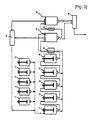
- the present invention provides a process for preparing a bulk tetrapolymer, comprising the steps of: continuously introducing a mixture of an N-substituted maleimide monomer, an ⁇ -alkylstyrene monomer, an unsaturated nitrile monomer and an aromatic vinyl monomer into a polymerization reactor comprising one or more stirred tank reactors; continuously polymerizing the monomer mixture introduced into the polymerization reactor; and transferring the resulting mixture of polymer and unreacted monomers into a devolatilizer, in which the mixture is separated into the polymer and the unreacted monomers.
- the N-substituted maleimide monomer, the ⁇ -alkylstyrene monomer, the unsaturated nitrile monomer and the aromatic vinyl monomer can be continuously introduced from the respective storage tanks through a metering pump, or can be mixed with each other in a separate preparation tank, and then introduced into the polymerization reactor.
- the monomers are mixed with each other in a plurality of preparation tanks, and then alternately introduced until completion of the polymerization reaction.
- the polymerization reactor in which the introduced monomers are polymerized, may comprise one or more stirred tank reactors, which are connected with each other.
- the polymer and unreacted monomer mixture which are discharged from each of the stirred tank reactors, are introduced into the next stirred tank reactor in order to further increase the polymerization conversion, or are introduced into the devolatilizer in order to separate the unreacted monomers from the reaction mixture.
- the mixture of polymer and unreacted monomers, formed in a first stirred tank reactor is transferred through the lower portion of the first stirred tank reactor into the upper portion of a second stirred tank reactor, in which it is polymerized. Then, it is transferred through the lower portion of the second stirred tank reactor into the upper portion of a third stirred tank reactor, and reaches a fifth stirred tank reactor through the same procedure as described above.
- lines for feeding additives or monomers can be additionally connected to each of the stirred tank reactors in order to adjust viscosity or the composition of the final product.
- the mixture of polymer and monomers, passed through each of the stirred tank reactors, is transferred into the next stirred tank reactor, or is transferred from each of the stirred tank reactors directly into the devolatilizer, in which it is separated into the unreacted monomers and the polymer.
- the recovered unreacted monomer mixtures are introduced into the upper portion of the first stirred tank reactor through a condenser, and the molten polymer, passed through the devolatilizer, is passed through an extruder equipped with a vacuum system, and is finally prepared into a maleimide- ⁇ -alkylstyrene-based, heat-resistant tetrapolymer, which comprises the N-substituted maleimide monomer, the ⁇ -alkylstyrene monomer, the unsaturated nitrile monomer and the aromatic vinyl polymer.
- the ⁇ -alkylstyrene monomer, the unsaturated nitrile monomer and the aromatic vinyl monomer are introduced first such that the solid N-substituted maleimide monomer can be dissolved, and then the N-substituted maleimide monomer is introduced into the preparation tank, in which the monomers are mixed with each other.
- the ⁇ -alkylstyrene monomer and the aromatic vinyl monomer may also be introduced first into the preparation tank, and then a solution of the N-substituted maleimide monomer in the unsaturated nitrile monomer can be introduced into the preparation tank.
- the monomers may also be introduced directly into the polymerization reactor in the same manner as described above.
- the polymerization reactors can be operated under pressure or under reduced pressure, and the temperature of the polymer/monomer mixture in each of the polymerization reactors is preferably maintained at 60-180 °C during the polymerization, such that the polymerization rate can be sufficiently maintained.
- the polymer/monomer mixture in each of the polymerization reactors is preferably polymerized while it is maintained at a level of 40-95% of the stirred tank reactor. If the level is low, a problem of a reduction in productivity, caused by a decrease in polymerization rate, can occur, and if the level is high, there will be a problem in that it is difficult to control heat.
- the devolatilizer is provided such that it separates the reaction product polymer from the unreacted monomers.
- the devolatilizer may consist of one or more devolatilizer units.
- the devolatilizer may consist of two or more devolatilizer units, and each of the devolatilizer units can be connected to the next devolatilizer unit or an extruder.
- the transferred mixture of polymer and monomers can be passed through a devolatilizer unit, and then transferred into a second devolatilizer unit or transferred directly into an extruder, and the molten polymer, passed through the second devolatilizer, can be transferred into a third devolatilizer or transferred directly into the extruder.
- the last devolatilizer unit may be connected directly to the extruder.
- the devolatilizers can be operated under reduced pressure in order to make it easy to separate the unreacted monomers from the polymer, and preferably, it can be operated at an internal pressure of 0 to -760 mmHg.
- the unreacted monomer mixtures, recovered from the devolatilizers, are condensed into the original form in the condenser, the contents thereof are analyzed using a component analysis system, preferably GC (gas chromatography, CP-3800/VARIAN) equipment, and the analyzed monomer mixtures are introduced again into the upper portion of the first polymerization reactor. A series of such processes are repeated until the production of the tetrapolymer is completed.
- a component analysis system preferably GC (gas chromatography, CP-3800/VARIAN) equipment
- the final polymerization conversion rate of the polymer/monomer mixture, which is transferred into the devolatilizers, preferably the first devolatilizer can be maintained in the range of 20 ⁇ 80 wt%. If the final polymerization conversion rate is less than 20 wt%, it will be difficult to transfer the polymer/monomer mixture through a polymer pump, because the mixture will have an excessively low melt viscosity, and if the final polymerization conversion rate is more than 80 wt%, it will also be difficult to transfer the polymer/monomer mixture through a polymer pump, because the mixture will have an excessively high melt viscosity.
- the temperature of the polymer, passed through the devolatilizer can be controlled in the range of 60-300 °C.
- the extruder is equipped with a vacuum system, which is maintained at a vacuum of 0 to -760 mmHg, such that the unreacted monomers can be additionally removed. Also, the cylinder temperature thereof is set at a temperature of 100-350 °C.
- the tetrapolymer prepared by bulk the polymerization process of the invention, comprises 5-60 wt% of the N-substituted maleimide monomer, 10-70 wt% of the ⁇ -alkylstyrene monomer, 5-50 wt% of the unsaturated nitrile monomer and 3-50 wt% of the aromatic vinyl monomer and has a weight-average molecular weight (Mw) of 70,000-300,000, a glass transition temperature of 150-200 °C, and low melt viscosity.
- Mw weight-average molecular weight
- the monomer mixture may additionally contain less than 20 wt% of an organic solvent and contains 0-5000 ppm of an initiator.
- the solvent can be selected from the group consisting of organic solvents, having a boiling point of 60-200 °C, and mixtures thereof
- the initiator can be selected from the group consisting of azobisisobutyronitrile, benzoyl peroxide, t-butylperoxy-2-ethyl-hexanoate, cumyl peroxide, t-butyl peroxide, 1,1-di-(t-butylperoxy)cyclohexane, and mixtures thereof.
- the monomer mixture may contain a molecular weight-adjusting agent in order to adjust the molecular weight thereof.
- the molecular weight-adjusting agent can be selected from the group consisting of n-dodecylmercaptane, n-amylmercaptane, t-butylmercaptane, t-dodecylmercaptane, n-hexylmercaptane, n-octylmercaptane, n-nonylmercaptane, and mixtures thereof. Also, it is preferably used in an amount of 0-5000 ppm based on 100 parts by weight of the monomer mixture.
- the bulk process of the present invention provides a heat-resistant bulk tetrapolymer, which has excellent heat resistance and is prepared by bulk polymerization. Also, the present invention provides a bulk polymerization process which can effectively produce the heat-resistant tetrapolymer.
- the heat-resistant tetrapolymer, which is prepared according to the present invention is easily melt-blended with other engineering plastics due to its low melt viscosity, and thus will greatly contribute to an improvement in the physical properties of the resulting product.
- the heat-resistant tetrapolymer which is prepared according to bulk process of the present invention, has advantages in that it has excellent stability due to its low impurity content, and the production cost thereof is low, because it is prepared through the bulk polymerization process using less than 20 parts by weight of an organic solvent based on 100 parts by weight of the monomer mixture.
- the resulting polymer/monomer mixtures were transferred from the lower ends of the stirred tank reactors through a polymer pump into a first devolatilizer 31.
- the first devolatilizer 31 was operated in a vacuum of 350 torr at 150 °C, thus recovering the unreacted monomers.
- the mixtures were passed through the first devolatilizer 31, they were passed through a second heat exchanger 22, in which they were heated to the operating temperature of a second devolatilizer 32. Then, the mixtures were passed through the second devolatilizer 32, which was operated in a vacuum of 750 torr at 250 °C, thus recovering the remaining unreacted monomers.
- the molten polymer which has been passed through the first and second devolitilization units 31 and 32 and from which the remaining unreacted monomers have been substantially removed, was passed through an extruder 41, the cylinder temperature of which was set at 180-260 °C and which was equipped with a vacuum system. Then, a pellet-shaped, maleimide- ⁇ -alkylstyrene-based, heat-resistant tetrapolymer was finally prepared.
- the composition of the tetrapolymer thus prepared was analyzed using EA (elementary analysis, Vario EL/ELEMENTAR), 1H/13C NMR (nuclear magnetic resonance, 400 MHz/VARIAN) and FT-IR (Fourier transform infrared spectroscopy, FTS-60A/VIO-RAD). Also, the molecular weight thereof was analyzed by determining a value relative to a standard polystyrene (PS) sample through GPC (gel permeation chromatography, Shimadzu VP) using THF (tetrahydrofuran) as an eluate.
- PS polystyrene
- the glass transition temperature thereof was analyzed using DSC (differential scanning calorimetry, Diamond/Perkin-Elmer), the remaining unreacted monomers were analyzed using GC (gas chromatography, CP-3800/VARIAN), and the high-temperature thermal stability thereof was analyzed by measuring a temperature value corresponding to a loss of 1 wt% compared to initial weight, using TGA (thermogravimetric analysis, Pyris6/Perkin-Elmer).
- the melt viscosity thereof was measured using Reometer (Rosand Capillary/15 mm; shear rate method) under a gradually increasing load. The analysis results are shown in Tables 1 and 2 below and FIG. 1 .
- Tol. indicates toluene
- a) indicates 1,1-di-(t-butylperoxy)clohexene
- b) indicates benzoyl peroxide.
- ⁇ -methylenestyrene and acrylonitrile were first introduced into a batch reactor. Alternatively, ⁇ -methylenestyrene and acrylonitrile were introduced, and then maleic anhydride was introduced with stirring. Alternatively, ⁇ -methylenestyrene, acrylonitrile and styrene were introduced, and then maleic anhydride was introduced with stirring. Also, a solvent and an initiator for each of the monomer mixtures were introduced, and the temperature of the reactor was elevated to a suitable temperature. As a suitable degree of polymerization was reached, the polymer/monomer mixture was transferred from the lower portion of the reactor into a DMF (N,N-dimethylformamide) solvent tank, in which it was completely dissolved.
- DMF N,N-dimethylformamide
- the resulting polymer solution was passed through a resolidification process in which the polymer solution was slowly added to the upper portion of a solvent tank containing a large amount of methanol, while only the polymer was resolidified, a filtering process in which only the polymer was filtered, and an extruder equipped with a vacuum system, thus preparing a pellet-shaped heat-resistant reinforcing material.
- the composition of the heat-resisitant reinforcing material thus prepared was analyzed using EA (elementary analysis, Vario EL/ELEMENTAR), 1H NMR (nuclear magnetic resonance, 400 MHz/VARIAN) and FT-IR(Fourier transform infrared spectroscopy, FTS-60A/VIO-RAD), and the molecular weight thereof was analyzed by determining a value relative to a standard polystyrene (PS) sample through GPC (gel permeation chromatography, Shimadzu VP) using THF (tetrahydrofuran) as an eluate.
- PS polystyrene
- the glass transition temperature thereof was analyzed using DSC (differential scanning calorimetry, Diamond/Perkin-Elmer), and the remaining unreacted monomers were analyzed using GC (gas chromatography, CP-3800/VARIAN).
- the high-temperature thermal stability thereof was analyzed by measuring a temperature value corresponding to a loss of 1 wt% compared to initial weight, using TGA (thermogravimetric analysis, Pyris6/Perkin-Elmer). The analysisxesults are shown in Tables 3 and 4 below.
Landscapes
- Chemical & Material Sciences (AREA)
- Health & Medical Sciences (AREA)
- Chemical Kinetics & Catalysis (AREA)
- Medicinal Chemistry (AREA)
- Polymers & Plastics (AREA)
- Organic Chemistry (AREA)
- Addition Polymer Or Copolymer, Post-Treatments, Or Chemical Modifications (AREA)
Claims (15)
- Kontinuierliches Blockpolymerisationsverfahren zum Herstellen eines Tetrapolymers, das 5-60 Gew.-% eines N-substituierten Maleimidmonomers, 10-70 Gew.-% eines α-Alkylstyrenmonomers, 5-50 Gew.-% eines ungesättigten Nitrilmonomers, 3-50 Gew.-% eines aromatischen Vinylmonomers umfasst, wobei das Tetrapolymer ein Gewichtsmittel des Molekulargewichts (Mw) von 70.000-300.000 und eine Glasübergangstemperatur von 150-200 °C aufweist, wobei das Verfahren die Schritte umfasst:- kontinuierliches Einleiten einer Mischung, die a) ein N-substituiertes Maleimidmonomer, b) ein α-Alkylstyrenmonomer, c) ein ungesättigtes Nitrilmonomer, d) ein aromatisches Vinylmonomer und wahlweise e) ein organisches Lösungsmittel in einer Menge von weniger als 20 Gewichtsanteilen in Bezug auf 100 Gewichtsanteile der Monomermischung als das Lösungsmittel enthält, in einen Polymerisationsreaktor, der einen oder mehrere Batch-Reaktor(en) umfasst,- kontinuierliches Polymerisieren der in den Polymerisationsreaktor eingeleiteten Monomermischung und- Überführen der resultierenden Mischung aus Polymer und unreagierten Monomeren in ein Entgasungssystem, in dem die Polymer/Monomer-Mischung in das Polymer und die unreagierten Monomere aufgetrennt wird.
- Kontinuierliches Blockpolymerisationsverfahren nach Anspruch 1, wobei die aus dem Entgaser zurückgewonnene unreagierte Monomermischung durch einen Kondensator in eine Rohmaterialzulaufleitung eingeleitet wird und das Polymer durch einen mit einem Vakuumsystem ausgerüsteten Extruder durchgeleitet wird.
- Kontinuierliches Blockpolymerisationsverfahren nach Anspruch 1, wobei die Monomermischung durch Einleiten des α-Alkylstyrenmonomers, des ungesättigten Nitrilmonomers und des aromatischen Vinylmonomers und dann Einleiten des N-substituierten Maleimidmonomers und Mischen der eingeleiteten Monomere hergestellt ist oder durch Hinzufügen einer Lösung des N-substituierten Maleimidmonomers in dem ungesättigten Nitrilmonomer zu dem α-Alkylstyrenmonomer und dem aromatischen Vinylmonomer hergestellt ist.
- Kontinuierliches Blockpolymerisationsverfahren nach Anspruch 1, wobei die Mischung aus Polymer und unreagierten Monomeren direkt von den Batch-Reaktoren in den Entgaser oder in den nächsten Batch-Reaktor überführt wird.
- Kontinuierliches Blockpolymerisationsverfahren nach Anspruch 1, wobei die Mischung aus Polymer und unreagierten Monomeren bei einer Temperatur von 60-180 °C gehalten wird.
- Kontinuierliches Blockpolymerisationsverfahren nach Anspruch 2, wobei das aus dem Entgaser überführte Polymer durch andere Entgaser in einen Extruder überführt werden kann.
- Kontinuierliches Polymerisationsverfahren nach Anspruch 1, wobei die Mischung aus Polymer und Monomeren, die in den Entgaser überführt wird, eine endgültige Polymerisationskonversionsrate von 20-80 Gew.-% aufweist.
- Kontinuierliches Blockpolymerisationsverfahren nach Anspruch 1, wobei das Lösungsmittel aus der aus organischen Lösungsmitteln mit einem Siedepunkt von 60-200 °C und Mischungen davon bestehenden Gruppe ausgewählt ist.
- Kontinuierliches Blockpolymerisationsverfahren nach Anspruch 1, wobei die Monomermischung ferner 0-5.000 ppm eines Initiators enthält.
- Kontinuierliches Blockpolymerisationsverfahren nach Anspruch 8, wobei der Initiator aus der aus Azobisisobutyronitril, Benzoylperoxid, t-Butylperoxy-2-ethylhexanoat, Cumylperoxid, t-Butylperoxid, 1,1-Di-(t-butylperoxy)cyclohexan und Mischungen davon bestehenden Gruppe ausgewählt ist.
- Kontinuierliches Blockpolymerisationsverfahren nach Anspruch 1, wobei Additive, Monomere oder eine Mischung von Monomeren durch getrennte Leitungen in die Batch-Reaktoren eingeleitet werden können.
- Kontinuierliches Blockpolymerisationsverfahren nach Anspruch 1, wobei der Füllstand der Polymer/Monomer-Mischung im Polymerisationsreaktor 40-95 % beträgt.
- Kontinuierliches Blockpolymerisationsverfahren nach Anspruch 1, wobei die Temperatur des Polymers, das durch den Entgaser geleitet wird, auf 60-300 °C eingestellt wird.
- Kontinuierliches Blockpolymerisationsverfahren nach Anspruch 1, wobei die Monomermischung ein Molekulargewichteinstellmittel in einer Menge von weniger als 5.000 ppm in Bezug auf 100 Gewichtsanteile der Monomermischung enthält.
- Kontinuierliches Blockpolymerisationsverfahren nach Anspruch 13, wobei das Molekulargewichteinstellmittel aus der aus n-Dodecylmercaptan, n-Amylmercaptan, t-Butylmercaptan, t-Dodecylmercaptan, n-Hexylmercaptan, n-Octylmercaptan, n-Nonylmercaptan und Mischungen davon bestehenden Gruppe ausgewählt ist.
Priority Applications (1)
| Application Number | Priority Date | Filing Date | Title |
|---|---|---|---|
| EP12161197.4A EP2471821B1 (de) | 2006-09-28 | 2006-12-02 | Tetrapolymer auf maleinimid-alpha-alkylstyrol-basis mit geringer schmelzeviskosität |
Applications Claiming Priority (2)
| Application Number | Priority Date | Filing Date | Title |
|---|---|---|---|
| KR20060094738 | 2006-09-28 | ||
| PCT/KR2006/005161 WO2008038857A1 (en) | 2006-09-28 | 2006-12-02 | Maleimide-alpha-alkylstyrene-based tetrapolymer with low molten viscosity and continuous bulk process for producing it |
Related Child Applications (2)
| Application Number | Title | Priority Date | Filing Date |
|---|---|---|---|
| EP12161197.4A Division-Into EP2471821B1 (de) | 2006-09-28 | 2006-12-02 | Tetrapolymer auf maleinimid-alpha-alkylstyrol-basis mit geringer schmelzeviskosität |
| EP12161197.4A Division EP2471821B1 (de) | 2006-09-28 | 2006-12-02 | Tetrapolymer auf maleinimid-alpha-alkylstyrol-basis mit geringer schmelzeviskosität |
Publications (3)
| Publication Number | Publication Date |
|---|---|
| EP2066708A1 EP2066708A1 (de) | 2009-06-10 |
| EP2066708A4 EP2066708A4 (de) | 2010-01-13 |
| EP2066708B1 true EP2066708B1 (de) | 2016-03-02 |
Family
ID=39230281
Family Applications (2)
| Application Number | Title | Priority Date | Filing Date |
|---|---|---|---|
| EP06823869.0A Not-in-force EP2066708B1 (de) | 2006-09-28 | 2006-12-02 | Kontinuierliches verfahren zur herstellung eines tetrapolymers auf maleinimid-alpha-alkylstyrol-basis mit geringer schmelzeviskosität |
| EP12161197.4A Not-in-force EP2471821B1 (de) | 2006-09-28 | 2006-12-02 | Tetrapolymer auf maleinimid-alpha-alkylstyrol-basis mit geringer schmelzeviskosität |
Family Applications After (1)
| Application Number | Title | Priority Date | Filing Date |
|---|---|---|---|
| EP12161197.4A Not-in-force EP2471821B1 (de) | 2006-09-28 | 2006-12-02 | Tetrapolymer auf maleinimid-alpha-alkylstyrol-basis mit geringer schmelzeviskosität |
Country Status (6)
| Country | Link |
|---|---|
| US (2) | US8124703B2 (de) |
| EP (2) | EP2066708B1 (de) |
| JP (1) | JP5474555B2 (de) |
| KR (1) | KR100915114B1 (de) |
| CN (1) | CN101511885A (de) |
| WO (1) | WO2008038857A1 (de) |
Families Citing this family (25)
| Publication number | Priority date | Publication date | Assignee | Title |
|---|---|---|---|---|
| KR100922700B1 (ko) * | 2007-06-15 | 2009-10-20 | 금호석유화학 주식회사 | 저용융점도 말레이미드-α-알킬스티렌계 삼원 괴상공중합체 및 이를 만드는 연속괴상중합공정 |
| KR101639832B1 (ko) * | 2009-01-16 | 2016-07-14 | 덴카 주식회사 | 말레이미드계 공중합체, 그의 제조 방법 및 그것을 이용한 내열성 수지 조성물 |
| WO2010087085A1 (ja) * | 2009-01-28 | 2010-08-05 | テクノポリマー株式会社 | 太陽電池用バックシート及びそれを備える太陽電池モジュール |
| CN101538347B (zh) * | 2009-02-06 | 2013-11-13 | 上海华谊(集团)公司 | 马来酰亚胺共聚物及其合成方法 |
| JP2013518964A (ja) * | 2010-02-04 | 2013-05-23 | ステレンボッシュ ユニバーシティ | 抗微生物性ポリマー化合物およびその繊維 |
| CN101914178B (zh) * | 2010-07-30 | 2012-05-16 | 宁波镇洋化工发展有限公司 | 芳香烃-不饱和腈-环烯烃耐热共聚物的制备方法 |
| KR101856465B1 (ko) * | 2010-12-14 | 2018-06-19 | 금호석유화학 주식회사 | 내열성과 칼라 자유도가 우수한 친환경 창호재 조성물 |
| CN102127273B (zh) * | 2010-12-22 | 2012-11-21 | 山东舜天力塑胶有限公司 | 聚氯乙烯耐热改性剂及其制备方法 |
| KR101409208B1 (ko) * | 2011-04-13 | 2014-06-20 | 주식회사 엘지화학 | 연속괴상중합법에 의한 광학 필름용 수지 조성물의 제조 방법, 이를 이용한 광학 필름의 제조 방법 및 편광판 제조 방법 |
| KR101723628B1 (ko) * | 2011-12-05 | 2017-04-06 | 금호석유화학 주식회사 | 유동성이 우수한 말레이미드-알파-알킬스티렌계 고내열 4원 괴상 공중합체 수지 및 그 제조방법 |
| CN103342874B (zh) * | 2013-07-19 | 2016-07-20 | 上海锦湖日丽塑料有限公司 | 一种适于电镀的耐热abs树脂及其制备方法 |
| CN103613877B (zh) * | 2013-11-20 | 2017-09-19 | 上海锦湖日丽塑料有限公司 | 适于吹塑成型的高耐热abs树脂组合物及其制备方法 |
| KR101739621B1 (ko) * | 2014-06-27 | 2017-06-08 | 롯데첨단소재(주) | 스티렌계 4원 공중합체, 이의 제조방법 및 이를 포함하는 열가소성 수지 조성물 |
| KR101876005B1 (ko) * | 2015-12-07 | 2018-08-02 | 주식회사 엘지화학 | 스티렌계 수지의 제조방법 및 이로부터 제조된 스티렌계 수지 |
| KR101816428B1 (ko) | 2016-08-04 | 2018-01-08 | 현대자동차주식회사 | 내후성 및 내열성이 우수한 저광택 asa계 수지 조성물 |
| KR102010439B1 (ko) | 2016-11-01 | 2019-08-13 | 주식회사 엘지화학 | 고내열성 스티렌-아크릴로니트릴 수지 및 이의 제조방법 |
| KR102030120B1 (ko) * | 2017-06-15 | 2019-10-08 | 금호석유화학 주식회사 | 내화학성이 향상된 열가소성 수지 조성물 |
| FR3074181B1 (fr) * | 2017-11-28 | 2020-11-06 | Arkema France | Composition copolymerique hydrosoluble a ph neutre |
| US20220195174A1 (en) * | 2019-07-10 | 2022-06-23 | Denka Company Limited | Maleimide copolymer, manufacturing method therefor, and resin composition using same |
| KR20260022486A (ko) * | 2019-07-10 | 2026-02-19 | 덴카 주식회사 | 말레이미드계 공중합체, 그 제조 방법, 수지 조성물 및 사출 성형체 |
| TWI869613B (zh) * | 2020-07-27 | 2025-01-11 | 日商電化股份有限公司 | 馬來醯亞胺系共聚物、馬來醯亞胺系共聚物組成物、樹脂組成物以及射出成型體 |
| CN114437274B (zh) * | 2020-10-21 | 2024-07-02 | 中国石油化工股份有限公司 | 苯乙烯-卤代苯基马来酰亚胺共聚物及其制备方法与应用 |
| EP4053178B1 (de) | 2020-11-05 | 2025-07-09 | LG Chem, Ltd. | Polymerherstellungsverfahren |
| KR102733943B1 (ko) * | 2020-11-20 | 2024-11-26 | 주식회사 엘지화학 | 공중합체 제조방법, 이로부터 제조된 공중합체 및 이를 포함하는 열가소성 수지 조성물 |
| CN113858576B (zh) * | 2021-11-04 | 2024-06-25 | 辽宁北方华锦五洲化工工程设计有限公司 | 一种abs挤出机脱挥回收方法及回收系统 |
Citations (1)
| Publication number | Priority date | Publication date | Assignee | Title |
|---|---|---|---|---|
| US4874829A (en) * | 1987-05-22 | 1989-10-17 | Monsanto Company | Process for preparing α-methylstyrene-acrylonitrile polymers |
Family Cites Families (27)
| Publication number | Priority date | Publication date | Assignee | Title |
|---|---|---|---|---|
| JPS5798536A (en) | 1980-12-11 | 1982-06-18 | Mitsubishi Monsanto Chem Co | Heat-resistant resin composition |
| JPS58162616A (ja) | 1982-03-24 | 1983-09-27 | Toray Ind Inc | マレイミド系共重合体の製造方法 |
| JPS6031552A (ja) * | 1983-07-29 | 1985-02-18 | Toray Ind Inc | 熱可塑性樹脂組成物 |
| JPS6079019A (ja) * | 1983-10-04 | 1985-05-04 | Mitsubishi Monsanto Chem Co | 耐熱性樹脂組成物の製造方法 |
| JPS60147414A (ja) * | 1984-01-13 | 1985-08-03 | Toray Ind Inc | マレイミド系共重合体の製造方法 |
| JPS61223006A (ja) * | 1985-03-29 | 1986-10-03 | Asahi Chem Ind Co Ltd | 熱可塑性樹脂の製造方法 |
| WO1986006732A1 (fr) * | 1985-05-16 | 1986-11-20 | Mitsubishi Rayon Co., Ltd. | Procede de production d'un copolymere de maleimide et composition de resine thermoplastique contenant ce copolymere |
| JPH0796580B2 (ja) | 1985-06-03 | 1995-10-18 | 三井東圧化学株式会社 | 透明耐熱性スチレン系共重合体 |
| JPS62250015A (ja) * | 1986-04-23 | 1987-10-30 | Toray Ind Inc | 共重合体ラテツクスからポリマを回収する方法 |
| JPH0737550B2 (ja) | 1986-05-28 | 1995-04-26 | 電気化学工業株式会社 | 耐熱性樹脂組成物 |
| JPS63182309A (ja) * | 1987-01-22 | 1988-07-27 | Ube Saikon Kk | 熱可塑性耐熱樹脂の製造方法 |
| JP2726469B2 (ja) | 1989-01-18 | 1998-03-11 | 電気化学工業株式会社 | 耐熱性樹脂組成物 |
| JPH02274706A (ja) * | 1989-04-17 | 1990-11-08 | Hitachi Chem Co Ltd | 熱可塑性樹脂組成物の製造法及び熱可塑性樹脂組成物 |
| TW197454B (de) | 1991-04-15 | 1993-01-01 | Catalyst co ltd | |
| JPH0586112A (ja) * | 1991-09-26 | 1993-04-06 | Nippon Shokubai Co Ltd | マレイミド系共重合体の製造方法 |
| DE69302523T2 (de) | 1992-06-17 | 1997-01-16 | Nippon Catalytic Chem Ind | Copolymer auf Basis von Maleimid und Verfahren zu seiner Herstellung |
| JP3078652B2 (ja) * | 1992-06-17 | 2000-08-21 | 株式会社日本触媒 | マレイミド系共重合体 |
| JP3286971B2 (ja) * | 1992-12-11 | 2002-05-27 | 鐘淵化学工業株式会社 | スチレン系共重合体、該共重合体を含有する熱可塑性樹脂組成物及びそれらの製造法 |
| KR0154910B1 (ko) * | 1994-10-28 | 1998-12-01 | 성재갑 | 내열성 공중합체의 제조방법 |
| JPH10219079A (ja) * | 1997-02-10 | 1998-08-18 | Techno Polymer Kk | 熱可塑性樹脂組成物 |
| US6599978B1 (en) * | 1998-05-19 | 2003-07-29 | Mitsubishi Rayon Co., Ltd. | Copolymer, thermoplastic resin composition, and process for producing the same |
| KR100417066B1 (ko) | 2001-01-08 | 2004-02-05 | 주식회사 엘지화학 | 내열성이 우수한 열가소성 수지의 제조방법 |
| JP2003041080A (ja) | 2001-05-23 | 2003-02-13 | Denki Kagaku Kogyo Kk | マレイミド系耐熱付与材 |
| KR100416812B1 (ko) * | 2001-10-16 | 2004-02-05 | 주식회사 엘지화학 | 내열성이 우수한 공중합체의 제조방법 |
| JP3953438B2 (ja) | 2003-04-10 | 2007-08-08 | 電気化学工業株式会社 | 耐熱安定性熱可塑性樹脂の製造方法 |
| JP3957663B2 (ja) | 2003-08-06 | 2007-08-15 | 電気化学工業株式会社 | 耐熱性熱可塑性樹脂の製造方法とその耐熱性熱可塑性樹脂からなる耐熱付与材 |
| JP5086112B2 (ja) | 2008-01-23 | 2012-11-28 | 矢崎総業株式会社 | 防水ケース |
-
2006
- 2006-12-02 EP EP06823869.0A patent/EP2066708B1/de not_active Not-in-force
- 2006-12-02 EP EP12161197.4A patent/EP2471821B1/de not_active Not-in-force
- 2006-12-02 WO PCT/KR2006/005161 patent/WO2008038857A1/en not_active Ceased
- 2006-12-02 US US12/443,358 patent/US8124703B2/en active Active
- 2006-12-02 JP JP2009530238A patent/JP5474555B2/ja not_active Expired - Fee Related
- 2006-12-02 CN CNA2006800559828A patent/CN101511885A/zh active Pending
- 2006-12-04 KR KR1020060121766A patent/KR100915114B1/ko not_active Expired - Fee Related
-
2011
- 2011-12-07 US US13/313,354 patent/US8487057B2/en not_active Expired - Fee Related
Patent Citations (1)
| Publication number | Priority date | Publication date | Assignee | Title |
|---|---|---|---|---|
| US4874829A (en) * | 1987-05-22 | 1989-10-17 | Monsanto Company | Process for preparing α-methylstyrene-acrylonitrile polymers |
Non-Patent Citations (1)
| Title |
|---|
| GEORGE ODIAN: "PRINCIPLES OF POLYMERIZATION, 4th Ed.", 1 January 2004, JOHN WILEY & SONS, INC., HOBOKEN, New Jersey, USA, ISBN: 0-471-27400-3 * |
Also Published As
| Publication number | Publication date |
|---|---|
| EP2066708A1 (de) | 2009-06-10 |
| JP5474555B2 (ja) | 2014-04-16 |
| JP2010505022A (ja) | 2010-02-18 |
| US8124703B2 (en) | 2012-02-28 |
| EP2066708A4 (de) | 2010-01-13 |
| KR100915114B1 (ko) | 2009-09-03 |
| EP2471821B1 (de) | 2017-02-01 |
| KR20080030435A (ko) | 2008-04-04 |
| CN101511885A (zh) | 2009-08-19 |
| WO2008038857A1 (en) | 2008-04-03 |
| US20120142875A1 (en) | 2012-06-07 |
| US20100036065A1 (en) | 2010-02-11 |
| US8487057B2 (en) | 2013-07-16 |
| EP2471821A1 (de) | 2012-07-04 |
Similar Documents
| Publication | Publication Date | Title |
|---|---|---|
| US8487057B2 (en) | Maleimide-alpha-alkylstyrene-based tetrapolymer with low molten viscosity and continuous bulk process for producing it | |
| EP2160422B1 (de) | Terpolymer auf maleinimid-alpha-alkylstyrol-basis mit geringer schmelzeviskosität und kontinuierliches masseverfahren zu seiner herstellung | |
| CN111225929B (zh) | 马来酰亚胺系共聚物、其制造方法以及使用马来酰亚胺系共聚物的树脂组合物 | |
| KR20110063947A (ko) | 고내열도 및 저용융점도 말레이미드-알파-알킬스티렌 계 사원 괴상 공중합체 제조 방법 | |
| KR101432597B1 (ko) | 내열성과 내스크래치성이 우수한 열가소성 수지 조성물 제조방법 | |
| CN113614128A (zh) | 马来酰亚胺系共聚物、其制造方法、以及使用了马来酰亚胺系共聚物的树脂组合物 | |
| KR101672056B1 (ko) | 올리고머 함량을 저감시키는 말레이미드-알킬 스티렌 계 삼원(三元) 괴상 공중합체 제조 방법 | |
| KR101838163B1 (ko) | 내열성과 기계적 물성이 우수한 열가소성 수지 및 그 제조방법 | |
| KR20100051368A (ko) | N-치환말레이미드-α-알킬스티렌계 5원 공중합체 및 이의 제조방법 | |
| KR100751020B1 (ko) | 내열특성과 표면광택도 및 실용충격강도가 우수한 고충격폴리스티렌 수지의 연속 제조방법 | |
| KR101055000B1 (ko) | α-메틸스티렌 및 비닐시안 화합물의 공중합 내열성 수지의연속 제조 방법 | |
| KR100587649B1 (ko) | 초고충격 고무변성 스티렌계 수지의 연속 제조 방법 | |
| KR100751022B1 (ko) | 초고광택 고무 변성 스티렌계 수지의 연속 제조 방법 | |
| JPH1053620A5 (de) | ||
| KR20090115697A (ko) | 저용융점도 말레이미드-α-알킬스티렌계 삼원 괴상 공중합체 및 이를 만드는 연속괴상중합공정 | |
| KR100587650B1 (ko) | 실용충격강도가 우수한 고무변성 스티렌계 수지의 연속제조 방법 | |
| KR20100045858A (ko) | 내열성과 내스크래치성이 우수한 열가소성 수지 조성물 및 제조방법 | |
| KR100587648B1 (ko) | 표면광택도 및 실용충격강도가 우수한 고충격 폴리스티렌수지의 연속 제조 방법 | |
| KR20250059777A (ko) | 말레이미드계 4원 공중합체의 제조방법 및 그로부터 제조된 말레이미드계 4원 공중합체 |
Legal Events
| Date | Code | Title | Description |
|---|---|---|---|
| PUAI | Public reference made under article 153(3) epc to a published international application that has entered the european phase |
Free format text: ORIGINAL CODE: 0009012 |
|
| 17P | Request for examination filed |
Effective date: 20090310 |
|
| AK | Designated contracting states |
Kind code of ref document: A1 Designated state(s): AT BE BG CH CY CZ DE DK EE ES FI FR GB GR HU IE IS IT LI LT LU LV MC NL PL PT RO SE SI SK TR |
|
| AX | Request for extension of the european patent |
Extension state: AL BA HR MK RS |
|
| A4 | Supplementary search report drawn up and despatched |
Effective date: 20091215 |
|
| 17Q | First examination report despatched |
Effective date: 20100527 |
|
| DAX | Request for extension of the european patent (deleted) | ||
| GRAP | Despatch of communication of intention to grant a patent |
Free format text: ORIGINAL CODE: EPIDOSNIGR1 |
|
| INTG | Intention to grant announced |
Effective date: 20150723 |
|
| GRAS | Grant fee paid |
Free format text: ORIGINAL CODE: EPIDOSNIGR3 |
|
| GRAA | (expected) grant |
Free format text: ORIGINAL CODE: 0009210 |
|
| AK | Designated contracting states |
Kind code of ref document: B1 Designated state(s): AT BE BG CH CY CZ DE DK EE ES FI FR GB GR HU IE IS IT LI LT LU LV MC NL PL PT RO SE SI SK TR |
|
| REG | Reference to a national code |
Ref country code: GB Ref legal event code: FG4D |
|
| REG | Reference to a national code |
Ref country code: AT Ref legal event code: REF Ref document number: 777986 Country of ref document: AT Kind code of ref document: T Effective date: 20160315 Ref country code: CH Ref legal event code: EP |
|
| REG | Reference to a national code |
Ref country code: IE Ref legal event code: FG4D |
|
| REG | Reference to a national code |
Ref country code: DE Ref legal event code: R096 Ref document number: 602006048093 Country of ref document: DE |
|
| REG | Reference to a national code |
Ref country code: NL Ref legal event code: FP |
|
| REG | Reference to a national code |
Ref country code: LT Ref legal event code: MG4D |
|
| REG | Reference to a national code |
Ref country code: AT Ref legal event code: MK05 Ref document number: 777986 Country of ref document: AT Kind code of ref document: T Effective date: 20160302 |
|
| PG25 | Lapsed in a contracting state [announced via postgrant information from national office to epo] |
Ref country code: ES Free format text: LAPSE BECAUSE OF FAILURE TO SUBMIT A TRANSLATION OF THE DESCRIPTION OR TO PAY THE FEE WITHIN THE PRESCRIBED TIME-LIMIT Effective date: 20160302 Ref country code: FI Free format text: LAPSE BECAUSE OF FAILURE TO SUBMIT A TRANSLATION OF THE DESCRIPTION OR TO PAY THE FEE WITHIN THE PRESCRIBED TIME-LIMIT Effective date: 20160302 Ref country code: GR Free format text: LAPSE BECAUSE OF FAILURE TO SUBMIT A TRANSLATION OF THE DESCRIPTION OR TO PAY THE FEE WITHIN THE PRESCRIBED TIME-LIMIT Effective date: 20160603 |
|
| PG25 | Lapsed in a contracting state [announced via postgrant information from national office to epo] |
Ref country code: LT Free format text: LAPSE BECAUSE OF FAILURE TO SUBMIT A TRANSLATION OF THE DESCRIPTION OR TO PAY THE FEE WITHIN THE PRESCRIBED TIME-LIMIT Effective date: 20160302 Ref country code: AT Free format text: LAPSE BECAUSE OF FAILURE TO SUBMIT A TRANSLATION OF THE DESCRIPTION OR TO PAY THE FEE WITHIN THE PRESCRIBED TIME-LIMIT Effective date: 20160302 Ref country code: SE Free format text: LAPSE BECAUSE OF FAILURE TO SUBMIT A TRANSLATION OF THE DESCRIPTION OR TO PAY THE FEE WITHIN THE PRESCRIBED TIME-LIMIT Effective date: 20160302 Ref country code: PL Free format text: LAPSE BECAUSE OF FAILURE TO SUBMIT A TRANSLATION OF THE DESCRIPTION OR TO PAY THE FEE WITHIN THE PRESCRIBED TIME-LIMIT Effective date: 20160302 Ref country code: LV Free format text: LAPSE BECAUSE OF FAILURE TO SUBMIT A TRANSLATION OF THE DESCRIPTION OR TO PAY THE FEE WITHIN THE PRESCRIBED TIME-LIMIT Effective date: 20160302 |
|
| PG25 | Lapsed in a contracting state [announced via postgrant information from national office to epo] |
Ref country code: EE Free format text: LAPSE BECAUSE OF FAILURE TO SUBMIT A TRANSLATION OF THE DESCRIPTION OR TO PAY THE FEE WITHIN THE PRESCRIBED TIME-LIMIT Effective date: 20160302 Ref country code: IS Free format text: LAPSE BECAUSE OF FAILURE TO SUBMIT A TRANSLATION OF THE DESCRIPTION OR TO PAY THE FEE WITHIN THE PRESCRIBED TIME-LIMIT Effective date: 20160702 |
|
| PG25 | Lapsed in a contracting state [announced via postgrant information from national office to epo] |
Ref country code: PT Free format text: LAPSE BECAUSE OF FAILURE TO SUBMIT A TRANSLATION OF THE DESCRIPTION OR TO PAY THE FEE WITHIN THE PRESCRIBED TIME-LIMIT Effective date: 20160704 Ref country code: SK Free format text: LAPSE BECAUSE OF FAILURE TO SUBMIT A TRANSLATION OF THE DESCRIPTION OR TO PAY THE FEE WITHIN THE PRESCRIBED TIME-LIMIT Effective date: 20160302 Ref country code: RO Free format text: LAPSE BECAUSE OF FAILURE TO SUBMIT A TRANSLATION OF THE DESCRIPTION OR TO PAY THE FEE WITHIN THE PRESCRIBED TIME-LIMIT Effective date: 20160302 Ref country code: CZ Free format text: LAPSE BECAUSE OF FAILURE TO SUBMIT A TRANSLATION OF THE DESCRIPTION OR TO PAY THE FEE WITHIN THE PRESCRIBED TIME-LIMIT Effective date: 20160302 |
|
| REG | Reference to a national code |
Ref country code: DE Ref legal event code: R097 Ref document number: 602006048093 Country of ref document: DE |
|
| REG | Reference to a national code |
Ref country code: FR Ref legal event code: PLFP Year of fee payment: 11 |
|
| PG25 | Lapsed in a contracting state [announced via postgrant information from national office to epo] |
Ref country code: IT Free format text: LAPSE BECAUSE OF FAILURE TO SUBMIT A TRANSLATION OF THE DESCRIPTION OR TO PAY THE FEE WITHIN THE PRESCRIBED TIME-LIMIT Effective date: 20160302 Ref country code: BE Free format text: LAPSE BECAUSE OF FAILURE TO SUBMIT A TRANSLATION OF THE DESCRIPTION OR TO PAY THE FEE WITHIN THE PRESCRIBED TIME-LIMIT Effective date: 20160302 |
|
| PLBE | No opposition filed within time limit |
Free format text: ORIGINAL CODE: 0009261 |
|
| STAA | Information on the status of an ep patent application or granted ep patent |
Free format text: STATUS: NO OPPOSITION FILED WITHIN TIME LIMIT |
|
| PG25 | Lapsed in a contracting state [announced via postgrant information from national office to epo] |
Ref country code: DK Free format text: LAPSE BECAUSE OF FAILURE TO SUBMIT A TRANSLATION OF THE DESCRIPTION OR TO PAY THE FEE WITHIN THE PRESCRIBED TIME-LIMIT Effective date: 20160302 |
|
| 26N | No opposition filed |
Effective date: 20161205 |
|
| PG25 | Lapsed in a contracting state [announced via postgrant information from national office to epo] |
Ref country code: SI Free format text: LAPSE BECAUSE OF FAILURE TO SUBMIT A TRANSLATION OF THE DESCRIPTION OR TO PAY THE FEE WITHIN THE PRESCRIBED TIME-LIMIT Effective date: 20160302 Ref country code: BG Free format text: LAPSE BECAUSE OF FAILURE TO SUBMIT A TRANSLATION OF THE DESCRIPTION OR TO PAY THE FEE WITHIN THE PRESCRIBED TIME-LIMIT Effective date: 20160602 |
|
| REG | Reference to a national code |
Ref country code: CH Ref legal event code: PL |
|
| PG25 | Lapsed in a contracting state [announced via postgrant information from national office to epo] |
Ref country code: MC Free format text: LAPSE BECAUSE OF FAILURE TO SUBMIT A TRANSLATION OF THE DESCRIPTION OR TO PAY THE FEE WITHIN THE PRESCRIBED TIME-LIMIT Effective date: 20160302 |
|
| REG | Reference to a national code |
Ref country code: IE Ref legal event code: MM4A |
|
| PG25 | Lapsed in a contracting state [announced via postgrant information from national office to epo] |
Ref country code: LU Free format text: LAPSE BECAUSE OF NON-PAYMENT OF DUE FEES Effective date: 20161202 Ref country code: LI Free format text: LAPSE BECAUSE OF NON-PAYMENT OF DUE FEES Effective date: 20161231 Ref country code: CH Free format text: LAPSE BECAUSE OF NON-PAYMENT OF DUE FEES Effective date: 20161231 |
|
| PG25 | Lapsed in a contracting state [announced via postgrant information from national office to epo] |
Ref country code: IE Free format text: LAPSE BECAUSE OF NON-PAYMENT OF DUE FEES Effective date: 20161202 |
|
| REG | Reference to a national code |
Ref country code: FR Ref legal event code: PLFP Year of fee payment: 12 |
|
| PG25 | Lapsed in a contracting state [announced via postgrant information from national office to epo] |
Ref country code: HU Free format text: LAPSE BECAUSE OF FAILURE TO SUBMIT A TRANSLATION OF THE DESCRIPTION OR TO PAY THE FEE WITHIN THE PRESCRIBED TIME-LIMIT; INVALID AB INITIO Effective date: 20061202 Ref country code: CY Free format text: LAPSE BECAUSE OF FAILURE TO SUBMIT A TRANSLATION OF THE DESCRIPTION OR TO PAY THE FEE WITHIN THE PRESCRIBED TIME-LIMIT Effective date: 20160302 |
|
| PG25 | Lapsed in a contracting state [announced via postgrant information from national office to epo] |
Ref country code: TR Free format text: LAPSE BECAUSE OF FAILURE TO SUBMIT A TRANSLATION OF THE DESCRIPTION OR TO PAY THE FEE WITHIN THE PRESCRIBED TIME-LIMIT Effective date: 20160302 |
|
| PGFP | Annual fee paid to national office [announced via postgrant information from national office to epo] |
Ref country code: NL Payment date: 20221222 Year of fee payment: 17 Ref country code: GB Payment date: 20221222 Year of fee payment: 17 Ref country code: FR Payment date: 20221222 Year of fee payment: 17 |
|
| PGFP | Annual fee paid to national office [announced via postgrant information from national office to epo] |
Ref country code: DE Payment date: 20230123 Year of fee payment: 17 |
|
| REG | Reference to a national code |
Ref country code: DE Ref legal event code: R119 Ref document number: 602006048093 Country of ref document: DE |
|
| REG | Reference to a national code |
Ref country code: NL Ref legal event code: MM Effective date: 20240101 |
|
| GBPC | Gb: european patent ceased through non-payment of renewal fee |
Effective date: 20231202 |
|
| PG25 | Lapsed in a contracting state [announced via postgrant information from national office to epo] |
Ref country code: NL Free format text: LAPSE BECAUSE OF NON-PAYMENT OF DUE FEES Effective date: 20240101 |
|
| PG25 | Lapsed in a contracting state [announced via postgrant information from national office to epo] |
Ref country code: NL Free format text: LAPSE BECAUSE OF NON-PAYMENT OF DUE FEES Effective date: 20240101 |
|
| PG25 | Lapsed in a contracting state [announced via postgrant information from national office to epo] |
Ref country code: DE Free format text: LAPSE BECAUSE OF NON-PAYMENT OF DUE FEES Effective date: 20240702 |
|
| PG25 | Lapsed in a contracting state [announced via postgrant information from national office to epo] |
Ref country code: GB Free format text: LAPSE BECAUSE OF NON-PAYMENT OF DUE FEES Effective date: 20231202 |
|
| PG25 | Lapsed in a contracting state [announced via postgrant information from national office to epo] |
Ref country code: FR Free format text: LAPSE BECAUSE OF NON-PAYMENT OF DUE FEES Effective date: 20231231 |
|
| PG25 | Lapsed in a contracting state [announced via postgrant information from national office to epo] |
Ref country code: GB Free format text: LAPSE BECAUSE OF NON-PAYMENT OF DUE FEES Effective date: 20231202 Ref country code: FR Free format text: LAPSE BECAUSE OF NON-PAYMENT OF DUE FEES Effective date: 20231231 Ref country code: DE Free format text: LAPSE BECAUSE OF NON-PAYMENT OF DUE FEES Effective date: 20240702 |