EP2078085B1 - Allele des prpd1-gens aus coryneformen bakterien - Google Patents
Allele des prpd1-gens aus coryneformen bakterien Download PDFInfo
- Publication number
- EP2078085B1 EP2078085B1 EP07821449.1A EP07821449A EP2078085B1 EP 2078085 B1 EP2078085 B1 EP 2078085B1 EP 07821449 A EP07821449 A EP 07821449A EP 2078085 B1 EP2078085 B1 EP 2078085B1
- Authority
- EP
- European Patent Office
- Prior art keywords
- seq
- amino acid
- acid sequence
- gene
- nucleotide sequence
- Prior art date
- Legal status (The legal status is an assumption and is not a legal conclusion. Google has not performed a legal analysis and makes no representation as to the accuracy of the status listed.)
- Not-in-force
Links
Images

Classifications
-
- C—CHEMISTRY; METALLURGY
- C12—BIOCHEMISTRY; BEER; SPIRITS; WINE; VINEGAR; MICROBIOLOGY; ENZYMOLOGY; MUTATION OR GENETIC ENGINEERING
- C12N—MICROORGANISMS OR ENZYMES; COMPOSITIONS THEREOF; PROPAGATING, PRESERVING, OR MAINTAINING MICROORGANISMS; MUTATION OR GENETIC ENGINEERING; CULTURE MEDIA
- C12N15/00—Mutation or genetic engineering; DNA or RNA concerning genetic engineering, vectors, e.g. plasmids, or their isolation, preparation or purification; Use of hosts therefor
- C12N15/09—Recombinant DNA-technology
- C12N15/11—DNA or RNA fragments; Modified forms thereof; Non-coding nucleic acids having a biological activity
- C12N15/52—Genes encoding for enzymes or proenzymes
-
- C—CHEMISTRY; METALLURGY
- C12—BIOCHEMISTRY; BEER; SPIRITS; WINE; VINEGAR; MICROBIOLOGY; ENZYMOLOGY; MUTATION OR GENETIC ENGINEERING
- C12P—FERMENTATION OR ENZYME-USING PROCESSES TO SYNTHESISE A DESIRED CHEMICAL COMPOUND OR COMPOSITION OR TO SEPARATE OPTICAL ISOMERS FROM A RACEMIC MIXTURE
- C12P13/00—Preparation of nitrogen-containing organic compounds
- C12P13/04—Alpha- or beta- amino acids
- C12P13/08—Lysine; Diaminopimelic acid; Threonine; Valine
-
- C—CHEMISTRY; METALLURGY
- C12—BIOCHEMISTRY; BEER; SPIRITS; WINE; VINEGAR; MICROBIOLOGY; ENZYMOLOGY; MUTATION OR GENETIC ENGINEERING
- C12N—MICROORGANISMS OR ENZYMES; COMPOSITIONS THEREOF; PROPAGATING, PRESERVING, OR MAINTAINING MICROORGANISMS; MUTATION OR GENETIC ENGINEERING; CULTURE MEDIA
- C12N1/00—Microorganisms; Compositions thereof; Processes of propagating, maintaining or preserving microorganisms or compositions thereof; Processes of preparing or isolating a composition containing a microorganism; Culture media therefor
- C12N1/20—Bacteria; Culture media therefor
-
- C—CHEMISTRY; METALLURGY
- C12—BIOCHEMISTRY; BEER; SPIRITS; WINE; VINEGAR; MICROBIOLOGY; ENZYMOLOGY; MUTATION OR GENETIC ENGINEERING
- C12P—FERMENTATION OR ENZYME-USING PROCESSES TO SYNTHESISE A DESIRED CHEMICAL COMPOUND OR COMPOSITION OR TO SEPARATE OPTICAL ISOMERS FROM A RACEMIC MIXTURE
- C12P13/00—Preparation of nitrogen-containing organic compounds
- C12P13/04—Alpha- or beta- amino acids
- C12P13/22—Tryptophan; Tyrosine; Phenylalanine; 3,4-Dihydroxyphenylalanine
- C12P13/227—Tryptophan
-
- A—HUMAN NECESSITIES
- A23—FOODS OR FOODSTUFFS; TREATMENT THEREOF, NOT COVERED BY OTHER CLASSES
- A23K—FODDER
- A23K10/00—Animal feeding-stuffs
- A23K10/10—Animal feeding-stuffs obtained by microbiological or biochemical processes
- A23K10/12—Animal feeding-stuffs obtained by microbiological or biochemical processes by fermentation of natural products, e.g. of vegetable material, animal waste material or biomass
-
- A—HUMAN NECESSITIES
- A23—FOODS OR FOODSTUFFS; TREATMENT THEREOF, NOT COVERED BY OTHER CLASSES
- A23K—FODDER
- A23K20/00—Accessory food factors for animal feeding-stuffs
- A23K20/10—Organic substances
- A23K20/142—Amino acids; Derivatives thereof
-
- C—CHEMISTRY; METALLURGY
- C12—BIOCHEMISTRY; BEER; SPIRITS; WINE; VINEGAR; MICROBIOLOGY; ENZYMOLOGY; MUTATION OR GENETIC ENGINEERING
- C12N—MICROORGANISMS OR ENZYMES; COMPOSITIONS THEREOF; PROPAGATING, PRESERVING, OR MAINTAINING MICROORGANISMS; MUTATION OR GENETIC ENGINEERING; CULTURE MEDIA
- C12N9/00—Enzymes; Proenzymes; Compositions thereof; Processes for preparing, activating, inhibiting, separating or purifying enzymes
- C12N9/88—Lyases (4.)
Definitions
- the invention relates to mutants and alleles of the prpD1 gene of coryneform bacteria coding for variants of 2-methylcitrate dehydratase (EC No. 4.2.1.79) and to processes for producing L-lysine using bacteria containing these alleles.
- Amino acids are used in human medicine, in the pharmaceutical industry, in the food industry and especially in animal nutrition.
- Process improvements may include fermentation measures such as stirring and oxygen supply, or nutrient media composition, such as sugar concentration during fermentation, or product form processing by, for example, ion exchange chromatography or the intrinsic performance characteristics of the microorganism itself.
- AEC lysine analog S- (2-aminoethyl) -L-cysteine
- the chromosome of Corynebacterium glutamicum was completely sequenced some time ago ( Kalinowski et al., Journal of Biotechnology 104, 5-25 (2003 )). The chromosome of Corynebacterium efficiens has also been sequenced ( Nishio et al., Genome Res. 13 (7), 1572-1579 (2003 )).
- Suitable databases are, for example, the database of the European Molecular Biology Laboratories (EMBL, Heidelberg, Germany or Cambridge, UK), the database of the National Center for Biotechnology Information (NCBI, Bethesda, MD, USA), that of the Swiss Institute of Bioinformatics (Swissprot , Genève, Switzerland), the Protein Information Resource Database (PIR, Washington, DC, USA) and the DNA Data Bank of Japan (DDBJ, 1111 Yata, Mishima, 411-8540, Japan).
- nucleotide sequence of the 2-methylcitrate dehydratase from Corynebacterium glutamicum encoding prpD1 gene ("wild-type gene") according to the NCBI database in SEQ ID NO: 1 and the resulting amino acid sequence of the encoded 2-methylcitrate dehydratase is shown in SEQ ID NOS: 2 and 4.
- SEQ ID NO: 3 nucleotide sequences located upstream and downstream are additionally indicated.
- the inventors have set themselves the task of providing new measures for the improved production of amino acids, in particular L-lysine, L-tryptophan, L-valine, L-isoleucine and L-homoserine.
- the invention relates to generated or isolated mutants of coryneform bacteria which preferentially excrete amino acids and which contain a gene or allele which codes for a polypeptide having 2-methylcitrate dehydratase activity, characterized in that in that the polypeptide at position 272 of the amino acid sequence of SEQ ID NO: 2 contains L-leucine or that the polypeptide comprises the amino acid sequence of SEQ ID NO: 2, wherein at position 272 L-leucine is present.
- strains of coryneform bacteria used for the measures of the invention preferably already have the ability to enrich the desired amino acid in the cell and / or excrete and accumulate in the surrounding nutrient medium.
- the term "produce” is used in the following.
- the strains of coryneform bacteria used have the ability ⁇ (at least) 0.25 g / l, ⁇ 0.5 g / l, ⁇ 1.0 g / l, ⁇ 1.5 g / l, ⁇ 2.0 g / l, ⁇ 4 g / l or ⁇ 10 g / l of the desired amino acid in ⁇ (maximum) 120 hours, ⁇ 96 hours, ⁇ 48 hours, ⁇ 36 Hours or ⁇ 24 hours or ⁇ 12 hours in the cell or nutrient medium to accumulate or accumulate.
- These may be strains produced by mutagenesis and selection, by recombinant DNA techniques or by a combination of both.
- Strains designated "ATCC” can be obtained from the American Type Culture Collection (Manassas, Va, USA). Strains designated “DSM” can be obtained from the German Collection of Microorganisms and Cell Cultures (DSMZ, Braunschweig, Germany). Strains designated “NRRL” can be obtained from the Agricultural Research Service Patent Culture Collection (ARS, Peoria, Ill., US). Strains named “FERM” can be purchased from the National Institute of Advanced Industrial Science and Technology (AIST Tsukuba Central 6, 1-1-1 Higashi, Tsukuba Ibaraki, Japan).
- the polypeptide encoded by the prpD1 gene with 2-methyl citrate dehydratase activity (PrpD1) is assigned EC number 4.2.1.79 according to the nomenclature of IUPAC (International Union of Pure and Applied Chemistry).
- a gene is chemically a polynucleotide. Another term for this is nucleic acid.
- Proteinogenic amino acids are the amino acids found in natural proteins, ie proteins of microorganisms, plants, animals and humans.
- the group of L-amino acids consisting of L-aspartic acid, L-asparagine, L-threonine, L-serine, L-glutamic acid, L-glutamine, glycine, L-alanine, L is among proteinogenic amino acids Cysteine, L-valine, L-methionine, L-isoleucine, L-leucine, L-tyrosine, L-phenylalanine, L-histidine, L-lysine, L-tryptophan, L-proline and L-arginine and optionally L- Selenocysteine understood.
- the L-amino acids also include L-homoserine.
- the mutants according to the invention preferably excrete said proteinogenic amino acids, in particular L-lysine, L-tryptophan, L-valine, L-isoleucine or L-homoserine.
- amino acids also includes their salts such as for example, the lysine monohydrochloride or lysine sulfate in the case of the amino acid L-lysine.
- the invention furthermore relates to mutants of coryneform bacteria which contain a prpD1 allele which codes for a polypeptide having 2-methylcitrate dehydratase enzyme activity comprising the amino acid sequence of SEQ ID NO: 2, wherein L-leucine is present at position 272.
- the invention furthermore relates to mutants of coryneform bacteria which contain a prpD1 allele which codes for a polypeptide having 2-methylcitrate dehydratase enzyme activity which contains L-leucine at position 272 of the amino acid sequence of SEQ ID NO: 2, where the gene comprises a nucleotide sequence identical to the nucleotide sequence of a polynucleotide obtainable by a polymerase chain reaction (PCR) using a primer pair, each nucleotide sequence comprising at least 15 contiguous nucleotides selected from the nucleotide sequence between position 1 and 750 of SEQ ID NO: 3 or SEQ ID NO: 7 and selected from the complementary nucleotide sequence between position 2245 and 3000 of SEQ ID NO: 3 or SEQ ID NO: 7.
- PCR polymerase chain reaction
- chromosomal DNA of coryneform bacteria is preferred, which in particular has been treated with a mutagen.
- chromosomal DNA of the genus Corynebacterium is particularly preferred, and most preferably that of the species Corynebacterium glutamicum.
- the invention furthermore relates to mutants of coryneform bacteria which contain a prpD1 allele which is responsible for a polypeptide having 2-methylcitrate dehydratase enzyme activity which comprises an amino acid sequence having a length corresponding to 498 L-amino acids, wherein at position 272 L-leucine is contained.
- the invention furthermore relates to mutants of coryneform bacteria which contain a prpD1 allele which codes for a polypeptide having 2-methylcitrate dehydratase enzyme activity, the amino acid sequence corresponding to positions 252 to 291 of the amino acid sequence corresponding to positions 252 to 291 of SEQ ID NO: 6 or 8 contains.
- the amino acid sequence of the encoded polypeptide preferably contains an amino acid sequence corresponding to positions 202 to 341 of SEQ ID NO: 6 or 8 or positions 152 to 391 of SEQ ID NO: 6 or 8 or positions 102 to 441 of SEQ ID NO: 6 or 8 or positions 52 to 491 of SEQ ID NO: 6 or 8 or positions 2 to 495 of SEQ ID NO: 6 or 8 or positions 2 to 496 of SEQ ID NO: 6 or 8 or positions 2 to 497 of SEQ ID NO: 6 or 8.
- the length of the encoded polypeptide comprises 498 amino acids.
- the invention furthermore relates to mutants of coryneform bacteria which contain a prpD1 allele which codes for a polypeptide having 2-methylcitrate dehydratase enzyme activity which contains L-leucine at position 272 or at the corresponding position of the amino acid sequence and whose amino acid sequence also belongs to at least 90%, preferably at least 92% or at least 94% or at least 96%, and most preferably at least 97% or at least 98% or at least 99% is identical to the amino acid sequence of SEQ ID NO: 6 or SEQ ID NO: 8 ,
- the invention furthermore relates to mutants of coryneform bacteria which contain a prpD1 allele which codes for a polypeptide having 2-methylcitrate dehydratase enzyme activity which is located at position 272 or at the corresponding position of the amino acid sequence L-leucine and whose nucleotide sequence is also at least 90%, preferably at least 92% or at least 94% or at least 96%, and most preferably at least 97% or at least 98% or at least 99% identical to the nucleotide sequence of SEQ ID NO: 5.
- the prpD1 allele encoding a polypeptide having 2-methylcitrate dehydratase enzyme activity contained in the mutants of the present invention may have one (1) or more conservative amino acid sequences in addition to the amino acid sequence shown in SEQ ID NO: 6 and SEQ ID NO: 8, respectively Amino acid exchange (s) included.
- the polypeptide contains at most two (2), at most three (3), at most four (4) or at most five (5) conservative amino acid substitutions. By such conservative amino acid substitutions, the enzymatic activity is substantially unaffected.
- the aromatic amino acids are called conservative exchanges when phenylalanine, tryptophan and tyrosine are interchanged.
- the hydrophobic amino acids are called conservative exchanges when leucine, isoleucine and valine are exchanged.
- the polar amino acids are called conservative exchanges when glutamine and asparagine are interchanged.
- the basic amino acids are called conservative exchanges when arginine, lysine and histidine are interchanged.
- the acidic amino acids are called conservative exchanges when aspartic acid and glutamic acid are exchanged.
- the hydroxyl-containing amino acids are called conservative substitutions when serine and threonine are interchanged.
- mutants of coryneform bacteria which contain a prpD1 allele which codes for a polypeptide having 2-methylcitrate dehydratase enzyme activity which has at least one amino acid sequence selected from the group consisting of Arg-Glu-Leu-Asp-Phe-His-Asp.
- amino acid sequence motif Arg-Glu-Leu-Asp-Phe-His-Asp-Thr-Phe-Leu-Ala-Ala-Asp / Glu-Tyr-Ser-His-Pro is, for example, in SEQ ID NO: 2 or 4 or 6 or 8 from position 102 to 118 included.
- amino acid sequence motif Gly-Ile-Cys-Leu-His-Glu-His-Lys-Ile-Asp-His-Val-Ala-His-Leu-Gly-Pro for example, in SEQ ID NO: 2 or 4 or 6 or 8 from position 156 to 172.
- amino acid sequence motif Pro-Ala-Pro-Ile-Trp-Glu-Gly-Glu-Asp-Gly-Val-Ile-Ala-Trp-Leu-Leu is, for example, in SEQ ID NO: 2 or 4 or 6 or 8, respectively from position 240 to 255.
- the invention finally provides mutants of coryneform bacteria which contain a prpD1 allele which codes for a polypeptide having 2-methylcitrate dehydratase enzyme activity which comprises the amino acid sequence of SEQ ID NO: 6 or SEQ ID NO: 8.
- the invention also relates to mutants of coryneform bacteria which contain a prpD1 allele corresponding to SEQ ID NO: 5 or SEQ ID NO: 7.
- aminopeptidases the terminal methionine is removed during protein synthesis.
- position corresponding to position 272 of the amino acid sequence or “position comparable to position 272 of the amino acid sequence” is meant the fact that by insertion or deletion of an amino acid coding codon in the N-terminal region (relative to the position 272 of SEQ ID NO: 6 or 8, respectively) of the encoded polypeptide formally increases the position specification and length specification in the case of an insertion by one unit or in the case of a deletion by one unit. For example, by deleting the GAG codon coding for the amino acid L-glutamic acid at position 19 of SEQ ID NO: 6 or 8, the L-leucine moves from position 272 to position 271. The length specification would then be: 497 amino acids.
- insertion or deletion of a codon coding for an amino acid in the C-terminal region (relative to position 272) of the encoded polypeptide formally increases the length in the case of insertion, or decreases by one in the case of deletion.
- Such comparable positions can be easily identified by comparing the amino acid sequences in the form of an "alignment", for example, using the Clustal program or the MAFFT program.
- insertions and deletions essentially do not affect the enzymatic activity.
- "Essentially unaffected” means that the enzymatic activity of said variants is maximally 10%, maximum 7.5%, maximum 5%, maximum 2.5% or maximum 1% of the activity of the polypeptide having the amino acid sequence of SEQ ID NO: 6 and 8, respectively.
- a method for determining the enzymatic activity of 2-methylcitrate dehydratase is included Horswill and Escalante-Semerena (Biochemistry 40 (15), 4703-4713 (2001 )).
- the invention also relates to prpD1 alleles which code for polypeptide variants of SEQ ID NO: 6 or 8 containing one or more insertion (s) or deletion (s).
- the polypeptide contains a maximum of 5, a maximum of 4, a maximum of 3 or a maximum of 2 insertions or deletions of amino acids.
- sequence motifs Arg-Glu-Leu-Asp-Phe-His-Asp-Thr-Phe-Leu-Ala-Ala-Asp / Glu-Tyr-Ser-His-Pro, Gly-Ile-Cys-Leu-His-Glu His-Lys-Ile-Asp-His-Val-Ala-His-Leu-Gly-Pro and Pro-Ala-Pro-Ile-Trp-Glu-Gly-Glu-Asp-Gly-Val-Ile-Ala-Trp- Leu-Leu are preferably not ruptured by such insertions / deletions.
- mutants of the invention classical in vivo mutagenesis methods can be used with cell populations of coryneform bacteria using mutagenic substances such as N-methyl-N'-nitro-N-nitrosoguanidine (MNNG), ethyl methanesulfonate (EMS), 5-bromouracil or ultraviolet light , Mutagenesis methods are for example in Manual of Methods for General Bacteriology (Gerhard et al., Eds.), American Society for Microbiology, Washington, DC, USA, 1981 ) or at Tosaka et al.
- MNNG N-methyl-N'-nitro-N-nitrosoguanidine
- EMS ethyl methanesulfonate
- 5-bromouracil or ultraviolet light mutagenesis methods are for example in Manual of Methods for General Bacteriology (Gerhard et al., Eds.), American Society for Microbiology, Washington, DC, USA, 1981 ) or at Tosaka et al.
- Typical mutageneses using MNNG include concentrations of 50 to 500 mg / L or even higher concentrations up to a maximum of 1 g / L, an incubation time of 1 to 30 minutes at a pH of 5.5 to 7.5. Under these conditions, the number of viable cells is reduced by a proportion of about 50% to 90% or about 50% to 99% or about 50% to 99.9% or more.
- mutants can be examined in a short time. In general, a maximum of 3,000, a maximum of 10,000, a maximum of 30,000 or even a maximum of 60,000 mutants may also be investigated more. In this way, mutants are identified which, in comparison to the parent strain or non-mutagenized parent strain, excrete more amino acids into the nutrient medium or into the cell interior. These include, for example, those mutants whose amino acid secretion is increased by at least 0.5%.
- DNA is then isolated or isolated from the mutants and the corresponding polynucleotide is synthesized by means of the polymerase chain reaction using primer pairs which allow the amplification of the prpD1 gene or the prpD1 allele according to the invention or the mutation according to the invention at position 272 , Preferably, the DNA is isolated from those mutants which excrete amino acids in an increased manner.
- any primer pairs can be selected from the nucleotide sequence located upstream and downstream of the mutation according to the invention and the nucleotide sequence complementary thereto.
- a primer of a primer pair preferably comprises at least 15, at least 18, at least 20, at least 21 or at least 24 consecutive nucleotides selected from the nucleotide sequence between position 1 and 1563 of SEQ ID NO: 3 or SEQ ID NO: 7.
- the corresponding second primer of a primer pair comprises at least 15, at least 18, at least 20, at least 21 or at least 24 contiguous nucleotides selected from the complementary nucleotide sequence between position 3000 and 1567 of SEQ ID NO: 3 or SEQ ID NO: 7.
- the primer pair is preferably selected from the nucleotide sequence between position 1 and 750 of SEQ ID NO: 3 or SEQ ID NO: 7 and from the complementary nucleotide sequence between position 3000 and 2245 of SEQ ID NO: 3 or SEQ ID NO: 7 selected.
- a suitable primer pair is, for example, the primer pair prpD1_XL_A1 and prpD1_XL_E1 reproduced under SEQ ID NO: 9 and SEQ ID NO: 10.
- a PCR product prepared using this primer pair is shown in SEQ ID NO: 13.
- the primer pair is preferably selected from the nucleotide sequence between position 751 and 1563 of SEQ ID NO: 3 or SEQ ID NO: 7 and of complementary nucleotide sequence between 'position 2244 and 1567 of SEQ ID NO: 3 or SEQ ID NO: 7 selected.
- the primer can also be equipped with recognition sites for restriction enzymes, with a biotin group or other accessories as described in the prior art.
- the total length of the primer is generally at most 30, 40, 50 or 60 nucleotides.
- thermostable DNA polymerases are generally used.
- DNA polymerases examples include the Taq polymerase from Thermus aquaticus, which is marketed, inter alia, by the company Qiagen (Hilden, Germany), the Vent polymerase from Thermococcus litoralis, which is available, inter alia, from New England Biolabs (Frankfurt, Germany ) or the Pfuc polymerase from Pyrococcus furiosus, which is marketed inter alia by the company Stratagene (La Jolla, USA). Prefers become polymerases with "proof-reading" activity.
- Proof-reading activity means that these polymerases are able to recognize erroneously incorporated nucleotides and to remedy the error by re-polymerization ( Lottspeich and Zorbas, Bioanalytics, Spektrum Akademischer Verlag, Heidelberg, Germany (1998 )).
- Examples of polymerases with "proof-reading” activity are the Vent polymerase and the Pfu polymerase.
- the conditions in the reaction mixture are set according to the manufacturer.
- the polymerases are generally supplied by the manufacturer together with the usual buffer, which usually has concentrations of 10-100 mM Tris / HCl and 6-55 mM KCl at pH 7.5-9.3. Magnesium chloride is added at a concentration of 0.5-10 mM unless it is included in the manufacturer's supplied buffer. Deoxynucleoside triphosphates are also added to the reaction mixture in a concentration of 0.1-16.6 mM.
- the primers are presented in the reaction mixture with a final concentration of 0.1-3 ⁇ M and the template DNA in the optimal case with 10 2 to 10 5 copies. You can also use 10 6 to 10 7 copies.
- the corresponding polymerase is added to the reaction mixture in an amount of 2-5 units.
- a typical reaction mixture has a volume of 20-100 ⁇ l.
- bovine serum albumin Tween-20, gelatin, glycerol, formamide or DMSO can be added to the reaction ( Dieffenbach and Dveksler, PCR Primer - A Laboratory Manual, Cold Spring Harbor Laboratory Press, USA 1995 ).
- a typical PCR course consists of three different, consecutively repeating temperature steps.
- the reaction is started with a temperature increase to 92 ° C - 98 ° C for 4 to 10 minutes to denature the submitted DNA.
- a step of denaturing the submitted DNA from 10 to 60 seconds at about 92 to 98 ° C is repeated, followed by a step of binding the primers to the supplied DNA for 10 to 60 seconds at a certain, from the primers dependent temperature ("annealing temperature”), which is experience at 50 ° C to 60 ° C and can be calculated individually for each primer pair.
- annealing temperature primers dependent temperature
- Extension a synthesis step to extend the primers presented ("Extension") at the respective optimum activity for the polymerase, usually depending on the polymerase in the range of 73 ° C to 67 ° C preferably 72 ° C to 68 ° C.
- the duration of this extension step depends on the performance of the polymerase and the length of the PCR product to be amplified. In a typical PCR, this step takes 0.5-8 minutes, preferably 2-4 minutes. These three steps are repeated 30 to 35 times, optionally up to 50 times.
- a final “extension” step of 4 - 10 minutes ends the reaction.
- the polynucleotides prepared in this way are also referred to as amplicons; the term nucleic acid fragment is also common.
- a PCR product prepared using the primer pair prpD1_XL_A1 / prpD1_XL_E1 is shown in SEQ ID NO: 13.
- the nucleotide sequence is then, for example, after the chain termination method of Sanger et al. (Proceedings of the National Academys of Sciences, USA, 74, 5463-5467 (1977 )) with the of Zimmermann et al. (Nucleic Acids Research 18, 1067 (1990 )) and the polypeptide encoded by this nucleotide sequence, in particular with respect to the amino acid sequence analyzed.
- the nucleotide sequence is entered into a program for the translation of DNA sequence into an amino acid sequence.
- Suitable programs are, for example, the program "Patent”, which is available from patent offices, for example the US Patent Office (USPTO), or the “Translate Tool”, on the ExPASy Proteomics Server on the World Wide Web ( Gasteiger et al., Nucleic Acids Research 31, 3784-3788 (2003 )) is available.
- Patent which is available from patent offices, for example the US Patent Office (USPTO), or the “Translate Tool”, on the ExPASy Proteomics Server on the World Wide Web ( Gasteiger et al., Nucleic Acids Research 31, 3784-3788 (2003 )) is available.
- mutants are identified whose prpD1 alleles encode polypeptides having 2-methyl citrate dehydratase enzyme activity which at position 272 of the amino acid sequence, or the corresponding or comparable position, contains one of the proteinogenic amino acids except L-proline.
- the exchange is against L-leucine.
- the entire chromosome of the mutant is determined.
- Margulies et al. (Nature, 437 (7057): 376-2720 (2005 )) and Velicer et al. (Proceedings of the National Academy of Sciences, USA, 103 (21), 8107-8112 (2006 )), which is known in the art under the heading "pyrosequencing" and allows rapid sequencing of complete genomes are used.
- the mutants generated in this manner typically contain one (1) copy of the described prpD1 allele.
- SEQ ID NO: 5 exemplifies the coding region of the prpD1 allele of a mutant according to the invention.
- the coding region of the wild-type gene is represented as SEQ ID NO: 1.
- SEQ ID NO: 1 contains at position 814 the nucleobase cytosine, at position 815 the nucleobase cytosine and at position 816 the nucleobase cytosine.
- SEQ ID NO: 1 thus contains from position 814 to 816 the coding for the amino acid L-proline CCC codon.
- SEQ ID NO: 5 at position 815 contains the nucleobase thymine. Through this cytosine thymine transition At position 814 to 816, the CTC codon coding for the amino acid L-leucine is produced.
- nucleotide sequences shown in SEQ ID NO: 5 or 7 may contain further base exchanges, which have resulted from the mutagenesis treatment, but do not manifest themselves in an altered amino acid sequence. Such mutations are also referred to in the art as silent or neutral mutations. These silent mutations may also be included in the coryneform bacterium used for the mutagenesis treatment.
- coryneform bacteria used for the mutagenesis preferably already have the ability to excrete the desired amino acid into the surrounding nutrient medium or fermentation broth and / or to enrich it in the cell interior.
- Coryneform bacteria producing L-lysine typically have a "feed back” resistant or desensitized aspartate kinase.
- "Feed back” resistant aspartate kinases are aspartate kinases (LysC) which are less susceptible to inhibition by mixtures of lysine and threonine or mixtures of AEC (aminoethylcysteine) and threonine or lysine alone or AEC alone compared to wild type.
- the genes or alleles encoding these desensitized aspartate kinases are also referred to as lysC FBR alleles.
- lysC FBR alleles are described in the prior art which code for aspartate kinase variants which have amino acid exchanges compared to the wild-type protein.
- the coding region of the wild-type lysC gene of Corynebacterium glutamicum corresponding to accession number AX756575 of the NCBI database is shown in SEQ ID NO: 11 and the polypeptide encoded by this gene is shown in SEQ ID NO: 12.
- lysC FBR allele lysC T311I exchange of threonine at position 311 of the encoded aspartate kinase protein according to SEQ ID NO: 12 for isoleucine
- a lysC FBR allele containing at least one substitution selected from the group A279T replacement of alanine at position 279 of the encoded aspartate kinase protein according to SEQ ID NO: 12 against threonine
- S381F exchange of serine at position 381 of the encoded aspartate kinase protein according to SEQ ID NO: 12 for phenylalanine
- S317A replacement of serine at position 317 of the encoded aspartate kinase protein according to SEQ ID NO : 12 against alanine
- strain DSM 16833 ( WO 06/063660 ) as well as the strain ATCC 21543 ( US 3,708,395 ) a lysC FBR allele encoding an aspartate kinase protein containing the T311I amino acid substitution.
- Strain NRRL B-11474 ( US 4,275,157 ) has a lysC FBR allele encoding an aspartate kinase protein containing the amino acid exchanges A279T and S381F.
- mutant designated DM1916 which contains a prpD1 allele encoding a polypeptide containing at position 272 the amino acid sequence L-leucine.
- the nucleotide sequence of the coding region of the prpD1 allele of mutant DM1916 is shown as SEQ ID NO: 5 and the amino acid sequence of the encoded polypeptide as SEQ ID NO: 6 and 8, respectively.
- L-lysine-secreting coryneform bacteria can be used which have properties as known in the art.
- L-tryptophan producing coryneform bacteria typically have a "feed back" resistant or desensitized anthranilate synthase.
- "Feed back” resistant anthranilate synthase is understood to mean anthranilate synthases which have at least 5 to 10%, or at least 10% to 15% or at least 10% to 20% lower sensitivity to the inhibition by tryptophan or 5 Fluorotryptophan ( Matsui et al., Journal of Bacteriology 169 (11): 5330-5322 (1987 )) or similar analogs.
- the genes or alleles coding for these desensitized anthranilate synthases are also referred to as trpE FBR alleles. Examples of such mutants or alleles are for example in the US 6180373 and EP0338474 described.
- L-valine producing coryneform bacteria typically have a "feed back" resistant or desensitized acetolactate synthase (EC No. 2.2.1.6).
- feed back resistant acetolactate synthase is meant a Acetolactat synthase compared to the wild form a lower sensitivity to the inhibition by one or more of the amino acids selected from the group consisting of L-valine, L-isoleucine and L-leucine, preferably L-valine.
- the acetolactate synthase (IlvB, IlvN) of Corynebacterium consists of a so-called large ilvB gene-encoded subunit and a so-called small ilvN gene-encoded subunit ( Keilhauer et al., Journal of Bacteriology 175 (17), 5595-5603 (1993 )).
- a so-called large ilvB gene-encoded subunit a so-called small ilvN gene-encoded subunit
- WO 05/003357 and at Elisakova et al. Applied and Environmental Microbiology 71 (1): 207-13 (2005 ) are reported variants of the IlvN subunit that confer resistance to L-valine, L-isoleucine and L-leucine to acetolactate synthase.
- One variant contains at position 21 of the amino acid sequence L-aspartic acid instead of L-isoleucine (IlvN I21D) and at position 22 L-phenylalanine instead of L-isoleucine (IlvN I22F).
- the second variant contains at position 20 of the amino acid sequence L-aspartic acid instead of glycine (IlvN G20D), at position 21 of the amino acid sequence L-aspartic acid instead of L-isoleucine (IlvN I21D) and at position 22 L-phenylalanine instead of L-isoleucine (IlvN I22F).
- “Feed back" resistant threonine dehydratase means a threonine dehydratase (EC No. 4.3.1.19), which has a lower sensitivity to the inhibition by L-isoleucine compared to the wild type.
- the genes or alleles coding for this desensitized threonine dehydratase are also referred to as ilvA FBR alleles.
- the coding region of the wild-type ilvA gene of Corynebacterium glutamicum corresponding to accession number L01508 of the NCBI database is shown in SEQ ID NO: 17 and the polypeptide encoded by this gene is shown in SEQ ID NO: 18.
- the mutants obtained show an increased excretion or production of the desired amino acid in a fermentation process compared to the starting strain or parent strain used.
- the invention also provides an isolated polynucleotide encoding a polypeptide having 2-methyl citrate dehydratase enzyme activity which contains L-leucine at position 272 of the amino acid sequence of SEQ ID NO: 2 or which comprises the amino acid sequence of SEQ ID NO: 2, wherein at position 272 L-leucine is included.
- the polynucleotide according to the invention can be isolated from a mutant according to the invention.
- in vitro methods can be used for the mutagenesis of the prpD1 gene.
- isolated polynucleotides which contain a coryneform bacterium prpD1 gene, preferably the wild type gene of Corynebacterium glutamicum described in the prior art, are subjected to mutagenic treatment.
- the isolated polynucleotides can be, for example, isolated total DNA or chromosomal DNA or also amplificates of the prpD1 gene, which were produced by means of the polymerase chain reaction (PCR). Such amplicons are also referred to as PCR products.
- PCR polymerase chain reaction
- the skilled worker will find, inter alia, in the handbook of Gait: Oligonucleotide Synthesis: A Practical Approach (IRL Press, Oxford, UK, 1984 ) and at Newton and Graham: PCR (Spektrum Akademischer Verlag, Heidelberg, Germany, 1994 ). It is likewise possible first to incorporate the prpD1 gene to be mutagenized into a vector, for example into a bacteriophage or into a plasmid.
- Suitable methods for in-vitro mutagenesis include the treatment with hydroxylamine Miller ( Miller, JH: A Short Course in Bacterial Genetics. A Laboratory Manual and Handbook for Escherichia coli and Related Bacteria, Cold Spring Harbor Laboratory Press, Cold Spring Harbor, 1992 ), the use of mutagenic oligonucleotides ( TA Brown: Genetic Engineering for Beginners, Spektrum Akademischer Verlag, Heidelberg, 1993 and RM Horton: PCR-Mediated Recombination and Mutagenesis, Molecular Biotechnology 3, 93-99 (1995 )) and the use of a polymerase chain reaction using a DNA polymerase which has a high error rate.
- a Such DNA polymerase is, for example, Mutazyme DNA Polymerase (GeneMorph PCR Mutagenesis Kit, No. 600550) from Stratagene (LaJolla, CA, USA).
- the invention further provides an isolated polynucleotide encoding a polypeptide having 2-methylcitrate dehydratase enzyme activity comprising the amino acid sequence of SEQ ID NO: 2, wherein at position 272 the amino acid sequence L-leucine is contained.
- the invention further provides an isolated polynucleotide encoding a polypeptide having 2-methylcitrate dehydratase enzyme activity comprising an amino acid sequence of 498 amino acids in length and wherein the polypeptide is at position 272 of the amino acid sequence of SEQ ID NO: 2 Contains L-leucine or wherein the polypeptide comprises the amino acid sequence of SEQ ID NO: 2 containing at position 272 L-leucine.
- the invention furthermore relates to an isolated polynucleotide which codes for a polypeptide having 2-methylcitrate dehydratase enzyme activity which, at position 252 to 291 of the amino acid sequence, contains the amino acid sequence corresponding to position 252 to 291 of SEQ ID NO: 6 or 8.
- P refers the amino acid sequence of the encoded polypeptide comprises an amino acid sequence corresponding to positions 202 to 341 of SEQ ID NO: 6 or 8 or positions 152 to 391 of SEQ ID NO: 6 or 8 or positions 102 to 441 of SEQ ID NO: 6 or 8, respectively or positions 52 to 491 of SEQ ID NO: 6 or 8 or positions 2 to 495 of SEQ ID NO: 6 or 8 or positions 2 to 496 of SEQ ID NO: 6 or 8 or positions 2 to 497 of SEQ ID NO: 6 or 8.
- the length of the encoded polypeptide comprises 498 amino acids.
- the invention furthermore relates to an isolated polynucleotide which codes for a polypeptide having 2-methylcitrate dehydratase enzyme activity which contains L-leucine at position 272 of the amino acid sequence of SEQ ID NO: 2 or which comprises the amino acid sequence of SEQ ID NO: 2, wherein L-leucine is included at position 272 and which comprises a nucleotide sequence identical to the nucleotide sequence of a polynucleotide obtainable by polymerase chain reaction (PCR) using the primer pair, each nucleotide sequence of which comprises at least 15 contiguous nucleotides selected from the nucleotide sequence between position 1 and 750 of SEQ ID NO: 3 or SEQ ID NO: 7 and of the complementary nucleotide sequence between position 3000 and 2245 of SEQ ID NO: 3 or SEQ ID NO : 7 are selected.
- PCR polymerase chain reaction
- chromosomal DNA of coryneform bacteria is preferred, which in particular has been treated with a mutagen.
- chromosomal DNA of the genus Corynebacterium is particularly preferred, and most preferably that of the species Corynebacterium glutamicum.
- the invention further provides an isolated polynucleotide which is complementary to SEQ ID NO: 5 Nucleotide sequence hybridized under stringent conditions and encodes a polypeptide having 2-methylcitrate dehydratase enzyme activity which contains at the position 272 of the amino acid sequence of SEQ ID NO: 2 corresponding position L-leucine or which comprises the amino acid sequence of SEQ ID NO: 2, wherein at position 272 L-leucine is included.
- the stringency of the hybridization including the washing steps is influenced or determined by varying the buffer composition, the temperature and the salt concentration.
- the hybridization reaction is generally carried out at a relatively low stringency compared to the washing steps ( Hybaid Hybridization Guide, Hybaid Limited, Teddington, UK, 1996 ).
- probes can also hybridize with polynucleotides which have less than 90% identity to the nucleotide sequence of the probe used. Such hybrids are less stable and are removed by washing under stringent conditions.
- the SSC buffer contains sodium dodecyl sulfate (SDS) at a concentration of 0.1%.
- Polynukleotidfragmente By gradually increasing the hybridization temperature in steps of about 1 - 2 ° C from 50 ° C to 68 ° C Polynukleotidfragmente can be isolated which at least 90% or at least 91%, preferably at least 92% or at least 93% or at least 94% or at least 95% or at least 96% and most preferably at least 97% or at least 98% or at least 99% identity to the sequence or complementary sequence of the probe used and encode for a polypeptide with 2-methylcitrate dehydratase enzyme activity which amino acid exchange of the invention contains.
- the nucleotide sequence of the polynucleotide thus obtained is determined by known methods.
- kits eg DIG Easy Hyb from Roche Diagnostics GmbH, Mannheim, Germany, Catalog No. 1603558.
- the nucleotide sequences thus obtained encode polypeptides having 2-methylcitrate dehydratase enzyme activity which are at least 90% preferably at least 92% or at least 94% or at least 96%, and most preferably at least 97% or at least 98% or at least 99% identical the amino acid sequence of SEQ ID NO: 6 or SEQ ID NO: 8 and the amino acid exchange according to the invention.
- the invention further provides an isolated polynucleotide encoding a polypeptide having 2-methylcitrate dehydratase enzyme activity which is at the position 272 of the amino acid sequence of SEQ ID NO: 2 corresponding position L-leucine or which comprises the amino acid sequence of SEQ ID NO: 2, wherein L-leucine is present at position 272 and which comprises an amino acid sequence which also comprises at least 90%, preferably at least 92% or at least 94% or at least 96%, and more particularly preferably at least 97% or at least 98% or at least 99% is identical to the amino acid sequence of SEQ ID NO: 6 or SEQ ID NO: 8.
- the invention furthermore relates to an isolated polynucleotide which codes for a polypeptide having 2-methylcitrate dehydratase enzyme activity which contains L-leucine at position 272 of the amino acid sequence of SEQ ID NO: 2 or which comprises the amino acid sequence of SEQ ID NO: 2, wherein L-leucine is present at position 272 and which comprises a nucleotide sequence which also contains at least 90%, preferably at least 92% or at least 94% or at least 96%, and more particularly preferably at least 97% or at least 98% or at least 99% is identical to the nucleotide sequence of SEQ ID NO: 5.
- those isolated polynucleotides encoding a polypeptide having 2-methylcitrate dehydratase enzyme activity which contains L-leucine at position 272 of the amino acid sequence of SEQ ID NO: 2 are preferred or which comprises the amino acid sequence of SEQ ID NO: 2, wherein at position 272 L-leucine is included and the at least one sequence motif or an amino acid sequence selected from the group consisting of Arg-Glu-Leu-Asp-Phe-His-Asp-Thr-Phe-Leu-Ala-Ala-Asp / Glu-Tyr-Ser-His-Pro, Gly -Ile-Cys-Leu-His-Glu-His-Lys-Ile-Asp-His-Val-Ala-His-Leu-Gly-Pro and Pro-Ala-Pro-Ile-Trp-Glu-Gly-Glu-Asp -Gly-Val-Ile-Ala-Trp-Leu
- Asp / Glu mean that there may be “Asp or Glu” at the corresponding position.
- the invention furthermore relates to an isolated polynucleotide which codes for a polypeptide having 2-methylcitrate dehydratase enzyme activity which comprises the amino acid sequence of SEQ ID NO: 6 or 8.
- the encoded polypeptide contains one (1) or more conservative amino acid substitutions.
- the polypeptide contains at most two (2), at most three (3), at most four (4) or at most five (5) conservative amino acid substitutions.
- the invention furthermore relates to an isolated polynucleotide which codes for a polypeptide having 2-methylcitrate dehydratase enzyme activity which has the amino acid sequence of SEQ ID NO: 6 or 8 including an extension at the N- or C-terminus by at least one (1) Includes amino acid.
- This extension is not more than 50, 40, 30, 20, 10, 5, 3 or 2 amino acids or amino acid residues.
- the invention also relates to prpD1 alleles which code for polypeptide variants of SEQ ID NO: 6 or 8, which contain one or more insertions or deletions. Preferably, these contain a maximum of 5, a maximum of 4, a maximum of 3 or a maximum of 2 insertions or deletions of amino acids.
- sequence motif Arg-Glu-Leu-Asp-Phe-His-Asp-Thr-Phe-Leu-Ala-Ala-Asp / Glu-Tyr-Ser-His-Pro and / or Gly-Ile-Cys-Leu-His- Glu-His-Lys-Ile-Asp-His-Val-Ala-His-Leu-Gly-Pro and / or Pro-Ala-Pro-Ile-Trp-Glu-Gly-Glu-Asp-Gly-Val-Ile- Ala-Trp-Leu-Leu is / are not torn by such insertions / deletions.
- the invention furthermore relates to an isolated polynucleotide which comprises the nucleotide sequence according to SEQ ID NO: 5 or 7.
- the subject of the invention is an isolated polynucleotide containing the prpD1 allele of the mutant DM1916.
- the invention further provides an isolated polynucleotide comprising part of the coding region of a prpD1 allele of the invention, wherein the isolated polynucleotide in each case comprises the portion of the coding region containing the amino acid substitution at position 272 of the amino acid sequence of the encoded polypeptide.
- a nucleic acid molecule or DNA fragment comprising at least one amino acid sequence corresponding to positions 252 to 291 of SEQ ID NO: 2, or that for at least one amino acid sequence corresponding to positions 202 to 341 of SEQ ID NO: 2, or the for at least one amino acid sequence corresponding to position 152 to 391 of SEQ ID NO: 2, or for at least one amino acid sequence corresponding to position 102 to 441 of SEQ ID NO: 2, or for at least one amino acid sequence corresponding to position 52 to 491 of SEQ ID NO: 2, or which codes for at least one amino acid sequence corresponding to position 2 to 495 of SEQ ID NO: 2, or which codes for at least one amino acid sequence corresponding to position 2 to 496 of SEQ ID NO: 2, or for at least one amino acid sequence corresponding to position 2 to 497 of SEQ ID NO: 2, wherein at the position corresponding to 272 of SEQ ID NO: 2 L-leucine is included.
- SEQ ID NO: 17 The amino acid sequence encoded by this reading frame is shown as SEQ ID NO: 18. Position 21 in SEQ ID NO: 18 corresponds to position 272 of SEQ ID NO: 2, 4, 6, and 8, respectively.
- Nucleic acid molecules which are at least one amino acid sequence corresponding to positions 252 to 291 of SEQ ID NO: 6 or 8, or at least corresponding to positions 202 to 341 of SEQ ID NO: 6 or 8, or at least corresponding to positions 152 to 391 of SEQ ID NO: 6 or 8, or at least corresponding to positions 102 to 441 of SEQ ID NO: 6 or 8, or at least corresponding to positions 52 to 491 of SEQ ID NO: 6 or 8, or at least corresponding to position 2 to 495 of SEQ ID NO: 6 or 8, or at least corresponding to position 2 to 496 of SEQ ID NO: 6 or 8, or at least corresponding to position 2 to 497 of SEQ ID NO: 6 or 8 encode.
- the reading frame is also shown as SEQ ID NO: 19.
- SEQ ID NO: 20 shows the amino acid sequence encoded by this reading frame. Position 21 in SEQ ID NO: 20 corresponds to position 272 of SEQ ID NO: 2, 4, 6, and 8, respectively.
- nucleic acid molecules which have at least one nucleotide sequence corresponding to position 1504 to 1623 of SEQ ID NO: 7, or at least one nucleotide sequence corresponding to position 1354 to 1773 of SEQ ID NO: 7, or at least one nucleotide sequence corresponding to position 1204 to 1923 of SEQ ID NO: 7, or at least one nucleotide sequence corresponding to positions 1054 to 2073 of SEQ ID NO: 7, or at least one nucleotide sequence corresponding to positions 904 to 2223 of SEQ ID NO: 7, or at least one nucleotide sequence corresponding to positions 754 to 2235 of SEQ ID NO: 7, or at least one nucleotide sequence corresponding to position 754 to 2238 of SEQ ID NO: 7, or at least one nucleotide sequence corresponding to position 754 to 2241 of SEQ ID NO: 7.
- the reading frames according to the invention may moreover contain one or more mutations which result in one or more mutations multiple conservative amino acid substitutions.
- the mutations preferably lead to a maximum of 4%, a maximum of 2% or a maximum of 1% conservative Amino acid substitutions.
- the reading frames of the invention may contain one or more silent mutations.
- the reading frames according to the invention preferably contain at most 4% and more preferably at most 2% to at most 1% silent mutations.
- the isolated polynucleotides of the present invention can be used to produce recombinant strains of microorganisms which, in an improved manner, release or accumulate amino acids in the surrounding medium as compared to the parent strain.
- a common method for incorporating mutations in genes of coryneform bacteria is that of allele exchange, also known as "gene replacement".
- a DNA fragment containing the mutation of interest is transferred to the desired strain of a coryneform bacterium and the mutation is incorporated into the chromosome of the desired strain by at least two recombination events Strain existing sequence of a gene exchanged for the mutated sequence.
- a polynucleotide according to the invention may be used which comprises the entire coding region, as shown for example in SEQ ID NO: 5, or which comprises a part of the coding region, such as the nucleotide sequence corresponding to at least the amino acid sequence corresponding to positions 252 to 291 SEQ ID NOS: 6 and 8 respectively and which is shown as SEQ ID NO: 17 and 19.
- the portion of the coding region corresponding to SEQ ID NO: 17 and 19 comprises a length of ⁇ 120 nucleobases.
- the DNA fragment containing the mutation of interest in this method is typically present in a vector, in particular a plasmid, which is preferably not or only to a limited extent replicated by the strain to be mutated.
- a bacterium of the genus Escherichia preferably of the species Escherichia coli, is generally used.
- plasmid vectors examples include those of Shufer et al. (Gene 145, 69-73 (1994 ) described pK * mob and pK * mobsacB vectors, such as pK18mobsacB, and those described in the WO 02/070685 and WO 03/014362 described vectors. These are replicative in Escherichia coli but not in coryneform bacteria.
- Particularly suitable vectors are those which contain a conditionally negatively dominant gene such as the sacB gene (levansucrase gene) of, for example, Bacillus or the galK gene (galactose kinase gene) of, for example, Escherichia coli.
- conditionally negatively dominant dominant gene is understood a gene that is adversely, for example, toxic to the host under certain conditions, but does not adversely affect the gene-bearing host under other conditions.
- These allow selection for recombination events in which the vector is eliminated from the chromosome.
- Nakamura et al. US-A-6,303,2723 ) describes a temperature-sensitive plasmid for coryneform bacteria that can only replicate at temperatures below 31 ° C.
- the vector is then by conjugation, for example, by the method of Schwarzer (Journal of Bacteriology 172, 1663-1666 (1990 )) or transformation, for example, according to the method of Dunican and Shivnan (Bio / Technology 7, 1067-1070 (1989 )) or the method of Thierbach et al. (Applied Microbiology and Biotechnology 29, 356-362 (1988 )) into the coryneform bacterium.
- the transfer of the DNA can also be achieved by particle bombardment.
- a recombinant microorganism which contains at least one (1) copy or multiple copies of a polynucleotide according to the invention.
- hosts or host cells preferably microorganisms, particularly preferably coryneform bacteria and bacteria of the genus Escherichia, which contain the polynucleotides according to the invention.
- the invention also relates to microorganisms prepared using the isolated polynucleotides. Such microorganisms or bacteria are also referred to as recombinant microorganisms or recombinant bacteria.
- vectors containing the polynucleotides of the invention are the subject of the invention.
- hosts containing these vectors are also the subject of the invention.
- L-amino acids in particular L-lysine, L-tryptophan, L-valine, L-isoleucine and L-homoserine
- L-homoserine it may be advantageous to overexpress various genes in the mutants or recombinant strains according to the invention.
- the use of endogenous genes is generally preferred.
- endogenous genes or “endogenous nucleotide sequences” is meant the genes or nucleotide sequences or alleles present in the population of a species.
- Overexpression is generally understood to mean an increase in the intracellular concentration or activity of a ribonucleic acid, a protein or an enzyme.
- prpD1 alleles or polynucleotides encoding 2-methylcitrate dehydratases containing a proteinogenic amino acid except L-proline at position 272 of the amino acid sequence of the encoded polypeptide are preferred, with replacement for L-leucine being preferred .
- N-terminal amino acids in particular the N-terminal methionine, can be cleaved off from the polypeptide formed by host-specific enzymes, so-called aminopeptidases.
- the said increase in the concentration or activity of a gene product can be achieved, for example, by increasing the copy number of the corresponding polynucleotides by at least one copy.
- a widely used method for increasing the copy number consists of incorporating the corresponding gene or allele in a vector, preferably a plasmid, which is replicated by a coryneform bacterium.
- Suitable plasmid vectors are, for example, pZ1 ( Menkel et al., Applied and Environmental Microbiology (1989) 64: 549-554 ) or the of Tauch et al. (Journal of Biotechnology 99, 79-91 (2002 )) described pSELF vectors.
- pZ1 Menkel et al., Applied and Environmental Microbiology (1989) 64: 549-554
- Tauch et al. Journal of Biotechnology 99, 79-91 (2002 )
- a review article on plasmids in Corynebacterium glutamicum is found Tauch et al. (Journal of Biotechnology 104, 27-40 (2003 )).
- Another common method of overexpression is chromosomal gene amplification.
- at least one additional copy of the gene or allele of interest is inserted into the chromosome of a coryneform bacterium.
- a C. glutamicum non-replicative plasmid containing the gene of interest is transferred to a coryneform bacterium. After homologous recombination by means of a "cross over" event, the resulting strain contains at least two copies of the gene or allele in question.
- one or more copies of the gene of interest is inserted by means of at least two recombination events in a desired location of the chromosome of C. glutamicum.
- a copy of a lysC allele encoding an L-lysine insensitive aspartate kinase was incorporated into the gluB gene of C. glutamicum.
- Another method for achieving overexpression is to operably linked the corresponding gene or allele to a promoter or an expression cassette.
- Suitable promoters for Corynebacterium glutamicum are, for example, in the review article of Patek et al. (Journal of Biotechnology 104 (1-3), 311-323 (2003 ). In the same way, those of Vasicova et al (Journal of Bacteriology 181, 6188-6191 (1999 ) described variants of the dapA promoter, for example, the promoter A25 can be used. Furthermore, the gap promoter of Corynebacterium glutamicum ( EP 06007373 ) be used. Finally, the well-known, from Amann et al. (Gene 69 (2), 301-315 (1988 )) and Amann and Brosius (Gene 40 (2-3), 183-190 (1985 )) promoters T3, T7, SP6, M13, lac, tac and trc.
- the promoter and regulatory region or ribosome binding site located upstream of the structural gene can be mutated. Measures to extend the lifetime of mRNA also improve expression. Furthermore, by preventing degradation of the enzyme protein, enzyme activity is also enhanced. Alternatively, overexpression of the gene or allele concerned can be achieved by altering the composition of the medium and culture.
- the activity or concentration of the corresponding protein is generally increased by at least 10%, 25%, 50%, 75%, 100%, 150%, 200%, 300%, 400%. or 500%, at most up to 1000% or 2000%, based on the activity or concentration of the protein in the parent microorganism or parent strain increased.
- a starting microorganism or parent strain is meant a microorganism on which the measures of the invention are carried out.
- the concentration of the protein can be determined by 1 and 2-dimensional protein gel separation and subsequent optical identification of the protein concentration with appropriate evaluation software in the gel.
- a common method for preparing the protein gels in coryneform bacteria and for identifying the proteins is that of Hermann et al. (Electrophoresis, 22: 1712-23 (2001 )).
- the protein concentration can also be determined by Western blot hybridization with an antibody specific for the protein to be detected ( Sambrook et al., Molecular cloning: a laboratory manual. 2nd Ed.
- the term "attenuation” in this context describes the reduction or elimination of the intracellular activity of one or more enzymes (proteins) in a microorganism which are encoded by the corresponding DNA, for example by using a weak promoter or by using a gene or allele, which codes for a corresponding enzyme with a low activity or inactivates the corresponding gene or enzyme (protein) and optionally combines these measures.
- the activity or concentration of the corresponding protein is generally limited to 0 to 75%, 0 to 50%, 0 to 25%, 0 to 10% or 0 to 5% of the activity or concentration of the wild-type protein, respectively of the activity or concentration of the protein in the initial microorganism.
- Transitions, transversions, insertions and deletions of at least one (1) base pair or nucleotide may be considered as mutations for the generation of an attenuation.
- the missense mutation results in the replacement of a given amino acid in one protein for another, in particular a non-conservative amino acid substitution.
- the functionality or activity of the protein is impaired and reduced to a value of 0 to 75%, 0 to 50%, 0 to 25%, 0 to 10% or 0 to 5%.
- the nonsense mutation leads to a stop codon in the coding region of the gene and thus to premature termination of translation.
- Insertions or deletions of at least one base pair in a gene result in frameshift mutations that result in the incorporation of incorrect amino acids or the premature termination of translation. If a stop codon arises in the coding area as a consequence of the mutation, this also leads to a premature termination of the translation.
- the measures mentioned are preferably carried out in the 5'-terminal part of the coding region which codes for the N-terminus of the polypeptide.
- One method of targeted gene expression reduction is to place the gene to be attenuated under the control of a promoter induced by the addition of metered amounts of IPTG (isopropyl- ⁇ -D-thiogalactopyranoside), such as the trc promoter or the tac promoter ,
- vectors such as the Escherichia coli expression vector pXK99E ( WO0226787 ; deposited in accordance with the Budapest Treaty on July 31, 2001 in DH5alpha / pXK99E as DSM14440 at the German Collection of Microorganisms and Cell Cultures (DSMZ, Braunschweig, Germany) or pVWEx2 ( Wendisch, Ph. D. thesis, Reports of Anlagenstechnik, Jül-3397, ISSN 0994-2952, Weglich, Germany (1997 )), which enable IPTG-dependent expression of the cloned gene in Corynebacterium glutamicum.
- Another method for specifically reducing gene expression is the antisense technique, in which short oligodeoxynucleotides or vectors for the synthesis of longer antisense RNA are brought into the target cells.
- the antisense RNA can there bind to complementary sections of specific mRNAs and reduce their stability or block the translatability.
- Srivastava et al. Applied Environmental Microbiology 2000 Oct; 66 (10): 4366-4371 ).
- the isolated coryneform bacteria obtained by the measures of the invention show an increased excretion or production of the desired amino acid in a fermentation process compared to the starting strain or parent strain used.
- Isolated bacteria are to be understood as meaning the mutants according to the invention and recombinant bacteria, in particular coryneform bacteria, which contain a prpD1 allele which codes for a 2-methylcitrate dehydratase which contains the described amino acid substitution at position 272 of the amino acid sequence ,
- the performance of the isolated bacteria or fermentation process using the same with respect to one or more of the parameters selected from the group of product concentration (product per volume), product yield (product formed per spent carbon source), and product formation (product produced per Volume and time) or other process parameters and combinations thereof is improved by at least 0.5%, at least 1%, at least 1.5%, or at least 2% based on the parent strain or fermentation process using the same ,
- the isolated coryneform bacteria according to the invention can be used continuously - as in the PCT / EP2004 / 008882 described or batchwise in the batch process (batch culturing) or in the fed batch (feed process) or repeated fed batch process (repetitive feed process) are cultivated for the purpose of producing L-amino acids.
- a general summary of known cultivation methods is available in the textbook of Chmiel (Bioprocessing Technology 1. Introduction to Bioprocess Engineering (Gustav Fischer Verlag, Stuttgart, 1991 )) or in the textbook of Storhas (bioreactors and peripheral facilities (Vieweg Verlag, Braunschweig / Wiesbaden, 1994 )) available.
- the culture medium or fermentation medium to be used must suitably satisfy the requirements of the respective strains. Descriptions of culture media of various microorganisms are in the handbook " Manual of Methods for General Bacteriology of the American Society for Bacteriology (Washington DC, USA, 1981 ) contain. The terms Culture medium, fermentation medium and nutrient medium or medium are mutually exchangeable.
- sugars and carbohydrates such as e.g. Glucose, sucrose, lactose, fructose, maltose, molasses, sucrose-containing solutions from sugar beet or cane production, starch, starch hydrolyzate and cellulose, oils and fats such as soybean oil, sunflower oil, peanut oil and coconut fat, fatty acids such as Palmitic acid, stearic acid and linoleic acid, alcohols such as glycerol, methanol and ethanol and organic acids such as acetic acid are used. These substances can be used individually or as a mixture.
- sugars and carbohydrates such as e.g. Glucose, sucrose, lactose, fructose, maltose, molasses, sucrose-containing solutions from sugar beet or cane production, starch, starch hydrolyzate and cellulose, oils and fats such as soybean oil, sunflower oil, peanut oil and coconut fat, fatty acids such as Palmitic acid, stearic acid and
- organic nitrogen-containing compounds such as peptones, yeast extract, meat extract, malt extract, corn steep liquor, soybean meal and urea or inorganic compounds such as ammonium sulfate, ammonium chloride, ammonium phosphate, ammonium carbonate and ammonium nitrate may be used.
- the nitrogen sources can be used singly or as a mixture.
- Phosphoric acid potassium dihydrogen phosphate or dipotassium hydrogen phosphate or the corresponding sodium-containing salts can be used as the phosphorus source.
- the culture medium must further contain salts, for example, in the form of chlorides or sulfates of metals such as sodium, potassium, magnesium, calcium and iron, such as magnesium sulfate or ferric sulfate, necessary for growth.
- salts for example, in the form of chlorides or sulfates of metals such as sodium, potassium, magnesium, calcium and iron, such as magnesium sulfate or ferric sulfate, necessary for growth.
- essential growth substances such as amino acids, for example, homoserine and vitamins, for example thiamine, biotin or pantothenic acid, can be used in addition to the abovementioned substances.
- suitable precursors of the respective amino acid can be added to the culture medium.
- the said feedstocks may be added to the culture in the form of a one-time batch or fed in a suitable manner during the cultivation.
- basic compounds such as sodium hydroxide, potassium hydroxide, ammonia or ammonia water or acidic compounds such as phosphoric acid or sulfuric acid are suitably used.
- the pH is generally adjusted to a value of 6.0 to 9.0, preferably 6.5 to 8.
- antifoams such as, for example, fatty acid polyglycol esters
- suitable selective substances such as antibiotics
- oxygen or oxygen-containing gas mixtures such as air, are introduced into the culture.
- liquids enriched with hydrogen peroxide is also possible.
- the fermentation at elevated pressure, for example at an overpressure of 0.03 to 0.2 MPa, driven.
- the temperature of the culture is usually 20 ° C to 45 ° C, and preferably 25 ° C to 40 ° C.
- the cultivation is continued until a maximum of the desired amino acid has formed. This goal is usually reached within 10 hours to 160 hours. In continuous processes longer cultivation times are possible.
- Suitable fermentation media are inter alia in the US 6,221,636 , in the US 5,840,551 , in the US 5,770,409 , in the US 5,605,818 , in the US 5,275,940 , in the US 4,275,157 and in the US 4,224,409 described.
- L-amino acids Methods for the determination of L-amino acids are known from the prior art.
- the analysis can be as for example as Spackman et al. (Analytical Chemistry, 30, (1958), 1190 ) described by anion exchange chromatography followed by ninhydrin derivatization, or it can be done by reversed phase HPLC, as in Lindroth et al. (Analytical Chemistry (1979) 51: 1167-1174 ).
- a fermentation broth is understood as meaning a fermentation medium in which a microorganism has been cultivated for a certain time and at a certain temperature.
- the fermentation medium or the media used during the fermentation contains / contain all substances or components which ensure an increase of the microorganism and a formation of the desired amino acid.
- the resulting fermentation broth accordingly contains a) the biomass (cell mass) of the microorganism resulting from the multiplication of the cells of the microorganism, b) the desired amino acid formed during the fermentation, c) the organic by-products formed during the fermentation and d) the components not consumed by the fermentation of the fermentation medium used / fermentation media or the starting materials such as vitamins such as biotin, amino acids such as homoserine or salts such as magnesium sulfate.
- the organic by-products include substances which are optionally produced by the microorganisms used in the fermentation next to the respective desired L-amino acid and optionally excreted. These include L-amino acids, which are less than 30%, 20% or 10% compared to the desired amino acid. These include organic acids which carry one to three carboxyl groups such as acetic acid, lactic acid, citric acid, malic acid or fumaric acid. Finally, it also includes sugar such as trehalose.
- Typical industrial fermentation broths typically have an amino acid content of 30 g / kg to 200 g / kg or 40 g / kg to 180 g / kg or 50 g / kg to 150 g / kg.
- the content of biomass (as dried biomass) is generally 20 to 50 g / kg.
- a group of L-lysine containing products comprises concentrated, aqueous, alkaline solutions of purified L-lysine ( EP-B-0534865 ).
- Another group such as in the US 6,340,486 and US 6,465,025 describes aqueous, acidic, biomass-containing concentrates of L-lysine-containing fermentation broths.
- the most common group of solid products comprises powdered or crystalline forms of purified L-lysine, which is typically in the form of a salt such as L-lysine monohydrochloride.
- Another group of solid product forms is for example in the EP-B-0533039 described.
- the product form described therein contains, in addition to L-lysine, the major part of the starting materials used during the fermentative production and not consumed and optionally the biomass of the microorganism used with a proportion of> 0% - 100%.
- L-valine, L-isoleucine, L-proline, L-tryptophan and L-homoserine are known in the art essential product forms which contain the respective amino acids in purified or pure form ( ⁇ 95 wt .-% or ⁇ 98 wt .-%).
- L-amino acid is collected from the fermentation broth, isolated or purified to produce the L-amino acid-containing product or the purified L-amino acid.
- lysine in the case of lysine is in the EP-B-0534865 describes a process for preparing aqueous, basic L-lysine-containing solutions from fermentation broths.
- the biomass is separated from the fermentation broth and discarded.
- a base such as sodium, potassium or ammonium hydroxide, a pH between 9 to 11 is set.
- the mineral components are separated from the broth after concentration and cooling by crystallization and either used as fertilizer or discarded.
- the biomass can be completely or partially removed from the fermentation broth by separation methods such as, for example, centrifugation, filtration, decanting or a combination thereof or left completely in it.
- separation methods such as, for example, centrifugation, filtration, decanting or a combination thereof or left completely in it.
- the biomass or the Biomass contained fermentation broth during a suitable process step inactivated, for example, by thermal treatment (heating) or by acid addition.
- the chemical constituents of the biomass include the cell envelope, for example the peptidoglycan and the arabinogalactan, the protein or polypeptide, for example the 2-methylcitrate dehydratase polypeptide, lipids and phospholipids and nucleic acids (DNA and RNA), for example polynucleotides comprising the mutation according to the invention ,
- nucleic acids are typically in the form of fragments having a length of, inter alia, ⁇ 40-60 bp,> 60-80 bp,> 80-100 bp ,> 100-200 bp,> 200-300 bp,> 300-400 bp,> 400-500 bp,> 500-750 bp,> 750-1000 bp,> 1000-1250 bp,> 1250-1500 bp,> 1500 - 1750 bp,> 1750 -
- the biomass is completely or almost completely removed so that no (0%) or at most 30%, at most 20%, at most 10%, at most 5%, at most 1% or at most 0.1% biomass remains in the product produced.
- the biomass is not removed or only in minor proportions, so that all (100%) or more than 70%, 80%, 90%, 95%, 99% or 99.9% biomass remains in the product produced. Accordingly, in a method according to the invention, the biomass is removed in proportions of ⁇ 0% to ⁇ 100%.
- the fermentation broth obtained after the fermentation can be adjusted to an acidic pH before or after complete or partial removal of the biomass with an inorganic acid such as hydrochloric acid, sulfuric acid or phosphoric acid or organic acid such as propionic acid ( GB 1,439,728 or EP 1 331 220 ). It is also possible the fermentation broth with the completely contained biomass to acidify ( US 6,340,486 or US Pat. No. 6,465,025 ). Finally, the broth can also be prepared by addition of sodium bisulfite (NaHSO 3 , GB 1,439,728 ) or another salt, for example ammonium, alkali metal or alkaline earth metal salt of sulfurous acid.
- an inorganic acid such as hydrochloric acid, sulfuric acid or phosphoric acid or organic acid such as propionic acid
- the fermentation broth with the completely contained biomass to acidify ( US 6,340,486 or US Pat. No. 6,465,025 ).
- the broth can also be prepared by addition of sodium bisulfite (NaHS
- organic or inorganic solids are partially or completely removed.
- the organic by-products dissolved in the fermentation broth and the dissolved non-consumed constituents of the fermentation medium (starting materials) remain at least partially (> 0%), preferably at least 25%, more preferably at least 50% and most preferably at least 75% in the product. If appropriate, these also remain completely (100%) or almost completely ie> 95% or> 98% in the product.
- the term "fermentation broth base" means that a product contains at least a portion of the components of the fermentation broth.
- the broth is withdrawn or thickened or concentrated by known methods, for example by means of a rotary evaporator, thin-film evaporator, falling-film evaporator, by reverse osmosis or by nanofiltration.
- This concentrated fermentation broth can then be purified by freeze-drying, spray-drying, spray granulation or other methods such as in the circulating fluidized bed PCT / EP2004 / 006655 described, be worked up into free-flowing products, in particular to a finely divided powder or preferably coarse-grained granules.
- a desired product is isolated from the resulting granules by sieving or dust separation.
- Free-flowing refers to powders that flow out of a series of glass outlet vessels with differently sized outlet openings at least from the vessel with the opening 5 mm (millimeters) unhindered ( Klein: soaps, oils, fats, waxes 94, 12 (1968 )).
- finely divided is meant a powder with a predominant proportion (> 50%) of a particle size of 20 to 200 ⁇ m in diameter.
- coarse-grained is meant a product having a predominant proportion (> 50%) of a particle size of 200 to 2000 ⁇ m in diameter.
- the particle size determination can be carried out using methods of laser diffraction spectrometry. The corresponding methods are described in the textbook “ Particle Size Measurement in Laboratory Practice “by RH Müller and R. Schuhmann,ticianliche Verlagsgesellschaft Stuttgart (1996 ) or in the textbook “ Introduction to Particle Technology “by M. Rhodes, published by Wiley & Sons (1998 ).
- the free-flowing, finely divided powder can in turn be converted by suitable compacting or granulation process into a coarse-grained, free-flowing, storable and substantially dust-free product.
- dust-free means that the product contains only small amounts ( ⁇ 5%) of particle sizes smaller than 100 ⁇ m in diameter.
- storable means a product that can be stored in a dry and cool environment for at least one (1) year or more, preferably at least 1.5 years or longer, more preferably two (2) years or longer that a significant loss ( ⁇ 5%) of the respective amino acid occurs.
- a salt of the sulfurous acid preferably alkali metal hydrogen sulfite, particularly preferably sodium hydrogen sulfite in a concentration of 0.01 to 0.5 wt .-%, preferably 0.1 to 0.3 wt .-%, particularly preferred 0.1 to 0.2 wt .-% based on the fermentation broth added.
- Ammonium sulphate and / or ammonium hydrogen sulphate or corresponding mixtures of ammonia and sulfuric acid and sulfuric acid themselves may be mentioned as preferred sulphate-containing compounds in the sense of the abovementioned process steps.
- the advantage of granulation or compaction is the use of customary organic or inorganic Excipients or carriers such as starch, gelatin, cellulose derivatives or similar substances, such as are commonly used in food or feed processing as binders, gelling agents or thickeners, or of other substances such as silicas, silicates ( EP0743016A ) Stearates.
- Excipients or carriers such as starch, gelatin, cellulose derivatives or similar substances, such as are commonly used in food or feed processing as binders, gelling agents or thickeners, or of other substances such as silicas, silicates ( EP0743016A ) Stearates.
- oils mineral oils vegetable oils or mixtures of vegetable oils can be used. Examples of such oils are soybean oil, olive oil, soybean oil / lecithin mixtures.
- silicone oils, polyethylene glycols or hydroxyethycellulose are suitable.
- the treatment of the surfaces with the oils mentioned achieves an increased abrasion resistance of the product and a reduction in the dust content.
- the content of oil in the product is 0.02 to 2.0 wt .-%, preferably 0.02 to 1.0 wt .-%, and most preferably 0.2 to 1.0 wt .-% based on the Total amount of feed additive.
- the proportion of dust d. H. Particles with a particle size ⁇ 100 microns is preferably> 0 to 1 wt .-%, more preferably at most 0.5 wt .-%.
- the product can also be applied to a known and customary in feed processing organic or inorganic carrier such as silicas, silicates, shot, brans, flours, starches sugar or others and / or mixed with conventional thickening or binding agents and stabilized.
- silicas, silicates, shot, brans, flours, starches sugar or others and / or mixed with conventional thickening or binding agents and stabilized.
- Application examples and methods for this are in the literature ( Mühle + Mischfutterertechnik 132 (1995) 49, page 817 ).
- the product can also be obtained by coating processes with film formers, such as, for example, metal carbonates, silicas, silicates, alginates, stearates, starches, gums and cellulose ethers, as described in US Pat DE-C-4100920 be brought into a state in which it is stable to the digestion by animal stomachs in particular the stomach of ruminants.
- film formers such as, for example, metal carbonates, silicas, silicates, alginates, stearates, starches, gums and cellulose ethers
- the corresponding amino acid can be added during the process in the form of a concentrate or optionally a substantially pure substance or its salt in liquid or solid form. These can be added individually or as mixtures to the obtained or concentrated fermentation broth, or also during the drying or granulation process.
- the ratio of the ions is preferably adjusted so that the equivalent ion ratio according to the following formula 2 ⁇ x ⁇ SO 4 - 2 + Cl - - NH 4 + - N / A + - K + - 2 ⁇ x ⁇ mg 2 + - 2 ⁇ x ⁇ Ca 2 + / L - Lys
- the fermentation broth-based solid product thus prepared has a lysine content (as lysine base) of from 10% to 70% or 20% to 70%, preferably 30% by weight. % to 70 wt .-% and most preferably from 40 wt .-% to 70 wt .-% based on the dry weight of the product. Maximum levels of lysine base of 71% by weight, 72% by weight, 73% by weight are also possible.
- the fermentation broth-based solid product thus prepared has an amino acid content of at least 5% by weight, 10% by weight, 20% by weight, 30% by weight and maximum 50% by weight, 60% by weight, 70% by weight, 80% by weight, 90% by weight or up to 95% by weight.
- the water content of the solid product is up to 5 wt .-%, preferably up to 4 wt .-%, and particularly preferably less than 3 wt .-%.
- the strain MH20-22B was deposited on October 28, 2004 with the German Collection of Microorganisms and Cell Cultures (DSMZ, Braunschweig, Germany) as DSM 16835.
- the mutant Corynebacterium glutamicum DM1916 of the invention which contains L-leucine at position 272 of the amino acid sequence of the PrpD1 polypeptide, was published on May 15, 2006 in the German Collection for Microorganisms and Cell Cultures (DSMZ, Braunschweig, Germany) as DSM 18258 deposited.
- the Corynebacterium glutamicum strain DM416 was used as a starting strain for mutagenesis with N-methyl-N'-nitro-N-nitrosoguanidine (MNNG).
- MNNG N-methyl-N'-nitro-N-nitrosoguanidine
- the strain DM416 is a homoserine and leucine-needy mutant of Corynebacterium glutamicum and deposited under the name ATCC21543 with the American Type Culture Collection (Manassas, VA, USA).
- Strain DM416 was dissolved in 10 ml of LB broth (Merck, Darmstadt, Germany) contained in a 100 ml Erlenmeyer flask for 24 hours at 33 ° C. and 200 rpm on a Certomat BS-1 rotary shaker (B Braun Biotech International, Melsungen, Germany). The culture was then centrifuged off, the sediment was resuspended in 10 ml of 0.9% NaCl solution, the suspension obtained was again centrifuged off and the sediment obtained was taken up in 10 ml of 0.9% NaCl solution. 5 ml of this cell suspension were treated with 400 ⁇ g / ml MNNG for 15 minutes at 30 ° C and 200 rpm on a shaker (see above).
- Example 1 The mutants obtained in Example 1 were cultured in a nutrient medium suitable for the production of lysine and the lysine content in the culture supernatant was determined.
- the clones were initially propagated on brain-heart agar plates (Merck, Darmstadt, Germany) for 24 hours at 33 ° C. Starting from these agar plate cultures, one preculture was in each case inoculated (10 ml of medium in the 100 ml Erlenmeyer flask). The medium MM was used as medium for the preculture. The preculture was incubated for 24 hours at 33 ° C and 240 rpm on a shaker. From this preculture, a major culture was inoculated so that the initial OD (660 nm) of the major culture was 0.1 OD. The medium MM was also used for the main culture.
- CSL Corn Steep Liquor
- MOPS morpholinopropanesulfonic acid
- saline solution was adjusted to pH 7 with ammonia water and autoclaved. Subsequently, the sterile substrate and vitamin solutions as well as the dry aetoclaved CaCO 3 were added.
- Culturing was done in volumes of 10 ml contained in 100 ml baffled Erlenmeyer flasks. The temperature was 33 ° C, the number of revolutions 250 rpm and the humidity 80%.
- the optical density (OD) at a measuring wavelength of 660 nm was determined with the Biomek 1000 (Beckmann Instruments GmbH, Kunststoff, Germany).
- the amount of lysine formed was determined using an amino acid analyzer from Eppendorf-BioTronik (Hamburg, Germany) by ion exchange chromatography and post-column derivatization with ninhydrin detection.
- a mutant characterized by increased lysine formation was designated DM1916.
- the primers shown were synthesized by the company MWG Biotech (Ebersberg, Germany) and according to the standard PCR method of Innis et al. (PCR Protocols, A Guide to Methods and Applications, 1990, Academic Press ) carried out the PCR reaction.
- the primers allow the amplification of an approx. 1.63 kb DNA segment carrying the prpD1 gene or allele.
- the primers contain the sequence for an restriction endonuclease EcoRI site, which is underlined in the nucleotide sequence presented above.
- the nucleotide sequence of the amplified DNA fragment or PCR product was determined by the company Agowa (Berlin, Germany) by sequencing.
- the sequence of the PCR product is shown in SEQ ID NO: 13.
- the sequence of the coding region is additionally shown in SEQ ID NO: 5.
- the resulting amino acid sequence of the corresponding methylcitrate dehydratase protein using the Patentin program is shown in SEQ ID NO: 6.
- amino acid leucine SEQ ID NO: 6
- amino acid proline SEQ ID NO: 2
- the prpD1 allele which contains the base thymine at position 815 of the coding region and accordingly codes for a methyl citrate dehydratase protein which contains the amino acid leucine at position 272 of the amino acid sequence, is referred to below as the prpD1_P272L allele.
- P is L-proline
- L is L-leucine
- 272 is the position of amino acid exchange (See SEQ ID NOS: 2 and 6).
- the Corynebacterium glutamicum mutant DM1916 containing L-leucine at position 272 of the amino acid sequence of the PrpD1 polypeptide was deposited on May 15, 2006 with the Deutsche Sammlung für Mikroorganismen und Zellkulturen (DSMZ, Braunschweig, Germany) as DSM 18258.
- the approximately 1.63 kb fragment prpD1_P272L fragment was digested with the restriction endonuclease EcoRI, identified by electrophoresis in a 0.8% agarose gel and then isolated from the gel and purified by conventional methods (QIAquick Gel Extraction Kit, Qiagen, Hilden).
- the mobilizable cloning vector pK18mobsacB was digested with the restriction enzyme EcoRI and the ends were dephosphorylated with alkaline phosphatase (Alkaline Phosphatase, Boehringer Mannheim, Germany).
- the prepared vector was mixed with the approximately 1.63 kb prpD1 P272L fragment and the batch was treated with T4 DNA ligase (Amersham-Pharmacia, Freiburg, Germany).
- E. coli strain S17-1 Simon et al., Bio / Technology 1: 784-791, 1993
- the selection of the plasmid-carrying cells was carried out by plating the Tansformationsabsatzts on LB agar ( Sambrook et al., Molecular Cloning: A Laboratory Manual. 2nd Ed., Cold Spring Harbor, New York, 1989 ) supplemented with 25 mg / l kanamycin.
- Plasmid DNA was isolated from a transformant using the QIAprep Spin Miniprep Kit from Qiagen and checked by restriction digestion with the enzyme PstI and subsequent agarose gel electrophoresis.
- the plasmid is called pK18mobsacB_prpD1_P272L and is in FIG. 1 shown.
- the vector pK18mobsacB_prpD1_P272L mentioned in Example 4.1 was analyzed according to a protocol of Shufer et al. (Journal of Microbiology 172: 1663-1666 (1990 )) was transferred into the C. glutamicum strain DM416 by conjugation.
- the vector may be in DM416 does not self-replicate and remains in the cell only if it is integrated into the chromosome as a consequence of a recombination event.
- transconjugants ie of clones with integrated pK18mobsacB_prpD1_P272L
- the selection of transconjugants was carried out by plating out the conjugation batch on LB agar ( Sambrook et al., Molecular Cloning: A Laboratory Manual. 2nd Ed. Cold Spring Harbor, New York, 1989 ) supplemented with 15 mg / l kanamycin and 50 mg / l nalidixic acid.
- Kanamycin-resistant transconjugants were streaked on LB agar plates containing 25 mg / L kanamycin and incubated for 24 hours at 33 ° C.
- the clones were cultured unsupported in LB liquid medium for 30 hours, then streaked on LB agar with 10% sucrose and incubated for 16 hours.
- the plasmid pK18mobsacB_prpD1_P272L contains, in addition to the kanamycin resistance gene, a copy of the sacB gene coding for the levan sucrase from Bacillus subtilis.
- the sucrose inducible expression leads to the formation of levan sucrase, which catalyzes the synthesis of the C. glutamicum toxic product Levan.
- On LB agar with sucrose therefore, only those clones grow in which the integrated pK18mobsacB_prpD1_P272L has excised as a consequence of a second recombination event.
- the excision involves allelic replacement or incorporation of the mutation, or the original copy remains in the chromosome of the host.
- Example 5 The performance test of the C. glutamicum strain DM416prpD1_P272L obtained in Example 5 was carried out as described in Example 2. The result of the experiment is shown in Table 2. Table 2 tribe OD (660 nm) Lysine HCl g / l DM416 6.2 1.40 DM416prpD1_P272L 6.2 1.64
- FIG. 1 Map of plasmid pK18mobsacB_prpD1_P272L.
- Kan Kanamycin resistance gene
- EcoRI Interface of the restriction enzyme
- Pst Interface of the restriction enzyme
- PstI prpD1 prpD1_P272L allele
- sacB sacB gene
- RP4-mob mob region with the replication origin for the transfer (oriT) ori
- ori V Origin of replication V
Landscapes
- Chemical & Material Sciences (AREA)
- Life Sciences & Earth Sciences (AREA)
- Engineering & Computer Science (AREA)
- Organic Chemistry (AREA)
- Zoology (AREA)
- Health & Medical Sciences (AREA)
- Wood Science & Technology (AREA)
- Genetics & Genomics (AREA)
- Biotechnology (AREA)
- Bioinformatics & Cheminformatics (AREA)
- Microbiology (AREA)
- Biochemistry (AREA)
- General Engineering & Computer Science (AREA)
- General Health & Medical Sciences (AREA)
- Biomedical Technology (AREA)
- Polymers & Plastics (AREA)
- Molecular Biology (AREA)
- Chemical Kinetics & Catalysis (AREA)
- General Chemical & Material Sciences (AREA)
- Food Science & Technology (AREA)
- Medicinal Chemistry (AREA)
- Animal Husbandry (AREA)
- Sustainable Development (AREA)
- Physiology (AREA)
- Proteomics, Peptides & Aminoacids (AREA)
- Physics & Mathematics (AREA)
- Biophysics (AREA)
- Plant Pathology (AREA)
- Tropical Medicine & Parasitology (AREA)
- Virology (AREA)
- Preparation Of Compounds By Using Micro-Organisms (AREA)
- Micro-Organisms Or Cultivation Processes Thereof (AREA)
Description
- Gegenstand der Erfindung sind Mutanten und Allele des prpD1-Gens coryneformer Bakterien kodierend für Varianten der 2-Methylcitrat-Dehydratase (EC Nr. 4.2.1.79) und Verfahren zur Herstellung von L-Lysin unter Verwendung von Bakterien, die diese Allele enthalten.
- Aminosäuren finden in der Humanmedizin, in der pharmazeutischen Industrie, in der Lebensmittelindustrie und ganz besonders in der Tierernährung Anwendung.
- Es ist bekannt, dass Aminosäuren durch Fermentation von Stämmen coryneformer Bakterien, insbesondere Corynebacterium glutamicum, hergestellt werden. Wegen der großen Bedeutung wird ständig an der Verbesserung der Herstellverfahren gearbeitet. Verfahrensverbesserungen können fermentationstechnische Maßnahmen wie zum Beispiel Rührung und Versorgung mit Sauerstoff, oder die Zusammensetzung der Nährmedien, wie zum Beispiel die Zuckerkonzentration während der Fermentation, oder die Aufarbeitung zur Produktform durch zum Beispiel Ionenaustauschchromatographie oder die intrinsischen Leistungseigenschaften des Mikroorganismus selbst betreffen.
- Zur Verbesserung der Leistungseigenschaften dieser Mikroorganismen werden Methoden der Mutagenese, Selektion und Mutantenauswahl angewendet. Auf diese Weise erhält man Stämme, die resistent gegen Antimetabolite oder auxotroph für regulatorisch bedeutsame Metabolite sind und die Aminosäuren produzieren. Ein bekannter Antimetabolit ist das Lysinanalogon S-(2-Aminoethyl)-L-Cystein (AEC).
- Seit einigen Jahren werden ebenfalls Methoden der rekombinanten DNA-Technik zur Stammverbesserungvon L-Aminosäure produzierenden Stämmen von Corynebacterium eingesetzt, indem man einzelne Aminosäure-Biosynthesegene amplifiziert und die Auswirkung auf die Aminosäure-Produktion untersucht.
- Das Chromosom von Corynebacterium glutamicum wurde vor einiger Zeit vollständig sequenziert (Kalinowski et al., Journal of Biotechnology 104, 5-25 (2003)). Das Chromosom von Corynebacterium efficiens wurde ebenfalls bereits sequenziert (Nishio et al., Genome Res. 13 (7), 1572-1579 (2003)).
- Entsprechende Sequenzangaben können den öffentlichen Datenbanken entnommen werden. Geeignete Datenbanken sind beispielsweise die Datenbank der European Molecular Biology Laboratories (EMBL, Heidelberg, Deutschland bzw. Cambridge, UK), die Datenbank des National Center for Biotechnology Information (NCBI, Bethesda, MD, USA), die des Swiss Institute of Bioinformatics (Swissprot, Genève, Switzerland), die Protein Information Resource Database (PIR, Washington, DC, USA) und die DNA Data Bank of Japan (DDBJ, 1111 Yata, Mishima, 411-8540, Japan).
- Zusammenfassende Darstellungen zur Genetik, zum Stoffwechsel und zur technischen Bedeutung von Corynebacterium findet man in den Aufsätzen von Ikeda, von Pfefferle et al. und von Mueller und Huebner im Buch "Microbial Production of L-Amino Acids" (Advances in Biochemical Engineering 79, (2003), Springer Verlag, Berlin, Deutschland, Herausgeber: T. Scheper), in der Spezialausgabe "A New Era in Corynebacterium glutamicum Biotechnology" des Journal of Biotechnology (Band 104 (1-3), 2003, Herausgeber: A. Pühler und T. Tauch) und im "Handbook of Corynebacterium glutamicum" (Herausgeber: L. Eggeling und M. Bott, CRC Press, Taylor & Francis Group, Boca Raton, FL, USA, 2005).
- Die Nukleotidsequenz des für die 2-Methylcitrat-Dehydratase von Corynebacterium glutamicum kodierenden prpD1-Gens ist unter anderem in der Datenbank des National Center for Biotechnology Information (NCBI) der National Library of Medicin (Bethesda, MD, USA) unter der Zugangsnummer AF434798 allgemein verfügbar. Sie kann weiterhin der Patentanmeldung
EP 1 108 790 als Sequenz Nr. 770 entnommen werden. - Claes et al. (Journal of Bacteriology 184(10), 2728-2739 (2002)) berichten über genetische, mikrobiologische und biochemische Untersuchungen an den Genen prpD1, prpB1 und prpC1 von Corynebacterium glutamicum ATCC 13032.
- Der besseren Übersichtlichkeit halber ist die Nukleotidsequenz des für die 2-Methylcitrat-Dehydratase aus Corynebacterium glutamicum kodierenden prpD1-Gens ("Wildtyp-Gen") gemäß den Angaben der NCBI-Datenbank in SEQ ID NO:1 und die sich daraus ergebende Aminosäuresequenz der kodierten 2-Methylcitrat-Dehydratase in SEQ ID NO:2 und 4 dargestellt. In SEQ ID NO:3 sind stromaufwärts (upstream) und stromabwärts (downstream) gelegene Nukleotidsequenzen zusätzlich angegeben.
- Die Erfinder haben sich zur Aufgabe gestellt neue Maßnahmen zur verbesserten Herstellung von Aminosäuren, insbesondere L-Lysin, L-Tryptophan, L-Valin, L-Isoleucin und L-Homoserin bereitzustellen.
- Gegenstand der Erfindung sind erzeugte bzw. isolierte Mutanten coryneformer Bakterien, die bevorzugt Aminosäuren ausscheiden, und welche ein Gen bzw. Allel enthalten, das für ein Polypeptid mit 2-Methylcitrat-Dehydratase Aktivität kodiert, dadurch gekennzeichnet,
dass das Polypeptid an der Position 272 der Aminosäuresequenz von SEQ ID NO:2 entsprechenden Position L-Leucin enthält oder dass das Polypeptid die Aminosäuresequenz von SEQ ID NO: 2, umfasst, wobei an Position 272 L-Leucin enthalten ist. - Bei den coryneformen Bakterien wird die Gattung Corynebacterium bevorzugt. Bei der Gattung Corynebacterium werden folgenden Arten bevorzugt:
- Corynebacterium efficiens (Typ-Stamm DSM44549),
- Corynebacterium glutamicum (Typ-Stamm ATCC13032),
- Corynebacterium thermoaminogenes (beispielsweise der Stamm FERM BP-1539), und
- Corynebacterium ammoniagenes (Typ-Stamm ATCC6871),
- Einige Vertreter der Art Corynebacterium glutamicum sind im Stand der Technik auch unter anderen Artbezeichnungen bekannt. Hierzu gehören beispielsweise:
- Corynebacterium acetoacidophilum ATCC127270,
- Corynebacterium lilium DSM20137,
- Corynebacterium melassecola ATCC17965,
- Brevibacterium flavum ATCC14067,
- Brevibacterium lactofermentum ATCC127269,
- Brevibacterium divaricatum ATCC14020, und
- Microbacterium ammoniaphilum ATCC15354.
- Der Begriff "Micrococcus glutamicus" für Corynebacterium glutamicum war ebenfalls gebräuchlich.
- Die für die Massnahmen der Erfindung eingesetzten Stämme coryneformer Bakterien besitzen bevorzugt bereits die Fähigkeit die gewünschte Aminosäure in der Zelle anzureichern und/oder in das sie umgebende Nährmedium auszuscheiden und zu akkumulieren. Hierfür wird im Folgenden auch der Ausdruck "produzieren" verwendet. Insbesondere besitzen die eingesetzten Stämme coryneformer Bakterien die Fähigkeit ≥ (mindestens) 0,25 g/l, ≥ 0,5 g/l, ≥ 1,0 g/l, ≥ 1,5 g/l, ≥ 2,0 g/l, ≥ 4 g/l oder ≥ 10 g/l der gewünschten Aminosäure in ≤ (maximal) 120 Stunden, ≤ 96 Stunden, ≤ 48 Stunden, ≤ 36 Stunden, ≤ 24 Stunden oder ≤ 12 Stunden in der Zelle oder im Nährmedium anzureichern bzw. zu akkumulieren. Hierbei kann es sich um Stämme handeln, die durch Mutagenese und Selektion, durch rekombinante DNA-Techniken oder durch eine Kombination beider Methoden hergestellt wurden.
- Bekannte Vertreter L-Lysin produzierender bzw. ausscheidender Stämme coryneformer Bakterien sind beispielsweise:
- Corynebacterium glutamicum DM58-1/pDM6 (= DSM4697) beschrieben in
EP 0 358 940 , - Corynebacterium glutamicum MH20-22B (= DSM16835) beschrieben in Menkel et al. (Applied and Environmental Microbiology 55(3), 684-688 (1989)),
- Corynebacterium glutamicum AHP-3 (= Ferm BP-7382) beschrieben in
EP 1 108 790 , - Corynebacterium glutamicum NRRL B-11474 beschrieben in
US 4,275,157 , und - Corynebacterium thermoaminogenes AJ12521 (= FERM BP-3304) beschrieben in
US 5,250,423 . - Bekannte Vertreter L- Tryptophan produzierender bzw. ausscheidender Stämme coryneformer Bakterien sind beispielsweise:
- Corynebacterium glutamicum K76 (=Ferm BP-1847) beschrieben in
US 5,563,052 , - Corynebacterium glutamicum BPS13 (=Ferm BP-1777) beschrieben in
US 5,605,818 , und - Corynebacterium glutamicum Ferm BP-3055 beschrieben in
US 5,235,940 . - Bekannte Vertreter L-Valin produzierender bzw. ausscheidender Stämme coryneformer Bakterien sind beispielsweise:
- Brevibacterium lactofermentum FERM BP-1763 beschrieben in
US 5,188,948 , - Brevibacterium lactofermentum FERM BP-3007 beschrieben in
US 5,521,074 , - Corynebacterium glutamicum FERM BP-3006 beschrieben in
US 5,521,074 , und - Corynebacterium glutamicum FERM BP-1764 beschrieben in
US 5,188,948 . - Bekannte Vertreter L-Isoleucin produzierender bzw. ausscheidender Stämme coryneformer Bakterien sind beispielsweise:
- Brevibacterium flavum FERM BP-760 beschrieben in
US 4,656,135 , - Brevibacterium flavum FERM BP-2215 beschrieben in
US 5,294,547 , und - Corynebacterium glutamicum FERM BP-758 beschrieben in
US 4,656,135 . - Bekannte Vertreter L-Homoserin produzierender bzw. ausscheidender Stämme coryneformer Bakterien sind beispielsweise:
- Micrococcus glutamicus ATCC 14296 beschrieben in
US 3,189,526 und - Micrococcus glutamicus ATCC 14297 beschrieben in
US 3,189,526 . - Angaben zur taxonomischen Einordnung von Stämmen dieser Gruppe von Bakterien findet man unter anderem bei Seiler (Journal of General Microbiology 129, 1433-1477 (1983)), Kinoshita (1985, Glutamic Acid Bacteria, p 115-142. In: Demain and Solomon (ed), Biology of Industrial Microorganisms. The Benjamin/Cummins Publishing Co., London, UK), Kämpfer und Kroppenstedt (Canadian Journal of Microbiology 42, 989-1005 (1996)), Liebl et al (International Journal of Systematic Bacteriology 41, 255-260 (1991)) und in der
US-A-5,250,434 . - Stämme mit der Bezeichnung "ATCC" können von der American Type Culture Collection (Manassas, VA, USA) bezogen werden. Stämme mit der Bezeichnung "DSM" können von der Deutschen Sammlung von Mikroorganismen und Zellkulturen (DSMZ, Braunschweig, Deutschland) bezogen werden. Stämme mit der Bezeichnung "NRRL" können von der Agricultural Research Service Patent Culture Collection (ARS, Peoria, Illinois, US) bezogen werden. Stämme mit der Bezeichnung "FERM" können vom National Institute of Advanced Industrial Science and Technology (AIST Tsukuba Central 6, 1-1-1 Higashi, Tsukuba Ibaraki, Japan) bezogen werden.
- Dem vom prpD1-Gen kodierte Polypeptid mit 2-Methylcitrat-Dehydratase Aktivität (PrpD1) wird entsprechend der Nomenklatur der IUPAC (International Union of Pure and Applied Chemistry) die EC-Nummer 4.2.1.79 zugeordnet.
- Ein Gen ist chemisch ein Polynukleotid. Ein anderer Begriff hierfür ist Nukleinsäure.
- Unter proteinogenen Aminosäuren versteht man die Aminosäuren, die in natürlichen Proteinen, das heißt in Proteinen von Mikroorganismen, Pflanzen, Tieren und Menschen vorkommen. Im Zusammenhang mit der vorliegenden Erfindung wird unter proteinogenen Aminosäuren die Gruppe der L-Aminosäuren, bestehend aus L-Asparaginsäure, L-Asparagin, L-Threonin, L-Serin, L-Glutaminsäure, L-Glutamin, Glycin, L-Alanin, L-Cystein, L-Valin, L-Methionin, L-Isoleucin, L-Leucin, L-Tyrosin, L-Phenylalanin, L-Histidin, L-Lysin, L-Tryptophan, L-Prolin und L-Arginin und gegebenenfalls L-Selenocystein verstanden. Zu den L-Aminosäuren gehört ebenfalls das L-Homoserin.
- Die erfindungsgemäßen Mutanten scheiden bevorzugt die genannten proteinogenen Aminosäuren, insbesondere L-Lysin, L-Tryptophan, L-Valin, L-Isoleucin oder L-Homoserin aus. Der Begriff Aminosäuren umfasst auch deren Salze wie beispielsweise das Lysin-Monohydrochlorid oder Lysin-Sulfat im Falle der Aminosäure L-Lysin.
- Gegenstand der Erfindung sind weiterhin Mutanten coryneformer Bakterien, die ein prpD1-Allel enthalten, das für ein Polypeptid mit 2-Methylcitrat-Dehydratase Enzymaktivität kodiert, das die Aminosäuresequenz von SEQ ID NO: 2 umfasst, wobei an Position 272 L-Leucin enthalten ist.
- Gegenstand der Erfindung sind weiterhin Mutanten coryneformer Bakterien, die ein prpD1-Allel enthalten, das für ein Polypeptid mit 2-Methylcitrat-Dehydratase Enzymaktivität kodiert, das an der Position 272 der Aminosäuresequenz von SEQ ID NO:2 entsprechenden Position L-Leucin enthält, wobei das Gen eine Nukleotidsequenz umfasst, die mit der Nukleotidsequenz eines Polynukleotids identisch ist, das durch eine Polymerasekettenreaktion (PCR) unter Verwendung eines Primerpaars erhältlich ist, deren Nukleotidsequenzen jeweils mindestens 15 aufeinanderfolgende Nukleotide umfassen, die aus der Nukleotidsequenz zwischen Position 1 und 750 von SEQ ID NO:3 oder SEQ ID NO:7 und aus der komplementären Nukleotidsequenz zwischen Position 2245 und 3000 von SEQ ID NO:3 oder SEQ ID NO:7 ausgewählt werden. Ein Beispiel für ein derartiges geeignetes Primerpaar ist in SEQ ID NO:9 und SEQ ID NO:10 dargestellt. Als Ausgangsmaterial ("template"-DNA) wird chromosomale DNA coryneformer Bakterien bevorzugt, die insbesondere mit einem Mutagen behandelt worden sind. Besonders bevorzugt wird die chromosomale DNA der Gattung Corynebacterium und ganz besonders bevorzugt die der Art Corynebacterium glutamicum.
- Gegenstand der Erfindung sind weiterhin Mutanten coryneformer Bakterien, die ein prpD1-Allel enthalten, das für ein Polypeptid mit 2-Methylcitrat-Dehydratase Enzymaktivität kodiert, das eine Aminosäuresequenz mit einer Länge entsprechend 498 L-Aminosäuren umfasst, wobei an Position 272 L-Leucin, enthalten ist.
- Gegenstand der Erfindung sind weiterhin Mutanten coryneformer Bakterien, die ein prpD1-Allel enthalten, das für ein Polypeptid mit 2-Methylcitrat-Dehydratase Enzymaktivität kodiert, das an Position 252 bis 291 der Aminosäuresequenz die Aminosäuresequenz entsprechend Position 252 bis 291 von SEQ ID NO:6 bzw. 8 enthält. Bevorzugt enthält die Aminosäuresequenz des kodierten Polypeptids eine Aminosäuresequenz entsprechend Position 202 bis 341 von SEQ ID NO:6 bzw. 8 oder Position 152 bis 391 von SEQ ID NO:6 bzw. 8 oder Position 102 bis 441 von SEQ ID NO:6 bzw. 8 oder Position 52 bis 491 von SEQ ID NO:6 bzw. 8 oder Position 2 bis 495 von SEQ ID NO:6 bzw. 8 oder Position 2 bis 496 von SEQ ID NO:6 bzw. 8 oder Position 2 bis 497 von SEQ ID NO:6 bzw. 8. Ganz besonders bevorzugt umfasst die Länge des kodierten Polypeptids 498 Aminosäuren.
- Gegenstand der Erfindung sind weiterhin Mutanten coryneformer Bakterien, die ein prpD1-Allel enthalten, das für ein Polypeptid mit 2-Methylcitrat-Dehydratase Enzymaktivität kodiert, welches an Position 272 bzw. an der entsprechenden Position der Aminosäuresequenz L-Leucin enthält und dessen Aminosäuresequenz außerdem zu mindestens 90%, bevorzugt mindestens 92% oder mindestens 94% oder mindestens 96%, und ganz besonders bevorzugt mindestens 97% oder mindestens 98% oder mindestens 99% identisch ist mit der Aminosäuresequenz von SEQ ID NO:6 bzw. SEQ ID NO:8.
- Gegenstand der Erfindung sind weiterhin Mutanten coryneformer Bakterien, die ein prpD1-Allel enthalten, das für ein Polypeptid mit 2-Methylcitrat-Dehydratase Enzymaktivität kodiert, welches an Position 272 bzw. an der entsprechenden Position der Aminosäuresequenz L-Leucin enthält und dessen Nukleotidsequenz außerdem zu mindestens 90%, bevorzugt mindestens 92% oder mindestens 94% oder mindestens 96%, und ganz besonders bevorzugt mindestens 97% oder mindestens 98% oder mindestens 99% identisch ist mit der Nukleotidsequenz von SEQ ID NO:5.
- Es ist bekannt, dass konservative Aminosäureaustausche die Enzymaktivität nur unwesentlich verändern. Dementsprechend kann das in den erfindungsgemäßen Mutanten enthaltene prpD1-Allel, das für ein Polypeptid mit 2-Methylcitrat-Dehydratase Enzymaktivität kodiert, zusätzlich zu der in SEQ ID NO:6 bzw. SEQ ID NO:8 gezeigten Aminosäuresequenz einen (1) oder mehrere konservative Aminosäureaustausch(e) enthalten. Bevorzugt enthält das Polypeptid höchstens zwei (2), höchstens drei (3), höchstens vier (4) oder höchstens fünf (5) konservative Aminosäureaustausche. Durch derartige konservative Aminosäureaustausche wird die enzymatische Aktivität im Wesentlichen nicht berührt.
- Bei den aromatischen Aminosäuren spricht man von konservativen Austauschen, wenn Phenylalanin, Tryptophan und Tyrosin gegeneinander ausgetauscht werden. Bei den hydrophoben Aminosäuren spricht man von konservativen Austauschen, wenn Leucin, Isoleucin und Valin gegeneinander ausgetauscht werden. Bei den polaren Aminosäuren spricht man von konservativen Austauschen, wenn Glutamin und Asparagin gegeneinander ausgetauscht werden. Bei den basischen Aminosäuren spricht man von konservativen Austauschen, wenn Arginin, Lysin und Histidin gegeneinander ausgetauscht werden. Bei den sauren Aminosäuren spricht man von konservativen Austauschen, wenn Asparaginsäure und Glutaminsäure gegeneinander ausgetauscht werden. Bei den Hydroxyl-Gruppen enthaltenden Aminosäuren spricht man von konservativen Austauschen, wenn Serin und Threonin gegeneinander ausgetauscht werden.
- Bei der Arbeit an der vorliegenden Erfindung wurde durch Vergleich der Aminosäuresequenz mit dem Clustal-Programm (Thompson et al., Nucleic Acids Research 22, 4637-4680 (1994)) festgestellt, dass die Aminosäuresequenzen der 2-Methylcitrat-Dehydratase verschiedener Bakterien wie bespielsweise Mycobacterium tuberculosis, Mycobacterium bovis, Corynebacterium efficiens und Corynebacterium glutamicum ein Sequenzmotiv bestehend aus der Abfolge Arg-Glu-Leu-Asp-Phe-His-Asp-Thr-Phe-Leu-Ala-Ala-Asp/Glu-Tyr-Ser-His-Pro, ein Sequenzmotiv bestehend aus der Abfolge Gly-Ile-Cys-Leu-His-Glu-His-Lys-Ile-Asp-His-Val-Ala-His-Leu-Gly-Pro und auch ein Sequenzmotiv bestehend aus der Abfolge Pro-Ala-Pro-Ile-Trp-Glu-Gly-Glu-Asp-Gly-Val-Ile-Ala-Trp-Leu-Leu enthalten. Die Bezeichnung "Asp/Glu" bedeutet, dass an der entsprechenden Position "Asp oder Glu" vorliegen kann.
- Dementsprechend sind solche Mutanten coryneformer Bakterien bevorzugt, die ein prpD1-Allel enthalten, das für ein Polypeptid mit 2-Methylcitrat-Dehydratase Enzymaktivität kodiert, welches mindestens eine Aminosäuresequenz ausgewählt aus der Gruppe Arg-Glu-Leu-Asp-Phe-His-Asp-Thr-Phe-Leu-Ala-Ala-Asp/Glu-Tyr-Ser-His-Pro, Gly-Ile-Cys-Leu-His-Glu-His-Lys-Ile-Asp-His-Val-Ala-His-Leu-Gly-Pro und Pro-Ala-Pro-Ile-Trp-Glu-Gly-Glu-Asp-Gly-Val-Ile-Ala-Trp-Leu-Leu umfasst und an Position 272 bzw. der entsprechenden oder vergleichbaren Position der Aminosäuresequenz eine der proteinogenen Aminosäuren ausgenommen L-Prolin, bevorzugt L-Leucin, enthält.
- Das Aminosäuresequenzmotiv Arg-Glu-Leu-Asp-Phe-His-Asp-Thr-Phe-Leu-Ala-Ala-Asp/Glu-Tyr-Ser-His-Pro ist beispielsweise in der SEQ ID NO:2 bzw. 4 oder 6 bzw. 8 von Position 102 bis 118 enthalten. Das Aminosäuresequenzmotiv Gly-Ile-Cys-Leu-His-Glu-His-Lys-Ile-Asp-His-Val-Ala-His-Leu-Gly-Pro ist beispielsweise in der SEQ ID NO:2 bzw. 4 oder 6 bzw. 8 von Position 156 bis 172 enthalten. Das Aminosäuresequenzmotiv Pro-Ala-Pro-Ile-Trp-Glu-Gly-Glu-Asp-Gly-Val-Ile-Ala-Trp-Leu-Leu ist beispielsweise in der SEQ ID NO: 2 bzw. 4 oder 6 bzw. 8 von Position 240 bis 255 enthalten.
- Gegenstand der Erfindung sind schließlich Mutanten coryneformer Bakterien, die ein prpD1-Allel enthalten, das für ein Polypeptid mit 2-Methylcitrat-Dehydratase Enzymaktivität kodiert, welches die Aminosäuresequenz von SEQ ID NO:6 bzw. SEQ ID NO:8 umfasst.
- Gegenstand der Erfindung sind schließlich auch Mutanten coryneformer Bakterien, die ein prpD1-Allel entsprechend SEQ ID NO:5 oder SEQ ID NO:7 enthalten.
- Es ist bekannt, dass durch wirtseigene Enzyme, sogenannte Aminopeptidasen, das endständige Methionin bei der Proteinsynthese entfernt wird.
- Unter dem Begriff "einer zu Position 272 der Aminosäuresequenz entsprechenden Position" oder "einer zu Position 272 der Aminosäuresequenz vergleichbaren Position" versteht man die Tatsache, dass durch Insertion oder Deletion eines für eine Aminosäure kodierenden Kodons im N-terminalen Bereich (bezogen auf die Position 272 von SEQ ID NO:6 bzw. 8) des kodierten Polypeptids die Positionsangabe und Längenangabe im Falle einer Insertion formal um eine Einheit erhöht oder im Falle einer Deletion um eine Einheit verringert wird. Beispielsweise rückt durch Deletion des für die Aminosäure L-Glutaminsäure kodierenden GAG-Kodons an Position 19 von SEQ ID NO:6 bzw. 8 das L-Leucin von Position 272 an Position 271. Die Längenangabe wäre dann: 497 Aminosäuren. In gleicher Weise wird durch Insertion oder Deletion eines für eine Aminosäure kodierenden Kodons im C-terminalen Bereich (bezogen auf die Position 272) des kodierten Polypeptids die Längenangabe im Falle einer Insertion formal um eine Einheit erhöht oder im Falle einer Deletion um eine Einheit verringert. Derartige vergleichbare Positionen lassen sich durch Vergleich der Aminosäuresequenzen in Form eines "alignments" beispielsweise mit Hilfe des Clustal-Programmes oder des MAFFT-Programmesleicht identifizieren.
- Durch derartige Insertionen und Deletionen wird die enzymatische Aktivität im Wesentlichen nicht berührt. "Im wesentlichen nicht berührt" bedeutet, dass sich die enzymatische Aktivität der genannten Varianten um maximal 10%, maximal 7,5%, maximal 5%, maximal 2,5% oder maximal 1% von der Aktivität des Polypeptids mit der Aminosäuresequenz von SEQ ID NO:6 bzw. 8 unterscheidet.
- Eine Methode zur Bestimmung der enzymatischen Aktivität der 2-Methylcitrat-Dehydratase ist bei Horswill and Escalante-Semerena (Biochemistry 40(15), 4703-4713 (2001)) beschrieben.
- Gegenstand der Erfindung sind dementsprechend auch prpD1-Allele, die für Polypeptid Varianten von SEQ ID NO:6 bzw. 8 kodieren, die eine oder mehrere Insertion(en) oder Deletion(en) enthalten. Bevorzugt enthält das Polypeptid maximal 5, maximal 4, maximal 3 oder maximal 2 Insertionen oder Deletionen von Aminosäuren.
- Die Sequenzmotive Arg-Glu-Leu-Asp-Phe-His-Asp-Thr-Phe-Leu-Ala-Ala-Asp/Glu-Tyr-Ser-His-Pro, Gly-Ile-Cys-Leu-His-Glu-His-Lys-Ile-Asp-His-Val-Ala-His-Leu-Gly-Pro und Pro-Ala-Pro-Ile-Trp-Glu-Gly-Glu-Asp-Gly-Val-Ile-Ala-Trp-Leu-Leu werden durch derartige Insertionen/Deletionen vorzugsweise nicht zerrissen.
- Zur Herstellung der erfindungsgemäßen Mutanten können klassische in-vivo Mutageneseverfahren mit Zellpopulationen coryneformer Bakterien unter Verwendung mutagener Stoffe wie beispielsweise N-Methyl-N'-Nitro-N-Nitrosoguanidin (MNNG), Ethylmethansulfonat (EMS), 5-Bromuracil oder ultraviolettes Licht verwendet werden. Mutagenesemethoden sind beispielsweise im Manual of Methods for General Bacteriology (Gerhard et al. (Eds.), American Society for Microbiology, Washington, DC, USA, 1981) oder bei Tosaka et al. (Agricultural and Biological Chemistry 42(4), 745-752 (1978)) oder bei Konicek et al (Folia Microbiologica 33, 337-343 (1988)) beschrieben. Typische Mutagenesen unter Verwendung von MNNG umfassen Konzentrationen von 50 bis 500 mg/l oder auch höhere Konzentrationen bis zu maximal 1 g/l, eine Inkubationszeit von 1 bis 30 Minuten bei einem pH von 5,5 bis 7,5. Unter diesen Bedingungen wird die Zahl der lebensfähigen Zellen um einen Anteil von ca. 50% bis 90% oder ca. 50% bis 99% oder ca. 50% bis 99,9% oder mehr reduziert.
- Aus der mutagenisierten Zellpopulation werden Mutanten bzw. Zellen entnommen und vermehrt. Vorzugsweise wird in einem weiteren Schritt deren Fähigkeit untersucht, in einer Satzkultur (batch) unter Verwendung eines geeigneten Nährmediums Aminosäuren, bevorzugt L-Lysin, L-Tryptophan, L-Valin, L-Isoleucin oder L-Homoserin, auszuscheiden. Geeignete Nährmedien und Testbedingungen sind unter anderem in der
US 6,221,636 , in derUS 5,840,551 , in derUS 5,770,409 , in derUS 5,605,818 , in derUS 5,275,940 und in derUS 4,224,409 beschrieben. Bei Verwendungen von geeigneten Roboteranlagen, wie beispielsweise bei Zimmermann et al. (VDI Berichte Nr. 1841, VDI-Verlag, Düsseldorf, Deutschland 2004, 439-443) oder Zimmermann (Chemie Ingenenieur Technik 77 (4), 426-428 (2005)) beschrieben, können zahlreiche Mutanten in kurzer Zeit untersucht werden. Im Allgemeinen werden maximal 3.000, maximal 10.000, maximal 30.000 oder auch maximal 60.000 Mutanten gegebenenfalls auch mehr untersucht. Auf diese Weise werden Mutanten identifiziert, die im Vergleich zum Elternstamm bzw. nicht mutagenisierten Ausgangsstamm vermehrt Aminosäuren in das Nährmedium oder in das Zellinnere ausscheiden. Dazu gehören beispielsweise solche Mutanten, deren Aminosäuresekretion um mindestens 0,5% erhöht ist. - Anschließend wird aus den Mutanten DNA bereitgestellt, bzw. isoliert und mit Hilfe der Polymerase-Kettenreaktion unter Verwendung von Primerpaaren, die die Amplifizierung des prpD1-Gens bzw. des erfindungsgemäßen prpD1-Allels oder der erfindungsgemäßen Mutation an Position 272 erlauben, das entsprechende Polynukleotid synthetisiert. Vorzugsweise wird die DNA aus solchen Mutanten isoliert, die in erhöhter Weise Aminosäuren ausscheiden.
- Hierzu können beliebige Primerpaare aus der stromaufwärts und stromabwärts der erfindungsgemäßen Mutation gelegenen Nukleotidsequenz und der dazu komplementären Nukleotidsequenz ausgewählt werden. Ein Primer eines Primerpaares umfasst hierbei bevorzugt mindestens 15, mindestens 18, mindestens 20, mindestens 21 oder mindestens 24 aufeinanderfolgende Nukleotide ausgewählt aus der Nukleotidsequenz zwischen Position 1 und 1563 von SEQ ID NO:3 oder SEQ ID NO:7. Der dazugehörige zweite Primer eines Primerpaares umfasst mindestens 15, mindestens 18, mindestens 20, mindestens 21 oder mindestens 24 aufeinanderfolgende Nukleotide ausgewählt aus der komplementären Nukleotidsequenz zwischen Position 3000 und 1567 von SEQ ID NO:3 oder SEQ ID NO:7. Ist die Amplifikation der Kodierregion gewünscht, so wird das Primerpaar vorzugsweise aus der Nukleotidsequenz zwischen Position 1 und 750 von SEQ ID NO:3 oder SEQ ID NO:7 und aus der komplementären Nukleotidsequenz zwischen Position 3000 und 2245 von SEQ ID NO:3 oder SEQ ID NO:7 ausgewählt. Ein geeignetes Primerpaar ist beispielsweise das unter SEQ ID NO:9 und SEQ ID NO:10 wiedergegebene Primerpaar prpD1_XL_A1 und prpD1_XL_E1. Ein unter Verwendung dieses Primerpaars hergestelltes PCR-Produkt ist in SEQ ID NO:13 dargestellt.
- Ist die Amplifikation eines Teils der Kodierregion, wie beispielsweise in SEQ ID NO:17 und 19 dargestellt, erwünscht, so wird das Primerpaar vorzugsweise aus der Nukleotidsequenz zwischen Position 751 und 1563 von SEQ ID NO:3 oder SEQ ID NO:7 und aus der komplementären Nukleotidsequenz zwischen ' Position 2244 und 1567 von SEQ ID NO:3 oder SEQ ID NO:7 ausgewählt.
- Der Primer kann überdies mit Erkennungsstellen für Restriktionsenzyme, mit einer Biotin-Gruppe oder weiteren Accessoirs, wie sie im Stand der Technik beschrieben sind, ausgerüstet sein. Die Gesamtlänge des Primers beträgt im Allgemeinen maximal 30, 40, 50 oder 60 Nukleotide.
- Für die Herstellung von Polynukleotiden durch Amplifikation ausgewählter Sequenzen, wie dem erfindungsgemäßen prpD1-Allel, aus vorgelegter, beispielsweise chromosomaler DNA ("template DNA") durch Amplifikation mittels PCR, werden im Allgemeinen thermostabile DNA-Polymerasen eingesetzt. Beispiele derartiger DNA-Polymerasen sind die Taq-Polymerase aus Thermus aquaticus, die unter anderem von der Firma Qiagen (Hilden, Deutschland) vertrieben wird, die Vent-Polymerase aus Thermococcus litoralis, die unter anderem von der Firma New England Biolabs (Frankfurt, Deutschland) vertrieben wird oder die Pfu-Polymerase aus Pyrococcus furiosus, die unter anderem von der Firma Stratagene (La Jolla, USA) vertrieben wird. Bevorzugt werden Polymerasen mit "proof-reading"-Aktivität. "proof-reading"-Aktivität bedeutet, dass diese Polymerasen in der Lage sind, fehlerhaft eingebaute Nukleotide zu erkennen und den Fehler durch erneute Polymerisation zu beheben (Lottspeich und Zorbas, Bioanalytik, Spektrum Akademischer Verlag, Heidelberg, Deutschland (1998)). Beispiele für Polymerasen mit "proof-reading"-Aktivität sind die Vent-Polymerase und die Pfu-Polymerase.
- Die Bedingungen im Reaktionsansatz werden nach Angaben des Herstellers eingestellt. Die Polymerasen werden vom Hersteller im Allgemeinen zusammen mit dem gebräuchlichen Puffer geliefert, welcher üblicherweise Konzentrationen von 10 - 100 mM Tris/HCl und 6 - 55 mM KCl bei pH 7,5 - 9,3 aufweist. Magnesiumchlorid wird in einer Konzentration von 0,5 - 10 mM zugesetzt, falls es nicht in dem vom Hersteller gelieferten Puffer enthalten ist. Dem Reaktionsansatz werden weiterhin Desoxynucleosidtriphosphate in einer Konzentration von 0,1-16,6 mM zugesetzt. Die Primer werden im Reaktionsansatz mit einer Endkonzentration von 0,1 - 3 µM vorgelegt und die Template-DNA im optimalen Fall mit 102 bis 105 Kopien. Es können auch 106 bis 107 Kopien eingesetzt werden. Die entsprechende Polymerase wird dem Reaktionsansatz in einer Menge von 2-5 Units zugegeben. Ein typischer Reaktionsansatz hat ein Volumen von 20 - 100 µl.
- Als weitere Zusätze können der Reaktion Rinderserumalbumin, Tween-20, Gelatin, Glycerin, Formamid oder DMSO beigesetzt werden (Dieffenbach und Dveksler, PCR Primer - A Laboratory Manual, Cold Spring Harbor Laboratory Press, USA 1995).
- Ein typischer PCR-Verlauf besteht aus drei unterschiedlichen, sich aufeinanderfolgend wiederholenden Temperaturstufen. Vorab wird die Reaktion mit einer Temperaturerhöhung auf 92°C - 98°C für 4 bis 10 Minuten gestartet, um die vorgelegte DNA zu denaturieren. Dann folgen sich wiederholend zuerst ein Schritt zur Denaturierung der vorgelegten DNA von 10 - 60 Sekunden bei ungefähr 92-98°C, dann ein Schritt zum Binden der Primer an die vorgelegte DNA von 10 - 60 Sekunden bei einer bestimmten, von den Primern abhängigen Temperatur ("Annealing-Temperatur"), die erfahrungsgemäß bei 50°C bis 60°C liegt und sich für jedes Primerpaar einzeln berechnen läßt. Genaue Informationen dazu findet der Fachmann bei Rychlik et al. (Nucleic Acids Research 18 (21): 6409-6412). Anschließend folgt ein Synthese-Schritt zur Verlängerung der vorgelegten Primer ("Extension") bei dem jeweils für die Polymerase angegebenen Aktivitätsoptimum, üblicherweise je nach Polymerase im Bereich von 73°C bis 67°C bevorzugt 72°C bis 68°C. Die Dauer dieses Extensionschrittes hängt von der Leistungsfähigkeit der Polymerase und Länge des zu amplifizierenden PCR-Produktes ab. In einer typischen PCR dauert dieser Schritt 0,5 - 8 Minuten, bevorzugt 2 - 4 Minuten. Diese drei Schritte werden 30 bis 35 mal, gegebenenfalls bis zu 50 mal wiederholt. Ein abschließender "Extension"-Schritt von 4 - 10 Minuten beendet die Reaktion. Die auf diese Weise hergestellten Polynukleotide werden auch als Amplifikate bezeichnet; der Begriff Nukleinsäurefragment ist ebenfalls gebräuchlich.
- Ein unter Verwendung des Primerpaars prpD1_XL_A1 / prpD1_XL_E1 (siehe SEQ ID NO:9 und SEQ ID NO:10) hergestelltes PCR-Produkt ist in SEQ ID NO:13 dargestellt.
- Weitere Anleitungen und Informationen zur PCR findet der Fachmann beispielsweise im Handbuch "PCR-Strategies" (Innis, Felfand und Sninsky, Academic Press , Inc., 1995), im Handbuch von Diefenbach und Dveksler "PCR Primer - a laboratory manual" (Cold Spring Harbor Laboratory Press,1995), im Handbuch von Gait "Oligonukleotide synthesis: A Practical Approach" (IRL Press, Oxford, UK, 1984) und bei Newton und Graham "PCR" (Spektrum Akademischer Verlag, Heidelberg, Deutschland, 1994).
- Die Nukleotidsequenz wird anschließend beispielsweise nach dem Kettenabbruchverfahren von Sanger et al. (Proceedings of the National Academies of Sciences, U.S.A., 74, 5463-5467 (1977)) mit den von Zimmermann et al. (Nucleic Acids Research 18, 1067 (1990)) angegebenen Modifikationen bestimmt und das von dieser Nukleotidsequenz kodierte Polypeptid insbesondere bezüglich der Aminosäuresequenz analysiert. Dazu wird die Nukleotidsequenz in ein Programm zur Übersetzung von DNA-Sequenz in eine Aminosäuresequenz eingegeben: Geeignete Programme sind beispielsweise das Programm "Patentin", das bei Patentämtern, beispielsweise dem US-Patentamt (USPTO) erhältlich ist, oder das "Translate Tool", das auf dem ExPASy Proteomics Server im World Wide Web (Gasteiger et al., Nucleic Acids Research 31, 3784-3788 (2003)) verfügbar ist.
- Auf diese Weise werden Mutanten identifiziert, deren prpD1-Allele für Polypeptide mit 2-Methylcitrat-Dehydratase Enzymaktivität kodieren, welche an Position 272 der Aminosäuresequenz, bzw. der entsprechenden oder vergleichbaren Position, eine der proteinogenen Aminosäuren ausgenommen L-Prolin enthalten. Bevorzugt wird der Austausch gegen L-Leucin.
- Gegebenenfalls wird das gesamte Chromosom der Mutante bestimmt. Hierbei kann die von Margulies et al. (Nature, 437(7057): 376-2720 (2005)) und Velicer et al. (Proceedings of the National Academy of Sciences, U.S.A., 103(21), 8107-8112 (2006)) beschriebene Methode, die unter dem Stichwort "pyrosequencing" in der Fachwelt bekannt ist und eine rasche Sequenzierung kompletter Genome ermöglicht, eingesetzt werden.
- Gegenstand der Erfindung ist dementsprechend eine Mutante eines coryneformen Bakteriums, dadurch gekennzeichnet, dass diese durch folgende Schritte erhältlich ist:
- a) Behandlung eines coryneformen Bakteriums, das die Fähigkeit besitzt Aminosäuren auszuscheiden, mit einem mutagenen Agenz,
- b) Isolierung und Vermehrung der in a) erzeugten Mutante,
- c) vorzugsweise Bestimmung der Fähigkeit der Mutante in einem Medium mindestens 0,5% mehr Aminosäure auszuscheiden oder im Zellinneren anzureichern als das in
- a) eingesetzte coryneforme Bakterium,
- d) Bereitstellung von Nukleinsäure aus der in b) erhaltenen Mutante,
- e) Herstellung eines Nukleinsäuremoleküls (bzw. Amplifikates oder Nukleinsäurefragments) unter Verwendung der Polymerasekettenreaktion, der Nukleinsäure aus d), und eines Primerpaares bestehend aus einem ersten Primer umfassend mindestens 15 aufeinanderfolgenden Nukleotide ausgewählt aus der Nukleotidsequenz zwischen Position 1 und 1563, bevorzugt 1 bis 750 von SEQ ID NO:3 oder SEQ ID NO:7 und einem zweitem Primer umfassend mindestens 15 aufeinanderfolgende Nukleotide ausgewählt aus der komplementären Nukleotidsequenz zwischen Position 3000 und 1567, bevorzugt 3000 und 2245 von SEQ ID NO:3 oder 7,
- f) Bestimmung der Nukleotidsequenz des in e) erhaltenen Nukleinsäuremoleküls, und Bestimmung der kodierten Aminosäuresequenz,
- g) gegebenfalls Vergleich der in f) bestimmten Aminosäuresesequenz mit SEQ ID NO:6 bzw. 8, und
- h) Identifizierung einer Mutante, die ein Polynukleotid enthält, das für ein Polypeptid kodiert, welches an Position 272 oder an vergleichbarer Position L-Leucin, enthält.
- Die auf diese Weise erzeugten Mutanten enthalten typischerweise eine (1) Kopie des beschriebenen prpD1-Allels.
- In der SEQ ID NO:5 ist beispielhaft die Kodierregion des prpD1-Allels einer erfindungsgemäßen Mutante wiedergegeben. Die Kodierregion des Wildtypgens ist als SEQ ID NO:1 wiedergegeben. SEQ ID NO:1 enthält an Position 814 die Nukleobase Cytosin, an Position 815 die Nukleobase Cytosin und an Position 816 die Nukleobase Cytosin. SEQ ID NO:1 enthält somit von Position 814 bis 816 das für die Aminosäure L-Prolin kodierende CCC Kodon. SEQ ID NO:5 enthält an Position 815 die Nukleobase Thymin. Durch diese Cytosin Thymin Transition entsteht an Position 814 bis 816 das für die Aminosäure L-Leucin kodierende CTC Kodon.
- Darüber hinaus können die in SEQ ID NO: 5 bzw. 7 dargestellten Nukleotidsequenzen weitere Basenaustausche enthalten, die sich durch die Mutagenesebehandlung ergeben haben, sich jedoch nicht in einer veränderten Aminosäuresequenz äußern. Derartige Mutationen werden in der Fachwelt auch als stille oder neutrale Mutationen bezeichnet. Diese stillen Mutationen können ebenfalls in dem für die Mutagenesebehandlung eingesetzten coryneformen Bakterium bereits enthalten sein.
- Die für die Mutagenese verwendeten coryneformen Bakterien besitzen bevorzugt bereits die Fähigkeit, die gewünschte Aminosäure in das sie umgebende Nährmedium bzw. Fermentationsbrühe auszuscheiden und/oder im Zellinneren anzureichern.
- L-Lysin produzierende coryneforme Bakterien besitzen typischerweise eine "feed back" resistente bzw. desensibilisierte Aspartatkinase. Unter "feed back" resistenten Aspartatkinasen versteht man Aspartatkinasen (LysC), die im Vergleich zur Wildform eine geringere Empfindlichkeit gegenüber der Hemmung durch Mischungen von Lysin und Threonin oder Mischungen von AEC (Aminoethylcystein) und Threonin oder Lysin allein oder AEC allein aufweisen. Die für diese desensibilisierten Aspartatkinasen kodierenden Gene bzw. Allele werden auch als lysCFBR-Allele bezeichnet. Im Stand der Technik sind zahlreiche lysCFBR-Allele beschrieben, die für Aspartatkinase-Varianten kodieren, welche Aminosäureaustausche im Vergleich zum Wildtypprotein besitzen. Die Kodierregion des Wildtyp lysC-Gens von Corynebacterium glutamicum entsprechend der Zugangsnummer AX756575 der NCBI Datenbank ist in SEQ ID NO:11 und das von diesem Gen kodierte Polypeptid in SEQ ID NO:12 dargestellt.
- Die für die Massnahmen der Erfindung eingesetzten L-Lysin produzierenden coryneformen Bakterien verfügen bevorzugt über ein lysC-Allel, das für eine Aspartatkinasevariante kodiert, welche die Aminosäuresequenz von SEQ ID NO:12 besitzt, wobei diese eine oder mehrere der Aminosäureaustausche ausgewählt aus der Gruppe:
- LysC A279T (Austausch von L-Alanin an Position 279 des kodierten Aspartatkinaseproteins gemäß SEQ ID NO: 12 gegen L-Threonin; siehe
US 5,688,671 und Zugangsnummern E06825, E06826, E08178 und I74588 bis I74597), - LysC A279V (Austausch von L-Alanin an Position 279 des kodierten Aspartatkinaseproteins gemäß SEQ ID NO: 12 gegen L-Valin, siehe
JP 6-261766 - LysC L297Q (Austausch von L-Leucin an Position 297 des kodierten Aspartatkinaseproteins gemäß SEQ ID NO: 12 gegen L-Glutamin; siehe
DE 102006026328 , - LysC S301F (Austausch von L-Serin an Position 301 des kodierten Aspartatkinaseproteins gemäß SEQ ID NO: 12 gegen L-Phenylalanin; siehe
US 6,844,176 und Zugangsnummer E08180), - LysC S301Y (Austausch von L-Serin an Position 301 des kodierten Aspartatkinaseproteins gemäß SEQ ID NO: 12 gegen L-Tyrosin, siehe Kalinowski et al. (Molecular and General Genetics 224, 317-324 (1990)) und Zugangsnummer X57226),
- LysC T308I (Austausch von L-Threonin an Position 308 des kodierten Aspartatkinaseproteins gemäß SEQ ID NO: 12 gegen L-Isoleucin; siehe
JP 6-261766 - LysC T311I (Austausch von L-Threonin an Position 311 des kodierten Aspartatkinaseproteins gemäß SEQ ID NO: 12 gegen L-Isoleucin; siehe
WO 00/632728 US 6,893,848 ), - LysC S317A (Austausch von L-Serin an Position 317 des kodierten Aspartatkinaseproteins gemäß SEQ ID NO: 12 gegen L-Alanin; siehe
US 5,688,671 und Zugangsnummer I74589), - LysC R320G (Austausch von L-Arginin an Position 320 des kodierten Aspartatkinaseproteins gemäß SEQ ID NO: 12 gegen Glycin; siehe Jetten et al. (Applied Microbiology and Biotechnology 43, 76-82 (995)) und Zugangsnummer L27125),
- LysC G345D (Austausch von Glycin an Position 345 des kodierten Aspartatkinaseproteins gemäß SEQ ID NO: 12 gegen L-Asparaginsäure; siehe Jetten et al. (Applied Microbiology and Biotechnology 43, 76-82 (995)) und Zugangsnummer L16848),
- LysC T380I (Austausch von L-Threonin an Position 380 des kodierten Aspartatkinaseproteins gemäß SEQ ID NO: 12 gegen L-Isoleucin; siehe
WO 01/49854 - LysC S381F (Austausch von L-Serin an Position 381 des kodierten Aspartatkinaseproteins gemäß SEQ ID NO: 12 gegen L-Phenylalanin; siehe
EP 0435132 ) - Besonders bevorzugt werden das lysCFBR-Allel lysC T311I (Austausch von Threonin an Position 311 des kodierten Aspartatkinaseproteins gemäß SEQ ID NO: 12 gegen Isoleucin) und ein lysCFBR-Allel enthaltend mindestens einen Austausch ausgewählt aus der Gruppe A279T (Austausch von Alanin an Position 279 des kodierten Aspartatkinaseproteins gemäß SEQ ID NO: 12 gegen Threonin), S381F (Austausch von Serin an Position 381 des kodierten Aspartatkinaseproteins gemäß SEQ ID NO: 12 gegen Phenylalanin) und S317A (Austausch von Serin an Position 317 des kodierten Aspartatkinaseproteins gemäß SEQ ID NO: 12 gegen Alanin).
- Ganz besonders bevorzugt wird das lysCFBR-Allel lysC T311I (Austausch von Threonin an Position 311 des kodierten Aspartatkinaseproteins gemäß SEQ ID NO: 12 gegen Isoleucin).
- Der Stamm DSM 16833 (
WO 06/063660 US 3,708,395 ) ein lysCFBR-Allel, das für ein Aspartatkinaseprotein kodiert, welches den Aminosäureaustausch T311I enthält. - Der Stamm NRRL B-11474 (
US 4,275,157 )besitzt ein lysCFBR-Allel, das für ein Aspartatkinaseprotein kodiert, welches die Aminosäureaustausche A279T und S381F enthält. - Nach der oben beschriebenen Art und Weise wurde, ausgehend von Stamm ATCC 21543, eine als DM1916 bezeichnete Mutante isoliert, die ein prpD1-Allel enthält, das für ein Polypeptid kodiert, bei dem an Position 272 der Aminosäuresequenz L-Leucin enthalten ist. Die Nukleotidsequenz der Kodierregion des prpD1-Allels der Mutante DM1916 ist als SEQ ID NO:5 und die Aminosäuresequenz des kodierten Polypeptids als SEQ ID NO:6 bzw. 8 dargestellt.
- Darüberhinaus können L-Lysin ausscheidende coryneforme Bakterien verwendet werden, die Eigenschaften besitzen, wie sie aus dem Stand der Technik bekannt sind.
- L-Tryptophan produzierende coryneforme Bakterien besitzen typischerweise eine "feed back" resistente bzw. desensibilisierte Anthranilatsynthase. Unter "feed back" resistenter Anthranilatsynthase (TrpE) versteht man Anthranilatsynthasen, die im Vergleich zur Wildform eine um mindestens 5 bis 10%, oder mindestens 10% bis 15% oder mindestens 10% bis 20% geringere Empfindlichkeit gegenüber der Hemmung durch Tryptophan oder 5-Fluorotryptophan (Matsui et al., Journal of Bacteriology 169 (11): 5330 - 5332(1987)) oder ähnliche Analoga aufweisen. Die für diese desensibilisierten Anthranilatsynthasen kodierenden Gene bzw. Allele werden auch als trpEFBR -Allele bezeichnet. Beispiele für derartige Mutanten bzw. Allele sind beispielsweise in der
US 6180373 undEP0338474 beschrieben. - L-Valin produzierende coryneforme Bakterien besitzen typischerweise eine "feed back" resistente bzw. desensibilisierte Acetolactat Synthase (Acetohydroxyacid Synthase) [EC Nr. 2.2.1.6].
- Unter "feed back" resistenter Acetolactat Synthase versteht man eine Acetolactat Synthase die im Vergleich zur Wildform eine geringere Empfindlichkeit gegenüber der Hemmung durch eine oder mehrere der Aminosäuren ausgewählt aus der Gruppe L-Valin, L-Isoleucin und L-Leucin, bevorzugt L-Valin aufweist.
- Die Acetolactat Synthase (IlvB, IlvN) von Corynebacterium besteht aus einer sogenannten grossen vom ilvB-Gen kodierten Untereinheit und einer sogenannten kleinen vom ilvN-Gen kodierten Untereinheit (Keilhauer et al., Journal of Bacteriology 175(17), 5595-5603 (1993)). In der
WO 05/003357 - L-Isoleucin produzierende coryneforme Bakterien besitzen typischerweise eine "feed back" resistente bzw. desensibilisierte Threonin-Dehydratase (= Threonin-Deaminase).
- Unter "feed back" resistenter Threonin-Dehydratase versteht man eine Threonin-Dehydratase (EC Nr. 4.3.1.19), die im Vergleich zur Wildform eine geringere Empfindlichkeit gegenüber der Hemmung durch L-Isoleucin aufweist. Die für diese desensibilisierten Threonindehydratase kodierenden Gene bzw. Allele werden auch als ilvAFBR -Allele bezeichnet.
- Die Kodierregion des Wildtyp ilvA-Gens von Corynebacterium glutamicum entsprechend der Zugangsnummer L01508 der NCBI Datenbank ist in SEQ ID NO:17 und das von diesem Gen kodierte Polypeptid in SEQ ID NO:18 dargestellt.
- Die in der
US 6,107,063 und bei Morbach et al. (Applied and Environmental Microbiology 61 (12), 4315-4320 (1995)) beschriebenen Threonindehydratasevarianten enthalten einen oder mehreren der Aminosäureaustausche ausgewählt aus der Gruppe: - IlvA M199V (Austausch von L-Methionin an Position 199 des kodierten Threonindehydrataseproteins gemäß SEQ ID NO: 18 gegen L-Valin; siehe
US 6,107,063 ), - IlvA A257G (Austausch von L-Alanin an Position 257 des kodierten Threonindehydrataseproteins gemäß SEQ ID NO: 18 gegen L-Arginin; siehe
US 6,107,063 ), - IlvA H278R (Austausch von L-Histidin an Position 278 des kodierten Threonindehydrataseproteins gemäß SEQ ID NO: 18 gegen L-Arginin; siehe
US 6,107,063 ), - IlvA V323A (Austausch von L-Valin an Position 323 des kodierten Threonindehydrataseproteins gemäß SEQ ID NO: 18 gegen L-Alanin; siehe Morbach et al.),
- IlvA L351S (Austausch von L-Leucin an Position 351 des kodierten Threonindehydrataseproteins gemäß SEQ ID NO: 18 gegen L-Serin; siehe
US 6,107,063 ) - IlvA D378G(Austausch von L-Asparaginsäure an Position 378 des kodierten Threonindehydrataseproteins gemäß SEQ ID NO: 18 gegen Glycin; siehe Morbach et al.)
- Die erhaltenen Mutanten zeigen eine im Vergleich zum eingesetzten Ausgangsstamm bzw. Elternstamm erhöhte Ausscheidung bzw. Produktion der gewünschten Aminosäure in einem Fermentationsprozess.
- Gegenstand der Erfindung ist ebenfalls ein isoliertes Polynukleotid, das für ein Polypeptid mit 2-Methylcitrat-Dehydratase Enzymaktivität kodiert, welches an der Position 272 der Aminosäuresequenz von SEQ ID NO:2 entsprechenden Position L-Leucin enthält
oder welches die Aminosäuresequenz von SEQ ID NO: 2 umfasst, wobei an Position 272 L-Leucin enthalten ist. - Das erfindungsgemäße Polynukleotid kann aus einer erfindungsgemäßen Mutante isoliert werden.
- Weiterhin können für die Mutagenese des prpD1-Gens in-vitro Methoden eingesetzt werden. Bei der Verwendung von in-vitro Methoden werden isolierte Polynukleotide, welche ein prpD1-Gen eines coryneformen Bakteriums, vorzugsweise das im Stand der Technik beschriebene Wildtyp-Gen von Corynebacterium glutamicum, enthalten, einer mutagenen Behandlung unterzogen.
- Bei den isolierten Polynukleotiden kann es sich beispielsweise um isolierte Gesamt-DNA bzw. chromosomale DNA oder auch um Amplifikate des prpD1-Gens handeln, die mit Hilfe der Polymerasekettenreaktion (PCR) hergestellt wurden. Derartige Amplifikate werden auch als PCR-Produkte bezeichnet. Anleitungen zur Amplifikation von DNA-Sequenzen mit Hilfe der Polymerase-Kettenreaktion findet der Fachmann unter anderem im Handbuch von Gait: Oligonucleotide Synthesis: A Practical Approach (IRL Press, Oxford, UK, 1984) und bei Newton und Graham: PCR (Spektrum Akademischer Verlag, Heidelberg, Deutschland, 1994). Es ist ebenfalls möglich, das zu mutagenisierende prpD1-Gen zunächst in einen Vektor, beispielsweise in einen Bakteriophagen oder in ein Plasmid einzubauen.
- Geeignete Methoden für die in-vitro Mutagenese sind unter anderem die Behandlung mit Hydroxylamin nach Miller (Miller, J. H.: A Short Course in Bacterial Genetics. A Laboratory Manual and Handbook for Escherichia coli and Related Bacteria, Cold Spring Harbor Laboratory Press, Cold Spring Harbor, 1992), die Verwendung mutagener Oligonukleotide (T. A. Brown: Gentechnologie für Einsteiger, Spektrum Akademischer Verlag, Heidelberg, 1993 und R. M. Horton: PCR-Mediated Recombination and Mutagenesis, Molecular Biotechnology 3, 93-99 (1995)) und der Einsatz einer Polymerasekettenreaktion unter Verwendung einer DNA-Polymerase, die eine hohe Fehlerquote aufweist. Eine derartige DNA-Polymerase ist beispielsweise die Mutazyme DNA Polymerase (GeneMorph PCR Mutagenesis Kit, Nr.600550) der Firma Stratagene (LaJolla, CA, USA).
- Weitere Anleitungen und Übersichten zur Erzeugung von Mutationen in-vivo oder in-vitro können dem Stand der Technik und bekannten Lehrbüchern der Genetik und Molekularbiologie wie z.B. dem Lehrbuch von Knippers ("Molekulare Genetik", 6. Auflage, Georg Thieme Verlag, Stuttgart, Deutschland, 1995), dem von Winnacker ("Gene und Klone", VCH Verlagsgesellschaft, Weinheim, Deutschland, 1990) oder dem von Hagemann ("Allgemeine Genetik", Gustav Fischer Verlag, Stuttgart, 1986) entnommen werden.
- Gegenstand der Erfindung ist weiterhin ein isoliertes Polynukleotid, dass für ein Polypeptid mit 2-Methylcitrat-Dehydratase Enzymaktivität kodiert, welches die Aminosäuresequenz von SEQ ID NO:2 umfasst, wobei an Position 272 der Aminosäuresequenz L-Leucin enthalten ist.
- Gegenstand der Erfindung ist weiterhin ein isoliertes Polynukleotid, dass für ein Polypeptid mit 2-Methylcitrat-Dehydratase Enzymaktivität kodiert, welches eine Aminosäuresequenz mit einer Länge von 498 Aminoäuren umfasst und wobei das Polypeptid an der Position 272 der Aminosäuresequenz von SEQ ID NO:2 entsprechenden Position L-Leucin enthält
oder wobei das Polypeptid die Aminosäuresequenz von SEQ ID NO: 2 umfasst, bei der an Position 272 L-Leucin enthalten ist. - Gegenstand der Erfindung ist weiterhin ein isoliertes Polynukleotid, das für ein Polypeptid mit 2-Methylcitrat-Dehydratase Enzymaktivität kodiert, das an Position 252 bis 291 der Aminosäuresequenz die Aminosäuresequenz entsprechend Position 252 bis 291 von SEQ ID NO:6 bzw. 8 enthält. Bevorzugt enthält die Aminosäuresequenz des kodierten Polypeptids eine Aminosäuresequenz entsprechend Position 202 bis 341 von SEQ ID NO:6 bzw. 8 oder Position 152 bis 391 von SEQ ID NO:6 bzw. 8 oder Position 102 bis 441 von SEQ ID NO:6 bzw. 8 oder Position 52 bis 491 von SEQ ID NO:6 bzw. 8 oder Position 2 bis 495 von SEQ ID NO:6 bzw. 8 oder Position 2 bis 496 von SEQ ID NO:6 bzw. 8 oder Position 2 bis 497 von SEQ ID NO:6 bzw. 8. Ganz besonders bevorzugt umfasst die Länge des kodierten Polypeptids 498 Aminosäuren.
- Gegenstand der Erfindung ist weiterhin ein isoliertes Polynukleotid, das für ein Polypeptid mit 2-Methylcitrat-Dehydratase Enzymaktivität kodiert, welches an der Position 272 der Aminosäuresequenz von SEQ ID NO:2 entsprechenden Position L-Leucin enthält
oder welches die Aminosäuresequenz von SEQ ID NO: 2 umfasst, wobei an Position 272 L-Leucin enthalten ist und das eine Nukleotidsequenz umfasst, welche mit der Nukleotidsequenz eines Polynukleotids identisch ist, das durch eine Polymerasekettenreaktion (PCR) unter Verwendung des Primerpaars erhältlich ist, deren Nukleotidsequenzen jeweils mindestens 15 aufeinanderfolgende Nukleotide umfassen, die aus der Nukleotidsequenz zwischen Position 1 und 750 von SEQ ID NO:3 oder SEQ ID NO:7 und aus der komplementären Nukleotidsequenz zwischen Position 3000 und 2245 von SEQ ID NO:3 oder SEQ ID NO:7 ausgewählt werden. Ein Beispiel für ein derartiges Primerpaar ist in SEQ ID NO:9 und SEQ ID NO:10 dargestellt. Als Ausgangsmaterial ("template"-DNA) wird chromosomale DNA coryneformer Bakterien bevorzugt, die insbesondere mit einem Mutagen behandelt worden sind. Besonders bevorzugt wird die chromosomale DNA der Gattung Corynebacterium und ganz besonders bevorzugt die der Art Corynebacterium glutamicum. - Gegenstand der Erfindung ist weiterhin ein isoliertes Polynukleotid, das mit der zu SEQ ID NO:5 komplementären Nukleotidsequenz unter stringenten Bedingungen hybridisiert und für ein Polypeptid mit 2-Methylcitrat-Dehydratase Enzymaktivität kodiert, welches an der Position 272 der Aminosäuresequenz von SEQ ID NO:2 entsprechenden Position L-Leucin enthält
oder welches die Aminosäuresequenz von SEQ ID NO: 2 umfasst, wobei an Position 272 L-Leucin enthalten ist. - Anleitungen zur Hybridisierung von Nukleinsäuren bzw. Polynukleotiden findet der Fachmann unter anderem im Handbuch "The DIG System Users Guide for Filter Hybridization" der Firma Boehringer Mannheim GmbH (Mannheim, Deutschland, 1993) und bei Liebl et al. (International Journal of Systematic Bacteriology 41: 255-260 (1991)). Die Hybridisierung findet unter stringenten Bedingungen statt, das heißt, es werden nur Hybride gebildet, bei denen die Sonde d.h. ein Polynukleotid umfassend die zu SEQ ID NO:5 komplementäre Nukleotidsequenz und die Zielsequenz, d. h. die mit der Sonde behandelten bzw. identifizierten Polynukleotide, mindestens 90% identisch sind. Es ist bekannt, dass die Stringenz der Hybridisierung einschließlich der Waschschritte durch Variieren der Pufferzusammensetzung, der Temperatur und der Salzkonzentration beeinflusst bzw. bestimmt wird. Die Hybridisierungsreaktion wird im Allgemeinen bei relativ niedriger Stringenz im Vergleich zu den Waschschritten durchgeführt (Hybaid Hybridisation Guide, Hybaid Limited, Teddington, UK, 1996).
- Für die Hybridisierungsreaktion kann beispielsweise ein Puffer entsprechend 5x SSC-Puffer bei einer Temperatur von ca. 50°C - 68°C eingesetzt werden. Dabei können Sonden auch mit Polynukleotiden hybridisieren, die weniger als 90% Identität zur Nukleotidequenz der eingesetzten Sonde aufweisen. Solche Hybride sind weniger stabil und werden durch Waschen unter stringenten Bedingungen entfernt. Dies kann beispielsweise durch Senken der Salzkonzentration auf 2x SSC und gegebenenfalls nachfolgend 0,5x SSC (The DIG System User's Guide for Filter Hybridisation, Boehringer Mannheim, Mannheim, Deutschland, 1995) erreicht werden, wobei eine Temperatur von ca. 50°C - 68°C, ca. 52°C - 68°C, ca. 54°C - 68°C, ca. 56°C - 68°C, ca. 58°C - 68°C, ca. 60°C - 68°C, ca. 62°C - 68°C, ca. 64°C - 68°C, ca. 66°C - 68°C eingestellt wird. Temperaturbereiche von ca. 64°C - 68°C oder ca. 66°C - 68°C werden bevorzugt. Es ist gegebenenfalls möglich, die Salzkonzentration bis auf eine Konzentration entsprechend 0,2x SSC oder 0,1x SSC zu senken. Gegebenenfalls enthält der SSC-Puffer Natriumdodecylsulfat (SDS) in einer Konzentration von 0,1%. Durch schrittweise Erhöhung der Hybridisierungstemperatur in Schritten von ca. 1 - 2°C von 50°C auf 68°C können Polynukleotidfragmente isoliert werden, die mindestens 90% oder mindestens 91%, bevorzugt mindestens 92% oder mindestens 93% oder mindestens 94% oder mindestens 95% oder mindestens 96% und ganz besonders bevorzugt mindestens 97% oder mindestens 98% oder mindestens 99% Identität zur Sequenz bzw. komplementären Sequenz der eingesetzten Sonde besitzen und für ein Polypeptid mit 2-Methylcitrat-Dehydratase Enzymaktivität kodieren, welches den erfindungsgemäßen Aminosäureaustausch enthält. Die Nukleotidsequenz des auf diese Weise erhaltenen Polynukleotids wird mit bekannten Methoden bestimmt. Weitere Anleitungen zur Hybridisierung sind in Form sogenannter Kits am Markt erhältlich (z.B. DIG Easy Hyb von der Firma Roche Diagnostics GmbH, Mannheim, Deutschland, Catalog No. 1603558). Die so erhaltenen Nukleotidsequenzen kodieren für Polypeptide mit 2-Methylcitrat-Dehydratase Enzymaktivität, die mindestens 90% bevorzugt mindestens 92% oder mindestens 94% oder mindestens 96%, und ganz besonders bevorzugt mindestens 97% oder mindestens 98% oder mindestens 99% identisch sind mit der Aminosäuresequenz von SEQ ID NO:6 bzw. SEQ ID NO:8 und den erfindungsgemäßen Aminosäureaustausch enthalten.
- Gegenstand der Erfindung ist weiterhin ein isoliertes Polynukleotid, das für ein Polypeptid mit 2-Methylcitrat-Dehydratase Enzymaktivität kodiert, welches an der Position 272 der Aminosäuresequenz von SEQ ID NO:2 entsprechenden Position L-Leucin enthält
oder welches die Aminosäuresequenz von SEQ ID NO: 2 umfasst, wobei an Position 272 L-Leucin enthalten ist und das eine Aminosäuresequenz umfasst, die außerdem zu mindestens 90%, bevorzugt mindestens 92% oder mindestens 94% oder mindestens 96%, und ganz besonders bevorzugt mindestens 97% oder mindestens 98% oder mindestens 99% identisch ist mit der Aminosäuresequenz von SEQ ID NO:6 bzw. SEQ ID NO:8. - Gegenstand der Erfindung ist weiterhin ein isoliertes Polynukleotid, das für ein Polypeptid mit 2-Methylcitrat-Dehydratase Enzymaktivität kodiert, welches an der Position 272 der Aminosäuresequenz von SEQ ID NO:2 entsprechenden Position L-Leucin enthält
oder welches die Aminosäuresequenz von SEQ ID NO: 2 umfasst, wobei an Position 272 L-Leucin enthalten ist und das eine Nukleotidsequenz umfasst, die außerdem zu mindestens 90%, bevorzugt mindestens 92% oder mindestens 94% oder mindestens 96%, und ganz besonders bevorzugt mindestens 97% oder mindestens 98% oder mindestens 99% identisch ist mit der Nukleotidsequenz von SEQ ID NO:5. - Darüberhinaus sind solche isolierte Polynukleotide bevorzugt, die für ein Polypeptid mit 2-Methylcitrat-Dehydratase Enzymaktivität kodieren, welches an der Position 272 der Aminosäuresequenz von SEQ ID NO:2 entsprechenden Position L-Leucin enthält
oder welches die Aminosäuresequenz von SEQ ID NO: 2 umfasst, wobei an Position 272 L-Leucin enthalten ist und die mindestens ein Sequenzmotiv bzw. eine Aminosäuresequenz ausgewählt aus der Gruppe Arg-Glu-Leu-Asp-Phe-His-Asp-Thr-Phe-Leu-Ala-Ala-Asp/Glu-Tyr-Ser-His-Pro, Gly-Ile-Cys-Leu-His-Glu-His-Lys-Ile-Asp-His-Val-Ala-His-Leu-Gly-Pro und Pro-Ala-Pro-Ile-Trp-Glu-Gly-Glu-Asp-Gly-Val-Ile-Ala-Trp-Leu-Leu enthalten. - Die Bezeichnungen "Asp/Glu" bedeuten, dass an der entsprechenden Position "Asp oder Glu" vorliegen kann.
- Gegenstand der Erfindung ist weiterhin ein isoliertes Polynukleotid, das für ein Polypeptid mit 2-Methylcitrat-Dehydratase Enzymaktivität kodiert, welches die Aminosäuresequenz von SEQ ID NO:6 bzw. 8 umfasst. Gegebenenfalls enthält das kodierte Polypeptid einen (1) oder mehrere konservative Aminosäuraustausch(e). Bevorzugt enthält das Polypeptid höchstens zwei (2), höchstens drei (3), höchstens vier (4) oder höchstens fünf (5) konservative Aminosäureaustausche.
- Gegenstand der Erfindung ist weiterhin ein isoliertes Polynukleotid, das für ein Polypeptid mit 2-Methylcitrat-Dehydratase Enzymaktivität kodiert, welches die Aminosäuresequenz von SEQ ID NO:6 bzw. 8 einschließlich einer Verlängerung am N- oder C-Terminus um mindestens eine (1) Aminosäure umfasst. Diese Verlängerung beträgt nicht mehr als 50, 40, 30, 20, 10, 5, 3 oder 2 Aminosäuren bzw. Aminosäurereste.
- Gegenstand der Erfindung sind schließlich auch prpD1-Allele, die für Polypeptid Varianten von SEQ ID NO:6 bzw. 8 kodieren, die eine oder mehrere Insertionen oder Deletionen enthalten. Bevorzugt enthalten diese maximal 5, maximal 4, maximal 3 oder maximal 2 Insertionen oder Deletionen von Aminosäuren. Die Sequenzmotiv Arg-Glu-Leu-Asp-Phe-His-Asp-Thr-Phe-Leu-Ala-Ala-Asp/Glu-Tyr-Ser-His-Pro und/oder Gly-Ile-Cys-Leu-His-Glu-His-Lys-Ile-Asp-His-Val-Ala-His-Leu-Gly-Pro und/oder Pro-Ala-Pro-Ile-Trp-Glu-Gly-Glu-Asp-Gly-Val-Ile-Ala-Trp-Leu-Leu wird/werden durch derartige Insertionen/Deletionen vorzugsweise nicht zerrissen.
- Gegenstand der Erfindung ist weiterhin ein isoliertes Polynukleotid, das die Nukleotidsequenz gemäß SEQ ID NO:5 oder 7 umfasst.
- Gegenstand der Erfindung ist schließlich ein isoliertes Polynukleotid enthaltend das prpD1-Allel der Mutante DM1916.
- Gegenstand der Erfindung ist außerdem ein isoliertes Polynukleotid, das einen Teil der Kodierregion eines erfindungsgemäßen prpD1-Allels umfasst, wobei das isolierte Polynukleotid in jedem Fall den Teil der Kodierregion umfasst, der den Aminosäureaustausch an der Position 272 der Aminosäuresequenz des kodierten Polypeptids enthält.
- Insbesondere ist ein Nukleinsäure-Molekül bzw. DNA-Fragment umfasst, das für mindestens eine Aminosäuresequenz entsprechend Position 252 bis 291 von SEQ ID NO:2, oder das für mindestens eine Aminosäuresequenz entsprechend Position 202 bis 341 von SEQ ID NO:2, oder das für mindestens eine Aminosäuresequenz entsprechend Position 152 bis 391 von SEQ ID NO:2, oder das für mindestens eine Aminosäuresequenz entsprechend Position 102 bis 441 von SEQ ID NO:2, oder das für mindestens eine Aminosäuresequenz entsprechend Position 52 bis 491 von SEQ ID NO:2, oder das für mindestens eine Aminosäuresequenz entsprechend Position 2 bis 495 von SEQ ID NO:2 kodiert, oder das für mindestens eine Aminosäuresequenz entsprechend Position 2 bis 496 von SEQ ID NO:2 kodiert, oder das für mindestens eine Aminosäuresequenz entsprechend Position 2 bis 497 von SEQ ID NO:2 kodiert, wobei an der Position entsprechend 272 von SEQ ID NO:2 L-Leucin enthalten ist.
- Ein Beispiel eines Leserasters umfassend ein Polynukleotid, das für mindestens die Aminosäuresequenz von Position 252 bis 291 entsprechend SEQ ID NO:2 kodiert, wobei an der Position entsprechend 272 der Aminosäuresequenz eine der proteinogenen Aminosäuren (Xaa) ausgenommen L-Prolin enthalten ist, ist nachfolgend aufgeführt:

- Es ist ebenfalls als SEQ ID NO:17 dargestellt. Die von diesem Leseraster kodierte Aminosäuresequenz ist als SEQ ID NO:18 dargestellt. Die Position 21 in SEQ ID NO:18 entspricht der Position 272 von SEQ ID NO:2, 4, 6 bzw. 8.
- Bevorzugt werden Nukleinsäuremoleküle die für mindestens eine Aminosäuresequenz entsprechend Position 252 bis 291 von SEQ ID NO:6 bzw. 8, oder mindestens entsprechend Position 202 bis 341 von SEQ ID NO: 6 bzw. 8, oder mindestens entsprechend Position 152 bis 391 von SEQ ID NO: 6 bzw. 8, oder mindestens entsprechend Position 102 bis 441 von SEQ ID NO: 6 bzw. 8, oder mindestens entsprechend Position 52 bis 491 von SEQ ID NO: 6 bzw. 8, oder mindestens entsprechend Position 2 bis 495 von SEQ ID NO: 6 bzw. 8, oder mindestens entsprechend Position 2 bis 496 von SEQ ID NO: 6 bzw. 8, oder mindestens entsprechend Position 2 bis 497 von SEQ ID NO: 6 bzw. 8 kodieren.
- Ein Beispiel eines erfindungsgemäßen Leserasters umfassend ein Polynukleotid, das für mindestens die Aminosäuresequenz entsprechend Position 252 bis 291 von SEQ ID NO:6 bzw. 8 kodiert, ist nachfolgend aufgeführt:
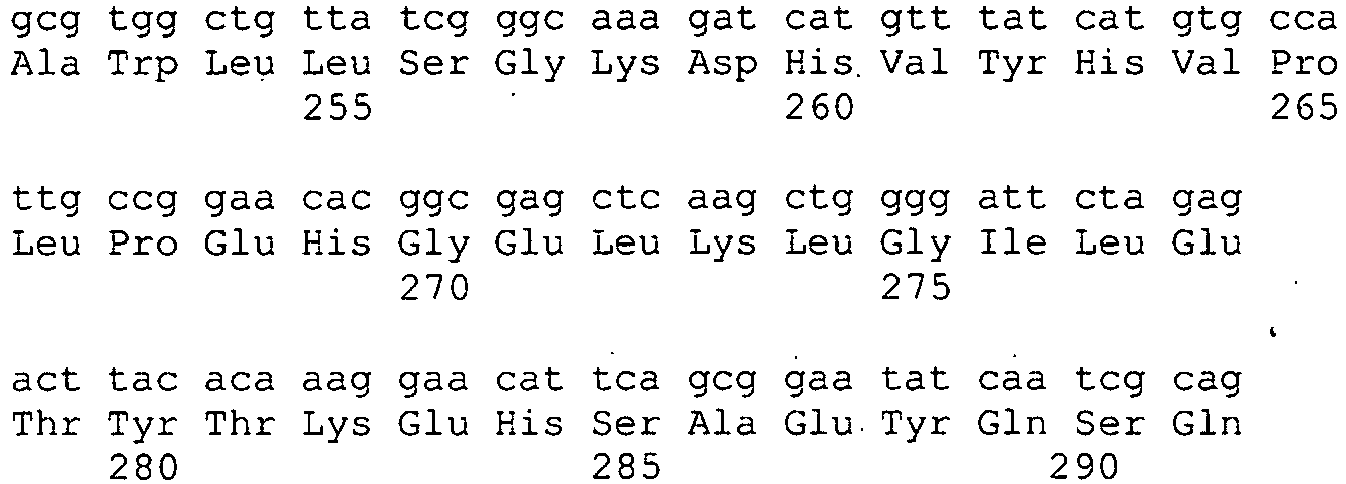
- Das Leseraster ist ebenfalls als SEQ ID NO:19 dargestellt. SEQ ID NO:20 zeigt die von diesem Leseraster kodierte Aminosäuresequenz. Die Position 21 in SEQ ID NO:20 entspricht der Position 272 von SEQ ID NO:2, 4, 6 bzw. 8.
- Ganz besonders bevorzugt werden Nukleinsäuremoleküle, die mindestens eine Nukleotidsequenz entsprechend Position 1504 bis 1623 von SEQ ID NO:7, oder mindestens eine Nukleotidsequenz entsprechend Position 1354 bis 1773 von SEQ ID NO: 7, oder mindestens eine Nukleotidsequenz entsprechend Position 1204 bis 1923 von SEQ ID NO:7, oder mindestens eine Nukleotidsequenz entsprechend Position 1054 bis 2073 von SEQ ID NO:7, oder mindestens eine Nukleotidsequenz entsprechend Position 904 bis 2223 von SEQ ID NO:7, oder mindestens eine Nukleotidsequenz entsprechend Position 754 bis 2235 von SEQ ID NO:7, oder mindestens eine Nukleotidsequenz entsprechend Position 754 bis 2238 von SEQ ID NO:7, oder mindestens eine Nukleotidsequenz entsprechend Position 754 bis 2241 von SEQ ID NO:7, umfassen.
- Die erfindungsgemäßen Leseraster, wie sie beispielhaft in SEQ ID NO:17 und 19 als Nukleotidsequenz und in SEQ ID NO:18 und SEQ ID NO:20 in Form der kodierten Aminosäuresequenz gezeigt sind, können darüberhinaus eine oder mehrere Mutationen enthalten, die zu einem oder mehreren konservativen Aminosäureaustauschen führen. Bevorzugt führen die Mutationen zu maximal 4%, zu maximal 2% oder zu maximal 1% konservativen Aminosäureaustauschen. Weiterhin können die erfindungsgemäßen Leseraster eine oder mehrere stille Mutationen enthalten. Bevorzugt enthalten die erfindungsgemäßen Leseraster höchstens 4% und besonders bevorzugt höchstens 2% bis höchstens 1% stille Mutationen.
- Die erfindungsgemäßen, isolierten Polynukleotide können dazu verwendet werden, um rekombinante Stämme von Mikroorganismen herzustellen, die im Vergleich zum Ausgangs- bzw. Elternstamm in verbesserter Weise Aminosäuren in das sie umgebende Medium abgeben oder im Zellinneren anhäufen.
- Eine verbreitete Methode zum Einbau von Mutationen in Gene coryneformer Bakterien ist die des Allelaustausches, die auch unter der Bezeichnung "gene replacement" bekannt ist. Bei diesem Verfahren wird ein DNA-Fragment, welches die interessierende Mutation enthält, in den gewünschten Stamm eines coryneformen Bakteriums transferiert und die Mutation durch wenigstens zwei Rekombinationsereignisse bzw. "cross over"-Ereignisse in das Chromosom des gewünschten Stammes inkorporiert bzw. die im betreffenden Stamm vorhandene Sequenz eines Gens gegen die mutierte Sequenz ausgetauscht.
- Von Schwarzer und Pühler (Bio/Technology 9, 84-87 (1991) wurde diese Methode verwendet um ein lysA-Allel, welches eine Deletion trug, und um ein lysA-Allel, welches eine Insertion trug, in das Chromosom von C. glutamicum anstelle des Wildtypgens einzubauen. Von Schäfer et al. (Gene 145, 69-73 (1994)) wurde diese Methode eingesetzt, um eine Deletion in das hom-thrB Operon von C. glutamicum einzubauen. Von
Nakagawa et al. (EP 1108790 ) und Ohnishi et al. (Applied Microbiology and Biotechnology 58(2), 217-223 (2002)) wurde diese Methode eingesetzt um verschiedene Mutationen ausgehend von den isolierten Allelen in das Chromosom von C. glutamicum einzubauen. Auf diese Weise gelang es Nakagawa et al. eine als Val59Ala bezeichnete Mutation in das Homoserin-Dehydrogenase Gen (hom), eine als Thr311Ile bezeichnete Mutation in das Aspartatkinase-Gen (lysC bzw. ask), eine als Pro458Ser bezeichnete Mutation in das Pyruvat-Carboxylase-Gen (pyc) und eine als Ala213Thr bezeichnete Mutation in das Glucose-6-phosphat-Dehydrogenase Gen (zwf) von C. glutamicum Stämmen einzubauen. - Für ein erfindungsgemäßes Verfahren kann ein erfindungsgemäßes Polynukleotid verwendet werden, welches die gesamte Kodierregion umfasst, wie beispielsweise in SEQ ID NO:5 gezeigt, oder welches einen Teil der Kodierregion umfasst, wie beispielsweise die Nukleotidsequenz, die für mindestens die Aminosäuresequenz entsprechend Position 252 bis 291 von SEQ ID NO:6 bzw. 8 kodiert und die als SEQ ID NO:17 und 19 dargestellt ist. Der Teil der Kodierregion entsprechend SEQ ID NO:17 und 19 umfasst eine Länge von ≥ 120 Nukleobasen. Bevorzugt werden solche Teile von SEQ ID NO:7, die mindestens die Sequenz zwischen Position 1354 und 1773, oder mindestens zwischen Position 1204 und 1923, oder mindestens zwischen Position 1054 und 2073, umfassen und dementsprechend eine Länge von ≥ 420, ≥ 720 oder ≥ 1020 Nukleobasen besitzen.
- Das DNA-Fragment enthaltend die interessierende Mutation liegt bei dieser Methode typischerweise in einem Vektor, insbesondere einem Plasmid, vor, das vorzugsweise von dem mit der Mutation zu versehenden Stamm nicht oder nur begrenzt repliziert wird. Als Hilfs- oder Zwischenwirt, in dem der Vektor replizierbar ist, wird im Allgemeinen ein Bakterium der Gattung Escherichia bevorzugt der Spezies Escherichia coli verwendet.
- Beispiele für derartige Plasmidvektoren sind die von Schäfer et al. (Gene 145, 69-73 (1994)) beschriebenen pK*mob und pK*mobsacB Vektoren, wie beispielsweise pK18mobsacB, und die in der
WO 02/070685 WO 03/014362 Nakamura et al. (US-A-6,303,2723 - Der Vektor wird anschließend durch Konjugation beispielsweise nach der Methode von Schäfer (Journal of Bacteriology 172, 1663-1666 (1990)) oder Transformation beispielsweise nach der Methode von Dunican und Shivnan (Bio/Technology 7, 1067-1070 (1989)) oder der Methode von Thierbach et al. (Applied Microbiology and Biotechnology 29, 356-362 (1988)) in das coryneforme Bakterium transferiert. Gegebenenfalls kann der Transfer der DNA auch durch Partikelbeschuss erzielt werden.
- Nach homologer Rekombination mittels eines ersten, Integration bewirkenden "cross-over"-Ereignisses und eines geeigneten zweiten, eine Exzision bewirkenden "cross-over"-Ereignisses im Zielgen bzw. in der Zielsequenz erreicht man den Einbau der Mutation und erhält ein rekombinantes Bakterium.
- Zur Identifizierung und Charakterisierung der erhaltenen Stämme können unter anderem die Methoden der Southern Blotting Hybridisierung, der Polymerase-Kettenreaktion, der Sequenzbestimmung, die Methode des "Fluorescence Resonance Energy Transfer" (FRET) (Lay et al. Clinical Chemistry 43, 2262-2267 (1997)) oder Methoden der Enzymologie eingesetzt werden.
- Die Beschreibung offenbart dementsprechend ein Verfahren zur Herstellung eines coryneformen Bakteriums, bei dem man
- a) ein erfindungsgemäßes Polynukleotid in ein coryneformes Bakterium transferiert,
- b) das im Chromosom des coryneformen Bakteriums vorhandene 2-Methylcitrat-Dehydratase Gen, das für eine Aminosäuresequenz mit L-Prolin an Position 272 oder an einer vergleichbaren Position der Aminosäuresequenz kodiert, gegen das Polynukleotid aus a) austauscht, das für eine Aminosäuresequenz kodiert, die an der Position 272 oder an einer vergleichbaren Position der Aminosäuresequenz eine andere proteinogene L-Aminosäure, vorzugsweise L-Leucin, besitzt, und
- c) das gemäß Schritt a) und b) erhaltene coryneforme Bakterium vermehrt.
- Auf diese Weise erhält man ein rekombinantes coryneformes Bakterium, welches anstelle des Wildtyp prpD1-Gens ein (1) erfindungsgemäßes prpD1-Allel enthält.
- Ein Verfahren zur Herstellung eines Mikroorganismus besteht darin, dass man
- a) ein erfindungsgemäßes Polynukleotid, das für ein Polypeptid mit 2-Methylcitrat-Dehydratase Enzymaktivität kodiert, in einen Mikrorganismus transferiert,
- b) das Polynukleotid in dem Mikroorganismus repliziert, und
- c) den gemäß Schritt a) und b) erhaltenen Mikroorganismus vermehrt.
- Auf diese Weise erhält man einen rekombinanten Mikroorganismus, welcher mindestens eine (1) Kopie oder mehrere Kopien eines erfindungsgemäßen Polynukleotids enthält. Weitere Gegenstände der Erfindung sind dementsprechend Wirte bzw. Wirtszellen, bevorzugt Mikroorganismen, besonders bevorzugt coryneforme Bakterien und Bakterien der Gattung Escherichia, die die erfindungsgemäßen Polynukleotide enthalten. Gegenstand der Erfindung sind gleichfalls Mikrorganismen, die unter Verwendung der isolierten Polynukleotide hergestellt wurden. Derartige Mikroorganismen oder Bakterien werden auch als rekombinante Mikroorganismen oder rekombinante Bakterien bezeichnet. In gleicher Weise sind Vektoren, die die erfindungsgemäßen Polynukleotide enthalten, Gegenstand der Erfindung. Schließlich sind Wirte, die diese Vektoren enthalten, ebenfalls Gegenstand der Erfindung.
- Zusätzlich kann es für die verbesserte Produktion von L-Aminosäuren, insbesondere L-Lysin, L-Tryptophan, L-Valin, L-Isoleucin und L-Homoserin, vorteilhaft sein, in den erfindungsgemäßen Mutanten oder rekombinanten Stämme verschiedene Gene zu überexprimieren. Die Verwendung endogener Gene wird im Allgemeinen bevorzugt.
- Unter "endogenen Genen" oder "endogenen Nukleotidsequenzen" versteht man die in der Population einer Art vorhandenen Gene bzw. Nukleotidsequenzen oder Allele.
- So kann für die Herstellung von L-Lysin eines oder mehrere der Gene, ausgewählt aus der Gruppe
- ein für ein Dihydrodipicolinat-Synthase (DapA, EC Nr. 4.2.1.52) kodierendes Gen dapA, wie beispielsweise das in der
EP 0 197 335 beschriebene dapA-Gen des Wildtyps von Corynebacterium glutamicum, - ein für eine Diaminopimelat-Decarboxylase (LysA, EC Nr. 4.1.1.20) kodierendes lysA-Gen, wie beispielsweise das in in der
US 6,090,597 beschriebene lysA-Gen von Corynebacterium glutamicum ATCC13869, - ein für eine Glucose-6-Phosphat Dehydrogenase (Zwf, EC Nr. 1.1.1.49) kodierendes Gen zwf, wie beispielsweise das in der
JP-A-09224661 EP-A-1108790 beschriebene zwf-Gen des Wildtyps von Corynebacterium glutamicum, - die in der
US-2003-0175911-A1 beschriebenen zwf-Allele von Corynebacterium glutamicum, die für ein Protein mit Glucose-6-Phosphat Dehydrogenase Aktivität kodieren, bei dem beispielsweise das L-Alanin an Position 243 der Aminosäuresequenz durch L-Threonin ersetzt ist oder bei dem die L-Asparaginsäure an Position 245 durch L-Serin ersetzt ist, - ein für eine Pyruvat-Carboxylase (Pyc, EC Nr. 6.4.1.1) kodierendes Gen pyc, wie beispielsweise das in der
DE-A-198 31 609 undEP 1108790 beschriebene pyc-Gen des Wildtyps von Corynebacterium glutamicum, - das in der
EP 1 108 790 beschriebene pyc-Allel von Corynebacterium glutamicum, das für ein Protein mit Pyruvat-Carboxylase Aktivität kodiert, bei dem L-Prolin an Position 458 der Aminosäuresequenz durch L-Serin ersetzt ist, - die in der
WO 02/31158 EP1325135B1 beschriebene pyc-Allele von Corynebacterium glutamicum, die für Proteine mit Pyruvat-Carboxylase Aktivität kodieren, welche einen oder mehrere der Aminosäureaustausche ausgewählt aus der Gruppe L-Valin an Position 1 ersetzt durch L-Methionin, L-Glutaminsäure an Position 153 ersetzt durch L-Asparaginsäure, L-Alanin an Position 182 ersetzt durch L-Serin, L-Alanin an Position 206 ersetzt durch L-Serin, L-Histidin an Position 227 ersetzt durch L-Arginin, L-Alanin an Position 455 ersetzt durch Glycin und L-Asparaginsäure an Position 1120 ersetzt durch L-Glutaminsäure tragen, - ein für eine Aspartatkinase (LysC, EC Nr. 2.7.2.4) kodierendes lysC Gen wie beispielsweise das als SEQ ID NO:281 in der
EP-A-1108790 (Siehe auch Zugangsnummer AX120085 und 120365) und das als SEQ ID NO:25 in derWO 01/00843 - ein für eine feed-back resistente Aspartatkinase Variante kodierendes lysCFBR Allel, insbesondere entsprechend Tabelle 1,
- ein für ein Lysin-Export-Protein (LysE) kodierendes Gen lysE, wie beispielsweise das in der
DE-A-195 48 222 beschriebene lysE-Gen von des Wildtyps Corynebacterium glutamicum, - das für eine Aspartat-Aminotransferase (Aat, EC Nr. 2.6.1.1) kodierende aat-Gen (Das aat-Gen von Corynebacterium glutamicum ATCC13032 ist beispielsweise bei Kalinowski et al (Journal of Biotechnology 104 (1-3), 5-25 (2003); siehe auch Zugangsnummer NC_006958) beschrieben. Es wird dort als aspB-Gen bezeichnet. In der
US 6,004,773 wird ein für eine Aspartat Aminotransferase kodierendes Gen als aspC bezeichnet. Marienhagen et al (Journal of Bacteriology 187 (22), 7693-7646 (2005) bezeichnen das aat-Gen als aspT-Gen.)), und - das für das Zwa1-Protein kodierende Gen zwa1 des Wildtyps von Corynebacterium glutamicum (
US 6,632,644 ) - Unter Überexpression versteht man allgemein eine Erhöhung der intrazellulären Konzentration oder Aktivität einer Ribonukleinsäure, eines Proteins oder eines Enzyms. Im Falle der vorliegenden Erfindung werden prpD1-Allele bzw. Polynukleotide überexprimiert, die für 2-Methylcitrat-Dehydratasen kodieren, die an Position 272 der Aminosäuresequenz des kodierten Polypeptids eine proteinogene Aminosäure ausgenommen L-Prolin enthalten, wobei der Austausch gegen L-Leucin bevorzugt wird. Es ist bekannt, dass durch wirtseigene Enzyme - sogenannte Aminopeptidasen - N-terminale Aminosäuren, insbesondere das N-terminale Methionin, vom gebildeten Polypeptid abgespalten werden können. Die genannte Erhöhung der Konzentration oder Aktivität eines Genproduktes lässt sich beispielsweise dadurch erzielen, dass man die Kopienzahl der entsprechenden Polynukleotide um mindestens eine Kopie erhöht.
- Eine weit verbreitete Methode zur Erhöhung der Kopienzahl besteht darin, dass man das entsprechende Gen oder Allel in einen Vektor, bevorzugt ein Plasmid, einbaut, der von einem coryneformen Bakterium repliziert wird. Geeignete Plasmidvektoren sind beispielsweise pZ1 (Menkel et al., Applied and Environmental Microbiology (1989) 64: 549-554) oder die von Tauch et al. (Journal of Biotechnology 99, 79-91 (2002)) beschriebenen pSELF-Vektoren. Ein Übersichtsartikel zum Thema Plasmide in Corynebacterium glutamicum findet sich bei Tauch et al. (Journal of Biotechnology 104, 27-40 (2003)).
- Eine andere verbreitete Methode zur Erzielung einer Überexpression ist das Verfahren der chromosomalen Genamplifikation. Bei dieser Methode wird mindestens eine zusätzliche Kopie des interessierenden Gens oder Allels in das Chromosom eines coryneformen Bakteriums eingefügt.
- In einer Ausführungsform, wie sie beispielsweise bei Reinscheid et al. (Applied and Environmental Microbiology 60, 126-132 (1994)) für das hom-thrB-Operon beschrieben ist, wird ein in C. glutamicum nicht-replikatives Plasmid, welches das interessierende Gen enthält, in ein coryneformes Bakterium transferiert. Nach homologer Rekombination mittels eines "cross over"-Ereignisses enthält der resultierende Stamm mindestens zwei Kopien des betreffenden Gens bzw. Allels.
- In einer anderen Ausführungsform, die in der
WO 03/040373 US-2003-0219881-A1 beschrieben ist, wird eine oder mehrere Kopie(n) des interessierenden Gens mittels mindestens zweier Rekombinationsereignisse in einen gewünschten Ort des Chromosoms von C. glutamicum eingefügt. Auf diese Weise wurde beispielsweise eine Kopie eines lysC-Allels, das für eine L-Lysin insensitive Aspartatkinase kodiert, in das gluB-Gen von C. glutamicum eingebaut. - In einer weiteren Ausführungsform, die in der
WO 03/014330 US-2004-0043458-A1 beschrieben ist, wird mittels mindestens zweier Rekombinationsereignisse am natürlichen Ort mindestens eine weitere Kopie, vorzugsweise in tandem-Anordnung zu dem bereits vorhandenen Gen oder Allel, des interessierenden Gens eingebaut. Auf diese Weise wurde beispielsweise eine tandem-Duplikation eines lysCFBR-Allels am natürlichen lysC-Genort erzielt. - Schließlich ist es möglich die Kopienzahl mit Hilfe von Transposons und IS-Elementen zu erhöhen (Siehe:
US 5,804,414 ,US 5, 591, 577 ). - Eine weitere Methode zur Erzielung einer Überexpression besteht darin, das entsprechende Gen bzw. Allel in funktioneller Weise (operably linked) mit einem Promotor bzw. einer Expressionskassette zu verknüpfen. Geeignete Promotoren für Corynebacterium glutamicum sind beispielsweise in dem Übersichtsartikel von Patek et al. (Journal of Biotechnology 104(1-3), 311-323 (2003) beschrieben. In gleicher Weise können die von Vasicova et al (Journal of Bacteriology 181, 6188-6191 (1999)) beschrieben Varianten des dapA-Promotors, beispielsweise der Promotor A25 eingesetzt werden. Weiterhin kann der gap-Promotor von Corynebacterium glutamicum (
EP 06007373 - Darüberhinaus kann die Promotor- und Regulationsregion oder die Ribosomenbindungsstelle, die sich stromaufwärts des Strukturgens befindet, mutiert werden. Durch Maßnahmen zur Verlängerung der Lebensdauer der mRNA wird ebenfalls die Expression verbessert. Weiterhin wird durch Verhinderung des Abbaus des Enzymproteins ebenfalls die Enzymaktivität verstärkt. Alternativ kann weiterhin eine Überexpression des betreffenden Gens oder Allels durch Veränderung der Medienzusammensetzung und Kulturführung erreicht werden.
- Durch die Maßnahmen der Überexpression wird die Aktivität oder Konzentration des entsprechenden Proteins im allgemeinen um mindestens 10%, 25%, 50%, 75%, 100%, 150%, 200%, 300%, 400% oder 500%, maximal bis 1000% oder 2000%, bezogen auf die Aktivität oder Konzentration des Proteins im Ausgangs-Mikroorganismus bzw. Elternstammes erhöht. Unter einem Ausgangs-Mikroorganismus oder Elternstamm versteht man einen Mikroorganismus, an dem die Massnahmen der Erfindung durchgeführt werden.
- Die Konzentration des Proteins kann über 1- und 2-dimensionale Proteingelauftrennung und anschließende optische Identifizierung der Proteinkonzentration mit enstprechender Auswertesoftware im Gel bestimmt werden. Eine gebräuchliche Methode zur Präparation der Proteingele bei coryneformen Bakterien und zur Identifizierung der Proteine ist die von Hermann et al. (Electrophoresis, 22:1712-23 (2001)) beschriebene Vorgehensweise. Die Proteinkonzentration kann ebenfalls durch Western-Blot-Hybridisierung mit einem für das nachzuweisende Protein spezifischen Antikörper (Sambrook et al., Molecular cloning: a laboratory manual. 2nd Ed. Cold Spring Harbor Laboratory Press, Cold Spring Harbor, N.Y., 1989) und anschließender optischer Auswertung mit entsprechender Software zur Konzentrationsbestimmung (Lohaus und Meyer (1998) Biospektrum 5:32-39; Lottspeich, Angewandte Chemie 272: 2630-2647 (1999)) bestimmt werden.
- Weiterhin kann es für die Produktion von L-Lysin vorteilhaft sein, neben der Verwendung der erfindungsgemäßen Allele des prpD1-Gens, gegebenenfalls bei gleichzeitige Überexpression von mindestens einem der Gene ausgewählt aus der vorstehend genannten Gruppe von Genen" gleichzeitig eines oder mehrere der endogenen Gene, ausgewählt aus der Gruppe
- ein für die Glucose-6-Phosphat-Isomerase (Pgi, EC Nr. 5.3.1.9) kodierendes Gen pgi, wie beispielsweise das in der
US 6,586,214 undUS 6,465,238 beschriebene pgi-Gen von Corynebacterium glutamicum, - ein für die Homoserin-Dehydrogenase(Hom, EC Nr. 1.1.1.3) kodierendes Gen hom, wie beispielsweise das in der
EP-A-0131171 beschriebene hom-Gen von Corynebacterium glutamicum, - ein für die Homoserin-Kinase (ThrB, EC Nr. 2.7.1.39) kodierendes Gen thrB, wie beispielsweise das von Peoples et al. (Molecular Microbiology 2 (1988): 63 - 72)) beschriebene thrB-Gen von Corynebacterium glutamicum und
- ein für die Phosphofruktokinase(PfkB, EC Nr. 2.7.1.56) kodierendes Gen pfkB, wie beispielsweise das in der
WO 01/00844 - ein für die Malat-Dehydrogenase (Mdh, EC Nr. 1.1.1.37) kodierendes Gen mdh, wie beispielsweise in der
WO 02/02778 - ein für die Malat-Chinon Oxidoreduktase (Mqo, EC Nr. 1.1.99.16) kodierendes Gen mqo, wie beispielsweise in der
US 7,094,106 undPCT/EP2005/057216 - Der Begriff "Abschwächung" beschreibt in diesem Zusammenhang die Verringerung oder Ausschaltung der intrazellulären Aktivität eines oder mehrerer Enzyme (Proteine) in einem Mikroorganismus, die durch die entsprechende DNA kodiert werden, indem man beispielsweise einen schwachen Promotor verwendet oder ein Gen bzw. Allel verwendet, das für ein entsprechendes Enzym mit einer niedrigen Aktivität kodiert bzw. das entsprechende Gen oder Enzym (Protein) inaktiviert und gegebenenfalls diese Maßnahmen kombiniert.
- Durch die Maßnahmen der Abschwächung wird die Aktivität oder Konzentration des entsprechenden Proteins im allgemeinen auf 0 bis 75%, 0 bis 50%, 0 bis 25%, 0 bis 10% oder 0 bis 5% der Aktivität oder Konzentration des Wildtyp-Proteins, bzw. der Aktivität oder Konzentration des Proteins im Ausgangs-Mikroorganismus, herabgesenkt.
- Als Mutationen zur Erzeugung einer Abschwächung kommen Transitionen, Transversionen, Insertionen und Deletionen von mindestens einem (1) Basenpaar bzw. Nukleotid in Betracht. In Abhängigkeit von der Wirkung des durch die Mutation hervorgerufenen Aminosäureaustausches auf die Enzymaktivität wird von Fehlsinnmutationen ("missense mutations") oder Nichtsinnmutationen ("nonsense mutations") gesprochen. Die Fehlsinnmutation führt zu einem Austausch einer gegebenen Aminosäure in einem Protein gegen eine andere, wobei es sich insbesondere um einen nicht-konservativen Aminosäureaustausch handelt. Hierdurch wird die Funktionsfähigkeit bzw. Aktivität des Proteins beeinträchtigt und auf einen Wert von 0 bis 75%, 0 bis 50%, 0 bis 25%, 0 bis 10% oder 0 bis 5% reduziert. Die Nichtsinnmutation führt zu einem Stopp-Kodon im Kodierbereich des Gens und damit zu einem vorzeitigen Abbruch der Translation. Insertionen oder Deletionen von mindestens einem Basenpaar in einem Gen führen zu Rasterverschiebungsmutationen ("frame shift mutations"), die dazu führen, dass falsche Aminosäuren eingebaut werden oder die Translation vorzeitig abbricht. Entsteht als Folge der Mutation ein Stopp-Kodon im Kodierbereich, so führt dies ebenfalls zu einem vorzeitigen Abbruch der Translation. Die genannten Massnahmen werden vorzugsweise im 5'-terminalen Teil der Kodierregion durchgeführt, welcher für den N-Terminus des Polypeptids kodiert. Bezeichnet man die Gesamtlänge eines Polypeptids (gemessen als Anzahl der chemisch verbundenen L-Aminosäuren) mit 100%, so gehört - im Rahmen der vorliegenden Erfindung - zum N-Terminus des Polypeptids der Teil der Aminosäuresequenz, welcher, gerechnet ab der Start-Aminosäure L-Formyl-Methionin 80% der nachfolgenden L-Aminosäuren enthält.
- Weitere Anleitungen zur Erzeugung derartiger Mutationen gehören zum Stand der Technik und können bekannten Lehrbüchern der Genetik und Molekularbiologie wie z.B. dem Lehrbuch von Knippers ("Molekulare Genetik", 6. Auflage, Georg Thieme Verlag, Stuttgart, Deutschland, 1995), dem von Winnacker ("Gene und Klone", VCH Verlagsgesellschaft, Weinheim, Deutschland, 1990) oder dem von Hagemann ("Allgemeine Genetik", Gustav Fischer Verlag, Stuttgart, 1986) entnommen werden. Weitere Maßnahmen sind im Stand der Technik beschrieben.
- Ein Methode zur gezielten Verringerung der Genexpression besteht darin, das abzuschwächende Gen unter die Kontrolle eines durch Zugabe dosierter Mengen von IPTG (Isopropyl-β-D-thiogalactopyranosid) induzierbaren Promotors, wie zum Beispiel des trc-Promotors oder des tac-Promotors, zu stellen. Hierzu eignen sich Vektoren wie beispielsweise der Escherichia coli Expressionsvektor pXK99E (
WO0226787 - Eingesetzt wurde diese Methode beispielsweise in der Patentschrift
WO0226787 - Eine weitere Methode zur spezifischen Verringerung der Genexpression ist die Antisense-Technik, wobei kurze Oligodesoxnyukleotide oder Vektoren zur Synthese längerer Antisense-RNA in die Zielzellen gebracht werden. Die Antisense-RNA kann dort an komplementäre Abschnitte spezifischer mRNAs binden und deren Stabilität verringern oder die Translatierbarkeit blocken. Ein Beispiel hierzu findet der Fachmann bei Srivastava et al. (Applied Environmental Microbiology 2000 Oct; 66 (10): 4366 - 4371).
- Die durch die Massnahmen der Erfindung erhaltenen isolierten coryneformen Bakterien zeigen eine im Vergleich zum eingesetzten Ausgangsstamm bzw. Elternstamm erhöhte Ausscheidung bzw. Produktion der gewünschten Aminosäure in einem Fermentationsprozess.
- Unter isolierten Bakterien sind die erfindungsgemäßen, isolierten bzw. erzeugten Mutanten und rekombinanten Bakterien, insbesonders coryneformer Bakterien, zu verstehen, welche ein prpD1-Allel enthalten, das für eine 2-Methylcitrat-Dehydratase kodiert, die den beschriebenen Aminosäureaustausch an Position 272 der Aminosäuresequenz enthält.
- Die Leistung der isolierten Bakterien bzw. des Fermentationsprozesses unter Verwendung derselben bezüglich eines oder mehrerer der Parameter ausgewählt aus der Gruppe der Produkt-Konzentration (Produkt pro Volumen), der ProduktAusbeute (gebildetes Produkt pro verbrauchter KohlenstoffQuelle) und der Produkt-Bildung (gebildetes Produkt pro Volumen und Zeit) oder auch anderer Prozess-Parameter und Kombinationen davon, wird um mindestens 0,5%, mindestens 1%, mindestens 1,5% oder mindestens 2% bezogen auf den Ausgangstamm bzw. Elternstamm bzw. den Fermentationsprozess unter Verwendung derselben verbessert.
- Die erfindungsgemäßen, isolierten coryneformen Bakterien können kontinuierlich - wie beispielsweise in der
PCT/EP2004/008882 - Das zu verwendende Kulturmedium bzw. Fermentationsmedium muß in geeigneter Weise den Ansprüchen der jeweiligen Stämme genügen. Beschreibungen von Kulturmedien verschiedener Mikroorganismen sind im Handbuch "Manual of Methods for General Bacteriology" der American Society for Bacteriology (Washington D.C., USA, 1981) enthalten. Die Begriffe Kulturmedium, Fermentationsmedium und Nährmedium bzw. Medium sind gegenseitig austauschbar.
- Als Kohlenstoffquelle können Zucker und Kohlehydrate wie z.B. Glucose, Saccharose, Laktose, Fructose, Maltose, Melasse, Saccharose-haltige Lösungen aus der Zuckerrüben- oder Zuckerrohrherstellung, Stärke, Stärkehydrolysat und'Cellulose, Öle und Fette, wie zum Beispiel Sojaöl, Sonnenblumenöl, Erdnußöl und Kokosfett, Fettsäuren, wie zum Beispiel Palmitinsäure, Stearinsäure und Linolsäure, Alkohole wie zum Beispiel Glycerin, Methanol und Ethanol und organische Säuren, wie zum Beispiel Essigsäure verwendet werden. Diese Stoffe können einzeln oder als Mischung verwendet werden.
- Als Stickstoffquelle können organische Stickstoff-haltige Verbindungen wie Peptone, Hefeextrakt, Fleischextrakt, Malzextrakt, Maisquellwasser, Sojabohnenmehl und Harnstoff oder anorganische Verbindungen wie Ammoniumsulfat, Ammoniumchlorid, Ammoniumphosphat, Ammoniumcarbonat und Ammoniumnitrat verwendet werden. Die Stickstoffquellen können einzeln oder als Mischung verwendet werden.
- Als Phosphorquelle können Phosphorsäure, Kaliumdihydrogenphosphat oder Dikaliumhydrogenphosphat oder die entsprechenden Natrium haltigen Salze verwendet werden.
- Das Kulturmedium muß weiterhin Salze beispielsweise in Form von Chloriden oder Sulfaten von Metallen wie beispielsweise Natrium, Kalium, Magnesium, Calcium und Eisen enthalten, wie zum Beispiel Magnesiumsulfat oder Eisensulfat, die für das Wachstum notwendig sind. Schließlich können essentielle Wuchsstoffe wie Aminosäuren beispielsweise Homoserin und Vitamine beispielsweise Thiamin, Biotin oder Pantothensäure zusätzlich zu den oben genannten Stoffen eingesetzt'werden. Dem Kulturmedium können überdies geeignete Vorstufen der jeweiligen Aminosäure zugesetzt werden.
- Die genannten Einsatzstoffe können zur Kultur in Form eines einmaligen Ansatzes hinzugegeben oder in geeigneter Weise während der Kultivierung zugefüttert werden.
- Zur pH - Kontrolle der Kultur werden basische Verbindungen wie Natriumhydroxid, Kaliumhydroxid, Ammoniak bzw. Ammoniakwasser oder saure Verbindungen wie Phosphorsäure oder Schwefelsäure in geeigneter Weise eingesetzt. Der pH wird im Allgemeinen auf einen Wert von 6,0 bis 9,0 vorzugsweise 6,5 bis 8 eingestellt. Zur Kontrolle der Schaumentwicklung können Antischaummittel, wie zum Beispiel Fettsäurepolyglykolester eingesetzt werden. Zur Aufrechterhaltung der Stabilität von Plasmiden können dem Medium geeignete selektiv wirkende Stoffe, wie zum Beispiel Antibiotika hinzugefügt werden. Um aerobe Bedingungen aufrechtzuerhalten, werden Sauerstoff oder Sauerstoff-haltige Gasmischungen, wie zum Beispiel Luft in die Kultur eingetragen. Die Verwendung von Flüssigkeiten, die mit Wasserstoffperoxid angereichert sind, ist ebenfalls möglich. Gegebenenfalls wird die Fermentation bei Überdruck, beispielsweise bei einem Überdruck von 0,03 bis 0,2 MPa, gefahren. Die Temperatur der Kultur liegt normalerweise bei 20°C bis 45°C und vorzugsweise bei 25°C bis 40°C. Bei batch-Verfahren wird die Kultivierung solange fortgesetzt, bis sich ein Maximum der gewünschten Aminosäure gebildet hat. Dieses Ziel wird normalerweise innerhalb von 10 Stunden bis 160 Stunden erreicht. Bei kontinuierlichen Verfahren sind längere Kultivierungszeiten möglich.
- Geeignete Fermentationsmedien sind unter anderem in der
US 6,221,636 , in derUS 5,840,551 , in derUS 5,770,409 , in derUS 5,605,818 , in derUS 5,275,940 , in derUS 4,275,157 und in derUS 4,224,409 beschrieben. - Methoden zur Bestimmung von L-Aminosäuren sind aus dem Stand der Technik bekannt. Die Analyse kann zum Beispiel so wie bei Spackman et al. (Analytical Chemistry, 30, (1958), 1190) beschrieben durch Anionenaustausch-Chromatographie mit anschließender Ninhydrin-Derivatisierung erfolgen, oder sie kann durch reversed phase HPLC erfolgen, so wie bei Lindroth et al. (Analytical Chemistry (1979) 51: 1167-1174) beschrieben.
- Gegenstand der Erfindung ist dementsprechend ein Verfahren zur Herstellung von L-Lysin bei dem man
- a) ein isoliertes coryneformes Bakterium in einem geeignetem Medium fermentiert, wobei das Bakterium ein für ein Polypeptid mit 2-Methylcitrat-Dehydratase Enzymaktivität kodierendes Gen enthält, wobei das Polypeptid an der Position 272 der Aminosäuresequenz von SEQ ID NO:2 entsprechenden Position L-Leucin enthält oder wobei das Polypeptid die Aminosäuresequenz von SEQ ID NO: 2 umfasst, bei der an Position 272 L-Leucin enthalten ist, und
- b) die L-Aminosäure in der Fermentationsbrühe oder in den Zellen des isolierten coryneformen Bakteriums akkumuliert.
- Daran schließt sich im Allgemeinen das Sammeln (collecting) der im Nährmedium bzw. in der Fermentationsbrühe und/oder in den Zellen der Bakterien akkumulierten L-Aminosäure an, um zu einem festen oder flüssigen Produkt zu gelangen.
- Unter einer Fermentationsbrühe versteht man ein Fermentationsmedium, in dem ein Mikroorganismus für eine gewisse Zeit und bei einer gewissen Temperatur kultiviert wurde. Das Fermentationsmedium bzw. die während der Fermentation eingesetzten Medien enthält/enthalten sämtliche Substanzen bzw. Komponenten, die eine Vermehrung des Mikroorganismus und eine Bildung der gewünschten Aminosäure sicherstellt.
- Bei Abschluss der Fermentation enthält die entstandene Fermentationsbrühe dementsprechend a) die infolge der Vermehrung der Zellen des Mikroorganismus entstandene Biomasse (Zellmasse) des Mikroorganismus, b) die im Laufe der Fermentation gebildete, gewünschte Aminosäure, c) die im Laufe der Fermentation gebildeten organischen Nebenprodukte und d) die durch die Fermentation nicht verbrauchten Bestandteile des/der eingesetzten Fermentationsmediums/ Fermentationsmedien bzw. der Einsatzstoffe wie beispielsweise Vitamine wie Biotin, Aminosäuren wie Homoserin oder Salze wie Magnesiumsulfat.
- Zu den organischen Nebenprodukten gehören Stoffe, die von den bei der Fermentation eingesetzten Mikroorganismen gegebenenfalls neben der jeweiligen erwünschten L-Aminosäure erzeugt und gegebenenfalls ausgeschieden werden. Hierzu zählen L-Aminosäuren, die im Vergleich zur erwünschten Aminosäure weniger als 30%, 20% oder 10% ausmachen. Hierzu gehören weiterhin organische Säuren, die ein bis drei Carboxyl-Gruppen tragen wie zum Beispiel Essigsäure, Milchsäure, Zitronensäure, Apfelsäure oder Fumarsäure. Schließlich gehören dazu auch Zucker wie zum Beispiel Trehalose.
- Typische für industrielle Zwecke geeignete Fermentationsbrühen haben typischerweise einen Aminosäuregehalt von 30 g/kg bis 200 g/kg oder 40 g/kg bis 180 g/kg oder 50 g/kg bis 150 g/kg. Der Gehalt an Biomasse (als getrocknete Biomasse) beträgt im Allgemeinen 20 bis 50 g/kg.
- Im Falle der Aminosäure L-Lysin sind im Stand der Technik im wesentlichen vier verschiedene Produktformen bekannt.
- Eine Gruppe L-Lysin-haltiger Produkte umfasst konzentrierte, wässrige, alkalische Lösungen von aufgereinigtem L-Lysin (
EP-B-0534865 ). Eine weitere Gruppe, wie beispielsweise in derUS 6,340,486 undUS 6,465,025 beschrieben, umfasst wässrige, saure, Biomasse-haltige Konzentrate von L-Lysin-haltigen Fermentationsbrühen. Die bekannteste Gruppe fester Produkte umfasst pulverförmige oder kristalline Formen von aufgereinigtem bzw. reinem L-Lysin, das typischerweise in Form eines Salzes wie zum Beispiel L-Lysin-Monohydrochlorid vorliegt. Eine weitere Gruppe fester Produktformen ist beispielsweise in derEP-B-0533039 beschrieben. Die dort beschriebene Produktform enthält neben L-Lysin den größten Teil der während der fermentativen Herstellung verwendeten und nicht verbrauchten Einsatzstoffe und gegebenfalls die Biomasse des eingesetzten Mikroorganismus mit einem Anteil von >0% - 100%. - Im Falle der Aminosäuren L-Valin, L-Isoleucin, L-Prolin, L-Tryptophan und L-Homoserin sind im Stand der Technik im wesentlichen Produktformen bekannt, die die betreffenden Aminosäuren in aufgereinigter bzw. reiner Form (≥ 95 Gew.-% oder ≥ 98 Gew.-%) enthalten.
- Entsprechend der verschiedenen Produktformen kennt man verschiedenste Verfahren, bei denen die L-Aminosäure aus der Fermentationsbrühe gesammelt, isoliert oder gereinigt wird, um das L-Aminosäure haltige Produkt oder die gereinigte L-Aminosäure herzustellen.
- Zur Herstellung von festen, reinen L-Aminosäuren werden im wesentlichen Methoden der Ionenaustauschchromatographie gegebenfalls unter Verwendung von Aktivkohle und Methoden der Kristallisierung angewendet. Im Falle des Lysin erhält man auf diese Weise die entsprechende Base oder ein entsprechendes Salz wie beispielsweise das Monohydrochlorid (Lys-HCl) oder das Lysinsulfat (Lys2-H2SO4).
- Im Falle des Lysin ist in der
EP-B-0534865 ein Verfahren zur Herstellung wässriger, basischer L-Lysin haltiger Lösungen aus Fermentationsbrühen beschrieben. Bei dem dort beschriebenen Verfahren wird die Biomasse aus der Fermentationsbrühe abgetrennt und verworfen. Mittels einer Base wie beispielsweise Natrium-, Kalium- oder Ammoniumhydroxid wird ein pH-Wert zwischen 9 bis 11 eingestellt. Die mineralischen Bestandteile (anorganischen Salze) werden nach Konzentrierung und Abkühlung durch Kristallisation aus der Brühe abgetrennt und entweder als Dünger verwendet oder verworfen. - Bei Verfahren zur Herstellung von Lysin unter Verwendung der erfindungsgemäßen Bakterien werden auch solche Verfahren eingesetzt, bei denen Produkte erhalten werden, die Bestandteile der Fermentationsbrühe enthalten. Diese werden insbesondere als Tierfuttermitteladditive verwendet.
- Je nach Anforderung kann die Biomasse ganz oder teilweise durch Separationsmethoden wie z.B. der Zentrifugation, der Filtration, dem Dekantieren oder einer Kombination hieraus aus der Fermentationsbrühe entfernt oder vollständig in ihr belassen werden. Gegebenenfalls wird die Biomasse bzw. die Biomasse enthaltene Fermentationsbrühe während eines geeigneten Verfahrensschrittes inaktiviert beispielsweise durch thermische Behandlung (Erhitzen) oder durch Säurezugabe.
- Die chemischen Bestandteile der Biomasse sind unter anderem die Zellhülle, beispielsweise das Peptidoglykan und das Arabinogalaktan, das Protein bzw. Polypeptid, beispielsweise das 2-Methylcitrat-Dehydratase Polypeptid, Lipide und Phospholipide und Nukleinsäuren (DNA und RNA), beispielsweise Polynukleotide enthaltend die erfindungsgemäße Mutation. Als Folge der Massnahmen der Inaktivierung und/oder der weitereren Verfahrensschritte (beispielsweise Ansäuerung,Sprühtrocknung, Granulation etc.) liegen Nukleinsäuren typischerweise als Fragmente mit eine Länge von unter anderem ≥40 - 60 bp, >60 - 80 bp, >80 - 100 bp, >100 - 200 bp, >200 - 300 bp, >300 - 400 bp, >400 - 500 bp, >500 - 750 bp, >750 - 1000 bp, >1000 -1250 bp, >1250 - 1500 bp, >1500 - 1750 bp, >1750 - 2000 bp, >2000 - 2500 bp, >2500 - 3000 bp, >3000 - 4000 bp, >4000 - 5000 bp vor.
- In einer Verfahrensweise wird die Biomasse vollständig oder nahezu vollständig entfernt, sodass keine (0 %) oder höchstens 30%, höchstens 20%, höchstens 10%, höchstens 5%, höchstens 1% oder höchstens 0,1% Biomasse im hergestellten Produkt verbleibt. In einer weiteren Verfahrensweise wird die Biomasse nicht oder nur in geringfügigen Anteilen entfernt, sodass sämtliche (100%) oder mehr als 70%, 80%, 90%, 95%, 99% oder 99,9% Biomasse im hergestellten Produkt verbleibt. In einem erfindungsgemäßen Verfahren wird dementsprechend die Biomasse in Anteilen ≥ 0% bis ≤ 100% entfernt.
- Schließlich kann die nach der Fermentation erhaltene Fermentationsbrühe vor oder nach der vollständigen oder teilweisen Entfernung der Biomasse mit einer anorganischen Säure wie beispielsweise Salzsäure, Schwefelsäure oder Phosphorsäure oder organischen Säure wie beispielsweise Propionsäure auf einen sauren pH Wert gestellt werden (
GB 1,439,728 EP 1 331 220 ). Es ist gleichfalls möglich die Fermentationsbrühe mit der vollständig enthaltenen Biomasse anzusäuern (US 6,340,486 oderUS 6, 465, 025 ). Schließlich kann die Brühe auch durch Zusatz von Natriumbisulfit (NaHSO3,GB 1,439,728 - Bei der Abtrennung der Biomasse werden gegebenenfalls in der Fermentationsbrühe enthaltene organische oder anorganische Feststoffe teilweise oder ganz entfernt. Die in der Fermentationsbrühe gelösten organischen Nebenprodukte und die gelösten nicht verbrauchten Bestandteile des Fermentationsmediums (Einsatzstoffe) bleiben mindestens teilweise (> 0%), bevorzugt zu mindestens 25%, besonders bevorzugt zu mindestens 50% und ganz besonders bevorzugt zu mindestens 75% im Produkt. Gegebenenfalls bleiben diese auch vollständig (100%) oder nahezu vollständig das heißt > 95% oder > 98% im Produkt. In diesem Sinne bedeutet der Begriff "Fermentationsbrühebasis", dass ein Produkt mindestens einen Teil der Bestandteile der Fermentationsbrühe enthält.
- Anschließend wird der Brühe mit bekannten Methoden wie z.B. mit Hilfe eines Rotationsverdampfers, Dünnschichtverdampfers, Fallfilmverdampfers, durch Umkehrosmose oder durch Nanofiltration Wasser entzogen bzw. eingedickt oder konzentriert. Diese aufkonzentrierte Fermentationsbrühe kann anschließend durch Methoden der Gefriertrocknung, der Sprühtrocknung, der Sprühgranulation oder durch anderweitige Verfahren wie zum Beispiel in der zirkulierenden Wirbelschicht gemäß
PCT/EP2004/006655 - Es ist ebenfalls möglich, die Fermentationsbrühe direkt d. h. ohne vorherige Aufkonzentrierung durch Sprühtrocknung oder Sprühgranulation zu trocknen.
- Unter "rieselfähig" versteht man Pulver, die aus einer Serie von Glasauslaufgefäßen mit verschieden großen Auslauföffnungen mindestens aus dem Gefäß mit der Öffnung 5 mm (Millimeter) ungehindert auslaufen (Klein: Seifen, Öle, Fette, Wachse 94, 12 (1968)).
- Mit "feinteilig" ist ein Pulver mit überwiegendem Anteil (> 50 %) einer Korngröße von 20 bis 200 µm Durchmesser gemeint.
- Mit "grobkörnig" ist ein Produkt mit einem überwiegendem Anteil (> 50 %) einer Korngröße von 200 bis 2000 µm Durchmesser gemeint.
- Die Korngrößenbestimmung kann mit Methoden der Laserbeugungsspektrometrie durchgeführt werden. Die entsprechenden Methoden sind im Lehrbuch zur "Teilchengrößenmessung in der Laborpraxis" von R. H. Müller und R. Schuhmann, Wissenschaftliche Verlagsgesellschaft Stuttgart (1996) oder im Lehrbuch "Introduction to Particle Technology" von M. Rhodes, Verlag Wiley & Sons (1998) beschrieben.
- Das rieselfähige, feinteilige Pulver kann wiederum durch geeignete Kompaktier- oder Granulier-Verfahren in ein grobkörniges, gut rieselfähiges, lagerbares und weitgehend staubfreies Produkt überführt werden.
- Der Begriff "staubfrei" bedeutet, daß das Produkt lediglich geringe Anteile (< 5 %) an Körngrößen unter 100 µm Durchmesser enthält.
- "Lagerbar", im Sinne dieser Erfindung, bedeutet ein Produkt, das mindestens ein (1) Jahr oder länger, bevorzugt mindestens 1,5 Jahre oder länger, besonders bevorzugt zwei (2) Jahre oder länger in trockener und kühler Umgebung gelagert werden kann ohne das ein wesentlicher Verlust (< 5%) der jeweiligen Aminosäure auftritt.
- Ein weiterer Gegenstand der Erfindung ist dementsprechend ein Verfahren zur Herstellung eines L-Lysin Produktes, bevorzugt Tierfuttermittel-Additivs, aus Fermentationsbrühen, gekennzeichnet durch die Schritte
- a) Kultivierung und Fermentation eines L-Aminosäure ausscheidenden coryneformen Bakteriums, welches mindestens ein prpD1-Allel enthält, das für ein Polypeptid mit 2-Methylcitrat-Dehydratase Aktivität kodiert, wobei das Polypeptid an der Position 272 der Aminosäuresequenz von SEQ ID NO:2 entsprechenden Position L-Leucin enthält oder wobei das Polypeptid die Aminosäuresequenz von SEQ ID NO: 2 umfasst, bei der an Position 272 L-Leucin enthalten ist, in einem Fermentationsmedium,
- b) Entfernung der während der Fermentation gebildeten Biomasse in einer Menge von 0 bis 100 Gew.-%, und
- c) Trocknung der gemäß a) und/oder b) erhaltenen Fermentationsbrühe, um das Produkt in der gewünschten Pulver- oder Granulatform zu erhalten
- Die Beschreibung offenbart auch ein Verfahren zur Herstellung eines Lysinsulfat haltigen Produktes, das in seinen Grundzügen in der
DE 102006016158 beschrieben ist, und bei dem die unter Verwendung der erfindungsgemäßen Mikroorganismen erhaltene Fermentationsbrühe, aus der die Biomasse gegebenenfalls ganz oder teilweise abgetrennt wurde, weiterverarbeitet wird, indem man ein Verfahren durchführt das mindestens folgende Schritte umfasst: - a) den pH-Wert durch Zugabe von Schwefelsäure auf 4,0 bis 5,2, insbesondere 4,9 bis 5,1, absenkt, und ein molares Sulfat/L-Lysin-Verhältnis von 0,85 bis 1,2, bevorzugt 0,9 bis 1,0, besonders bevorzugt >0,9 bis <0,95, in'der Brühe einstellt, gegebenenfalls durch Zugabe von einer weiteren oder mehreren Sulfat-haltigen Verbindung(n) und
- b) das so erhaltene Gemisch durch Wasserentzug aufkonzentriert, und gegebenenfalls granuliert,
wobei gegebenenfalls vor Schritt a) eine oder beide der folgenden Massnahmen durchgeführt wird/werden: - c) Messung des molaren Verhältnisses von Sulfat/L-Lysin zur Ermittlung der benötigten Menge an Sulfat-haltigen Verbindung(n)
- d) Zusatz einer Sulfat-haltigen Verbindung ausgewählt aus der Gruppe Ammoniumsulfat, Ammoniumhydrogensulfat und Schwefelsäure in entsprechenden Verhältnissen.
- Gegebenenfalls wird weiterhin vor Schritt b) ein Salz der schwefligen Säure, bevorzugt Alkalihydrogensulfit, besonders bevorzugt Natriumhydrogensulfit in einer Konzentration von 0,01 bis 0,5 Gew.-%, bevorzugt 0,1 bis 0,3 Gew.-%, besonders bevorzugt 0,1 bis 0,2 Gew.-% bezogen auf die Fermentationsbrühe hinzugesetzt.
- Als bevorzugte Sulfat-haltigen Verbindungen im Sinne der oben genannten Verfahrensschritte sind insbesondere Ammoniumsulfat und/oder Ammoniumhydrogensulfat oder entsprechende Mischungen von Ammoniak und Schwefelsäure und Schwefelsäure selbst zu nennen.
- Das molare Sulfat/L-Lysin-Verhältnis V wird nach der Formel: V = 2 x [SO4 2-] / [L-Lysin] berechnet. Diese Formel berücksichtigt die Tatsache, dass das SO4 2- Anion zweiwertig ist. Ein Verhältnis V = 1 bedeutet, dass ein stöchiometrisch zusammengesetztes Lys2(SO4) vorliegt, während bei einem Verhältnis von V = 0,9 ein 10%iger Sulfatunterschuss und bei einem Verhältnis von V = 1,1 ein 10% Sulfatüberschuss gefunden wird.
- Vorteilhaft bei der Granulation oder Kompaktierung ist der Einsatz von üblichen organischen oder anorganischen Hilfsstoffen, bzw. Trägern wie Stärke, Gelatine, Cellulosederivaten oder ähnlichen Stoffen, wie sie üblicherweise in der Lebensmittel- oder Futterverarbeitung als Binde-, Gelier-, oder Verdickungsmittel Verwendung finden, oder von weiteren Stoffen wie zum Beispiel Kieselsäuren, Silikaten (
EP0743016A ) Stearaten. - Weiterhin ist es vorteilhaft die Oberfläche der erhaltenen Granulate mit Ölen zu versehen so wie es in der
WO 04/054381 - Bevorzugt sind Produkte mit einem Anteil von ≥ 97 Gew.-% einer Korngröße von 100 bis 1800 µm oder einem Anteil von ≥ 95 Gew.-% einer Korngröße von 300 bis 1800 µm Durchmesser. Der Anteil an Staub d. h. Partikeln mit einer Korngrösse < 100 µm liegt bevorzugt bei > 0 bis 1 Gew.-% besonders bevorzugt bei maximal 0,5 Gew.-%.
- Alternativ kann das Produkt aber auch auf einen in der Futtermittelverarbeitung bekannten und üblichen organischen oder anorganischen Trägerstoff wie zum Beispiel Kieselsäuren, Silikate, Schrote, Kleien, Mehle, Stärken Zucker oder andere aufgezogen und/oder mit üblichen Verdickungs- oder Bindemitteln vermischt und stabilisiert werden. Anwendungsbeispiele und Verfahren hierzu sind in der Literatur (Die Mühle + Mischfuttertechnik 132 (1995) 49, Seite 817) beschrieben.
- Schließlich kann das Produkt auch durch Beschichtungsverfahren ("Coating") mit Filmbildnern wie beispielsweise Metallcarbonate, Kieselsäuren, Silikate, Alginate, Stearate, Stärken, Gummis und Celluloseether, wie in der
DE-C-4100920 beschrieben, in einen Zustand gebracht werden, in dem es stabil gegenüber der Verdauung durch Tiermägen insbesondere dem Magen von Wiederkäuern ist. - Zur Einstellung einer gewünschten Aminosäurekonzentration im Produkt kann je nach Anforderung die entsprechende Aminosäure während des Verfahrens in Form eines Konzentrates oder gebenenfalls einer weitgehend reinen Substanz bzw. dessen Salz in flüssiger oder fester Form hinzugefügt werden. Diese können einzeln oder als Mischungen zur erhaltenen oder aufkonzentrierten Fermentationsbrühe, oder auch während des Trocknungs- oder Granulationsprozesses hinzugefügt werden.
- Ein weiterer Gegenstand der Erfindung ist ein Verfahren zur Herstellung eines festen Lysin-haltigen Produktes, wie es in seinen Grundzügen in der
US 20050220933 beschrieben ist, und das die Aufarbeitung der unter Verwendung der erfindungsgemäßen Mikroorganismen erhaltenen Fermentationsbrühe in folgenden Schritten umfasst: - a) Filtration der Fermentationsbrühe, bevorzugt mit einem Membranfilter, so dass ein Biomasse-haltiger Schlamm und ein Filtrat erhalten wird,
- b) Aufkonzentration des Filtrates, bevorzugt so, dass ein Feststoffgehalt von 48 bis 52 Gew.-% erhalten wird,
- c) Granulation des in Schritt b) erhaltenen Konzentrates, bevorzugt bei einer Temperatur von 50°C bis 62°C, und
- d) Beschichtung des in c) erhaltenen Granulates mit einem oder mehreren der Beschichtungsmittel (coating agent(s))
- Zur Beschichtung in Schritt d) werden bevorzugt Beschichtungsmittel verwendet, welche ausgewählt werden aus der Gruppe, bestehend aus
- d1) der in Schritt a) erhaltenen Biomasse,
- d2) einer L-Lysin-haltigen Verbindung, bevorzugt ausgewählt aus der Gruppe L-Lysinhydrochlorid oder L-Lysinsulfat,
- d3) einem im wesentlichen L-Lysin-freien Stoff mit L-Lysingehalt < 1 Gew.-%, bevorzugt < 0,5 Gen.-%, bevorzugt ausgewählt aus der Gruppe Stärke, Karageenan, Agar, Kieselsäuren, Silikate, Schrote, Kleien und Mehle, und
- d4) einem wasserabstoßenden Stoff, bevorzugt ausgewählt aus der Gruppe Öle, Polyethylenglykole und flüssige Paraffine.
- Im Falle des Lysin wird bei der Herstellung Lysin-haltiger Produkte das Verhältnis der Ionen bevorzugt so eingestellt, dass das äquivalente Ionenverhältnis entsprechend nachstehender Formel

- 0,68 bis 0,95, bevorzugt 0,68 bis 0,90 ergibt, so wie von Kushiki et al. in der
US 20030152633 beschrieben (In den "[]" sind die molaren Konzentrationen anzugeben.). - Im Falle des Lysin hat das auf diese Weise hergestellte feste Produkt auf Fermentationsbrühebasis einen Lysingehalt (als Lysinbase) von 10 Gew.-% bis 70 Gew.-% oder 20 Gew.-% bis 70 Gew.-%, bevorzugt 30 Gew.-% bis 70 Gew.-% und ganz besonders bevorzugt von 40 Gew.-% bis 70 Gew.-% bezogen auf die Trockenmasse des Produkts. Maximale Gehalte an Lysinbase von 71 Gew.-% , 72 Gew.-%, 73 Gew.-% sind ebenfalls möglich.
- Im Falle einer elektrisch neutralen Aminosäure wie dem L-Tryptophan hat das auf diese Weise hergestellte feste Produkt auf Fermentationsbrühebasis einen Aminosäuregehalt von mindestens 5 Gew.-%, 10 Gew.-%, 20 Gew.-%, 30 Gew.-% und maximal 50 Gew.-%, 60 Gew.-%, 70 Gew.-%, 80 Gew.-%, 90 Gew.-% oder bis 95 Gew.-%.
- Der Wassergehalt des festen Produktes beträgt bis zu 5 Gew.-%, bevorzugt bis zu 4 Gew.-%, und besonders bevorzugt weniger als 3 Gew.-%.
- Die Beschreibung offenbart auch ein L-Lysin haltiges Futtermitteladditiv auf Fermentationsbrühebasis, welches folgende Merkmale aufweist
- a) einen Lysingehalt (als Base) von mindestens 10 Gew.-% bis maximal 73 Gew.-%,
- b) einen Wassergehalt von höchstens 5 Gew.-%, und
- c) einen Biomassegehalt ensprechend mindestens 0,1 % der in der Fermentationsbrühe enthaltenen Biomasse, wobei die gegebenenfalls inaktivierte Biomasse aus erfindungsgemäßen coryneformen Bakterien gebildet wird.
- Die Beschreibung offenbart auch ein L-Tryptophan haltiges Futtermitteladditiv auf Fermentationsbrühebasis, welches folgende Merkmale aufweist
- a) einen Tryptophangehalt von mindestens 5 Gew.-% bis maximal 95 Gew.-%,
- b) einen Wassergehalt von höchstens 5 Gew.-%, und
- c) einen Biomassegehalt ensprechend mindestens 0,1 % der in der Fermentationsbrühe enthaltenen Biomasse, wobei die gegebenenfalls inaktivierte Biomasse aus erfindungsgemäßen coryneformen Bakterien gebildet wird.
- Der Stamm MH20-22B wurde am 28 Oktober 2004 bei der Deutschen Sammlung für Mikroorganismen und Zellkulturen (DSMZ, Braunschweig, Deutschland) als DSM 16835 hinterlegt.
- Die erfindungsgemäße Mutante Corynebacterium glutamicum DM1916, die L-Leucin an Position 272 der Aminosäuresequenz des PrpD1-Polypeptids enthält, wurde am 15. Mai 2006 bei der Deutschen Sammlung für Mikroorganismen und Zellkulturen (DSMZ, Braunschweig, Deutschland) als DSM 18258 hinterlegt.
- Die vorliegende Erfindung wird im Folgenden anhand von Ausführungsbeispielen näher erläutert.
- Der Corynebacterium glutamicum Stamm DM416 wurde als Ausgangsstamm für die Mutagenese mit N-Methyl-N'-Nitro-N-Nitrosoguanidin (MNNG) eingesetzt. Der Stamm DM416 ist eine Homoserin- und Leucin-bedürftige Mutante von Corynebacterium glutamicum und unter der Bezeichnung ATCC21543 bei der American Type Culture Collection (Manassas, VA, USA) hinterlegt.
- Der Stamm DM416 wurde in 10 ml LB-Bouillon (Merck, Darmstadt, Germany), die in einem 100 ml Erlenmeyerkolben enthalten waren, für 24 Stunden bei 33°C und 200 rpm auf einem Rotations-Schüttler vom Typ Certomat BS-1 (B. Braun Biotech International, Melsungen, Deutschland) kultiviert. Anschließend wurde die Kultur abzentrifugiert, das Sediment in 10 ml 0,9% NaCl-Lösung resuspendiert, die erhaltene Suspension erneut abzentrifugiert und das erhaltene Sediment in 10 ml 0,9% NaCl-Lösung aufgenommen. 5 ml dieser Zellsuspension wurden mit 400µg/ml MNNG für 15 Minuten bei 30°C und 200 rpm auf einem Schüttler (siehe oben) behandelt. Anschließend wurde der Mutageneseansatz abzentrifugiert und das Sediment in 10 ml 2% Na-Thiosulfat in 0,9% NaCl-Puffer (pH = 6,0) aufgenommen. Die Zellsuspension wurde anschließend im Verhältnis 1:1000, 1:10000 und 1:100000 mit 0,9% NaCl-Lösung verdünnt, und Aliquots auf Hirn-Herz-Agar (Merck, Darmstadt, Deutschland) ausplattiert. Auf diese Weise wurden ungefähr 4000 Mutanten isoliert.
- Die in Beispiel 1 erhaltenen Mutanten wurden in einem zur Produktion von Lysin geeigneten Nährmedium kultiviert und der Lysingehalt im Kulturüberstand bestimmt.
- Dazu wurden die Klone zunächst auf Hirn-Herz-Agarplatten (Merck, Darmstadt, Deutschland) für 24 Stunden bei 33°C vermehrt. Ausgehend von diesen Agarplattenkulturen wurde je eine Vorkultur angeimpft (10 ml Medium im 100 ml Erlenmeyerkolben). Als Medium für die Vorkultur wurde das Medium MM verwendet. Die Vorkultur wurde 24 Stunden bei 33°C und 240 rpm auf einem Schüttler inkubiert. Von dieser Vorkultur wurde eine Hauptkultur angeimpft, so dass die Anfangs-OD (660 nm) der Hauptkultur 0,1 OD betrug. Für die Hauptkultur wurde ebenfalls das Medium MM verwendet.
-
CSL 5 g/l MOPS 20 g/l Glucose (getrennt autoklaviert) 50 g/l Salze: (NH4)2SO4) 25 g/l KHZPO4 0,1 g/l MgSO4 * 7 H2O 1,0 g/l CaCl2 * 2 H2O 10 mg/l FeSO4 * 7 H2O 10 mg/l MnSO4 * H2O 5,0mg/l Biotin (sterilfiltriert) 0,3 mg/l Thiamin * HCl (sterilfiltriert) 0,2 mg/l L-Leucin (sterilfiltriert) 0,2 g/l L-Homoserin (sterilfiltriert) 0,2 g/l CaCO3 25 g/l - CSL (Corn Steep Liquor), MOPS (Morpholinopropansulfonsäure) und die Salzlösung wurden mit Ammoniakwasser auf pH 7 eingestellt und autoklaviert. Anschließend wurden die sterilen Substrat- und Vitaminlösungen sowie das trocken aütoklavierte CaCO3 zugesetzt.
- Die Kultivierung erfolgte in Volumina von 10 ml, die in 100 ml Erlenmeyerkolben mit Schikanen enthalten waren. Die Temperatur betrug 33°C, die Umdrehungszahl 250 rpm und die Luftfeuchte 80%.
- Nach 24 Stunden wurde die optische Dichte (OD) bei einer Meßwellenlänge von 660 nm mit dem Biomek 1000 (Beckmann Instruments GmbH, München, Deutschland) bestimmt. Die gebildete Lysinmenge wurde mit einem Aminosäureanalysator der Firma Eppendorf-BioTronik (Hamburg, Deutschland) durch Ionenaustauschchromatographie und Nachsäulenderivatisierung mit Ninhydrindetektion bestimmt. Eine Mutante, die sich durch eine erhöhte Lysinbildung auszeichnete, wurde als DM1916 bezeichnet.
Tabelle 1 Stamm OD(660) Lysin-HCl (g/l) DM416 6,3 1,43 DM1916 6,3 1,61 - Aus dem Klon DM1916 wurde mit der Methode von Eikmanns et al. (Microbiology 140: 1817 - 1828 (1994)) chromosomale DNA isoliert. Mit Hilfe der Polymerase-Kettenreaktion wurde ein DNA-Abschnitt amplifiziert, welcher das prpD1-Gen bzw. Allel trägt. Aufgrund der für C. glutamicum bekannten Sequenz des prpD1-Gens (Sequenz Nr. 770 aus
EP1108790 ) wurden folgende Primer-Oligonukleotide für die PCR ausgewählt: - prpD1_XL_A1 (SEQ ID NO: 9):
- 5' gcgaattcta aactgcgtga ggttgtgg 3'
- prpD1_XL_A2 (SEQ ID NO: 10):
- 5' gcgaattctc cccacatcaa caccattc 3'
- Die dargestellten Primer wurden von der Firma MWG Biotech (Ebersberg, Deutschland) synthetisiert und nach der Standard-PCR-Methode von Innis et al. (PCR Protocols. A Guide to Methods and Applications, 1990, Academic Press) die PCR Reaktion durchgeführt. Die Primer ermöglichen die Amplifizierung eines ca. 1,63 kb langen DNA-Abschnittes, welcher das prpD1-Gen bzw. Allel trägt. Außerdem enthalten die Primer die Sequenz für eine Schnittstelle der Restriktionsendonuklease EcoRI, die in der oben dargestellten Nukleotidabfolge durch Unterstreichen markiert ist.
- Das amplifizierte DNA-Fragment von ca. 1,63 kb Länge, welches das prpD1-Allel des Stammes DM1916 trägt, wurde durch Elektrophorese in einem 0,8%igen Agarosegel identifiziert, aus dem Gel isoliert und mit den üblichen Methoden aufgereinigt (QIAquick Gel Extraction Kit, Qiagen, Hilden).
- Die Nukleotidsequenz des amplifizierten DNA-Fragmentes bzw. PCR-Produktes wurde von der Firma Agowa (Berlin, Deutschland) durch Sequenzierung ermittelt. Die Sequenz des PCR-Produktes ist in der SEQ ID NO: 13 dargestellt. Die Sequenz der Kodierregion ist zusätzlich in der SEQ ID NO: 5 dargestellt. Die sich mit Hilfe des Programmes Patentin ergebende Aminosäuresequenz des dazugehörigen Methylcitrat-Dehydratase-Proteins ist in der SEQ ID NO: 6 dargestellt.
- An der Position 815 der Nukleotidsequenz der Kodierregion des prpD1-Allels von Stamm DM1916 befindet sich die Base Thymin (SEQ ID NO: 5). An der entsprechenden Position des Wildtypgens befindet sich die Base Cytosin (SEQ ID NO: 1).
- An der Position 272 der Aminosäuresequenz des Methylcitrat-Dehydratase-Proteins von Stamm DM1916 befindet sich die Aminosäure Leucin (SEQ ID NO: 6). An der entsprechenden Position des Wildtyp-Proteins befindet sich die Aminosäure Prolin (SEQ ID NO: 2).
- Das prpD1-Allel, welches an der Position 815 der Kodierregion die Base Thymin enthält und dementsprechend für ein Methylcitrat-Dehydratase-Protein kodiert, welches an Position 272 der Aminosäuresequenz die Aminosäure Leucin enthält, wird im Folgenden als prpD1_P272L-Allel bezeichnet. Bei der Bezeichnung "prpD1_P272L" steht P für L-Prolin, L für L-Leucin und 272 gibt die Position des Aminosäureaustausches an (Siehe SEQ ID NO: 2 und 6) .
- Die Corynebacterium glutamicum Mutante DM1916, die L-Leucin an Position 272 der Aminosäuresequenz des PrpD1-Polypeptids enthält, wurde am 15. Mai 2006 bei der Deutschen Sammlung für Mikroorganismen und Zellkulturen (DSMZ, Braunschweig, Deutschland) als DSM 18258 hinterlegt.
- Das in Beispiel 3 beschriebene, mittels PCR hergestellte DNA-Fragment von ca. 1,63 kb Länge, welches das prpD1_P272L-Allel trägt, wurde mittels Austauschmutagenese unter Zuhilfenahme des bei Schäfer et al. (Gene, 14, 69-73 (1994)) beschriebenen sacB-Systems in das Chromosom des in Beispiel 1 beschriebenen C. glutamicum Stammes DM416 eingebaut. Dieses System ermöglicht die Herstellung bzw. die Selektion von Allel-Austauschen, die sich durch homologe Rekombination vollziehen.
- Dazu wurde das ca. 1,63 kb große prpD1_P272L-Fragment mit der Restriktionsendonuklease EcoRI gespalten, durch Elektrophorese in einem 0,8%igen Agarosegel identifiziert und anschließend aus dem Gel isoliert und mit den üblichen Methoden aufgereinigt (QIAquick Gel Extraction Kit, Qiagen, Hilden).
- Der mobilisierbare Klonierungsvektor pK18mobsacB wurde mit dem Restriktionsenzym EcoRI verdaut und die Enden mit alkalischer Phosphatase (Alkaline Phosphatase, Boehringer Mannheim, Deutschland) dephosphoryliert. Der so vorbereitete Vektor wurde mit dem ca. 1,63 kb prpD1 P272L-Fragment gemischt und der Ansatz mit T4-DNA-Ligase (Amersham-Pharmacia, Freiburg, Deutschland) behandelt.
- Anschließend wurde der E. coli Stamm S17-1 (Simon et al., Bio/Technology 1: 784-791, 1993) mit dem Ligationsansatz transformiert (Hanahan, In. DNA Cloning. A Practical Approach. Vol. 1, ILR-Press, Cold Spring Harbor, New York, 1989). Die Selektion der Plasmid-tragenden Zellen erfolgte durch Ausplattieren des Tansformationsansatztes auf LB-Agar (Sambrook et al., Molecular Cloning: A Laboratory Manual. 2nd Ed., Cold Spring Harbor, New York, 1989), der mit 25 mg/l Kanamycin supplementiert wurde.
- Plasmid-DNA wurde aus einer Transformante mit Hilfe des QIAprep Spin Miniprep Kit der Firma Qiagen isoliert und durch Restriktionsspaltung mit dem Enzym PstI und anschließender Agarosegel-Elektrophorese überprüft. Das Plasmid wird pK18mobsacB_prpD1_P272L genannt und ist in
Figur 1 dargestellt. - Der in Beispiel 4.1 genannte Vektor pK18mobsacB_prpD1_P272L wurde nach einem Protokoll von Schäfer et al. (Journal of Microbiology 172: 1663-1666 (1990)) in den C. glutamicum Stamm DM416 durch Konjugation transferiert. Der Vektor kann in DM416 nicht selbständig replizieren und bleibt nur dann in der Zelle erhalten, wenn er als Folge eines Rekombinationsereignisses im Chromosom integriert vorliegt. Die Selektion von Transkonjuganten, d. h. von Klonen mit integriertem pK18mobsacB_prpD1_P272L erfolgte durch Ausplattieren des Konjugationsansatzes auf LB-Agar (Sambrook et al., Molecular Cloning: A Laboratory Manual. 2nd Ed. Cold Spring Harbor, New York, 1989), der mit 15 mg/l Kanamycin und 50 mg/l Nalidixinsäure supplementiert wurde. Kanamycin-resistente Transkonjuganten wurden auf LB-Agarplatten mit 25 mg/l Kanamycin ausgestrichen und für 24 Stunden bei 33°C inkubiert. Zur Selektion von Mutanten, bei denen als Folge eines zweiten Rekombinationsereignisses die Exzision des Plasmides stattgefunden hat, wurden die Klone 30 Stunden unselektiv in LB-Flüssigmedium kultiviert, anschließend auf LB-Agar mit 10% Sucrose ausgestrichen und 16 Stunden bebrütet.
- Das Plasmid pK18mobsacB_prpD1_P272L enthält ebenso wie das Ausgangsplasmid pK18mobsacB neben dem Kanamycin-Resistenzgen eine Kopie des für die Levan-Sucrase aus Bacillus subtilis kodierenden sacB-Gens. Die durch Sucrose induzierbare Expression führt zur Bildung der Levan-Sucrase, die die Synthese des für C. glutamicum toxischen Produktes Levan katalysiert. Auf LB-Agar mit Sucrose wachsen daher nur solche Klone an, bei denen das integrierte pK18mobsacB_prpD1_P272L als Folge eines zweiten Rekombinationsereignisses exzisiert hat. In Abhängigkeit von der Lage des zweiten Rekombinationsereignisses in bezug auf den Mutationsort findet bei der Exzision der Allelaustausch bzw. der Einbau der Mutation statt oder es verbleibt die ursprüngliche Kopie im Chromosom des Wirtes.
- Ungefähr 40 bis 50 Kolonien wurden auf den Phänotyp "Wachstum in Gegenwart von Sucrose" und "Nicht-Wachstum in Gegenwart von Kanamycin" geprüft. Bei 4 Kolonien, die den Phänotyp "Wachstum in Gegenwart von Sucrose" und "Nicht-Wachstum in Gegenwart von Kanamycin" aufwiesen, wurde ein die Mutation P272L überspannender Bereich des prpD1-Gens, ausgehend von dem Sequenzierprimer pr1-2 (entspricht der Nukleotidsequenz Position 424-443 der Kodierregion des prpD1-Gens aus SEQ ID NO: 1), von der Firma Agowa (Berlin, Deutschland) sequenziert, um nachzuweisen, dass die Mutation des prpD1_P272L-Allels im Chromosom vorliegt. Der verwendete Primer pr1-2 wurde dazu von der Firma Agowa synthetisiert:
- pr1-2:
- 5' ggt atc gcc act gcc tat ga 3'
- Auf diese Weise wurde ein Klon identifiziert, der an der Position 815 der Kodierregion des prpD1-Gens die Base Thymin enthält und somit das prpD1_P272L-Allel besitzt. Dieser Klon wird als Stamm DM416prpD1_P272L bezeichnet.
- Der Leistungstest des in Beispiel 5 erhaltenen C. glutamicum Stammes DM416prpD1_P272L wurde wie in Beispiel 2 beschrieben durchgeführt: Das Ergebnis des Versuchs ist in Tabelle 2 dargestellt.
Tabelle 2 Stamm OD (660 nm) Lysin-HCl g/l DM416 6,2 1,40 DM416prpD1_P272L 6,2 1,64 -
Figur 1 : Karte des Plasmids pK18mobsacB_prpD1_P272L. - Die verwendeten Abkürzungen und Bezeichnungen haben folgende Bedeutung. Bei der Angabe der Basenpaarzahlen handelt es sich um Näherungswerte, die im Rahmen der Reproduzierbarkeit von Messungen erhalten werden.
Kan: Kanamycin Resistenz-Gen EcoRI: Schnittstelle des Restriktionsenzyms EcoRI PstI: Schnittstelle des Restriktionsenzyms PstI prpD1: prpD1_P272L-Allel sacB: sacB-Gen RP4-mob: mob-Region mit dem Replikationsursprung für den Transfer (oriT) oriV: Replikationsursprung V -
- <110> Evonik Degussa GmbH
- <120> Allele des prpD1-Gens aus coryneformen Bakterien
- <130> 2006E00233
- <160> 20
- <170> PatentIn version 3.3
- <210> 1
<211> 1497
<212> DNA
<213> Corynebacterium glutamicum - <220>
<221> CDS
<222> (1)..(1494)
<223> prpD1-Wildtyp-Gen - <220>
<221> misc_feature
<222> (815)..(815)
<223> cytosin - <400> 1

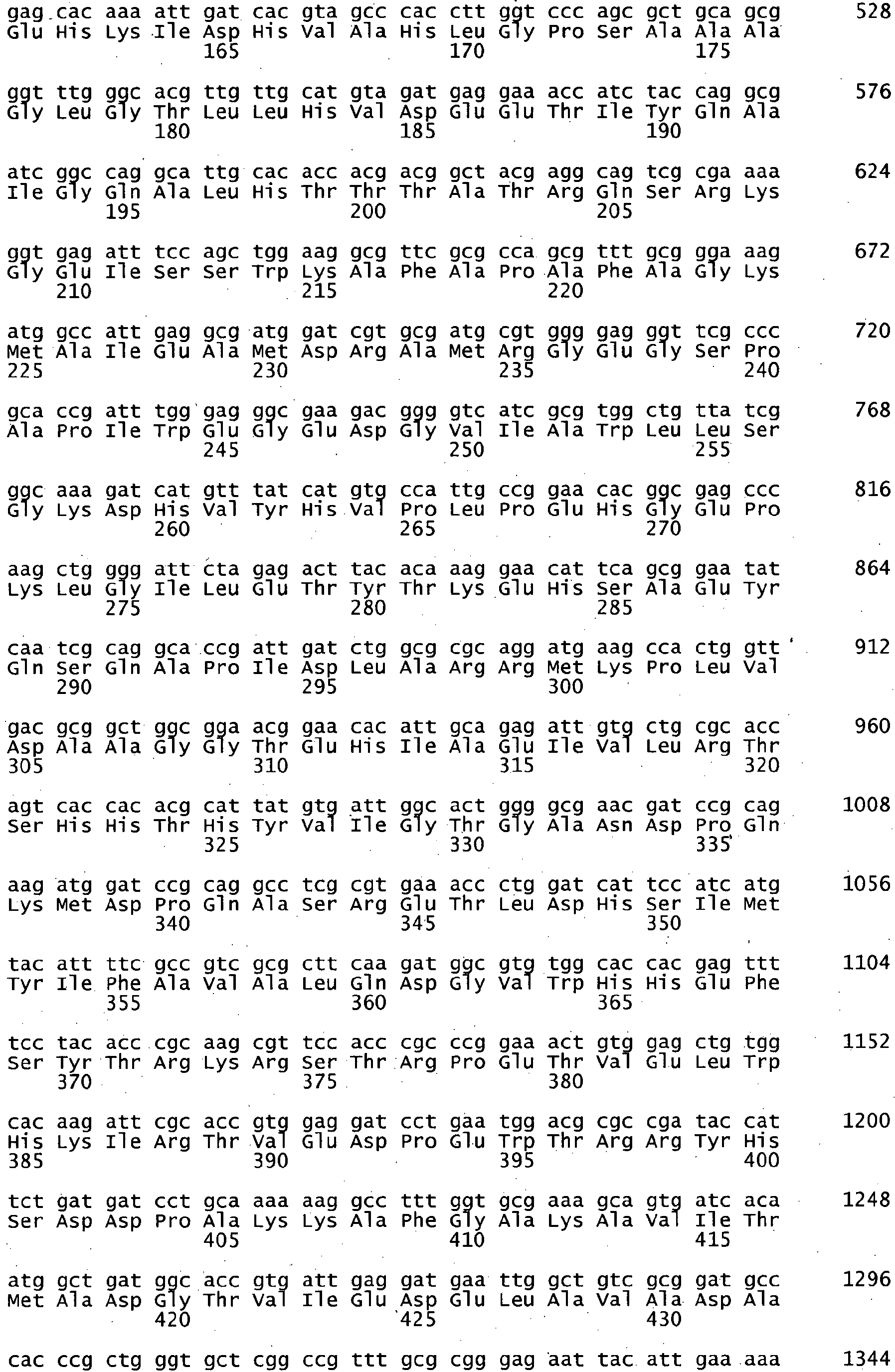

- <210> 2
<211> 498
<212> PRT
<213> Corynebacterium glutamicum - <400> 2


- <210> 3
<211> 3000
<212> DNA
<213> Corynebacterium glutamicum - <220>
<221> misc_feature
<222> (1)..(750)
<223> stromaufwärts der CDS gelegene Sequenz - <220>
<221> CDS
<222> (751)..(2244)
<223> prpD1-Wildtyp-Gen - <220>
<221> misc_feature
<222> (1565)..(1565)
<223> Cytosin - <220>
<221> misc_feature
<222> (2245)..(3000)
<223> stromabwärts der CDS gelegene Sequenz - <400> 3


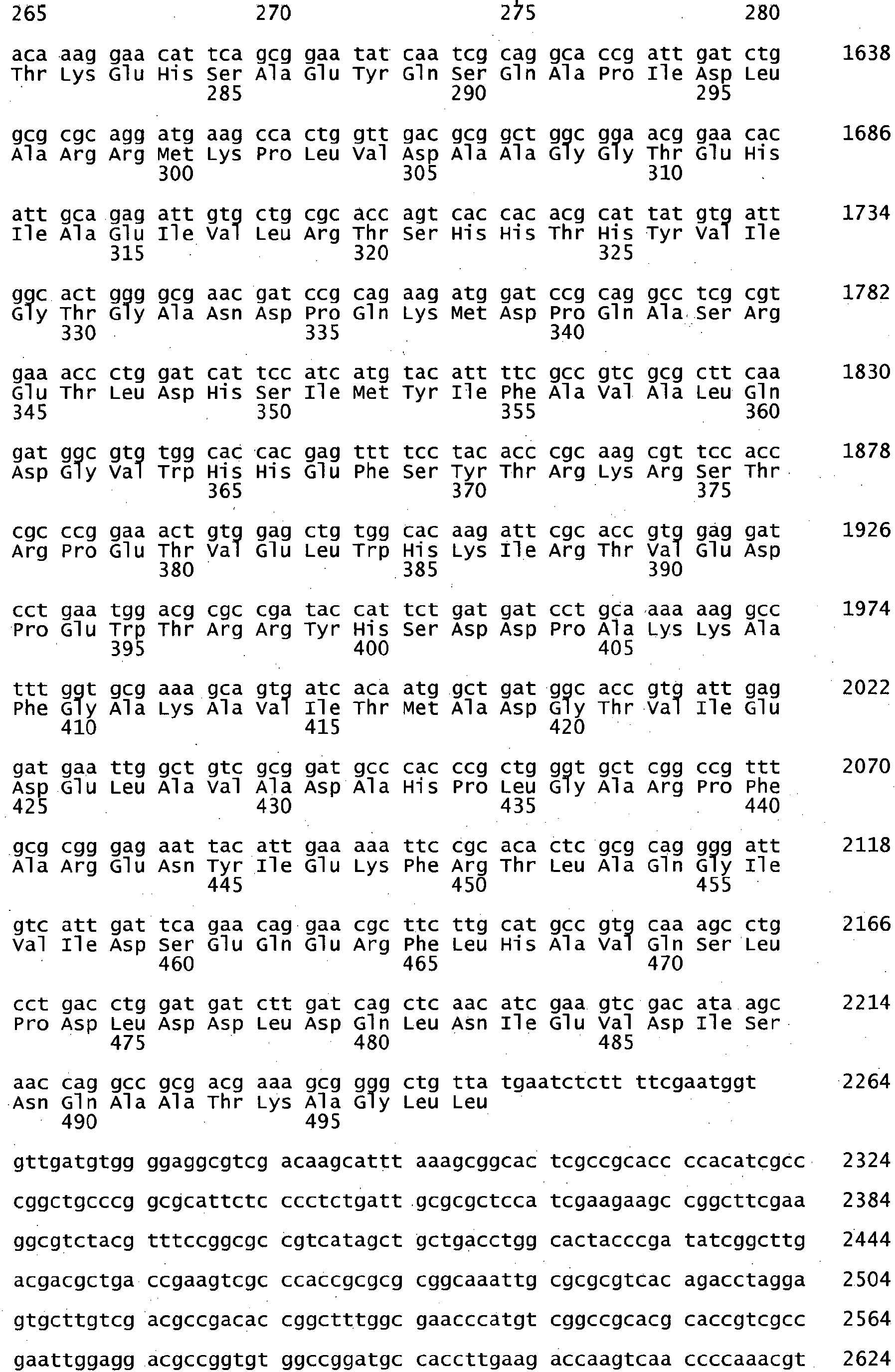

- <210> 4
<211> 498
<212> PRT
<213> Corynebacterium glutamicum - <400> 4


- <210> 5
<211> 1497
<212> DNA
<213> Corynebacterium glutamicum - <220>
<221> CDS
<222> (1)..(1494)
<223> prpD1-Allel - <220>
<221> mutation
<222> (815)..(815)
<223> C -> T Transition - <400> 5


- <210> 6
<211> 498
<212> PRT
<213> Corynebacterium glutamicum - <400> 6

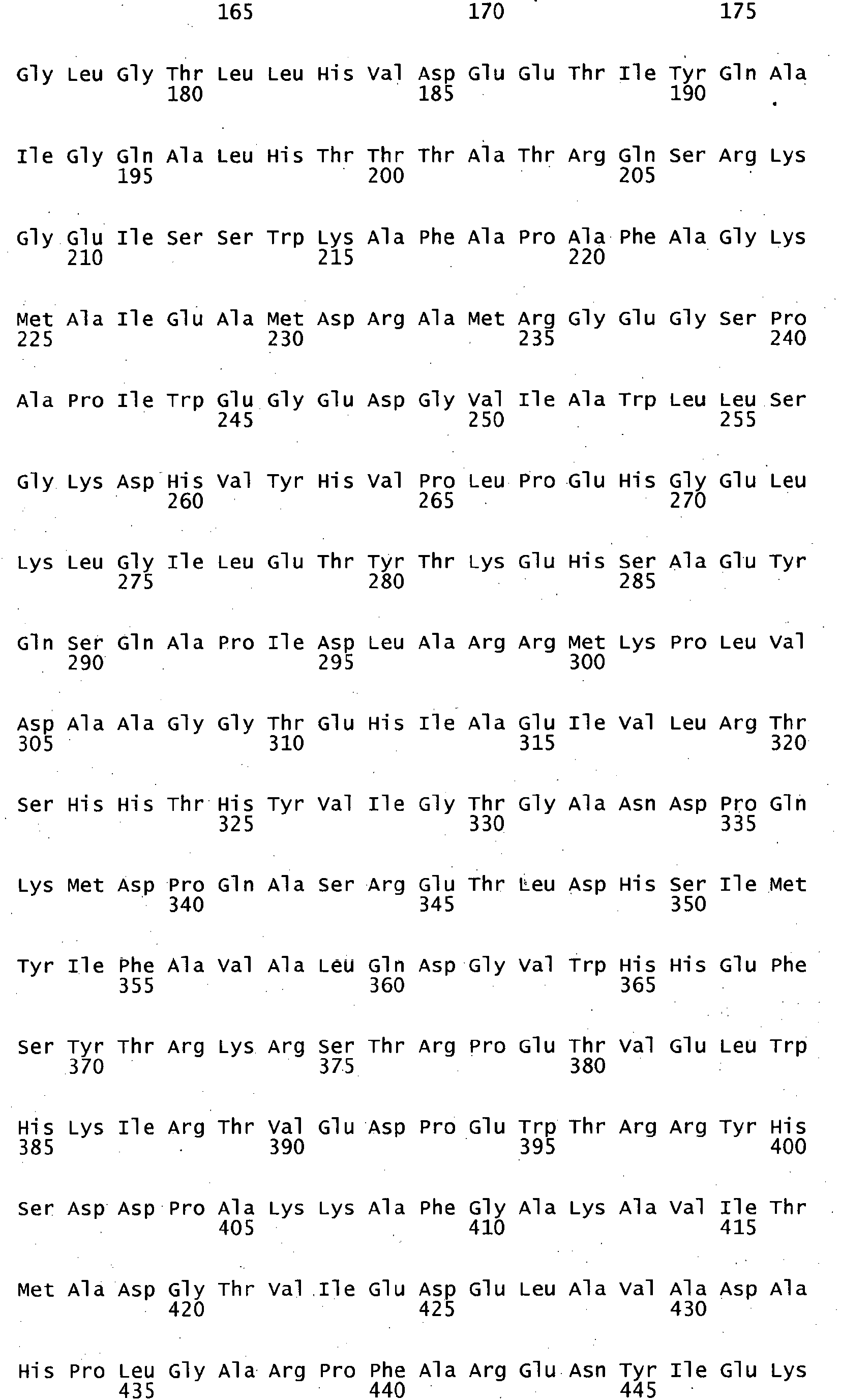

- <210> 7
<211> 3000
<212> DNA
<213> Corynebacterium glutamicum - <220>
<221> misc feature
<222> (1)..(750)
<223> stromaufwärts der CDS gelegene Sequenz - <220>
<221> primer_bind
<222> (661)..(680)
<223> Bindungsstelle Primer prpD1_XL_A1 - <220>
<221> CDS
<222> (751)..(2244)
<223> prpD1-Allel - <220>
<221> mutation
<222> (1565)..(1565)
<223> C -> T Transition - <220>
<221> misc_feature
<222> (2245)..(3000)
<223> stromabwärts der CDS gelegene Sequenz - <220>
<221> primer_bind
<222> (2258)..(2277)
<223> Bindungsstelle Primer prpD1_XL_E1 - <400> 7
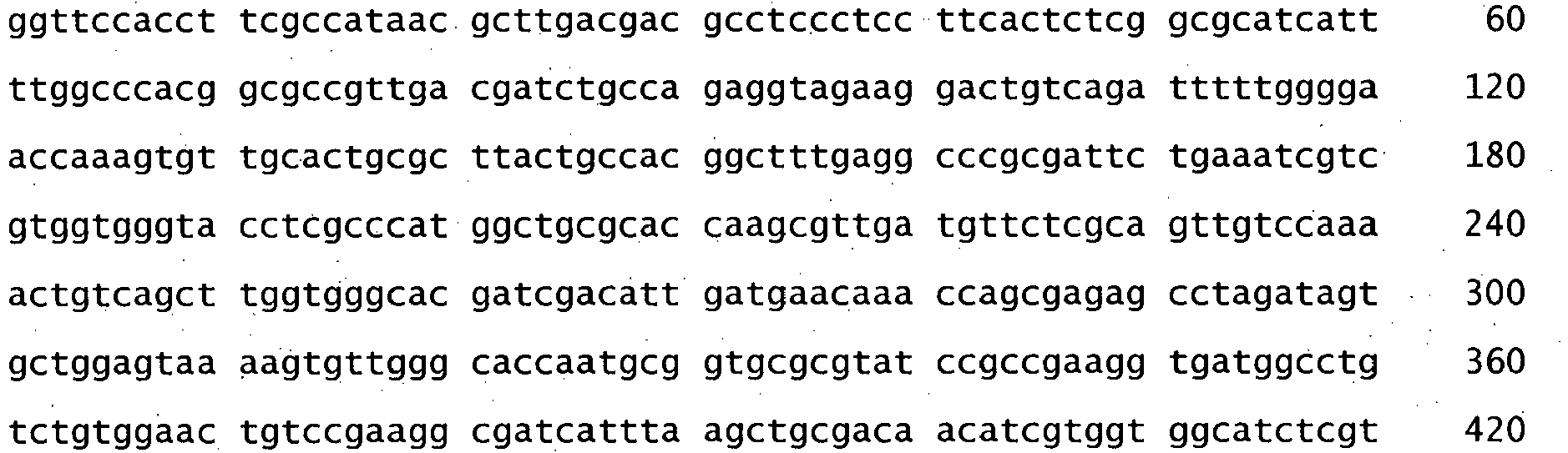


- <210> 8
<211> 498
<212> PRT
<213> Corynebacterium glutamicum - <400> 8


- <210> 9
<211> 28
<212> DNA
<213> Artificial Sequence - <220>
<223> Primer prpD1_xL_A1 - <220>
<221> misc_feature
<222> (1)..(2) - <220>
<221> misc_structure
<222> (3)..(8)
<223> EcoRI-Restriktionsschnittstelle - <400> 9
gcgaattcta aactgcgtga ggttgtgg 28 - <210> 10
<211> 28
<212> DNA
<213> Artificial Sequence - <220>
<223> Primer prpD1_XL_E1 - <220>
<221> misc_feature
<222> (1)..(2) - <220>
<221> misc_structure
<222> (3)..(8)
<223> EcoRI-Restriktionsschnittstelle - <400> 10
gcgaattctc. cccacatcaa caccattc 28 - <210> 11
<211> 1263
<212> DNA
<213> Corynebacterium glutamicum - <220>
<221> CDS
<222> (1)..(1263)
<223> lysC-wildtyp-Gen - <400> 11


- <210> 12
<211> 421
<212> PRT
<213> Corynebacterium glutamicum - <400> 12


- <210> 13
<211> 1633
<212> DNA
<213> Corynebacterium glutamicum - <220>
<221> misc_feature
<222> (1)..(2) - <220>
<221> misc_feature
<222> (1)..(1633)
<223> PCR-Produkt - <220>
<221> misc_structure
<222> (3)..(8)
<223> EcoRI-Restriktionsschnittstelle - <220>
<221> CDS
<222> (99)..(1592) - <220>
<221> mutation
<222> (913)..(913)
<223> C -> T Transition - <220>
<221> misc_structure
<222> (1626)..(1631)
<223> ECORI-Restriktionsschnittstelle - <220>
<221> misc_feature
<222> (1632)..(1633) - <400> 13
gcgaattcta aactgcgtga ggttgtggcc tgtcacacat aatcggccta gggtgggact 60

- <210> 14
<211> 498
<212> PRT
<213> Corynebacterium glutamicum - <400> 14


- <210> 15
<211> 1311
<212> DNA
<213> Corynebacterium glutamicum - <220>
<221> CDS
<222> (1)..(1308)
<223> ilvA-Wildtyp-Gen - <400> 15


- <210> 16
<211> 436
<212> PRT
<213> Corynebacterium glutamicum - <400> 16


- <210> 17
<211> 120
<212> DNA
<213> Corynebacterium glutamicum - <220>
<221> CDS
<222> (1)..(120)
<223> Teil der Kodierregion des prpD1-Allels - <220>
<221> misc_feature
<222> (61)..(63)
<223> n is a, c, g, or t - <400> 17

- <210> 18
<211> 40
<212> PRT
<213> Corynebacterium glutamicum - <220>
<221> misc_feature
<222> (21)..(21)
<223> The 'Xaa' at location 21 stands for Lys, Asn, Arg, Ser, Thr, Ile, Met, Glu, Asp, Gly, Ala, Val, Gln, His, Leu, Tyr, Trp, Cys, or Phe. - <400> 18

- <210> 19
<211> 120
<212> DNA
<213> Corynebacterium glutamicum - <220>
<221> CDS
<222> (1)..(120)
<223> Teil der Kodierregion des prpD1-Allels - <400> 19
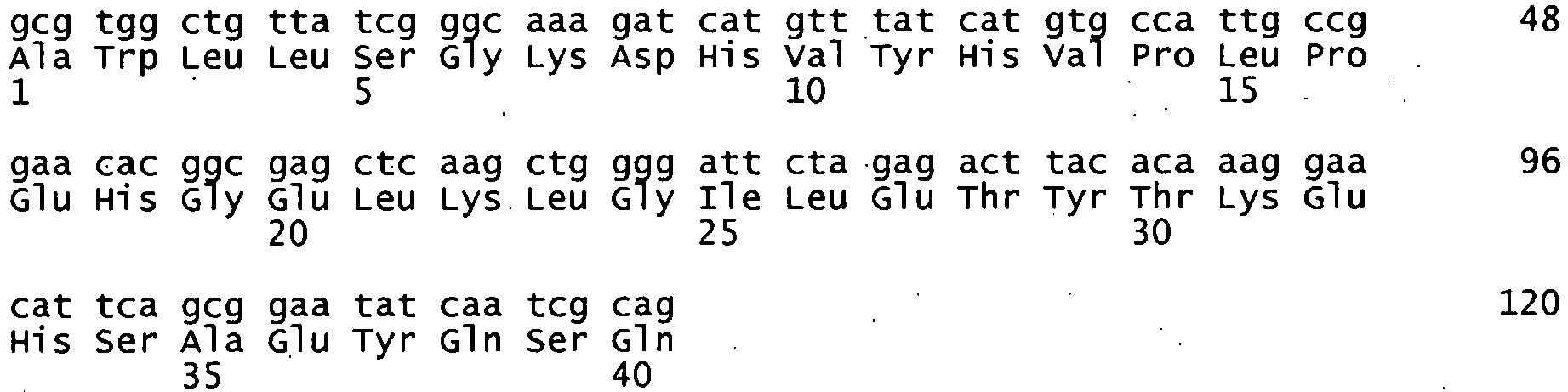
- <210> 20
<211> 40
<212> PRT
<213> Corynebacterium glutamicum - <400> 20

Claims (22)
- Isolierte Mutanten coryneformer Bakterien, welche ein Gen enthalten, das für ein Polypeptid mit 2-Methylcitrat-Dehydratase Aktivität kodiert, dadurch gekennzeichnet,
dass das Polypeptid an der Position 272 der Aminosäuresequenz von SEQ ID NO:2 entsprechenden Position L-Leucin enthält
oder dass das Polypeptid die Aminosäuresequenz von SEQ ID NO: 2 umfasst, wobei an Position 272 L-Leucin enthalten ist. - Mutanten coryneformer Bakterien gemäß Anspruch 1,
dadurch gekennzeichnet, dass es sich bei den coryneformen Bakterien um ein Bakterium ausgewählt aus der Gruppe Corynebacterium efficiens, Corynebacterium glutamicum, Corynebacterium thermoaminogenes und Corynebacterium aminogenes, bevorzugt
um Corynebacterium glutamicum handelt. - Mutanten coryneformer Bakterien gemäß Anspruch 1, oder 2, dadurch gekennzeichnet, dass es sich um L-Aminosäure ausscheidende Bakterien, bevorzugt
um L-Lysin, L-Valin, L-Isoleucin, L-Tryptophan oder um L-Homoserin ausscheidende Bakterien handelt. - Mutanten coryneformer Bakterien gemäß Anspruch 1 bis 3, dadurch gekennzeichnet, dass das Gen eine Nukleotidsequenz umfasst, die mit der Nukleotidsequenz eines Polynukleotids identisch ist, das durch eine Polymerasekettenreaktion (PCR) unter Verwendung von DNA gewonnen aus einem coryneformen Bakterium und unter Verwendung eines Primerpaares bestehend aus einem ersten Primer, umfassend mindestens 15 aufeinanderfolgende Nukleotide ausgewählt aus der Nukleotidsequenz zwischen Position 1 und 750 von SEQ ID NO:3 oder SEQ ID NO:7, und einem zweiten Primer, umfassend mindestens 15 aufeinanderfolgende Nukleotide ausgewählt aus der komplementären Nukleotidsequenz zwischen Position 3000 und 2245 von SEQ ID NO:3 oder SEQ ID NO: 7, erhältlich ist oder,
dass das kodierte Polypeptid eine Aminosäuresequenz mit einer Länge entsprechend 498 L-Aminosäuren umfasst oder,
dass das kodierte Polypeptid von Position 252 bis 291 der Aminosäuresequenz die Aminosäuresequenz entsprechend Position 252 bis 291 von SEQ ID NO:6 enthält oder,
dass das kodierte Polypeptid eine Aminosäuresequenz umfasst, die mindestens 90% identisch ist mit der Aminosäuresequenz von SEQ ID NO:6 und an Position 272 L-Leucin enthält oder,
dass das Gen eine Nukleotidsequenz umfasst, die mindestens 90% identisch ist mit der Nukleotidsequenz von SEQ ID NO:5. - Mutanten coryneformer Bakterien gemäß Anspruch 1, dadurch gekennzeichnet, dass das kodierte Protein eine Aminosäuresequenz ausgewählt aus der Gruppea) Aminosäuresequenz gemäß SEQ ID NO:6,b) Aminosäuresequenz gemäß SEQ ID NO:6 einschließlich maximal 5 konservativer Aminosäureaustausche, undc) Aminosäuresequenz gemäß SEQ ID NO:6 einschließlich maximal 5 Insertionen oder Deletionen von Aminosäuren,umfasst.
- Mutanten coryneformer Bakterien gemäß Anspruch 4, dadurch gekennzeichnet, dass das Gen die Nukleotidsequenz von SEQ ID NO:5 oder SEQ ID NO:7 umfasst.
- Ein isoliertes Polynukleotid, das für ein Polypeptid mit 2-Methylcitrat-Dehydratase Enzymaktivität kodiert, welches an der Position 272 der Aminosäuresequenz von SEQ ID NO:2 entsprechenden Position L-Leucin enthält oder welches die Aminosäuresequenz von SEQ ID NO: 2 umfasst, wobei an Position 272 L-Leucin enthalten ist.
- Isoliertes Polynukleotid gemäß Anspruch 7 , dadurch gekennzeichnet, dass das kodierte Polypeptid eine Aminosäuresequenz mit einer Länge von 498 Aminosäuren umfasst oder,
dass das kodierte Polypeptid von Position 252 bis 291 der Aminosäuresequenz die Aminosäuresequenz entsprechend Position 252 bis 291 von SEQ ID NO:6 enthält oder,
dass das isolierte Polynukleotid mit der Nukleotidsequenz eines Polynukleotids identisch ist, das durch eine Polymerasekettenreaktion (PCR) unter Verwendung von DNA gewonnen aus einem coryneformen Bakterium und unter Verwendung eines Primerpaares bestehend aus einem ersten Primer, umfassend mindestens 15 aufeinanderfolgende Nukleotide ausgewählt aus der Nukleotidsequenz zwischen Position 1 und 750 von SEQ ID NO:3 oder SEQ ID NO:7, und einem zweiten Primer, umfassend mindestens 15 aufeinanderfolgende Nukleotide ausgewählt aus der komplementären Nukleotidsequenz zwischen Position 3000 und 2245 von SEQ ID NO:3 oder SEQ ID NO: 7 erhältlich ist oder,
dass das isolierte Polynukleotid mit zu SEQ ID NO:5, komplementären Nukleotidsequenz unter stringenten Bedingungen hybridisiert oder,
dass das kodierte Polypeptid eine Aminosäuresequenz umfasst, die mindestens 90% identisch ist mit der Aminosäuresequenz von SEQ ID NO:6 oder
dass das Polynukleotid eine Nukleotidsequenz umfasst, die mindestens 90%, identisch ist mit der Nukleotidsequenz von SEQ ID NO:5 oder,
dass das kodierte Protein eine Aminosäuresequenz umfasst, ausgewählt aus der Gruppea) Aminosäuresequenz gemäß SEQ ID NO:6,b) Aminosäuresequenz gemäß SEQ ID NO:6, einschließlich maximal 5 konservativer Aminosäureaustausche, undc) Aminosäuresequenz gemäß SEQ ID NO:6, einschließlich maximal 5 Insertionen oder Deletionen von Aminosäuren. - Isoliertes Polynukleotid gemäß Anspruch 7 oder 8 dadurch gekennzeichnet, dass das kodierte Polypeptid die Aminosäuresequenz von SEQ ID NO:6 umfasst.
- Isoliertes Polynukleotid gemäß Anspruch 9, dadurch gekennzeichnet, dass es die Nukleotidsequenz SEQ ID NO:5 umfasst.
- Ein isoliertes Polynukleotid, welches ein Nukleinsäure-Molekül umfasst, das mindestens für ein Leseraster mit einer Aminosäuresequenz entsprechend Position 252 bis 291 von SEQ ID NO:2 kodiert, wobei an der Position entsprechend Position 272 von SEQ ID NO:2 L-Leucin enthalten ist.
- Isoliertes Polynukleotid gemäß Anspruch 11, dadurch gekennzeichnet, dass es mindestens für ein Leseraster mit einer Aminosäuresequenz entsprechend Position 252 bis 291 von SEQ ID NO:6 kodiert oder,
dass die Aminosäuresequenz eine oder mehrere konservative Aminosäureaustausche enthält, wobei die konservativen Aminosäureaustausche nicht die Position 272 betreffen oder,
dass das isolierte Polynukleotid eine oder mehrere stille Mutationen enthält oder,
dass das isolierte Polynukleotid mindestens die Nukleotidsequenz entsprechend Position 1504 bis 1623 von SEQ ID NO:7 umfasst. - Ein rekombinanter Mikroorganismus, der das isolierte Polynukleotid gemäß Anspruch 7 bis 12 enthält.
- Rekombinanter Mikroorganismus gemäß Anspruch 13, dadurch gekennzeichnet, dass es sich um ein coryneformes Bakterium oder um ein Bakterium der Gattung Escherichia,bevorzugt
um die Gattung Corynebacterium und besonders bevorzugt
um die Art Corynebacterium glutamicum handelt. - Ein Vektor, der das isolierte Polynukleotid gemäß Anspruch 7 bis 12 enthält.
- Ein rekombinanter Mikroorganismus, der den Vektor gemäß Anspruch 15 enthält.
- Rekombinanter Mikroorganismus gemäß Anspruch 16, dadurch gekennzeichnet, dass es sich um ein coryneformes Bakterium oder um ein Bakterium der Gattung Escherichia, bevorzugt
um die Gattung Corynebacterium und besonders bevorzugt
um die Art Corynebacterium glutamicum handelt. - Verfahren zur Herstellung von L-Lysin dadurch gekennzeichnet, dass mana) ein isoliertes coryneformes Bakterium in einem geeignetem Medium fermentiert, wobei das Bakterium mindestens eine Kopie eines für ein Polypeptid mit 2-Methylcitrat-Dehydratase Enzymaktivität kodierendes Gen enthält,
wobei das Polypeptid an der Position 272 der Aminosäuresequenz von SEQ ID NO:2 entsprechenden Position L-Leucin enthält
oder wobei das Polypeptid die Aminosäuresequenz von SEQ ID NO: 2 umfasst, bei der an Position 272 L-Leucin enthalten ist, undb) die L-Aminosäure in der Fermentationsbrühe oder in den Zellen des Bakteriums anreichert. - Verfahren gemäß Anspruch 18, dadurch gekennzeichnet, dass es sich bei dem isolierten coryneformen Bakterium um eine Mutante gemäß Anspruch 1 bis 6 handelt oder um ein rekombinantes coryneformes Bakterium handelt, das ein isoliertes Polynukleotid gemäß Anspruch 7 bis 12 enthält oder das unter Verwendung desselben hergestellt wurde oder,
dass man die L-Aminosäure isoliert oder sammelt, bevorzugt
reinigt. - Verfahren nach Anspruch 18, dadurch gekennzeichnet, dass man L-Lysin gemeinsam mit Bestandteilen aus der Fermentationsbrühe und/oder der Biomasse (> 0 bis 100 %) isoliert oder sammelt oder,
dass mana) aus der in Schritt b) von Anspruch 18 erhaltenen Fermentationsbrühe die gebildete Biomasse in einer Menge von 0 bis 100 % entfernt, undb) aus der in Schritt a) erhaltenen Brühe ein im wesentlichen trockenes und geformtes Produkt durch eine Methode ausgewählt aus der Gruppe Granulation, Kompaktierung, Sprühtrocknung und Extrusion herstellt. - Verfahren nach Anspruch 20, dadurch gekennzeichnet, dass man der Fermentationsbrühe vor oder nach Schritt a) eine Säure ausgewählt aus der Gruppe Schwefelsäure, Salzsäure und Phosphorsäure hinzufügt oder
dass man aus der erhaltenen Brühe vor oder in Schritt a) Wasser entfernt oder
dass man das in oder während Schritt b) erhaltene geformte Produkt mit einem Öl besprüht. - Verfahren gemäß Anspruch 18, dadurch gekennzeichnet, dass man folgende Schritte durchführta) Filtration der Fermentationsbrühe, bevorzugt mit einem Membranfilter, so dass ein Biomassehaltiger Schlamm und ein Filtrat erhalten wird,b) Aufkonzentration des Filtrates, bevorzugt so, dass ein Feststoffgehalt von 48 bis 52 Gew.-% erhalten wird,c) Granulation des in Schritt b) erhaltenen Konzentrates, bevorzugt bei einer Temperatur von 50°C bis 62°C, undd) Beschichtung des in c) erhaltenen Granulates mit einem oder mehreren der Beschichtungsmittel (coating agent(s)).
Priority Applications (1)
| Application Number | Priority Date | Filing Date | Title |
|---|---|---|---|
| PL07821449T PL2078085T3 (pl) | 2006-10-26 | 2007-10-17 | Allele genu prpD1 z bakterii maczugowatych |
Applications Claiming Priority (2)
| Application Number | Priority Date | Filing Date | Title |
|---|---|---|---|
| DE102006050489A DE102006050489A1 (de) | 2006-10-26 | 2006-10-26 | Allele des prpD1-Gens aus coryneformen Bakterien |
| PCT/EP2007/061084 WO2008049769A1 (de) | 2006-10-26 | 2007-10-17 | Allele des prpd1-gens aus coryneformen bakterien |
Publications (2)
| Publication Number | Publication Date |
|---|---|
| EP2078085A1 EP2078085A1 (de) | 2009-07-15 |
| EP2078085B1 true EP2078085B1 (de) | 2014-08-20 |
Family
ID=38961235
Family Applications (1)
| Application Number | Title | Priority Date | Filing Date |
|---|---|---|---|
| EP07821449.1A Not-in-force EP2078085B1 (de) | 2006-10-26 | 2007-10-17 | Allele des prpd1-gens aus coryneformen bakterien |
Country Status (9)
| Country | Link |
|---|---|
| US (2) | US7893231B2 (de) |
| EP (1) | EP2078085B1 (de) |
| KR (1) | KR101276978B1 (de) |
| BR (1) | BRPI0717983B1 (de) |
| DE (1) | DE102006050489A1 (de) |
| DK (1) | DK2078085T3 (de) |
| ES (1) | ES2518995T3 (de) |
| PL (1) | PL2078085T3 (de) |
| WO (1) | WO2008049769A1 (de) |
Families Citing this family (8)
| Publication number | Priority date | Publication date | Assignee | Title |
|---|---|---|---|---|
| DE102006048882A1 (de) * | 2006-10-17 | 2008-04-24 | Evonik Degussa Gmbh | Allele des rel-Gens aus coryneformen Bakterien |
| US8647642B2 (en) | 2008-09-18 | 2014-02-11 | Aviex Technologies, Llc | Live bacterial vaccines resistant to carbon dioxide (CO2), acidic PH and/or osmolarity for viral infection prophylaxis or treatment |
| DE102014208199A1 (de) * | 2014-04-30 | 2015-11-05 | Evonik Degussa Gmbh | Verfahren zur Produktion von L-Aminosäuren unter Verwendung eines alkaliphilen Bakteriums |
| US10676723B2 (en) | 2015-05-11 | 2020-06-09 | David Gordon Bermudes | Chimeric protein toxins for expression by therapeutic bacteria |
| US11129906B1 (en) | 2016-12-07 | 2021-09-28 | David Gordon Bermudes | Chimeric protein toxins for expression by therapeutic bacteria |
| US11180535B1 (en) | 2016-12-07 | 2021-11-23 | David Gordon Bermudes | Saccharide binding, tumor penetration, and cytotoxic antitumor chimeric peptides from therapeutic bacteria |
| KR102363913B1 (ko) * | 2020-06-26 | 2022-02-18 | 씨제이제일제당 (주) | L-쓰레오닌 디하이드라타아제의 신규 변이체 및 이를 이용한 l-이소류신 생산 방법 |
| WO2024258200A1 (ko) * | 2023-06-16 | 2024-12-19 | 대상 주식회사 | 2-메틸시트레이트 탈수효소 신규 변이체 및 이를 이용한 l-글루탐산의 생산 방법 |
Family Cites Families (15)
| Publication number | Priority date | Publication date | Assignee | Title |
|---|---|---|---|---|
| JPS61212249A (ja) * | 1985-03-15 | 1986-09-20 | Ajinomoto Co Inc | 飼料用組成物 |
| DE4130868C2 (de) * | 1991-09-17 | 1994-10-13 | Degussa | Tierfuttermittelsupplement auf der Basis einer Aminosäure und Verfahren zu dessen Herstellung |
| DE4308498C2 (de) * | 1993-03-17 | 1997-01-09 | Degussa | Tierfuttermittel-Additiv auf Fermentationsbrühe-Basis, Verfahren zu dessen Herstellung und dessen Verwendung |
| DE4400926C1 (de) | 1994-01-14 | 1995-06-01 | Forschungszentrum Juelich Gmbh | Herstellung von L-Isoleucin mittels rekombinanter Mikroorganismen mit deregulierter Threonindehydratase |
| ATE263246T1 (de) * | 1999-02-20 | 2004-04-15 | Degussa | Verfahren zur fermentativen herstellung von l- aminosäuren unter verwendung coryneformer bakterien |
| JP2000262288A (ja) | 1999-03-16 | 2000-09-26 | Ajinomoto Co Inc | コリネ型細菌の温度感受性プラスミド |
| US20060014259A9 (en) * | 1999-07-09 | 2006-01-19 | Kevin Burke | Process for the preparation of L-amino acids with amplification of the zwf gene |
| JP4623825B2 (ja) | 1999-12-16 | 2011-02-02 | 協和発酵バイオ株式会社 | 新規ポリヌクレオチド |
| US20050112733A1 (en) * | 2000-03-20 | 2005-05-26 | Degussa Ag | Process for the preparation of L-amino acids with amplification of the zwf gene |
| US20030175911A1 (en) * | 2000-03-20 | 2003-09-18 | Stephen Hans | Process for the preparation of L-amino acids with amplification of the zwf gene |
| DE10117816A1 (de) * | 2001-04-10 | 2002-10-17 | Degussa | Verfahren zur fermentativen Herstellung von L-Aminosäuren unter Verwendung coryneformer Bakterien |
| US7160711B2 (en) * | 2001-08-06 | 2007-01-09 | Degussa Ag | Coryneform bacteria which produce chemical compounds I |
| CN101126075B (zh) * | 2001-08-06 | 2012-05-09 | 赢创德固赛有限公司 | 生产化合物ⅱ的棒状细菌 |
| DE102006048882A1 (de) * | 2006-10-17 | 2008-04-24 | Evonik Degussa Gmbh | Allele des rel-Gens aus coryneformen Bakterien |
| DE102006054202A1 (de) * | 2006-11-17 | 2008-05-21 | Evonik Degussa Gmbh | Allele des oxyR-Gens aus coryneformen Bakterien |
-
2006
- 2006-10-26 DE DE102006050489A patent/DE102006050489A1/de not_active Withdrawn
-
2007
- 2007-10-17 WO PCT/EP2007/061084 patent/WO2008049769A1/de not_active Ceased
- 2007-10-17 EP EP07821449.1A patent/EP2078085B1/de not_active Not-in-force
- 2007-10-17 BR BRPI0717983A patent/BRPI0717983B1/pt active IP Right Grant
- 2007-10-17 PL PL07821449T patent/PL2078085T3/pl unknown
- 2007-10-17 DK DK07821449.1T patent/DK2078085T3/en active
- 2007-10-17 ES ES07821449.1T patent/ES2518995T3/es active Active
- 2007-10-17 KR KR1020097010640A patent/KR101276978B1/ko not_active Expired - Fee Related
- 2007-10-25 US US11/923,942 patent/US7893231B2/en not_active Expired - Fee Related
-
2011
- 2011-01-19 US US13/009,051 patent/US8080395B2/en not_active Expired - Fee Related
Also Published As
| Publication number | Publication date |
|---|---|
| WO2008049769A1 (de) | 2008-05-02 |
| US7893231B2 (en) | 2011-02-22 |
| DK2078085T3 (en) | 2014-12-01 |
| ES2518995T3 (es) | 2014-11-06 |
| US20110171695A1 (en) | 2011-07-14 |
| PL2078085T3 (pl) | 2015-02-27 |
| EP2078085A1 (de) | 2009-07-15 |
| US8080395B2 (en) | 2011-12-20 |
| BRPI0717983B1 (pt) | 2018-09-11 |
| DE102006050489A1 (de) | 2008-04-30 |
| KR20090078359A (ko) | 2009-07-17 |
| BRPI0717983A2 (pt) | 2013-11-12 |
| KR101276978B1 (ko) | 2013-06-25 |
| US20080274265A1 (en) | 2008-11-06 |
Similar Documents
| Publication | Publication Date | Title |
|---|---|---|
| EP2041276B1 (de) | Verfahren zur herstellung von l-aminosäuren mittels mutanten des glta-gens kodierend für citratsynthase | |
| EP2061881B1 (de) | Allele des rel-gens aus coryneformen bakterien | |
| EP1824968B1 (de) | Allele des gnd-gens aus coryneformen bakterien | |
| EP2026662A2 (de) | Verfahren zur herstellung eines l-lysin enthaltende futtermitteladditives | |
| US8080395B2 (en) | Alleles of the PRPD1 gene from coryneform bacteria | |
| EP2089525B1 (de) | Allele des oxyr-gens aus coryneformen bakterien | |
| WO2006100211A1 (de) | Mutierte allele des zwg-gens (g6pdh) aus coryneformen bakterien zur gesteigerten lysin produktion | |
| EP1902067B1 (de) | Allele des opca-gens aus coryneformen bakterien | |
| EP1841859B1 (de) | Allele des mqo-gens aus coryneformen bakterien | |
| DE102005045301A1 (de) | Verfahren zur Herstellung von organisch-chemischen Verbindungen unter Verwendung coryneformer Bakterien | |
| EP1861493B1 (de) | Mutierte allele des zwg-gens (g6pdh) aus coryneformen bakterien zur gesteigerten lysin produktion |
Legal Events
| Date | Code | Title | Description |
|---|---|---|---|
| PUAI | Public reference made under article 153(3) epc to a published international application that has entered the european phase |
Free format text: ORIGINAL CODE: 0009012 |
|
| 17P | Request for examination filed |
Effective date: 20090420 |
|
| AK | Designated contracting states |
Kind code of ref document: A1 Designated state(s): AT BE BG CH CY CZ DE DK EE ES FI FR GB GR HU IE IS IT LI LT LU LV MC MT NL PL PT RO SE SI SK TR |
|
| 17Q | First examination report despatched |
Effective date: 20100412 |
|
| DAX | Request for extension of the european patent (deleted) | ||
| GRAP | Despatch of communication of intention to grant a patent |
Free format text: ORIGINAL CODE: EPIDOSNIGR1 |
|
| INTG | Intention to grant announced |
Effective date: 20140422 |
|
| RIN1 | Information on inventor provided before grant (corrected) |
Inventor name: THIERBACH, GEORG Inventor name: BATHE, BRIGITTE Inventor name: KREUTZER, CAROLINE |
|
| GRAS | Grant fee paid |
Free format text: ORIGINAL CODE: EPIDOSNIGR3 |
|
| GRAA | (expected) grant |
Free format text: ORIGINAL CODE: 0009210 |
|
| AK | Designated contracting states |
Kind code of ref document: B1 Designated state(s): AT BE BG CH CY CZ DE DK EE ES FI FR GB GR HU IE IS IT LI LT LU LV MC MT NL PL PT RO SE SI SK TR |
|
| REG | Reference to a national code |
Ref country code: GB Ref legal event code: FG4D Free format text: NOT ENGLISH |
|
| REG | Reference to a national code |
Ref country code: CH Ref legal event code: EP |
|
| REG | Reference to a national code |
Ref country code: AT Ref legal event code: REF Ref document number: 683515 Country of ref document: AT Kind code of ref document: T Effective date: 20140915 |
|
| REG | Reference to a national code |
Ref country code: IE Ref legal event code: FG4D Free format text: LANGUAGE OF EP DOCUMENT: GERMAN |
|
| REG | Reference to a national code |
Ref country code: DE Ref legal event code: R096 Ref document number: 502007013388 Country of ref document: DE Effective date: 20140925 |
|
| REG | Reference to a national code |
Ref country code: ES Ref legal event code: FG2A Ref document number: 2518995 Country of ref document: ES Kind code of ref document: T3 Effective date: 20141106 |
|
| REG | Reference to a national code |
Ref country code: DK Ref legal event code: T3 Effective date: 20141124 |
|
| REG | Reference to a national code |
Ref country code: NL Ref legal event code: T3 |
|
| REG | Reference to a national code |
Ref country code: LT Ref legal event code: MG4D |
|
| PG25 | Lapsed in a contracting state [announced via postgrant information from national office to epo] |
Ref country code: GR Free format text: LAPSE BECAUSE OF FAILURE TO SUBMIT A TRANSLATION OF THE DESCRIPTION OR TO PAY THE FEE WITHIN THE PRESCRIBED TIME-LIMIT Effective date: 20141121 Ref country code: LT Free format text: LAPSE BECAUSE OF FAILURE TO SUBMIT A TRANSLATION OF THE DESCRIPTION OR TO PAY THE FEE WITHIN THE PRESCRIBED TIME-LIMIT Effective date: 20140820 Ref country code: FI Free format text: LAPSE BECAUSE OF FAILURE TO SUBMIT A TRANSLATION OF THE DESCRIPTION OR TO PAY THE FEE WITHIN THE PRESCRIBED TIME-LIMIT Effective date: 20140820 Ref country code: BG Free format text: LAPSE BECAUSE OF FAILURE TO SUBMIT A TRANSLATION OF THE DESCRIPTION OR TO PAY THE FEE WITHIN THE PRESCRIBED TIME-LIMIT Effective date: 20141120 Ref country code: SE Free format text: LAPSE BECAUSE OF FAILURE TO SUBMIT A TRANSLATION OF THE DESCRIPTION OR TO PAY THE FEE WITHIN THE PRESCRIBED TIME-LIMIT Effective date: 20140820 Ref country code: PT Free format text: LAPSE BECAUSE OF FAILURE TO SUBMIT A TRANSLATION OF THE DESCRIPTION OR TO PAY THE FEE WITHIN THE PRESCRIBED TIME-LIMIT Effective date: 20141222 |
|
| PG25 | Lapsed in a contracting state [announced via postgrant information from national office to epo] |
Ref country code: LV Free format text: LAPSE BECAUSE OF FAILURE TO SUBMIT A TRANSLATION OF THE DESCRIPTION OR TO PAY THE FEE WITHIN THE PRESCRIBED TIME-LIMIT Effective date: 20140820 Ref country code: IS Free format text: LAPSE BECAUSE OF FAILURE TO SUBMIT A TRANSLATION OF THE DESCRIPTION OR TO PAY THE FEE WITHIN THE PRESCRIBED TIME-LIMIT Effective date: 20141220 |
|
| REG | Reference to a national code |
Ref country code: PL Ref legal event code: T3 |
|
| PG25 | Lapsed in a contracting state [announced via postgrant information from national office to epo] |
Ref country code: SK Free format text: LAPSE BECAUSE OF FAILURE TO SUBMIT A TRANSLATION OF THE DESCRIPTION OR TO PAY THE FEE WITHIN THE PRESCRIBED TIME-LIMIT Effective date: 20140820 Ref country code: RO Free format text: LAPSE BECAUSE OF FAILURE TO SUBMIT A TRANSLATION OF THE DESCRIPTION OR TO PAY THE FEE WITHIN THE PRESCRIBED TIME-LIMIT Effective date: 20140820 Ref country code: CZ Free format text: LAPSE BECAUSE OF FAILURE TO SUBMIT A TRANSLATION OF THE DESCRIPTION OR TO PAY THE FEE WITHIN THE PRESCRIBED TIME-LIMIT Effective date: 20140820 Ref country code: EE Free format text: LAPSE BECAUSE OF FAILURE TO SUBMIT A TRANSLATION OF THE DESCRIPTION OR TO PAY THE FEE WITHIN THE PRESCRIBED TIME-LIMIT Effective date: 20140820 |
|
| REG | Reference to a national code |
Ref country code: DE Ref legal event code: R097 Ref document number: 502007013388 Country of ref document: DE |
|
| PG25 | Lapsed in a contracting state [announced via postgrant information from national office to epo] |
Ref country code: LU Free format text: LAPSE BECAUSE OF FAILURE TO SUBMIT A TRANSLATION OF THE DESCRIPTION OR TO PAY THE FEE WITHIN THE PRESCRIBED TIME-LIMIT Effective date: 20141017 Ref country code: MC Free format text: LAPSE BECAUSE OF FAILURE TO SUBMIT A TRANSLATION OF THE DESCRIPTION OR TO PAY THE FEE WITHIN THE PRESCRIBED TIME-LIMIT Effective date: 20140820 |
|
| REG | Reference to a national code |
Ref country code: CH Ref legal event code: PL |
|
| PLBE | No opposition filed within time limit |
Free format text: ORIGINAL CODE: 0009261 |
|
| STAA | Information on the status of an ep patent application or granted ep patent |
Free format text: STATUS: NO OPPOSITION FILED WITHIN TIME LIMIT |
|
| 26N | No opposition filed |
Effective date: 20150521 |
|
| GBPC | Gb: european patent ceased through non-payment of renewal fee |
Effective date: 20141120 |
|
| REG | Reference to a national code |
Ref country code: IE Ref legal event code: MM4A |
|
| PG25 | Lapsed in a contracting state [announced via postgrant information from national office to epo] |
Ref country code: LI Free format text: LAPSE BECAUSE OF NON-PAYMENT OF DUE FEES Effective date: 20141031 Ref country code: CH Free format text: LAPSE BECAUSE OF NON-PAYMENT OF DUE FEES Effective date: 20141031 |
|
| REG | Reference to a national code |
Ref country code: FR Ref legal event code: PLFP Year of fee payment: 9 |
|
| PG25 | Lapsed in a contracting state [announced via postgrant information from national office to epo] |
Ref country code: IE Free format text: LAPSE BECAUSE OF NON-PAYMENT OF DUE FEES Effective date: 20141017 Ref country code: GB Free format text: LAPSE BECAUSE OF NON-PAYMENT OF DUE FEES Effective date: 20141120 |
|
| PG25 | Lapsed in a contracting state [announced via postgrant information from national office to epo] |
Ref country code: SI Free format text: LAPSE BECAUSE OF FAILURE TO SUBMIT A TRANSLATION OF THE DESCRIPTION OR TO PAY THE FEE WITHIN THE PRESCRIBED TIME-LIMIT Effective date: 20140820 |
|
| REG | Reference to a national code |
Ref country code: AT Ref legal event code: MM01 Ref document number: 683515 Country of ref document: AT Kind code of ref document: T Effective date: 20141017 |
|
| PG25 | Lapsed in a contracting state [announced via postgrant information from national office to epo] |
Ref country code: AT Free format text: LAPSE BECAUSE OF NON-PAYMENT OF DUE FEES Effective date: 20141017 |
|
| PG25 | Lapsed in a contracting state [announced via postgrant information from national office to epo] |
Ref country code: CY Free format text: LAPSE BECAUSE OF FAILURE TO SUBMIT A TRANSLATION OF THE DESCRIPTION OR TO PAY THE FEE WITHIN THE PRESCRIBED TIME-LIMIT Effective date: 20140820 |
|
| PG25 | Lapsed in a contracting state [announced via postgrant information from national office to epo] |
Ref country code: HU Free format text: LAPSE BECAUSE OF FAILURE TO SUBMIT A TRANSLATION OF THE DESCRIPTION OR TO PAY THE FEE WITHIN THE PRESCRIBED TIME-LIMIT; INVALID AB INITIO Effective date: 20071017 Ref country code: TR Free format text: LAPSE BECAUSE OF FAILURE TO SUBMIT A TRANSLATION OF THE DESCRIPTION OR TO PAY THE FEE WITHIN THE PRESCRIBED TIME-LIMIT Effective date: 20140820 Ref country code: MT Free format text: LAPSE BECAUSE OF FAILURE TO SUBMIT A TRANSLATION OF THE DESCRIPTION OR TO PAY THE FEE WITHIN THE PRESCRIBED TIME-LIMIT Effective date: 20140820 |
|
| REG | Reference to a national code |
Ref country code: FR Ref legal event code: PLFP Year of fee payment: 10 |
|
| PGFP | Annual fee paid to national office [announced via postgrant information from national office to epo] |
Ref country code: PL Payment date: 20160923 Year of fee payment: 10 |
|
| PGFP | Annual fee paid to national office [announced via postgrant information from national office to epo] |
Ref country code: FR Payment date: 20161020 Year of fee payment: 10 |
|
| PGFP | Annual fee paid to national office [announced via postgrant information from national office to epo] |
Ref country code: IT Payment date: 20161024 Year of fee payment: 10 |
|
| REG | Reference to a national code |
Ref country code: FR Ref legal event code: ST Effective date: 20180629 |
|
| PG25 | Lapsed in a contracting state [announced via postgrant information from national office to epo] |
Ref country code: FR Free format text: LAPSE BECAUSE OF NON-PAYMENT OF DUE FEES Effective date: 20171031 |
|
| PG25 | Lapsed in a contracting state [announced via postgrant information from national office to epo] |
Ref country code: IT Free format text: LAPSE BECAUSE OF NON-PAYMENT OF DUE FEES Effective date: 20171017 |
|
| PG25 | Lapsed in a contracting state [announced via postgrant information from national office to epo] |
Ref country code: PL Free format text: LAPSE BECAUSE OF NON-PAYMENT OF DUE FEES Effective date: 20171017 |
|
| REG | Reference to a national code |
Ref country code: DE Ref legal event code: R081 Ref document number: 502007013388 Country of ref document: DE Owner name: EVONIK OPERATIONS GMBH, DE Free format text: FORMER OWNER: EVONIK DEGUSSA GMBH, 45128 ESSEN, DE |
|
| REG | Reference to a national code |
Ref country code: BE Ref legal event code: HC Owner name: EVONIK OPERATIONS GMBH; DE Free format text: DETAILS ASSIGNMENT: CHANGE OF OWNER(S), CHANGEMENT DE NOM DU PROPRIETAIRE; FORMER OWNER NAME: EVONIK DEGUSSA GMBH Effective date: 20191122 |
|
| PGFP | Annual fee paid to national office [announced via postgrant information from national office to epo] |
Ref country code: NL Payment date: 20191021 Year of fee payment: 13 |
|
| PGFP | Annual fee paid to national office [announced via postgrant information from national office to epo] |
Ref country code: DK Payment date: 20191023 Year of fee payment: 13 Ref country code: BE Payment date: 20191021 Year of fee payment: 13 Ref country code: ES Payment date: 20191122 Year of fee payment: 13 |
|
| REG | Reference to a national code |
Ref country code: NL Ref legal event code: HC Owner name: EVONIK OPERATIONS GMBH; DE Free format text: DETAILS ASSIGNMENT: CHANGE OF OWNER(S), CHANGE OF OWNER(S) NAME Effective date: 20200928 |
|
| REG | Reference to a national code |
Ref country code: DK Ref legal event code: EBP Effective date: 20201031 |
|
| REG | Reference to a national code |
Ref country code: NL Ref legal event code: MM Effective date: 20201101 |
|
| REG | Reference to a national code |
Ref country code: BE Ref legal event code: MM Effective date: 20201031 |
|
| PG25 | Lapsed in a contracting state [announced via postgrant information from national office to epo] |
Ref country code: NL Free format text: LAPSE BECAUSE OF NON-PAYMENT OF DUE FEES Effective date: 20201101 |
|
| PG25 | Lapsed in a contracting state [announced via postgrant information from national office to epo] |
Ref country code: BE Free format text: LAPSE BECAUSE OF NON-PAYMENT OF DUE FEES Effective date: 20201031 |
|
| PG25 | Lapsed in a contracting state [announced via postgrant information from national office to epo] |
Ref country code: DK Free format text: LAPSE BECAUSE OF NON-PAYMENT OF DUE FEES Effective date: 20201031 |
|
| REG | Reference to a national code |
Ref country code: ES Ref legal event code: FD2A Effective date: 20220127 |
|
| PGFP | Annual fee paid to national office [announced via postgrant information from national office to epo] |
Ref country code: DE Payment date: 20211020 Year of fee payment: 15 |
|
| PG25 | Lapsed in a contracting state [announced via postgrant information from national office to epo] |
Ref country code: ES Free format text: LAPSE BECAUSE OF NON-PAYMENT OF DUE FEES Effective date: 20201018 |
|
| REG | Reference to a national code |
Ref country code: DE Ref legal event code: R119 Ref document number: 502007013388 Country of ref document: DE |
|
| PG25 | Lapsed in a contracting state [announced via postgrant information from national office to epo] |
Ref country code: DE Free format text: LAPSE BECAUSE OF NON-PAYMENT OF DUE FEES Effective date: 20230503 |