EP2083923B1 - Composition comprenant un colorant de type styrylique ou iminique et un compose thiole, procede de coloration et dispositif - Google Patents
Composition comprenant un colorant de type styrylique ou iminique et un compose thiole, procede de coloration et dispositif Download PDFInfo
- Publication number
- EP2083923B1 EP2083923B1 EP07858560A EP07858560A EP2083923B1 EP 2083923 B1 EP2083923 B1 EP 2083923B1 EP 07858560 A EP07858560 A EP 07858560A EP 07858560 A EP07858560 A EP 07858560A EP 2083923 B1 EP2083923 B1 EP 2083923B1
- Authority
- EP
- European Patent Office
- Prior art keywords
- radical
- dimethyl
- group
- indolino
- thiazoline
- Prior art date
- Legal status (The legal status is an assumption and is not a legal conclusion. Google has not performed a legal analysis and makes no representation as to the accuracy of the status listed.)
- Active
Links
- 0 CCN(OC1(C2(N)N)*=*(C)[C@@](C3)C=CC4=C3c3ccccc3*4N=I)[In](C)*1c1c2cccc1 Chemical compound CCN(OC1(C2(N)N)*=*(C)[C@@](C3)C=CC4=C3c3ccccc3*4N=I)[In](C)*1c1c2cccc1 0.000 description 3
Classifications
-
- A—HUMAN NECESSITIES
- A61—MEDICAL OR VETERINARY SCIENCE; HYGIENE
- A61Q—SPECIFIC USE OF COSMETICS OR SIMILAR TOILETRY PREPARATIONS
- A61Q5/00—Preparations for care of the hair
- A61Q5/10—Preparations for permanently dyeing the hair
-
- A—HUMAN NECESSITIES
- A61—MEDICAL OR VETERINARY SCIENCE; HYGIENE
- A61K—PREPARATIONS FOR MEDICAL, DENTAL OR TOILETRY PURPOSES
- A61K8/00—Cosmetics or similar toiletry preparations
- A61K8/18—Cosmetics or similar toiletry preparations characterised by the composition
- A61K8/19—Cosmetics or similar toiletry preparations characterised by the composition containing inorganic ingredients
- A61K8/23—Sulfur; Selenium; Tellurium; Compounds thereof
-
- A—HUMAN NECESSITIES
- A61—MEDICAL OR VETERINARY SCIENCE; HYGIENE
- A61K—PREPARATIONS FOR MEDICAL, DENTAL OR TOILETRY PURPOSES
- A61K8/00—Cosmetics or similar toiletry preparations
- A61K8/18—Cosmetics or similar toiletry preparations characterised by the composition
- A61K8/30—Cosmetics or similar toiletry preparations characterised by the composition containing organic compounds
- A61K8/46—Cosmetics or similar toiletry preparations characterised by the composition containing organic compounds containing sulfur
-
- A—HUMAN NECESSITIES
- A61—MEDICAL OR VETERINARY SCIENCE; HYGIENE
- A61K—PREPARATIONS FOR MEDICAL, DENTAL OR TOILETRY PURPOSES
- A61K8/00—Cosmetics or similar toiletry preparations
- A61K8/18—Cosmetics or similar toiletry preparations characterised by the composition
- A61K8/30—Cosmetics or similar toiletry preparations characterised by the composition containing organic compounds
- A61K8/49—Cosmetics or similar toiletry preparations characterised by the composition containing organic compounds containing heterocyclic compounds
-
- A—HUMAN NECESSITIES
- A61—MEDICAL OR VETERINARY SCIENCE; HYGIENE
- A61Q—SPECIFIC USE OF COSMETICS OR SIMILAR TOILETRY PREPARATIONS
- A61Q5/00—Preparations for care of the hair
- A61Q5/06—Preparations for styling the hair, e.g. by temporary shaping or colouring
- A61Q5/065—Preparations for temporary colouring the hair, e.g. direct dyes
-
- A—HUMAN NECESSITIES
- A61—MEDICAL OR VETERINARY SCIENCE; HYGIENE
- A61K—PREPARATIONS FOR MEDICAL, DENTAL OR TOILETRY PURPOSES
- A61K2800/00—Properties of cosmetic compositions or active ingredients thereof or formulation aids used therein and process related aspects
- A61K2800/80—Process related aspects concerning the preparation of the cosmetic composition or the storage or application thereof
- A61K2800/88—Two- or multipart kits
Definitions
- the subject of the present invention is a composition for dyeing keratinous fibers, and in particular human keratinous fibers such as the hair, comprising at least one dye of styrylic or iminic type and at least one thiolated compound. It further relates to a dyeing process using such a composition, and a device suitable for carrying out said method.
- oxidation bases such as ortho- or para-phenylenediamines.
- ortho- or para-aminophenols and heterocyclic compounds such as diaminopyrazole derivatives.
- oxidation bases are colorless or weakly colored compounds which, combined with oxidizing products, give rise, by a process of oxidative condensation, to colored compounds.
- couplers or color modifiers the latter being chosen in particular from aromatic meta-diamines, meta-aminophenols, meta-aminophenols and meta-aminophenols. diphenols and certain heterocyclic compounds such as indole compounds.
- Another advantage of this type of coloration is to be visible on dark hair. Indeed, the oxidative process being carried out in an alkaline medium, most generally in the presence of ammonia, it occurs, parallel to the condensation of color precursors, a discoloration of melanin, the natural pigment of keratin fibers and in particular the hair. The color obtained can also be visible even on dark hair.
- the colorations obtained have good toughness especially with respect to shampoos. However, it is rare to be able to obtain by this method chromatic colorations.
- the direct dyes conventionally used are in particular dyes of the nitrobenzene, anthraquinone, nitropyridine, azo, cationic azo, xanthene, acridine, azine or triarylmethane type or natural dyes.
- Lighter stains than those of the hair can be obtained prior to staining if direct staining is performed in the presence of an oxidizing agent. This is called direct dyeing in lightening conditions.
- Direct dyes can advantageously achieve very chromatic colors but they always have the disadvantage of being temporary or semi-permanent. Indeed, the tenacity of the direct dyes on the hair remains limited, which leads to a color fading, or even a turn of it over time, due to the departure of one or more dyes employed.
- a disadvantage of these two modes of staining is the need to employ an oxidizing composition for oxidation dyeing or to obtain a thinned direct stain.
- the oxidizing compositions in the long run, cause degradation of the hair fiber.
- compositions are initially colored, as in the case of coloring compositions involving direct dyes, or become it during the application, as is the case.
- compositions comprising one or more oxidation dye precursors. Therefore, direct dyeing and oxidation dyeing have the disadvantage of being messy.
- compositions provide many advantages over existing compositions, while providing satisfactory coloring efficiency, the fact remains that it may be desired to further improve the rise and decrease the selectivity of the coloration obtained.
- the present invention also makes it possible to access keratin fibers which are lighter in color than the initial color without necessarily having to use an oxidizing composition.
- the subject of the present invention is also a process for dyeing keratin fibers using such a composition.
- the present invention also relates to a multi-compartment device for carrying out the coloring process according to the invention.
- the invention makes it possible in particular to obtain a coloration of the keratinous fibers which is chromatic, tenacious, especially with respect to shampoos.
- Another advantage of the invention is to provide a clean staining mode, in other words that does not stain.
- the compound applied to the keratin fibers is colorless or weakly colored and the coloring is revealed only subsequently, once the application to the keratinous fibers, performed.
- the opening of the heterocycle formed by N, Y and Z in the dye compounds of formula (1) can be carried out under the effect of a stimulus such as light, an electric current, heat, the addition of an acidifying agent, adding solvent or electromagnetic radiation.
- a stimulus such as light, an electric current, heat, the addition of an acidifying agent, adding solvent or electromagnetic radiation.
- composition applied to the keratinous fibers is therefore substantially (or substantially) colorless, transparent or not, as are the rinsing water or shampoo, thereby rendering it.
- the application of the composition according to the invention may not be messy.
- the application of the composition to dark hair more particularly characterized by a pitch of less than or equal to 6, leads to increasing the pitch of the coloration of at least one tone, which corresponds to to a visible lightening of the fiber, without resorting to the use of an oxidizing composition.
- heteroaromatic ring is understood to mean an aromatic ring comprising one or more heteroatoms such as nitrogen, sulfur, oxygen or phosphorus atoms.
- the term "condensed" means at least two contiguous rings having at least two common atoms.
- a halo radical denotes a halogen atom selected from chlorine, bromine, iodine and fluorine.
- alkyl radical is meant a linear or branched radical, for example a methyl, ethyl, n-propyl, iso-propyl, n-butyl or tert-butyl radical.
- An alkoxy radical is an alk-O- radical
- an alkylcarbonyl radical is an alk-CO- radical
- an alkoxycarbonyl radical is an alk radical.
- -O-CO- an alkylcarbonylalkyl radical is an alk-CO-alk- radical, in each of these definitions the alkyl radical being as defined above.
- a substituted alkyl radical is mono or polysubstituted alkyl.
- hydroxyalkyl or aminoalkyl is alkyl which may be substituted with one or more hydroxy or amino groups.
- aryl radical is meant a carbon radical derived from fused or non-condensed benzene compounds, for example phenyl, anthracenyl or naphthyl.
- 5- or 6-membered aromatic or nonaromatic rings mention may be made of cyclo-1,3-pentadiene, benzene, cyclopentane and cyclobutane.
- the compounds of formula (I) can be neutralized by anionic or cationic counterion when they carry a charge.
- the negative counter-ions may for example be chosen from a halide such as a chloride, a bromide, an iodide or a fluoride, a perchlorate, a p-methylbenzene sulphonate, a tetrafluoroborate, a sulphate, an alkyl sulphate, a toluenesulphonate, a sulfonate.
- the cationic counterions can be chosen from cations derived from alkali metal or alkaline earth metal salts such as sodium or potassium ions.
- dark hair hair whose pitch is less than or equal to 6 (dark blonde) and preferably less than or equal to 4 (chestnut).
- tone which characterizes the degree or level of lightening.
- tone rests on the classification of the natural shades, a tone separating each shade from that who follows or precedes immediately. This definition and the classification of natural shades are well known to professionals in the hair and published in the book “Science of hair treatments” Charles ZVIAK 1988, Ed.Masson, pp.215 and 278.
- the heights are spread out from 1 (black) to 10 (light blonde), a unit corresponding to a tone; the higher the number, the clearer the nuance.
- A is a benzene, anthracene, naphthalenic or quinolinic nucleus.
- A is unsubstituted or substituted by one or more groups may be selected from halogen, alkyl C 1 -C 6 alkoxy C 1 -C 6 alkyl, a C 1 -C 6 alkylsulfonyl radical (-SO 2 -alkyl), a C 1 -C 6 alkylsulfonate radical (-SO 3 -alkyl), a cyano radical, a trifluoromethyl radical or a C 1 -C alkylcarbonyl radical; 6 , a trifluoromethylsulfonyl radical (-SO 2 -CF 3 ), a trifluoromethylcarbonyl radical, a phenylsulfonyl radical (-SO 2 -Ph), a phenylsulfonate radical (-SO 3 -Ph) a phenylcarbonyl radical, a nitro radical or an alkoxycarbonyl radical; at C 1 -
- A is unsubstituted or substituted with one or more groups selected from a (C 1 -C 6 ) alkylsulphonyl radical; a pyridinium or imidazolium group, unsubstituted or substituted by one or more substituents chosen from halo, hydroxy, alkyl, haloalkyl, alkoxy, amino, mono or dialkylamino, mono or dihydroxyalkylamino, carboxyl radicals; a trialkyl (C 1 -C 6 ) ammonium group; a sulphonate radical.
- A may be substituted with a methylsulfonyl radical; a 1-methyl-pyridinium group; an imidazolium group; a trimethylammonium group; a sulphonate radical.
- X is chosen from a group CR 1 R 2 .
- R 1 and R 2 are chosen from a C 1 -C 6 alkyl radical.
- R 1 and R 2 may be a methyl radical; an ethyl radical.
- R 3 is chosen from a hydrogen atom.
- W is chosen from a group CR 4 .
- R 4 is chosen from a hydrogen atom.
- Y is chosen from an oxygen atom or a sulfur atom.
- Z is chosen from a -C p H 2p - group, with p an integer of between 2 and 4, unsubstituted or substituted with one or more substituents chosen from halogen and hydroxy radicals. alkyl, haloalkyl, alkoxy, amino, mono or dialkylamino, mono- or dihydroxyalkylamino, carboxyl.
- Z may be a group -C 2 H 4 -.
- n is equal to 1 or 2.
- B is a benzene, carbazole or indole ring.
- B is unsubstituted or substituted by one or more groups may be selected from halogen, alkyl C 1 -C 6 alkoxy C 1 -C 6 alkyl, a cyano radical, a trifluoromethyl radical, a C 1 -C 6 alkylcarbonyl radical, a trifluoromethylsulfonyl radical, a trifluoromethylcarbonyl radical, a phenylsulfonyl radical, a phenylcarbonyl radical, a phenyl radical which is unsubstituted or substituted by one or more substituents chosen from radicals; halo, hydroxy, alkyl, haloalkyl, alkoxy, amino, mono or dialkylamino, mono or dihydroxyalkylamino, carboxyl, acylamino radical, hydroxyl radical, amino radical, di (C 1 -C 6 alkyl) amino radical, hydroxyalkyl radical (C 1
- B is unsubstituted or substituted by one or more groups chosen from a hydroxyl radical; an amino radical; a di (C 1 -C 6 alkyl) amino radical; a C 1 -C 6 alkyl radical; an acetamido radical; a pyridinium group; a trialkyl (C 1 -C 6 ) ammonium group.
- B may be substituted by a hydroxyl radical; an amino radical; a dimethylamino radical; an ethyl radical; an acetamido radical; a pyridinium group; a trimethylammonium group.
- the cationic groups of the quaternary ammonium type may for example be chosen from trialkylammonium, oxazolium, thiazolium, imidazolium, pyrazolium, pyridinium, pyrrolium, triazolium, isooxazolium, isothiazolium, pyrimidinium, pyrazinium, triazinium, pyridazinium, indolium, quinolinium or isoquinolimiun groups, substituted or unsubstituted, and may be attached to ring A or ring B by any of their unsubstituted carbon atoms.
- the compound (s) of formula (I) for which Y represents an oxygen atom are chosen from the compounds presented in the table below: Colorant 1 Dye 2 Dye 3 Colorant 4 Colorant 5 Colorant 6 Colorant 7 Dye 8 Colorant 9 Colorant 10 Colorant 11
- An represents a counter-ion as defined above.
- the compounds are selected from dyes 1-6 and 8 above.
- the compounds of formula (I) useful present in the composition of the invention may for example be prepared according to the methods of preparation as described in the patents FR 2,285,439 and US 4,380,629 . These methods of preparation can be adapted to cationic compounds of formula (I) by adding a quaternization step.
- the compound (s) chosen from compounds of formula (I) and their addition salts generally represent from 0.0001 to 30% by weight relative to the total weight of the composition, more particularly from 0.001 to 10% by weight relative to the total weight of the composition. relative to the total weight of the composition, and preferably from 0.01 to 5% by weight relative to the total weight of the composition.
- addition salts of the compounds of formula (I) are chosen especially from acid addition salts such as hydrochlorides, hydrobromides, sulphates, methosulphates, gluconates, citrates, succinates, tartrates, lactates, tosylates, benzenesulfonates, phosphates and acetates and addition salts with a base such as sodium hydroxide, potassium hydroxide, ammonia, amines including alkanolamines.
- acid addition salts such as hydrochlorides, hydrobromides, sulphates, methosulphates, gluconates, citrates, succinates, tartrates, lactates, tosylates, benzenesulfonates, phosphates and acetates
- a base such as sodium hydroxide, potassium hydroxide, ammonia, amines including alkanolamines.
- the composition according to the invention comprises at least one thiolated compound, different from the compounds of formula (I), comprising at least one thiol function (SH) and a group comprising from 1 to 20 carbon atoms, saturated or unsaturated. said group being optionally interrupted by one or more non-adjacent groups (separated by at least one carbon atom) selected from -O-, -S-, -SS-, amino (-NR-), carbonyl (-CO-) , oxycarbonyl (-O-CO-), aminocarbonyl (-NR-CO-), aromatic or heteroaromatic ring, the amino groups being substituted or unsubstituted by one or two C 1 -C 6 alkyl radicals; with the proviso that the sulfur atom of the thiol function is attached to said group by means of a carbon atom.
- SH thiol function
- the group comprising from 1 to 20 carbon atoms may optionally be substituted with one or more hydroxyl, C 1 -C 6 alkoxy, hydroxycarbonyl, (C 1 -C 6 ) alkoxycarbonyl, amino, aminocarbonyl, alkylcarbonylamino, wherein the amino function is substituted or unsubstituted by one or two C 1 -C 6 alkyl radicals.
- the thiolated compound comprises one or two thiol functions (SH), preferably a thiol function, and a saturated group comprising from 2 to 10 carbon atoms, said group optionally being interrupted by a group chosen from carbonyl groups (-CO -), oxycarbonyl (-O-CO-); with the proviso that the sulfur atom of the thiol function is attached to said group by means of a carbon atom.
- SH thiol functions
- a saturated group comprising from 2 to 10 carbon atoms, said group optionally being interrupted by a group chosen from carbonyl groups (-CO -), oxycarbonyl (-O-CO-); with the proviso that the sulfur atom of the thiol function is attached to said group by means of a carbon atom.
- the group may optionally be substituted by one or more hydroxyl, (C 1 -C 6 ) alkoxycarbonyl, amino substituted or not by one or two C 1 -C 6 alkyl radicals.
- the thiolated compound is chosen from thioglycolic acid, thiolactic acid, mercaptopropionic acid, cysteamine, thiosuccinic acid, cysteine, acetylcysteine, glyceryl thioglycolate, thioglycerine, their alkali metal (sodium, potassium), alkaline earth (calcium) or ammonium salts, and mixtures thereof.
- the thiolated compound content is between 0.001% and 30% by weight relative to the total weight of the composition, more particularly between 0.01% and 15% by weight relative to the total weight of the composition, preferably between 0.1% and 10% by weight relative to the total weight of the composition, and even more preferably between 0.5 and 5% by weight relative to the total weight of the composition.
- the thiolated compound may be mixed with the composition comprising the compound (s) of formula (I) and stored in this way. According to another possibility, the thiolated compound is mixed with the composition comprising the compound (s) of formula (I) only at the time of use of said composition.
- composition according to the invention may further comprise one or more additional direct dyes which can be chosen in particular from nitro dyes of the benzene series, azo direct dyes, methine direct dyes and natural dyes. These direct dyes may be nonionic, anionic or cationic in nature.
- the additional direct dye content (s) generally represents from 0.001 to 20% by weight relative to the total weight of the composition, preferably from 0.01 to 10% by weight. weight relative to the total weight of the composition.
- composition according to the invention may also comprise one or more oxidation dyes chosen from oxidation bases and couplers conventionally used in oxidation dyeing.
- the oxidation bases may be chosen from para-phenylenediamines, bis-phenylalkylenediamines, para-aminophenols, bis-para-aminophenols, ortho-aminophenols, ortho-phenylenediamines, heterocyclic bases and their addition salts. .
- the couplers can be chosen from meta-phenylenediamines, meta-aminophenols, meta-diphenols, naphthalenic couplers, heterocyclic couplers and their addition salts.
- the content of oxidation dye (s) generally represents from 0.001 to 20% by weight relative to the total weight of the composition, preferably from 0.01 to 10% by weight relative to the weight total of the composition.
- the dye composition does not comprise additional direct dye or oxidation dye.
- composition may also comprise one or more acidifying agents and / or one or more alkalinizing agents usually used for dyeing keratinous fibers.
- acidifying agents mention may be made, for example, of mineral acids such as, for example, hydrochloric acid, nitric acid, sulfuric acid or organic acids, for example compounds comprising at least one acid function.
- carboxylic acid such as acetic acid, tartaric acid, citric acid, lactic acid, succinic acid, malic acid, a sulfonic acid function, a phosphonic acid function or a phosphoric acid function.
- basic amino acid means either (i) an amino acid having in addition to the amine function positioned at ⁇ of the carboxyl group, an additional cationic (or basic) group; or (ii) an amino acid having a cationic (or basic) (hydrophilic) side chain; or (iii) an amino acid carrying a side chain consisting of a nitrogen base.
- the basic amino acids according to the invention are preferably chosen from those corresponding to the following formula (D): where R 19 denotes a group chosen from: - (CH 2 ) 3 NH 2 - (CH 2 ) 2 NH 2 - (CH 2 ) 2 NHCONH 2
- the medium suitable for dyeing is generally constituted by water or by at least one organic solvent or by a mixture of water and at least one organic solvent.
- organic solvents that may be mentioned are ketones, such as acetone; linear or branched, preferably saturated monoalcohols or diols, comprising 2 to 10 carbon atoms, such as ethyl alcohol, isopropyl alcohol, hexylene glycol (2-methyl-2,4-pentanediol), neopentyl glycol and 3-methyl-1,5-pentanediol; aromatic alcohols such as benzyl alcohol, phenylethyl alcohol; polyols or polyol ethers such as, for example, ethylene glycol monomethyl, monoethyl and monobutyl ethers, 2-butoxyethanol, propylene glycol or its ethers such as, for example, propylene glycol monomethyl ether, butylene glycol, dipropylene glycol;
- the solvents are generally present in proportions of between 1 and 40% by weight relative to the total weight of the composition, and preferably between 5 and 30% by weight relative to the total weight of the composition.
- composition according to the invention may also contain various adjuvants conventionally used in compositions for dyeing hair, such as anionic, cationic, nonionic, amphoteric or zwitterionic surfactants, or mixtures thereof, anionic, cationic, nonionic polymers, amphoteric, zwitterionic or mixtures thereof, inorganic or organic thickeners, and in particular anionic, cationic, nonionic and amphoteric polymeric associative thickeners, antioxidants, penetrating agents, sequestering agents, perfumes, buffers, dispersing agents, conditioning agents such as, for example, cationic or amphoteric polymers, cations, volatile or non-volatile silicones, modified or non-modified, chitosan or chitosan derivatives, film-forming agents, ceramides, preserving agents , opacifying agents.
- adjuvants conventionally used in compositions for dyeing hair such as anionic, cationic, nonionic, amphoteric
- the adjuvants above are generally present in an amount for each of them between 0.01 and 20% by weight relative to the total weight of the composition.
- the pH of the composition is greater than the pKa of the compound of formula (I) and less than or equal to 12.
- the pH is between 8 and 12.
- the compound is in a substantially colorless form.
- composition according to the invention may be in various forms, such as in the form of liquids, creams, gels, or in any other form suitable for dyeing keratinous fibers, and in particular human hair.
- the process for dyeing keratinous fibers in accordance with the invention is a process in which the composition which has just been described is applied to the keratin fibers, dry or wet, for a sufficient exposure time, this application being optionally followed by a rinse.
- the compounds of formula (I) being colorless, the color provided by the compounds of formula (I) is thus revealed later. This is achieved by using revealing agents such as light, electric current, heat, acidifying agent, solvent, electromagnetic radiation.
- the keratinous fibers may be heated using a helmet, a hair dryer or a curling iron or smoothing.
- the developing agent when the developing agent is an acidifying agent, it is preferred to use at least one organic acid, for example compounds comprising at least one carboxylic acid function, such as acetic acid, tartaric acid or citric, lactic acid, succinic acid, malic acid.
- at least one organic acid for example compounds comprising at least one carboxylic acid function, such as acetic acid, tartaric acid or citric, lactic acid, succinic acid, malic acid.
- a post-treatment is carried out by the action of a developing agent such as light, an electric current, heat, an acidifying agent and / or a solvent or an electromagnetic radiation, or a combination of several of these revealing agents.
- a developing agent such as light, an electric current, heat, an acidifying agent and / or a solvent or an electromagnetic radiation, or a combination of several of these revealing agents.
- a pretreatment is carried out by the action of a developing agent such as the acidifying agents and the solvents or the combination of one or more of these developers.
- the exposure time between a pre-treatment step and the application of the composition according to the invention, or between the application of said composition and a post-treatment step, can be between 5 minutes and 1 hour.
- this exposure time is also possible to reduce this exposure time to zero, which amounts to applying the composition according to the invention immediately after the application of the composition comprising the developer agent in the case of a pre-treatment step, or else to carry out the post-treatment step immediately after the application of the composition according to the invention in the case of a post-treatment step.
- composition according to the invention is applied in the presence of an oxidizing agent.
- the oxidizing agent and the composition comprising the compound or compounds of formula (I) are simultaneously applied.
- simultaneous staining and bleaching of the keratinous fibers is carried out.
- the oxidizing agent is preferably added to the dyeing composition just at the time of use.
- the oxidizing agent is applied once the composition comprising the compound (s) of formula (I) is applied.
- the oxidizing agent may be chosen from hydrogen peroxide, urea peroxide, alkali metal bromates, persalts, peracids and oxidase type enzymes.
- the exposure time of the composition according to the invention comprising an oxidizing agent or not, or of application of the developer, or of application of the composition comprising an oxidizing agent is generally between 5 minutes and 1 hour, preferably between 15 minutes and 1 hour.
- the application temperature of the composition according to the invention comprising an oxidizing or non-oxidizing agent, of the developer and of the oxidizing composition is generally set between ambient temperature and 80.degree. C., preferably between room temperature and 60.degree. ° C. Note that in the case where the developer is heat, the application temperature is between 60 and 120 ° C.
- the subject of the present invention is also a device with several compartments making it possible to implement the process for dyeing keratin fibers according to the invention.
- the multi-compartment device of the invention contains in a first compartment a composition comprising at least one compound chosen from compounds of formula (I) and their addition salts and in a second compartment at least one thiolated compound, defined above.
- the multi-compartment device of the invention contains in a third compartment at least one oxidizing agent as defined above.
- the invention also relates to a method of erasing the coloration obtained by means of the composition according to the invention.
- the keratin fibers stained in accordance with the invention are treated with an erasing composition comprising at least one basifying agent as described above, with a content such that the pH of the treated fibers is greater than the pKa of the compound (s) of formula (I) present in the composition at the origin of the coloration.
- the erasing composition is applied to the dry or wet fibers, usually with a setting time of between 5 minutes and 1 hour, preferably between 5 and 30 minutes.
- the application temperature of this composition between room temperature and 80 ° C, preferably between room temperature and 60 ° C.
- Each formulation is applied to hair strands 90% dry natural white with a exposure time of 30 minutes at room temperature.
- the locks are then rinsed with clear water and dried at 60 ° C.
- the intensity of the coloration obtained by using the composition B according to the invention comprising 1% of thioglycolic acid is significantly higher (lower value) than the power obtained with the comparative composition not comprising this thiol compound.
- composition applied to the hair is colorless, which means that the process is not messy, nor the washing and rinsing water of the hair.
- Each formulation is applied to hair strands 90% natural dry white, with a bath ratio of 5, a exposure time of 30 minutes at room temperature.
- compositions are applied with a bath ratio of 1.
- the locks are then rinsed with clear water and dried at 60 ° C.
Landscapes
- Life Sciences & Earth Sciences (AREA)
- Health & Medical Sciences (AREA)
- Animal Behavior & Ethology (AREA)
- General Health & Medical Sciences (AREA)
- Public Health (AREA)
- Veterinary Medicine (AREA)
- Birds (AREA)
- Epidemiology (AREA)
- Chemical & Material Sciences (AREA)
- Inorganic Chemistry (AREA)
- Cosmetics (AREA)
- Indole Compounds (AREA)
- Plural Heterocyclic Compounds (AREA)
- Pharmaceuticals Containing Other Organic And Inorganic Compounds (AREA)
- Sampling And Sample Adjustment (AREA)
- Processes Of Treating Macromolecular Substances (AREA)
- Organic Low-Molecular-Weight Compounds And Preparation Thereof (AREA)
- Paints Or Removers (AREA)
Description
- La présente invention a pour objet une composition pour la coloration des fibres kératiniques, et en particulier des fibres kératiniques humaines telles que les cheveux, comprenant au moins un colorant de type styrylique ou iminique et au moins un composé thiolé. Elle concerne de plus un procédé de coloration mettant en oeuvre une telle composition, ainsi qu'un dispositif approprié pour la mise en oeuvre dudit procédé.
- Il est connu de teindre les fibres kératiniques, et en particulier les fibres kératiniques humaines telles que les cheveux, avec des compositions tinctoriales contenant des précurseurs de colorants d'oxydation, appelés généralement bases d'oxydation, tels que des ortho- ou para-phénylènediamines, des ortho- ou para-aminophénols et des composés hétérocycliques tels que des dérivés de diaminopyrazole. Ces bases d'oxydation sont des composés incolores ou faiblement colorés qui, associés à des produits oxydants, donnent naissance par un processus de condensation oxydative, à des composés colorés.
- On sait également que l'on peut faire varier les nuances obtenues avec ces bases d'oxydation en les associant à des coupleurs ou modificateurs de coloration, ces derniers étant choisis notamment parmi les méta-diamines aromatiques, les méta-aminophénols, les méta-diphénols et certains composés hétérocycliques tels que des composés indoliques.
- Un autre avantage de ce type de coloration est d'être visible sur cheveux foncés. En effet, le processus oxydatif étant réalisé en milieu alcalin, le plus généralement en présence d'ammoniaque, il se produit, parallèlement à la condensation des précurseurs de coloration, une décoloration de la mélanine, pigment naturel des fibres kératiniques et notamment les cheveux. La couleur obtenue peut donc aussi être visible même sur cheveux foncés.
- Les colorations obtenues présentent une bonne ténacité notamment vis-à-vis des shampoings. Cependant, il est rare de pouvoir obtenir par cette méthode des colorations chromatiques.
- Il est aussi connu de teindre les fibres kératiniques avec des compositions contenant des colorants directs. Ces composés sont des molécules colorées et colorantes qui ont une affinité pour les fibres kératiniques. Ils sont appliqués sur les fibres pendant un temps nécessaire à l'obtention de la coloration désirée, puis généralement rincés.
- Les colorants directs classiquement utilisés sont en particulier des colorants du type nitré benzénique, anthraquinonique, nitropyridinique, azoïque, azoïque cationique, xanthénique, acridinique, azinique, triarylméthane ou des colorants naturels.
- Il est possible d'obtenir des colorations plus claires que celles du cheveu avant la coloration, si l'on effectue la coloration directe en présence d'un agent oxydant. On parle alors de coloration directe en conditions éclaircissantes.
- Les colorations directes permettent d'atteindre avantageusement des couleurs très chromatiques mais elles présentent toujours l'inconvénient d'être temporaires ou semi-permanentes. En effet, la ténacité des colorants directs sur le cheveu reste limitée, ce qui conduit à un affadissement de la couleur, voire à un virage de celle-ci au cours du temps, dus au départ de l'un ou plusieurs des colorants employés.
- Un inconvénient de ces deux modes de coloration est la nécessité d'employer une composition oxydante pour la coloration d'oxydation ou pour obtenir une coloration directe éclaircie. Or il est connu que les compositions oxydantes, à la longue, provoquent une dégradation de la fibre capillaire.
- Un autre inconvénient de ces deux modes de coloration réside dans le fait que les compositions sont initialement colorées, comme dans le cas de compositions de coloration mettant en jeu des colorants directs, ou bien le deviennent durant l'application, comme c'est le cas des compositions comprenant un ou plusieurs précurseurs de colorants d'oxydation. Par conséquent, la coloration directe et la coloration d'oxydation présentent le désavantage d'être salissantes.
- On a récemment décrit, dans la demande française
FR 05 52277 - Si ces compositions apportent de nombreux avantages par rapport aux compositions existantes, tout en offrant une efficacité satisfaisante de coloration, il n'en reste pas moins que l'on peut souhaiter améliorer encore la montée et diminuer la sélectivité de la coloration obtenue.
- La présente invention permet de plus d'accéder à des colorations des fibres kératiniques plus claires que la couleur initiale sans avoir recours nécessairement à une composition oxydante.
- Enfin, le procédé selon l'invention permet dans certaines conditions, de proposer un procédé qui ne tache pas.
- Ces buts et d'autres sont atteints par la présente invention qui a pour objet une composition pour la coloration des fibres kératiniques, comprenant, dans un milieu approprié pour la teinture, a) au moins un composé de formule (1) et ses sels d'addition :
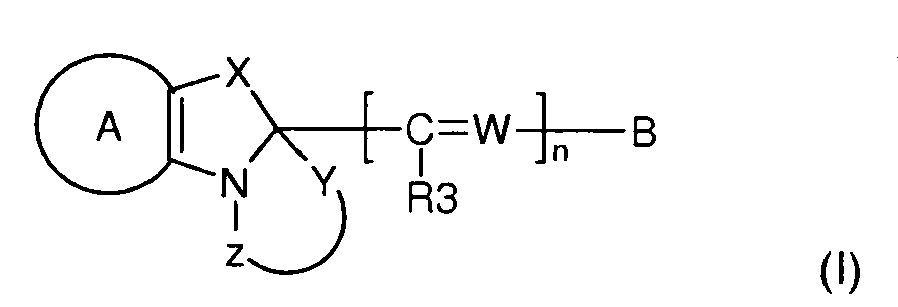
- A est un noyau aromatique ou hétéroaromatique, condensé ou non, comportant de 5 à 16 chaînons, non substitué ou substitué ;
- X représente un atome d'oxygène, un atome de soufre ou un groupement CR1R2 ;
- R1 et R2 représentent, indépendamment l'un de l'autre, un atome d'hydrogène, un radical alkyle en C1-C6, un radical hydroxyalkyle en C1-C6, un radical alcoxyalkyle en C1-C6, une chaîne alkylène pouvant contenir un atome d'oxygène ou de soufre ; R1 et R2 peuvent former ensemble un cycle à 5 ou 6 chaînons aromatiques ou non aromatiques, contenant éventuellement un ou plusieurs hétéroatomes tels qu'un atome d'azote, d'oxygène ou de soufre ;
- R3 représente un atome d'hydrogène, un atome d'halogène, un radical alkyle en C1-C6, un radical cyano, un groupement aromatique, un groupement phénoxy, un radical nitro ;
- W représente un groupement CR4 ou un atome d'azote ;
- R4 représente un atome d'hydrogène, un atome d'halogène, un radical alkyle en C1-C6, un radical cyano, un groupement aromatique, un radical phénoxy, un radical nitro ;
- Y représente un atome d'oxygène, un atome de soufre, un groupement NR5 ;
- R5 représente un atome d'hydrogène, un radical alkyle en C1-C6 ;
- Z représente un groupement -CpH2p-, avec p un entier compris entre 2 et 4, non substitué ou substitué par un ou plusieurs substituants choisis parmi les radicaux halogéno, hydroxy, alkyle, halogénoalkyle, alcoxy, amino, mono ou dialkylamino, mono ou dihydroxyalkylamino, carboxyle ; un groupement -CqH2qCO-, avec q un entier compris entre 1 et 3, non substitué ou substitué par un ou plusieurs substituants choisis parmi les radicaux halogéno, hydroxy, alkyle, halogénoalkyle, alcoxy, amino, mono ou dialkylamino, mono ou dihydroxyalkylamino, carboxyle ;
- n représente un entier de 1 à 4 ;
- B représente un noyau aromatique ou hétéroaromatique, condensé ou non, comportant de 5 à 16 chaînons non substitué ou substitué,
- La présente invention a également pour objet un procédé de coloration des fibres kératiniques mettant en oeuvre une telle composition.
- La présente invention a aussi pour objet un dispositif à plusieurs compartiments pour la mise en oeuvre du procédé de coloration conforme à l'invention.
- L'invention permet en particulier d'obtenir une coloration des fibres kératiniques qui est chromatique, tenace, notamment vis-à-vis des shampooings.
- Comme indiqué auparavant, un autre avantage de l'invention est de fournir un mode de coloration propre, en d'autres termes qui ne tache pas.
- En effet, dans certaines conditions de mise en oeuvre de l'invention, le composé appliqué sur les fibres kératiniques est incolore ou faiblement coloré et la coloration est n'est révélée que par la suite, une fois l'application sur les fibres kératiniques, réalisée.
- La révélation de la coloration est effectuée en ouvrant l'hétérocycle pour conduire à des espèces de formule (1') suivante, qui elles sont colorées :

- A, X, Z, W, R3 et n ayant les mêmes significations que celles indiquées auparavant.
- L'ouverture de l'hétérocycle formé par N, Y et Z dans les composés colorants de formule (1) peut être réalisée sous l'effet d'un stimulus tel que la lumière, un courant électrique, la chaleur, l'ajout d'un agent acidifiant, l'ajout de solvant ou une radiation électromagnétique.
- La composition appliquée sur les fibres kératiniques est donc substantiellement (ou sensiblement) incolore, transparente ou non, de même que les eaux de rinçage à l'eau ou au shampooing, rendant de ce fait. Ainsi, l'application de la composition selon l'invention peut ne pas être salissante.
- Par ailleurs, il est possible d'effacer la couleur obtenue. Il suffit en effet de traiter les fibres kératiniques colorées par la composition selon l'invention, avec une composition qui aura pour rôle de faire augmenter le pH des fibres au-dessus du pKa des colorants de formules (I) présents sur et dans les fibres. Les hétérocycles ouverts des composés de formule (I') se refermeront pour donner à nouveau des composés de formule (I).
- On a enfin constaté que l'application de la composition sur des cheveux foncés, plus particulièrement caractérisés par une hauteur de ton inférieure ou égale à 6, conduisait à augmenter la hauteur de ton de la coloration d'au moins un ton, ce qui correspond à un éclaircissement visible de la fibre, sans avoir recours à l'emploi d'une composition oxydante.
- Dans le cadre de la présente invention, on entend par noyau hétéroaromatique un noyau aromatique comprenant un ou plusieurs hétéroatomes tels que les atomes d'azote, de soufre, d'oxygène ou de phosphore.
- Dans le cadre de la présente invention, le terme "condensé" signifie au moins deux cycles accolés présentant au moins deux atomes communs.
- Un radical halogéno désigne un atome d'halogène choisi parmi le chlore, le brome, l'iode et le fluor.
- On entend par radical alkyle (alk) un radical linéaire ou ramifié, par exemple un radical méthyle, éthyle, n-propyle, iso-propyle, n-butyle ou ter-butyle. Un radical alcoxy est un radical alk-O-, un radical mono ou dialkylamino est un radical -N(alk)n avec n = 1 ou 2, un radical alkylcarbonyle est un radical alk-CO-, un radical alcoxycarbonyle est un radical alk-O-CO-, un radical alkylcarbonylalkyle est un radical alk-CO-alk-, dans chacune de ces définitions le radical alkyle étant tel que défini précédemment.
- Un radical alkyle substitué est un alkyle mono ou polysubstitué. Par exemple, un hydroxyalkyle ou un aminoalkyle est un alkyle qui peut être substitué par un ou plusieurs groupes hydroxy ou amino.
- On entend par radical aryle (ar) un radical carboné dérivé des composés benzéniques condensés ou non condensés, par exemple phényle, anthracényle ou naphtyle.
- A titre d'exemples de cycles à 5 ou 6 chaînons aromatiques ou non aromatiques, on peut citer le cyclo-1,3-pentadiène, le benzène, le cyclopentane et le cyclobutane.
- Les composés de formule (I) peuvent être neutralisés par un contre-ion anionique ou cationique quand ils portent une charge. Les contre-ions négatifs peuvent par exemple être choisis parmi un halogénure tel qu'un chlorure, un bromure, un iodure ou un fluorure, un perchlorate, un p-méthylbenzène sulfonate, un tétrafluoroborate, un sulfate, un alkylsulfate, un toluènesulfonate, un sulfonate. Les contre-ions cationiques peuvent être choisis parmi les cations issus des sels de métaux alcalins ou alcalino-terreux tels que les ions sodium ou potassium.
- Dans le cadre de la présente invention, on entend par cheveux foncés, des cheveux dont la hauteur de ton est inférieure ou égale à 6 (blond foncé) et de préférence inférieure ou égale à 4 (châtain).
- Il est rappelé que l'éclaircissement des cheveux est évalué par la hauteur de ton" qui caractérise le degré ou le niveau d'éclaircissement. La notion de "ton" repose sur la classification des nuances naturelles, un ton séparant chaque nuance de celle qui la suit ou la précède immédiatement. Cette définition et la classification des nuances naturelles sont bien connues des professionnels de la coiffure et publiée dans l'ouvrage "Sciences des traitements capillaires" de Charles ZVIAK 1988, Ed.Masson, pp.215 et 278. Les hauteurs de ton s'échelonnent de 1 (noir) à 10 (blond clair), une unité correspondant à un ton ; plus le chiffre est élevé et plus la nuance est claire.
- Selon un mode de réalisation particulier de l'invention, A est un noyau benzénique, anthracénique, naphtalénique ou quinolinique.
- Selon un mode de réalisation particulier de l'invention, A est non substitué ou substitué par un ou plusieurs groupements pouvant être choisis parmi un radical halogéno, un radical alkyle en C1-C6, un radical alcoxy en C1-C6, un radical alkylsulfonyle en C1-C6 (-SO2-alkyl), un radical alkylsulfonate en C1-C6 (-SO3-alkyl), un radical cyano, un radical trifluorométhyle, un radical alkylcarbonyle en C1-C6, un radical trifluorométhylsulfonyle (-SO2-CF3), un radical trifluorométhylcarbonyle, un radical phénylsulfonyle (-SO2-Ph), un radical phénylsulfonate (-SO3-Ph) un radical phénylcarbonyle, un radical nitro, un radical alcoxycarbonyle en C1-C6, un radical phosphonyle (-PO(OH)2), un radical phosphonylalkyle(C1-C6) (-alkyl-PO(OH)2), un radical hydroxyle, un radical amino, un radical dialkyl(C1-C6)amino, un radical (hydroxyalkyl(C1-C6))amino, un radical di(hydroxyalkyl(C1-C6))amino, un radical (aminoalkyl(C1-C6))amino, un radical di(aminoalkyl(C1-C6))amino, un radical (hydroxyalkyl(C1-C-6))(alkyl(C1-C6))amino, un radical (aminoatkyl(C1-C6))(alkyl(C1-C6))amino, un radical (aminoalkyl(C1-C6))(hydroxyalkyl(C1-C6)amino, un radical hydroxyalkyle(C1-C6), un radical aminoalkyle(C1-C6), un radical (alkyl(C1-C6))aminoalkyle(C1-C6), un radical di(alkyl(C1-C6))aminoalkyle(C1-C6), un radical (hydroxyalkyl(C1-C6))aminoalkyle(C1-C6), un radical di(hydroxyalkyl(C1-C6))aminoalkyle(C1-C6), un radical (aminoalkyl(C1-C6))aminoalkyle(C1-C6), un radical di(aminoalkyl(C1-C6))aminoalkyle(C1-C6), un radical (alkyl(C1-C6))(hydroxyalkyl(C1-C6))aminoalkyle(C1-C6), un radical (aminoalkyl(C1-C6))(alkyl(C1-C6))amino, un radical (hydroxyalkyl(C1-C6))(alkyl(C1-C6))aminoalkyle(C1-C6), un radical phénylalkyle(C1-C6) éventuellement substitué par un ou plusieurs substituants choisis parmi les radicaux halogéno, hydroxy, alkyle, halogénoalkyle, alcoxy, amino, mono ou dialkylamino, mono ou dihydroxyalkylamino, carboxyle, un groupement cationique du type ammonium quaternaire, un radical alkyle en C1-C6 substitué par un groupement cationique du type ammonium quaternaire, un radical carboxyle, un radical alkyle(C1-C6) substitué par un radical carboxyle, un radical thiol, un radical thioalkyle(C1-C6), un radical sulfonate (-SO3 -), un radical alkyle(C1-C6) substitué par un radical sulfonate, un radical alkyl(C1-C6)carbonylalkyle(C1-C6), un radical di(halogénoalkyl(C1-C6))amino, un radical acétamido, un radical aryloxy, un radical aryloxyalkyle(C1-C6), un radical éthényle (-CH=CH2), un radical éthénylcarbonyle (-CO-CH=CH2) ; deux groupements adjacents pouvant former un cycle aromatique ou hétéroaromatique, non substitué ou substitué par un ou plusieurs substituants choisis parmi les radicaux halogéno, hydroxy, alkyle, halogénoalkyle, alcoxy, amino, mono ou dialkylamino, mono ou dihydroxyalkylamino, carboxyle, ou un cycle de type -O-CmH2m-O- où m est un entier égal à 1 ou 2. De préférence, A est non substitué ou substitué par un ou plusieurs groupements choisis parmi un radical alkyl(C1-C6)sulfonyle ; un groupement pyridinium ou imidazolium, non substitué ou substitué par un ou plusieurs substituants choisis parmi les radicaux halogéno, hydroxy, alkyle, halogénoalkyle, alcoxy, amino, mono ou dialkylamino, mono ou dihydroxyalkylamino, carboxyle ; un groupement trialkyl(C1-C6)ammonium ; un radical sulfonate. A titre d'exemple, A peut être substitué par un radical méthylsulfonyle ; un groupement 1-méthyl-pyridinium ; un groupement imidazolium ; un groupement triméthylammonium ; un radical sulfonate.
- Selon un mode de réalisation particulier de l'invention, X est choisi parmi un groupement CR1R2.
- Selon un mode de réalisation particulier de l'invention, R1 et R2 sont choisis parmi un radical alkyle en C1-C6. A titre d'exemple, R1 et R2 peuvent être un radical méthyle ; un radical éthyle.
- Selon un mode de réalisation particulier de l'invention, R3 est choisi parmi un atome d'hydrogène.
- Selon un mode de réalisation particulier de l'invention, W est choisi parmi un groupement CR4.
- Selon un mode de réalisation particulier de l'invention, R4 est choisi parmi un atome d'hydrogène.
- Selon un mode de réalisation particulier de l'invention, Y est choisi parmi un atome d'oxygène ou un atome de soufre.
- Selon un mode de réalisation particulier de l'invention, Z est choisi parmi un groupement -CpH2p-, avec p un entier compris entre 2 et 4, non substitué ou substitué par un ou plusieurs substituants choisis parmi les radicaux halogéno, hydroxy, alkyle, halogénoalkyle, alcoxy, amino, mono ou dialkylamino, mono ou dihydroxyalkylamino, carboxyle. A titre d'exemple, Z peut être un groupement -C2H4-.
- Selon un mode de réalisation particulier de l'invention, n est égal à 1 ou 2.
- Selon un mode de réalisation particulier de l'invention, B est un noyau benzénique, carbazolique ou indolique.
- Selon un mode de réalisation particulier de l'invention, B est non substitué ou substitué par un ou plusieurs groupements pouvant être choisis parmi un radical halogéno, un radical alkyle en C1-C6, un radical alcoxy en C1-C6, un radical cyano, un radical trifluorométhyle, un radical alkylcarbonyle en C1-C6, un radical trifluorométhylsulfonyle, un radical trifluorométhylcarbonyle, un radical phénylsulfonyle, un radical phénylcarbonyle, un radical phényle non substitué ou substitué par un ou plusieurs substituants choisis parmi les radicaux halogéno, hydroxy, alkyle, halogénoalkyle, alcoxy, amino, mono ou dialkylamino, mono ou dihydroxyalkylamino, carboxyle, un radical acylamino, un radical hydroxyle, un radical amino, un radical di(alkyl(C1-C6))amino, un radical hydroxyalkyl(C1-C6)amino, un radical di(hydroxyalkyl(C1-C6))amino, un radical (aminoalkyl(C1-C6))amino, un radical di(aminoalkyl(C1-C6))amino, un radical (alkyl(C1-C6))(hydroxyalkyl(C1-C-6))amino, un radical (aminoalkyl(C1-C6))(alkyl(C1-C6))amino, un radical (aminoalkyl(C1-C6))(hydroxyalkyl(C1-C6))amino, un radical hydroxyalkyle(C1-C6), un radical aminoalkyle(C1-C6), un radical alkyl(C1-C6)aminoalkyle(C1-C6), un radical di(alkyl(C1-C6))aminoalkyle(C1-C6), un radical (hydroxyalkyl(C1-C6))àminoalkyle(C1-C6), un radical di(hydroxyalkyl(C1-C6))aminoalkyle(C1-C6), un radical aminoalkyl(C1-C6)aminoalkyle(C1-C6), un radical di(aminoalkyl(C1-C6))aminoalkyle(C1-C6), un radical (alkyl(C1-C6))(hydroxyalkyl(C1-C6))aminoalkyle(C1-C6), un radical (alkyl(C1-C6))(aminoalkyl(C1-C6))amino, un radical (hydroxyalkyl(C1-C6))(alkyl(C1-C6))aminoalkyle(C1-C6), un radical phénylalkyle(C1-C6) non substitué ou substitué par un ou plusieurs substituants choisis parmi les radicaux halogéno, hydroxy, alkyle, halogénoalkyle, alcoxy, amino, mono ou dialkylamino, mono ou dihydroxyalkylamino, carboxyle, un groupement cationique du type ammonium quaternaire, un radical alkyle(C1-C6) substitué par un groupement cationique du type ammonium quaternaire, un radical carboxyle, un radical alkyle(C1-C6) substitué par un radical carboxyle, un radical thiol, un radical thioalkyle(C1-C6), un radical sulfonate, un radical alkyle(C1-C6) substitué par un radical sulfonate, un radical alkyl(C1-C6)carbonylalkyle(C1-C6), un radical di(halogénoalkyl(C1-C6))amino, un radical acétamido, un radical aryloxy, un radical aryloxyalkyle(C1-C6), un radical éthényle, un radical éthénylcarbonyle, un groupement NR6R7, R6 et R7 pouvant former ensemble avec l'atome d'azote auquel ils sont attachés un cycle en C5, C6 ou C7 non aromatique, éventuellement interrompu par un ou plusieurs hétéroatomes tels qu'un atome d'azote, d'oxygène ou de soufre, une chaîne alkylène pouvant contenir un atome d'oxygène ou de soufre et pouvant être terminée par un groupement cyano, alkylsulfonyle en C1-C6 ou alkylcarbonyle en C1-C6 ; deux groupements adjacents de B pouvant former un cycle aromatique ou hétéroaromatique, non substitué ou substitué par un ou plusieurs substituants choisis parmi les radicaux halogéno, hydroxy, alkyle, halogénoalkyle, alcoxy, amino, mono ou dialkylamino, mono ou dihydroxyalkylamino, carboxyle, ou un cycle de type -O-CrH2r-O- où r représente un entier égal à 1 ou 2. De préférence, B est non substitué ou substitué par un ou plusieurs groupements choisis parmi un radical hydroxyle ; un radical amino ; un radical di(alkyl(C1-C6))amino ; un radical alkyle en C1-C6; un radical acétamido ; un groupement pyridinium ; un groupement trialkyl(C1-C6)ammonium. A titre d'exemple, B peut être substitué par un radical hydroxyle ; un radical amino ; un radical diméthylamino ; un radical éthyle ; un radical acétamido ; un groupement pyridinium ; un groupement triméthylammonium.
- Les groupements cationiques du type ammonium quaternaire peuvent par exemple être choisis parmi les groupements trialkylammonium, oxazolium, thiazolium, imidazolium, pyrazolium, pyridinium, pyrrolium, triazolium, isooxazolium, isothiazolium, pyrimidinium, pyrazinium, triazinium, pyridazinium, indolium, quinolinium ou isoquinolimiun, substitué ou non substitué, et peuvent être reliés au noyau A ou au noyau B par n'importe lequel de leurs atomes de carbone non substitués.
- A titre d'exemples de composés de formule (I) pour lesquels Y est un atome d'oxygène, on peut citer l'acide 9a-[2-[4-(diméthylamino)phényl]-1,3-butadiényl]-2,3,9,9a-tétrahydro-9,9-diméthyl oxazolo[3,2-a]indole-7-carboxylique ; l'acide [9a-[2-[4-(diméthylamino)phényl]éthènyl]-2,3,9,9a-tétrahydro-9,9-diméthyloxazolo[3,2-a]indol-7-yl] phosphonique ; la 4-[2-(9,9-diéthyl-2,3-dihydro-7-méthoxyoxazolo[3,2-a]indol-9a(9H)-yl)éthènyl]-N,N-diéthyl benzenamine ; l'acide [3-[9a-[2-[4-(diméthylamino)phényl]éthènyl]-2,3,9,9a-tétrahydro-9,9-diméthyl oxazolo[3,2-a]indol-7-yl]propyl] phosphonique ; la 4-[2-(2,3-dihydro-9,9-diméthyl oxazolo[3,2-a]indol-9a(9H)-yl)éthènyl]-N-méthyl-N-phényl benzènamine ; la 4-[2-(2,3-dihydro-9,9-diméthyloxazolo[3,2-a]indol-9a(9H)-yl)éthènyl]-3-éthoxy-N,N-diéthyl benzènamine ; la 4-[2-(2,3-dihydro-9,9-diméthyloxazolo[3,2-a]indol-9a(9H)-yl)éthènyl]-N-éthyl-N-(2-méthylpropyl) benzènamine ; la 4-[2-(2,3-dihydrooxazolo[3,2-a]indol-9a(9H)-yl)éthènyl]-N,N-diméthyl benzènamine ; la 4-[4-(2,3-dihydro-7,9,9-triméthyloxazolo[3,2-a]indol-9a(9H)-yl)-1,3-butadiènyl]-N,N-diméthyl benzènamine ; la 4-[4-(2,3-dihydro-9,9-diméthyl-7-nitrooxazolo[3,2-a]indol-9a(9H)-yl)-1,3-butadiènyl]-N,N-diméthyl benzenamine ; le 9a-[4-[4-(diméthylamino)phényl]-1,3-butadiènyl]-2,3,9,9a-tétrahydro-9,9-diméthyl oxazolo[3,2-a]indole-7-carbonitrile ; le 9a-[2-[4-(diméthylamino) phényl]éthènyl]-2,3,9,9a-tétrahydro-9,9-diméthyl oxazolo[3,2-a]indole-7-carbonitrile ; la 4-[2-(2,3-dihydro-9,9-diméthyloxazolo[3,2-a]indot-9a(9H)-yl)éthènyl]-N,N-diméthyl benzenamine ; l'acide 9a-[2-[4-(diméthylamino)phényl]éthènyl]-2,3,9,9a-tétrahydro-9,9-diméthyl-méthylester oxazolo[3,2-a]indole-7-sulfonique ; la N,N-bis(2-chloroéthyl)-4-[2-(2,3-dihydro-9,9-diméthyloxazolo[3,2-a]indol-9a(9H)-yl)éthènyl] benzènamine ; la 9a-[2-[4-(diméthylamino)phényl]éthènyl]-9,9a-dihydro-9,9-diméthyl-7-(octylsulfonyl) oxazolo[3,2-a]indol-2(3H)-one ; la 9a-[2-[4-(diméthylamino) phényl]éthènyl]-9,9a-dihydro-9,9-diméthyl-7-(phénylsulfonyl) oxazolo [3,2-a]indol-2(3H)-one ; la 9a-[2-[4-(diméthylamino)phényl]-1-méthyléthènyl]-9,9a-dihydro-9,9-diméthyl-7-(méthylsulfonyl) oxazolo[3,2-a]indol-2(3H)-one ; la 9a-[2-[4-(diméthylamino) phényl]éthènyl]-9,9a-dihydro-9,9-diméthyl-7-(méthylsulfonyl) oxazolo [3,2-a]indol-2(3H)-one ; la 4-[2-[2,3-dihydro-9,9-diméthyl-7-(méthylsulfonyl) oxazolo[3,2-a]indol-9a(9H)-yl]éthènyl]-N,N-diméthyl benzènamine ; la 4-[2-[9-(éthoxyméthyl)-2,3-dihydro-9-méthyl-7-(méthylsulfonyl)oxazolo[3,2-a]indol-9a(9H)-yl]éthènyl]-N,N-diméthyl benzenamine ; la 4-[2-[2,3-dihydro-2,9,9-triméthyl-7-(méthylsulfonyl)oxazolo[3,2-a]indol-9a(9H)-yl]éthènyl]-N,N-diméthyl benzènamine ; la 4-[2-[2,3-dihydro-9,9-diméthyl-7-(méthylsulfonyl)oxazolo[3,2-a]indol-9a(9H)-yl]-1-propényl]-N,N-diméthyl benzènamine ; la N,N-dibutyl-4-[2-[2,3-dihydro-9,9-diméthyl-7-(méthylsulfonyl)oxazolo [3,2-a]indol-9a(9H)-yl]éthènyl] benzènamine ; 4-[2-[2,3-dihydro-9,9-diméthyl-7-(phénylsulfonyl)oxazolo[3,2-a]indol-9a(9H)-yl]éthènyl]-N,N-diméthyle ; la 4-[2-[2,3-dihydro-9,9-diméthyl-7-(octylsulfonyl)oxazolo[3,2-a]indol-9a(9H)-yl]éthènyl]-N,N-diméthylbenzènamine ; le N-[4-[2-[7-(butylsulfonyl)-2,3-dihydro-9,9-diméthyl oxazolo [3,2-a]indol-9a(9H)-yl]éthènyl]phényl] acétamide ; la 4-[2-[7-(butylsulfonyl)-2,3-dihydro-9,9-diméthyloxazolo[3,2-a]indol-9a(9H)-yl]éthènyl]-N,N-diméthyl benzènamine ; la 4-[4-[2,3-dihydro-9,9-diméthyl-7-(méthylsulfonyl)oxazolo[3,2-a]indol-9a(9H)-yl]-1,3-butadiènyl]-N,N-diméthyl benzènamine ; le 9a-[2-[4-(diméthylamino)phényl]éthènyl]-2,3,9,9a-tétrahydro-9-méthyl oxazolo[3,2-a]indole-9-éthanol ; la 4-[2-(9,9-diéthyl-2,3-dihydrooxazolo[3,2-a]indol-9a(9H)-yl)éthènyl]-N,N-diméthyl benzènamirie ; la 4-[2-[2,3-dihydro-9-méthyl-9-(2-phénoxyéthyl)oxazolo[3,2-a]indol-9a(9H)-yl]éthènyl]-N,N-diméthyl benzènamine ; la 4-[2-[9-(éthoxyméthyl)-2,3-dihydro-9-méthyloxazolo[3,2-a]indol-9a(9H)-yl]éthènyl]-N,N-diméthyl benzènamine ; la 4-[2-(11,11-diméthylbenz[e] oxazolo[3,2-a]indol-10a(11H)-yl)éthènyl]-N,N-diméthyl benzenamine ; la 4-[2-(7-méthoxy-9,9-diméthyloxazolo[3,2-a]indol-9a(9H)-yl)éthènyl]-N,N-diméthyl benzènamine ; la 4-[2-(9,9-diméthyloxazolo[3,2-a]indol-9a(9H)-yl)éthènyl]-N,N-diméthyl benzènamine ; la 9a-[2-[4-(diméthylamino)phényl]éthènyl]-3-éthyl-9,9a-dihydro-9,9-diméthyloxazolo[3,2-a]indol-2(3H)-one ; la 7-chloro-9a-[2-[4-(diméthylamino)phényl] éthènyl]-9,9a-dihydro-3,9,9-triméthyl oxazolo[3,2-a]indol-2(3H)-one ; la 9a-[2-[4-(dibutylamino)phényl]éthènyl]-9,9a-dihydro-9,9-diméthyl oxazolo[3,2-a]indol-2(3H)-one ; la 9a-[2-[4-(diméthylamino)phényl]éthènyl]-9,9a-dihydro-9-(2-hydroxyéthyl)-9-méthyl oxazolo[3,2-a]indol-2(3H)-one ; la 9a-[2-[4-(diméthylamino)phényl]-1-propényl]-9,9a-dihydro-9,9-diméthyl oxazolo[3,2-a]indol-2(3H)-one ; la 9,9a-dihydro-7,9,9-triméthyl-9a-[2-(4-nitrophényl)éthènyl] oxazolo[3,2-a]indol-2(3H)-one , le N-[4-[2-(2,3-dihydro-9,9-diméthyl-2-oxooxazolo[3,2-a]indol-9a(9H)-yl)éthènyl]phényl] acetamide ; la 9a-[2-[4-(diméthylamino)phényl]éthènyl]-9,9a-dihydro-6-méthoxy-9,9-diméthyl oxazolo[3,2-a]indol-2(3H)-one ; l'acide 9a-[2-[4-(diméthylamino)phényl]éthènyl]-2,3,9,9a-tétrahydro-9,9-diméthyl-2-oxo-éthyl ester oxazolo[3,2-a]indole-7-carboxylique ; la 9a-[2-[4-(diméthylamino)phényl]éthènyl]-9,9a-dihydro-7,9,9-triméthyl oxazolo[3,2-a]indol-2(3H)-one ; la 10a-[2-[4-(diméthylamino)phényl]éthènyl]-10a,11-dihydro-11,11-diméthyl benz[e]oxazolo[3,2-alindol-9(8H)-one ; la 9,9a-dihydro-9,9-diméthyl-9a-[2-(4-nitrophényl)éthènyl] oxazolo[3,2-a]indol-2(3H)-one ; la 7-chloro-9a-[2-[4-(diméthylamino)phényl]éthènyl]-9,9a-dihydro-9,9-diméthyl oxazolo[3,2-a]indol-2(3H)-one ; la 9a-[2-[4-(diméthylamino)phényl]éthènyl]-9,9a-dihydro-9,9-diméthyl oxazolo[3,2-a]indol-2(3H)-one ; la 4-[2-(7-chloro-2,3-dihydro-9,9-diméthyloxazolo[3,2-a]indol-9a(9H)-yl)éthènyl]-N,N-diméthyl benzènamine ; la 4-[2-(2,3-dihydro-9,9-diméthyloxazolo[3,2-a]indol-9a(9H)-yl)éthènyl]-N,N-diméthyl benzènamine ; la 4-[2-(7-chloro-2,3-dihydro-2,9,9-triméthyloxazolo[3,2-a]indol-9a(9H)-yl)éthènyl]-N,N-diméthyl benzènamine ; la 4-[2-(2,3-dihydro-9,9-diméthyloxazolo[3,2-a]indol-9a(9H)-yl)-1-méthyléthènyl]-N,N-diméthyl benzènamine ; la 4-[2-(2,3-dihydro-9,9-diméthyloxazolo[3,2-a]indol-9a(9H)-yl)éthènyl]-N,N-diéthyl benzènamine ; le 2,3,9,9a-tétrahydro-7-méthoxy-9,9-diméthyl-9a-[2-(4-nitrophényl)éthènyl] oxazolo[3,2-a]indole ; la 4-[2-(2,3-dihydro-9,9-diméthyl-7-nitrooxazolo[3,2-a]indol-9a(9H)-yl)éthènyl]-N,N-diméthyl benzènamine; la N,N-dibutyl-4-[2-(2,3-dihydro-9,9-diméthyloxazolo[3,2-a]indol-9a(9H)-yl)éthènyl] benzènamine ; le 2,3,9,9a-tétrahydro-9,9-diméthyl-7-nitro-9a-[2-(4-nitrophényl)éthènyl] oxazolo[3,2-a]indole ; le 7-chloro-2,3,9,9a-tétrahydro-9,9-diméthyl-9a-[2-(4-nitrophényl)éthènyl] oxazolo[3,2-a]indole ; la 4-[2-(2,3-dihydro-7-iodo-9,9-diméthyloxazolo[3,2-a]indol-9a(9H)-yl)éthènyl]-N,N-diméthyl benzènamine ; la 4-[2-(2,3-dihydro-5-méthoxy-9,9-diméthyloxazolo[3,2-a]indol-9a(9H)-yl)éthènyl]-N,N-diméthyl benzènamine ; la 4-[2-(2,3-dihydro-7-méthoxy-9,9-diméthyloxazolo[3,2-a]indol-9a(9H)-yl)éthènyl]-N,N-diméthyl benzènamine ; la 4-[4-(2,3-dihydro-9,9-diméthyloxazolo[3,2-a]indol-9a(9H)-yl)-1,3-butadiènyl]-N,N-diéthyl benzènamine ; la 4-[4-(7-chloro-2,3-dihydro-9,9-diméthyloxazolo[3,2-a]indol-9a(9H)-yl)-1,3-butadiènyl]-N,N-diméthyl benzènamine ; la 4-[4-(2,3-dihydro-9,9-diméthyloxazolo[3,2-a]indol-9a(9H)-yl)-1,3-butadiènyl]-N,N-diméthyl benzènamine ; la 4-[4-(2,3-dihydro-7-méthoxy-9,9-diméthyloxazolo[3,2-a]indol-9a(9H)-yl)-1,3-butadiènyl]-N,N-diméthyl benzènamine ; le 2,3,9,9a-tétrahydro-7,9,9-triméthyl-9a-[2-(4-nitrophényl)éthènyl] oxazolo[3,2-a]indole ; le N-[4-[2-(2,3-dihydro-9,9-diméthyloxazolo[3,2-a]indol-9a(9H)-yl)éthènyl]phényl] acétamide ; la 4-[2-(2,3-dihydro-6-méthoxy-9,9-diméthyloxazolo[3,2-a]indol-9a(9H)-yl)éthènyl]-N,N-diméthyl benzènamine; la 4-[2-(8,9-dihydro-11,11-diméthylbenz[e]oxazolo[3,2-a]indol-10a(11H)-yl)éthènyl]-N,N-diméthyl benzènamine ; la 4-[2-(2,3-dihydro-7,9,9-triméthyloxazolo[3,2-a]indol-9a(9H)-yl)éthènyl]-N,N-diméthyl benzènamine ; le 2,3,9,9a-tétrahydro-9,9-diméthyl-9a-[2-(4-nitrophényl)éthènyl] oxazolo[3,2-a]indole ; la 9,9a-dihydro-9,9-diméthyl-9a-[2-(9-méthyl-9H-carbazol-3-yl)éthènyl]-7-(méthylsulfonyl) oxazolo[3,2-a]indol-2(3H)-one ; le 9a-[2-(9-hexyl-9H-carbazol-3-yl)éthènyl]-2,3,9,9a-tétrahydro-9,9-diméthyl-7-(phénylsulfonyl) oxazolo[3,2-a]indole ; le 2,3,9,9a-tétrahydro-9,9-diméthyl-7-(méthylsulfonyl)-9a-[2-(9-octyl-9H-carbazol-3-yl)éthènyl] oxazolo[3,2-a]indole ; l'acide 9a-[2-(9-butyl-6-méthoxy-9H-carbazol-3-yl)éthènyl]-2,3,9,9a-tétrahydro-9,9-diméthyl-, éthyl ester oxazolo[3,2-a]indole-7-carboxylique ; l'acide 9a-[2-(9-éthyl-9H-carbazol-3-yl)éthènyl]-2,3,9,9a-tétrahydro-9,9-diméthyl-, méthyl ester oxazolo[3,2-a]indole-7-sulfonique ; le 3-chloro-6-[2-[2,3-dihydro-9,9-diméthyl-7-(méthylsulfonyl)oxazolo[3,2-a]indol-9a(9H)-yl]éthènyl]-9-octyl 9H-carbazole ; le 3-[2-[2,3-dihydro-9,9-diméthyl-7-(méthylsulfonyl)oxazolo[3,2-a]indol-9a(9H)-yl]éthènyl]-9-méthyl 9H-carbazole ; le 3-[2-[9-(2-éthoxyéthyl)-2,3-dihydro-9-méthyl-7-(méthyl sulfonyl)oxazolo[3,2-a]indol-9a(9H)-yl]éthènyl] 9H-carbazole ; l'acide 9a-[2-(9-hexyl-9H-carbazol-3-yl)éthènyl]-2,3,9,9a-tétrahydro-9-(2-hydroxyéthyl)-9-méthyl-, éthyl ester oxazolo[3,2-a]indole-7-carboxylique ; l'acide 2,3,9,9a-tétrahydro-9,9-diméthyl-9a-[2-(9-octyl-9H-carbazol-3-yl)éthènyl]-, éthyl ester oxazolo[3,2-a]indole-7-carboxylique ; l'acide 9a-[2-(9-butyl-9H-carbazol-3-yl)éthènyl]-2,3,9,9a-tétrahydro-9,9-diméthyl-, éthyl ester oxazolo[3,2-a]indole-7-carboxylique ; l'acide 2,3,9,9a-tétrahydro-9,9-diméthyl-9a-[2-(9-méthyl-9H-carbazol-3-yl)éthènyl]-, éthyl ester oxazolo[3,2-a]indole-7-carboxylique ; la 9a-[2-(9-butyl-6-éthoxy-9H-carbazol-3-yl)éthènyl]-2,3,9,9a-tétrahydro-N,N,9,9-tétraméthyl oxazolo[3,2-a]indol-7-amine ; le 2,3,9,9a-tétrahydro-9-méthyl-9a-[2-(9-méthyl-9H-carbazol-3-yl)éthènyl] oxazolo[3,2-a]indole-9-éthanol ; la 9a-[2-(9-butyl-9H-carbazol-3-yl)éthènyl]-2,3,9,9a-tétrahydro-N,N,9,9-tétraméthyl oxazolo[3,2-a]indol-7-amine ; le 3-[2-(2,3-dihydro-6-méthoxy-9,9-diméthyloxazolo[3,2-a]indol-9a(9H)-yl)éthènyl]-9-méthyl 9H-carbazole ; le 3-[2-(2,3-dihydro-9,9-diméthyloxazolo[3,2-a]indol-9a(9H)-yl)-1-propényl]-9-méthyl 9H-carbazole ; le 3-[2-(7-chloro-2,3-dihydro-9,9-diméthyloxazolo[3,2-a]indol-9a(9H)-yl)éthènyl]-9-méthyl 9H-carbazole ; le 3-bromo-6-[2-(2,3-dihydro-9,9-diméthyloxazolo[3,2-a]indol-9a(9H)-yl)éthènyl]-9-éthyl 9H-carbazole ; le 3-[2-(2,3-dihydro-9,9-diméthyloxazolo[3,2-a]indol-9a(9H)-yl)éthènyl]-9-méthyl 9H-carbazole.
- De préférence, le ou les composés de formule (I) pour lesquels Y représente un atome d'oxygène, sont choisis parmi les composés présentés dans le tableau ci-dessous :

Colorant 1 
Colorant 2 
Colorant 3 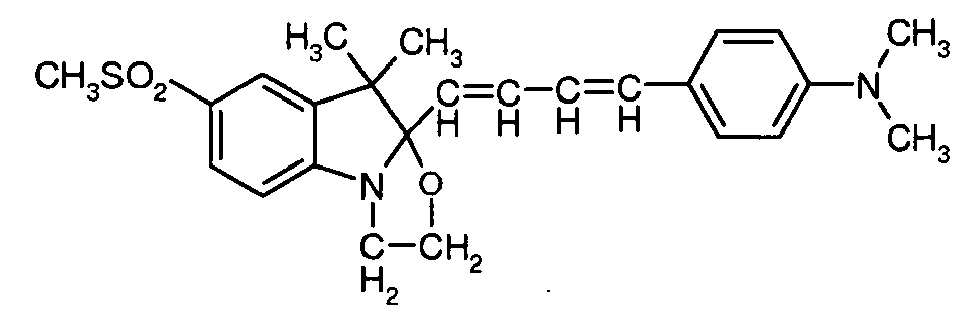
Colorant 4 
Colorant 5 
Colorant 6 
Colorant 7 
Colorant 8 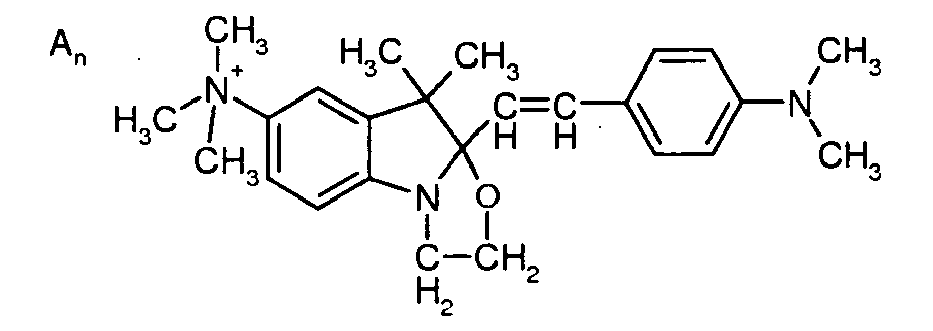
Colorant 9 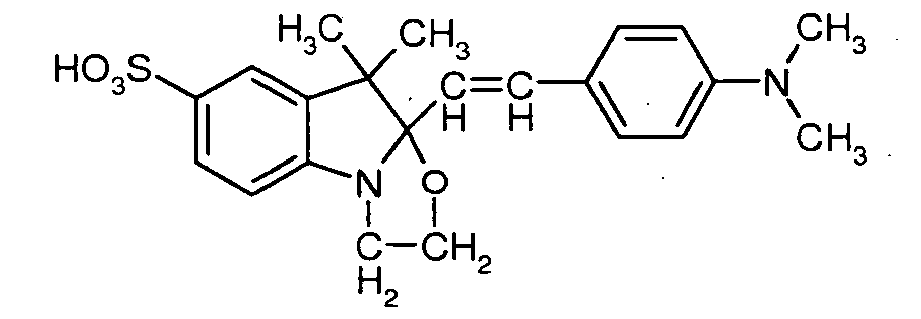
Colorant 10 
Colorant 11 - Dans le tableau ci-dessus, An représente un contre-ion tel que défini précédemment.
- De préférence, les composés sont choisis parmi les colorants 1 à 6 et 8 ci-dessus.
- A titre d'exemples de composés de formule (I) pour lesquels Y est un atome de soufre, on peut citer le 3,3-diméthyl-2-(p-diméthylaminostyryl)indolino[1,2-b]thiazoline ; le 3,3,5-triméthyl-2-(p-diméthylaminostyryl)indolino[1,2-b]thiazoline ; le 3,3,5-triméthyl-2-(p-chlorostyryl)indolino[1,2-b]thiazoline ; le 3,3,5-triméthyl-2-[2-(thiényl)vinyl] indolino[1,2-b]thiazoline ; le 3,3-diméthyl-5-méthoxy-2-[2-(9-éthylcarbazolyl)vinyl] indolino[1,2-b]thiazoline ; le 3,3-diméthyl-5-carboéthoxy-2-(p-diméthylaminostyryl) indolino[1,2-b]thiazoline ; le 3,3-diméthyl-5-chloro-2-[2-(benzothiazolyl)vinyl)indolino [1,2-b]thiazoline ; le 3,3-diméthyl-5-méthoxy-2-(p-diméthylaminostyryl)indolino[1,2-b]thiazoline ; le 3,3-diméthyl-5-carboéthoxy-2-(3,4-méthylènedioxystyryl)indolino[1,2-b]thiazoline ; le 3,3-diméthyl-5-chloro-2-(p-méthylstyryl)indolino[1 ,2-b]thiazoline ; le 3,3-diméthyl-5-chloro-2-(p-méthoxystyryl)indolino[1,2-b]thiazoline; le 3,3,5-triméthyl-2-(p-acétylaminostyryl)indolino[1,2-b]thiazoline ; le 3,3-diméthyl-5-méthoxy-2-(3-hydroxy-4-méthoxystyryl)indolino[1,2-b]thiazoline ; le 3,3-diméthyl-5-carboéthoxy-2-(o-cyano styryl)indolino[1,2-b]thiazoline ; le 3,3-diméthyl-5-chloro-2-(p-diméthylaminostyryl) indolino[1,2-b]thiazoline ; le 3,3-diméthyl-5-méthylsulfonyl-2-(p-diméthylaminostyryl) indolino[1,2-b]thiazoline ; le 3,3-diméthyl-5-phénylsulfonyl-2-(p-diméthylaminostyryl) indolino[1,2-b]thiazoline ; le 3,3-diméthyl-5-éthoxycarboxy-2-(p-diméthylaminostyryl) indolino[1,2-b]oxazoline.
- Les composés de formule (I) utiles présents dans la composition de l'invention peuvent par exemple être préparés selon les modes de préparation tels que décrits dans les brevets
FR 2 285 439 US 4 380 629 . Ces modes de préparation peuvent être adaptés aux composés de formule (I) cationiques en ajoutant une étape de quaternisation. - A titre d'exemple de synthèse de composé de formule (I) avec Y représentant un atome d'oxygène, on peut réaliser la synthèse du colorant 8 selon le schéma réactionnel suivant :

- A titre d'exemple de synthèse de composé de formule (I) avec Y représentant un atome de soufre, on peut réaliser la synthèse comme suit :

- Le ou les composés choisis parmi les composés de formule (I) et leurs sels d'addition représentent en général de 0,0001 à 30 % en poids par rapport au poids total de la composition, plus particulièrement de 0,001 à 10 % en poids par rapport au poids total de la composition, et de préférence de 0,01 à 5 % en poids par rapport au poids total de la composition.
- D'une manière générale, les sels d'addition des composés de formule (I) utilisables dans le cadre de l'invention sont notamment choisis parmi les sels d'addition avec un acide tels que les chlorhydrates, les bromhydrates, les sulfates, les méthosulfates, les gluconates, les citrates, les succinates, les tartrates, les lactates, les tosylates, les benzènesulfonates, les phosphates et les acétates et les sels d'addition avec une base telles que la soude, la potasse, l'ammoniaque, les amines dont les alcanolamines.
- Comme indiqué auparavant, la composition selon l'invention comprend au moins un composé thiolé, différent des composés de formule (I), comprenant au moins une fonction thiol (SH) et un groupement comprenant de 1 à 20 atomes de carbone, saturé ou non, ledit groupement étant éventuellement interrompu par un ou plusieurs groupes non adjacents (séparés par au moins un atome de carbone) choisis parmi -O-, -S-, -S-S-, amino (-NR-), carbonyle (-CO-), oxycarbonyle (-O-CO-), aminocarbonyle (-NR-CO-), noyau aromatique ou hétéroaromatique, les groupements amino étant ou non substitués par un ou deux radicaux alkyle en C1-C6 ; à la condition que l'atome de soufre de la fonction thiol soit rattaché audit groupement au moyen d'un atome de carbone.
- Par ailleurs le groupement comprenant de 1 à 20 atomes de carbone peut éventuellement être substitué par un ou plusieurs hydroxyle, alcoxy en C1-C6, hydroxycarbonyle, alcoxy(C1-C6)carbonyle, amino, aminocarbonyle, alkylcarbonylamino, dans lesquels la fonction amino est substituée ou non par un ou deux radicaux alkyle en C1-C6.
- De préférence le composé thiolé comprend une ou deux fonctions thiol (SH), de préférence une fonction thiol, et un groupement saturé comprenant de 2 à 10 atomes de carbone, ledit groupement étant éventuellement interrompu par un groupe choisi parmi les groupes carbonyle (-CO-), oxycarbonyle (-O-CO-) ; à la condition que l'atome de soufre de la fonction thiol soit rattaché audit groupement au moyen d'un atome de carbone.
- Par ailleurs le groupement peut éventuellement être substitué par un ou plusieurs hydroxyle, alcoxy(C1-C6)carbonyle, amino substituée ou non par un ou deux radicaux alkyle en C1-C6.
- Conformément à un mode de réalisation particulier de l'invention, le composé thiolé est choisi parmi l'acide thioglycolique, l'acide thiolactique, l'acide mercaptopropionique, la cystéamine, l'acide thiosuccinique, la cystéine, l'acétylcystéine, le glycéryl thioglycolate, la thioglycérine, leurs sels de métaux alcalins (sodium, potassium), alcalino-terreux (calcium) ou d'ammonium, ainsi que leurs mélanges.
- Habituellement, la teneur en composé thiolé est comprise entre 0,001% et 30% en poids par rapport au poids total de la composition, plus particulièrement entre 0,01% et 15% en poids par rapport au poids total de la composition, de préférence entre 0,1% et 10% en poids par rapport au poids total de la composition, et de manière encore plus préférée entre 0,5 et 5 % en poids par rapport au poids total de la composition.
- Il est à noter que le composé thiolé peut être mélangé à la composition comprenant le ou les composés de formule (I) et stocké ainsi. Selon une autre possibilité, le composé thiolé n'est mélangé à la composition comprenant le ou les composés de formule (I) qu'au moment de l'emploi de ladite composition.
- La composition selon l'invention peut en outre comprendre un ou plusieurs colorants directs additionnels pouvant notamment être choisis parmi les colorants nitrés de la série benzénique, les colorants directs azoïques, les colorants directs méthiniques et les colorants naturels. Ces colorants directs peuvent être de nature non ionique, anionique ou cationique.
- S'ils sont présents, la teneur en colorant(s) direct(s) additionnel(s) représente en général de 0,001 à 20 % en poids par rapport au poids total de la composition, de préférence de 0,01 à 10 % en poids par rapport au poids total de la composition.
- La composition selon l'invention de même comprendre un ou plusieurs colorants d'oxydation choisis parmi les bases d'oxydation et les coupleurs classiquement utilisés en coloration d'oxydation.
- Les bases d'oxydation peuvent être choisies parmi les para-phénylènediamines, les bis-phénylalkylènediamines, les para-aminophénols, les bis-para-aminophénols, les ortho-aminophénols, les ortho-phénylènediamines, les bases hétérocycliques et leurs sels d'addition.
- Les coupleurs peuvent être choisis parmi les méta-phénylènediamines, les méta-aminophénols, les méta-diphénols, les coupleurs naphtaléniques, les coupleurs hétérocycliques et leurs sels d'addition.
- S'ils sont présents, la teneur en colorant(s) d'oxydation représente en général de 0,001 à 20 % en poids par rapport au poids total de la composition, de préférence de 0,01 à 10 % en poids par rapport au poids total de la composition.
- Conformément à un mode de réalisation préféré de l'invention, la composition tinctoriale ne comprend pas de colorant direct additionnel ni de colorant d'oxydation.
- La composition peut également comprendre un ou plusieurs agents acidifiants et/ou un ou plusieurs agents alcalinisants habituellement utilisés en teinture des fibres kératiniques.
- Parmi les agents acidifiants, on peut citer, à titre d'exemple, les acides minéraux comme par exemple l'acide chlorhydrique, l'acide nitrique, l'acide sulfurique ou les acides organiques comme par exemple les composés comprenant au moins une fonction acide carboxylique comme l'acide acétique, l'acide tartrique, l'acide citrique, l'acide lactique, l'acide succinique, l'acide malique, une fonction acide sulfonique, une fonction acide phosphonique ou une fonction acide phosphorique.
- Parmi les agents alcalinisants on peut citer, à titre d'exemple :
- les acides aminés basiques ;
- les carbonates ou les bicarbonates de métaux alcalins ou alcalino-terreux ;
- les silicates ou les métasilicates ;
- les composés de formule (III) suivante :
X(OH)n (III)
dans laquelle :- X représente un ion potassium, lithium, sodium, ammonium N+R8R9R10R11 avec R8, R9, R10 et R11, identiques ou différents, désignant un radical alkyle en C2-C4 lorsque n est égal à 1 ;
- X représente un atome de magnésium ou de calcium lorsque n est égal à 2 ;
- les composés de formule (IV) suivante :

- R12 représente un atome d'hydrogène ; un radical alkyle en C1-C6, un radical monohydroxyalkyle en C1-C6 un radical polyhydroxyalkyle en C2-C6 ;
- R13 et R14, identiques ou différents, représentent un atome d'hydrogène, un radical alkyle en C1-C6, un radical monohydroxyalkyle en C1-C6 ; un radical polyhydroxyalkyle en C2-C6 ;
- les composés de formule (V) suivante :

- W est un reste propylène éventuellement substitué par un groupement hydroxyle ou un radical alkyle en C1-C4 ;
- R15 R16, R17 et R18, identiques ou différents, représentent un atome d'hydrogène, un radical alkyle en C1-C4 ou hydroxyalkyle en C1-C4.
- Au sens de la présente invention, on entend par "acide aminé basique", soit (i) un acide aminé présentant en plus de la fonction amine positionnée en α du groupement carboxyle, un groupement cationique (ou basique) supplémentaire; soit (ii) un acide aminé présentant une chaîne latérale (hydrophile) cationique (ou basique); soit (iii) un acide aminé portant une chaîne latérale constituée d'une base azotée. Ces définitions sont généralement connues et publiées dans les ouvrages de biochimie générale tels que J.H. WEIL (1983) pages 5 et suivantes, Lubert STRYER (1995) page 22, A. LEHNINGER (1993) pages 115-116, DE BOECK-WESMAEL (1994) pages 57-59.
- Les acides aminés basiques conformes à l'invention sont choisis de préférence parmi ceux répondant à la formule (D) suivante :


-(CH2)3NH2
-(CH2)2NH2
-(CH2)2NHCONH2

- Parmi les composés de formule (D), on peut citer à titre d'exemple l'histidine, la lysine, l'ornithine, la citrulline, l'arginine.
- Le milieu approprié pour la teinture, appelé aussi support de teinture, est généralement constitué par de l'eau ou par au moins un solvant organique ou par un mélange d'eau et d'au moins un solvant organique. A titre de solvant organique, on peut par exemple citer les cétones tels que l'acétone ; les monoalcools ou les diols, linéaires ou ramifiés, de préférence saturés, comprenant 2 à 10 atomes de carbone, tels que l'alcool éthylique, l'alcool isopropylique, l'hexylèneglycol (2-méthyl 2,4-pentanediol), le néopentylglycol et le 3-méthyl-1,5-pentanediol ; les alcools aromatiques tels que l'alcool benzylique, l'alcool phényléthylique ; les polyols ou éthers de polyol tels que, par exemple, les éthers monométhylique, monoéthylique et monobutylique d'éthylèneglycol, le 2-butoxyéthanol, le propylèneglycol ou ses éthers tels que, par exemple, le monométhyléther de propylèneglycol, le butylèneglycol, le dipropylèneglycol ; ainsi que les alkyléthers de diéthylèneglycol, notamment en C1-C4, comme par exemple, le monoéthyléther ou le monobutyléther du diéthylèneglycol, seuls ou en mélange.
- Les solvants sont généralement présents dans des proportions comprises entre 1 et 40 % en poids par rapport au poids total de la composition, et de préférence entre 5 et 30 % en poids par rapport au poids total de la composition.
- La composition selon l'invention peut également renfermer divers adjuvants utilisés classiquement dans les compositions pour la teinture des cheveux, tels que des agents tensioactifs anioniques, cationiques, non ioniques, amphotères, zwitterioniques ou leurs mélanges, des polymères anioniques, cationiques, non ioniques, amphotères, zwitterioniques ou leurs mélanges, des agents épaississants minéraux ou organiques, et en particulier les épaississants associatifs polymères anioniques, cationiques, non ioniques et amphotères, des agents antioxydants, des agents de pénétration, des agents séquestrants, des parfums, des tampons, des agents dispersants, des agents de conditionnement tels que par exemple des polymères cationiques ou amphotères, des cations, des silicones volatiles ou non volatiles, modifiées ou non modifiées, des chitosanes ou des dérivés de chitosane, des agents filmogènes, des céramides, des agents conservateurs, des agents opacifiants.
- Les adjuvants ci-dessus sont en général présents en quantité comprise pour chacun d'eux entre 0,01 et 20 % en poids par rapport au poids total de la composition.
- Bien entendu, l'homme de l'art veillera à choisir ce ou ces éventuels composés complémentaires de manière telle que les propriétés avantageuses attachées intrinsèquement à la composition de teinture utile dans le cadre de l'invention ne soient pas, ou substantiellement pas, altérées par la ou les adjonctions envisagées.
- Selon une variante de l'invention, le pH de la composition est supérieur au pKa du composé de formule (I) et inférieur ou égal à 12. Avantageusement, le pH est compris entre 8 et 12. Dans le cadre de cette variante, le composé se trouve sous une forme substantiellement incolore.
- La composition selon l'invention peut se présenter sous des formes diverses, telles que sous forme de liquides, de crèmes, de gels, ou sous toute autre forme appropriée pour réaliser une coloration des fibres kératiniques, et notamment des cheveux humains.
- Le procédé de coloration des fibres kératiniques conforme à l'invention est un procédé dans lequel la composition qui vient d'être décrite est appliquée sur les fibres kératiniques, sèches ou humides, pendant un temps de pose suffisant, cette application étant éventuellement suivie d'un rinçage.
- Les composés de formule (I) étant incolores, la couleur apportée par les composés de formule (I) est donc révélée par la suite. Ceci est réalisé en mettant en oeuvre des agents révélateurs tel que la lumière, un courant électrique, la chaleur, un agent acidifiant, un solvant, une radiation électromagnétique.
- Lorsque la coloration est révélée par action de la chaleur, les fibres kératiniques peuvent être chauffées à l'aide d'un casque, d'un sèche cheveux ou d'un fer à friser ou à lisser.
- En ce qui concerne la nature des agents acidifiants, des solvants, on pourra se reporter à ce qui a été indiqué auparavant dans la description.
- De manière avantageuse, lorsque l'agent révélateur est un agent acidifiant, on préfère mettre en oeuvre au moins un acide organique comme par exemple les composés comprenant au moins une fonction acide carboxylique comme l'acide acétique, l'acide tartrique, l'acide citrique, l'acide lactique, l'acide succinique, l'acide malique.
- Selon une première variante de l'invention, on effectue un post-traitement par action d'un agent révélateur tel que la lumière, un courant électrique, la chaleur, un agent acidifiant et/ou un solvant ou une radiation électromagnétique, ou d'une combinaison de plusieurs de ces agents révélateurs.
- Selon une deuxième variante de l'invention, on effectue un pré-traitement par action d'un agent révélateur tel que les agents acidifiants et les solvants ou la combinaison d'un ou plusieurs de ces agents révélateurs.
- Le temps de pose entre une étape de pré-traitement et l'application de la composition selon l'invention, ou bien entre l'application de ladite composition et une étape de post-traitement, peut être compris entre 5 minutes et 1 heure.
- Il est de même possible de réduire ce temps de pose à zéro, ce qui revient à appliquer la composition selon l'invention immédiatement après l'application de la composition comprenant l'agent révélateur dans le cas d'une étape de pré-traitement, ou bien à une réalisation de l'étape de post-traitement immédiatement après l'application de la composition selon l'invention dans le cas d'une étape de post-traitement.
- Selon un autre mode de réalisation particulier de l'invention, bien que non préféré, la composition selon l'invention est appliquée en présence d'un agent oxydant.
- Selon une première possibilité, on applique simultanément l'agent oxydant et la composition comprenant le ou les composés de formule (I). Dans ce cas, on réalise une coloration et une décoloration simultanées des fibres kératiniques. Selon cette possibilité, l'agent oxydant est de préférence ajouté à la composition tinctoriale juste au moment de l'emploi.
- Selon une seconde possibilité, on applique l'agent oxydant une fois que la composition comprenant le ou les composés de formule (I) est appliquée.
- L'agent oxydant peut être choisi parmi le peroxyde d'hydrogène, le peroxyde d'urée, les bromates de métaux alcalins, les persels, les peracides et les enzymes de type oxydase.
- Le temps de pose de la composition selon l'invention comprenant un agent oxydant ou non, ou d'application de l'agent révélateur, ou d'application de la composition comprenant un agent oxydant, est généralement compris entre 5 minutes et 1 heure, de préférence entre 15 minutes et 1 heure.
- La température d'application de la composition selon l'invention comprenant un agent oxydant ou non, de l'agent révélateur et de la composition oxydante, est généralement fixée entre la température ambiante et 80°C, de préférence entre la température ambiante et 60 °C. A noter que dans le cas où l'agent révélateur est la chaleur, la température d'application est comprise entre 60 et 120°C.
- La présente invention a également pour objet un dispositif à plusieurs compartiments permettant de mettre en oeuvre le procédé de coloration des fibres kératiniques conforme à l'invention.
- Le dispositif à plusieurs compartiments de l'invention contient dans un premier compartiment une composition comprenant au moins un composé choisi parmi les composés de formule (I) et leurs sels d'addition et dans un deuxième compartiment au moins un composé thiolé, définis précédemment.
- Selon un mode de réalisation particulier de l'invention, le dispositif à plusieurs compartiments de l'invention contient dans un troisième compartiment au moins un agent oxydant tel que défini précédemment.
- Enfin, l'invention concerne également un procédé d'effaçage de la coloration obtenue au moyen de la composition selon l'invention.
- Dans ce but, les fibres kératiniques colorées conformément à l'invention sont traitées avec une composition d'effaçage comprenant au moins un agent alcalinisant tel que décrit auparavant, avec une teneur telle que le pH des fibres traitées soit supérieur au pKa du ou des composés de formule (I) présents dans la composition à l'origine de la coloration.
- La composition d'effaçage est appliquée sur les fibres sèches ou humides, avec habituellement un temps de pose compris entre 5 minutes et 1 heure, de préférence entre 5 et 30 minutes.
- Classiquement, la température d'application de cette composition comprise entre la température ambiante et 80°C, de préférence entre la température ambiante et 60°C.
- Les exemples qui suivent servent à illustrer l'invention sans toutefois présenter un caractère limitatif.
- Les formulations suivantes ont été réalisées :
A
ComparativeB
InventionColorant (*) 0,07% 0,07% Alcool benzylique 8,4% 8,4% Ethanol 25,2% 25,2% Monoéthanolamine 4,2% 4,2% Acide thioglycolique 0% 1% Eau distillée qsp 100% qsp 100% (*) Colorant : 
- Chaque formulation est appliquée sur des mèches de cheveux 90% blancs naturels secs avec un temps de pose de 30 minutes à température ambiante.
- La couleur est révélée ensuite par l'application d'une solution d'acide chlorhydrique à 0,5 N avec un rapport de bain de 1.
- Les mèches sont ensuite rincées à l'eau claire et séchées à 60°C.
- Les résultats colorimétriques (système CIEL*a*b*, composantes spéculaires inclues, angle 10°, D65) sont donnés ci-dessous dans le tableau 1.
Composition L* A comparative 54,3 B invention 32,2 - On constate que l'intensité de la coloration obtenue en mettant en oeuvre la composition B selon l'invention comprenant 1 % d'acide thioglycolique, est significativement plus importante (valeur plus faible) que la puissance obtenue avec la composition comparative ne comprenant pas ce composé thiolé.
- Les formulations selon l'invention suivantes ont été réalisées :
C D E F G H Colorant (*) 0,07% 0,07% 0,07% 0,07% 0,07% 0,07% Alcool benzylique 8,4% 8,4% 8,4% 8,4% 8,4% 8,4% Ethanol 25,2% 25,2% 25,2% 25,2% 25,2% 25,2% Monoéthanolamine 4,2% 4,2% 4,2% 4,2% 4,2% 4,2% Acide thioglycolique 2% - - - - - Thioglycolate d'ammonium 71% - 3,34% - - - - Dithioglycolate de diammonium - - 9,77% - - - Thiolactate d'ammonium (70%) - - - 3,70% - - Cystéine - - - - 2,63% - N-acétyl-L-cystéine - - - - - 3,54% Eau distillée qsp 100% qsp 100% qsp 100% qsp 100% qsp 100% qsp 100% Composé I J K L Colorant (*) 0,07% 0,07% 0,07% 0,07% Alcool benzylique 8,4% 8,4% 8,4% 8,4% Ethanol 25,2% 25,2% 25,2% 25,2% Monoéthanolamine 4,2% 4,2% 4,2% 4,2% Sodium thiosulfate pentahydrate (Na2S2O3.5 H2O) 5,39% - - - Sulfite de sodium (Na2SO3) - 2,74% - - Disulfite de sodium (métabisulfite de sodium pyrosulfite de sodium Na2S2O5) - - 3,54% - Sodium hydrogen sulfite - - - 2,28% Eau distillée qsp 100% qsp 100% qsp 100% qsp 100% Colorant (*) : le colorant est le même que celui employé dans l'exemple 1. - Les conditions d'application des compositions sont les mêmes que celles décrites dans l'exemple 1.
- Les résultats colorimétriques (système CIEL*a*b*, composantes spéculaires inclues, angle 10°, D65) sont donnés dans le tableau 2 ci-dessous.
L* Cheveux non colorés 63,8 Formulation C invention 35,4 Formulation D invention 50,0 Formulation E invention 37,0 Formulation F invention 41,2 Formulation G invention 43,2 Formulation H invention 50,6 Formulation I comparative 59,0 Formulation J comparative 56,0 Formulation K comparative 63,5 Formulation L comparative 56,2 - Plus la valeur de L* est faible, plus l'intensité de la coloration obtenue est importante.
- Le tableau ci-dessus montre par conséquent, que les réducteurs de type thiolé provoquent une amélioration significative de l'intensité de la coloration obtenue entre les valeurs des coefficients L* des cheveux non colorés et des cheveux colorés avec des compositions comprenant des agents réducteurs hors invention, en particulier des agents réducteurs minéraux.
- Par ailleurs, la composition appliquée sur les cheveux est incolore, ce qui fait que le procédé n'est pas salissant, ni les eaux de lavages et de rinçage des cheveux.
- La composition suivante a été réalisée :
Composition tinctoriale % poids Colorant (*) 0,07% Alcool benzylique 5% Ethanol 25,2% Monoéthanolamine 2% Thioglycolate d'ammionium (71 % MA) 3,34 % Hydroxyéthylcellulose 1,5 Eau distillée qsp 100% (*) Colorant : 
- Chaque formulation est appliquée sur des mèches de cheveux 90% blancs naturels secs, avec un rapport de bain de 5, un temps de pose de 30 minutes à température ambiante.
- A l'issue de la coloration les cheveux sont rincés à l'eau claire puis essorés et traités au moyen d'une composition révélatrice dont la composition est résumée dans le tableau ci-dessous (les pourcentages sont exprimés en poids) :
Composition révélatrice M N O P Acide tartrique 6% - - - Acide succinique - 5,9 - - Acide DL malique - - 6,7 - Acide citrique - - - 9,6 NaOH qsp pH 3 3 3 3,2 Eau distillée qsp 100% qsp 100% qsp 100% qsp 100% - Chaque composition est appliquée avec un rapport de bain de 1.
- Les mèches sont ensuite rincées à l'eau claire et séchées à 60°C.
- Les résultats colorimétriques (système CIEL*a*b*, composantes spéculaires inclues, angle 10°, D65) sont donnés ci-dessous :
L* Cheveux non colorés 63,8 Composition M 44,8 Composition N 39,2 Composition O 43,1 Composition P 38,9
Claims (20)
- Composition pour la coloration des fibres kératiniques, comprenant, dans un milieu approprié pour la teinture,a) au moins un composé de formule (I) et ses sels d'addition :
 • A est un noyau aromatique ou hétéroaromatique, condensé ou non, comportant de 5 à 16 chaînons, non substitué ou substitué ;• X représente un atome d'oxygène, un atome de soufre ou un groupement CR1R2 ;• R1 et R2 représentent, indépendamment l'un de l'autre, un atome d'hydrogène, un radical alkyle en C1-C6, un radical hydroxyalkyle en C1-C6, un radical alcoxyalkyle en C1-C6, une chaîne alkylène pouvant contenir un atome d'oxygène ou de soufre ; R1 et R2 peuvent former ensemble un cycle à 5 ou 6 chaînons aromatiques ou non aromatiques, contenant éventuellement un ou plusieurs hétéroatomes tels qu'un atome d'azote, d'oxygène ou de soufre ;• R3 représente un atome d'hydrogène, un atome d'halogène, un radical alkyle en C1-C6, un radical cyano, un groupement aromatique, un groupement phénoxy, un radical nitro ;• W représente un groupement CR4 ou un atome d'azote;• R4 représente un atome d'hydrogène, un atome d'halogène, un radical alkyle en C1-C6, un radical cyano, un groupement aromatique, un radical phénoxy, un radical nitro ;• Y représente un atome d'oxygène, un atome dé soufre, un groupement NR5 ;• R5 représente un atome d'hydrogène, un radical alkyle en C1-C6 ;• Z représente un groupement -CpH2p-, avec p un entier compris entre 2 et 4, non substitué ou substitué par un ou plusieurs substituants choisis parmi les radicaux halogéno, hydroxy, alkyle, halogénoalkyle, alcoxy, amino, mono ou dialkylamino, mono ou dihydroxyalkylamino, carboxyle ; un groupement - CqH2qCO-, avec q un entier compris entre 1 et 3, non substitué ou substitué par un ou plusieurs substituants choisis parmi les radicaux halogéno, hydroxy, alkyle, halogénoalkyle, alcoxy, amino, mono ou dialkylamino, mono ou dihydroxyalkylamino, carboxyle ;• n représente un entier de 1 à 4 ;• B représente un noyau aromatique ou hétéroaromatique, condensé ou non, comportant de 5 à16 chaînons non substitué ou substitué,b) au moins un composé, thiolé comprenant au moins une fonction thiol (SH) et un groupement comprenant de 1 à 20 atomes de carbone, saturé ou non, ledit groupement étant éventuellement interrompu par un ou plusieurs groupes non adjacents choisis parmi -O-, -S-, -S-S-, amino (-NR-), carbonyle (-CO-), oxycarbonyle (-O-CO-), aminocarbonyle (-NR-CO-), noyau aromatique ou hétéroaromatique, les groupements amino étant ou non substitués par un ou deux radicaux alkyle en C1-C6 à la condition que l'atome de soufre de la fonction thiol soit rattaché audit groupement au moyen d'un atome de carbone ; ledit groupement étant éventuellement substitué par un ou plusieurs hydroxyle, alcoxy en C1-C6, hydroxycarbonyle, alcoxy(C1-C6)carbonyle, amino, aminocarbonyle, alkylcarbonylamino, dans lesquels la fonction amino est substituée ou non par un ou deux radicaux alkyle en C1-C6.
 - Composition selon la revendication 1, dans laquelle A est un noyau benzénique, anthracénique, naphtalénique ou quinolinique.
- Composition selon l'une quelconque des revendications précédentes, dans laquelle A est non substitué ou substitué par un ou plusieurs groupements choisis parmi un radical alkyl(C1-C6)sulfonyle; un groupement pyridinium ou imidazolium non substitué ou substitué par un ou plusieurs substituants choisis parmi les radicaux halogéno, hydroxy, alkyle, halogénoalkyle, alcoxy, amino, mono ou dialkylamino, mono ou dihydroxyalkylamino, carboxyle ; un groupement trialkyl(C1-C6)ammonium ; un radical sulfonate.
- Composition selon l'une quelconque des revendications précédentes, dans laquelle X est choisi parmi un groupement CR1R2, avec de préférence R1 et R2 choisis parmi un radical alkyle en C1-C6.
- Composition selon l'une quelconque des revendications précédentes, dans laquelle R3 est choisi parmi un atome d'hydrogène.
- Composition selon l'une quelconque des revendications précédentes, dans laquelle W est choisi parmi un groupement CR4, avec de préférence R4 choisi parmi un atome d'hydrogène.
- Composition selon l'une quelconque des revendications précédentes, dans laquelle Y est choisi parmi un atome d'oxygène, ou un atome de soufre.
- composition selon l'une quelconque des revendications précédentes, dans laquelle Z est choisi parmi un groupement -CpH2p-, avec p un entier compris entre 2 et 4, non substitué ou substitué par un ou plusieurs substituants choisis parmi les radicaux halogéno, hydroxy, alkyle, halogénoalkyle, alcoxy, amino, mono ou dialkylamino, mono ou dihydroxyalkylamino, carboxyle.
- Composition selon l'une quelconque des revendications précédentes, dans laquelle n est égal à 1 ou 2.
- Composition selon l'une quelconque des revendications précédentes, dans laquelle B est un noyau benzénique, carbazolique ou indolique.
- Composition selon l'une quelconque des revendications précédentes, dans laquelle B est non substitué ou substitué par un ou plusieurs groupements choisis parmi un radical hydroxyle ; un radical amino ; un radical di(alkyl(C1-C6))amino ; un radical alkyle en C1-C6; un radical acétamido ; un groupement pyridinium; un groupement trialkyl(C1-C6)ammonium.
- Composition, selon l'une quelconque des revendications précédentes, dans laquelle le ou les composés de formule (I) sont choisis parmi les composés présentés dans le tableau ci-dessous:

Colorant 1 
Colorant 2 
Colorant 3 
Colorant 4 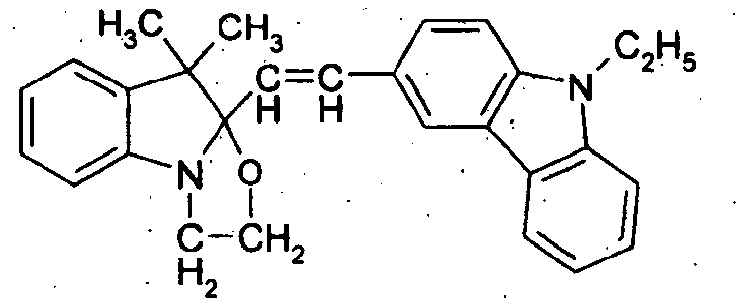
Colorant 5 
Colorant 6 
Colorant 7 
Colorant 8 
Colorant 9 
Colorant 10 
Colorant 11 - Composition selon l'une quelconque des revendications 1 à 11, dans laquelle le ou les composés de formule (I) sont choisis parmi le 3,3-diméthyl-2-(p-diméthylaminostyryl)indo)ino[1,2-b]thiazoline ; le 3,3,6-triméthyl-2-(p-diméthylaminostyryl)indolino[1,2-b]thiazoline ; le 3,3,5-triméthyl-2-(p-chlorostyryl)indolino[1,2-b]thiazoline ; le 3,3,5-triméthyl-2-[2-(thiényl)vinyl] indolino[1,2-b]thiazoline ; le 3,3-diméthyl-5-méthoxy-2-[2-(9-éthylcarbazolyl)vinyl] indolino[1,2-b]thiazoline ; le 3,3-diméthyl-5-carboéthoxy-2-(p-diméthylaminostyryl) indolino[1,2-b]thiazoline ; le 3,3-diméthyl-5-chloro-2-[2-(benzothiazolyl)vinyl)indolino [1,2-b]thiazoline ; le 3,3-diméthyl-5-méthoxy-2-(p-diméthylaminostyryl)indolino[1,2-b]thiazoline ; le 3,3-diméthyl-5-carboéthoxy-2-(3,4-méthylènedioxystyryl)indolino[1,2-b]thiazoline ; le 3,3-diméthyl-5-chloro-2-(p-méthylstyryl)indolino[1,2-b]thiazoline ; le 3,3,diméthyl-5-chloro-2-(p-méthoxystyryl)indolino[1,2-b]thiazoline; le 3,3,5-triméthyl-2-(p-acétylaminostyryl)indolino[1,2-b]thiazoline ; le 3,3-diméthyl-5-méthoxy-2-(3-hydroxy-4-méthoxystyryl)indolino[1,2-b]thiazoline ; le 3,3-diméthyl-5-carboéthoxy-2-(o-cyano styryl)indolino[1,2-b]thiazoline ; le 3,3-diméthyl-5-chloro-2-(p-diméthylaminostyryl) indolino[1,2-b]thiazoline ; le 3,3-diméthyl-5-méthylsulfonyl-2-(p-diméthylaminostyryl) indolino[1,2-b]thiazolïne ; le 3,3-diméthyl-5-phénylsulfonyl-2-(p-diméthylaminostyryl) indolino[1,2-b]thiazoline ; le 3,3-diméthyl-5-éthoxycarboxy-2-(p-diméthylaminostyryl) indolino[1,2-b]oxazoline.
- Composition selon l'une quelconque des revendications précédentes, caractérisée en ce que le composé thiolé est choisi parmi l'acide thioglycotique, l'acide thiolactique, l'acide mercaptopropionique, la cystéamine, l'acide thiosuccinique, la cystéine ; l'acétylcystéine ; le glycéryl thioglycolate ; la thioglycérine ou leurs sels, seuls ou en mélanges.
- Composition selon l'une quelconque des revendications précédentes, caractérisée en ce que le pH est supérieur au pKa du composé de formule (I) et inférieur ou égal à 12.
- Procédé de traitement des fibres kératiniques, dans lequel on applique sur lesdites fibres, une composition selon l'une quelconque des revendications précédentes, pendant un temps de pose suffisant, cette application étant éventuellement suivie d'un rinçage.
- Procédé selon la revendication 16, dans lequel on effectue un pré-traitement par action d'un agent révélateur tel que les agents acidifiants et les solvants ou la combinaison d'un ou plusieurs de ces agents révélateurs.
- Procédé selon l'une quelconque des revendications 16 ou 17, dans lequel on effectue un post-tfaitement par action d'un agent révélateur tel que la lumière, un courant électrique, la chaleur, un agent acidifiant, un solvant, une radication électromagnétique, ou la combinaison d'un ou plusieurs de ces agents révélateurs.
- Dispositif à plusieurs compartiments contenant dans un premier compartiment une composition tinctoriale telle que définie à l'une quelconque des revendications 1 à 13 et 15 et dans un deuxième compartiment au moins un composé thiolé tel que défini à l'une quelconque des revendications 1 ou 14.
- Procédé d'effaçage de la coloration obtenue en mettant en oeuvre une composition selon l'une quelconque des revendications 1 à 15, caractérise en ce que l'on applique sur lesdites fibres une composition d'effaçage comprenant au moins un agent alcalinisant avec une teneur telle que le pH des fibres traitées soit supérieur au pKa du ou des composés de formule (I) présents dans la composition à l'origine de la coloration.
Applications Claiming Priority (2)
| Application Number | Priority Date | Filing Date | Title |
|---|---|---|---|
| FR0654260A FR2907003B1 (fr) | 2006-10-13 | 2006-10-13 | Composition comprenant un colorant de type styrylique ou iminique et un compose thiole, procede de coloration et dispositif |
| PCT/FR2007/052130 WO2008043968A2 (fr) | 2006-10-13 | 2007-10-12 | Composition comprenant un colorant de type styrylique ou iminique et un compose thiole, procede de coloration et dispositif |
Publications (2)
| Publication Number | Publication Date |
|---|---|
| EP2083923A2 EP2083923A2 (fr) | 2009-08-05 |
| EP2083923B1 true EP2083923B1 (fr) | 2010-05-05 |
Family
ID=38048009
Family Applications (1)
| Application Number | Title | Priority Date | Filing Date |
|---|---|---|---|
| EP07858560A Active EP2083923B1 (fr) | 2006-10-13 | 2007-10-12 | Composition comprenant un colorant de type styrylique ou iminique et un compose thiole, procede de coloration et dispositif |
Country Status (7)
| Country | Link |
|---|---|
| US (1) | US7585332B2 (fr) |
| EP (1) | EP2083923B1 (fr) |
| JP (1) | JP2010505925A (fr) |
| AT (1) | ATE466625T1 (fr) |
| DE (1) | DE602007006336D1 (fr) |
| FR (1) | FR2907003B1 (fr) |
| WO (1) | WO2008043968A2 (fr) |
Families Citing this family (4)
| Publication number | Priority date | Publication date | Assignee | Title |
|---|---|---|---|---|
| EP2422762A1 (fr) * | 2010-08-24 | 2012-02-29 | KPSS-Kao Professional Salon Services GmbH | Composition de coloration oxydative stable pour fibres en kératine |
| FR2968947B1 (fr) * | 2010-12-20 | 2013-04-26 | Oreal | Composition de coloration comprenant de l'alcool benzylique, un monoalcool et un colorant azomethinique particulier |
| CN106543202B (zh) * | 2016-10-31 | 2018-08-07 | 湖南师范大学 | 一种新型检测苯硫酚荧光分子探针的制备方法和应用 |
| FR3060990B1 (fr) * | 2016-12-22 | 2019-11-01 | L'oreal | Procede de coloration et detente de boucles des fibres keratiniques, mettant en oeuvre des agents reducteurs et des colorants capillaires, et kit associe |
Family Cites Families (38)
| Publication number | Priority date | Publication date | Assignee | Title |
|---|---|---|---|---|
| US4147862A (en) * | 1974-09-18 | 1979-04-03 | Matsushita Electric Industrial Co., Ltd. | Method of preparing styryl-like compounds |
| JPS5733307B2 (fr) * | 1974-09-18 | 1982-07-16 | ||
| US4139274A (en) * | 1974-09-18 | 1979-02-13 | Matsushita Electric Industrial Co., Ltd. | Apparatus for changing color |
| JPS5134885A (en) | 1974-09-18 | 1976-03-24 | Matsushita Electric Industrial Co Ltd | Henshoku mataha shohatsushokuyozairyo |
| JPS5161795A (fr) | 1974-11-26 | 1976-05-28 | Matsushita Electric Industrial Co Ltd | |
| JPS6026363B2 (ja) | 1978-08-28 | 1985-06-24 | カネボウ株式会社 | 可変色性美容パック剤 |
| JPS6031807B2 (ja) * | 1979-01-24 | 1985-07-24 | カネボウ株式会社 | 可変色性ネイルエナメル |
| JPS5625106A (en) | 1979-08-07 | 1981-03-10 | Kanebo Keshohin Kk | External preparation for diagnosis of skin property |
| JPS6024829B2 (ja) * | 1979-10-17 | 1985-06-14 | 松下電器産業株式会社 | エレクトロクロミック表示材料 |
| JPS5681522A (en) | 1979-12-07 | 1981-07-03 | Kanebo Ltd | External preparation for diagnosing skin properties |
| JPS56149489A (en) * | 1980-04-21 | 1981-11-19 | Matsushita Electric Ind Co Ltd | Color-developing and color-disappearing material |
| JPS56150006A (en) * | 1980-04-21 | 1981-11-20 | Kanebo Ltd | Color vanishing beauty pack agent |
| JPS56161489A (en) | 1980-05-16 | 1981-12-11 | Matsushita Electric Ind Co Ltd | Electrochromic display apparatus |
| JPS5741652A (en) | 1980-08-25 | 1982-03-08 | Fuji Xerox Co Ltd | Electronic printing method |
| JPS5848031A (ja) | 1981-09-17 | 1983-03-19 | Matsushita Electric Ind Co Ltd | エレクトロクロミツク表示素子 |
| JPS5952193A (ja) | 1982-09-17 | 1984-03-26 | Toshiba Corp | 復水器真空調整装置 |
| JPS59121319A (ja) | 1982-12-28 | 1984-07-13 | Matsushita Electric Ind Co Ltd | エレクトロクロミツク表示装置 |
| JPS6057322A (ja) | 1983-09-08 | 1985-04-03 | Matsushita Electric Ind Co Ltd | エレクトロクロミック表示素子 |
| JPS6057323A (ja) | 1983-09-08 | 1985-04-03 | Matsushita Electric Ind Co Ltd | エレクトロクロミック表示素子 |
| JPS6057320A (ja) | 1983-09-08 | 1985-04-03 | Matsushita Electric Ind Co Ltd | エレクトロクロミック表示素子 |
| JPS60200233A (ja) | 1984-03-23 | 1985-10-09 | Matsushita Electric Ind Co Ltd | エレクトロクロミツク表示素子 |
| JPS61121040A (ja) | 1984-11-16 | 1986-06-09 | Matsushita Electric Ind Co Ltd | エレクトロクロミツク表示パネル |
| JPS61147235A (ja) | 1984-12-20 | 1986-07-04 | Matsushita Electric Ind Co Ltd | エレクトロクロミツク表示素子 |
| JPS63280727A (ja) | 1987-05-14 | 1988-11-17 | Matsushita Electric Ind Co Ltd | 電解重合膜 |
| JPH02179618A (ja) | 1988-12-29 | 1990-07-12 | Matsushita Electric Ind Co Ltd | ゲストホスト型液晶表示装置 |
| JPH08222268A (ja) | 1995-02-10 | 1996-08-30 | Matsushita Electric Ind Co Ltd | リチウム2次電池用電解液 |
| JP3762493B2 (ja) | 1996-10-15 | 2006-04-05 | 富士写真フイルム株式会社 | レーザー誘起ヒートモード記録材料 |
| JPH1134489A (ja) | 1997-07-15 | 1999-02-09 | Matsushita Electric Ind Co Ltd | 光記録媒体 |
| JPH1134497A (ja) | 1997-07-24 | 1999-02-09 | Matsushita Electric Ind Co Ltd | 光記録媒体 |
| JP2000292817A (ja) | 1999-04-08 | 2000-10-20 | Fuji Photo Film Co Ltd | 記録・表示材料 |
| JP2001081342A (ja) | 1999-09-16 | 2001-03-27 | Fuji Photo Film Co Ltd | 発色体 |
| JP2001109021A (ja) | 1999-10-01 | 2001-04-20 | Fuji Photo Film Co Ltd | 記録・表示材料 |
| JP2001246862A (ja) | 2000-03-07 | 2001-09-11 | Fuji Photo Film Co Ltd | 画像記録媒体 |
| JP2003315839A (ja) | 2002-04-19 | 2003-11-06 | Fuji Photo Film Co Ltd | エレクトロクロミックディスプレイ |
| DE102004054055A1 (de) * | 2004-11-05 | 2006-05-18 | Wella Ag | Verfahren zum Färben und dauerhaften Verformung von Haaren |
| US8790623B2 (en) * | 2005-01-18 | 2014-07-29 | Il'Oreal | Composition for treating keratin fibers, comprising at least one aromatic alcohol, at least one aromatic carboxylic acid, and at least one protecting agent |
| FR2888747B1 (fr) * | 2005-07-22 | 2007-08-24 | Oreal | Utilisation pour la coloration des fibres keratiniques d'une composition comprenant un colorant de type styrylique ou iminique |
| FR2907002B1 (fr) * | 2006-10-13 | 2009-03-06 | Oreal | Procede de coloration au moyen d'un colorant de type styrylique ou iminique en combinaison avec un acide faible et dispositif pour la mise en oeuvre du procede |
-
2006
- 2006-10-13 FR FR0654260A patent/FR2907003B1/fr not_active Expired - Fee Related
-
2007
- 2007-10-12 JP JP2009531890A patent/JP2010505925A/ja active Pending
- 2007-10-12 EP EP07858560A patent/EP2083923B1/fr active Active
- 2007-10-12 DE DE602007006336T patent/DE602007006336D1/de active Active
- 2007-10-12 AT AT07858560T patent/ATE466625T1/de not_active IP Right Cessation
- 2007-10-12 WO PCT/FR2007/052130 patent/WO2008043968A2/fr not_active Ceased
- 2007-10-15 US US11/907,622 patent/US7585332B2/en not_active Expired - Fee Related
Also Published As
| Publication number | Publication date |
|---|---|
| DE602007006336D1 (de) | 2010-06-17 |
| US7585332B2 (en) | 2009-09-08 |
| WO2008043968A2 (fr) | 2008-04-17 |
| JP2010505925A (ja) | 2010-02-25 |
| US20090019645A1 (en) | 2009-01-22 |
| FR2907003B1 (fr) | 2008-12-05 |
| FR2907003A1 (fr) | 2008-04-18 |
| EP2083923A2 (fr) | 2009-08-05 |
| ATE466625T1 (de) | 2010-05-15 |
| WO2008043968A3 (fr) | 2008-06-12 |
Similar Documents
| Publication | Publication Date | Title |
|---|---|---|
| EP2083790A2 (fr) | Procede de coloration au moyen d'un colorant de type styrylique ou iminique en combinaison avec un acide faible et dispositif pour la mise en oeuvre du procede | |
| EP2024444B1 (fr) | Composition de teinture comprenant un colorant fluorescent naphtylimide thiol/disulfure, procede d'eclaircissement des matieres keratiniques a partir de ce colorant | |
| EP2075289B1 (fr) | Composé styryl tetrahydroquinolinium thiol/disulfure, procédé d'éclaircissement des matières kératiniques à partir de ce colorant | |
| EP2070988B1 (fr) | Composé styryl à motif hydroxy(cyclo)alkylamino thiol/disulfure, procédé d'éclaircissement des matières kératiniques à partir de ce colorant | |
| CA2271992C (fr) | Composition pour la teinture d'oxydation des fibres keratiniques comprenant du 2-chloro 6-methyl 3-aminophenol et deux bases d'oxydation, et procede de teinture | |
| EP1747774B1 (fr) | Utilisation pour la coloration des fibres kératiniques d'une composition comprenant un colorant de type styrylique ou iminique | |
| CA2287978A1 (fr) | Composition de teinture d'oxydation des fibres keratiniques contenant un derive azo de 3-aminopyridine et procede de teinture mettant en oeuvre cette composition | |
| EP2196188A2 (fr) | Procédé de coloration capillaire mettant en oeuvre un dérivé de l'hématoxyline, de l'hématéine, de la braziline ou de la braziléine, un sel métallique, du péroxyde d'hydrogène et du (bi)carbonate | |
| FR2921256A1 (fr) | Composition pour la coloration de fibres keratiniques comprenant au moins un colorant direct a fonction disulfure/thiol et au moins un polymere a fonction thiol et procede utilisant la composition | |
| WO2007110536A2 (fr) | Composition de teinture comprenant un colorant fluorescent thiol/disulfure a groupe ortho-pyridinium, a chaine alkylene non interrompue et a charge cationique interne, procede d'eclaircissement des matieres keratiniques a partir de ce colorant | |
| EP2083923B1 (fr) | Composition comprenant un colorant de type styrylique ou iminique et un compose thiole, procede de coloration et dispositif | |
| FR2921383A1 (fr) | Colorant dichromophorique carbonyle ou heterocyclique, composition tinctoriale comprenant ce colorant, procede de coloration des matieres keratiniques a partir de ce colorant | |
| CA2270933A1 (fr) | Composition pour la teinture d'oxydation des fibres keratiniques comprenant du 2-chloro 6-methyl 3-aminophenol et une base d'oxydation, et procede de teinture | |
| FR3043551A1 (fr) | Colorant direct cationique a chaine aliphatique et a fonction disulfure/thiol/thiol protege pour colorer les fibres keratiniques | |
| WO2015059368A1 (fr) | Procede de coloration des fibres keratiniques a partir de colorants cationiques styryles disulfures, et composition comprenant lesdits colorants | |
| EP1574205A2 (fr) | Composition comprenant un colorant mixte à base d'au moins un chromophore de type azo ou tri-(hetero)aryle methane | |
| EP1972328B1 (fr) | Utilisation pour la coloration des fibres kératiniques d'une composition comprenant un composé halochromique et / ou le colorant correspondant à ce composé | |
| FR2907004A1 (fr) | Procede de coloration au moyen d'un colorant de type styrylique ou iminique en combinaison avec un sel de zinc et dispositif pour la mise en oeuvre du procede | |
| WO2009010694A2 (fr) | Procede de coloration au moyen d'un compose de type styrylique ou iminique disulfure/thiol et de stimuli, composition et dispositif pour la mise en oeuvre du procede | |
| EP1002519A1 (fr) | Composition de teiture d'oxydation des fibres kératiniques et procédé de teinture mettant en oeuvre cette composition | |
| FR3067600A1 (fr) | Procede de coloration des fibres keratiniques mettant en œuvre au moins un colorant direct fluorescent et au moins un colorant direct benzoindolinium bleu-violet-verts | |
| FR2950246A1 (fr) | Utilisation de colorants particuliers de type styrylique ou iminique pour la coloration des fibres keratiniques, composition tinctoriale comprenant au moins un tel colorant, procede de mise en œuvre | |
| CA2301079A1 (fr) | Composition de teinture d'oxydation des fibres keratiniques et procede de teinture mettant en oeuvre cette composition | |
| FR2917970A1 (fr) | Utilisation d'au moins un derive cationique de cyanine pour la coloration capillaire, composition le contenant, procede de traitement des fibres keratiniques mettant en oeuvre ladite composition, dispositif et utilisation | |
| FR2912142A1 (fr) | Composition de teinture comprenant un colorant fluorescent naphtylimide, procede d'eclaircissement des matieres keratiniques a partir de ce colorant |
Legal Events
| Date | Code | Title | Description |
|---|---|---|---|
| PUAI | Public reference made under article 153(3) epc to a published international application that has entered the european phase |
Free format text: ORIGINAL CODE: 0009012 |
|
| 17P | Request for examination filed |
Effective date: 20090513 |
|
| AK | Designated contracting states |
Kind code of ref document: A2 Designated state(s): AT BE BG CH CY CZ DE DK EE ES FI FR GB GR HU IE IS IT LI LT LU LV MC MT NL PL PT RO SE SI SK TR |
|
| AX | Request for extension of the european patent |
Extension state: AL BA HR MK |
|
| RIN1 | Information on inventor provided before grant (corrected) |
Inventor name: PLOS, GREGORY |
|
| GRAP | Despatch of communication of intention to grant a patent |
Free format text: ORIGINAL CODE: EPIDOSNIGR1 |
|
| RIC1 | Information provided on ipc code assigned before grant |
Ipc: A61Q 5/06 20060101AFI20100114BHEP |
|
| RAX | Requested extension states of the european patent have changed |
Extension state: MK Payment date: 20090513 Extension state: AL Payment date: 20090513 Extension state: HR Payment date: 20090513 Extension state: BA Payment date: 20090513 |
|
| GRAS | Grant fee paid |
Free format text: ORIGINAL CODE: EPIDOSNIGR3 |
|
| GRAA | (expected) grant |
Free format text: ORIGINAL CODE: 0009210 |
|
| AK | Designated contracting states |
Kind code of ref document: B1 Designated state(s): AT BE BG CH CY CZ DE DK EE ES FI FR GB GR HU IE IS IT LI LT LU LV MC MT NL PL PT RO SE SI SK TR |
|
| AX | Request for extension of the european patent |
Extension state: AL BA HR MK |
|
| REG | Reference to a national code |
Ref country code: GB Ref legal event code: FG4D Free format text: NOT ENGLISH |
|
| REG | Reference to a national code |
Ref country code: CH Ref legal event code: EP |
|
| REG | Reference to a national code |
Ref country code: IE Ref legal event code: FG4D Free format text: LANGUAGE OF EP DOCUMENT: FRENCH |
|
| REF | Corresponds to: |
Ref document number: 602007006336 Country of ref document: DE Date of ref document: 20100617 Kind code of ref document: P |
|
| REG | Reference to a national code |
Ref country code: NL Ref legal event code: VDEP Effective date: 20100505 |
|
| LTIE | Lt: invalidation of european patent or patent extension |
Effective date: 20100505 |
|
| PG25 | Lapsed in a contracting state [announced via postgrant information from national office to epo] |
Ref country code: NL Free format text: LAPSE BECAUSE OF FAILURE TO SUBMIT A TRANSLATION OF THE DESCRIPTION OR TO PAY THE FEE WITHIN THE PRESCRIBED TIME-LIMIT Effective date: 20100505 Ref country code: ES Free format text: LAPSE BECAUSE OF FAILURE TO SUBMIT A TRANSLATION OF THE DESCRIPTION OR TO PAY THE FEE WITHIN THE PRESCRIBED TIME-LIMIT Effective date: 20100816 Ref country code: LT Free format text: LAPSE BECAUSE OF FAILURE TO SUBMIT A TRANSLATION OF THE DESCRIPTION OR TO PAY THE FEE WITHIN THE PRESCRIBED TIME-LIMIT Effective date: 20100505 Ref country code: SE Free format text: LAPSE BECAUSE OF FAILURE TO SUBMIT A TRANSLATION OF THE DESCRIPTION OR TO PAY THE FEE WITHIN THE PRESCRIBED TIME-LIMIT Effective date: 20100505 |
|
| PG25 | Lapsed in a contracting state [announced via postgrant information from national office to epo] |
Ref country code: FI Free format text: LAPSE BECAUSE OF FAILURE TO SUBMIT A TRANSLATION OF THE DESCRIPTION OR TO PAY THE FEE WITHIN THE PRESCRIBED TIME-LIMIT Effective date: 20100505 Ref country code: LV Free format text: LAPSE BECAUSE OF FAILURE TO SUBMIT A TRANSLATION OF THE DESCRIPTION OR TO PAY THE FEE WITHIN THE PRESCRIBED TIME-LIMIT Effective date: 20100505 Ref country code: SI Free format text: LAPSE BECAUSE OF FAILURE TO SUBMIT A TRANSLATION OF THE DESCRIPTION OR TO PAY THE FEE WITHIN THE PRESCRIBED TIME-LIMIT Effective date: 20100505 Ref country code: AT Free format text: LAPSE BECAUSE OF FAILURE TO SUBMIT A TRANSLATION OF THE DESCRIPTION OR TO PAY THE FEE WITHIN THE PRESCRIBED TIME-LIMIT Effective date: 20100505 Ref country code: IS Free format text: LAPSE BECAUSE OF FAILURE TO SUBMIT A TRANSLATION OF THE DESCRIPTION OR TO PAY THE FEE WITHIN THE PRESCRIBED TIME-LIMIT Effective date: 20100905 |
|
| REG | Reference to a national code |
Ref country code: IE Ref legal event code: FD4D |
|
| PG25 | Lapsed in a contracting state [announced via postgrant information from national office to epo] |
Ref country code: CY Free format text: LAPSE BECAUSE OF FAILURE TO SUBMIT A TRANSLATION OF THE DESCRIPTION OR TO PAY THE FEE WITHIN THE PRESCRIBED TIME-LIMIT Effective date: 20100616 Ref country code: PL Free format text: LAPSE BECAUSE OF FAILURE TO SUBMIT A TRANSLATION OF THE DESCRIPTION OR TO PAY THE FEE WITHIN THE PRESCRIBED TIME-LIMIT Effective date: 20100505 |
|
| PG25 | Lapsed in a contracting state [announced via postgrant information from national office to epo] |
Ref country code: DK Free format text: LAPSE BECAUSE OF FAILURE TO SUBMIT A TRANSLATION OF THE DESCRIPTION OR TO PAY THE FEE WITHIN THE PRESCRIBED TIME-LIMIT Effective date: 20100505 Ref country code: EE Free format text: LAPSE BECAUSE OF FAILURE TO SUBMIT A TRANSLATION OF THE DESCRIPTION OR TO PAY THE FEE WITHIN THE PRESCRIBED TIME-LIMIT Effective date: 20100505 Ref country code: IE Free format text: LAPSE BECAUSE OF FAILURE TO SUBMIT A TRANSLATION OF THE DESCRIPTION OR TO PAY THE FEE WITHIN THE PRESCRIBED TIME-LIMIT Effective date: 20100505 Ref country code: PT Free format text: LAPSE BECAUSE OF FAILURE TO SUBMIT A TRANSLATION OF THE DESCRIPTION OR TO PAY THE FEE WITHIN THE PRESCRIBED TIME-LIMIT Effective date: 20100906 |
|
| PG25 | Lapsed in a contracting state [announced via postgrant information from national office to epo] |
Ref country code: RO Free format text: LAPSE BECAUSE OF FAILURE TO SUBMIT A TRANSLATION OF THE DESCRIPTION OR TO PAY THE FEE WITHIN THE PRESCRIBED TIME-LIMIT Effective date: 20100505 Ref country code: SK Free format text: LAPSE BECAUSE OF FAILURE TO SUBMIT A TRANSLATION OF THE DESCRIPTION OR TO PAY THE FEE WITHIN THE PRESCRIBED TIME-LIMIT Effective date: 20100505 Ref country code: CZ Free format text: LAPSE BECAUSE OF FAILURE TO SUBMIT A TRANSLATION OF THE DESCRIPTION OR TO PAY THE FEE WITHIN THE PRESCRIBED TIME-LIMIT Effective date: 20100505 |
|
| PGFP | Annual fee paid to national office [announced via postgrant information from national office to epo] |
Ref country code: DE Payment date: 20101006 Year of fee payment: 4 |
|
| PLBE | No opposition filed within time limit |
Free format text: ORIGINAL CODE: 0009261 |
|
| STAA | Information on the status of an ep patent application or granted ep patent |
Free format text: STATUS: NO OPPOSITION FILED WITHIN TIME LIMIT |
|
| PG25 | Lapsed in a contracting state [announced via postgrant information from national office to epo] |
Ref country code: IT Free format text: LAPSE BECAUSE OF FAILURE TO SUBMIT A TRANSLATION OF THE DESCRIPTION OR TO PAY THE FEE WITHIN THE PRESCRIBED TIME-LIMIT Effective date: 20100505 |
|
| 26N | No opposition filed |
Effective date: 20110208 |
|
| BERE | Be: lapsed |
Owner name: L'OREAL Effective date: 20101031 |
|
| REG | Reference to a national code |
Ref country code: DE Ref legal event code: R097 Ref document number: 602007006336 Country of ref document: DE Effective date: 20110207 |
|
| PG25 | Lapsed in a contracting state [announced via postgrant information from national office to epo] |
Ref country code: GR Free format text: LAPSE BECAUSE OF FAILURE TO SUBMIT A TRANSLATION OF THE DESCRIPTION OR TO PAY THE FEE WITHIN THE PRESCRIBED TIME-LIMIT Effective date: 20100806 Ref country code: MC Free format text: LAPSE BECAUSE OF NON-PAYMENT OF DUE FEES Effective date: 20101031 |
|
| PG25 | Lapsed in a contracting state [announced via postgrant information from national office to epo] |
Ref country code: BE Free format text: LAPSE BECAUSE OF NON-PAYMENT OF DUE FEES Effective date: 20101031 |
|
| PG25 | Lapsed in a contracting state [announced via postgrant information from national office to epo] |
Ref country code: MT Free format text: LAPSE BECAUSE OF FAILURE TO SUBMIT A TRANSLATION OF THE DESCRIPTION OR TO PAY THE FEE WITHIN THE PRESCRIBED TIME-LIMIT Effective date: 20100505 |
|
| PGFP | Annual fee paid to national office [announced via postgrant information from national office to epo] |
Ref country code: FR Payment date: 20111103 Year of fee payment: 5 |
|
| REG | Reference to a national code |
Ref country code: CH Ref legal event code: PL |
|
| PG25 | Lapsed in a contracting state [announced via postgrant information from national office to epo] |
Ref country code: CH Free format text: LAPSE BECAUSE OF NON-PAYMENT OF DUE FEES Effective date: 20111031 Ref country code: LI Free format text: LAPSE BECAUSE OF NON-PAYMENT OF DUE FEES Effective date: 20111031 |
|
| PG25 | Lapsed in a contracting state [announced via postgrant information from national office to epo] |
Ref country code: HU Free format text: LAPSE BECAUSE OF FAILURE TO SUBMIT A TRANSLATION OF THE DESCRIPTION OR TO PAY THE FEE WITHIN THE PRESCRIBED TIME-LIMIT Effective date: 20101106 Ref country code: LU Free format text: LAPSE BECAUSE OF NON-PAYMENT OF DUE FEES Effective date: 20101012 Ref country code: BG Free format text: LAPSE BECAUSE OF FAILURE TO SUBMIT A TRANSLATION OF THE DESCRIPTION OR TO PAY THE FEE WITHIN THE PRESCRIBED TIME-LIMIT Effective date: 20100505 |
|
| PG25 | Lapsed in a contracting state [announced via postgrant information from national office to epo] |
Ref country code: TR Free format text: LAPSE BECAUSE OF FAILURE TO SUBMIT A TRANSLATION OF THE DESCRIPTION OR TO PAY THE FEE WITHIN THE PRESCRIBED TIME-LIMIT Effective date: 20100505 |
|
| GBPC | Gb: european patent ceased through non-payment of renewal fee |
Effective date: 20121012 |
|
| REG | Reference to a national code |
Ref country code: FR Ref legal event code: ST Effective date: 20130628 |
|
| PG25 | Lapsed in a contracting state [announced via postgrant information from national office to epo] |
Ref country code: DE Free format text: LAPSE BECAUSE OF NON-PAYMENT OF DUE FEES Effective date: 20130501 Ref country code: GB Free format text: LAPSE BECAUSE OF NON-PAYMENT OF DUE FEES Effective date: 20121012 |
|
| REG | Reference to a national code |
Ref country code: DE Ref legal event code: R119 Ref document number: 602007006336 Country of ref document: DE Effective date: 20130501 |
|
| PG25 | Lapsed in a contracting state [announced via postgrant information from national office to epo] |
Ref country code: FR Free format text: LAPSE BECAUSE OF NON-PAYMENT OF DUE FEES Effective date: 20121031 |
|
| PG25 | Lapsed in a contracting state [announced via postgrant information from national office to epo] |
Ref country code: BG Free format text: LAPSE BECAUSE OF FAILURE TO SUBMIT A TRANSLATION OF THE DESCRIPTION OR TO PAY THE FEE WITHIN THE PRESCRIBED TIME-LIMIT Effective date: 20100805 |