EP2173020A2 - Wickelkerne mit Stratifizierungsbewegung - Google Patents
Wickelkerne mit Stratifizierungsbewegung Download PDFInfo
- Publication number
- EP2173020A2 EP2173020A2 EP09012499A EP09012499A EP2173020A2 EP 2173020 A2 EP2173020 A2 EP 2173020A2 EP 09012499 A EP09012499 A EP 09012499A EP 09012499 A EP09012499 A EP 09012499A EP 2173020 A2 EP2173020 A2 EP 2173020A2
- Authority
- EP
- European Patent Office
- Prior art keywords
- winding
- wire
- winder
- assembly
- needle
- Prior art date
- Legal status (The legal status is an assumption and is not a legal conclusion. Google has not performed a legal analysis and makes no representation as to the accuracy of the status listed.)
- Granted
Links
- 230000033001 locomotion Effects 0.000 title claims abstract description 121
- 238000004804 winding Methods 0.000 title claims abstract description 96
- 238000013517 stratification Methods 0.000 title description 33
- 238000013519 translation Methods 0.000 claims description 27
- 230000003068 static effect Effects 0.000 claims description 3
- 238000000034 method Methods 0.000 claims 14
- 230000014616 translation Effects 0.000 description 26
- 230000003134 recirculating effect Effects 0.000 description 3
- 238000000926 separation method Methods 0.000 description 3
- 230000000712 assembly Effects 0.000 description 2
- 238000000429 assembly Methods 0.000 description 2
- 230000005540 biological transmission Effects 0.000 description 2
- 230000001360 synchronised effect Effects 0.000 description 2
- 230000000694 effects Effects 0.000 description 1
- 230000002452 interceptive effect Effects 0.000 description 1
- 230000002250 progressing effect Effects 0.000 description 1
- 230000000452 restraining effect Effects 0.000 description 1
Images




Classifications
-
- H—ELECTRICITY
- H02—GENERATION; CONVERSION OR DISTRIBUTION OF ELECTRIC POWER
- H02K—DYNAMO-ELECTRIC MACHINES
- H02K15/00—Processes or apparatus specially adapted for manufacturing, assembling, maintaining or repairing of dynamo-electric machines
- H02K15/08—Forming windings by laying conductors into or around core parts
- H02K15/095—Forming windings by laying conductors into or around core parts by laying conductors around salient poles
-
- Y—GENERAL TAGGING OF NEW TECHNOLOGICAL DEVELOPMENTS; GENERAL TAGGING OF CROSS-SECTIONAL TECHNOLOGIES SPANNING OVER SEVERAL SECTIONS OF THE IPC; TECHNICAL SUBJECTS COVERED BY FORMER USPC CROSS-REFERENCE ART COLLECTIONS [XRACs] AND DIGESTS
- Y10—TECHNICAL SUBJECTS COVERED BY FORMER USPC
- Y10T—TECHNICAL SUBJECTS COVERED BY FORMER US CLASSIFICATION
- Y10T29/00—Metal working
- Y10T29/49—Method of mechanical manufacture
- Y10T29/49002—Electrical device making
- Y10T29/49009—Dynamoelectric machine
Definitions
- the present application relates to winding coils of wire onto poles of dynamo-electric cores. More particularly, the coils are wound directly into the slots of cores by means of needles which dispense wires. The wires are each drawn from tensioners.
- a winding apparatus preferably capable of rotational, translational and radial movements with respect to the poles of the core.
- This stratification movement can be considered to be a radial movement that moves the winding needle along the radial extension of the poles.
- This stratification allows for pre-determined placement of the wire. Pre-determined placement of the wire preferably results in deeper and denser winding of wire.
- a winder for winding wires onto a coil support portion of a dynamo-electric core has a central longitudinal axis and includes a plurality of needles, each needle for dispensing a wire, a plurality of support members, each member supporting a single one of the plurality of needles, a first assembly for producing translational movement of the members along the axis, a second assembly for producing relative rotational movement of the plurality of members with respect to the core, and a third assembly for producing radial movement of each of the members perpendicular to the axis.
- the operation of the third assembly is substantially independent of the operation of the second assembly.
- the winder in another embodiment, includes a single needle for dispensing the wire and a first assembly, the first assembly including a winding shaft.
- the needle is preferably constrained to move translationally with the shaft.
- the first assembly is for producing translational movement of the shaft along the axis.
- the winder also includes a second assembly for producing rotational movement of the needle about the axis and a third assembly including a drive member movably coupled to the winding shaft. Furthermore, relative rotation between the drive member and the winding shaft produces radial movement of the needle.
- the third assembly produces radial movement substantially independently of the rotational movement provided by the second assembly.
- FIG. 1 illustrates an axial end 10' of core 10.
- Core 10 includes a pile of laminated portions, having an axial configuration like 10', stacked for a certain length into the page. (Reference to the "page” as used herein indicates the plane of the drawing page of the FIGS.). Such a length is often referred to as the "height of the core”.
- the actual coils 102, 104 and 106 are wound around poles 108, by using needles 11, 12, and 13 which dispense wires 111, 112 and 113, respectively, onto specific poles, as illustrated in FIG. 1 .
- the wire turns 121, 122 and 123 of the coils become stratified along poles 108. This means that each wire turn tends to occupy an individual layer along the poles.
- the turns are illustrated crossing the end faces, similar to end face 132, of the poles.
- the stratification shown in FIG. 1 is such that the turns are preferably wound on layers progressing inwardly towards the center of core 10 -- i.e., at longitudinal axis 131.
- Each turn is also preferably wound around the pole sides similar to sides 134 and 136, and across opposite faces similar to face 132.
- needles 11, 12, and 13 are provided with translation strokes, parallel to sides 134 and 136, and into the page. During these strokes, the needle tips 142, 144 and 146 are partially inserted in slots 152, 153 and 154 of core 10 to place the wires along the respective pole sides. At the end of the translation strokes, needle tips 142, 144 and 146 are located beyond the end faces of core 10.
- needles 11, 12 and 13 can be rotated with respect to longitudinal axis 131 of core 10, in order to place the wires across the end faces of the poles.
- rotational movement preferably indicates that the core may be rotated around longitudinal axis 131, while the needles remain stationary.
- needle tips 142, 144 and 146 may be aligned with adjacent slots, where they can start opposite translation strokes.
- needles 11, 12 and 13 accomplish opposite translation strokes with their tips partially inserted in the adjacent slots of the core in order to place the wires along the nearby pole sides.
- tips 142, 144 and 146 are located beyond the end faces of the core, and out of the page. Then, an opposite rotation can take place to align the tips with the slot where the motions started.
- Such a combination of motions places single turns of coils, such as coils 102, 104 and 106, completely around the poles.
- the combination of motions needs to be repeated for a number of times equal to the number of turns.
- the combination of motions also must be repeated for the number of layers of turns that are wound around the poles.
- the stratification of the turns shown in FIG. 1 can be implemented by moving the needles along radiuses R1, R2 and R3 (respectively for needles 11, 12 and 13) of core 10.
- the movements along the radiuses preferably occur incrementally along the radius length. The incremental movement can be implemented at the start of each new turn.
- a correctly obtained stratification is of great importance for guaranteeing that the turns are tightly wound, and of the same length.
- Orderly stratification of the wires achieves more compact coils, which ultimately means that more turns can be wound in the same slot space, while preventing turns of adjacent poles from interfering with each other.
- the present invention provides a machine which achieves such a stratification. Furthermore, the machine of the present invention is able to have multiple needles accomplish stratification, substantially simultaneously, along respective poles. This achievement is made possible even for poles which are at a close angular distance from each other around the center of core 10.
- the machine is programmable so that the stratification can be achieved in a variable and predetermined manner, depending on the requirements of the core and the coils which need to be wound.
- coils 102, 104 and 106 can be simultaneously wound by using respective and separate needles for each pole.
- the motions of the needles can also preferably be synchronized with respect to each other. Winding multiple coils, by means of a plurality of needles operating substantially simultaneously, reduces the time required to wind the totality of coils present in the core.
- the shape of the needles is preferably a "V" configuration at the needle base because of the relatively small angular spacing made available by the distance existing between the poles.
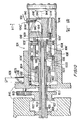
- FIG. 2 is a partial section view as seen from direction 2 - 2 of FIG. 1 , showing the apparatus of this invention for causing the needles to move with translational, rotational and radial -- i.e., stratification -- motions.
- FIG. 2A shows a sectional view of the entire assembly 20.
- FIG. 3 is a section view similar to FIG. 2 and represents a continuation of FIG. 2 (towards the left of the page containing FIG. 2 ). Furthermore, FIG. 3 shows the completion of assembly 20.
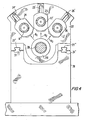
- FIG. 4 is a view from direction 4 - 4 of FIG. 3 . Assembly 20 is partially visible in FIG. 2 .
- FIG. 2 core 10 and the needles of FIG. 1 have been rotated to bring needle 12 on axis 131.
- Three distinct assemblies 20 shown in FIG. 3 ), 21 (shown in FIG. 2a ) and 22 respectively generate the translation strokes, relative rotation motions and the radial increments for winding of the turns.
- Each of the assemblies preferably provides for the independent operation of each other assembly.
- FIG. 2 illustrates the connection of needle 12 (in partial section view) to tube 12', by means of bolt 12" screwed into an end cap of tube 12'. These tubes act as support members for the needles. Tip 144 of needle 12, which is perpendicular to the length of needle 12, is clearly visible in FIG. 2 . Needles 11 and 13 will be connected in a similar manner to tubes 11' and 13'. To avoid complicating FIG. 2 , needles 11 and 13 (which are out of the plane of FIG. 2 ) have been omitted from FIG. 2 .
- Wires 111, 112 and 113 are threaded through the respective needles to reach the core as shown in FIG. 1 .
- Wires come from a respective supply reel placed to the left of FIG. 3 and enter the tubes through nozzles like 12''', shown for tube 12' in FIG. 3 .
- needles are provided with bent portions -- e.g., bent portion 222 shown in FIG. 2 .
- tubes 11', 12' and 13' are connected to slide members 24, 25 and 26, respectively.
- Slide members 24, 25 and 26 have narrow portions which are guided to move in radial directions R1, R2 and R3, respectively, by means of respective slots 24', 25' and 26'. These slots are preferably machined in upstanding plate 27.
- Upstanding plate 27 is preferably bolted to threaded sleeve 28 by means of bolts (not shown).
- Plate 27 is provided with dovetail recesses 27' and 27" that receive corresponding guide male portions 31' and 31" of a bench portion of casing 31. This configuration allows plate 27 to translate in directions T and T', parallel to axis 131. (A portion of plate 27, as well as the bench portion of casing 31 has been omitted for the sake of clarity.)
- Sleeve 28 is threaded onto threaded bar 29, which, in turn, is supported on bearing support 30 of casing 31 ( see FIG. 3 ).
- End 29' of threaded bar 29 carries pulley 32 of belt transmission 32', which leads to electric motor 33. Electric motor 33 can be controlled to turn threaded bar 29 for a predetermined number of revolutions. The result will be translation of upstanding plate 27, and consequently of tubes 11', 12', and 13' in directions T and T' for pre-determined stroke lengths.
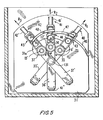
- FIG. 5 is a partial section view from directions 5 - 5 of FIG. 2 .
- Tubes 11', 12' and 13' are supported in preferably cylindrical guide sleeves 35, 36 and 37, respectively.
- Tubes 11', 12' and 13' are carried by bushes -- e.g., bushes 38 and 39 of guide sleeve 35, which support tube 12', as shown in FIG. 2 .
- the bushes allow the tubes to translate in directions T and T', within guide sleeves 35, 36 and 37, when upstanding plate 27 is moved backwards and forwards by electric motor 33.
- Guide sleeves 35, 36 and 37 are parts of support arms 35', 36' and 37', respectively.
- support arms 35', 36' and 37' are contained in different, although parallel, planes with respect to the plane of the page in FIG. 5 . Furthermore, 35', 36' and 37' cross each other as shown in FIG. 5 . Support arms 35', 36' and 37' can move along radii R1, R2 and R3 to accomplish the radial motion required for stratification by being supported respectively on respective guide tracks 40, 41 and 42. Preferably, the radial movement of each of the support arms occurs substantially simultaneously.
- the guide tracks consist of opposite portions -- e.g., 41' and 41" of guide track 41 -- extending along radii R1, R2 and R3. The guide tracks are assembled to an upright portion of casing 31.
- guide tracks 40, 41, and 42 are also located on different, but parallel planes with respect to each other and with respect to the page of FIG. 5 (and as shown in FIG. 1 ), in order to conform to the planes containing support arms 35', 36' and 37'.
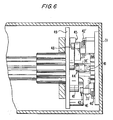
- FIG. 6 is a view from direction 6 - 6 of FIG. 2 showing guide portions 40', 41' and 42' of guide tracks 40, 41 and 42 in perspective view, contained in their respective and different planes.
- Support arms 35', 36' and 37' include pairs of rollers 43, 44, and 45, respectively, for movably connecting to biting cam members 46, 47 and 48, respectively.
- FIG. 7 is a view from direction 7 - 7 of FIG. 2 .
- Cam disk 49 is shown in FIG. 2 , 6 and 7 .
- cam members 46, 47 and 48 have different and respective extensions from cam disk 49 in order to reach pairs of rollers pairs of rollers 43, 44, and 45.
- Cam disk 49 is supported by shaft 49' on bearing assembly 50 of casing 31.
- Bearing assembly 50 allows cam disk 49 to rotate around axis 131.
- Cam disk 49 preferably is provided with a gear profile on its outer circumference, which meshes with pinion gear 52 of electric motor 53.
- Electric motor 53 is preferably supported by casing 31.
- cam disk 49 is provided with an aperture 749 to allow passage of guide sleeves 35, 36 and 37. Again, the size of aperture 749 should preferably provide for clearance with respect to movement of guide sleeves 35, 36 and 37 along radiuses R1, R2 and R3 during the radial -- i.e., stratification -- motion.
- FIG. 8 shows a continuation towards the right of FIG. 2 .
- FIG. 8 shows core 10, which is being wound.
- Core 10 can be supported in core casing 60 of a vertical round table 61.
- FIG. 8 also illustrates assembly 21. Assembly 21 preferably accomplishes the relative rotation motions.
- Core casing 60 preferably maintains core 10 centered on axis 131 of casing 31. This centers radii R1, R2 and R3 of core 10 on axis 131, as shown in the previous FIGS.
- Bearings 62 of round table 61 supports core casing 60 for rotation around axis 131. In this way, core 10 can rotate around axis 131 of casing 31 to provide the required relative rotation motions between the needles and the core, as described in the foregoing.
- the rotations are preferably imparted to core 10 casing by gear 63, which meshes with gear portion 60' provided on the external surface of core casing 60.
- Gear 63 is supported and allowed to rotate by shaft/bearing assembly 64, assembled on round table 61.
- Assembly 64 is located adjacent to core casing 60.
- Shaft 65 of shaft/bearing assembly 64 is provided with a key portion 65' which can be aligned (by rotation of round table 61) and connected to drive unit 66 of casing 31.
- Drive unit 66 preferably includes a shaft 67 driven by electric motor 68. Forward end 67' of shaft 67 has a corresponding key portion capable of connecting itself to key portion 65'. This connection occurs by shifting shaft 67 in direction Z, using air cylinder 75, which is connected to the other end of shaft 67 by means of fork joint 69.
- Shaft 67 is supported for rotation by means of support/bearing assembly 70.
- This support/bearing assembly comprises bushes for supporting movement of shaft 67 caused by air cylinder 75.
- the bushes are supported in gear tube 72, which is supported for rotation by means of bearings 73.
- Shaft 67 has key portions received in gear tube 72, for transmission of relative rotations between gear tube 72 and shaft 67.
- Gear portion 74 of gear tube 72 meshes with pinion 68' of electric motor 68.
- Rotation of electric motor 68 rotates shaft 67 which, in turn, causes core 10 to have the relative rotation motions with respect to needles 11, 12 and 13 around axis 131.
- Motor 68 can also be used to index the core when unwound poles need to be aligned with the needles.
- Motors 33, 58 and 68 can be provided with position and speed feedback sensors. Such a combination allows computer equipment ( see computer 960 in FIG. 9 ) to control the motors so that they achieve predetermined and programmable revolutions of rotation.
- the needles may have relative motions of translation, rotation and stratification (described in the foregoing with reference to FIG. 1 ), occurring in required timing and synchronized between each other.
- a main computer see computer 960 in FIG. 9 ) required to govern such a performance can contain the relative programs and data. Position control principles like those described in the '289 patent can be used to obtain accurate predetermined trajectories of the needles with respect to the poles.
- the same computer, or a different computer can be provided with different data when the amounts of the motions and the relative timing need to be modified -- e.g., when a different type of core needs to have winding conditions set-i.e., requiring different translations, rotations and radial.
- cam members govern the stratification motion of the needles, although the programmable revolutions of motor 53 also influence the relative timing and speed of the needles.
- the cam members can be dismounted and substituted with others when a different motion is required.
- round table 62 can have multiple core casings carrying respective cores, each provided with a shaft/bearing assembly -- e.g., shaft/bearing assembly 64.
- cores can be fed rapidly, and in sequence, to the needles in order to be wound.
- a core casing having a core which has already been wound can align itself with another axis, where termination of the coil leads can take place by means of equipment like the one described in commonly-assigned U.S. Patent Nos. 5,065,503 , 5,245,748 , and 5,392,506 . It should be noted that all patents mentioned herein are incorporated by reference in their entirety.
- each assembly for accomplishing a particular motion is substantially physically separate from each other assembly and each assembly is capable of providing the particular motion for which it is responsible without causing the other motions to occur.
- substantially none of the equipment -- e.g., the motor -- used to cause the radial motion moves with the equipment which translates.
- the motor that provides the radial movement may be substantially static -- i.e., the motor preferably does not translate -- when the translational motion occurs.
- the stratification equipment has been conceived to move needles very close to each other (as shown in FIG. 1 ), as is the constraint given by the small angular distance existing between the poles.
- FIGS. 9-11 show another embodiment of the invention. This embodiment also accomplishes the three movements described above by using a needle to dispense the wire. Needle 1045, ( see FIGS. 10 and 11 ), is capable of achieving translation movements (referenced by directions 913 and 914) to move along a side of the pole, rotational movement (referenced by directions 915 and 916) to cross from one side to the other of the pole, and radial -- i.e., stratification - - movement (referenced by 917).
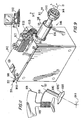
- FIG. 9 is an elevational view of a winding machine according to the invention capable of dispensing wires to form the coils of a dynamo-electric component.
- FIG. 10 is a partial cross-sectional view taken from direction 10 - 10 of FIG. 9 of an apparatus for winding wire with the three motions -- i.e., translational, rotational and radial -- discussed herein (the core has been removed from FIG. 10 for reasons of clarity).
- Needle 1045 is preferably an extreme appendage of winding shaft 910.
- Winding shaft 910 is preferably provided with translation movement and rotation movement such as the winding shaft described in the above-cited patents -- e.g., the '289 patentor in another suitable fashion.
- the rotation movement may be implemented on the core to be wound, as described above.
- the wire 950 required to wind the coils preferably passes through winding shaft 910 to reach, and be dispensed by, needle 1045 during winding.
- winding shaft 910 is driven to move with backwards and forwards translation motions 913 and 914 and oppositely-directed rotation motions 915 and 916 in order to wind coils on dynamo-electric component 940 by an assembly mounted within casing 942.
- Backwards and forwards translation motions 913 and 914 are parallel to axis 944.
- Rotation motions 915 and 916 may be performed about center axis 944.
- Dynamo electric component may also be centered on axis 944.
- the radial motion may preferably be perpendicular to axis 944.
- the assembly within casing 942 may be totally mechanical with one input rotation motor or provided with independently-controlled motors similar to the assembly described in the '289 patent. In any case, the translation and rotation motions are provided preferably independently of the radial motion, as will be described.
- Winding shaft 910 protrudes from two opposite ends 946 and 948 of casing 942. Wires 950 coming from supply drums and tensioners (not shown) enter the winding shaft at end 952, while at the other end 954 of the winding shaft (shown in FIG. 10 ), needle 1045 is provided for moving with respect to the poles in order to wind the coils.
- FIG. 10 illustrates an assembly which has been introduced to cause the radial motion -- i.e., stratification motion -- in direction 917 of needle 1045.
- the assembly is mostly contained within cylindrical protrusion 956 of casing 942.
- Winding shaft 910 extends to the left of FIG. 10 from bearing support 1020 of casing 942.
- Bearing support 1020 supports the rotation and translation motions of winding shaft 910 caused by the assembly located to the left, within casing 942, and not shown in FIG. 10 .
- Gear wheel 1021 is preferably mounted on bearings 1022' and 1022" of casing 942.
- the center portion of gearwheel 921 is preferably hollow and provided with key 1021'.
- Winding shaft 910 passes through the hollow center portion of gearwheel 1021.
- Gear wheel 1021 engages second gear wheel 1023 mounted on axle 1024.
- Axle 1024 is mounted on a support bearing (not shown) of casing 942.
- Belt wheel 1025 is mounted on the opposite end of axle 1024.
- Belt wheel 1025 is driven by belt 1026, which derives motion from the pinion wheel of motor 927 (shown in FIG. 9 ). Consequently, rotation of the pinion wheel of motor 27 causes gear wheel 1021 to rotate on bearings 1022' and 1022". (It should be noted that motor 927 may be substantially static during translational movement of winding shaft 910.)
- Drive tube 1028 which serves as a drive member for the radial movements of needle 1045 as will be explained, is preferably hollow so that it can be assembled coaxially on winding shaft 910 and so that it may contain winding shaft 910 and the wire. This assembly may be implemented where winding shaft 910 becomes smaller in its external diameter.
- Bearings 1029 and 1030 are used to support drive tube 1028 on winding shaft 910, so that drive tube 1028 can rotate around winding shaft 910.
- drive tube 1028 is preferably fixed in directions 913 and 914 along the length of winding shaft 910.
- portion 1028' of drive tube 1028 preferably has a threaded portion for receiving recirculating balls.
- Registering cap 1041 has male threaded portion 1041' which engages an internal female threaded portion present in the end of winding shaft 910. By tightening threaded portion 1041', registering cap 1041 pushes on separation tube 1031, which is also mounted coaxially on winding shaft 910.
- drive tube 1028 restrains bearing 1030.
- bearing 1030 restrains drive tube 1028 and pushes it against bearing 1029, which is shouldered by hollow shaft 1021.
- These restraining and pushing effects are parallel to the extension of winding shaft 910 along center axis 944.
- drive tube 1028 is fixed along winding shaft 910 and, therefore, may translate together with winding shaft 910.
- drive tube 1028 can be relatively moved -- e.g., rotated -- with respect to, and preferably around, winding shaft 910, when required, by turning gear wheel 1023 with motor 1027.
- the configuration between drive tube 1028 and winding tube 910 may preferably be described as a sleeve-thread configuration.
- Bearings 1029 and 1030 are preferably implemented such that they act as axial and radial supports for drive tube 1028 on winding shaft 910.
- Sleeve 1032 is provided with an internal threaded portion for receiving the recirculating balls provided in portion 1028' of drive tube 1028.
- Rotation of drive tube 1028 relative to winding shaft 910 preferably causes sleeve 1032 to translate parallel to translation directions 913 and 914 depending on the direction of rotation used to rotate drive tube 1028.
- the recirculating balls preferably provide a low-friction running surface between drive tube 1028 and sleeve 1032 when the rotation and translation occur.
- Gear wheel 1021 preferably transmits the rotation to drive tube 1028. This rotation allows drive tube 1028 to rotate with respect to winding shaft 910.
- Key 1021' of gear wheel 1021 is received in a portion of drive tube 1028. This portion is preferably long enough to allow drive tube 1028 to accomplish translation motions in directions 913 and 914 while still accommodating key 1021'.
- First tube 1033 has end portion 1033' assembled between axial bearings 1034 and 1034' so that first tube 1033 can be moved with sleeve 1032 parallel to translation directions 913 and 914.
- Ring 1035 is threaded on sleeve 1032 and pushes on bearing 1034' to maintain end portion 1033' between bearing 1034 and 1034'.
- Disk 1036 is preferably bolted to the opposite end of first tube 1033 by means of bolts 1036'.
- Disk 1036 carries rods 1037 which extend preferably substantially parallel to winding shaft 910.
- the central portion of disk 1036 is preferably open to surround winding shaft 910, drive tube 928 and separation tube 1031.
- the outside surface of second tube 1038 is preferably supported on the inside cylindrical surface of casing 942 to allow second tube 1038 to accomplish the translational and rotational motions required by the needles, referenced respectively with directions 913, 914 and 915, 916 in FIG. 9 .
- the outside surface of first tube 1033 is supported on the inside cylindrical surface of second tube 1038 to accomplish the movement of the first tube parallel to translation directions 913 and 914.
- Support tube 1039 is flanged to second tube 1038 by means of bolts 1039'. In this way, support tube 39 is practically an axial extension of second tube 1038. Consequently, support tube 1039 preferably provides the translational and rotational motions required by the needle.
- Registering cap 1041 is also provided with referencing pins 1043 which engage in recesses of the end face of winding shaft 910. This engagement of referencing pins 1043, and the joint existing between registering cap 1041 and winding shaft 910, achieved by threaded portion 1041', preferably rigidly connects registering cap 1041 to winding shaft 910.
- Registering cap 1041 is preferably bolted to second tube 1038 by means of bolts 1042. This preferably rigidly connects second tube 1038 to registering cap 1041 and finally to winding shaft 910. As a result of this connection, winding shaft 910 drives second tube 1038 to accomplish the translational and rotational motions required by the needle or needles.
- support tube 1039 also accomplish the translational and rotational motions required by the needle or needles.
- End member 1046 is bolted to rods 1037 by means of bolts like 1044 (shown in a cut out of member 1046).
- Portion 1046' of end member 1039 is an inclined way 1046' for receiving slide portion 1045' of needle 1045.
- the inclined way preferably has an inclination which converges towards axis 944 in direction 914.
- the section of the inclined way can have a T form. Consequently slide portion 1045' of needle 1045 should preferably have a corresponding T form.
- Needle 1045 is preferably hollow for passage of wire 950.
- Member 1046 is provided with passage 1046" for making wire 950 reach needle 1045. Needle 1045 is supported during stratification movement 917 by the sides of radial bore 1045" present in support tube 1039.
- Translation of sleeve 1032 causes end member 1046 to be translated parallel to directions 913 and 914 because of the connection obtained between first tube 1033 and rods 1037.
- end member 1046 translates in direction 914
- inclined way 1046' runs on slide portion 1045' of needle 1045.
- stratification movement 917 of needle 1045 is preferably caused.
- needle 1045 By translating end member 1046 oppositely (in direction 913), needle 1045 preferably accomplishes an opposite movement with respect to 917 in order to bring needle 1045 in a stratification motion towards an innermost position of the stratification movement. Movement of needle 1045 in a direction opposite to direction 917, and therefore, stratification in this opposite direction, may also be accomplished according to the invention.
- Motor 1027 is preferably connected to a computer 960 ( see FIG. 9 ) and appropriate drive that may cause the needle to accomplish the stratification motion in a predetermined time relation or position relation with respect to the translation movements and rotation movements accomplished by winding shaft 910.
- a certain increment of stratification motion 917 can be accomplished every time winding shaft 910 has completed a sequence of backwards and forwards translational movements and two opposite rotations -- i.e., following each completed cycle.
- This preferably corresponds to the needles having moved once around a respective coil support (or pole) that they are winding in order to form a turn.
- An increment of the stratification movement after such a sequence will shift the successive turn preferably along the coil's support.
- Timing or reaching of predetermined positions by the needle or needles, during the translation and rotation motions can be used to implement preferably incremental stratification movement in direction 917 or in a direction opposite to direction 917.
- end member 1046 can have a plurality of inclined ways like 1046'. Each of the ways may be utilized for a respective needle like needle 1045.
- the inclined ways and the needle should preferably be positioned around axis 944 to be aligned with respective coil supports that may require winding.
- winding shaft 910 is able to make the needles accomplish the required translational and rotational motions referenced with directions 913, 914 and 915, 916.
- an assembly has been introduced around, and partially carried by, winding shaft 910 for causing the needles to accomplish stratification motion 917 when required.
- the assembly preferably produces an axial movement of sleeve 1032 which becomes converted into the stratification motion required by the needles.
- the axial movement is independently-driven -- i.e., by motor 1027 or other suitable device, such as a compressed-air source -- with respect to the translational and rotational movements of the needles referenced with directions 913, 914 and 915, 917.
- FIG. 11 is a partial view from direction 11 - 11 of FIG. 9 showing needle 1045 in relation to a pole or coil support 1109' of dynamo electric component 1109 and after a certain number of turns have been wound with wire 950.
- Stratification motion 917 preferably distributes the turns along coil support 1109' as shown. Without such a stratification motion, the turns may be distributed unevenly and sub-optimally.
Landscapes
- Engineering & Computer Science (AREA)
- Manufacturing & Machinery (AREA)
- Power Engineering (AREA)
- Manufacture Of Motors, Generators (AREA)
- Storage Of Web-Like Or Filamentary Materials (AREA)
- Windings For Motors And Generators (AREA)
- Materials For Medical Uses (AREA)
- Making Paper Articles (AREA)
Applications Claiming Priority (4)
| Application Number | Priority Date | Filing Date | Title |
|---|---|---|---|
| US14847399P | 1999-08-12 | 1999-08-12 | |
| US21421800P | 2000-06-23 | 2000-06-23 | |
| US09/632,281 US6533208B1 (en) | 1999-08-12 | 2000-08-04 | Winding cores with stratification motion |
| EP00117129A EP1076401B1 (de) | 1999-08-12 | 2000-08-10 | Wicklung von Kernen mit Stratifikationsbewegung |
Related Parent Applications (2)
| Application Number | Title | Priority Date | Filing Date |
|---|---|---|---|
| EP00117129.7 Division | 2000-08-10 | ||
| EP00117129A Division EP1076401B1 (de) | 1999-08-12 | 2000-08-10 | Wicklung von Kernen mit Stratifikationsbewegung |
Publications (3)
| Publication Number | Publication Date |
|---|---|
| EP2173020A2 true EP2173020A2 (de) | 2010-04-07 |
| EP2173020A3 EP2173020A3 (de) | 2013-07-31 |
| EP2173020B1 EP2173020B1 (de) | 2018-05-09 |
Family
ID=27386694
Family Applications (2)
| Application Number | Title | Priority Date | Filing Date |
|---|---|---|---|
| EP09012499.1A Expired - Lifetime EP2173020B1 (de) | 1999-08-12 | 2000-08-10 | Wickelkerne mit Stratifizierungsbewegung |
| EP00117129A Expired - Lifetime EP1076401B1 (de) | 1999-08-12 | 2000-08-10 | Wicklung von Kernen mit Stratifikationsbewegung |
Family Applications After (1)
| Application Number | Title | Priority Date | Filing Date |
|---|---|---|---|
| EP00117129A Expired - Lifetime EP1076401B1 (de) | 1999-08-12 | 2000-08-10 | Wicklung von Kernen mit Stratifikationsbewegung |
Country Status (6)
| Country | Link |
|---|---|
| US (3) | US6533208B1 (de) |
| EP (2) | EP2173020B1 (de) |
| AT (1) | ATE445251T1 (de) |
| CA (1) | CA2315645C (de) |
| DE (1) | DE60043086D1 (de) |
| DK (1) | DK1076401T3 (de) |
Cited By (2)
| Publication number | Priority date | Publication date | Assignee | Title |
|---|---|---|---|---|
| CN111558603A (zh) * | 2019-11-06 | 2020-08-21 | 黄斌 | 一种应用于电机的铜线拆解控制方法 |
| CN113489260A (zh) * | 2021-07-26 | 2021-10-08 | 苏州新棋周自动化科技有限公司 | 一种定子绕线机及其绕置方法 |
Families Citing this family (25)
| Publication number | Priority date | Publication date | Assignee | Title |
|---|---|---|---|---|
| US6732971B2 (en) * | 2000-07-13 | 2004-05-11 | Axis U.S.A., Inc. | Apparatus and methods for winding and transferring dynamoelectric machine stators |
| US6622955B2 (en) * | 2000-09-22 | 2003-09-23 | Axis Usa, Inc. | Winder, and methods for stratified winding, of wire onto a dynamo-electric core |
| JP3647374B2 (ja) * | 2001-01-09 | 2005-05-11 | 日特エンジニアリング株式会社 | 巻線装置および巻線方法 |
| EP1235327A3 (de) * | 2001-02-21 | 2004-07-07 | Kabushiki Kaisha Moric | Statorspule für rotierende elektrische Machine und Verfahren zur Herstellung dergleichen |
| EP1283585A1 (de) * | 2001-08-06 | 2003-02-12 | ATS Wickel- und Montagetechnik AG | Vorrichtung zum Wickeln eines mehrpoligen Stators |
| US6991194B2 (en) * | 2002-06-17 | 2006-01-31 | Axis Usa, Inc. | Needle solution for coil stratification |
| US7017850B2 (en) * | 2002-11-14 | 2006-03-28 | Atop S.P.A. | Wire manipulator methods and apparatus for dynamo-electric machine coil winding |
| CA2452197A1 (en) * | 2002-12-09 | 2004-06-09 | Axis Usa, Inc. | Multiple wire winding |
| US7243874B2 (en) * | 2003-05-22 | 2007-07-17 | Atop S.P.A. | Apparatus and methods for winding wire coils for dynamo-electric machine components |
| US7028942B2 (en) * | 2003-09-23 | 2006-04-18 | Globe Motors, Inc. | Horizontal winding machine |
| JP3913242B2 (ja) * | 2004-09-13 | 2007-05-09 | 日特エンジニアリング株式会社 | 多極電機子の巻線方法及び巻線装置 |
| BRPI0515086B1 (pt) * | 2004-10-22 | 2016-11-22 | Mitsuba Corp | método para produzir um induzido de uma máquina elétrica rotativa |
| DE102005051508B4 (de) * | 2005-10-26 | 2025-07-03 | Sew-Eurodrive Gmbh & Co Kg | Elektromotor und Wickelverfahren |
| ITPI20060031A1 (it) | 2006-03-13 | 2007-09-14 | Atop Spa | Apparecchiatura e metodi per avvolgere bobine di filo attorno a nuclei di macchine elettriche. |
| TW200808728A (en) * | 2006-05-23 | 2008-02-16 | Wyeth Corp | Method of preparing 4-halogenated quinoline intermediates |
| US20090261194A1 (en) * | 2008-04-16 | 2009-10-22 | Nittoku Engineering Co., Ltd. | Winding apparatus and winding method |
| WO2011031711A2 (en) * | 2009-09-08 | 2011-03-17 | Windamatic Systems, Inc. | Movable needle winding head for a winding machine |
| DE102011003049A1 (de) | 2011-01-24 | 2012-07-26 | Brose Fahrzeugteile GmbH & Co. Kommanditgesellschaft, Würzburg | Elektrische und Verfahren zum Wickeln einer Wicklung einer elektrischen Maschine |
| CN104205576B (zh) * | 2012-04-16 | 2017-06-20 | 三菱电机株式会社 | 旋转电机的电枢 |
| US8979080B1 (en) * | 2012-06-18 | 2015-03-17 | Sandia Corporation | Apparatus for a compact adjustable passive compliant mechanism |
| ITPI20130031A1 (it) | 2013-04-19 | 2014-10-20 | Atop Spa | Linee di produzione per produrre componenti di nucleo di una macchina dinamo-elettrica |
| BR102014014089A2 (pt) | 2014-06-10 | 2016-01-05 | Jorg Zimmermann | sistema de enrolamento de bobinas |
| DE102015211836A1 (de) * | 2015-06-25 | 2016-12-29 | Robert Bosch Gmbh | Verfahren zum Bewickeln eines Stators, sowie ein Stator und eine elektrische Maschine beinhaltend einen solchen Stator |
| JP6617747B2 (ja) * | 2017-05-12 | 2019-12-11 | 株式会社村田製作所 | 巻線装置及びコイル部品の製造方法 |
| DE102022101395A1 (de) * | 2022-01-21 | 2023-07-27 | Audi Aktiengesellschaft | Nadelwickelvorrichtung und Nadelwickelverfahren zum Erzeugen der Polwicklungen eines FSM-Rotors |
Citations (3)
| Publication number | Priority date | Publication date | Assignee | Title |
|---|---|---|---|---|
| US5065503A (en) | 1990-08-01 | 1991-11-19 | Axis, U.S.A., Inc. | Apparatus for connecting stator coil leads |
| US5164772A (en) | 1991-03-13 | 1992-11-17 | Ricoh Company, Ltd. | Image forming apparatus |
| US5413289A (en) | 1991-07-30 | 1995-05-09 | Axis Usa, Inc. | Programmably controlled armature winding apparatus |
Family Cites Families (26)
| Publication number | Priority date | Publication date | Assignee | Title |
|---|---|---|---|---|
| US2304520A (en) | 1940-09-27 | 1942-12-08 | Gen Motors Corp | Winding machine |
| US2579585A (en) | 1947-06-23 | 1951-12-25 | Wagner Electric Corp | Stator winding machine |
| US3081043A (en) * | 1957-12-02 | 1963-03-12 | Wayne J Morrill | Winding machine |
| US3411725A (en) | 1965-07-12 | 1968-11-19 | Globe Tool Eng Co | Coil winding machine |
| CH651705A5 (de) | 1980-02-11 | 1985-09-30 | Micafil Ag | Wickelvorrichtung zum bewickeln von mit wickelkopfabstuetzungen versehenen statoren elektrischer maschinen. |
| JPS5831888Y2 (ja) * | 1981-08-12 | 1983-07-14 | 株式会社神戸製鋼所 | 管状部材用酸洗設備における管状部材搬送装置 |
| IT1167995B (it) | 1981-10-02 | 1987-05-20 | Axis Spa | Macchina avvolgitrice per statori di motori elettrici,con comando alternativo perfezionato |
| JPS6016161A (ja) * | 1983-07-06 | 1985-01-26 | Yaskawa Electric Mfg Co Ltd | 巻線装置 |
| JPS60218269A (ja) * | 1984-04-09 | 1985-10-31 | Kamei Mach Project Kk | 巻線機ノズルの揺動機構 |
| US4601213A (en) * | 1984-04-30 | 1986-07-22 | Kimball Charles R | Mechanism to reciprocate and rotate a ram |
| JPH0655017B2 (ja) | 1984-06-04 | 1994-07-20 | 山洋電気株式会社 | 巻線機 |
| IT1200443B (it) * | 1985-04-02 | 1989-01-18 | Axis Spa | Macchina e procedimento per la formatura di avvolgimento sugli statori di motori elettrici |
| IT1185206B (it) | 1985-07-09 | 1987-11-04 | Axis Spa | Macchina e procedimento per la formatora di avvolgimenti sugli statori di motori elettrici |
| JPS6328248A (ja) * | 1986-07-17 | 1988-02-05 | Tokyo Seimitsu Sokki Kk | 巻線機のノズル駆動装置 |
| DE3709687C2 (de) * | 1987-03-25 | 1995-04-06 | Ruoss Spezialmaschinen | Wickelvorrichtung für die universelle Bewicklung unterschiedlicher Teile |
| JP3048252B2 (ja) * | 1991-03-15 | 2000-06-05 | 株式会社小田原エンジニアリング | ステータ巻線機 |
| JPH06153465A (ja) * | 1992-05-15 | 1994-05-31 | Sankyo Seiki Mfg Co Ltd | 突極付コアの巻線方法 |
| JPH0670515A (ja) * | 1992-08-17 | 1994-03-11 | Matsushita Electric Ind Co Ltd | ステッピングモータのステータ巻線方法 |
| US5245749A (en) * | 1992-09-14 | 1993-09-21 | Couch Jr Donald J | Wire wrapping and unwrapping kit |
| JP3277008B2 (ja) * | 1992-12-04 | 2002-04-22 | 日本電産シバウラ株式会社 | 小型回転電機の巻線装置 |
| JP3420293B2 (ja) * | 1993-08-31 | 2003-06-23 | 株式会社小田原エンジニアリング | 巻線機 |
| JPH0775270A (ja) * | 1993-09-03 | 1995-03-17 | Canon Electron Inc | 電磁回転機用の回転磁界発生ユニット |
| DE4337870C2 (de) * | 1993-11-05 | 1995-08-24 | Ruoss Spezialmaschinen | Verfahren zum maschinellen Bewickeln eines Stators für Elektromotoren und Drahtführer sowie Endscheibe hierfür |
| CN1238947C (zh) * | 1996-09-10 | 2006-01-25 | 环球动力机械公司 | 缠绕和成形电动发动机励磁绕组的方法和设备 |
| JPH10271774A (ja) * | 1997-03-28 | 1998-10-09 | Nittoku Eng Co Ltd | 巻線機 |
| JP3451033B2 (ja) * | 1999-04-28 | 2003-09-29 | 日特エンジニアリング株式会社 | 巻線装置 |
-
2000
- 2000-08-04 US US09/632,281 patent/US6533208B1/en not_active Expired - Lifetime
- 2000-08-10 AT AT00117129T patent/ATE445251T1/de not_active IP Right Cessation
- 2000-08-10 EP EP09012499.1A patent/EP2173020B1/de not_active Expired - Lifetime
- 2000-08-10 EP EP00117129A patent/EP1076401B1/de not_active Expired - Lifetime
- 2000-08-10 DE DE60043086T patent/DE60043086D1/de not_active Expired - Lifetime
- 2000-08-10 DK DK00117129.7T patent/DK1076401T3/da active
- 2000-08-11 CA CA002315645A patent/CA2315645C/en not_active Expired - Fee Related
-
2003
- 2003-01-22 US US10/350,925 patent/US6708915B2/en not_active Expired - Lifetime
-
2004
- 2004-02-06 US US10/774,336 patent/US6976650B2/en not_active Expired - Lifetime
Patent Citations (5)
| Publication number | Priority date | Publication date | Assignee | Title |
|---|---|---|---|---|
| US5065503A (en) | 1990-08-01 | 1991-11-19 | Axis, U.S.A., Inc. | Apparatus for connecting stator coil leads |
| US5245748A (en) | 1990-08-01 | 1993-09-21 | Axis U.S.A., Inc. | Apparatus for connecting stator coil leads |
| US5392506A (en) | 1990-08-01 | 1995-02-28 | Axis U.S.A., Inc. | Methods for connecting stator coil leads |
| US5164772A (en) | 1991-03-13 | 1992-11-17 | Ricoh Company, Ltd. | Image forming apparatus |
| US5413289A (en) | 1991-07-30 | 1995-05-09 | Axis Usa, Inc. | Programmably controlled armature winding apparatus |
Cited By (2)
| Publication number | Priority date | Publication date | Assignee | Title |
|---|---|---|---|---|
| CN111558603A (zh) * | 2019-11-06 | 2020-08-21 | 黄斌 | 一种应用于电机的铜线拆解控制方法 |
| CN113489260A (zh) * | 2021-07-26 | 2021-10-08 | 苏州新棋周自动化科技有限公司 | 一种定子绕线机及其绕置方法 |
Also Published As
| Publication number | Publication date |
|---|---|
| US6708915B2 (en) | 2004-03-23 |
| EP2173020A3 (de) | 2013-07-31 |
| EP1076401A3 (de) | 2003-05-07 |
| CA2315645C (en) | 2005-04-05 |
| EP1076401B1 (de) | 2009-10-07 |
| DK1076401T3 (da) | 2010-02-08 |
| US20030106955A1 (en) | 2003-06-12 |
| DE60043086D1 (de) | 2009-11-19 |
| ATE445251T1 (de) | 2009-10-15 |
| US6533208B1 (en) | 2003-03-18 |
| US6976650B2 (en) | 2005-12-20 |
| EP1076401A2 (de) | 2001-02-14 |
| EP2173020B1 (de) | 2018-05-09 |
| CA2315645A1 (en) | 2001-02-12 |
| US20050006518A1 (en) | 2005-01-13 |
Similar Documents
| Publication | Publication Date | Title |
|---|---|---|
| EP2173020B1 (de) | Wickelkerne mit Stratifizierungsbewegung | |
| KR100454374B1 (ko) | 코일 권선기 및 와이어 권선 방법 | |
| US6622955B2 (en) | Winder, and methods for stratified winding, of wire onto a dynamo-electric core | |
| EP1997213B1 (de) | Vorrichtungen und verfahren zum wickeln von drahtspulen von dynamoelektrischen maschinenkernen | |
| US20090013520A1 (en) | Winding method and winding device | |
| EP2041860B1 (de) | Automatische wickelmaschine für einen bürstenlosen statoranordnung | |
| US3732897A (en) | Apparatus for developing winding coils | |
| US5361487A (en) | Methods for connecting intermediate stator coil leads | |
| US6991194B2 (en) | Needle solution for coil stratification | |
| US7004420B2 (en) | Dynamo-electric core winder | |
| US3985163A (en) | Apparatus and method for forming circular dynamoelectric machine field windings by pushing | |
| WO2011031711A2 (en) | Movable needle winding head for a winding machine | |
| US3985164A (en) | Apparatus and method for forming circular dynamoelectric machine field windings by pushing | |
| EP1629588B1 (de) | Vorrichtung und verfahren zum wickeln von spulen für komponenten dynamoelektrischer maschinen | |
| KR20130132445A (ko) | 다이나모일렉트릭 장치의 코어 부품의 코일을 권취하기 위하여 사용된 와이어 분배 부재의 운동을 위한 장치 | |
| JPH11312620A (ja) | 巻線装置 | |
| JP7795128B2 (ja) | 巻線装置 | |
| EP0458124B1 (de) | Verfahren und Vorrichtung um Abzweigleitungen einer Ständerspule zu verbinden | |
| JPS6281953A (ja) | 固定子コイルの插入装置 |
Legal Events
| Date | Code | Title | Description |
|---|---|---|---|
| PUAI | Public reference made under article 153(3) epc to a published international application that has entered the european phase |
Free format text: ORIGINAL CODE: 0009012 |
|
| AC | Divisional application: reference to earlier application |
Ref document number: 1076401 Country of ref document: EP Kind code of ref document: P |
|
| AK | Designated contracting states |
Kind code of ref document: A2 Designated state(s): AT BE CH CY DE DK ES FI FR GB GR IE IT LI LU MC NL PT SE |
|
| PUAL | Search report despatched |
Free format text: ORIGINAL CODE: 0009013 |
|
| RIC1 | Information provided on ipc code assigned before grant |
Ipc: H02K 15/08 20060101AFI20130620BHEP Ipc: H02K 15/095 20060101ALI20130620BHEP |
|
| AK | Designated contracting states |
Kind code of ref document: A3 Designated state(s): AT BE CH CY DE DK ES FI FR GB GR IE IT LI LU MC NL PT SE |
|
| RIC1 | Information provided on ipc code assigned before grant |
Ipc: H02K 15/08 20060101AFI20130624BHEP Ipc: H02K 15/095 20060101ALI20130624BHEP |
|
| 17P | Request for examination filed |
Effective date: 20140128 |
|
| RBV | Designated contracting states (corrected) |
Designated state(s): AT BE CH CY DE DK ES FI FR GB GR IE IT LI LU MC NL PT SE |
|
| 17Q | First examination report despatched |
Effective date: 20150224 |
|
| GRAP | Despatch of communication of intention to grant a patent |
Free format text: ORIGINAL CODE: EPIDOSNIGR1 |
|
| INTG | Intention to grant announced |
Effective date: 20171129 |
|
| GRAS | Grant fee paid |
Free format text: ORIGINAL CODE: EPIDOSNIGR3 |
|
| GRAA | (expected) grant |
Free format text: ORIGINAL CODE: 0009210 |
|
| AC | Divisional application: reference to earlier application |
Ref document number: 1076401 Country of ref document: EP Kind code of ref document: P |
|
| AK | Designated contracting states |
Kind code of ref document: B1 Designated state(s): AT BE CH CY DE DK ES FI FR GB GR IE IT LI LU MC NL PT SE |
|
| REG | Reference to a national code |
Ref country code: GB Ref legal event code: FG4D |
|
| REG | Reference to a national code |
Ref country code: CH Ref legal event code: EP Ref country code: AT Ref legal event code: REF Ref document number: 998409 Country of ref document: AT Kind code of ref document: T Effective date: 20180515 |
|
| REG | Reference to a national code |
Ref country code: IE Ref legal event code: FG4D |
|
| REG | Reference to a national code |
Ref country code: DE Ref legal event code: R096 Ref document number: 60049815 Country of ref document: DE |
|
| REG | Reference to a national code |
Ref country code: NL Ref legal event code: MP Effective date: 20180509 |
|
| PG25 | Lapsed in a contracting state [announced via postgrant information from national office to epo] |
Ref country code: ES Free format text: LAPSE BECAUSE OF FAILURE TO SUBMIT A TRANSLATION OF THE DESCRIPTION OR TO PAY THE FEE WITHIN THE PRESCRIBED TIME-LIMIT Effective date: 20180509 Ref country code: SE Free format text: LAPSE BECAUSE OF FAILURE TO SUBMIT A TRANSLATION OF THE DESCRIPTION OR TO PAY THE FEE WITHIN THE PRESCRIBED TIME-LIMIT Effective date: 20180509 Ref country code: FI Free format text: LAPSE BECAUSE OF FAILURE TO SUBMIT A TRANSLATION OF THE DESCRIPTION OR TO PAY THE FEE WITHIN THE PRESCRIBED TIME-LIMIT Effective date: 20180509 |
|
| PG25 | Lapsed in a contracting state [announced via postgrant information from national office to epo] |
Ref country code: GR Free format text: LAPSE BECAUSE OF FAILURE TO SUBMIT A TRANSLATION OF THE DESCRIPTION OR TO PAY THE FEE WITHIN THE PRESCRIBED TIME-LIMIT Effective date: 20180810 Ref country code: NL Free format text: LAPSE BECAUSE OF FAILURE TO SUBMIT A TRANSLATION OF THE DESCRIPTION OR TO PAY THE FEE WITHIN THE PRESCRIBED TIME-LIMIT Effective date: 20180509 |
|
| REG | Reference to a national code |
Ref country code: AT Ref legal event code: MK05 Ref document number: 998409 Country of ref document: AT Kind code of ref document: T Effective date: 20180509 |
|
| PG25 | Lapsed in a contracting state [announced via postgrant information from national office to epo] |
Ref country code: DK Free format text: LAPSE BECAUSE OF FAILURE TO SUBMIT A TRANSLATION OF THE DESCRIPTION OR TO PAY THE FEE WITHIN THE PRESCRIBED TIME-LIMIT Effective date: 20180509 Ref country code: AT Free format text: LAPSE BECAUSE OF FAILURE TO SUBMIT A TRANSLATION OF THE DESCRIPTION OR TO PAY THE FEE WITHIN THE PRESCRIBED TIME-LIMIT Effective date: 20180509 |
|
| REG | Reference to a national code |
Ref country code: DE Ref legal event code: R097 Ref document number: 60049815 Country of ref document: DE |
|
| PLBE | No opposition filed within time limit |
Free format text: ORIGINAL CODE: 0009261 |
|
| STAA | Information on the status of an ep patent application or granted ep patent |
Free format text: STATUS: NO OPPOSITION FILED WITHIN TIME LIMIT |
|
| PG25 | Lapsed in a contracting state [announced via postgrant information from national office to epo] |
Ref country code: MC Free format text: LAPSE BECAUSE OF FAILURE TO SUBMIT A TRANSLATION OF THE DESCRIPTION OR TO PAY THE FEE WITHIN THE PRESCRIBED TIME-LIMIT Effective date: 20180509 |
|
| REG | Reference to a national code |
Ref country code: CH Ref legal event code: PL |
|
| 26N | No opposition filed |
Effective date: 20190212 |
|
| GBPC | Gb: european patent ceased through non-payment of renewal fee |
Effective date: 20180810 |
|
| PG25 | Lapsed in a contracting state [announced via postgrant information from national office to epo] |
Ref country code: CH Free format text: LAPSE BECAUSE OF NON-PAYMENT OF DUE FEES Effective date: 20180831 Ref country code: LI Free format text: LAPSE BECAUSE OF NON-PAYMENT OF DUE FEES Effective date: 20180831 Ref country code: LU Free format text: LAPSE BECAUSE OF NON-PAYMENT OF DUE FEES Effective date: 20180810 |
|
| REG | Reference to a national code |
Ref country code: BE Ref legal event code: MM Effective date: 20180831 |
|
| REG | Reference to a national code |
Ref country code: IE Ref legal event code: MM4A |
|
| PG25 | Lapsed in a contracting state [announced via postgrant information from national office to epo] |
Ref country code: IE Free format text: LAPSE BECAUSE OF NON-PAYMENT OF DUE FEES Effective date: 20180810 |
|
| PG25 | Lapsed in a contracting state [announced via postgrant information from national office to epo] |
Ref country code: FR Free format text: LAPSE BECAUSE OF NON-PAYMENT OF DUE FEES Effective date: 20180831 Ref country code: BE Free format text: LAPSE BECAUSE OF NON-PAYMENT OF DUE FEES Effective date: 20180831 |
|
| PG25 | Lapsed in a contracting state [announced via postgrant information from national office to epo] |
Ref country code: GB Free format text: LAPSE BECAUSE OF NON-PAYMENT OF DUE FEES Effective date: 20180810 |
|
| PGFP | Annual fee paid to national office [announced via postgrant information from national office to epo] |
Ref country code: DE Payment date: 20190822 Year of fee payment: 20 Ref country code: IT Payment date: 20190807 Year of fee payment: 20 |
|
| PG25 | Lapsed in a contracting state [announced via postgrant information from national office to epo] |
Ref country code: PT Free format text: LAPSE BECAUSE OF FAILURE TO SUBMIT A TRANSLATION OF THE DESCRIPTION OR TO PAY THE FEE WITHIN THE PRESCRIBED TIME-LIMIT Effective date: 20180509 |
|
| PG25 | Lapsed in a contracting state [announced via postgrant information from national office to epo] |
Ref country code: CY Free format text: LAPSE BECAUSE OF FAILURE TO SUBMIT A TRANSLATION OF THE DESCRIPTION OR TO PAY THE FEE WITHIN THE PRESCRIBED TIME-LIMIT Effective date: 20180509 |
|
| REG | Reference to a national code |
Ref country code: DE Ref legal event code: R071 Ref document number: 60049815 Country of ref document: DE |