EP2194987B1 - Nouveaux inhibiteurs de la voie stat3 et nouveaux inhibiteurs de cellules souches cancéreuses - Google Patents
Nouveaux inhibiteurs de la voie stat3 et nouveaux inhibiteurs de cellules souches cancéreuses Download PDFInfo
- Publication number
- EP2194987B1 EP2194987B1 EP08830471.2A EP08830471A EP2194987B1 EP 2194987 B1 EP2194987 B1 EP 2194987B1 EP 08830471 A EP08830471 A EP 08830471A EP 2194987 B1 EP2194987 B1 EP 2194987B1
- Authority
- EP
- European Patent Office
- Prior art keywords
- substituted
- cancer
- aryl
- alkyl
- cycloalkyl
- Prior art date
- Legal status (The legal status is an assumption and is not a legal conclusion. Google has not performed a legal analysis and makes no representation as to the accuracy of the status listed.)
- Active
Links
- 0 C=Cc1cc(C(c2ccccc2C2=O)=*)c2[o]1 Chemical compound C=Cc1cc(C(c2ccccc2C2=O)=*)c2[o]1 0.000 description 3
- WCGWFEQWVOGQSX-UHFFFAOYSA-N C=Cc1cc(C(c(ccc(F)c2)c2C2=O)=O)c2[o]1 Chemical compound C=Cc1cc(C(c(ccc(F)c2)c2C2=O)=O)c2[o]1 WCGWFEQWVOGQSX-UHFFFAOYSA-N 0.000 description 1
Images
Classifications
-
- C—CHEMISTRY; METALLURGY
- C07—ORGANIC CHEMISTRY
- C07D—HETEROCYCLIC COMPOUNDS
- C07D307/00—Heterocyclic compounds containing five-membered rings having one oxygen atom as the only ring hetero atom
- C07D307/77—Heterocyclic compounds containing five-membered rings having one oxygen atom as the only ring hetero atom ortho- or peri-condensed with carbocyclic rings or ring systems
- C07D307/92—Naphthofurans; Hydrogenated naphthofurans
-
- A—HUMAN NECESSITIES
- A61—MEDICAL OR VETERINARY SCIENCE; HYGIENE
- A61K—PREPARATIONS FOR MEDICAL, DENTAL OR TOILETRY PURPOSES
- A61K31/00—Medicinal preparations containing organic active ingredients
- A61K31/33—Heterocyclic compounds
- A61K31/335—Heterocyclic compounds having oxygen as the only ring hetero atom, e.g. fungichromin
- A61K31/34—Heterocyclic compounds having oxygen as the only ring hetero atom, e.g. fungichromin having five-membered rings with one oxygen as the only ring hetero atom, e.g. isosorbide
- A61K31/343—Heterocyclic compounds having oxygen as the only ring hetero atom, e.g. fungichromin having five-membered rings with one oxygen as the only ring hetero atom, e.g. isosorbide condensed with a carbocyclic ring, e.g. coumaran, bufuralol, befunolol, clobenfurol, amiodarone
-
- A—HUMAN NECESSITIES
- A61—MEDICAL OR VETERINARY SCIENCE; HYGIENE
- A61K—PREPARATIONS FOR MEDICAL, DENTAL OR TOILETRY PURPOSES
- A61K31/00—Medicinal preparations containing organic active ingredients
- A61K31/33—Heterocyclic compounds
- A61K31/38—Heterocyclic compounds having sulfur as a ring hetero atom
-
- A—HUMAN NECESSITIES
- A61—MEDICAL OR VETERINARY SCIENCE; HYGIENE
- A61K—PREPARATIONS FOR MEDICAL, DENTAL OR TOILETRY PURPOSES
- A61K47/00—Medicinal preparations characterised by the non-active ingredients used, e.g. carriers or inert additives; Targeting or modifying agents chemically bound to the active ingredient
- A61K47/06—Organic compounds, e.g. natural or synthetic hydrocarbons, polyolefins, mineral oil, petrolatum or ozokerite
- A61K47/24—Organic compounds, e.g. natural or synthetic hydrocarbons, polyolefins, mineral oil, petrolatum or ozokerite containing atoms other than carbon, hydrogen, oxygen, halogen, nitrogen or sulfur, e.g. cyclomethicone or phospholipids
-
- A—HUMAN NECESSITIES
- A61—MEDICAL OR VETERINARY SCIENCE; HYGIENE
- A61K—PREPARATIONS FOR MEDICAL, DENTAL OR TOILETRY PURPOSES
- A61K47/00—Medicinal preparations characterised by the non-active ingredients used, e.g. carriers or inert additives; Targeting or modifying agents chemically bound to the active ingredient
- A61K47/30—Macromolecular organic or inorganic compounds, e.g. inorganic polyphosphates
- A61K47/42—Proteins; Polypeptides; Degradation products thereof; Derivatives thereof, e.g. albumin, gelatin or zein
-
- A—HUMAN NECESSITIES
- A61—MEDICAL OR VETERINARY SCIENCE; HYGIENE
- A61K—PREPARATIONS FOR MEDICAL, DENTAL OR TOILETRY PURPOSES
- A61K47/00—Medicinal preparations characterised by the non-active ingredients used, e.g. carriers or inert additives; Targeting or modifying agents chemically bound to the active ingredient
- A61K47/44—Oils, fats or waxes according to two or more groups of A61K47/02-A61K47/42; Natural or modified natural oils, fats or waxes, e.g. castor oil, polyethoxylated castor oil, montan wax, lignite, shellac, rosin, beeswax or lanolin
-
- A—HUMAN NECESSITIES
- A61—MEDICAL OR VETERINARY SCIENCE; HYGIENE
- A61P—SPECIFIC THERAPEUTIC ACTIVITY OF CHEMICAL COMPOUNDS OR MEDICINAL PREPARATIONS
- A61P1/00—Drugs for disorders of the alimentary tract or the digestive system
-
- A—HUMAN NECESSITIES
- A61—MEDICAL OR VETERINARY SCIENCE; HYGIENE
- A61P—SPECIFIC THERAPEUTIC ACTIVITY OF CHEMICAL COMPOUNDS OR MEDICINAL PREPARATIONS
- A61P1/00—Drugs for disorders of the alimentary tract or the digestive system
- A61P1/04—Drugs for disorders of the alimentary tract or the digestive system for ulcers, gastritis or reflux esophagitis, e.g. antacids, inhibitors of acid secretion, mucosal protectants
-
- A—HUMAN NECESSITIES
- A61—MEDICAL OR VETERINARY SCIENCE; HYGIENE
- A61P—SPECIFIC THERAPEUTIC ACTIVITY OF CHEMICAL COMPOUNDS OR MEDICINAL PREPARATIONS
- A61P11/00—Drugs for disorders of the respiratory system
- A61P11/06—Antiasthmatics
-
- A—HUMAN NECESSITIES
- A61—MEDICAL OR VETERINARY SCIENCE; HYGIENE
- A61P—SPECIFIC THERAPEUTIC ACTIVITY OF CHEMICAL COMPOUNDS OR MEDICINAL PREPARATIONS
- A61P17/00—Drugs for dermatological disorders
- A61P17/02—Drugs for dermatological disorders for treating wounds, ulcers, burns, scars, keloids, or the like
-
- A—HUMAN NECESSITIES
- A61—MEDICAL OR VETERINARY SCIENCE; HYGIENE
- A61P—SPECIFIC THERAPEUTIC ACTIVITY OF CHEMICAL COMPOUNDS OR MEDICINAL PREPARATIONS
- A61P17/00—Drugs for dermatological disorders
- A61P17/06—Antipsoriatics
-
- A—HUMAN NECESSITIES
- A61—MEDICAL OR VETERINARY SCIENCE; HYGIENE
- A61P—SPECIFIC THERAPEUTIC ACTIVITY OF CHEMICAL COMPOUNDS OR MEDICINAL PREPARATIONS
- A61P17/00—Drugs for dermatological disorders
- A61P17/12—Keratolytics, e.g. wart or anti-corn preparations
-
- A—HUMAN NECESSITIES
- A61—MEDICAL OR VETERINARY SCIENCE; HYGIENE
- A61P—SPECIFIC THERAPEUTIC ACTIVITY OF CHEMICAL COMPOUNDS OR MEDICINAL PREPARATIONS
- A61P19/00—Drugs for skeletal disorders
- A61P19/02—Drugs for skeletal disorders for joint disorders, e.g. arthritis, arthrosis
-
- A—HUMAN NECESSITIES
- A61—MEDICAL OR VETERINARY SCIENCE; HYGIENE
- A61P—SPECIFIC THERAPEUTIC ACTIVITY OF CHEMICAL COMPOUNDS OR MEDICINAL PREPARATIONS
- A61P25/00—Drugs for disorders of the nervous system
-
- A—HUMAN NECESSITIES
- A61—MEDICAL OR VETERINARY SCIENCE; HYGIENE
- A61P—SPECIFIC THERAPEUTIC ACTIVITY OF CHEMICAL COMPOUNDS OR MEDICINAL PREPARATIONS
- A61P25/00—Drugs for disorders of the nervous system
- A61P25/02—Drugs for disorders of the nervous system for peripheral neuropathies
-
- A—HUMAN NECESSITIES
- A61—MEDICAL OR VETERINARY SCIENCE; HYGIENE
- A61P—SPECIFIC THERAPEUTIC ACTIVITY OF CHEMICAL COMPOUNDS OR MEDICINAL PREPARATIONS
- A61P25/00—Drugs for disorders of the nervous system
- A61P25/28—Drugs for disorders of the nervous system for treating neurodegenerative disorders of the central nervous system, e.g. nootropic agents, cognition enhancers, drugs for treating Alzheimer's disease or other forms of dementia
-
- A—HUMAN NECESSITIES
- A61—MEDICAL OR VETERINARY SCIENCE; HYGIENE
- A61P—SPECIFIC THERAPEUTIC ACTIVITY OF CHEMICAL COMPOUNDS OR MEDICINAL PREPARATIONS
- A61P29/00—Non-central analgesic, antipyretic or antiinflammatory agents, e.g. antirheumatic agents; Non-steroidal antiinflammatory drugs [NSAID]
-
- A—HUMAN NECESSITIES
- A61—MEDICAL OR VETERINARY SCIENCE; HYGIENE
- A61P—SPECIFIC THERAPEUTIC ACTIVITY OF CHEMICAL COMPOUNDS OR MEDICINAL PREPARATIONS
- A61P31/00—Antiinfectives, i.e. antibiotics, antiseptics, chemotherapeutics
-
- A—HUMAN NECESSITIES
- A61—MEDICAL OR VETERINARY SCIENCE; HYGIENE
- A61P—SPECIFIC THERAPEUTIC ACTIVITY OF CHEMICAL COMPOUNDS OR MEDICINAL PREPARATIONS
- A61P35/00—Antineoplastic agents
-
- A—HUMAN NECESSITIES
- A61—MEDICAL OR VETERINARY SCIENCE; HYGIENE
- A61P—SPECIFIC THERAPEUTIC ACTIVITY OF CHEMICAL COMPOUNDS OR MEDICINAL PREPARATIONS
- A61P35/00—Antineoplastic agents
- A61P35/02—Antineoplastic agents specific for leukemia
-
- A—HUMAN NECESSITIES
- A61—MEDICAL OR VETERINARY SCIENCE; HYGIENE
- A61P—SPECIFIC THERAPEUTIC ACTIVITY OF CHEMICAL COMPOUNDS OR MEDICINAL PREPARATIONS
- A61P35/00—Antineoplastic agents
- A61P35/04—Antineoplastic agents specific for metastasis
-
- A—HUMAN NECESSITIES
- A61—MEDICAL OR VETERINARY SCIENCE; HYGIENE
- A61P—SPECIFIC THERAPEUTIC ACTIVITY OF CHEMICAL COMPOUNDS OR MEDICINAL PREPARATIONS
- A61P37/00—Drugs for immunological or allergic disorders
-
- A—HUMAN NECESSITIES
- A61—MEDICAL OR VETERINARY SCIENCE; HYGIENE
- A61P—SPECIFIC THERAPEUTIC ACTIVITY OF CHEMICAL COMPOUNDS OR MEDICINAL PREPARATIONS
- A61P37/00—Drugs for immunological or allergic disorders
- A61P37/02—Immunomodulators
-
- A—HUMAN NECESSITIES
- A61—MEDICAL OR VETERINARY SCIENCE; HYGIENE
- A61P—SPECIFIC THERAPEUTIC ACTIVITY OF CHEMICAL COMPOUNDS OR MEDICINAL PREPARATIONS
- A61P37/00—Drugs for immunological or allergic disorders
- A61P37/02—Immunomodulators
- A61P37/06—Immunosuppressants, e.g. drugs for graft rejection
-
- A—HUMAN NECESSITIES
- A61—MEDICAL OR VETERINARY SCIENCE; HYGIENE
- A61P—SPECIFIC THERAPEUTIC ACTIVITY OF CHEMICAL COMPOUNDS OR MEDICINAL PREPARATIONS
- A61P37/00—Drugs for immunological or allergic disorders
- A61P37/08—Antiallergic agents
-
- A—HUMAN NECESSITIES
- A61—MEDICAL OR VETERINARY SCIENCE; HYGIENE
- A61P—SPECIFIC THERAPEUTIC ACTIVITY OF CHEMICAL COMPOUNDS OR MEDICINAL PREPARATIONS
- A61P43/00—Drugs for specific purposes, not provided for in groups A61P1/00-A61P41/00
-
- A—HUMAN NECESSITIES
- A61—MEDICAL OR VETERINARY SCIENCE; HYGIENE
- A61P—SPECIFIC THERAPEUTIC ACTIVITY OF CHEMICAL COMPOUNDS OR MEDICINAL PREPARATIONS
- A61P7/00—Drugs for disorders of the blood or the extracellular fluid
-
- A—HUMAN NECESSITIES
- A61—MEDICAL OR VETERINARY SCIENCE; HYGIENE
- A61P—SPECIFIC THERAPEUTIC ACTIVITY OF CHEMICAL COMPOUNDS OR MEDICINAL PREPARATIONS
- A61P9/00—Drugs for disorders of the cardiovascular system
-
- A—HUMAN NECESSITIES
- A61—MEDICAL OR VETERINARY SCIENCE; HYGIENE
- A61P—SPECIFIC THERAPEUTIC ACTIVITY OF CHEMICAL COMPOUNDS OR MEDICINAL PREPARATIONS
- A61P9/00—Drugs for disorders of the cardiovascular system
- A61P9/10—Drugs for disorders of the cardiovascular system for treating ischaemic or atherosclerotic diseases, e.g. antianginal drugs, coronary vasodilators, drugs for myocardial infarction, retinopathy, cerebrovascula insufficiency, renal arteriosclerosis
-
- C—CHEMISTRY; METALLURGY
- C07—ORGANIC CHEMISTRY
- C07D—HETEROCYCLIC COMPOUNDS
- C07D333/00—Heterocyclic compounds containing five-membered rings having one sulfur atom as the only ring hetero atom
- C07D333/50—Heterocyclic compounds containing five-membered rings having one sulfur atom as the only ring hetero atom condensed with carbocyclic rings or ring systems
- C07D333/74—Naphthothiophenes
-
- Y—GENERAL TAGGING OF NEW TECHNOLOGICAL DEVELOPMENTS; GENERAL TAGGING OF CROSS-SECTIONAL TECHNOLOGIES SPANNING OVER SEVERAL SECTIONS OF THE IPC; TECHNICAL SUBJECTS COVERED BY FORMER USPC CROSS-REFERENCE ART COLLECTIONS [XRACs] AND DIGESTS
- Y02—TECHNOLOGIES OR APPLICATIONS FOR MITIGATION OR ADAPTATION AGAINST CLIMATE CHANGE
- Y02A—TECHNOLOGIES FOR ADAPTATION TO CLIMATE CHANGE
- Y02A50/00—TECHNOLOGIES FOR ADAPTATION TO CLIMATE CHANGE in human health protection, e.g. against extreme weather
- Y02A50/30—Against vector-borne diseases, e.g. mosquito-borne, fly-borne, tick-borne or waterborne diseases whose impact is exacerbated by climate change
Definitions
- the present invention relates to a novel class of compounds as Stat3 pathway inhibitors, cancer stem cell inhibitors as well as cancer stem cell pathway inhibitors; to such compounds for use to treat cancer related to aberrent Stat3 pathway activity; to synthesis and pharmaceutical compositions containing such compounds.
- Stat3 is a member of the Stat family which are latent transcription factors activated in response to cytokines/growth factors to promote proliferation, survival, and other biological processes.
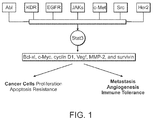
- Stat3 is activated by phosphorylation of a critical tyrosine residue mediated by growth factor receptor tyrosine kinases, Janus kinases, and/or the Src family kinases, etc. These kinases include but not limited to EGFR, JAKs, Abl, KDR, c-Met, Src, and Her2 [1].
- Stat3 forms homo-dimers and translocates to the nucleus, binds to specific DNA-response elements in the promoters of the target genes, and induces gene expression [2].
- Stat3 activation is transient and tightly regulated, lasting from 30 minutes to several hours.
- Stat3 is found to be aberrantly active in a wide variety of human cancers, including all the major carcinomas as well as some hematologic tumors.
- Stat3 plays multiple roles in cancer progression.
- As a potent transcription regulator it targets genes involved in cell cycle, cell survival, oncogenesis, tumor invasion, and metastasis, such as Bcl-xl, c-Myc, cyclin D1, Vegf, MMP-2, and survivin [3-8]. It is also a key negative regulator of tumor immune surveillance and immune cell recruitment [9-11].
- Stat3 signaling by antisense, siRNA, dominant-negative form of Stat3, and/or blockade of tyrosine kinases causes cancer cell-growth arrest, apotosis, and reduction of metastasis frequency in vitro and/or in vivo [2, 4, 12, 13].
- Stat3 pathway mediated inflammation is the common causative origin for atherosclerosis, peripheral vascular disease, coronary artery disease, hypertension, osteroprorosis, type 2 diabetes, and dementia. Therefore, Stat3 inhibitors may be used to prevent and treat autoimmune and inflammatory diseases as well as the other diseases listed above that are caused by inflammation.
- Cancer stem cells are a sub-population of cancer cells (found within tumors or hematological cancers) that possess characteristics normally associated with stem cells. These cells are tumorigenic (tumor-forming), in contrast to the bulk of cancer cells, which are non-tumorigenic. In human acute myeloid leukemia the frequency of these cells is less than 1 in 10,000 [15]. There is mounting evidence that such cells exist in almost all tumor types. However, as cancer cell lines are selected from a sub-population of cancer cells that are specifically adapted to growth in tissue culture, the biological and functional properties of these cell lines can change dramatically. Therefore, not all cancer cell lines contain cancer stem cells.
- CSCs have stem cell properties such as self-renewal and the ability to differentiate into multiple cell types. They persist in tumors as a distinct population and they give rise to the differentiated cells that form the bulk of the tumor mass and phenotypically characterize the disease. CSCs have been demonstrated to be fundamentally responsible for carcinogenesis, cancer metastasis, and cancer reoccurrence. CSCs are also often called tumor initiating cells, cancer stem-like cells, stem-like cancer cells, highly tumorigenic cells, or super malignant cells.
- cancer stem cells have several implications in terms of cancer treatment and therapy. These include disease identification, selective drug targets, prevention of cancer metastasis and recurrence, treatment of cancer refractory to chemotherapy and/or radiotherapy, treatment of cancers inherently resistant to chemotherapy or radiotherapy and development of new strategies in fighting cancer.
- cancer stem cells are radio-resistant and also refractory to chemotherapeutic and targeted drugs.
- Normal somatic stem cells are naturally resistant to chemotherapeutic agents--they have various pumps (such as MDR) that efflux drugs, higher DNA repair capability, and have a slow rate of cell turnover (chemotherapeutic agents naturally target rapidly replicating cells).
- Cancer stem cells being the mutated counterparts of normal stem cells, may also have similar functions which allow them to survive therapy.
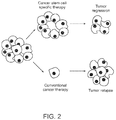
- chemotherapies kill differentiated or differentiating cells, which form the bulk of the tumor that are unable to generate new cells.
- a population of cancer stem cells which gave rise to it could remain untouched and cause a relapse of the disease.
- treatment with chemotherapeutic agents may only leave chemotherapy-resistant cancer stem cells, so that the ensuing tumor will most likely also be resistant to chemotherapy.
- Cancer stem cells have also been demonstrated to be resistant to radiotherapy (XRT) [16, 17].
- CSCs are resistant to many chemotherapeutic agents, therefore it is not surprising that CSCs almost ubiquitously overexpress drug efflux pumps such as ABCG2 (BCRP-1) [18-22], and other ATP binding cassette (ABC) superfamily members [23, 24].
- the side population (SP) technique originally used to enrich hematopoetic and leukemic stem cells, was first employed to identify CSCs in the C6 glioma cell line [25]. This method, first described by Goodell et al., takes advantage of differential ABC transporter-dependent efflux of the fluorescent dye Hoechst 33342 to define a cell population enriched in CSCs [21, 26].
- the SP is revealed by blocking drug efflux with verapamil, so that the SP is lost upon verapamil addition.
- Efforts have also focused on finding specific markers that distinguish cancer stem cells from the bulk of the tumor. Markers originally associated with normal adult stem cells have been found to also mark cancer stem cells and co-segregate with the enhanced tumorigenicity of CSCs.
- the most commonly expressed surface markers by the cancer stem cells include CD44, CD133, and CD166 [27-33]. Sorting tumor cells based primarily upon the differential expression of these surface marker(s) have accounted for the majority of the highly tumorigenic CSCs described to date. Therefore, these surface markers are well validated for identification and isolation of cancer stem cells from the cancer cell lines and from the bulk of tumor tissues.
- Stat3 pathway inhibitors can kill cancer stem cells and inhibit cancer stem cell self-renewal.
- the present invention provides a compound, wherein the compound is selected from the group consisting of:
- the present invention also provides a compound of formula II, or a pharmaceutically acceptable salt thereof, wherein the symbols have the following meanings and are, for each occurrence, independently selected:
- the present invention further provides a compound of formula III, or a pharmaceutically acceptable salt thereof, wherein the symbols have the following meanings and are, for each occurrence, independently selected:
- the present invention provides a compound-selected from the group consisting of:
- the present invention also provides a compound of formula V, or an or pharmaceutically acceptable salt thereof, wherein the symbols have the following meanings and are, for each occurrence, independently selected:
- the present invention provides a compound of formula VI, or a pharmaceutically acceptable salt thereof, wherein the symbols have the following meanings and are, for each occurrence, independently selected:
- the present invention further provides a compound of formula VIII: or an enantiomer, diastereomer, tautomer, or pharmaceutically acceptable salt or solvate thereof, wherein the symbols have the following meanings and are, for each occurrence, independently selected:
- the present disclosure provides a compound of formula I, or an enantiomer, diastereomer, tautomer, or pharmaceutically acceptable salt or solvate thereof, wherein the symbols have the following meanings and are, for each occurrence, independently selected:
- the present disclosure provides a compound of formula II, or an enantiomer, diastereomer, tautomer, or pharmaceutically acceptable salt or solvate thereof, wherein the symbols have the following meanings and are, for each occurrence, independently selected:
- the present disclosure provides a compound of formula III, or an enantiomer, diastereomer, tautomer, or pharmaceutically acceptable salt or solvate thereof, wherein the symbols have the following meanings and are, for each occurrence, independently selected:
- the present disclosure provides a compound of formula IV, or an enantiomer, diastereomer, tautomer, or pharmaceutically acceptable salt or solvate thereof, wherein the symbols have the following meanings and are, for each occurrence, independently selected:
- the present disclosure provides a compound of formula V, or an enantiomer, diastereomer, tautomer, or pharmaceutically acceptable salt or solvate thereof, wherein the symbols have the following meanings and are, for each occurrence, independently selected:
- the present disclosure provides a compound of formula VI, or an enantiomer, diastereomer, tautomer, or pharmaceutically acceptable salt or solvate thereof, wherein the symbols have the following meanings and are, for each occurrence, independently selected:
- the present disclosure provides a pharmaceutical composition
- a pharmaceutical composition comprising a compound formulae I - VII as described hereinabove, or an enantiomer, diastereomer, tautomer, or a pharmaceutically-acceptable salt thereof, and a pharmaceutically-acceptable excipient, carrier, or diluent.
- the present disclosure provides a method of treating cancer in a mammal, comprising administering to the mammal in need thereof a therapeutically effective amount of a compound of formulae I - VII as described hereinabove, or an enantiomer, diastereomer, tautomer, or pharmaceutically acceptable salt or solvate thereof.
- the said cancer above is selected from breast cancer, head and neck cancer, lung cancer, ovarian cancer, pancreatic cancer, multiple myeloma, colorectal carcinoma, prostate cancer, melanoma, kaposi sarcoma, ewing's sarcoma, liver cancer, gastric cancer, medulloblastoma, brain tumors, leukemia.
- the said cancer above is selected from lung cancer, breast cancer, cervical cancer, colon cancer, liver cancer, head and neck cancer, pancreatic cancer, gastric cancer, and prostate cancer.
- the present disclosure provides a method of inhibiting or reducing unwanted Stat3 pathway activity with an effective amount of a compound of formulae I - VII as described hereinabove, or an enantiomer, diastereomer, tautomer, or pharmaceutically acceptable salt or solvate thereof.
- the present disclosure provides a method of treating a disorder associated with aberrant Stat3 pathway activity in a mammal, comprising administering to the mammal in need thereof a therapeutically effective amount of a compound of formulae I - VII as described hereinabove, or an enantiomer, diastereomer, tautomer, or pharmaceutically acceptable salt or solvate thereof.
- the aberrant Stat3 pathway activity can be identified by expression of phosphorylated Stat3 or its surrogate upstream or downstream regulators.
- the said disorder is a cancer associated with aberrant Stat3 pathway activity which include but not limited to Breast cancer, head and neck cancer, lung cancer, ovarian cancer, pancreatic cancer, colorectal carcinoma, prostate cancer, renal cell carcinoma, melanoma, hepatocellular carcinomas, cervical cancer, sarcomas, brain tumors, gastric cancers, multiple myeloma, leukemia, and lymphomas.
- the said disorder is an autoimmune or inflammatory diseases associated with aberrant Stat3 pathway activity.
- the present disclosure provides use of a compound of formula VIII: or an enantiomer, diastereomer, tautomer, or pharmaceutically acceptable salt or solvate thereof, wherein the symbols have the following meanings and are, for each occurrence, independently selected:
- the present disclosure provides a method of inhibiting cellular Stat3 pathway activity in a cell, comprising administering to the cell in need thereof an effective amount of a compound of formulae I-VIII as described herein such that at least undesired Stat3 pathway activity in the cell is reduced.
- the present disclosure provides a method of treating a disorder associated with aberrant Stat3 pathway activity in a subject, the method comprising administering to the subject a therapeutically effective amount of a compound of formulae I-VIII as described herein.
- the present disclosure provides a method of treating a patient, the method comprising: selecting a patient by aberrant Stat3 pathway activity; and administering to the patient a therapeutically effective amount of a compound of formulae I-VIII as described herein.
- the present invention provides a method of treating a patient tested to have cancer expressing aberrant Stat3 pathway activity by administering to the patient a therapeutically effective amount of a compound of formulae I-VIII as described herein.
- the present disclosure provides a method of inhibiting a cancer stem cell survival and/or self-renewal, the method comprising administering to a cancer stem cell with an effective amount of a compound of formulae I-VIII as described herein.
- the present disclosure provides a method of treating a subject for cancer refractory to a standard regimen of treatment, the method comprising administering the subject a therapeutically effective amount of a compound of formulae I-VIII as described herein.
- the present disclosure provides a method of treating relapsed cancer in a subject, the method comprising administering the subject a therapeutically effective amount of a compound of formulae I-VIII as described herein.
- the present disclosure provides a method of treating or preventing cancer metastasis in a subject, the method comprising administering the subject a therapeutically effective amount of a compound of formulae I-VIII as described herein.
- the present disclosure provides a method of treating a cancer in a subject, the method comprising administering the subject a therapeutically effective amount of formulae I-VIII as described herein.
- alkyl and alk refers to a straight or branched chain alkane (hydrocarbon) radical containing from 1 to 12 carbon atoms, preferably 1 to 6 carbon atoms.
- exemplary “alkyl” groups include methyl, ethyl, propyl, isopropyl, n-butyl, t-butyl, isobutyl pentyl, hexyl, isohexyl, heptyl, 4,4-dimethylpentyl, octyl, 2,2,4-trimethylpentyl, nonyl, decyl, undecyl, dodecyl, and the like.
- C 1 -C 4 alkyl refers to a straight or branched chain alkane (hydrocarbon) radical containing from 1 to 4 carbon atoms, such as methyl, ethyl, propyl, isopropyl, n-butyl, t-butyl, and isobutyl.
- Substituted alkyl refers to an alkyl group substituted with one or more substituents, preferably 1 to 4 substituents, at any available point of attachment.
- alkenyl refers to a straight or branched chain hydrocarbon radical containing from 2 to 12 carbon atoms and at least one carbon-carbon double bond. Exemplary such groups include ethenyl or allyl.
- Substituted alkenyl refers to an alkenyl group substituted with one or more substituents, preferably 1 to 4 substituents, at any available point of attachment. Exemplary substituents include, but are not limited to, alkyl or substituted alkyl, as well as those groups recited above as exemplary alkyl substituents. The exemplary substitutents can themselves be optionally substituted.
- alkynyl refers to a straight or branched chain hydrocarbon radical containing from 2 to 12 carbon atoms and at least one carbon to carbon triple bond. Exemplary such groups include ethynyl.
- Substituted alkynyl refers to an alkynyl group substituted with one or more substituents, preferably 1 to 4 substituents, at any available point of attachment. Exemplary substituents include, but are not limited to, alkyl or substituted alkyl, as well as those groups recited above as exemplary alkyl substituents. The exemplary substitutents can themselves be optionally substituted.
- cycloalkyl refers to a fully saturated cyclic hydrocarbon group containing from 1 to 4 rings and 3 to 8 carbons per ring. Exemplary such groups include cyclopropyl, cyclobutyl, cyclopentyl, cyclohexyl, cycloheptyl, etc.
- Substituted cycloalkyl refers to a cycloalkyl group substituted with one or more substituents, preferably 1 to 4 substituents, at any available point of attachment. Exemplary substituents include, but are not limited to, nitro, cyano, alkyl or substituted alkyl, as well as those groups recited above as exemplary alkyl substituents.
- exemplary substitutents can themselves be optionally substituted.
- exemplary substituents also include spiro-attached or fused cylic substituents, especially spiro-attached cycloalkyl, spiro-attached cycloalkenyl, spiro-attached heterocycle (excluding heteroaryl), fused cycloalkyl, fused cycloalkenyl, fused heterocycle, or fused aryl, where the aforementioned cycloalkyl, cycloalkenyl, heterocycle and aryl substitutents can themselves be optionally substituted.
- cycloalkenyl refers to a partially unsaturated cyclic hydrocarbon group containing 1 to 4 rings and 3 to 8 carbons per ring. Exemplary such groups include cyclobutenyl, cyclopentenyl, cyclohexenyl, etc.
- Substituted cycloalkenyl refers to a cycloalkenyl group substituted with one more substituents, preferably 1 to 4 substituents, at any available point of attachment. Exemplary substituents include but are not limited to nitro, cyano, alkyl or substituted alkyl, as well as those groups recited above as exemplary alkyl substituents. The exemplary substitutents can themselves be optionally substituted.
- substituents also include spiro-attached or fused cylic substituents, especially spiro-attached cycloalkyl, spiro-attached cycloalkenyl, spiro-attached heterocycle (excluding heteroaryl), fused cycloalkyl, fused cycloalkenyl, fused heterocycle, or fused aryl, where the aforementioned cycloalkyl, cycloalkenyl, heterocycle and aryl substituents can themselves be optionally substituted.
- aryl refers to cyclic, aromatic hydrocarbon groups that have 1 to 5 aromatic rings, especially monocyclic or bicyclic groups such as phenyl, biphenyl or naphthyl. Where containing two or more aromatic rings (bicyclic, etc. ), the aromatic rings of the aryl group may be joined at a single point (e.g., biphenyl), or fused ( e.g., naphthyl, phenanthrenyl and the like). "Substituted aryl” refers to an aryl group substituted by one or more substituents, preferably 1 to 3 substituents, at any point of attachment.
- substituents include, but are not limited to, nitro, cycloalkyl or substituted cycloalkyl, cycloalkenyl or substituted cycloalkenyl, cyano, alkyl or substituted alkyl, as well as those groups recited above as exemplary alkyl substituents.
- the exemplary substitutents can themselves be optionally substituted.
- Exemplary substituents also include fused cylic groups, especially fused cycloalkyl, fused cycloalkenyl, fused heterocycle, or fused aryl, where the aforementioned cycloalkyl, cycloalkenyl, heterocycle and aryl substituents can themselves be optionally substituted.
- heterocycle and “heterocyclic” refer to fully saturated, or partially or fully unsaturated, including aromatic (i.e., “heteroaryl”) cyclic groups (for example, 4 to 7 membered monocyclic, 7 to 11 membered bicyclic, or 8 to 16 membered tricyclic ring systems) which have at least one heteroatom in at least one carbon atom-containing ring.
- Each ring of the heterocyclic group containing a heteroatom may have 1, 2, 3, or 4 heteroatoms selected from nitrogen atoms, oxygen atoms and/or sulfur atoms, where the nitrogen and sulfur heteroatoms may optionally be oxidized and the nitrogen heteroatoms may optionally be quaternized.
- heteroarylium refers to a heteroaryl group bearing a quaternary nitrogen atom and thus a positive charge.
- the heterocyclic group may be attached to the remainder of the molecule at any heteroatom or carbon atom of the ring or ring system.
- Exemplary monocyclic heterocyclic groups include azetidinyl, pyrrolidinyl, pyrrolyl, pyrazolyl, oxetanyl, pyrazolinyl, imidazolyl, imidazolinyl, imidazolidinyl, oxazolyl, oxazolidinyl, isoxazolinyl, isoxazolyl, thiazolyl, thiadiazolyl, thiazolidinyl, isothiazolyl, isothiazolidinyl, furyl, tetrahydrofuryl, thienyl, oxadiazolyl, piperidinyl, piperazinyl, 2-oxopiperazinyl, 2-oxopiperidinyl, 2-oxopyrrolodinyl, 2-oxoazepinyl, azepinyl, hexahydrodiazepinyl, 4-piperidonyl, pyridy
- bicyclic heterocyclic groups include indolyl, isoindolyl, benzothiazolyl, benzoxazolyl, benzoxadiazolyl, benzothienyl, benzo[d][1,3]dioxolyl, 2,3-dihydrobenzo[b][1,4]dioxinyl, quinuclidinyl, quinolinyl, tetrahydroisoquinolinyl, isoquinolinyl, benzimidazolyl, benzopyranyl, indolizinyl, benzofuryl, benzofurazanyl, chromonyl, coumarinyl, benzopyranyl, cinnolinyl, quinoxalinyl, indazolyl, pyrrolopyridyl, furopyridinyl (such as furo[2,3-c]pyridinyl, furo[3,2-b]pyridinyl] or furo[2,3
- Substituted heterocycle and “substituted heterocyclic” refer to heterocycle or heterocyclic groups substituted with one or more substituents, preferably 1 to 4 substituents, at any available point of attachment.
- the exemplary substitutents can themselves be optionally substituted.
- substituents also include spiro-attached or fused cylic substituents at any available point or points of attachment, especially spiro-attached cycloalkyl, spiro-attached cycloalkenyl, spiro-attached heterocycle (excluding heteroaryl), fused cycloalkyl, fused cycloalkenyl, fused heterocycle, or fused aryl, where the aforementioned cycloalkyl, cycloalkenyl, heterocycle and aryl substituents can themselves be optionally substituted.
- halogen or halo refer to chlorine, bromine, fluorine or iodine.
- carbocyclic refers to aromatic or non-aromatic 3 to 7 membered monocyclic and 7 to 11 membered bicyclic groups, in which all atoms of the ring or rings are carbon atoms.
- Substituted carbocyclic refers to a carbocyclic group substituted with one or more substituents, preferably 1 to 4 substituents, at any available point of attachment.
- substituents include, but are not limited to, nitro, cyano, OR a , wherein R a is as defined hereinabove, as well as those groups recited above as exemplary cycloalkyl substituents.
- the exemplary substitutents can themselves be optionally substituted.
- pharmaceutically-acceptable excipient, carrier, or diluent means a pharmaceutically-acceptable material, composition or vehicle, such as a liquid or solid filler, diluent, excipient, solvent or encapsulating material, involved in carrying or transporting the subject pharmaceutical agent from one organ, or portion of the body, to another organ, or portion of the body.
- Each carrier must be “acceptable” in the sense of being compatible with the other ingredients of the formulation and not injurious to the patient.
- materials which can serve as pharmaceutically-acceptable carriers include: sugars, such as lactose, glucose and sucrose; starches, such as corn starch and potato starch; cellulose, and its derivatives, such as sodium carboxymethyl cellulose, ethyl cellulose and cellulose acetate; powdered tragacanth; malt; gelatin; talc; excipients, such as cocoa butter and suppository waxes; oils, such as peanut oil, cottonseed oil, safflower oil, sesame oil, olive oil, corn oil and soybean oil; glycols, such as propylene glycol; polyols, such as glycerin, sorbitol, mannitol and polyethylene glycol; esters, such as ethyl oleate and ethyl laurate; agar; buffering agents, such as magnesium hydroxide and aluminum hydroxide; alginic acid; pyrogen-free water; isotonic saline; Ring
- wetting agents such as sodium lauryl sulfate, magnesium stearate, and polyethylene oxide-polypropylene oxide copolymer as well as coloring agents, release agents, coating agents, sweetening, flavoring and perfuming agents, preservatives and antioxidants can also be present in the compositions.
- any heteroatom with unsatisfied valences is assumed to have hydrogen atoms sufficient to satisfy the valences.
- the compounds of the present invention may form salts which are also within the scope of this invention.
- Reference to a compound of the present invention herein is understood to include reference to salts thereof, unless otherwise indicated.
- the term "salt(s)", as employed herein, denotes acidic and/or basic salts formed with inorganic and/or organic acids and bases.
- zwitterions inner salts
- inner salts may be formed and are included within the term "salt(s)" as used herein.
- Salts of the compounds of the present invention may be formed, for example, by reacting a compound I, II or III with an amount of acid or base, such as an equivalent amount, in a medium such as one in which the salt precipitates or in an aqueous medium followed by lyophilization.
- the compounds of the present invention which contain a basic moiety may form salts with a variety of organic and inorganic acids.
- Exemplary acid addition salts include acetates (such as those formed with acetic acid or trihaloacetic acid, for example, trifluoroacetic acid), adipates, alginates, ascorbates, aspartates, benzoates, benzenesulfonates, bisulfates, borates, butyrates, citrates, camphorates, camphorsulfonates, cyclopentanepropionates, digluconates, dodecylsulfates, ethanesulfonates, fumarates, glucoheptanoates, glycerophosphates, hemisulfates, heptanoates, hexanoates, hydrochlorides, hydrobromides, hydroiodides, hydroxyethanethanethane, acetatesulfates, adipates, algina
- the compounds of the present invention which contain an acidic moiety may form salts with a variety of organic and inorganic bases.
- Exemplary basic salts include ammonium salts, alkali metal salts such as sodium, lithium and potassium salts, alkaline earth metal salts such as calcium and magnesium salts, salts with organic bases (for example, organic amines) such as benzathines, dicyclohexylamines, hydrabamines (formed with N,N-bis(dehydroabietyl) ethylenediamine), N-methyl-D-glucamines, N-methyl-D-glycamides, t-butyl amines, and salts with amino acids such as arginine, lysine and the like.
- Basic nitrogen-containing groups may be quaternized with agents such as lower alkyl halides (e.g. methyl, ethyl, propyl, and butyl chlorides, bromides and iodides), dialkyl sulfates ( e.g. dimethyl, diethyl, dibutyl, and diamyl sulfates), long chain halides ( e.g. decyl, lauryl, myristyl and stearyl chlorides, bromides and iodides), aralkyl halides (e.g. benzyl and phenethyl bromides), and others.
- lower alkyl halides e.g. methyl, ethyl, propyl, and butyl chlorides, bromides and iodides
- dialkyl sulfates e.g. dimethyl, diethyl, dibutyl, and diamyl sulfates
- Solvates of the compounds of the invention are also contemplated herein.
- Solvates of the compounds of the present invention include, for example, hydrates.
- All stereoisomers of the compounds of the present invention are contemplated within the scope of this invention.
- Individual stereoisomers of the compounds of the invention may, for example, be substantially free of other isomers ( e.g., as a pure or substantially pure optical isomer having a specified activity), or may be admixed, for example, as racemates or with all other, or other selected, stereoisomers.
- the chiral centers of the present invention may have the S or R configuration as defined by the IUPAC 1974 Recommendations.
- racemic forms can be resolved by physical methods, such as, for example, fractional crystallization, separation or crystallization of diastereomeric derivatives or separation by chiral column chromatography.
- the individual optical isomers can be obtained from the racemates by any suitable method, including without limitation, conventional methods, such as, for example, salt formation with an optically active acid followed by crystallization.
- Compounds of the present invention are, subsequent to their preparation, preferably isolated and purified to obtain a composition containing an amount by weight equal to or greater than 99% ("substantially pure" compound I), which is then used or formulated as described herein.
- the present disclosure provides a compound of formula I, or an enantiomer, diastereomer, tautomer, or pharmaceutically acceptable salt or solvate thereof, wherein the symbols have the following meanings and are, for each occurrence, independently selected:
- the present invention provides a compound selected from the group consisting of:
- the present invention provides a compound selected from the group consisting of:
- the present invention provides a compound of formula II, or an enantiomer, diastereomer, tautomer, or pharmaceutically acceptable salt or solvate thereof, wherein the symbols have the following meanings and are, for each occurrence, independently selected:
- the compound of formula II is selected from the group consisting of:
- the present invention provides a compound of formula III, or an enantiomer, diastereomer, tautomer, or pharmaceutically acceptable salt or solvate thereof, wherein the symbols have the following meanings and are, for each occurrence, independently selected:
- the compound of formula III is N-(2-aminoethyl)-2-aminoethyl-N-(2-aminoethyl)-2-aminoethyl-N-(2-aminoethyl)-2-aminoethyl-N-(2-aminoethyl)-2-aminoethyl-N-(2-aminoethyl)-2-aminoethyl
- the present disclosure provides a compound of formula IV, or an enantiomer, diastereomer, tautomer, or pharmaceutically acceptable salt or solvate thereof, wherein the symbols have the following meanings and are, for each occurrence, independently selected:
- the compound of formula IV is selected from the group consisting of:
- the present invention provides a compound of formula V, or an enantiomer, diastereomer, tautomer, or pharmaceutically acceptable salt or solvate thereof, wherein the symbols have the following meanings and are, for each occurrence, independently selected:
- the present invention provides a compound of formula VI, or an enantiomer, diastereomer, tautomer, or pharmaceutically acceptable salt or solvate thereof, wherein the symbols have the following meanings and are, for each occurrence, independently selected:
- the present invention provides a compound selected from the group consisting of:
- the present invention provides a compound of formular VII:
- the present invention provides a compound of formula VIII: or an enantiomer, diastereomer, tautomer, or pharmaceutically acceptable salt or solvate thereof, wherein the symbols have the following meanings and are, for each occurrence, independently selected:
- the compound of formula VIII is selected from the group consisting of:
- Stat3 pathway can be activated in response to cytokines, such as IL-6, or by a series of tyrosine kinases, such as EGFR, JAKs, Abl, KDR, c-Met, Src, and Her2.
- the downstream effectors of Stat3 include but not limited to Bcl-xl, c-Myc, cyclinD1, Vegf, MMP-2, and survivin.
- Stat3 pathway is found to be aberrantly active in a wide variety of human diseases, as shown in Table 1. Existing clinical samples examined showed that persistently active Stat3 pathway occurs in more than half of breast and lung cancers, hepatocellular carcinomas, multiple myelomas and more than 95% of head and neck cancers.
- Blocking Stat3 pathway causes cancer cell-growth arrest, apoptosis, and reduction of metastasis frequency in vitro and/or in vivo.
- Activated Stat3 has also been demonstrated in a number of autoimmune and inflammatory diseases.
- interleukin-6 mediated inflammation is the common causative origin for Atherosclerosis [34], Peripheral Vascular Disease [35, 36], Coronary Artery Disease [35, 36], hypertension [37], Osteroprorosis [38], Type 2 Diabetes [35], and Dementia [39] and gp130-Jaks-Stats is the main pathway activated by IL-6, inhibition of the Stat3 pathway may treat or prevent these diseases as well. Therefore, Stat3 inhibitors are highly sought after therapeutic agents. Table 1.
- the present disclosure provides, in part, Stat3 inibitors, comprising of a compound of formula I - VIII or an enantiomer, diastereomer, tautomer, or pharmaceutically acceptable salt or solvate thereof.
- the present disclosure further provides a method of treating a disorder related to aberrant Stat3 pathway activity in a mammal.
- the method of treating the disorder comprises administering to the mammal in need thereof an amount of a compound of formulae I through VIII, or an enantiomer, diastereomer, tautomer, or pharmaceutically acceptable salt or solvate thereof.
- the said aberrant Stat3 pathway activity can be identified by expression of phosphorylated Stat3 or its surrogate upstream or downstream regulators.
- the condition is a cancer related to aberrant Stat3 pathway activity.
- the condition is an autoimmune or inflammatory disease related to aberrant Stat3 pathway activity.
- the said autoimmune or inflammatory disease is selected from the group consisting of inflammatory bowel diseases, arthritis, Crohn's diseases, ulcerative colitis, rheumatoid arthritis, asthma, allergy, and systemic lupus erythematosus.
- the condition is a CNS disease related to aberrant Stat3 pathway activity.
- the said CNS disease is selected from autoimmune demyelination disorder, Alzheimer's, stroke, ischemia reperfusion injury and multiple sclerosis.
- the condition is a disease caused by inflammation and related to aberrant Stat3 pathway activity. These diseases include atherosclerosis, peripheral vascular disease, coronary artery disease, hypertension, osteroprorosis, type 2 diabetes, or dementia.
- cancer stem cells with an exclusive ability to regenerate tumors. These cancer stem cells are functionally linked with continued malignant growth, cancer metastasis, recurrence, and cancer drug resistance. Cancer stem cells and their differentiated progeny appear to have markedly different biologic characteristics. They persist in tumors as a distinct, but rare population. Conventional cancer drug screenings depend on measurement of the amount of tumor mass and, therefore, are unlikely to identify drugs that act specifically on the stem cells. In fact, cancer stem cells have been demonstrated to be resistant to standard chemotherapies and are enriched after standard chemotherapy treatments, which result in cancer refractory and recurrence. Cancer stem cells have also been demonstrated to be resistant to radiotherapy [17].
- the reported cancer types in which cancer stem cells have been isolated include breast cancer, head and neck cancer, lung cancer, ovarian cancer, pancreatic cancer, colorectal carcinoma, prostate cancer, melanoma, multiple myeloma, kaposi sarcoma, ewing's sarcoma, liver cancer, medulloblastoma, brain tumors, and leukemia.
- the mounting evidence linking cancer stem cells to tumorigenesis provides enormous therapeutic opportunity for targeting cancer stem cells.
- the key to unlocking this untapped potential is the identification and validation of pathways that are selectively important for cancer stem cell self-renewal and survival.
- Stat3 is a key cancer stem cell survival and self-renewal factor. Therefore, Stat3 inhibitors can kill cancer stem cells and inhibit cancer stem cell self-renewal.
- cancer stem cell or cancer stem cells (CSCs) refer to a minute population of cancer cells that have self-renewal capability and are tumorigenic. They are also called “Cancer Initiating Cells”, “Tumor Initiating Cells”, “Cancer Stem-Like Cells”, “Stem-Like Cancer Cells”, and “super malignant cells”, etc.
- the methods of isolating these cells include but not limited to identification by their ability of efflux Hoechst 33342, identification by the surface markers these cells expressed, such as CD133, CD44, CD166, and others, and enrichment by their tumorigenic property.
- the present disclosure provides, in part, a method of inhibiting/reducing/diminishing cancer stem cell survival and or self-renewal with an effective amount of a compound of formulae I through VIII, or an enantiomer, diastereomer, tautomer, or pharmaceutically acceptable salt or solvate thereof.
- cancer stem cells can be identified by the surface markers, such as CD44, CD133, and CD166.
- the present invention provides, in part, a method of treating cancer refractory to conventional chemotherapies in a mammal, comprising to the mammal in need thereof a pharmaceutical composition comprising a compound of formulae I through VIII, or pharmaceutically acceptable salt or solvate thereof.
- the present invention provides, in part, a method of treating recurrent cancer in a mammal that has failed surgery, chemo, or XRT, comprising administering to the mammal in need thereof a pharmaceutical composition comprising a compound of formulae I through VIII, or pharmaceutically acceptable salt or solvate thereof.
- cancer stem cells are the seeds of cancer and are fundamentally responsible for cancer metastasis
- the present disclosure provides, in part, a method of treating or preventing cancer metastasis in a mammal, comprising administering to the mammal in need thereof a pharmaceutical composition comprising a compound of formulae I through VIII, or pharmaceutically acceptable salt or solvate thereof.
- the present disclosure further provides, in part, a method of treating cancer in a mammal, comprising administering to the mammal a therapeutically effective amount of a compound of formula I - VIII or an enantiomer, diastereomer, tautomer, or pharmaceutically acceptable salt or solvate thereof.
- the said cancer above is selected from lung cancer, breast cancer, cervix cancer, colon cancer, liver cancer, pancreatic cancer, head and neck cancer, gastric cancer, and prostate cancer.
- the present disclosure further provides, in part, a pharmaceutical composition
- a pharmaceutical composition comprising a compound of formulae I through VII, or an enantiomer, diastereomer, tautomer, or pharmaceutically acceptable salt or solvate thereof, and a pharmaceutically-acceptable excipient, carrier, or diluent.
- Formulations of the present invention include those suitable for oral, nasal, topical (including buccal and sublingual), rectal, vaginal and/or parenteral administration.
- the formulations may conveniently be presented in unit dosage form and may be prepared by any methods well known in the art of pharmacy.
- the amount of active ingredient which can be combined with a carrier material to produce a single dosage form will vary depending upon the mammal being treated and the particular mode of administration.
- the amount of active ingredient, which can be combined with a carrier material to produce a single dosage form will generally be that amount of the compound which produces a therapeutic effect. Generally, out of 100%, this amount will range, for example, from about 1% to about 99% of active ingredient, from about 5% to about 70%, from about 10% to about 30%.
- compositions or formulations of the invention suitable for oral administration may be in the form of capsules, cachets, pills, tablets, lozenges (using a flavored basis, usually sucrose and acacia or tragacanth), powders, granules, or as a solution or a suspension in an aqueous or non-aqueous liquid, or as an oil-in-water or water-in-oil liquid emulsion, or as an elixir or syrup, or as pastilles (using an inert base, such as gelatin and glycerin, or sucrose and acacia) and/or as mouth washes and the like, each containing a predetermined amount of a compound of the present invention as an active ingredient.
- a compound of the present invention may also be administered as a bolus, electuary or paste.
- the alcohol or inhibitor according to the invention is mixed with one or more pharmaceutically-acceptable carriers, such as sodium citrate or dicalcium phosphate, and/or any of the following: fillers or extenders, such as starches, lactose, sucrose, glucose, mannitol, and/or silicic acid; binders, such as, for example, carboxymethylcellulose, alginates, gelatin, polyvinyl pyrrolidone, sucrose and/or acacia; humectants, such as glycerol; disintegrating agents, such as agar-agar, calcium carbonate, potato or tapioca starch, alginic acid, certain silicates, sodium carbonate, and sodium starch glycolate; solution retarding agents, such as paraffin; absorption accelerators, such as quaternary ammonium compounds; wetting agents, such as, for example,
- compositions may also comprise buffering agents.
- Solid compositions of a similar type may also be employed as fillers in soft and hard-filled gelatin capsules using such excipients as lactose or milk sugars, as well as high molecular weight polyethylene glycols and the like.
- Liquid dosage forms for oral administration of the compounds of the invention include pharmaceutically acceptable emulsions, microemulsions, solutions, suspensions, syrups and elixirs.
- the liquid dosage forms may contain inert diluents commonly used in the art, such as, for example, water or other solvents, solubilizing agents and emulsifiers, such as ethyl alcohol, isopropyl alcohol, ethyl carbonate, ethyl acetate, benzyl alcohol, benzyl benzoate, propylene glycol, 1,3-butylene glycol, oils (in particular, cottonseed, groundnut, corn, germ, olive, castor and sesame oils), glycerol, tetrahydrofuryl alcohol, polyethylene glycols and fatty acid esters of sorbitan, and mixtures thereof.
- cyclodextrins e.g., hydroxypropyl-.beta.-cyclo
- the oral compositions can also include adjuvants such as wetting agents, emulsifying and suspending agents, sweetening, flavoring, coloring, perfuming and preservative agents.
- Suspensions in addition to the alcohols or inhibitors according to the invention, may contain suspending agents as, for example, ethoxylated isostearyl alcohols, polyoxyethylene sorbitol and sorbitan esters, microcrystalline cellulose, aluminum metahydroxide, bentonite, agar--agar and tragacanth, and mixtures thereof.
- Formulations of the pharmaceutical compositions of the invention for rectal or vaginal administration may be presented as a suppository, which may be prepared by mixing one or more alcohols or inhibitors according to the invention, with one or more suitable nonirritating excipients or carriers comprising, for example, cocoa butter, polyethylene glycol, a suppository wax or a salicylate, and which is solid at room temperature, but liquid at body temperature and, therefore, will melt in the rectum or vaginal cavity and release the active pharmaceutical agents of the invention.
- Formulations of the present invention which are suitable for vaginal administration also include pessaries, tampons, creams, gels, pastes, foams or spray formulations containing such carriers as are known in the art to be appropriate.
- Dosage forms for the topical or transdermal administration of an alcohol or other inhibitor according to the invention include powders, sprays, ointments, pastes, creams, lotions, gels, solutions, patches and inhalants.
- the active compound may be mixed under sterile conditions with a pharmaceutically-acceptable carrier, and with any preservatives, buffers, or propellants which may be required.
- the ointments, pastes, creams and gels may contain, in addition to an alcohol or other inhibitor according to the invention, excipients, such as animal and vegetable fats, oils, waxes, paraffins, starch, tragacanth, cellulose derivatives, polyethylene glycols, silicones, bentonites, silicic acid, talc and zinc oxide, or mixtures thereof.
- excipients such as animal and vegetable fats, oils, waxes, paraffins, starch, tragacanth, cellulose derivatives, polyethylene glycols, silicones, bentonites, silicic acid, talc and zinc oxide, or mixtures thereof.
- Powders and sprays can contain, in addition to a compound of this invention, excipients such as lactose, talc, silicic acid, aluminum hydroxide, calcium silicates and polyamide powder, or mixtures of these substances.
- Sprays can additionally contain customary propellants, such as chlorofluorohydrocarbons and volatile unsubstituted hydrocarbons, such as butane and propane.
- Ophthalmic formulations are also contemplated as being within the scope of this invention.
- compositions of this invention suitable for parenteral administration comprise one or more alcohols or inhibitors according to the invention in combination with one or more pharmaceutically-acceptable sterile isotonic aqueous or nonaqueous solutions, dispersions, suspensions or emulsions, or sterile powders which may be reconstituted into sterile injectable solutions or dispersions just prior to use, which may contain antioxidants, buffers, bacteriostats, solutes which render the formulation isotonic with the blood of the intended recipient or suspending or thickening agents.
- the absorption of the alcohol or inhibitor in order to prolong the effect of the alcohol or inhibitor according to the invention, it is desirable to slow the absorption of the alcohol or inhibitor from subcutaneous or intramuscular injection. This may be accomplished by the use of a liquid suspension of crystalline or amorphous material having poor water solubility. The rate of absorption of the drug then depends upon its rate of dissolution, which, in turn, may depend upon crystal size and crystalline form. Alternatively, delayed absorption of a parenterally-administered composition is accomplished by dissolving or suspending the alcohol or inhibitor in an oil vehicle.
- One strategy for depot injections includes the use of polyethylene oxide-polypropylene oxide copolymers wherein the vehicle is fluid at room temperature and solidifies at body temperature.
- the pharmaceutical compounds of this invention may be administered alone or in combination with other pharmaceutical agents, or with other anti-cancer therapies as described hereinabove, as well as in combination with a pharmaceutically-acceptable excipient, carrier, or diluent as described above.
- the compounds of the present invention can be prepared using the methods described below, together with synthetic methods known one skilled in the art of organic synthesis, or variations thereon.
- the reactions are performed in solvents appropriate to the reagents and materials employed and are suitable for transformations being effected.
- the starting materials for the examples contained herein are either commercially available or are readily prepared by standard methods from known materials. For example, the following reactions are illustrations but not limitations of the preparation of some of the starting materials and examples used herein.
- Oxidation of 1-3 with n-bromosuccinimide and lead tetraacetate gives 2-(1-acetoxy-alkyl)-4H,9H-naphtho[2,3-b]furan-4,9-dione 1-4.
- Hydrochloric acid treatment of compound 1-4 gives 2-(hydroxy-alkyl or arylmethyl)-4H,9H-naphtho[2,3-b]furan-4,9-dione 1-5 and 2-vinyl-4H,9H-naphtho[2,3-b]furan-4,9-dione 1-6.
- Oxidation of 2-4 with n-bromosuccinimide and lead tetraacetate gives 3-acetoxy- orthonaphthoquinone 2-5.
- Hydrochloric acid treatment of compound 2-5 gives 2-alkyl (or aryl)-3-alkyl (or aryl)-naphtha[2,3-b]furan-4,9-dione 2-6.
- the crude intermediate product (5-chloro-2-acetyl)phenylacetic acid was dissolved in the mixture of 100 ml of anhydrous ethanol and 10 ml of sulfuric acid. Then the resulting mixture was stirred for 48 hours at room temperature. After diluting with 200 ml of water, the mixture was extracted with dichloromethane, and then the organic phase was washed with water and dried with sodium sulfate.
- the intermediate product ethyl (5-chloro-2-acetyl)phenylacetate was purified by silica gel chromatograph.
- the combined organic phases was washed successively with 500 ml of water, and 500ml of 5% sodium bisulfite, and 500 ml of 4% sodium bicarbonate, and finally extracted with 400 ml of 5% sodium carbonate twice.
- the combined sodium carbonate extract was neutralized by addition of concentrated hydrochloric acid to pH 7.2-7.6. After chilling to 0°C, the mixture was filtered, and the resulting brick red solid was washed with cold water and dried under vacuum. 9.6 gram of product was obtained: 38.6% yield.
- DMEM Dulbecco's Modified Eagle Medium
- FBS fetal bovine serum
- penicillin/streptomycin/amphotercin B Invitrogen
- Luciferase Reporter Assay HeLa Cells were co-transfected with Stat3-luciferase (Stat3-Luc) reporter vector (Panomics, Fremont, CA) and Renilla luciferase (Promega, Madison, WI) using Lipofectamine 2000 as described by the manufacturer (Invitrogen). Following transfection, cells were maintained in medium containing 0.5% FBS for 24 hours. Cells were then treated with the indicated compound for 30 minutes prior to the addition of 25 ng/ml oncostatin M (OSM) (R&D Systems, Minneapolis, MN) to the medium. 6 hours following OSM addition, cells were harvested and levels of firefly and renilla luciferase were measured using the Dual-Glo Luciferase Assay System as described by the manufacturer (Promega).
- OSM oncostatin M
- ESA Electrophoretic mobility shift assay
- ELISA enzyme-linked immunosorbent assay
- 5 ⁇ g of nuclear extract was preincubated with indicated concentration of indicated compound for 30 minutes prior to the addition of biotinylated oligo (5'-Biotin-GATCCTTCTGGGAATTCCTAGATC-3').
- Stat3-DNA complexes were then captured on streptavidin coated 96 well plates (Pierce, Rockford, IL). Bound complexes were then incubated with Stat3 polyclonal antibody (Santa Cruz Biotechnology, Santa Cruz, CA) followed by anti-rabbit HRP conjugated secondary antibody (GE Healthcare, Pittsburgh, PA). Bound antibody was then visualized by addition of TMB substrate (Pierce) and absorbance measured at 450 nm.
- SW480 cells were removed from the culture dish with trypsin and EDTA, pelleted by centrifugation, washed with phosphate-buffered saline (PBS), and resuspended at 37°C in Dulbecco's modified Eagle's medium (DMEM) containing 2% FBS and 1 mM HEPES. The cells were then labeled with Hoechst 33342 (Invitrogen) at a concentration of 5 ⁇ g/mL. The labeled cells were incubated for 120 minutes at 37°C, either alone or with 50 ⁇ M verapamil (Sigma-Aldrich, St. Louis).
- PBS phosphate-buffered saline
- DMEM Dulbecco's modified Eagle's medium
- HBSS Hanks' balanced saline solution
- FBS Frequency-sensitive bovine serum
- 675LP 675 nm long-pass edge filter
- CSC isolation with surface markers Sorting tumor cells based primarily upon the differential expression of the surface marker(s), such as CD44 or CD133, have accounted for the majority of the highly tumorigenic CSCs described to date.
- CD133 isolation is based upon the method of Ricci-Vitiani et al. [31], with slight modification.
- CD133 + cells were isolated by either fluorescence activated cell sorting (FACS) or magnetic nanoparticle-based separation.
- CD44 high cells were isolated by FACS according to the methods described in Ponti et al, with slight modification [82]. Briefly, after trypsinization and recovery of cells for 30 minutes at 37°C in growth media, cells were pelleted at 400 x g and were resuspended in PBS with 2% FBS and 1mM EDTA at 1 x 10 6 cells/mL. Cells were then incubated on ice with a 1:100 dilution of CD44-FITC (BD Biosicences, San Diego, CA) for 15 minutes. Alternatively, CD24-PE (BD Bioscences, San Diego, CA) (1:100) was utilized for negative selection. After washing three times, cells were resuspended at 2 x 10 6 /mL and passed through a 40 ⁇ M mesh before sorting
- Sphere assay A reliable method of measuring the self-renewal capacity of cell population if the ability to be cultured as spheres in the absence of serum or attachment.
- CD44 high FaDu or Hoechst side population cancer stem cells were cultured in ultra low attachment plates in cancer stem cell media (DMEM/F12, B27 Neurobasal supplement, 20 ng/ml EGF, 10 ng/ml FGF, 4 ⁇ g/ml insulin, and 0.4% BSA) to allow spheres formation.
- DMEM/F12, B27 Neurobasal supplement 20 ng/ml EGF, 10 ng/ml FGF, 4 ⁇ g/ml insulin, and 0.4% BSA
- sphere formation was evaluated by microscopy after 10-14 days in culture and spheres with >50 cells were scored.
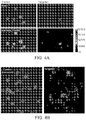
- Stat3 knockdown in CSCs induces apoptosis.
- immunofluorence microscopy allows not only the analysis of rare cell populations, but also provides additional information on protein localization and the ability to correlate staining with phenotype (i.e. apoptosis).
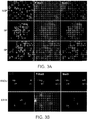
- p-Stat3 and Stat3 were indeed present in SP cells and that it was modestly enriched in the nucleus ( Figure 3A ).
- FIG. 3A we also observed increased p-Stat3 staining in SP cells over NSP cells, suggesting that SP cells may rely more heavily on Stat3 for survival.
- Stat3 The status of Stat3 was also evaluated in CD133 + cells isolated from FaDu human head and neck cancer cells and LN18 human glioblastoma cells. As shown in Figure 3B , Stat3 are also constitutively active in these cells. Taken together, these data suggest Stat3 as a target that is particularly important for cancer stem cells.
- CD44 high /CD24 low FaDu or Hoeschst side population cancer stem cells were isolated by FACS, and cultured in ultra low attachment plates in cancer stem cell media (DMEM/F12, B27 Neurobasal supplement, 20 ng/mL EGF, 10 ng/mL FGF, 4 ⁇ g/mL insulin, and 0.4% BSA) to allow sphere formation.
- Primary spheres were collected, disaggregated with trypsin, and distributed to 96-well ultra low attachment plated prior to TPIV ® treatment.
- Bacteria were administered at an MOI of 1000 for two hours before addition of antibiotic cocktail (penstrep, gentamycin, oflaxacin).
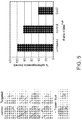
- Sphere formation was assessed after 10-14 days in culture. Representative sphere images were captured before ( Figure 5 , left upper panels) or after the addition of trypan blue to identify dead cells ( Figure 5 , left bottom panel). Relative spherogenesis was shown in the right panel of Figure 5 . The data clearly showed that Stat3 knockdown in cancer stem cells inhibits sphereogenesis, demonstrating that Stat3 is a key self-renewal factor of cancer stem cells.
- Stat3-luc Stat3-luciferase reporter construct
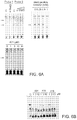
- the Stat3 retarded band was identified and confirmed by supershift with the anti-Stat3 antibody ( Figure 6A , left panel) and dose-dependent inhibition with the Stat3 peptide ( Figure 6A , middle panel). Dose dependent inhibition of Stat3 DNA binding was observed following incubation of the labeled probe with compound 401 ( Figure 6A , right panel).
- IC 50 were estimated by plotting the percentage of surviving cells.
- Table 7 IC 50 ( ⁇ M) Compound NSP SP 420 0.51 0.59 401 0.33 0.34 418 0.33 0.34 402 0.38 0.4 302 1.29 2.06 106 2 4.44
- Table 8 IC 50 ( ⁇ M) Compound CD44 low CD 44 high 202 2.25 2.4 304 2.49 2.41 302 3.68 0.68
Landscapes
- Health & Medical Sciences (AREA)
- Chemical & Material Sciences (AREA)
- Organic Chemistry (AREA)
- Life Sciences & Earth Sciences (AREA)
- Pharmacology & Pharmacy (AREA)
- Veterinary Medicine (AREA)
- Public Health (AREA)
- General Health & Medical Sciences (AREA)
- Medicinal Chemistry (AREA)
- Animal Behavior & Ethology (AREA)
- General Chemical & Material Sciences (AREA)
- Chemical Kinetics & Catalysis (AREA)
- Nuclear Medicine, Radiotherapy & Molecular Imaging (AREA)
- Engineering & Computer Science (AREA)
- Bioinformatics & Cheminformatics (AREA)
- Immunology (AREA)
- Epidemiology (AREA)
- Neurology (AREA)
- Neurosurgery (AREA)
- Biomedical Technology (AREA)
- Pulmonology (AREA)
- Oncology (AREA)
- Dermatology (AREA)
- Oil, Petroleum & Natural Gas (AREA)
- Cardiology (AREA)
- Hematology (AREA)
- Rheumatology (AREA)
- Heart & Thoracic Surgery (AREA)
- Proteomics, Peptides & Aminoacids (AREA)
- Diabetes (AREA)
- Pain & Pain Management (AREA)
- Hospice & Palliative Care (AREA)
- Communicable Diseases (AREA)
- Orthopedic Medicine & Surgery (AREA)
- Physical Education & Sports Medicine (AREA)
- Vascular Medicine (AREA)
- Urology & Nephrology (AREA)
- Inorganic Chemistry (AREA)
- Transplantation (AREA)
- Biophysics (AREA)
Claims (13)
- Composé, dans lequel le composé est choisi dans le groupe composé de :

- Composé de Formule (II) :
 X est O ou S;chaque R1 est indépendamment un atome d'hydrogène, un halogène, un cyano, un nitro, CF3, OCF3, alkyle, alcényle, alcynyle, cycloalkyle, cycloalcényle, hétérocycle, aryle ou SRa ;R4 est un atome d'hydrogène, un alkyle, un alcényle, un alcynyle, un cycloalkyle, un cycloalcényle, un hétérocycle, un aryle, un alkylaryle ;R5 est un atome d'hydrogène, un alkyle, un cycloalkyle, un aryle, un alkylaryle ; éventuellement, R4 et R5 peuvent être combinés pour former un alcényle ;R7 est un atome d'hydrogène, un halogène, un cyano, un nitro, CF3, OCF3, alkyle, alcényle, alcynyle, cycloalkyle, cycloalcényle, hétérocycle, aryle, ORa ou SRa ;Ra est un atome d'hydrogène, un alkyle, un alcényle, un alcynyle, un cycloalkyle, un cycloalcényle, un hétérocycle, un aryle ; etn est 1-4,à condition qu'au moins l'un de R1 et R7 est un halogène ; ou au moins l'un de R1, R4, R5 et R7 est un aryle ;dans lequel chaque alkyle contient de 1 à 6 atomes de carbone,l'alcényle contient de 2 à 12 atomes de carbone et au moins une double liaison carbone-carbone,l'alcynyle contient de 2 à 12 atomes de carbone et au moins une triple liaison carbone-carbone,le cycloalkyle contient de 3 à 8 atomes de carbone,le cycloalcényle contient de 3 à 8 atomes de carbone,l'aryle est un phényle, un biphényle ou un naphtyle, etl'hétérocycle est un cycle monocyclique de 4 à 7 chaînons ayant 1, 2, 3 ou 4 hétéroatomes choisis parmi l'azote, l'oxygène et le soufre.
 - Composé selon la revendication 2, choisi dans le groupe composé de :

- Composé de Formule III :
 X est O ou S;R1 est un halogène ;R4 est un atome d'hydrogène, un alkyle, un alcényle, un alcynyle, un cycloalkyle, un cycloalcényle, un hétérocycle, un aryle, un alkylaryle ;R5 est un atome d'hydrogène, un alkyle, un cycloalkyle, un aryle, un alkylaryle; éventuellement, R4 etR5 peuvent être combinés pour former un alcényle ou un alcényle substitué ;R6 est un atome d'hydrogène, un alkyle, ORa, OC(=O)Ra ou un SRa ;R7 est un atome d'hydrogène, un halogène, un cyano, un nitro, CF3, OCF3, alkyle, alcényle, alcynyle, cycloalkyle, cycloalcényle, hétérocycle, aryle, ORa ou SRa ;Ra est un atome d'hydrogène, un alkyle, un alcényle, un alcynyle, un cycloalkyle, un cycloalcényle, un hétérocycle, un aryle ou ; etn est 1-4,dans lequel chaque alkyle contient de 1 à 6 atomes de carbone,l'alcényle contient de 2 à 12 atomes de carbone et au moins une double liaison carbone-carbone,l'alcynyle contient de 2 à 12 atomes de carbone et au moins une triple liaison carbone-carbone,le cycloalkyle contient de 3 à 8 atomes de carbone,le cycloalcényle contient de 3 à 8 atomes de carbone,l'aryle est un phényle, un biphényle ou un naphtyle, etl'hétérocycle est un cycle monocyclique de 4 à 7 chaînons ayant 1, 2, 3 ou 4 hétéroatomes choisis parmi l'azote, l'oxygène et le soufre.
 - Composé de la revendication 4, ayant la structure :

- Composé choisi dans le groupe composé de :

- Composé de Formule (V),
 X est O ou S;chaque R1 est indépendamment un atome d'hydrogène, un halogène, un cyano, un nitro, CF3, OCF3, alkyle, alcényle, alcynyle, cycloalkyle, cycloalcényle, hétérocycle, aryle, ORa ou SRa ;R7 est un atome d'hydrogène, un halogène, un cyano, un nitro, CF3, OCF3, alkyle, alcényle, alcynyle, cycloalkyle, cycloalcényle, hétérocycle, aryle, ORa ou SRa ;R11 est un atome d'hydrogène, un alkyle, un alcényle, un alcynyle, un cycloalkyle, un cycloalcényle, un hétérocycle, un aryle, un alkylaryle, un alkylhétéroaryle ;Ra est un atome d'hydrogène, un alkyle, un alcényle, un alcynyle, un cycloalkyle, un cycloalcényle, un hétérocycle ou un aryle ; etn est 1-4, dans lequelchaque alkyle contient de 1 à 6 atomes de carbone,l'alcényle contient de 2 à 12 atomes de carbone et au moins une double liaison carbone-carbone,l'alcynyle contient de 2 à 12 atomes de carbone et au moins une triple liaison carbone-carbone,le cycloalkyle contient de 3 à 8 atomes de carbone,le cycloalcényle contient de 3 à 8 atomes de carbone,l'aryle est un phényle, un biphényle ou un naphtyle, etl'hétérocycle est un cycle monocyclique de 4 à 7 chaînons ayant 1, 2, 3 ou 4 hétéroatomes choisis parmi l'azote, l'oxygène et le soufre.
 - Composé de Formule VI,
 X est O;chaque R1 est indépendamment un atome d'hydrogène, un halogène, un cyano, un nitro, CF3, OCF3, alkyle, alcényle, alcynyle, cycloalkyle, cycloalcényle, hétérocycle, aryle, ORa ou SRa ;R3 est un atome d'hydrogène, un cyano, CF3, OCF3, alkyle, alcényle, alcynyle, cycloalkyle, cycloalcényle, hétérocycle, aryle, ORa, SRa ou NRbRc ;R7 est un atome d'hydrogène, un halogène, un cyano, un nitro, CF3, OCF3, alkyle, alcényle, alcynyle, cycloalkyle, cycloalcényle, hétérocycle, aryle, ORa ou SRa ;Ra est un atome d'hydrogène, un alkyle, un alcényle, un alcynyle, un cycloalkyle, un cycloalcényle, un hétérocycle ou un aryle ;Rb et Rc are sont indépendamment un hydrogène, un alkyle, un cycloalkyle, un hétérocycle ou un aryle ou ledit Rb et Rc ensemble avec l'atome d'azote auquel ils sont liés forment éventuellement un hétérocycle ;dans lequel chaque alkyle contient de 1 à 6 atomes de carbone,l'alcényle contient de 2 à 12 atomes de carbone et au moins une double liaison carbone-carbone,l'alcynyle contient de 2 à 12 atomes de carbone et au moins une triple liaison carbone-carbone,le cycloalkyle contient de 3 à 8 atomes de carbone,le cycloalcényle contient de 3 à 8 atomes de carbone,l'aryle est un phényle, un biphényle ou un naphtyle, etl'hétérocycle est un cycle monocyclique de 4 à 7 chaînons ayant 1, 2, 3 ou 4 hétéroatomes choisis parmi l'azote, l'oxygène et le soufre,et à condition que lorsque R3 est un hydroxyle, un alkyle, alors R1 est un halogène, un aryle ;et à condition également que lorsque R3 et un aryle, alors R7 n'est pas un atome d'hydrogène, età condition également que le 2-acétyl-7-chloro-naphtho[2,3-b]furan-4,9-dione et le2-acétyl-7-fluoro-naphtho[2,3-b]furan-4,9-dione sont exclus ; et(1) au moins l'un de R1 est un halogène ; où(2) l'un de R1 est un halogène, et l'autre R1 est un atome d'hydrogène.
 - Composition pharmaceutique comprenant un composé ou un sel pharmaceutiquement acceptable de celui-ci tel que revendiqué dans l'une de quelconque des revendications 1 à 8 et un excipient, un support ou un diluant pharmaceutiquement acceptable.
- Composé ou un sel pharmaceutiquement acceptable de celui-ci selon l'une quelconque des revendications 1 à 8 pour traiter un cancer chez un sujet, comprenant l'administration au sujet d'une quantité thérapeutiquement efficace du composé.
- Composé de la revendication 6, dans lequel :(1) le cancer est choisi dans le groupe composé du cancer du sein, le cancer cervico-facial, le cancer du poumon, le cancer de l'ovaire, le cancer du pancréas, le myélome multiple, le carcinome colorectal, le cancer de la prostate, le mélanome, le sarcome de Kaposi, le sarcome d'Ewing, le cancer du foie, le cancer de l'estomac, la médulloblastome, le cancer du cerveau et la leucémie ;(2) le cancer est choisi dans le groupe composé du cancer des cellules rénales, du mélanome, des carcinomes hépatocellulaires, du cancer cervical, des sarcomes, des cancers de l'estomac et des lymphomes.
- Composé de Formule (VIII) :
 X est O ou S;chaque R1 est indépendamment un atome d'hydrogène, un halogène, un cyano, un nitro, CF3, OCF3, alkyle ou alkyle substitué, alcényle ou alcényle substitué, alcynyle ou alcynyle substitué, cycloalkyle ou cycloalkyle substitué, cycloalcényle ou cycloalcényle substitué, hétérocycle ou hétérocyclique substitué, aryle ou aryle substitué, ORa ou SRa ;R7 est un atome d'hydrogène, un halogène, un cyano, un nitro, CF3, OCF3, alkyle ou alkyle substitué, alcényle ou alcényle substitué, alcynyle ou alcynyle substitué, cycloalkyle ou cycloalkyle substitué, cycloalcényle ou cycloalcényle substitué, hétérocycle ou hétérocyclique substitué, aryle ou aryle substitué, ORa ou SRa ;chaque R12 est indépendamment un atome d'hydrogène, un alkyle ou alkyle substitué, alcényle ou alcényle substitué, alcynyle ou alcynyle substitué, cycloalkyle ou cycloalkyle substitué, cycloalcényle ou cycloalcényle substitué, hétérocycle ou hétérocycle substitué, aryle ou aryle substitué, alkylaryle ou alkylaryle substitué, C(=O)R3 ou -C(OH)R4R5 ;R3 est un atome d'hydrogène, , un cyano, CF3, OCF3, alkyle ou alkyle substitué, alcényle ou alcényle substitué, alcynyle ou alcynyle substitué, cycloalkyle ou cycloalkyle substitué, cycloalcényle ou cycloalcényle substitué, hétérocycle ou hétérocycle substitué, aryle ou aryle substitué, ORa, SRa, NRbRc;R4 est un atome d'hydrogène, alkyle ou alkyle substitué, alcényle ou alcényle substitué, alcynyle ou alcynyle substitué, cycloalkyle ou cycloalkyle substitué, cycloalcényle ou cycloalcényle substitué, hétérocycle ou hétérocycle substitué, aryle ou aryle substitué, alkylaryle ou alkylaryle substitué ;R5 est un atome d'hydrogène, un alkyle ou un alkyle substitué, un cycloalkyle ou un cycloalkyle substitué, un aryle ou un aryle substitué, un alkylaryle ou un alkylaryle substitué ; éventuellement, R4 et R5 peuvent être combinés pour former un alcényle ou un alcényle substitué ;Ra est un atome d'hydrogène, alkyle ou alkyle substitué, alcényle ou alcényle substitué, alcynyle ou alcynyle substitué, cycloalkyle ou cycloalkyle substitué, cycloalcényle ou cycloalcényle substitué, hétérocycle ou hétérocycle substitué, aryle ou aryle substitué ;Rb et Rc sont indépendamment un atome d'hydrogène, un alkyle ou un alkyle substitué, un cycloalkyle ou un cycloalkyle substitué, un hétérocycle ou un hétérocycle substitué, ou un aryle ou un aryle substitué, ou lesdits Rb et Rc ensemble avec l'atome d'azote auquel ils sont liés forment, éventuellement, un hétérocycle ou un hétérocycle substitué ; etn est 1-4 ;à condition que 2-(1-hydroxyéthyl)-naphtho[2,3-b]furan-4,9-dione, 2-acétyl-7-chloro-naphtho[2,3-b]furan-4,9-dione, 2-acétyl-7-fluoro-naphtho[2,3-b]furan-4,9-dione, 2-acétylnaphtho[2,3-b]furan-4,9-dione et 2-éthyl-naphtho[2,3-b]furan-4,9-dione sont exclus ; pour une utilisation :(1) dans le traitement du cancer chez impatient, comprenant les étapes de : sélection d'un patient par une activité aberrante de la voie Stat3 ; et l'administration au patient d'une quantité thérapeutiquement efficace du composé de formule VIII ;(2) traitement du cancer chez un patient testé comme exprimant une activité aberrante de la voie Stat3 en administrant au patient une quantité thérapeutiquement efficace d'un composé de formule VIII ;(3) traitement de cancer chez un sujet en inhibant la survie et/ou l'auto-renouvèlement d'une cellule souche cancéreuse, comprenant l'administration à une cellule souches cancéreuse d'une quantité efficace du composé de formule VIII ;(4) le traitement du cancer chez un sujet ayant un cancer résistant à un régime de traitement standard, comprenant l'administration au sujet d'une quantité thérapeutiquement efficace du composé de formule VIII ;(5) le traitement d'une rechute du cancer chez le sujet, comprenant l'administration au sujet d'une quantité thérapeutiquement efficace du composé de formule VIII ; ou(6) le traitement la prévention d'une métastase cancéreuse chez un sujet, comprenant l'administration au sujet d'une quantité thérapeutiquement efficace du composé de formule VIII.
 - Composé de la revendication 12, dans lequel :dans le cas de (1) le composé est destiné au traitement d'un trouble associé à une activité aberrante de la voie Stat3 chez un sujet et dans lequel l'activité aberrante de la voie Stat3 peut être identifiée par l'expression d'une Stat3 phosphorylée ou d'un régulateur de substitut en amont ou en aval de la phosphorylation de la Stat3 et dans lequel le trouble est (i) un cancer choisi dans le groupe composé du cancer du sein, du cancer cervico-facial, du cancer du poumon, du cancer de l'ovaire, du cancer du pancréas, du carcinome colorectal, du cancer de la prostate, du carcinome des cellules rénales, du mélanome, des carcinomes hépatocellulaires, du cancer cervical, des sarcomes, du cancer du cerveau, du cancer de l'estomac, du myélome multiple, de la leucémie, et des lymphomes ;dans le cas de (3) le composé est destiné à inhiber la survie et/ou l'auto-renouvèlement d'une cellule souche cancéreuse in vivo pour traiter un cancer chez un sujet ;dans le cas de (3) le composé est destiné à inhiber la survie et/ou l'auto-renouvèlement d'une cellule souche cancéreuse in vivo pour traiter un cancer chez un sujet dans lequel (i) le cancer est choisi dans le groupe composé du cancer du sein, du cancer cervico-facial, du cancer du poumon, du cancer de l'ovaire, du cancer du pancréas, du myélome multiple, du carcinome colorectal, du cancer de la prostate, du mélanome, du sarcome de kaposi, du sarcome d'Ewing, du cancer du foie, du cancer de l'estomac, du médulloblastome, du cancer du cerveau, de la leucémie ; (ii) le cancer est métastatique ; (iii) le cancer est résistant à une chimiothérapie ou à une radiothérapie ; (iv) le cancer est résistant de façon inhérente à une chimiothérapie ; ou (v) le cancer a rechuté chez un sujet après un traitement précédent ;dans le cas de (4) le composé est destiné au traitement d'un sujet pour un cancer résistant à un régime standard de traitement et dans lequel (i) le régime standard de traitement comprend un régime standard classique pour la chimiothérapie et/ou la radiothérapie ; (ii) le régime standard de traitement comprend la chirurgie ou (iii) le cancer est résistant de façon inhérente à la chimiothérapie ;dans le cas de (5) le composé est destiné à traiter un rechute de cancer chez un sujet et il est utilisé comme traitement d'appoint suivant la chirurgie ; oudans le cas de (6) le composé est destiné à traiter ou à prévenir la métastase du cancer chez un sujet et il est utilisé comme traitement d'appoint suivant la chirurgie.
Priority Applications (3)
| Application Number | Priority Date | Filing Date | Title |
|---|---|---|---|
| EP16156290.5A EP3058941B1 (fr) | 2007-09-10 | 2008-09-10 | Nouveaux inhibiteurs de la voie stat3 et nouveaux inhibiteurs de cellules souches cancéreuses |
| HRP20160625TT HRP20160625T1 (hr) | 2007-09-10 | 2008-09-10 | Novi inhibitori stat3 signalnog puta i inhibitori matičnih stanica raka |
| SI200831626A SI2194987T1 (sl) | 2007-09-10 | 2008-09-10 | Novi inhibitorji poti stat3 in inhibitorji matičnih celic raka |
Applications Claiming Priority (3)
| Application Number | Priority Date | Filing Date | Title |
|---|---|---|---|
| US97114407P | 2007-09-10 | 2007-09-10 | |
| US1337207P | 2007-12-13 | 2007-12-13 | |
| PCT/US2008/075848 WO2009036059A2 (fr) | 2007-09-10 | 2008-09-10 | Nouveaux inhibiteurs de la voie stat3 et nouveaux inhibiteurs de cellules souches cancéreuses |
Related Child Applications (2)
| Application Number | Title | Priority Date | Filing Date |
|---|---|---|---|
| EP16156290.5A Division EP3058941B1 (fr) | 2007-09-10 | 2008-09-10 | Nouveaux inhibiteurs de la voie stat3 et nouveaux inhibiteurs de cellules souches cancéreuses |
| EP16156290.5A Division-Into EP3058941B1 (fr) | 2007-09-10 | 2008-09-10 | Nouveaux inhibiteurs de la voie stat3 et nouveaux inhibiteurs de cellules souches cancéreuses |
Publications (3)
| Publication Number | Publication Date |
|---|---|
| EP2194987A2 EP2194987A2 (fr) | 2010-06-16 |
| EP2194987A4 EP2194987A4 (fr) | 2011-11-30 |
| EP2194987B1 true EP2194987B1 (fr) | 2016-05-18 |
Family
ID=40452461
Family Applications (6)
| Application Number | Title | Priority Date | Filing Date |
|---|---|---|---|
| EP16156278.0A Active EP3067054B1 (fr) | 2007-09-10 | 2008-09-10 | Compositions et procédés nouveaux pour le traitement du cancer |
| EP16156335.8A Active EP3050566B1 (fr) | 2007-09-10 | 2008-09-10 | Groupe innovant d'inhibiteurs de la voie stat3 et d'inhibiteurs de la voie des cellules souches cancéreuses |
| EP16156290.5A Active EP3058941B1 (fr) | 2007-09-10 | 2008-09-10 | Nouveaux inhibiteurs de la voie stat3 et nouveaux inhibiteurs de cellules souches cancéreuses |
| EP08830471.2A Active EP2194987B1 (fr) | 2007-09-10 | 2008-09-10 | Nouveaux inhibiteurs de la voie stat3 et nouveaux inhibiteurs de cellules souches cancéreuses |
| EP08830633.7A Active EP2200431B1 (fr) | 2007-09-10 | 2008-09-10 | Compositions et procédés nouveaux pour le traitement du cancer |
| EP08830619.6A Active EP2190429B1 (fr) | 2007-09-10 | 2008-09-10 | Groupe innovant d'inhibiteurs de la voie stat3 et d'inhibiteurs de la voie des cellules souches cancéreuses |
Family Applications Before (3)
| Application Number | Title | Priority Date | Filing Date |
|---|---|---|---|
| EP16156278.0A Active EP3067054B1 (fr) | 2007-09-10 | 2008-09-10 | Compositions et procédés nouveaux pour le traitement du cancer |
| EP16156335.8A Active EP3050566B1 (fr) | 2007-09-10 | 2008-09-10 | Groupe innovant d'inhibiteurs de la voie stat3 et d'inhibiteurs de la voie des cellules souches cancéreuses |
| EP16156290.5A Active EP3058941B1 (fr) | 2007-09-10 | 2008-09-10 | Nouveaux inhibiteurs de la voie stat3 et nouveaux inhibiteurs de cellules souches cancéreuses |
Family Applications After (2)
| Application Number | Title | Priority Date | Filing Date |
|---|---|---|---|
| EP08830633.7A Active EP2200431B1 (fr) | 2007-09-10 | 2008-09-10 | Compositions et procédés nouveaux pour le traitement du cancer |
| EP08830619.6A Active EP2190429B1 (fr) | 2007-09-10 | 2008-09-10 | Groupe innovant d'inhibiteurs de la voie stat3 et d'inhibiteurs de la voie des cellules souches cancéreuses |
Country Status (14)
| Country | Link |
|---|---|
| US (12) | US9732055B2 (fr) |
| EP (6) | EP3067054B1 (fr) |
| JP (16) | JP5701603B2 (fr) |
| CN (6) | CN105963289B (fr) |
| CA (4) | CA2911990C (fr) |
| CY (3) | CY1117604T1 (fr) |
| DK (4) | DK2194987T3 (fr) |
| ES (3) | ES2584904T3 (fr) |
| HR (3) | HRP20160625T1 (fr) |
| HU (3) | HUE029111T2 (fr) |
| PL (4) | PL2190429T3 (fr) |
| PT (2) | PT2200431T (fr) |
| SI (3) | SI2200431T1 (fr) |
| WO (3) | WO2009036099A1 (fr) |
Families Citing this family (132)
| Publication number | Priority date | Publication date | Assignee | Title |
|---|---|---|---|---|
| KR101313702B1 (ko) | 2005-02-03 | 2013-10-04 | 와이어쓰 | 제피티니브 및/또는 에를로티니브 내성암 치료용 약제학적 조성물 |
| EP1942937A1 (fr) | 2005-11-04 | 2008-07-16 | Wyeth | Combinaisons antineoplasiques a base d'inhibiteur de mtop, d'herceptine et/ou de khi-272 |
| HRP20160625T1 (hr) * | 2007-09-10 | 2016-08-12 | Boston Biomedical, Inc. | Novi inhibitori stat3 signalnog puta i inhibitori matičnih stanica raka |
| US8022216B2 (en) | 2007-10-17 | 2011-09-20 | Wyeth Llc | Maleate salts of (E)-N-{4-[3-chloro-4-(2-pyridinylmethoxy)anilino]-3-cyano-7-ethoxy-6-quinolinyl}-4-(dimethylamino)-2-butenamide and crystalline forms thereof |
| US20130331294A1 (en) | 2007-11-09 | 2013-12-12 | Fox Chase Cancer Center | Egfr/nedd9/tgf-beta interactome and methods of use thereof for the identification of agents having efficacy in the treatment of hyperproliferative disorders |
| WO2009062199A1 (fr) * | 2007-11-09 | 2009-05-14 | Fox Chase Cancer Center | L'interactome des gènes egfr/nedd9/tgf-β et leurs procédés d'utilisation pour l'identification d'agents ayant une efficacité dans le traitement de troubles hyperprolifératifs |
| UY31800A (es) * | 2008-05-05 | 2009-11-10 | Smithkline Beckman Corp | Metodo de tratamiento de cancer usando un inhibidor de cmet y axl y un inhibidor de erbb |
| BRPI0914790A2 (pt) | 2008-06-17 | 2015-10-20 | Wyeth Llc | uso de um composto de vinorelbina e um composto de hki-272, composição farmacêutica e produto e kit para o tratamento de neoplasma |
| AU2009268841B2 (en) | 2008-07-08 | 2014-02-06 | Board Of Regents, The University Of Texas System | Novel inhibitors of proliferation and activation of signal transducer and activator of transcription (STATS) |
| US8669273B2 (en) | 2008-08-04 | 2014-03-11 | Wyeth Llc | Antineoplastic combinations of 4-anilino-3-cyanoquinolines and capecitabine |
| WO2010065444A1 (fr) * | 2008-12-01 | 2010-06-10 | University Of Central Florida Research Foundation, Inc. | Composition de médicament cytotoxique pour des cellules de cancer pancréatique |
| DK3000467T3 (da) | 2009-04-06 | 2023-03-27 | Wyeth Llc | Behandling med neratinib mod brystkræft |
| CN101897979B (zh) * | 2009-05-27 | 2012-08-22 | 上海市计划生育科学研究所 | 治疗前列腺疾病的靶向药物 |
| WO2011069141A2 (fr) | 2009-12-04 | 2011-06-09 | Board Of Regents, The University Of Texas System | Traitement à l'interféron en combinaison avec un blocage de l'activation de stat3 |
| PL2520575T3 (pl) | 2009-12-28 | 2017-05-31 | General Incorporated Association Pharma Valley Project Supporting Organization | Związek 1,3,4-oksadiazolo-2-karboksyamidowy |
| US20110275577A1 (en) * | 2010-01-08 | 2011-11-10 | Moleculin, Llc | Methods of treating dermatologic, gynecologic, and genital disorders with caffeic acid analogs |
| EP2542155B1 (fr) | 2010-03-01 | 2015-11-04 | TAU Therapeutics LLC | Procédé d'imagerie d'une maladie |
| RU2657750C1 (ru) * | 2010-03-19 | 2018-06-15 | Бостон Байомедикал, Инк. | Новые способы направленного воздействия на раковые стволовые клетки |
| WO2011116398A1 (fr) * | 2010-03-19 | 2011-09-22 | Boston Biomedical, Inc. | Nouveaux composés et compositions pour le ciblage de cellules souches cancéreuses |
| AU2015218436B9 (en) * | 2010-03-19 | 2017-03-09 | Boston Biomedical, Inc. | Novel Methods For Targeting Cancer Stem Cells |
| ES2987670T3 (es) | 2010-03-19 | 2024-11-15 | 1Globe Biomedical Co Ltd | Métodos novedosos para actuar sobre células madre cancerosas |
| WO2011130677A1 (fr) * | 2010-04-16 | 2011-10-20 | University Of Pittsburgh - Of The Commonwealth System Of Higher Education | Inhibiteurs de cellules souches cancéreuses |
| US20110301194A1 (en) * | 2010-06-02 | 2011-12-08 | Arqule, Inc. | Method for Determining Treatment Efficacy |
| US8871802B2 (en) | 2010-08-24 | 2014-10-28 | Zhoushan Haizhongzhou Xinsheng Pharmaceuticals Co., Ltd. | Naphthoquinones for disease therapies |
| JP5674798B2 (ja) * | 2010-09-16 | 2015-02-25 | 国立大学法人大阪大学 | 自己免疫疾患、炎症性疾患、アレルギー性疾患、臓器移植に伴う症状の治療薬および予防薬 |
| WO2012071321A1 (fr) * | 2010-11-22 | 2012-05-31 | Glaxosmithkline Llc | Procédé de traitement du cancer |
| CA2812348A1 (fr) * | 2010-11-30 | 2012-06-07 | London Health Sciences Centre Research Inc. | Antagoniste du recepteur egfr pour le traitement d'une cardiopathie |
| WO2012078982A2 (fr) * | 2010-12-09 | 2012-06-14 | The Ohio State University | Xzh-5 inhibe la phosphorylation de stat3 constitutive et induite par l'interleukine 6 dans des cellules de carcinome hépatocellulaire humain |
| JP2014511384A (ja) * | 2011-03-04 | 2014-05-15 | ゾウシャン ハイジョンジョウ シンシェン ファーマシューティカルズ カンパニー リミテッド | 疾患治療のための4,9−ジヒドロキシ−ナフト[2,3−b]フランの新規エステル |
| KR20120130658A (ko) * | 2011-05-23 | 2012-12-03 | 주식회사 파멥신 | 펩타이드가 융합된 이중표적항체 및 그 용도 |
| WO2012170439A1 (fr) * | 2011-06-06 | 2012-12-13 | The Ohio State University | Procédés de stabilisation d'un facteur 2-alpha induit par l'hypoxie en tant que méthode de traitement du cancer |
| CN103957923B (zh) * | 2011-09-12 | 2018-05-25 | 卡维昂公司 | 用于抑制包括癌干细胞在内的干细胞的增殖、发育或分化的hs.459642单基因簇产物的拮抗剂 |
| CN104126017A (zh) * | 2011-11-11 | 2014-10-29 | 米伦纽姆医药公司 | 对蛋白酶体抑制剂的反应的生物标记 |
| JP2015506990A (ja) * | 2012-02-17 | 2015-03-05 | ゾウシャン ハイジョンジョウ シンシェン ファーマシューティカルズ カンパニー リミテッドZhoushan Haizhongzhou Xinsheng Pharmaceuticals Co., Ltd. | 4,9−ジヒドロキシ−ナフト[2,3−b]フラン脂肪族酸エステルの誘導体の水性ナノ粒子懸濁液を調製する方法 |
| US8940742B2 (en) | 2012-04-10 | 2015-01-27 | Infinity Pharmaceuticals, Inc. | Heterocyclic compounds and uses thereof |
| WO2013166618A1 (fr) * | 2012-05-08 | 2013-11-14 | Zhoushan Haizhongzhou Xinsheng Pharmaceuticals Co., Ltd. | Promédicaments de 4,9-dihydroxy-naphto[2,3-b]furanes permettant de contourner la polypharmacorésistance aux anticancéreux |
| JP6280546B2 (ja) | 2012-06-26 | 2018-02-14 | デル マー ファーマシューティカルズ | ジアンヒドロガラクチトール、ジアセチルジアンヒドロガラクチトール、ジブロモズルシトール、又はこれらの類似体若しくは誘導体を用いた、遺伝子多型又はahi1の調節不全若しくは変異を有する患者におけるチロシンキナーゼインヒビター抵抗性悪性腫瘍を処置するための方法 |
| CN106421795A (zh) * | 2012-10-08 | 2017-02-22 | 贾力 | 预防原发性肿瘤在手术切除后再转移的药用组合物 |
| DE102013003107A1 (de) | 2013-02-25 | 2014-09-11 | Thomas Rühl | Naphthofurandione mit einer 1-Bromalkylgruppe oder einer 1-Hydroxyalkylgruppe in 2-Position und einer Alkylgruppe in 3-Position zum Furanring-Sauerstoff und Verfahren zu deren Herstellung |
| KR20160061911A (ko) | 2013-04-08 | 2016-06-01 | 데니스 엠. 브라운 | 최적하 투여된 화학 화합물의 치료 효과 |
| CA2908380A1 (fr) | 2013-04-09 | 2014-10-16 | Boston Biomedical, Inc. | Procedes de traitement du cancer |
| ES2728305T3 (es) * | 2013-04-29 | 2019-10-23 | Ogd2 Pharma | Uso como diana del gangliosido GD2 O-acetilado como una nueva estrategia terapéutica y de diagnóstico para cáncer de células madre cancerosas |
| US10745489B2 (en) | 2013-04-29 | 2020-08-18 | Ogd2 Pharma | Targeting o-acetylated gd2 ganglioside as a new therapeutic and diagnostic strategy for Cancer Stem Cells cancer |
| PT3052485T (pt) | 2013-10-04 | 2021-10-22 | Infinity Pharmaceuticals Inc | Compostos heterocíclicos e suas utilizações |
| US9751888B2 (en) | 2013-10-04 | 2017-09-05 | Infinity Pharmaceuticals, Inc. | Heterocyclic compounds and uses thereof |
| AU2015209095A1 (en) * | 2014-01-27 | 2016-07-07 | Boston Biomedical, Inc. | Novel methods for treating cancer |
| WO2015120304A1 (fr) | 2014-02-07 | 2015-08-13 | Boston Biomedical, Inc. | Dérivé de carbonyle -naphto [2,3-b]furane 3-substitué dérivé ou sel pharmaceutiquement acceptable de celui-ci |
| WO2015120436A2 (fr) | 2014-02-10 | 2015-08-13 | H. Lee Moffitt Cancer Center And Research Institute, Inc. | Phosphorylation de stat3 pendant la maladie du greffon contre l'hôte |
| MX382033B (es) | 2014-03-19 | 2025-03-13 | Infinity Pharmaceuticals Inc | Compuestos heterocíclicos para utilizarlos en el tratamiento de trastornos mediados por pi3k-gamma. |
| JP6894236B2 (ja) * | 2014-03-26 | 2021-06-30 | デノボ バイオファーマ エルエルシー | 免疫刺激活性を有するレトロウイルスベクター |
| WO2015164870A1 (fr) | 2014-04-25 | 2015-10-29 | H. Lee Moffitt Cancer Center And Research Institute, Inc. | Inhibiteurs de gamma-aa-peptide stat3/adn et procédés d'utilisation |
| WO2015171985A1 (fr) * | 2014-05-09 | 2015-11-12 | The Brigham And Women's Hospital, Inc. | Traitement de lésion d'organe à médiation assurée par un complexe immun igg |
| CA2951627A1 (fr) | 2014-06-09 | 2015-12-17 | Kyoto Pharmaceutical Industries, Ltd. | Derives de naphtofuranne comme agents anticancereux |
| JP6626085B2 (ja) * | 2014-07-15 | 2019-12-25 | ザ・ジョンズ・ホプキンス・ユニバーシティー | 骨髄由来抑制細胞の抑制及び免疫チェックポイント阻害の方法 |
| WO2016054491A1 (fr) | 2014-10-03 | 2016-04-07 | Infinity Pharmaceuticals, Inc. | Composés hétérocycliques et leurs utilisations |
| KR20160066490A (ko) * | 2014-12-02 | 2016-06-10 | 주식회사 씨앤드씨신약연구소 | 헤테로사이클 유도체 및 그의 용도 |
| US10906914B2 (en) | 2015-01-08 | 2021-02-02 | The United States Of America, As Represented By The Secretary, Department Of Health And Human Services | Furoquinolinediones as inhibitors of TDP2 |
| EP3274346A1 (fr) | 2015-03-27 | 2018-01-31 | Boston Biomedical, Inc. | Promédicaments solubles dans l'eau |
| CN104725480A (zh) * | 2015-04-06 | 2015-06-24 | 苏州普罗达生物科技有限公司 | 一种信号传导及转录激活因子抑制多肽及其应用 |
| CN104693279A (zh) * | 2015-04-06 | 2015-06-10 | 苏州普罗达生物科技有限公司 | 关于信号传导及转录激活因子抑制多肽及其应用 |
| CN104693280A (zh) * | 2015-04-06 | 2015-06-10 | 苏州普罗达生物科技有限公司 | 信号传导及转录激活因子抑制多肽及其应用 |
| JP2018511643A (ja) | 2015-04-17 | 2018-04-26 | ボストン バイオメディカル, インコーポレイテッド | 癌を治療するための方法 |
| JP2018511645A (ja) | 2015-04-17 | 2018-04-26 | ボストン バイオメディカル, インコーポレイテッド | 癌を治療するための方法 |
| WO2016168858A1 (fr) * | 2015-04-17 | 2016-10-20 | Boston Biomedical, Inc. | Méthodes de traitement du cancer |
| CA2983468A1 (fr) * | 2015-04-27 | 2016-11-03 | Boston Biomedical, Inc. | Composes de stat3 comme inhibiteurs de kinase pour le traitement du cancer |
| SMT201800303T1 (it) | 2015-05-14 | 2018-07-17 | NuCana plc | Trattamenti per il cancro |
| CN108012529A (zh) * | 2015-05-15 | 2018-05-08 | 诺华股份有限公司 | 治疗egfr突变的癌症的方法 |
| TW201717935A (zh) * | 2015-06-03 | 2017-06-01 | 波士頓生醫公司 | 用於治療癌症的組成物和方法 |
| JP6810036B2 (ja) * | 2015-07-17 | 2021-01-06 | 大日本住友製薬株式会社 | 2−アセチル−4H,9H−ナフト[2,3−b]フラン−4,9−ジオンの製造方法 |
| WO2017013270A1 (fr) | 2015-07-23 | 2017-01-26 | Universite De Strasbourg | Utilisation d'un inhibiteur de la signalisation de la leptine pour la protection des reins de patients atteints de ciliopathie |
| WO2017023866A1 (fr) * | 2015-07-31 | 2017-02-09 | Boston Biomedical, Inc. | Procédé de ciblage de stat3 et d'autres protéines non thérapeutiques |
| WO2017048702A1 (fr) | 2015-09-14 | 2017-03-23 | Infinity Pharmaceuticals, Inc. | Formes solides de dérivés d'isoquinolinone, leur procédé de fabrication, compositions les comprenant et méthodes d'utilisation de celles-ci |
| PH12018500691B1 (en) | 2015-10-05 | 2022-08-10 | NuCana plc | Combination therapy |
| AU2017205478A1 (en) * | 2016-01-07 | 2018-06-28 | Swadesh K. Das | A method of modulating survival and stemness of cancer stem cells by MDA-9/Syntenin (SDCBP) |
| EP3405189A1 (fr) | 2016-01-20 | 2018-11-28 | Boston Biomedical, Inc. | Méthodes de traitement du cancer |
| US11434229B2 (en) | 2016-03-01 | 2022-09-06 | Academia Sinica | 4,9-dioxo-4,9-dihydronaphtho[2,3-b]furan-3-carboxamide derivatives and uses thereof for treating proliferative diseases and infectious diseases |
| US10295527B2 (en) | 2016-03-14 | 2019-05-21 | Bruce Yacyshyn | Process and system for predicting responders and non-responders to mesalamine treatment of ulcerative colitis |
| US11946927B2 (en) | 2016-03-14 | 2024-04-02 | Musidora Biotechnology Llc | Process and system for identifying individuals having a high risk of inflammatory bowel disease and a method of treatment |
| WO2017161116A1 (fr) | 2016-03-17 | 2017-09-21 | Infinity Pharmaceuticals, Inc. | Isotopologues de composés isoquinolinone et quinazolinone et leurs utilisations comme inhibiteurs de la kinase pi3k |
| JP2017171640A (ja) * | 2016-03-25 | 2017-09-28 | 学校法人兵庫医科大学 | 癌の治療システム |
| US10738023B2 (en) | 2016-03-25 | 2020-08-11 | Sumitomo Dainippon Pharma Co., Ltd. | Method for producing 2-alkylcarbonylnaphtho[2,3-b]furan-4,9-dione-related substance, and said related substance |
| CN105837541A (zh) * | 2016-04-23 | 2016-08-10 | 何淑琼 | 磷酸苯丙哌林的药物组合物及其在生物医药中的应用 |
| CN105906595A (zh) * | 2016-04-23 | 2016-08-31 | 陈斌 | 丙酸倍氯米松的药物组合物及其在生物医药中的应用 |
| GB201609600D0 (en) | 2016-06-01 | 2016-07-13 | Nucuna Biomed Ltd | Cancer treatments |
| WO2017214269A1 (fr) | 2016-06-08 | 2017-12-14 | Infinity Pharmaceuticals, Inc. | Composés hétérocycliques et leurs utilisations |
| WO2018005444A2 (fr) | 2016-06-28 | 2018-01-04 | Boston Biomedical, Inc. | Méthodes pour le traitement du cancer |
| CN106380456B (zh) * | 2016-08-29 | 2019-03-26 | 中南大学 | 一种合成苯并呋喃萘醌衍生物的方法 |
| US20190375723A1 (en) | 2016-11-22 | 2019-12-12 | Boston Biomedical, Inc. | New Naphtho[2,3-B]Furan Derivatives |
| WO2018098352A2 (fr) | 2016-11-22 | 2018-05-31 | Jun Oishi | Ciblage d'expression du point de contrôle immunitaire induit par kras |
| WO2018102427A1 (fr) | 2016-11-29 | 2018-06-07 | Boston Biomedical, Inc. | Dérivés de naphthofurane, préparation et procédés d'utilisation associés |
| AU2017368135A1 (en) * | 2016-11-30 | 2019-06-13 | Tyme, Inc. | Tyrosine derivatives and compositions comprising them |
| US20190358212A1 (en) * | 2017-01-22 | 2019-11-28 | Jiangsu Hengrui Medicine Co., Ltd. | Uses of egfr/her2 inhibitor combined with pyrimidine-type anti-metabolic drug |
| US11963966B2 (en) | 2017-03-31 | 2024-04-23 | Dana-Farber Cancer Institute, Inc. | Compositions and methods for treating ovarian tumors |
| US11166953B2 (en) | 2017-04-17 | 2021-11-09 | Yale University | Compounds, compositions and methods of treating or preventing acute lung injury |
| WO2018213424A1 (fr) | 2017-05-17 | 2018-11-22 | Boston Biomedical, Inc. | Méthodes pour le traitement du cancer |
| WO2018225063A1 (fr) * | 2017-06-04 | 2018-12-13 | Rappaport Family Institute For Research In The Medical Sciences | Procédé de prédiction de réponse personnalisée au traitement du cancer par des inhibiteurs de points de contrôle immunitaires et trousses associées |
| JP7387177B2 (ja) * | 2017-07-20 | 2023-11-28 | ボード オブ スーパーバイザーズ オブ ルイジアナ ステイト ユニバーシティ アンド アグリカルチュラル アンド メカニカル カレッジ | パルス磁場勾配を使用する悪性癌細胞の標的化浸透圧溶解 |
| CA3074981A1 (fr) | 2017-09-22 | 2019-03-28 | Sumitomo Dainippon Pharma Co., Ltd. | Promedicament hydrosoluble active chimiquement |
| WO2019097503A1 (fr) * | 2017-11-16 | 2019-05-23 | Tyrnovo Ltd. | Combinaisons de modulateurs doubles de irs/stat3 et d'anticorps anti-pd-1/pd-l1 pour le traitement du cancer |
| EP3501511A1 (fr) * | 2017-12-22 | 2019-06-26 | Fundación Centro Nacional De Investigaciones Oncológicas Carlos III | Moyens pour la prévention et le traitement de métastases cérébrales |
| US20220267736A1 (en) * | 2017-12-28 | 2022-08-25 | Kaneka Corporation | Pluripotent stem cell aggregation suppressor |
| CN107973788B (zh) * | 2018-01-09 | 2021-07-09 | 沈阳药科大学 | Bbi608衍生物及其制备与用途 |
| PL3770162T3 (pl) * | 2018-03-20 | 2023-06-05 | Sumitomo Pharma Co., Ltd. | Pochodne dihydrochromenu |
| JP7411315B2 (ja) * | 2018-04-19 | 2024-01-11 | トゥヴァルディ セラピューティクス,インク. | Stat3阻害剤 |
| WO2019232214A1 (fr) | 2018-05-31 | 2019-12-05 | Boston Biomedical, Inc. | Procédés d'utilisation de la napabucasine |
| WO2020059705A1 (fr) * | 2018-09-18 | 2020-03-26 | 株式会社ヤクルト本社 | Polythérapie anticancéreuse utilisant un dérivé de quinoléine carboxamide |
| JP7513286B2 (ja) * | 2018-10-12 | 2024-07-09 | 1グローブ バイオメディカル カンパニー, リミテッド | 化学療法難治性がんの治療のための新しい併用薬方法 |
| CN109172563A (zh) * | 2018-10-31 | 2019-01-11 | 南京先进生物材料与过程装备研究院有限公司 | 一种噻吨酮类紫杉醇和stat3抑制剂联合用药物组合物 |
| CN109288847A (zh) * | 2018-10-31 | 2019-02-01 | 南京先进生物材料与过程装备研究院有限公司 | 一种紫杉醇和咔唑类stat抑制剂甲磺酸盐晶型p联合用药物组合物 |
| CN109288845A (zh) * | 2018-10-31 | 2019-02-01 | 南京先进生物材料与过程装备研究院有限公司 | 一种咔唑类stat抑制剂马来酸盐晶型ii联合用药物组合物及其制备方法 |
| CN109846888A (zh) * | 2018-10-31 | 2019-06-07 | 南京先进生物材料与过程装备研究院有限公司 | 一种紫杉醇和吲哚类stat3抑制剂联合用药物组合物 |
| CN109966297A (zh) * | 2018-10-31 | 2019-07-05 | 南京先进生物材料与过程装备研究院有限公司 | 一种紫杉醇和咔唑类stat抑制剂马来酸盐晶型i联合用药物组合物 |
| CN109331004A (zh) * | 2018-10-31 | 2019-02-15 | 南京先进生物材料与过程装备研究院有限公司 | 一种紫杉醇和二苯并[b,d]噻吩类STAT抑制剂甲磺酸盐A晶型联合用药物组合物 |
| CN109200044A (zh) * | 2018-10-31 | 2019-01-15 | 南京先进生物材料与过程装备研究院有限公司 | 一种紫杉醇和二苯并[b,d]噻吩类STAT抑制剂酒石酸盐联合用药物组合物 |
| CN109288846A (zh) * | 2018-10-31 | 2019-02-01 | 南京先进生物材料与过程装备研究院有限公司 | 一种紫杉醇和咔唑类stat3抑制剂晶型a联合用药物组合物 |
| CN109223758A (zh) * | 2018-10-31 | 2019-01-18 | 南京先进生物材料与过程装备研究院有限公司 | 一种紫杉醇和芴类stat3抑制剂联合用药物组合物 |
| CN109200052A (zh) * | 2018-10-31 | 2019-01-15 | 南京先进生物材料与过程装备研究院有限公司 | 一种紫杉醇和芴酮类stat3抑制剂联合用药物组合物 |
| CN109364252B (zh) * | 2018-11-21 | 2021-09-28 | 南京大学 | 抑制ifn-i至arg1诱导通路在制备抗肿瘤药物组合物中的应用 |
| JP7527662B2 (ja) * | 2019-04-09 | 2024-08-05 | ジェネラス バイオファーマ リミテッド | ピモジドとメトトレキサートの医薬組成物、及びその使用 |
| US11564913B2 (en) * | 2019-05-03 | 2023-01-31 | Children's Hospital Medical Center | Compositions and methods for treating cancer |
| CN110218198B (zh) * | 2019-05-22 | 2022-06-28 | 广州中医药大学(广州中医药研究院) | 一种萘醌并三氮唑核心骨架衍生物化合物及其制备方法和应用 |
| JPWO2020251015A1 (fr) * | 2019-06-14 | 2020-12-17 | ||
| JP7287929B2 (ja) * | 2019-09-25 | 2023-06-06 | 住友ファーマ株式会社 | ジヒドロクロメン誘導体を含有する医薬 |
| CN114761006A (zh) * | 2019-11-08 | 2022-07-15 | Inserm(法国国家健康医学研究院) | 对激酶抑制剂产生耐药性的癌症的治疗方法 |
| JP2023502252A (ja) * | 2019-11-20 | 2023-01-23 | イエール ユニバーシティ | 虚血再灌流傷害および/または肺傷害を処置するための化合物、組成物および方法 |
| KR20220124170A (ko) * | 2019-12-05 | 2022-09-13 | 더 보드 오브 리젠츠 오브 더 유니버시티 오브 텍사스 시스템 | 간 섬유증 및 섬유증 관련 기타 질환에 대한 엑소좀 기반 치료요법 |
| US12441707B2 (en) | 2019-12-30 | 2025-10-14 | Tyra Biosciences, Inc. | Indazole compounds |
| WO2021185234A1 (fr) * | 2020-03-16 | 2021-09-23 | 正大天晴药业集团股份有限公司 | Composition pharmaceutique combinée de composé en tant qu'inhibiteur de kinase c-met et son utilisation |
| EP4149667A4 (fr) * | 2020-05-11 | 2024-06-19 | Purdue Research Foundation | Synthèse à l'échelle de lomustine dans des conditions d'écoulement continu |
| CN114286684B (zh) * | 2020-07-27 | 2024-01-05 | 华中科技大学 | 与stat3相关的疾病的预防和/或治疗 |
| WO2022216930A1 (fr) * | 2021-04-08 | 2022-10-13 | Virginia Commonwealth University | Nouvel antagoniste de mda -9 à potentiel anti-métastatique |
| CN114591306B (zh) * | 2022-03-03 | 2024-03-01 | 陕西中医药大学 | 一种1,2,4-三唑环的1,4萘醌类stat3抑制剂及其应用 |
Family Cites Families (84)
| Publication number | Priority date | Publication date | Assignee | Title |
|---|---|---|---|---|
| US2472133A (en) * | 1947-03-20 | 1949-06-07 | Du Pont | Thiophanthraquinone derivatives |
| SU1049490A1 (ru) | 1982-05-18 | 1983-10-23 | Ордена Трудового Красного Знамени Институт Химии Ан Мсср | (3 @ ,9 @ ,9 @ )-6,6,9 @ -Триметилтранспергидронафто(2,1- @ )фуран,в качестве душистого компонента парфюмерной композиции |
| JPS616149A (ja) | 1984-06-20 | 1986-01-11 | Mitsubishi Electric Corp | 無機絶縁体の製法 |
| JPS63196576A (ja) * | 1987-02-10 | 1988-08-15 | Tetsuo Ikegawa | フラルナフトキノン誘導体と制癌剤及びその製造方法 |
| EP0309926A3 (fr) | 1987-09-29 | 1990-12-05 | Siemens Aktiengesellschaft | Méthode pour fabriquer des circuits, dont les paramètres peuvent être entièrement spécifiés, dans la technologie de circuits intégrés |
| JPH01121284A (ja) | 1987-11-06 | 1989-05-12 | Eisai Co Ltd | トコフェロール n,n−ジアルキルアミノアルキルカルボン酸エステルの胆汁酸塩 |
| EP0402192A1 (fr) | 1989-05-31 | 1990-12-12 | BODET, Jean Augustin | Article en carton ou matière analogue et procédé de fabrication |
| JPH04139177A (ja) | 1989-12-28 | 1992-05-13 | Dainippon Ink & Chem Inc | フラルベンゾキノン誘導体及びその製造方法並びに制癌剤 |
| EP0466094B1 (fr) * | 1990-07-10 | 1999-03-24 | Canon Kabushiki Kaisha | Elément électrophotographique photosensible |
| JP2942015B2 (ja) * | 1990-07-10 | 1999-08-30 | キヤノン株式会社 | 電子写真感光体およびそれを用いた電子写真装置 |
| TW252136B (fr) | 1992-10-08 | 1995-07-21 | Ciba Geigy | |
| JP3598168B2 (ja) | 1996-03-18 | 2004-12-08 | 独立行政法人 科学技術振興機構 | 抗ウイルス剤 |
| JPH1121284A (ja) | 1997-06-30 | 1999-01-26 | Kotobuki:Kk | フラノナフトキノン誘導体及びこれを含有する医薬 |
| JPH1165141A (ja) * | 1997-08-11 | 1999-03-05 | Canon Inc | 電子写真感光体、該電子写真感光体を有するプロセスカ−トリッジ及び電子写真装置 |
| US6174913B1 (en) * | 1998-06-05 | 2001-01-16 | The University Of North Carolina At Chapel Hill | Naphtho- and dihydrobenzo-thiophene derivatives as cytotoxic antitumor agents |
| EP1146869A2 (fr) | 1999-01-27 | 2001-10-24 | University Of South Florida | Inhibition de la transduction du signal par la stat3 pour une therapie anticancereuse chez l'homme |
| WO2000059473A1 (fr) | 1999-04-01 | 2000-10-12 | Inex Pharmaceuticals Corp. | Traitement du lymphome et composition a cet effet |
| US6482943B1 (en) | 1999-04-30 | 2002-11-19 | Slil Biomedical Corporation | Quinones as disease therapies |
| MXPA02000828A (es) | 1999-08-02 | 2002-07-30 | Hoffmann La Roche | Nuevos antagonistas retinoiides selectivos. |
| JP2001097860A (ja) | 1999-09-29 | 2001-04-10 | Japan Science & Technology Corp | 抗薬剤耐性菌剤と抗クラミジア剤 |
| UA75055C2 (uk) * | 1999-11-30 | 2006-03-15 | Пфайзер Продактс Інк. | Похідні бензоімідазолу, що використовуються як антипроліферативний засіб, фармацевтична композиція на їх основі |
| KR20010100194A (ko) | 2000-03-13 | 2001-11-14 | 박호군 | 여러 가지 물질의 가용화용 조성물과 제형 및 그들의제조방법 |
| WO2002078617A2 (fr) * | 2001-03-28 | 2002-10-10 | University Of South Florida | Materiaux et methodes de traitement du cancer et d'identification de composes anti-cancereux |
| GB0117696D0 (en) | 2001-07-20 | 2001-09-12 | Bradford Particle Design Plc | Particle information |
| WO2003045357A1 (fr) * | 2001-11-27 | 2003-06-05 | Transform Pharmaceuticals, Inc. | Formules pharmaceutiques orales contenant du paclitaxel et des derives, et methodes d'administration de celles-ci |
| EP1990055A3 (fr) | 2001-11-29 | 2011-11-16 | Therakos, Inc. | Procédés pour prétraiter un sujet au moyen d'une photophérèse extracorporelle et/ou de cellules apoptotiques |
| WO2003075917A1 (fr) * | 2002-03-08 | 2003-09-18 | Signal Pharmaceuticals, Inc. | Polytherapie destinee a traiter, prevenir ou gerer des troubles proliferatifs et des cancers |
| AU2003215524A1 (en) * | 2002-03-15 | 2003-09-29 | Natimmune A/S | Pharmaceutical compositions comprising mannose binding lectin |
| WO2004024145A1 (fr) | 2002-09-10 | 2004-03-25 | Dabur Research Foundation | Action anticancereuse du carvedilol et de ses isomeres |
| US20060142271A1 (en) | 2002-09-17 | 2006-06-29 | Klaus Muller | Novel lapacho compounds and methods of use thereof |
| TWI335913B (en) | 2002-11-15 | 2011-01-11 | Vertex Pharma | Diaminotriazoles useful as inhibitors of protein kinases |
| TWI323662B (en) * | 2002-11-15 | 2010-04-21 | Telik Inc | Combination cancer therapy with a gst-activated anticancer compound and another anticancer therapy |
| IS6633A (is) * | 2002-11-22 | 2004-05-23 | Omega Farma Ehf. | Samsetningar af fínasteríð töflum |
| US20060019256A1 (en) * | 2003-06-09 | 2006-01-26 | The Regents Of The University Of Michigan | Compositions and methods for treating and diagnosing cancer |
| AU2004270655B2 (en) | 2003-08-13 | 2011-03-24 | University Of South Florida | Methods for inhibiting tumor cell proliferation |
| US20050049207A1 (en) | 2003-09-03 | 2005-03-03 | Kaufmann Doug A. | Method of treating and preventing cancer |
| WO2005033048A2 (fr) * | 2003-09-29 | 2005-04-14 | The Johns Hopkins University | Antagonistes de voie wnt |
| SG176524A1 (en) | 2003-12-02 | 2011-12-29 | Cleveland Clinic Foundation | Methods of protecting against radiation using flagellin |
| MXPA06006460A (es) | 2003-12-11 | 2006-08-23 | Univ Texas | Compuestos para el tratamiento de enfermedades proliferativas celulares. |
| DE10359828A1 (de) * | 2003-12-12 | 2005-07-28 | Zoser B. Dr.Rer.Nat. Salama | CHP-Gemcitabin- Kombinationsmittel und ihre Verwendung als Antitumorwirkstoffe, insbesondere Antimetastasierungswirkstoffe |
| WO2005110477A2 (fr) | 2004-04-09 | 2005-11-24 | University Of South Florida | Polytherapies pour le cancer et des angiopathies proliferantes |
| JP2004224802A (ja) * | 2004-04-21 | 2004-08-12 | Japan Science & Technology Agency | 抗菌剤 |
| MX2007000265A (es) * | 2004-07-02 | 2007-07-20 | Icos Corp | Compuestos utiles para inhibir chk1. |
| KR20070046175A (ko) * | 2004-08-18 | 2007-05-02 | 아스트라제네카 아베 | 선택된 융합 복소환 및 이의 용도 |
| ES2424255T3 (es) * | 2004-11-08 | 2013-09-30 | Baxter International Inc. | Composiciones particuladas de inhibidores de tubulina |
| AU2005309019A1 (en) * | 2004-11-24 | 2006-06-01 | Novartis Ag | Combinations of JAK inhibitors and at least one of Bcr-Abl, Flt-3, FAK or RAF kinase inhibitors |
| US7807662B2 (en) | 2004-12-23 | 2010-10-05 | University Of South Florida | Platinum IV complex inhibitor |
| CA2599393A1 (fr) | 2005-02-25 | 2006-08-31 | The Regents Of The University Of Michigan | Petites molecules inhibitrices du stat3 et leurs utilisations |
| JP2006248978A (ja) * | 2005-03-10 | 2006-09-21 | Mebiopharm Co Ltd | 新規なリポソーム製剤 |
| JP2006290871A (ja) | 2005-03-16 | 2006-10-26 | Taheebo Japan Kk | 抗癌性を示す化合物およびその中間体ならびにそれらの製造方法 |
| US20060252073A1 (en) * | 2005-04-18 | 2006-11-09 | Regents Of The University Of Michigan | Compositions and methods for the treatment of cancer |
| JPWO2006126505A1 (ja) | 2005-05-26 | 2008-12-25 | 国立大学法人 東京大学 | Stat機能阻害剤およびその応用 |
| WO2007013946A2 (fr) * | 2005-07-20 | 2007-02-01 | University Of South Florida | Procede de prediction de la reactivite a une chimiotherapie et de selection de traitements |
| ZA200803226B (en) | 2005-10-13 | 2009-11-25 | Orchid Res Lab Ltd | Heterocyclic Compounds as Pstat3/IL-6 Inhibitors |
| UA96139C2 (uk) * | 2005-11-08 | 2011-10-10 | Дженентек, Інк. | Антитіло до нейропіліну-1 (nrp1) |
| AR057579A1 (es) * | 2005-11-23 | 2007-12-05 | Merck & Co Inc | Compuestos espirociclicos como inhibidores de histona de acetilasa (hdac) |
| JP2007145680A (ja) | 2005-11-30 | 2007-06-14 | Idemitsu Kosan Co Ltd | 水素発生材料および水素発生方法 |
| JP2009521423A (ja) * | 2005-12-24 | 2009-06-04 | バイオチカ テクノロジー リミテッド | 抗癌剤として有用な21−デオキシマクベシン類似体 |
| CA2635209A1 (fr) * | 2006-01-12 | 2007-08-02 | Merck & Co., Inc. | Derives d'arylamide fluore |
| KR20140093764A (ko) * | 2006-02-09 | 2014-07-28 | 산텐 세이야꾸 가부시키가이샤 | 안정한 제제와 그 제조 및 사용 방법 |
| WO2007100640A2 (fr) * | 2006-02-21 | 2007-09-07 | The Regents Of The University Of Michigan | Traitement du cancer a l'aide d'antagonistes du recepteur de l'hormone de croissance |
| CA2643562A1 (fr) * | 2006-02-24 | 2007-08-30 | Anh Chau | 1h-phenanthro[9,10-d]imidazoles substitues en 2 par un phenyle ou un heterocycle |
| RU2456265C2 (ru) * | 2006-03-31 | 2012-07-20 | Дзе Борд Оф Риджентс Оф Дзе Юниверсити Оф Техас Систем | Биологически доступная для перорального применения кофейная кислота, относящаяся к противоопухолевым лекарственным средствам |
| US20070238770A1 (en) | 2006-04-05 | 2007-10-11 | Bristol-Myers Squibb Company | Process for preparing novel crystalline forms of peliglitazar, novel stable forms produced therein and formulations |
| US8828451B2 (en) * | 2006-10-04 | 2014-09-09 | University Of South Florida | Akt sensitization of cancer cells |
| WO2008077062A2 (fr) | 2006-12-19 | 2008-06-26 | Board Of Regents, The University Of Texas System | Suppression de la réactivation de la stat3 après inhibition de la kinase src pour le traitement du cancer |
| JP4077863B1 (ja) * | 2007-05-31 | 2008-04-23 | タヒボジャパン株式会社 | 抗癌活性を有する光学活性2−(1−ヒドロキシエチル)−5−ヒドロキシナフト[2,3−b]フラン−4,9−ジオンの製法 |
| HRP20160625T1 (hr) * | 2007-09-10 | 2016-08-12 | Boston Biomedical, Inc. | Novi inhibitori stat3 signalnog puta i inhibitori matičnih stanica raka |
| US20100298402A1 (en) | 2007-11-06 | 2010-11-25 | Orchid Research Laboratories Limited | Stilbene derivatives as pstat3/il-6 inhibitors |
| AU2015218436B9 (en) | 2010-03-19 | 2017-03-09 | Boston Biomedical, Inc. | Novel Methods For Targeting Cancer Stem Cells |
| ES2987670T3 (es) | 2010-03-19 | 2024-11-15 | 1Globe Biomedical Co Ltd | Métodos novedosos para actuar sobre células madre cancerosas |
| RU2657750C1 (ru) | 2010-03-19 | 2018-06-15 | Бостон Байомедикал, Инк. | Новые способы направленного воздействия на раковые стволовые клетки |
| WO2011116398A1 (fr) | 2010-03-19 | 2011-09-22 | Boston Biomedical, Inc. | Nouveaux composés et compositions pour le ciblage de cellules souches cancéreuses |
| JP2014511384A (ja) | 2011-03-04 | 2014-05-15 | ゾウシャン ハイジョンジョウ シンシェン ファーマシューティカルズ カンパニー リミテッド | 疾患治療のための4,9−ジヒドロキシ−ナフト[2,3−b]フランの新規エステル |
| US8977803B2 (en) | 2011-11-21 | 2015-03-10 | Western Digital Technologies, Inc. | Disk drive data caching using a multi-tiered memory |
| WO2013166618A1 (fr) | 2012-05-08 | 2013-11-14 | Zhoushan Haizhongzhou Xinsheng Pharmaceuticals Co., Ltd. | Promédicaments de 4,9-dihydroxy-naphto[2,3-b]furanes permettant de contourner la polypharmacorésistance aux anticancéreux |
| CA2908380A1 (fr) | 2013-04-09 | 2014-10-16 | Boston Biomedical, Inc. | Procedes de traitement du cancer |
| WO2016168858A1 (fr) | 2015-04-17 | 2016-10-20 | Boston Biomedical, Inc. | Méthodes de traitement du cancer |
| JP2018511645A (ja) | 2015-04-17 | 2018-04-26 | ボストン バイオメディカル, インコーポレイテッド | 癌を治療するための方法 |
| JP2018511643A (ja) | 2015-04-17 | 2018-04-26 | ボストン バイオメディカル, インコーポレイテッド | 癌を治療するための方法 |
| CA2983468A1 (fr) | 2015-04-27 | 2016-11-03 | Boston Biomedical, Inc. | Composes de stat3 comme inhibiteurs de kinase pour le traitement du cancer |
| TW201717935A (zh) | 2015-06-03 | 2017-06-01 | 波士頓生醫公司 | 用於治療癌症的組成物和方法 |
| EP3405189A1 (fr) | 2016-01-20 | 2018-11-28 | Boston Biomedical, Inc. | Méthodes de traitement du cancer |
| WO2018213424A1 (fr) | 2017-05-17 | 2018-11-22 | Boston Biomedical, Inc. | Méthodes pour le traitement du cancer |
-
2008
- 2008-09-10 HR HRP20160625TT patent/HRP20160625T1/hr unknown
- 2008-09-10 ES ES08830633.7T patent/ES2584904T3/es active Active
- 2008-09-10 CN CN201610134121.4A patent/CN105963289B/zh active Active
- 2008-09-10 JP JP2010524249A patent/JP5701603B2/ja not_active Expired - Fee Related
- 2008-09-10 WO PCT/US2008/075903 patent/WO2009036099A1/fr not_active Ceased
- 2008-09-10 ES ES08830619.6T patent/ES2569215T3/es active Active
- 2008-09-10 SI SI200831655A patent/SI2200431T1/sl unknown
- 2008-09-10 CN CN200880115249.XA patent/CN101854802B/zh active Active
- 2008-09-10 HU HUE08830633A patent/HUE029111T2/en unknown
- 2008-09-10 EP EP16156278.0A patent/EP3067054B1/fr active Active
- 2008-09-10 WO PCT/US2008/075906 patent/WO2009036101A1/fr not_active Ceased
- 2008-09-10 HU HUE08830471A patent/HUE027657T2/en unknown
- 2008-09-10 HU HUE08830619A patent/HUE027443T2/en unknown
- 2008-09-10 EP EP16156335.8A patent/EP3050566B1/fr active Active
- 2008-09-10 EP EP16156290.5A patent/EP3058941B1/fr active Active
- 2008-09-10 WO PCT/US2008/075848 patent/WO2009036059A2/fr not_active Ceased
- 2008-09-10 CN CN200880115250.2A patent/CN101854930B/zh active Active
- 2008-09-10 DK DK08830471.2T patent/DK2194987T3/en active
- 2008-09-10 JP JP2010524251A patent/JP5872160B2/ja not_active Expired - Fee Related
- 2008-09-10 EP EP08830471.2A patent/EP2194987B1/fr active Active
- 2008-09-10 PT PT88306337T patent/PT2200431T/pt unknown
- 2008-09-10 DK DK16156335.8T patent/DK3050566T3/en active
- 2008-09-10 SI SI200831626A patent/SI2194987T1/sl unknown
- 2008-09-10 DK DK08830633.7T patent/DK2200431T3/en active
- 2008-09-10 CA CA2911990A patent/CA2911990C/fr not_active Expired - Fee Related
- 2008-09-10 CN CN2008801152470A patent/CN101854937B/zh active Active
- 2008-09-10 US US12/677,516 patent/US9732055B2/en not_active Expired - Fee Related
- 2008-09-10 DK DK08830619.6T patent/DK2190429T3/en active
- 2008-09-10 CA CA2736564A patent/CA2736564A1/fr not_active Abandoned
- 2008-09-10 EP EP08830633.7A patent/EP2200431B1/fr active Active
- 2008-09-10 PT PT88304712T patent/PT2194987T/pt unknown
- 2008-09-10 US US12/677,513 patent/US9745278B2/en not_active Expired - Fee Related
- 2008-09-10 PL PL08830619.6T patent/PL2190429T3/pl unknown
- 2008-09-10 ES ES08830471.2T patent/ES2583010T3/es active Active
- 2008-09-10 JP JP2010524243A patent/JP5688840B2/ja not_active Expired - Fee Related
- 2008-09-10 HR HRP20160949TT patent/HRP20160949T1/hr unknown
- 2008-09-10 CA CA2736563A patent/CA2736563C/fr not_active Expired - Fee Related
- 2008-09-10 PL PL08830471T patent/PL2194987T3/pl unknown
- 2008-09-10 CA CA2736532A patent/CA2736532C/fr not_active Expired - Fee Related
- 2008-09-10 SI SI200831606A patent/SI2190429T1/sl unknown
- 2008-09-10 PL PL16156278T patent/PL3067054T3/pl unknown
- 2008-09-10 CN CN201410583457.XA patent/CN104586832B/zh active Active
- 2008-09-10 EP EP08830619.6A patent/EP2190429B1/fr active Active
- 2008-09-10 CN CN201310052882.1A patent/CN103288787B/zh active Active
- 2008-09-10 HR HRP20160430TT patent/HRP20160430T1/hr unknown
- 2008-09-10 US US12/677,511 patent/US8877803B2/en not_active Expired - Fee Related
- 2008-09-10 PL PL08830633T patent/PL2200431T3/pl unknown
-
2014
- 2014-09-02 JP JP2014177915A patent/JP5938072B2/ja not_active Expired - Fee Related
- 2014-09-02 JP JP2014177908A patent/JP5925849B2/ja not_active Expired - Fee Related
- 2014-09-29 US US14/499,299 patent/US9834532B2/en not_active Expired - Fee Related
- 2014-11-17 JP JP2014232397A patent/JP2015034179A/ja not_active Withdrawn
- 2014-11-17 JP JP2014232396A patent/JP6106149B2/ja not_active Expired - Fee Related
-
2015
- 2015-11-26 JP JP2015230291A patent/JP6358659B2/ja not_active Expired - Fee Related
-
2016
- 2016-01-13 JP JP2016004076A patent/JP6347795B2/ja not_active Expired - Fee Related
- 2016-02-01 JP JP2016016973A patent/JP6346628B2/ja not_active Expired - Fee Related
- 2016-05-11 CY CY20161100393T patent/CY1117604T1/el unknown
- 2016-05-16 JP JP2016097607A patent/JP2016147906A/ja not_active Withdrawn
- 2016-07-19 CY CY20161100701T patent/CY1118476T1/el unknown
- 2016-07-26 CY CY20161100733T patent/CY1117833T1/el unknown
-
2017
- 2017-02-10 US US15/429,939 patent/US20170197932A1/en not_active Abandoned
- 2017-07-11 US US15/647,054 patent/US20180030021A1/en not_active Abandoned
- 2017-07-20 US US15/655,366 patent/US20180030022A1/en not_active Abandoned
- 2017-12-19 JP JP2017242778A patent/JP2018076349A/ja not_active Withdrawn
-
2018
- 2018-05-29 JP JP2018102234A patent/JP2018131464A/ja not_active Withdrawn
- 2018-10-16 US US16/161,413 patent/US10851075B2/en not_active Expired - Fee Related
- 2018-12-31 US US16/236,948 patent/US20200039948A1/en not_active Abandoned
-
2019
- 2019-01-14 US US16/246,829 patent/US10377731B2/en not_active Expired - Fee Related
- 2019-02-21 JP JP2019029436A patent/JP2019073560A/ja active Pending
-
2020
- 2020-05-14 JP JP2020085065A patent/JP2020117547A/ja active Pending
- 2020-05-15 US US16/875,479 patent/US20210024482A1/en not_active Abandoned
- 2020-05-26 JP JP2020091326A patent/JP2020143135A/ja active Pending
- 2020-10-09 US US17/066,885 patent/US20210115006A1/en not_active Abandoned
Non-Patent Citations (1)
| Title |
|---|
| None * |
Also Published As
Similar Documents
| Publication | Publication Date | Title |
|---|---|---|
| EP2194987B1 (fr) | Nouveaux inhibiteurs de la voie stat3 et nouveaux inhibiteurs de cellules souches cancéreuses | |
| JP5701372B2 (ja) | キナーゼ阻害剤の組成物ならびに癌およびキナーゼに関連する他の疾患の治療のためのそれらの使用 | |
| Wang et al. | Identification of novel STAT3 inhibitors bearing 2-acetyl-7-phenylamino benzofuran scaffold for antitumour study | |
| HK1227706A1 (en) | Novel stat3 pathway inhibitors and cancer stem cell inhibitors | |
| HK1227706B (en) | Novel stat3 pathway inhibitors and cancer stem cell inhibitors | |
| HK1148943B (en) | Novel stat3 pathway inhibitors and cancer stem cell inhibitors | |
| HK1227310A1 (en) | A novel group of stat3 pathway inhibitors and cancer stem cell pathway inhibitors | |
| HK1227310B (en) | A novel group of stat3 pathway inhibitors and cancer stem cell pathway inhibitors |
Legal Events
| Date | Code | Title | Description |
|---|---|---|---|
| PUAI | Public reference made under article 153(3) epc to a published international application that has entered the european phase |
Free format text: ORIGINAL CODE: 0009012 |
|
| 17P | Request for examination filed |
Effective date: 20100330 |
|
| AK | Designated contracting states |
Kind code of ref document: A2 Designated state(s): AT BE BG CH CY CZ DE DK EE ES FI FR GB GR HR HU IE IS IT LI LT LU LV MC MT NL NO PL PT RO SE SI SK TR |
|
| AX | Request for extension of the european patent |
Extension state: AL BA MK RS |
|
| A4 | Supplementary search report drawn up and despatched |
Effective date: 20111103 |
|
| RIC1 | Information provided on ipc code assigned before grant |
Ipc: A61K 31/505 20060101AFI20111024BHEP Ipc: A61K 38/17 20060101ALI20111024BHEP Ipc: A61K 31/55 20060101ALI20111024BHEP |
|
| DAX | Request for extension of the european patent (deleted) | ||
| 17Q | First examination report despatched |
Effective date: 20130916 |
|
| GRAJ | Information related to disapproval of communication of intention to grant by the applicant or resumption of examination proceedings by the epo deleted |
Free format text: ORIGINAL CODE: EPIDOSDIGR1 |
|
| GRAP | Despatch of communication of intention to grant a patent |
Free format text: ORIGINAL CODE: EPIDOSNIGR1 |
|
| INTG | Intention to grant announced |
Effective date: 20150921 |
|
| RAP1 | Party data changed (applicant data changed or rights of an application transferred) |
Owner name: BOSTON BIOMEDICAL, INC. |
|
| GRAS | Grant fee paid |
Free format text: ORIGINAL CODE: EPIDOSNIGR3 |
|
| GRAP | Despatch of communication of intention to grant a patent |
Free format text: ORIGINAL CODE: EPIDOSNIGR1 |
|
| INTG | Intention to grant announced |
Effective date: 20160318 |
|
| GRAA | (expected) grant |
Free format text: ORIGINAL CODE: 0009210 |
|
| AK | Designated contracting states |
Kind code of ref document: B1 Designated state(s): AT BE BG CH CY CZ DE DK EE ES FI FR GB GR HR HU IE IS IT LI LT LU LV MC MT NL NO PL PT RO SE SI SK TR |
|
| REG | Reference to a national code |
Ref country code: GB Ref legal event code: FG4D |
|
| REG | Reference to a national code |
Ref country code: CH Ref legal event code: EP Ref country code: CH Ref legal event code: NV Representative=s name: STOLMAR AND PARTNER INTELLECTUAL PROPERTY S.A., CH |
|
| REG | Reference to a national code |
Ref country code: HR Ref legal event code: TUEP Ref document number: P20160625 Country of ref document: HR |
|
| REG | Reference to a national code |
Ref country code: IE Ref legal event code: FG4D Ref country code: AT Ref legal event code: REF Ref document number: 799802 Country of ref document: AT Kind code of ref document: T Effective date: 20160615 |
|
| REG | Reference to a national code |
Ref country code: DE Ref legal event code: R096 Ref document number: 602008044343 Country of ref document: DE |
|
| REG | Reference to a national code |
Ref country code: RO Ref legal event code: EPE |
|
| REG | Reference to a national code |
Ref country code: NL Ref legal event code: FP |
|
| REG | Reference to a national code |
Ref country code: PT Ref legal event code: SC4A Ref document number: 2194987 Country of ref document: PT Date of ref document: 20160805 Kind code of ref document: T Free format text: AVAILABILITY OF NATIONAL TRANSLATION Effective date: 20160728 |
|
| REG | Reference to a national code |
Ref country code: HR Ref legal event code: T1PR Ref document number: P20160625 Country of ref document: HR |
|
| REG | Reference to a national code |
Ref country code: DK Ref legal event code: T3 Effective date: 20160812 |
|
| REG | Reference to a national code |
Ref country code: SE Ref legal event code: TRGR Ref country code: FR Ref legal event code: PLFP Year of fee payment: 9 |
|
| REG | Reference to a national code |
Ref country code: EE Ref legal event code: FG4A Ref document number: E012158 Country of ref document: EE Effective date: 20160707 |
|
| REG | Reference to a national code |
Ref country code: ES Ref legal event code: FG2A Ref document number: 2583010 Country of ref document: ES Kind code of ref document: T3 Effective date: 20160916 |
|
| REG | Reference to a national code |
Ref country code: NO Ref legal event code: T2 Effective date: 20160518 |
|
| REG | Reference to a national code |
Ref country code: HU Ref legal event code: AG4A Ref document number: E027657 Country of ref document: HU |
|
| REG | Reference to a national code |
Ref country code: GR Ref legal event code: EP Ref document number: 20160401630 Country of ref document: GR Effective date: 20161020 Ref country code: SK Ref legal event code: T3 Ref document number: E 22173 Country of ref document: SK |
|
| REG | Reference to a national code |
Ref country code: DE Ref legal event code: R097 Ref document number: 602008044343 Country of ref document: DE |
|
| PLBE | No opposition filed within time limit |
Free format text: ORIGINAL CODE: 0009261 |
|
| STAA | Information on the status of an ep patent application or granted ep patent |
Free format text: STATUS: NO OPPOSITION FILED WITHIN TIME LIMIT |
|
| 26N | No opposition filed |
Effective date: 20170221 |
|
| REG | Reference to a national code |
Ref country code: FR Ref legal event code: PLFP Year of fee payment: 10 |
|
| REG | Reference to a national code |
Ref country code: CH Ref legal event code: PCAR Free format text: NEW ADDRESS: RUE DU CENDRIER 15 CP 1489, 1201 GENEVE (CH) |
|
| REG | Reference to a national code |
Ref country code: FR Ref legal event code: PLFP Year of fee payment: 11 |
|
| REG | Reference to a national code |
Ref country code: HR Ref legal event code: ODRP Ref document number: P20160625 Country of ref document: HR Payment date: 20180830 Year of fee payment: 11 |
|
| PGFP | Annual fee paid to national office [announced via postgrant information from national office to epo] |
Ref country code: BG Payment date: 20180621 Year of fee payment: 11 |
|
| PG25 | Lapsed in a contracting state [announced via postgrant information from national office to epo] |
Ref country code: MT Free format text: LAPSE BECAUSE OF NON-PAYMENT OF DUE FEES Effective date: 20170910 |
|
| PGFP | Annual fee paid to national office [announced via postgrant information from national office to epo] |
Ref country code: MT Payment date: 20160915 Year of fee payment: 9 |
|
| PGFP | Annual fee paid to national office [announced via postgrant information from national office to epo] |
Ref country code: GR Payment date: 20181128 Year of fee payment: 14 Ref country code: MC Payment date: 20180828 Year of fee payment: 11 Ref country code: IT Payment date: 20180920 Year of fee payment: 11 Ref country code: NL Payment date: 20180829 Year of fee payment: 11 Ref country code: IE Payment date: 20180827 Year of fee payment: 11 Ref country code: RO Payment date: 20180820 Year of fee payment: 11 Ref country code: LU Payment date: 20180906 Year of fee payment: 11 Ref country code: EE Payment date: 20180903 Year of fee payment: 11 |
|
| PGFP | Annual fee paid to national office [announced via postgrant information from national office to epo] |
Ref country code: PL Payment date: 20180705 Year of fee payment: 11 Ref country code: TR Payment date: 20180815 Year of fee payment: 11 Ref country code: LV Payment date: 20180911 Year of fee payment: 11 Ref country code: CH Payment date: 20180725 Year of fee payment: 11 Ref country code: HR Payment date: 20180830 Year of fee payment: 11 Ref country code: FI Payment date: 20180827 Year of fee payment: 11 Ref country code: AT Payment date: 20180827 Year of fee payment: 11 Ref country code: SI Payment date: 20180903 Year of fee payment: 11 Ref country code: HU Payment date: 20180824 Year of fee payment: 11 Ref country code: DK Payment date: 20180827 Year of fee payment: 11 Ref country code: SK Payment date: 20180828 Year of fee payment: 11 Ref country code: CZ Payment date: 20180824 Year of fee payment: 11 Ref country code: SE Payment date: 20180911 Year of fee payment: 11 Ref country code: BE Payment date: 20180917 Year of fee payment: 11 |
|
| PGFP | Annual fee paid to national office [announced via postgrant information from national office to epo] |
Ref country code: PT Payment date: 20180828 Year of fee payment: 11 |
|
| PGFP | Annual fee paid to national office [announced via postgrant information from national office to epo] |
Ref country code: ES Payment date: 20181001 Year of fee payment: 11 |
|
| PGFP | Annual fee paid to national office [announced via postgrant information from national office to epo] |
Ref country code: CY Payment date: 20181219 Year of fee payment: 11 |
|
| REG | Reference to a national code |
Ref country code: AT Ref legal event code: UEP Ref document number: 799802 Country of ref document: AT Kind code of ref document: T Effective date: 20160518 |
|
| REG | Reference to a national code |
Ref country code: HR Ref legal event code: PBON Ref document number: P20160625 Country of ref document: HR Effective date: 20190910 |
|
| REG | Reference to a national code |
Ref country code: LT Ref legal event code: MM4D Effective date: 20190910 |
|
| REG | Reference to a national code |
Ref country code: EE Ref legal event code: MM4A Ref document number: E012158 Country of ref document: EE Effective date: 20190930 |
|
| REG | Reference to a national code |
Ref country code: FI Ref legal event code: MAE |
|
| REG | Reference to a national code |
Ref country code: DK Ref legal event code: EBP Effective date: 20190930 Ref country code: NO Ref legal event code: MMEP |
|
| PG25 | Lapsed in a contracting state [announced via postgrant information from national office to epo] |
Ref country code: RO Free format text: LAPSE BECAUSE OF NON-PAYMENT OF DUE FEES Effective date: 20190910 Ref country code: SE Free format text: LAPSE BECAUSE OF NON-PAYMENT OF DUE FEES Effective date: 20190911 Ref country code: LV Free format text: LAPSE BECAUSE OF NON-PAYMENT OF DUE FEES Effective date: 20190910 Ref country code: LT Free format text: LAPSE BECAUSE OF NON-PAYMENT OF DUE FEES Effective date: 20190910 Ref country code: FI Free format text: LAPSE BECAUSE OF NON-PAYMENT OF DUE FEES Effective date: 20190910 Ref country code: PT Free format text: LAPSE BECAUSE OF NON-PAYMENT OF DUE FEES Effective date: 20200310 |
|
| REG | Reference to a national code |
Ref country code: SE Ref legal event code: EUG |
|
| REG | Reference to a national code |
Ref country code: NL Ref legal event code: MM Effective date: 20191001 |
|
| PG25 | Lapsed in a contracting state [announced via postgrant information from national office to epo] |
Ref country code: MC Free format text: LAPSE BECAUSE OF NON-PAYMENT OF DUE FEES Effective date: 20190930 Ref country code: CZ Free format text: LAPSE BECAUSE OF NON-PAYMENT OF DUE FEES Effective date: 20190910 Ref country code: CY Free format text: LAPSE BECAUSE OF NON-PAYMENT OF DUE FEES Effective date: 20190910 |
|
| REG | Reference to a national code |
Ref country code: CH Ref legal event code: PL |
|
| REG | Reference to a national code |
Ref country code: SK Ref legal event code: MM4A Ref document number: E 22173 Country of ref document: SK Effective date: 20190910 |
|
| PG25 | Lapsed in a contracting state [announced via postgrant information from national office to epo] |
Ref country code: EE Free format text: LAPSE BECAUSE OF NON-PAYMENT OF DUE FEES Effective date: 20190930 Ref country code: IE Free format text: LAPSE BECAUSE OF NON-PAYMENT OF DUE FEES Effective date: 20190910 Ref country code: NL Free format text: LAPSE BECAUSE OF NON-PAYMENT OF DUE FEES Effective date: 20191001 Ref country code: GR Free format text: LAPSE BECAUSE OF NON-PAYMENT OF DUE FEES Effective date: 20200416 Ref country code: NO Free format text: LAPSE BECAUSE OF NON-PAYMENT OF DUE FEES Effective date: 20190930 Ref country code: CH Free format text: LAPSE BECAUSE OF NON-PAYMENT OF DUE FEES Effective date: 20190930 Ref country code: LU Free format text: LAPSE BECAUSE OF NON-PAYMENT OF DUE FEES Effective date: 20190910 Ref country code: LI Free format text: LAPSE BECAUSE OF NON-PAYMENT OF DUE FEES Effective date: 20190930 |
|
| REG | Reference to a national code |
Ref country code: BE Ref legal event code: MM Effective date: 20190930 |
|
| REG | Reference to a national code |
Ref country code: AT Ref legal event code: MM01 Ref document number: 799802 Country of ref document: AT Kind code of ref document: T Effective date: 20190910 |
|
| PG25 | Lapsed in a contracting state [announced via postgrant information from national office to epo] |
Ref country code: BE Free format text: LAPSE BECAUSE OF NON-PAYMENT OF DUE FEES Effective date: 20190930 Ref country code: HU Free format text: LAPSE BECAUSE OF NON-PAYMENT OF DUE FEES Effective date: 20190911 Ref country code: SK Free format text: LAPSE BECAUSE OF NON-PAYMENT OF DUE FEES Effective date: 20190910 Ref country code: BG Free format text: LAPSE BECAUSE OF NON-PAYMENT OF DUE FEES Effective date: 20200531 Ref country code: SI Free format text: LAPSE BECAUSE OF NON-PAYMENT OF DUE FEES Effective date: 20190911 Ref country code: HR Free format text: LAPSE BECAUSE OF NON-PAYMENT OF DUE FEES Effective date: 20190910 Ref country code: IT Free format text: LAPSE BECAUSE OF NON-PAYMENT OF DUE FEES Effective date: 20190910 |
|
| REG | Reference to a national code |
Ref country code: SI Ref legal event code: KO00 Effective date: 20200723 |
|
| PG25 | Lapsed in a contracting state [announced via postgrant information from national office to epo] |
Ref country code: DK Free format text: LAPSE BECAUSE OF NON-PAYMENT OF DUE FEES Effective date: 20190930 |
|
| PG25 | Lapsed in a contracting state [announced via postgrant information from national office to epo] |
Ref country code: AT Free format text: LAPSE BECAUSE OF NON-PAYMENT OF DUE FEES Effective date: 20190910 |
|
| REG | Reference to a national code |
Ref country code: ES Ref legal event code: FD2A Effective date: 20210128 |
|
| PG25 | Lapsed in a contracting state [announced via postgrant information from national office to epo] |
Ref country code: ES Free format text: LAPSE BECAUSE OF NON-PAYMENT OF DUE FEES Effective date: 20190911 |
|
| PG25 | Lapsed in a contracting state [announced via postgrant information from national office to epo] |
Ref country code: IS Free format text: LAPSE BECAUSE OF NON-PAYMENT OF DUE FEES Effective date: 20191001 |
|
| PG25 | Lapsed in a contracting state [announced via postgrant information from national office to epo] |
Ref country code: PL Free format text: LAPSE BECAUSE OF NON-PAYMENT OF DUE FEES Effective date: 20190910 |
|
| PG25 | Lapsed in a contracting state [announced via postgrant information from national office to epo] |
Ref country code: TR Free format text: LAPSE BECAUSE OF NON-PAYMENT OF DUE FEES Effective date: 20190910 |
|
| PGFP | Annual fee paid to national office [announced via postgrant information from national office to epo] |
Ref country code: DE Payment date: 20250919 Year of fee payment: 18 |
|
| PGFP | Annual fee paid to national office [announced via postgrant information from national office to epo] |
Ref country code: GB Payment date: 20250825 Year of fee payment: 18 |
|
| PGFP | Annual fee paid to national office [announced via postgrant information from national office to epo] |
Ref country code: FR Payment date: 20250826 Year of fee payment: 18 |