EP2261252A2 - Méthode de purification d'anticorps - Google Patents
Méthode de purification d'anticorps Download PDFInfo
- Publication number
- EP2261252A2 EP2261252A2 EP10175706A EP10175706A EP2261252A2 EP 2261252 A2 EP2261252 A2 EP 2261252A2 EP 10175706 A EP10175706 A EP 10175706A EP 10175706 A EP10175706 A EP 10175706A EP 2261252 A2 EP2261252 A2 EP 2261252A2
- Authority
- EP
- European Patent Office
- Prior art keywords
- salt
- concentration
- elution
- ion exchange
- polypeptide
- Prior art date
- Legal status (The legal status is an assumption and is not a legal conclusion. Google has not performed a legal analysis and makes no representation as to the accuracy of the status listed.)
- Granted
Links
Images






Classifications
-
- C—CHEMISTRY; METALLURGY
- C07—ORGANIC CHEMISTRY
- C07K—PEPTIDES
- C07K1/00—General methods for the preparation of peptides, i.e. processes for the organic chemical preparation of peptides or proteins of any length
- C07K1/14—Extraction; Separation; Purification
-
- C—CHEMISTRY; METALLURGY
- C07—ORGANIC CHEMISTRY
- C07K—PEPTIDES
- C07K16/00—Immunoglobulins [IG], e.g. monoclonal or polyclonal antibodies
-
- B—PERFORMING OPERATIONS; TRANSPORTING
- B01—PHYSICAL OR CHEMICAL PROCESSES OR APPARATUS IN GENERAL
- B01D—SEPARATION
- B01D15/00—Separating processes involving the treatment of liquids with solid sorbents; Apparatus therefor
- B01D15/08—Selective adsorption, e.g. chromatography
- B01D15/26—Selective adsorption, e.g. chromatography characterised by the separation mechanism
- B01D15/36—Selective adsorption, e.g. chromatography characterised by the separation mechanism involving ionic interaction, e.g. ion-exchange, ion-pair, ion-suppression or ion-exclusion
- B01D15/361—Ion-exchange
- B01D15/362—Cation-exchange
-
- B—PERFORMING OPERATIONS; TRANSPORTING
- B01—PHYSICAL OR CHEMICAL PROCESSES OR APPARATUS IN GENERAL
- B01D—SEPARATION
- B01D15/00—Separating processes involving the treatment of liquids with solid sorbents; Apparatus therefor
- B01D15/08—Selective adsorption, e.g. chromatography
- B01D15/26—Selective adsorption, e.g. chromatography characterised by the separation mechanism
- B01D15/36—Selective adsorption, e.g. chromatography characterised by the separation mechanism involving ionic interaction, e.g. ion-exchange, ion-pair, ion-suppression or ion-exclusion
- B01D15/361—Ion-exchange
- B01D15/363—Anion-exchange
-
- B—PERFORMING OPERATIONS; TRANSPORTING
- B01—PHYSICAL OR CHEMICAL PROCESSES OR APPARATUS IN GENERAL
- B01D—SEPARATION
- B01D15/00—Separating processes involving the treatment of liquids with solid sorbents; Apparatus therefor
- B01D15/08—Selective adsorption, e.g. chromatography
- B01D15/42—Selective adsorption, e.g. chromatography characterised by the development mode, e.g. by displacement or by elution
- B01D15/424—Elution mode
- B01D15/426—Specific type of solvent
-
- C—CHEMISTRY; METALLURGY
- C07—ORGANIC CHEMISTRY
- C07K—PEPTIDES
- C07K1/00—General methods for the preparation of peptides, i.e. processes for the organic chemical preparation of peptides or proteins of any length
- C07K1/14—Extraction; Separation; Purification
- C07K1/16—Extraction; Separation; Purification by chromatography
- C07K1/18—Ion-exchange chromatography
-
- C—CHEMISTRY; METALLURGY
- C07—ORGANIC CHEMISTRY
- C07K—PEPTIDES
- C07K16/00—Immunoglobulins [IG], e.g. monoclonal or polyclonal antibodies
- C07K16/06—Immunoglobulins [IG], e.g. monoclonal or polyclonal antibodies from serum
- C07K16/065—Purification, fragmentation
-
- C—CHEMISTRY; METALLURGY
- C07—ORGANIC CHEMISTRY
- C07K—PEPTIDES
- C07K16/00—Immunoglobulins [IG], e.g. monoclonal or polyclonal antibodies
- C07K16/18—Immunoglobulins [IG], e.g. monoclonal or polyclonal antibodies against material from animals or humans
- C07K16/28—Immunoglobulins [IG], e.g. monoclonal or polyclonal antibodies against material from animals or humans against receptors, cell surface antigens or cell surface determinants
- C07K16/2866—Immunoglobulins [IG], e.g. monoclonal or polyclonal antibodies against material from animals or humans against receptors, cell surface antigens or cell surface determinants against receptors for cytokines, lymphokines, interferons
-
- C—CHEMISTRY; METALLURGY
- C07—ORGANIC CHEMISTRY
- C07K—PEPTIDES
- C07K16/00—Immunoglobulins [IG], e.g. monoclonal or polyclonal antibodies
- C07K16/18—Immunoglobulins [IG], e.g. monoclonal or polyclonal antibodies against material from animals or humans
- C07K16/32—Immunoglobulins [IG], e.g. monoclonal or polyclonal antibodies against material from animals or humans against translation products of oncogenes
-
- G—PHYSICS
- G01—MEASURING; TESTING
- G01N—INVESTIGATING OR ANALYSING MATERIALS BY DETERMINING THEIR CHEMICAL OR PHYSICAL PROPERTIES
- G01N30/00—Investigating or analysing materials by separation into components using adsorption, absorption or similar phenomena or using ion-exchange, e.g. chromatography or field flow fractionation
- G01N30/96—Investigating or analysing materials by separation into components using adsorption, absorption or similar phenomena or using ion-exchange, e.g. chromatography or field flow fractionation using ion-exchange
-
- C—CHEMISTRY; METALLURGY
- C07—ORGANIC CHEMISTRY
- C07K—PEPTIDES
- C07K2317/00—Immunoglobulins specific features
- C07K2317/50—Immunoglobulins specific features characterized by immunoglobulin fragments
Definitions
- the current invention relates to the field of polypeptide purification.
- a novel method for the purification of immunoglobulins with an ion exchange resin is described herein.
- a method for the fast determination of purification conditions is given.
- Proteins and especially immunoglobulins play an important role in today's medical portfolio. For human application every pharmaceutical substance has to meet distinct criteria. To ensure the safety of biopharmaceutical agents to humans nucleic acids, viruses, and host cell proteins, which would cause severe harm, have to be removed especially. To meet the regulatory specification one or more purification steps have to follow the manufacturing process. Among other, purity, throughput, and yield play an important role in determining an appropriate purification process.
- affinity chromatography with microbial proteins e.g. protein A or protein G affinity chromatography
- ion exchange chromatography e.g. cation exchange (carboxymethyl resins), anion exchange (amino ethyl resins) and mixed-mode exchange
- thiophilic adsorption e.g. with beta-mercaptoethanol and other SH ligands
- hydrophobic interaction or aromatic adsorption chromatography e.g. with phenyl-sepharose, aza-arenophilic resins, or m-aminophenylboronic acid
- metal chelate affinity chromatography e.g.
- Ni(II)- and Cu(II)-affinity material size exclusion chromatography
- electrophoretical methods such as gel electrophoresis, capillary electrophoresis
- WO 89/05157 a method is reported for the purification of product immunoglobulins by directly subjecting the cell culture medium to a cation exchange treatment.
- a one-step purification of monoclonal IgG antibodies from mouse ascites is described by Danielsson, A., et al., J. Immun. Meth. 115 (1988), 79-88 .
- WO 94/00561 reports human monoclonal anti-rhesus antibodies and cell lines producing the same.
- a method for purifying a polypeptide by ion exchange chromatography is reported in WO 2004/024866 in which a gradient wash is used to resolve a polypeptide of interest from one or more contaminants.
- Schwarz, A. et al. (Laborpraxis 21 (1997) 62-66 ), report the purification of monoclonal antibodies with a CM-HyperD-column.
- WO 2004/076485 reports a process for antibody purification by protein A and ion exchange chromatography.
- EP 0 530 447 a process for purifying IgG monoclonal antibodies by a combination of three chromatographic steps is reported. The removal of protein A from antibody preparations is reported in US 4,983,722 .
- WO 95/16037 reports the purification of anti-EGF-R/anti-CD3 bispecific monoclonal antibodies from hybrid hybridoma performed by protein A cation exchange chromatography. The separation of antibody monomers from its multimers by use of ion exchange chromatography is reported in EP 1 084 136 .
- US 5,429,746 relates to the application of hydrophobic interaction chromatography combination chromatography to the purification of antibody molecule proteins.
- the current invention provides a method for purifying an immunoglobulin, wherein the method comprises the following steps
- the invention further provides a method for determining the concentration of a salt for eluting a polypeptide from an ion exchange chromatography material in a single step purification process, comprising the following two steps
- ion exchange resin or "ion exchange material” as used within this application denotes an immobile high molecular weight matrix that carries covalently bound charged substituents. For overall charge neutrality not covalently bound counter ions are bound thereto.
- the "ion exchange material” has the ability to exchange its not covalently bound counter ions for similarly charged ions of the surrounding solution.
- the "ion exchange resin” is referred to as cation exchange resin or as anion exchange resin.
- the "ion exchange resin” is referred to as, e.g. in the case of cation exchange resins, sulfonic acid resin (S), or carboxymethyl resin (CM).
- the "ion exchange resin” can additionally be classified as strong or weak ion exchange resin, depending on the strength of the covalently bound charged substituent.
- strong cation exchange resins have a sulfonic acid group as charged substituent
- weak cation exchange resins have a carboxylic group, preferably a carboxymethyl group, as charged substituent
- weak anion exchange resins have a diethylaminoethyl group as charged substituent.
- Cation exchange resins are available under different names from a multitude of companies such as e.g. Bio-Rex, Macro-Prep CM (available from Biorad Laboratories, Hercules, CA, USA), weak cation exchanger WCX 2 (available from Ciphergen, Fremont, CA, USA), Dowex ® MAC-3 (available from Dow chemical company - liquid separations, Midland, MI, USA), Mustang C (available from Pall Corporation, East Hills, NY, USA), Cellulose CM-23, CM-32, CM-52, hyper-D, and partisphere (available from Whatman plc, Brentford, UK), Amberlite ® IRC 76, IRC 747, IRC 748, GT 73 (available from Tosoh Bioscience GmbH, Stuttgart, Germany), CM 1500, CM 3000 (available from BioChrom Labs, Terre Haute, IN, USA), and CM-Sepharose TM Fast Flow (available from GE Healthcare - Amersham Biosciences Europe GmbH, Freiburg, Germany).
- the charged substituents of the weak ion exchange material are at least about 90 % carboxylic acid groups, more than 90% carboxylic acid groups, or more than 95 % carboxylic acid groups.
- single step elution and “single step gradient elution”, which are used interchangeably within this application, denote a method wherein e.g. the concentration of a substance causing elution, i.e. the dissolution of a bound compound from a material, is raised or lowered at once, i.e. directly from a starting value/level to a final value/level, i.e. in a single step.
- polypeptide is a polymer of amino acid residues joined by peptide bonds, whether produced naturally or synthetically. Polypeptides of less than about 20 amino acid residues are referred to as “peptides.”
- a “protein” is a macromolecule comprising one or more polypeptide chains or a polypeptide chain of more than 100 amino acid residues.
- a protein may also comprise non-peptidic components, such as carbohydrate groups. Carbohydrates and other non-peptidic substituents may be added to a protein by the cell in which the protein is produced, and will vary with the type of cell. Proteins are defined herein in terms of their amino acid backbone structures; substituents such as carbohydrate groups are generally not specified, but may be present nonetheless.
- antibody and immunoglobulin which can be used interchangeably within this application comprise at least two light polypeptide chains and two heavy polypeptide chains.
- Each of the heavy and light polypeptide chains contains a variable region (generally the amino terminal portion of the polypeptide chain) which contains a binding domain for interaction with the antigen.
- Each of the heavy and light polypeptide chains also comprises a constant region (generally the carboxyl terminal portion) which may mediate the binding of the antibody to host tissues or factors including various cells of the immune system, some phagocytic cells and a first component (Clq) of the classical complement system.
- the light and heavy polypeptide chains are complete chains, each consisting essentially of a variable region, i.e.
- variable regions of the antibody according to the invention can be grafted to constant regions of other isotypes.
- a polynucleotide encoding the variable region of a heavy chain of the 1-isotype can be grafted to polynucleotide encoding the constant region of another heavy chain class (or subclass).
- antibody or “immunoglobulin” refers to a protein consisting of one or more polypeptides substantially encoded by antibody genes.
- the recognized antibody genes include the different constant region genes as well as the myriad antibody variable region genes.
- Antibodies may exist in a variety of forms, including, for example, Fv, Fab, and F(ab)2 as well as single chains (e.g.
- antibodies according to the invention comprise monoclonal antibodies and fragments thereof, for example isolated heavy or light chains, or heavy or light chains only consisting of constant regions as well as fragments thereof.
- the current invention provides a method for purifying an immunoglobulin, wherein the method comprises the following steps
- the purification process of immunoglobulins in general comprises a multistep chromatographic part.
- non-immunoglobulin polypeptides and proteins are separated from the immunoglobulin fraction by an affinity chromatography, e.g. with protein A.
- an ion exchange chromatography can be performed to disunite the individual immunoglobulin classes and to remove traces of protein A, which has been coeluted from the first column.
- a third chromatographic step is necessary to separate immunoglobulin monomers from multimers and fragments of the same class.
- the amount of aggregates is high (5 % or more) and it is not possible to separate them efficiently in the third purification step necessitating further purification steps.
- the separation step for the separation of different immunoglobulin classes is dispensable.
- the overall purification process of recombinantly produced immunoglobulins may be reduced to two chromatographic steps.
- the conditioned protein A eluate is in general chromatographically processed on a cation exchange material at pH values below the isoelectric point of the respective immunoglobulin protein.
- the current invention describes a purification method for the separation of immunoglobulin monomers from aggregates and fragments as well as the depletion of other polypeptide impurities.
- this purification is achieved by the use of weak ion exchange resins, preferably by the use of weak cation exchange resins.
- the weak ion exchange material provides a separation of monomeric and aggregated forms of the immunoglobulins (see examples 1 and 2 and examples 9 and 12).
- the pH value of the buffer material is of from pH 3.0 to pH 10.0, preferably of from pH 3.0 to pH 7.0, more preferred of from pH 4.0 to pH 6.0 and most preferred of from pH 4.5 to pH 5.5.
- the pH value is kept constant in the single step, i.e. it is maintained at the same value in the single step.
- Another preferred item of the current invention is that the method of the current invention is applicable to immunoglobulins that have an isoelectric point (pI) of 6.0 or more (pI ⁇ 6.0) and therefore have a net positive charge in the pH range starting from pH 6.0 to pH 14.
- pI isoelectric point
- pI ⁇ 6.0 isoelectric point
- a preferred embodiment of the invention is the purification of an immunoglobulin of the IgG or IgE class.
- a weak cation exchange material is used in a preferred embodiment of the current invention.
- the buffer material is preferably employed in a concentration range between 5 mM and 100 mM as exemplified.
- the conductivity of the buffer/solution is increased. This can be accomplished either by an increased buffer salt concentration or by the addition of other salts, so called elution salts, to the buffer solution.
- Preferred elution salts are sodium citrate, sodium chloride, sodium sulphate, sodium phosphate, potassium chloride, potassium sulfate, potassium phosphate, as well as other salts of citric and phosphoric acid, and any mixture of these components.
- Especially preferred are sodium citrate, sodium chloride, potassium chloride and mixtures thereof.
- the concentration of the salt, causing the elution is preferably in the range of between 5 mM and 500 mM, more preferred between 5 mM and 400 mM, and especially preferred between 5 mM and 250 mM.
- Another preferred embodiment of the invention is the use of the salt, causing the elution, at the same time as buffer substance, especially with citric acid and salts thereof or phosphoric acid and salts thereof.
- the method of the current invention is preferably a chromatographic or batch method, especially preferred is a method comprising a batch elution.
- Another preferred embodiment of the current invention is that the purification is a single step purification process.
- a “single step” denotes a process wherein one or more conditions, for example the pH, the ionic strength, concentration of a salt, and/or the flow of a chromatography, is/are changed all at once from a starting value to a final value, i.e. the conditions are changed incrementally, i.e. stepwise, in contrast to a linear change.
- one or more conditions for example the pH, the ionic strength, concentration of a salt, and/or the flow of a chromatography
- the method comprises the additional step of a purification of the immunoglobulin by a protein A affinity chromatography before step a) of the method.
- the current invention further provides a method for determining the concentration of a salt for eluting a polypeptide from an ion exchange chromatography material in a single step purification process, comprising the following two steps
- step b2) define a range that has been determined experimentally. These values are no absolute values but merely a target value. A deviation of 10% is maintainable.
- the current invention describes a method for determining the concentration of a salt for eluting a polypeptide from an ion exchange chromatography material in a single step purification process for the purification of polypeptides from other proteinaceous material.
- the concentration, at which the elution of the polypeptide, preferably of an immunoglobulin, from the ion exchange resin starts, provides the basis for the second optimization step b), a three step elution method.
- the approximate buffer/salt concentrations for the step elution are calculated as follows:
- the factor included in the calculation of the concentration steps accounts for the interval between the concentration levels and is adjusted depending on the starting concentration. At small starting concentrations, i.e. between 10 mM and 40 mM, the factors are 1.35 and 1.70 respectively, at medium starting concentrations between 40 mM and 70 mM the factors are 1.30 and 1.60 respectively, and at high starting concentrations of more than 70 mM the factors are 1.25 and 1.50 respectively. These factors define a range that has been determined experimentally. These values are no absolute values but merely a target value. A deviation of 10% is maintainable.
- the buffer salt has to be accounted for in the calculation because it is possible, as outlined in example 3, that the elution of a protein from an ion exchange resin can be effected by a change of the buffer salt concentration during the chromatography. If the buffer salt concentration is kept constant during the chromatography or is small compared to the stating concentration of the salt causing the elution it may be neglected during the calculation to reduce complexity.
- the salt causing the elution is not the buffer salt and the salt concentration of step b2i) is the product of the concentration of the salt, at which the elution from the ion exchange column starts as determined with the linear increasing salt gradient in step a4), and the total number of monovalent cations different from hydrogen denoted in the molecular formula of the salt causing the elution.
- this purification is achieved in a preferred embodiment by the use of a weak ion exchange material, especially preferred of a weak cation exchange material.
- polypeptide is an immunoglobulin, especially preferred an immunoglobulin of the IgG or IgE class.
- the pH value of the buffer material/substance is of from pH 3.0 to pH 10.0, preferably of from pH 3.0 to pH 7.0, more preferred of from pH 4.0 to pH 6.0 and most preferred of from pH 4.5 to pH 5.5.
- Another preferred item of the current invention is that the method of the current invention is applicable to immunoglobulins that have an isoelectric point (pI) of 6.0 or more (pI ⁇ 6.0) and therefore have a net positive charge in the pH range starting from pH 6.0 to pH 14.
- pI isoelectric point
- pI ⁇ 6.0 isoelectric point
- the buffer material/substance is preferably employed in a concentration range between 5 mM and 100 mM as exemplified.
- the conductivity of the buffer/solution is increased. This can be accomplished either by an increased buffer salt concentration or by the addition of other salts, so called elution salts, to the buffer solution.
- Preferred elution salts are sodium citrate, sodium chloride, sodium sulphate, sodium phosphate, potassium chloride, potassium sulfate, potassium phosphate, as well as other salts of citric and phosphoric acid, and any mixture of these components.
- Especially preferred are sodium citrate, sodium chloride, potassium chloride and any mixture thereof.
- the concentration of the salt, causing the elution is preferably in the range of between 5 mM and 500 mM, more preferred between 5 mM and 400 mM, and especially preferred between 5 mM and 250 mM.
- Another preferred embodiment of the invention is the use of the salt, causing the elution, at the same time as buffer substance, especially with citric acid and salts thereof or phosphoric acid and salts thereof.
- the method of the current invention is preferably a chromatographic or batch method, especially preferred is a method comprising a batch elution.
- Another preferred embodiment of the current invention is that the purification is a single step purification process.
- the method comprises the additional step of a purification of the immunoglobulin by a protein A affinity chromatography before step a) of the method.
- immunoglobulin An IgG4 immunoglobulin anti IL-1R antibody (hereinafter referred to as immunoglobulin, WO 2005/023872 ) was purified in a first step with a protein A affinity chromatography. Elution from the protein A column was carried out under acidic conditions (10 mM sodium citrate buffer, pH value 3.0 ⁇ 0.5). Before the filtration step the pH value of the fraction containing the immunoglobulin was adjusted with a concentrated, e.g. 1 M, buffer solution of pH 9.0 (e.g. tris-hydroxymethyl-aminomethane (TRIS) or phosphate buffer) to pH 5.0.
- a concentrated, e.g. 1 M, buffer solution of pH 9.0 e.g. tris-hydroxymethyl-aminomethane (TRIS) or phosphate buffer
- the protein A eluate is a solution with a protein concentration between 5 mg/ml and 15 mg/ml and is buffered with sodium citrate. This material is referred to in the following as conditioned protein A eluate, which is prepared for loading onto a cationic exchange resin.
- Resin SP-Sepharose Flow rate: 160 cm/h Equilibration: 10 mM sodium citrate buffer, adjusted to pH 5.0 Loading: max. 20 g protein/L gel matrix Wash step: 10 mM sodium citrate buffer, adjusted to pH 5.0 Elution: 25 mM sodium citrate buffer with 100 mM sodium chloride, adjusted to pH 5.0
- the conditioned protein A eluate was applied to a chromatography column containing a strong cation exchange resin (SP-Sepharose). After the loading step at a flow rate of 160 cm/h the column was washed with equilibration buffer (10 column volumes). The bound immunoglobulins were eluted with a single step elution method, whereby the pH value was kept constant and the conductivity was varied (increased) by the addition of sodium chloride.
- SP-Sepharose strong cation exchange resin
- FIG 1 the elution chromatogram of the cation exchange chromatography of the anti IL-1R antibody on the strong cation exchange resin SP-Sepharose is presented.
- the elution is a single step replacement elution with sodium chloride without altering the pH value of the chromatographic system.
- the monomeric and aggregated immunoglobulin molecules are not separated and thus with this method no purification by reduction of the aggregate content in the eluate compared to the loaded material can be obtained.
- a weak cation exchange resin was employed.
- an increase of the conductivity by a step elution is accompanied by a particular pH shift on the resin (even when the pH of the eluting buffer remains constant). This effect facilitates the discrimination e.g. between monomeric immunoglobulins and aggregated forms.
- other impurities like traces of host cell proteins or protein A, can efficiently be separated from the monomeric mean fraction, without significant loss in yield.
- CM-Toyopearl Flow rate 160 cm/h
- Equilibration 10 mM sodium citrate buffer, adjusted to pH 5.0
- Loading max. 20 g protein/L gel matrix
- Wash 10 mM sodium citrate buffer, adjusted to pH 5.0
- Elution 25 mM sodium citrate buffer with 100 mM sodium chloride, adjusted to pH 5.0
- the conditioned protein A eluate was applied to a chromatography column containing a weak cation exchange resin (CM-Toyopearl). After the loading step at a flow rate of 160 cm/h the column was washed with equilibration buffer (10 column volumes). The bound immunoglobulins were eluted with a single step elution method, whereby the pH value in the mobile phase was kept constant and the conductivity was varied by the addition of sodium chloride.
- CM-Toyopearl weak cation exchange resin
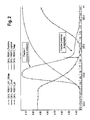
- FIG 2 the elution profile with the same chromatographic conditions as in example 1 but this time with a weak cation exchange resin, CM-Toyopearl, is presented.
- a second peak as shoulder of the main peak appears.
- This separation behavior is different to that with a strong cation exchange resin, such as SP-Sepharose.
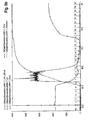
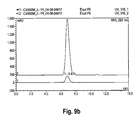
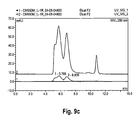
- An analysis of fractions corresponding to the main peak and to the second shoulder peak showed a significant amount of aggregates to be present in the shoulder peak fraction. No aggregates were detectable in the main peak fractions (see also figures 9a to c ).
- the first step is a chromatography using a linear concentration gradient of the buffer salt, sodium citrate. Just as well is it possible to keep the concentration of the buffer salt constant and to admix a linearly increasing concentration of a salt causing the elution of the immunoglobulin. In both cases is the conductivity of the solution increased without an alteration of the pH value of the mobile phase.
- Salts suitable for the elution are e.g. sodium chloride, sodium sulphate, sodium phosphate, potassium chloride, potassium sulfate, potassium phosphate, citric acid and salts thereof as well as mixtures of these components.
- concentrations of from 10 mM to 500 mM, which are applied, are adjusted accordingly to set conductivity in the range of from about 1 milli S/cm to about 50 milli S/cm.
- Resin CM-Toyopearl Flow rate 160 cm/h Equilibration: 10 mM sodium citrate buffer, adjusted to pH 5.0 Loading: max. 20 g protein/L gel matrix Wash: 10 mM sodium citrate buffer, adjusted to pH 5.0 Elution: linear gradient; from 10 mM sodium citrate buffer, adjusted to pH 5.0, to 100 mM sodium citrate buffer, adjusted to pH 5.0
- the conditioned protein A eluate was applied to a chromatography column containing a weak cation exchange resin (CM-Toyopearl). After the loading step at a flow rate of 160 cm/h the column was washed with equilibration buffer (10 column volumes). The bound immunoglobulins were eluted with a linear gradient elution method, whereby the pH value in the mobile phase was kept constant. The concentration of the buffer salt, sodium citrate, was raised linearly from 10 mM to 100 mM over 40 column volumes. After the final sodium citrate concentration was reached the elution was continued for an additional 40 column volumes.
- CM-Toyopearl weak cation exchange resin
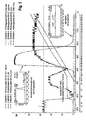
- FIG 3 the chromatogram of the linear buffer gradient elution of the anti IL-1R antibody is presented.
- the monomeric and the aggregated form of the immunoglobulin elute in a semi-detached peak starting at a concentration of 15 mM sodium citrate and ending at a concentration of 55 mM sodium citrate.
- the recovery of the bound immunoglobulin from the cation exchange resin is depending on the conductivity of the applied solution. Therefore the cations of the buffer salt present in the eluting solution during the recovery step have to be considered as effecting the elution of the immunoglobulin from the cation exchange resin.
- the conductivity as well as the ionic strength of the mobile phase are effected by the total number of ions in the solution. Thus the number of monovalent cations different from hydrogen in one molecular formula of the employed buffer salt and the employed salt causing the elution have to be considered hereby.
- the concentration, at which the elution of the immunoglobulin from the ion exchange resin starts, as determined in example 3, provides the basis for the second optimization step, a three step elution method.
- the approximate buffer/salt concentrations for the step elution are calculated as follows:
- the factor included in the calculation of the concentration steps accounts for the interval between the concentration levels and is adjusted depending on the starting concentration. At small starting concentrations, i.e. between 10 mM and 40 mM, the factors are 1.35 and 1.70 respectively, at medium starting concentrations between 40 mM and 70 mM the factors are 1.30 and 1.60 respectively, and at high starting concentrations of more than 70 mM the factors are 1.25 and 1.50 respectively.
- the factors define a range that has been determined experimentally. These values are no absolute values but merely a target value. A deviation of 10% is maintainable.
- the buffer salt has to be accounted for in the calculation because it is possible as outlined in example 3 that the elution of a protein from an ion exchange resin can be effected by a change of the buffer salt concentration during the chromatography. If the buffer salt concentration is kept constant during the chromatography or is small compared to the stating concentration ( ⁇ 15% of the salt concentration) it may be neglected during the calculation to reduce complexity.
- CM-Toyopearl Flow rate 160 cm/h
- Equilibration 10 mM sodium citrate buffer, adjusted to pH 5.0
- Loading max. 20 g protein/L gel matrix
- Wash 10 mM sodium citrate buffer, adjusted to pH 5.0
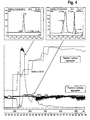
- the concentration of the buffer salt, sodium citrate was raised from 10 mM as starting condition to 34 mM in the first step, to 44 mM in the second step, and to 54 mM in the final step. After each increase of the salt concentration ten column volumes of the elution buffer were passed through the column prior to the next step. After the final sodium citrate concentration was reached the elution was continued for an additional 10 column volumes.
- FIG 4 the elution profile of the three step gradient elution of anti IL-1R antibody is presented.
- the monomeric immunoglobulin elutes in the first step fraction and the aggregates elute in the second step fraction.
- a single step elution method a method wherein the concentration of the elution salt is changed at once from a starting value to a final value.
- the pH of the chromatography is raised from 5.0 to 5.5. This pH shift improves the separation from protein A, due that protein A has an isoelectric point below 5.5.
- the elution salt is changed from sodium citrate, which is further on used as buffer salt, to sodium chloride. Additional analyses have been carried out (DNA, host cell protein, protein A content, and glycosylation pattern with LC-MS) with the fractions after this chromatographic run.
- the conditioned protein A eluate was applied to a chromatography column containing a weak cation exchange resin (CM-Sepharose). After the loading step at a flow rate of 160 cm/h the column was washed with equilibration buffer (10 column volumes).
- the concentration of the buffer salt, sodium citrate, was kept constant and 150 mM sodium chloride was admixed. After the increase of the salt concentration fifteen column volumes of the elution buffer were passed through the column to elute the bound immunoglobulin.
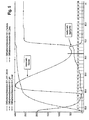
- the elution chromatogram of the single step elution with sodium chloride is presented in figure 5 .
- the single step gradient chromatography effects resolution of the main monomeric fraction and the aggregate/protein A fraction.
- the yield of monomeric immunoglobulin is more than 80 %. Even more than 95% yield is possible.
- the protein A present in the sample is bound by the chicken antibody and retained in the wells of the plate. After the incubation the sample solution is removed and the wells are washed. For detection are added subsequently a chicken derived polyclonal anti-protein A-IgG-biotin conjugate and a streptavidin peroxidase conjugate. After a further washing step substrate solu- tion is added resulting in the formation of a colored reaction product. The intensity of the color is proportional to the protein A content of the sample. After a defined time the reaction is stopped and the absorbance is measured.
- Host cell protein (HCP) ELISA The walls of the wells of a micro titer plate are coated with a mixture of serum albumin and streptavidin.
- a goat derived polyclonal antibody against HCP is bound to the walls of the wells of the micro titer plate. After a washing step different wells of the micro titer plate are incubated with a HCP calibration sequence of different concentrations and sample solution. After the incubation not bound sample material is removed by washing with buffer solution. For the detection the wells are incubated with an antibody peroxidase conjugate to detect bound host cell protein. The fixed peroxidase activity is detected by incubation with ABTS and detection at 405 nm.
- Table 1 The data presented in table 1 show that it is possible to separate with a weak cation exchange resin monomeric anti IL-1R antibody from aggregated forms of the antibody. Furthermore DNA- and protein A-impurities can be depleted.
- Table 1 Analysis of the eluates: comparison between SP-Sepharose and CM-Sepharose, results of two different separations are presented.
- the conditioned protein A eluate was applied to a chromatography column containing a weak cation exchange resin (CM-Sepharose). After the loading step at a flow rate of 160 cm/h the column was washed with equilibration buffer (10 column volumes).
- the bound immunoglobulins were eluted with a single step gradient elution method, whereby the pH value in the mobile phase was kept constant.
- the concentration of the buffer salt, sodium citrate, was kept constant and in three different runs 100 mM, 150 mM, and 200 mM sodium chloride respectively were admixed. After the increase of the salt concentration fifteen column volumes of the elution buffer were passed through the column to elute the bound immunoglobulin.
- the elution chromatograms are displayed in figures 7a to c.
- the conditioned protein A eluate was applied to a chromatography column containing a weak cation exchange resin (CM-Sepharose). After the loading step at a flow rate of 160 cm/h the column was washed with equilibration buffer (10 column volumes).
- the bound immunoglobulins were eluted with a single step gradient elution method, whereby the pH value in the mobile phase was kept constant at pH 4.0 or 6.0 respectively.
- the concentration of the buffer salt, sodium citrate, was kept constant, and 150 mM sodium chloride was admixed. After the increase of the salt concentration fifteen column volumes of the elution buffer were passed through the column to elute the bound immunoglobulin.
- the elution chromatograms are displayed in figures 8a and b.
- the current invention is further exemplified in the following with Herceptin ® , a monoclonal anti-HER-2 antibody.
- Resin SP-Sepharose Flow rate: 160 cm/h Equilibration: 25 mM 2-morpholinoethanesulfonic acid, 50 mM sodium chloride, adjusted to pH 5.6 Loading: max. 20 g protein/L gel matrix Wash: 25 mM 2-morpholinoethanesulfonic acid, 50 mM sodium chloride, adjusted to pH 5.6 Elution: 25 mM 2-morpholinoethanesulfonic acid, 95 mM sodium chloride, adjusted to pH 5.6
- the monoclonal anti-HER-2 antibody (hereinafter referred to as Herceptin ® ) was purified in a first step with a protein A affinity chromatography. Elution from the protein A column is carried out under acidic conditions (10 mM sodium citrate buffer, pH value of 3.0 ⁇ 0.5). Before the filtration step the pH value of the fraction containing the antibody is adjusted with a concentrated tris-hydroxymethyl-aminomethane (TRIS) buffer to pH 5.6.
- TIS tris-hydroxymethyl-aminomethane
- the protein A eluate is a solution with a protein concentration between 5 mg/ml and 15 mg/ml and is buffered with sodium citrate.
- the conditioned protein A eluate was applied to a chromatography column containing a strong cation exchange resin (SP-Sepharose). After the loading step at a flow rate of 160 cm/h the column was washed with equilibration buffer (10 column volumes). The bound immunoglobulins were eluted with a single step elution method, whereby the pH value was kept constant and the conductivity was varied by the (stepwise) increase of the sodium chloride concentration. The elution chromatogram is displayed in figure 10 .
- SP-Sepharose strong cation exchange resin
- Resin CM-Sepharose Flow rate 160 cm/h Equilibration: 10 mM sodium citrate buffer, adjusted to pH 5.5 Loading: max. 20 g protein/L gel matrix Wash: 10 mM sodium citrate buffer, adjusted to pH 5.5 Elution: linear gradient; from 10 mM sodium citrate buffer, adjusted to pH 5.5, to 10 mM sodium citrate buffer containing 400 mM sodium chloride, adjusted to pH 5.5
- the conditioned protein A eluate as described in example 9 was applied to a chromatography column containing a weak cation exchange resin (CM-Sepharose). After the loading step at a flow rate of 160 cm/h the column was washed with equilibration buffer (10 column volumes). The bound immunoglobulins were eluted with a linear gradient elution method, whereby the pH value in the mobile phase and the concentration of the buffer salt was kept constant. The concentration of the elution salt, sodium chloride, was raised linearly from 0 mM to 400 mM over 40 column volumes. The elution chromatogram is displayed in figure 11 .
- CM-Sepharose weak cation exchange resin
- the replacement of the strong cation exchange resin by a weak cation exchange resin caused the detachment of a second peak as shoulder of the first main peak. This observation is similar to the observation in case of the anti IL-1R antibody.
- the immunoglobulins start to elute from the column at a sodium chloride concentration of 80 mM.
- the starting concentration, at which the immunoglobulin starts to elute, as determined in example 10 and as derived from the chromatogram presented in figure 11 , is 80 mM sodium chloride.
- the buffer concentration can be neglected as it is low and kept constant during the chromatography.
- the conditioned protein A eluate as described in example 9 was applied to a chromatography column containing a weak cation exchange resin (CM-Sepharose). After the loading step at a flow rate of 160 cm/h the column was washed with equilibration buffer (10 column volumes). The bound immunoglobulins were eluted with a step gradient elution method, whereby the pH value in the mobile phase and the concentration of the buffer salt, sodium citrate, was kept constant. The concentration of the elution salt, sodium chloride, was raised from 0 mM as starting condition to 80 mM in the first step, to 100 mM in the second step, and to 120 mM in the final step.
- CM-Sepharose weak cation exchange resin
- the monomeric antibody is eluted at the step with a sodium chloride concentration of 80 mM. Size exclusion analysis confirmed that only monomeric antibody is eluted. After the sodium chloride concentration was increased to 100 mM in the second step, the aggregated forms eluted ( figure 12 ).
- the conditioned protein A eluate as described in example 9 was applied to a chromatography column containing a weak cation exchange resin (CM-Sepharose). After the loading step at a flow rate of 160 cm/h the column was washed with equilibration buffer (10 column volumes). The bound immunoglobulins were eluted with a single step gradient elution method, whereby the pH value in the mobile phase and the concentration of the buffer salt was kept constant. The concentration of the buffer salt, sodium citrate, was kept constant and 80 mM sodium chloride was admixed. After the increase of the salt concentration fifteen column volumes of the elution buffer with sodium chloride were passed through the column to elute the bound anti-HER-2 antibody in monomeric form.
- CM-Sepharose weak cation exchange resin
Landscapes
- Chemical & Material Sciences (AREA)
- Health & Medical Sciences (AREA)
- Organic Chemistry (AREA)
- Life Sciences & Earth Sciences (AREA)
- Biochemistry (AREA)
- General Health & Medical Sciences (AREA)
- Immunology (AREA)
- Proteomics, Peptides & Aminoacids (AREA)
- Medicinal Chemistry (AREA)
- Molecular Biology (AREA)
- Genetics & Genomics (AREA)
- Biophysics (AREA)
- Analytical Chemistry (AREA)
- Chemical Kinetics & Catalysis (AREA)
- Oncology (AREA)
- General Physics & Mathematics (AREA)
- Pathology (AREA)
- Physics & Mathematics (AREA)
- Peptides Or Proteins (AREA)
- Preparation Of Compounds By Using Micro-Organisms (AREA)
- Medicines Containing Antibodies Or Antigens For Use As Internal Diagnostic Agents (AREA)
Priority Applications (1)
| Application Number | Priority Date | Filing Date | Title |
|---|---|---|---|
| EP10175706.0A EP2261252B2 (fr) | 2005-05-25 | 2006-05-23 | Méthode de purification d'anticorps |
Applications Claiming Priority (4)
| Application Number | Priority Date | Filing Date | Title |
|---|---|---|---|
| EP05011302 | 2005-05-25 | ||
| EP06753791.0A EP1888636B2 (fr) | 2005-05-25 | 2006-05-23 | Méthode de purification d'anticorps |
| PCT/EP2006/004863 WO2006125599A2 (fr) | 2005-05-25 | 2006-05-23 | Methode de purification d'anticorps |
| EP10175706.0A EP2261252B2 (fr) | 2005-05-25 | 2006-05-23 | Méthode de purification d'anticorps |
Related Parent Applications (5)
| Application Number | Title | Priority Date | Filing Date |
|---|---|---|---|
| PCT/EP2006/004863 Previously-Filed-Application WO2006125599A2 (fr) | 2005-05-25 | 2006-05-23 | Methode de purification d'anticorps |
| EP06753791.0 Division | 2006-05-23 | ||
| EP06753791.0A Division-Into EP1888636B2 (fr) | 2005-05-25 | 2006-05-23 | Méthode de purification d'anticorps |
| EP06753791.0A Division EP1888636B2 (fr) | 2005-05-25 | 2006-05-23 | Méthode de purification d'anticorps |
| WOPCT/EP2006/004863 Previously-Filed-Application | 2006-05-23 |
Publications (4)
| Publication Number | Publication Date |
|---|---|
| EP2261252A2 true EP2261252A2 (fr) | 2010-12-15 |
| EP2261252A3 EP2261252A3 (fr) | 2011-03-23 |
| EP2261252B1 EP2261252B1 (fr) | 2012-07-25 |
| EP2261252B2 EP2261252B2 (fr) | 2020-10-21 |
Family
ID=34936911
Family Applications (2)
| Application Number | Title | Priority Date | Filing Date |
|---|---|---|---|
| EP06753791.0A Expired - Lifetime EP1888636B2 (fr) | 2005-05-25 | 2006-05-23 | Méthode de purification d'anticorps |
| EP10175706.0A Expired - Lifetime EP2261252B2 (fr) | 2005-05-25 | 2006-05-23 | Méthode de purification d'anticorps |
Family Applications Before (1)
| Application Number | Title | Priority Date | Filing Date |
|---|---|---|---|
| EP06753791.0A Expired - Lifetime EP1888636B2 (fr) | 2005-05-25 | 2006-05-23 | Méthode de purification d'anticorps |
Country Status (18)
| Country | Link |
|---|---|
| US (3) | US20090098660A1 (fr) |
| EP (2) | EP1888636B2 (fr) |
| JP (1) | JP4852602B2 (fr) |
| KR (1) | KR100967778B1 (fr) |
| CN (1) | CN101180317B (fr) |
| AT (1) | ATE525087T1 (fr) |
| AU (1) | AU2006251307B2 (fr) |
| BR (1) | BRPI0610201B8 (fr) |
| CA (1) | CA2607375C (fr) |
| DK (1) | DK1888636T4 (fr) |
| ES (2) | ES2373402T5 (fr) |
| FI (1) | FI1888636T4 (fr) |
| IL (2) | IL186338A (fr) |
| MX (1) | MX2007014269A (fr) |
| NO (1) | NO345362B1 (fr) |
| PL (1) | PL1888636T5 (fr) |
| TW (2) | TWI391399B (fr) |
| WO (1) | WO2006125599A2 (fr) |
Families Citing this family (28)
| Publication number | Priority date | Publication date | Assignee | Title |
|---|---|---|---|---|
| TWI391399B (zh) | 2005-05-25 | 2013-04-01 | 赫孚孟拉羅股份公司 | 測定溶離多肽之鹽濃度之方法 |
| RU2009148891A (ru) | 2007-06-01 | 2011-07-20 | Ф.Хоффманн-Ля Рош Аг (Ch) | Очистка иммуноглобулина |
| AR067537A1 (es) * | 2007-07-17 | 2009-10-14 | Hoffmann La Roche | Purificacion de polipeptidos pegilados |
| CL2008002054A1 (es) * | 2007-07-17 | 2009-05-29 | Hoffmann La Roche | Metodo para la regeneracion de una columna de cromatografia de intercambio cationico despues de la elusion de eritropoyetina monopeguilada y metodo para obtener una eritropoyetina monopeguilada, incorporando el metodo de regeneracion de la columna de intercambio cationico. |
| JP5529869B2 (ja) * | 2008-08-14 | 2014-06-25 | メルク・シャープ・アンド・ドーム・コーポレーション | プロテインaアフィニティークロマトグラフィーを用いる抗体の精製方法 |
| BR112012020964B8 (pt) | 2010-03-10 | 2021-08-24 | Hoffmann La Roche | método para produzir uma imunoglobulina da subclasse igg1 ou igg4 |
| MX2012011737A (es) * | 2010-04-14 | 2012-11-16 | Hoffmann La Roche | Remocion de agregado de inmunoglobulina. |
| BR112013008738B1 (pt) * | 2010-10-11 | 2017-12-19 | Abbvie Bahamas Ltd. | Method for purification of a protein |
| WO2012084829A1 (fr) | 2010-12-21 | 2012-06-28 | F. Hoffmann-La Roche Ag | Préparation d'anticorps enrichie en isoformes et son procédé d'obtention |
| HRP20180028T4 (hr) * | 2011-03-16 | 2020-10-02 | F. Hoffmann - La Roche Ag | Kromatografija izmjene iona s poboljšanom selektivnošću za odvajanje polipeptidnih monomera, agregata i fragmenata modulacijom pokretne faze |
| JP6292718B2 (ja) | 2011-07-01 | 2018-03-14 | エフ.ホフマン−ラ ロシュ アーゲーF. Hoffmann−La Roche Aktiengesellschaft | 凝集ポリペプチドから単量体ポリペプチドを分離するための方法 |
| US10481164B2 (en) * | 2012-03-26 | 2019-11-19 | Amgen Inc. | Method for using light scattering in real time to directly monitor and control impurity removal in purification processes |
| KR20160054597A (ko) * | 2013-09-17 | 2016-05-16 | 가부시키가이샤 가네카 | 신규 항체 정제 방법 및 그로부터 얻어지는 항체, 및 양이온 교환기를 사용한 신규 항체 정제법 및 그로부터 얻어지는 항체 |
| WO2015064971A1 (fr) * | 2013-10-30 | 2015-05-07 | (주)셀트리온 | Méthode d'isolement d'isoformes d'anticorps à l'aide de la chromatographie d'échange d'ions positifs |
| RU2688349C2 (ru) | 2014-03-21 | 2019-05-21 | Ф. Хоффманн-Ля Рош Аг | In vitro прогнозирование времени полужизни антител in vivo |
| PT3215528T (pt) | 2014-11-06 | 2019-10-11 | Hoffmann La Roche | Variantes da região fc com ligação modificada ao fcrn e métodos de utilização |
| GB2539420B (en) * | 2015-06-16 | 2021-01-13 | Cytiva Sweden Ab | Determination of chromatography conditions |
| CN108350026A (zh) * | 2015-11-18 | 2018-07-31 | 默克专利股份公司 | 离子交换色谱法中改进的蛋白质分离 |
| BR112018009882A2 (pt) * | 2015-11-18 | 2018-11-13 | Merck Patent Gmbh | gradientes de ph-sal opostos para separações melhoradas de proteína |
| US11155575B2 (en) | 2018-03-21 | 2021-10-26 | Waters Technologies Corporation | Non-antibody high-affinity-based sample preparation, sorbent, devices and methods |
| EP3773969A1 (fr) * | 2018-04-03 | 2021-02-17 | Merck Patent GmbH | Milieux de chromatographie cex et élution à faible teneur en sel de protéines cibles à partir de flux bio-pharmaceutiques |
| CN111068361B (zh) * | 2018-10-22 | 2022-02-11 | 中国石油化工股份有限公司 | 一种己内酰胺离子交换装置及其再生方法 |
| CN110066314B (zh) * | 2019-04-01 | 2023-10-27 | 上海药明生物技术有限公司 | 一种高效提高多聚体分离分辨率的亲和纯化工艺 |
| TW202128264A (zh) * | 2019-09-25 | 2021-08-01 | 瑞士商赫孚孟拉羅股份公司 | 使用經預測之溶離緩衝鹽濃度的陽離子層析法 |
| AU2021210905A1 (en) * | 2020-01-24 | 2022-09-01 | Mural Oncology, Inc. | Methods of purification |
| CN115728433B (zh) * | 2021-08-27 | 2024-11-15 | 联邦生物科技(珠海横琴)有限公司 | IgG4型单克隆抗体电荷异质性的离子交换色谱检测方法 |
| CN116295834B (zh) * | 2022-01-05 | 2026-03-10 | 上海迈晋生物医药科技有限公司 | 一种生物制品在层析工艺中的表观稳定性的在线监测方法 |
| CN120939820A (zh) * | 2025-07-31 | 2025-11-14 | 浙江安各洛生物技术有限公司 | 一种梯度混合方法及其配套的梯度混合装置 |
Citations (13)
| Publication number | Priority date | Publication date | Assignee | Title |
|---|---|---|---|---|
| WO1989005157A1 (fr) | 1987-12-09 | 1989-06-15 | Invitron Corporation | Purification efficace a grande echelle d'immunoglobulines et derives |
| US4983722A (en) | 1988-06-08 | 1991-01-08 | Miles Inc. | Removal of protein A from antibody preparations |
| WO1992019973A1 (fr) | 1991-04-26 | 1992-11-12 | Surface Active Limited | Nouveaux anticorps et procedes d'utilisation de ces anticorps |
| EP0530447A2 (fr) | 1991-06-08 | 1993-03-10 | Biotest Pharma Gmbh | Procédé de purification d'anticorps monoclonaux du type IgG et leur application |
| WO1994000561A1 (fr) | 1992-06-26 | 1994-01-06 | Association Pour L'essor De La Transfusion Sanguine Dans La Region Du Nord | Anticorps monoclonaux humains diriges contre le rhesus (d) et lignees cellulaires les produisant |
| WO1995016037A1 (fr) | 1993-12-01 | 1995-06-15 | Menarini Ricerche Sud S.P.A. | Anticorps monoclonal anti-egf-r/anti-cd3, a double specificite, procede de production et utilisation de cet anticorps |
| US5429746A (en) | 1994-02-22 | 1995-07-04 | Smith Kline Beecham Corporation | Antibody purification |
| WO1999057134A1 (fr) | 1998-05-06 | 1999-11-11 | Genentech, Inc. | Purification de proteines par chromatographie par echange d'ions |
| EP1084136A1 (fr) | 1998-06-01 | 2001-03-21 | Genentech, Inc. | Separation des monomeres proteiques des agregats par l'utilisation de la chromatographie d'echange d'ions |
| WO2003102132A2 (fr) | 2002-04-26 | 2003-12-11 | Genetech, Inc. | Purification de proteines basee sur la non affinite |
| WO2004024866A2 (fr) | 2002-09-11 | 2004-03-25 | Genentech, Inc. | Purification de proteines |
| WO2004076485A1 (fr) | 2003-02-28 | 2004-09-10 | Lonza Biologics Plc. | Purification d'anticorps par chromatographie d'affinite sur proteine a et chromatographie par echange d'ions |
| WO2005023872A1 (fr) | 2003-09-10 | 2005-03-17 | F. Hoffmann-La Roche Ag | Anticorps contre le recepteur interleukine-1 et leurs utilisations |
Family Cites Families (24)
| Publication number | Priority date | Publication date | Assignee | Title |
|---|---|---|---|---|
| US4136094A (en) * | 1977-08-31 | 1979-01-23 | The Regents Of The University Of Minnesota | Preparation of intravenous human and animal gamma globulins and isolation of albumin |
| JPS5598117A (en) | 1979-01-17 | 1980-07-25 | Chemo Sero Therapeut Res Inst | Purification of gamma-globulin derivative |
| EP0085747B2 (fr) * | 1982-02-08 | 1990-05-30 | Schweizerisches Serum- und Impfinstitut und Institut zur Erforschung der Infektionskrankheiten | Immunoglobuline humaine pour administration intraveineuse et son procédé de préparation |
| JPS6042336A (ja) * | 1983-08-18 | 1985-03-06 | Nippon Seiyaku Kk | 免疫グロブリンの製造方法 |
| DE3640513A1 (de) | 1986-11-27 | 1988-06-09 | Biotest Pharma Gmbh | Verfahren zur herstellung eines virussicheren, lagerstabilen und intravenoes vertraeglichen immunglobulin-g-praeparates |
| US5177194A (en) | 1990-02-01 | 1993-01-05 | Baxter International, Inc. | Process for purifying immune serum globulins |
| EP0447585B2 (fr) † | 1990-03-22 | 2003-05-07 | Biotest Pharma Gmbh | Procédé de production d'une préparation tolérante d'immunoglobuline G intraveineuse |
| DE69229202T2 (de) * | 1991-02-26 | 2000-01-05 | Ajinomoto Co., Inc. | Verfahren zur reinigung von menschlichem bcdf |
| EP1260521B1 (fr) | 1991-08-14 | 2007-11-21 | Genentech Inc. | Variantes d'immunoglobulines pour des récepteurs Fc-epsilon spécifiques |
| FR2706466B1 (fr) * | 1993-06-14 | 1995-08-25 | Aetsrn | Concentré d'immunoglobulines G à usage thérapeutique et procédé de production dudit concentré. |
| ATE175979T1 (de) | 1993-12-27 | 1999-02-15 | Rotkreuzstiftung Zentrallab | Verfahren zur herstellung eines konzentrates von anti-d-immunoglobulin g und pharmazeutische zusammensetzung, die dieses enthält |
| FI952196A0 (fi) * | 1995-05-08 | 1995-05-08 | Suomen Punainen Risti Veripalv | Framstaellning av immunoglobulin |
| IL121900A (en) | 1997-10-07 | 2001-12-23 | Omrix Biopharmaceuticals Ltd | A method for the purification of immunoglobulins |
| US6162904A (en) * | 1997-12-24 | 2000-12-19 | Alpha Therapeutic Corporation | Manufacturing method for intraveneously administrable immune globulin and resultant product |
| UA64742C2 (uk) | 1997-12-24 | 2004-03-15 | Альфа Терапевтик Корпорейшн | СПОСІБ ОДЕРЖАННЯ РОЗЧИНУ <font face="Symbol">g</font>-ГЛОБУЛІНУ, ПРИЗНАЧЕНОГО ДЛЯ ВНУТРІШНЬОВЕННОГО ВВЕДЕННЯ, І ПРОДУКТ, ЩО ОДЕРЖУЄТЬСЯ У ЦЕЙ СПОСІБ (ВАРІАНТИ) |
| ID27417A (id) | 1998-06-09 | 2001-04-05 | Statens Seruminstitut | Proses untuk memproduksi immunoglobulin untuk pemberian melalui intravena dan produk-produk immunoglobulin lainnya |
| DK2270044T3 (en) * | 1998-06-09 | 2015-01-26 | Csl Behring Ag | Liquid immunoglobulin G (IgG) product |
| US6441144B1 (en) * | 1999-05-20 | 2002-08-27 | Alpha Therapeutic Corporation | Method for repairing dual virally inactivated immune globulin for intravenous administration |
| AU2001249574A1 (en) † | 2000-03-29 | 2001-10-08 | Ecokasa Incorporated | Nitrogen reduction wastewater treatment system |
| SE0001128D0 (sv) | 2000-03-30 | 2000-03-30 | Amersham Pharm Biotech Ab | A method of producing IgG |
| US6962700B1 (en) * | 2000-09-13 | 2005-11-08 | Atopix Pharmaceuticals Corporation | Method of manufacturing immune globulin |
| CN1490334A (zh) * | 2002-10-18 | 2004-04-21 | 缪金明 | 基因特异性抗体的亲和纯化方法 |
| NZ551180A (en) * | 2004-06-01 | 2009-10-30 | Genentech Inc | Antibody drug conjugates and methods |
| TWI391399B (zh) * | 2005-05-25 | 2013-04-01 | 赫孚孟拉羅股份公司 | 測定溶離多肽之鹽濃度之方法 |
-
2006
- 2006-05-19 TW TW098127045A patent/TWI391399B/zh not_active IP Right Cessation
- 2006-05-19 TW TW095118030A patent/TWI320788B/zh not_active IP Right Cessation
- 2006-05-23 US US11/920,288 patent/US20090098660A1/en not_active Abandoned
- 2006-05-23 EP EP06753791.0A patent/EP1888636B2/fr not_active Expired - Lifetime
- 2006-05-23 JP JP2008512752A patent/JP4852602B2/ja not_active Expired - Lifetime
- 2006-05-23 FI FIEP06753791.0T patent/FI1888636T4/fi active
- 2006-05-23 DK DK06753791.0T patent/DK1888636T4/da active
- 2006-05-23 MX MX2007014269A patent/MX2007014269A/es active IP Right Grant
- 2006-05-23 EP EP10175706.0A patent/EP2261252B2/fr not_active Expired - Lifetime
- 2006-05-23 PL PL06753791.0T patent/PL1888636T5/pl unknown
- 2006-05-23 CN CN200680017966XA patent/CN101180317B/zh not_active Expired - Lifetime
- 2006-05-23 AU AU2006251307A patent/AU2006251307B2/en not_active Expired
- 2006-05-23 ES ES06753791T patent/ES2373402T5/es not_active Expired - Lifetime
- 2006-05-23 ES ES10175706T patent/ES2389641T5/es not_active Expired - Lifetime
- 2006-05-23 CA CA2607375A patent/CA2607375C/fr not_active Expired - Lifetime
- 2006-05-23 BR BRPI0610201A patent/BRPI0610201B8/pt active IP Right Grant
- 2006-05-23 AT AT06753791T patent/ATE525087T1/de active
- 2006-05-23 WO PCT/EP2006/004863 patent/WO2006125599A2/fr not_active Ceased
- 2006-05-23 KR KR1020077027285A patent/KR100967778B1/ko not_active Expired - Lifetime
-
2007
- 2007-10-07 IL IL186338A patent/IL186338A/en active IP Right Grant
- 2007-10-09 NO NO20075091A patent/NO345362B1/no unknown
-
2010
- 2010-07-14 IL IL206993A patent/IL206993A0/en active IP Right Grant
-
2014
- 2014-05-06 US US14/271,058 patent/US9631007B2/en not_active Expired - Lifetime
-
2017
- 2017-03-14 US US15/458,368 patent/US11034754B2/en active Active
Patent Citations (13)
| Publication number | Priority date | Publication date | Assignee | Title |
|---|---|---|---|---|
| WO1989005157A1 (fr) | 1987-12-09 | 1989-06-15 | Invitron Corporation | Purification efficace a grande echelle d'immunoglobulines et derives |
| US4983722A (en) | 1988-06-08 | 1991-01-08 | Miles Inc. | Removal of protein A from antibody preparations |
| WO1992019973A1 (fr) | 1991-04-26 | 1992-11-12 | Surface Active Limited | Nouveaux anticorps et procedes d'utilisation de ces anticorps |
| EP0530447A2 (fr) | 1991-06-08 | 1993-03-10 | Biotest Pharma Gmbh | Procédé de purification d'anticorps monoclonaux du type IgG et leur application |
| WO1994000561A1 (fr) | 1992-06-26 | 1994-01-06 | Association Pour L'essor De La Transfusion Sanguine Dans La Region Du Nord | Anticorps monoclonaux humains diriges contre le rhesus (d) et lignees cellulaires les produisant |
| WO1995016037A1 (fr) | 1993-12-01 | 1995-06-15 | Menarini Ricerche Sud S.P.A. | Anticorps monoclonal anti-egf-r/anti-cd3, a double specificite, procede de production et utilisation de cet anticorps |
| US5429746A (en) | 1994-02-22 | 1995-07-04 | Smith Kline Beecham Corporation | Antibody purification |
| WO1999057134A1 (fr) | 1998-05-06 | 1999-11-11 | Genentech, Inc. | Purification de proteines par chromatographie par echange d'ions |
| EP1084136A1 (fr) | 1998-06-01 | 2001-03-21 | Genentech, Inc. | Separation des monomeres proteiques des agregats par l'utilisation de la chromatographie d'echange d'ions |
| WO2003102132A2 (fr) | 2002-04-26 | 2003-12-11 | Genetech, Inc. | Purification de proteines basee sur la non affinite |
| WO2004024866A2 (fr) | 2002-09-11 | 2004-03-25 | Genentech, Inc. | Purification de proteines |
| WO2004076485A1 (fr) | 2003-02-28 | 2004-09-10 | Lonza Biologics Plc. | Purification d'anticorps par chromatographie d'affinite sur proteine a et chromatographie par echange d'ions |
| WO2005023872A1 (fr) | 2003-09-10 | 2005-03-17 | F. Hoffmann-La Roche Ag | Anticorps contre le recepteur interleukine-1 et leurs utilisations |
Non-Patent Citations (19)
| Title |
|---|
| "Advanced Chromatographic and Electromigration Methods in Biosciences", 1998, ELSEVIER SCIENCE BV |
| "Chromatography, 5''' edition, Part A: Fundamentals and Techniques", 1992, ELSEVIER SCIENCE PUBLISHING COMPANY |
| "Current Protocols in Molecular Biology", JOHN WILEY & SONS, INC. |
| "Molecular Cloning: A Laboratory Manual", 1989, COLD SPRING HARBOR LABORATORY PRESS |
| BIRD ET AL., SCIENCE, vol. 242, 1988, pages 423 - 426 |
| DANIELSSON, A. ET AL., J. IMMUN. METH., vol. 115, 1988, pages 79 - 88 |
| FOLLMAN, D.K.; FAHRNER, R.L.: "reported a factorial screening of antibody purification processes using three chromatography steps without protein A", J. CHROM. A, vol. 1024, 2004, pages 79 - 85 |
| HOOD ET AL.: "Immunology", 1984, BENJAMIN N.Y. |
| HUNKAPILLER; HOOD, NATURE, vol. 323, 1986, pages 15 - 16 |
| HUSTON, J.S. ET AL., PNAS USA, vol. 85, 1988, pages 5879 - 5883 |
| ISHIHARA, T. ET AL., J. CHROM., vol. 1069, 2005, pages 99 - 106 |
| MERRICK, H.; HAWLITSCHEK, G., BIOTECH FORUM EUROPE, vol. 9, 1992, pages 398 - 403 |
| MHATRE, R. ET AL., J. CHROM. A, vol. 707, 1995, pages 225 - 231 |
| NECINA, R. ET AL., BIOTECHNOL. BIOENG., vol. 60, 1998, pages 689 - 698 |
| POOLE, C. F.; POOLE, S. K.: "Chromatography Today", 1991, ELSEVIER SCIENCE PUBLISHING COMPA NY |
| RAWEERITH, R. ET AL., J. IMMUN. METH., vol. 282, 2003, pages 63 - 72 |
| SCHWARZ, A. ET AL., LABORPRAXIS, vol. 21, 1997, pages 62 - 66 |
| SCOPES, PROTEIN PURIFICATION: PRINCIPLES AND PRACTICE, 1982 |
| VIJAYALAKSHMI, M.A., APPL. BIOCHEM. BIOTECH., vol. 75, 1998, pages 93 - 102 |
Also Published As
Similar Documents
| Publication | Publication Date | Title |
|---|---|---|
| US11034754B2 (en) | Method for the purification of antibodies | |
| US11261238B2 (en) | Immunoglobulin purification |
Legal Events
| Date | Code | Title | Description |
|---|---|---|---|
| PUAI | Public reference made under article 153(3) epc to a published international application that has entered the european phase |
Free format text: ORIGINAL CODE: 0009012 |
|
| AC | Divisional application: reference to earlier application |
Ref document number: 1888636 Country of ref document: EP Kind code of ref document: P |
|
| AK | Designated contracting states |
Kind code of ref document: A2 Designated state(s): AT BE BG CH CY CZ DE DK EE ES FI FR GB GR HU IE IS IT LI LT LU LV MC NL PL PT RO SE SI SK TR |
|
| PUAL | Search report despatched |
Free format text: ORIGINAL CODE: 0009013 |
|
| AK | Designated contracting states |
Kind code of ref document: A3 Designated state(s): AT BE BG CH CY CZ DE DK EE ES FI FR GB GR HU IE IS IT LI LT LU LV MC NL PL PT RO SE SI SK TR |
|
| 17P | Request for examination filed |
Effective date: 20110923 |
|
| 17Q | First examination report despatched |
Effective date: 20111025 |
|
| REG | Reference to a national code |
Ref country code: DE Ref legal event code: R079 Ref document number: 602006031015 Country of ref document: DE Free format text: PREVIOUS MAIN CLASS: C07K0016000000 Ipc: C07K0016060000 |
|
| GRAP | Despatch of communication of intention to grant a patent |
Free format text: ORIGINAL CODE: EPIDOSNIGR1 |
|
| RIC1 | Information provided on ipc code assigned before grant |
Ipc: C07K 16/32 20060101ALI20120118BHEP Ipc: G01N 30/34 20060101ALI20120118BHEP Ipc: B01D 15/36 20060101ALI20120118BHEP Ipc: C07K 16/28 20060101ALI20120118BHEP Ipc: C07K 16/06 20060101AFI20120118BHEP |
|
| GRAS | Grant fee paid |
Free format text: ORIGINAL CODE: EPIDOSNIGR3 |
|
| GRAA | (expected) grant |
Free format text: ORIGINAL CODE: 0009210 |
|
| AC | Divisional application: reference to earlier application |
Ref document number: 1888636 Country of ref document: EP Kind code of ref document: P |
|
| AK | Designated contracting states |
Kind code of ref document: B1 Designated state(s): AT BE BG CH CY CZ DE DK EE ES FI FR GB GR HU IE IS IT LI LT LU LV MC NL PL PT RO SE SI SK TR |
|
| REG | Reference to a national code |
Ref country code: GB Ref legal event code: FG4D |
|
| REG | Reference to a national code |
Ref country code: CH Ref legal event code: EP |
|
| REG | Reference to a national code |
Ref country code: AT Ref legal event code: REF Ref document number: 567684 Country of ref document: AT Kind code of ref document: T Effective date: 20120815 Ref country code: IE Ref legal event code: FG4D |
|
| REG | Reference to a national code |
Ref country code: DE Ref legal event code: R096 Ref document number: 602006031015 Country of ref document: DE Effective date: 20120920 |
|
| REG | Reference to a national code |
Ref country code: ES Ref legal event code: FG2A Ref document number: 2389641 Country of ref document: ES Kind code of ref document: T3 Effective date: 20121030 |
|
| REG | Reference to a national code |
Ref country code: NL Ref legal event code: VDEP Effective date: 20120725 |
|
| REG | Reference to a national code |
Ref country code: AT Ref legal event code: MK05 Ref document number: 567684 Country of ref document: AT Kind code of ref document: T Effective date: 20120725 |
|
| REG | Reference to a national code |
Ref country code: LT Ref legal event code: MG4D Effective date: 20120725 |
|
| PG25 | Lapsed in a contracting state [announced via postgrant information from national office to epo] |
Ref country code: CY Free format text: LAPSE BECAUSE OF FAILURE TO SUBMIT A TRANSLATION OF THE DESCRIPTION OR TO PAY THE FEE WITHIN THE PRESCRIBED TIME-LIMIT Effective date: 20120725 Ref country code: IS Free format text: LAPSE BECAUSE OF FAILURE TO SUBMIT A TRANSLATION OF THE DESCRIPTION OR TO PAY THE FEE WITHIN THE PRESCRIBED TIME-LIMIT Effective date: 20121125 Ref country code: AT Free format text: LAPSE BECAUSE OF FAILURE TO SUBMIT A TRANSLATION OF THE DESCRIPTION OR TO PAY THE FEE WITHIN THE PRESCRIBED TIME-LIMIT Effective date: 20120725 Ref country code: LT Free format text: LAPSE BECAUSE OF FAILURE TO SUBMIT A TRANSLATION OF THE DESCRIPTION OR TO PAY THE FEE WITHIN THE PRESCRIBED TIME-LIMIT Effective date: 20120725 Ref country code: FI Free format text: LAPSE BECAUSE OF FAILURE TO SUBMIT A TRANSLATION OF THE DESCRIPTION OR TO PAY THE FEE WITHIN THE PRESCRIBED TIME-LIMIT Effective date: 20120725 Ref country code: BE Free format text: LAPSE BECAUSE OF FAILURE TO SUBMIT A TRANSLATION OF THE DESCRIPTION OR TO PAY THE FEE WITHIN THE PRESCRIBED TIME-LIMIT Effective date: 20120725 |
|
| PG25 | Lapsed in a contracting state [announced via postgrant information from national office to epo] |
Ref country code: GR Free format text: LAPSE BECAUSE OF FAILURE TO SUBMIT A TRANSLATION OF THE DESCRIPTION OR TO PAY THE FEE WITHIN THE PRESCRIBED TIME-LIMIT Effective date: 20121026 Ref country code: PT Free format text: LAPSE BECAUSE OF FAILURE TO SUBMIT A TRANSLATION OF THE DESCRIPTION OR TO PAY THE FEE WITHIN THE PRESCRIBED TIME-LIMIT Effective date: 20121126 Ref country code: SE Free format text: LAPSE BECAUSE OF FAILURE TO SUBMIT A TRANSLATION OF THE DESCRIPTION OR TO PAY THE FEE WITHIN THE PRESCRIBED TIME-LIMIT Effective date: 20120725 Ref country code: SI Free format text: LAPSE BECAUSE OF FAILURE TO SUBMIT A TRANSLATION OF THE DESCRIPTION OR TO PAY THE FEE WITHIN THE PRESCRIBED TIME-LIMIT Effective date: 20120725 Ref country code: LV Free format text: LAPSE BECAUSE OF FAILURE TO SUBMIT A TRANSLATION OF THE DESCRIPTION OR TO PAY THE FEE WITHIN THE PRESCRIBED TIME-LIMIT Effective date: 20120725 Ref country code: PL Free format text: LAPSE BECAUSE OF FAILURE TO SUBMIT A TRANSLATION OF THE DESCRIPTION OR TO PAY THE FEE WITHIN THE PRESCRIBED TIME-LIMIT Effective date: 20120725 |
|
| PG25 | Lapsed in a contracting state [announced via postgrant information from national office to epo] |
Ref country code: NL Free format text: LAPSE BECAUSE OF FAILURE TO SUBMIT A TRANSLATION OF THE DESCRIPTION OR TO PAY THE FEE WITHIN THE PRESCRIBED TIME-LIMIT Effective date: 20120725 |
|
| PLBI | Opposition filed |
Free format text: ORIGINAL CODE: 0009260 |
|
| PG25 | Lapsed in a contracting state [announced via postgrant information from national office to epo] |
Ref country code: CZ Free format text: LAPSE BECAUSE OF FAILURE TO SUBMIT A TRANSLATION OF THE DESCRIPTION OR TO PAY THE FEE WITHIN THE PRESCRIBED TIME-LIMIT Effective date: 20120725 Ref country code: DK Free format text: LAPSE BECAUSE OF FAILURE TO SUBMIT A TRANSLATION OF THE DESCRIPTION OR TO PAY THE FEE WITHIN THE PRESCRIBED TIME-LIMIT Effective date: 20120725 Ref country code: RO Free format text: LAPSE BECAUSE OF FAILURE TO SUBMIT A TRANSLATION OF THE DESCRIPTION OR TO PAY THE FEE WITHIN THE PRESCRIBED TIME-LIMIT Effective date: 20120725 Ref country code: EE Free format text: LAPSE BECAUSE OF FAILURE TO SUBMIT A TRANSLATION OF THE DESCRIPTION OR TO PAY THE FEE WITHIN THE PRESCRIBED TIME-LIMIT Effective date: 20120725 |
|
| 26 | Opposition filed |
Opponent name: STRAWMAN LIMITED Effective date: 20130424 |
|
| PG25 | Lapsed in a contracting state [announced via postgrant information from national office to epo] |
Ref country code: SK Free format text: LAPSE BECAUSE OF FAILURE TO SUBMIT A TRANSLATION OF THE DESCRIPTION OR TO PAY THE FEE WITHIN THE PRESCRIBED TIME-LIMIT Effective date: 20120725 |
|
| PLAB | Opposition data, opponent's data or that of the opponent's representative modified |
Free format text: ORIGINAL CODE: 0009299OPPO |
|
| PLAX | Notice of opposition and request to file observation + time limit sent |
Free format text: ORIGINAL CODE: EPIDOSNOBS2 |
|
| REG | Reference to a national code |
Ref country code: DE Ref legal event code: R026 Ref document number: 602006031015 Country of ref document: DE Effective date: 20130424 |
|
| PG25 | Lapsed in a contracting state [announced via postgrant information from national office to epo] |
Ref country code: BG Free format text: LAPSE BECAUSE OF FAILURE TO SUBMIT A TRANSLATION OF THE DESCRIPTION OR TO PAY THE FEE WITHIN THE PRESCRIBED TIME-LIMIT Effective date: 20121025 |
|
| R26 | Opposition filed (corrected) |
Opponent name: STRAWMAN LIMITED Effective date: 20130424 |
|
| PLAB | Opposition data, opponent's data or that of the opponent's representative modified |
Free format text: ORIGINAL CODE: 0009299OPPO |
|
| R26 | Opposition filed (corrected) |
Opponent name: STRAWMAN LIMITED Effective date: 20130424 |
|
| PLAF | Information modified related to communication of a notice of opposition and request to file observations + time limit |
Free format text: ORIGINAL CODE: EPIDOSCOBS2 |
|
| PG25 | Lapsed in a contracting state [announced via postgrant information from national office to epo] |
Ref country code: MC Free format text: LAPSE BECAUSE OF FAILURE TO SUBMIT A TRANSLATION OF THE DESCRIPTION OR TO PAY THE FEE WITHIN THE PRESCRIBED TIME-LIMIT Effective date: 20120725 |
|
| PLAF | Information modified related to communication of a notice of opposition and request to file observations + time limit |
Free format text: ORIGINAL CODE: EPIDOSCOBS2 |
|
| REG | Reference to a national code |
Ref country code: IE Ref legal event code: MM4A |
|
| PLBB | Reply of patent proprietor to notice(s) of opposition received |
Free format text: ORIGINAL CODE: EPIDOSNOBS3 |
|
| PG25 | Lapsed in a contracting state [announced via postgrant information from national office to epo] |
Ref country code: IE Free format text: LAPSE BECAUSE OF NON-PAYMENT OF DUE FEES Effective date: 20130523 |
|
| REG | Reference to a national code |
Ref country code: FR Ref legal event code: PLFP Year of fee payment: 10 |
|
| PG25 | Lapsed in a contracting state [announced via postgrant information from national office to epo] |
Ref country code: LU Free format text: LAPSE BECAUSE OF NON-PAYMENT OF DUE FEES Effective date: 20130523 Ref country code: HU Free format text: LAPSE BECAUSE OF FAILURE TO SUBMIT A TRANSLATION OF THE DESCRIPTION OR TO PAY THE FEE WITHIN THE PRESCRIBED TIME-LIMIT; INVALID AB INITIO Effective date: 20060523 |
|
| APAH | Appeal reference modified |
Free format text: ORIGINAL CODE: EPIDOSCREFNO |
|
| APBM | Appeal reference recorded |
Free format text: ORIGINAL CODE: EPIDOSNREFNO |
|
| APBP | Date of receipt of notice of appeal recorded |
Free format text: ORIGINAL CODE: EPIDOSNNOA2O |
|
| APBQ | Date of receipt of statement of grounds of appeal recorded |
Free format text: ORIGINAL CODE: EPIDOSNNOA3O |
|
| REG | Reference to a national code |
Ref country code: FR Ref legal event code: PLFP Year of fee payment: 11 |
|
| APBY | Invitation to file observations in appeal sent |
Free format text: ORIGINAL CODE: EPIDOSNOBA2O |
|
| REG | Reference to a national code |
Ref country code: FR Ref legal event code: PLFP Year of fee payment: 12 |
|
| REG | Reference to a national code |
Ref country code: FR Ref legal event code: PLFP Year of fee payment: 13 |
|
| APAH | Appeal reference modified |
Free format text: ORIGINAL CODE: EPIDOSCREFNO |
|
| APBU | Appeal procedure closed |
Free format text: ORIGINAL CODE: EPIDOSNNOA9O |
|
| PUAH | Patent maintained in amended form |
Free format text: ORIGINAL CODE: 0009272 |
|
| STAA | Information on the status of an ep patent application or granted ep patent |
Free format text: STATUS: PATENT MAINTAINED AS AMENDED |
|
| REG | Reference to a national code |
Ref country code: CH Ref legal event code: AELC |
|
| 27A | Patent maintained in amended form |
Effective date: 20201021 |
|
| AK | Designated contracting states |
Kind code of ref document: B2 Designated state(s): AT BE BG CH CY CZ DE DK EE ES FI FR GB GR HU IE IS IT LI LT LU LV MC NL PL PT RO SE SI SK TR |
|
| REG | Reference to a national code |
Ref country code: DE Ref legal event code: R102 Ref document number: 602006031015 Country of ref document: DE |
|
| REG | Reference to a national code |
Ref country code: ES Ref legal event code: DC2A Ref document number: 2389641 Country of ref document: ES Kind code of ref document: T5 Effective date: 20210610 |
|
| REG | Reference to a national code |
Ref country code: FR Ref legal event code: PLFP Year of fee payment: 18 |
|
| PGFP | Annual fee paid to national office [announced via postgrant information from national office to epo] |
Ref country code: DE Payment date: 20250423 Year of fee payment: 20 |
|
| PGFP | Annual fee paid to national office [announced via postgrant information from national office to epo] |
Ref country code: ES Payment date: 20250602 Year of fee payment: 20 Ref country code: GB Payment date: 20250423 Year of fee payment: 20 |
|
| PGFP | Annual fee paid to national office [announced via postgrant information from national office to epo] |
Ref country code: IT Payment date: 20250423 Year of fee payment: 20 |
|
| PGFP | Annual fee paid to national office [announced via postgrant information from national office to epo] |
Ref country code: FR Payment date: 20250423 Year of fee payment: 20 |
|
| PGFP | Annual fee paid to national office [announced via postgrant information from national office to epo] |
Ref country code: CH Payment date: 20250601 Year of fee payment: 20 |
|
| PGFP | Annual fee paid to national office [announced via postgrant information from national office to epo] |
Ref country code: TR Payment date: 20250429 Year of fee payment: 20 |
|
| REG | Reference to a national code |
Ref country code: CH Ref legal event code: H14 Free format text: ST27 STATUS EVENT CODE: U-0-0-H10-H14 (AS PROVIDED BY THE NATIONAL OFFICE) Effective date: 20260523 Ref country code: DE Ref legal event code: R071 Ref document number: 602006031015 Country of ref document: DE |
|
| REG | Reference to a national code |
Ref country code: GB Ref legal event code: PE20 Expiry date: 20260522 |
|
| PG25 | Lapsed in a contracting state [announced via postgrant information from national office to epo] |
Ref country code: GB Free format text: LAPSE BECAUSE OF EXPIRATION OF PROTECTION Effective date: 20260522 |