EP2520402B1 - Procédé de granulation en tête - Google Patents
Procédé de granulation en tête Download PDFInfo
- Publication number
- EP2520402B1 EP2520402B1 EP12177175.2A EP12177175A EP2520402B1 EP 2520402 B1 EP2520402 B1 EP 2520402B1 EP 12177175 A EP12177175 A EP 12177175A EP 2520402 B1 EP2520402 B1 EP 2520402B1
- Authority
- EP
- European Patent Office
- Prior art keywords
- granules
- strands
- strand
- condition
- nozzle
- Prior art date
- Legal status (The legal status is an assumption and is not a legal conclusion. Google has not performed a legal analysis and makes no representation as to the accuracy of the status listed.)
- Not-in-force
Links
- 238000000034 method Methods 0.000 title claims description 65
- 229920000728 polyester Polymers 0.000 claims description 42
- 239000012809 cooling fluid Substances 0.000 claims description 40
- 230000008569 process Effects 0.000 claims description 33
- 229920000642 polymer Polymers 0.000 claims description 21
- 229920001169 thermoplastic Polymers 0.000 claims description 18
- 239000004416 thermosoftening plastic Substances 0.000 claims description 18
- 229920001634 Copolyester Polymers 0.000 claims description 17
- 238000004519 manufacturing process Methods 0.000 claims description 10
- 238000005453 pelletization Methods 0.000 claims description 3
- 239000008188 pellet Substances 0.000 claims 2
- 239000008187 granular material Substances 0.000 description 110
- 238000002425 crystallisation Methods 0.000 description 27
- 230000008025 crystallization Effects 0.000 description 27
- 239000000463 material Substances 0.000 description 25
- 239000012530 fluid Substances 0.000 description 16
- XLYOFNOQVPJJNP-UHFFFAOYSA-N water Substances O XLYOFNOQVPJJNP-UHFFFAOYSA-N 0.000 description 15
- 238000005469 granulation Methods 0.000 description 12
- 230000003179 granulation Effects 0.000 description 12
- 239000010410 layer Substances 0.000 description 12
- -1 polyethylene terephthalate Polymers 0.000 description 11
- 229920000139 polyethylene terephthalate Polymers 0.000 description 11
- 239000005020 polyethylene terephthalate Substances 0.000 description 10
- 239000007789 gas Substances 0.000 description 9
- 230000006911 nucleation Effects 0.000 description 9
- 238000010899 nucleation Methods 0.000 description 9
- 238000001816 cooling Methods 0.000 description 7
- 239000013078 crystal Substances 0.000 description 7
- 230000000694 effects Effects 0.000 description 7
- 230000001965 increasing effect Effects 0.000 description 7
- 239000000155 melt Substances 0.000 description 7
- 238000000113 differential scanning calorimetry Methods 0.000 description 6
- 238000010438 heat treatment Methods 0.000 description 6
- 239000002344 surface layer Substances 0.000 description 6
- 230000015572 biosynthetic process Effects 0.000 description 5
- 230000000052 comparative effect Effects 0.000 description 5
- 238000007710 freezing Methods 0.000 description 5
- 230000008014 freezing Effects 0.000 description 5
- 238000012545 processing Methods 0.000 description 5
- 238000002844 melting Methods 0.000 description 4
- 230000008018 melting Effects 0.000 description 4
- 238000000926 separation method Methods 0.000 description 4
- 229920001577 copolymer Polymers 0.000 description 3
- 230000009477 glass transition Effects 0.000 description 3
- 238000011068 loading method Methods 0.000 description 3
- 239000000126 substance Substances 0.000 description 3
- IKHGUXGNUITLKF-UHFFFAOYSA-N Acetaldehyde Chemical compound CC=O IKHGUXGNUITLKF-UHFFFAOYSA-N 0.000 description 2
- IJGRMHOSHXDMSA-UHFFFAOYSA-N Atomic nitrogen Chemical compound N#N IJGRMHOSHXDMSA-UHFFFAOYSA-N 0.000 description 2
- 239000004604 Blowing Agent Substances 0.000 description 2
- 239000006096 absorbing agent Substances 0.000 description 2
- 239000000654 additive Substances 0.000 description 2
- 239000002826 coolant Substances 0.000 description 2
- 238000002474 experimental method Methods 0.000 description 2
- 230000004927 fusion Effects 0.000 description 2
- 239000002667 nucleating agent Substances 0.000 description 2
- 229920001707 polybutylene terephthalate Polymers 0.000 description 2
- 238000006068 polycondensation reaction Methods 0.000 description 2
- 238000010791 quenching Methods 0.000 description 2
- 230000000171 quenching effect Effects 0.000 description 2
- GLGNXYJARSMNGJ-VKTIVEEGSA-N (1s,2s,3r,4r)-3-[[5-chloro-2-[(1-ethyl-6-methoxy-2-oxo-4,5-dihydro-3h-1-benzazepin-7-yl)amino]pyrimidin-4-yl]amino]bicyclo[2.2.1]hept-5-ene-2-carboxamide Chemical compound CCN1C(=O)CCCC2=C(OC)C(NC=3N=C(C(=CN=3)Cl)N[C@H]3[C@H]([C@@]4([H])C[C@@]3(C=C4)[H])C(N)=O)=CC=C21 GLGNXYJARSMNGJ-VKTIVEEGSA-N 0.000 description 1
- OCJBOOLMMGQPQU-UHFFFAOYSA-N 1,4-dichlorobenzene Chemical compound ClC1=CC=C(Cl)C=C1 OCJBOOLMMGQPQU-UHFFFAOYSA-N 0.000 description 1
- 239000004609 Impact Modifier Substances 0.000 description 1
- 239000006057 Non-nutritive feed additive Substances 0.000 description 1
- ISWSIDIOOBJBQZ-UHFFFAOYSA-N Phenol Chemical compound OC1=CC=CC=C1 ISWSIDIOOBJBQZ-UHFFFAOYSA-N 0.000 description 1
- 230000009471 action Effects 0.000 description 1
- 238000005054 agglomeration Methods 0.000 description 1
- 230000002776 aggregation Effects 0.000 description 1
- QVGXLLKOCUKJST-UHFFFAOYSA-N atomic oxygen Chemical compound [O] QVGXLLKOCUKJST-UHFFFAOYSA-N 0.000 description 1
- 230000004888 barrier function Effects 0.000 description 1
- 230000008901 benefit Effects 0.000 description 1
- 238000009835 boiling Methods 0.000 description 1
- 238000005266 casting Methods 0.000 description 1
- 239000003054 catalyst Substances 0.000 description 1
- 230000008859 change Effects 0.000 description 1
- 229940125758 compound 15 Drugs 0.000 description 1
- 230000003750 conditioning effect Effects 0.000 description 1
- 238000005520 cutting process Methods 0.000 description 1
- 238000007872 degassing Methods 0.000 description 1
- 229940117389 dichlorobenzene Drugs 0.000 description 1
- 239000000975 dye Substances 0.000 description 1
- 230000002708 enhancing effect Effects 0.000 description 1
- 239000000835 fiber Substances 0.000 description 1
- 239000000945 filler Substances 0.000 description 1
- 239000003063 flame retardant Substances 0.000 description 1
- 239000006260 foam Substances 0.000 description 1
- 238000005187 foaming Methods 0.000 description 1
- 229920001519 homopolymer Polymers 0.000 description 1
- 238000005259 measurement Methods 0.000 description 1
- 238000000386 microscopy Methods 0.000 description 1
- 239000000203 mixture Substances 0.000 description 1
- 229910052757 nitrogen Inorganic materials 0.000 description 1
- 239000001301 oxygen Substances 0.000 description 1
- 229910052760 oxygen Inorganic materials 0.000 description 1
- 239000002245 particle Substances 0.000 description 1
- 239000000049 pigment Substances 0.000 description 1
- 229920003023 plastic Polymers 0.000 description 1
- 239000004033 plastic Substances 0.000 description 1
- 239000004014 plasticizer Substances 0.000 description 1
- 229920001225 polyester resin Polymers 0.000 description 1
- 239000004645 polyester resin Substances 0.000 description 1
- 239000011112 polyethylene naphthalate Substances 0.000 description 1
- 238000002360 preparation method Methods 0.000 description 1
- 230000002265 prevention Effects 0.000 description 1
- 230000001105 regulatory effect Effects 0.000 description 1
- 230000003014 reinforcing effect Effects 0.000 description 1
- 239000007787 solid Substances 0.000 description 1
- 239000007790 solid phase Substances 0.000 description 1
- 239000002904 solvent Substances 0.000 description 1
- 230000002269 spontaneous effect Effects 0.000 description 1
- 238000005507 spraying Methods 0.000 description 1
- 230000006641 stabilisation Effects 0.000 description 1
- 238000011105 stabilization Methods 0.000 description 1
- 239000003381 stabilizer Substances 0.000 description 1
- 238000007669 thermal treatment Methods 0.000 description 1
- 238000012546 transfer Methods 0.000 description 1
- 238000011282 treatment Methods 0.000 description 1
Images
Classifications
-
- B—PERFORMING OPERATIONS; TRANSPORTING
- B29—WORKING OF PLASTICS; WORKING OF SUBSTANCES IN A PLASTIC STATE IN GENERAL
- B29B—PREPARATION OR PRETREATMENT OF THE MATERIAL TO BE SHAPED; MAKING GRANULES OR PREFORMS; RECOVERY OF PLASTICS OR OTHER CONSTITUENTS OF WASTE MATERIAL CONTAINING PLASTICS
- B29B9/00—Making granules
- B29B9/02—Making granules by dividing preformed material
- B29B9/06—Making granules by dividing preformed material in the form of filamentary material, e.g. combined with extrusion
-
- B—PERFORMING OPERATIONS; TRANSPORTING
- B29—WORKING OF PLASTICS; WORKING OF SUBSTANCES IN A PLASTIC STATE IN GENERAL
- B29B—PREPARATION OR PRETREATMENT OF THE MATERIAL TO BE SHAPED; MAKING GRANULES OR PREFORMS; RECOVERY OF PLASTICS OR OTHER CONSTITUENTS OF WASTE MATERIAL CONTAINING PLASTICS
- B29B9/00—Making granules
- B29B9/12—Making granules characterised by structure or composition
-
- B—PERFORMING OPERATIONS; TRANSPORTING
- B29—WORKING OF PLASTICS; WORKING OF SUBSTANCES IN A PLASTIC STATE IN GENERAL
- B29B—PREPARATION OR PRETREATMENT OF THE MATERIAL TO BE SHAPED; MAKING GRANULES OR PREFORMS; RECOVERY OF PLASTICS OR OTHER CONSTITUENTS OF WASTE MATERIAL CONTAINING PLASTICS
- B29B9/00—Making granules
- B29B9/16—Auxiliary treatment of granules
-
- B—PERFORMING OPERATIONS; TRANSPORTING
- B29—WORKING OF PLASTICS; WORKING OF SUBSTANCES IN A PLASTIC STATE IN GENERAL
- B29B—PREPARATION OR PRETREATMENT OF THE MATERIAL TO BE SHAPED; MAKING GRANULES OR PREFORMS; RECOVERY OF PLASTICS OR OTHER CONSTITUENTS OF WASTE MATERIAL CONTAINING PLASTICS
- B29B9/00—Making granules
- B29B9/16—Auxiliary treatment of granules
- B29B2009/165—Crystallizing granules
Definitions
- the invention relates to a process for the preparation of Granulatkörnem of polymers of thermoplastic polyesters or copolyesters from a polyester melt with a strand pelletizer, wherein the polyester melt is fed to nozzles and then as strands via a withdrawal line of the granulation device with feed rollers, for example via the feed rollers a Strand withdrawal speed v is set from the strands.
- Corresponding strand granulators are known, for example, from the applicant himself, which manufactures and distributes such strand granulators, for example under the product name Rieter USG 600.
- the DE-197 39 747 A1 discloses a method according to the preambles of claims 1 and 4.
- polyesters are polyethylene terephthalate (PET), polybutylene terephthalate (PBT) and polyethylene naphthalate (PEN) which are used either as homopolymer or as copolymers.
- PET polyethylene terephthalate
- PBT polybutylene terephthalate
- PEN polyethylene naphthalate
- Additives may be added to the polymer.
- Suitable additives include, for example, catalysts, dyes and pigments, UV blockers, processing aids, stabilizers, impact modifiers, chemical and physical blowing agents, fillers, nucleating agents, flame retardants, plasticizers, barrier or mechanical properties enhancing particles, reinforcing bodies such as spheres or fibers, and reactive substances such as oxygen absorbers, acetaldehyde absorbers or molecular weight-increasing substances, etc.
- blowing agents are used, care must be taken that they do not cause significant foaming and thus expansion of the extruded strands and thus of the resulting granules. In any case, an expansion below 10%, preferably below 5% should be maintained.
- thermoplastic polyester is a polyethylene terephthalate or one of its copolymers, it preferably has an intrinsic viscosity of 0.3 to 1 dl / g, measured in a mixture of phenol: dichlorobenzene (1: 1). Particularly preferred are polyethylene terephthalates having an intrinsic viscosity greater than 0.4 dl / g and more preferably greater than 0.48 dl / g.
- the material properties which can be produced according to the invention can act as effective nucleation nuclei in further processing steps for crystallization of the granules thus produced, the crystallization not being complicated by complicated adjustment of material properties, e.g. Viscosity, or by complicated procedures, which require a complex temperature setting and temperature control, as required by the processes of the prior art.
- the amorphous granules produced according to the inventive method have a surface layer with strongly nucleated structure, whereby they have a reduced tendency to stick in subsequent crystallization processes.
- the material properties produced according to the invention can also already lead to a partially crystalline structure at and below the surface of the strand and the granules produced therefrom. In this case, too a subsequent crystallization can be achieved in a simpler way than usual in the prior art.
- a method according to the invention for the production of granules of polymers of thermoplastic polyester or copolyesters from a polyester melt with a strand granulator wherein the polyester melt is fed to the nozzles of the strand pelletizer and then as strands via a withdrawal line of the strand pelletizer of the actual granulation device with feed rollers, wherein on the Incoming rollers of the strand pelletizer a strand withdrawal speed v can be set from the strands, for example, the exit of the strands from the nozzles with an exit velocity v out of at least 110 m / min, which is about three to ten times as fast as the exit velocity, which according to known in the art.
- a ratio of discharge velocity v of divided by the area f of the nozzle opening of each nozzle may be made of / f is set to v, that this ratio according to the invention v is the condition from / f ⁇ 30 m / (min x mm 2) Fulfills.
- the strands thus emerging from the respective nozzles are then brought into a cooling fluid contact.
- ratio of the discharge velocity v of divided by the area f of the nozzle opening of each nozzle v out / f which can be adjusted, for example so that the condition V off / f ⁇ 30 m / (min x mm 2 ), a term which, contrary to the prior art, sets a relatively high exit velocity v from the polyester melt in relation to a relatively small area f of the nozzle orifice of a respective nozzle means a certain mechanical stress on the extruded polyester melt.
- a mechanical stress of the extruded material is deliberately generated during the formation of the strands, wherein this mechanical stress certain stresses in the strand material or in accordance with the invention in the granules produced from this strand material pulls, which is "frozen" by the earliest possible cooling fluid contact.
- a layer with a high nucleation density ie a layer of high numbers of crystal nuclei.
- this layer has a thickness of at least 5 ⁇ m, in particular at least 10 ⁇ m.
- the surface layer is limited to a maximum of 10% of the granule radius or about 100 microns.
- the nucleation density can be visualized by subsequent quenching and subsequent thermal crystallization in a hot gas stream by thin-section microscopy. At least 10 times higher nucleation density should be generated in the surface layer than in the stress-free material area.
- the nucleation density is calculated according to 6 / PI / dc 3 , where dc corresponds to the mean crystal diameter.
- the stresses thus generated can lead to a local stretching and thus to a spontaneous crystallization. Since the stresses mainly occur in the region of a maximum shear field, which is formed at the strand surface in the strand formation in the nozzle, the crystalline layer is limited to the outer layer of the strand and thus to the shell layer of the granules. According to a preferred embodiment of the present invention, this layer has a thickness of at least 5 ⁇ m, in particular at least 10 ⁇ m.
- the surface layer is limited to a maximum of 10% of the granule radius or about 100 microns.
- the degree of crystallization of such a partially crystallized surface layer should be at least 10%, in particular at least 15%.
- the Applicant has found that, for example, the very high exit velocity and the process parameter of the ratio of the strand exit velocity v from surface f of the nozzle opening, through which the respective strand emerges, should be above the above-mentioned value for a respective nozzle opening.
- This parameter as well as the boundary condition specified for it, ensures that, on the one hand, the extruded strands are subjected to mechanical stress, but on the other hand, this does not lead, for example, to strand breakage or the like.
- This parameter of the draft V with the corresponding limit value is a measure of the strand expansion of the strands thus produced in accordance with the method according to the invention, and purely mathematically in prior art processes of the prior art, although such considerations were not employed, values of V are always much greater were given as 0. According to the prior art, therefore, a strand expansion, as characterized by the above boundary condition, should be avoided.
- the exit velocity v from the respective emerging strands at the nozzle can be adjusted in a range of at least 110 m / min to a maximum of 600 m / min, preferably in a range of at least 110 m / min to a maximum of 400 m / min , This makes it easy to reliably achieve high throughput rates.
- the strand withdrawal speed v ab is set by adjusting the speed of the feed rollers in a range of at least 80 m / min to a maximum of 350 m / min.
- the area f of the respective nozzle opening of the respective nozzle can preferably be set to less than 12 mm 2 , preferably to less than 7, in the inventive method mm 2 , more preferably less than 4 mm 2 .
- these values are about half to one third of the values which are commonly used in the prior art.
- Replacement diameter (this is common to the expert and will not be described in detail below), this can be achieved by setting the ratio of the diameter d to the length 1 of the nozzle opening of the respective nozzle by varying the diameter d and / or the length 1 of the nozzle opening so that the ratio 1 / d satisfies the condition 1 / d ⁇ 1
- a nozzle device may have a plurality of nozzles (nozzle bores), in each of which a strand is formed.
- the individual nozzles are connected to a distributor space, from which the polymer melt is distributed to the individual nozzles.
- the nozzles usually have on their inlet side a larger diameter than the nozzle opening at the outlet. Accordingly, there is a cross-sectional constriction, which can also take place over several stages and usually opens into a cylindrical nozzle opening.
- An increased mechanical load of the extruded material can also be achieved according to the invention in that a strong cross-sectional constriction takes place immediately before the nozzle exit.
- a ratio between a cross-sectional area F in the inlet area of the nozzle divided by the cross-sectional area f of the nozzle opening can be formed at the outlet. Since the inlet geometry can be designed very differently in a nozzle and not in each case a cylindrical nozzle bore, the inlet surface F at a defined location, which is located by a distance L before exiting the nozzle opening, measured. According to the invention, L is less than 8 mm, preferably less than 7 mm and more preferably less than 6 mm.
- a sufficient mechanical stress is achieved if the ratio F / f according to the invention satisfies a value of ⁇ 3, preferably ⁇ 5, more preferably ⁇ 10 and even more preferably ⁇ 20. With sufficiently small nozzle openings, F / f can reach up to 1000, but values below 250 are preferred.
- the strands emerging from the nozzles are brought into the cooling fluid contact via an air gap, the length of the air gap being very small and adjusted to at most 30 mm, preferably to at most 10 mm, more preferably at most 5 mm and more preferably at most 2 mm. It is also possible not to provide an air gap, so that the strands emerging from the respective nozzles come into direct contact with the cooling fluid according to the invention.
- any types of suitable cooling fluid are conceivable, but water is particularly preferred as the cooling fluid.
- the cooling fluid may be in either a bath or a surge device, or it may be applied to the strands from the outside.
- the cooling fluid must be set to a temperature immediately prior to contact with the extruded strands that will freeze due to mechanical stress generated surface structure, guaranteed.
- cooling fluids can be used to just below their boiling point, water to about 95 ° C, temperatures in the range of glass transition temperature of the thermoplastic polyester, typically between 50 and 90 ° C, especially between 60 and 85 ° C are preferred.
- the temperature at the initial cooling fluid contact may correspond to the fluid temperature in the subsequent draw-off line or be individually controlled.
- the polyester melt can be supplied to the nozzles having a melt temperature T melt ⁇ 280 ° C., preferably ⁇ 270 ° C., more preferably with a melt temperature T melt in the range 260 ° C. ⁇ T melt ⁇ 280 ° C., more preferably in the range 260 ° C ⁇ T melt ⁇ 270 ° C.
- nozzle plate thus comprises at least the length of the nozzle bores.
- the temperature of the nozzle plate can be regulated individually, whereby the temperature of the nozzle can be controlled individually.
- the nozzle plate temperature and thus the nozzle temperature should preferably be set below the melt temperature.
- die temperatures are 10 to 60 ° C, in particular more than 15 ° C below the melt temperature. Since thermoplastic polyesters or copolyesters are usually prepared and processed well above their melting point, the die plate temperature, and hence the die temperature, is usually within or below the crystalline melt temperature of the polyester or copolyester.
- temperatures of 20 ° C above 50 ° C below the melting temperature can be used.
- the melting temperature is the peak temperature of the crystalline melting peak measured in the second pass at a heating rate of 10 ° C./min.
- die plate temperatures are in the range of 200 to 270 ° C, in particular in the range of 210 to 260 ° C and preferably set below 250 ° C.
- electrically heated nozzle plates can be used, heating by means of heat transfer media are preferred for individual control of the nozzle plate temperature.
- the contact time of the polyester material with the cooling fluid should be in the range 0.3 to 10 seconds, preferably in the range 1 to 4 seconds, more preferably in the range 1 to 3 seconds. If water is used as the cooling fluid for cooling a polyethylene terephthalate or one of its copolyesters, the granules after separation of the cooling fluid have a temperature of from 100 to 170 ° C., in particular from 110 to 150 ° C. on. In order to achieve a sufficient surface crystallization, the contact time with the cooling fluid can be extended to up to 20 minutes, in particular 1 to 10 minutes. The granule temperature then corresponds to the cooling fluid temperature.
- a crystallization step can be carried out immediately after the separation from the cooling fluid.
- the granules during the crystallization step further heat is supplied in order to obtain constant exit conditions as independent as possible of the entry conditions in the crystallization step.
- the heat can be supplied via heated lateral surfaces or internals of the crystallizer, but is preferably carried out by supplying a hot process gas, in particular nitrogen, CO 2 or air, wherein the process gas temperature at the inlet to the crystallizer above the temperature of the granules at the entrance to the granulator and is preferably 10 to 100 ° C, in particular at least 20 ° C above the temperature of the granules at the entrance to the granulator.
- the amount of process gas is usually sufficient to move the granules in the crystallization step, in particular to fluidize.
- empty tube velocities 0.5 to 5 m / sec, in particular from 0.8 to 2.5 m / sec are necessary.
- the mean residence time in the crystallization step can be between 0.5 and 30 minutes, in particular between 1 and 10 minutes.
- a step for separating coarse fractions, agglomerates and / or fines can be carried out, as described, for example, in US Pat WO01 / 12698, Borer et. al. is described.
- a postcondensation step of the crystalline granules thus produced can be carried out.
- the granules may be cooled after separation from the cooling fluid and treated at a later time.
- a strand granulator for producing granules of polymers of thermoplastic polyesters or copolyesters from a polymer melt, which can carry out the processes according to the invention and then also contain any specific equipment which corresponds to the corresponding features of the processes described above serve their execution.
- This strand granulator may also be charged with other suitable materials and produce granules of other materials.
- the strand granulator comprises: nozzles through which the polyester melt emerges as strands, a discharge chute leading under fluid loading, a granulation device and draw-in rollers which pull the strands from the nozzles and through the chute forward the granulation device.
- a surge device is provided between the nozzles and the discharge chute, which acts on the strands emerging from the respective nozzles with a cooling fluid surge before the strands are guided through the fluid loaded discharge chute.
- the unguided strands emerging from the respective nozzles are thus subjected to a cooling fluid surge before the strands are guided through the discharge chute which is acted upon by the fluid.
- the application of a fluid surge through the surge device means that the respective strands are completely or substantially completely surrounded by cooling fluid and are supplied or supplied by the flow of cooling fluid thus present to the discharge chute.
- the cooling fluid which is supplied to the discharge chute and the surge device, is essentially recirculated, wherein in this circuit further units, such as heat exchangers, containers, filters, pumps and connecting lines can be located.
- a supply line for fresh cooling fluid is provided.
- the discharge chute and the surge device can be connected to only one or with individually controlled heat exchangers. It is also possible to connect the surge device directly to a supply line with fresh cooling fluid.
- the strand granulator provides in a simple manner a substantially safer guidance and a reliable cooling of the extruded from the respective nozzle strands in the strand pelletizer.
- the present in the art unguided course of the extruded strands between the nozzles and the discharge chute, which can easily lead there, for example, depending on the material used to strand breakage, is thus avoided, in addition, a rapid and effective exposure of cooling fluid to that from the nozzles extruded strands occurs.
- the resulting material properties of the strand after emerging from the nozzle can thus be "frozen".
- an air gap is provided between the nozzles and the surge device of the strand pelletizer, through which the strands run freely, in particular run free a short distance, wherein the length of the air gap at most 30 mm is preferably at most 10 mm, more preferably at most 5 mm, and even more preferably at most 2 mm. It is also possible that the strand pelletizer can not have such an air gap.
- air gap may or may not be done depending on the material being extruded.
- the strand granulator can be used in particular for its "freezing effect" for the method according to the invention described above, wherein, as far as appropriate, the statements made for the above method according to the invention also apply correspondingly with respect to the strand pelletizer.
- the granules produced according to the invention consist of thermoplastic polyesters or copolyesters.
- the granules are produced by means of a strand granulator, resulting in granules having a substantially cylindrical shape.
- a typical cylinder length is between 0.3 and 10 mm, wherein cylinder lengths of 1 to 5 mm are preferred.
- a typical cylinder diameter is from 0.2 to 8 mm, with cylinder diameters from 0.5 to 5 mm being preferred.
- the granules should be essentially solid. Expanded granules whose density is reduced by gas inclusions or which have an open cell foam structure are not preferred. Preference is given to granules whose measured weight deviates less than 10% from their calculated weight of granules and polymer density.
- the granules are essentially amorphous, with a crystallinity of whole granules measured in the DSC of less than 10%, in particular less than 7%, preferably less than 5%.
- the granules produced according to the invention have a partially crystalline structure in the region of their lateral surface.
- the partially crystalline structure in the region of the lateral surface has a layer thickness of at least 5 .mu.m, preferably at least 10 .mu.m, wherein the layer thickness is limited to a maximum of 10% of the granule radius or about 100 microns.
- the granules preferably have a strongly nucleated structure in the region of their lateral surface, wherein at least a 10 times higher nucleation density should be present than in the stress-free material region.
- Such a trained edge layer has in comparison to conventionally produced granules a significantly lower tendency to stick in a subsequent crystallization process and also the tendency to stick in a subsequent solid phase polycondensation process is reduced, which allows about 5 to 15 ° C higher treatment temperatures.
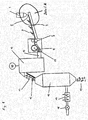
- Fig. 1 1 schematically shows a strand granulator device according to an embodiment of the present invention, wherein with this strand granulator device the overall process of granule production can be carried out, if appropriate according to the invention, in particular also according to the inventive method.
- the strand granulator apparatus shown schematically shows a strand granulator for the production of granules of polymers of thermoplastic polyester or copolyesters from a polyester melt. If necessary, other materials can also be processed with it.
- the strand granulator has nozzles 1 (only one shown), through which the polyester melt emerges as strands 2 (only one shown), with a take-off area or a withdrawal line, here for example a discharge chute 3 which leads under strands of fluid 2, a granulation device 4 and Feed rollers 5, which pull the strands 2 from the nozzles 1 and forward through the discharge chute 3 of the granulation device 4.
- the extruded strands 2 emerge from the nozzles 1 at an exit velocity v out and are fed via the adjustment of the speed of the feed rollers 5 at a strand withdrawal speed v from the granulation device 4.
- the inventive equipment of the strand pelletizer of Fig. 1 results in particular in detail A, which in Fig. 1 indicated by a circle.
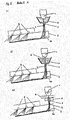
- the specific embodiments of this detail A according to the invention are described in FIGS Fig. 2a to c shown and described.
- granules 11 are further guided in the fluid stream after passing through the granulation device and fed via a Nachkühlrange 12 a granulate dryer 13, which a motor M by which the granules are kept in motion.
- the granulate dryer 13 emits amorphous granules 14, which are supplied via a compound 15 from the granular dryer to a crystallizer 16.
- This crystallizer 16 is supplied via a fan 18 and a gas heater 17 heated gas, so that there in the crystallizer 16, a further (by) crystallization of the granules can take place.
- the in Fig. 1 The overall process shown can be seen at 19, the crystallized granules.
- Fig. 2a to c shows three different embodiments of the strand pelletizer of the invention Fig. 1 , It is in the Fig. 2a to c in each case one shown according to the invention between the nozzles 1 and the chute 3 Schwallinraum 6 shown, which exerts the emerging from the respective nozzles 1, unguided strands 2, or the actually unguided strands 2, with a cooling fluid surge 7 before the strands 2 through the fluid loaded discharge chute 3 are guided. In the area of the discharge chute 3, a strand cooling 9 can still be provided which further cools the strands 2 guided by further spraying cooling fluid on the discharge chute 3 which is acted upon in the fluid. Furthermore, the show Fig. 2a to c in each case also a fluid supply 10 for the fluid admission of the strands 2 in the discharge chute 3.
- the surge device 6 can be designed such that it immediately adjoins the nozzle 1 without further air gap 8, wherein the nozzle 1 can even be immersed in the surge device 6 (FIG. Fig. 2a ) or between the surge device 6 and the respective nozzle 1, such an air gap 8 can be provided, through which the strands 2 free, wherein the length of the air gap is at most 30 mm, preferably at most 10 mm, more preferably at most 5 mm and more preferably at most 2 mm ( Fig. 2b and Fig. 2c ).
- the surge device 6 may be formed as a kind of gutter or trough, the strands 2 respectively passing through corresponding openings or a corresponding opening ( Fig. 2a and Fig. 2b ) or the surge device 6 may be formed by nozzles which surround the respective strands 2 with the cooling fluid surge 7 ( Fig. 2c ). Depending on the geometry, one or more such jet nozzles may be present.
- the nozzles, which according to the in Fig. 2c As shown embodiment form the surge device 6 may be oriented in any direction to the strands 2, they are preferably inclined obliquely to the direction of the strands 2 down. In Fig. 2c two such surge nozzles of the surge device 6 are shown according to the embodiment shown there.
- the nozzles 1 of the strand pelletizer according to the invention may be part of a nozzle plate or a casting head.
- the nozzle temperature was 230 ° C.
- the strand was exposed after a distance of 4 mm after the nozzle outlet with 84 ° C warm water and then fed through a likewise supplied with 84 ° C hot water 3.2 m long discharge chute Granulationvoriques.
- the take-off speed of the strand was 200 m / min resulting in granules of 3 mm in length and 15 mg in weight.
- the residence time until the formation of granules was about 1 second.
- the granulates and the water pass through a 1.2 m long supply line into a granulate dryer in which the granules are separated from the water.
- the residence time in the supply line was also 1 second and 0.2 seconds in the granule dryer.
- the dried granules were transferred directly to a fluidized bed crystallizer with 0.05m 2 sieve bottom area.
- the inlet temperature of the granules into the crystallizer was 96 ° C. 3.7 Nm 3 / min of air at 180 ° C were fed to the crystallizer, resulting in a granule temperature of 163 ° C.
- the mean residence time was 9 minutes.
- the granules were homogeneously crystallized. There are no adhesions.
- Granules from Example 1 were quenched immediately after leaving the granule dryer, dried in vacuo at 60 ° C and then crystallized in a container unstirred for 20 minutes at 170 ° C.
- the granules were free flowing. 88% were in the form of single granules, 12% formed small agglomerates, the agglomeration taking place in each case over the cut surfaces of the granules.
- the nucleation density in an edge layer of about 40 ⁇ m is greater by a factor> 125 than in the center.
- Example 1 The experiment of Example 1 was repeated, but with a nozzle temperature of 280 ° C. In the crystallizer agglomerates are formed immediately. The fluidized bed has collapsed. An operation was not possible.
- Example 2 Analogously to Example 2, crystallization was carried out with granules from Comparative Example 1. The granules were no longer free flowing. The result was large agglomerates that were glued together on their cylindrical surface.
- a polyethylene terephthalate copolymer as in Example 1 was pressed at a melt temperature of 276 ° C at 200 kg / h through 2 nozzles.
- the nozzle temperature was 260 ° C.
- the strand was after a distance of 4 to 5 mm after the nozzle exit with 84 ° C warm water applied and then supplied via a likewise supplied with 84 ° C warm water 2.2 m long discharge chute Granulationvoriques.
- the take-off speed of the strand was 250 m / min, resulting in granules of 3 mm in length and 20 mg in weight.
- the residence time until the formation of granules was about 0.5 seconds.
- the granulates and the water pass through a 1.2 m long supply line into a granulate dryer in which the granules are separated from the water.
- the residence time in the supply line was 1 second and 0.2 seconds in the granule dryer.
- the dried granules were transferred directly to a fluidized bed crystallizer with 0.05 m 2 sieve bottom area.
- the inlet temperature of the granules into the crystallizer was 127 ° C. 3.7 Nm 3 / min of air at 180 ° C were fed to the crystallizer, resulting in a granule temperature of 163 ° C.
- Example 3 was repeated, but loading of the polyester strands with water after the nozzle exit was stopped. Immediately after the end of the impingement of water, agglomerates were formed immediately in the crystallizer. The fluidized bed has collapsed. An operation was not possible. The strands emerging from the nozzles remained clear. Granules which were quenched after the granule dryer show a smooth surface.
Landscapes
- Engineering & Computer Science (AREA)
- Mechanical Engineering (AREA)
- Processing And Handling Of Plastics And Other Materials For Molding In General (AREA)
- Processes Of Treating Macromolecular Substances (AREA)
- Shaping By String And By Release Of Stress In Plastics And The Like (AREA)
- Artificial Filaments (AREA)
- Polyesters Or Polycarbonates (AREA)
Claims (7)
- Procédé pour préparer des grains de granulat de polymères de polyesters ou de copolyesters thermoplastiques à partir d'une masse fondue de polyester à l'aide d'un granulateur à brins, dans lequel la masse fondue de polyester est alimentée dans des filières (1) puis, sous forme de brins (2) via une zone d'évacuation (3), dans un dispositif de granulation (4) présentant des cylindres d'entrée (5), caractérisé en ce que le diamètre d et/ou la longueur 1 de l'ouverture des différentes filières (1) sont réglé(e)s de manière telle que le rapport l/d satisfait à la condition l/d ≤ 1 et en ce que les brins (2) sortant des filières (1) sont amenés directement ou via une fente d'air (8) dans le contact avec un fluide de refroidissement, la longueur de la fente d'air (8) étant réglée à au maximum 30 mm.
- Procédé selon la revendication 1, caractérisé en ce que la longueur de la fente d'air (8) est réglée à au maximum 10 mm, de préférence à au maximum 5 mm et plus préférablement à au maximum 2 mm.
- Procédé selon l'une quelconque des revendications 1 ou 2, caractérisé en ce que le rapport l/d satisfait à la condition l/d ≤ 0,7, de préférence à la condition l/d ≤ 0,5 et encore plus préférablement à la condition l/d = 0,3.
- Procédé pour préparer des grains de granulat de polymères de polyesters ou de copolyesters thermoplastiques à partir d'une masse fondue de polyester à l'aide d'un granulateur à brins, dans lequel la masse fondue de polyester est alimentée dans des buses (1) puis, sous forme de brins (2) via une zone d'évacuation (3), dans un dispositif de granulation (4) présentant des cylindres d'entrée (5), les ouvertures des filières étant conçues de manière telle qu'il existe un rétrécissement important de la section juste avant la sortie des filières, caractérisé en ce qu'un rapport d'une surface F à l'entrée dans l'ouverture des filières, mesurée en un endroit qui se trouve à une distance L en amont de la sortie de l'ouverture des filières, avec L < 8 mm, divisée par une surface f de l'ouverture d'une filière donnée est réglé de manière telle que la condition F/f > 3 est satisfaite, et en ce que les brins qui sortent des filières sont amenés directement ou via une fente d'air (8) dans le contact avec un fluide de refroidissement, la longueur de la fente d'air (8) étant réglée à au maximum 30 mm.
- Procédé selon la revendication 4, caractérisé en ce que la longueur s de la fente d'air (8) est réglée à au maximum 10 mm, de préférence à au maximum 5 mm et plus préférablement à au maximum 2 mm.
- Procédé selon l'une quelconque des revendications 4 ou 5, caractérisé en ce que le rapport F/f satisfait à la condition F/f ≥ 5, de préférence à la condition F/f ≥ 10 et plus préférablement à la condition F/f ≥ 20.
- Procédé selon l'une quelconque des revendications 4 à 7, caractérisé en ce que la distance L satisfait à la condition L < 7 mm, de préférence à la condition L < 6 mm.
Applications Claiming Priority (3)
| Application Number | Priority Date | Filing Date | Title |
|---|---|---|---|
| DE102006055914 | 2006-11-27 | ||
| DE102007027543A DE102007027543A1 (de) | 2006-11-27 | 2007-06-15 | Stranggranulationsverfahren und -vorrichtung sowie daraus hergestellte Granulate |
| EP07819757A EP2097234A1 (fr) | 2006-11-27 | 2007-11-12 | Procédé et système de production de granulés cylindriques ainsi que granulés produits au moyen de ces derniers |
Related Parent Applications (2)
| Application Number | Title | Priority Date | Filing Date |
|---|---|---|---|
| EP07819757.1 Division | 2007-11-12 | ||
| EP07819757A Division EP2097234A1 (fr) | 2006-11-27 | 2007-11-12 | Procédé et système de production de granulés cylindriques ainsi que granulés produits au moyen de ces derniers |
Publications (3)
| Publication Number | Publication Date |
|---|---|
| EP2520402A2 EP2520402A2 (fr) | 2012-11-07 |
| EP2520402A3 EP2520402A3 (fr) | 2013-01-02 |
| EP2520402B1 true EP2520402B1 (fr) | 2015-03-25 |
Family
ID=38806990
Family Applications (2)
| Application Number | Title | Priority Date | Filing Date |
|---|---|---|---|
| EP12177175.2A Not-in-force EP2520402B1 (fr) | 2006-11-27 | 2007-11-12 | Procédé de granulation en tête |
| EP07819757A Withdrawn EP2097234A1 (fr) | 2006-11-27 | 2007-11-12 | Procédé et système de production de granulés cylindriques ainsi que granulés produits au moyen de ces derniers |
Family Applications After (1)
| Application Number | Title | Priority Date | Filing Date |
|---|---|---|---|
| EP07819757A Withdrawn EP2097234A1 (fr) | 2006-11-27 | 2007-11-12 | Procédé et système de production de granulés cylindriques ainsi que granulés produits au moyen de ces derniers |
Country Status (12)
| Country | Link |
|---|---|
| US (1) | US8147738B2 (fr) |
| EP (2) | EP2520402B1 (fr) |
| JP (1) | JP2010510900A (fr) |
| CN (1) | CN101626877B (fr) |
| BR (1) | BRPI0719283A2 (fr) |
| DE (1) | DE102007027543A1 (fr) |
| ES (1) | ES2536650T3 (fr) |
| LT (1) | LT5664B (fr) |
| MX (1) | MX2009005567A (fr) |
| RU (2) | RU2457109C2 (fr) |
| TW (1) | TWI411510B (fr) |
| WO (1) | WO2008064768A1 (fr) |
Families Citing this family (30)
| Publication number | Priority date | Publication date | Assignee | Title |
|---|---|---|---|---|
| CN101704279B (zh) * | 2008-06-27 | 2012-08-08 | 上海金发科技发展有限公司 | 一种自动搭条装置 |
| DE102008058173A1 (de) | 2008-11-20 | 2010-05-27 | Automatik Plastics Machinery Gmbh | Vorrichtung und Verfahren zum Stranggießen und Granulieren von Strängen aus thermoplastischem Kunststoff |
| PL2504385T3 (pl) * | 2009-11-24 | 2017-11-30 | Sulzer Chemtech Ag | Sposób wytwarzania granulatu PET oraz granulat PET |
| DE102009059306A1 (de) * | 2009-12-23 | 2011-06-30 | Automatik Plastics Machinery GmbH, 63762 | Vorrichtung zum Stranggießen von Strängen aus thermoplastischem Kunststoff |
| CN101966734A (zh) * | 2010-10-13 | 2011-02-09 | 苏州康斯坦普工程塑料有限公司 | 一种塑料粒条冷却器 |
| US11045979B2 (en) | 2012-05-31 | 2021-06-29 | Aladdin Manufacturing Corporation | Methods for manufacturing bulked continuous filament from recycled PET |
| US10532495B2 (en) | 2012-05-31 | 2020-01-14 | Aladdin Manufacturing Corporation | Methods for manufacturing bulked continuous filament from recycled PET |
| US10487422B2 (en) | 2012-05-31 | 2019-11-26 | Aladdin Manufacturing Corporation | Methods for manufacturing bulked continuous filament from colored recycled pet |
| US10538016B2 (en) | 2012-05-31 | 2020-01-21 | Aladdin Manufacturing Corporation | Methods for manufacturing bulked continuous carpet filament |
| US10695953B2 (en) | 2012-05-31 | 2020-06-30 | Aladdin Manufacturing Corporation | Methods for manufacturing bulked continuous carpet filament |
| US9630353B2 (en) | 2012-05-31 | 2017-04-25 | Mohawk Industries, Inc. | Method of manufacturing bulked continuous filament |
| US8597553B1 (en) | 2012-05-31 | 2013-12-03 | Mohawk Industries, Inc. | Systems and methods for manufacturing bulked continuous filament |
| US9636860B2 (en) | 2012-05-31 | 2017-05-02 | Mohawk Industries, Inc. | Method of manufacturing bulked continuous filament |
| JP6006653B2 (ja) * | 2013-02-04 | 2016-10-12 | 出光興産株式会社 | ポリカーボネート樹脂用押出造粒装置およびポリカーボネート樹脂押出造粒方法 |
| DE102013109003A1 (de) * | 2013-08-20 | 2015-02-26 | Automatik Plastics Machinery Gmbh | Vorrichtung und Verfahren zum Trocknen von Kunststoffgranulatkörnern |
| WO2016081568A1 (fr) * | 2014-11-18 | 2016-05-26 | Mohawk Industries, Inc. | Systèmes et procédés de fabrication de filament continu gonflant |
| US11298853B2 (en) | 2016-06-21 | 2022-04-12 | Uop Llc | Processes and apparatuses for conditioning polymer particles for an SSP reactor |
| RU2685299C1 (ru) | 2016-06-21 | 2019-04-17 | Юоп Ллк | Способ и устройство для кристаллизации и повышения молекулярной массы полимерных частиц |
| US10751915B2 (en) | 2016-11-10 | 2020-08-25 | Aladdin Manufacturing Corporation | Polyethylene terephthalate coloring systems and methods |
| WO2018140884A1 (fr) | 2017-01-30 | 2018-08-02 | Mohawk Industries, Inc. | Procédés de fabrication d'un filament continu gonflant à partir de pet recyclé coloré |
| US20180250864A1 (en) | 2017-03-03 | 2018-09-06 | Mohawk Industries, Inc. | Polymer extruders with a dual vacuum arrangement and related methods |
| KR20180103666A (ko) | 2017-03-09 | 2018-09-19 | (주)엘지하우시스 | 열가소성 폴리우레탄 시트 및 이의 제조방법 |
| US11473216B2 (en) | 2017-09-15 | 2022-10-18 | Aladdin Manufacturing Corporation | Polyethylene terephthalate coloring systems and methods |
| CN110732291A (zh) * | 2018-07-20 | 2020-01-31 | 长春市农业机械研究院 | 有机肥快速干燥制粒机 |
| US11242622B2 (en) | 2018-07-20 | 2022-02-08 | Aladdin Manufacturing Corporation | Bulked continuous carpet filament manufacturing from polytrimethylene terephthalate |
| US12343903B2 (en) | 2019-06-05 | 2025-07-01 | Aladdin Manufacturing Corporation | Methods for manufacturing bulked continuous carpet filament |
| CN112757520A (zh) * | 2019-11-01 | 2021-05-07 | 中国石油化工股份有限公司 | 一种聚酯的造粒方法 |
| CN114516128B (zh) * | 2019-11-20 | 2023-11-10 | 浙江佳人新材料有限公司 | 一种低粘度切片生产用铸带板结构 |
| DE102020102079B4 (de) * | 2020-01-29 | 2022-11-10 | Cerdia International GmbH | Verfahren zum stofflichen wiederverwenden von celluloseacetathaltigem material und systeme zum stofflichen wiederverwenden von celluloseacetathaltigem material |
| CN116039046B (zh) * | 2022-10-26 | 2024-06-25 | 安徽大力熊新材料生物科技股份有限公司 | 一种高密度聚乳酸生物降解塑料颗粒生产加工系统 |
Family Cites Families (17)
| Publication number | Priority date | Publication date | Assignee | Title |
|---|---|---|---|---|
| US3544525A (en) * | 1968-03-26 | 1970-12-01 | Allied Chem | Process for crystallization,drying and solid-state polymerization of polyesters |
| DE2814113C2 (de) | 1978-04-01 | 1982-09-23 | Werner & Pfleiderer, 7000 Stuttgart | Vorrichtung zum Granulieren von Kunststoffsträngen |
| SU866364A1 (ru) * | 1980-01-03 | 1981-09-23 | Ярославский политехнический институт | Сушилка-гранул тор |
| SU1307190A1 (ru) * | 1985-12-27 | 1987-04-30 | Научно-производственное объединение по крахмалопродуктам | Установка дл сушки пастообразных материалов |
| JPH0613175B2 (ja) * | 1989-07-31 | 1994-02-23 | 株式会社クラレ | ペレツトの製造法 |
| DE4314162C1 (de) * | 1993-04-29 | 1994-04-28 | Rieter Automatik Gmbh | Verfahren zur gleichzeitigen Trocknung und Kristallisation von kristallisationsfähigem thermoplastischem Kunststoff |
| JPH07124982A (ja) * | 1993-11-04 | 1995-05-16 | Sekisui Plastics Co Ltd | 熱可塑性樹脂の発泡剤含有ペレット及びその製造方法 |
| JPH1115112A (ja) * | 1997-06-25 | 1999-01-22 | Fuji Photo Film Co Ltd | 写真感光材料用射出成形品及びその製造方法 |
| DE19739747A1 (de) * | 1997-09-10 | 1999-03-11 | Rieter Automatik Gmbh | Stranggießen und Granulieren von Kunststoffsträngen |
| DE19933476B4 (de) | 1999-07-16 | 2006-09-28 | Rieter Automatik Gmbh | Verfahren und Vorrichtung zur Zuleitung und Behandlung von Kunststoffsträngen |
| DE19938583A1 (de) | 1999-08-18 | 2001-02-22 | Buehler Ag | Verfahren und Vorrichtung zur Herstellung von kristallisationsfähigem Kunststoffmaterial |
| JP2001205627A (ja) * | 2000-01-31 | 2001-07-31 | Nippon Zeon Co Ltd | 押出機、ペレット製造装置およびペレット製造方法 |
| JP2003119275A (ja) * | 2001-08-07 | 2003-04-23 | Toyobo Co Ltd | ポリエステルの製造方法 |
| DE10149474A1 (de) | 2001-10-08 | 2003-04-17 | Buehler Ag | Steuerung der Kristallisation von Polyestern durch deren Wassergehalt |
| US6706396B1 (en) | 2002-10-18 | 2004-03-16 | E. I. Du Pont De Nemours And Company | Processes for producing very low IV polyester resin |
| JP3717485B2 (ja) * | 2003-03-05 | 2005-11-16 | 電気化学工業株式会社 | 樹脂ペレット製造用ダイ及び該ダイを用いた樹脂ペレットの製造方法 |
| BRPI0609874B1 (pt) * | 2005-04-27 | 2018-02-27 | Polymetrix Ag | Processo para produção de partículas de poliéster |
-
2007
- 2007-06-15 DE DE102007027543A patent/DE102007027543A1/de not_active Withdrawn
- 2007-11-12 EP EP12177175.2A patent/EP2520402B1/fr not_active Not-in-force
- 2007-11-12 CN CN200780044151.5A patent/CN101626877B/zh not_active Expired - Fee Related
- 2007-11-12 MX MX2009005567A patent/MX2009005567A/es active IP Right Grant
- 2007-11-12 EP EP07819757A patent/EP2097234A1/fr not_active Withdrawn
- 2007-11-12 ES ES12177175.2T patent/ES2536650T3/es active Active
- 2007-11-12 US US12/516,563 patent/US8147738B2/en not_active Expired - Fee Related
- 2007-11-12 RU RU2009124112/05A patent/RU2457109C2/ru active
- 2007-11-12 JP JP2009537511A patent/JP2010510900A/ja active Pending
- 2007-11-12 WO PCT/EP2007/009768 patent/WO2008064768A1/fr not_active Ceased
- 2007-11-12 BR BRPI0719283-5A patent/BRPI0719283A2/pt not_active Application Discontinuation
- 2007-11-21 TW TW096144083A patent/TWI411510B/zh not_active IP Right Cessation
-
2009
- 2009-05-27 LT LT2009034A patent/LT5664B/lt not_active IP Right Cessation
-
2012
- 2012-05-23 RU RU2012122733/05A patent/RU2597613C2/ru active
Also Published As
| Publication number | Publication date |
|---|---|
| ES2536650T3 (es) | 2015-05-27 |
| JP2010510900A (ja) | 2010-04-08 |
| RU2009124112A (ru) | 2011-01-10 |
| TW200846160A (en) | 2008-12-01 |
| MX2009005567A (es) | 2009-10-26 |
| CN101626877A (zh) | 2010-01-13 |
| RU2012122733A (ru) | 2013-11-27 |
| US20100133717A1 (en) | 2010-06-03 |
| WO2008064768A1 (fr) | 2008-06-05 |
| CN101626877B (zh) | 2012-11-14 |
| RU2457109C2 (ru) | 2012-07-27 |
| LT2009034A (en) | 2010-03-25 |
| EP2520402A2 (fr) | 2012-11-07 |
| BRPI0719283A2 (pt) | 2014-07-01 |
| LT5664B (lt) | 2010-07-26 |
| EP2520402A3 (fr) | 2013-01-02 |
| DE102007027543A1 (de) | 2008-05-29 |
| US8147738B2 (en) | 2012-04-03 |
| TWI411510B (zh) | 2013-10-11 |
| EP2097234A1 (fr) | 2009-09-09 |
| RU2597613C2 (ru) | 2016-09-10 |
Similar Documents
| Publication | Publication Date | Title |
|---|---|---|
| EP2520402B1 (fr) | Procédé de granulation en tête | |
| EP3043973B1 (fr) | Procédé de fabrication de granulés sphériques cristallins en surface par fractionnement à chaud, et dispositif de mise en oeuvre de ce procédé | |
| EP1710066B1 (fr) | Procédé de conditionement et de cristallisation d'un materiau polymère | |
| EP2712881B1 (fr) | Procédé et dispositif de cristallisation directe de polymères sous gaz inerte | |
| EP2121262B2 (fr) | Procédé et dispositif de production et de traitement de grains de granulés en matière plastique | |
| DE60007788T2 (de) | Verfahren zur Herstellung einer biaxial gestreckten Polyesterfolie | |
| EP1313599A1 (fr) | Procede et dispositif pour fabriquer des particules spheriques a partir de polymere fondu | |
| DE102007042636B4 (de) | Verfahren und Vorrichtung zur Herstellung eines Polyestergranulats nach dem Latentwärmekristallisationsverfahren | |
| EP3650186B1 (fr) | Procédé et dispositif de cristallisation directe de polycondensats | |
| EP1373360B1 (fr) | Procede et dispositif de polycondensation en continu de matiere polyester en phase solide | |
| EP3363841B1 (fr) | Procédé et dispositif de cristallisation directe de polycondensats | |
| EP3377288B1 (fr) | Procédé de production de granulés de matière plastique | |
| EP0724029B1 (fr) | Fils à partir de masses en fusion utilisant jets de gaz froid | |
| EP2043831B1 (fr) | Procédé de cristallisation d'un polymère cristallisant lentement et granulés polymères | |
| AT508252B1 (de) | Verfahren und vorrichtung zur herstellung von teilkristallinem polymermaterial | |
| EP4435366B1 (fr) | Echangeur de chaleur pour un lit de matière solide | |
| DE102007026737A1 (de) | Verfahren zur Kristallisation eines langsam kristallisierenden Polymeren | |
| DE102022127363A1 (de) | Folienanlage und verfahren zum herstellen einer folienbahn | |
| EP4405152A1 (fr) | Procédé et dispositif de traitement de polymères pet pour former des pastilles |
Legal Events
| Date | Code | Title | Description |
|---|---|---|---|
| PUAI | Public reference made under article 153(3) epc to a published international application that has entered the european phase |
Free format text: ORIGINAL CODE: 0009012 |
|
| AC | Divisional application: reference to earlier application |
Ref document number: 2097234 Country of ref document: EP Kind code of ref document: P |
|
| AK | Designated contracting states |
Kind code of ref document: A2 Designated state(s): AT BE BG CH CY CZ DE DK EE ES FI FR GB GR HU IE IS IT LI LT LU LV MC MT NL PL PT RO SE SI SK TR |
|
| PUAL | Search report despatched |
Free format text: ORIGINAL CODE: 0009013 |
|
| AK | Designated contracting states |
Kind code of ref document: A3 Designated state(s): AT BE BG CH CY CZ DE DK EE ES FI FR GB GR HU IE IS IT LI LT LU LV MC MT NL PL PT RO SE SI SK TR |
|
| RIC1 | Information provided on ipc code assigned before grant |
Ipc: B29C 47/12 20060101ALN20121126BHEP Ipc: B29B 9/06 20060101AFI20121126BHEP |
|
| RAP1 | Party data changed (applicant data changed or rights of an application transferred) |
Owner name: BUEHLER THERMAL PROCESSES AG |
|
| 17P | Request for examination filed |
Effective date: 20130302 |
|
| RBV | Designated contracting states (corrected) |
Designated state(s): AT BE BG CH CY CZ DE DK EE ES FI FR GB GR HU IE IS IT LI LT LU LV MC MT NL PL PT RO SE SI SK TR |
|
| RIC1 | Information provided on ipc code assigned before grant |
Ipc: B29B 9/06 20060101AFI20140206BHEP Ipc: B29C 47/12 20060101ALN20140206BHEP |
|
| GRAP | Despatch of communication of intention to grant a patent |
Free format text: ORIGINAL CODE: EPIDOSNIGR1 |
|
| INTG | Intention to grant announced |
Effective date: 20140523 |
|
| RIC1 | Information provided on ipc code assigned before grant |
Ipc: B29B 9/06 20060101AFI20140514BHEP Ipc: B29C 47/12 20060101ALN20140514BHEP |
|
| GRAP | Despatch of communication of intention to grant a patent |
Free format text: ORIGINAL CODE: EPIDOSNIGR1 |
|
| RIC1 | Information provided on ipc code assigned before grant |
Ipc: B29B 9/06 20060101AFI20141007BHEP Ipc: B29C 47/12 20060101ALN20141007BHEP |
|
| INTG | Intention to grant announced |
Effective date: 20141028 |
|
| GRAS | Grant fee paid |
Free format text: ORIGINAL CODE: EPIDOSNIGR3 |
|
| GRAA | (expected) grant |
Free format text: ORIGINAL CODE: 0009210 |
|
| AC | Divisional application: reference to earlier application |
Ref document number: 2097234 Country of ref document: EP Kind code of ref document: P |
|
| AK | Designated contracting states |
Kind code of ref document: B1 Designated state(s): AT BE BG CH CY CZ DE DK EE ES FI FR GB GR HU IE IS IT LI LT LU LV MC MT NL PL PT RO SE SI SK TR |
|
| REG | Reference to a national code |
Ref country code: GB Ref legal event code: FG4D Free format text: NOT ENGLISH |
|
| REG | Reference to a national code |
Ref country code: CH Ref legal event code: EP |
|
| REG | Reference to a national code |
Ref country code: IE Ref legal event code: FG4D Free format text: LANGUAGE OF EP DOCUMENT: GERMAN |
|
| REG | Reference to a national code |
Ref country code: DE Ref legal event code: R096 Ref document number: 502007013825 Country of ref document: DE Effective date: 20150507 |
|
| REG | Reference to a national code |
Ref country code: AT Ref legal event code: REF Ref document number: 717587 Country of ref document: AT Kind code of ref document: T Effective date: 20150515 |
|
| REG | Reference to a national code |
Ref country code: ES Ref legal event code: FG2A Ref document number: 2536650 Country of ref document: ES Kind code of ref document: T3 Effective date: 20150527 |
|
| PG25 | Lapsed in a contracting state [announced via postgrant information from national office to epo] |
Ref country code: FI Free format text: LAPSE BECAUSE OF FAILURE TO SUBMIT A TRANSLATION OF THE DESCRIPTION OR TO PAY THE FEE WITHIN THE PRESCRIBED TIME-LIMIT Effective date: 20150325 Ref country code: LT Free format text: LAPSE BECAUSE OF FAILURE TO SUBMIT A TRANSLATION OF THE DESCRIPTION OR TO PAY THE FEE WITHIN THE PRESCRIBED TIME-LIMIT Effective date: 20150325 Ref country code: SE Free format text: LAPSE BECAUSE OF FAILURE TO SUBMIT A TRANSLATION OF THE DESCRIPTION OR TO PAY THE FEE WITHIN THE PRESCRIBED TIME-LIMIT Effective date: 20150325 |
|
| REG | Reference to a national code |
Ref country code: LT Ref legal event code: MG4D |
|
| PG25 | Lapsed in a contracting state [announced via postgrant information from national office to epo] |
Ref country code: LV Free format text: LAPSE BECAUSE OF FAILURE TO SUBMIT A TRANSLATION OF THE DESCRIPTION OR TO PAY THE FEE WITHIN THE PRESCRIBED TIME-LIMIT Effective date: 20150325 Ref country code: GR Free format text: LAPSE BECAUSE OF FAILURE TO SUBMIT A TRANSLATION OF THE DESCRIPTION OR TO PAY THE FEE WITHIN THE PRESCRIBED TIME-LIMIT Effective date: 20150626 |
|
| PG25 | Lapsed in a contracting state [announced via postgrant information from national office to epo] |
Ref country code: NL Free format text: LAPSE BECAUSE OF FAILURE TO SUBMIT A TRANSLATION OF THE DESCRIPTION OR TO PAY THE FEE WITHIN THE PRESCRIBED TIME-LIMIT Effective date: 20150325 |
|
| PG25 | Lapsed in a contracting state [announced via postgrant information from national office to epo] |
Ref country code: SK Free format text: LAPSE BECAUSE OF FAILURE TO SUBMIT A TRANSLATION OF THE DESCRIPTION OR TO PAY THE FEE WITHIN THE PRESCRIBED TIME-LIMIT Effective date: 20150325 Ref country code: CZ Free format text: LAPSE BECAUSE OF FAILURE TO SUBMIT A TRANSLATION OF THE DESCRIPTION OR TO PAY THE FEE WITHIN THE PRESCRIBED TIME-LIMIT Effective date: 20150325 Ref country code: EE Free format text: LAPSE BECAUSE OF FAILURE TO SUBMIT A TRANSLATION OF THE DESCRIPTION OR TO PAY THE FEE WITHIN THE PRESCRIBED TIME-LIMIT Effective date: 20150325 Ref country code: PT Free format text: LAPSE BECAUSE OF FAILURE TO SUBMIT A TRANSLATION OF THE DESCRIPTION OR TO PAY THE FEE WITHIN THE PRESCRIBED TIME-LIMIT Effective date: 20150727 Ref country code: RO Free format text: LAPSE BECAUSE OF FAILURE TO SUBMIT A TRANSLATION OF THE DESCRIPTION OR TO PAY THE FEE WITHIN THE PRESCRIBED TIME-LIMIT Effective date: 20150325 |
|
| PG25 | Lapsed in a contracting state [announced via postgrant information from national office to epo] |
Ref country code: PL Free format text: LAPSE BECAUSE OF FAILURE TO SUBMIT A TRANSLATION OF THE DESCRIPTION OR TO PAY THE FEE WITHIN THE PRESCRIBED TIME-LIMIT Effective date: 20150325 Ref country code: IS Free format text: LAPSE BECAUSE OF FAILURE TO SUBMIT A TRANSLATION OF THE DESCRIPTION OR TO PAY THE FEE WITHIN THE PRESCRIBED TIME-LIMIT Effective date: 20150725 |
|
| REG | Reference to a national code |
Ref country code: DE Ref legal event code: R097 Ref document number: 502007013825 Country of ref document: DE |
|
| PG25 | Lapsed in a contracting state [announced via postgrant information from national office to epo] |
Ref country code: DK Free format text: LAPSE BECAUSE OF FAILURE TO SUBMIT A TRANSLATION OF THE DESCRIPTION OR TO PAY THE FEE WITHIN THE PRESCRIBED TIME-LIMIT Effective date: 20150325 |
|
| PLBE | No opposition filed within time limit |
Free format text: ORIGINAL CODE: 0009261 |
|
| STAA | Information on the status of an ep patent application or granted ep patent |
Free format text: STATUS: NO OPPOSITION FILED WITHIN TIME LIMIT |
|
| 26N | No opposition filed |
Effective date: 20160105 |
|
| REG | Reference to a national code |
Ref country code: DE Ref legal event code: R082 Ref document number: 502007013825 Country of ref document: DE Representative=s name: ISARPATENT - PATENT- UND RECHTSANWAELTE BEHNIS, DE Ref country code: DE Ref legal event code: R082 Ref document number: 502007013825 Country of ref document: DE Representative=s name: ISARPATENT - PATENT- UND RECHTSANWAELTE BARTH , DE Ref country code: DE Ref legal event code: R082 Ref document number: 502007013825 Country of ref document: DE Representative=s name: ISARPATENT PATENTANWAELTE BEHNISCH, BARTH, CHA, DE Ref country code: DE Ref legal event code: R081 Ref document number: 502007013825 Country of ref document: DE Owner name: POLYMETRIX AG, CH Free format text: FORMER OWNER: BUEHLER THERMAL PROCESSES AG, OBERBUEREN, CH Ref country code: DE Ref legal event code: R082 Ref document number: 502007013825 Country of ref document: DE Representative=s name: ISARPATENT - PATENTANWAELTE- UND RECHTSANWAELT, DE |
|
| PG25 | Lapsed in a contracting state [announced via postgrant information from national office to epo] |
Ref country code: IT Free format text: LAPSE BECAUSE OF FAILURE TO SUBMIT A TRANSLATION OF THE DESCRIPTION OR TO PAY THE FEE WITHIN THE PRESCRIBED TIME-LIMIT Effective date: 20150325 |
|
| PG25 | Lapsed in a contracting state [announced via postgrant information from national office to epo] |
Ref country code: SI Free format text: LAPSE BECAUSE OF FAILURE TO SUBMIT A TRANSLATION OF THE DESCRIPTION OR TO PAY THE FEE WITHIN THE PRESCRIBED TIME-LIMIT Effective date: 20150325 |
|
| PG25 | Lapsed in a contracting state [announced via postgrant information from national office to epo] |
Ref country code: MC Free format text: LAPSE BECAUSE OF FAILURE TO SUBMIT A TRANSLATION OF THE DESCRIPTION OR TO PAY THE FEE WITHIN THE PRESCRIBED TIME-LIMIT Effective date: 20150325 Ref country code: LU Free format text: LAPSE BECAUSE OF FAILURE TO SUBMIT A TRANSLATION OF THE DESCRIPTION OR TO PAY THE FEE WITHIN THE PRESCRIBED TIME-LIMIT Effective date: 20151112 |
|
| REG | Reference to a national code |
Ref country code: CH Ref legal event code: PL |
|
| PG25 | Lapsed in a contracting state [announced via postgrant information from national office to epo] |
Ref country code: LI Free format text: LAPSE BECAUSE OF NON-PAYMENT OF DUE FEES Effective date: 20151130 Ref country code: CH Free format text: LAPSE BECAUSE OF NON-PAYMENT OF DUE FEES Effective date: 20151130 |
|
| REG | Reference to a national code |
Ref country code: IE Ref legal event code: MM4A |
|
| REG | Reference to a national code |
Ref country code: FR Ref legal event code: ST Effective date: 20160729 |
|
| PG25 | Lapsed in a contracting state [announced via postgrant information from national office to epo] |
Ref country code: IE Free format text: LAPSE BECAUSE OF NON-PAYMENT OF DUE FEES Effective date: 20151112 |
|
| PG25 | Lapsed in a contracting state [announced via postgrant information from national office to epo] |
Ref country code: FR Free format text: LAPSE BECAUSE OF NON-PAYMENT OF DUE FEES Effective date: 20151130 |
|
| REG | Reference to a national code |
Ref country code: ES Ref legal event code: PC2A Owner name: POLYMETRIX AG Effective date: 20161223 |
|
| REG | Reference to a national code |
Ref country code: AT Ref legal event code: HC Ref document number: 717587 Country of ref document: AT Kind code of ref document: T Owner name: POLYMETRIX AG, CH Effective date: 20170314 |
|
| PG25 | Lapsed in a contracting state [announced via postgrant information from national office to epo] |
Ref country code: BG Free format text: LAPSE BECAUSE OF FAILURE TO SUBMIT A TRANSLATION OF THE DESCRIPTION OR TO PAY THE FEE WITHIN THE PRESCRIBED TIME-LIMIT Effective date: 20150325 Ref country code: HU Free format text: LAPSE BECAUSE OF FAILURE TO SUBMIT A TRANSLATION OF THE DESCRIPTION OR TO PAY THE FEE WITHIN THE PRESCRIBED TIME-LIMIT; INVALID AB INITIO Effective date: 20071112 |
|
| PG25 | Lapsed in a contracting state [announced via postgrant information from national office to epo] |
Ref country code: CY Free format text: LAPSE BECAUSE OF FAILURE TO SUBMIT A TRANSLATION OF THE DESCRIPTION OR TO PAY THE FEE WITHIN THE PRESCRIBED TIME-LIMIT Effective date: 20150325 |
|
| PG25 | Lapsed in a contracting state [announced via postgrant information from national office to epo] |
Ref country code: BE Free format text: LAPSE BECAUSE OF NON-PAYMENT OF DUE FEES Effective date: 20151130 |
|
| PG25 | Lapsed in a contracting state [announced via postgrant information from national office to epo] |
Ref country code: MT Free format text: LAPSE BECAUSE OF FAILURE TO SUBMIT A TRANSLATION OF THE DESCRIPTION OR TO PAY THE FEE WITHIN THE PRESCRIBED TIME-LIMIT Effective date: 20150325 |
|
| PG25 | Lapsed in a contracting state [announced via postgrant information from national office to epo] |
Ref country code: TR Free format text: LAPSE BECAUSE OF FAILURE TO SUBMIT A TRANSLATION OF THE DESCRIPTION OR TO PAY THE FEE WITHIN THE PRESCRIBED TIME-LIMIT Effective date: 20150325 |
|
| PGFP | Annual fee paid to national office [announced via postgrant information from national office to epo] |
Ref country code: DE Payment date: 20191029 Year of fee payment: 13 |
|
| PGFP | Annual fee paid to national office [announced via postgrant information from national office to epo] |
Ref country code: ES Payment date: 20191202 Year of fee payment: 13 |
|
| PGFP | Annual fee paid to national office [announced via postgrant information from national office to epo] |
Ref country code: AT Payment date: 20191025 Year of fee payment: 13 |
|
| PGFP | Annual fee paid to national office [announced via postgrant information from national office to epo] |
Ref country code: GB Payment date: 20191108 Year of fee payment: 13 |
|
| REG | Reference to a national code |
Ref country code: DE Ref legal event code: R119 Ref document number: 502007013825 Country of ref document: DE |
|
| REG | Reference to a national code |
Ref country code: AT Ref legal event code: MM01 Ref document number: 717587 Country of ref document: AT Kind code of ref document: T Effective date: 20201112 |
|
| GBPC | Gb: european patent ceased through non-payment of renewal fee |
Effective date: 20201112 |
|
| PG25 | Lapsed in a contracting state [announced via postgrant information from national office to epo] |
Ref country code: AT Free format text: LAPSE BECAUSE OF NON-PAYMENT OF DUE FEES Effective date: 20201112 |
|
| PG25 | Lapsed in a contracting state [announced via postgrant information from national office to epo] |
Ref country code: GB Free format text: LAPSE BECAUSE OF NON-PAYMENT OF DUE FEES Effective date: 20201112 Ref country code: DE Free format text: LAPSE BECAUSE OF NON-PAYMENT OF DUE FEES Effective date: 20210601 |
|
| REG | Reference to a national code |
Ref country code: ES Ref legal event code: FD2A Effective date: 20220201 |
|
| PG25 | Lapsed in a contracting state [announced via postgrant information from national office to epo] |
Ref country code: ES Free format text: LAPSE BECAUSE OF NON-PAYMENT OF DUE FEES Effective date: 20201113 |