EP2548880A2 - Zusammensetzungen zur Erhöhung der Telomeraseaktivität - Google Patents
Zusammensetzungen zur Erhöhung der Telomeraseaktivität Download PDFInfo
- Publication number
- EP2548880A2 EP2548880A2 EP12180710A EP12180710A EP2548880A2 EP 2548880 A2 EP2548880 A2 EP 2548880A2 EP 12180710 A EP12180710 A EP 12180710A EP 12180710 A EP12180710 A EP 12180710A EP 2548880 A2 EP2548880 A2 EP 2548880A2
- Authority
- EP
- European Patent Office
- Prior art keywords
- compound
- cells
- cycloastragenol
- glycoside
- formula
- Prior art date
- Legal status (The legal status is an assumption and is not a legal conclusion. Google has not performed a legal analysis and makes no representation as to the accuracy of the status listed.)
- Granted
Links
- YSRXWYSHZIKEQW-IHSXWIMPSA-N CC(C)(C(CC1)O[C@@]1(C)C1C(C)(CCC(C2)(CC[C@@H]3OC)C2(CC2)[C@@H]3C(C)(C)C2OC([C@@H](C2OC)OC)OC[C@H]2OC)C(C)(C)CC1OC)OC Chemical compound CC(C)(C(CC1)O[C@@]1(C)C1C(C)(CCC(C2)(CC[C@@H]3OC)C2(CC2)[C@@H]3C(C)(C)C2OC([C@@H](C2OC)OC)OC[C@H]2OC)C(C)(C)CC1OC)OC YSRXWYSHZIKEQW-IHSXWIMPSA-N 0.000 description 1
- OEPNXKKLQDAQBG-HLFUAKELSA-N CC(C)(C(CC1)O[C@@]1(C)[C@@H]([C@H](C1)OC)[C@@](C)(CC2)[C@]1(C)[C@H](C[C@@H]1O)C2(C2)[C@@]2(CC2)[C@@H]1C(C)(C)[C@H]2O)OC Chemical compound CC(C)(C(CC1)O[C@@]1(C)[C@@H]([C@H](C1)OC)[C@@](C)(CC2)[C@]1(C)[C@H](C[C@@H]1O)C2(C2)[C@@]2(CC2)[C@@H]1C(C)(C)[C@H]2O)OC OEPNXKKLQDAQBG-HLFUAKELSA-N 0.000 description 1
- 0 CC(C)(C(CC1)O[C@@]1(C)[C@@](C(*)C1)C(C)(CC2)[C@]1(C)C(C[C@@]1OC)C2(C2)C2(CC2)[C@@]1C(C)(C)C2OC)O Chemical compound CC(C)(C(CC1)O[C@@]1(C)[C@@](C(*)C1)C(C)(CC2)[C@]1(C)C(C[C@@]1OC)C2(C2)C2(CC2)[C@@]1C(C)(C)C2OC)O 0.000 description 1
Images




Classifications
-
- A—HUMAN NECESSITIES
- A61—MEDICAL OR VETERINARY SCIENCE; HYGIENE
- A61K—PREPARATIONS FOR MEDICAL, DENTAL OR TOILETRY PURPOSES
- A61K31/00—Medicinal preparations containing organic active ingredients
- A61K31/70—Carbohydrates; Sugars; Derivatives thereof
- A61K31/7042—Compounds having saccharide radicals and heterocyclic rings
- A61K31/7048—Compounds having saccharide radicals and heterocyclic rings having oxygen as a ring hetero atom, e.g. leucoglucosan, hesperidin, erythromycin, nystatin, digitoxin or digoxin
-
- C—CHEMISTRY; METALLURGY
- C07—ORGANIC CHEMISTRY
- C07J—STEROIDS
- C07J3/00—Normal steroids containing carbon, hydrogen, halogen or oxygen, substituted in position 17 beta by one carbon atom
-
- A—HUMAN NECESSITIES
- A61—MEDICAL OR VETERINARY SCIENCE; HYGIENE
- A61K—PREPARATIONS FOR MEDICAL, DENTAL OR TOILETRY PURPOSES
- A61K31/00—Medicinal preparations containing organic active ingredients
- A61K31/56—Compounds containing cyclopenta[a]hydrophenanthrene ring systems; Derivatives thereof, e.g. steroids
-
- A—HUMAN NECESSITIES
- A61—MEDICAL OR VETERINARY SCIENCE; HYGIENE
- A61K—PREPARATIONS FOR MEDICAL, DENTAL OR TOILETRY PURPOSES
- A61K31/00—Medicinal preparations containing organic active ingredients
- A61K31/56—Compounds containing cyclopenta[a]hydrophenanthrene ring systems; Derivatives thereof, e.g. steroids
- A61K31/565—Compounds containing cyclopenta[a]hydrophenanthrene ring systems; Derivatives thereof, e.g. steroids not substituted in position 17 beta by a carbon atom, e.g. estrane, estradiol
-
- A—HUMAN NECESSITIES
- A61—MEDICAL OR VETERINARY SCIENCE; HYGIENE
- A61K—PREPARATIONS FOR MEDICAL, DENTAL OR TOILETRY PURPOSES
- A61K31/00—Medicinal preparations containing organic active ingredients
- A61K31/56—Compounds containing cyclopenta[a]hydrophenanthrene ring systems; Derivatives thereof, e.g. steroids
- A61K31/58—Compounds containing cyclopenta[a]hydrophenanthrene ring systems; Derivatives thereof, e.g. steroids containing heterocyclic rings, e.g. danazol, stanozolol, pancuronium or digitogenin
-
- A—HUMAN NECESSITIES
- A61—MEDICAL OR VETERINARY SCIENCE; HYGIENE
- A61K—PREPARATIONS FOR MEDICAL, DENTAL OR TOILETRY PURPOSES
- A61K36/00—Medicinal preparations of undetermined constitution containing material from algae, lichens, fungi or plants, or derivatives thereof, e.g. traditional herbal medicines
- A61K36/18—Magnoliophyta (angiosperms)
- A61K36/185—Magnoliopsida (dicotyledons)
- A61K36/48—Fabaceae or Leguminosae (Pea or Legume family); Caesalpiniaceae; Mimosaceae; Papilionaceae
- A61K36/481—Astragalus (milkvetch)
-
- A—HUMAN NECESSITIES
- A61—MEDICAL OR VETERINARY SCIENCE; HYGIENE
- A61P—SPECIFIC THERAPEUTIC ACTIVITY OF CHEMICAL COMPOUNDS OR MEDICINAL PREPARATIONS
- A61P1/00—Drugs for disorders of the alimentary tract or the digestive system
- A61P1/04—Drugs for disorders of the alimentary tract or the digestive system for ulcers, gastritis or reflux esophagitis, e.g. antacids, inhibitors of acid secretion, mucosal protectants
-
- A—HUMAN NECESSITIES
- A61—MEDICAL OR VETERINARY SCIENCE; HYGIENE
- A61P—SPECIFIC THERAPEUTIC ACTIVITY OF CHEMICAL COMPOUNDS OR MEDICINAL PREPARATIONS
- A61P17/00—Drugs for dermatological disorders
-
- A—HUMAN NECESSITIES
- A61—MEDICAL OR VETERINARY SCIENCE; HYGIENE
- A61P—SPECIFIC THERAPEUTIC ACTIVITY OF CHEMICAL COMPOUNDS OR MEDICINAL PREPARATIONS
- A61P17/00—Drugs for dermatological disorders
- A61P17/02—Drugs for dermatological disorders for treating wounds, ulcers, burns, scars, keloids, or the like
-
- A—HUMAN NECESSITIES
- A61—MEDICAL OR VETERINARY SCIENCE; HYGIENE
- A61P—SPECIFIC THERAPEUTIC ACTIVITY OF CHEMICAL COMPOUNDS OR MEDICINAL PREPARATIONS
- A61P19/00—Drugs for skeletal disorders
-
- A—HUMAN NECESSITIES
- A61—MEDICAL OR VETERINARY SCIENCE; HYGIENE
- A61P—SPECIFIC THERAPEUTIC ACTIVITY OF CHEMICAL COMPOUNDS OR MEDICINAL PREPARATIONS
- A61P19/00—Drugs for skeletal disorders
- A61P19/02—Drugs for skeletal disorders for joint disorders, e.g. arthritis, arthrosis
-
- A—HUMAN NECESSITIES
- A61—MEDICAL OR VETERINARY SCIENCE; HYGIENE
- A61P—SPECIFIC THERAPEUTIC ACTIVITY OF CHEMICAL COMPOUNDS OR MEDICINAL PREPARATIONS
- A61P19/00—Drugs for skeletal disorders
- A61P19/08—Drugs for skeletal disorders for bone diseases, e.g. rachitism, Paget's disease
-
- A—HUMAN NECESSITIES
- A61—MEDICAL OR VETERINARY SCIENCE; HYGIENE
- A61P—SPECIFIC THERAPEUTIC ACTIVITY OF CHEMICAL COMPOUNDS OR MEDICINAL PREPARATIONS
- A61P25/00—Drugs for disorders of the nervous system
-
- A—HUMAN NECESSITIES
- A61—MEDICAL OR VETERINARY SCIENCE; HYGIENE
- A61P—SPECIFIC THERAPEUTIC ACTIVITY OF CHEMICAL COMPOUNDS OR MEDICINAL PREPARATIONS
- A61P25/00—Drugs for disorders of the nervous system
- A61P25/28—Drugs for disorders of the nervous system for treating neurodegenerative disorders of the central nervous system, e.g. nootropic agents, cognition enhancers, drugs for treating Alzheimer's disease or other forms of dementia
-
- A—HUMAN NECESSITIES
- A61—MEDICAL OR VETERINARY SCIENCE; HYGIENE
- A61P—SPECIFIC THERAPEUTIC ACTIVITY OF CHEMICAL COMPOUNDS OR MEDICINAL PREPARATIONS
- A61P27/00—Drugs for disorders of the senses
-
- A—HUMAN NECESSITIES
- A61—MEDICAL OR VETERINARY SCIENCE; HYGIENE
- A61P—SPECIFIC THERAPEUTIC ACTIVITY OF CHEMICAL COMPOUNDS OR MEDICINAL PREPARATIONS
- A61P27/00—Drugs for disorders of the senses
- A61P27/02—Ophthalmic agents
-
- A—HUMAN NECESSITIES
- A61—MEDICAL OR VETERINARY SCIENCE; HYGIENE
- A61P—SPECIFIC THERAPEUTIC ACTIVITY OF CHEMICAL COMPOUNDS OR MEDICINAL PREPARATIONS
- A61P29/00—Non-central analgesic, antipyretic or antiinflammatory agents, e.g. antirheumatic agents; Non-steroidal antiinflammatory drugs [NSAID]
-
- A—HUMAN NECESSITIES
- A61—MEDICAL OR VETERINARY SCIENCE; HYGIENE
- A61P—SPECIFIC THERAPEUTIC ACTIVITY OF CHEMICAL COMPOUNDS OR MEDICINAL PREPARATIONS
- A61P3/00—Drugs for disorders of the metabolism
- A61P3/02—Nutrients, e.g. vitamins, minerals
-
- A—HUMAN NECESSITIES
- A61—MEDICAL OR VETERINARY SCIENCE; HYGIENE
- A61P—SPECIFIC THERAPEUTIC ACTIVITY OF CHEMICAL COMPOUNDS OR MEDICINAL PREPARATIONS
- A61P3/00—Drugs for disorders of the metabolism
- A61P3/08—Drugs for disorders of the metabolism for glucose homeostasis
- A61P3/10—Drugs for disorders of the metabolism for glucose homeostasis for hyperglycaemia, e.g. antidiabetics
-
- A—HUMAN NECESSITIES
- A61—MEDICAL OR VETERINARY SCIENCE; HYGIENE
- A61P—SPECIFIC THERAPEUTIC ACTIVITY OF CHEMICAL COMPOUNDS OR MEDICINAL PREPARATIONS
- A61P31/00—Antiinfectives, i.e. antibiotics, antiseptics, chemotherapeutics
-
- A—HUMAN NECESSITIES
- A61—MEDICAL OR VETERINARY SCIENCE; HYGIENE
- A61P—SPECIFIC THERAPEUTIC ACTIVITY OF CHEMICAL COMPOUNDS OR MEDICINAL PREPARATIONS
- A61P31/00—Antiinfectives, i.e. antibiotics, antiseptics, chemotherapeutics
- A61P31/12—Antivirals
-
- A—HUMAN NECESSITIES
- A61—MEDICAL OR VETERINARY SCIENCE; HYGIENE
- A61P—SPECIFIC THERAPEUTIC ACTIVITY OF CHEMICAL COMPOUNDS OR MEDICINAL PREPARATIONS
- A61P31/00—Antiinfectives, i.e. antibiotics, antiseptics, chemotherapeutics
- A61P31/12—Antivirals
- A61P31/14—Antivirals for RNA viruses
- A61P31/18—Antivirals for RNA viruses for HIV
-
- A—HUMAN NECESSITIES
- A61—MEDICAL OR VETERINARY SCIENCE; HYGIENE
- A61P—SPECIFIC THERAPEUTIC ACTIVITY OF CHEMICAL COMPOUNDS OR MEDICINAL PREPARATIONS
- A61P43/00—Drugs for specific purposes, not provided for in groups A61P1/00-A61P41/00
-
- A—HUMAN NECESSITIES
- A61—MEDICAL OR VETERINARY SCIENCE; HYGIENE
- A61P—SPECIFIC THERAPEUTIC ACTIVITY OF CHEMICAL COMPOUNDS OR MEDICINAL PREPARATIONS
- A61P7/00—Drugs for disorders of the blood or the extracellular fluid
-
- A—HUMAN NECESSITIES
- A61—MEDICAL OR VETERINARY SCIENCE; HYGIENE
- A61P—SPECIFIC THERAPEUTIC ACTIVITY OF CHEMICAL COMPOUNDS OR MEDICINAL PREPARATIONS
- A61P7/00—Drugs for disorders of the blood or the extracellular fluid
- A61P7/06—Antianaemics
-
- A—HUMAN NECESSITIES
- A61—MEDICAL OR VETERINARY SCIENCE; HYGIENE
- A61P—SPECIFIC THERAPEUTIC ACTIVITY OF CHEMICAL COMPOUNDS OR MEDICINAL PREPARATIONS
- A61P9/00—Drugs for disorders of the cardiovascular system
-
- A—HUMAN NECESSITIES
- A61—MEDICAL OR VETERINARY SCIENCE; HYGIENE
- A61P—SPECIFIC THERAPEUTIC ACTIVITY OF CHEMICAL COMPOUNDS OR MEDICINAL PREPARATIONS
- A61P9/00—Drugs for disorders of the cardiovascular system
- A61P9/10—Drugs for disorders of the cardiovascular system for treating ischaemic or atherosclerotic diseases, e.g. antianginal drugs, coronary vasodilators, drugs for myocardial infarction, retinopathy, cerebrovascula insufficiency, renal arteriosclerosis
-
- C—CHEMISTRY; METALLURGY
- C07—ORGANIC CHEMISTRY
- C07J—STEROIDS
- C07J1/00—Normal steroids containing carbon, hydrogen, halogen or oxygen, not substituted in position 17 beta by a carbon atom, e.g. estrane, androstane
Definitions
- the present invention relates to methods and compositions for inducing telomerase activity in cells.
- Telomerase is a ribonucleoprotein that catalyzes the addition of telomeric repeats to the ends of telomeres. Telomeres are long stretches of repeated sequences that cap the ends of chromosomes and are believed to stabilize the chromosome. In humans, telomeres are typically 7-10 kb in length and comprise multiple repeats of the sequence -TTAGGG-. Telomerase is not expressed in most adult cells, and telomere length decreases with successive rounds of replication. After a certain number of rounds of replication, the progressive shortening of the telomeres results in the cells entering a telomeric crisis stage, which in turn leads to cellular senescence.
- Somatic cells in contrast to tumor cells and certain stem cells, have little or no telomerase activity and stop dividing when the telomeric ends of at least some chromosomes have been shortened to a critical length, leading to programmed cellular senescence (cell death). Since the loss of telomeric repeats in somatic cells, leading to senescence, is augmented by low telomerase activity, induction of telomerase activity, which has the effect of adding arrays oftelomeric repeats to telomeres, thereby imparts to mortal somatic cells increased replicative capacity, and impart to senescent cells the ability to proliferate and appropriately exit the cell cycle upon repair of damaged tissue.
- telomerase activity in somatic cells include, for example, treatment of AIDS, which is characterized by the early senescence of the cytotoxic T lymphocytes (CD8+ cells) which are responsible for killing infected CD4 + cells (see e.g. Dagarag et al., 2003); neuroprotection in Alzheimer's patients (see. e.g. Mattson, 2000); wound healing, and maintenance of explant cells, such as adrenocortical cells (see e.g. Thomas et al., 2000) or bone marrow or stromal/mesenchymal graft cells (see e.g. Simonsen et al., 2002). F ull citations of these references appear below.
- telomerase activity is generally increased by overexpression of hTRT, the gene encoding the protein component of human telomerase, or by expression of proteins which mediate assembly of telomerase, e.g. heat shock proteins (White).
- Franzese et al. reported that Saquinavir, a protease inhibitor prescribed for treatment of HIV infection, increased telomerase activity in peripheral blood mononuclear cells; Vasa et al. described activation of telomerase, and a resulting delay in endothelial senescence, by adminstration of a nitric oxide (NO) precursor.
- NO nitric oxide
- the invention described herein is generally related to methods for increasing telomerase activity in cells and compositions for use in such methods.
- Such methods and compositions may be used on cells in cell culture, i.e. in vitro or ex vivo, or in vivo, such as cells growing in tissues of a subject, including human subjects and non-human animals, particularly non-human mammals.
- compositions comprise a compound of formula I , II , or III as described below.
- aspects of the invention include formulations of such compounds for use in cosmetic, nutraceutical and pharmaceutical applications, in particular in applications where increasing telomerase activity in cells is shown to be, or expected to be, beneficial. Methods of using the compounds and f ormulations thereof for such applications are also provided, including methods for applying or administering such formulations after the need for, or advantage of, increasing telomerase activity in cells or tissues has been determined.
- T he present invention includes, in one aspect, a method of increasing telomerase activity in a cell or tissue.
- the method comprises contacting the cell or tissue with a formulation of an isolated compound of formula I, formula II, or formula III below.
- the compound is of formula I or II below.
- the method may further comprise the preliminary step of identifying a cell or tissue in which an increase in telomerase activity is desired.
- each of X 1 , X 2 , and X 3 is independently selected from hydroxy, lower alkoxy, lower acyloxy, keto, and a glycoside;
- OR 1 is selected from hydroxy, lower alkoxy, lower acyloxy, and a glycoside; wherein any of the hydroxyl groups on said glycoside may be substituted with a further glycoside, lower alkyl, or lower acyl, such that the compound includes a maximum of three glycosides;
- R 2 is methyl and ---- represents a double bond between carbons 9 and 11; or, in preferred embodiments, R 2 forms, together with carbon 9, a fused cyclopropyl ring, and ---- represents a single bond between carbons 9 and 11.
- the compound includes zero, one, or two, more preferably zero or two, glycosides, none of which is substituted with a further glycoside.
- glycosides are of the D (naturally occurring) configuration.
- each of X 1 and X 2 is independently selected from hydroxy, lower alkoxy, lower acyloxy, and a glycoside
- X 3 is selected from hydroxy, lower alkoxy, lower acyloxy, keto, and a glycoside.
- X 1 is OH or a glycoside
- each of X 2 and OR 1 is independently OH or a glycoside
- X 3 is OH or keto.
- Exemplary compounds of formula I include astragaloside IV, cycloastragenol, astragenol, astragaloside IV 16-one, cycloastragenol 6- ⁇ -D-glucopyranoside, and cycloastragenol 3- ⁇ -D-xylopyranoside.
- the compound is selected from astragaloside IV, cycloastragenol, astragenol, and astragaloside IV 16-one.
- the compound is astragaloside IV.
- each of X 4 and X 5 is independently selected from hydroxy, lower alkoxy, lower acyloxy, keto, and a glycoside
- OR 3 is selected from hydroxy, lower alkoxy, lower acyloxy, and a glycoside, wherein any of the hydroxyl groups on said glycoside may be substituted with a further glycoside, lower alkyl, or lower acyl, such that the compound includes a maximum of three glycosides.
- the compound includes zero, one, or two glycosides, none of which is substituted with a further glycoside; glycosides are preferably of the D configuration.
- each of X 4 and OR 3 is selected from hydroxy, lower alkoxy, lower acyloxy, and a glycoside
- X 4 is OH or a glycoside
- each of X 5 and OR 3 is OH.
- X 4 is OH.
- each of X 6 , X 7 , and X 8 is independently selected from hydroxy, lower alkoxy, lower acyloxy, keto, and a glycoside
- OR 4 is selected from hydroxy, lower alkoxy, lower acyloxy, and a glycoside, wherein any of the hydroxyl groups on said glycoside may be substituted with a further glycoside, lower alkyl, or lower acyl, such that the compound includes a maximum of three glycosides.
- the compound includes zero, one, or two glycosides, none of which is substituted with a further glycoside; glycosides are preferably of the D configuration.
- each of X 6 , X 7 , X 8 and OR 4 is independently selected from hydroxy, lower alkoxy, lower acyloxy, and a glycoside, and is preferably selected from hydroxy and a glycoside.
- each of X 8 and OR 4 is OH, and each of X 6 and X 7 is independently selected from hydroxyl and a glycoside.
- each of OR 4 , X 6 and X 8 is OH, and X 7 is a glycoside.
- An exemplary compound of formula III is ginsenoside RH1.
- a preferred compound of formula I, II or III above when formulated in a solvent at a concentration of 1 ⁇ g/ml or less, is effective to produce a level of telomerase activity in keratinocytes or fibroblasts, as measured in a TRAP assay, at least 50% greater than the level in said cells treated with said solvent, as measured in a TRAP assay as described herein.
- the compound is effective to produce a level of telomerase activity in keratinocytes or fibroblasts, as measured in a TRAP assay, at least 100% greater than the level in said cells treated with said solvent, as measured in a TRAP assay as described herein.
- Exemplary compounds of formulas I-III include those depicted in Fig. 1 and designated herein as 1 (astragaloside IV), 2 (cycloastragenol), 3 (astragenol), 4 (astragaloside IV 16-one), 5 (2OR,24S-epoxy-3 ⁇ ,16 ⁇ ,25-trihydroxy-9 ⁇ -methyl-19-norlanost-1,5-diene), 6 (cycloastragenol 6- ⁇ -D-glucopyranoside), 7 (cycloastragenol 3- ⁇ -D-xylopyranoside), and 8 (ginsenoside RH1).
- the compound is selected from those designated herein as 1 (astragaloside IV), 2 (cycloastragenol), 3 (astragenol), 4 (astragaloside IV 16-one), 5 (20R,24S-epoxy-3 ⁇ ,16 ⁇ ,25-trihydroxy-9 ⁇ -methyl-19-norlanost-1,5-diene), 6 (cycloastragenol 6- ⁇ -D-glucopyranoside), and 7 (cycloastragenol 3- ⁇ -D-xylopyranoside).
- the compound is selected from those designated herein as 1, 2, 3, 4 , and 5.
- the compound is astragaloside IV ( 1 ) or cycloastragenol (2).
- the method of contacting a formulation of an isolated compound of formula I , II , or III with a cell or tissue may comprise, prior to said contacting, identifying a cell or tissue in which an increase in telomerase activity is desired.
- Benefits to be realized by increasing telomerase activity in a cell or tissue include, for example, enhancement of the replicative capacity and/or life span of said cell or cells within said tissue.
- the method may include diagnosing a condition in a subject such that increasing telomerase activity in the cells or tissue of the subject is desired, and administering the formulation to the subject.
- the subject is preferably a mammalian subject, such as a human subject or patient.
- Such conditions may include, for example, HIV infection, various degenerative diseases, such as neurodegenerative disease, degenerative disease of the bones or joints, macular degeneration, atherosclerosis, and anemia.
- Such conditions also include wounds or other acute or chronic conditions of the epidermis, such as, for example, a burn, an abrasion, an incision, a graft site, a lesion caused by an infectious agent, a chronic venous ulcer, a diabetic ulcer, a compression ulcer, a pressure sores, a mucosal ulcer, and keloid formation.
- wounds or other acute or chronic conditions of the epidermis such as, for example, a burn, an abrasion, an incision, a graft site, a lesion caused by an infectious agent, a chronic venous ulcer, a diabetic ulcer, a compression ulcer, a pressure sores, a mucosal ulcer, and keloid formation.
- the invention provides methods of treating a condition in a patient, such as those noted above, by increasing telomerase activity in cells or tissue of the patient, the method comprising administering to a patient in need of such treatment, a formulation of an isolated compound of formula I, of formula II , or of formula III , as defined above.
- the compositions may be administered by various routes, for example, orally, topically, or parenterally.
- the invention further provides a method of diagnosing in a subject a disease state subject to treatment by increasing telomerase activity in a cell or tissue of the subject, and administering a compound of formula I, II or III as described above, preferably a compound of formula I or II , in a pharmaceutical vehicle, to the subject in need of such treatment.
- the invention provides a method of treating an acute or chronic condition of the epidermis, comprising contacting epidermal cells with a topical formulation of an isolated compound of formula I, of formula II , or of formula III , as defined above.
- the compound is of formula I or formula II .
- the compound is selected from astragaloside IV, cycloastragenol, astragenol, astragaloside IV 16-one, cycloastragenol 6- ⁇ -D-glucopyranoside, cycloastragenol 3- ⁇ -D-xylopyranoside, and 20R,24S-epoxy-3 ⁇ ,16 ⁇ ,25-trihydroxy-9 ⁇ -methyl-19-norlanost-1,5-diene (designated herein as 5).
- the cells with which the formulation is contacted may also include explant cells which are contacted ex vivo, e.g. for cell-based therapies, or other cells in culture.
- the invention provides a method of enhancing replicative capacity of cells in vitro or ex vivo, comprising contacting said cells with an effective amount of a composition comprising a compound of formula I, of formula II , or of formula III , as defined above, including selected embodiments of the compounds as defined above.
- the compound is of formula I or formula II , including selected embodiments of the compounds as defined above.
- the cells are non-transformed mammalian cells; in selected embodiments, the cells are stem cells, such as bone marrow stem cells, bone marrow stromal cells, young or early passage dermal fibroblasts, islet precursor cells, neurosphere cells, adrenocortical cells, muscle satellite cells, osteoblasts, retinal pigmented epithelial cells, and HIV-restricted CD8 + cells.
- stem cells such as bone marrow stem cells, bone marrow stromal cells, young or early passage dermal fibroblasts, islet precursor cells, neurosphere cells, adrenocortical cells, muscle satellite cells, osteoblasts, retinal pigmented epithelial cells, and HIV-restricted CD8 + cells.
- the invention provides a pharmaceutical composition
- a pharmaceutical composition comprising, in a pharmaceutically acceptable vehicle, a compound of formula I as depicted above, where:
- the compound includes zero, one, or two glycosides, none of which is substituted with a further glycoside, and glycosides are of the D configuration.
- X 1 is OH or a glycoside
- each of X 2 and OR 1 is independently OH or a glycoside
- the compound is astragaloside IV 16-one (designated herein as 4).
- composition comprises, in a pharmaceutically acceptable vehicle, a compound of formula I as depicted above, where:
- the compound includes one glycoside, which is not substituted with a further glycoside, and which is of the D configuration.
- the compound is selected from cycloastragenol 6- ⁇ -D-glucopyranoside (designated herein as 6) and cycloastragenol 3- ⁇ -D-xylopyranoside (designated herein as 7 ).
- the pharmaceutical composition comprises, in a pharmaceutically acceptable vehicle, a compound of formula II as defined above. Selected embodiments of the compound are also defined above. In one embodiment, the compound is that designated herein as 5 .
- the invention also provides compounds of formula II as defined above, including selected embodiments as defined above.
- the compound is that designated herein as 5.
- the invention provides a topical pharmaceutical formulation of a an isolated compound of formula I, of formula II , or of formula III , as defined above. Selected embodiments of the compounds are also defined above. In preferred embodiments, the compound is of formula I or formula II .
- the compound is selected from astragaloside IV, cycloastragenol, astragenol, astragaloside IV 16-one, cycloastragenol 6- ⁇ -D-glucopyranoside, cycloastragenol 3- ⁇ -D-xylopyranoside, and 20R,24S-epoxy-3 ⁇ ,16 ⁇ ,25-trihydroxy-9 ⁇ -methyl-19-norlanost-1,5-diene (designated herein as 5 ).
- the topical formulation typically comprises one or more components selected from the group consisting of an emulsifier, a thickener, and a skin emollient. Such compositions may be used for treatment of wounds or other acute or chronic conditions of the epidermis.
- the invention provides nutraceutical compositions comprising a nutraceutical formulation of an isolated compound of formula I, of formula II , or of formula III , as defined above. Selected embodiments of the compounds are also defined above. In preferred embodiments, the compound is of formula I or formula II , including selected embodiments as defined above.
- the compound is selected from astragaloside IV, cycloastragenol, astragenol, astragaloside IV 16-one, cycloastragenol 6- ⁇ -D-glucopyranoside, cycloastragenol 3- ⁇ -D-xylopyranoside, and 20R,24S-epoxy-3 ⁇ ,16 ⁇ ,25-trihydroxy-9 ⁇ -methyl-19-norlanost-1,5-diene (designated herein as 5 ).
- the nutraceutical formulation comprises, in addition to the isolated compound of formula I, II or III , a nutraceutical herbal extract, which may be an extract of Astragalus membranaceus.
- An isolated compound of formula I, II , or III , as defined above, including selected embodiments as described above, can also be used for the manufacture of a medicament for treating a disease subject to treatment by increasing telomerase activity in a cell or tissue. Examples of such diseases are discussed in more detail below.
- an isolated compound of formula I, II , or III , as defined above, including selected embodiments as described above, can also be used for the manufacture of a medicament for treatment of a chronic or acute condition of the epidermis.
- the isolated compound is of formula I or formula II , including selected embodiments of formula I or formula II as described above.
- a method of selecting a compound effective to increase telomerase activity in a cell is tested for its ability to increase telomerase activity in keratinocytes or fibroblasts, as measured by a TRAP assay as described herein.
- the derivative is selected if, when formulated in a solvent at a concentration of 1 ⁇ g/ml or less, is effective to produce a level of telomerase activity in keratinocytes or fibroblasts, as measured in a TRAP assay, at least 50% greater, and preferably at least 100% greater, than that measured in said cells treated with said solvent.
- the derivative can then be formulated with a topical, pharmaceutical or nutraceutical vehicle.
- a method of selecting an agent for treatment of acute or chronic conditions of the epidermis is tested for wound healing activity in keratinocytes or fibroblasts, in a scratch assay as described herein.
- the derivative is selected if it has a wound healing activity as measured in a scratch assay, at a concentration of 1 ⁇ g/ml, at least 50% greater than that of a solvent control, preferably at least 100% greater than that of a solvent control.
- the derivative can then be formulated with a topical vehicle.
- Alkyl refers to a fully saturated acyclic monovalent radical containing carbon and hydrogen, which may be branched or linear. Examples of alkyl groups are methyl, ethyl, n-butyl, t-butyl, n-heptyl, and isopropyl.
- Alkoxy refers to a group of the form OR, where R is alkyl as defined above.
- “Lower alkyl” refers to such a group having one to six carbon atoms; in selected embodiments, such groups include one to four carbon atoms, one or two carbon atoms, or one carbon atom ( i.e . methyl, methoxy, acetyloxy).
- “Stem cells” refer to relatively undifferentiated cells of a common lineage that retain the ability to divide and cycle throughout postnatal life, to provide cells that can differentiate further and become specialized (e.g. stem cells in basal layers of skin or in haematopoetic tissue, such as primitive cells in the bone marrow from which all the various types of blood cell are derived).
- telomerase activity in a cell By “effective to increase telomerase activity in a cell”, with reference to a compound, is meant that a composition containing the compound at a concentration of 1 ⁇ g/ml or less is effective to produce a level of telomerase activity in a keratinocyte or fibroblast cell, as measured in a TRAP assay as described herein, which is greater, by a factor of at least 1.5 (i.e. at least 50% greater), than the level produced by a similar formulation not containing the compound, as measured in a TRAP assay.
- the compound is effective, at a concentration of 1 ⁇ g/ml or less, to produce a level of telomerase activity in such a cell, as measured in a TRAP assay as described herein, which is greater by a factor of at least 2 (i.e. at least 100% greater) than the level produced by a similar formulation not containing the compound.
- an "effective amount” refers to an amount effective to increase telomerase activity in the cells or tissue of the patient, such that a desired therapeutic result is achieved.
- an “effective amount” refers to an amount effective to increase telomerase activity in the cells, thereby increasing the replicative capacity and/or life span of the cells.
- a “formulation of an isolated compound” refers to a formulation prepared by combining the isolated compound with one or more other ingredients (which may be active or inactive ingredients) to produce the formulation.
- the phrase “isolated compound” requires that the compound (prior to the formulation) has been purified not less than 100-fold compared to the purity of the compound in the natural source.
- the phrase “isolated compound” refers to a compound that (prior to the formulation) has been produced by a process involving one or more chemical synthesis steps, resulting in a preparation of the compound that is of not less than 5% (w/w) purity.
- compositions and methods are provided for increasing telomerase activity in a cell.
- a cell or tissue is contacted with a formulation of an isolated compound of formula I , II or III as disclosed herein, in an amount effective to increase telomerase activity in the cell or tissue, relative to the level of telomerase activity in the cell or tissue in the absence of the compound.
- the method may also include a preliminary step of identifying a cell or tissue in which an increase in telomerase activity is desired.
- the compound is represented by formula I:
- each of X 1 , X 2 , and X 3 is independently selected from hydroxy, lower alkoxy, lower acyloxy, keto, and a glycoside
- the group OR 1 is selected from hydroxy, lower alkoxy, lower acyloxy, and a glycoside.
- each of X 1 and X 2 is independently selected from hydroxy, lower alkoxy, lower acyloxy, and a glycoside.
- R 2 is methyl and ---- represents a double bond between carbons 9 and 11, as depicted. In other embodiments, R 2 forms, together with carbon 9, a fused cyclopropyl ring; and ---- represents a single bond between carbons 9 and 11, as shown for example, in compound 1 (see Fig. 1 ).
- glycoside as used herein in reference to any of the subject compounds of formulas I, II or III (or derivatives thereof), is meant one of the known glycosides (i.e. riboside, arabinoside, xyloside, lyxoside, altroside, glucoside, mannoside, guloside, idoside, galactoside, and taloside).
- the glycoside is typically in the six-membered ring (pyranose) form, e.g., glucopyranoside or mannopyranoside.
- the glycoside is a D-glycoside; that is, it has the configuration found in naturally occurring monosaccharides.
- the linkage is of the ⁇ configuration; e.g. ⁇ -D-glucopyranoside.
- any of the free hydroxyl groups on a glycoside ring present in the subject compounds of formulas I , II , or III may be further substituted with a further glycoside, lower alkyl, or lower acyl, e.g. methoxy or acetyloxy.
- a further glycoside lower alkyl, or lower acyl, e.g. methoxy or acetyloxy.
- at most one such hydroxyl group is substituted with a further glycoside. More preferably, no such hydroxyl group is substituted with a further glycoside; i.e., the substitution is lower acyl, such as acetyl, or lower alkyl, such as methyl.
- all of the hydroxyl groups on the glycoside(s) are unsubstituted.
- a subject compound of formula I, II , or III includes a maximum of three glycosides, more preferably a maximum of two glycosides.
- the compound includes zero, one, or two glycosides, none of which is substituted with a further glycoside.
- the compound includes zero or two glycosides, none of which is substituted with a further glycoside.
- each of X 1 and X 2 is independently selected from hydroxy, lower alkoxy, lower acyloxy, glucopyranoside, and xylopyranoside
- X 3 is selected from hydroxy, lower alkoxy, lower acyloxy, keto, glucopyranoside, and xylopyranoside, preferably from hydroxy, lower alkoxy, lower acyloxy, and keto.
- X 1 is selected from hydroxy, lower alkoxy, lower acyloxy, and ⁇ -D-xylopyranoside
- X 2 is selected from hydroxy, lower alkoxy, lower acyloxy, and ⁇ -D-glucopyranoside
- OR 1 is selected from hydroxy, lower alkoxy, lower acyloxy, and ⁇ -D-glucopyranoside.
- X 1 is OH or a glycoside
- each of X 2 and OR 1 is independently OH or a glycoside
- X 3 is OH or keto.
- each of X 1 and X 2 is OH or a glycoside
- OR 1 is OH
- X 3 is OH.
- X 1 is ⁇ -D-xylopyranos i de
- X 2 is ⁇ -D-glucopyranoside
- OR 1 is OH
- X 3 is OH.
- each of X 1 , X 2 , X 3 and OR 1 is OH.
- further embodiments include compounds in which R 2 is methyl and ---- represents a double bond, and other embodiments, generally preferred, include compounds in which R 2 forms, with carbon 9, a fused cyclopropyl ring.
- Exemplary compounds of structure I for use in the methods of the invention include those shown in Fig. 1 , and designated herein as 1 (astragaloside IV), 2 (cycloastragenol), 3 (astragenol), 4 (astragaloside IV 16-one), 6 (cycloastragenol 6- ⁇ -D-glucopyranoside), and 7 (cycloastragenol 3- ⁇ -D-xylopyranoside).
- the compound includes a total of one or two glycosides, attached to separate carbons of the backbone structure ( i.e. one glycoside is not attached to a further glycoside).
- examples include the naturally occurring compounds astragalosides A, 1, 2, and 7, as well as the astraverrucins I and II (which can be isolated from Astragalus verrucosus ).
- the invention also provides pharmaceutical compositions comprising one or more compounds of formula I, wherein one of X 1 and X 2 is selected from hydroxy, lower alkoxy, lower acyloxy, and keto, and the other is a glycoside.
- the compounds are selected from those designated 6 and 7.
- the pharmaceutical composition includes a compound of formula I in which X 3 is keto; in one embodiment, the compound is the compound designated as 4.
- the invention provides pharmaceutical compositions comprising compounds represented by formula II .
- each of X 4 and X 5 is independently selected from hydroxy, lower alkoxy, lower acyloxy, keto, and a glycoside
- OR 3 is selected from hydroxy, lower alkoxy, lower acyloxy, and a glycoside; where "glycoside" and its various embodiments are as described above.
- the compound includes a maximum of three glycosides, more preferably a maximum of two glycosides. In selected embodiments, the compound includes zero, one, or two glycosides, none of which is substituted with a further glycoside.
- X 4 is selected from hydroxy, lower alkoxy, lower acyloxy, and a glycoside.
- each of X 4 , X 5 , and OR 3 is independently selected from hydroxy, lower alkoxy, lower acyloxy, glucopyranoside, and xylopyranoside.
- OR 3 is selected from hydroxy, lower alkoxy, and lower acyloxy, and is more preferably hydroxy.
- each of X 4 , X 5 , and OR 3 is independently OH or a glycoside, e.g. D-xylopyranoside or D-glucopyranoside.
- X 4 is OH or a glycoside
- each of X 5 and OR 3 is OH.
- each of X 4 , X 5 , and OR 3 is OH.
- This compound (formally named 20R, 24S-epoxy-3 ⁇ ,16 ⁇ ,25-trihydroxy-9 ⁇ -methyl-19-norlanost-1,5-diene) is designated herein as 5.
- the invention also provides compounds of formula II, above, where each of X 4 and X 5 is independently selected from hydroxy, lower alkoxy, lower acyloxy, keto, and a glycoside, and OR 3 is selected from h ydroxy, lower alkoxy, lower acyloxy, and a glycoside, wherein any of the hydroxyl groups on said glycoside may be substituted with a further glycoside, lower alkyl, or lower acyl.
- the compound includes zero, one, or two glycosides.
- each said glycoside, when present, is of the D configuration.
- each of X 4 and OR 3 is selected from hydroxy, lower alkoxy, lower acyloxy, and a glycoside
- X 4 is OH or a glycoside
- each of X 5 and OR 3 is OH.
- each of X 4 , X 5 , and OR 3 is OH; i.e. the compound designated herein as 5 .
- the invention provides a method of increasing telomerase in a cell or tissue, by contacting the cell or tissue with a formulation of an isolated compound of formula III .
- the method may include the step of identifying a cell or tissue in which an increase in telomerase activity is desired.
- each of X 6 , X 7 , X 8 and OR 4 is independently selected from hydroxy, lower alkoxy, lower acyloxy, keto, and a glycoside, where "glycoside" and its embodiments are as defined above.
- the compound includes a maximum of two glycosides, more preferably a maximum of one glycoside, none of which is substituted with a further glycoside.
- Preferred glycosides include D-glucopyranoside and D-xylopyranoside.
- each of X 6 , X 7 , X 8 and OR 4 is independently selected from hydroxy, lower alkoxy, lower acyloxy, and a glycoside, and is preferably selected from hydroxy and a glycoside.
- each of X 8 and OR 4 is OH, and each of X 6 and X 7 is independently selected from hydroxyl and a glycoside, e.g. ⁇ -D-glucopyranoside.
- OR 4 is OH.
- each of X 6 and X 8 is also OH, and X 7 is a glycoside.
- An exemplary compound of structure III is ginsenoside RH1, designated herein as 8 .
- the compounds of formulas I , II and III can generally be isolated or synthesized from naturally occurring materials.
- astragalosides I-VII can be isolated from Astragalus membranaceus root, as described, for example, in A. Kadota et al., JP Kokai No. 62012791 A2 (1987 ).
- the root tissue (8 kg), which is commercially available from various sources of beneficial herbs, is refluxed with MeOH, and the concentrated extract (200 g) is redissolved in MeOH and fractionated by column chromatography on silica gel, using CHCl 3 /MeOH/H 2 O mixtures as eluants.
- Astragaloside IV (designated herein as 1) was also obtained by the present authors from Ai Chunmei, Chengdu 610041, P.R. China.
- Cycloastragenol ( 2 ) can be prepared by treatment of astragaloside IV ( 1 ) with methanolic HCl, followed by neutralizat i on, standard workup, and purification by chromatography, as described in the Experimental section below (Example 1). Cycloastragenol can also be obtained by oxidative degradation (treatment with oxygen and elemental sodium) of a butanol extract of Astragalus membranaceus, as described by P-H Wang et al., J. Chinese Chem. Soc. 49:103-6 (2002 ). Astragenol ( 3 ) and cycloastragenol ( 2 ) can also be obtained according to the procedure of Kitagawa et al., Chem. Pharm. Bull. 31(2):689-697 (1983a ).
- the compounds designated herein as 6 (cycloastragenol 6- ⁇ -D-glucopyranoside) and 7 (cycloastragenol 3- ⁇ -D-xylopyranoside) were obtained by refluxing a solution of astragaloside IV ( 1 ) and sulfuric acid in methanol, followed by standard workup and silica gel chromatography, as described in the Experimental section below (Example 2). Also obtained were the rearrangement product 5 and the aglycone, i.e . cycloastragenol ( 2 ).
- the 16-keto compound 4 was prepared by acetylation of the glycoside hydroxyl groups of astragaloside IV, followed by pyridinium chlorochromate oxidation of the 16-hydroxyl, and restoration of the glycoside hydroxyls by treatment with sodium borohydride (see Kitagawa et al., 1983b, cited above).
- Preparation of the various embodiments of formulas I-III can be prepared according to known methods of organic synthesis, us i ng naturally occurring and/or commercially available starting materials such as cycloastragenol, astragenol, the astragalosides or astraverrucins, or panaxatriol, with separation of products as needed.
- starting materials such as cycloastragenol, astragenol, the astragalosides or astraverrucins, or panaxatriol.
- Several examples are given in the Experimental section be l ow.
- the less sterically hindered 3-, 6-, and/or 16-hydroxyl groups can generally be selectively modified, e.g. by acylation. If desired, the unreacted hydroxyl groups can then be separately modified, e.g.
- telomerase activity as measured in a TRAP assay refers to telomerase activity as measured in keratinocytes or fibroblasts according to the following protocol. The activity is typically compared to the activity similarly measured in a control assay of such cells ( e.g. , a telomerase activity 50% greater than observed in a solvent control).
- NH F normal human fibroblasts
- NHK normal human keratinocytes
- ATCC normal human fibroblast cell lines which can be located on the ATCC web site, include, for example, CCL135, CCL137, and CCL151.
- Cells are plated at approx. 5000 cells/well, in growth medium (e.g. Epi-Life Medium + Keratinocyte Growth Factor Supplement + 60 mM CaCl 2 , supplied by Cascade Biologics, Inc.) for two days.
- growth medium e.g. Epi-Life Medium + Keratinocyte Growth Factor Supplement + 60 mM CaCl 2 , supplied by Cascade Biologics, Inc.
- Test compositions in a suitable solvent such as 95% ethanol or DMSO, are added to selected wells in a range of concentrations and incubated for 16-24 hours.
- the solvent used was DMSO.
- Cell lysing solution is prepared by addition of 3.0 mL Nonidet® P40, 1.0 mL CHAPS lysis buffer (see below), and 1.0 mL 10X TRAP buffer (see below) to 5.0 mL DNase-, RNase-free H 2 O.
- DNase-, RNase-free water may be generated by DEPC (diethylpyrocarbonate) treatment or purchased from vendors such as Sigma.).
- the morphology of treated cells is first observed under a microscope, to verify that there are no visual signs of irregular growth. Media is removed from the wells, and the cells are rinsed twice in PBS (Ca and Mg free). The dishes are chilled, preferably on ice, and cell lysis buffer (see below) is added (approx. 100 ⁇ l per well) and triturated by pipetting up and down several times. The cells are the incubated on ice for 1 hour. CHAPS Lysis Buffer Stock For 1 mL Final concn.
- the PCR mix includes the following components: Cy5-TS primer, a 5'-Cy5 labeled oligonucleotide having the sequence 5'-AAT CCG TCG AGC AGA GTT-3' (SEQ ID NO:1), is a telomerase substrate. Depending on the telomerase activity of the medium, telomer repeats (having the sequence ..AGGGTT..) will be added to the substrate, to form telomerase extended products, also referred to as telomerase products or TRAP products.
- the ACX primer having the sequence 5'- GCG CGG CTT ACC CTT ACC CTT ACC CTA ACC-3' (SEQ ID NO: 2), is an anchored return primer that hybridizes to the telomerase extended products.
- the TSU2 internal standard an oligonucleotide having the sequence 5'-AAT CCG TCG AGC AGA GTT AAA AGG CCG AGA AGC GAT-3'; SEQ ID NO:3), an extension of the TS primer sequence, is added in a small controlled quantity for quantitation purposes.
- the U2 primer having the sequence 5'-ATC GCT TCT CGG CCT TTT (SEQ ID NO:4), is a return primer designed to hybridize to the 3' region of the internal standard.
- a sample of cell lysate (10 ⁇ L) is added to 40 ⁇ L of this PCR mix in a reaction tube, and the mixture is incubated at room temperature (30°C) for 30 minutes. PCR is carried out by incubating the mixture at the following temperatures for the times indicated: 94°C/30 sec, 60°C/30 sec, and 72°C/30 sec; repeating this three-step cycle to conduct 20-30, preferably 31 cycles.
- Loading dye containing e.g. bromophenol blue and xylene cyanol is added, and the samples are subjected to 10-15% non-denaturing PAGE in 0.6x TBE, until the bromophenol blue runs off the gel.
- Product formation is observed, e.g. by using a fluoroimager for detection of CY5-labeled telomerase products (maximal excitation at 650 nm; maximal emission at 670 nm).
- the final amount of TSU2 internal standard after amplification is generally 5-10 amol per 50 ⁇ l reaction mixture.
- This internal control gives a specific 36-mer PCR amplification product that appears as a distinct band on the gel below the first telomer addition product (that is, the product of one telomer addition to the TS oligonucleotide, followed by amplification with the ACX return primer).
- This internal control band can be used to normalize the PCR amplifications from different samples.
- TM T TRAP Products - T BKD ⁇ 1 / I Int Std - T BKD ⁇ 2
- T TRAP Products is the total intensity measured on the gel for all telomerase products
- T BKD1 is the background intensity measured in a blank lane for an area equivalent in size to that encompassed by the telomerase products
- T int Std is the intensity for the internal standard band
- T BKD2 is the background intensity measured in a blank lane for an area equivalent in size to that encompassed by the internal standard band.
- the resulting number is the number of molecules of telomerase products generated for a given incubation time, which, for the purposes of determining TM, is designated herein as 30 minutes.
- Preferred compounds of formulas I , II or III as described above are able to produce, at a concentration of 1 ⁇ g/ml or less, a level oftelomerase activity in fibroblasts or keratinocytes at least 25% greater than the level of such activity seen in a solvent control. More preferably, the compound is able to produce, at a concentration of 1 ⁇ g/ml or less, a telomerase activity at least 50% greater than seen in a solvent control. Even more potent activities may be appropriate for some applications, such as compounds that produce telomerase activities at least about 75%, 100% or 500% greater than the level of such activity seen in a solvent control, as measured in the described TRAP assay, at a concentration of 1 ⁇ g/ml or less.
- telomerase activity was evaluated for compounds of formula I above in various concentrations. Assays were carried out in HEKneoP cells (neonatal keratinocytes), according to the protocol described above. Concentrations ranged from approx. 0.03 ⁇ M to 10 ⁇ M in DMSO.
- telomerase activity increased with increasing concentration, up to about 360% of control at 1.0 ⁇ M, then decreased as the concentration was increased further to 10 ⁇ M
- telomerase activity increased to about 300% of control at 0.1 ⁇ M (compared to about 200% in cells treated with 10 nM EGF (epidermal growth factor)), then decreased with further increases in concentration.
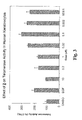
- Table 1 gives, for compositions containing each of the compounds shown in Figs. 1A-G , the minimum effective concentration (MEC) of the compound that produced a level of telomerase activity twice that seen in a DMSO control (i.e. 100% greater).
- wound healing activity as measured in a scratch assay refers to the activity as measured in keratinocytes or fibroblasts according to the following protocol, and expressed as the value of WH shown in the formula below.
- Cells are plated in flasks (5 x 10 5 cells per flask) and cultured for two days in a humidified chamber at 5% CO 2 , 37°C.
- a 2 ml plastic pipette is gently dragged to "scratch" the cell surface.
- the ideal wound is approximately 2-3 mm wide and 50 mm long (along the long axis of the tissue culture flask).
- the cells are retreated with medium containing either vehicle (DMSO; control sample) or test compositions at multiple concentrations. A wound area is identified, the flask marked, and the appearance of the cells documented photographically over 3-4 days continued culturing of the cells.
- Preferred compounds of formula I-III as described above are able to produce, at a concentration of 1 ⁇ g/ml or less, an amount of wound closure (wound healing activity) in a scratch assay of keratinocytes or fibroblasts, as described above, which is at least 25% greater than that seen in untreated or control cells. Even more potent activities may be appropriate for some applications, such as compounds that produce, at a concentration of 1 ⁇ g/ml or less, an amount of wound closure in a scratch assay of keratinocytes or fibroblasts which is at least about 50% or 100% greater than that seen in untreated or control cells.
- Wound healing activity of invention compounds 1 (astragaloside IV) and 2 (cycloastragenol) was evaluated in aging keratinocytes, via a scratch assay as described above. Results of a typical assay are shown in Fig. 4 , where the top row of images shows control cells (treated with solvent, DMSO), and the bottom row shows cells treated with 0.1 ⁇ g/ml (about 0.13 ⁇ M) 1 in the same solvent. The treated cells were confluent at day 4, in contrast to the control cells, in which a sizable "wound” remained at day 4. Similar results were seen with this composition and with 0.01 ⁇ M 2 (cycloastragenol) in young keratinocytes, as shown in Fig. 5 .
- Figure 6 shows the wound healing activity of a composition containing 1 (astragaloside IV) in aging adult keratinocytes, as measured in a similar assay, in the presence and absence of a telomerase inhibiting oligonucleotide (GRN163) and a control oligonucleotide (GRN1 37227).
- telomerase inhibiting oligo GRN163 blocks the wound healing effects of the 1 composition; the effect of control oligo GRN137226 is minimal.
- GRN163 is a telomerase inhibitor oligonucleotide that targets the template region of the telomerase RNA component.
- GRN163 is a 13-mer N3' ⁇ P5' thiophosphoramidate oligonucleotide, described in detail in PCT Pubn. No. WO 01/18015 .
- GRN137227 is a 13-mer N3' ⁇ P5' thiophosphoramidate control oligonucleotide having a mismatched sequence.
- Table 2 shows WH values (wound healing activity) for compounds 1 and 2 employed in the scratch assays shown in Figs. 5 and 6 , based on the results of those assays, using the formula shown above.
- Table 2 Approx. wound width (arbitrary units) WH cntrl WH test Day1 cntl Day4 cntl Day1 test Day1 test Fig. 4 ( 1 ) 22 10 17 0 54.5 100 Fig. 5 ( 1 ) 19 9 18 0 52.6 100 Fig. 5 ( 2 ) 19 9 21 2 52.6 90.5
- Figure 7 graphically illustrates wound closure as percent of control for invention compound 1 (astragaloside IV) in aging neonatal keratinocytes, in the presence and absence of a telomerase inhibitor (GRN163), and in comparison with 50 ng/mL (approx. 2 mL) PDGF (platelet derived growth factor). As shown, the effectiveness of 1 was comparable to that of PDGF, and was again blocked by the addition of GRN163.
- a telomerase inhibitor GRN163
- a "derivative" includes a compound produced by modification of a compound of formula I, II , or III in one or more of the following ways: conversion of a hydroxyl group to a lower alkyl carbamate, halogen, thiol, lower alkyl thioether, amino, lower alkylamino, lower alkyl amide, aldehyde, or keto group; addition of a lower alkyl group to such an aldehyde or keto group, or to an existing keto group (e.g.
- nucleophilic substitution which may include conversion of a hydroxyl group to a better leaving group, such as a tosylate; esterification; alkylation; oxidation; reduction; halogenation; hydration; hydrogenation; etc.
- a derivative of a compound of formula I, II , or III , formulated in a suitable solvent medium at one more concentrations, is screened in a TRAP assay of keratinocytes or fibroblasts as described above.
- Preferred derivatives for selection include those that are effective, when formulated in a solvent at a concentration of 1 ⁇ g/ml or less, to produce a level oftelomerase activity in keratinocytes or fibroblasts, as measured in a TRAP assay, at least 50% greater than that measured in said cells treated with said solvent.
- a derivative of formula I , II , or III formulated in a suitable solvent medium at one more concentrations, is assayed for wound healing activity in a scratch assay as described above.
- Preferred derivatives for selection include those having wound healing activity, at a concentration of 1 ⁇ g/ml or less, at least 25% greater, and more preferably at least 50% greater, than that of a solvent control.
- the present invention provides methods for increasing telomerase activity in a cell, by contacting a cell or tissue with a formulation of an isolated compound of formula I , II or III as disclosed in Section II above, in an amount effective to increase telomerase activity in the cell.
- the method may include the preliminary step of identifying a cell or tissue in which an increase telomerase activity is desired.
- the cell may be in culture, i.e. in vitro or ex vivo, or within a subject or patient in vivo .
- Benefits to be realized from an increase in telomerase activity in a cell or tissue include, for example, enhancement of the replicative capacity and/or life span of the contacted cells.
- the method may further comprise diagnosing a condition in a subject or patient wherein an increase in telomerase activity in cells or tissue of the patient is desired; e.g., diagnosing a disease subject to treatment by an increase in telomerase activity in cells or tissue.
- the invention provides methods of treating a condition in a patient, by increasing telomerase activity in cells or tissue of said patient, the method comprising administering to a subject in need of such treatment an effective amount of a compound of formula I, II or III as disclosed in Section II above.
- An "effective amount” refers to an amount effective to increase telomerase activity in the cells or tissue of the patient, such that a therapeutic result is achieved.
- Such conditions may include, for example, conditions associated with cellular senescence or with an increased rate of proliferation of a cell in the absence of telomerase, which leads to accelerated telomere repeat loss.
- increased rate of proliferation is meant a higher rate of cell division compared to normal cells of that cell type, or compared to normal cells within other individuals of that cell type. The senescence of those groups of cells at an abnormally early age can eventually lead to disease (see West et al., U.S. Patent No. 6,007,989 ).
- the invention provides methods of treating in a patient a condition selected from the following, by increasing telomerase activity in the cells of the patient, comprising administering to a subject in need of such treatment, an effective amount of a compound of formula I, II , or III as described above.
- the condition may also be subject to treatment by ex vivo cell therapy, as described further below, employing the associated cell types (indicated in parenthesis).
- telomerase activity in addition to the cell types noted above, further cell types in which an increase in telomerase activity can be therapeutically beneficial include, but are not limited to, cells of the liver, endocrine and exocrine glands, smooth musculature, or skeletal musculature.
- CD8 + cell turnover is increased as these cells attempt to control the level of HIV-infected CD4 + cells.
- AIDS in AIDS (item (g) above), disease is believed to be caused by the early senescence of HIV-restricted CD8 + cells. The aging of such cells is attributed not simply to abnormal amount of loss of telomere sequences per cell doubling, but, in addition, to the increased replicative rate of the cells, such that telomere attrition is greater than normal for that group of cells.
- the invention thus provides methods of treating an HIV infected subject, and more particularly of reducing early senescence of HIV-restricted CD8 + cells in an HIV infected subject, by administering to a subject in need of such treatment an effective amount of a compound of formula I, II or III as disclosed in Section II above.
- telomerase activity can benefit non-dividing cells as well as proliferating cells, e.g. in conditions associated with increased susceptibility to cell death due to stress, such as ischemia in heart failure or in stroke (see e.g. Oh and Schneider, J Mol Cell Cardiol 34(7):717-24 ; Mattson, Exp Gerontol. 35(4):489-502 ).
- the invention thus provides methods of reducing stress- or DNA-damage-induced cell death in a subject, such as a subject experiencing ischemic conditions in tissue due to heart failure or stroke, by increasing telomerase activity in cells of the subject, comprising administering to a subject in need of such treatment an effective amount of a compound of formula I , II or III as disclosed in Section II above.
- the method may include the preliminary step of diagnosing in the subject the indicated condition.
- the compositions may be used for the treatment of individuals in which one or more cell types are limiting in that patient, and whose life can be extended by extending the ability of those cells to continue replication or resist stress-induced cell death.
- One example of such a group of cells is lymphocytes present in Down's Syndrome patients.
- the invention thus provides a method of enhancing replicative capacity and/or life span of lymphocytes present in a Down's Syndrome patient, by increasing telomerase activity in said cells of the patient, comprising administering to such a patient an effective amount of a compound of formula I , II or III as disclosed in Section II above.
- the compositions may also be used to improve resistance to stress-induced cell death occurring during normal aging.
- telomerase activity is effective to promote healing of wounds, burns, abrasions or other acute or chronic conditions of the epidermis.
- the invention thus provides a method of treating an acute or chronic condition of the epidermis, by administering to a patient in need of such treatment, preferably topically to the affected area, an effective amount of a formulation of an isolated compound of formula I, II or III as disclosed in Section II above.
- an "acute or chronic condition of the epidermis” includes acute conditions such as lesions suffered in trauma, burns, abrasions, surgical incisions, donor graft sites, and lesions caused by infectious agents, and chronic conditions such as chronic venous ulcer, diabetic ulcer, compression ulcer, pressure sores, and ulcers or sores of the mucosal surface. Also included are skin or epithelial surface lesions caused by a persistent inflammatory condition or infection, or by a genetic defect (such as keloid formation and coagulation abnormalities). See, for example, PCT Pubn. No. WO 02/91999 .
- Desirable effects of an increase in telomerase activity in such treatment include cell proliferation or migration at the treatment site, epithelialization of the surface, closure of a wound if present, or restoration of normal physiological function.
- epithelialization or “reepithelialization” of a treatment site is meant an increase in density of epithelial cells at the site as a result of the applied therapy.
- the method may also be used to enhance growth of engrafted cells. Desirable effects of an increase in telomerase activity in such treatment include coverage of the treatment site, survival of engrafted cells, lack of immune rejection, closure of a wound if present, or restoration of normal physiological function. Engrafted cells may participate in wound closure either by participating directly in the healing process (for example, becoming part of the healed tissue), or by covering the wound and thereby providing an environment that promotes healing by host cells.
- the invention also contemplates manipulation of the skin and repair of any perceived defects in the skin surface for other purposes, such as cosmetic enhancement.
- the methods and compositions of the invention can be used to enhance replicative capacity and/or extend life span of cells in culture, e.g. in ex vivo cell therapy or in monoclonal antibody production, by increasing telomerase activity in the cells.
- Increasing telomerase activity increases the replicative capacity of such cells by slowing telomere repeat loss and/or improving resistance to stress-induced cell death during cell proliferation.
- an effective amount of a compound of formula I , II or III as described above is added to explant cells obtained from a subject.
- An "effective amount” refers to an amount effective to increase telomerase activity in the cells, thereby increasing the replicative capacity and/or life span of the cells.
- the explant cells may include, for example, stem cells, such as bone marrow stem cells ( U.S. Patent No. 6,007,989 ), bone marrow stromal cells ( Simonsen et al., Nat Biotechnol 20(6):592-6, 2002 ), or adrenocortical cells ( Thomas et al, Nat Biotechnol 18(1):39-42, 2000 ).
- stem cells such as bone marrow stem cells ( U.S. Patent No. 6,007,989 ), bone marrow stromal cells ( Simonsen et al., Nat Biotechnol 20(6):592-6, 2002 ), or adrenocortical cells ( Thomas et al, Nat Biotechnol 18(1):39-42, 2000 ).
- Disease conditions such as those noted in items (a)-(g) above may also be subject to ex vivo cell-based therapy. Examples include the use of muscle satellite cells for treatment of muscular dystrophy, osteoblasts to treat osteoporos
- the recognition that functional CD8 + cells are limiting in AIDS patients to control the expansion of infected CD4+ cells allows a therapeutic protocol to be devised in which HIV-restricted CD8 + cells are removed from an HIV-infected individual at an early stage, when AIDS is first detected, stored in a bank, and then reintroduced into the individual at a later stage, when that individual no longer has the required CD8 + cells available.
- an individual's life can be extended by a protocol involving continued administration of that individual's limiting cells at appropriate time points.
- These appropriate points can be determined by following CD8 + cell senescence, or by determining the length of telomeres within such CD8 + cells, as an indication of when those cells will become senescent.
- the stored cells can be expanded in number in the presence of an agent which slows telomere repeat loss, i.e. compound of formula I , II or III as disclosed in Section II above.
- the invention provides methods of ex vivo cell based therapy, which include obtaining a cell population from a subject, and expanding the cell population ex vivo , wherein the cell population is treated with a compound of formula I, II or III as disclosed in Section II above, in an amount effective to increase telomerase activity and thereby enhance the replicative capacity and/or life span of the cell population.
- the method generally includes diagnosing in a subject a condition subject to treatment by ex vivo cell based therapy, such as those noted above.
- the invention provides a method of stem cell proliferation, wherein a stem cell population is treated with a compound of formula I, II or III as disclosed in Section II above, in an amount effective to increase telomerase activity and thereby enhance the replicative capacity and/or life span of the cell population.
- the invention encompasses methods of preparing pharmaceutical compositions useful for increasing telomerase activity in a cell and/or promoting wound healing. Accordingly, an isolated compound of formula I , II or III as described in Section II is combined with a pharmaceutical excipient, and optionally with other medicinal agents, adjuvants, and the like, which may include active and inactive ingredients.
- the compositions may take the form of solid, semi-solid, lyophilized powder, or liquid dosage forms, such as, for example, tablets, capsules, powders, sustained-release formulations, solutions, suspensions, emulsions, suppositories, creams, ointments, lotions, aerosols, or the like.
- the formulations may be provided in unit dosage forms suitable for simple administration of precise dosages.
- An isolated compound of formula I , II or III may also be formulated as a dietary supplement or nutraceutical, for oral administration.
- suitable excipients include pharmaceutical grades of carriers such as mannitol, lactose, glucose, sucrose, starch, cellulose, gelatin, magnesium stearate, sodium saccharine, and/or magnesium carbonate.
- the composition may be prepared as a solution, suspension, emulsion, or syrup, being supplied either in solid or liquid form suitable for hydration in an aqueous carrier, such as, for example, aqueous saline, aqueous dextrose, glycerol, or ethanol, preferably water or normal saline.
- an aqueous carrier such as, for example, aqueous saline, aqueous dextrose, glycerol, or ethanol, preferably water or normal saline.
- the composition may also contain minor amounts of non-toxic auxiliary substances such as wetting agents, emulsifying agents, or buffers.
- An isolated compound of formula I , II or III may also be incorporated into existing nutraceutical formulations, such as are available conventionally, which may also include an herbal extract, such as an extract of Astragalus membranaceus.
- a compound of formula I , II or III is formulated for topical administration.
- the vehicle for topical application may be in one of various forms, e.g. a lotion, cream, gel, ointment, stick, spray, or paste.
- These product forms can be formulated according to well known methods. They may comprise various types of carriers, including, but not limited to, solutions, aerosols, emulsions, gels, and liposomes.
- the carrier may be formulated, for example, as an emulsion, having an oil-in-water or water-in-oil base.
- Suitable hydrophobic (oily) components employed in emulsions include, for example, vegetable oils, animal fats and oils, synthetic hydrocarbons, and esters and alcohols thereof, including polyesters, as well as organopolysiloxane oils.
- Such emulsions also include an emulsifier and/or surfactant, e.g. a nonionic surfactant, such as are well known in the art, to disperse and suspend the discontinuous phase within the continuous phase.
- the topical formulation typically contains one or more components selected from a structuring agent, a thickener or gelling agent, and an emollient or lubricant.
- a structuring agent include long chain alcohols, such as stearyl alcohol, and glyceryl ethers or esters and oligo(ethylene oxide) ethers or esters thereof.
- Thickeners and gelling agents include, for example, polymers of acrylic or methacrylic acid and esters thereof, polyacrylamides, and naturally occurring thickeners such as agar, carrageenan, gelatin, and guar gum.
- emollients include triglyceride esters, fatty acid esters and amides, waxes such as beeswax, spermaceti, or carnauba wax, phospholipids such as lecithin, and sterols and fatty acid esters thereof.
- the topical formulations may further include other components as known in the art, e.g. astringents, fragrances, pigments, skin penetration enhancing agents, sunscreens, etc.
- compositions may also be formulated for administration parenterally, transdermally, or by inhalation.
- An injectable composition for parenteral administration typically contains the active compound in a suitable IV solution, such as sterile physiological saline.
- the composition may also formulated as a suspension in a lipid or phospholipid, in a liposomal suspension, or in an aqueous emulsion.
- the active compound is formulated as solid or liquid aerosol particles.
- the formulation may also include a propellant and/or a dispersant, such as lactose, to facilitate aerosol formation.
- a transdermal administration the active compound is preferably included in a transdermal patch, which allows for slow delivery of compound to a selected skin region, and which may also include permeation enhancing substances, such as aliphatic alcohols or glycerol.
- composition to be administered will contain a quantity of the selected compound in a pharmaceutically safe and effective amount for increasing telomerase activity in the target cells or tissue.
- the pharmaceutical or nutraceutical composition contains at least 0.1% (w/v) of a compound of formula I , II or III as described above, preferably greater than 0.1 %, up to about 10%, preferably up to about 5%, and more preferably up to about 1% (w/v).
- Choice of a suitable concentration depends on factors such as the desired dose, frequency and method of delivery of the active agent.
- dosages are determined based on factors such as the weight and overall health of the subject, the condition treated, severity of symptoms, etc. Dosages and concentrations are determined to produce the desired benefit while avoiding any undesirable side effects.
- Typical dosages of the subject compounds are in the range of about 0.5 to 500 mg/day for a human patient, preferably about 1-100 mg/day.
- higher dose regimens include e.g. 50-100, 75-100, or 50-75 mg/day
- lower dose regimens include e.g. 1-50, 25-50, or 1-25 mg/day.
- the compound designated herein as 2 is administered at a level of at least 1 mg/day, preferably at least 5 mg/day; or the compound designated herein as 1 (astragaloside IV) is administered at a level of at least 50 mg/day, preferably at least 100 mg/day.
- the 3, 6, 16-trione derivative 11 of cycloastragenol was obtained by CrO 3 oxidation of 2, according to the method of Kitagawa et al., Chem. Pharm. Bull. 31(2):689-697 (1983a ).
- Example 7B Methylation of 3,6-diacetyl cycloastragenol ( 14 ), with retention of acetyl groups
- Example 7D Alkylation of 3,6-diacetyl cycloastragenol ( 14) , with retention of acetyl groups
- Example 9A Alkylation of free hydroxyls of cycloastragenol monoglycoside 6
- Example 10A Alkylation of free hydroxyls of cycloastragenol monoglycoside 7
- the present invention relates to the following items:
Landscapes
- Health & Medical Sciences (AREA)
- Life Sciences & Earth Sciences (AREA)
- Chemical & Material Sciences (AREA)
- General Health & Medical Sciences (AREA)
- Veterinary Medicine (AREA)
- Pharmacology & Pharmacy (AREA)
- Public Health (AREA)
- Medicinal Chemistry (AREA)
- Animal Behavior & Ethology (AREA)
- Organic Chemistry (AREA)
- Engineering & Computer Science (AREA)
- Nuclear Medicine, Radiotherapy & Molecular Imaging (AREA)
- General Chemical & Material Sciences (AREA)
- Chemical Kinetics & Catalysis (AREA)
- Bioinformatics & Cheminformatics (AREA)
- Epidemiology (AREA)
- Natural Medicines & Medicinal Plants (AREA)
- Diabetes (AREA)
- Physical Education & Sports Medicine (AREA)
- Hematology (AREA)
- Molecular Biology (AREA)
- Oncology (AREA)
- Virology (AREA)
- Communicable Diseases (AREA)
- Biomedical Technology (AREA)
- Rheumatology (AREA)
- Neurology (AREA)
- Neurosurgery (AREA)
- Alternative & Traditional Medicine (AREA)
- Biotechnology (AREA)
- Botany (AREA)
- Medical Informatics (AREA)
- Microbiology (AREA)
- Mycology (AREA)
- Dermatology (AREA)
- Orthopedic Medicine & Surgery (AREA)
- Obesity (AREA)
- Cardiology (AREA)
- Heart & Thoracic Surgery (AREA)
- Tropical Medicine & Parasitology (AREA)
Priority Applications (3)
| Application Number | Priority Date | Filing Date | Title |
|---|---|---|---|
| PL12180710T PL2548880T3 (pl) | 2003-06-23 | 2004-06-23 | Kompozycje powodujące wzrost aktywności telomerazy |
| SI200432463T SI2548880T1 (sl) | 2003-06-23 | 2004-06-23 | Sestavki za povečanje telomerazne aktivnosti |
| HRP20190322TT HRP20190322T1 (hr) | 2003-06-23 | 2019-02-18 | Pripravci namijenjeni povećavanju aktivnosti telomeraze |
Applications Claiming Priority (3)
| Application Number | Priority Date | Filing Date | Title |
|---|---|---|---|
| US48098803P | 2003-06-23 | 2003-06-23 | |
| EP04777032.6A EP1644009B1 (de) | 2003-06-23 | 2004-06-23 | Zusammensetzungen zur erhöhung der telomerase-aktivität under zur behandlung von hiv-infektion |
| PCT/US2004/020277 WO2005000245A2 (en) | 2003-06-23 | 2004-06-23 | Compositions and methods for increasing telomerase activity |
Related Parent Applications (3)
| Application Number | Title | Priority Date | Filing Date |
|---|---|---|---|
| EP04777032.6A Division EP1644009B1 (de) | 2003-06-23 | 2004-06-23 | Zusammensetzungen zur erhöhung der telomerase-aktivität under zur behandlung von hiv-infektion |
| EP04777032.6A Division-Into EP1644009B1 (de) | 2003-06-23 | 2004-06-23 | Zusammensetzungen zur erhöhung der telomerase-aktivität under zur behandlung von hiv-infektion |
| EP04777032.6 Division | 2004-06-23 |
Publications (3)
| Publication Number | Publication Date |
|---|---|
| EP2548880A2 true EP2548880A2 (de) | 2013-01-23 |
| EP2548880A3 EP2548880A3 (de) | 2013-06-19 |
| EP2548880B1 EP2548880B1 (de) | 2019-01-09 |
Family
ID=33551962
Family Applications (2)
| Application Number | Title | Priority Date | Filing Date |
|---|---|---|---|
| EP12180710.1A Expired - Lifetime EP2548880B1 (de) | 2003-06-23 | 2004-06-23 | Zusammensetzungen zur Erhöhung der Telomeraseaktivität |
| EP04777032.6A Expired - Lifetime EP1644009B1 (de) | 2003-06-23 | 2004-06-23 | Zusammensetzungen zur erhöhung der telomerase-aktivität under zur behandlung von hiv-infektion |
Family Applications After (1)
| Application Number | Title | Priority Date | Filing Date |
|---|---|---|---|
| EP04777032.6A Expired - Lifetime EP1644009B1 (de) | 2003-06-23 | 2004-06-23 | Zusammensetzungen zur erhöhung der telomerase-aktivität under zur behandlung von hiv-infektion |
Country Status (24)
| Country | Link |
|---|---|
| US (3) | US7846904B2 (de) |
| EP (2) | EP2548880B1 (de) |
| JP (4) | JP5583882B2 (de) |
| KR (3) | KR101465515B1 (de) |
| CN (1) | CN1809364B (de) |
| AP (1) | AP2280A (de) |
| AU (2) | AU2004251753C1 (de) |
| BR (1) | BRPI0411856A (de) |
| CA (1) | CA2528483C (de) |
| CY (2) | CY1119951T1 (de) |
| DK (2) | DK1644009T3 (de) |
| EA (1) | EA009442B1 (de) |
| ES (2) | ES2716528T3 (de) |
| HR (2) | HRP20180330T1 (de) |
| HU (2) | HUE043168T2 (de) |
| LT (2) | LT2548880T (de) |
| MX (1) | MXPA05013844A (de) |
| NZ (1) | NZ544191A (de) |
| PL (2) | PL2548880T3 (de) |
| PT (2) | PT2548880T (de) |
| SI (2) | SI2548880T1 (de) |
| TR (2) | TR201802543T4 (de) |
| WO (1) | WO2005000245A2 (de) |
| ZA (1) | ZA200509846B (de) |
Families Citing this family (47)
| Publication number | Priority date | Publication date | Assignee | Title |
|---|---|---|---|---|
| US7585622B1 (en) | 1996-10-01 | 2009-09-08 | Geron Corporation | Increasing the proliferative capacity of cells using telomerase reverse transcriptase |
| US6337200B1 (en) | 1998-03-31 | 2002-01-08 | Geron Corporation | Human telomerase catalytic subunit variants |
| AP2280A (en) * | 2003-06-23 | 2011-10-31 | Geron Corp | Compositions and methods for increasing telomeraseactivity. |
| US9248088B2 (en) | 2003-06-25 | 2016-02-02 | Telomerase Activation Sciences, Inc. | Compositions and methods for skin conditioning |
| EP1876893B1 (de) | 2005-04-15 | 2012-04-11 | Geron Corporation | Behandlung von krebs durch die kombinierte hemmung der proteasom- und telomeraseaktivitäten |
| US8197860B2 (en) * | 2005-06-23 | 2012-06-12 | Nuliv Holding Inc. | Method for enhancing nutrient absorption with astragalosides |
| CN100333731C (zh) * | 2005-09-08 | 2007-08-29 | 南京医科大学 | 黄芪甲苷在制备治疗糖尿病周围神经病变药物中的应用 |
| CN100384830C (zh) * | 2006-01-12 | 2008-04-30 | 天津药物研究院 | 环黄芪醇类衍生物以及用途 |
| US7992749B2 (en) | 2006-03-30 | 2011-08-09 | Nike, Inc. | Support element for a carry strap |
| EP4600359A2 (de) | 2006-10-30 | 2025-08-13 | Geron Corporation | Kombination aus telomerasehemmer und gemcitabin zur behandlung von krebs |
| PT2152663E (pt) | 2007-06-04 | 2014-06-03 | Univ Ben Gurion | Compostos de triarilo e composições que compreendem os mesmos |
| CN101225424B (zh) * | 2007-09-13 | 2013-05-29 | 天津药物研究院 | 环黄芪醇的单葡萄糖苷、其制备方法、药物组合物和应用 |
| US8168596B2 (en) * | 2008-10-17 | 2012-05-01 | Nuliv Holding Inc. | Use of cycloartane compounds for treating arthritis |
| EP2437606B1 (de) * | 2009-05-18 | 2016-07-27 | Telomerase Activation Sciences, Inc. | Zusammensetzungen und verfahren zur erhöhung telomerase-aktivität |
| WO2014186603A1 (en) * | 2013-05-15 | 2014-11-20 | Fybrands Corp. | Compositions for improving the hair, skin, and nails |
| EP3065723B1 (de) | 2013-11-05 | 2020-09-23 | Ben Gurion University of the Negev Research and Development Authority | Verbindungen zur behandlung von diabetes und assoziierten komplikationen |
| CN104435370A (zh) * | 2014-12-06 | 2015-03-25 | 王香平 | 风湿保健酒 |
| CN104435371A (zh) * | 2014-12-06 | 2015-03-25 | 郭亮 | 一种用于治疗关节炎的药酒 |
| CN104491185A (zh) * | 2014-12-06 | 2015-04-08 | 郭亮 | 一种祛风湿药酒及其制备方法 |
| KR20160069857A (ko) | 2014-12-09 | 2016-06-17 | (주)스피어테크 | 텔로미어 활성을 증가시키기 위한 조성물 및 그 조성물의 제조방법 |
| CN104817610A (zh) * | 2015-03-15 | 2015-08-05 | 北京化工大学 | 利用硫酸水解制备环黄芪醇的方法 |
| US10100285B2 (en) | 2015-04-03 | 2018-10-16 | Propagenix Inc. | Ex vivo proliferation of epithelial cells |
| CN107636149A (zh) | 2015-04-03 | 2018-01-26 | 普罗帕格尼克斯公司 | 上皮细胞的离体增殖 |
| CN106474094A (zh) * | 2015-08-31 | 2017-03-08 | 南京理工大学 | 一种环黄芪醇电纺纤维膜及其制备方法 |
| JP6869231B2 (ja) | 2015-09-11 | 2021-05-12 | プロパジェニクス インコーポレイテッド | ex vivoでの上皮細胞の増殖 |
| CN106307522A (zh) * | 2016-11-06 | 2017-01-11 | 谭淞文 | 一种抗衰老保健品及其制备方法和食用方法 |
| CN106831927B (zh) * | 2017-02-07 | 2018-02-09 | 江西师范大学 | 一种黄芪甲苷的合成方法 |
| CN108498521B (zh) * | 2017-02-24 | 2020-05-05 | 北京大学 | 环黄芪醇在制备抑制腹主动脉瘤的药物中的应用 |
| US10098922B1 (en) | 2017-11-30 | 2018-10-16 | Optigenex, Inc. | Increasing telomere length in a cell |
| CA3145888A1 (en) * | 2018-07-31 | 2020-02-06 | Isilay KAVADARLI | Ophthalmic formulations and uses thereof |
| KR102655940B1 (ko) | 2018-08-13 | 2024-04-11 | (주)아모레퍼시픽 | 신규 진세노사이드, 및 이를 포함하는 항염 조성물 |
| KR102635196B1 (ko) | 2018-10-17 | 2024-02-13 | (주)아모레퍼시픽 | 신규 진세노사이드를 포함하는 미백 조성물 |
| US11000537B2 (en) | 2018-10-17 | 2021-05-11 | Amorepacific Corporation | Composition comprising novel ginsenoside |
| US11000538B2 (en) | 2018-10-31 | 2021-05-11 | Amorepacific Corporation | Composition for enhancing exercise ability or anti-fatigue comprising novel ginsenoside |
| US12697340B2 (en) | 2018-11-20 | 2026-08-04 | Juvn3 Holdings, Llc | Compositions and methods for cellular ageing, stress resilience, autophagy, inflammation and longevity |
| WO2020131058A1 (en) * | 2018-12-20 | 2020-06-25 | Muhammed Majeed | Telomerase enhancement potential of ecdysterone |
| CN109942663B (zh) * | 2019-04-22 | 2021-10-26 | 中国人民解放军联勤保障部队第九八九医院 | 利用双相酸水解制备环黄芪醇的方法 |
| MX2019006749A (es) | 2019-06-10 | 2022-11-28 | Univ Mexico Nac Autonoma | Compuestos activadores de senescencia celular. |
| KR102842908B1 (ko) | 2019-09-27 | 2025-08-07 | (주)아모레퍼시픽 | 신규 진세노사이드를 포함하는 피부 탄력 개선용 조성물 |
| KR102842907B1 (ko) | 2019-09-27 | 2025-08-07 | (주)아모레퍼시픽 | 신규 진세노사이드를 포함하는 갱년기 증상의 예방 또는 개선용 조성물 |
| CN111419854B (zh) * | 2020-05-18 | 2021-03-30 | 南通大学 | 具有特殊七元环结构的三萜在制备预防和治疗神经损伤药物中的应用 |
| US12305233B1 (en) | 2020-07-09 | 2025-05-20 | Arizona Board Of Regents On Behalf Of Arizona | Ultra-high-throughput assay for telomerase repeat addition processivity |
| CN113480628B (zh) * | 2021-08-17 | 2022-06-21 | 贵州师范大学 | 一种贵州疣螈多肽tk-cath及其编码基因和应用 |
| CN113968894B (zh) * | 2021-11-05 | 2024-05-28 | 山西大学 | 一种用黄芪甲苷降解制备环黄芪醇的方法 |
| KR102666469B1 (ko) * | 2023-05-04 | 2024-05-17 | 주식회사 아리바이오 | 텔로머라제 활성화제와 나노 입자를 포함하는 약물 전달용 조성물 및 이를 포함하는 탈모 예방, 개선 또는 치료용 조성물 |
| CN119818509B (zh) * | 2025-02-10 | 2025-10-17 | 山西中医药大学 | 黄芪醇在制备治疗或缓解帕金森病的产品中的应用 |
| CN120137936A (zh) * | 2025-03-14 | 2025-06-13 | 北京娅熙妍国际贸易有限公司 | 端粒酶变体及其在抗衰老中的应用 |
Citations (18)
| Publication number | Priority date | Publication date | Assignee | Title |
|---|---|---|---|---|
| JPS6212791A (ja) | 1986-07-18 | 1987-01-21 | Osaka Chem Lab | オウギサポニン、その単離法およびその用途 |
| US5583016A (en) | 1994-07-07 | 1996-12-10 | Geron Corporation | Mammalian telomerase |
| US5629154A (en) | 1993-11-12 | 1997-05-13 | Geron Corporation | Telomerase activity assays |
| US5770578A (en) | 1994-03-16 | 1998-06-23 | Bergi Gmbh | Use of triterpensaponins, such as notoginsenoside R1 (NR1) and/or astragaloside (ASIV) for preparing medicaments |
| US5891639A (en) | 1993-11-12 | 1999-04-06 | Geron Corporation | Telomerase activity assays |
| WO1999035243A2 (en) | 1998-01-12 | 1999-07-15 | Cold Spring Harbor Laboratory | Extension of cellular lifespan, methods and reagents |
| US6007989A (en) | 1992-05-13 | 1999-12-28 | Board Of Regents, The University Of Texas System | Methods of screening for compounds that derepress or increase telomerase activity |
| WO2000008135A1 (en) | 1998-08-09 | 2000-02-17 | Board Of Regents, The University Of Texas System | Methods and compositions for inhibiting or stimulating telomerase assembly |
| WO2000031238A2 (en) | 1998-11-25 | 2000-06-02 | Genetica, Inc. | Methods and reagents for increasing proliferative capacity and preventing replicative senescence |
| US6093809A (en) | 1996-10-01 | 2000-07-25 | University Technology Corporation | Telomerase |
| US6166178A (en) | 1996-10-01 | 2000-12-26 | University Technology Corporation | Telomerase catalytic subunit |
| WO2001001996A1 (en) | 1999-06-29 | 2001-01-11 | University Of Western Australia | Compositions and methods for treating or preventing osteoporosis |
| WO2001018015A1 (en) | 1999-09-10 | 2001-03-15 | Geron Corporation | Oligonucleotide n3'→p5' thiophosphoramidates: their synthesis and use |
| US6261836B1 (en) | 1996-10-01 | 2001-07-17 | Geron Corporation | Telomerase |
| WO2001092289A1 (en) | 2000-05-31 | 2001-12-06 | Japan Science And Technology Corporation | SKIN TISSUE REGENERATION PROMOTERS COMPRISING GINSENOSIDE Rb1 |
| WO2002007732A2 (en) | 2000-07-26 | 2002-01-31 | Cambridge University Technical Services Limited | Use of panaxatriol for stimulation angiogenesis |
| WO2002069980A2 (en) | 2001-03-07 | 2002-09-12 | Cambridge University Technical Services Limited | Pharmaceutically effective ginsenosides and their use |
| WO2002091999A2 (en) | 2001-05-09 | 2002-11-21 | Geron Corporation | Treatment for wounds |
Family Cites Families (45)
| Publication number | Priority date | Publication date | Assignee | Title |
|---|---|---|---|---|
| JPS6212792A (ja) * | 1986-07-18 | 1987-01-21 | Osaka Chem Lab | オウギサポニン類の単離法 |
| IT1259645B (it) | 1992-04-10 | 1996-03-25 | Solis Srl | Metodo per la rivelazione della variazione di densita' di un tessuto e dispositivo per la sua attuazione |
| FR2695561B1 (fr) | 1992-09-17 | 1994-12-02 | Lvmh Rech Gie | Composition cosmétique ou dermatologique contenant au moins une saponine de type ginsenoside, et ses applications, notamment pour le soin des cheveux. |
| JPH07238026A (ja) * | 1994-02-25 | 1995-09-12 | Pola Chem Ind Inc | 動脈硬化抑制剤及びこれを含む食品又は医薬 |
| JPH10505488A (ja) * | 1994-07-07 | 1998-06-02 | ジェロン コーポレイション | 哺乳動物のテロメラーゼ |
| US6162459A (en) * | 1995-02-24 | 2000-12-19 | National Science Council | Acyclovir transdermal delivery system |
| AUPN411195A0 (en) * | 1995-07-10 | 1995-08-03 | Cathay Herbal Laboratories Pty Ltd | Medicinal composition |
| CN1079265C (zh) | 1995-08-01 | 2002-02-20 | 裴国增 | 灵芝口服液及其配制方法 |
| US5785977A (en) * | 1996-02-07 | 1998-07-28 | Breithbarth; Richard | Non-metallic microparticle carrier materials |
| US5916565A (en) * | 1996-03-08 | 1999-06-29 | In Clover, Inc. | Product and method for treating joint disorders in vertebrates |
| TW452494B (en) * | 1996-03-12 | 2001-09-01 | Jang De Shan | Herbal composition for stimulating blood circulation |
| US5900226A (en) * | 1997-04-09 | 1999-05-04 | Uop Llc | Drying agents for non-foamed polyurethanes |
| JPH1036388A (ja) * | 1996-07-25 | 1998-02-10 | Kureha Chem Ind Co Ltd | ジンセノサイド類含有hsp47合成抑制剤 |
| WO1998032454A1 (en) * | 1997-01-28 | 1998-07-30 | D'amelio, Frank | Centipeda plant extract |
| US5786343A (en) * | 1997-03-05 | 1998-07-28 | Immudyne, Inc. | Phagocytosis activator compositions and their use |
| WO1999012519A1 (en) * | 1997-09-05 | 1999-03-18 | The Procter & Gamble Company | Cleansing and conditioning products for skin or hair with improved deposition of conditioning ingredients |
| CA2302561C (en) * | 1997-09-12 | 2006-02-14 | The Procter & Gamble Company | Cleansing and conditioning article for skin or hair |
| GB9815177D0 (en) * | 1998-07-13 | 1998-09-09 | King S College London | Treatment of skin disorders |
| JP2000204091A (ja) * | 1999-01-13 | 2000-07-25 | Nippon Suisan Kaisha Ltd | 新規ベンゾジオキソ―ル誘導体 |
| JP2000229827A (ja) * | 1999-02-05 | 2000-08-22 | Kose Corp | 皮膚外用剤 |
| JP2000229834A (ja) * | 1999-02-10 | 2000-08-22 | Kanebo Ltd | 化粧料 |
| JP2001258505A (ja) * | 2000-03-24 | 2001-09-25 | Fancl Corp | 食品組成物 |
| CA2307393A1 (en) * | 2000-05-01 | 2001-11-01 | The University Of British Columbia | Ginsenoside chemotherapy |
| US6277396B1 (en) * | 2000-05-11 | 2001-08-21 | Maximum Human Performance, Inc. | Dietary supplement containing a thermogenic substance and an adrenal support substance |
| CN1172677C (zh) * | 2000-07-14 | 2004-10-27 | 复旦大学附属中山医院 | 黄芪甲苷在制备药物组合物中的应用 |
| US6696094B2 (en) * | 2000-10-18 | 2004-02-24 | Tzu-Sheng Wu | Herbal pharmaceutical composition for treatment of HIV/AIDS patients |
| CN1242807C (zh) * | 2000-11-08 | 2006-02-22 | 天津市延龄营养保健品有限公司 | 一种抗皮肤过敏的药物组合物及其制法和用途 |
| CN1369276A (zh) * | 2001-02-12 | 2002-09-18 | 徐秀荣 | 有效减轻体重的组合物和方法 |
| JP2002275086A (ja) * | 2001-03-15 | 2002-09-25 | Fancl Corp | 虚弱体質改善用組成物 |
| US20020182272A1 (en) * | 2001-05-30 | 2002-12-05 | Bruce Halstead | Methods of treatment of HIV-associated conditions |
| US20040180938A1 (en) | 2001-07-03 | 2004-09-16 | Akio Ohtani | Novel butadiene derivatives, process for preparation of the same and intermediates for the synthesis thereof |
| JP2003089687A (ja) * | 2001-07-03 | 2003-03-28 | Tanabe Seiyaku Co Ltd | 新規ブタジエン誘導体、その製法およびその合成中間体 |
| US6855344B2 (en) * | 2001-07-17 | 2005-02-15 | Integrated Chinese Medicine Holdings, Ltd. | Compositions and methods for prostate and kidney health and disorders, an herbal preparation |
| US20030108629A1 (en) * | 2001-07-17 | 2003-06-12 | Chou Wen Hsien | Compositions and methods for prostate and kidney health and disorders, an herbal preparation |
| CN1164608C (zh) * | 2001-08-31 | 2004-09-01 | 上海中医药大学 | 具有抗心肌纤维化作用的黄芪皂甙甲 |
| CN1406585A (zh) | 2001-09-07 | 2003-04-02 | 中国科学院上海药物研究所 | 一种治疗病毒性心肌炎的药物组合物 |
| JP2003160497A (ja) * | 2001-11-22 | 2003-06-03 | Toshin Kagaku Kk | 皮膚外用剤 |
| WO2003066814A2 (en) * | 2002-02-04 | 2003-08-14 | Ceremedix, Inc. | Peptide-dependent upregulation of telomerase expression |
| CN1236803C (zh) | 2002-03-20 | 2006-01-18 | 郑国芃 | 一种治疗风湿症的中药 |
| CN1189176C (zh) * | 2002-07-22 | 2005-02-16 | 江苏正大天晴药业股份有限公司 | 黄芪甲甙组合物及其制备方法 |
| WO2004096251A1 (en) * | 2003-03-26 | 2004-11-11 | Westlake Partners | Herbal compositions and methods for effecting weight loss in humans |
| WO2004112724A2 (en) * | 2003-06-20 | 2004-12-29 | Viral Genomix, Inc. | Compositions for and methods for treating hiv |
| AP2280A (en) * | 2003-06-23 | 2011-10-31 | Geron Corp | Compositions and methods for increasing telomeraseactivity. |
| US9248088B2 (en) * | 2003-06-25 | 2016-02-02 | Telomerase Activation Sciences, Inc. | Compositions and methods for skin conditioning |
| US20070122501A1 (en) * | 2003-06-27 | 2007-05-31 | Hong Kong University Of Science And Technology | Formulations containing astragalus extracts and uses thereof |
-
2004
- 2004-06-23 AP AP2005003474A patent/AP2280A/xx active
- 2004-06-23 HU HUE12180710A patent/HUE043168T2/hu unknown
- 2004-06-23 PL PL12180710T patent/PL2548880T3/pl unknown
- 2004-06-23 EA EA200600076A patent/EA009442B1/ru unknown
- 2004-06-23 ES ES12180710T patent/ES2716528T3/es not_active Expired - Lifetime
- 2004-06-23 EP EP12180710.1A patent/EP2548880B1/de not_active Expired - Lifetime
- 2004-06-23 SI SI200432463T patent/SI2548880T1/sl unknown
- 2004-06-23 NZ NZ544191A patent/NZ544191A/en not_active IP Right Cessation
- 2004-06-23 LT LTEP12180710.1T patent/LT2548880T/lt unknown
- 2004-06-23 HU HUE04777032A patent/HUE036559T2/hu unknown
- 2004-06-23 BR BRPI0411856-1A patent/BRPI0411856A/pt not_active Application Discontinuation
- 2004-06-23 US US10/562,374 patent/US7846904B2/en not_active Expired - Lifetime
- 2004-06-23 ES ES04777032.6T patent/ES2666864T3/es not_active Expired - Lifetime
- 2004-06-23 PT PT12180710T patent/PT2548880T/pt unknown
- 2004-06-23 LT LTEP04777032.6T patent/LT1644009T/lt unknown
- 2004-06-23 DK DK04777032.6T patent/DK1644009T3/en active
- 2004-06-23 TR TR2018/02543T patent/TR201802543T4/tr unknown
- 2004-06-23 CA CA2528483A patent/CA2528483C/en not_active Expired - Lifetime
- 2004-06-23 KR KR1020137031630A patent/KR101465515B1/ko not_active Expired - Lifetime
- 2004-06-23 ZA ZA200509846A patent/ZA200509846B/en unknown
- 2004-06-23 SI SI200432425T patent/SI1644009T1/en unknown
- 2004-06-23 JP JP2006517617A patent/JP5583882B2/ja not_active Expired - Lifetime
- 2004-06-23 KR KR1020117017367A patent/KR20110089887A/ko not_active Ceased
- 2004-06-23 AU AU2004251753A patent/AU2004251753C1/en not_active Ceased
- 2004-06-23 PT PT47770326T patent/PT1644009T/pt unknown
- 2004-06-23 TR TR2019/03587T patent/TR201903587T4/tr unknown
- 2004-06-23 EP EP04777032.6A patent/EP1644009B1/de not_active Expired - Lifetime
- 2004-06-23 DK DK12180710.1T patent/DK2548880T3/en active
- 2004-06-23 PL PL04777032T patent/PL1644009T3/pl unknown
- 2004-06-23 WO PCT/US2004/020277 patent/WO2005000245A2/en not_active Ceased
- 2004-06-23 HR HRP20180330TT patent/HRP20180330T1/hr unknown
- 2004-06-23 KR KR1020057024720A patent/KR101312389B1/ko not_active Expired - Lifetime
- 2004-06-23 MX MXPA05013844A patent/MXPA05013844A/es active IP Right Grant
- 2004-06-23 CN CN2004800172464A patent/CN1809364B/zh not_active Expired - Lifetime
-
2008
- 2008-11-25 AU AU2008249200A patent/AU2008249200A1/en not_active Abandoned
-
2010
- 2010-03-05 US US12/718,812 patent/US8759304B2/en not_active Expired - Fee Related
-
2011
- 2011-02-21 JP JP2011035191A patent/JP5841337B2/ja not_active Expired - Lifetime
-
2013
- 2013-10-23 JP JP2013219989A patent/JP5913253B2/ja not_active Expired - Fee Related
-
2014
- 2014-06-24 US US14/313,698 patent/US20150093455A1/en not_active Abandoned
-
2016
- 2016-01-04 JP JP2016000130A patent/JP2016041770A/ja not_active Withdrawn
-
2018
- 2018-02-26 CY CY20181100225T patent/CY1119951T1/el unknown
-
2019
- 2019-02-18 HR HRP20190322TT patent/HRP20190322T1/hr unknown
- 2019-03-22 CY CY20191100342T patent/CY1121447T1/el unknown
Patent Citations (19)
| Publication number | Priority date | Publication date | Assignee | Title |
|---|---|---|---|---|
| JPS6212791A (ja) | 1986-07-18 | 1987-01-21 | Osaka Chem Lab | オウギサポニン、その単離法およびその用途 |
| US6007989A (en) | 1992-05-13 | 1999-12-28 | Board Of Regents, The University Of Texas System | Methods of screening for compounds that derepress or increase telomerase activity |
| US5629154A (en) | 1993-11-12 | 1997-05-13 | Geron Corporation | Telomerase activity assays |
| US5891639A (en) | 1993-11-12 | 1999-04-06 | Geron Corporation | Telomerase activity assays |
| US5770578A (en) | 1994-03-16 | 1998-06-23 | Bergi Gmbh | Use of triterpensaponins, such as notoginsenoside R1 (NR1) and/or astragaloside (ASIV) for preparing medicaments |
| US5583016A (en) | 1994-07-07 | 1996-12-10 | Geron Corporation | Mammalian telomerase |
| US6261836B1 (en) | 1996-10-01 | 2001-07-17 | Geron Corporation | Telomerase |
| US6093809A (en) | 1996-10-01 | 2000-07-25 | University Technology Corporation | Telomerase |
| US6166178A (en) | 1996-10-01 | 2000-12-26 | University Technology Corporation | Telomerase catalytic subunit |
| WO1999035243A2 (en) | 1998-01-12 | 1999-07-15 | Cold Spring Harbor Laboratory | Extension of cellular lifespan, methods and reagents |
| WO2000008135A1 (en) | 1998-08-09 | 2000-02-17 | Board Of Regents, The University Of Texas System | Methods and compositions for inhibiting or stimulating telomerase assembly |
| WO2000031238A2 (en) | 1998-11-25 | 2000-06-02 | Genetica, Inc. | Methods and reagents for increasing proliferative capacity and preventing replicative senescence |
| WO2001001996A1 (en) | 1999-06-29 | 2001-01-11 | University Of Western Australia | Compositions and methods for treating or preventing osteoporosis |
| WO2001018015A1 (en) | 1999-09-10 | 2001-03-15 | Geron Corporation | Oligonucleotide n3'→p5' thiophosphoramidates: their synthesis and use |
| WO2001092289A1 (en) | 2000-05-31 | 2001-12-06 | Japan Science And Technology Corporation | SKIN TISSUE REGENERATION PROMOTERS COMPRISING GINSENOSIDE Rb1 |
| EP1295893A1 (de) | 2000-05-31 | 2003-03-26 | Japan Science and Technology Corporation | Ginsenoside zur förderung der hautgeweberegeneration |
| WO2002007732A2 (en) | 2000-07-26 | 2002-01-31 | Cambridge University Technical Services Limited | Use of panaxatriol for stimulation angiogenesis |
| WO2002069980A2 (en) | 2001-03-07 | 2002-09-12 | Cambridge University Technical Services Limited | Pharmaceutically effective ginsenosides and their use |
| WO2002091999A2 (en) | 2001-05-09 | 2002-11-21 | Geron Corporation | Treatment for wounds |
Non-Patent Citations (57)
| Title |
|---|
| "Remington's Pharmaceutical Sciences", 1995, WILLIAMS & WILKINS |
| ALLSOPP, R.C. ET AL.: "Telomerase is required to slow telomere shortening and extend replicative lifespan of HSC during serial transplantation", BLOOD, 27 March 2003 (2003-03-27) |
| ALLSOPP, R.C. ET AL.: "Telomere shortening is associated with cell division in vitro and in vivo", EXP. CELL RES., vol. 220, no. 1, September 1995 (1995-09-01), pages 194 - 200 |
| BEDIR, E. ET AL.: "Immunostimulatory effects of cycloartane-type triterpene glycosides from Astragalus species", BIOL & PHARM BULL, vol. 23, no. 7, 2000, pages 834 - 7 |
| BODNAR, A.G. ET AL.: "Extension of life-span by introduction of telomerase into normal human cells", SCIENCE, vol. 279, no. 5349, 16 January 1998 (1998-01-16), pages 349 - 52 |
| CALZADA, L. ET AL.: "Effect oftetracyclic triterpenes (argentatins A, B and D) on the estradiol receptor of hormone-dependent tumors of human breast", MEDICAL SCIENCE RESEARCH, vol. 23, no. 12, 1995, pages 815 - 16 |
| CHEMICAL ABSTRACTS, Columbus, Ohio, US; abstract no. 1997:400846 |
| CHEMICAL ABSTRACTS, Columbus, Ohio, US; abstract no. 1997:570234 |
| CHEN, X. ET AL.: "Protective effect of ginsenoside Rg1 on dopamin-induced apoptotis in PC12 cells", ACTA PHARMACOL SINICA, vol. 22, no. 8, 2001, pages 673 - 678 |
| CHIU, C.P. ET AL.: "Replicative senescence and cell immortality: the role oftelomeres and telomerase", PROC. SOC. EXP. BIOL. MED., vol. 214, no. 2, February 1997 (1997-02-01), pages 99 - 106 |
| DAGARAG, M. ET AL.: "Differential impairment of lytic and cytokine functions in senescent human immunodeficiency virus type 1-specific cytotox T lymphocytes", J. VIROL., vol. 77, no. 5, March 2003 (2003-03-01), pages 3077 - 83 |
| FARWELL, D.G. ET AL.: "Genetic and epigenetic changes in human epithelial cells immortalized by telomerase", AMERICAN JOURNAL OF PATHOLOGY, vol. 156, no. 5, May 2000 (2000-05-01), pages 1537 - 47 |
| FUJIMOTO, R. ET AL.: "Expression of telomerase components in oral keratinocytes and squamous cell carcinomas", ORAL ONCOLOGY, vol. 37, no. 2, February 2001 (2001-02-01), pages 132 - 40 |
| FUNK, WALTER D. ET AL.: "Telomerase expression restores derrnal integrity to in vitro- aged fibroblasts in a reconstituted skin model", EXPERIMENTAL CELL RESEARCH, vol. 258, no. 2, 1 August 2000 (2000-08-01), pages 270 - 278 |
| HARLE-BACHOR, C. ET AL.: "Telomerase activity in the regenerative basal layer of the epidermis inhuman skin and in immortal and carcinoma-derived skin keratinocytes", PROC NATL ACAD SCI USA, vol. 93, no. 13, 25 June 1996 (1996-06-25), pages 6476 - 81 |
| HARLEY, C.B. ET AL.: "Telomerase and cancer", IMPORTANT ADV. ONCOL., 1996, pages 57 - 67 |
| HARLEY, C.B. ET AL.: "Telomerase, cell immortality, and cancer", COLD SPRING HARB. SYMP. QUANT. BIOL., vol. 59, 1994, pages 307 - 15 |
| HARLEY, C.B. ET AL.: "Telomeres and telomerase in aging and cancer", CURR. OPIN GENET. DEV., vol. 5, no. 2, April 1995 (1995-04-01), pages 249 - 55 |
| HARLEY, C.B. ET AL.: "Telomeres shorten during ageing of human fibroblasts", NATURE, vol. 345, no. 6274, 31 May 1990 (1990-05-31), pages 458 - 60 |
| HARLEY, C.B.: "Human aging and telomeres", CIBA FOUND. SYMP., vol. 211, 1997, pages 129 - 39 |
| HARLEY, C.B.: "Telomerase is not an oncogene", ONCOGENE, vol. 21, 2002, pages 494 - 502 |
| HENDERSON, S. ET AL.: "In situ analysis of changes in telomere size during replicative aging and cell transformation", J. CELL BIOL., vol. 134, no. 1, 19 July 1996 (1996-07-19), pages 1 - 12 |
| HONG, H.-Y. ET AL.: "Stimulatory effects of ginsenoside-Rg1 on p56lck kinase and cell proliferation in Jurkat T cells", KOREAN J. GINSENG SCI., vol. 19, no. 2, 1995, pages 117 - 21 |
| HUANG, Y. ET AL.: "Selected non-timber forest products with medicinal applications from Jilin Province in China", CONFERENCE TITLE: FOREST COMMUNITIES IN THE THIRD MILLENNIUM: LINKING RESEARCH, BUSINESS, AND POLICY TOWARD A SUSTAINABLE NON-TIMBER FOREST PRODUCT SECTOR; KENORA, ONTARIO, CANADA, 1-4 OCTOBER, 1999; GENERAL TECHNICAL REPORT-NORTH CENTRAL RESEARCH ST, 1 October 1999 (1999-10-01), pages 93 - 101 |
| JIANG, X.R. ET AL.: "Telomerase expression in human somatic cells does not induce changes associated with a transformed phenotype", NATURE GENETICS, vol. 21, no. 1, January 1999 (1999-01-01), pages 111 - 4 |
| KANEKO, M. ET AL.: "Accelerated recovery from cyclophosphamide-induced leukopenia in mice administered a Japanese ethical herbal drug, Hochu-ekki-to", IMMUNOPHARMACOLOGY, vol. 44, no. 3, 1999, pages 223 - 231 |
| KANG, M.K. ET AL.: "Replicative senescence of normal human oral keratinocytes is associated with the loss of telomerase activity without shortening of telomeres", CELL GROWTH & DIFFERETITIATIAN, vol. 9, no. 1, January 1998 (1998-01-01), pages 85 - 95 |
| KHUSHBAKTOVA, Z. A. ET AL.: "Influence of cycloartanes from plants of the genus Astragalus and their synthetic analogs on the contractive function of the rnyocarbium and the activity ofNa,K-ATPase", CHEM. NAT. COMPOUNDS, vol. 30, no. 4, 1994, pages 469 - 473 |
| KINJO, J. ET AL.: "Anti-herpes virus activity offabaceous triterpenoidal saponins", BIOLOGICAL & PHARMACEUTICAL BULLETIN, vol. 23, no. 7, July 2000 (2000-07-01), pages 887 - 9 |
| KITAGAWA ET AL., CHEM. PHARM. BULL., vol. 31, no. 2, 1983, pages 689 - 697 |
| KITAGAWA ET AL., CHEM. PHARM. BULL., vol. 31, no. 2, 1983, pages 698 - 708 |
| LEE, K.M. ET AL.: "Immortalization with telomerase of the Nestin-positive cells of the human pancreas", BIOCHEM BIOPHYS RES COMMUN, vol. 301, no. 4, 21 February 2003 (2003-02-21), pages 1038 - 44 |
| LEE, Y.J. ET AL.: "Ginsenoside-Rgl, one of the major active molecules from Panax ginseng, is a functional ligand of glucocorticoid receptor", MOL CELL ENDOCRINOL, vol. 133, no. 2, October 1997 (1997-10-01), pages 135 - 40 |
| LIU, P. ET AL.: "Effect of ginsenosides Rbl, Rg1, Rh1 and Re on proliferation of cells in vitro", TIANRAN CHANWU YANJIU YU KAIFA, vol. 8, no. 4, 1996, pages 36 - 41 |
| LUDWIG, A. ET AL.: "Ribozyme cleavage of telomerase mRNA sensitizes breast epithelial cells to inhibitors oftopoisomerase", CANCER RES., vol. 61, 2001, pages 3053 - 3061 |
| MATTSON, EXP GEROTITOL., vol. 35, no. 4, pages 489 - 502 |
| MATTSON, M.P.: "Emerging neuroprotective strategies for Alzheimer's disease: dietary restriction, telomerase activation, and stem cell therapy", EXP GERONTOL., vol. 35, no. 4, July 2000 (2000-07-01), pages 489 - 502 |
| MORALES, C. P. ET AL.: "Absence of cancer-associated changes in human fibroblasts immortalized with telomerase", NATURE GENETICS, vol. 21, no. 1, January 1999 (1999-01-01), pages 115 - 8 |
| ODA, K. ET AL.: "Adjuvant and haemolytic activities of 47 saponins derived from medicinal and food plants", BIOL. CHEM., vol. 381, no. 1, 2000, pages 67 - 74 |
| OH, H.; SCHNEIDER, M.D.: "The emerging role of telomerase in cardiac muscle cell growth and survival", J MOL CELL CARDIOL, vol. 34, no. 7, July 2002 (2002-07-01), pages 7 17 - 24 |
| OH; SCHNEIDER, J MOL CELL CARDIOL, vol. 34, no. 7, pages 717 - 24 |
| P-H WANG ET AL., J. CHINESE CHEM. SOC., vol. 49, 2002, pages 103 - 6 |
| PISTELLI, L. ET AL.: "Antimicrobial and antifungal activity of crude extracts and isolated saponins from Astragalus verrucosus", FITOTERAPIA, vol. 73, no. 4, 2002, pages 336 - 339 |
| SIMONSEN ET AL., NAT BIOTECHNOL, vol. 20, no. 6, 2002, pages 592 - 6 |
| SIMONSEN, J.L. ET AL.: "Telomerase expression extends the proliferative life-span and maintains the osteogenic potential of human bone marrow stromal cells", NAT BIOTECHNOL, vol. 20, no. 6, June 2002 (2002-06-01), pages 592 - 6 |
| THOMAS ET AL., NAT BIOTECHNOL, vol. 18, no. 1, 2000, pages 39 - 42 |
| THOMAS, M.; YANG, L.; HORNSBY, P.J.: "Forrnation of functional tissue from transplanted adrenocortical cells expressing telomerase reverse transcriptase", NAT BIOTECHNOL, vol. 18, no. 1, January 2000 (2000-01-01), pages 39 - 42 |
| VASA, M. ET AL.: "Nitric oxide activates telomerase and delays endothelial cell senescence", CIRC. RES., vol. 87, no. 7, 2000, pages 540 - 542 |
| WANG, S. ET AL.: "Promoting effect of ginsenoside Re on the proliferation of murine bone marrow cells", BAIQZUEN YIKE DAXUE XUEBAO, vol. 23, no. 2, 1997, pages 141 - 142 |
| WANG, Y-P. ET AL.: "Effect of astragaloside IV on T,B lymphocyte proliferation and peritoneal macrophage function in mice", ACTA PHARMACOLOGICA SINICA, vol. 23, no. 3, March 2002 (2002-03-01), pages 263 - 6 |
| YAMAMOTO, M. ET AL.: "The stimulatory effects of ginseng saponins on proliferation and DNA synthesis of human vascular endothelial cells and skin fibroblasts in relation to cytokines or growth factors", NISSEI BYOIN IGAKU ZASSHI, vol. 24, no. 1, 1996, pages 12 - 13 |
| YANG, J. ET AL.: "Human endothelial cell life extension by telomerase expression", J. BIOL. CHEM., vol. 274, no. 37, 10 September 1999 (1999-09-10), pages 26141 - 8 |
| YANG, J. ET AL.: "Telomerized human microvasculature is functional in vivo", NATURE BIOTECHNOLOGY (UNITED STATES, vol. 19, no. 3, March 2001 (2001-03-01), pages 219 - 24 |
| YASUKAWA, K.: "Sterol and triterpene derivatives from plants inhibit the effects of a tumor promoter, and sitosterol and betulinic acid inhibit tumor formation in mouse skin two-stage carcinogenesis", ONCOLOGY, vol. 48, no. 1, 1991, pages 72 - 6 |
| YUDOH, K. ET AL.: "Reconstituting telomerase activity using the telomerase catalytic subunit prevents the telomere shorting and replicative senescence in human osteoblasts", J. BONE AND MINERAL RES., vol. 16, no. 8, 2001, pages 1453 - 1464 |
| ZHANG W.J. ET AL.: "Regulation of the fibrinolytic potential of cultured human umbilical vein endothelial cells: astragaloside IV downregulates plasminogen activator inhibitor-1 and upregulates tissue-type plasminogen activator expression", JOURNAL OF VASCULAR RESEARCH, vol. 34, no. 4, July 2007 (2007-07-01), pages 273 - 80 |
| ZI-PU, L.; QIAN, C.: "Effects of astragaloside IV on myocardial calcium transport and cardiac function in ischemic rats", ACTA PHARMACOL SIN, vol. 23, no. 10, October 2002 (2002-10-01), pages 898 - 904 |
Also Published As
Similar Documents
| Publication | Publication Date | Title |
|---|---|---|
| EP2548880B1 (de) | Zusammensetzungen zur Erhöhung der Telomeraseaktivität | |
| EP2437606B1 (de) | Zusammensetzungen und verfahren zur erhöhung telomerase-aktivität | |
| HK1181777A (en) | Compositions for increasing telomerase activity | |
| HK1181777B (en) | Compositions for increasing telomerase activity | |
| HK1086767B (en) | Compositions for increasing telomerase activity and treating hiv infection | |
| HK1086767A (en) | Compositions for increasing telomerase activity and treating hiv infection | |
| HK1169276B (en) | Compositions and methods for increasing telomerase activity | |
| HK1169276A (en) | Compositions and methods for increasing telomerase activity |
Legal Events
| Date | Code | Title | Description |
|---|---|---|---|
| PUAI | Public reference made under article 153(3) epc to a published international application that has entered the european phase |
Free format text: ORIGINAL CODE: 0009012 |
|
| AC | Divisional application: reference to earlier application |
Ref document number: 1644009 Country of ref document: EP Kind code of ref document: P |
|
| AK | Designated contracting states |
Kind code of ref document: A2 Designated state(s): AT BE BG CH CY CZ DE DK EE ES FI FR GB GR HU IE IT LI LU MC NL PL PT RO SE SI SK TR |
|
| AX | Request for extension of the european patent |
Extension state: AL HR LT LV MK |
|
| RIC1 | Information provided on ipc code assigned before grant |
Ipc: A61P 19/00 20060101ALI20130125BHEP Ipc: A61K 31/7048 20060101ALI20130125BHEP Ipc: C07J 1/00 20060101AFI20130125BHEP Ipc: A61P 25/00 20060101ALI20130125BHEP Ipc: A61K 31/56 20060101ALI20130125BHEP Ipc: A61P 9/10 20060101ALI20130125BHEP Ipc: A61P 27/02 20060101ALI20130125BHEP Ipc: A61P 17/02 20060101ALI20130125BHEP Ipc: A61P 7/06 20060101ALI20130125BHEP Ipc: A61P 17/00 20060101ALI20130125BHEP Ipc: A61P 31/12 20060101ALI20130125BHEP |
|
| PUAL | Search report despatched |
Free format text: ORIGINAL CODE: 0009013 |
|
| AK | Designated contracting states |
Kind code of ref document: A3 Designated state(s): AT BE BG CH CY CZ DE DK EE ES FI FR GB GR HU IE IT LI LU MC NL PL PT RO SE SI SK TR |
|
| AX | Request for extension of the european patent |
Extension state: AL HR LT LV MK |
|
| RIC1 | Information provided on ipc code assigned before grant |
Ipc: A61P 31/12 20060101ALI20130514BHEP Ipc: A61P 7/06 20060101ALI20130514BHEP Ipc: A61K 31/56 20060101ALI20130514BHEP Ipc: A61P 27/02 20060101ALI20130514BHEP Ipc: A61P 17/02 20060101ALI20130514BHEP Ipc: C07J 1/00 20060101AFI20130514BHEP Ipc: A61P 17/00 20060101ALI20130514BHEP Ipc: A61P 9/10 20060101ALI20130514BHEP Ipc: A61P 25/00 20060101ALI20130514BHEP Ipc: A61K 31/7048 20060101ALI20130514BHEP Ipc: A61P 19/00 20060101ALI20130514BHEP |
|
| RAP1 | Party data changed (applicant data changed or rights of an application transferred) |
Owner name: TELOMERASE ACTIVATION SCIENCES, INC. |
|
| REG | Reference to a national code |
Ref country code: HK Ref legal event code: DE Ref document number: 1181777 Country of ref document: HK |
|
| 17P | Request for examination filed |
Effective date: 20131219 |
|
| RAX | Requested extension states of the european patent have changed |
Extension state: HR Payment date: 20131219 Extension state: AL Payment date: 20131219 Extension state: LT Payment date: 20131219 Extension state: LV Payment date: 20131219 Extension state: MK Payment date: 20131219 |
|
| RBV | Designated contracting states (corrected) |
Designated state(s): AT BE BG CH CY CZ DE DK EE ES FI FR GB GR HU IE IT LI LU MC NL PL PT RO SE SI SK TR |
|
| 17Q | First examination report despatched |
Effective date: 20150701 |
|
| REG | Reference to a national code |
Ref country code: DE Ref legal event code: R079 Ref document number: 602004053631 Country of ref document: DE Free format text: PREVIOUS MAIN CLASS: C07J0001000000 Ipc: A61K0031580000 |
|
| GRAP | Despatch of communication of intention to grant a patent |
Free format text: ORIGINAL CODE: EPIDOSNIGR1 |
|
| RIC1 | Information provided on ipc code assigned before grant |
Ipc: C07J 1/00 20060101ALI20180629BHEP Ipc: A61P 31/12 20060101ALI20180629BHEP Ipc: A61K 31/58 20060101AFI20180629BHEP Ipc: A61K 31/7048 20060101ALI20180629BHEP Ipc: A61P 17/00 20060101ALI20180629BHEP Ipc: A61P 17/02 20060101ALI20180629BHEP Ipc: A61K 36/481 20060101ALI20180629BHEP Ipc: A61P 19/00 20060101ALI20180629BHEP Ipc: A61P 25/00 20060101ALI20180629BHEP Ipc: A61P 9/10 20060101ALI20180629BHEP Ipc: A61K 31/56 20060101ALI20180629BHEP Ipc: A61P 27/02 20060101ALI20180629BHEP Ipc: A61P 7/06 20060101ALI20180629BHEP |
|
| INTG | Intention to grant announced |
Effective date: 20180723 |
|
| RIN1 | Information on inventor provided before grant (corrected) |
Inventor name: HALRLEY, CALVIN B. Inventor name: MILLER-MARTINI, DAVID M., DR. Inventor name: WONG, YUNG-HOU, PH.D. Inventor name: IP, NANCY YUK-YU Inventor name: AKAMA, TSUTOMU Inventor name: CHIN, ALLISON C. |
|
| GRAS | Grant fee paid |
Free format text: ORIGINAL CODE: EPIDOSNIGR3 |
|
| GRAA | (expected) grant |
Free format text: ORIGINAL CODE: 0009210 |
|
| AC | Divisional application: reference to earlier application |
Ref document number: 1644009 Country of ref document: EP Kind code of ref document: P |
|
| AK | Designated contracting states |
Kind code of ref document: B1 Designated state(s): AT BE BG CH CY CZ DE DK EE ES FI FR GB GR HU IE IT LI LU MC NL PL PT RO SE SI SK TR |
|
| AX | Request for extension of the european patent |
Extension state: AL HR LT LV MK |
|
| REG | Reference to a national code |
Ref country code: GB Ref legal event code: FG4D |
|
| REG | Reference to a national code |
Ref country code: CH Ref legal event code: EP Ref country code: AT Ref legal event code: REF Ref document number: 1086464 Country of ref document: AT Kind code of ref document: T Effective date: 20190115 |
|
| REG | Reference to a national code |
Ref country code: DE Ref legal event code: R096 Ref document number: 602004053631 Country of ref document: DE |
|
| REG | Reference to a national code |
Ref country code: IE Ref legal event code: FG4D |
|
| REG | Reference to a national code |
Ref country code: HR Ref legal event code: TUEP Ref document number: P20190322 Country of ref document: HR |
|
| REG | Reference to a national code |
Ref country code: PT Ref legal event code: SC4A Ref document number: 2548880 Country of ref document: PT Date of ref document: 20190227 Kind code of ref document: T Free format text: AVAILABILITY OF NATIONAL TRANSLATION Effective date: 20190221 |
|
| REG | Reference to a national code |
Ref country code: CH Ref legal event code: NV Representative=s name: VOSSIUS AND PARTNER PATENTANWAELTE RECHTSANWAE, CH |
|
| REG | Reference to a national code |
Ref country code: SE Ref legal event code: TRGR |
|
| REG | Reference to a national code |
Ref country code: RO Ref legal event code: EPE |
|
| REG | Reference to a national code |
Ref country code: NL Ref legal event code: FP |
|
| REG | Reference to a national code |
Ref country code: DK Ref legal event code: T3 Effective date: 20190401 |
|
| REG | Reference to a national code |
Ref country code: HR Ref legal event code: T1PR Ref document number: P20190322 Country of ref document: HR |
|
| REG | Reference to a national code |
Ref country code: EE Ref legal event code: FG4A Ref document number: E017066 Country of ref document: EE Effective date: 20190325 |
|
| REG | Reference to a national code |
Ref country code: GR Ref legal event code: EP Ref document number: 20190400950 Country of ref document: GR Effective date: 20190524 |
|
| REG | Reference to a national code |
Ref country code: ES Ref legal event code: FG2A Ref document number: 2716528 Country of ref document: ES Kind code of ref document: T3 Effective date: 20190613 |
|
| REG | Reference to a national code |
Ref country code: HR Ref legal event code: ODRP Ref document number: P20190322 Country of ref document: HR Payment date: 20190607 Year of fee payment: 16 |
|
| REG | Reference to a national code |
Ref country code: HU Ref legal event code: AG4A Ref document number: E043168 Country of ref document: HU |
|
| REG | Reference to a national code |
Ref country code: DE Ref legal event code: R097 Ref document number: 602004053631 Country of ref document: DE |
|
| PLBE | No opposition filed within time limit |
Free format text: ORIGINAL CODE: 0009261 |
|
| STAA | Information on the status of an ep patent application or granted ep patent |
Free format text: STATUS: NO OPPOSITION FILED WITHIN TIME LIMIT |
|
| 26N | No opposition filed |
Effective date: 20191010 |
|
| REG | Reference to a national code |
Ref country code: AT Ref legal event code: UEP Ref document number: 1086464 Country of ref document: AT Kind code of ref document: T Effective date: 20190109 |
|
| REG | Reference to a national code |
Ref country code: HR Ref legal event code: ODRP Ref document number: P20190322 Country of ref document: HR Payment date: 20200604 Year of fee payment: 17 |
|
| REG | Reference to a national code |
Ref country code: HR Ref legal event code: ODRP Ref document number: P20190322 Country of ref document: HR Payment date: 20210607 Year of fee payment: 18 |
|
| REG | Reference to a national code |
Ref country code: HR Ref legal event code: ODRP Ref document number: P20190322 Country of ref document: HR Payment date: 20220606 Year of fee payment: 19 |
|
| REG | Reference to a national code |
Ref country code: HR Ref legal event code: ODRP Ref document number: P20190322 Country of ref document: HR Payment date: 20230601 Year of fee payment: 20 |
|
| PGFP | Annual fee paid to national office [announced via postgrant information from national office to epo] |
Ref country code: RO Payment date: 20230606 Year of fee payment: 20 Ref country code: PT Payment date: 20230606 Year of fee payment: 20 Ref country code: NL Payment date: 20230626 Year of fee payment: 20 Ref country code: MC Payment date: 20230602 Year of fee payment: 20 Ref country code: IE Payment date: 20230627 Year of fee payment: 20 Ref country code: FR Payment date: 20230626 Year of fee payment: 20 Ref country code: EE Payment date: 20230601 Year of fee payment: 20 Ref country code: DK Payment date: 20230628 Year of fee payment: 20 Ref country code: DE Payment date: 20230626 Year of fee payment: 20 Ref country code: CZ Payment date: 20230606 Year of fee payment: 20 Ref country code: CY Payment date: 20230602 Year of fee payment: 20 Ref country code: BG Payment date: 20230614 Year of fee payment: 20 |
|
| PGFP | Annual fee paid to national office [announced via postgrant information from national office to epo] |
Ref country code: TR Payment date: 20230609 Year of fee payment: 20 Ref country code: SK Payment date: 20230531 Year of fee payment: 20 Ref country code: SI Payment date: 20230601 Year of fee payment: 20 Ref country code: SE Payment date: 20230627 Year of fee payment: 20 Ref country code: PL Payment date: 20230601 Year of fee payment: 20 Ref country code: LU Payment date: 20230627 Year of fee payment: 20 Ref country code: HU Payment date: 20230615 Year of fee payment: 20 Ref country code: GR Payment date: 20230629 Year of fee payment: 20 Ref country code: FI Payment date: 20230626 Year of fee payment: 20 Ref country code: AT Payment date: 20230601 Year of fee payment: 20 |
|
| PGFP | Annual fee paid to national office [announced via postgrant information from national office to epo] |
Ref country code: BE Payment date: 20230627 Year of fee payment: 20 |
|
| PGFP | Annual fee paid to national office [announced via postgrant information from national office to epo] |
Ref country code: IT Payment date: 20230620 Year of fee payment: 20 Ref country code: GB Payment date: 20230627 Year of fee payment: 20 Ref country code: ES Payment date: 20230703 Year of fee payment: 20 Ref country code: CH Payment date: 20230702 Year of fee payment: 20 |
|
| REG | Reference to a national code |
Ref country code: DE Ref legal event code: R071 Ref document number: 602004053631 Country of ref document: DE |
|
| REG | Reference to a national code |
Ref country code: DK Ref legal event code: EUP Expiry date: 20240623 |
|
| REG | Reference to a national code |
Ref country code: NL Ref legal event code: MK Effective date: 20240622 |
|
| REG | Reference to a national code |
Ref country code: CH Ref legal event code: PL |
|
| PG25 | Lapsed in a contracting state [announced via postgrant information from national office to epo] |
Ref country code: GB Free format text: LAPSE BECAUSE OF EXPIRATION OF PROTECTION Effective date: 20240622 |
|
| REG | Reference to a national code |
Ref country code: BE Ref legal event code: MK Effective date: 20240623 |
|
| REG | Reference to a national code |
Ref country code: LT Ref legal event code: MM9A Effective date: 20240623 |
|
| REG | Reference to a national code |
Ref country code: GB Ref legal event code: PE20 Expiry date: 20240622 |
|
| PG25 | Lapsed in a contracting state [announced via postgrant information from national office to epo] |
Ref country code: CZ Free format text: LAPSE BECAUSE OF EXPIRATION OF PROTECTION Effective date: 20240623 |
|
| PG25 | Lapsed in a contracting state [announced via postgrant information from national office to epo] |
Ref country code: SK Free format text: LAPSE BECAUSE OF EXPIRATION OF PROTECTION Effective date: 20240623 |
|
| REG | Reference to a national code |
Ref country code: SE Ref legal event code: EUG |
|
| PG25 | Lapsed in a contracting state [announced via postgrant information from national office to epo] |
Ref country code: SK Free format text: LAPSE BECAUSE OF EXPIRATION OF PROTECTION Effective date: 20240623 Ref country code: GB Free format text: LAPSE BECAUSE OF EXPIRATION OF PROTECTION Effective date: 20240622 Ref country code: CZ Free format text: LAPSE BECAUSE OF EXPIRATION OF PROTECTION Effective date: 20240623 Ref country code: SI Free format text: LAPSE BECAUSE OF EXPIRATION OF PROTECTION Effective date: 20240624 |
|
| REG | Reference to a national code |
Ref country code: AT Ref legal event code: MK07 Ref document number: 1086464 Country of ref document: AT Kind code of ref document: T Effective date: 20240623 |
|
| REG | Reference to a national code |
Ref country code: ES Ref legal event code: FD2A Effective date: 20240830 |
|
| PG25 | Lapsed in a contracting state [announced via postgrant information from national office to epo] |
Ref country code: IE Free format text: LAPSE BECAUSE OF EXPIRATION OF PROTECTION Effective date: 20240623 |
|
| PG25 | Lapsed in a contracting state [announced via postgrant information from national office to epo] |
Ref country code: PT Free format text: LAPSE BECAUSE OF EXPIRATION OF PROTECTION Effective date: 20240703 |
|
| PG25 | Lapsed in a contracting state [announced via postgrant information from national office to epo] |
Ref country code: ES Free format text: LAPSE BECAUSE OF EXPIRATION OF PROTECTION Effective date: 20240624 |
|
| PG25 | Lapsed in a contracting state [announced via postgrant information from national office to epo] |
Ref country code: PT Free format text: LAPSE BECAUSE OF EXPIRATION OF PROTECTION Effective date: 20240703 Ref country code: IE Free format text: LAPSE BECAUSE OF EXPIRATION OF PROTECTION Effective date: 20240623 Ref country code: ES Free format text: LAPSE BECAUSE OF EXPIRATION OF PROTECTION Effective date: 20240624 |
|
| REG | Reference to a national code |
Ref country code: HR Ref legal event code: PB20 Ref document number: P20190322 Country of ref document: HR Effective date: 20240623 |