EP2560645B1 - Konjugate von cc-1065 analoga und bifunktionellen linkern - Google Patents
Konjugate von cc-1065 analoga und bifunktionellen linkern Download PDFInfo
- Publication number
- EP2560645B1 EP2560645B1 EP11720340.6A EP11720340A EP2560645B1 EP 2560645 B1 EP2560645 B1 EP 2560645B1 EP 11720340 A EP11720340 A EP 11720340A EP 2560645 B1 EP2560645 B1 EP 2560645B1
- Authority
- EP
- European Patent Office
- Prior art keywords
- moiety
- compound
- antibody
- formula
- ring
- Prior art date
- Legal status (The legal status is an assumption and is not a legal conclusion. Google has not performed a legal analysis and makes no representation as to the accuracy of the status listed.)
- Active
Links
- 0 CC([n]1nnc(*)c1)=* Chemical compound CC([n]1nnc(*)c1)=* 0.000 description 105
- PHRHXTTZZWUGNN-UHFFFAOYSA-N CC(C)(CCO)N Chemical compound CC(C)(CCO)N PHRHXTTZZWUGNN-UHFFFAOYSA-N 0.000 description 2
- SXDMTFQFUSHADO-UHFFFAOYSA-N CC(C)(CCO)N(C)C Chemical compound CC(C)(CCO)N(C)C SXDMTFQFUSHADO-UHFFFAOYSA-N 0.000 description 2
- LAGNRYPOMBZDJY-UHFFFAOYSA-N CC(N(CCCC(O)=O)CCNC)=O Chemical compound CC(N(CCCC(O)=O)CCNC)=O LAGNRYPOMBZDJY-UHFFFAOYSA-N 0.000 description 2
- BSEIHQTWTVAJGV-UHFFFAOYSA-N CC(N(CCCNC(N)=O)CCNC)=O Chemical compound CC(N(CCCNC(N)=O)CCNC)=O BSEIHQTWTVAJGV-UHFFFAOYSA-N 0.000 description 2
- YOWYXMBEKCYASF-UHFFFAOYSA-N CC(c1cc2cc(NC(c(cc3)ccc3OCCO)=O)cnc2[nH]1)=O Chemical compound CC(c1cc2cc(NC(c(cc3)ccc3OCCO)=O)cnc2[nH]1)=O YOWYXMBEKCYASF-UHFFFAOYSA-N 0.000 description 2
- IWVTVPJSKCPYHQ-RVROMCMOSA-N CC(/C(/N=N)=C/Nc(cc1)ccc1NC(c(cc1)ccc1O)=O)=O Chemical compound CC(/C(/N=N)=C/Nc(cc1)ccc1NC(c(cc1)ccc1O)=O)=O IWVTVPJSKCPYHQ-RVROMCMOSA-N 0.000 description 1
- FKLVRKHUTCNGLL-UHFFFAOYSA-N CC(C)(C)CCN(C)C(C)=O Chemical compound CC(C)(C)CCN(C)C(C)=O FKLVRKHUTCNGLL-UHFFFAOYSA-N 0.000 description 1
- UZUIZRHZSDIWDL-UHFFFAOYSA-N CC(C)(CCO)N(CCNC)C(C)=O Chemical compound CC(C)(CCO)N(CCNC)C(C)=O UZUIZRHZSDIWDL-UHFFFAOYSA-N 0.000 description 1
- MDGWUKNFJXYGRE-UHFFFAOYSA-N CC(C)(CCOC)Oc(cc1)ccc1C(Nc(cc1)c[n]2c1nc(C(C)=O)c2)=O Chemical compound CC(C)(CCOC)Oc(cc1)ccc1C(Nc(cc1)c[n]2c1nc(C(C)=O)c2)=O MDGWUKNFJXYGRE-UHFFFAOYSA-N 0.000 description 1
- XJRHGVXAKJULOM-UHFFFAOYSA-N CC(C)C(c1c[n](cc(cc2)NC(c(cc3)ccc3NC(C(C)(C)OCCC(C)(C)OC)=O)=O)c2n1)=O Chemical compound CC(C)C(c1c[n](cc(cc2)NC(c(cc3)ccc3NC(C(C)(C)OCCC(C)(C)OC)=O)=O)c2n1)=O XJRHGVXAKJULOM-UHFFFAOYSA-N 0.000 description 1
- FGDYKXNFLUTBJQ-UHFFFAOYSA-N CC(C)C(c1c[n](cc(cc2)NC(c(cc3)ccc3OC(C)(C)CCO)=O)c2n1)=O Chemical compound CC(C)C(c1c[n](cc(cc2)NC(c(cc3)ccc3OC(C)(C)CCO)=O)c2n1)=O FGDYKXNFLUTBJQ-UHFFFAOYSA-N 0.000 description 1
- NQULBISGTHBUGM-UHFFFAOYSA-N CC(C)CCCN(C)C Chemical compound CC(C)CCCN(C)C NQULBISGTHBUGM-UHFFFAOYSA-N 0.000 description 1
- GFXUMKQONOFFFO-UHFFFAOYSA-N CC(C)CCOCCN(CCN(CCNC(C)=O)C1=O)C1=O Chemical compound CC(C)CCOCCN(CCN(CCNC(C)=O)C1=O)C1=O GFXUMKQONOFFFO-UHFFFAOYSA-N 0.000 description 1
- OSWFAPORICMGLT-UHFFFAOYSA-N CC(CCCCN)C(O)=O Chemical compound CC(CCCCN)C(O)=O OSWFAPORICMGLT-UHFFFAOYSA-N 0.000 description 1
- SGSXDOIUWLWBHB-UHFFFAOYSA-N CC(Cc1c[n](cc(cc2)NC(c(cc3)ccc3OC(NC(C)(C)CCO)=O)=O)c2n1)C=O Chemical compound CC(Cc1c[n](cc(cc2)NC(c(cc3)ccc3OC(NC(C)(C)CCO)=O)=O)c2n1)C=O SGSXDOIUWLWBHB-UHFFFAOYSA-N 0.000 description 1
- QRKPMDXHLSPLDS-UHFFFAOYSA-N CC(N(C)CCN(C)C)=O Chemical compound CC(N(C)CCN(C)C)=O QRKPMDXHLSPLDS-UHFFFAOYSA-N 0.000 description 1
- RLZYQQYPZBRBOK-JTQLQIEISA-N CC(N(CCCC[C@@H](C(O)=O)N)CCNC)=O Chemical compound CC(N(CCCC[C@@H](C(O)=O)N)CCNC)=O RLZYQQYPZBRBOK-JTQLQIEISA-N 0.000 description 1
- WCSYXRBAEWJUMO-UHFFFAOYSA-N CC(c1cc2cc(NC(c(cc3)ccc3N)=O)cnc2[nH]1)=O Chemical compound CC(c1cc2cc(NC(c(cc3)ccc3N)=O)cnc2[nH]1)=O WCSYXRBAEWJUMO-UHFFFAOYSA-N 0.000 description 1
- YSGIWJLBHOSYMG-UHFFFAOYSA-N CC(c1cc2cc(NC(c(cc3)ccc3N)=O)ncc2[nH]1)=O Chemical compound CC(c1cc2cc(NC(c(cc3)ccc3N)=O)ncc2[nH]1)=O YSGIWJLBHOSYMG-UHFFFAOYSA-N 0.000 description 1
- FFRZVMPQMZGRTJ-UHFFFAOYSA-N CC(c1cc2cc(NC(c(cc3)ccc3O)=O)ncc2[nH]1)=O Chemical compound CC(c1cc2cc(NC(c(cc3)ccc3O)=O)ncc2[nH]1)=O FFRZVMPQMZGRTJ-UHFFFAOYSA-N 0.000 description 1
- PPAYFYSNSUBEHX-UHFFFAOYSA-N CCC(C)C(C)C(CC)C(C)(C)NS(C)(=O)=O Chemical compound CCC(C)C(C)C(CC)C(C)(C)NS(C)(=O)=O PPAYFYSNSUBEHX-UHFFFAOYSA-N 0.000 description 1
- YLGPSJXHRVMUKU-UHFFFAOYSA-N CCC(CC)(N)NI Chemical compound CCC(CC)(N)NI YLGPSJXHRVMUKU-UHFFFAOYSA-N 0.000 description 1
- LLEKPWRNHYZSHZ-UHFFFAOYSA-N CCC(NCCOCCO)=O Chemical compound CCC(NCCOCCO)=O LLEKPWRNHYZSHZ-UHFFFAOYSA-N 0.000 description 1
- XQOIBQBPAXOVGP-UHFFFAOYSA-N CCNC(C)(C)C Chemical compound CCNC(C)(C)C XQOIBQBPAXOVGP-UHFFFAOYSA-N 0.000 description 1
- WBADHKONTURPGW-UHFFFAOYSA-N CNCCN(CCCC(N)=O)C=O Chemical compound CNCCN(CCCC(N)=O)C=O WBADHKONTURPGW-UHFFFAOYSA-N 0.000 description 1
- KCPNNUHFRKLCJU-UHFFFAOYSA-N CNCCN(CCCC(O)=O)C=O Chemical compound CNCCN(CCCC(O)=O)C=O KCPNNUHFRKLCJU-UHFFFAOYSA-N 0.000 description 1
- VVALVUJDIWQZGI-VIFPVBQESA-N CNCCN(CCCC[C@@H](C(O)=O)N)C=O Chemical compound CNCCN(CCCC[C@@H](C(O)=O)N)C=O VVALVUJDIWQZGI-VIFPVBQESA-N 0.000 description 1
- BPMFZTBKZVLRCW-UHFFFAOYSA-N CNCCNC=O Chemical compound CNCCNC=O BPMFZTBKZVLRCW-UHFFFAOYSA-N 0.000 description 1
- OMIAWEXZVKMLJG-UHFFFAOYSA-N COc(c1c(C(CCl)CN2C(c3cc(cc(NC(c(cc4)ccc4O)=O)nc4)c4[nH]3)=O)c2c2)cccc1c2O Chemical compound COc(c1c(C(CCl)CN2C(c3cc(cc(NC(c(cc4)ccc4O)=O)nc4)c4[nH]3)=O)c2c2)cccc1c2O OMIAWEXZVKMLJG-UHFFFAOYSA-N 0.000 description 1
- WAISGZPMHNZSBL-QGZVFWFLSA-N COc1c(c([C@H](CCl)C2)c(cc3O)N2C(c2c[n](cc(cc4)NC(c(cc5)ccc5O)=O)c4n2)=O)c3ccc1 Chemical compound COc1c(c([C@H](CCl)C2)c(cc3O)N2C(c2c[n](cc(cc4)NC(c(cc5)ccc5O)=O)c4n2)=O)c3ccc1 WAISGZPMHNZSBL-QGZVFWFLSA-N 0.000 description 1
- QVIVFRUVSYLECQ-QGZVFWFLSA-N COc1cccc(c(O)c2)c1c([C@H](CCl)C1)c2N1C(c1cc2cc(NC(c(cc3)ccc3O)=O)cnc2[nH]1)=O Chemical compound COc1cccc(c(O)c2)c1c([C@H](CCl)C1)c2N1C(c1cc2cc(NC(c(cc3)ccc3O)=O)cnc2[nH]1)=O QVIVFRUVSYLECQ-QGZVFWFLSA-N 0.000 description 1
- LEXPUILSRZKJHK-UHFFFAOYSA-N Nc(cc1)ccc1C(Nc(cc1)c[n]2c1nc(C(I)=O)c2)=O Chemical compound Nc(cc1)ccc1C(Nc(cc1)c[n]2c1nc(C(I)=O)c2)=O LEXPUILSRZKJHK-UHFFFAOYSA-N 0.000 description 1
- HWZOQPSPGDODCX-QGZVFWFLSA-N Oc(cc1)ccc1C(Nc(cc1)c[n]2c1nc(C(N1c3cc(O)c(cccc4)c4c3[C@H](CCl)C1)=O)c2)=O Chemical compound Oc(cc1)ccc1C(Nc(cc1)c[n]2c1nc(C(N1c3cc(O)c(cccc4)c4c3[C@H](CCl)C1)=O)c2)=O HWZOQPSPGDODCX-QGZVFWFLSA-N 0.000 description 1
- FSUXDMPOWCTYPT-QGZVFWFLSA-N Oc(cc1)ccc1C(Nc1cnc2[nH]c(C(N(C[C@H]3CCl)c4c3c3ccccc3c(O)c4)=O)cc2c1)=O Chemical compound Oc(cc1)ccc1C(Nc1cnc2[nH]c(C(N(C[C@H]3CCl)c4c3c3ccccc3c(O)c4)=O)cc2c1)=O FSUXDMPOWCTYPT-QGZVFWFLSA-N 0.000 description 1
- RCWNYWKFNDQUBZ-QGZVFWFLSA-N Oc(cc1)ccc1C(Nc1ncc2[nH]c(C(N(C[C@H]3CCl)c4c3c3ccccc3c(O)c4)=O)cc2c1)=O Chemical compound Oc(cc1)ccc1C(Nc1ncc2[nH]c(C(N(C[C@H]3CCl)c4c3c3ccccc3c(O)c4)=O)cc2c1)=O RCWNYWKFNDQUBZ-QGZVFWFLSA-N 0.000 description 1
Images


Classifications
-
- C—CHEMISTRY; METALLURGY
- C07—ORGANIC CHEMISTRY
- C07D—HETEROCYCLIC COMPOUNDS
- C07D471/00—Heterocyclic compounds containing nitrogen atoms as the only ring hetero atoms in the condensed system, at least one ring being a six-membered ring with one nitrogen atom, not provided for by groups C07D451/00 - C07D463/00
- C07D471/02—Heterocyclic compounds containing nitrogen atoms as the only ring hetero atoms in the condensed system, at least one ring being a six-membered ring with one nitrogen atom, not provided for by groups C07D451/00 - C07D463/00 in which the condensed system contains two hetero rings
- C07D471/04—Ortho-condensed systems
-
- A—HUMAN NECESSITIES
- A61—MEDICAL OR VETERINARY SCIENCE; HYGIENE
- A61K—PREPARATIONS FOR MEDICAL, DENTAL OR TOILETRY PURPOSES
- A61K31/00—Medicinal preparations containing organic active ingredients
- A61K31/33—Heterocyclic compounds
- A61K31/395—Heterocyclic compounds having nitrogen as a ring hetero atom, e.g. guanethidine or rifamycins
- A61K31/435—Heterocyclic compounds having nitrogen as a ring hetero atom, e.g. guanethidine or rifamycins having six-membered rings with one nitrogen as the only ring hetero atom
- A61K31/4353—Heterocyclic compounds having nitrogen as a ring hetero atom, e.g. guanethidine or rifamycins having six-membered rings with one nitrogen as the only ring hetero atom ortho- or peri-condensed with heterocyclic ring systems
- A61K31/437—Heterocyclic compounds having nitrogen as a ring hetero atom, e.g. guanethidine or rifamycins having six-membered rings with one nitrogen as the only ring hetero atom ortho- or peri-condensed with heterocyclic ring systems the heterocyclic ring system containing a five-membered ring having nitrogen as a ring hetero atom, e.g. indolizine, beta-carboline
-
- A—HUMAN NECESSITIES
- A61—MEDICAL OR VETERINARY SCIENCE; HYGIENE
- A61K—PREPARATIONS FOR MEDICAL, DENTAL OR TOILETRY PURPOSES
- A61K38/00—Medicinal preparations containing peptides
- A61K38/16—Peptides having more than 20 amino acids; Gastrins; Somatostatins; Melanotropins; Derivatives thereof
- A61K38/17—Peptides having more than 20 amino acids; Gastrins; Somatostatins; Melanotropins; Derivatives thereof from animals; from humans
- A61K38/38—Albumins
- A61K38/385—Serum albumin
-
- A—HUMAN NECESSITIES
- A61—MEDICAL OR VETERINARY SCIENCE; HYGIENE
- A61K—PREPARATIONS FOR MEDICAL, DENTAL OR TOILETRY PURPOSES
- A61K39/00—Medicinal preparations containing antigens or antibodies
- A61K39/395—Antibodies; Immunoglobulins; Immune serum, e.g. antilymphocytic serum
- A61K39/44—Antibodies bound to carriers
-
- A—HUMAN NECESSITIES
- A61—MEDICAL OR VETERINARY SCIENCE; HYGIENE
- A61K—PREPARATIONS FOR MEDICAL, DENTAL OR TOILETRY PURPOSES
- A61K47/00—Medicinal preparations characterised by the non-active ingredients used, e.g. carriers or inert additives; Targeting or modifying agents chemically bound to the active ingredient
- A61K47/50—Medicinal preparations characterised by the non-active ingredients used, e.g. carriers or inert additives; Targeting or modifying agents chemically bound to the active ingredient the non-active ingredient being chemically bound to the active ingredient, e.g. polymer-drug conjugates
- A61K47/51—Medicinal preparations characterised by the non-active ingredients used, e.g. carriers or inert additives; Targeting or modifying agents chemically bound to the active ingredient the non-active ingredient being chemically bound to the active ingredient, e.g. polymer-drug conjugates the non-active ingredient being a modifying agent
- A61K47/54—Medicinal preparations characterised by the non-active ingredients used, e.g. carriers or inert additives; Targeting or modifying agents chemically bound to the active ingredient the non-active ingredient being chemically bound to the active ingredient, e.g. polymer-drug conjugates the non-active ingredient being a modifying agent the modifying agent being an organic compound
- A61K47/545—Heterocyclic compounds
-
- A—HUMAN NECESSITIES
- A61—MEDICAL OR VETERINARY SCIENCE; HYGIENE
- A61K—PREPARATIONS FOR MEDICAL, DENTAL OR TOILETRY PURPOSES
- A61K47/00—Medicinal preparations characterised by the non-active ingredients used, e.g. carriers or inert additives; Targeting or modifying agents chemically bound to the active ingredient
- A61K47/50—Medicinal preparations characterised by the non-active ingredients used, e.g. carriers or inert additives; Targeting or modifying agents chemically bound to the active ingredient the non-active ingredient being chemically bound to the active ingredient, e.g. polymer-drug conjugates
- A61K47/51—Medicinal preparations characterised by the non-active ingredients used, e.g. carriers or inert additives; Targeting or modifying agents chemically bound to the active ingredient the non-active ingredient being chemically bound to the active ingredient, e.g. polymer-drug conjugates the non-active ingredient being a modifying agent
- A61K47/54—Medicinal preparations characterised by the non-active ingredients used, e.g. carriers or inert additives; Targeting or modifying agents chemically bound to the active ingredient the non-active ingredient being chemically bound to the active ingredient, e.g. polymer-drug conjugates the non-active ingredient being a modifying agent the modifying agent being an organic compound
- A61K47/545—Heterocyclic compounds
- A61K47/546—Porphyrines; Porphyrine with an expanded ring system, e.g. texaphyrine
-
- A—HUMAN NECESSITIES
- A61—MEDICAL OR VETERINARY SCIENCE; HYGIENE
- A61K—PREPARATIONS FOR MEDICAL, DENTAL OR TOILETRY PURPOSES
- A61K47/00—Medicinal preparations characterised by the non-active ingredients used, e.g. carriers or inert additives; Targeting or modifying agents chemically bound to the active ingredient
- A61K47/50—Medicinal preparations characterised by the non-active ingredients used, e.g. carriers or inert additives; Targeting or modifying agents chemically bound to the active ingredient the non-active ingredient being chemically bound to the active ingredient, e.g. polymer-drug conjugates
- A61K47/51—Medicinal preparations characterised by the non-active ingredients used, e.g. carriers or inert additives; Targeting or modifying agents chemically bound to the active ingredient the non-active ingredient being chemically bound to the active ingredient, e.g. polymer-drug conjugates the non-active ingredient being a modifying agent
- A61K47/56—Medicinal preparations characterised by the non-active ingredients used, e.g. carriers or inert additives; Targeting or modifying agents chemically bound to the active ingredient the non-active ingredient being chemically bound to the active ingredient, e.g. polymer-drug conjugates the non-active ingredient being a modifying agent the modifying agent being an organic macromolecular compound, e.g. an oligomeric, polymeric or dendrimeric molecule
-
- A—HUMAN NECESSITIES
- A61—MEDICAL OR VETERINARY SCIENCE; HYGIENE
- A61K—PREPARATIONS FOR MEDICAL, DENTAL OR TOILETRY PURPOSES
- A61K47/00—Medicinal preparations characterised by the non-active ingredients used, e.g. carriers or inert additives; Targeting or modifying agents chemically bound to the active ingredient
- A61K47/50—Medicinal preparations characterised by the non-active ingredients used, e.g. carriers or inert additives; Targeting or modifying agents chemically bound to the active ingredient the non-active ingredient being chemically bound to the active ingredient, e.g. polymer-drug conjugates
- A61K47/51—Medicinal preparations characterised by the non-active ingredients used, e.g. carriers or inert additives; Targeting or modifying agents chemically bound to the active ingredient the non-active ingredient being chemically bound to the active ingredient, e.g. polymer-drug conjugates the non-active ingredient being a modifying agent
- A61K47/56—Medicinal preparations characterised by the non-active ingredients used, e.g. carriers or inert additives; Targeting or modifying agents chemically bound to the active ingredient the non-active ingredient being chemically bound to the active ingredient, e.g. polymer-drug conjugates the non-active ingredient being a modifying agent the modifying agent being an organic macromolecular compound, e.g. an oligomeric, polymeric or dendrimeric molecule
- A61K47/59—Medicinal preparations characterised by the non-active ingredients used, e.g. carriers or inert additives; Targeting or modifying agents chemically bound to the active ingredient the non-active ingredient being chemically bound to the active ingredient, e.g. polymer-drug conjugates the non-active ingredient being a modifying agent the modifying agent being an organic macromolecular compound, e.g. an oligomeric, polymeric or dendrimeric molecule obtained otherwise than by reactions only involving carbon-to-carbon unsaturated bonds, e.g. polyureas or polyurethanes
- A61K47/60—Medicinal preparations characterised by the non-active ingredients used, e.g. carriers or inert additives; Targeting or modifying agents chemically bound to the active ingredient the non-active ingredient being chemically bound to the active ingredient, e.g. polymer-drug conjugates the non-active ingredient being a modifying agent the modifying agent being an organic macromolecular compound, e.g. an oligomeric, polymeric or dendrimeric molecule obtained otherwise than by reactions only involving carbon-to-carbon unsaturated bonds, e.g. polyureas or polyurethanes the organic macromolecular compound being a polyoxyalkylene oligomer, polymer or dendrimer, e.g. PEG, PPG, PEO or polyglycerol
-
- A—HUMAN NECESSITIES
- A61—MEDICAL OR VETERINARY SCIENCE; HYGIENE
- A61K—PREPARATIONS FOR MEDICAL, DENTAL OR TOILETRY PURPOSES
- A61K47/00—Medicinal preparations characterised by the non-active ingredients used, e.g. carriers or inert additives; Targeting or modifying agents chemically bound to the active ingredient
- A61K47/50—Medicinal preparations characterised by the non-active ingredients used, e.g. carriers or inert additives; Targeting or modifying agents chemically bound to the active ingredient the non-active ingredient being chemically bound to the active ingredient, e.g. polymer-drug conjugates
- A61K47/51—Medicinal preparations characterised by the non-active ingredients used, e.g. carriers or inert additives; Targeting or modifying agents chemically bound to the active ingredient the non-active ingredient being chemically bound to the active ingredient, e.g. polymer-drug conjugates the non-active ingredient being a modifying agent
- A61K47/62—Medicinal preparations characterised by the non-active ingredients used, e.g. carriers or inert additives; Targeting or modifying agents chemically bound to the active ingredient the non-active ingredient being chemically bound to the active ingredient, e.g. polymer-drug conjugates the non-active ingredient being a modifying agent the modifying agent being a protein, peptide or polyamino acid
- A61K47/64—Drug-peptide, drug-protein or drug-polyamino acid conjugates, i.e. the modifying agent being a peptide, protein or polyamino acid which is covalently bonded or complexed to a therapeutically active agent
-
- A—HUMAN NECESSITIES
- A61—MEDICAL OR VETERINARY SCIENCE; HYGIENE
- A61K—PREPARATIONS FOR MEDICAL, DENTAL OR TOILETRY PURPOSES
- A61K47/00—Medicinal preparations characterised by the non-active ingredients used, e.g. carriers or inert additives; Targeting or modifying agents chemically bound to the active ingredient
- A61K47/50—Medicinal preparations characterised by the non-active ingredients used, e.g. carriers or inert additives; Targeting or modifying agents chemically bound to the active ingredient the non-active ingredient being chemically bound to the active ingredient, e.g. polymer-drug conjugates
- A61K47/51—Medicinal preparations characterised by the non-active ingredients used, e.g. carriers or inert additives; Targeting or modifying agents chemically bound to the active ingredient the non-active ingredient being chemically bound to the active ingredient, e.g. polymer-drug conjugates the non-active ingredient being a modifying agent
- A61K47/62—Medicinal preparations characterised by the non-active ingredients used, e.g. carriers or inert additives; Targeting or modifying agents chemically bound to the active ingredient the non-active ingredient being chemically bound to the active ingredient, e.g. polymer-drug conjugates the non-active ingredient being a modifying agent the modifying agent being a protein, peptide or polyamino acid
- A61K47/64—Drug-peptide, drug-protein or drug-polyamino acid conjugates, i.e. the modifying agent being a peptide, protein or polyamino acid which is covalently bonded or complexed to a therapeutically active agent
- A61K47/643—Albumins, e.g. HSA, BSA, ovalbumin or a Keyhole Limpet Hemocyanin [KHL]
-
- A—HUMAN NECESSITIES
- A61—MEDICAL OR VETERINARY SCIENCE; HYGIENE
- A61K—PREPARATIONS FOR MEDICAL, DENTAL OR TOILETRY PURPOSES
- A61K47/00—Medicinal preparations characterised by the non-active ingredients used, e.g. carriers or inert additives; Targeting or modifying agents chemically bound to the active ingredient
- A61K47/50—Medicinal preparations characterised by the non-active ingredients used, e.g. carriers or inert additives; Targeting or modifying agents chemically bound to the active ingredient the non-active ingredient being chemically bound to the active ingredient, e.g. polymer-drug conjugates
- A61K47/51—Medicinal preparations characterised by the non-active ingredients used, e.g. carriers or inert additives; Targeting or modifying agents chemically bound to the active ingredient the non-active ingredient being chemically bound to the active ingredient, e.g. polymer-drug conjugates the non-active ingredient being a modifying agent
- A61K47/62—Medicinal preparations characterised by the non-active ingredients used, e.g. carriers or inert additives; Targeting or modifying agents chemically bound to the active ingredient the non-active ingredient being chemically bound to the active ingredient, e.g. polymer-drug conjugates the non-active ingredient being a modifying agent the modifying agent being a protein, peptide or polyamino acid
- A61K47/64—Drug-peptide, drug-protein or drug-polyamino acid conjugates, i.e. the modifying agent being a peptide, protein or polyamino acid which is covalently bonded or complexed to a therapeutically active agent
- A61K47/646—Drug-peptide, drug-protein or drug-polyamino acid conjugates, i.e. the modifying agent being a peptide, protein or polyamino acid which is covalently bonded or complexed to a therapeutically active agent the entire peptide or protein drug conjugate elicits an immune response, e.g. conjugate vaccines
-
- A—HUMAN NECESSITIES
- A61—MEDICAL OR VETERINARY SCIENCE; HYGIENE
- A61K—PREPARATIONS FOR MEDICAL, DENTAL OR TOILETRY PURPOSES
- A61K47/00—Medicinal preparations characterised by the non-active ingredients used, e.g. carriers or inert additives; Targeting or modifying agents chemically bound to the active ingredient
- A61K47/50—Medicinal preparations characterised by the non-active ingredients used, e.g. carriers or inert additives; Targeting or modifying agents chemically bound to the active ingredient the non-active ingredient being chemically bound to the active ingredient, e.g. polymer-drug conjugates
- A61K47/51—Medicinal preparations characterised by the non-active ingredients used, e.g. carriers or inert additives; Targeting or modifying agents chemically bound to the active ingredient the non-active ingredient being chemically bound to the active ingredient, e.g. polymer-drug conjugates the non-active ingredient being a modifying agent
- A61K47/62—Medicinal preparations characterised by the non-active ingredients used, e.g. carriers or inert additives; Targeting or modifying agents chemically bound to the active ingredient the non-active ingredient being chemically bound to the active ingredient, e.g. polymer-drug conjugates the non-active ingredient being a modifying agent the modifying agent being a protein, peptide or polyamino acid
- A61K47/65—Peptidic linkers, binders or spacers, e.g. peptidic enzyme-labile linkers
-
- A—HUMAN NECESSITIES
- A61—MEDICAL OR VETERINARY SCIENCE; HYGIENE
- A61K—PREPARATIONS FOR MEDICAL, DENTAL OR TOILETRY PURPOSES
- A61K47/00—Medicinal preparations characterised by the non-active ingredients used, e.g. carriers or inert additives; Targeting or modifying agents chemically bound to the active ingredient
- A61K47/50—Medicinal preparations characterised by the non-active ingredients used, e.g. carriers or inert additives; Targeting or modifying agents chemically bound to the active ingredient the non-active ingredient being chemically bound to the active ingredient, e.g. polymer-drug conjugates
- A61K47/51—Medicinal preparations characterised by the non-active ingredients used, e.g. carriers or inert additives; Targeting or modifying agents chemically bound to the active ingredient the non-active ingredient being chemically bound to the active ingredient, e.g. polymer-drug conjugates the non-active ingredient being a modifying agent
- A61K47/68—Medicinal preparations characterised by the non-active ingredients used, e.g. carriers or inert additives; Targeting or modifying agents chemically bound to the active ingredient the non-active ingredient being chemically bound to the active ingredient, e.g. polymer-drug conjugates the non-active ingredient being a modifying agent the modifying agent being an antibody, an immunoglobulin or a fragment thereof, e.g. an Fc-fragment
- A61K47/6801—Drug-antibody or immunoglobulin conjugates defined by the pharmacologically or therapeutically active agent
- A61K47/6803—Drugs conjugated to an antibody or immunoglobulin, e.g. cisplatin-antibody conjugates
-
- A—HUMAN NECESSITIES
- A61—MEDICAL OR VETERINARY SCIENCE; HYGIENE
- A61K—PREPARATIONS FOR MEDICAL, DENTAL OR TOILETRY PURPOSES
- A61K47/00—Medicinal preparations characterised by the non-active ingredients used, e.g. carriers or inert additives; Targeting or modifying agents chemically bound to the active ingredient
- A61K47/50—Medicinal preparations characterised by the non-active ingredients used, e.g. carriers or inert additives; Targeting or modifying agents chemically bound to the active ingredient the non-active ingredient being chemically bound to the active ingredient, e.g. polymer-drug conjugates
- A61K47/51—Medicinal preparations characterised by the non-active ingredients used, e.g. carriers or inert additives; Targeting or modifying agents chemically bound to the active ingredient the non-active ingredient being chemically bound to the active ingredient, e.g. polymer-drug conjugates the non-active ingredient being a modifying agent
- A61K47/68—Medicinal preparations characterised by the non-active ingredients used, e.g. carriers or inert additives; Targeting or modifying agents chemically bound to the active ingredient the non-active ingredient being chemically bound to the active ingredient, e.g. polymer-drug conjugates the non-active ingredient being a modifying agent the modifying agent being an antibody, an immunoglobulin or a fragment thereof, e.g. an Fc-fragment
- A61K47/6835—Medicinal preparations characterised by the non-active ingredients used, e.g. carriers or inert additives; Targeting or modifying agents chemically bound to the active ingredient the non-active ingredient being chemically bound to the active ingredient, e.g. polymer-drug conjugates the non-active ingredient being a modifying agent the modifying agent being an antibody, an immunoglobulin or a fragment thereof, e.g. an Fc-fragment the modifying agent being an antibody or an immunoglobulin bearing at least one antigen-binding site
- A61K47/6851—Medicinal preparations characterised by the non-active ingredients used, e.g. carriers or inert additives; Targeting or modifying agents chemically bound to the active ingredient the non-active ingredient being chemically bound to the active ingredient, e.g. polymer-drug conjugates the non-active ingredient being a modifying agent the modifying agent being an antibody, an immunoglobulin or a fragment thereof, e.g. an Fc-fragment the modifying agent being an antibody or an immunoglobulin bearing at least one antigen-binding site the antibody targeting a determinant of a tumour cell
-
- A—HUMAN NECESSITIES
- A61—MEDICAL OR VETERINARY SCIENCE; HYGIENE
- A61P—SPECIFIC THERAPEUTIC ACTIVITY OF CHEMICAL COMPOUNDS OR MEDICINAL PREPARATIONS
- A61P35/00—Antineoplastic agents
-
- A—HUMAN NECESSITIES
- A61—MEDICAL OR VETERINARY SCIENCE; HYGIENE
- A61P—SPECIFIC THERAPEUTIC ACTIVITY OF CHEMICAL COMPOUNDS OR MEDICINAL PREPARATIONS
- A61P35/00—Antineoplastic agents
- A61P35/04—Antineoplastic agents specific for metastasis
Definitions
- This invention relates to novel conjugates of the DNA-alkylating agent CC-1065. Furthermore this invention concerns intermediates for the preparation of said agents and conjugates.
- the conjugates are designed to release their (multiple) payload after one or more activation steps and/or at a rate and time span controlled by the conjugate in order to selectively deliver and/or controllably release one or more of said DNA-alkylating agents.
- the agents, conjugates, and intermediates can be used to treat an illness that is characterized by undesired (cell) proliferation.
- the agents and the conjugates of this invention may be used to treat a tumor.
- duocarmycins first isolated from a culture broth of Streptomyces species, are members of a family of antitumor antibiotics that also includes CC-1065. These extremely potent agents allegedly derive their biological activity from an ability to sequence-selectively alkylate DNA at the N3 of adenine in the minor groove, which initiates a cascade of events that terminates in an apoptotic cell death mechanism.
- CC-1065 has shown very potent cytotoxicity, it could not be used in the clinic because of serious delayed hepatotoxicity. ii This observation led to the development of synthetic analogs of CC-1065 (see for CC-1065 derivatives for example Aristoff et al., J. Org. Chem. 1992, 57, 6234 ; Boger et al., Bioorg. Med. Chem. Lett. 1996, 6, 2207 ; Boger et al., Chem. Rev. 1997, 97, 787 ; Milbank et al., J. Med. Chem. 1999, 42, 649 ; Atwell et al., J. Med. Chem. 1999, 42, 3400 ; Wang et al., J. Med.
- these derivatives lack sufficient selectivity for tumor cells, as the selectivity of these agents - and cytotoxic agents in general - is for a certain part based on the difference in the rate of proliferation of tumor cells and normal cells, and therefore they also affect healthy cells that show a relatively high proliferation rate. This typically leads to severe side effects. Drug concentrations that would completely eradicate the tumor cannot be reached because of dose-limiting side effects such as gastrointestinal tract and bone marrow toxicity. In addition, tumors can develop resistance against anticancer agents after prolonged treatment. In modem drug development, targeting of cytotoxic drugs to the tumor site can therefore be considered one of the primary goals.
- tumor-associated antigens, receptors, and other receptive moieties which can serve as a target.
- a target may be upregulated or to some degree be specifically present in tumor tissue or in closely associated tissue, such as neovascular tissue, with respect to other tissues in order to achieve efficient targeting.
- Another promising approach to obtain selectivity for tumor cells or tumor tissue is to exploit the existence of tumor-associated enzymes.
- An enzyme that is mainly localized at the tumor site can convert a pharmacologically inactive prodrug, which consists of an enzyme substrate directly or indirectly linked to the toxic drug, to the corresponding drug in the vicinity of or inside the tumor.
- a high concentration of toxic anticancer agent can be selectively generated at the tumor site. All tumor cells may be killed if the dose is sufficiently high, which may decrease development of drug-resistant tumor cells.
- Enzymes can also be transported to the vicinity of or inside target cells or target tissue via for example antibody-directed enzyme prodrug therapy (ADEPT) iv , polymer-directed enzyme prodrug therapy (PDEPT) or macromolecular-directed enzyme prodrug therapy (MDEPT) v , virus-directed enzyme prodrug therapy (VDEPT) vi , or gene-directed enzyme prodrug therapy (GDEPT) vii .
- ADEPT antibody-directed enzyme prodrug therapy
- PDEPT polymer-directed enzyme prodrug therapy
- MDEPT macromolecular-directed enzyme prodrug therapy
- VDEPT virus-directed enzyme prodrug therapy
- GDEPT gene-directed enzyme prodrug therapy
- EPR enhanced permeability and retention
- cytotoxic agents are released efficiently from the conjugate at the tumor site and that the conjugate is non-cytotoxic or only very weakly cytotoxic, whereas the cytotoxic agent itself exhibits highly potent cytotoxicity. Ideally, this leads to the generation of cytotoxic molecules only at the tumor site, which results in a greatly increased therapeutic index with respect to the untargeted cytotoxic agent.
- Another important criterion for a successful targeted conjugate is that the conjugate must have suitable pharmacological properties, such as sufficient stability in the circulation, low aggregation tendency, and good water solubility. Appropriate water-solubility and hydrophilicity of the drug and/or the linker may contribute to improved pharmacological properties.
- conjugates of CC-1065 and derivatives have been described (see for conjugates of CC-1065 derivatives for example Suzawa et al., Bioorg. Med. Chem. 2000, 8, 2175 ; Jeffrey et al., J. Med. Chem. 2005, 48, 1344 ; Wang et al., Bioorg. Med. Chem. 2006, 14, 7854 ; Tietze et al., Chem. Eur. J. 2007, 13, 4396 ; Tietze et al., Chem. Eur. J. 2008, 14, 2811 ; Tietze et al., ChemMedChem 2008, 3, 1946 ; Li et al., Tetrahedron Lett.
- the present invention fulfils the above-mentioned need with a compound of formula (I) or ( II ), incorporated into a compound of formula ( III ) or ( IV ): or a pharmaceutically acceptable salt, hydrate, or solvate thereof, wherein DB is a DNA-binding moiety and is selected from the group consisting of and and
- the present invention relates to a conjugate of a compound of formula (I), or ( II ).
- this invention relates to a compound of formula (III): or a pharmaceutically acceptable salt, hydrate, or solvate thereof, wherein
- V 2 or a V 1 needs to be present.
- each V 2' and V 1' may be independently selected to be absent or present.
- the present invention also relates to a compound of formula (IV): or a pharmaceutically acceptable salt, hydrate, or solvate thereof, wherein RM is a reactive moiety and L, V 1 , Y, Z, p, and z are as defined hereinabove, except that L is now linking RM to one or more V 1 and/or Y, and V 1 , Y, and Z may contain protecting groups, and the one or more V 2' -L 2' moieties optionally present in Z as defined hereinabove may optionally and independently be RM' instead, which is a reactive moiety, and wherein, if there is more than 1 reactive moiety in (IV), some or all reactive moieties are the same or different.
- These linker-agent conjugates of formula (IV) may or may not be considered intermediates for compounds of formula (III).
- Compounds of formulae (I) and (II) represent duocarmycin derivatives that preferably have heteroatoms or polar groups at selected positions in the DNA-binding moiety or in substituents on the DNA-binding or DNA-alkylating moiety.
- Compounds of formula (III), which are conjugates of compounds of formulae (I) and (II) were unexpectedly found to be more efficacious in vivo and to have improved properties, such as increased polarity and optimized drug release, compared to similar compounds from the prior art.
- the current invention relates to a conjugate of a compound of formula (I) or (II) according to one of the above embodiments and to derivatives thereof.
- a conjugate contains one or more promoieties.
- such a conjugate has a sufficient stability in the circulation, but is efficiently and selectively activated to release the compound of formula (I) or (II) at the target site, leading to a suitable therapeutic window.
- the length and nature of the linker between functional moiety and the compound of formula (I) or (II) proved to be an important contributor.
- the linker has a reduced linker length with respect to linker lengths in similar conjugates from the prior art, which leads to improved efficacy.
- the linker contains a self-elimination spacer system with improved properties, which leads for example to an optimized self-elimination rate, optimized drug release and/or increased polarity.
- the linker between functional moiety and the compound of formula (I) or (II) contains one or more groups designed to improve the pharmacokinetic properties of the conjugate. These groups may be present in L and/or Y and/or in any of the other moieties making up a compound of formula ( III ).
- Premature release of the parent agent, i.e., the compound of formula (I) or (II), in the circulation may not be desirable, but a relatively fast deactivation of the released compound might reduce toxic side effects in this case.
- Deactivation may be tuned by choosing the appropriate DNA-alkylating and DNA-binding moiety. Deactivation may occur by several mechanisms, including enzymatic or hydrolytic cleavage of the DNA-alkylating unit from the DNA-binding unit.
- antibody refers to a full-length immunoglobulin molecule, an immunologically active portion of a full-length immunoglobulin molecule, or a derivative of a full-length immunoglobulin molecule or an active portion thereof, i.e., a molecule that contains an antigen-binding site that immunospecifically binds an antigen of a target of interest or part thereof, such targets including, but not limited to, tumor cells.
- a fragment or derivative of a full-length immunoglobulin molecule therefore immunospecifically binds the same antigen as said full-length immunoglobulin molecule.
- the immunoglobulin can be of any type (e.g., IgG, IgE, IgM, IgD, IgA, or IgY), class (e.g., IgG1, IgG2, IgG3, IgG4, IgA1, or IgA2), or subclass.
- the immunoglobulin, or a derivative or active portion thereof can be derived from any species, e.g., human, rodent (e.g., mouse, rat, or hamster), donkey, sheep, rabbit, goat, guinea pig, camelid, horse, cow, or chicken, but preferably, it is of human, murine, or rabbit origin, or it is derived from more than one species.
- Antibodies useful in the invention include, but are not limited to, monoclonal, polyclonal, bispecific, multispecific, human, humanized, chimeric, and engineered antibodies, single chain antibodies, Fv fragments, Fd fragments, Fab fragments, F(ab') fragments, F(ab') 2 fragments, dAb fragments, fragments produced by a Fab expression library, anti-idiotypic antibodies, isolated CDRs, and epitope-binding fragments of any of the above that immunospecifically bind to an antigen-of-interest.
- leaving group refers to a group that can be substituted by another group in a substitution reaction.
- Such leaving groups are well-known in the art, and examples include, but are not limited to, a halide (fluoride, chloride, bromide, and iodide), azide, a sulfonate (e.g., an optionally substituted C 1-6 alkanesulfonate, such as methanesulfonate, trifluoromethanesulfonate, and trifluoroethanesulfonate, or an optionally substituted benzenesulfonate, such as p-toluenesulfonate and nosylate), imidazole, a cyclic imide thione, succinimide- N -oxide, phtalimide- N -oxide, p-nitrophenoxide, o -nitrophenoxide, pentafluorophenoxide, tetrafluorophen
- halides and sulfonates are preferred leaving groups.
- a carbonyl carbon a halide, succinimide- N -oxide, p-nitrophenoxide, pentafluorophenoxide, tetrafluorophenoxide, a carboxylate, or an alkoxycarboxylate (carbonate) may for example be used as a leaving group.
- the term "leaving group” also refers to a group that is eliminated as a consequence of an elimination reaction, e.g., an electronic cascade reaction or a spirocyclization reaction.
- a halide, a sulfonate, azide, an aminocarboxylate (carbamate) or an alkoxycarboxylate (carbonate) may for example be used as a leaving group. Therefore, an agent or a derivative thereof released from a conjugate through a (multiple) self-elimination is defined as a leaving group according to this definition.
- active ester refers to a functional group in which the alkoxy group of the ester moiety is a good leaving group.
- alkoxy groups include, but are not limited to, succinimide-N-oxide, p-nitrophenoxide, pentafluorophenoxide, tetrafluorophenoxide, 1-hydroxybenzotriazole, and 1-hydroxy-7-azabenzotriazole, and groups with comparable leaving capability.
- Unsubstituted alkyl-based alkoxy groups such as methoxy, ethoxy, isopropoxy, and t-butoxy do not qualify as good leaving groups and methyl, ethyl, isopropyl, and t-butyl esters are therefore not considered to be active esters.
- reactive moiety refers to a functional group that can react with a second functional group under relatively mild conditions and without the need of prior functionalization of the reactive moiety.
- the reaction between the reactive moiety and said second functional group will only require the application of some heat, pressure, a catalyst, acid, and/or base.
- reactive moieties include, but are not limited to, carbamoyl halide, acyl halide, active ester, anhydride, ⁇ -haloacetyl, ⁇ -haloacetamide, maleimide, isocyanate, isothiocyanate, disulfide, thiol, hydrazine, hydrazide, sulfonyl chloride, aldehyde, methyl ketone, vinyl sulfone, halomethyl, and methyl sulfonate.
- promoiety refers to a moiety that is coupled to a compound of formula (I) or (II) to modify its properties and that is to be (partly) removed in vivo from said compound of formula (I) or ( II ).
- water-soluble group refers to a functional group that is well solvated in aqueous environments and that imparts improved water solubility to the compound to which it is attached.
- water-soluble groups include, but are not limited to, polyalcohols, straight chain or cyclic saccharides, primary, secondary, tertiary, or quaternary amines and polyamines, sulfate groups, sulfonate groups, sulfinate groups, carboxylate groups, phosphate groups, phosphonate groups, phosphinate groups, ascorbate groups, glycols, including polyethylene glycols, and polyethers.
- Preferred water-soluble groups are primary, secondary, tertiary, and quaternary amines, carboxylates, phosphonates, phosphates, sulfonates, sulfates, -(CH 2 CH 2 O) yy CH 2 CH 2 X 17 R yy , -(CH 2 CH 2 O) yy CH 2 CH 2 X 17 -, - X 17 (CH 2 CH 2 O) yy CH 2 CH 2 -, glycol, oligoethylene glycol, and polyethylene glycol, wherein yy is selected from 1 to 1000, X 17 is selected from O, S, and NR zz , and R zz and R yy are independently selected from H and C 1-3 alkyl.
- each substituent is independently selected.
- Two or more substituents may be connected to each other by replacement of one or more hydrogen atoms on each of the substituents by one or more connecting bonds, which may be single, double, or triple bonds, or, if resonance structures are possible, the bond order of said bonds may be different in two or more of these resonance structures. Two substituents may thus be joined under formation of one or more rings.
- substituents may be "joined by one or more bonds to form one or more optionally substituted carbocycles and/or heterocycles"
- aryl refers to a carbocyclic aromatic substituent comprising 5 to 24 ring carbon atoms, which may be charged or uncharged and which may consist of one ring or two or more rings fused together.
- aryl groups include, but are not limited to, phenyl, naphthyl, and anthracenyl.
- heteroaryl refers to a heterocyclic aromatic substituent comprising 1 to 24 ring carbon atoms and at least one ring heteroatom, e.g., oxygen, nitrogen, sulfur, silicon, or phosphorus, wherein nitrogen and sulfur may optionally be oxidized and nitrogen may optionally be quaternized, which may consist of one ring or two or more rings fused together. Heteroatoms may be directly connected to each other.
- heteroaryl groups include, but are not limited to, pyridinyl, pyrimidyl, furanyl, pyrrolyl, triazolyl, pyrazolyl, pyrazinyl, oxazolyl, isoxazolyl, thiazolyl, imidazolyl, thienyl, indolyl, benzofuranyl, benzimidazolyl, benzothiazolyl, purinyl, indazolyl, benzotriazolyl, benzisoxazolyl, quinoxalinyl, isoquinolyl, and quinolyl.
- a heteroaryl group comprises 1 to 4 heteroatoms.
- C 1 heteroaryl group denotes that there is only one carbon present in the ring system of the heteroaromatic group (carbon atoms in optional substituents are thus not counted).
- An example of such a heteroaromatic group is a tetrazolyl group.
- Aryl and “heteroaryl” groups also encompass ring systems in which one or more non-aromatic rings are fused to an aryl or heteroaryl ring or ring system.
- alkyl refers to a straight chain or branched, saturated or unsaturated hydrocarbyl substituent.
- alkyl groups include, but are not limited to, methyl, ethyl, propyl, butyl, pentyl, hexyl, octyl, decyl, isopropyl, sec -butyl, isobutyl, tert -butyl, isopentyl, 2-methylbutyl, vinyl, allyl, 1-butenyl, 2-butenyl, isobutylenyl, 1-pentenyl, 2-pentenyl, and 1-butynyl.
- heteroalkyl refers to a straight chain or branched, saturated or unsaturated hydrocarbyl substituent in which at least one carbon atom is replaced by a heteroatom, e.g., by oxygen, nitrogen, sulfur, silicon, or phosphorus, wherein nitrogen and sulfur may optionally be oxidized and nitrogen may optionally be quaternized. Heteroatoms may be directly connected to each other.
- Examples include, but are not limited to, methoxy, ethoxy, propoxy, isopropoxy, n-butyloxy, tert -butyloxy, methyloxymethyl, ethyloxymethyl, methyloxyethyl, ethyloxyethyl, methylaminomethyl, dimethylaminomethyl, methylaminoethyl, dimethylaminoethyl, methylthiomethyl, ethylthiomethyl, ethylthioethyl, and methylthioethyl.
- cycloalkyl refers to a saturated or unsaturated non-aromatic cyclic hydrocarbyl substituent, which may consist of one ring or two or more rings fused together. Examples include, but are not limited to, cyclopropyl, cyclobutyl, cyclopentyl, cyclopentenyl, cyclopentadienyl, cyclohexyl, cyclohexenyl, 1,3-cyclohexadienyl, decalinyl, and 1,4-cyclohexadienyl.
- heterocycloalkyl refers to a saturated or unsaturated non-aromatic cyclic hydrocarbyl substituent, which may consist of one ring or two or more rings fused together, wherein at least one carbon in one of the rings is replaced by a heteroatom, e.g., by oxygen, nitrogen, sulfur, silicon, or phosphorus, wherein nitrogen and sulfur may optionally be oxidized and nitrogen may optionally be quaternized. Heteroatoms may be directly connected to each other.
- C 1 heterocycloalkyl group denotes that there is only one carbon present in the ring system of the heterocycloalkane (carbon atoms in optional substituents are thus not counted).
- An example of such a group is a dioxiranyl group.
- alkyl The number of carbon atoms that an "alkyl”, “heteroalkyl”, “cycloalkyl”, “heterocycloalkyl”, “aryl”, “heteroaryl”, and the like, may contain is indicated by a designation preceding said terms, i.e., C 1-10 alkyl means that said alkyl may contain from one to ten carbons (carbon atoms in optional substituents attached to this alkyl are not counted).
- Carbocycle herein refers to a saturated or unsaturated cycloalkane or arene moiety, wherein the terms “cycloalkane” and “arene” are defined as parent moieties of the "cycloalkyl” and “aryl” substituents, respectively, as defined hereinabove.
- heterocycle herein refers to a saturated or unsaturated heterocycloalkane or heteroarene moiety, wherein the terms “heterocycloalkane” and “heteroarene” are defined as parent moieties of the “heterocycloalkyl” and “heteroaryl” substituents, respectively, as defined hereinabove.
- extension "-ylene” as opposed to “-yl” in for example "alkylene” as opposed to “alkyl” indicates that said for example “alkylene” is a divalent (or multivalent) moiety connected to one or more other moieties via at least one or more double bonds or two or more single bonds, as opposed to being a monovalent group connected to one moiety via one single bond in said for example "alkyl".
- alkylene therefore refers to a straight chain or branched, saturated or unsaturated hydrocarbylene moiety;
- heteroalkylene refers to a straight chain or branched, saturated or unsaturated hydrocarbylene moiety in which at least one carbon is replaced by a heteroatom;
- arylene refers to a carbocyclic aromatic moiety, which may consist of one ring or two or more rings fused together;
- heteroarylene refers to a carbocyclic aromatic moiety, which may consist of one ring or two or more rings fused together, wherein at least one carbon in one of the rings is replaced by a heteroatom;
- cycloalkylene refers to a saturated or unsaturated non-aromatic cyclic hydrocarbylene moiety, which may consist of one ring or two or more rings fused together;
- heterocycloalkylene refers to a saturated or unsaturated non-aromatic cyclic hydrocarbylene moiety, which may consist of one ring or two or more rings fused
- poly in “polyalkylene”, “polyheteroalkylene”, “polyarylene”, “polyheteroarylene”, polycycloalkylene”, “polyheterocycloalkylene”, and the like, indicates that two or more of such "-ylene” moieties, e.g., alkylene moieties, are joined together to form a branched or unbranched multivalent moiety containing two or more attachment sites for adjacent moieties.
- oligo in for example oligoethylene glycol indicates that two or more ethylene glycol moieties are joined together to form a branched or unbranched multivalent moiety.
- prefixes "oligo" and “poly” The difference between the prefixes "oligo" and “poly” is that the prefix "oligo” is most frequently used to denote a relatively small number of repeating units, while the prefix “poly” usually refers to a relatively large number of repeating units.
- Certain compounds of the invention possess chiral centers and/or double bonds, and/or may have tautomers or atropisomers; the tautomeric, enantiomeric, diastereomeric, atropisomeric, and geometric mixtures of two or more isomers, in any composition, as well as the individual isomers (including tautomers and atropisomers) are encompassed within the scope of the present invention.
- the term "isomer" refers to an atropisomeric, tautomeric, enantiomeric, diastereomeric, and/or geometric isomer or to a mixture of two or more of these isomers, unless the context dictates otherwise.
- peptidomimetic refers to a group or moiety that has a structure that is different from the general chemical structure of an amino acid or peptide, but functions in a manner similar to a naturally occurring amino acid or peptide. Therefore, a peptidomimetic is an amino acid mimic or peptide mimic.
- unnatural amino acid is intended to represent the D stereoisomer of a naturally occurring amino acid.
- bond refers to a covalent connection between two atoms and may refer to a single bond, a double bond, or a triple bond, or, if resonance structures are possible, the bond order of said bond may be different in two or more of these resonance structures. For example, if the bond is part of an aromatic ring, the bond may be a single bond in one resonance structure and a double bond in another resonance structure.
- this double, or triple bond may be localized, but it may also be that this double or triple bond is delocalized, which means that only in one or some resonance structures a double or triple bond is indeed present between the two atoms, whereas the bond order may be different in one or more other resonance structures.
- bonds marked as single bond in one resonance structure may be double bonds in another resonance structure.
- Compounds of the invention may also contain unnatural proportions of atomic isotopes at one or more atoms that constitute such compounds. All isotopic variations of compounds of this invention, whether radioactive or not, are intended to be encompassed within the scope of this invention.
- phrases "pharmaceutically active salt” as used herein refers to a pharmaceutically acceptable organic or inorganic salt of a compound of the invention.
- acid addition salts can be formed.
- acidic groups e.g., a carboxylic acid group
- base addition salts can be formed.
- zwitterions may in addition be obtained as salts.
- the compound of the invention comprises more than one charged atom or group, there may be multiple (distinct) counterions.
- phrases "pharmaceutically acceptable solvate” refers to an association of one or more solvent molecules with a compound of the invention.
- solvents that form pharmaceutically acceptable solvates include, but are not limited to, water, isopropyl alcohol, ethanol, methanol, DMSO, ethyl acetate, and acetic acid.
- hydrate can be used.
- conjugate hereinbelow refers to a compound of formula (III) or to a conjugate of a compound of formula (I) or (II) or a derivative thereof, unless the context dictates otherwise.
- linker-agent conjugate hereinbelow refers to a compound of formula (IV), unless the context dictates otherwise.
- agent hereinbelow refers to a compound of formula (I), (II), ( I' ), or (II'), unless the context dictates otherwise.
- linker hereinbelow refers to a compound of formula (VIII), unless the context dictates otherwise.
- linker generally refers to the moiety linking V 2 to Z in a compound of formula (III) or the promoiety connected to Z in a compound of formula (IV).
- core or “core structure” of a moiety, for example the DNA-binding or DNA-alkylating moiety, refers to the structure that remains when all R substituents are removed from the formula representing said moiety.
- targeting moiety refers to any moiety that specifically binds or reactively associates or complexes with a moiety specifically or in relative excess present at or near the target site, on, in, or near the target cell, or in (the proximity of) the target tissue or organ, e.g., a receptor, a receptor complex, substrate, antigenic determinant, or other receptive moiety, or that can target the conjugate to the target site via other mechanisms by virtue of its nature, e.g., through the EPR effect.
- Examples of a targeting moiety include, but are not limited to, an aptamer, an antibody or antibody fragment or derivative, a polymer, a dendrimer, a lectin, a biologic response modifier, an enzyme, a vitamin, a growth factor, a steroid, a sugar residue, an oligosaccharide residue, a carrier protein, and a hormone, or any combination thereof.
- moiety that improves the pharmacological properties of the compound refers to a moiety that changes the pharmacological properties (e.g., pharmacodynamic, pharmacokinetic, physicochemical, and biopharmaceutic properties) of a compound of this invention in such a way that a better therapeutic effect can be obtained.
- the moiety can for example increase the water solubility, increase the circulation time, increase the therapeutic index, or reduce immunogenicity.
- linking group refers to a structural element of a compound that links one structural element of said compound to one or more other structural elements of said same compound.
- A-(B) b with b being a number representing a degree of branching means that b units B are all directly attached to A. This means that when b is 2, the formula reduces to B-A-B.
- A-(B) b with b being a number representing a degree of polymerization means that when b is 2, the formula reduces to A-B-B.
- single-release spacer refers to a self-elimination spacer that can release one moiety upon self-immolation.
- multiple-release spacer refers to a self-elimination spacer that can release two or more moieties upon (repetitive) self-immolation.
- electro cascade spacer refers to a self-elimination spacer, either branched or unbranched, which may self-eliminate through one or more 1,2+2 n electronic cascade eliminations ( n ⁇ 1).
- ⁇ -amino aminocarbonyl cyclization spacer refers to a self-elimination spacer that may eliminate through a cyclization process under formation of a cyclic ureum derivative.
- spacer system refers to a single self-eliminating spacer moiety or to two or more of the same or different self-eliminating spacer moieties coupled together.
- a spacer system may be branched or unbranched and contain one or more attachment sites for Z as well as V 1 and optionally L .
- adjectives and/or adjective phrases to a noun that is a) the first in a list of nouns or b) anywhere in the middle of a list of nouns and said noun and adjectives together are preceded by the word "and" or "or”, the adjectives do not only bear on said noun, but on all following nouns separately, unless the context dictates otherwise.
- bonds between atoms are represented by lines, in some cases, to indicate stereochemistry, by wavy, bold, or broken or wedged lines.
- a bond represented by a wavy line indicates unspecified stereochemistry at the chiral center to which it is connected; a structure or substructure with one or more of such wavy bonds in fact represents a set of (sub)structures in which each chiral center can either have the R or S configuration.
- a line ending in space (a "loose" end), i.e., at one end not having another line or specific atom connected to it, represents a CH 3 group. This is correct for the drawings representing the compounds of this invention.
- a line ending in space may indicate the position of attachment of another structural element of the compound. This has been indicated with a wavy line perpendicular to and crossing the "loose" line.
- This invention relates to novel analogs of the DNA-alkylating agent CC-1065-incorporated into a compound of formula ( III ) or ( IV ).
- the agents of the present invention are deemed to be used to treat an illness that is characterized by undesired (cell) proliferation.
- an agent of this invention can be used to treat a tumor, cancer, an autoimmune disease, or an infectious disease.
- the conjugates of the present invention are in one aspect deemed to be applicable to target agents of formulae ( I ) and ( II ) to a specific target site where the conjugate can be converted into one or more agents or be induced to be converted into one or more of said agents.
- This invention can furthermore find application in (non-specific) controlled release of one or more of said agents from a conjugate, with the aim of for example enhancing physicochemical, biopharmaceutic, pharmacodynamic, and/or pharmacokinetic properties.
- Compounds of formulae ( I ) and ( II ) represent duocarmycin derivatives that preferably have heteroatoms or polar groups at selected positions in the DNA-binding moiety or in substituents on the DNA-binding or DNA-alkylating moiety.
- Compounds of formula (III), which are conjugates of compounds of formulae ( I ) and ( II ) were unexpectedly found to be more efficacious in vivo and to have improved properties, such as increased polarity and optimized drug release, compared to similar compounds from the prior art.
- the current invention relates to a conjugate of a compound of formula ( I ) or ( II ) according to one of the above embodiments and to derivatives thereof.
- a conjugate contains one or more promoieties.
- such a conjugate has a sufficient stability in the circulation, but is efficiently and selectively activated to release the compound of formula ( I ) or ( II ) at the target site, leading to a suitable therapeutic window.
- the length and nature of the linker between functional moiety and the compound of formula ( I ) or ( II ) proved to be an important contributor.
- the linker has a reduced linker length with respect to linker lengths in similar conjugates from the prior art, which leads to improved efficacy.
- the linker contains a self-elimination spacer system with improved properties, which leads for example to an optimized self-elimination rate, optimized drug release and/or increased polarity.
- the linker between functional moiety and the compound of formula ( I ) or ( II ) contains one or more groups designed to improve the pharmacokinetic properties of the conjugate. These groups may be present in L and/or Y and/or in any of the other moieties making up a compound of formula ( III ). Pharmacokinetic properties affected may for example include water solubility, multi-drug resistance, plasma stability, proteolytic lability, absorption, distribution, metabolism, excretion, and internalization.
- Some of these properties may not only affect in vivo behavior, but also in vitro behavior and behavior during the preparation of a compound of formula ( III ).
- increased water solubility of a compound of formula ( IV ) may favorably affect conjugation of such a compound to a functional moiety in aqueous medium.
- Premature release of the parent agent, i.e., the compound of formula ( I ) or ( II ), in the circulation may not be desirable, but a relatively fast deactivation of the released compound might reduce toxic side effects in this case.
- Deactivation may be tuned by choosing the appropriate DNA-alkylating and DNA-binding moiety. Deactivation may occur by several mechanisms, including enzymatic or hydrolytic cleavage of the DNA-alkylating unit from the DNA-binding unit.
- this invention relates to novel bifunctional linkers that contain a cleavage site, a self-elimination spacer system and two reactive moieties, one of which can be reacted with a therapeutic or diagnostic moiety and the other of which can be reacted with a functional moiety, such as a targeting moiety.
- These bifunctional linkers contain the novel linker elements of this invention and can be used to prepare conjugates of formulae ( III ) and ( IV ) of this invention or similar compounds with different therapeutic or diagnostic moieties.
- the present invention provides a compound of formula ( I ) or ( II) , incorporated into a compound of formula ( III ) or ( IV ): or a pharmaceutically acceptable salt, hydrate, or solvate thereof, wherein DB is a DNA-binding moiety and is selected from the group consisting of and and
- this application relates to a compound of formula ( I' ) or ( II' ): or a pharmaceutically acceptable salt, hydrate, or solvate thereof, wherein all substituents have the same meaning as described for compounds of formulae ( I ) and ( II ).
- Compounds of formulae (I) and ( II ) are alleged to be converted to ( I' ) and ( II' ), respectively, in vivo with concomitant elimination of H-R 1 .
- this application relates to a compound of formula ( I' ) or ( II' ), said compound comprising a cyclopropyl group, which can be formed through rearrangement of and concomitant elimination of H-R 1 from a compound of formula ( I ) or ( II ). All embodiments for a compound of formula ( I ) or ( II ) or a moiety thereof also hold for a compound of formula ( I' ) or ( II' ) or a moiety thereof, unless the context dictates otherwise.
- this invention relates to a compound of formula ( I ) or ( II ), incorporated into a compound of formula ( III ) or ( IV ) as described hereinabove, wherein
- this invention relates to a compound of formula ( I ) or ( II ) as described hereinabove, wherein at least one of the substituents R 1 , R 5 , R 5' , R 6 , R 6' , R 7 , R 7' , R 14 , R 14' , R 8 , R 8' R 9 , R 9' R 10 , R 10' R 11 R 11' , R 15 , R 15' , R 15" , R 15"' , R 16 , R 16' , R 20 , R 20' , R 21 , R 21' , R 22 , and R 23 contains a X 14 CH 2 CH 2 O) ff CH 2 CH 2 X 14 moiety, wherein ff is selected from 1 to 1000 and each X 14 is independently selected from that is connected to the attachment site of said substituent either via a direct bond or via a moiety, being part of said same substituent, that does not comprise a disulfide,
- a conjugate of a compound of formula ( I ) or ( II ) in which ff is larger than 1000 is encompassed by this invention.
- this invention relates to a compound of formula ( I ) or II ), incorporated into a compound of formul ( III ) or ( IV ) as described hereinabove, wherein at least one of the substituents R 1 , R 5 , R 5' , R 6 , R 6' , R 7 , R 7' , R 14 , R 14' , R 8 , R 8' , R 9 , R 9' , R 10 , R 10' , R 11 , R 11' , R 15 , R 15' , R 15'' , R 16 , R 16' , R 20 , R 20' , R 21 , R 21' , R 22 , and R 23 contains a triazole moiety.
- this invention relates to enantiomerically pure and/or diastereomerically pure compounds of formulae ( I ) and ( II ) as well as to enantiomeric and/or diastereomeric mixtures of compounds of formulae ( I ) and ( II ).
- the DNA-alkylating unit of compounds of formulae ( I ) and ( II ) is considered to contain the site of alkylation. Alkylation of DNA may occur through attack of DNA on the carbon bearing R 1 in a compound of formula ( I ) or ( II ) or on that same carbon in the cyclopropyl-containing analog of said compound.
- the DNA-binding unit of compounds of formulae ( I ) and ( II ) is considered to assist in efficient binding of these compounds to DNA. It may be coupled to the DNA-alkylating moiety via, for instance, an amide bond. Therefore in one embodiment, X 5 is O.
- this invention relates to a compound of formula ( I ), incorporated into a compound of formula ( III ) or ( IV) . In another embodiment, this invention relates to a compound of formula ( II ), incorporated into a compound of formula ( III ) or ( IV ).
- R 1 in a compound of formula ( I ) or ( II ) is a leaving group.
- the leaving group R 1 is selected from halogen, azide (N 3 ), carboxylate [OC(O)R n ], carbonate [OC(O)OR n ], carbamate [OC(O)N(R n )R n1 ], + N(R n )(R n1 )R n2 , S(O) 2 R°, and OS(O) 2 R°, wherein R n , R n1 , R n2 , and R° are independently selected from H and optionally substituted C 1-10 alkyl, C 1-10 heteroalkyl, C 5-10 aryl, or C 1-10 heteroaryl.
- An optional substituent may be an oligoethylene glycol or a polyethylene glycol moiety.
- a compound of formula ( I ) or ( II ) or its conjugate may show improved physicochemical, biopharmaceutical, pharmacodynamic, and/or pharmacokinetic properties, which, as indicated hereinabove, may also be valid for the presence of oligoethylene glycol or polyethylene glycol moieties at other positions in a compound of formula ( I ) or ( II ).
- the relatively large size of the R 1 substituent may reduce non-specific alkylation of a compound of formula ( I ) or ( II ) or its conjugate.
- R 1 group will be eliminated when the compound of formula ( I ) or ( II ) rearranges to a compound of formula ( I' ) or (II' ). This means that the oligoethylene glycol or polyethylene glycol moiety may not have a negative effect on the cytotoxic potential of the compound of formula ( I ) or ( II ).
- R 1 is selected from halogen and OS(O) 2 R°.
- the leaving group R 1 in a compound of formula ( I ) or ( II ) is a halogen.
- R 1 is selected from chloro (Cl), bromo (Br), and iodo (I).
- R 1 is chloro (Cl).
- R 1 is bromo (Br).
- R 1 is OS(O) 2 R°.
- R 1 is OS(O) 2 R° and R° contains a X 14 (CH 2 CH 2 O) ff CH 2 CH 2 X 14 moiety.
- R 1 is selected from OS(O) 2 CF 3 , OS(O) 2 C 6 H 4 CH 3 , and OS(O) 2 CH 3 .
- the Swain-Scott parameter s of the alkylating site is larger than 0.3. In other embodiments, the Swain-Scott parameter s is larger than 0.5 or 0.7 or 1.0.
- the size of R 1 may affect the non-DNA alkylation rate of a compound of formula ( I ) or ( II ) or a conjugate thereof. If R 1 is a relatively bulky group, aspecific alkylation may be reduced as the carbon bearing R 1 is somewhat shielded.
- Another means to tune the alkylating activity of the seco agents and their cyclopropyl-containing derivatives may be to somewhat shield the carbon to which the leaving group R 1 is attached or on which nucleophilic attack can occur by choosing at least one of R 2 , R 2' , R 3 , R 3' , R 4 , R 4' , R 5 , R 5' , R 6 , R 6' , R 12 , R 16 , and R 16' present to be other than hydrogen. Shielding of said carbon may reduce aspecific alkylation by compounds of formulae ( I ) and ( II ), their cyclopropyl-containing analogs, and their conjugates.
- R 2 , R 3 , R 3' , R 4 , R 4' , R 5 , R 5' , R 6 , R 6' R 16 , and R 16' present to be other than hydrogen.
- R 2 and R 2' are both hydrogen. In another embodiment, R 2' is hydrogen and R 2 is not hydrogen. In another embodiment, R 2 is selected from N 3 , NO 2 , NO, CF 3 , CN, C(O)NH 2 , C(O)H, C(O)OH, halogen, R a , SR a , S(O)R a , S(O) 2 R a , S(O)OR a , S(O) 2 OR a , OS(O)R a , OS(O) 2 R', OS(O)OR a , OS(O) 2 OR a , OR a , N(R a )R b , + N(R a )(R b )R c , P(O)(OR a )(OR b ), OP(O)(OR a )(OR b ), SiR a R b R c , C(O)R a
- R 2 is selected from optionally substituted C 1-3 alkyl and C 1-3 heteroalkyl. In another embodiment, R 2 is optionally substituted C 1-3 alkyl. In another embodiment, R 2 is selected from methyl, ethyl, propyl, and isopropyl. In another embodiment, R 2 is methyl.
- R 2 and R 2' are both other than hydrogen. In one embodiment, both R 2 and R 2' are methyl.
- steric shielding of the carbon bearing R 1 may be introduced by choosing one or more of R 3 , R 3' , R 4 , R 4' , R 12 , R 16 , and R 16' present to be other than hydrogen.
- R 3 , R 3' , R 4 , and R 4' are each H.
- R 3 and R 3' are both H.
- R 4 and R 4' are both H.
- one of R 3 and R 3' is C 1-3 alkyl while the other is H.
- one of R 4 and R 4' is C 1-3 alkyl while the other is H.
- one of R 3 and R 3' is C 1-3 alkyl and one of R 4 and R 4' is C 1-3 alkyl while the others are H.
- both R 3 and R 3' are independently C 1-3 alkyl.
- both R 4 and R 4' are independently C 1-3 alkyl.
- one of R 3 , R 3' , R 4 , and R 4' is methyl.
- one of R 4 and R 4' is methyl.
- both R 4 and R 4' are methyl.
- one or both of R 4 and R 4' are fluoro.
- R 12 is H.
- R 12 is C 1-3 alkyl.
- R 12 is methyl or ethyl. In yet another embodiment, R 12 equals C(R 2' )(R 2 )R 1 , which means that the carbon bearing R 12 bears two identical groups. In another embodiment, R 16 and R 16 are both H. In another embodiment, R 16 is H. In other embodiments, R 16 is fluoro (F) or methyl or ethyl.
- the alkylating activity of a compound of formula (I) or (II) or its cyclopropyl-containing analog may also be affected by the nature of X 1 .
- X 1 may affect the rate at which and the conditions under which the seco agents ring close to the cyclopropyl analogs and/or the rate at which the cyclopropyl ring is opened by nucleophilic attack (by DNA), and thus affect the alkylation behavior.
- X 1 is O .
- R 5 , R 5' , R 6 , R 6' , R 7 , R 7' , and X 2 as well as the size of the ring connected to the lefthand side of the ring bearing X 1 may for example, each independently or two or more taken together, affect the pharmacological properties of the agent, e.g., affect the water solubility, affect the aggregation behavior, affect the DNA alkylation process, and/or affect the DNA binding strength. Furthermore, especially R 5 and R 5' and to some degree R 6 and R 6' as well, may also affect the degree of shielding of the carbon on which nucleophilic attack should occur. R 5 and R 5' may both be H, or R 5 may be H while R 5' is absent. In another embodiment, at least one of R 5 and R 5' is not hydrogen nor absent. In another embodiment, R 5 is not hydrogen.
- R 5 is selected from OH, SH, NH 2 N 3 , NO 2 , NO, CF 3 , CN, C(O)NH 2 , C(O)H, C(O)OH, halogen, R e2 , SRe2, S(O)R e2 , S(O) 2 R e2 , S(O)OR e2 , S(O) 2 OR e2 , OS(O)R e2 , OS(O) 2 R e2 , OS(O)OR e2 , OS(O) 2 OR e2 , OR e2 , NHR e2 , N(R e2 )R f2 , + N(R e2 )(R f2 )R g2 , P(O)(O)(R e2 )(OR f2 ), SiR e2 R f2 R g2 , C(O)R e2 , C(O)OR e2 ), Si
- R 5 is selected from OH, SH, NH 2 , N 3 , NO 2 , NO, CF 3 , CN, C(O)NH 2 , C(O)H, C(O)OH, halogen, R e2 , SR e2 , S(O)R e2 , S(O) 2 R e2 , S(O)OR e2 , S(O) 2 OR e2 , OS(O)R e2 , OS(O) 2 R e2 , OS(O)OR e2 , OS(O) 2 OR e2 , OR e2 , NHR e2 , N(R e2 )R f2 , + N(R e2 )(R f2 )R g2 , P(O)(OR e2 )(OR f2 ), OP(O)(OR e2 )(OR f2 ), SiR e2 R f2 R , R
- R 5 is selected from nitro, halogen, amino, cyano, hydroxy, and optionally substituted C 1-3 alkylamino, di(C 1-3 alkyl)amino, C 1-3 alkylcarbonylamino, C 1-3 alkoxycarbonylamino, C 1-3 alkylaminocarbonylamino, C 1-3 alkyloxy, C 1-3 alkylcarbonyloxy, C 1-3 alkoxycarbonyloxy, C 1-3 alkylaminocarbonyloxy, or C 1-3 alkyl.
- R 5 is optionally substituted linear C 1-3 alkyl.
- R 5 is unsubstituted linear C 1-3 alkyl.
- R 5 is selected from methyl, ethyl, propyl, isopropyl, nitro, CF 3 , F, Cl, Br, cyano, methoxy, ethoxy, propoxy, isopropoxy, amino (NH 2 ), methylamino, formyl, hydroxymethyl, and dimethylamino.
- R 5 is methyl, ethyl, methoxy, or ethoxy.
- R 5 is methyl.
- R 5 is ethyl or methoxy or ethoxy.
- R 6 and R 6' may both be hydrogen, or R 6 may be hydrogen while R 6' is absent. In another embodiment, at least one of R 6 and R 6' is not hydrogen nor absent. In another embodiment, R 6 is not hydrogen.
- R 5 and R 6 may be joined to form, together with the two carbon atoms to which they are attached, an optionally substituted 5- or 6-membered ring.
- This ring may for example be a dihydropyrrole, dihydrofuran, cyclopentene, 1,3-dioxolene, pyrrolidine, tetrahydrofuran, cyclopentane, or 1,3-dioxolane moiety.
- R 16 and R 16' may affect the degree of shielding of the carbon on which nucleophilic attack can occur as well.
- X 4 is CR 16 .
- R 16 is hydrogen.
- R 16 is C 1-3 alkyl or C 1-3 heteroalkyl.
- R 16 is methyl or ethyl.
- R 16 is methyl.
- R 16 is fluoro.
- R 14 and R 14' may affect the degree of shielding of X 1 , or when a compound of formula (I) or (II) is part of a conjugate or linker-agent conjugate in which the compound of formula (I) or (II) is connected via X 1 , they may affect the degree of shielding of the linkage between the compound of formula (I) or (II) and the promoiety.
- R 14 may be selected to be other than hydrogen.
- R 14 is hydrogen.
- R 14 is methyl.
- R 14 is chloro or ethyl or isopropyl.
- R 5 and R 14 are the same and not hydrogen. For example, both R 5 and R 14 may be methyl.
- R 2 , R 2' , R 3 , R 3' , R 4 , R 4' , R 5 , R 5' , R 6 , R 6' , R 12 , R 16 , and R 16' present are each hydrogen.
- R 2 , R 2' , R 3 , R 3' , R 4 , R 4' , R 5' , R 6 , R 6' , R 12 , R 16 , and R 16' present are each hydrogen.
- R 2 , R 2' , R 3 , R 3' , R 4 , R 4' , R 5 , R 5' , R 6 , R 6' , R 7 , R 7' , R 12 , R 14 , R 14' , R 16 , R 16' , and R 19 present are each hydrogen.
- R 2 , R 2' , R 3 , R 3' , R 4 , R 4' , R 5' , R 6 , R 6' , R 7 , R 7' , R 12 , R 14 , R 14' , R 16 , R 16' , and R 19 present are each hydrogen.
- alkylation rate and efficiency of compounds of formulae (I) and (II) may optionally be tuned in several ways, in one aspect of this invention, this may be achieved by introducing steric shielding choosing for a compound of formula (I) one or more of R 2 , R 2' , R 3 , R 3' , R 4 , R 4' , R 5 , R 5' , R 6 , R 6' , R 12 , R 16 , and R 16' present to be other than hydrogen and for a compound of formula (II) one or more of R 2 , R 3 , R 3' , R 4 , R 4' , R 5 , R 5' , R 6 , R 6' , R 16 , and R 16' present to be other than hydrogen.
- Substituents should not cause too much steric hindrance, however, especially when more than one of these substituents is other than hydrogen, as this might adversely affect DNA alkylation. Furthermore, it may provide for less efficient binding in the DNA minor groove and may pose synthetic difficulties.
- At least one of R 1 , R 5 , R 5' , R 6 , R 6' , R 7 , R 7' , R 14 , R 14' , R 8 , R 8' , R 9 , R 9' , R 10 , R 10' , R 11 , R 11' , R 15 , R 15' , R 15" , R 15"' , R 16 , R 16' , R 20 , R 20' , R 21 , R 21' , R 22 , and R 23 contains a X 14 CH 2 CH 2 O) ff CH 2 CH 2 X 14 moiety, wherein ff is selected from 1 to 1000 and each X 14 is independently selected from
- This moiety must be connected to the core of the DNA-alkylating moiety or DNA-binding moiety via a direct bond or via a linking unit that is part of said same R group and that does not comprise a disulfide, a hydrazone, a hydrazide, an ester, a natural amino acid, or a peptide containing at least one natural amino acid.
- Said linking unit should preferably be cleaved less than 20%, more preferably less than 10%, and most preferably less than 5% in 24 hours upon administration of a compound of formula (I) or (II) in vivo.
- the X 14 (CH 2 CH 2 O) ff CH 2 CH 2 X 14 moiety may for example be selected to be or or or or or or or wherein ff is selected from 1 to 1000. In more specific embodiments, ff is selected from 1 to 100 or from 1 to 10. In other embodiments, ff is selected to be 1 or 2 or 3 or 4. In another embodiment, ff is 3 or 4.
- the oligoethylene glycol or polyethylene glycol moiety or derivative thereof is connected via a linking unit to the core structure of a compound of formula (I) or ( II ).
- a linking unit may be a single bond, in which case the oligoethylene glycol or polyethylene glycol or derivative thereof is connected to the core structure via for example an amine, ether, or sulfide bond.
- the oligoethylene glycol or polyethylene glycol moiety or derivative thereof may be connected to the core structure via for example a carbamate, a carbonate, an amide, an alkyl, a heteroalkyl, an aryl, or a heteroaryl moiety, or a combination of any of these.
- At least one of R 1 , R 5 , R 5' , R 6 , R 6' , R 7 , R 7' , R 14 , R 14' , R 8 , R 8' , R 9 , R 9' , R 10 , R 10' , R 11 , R 11' , R 15 , R 15' , R 15" , R 15"' , R 16 , R 16' , R 20 , R 20' , R 21 , R 21' , R 22 , and R 23 is selected from and and and wherein hh is selected from 1 to 1000, X 15 is selected from S and NR 32 , each X 16 is independently selected from O, S, and NR 34 , R 30 is independently selected from H and optionally substituted C 1-10 alkyl, C 1-10 heteroalkyl, C 3-10 cycloalkyl, C 1-10 heterocycloalkyl, C 5-10 aryl, or C 1-10 heteroaryl, R 32 , R 33
- At least one of R 1 , R 5 , R 5' , R 6 , R 6' , R 7 , R 7' , R 14 , R 14' , R 8 , R 8' , R 9 , R 9' , R 10 , R 10' , R 11 , R 11' , R 15 , R 15' , R 15" , R 15"' , R 16 , R 16' , R 20 , R 20' , R 21 , R 21' , R 22 , and R 23 is selected from and and and and and and and and and and and and and and
- R 1 is selected from and and
- At least one of R 5 , R 6 , R 7 , and R 14 contains a X 14 (CH 2 CH 2 O) ff CH 2 CH 2 X 14 moiety. In yet another embodiment, at least one of R 6 and R 7 contains a X 14 (CH 2 CH 2 O) ff CH 2 CH 2 X 14 moiety.
- At least one of R 8 , R 8' , R 9 , R 9' , R 10 , R 10' , R 11 , R 11' , R 15 , R 15' , R 15" , R 15'" , R 16 , R 16' , R 20 , R 20' , R 21 , R 21' , R 22 , and R 23 contains a X 14 (CH 2 CH 2 O) ff CH 2 CH 2 X 14 moiety.
- at least one of R 8 , R 9 , R 10 , R 11 , R 20 , R 21 , and R 22 contains a X 1 4 (CH 2 CH 2 O) ff CH 2 CH 2 X 14 moiety.
- At least one of R 8 and R 9 contains a X 14 CH 2 CH 2 O) ff CH 2 CH 2 X 14 moiety.
- at least R 1 contains a X 14 (CH 2 CH 2 O) ff CH 2 CH 2 X 14 moiety.
- a compound of formula (I) or (II) may also contain 2 or more X 14 CH 2 CH 2 O) ff CH 2 CH 2 X 14 moieties.
- a compound of formula (I) or (II) contains 2 X 14 CH 2 CH 2 O) ff CH 2 CH 2 X 14 moieties.
- a compound of formula (I) or (II) contains 2 X 14( CH 2 CH 2 O) ff CH 2 CH 2 X 14 moieties that are part of 2 separate R groups. It may be beneficial to put the two or more X 14 CH 2 CH 2 O) ff CH 2 CH 2 X 14 moieties at distant positions in the compound of formula (I) or (II) as this may shield the relatively hydrophobic core more efficiently.
- Compounds of formulae (I) and (II) may contain one or more oligoethylene glycol or polyethylene glycol moieties or derivatives thereof. Such a moiety may improve the water solubility and aggregation behavior of a compound of formula (I) or (II) and may cause increased activity against multidrug-resistant targets due to increased polarity.
- a compound of formula (I) or (II) with such a moiety is incorporated in a conjugate, it may be that the oligoethylene glycol or polyethylene glycol moiety is located in between the promoiety and the remainder of the compound of formula (I) or (II) or that it is located at a position somewhat opposite to the attachment site of the promoiety, thus placing the remainder of the compound of formula (I) or (II) in between the promoiety and the oligoethylene glycol or polyethylene glycol moiety.
- the latter may be more beneficial for the water solubility of the conjugates. Improved water solubility of compounds of formulae (I) and (II) and their conjugates may lead to improved yields and purity of the conjugates during synthesis, for example due to reduced aggregate formation.
- a reduced tendency for aggregation and a higher purity of the conjugate may for example lead to fewer side effects after administration of the conjugate.
- the presence of one or more oligoethylene glycol and/or polyethylene glycol moieties in a conjugate may reduce excretion of the conjugate via the kidneys or liver, which increases the circulation time in the body.
- compounds of formula (I) and (II) may contain one or more triazole rings.
- Incorporation of a 1,2,3-triazole ring may provide for a synthetic advantage as the two moieties that eventually may become attached to the 1,2,3-triazole ring may be attached to each other via said triazole ring using a mild and efficient cycloaddition reaction between an alkyne and azide moiety. Because the conditions for this cycloaddition reaction are very mild and are compatible with almost all functional groups, the reaction can be performed in one of the last steps of the synthetic route towards a compound of formula (I) or (II), its linker-agent conjugate, or conjugate, thus allowing for easy generation of series of compounds of formula (I) and (II) and their conjugates for SAR (structure-activity relationship) studies.
- the triazole moiety is located in such a way within the DNA-alkylating unit or DNA-binding unit that it can contribute to the binding of the compound to DNA.
- Additional DNA-binding moieties such as indole or benzofuran moieties, that are connected to the DNA-binding or DNA-alkylating unit may increase the potency of the compound, allegedly through enhanced DNA binding.
- additional aromatic moieties may however have a detrimental effect on pharmacological properties, such as water solubility.
- a triazole being an aromatic group, may also enhance binding to DNA and thus increase cytotoxic potency of the compound, but as it is more polar than other aromatic moieties such as a phenyl ring, negative effects on pharmacological properties may be less pronounced.
- this invention relates to a compound of formula (I) or ( II ), incorporeted into a compound of forumula ( III ) or ( IV ) wherein at least one of R 1 , R 5 , R 5' , R 6 , R 6' , R 7 , R 7' , R 14 , R 14' , R 8 , R 8' , R 9 , R 9' , R 10 , R 10' , R 11 , R 11' , R 15 , R 15' , R 15" , R 15"' , R 16 , R 16' , R 20 , R 20' , R 21 , R 21' , R 22 , and R 23 contains a triazole moiety.
- At least one of R 8 , R 8' , R 9 , R 9' , R 10 , R 10' , R 11 , R 11' , R 15 , R 15' , R 15" , R 15'" , R 16 , R 16 , R 20 , R 20' , R 21 , R 21' , R 22 , and R 23 contains a triazole moiety.
- at least one of R 8 , R 9 , and R 10 contains a triazole moiety.
- at least one of R 8 and R 9 contains a triazole moiety.
- at least R 8 contains a triazole moiety.
- R 5 , R 5 , R 6 , R 6' , R 7 , R 7' , R 14 , and R 14' contains a triazole moiety. In another embodiment, at least one of R 6 , R 6' , R 7 , and R 7' contains a triazole moiety. In yet another embodiment, R 1 contains a triazole moiety.
- the triazole moiety may be connected via a linker that keeps the triazole moiety in conjugation with or in close proximity to the core of the DNA-binding or DNA-alkylating unit.
- the triazole ring may be a 1,2,3-triazole or a 1,2,4-triazole. In one embodiment, the triazole ring is a 1,2,3-triazole. In another embodiment, the triazole is a 1,2,4-triazole. A 1,2,3-triazole ring may be 4,5-, 1,5-, or 1,4-disubstituted. If the 1,2,3-triazole ring is 1,4-substituted, this means that the substituent that contains the 1,2,3-triazole ring has an extended form.
- the 1,2,3-triazole ring in fact forms a kind of turn and puts the two substituents on the triazole in close proximity to each other.
- the triazole ring may also be located at the end of the substituent, in which case the triazole ring is only monosubstituted. Substitution may in this case occur at N-1 or C-4.
- a 1,2,4-triazole may be 1,3-, 1,5-, or 3,5-disubstituted.
- a substituent that contains a 1,3- or 3,5-disubstituted 1,2,4-triazole has an extended form, whereas in a 1,5-disubstituted 1,2,4-triazole both substituents on the triazole are in close proximity to each other.
- the triazole ring may also be trisubstituted.
- At least one of R 1 , R 5 , R 5' , R 6 , R 6' , R 7 , R 7' , R 14 , R 14' , R 8 , R 8' , R 9 , R 9' , R 10 , R 10' , R 11 , R 11' , R 15 , R 15' , R 15" , R 15"' , R 16 , R 16 , R 20 , R 20' , R 21 , R 21' , R 22 , and R 23 in a compound of formula (I) or (II) is or wherein X 18 and X 19 are selected from O, S, NR 25 , H 2 , and C(R 25 )R 26 , wherein R 25 and R 26 are selected from H and optionally substituted C 1-3 alkyl or C 1-3 heteroalkyl, and R 24 has the same meaning as R 8 and is independently selected.
- R 24 may for example be selected from H and wherein jj, jj', jj", and jj'" are independently selected from 0 to 8, X 74 is selected from and each tt, tt', and tt" is independently selected from 0 and 1, each X 21 and X 22 is independently selected from O, S, NR 67 , H 2 , and C(R 67 )R 68 , wherein R 67 and R 68 are independently selected from H and optionally substituted C 1-3 alkyl or C 1-3 heteroalkyl, and R 66 is selected from H, COOH, CO 2 Me, OH, OMe, NR 69 R 70 , NR 69 C(O)CH 3 , SH, SMe, and and wherein X 23 is selected from halide, hydroxy, OC(O)R bb , and OC(O)OR bb , or C(O)- X 23 is an active ester, X 24 is selected from
- At least one of R 5 , R 6 , R 7 , and R 14 , or at least one of R 8 , R 9 , R 10 and R 11 , or at least one of R 6 and R 7 , or at least one of R 8 and R 9 , or at least R 8 , or at least R 6 , or at least R 7 in a compound of formula (I) or (II) is or wherein R 24 , X 18 , and X 19 are as defined hereinabove.
- At least one of R 1 , R 5 , R 5' , R 6 , R 6' , R 7 , R 7' , R 14 , R 14' , R 8 , R 8' , R 9 , R 9' , R 10 , R 10' , R 11 , R 11' , R 15 , R 15' , R 15" , R 15"' , R 16 , R 16' , R 20 , R 20' , R 21 , R 21' , R 22 , and R 23 , or at least one of R 8 , R 9 , R 10 , and R 11 , or at least one of R 8 and R 9 , or at least R 8 , or at least one of R 5 , R 6 , R 7 , and R 14 , or at least one of R 6 and R 7 in a compound of formula (I) or (II) is selected from and and wherein R 37 , R 38 , R 39 , and R 40 are independently selected from H
- At least one of R 1 , R 5 , R 5' , R 6 , R 6' , R 7 , R 7' , R 14 , R 14' , R 8 , R 8' , R 9 , R 9' , R 10 , R 10' , R 11 , R 11' , R 15 , R 15' , R 15" , R 15'" , R 16 , R 16, , R 20 , R 20' , R 21 , R 21' , R 22 , and R 23 , or at least one of R 8 , R 9 , R 10 , and R 11 , or at least one of R 8 and R 9 , or at least R 8 , or at least one of R 5 , R 6 , R 7 , and R 14 , or at least one of R 6 and R 7 in a compound of formula (I) or (II) is selected from and wherein R 38 , R 39 , and R 40 are independently selected from H and methyl.
- At least one of R 1 , R 5 , R 5' , R 6 , R 6' , R 7 , R 7' , R 14 , R 14' , R 8 , R 8' , R 9 , R 9' , R 10 , R 10' , R 11 , R 11' , R 15 , R 15' , R 15" , R 15"' , R 16 , R 16, , R 20 , R 20' , R 21 , R 21' , R 22 , and R 23 , or at least one of R 8 , R 9 , R 10 , and R 11 , or at least one of R 8 and R 9 , or at least R 8 , or at least one of R 5 , R 6 , R 7 , and R 14 , or at least one of R 6 and R 7 in a compound of formula (I) or (II) is selected from and and wherein R 38 , R 39 , and R 40 are independently selected from H and methyl.
- At least one of R 1 , R 5 , R 5' , R 6 , R 6' , R 7 , R 7' , R 14 , R 14' , R 8 , R 8' , R 9 , R 9' , R 10 , R 10' , R 11 , R 11' , R 15 , R 15' , R 15" , R 15"' , R 16 , R 16' , R 20 , R 20' , R 21 , R 21' , R 22 , and R 23 , or at least one of R 8 , R 9 , R 10 , and R 11 , or at least one of R 8 and R 9 , or at least R 8 , or at least one of R 5 , R 6 , R 7 , and R 14 , or at least one of R 6 and R 7 in a compound of formula (I) or (II) is selected from and and wherein R 38 , R 39 , and R 40 are independently selected from H and methyl.
- compounds of formulae (I) and (II) are represented by compounds of formulae ( Ib ) and ( IIb ), respectively:
- X 2 in ( Ib ) or ( IIb ) is N.
- X 2 in ( Ib ) or ( IIb ) is CR 14 .
- X 2 in ( Ib ) is CR 14 and a is 0.
- X 2 in ( Ib ) or ( IIb ) is CH.
- R 5 in ( Ib ) or ( IIb ) is selected from nitro, halogen, amino, cyano, hydroxy, and optionally substituted C 1-3 alkylamino, di(C 1-3 alkyl)amino, C 1-3 alkylcarbonylamino, C 1-3 alkoxycarbonylamino, C 1-3 alkylaminocarbonylamino, C 1-3 alkyloxy, C 1-3 alkylcarbonyloxy, C 1-3 alkylaminocarbonyloxy, or C 1-3 alkyl.
- R 5 in ( Ib ) or ( IIb ) is optionally substituted linear C 1-3 alkyl.
- R 5 in ( Ib ) or ( IIb ) is unsubstituted linear C 1-3 alkyl. In another embodiment, R 5 in (Ib) or ( IIb) is methyl. In other embodiments, R 5 in ( Ib ) or ( IIb ) is ethyl or methoxy or ethoxy.
- compounds of formulae (I) and (II) are represented by compounds of formulae ( Ic ) and ( IIc ), respectively:
- X 2 in ( Ic ) or ( IIc ) is NH.
- compounds of formulae (I) and (II) are represented by compounds of formulae (Id) and ( IId ), respectively:
- X 2 in (Id) or ( IId ) is NH.
- compounds of formulae (I) and (II) are represented by ( Ia ) and ( IIa ), respectively: DA1-DB (la) DA2-DB ( IIa ) wherein DA1 is or an isomer or a mixture of isomers thereof.
- compounds of formulae (I) and (II) are represented by ( Ia ) and ( IIa ), respectively: DA1-DB (I a ) DA2-DB ( IIa ) wherein DA1 is or or or or or or or or or or an isomer of one of these, or a mixture of isomers.
- compounds of formulae (I) and (II) are represented by ( Ia ) and ( IIa ), respectively: DA1-DB ( la ) DA2-DB ( IIa ) wherein DA1 is or or or an isomer of one of these, or a mixture of isomers.
- compounds of formulae (I) and (II) are represented by ( Ia ) and ( IIa ), respectively: DA1-DB ( la ) DA2-DB ( IIa ) wherein DA1 is or or or wherein R 54 is selected from H and optionally substituted C 1-3 alkyl (e.g., methyl or trifluoromethyl), R 55 is selected from H, methyl, ethyl, and methoxy, X 25 and X 26 are independently selected from O, S, CH 2 , and NR 51 , and R 51 , R 52 , and R 53 are independently selected from H, C 1-3 alkyl and wherein ii, ii', ii", and ii"' are independently selected from 0 to 8, X 74 is selected from and each ss, ss', and ss" is independently selected from 0 and 1, each X 25 and X 26 is independently selected from O, S, NR 56 , H 2 , and C(R
- a compound of formula (I) or (II) is or an isomer thereof, or a mixture of isomers.
- a compound of formula (I) or (II) is or an isomer thereof, or a mixture of isomers.
- a compound of formula (I) or (II) is or an isomer of one of these, or a mixture of isomers.
- Increased water solubility of a compound of formula (I) or (II) may not only be achieved through the introduction of water-soluble or polar groups, such as a triazole group or an oligoethylene glycol or polyethylene glycol moiety or a combination thereof, but may also be achieved through substitution of carbon ring atoms by heteroatoms, for example in the DNA-binding unit.
- Improved water solubility of compounds of formulae (I) and (II) and their conjugates may lead to improved yields and purity of the conjugates during synthesis, for example due to reduced aggregate formation. Furthermore, a reduced tendency for aggregation and a higher purity of the conjugate may for example lead to fewer side effects after administration of the conjugate.
- Increased metabolic degradation e.g., in the liver, may for example be achieved through the introduction of groups in the DNA-binding units that can be oxidized with relative ease, for example acetylene and alkene moieties.
- Oxidation of toxic compounds is one of the mechanisms by which a mammal may detoxify such compounds. If compounds of this invention are taken up in the liver, efficient detoxification may for example circumvent liver toxicity as a side effect.
- the stability of the linkage between the DNA-binding unit and DNA-alkylating unit may be tuned by modifications in the DNA-binding unit. It may be favorable to have the DNA-alkylating unit and DNA-binding unit linked via an essentially non-cleavable bond. Especially when the compound of formula (I) or (II) is administered as the active ingredient, stability in the circulation may be desired. However, when a compound of formula (I) or (II) is administered as a part of a conjugate, it may be favorable to have a bond between the DNA-alkylating unit and the DNA-binding unit that becomes less stable in the circulation as soon as the compound of formula (I) or (II) is prematurely released from the conjugate.
- the DNA-binding units of this invention may cause a compound of formula (I) or (II) or its conjugate or linker-agent conjugate to have a more stable linkage between DNA-binding and DNA-alkylating unit in the circulation than a compound of formula (I') or (II'), which may be formed from a compound of formula (I) or (II) as soon as X 1 is unprotected.
- Extension of the ⁇ -conjugated system in the DNA-binding moiety may increase the binding affinity of the DNA binder for DNA.
- the ⁇ system may be extended by the introduction of additional aromatic rings and/or conjugated double and/or triple bonds.
- Promoieties may be connected to the DNA-binding units if a suitable functional group is present. This may for example be a hydroxyl group or a primary or secondary amino group. Coupling of a promoiety to the DNA-binding unit in addition to or instead of to the alkylating unit, e.g., to X 1 , may provide advantages. For example, the presence of two promoieties may increase target-selective delivery and/or activation and/or reduce the amount of free agent in non-targeted areas, thereby reducing side effects and increasing the therapeutic index.
- the DNA-binding unit DB in a compound of formula (I) or (II) is selected from structures DB1 - DB9: and and
- the DNA-binding unit comprises at least two aromatic rings of which at least one contains at least one ring atom that is a heteroatom or the DNA-binding unit comprises at least a bicyclic aromatic system in which at least one ring atom is a heteroatom.
- the DNA-binding unit comprises at least two aromatic rings and both contain at least one ring atom that is a heteroatom or the DNA-binding unit comprises at least a bicyclic aromatic system in which at least two ring atoms are a heteroatom.
- a compound of formula (I) or (II) has a DNA-binding unit of formula DB1.
- This moiety comprises structures that at least contain a 6-membered ring B that is connected to the DNA-alkylating unit via a fused 5- or 6-membered ring A or vinyl group.
- the heteroatom in said ring B may provide for improved water solubility with respect to DNA binder analogs having an all-carbon ring.
- ring B is aromatic. It may for example be a pyridine, pyrimidine, pyridazine, pyrazine, 1,3,5-triazine, 1,2,3,5-tetrazine, 1,2,3,4-tetrazine, pentazine, phosphinine, 1,3-diphosphinine, or 1,3-azaphosphinine moiety. Alternatively, this ring may be non-aromatic and either be unsaturated or completely saturated.
- a compound of formula (I) or (II) wherein ring B is connected to the DNA-alkylating unit via a vinyl group may contain a handle that allows for detoxification by means of for example oxidation or hydration of the double bond.
- the moiety DB1 may for example be or or or or or or or
- the moiety DB1 may be or
- the moiety DB1 may be
- the moiety DB1 may for example be or or or wherein R 9a has the same meaning as defined for R 9 and is independently selected.
- the moiety DB1 may be selected from
- the moiety DB1 is N-(2-aminoethyl)-2-aminoethyl-N-(2-aminoethyl)-2-aminoethyl-N-(2-aminoethyl)-2-aminoethyl-N-(2-aminoethyl)-2-aminoethyl-N-(2-aminoethyl)-2-aminoethyl-N-(2-aminoethyl)-2-aminoethyl-N-(2-aminoethyl)-2-aminoethyl-N-(2-aminoethyl)-2-aminoethyl-N-(2-aminoethyl)-2-aminoethyl-N-(2-aminoethyl)-2-aminoethyl-N-(2-aminoethyl)-2-aminoethyl-N
- the moiety DB1 is N-(2-aminoethyl)-2-aminoethyl-N-(2-aminoethyl)-2-aminoethyl-N-(2-aminoethyl)-2-aminoethyl-N-(2-aminoethyl)-2-aminoethyl-N-(2-aminoethyl)-2-aminoethyl-N-(2-aminoethyl)-2-aminoethyl-N-(2-aminoethyl)-2-aminoethyl-N-(2-aminoethyl)-2-aminoethyl-N-(2-aminoethyl)-2-aminoethyl-N-(2-aminoethyl)-2-aminoethyl-N-(2-aminoethyl)-2-aminoethyl-N
- the moiety DB1 is N-(2-aminoethyl)-2-aminoethyl-N-(2-aminoethyl)-2-aminoethyl-N-(2-aminoethyl)-2-aminoethyl-N-(2-aminoethyl)-2-aminoethyl-N-(2-aminoethyl)-2-aminoethyl-N-(2-aminoethyl)-2-aminoethyl-N-(2-aminoethyl)-2-aminoethyl-N-(2-aminoethyl)-2-aminoethyl-N-(2-aminoethyl)-2-aminoethyl-N-(2-aminoethyl)-2-aminoethyl-N-(2-aminoethyl)-2-aminoethyl-N
- R 8 , R 8' R 9 , R 9' , R 9a , R 10 , R 10' , R 11 , R 11' , R 15 , R 16 , and R 21 may for example each independently be selected to be H, be or contain another moiety selected from structures DB1- DB9 or a derivative thereof, or be or or wherein R 62 , R 63 , R 64 , and R 65 are independently selected from H, C 1-3 alkyl, and wherein jj, jj', jj", and jj'" are independently selected from 0 to 8, X 74 is selected from and each tt, tt', and tt" is independently selected from 0 and 1, each X 21 and X 22 is independently selected from O, S, NR 67 , H 2 , and C(R 67 )R 68 , wherein R 67 and R 68 are independently selected from H and optionally substituted C 1-3 alkyl or C
- the moiety DB1 may for example be or
- the moiety DB1 may be selected from
- the moiety DB1 may be selected from
- the moiety DB1 may be selected from
- a compound of formula (I) or (II) has a DNA-binding unit of formula DB2.
- This moiety comprises structures that at least contain a 5-membered ring B that is connected to the DNA-alkylating unit via a fused 5- or 6-membered ring A or a vinyl group.
- ring B may be fused to another heterocyclic or carbocyclic aromatic or non-aromatic ring in order to have an improved DNA-binding affinity.
- the fused ring may be a heterocycle, or a carbocycle substituted with relatively polar groups that at the same time may provide handles for coupling to promoieties.
- a DNA binder in which three or more rings are fused together to form an aromatic multicyclic system may be less favorable as this may increase the hydrophobicity and/or the aggregation tendency of the DNA-binder and therefore increase the hydrophobicity and/or the aggregation tendency of a compound of formula (I) or (II) and its conjugates. This may be especially true for multicyclic aromatic systems in which none or only one of the ring atoms is a heteroatom.
- DNA binder DB2 may comprise an aromatic core structure.
- one or more rings may be non-aromatic and be either unsaturated or completely saturated.
- a compound of formula (I) or (II) wherein ring B is connected to the DNA-alkylating unit via a vinyl group may contain a handle that allows for detoxification by means of for example oxidation or hydration of the double bond.
- the moiety DB2 may for example be or wherein R 8a , R 9a , R 10a , and R 11a have the same meaning as defined for R 8 , R 9 , R 10 , and R 11 , respectively, and are independently selected.
- the moiety DB2 may for example be or or or wherein R 72 and R 73 are independently selected from H and methyl.
- R 8 , R 8a , R 9a , R 10 , R 10a , R 11 , R 11a , R 15 , R 16 , and R 21 may for example each independently be selected to be H, be or contain another moiety selected from structures DB1 - DB9 or a derivative thereof, or be or or or wherein R 62 , R 63 , R 64 , and R 65 are independently selected from H, C 1-3 alkyl, and wherein jj, jj', jj", and jj'" are independently selected from 0 to 8, X 74 is selected from each tt, tt', and tt" is independently selected from 0 and 1, each X 21 and X 22 is independently selected from O, S, NR 67 , H 2 , and C(R 67 )R 68 , wherein R 67 and R 68 are independently selected from H and optionally substituted C 1-3 alkyl or C 1-3 heteroalkyl
- the moiety DB2 may for example be or or or
- a compound of formula (I) or (II) has a DNA-binding unit of formula DB3 or DB4.
- These two moieties comprise structures that are built up of an acetylene moiety coupled to a 5- or 6-membered ring.
- This ring may be aromatic or non-aromatic. In the latter case, it may be either unsaturated or completely saturated.
- the 5- or 6-membered ring may be fused to one or more other rings to form an aromatic or non-aromatic ring system.
- Such a ring system is preferably flat as this may increase the DNA binding affinity.
- Either polar substituents or heteroatoms in the ring may provide for increased water solubility and may favorably affect the pharmacological properties of a compound of formula (I) or (II).
- the presence of an acetylene moiety in DNA-binding units DB3 and DB4 may provide for a handle that allows detoxification by means of for example oxidation or hydration.
- the moiety DB3 may for example be
- the moiety DB4 may for example be or
- the moiety DB3 may for example be
- the moiety DB4 may for example be or wherein R 72 is selected from H and methyl.
- R 8 , R 9 , R 10 , R 11 , and R 20 may for example each independently be selected to be H, be or contain another moiety selected from structures DB1 - DB9 or a derivative thereof, or be or or or wherein R 62 , R 63 , R 64 , and R 65 are independently selected from H, C 1-3 alkyl, and wherein jj, jj', jj", and jj'" are independently selected from 0 to 8, X 74 is selected from and each tt, tt', and tt" is independently selected from 0 and 1, each X 21 and X 22 is independently selected from O, S, NR 67 , H 2 , and C(R 67 )R 68 , wherein R 67 and R 68 are independently selected from H and optionally substituted C 1-3 alkyl or C 1-3 heteroalkyl, and R 66 is selected from H, COOH, CO 2 Me, OH
- the moiety DB3 may for example be
- the moiety DB4 may for example be
- a compound of formula (I) or (II) has a DNA-binding unit of formula DB5.
- This moiety comprises structures that are built up of a 5-membered or 6-membered ring coupled to an optionally substituted vinyl moiety.
- the 5-membered or 6-membered ring may be aromatic or non-aromatic. In the latter case it may be either unsaturated or completely saturated.
- Polar substituents or heteroatoms in the ring and/or polar substituents on the vinyl group may provide for increased water solubility and favorably affect the pharmacological properties of a compound of formula (I) or (II).
- Aromatic substituents on the ring or vinyl moiety may increase the binding affinity.
- the presence of a vinyl moiety in DNA-binding unit DB5 may provide for a handle that allows detoxification by means of for example oxidation or hydration.
- the moiety DB5 may for example be
- R 8b , R 9b , and R 15 may for example each independently be selected to be H, be or contain another moiety selected from structures DB1 - DB9 or a derivative thereof, or be or or or wherein R 62 , R 63 , R 64 , and R 65 are independently selected from H, C 1-3 alkyl, and wherein jj, jj', jj", and jj'" are independently selected from 0 to 8, X 74 is selected from and each tt, tt', and tt" is independently selected from 0 and 1, each X 21 and X 22 is independently selected from O, S, NR 67 , H 2 , and C(R 67 )R 68 , wherein R 67 and R 68 are independently selected from H and optionally substituted C 1-3 alkyl or C 1-3 heteroalkyl, and R 66 is selected from H, COOH, CO 2 Me, OH, OMe, NR
- the moiety DB5 may for example be
- a compound of formula (I) or (II) has a DNA-binding unit of formula DB6 or DB7.
- These two moieties comprise structures that are built up of two 5- or 6-membered rings that are connected together via a direct single bond. These rings may each independently be aromatic or non-aromatic. In the latter case, they may be either unsaturated or completely saturated.
- ring B may be fused to one or more other rings to form an aromatic or non-aromatic ring system, which is preferably flat. This may increase the DNA binding affinity. Either polar substituents or heteroatoms in one or more of the rings may provide for increased water solubility and may favorably affect the pharmacological properties of a compound of formula (I) or ( II ).
- the moiety DB6 may for example be or or
- the moiety DB7 may for example be or or or or wherein R 8a , R 9a , R 10a , and R 11a have the same meaning as defined for R 8 , R 9 , R 10 , and R 11 , respectively, and are independently selected.
- moiety DB6 may for example be
- moiety DB7 may for example be or
- R 8 , R 8a , R 9 , R 9a , R 10 , R 10a , R 11 , R 11a , R 15 , and R 20 may for example each independently be selected to be H, be or contain another moiety selected from structures DB1 - DB9 or a derivative thereof, or be or or or or or wherein R 62 , R 63 , R 64 , and R 65 are independently selected from H, C 1-3 alkyl, and wherein jj, jj', jj", and jj'" are independently selected from 0 to 8, X 74 is selected from and each tt, tt', and tt" is independently selected from 0 and 1, each X 21 and X 22 is independently selected from O, S, NR 67 , H 2 , and C(R 67 )R 68 , wherein R 67 and R 68 are independently selected from H and optionally substituted C 1-3 alkyl
- moiety DB6 may for example be or or
- moiety DB7 may for example be or
- a compound of formula (I) or (II) has a DNA-binding unit of formula DB8 .
- This moiety comprises structures that are built up of a monocyclic or multicyclic ring system coupled to the DNA-alkylating unit via a methylene unit.
- the DB8 moiety comprises a bicyclic ring system.
- the ring system may be aromatic or non-aromatic. In the latter case it may be either unsaturated or completely saturated. Either polar substituents or heteroatoms in one or more of the rings may provide for increased water solubility and may favorably affect the pharmacological properties of a compound of formula (I) or ( II ).
- the moiety DB8 may for example be or wherein R 8a , R 9a , R 10a , and R 11a have the same meaning as defined for R 8 , R 9 , R 10 , and R 11 , respectively, and are independently selected.
- R 8a R 9a , R 10a , R 11a , R 15 , R 15 , and R 16 may for example each independently be selected to be H, be or contain another moiety selected from structures DB1 - DB9 or a derivative thereof, or be or or or or or wherein R 62 , R 63 , R 64 , and R 65 are independently selected from H, C 1-3 alkyl, and wherein jj, jj', jj", and jj'" are independently selected from 0 to 8, X 74 is selected from and each tt, tt', and tt" is independently selected from 0 and 1, each X 21 and X 22 is independently selected from O, S, NR 67 , H 2 , and C(R 67 )R 68 , wherein R 67 and R 68 are independently selected from H and optionally substituted C 1-3 alkyl or C 1-3 heteroalkyl, and R 66 is selected from H
- moiety DB8 may for example be
- a compound of formula (I) or (II) has a DNA-binding unit of formula DB9.
- This moiety comprises structures that are built up of a 5-membered ring that is directly connected to the nitrogen atom of the DNA-alkylating unit via a single bond.
- the 5-membered ring may be connected or fused to one or more other rings to form a multicyclic ring system, which is preferably flat. This may increase the DNA binding affinity.
- the ring system may be aromatic or non-aromatic. In the latter case it may be either unsaturated or completely saturated.
- Either polar substituents or heteroatoms in one or more of the rings may provide for increased water solubility and may favorably affect the pharmacological properties of a compound of formula (I) or ( II ).
- the DB9 moiety contains at least two ring heteroatoms.
- the moiety DB9 may for example be wherein R 8a , R 9a , R 10a , and R 11a have the same meaning as defined for R 8 , R 9 , R 10 , and R 11 , respectively, and are independently selected.
- R 8a , R 9a , R 10a , R 11a , and R 9 may for example each independently be selected to be H, be or contain another moiety selected from structures DB1 - DB9 or a derivative thereof, or be or or or or wherein R 62 , R 63 , R 64 , and R 65 are independently selected from H, C 1-3 alkyl, and wherein jj, jj', jj", and jj'" are independently selected from 0 to 8, X 74 is selected from and each tt, tt', and tt" is independently selected from 0 and 1, each X 21 and X 22 is independently selected from O, S, NR 67 , H 2 , and C(R 67 )R 68 , wherein R 67 and R 68 are independently selected from H and optionally substituted C 1-3 alkyl or C 1-3 heteroalkyl, and R 66 is selected from H, COOH, CO 2 Me,
- moiety DB9 may for example be
- the DB unit is DB1. In another embodiment, the DB unit is DB2. In yet another embodiment, the DB unit is DB3. In yet another embodiment, the DB unit is DB4. In yet another embodiment, the DB unit is DB5. In yet another embodiment, the DB unit is DB6. In yet another embodiment, the DB unit is DB7. In yet another embodiment, the DB unit is DB8 . In yet another embodiment, the DB unit is DB9. In another embodiment, the DB unit is selected from DB1, DB2, DB3, DB4, DB5 , DB6, and DB7. In another embodiment, the DB unit is selected from DB1, DB2, DB5 , DB6, and DB7.
- DB is selected from DB1, DB2, DB6, and DB7. In yet a further embodiment, DB is selected from DB1 and DB2. In yet a further embodiment, DB is selected from DB6 and DB7.
- R 5 , R 5' , R 6 , R 6' , R 7 , and R 7' are independently selected from H, OH, SH, NH 2 , N 3 , NO 2 , NO, CF 3 , CN, C(O)NH 2 , C(O)H, C(O)OH, halogen, R e , SR e , S(O)R e , S(O) 2 R e , S(O)OR e , S(O) 2 OR e , OS(O)R e , OS(O) 2 R e , OS(O)OR e , OS(O) 2 OR e , OR e , NHR e , N(R e )R f , + N(R e )(R f )R g , P(O)(OR e )(OR f ), OP(O)(OR e )(OR f ), SiR e R
- R 8 , R 8' , R 9 , R 9' , R 10 , R 10' , R 11 , R 11' , R 15 , R 15' , R 15" , R 15"' , R 16 , R 16' , R 20 , R 20' , R 21 , R 21' , R 22 , and R 23 are each independently selected from H, OH, SH, NH 2 , N 3 , NO 2 , NO, CF 3 , CN, C(O)NH 2 , C(O)H, C(O)OH, halogen, R h , SR h , S(O)R h , S(O) 2 R h , S(O)OR h , S(O) 2 OR h , OS(O)R h , OS(O) 2 R h , OS(O)OR h , OS(O) 2 OR h , OR h , NHR h , N(R , N(
- X 3 is not represented by - X 3a and X 3b -.
- any of the substituents present on any of the rings in DB1, DB2, DB3, DB4, DB5, DB6, DB7, DB8, and DB9 may be or comprise another DB1, DB2, DB3, DB4, DB5, DB6, DB7, DB8, or DB9 moiety or any other DNA-binding moiety.
- Such another DB moiety or DNA-binding moiety may be connected to the first DB moiety via for example an amide or ketone linkage.
- at least one ring in the DNA-binding moiety is aromatic.
- at least one ring system is aromatic.
- all rings in the DNA-binding moiety are aromatic or form an aromatic ring system.
- the DNA-binding moiety contains at least a bicyclic aromatic moiety.
- Substituents R 1 to R 23 may assist in improving the pharmacological properties of a compound of formula (I) or (II) or its conjugate, for example, its water solubility. This may for example be achieved by selecting one or more of the substituents R 1 , R 5 , R 5' , R 6 , R 6' , R 7 , R 7' , R 14 , R 14' , R 8 , R 8' , R 9 , R 9' , R 10 , R 10' , R 11 , R 11' , R 15 , R 15' , R 15" , R 15"' , R 16 , R 20 , R 20' , R 21 , R 21' , R 22 , and R 23 to comprise or be an oligoethylene glycol or polyethylene glycol moiety or a triazole moiety.
- one or more of the substituents may comprise or be a water-soluble group.
- the presence of a water-soluble group may not only result in enhanced water solubility, but may also prevent a compound of formula (I) or (II) from crossing a biological barrier, especially when it is an apolar barrier, such as a cell membrane. This may be advantageous, especially when a compound of formula (I) or (II) is delivered into a targeted cell through conjugation to a targeting moiety before it is released from the conjugate as the compound of formula (I) or (II) will be unable to leave the cell. Even active transport via for example the P-glycoprotein pump may be (partially) impaired.
- a water-soluble group is a group that imparts increased solubility on a compound of formula (I) or (II) and/or a conjugate thereof.
- water solubility of a compound of this invention carrying a water-soluble group is increased by more than 100 % compared to the compound lacking said water-soluble group. In other embodiments, water solubility of a compound of this invention carrying a water-soluble group is increased by more than 75 % or 50 % or 25 % or 10% compared to the compound lacking said water-soluble group.
- the water-soluble group may also contribute to prevent or reduce aggregation of compounds of this invention or to reduce side effects.
- water-soluble groups include, but are not limited to, -NH 2 , -NH-, -NHR s , -NR s -, -N(R s )(R t ), - + N(R s )(R t )-, - + N(R s )(R t )(R u ), -COOH, -OP(O)(OH) 2 , -OP(O)(OH)O-, -OP(O)(OR s )O-, -OP(O)(OH)OR s , -OP(O)(OR s )OR t , -P(O)(OH) 2 , -P(O)(OH)O-, -P(O)(OR s )OH, -P(O)(OR s )O-, -P(O)(OR s )(OR t ), -OS(O) 2 OH, -OS(
- the water-soluble group may be at any position within a substituent or may constitute the whole substituent.
- the water-soluble group may for example be located at any interior position, be part of the main chain, be part of a ring structure, be a functional group pending to the main chain or a ring, or be placed at the position at which the substituent is attached to the remainder of the agent.
- At least one of R 1 , R 5 , R 5' , R 6 , R 6' , R 7 , R 7' , R 14 , R 14' , R 8 , R 8' , R 9 , R 9' , R 10 , R 10' , R 11 , R 11' , R 15 , R 15' , R 15" , R 15'" , R 16 , R 16' , R 20 , R 20' , R 21 , R 21' , R 22 , and R 23 contains a water-soluble group.
- At least one of R 6 , R 7 , R 14 , R 8 , R 9 , and R 10 contains a water-soluble group.
- R 8 or R 9 or R 10 or R 6 or R 7 or R 14 contains a water-soluble group.
- the water-soluble group is a carboxylic acid group.
- the water-soluble group is an amino group.
- the water-soluble group is a primary or secondary or tertiary or quaternary amino (ammonium) group. In other embodiments, the water-soluble group is a primary or secondary or tertiary or quaternary aliphatic amino (ammonium) group.
- the water-soluble group is a phosphonate group or a phosphate group or a sulfonate group or a sulfate group or a glycol group or an oligoethylene glycol group or an polyethylene glycol group.
- a compound of formula (I) or (II) may not have a reactive moiety incorporated in its structure.
- a reactive moiety may be present in its structure that allows for reaction of a compound of formula (I) or (II) with another moiety.
- a compound of formula (I) or (II) may be reacted with a targeting moiety or a linker-targeting moiety construct, e.g., an antibody or an antibody fragment, or an antibody-linker construct or an antibody fragment-linker construct, to prepare a targeting moiety-agent conjugate in one or more steps, which may or may not be a conjugate of formula ( III ).
- Such a targeting moiety-agent conjugate may either be cleavable or non-cleavable.
- the formation of a targeting moiety-agent conjugate may not only be carried out through chemical synthesis, but may also occur in situ, i.e., upon administration of a compound of formula (I) or (II) in vivo.
- the compound of formula (I) or (II) may for example bind to endogenous proteins, e.g., albumin, upon administration.
- a compound of formula (I) or (II) is or an isomer thereof, or a mixture of isomers.
- a compound of formula (I) or (II) is or an isomer of one of these, or a mixture of isomers.
- a compound of formula (I) or (II) is or an isomer of one of these, or a mixture of isomers.
- a compound of formula (I) or (II) is or an isomer of one of these, or a mixture of isomers.
- a compound of formula (I) or (II) is or an isomer of one of these, or a mixture of isomers.
- a compound of formula (I) or (II) is or an isomer of one of these, or a mixture of isomers.
- a compound of formula (I) or (II) is or an isomer of one of these, or a mixture of isomers.
- a compound of formula (I) or (II) is or an isomer of one of these, or a mixture of isomers.
- a compound of formula (I) or (II) is or an isomer of one of these, or a mixture of isomers. In yet a further embodiment, a compound of formula (I) or (II) is or an isomer of one of these, or a mixture of isomers.
- This invention relates to a conjugate of a compound of formula (I) or (II) that can be converted in vivo in one or more steps to a compound of formula (I) or (II), respectively.
- the conjugate may also be converted to a derivative of a compound of formula (I) or (II) in which a part of the promoiety attached to a compound of formula (I) or (II) in the conjugate remains attached to the compound of formula (I) or (II) after in vivo conversion.
- An alternative way of looking at this is that the remaining moiety of the linker is part of the compound of formula (I) or ( II ).
- conjugates may favorably affect the pharmacological properties and other characteristics of a compound of formula (I) or ( II ).
- this invention relates to a conjugate comprising a compound of formula (I) or (II) conjugated to at least one promoiety.
- this invention relates to a conjugate comprising a compound of formula (I) or (II) conjugated to a promoiety.
- this invention relates to a compound of formula (III): or a pharmaceutically acceptable salt, hydrate, or solvate thereof, wherein
- this invention relates to a compound of formula (III), wherein V 2 is present and selected to be a targeting moiety and there is at least one group of formula (V) that contains a V 1' moiety and either comprises a V 2' , L 2' , or L' moiety that contains a X 14 (CH 2 CH 2 O) gg CH 2 CH 2 X 14 moiety, wherein gg is selected from 3 to 1000 and each X 14 is independently selected from or said same group of formula (V) comprises at least 2 X 14 CH 2 CH 2 OCH 2 CH 2 X 14 moieties, in which each X 14 is independently selected.
- this invention relates to a compound of formula (III) that contains at least one X 14 (CH 2 CH 2 O) ff CH 2 CH 2 X 14 moiety, wherein ff is selected from 1 to 1000 and each X 14 is independently selected from
- L can be connected to V 1 and/or to Y. If L is connected to Y, this means that both V 1 and L, as well as one or more Z, are connected to Y. If L is connected to V 1 , this means that V 1 and one or more Z are connected to Y. L may also be connected to both V 1 and Y at the same time.
- the present invention also relates to a compound of formula (IV): or a pharmaceutically acceptable salt, hydrate, or solvate thereof, wherein RM is a reactive moiety and L, V 1 , Y, Z, p, and z are as defined hereinabove, except that L is now linking RM to one or more V 1 and/or Y, and V 1 , Y, and Z may contain protecting groups, and the one or more V 2' -L 2' moieties optionally present in Z as defined hereinabove may optionally and independently be RM' instead, which is a reactive moiety, and wherein, if there is more than 1 reactive moiety in (IV), some or all reactive moieties are the same or different.
- These linker-agent conjugates of formula (IV) may or may not be considered intermediates for compounds of formula ( III ). In a compound of formula (IV), RM must be present while V 1 may be either present or absent.
- this invention relates to novel bifunctional linkers that contain a cleavage site, a self-elimination spacer system and two reactive moieties, one of which can be reacted with a therapeutic or diagnostic moiety, e.g. a compound of formula (I) or (II), and the other of which can be reacted with a functional moiety, such as a targeting moiety.
- a therapeutic or diagnostic moiety e.g. a compound of formula (I) or (II)
- a functional moiety such as a targeting moiety.
- this invention relates to a compound of formula (VIII): or a pharmaceutically acceptable salt, hydrate, or solvate thereof, wherein L, V 1 , Y, RM, p, and z are as defined for a compound of formula (IV), and RM2 is a reactive moiety or a leaving group. RM and each RM2 are independently selected.
- These bifunctional linkers of formula (VIII) may or may not be considered intermediates for compounds of formula (III) and (IV).
- these compounds may be considered to be intermediates for conjugates and linker-agent conjugates similar to compounds of formula (III) and (IV) in which the Z moiety is a therapeutic or diagnostic moiety different from a compound of formula (I), (II), ( I' ), or ( II' ), or a promoiety-containing derivative thereof. Therefore, in another aspect, this invention relates to a conjugate of formula (III) in which the one or more Z moieties are independently a therapeutic or diagnostic moiety. In yet another aspect, this invention relates to a linker-agent conjugate of formula (IV) in which the one or more Z moieties are independently a therapeutic or diagnostic moiety.
- z does not represent a degree of polymerization, hence z does not indicate that a number of moieties Z or RM2 are connected to one another.
- a compound of this invention contains an oligoethylene glycol or polyethylene glycol moiety the actual number of ethylene glycol units may vary from molecule to molecule and the variable designating the number of units actually represents the average number of units.
- the average number of ethylene glycol units is generally limited to 1000 in the definitions of compounds of this invention, compounds with a larger average number of ethylene glycol units are also encompassed by this invention.
- this invention relates to enantiomerically pure and/or diastereomerically pure compounds of formulae (III), (IV), and (VIII) as well as to enantiomeric and/or diastereomeric mixtures of compounds of formulae (III), (IV), and (VIII).
- a compound of formula (III) or (IV) contains attachment sites in Y for Z that are not coupled to Z, for instance as a consequence of an incomplete coupling reaction with Z during synthesis, these attachment sites are considered to be attached to H, OH, a reactive moiety (e.g., RM2), or a leaving group (e.g., RM2) instead. If all of said attachment sites are connected to Z, then z equals the number of said attachment sites; otherwise, z is lower.
- Compounds of this invention may exist as a mixture, wherein each component of the mixture has a different z value. For example, the compound may exist as a mixture of two separate compounds, one compound wherein z is 4 and another compound wherein z is 3.
- the compound may exist as a mixture of (constitutional) isomers as Z may be connected to distinct (sets of) attachment sites.
- Z may be connected to distinct (sets of) attachment sites.
- the connections of one first moiety to other moieties within formula (III), (IV), or (VIII) in general only those said other moieties are mentioned that are directly attached to said first moiety in formula (III), (IV), or (VIII). It should be understood that if one of said other moieties is not present, said first moiety is actually connected to the moiety first in line that is present, unless explicitly stated otherwise.
- Z may be conjugated to a promoiety through its water-soluble group, e.g., an oligoethylene glycol or polyethylene glycol moiety.
- the water-soluble group may contribute less to the water solubility of the compound of formula (III) or (IV), but may contribute again to the water solubility of Z upon removal of said promoiety.
- V 2 , L 2 , L, V 1 , Y, Z, RM, p, q, or z it should be understood that the same can apply for each V 2' , L 2' , L', V 1' , Y', Z', RM', p', q', or z', respectively, unless the context dictates otherwise.
- the V 1 moiety is a group that is conditionally cleavable or transformable. In other words, it is designed to be transformed and/or cleaved from Y by a chemical, photochemical, physical, biological, or enzymatic process upon being brought in or under a certain condition.
- This condition may for example be bringing a compound of the invention in an aqueous environment, which leads to hydrolysis of V 1 , or bringing a compound of the invention in an environment that contains an enzyme that recognizes and cleaves V 1 , or bringing a compound of the invention under reducing conditions, which leads to reduction and/or removal of V 1 , or bringing a compound of the invention under oxidizing conditions, which leads to oxidation and/or removal of V 1 , or bringing a compound of the invention in contact with radiation, e.g., UV light, which leads to transformation and/or cleavage, or bringing a compound of the invention in contact with heat, which leads to transformation and/or cleavage, or bringing a compound of the invention under reduced pressure, which leads to transformation, e.g., a retrocycloaddition, and/or cleavage, or bringing a compound of the invention under elevated or high pressure, which leads to transformation and/or cleavage.
- radiation e.g.,
- This condition may be met after administering a compound of this invention to an animal, e.g., a mammal, for example a human: the condition may be met when the compound localizes to for example a specific organ, tissue, cell, subcellular target, or bacterial, viral, or microbial target, for example by the presence of internal factors (e.g., target-specific enzymes or hypoxia) or application of external factors (e.g., radiation, magnetic fields) or the condition may already be met directly upon administration (e.g., ubiquitous enzymes in the circulation).
- internal factors e.g., target-specific enzymes or hypoxia
- external factors e.g., radiation, magnetic fields
- Cleavage of V 1 means that the bond between V 1 and Y is broken. Transformation of V 1 means that V 1 is converted into a different moiety and this event may directly or indirectly lead to self-cleavage of V 1 from Y . Alternatively, transformation of V 1 may lead to formation of a V 1 -Y moiety which is a self-immolative linker. In this case, Y only becomes self-immolative after transformation of V 1 . The transformed V 1 moiety actually becomes (partially) part of Y . For example, oxidation of V 1 being a hydrogen atom to a hydroxyl group may lead to formation of a para- or ortho- hydroxybenzyloxycarbonyl V 1 -Y moiety that self-eliminates. As another example, reduction of V 1 being a nitro group may lead to formation of a para- or ortho -aminobenzyloxycarbonyl V 1 -Y moiety that self-eliminates.
- V 1 may be absent.
- the promoiety is intended to be non-removable from Z and the whole promoiety or a part thereof (in case of degradation of a compound of formula (III) or (IV) at one or more other sites in the molecule) will stay connected to the one or more moieties Z.
- One alternative way to look at this is that the part of the promoiety that remains attached to the moiety Z is in fact a part of moiety Z.
- a compound of this invention may contain more than one V 1 moiety per promoiety (p and/or q > 1). These V 1 moieties may or may not be the same and may or may not require the same conditions for transformation and/or cleavage.
- the rate at which V 1 is transformed and/or cleaved may be dependent on the other moieties in a compound of formula ( III ).
- use of a shorter L and/or Y moiety may bring the functional moiety and/or Z closer to the cleavage site, which may lead to a reduced rate of transformation and/or cleavage.
- (Bulky) substituents on the L and/or Y moiety may lead to a reduced rate of transformation and/or cleavage of V 1 as well, especially when they are situated close to the site of transformation/cleavage.
- Other effects, such as hydrogen bonding, neighboring group, and electronic effects, may play a role as well.
- a conjugate is used to target one or more moieties Z to target cells.
- a V 1 moiety may for example contain a substrate molecule that is cleaved by an enzyme present in the vicinity of the target cells or inside the target cells, for example tumor cells.
- V 1 can for example contain a substrate that is cleaved by an enzyme present at elevated levels in the vicinity of or inside the target cells as compared to other parts of the body, or by an enzyme that is present only in the vicinity of or inside the target cells.
- the condition causing the cleavage should preferably, at least to a certain degree, be target site-specific, whereas the presence of another target-specific moiety in the compound of the invention, for instance in a V 2 moiety, weakens or takes away this requirement.
- V 2 causes selective internalization into a target cell
- an enzyme also present in other cells may transform and/or cleave V 1 .
- cleavage should preferably not occur at a site distant from the target site. Therefore, the conjugate should not be exposed to enzymes or conditions that can cause cleavage of V 1 at sites other than the target site.
- transformation and/or cleavage of V 1 occur intracellularly. In another embodiment, transformation and/or cleavage of V 1 occur extracellularly. In another embodiment, transformation and/or cleavage of V 1 occur by a ubiquitous intracellular enzyme. In another embodiment, transformation and/or cleavage of V 1 occur by a ubiquitous extracellular enzyme.
- V 1 contains a single amino acid, a di-, tri-, tetra-, or oligopeptide, or a peptidomimetic, which consists of an amino acid or amino acid sequence or mimetic thereof recognized and cleavable by a proteolytic enzyme, for example plasmin, a cathepsin, cathepsin B, prostate-specific antigen (PSA), urokinase-type plasminogen activator (u-PA), or a member of the family of matrix metalloproteinases, present in the vicinity of or inside the target cells, for example tumor cells.
- a proteolytic enzyme for example plasmin, a cathepsin, cathepsin B, prostate-specific antigen (PSA), urokinase-type plasminogen activator (u-PA), or a member of the family of matrix metalloproteinases, present in the vicinity of or inside the target cells, for example tumor cells.
- V 1 is a peptide.
- V 1 is a dipeptide. In another embodiment, V 1 is a tripeptide. In another embodiment, V 1 is a tetrapeptide. In yet another embodiment, V 1 is a peptidomimetic.
- a peptidomimetic may be an amino acid mimic or peptide mimic.
- An amino acid mimic may for example be a derivative of a natural amino acid in which the amino group has been replaced by a hydroxy group or a triazole group, in which the ⁇ -amino group of the amino acid is alkylated, or in which the side chain is connected to the ⁇ -amino group instead of to the ⁇ -carbon.
- a peptide mimic may be a peptide that contains one or more of such amino acid mimics.
- V 1 contains a ⁇ -glucuronide that is recognized by ⁇ -glucuronidase present in the vicinity of or inside tumor cells.
- V 1 contains a substrate for an enzyme.
- V 1 is a substrate for an enzyme.
- V 1 contains a substrate for an extracellular enzyme.
- V 1 contains a substrate for an intracellular enzyme.
- V 1 contains a substrate for a lysosomal enzyme.
- V 1 contains a substrate for the serine protease plasmin.
- V 1 contains a substrate for one or more of the cathepsins, for example cathepsin B.
- V 1 contains a substrate for a galactosidase. In yet another embodiment, V 1 contains a substrate for quinone reductase NQO1. In yet another embodiment, V 1 contains a hydrazide, hydrazone or imine moiety that is to be hydrolyzed intracellularly. In yet another embodiment, V 1 contains a disulfide moiety that is to be cleaved intracellularly.
- the one or more Z moieties may be released extracellularly. This may provide the advantage that these Z moieties are not only able to affect the cell(s) directly surrounding the site of activation (e.g., target-positive cells), but also cells somewhat further away from the site of activation (e.g., target-negative cells) due to diffusion (bystander effect), provided that the Z moieties are able to penetrate the cell membrane.
- An enzyme to cleave V 1 can also be transported to the vicinity of or inside target cells or target tissue via for example antibody-directed enzyme prodrug therapy (ADEPT), polymer-directed enzyme prodrug therapy (PDEPT), macromolecular-directed enzyme prodrug therapy (MDEPT), virus-directed enzyme prodrug therapy (VDEPT), or gene-directed enzyme prodrug therapy (GDEPT).
- ADEPT antibody-directed enzyme prodrug therapy
- PDEPT polymer-directed enzyme prodrug therapy
- MDEPT macromolecular-directed enzyme prodrug therapy
- VDEPT virus-directed enzyme prodrug therapy
- GDEPT gene-directed enzyme prodrug therapy
- the enzyme that needs to cleave V 1 is transported to or induced to be produced at the target site before administration of the prodrug, e.g., a compound of formula (III) or (IV).
- transformation and/or cleavage of V 1 occur through an enzyme linked to an antibody using the ADEPT approach.
- V 1 contains a moiety, for example a nitrobenzyl moiety that can be transformed and/or cleaved by reduction under hypoxic conditions or by reduction by a nitroreductase. After reduction of the nitro group and cleavage of the resulting moiety via self-elimination, self-elimination of the spacer system Y leads to release of one or more moieties Z.
- a moiety for example a nitrobenzyl moiety that can be transformed and/or cleaved by reduction under hypoxic conditions or by reduction by a nitroreductase.
- the invention relates to a conjugate wherein V 1 is a single amino acid, a dipeptide, a tripeptide, a tetrapeptide, or an oligopeptide moiety comprised of natural L amino acids, unnatural D amino acids, or synthetic amino acids, or a peptidomimetic, or any combination thereof.
- the invention relates to a compound wherein V 1 comprises a tripeptide.
- the tripeptide may be linked via its C-terminus to Y.
- the C-terminal amino acid residue of the tripeptide is selected from alanine, arginine, citrulline, and lysine
- the middle amino acid residue of the tripeptide is selected from alanine, valine, leucine, isoleucine, methionine, phenylalanine, cyclohexylglycine, tryptophan, and proline
- the N-terminal amino acid residue of the tripeptide is selected from any natural or unnatural amino acid.
- the invention relates to a compound wherein V 1 comprises a dipeptide.
- the dipeptide may be linked via its C-terminus to Y.
- the C-terminal amino acid residue of the dipeptide is selected from alanine, arginine, citrulline, and lysine, and the N-terminal amino acid residue of the dipeptide is selected from any natural or unnatural amino acid.
- the invention relates to a compound wherein V 1 comprises a single amino acid.
- the amino acid may be linked via its carboxyl group to Y.
- the amino acid is selected from alanine, arginine, citrulline, and lysine.
- this amino acid when the ⁇ -amino group of the N-terminal amino acid of V 1 is not coupled to L, this amino acid may be functionalized with a suitable blocking group coupled to the ⁇ -amino group or may be an unnatural amino acid such that undesired premature degradation of V 1 by for example ubiquitous enzymes, e.g., exopeptidases, is prevented.
- a blocking group may be any group that prevents or considerably retards premature degradation of V 1 . Examples of such a blocking group include a D-amino acid, an acetyl group, a tert -butyloxycarbonyl group, and an oligoethylene or polyethylene glycol.
- V 1 is selected from D-alanylphenylalanyllysine, D-valylleucyllysine, D-alanylleucyllysine, D-valylphenylalanyllysine, D-valyltryptophanyllysine, D-alanyltryptophanyllysine, alanylphenylalanyllysine, valylleucyllysine, alanylleucyllysine, valylphenylalanyllysine, valyltryptophanyllysine, alanyltryptophanyllysine, D-alanylphenylalanylcitrulline, D-valylleucylcitrulline, D-alanylleucylcitrulline, D-valylphenylalanylcitrulline, D-valyltryptophanylcitrulline, D-alanyltryptophanylcitrulline, D-al
- V 1 is selected from phenylalanyllysine, valyllysine, valylalanine, D-phenylalanylphenylalanyllysine, phenylalanylphenylalanyllysine, glycylphenylalanyllysine, alanyllysine, valylcitrulline, N-methylvalylcitrulline, phenylalanylcitrulline, isoleucylcitrulline, tryptophanyllysine, tryptophanylcitrulline, phenylalanylarginine, phenylalanylalanine, glycylphenylalanylleucylglycine, alanylleucylalanylleucine, alanylarginylarginine, phenylalanyl-N 9 -tosylarginine, phenylalanyl-N 9 -nitroarginine, le
- V 1 is selected from phenylalanyllysine, valyllysine, and valylcitrulline. In yet further embodiments, V 1 is phenylalanyllysine or valyllysine or valylcitrulline.
- this invention relates to a compound wherein V 1 contains a substrate that can be cleaved by a proteolytic enzyme, plasmin, a cathepsin, cathepsin B, ⁇ -glucuronidase, a galactosidase, prostate-specific antigen (PSA), urokinase-type plasminogen activator (u-PA), a member of the family of matrix metalloproteinases, or an enzyme localized by means of directed enzyme prodrug therapy, such as ADEPT, VDEPT, MDEPT, GDEPT, or PDEPT, or wherein V 1 contains a moiety that can be cleaved or transformed through reduction under hypoxic conditions, through reduction by a nitroreductase, or through oxidation.
- a proteolytic enzyme plasmin, a cathepsin, cathepsin B, ⁇ -glucuronidase, a galactosidase, prostate-specific antigen (PSA),
- a conjugate of this invention is used primarily to improve the pharmacological properties of Z.
- V 1 of said promoiety may for example be or contain a group that is cleaved by ubiquitous enzymes, e.g., esterases that are present in the circulation or intracellular enzymes, such as for example proteases and phosphatases, by pH-controlled intramolecular cyclization, or by acid-catalyzed, base-catalyzed, or non-catalyzed hydrolysis, or V 1 may for example be or contain a disulfide or form a disulfide with a neighboring moiety.
- V 1 may therefore, optionally together with the connecting atom(s) of L and/or Y, for example form a carbonate, carbamate, ureum, ester, amide, imine, hydrazone, hydrazide, oxime, disulfide, acetal, or ketal group that can be cleaved in vivo.
- V 1 can for example also represent -OC(O)-, -C(O)O-, -OC(O)O-, -N(R v )C(O)-, -C(O)N(R v )-, -N(R v )C(O)O-, -OC(O)N(R v )-, -N(R v )C(O)N(R w )-, -C(O)-, -OC(R v )(R w )-, -C(R v )(R w )O-, -OC(R v )(R w )O-, -C(R v )(R w )O-, -C(R v )(R w )O-, -C(R v )(R w )O-, -C(R v )(R w )O-, -C(R
- V 1 may therefore for example be or contain, optionally together with the connecting atom(s) of L and/or Y, a peptide, an amino acid, a peptidomimetic, a disulfide, a monosaccharide or disaccharide or a derivative thereof, a nitroaromatic moiety, an imine, a hydrazide, or a hydrazone moiety.
- V 1 may for example also be selected from a mono-, di-, or oligosaccharide, R p -[O(R p' O)P(O)] pp -, R p -C(O)-, R p -OC(O)-, and R p -N(R p' )C(O)-, wherein pp is selected from 1 to 3 and each R p and R p' is independently selected from H and optionally substituted C 1-15 alkyl, C 1-15 heteroalkyl, C 3-15 cycloalkyl, C 1-15 heterocycloalkyl, C 5-15 aryl, or C 1-15 heteroaryl, R p and R p' optionally being joined by one or more bonds to form one or more optionally substituted carbocycles and/or heterocycles.
- V 1 is selected from phosphono, phenylaminocarbonyl, 4-(piperidin-1-yl)piperidin-1-ylcarbonyl, piperazin-1-ylcarbonyl, piperidin-1-ylcarbonyl, pyrrolidin-1-ylcarbonyl, and 4-methylpiperazin-1-ylcarbonyl.
- V 1 itself may contribute to favorable pharmacological properties of the conjugate, for example through the presence of polar functional groups in V 1 .
- a conjugate of this invention contains more than 1 promoiety
- one of these promoieties may be used to target the conjugate to a target site (targeting promoiety), whereas another promoiety is used to improve the pharmacological properties.
- the V 1 moiety in the targeting promoiety is preferably cleaved at the target site, for example through a target site-specific process such as an enzymatic cleavage by an enzyme predominantly present at the target site or through a more generic intracellular process which can only occur after target cell-selective internalization of the conjugate, whereas the promoiety that helps to improve the pharmacological properties may be cleaved either at the target site or systemically, for example by ubiquitous enzymes.
- V 1 may contain protecting groups.
- Compounds of the invention comprising such a protected V 1 may not release any Z moiety when put under conditions that will transform and/or cleave the corresponding unprotected V 1 . However, when said compounds are deprotected, such compounds will release one or more Z moieties when put under the appropriate conditions.
- Compounds comprising such a protected V 1 also fall under the scope of this invention. In one aspect the above can be envisioned for compounds of formula (IV).
- Suitable protecting groups for functional groups, in particular for amino acids, are well-known to the organic chemist and may for example be found in T.W. Greene, Protective Groups in Organic Synthesis, John Wiley & Sons, New York, 1981 .
- the protecting group or protecting moiety may be present in a compound of formula (III) and this compound may be administered as such. This means that deprotection should occur in vivo before release of any Z can occur through transformation and/or cleavage of V 1 .
- In vivo deprotection of the protected V 1 moiety in a compound of formula (III) may occur by, for example, hydrolysis or enzymatic conversion. This deprotection may occur at the target site or aspecifically.
- Compounds of formulae (III) and (IV) can be designed to eventually release a compound of formula (I) or (II), or a compound of formula (I') or (II'), after transformation and/or cleavage of the one or more V 1 and V 1' moieties. Release of a compound of formula (I) or (II), a compound of formula (I') or (II'), or a derivative thereof (for example due to only partial degradation of the promoiety) from a conjugate of this invention via another mechanism is however not excluded from this invention.
- a compound of formula (III) represents an intermediate for the preparation of a compound of formula (I) or (II) or another compound of formula ( III ).
- V 2 , L 2 , and L are absent, p, q, and z all are 1, and the V 1 moiety may be a protecting group.
- V 2' (- L 2' - L' (-( V 1 ' - Y' )) p' ) q' ( Z' ) z'-1 moieties present in which V 2' , L 2' , L' , and Y ' may or may not be absent, and p', q', and z' all may or may not be 1.
- V 1 is not a protecting group.
- V 2 , L 2 , and L are absent, and p, q, and z all are 1.
- V 1 is a chemically removable group.
- V 1 is tert -butoxycarbonyl(methylamino)ethyl(methylamino)carbonyl.
- V 1 is 4-( tert -butoxycarbonyl)piperazine-1-carbonyl.
- V 1 is connected to L via more than one functional group on V 1 .
- V 1 is connected to L via one functional group on V 1 .
- V 1 is connected to L via a functional group in the side chain of one of the natural or unnatural amino acids of V 1 .
- the N-terminal amino acid of V 1 is connected via its ⁇ amino group to L. In another embodiment, V 1 is absent.
- the self-elimination spacer system Y links V 1 and optionally L to one or more moieties Z, or RM2 in case of a compound of formula (VIII).
- a self-elimination spacer system Y may be incorporated in a conjugate of this invention for example to improve the properties of Z or the conjugate in general, to provide for suitable coupling chemistries, and/or to create space between V 1 and Z.
- a compound of this invention may contain more than one spacer system Y per promoiety. These moieties Y may or may not be the same.
- V 1 -Y self-elimination moiety may be formed, which results in eventual release of one or more moieties Z.
- the self-elimination spacer systems may for example be those described in WO 02/083180 and WO 2004/043493 , the ones described in this section, as well as other self-elimination spacers known to a person skilled in the art.
- Moiety Y may, in addition to providing suitable coupling chemistries and creation of space between the cleavage site and Z, help improve the pharmacological properties of the conjugate.
- a water-soluble moiety or substituent such as a polyethylene glycol moiety or a substituent that is charged, at least partly, at physiological pH may contribute to the water solubility and/or increase the storage stability and/or plasma stability of the conjugate.
- the invention is related to compounds wherein Y is ( W- ) w ( X- ) x ( A- ) s , wherein
- w+x is 0, 1, or 2. In yet another embodiment, s is 1. In yet another embodiment, w+x is 1 or 2 and s is 1. In yet another embodiment, w+x is 1 and s is 1. In yet another embodiment, w is 1, x is 0, and s is 1.
- the 1,2+2 n electronic cascade spacers W and X are independently a moiety having the formula: wherein
- Q may be O-C(O), but it may also be absent.
- a compound with a benzyl ether linkage between self-elimination spacer and the group that leaves, the oxycarbonyl moiety thus being absent ( Q is absent), has been reported to undergo self-elimination ix .
- t, t' and t" are 0.
- Substituents R 108 and R 109 can be used to tune the degree of shielding of the linkage to the moiety attached to Q (e.g., A or Z ). They may also be used to tune the rate at which the 1,2+2 n electronic cascade spacers W and X self-eliminate. In one embodiment, both R 108 and R 109 are H. In another embodiment, R 108 is not H. In yet another embodiment, both R 108 and R 109 are not H.
- Substituents R 106 , R 107 , R 110 , and R 111 can be used to tune the degree of shielding of the linkage between V 1 and Y and may thus be used to tune the cleavage rate of a compound of formula (III) or (IV). Furthermore, these substituents can be used to introduce additional water solubility into a compound of this invention.
- the 1,2+2 n electronic cascade spacer W or X is or wherein bb and cc are independently an integer from 0 to 10 and R 123 and R 124 are independently selected from H and methyl.
- the 1,2+2 n electronic cascade spacer W or X is
- the ⁇ -amino aminocarbonyl cyclization elimination spacer A is a moiety having the formula: wherein
- R 115 and R 116 are substituent groups that are located on the nitrogen atoms that are part of the connecting linkages to the moieties adjacent to the ⁇ -amino aminocarbonyl cyclization elimination spacer in a compound of formula (III), (IV), or (VIII).
- the nitrogen bearing R 116 is connected to Z or RM2 via a carbonyl moiety.
- the nitrogen atom bearing R 115 is connected to W, X, V 1 , or L.
- the size and nature of substituents R 115 and R 116 may, in addition to affecting pharmacological properties of a compound of formula (III), (IV), or (VIII) in general, especially affect the stability of said connecting linkages.
- R 116 to be a small substituent may in general cause the linkage to Z to be less stable to hydrolysis or enzymatic degradation than when R 116 is a more bulky substituent (e.g., a substituent that is branched at the carbon ⁇ or ⁇ to the nitrogen atom).
- R 116 substituent e.g., whether polar or apolar or whether or not charged at physiological pH, may affect the stability of the linkage to Z as well, because the substituent may affect the substrate properties of the connecting linkage for specific enzymes or retard or increase the rate of hydrolysis. If the connecting linkage is susceptible to enzymes that are ubiquitously present, for example enzymes present in the circulation, this may cause premature degradation of the conjugate.
- substituent R 115 with regard to the connecting linkage to W, X , V 1 , or L.
- substituents on the carbons directly attached to the nitrogen atoms may contribute to the stability of the connecting linkages.
- Substituents R 115 and R 116 may also affect the cyclization rate of the ⁇ -amino aminocarbonyl cyclization elimination spacer A .
- Bulky substituents may hinder cyclization and thus generally reduce the cyclization rate. Small substituents may therefore in general be favorable for fast cyclization rates.
- other properties of the substituent such as electronegativity, polarity, and availability of hydrogen bond donor and/or acceptor groups, may also affect the cyclization rate.
- the cyclization rate may be enhanced with respect to cyclization spacers containing two non-bulky substituents, possibly because of B-strain.
- the cyclization rate may also be affected by the other substituents on the ⁇ -amino aminocarbonyl cyclization elimination spacer. Properties of these substituents such as polarity, electronegativity, and hydrogen bonding capabilities, may have an effect on the cyclization rate. Furthermore, the presence of geminal substituents on one of the carbons in between the two nitrogen atoms may enhance the cyclization rate as well (Thorpe-Ingold effect). The joinder of substituents to form one or more rings may also have an effect on the cyclization rate. In this respect, every modification that may bring the two nitrogen atoms closer together or that reduces entropy may have an accelerating effect on the cyclization rate.
- Effects on the cyclization rate may be pH dependent and the order of the cyclization rate of two ⁇ -amino aminocarbonyl cyclization elimination spacers may be reversed going from for example pH 7 to pH 5.
- a conjugate of this invention may have an ⁇ -amino aminocarbonyl cyclization elimination spacer with a fast cyclization rate, thus releasing the active drug shortly after cleavage of V 1
- the cyclization linker A is N-(2-aminoethyl)-2-aminoethyl-N-(2-aminoethyl)-2-aminoethyl-N-(2-aminoethyl)-2-aminoethyl-N-(2-aminoethyl)-2-aminoethyl-N-(2-aminoethyl)-2-aminoethyl-N-(2-aminoethyl)-2-aminoethyl-N-(2-aminoethyl)-2-aminoethyl-N-(2-aminoethyl)-2-aminoethyl-N-(2-aminoethyl)-2-aminoethyl-N-(2-aminoethyl)-2-aminoethyl-N-(2-aminoethyl)-2-aminoethyl-N
- this invention relates to a compound of formula (III) or (IV) wherein X 1 is O and Y is connected to X 1 via an ⁇ -amino aminocarbonyl cyclization spacer being part of Y.
- the spacer system Y is selected from and and
- the spacer system Y is
- the spacer system Y is wherein A is selected from
- a spacer system Y may be connected to more than one V 1 moiety. In this case, transformation and/or cleavage of one of these V 1 moieties may trigger the release of one or more Z moieties.
- V 1 moieties that are transformed or cleaved under different conditions are connected to the same Y, release of one Z moiet may occur when a conjugate of this invention is brought under one of several distinct conditions if Y can undergo self-elimination in multiple ways.
- a spacer system Y may be used that requires to be triggered twice or even more times in order to self-eliminate.
- An example of such a self-elimination spacer is a bicine spacer.
- the linking group L links one or more V 1 and/or Y moieties to L 2 or RM. Synthesis may be more straightforward when L is connected to V 1 instead of Y and the compound may be less prone to premature degradation as V 1 may be more shielded. Connection of L to Y may have the advantage that V 1 may be transformed and/or cleaved with more ease. Other reasons to connect L to Y may for example be that (part of) Y remains bound to L upon cleavage of V 1 , which prevents the release of reactive small molecules, and that the compound may display improved pharmacological properties, solubility, or aggregation behavior. L may be absent, which means that V 1 or Y is directly connected to either L 2 or RM.
- L is a linking group that functionally links or spaces the one or more V 1 and/or Y moieties and the L 2 or RM moiety.
- spacing may make the reactive moiety RM more accessible to the reaction partner, for example when the functional moiety V 2 is being coupled.
- spacing may provide for a better accessibility of V 1 , because V 2 is further away, which, especially in the case of enzymatic cleavage or transformation of V 1 , may improve the rate at which V 1 is transformed and/or cleaved.
- a relatively short L moiety may improve in vivo efficacy of a compound of formula (III) compared to similar compounds with a relatively long L moiety, provided that V 1 can still be transformed and/or cleaved at the target site.
- the linking group L must contain suitable functional groups at both of its ends to provide for selective coupling with the one or more V 1 and/or Y moieties and L 2 or RM.
- the linking group L may be a water-soluble moiety or contain one or more water-soluble moieties or water-soluble functional groups, such that L contributes to the water solubility of a compound of formula (III) or (IV).
- L may also be a moiety or contain one or more moieties that reduce(s) aggregation of a compound of formula (III) or (IV), which may or may not be a moiety/moieties that also increase(s) the water solubility of a compound of formula (III) or (IV).
- L may also contain or be a moiety that causes a compound of formula (III) or (IV) to be less susceptible to an immune response or increased efflux from cells by multidrug resistance-associated transporter proteins.
- the L moiety may contain an oligoethylene glycol or polyethylene glycol moiety or a derivative thereof. This moiety may for example improve the water solubility, reduce aggregation, reduce the immune response, and/or reduce the efflux from cells of a compound of formula (III) or (IV).
- L may for example contain a -(CH 2 CH 2 O) ff CH 2 CH 2 X 13 - or -(CH 2 CH 2 O) ee CH 2 CH 2 X 13 R el moiety, wherein ff is selected from 1 to 1000, X 13 is selected from O, S, and NR f1 , and R f1 and R e1 are independently selected from H and C 1-3 alkyl.
- such a moiety is part of a substituent attached to the main chain of L that connects RM or L 2 to V 1 and not present in the main chain of L itself in order to keep the length of the main chain relatively short.
- the L moiety may also contain polar groups and/or groups that are charged, at least partly, at physiological pH in order to improve the pharmacological properties of a compound of formula (III) or (IV).
- the L moiety is a linear, branched, or dendritic moiety, so that it can be connected to one or more V 1 and/or Y moieties.
- Branching can occur via one or more cyclic structures or at one or more branching atoms that may for example be carbon, nitrogen, silicon, or phosphorus.
- L may contain branches that are not coupled to V 1 or Y, but instead end in for example a functional group, H, OH, or a leaving group.
- compounds of this invention may exist as a mixture, wherein each component of the mixture has a different p value.
- the compound may exist as a mixture of two separate compounds, one compound wherein p is 2 and another compound wherein p is 3.
- the compound may exist as a mixture of (constitutional) isomers as V 1 and/or Y may be connected to distinct (sets of) branches on L.
- L is absent.
- L is a linear linker
- the chain of atoms linking L 2 or RM to V 1 consists of less than 19 atoms. In another embodiment, the chain of atoms linking L 2 or RM to V 1 consists of less than 15 atoms. In another embodiment, the chain of atoms linking L 2 or RM to V 1 consists of less than 10 atoms. In another embodiment, the chain of atoms linking L 2 or RM to V 1 consists of less than 5 atoms.
- L is a linear linker containing a 1,2,3-triazole moiety.
- Such a linker may be built up through a cycloaddition reaction between a molecule containing an azide group and one containing an acetylene group.
- L is a linear linker containing a water-soluble group.
- L is a linear linker that comprises an oligoethylene glycol or polyethylene glycol or a derivative thereof.
- L is a linear linker that contains a functional group that is charged, at least partly, at physiological pH.
- L is a branched linker
- L is a dendritic linker.
- the dendritic structure may for example be built up through cycloaddition reactions between molecules containing one or more azide groups and ones containing one or more acetylene groups.
- p is 1.
- p is 2 or 3 or 4 or 6 or 8 or 9.
- L is represented by the formula: wherein
- L is selected from and and and and and and and and and and and and and and and and and and and and
- L is selected from and
- L is selected from and
- L contains a moiety that may for example be or or or or or or or or or wherein ff is selected from 1 to 1000. In other embodiments, ff is selected from 3 to 1000 or 500 or 100 or 50 or 10. In other embodiments, ff is selected to be 1 or 2 or 3 or 4 or 5.
- L is selected from and wherein rr, rr', rr", and rr"' each independently range from 0 to 8
- X 74 is selected from and each X 40 and X 41 is independently selected from O, S, and NR 135 , wherein R 135 is selected from H and C 1-3 alkyl, and each uu, uu', and uu" is independently selected from 0 and 1.
- L is selected from wherein X 70 , X 71 , X 72 , and X 73 are independently selected from O, S, and NR 82 , X 74 is selected from and d is selected from 0 to 8, e is 0 or 1, gg', gg", gg"', gg"", and gg* are independently selected from 0 to 1000, and R 81 and R 82 are independently selected from H and optionally substituted C 1-3 alkyl. In other embodiments, gg', gg", gg"', gg"", and gg* are independently selected from 3 to 1000 or 500 or 100 or 50 or 10.
- L is not
- the linkage between L and V 1 or Y may for example be an amide, a ureum, a carbonate, or a carbamate linkage.
- the linkage between L and V 1 is a ureum, carbonate, or carbamate linkage.
- V 1 is a peptide in which the N-terminal amino acid is an amino acid mimic that carries an ⁇ -azido group instead of an ⁇ -amino group
- the linkage between L and V 1 may be a triazole group formed through reaction of an acetylene group being part of L and the ⁇ -azido group of V 1 .
- the reactive moiety RM in a compound of formula (IV) is connected to the linking group L and is able to react with a suitable functional group on a reaction partner.
- the reactive moiety RM is designed to react with a functional group on the moiety V 2 , which results in formation of a compound of formula ( III ). In this reaction, the moiety RM is transformed into the moiety L 2 .
- the reactive moiety RM is designed to react with a complementary moiety in situ, e.g., in vivo, for example with serum albumin, to give a compound that may or may not be a compound of formula ( III ).
- the reactive moiety RM contains an electrophilic group that reacts with a nucleophilic group on the reaction partner, for example V 2 , e.g., a thiol group, an amino group, or a hydroxy group.
- the reactive moiety RM contains a nucleophilic group that reacts with an electrophilic group on the reaction partner, for example V 2 , e.g., an aldehyde group.
- the reactive moiety RM contains a cycloaddition partner moiety, e.g., an alkene, a diene, a 1,3-dipole, or a 1,3-dipolarophile, that reacts with a suitable complementary cycloaddition partner moiety on the reaction partner, for example V 2 , e.g., a diene, an alkene, a 1,3-dipolarophile, or a 1,3-dipole.
- a cycloaddition partner moiety e.g., an alkene, a diene, a 1,3-dipole, or a 1,3-dipolarophile.
- the reactive moiety RM contains a group that can be coupled with a suitable complementary group on the reaction partner, for example V 2 , under metal-catalyzed, biocatalyzed, or enzyme-catalyzed conditions, e.g., palladium-catalyzed conditions.
- the reactive moiety RM is, without limitation, or or wherein
- the moiety RM is selected from and which makes it able to react with a thiol group on the reaction partner, for example moiety V 2 .
- the moiety RM is which makes it able to react with a thiol group on the reaction partner, for example moiety V 2 .
- the moiety RM is wherein X 36 is Br, which makes it able to react with a thiol group on the reaction partner, for example moiety V 2 .
- the moiety RM is selected from and which makes it able to react with an amino group, e.g., a primary or secondary amino group, on the reaction partner, for example moiety V 2 .
- the moiety RM is selected from which makes it able to react with an aldehyde group on the reaction partner, for example moiety V 2 .
- the linking group L 2 in a compound of formula (III) represents the remainder of RM when the reactive moiety RM has reacted with V 2 . This group then links the moiety V 2 with L.
- the group that remains may be a bond, meaning that L 2 is absent.
- L 2 is a linking group.
- L 2 does not represent the remainder of RM, but may represent a similar or the same moiety and in addition be selected from for example optionally substituted C 1-10 alkylene, C 1-10 heteroalkylene, C 3-10 cycloalkylene, C 1-10 heterocycloalkylene, C 5-10 arylene, and C 1-10 heteroarylene.
- the L 2 moiety may optionally comprise a X 14 CH 2 CH 2 O) gg CH 2 CH 2 X 14 moiety.
- the moiety L 2 is absent.
- the moiety L 2 is, without limitation, or or
- RM2 may be a reactive moiety or a leaving group.
- RM2 is a reactive moiety, it is preferably different from the RM reactive moiety. In this way, reactions with the bifunctional linker may be carried out selectively and individually with each of the reactive moieties.
- RM2 is a reactive moiety, this means that after reaction with a therapeutic or diagnostic moiety or a promoiety-containing derivative thereof, the RM2 moiety (or what remains of it after reaction) may become part of said therapeutic or diagnostic moiety or a promoiety-containing derivative thereof optionally together with any part of Y which may not self-eliminate because of a limited or absent leaving capability of therapeutic or diagnostic moiety-conjugated RM2.
- the RM2 may be connected to Y and be or or or wherein
- RM2 may also be a leaving group.
- RM2 is replaced by the therapeutic or diagnostic moiety or a promoiety-containing derivative thereof in a reaction of a compound of formula (VIII) with such a therapeutic or diagnostic moiety or a derivative thereof and this therapeutic or diagnostic moiety or a derivative thereof becomes directly attached to Y.
- RM2 is selected from a halide (fluoride, chloride, bromide, and iodide), azide, a sulfonate (e.g., an optionally substituted C 1-6 alkanesulfonate, such as methanesulfonate, trifluoromethanesulfonate, and trifluoroethanesulfonate, or an optionally substituted benzenesulfonate, such as p -toluenesulfonate and nosylate), imidazole, a cyclic imide thione, succinimide- N -oxide, phtalimide- N -oxide, p-nitrophenoxide, o -nitrophenoxide, pentafluorophenoxide, tetrafluorophenoxide, 1,3,5-trichlorophenoxide, 1,3,5-trifluorophenoxide, a carboxylate, an aminocarboxy
- alkoxy groups include, but are not limited to, succinimide- N -oxide, p-nitrophenoxide, pentafluorophenoxide, tetrafluorophenoxide, 1-hydroxybenzotriazole, and 1-hydroxy-7-azabenzotriazole, and groups with comparable leaving capability.
- the moiety V 2 is a functional moiety, which means that it adds additional functionality to a compound of the invention.
- V 2 is a targeting moiety.
- the V 2 moiety is a moiety that improves the pharmacological properties of a compound of the invention.
- the V 2 moiety is a moiety that causes accumulation of a compound of the invention at a target site.
- the V 2 moiety is a moiety that improves the aqueous solubility of a compound of the invention.
- the V 2 moiety is a moiety that increases the hydrophobicity of a compound of the invention.
- the V 2 moiety is a moiety that reduces extravasation of a compound of the invention.
- the V 2 moiety is a moiety that reduces excretion of a compound of the invention. In yet another embodiment, the V 2 moiety is a moiety that reduces the immunogenicity of a compound of the invention. In yet another embodiment, the V 2 moiety is a moiety that enhances the circulation time of a compound of the invention. In yet another embodiment, the V 2 moiety is a moiety that enhances the ability of a compound of the invention to cross a biological barrier, e.g., a membrane, cell wall, or the blood-brain barrier. In yet another embodiment, the V 2 moiety is a moiety that enhances the ability of a compound of the invention to internalize.
- a biological barrier e.g., a membrane, cell wall, or the blood-brain barrier.
- the V 2 moiety is a moiety that enables a compound of the invention to internalize. In yet another embodiment, the V 2 moiety is a moiety that causes the compounds of the invention to aggregate. In yet another embodiment, the V 2 moiety is a moiety that reduces aggregation of a compound of the invention. In yet another embodiment, the V 2 moiety is a moiety that causes a compound of the invention to form micelles or liposomes. In yet another embodiment, the V 2 moiety is a moiety that causes complexation of a compound of the invention to another molecule, e.g., a biomolecule.
- the V 2 moiety is a polynucleotide moiety that complexes with a complementary nucleotide sequence, for example RNA or DNA.
- the V 2 moiety is a moiety that causes a compound of the invention to bind, associate, interact, or complex to another moiety, for example a (functionalized) surface or solid support.
- V 2 exhibits two or more different functions.
- the V 2 moiety may for example be a targeting moiety and at the same time improve the pharmacological properties, including water solubility.
- the moiety V 2 includes within its scope any unit that binds or reactively associates or complexes with a receptor, a receptor complex, antigen, or other moiety associated with a given target cell population.
- V 2 can be any molecule that binds to, complexes with, or reacts with a moiety of a cell population sought to be therapeutically or otherwise biologically modified.
- the V 2 moiety acts to deliver the one or more moieties Z to the particular target cell population with which V 2 reacts or to which V 2 binds.
- V 2 moieties include, but are not limited to, aptamers, full-length antibodies and antibody fragments and derivatives thereof, lectins, biologic response modifiers, enzymes, vitamins, growth factors, steroids, nutrients, sugar residues, oligosaccharide residues, hormones, and any derivatives thereof, or any combination of any of these.
- the compounds of the invention may or may not be internalized. If internalization occurs, transformation and/or cleavage of V 1 preferably occur inside the target cell.
- Useful non-immunoreactive protein, polypeptide, or peptide V 2 moieties include, but are not limited to, transferrin, epidermal growth factors ("EGF"), bombesin, gastrin and its derivatives, gastrin-releasing peptide, platelet-derived growth factor, IL-2, IL-6, transforming growth factors ("TGF”), such as TGF-a and TGF-P, tumor growth factors, vaccinia growth factor (“VGF”), insulin and insulin-like growth factors I and II, lectins, and apoprotein from low density lipoprotein.
- EGF epidermal growth factors
- TGF transforming growth factors
- TGF tumor growth factors
- VGF vaccinia growth factor
- insulin and insulin-like growth factors I and II lectins
- apoprotein from low density lipoprotein apoprotein from low density lipoprotein.
- Useful polyclonal antibody V 2 moieties are heterogeneous populations of antibody molecules.
- Useful monoclonal antibody V 2 moieties are homogeneous populations of antibodies to a particular antigen (e.g., a cancer cell antigen).
- a monoclonal antibody (mAb) to an antigen-of-interest can be prepared by using any technique known in the art which provides for the production of monoclonal antibody molecules.
- Useful monoclonal antibody V 2 moieties include, but are not limited to, human monoclonal antibodies, humanized monoclonal antibodies, or chimeric human-mouse (or other species) monoclonal antibodies.
- Monoclonal antibodies may be made by any of numerous techniques known in the art.
- the V 2 moiety can also be a bispecific antibody. Methods for making bispecific antibodies are known in the art.
- the V 2 moiety can be a functionally active fragment, derivative, or analog of an antibody that immunospecifically binds to an antigen on a target cell, e.g., a cancer cell antigen.
- a target cell e.g., a cancer cell antigen.
- “functionally active” means that the fragment, derivative, or analog is able to elicit anti-anti-idiotype antibodies that recognize the same antigen that the antibody from which the fragment, derivative, or analog is derived, recognizes.
- V 2 moieties comprise fragments of antibodies including, but not limited to, F(ab') 2 fragments, which contain the variable region, the light chain constant region, and the CH1 domain of the heavy chain, which can be produced by pepsin digestion of the antibody molecule, and Fab fragments, which can be generated by reducing the disulfide bridges of the F(ab') 2 fragments.
- Other useful V 2 moieties are heavy chain and light chain dimers of antibodies, or any minimal fragment thereof such as Fvs or single chain antibodies (SCAs), domain antibodies, anticalins, affibodies, nanobodies, and any other molecules with the same, similar, or comparable specificity as the parent antibody.
- recombinant antibodies such as chimeric and humanized monoclonal antibodies, comprising both human and non-human portions, which can be made using standard recombinant DNA techniques, are useful V 2 moieties.
- a chimeric antibody is a molecule in which different portions are derived from different animal species, such as those having a variable region derived from a murine monoclonal and a human immunoglobulin constant region.
- Humanized antibodies are antibody molecules from non-human species having one or more complementarity determining regions (CDRs) from the non-human species and a framework region from a human immunoglobulin molecule.
- V 2 moieties are particularly desirable as V 2 moieties.
- Such antibodies can for example be produced using transgenic mice that are incapable of expressing endogenous immunoglobulin heavy and light chains genes, but which can express human heavy and light chain genes.
- the V 2 moiety is a fusion protein of an antibody, or a functionally active fragment or derivative thereof, for example one in which the antibody is fused via a covalent bond (e.g., a peptide bond) at either the N-terminus or the C-terminus to an amino acid sequence of another protein (or portion thereof, preferably at least a 10, 20, or 50 amino acid portion of the protein) that is not the antibody.
- a covalent bond e.g., a peptide bond
- the antibody or fragment thereof is covalently linked to the other protein at the N-terminus of the constant domain.
- V 2 moiety antibodies include analogs and derivatives that are modified, i.e., by the covalent attachment of any type of molecule as long as such covalent attachment permits the antibody to retain its antigen-binding immunospecificity.
- derivatives and analogs of antibodies include those that have been further modified, e.g., by glycosylation, acetylation, pegylation, disulfide reduction, phosphylation, amidation, derivatization by known protecting or blocking groups, proteolytic cleavage, linkage to another protein, etc.
- the analog or derivative can contain one or more unnatural amino acids.
- the V 2 moiety antibodies include antibodies having modifications (e.g., substitutions (for example cysteine to serine or serine to cysteine), deletions, or additions).
- modifications e.g., substitutions (for example cysteine to serine or serine to cysteine), deletions, or additions).
- they include antibodies having modifications in amino acid residues identified as involved in the interaction between the Fc domain and the FcRn receptor. Modifications may also be introduced to be able to couple the antibody to linker-agent conjugates at specific positions on the antibody.
- an antibody immunospecific for a cancer or tumor antigen is used as a V 2 moiety in accordance with the compounds, compositions, and methods of the invention.
- Antibodies immunospecific for a cancer cell antigen can be obtained commercially or produced by any method known to one of skill in the art, such as chemical synthesis or recombinant expression techniques.
- the nucleotide sequences encoding antibodies immunospecific for a cancer cell antigen can be obtained, e.g., from the GenBank database or a database like it, a commercial or other source, literature publications, or by routine cloning and sequencing.
- antibodies available for the treatment of cancer that may be useful for incorporation into conjugates of this invention as a V 2 moiety include, but are not limited to, HERCEPTIN (trastuzumab), which is a humanized anti-HER2 monoclonal antibody for the treatment of patients with metastatic breast cancer; RITUXAN (rituximab), which is a chimeric anti-CD20 monoclonal antibody for the treatment of patients with non-Hodgkin's lymphoma; OvaRex (oregovomab), which is a murine antibody for the treatment of ovarian cancer; Panorex (edrecolomab), which is a murine IgG 2a antibody for the treatment of colorectal cancer; IMC-BEC2 (mitumomab), which is a murine IgG antibody for the treatment of lung cancer; IMC-C225 (erbitux), which is a chimeric IgG antibody for the treatment of head and neck cancer; Vitaxin, which is a human
- antibodies that may be useful for incorporation into conjugates of this invention as a V 2 moiety include, but are not limited to, antibodies against the following antigens: CA125, CA9, CA6, CA15-3, CA19-9, L6, Lewis Y, Lewis X, Lewis A, alpha fetoprotein, CA 242, placental alkaline phosphatase, prostate specific antigen (PSA), prostate specific membrane antigen (PSMA), prostatic acid phosphatase, epidermal growth factor receptors, interleukin receptors, integrins, insulin-like growth factor receptors, CanAg, DAF, PEM, IRTA-2, IRTA-4, AFP, HER2, EGFR, VEGFR1, VEGFR2, MAGE-1, LUCA1, LUCA2, MAGE-2, MAGE-3, MAGE-4, ED-B, MADCAM, CEACAM5, MCP-1, Cripto, TAT226, VLA-4, C3B, anti-transferrin receptor, endosialin, E
- the anti-Her2 antibody trastuzumab is selected as the V 2 moiety.
- an epitope-binding functional fragment or derivative of trastuzumab is selected as the V 2 moiety.
- an anti-Her2 antibody or a functional fragment or derivative thereof is selected as the V 2 moiety.
- an anti-Her2 antibody or functional fragment or derivative thereof that has improved properties with respect to trastuzumab is selected as the V 2 moiety; improved properties may for example be increased binding, longer circulation half-life, increased internalization rate, higher binding specificity for tumor tissue compared to non-tumor tissue, and/or reduced immunogenicity.
- the anti-PSMA antibody J591 is selected as the V 2 moiety.
- an epitope-binding functional fragment or derivative of J591 is selected as the V 2 moiety.
- an anti-PSMA antibody or a functional fragment or derivative thereof is selected as the V 2 moiety.
- an anti-PSMA antibody or functional fragment or derivative thereof that has improved properties with respect to J591 is selected as the V 2 moiety; improved properties may for example be increased binding, longer circulation half-life, increased internalization rate, higher binding specificity for tumor tissue compared to non-tumor tissue, and/or reduced immunogenicity.
- an anti-CD19 antibody or an anti-CD22 antibody or an anti-CD30 antibody or an anti-CD33 antibody or an anti-CD56 antibody or an anti-CD70 antibody or an anti-CD74 antibody or an anti-CD138 antibody or an anti-CLL-1 antibody or an anti-5T4 antibody or an anti-CD303 antibody or an anti-Tag 72 antibody or an anti-Lewis A like carbohydrate antibody or an anti-EphB3 antibody or an anti-HMW-MAA antibody or an anti-CD38 antibody or an anti-Cripto antibody or an anti-EphA2 antibody or an anti-GPNMB antibody or an anti-integrin antibody or an anti-MN antibody is selected as the V 2 moiety.
- an epitope-binding functional fragment or derivative of an anti-CD19 antibody or an anti-CD22 antibody or an anti-CD30 antibody or an anti-CD33 antibody or an anti-CD56 antibody or an anti-CD70 antibody or an anti-CD74 antibody or an anti-CD138 antibody or an anti-CLL-1 antibody or an anti-5T4 antibody or an anti-CD303 antibody or an anti-Tag 72 antibody or an anti-Lewis A like carbohydrate antibody or an anti-EphB3 antibody or an anti-HMW-MAA antibody or an anti-CD38 antibody or an anti-Cripto antibody or an anti-EphA2 antibody or an anti-GPNMB antibody or an anti-integrin antibody or an anti-MN antibody is selected as the V 2 moiety.
- the V 2 moiety may be selected from an anti-CD19 antibody, an anti-CD22 antibody, an anti-CD30 antibody, an anti-CD33 antibody, an anti-CD56 antibody, an anti-CD70 antibody, an anti-CD74 antibody, an anti-CD138 antibody, an anti-CLL-1 antibody, an anti-5T4 antibody, an anti-CD303 antibody, an anti-Tag 72 antibody, an anti-Lewis A like carbohydrate antibody, an anti-EphB3 antibody, an anti-HMW-MAA antibody, an anti-CD38 antibody, an anti-Cripto antibody, an anti-EphA2 antibody, an anti-GPNMB antibody, an anti-integrin antibody, an anti-MN antibody, an anti-Her2 antibody, and an anti-PSMA antibody, or from an epitope-binding functional fragment or derivative of any of these.
- the antibody is an anti-nuclear antibody or an antibody that can bind to a receptor or receptor complex expressed on a target cell.
- the receptor or receptor complex can comprise an immunoglobulin gene superfamily member, an integrin, a chemokine receptor, a TNF receptor superfamily member, a cytokine receptor, a major histocompatibility protein, a complement control protein, or a lectin.
- an antibody immunospecific for an antigen associated with an autoimmune disease is used as a V 2 moiety in accordance with the compounds, compositions, and methods of the invention.
- an antibody immunospecific for a viral or microbial antigen is used as a V 2 moiety in accordance with the compounds, compositions, and methods of the invention.
- the term "viral antigen” includes, but is not limited to, any viral peptide, polypeptide, protein, saccharide, polysaccharide, or lipid that is capable of eliciting an immune response.
- the term "microbial antigen” includes, but is not limited to, any microbial peptide, polypeptide, protein, saccharide, polysaccharide, or lipid that is capable of eliciting an immune response.
- New antibodies are continually being discovered and developed, and the present invention provides that these new antibodies may also be incorporated into a compound of this invention.
- V 2 can react with the reactive moiety RM via for example a heteroatom on V 2 .
- Heteroatoms that may be present on V 2 include, without limitation, sulfur (in one embodiment, from a sulfhydryl group), oxygen (in one embodiment, from a carboxyl or hydroxyl group), and nitrogen (in one embodiment, from a primary or secondary amino group).
- V 2 may also react via for example a carbon atom (in one embodiment, from a carbonyl group). These atoms can be present on V 2 in V 2 's natural state, for example a naturally occurring antibody, or can be introduced into V 2 via (chemical) modification.
- Free sulfhydryl groups can be generated in an antibody or antibody fragment by reduction of the antibody (fragment) with a reducing agent such as dithiothreitol (DTT) or tris(2-carboxyethyl)phosphine (TCEP).
- a reducing agent such as dithiothreitol (DTT) or tris(2-carboxyethyl)phosphine (TCEP).
- DTT dithiothreitol
- TCEP tris(2-carboxyethyl)phosphine
- modified antibodies can be obtained that can have from 1 to about 20 sulfhydryl groups, but typically between about 1 and about 9 sulfhydryl groups.
- V 2 can have one or more carbohydrate groups that can be chemically modified to contain one or more sulfhydryl groups.
- sulfhydryl groups can be generated by reaction of amino groups, for example from lysine moieties, on V 2 with 2-iminothiolane (Traut's reagent), N-succinimidyl S-acetylthioacetate (SATA), or another sulfhydryl-generating reagent.
- a reagent may also be used to introduce additional functionality.
- a sulfhydryl-generating reagent may be used that not only introduces a sulfhydryl group onto V 2 , but at the same time introduces a water-soluble moiety such as an oligoethylene glycol or polyethylene glycol.
- Such a group may be present as a substituent in the reagent (instead of being part of the main chain) in order to keep the sulfhydryl group close to the V 2 moiety.
- the presence of such a water-soluble moiety may eventually improve the pharmacological properties of a compound of formula ( III ).
- the V 2 moiety is a receptor-binding moiety.
- the V 2 moiety is an antibody or an antibody fragment or a derivative thereof.
- V 2 moiety is a monoclonal antibody or a fragment or derivative thereof.
- V 2 has one or more sulfhydryl groups and V 2 reacts with one or more RM moieties of one or more compounds of formula ( IV ) via one or more of these sulfhydryl groups' sulfur atoms to form a compound of formula ( III ) in which one or more compounds of formula ( IV ) have thus been incorporated.
- V 2 contains one or more disulfide bonds that can be chemically reduced to sulfhydryl groups (two for each disulfide bond), which can then be reacted with one or more reactive moieties RM to form a compound of formula ( III ).
- V 2 contains about 1 to about 3 sulfhydryl groups, which can be reacted with one or more reactive moieties RM to form a compound of formula ( III ).
- V 2 contains about 2 sulfhydryl groups, which can be reacted with one or more reactive moieties RM to form a compound of formula ( III ).
- V 2 contains about 3 to about 5 sulfhydryl groups, which can be reacted with one or more reactive moieties RM to form a compound of formula ( III ).
- V 2 contains about 4 sulfhydryl groups, which can be reacted with one or more reactive moieties RM to form a compound of formula ( III ).
- V 2 contains about 7 to about 9 sulfhydryl groups, which can be reacted with one or more reactive moieties RM to form a compound of formula ( III ).
- V 2 contains about 8 sulfhydryl groups, which can be reacted with one or more reactive moieties RM to form a compound of formula ( III ).
- V 2 can have one or more carbohydrate groups that can be chemically modified to have one or more sulfhydryl groups. V 2 reacts with RM moieties via these one or more sulfhydryl groups' sulfur atoms to form a compound of formula ( III ).
- V 2 can have one or more lysine groups that can be chemically modified to have one or more sulfhydryl groups, which can be reacted with one or more reactive moieties RM to form a compound of formula ( III ).
- Reactive moieties that can react with a sulfhydryl group include, but are not limited to, carbamoyl halide, acyl halide, ⁇ -haloacetamide, halomethyl ketone, vinyl sulfone, maleimide, and 2-disulfanylpyridine.
- V 2 can have one or more carbohydrate groups that can be oxidized to provide one or more aldehyde groups. The corresponding aldehyde(s) can then react with one or more reactive moieties RM to form a compound of formula ( III ).
- Reactive moieties that can react with an aldehyde group on V 2 include, but are not limited to, hydrazine, hydrazide, amine, and hydroxylamine.
- V 2 can have one or more amino groups, e.g., from lysine residues, which can be reacted with one or more reactive moieties RM to form a compound of formula ( III ).
- Reactive moieties that can react with an amino group include, but are not limited to, carbamoyl halide, ⁇ -haloacetamide, acyl halide, aldehyde, sulfonyl chloride, alkyl halide, alkyl sulfonate, isocyanate, and isothiocyanate.
- a conjugate of formula ( III ) may exist as a mixture, wherein each component of the mixture has a different q value.
- the compound may exist as a mixture of two separate compounds, one compound wherein q is 2 and another compound wherein q is 3.
- a compound may exist as a mixture of 5 separate compounds, in which q is 1, 2, 3, 4, and 5, respectively.
- a compound may exist as a mixture of more than 5 separate compounds. Such mixtures might further be "contaminated" with unconjugated V 2 .
- q may be the (rounded) average number of L 2 - L (-( V 1 - Y )) p ( Z ) z/q units per V 2 moiety.
- the compound may exist as a mixture of (constitutional) isomers as the q L 2 - L (-( V 1 - Y )) p ( Z ) z/q moieties may be connected to distinct (sets of) functional groups on V 2 . It should be noted that the number of Z moieties in each unit only equals z/q if all units are the same and/or contain the same number of Z moieties.
- the V 2 moiety is connected to L 2 via a sulfur atom of V 2 . In another embodiment, the V 2 moiety is connected to L 2 via a sulfur atom and q ranges from about 1 to about 20. In another embodiment, the V 2 moiety is connected to L 2 via a sulfur atom and q ranges from about 1 to about 9. In another embodiment, the V 2 moiety is connected to L 2 via a sulfur atom and q ranges from about 1 to about 3. In another embodiment, the V 2 moiety is connected to L 2 via a sulfur atom and q is about 1. In another embodiment, the V 2 moiety is connected to L 2 via a sulfur atom and q is about 2. In another embodiment, the V 2 moiety is connected to L 2 via a sulfur atom and q ranges from about 3 to about 5. In another embodiment, the V 2 moiety is connected to L 2 via a sulfur atom and q is about 4.
- V 2 moiety is connected to L 2 via a sulfur atom and q ranges from about 7 to about 9. In another embodiment, the V 2 moiety is connected to L 2 via a sulfur atom and q is about 8.
- a compound of formula ( III ) exists as a mixture of separate compounds. In one embodiment, a compound of formula ( III ) exists as a mixture of separate compounds wherein q for three compounds is 1, 2, and 3, respectively. In one embodiment, a compound of formula ( III ) exists as a mixture of separate compounds wherein q for three compounds is 3, 4, and 5, respectively. In one embodiment, a compound of formula ( III ) exists as a mixture of separate compounds wherein q for three compounds is 5, 6, and 7, respectively.
- a compound of formula ( III ) exists as a mixture of separate compounds wherein q for three compounds is 7, 8, and 9, respectively.
- the V 2 moiety is connected to L 2 via a nitrogen atom of V 2 .
- the V 2 moiety is connected to L 2 via a carbon atom of V 2 .
- the V 2 moiety includes any unit that causes accumulation of compounds of the invention at the target site or in the vicinity thereof by a mechanism other than binding or reactively associating or complexing with a receptor, antigen, or other receptive moiety associated with a given target site, e.g., a target cell population.
- a receptor, antigen, or other receptive moiety associated with a given target site, e.g., a target cell population.
- a target cell population e.g., a target cell population.
- One way to achieve this is for example to use a large macromolecule as a V 2 moiety, which targets to solid tumor tissue through the enhanced permeability and retention (EPR) effect. Ringsdorf reported use of polymers to target antitumor agents to tumors.
- EPR enhanced permeability and retention
- the V 2 moiety may for example be a branched or unbranched polymer, such as for example poly[ N -(2-hydroxypropyl)methacrylamide] (HPMA), hydroxyethyl starch (HES), poly(2-hydroxyethyl methacrylate) (HEMA), polyglutamic acid or poly-L-glutamic acid (PG), carboxymethyldextran (CMDex), a polyacetal, chitosan, a polypeptide, an oligoethylene glycol or polyethylene glycol (PEG), or a copolymer, such as an HPMA copolymer, an HPMA-methacrylic acid copolymer, a HEMA-methacrylic acid copolymer, a CMDex copolymer, a ⁇ -cyclodextrin copolymer, a PEG copolymer, or a poly(lactic-co-glycolic) acid copolymer.
- HPMA poly[ N -(2-hydroxypropyl
- polymer both polymer and copolymer are referred to as polymer.
- the polymer may be connected to L 2 via any suitable functional group, which can be located at one or both ends of the polymer, meaning that in the conjugate q ranges from 1 to 2, or alternatively, the functional groups may (also) be located on groups pendant on the polymer such that L 2 is (also) connected to the polymer via these pendant groups with q typically ranging from 1 to about 1000.
- the polymer may also contain an additional targeting group that can bind or reactively associate or complex with a receptive moiety, e.g., an antibody or antibody derivative, bonded to the polymer either via a pendant group or end group, such that improved targeting to the target site is achieved.
- the V 2 moiety may be a dendrimer or a protein or protein fragment, e.g., serum albumin, which has no targeting properties except for its ability to accumulate at the target site because of its size or molecular weight.
- the V 2 moiety contains a polymer.
- the V 2 moiety is a polymer.
- the V 2 moiety is a polymer and q ranges from 1 to about 1000.
- the V 2 moiety is a polymer and q ranges from 1 to about 500 or 400 or 300 or 200 or 100 or less than 100.
- the V 2 moiety is a polymer and q ranges from 1 to 2.
- the V 2 moiety is a polymer and q is 1.
- the V 2 moiety is an oligoethylene glycol or a polyethylene glycol or a derivative thereof.
- the V 2 moiety is a dendrimer, a protein, or a protein fragment.
- V 2 is absent.
- the V 2 moiety is a moiety that is able to transport the conjugate across a biological barrier, e.g., a cell membrane, either with or without prior binding, associating, or complexing with a receptor or receptor complex.
- the V 2 moiety is a Tat peptide or a derivative, fragment, or analog thereof, or a moiety that has similar transmembrane delivery properties.
- the V 2 moiety is a protein or protein fragment, an antibody or an antibody fragment, a receptor-binding or peptide vector moiety, or a polymeric or dendritic moiety, or any combination thereof, to which is attached a Tat peptide or a derivative, fragment, or analog thereof, or a moiety that has similar transmembrane delivery properties.
- the moiety V 2 is a targeting moiety and is selected from the group consisting of a protein or protein fragment, an antibody or an antibody fragment, a receptor-binding or peptide vector moiety, and a polymeric or dendritic moiety, and any combination or derivative thereof.
- the V 2 moiety is a moiety that improves the pharmacological properties of a conjugate of the invention.
- the moiety V 2 can be chosen such that the water solubility of the conjugate is (further) improved. This can be achieved by choosing V 2 to be a hydrophilic moiety.
- the V 2 moiety can be used for example to increase the residence time of the compound in the circulation, to reduce extravasation and/or excretion, to reduce aggregation, and/or to reduce the immunogenicity of the compound. This may for example be achieved by choosing V 2 to be or contain a polyethylene glycol or oligoethylene glycol or derivative thereof.
- V 2 is a moiety that improves the pharmacological properties of a compound of the invention and V 1 is a moiety that can be cleaved or transformed aspecifically and there are no V 1' and V 2' moieties, the compound solely serves to improve the (pharmacological) properties of the one or more Z moieties.
- V 2 is a moiety that improves the pharmacological properties and V 1 is a moiety that can be cleaved or transformed specifically.
- V 2 is an oligoethylene glycol or a polyethylene glycol or a derivative thereof and V 1 is a moiety that can be cleaved or transformed specifically.
- V 2 is a moiety that improves the pharmacological properties and V 1 is a moiety that can be cleaved or transformed aspecifically.
- V 2 is an oligoethylene glycol or a polyethylene glycol or a derivative thereof and V 1 is a moiety that can be cleaved or transformed aspecifically.
- V 2 is an oligoethylene glycol or a polyethylene glycol or a derivative thereof and V 1 is a moiety that can be cleaved by ubiquitous enzymes.
- V 2 is an oligoethylene glycol or a polyethylene glycol or a derivative thereof and V 1 is a hydrolyzable moiety.
- V 2 contains a X 14 (CH 2 CH 2 O) gg CH 2 CH 2 X 14 moiety.
- the V 2 moiety is represented by formula ( VI ): wherein V 2 * , L 2 * , L * , V 1* , Y*, p*, q*, and z* have the same meaning as V 2 , L 2 , L, V 1 , Y , p, q, and z, respectively, as defined in this document and are selected independently, except that Y* is connected to L 2 . It should be noted that z* actually equals q, assuming that all Y* are indeed connected to L 2 . When a compound of formula ( III ) contains a V 2 moiety represented by formula ( VI ), the one or more L 2 moieties are thus connected to Y*.
- V 2 moiety of formula ( VI ) in a conjugate of formula ( III ) implicates that two conditionally-cleavable or conditionally-transformable moieties may be present in between the functional moiety V 2* and Z, and therefore two separate cleavages/transformations may be required to release Z.
- the requirement that two different conditions need to have been met - in consecutive order - before one or more Z are released might favorably affect the properties of the conjugate. For instance, it may increase the targeting efficiency and therapeutic index of the conjugate.
- the two transformations/cleavages may occur at different extracellular/intracellular locations.
- the moiety to be removed by the second cleavage or as a consequence of the second transformation may for example be used to help transport Z from a first extracellular or intracellular location (where the first cleavage has occurred) to a second extracellular or intracellular location, or to stabilize Z until it is closer to its target, or to (temporarily) increase the water solubility of Z.
- the second transformation and/or cleavage should only occur after the first transformation and/or cleavage have occurred. If the second transformation and/or cleavage can also occur before the first transformation and/or cleavage have occurred, an improved targeting efficiency and/or an improved therapeutic index due to this concept seems unlikely.
- V 2 moiety of formula ( VI ) or a promoiety containing such a V 2 cannot only be useful in conjugates of a compound of formula ( I ) or ( II ), but may be used in similar conjugates of other therapeutic agents, diagnostic moieties, and the like.
- a compound of formula ( III ) containing a V 2 moiety of formula ( VI ) may be prepared from a compound of formula ( III ) containing a V 2 moiety of formula ( VII ): wherein RM* has the same meaning as RM and is selected independently.
- V 2 , L 2 , L, V 1 , Y, RM, p, q, or z the same can apply for each V 2* , L 2* , L*, V 1* , Y*, RM*, p*, q*, or z*, respectively, unless the context dictates otherwise.
- V 2 can have several functional properties combined.
- V 2 can be a moiety that improves the pharmacological properties of a compound of this invention and at the same time be or contain a targeting moiety.
- Conjugates of this invention may contain one or more promoieties. These promoieties may be the same or different. The presence of two or more promoieties may favorably affect the properties of the conjugate. For instance, it may improve the water solubility and/or increase the targeting efficiency of the conjugate. Furthermore, if in a targeted conjugate there are two promoieties and the promoiety required for targeting is prematurely cleaved from Z, for example in the circulation, the second promoiety attenuates the cytotoxicity of Z.
- promoieties when there are two or more promoieties, said promoieties are different from each other.
- the two or more different promoieties may have different functions and may be removed under different conditions and at different extracellular/intracellular locations.
- promoieties linked to Z of which one is connected via X 1 and the other to the DNA-alkylating unit.
- promoieties linked to Z there are two promoieties linked to Z, of which one is connected via X 1 and the other to the DNA-binding unit. In another embodiment, there are two promoieties linked to Z, of which one is connected to the DNA-binding unit and the other to the DNA-alkylating unit. In yet another embodiment, there are three promoieties linked to Z. In yet another embodiment, there are three promoieties linked to Z, of which one is connected via X 1 .
- this invention relates to conjugates and linker-agent conjugates similar to compounds of formulae ( III ) and ( IV ) in which the Z moiety is a therapeutic or diagnostic moiety different from a compound of formula (I), (II), ( I ' ), or ( II' ), or a promoiety-containing derivative thereof.
- Therapeutic moieties may for example be selected from anthracyclines (e.g., daunorubicin, doxorubicin), antimetabolites (e.g., methotrexate, cytarabine, 6-mercaptopurine), calicheamycins, dolastatins, auristatins, tubulysins, epothilones, taxoids (e.g., paclitaxel, docetaxel), maytansinoids, mitomycins, other alkylating agents (e.g., melphalan, carmustine, chlorambucil, cyclophosphamide), and other tubulin-binding agents (e.g., vincristine, vinblastine).
- anthracyclines e.g., daunorubicin, doxorubicin
- antimetabolites e.g., methotrexate, cytarabine, 6-mercaptopurine
- calicheamycins
- a compound of formula ( III ) comprises at least 2 promoieties.
- the first promoiety contains at least a targeting moiety and the second comprises at least a X 14 (CH 2 CH 2 O) gg CH 2 CH 2 X 14 moiety or 2 X 14 CH 2 CH 2 OCH 2 CH 2 X 14 moieties, and V 1' of said same second promoiety is present.
- a compound of formula ( IV ) may comprise at least 2 promoieties.
- the first promoiety contains at least a reactive moiety RM and the second comprises at least a X 14 (CH 2 CH 2 O) gg CH 2 CH 2 X 14 moiety or 2 X l4 CH 2 CH 2 OCH 2 CH 2 X 14 moieties, and V 1' of said same second promoiety is present.
- Said second promoieties of compounds of formulae ( III ) and ( IV ) may for example be represented by or or
- said second promoiety is selected from and and wherein X 70 , X 71 , X 72 , and X 73 are independently selected from O, S, and NR 82 , X 74 is selected from and d is selected from 0 to 8, e is 0 or 1, gg', gg", gg'", gg"", and gg* are independently selected from 0 to 1000, and R 81 and R 82 are independently selected from H and optionally substituted C 1-3 alkyl. In other embodiments, gg', gg", gg'", gg"", and gg* are independently selected from 3 to 1000 or 500 or 100 or 50 or 10.
- said second promoiety is selected from wherein gg' is selected from 0 to 1000. In other embodiments, gg' is selected from 3 to 1000 or 500 or 100 or 50 or 10.
- said second promoiety is selected from wherein gg' is selected from 0 to 1000, AS is wherein A is R 116 is selected from methyl, ethyl, isopropyl, tert -butyl, phenyl, and and and and and and and and and and and and and and and f is 0, 1, or 2, g is 0 or 1, and PM is an amino acid or a peptide coupled with its N-terminus to L'.
- gg' is selected from 3 to 1000 or 500 or 100 or 50 or 10 or 5.
- ( III ) is represented by a compound of formula ( III-1 ) or ( III-2 ):
- the DB unit in a compound of formula ( III-1 ) or ( III-2 ) is DB1 or DB2 or DB3 or DB4 or DB5 or DB6 or DB7 or DB8 or DB9 .
- a compound of formula ( III ) is represented by a compound of formula ( III-3a ) or ( III-4a ), wherein the DNA-binding moiety is DB1: wherein Y' is connected to an atom being part of X 3 , X 34 , X 4 , X 6 , X 7 , X 8 , X 9 , X 11 , or X 12 .
- a compound of formula ( III ) is represented by a compound of formula ( III-3b ) or ( III-4b ), wherein the DNA-binding moiety is DB2: wherein Y' is connected to an atom being part of X 3 , X 34 , X 4 , X 6 , X 7 , X 9 , X 11 , or X 12 .
- a compound of formula ( III ) is represented by a compound of formula ( III-3c ) or ( III-4c ), wherein the DNA-binding moiety is DB3: wherein Y' is connected to an atom being part of X 6 , X 7 , X 8 , X 9 , X 10 , or X 11 .
- a compound of formula ( III ) is represented by a compound of formula ( III-3d ) or ( III-4d ), wherein the DNA-binding moiety is DB4: wherein Y' is connected to an atom being part of X 6 , X 7 , X 8 , X 9 , or X 11 .
- a compound of formula ( III ) is represented by a compound of formula ( III-3e ) or ( III-4e ), wherein the DNA-binding moiety is DB5 : wherein Y' is connected to an atom being part of R 8b , R 96 , X 3 , X 34 , X 4 , X 7 , or X 11 .
- a compound of formula ( III ) is a compound of formula ( III-3f ) or ( III-4f ), wherein the DNA-binding moiety is DB6: wherein Y' is connected to an atom part of X 3 , X 34 , X 4 , X 6* , X 7* , X 7 , X 8 , X 8* , X 9* , X 10* , or X 11* .
- a compound of formula ( III ) is a compound of formula ( III-3g ) or ( III-4g ), wherein the DNA-binding moiety is DB7 : wherein Y' is connected to an atom being part of X 3 , X 34 , X 4 , X 6* , X 7 , X 7* , X 8 , X 8* , X 9* , or X 11* .
- a compound of formula ( III ) is a compound of formula ( III-3h ) or ( III-4h ), wherein the DNA-binding moiety is DB8 : wherein Y' is connected to an atom being part of X 3 , X 34 , X 4 , X 7 , or X 8 .
- a compound of formula ( III ) is represented by a compound of formula ( III-3i ) or ( III-4i ), wherein the DNA-binding moiety is DB9 : wherein Y' is connected to an atom being part of X 6 , X 7 , X 8 , X 9 , or X 11 .
- a compound of formula ( III ) is represented by a compound of formula ( III-5 ) or ( III-6 ): wherein Y' is connected to an atom being part of R 5 , R 5' , R 6 , R 6' , R 7 , R 7' , R 14 , R 14' , X 2 or to any of the atoms bearing these R substituents.
- the DB unit in a compound of formula ( III-5 ) or ( III-6 ) is DB1 or DB2 or DB3 or DB4 or DB5 or DB6 or DB7 or DB8 or DB9.
- compounds of formulae ( IV-1 ), ( IV-2 ), ( IV-3a ) - ( IV-3r ), ( IV-4a ) - ( IV-4r ), ( IV-5 ), and ( IV-6 ) are represented by the structures of compounds of formulae ( III-1 ), ( III-2 ), ( III-3a ) - ( III-3r ), ( III-4a ) - ( III-4r ), ( III-5 ), and ( III-6 ) respectively, in which at least one of V 2 - L 2 and V 2' - L 2' is replaced by RM and RM', respectively.
- V 2' (- L 2' - L' (-( V 1' - Y' )) p' ) q' ( Z' ) z'-1 moiety in any of compounds of formulae ( III-3a ) - ( III-3r ), ( III-4a ) - ( III-4r ), ( III-5 ), and ( III-6 ) or an analogous compound thereof based on a compound of formula ( IV ) is represented by or or
- V 2' (- L 2' - L' (-( V 1' - Y' )) p' ) q' ( Z' ) z'-1 moiety in any of compounds of formulae ( III-3a ) - ( III-3r ), ( III-4a ) - ( III-4r ), ( III-5 ), and ( III-6 ) or an analogous compound thereof based on a compound of formula ( IV ) is represented by
- p is an integer from 1 (included) to 128 (included).
- q is an integer from 1 (included) to 1000 (included).
- p is an integer from 1 (included) to 64 (included) or 32 (included) or 16 (included) or 8 (included) or 4 (included) or 2 (included), or p is 1.
- q is an integer from 1 (included) to 500 (included) or 400 (included) or 300 (included) or 200 (included) or 100 (included) or 16 (included) or 8 (included) or 6 (included) or 4 (included) or 2 (included), or q is 1. In another embodiment, q is selected from 1 to 4.
- a compound of formula ( III ) is represented by
- p in a compound of formula ( IIIa ) is 1.
- a compound of formula ( IIIa ) is represented by or by an isomer, or by a mixture of isomers, wherein R 5 is selected from H, methyl and methoxy, R 6 , R 7 , and R 14 are H, DB is DB1, V 1 is selected from valylcitrulline, valyllysine, phenylalanyllysine, alanylphenylalanyllysine, and D-alanylphenylalanyllysine, f is 1 or 2, CL is selected from or L is selected from and q ranges from 1 to 4, and Ab is an antibody or a fragment or derivative thereof.
- p* in a compound of formula ( IIIa *) is 1.
- p* is 1 and z* equals q*.
- the DB moiety of a Z in a compound of formula ( III ) is DB1. In other embodiments, the DB moiety of a Z in a compound of formula ( III ) is DB2 or DB3 or DB4 or DB5 or DB6 or DB7 or DB8 or DB9. In another embodiment, the DB moiety of a Z in a compound of formula ( IV ) is DB1. In other embodiments, the DB moiety of a Z in a compound of formula ( IV ) is DB2 or DB3 or DB4 or DB5 or DB6 or DB7 or DB8 or DB9. In yet another embodiment, the DB moiety of a Z in a compound of formula ( III ) is
- the DB moiety of a Z in a compound of formula ( IV ) is
- a compound of formula ( IV ) is represented by or by an isomer, or by a mixture of isomers, wherein R 5a is selected from H, methyl and methoxy, AZ is or V 1 is selected from valylcitrulline, valyllysine, phenylalanyllysine, alanylphenylalanyllysine, and D-alanylphenylalanyllysine, CL is or and L is selected from and
- a compound of formula ( III ) is represented by or by an isomer, or by a mixture of isomers, wherein R 5a is selected from H, methyl and methoxy, AZ is or V 1 is selected from valylcitrulline, valyllysine, phenylalanyllysine, alanylphenylalanyllysine, and D-alanylphenylalanyllysine, CL is or L is selected from and q ranges from 1 to 4, and Ab is an antibody or a fragment or derivative thereof.
- the evaluated compounds had relative aggregate amounts of 33%, 15%, 8%, 58%, and 12%, respectively, compared to that of the reference compound (100%), clearly showing the advantage of the present cyclization spacers.
- a compound of formula ( IV ) is selected from
- a compound of formula ( IV ) is selected from
- a compound of formula ( IV ) is selected from
- a compound of formula ( IV ) is selected from
- a compound of formula ( IV ) is selected from
- a compound of formula ( IV ) is selected from
- a compound of formula ( IV ) is selected from
- a compound of formula ( IV ) is selected from
- a compound of formula ( IV ) is selected from
- a compound of formula ( IV ) is selected from
- a compound of formula ( IV ) is selected from
- a compound of formula ( IV ) is selected from
- a compound of formula ( IV ) is selected from
- a compound of formula ( IV ) is selected from
- a compound of formula ( IV ) is selected from
- a compound of formula ( IV ) is selected from
- a compound of formula ( IV ) is selected from
- a compound of formula (I V ) is selected from
- a compound of formula ( IV ) is selected from
- a compound of formula ( IV ) is selected from
- a compound of formula ( IV ) is selected from
- a compound of formula ( IV ) is selected from
- a compound of formula ( IV ) is selected from
- a compound of formula ( IV ) is selected from
- a compound of formula ( IV ) is selected from
- a compound of formula ( IV ) is selected from
- a compound of formula ( I ) or ( II ) is used to prepare a compound of formula ( III ).
- a compound of formula ( I ) or ( II ) is used to prepare a compound of formula ( IV ).
- a compound of formula ( IV ) is used to prepare a compound of formula ( III ).
- a compound of formula ( III ) wherein V 1 is a protecting group is used to prepare another compound of formula ( III ) wherein V 1 is an in vivo cleavable/transformable moiety.
- a compound of formula ( VIII ) is used to prepare a compound of formula ( IV ).
- a compound of formula ( VIII ) is used to prepare a compound of formula ( III ), optionally via a compound of formula ( IV ).
- this invention relates to use of a compound of formula ( I ) or ( II ) for the preparation of a compound of formula ( III ).
- this invention relates to use of a compound of formula ( IV ) for the preparation of a compound of formula ( III ).
- this invention relates to use of a compound of formula ( I ) or ( II ) for the preparation of a compound of formula ( IV ).
- this invention relates to use of a compound of formula ( VIII ) for the preparation of a compound of formula ( IV ).
- this invention relates to use of a compound of formula ( VIII ) for the preparation of a compound of formula ( III ), optionally via a compound of formula ( III ).
- this invention relates to use of a compound of formula ( VIII ) for the preparation of conjugates and linker-agent conjugates similar to compounds of formulae ( III ) and ( IV ) in which the Z moiety is a therapeutic or diagnostic moiety different from a compound of formula ( I ), ( II ), ( I' ), or ( II' ), or a promoiety-containing derivative thereof.
- this invention relates to use of a compound of formula ( III ) wherein V 1 is a protecting group for the preparation of another compound of formula ( III ) wherein V 1 is an in vivo cleavable/transformable moiety.
- the invention relates to the use of any of the compounds defined hereinabove for the manufacture of a pharmaceutical composition for the treatment of a mammal being in need thereof. In one embodiment, the invention relates to the use of any of the compounds defined hereinabove for the manufacture of a pharmaceutical composition for the treatment of a tumor in a mammal. In another embodiment, the invention relates to the use of any of the compounds defined hereinabove for the manufacture of a pharmaceutical composition for the prevention of a tumor in a mammal.
- the invention can also be worded as any of the compounds defined hereinabove for use in the treatment of a mammal being in need thereof, or for use in the treatment of a tumor in a mammal or for use in the prevention of a tumor in a mammal.
- the invention also relates to any of the compounds defined hereinabove as a medicament or an active component or active substance in a medicament.
- the invention relates to a process for preparing a pharmaceutical composition containing a compound as defined hereinabove, to provide a solid or a liquid formulation for administration orally, topically, or by injection.
- a method or process at least comprises the step of mixing the compound with a pharmaceutically acceptable carrier.
- a compound of the invention is used to treat or prevent an illness characterized by undesired proliferation. In another embodiment, a compound of the invention is used to treat or prevent an illness characterized by undesired cell proliferation. In another embodiment, a compound of the invention is used to treat a tumor. In another embodiment, a compound of the invention is used to prevent a tumor. In yet another embodiment, a compound of the invention is used to treat or prevent an inflammatory disease. In yet another embodiment, a compound of the invention is used to treat or prevent an autoimmune disease. In yet another embodiment, a compound of the invention is used to treat or prevent a bacterial, viral, or microbial infection.
- this invention relates to a method of treating a mammal having an illness characterized by undesired (cell) proliferation with a compound of this invention.
- this invention relates to a method of treating a mammal carrying a tumor with a compound of this invention.
- this invention relates to a method of treating a mammal having an inflammatory disease with a compound of this invention.
- this invention relates to a method of treating a mammal having an autoimmune disease with a compound of this invention.
- this invention relates to a method of treating a mammal having a bacterial, viral, or microbial infection with a compound of this invention.
- the invention relates to a method of treating a mammal being in need thereof, whereby the method comprises the administration of a pharmaceutical composition comprising a compound of this invention to the mammal in a therapeutically effective dose.
- the invention relates to a method of treating or preventing a tumor in a mammal, whereby the method comprises the administration of a pharmaceutical composition comprising a compound of this invention to the mammal in a therapeutically effective dose.
- the invention relates to a method of treating a tumor in a mammal, whereby the method comprises the administration of a pharmaceutical composition comprising a compound of this invention to the mammal in a therapeutically effective dose.
- the invention relates to a method of treating a tumor in a human, whereby the method comprises the administration of a pharmaceutical composition comprising a compound of this invention to the human in a therapeutically effective dose.
- the invention in another embodiment, relates to a method of treating or preventing an inflammatory disease in a mammal, whereby the method comprises the administration of a pharmaceutical composition comprising a compound of this invention to the mammal in a therapeutically effective dose.
- the invention in another embodiment, relates to a method of treating or preventing an autoimmune disease in a mammal, whereby the method comprises the administration of a pharmaceutical composition comprising a compound of this invention to the mammal in a therapeutically effective dose.
- the invention in another embodiment, relates to a method of treating or preventing a bacterial, viral, or microbial infection in a mammal, whereby the method comprises the administration of a pharmaceutical composition comprising a compound of this invention to the mammal in a therapeutically effective dose.
- the invention also relates to pharmaceutical compositions comprising the compounds of the invention as defined hereinabove.
- a compound of the invention may be administered in purified form together with a pharmaceutical carrier as a pharmaceutical composition.
- the preferred form depends on the intended mode of administration and therapeutic application.
- the pharmaceutical carrier can be any compatible, nontoxic substance suitable to deliver the compounds of the invention to the patient.
- Pharmaceutically acceptable carriers are well known in the art and include, for example, aqueous solutions such as (sterile) water or physiologically buffered saline or other solvents or vehicles such as glycols, glycerol, oils such as olive oil or injectable organic esters, alcohol, fats, waxes, and inert solids.
- a pharmaceutically acceptable carrier may further contain physiologically acceptable compounds that act for example to stabilize or to increase the absorption of the compounds of the invention.
- physiologically acceptable compounds include, for example, carbohydrates, such as glucose, sucrose, or dextrans, antioxidants, such as ascorbic acid or glutathione, chelating agents, low molecular weight proteins, or other stabilizers or excipients.
- carbohydrates such as glucose, sucrose, or dextrans
- antioxidants such as ascorbic acid or glutathione
- chelating agents such ascorbic acid or glutathione
- low molecular weight proteins such ascorbic acid or glutathione
- Pharmaceutically acceptable adjuvants, buffering agents, dispersing agents, and the like may also be incorporated into the pharmaceutical compositions.
- the active ingredient can be administered in solid dosage forms, such as capsules, tablets, and powders, or in liquid dosage forms, such as elixirs, syrups, and suspensions.
- Active component(s) can be encapsulated in gelatin capsules together with inactive ingredients and powdered carriers, such as glucose, lactose, sucrose, mannitol, starch, cellulose or cellulose derivatives, magnesium stearate, stearic acid, sodium saccharin, talcum, magnesium carbonate, and the like.
- inactive ingredients examples include red iron oxide, silica gel, sodium lauryl sulfate, titanium dioxide, edible white ink, and the like.
- Similar diluents can be used to make compressed tablets. Both tablets and capsules can be manufactured as sustained release products to provide for continuous release of medication over a period of hours. Compressed tablets can be sugar-coated or film-coated to mask any unpleasant taste and protect the tablet from the atmosphere, or enteric-coated for selective disintegration in the gastrointestinal tract.
- Liquid dosage forms for oral administration can contain coloring and flavoring to increase patient acceptance.
- the compounds of the invention are however preferably administered parenterally. Preparations of the compounds of the invention for parenteral administration must be sterile. Sterilization is readily accomplished by filtration through sterile filtration membranes, optionally prior to or following lyophilization and reconstitution.
- the parenteral route for administration of compounds of the invention is in accord with known methods, e.g. injection or infusion by intravenous, intraperitoneal, intramuscular, intraarterial, or intralesional routes.
- the compounds of the invention may be administered continuously by infusion or by bolus injection.
- a typical composition for intravenous infusion could be made up to contain 100 to 500 ml of sterile 0.9% NaCl or 5% glucose optionally supplemented with a 20% albumin solution and 1 mg to 10 g of the compound of the invention, depending on the particular type of compound of the invention and its required dosing regime.
- Methods for preparing parenterally administrable compositions are well known in the art and described in more detail in various sources, including, for example, Remington's Pharmaceutical Science xvii .
- a compound of the invention may also be used in combination therapy, in which a compound of this invention is used in combination with one or more other therapeutic agents. Combination of two or more therapeutics may favorably affect treatment outcome.
- the agents may be administered either sequentially or concomitantly. Therefore, in one embodiment this invention relates to use of a compound of this invention or a pharmaceutical composition comprising a compound of this invention in combination therapy.
- step 2 General procedure for the coupling of the cyclization spacer to the activated protected drug (step 2): 0.2 mmol activated protected drug, 0.6 mmol of mono-protected spacer, and 0.02 mmol HOBt were dissolved in 2 ml DMF, 1 mmol Et 3 N was added and the mixture was heated at 50 °C for 2 hrs. The mixture was concentrated in vacuo and the crude product purified by column chromatography (SiO 2 , DCM/MeOH) to give the cyclization spacer-drug.
- Example 13 Determination of the cyclization rate of cyclization spacer-duocarmycin compounds
- Cyclization spacer-duocarmycin compounds in which the cyclization spacer is coupled to the hydroxy group of the DNA-alkylator were prepared from the corresponding Boc-protected derivatives such as and similar to compound 14a by treatment with TFA in DCM for 10 minutes, followed by concentration.
- the cyclization spacer-duocarmycin compound was dissolved in a mixture of 100 mM phosphate buffer pH 7.4 and acetonitrile (60/40) at 25 °C and disappearance of starting material/appearance of free drug was followed over time by LC/MS (direct injection of reaction mixture).
- Linker-agent conjugate containing a maleimide group was dissolved in DMSO and added to sodium heparine-stabilized human plasma at 37 °C such that the concentration of linker-agent conjugate was 7.5 ⁇ M and percentage DMSO was 2.5%.
- Linker-agent conjugate reacted in situ with human serum albumin within 5 minutes, as indicated by LC/MS. Formation of free drug was followed over time by LC/MS. Plasma samples were treated with acetonitrile and centrifuged before analysis.
- Figure 3 presents the human plasma stability data for a representative selection of linker-agent conjugates of the present invention.
- All linker-agent conjugates contain the same duocarmycin analog and linkers are coupled to the DNA alkylator moiety, except for LD13, in which the linker is bound to the DNA binder moiety.
- LD5, LD12, and LD13 contain linkers that have been used in the prior art and that contain a relatively long linker as in compound 18d.
- LD10, LD25, LD26, LD28 and LD29 contain similar relatively short linkers as in compound 18b and have different cyclization spacers.
- LD10 and LD12 only differ in L moiety.
- the results in Figure 3 demonstrate that conjugates with a relatively short linker have a high human plasma stability, which generally exceeds that of corresponding conjugates with a relatively long linker. Plasma stability is furthermore demonstrated to be affected by the cyclization spacer.
- Example 15 single dose efficacy study in female nu / nu mice bearing an N87 xenograft
- Trastuzumab (50mg, 10 mg/mL) was reduced using 1.1 molar equivalents of TCEP by incubating at 20°C for 90 minutes to generate 2 free thiols per mAb. The incorporation ratio was confirmed via the Ellman's assay.
- Linker-agent conjugate dissolved in DMSO was added to the reduced antibody solution dropwise at a ratio of 1.3 molar equivalents per free thiol such that the final concentration of DMSO was 10%. After mixing for a further 50 minutes at 20°C, the reaction was quenched by the addition of one molar equivalent of N-acetylcysteine per linker-agent conjugate.
- the conjugate was desalted into PBS pH 7.4 buffer and then purified using a 5ml r-Protein A column, with the product collected off this column being desalted into presentation buffer (same buffer as in commercially available Herceptin).
- the product was filtered to 0.2 ⁇ m and characterized for aggregate (SEC), drug-to-antibody ratio (UV, 280 nm vs 335 nm), and free linker-agent conjugate (LC/MS).
- ADCs used in the efficacy study described below contain a representative selection of linker-agent conjugates of the present invention and have an average drug-to-antibody ratio of approximately 2.
- Efficacy study 7-8 week old female nu / nu mice were implanted with N87 tumor fragments subcutaneously. Treatment started 19 days after implant when the mean estimated tumor mass for all groups was 130 mg.
- ADC groups contained 6 animals per group; control groups contained 4 animals per group. Animals were treated with a single dose of 12 mg ADC/kg (0.2 mL/20 g for vehicle; 12 mg mAb/kg for trastuzumab) on day 0. Animals were euthanized when the tumor reached a mass of 1,000 mg.
- Figure 4A shows the average tumor burden for each group. A line stops after a first animal in the corresponding group has been euthanized due to tumor burden.
- Figure B shows the average body weight change for each group.
- Figure C shows the survival percentage in each group.
- ADC5 is based on a linker-agent that contains a relatively long linker as in 18d, whereas the ADCs based on the other linker-agents contain a relatively short linker as in 18b.
- ADC30 contains a different drug than the other ADCs, but has the same linker as ADC28.
- ADC5 and ADC28 only differ in L moiety.
- the results in Figure 4 demonstrate that conjugates that contain a relatively short linker have a better efficacy than the corresponding conjugate with a relatively long linker. Both the nature of the linker and the nature of the drug were demonstrated to have an effect on efficacy as well.
- Linker-agent conjugate was dissolved in acetonitrile/water and 5 equivalents of N-acetylcysteine were added. The reaction mixture was incubated for 1 h at RT and subsequently freeze-dried to give the quenched linker-agent conjugate. Quenched linker-agent conjugate dissolved in DMSO was added to a 5 ⁇ g/mL solution of cathepsin B (>200 U/mg) in sodium acetate buffer pH 5 at 37 °C. The final concentration of quenched linker-agent conjugate was 130 ⁇ M, Disappearance of starting material was monitored over time by LC/MS.
- Figure 5 presents the cathepsin B cleavage data for a representative selection of quenched linker-agent conjugates of the present invention.
- LD5, LD12, and LD13 are based on linker-agents from the prior art and contain linkers that are relatively long as in 18d, whereas the linkers in the other quenched linker-agent conjugates are as in 18b.
- the said other quenched linker-agent conjugates primarily differ in cyclization spacer.
- the results from Figure 5 demonstrate that all quenched linker-agent conjugates are cleaved efficiently by cathepsin B.
Landscapes
- Health & Medical Sciences (AREA)
- Life Sciences & Earth Sciences (AREA)
- Chemical & Material Sciences (AREA)
- Bioinformatics & Cheminformatics (AREA)
- Engineering & Computer Science (AREA)
- Medicinal Chemistry (AREA)
- Pharmacology & Pharmacy (AREA)
- Animal Behavior & Ethology (AREA)
- General Health & Medical Sciences (AREA)
- Public Health (AREA)
- Veterinary Medicine (AREA)
- Epidemiology (AREA)
- Organic Chemistry (AREA)
- Proteomics, Peptides & Aminoacids (AREA)
- Immunology (AREA)
- Molecular Biology (AREA)
- General Chemical & Material Sciences (AREA)
- Chemical Kinetics & Catalysis (AREA)
- Nuclear Medicine, Radiotherapy & Molecular Imaging (AREA)
- Zoology (AREA)
- Gastroenterology & Hepatology (AREA)
- Microbiology (AREA)
- Mycology (AREA)
- Cell Biology (AREA)
- Virology (AREA)
- Oncology (AREA)
- Pharmaceuticals Containing Other Organic And Inorganic Compounds (AREA)
- Medicinal Preparation (AREA)
- Medicines That Contain Protein Lipid Enzymes And Other Medicines (AREA)
- Peptides Or Proteins (AREA)
- Nitrogen Condensed Heterocyclic Rings (AREA)
- Medicines Containing Antibodies Or Antigens For Use As Internal Diagnostic Agents (AREA)
Claims (17)
- Verbindung der Formel (III):
 V2 entweder abwesend oder ein funktioneller Rest ist;jedes L2 unabhängig abwesend oder eine verknüpfende Gruppe ist, die V2 mit L verknüpft;jedes L unabhängig abwesend oder eine verknüpfende Gruppe ist, die L2 mit einem oder mehreren V1 und/oder Y verknüpft;jedes V1 unabhängig abwesend oder ein bedingt spaltbarer oder bedingt transformierbarer Rest ist, der durch ein chemisches, photochemisches, physikalisches, biologisches oder enzymatisches Verfahren gespalten oder transfomiert werden kann;jedes Y ein selbsteliminierendes Spacer-System ist, das aus 1 oder mehr Selbsteliminierungs-Spacern umfasst ist und mit V1 , gegebenfalls L, und einem oder mehreren Z verknüpft ist;jedes p und q Zahlen sind, die einen Grad der Verzweigung darstellen, und jede unabhängig eine positive ganze Zahl ist;z eine positive ganze Zahl gleich oder kleiner als die gesamte Anzahl an Anlagerungsstellen für Z ist;jedes Z unabhängig eine Verbindung der Formel (I) oder (II) ist:


 R1 eine Abgangsgruppe ist;
R2, R2', R3, R3', R4, R4', R12 und R19 unabhängig ausgewählt sind aus H, OH, SH, NH2, N3, NO2, NO, CF3, CN, C(O)NH2, C(O)H, C(O)OH, Halogen, Ra, SRa, S(O)Ra, S(O)2Ra, S(O)ORa, S(O)2ORa, OS(O)Ra, OS(O)2Ra, OS(O)ORa, OS(O)2ORa, ORa, NHRa, N(Ra)Rb, +N(Ra)(Rb)Rc, P(O)(ORa)(ORb), OP(O)(ORa)(ORb), SiRaRbRc, C(O)Ra, C(O)ORa, C(O)N(Ra)Rb, OC(O)Ra, OC(O)ORa, OC(O)N(Ra)Rb, N(Ra)C(O)Rb, N(Ra)C(O)ORb, und N(Ra)C(O)N(Rb)Rc, wobeiRa, Rb und Rc unabhängig aus H und gegebenenfalls substituiertem C1-3-Alkyl oder C1-3-Heteroalkyl ausgewählt sind,oder R3 + R3' und/oder R4 + R4' unabhängig aus =O, =S, =NOR18, =C(R18)R18', und =NR18 ausgewählt sind, wobei R18 und R18' unabhängig aus H und gegebenenfalls substituiertem C1-3-Alkyl ausgewählt sind, wobei zwei oder mehr von R2, R2', R3, R3', R4, R4', und R12 gegebenenfalls durch eine oder mehrere Bindungen zusammengefügt sind, um einen oder mehrere gegebenenfalls substituierte Carbozyklen und/oder Heterozyklen zu bilden;X2 aus O, C(R14)(R14'), und NR14' ausgewählt ist, wobei R14 und R14' die gleiche wie für R7 definierte Bedeutung aufweisen und unabhängig ausgewählt sind, oder R14' und R7' abwesend sind, was eine Doppelbindung zwischen den Atomen zum Ergebnis hat, die vorgesehen sind, R7' und R14' zu tragen;R5, R5, R6, R6', R7, und R7' unabhängig aus H, OH, SH, NH2, N3, NO2, NO, CF3, CN, C(O)NH2, C(O)H, C(O)OH, Halogen, Re, SRe, S(O)Re, S(O)2Re, S(O)ORe, S(O)2ORe, OS(O)Re, OS(O)2Re, OS(O)ORe, OS(O)2ORe, ORe, NHRe, N(Re)Rf, +N(Re)(Rf)Rg, P(O)(ORe)(ORf), OP(O)(ORe)(ORf), SiReRfRg, C(O)Re, C(O)ORe, C(O)N(Re)Rf, OC(O)Re, OC(O)ORe, OC(O)N(Re)Rf, N(Re)C(O)Rf, N(Re)C(O)ORf, N(Re)C(O)N(Rf)Rg, und einer wasserlöslichen Gruppe ausgewählt sind, wobeiRe, Rf, und Rg unabhängig aus H und gegebenenfalls substituiertem (CH2CH2O)eeCH2CH2 X 13Re1, C1-15-Alkyl, C1-15-Heteroalkyl, C3-15-Cycloalkyl, C1-15-Heterocycloalkyl, C5-15-Aryl, oder C1-15-Heteroaryl ausgewählt sind, wobei ee aus 1 bis 1000 ausgewählt ist, X13 aus O, S , und NRf1 ausgewählt ist, und Rf1 und Re1 unabhängig aus H und C1-3-Alkyl ausgewählt sind, wobei einer oder mehrere der optionalen Substituenten in Re, Rf, und/oder Rg gegebenenfalls eine wasserlösliche Gruppe ist/sind, zwei oder mehrere von Re, Rf, und Rg gegebenfalls durch eine oder mehrere Bindungen zusammengefügt sind, um einen oder mehrere gegebenenfalls substituierte Carbozyklen und/oder Heterozyklen zu bilden,oder R5 + R5' und/oder R6 + R6' und/oder R7 + R7' unabhängig ausgewählt sind aus =O, =S, =NORe3, =C(Re3)Re4, und =NRe3, wobei Re3 und Re4 unabhängig ausgewählt sind aus H und gegebenenfalls substituiertem C1-3-Alkyl, oder R5' + R6' und/oder R6' + R7' und/oder R7' + R14' abwesend sind, was eine Doppelbindung zwischen den Atomen zum Ergebnis hat, die vorgesehen sind, jeweils R5' und R6', und/oder R6' und R7', und/oder R7' und R14' zu tragen, wobei zwei oder mehrere von R5, R5', R6, R6', R7, R7', R14, und R14' gegebenenfalls durch eine oder mehrere Bindungen zusammengefügt sind, um einen oder mehrere gegebenenfalls substituierte Carbozyklen und/oder Heterozyklen zu bilden;X1 O ist, und Y mit X1 über einen ω-Amino-aminocarbonylzyklisierung-Spacer verbunden ist, der ein Teil von Y ist;X3 aus O, S, C(R15)R15', -C(R15)(R15')-C(R15'')(R15''')-, -N(R15)-N(R15')-, -C(R15)(R15')-N(R15'')-, -N(R15'')-C(R15)(R15')-, -C(R15)(R15')-O-, -O-C(R15)(R15')-, -C(R15)(R15')-S-, -S-C(R15)(R15')-, -C(R15)=C(R15')-, =C(R15 )-C(R15')=, -N=C(R15')-, =N-C(R15')=, -C(R15)=N-, =C(R15)-N=, -N=N-, =N-N=, CR15, N, und NR15 ausgewählt ist, oder in DB1 und DB2 -X3- -X3a und X3b- darstellt, wobei X3a mit X34 verbunden ist, eine Doppelbindung zwischen X34 und X4 vorhanden ist, und X3b mit X11 verbunden ist, wobei X3a unabhängig aus H und gegebenenfalls substituiertem (CH2CH2O)eeCH2CH2 X13 Re1, C1-8-Alkyl, oder C1-8-Heteroalkyl ausgewählt ist und nicht mit irgendeinem anderen Substituenten zusammengefügt ist;X4 aus O, S, C(R16)R16', NR16, N, und CR16 ausgewählt ist;X5 aus O, S, C(R17)R17', NOR17, und NR17 ausgewählt ist, wobei R17 und R17' unabhängig aus H und gegebenenfalls substituiertem C1-8-Alkyl oder C1-8-Heteroalkyl ausgewählt sind und nicht mit irgendeinem anderen Substituenten zusammengefügt sind;X6 aus CR11, CR11(R11'), N, NR11, O, und S ausgewählt ist;X7 aus CR8, CR8(R8'), N, NR8, O, und S ausgewählt ist;X8 aus CR9, CR9(R9'), N, NR9, O, und S ausgewählt ist;X9 aus CR10, CR10(R10'), N, NR10, O, und S ausgewählt ist;X10 aus CR20, CR20(R20'), N, NR20, O, und S ausgewählt ist;X11 aus C, CR21, und N ausgewählt ist, oder X11-X3b aus CR21, CR21(R21'), N, NR21, O, und S ausgewählt ist;X12 aus C, CR22, und N ausgewählt ist;X6*, X7*, X8*, X9*, X10*, und X11* die gleiche wie für X6, X7, X8, X9, X10, beziehungsweise X11 definierte Bedeutung aufweisen und unabhängig ausgewählt sind;X34 aus C, CR23, und N ausgewählt ist;das Ring B-Atom von X11* in DB6 und DB7 mit einem Ringatom von Ring A so verbunden ist, dass Ring A und Ring B in DB6 und DB7 direkt über eine Einfachbindung verbunden sind;--- bedeutet, dass die angezeigte Bindung eine Einfachbindung oder eine nicht kumulierte, gegebenenfalls delokalisierte, Doppelbindung sein kann;R8, R8', R9, R9', R10, R10', R11, R11', R15, R15', R15'', R15''', R16, R16', R20, R20', R21, R21', R22, und R23 unabhängig aus H, OH, SH, NH2, N3, NO2, NO, CF3, CN, C(O)NH2, C(O)H, C(O)OH, Halogen, Rh, SRh, S(O)Rh, S(O)2Rh, S(O)ORh, S(O)2ORh, OS(O)Rh, OS(O)2Rh, OS(O)ORh, OS(O)2ORh, ORh, NHRh, N(Rh)Ri, +N(Rh)(Ri)Rj, P(O)(ORh)(ORi), OP(O)(ORh)(ORi), SiRhRiRj, C(O)Rh, C(O)ORh, C(O)N(Rh)Ri, OC(O)Rh, OC(O)ORh, OC(O)N(Rh)Ri, N(Rh)C(O)Ri, N(Rh)C(O)ORi, N(Rh)C(O)N(Ri)Rj, und einer wasserlöslichen Gruppe ausgewählt sind, wobeiRh, Ri, und Rj unabhängig ausgewählt sind aus H und gegebenenfalls substituiertem (CH2CH2O)eeCH2CH2 X 13Re1, C1-15-Alkyl, C1-15-Heteroalkyl, C3-15-Cycloalkyl, C1-15-Heterocycloalkyl, C5-15-Aryl, oder C1-15-Heteroaryl, wobei einer oder mehrere der optionalen Substituenten in Rh, R1, und/oder Rj gegebenenfalls eine wasserlösliche Gruppe ist/sind, wobei zwei oder mehrere von Rh, Ri, und Rj gegebenenfalls durch eine oder mehrere Bindungen zusammengefügt sind, um einen oder mehrere gegebenenfalls substituierte Carbozyklen und/oder Heterozyklen zu bilden,oder R8 + R8' und/oder R9 + R9' und/oder R10 + R10' und/oder R11 + R11' und/oder R15 + R15' und/oder R15'' + R15''' und/oder R16 + R16' und/oder R20 + R20' und/oder R21 + R21' unabhängig ausgewählt sind aus =O, =S, =NORh1, = C(Rh1)Rh2, und =NRh1, wobei Rh1 und Rh2 unabhängig aus H und gegebenenfalls substituiertem C1-3-Alkyl ausgewählt sind, wobei zwei oder mehrere von R8, R8', R9, R9', R10, R10', R11, R11', R15, R15', R15'', R15''', R16, R16', R20, R20', R21, R21', R22, und R23 gegebenenfalls durch eine oder mehrere Bindungen zusammengefügt sind, um einen oder mehrere gegebenenfalls substituierte Carbozyklen und/oder Heterozyklen zu bilden;R8b und R9b unabhängig ausgewählt sind und die gleiche Bedeutung wie R8 aufweisen, außer, dass sie nicht mit irgendeinem anderen Substituenten zusammengefügt sein sollen;einer von R4 und R4' und einer von R16 und R16' gegebenenfalls durch eine oder mehrere Bindungen zusammengefügt sein können, um einen oder mehrere gegebenenfalls substituierte Carbozyklen und/oder Heterozyklen zu bilden;einer von R2, R2', R3 und R3', und einer von R5 und R5' gegebenenfalls durch eine oder mehrere Bindungen zusammengefügt sein können, um einen oder mehrere gegebenenfalls substituierte Carbozyklen und/oder Heterozyklen zu bilden;a und b unabhängig aus 0 und 1 ausgewählt sind;der DB-Rest keinen DA1, DA2, DA1', oder DA2'-Rest umfasst Ring B in DB1 ein Heterozyklus ist;wenn X3 in DB1 -X3a und X3b- darstellt, und Ring B aromatisch ist, dann zwei vicinale Substituenten am Ring B zusammengefügt sind, um einen gegebenenfalls substituierten Carbozyklus oder Heterozyklus zu bilden, der mit dem Ring B fusioniert ist;wenn X3 in DB2 -X3a und X3b- darstellt, und Ring B aromatisch ist, dann zwei vicinale Substituenten am Ring B zusammengefügt sind, um einen gegebenenfalls substituierten Heterozyklus, der mit dem Ring B fusioniert ist, einen gegebenenfalls substituierten nicht aromatischen Carbozyklus, der mit dem Ring B fusioniert ist, oder einen substituierten aromatischen Carbozyklus, der mit dem Ring B fusioniert ist, und an dem mindestens ein Substituent angebracht ist, der eine Hydroxygruppe, eine primäre Aminogruppe, oder eine sekundäre Aminogruppe enthält, wobei das primäre oder sekundäre Amin weder ein Ringatom in einem aromatischen Ringsystem ist noch Teil eines Amids ist, zu bilden;wenn Ring A in DB2 ein 6-gliedriger aromatischer Ring ist, dann Substituenten an Ring B nicht zusammengefügt sind, um einen mit Ring B fusionierten Ring zu bilden; zwei vicinale Substituenten an Ring A in DB8 zusammengefügt sind, um einen gegebenenfalls substituierten Carbozyklus oder Heterozyklus zu bilden, der mit dem Ring A fusioniert ist, um einen bizyklischen Rest zu bilden, mit dem keine weiteren Ringe fusioniert sind;Ring A in DB9 zusammen mit jeglichen mit dem Ring A fusionierten Ringen mindestens zwei Ring-Heteroatome enthält; undeiner oder mehrere von R5, R5', R6, R6', R7, R7', R14, R14', R8, R8', R9, R9', R10, R10', R11, R11', R15, R15', R15", R15", R16, R16', R20, R20', R21, R21', R22, und R23 gegebenenfalls zusätzlich substituiert sein oder ein Substituent der Formel (V) sein kann/können:
 jedes Z mit Y durch X1 verbunden ist; undmindestens V2 oder ein V1 vorhanden ist; wobei der ω-Amino-aminocarbonylzyklisierung-Spacer, der ein Teil von Y ist,
- Verbindung nach Anspruch 1, wobei DB DB1 ist.
- Verbindung nach Anspruch 1 oder 2, wobei DB ausgewählt ist aus

- Verbindung nach einem beliebigen der Ansprüche 1 bis 3, wobei DB ausgewählt ist aus


- Verbindung nach einem beliebigen der Ansprüche 1 bis 4, wobei DB ausgewählt ist aus


- Verbindung nach einem beliebigen der Ansprüche 1 bis 5, wobei Z

- Verbindung nach einem beliebigen der Ansprüche 1 bis 6, wobei Z
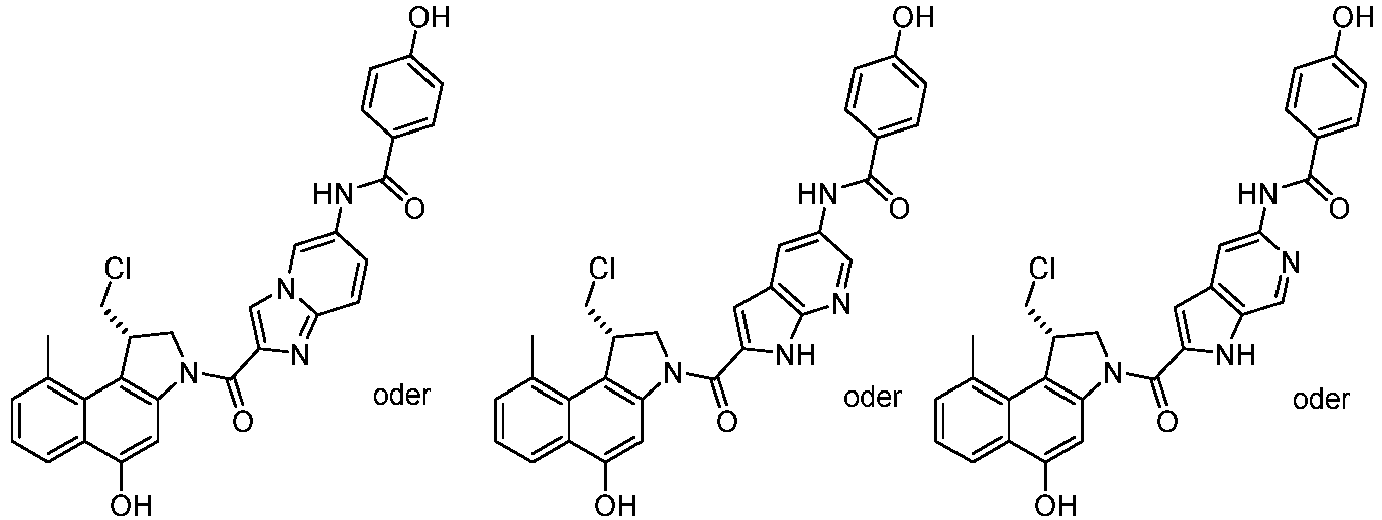


- Verbindung nach einem beliebigen der Ansprüche 1 bis 7, wobei L ausgewählt ist aus


- Verbindung nach einem beliebigen der Ansprüche 1 bis 8, wobei L2


- Verbindung nach einem beliebigen der Ansprüche 1 bis 9, die


- Verbindung nach einem beliebigen der Ansprüche 1 bis 10, wobei der V2 -Rest ein Antikörper ist, ausgewählt aus einem anti-CD19-Antikörper, einem anti-CD22-Antikörper, einem anti-CD30-Antikörper, einem anti-CD33-Antikörper, einem anti-CD56-Antikörper, einem anti-CD70-Antikörper, einem anti-CD74-Antikörper, einem anti-CD138-Antikörper, einem anti-CLL-1-Antikörper, einem anti-5T4-Antikörper, einem anti-CD303-Antikörper, einem anti-Tag 72-Antikörper, einem anti-Lewis A-artigen Kohlenhydrat-Antikörper, einem anti-EphB3-Antikörper, einem anti-HMW-MAA-Antikörper, einem anti-CD38-Antikörper, einem anti-Cripto-Antikörper, einem anti-EphA2-Antikörper, einem anti-GPNMB-Antikörper, einem anti-Integrin-Antikörper, einem anti-MN-Antikörper, einem anti-Her2-Antikörper, und einem anti-PSMA-Antikörper, oder aus einem epitopbindenden funktionellen Fragment oder Derivat eines beliebigen dieser, insbesondere der anti-Her2-Antikörper Trastuzumab.
- Verbindung nach Anspruch 1, die


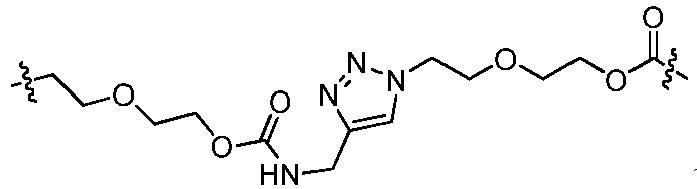
- Verbindung der Formel (IV):

- Verbindung nach Anspruch 13, wobei der reaktive Rest RM


 X35 ausgewählt ist aus Halid, Hydroxy, OC(O)Rdd, und OC(O)ORdd, oder C(O)-X35 ein aktiver Ester ist, X36 ausgewählt ist aus Halid, Mesyloxy, Triflyloxy, und Tosyloxy, und Rdd ausgewählt ist aus gegebenenfalls substituiertem C1-10-Alkyl, C1-10-Heteroalkyl, C3-10-Cycloalkyl, C1-10-Heterocycloalkyl, C5-10-Aryl, und C1-10-Heteroaryl.
 - Verbindung nach Anspruch 13 oder 14, die


V1 ausgewählt ist aus Valylcitrullin, Valyllysin, Phenylalanyllysin, Alanylphenylalanyllysin und D-Alanylphenylalanyllysin, CL



- Verbindung nach einem beliebigen der Ansprüche 13 bis 15, ausgewählt aus

- Verbindung nach einem beliebigen der Ansprüche 1 bis 16 zur Verwendung als ein Medikament, insbesondere für die Behandlung oder Vorbeugung eines Tumors in einem Säuger.
Priority Applications (10)
| Application Number | Priority Date | Filing Date | Title |
|---|---|---|---|
| NO16154533A NO3056203T3 (de) | 2010-04-21 | 2011-04-21 | |
| PL16176625T PL3108886T3 (pl) | 2010-04-21 | 2011-04-21 | Koniugaty analogów cc-1065 i dwufunkcyjnych linkerów |
| EP16176625.8A EP3108886B1 (de) | 2010-04-21 | 2011-04-21 | Konjugate von cc-1065 analogen und bifunktionelle linker |
| HRP20161339TT HRP20161339T1 (hr) | 2010-04-21 | 2011-04-21 | Konjugati analoga cc-1065 s bifunkcionalnim spojnicama |
| DK16154533.0T DK3056203T3 (da) | 2010-04-21 | 2011-04-21 | Konjugater af cc-1065-analoger og bifunktionelle linkere. |
| PL16154533T PL3056203T3 (pl) | 2010-04-21 | 2011-04-21 | Koniugaty analogów CC-1065 i łączników dwufunkcyjnych |
| EP16154533.0A EP3056203B1 (de) | 2010-04-21 | 2011-04-21 | Konjugate von cc-1065 analoga und bifunktionelle linker |
| DK16176625.8T DK3108886T3 (da) | 2010-04-21 | 2011-04-21 | Konjugater af CC-1065-analoger og bifunktionelle linkere |
| CY20181100146T CY1119893T1 (el) | 2010-04-21 | 2018-02-06 | Προϊοντα συζευξης cc-1065 αναλογων και διλειτουργικων συνδετων |
| CY20201100778T CY1124632T1 (el) | 2010-04-21 | 2020-08-20 | Προϊοντα συζευξης αναλογων cc-1065 και διλειτουργικοι συνδετες |
Applications Claiming Priority (3)
| Application Number | Priority Date | Filing Date | Title |
|---|---|---|---|
| US32643710P | 2010-04-21 | 2010-04-21 | |
| US42182410P | 2010-12-10 | 2010-12-10 | |
| PCT/NL2011/050278 WO2011133039A2 (en) | 2010-04-21 | 2011-04-21 | Novel conjugates of cc-1065 analogs and bifunctional linkers |
Related Child Applications (3)
| Application Number | Title | Priority Date | Filing Date |
|---|---|---|---|
| EP16154533.0A Division-Into EP3056203B1 (de) | 2010-04-21 | 2011-04-21 | Konjugate von cc-1065 analoga und bifunktionelle linker |
| EP16154533.0A Division EP3056203B1 (de) | 2010-04-21 | 2011-04-21 | Konjugate von cc-1065 analoga und bifunktionelle linker |
| EP16176625.8A Division EP3108886B1 (de) | 2010-04-21 | 2011-04-21 | Konjugate von cc-1065 analogen und bifunktionelle linker |
Publications (2)
| Publication Number | Publication Date |
|---|---|
| EP2560645A2 EP2560645A2 (de) | 2013-02-27 |
| EP2560645B1 true EP2560645B1 (de) | 2016-07-13 |
Family
ID=44343209
Family Applications (3)
| Application Number | Title | Priority Date | Filing Date |
|---|---|---|---|
| EP11720340.6A Active EP2560645B1 (de) | 2010-04-21 | 2011-04-21 | Konjugate von cc-1065 analoga und bifunktionellen linkern |
| EP16154533.0A Active EP3056203B1 (de) | 2010-04-21 | 2011-04-21 | Konjugate von cc-1065 analoga und bifunktionelle linker |
| EP16176625.8A Active EP3108886B1 (de) | 2010-04-21 | 2011-04-21 | Konjugate von cc-1065 analogen und bifunktionelle linker |
Family Applications After (2)
| Application Number | Title | Priority Date | Filing Date |
|---|---|---|---|
| EP16154533.0A Active EP3056203B1 (de) | 2010-04-21 | 2011-04-21 | Konjugate von cc-1065 analoga und bifunktionelle linker |
| EP16176625.8A Active EP3108886B1 (de) | 2010-04-21 | 2011-04-21 | Konjugate von cc-1065 analogen und bifunktionelle linker |
Country Status (23)
| Country | Link |
|---|---|
| US (3) | US9629924B2 (de) |
| EP (3) | EP2560645B1 (de) |
| JP (2) | JP6009434B2 (de) |
| KR (3) | KR20170027880A (de) |
| CN (1) | CN106749665B (de) |
| AU (2) | AU2011243294C1 (de) |
| BR (1) | BR112012026953A8 (de) |
| CA (2) | CA2956934C (de) |
| CY (3) | CY1118072T1 (de) |
| DK (3) | DK3056203T3 (de) |
| ES (3) | ES2815678T3 (de) |
| HR (3) | HRP20161339T1 (de) |
| HU (3) | HUE050508T2 (de) |
| LT (3) | LT3108886T (de) |
| MX (2) | MX336853B (de) |
| NO (1) | NO3056203T3 (de) |
| PL (3) | PL3056203T3 (de) |
| PT (3) | PT2560645T (de) |
| RU (2) | RU2578719C9 (de) |
| TR (1) | TR201802539T4 (de) |
| UA (1) | UA112291C2 (de) |
| WO (1) | WO2011133039A2 (de) |
| ZA (1) | ZA201208282B (de) |
Families Citing this family (63)
| Publication number | Priority date | Publication date | Assignee | Title |
|---|---|---|---|---|
| MY148763A (en) | 2006-03-10 | 2013-05-31 | Wyeth Corp | Anti-5t4 antibodies and uses thereof |
| US9901567B2 (en) | 2007-08-01 | 2018-02-27 | Syntarga B.V. | Substituted CC-1065 analogs and their conjugates |
| AU2009320481C1 (en) | 2008-11-03 | 2016-12-08 | Syntarga B.V. | Novel CC-1065 analogs and their conjugates |
| AU2011243294C1 (en) | 2010-04-21 | 2015-12-03 | Syntarga B.V. | Novel conjugates of CC-1065 analogs and bifunctional linkers |
| CN104837502B (zh) | 2012-10-12 | 2018-08-10 | 麦迪穆有限责任公司 | 吡咯并苯并二氮杂卓及其结合物 |
| WO2014089177A2 (en) | 2012-12-04 | 2014-06-12 | Massachusetts Institute Of Technology | Compounds, conjugates and compositions of epipolythiodiketopiperazines and polythiodiketopiperazines |
| RU2015129800A (ru) | 2012-12-21 | 2017-01-30 | Биоэллаенс К. В. | Гидрофильные саморазрушающиеся линкеры и их конъюгаты |
| SG11201507214SA (en) * | 2013-03-13 | 2015-10-29 | Medimmune Ltd | Pyrrolobenzodiazepines and conjugates thereof |
| NZ710746A (en) | 2013-03-13 | 2018-11-30 | Medimmune Ltd | Pyrrolobenzodiazepines and conjugates thereof |
| EP3033111B1 (de) | 2013-08-12 | 2019-03-13 | Genentech, Inc. | 1-(chlormethyl) 2,3-dihydro-1h-benzo[e]indoldimer-antikörper-wirkstoff-konjugatverbindungen und verfahren zur verwendung und behandlung |
| BR112016013258A2 (pt) | 2013-12-16 | 2018-01-16 | Genentech Inc | composto conjugado anticorpo-droga, composição farmacêutica, método para tratar câncer e kit |
| AU2015205574B2 (en) | 2014-01-10 | 2019-08-15 | Byondis B.V. | Method for purifying Cys-linked antibody-drug conjugates |
| CN105899236B (zh) * | 2014-01-10 | 2019-07-26 | 斯索恩生物制药有限公司 | 表现出改进的体内抗肿瘤活性的倍癌霉素adc |
| HUE029672T2 (en) * | 2014-01-10 | 2017-03-28 | Synthon Biopharmaceuticals Bv | Duokarmicin-ADCs for use in the treatment of endometrial cancer |
| ES2895623T3 (es) | 2014-05-22 | 2022-02-22 | Byondis Bv | Conjugación de sitio específico de fármacos enlazadores con anticuerpos y ADC resultantes |
| HUE045447T2 (hu) * | 2014-06-05 | 2019-12-30 | Synthon Biopharmaceuticals Bv | Javított eljárás a duokarmicin gyógyszer-elõanyagainak az elõállítására |
| SG11201610620UA (en) | 2014-06-20 | 2017-01-27 | Bioalliance Cv | Anti-folate receptor aplha (fra) antibody-drug conjugates and methods of using thereof |
| SG10201811124YA (en) * | 2014-06-20 | 2019-01-30 | Abgenomics Int Inc | Her2 antibody-drug conjugates |
| EP3160513B1 (de) | 2014-06-30 | 2020-02-12 | Glykos Finland Oy | Saccharidderivat einer toxischen nutzlast und antikörperkonjugate davon |
| GB201416112D0 (en) | 2014-09-12 | 2014-10-29 | Medimmune Ltd | Pyrrolobenzodiazepines and conjugates thereof |
| HRP20210547T1 (hr) | 2015-07-10 | 2021-05-14 | Byondis B.V. | Sastavi koji sadrže konjugate lijeka antitijela-duocarmycin |
| WO2017050846A1 (en) * | 2015-09-22 | 2017-03-30 | Synthon Biopharmaceuticals B.V. | Syd985 treatment of t-dm1 refractory cancer patients |
| JP6486316B2 (ja) | 2015-11-03 | 2019-03-20 | 財團法人工業技術研究院Industrial Technology Research Institute | 抗体−薬物複合体(adc)およびそれを形成するための方法 |
| BR112018010394A8 (pt) * | 2015-11-24 | 2019-02-26 | Synthon Biopharmaceuticals Bv | anticorpo, conjugado anticorpo-fármaco, composição farmacêutica, e, combinação do anticorpo. |
| SG11201805557SA (en) | 2016-01-08 | 2018-07-30 | Bioalliance Cv | Tetravalent anti-psgl-1 antibodies and uses thereof |
| GB201601431D0 (en) | 2016-01-26 | 2016-03-09 | Medimmune Ltd | Pyrrolobenzodiazepines |
| GB201602356D0 (en) | 2016-02-10 | 2016-03-23 | Medimmune Ltd | Pyrrolobenzodiazepine Conjugates |
| GB201602359D0 (en) | 2016-02-10 | 2016-03-23 | Medimmune Ltd | Pyrrolobenzodiazepine Conjugates |
| ES2818575T3 (es) | 2016-02-12 | 2021-04-13 | Byondis Bv | Reducción selectiva de anticuerpos con modificación de cisteínas |
| TWI781098B (zh) | 2016-04-15 | 2022-10-21 | 美商宏觀基因股份有限公司 | 新穎的b7-h3-結合分子、其抗體藥物綴合物及其使用方法 |
| GB201607478D0 (en) | 2016-04-29 | 2016-06-15 | Medimmune Ltd | Pyrrolobenzodiazepine Conjugates |
| US10918627B2 (en) | 2016-05-11 | 2021-02-16 | Massachusetts Institute Of Technology | Convergent and enantioselective total synthesis of Communesin analogs |
| CN109641911B (zh) * | 2016-08-19 | 2023-02-21 | 百时美施贵宝公司 | seco-环丙吡咯并吲哚化合物和其抗体-药物缀合物以及制备和使用方法 |
| KR102574659B1 (ko) | 2016-10-11 | 2023-09-04 | 비온디스 비.브이. | 비선형 자가 희생 링커 및 이의 접합체 |
| GB201617466D0 (en) | 2016-10-14 | 2016-11-30 | Medimmune Ltd | Pyrrolobenzodiazepine conjugates |
| KR102614466B1 (ko) * | 2016-11-14 | 2023-12-14 | 비온디스 비.브이. | 단일-보호된 알파, 오메가-디아미노 알칸의 제조 방법 |
| GB201702031D0 (en) | 2017-02-08 | 2017-03-22 | Medlmmune Ltd | Pyrrolobenzodiazepine-antibody conjugates |
| MX375569B (es) | 2017-02-08 | 2025-03-04 | Adc Therapeutics Sa | Conjugados de pirrolobenzodiazepinas y anticuerpos |
| PT3612537T (pt) | 2017-04-18 | 2022-08-29 | Medimmune Ltd | Conjugados de pirrolobenzodiazepina |
| WO2018209239A1 (en) | 2017-05-11 | 2018-11-15 | Massachusetts Institute Of Technology | Potent agelastatin derivatives as modulators for cancer invasion and metastasis |
| US11696958B2 (en) | 2017-05-23 | 2023-07-11 | Byondis B.V. | Dual conjugation process for preparing antibody-drug conjugates |
| DK3668874T3 (da) | 2017-08-18 | 2022-02-14 | Medimmune Ltd | Pyrrolobenzodiazepin-konjugater |
| US10640508B2 (en) | 2017-10-13 | 2020-05-05 | Massachusetts Institute Of Technology | Diazene directed modular synthesis of compounds with quaternary carbon centers |
| JP7381478B2 (ja) | 2017-10-23 | 2023-11-15 | マブリンク ビオシオンス | 単一分子量ポリサルコシンを含むリガンド-薬物-複合体 |
| WO2019101850A1 (en) | 2017-11-24 | 2019-05-31 | Synthon Biopharmaceuticals B.V. | Improved process for the synthesis of linker-drug vc-seco-duba |
| MX2020005473A (es) | 2017-11-27 | 2020-08-27 | Purdue Pharma Lp | Anticuerpos humanizados que se dirigen al factor tisular humano. |
| GB201803342D0 (en) | 2018-03-01 | 2018-04-18 | Medimmune Ltd | Methods |
| GB201806022D0 (en) | 2018-04-12 | 2018-05-30 | Medimmune Ltd | Pyrrolobenzodiazepines and conjugates thereof |
| EP3866785A1 (de) | 2018-10-15 | 2021-08-25 | Merck Patent GmbH | Kombinationstherapie unter verwendung von dna-alkylierenden mitteln und atr-inhibitoren |
| WO2020094561A1 (en) | 2018-11-09 | 2020-05-14 | Synthon Biopharmaceuticals B.V. | Filterable duocarmycin-containing antibody-drug conjugate compositions and related methods |
| KR102890251B1 (ko) | 2019-03-15 | 2025-11-25 | 메드임뮨 리미티드 | 암의 치료에 사용하기 위한 아제티도벤조디아제핀 이량체 및 이를 포함하는 컨쥬게이트 |
| US11535634B2 (en) | 2019-06-05 | 2022-12-27 | Massachusetts Institute Of Technology | Compounds, conjugates, and compositions of epipolythiodiketopiperazines and polythiodiketopiperazines and uses thereof |
| US20230092648A1 (en) | 2020-02-06 | 2023-03-23 | Byondis B.V. | Combination containing a duocarmycin derivative-comprising antibody-drug conjugate and thiosulfate |
| AU2021306557A1 (en) | 2020-07-06 | 2023-02-02 | Byondis B.V. | Antifolate linker-drugs and antibody-drug conjugates |
| US20220008511A1 (en) * | 2020-07-12 | 2022-01-13 | Henry J. Smith | Tumor treatment using cytokines and cancer drugs |
| WO2022020890A1 (en) * | 2020-07-27 | 2022-02-03 | Esfam Biotech Pty Ltd | Treatment of veterinary conditions associated with cd151 |
| WO2022182415A1 (en) | 2021-02-24 | 2022-09-01 | Massachusetts Institute Of Technology | Himastatin derivatives, and processes of preparation thereof, and uses thereof |
| CN117157325A (zh) | 2021-04-08 | 2023-12-01 | 拜奥迪斯私人有限公司 | 抗c-met抗体和抗体-药物缀合物 |
| CN117794581A (zh) | 2021-06-28 | 2024-03-29 | 拜奥迪斯私人有限公司 | 包含磷酸抗原的缀合物及其在治疗中的用途 |
| US20240408226A1 (en) * | 2021-11-02 | 2024-12-12 | Mabplex International Co., Ltd. | Antibody drug conjugate intermediate containing sn38 and its preparation method |
| AU2022425491A1 (en) | 2021-12-30 | 2024-07-04 | Byondis B.V. | Antifolate linker-drugs and antibody-drug conjugates |
| CA3251998A1 (en) | 2022-05-16 | 2023-11-23 | Byondis B.V. | Novel masked antibodies |
| WO2024133374A1 (en) | 2022-12-22 | 2024-06-27 | Byondis B.V. | Novel linker drugs comprising phosphoantigens, novel conjugates and their use in therapy |
Family Cites Families (90)
| Publication number | Priority date | Publication date | Assignee | Title |
|---|---|---|---|---|
| EP0065360A3 (de) | 1981-05-12 | 1983-08-10 | Schlumberger Electronics (U.K.) Limited | Parallelbewegungswegaufnehmer |
| CA1238907A (en) | 1984-02-21 | 1988-07-05 | Robert C. Kelly | 1,2,8,8a-tetrahydrocyclopropa¬c|pyrrolo(3,2-e)- indol-4(5h)-ones and related compounds |
| US4771128A (en) | 1986-10-10 | 1988-09-13 | Cetus Corporation | Method of purifying toxin conjugates using hydrophobic interaction chromatography |
| EP0340243B1 (de) | 1986-12-19 | 1994-09-28 | The Upjohn Company | Cc-1065 analoge |
| US5541339A (en) | 1988-09-12 | 1996-07-30 | The Upjohn Company | CC-1065 analogs having two CPI subunits |
| AU648313B2 (en) | 1990-04-25 | 1994-04-21 | Pharmacia & Upjohn Company | Novel CC-1065 analogs |
| ES2149768T3 (es) | 1992-03-25 | 2000-11-16 | Immunogen Inc | Conjugados de agentes enlazantes de celulas derivados de cc-1065. |
| JP3514490B2 (ja) | 1992-08-21 | 2004-03-31 | 杏林製薬株式会社 | トリフルオロメチルピロロインドールカルボン酸エステル誘導体及びその製造方法 |
| GB9307491D0 (en) | 1993-04-08 | 1993-06-02 | Sandoz Ltd | Organic compounds |
| EP0702014A4 (de) | 1994-04-01 | 1996-08-07 | Kyowa Hakko Kogyo Kk | Dc-89 derivate |
| JPH07309761A (ja) | 1994-05-20 | 1995-11-28 | Kyowa Hakko Kogyo Co Ltd | デュオカルマイシン誘導体の安定化法 |
| US5502068A (en) * | 1995-01-31 | 1996-03-26 | Synphar Laboratories, Inc. | Cyclopropylpyrroloindole-oligopeptide anticancer agents |
| DE19503320A1 (de) | 1995-02-02 | 1996-08-08 | Boehringer Mannheim Gmbh | Neue Benzodiazepinkonjugate |
| US5646298A (en) | 1995-06-07 | 1997-07-08 | Procoron, Inc. | Cyclopropylindole prodrugs |
| GB9516943D0 (en) | 1995-08-18 | 1995-10-18 | Cancer Soc Auckland Div Nz Inc | Novel cyclopropylindoles and their secoprecursors,and their use as prodrugs |
| US6548530B1 (en) | 1995-10-03 | 2003-04-15 | The Scripps Research Institute | CBI analogs of CC-1065 and the duocarmycins |
| ES2244991T3 (es) | 1996-03-08 | 2005-12-16 | The Scripps Research Institute | Analogosmcbi de cc-1065 y las duocarmicinas. |
| US5843937A (en) | 1996-05-23 | 1998-12-01 | Panorama Research, Inc. | DNA-binding indole derivatives, their prodrugs and immunoconjugates as anticancer agents |
| WO1997045411A1 (en) | 1996-05-31 | 1997-12-04 | The Scripps Research Institute | Analogs of cc-1065 and the duocarmycins |
| NZ334344A (en) | 1996-09-12 | 2000-08-25 | Cancer Res Campaign Tech | benzo[e]indole and pyrrolo[3,2-e]indole compounds and their use as prodrugs |
| WO1998025900A1 (en) | 1996-12-13 | 1998-06-18 | Shionogi & Co., Ltd. | Compounds having antitumor activity |
| GB9625913D0 (en) | 1996-12-13 | 1997-01-29 | Cancer Soc Auckland Div Nz Inc | Novel cyclopropylindoles and their seco precursors,and their use as prodrugs |
| AU754083B2 (en) | 1997-05-22 | 2002-11-07 | Scripps Research Institute, The | Analogs of duocarmycin and CC-1065 |
| AU756721B2 (en) | 1997-10-14 | 2003-01-23 | Scripps Research Institute, The | iso-CBI and iso-CI analogs of CC-1065 and the duocarmycins |
| US20030036629A1 (en) | 1997-12-12 | 2003-02-20 | Barry Foster | Novel tgf-beta protein purification methods |
| DE50104114D1 (de) | 2000-05-02 | 2004-11-18 | Tietze Lutz F | Neue prodrugs von 6-hydroxy-2,3-dihydro-1h-indolen, 5-hydroxy-1,2-dihydro-3h-pyrrolo 3,2-e]indolen und 5-hydroxy-1,2-dihydro-3h-benzo e]indolen sowie von 6-hydroxy-1,2,3,4-tetrahydro-benzo f]chinolin-derivaten für eine selektive krebstherapie |
| AU2001262974A1 (en) | 2000-05-03 | 2001-11-12 | The Scripps Research Institute | Dna alkylating agent and activation thereof |
| JP5010089B2 (ja) * | 2000-09-19 | 2012-08-29 | スピロジェン リミテッド | Cc−1065およびデュオカルマイシンのアキラルアナログの組成物およびその使用方法 |
| WO2002059122A1 (en) | 2001-01-24 | 2002-08-01 | Auckland Uniservices Limited | ANTI-CANCER 2,3-DIHYDRO-1H-PYRROLO[3,2-f]QUINOLINE COMPLEXES OF COBALT AND CHROMIUM |
| JP4862120B2 (ja) | 2001-02-22 | 2012-01-25 | ユニヴァーシティ オブ ブラッドフォード | 腫瘍治療のためのプロドラッグとしてのベンズ−インドールおよびベンゾ−キノリン誘導体 |
| US7626026B2 (en) | 2001-02-22 | 2009-12-01 | University Of Bradford | Pyrrolo-indole and pyrrolo-quinoline derivatives as prodrugs for tumour treatment |
| US7179921B2 (en) | 2001-02-22 | 2007-02-20 | School Of Pharmacy, University Of London | Indoline and tetrahydro-quinolines as prodrugs for tumour treatment |
| EP1243276A1 (de) | 2001-03-23 | 2002-09-25 | Franciscus Marinus Hendrikus De Groot | Langgestreckte und mehrfachige Abstandhaltern enthaltende aktivierbare Prodroge |
| US7129261B2 (en) | 2001-05-31 | 2006-10-31 | Medarex, Inc. | Cytotoxic agents |
| US7514078B2 (en) | 2001-06-01 | 2009-04-07 | Cornell Research Foundation, Inc. | Methods of treating prostate cancer with anti-prostate specific membrane antigen antibodies |
| CA2459308A1 (en) * | 2001-09-07 | 2003-03-20 | Dale L. Boger | Cbi analogues of cc-1065 and the duocarmycins |
| US6756397B2 (en) * | 2002-04-05 | 2004-06-29 | Immunogen, Inc. | Prodrugs of CC-1065 analogs |
| WO2003097635A1 (en) * | 2002-05-17 | 2003-11-27 | Auckland Uniservices Limited | Processes for preparing 3-substituted 1-(chloromethyl)-1,2-dihydro-3h-[ring fused indol-5-yl(amine-derived)] compounds and analogues thereof, and to products obtained therefrom |
| JP2006507322A (ja) | 2002-11-14 | 2006-03-02 | シンタルガ・ビーブイ | 多重自己脱離放出スペーサーとして構築されたプロドラッグ |
| DK1592457T3 (da) * | 2003-01-27 | 2012-10-22 | Endocyte Inc | Folat-vinblastin-konjugat som lægemiddel |
| US20070037739A1 (en) | 2003-02-03 | 2007-02-15 | Medlogics Device Corporation | Compounds useful in coating stents to prevent and treat stenosis and restenosis |
| AU2004213053C1 (en) | 2003-02-20 | 2009-07-16 | Seagen Inc. | Anti-CD70 antibody-drug conjugates and their use for the treatment of cancer and immune disorders |
| WO2004101767A2 (en) | 2003-05-13 | 2004-11-25 | The Scripps Research Institute | Cbi analogues of the duocarmycins and cc-1065 |
| WO2005032594A2 (en) | 2003-10-03 | 2005-04-14 | The Government Of The United States Of America, As Represented By The Secretary, Department Of Health And Human Services | Alkylators linked to polyamides as dna binding agents |
| US7282590B2 (en) | 2004-02-12 | 2007-10-16 | The Research Foundation Of State University Of New York | Drug conjugates |
| AU2005218642B2 (en) | 2004-03-02 | 2011-04-28 | Seagen Inc. | Partially loaded antibodies and methods of their conjugation |
| US20050265925A1 (en) | 2004-04-21 | 2005-12-01 | Samuel Zalipsky | Releasable linkage and compositions containing same |
| US20050239864A1 (en) | 2004-04-23 | 2005-10-27 | Yuqiang Wang | Novel tumor-selective chemotherapeutic agents |
| JP4806680B2 (ja) | 2004-05-19 | 2011-11-02 | メダレックス インコーポレイテッド | 自己犠牲リンカー及び薬剤複合体 |
| RU2007103298A (ru) | 2004-06-30 | 2008-08-10 | Новартис АГ (CH) | Композиции и способы доставки противоопухолевых агентов |
| JP5149620B2 (ja) | 2004-07-23 | 2013-02-20 | エンドサイト,インコーポレイテッド | 2価リンカーおよびその結合体 |
| KR101270829B1 (ko) | 2004-09-23 | 2013-06-07 | 제넨테크, 인크. | 시스테인 유전자조작 항체 및 접합체 |
| CA2581930A1 (en) | 2004-09-27 | 2006-04-06 | Jane Trepel | Modulating mxa expression |
| NZ536107A (en) | 2004-10-22 | 2007-06-29 | Auckland Uniservices Ltd | Nitrobenzindoles and their use in cancer therapy |
| US20090111805A1 (en) | 2005-02-24 | 2009-04-30 | Pfizer Inc. | Bicyclic heteroaromatic derivatives useful as anticancer agents |
| FR2884252B1 (fr) * | 2005-04-08 | 2007-05-18 | Aventis Pharma Sa | Nouveaux derives d'isoindoles, compositions les contenant, leur preparation et leurs utilisations pharmaceutiques notamment en tant qu'inhibiteurs d'activites de la proteine chaperone hsp90 |
| US7714016B2 (en) | 2005-04-08 | 2010-05-11 | Medarex, Inc. | Cytotoxic compounds and conjugates with cleavable substrates |
| CA2617907A1 (en) | 2005-08-05 | 2007-02-15 | Syntarga B.V. | Triazole-containing releasable linkers and conjugates comprising the same |
| BRPI0617546A2 (pt) | 2005-09-26 | 2011-07-26 | Medarex Inc | conjugado de fÁrmaco-anticorpo, formulaÇço farmacÊutica, mÉtodo para matar uma cÉlula de tumor, mÉtodo para retardar ou interromper o crescimento de um tumor em um sujeito mamÍfero e composto |
| SI1940789T1 (sl) * | 2005-10-26 | 2012-03-30 | Medarex Inc | Postopki in spojine za pripravo cc analogov |
| CA2627190A1 (en) | 2005-11-10 | 2007-05-24 | Medarex, Inc. | Duocarmycin derivatives as novel cytotoxic compounds and conjugates |
| EP1994000B1 (de) | 2006-02-02 | 2017-08-23 | Syntarga B.V. | Wasserlösliche cc-1065-analoge und ihre konjugate |
| EP1832577A1 (de) | 2006-03-07 | 2007-09-12 | Sanofi-Aventis | Verbesserte Pro-Pharmaka von CC-1065-Analoga |
| WO2008063378A2 (en) | 2006-11-01 | 2008-05-29 | Ventana Medical Systems, Inc. | Haptens, hapten conjugates, compositions thereof and method for their preparation and use |
| KR20090088946A (ko) | 2006-12-14 | 2009-08-20 | 메다렉스, 인코포레이티드 | 씨디70에 결합하는 인간 항체 및 이의 용도 |
| TWI412367B (zh) | 2006-12-28 | 2013-10-21 | 梅達雷克斯有限責任公司 | 化學鏈接劑與可裂解基質以及其之綴合物 |
| CA2678514A1 (en) | 2007-02-21 | 2008-08-28 | Medarex, Inc. | Chemical linkers with single amino acids and conjugates thereof |
| US9901567B2 (en) | 2007-08-01 | 2018-02-27 | Syntarga B.V. | Substituted CC-1065 analogs and their conjugates |
| CA2695297C (en) | 2007-08-01 | 2017-03-21 | Syntarga B.V. | Substituted cc-1065 analogs and their conjugates |
| EP2185188B1 (de) | 2007-08-22 | 2014-08-06 | Medarex, L.L.C. | Ortsspezifische bindung von wirkstoffen oder anderen mitteln an gentechnisch hergestellte antikörper mit c-terminalen erweiterungen |
| US8377981B2 (en) | 2007-11-13 | 2013-02-19 | The Scripps Research Institute | CBI derivatives subject to reductive activation |
| US20090162372A1 (en) | 2007-11-30 | 2009-06-25 | Medarex, Inc. | Fibronectin ed-b antibodies, conjugates thereof, and methods of use |
| JP2011505146A (ja) | 2007-11-30 | 2011-02-24 | ブリストル−マイヤーズ スクイブ カンパニー | タンパク質チロシンキナーゼ7(ptk7)を対象とするモノクローナル抗体−パートナー分子複合体 |
| EA201000910A1 (ru) | 2007-11-30 | 2011-04-29 | Бристоль-Мейерз Сквибб Компани | Конъюгат "моноклональное антитело против в7н4/лекарственное средство" и способы его применения |
| BRPI0819765A2 (pt) | 2007-11-30 | 2015-05-05 | Bristol Myers Squibb Co | Conjugados de anticorpos anti-rg-1 |
| KR20200058590A (ko) | 2008-04-30 | 2020-05-27 | 이뮤노젠 아이엔씨 | 가교제 및 그 용도 |
| NZ571028A (en) | 2008-09-03 | 2011-01-28 | Auckland Uniservices Ltd | Nitrobenzindole compounds and their use in cancer treatment |
| AU2009293140A1 (en) * | 2008-09-17 | 2010-03-25 | Endocyte, Inc. | Folate receptor binding conjugates of antifolates |
| AU2009320481C1 (en) | 2008-11-03 | 2016-12-08 | Syntarga B.V. | Novel CC-1065 analogs and their conjugates |
| WO2011022316A1 (en) | 2009-08-20 | 2011-02-24 | The Regents Of The University Of Colorado, A Body Corporate | Mirnas dysregulated in triple-negative breast cancer |
| AU2011243294C1 (en) | 2010-04-21 | 2015-12-03 | Syntarga B.V. | Novel conjugates of CC-1065 analogs and bifunctional linkers |
| CA2848520C (en) | 2011-09-29 | 2019-11-26 | Seattle Genetics, Inc. | Intact mass determination of protein conjugated agent compounds |
| WO2013055874A2 (en) | 2011-10-14 | 2013-04-18 | Genentech, Inc. | Uses for and article of manufacture including her2 dimerization inhibitor pertuzumab |
| JP2015502397A (ja) | 2011-12-23 | 2015-01-22 | ファイザー・インク | 部位特異的コンジュゲーションのための操作された抗体定常領域、ならびにそのための方法および使用 |
| AU2015205574B2 (en) | 2014-01-10 | 2019-08-15 | Byondis B.V. | Method for purifying Cys-linked antibody-drug conjugates |
| HUE029672T2 (en) | 2014-01-10 | 2017-03-28 | Synthon Biopharmaceuticals Bv | Duokarmicin-ADCs for use in the treatment of endometrial cancer |
| CN105899236B (zh) | 2014-01-10 | 2019-07-26 | 斯索恩生物制药有限公司 | 表现出改进的体内抗肿瘤活性的倍癌霉素adc |
| ES2895623T3 (es) | 2014-05-22 | 2022-02-22 | Byondis Bv | Conjugación de sitio específico de fármacos enlazadores con anticuerpos y ADC resultantes |
| HUE045447T2 (hu) | 2014-06-05 | 2019-12-30 | Synthon Biopharmaceuticals Bv | Javított eljárás a duokarmicin gyógyszer-elõanyagainak az elõállítására |
| WO2016046173A1 (en) | 2014-09-22 | 2016-03-31 | Synthon Biopharmaceuticals B.V. | Pan-reactive antibodies to duocarmycins |
-
2011
- 2011-04-21 AU AU2011243294A patent/AU2011243294C1/en active Active
- 2011-04-21 KR KR1020177005864A patent/KR20170027880A/ko not_active Ceased
- 2011-04-21 UA UAA201213259A patent/UA112291C2/uk unknown
- 2011-04-21 DK DK16154533.0T patent/DK3056203T3/da active
- 2011-04-21 BR BR112012026953A patent/BR112012026953A8/pt not_active Application Discontinuation
- 2011-04-21 DK DK11720340.6T patent/DK2560645T3/en active
- 2011-04-21 PL PL16154533T patent/PL3056203T3/pl unknown
- 2011-04-21 MX MX2012012176A patent/MX336853B/es active IP Right Grant
- 2011-04-21 ES ES16176625T patent/ES2815678T3/es active Active
- 2011-04-21 TR TR2018/02539T patent/TR201802539T4/tr unknown
- 2011-04-21 KR KR1020127030506A patent/KR101747478B1/ko active Active
- 2011-04-21 LT LTEP16176625.8T patent/LT3108886T/lt unknown
- 2011-04-21 ES ES11720340.6T patent/ES2594952T3/es active Active
- 2011-04-21 WO PCT/NL2011/050278 patent/WO2011133039A2/en not_active Ceased
- 2011-04-21 US US13/642,847 patent/US9629924B2/en not_active Expired - Fee Related
- 2011-04-21 EP EP11720340.6A patent/EP2560645B1/de active Active
- 2011-04-21 DK DK16176625.8T patent/DK3108886T3/da active
- 2011-04-21 RU RU2012149448/04A patent/RU2578719C9/ru active
- 2011-04-21 HU HUE16176625A patent/HUE050508T2/hu unknown
- 2011-04-21 CA CA2956934A patent/CA2956934C/en active Active
- 2011-04-21 RU RU2016101244A patent/RU2730502C2/ru active
- 2011-04-21 PT PT117203406T patent/PT2560645T/pt unknown
- 2011-04-21 LT LTEP11720340.6T patent/LT2560645T/lt unknown
- 2011-04-21 HU HUE11720340A patent/HUE030846T2/en unknown
- 2011-04-21 PL PL11720340T patent/PL2560645T3/pl unknown
- 2011-04-21 PT PT161766258T patent/PT3108886T/pt unknown
- 2011-04-21 CA CA2796712A patent/CA2796712C/en active Active
- 2011-04-21 HR HRP20161339TT patent/HRP20161339T1/hr unknown
- 2011-04-21 JP JP2013506105A patent/JP6009434B2/ja active Active
- 2011-04-21 MX MX2015017777A patent/MX374267B/es unknown
- 2011-04-21 KR KR1020187006266A patent/KR101901555B1/ko active Active
- 2011-04-21 LT LTEP16154533.0T patent/LT3056203T/lt unknown
- 2011-04-21 PL PL16176625T patent/PL3108886T3/pl unknown
- 2011-04-21 HU HUE16154533A patent/HUE036912T2/hu unknown
- 2011-04-21 EP EP16154533.0A patent/EP3056203B1/de active Active
- 2011-04-21 ES ES16154533.0T patent/ES2660428T3/es active Active
- 2011-04-21 EP EP16176625.8A patent/EP3108886B1/de active Active
- 2011-04-21 NO NO16154533A patent/NO3056203T3/no unknown
- 2011-04-21 PT PT161545330T patent/PT3056203T/pt unknown
- 2011-04-21 CN CN201611090112.6A patent/CN106749665B/zh active Active
-
2012
- 2012-11-05 ZA ZA2012/08282A patent/ZA201208282B/en unknown
-
2015
- 2015-08-13 AU AU2015213336A patent/AU2015213336B2/en active Active
-
2016
- 2016-04-07 JP JP2016077272A patent/JP6193433B2/ja active Active
- 2016-10-06 CY CY20161100997T patent/CY1118072T1/el unknown
-
2017
- 2017-03-17 US US15/461,560 patent/US11052155B2/en active Active
- 2017-03-17 US US15/461,569 patent/US20180147289A9/en not_active Abandoned
-
2018
- 2018-02-05 HR HRP20180209TT patent/HRP20180209T1/hr unknown
- 2018-02-06 CY CY20181100146T patent/CY1119893T1/el unknown
-
2020
- 2020-08-20 CY CY20201100778T patent/CY1124632T1/el unknown
- 2020-09-10 HR HRP20201446TT patent/HRP20201446T8/hr unknown
Non-Patent Citations (1)
| Title |
|---|
| NOBUYOSHI AMISHIRO ET AL: "Synthesis and antitumor activity of duocarmycin derivatives", BIOORGANIC & MEDICINAL CHEMISTRY, vol. 8, no. 7, 1 July 2000 (2000-07-01), pages 1637 - 1643, XP055202616, ISSN: 0968-0896, DOI: 10.1016/S0968-0896(00)00086-9 * |
Also Published As
Similar Documents
| Publication | Publication Date | Title |
|---|---|---|
| EP2560645B1 (de) | Konjugate von cc-1065 analoga und bifunktionellen linkern | |
| EP2173739B1 (de) | Substituierte cc-1065-analoga und ihre konjugate | |
| EP2344478B1 (de) | Cc-1065 analoga und ihre konjugate | |
| US9901567B2 (en) | Substituted CC-1065 analogs and their conjugates | |
| CN103118679B (zh) | Cc‑1065类似物和双功能接头的缀合物 |
Legal Events
| Date | Code | Title | Description |
|---|---|---|---|
| PUAI | Public reference made under article 153(3) epc to a published international application that has entered the european phase |
Free format text: ORIGINAL CODE: 0009012 |
|
| 17P | Request for examination filed |
Effective date: 20121121 |
|
| AK | Designated contracting states |
Kind code of ref document: A2 Designated state(s): AL AT BE BG CH CY CZ DE DK EE ES FI FR GB GR HR HU IE IS IT LI LT LU LV MC MK MT NL NO PL PT RO RS SE SI SK SM TR |
|
| DAX | Request for extension of the european patent (deleted) | ||
| 17Q | First examination report despatched |
Effective date: 20140314 |
|
| GRAP | Despatch of communication of intention to grant a patent |
Free format text: ORIGINAL CODE: EPIDOSNIGR1 |
|
| INTG | Intention to grant announced |
Effective date: 20160323 |
|
| GRAS | Grant fee paid |
Free format text: ORIGINAL CODE: EPIDOSNIGR3 |
|
| GRAA | (expected) grant |
Free format text: ORIGINAL CODE: 0009210 |
|
| AK | Designated contracting states |
Kind code of ref document: B1 Designated state(s): AL AT BE BG CH CY CZ DE DK EE ES FI FR GB GR HR HU IE IS IT LI LT LU LV MC MK MT NL NO PL PT RO RS SE SI SK SM TR |
|
| REG | Reference to a national code |
Ref country code: GB Ref legal event code: FG4D |
|
| REG | Reference to a national code |
Ref country code: AT Ref legal event code: REF Ref document number: 811726 Country of ref document: AT Kind code of ref document: T Effective date: 20160715 Ref country code: CH Ref legal event code: EP |
|
| REG | Reference to a national code |
Ref country code: IE Ref legal event code: FG4D |
|
| REG | Reference to a national code |
Ref country code: DE Ref legal event code: R096 Ref document number: 602011028107 Country of ref document: DE |
|
| REG | Reference to a national code |
Ref country code: CH Ref legal event code: NV Representative=s name: ISLER AND PEDRAZZINI AG, CH |
|
| REG | Reference to a national code |
Ref country code: DK Ref legal event code: T3 Effective date: 20161007 |
|
| REG | Reference to a national code |
Ref country code: RO Ref legal event code: EPE |
|
| REG | Reference to a national code |
Ref country code: HR Ref legal event code: TUEP Ref document number: P20161339 Country of ref document: HR |
|
| REG | Reference to a national code |
Ref country code: SE Ref legal event code: TRGR |
|
| REG | Reference to a national code |
Ref country code: PT Ref legal event code: SC4A Ref document number: 2560645 Country of ref document: PT Date of ref document: 20161024 Kind code of ref document: T Free format text: AVAILABILITY OF NATIONAL TRANSLATION Effective date: 20161013 |
|
| REG | Reference to a national code |
Ref country code: NO Ref legal event code: T2 Effective date: 20160713 |
|
| REG | Reference to a national code |
Ref country code: HR Ref legal event code: T1PR Ref document number: P20161339 Country of ref document: HR |
|
| REG | Reference to a national code |
Ref country code: NL Ref legal event code: FP |
|
| REG | Reference to a national code |
Ref country code: ES Ref legal event code: FG2A Ref document number: 2594952 Country of ref document: ES Kind code of ref document: T3 Effective date: 20161227 |
|
| PG25 | Lapsed in a contracting state [announced via postgrant information from national office to epo] |
Ref country code: RS Free format text: LAPSE BECAUSE OF FAILURE TO SUBMIT A TRANSLATION OF THE DESCRIPTION OR TO PAY THE FEE WITHIN THE PRESCRIBED TIME-LIMIT Effective date: 20160713 |
|
| REG | Reference to a national code |
Ref country code: SK Ref legal event code: T3 Ref document number: E 22272 Country of ref document: SK |
|
| PG25 | Lapsed in a contracting state [announced via postgrant information from national office to epo] |
Ref country code: LV Free format text: LAPSE BECAUSE OF FAILURE TO SUBMIT A TRANSLATION OF THE DESCRIPTION OR TO PAY THE FEE WITHIN THE PRESCRIBED TIME-LIMIT Effective date: 20160713 |
|
| REG | Reference to a national code |
Ref country code: GR Ref legal event code: EP Ref document number: 20160402455 Country of ref document: GR Effective date: 20170117 |
|
| REG | Reference to a national code |
Ref country code: DE Ref legal event code: R097 Ref document number: 602011028107 Country of ref document: DE |
|
| REG | Reference to a national code |
Ref country code: FR Ref legal event code: PLFP Year of fee payment: 7 |
|
| PG25 | Lapsed in a contracting state [announced via postgrant information from national office to epo] |
Ref country code: EE Free format text: LAPSE BECAUSE OF FAILURE TO SUBMIT A TRANSLATION OF THE DESCRIPTION OR TO PAY THE FEE WITHIN THE PRESCRIBED TIME-LIMIT Effective date: 20160713 |
|
| PLBE | No opposition filed within time limit |
Free format text: ORIGINAL CODE: 0009261 |
|
| STAA | Information on the status of an ep patent application or granted ep patent |
Free format text: STATUS: NO OPPOSITION FILED WITHIN TIME LIMIT |
|
| PG25 | Lapsed in a contracting state [announced via postgrant information from national office to epo] |
Ref country code: SM Free format text: LAPSE BECAUSE OF FAILURE TO SUBMIT A TRANSLATION OF THE DESCRIPTION OR TO PAY THE FEE WITHIN THE PRESCRIBED TIME-LIMIT Effective date: 20160713 |
|
| 26N | No opposition filed |
Effective date: 20170418 |
|
| REG | Reference to a national code |
Ref country code: HU Ref legal event code: AG4A Ref document number: E030846 Country of ref document: HU |
|
| PG25 | Lapsed in a contracting state [announced via postgrant information from national office to epo] |
Ref country code: SI Free format text: LAPSE BECAUSE OF FAILURE TO SUBMIT A TRANSLATION OF THE DESCRIPTION OR TO PAY THE FEE WITHIN THE PRESCRIBED TIME-LIMIT Effective date: 20160713 |
|
| PG25 | Lapsed in a contracting state [announced via postgrant information from national office to epo] |
Ref country code: MC Free format text: LAPSE BECAUSE OF FAILURE TO SUBMIT A TRANSLATION OF THE DESCRIPTION OR TO PAY THE FEE WITHIN THE PRESCRIBED TIME-LIMIT Effective date: 20160713 |
|
| PG25 | Lapsed in a contracting state [announced via postgrant information from national office to epo] |
Ref country code: LU Free format text: LAPSE BECAUSE OF NON-PAYMENT OF DUE FEES Effective date: 20170421 |
|
| REG | Reference to a national code |
Ref country code: FR Ref legal event code: PLFP Year of fee payment: 8 |
|
| PG25 | Lapsed in a contracting state [announced via postgrant information from national office to epo] |
Ref country code: AL Free format text: LAPSE BECAUSE OF FAILURE TO SUBMIT A TRANSLATION OF THE DESCRIPTION OR TO PAY THE FEE WITHIN THE PRESCRIBED TIME-LIMIT Effective date: 20160713 |
|
| REG | Reference to a national code |
Ref country code: AT Ref legal event code: UEP Ref document number: 811726 Country of ref document: AT Kind code of ref document: T Effective date: 20160713 |
|
| REG | Reference to a national code |
Ref country code: HR Ref legal event code: ODRP Ref document number: P20161339 Country of ref document: HR Payment date: 20190403 Year of fee payment: 9 |
|
| PG25 | Lapsed in a contracting state [announced via postgrant information from national office to epo] |
Ref country code: MK Free format text: LAPSE BECAUSE OF FAILURE TO SUBMIT A TRANSLATION OF THE DESCRIPTION OR TO PAY THE FEE WITHIN THE PRESCRIBED TIME-LIMIT Effective date: 20160713 |
|
| REG | Reference to a national code |
Ref country code: CH Ref legal event code: PCOW Free format text: NEW ADDRESS: MICROWEG 22, 6545 CM NIJMEGEN (NL) |
|
| REG | Reference to a national code |
Ref country code: NO Ref legal event code: CHAD Owner name: SYNTARGA B.V., NL Ref country code: HR Ref legal event code: PNAN Ref document number: P20161339 Country of ref document: HR Owner name: SYNTARGA B.V., NL |
|
| REG | Reference to a national code |
Ref country code: HR Ref legal event code: ODRP Ref document number: P20161339 Country of ref document: HR Payment date: 20200407 Year of fee payment: 10 |
|
| REG | Reference to a national code |
Ref country code: HU Ref legal event code: HC9C Owner name: SYNTARGA B.V., NL Free format text: FORMER OWNER(S): SYNTARGA B.V., NL |
|
| REG | Reference to a national code |
Ref country code: SK Ref legal event code: TE4A Ref document number: E 22272 Country of ref document: SK Owner name: SYNTARGA B.V., CM NIJMEGEN, NL Effective date: 20200626 |
|
| REG | Reference to a national code |
Ref country code: HR Ref legal event code: ODRP Ref document number: P20161339 Country of ref document: HR Payment date: 20210402 Year of fee payment: 11 |
|
| REG | Reference to a national code |
Ref country code: GB Ref legal event code: 732E Free format text: REGISTERED BETWEEN 20211014 AND 20211020 |
|
| REG | Reference to a national code |
Ref country code: SK Ref legal event code: PC4A Ref document number: E 22272 Country of ref document: SK Owner name: BYONDIS B.V., CM NIJMEGEN, NL Free format text: FORMER OWNER: SYNTARGA B.V., CM NIJMEGEN, NL Effective date: 20211110 |
|
| REG | Reference to a national code |
Ref country code: DE Ref legal event code: R081 Ref document number: 602011028107 Country of ref document: DE Owner name: BYONDIS B.V., NL Free format text: FORMER OWNER: SYNTARGA B.V., NIJMEGEN, NL Ref country code: NO Ref legal event code: CHAD Owner name: BYONDIS B.V., NL |
|
| REG | Reference to a national code |
Ref country code: HU Ref legal event code: GB9C Owner name: BYONDIS B.V., NL Free format text: FORMER OWNER(S): SYNTARGA B.V., NL; SYNTARGA B.V., NL Ref country code: HU Ref legal event code: FH1C Free format text: FORMER REPRESENTATIVE(S): GOEDOELLE, KEKES, MESZAROS & SZABO SZABADALMI ES VEDJEGY IRODA, HU Representative=s name: GOEDOELLE, KEKES, MESZAROS & SZABO SZABADALMI , HU |
|
| REG | Reference to a national code |
Ref country code: HR Ref legal event code: PPPP Ref document number: P20161339 Country of ref document: HR Owner name: BYONDIS B.V., NL |
|
| REG | Reference to a national code |
Ref country code: HR Ref legal event code: ODRP Ref document number: P20161339 Country of ref document: HR Payment date: 20220406 Year of fee payment: 12 |
|
| REG | Reference to a national code |
Ref country code: ES Ref legal event code: PC2A Owner name: BYONDIS B.V. Effective date: 20220505 |
|
| REG | Reference to a national code |
Ref country code: AT Ref legal event code: PC Ref document number: 811726 Country of ref document: AT Kind code of ref document: T Owner name: BYONDIS B.V., NL Effective date: 20220711 |
|
| REG | Reference to a national code |
Ref country code: BE Ref legal event code: PD Owner name: BYONDIS B.V.; NL Free format text: DETAILS ASSIGNMENT: CHANGE OF OWNER(S), MERGE; FORMER OWNER NAME: SYNTARGA B.V. Effective date: 20220713 |
|
| REG | Reference to a national code |
Ref country code: HR Ref legal event code: ODRP Ref document number: P20161339 Country of ref document: HR Payment date: 20230404 Year of fee payment: 13 |
|
| P01 | Opt-out of the competence of the unified patent court (upc) registered |
Effective date: 20230523 |
|
| REG | Reference to a national code |
Ref country code: HR Ref legal event code: ODRP Ref document number: P20161339 Country of ref document: HR Payment date: 20240411 Year of fee payment: 14 |
|
| PG25 | Lapsed in a contracting state [announced via postgrant information from national office to epo] |
Ref country code: CY Free format text: LAPSE BECAUSE OF NON-PAYMENT OF DUE FEES Effective date: 20240421 |
|
| PG25 | Lapsed in a contracting state [announced via postgrant information from national office to epo] |
Ref country code: CY Free format text: LAPSE BECAUSE OF NON-PAYMENT OF DUE FEES Effective date: 20240421 |
|
| PGFP | Annual fee paid to national office [announced via postgrant information from national office to epo] |
Ref country code: MT Payment date: 20250325 Year of fee payment: 15 |
|
| REG | Reference to a national code |
Ref country code: HR Ref legal event code: ODRP Ref document number: P20161339 Country of ref document: HR Payment date: 20250411 Year of fee payment: 15 |
|
| PGFP | Annual fee paid to national office [announced via postgrant information from national office to epo] |
Ref country code: NL Payment date: 20250418 Year of fee payment: 15 |
|
| PGFP | Annual fee paid to national office [announced via postgrant information from national office to epo] |
Ref country code: FI Payment date: 20250424 Year of fee payment: 15 |
|
| PGFP | Annual fee paid to national office [announced via postgrant information from national office to epo] |
Ref country code: PL Payment date: 20250410 Year of fee payment: 15 Ref country code: DE Payment date: 20250422 Year of fee payment: 15 |
|
| PGFP | Annual fee paid to national office [announced via postgrant information from national office to epo] |
Ref country code: GB Payment date: 20250423 Year of fee payment: 15 Ref country code: ES Payment date: 20250529 Year of fee payment: 15 Ref country code: DK Payment date: 20250429 Year of fee payment: 15 |
|
| PGFP | Annual fee paid to national office [announced via postgrant information from national office to epo] |
Ref country code: IS Payment date: 20250410 Year of fee payment: 15 Ref country code: NO Payment date: 20250424 Year of fee payment: 15 |
|
| PGFP | Annual fee paid to national office [announced via postgrant information from national office to epo] |
Ref country code: BE Payment date: 20250418 Year of fee payment: 15 Ref country code: IT Payment date: 20250424 Year of fee payment: 15 |
|
| PGFP | Annual fee paid to national office [announced via postgrant information from national office to epo] |
Ref country code: HR Payment date: 20250411 Year of fee payment: 15 |
|
| PGFP | Annual fee paid to national office [announced via postgrant information from national office to epo] |
Ref country code: PT Payment date: 20250410 Year of fee payment: 15 |
|
| PGFP | Annual fee paid to national office [announced via postgrant information from national office to epo] |
Ref country code: FR Payment date: 20250425 Year of fee payment: 15 |
|
| PGFP | Annual fee paid to national office [announced via postgrant information from national office to epo] |
Ref country code: GR Payment date: 20250423 Year of fee payment: 15 Ref country code: BG Payment date: 20250424 Year of fee payment: 15 |
|
| PGFP | Annual fee paid to national office [announced via postgrant information from national office to epo] |
Ref country code: CH Payment date: 20250501 Year of fee payment: 15 |
|
| PGFP | Annual fee paid to national office [announced via postgrant information from national office to epo] |
Ref country code: RO Payment date: 20250414 Year of fee payment: 15 Ref country code: AT Payment date: 20250423 Year of fee payment: 15 |
|
| PGFP | Annual fee paid to national office [announced via postgrant information from national office to epo] |
Ref country code: TR Payment date: 20250414 Year of fee payment: 15 Ref country code: SK Payment date: 20250416 Year of fee payment: 15 |
|
| PGFP | Annual fee paid to national office [announced via postgrant information from national office to epo] |
Ref country code: CZ Payment date: 20250414 Year of fee payment: 15 |
|
| PGFP | Annual fee paid to national office [announced via postgrant information from national office to epo] |
Ref country code: IE Payment date: 20250422 Year of fee payment: 15 |
|
| PGFP | Annual fee paid to national office [announced via postgrant information from national office to epo] |
Ref country code: SE Payment date: 20250429 Year of fee payment: 15 |
|
| PGFP | Annual fee paid to national office [announced via postgrant information from national office to epo] |
Ref country code: HU Payment date: 20251008 Year of fee payment: 15 |
|
| PGFP | Annual fee paid to national office [announced via postgrant information from national office to epo] |
Ref country code: CY Payment date: 20250320 Year of fee payment: 15 |
|
| PGFP | Annual fee paid to national office [announced via postgrant information from national office to epo] |
Ref country code: LT Payment date: 20260323 Year of fee payment: 16 |