EP2596367B1 - Essai de compétition - Google Patents
Essai de compétition Download PDFInfo
- Publication number
- EP2596367B1 EP2596367B1 EP11738269.7A EP11738269A EP2596367B1 EP 2596367 B1 EP2596367 B1 EP 2596367B1 EP 11738269 A EP11738269 A EP 11738269A EP 2596367 B1 EP2596367 B1 EP 2596367B1
- Authority
- EP
- European Patent Office
- Prior art keywords
- flc
- antibody
- particles
- light chain
- light
- Prior art date
- Legal status (The legal status is an assumption and is not a legal conclusion. Google has not performed a legal analysis and makes no representation as to the accuracy of the status listed.)
- Active
Links
Images



Classifications
-
- G—PHYSICS
- G01—MEASURING; TESTING
- G01N—INVESTIGATING OR ANALYSING MATERIALS BY DETERMINING THEIR CHEMICAL OR PHYSICAL PROPERTIES
- G01N33/00—Investigating or analysing materials by specific methods not covered by groups G01N1/00 - G01N31/00
- G01N33/48—Biological material, e.g. blood, urine; Haemocytometers
- G01N33/50—Chemical analysis of biological material, e.g. blood, urine; Testing involving biospecific ligand binding methods; Immunological testing
- G01N33/53—Immunoassay; Biospecific binding assay; Materials therefor
- G01N33/543—Immunoassay; Biospecific binding assay; Materials therefor with an insoluble carrier for immobilising immunochemicals
- G01N33/54313—Immunoassay; Biospecific binding assay; Materials therefor with an insoluble carrier for immobilising immunochemicals the carrier being characterised by its particulate form
-
- G—PHYSICS
- G01—MEASURING; TESTING
- G01N—INVESTIGATING OR ANALYSING MATERIALS BY DETERMINING THEIR CHEMICAL OR PHYSICAL PROPERTIES
- G01N33/00—Investigating or analysing materials by specific methods not covered by groups G01N1/00 - G01N31/00
- G01N33/48—Biological material, e.g. blood, urine; Haemocytometers
- G01N33/50—Chemical analysis of biological material, e.g. blood, urine; Testing involving biospecific ligand binding methods; Immunological testing
- G01N33/53—Immunoassay; Biospecific binding assay; Materials therefor
- G01N33/5306—Improving reaction conditions, e.g. reduction of non-specific binding, promotion of specific binding
-
- G—PHYSICS
- G01—MEASURING; TESTING
- G01N—INVESTIGATING OR ANALYSING MATERIALS BY DETERMINING THEIR CHEMICAL OR PHYSICAL PROPERTIES
- G01N33/00—Investigating or analysing materials by specific methods not covered by groups G01N1/00 - G01N31/00
- G01N33/48—Biological material, e.g. blood, urine; Haemocytometers
- G01N33/50—Chemical analysis of biological material, e.g. blood, urine; Testing involving biospecific ligand binding methods; Immunological testing
- G01N33/68—Chemical analysis of biological material, e.g. blood, urine; Testing involving biospecific ligand binding methods; Immunological testing involving proteins, peptides or amino acids
- G01N33/6854—Immunoglobulins
- G01N33/6857—Antibody fragments
Definitions
- the invention relates to improved turbidimetric and nephelometric assays for serum Free Light Chains (sFLC) and kits for such assays.
- sFLC serum Free Light Chains
- Nephelometric assays have been used for several years to assay for sFLC. They are used to diagnose and monitor monoclonal gammopathies, such as light chain multiple myeloma.
- nephelometry is used to describe the measurement of light scattering by a substance, usually in suspension.
- the scattered light is measured using a detector placed at an angle relative to the incident light beam.
- Turbidimetry is the measurement of the amount of light lost by dispersion of an incident light beam as it passes through a substance. In this case, the loss of intensity of the incident beam is measured using a light detector directly in the light path as it emerges from the sample.
- Immunoassays are based on measuring the reaction between a protein (antigen) and an antibody specific to that protein.
- One antibody is able to bind to two antigen particles and an antigen may be bound by more than one antibody, allowing large immune complexes of cross-linked antibody/antigen to be formed.
- a nephelometric/turbidimetric immunoassay is a liquid phase test in which a solution of antigen (usually in the form of serum, plasma or urine) is mixed with a solution of antibody.
- the immune complexes become progressively less soluble and eventually precipitate out of solution.
- the precipitated particles scatter light much more efficiently than the separate protein molecules leading to an increase in both cloudiness (turbidity) and light scattering.
- turbidity cloudiness
- light scattering In general, assuming a fixed concentration of antibody (in excess), a higher concentration of antigen in the reaction mixture leads to a larger increase in scattered light, forming the basis of a quantitative assay.
- Typical nephelometric/turbidimetric immunoassays have a sensitivity limit of approximately 100mg/l.
- the sensitivity of the assay can be improved through the use of latex enhancement.
- Antibody molecules are attached to particles such as polystyrene spheres which have a diameter in the order of hundreds of nanometres. These particles are more efficient at scattering light and become progressively more so as the attached antibodies react with their antigens. Use of these particles can lead to a 10- to 100-fold increase in sensitivity of nephelometric/turbidimetric assays.
- Antibody molecules also known as immunoglobulins
- the variable domains of the heavy and light chains combine to form an antigen-binding site, so that both chains contribute to the antigen-binding specificity of the antibody molecule.
- the basic tetrameric structure of antibodies comprises two heavy chains covalently linked by a disulphide bond. Each heavy chain is in turn attached to a light chain, again via a disulphide bond. This produces a substantially "Y"-shaped molecule.
- Heavy chains are the larger of the two types of chain found in antibodies, with typical molecular mass of 50,000-77,000 Da, compared with the smaller light chain ( ⁇ 25,000 Da).
- IgG is the major immunoglobulin of normal human serum, accounting for 70-75% of the total immunoglobulin pool. This is the major antibody of secondary immune responses. It forms a single tetramer of two heavy chains plus two light chains.
- IgM accounts for approximately 10% of the immunoglobulin pool.
- the individual heavy chains have a molecular weight of approximately 65,000 and the whole molecule has a molecular weight of about 970,000.
- IgM is largely confined to the intravascular pool and is the predominant early antibody.
- IgA represents 15-20% of the human serum immunoglobulin pool. More than 80% of IgA occurs as a monomer. However, some of the IgA (secretory IgA) exists as a dimeric form.
- IgD accounts for less than 1% of the total plasma immunoglobulin.
- IgE although scarce in normal serum, is found on the surface membrane of basophils and mast-cells. It is associated with allergic conditions such as asthma and hay-fever.
- IgG immunoglobulin G
- IgA immunoglobulin A
- Lambda and Kappa There are two types of light chain: Lambda and Kappa. There are approximately twice as many kappa as lambda molecules produced in humans, but this is quite different in some mammals. Each chain contains approximately 220 amino acids in a single polypeptide chain that is folded into one constant and one variable domain. Plasma cells produce one of the five heavy chain types together with either kappa or lambda molecules. There is normally approximately 40% excess free light chain production over heavy chain synthesis. Where the light chain molecules are not bound to heavy chain molecules, they are known as "free light chain molecules (FLC)". The kappa light chains are usually found as monomers. The lambda light chains tend to form dimers.
- FLC free light chain molecules
- Nephelometric assays have been produced for FLC. Such assays use anti-FLC antibodies. They are commercially available, for example under the trademark "Freelite” from The Binding Site, Birmingham,UK
- Antibodies which are heavy chain class-light chain type specific are also known in the art. See for example WO 2006079816 , and sold under the Trademark “Hevylite” by The Binding Site.
- FLC are relatively small proteins of about 220 amino acids each, which present problems often not associated with larger proteins. They exist as lambda and kappa forms.
- the antibodies used in commercial systems to detect sFLC bind to antigenic sites which are normally hidden when the light chain is bound to heavy chains in intact antibodies. There are thought to be relatively few antibody-binding sites (epitopes) on the small molecules. This is thought to make the sFLC more susceptible to antigenic excess and inconsistencies in the determination of concentrations.
- ⁇ -sFLC multimers of sFLC
- ⁇ -sFLC also raises difficulties for the nephelometric system used to assay the sFLC.
- the presence of polymeric ⁇ -sFLC in samples can increase the rate of immune complex formation (during the assay) and lead to overestimation of sFLC concentrations when compared to un-polymerised calibrators.
- nephelometric and turbidimetric immunoassays could be improved by producing a competition-type assay involving a known amount of free light chain.
- the requirement for controlled amounts of FLC or intact immunoglobulin (in a competitive assay) increases production cost and complexity; however, the applicants consider the benefits offered for FLC measurement would justify these costs.
- the invention provides a method of detecting free light chains (FLC) or intact immunoglobulins in a sample comprising incubating the sample with anti-FLC antibody, or heavy chain class-light chain type- specific antibodies, or fragments of such antibodies, and a known amount of FLC or intact immunoglobulin and detecting the binding of the antibody to the known amount of FLC or immunoglobulin.
- FLC free light chains
- the method comprises the steps of:
- the method is an agglutination assay, for example nephelometric or turbidimetric assay.
- the anti-FLC antibody or fragment is one that is specific for binding free light chain, for example, lambda free light chain or kappa free light chain.
- the heavy chain class-light chain type- specific antibodies or fragments may be IgA, IgG, IgM, IgD or IgE specific (typically IgA specific), and additionally lambda or kappa type specific.
- the antibodies may also be subclass specific, for example, anti- IgA (IgAl and IgA2) and anti-IgG (such as IgG1, IgG2, IgG3 or IgG4).
- the fragments may be Fab, Fab' or F(ab') 2 .
- the sample is mixed with anti-FLC antibody or heavy chain class-light chain type-specific antibodies, to form the incubated mixture for sufficient time to allow the antibody to bind to free light chains or intact immunoglobulins within the sample. Typically this will be approximately 5 minutes.
- the optical reading taken at the end of this time is used as a standard reading to eliminate the effects of any complex that is formed between the free light chain in the sample and the antibody.
- the optical reading may be the optical absorbance or scattering of light from a light source.
- Formation of complexes of the coated particles with the anti-FLC antibody or heavy chain class-light chain type- specific antibodies may be determined by, for example, measuring the optical absorbance or the scattering of a light source.
- the formation of the complex between the coated particles and the anti-FLC antibody or heavy chain class-light chain type- specific antibodies is typically predetermined and followed over time and compared to a calibration curve.
- a calibration curve is typically predetermined and constructed by measuring serum samples with known FLC or intact immunoglobulin concentrations. The greatest light scattering or absorption is produced when there is no FLC or intact immunoglobulin in the serum sample, because all of the antibody is then available to react with the coated particles.
- the particles are coated with polyclonal FLC.
- the anti-FLC antibodies and heavy chain class-light chain type- specific antibodies are typically polyclonal antibodies for example of the type commercially available under the trademarks "Freelite” and “Hevylite”, available from the Binding Site Group Limited, Birmingham, United Kingdom. Methods of raising such antibodies are discussed generally in WO 97/17372 and WO 2006079816 . Monoclonal antibodies might also be used.
- the sample is preferably a blood, urine, more typically serum or plasma sample.
- the particle may be any suitable organic or inorganic particle suitable for using with the method of the invention, for example the inorganic material may be carbon. silica, gold or iron oxide.
- the organic material may be polymeric, for example polystyrene, polyvinylchloride, polyvinylidene chloride, one or more epoxy resins, or other polymers known in the art and copolymers thereof.
- polystyrene spheres is also known as "latex enhancement".
- the particles typically have sizes from 30 - 600 nm.
- the polyclonal FLC will usually be intact FLC. However, it is also intended that this term should include the possibility of utilising fragments of FLC, providing they are still antigenic to the anti-FLC antibody.
- the known amount of intact immunoglobulin is typically a predetermined heavy chain class- light chain type, for example, IgG ⁇ , IgG ⁇ , IgA ⁇ or IgA ⁇ , to which the antibody is specific. Fragments of the immunoglobulins may also be used, provided they retain heavy chain class-light chain type epitopes for the antibodies, or fragments, to specifically bind to.
- the intact immunoglobulin is typically polyclonal.
- FLC assays are at particular risk of antigen excess problems, compared to assays for other antigens because of the massive range of concentrations found in clinical samples and the limited number of epitopes present on some monoclonal FLCs.
- the competition assay described above removes the possibility of antigen excess.
- This improved assay allows the improved detection of monoclonal FLC or heavy chain class-light chain type intact immunoglobulins, while still using existing nephelometric and turbidimetric devices.
- the inventors have also identified a method of increasing the availability of the FLC-specific epitopes of the FLC attached to the coated particles. Such epitopes are normally hidden when light chains are bound to heavy chains.
- the description discloses a method of attaching a free light chain to a substrate, such as a particle, comprising:
- the light chains may be directly attached to the substrate prior to dissociation, for example if the linker is already attached to the substrate, or indirectly attached.
- the linker moiety may be attached via a separated binding moiety provided on the substrate which binds to the linker moiety.
- This buffer referred to as the 'reaction buffer', consists of 100mM PBS (phosphate buffered saline). Present in this buffer is F(ab)2 antibody ("Freelite” from The Binding Site Group Limited, Birmingham, United Kingdom), at a typical titre of less than 50mg/L.
- F(ab)2 antibody Freelite
- An accelerant may be used.
- the accelerant is polyvinylpyrrolidone at less than 2% w/w. 25mM Tris may also be used as a buffer. Whole antibody may also be used.
- This may consist of an antigen bound to chloromethyl polystyrene particles of a given size, blocked with the presence of a detergent, such as Tween20 (polysorbate 20).
- Chloromethyl beads (“latex") are suspended in the coupling buffer, 25mM MES 2-(N-morpholino)ethinesulfonic acid), and to this is added a specified amount of antigen, with the resulting mixture incubated overnight at 37°C. The following day, this is centrifuged for 20 minutes at 8,000RPM, the supernatant discarded, and the beads re-suspended by sonication in the block buffer, which consists of 0.1M GBS (glycine buffered saline) containing a set amount of Tween20. The centrifuge step is then repeated and the beads re-suspended into fresh block buffer. The reagent is then diluted by a set dilution to give the working reagent.
- GBS glycine buffered s
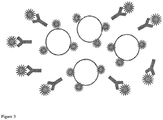
- R1 reagent enters a reaction cuvette and is mixed with sample. There is a period of incubation before the addition of R2 reagent and this has been termed the 'pre-reaction'. During this pre-reaction, any antigen present in the sample is able to react with the F(ab)2 antibody and form immune complexes. Because of the scarcity of the antigen, small immune complexes are formed that are not detected by standard instrumentation which uses a wavelength unable to detect complexes of this size. The addition of the R2 reagent means any remaining antibody is used to cross link the polystyrene bead and form complexes large enough to be detected at the utilized wavelength. Therefore, the more antigen present in the sample, the less signal is generated, meaning that change in signal is inversely proportional to the presence of antigen. This concept is represented schematically in the following diagrams:
- Figure 1 There is no antigen present in sample and all antibody is used to cross link latex bound antigen, resulting in a high amount of signal.
- Figure 3 The addition of large amounts of antigen in the sample causes all antibody to be capped in the first reaction. No antibody is left to be able to cause cross linkage of the bead, and no change in signal occurs.
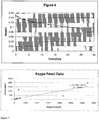
- Figure 4 shows a calibration curve for kappa FLC using kappa FLC bound to particles.
- the precision data below shows the reproducibility of the assay at high and low range.
- Low level High level 1 0.743 9.211 2 0.728 9.401 3 1.051 10.042 4 1.212 10.059 5 0.617 9.939 6 0.836 10.048 7 0.680 10.321 8 0.740 9.726 9 0.877 9.496 10 0.597 9.822 SD 0.19 0.35 Mean (mg/L) 0.81 9.81 CV 24.07% 3.54%
- Figure 5 shows a calibration curve for lambda FLC using lambda FLC bound to lambda particles. Precision data for the assay is shown below.
- Low level High level 1 0.58 7.30 2 0.57 6.99 3 0.76 7.63 4 0.71 7.02 5 0.54 6.99 6 0.53 7.01 7 0.57 7.54 8 0.68 7.08 9 0.54 7.04 SD 0.08 0.25 Mean (mg/L) 0.61 7.18 CV 13.95% 3.49%
Landscapes
- Health & Medical Sciences (AREA)
- Life Sciences & Earth Sciences (AREA)
- Immunology (AREA)
- Engineering & Computer Science (AREA)
- Chemical & Material Sciences (AREA)
- Urology & Nephrology (AREA)
- Hematology (AREA)
- Biomedical Technology (AREA)
- Molecular Biology (AREA)
- Medicinal Chemistry (AREA)
- Analytical Chemistry (AREA)
- Cell Biology (AREA)
- Pathology (AREA)
- Food Science & Technology (AREA)
- Biotechnology (AREA)
- Physics & Mathematics (AREA)
- Microbiology (AREA)
- Biochemistry (AREA)
- General Health & Medical Sciences (AREA)
- General Physics & Mathematics (AREA)
- Proteomics, Peptides & Aminoacids (AREA)
- Chemical Kinetics & Catalysis (AREA)
- Peptides Or Proteins (AREA)
- Investigating Or Analysing Biological Materials (AREA)
- Investigating Or Analysing Materials By Optical Means (AREA)
Claims (7)
- Procédé de détection de chaînes légères libres (FLC) ou d'immunoglobulines intactes dans un échantillon comprenant des étapes consistant à mettre l'échantillon en incubation avec un anticorps anti FLC ou des anticorps spécifiques à un type de chaîne légère d'une classe de chaîne lourde, ou des fragments de tels anticorps, et une quantité connue de FLC ou d'immunoglobulines complètes, et à détecter la liaison de l'anticorps à la quantité connue de FLC ou d'immunoglobulines,
caractérisé en ce que
le procédé comprend des étapes consistant à :(i) mélanger l'échantillon de sérum avec l'anticorps anti-FLC ou les anticorps spécifiques à un type de chaîne légère d'une classe de chaîne lourde ou les fragments de tels anticorps,(ii) mettre en incubation l'échantillon de sérum avec l'anticorps anti-FLC ou les anticorps spécifiques à un type de chaîne légère d'une classe de chaîne lourde, ou les fragments de tels anticorps pour former un mélange incubé,(iii) mesurer l'absorbance optique du mélange incubé ou diffuser une source de lumière sur celui-ci, pour obtenir une lecture de contrôle,(iv) mélanger une quantité prédéfinie de particules revêtues d'une quantité connue de FLC ou d'immunoglobulines complètes avec le mélange incubé,(v) mesurer la formation de complexes des particules revêtues avec l'anticorps anti-FLC ou les anticorps spécifiques à un type de chaîne légère d'une classe de chaîne lourde ou les fragments de tels anticorps, et(vi) comparer la formation des complexes avec une courbe de calibrage prédéfinie de formation de complexes avec des concentrations connues de FLC ou d'immunoglobulines complètes. - Procédé conforme à la revendication 1,
selon lequel les particules sont des microparticules de polystyrène. - Procédé conforme à la revendication 1 ou 2,
selon lequel les particules sont revêtues de FLC polyclonaux. - Procédé conforme aux revendications 1 à 3,
constitué par un test de néphélométrie ou de turbidimétrie. - Procédé conforme à l'une quelconque des revendications précédentes,
selon lequel le fragment d'anticorps est choisi parmi les fragments suivants : Fab, Fab' ou F(ab')2, susceptibles de lier spécifiquement les FLC. - Procédé conforme à l'une quelconque des revendications précédentes,
selon lequel l'anticorps ou le fragment d'anticorps est susceptible de lier spécifiquement les FLC À ou κ. - Procédé conforme aux revendications 2 à 6,
selon lequel les particules sont revêtues de FLC et les particules revêtues de FLC peuvent être obtenues (i) en fixant un fragment moléculaire de liaison sur des chaînes légères et des chaînes lourdes, (ii) en dissociant les chaînes légères et les chaînes lourdes et (iii) en isolant les FLC fixés aux particules par l'intermédiaire du fragment moléculaire de liaison, le fragment moléculaire de liaison renfermant de préférence de la biotine.
Applications Claiming Priority (2)
| Application Number | Priority Date | Filing Date | Title |
|---|---|---|---|
| GBGB1012049.1A GB201012049D0 (en) | 2010-07-19 | 2010-07-19 | Competition assay |
| PCT/GB2011/051353 WO2012010881A1 (fr) | 2010-07-19 | 2011-07-19 | Essai de compétition |
Publications (2)
| Publication Number | Publication Date |
|---|---|
| EP2596367A1 EP2596367A1 (fr) | 2013-05-29 |
| EP2596367B1 true EP2596367B1 (fr) | 2017-09-27 |
Family
ID=42735103
Family Applications (1)
| Application Number | Title | Priority Date | Filing Date |
|---|---|---|---|
| EP11738269.7A Active EP2596367B1 (fr) | 2010-07-19 | 2011-07-19 | Essai de compétition |
Country Status (5)
| Country | Link |
|---|---|
| US (1) | US10845362B2 (fr) |
| EP (1) | EP2596367B1 (fr) |
| ES (1) | ES2657713T3 (fr) |
| GB (1) | GB201012049D0 (fr) |
| WO (1) | WO2012010881A1 (fr) |
Families Citing this family (7)
| Publication number | Priority date | Publication date | Assignee | Title |
|---|---|---|---|---|
| CN102680713B (zh) * | 2012-06-18 | 2014-07-23 | 王钊 | 竞争法胶乳颗粒增强免疫比浊c肽检测试剂盒及制备方法 |
| CN102721802B (zh) * | 2012-07-06 | 2014-11-26 | 深圳市易瑞生物技术有限公司 | 一种提高竞争免疫分析灵敏性的方法 |
| GB201603359D0 (en) * | 2016-02-26 | 2016-04-13 | Binding Site Group The Ltd | Improved assay |
| CN109164264A (zh) * | 2018-09-05 | 2019-01-08 | 苏州普瑞斯生物科技有限公司 | 一种测定游离轻链Kappa浓度的试剂盒及制备方法 |
| CN116930479B (zh) * | 2023-07-28 | 2024-08-16 | 柏荣诊断产品(上海)有限公司 | 一种减弱基于多克隆抗体游离轻链检测试剂交叉反应的封闭试剂及其应用 |
| CN116953216B (zh) * | 2023-07-28 | 2024-10-29 | 柏荣诊断产品(上海)有限公司 | 一种减弱基于多克隆抗体游离轻链检测试剂交叉反应的封闭试剂及其应用 |
| CN120446468B (zh) * | 2025-07-07 | 2025-09-26 | 美康生物科技股份有限公司 | 一种血清游离轻链检测试剂及检测方法 |
Family Cites Families (25)
| Publication number | Priority date | Publication date | Assignee | Title |
|---|---|---|---|---|
| US3907502A (en) | 1973-12-11 | 1975-09-23 | Miless L Brink | Method for identifying Bence Jones proteins |
| EP0044219A1 (fr) | 1980-07-16 | 1982-01-20 | Unilever Plc | Méthodes d'analyse immunologique utilisant des anticorps monoclonaux |
| US4444879A (en) | 1981-01-29 | 1984-04-24 | Science Research Center, Inc. | Immunoassay with article having support film and immunological counterpart of analyte |
| US4792529A (en) | 1985-10-18 | 1988-12-20 | University Of Rochester | Immunoassay of free kappa light chains for the detection of multiple sclerosis |
| JPS63139199A (ja) | 1986-12-01 | 1988-06-10 | Wakunaga Pharmaceut Co Ltd | 抗ヒトIgEモノクロ−ナル抗体及びその用途 |
| DE3856421T2 (de) | 1987-04-27 | 2000-12-14 | Unilever Nv | Spezifische Bindungstestverfahren |
| US4791067A (en) * | 1987-06-25 | 1988-12-13 | Fisher Scientific Co. | Agglutination immunoassay for hapten involving monoclonal antibody of IgA class reagent |
| US4983530A (en) | 1988-01-29 | 1991-01-08 | E. I. Du Pont De Nemours And Company | Sandwich immunoassay for determination of total monoclonal IGG |
| IT1216698B (it) | 1988-04-01 | 1990-03-08 | New Scient Co Spa | Metodo per la determinazione della presenza di catene leggere libere in campioni di urina, complesso di preparati per l'esecuzione del metodo, e relativo reagente. |
| US5185066A (en) | 1988-08-11 | 1993-02-09 | Helena Laboratories Corporation | Immunofixation electrophoresis control system |
| JPH03199966A (ja) | 1989-12-27 | 1991-08-30 | Kazutomo Wakasugi | 遊離型l鎖の測定方法 |
| ATE285417T1 (de) | 1995-11-03 | 2005-01-15 | Binding Site Ltd | Herstellung von antikörpern |
| US6322788B1 (en) | 1998-08-20 | 2001-11-27 | Stanley Arthur Kim | Anti-bacterial antibodies and methods of use |
| US20020182748A1 (en) | 2001-03-30 | 2002-12-05 | Reardon Paul C. | Method and device for testing for Bence-Jones Protein |
| US20040018576A1 (en) | 2002-07-24 | 2004-01-29 | Dematteo Todd M. | Bence Jones protein testing cassette |
| WO2005103717A1 (fr) | 2004-04-21 | 2005-11-03 | Fornix Biosciences N.V. | Mesure de chaines legeres libres d'immunoglobuline |
| WO2005116651A2 (fr) | 2004-05-24 | 2005-12-08 | Diasys Corporation | Procede et dispositif de detection de la presence de la proteine de bence-jones |
| DE102004038726B4 (de) | 2004-07-15 | 2006-05-18 | Levin, Felix, Dr. | Testsystem und Verfahren zur schnellen Bestimmung von Bence Jones Protein in biologischen Flüssigkeiten |
| GB0501741D0 (en) * | 2005-01-27 | 2005-03-02 | Binding Site The Ltd | Antibody |
| JP4950879B2 (ja) | 2005-04-12 | 2012-06-13 | 松森 昭 | 心疾患診断用バイオマーカー及びその利用 |
| GB0608446D0 (en) | 2006-04-27 | 2006-06-07 | Binding Site The Ltd | Assay |
| WO2009003142A1 (fr) | 2007-06-27 | 2008-12-31 | The Board Of Trustees Of The Leland, Stanford Junior University | Bêta-2-microglobuline et protéine c réactive (crp) en tant que biomarqueurs pour une maladie artérielle périphérique |
| GB0801609D0 (en) | 2008-01-29 | 2008-03-05 | Binding Site The Ltd | Hevylite diagnostic stain |
| GB0819720D0 (en) * | 2008-10-28 | 2008-12-03 | Univ Birmingham | Methods and products |
| GB0914535D0 (en) | 2009-08-19 | 2009-09-30 | Binding Site Group The Ltd | Prognosis assay |
-
2010
- 2010-07-19 GB GBGB1012049.1A patent/GB201012049D0/en not_active Ceased
-
2011
- 2011-07-19 WO PCT/GB2011/051353 patent/WO2012010881A1/fr not_active Ceased
- 2011-07-19 US US13/810,777 patent/US10845362B2/en active Active
- 2011-07-19 ES ES11738269.7T patent/ES2657713T3/es active Active
- 2011-07-19 EP EP11738269.7A patent/EP2596367B1/fr active Active
Also Published As
| Publication number | Publication date |
|---|---|
| EP2596367A1 (fr) | 2013-05-29 |
| ES2657713T3 (es) | 2018-03-06 |
| WO2012010881A1 (fr) | 2012-01-26 |
| US10845362B2 (en) | 2020-11-24 |
| GB201012049D0 (en) | 2010-09-01 |
| US20130217149A1 (en) | 2013-08-22 |
Similar Documents
| Publication | Publication Date | Title |
|---|---|---|
| EP2596367B1 (fr) | Essai de compétition | |
| EP3033620B1 (fr) | Procédé pour la détection de l'effet prozone de dosages photométriques | |
| JP5715671B2 (ja) | 悪性プラズマ細胞疾患の検出又はモニタリング方法 | |
| US20100216257A1 (en) | Method of Assaying Antigen and Reagent Therefor | |
| JPH0618528A (ja) | 遠心アナライザー中の粒子強化凝集反応を混濁の輝度の測定により分析する方法 | |
| KR920000057B1 (ko) | 특이적으로 결합가능한 물질의 측정 방법 및 시약 | |
| US6210975B1 (en) | Process for determining a bindable analyte via immune precipitation and reagent therefor | |
| CN113811772B (zh) | 质谱分析校准物 | |
| US12320806B2 (en) | Assay for free light chains | |
| US6927071B2 (en) | Method for reducing non-specific aggregation of latex microparticles in the presence of serum or plasma | |
| WO2019154054A1 (fr) | Dispositif et procédé pour éliminer un médicament libre d'un échantillon d'essai d'anticorps anti-médicament, et procédé de fabrication et application du dispositif | |
| KR20130095061A (ko) | 신규한 항체 고정용 융합단백질 및 이를 이용한 면역분석 방법 | |
| JPH0552845A (ja) | 免疫測定用試薬 |
Legal Events
| Date | Code | Title | Description |
|---|---|---|---|
| PUAI | Public reference made under article 153(3) epc to a published international application that has entered the european phase |
Free format text: ORIGINAL CODE: 0009012 |
|
| 17P | Request for examination filed |
Effective date: 20130208 |
|
| AK | Designated contracting states |
Kind code of ref document: A1 Designated state(s): AL AT BE BG CH CY CZ DE DK EE ES FI FR GB GR HR HU IE IS IT LI LT LU LV MC MK MT NL NO PL PT RO RS SE SI SK SM TR |
|
| DAX | Request for extension of the european patent (deleted) | ||
| 17Q | First examination report despatched |
Effective date: 20131125 |
|
| TPAC | Observations filed by third parties |
Free format text: ORIGINAL CODE: EPIDOSNTIPA |
|
| GRAP | Despatch of communication of intention to grant a patent |
Free format text: ORIGINAL CODE: EPIDOSNIGR1 |
|
| INTG | Intention to grant announced |
Effective date: 20160718 |
|
| GRAS | Grant fee paid |
Free format text: ORIGINAL CODE: EPIDOSNIGR3 |
|
| STAA | Information on the status of an ep patent application or granted ep patent |
Free format text: STATUS: GRANT OF PATENT IS INTENDED |
|
| GRAA | (expected) grant |
Free format text: ORIGINAL CODE: 0009210 |
|
| STAA | Information on the status of an ep patent application or granted ep patent |
Free format text: STATUS: THE PATENT HAS BEEN GRANTED |
|
| RAP1 | Party data changed (applicant data changed or rights of an application transferred) |
Owner name: THE BINDING SITE GROUP LIMITED |
|
| AK | Designated contracting states |
Kind code of ref document: B1 Designated state(s): AL AT BE BG CH CY CZ DE DK EE ES FI FR GB GR HR HU IE IS IT LI LT LU LV MC MK MT NL NO PL PT RO RS SE SI SK SM TR |
|
| REG | Reference to a national code |
Ref country code: GB Ref legal event code: FG4D |
|
| REG | Reference to a national code |
Ref country code: CH Ref legal event code: EP |
|
| REG | Reference to a national code |
Ref country code: AT Ref legal event code: REF Ref document number: 932432 Country of ref document: AT Kind code of ref document: T Effective date: 20171015 |
|
| REG | Reference to a national code |
Ref country code: IE Ref legal event code: FG4D |
|
| REG | Reference to a national code |
Ref country code: DE Ref legal event code: R096 Ref document number: 602011041905 Country of ref document: DE |
|
| PG25 | Lapsed in a contracting state [announced via postgrant information from national office to epo] |
Ref country code: FI Free format text: LAPSE BECAUSE OF FAILURE TO SUBMIT A TRANSLATION OF THE DESCRIPTION OR TO PAY THE FEE WITHIN THE PRESCRIBED TIME-LIMIT Effective date: 20170927 Ref country code: NO Free format text: LAPSE BECAUSE OF FAILURE TO SUBMIT A TRANSLATION OF THE DESCRIPTION OR TO PAY THE FEE WITHIN THE PRESCRIBED TIME-LIMIT Effective date: 20171227 Ref country code: HR Free format text: LAPSE BECAUSE OF FAILURE TO SUBMIT A TRANSLATION OF THE DESCRIPTION OR TO PAY THE FEE WITHIN THE PRESCRIBED TIME-LIMIT Effective date: 20170927 Ref country code: LT Free format text: LAPSE BECAUSE OF FAILURE TO SUBMIT A TRANSLATION OF THE DESCRIPTION OR TO PAY THE FEE WITHIN THE PRESCRIBED TIME-LIMIT Effective date: 20170927 Ref country code: SE Free format text: LAPSE BECAUSE OF FAILURE TO SUBMIT A TRANSLATION OF THE DESCRIPTION OR TO PAY THE FEE WITHIN THE PRESCRIBED TIME-LIMIT Effective date: 20170927 |
|
| REG | Reference to a national code |
Ref country code: NL Ref legal event code: MP Effective date: 20170927 |
|
| REG | Reference to a national code |
Ref country code: LT Ref legal event code: MG4D |
|
| REG | Reference to a national code |
Ref country code: AT Ref legal event code: MK05 Ref document number: 932432 Country of ref document: AT Kind code of ref document: T Effective date: 20170927 |
|
| PG25 | Lapsed in a contracting state [announced via postgrant information from national office to epo] |
Ref country code: BG Free format text: LAPSE BECAUSE OF FAILURE TO SUBMIT A TRANSLATION OF THE DESCRIPTION OR TO PAY THE FEE WITHIN THE PRESCRIBED TIME-LIMIT Effective date: 20171227 Ref country code: GR Free format text: LAPSE BECAUSE OF FAILURE TO SUBMIT A TRANSLATION OF THE DESCRIPTION OR TO PAY THE FEE WITHIN THE PRESCRIBED TIME-LIMIT Effective date: 20171228 Ref country code: RS Free format text: LAPSE BECAUSE OF FAILURE TO SUBMIT A TRANSLATION OF THE DESCRIPTION OR TO PAY THE FEE WITHIN THE PRESCRIBED TIME-LIMIT Effective date: 20170927 Ref country code: LV Free format text: LAPSE BECAUSE OF FAILURE TO SUBMIT A TRANSLATION OF THE DESCRIPTION OR TO PAY THE FEE WITHIN THE PRESCRIBED TIME-LIMIT Effective date: 20170927 |
|
| REG | Reference to a national code |
Ref country code: ES Ref legal event code: FG2A Ref document number: 2657713 Country of ref document: ES Kind code of ref document: T3 Effective date: 20180306 |
|
| PG25 | Lapsed in a contracting state [announced via postgrant information from national office to epo] |
Ref country code: NL Free format text: LAPSE BECAUSE OF FAILURE TO SUBMIT A TRANSLATION OF THE DESCRIPTION OR TO PAY THE FEE WITHIN THE PRESCRIBED TIME-LIMIT Effective date: 20170927 |
|
| PG25 | Lapsed in a contracting state [announced via postgrant information from national office to epo] |
Ref country code: CZ Free format text: LAPSE BECAUSE OF FAILURE TO SUBMIT A TRANSLATION OF THE DESCRIPTION OR TO PAY THE FEE WITHIN THE PRESCRIBED TIME-LIMIT Effective date: 20170927 Ref country code: RO Free format text: LAPSE BECAUSE OF FAILURE TO SUBMIT A TRANSLATION OF THE DESCRIPTION OR TO PAY THE FEE WITHIN THE PRESCRIBED TIME-LIMIT Effective date: 20170927 |
|
| PG25 | Lapsed in a contracting state [announced via postgrant information from national office to epo] |
Ref country code: AT Free format text: LAPSE BECAUSE OF FAILURE TO SUBMIT A TRANSLATION OF THE DESCRIPTION OR TO PAY THE FEE WITHIN THE PRESCRIBED TIME-LIMIT Effective date: 20170927 Ref country code: SM Free format text: LAPSE BECAUSE OF FAILURE TO SUBMIT A TRANSLATION OF THE DESCRIPTION OR TO PAY THE FEE WITHIN THE PRESCRIBED TIME-LIMIT Effective date: 20170927 Ref country code: SK Free format text: LAPSE BECAUSE OF FAILURE TO SUBMIT A TRANSLATION OF THE DESCRIPTION OR TO PAY THE FEE WITHIN THE PRESCRIBED TIME-LIMIT Effective date: 20170927 Ref country code: IS Free format text: LAPSE BECAUSE OF FAILURE TO SUBMIT A TRANSLATION OF THE DESCRIPTION OR TO PAY THE FEE WITHIN THE PRESCRIBED TIME-LIMIT Effective date: 20180127 Ref country code: EE Free format text: LAPSE BECAUSE OF FAILURE TO SUBMIT A TRANSLATION OF THE DESCRIPTION OR TO PAY THE FEE WITHIN THE PRESCRIBED TIME-LIMIT Effective date: 20170927 |
|
| REG | Reference to a national code |
Ref country code: DE Ref legal event code: R097 Ref document number: 602011041905 Country of ref document: DE |
|
| REG | Reference to a national code |
Ref country code: FR Ref legal event code: PLFP Year of fee payment: 8 |
|
| PG25 | Lapsed in a contracting state [announced via postgrant information from national office to epo] |
Ref country code: DK Free format text: LAPSE BECAUSE OF FAILURE TO SUBMIT A TRANSLATION OF THE DESCRIPTION OR TO PAY THE FEE WITHIN THE PRESCRIBED TIME-LIMIT Effective date: 20170927 |
|
| PLBE | No opposition filed within time limit |
Free format text: ORIGINAL CODE: 0009261 |
|
| STAA | Information on the status of an ep patent application or granted ep patent |
Free format text: STATUS: NO OPPOSITION FILED WITHIN TIME LIMIT |
|
| PG25 | Lapsed in a contracting state [announced via postgrant information from national office to epo] |
Ref country code: PL Free format text: LAPSE BECAUSE OF FAILURE TO SUBMIT A TRANSLATION OF THE DESCRIPTION OR TO PAY THE FEE WITHIN THE PRESCRIBED TIME-LIMIT Effective date: 20170927 |
|
| 26N | No opposition filed |
Effective date: 20180628 |
|
| PG25 | Lapsed in a contracting state [announced via postgrant information from national office to epo] |
Ref country code: SI Free format text: LAPSE BECAUSE OF FAILURE TO SUBMIT A TRANSLATION OF THE DESCRIPTION OR TO PAY THE FEE WITHIN THE PRESCRIBED TIME-LIMIT Effective date: 20170927 |
|
| REG | Reference to a national code |
Ref country code: CH Ref legal event code: PL |
|
| PG25 | Lapsed in a contracting state [announced via postgrant information from national office to epo] |
Ref country code: MC Free format text: LAPSE BECAUSE OF FAILURE TO SUBMIT A TRANSLATION OF THE DESCRIPTION OR TO PAY THE FEE WITHIN THE PRESCRIBED TIME-LIMIT Effective date: 20170927 Ref country code: LU Free format text: LAPSE BECAUSE OF NON-PAYMENT OF DUE FEES Effective date: 20180719 |
|
| REG | Reference to a national code |
Ref country code: BE Ref legal event code: MM Effective date: 20180731 |
|
| REG | Reference to a national code |
Ref country code: IE Ref legal event code: MM4A |
|
| PG25 | Lapsed in a contracting state [announced via postgrant information from national office to epo] |
Ref country code: CH Free format text: LAPSE BECAUSE OF NON-PAYMENT OF DUE FEES Effective date: 20180731 Ref country code: IE Free format text: LAPSE BECAUSE OF NON-PAYMENT OF DUE FEES Effective date: 20180719 Ref country code: LI Free format text: LAPSE BECAUSE OF NON-PAYMENT OF DUE FEES Effective date: 20180731 |
|
| PG25 | Lapsed in a contracting state [announced via postgrant information from national office to epo] |
Ref country code: BE Free format text: LAPSE BECAUSE OF NON-PAYMENT OF DUE FEES Effective date: 20180731 |
|
| PG25 | Lapsed in a contracting state [announced via postgrant information from national office to epo] |
Ref country code: MT Free format text: LAPSE BECAUSE OF NON-PAYMENT OF DUE FEES Effective date: 20180719 |
|
| PG25 | Lapsed in a contracting state [announced via postgrant information from national office to epo] |
Ref country code: TR Free format text: LAPSE BECAUSE OF FAILURE TO SUBMIT A TRANSLATION OF THE DESCRIPTION OR TO PAY THE FEE WITHIN THE PRESCRIBED TIME-LIMIT Effective date: 20170927 |
|
| PG25 | Lapsed in a contracting state [announced via postgrant information from national office to epo] |
Ref country code: HU Free format text: LAPSE BECAUSE OF FAILURE TO SUBMIT A TRANSLATION OF THE DESCRIPTION OR TO PAY THE FEE WITHIN THE PRESCRIBED TIME-LIMIT; INVALID AB INITIO Effective date: 20110719 Ref country code: PT Free format text: LAPSE BECAUSE OF FAILURE TO SUBMIT A TRANSLATION OF THE DESCRIPTION OR TO PAY THE FEE WITHIN THE PRESCRIBED TIME-LIMIT Effective date: 20170927 |
|
| PG25 | Lapsed in a contracting state [announced via postgrant information from national office to epo] |
Ref country code: MK Free format text: LAPSE BECAUSE OF NON-PAYMENT OF DUE FEES Effective date: 20170927 Ref country code: CY Free format text: LAPSE BECAUSE OF FAILURE TO SUBMIT A TRANSLATION OF THE DESCRIPTION OR TO PAY THE FEE WITHIN THE PRESCRIBED TIME-LIMIT Effective date: 20170927 |
|
| PG25 | Lapsed in a contracting state [announced via postgrant information from national office to epo] |
Ref country code: AL Free format text: LAPSE BECAUSE OF FAILURE TO SUBMIT A TRANSLATION OF THE DESCRIPTION OR TO PAY THE FEE WITHIN THE PRESCRIBED TIME-LIMIT Effective date: 20170927 |
|
| P01 | Opt-out of the competence of the unified patent court (upc) registered |
Effective date: 20230529 |
|
| PGFP | Annual fee paid to national office [announced via postgrant information from national office to epo] |
Ref country code: ES Payment date: 20250822 Year of fee payment: 15 |
|
| PGFP | Annual fee paid to national office [announced via postgrant information from national office to epo] |
Ref country code: DE Payment date: 20250616 Year of fee payment: 15 |
|
| PGFP | Annual fee paid to national office [announced via postgrant information from national office to epo] |
Ref country code: IT Payment date: 20250618 Year of fee payment: 15 |
|
| PGFP | Annual fee paid to national office [announced via postgrant information from national office to epo] |
Ref country code: GB Payment date: 20250715 Year of fee payment: 15 |
|
| PGFP | Annual fee paid to national office [announced via postgrant information from national office to epo] |
Ref country code: FR Payment date: 20250718 Year of fee payment: 15 |