EP2662135A2 - Méthode de mélange de gouttelettes dans un microcanal - Google Patents
Méthode de mélange de gouttelettes dans un microcanal Download PDFInfo
- Publication number
- EP2662135A2 EP2662135A2 EP13165665.4A EP13165665A EP2662135A2 EP 2662135 A2 EP2662135 A2 EP 2662135A2 EP 13165665 A EP13165665 A EP 13165665A EP 2662135 A2 EP2662135 A2 EP 2662135A2
- Authority
- EP
- European Patent Office
- Prior art keywords
- droplets
- droplet
- fluid
- feature
- fluidic
- Prior art date
- Legal status (The legal status is an assumption and is not a legal conclusion. Google has not performed a legal analysis and makes no representation as to the accuracy of the status listed.)
- Withdrawn
Links
- SVQLLPOUSBWFHB-UHFFFAOYSA-N CC(C(C(C(C(C1(F)F)(F)F)(F)F)(F)F)(C1(F)F)F)O Chemical compound CC(C(C(C(C(C1(F)F)(F)F)(F)F)(F)F)(C1(F)F)F)O SVQLLPOUSBWFHB-UHFFFAOYSA-N 0.000 description 1
Images








Classifications
-
- B—PERFORMING OPERATIONS; TRANSPORTING
- B01—PHYSICAL OR CHEMICAL PROCESSES OR APPARATUS IN GENERAL
- B01L—CHEMICAL OR PHYSICAL LABORATORY APPARATUS FOR GENERAL USE
- B01L3/00—Containers or dishes for laboratory use, e.g. laboratory glassware; Droppers
- B01L3/50—Containers for the purpose of retaining a material to be analysed, e.g. test tubes
- B01L3/502—Containers for the purpose of retaining a material to be analysed, e.g. test tubes with fluid transport, e.g. in multi-compartment structures
- B01L3/5027—Containers for the purpose of retaining a material to be analysed, e.g. test tubes with fluid transport, e.g. in multi-compartment structures by integrated microfluidic structures, i.e. dimensions of channels and chambers are such that surface tension forces are important, e.g. lab-on-a-chip
-
- B—PERFORMING OPERATIONS; TRANSPORTING
- B01—PHYSICAL OR CHEMICAL PROCESSES OR APPARATUS IN GENERAL
- B01J—CHEMICAL OR PHYSICAL PROCESSES, e.g. CATALYSIS OR COLLOID CHEMISTRY; THEIR RELEVANT APPARATUS
- B01J19/00—Chemical, physical or physico-chemical processes in general; Their relevant apparatus
-
- B—PERFORMING OPERATIONS; TRANSPORTING
- B01—PHYSICAL OR CHEMICAL PROCESSES OR APPARATUS IN GENERAL
- B01F—MIXING, e.g. DISSOLVING, EMULSIFYING OR DISPERSING
- B01F25/00—Flow mixers; Mixers for falling materials, e.g. solid particles
- B01F25/40—Static mixers
-
- B—PERFORMING OPERATIONS; TRANSPORTING
- B01—PHYSICAL OR CHEMICAL PROCESSES OR APPARATUS IN GENERAL
- B01F—MIXING, e.g. DISSOLVING, EMULSIFYING OR DISPERSING
- B01F25/00—Flow mixers; Mixers for falling materials, e.g. solid particles
- B01F25/40—Static mixers
- B01F25/42—Static mixers in which the mixing is affected by moving the components jointly in changing directions, e.g. in tubes provided with baffles or obstructions
- B01F25/43—Mixing tubes, e.g. wherein the material is moved in a radial or partly reversed direction
- B01F25/433—Mixing tubes wherein the shape of the tube influences the mixing, e.g. mixing tubes with varying cross-section or provided with inwardly extending profiles
-
- B—PERFORMING OPERATIONS; TRANSPORTING
- B01—PHYSICAL OR CHEMICAL PROCESSES OR APPARATUS IN GENERAL
- B01F—MIXING, e.g. DISSOLVING, EMULSIFYING OR DISPERSING
- B01F25/00—Flow mixers; Mixers for falling materials, e.g. solid particles
- B01F25/40—Static mixers
- B01F25/42—Static mixers in which the mixing is affected by moving the components jointly in changing directions, e.g. in tubes provided with baffles or obstructions
- B01F25/43—Mixing tubes, e.g. wherein the material is moved in a radial or partly reversed direction
- B01F25/433—Mixing tubes wherein the shape of the tube influences the mixing, e.g. mixing tubes with varying cross-section or provided with inwardly extending profiles
- B01F25/4338—Mixers with a succession of converging-diverging cross-sections, i.e. undulating cross-section
-
- B—PERFORMING OPERATIONS; TRANSPORTING
- B01—PHYSICAL OR CHEMICAL PROCESSES OR APPARATUS IN GENERAL
- B01F—MIXING, e.g. DISSOLVING, EMULSIFYING OR DISPERSING
- B01F25/00—Flow mixers; Mixers for falling materials, e.g. solid particles
- B01F25/40—Static mixers
- B01F25/45—Mixers in which the materials to be mixed are pressed together through orifices or interstitial spaces, e.g. between beads
-
- B—PERFORMING OPERATIONS; TRANSPORTING
- B01—PHYSICAL OR CHEMICAL PROCESSES OR APPARATUS IN GENERAL
- B01F—MIXING, e.g. DISSOLVING, EMULSIFYING OR DISPERSING
- B01F25/00—Flow mixers; Mixers for falling materials, e.g. solid particles
- B01F25/40—Static mixers
- B01F25/45—Mixers in which the materials to be mixed are pressed together through orifices or interstitial spaces, e.g. between beads
- B01F25/452—Mixers in which the materials to be mixed are pressed together through orifices or interstitial spaces, e.g. between beads characterised by elements provided with orifices or interstitial spaces
- B01F25/4521—Mixers in which the materials to be mixed are pressed together through orifices or interstitial spaces, e.g. between beads characterised by elements provided with orifices or interstitial spaces the components being pressed through orifices in elements, e.g. flat plates or cylinders, which obstruct the whole diameter of the tube
- B01F25/45211—Mixers in which the materials to be mixed are pressed together through orifices or interstitial spaces, e.g. between beads characterised by elements provided with orifices or interstitial spaces the components being pressed through orifices in elements, e.g. flat plates or cylinders, which obstruct the whole diameter of the tube the elements being cylinders or cones which obstruct the whole diameter of the tube, the flow changing from axial in radial and again in axial
-
- B—PERFORMING OPERATIONS; TRANSPORTING
- B01—PHYSICAL OR CHEMICAL PROCESSES OR APPARATUS IN GENERAL
- B01F—MIXING, e.g. DISSOLVING, EMULSIFYING OR DISPERSING
- B01F33/00—Other mixers; Mixing plants; Combinations of mixers
- B01F33/30—Micromixers
- B01F33/302—Micromixers the materials to be mixed flowing in the form of droplets
- B01F33/3021—Micromixers the materials to be mixed flowing in the form of droplets the components to be mixed being combined in a single independent droplet, e.g. these droplets being divided by a non-miscible fluid or consisting of independent droplets
-
- B—PERFORMING OPERATIONS; TRANSPORTING
- B01—PHYSICAL OR CHEMICAL PROCESSES OR APPARATUS IN GENERAL
- B01F—MIXING, e.g. DISSOLVING, EMULSIFYING OR DISPERSING
- B01F33/00—Other mixers; Mixing plants; Combinations of mixers
- B01F33/30—Micromixers
- B01F33/3031—Micromixers using electro-hydrodynamic [EHD] or electro-kinetic [EKI] phenomena to mix or move the fluids
-
- B—PERFORMING OPERATIONS; TRANSPORTING
- B01—PHYSICAL OR CHEMICAL PROCESSES OR APPARATUS IN GENERAL
- B01F—MIXING, e.g. DISSOLVING, EMULSIFYING OR DISPERSING
- B01F33/00—Other mixers; Mixing plants; Combinations of mixers
- B01F33/30—Micromixers
- B01F33/305—Micromixers using mixing means not otherwise provided for
-
- B—PERFORMING OPERATIONS; TRANSPORTING
- B01—PHYSICAL OR CHEMICAL PROCESSES OR APPARATUS IN GENERAL
- B01J—CHEMICAL OR PHYSICAL PROCESSES, e.g. CATALYSIS OR COLLOID CHEMISTRY; THEIR RELEVANT APPARATUS
- B01J19/00—Chemical, physical or physico-chemical processes in general; Their relevant apparatus
- B01J19/0093—Microreactors, e.g. miniaturised or microfabricated reactors
-
- B—PERFORMING OPERATIONS; TRANSPORTING
- B01—PHYSICAL OR CHEMICAL PROCESSES OR APPARATUS IN GENERAL
- B01L—CHEMICAL OR PHYSICAL LABORATORY APPARATUS FOR GENERAL USE
- B01L3/00—Containers or dishes for laboratory use, e.g. laboratory glassware; Droppers
- B01L3/50—Containers for the purpose of retaining a material to be analysed, e.g. test tubes
- B01L3/502—Containers for the purpose of retaining a material to be analysed, e.g. test tubes with fluid transport, e.g. in multi-compartment structures
- B01L3/5027—Containers for the purpose of retaining a material to be analysed, e.g. test tubes with fluid transport, e.g. in multi-compartment structures by integrated microfluidic structures, i.e. dimensions of channels and chambers are such that surface tension forces are important, e.g. lab-on-a-chip
- B01L3/502769—Containers for the purpose of retaining a material to be analysed, e.g. test tubes with fluid transport, e.g. in multi-compartment structures by integrated microfluidic structures, i.e. dimensions of channels and chambers are such that surface tension forces are important, e.g. lab-on-a-chip characterised by multiphase flow arrangements
- B01L3/502784—Containers for the purpose of retaining a material to be analysed, e.g. test tubes with fluid transport, e.g. in multi-compartment structures by integrated microfluidic structures, i.e. dimensions of channels and chambers are such that surface tension forces are important, e.g. lab-on-a-chip characterised by multiphase flow arrangements specially adapted for droplet or plug flow, e.g. digital microfluidics
-
- G—PHYSICS
- G01—MEASURING; TESTING
- G01N—INVESTIGATING OR ANALYSING MATERIALS BY DETERMINING THEIR CHEMICAL OR PHYSICAL PROPERTIES
- G01N15/00—Investigating characteristics of particles; Investigating permeability, pore-volume or surface-area of porous materials
- G01N15/10—Investigating individual particles
-
- G—PHYSICS
- G01—MEASURING; TESTING
- G01N—INVESTIGATING OR ANALYSING MATERIALS BY DETERMINING THEIR CHEMICAL OR PHYSICAL PROPERTIES
- G01N15/00—Investigating characteristics of particles; Investigating permeability, pore-volume or surface-area of porous materials
- G01N15/10—Investigating individual particles
- G01N15/14—Optical investigation techniques, e.g. flow cytometry
-
- G—PHYSICS
- G01—MEASURING; TESTING
- G01N—INVESTIGATING OR ANALYSING MATERIALS BY DETERMINING THEIR CHEMICAL OR PHYSICAL PROPERTIES
- G01N15/00—Investigating characteristics of particles; Investigating permeability, pore-volume or surface-area of porous materials
- G01N15/10—Investigating individual particles
- G01N15/14—Optical investigation techniques, e.g. flow cytometry
- G01N15/1456—Optical investigation techniques, e.g. flow cytometry without spatial resolution of the texture or inner structure of the particle, e.g. processing of pulse signals
- G01N15/1459—Optical investigation techniques, e.g. flow cytometry without spatial resolution of the texture or inner structure of the particle, e.g. processing of pulse signals the analysis being performed on a sample stream
-
- G—PHYSICS
- G01—MEASURING; TESTING
- G01N—INVESTIGATING OR ANALYSING MATERIALS BY DETERMINING THEIR CHEMICAL OR PHYSICAL PROPERTIES
- G01N15/00—Investigating characteristics of particles; Investigating permeability, pore-volume or surface-area of porous materials
- G01N15/10—Investigating individual particles
- G01N15/14—Optical investigation techniques, e.g. flow cytometry
- G01N15/1484—Optical investigation techniques, e.g. flow cytometry microstructural devices
-
- B—PERFORMING OPERATIONS; TRANSPORTING
- B01—PHYSICAL OR CHEMICAL PROCESSES OR APPARATUS IN GENERAL
- B01F—MIXING, e.g. DISSOLVING, EMULSIFYING OR DISPERSING
- B01F25/00—Flow mixers; Mixers for falling materials, e.g. solid particles
- B01F25/20—Jet mixers, i.e. mixers using high-speed fluid streams
- B01F25/23—Mixing by intersecting jets
-
- B—PERFORMING OPERATIONS; TRANSPORTING
- B01—PHYSICAL OR CHEMICAL PROCESSES OR APPARATUS IN GENERAL
- B01F—MIXING, e.g. DISSOLVING, EMULSIFYING OR DISPERSING
- B01F33/00—Other mixers; Mixing plants; Combinations of mixers
- B01F33/30—Micromixers
- B01F33/302—Micromixers the materials to be mixed flowing in the form of droplets
-
- B—PERFORMING OPERATIONS; TRANSPORTING
- B01—PHYSICAL OR CHEMICAL PROCESSES OR APPARATUS IN GENERAL
- B01J—CHEMICAL OR PHYSICAL PROCESSES, e.g. CATALYSIS OR COLLOID CHEMISTRY; THEIR RELEVANT APPARATUS
- B01J2219/00—Chemical, physical or physico-chemical processes in general; Their relevant apparatus
- B01J2219/00781—Aspects relating to microreactors
- B01J2219/00783—Laminate assemblies, i.e. the reactor comprising a stack of plates
-
- B—PERFORMING OPERATIONS; TRANSPORTING
- B01—PHYSICAL OR CHEMICAL PROCESSES OR APPARATUS IN GENERAL
- B01J—CHEMICAL OR PHYSICAL PROCESSES, e.g. CATALYSIS OR COLLOID CHEMISTRY; THEIR RELEVANT APPARATUS
- B01J2219/00—Chemical, physical or physico-chemical processes in general; Their relevant apparatus
- B01J2219/00781—Aspects relating to microreactors
- B01J2219/00851—Additional features
- B01J2219/00858—Aspects relating to the size of the reactor
- B01J2219/00862—Dimensions of the reaction cavity itself
-
- B—PERFORMING OPERATIONS; TRANSPORTING
- B01—PHYSICAL OR CHEMICAL PROCESSES OR APPARATUS IN GENERAL
- B01L—CHEMICAL OR PHYSICAL LABORATORY APPARATUS FOR GENERAL USE
- B01L2200/00—Solutions for specific problems relating to chemical or physical laboratory apparatus
- B01L2200/06—Fluid handling related problems
- B01L2200/0636—Focussing flows, e.g. to laminate flows
-
- B—PERFORMING OPERATIONS; TRANSPORTING
- B01—PHYSICAL OR CHEMICAL PROCESSES OR APPARATUS IN GENERAL
- B01L—CHEMICAL OR PHYSICAL LABORATORY APPARATUS FOR GENERAL USE
- B01L2200/00—Solutions for specific problems relating to chemical or physical laboratory apparatus
- B01L2200/06—Fluid handling related problems
- B01L2200/0647—Handling flowable solids, e.g. microscopic beads, cells, particles
- B01L2200/0652—Sorting or classification of particles or molecules
-
- B—PERFORMING OPERATIONS; TRANSPORTING
- B01—PHYSICAL OR CHEMICAL PROCESSES OR APPARATUS IN GENERAL
- B01L—CHEMICAL OR PHYSICAL LABORATORY APPARATUS FOR GENERAL USE
- B01L2200/00—Solutions for specific problems relating to chemical or physical laboratory apparatus
- B01L2200/06—Fluid handling related problems
- B01L2200/0673—Handling of plugs of fluid surrounded by immiscible fluid
-
- B—PERFORMING OPERATIONS; TRANSPORTING
- B01—PHYSICAL OR CHEMICAL PROCESSES OR APPARATUS IN GENERAL
- B01L—CHEMICAL OR PHYSICAL LABORATORY APPARATUS FOR GENERAL USE
- B01L2300/00—Additional constructional details
- B01L2300/08—Geometry, shape and general structure
- B01L2300/0861—Configuration of multiple channels and/or chambers in a single devices
- B01L2300/0864—Configuration of multiple channels and/or chambers in a single devices comprising only one inlet and multiple receiving wells, e.g. for separation, splitting
-
- B—PERFORMING OPERATIONS; TRANSPORTING
- B01—PHYSICAL OR CHEMICAL PROCESSES OR APPARATUS IN GENERAL
- B01L—CHEMICAL OR PHYSICAL LABORATORY APPARATUS FOR GENERAL USE
- B01L2300/00—Additional constructional details
- B01L2300/08—Geometry, shape and general structure
- B01L2300/0861—Configuration of multiple channels and/or chambers in a single devices
- B01L2300/0867—Multiple inlets and one sample wells, e.g. mixing, dilution
-
- B—PERFORMING OPERATIONS; TRANSPORTING
- B01—PHYSICAL OR CHEMICAL PROCESSES OR APPARATUS IN GENERAL
- B01L—CHEMICAL OR PHYSICAL LABORATORY APPARATUS FOR GENERAL USE
- B01L2300/00—Additional constructional details
- B01L2300/16—Surface properties and coatings
- B01L2300/161—Control and use of surface tension forces, e.g. hydrophobic, hydrophilic
-
- B—PERFORMING OPERATIONS; TRANSPORTING
- B01—PHYSICAL OR CHEMICAL PROCESSES OR APPARATUS IN GENERAL
- B01L—CHEMICAL OR PHYSICAL LABORATORY APPARATUS FOR GENERAL USE
- B01L2400/00—Moving or stopping fluids
- B01L2400/04—Moving fluids with specific forces or mechanical means
- B01L2400/0403—Moving fluids with specific forces or mechanical means specific forces
- B01L2400/0415—Moving fluids with specific forces or mechanical means specific forces electrical forces, e.g. electrokinetic
-
- B—PERFORMING OPERATIONS; TRANSPORTING
- B01—PHYSICAL OR CHEMICAL PROCESSES OR APPARATUS IN GENERAL
- B01L—CHEMICAL OR PHYSICAL LABORATORY APPARATUS FOR GENERAL USE
- B01L2400/00—Moving or stopping fluids
- B01L2400/04—Moving fluids with specific forces or mechanical means
- B01L2400/0403—Moving fluids with specific forces or mechanical means specific forces
- B01L2400/0433—Moving fluids with specific forces or mechanical means specific forces vibrational forces
- B01L2400/0439—Moving fluids with specific forces or mechanical means specific forces vibrational forces ultrasonic vibrations, vibrating piezo elements
-
- B—PERFORMING OPERATIONS; TRANSPORTING
- B01—PHYSICAL OR CHEMICAL PROCESSES OR APPARATUS IN GENERAL
- B01L—CHEMICAL OR PHYSICAL LABORATORY APPARATUS FOR GENERAL USE
- B01L2400/00—Moving or stopping fluids
- B01L2400/04—Moving fluids with specific forces or mechanical means
- B01L2400/0475—Moving fluids with specific forces or mechanical means specific mechanical means and fluid pressure
- B01L2400/0487—Moving fluids with specific forces or mechanical means specific mechanical means and fluid pressure fluid pressure, pneumatics
-
- B—PERFORMING OPERATIONS; TRANSPORTING
- B01—PHYSICAL OR CHEMICAL PROCESSES OR APPARATUS IN GENERAL
- B01L—CHEMICAL OR PHYSICAL LABORATORY APPARATUS FOR GENERAL USE
- B01L3/00—Containers or dishes for laboratory use, e.g. laboratory glassware; Droppers
- B01L3/02—Burettes; Pipettes
- B01L3/0241—Drop counters; Drop formers
-
- B—PERFORMING OPERATIONS; TRANSPORTING
- B01—PHYSICAL OR CHEMICAL PROCESSES OR APPARATUS IN GENERAL
- B01L—CHEMICAL OR PHYSICAL LABORATORY APPARATUS FOR GENERAL USE
- B01L3/00—Containers or dishes for laboratory use, e.g. laboratory glassware; Droppers
- B01L3/50—Containers for the purpose of retaining a material to be analysed, e.g. test tubes
- B01L3/502—Containers for the purpose of retaining a material to be analysed, e.g. test tubes with fluid transport, e.g. in multi-compartment structures
- B01L3/5027—Containers for the purpose of retaining a material to be analysed, e.g. test tubes with fluid transport, e.g. in multi-compartment structures by integrated microfluidic structures, i.e. dimensions of channels and chambers are such that surface tension forces are important, e.g. lab-on-a-chip
- B01L3/502761—Containers for the purpose of retaining a material to be analysed, e.g. test tubes with fluid transport, e.g. in multi-compartment structures by integrated microfluidic structures, i.e. dimensions of channels and chambers are such that surface tension forces are important, e.g. lab-on-a-chip specially adapted for handling suspended solids or molecules independently from the bulk fluid flow, e.g. for trapping or sorting beads or physically stretching molecules
-
- B—PERFORMING OPERATIONS; TRANSPORTING
- B01—PHYSICAL OR CHEMICAL PROCESSES OR APPARATUS IN GENERAL
- B01L—CHEMICAL OR PHYSICAL LABORATORY APPARATUS FOR GENERAL USE
- B01L3/00—Containers or dishes for laboratory use, e.g. laboratory glassware; Droppers
- B01L3/50—Containers for the purpose of retaining a material to be analysed, e.g. test tubes
- B01L3/502—Containers for the purpose of retaining a material to be analysed, e.g. test tubes with fluid transport, e.g. in multi-compartment structures
- B01L3/5027—Containers for the purpose of retaining a material to be analysed, e.g. test tubes with fluid transport, e.g. in multi-compartment structures by integrated microfluidic structures, i.e. dimensions of channels and chambers are such that surface tension forces are important, e.g. lab-on-a-chip
- B01L3/502769—Containers for the purpose of retaining a material to be analysed, e.g. test tubes with fluid transport, e.g. in multi-compartment structures by integrated microfluidic structures, i.e. dimensions of channels and chambers are such that surface tension forces are important, e.g. lab-on-a-chip characterised by multiphase flow arrangements
- B01L3/502776—Containers for the purpose of retaining a material to be analysed, e.g. test tubes with fluid transport, e.g. in multi-compartment structures by integrated microfluidic structures, i.e. dimensions of channels and chambers are such that surface tension forces are important, e.g. lab-on-a-chip characterised by multiphase flow arrangements specially adapted for focusing or laminating flows
-
- B—PERFORMING OPERATIONS; TRANSPORTING
- B01—PHYSICAL OR CHEMICAL PROCESSES OR APPARATUS IN GENERAL
- B01L—CHEMICAL OR PHYSICAL LABORATORY APPARATUS FOR GENERAL USE
- B01L3/00—Containers or dishes for laboratory use, e.g. laboratory glassware; Droppers
- B01L3/50—Containers for the purpose of retaining a material to be analysed, e.g. test tubes
- B01L3/502—Containers for the purpose of retaining a material to be analysed, e.g. test tubes with fluid transport, e.g. in multi-compartment structures
- B01L3/5027—Containers for the purpose of retaining a material to be analysed, e.g. test tubes with fluid transport, e.g. in multi-compartment structures by integrated microfluidic structures, i.e. dimensions of channels and chambers are such that surface tension forces are important, e.g. lab-on-a-chip
- B01L3/502769—Containers for the purpose of retaining a material to be analysed, e.g. test tubes with fluid transport, e.g. in multi-compartment structures by integrated microfluidic structures, i.e. dimensions of channels and chambers are such that surface tension forces are important, e.g. lab-on-a-chip characterised by multiphase flow arrangements
- B01L3/502784—Containers for the purpose of retaining a material to be analysed, e.g. test tubes with fluid transport, e.g. in multi-compartment structures by integrated microfluidic structures, i.e. dimensions of channels and chambers are such that surface tension forces are important, e.g. lab-on-a-chip characterised by multiphase flow arrangements specially adapted for droplet or plug flow, e.g. digital microfluidics
- B01L3/502792—Containers for the purpose of retaining a material to be analysed, e.g. test tubes with fluid transport, e.g. in multi-compartment structures by integrated microfluidic structures, i.e. dimensions of channels and chambers are such that surface tension forces are important, e.g. lab-on-a-chip characterised by multiphase flow arrangements specially adapted for droplet or plug flow, e.g. digital microfluidics for moving individual droplets on a plate, e.g. by locally altering surface tension
-
- B—PERFORMING OPERATIONS; TRANSPORTING
- B01—PHYSICAL OR CHEMICAL PROCESSES OR APPARATUS IN GENERAL
- B01L—CHEMICAL OR PHYSICAL LABORATORY APPARATUS FOR GENERAL USE
- B01L3/00—Containers or dishes for laboratory use, e.g. laboratory glassware; Droppers
- B01L3/50—Containers for the purpose of retaining a material to be analysed, e.g. test tubes
- B01L3/508—Rigid containers without fluid transport within
- B01L3/5088—Rigid containers without fluid transport within confining liquids at a location by surface tension, e.g. virtual wells on plates, wires
-
- C—CHEMISTRY; METALLURGY
- C12—BIOCHEMISTRY; BEER; SPIRITS; WINE; VINEGAR; MICROBIOLOGY; ENZYMOLOGY; MUTATION OR GENETIC ENGINEERING
- C12Q—MEASURING OR TESTING PROCESSES INVOLVING ENZYMES, NUCLEIC ACIDS OR MICROORGANISMS; COMPOSITIONS OR TEST PAPERS THEREFOR; PROCESSES OF PREPARING SUCH COMPOSITIONS; CONDITION-RESPONSIVE CONTROL IN MICROBIOLOGICAL OR ENZYMOLOGICAL PROCESSES
- C12Q2563/00—Nucleic acid detection characterized by the use of physical, structural and functional properties
- C12Q2563/159—Microreactors, e.g. emulsion PCR or sequencing, droplet PCR, microcapsules, i.e. non-liquid containers with a range of different permeability's for different reaction components
-
- C—CHEMISTRY; METALLURGY
- C12—BIOCHEMISTRY; BEER; SPIRITS; WINE; VINEGAR; MICROBIOLOGY; ENZYMOLOGY; MUTATION OR GENETIC ENGINEERING
- C12Q—MEASURING OR TESTING PROCESSES INVOLVING ENZYMES, NUCLEIC ACIDS OR MICROORGANISMS; COMPOSITIONS OR TEST PAPERS THEREFOR; PROCESSES OF PREPARING SUCH COMPOSITIONS; CONDITION-RESPONSIVE CONTROL IN MICROBIOLOGICAL OR ENZYMOLOGICAL PROCESSES
- C12Q2565/00—Nucleic acid analysis characterised by mode or means of detection
- C12Q2565/60—Detection means characterised by use of a special device
- C12Q2565/629—Detection means characterised by use of a special device being a microfluidic device
-
- G—PHYSICS
- G01—MEASURING; TESTING
- G01N—INVESTIGATING OR ANALYSING MATERIALS BY DETERMINING THEIR CHEMICAL OR PHYSICAL PROPERTIES
- G01N15/00—Investigating characteristics of particles; Investigating permeability, pore-volume or surface-area of porous materials
- G01N15/10—Investigating individual particles
- G01N15/14—Optical investigation techniques, e.g. flow cytometry
- G01N15/149—Optical investigation techniques, e.g. flow cytometry specially adapted for sorting particles, e.g. by their size or optical properties
-
- G—PHYSICS
- G01—MEASURING; TESTING
- G01N—INVESTIGATING OR ANALYSING MATERIALS BY DETERMINING THEIR CHEMICAL OR PHYSICAL PROPERTIES
- G01N15/00—Investigating characteristics of particles; Investigating permeability, pore-volume or surface-area of porous materials
- G01N15/10—Investigating individual particles
- G01N2015/1006—Investigating individual particles for cytology
-
- G—PHYSICS
- G01—MEASURING; TESTING
- G01N—INVESTIGATING OR ANALYSING MATERIALS BY DETERMINING THEIR CHEMICAL OR PHYSICAL PROPERTIES
- G01N15/00—Investigating characteristics of particles; Investigating permeability, pore-volume or surface-area of porous materials
- G01N15/10—Investigating individual particles
- G01N2015/1028—Sorting particles
-
- Y—GENERAL TAGGING OF NEW TECHNOLOGICAL DEVELOPMENTS; GENERAL TAGGING OF CROSS-SECTIONAL TECHNOLOGIES SPANNING OVER SEVERAL SECTIONS OF THE IPC; TECHNICAL SUBJECTS COVERED BY FORMER USPC CROSS-REFERENCE ART COLLECTIONS [XRACs] AND DIGESTS
- Y10—TECHNICAL SUBJECTS COVERED BY FORMER USPC
- Y10S—TECHNICAL SUBJECTS COVERED BY FORMER USPC CROSS-REFERENCE ART COLLECTIONS [XRACs] AND DIGESTS
- Y10S436/00—Chemistry: analytical and immunological testing
- Y10S436/807—Apparatus included in process claim, e.g. physical support structures
-
- Y—GENERAL TAGGING OF NEW TECHNOLOGICAL DEVELOPMENTS; GENERAL TAGGING OF CROSS-SECTIONAL TECHNOLOGIES SPANNING OVER SEVERAL SECTIONS OF THE IPC; TECHNICAL SUBJECTS COVERED BY FORMER USPC CROSS-REFERENCE ART COLLECTIONS [XRACs] AND DIGESTS
- Y10—TECHNICAL SUBJECTS COVERED BY FORMER USPC
- Y10T—TECHNICAL SUBJECTS COVERED BY FORMER US CLASSIFICATION
- Y10T436/00—Chemistry: analytical and immunological testing
- Y10T436/11—Automated chemical analysis
- Y10T436/117497—Automated chemical analysis with a continuously flowing sample or carrier stream
- Y10T436/118339—Automated chemical analysis with a continuously flowing sample or carrier stream with formation of a segmented stream
-
- Y—GENERAL TAGGING OF NEW TECHNOLOGICAL DEVELOPMENTS; GENERAL TAGGING OF CROSS-SECTIONAL TECHNOLOGIES SPANNING OVER SEVERAL SECTIONS OF THE IPC; TECHNICAL SUBJECTS COVERED BY FORMER USPC CROSS-REFERENCE ART COLLECTIONS [XRACs] AND DIGESTS
- Y10—TECHNICAL SUBJECTS COVERED BY FORMER USPC
- Y10T—TECHNICAL SUBJECTS COVERED BY FORMER US CLASSIFICATION
- Y10T436/00—Chemistry: analytical and immunological testing
- Y10T436/25—Chemistry: analytical and immunological testing including sample preparation
- Y10T436/2525—Stabilizing or preserving
-
- Y—GENERAL TAGGING OF NEW TECHNOLOGICAL DEVELOPMENTS; GENERAL TAGGING OF CROSS-SECTIONAL TECHNOLOGIES SPANNING OVER SEVERAL SECTIONS OF THE IPC; TECHNICAL SUBJECTS COVERED BY FORMER USPC CROSS-REFERENCE ART COLLECTIONS [XRACs] AND DIGESTS
- Y10—TECHNICAL SUBJECTS COVERED BY FORMER USPC
- Y10T—TECHNICAL SUBJECTS COVERED BY FORMER US CLASSIFICATION
- Y10T436/00—Chemistry: analytical and immunological testing
- Y10T436/25—Chemistry: analytical and immunological testing including sample preparation
- Y10T436/2575—Volumetric liquid transfer
Definitions
- the present invention generally relates to systems and methods for the control of fluidic species and, in particular, to systems and methods for the electronic control of fluidic species.
- U.S. Patent No. 6,120,666, issued September 19, 2000 describes a microfabricated device having a fluid focusing chamber for spatially confining first and second sample fluid streams for analyzing microscopic particles in a fluid medium, for example, in biological fluid analysis.
- U.S. Patent No. 6,116,516, issued September 12, 2000 describes formation of a capillary microjet, and formation of a monodisperse aerosol via disassociation of the microjet.
- U.S. Patent No. 6,187,214, issued February 13, 2001 describes atomized particles in a size range of from about 1 to about 5 microns, produced by the interaction of two immiscible fluids.
- U.S. Patent No. 6,248,378, issued June 19,2001 describes production of particles for introduction into food using a microjet and a monodisperse aerosol formed when the microjet dissociates.
- Microfluidic systems have been described in a variety of contexts, typically in the context of miniaturized laboratory (e.g., clinical) analysis. Other uses have been described as well.
- International Patent Publication No. WO 01/89789 published November 29, 2001 by Anderson, et al. , describes multi-level microfluidic systems that can be used to provide patterns of materials, such as biological materials and cells, on surfaces.
- Other publications describe microfluidic systems including valves, switches, and other components.
- the present invention relates to systems and methods for the electronic control of fluidic species.
- the subject matter of this invention involves, in some cases, interrelated products, alternative solutions to a particular problem, and/or a plurality of different uses of one or more systems and/or articles.
- the invention provides a method.
- the method is a method of combining at least two species in a controlled manner in a microfluidic system.
- the method includes acts of providing a series of droplets flowing in a microfluidic system; selecting a first droplet from the series of droplets and separating the first droplet from at least some other droplets in the series of droplets (where the first droplet has a maximum cross-sectional dimension of less than about 100 microns and contains a first chemical, biological, or biochemical species), providing a second droplet separate from the series of droplets (where the second droplet has a maximum cross-sectional dimension of less than about 100 microns and contains a second chemical, biological, or biochemical species), selectively urging the first droplet and/or the second droplet toward a location where coalescence can occur and allowing the first droplet and the second droplet to coalesce into one combined droplet, and determining a reaction involving at least the first species in the first droplet and the second species in
- the method is a method of sorting droplets in a controlled manner in a microfluidic system.
- the method includes acts of providing a series of droplets flowing in a microfluidic system, and selecting a first droplet from the series of droplets and separating the first droplet from at least some other droplets in the series of droplets.
- the first droplet has a maximum cross-sectional dimension of less than about 100 microns.
- the method is a method of imparting charge to one or more droplets in a microfluidic system.
- the method can include acts of providing a droplet in a microfluidic system, imparting a dipole moment to the droplet, and dividing the droplet, while the dipole moment is present, into at least two subdroplets, at least one of the subdroplets carrying a charge resulting from the dipole moment imparted to the primary droplet.
- the method is a method of combining at least two droplets in a microfluidic system.
- the method includes acts of providing at least two droplets in a microfluidic system, exposing the droplets to an electric field thereby inducing, in the droplets, dipole moments, and coalescing the at least two droplets into a single droplet at least in part via droplet-droplet attraction due to the induced dipole moments.
- the method includes a step of producing a charge of at least about 10 -14 C on a first fluid surrounded by a second, liquid fluid.
- the method includes a step of applying an electric force of at least about 10 -9 N on a first fluid surrounded by a second, liquid fluid.
- the method comprises sorting the first and second droplets at a rate of at least about 10 or at least about 100 droplets/s.
- the method includes steps of providing droplets of a first fluid surrounded by a second, liquid fluid, where the droplets have a ratio of droplets containing a first species to droplets free of the first species, and sorting the droplets to increase the ratio of droplets containing the first species to droplets free of the first species by at least a factor of about 2.
- the method comprises sorting the first and second droplets without substantially altering a flowrate of the second, liquid fluid.
- the method includes a step of dividing a first fluidic droplet, surrounded by a second, liquid fluid, into two droplets using an electric field.
- the invention is an article.
- the article in one set of embodiments, includes a first fluidic droplet having a charge of at least about 10 -14 C, surrounded by a second, liquid fluid.
- the article in another set of embodiments, includes droplets comprising a first fluid surrounded by a second, liquid fluid, where at least about 90% of the droplets each consists of the same number of entities of a species.
- the invention is an apparatus.
- the apparatus includes a microfluidic channel, and an electric field generator constructed and arranged to generate an electric field of at least about 1 V/micrometer within the microfluidic channel.
- the present invention is directed to a method of making one or more of the embodiments described herein. In yet another aspect, the present invention is directed to a method of using one or more of the embodiments described herein. In still another aspect, the present invention is directed to a method of promoting one or more of the embodiments described herein.
- the present invention generally relates to the control and manipulation of fluidic species, typically surrounded by a liquid (e.g., suspended).
- Various aspects of the invention relate to forming fluidic droplets, splitting droplets into multiple droplets, creating charges on droplets, inducing dipoles in droplets, causing droplets to fuse or coalesce, causing mixing to occur within droplets, sorting and/or separating droplets, and/or sensing and/or determining droplets and/or components within the droplets.
- Combinations of these and/or other systems and methods of controlling and manipulating of fluidic species are also envisioned, for example, systems and methods as disclosed in U.S. Provisional Patent Application Serial No. 60/498,091, filed August 27, 2003, by Link , et.
- a fluidic system as disclosed herein may include a droplet formation system, a sensing system, a controller, and/or a droplet sorting and/or separation system, or any combination of these systems.
- a droplet formation system a sensing system, a controller, and/or a droplet sorting and/or separation system, or any combination of these systems.
- Such systems and methods may be positioned in any suitable order, depending on a particular application, and in some cases, multiple systems of a given type may be used, for example, two or more droplet formation systems, two or more droplet separation systems, etc.
- systems of the invention can be arranged to form droplets, to dilute fluids, to control the concentration of species within droplets, to sort droplets to select those with a desired concentration of species or entities (e.g., droplets each containing one molecule of reactant), to fuse individual droplets to cause reaction between species contained in the individual droplets, to determine reaction(s) and/or rates of reaction(s) in one or more droplets, etc.
- a desired concentration of species or entities e.g., droplets each containing one molecule of reactant
- One aspect of the invention relates to systems and methods for producing droplets of fluid surrounded by a liquid.
- the fluid and the liquid may be essentially immiscible in many cases, i.e., immiscible on a time scale of interest (e.g., the time it takes a fluidic droplet to be transported through a particular system or device).
- the droplets may each be substantially the same shape or size, as further described below.
- the fluid may also contain other species, for example, certain molecular species (e.g., as further discussed below), cells, particles, etc.
- electric charge may be created on a fluid surrounded by a liquid, which may cause the fluid to separate into individual droplets within the liquid.
- the fluid and the liquid may be present in a channel, e.g., a microfluidic channel, or other constricted space that facilitates application of an electric field to the fluid (which may be "AC" or alternating current, "DC” or direct current etc.), for example, by limiting movement of the fluid with respect to the liquid.
- the fluid can be present as a series of individual charged and/or electrically inducible droplets within the liquid.
- the electric force exerted on the fluidic droplet may be large enough to cause the droplet to move within the liquid.
- Electric charge may be created in the fluid within the liquid using any suitable technique, for example, by placing the fluid within an electric field (which may be AC, DC, etc.), and/or causing a reaction to occur that causes the fluid to have an electric charge, for example, a chemical reaction, an ionic reaction, a photocatalyzed reaction, etc.
- the fluid is an electrical conductor.
- a "conductor" is a material having a conductivity of at least about the conductivity of 18 megohm (MOhm or M ⁇ ) water.
- the liquid surrounding the fluid may have a conductivity less than that of the fluid.
- the liquid may be an insulator, relative to the fluid, or at least a "leaky insulator,” i.e., the liquid is able to at least partially electrically insulate the fluid for at least a short period of time.
- the fluid may be substantially hydrophilic, and the liquid surrounding the fluid may be substantially hydrophobic.
- the charge created on the fluid may be at least about 10 -22 C/micrometer 3 .
- the charge may be at least about 10 -21 C/micrometer 3
- the charge may be at least about 10 -20 C/micrometer 3 , at least about 10 -19 C/micrometer 3 , at least about 10 -18 C/micrometer 3 , at least about 10 -17 C/micrometer 3 , at least about 10 -16 C/micrometer 3 , at least about 10 -15 C/micrometer 3 , at least about 10 -14 C/micrometer 3 , at least about 10 -13 C/micrometer 3 , at least about 10 -12 C/micrometer 3 , at least about 10 -11 C/micrometer 3 , at least about 10 -10 C/micrometer 3 , or at least about 10 -9 C/micrometer 3 or more.
- the charge created on the fluid may be at least about 10 -21 C/micrometer 2 , and in some cases, the charge may be at least about 10 -20 C/micrometer 2 , at least about 10 -19 C/micrometer 2 , at least about 10 -18 C/micrometer 2 , at least about 10 -17 C/micrometer 2 , at least about 10 -16 C/micrometer 2 , at least about 10 -15 C/micrometer 2 , at least about 10 -14 C/micrometer 2 , or at least about 10 -13 C/micrometer 2 or more.
- the charge may be at least about 10 -14 C/droplet, and, in some cases, at least about 10 -13 C/droplet, in other cases at least about 10 -12 C/droplet, in other cases at least about 10 -11 C/droplet, in other cases at least about 10- 10 C/droplet, or in still other cases at least about 10 -9 C/droplet.
- the electric field is generated from an electric field generator, i.e., a device or system able to create an electric field that can be applied to the fluid.
- the electric field generator may produce an AC field (i.e., one that varies periodically with respect to time, for example, sinusoidally, sawtooth, square, etc.), a DC field (i.e., one that is constant with respect to time), a pulsed field, etc.
- the electric field generator may be constructed and arranged to create an electric field within a fluid contained within a channel or a microfluidic channel.
- the electric field generator may be integral to or separate from the fluidic system containing the channel or microfluidic channel, according to some embodiments.
- integral means that portions of the components integral to each other are joined in such a way that the components cannot be manually separated from each other without cutting or breaking at least one of the components.
- an electric field is produced by applying voltage across a pair of electrodes, which may be positioned on or embedded within the fluidic system (for example, within a substrate defining the channel or microfluidic channel), and/or positioned proximate the fluid such that at least a portion of the electric field interacts with the fluid.
- the electrodes can be fashioned from any suitable electrode material or materials known to those of ordinary skill in the art, including, but not limited to, silver, gold, copper, carbon, platinum, copper, tungsten, tin, cadmium, nickel, indium tin oxide (“ITO”), etc., as well as combinations thereof.
- the electric field generator can be constructed and arranged (e.g., positioned) to create an electric field applicable to the fluid of at least about 0.01 V/micrometer, and, in some cases, at least about 0.03 V/micrometer, at least about 0.05 V/micrometer, at least about 0.08 V/micrometer, at least about 0.1 V/micrometer, at least about 0.3 V/micrometer, at least about 0.5 V/micrometer, at least about 0.7 V/micrometer, at least about 1 V/micrometer, at least about 1.2 V/micrometer, at least about 1.4 V/micrometer, at least about 1.6 V/micrometer, or at least about 2 V/micrometer.
- even higher electric field intensities may be used, for example, at least about 2 V/micrometer, at least about 3 V/micrometer, at least about 5 V/micrometer, at least about 7 V/micrometer, or at least about 10 V/micrometer or more.
- an electric field may be applied to fluidic droplets to cause the droplets to experience an electric force.
- the electric force exerted on the fluidic droplets may be, in some cases, at least about 10 -16 N/micrometer 3 .
- the electric force exerted on the fluidic droplets may be greater, e.g., at least about 10 -15 N/micrometer 3 , at least about 10 -14 N/micrometer 3 , at least about 10 -13 N/micrometer 3 , at least about 10 -12 N/micrometer 3 , at least about 10 -11 N/micrometer 3 , at least about 10 -10 N/micrometer 3 , at least about 10 -9 N/micrometer 3 , at least about 10 -8 N/micrometer 3 , or at least about 10 -7 N/micrometer 3 or more.
- the electric force exerted on the fluidic droplets, relative to the surface area of the fluid may be at least about 10 -15 N/micrometer 2 , and in some cases, at least about 10 -14 N/micrometer 2 , at least about 10 -13 N/micrometer 2 , at least about 10 -12 N/micrometer 2 , at least about 10 -11 N/micrometer 2 , at least about 10 -10 N/micrometer 2 , at least about 10 -9 N/micrometer 2 , at least about 10 -8 N/micrometer 2 , at least about 10 -7 N/micrometer 2 , or at least about 10 -6 N/micrometer 2 or more.
- the electric force exerted on the fluidic droplets may be at least about 10 -9 N, at least about 10 -8 N, at least about 10 -7 N, at least about 10 -6 N, at least about 10 -5 N, or at least about 10 -4 N or more in some cases.
- systems and methods are provided for at least partially neutralizing an electric charge present on a fluidic droplet, for example, a fluidic droplet having an electric charge, as described above.
- the fluidic droplet may be passed through an electric field and/or brought near an electrode, e.g., using techniques such as those described herein.
- the fluidic droplet may become electrically neutralized, and/or have a reduced electric charge.
- droplets of fluid can be created from a fluid surrounded by a liquid within a channel by altering the channel dimensions in a manner that is able to induce the fluid to form individual droplets.
- the channel may, for example, be a channel that expands relative to the direction of flow, e.g., such that the fluid does not adhere to the channel walls and forms individual droplets instead, or a channel that narrows relative to the direction of flow, e.g., such that the fluid is forced to coalesce into individual droplets.
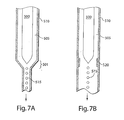
- Fig. 7A where channel 510 includes a flowing fluid 500 (flowing downwards), surrounded by liquid 505.
- Channel 510 narrows at location 501, causing fluid 500 to form a series of individual fluidic droplets 515.
- internal obstructions may also be used to cause droplet formation to occur.
- baffles, ridges, posts, or the like may be used to disrupt liquid flow in a manner that causes the fluid to coalesce into fluidic droplets.
- the channel dimensions may be altered with respect to time (for example, mechanically or electromechanically, pneumatically, etc.) in such a manner as to cause the formation of individual fluidic droplets to occur.
- the channel may be mechanically contracted ("squeezed") to cause droplet formation, or a fluid stream may be mechanically disrupted to cause droplet formation, for example, through the use of moving baffles, rotating blades, or the like.
- fluid 500 flows through channel 510 in a downward direction. Fluid 500 is surrounded by liquid 505. Piezoelectric devices 520 positioned near or integral to channel 510 may then mechanically constrict or "squeeze" channel 510, causing fluid 500 to break up into individual fluidic droplets 515.
- individual fluidic droplets can be created and maintained in a system comprising three essentially mutually immiscible fluids (i.e., immiscible on a time scale of interest), where one fluid is a liquid carrier, and the second fluid and the third fluid alternate as individual fluidic droplets within the liquid carrier.
- surfactants are not necessarily required to ensure separation of the fluidic droplets of the second and third fluids.
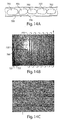
- a first fluid 701 and a second fluid 702 are each carried within liquid carrier 705.
- First fluid 701 and second fluid 702 alternate as a series of alternating, individual droplets, each carried by liquid carrier 705 within channel 700.
- any two of the fluids can come into contact without causing droplet coalescence to occur.
- a photomicrograph of an example of such a system is shown in Fig. 14B , illustrating first fluid 701 and second fluid 702, present as individual, alternating droplets, each contained within liquid carrier 705.
- a system involving three essentially mutually immiscible fluids is a silicone oil, a mineral oil, and an aqueous solution (i.e., water, or water containing one or more other species that are dissolved and/or suspended therein, for example, a salt solution, a saline solution, a suspension of water containing particles or cells, or the like).
- a silicone oil, a fluorocarbon oil, and an aqueous solution is a hydrocarbon oil (e.g., hexadecane), a fluorocarbon oil, and an aqueous solution.
- any of these fluids may be used as the liquid carrier.
- suitable fluorocarbon oils include octadecafluorodecahydronaphthalene: or 1-(1,2,2,3,3,4,4,5,5,6,6-undecafluorocyclohexyl)ethanol:
- fluidic network 710 includes a channel containing liquid carrier 705, and first fluid 701 and second fluid 702.
- Liquid carrier 705 is introduced into fluidic network 710 through inlet 725, while first fluid 701 is introduced through inlet 721, and second fluid 702 is introduced through inlet 722.
- Channel 716 within fluidic network 710 contains liquid carrier 715 introduced from inlet 725.
- first fluid 701 is introduced into liquid carrier 705, forming fluidic droplets therein.
- second fluid 702 is introduced into liquid 705, forming fluidic droplets therein that are interspersed with the fluidic droplets containing first fluid 701.
- liquid carrier 705 contains a first set of fluidic droplets containing first fluid 701, interspersed with a second set of fluidic droplets containing second fluid 702.
- channel 706 optionally comprises a series of bends, which may allow mixing to occur within each of the fluidic droplets, as further discussed below.
- first fluid 701 and second fluid 702 are essentially immiscible, significant fusion and/or mixing of the droplets containing first fluid 701 with the droplets containing second fluid 702 is not generally expected.
- the fluidic droplets may each be substantially the same shape and/or size.
- the shape and/or size can be determined, for example, by measuring the average diameter or other characteristic dimension of the droplets.
- determining generally refers to the analysis or measurement of a species, for example, quantitatively or qualitatively, and/or the detection of the presence or absence of the species. “Determining” may also refer to the analysis or measurement of an interaction between two or more species, for example, quantitatively or qualitatively, or by detecting the presence or absence of the interaction.
- spectroscopy such as infrared, absorption, fluorescence, UV/visible, FTIR ("Fourier Transform Infrared Spectroscopy"), or Raman
- gravimetric techniques e.g., gravimetric techniques
- ellipsometry e.g., ellipsometry
- piezoelectric measurements e.g., electrochemical measurements
- optical measurements such as optical density measurements; circular dichroism
- light scattering measurements such as quasielectric light scattering; polarimetry; refractometry; or turbidity measurements.
- the "average diameter" of a plurality or series of droplets is the arithmetic average of the average diameters of each of the droplets. Those of ordinary skill in the art will be able to determine the average diameter (or other characteristic dimension) of a plurality or series of droplets, for example, using laser light scattering, microscopic examination, or other known techniques.
- the diameter of a droplet, in a non-spherical droplet is the mathematically-defined average diameter of the droplet, integrated across the entire surface.
- the average diameter of a droplet may be, for example, less than about 1 mm, less than about 500 micrometers, less than about 200 micrometers, less than about 100 micrometers, less than about 75 micrometers, less than about 50 micrometers, less than about 25 micrometers, less than about 10 micrometers, or less than about 5 micrometers in some cases.
- the average diameter may also be at least about 1 micrometer, at least about 2 micrometers, at least about 3 micrometers, at least about 5 micrometers, at least about 10 micrometers, at least about 15 micrometers, or at least about 20 micrometers in certain cases.
- the fluidic droplets may contain additional entities, for example, other chemical, biochemical, or biological entities (e.g., dissolved or suspended in the fluid), cells, particles, gases, molecules, or the like.
- the droplets may each be substantially the same shape or size, as discussed above.
- the invention provides for the production of droplets consisting essentially of a substantially uniform number of entities of a species therein (i.e., molecules, cells, particles, etc.). For example, about 90%, about 93%, about 95%, about 97%, about 98%, or about 99%, or more of a plurality or series of droplets may each contain the same number of entities of a particular species.
- a substantial number of fluidic droplets produced may each contain 1 entity, 2 entities, 3 entities, 4 entities, 5 entities, 7 entities, 10 entities, 15 entities, 20 entities, 25 entities, 30 entities, 40 entities, 50 entities, 60 entities, 70 entities, 80 entities, 90 entities, 100 entities, etc., where the entities are molecules or macromolecules, cells, particles, etc.
- the droplets may each independently contain a range of entities, for example, less than 20 entities, less than 15 entities, less than 10 entities, less than 7 entities, less than 5 entities, or less than 3 entities in some cases.
- the droplets of fluid in a liquid containing droplets of fluid, some of which contain a species of interest and some of which do not contain the species of interest, the droplets of fluid may be screened or sorted for those droplets of fluid containing the species as further described below (e.g., using fluorescence or other techniques such as those described above), and in some cases, the droplets may be screened or sorted for those droplets of fluid containing a particular number or range of entities of the species of interest, e.g., as previously described.
- a plurality or series of fluidic droplets may be enriched (or depleted) in the ratio of droplets that do contain the species, for example, by a factor of at least about 2, at least about 3, at least about 5, at least about 10, at least about 15, at least about 20, at least about 50, at least about 100, at least about 125, at least about 150, at least about 200, at least about 250, at least about 500, at least about 750, at least about 1000, at least about 2000, or at least about 5000 or more in some cases.
- the enrichment may be in a ratio of at least about 10 4 , at least about 10 5 , at least about 10 6 , at least about 10 7 , at least about 10 8 , at least about 10 9 , at least about 10 10 , at least about 10 11 , at least about 10 12 , at least about 10 13 , at least about 10 14 , at least about 10 15 , or more.
- a fluidic droplet containing a particular species may be selected from a library of fluidic droplets containing various species, where the library may have about 10 5 , about 10 6 , about 10 7 , about 10 8 , about 10 9 , about 10 10 , about 10 11 , about 10 12 , about 10 13 , about 10 14 , about 10 15 , or more items, for example, a DNA library, an RNA library, a protein library, a combinatorial chemistry library, etc.
- the droplets carrying the species may then be fused, reacted, or otherwise used or processed, etc., as further described below, for example, to initiate or determine a reaction.
- the invention relates to systems and methods for splitting a fluidic droplet into two or more droplets.
- the fluidic droplet may be surrounded by a liquid, e.g., as previously described, and the fluid and the liquid are essentially immiscible in some cases.
- the two or more droplets created by splitting the original fluidic droplet may each be substantially the same shape and/or size, or the two or more droplets may have different shapes and/or sizes, depending on the conditions used to split the original fluidic droplet.
- the conditions used to split the original fluidic droplet can be controlled in some fashion, for example, manually or automatically (e.g., with a processor, as discussed below).
- each droplet in a plurality or series of fluidic droplets may be independently controlled. For example, some droplets may be split into equal parts or unequal parts, while other droplets are not split.
- a fluidic droplet can be split using an applied electric field.
- the electric field may be an AC field, a DC field, etc.
- the fluidic droplet in this embodiment, may have a greater electrical conductivity than the surrounding liquid, and, in some cases, the fluidic droplet may be neutrally charged.
- the droplets produced from the original fluidic droplet are of approximately equal shape and/or size.
- electric charge in an applied electric field, electric charge may be urged to migrate from the interior of the fluidic droplet to the surface to be distributed thereon, which may thereby cancel the electric field experienced in the interior of the droplet.
- the electric charge on the surface of the fluidic droplet may also experience a force due to the applied electric field, which causes charges having opposite polarities to migrate in opposite directions.
- the charge migration may, in some cases, cause the drop to be pulled apart into two separate fluidic droplets.
- the electric field applied to the fluidic droplets may be created, for example, using the techniques described above, such as with a reaction an electric field generator, etc.
- fluidic droplets 215 contained in channel 230 are carried by a surrounding liquid, which flows towards intersection 240, leading to channels 250 and 255.
- the surrounding liquid flows through channels 250 and 255 at equal flowrates.
- fluidic droplets 215 do not have a preferred orientation or direction, and move into exit channels 250 and 255 with equal probability due to the surrounding liquid flow.
- fluidic droplets 215 are split into two droplets at intersection 240, forming new droplets 216 and 217. Droplet 216 moves to the left in channel 250, while droplet 217 moves to the right in channel 255.
- FIG. 5 A schematic of this process can be seen in Fig. 5 , where a neutral fluidic droplet 530, surrounded by a liquid 535 in channel 540, is subjected to applied electric field 525, created by electrodes 526 and 527. Electrode 526 is positioned near channel 542, while electrode 527 is positioned near channel 544. Under the influence of electric field 525, charge separation is induced within fluidic droplet 530, i.e., such that a positive charge is induced at one end of the droplet, while a negative charge is induced at the other end of the droplet. The droplet may then split into a negatively charged droplet 545 and a positively charged droplet 546, which then may travel in channels 542 and 544, respectively. In some cases, one or both of the electric charges on the resulting charged droplets may also be neutralized, as previously described.
- the invention in yet another aspect, relates to systems and methods for fusing or coalescing two or more fluidic droplets into one droplet.
- systems and methods are provided that are able to cause two or more droplets (e.g., arising from discontinuous streams of fluid) to fuse or coalesce into one droplet in cases where the two or more droplets ordinarily are unable to fuse or coalesce, for example, due to composition, surface tension, droplet size, the presence or absence of surfactants, etc.
- the surface tension of the droplets, relative to the size of the droplets may also prevent fusion or coalescence of the droplets from occurring in some cases.
- two fluidic droplets may be given opposite electric charges (i.e., positive and negative charges, not necessarily of the same magnitude), which may increase the electrical interaction of the two droplets such that fusion or coalescence of the droplets can occur due to their opposite electric charges, e.g., using the techniques described herein.
- an electric field may be applied to the droplets, the droplets may be passed through a capacitor, a chemical reaction may cause the droplets to become charged, etc.
- a chemical reaction may cause the droplets to become charged, etc.
- uncharged droplets 651 and 652 carried by a liquid 654 contained within a microfluidic channel 653, are brought into contact with each other, but the droplets are not able to fuse or coalesce, for instance, due to their size and/or surface tension.
- the droplets in some cases, may not be able to fuse even if a surfactant is applied to lower the surface tension of the droplets.
- the fluidic droplets are electrically charged with opposite charges (which can be, but are not necessarily of, the same magnitude), the droplets may be able to fuse or coalesce.
- positively charged droplets 655 and negatively charged droplets 656 are directed generally towards each other such that the electrical interaction of the oppositely charged droplets causes the droplets to fuse into fused droplets 657.
- the fluidic droplets may not necessarily be given opposite electric charges (and, in some cases, may not be given any electric charge), and are fused through the use of dipoles induced in the fluidic droplets that causes the fluidic droplets to coalesce.
- droplets 660 and 661 (which may each independently be electrically charged or neutral), surrounded by liquid 665 in channel 670, move through the channel such that they are the affected by an applied electric field 675.
- Electric field 675 may be an AC field, a DC field, etc., and may be created, for instance, using electrodes 676 and 677, as shown here.
- the induced dipoles in each of the fluidic droplets as shown in Fig. 13C , may cause the fluidic droplets to become electrically attracted towards each other due to their local opposite charges, thus causing droplets 660 and 661 to fuse to produce droplet 663.
- Fig. 13D droplets 660 and 661
- the two or more droplets allowed to coalesce are not necessarily required to meet "head-on.” Any angle of contact, so long as at least some fusion of the droplets initially occurs, is sufficient.
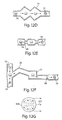
- droplets 73 and 74 each are traveling in substantially the same direction (e.g., at different velocities), and are able to meet and fuse.
- droplets 73 and 74 meet at an angle and fuse.
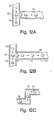
- Fig. 12J three fluidic droplets 73, 74 and 68 meet and fuse to produce droplet 79.
- the invention relates to systems and methods for allowing the mixing of more than one fluid to occur within a fluidic droplet.
- two or more fluidic droplets may be allowed to fuse or coalesce, as described above, and then, within the fused droplet, the two or more fluids from the two or more original fluidic droplets may then be allowed to mix.
- the coalesced droplet may initially be formed of a first fluid region 71 (from first droplet 73) and a second fluid region 72 (from second droplet 74).
- the fluid regions may remain as separate regions, for example, due to internal "counter-revolutionary" flow within the fluidic droplet (shown in Fig. 12G with droplet 968, direction indicated by arrow 977), thus resulting in a non-uniform fluidic droplet 75, as is shown in Fig. 12A .
- the fluid regions within the fluidic droplet may be allowed to mix, react, or otherwise interact with each other, as is shown in Fig. 7B , resulting in mixed or partially mixed fluidic droplet 78.
- the mixing may occur through natural means, for example, through diffusion (e.g., through the interface between the regions), through reaction of the fluids with each other, through fluid flow within the droplet (i.e., convection), etc.
- mixing of the regions 71 and 72 may be enhanced through certain systems external of the fluidic droplet.
- the fluidic droplet may be passed through one or more channels or other systems which cause the droplet to change its velocity and/or direction of movement.
- the change of direction may alter convection patterns within the droplet, causing the fluids to be at least partially mixed.
- droplet 76 may be passed through one or more bends within a channel, causing the fluids within droplet 76 to be at least partially mixed, resulting in droplet 79; or droplet 76 may pass by one or more obstructions within the channel, etc.
- droplet 76 passes through one or more expansion regions 77 within a channel, causing the fluids within droplet 76 to be at least partially mixed, resulting in droplet 79.
- Fig. 12C droplet 76 may be passed through one or more bends within a channel, causing the fluids within droplet 76 to be at least partially mixed, resulting in droplet 79; or droplet 76 may pass by one or more obstructions within the channel, etc.
- droplet 76 passes through one or more expansion regions 77 within a channel, causing the fluids within droplet 76 to be at least partially mixed, resulting in droplet 79.
- droplet 76 passes through one or more constriction regions 69, causing the fluids within droplet 76 to be at least partially mixed, resulting in droplet 79.
- Combinations are also possible.
- droplet 76 passes through bend 70, expansion region 77, and constriction region 69, causing at least partial mixing of the fluid regions within the droplet to occur.
- channel 706 in Fig. 14B contains a series of bends, which may allow mixing of the fluids within the droplets within channel 706 to occur.
- a fluid may be injected into a fluidic droplet, which may cause mixing of the injected fluid with the other fluids within the fluidic droplet to occur.
- the fluid may be microinjected into the fluidic droplet in some cases, e.g., using a microneedle or other such device.
- the fluid may be injected directly into a fluidic droplet using a fluidic channel as the fluidic droplet comes into contact with the fluidic channel.
- channel 750 contains a carrier fluid 755 containing a series of fluidic droplets 760. Droplet 761 is in contact with fluidic channel 752. A fluid can then be introduced into fluidic droplet 761 through fluidic channel 752, which fluid may be the same or different than the fluid in fluidic droplet 761.
- the invention provides systems and methods for screening or sorting fluidic droplets in a liquid, and in some cases, at relatively high rates. For example, a characteristic of a droplet may be sensed and/or determine in some fashion (e.g., as further described below), then the droplet may be directed towards a particular region of the device, for example, for sorting or screening purposes.
- a characteristic of a fluidic droplet may be sensed and/or determined in some fashion, for example, as described herein (e.g., fluorescence of the fluidic droplet may be determined), and, in response, an electric field may be applied or removed from the fluidic droplet to direct the fluidic droplet to a particular region (e.g. a channel).
- a particular region e.g. a channel
- high sorting speeds may be achievable using certain systems and methods of the invention.
- At least about 10 droplets per second may be determined and/or sorted in some cases, and in other cases, at least about 20 droplets per second, at least about 30 droplets per second, at least about 100 droplets per second, at least about 200 droplets per second, at least about 300 droplets per second, at least about 500 droplets per second, at least about 750 droplets per second, at least about 1000 droplets per second, at least about 1500 droplets per second, at least about 2000 droplets per second, at least about 3000 droplets per second, at least about 5000 droplets per second, at least about 7500 droplets per second, at least about 10,000 droplets per second, at least about 15,000 droplets per second, at least about 20,000 droplets per second, at least about 30,000 droplets per second, at least about 50,000 droplets per second, at least about 75,000 droplets per second, at least about 100,000 droplets per second, at least about 150,000 droplets per second, at least about 200,000 droplets per second, at least about 300,000 droplets per second, at least about 500,000 droplets
- a fluidic droplet may be directed by creating an electric charge (e.g., as previously described) on the droplet, and steering the droplet using an applied electric field, which may be an AC field, a DC field, etc.
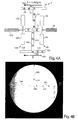
- an electric field may be selectively applied and removed (or a different electric field may be applied, e.g., a reversed electric field as shown in Fig. 4A ) as needed to direct the fluidic droplet to a particular region.
- the electric field may be selectively applied and removed as needed, in some embodiments, without substantially altering the flow of the liquid containing the fluidic droplet.
- a liquid may flow on a substantially steady-state basis (i.e., the average flowrate of the liquid containing the fluidic droplet deviates by less than 20% or less than 15% of the steady-state flow or the expected value of the flow of liquid with respect to time, and in some cases, the average flowrate may deviate less than 10% or less than 5%) or other predetermined basis through a fluidic system of the invention (e.g., through a channel or a microchannel), and fluidic droplets contained within the liquid may be directed to various regions, e.g., using an electric field, without substantially altering the flow of the liquid through the fluidic system.
- a substantially steady-state basis i.e., the average flowrate of the liquid containing the fluidic droplet deviates by less than 20% or less than 15% of the steady-state flow or the expected value of the flow of liquid with respect to time, and in some cases, the average flowrate may deviate less than 10% or less than 5%
- a fluidic system of the invention e.g.
- a liquid containing fluidic droplets 15 flows from fluid source 10, through channel 30 to intersection 40, and exits through channels 50 and 55.
- fluidic droplets 15 are directed through both channels 50 and 55, while in Fig. 3A , fluidic droplets 15 are directed to only channel 55 and, in Fig. 4A , fluidic droplets 15 are directed to only channel 50.
- a fluidic droplet may be sorted or steered by inducing a dipole in the fluidic droplet (which may be initially charged or uncharged), and sorting or steering the droplet using an applied electric field.
- the electric field may be an AC field, a DC field, etc.
- a channel 540 containing fluidic droplet 530 and liquid 535, divides into channel 542 and 544.
- Fluidic droplet 530 may have an electric charge, or it may be uncharged.
- Electrode 526 is positioned near channel 542, while electrode 527 is positioned near channel 544.
- Electrode 528 is positioned near the junction of channels 540, 542, and 544. In Figs.
- a dipole is induced in the fluidic droplet using electrodes 526, 527, and/or 528.
- a dipole is induced in droplet 530 by applying an electric field 525 to the droplet using electrodes 527 and 528. Due to the strength of the electric field, the droplet is strongly attracted to the right, into channel 544.
- a dipole is induced in droplet 530 by applying an electric field 525 to the droplet using electrodes 526 and 528, causing the droplet to be attracted into channel 542.
- droplet 530 can be directed to either channel 542 or 544 as desired.
- the fluidic droplets may be screened or sorted within a fluidic system of the invention by altering the flow of the liquid containing the droplets.
- a fluidic droplet may be steered or sorted by directing the liquid surrounding the fluidic droplet into a first channel, a second channel, etc.
- fluidic droplet 570 is surrounded by a liquid 575 in channel 580.
- Channel 580 divides into three channels 581, 582, and 583.
- the flow of liquid 575 can be directed into any of channels 581, 582, and 583 as desired, for example, using flow-controlling devices known to those of ordinary skill in the art, for example, valves, pumps, pistons, etc.
- fluidic droplet 570 is directed into channel 581 by directing liquid 575 to flow into channel 581 (indicated by arrows 574);
- fluidic droplet 570 is directed into channel 582 by directing liquid 575 to flow into channel 582 (indicated by arrows 574);
- fluidic droplet 570 is directed into channel 583 by directing liquid 575 to flow into channel 583 (indicated by arrows 574).
- pressure within a fluidic system can be controlled to direct the flow of fluidic droplets.
- a droplet can be directed toward a channel junction including multiple options for further direction of flow (e.g., directed toward a branch, or fork, in a channel defining optional downstream flow channels).
- Pressure within one or more of the optional downstream flow channels can be controlled to direct the droplet selectively into one of the channels, and changes in pressure can be effected on the order of the time required for successive droplets to reach the junction, such that the downstream flow path of each successive droplet can be independently controlled.
- the expansion and/or contraction of liquid reservoirs may be used to steer or sort a fluidic droplet into a channel, e.g., by causing directed movement of the liquid containing the fluidic droplet.
- the liquid reservoirs may be positioned such that, when activated, the movement of liquid caused by the activated reservoirs causes the liquid to flow in a referred direction, carrying the fluidic droplet in that preferred direction.
- the expansion of a liquid reservoir may cause a flow of liquid towards the reservoir, while the contraction of a liquid reservoir may cause a flow of liquid away from the reservoir.
- the expansion and/or contraction of the liquid reservoir may be combined with other flow-controlling devices and methods, e.g., as described herein.
- Non-limiting examples of devices able to cause the expansion and/or contraction of a liquid reservoir include pistons and piezoelectric components.
- piezoelectric components may be particularly useful due to their relatively rapid response times, e.g., in response to an electrical signal.
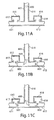
- fluidic droplet 600 is surrounded by a liquid 605 in channel 610.
- Channel 610 divides into channels 611, 612.
- liquid reservoirs 617 and 618 Positioned in fluidic communication with channels 611 and 612 are liquid reservoirs 617 and 618, which may be expanded and/or contracted, for instance, by piezoelectric components 615 and 616, by a piston (not shown), etc.
- Fig. 11B liquid reservoir 617 has been expanded, while liquid reservoir 618 has been contracted. The effect of the expansion/contractions of the reservoirs is to cause a net flow of liquid towards channel 611, as indicated by arrows 603.
- fluidic droplet 600 upon reaching the junction between the channels, is directed to channel 611 by the movement of liquid 605.
- Fig. 11C The reverse situation is shown in Fig. 11C , where liquid reservoir 617 has contracted while liquid reservoir 618 has been expanded. A net flow of liquid occurs towards channel 612 (indicated by arrows 603), causing fluidic droplet 600 to move into channel 612. It should be noted, however, that reservoirs 617 and 618 do not both need to be activated to direct fluidic droplet 600 into channels 611 or 612.
- fluidic droplet 600 may be directed to channel 611 by the expansion of liquid reservoir 617 (without any alteration of reservoir 618), while in another embodiment, fluidic droplet 600 may be directed to channel 611 by the contraction of liquid reservoir 618 (without any alteration of reservoir 617). In some cases, more than two liquid reservoirs may be used.
- the fluidic droplets may be sorted into more than two channels.
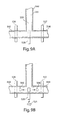
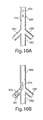
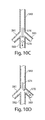
- Figs. 6A and 6B Non-limiting examples of embodiments of the invention having multiple regions within a fluidic system for the delivery of droplets are shown in Figs. 6A and 6B . Other arrangements are shown in Figs. 10A-10D .
- charged droplets 315 in channel 330 may be directed as desired to any one of exit channels 350, 352, 354, or 356, by applying electric fields to control the movement of the droplets at intersections 340, 341, and 342, using electrodes 321/322, 323/324, and 325/326, respectively.
- droplets 315 are directed to channel 354 using applied electric fields 300 and 301, using principles similar to those discussed above.
- charged droplets 415 in channel 430 can be directed to any one of exit channels 450, 452, 454, 456, or 458, by applying electric fields to control the movement of the droplets at intersections 440, 441, 442, and 443, using electrodes 421/422, 423/424, 425/426, and 427/428, respectively.
- droplets 415 are directed to channel 454; of course, the charged droplets may be directed to any other exit channel as desired.
- fluidic droplets 15 created by fluid source 10 are positively charged due to an applied electric field created using electric field generator 20, which comprises two electrodes 22, 24. Fluidic droplets 15 are directed through channel 30 by a liquid containing the droplets, and are directed towards intersection 40. At intersection 40, the fluidic droplets do not have a preferred orientation or direction, and move into exit channels 50 and 55 with equal probability (in this embodiment, liquid drains through both exit channels 50 and 55 at substantially equal rates).
- fluidic droplets 115 created by fluid source 110 are negatively charged due to an applied electric field created using electric field generator 120, which comprises electrodes 122 and 124.
- intersection 140 After traveling through channel 130 towards intersection 140, the fluidic droplets do not have a preferred orientation or direction, and move into exit channels 150 and 155 with equal probability, as the liquid exits through exit channels 150 and 155 at substantially equal rates.
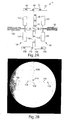
- a representative photomicrograph of intersection 140 is shown in Fig. 2B .
- an electric field 100 of 1.4 V/micrometer has been applied to apparatus 5 of Fig. 2A , in a direction towards the right of apparatus 5.
- Positively-charged fluidic droplets 15 in channel 30, upon reaching intersection 40 are directed to the right in channel 55 due to the applied electric field 100, while the liquid containing the droplets continues to exit through exit channels 50 and 55 at substantially equal rates.
- negatively-charged fluidic droplets 115 in channel 130, upon reaching intersection 140 are directed to the left in channel 150 due to the applied electric field 100, while the liquid fluid continues to exit the device through exit channels 150 and 155 at substantially equal rates.
- electric field 100 can be used to direct fluidic droplets into particular channels as desired.
- a representative photomicrograph of intersection 140 is shown in Fig. 3B .
- Fig. 4A is a schematic diagram of apparatus 5 of Fig. 2A , also with an applied electric field 100 of 1.4 V/micrometer, but in the opposite direction (i.e., -1.4 V/micrometer).
- positively-charged fluidic droplets 15 in channel 30, upon reaching intersection 40 are directed to the left into channel 50 due to the applied electric field 100
- negatively-charged fluidic droplets 115 in channel 130, upon reaching intersection 140 are directed to the right into channel 155 due to applied electric field 100.
- the liquid containing the droplets exits through exit channels 50 and 55, and 150 and 155, at substantially equal rates.
- a representative photomicrograph of intersection 140 is shown in Fig. 4B .
- a fluidic droplet may be sorted and/or split into two or more separate droplets, for example, depending on the particular application. Any of the above-described techniques may be used to spilt and/or sort droplets. As a non-limiting example, by applying (or removing) a first electric field to a device (or a portion thereof), a fluidic droplet may be directed to a first region or channel; by applying (or removing) a second electric field to the device (or a portion thereof), the droplet may be directed to a second region or channel; by applying a third electric field to the device (or a portion thereof), the droplet may be directed to a third region or channel; etc., where the electric fields may differ in some way, for example, in intensity, direction, frequency, duration, etc. In a series of droplets, each droplet may be independently sorted and/or split; for example, some droplets may be directed to one location or another, while other droplets may be split into multiple droplets directed to two or
- fluidic droplet 550, surrounding liquid 555 in channel 560 may be directed to channel 556, channel 557, or be split in some fashion between channels 562 and 564.
- fluidic droplet 550 may be directed towards the left into channel 562; in Fig. 8C , by directing surrounding liquid 555 towards channel 564, fluidic droplet 550 may be directed towards the right into channel 564, in Fig. 8D , an electric field may be applied, in combination with control of the flow of liquid 555 surrounding fluidic droplet 550, that causes the droplet to impact junction 561, which may cause the droplet to split into two separate fluidic droplets 565, 566.
- Fluidic droplet 565 is directed to channel 562, while fluidic droplet 566 is directed to channel 566.
- a high degree of control of the applied electric field may be achieved to control droplet formation; thus, for example, after fluidic droplet 565 has been split into droplets 565 and 566, droplets 565 and 566 may be of substantially equal size, or either of droplets 565 and 566 may be larger, e.g., as is shown in Figs. 8E and 8F , respectively.
- channel 540 carrying fluidic droplet 530 and liquid 535, divides into channel 542 and 544.
- Fluidic droplet 530 may be electrically charged, or it may uncharged.
- Electrode 526 is positioned near channel 542, while electrode 527 is positioned near channel 544.
- Electrode 528 is positioned near the junction of channels 540, 542, and 544.
- fluidic droplet 530 When fluidic droplet 530 reaches the junction, it may be subjected to an electric field, and/or directed to a channel or other region, for example, by directing the surrounding liquid into the channel. As shown in Fig.
- fluidic droplet 530 may be split into two separate droplets 565 and 566 by applying an electric field 525 to the droplet using electrodes 526 and 527.
- a dipole can be induced in droplet 530 by applying an electric field 525 to the droplet using electrodes 527 and 528. Due to the strength of the applied electric field, the droplet may be strongly attracted to the right, into channel 544.
- a dipole may be induced in droplet 530 by applying an electric field 525 to the droplet using electrodes 526 and 528, causing the droplet to be attracted into channel 542.
- one or more fluidic droplets within channel 540 may be sorted and/or split into two droplets, and each droplet may independently be sorted and/or split.
- sensors are provided that can sense and/or determine one or more characteristics of the fluidic droplets, and/or a characteristic of a portion of the fluidic system containing the fluidic droplet (e.g., the liquid surrounding the fluidic droplet) in such a manner as to allow the determination of one or more characteristics of the fluidic droplets.
- Characteristics determinable with respect to the droplet and usable in the invention can be identified by those of ordinary skill in the art.
- Non-limiting examples of such characteristics include fluorescence, spectroscopy (e.g., optical, infrared, ultraviolet, etc.), radioactivity, mass, volume, density, temperature, viscosity, pH, concentration of a substance, such as a biological substance (e.g., a protein, a nucleic acid, etc.), or the like.
- fluorescence e.g., optical, infrared, ultraviolet, etc.
- radioactivity e.g., mass, volume, density, temperature, viscosity, pH, concentration of a substance, such as a biological substance (e.g., a protein, a nucleic acid, etc.), or the like.
- the senor may be connected to a processor, which in turn, cause an operation to be performed on the fluidic droplet, for example, by sorting the droplet, adding or removing electric charge from the droplet, fusing the droplet with another droplet, splitting the droplet, causing mixing to occur within the droplet, etc., for example, as previously described.
- a processor may cause the fluidic droplet to be split, merged with a second fluidic droplet, etc.
- One or more sensors and/or processors may be positioned to be in sensing communication with the fluidic droplet.
- Sensor communication means that the sensor may be positioned anywhere such that the fluidic droplet within the fluidic system (e.g., within a channel), and/or a portion of the fluidic system containing the fluidic droplet may be sensed and/or determined in some fashion.
- the sensor may be in sensing communication with the fluidic droplet and/or the portion of the fluidic system containing the fluidic droplet fluidly, optically or visually, thermally, pneumatically, electronically, or the like.
- the sensor can be positioned proximate the fluidic system, for example, embedded within or integrally connected to a wall of a channel, or positioned separately from the fluidic system but with physical, electrical, and/or optical communication with the fluidic system so as to be able to sense and/or determine the fluidic droplet and/or a portion of the fluidic system containing the fluidic droplet (e.g., a channel or a microchannel, a liquid containing the fluidic droplet, etc.).
- a sensor may be free of any physical connection with a channel containing a droplet, but may be positioned so as to detect electromagnetic radiation arising from the droplet or the fluidic system, such as infrared, ultraviolet, or visible light.
- the electromagnetic radiation may be produced by the droplet, and/or may arise from other portions of the fluidic system (or externally of the fluidic system) and interact with the fluidic droplet and/or the portion of the fluidic system containing the fluidic droplet in such as a manner as to indicate one or more characteristics of the fluidic droplet, for example, through absorption, reflection, diffraction, refraction, fluorescence, phosphorescence, changes in polarity, phase changes, changes with respect to time, etc.
- a laser may be directed towards the fluidic droplet and/or the liquid surrounding the fluidic droplet, and the fluorescence of the fluidic droplet and/or the surrounding liquid may be determined.
- "Sensing communication,” as used herein may also be direct or indirect.
- light from the fluidic droplet may be directed to a sensor, or directed first through a fiber optic system, a waveguide, etc., before being directed to a sensor.
- Non-limiting examples of sensors useful in the invention include optical or electromagnetically-based systems.
- the sensor may be a fluorescence sensor (e.g., stimulated by a laser), a microscopy system (which may include a camera or other recording device), or the like.
- the sensor may be an electronic sensor, e.g., a sensor able to determine an electric field or other electrical characteristic.
- the sensor may detect capacitance, inductance, etc., of a fluidic droplet and/or the portion of the fluidic system containing the fluidic droplet.
- a "processor” or a “microprocessor” is any component or device able to receive a signal from one or more sensors, store the signal, and/or direct one or more responses (e.g., as described above), for example, by using a mathematical formula or an electronic or computational circuit.
- the signal may be any suitable signal indicative of the environmental factor determined by the sensor, for example a pneumatic signal, an electronic signal, an optical signal, a mechanical signal, etc.
- a device of the invention may contain fluidic droplets containing one or more cells.
- the cells may be exposed to a fluorescent signal marker that binds if a certain condition is present, for example, the marker may bind to a first cell type but not a second cell type, the marker may bind to an expressed protein, the marker may indicate viability of the cell (i.e., if the cell is alive or dead), the marker may be indicative of the state of development or differentiation of the cell, etc., and the cells may be directed through a fluidic system of the invention based on the presence/absence, and/or magnitude of the fluorescent signal marker.
- determination of the fluorescent signal marker may cause the cells to be directed to one region of the device (e.g., a collection chamber), while the absence of the fluorescent signal marker may cause the cells to be directed to another region of the device (e.g., a waste chamber).
- a population of cells may be screened and/or sorted on the basis of one or more determinable or targetable characteristics of the cells, for example, to select live cells, cells expressing a certain protein, a certain cell type, etc.
- various aspects of the present invention relate to droplets of fluid surrounded by a liquid (e.g., suspended).
- the droplets may be of substantially the same shape and/or size, or of different shapes and/or sizes, depending on the particular application.
- the term "fluid” generally refers to a substance that tends to flow and to conform to the outline of its container, i.e., a liquid, a gas, a viscoelastic fluid, etc.
- fluids are materials that are unable to withstand a static shear stress, and when a shear stress is applied, the fluid experiences a continuing and permanent distortion.
- the fluid may have any suitable viscosity that permits flow.
- each fluid may be independently selected among essentially any fluids (liquids, gases, and the like) by those of ordinary skill in the art, by considering the relationship between the fluids.
- the fluids may each be miscible or immiscible.
- two fluids can be selected to be essentially immiscible within the time frame of formation of a stream of fluids, or within the time frame of reaction or interaction. Where the portions remain liquid for a significant period of time, then the fluids should be essentially immiscible.
- the fluids need not be as immiscible.
- Those of ordinary skill in the art can select suitable miscible or immiscible fluids, using contact angle measurements or the like, to carry out the techniques of the invention.
- a first entity is "surrounded” by a second entity if a closed planar loop can be drawn around the first entity through only the second entity.
- a first entity is "completely surrounded” if closed loops going through only the second entity can be drawn around the first entity regardless of direction (orientation of the loop).
- the first entity is a cell, for example, a cell suspended in media is surrounded by the media.
- the first entity is a particle.
- the first entity is a fluid.
- the second entity may also be a fluid in some cases (e.g., as in a suspension, an emulsion, etc.), for example, a hydrophilic liquid may be suspended in a hydrophobic liquid, a hydrophobic liquid may be suspended in a hydrophilic liquid, a gas bubble may be suspended in a liquid, etc.
- a hydrophobic liquid and a hydrophilic liquid are essentially immiscible with respect to each other, where the hydrophilic liquid has a greater affinity to water than does the hydrophobic liquid.
- hydrophilic liquids include, but are not limited to, water and other aqueous solutions comprising water, such as cell or biological media, salt solutions, etc., as well as other hydrophilic liquids such as ethanol.
- hydrophobic liquids include, but are not limited to, oils such as hydrocarbons, silicone oils, mineral oils, fluorocarbon oils, organic solvents etc. Other examples of suitable fluids have been previously described.
- a “droplet,” as used herein, is an isolated portion of a first fluid that is completely surrounded by a second fluid. It is to be noted that a droplet is not necessarily spherical, but may assume other shapes as well, for example, depending on the external environment. In one embodiment, the droplet has a minimum cross-sectional dimension that is substantially equal to the largest dimension of the channel perpendicular to fluid flow in which the droplet is located.
- the systems and methods described herein may include one or more microfluidic components, for example, one or more microfluidic channels.
- Microfluidic refers to a device, apparatus or system including at least one fluid channel having a cross-sectional dimension of less than 1 mm, and a ratio of length to largest cross-sectional dimension of at least 3:1.
- a "microfluidic channel,” as used herein, is a channel meeting these criteria. The "cross-sectional dimension" of the channel is measured perpendicular to the direction of fluid flow within the channel.
- some or all of the fluid channels in microfluidic embodiments of the invention may have maximum cross-sectional dimensions less than 2 mm, and in certain cases, less than 1 mm.
- all fluid channels containing embodiments of the invention are microfluidic or have a largest cross sectional dimension of no more than 2 mm or 1 mm.
- the fluid channels may be formed in part by a single component (e.g. an etched substrate or molded unit).
- larger channels, tubes, chambers, reservoirs, etc. can be used to store fluids and/or deliver fluids to various components or systems of the invention.
- the maximum cross-sectional dimension of the channel(s) containing embodiments of the invention is less than 500 microns, less than 200 microns, less than 100 microns, less than 50 microns, or less than 25 microns.
- a “channel,” as used herein, means a feature on or in an article (substrate) that at least partially directs flow of a fluid.
- the channel can have any cross-sectional shape (circular, oval, triangular, irregular, square or rectangular, or the like) and can be covered or uncovered. In embodiments where it is completely covered, at least one portion of the channel can have a cross-section that is completely enclosed, or the entire channel may be completely enclosed along its entire length with the exception of its inlet(s) and/or outlet(s).
- a channel may also have an aspect ratio (length to average cross sectional dimension) of at least 2:1, more typically at least 3:1,5:1,10:1,15:1,20:1, or more.
- An open channel generally will include characteristics that facilitate control over fluid transport, e.g., structural characteristics (an elongated indentation) and/or physical or chemical characteristics (hydrophobicity vs. hydrophilicity) or other characteristics that can exert a force (e.g., a containing force) on a fluid.
- the fluid within the channel may partially or completely fill the channel.
- the fluid may be held within the channel, for example, using surface tension (i.e., a concave or convex meniscus).
- the channel may be of any size, for example, having a largest dimension perpendicular to fluid flow of less than about 5 mm or 2 mm, or less than about 1 mm, or less than about 500 microns, less than about 200 microns, less than about 100 microns, less than about 60 microns, less than about 50 microns, less than about 40 microns, less than about 30 microns, less than about 25 microns, less than about 10 microns, less than about 3 microns, less than about 1 micron, less than about 300 nm, less than about 100 mn, less than about 30 nm, or less than about 10 nm.
- the dimensions of the channel may be chosen such that fluid is able to freely flow through the article or substrate.
- the dimensions of the channel may also be chosen, for example, to allow a certain volumetric or linear flowrate of fluid in the channel.
- the number of channels and the shape of the channels can be varied by any method known to those of ordinary skill in the art. In some cases, more than one channel or capillary may be used. For example, two or more channels may be used, where they are positioned inside each other, positioned adjacent to each other, positioned to intersect with each other, etc.
- the fluidic droplets may contain cells or other entities, such as proteins, viruses, macromolecules, particles, etc.
- a "cell” is given its ordinary meaning as used in biology.
- the cell may be any cell or cell type.
- the cell may be a bacterium or other single-cell organism, a plant cell, or an animal cell. If the cell is a single-cell organism, then the cell may be, for example, a protozoan, a trypanosome, an amoeba, a yeast cell, algae, etc.
- the cell may be, for example, an invertebrate cell (e.g., a cell from a fruit fly), a fish cell (e.g., a zebrafish cell), an amphibian cell (e.g., a frog cell), a reptile cell, a bird cell, or a mammalian cell such as a primate cell, a bovine cell, a horse cell, a porcine cell, a goat cell, a dog cell, a cat cell, or a cell from a rodent such as a rat or a mouse.
- the cell is from a multicellular organism, the cell may be from any part of the organism.
- the cell may be a cardiac cell, a fibroblast, a keratinocyte, a heptaocyte, a chondracyte, a neural cell, a osteocyte, a muscle cell, a blood cell, an endothelial cell, an immune cell (e.g., a T-cell, a B-cell, a macrophage, a neutrophil, a basophil, a mast cell, an eosinophil), a stem cell, etc.
- the cell may be a genetically engineered cell.
- the cell may be a Chinese hamster ovarian ("CHO") cell or a 3T3 cell.
- various components of the invention can be formed from solid materials, in which the channels can be formed via micromachining, film deposition processes such as spin coating and chemical vapor deposition, laser fabrication, photolithographic techniques, etching methods including wet chemical or plasma processes, and the like. See, for example, Scientific American, 248:44-55, 1983 (Angell , et al ) .
- at least a portion of the fluidic system is formed of silicon by etching features in a silicon chip.
- various components of the systems and devices of the invention can be formed of a polymer, for example, an elastomeric polymer such as polydimethylsiloxane (“PDMS”), polytetrafluoroethylene (“PTFE” or Teflon ® ), or the like.
- PDMS polydimethylsiloxane
- PTFE polytetrafluoroethylene
- Teflon ® Teflon ®
- a base portion including a bottom wall and side walls can be fabricated from an opaque material such as silicon or PDMS, and a top portion can be fabricated from a transparent or at least partially transparent material, such as glass or a transparent polymer, for observation and/or control of the fluidic process.
- Components can be coated so as to expose a desired chemical functionality to fluids that contact interior channel walls, where the base supporting material does not have a precise, desired functionality.
- components can be fabricated as illustrated, with interior channel walls coated with another material.
- Material used to fabricate various components of the systems and devices of the invention may desirably be selected from among those materials that will not adversely affect or be affected by fluid flowing through the fluidic system, e.g., material(s) that is chemically inert in the presence of fluids to be used within the device.
- various components of the invention are fabricated from polymeric and/or flexible and/or elastomeric materials, and can be conveniently formed of a hardenable fluid, facilitating fabrication via molding (e.g. replica molding, injection molding, cast molding, etc.).
- the hardenable fluid can be essentially any fluid that can be induced to solidify, or that spontaneously solidifies, into a solid capable of containing and/or transporting fluids contemplated for use in and with the fluidic network.
- the hardenable fluid comprises a polymeric liquid or a liquid polymeric precursor (i.e. a "prepolymer").
- Suitable polymeric liquids can include, for example, thermoplastic polymers, thermoset polymers, or mixture of such polymers heated above their melting point.
- a suitable polymeric liquid may include a solution of one or more polymers in a suitable solvent, which solution forms a solid polymeric material upon removal of the solvent, for example, by evaporation.
- a suitable solvent such polymeric materials, which can be solidified from, for example, a melt state or by solvent evaporation, are well known to those of ordinary skill in the art.
- a variety of polymeric materials, many of which are elastomeric, are suitable, and are also suitable for forming molds or mold masters, for embodiments where one or both of the mold masters is composed of an elastomeric material.
- a non-limiting list of examples of such polymers includes polymers of the general classes of silicone polymers, epoxy polymers, and acrylate polymers.
- Epoxy polymers are characterized by the presence of a three-membered cyclic ether group commonly referred to as an epoxy group, 1,2-epoxide, or oxirane.
- diglycidyl ethers of bisphenol A can be used, in addition to compounds based on aromatic amine, triazine, and cycloaliphatic backbones.
- Another example includes the well-known Novolac polymers.
- Non-limiting examples of silicone elastomers suitable for use according to the invention include those formed from precursors including the chlorosilanes such as methylchlorosilanes, ethylchlorosilanes, phenylchlorosilanes, etc.
- Silicone polymers are preferred in one set of embodiments, for example, the silicone elastomer polydimethylsiloxane.
- Non-limiting examples of PDMS polymers include those sold under the trademark Sylgard by Dow Chemical Co., Midland, MI, and particularly Sylgard 182, Sylgard 184, and Sylgard 186.
- Silicone polymers including PDMS have several beneficial properties simplifying fabrication of the microfluidic structures of the invention. For instance, such materials are inexpensive, readily available, and can be solidified from a prepolymeric liquid via curing with heat.
- PDMSs are typically curable by exposure of the prepolymeric liquid to temperatures of about, for example, about 65 °C to about 75 °C for exposure times of, for example, about an hour.
- silicone polymers such as PDMS
- PDMS polymethyl methacrylate copolymer
- flexible (e.g., elastomeric) molds or masters can be advantageous in this regard.
- One advantage of forming structures such as microfluidic structures of the invention from silicone polymers, such as PDMS, is the ability of such polymers to be oxidized, for example by exposure to an oxygen-containing plasma such as an air plasma, so that the oxidized structures contain, at their surface, chemical groups capable of cross-linking to other oxidized silicone polymer surfaces or to the oxidized surfaces of a variety of other polymeric and non-polymeric materials.
- an oxygen-containing plasma such as an air plasma
- oxidized silicone such as oxidized PDMS can also be sealed irreversibly to a range of oxidized materials other than itself including, for example, glass, silicon, silicon oxide, quartz, silicon nitride, polyethylene, polystyrene, glassy carbon, and epoxy polymers, which have been oxidized in a similar fashion to the PDMS surface (for example, via exposure to an oxygen-containing plasma).
- Oxidation and sealing methods useful in the context of the present invention, as well as overall molding techniques, are described in the art, for example, in an article entitled “ Rapid Prototyping of Microfluidic Systems and Polydimethylsiloxane,” Anal. Chem., 70:474-480, 1998 (Duffy et al .), incorporated herein by reference.
- microfluidic structures of the invention or interior, fluid-contacting surfaces
- these surfaces can be much more hydrophilic than the surfaces of typical elastomeric polymers (where a hydrophilic interior surface is desired).
- Such hydrophilic channel surfaces can thus be more easily filled and wetted with aqueous solutions than can structures comprised of typical, unoxidized elastomeric polymers or other hydrophobic materials.
- a bottom wall is formed of a material different from one or more side walls or a top wall, or other components.
- the interior surface of a bottom wall can comprise the surface of a silicon wafer or microchip, or other substrate.
- Other components can, as described above, be sealed to such alternative substrates.
- a component comprising a silicone polymer e.g. PDMS
- the substrate may be selected from the group of materials to which oxidized silicone polymer is able to irreversibly seal (e.g., glass, silicon, silicon oxide, quartz, silicon nitride, polyethylene, polystyrene, epoxy polymers, and glassy carbon surfaces which have been oxidized).
- other sealing techniques can be used, as would be apparent to those of ordinary skill in the art, including, but not limited to, the use of separate adhesives, thermal bonding, solvent bonding, ultrasonic welding, etc.
- Fig. 15A illustrates an example of a fluidic system having some of the features described above.
- fluidic droplets are introduced into fluidic system 800 (shown schematically in Fig. 15A .
- Fluidic system 800 comprises an inlet region 801 (labeled "a"), a bifurcation region 802 ("b"), a region comprising posts 803 ("c"), and a collection region 804 ("d").
- Inlet region 801 produces a series of droplets 810 contained within liquid 815.
- the droplets have an average diameter of about 20 micrometers.
- the liquid in this example, is water, and the fluidic droplets comprise hexadecane with about 3 wt% SPAN80 (a surfactant).
- the series of droplets are illustrated in Fig. 15B , which is an enlargement of inlet region 801 shown schematically in Fig. 15A .
- a series of bifurcations (shown to the left of the photomicrograph) divide the fluidic droplets into a series of channels. Since the droplets are not purposefully directed towards any particular channel, the droplets are randomly dispersed within the channels. The droplets are then carried to a region comprising a series of posts 818. An enlargement of this region is illustrated in Fig. 15D . As can be seen, the individual droplets maintain their individual identities and do not fuse, due to the presence of the surfactant. In Fig. 15E , the droplets are collected in collection region 804.
- a generic and robust platform technology for manipulating and controlling individual droplets in a microfluidic device.
- electrostatic charge on the droplets and electric fields on the devices modules that create, recombine, split, and sort droplets individually are illustrated, providing extraordinary control over individual microreactors while retaining high purity and enabling very high throughput.
- E By incorporating the forces that result from charging the aqueous fluid in an electric field, E, smaller droplets are produced with more precise control of their individual timing than is feasible with other strategies that rely solely on viscous forces to overcome surface tension; this provides a robust droplet generation module that allows the production of microreactors with volumes as small as femtoliters.
- modules are useful for high speed manipulation and control of individual droplets, and can serve as the technology for droplet-based microfluidic devices. Moreover, because all control is achieved by switching electric fields, there are no moving parts and frequencies as high as 10 6 Hz are feasible; this facilitates very high throughput combinatorial technology.
- Soft lithography was used to pattern channels in polydimethylsiloxane (PDMS), a transparent polymer material.
- PDMS polydimethylsiloxane
- a glass slide forms the top of the channel;.
- Electric fields were incorporated by patterning indium-tin-oxide (ITO) electrodes on the surface of the glass slide adjacent to the channels and seal the slide to the PDMS using an oxygen plasma.
- ITO indium-tin-oxide
- Devices fabricated in PDMS have the advantage of being strongly hydrophobic ensuring that the oil carrier phase wets their surfaces and that the water droplets do not contact the walls of the channel walls, facilitating the isolation of biomolecules and eliminating cross contamination due to surface interactions.
- a flow-focusing geometry was used to form the droplets.
- a water stream was infused from one channel through a narrow constriction; counter propagating oil streams hydrodynamically focus the water stream reducing its size as it passes through the constriction.
- This droplet generator can be operated in a flow regime that produces a steady stream of uniform droplets of water in oil.
- the size of the water droplets was controlled by the relative flow rates of the oil and the water; the viscous forces overcome surface tension to create uniform drops. If the flow rate of the water was too high a longer jet of fluid passes through the orifice and breaks up into droplets further downstream; these droplets were less uniform in size. If the flow rate of the water was too low, the droplet breakup in the orifice becomes irregular, producing a wider range of droplet sizes.
- oil and water streams converge at 30 micron orifice.
- a voltage V applied to indium-tin-oxide (ITO) electrodes on the glass produced an electric field E to capacitively charge the aqueous-oil interface.
- the electronic control afforded by the field-induced droplet formation provides an additional benefit in this example: it allowed the phase of the droplet break-off to be adjusted within the production cycle. This was accomplished by increasing the field above the critical break-off field only at the instant the droplet is required. This provided a convenient means to precisely synchronize the production and arrival of individual droplets in specific locations.
- An important component in some droplet-based reaction confinement system is a mixer which combines two or more reagents to initiate a chemical reaction.
- An example of a mixer uses electrostatic charges; placing charges of opposite sign on each droplet and applying an electric field causes them to coalesce.
- a device is illustrated having two separate nozzles that generate droplets with different compositions and opposite charges. Droplets were brought together at the confluence of the two streams. The electrodes used to charge the droplets upon formation also provide the electric field to force the droplets across the stream lines, leading to coalesce. Slight variations in the structure of the two nozzles resulted in slight differences in the frequency and phase of their droplet generation in the absence of a field.
- the droplets differed in size, even though the infusion rates were identical. Moreover, the droplets did not arrive at the point of confluence at exactly the same time. As a result the droplets did not coalesce.
- droplet formation became generally synchronized, ensuring that pairs of identically sized droplets reached the point of confluence simultaneously. Moreover, the droplets were oppositely charged, causing them to traverse the stream lines and contact each other thereby causing them to coalesce.
- droplets having opposite sign of electrostatic charge can be generated by applying a voltage across the two aqueous streams.
- the frequency and timing of droplet formation at the two nozzles may be independent, and each nozzle may produce a different size droplet at a different frequency; infusion rates are the same at both nozzles. After the confluence of the two streams, droplets from the upper and lower nozzles stay in their respective halves of the stream. Due to surfactant, there are no coalescence events even in the case of large slugs that fill the channel width.
- the droplets that simultaneously break-off from the two nozzles are essentially identical; simultaneous droplet formation can be achieved for unequal infusion rates of the aqueous streams even up to a factor of two difference in volumes.
- the fraction of the droplets that encounter each other and coalesce increases linearly above a critical field when a surfactant, sorbiton-monooleate 3% is present.
- the asymmetric stretching of the charged droplets in the electric field can be observed.
- the vertical dashed lines indicate the edge of the electrodes where the droplets returned to their symmetric spherical shape.
- the electric field also allowed precision control of the droplet splitting, providing the basis of a robust droplet division module which allows the splitting of the contents into two or more aliquots of identical reagent facilitating.multiple assays on the contents of the same microreactor.
- neutral droplets can be recharged by breaking them in the presence of an electric field.
- the charged droplets were stretched in the electric field E S , but returned to spherical on contacting the electrodes.
- droplet sorter Another component useful for the construction of microfluidic droplet reaction systems is a droplet sorter.
- the contents of individual may must be probed, and selected droplets may be sorted into discreet streams.
- sorting in microfluidic devices can be accomplished, as shown in this example, through the use of mechanical valves.
- electrostatic charging of droplets may provide an alternate means that can be precisely controlled, can be switched at high frequencies, and requires no moving parts.
- Electrostatic charge on the droplets may enable drop-by-drop sorting based on the linear coupling of charge to an external electric field.
- a T-junction bifurcation that splits the flow of carrier fluid equally will also randomly split the droplet population equally into the two streams.
- a small electric field applied at the bifurcation may precisely dictate which channel the droplets enter; varying the direction of the field varies the direction of the droplet sorting.
- the large forces that can be imparted on the droplets and the high switching frequency make this a fast and robust sorting engine with no moving parts; thus the processing rate is limited primarily by the rate of droplet generation.
- microfluidic devices enables an expansive list of microfluidics applications.
- This toolkit of techniques for manipulating droplets will enable modular integration of systems for transporting and reacting small numbers of molecules.
- High throughput screening, combinatorial chemistry, and the search for rare biological function in libraries could all potentially benefit from electrostatic manipulation of droplets in microchannels.
- droplet based microfluidic technology can also be used to develop a chip-scale fluorescence activated cell sorter (FACS) with enhanced activation functionality that goes beyond fluorescence to include multiple reagent-based assays between the droplet formation and sorting steps.
- FACS chip-scale fluorescence activated cell sorter
- femtoliter drops which are a few microns in diameter, even a single biomolecule represents a concentrations of >>1 nM, sufficient for efficient chemical reactivity and single molecule assays.
- microfluidic devices are driven by a need to encapsulate a varied population or library of molecules, cells or particles into microreactors, perform an assay on the contents, perhaps through the addition of reagents, and then, finally, to selectively remove specific microreactors from the collection in a search for rare events.
- This requires a processing rate of 10 3 per second to sort through the smallest libraries in a reasonable time while rates on the order 10 5 per second are desirable for larger libraries. These rates are feasible, as discussed herein.
- the microfluidic devices may be produced using stamping techniques, e.g., as described herein, parallel flow streams or fluidic systems can be fabricated, further enhancing the total throughput. Combined, the advantages of droplets and high throughput manipulation provide significant opportunity for widespread application.
- a reference to "A and/or B", when used in conjunction with open-ended language such as “comprising” can refer, in one embodiment, to A only (optionally including elements other than B); in another embodiment, to B only (optionally including elements other than A); in yet another embodiment, to both A and B (optionally including other elements); etc.
- the phrase "at least one,” in reference to a list of one or more elements, should be understood to mean at least one element selected from any one or more of the elements in the list of elements, but not necessarily including at least one of each and every element specifically listed within the list of elements and not excluding any combinations of elements in the list of elements.
- This definition also allows that elements may optionally be present other than the elements specifically identified within the list of elements to which the phrase "at least one" refers, whether related or unrelated to those elements specifically identified.
- At least one of A and B can refer, in one embodiment, to at least one, optionally including more than one, A, with no B present (and optionally including elements other than B); in another embodiment, to at least one, optionally including more than one, B, with no A present (and optionally including elements other than A); in yet another embodiment, to at least one, optionally including more than one, A, and at least one, optionally including more than one, B (and optionally including other elements); etc.
Landscapes
- Chemical & Material Sciences (AREA)
- Dispersion Chemistry (AREA)
- Chemical Kinetics & Catalysis (AREA)
- Health & Medical Sciences (AREA)
- Analytical Chemistry (AREA)
- General Health & Medical Sciences (AREA)
- Physics & Mathematics (AREA)
- Immunology (AREA)
- Pathology (AREA)
- Life Sciences & Earth Sciences (AREA)
- Biochemistry (AREA)
- General Physics & Mathematics (AREA)
- Hematology (AREA)
- Clinical Laboratory Science (AREA)
- Organic Chemistry (AREA)
- Fluid Mechanics (AREA)
- Physical Or Chemical Processes And Apparatus (AREA)
- Micromachines (AREA)
- Apparatus Associated With Microorganisms And Enzymes (AREA)
- Accessories For Mixers (AREA)
- Automatic Analysis And Handling Materials Therefor (AREA)
- Measuring Or Testing Involving Enzymes Or Micro-Organisms (AREA)
Applications Claiming Priority (2)
| Application Number | Priority Date | Filing Date | Title |
|---|---|---|---|
| US49809103P | 2003-08-27 | 2003-08-27 | |
| EP04782399A EP1658133A1 (fr) | 2003-08-27 | 2004-08-27 | Controle electronique d'especes fluidiques |
Related Parent Applications (1)
| Application Number | Title | Priority Date | Filing Date |
|---|---|---|---|
| EP04782399.2 Division | 2004-08-27 |
Publications (2)
| Publication Number | Publication Date |
|---|---|
| EP2662135A2 true EP2662135A2 (fr) | 2013-11-13 |
| EP2662135A3 EP2662135A3 (fr) | 2013-12-25 |
Family
ID=34272636
Family Applications (3)
| Application Number | Title | Priority Date | Filing Date |
|---|---|---|---|
| EP04782399A Ceased EP1658133A1 (fr) | 2003-08-27 | 2004-08-27 | Controle electronique d'especes fluidiques |
| EP13165665.4A Withdrawn EP2662135A3 (fr) | 2003-08-27 | 2004-08-27 | Méthode de mélange de gouttelettes dans un microcanal |
| EP13165667.0A Withdrawn EP2662136A3 (fr) | 2003-08-27 | 2004-08-27 | Méthode de manipulation et de mélange de gouttelettes |
Family Applications Before (1)
| Application Number | Title | Priority Date | Filing Date |
|---|---|---|---|
| EP04782399A Ceased EP1658133A1 (fr) | 2003-08-27 | 2004-08-27 | Controle electronique d'especes fluidiques |
Family Applications After (1)
| Application Number | Title | Priority Date | Filing Date |
|---|---|---|---|
| EP13165667.0A Withdrawn EP2662136A3 (fr) | 2003-08-27 | 2004-08-27 | Méthode de manipulation et de mélange de gouttelettes |
Country Status (7)
| Country | Link |
|---|---|
| US (5) | US8765485B2 (fr) |
| EP (3) | EP1658133A1 (fr) |
| JP (5) | JP4630870B2 (fr) |
| KR (1) | KR20070029618A (fr) |
| CN (2) | CN1842368B (fr) |
| BR (1) | BRPI0414004A (fr) |
| WO (1) | WO2005021151A1 (fr) |
Cited By (13)
| Publication number | Priority date | Publication date | Assignee | Title |
|---|---|---|---|---|
| US9228898B2 (en) | 2011-03-31 | 2016-01-05 | Gnubio, Inc. | Scalable spectroscopic detection and measurement |
| US9555411B2 (en) | 2013-09-30 | 2017-01-31 | Gnubio, Inc. | Microfluidic cartridge devices and methods of use and assembly |
| US9581549B2 (en) | 2010-12-07 | 2017-02-28 | Gnubio, Inc. | Nucleic acid target detection using a detector, a probe and an inhibitor |
| US9592503B2 (en) | 2013-01-25 | 2017-03-14 | Gnubio, Inc. | System and method for performing droplet inflation |
| US9683792B2 (en) | 2014-06-30 | 2017-06-20 | Bio-Rad Laboratories, Inc. | Floating thermal contact enabled PCR |
| US9766261B2 (en) | 2013-05-29 | 2017-09-19 | Bio-Rad Laboratories, Inc. | Low cost optical high speed discrete measurement system |
| US9809851B2 (en) | 2013-05-29 | 2017-11-07 | Bio-Rad Laboratories, Inc. | Systems and methods for sequencing in emulsion based microfluidics |
| US9816931B2 (en) | 2011-03-31 | 2017-11-14 | Bio-Rad Laboratories, Inc. | Managing variation in spectroscopic intensity measurements through the use of a reference component |
| US9821312B2 (en) | 2012-09-12 | 2017-11-21 | Bio-Rad Laboratories, Inc. | Integrated microfluidic system, method and kit for performing assays |
| US9861979B2 (en) | 2011-03-30 | 2018-01-09 | Bio-Rad Laboratories, Inc. | Injection of multiple volumes into or out of droplets |
| US10022721B2 (en) | 2013-08-27 | 2018-07-17 | Bio-Rad Laboratories, Inc. | Microfluidic devices and methods of their use |
| US10130950B2 (en) | 2013-11-27 | 2018-11-20 | Bio-Rad Laboratories, Inc. | Microfluidic droplet packing |
| US11820863B2 (en) | 2016-05-27 | 2023-11-21 | Sphere Fluidics Limited | Fluorosurfactants |
Families Citing this family (360)
| Publication number | Priority date | Publication date | Assignee | Title |
|---|---|---|---|---|
| JP2006507921A (ja) | 2002-06-28 | 2006-03-09 | プレジデント・アンド・フェロウズ・オブ・ハーバード・カレッジ | 流体分散のための方法および装置 |
| GB0307428D0 (en) | 2003-03-31 | 2003-05-07 | Medical Res Council | Compartmentalised combinatorial chemistry |
| US20060078893A1 (en) * | 2004-10-12 | 2006-04-13 | Medical Research Council | Compartmentalised combinatorial chemistry by microfluidic control |
| GB0307403D0 (en) | 2003-03-31 | 2003-05-07 | Medical Res Council | Selection by compartmentalised screening |
| AU2004229440B2 (en) * | 2003-04-10 | 2010-08-12 | President And Fellows Of Harvard College | Formation and control of fluidic species |
| WO2005021151A1 (fr) | 2003-08-27 | 2005-03-10 | President And Fellows Of Harvard College | Controle electronique d'especes fluidiques |
| US7927797B2 (en) * | 2004-01-28 | 2011-04-19 | 454 Life Sciences Corporation | Nucleic acid amplification with continuous flow emulsion |
| US20050221339A1 (en) * | 2004-03-31 | 2005-10-06 | Medical Research Council Harvard University | Compartmentalised screening by microfluidic control |
| US9477233B2 (en) * | 2004-07-02 | 2016-10-25 | The University Of Chicago | Microfluidic system with a plurality of sequential T-junctions for performing reactions in microdroplets |
| US7655470B2 (en) | 2004-10-29 | 2010-02-02 | University Of Chicago | Method for manipulating a plurality of plugs and performing reactions therein in microfluidic systems |
| EP1802395B1 (fr) | 2004-09-09 | 2020-01-22 | Institut Curie | Dispositif microfluidique utilisant champ electrique colineaire |
| US7968287B2 (en) | 2004-10-08 | 2011-06-28 | Medical Research Council Harvard University | In vitro evolution in microfluidic systems |
| WO2006096571A2 (fr) | 2005-03-04 | 2006-09-14 | President And Fellows Of Harvard College | Procede et dispositif permettant de former des emulsions multiples |
| US20070054119A1 (en) * | 2005-03-04 | 2007-03-08 | Piotr Garstecki | Systems and methods of forming particles |
| WO2007024798A2 (fr) | 2005-08-22 | 2007-03-01 | Applera Corporation | Dispositif, systeme et procede utilisant des volumes discrets de fluides non miscibles |
| US7556776B2 (en) | 2005-09-08 | 2009-07-07 | President And Fellows Of Harvard College | Microfluidic manipulation of fluids and reactions |
| JP4639391B2 (ja) * | 2005-10-06 | 2011-02-23 | 財団法人生産技術研究奨励会 | 微小液滴の溶合による液滴の形成方法及びその装置 |
| WO2007081385A2 (fr) | 2006-01-11 | 2007-07-19 | Raindance Technologies, Inc. | Dispositifs microfluidiques et leurs procédés d'utilisation dans la formation et le contrôle de nanoréacteurs |
| DE602007009811D1 (de) | 2006-01-27 | 2010-11-25 | Harvard College | Koaleszenz fluider tröpfchen |
| JP2009526970A (ja) * | 2006-02-13 | 2009-07-23 | エージェンシー フォー サイエンス,テクノロジー アンド リサーチ | 生物学的試料または化学的試料の処理方法 |
| US20090181864A1 (en) * | 2006-03-31 | 2009-07-16 | Nam Trung Nguyen | Active control for droplet-based microfluidics |
| EP2530167A1 (fr) * | 2006-05-11 | 2012-12-05 | Raindance Technologies, Inc. | Dispositifs microfluidiques |
| US9562837B2 (en) | 2006-05-11 | 2017-02-07 | Raindance Technologies, Inc. | Systems for handling microfludic droplets |
| EP2077912B1 (fr) | 2006-08-07 | 2019-03-27 | The President and Fellows of Harvard College | Tensioactifs fluorocarbonés stabilisateurs d'émulsions |
| WO2008097559A2 (fr) | 2007-02-06 | 2008-08-14 | Brandeis University | Manipulation de fluides et de réactions dans des systèmes microfluidiques |
| US9029085B2 (en) | 2007-03-07 | 2015-05-12 | President And Fellows Of Harvard College | Assays and other reactions involving droplets |
| EP2136786B8 (fr) | 2007-03-28 | 2012-11-14 | President and Fellows of Harvard College | Dispositif de formation de gouttelettes |
| WO2008127533A1 (fr) * | 2007-04-13 | 2008-10-23 | Freeman Energy Corporation | Système de culture de biomasse et procédé de fonctionnement correspondant |
| US8592221B2 (en) | 2007-04-19 | 2013-11-26 | Brandeis University | Manipulation of fluids, fluid components and reactions in microfluidic systems |
| US8691164B2 (en) * | 2007-04-20 | 2014-04-08 | Celula, Inc. | Cell sorting system and methods |
| US8465706B2 (en) | 2007-06-20 | 2013-06-18 | Trustees Of Columbia University In The City Of New York | On-demand microfluidic droplet or bubble generation |
| WO2008156837A1 (fr) * | 2007-06-20 | 2008-12-24 | The Trustees Of Columbia University In The City Of New York | Génération de gouttelettes ou de bulles microfluidiques à la demande |
| WO2009005680A1 (fr) * | 2007-06-29 | 2009-01-08 | President And Fellows Of Harvard College | Procédés et appareils pour la manipulation d'espèces fluides |
| GB0712863D0 (en) * | 2007-07-03 | 2007-08-08 | Eastman Kodak Co | Monodisperse droplet generation |
| GB0712861D0 (en) * | 2007-07-03 | 2007-08-08 | Eastman Kodak Co | Continuous ink jet printing of encapsulated droplets |
| WO2009011808A1 (fr) * | 2007-07-13 | 2009-01-22 | President And Fellows Of Harvard College | Sélection basée sur des gouttelettes |
| CN101842159B (zh) * | 2007-08-09 | 2014-09-24 | 赛路拉公司 | 关联的多参数单细胞测定及残余生物材料回收的方法和装置 |
| US20090263870A1 (en) * | 2007-09-10 | 2009-10-22 | Agency For Science, Technology And Research | System and method for amplifying a nucleic acid molecule |
| GB0720202D0 (en) | 2007-10-16 | 2007-11-28 | Cambridge Entpr Ltd | Microfluidic systems |
| US9267918B2 (en) | 2007-10-16 | 2016-02-23 | Cambridge Enterprise Limited | Microfluidic systems |
| JP5738597B2 (ja) | 2007-12-21 | 2015-06-24 | プレジデント アンド フェローズ オブ ハーバード カレッジ | 核酸の配列決定のためのシステムおよび方法 |
| EP2103244B1 (fr) * | 2008-03-20 | 2012-06-20 | Hako-Werke GMBH | Machine de nettoyage de sol dotée d'un dispositif d'adoucissement d'eau |
| US9664619B2 (en) | 2008-04-28 | 2017-05-30 | President And Fellows Of Harvard College | Microfluidic device for storage and well-defined arrangement of droplets |
| WO2009149257A1 (fr) * | 2008-06-04 | 2009-12-10 | The University Of Chicago | Chemistrode : dispositif micro-fluidique à base de cônes et procédé de stimulation et d'échantillonnage avec résolution chimique, spatiale et temporelle élevée |
| EP2303246A1 (fr) * | 2008-06-05 | 2011-04-06 | President and Fellows of Harvard College | Polymersomes, colloïdosomes, liposomes et autres espèces associées à des gouttelettes fluides |
| AU2009262959A1 (en) * | 2008-06-27 | 2009-12-30 | Massachusetts Institute Of Technology | Microfluidic droplets for metabolic engineering and other applications |
| US12038438B2 (en) | 2008-07-18 | 2024-07-16 | Bio-Rad Laboratories, Inc. | Enzyme quantification |
| EP4047367A1 (fr) | 2008-07-18 | 2022-08-24 | Bio-Rad Laboratories, Inc. | Procedé de détection d'analytes cibles au moyens des bibliothèques de gouttelettes |
| WO2010033200A2 (fr) * | 2008-09-19 | 2010-03-25 | President And Fellows Of Harvard College | Création de bibliothèques de gouttelettes et d'espèces apparentées |
| CN101718795B (zh) * | 2008-09-22 | 2012-08-29 | 中国科学院大连化学物理研究所 | 基于气动微阀的微流控芯片液滴操控方法 |
| US9132394B2 (en) | 2008-09-23 | 2015-09-15 | Bio-Rad Laboratories, Inc. | System for detection of spaced droplets |
| US9764322B2 (en) | 2008-09-23 | 2017-09-19 | Bio-Rad Laboratories, Inc. | System for generating droplets with pressure monitoring |
| US8633015B2 (en) | 2008-09-23 | 2014-01-21 | Bio-Rad Laboratories, Inc. | Flow-based thermocycling system with thermoelectric cooler |
| US9399215B2 (en) | 2012-04-13 | 2016-07-26 | Bio-Rad Laboratories, Inc. | Sample holder with a well having a wicking promoter |
| US9417190B2 (en) | 2008-09-23 | 2016-08-16 | Bio-Rad Laboratories, Inc. | Calibrations and controls for droplet-based assays |
| US8951939B2 (en) | 2011-07-12 | 2015-02-10 | Bio-Rad Laboratories, Inc. | Digital assays with multiplexed detection of two or more targets in the same optical channel |
| US12162008B2 (en) | 2008-09-23 | 2024-12-10 | Bio-Rad Laboratories, Inc. | Partition-based method of analysis |
| EP4512526A3 (fr) | 2008-09-23 | 2025-06-04 | Bio-Rad Laboratories, Inc. | Système de dosage à base de gouttelettes |
| US12090480B2 (en) | 2008-09-23 | 2024-09-17 | Bio-Rad Laboratories, Inc. | Partition-based method of analysis |
| US10512910B2 (en) | 2008-09-23 | 2019-12-24 | Bio-Rad Laboratories, Inc. | Droplet-based analysis method |
| US8663920B2 (en) | 2011-07-29 | 2014-03-04 | Bio-Rad Laboratories, Inc. | Library characterization by digital assay |
| US8709762B2 (en) | 2010-03-02 | 2014-04-29 | Bio-Rad Laboratories, Inc. | System for hot-start amplification via a multiple emulsion |
| US9492797B2 (en) | 2008-09-23 | 2016-11-15 | Bio-Rad Laboratories, Inc. | System for detection of spaced droplets |
| WO2011120020A1 (fr) | 2010-03-25 | 2011-09-29 | Quantalife, Inc. | Système de transport de gouttelettes à des fins de détection |
| US9156010B2 (en) | 2008-09-23 | 2015-10-13 | Bio-Rad Laboratories, Inc. | Droplet-based assay system |
| US11130128B2 (en) | 2008-09-23 | 2021-09-28 | Bio-Rad Laboratories, Inc. | Detection method for a target nucleic acid |
| EP3150724A1 (fr) | 2008-12-19 | 2017-04-05 | President and Fellows of Harvard College | Séquençage d'acide nucléique assisté par particules |
| US9056299B2 (en) | 2009-03-13 | 2015-06-16 | President And Fellows Of Harvard College | Scale-up of flow-focusing microfluidic devices |
| WO2010104604A1 (fr) | 2009-03-13 | 2010-09-16 | President And Fellows Of Harvard College | Procédé destiné à la création contrôlée d'émulsions, comprenant des émulsions multiples |
| WO2010111231A1 (fr) | 2009-03-23 | 2010-09-30 | Raindance Technologies, Inc. | Manipulation de gouttelettes microfluidiques |
| US10196700B2 (en) | 2009-03-24 | 2019-02-05 | University Of Chicago | Multivolume devices, kits and related methods for quantification and detection of nucleic acids and other analytes |
| JP5766178B2 (ja) | 2009-03-24 | 2015-08-19 | ザ・ユニバーシティ・オブ・シカゴThe University Of Chicago | SlipChip装置および方法 |
| US9447461B2 (en) | 2009-03-24 | 2016-09-20 | California Institute Of Technology | Analysis devices, kits, and related methods for digital quantification of nucleic acids and other analytes |
| US9464319B2 (en) | 2009-03-24 | 2016-10-11 | California Institute Of Technology | Multivolume devices, kits and related methods for quantification of nucleic acids and other analytes |
| WO2010117458A1 (fr) | 2009-04-10 | 2010-10-14 | President And Fellows Of Harvard College | Manipulation de particules dans des canaux |
| CN102483424B (zh) | 2009-06-26 | 2014-11-05 | 哈佛学院院长等 | 用于流体操作的方法以及微流体装置 |
| US20110020855A1 (en) * | 2009-07-21 | 2011-01-27 | Masataka Shinoda | Method and apparatus for performing cytometry |
| US9605298B2 (en) | 2009-08-06 | 2017-03-28 | Cornell University | Device and methods for molecular analysis |
| ES2533498T3 (es) | 2009-08-28 | 2015-04-10 | Georgia Tech Research Corporation | Método y dispositivo electro-fluídico para producir emulsiones y suspensión de partículas |
| CA2767056C (fr) | 2009-09-02 | 2018-12-04 | Bio-Rad Laboratories, Inc. | Systeme de melange de fluides par coalescence d'emulsions multiples |
| WO2011028764A2 (fr) | 2009-09-02 | 2011-03-10 | President And Fellows Of Harvard College | Multiples émulsions créées par éjection et autres techniques |
| US10520500B2 (en) | 2009-10-09 | 2019-12-31 | Abdeslam El Harrak | Labelled silica-based nanomaterial with enhanced properties and uses thereof |
| JP5791621B2 (ja) | 2009-10-27 | 2015-10-07 | プレジデント アンド フェローズ オブ ハーバード カレッジ | 液滴生成技術 |
| US10837883B2 (en) | 2009-12-23 | 2020-11-17 | Bio-Rad Laboratories, Inc. | Microfluidic systems and methods for reducing the exchange of molecules between droplets |
| US10351905B2 (en) | 2010-02-12 | 2019-07-16 | Bio-Rad Laboratories, Inc. | Digital analyte analysis |
| EP4484577A3 (fr) | 2010-02-12 | 2025-03-26 | Bio-Rad Laboratories, Inc. | Analyse numérique d'analyte |
| US9399797B2 (en) | 2010-02-12 | 2016-07-26 | Raindance Technologies, Inc. | Digital analyte analysis |
| US9366632B2 (en) | 2010-02-12 | 2016-06-14 | Raindance Technologies, Inc. | Digital analyte analysis |
| US8399198B2 (en) | 2010-03-02 | 2013-03-19 | Bio-Rad Laboratories, Inc. | Assays with droplets transformed into capsules |
| US8802441B2 (en) * | 2010-03-04 | 2014-08-12 | National University Of Singapore | Method of synthesizing colloidal nanoparticles |
| KR20130016284A (ko) * | 2010-03-17 | 2013-02-14 | 바스프 에스이 | 용융 유화 |
| CA2767182C (fr) | 2010-03-25 | 2020-03-24 | Bio-Rad Laboratories, Inc. | Generation de gouttelettes pour dosages sur gouttelettes |
| JP2013524169A (ja) | 2010-03-25 | 2013-06-17 | クァンタライフ・インコーポレーテッド | 液滴によるアッセイ用の検出システム |
| US9499813B2 (en) | 2010-06-10 | 2016-11-22 | President And Fellows Of Harvard College | Systems and methods for amplification and phage display |
| JP2012024313A (ja) * | 2010-07-23 | 2012-02-09 | Nitto Denko Corp | 液滴生成器及び液滴生成方法 |
| US9695390B2 (en) | 2010-08-23 | 2017-07-04 | President And Fellows Of Harvard College | Acoustic waves in microfluidics |
| US9562897B2 (en) | 2010-09-30 | 2017-02-07 | Raindance Technologies, Inc. | Sandwich assays in droplets |
| CN102019277B (zh) * | 2010-10-29 | 2013-05-22 | 北京惟馨雨生物科技有限公司 | 一种用于细胞和颗粒分离的分选仪及分选方法 |
| EP3574990B1 (fr) | 2010-11-01 | 2022-04-06 | Bio-Rad Laboratories, Inc. | Système de formation d'émulsions |
| US20120167410A1 (en) | 2010-12-21 | 2012-07-05 | Basf Se | Spray drying techniques |
| KR20140063507A (ko) | 2011-02-07 | 2014-05-27 | 프레지던트 앤드 펠로우즈 오브 하바드 칼리지 | 액적을 분할하기 위한 시스템 및 방법 |
| EP3412778A1 (fr) | 2011-02-11 | 2018-12-12 | Raindance Technologies, Inc. | Procédés permettant de former des gouttelettes mélangées |
| US12097495B2 (en) | 2011-02-18 | 2024-09-24 | Bio-Rad Laboratories, Inc. | Methods and compositions for detecting genetic material |
| WO2012112804A1 (fr) | 2011-02-18 | 2012-08-23 | Raindance Technoligies, Inc. | Compositions et méthodes de marquage moléculaire |
| US10018627B2 (en) | 2011-03-08 | 2018-07-10 | Japan Science And Technology Agency | Method for sealing substances, method for detecting target molecule, array, kit, and target molecule detection device |
| EP2685266A1 (fr) | 2011-03-08 | 2014-01-15 | Japan Science And Technology Agency | Procédé de scellement étanche de billes, procédé de détection d'une molécule cible, réseau, trousse, et dispositif de détection d'une molécule cible |
| CN103534360A (zh) | 2011-03-18 | 2014-01-22 | 伯乐生命医学产品有限公司 | 借助对信号的组合使用进行的多重数字分析 |
| EP3395957B1 (fr) | 2011-04-25 | 2020-08-12 | Bio-Rad Laboratories, Inc. | Procédés et compositions d'analyse d'acide nucléique |
| BR112013029729A2 (pt) | 2011-05-23 | 2017-01-24 | Basf Se | controle de emulsões, incluindo emulsões múltiplas |
| EP3216872B1 (fr) | 2011-06-02 | 2020-04-01 | Bio-Rad Laboratories, Inc. | Quantification d'enzyme |
| US8841071B2 (en) | 2011-06-02 | 2014-09-23 | Raindance Technologies, Inc. | Sample multiplexing |
| CN103764265A (zh) | 2011-07-06 | 2014-04-30 | 哈佛学院院长等 | 多重乳剂和用于配制多重乳剂的技术 |
| US8658430B2 (en) | 2011-07-20 | 2014-02-25 | Raindance Technologies, Inc. | Manipulating droplet size |
| JP2014529625A (ja) | 2011-08-30 | 2014-11-13 | プレジデントアンド フェローズ オブ ハーバード カレッジ | シェルカプセル化のためのシステムおよび方法 |
| EP2760578B1 (fr) | 2011-09-28 | 2020-08-26 | President and Fellows of Harvard College | Systèmes et procédés de production de gouttelettes et/ou de manipulation de fluides |
| US10222391B2 (en) * | 2011-12-07 | 2019-03-05 | The Johns Hopkins University | System and method for screening a library of samples |
| WO2013119753A1 (fr) | 2012-02-08 | 2013-08-15 | President And Fellows Of Harvard College | Formation de gouttelettes utilisant la rupture de fluide |
| WO2013120089A1 (fr) | 2012-02-10 | 2013-08-15 | Raindance Technologies, Inc. | Dosage de type criblage diagnostique moléculaire |
| EP3309262B1 (fr) | 2012-02-24 | 2019-09-25 | Bio-Rad Laboratories, Inc. | Marquage et préparation d'échantillon pour le séquençage |
| EP3305918B1 (fr) | 2012-03-05 | 2020-06-03 | President and Fellows of Harvard College | Procédés de séquençage épigénétiques |
| US10080997B2 (en) * | 2012-03-16 | 2018-09-25 | Versitech Limited | System and method for generation of emulsions with low interfacial tension and measuring frequency vibrations in the system |
| US20150177115A1 (en) | 2012-04-06 | 2015-06-25 | Slingshot Biosciences | Hydrogel particles with tunable optical properties |
| WO2013159117A1 (fr) | 2012-04-20 | 2013-10-24 | SlipChip, LLC | Dispositifs fluidiques et systèmes pour préparation d'échantillons ou analyse autonome |
| WO2013159116A1 (fr) | 2012-04-20 | 2013-10-24 | University Of Chicago | Dispositifs fluidiques utilisés pour la conservation d'échantillons biologiques |
| US9803237B2 (en) | 2012-04-24 | 2017-10-31 | California Institute Of Technology | Slip-induced compartmentalization |
| WO2013163246A2 (fr) | 2012-04-25 | 2013-10-31 | President And Fellows Of Harvard College | Réactions de polymérisation au sein de dispositifs microfluidiques |
| EP2844768B1 (fr) | 2012-04-30 | 2019-03-13 | Raindance Technologies, Inc. | Analyse d'analyte numérique |
| AU2013302867A1 (en) | 2012-08-13 | 2015-02-26 | The Regents Of The University Of California | Methods and systems for detecting biological components |
| US10221442B2 (en) | 2012-08-14 | 2019-03-05 | 10X Genomics, Inc. | Compositions and methods for sample processing |
| US10273541B2 (en) | 2012-08-14 | 2019-04-30 | 10X Genomics, Inc. | Methods and systems for processing polynucleotides |
| US10752949B2 (en) | 2012-08-14 | 2020-08-25 | 10X Genomics, Inc. | Methods and systems for processing polynucleotides |
| US9951386B2 (en) | 2014-06-26 | 2018-04-24 | 10X Genomics, Inc. | Methods and systems for processing polynucleotides |
| US10323279B2 (en) | 2012-08-14 | 2019-06-18 | 10X Genomics, Inc. | Methods and systems for processing polynucleotides |
| US11591637B2 (en) | 2012-08-14 | 2023-02-28 | 10X Genomics, Inc. | Compositions and methods for sample processing |
| US9701998B2 (en) | 2012-12-14 | 2017-07-11 | 10X Genomics, Inc. | Methods and systems for processing polynucleotides |
| AU2013302756C1 (en) | 2012-08-14 | 2018-05-17 | 10X Genomics, Inc. | Microcapsule compositions and methods |
| US10584381B2 (en) | 2012-08-14 | 2020-03-10 | 10X Genomics, Inc. | Methods and systems for processing polynucleotides |
| EP2897719A2 (fr) * | 2012-09-21 | 2015-07-29 | President and Fellows of Harvard College | Systèmes et procédés de séchage par atomisation dans des systèmes microfluidiques et d'autres systèmes |
| WO2014085801A1 (fr) | 2012-11-30 | 2014-06-05 | The Broad Institute, Inc. | Traitement cryogénique dans un dispositif microfluidique |
| CA2894694C (fr) | 2012-12-14 | 2023-04-25 | 10X Genomics, Inc. | Procedes et systemes pour le traitement de polynucleotides |
| US10533221B2 (en) | 2012-12-14 | 2020-01-14 | 10X Genomics, Inc. | Methods and systems for processing polynucleotides |
| KR20200140929A (ko) | 2013-02-08 | 2020-12-16 | 10엑스 제노믹스, 인크. | 폴리뉴클레오티드 바코드 생성 |
| CN108212237B (zh) | 2013-03-06 | 2020-12-08 | 哈佛学院院长及董事 | 形成相对单分散液滴的装置和方法 |
| GB2525568B (en) | 2013-03-15 | 2020-10-14 | Abvitro Llc | Single cell barcoding for antibody discovery |
| WO2014172288A2 (fr) | 2013-04-19 | 2014-10-23 | Raindance Technologies, Inc. | Analyse d'analyte numérique |
| US11141730B2 (en) | 2013-06-14 | 2021-10-12 | President And Fellows Of Harvard College | Coalescence of droplets |
| US10395758B2 (en) | 2013-08-30 | 2019-08-27 | 10X Genomics, Inc. | Sequencing methods |
| US11901041B2 (en) | 2013-10-04 | 2024-02-13 | Bio-Rad Laboratories, Inc. | Digital analysis of nucleic acid modification |
| MX2016005503A (es) * | 2013-10-28 | 2016-10-13 | Travel-Light Ltd | Maleta de equipaje con ruedas. |
| US9592198B2 (en) * | 2013-10-28 | 2017-03-14 | University Of Maryland, College Park | Microfluidic liposome synthesis, purification and active drug loading |
| WO2015069634A1 (fr) | 2013-11-08 | 2015-05-14 | President And Fellows Of Harvard College | Microparticules, procédés pour leur préparation et leur utilisation |
| WO2015077717A1 (fr) | 2013-11-25 | 2015-05-28 | The Broad Institute Inc. | Compositions et méthodes pour diagnostiquer, évaluer et traiter un cancer au moyen d'un état de méthylation d'adn |
| WO2015085147A1 (fr) | 2013-12-05 | 2015-06-11 | The Broad Institute Inc. | Typage de gènes polymorphes et détection de changements somatiques à l'aide de données de séquençage |
| US9944977B2 (en) | 2013-12-12 | 2018-04-17 | Raindance Technologies, Inc. | Distinguishing rare variations in a nucleic acid sequence from a sample |
| US9824068B2 (en) | 2013-12-16 | 2017-11-21 | 10X Genomics, Inc. | Methods and apparatus for sorting data |
| KR20230076867A (ko) | 2013-12-20 | 2023-05-31 | 더 브로드 인스티튜트, 인코퍼레이티드 | 신생항원 백신과의 병용 요법 |
| WO2015103367A1 (fr) | 2013-12-31 | 2015-07-09 | Raindance Technologies, Inc. | Système et procédé de détection d'une espèce d'arn |
| BR112016023625A2 (pt) | 2014-04-10 | 2018-06-26 | 10X Genomics, Inc. | dispositivos fluídicos, sistemas e métodos para encapsular e particionar reagentes, e aplicações dos mesmos |
| US10518241B2 (en) | 2014-04-15 | 2019-12-31 | Agilent Technologies, Inc. | Creating and harvesting surface-bound emulsion |
| WO2015160919A1 (fr) | 2014-04-16 | 2015-10-22 | President And Fellows Of Harvard College | Systèmes et procédés de production d'émulsions de gouttelettes ayant des coques relativement minces |
| JP2017513525A (ja) * | 2014-04-17 | 2017-06-01 | プレジデント アンド フェローズ オブ ハーバード カレッジ | 液滴タグ化のためのシステムおよび方法 |
| US20150298091A1 (en) | 2014-04-21 | 2015-10-22 | President And Fellows Of Harvard College | Systems and methods for barcoding nucleic acids |
| AU2015250034B2 (en) | 2014-04-21 | 2019-06-20 | President And Fellows Of Harvard College | Systems and methods for barcoding nucleic acids |
| US10232373B2 (en) | 2014-06-16 | 2019-03-19 | Bio-Rad Laboratories, Inc. | Size alternating injection into drops to facilitate sorting |
| CA2953469A1 (fr) | 2014-06-26 | 2015-12-30 | 10X Genomics, Inc. | Analyse de sequences d'acides nucleiques |
| KR20170023979A (ko) | 2014-06-26 | 2017-03-06 | 10엑스 제노믹스, 인크. | 핵산 서열 조립을 위한 프로세스 및 시스템 |
| WO2015200893A2 (fr) | 2014-06-26 | 2015-12-30 | 10X Genomics, Inc. | Procédés d'analyse d'acides nucléiques provenant de cellules individuelles ou de populations de cellules |
| WO2015200616A1 (fr) | 2014-06-26 | 2015-12-30 | President And Fellows Of Harvard College | Injection de fluide à l'aide d'ondes acoustiques |
| US12312640B2 (en) | 2014-06-26 | 2025-05-27 | 10X Genomics, Inc. | Analysis of nucleic acid sequences |
| US10697007B2 (en) | 2014-06-27 | 2020-06-30 | The Regents Of The University Of California | PCR-activated sorting (PAS) |
| RU2691694C2 (ru) | 2014-07-08 | 2019-06-17 | Японское Агентство По Науке И Технике | Способ герметизации вещества |
| EP3950944A1 (fr) | 2014-09-15 | 2022-02-09 | AbVitro LLC | Séquençage à haut débit de banque de nucléotides |
| US10434507B2 (en) | 2014-10-22 | 2019-10-08 | The Regents Of The University Of California | High definition microdroplet printer |
| BR112017008877A2 (pt) | 2014-10-29 | 2018-07-03 | 10X Genomics Inc | métodos e composições para sequenciamento de ácido nucleico-alvo |
| US9975122B2 (en) | 2014-11-05 | 2018-05-22 | 10X Genomics, Inc. | Instrument systems for integrated sample processing |
| US10258986B2 (en) * | 2014-11-12 | 2019-04-16 | University Of New Hampshire | Viscoelastic fluid drop production |
| WO2016077750A1 (fr) | 2014-11-14 | 2016-05-19 | Athena Diagnostics, Inc. | Procédés permettant de détecter un génotype de porteur sain |
| EP3223935A1 (fr) | 2014-11-24 | 2017-10-04 | The Procter and Gamble Company | Systèmes pour l'encapsulation d'agents actifs dans des gouttelettes et autres compartiments |
| US10975442B2 (en) | 2014-12-19 | 2021-04-13 | Massachusetts Institute Of Technology | Molecular biomarkers for cancer immunotherapy |
| EP3234130B1 (fr) | 2014-12-19 | 2020-11-25 | The Broad Institute, Inc. | Procédé pour profiler le répertoire de récepteurs de cellulles t. |
| JP6769969B2 (ja) | 2015-01-12 | 2020-10-14 | 10エックス ジェノミクス, インコーポレイテッド | 核酸配列決定ライブラリーを作製するためのプロセス及びシステム、並びにこれらを使用して作製したライブラリー |
| WO2016115273A1 (fr) | 2015-01-13 | 2016-07-21 | 10X Genomics, Inc. | Systèmes et procédés de visualisation d'informations de variation structurelle et de phasage |
| US10875017B2 (en) | 2015-01-23 | 2020-12-29 | Neofluidics Llc | Microfluidic serial dilution platform based well-plate using an oil-free immiscible phase driven by manual or electronic pipettors |
| US12290811B2 (en) | 2015-01-23 | 2025-05-06 | Unchained Labs | Microfluidic serial dilution platform based well-plate using an oil-free immiscible phase driven by manual or electronic pipettors |
| EP3253479B1 (fr) | 2015-02-04 | 2022-09-21 | The Regents of The University of California | Séquençage d'acides nucléiques contenus dans des entités individuelles par barcoding |
| JP6692834B2 (ja) | 2015-02-09 | 2020-05-13 | スリングショット バイオサイエンシーズ, インコーポレイテッド | 調整可能な光学特性を有するヒドロゲル粒子およびその使用の方法 |
| WO2016130578A1 (fr) | 2015-02-09 | 2016-08-18 | 10X Genomics, Inc. | Systèmes et procédés pour déterminer la variation structurale et la mise en phase au moyen de données d'appel de variant |
| EP3262407B1 (fr) | 2015-02-24 | 2023-08-30 | 10X Genomics, Inc. | Procédés et systèmes de traitement de cloisonnement |
| MX2017010857A (es) | 2015-02-24 | 2017-12-11 | 10X Genomics Inc | Metodos para la cobertura de secuencia de acidos nucleicos seleccionados como diana. |
| CN116064731A (zh) | 2015-03-13 | 2023-05-05 | 哈佛学院院长及董事 | 使用扩增测定细胞 |
| US11746367B2 (en) | 2015-04-17 | 2023-09-05 | President And Fellows Of Harvard College | Barcoding systems and methods for gene sequencing and other applications |
| IL294183B2 (en) | 2015-05-20 | 2023-10-01 | Dana Farber Cancer Inst Inc | shared neoantigens |
| WO2016189383A1 (fr) * | 2015-05-22 | 2016-12-01 | The Hong Kong University Of Science And Technology | Générateur de gouttelettes reposant sur une auto-rupture de gouttelettes induite par un rapport d'aspect élevé |
| CN104888675A (zh) * | 2015-06-08 | 2015-09-09 | 南京理工大学 | 集成传热单元和检测单元的微流体反应器 |
| WO2016205728A1 (fr) | 2015-06-17 | 2016-12-22 | Massachusetts Institute Of Technology | Enregistrement d'événements cellulaires médié par crispr |
| WO2017034925A1 (fr) | 2015-08-25 | 2017-03-02 | Bio-Rad Laboratories, Inc. | Dosage immunologique numérique |
| CN108472621B (zh) | 2015-08-27 | 2022-04-29 | 哈佛学院院长及董事 | 声波分拣 |
| US10647981B1 (en) | 2015-09-08 | 2020-05-12 | Bio-Rad Laboratories, Inc. | Nucleic acid library generation methods and compositions |
| WO2017053903A1 (fr) | 2015-09-24 | 2017-03-30 | Abvitro Llc | Acp par exclusion activée à produit d'amplification unique |
| MX2018003532A (es) | 2015-09-24 | 2019-04-25 | Abvitro Llc | Conjugados de afinidad-oligonucleotido y usos de los mismos. |
| MX2018003534A (es) | 2015-09-25 | 2019-04-25 | Abvitro Llc | Proceso de alto rendimiento para identificacion de blanco de receptor de celula t de secuencias de receptor de celula t apareadas de manera natural. |
| CN105170207B (zh) * | 2015-09-29 | 2017-06-16 | 北京工业大学 | 一种基于支路结构的微液滴控制芯片 |
| DE102015219023B3 (de) | 2015-10-01 | 2017-02-23 | Technische Universität München | Vorrichtung zum Analysieren von biologischen Substanzen in einer Testlösung, Herstellungsverfahren und Betriebsverfahren |
| JP2018537414A (ja) | 2015-10-13 | 2018-12-20 | プレジデント アンド フェローズ オブ ハーバード カレッジ | ゲルマイクロスフェアの作製及び使用のためのシステム及び方法 |
| US11092607B2 (en) | 2015-10-28 | 2021-08-17 | The Board Institute, Inc. | Multiplex analysis of single cell constituents |
| WO2017075294A1 (fr) | 2015-10-28 | 2017-05-04 | The Board Institute Inc. | Dosages utilisés pour le profilage de perturbation massivement combinatoire et la reconstruction de circuit cellulaire |
| CN105435869B (zh) * | 2015-11-06 | 2017-05-10 | 常州工学院 | 一种微通道内微液滴分裂的装置及方法 |
| US11371094B2 (en) | 2015-11-19 | 2022-06-28 | 10X Genomics, Inc. | Systems and methods for nucleic acid processing using degenerate nucleotides |
| EP3377627B1 (fr) | 2015-11-20 | 2020-11-04 | Bio-Rad Laboratories, Inc. | Espaces d'identité éparses dans le séquençage de gouttelettes |
| JP6954899B2 (ja) | 2015-12-04 | 2021-10-27 | 10エックス ゲノミクス,インコーポレイテッド | 核酸の解析のための方法及び組成物 |
| WO2017138984A1 (fr) | 2016-02-11 | 2017-08-17 | 10X Genomics, Inc. | Systèmes, procédés, et milieux destinés à l'assemblage de novo de données de séquence du génome entier |
| US10688493B2 (en) * | 2016-03-09 | 2020-06-23 | Texas Tech University System | Integrated microfluidic rectifier for various bioanalytical applications |
| US12060412B2 (en) | 2016-03-21 | 2024-08-13 | The Broad Institute, Inc. | Methods for determining spatial and temporal gene expression dynamics in single cells |
| WO2017165791A1 (fr) | 2016-03-25 | 2017-09-28 | President And Fellows Of Harvard College | Détermination microfluidique de cellules immunes et d'autres cellules |
| CN107233937A (zh) * | 2016-03-28 | 2017-10-10 | 李木 | 液滴水平及向下分选、原滴平走、注物下沉式微流控芯片 |
| CN107233936B (zh) * | 2016-03-28 | 2023-02-17 | 李木 | 液滴向上及向下分选、原滴上浮、注物下沉式微流控芯片 |
| JP2019514002A (ja) | 2016-04-15 | 2019-05-30 | プレジデント アンド フェローズ オブ ハーバード カレッジ | 液滴および/または他の実体の収集のためのシステムおよび方法 |
| US20190127789A1 (en) | 2016-04-19 | 2019-05-02 | President And Fellows Of Harvard College | Immobilization-based systems and methods for genetic analysis and other applications |
| WO2017197343A2 (fr) | 2016-05-12 | 2017-11-16 | 10X Genomics, Inc. | Filtres microfluidiques sur puce |
| WO2017197338A1 (fr) | 2016-05-13 | 2017-11-16 | 10X Genomics, Inc. | Systèmes microfluidiques et procédés d'utilisation |
| EP3481968A4 (fr) | 2016-07-08 | 2019-12-18 | California Institute of Technology | Procédés et dispositifs pour effectuer une capture à écoulement continu d'analytes à faible concentration |
| WO2018009766A1 (fr) | 2016-07-08 | 2018-01-11 | President And Fellows Of Harvard College | Formation de colloïdes ou de gels dans des gouttelettes |
| EP3497228A4 (fr) | 2016-08-10 | 2020-05-27 | The Regents of The University of California | Amplification à déplacement multiple et pcr combinées dans une microgouttelette d'émulsion |
| JP6929354B2 (ja) | 2016-09-24 | 2021-09-01 | アブビトロ, エルエルシー | 親和性−オリゴヌクレオチドコンジュゲートおよびその使用 |
| CA3047328A1 (fr) | 2016-12-21 | 2018-06-28 | The Regents Of The University Of California | Sequencage genomique de cellules uniques a l'aide de gouttelettes a base d'hydrogel |
| US10011872B1 (en) | 2016-12-22 | 2018-07-03 | 10X Genomics, Inc. | Methods and systems for processing polynucleotides |
| US10815525B2 (en) | 2016-12-22 | 2020-10-27 | 10X Genomics, Inc. | Methods and systems for processing polynucleotides |
| US10550429B2 (en) | 2016-12-22 | 2020-02-04 | 10X Genomics, Inc. | Methods and systems for processing polynucleotides |
| US11549149B2 (en) | 2017-01-24 | 2023-01-10 | The Broad Institute, Inc. | Compositions and methods for detecting a mutant variant of a polynucleotide |
| EP4029939B1 (fr) | 2017-01-30 | 2023-06-28 | 10X Genomics, Inc. | Procédés et systèmes de codage à barres de cellules individuelles sur la base de gouttelettes |
| US12264411B2 (en) | 2017-01-30 | 2025-04-01 | 10X Genomics, Inc. | Methods and systems for analysis |
| US10995333B2 (en) | 2017-02-06 | 2021-05-04 | 10X Genomics, Inc. | Systems and methods for nucleic acid preparation |
| LT3375889T (lt) | 2017-03-17 | 2020-06-25 | Hifibio Sas | Vienos ląstelės analizė |
| MX2019012398A (es) | 2017-04-18 | 2020-09-25 | Broad Inst Inc | Composiciones para detectar secreciones y metodos de uso. |
| WO2018200896A1 (fr) | 2017-04-28 | 2018-11-01 | Neofluidics, Llc | Dispositifs fluidiques à puits de réaction, et utilisations associés |
| US11072816B2 (en) | 2017-05-03 | 2021-07-27 | The Broad Institute, Inc. | Single-cell proteomic assay using aptamers |
| EP3625715A4 (fr) | 2017-05-19 | 2021-03-17 | 10X Genomics, Inc. | Systèmes et procédés d'analyse d'ensembles de données |
| WO2018217831A1 (fr) | 2017-05-22 | 2018-11-29 | Arizona Board Of Regents On Behalf Of Arizona State University | Dispositif imprimé en 3d à base d'électrode métallique pour accorder une fréquence de production de gouttelettes micro-fluidiques et synchroniser une phase pour une cristallographie femtoseconde en série |
| EP3445876B1 (fr) | 2017-05-26 | 2023-07-05 | 10X Genomics, Inc. | Analyse de la chromatine accessible par une transposase d'une cellule unique |
| US10400235B2 (en) | 2017-05-26 | 2019-09-03 | 10X Genomics, Inc. | Single cell analysis of transposase accessible chromatin |
| KR102550778B1 (ko) | 2017-05-26 | 2023-07-03 | 에이비비트로 엘엘씨 | 고-처리량 폴리뉴클레오타이드 라이브러리 시퀀싱 및 전사체 분석 |
| US20210146365A1 (en) * | 2017-07-24 | 2021-05-20 | New York Genome Center, Inc. | Techniques for high-throughput fluid exchange in droplets |
| DE102017213158A1 (de) | 2017-07-31 | 2019-01-31 | Technische Universität München | Sensoranordnung zum Analysieren von Substanzen in einem Stoff und Verfahren zum Betreiben einer solchen Sensoranordnung |
| CA3072328A1 (fr) | 2017-08-09 | 2019-02-14 | Neofluidics, Llc | Dispositifs et procedes pour essai biologique |
| US10610865B2 (en) | 2017-08-22 | 2020-04-07 | 10X Genomics, Inc. | Droplet forming devices and system with differential surface properties |
| MA50079A (fr) | 2017-09-07 | 2020-07-15 | Juno Therapeutics Inc | Procédés d'identification de caractéristiques cellulaires relatives à des réponses associées à une thérapie cellulaire |
| US11084037B2 (en) * | 2017-09-25 | 2021-08-10 | Plexium, Inc. | Oligonucleotide encoded chemical libraries |
| CN107828651B (zh) * | 2017-09-27 | 2021-02-19 | 江汉大学 | 一种用于单细胞微液滴样品制备的微流控芯片 |
| US10837047B2 (en) | 2017-10-04 | 2020-11-17 | 10X Genomics, Inc. | Compositions, methods, and systems for bead formation using improved polymers |
| US10501739B2 (en) | 2017-10-18 | 2019-12-10 | Mission Bio, Inc. | Method, systems and apparatus for single cell analysis |
| WO2019084043A1 (fr) | 2017-10-26 | 2019-05-02 | 10X Genomics, Inc. | Méthodes et systèmes de préparation d'acide nucléique et d'analyse de chromatine |
| EP3700672B1 (fr) | 2017-10-27 | 2022-12-28 | 10X Genomics, Inc. | Procédés de préparation et d'analyse d'échantillons |
| CN109746061A (zh) * | 2017-11-06 | 2019-05-14 | 北京新羿生物科技有限公司 | 微液滴生成装置 |
| EP3706905A4 (fr) | 2017-11-10 | 2021-11-03 | Neofluidics, LLC | Circuit fluidique intégré et dispositif de manipulation de gouttelettes et procédés associés |
| US12221720B2 (en) | 2017-11-13 | 2025-02-11 | The Broad Institute, Inc. | Methods for determining spatial and temporal gene expression dynamics during adult neurogenesis in single cells |
| SG11201913654QA (en) | 2017-11-15 | 2020-01-30 | 10X Genomics Inc | Functionalized gel beads |
| US10829815B2 (en) | 2017-11-17 | 2020-11-10 | 10X Genomics, Inc. | Methods and systems for associating physical and genetic properties of biological particles |
| WO2019108851A1 (fr) | 2017-11-30 | 2019-06-06 | 10X Genomics, Inc. | Systèmes et procédés de préparation et d'analyse d'acides nucléiques |
| WO2019113506A1 (fr) | 2017-12-07 | 2019-06-13 | The Broad Institute, Inc. | Procédés et compositions pour multiplexer un séquençage de noyaux isolés et de cellules isolées |
| EP3724658A1 (fr) | 2017-12-12 | 2020-10-21 | 10X Genomics, Inc. | Systèmes et procédés de traitement de cellule unique |
| US11173487B2 (en) | 2017-12-19 | 2021-11-16 | Arizona Board Of Regents On Behalf Of Arizona State University | Deterministic ratchet for sub-micrometer bioparticle separation |
| CN111712579B (zh) | 2017-12-22 | 2024-10-15 | 10X基因组学有限公司 | 用于处理来自一个或多个细胞的核酸分子的系统和方法 |
| SG11202007686VA (en) | 2018-02-12 | 2020-09-29 | 10X Genomics Inc | Methods characterizing multiple analytes from individual cells or cell populations |
| US11639928B2 (en) | 2018-02-22 | 2023-05-02 | 10X Genomics, Inc. | Methods and systems for characterizing analytes from individual cells or cell populations |
| WO2019169028A1 (fr) | 2018-02-28 | 2019-09-06 | 10X Genomics, Inc. | Séquençage de transcriptomes par ligation aléatoire |
| US11841371B2 (en) | 2018-03-13 | 2023-12-12 | The Broad Institute, Inc. | Proteomics and spatial patterning using antenna networks |
| CN108535239B (zh) * | 2018-03-28 | 2021-05-25 | 上海艾瑞德生物科技有限公司 | 基于微液滴的微流控芯片和检测系统 |
| CN112262218B (zh) | 2018-04-06 | 2024-11-08 | 10X基因组学有限公司 | 用于单细胞处理中的质量控制的系统和方法 |
| US20210031201A1 (en) * | 2018-04-15 | 2021-02-04 | Optofluidic Bioassay, Llc | Differential pressure assisted drainage system |
| WO2019217758A1 (fr) | 2018-05-10 | 2019-11-14 | 10X Genomics, Inc. | Procédés et systèmes de génération de banque moléculaire |
| US11414701B2 (en) | 2018-05-24 | 2022-08-16 | The Broad Institute, Inc. | Multimodal readouts for quantifying and sequencing nucleic acids in single cells |
| US11932899B2 (en) | 2018-06-07 | 2024-03-19 | 10X Genomics, Inc. | Methods and systems for characterizing nucleic acid molecules |
| US11703427B2 (en) | 2018-06-25 | 2023-07-18 | 10X Genomics, Inc. | Methods and systems for cell and bead processing |
| CN112368562A (zh) * | 2018-07-11 | 2021-02-12 | 香港大学 | 用于液滴的连续和定量收集的自动微流控系统 |
| US12188014B1 (en) | 2018-07-25 | 2025-01-07 | 10X Genomics, Inc. | Compositions and methods for nucleic acid processing using blocking agents |
| US20200032335A1 (en) | 2018-07-27 | 2020-01-30 | 10X Genomics, Inc. | Systems and methods for metabolome analysis |
| SG11202101164TA (en) | 2018-08-03 | 2021-03-30 | 10X Genomics Inc | Methods and systems to minimize barcode exchange |
| CN109164073B (zh) * | 2018-08-03 | 2021-12-21 | 大连大学 | 用于水体重金属离子测定的数字微流控芯片系统及方法 |
| WO2020041148A1 (fr) | 2018-08-20 | 2020-02-27 | 10X Genomics, Inc. | Procédés et systèmes pour la détection d'interactions protéine-adn à l'aide d'une ligature de proximité |
| US12065688B2 (en) | 2018-08-20 | 2024-08-20 | 10X Genomics, Inc. | Compositions and methods for cellular processing |
| LT6742B (lt) | 2018-10-10 | 2020-07-10 | Vilnius University | Katalizinio biomolekulinio aktyvumo įrašymas į dnr seką |
| US20220411783A1 (en) | 2018-10-12 | 2022-12-29 | The Broad Institute, Inc. | Method for extracting nuclei or whole cells from formalin-fixed paraffin-embedded tissues |
| US10486155B1 (en) * | 2018-10-22 | 2019-11-26 | Klaris Corporation | Vacuum-loaded, droplet-generating microfluidic chips and related methods |
| GB201817321D0 (en) | 2018-10-24 | 2018-12-05 | Nanna Therapeutics Ltd | Microbeads for tagless encoded chemical library screening |
| EP3870369A4 (fr) | 2018-10-26 | 2022-11-09 | Neofluidics, LLC | Dispositifs fluidiques avec puits réactionnels et canaux de constriction et utilisations associées |
| US12165743B2 (en) | 2018-11-09 | 2024-12-10 | The Broad Institute, Inc. | Compressed sensing for screening and tissue imaging |
| US11459607B1 (en) | 2018-12-10 | 2022-10-04 | 10X Genomics, Inc. | Systems and methods for processing-nucleic acid molecules from a single cell using sequential co-partitioning and composite barcodes |
| WO2020123657A2 (fr) | 2018-12-11 | 2020-06-18 | 10X Genomics, Inc. | Procédés et dispositifs de détection et de tri de gouttelettes ou de particules |
| WO2020139844A1 (fr) | 2018-12-24 | 2020-07-02 | 10X Genomics, Inc. | Dispositifs, systèmes et procédés de commande d'un écoulement de liquide |
| US12169198B2 (en) | 2019-01-08 | 2024-12-17 | 10X Genomics, Inc. | Systems and methods for sample analysis |
| US11845983B1 (en) | 2019-01-09 | 2023-12-19 | 10X Genomics, Inc. | Methods and systems for multiplexing of droplet based assays |
| WO2020167862A1 (fr) | 2019-02-12 | 2020-08-20 | 10X Genomics, Inc. | Systèmes et procédés pour le transfert de réactifs entre des gouttelettes |
| US11851683B1 (en) | 2019-02-12 | 2023-12-26 | 10X Genomics, Inc. | Methods and systems for selective analysis of cellular samples |
| WO2020167866A1 (fr) | 2019-02-12 | 2020-08-20 | 10X Genomics, Inc. | Systèmes et procédés pour le chargement de transposons |
| US11467153B2 (en) | 2019-02-12 | 2022-10-11 | 10X Genomics, Inc. | Methods for processing nucleic acid molecules |
| EP3924505B1 (fr) | 2019-02-12 | 2025-12-17 | 10X Genomics, Inc. | Procédés de traitement de molécules d'acides nucléiques |
| US12275993B2 (en) | 2019-02-12 | 2025-04-15 | 10X Genomics, Inc. | Analysis of nucleic acid sequences |
| US12305239B2 (en) | 2019-02-12 | 2025-05-20 | 10X Genomics, Inc. | Analysis of nucleic acid sequences |
| US11655499B1 (en) | 2019-02-25 | 2023-05-23 | 10X Genomics, Inc. | Detection of sequence elements in nucleic acid molecules |
| WO2020176449A1 (fr) | 2019-02-26 | 2020-09-03 | President And Fellows Of Harvard College | Systèmes et procédés de séléction à haut débit. |
| CN113747974A (zh) | 2019-02-28 | 2021-12-03 | 10X基因组学有限公司 | 用于提高液滴形成效率的装置、系统和方法 |
| SG11202111242PA (en) | 2019-03-11 | 2021-11-29 | 10X Genomics Inc | Systems and methods for processing optically tagged beads |
| EP3947722A1 (fr) | 2019-03-27 | 2022-02-09 | 10X Genomics, Inc. | Systèmes et procédés pour le traitement d'arn à partir de cellules |
| US11624718B2 (en) | 2019-05-14 | 2023-04-11 | Arizona Board Of Regents On Behalf Of Arizona State University | Single piece droplet generation and injection device for serial crystallography |
| US12383900B2 (en) | 2019-05-14 | 2025-08-12 | The Regents Of The University Of California | Platform for the deterministic assembly of microfluidic droplets |
| US11318487B2 (en) | 2019-05-14 | 2022-05-03 | Arizona Board Of Regents On Behalf Of Arizona State University | Co-flow injection for serial crystallography |
| AU2020280104A1 (en) | 2019-05-22 | 2022-01-20 | Mission Bio, Inc. | Method and apparatus for simultaneous targeted sequencing of DNA, RNA and protein |
| WO2020242929A1 (fr) | 2019-05-24 | 2020-12-03 | President And Fellows Of Harvard College | Copolymères pour stabiliser des émulsions et/ou former des films interfaciaux, et leurs procédés |
| US11667954B2 (en) | 2019-07-01 | 2023-06-06 | Mission Bio, Inc. | Method and apparatus to normalize quantitative readouts in single-cell experiments |
| US11701658B2 (en) | 2019-08-09 | 2023-07-18 | President And Fellows Of Harvard College | Systems and methods for microfluidic particle selection, encapsulation, and injection using surface acoustic waves |
| US11919002B2 (en) | 2019-08-20 | 2024-03-05 | 10X Genomics, Inc. | Devices and methods for generating and recovering droplets |
| CN110449195A (zh) * | 2019-09-05 | 2019-11-15 | 北京工业大学 | 一种提高液滴在不对称通道分裂均匀度的装置 |
| US12235262B1 (en) | 2019-09-09 | 2025-02-25 | 10X Genomics, Inc. | Methods and systems for single cell protein analysis |
| CN110743634B (zh) * | 2019-09-20 | 2021-06-01 | 华南农业大学 | 一种微流控设备 |
| CN110643488A (zh) * | 2019-09-27 | 2020-01-03 | 晶准生物医学(深圳)有限公司 | 微流控液滴操纵分割装置及其操纵分割方法 |
| WO2021072306A1 (fr) | 2019-10-10 | 2021-04-15 | 1859, Inc. | Procédés et systèmes de criblage microfluidique |
| KR20220129585A (ko) | 2020-01-24 | 2022-09-23 | 슬링샷 바이오사이언시즈 인코포레이티드 | 세포-유사 보정 입자를 위한 조성물 및 방법 |
| US12577702B2 (en) | 2020-01-28 | 2026-03-17 | Plexium, Inc. | Oligonucleotide encoded chemical libraries, related systems, devices, and methods for detecting, analyzing, quantifying, and testing biologics/genetics |
| US12449419B1 (en) | 2020-02-12 | 2025-10-21 | 10X Genomics, Inc. | Methods for detecting binding of peptide-MHC monomers to T cells |
| CN115428088A (zh) | 2020-02-13 | 2022-12-02 | 10X基因组学有限公司 | 用于基因表达和dna染色质可及性的联合交互式可视化的系统和方法 |
| GB202005615D0 (en) | 2020-04-17 | 2020-06-03 | Sphere Fluidics Ltd | Droplet spacing |
| US10953404B1 (en) | 2020-04-24 | 2021-03-23 | Pattern Bioscience, Inc. | Apparatuses for contactless loading and imaging of microfluidic chips and related methods |
| US11686730B2 (en) | 2020-04-30 | 2023-06-27 | Quanterix Corporation | Quantitative antibody test |
| JP7807395B2 (ja) | 2020-05-04 | 2026-01-27 | スリングショット バイオサイエンシーズ, インコーポレイテッド | 多重化アッセイのためのパッシブ光学バーコード付与のための組成物および方法 |
| US11851700B1 (en) | 2020-05-13 | 2023-12-26 | 10X Genomics, Inc. | Methods, kits, and compositions for processing extracellular molecules |
| EP3950772A1 (fr) | 2020-08-05 | 2022-02-09 | Emulseo SAS | Nouveaux tensioactifs fluorés et leurs utilisations en microfluidique |
| JP2022032228A (ja) * | 2020-08-11 | 2022-02-25 | 東ソー株式会社 | 粒子分離装置及び分離方法 |
| US20230348891A1 (en) * | 2020-08-21 | 2023-11-02 | Hifibio (Shanghai) Limited | Functional screening using droplet-based microfluidics |
| US20230356226A1 (en) * | 2020-08-31 | 2023-11-09 | Agilent Technologies, Inc. | Microfluidic chip-based droplet processor |
| WO2022051522A1 (fr) | 2020-09-02 | 2022-03-10 | 10X Genomics, Inc. | Dispositifs, systèmes de focalisation d'écoulement, et procédés pour la formation de gouttelettes à haut débit |
| EP4208291B1 (fr) | 2020-09-02 | 2025-11-05 | 10X Genomics, Inc. | Dispositifs, systèmes et procédés de formation de gouttelettes à haut rendement |
| US11485632B2 (en) | 2020-10-09 | 2022-11-01 | Arizona Board Of Regents On Behalf Of Arizona State University | Modular 3-D printed devices for sample delivery and method |
| US12084715B1 (en) | 2020-11-05 | 2024-09-10 | 10X Genomics, Inc. | Methods and systems for reducing artifactual antisense products |
| US12480158B1 (en) | 2020-11-05 | 2025-11-25 | 10X Genomics, Inc. | Methods and systems for processing polynucleotides |
| WO2022146770A1 (fr) | 2020-12-28 | 2022-07-07 | Neofluidics Llc | Plaque à puits basée sur une plateforme de dilution en série microfluidique faisant appel à une phase immiscible exempte d'huile entraînée par des pipetteurs manuels ou électroniques et procédé de fonctionnement |
| US12398262B1 (en) | 2021-01-22 | 2025-08-26 | 10X Genomics, Inc. | Triblock copolymer-based cell stabilization and fixation system and methods of use thereof |
| US12390775B1 (en) | 2021-02-08 | 2025-08-19 | 10X Genomics, Inc. | Devices and methods for reducing the effects of settling of particles during droplet production |
| CN117015617B (zh) | 2021-02-23 | 2025-04-04 | 10X基因组学有限公司 | 基于探针的核酸和蛋白质分析 |
| EP4297901A1 (fr) | 2021-02-24 | 2024-01-03 | 10X Genomics, Inc. | Procédé de concentration de gouttelettes dans une émulsion |
| CN113033117B (zh) * | 2021-03-09 | 2024-03-19 | 江苏大学 | 一种运动荷电液滴诱导电场强度及电场力计算方法和系统 |
| WO2022204539A1 (fr) | 2021-03-26 | 2022-09-29 | 10X Genomics, Inc. | Dispositifs, procédés et systèmes pour une récupération améliorée de gouttelettes |
| JP2024516637A (ja) | 2021-04-26 | 2024-04-16 | ザ ブリガム アンド ウィメンズ ホスピタル インコーポレイテッド | ポリヌクレオチド配列の変化を特徴決定するための組成物および方法 |
| WO2023004068A2 (fr) | 2021-07-21 | 2023-01-26 | 10X Genomics, Inc. | Procédés, dispositifs et kits pour la purification et la lyse de particules biologiques |
| US20230131266A1 (en) * | 2021-10-21 | 2023-04-27 | Hewlett-Packard Development Company, L.P. | Alignment and fusion of cells with an electrical field |
| AU2022376541A1 (en) | 2021-10-29 | 2024-04-18 | Slingshot Biosciences, Inc. | Hydrogel particles as feeder cells and as synthetic antigen presenting cells |
| WO2023099667A1 (fr) | 2021-12-01 | 2023-06-08 | Vilnius University | Procédés de traitement et de codage barres d'acides nucléiques |
| WO2023168423A1 (fr) | 2022-03-04 | 2023-09-07 | 10X Genomics, Inc. | Dispositifs et procédés de formation de gouttelettes ayant des agents de revêtement au silane fluoropolymères |
| CN119907921A (zh) | 2022-05-05 | 2025-04-29 | 弹弓生物科学公司 | 用于血液学的作为红细胞模拟物的工程化颗粒和含有工程化颗粒的组合物 |
| CA3257621A1 (fr) | 2022-06-02 | 2023-12-07 | Slingshot Biosciences, Inc. | Mimétique de cellule apoptotique |
| US20240026339A1 (en) | 2022-07-10 | 2024-01-25 | Vilnius University | Composition and the use of cell lysis reagents |
| EP4402192B1 (fr) | 2022-08-18 | 2025-07-02 | 10X Genomics, Inc. | Dispositifs et procédés de formation de gouttelettes ayant des additifs diol farineux |
| CN120712108A (zh) | 2022-10-26 | 2025-09-26 | 弹弓生物科学公司 | 具有可调整光学性质的大小可调整合成颗粒和用于使用其进行免疫细胞激活的方法 |
| JP2025535563A (ja) | 2022-11-07 | 2025-10-24 | シェンノン バイオテクノロジーズ インコーポレイテッド | 細胞-細胞相互作用のハイスループットスクリーニングのためのマイクロ流体デバイス |
| CN115845685B (zh) * | 2022-12-29 | 2024-05-10 | 大连理工大学 | 一种逆流射流环隙微混合器 |
| CN116355725B (zh) * | 2023-03-07 | 2024-04-05 | 广州市艾贝泰生物科技有限公司 | 分配器、分配装置及分配方法 |
| EP4719655A2 (fr) | 2023-05-25 | 2026-04-08 | Droplet Genomics, Uab | Réticulation de microcapsules |
| AU2024282145A1 (en) | 2023-05-27 | 2025-12-18 | Droplet Genomics, Uab | Direct loading |
| US12531162B1 (en) * | 2023-05-31 | 2026-01-20 | Northeastern University | Multi-dimensional phenotypic space for genotype to phenotype mapping and intelligent design of cancer drug therapies using a deep learning net |
| WO2025049609A1 (fr) | 2023-08-29 | 2025-03-06 | Slingshot Biosciences, Inc. | Mimétiques de cellules souches cd34 |
| US12562256B2 (en) * | 2023-11-07 | 2026-02-24 | New York University | Systems, methods and computer-accessible medium for identifying target pairs for CAR-T therapy |
Family Cites Families (213)
| Publication number | Priority date | Publication date | Assignee | Title |
|---|---|---|---|---|
| US2692800A (en) | 1951-10-08 | 1954-10-26 | Gen Electric | Nozzle flow control |
| US3816331A (en) * | 1972-07-05 | 1974-06-11 | Ncr | Continuous encapsulation and device therefor |
| US4059552A (en) | 1974-06-21 | 1977-11-22 | The Dow Chemical Company | Cross-linked water-swellable polymer particles |
| US3982541A (en) * | 1974-07-29 | 1976-09-28 | Esperance Jr Francis A L | Eye surgical instrument |
| SE400841B (sv) | 1976-02-05 | 1978-04-10 | Hertz Carl H | Sett att alstra en vetskestrale samt anordning for genomforande av settet |
| JPS52144372A (en) | 1976-05-28 | 1977-12-01 | Agency Of Ind Science & Technol | Equipment for continuous countercurrent contact |
| JPS5372016A (en) | 1976-12-08 | 1978-06-27 | Toyo Tire & Rubber Co Ltd | Apparatus for preparation and supply of heavy oil w/o emulsion fuel |
| US4279345A (en) * | 1979-08-03 | 1981-07-21 | Allred John C | High speed particle sorter using a field emission electrode |
| GB2097692B (en) * | 1981-01-10 | 1985-05-22 | Shaw Stewart P D | Combining chemical reagents |
| JPS6057907B2 (ja) * | 1981-06-18 | 1985-12-17 | 工業技術院長 | 液体の混合噴霧化方法 |
| DE3230289A1 (de) * | 1982-08-14 | 1984-02-16 | Bayer Ag, 5090 Leverkusen | Herstellung von pharmazeutischen oder kosmetischen dispersionen |
| US4853336A (en) * | 1982-11-15 | 1989-08-01 | Technicon Instruments Corporation | Single channel continuous flow system |
| US4618476A (en) | 1984-02-10 | 1986-10-21 | Eastman Kodak Company | Capillary transport device having speed and meniscus control means |
| US4865444A (en) | 1984-04-05 | 1989-09-12 | Mobil Oil Corporation | Apparatus and method for determining luminosity of hydrocarbon fuels |
| EP0177718B1 (fr) | 1984-09-11 | 1989-12-06 | Partec AG | Procédé et dispositif pour le triage de particules microscopiques |
| GB8604328D0 (en) * | 1986-02-21 | 1986-03-26 | Ici Plc | Producing spray of droplets of liquid |
| US4916070A (en) | 1986-04-14 | 1990-04-10 | The General Hospital Corporation | Fibrin-specific antibodies and method of screening for the antibodies |
| US5204112A (en) * | 1986-06-16 | 1993-04-20 | The Liposome Company, Inc. | Induction of asymmetry in vesicles |
| US5149625A (en) | 1987-08-11 | 1992-09-22 | President And Fellows Of Harvard College | Multiplex analysis of DNA |
| US4931225A (en) * | 1987-12-30 | 1990-06-05 | Union Carbide Industrial Gases Technology Corporation | Method and apparatus for dispersing a gas into a liquid |
| US5055390A (en) | 1988-04-22 | 1991-10-08 | Massachusetts Institute Of Technology | Process for chemical manipulation of non-aqueous surrounded microdroplets |
| US5093602A (en) * | 1989-11-17 | 1992-03-03 | Charged Injection Corporation | Methods and apparatus for dispersing a fluent material utilizing an electron beam |
| JP3176607B2 (ja) | 1990-02-07 | 2001-06-18 | 群馬大学長 | 均一な液滴の形成方法 |
| JPH03292881A (ja) | 1990-04-11 | 1991-12-24 | Yaskawa Electric Corp | マイクロ細胞融合装置 |
| US6149789A (en) * | 1990-10-31 | 2000-11-21 | Fraunhofer Gesellschaft Zur Forderung Der Angewandten Forschung E.V. | Process for manipulating microscopic, dielectric particles and a device therefor |
| DE4127405C2 (de) * | 1991-08-19 | 1996-02-29 | Fraunhofer Ges Forschung | Verfahren zur Trennung von Gemischen mikroskopisch kleiner, in einer Flüssigkeit oder einem Gel suspendierter dielektrischer Teilchen und Vorrichtung zur Durchführung des Verfahrens |
| SE500071C2 (sv) | 1992-06-25 | 1994-04-11 | Vattenfall Utveckling Ab | Anordning för blandning av två fluider, i synnerhet vätskor med olika temperatur |
| DE4308839C2 (de) | 1993-03-19 | 1997-04-30 | Jordanow & Co Gmbh | Vorrichtung zum Mischen von Strömungsmedien |
| US5512131A (en) * | 1993-10-04 | 1996-04-30 | President And Fellows Of Harvard College | Formation of microstamped patterns on surfaces and derivative articles |
| US5486337A (en) * | 1994-02-18 | 1996-01-23 | General Atomics | Device for electrostatic manipulation of droplets |
| EP0687858B1 (fr) * | 1994-06-13 | 2000-10-25 | Praxair Technology, Inc. | Atomiseur à angle de vaporisation étroit pour combustible liquide |
| JP3633650B2 (ja) | 1994-09-09 | 2005-03-30 | 松下電器産業株式会社 | 薄膜形成方法 |
| US5935331A (en) * | 1994-09-09 | 1999-08-10 | Matsushita Electric Industrial Co., Ltd. | Apparatus and method for forming films |
| US5762775A (en) * | 1994-09-21 | 1998-06-09 | Lockheed Martin Energy Systems, Inc. | Method for electrically producing dispersions of a nonconductive fluid in a conductive medium |
| DE4438232A1 (de) | 1994-10-26 | 1996-05-02 | Guenter Prof Dr Fuhr | Kryokonservierung und Tieftemperaturbearbeitung von biologischen Zellen |
| JPH08153669A (ja) | 1994-11-30 | 1996-06-11 | Hitachi Ltd | 薄膜形成方法及び形成装置 |
| US5529675A (en) * | 1994-12-16 | 1996-06-25 | Shell Oil Company | Electrostatic coalescer testing apparatus |
| EP0812434B1 (fr) | 1995-03-01 | 2013-09-18 | President and Fellows of Harvard College | Procede d'impression par microcontact sur des surfaces et articles obtenus par ce procede |
| JP3232525B2 (ja) | 1995-08-22 | 2001-11-26 | 信越化学工業株式会社 | 撥水処理剤 |
| US6130098A (en) * | 1995-09-15 | 2000-10-10 | The Regents Of The University Of Michigan | Moving microdroplets |
| US5851769A (en) | 1995-09-27 | 1998-12-22 | The Regents Of The University Of California | Quantitative DNA fiber mapping |
| JP3759986B2 (ja) * | 1995-12-07 | 2006-03-29 | フロイント産業株式会社 | シームレスカプセルおよびその製造方法 |
| US5681600A (en) | 1995-12-18 | 1997-10-28 | Abbott Laboratories | Stabilization of liquid nutritional products and method of making |
| US5868322A (en) | 1996-01-31 | 1999-02-09 | Hewlett-Packard Company | Apparatus for forming liquid droplets having a mechanically fixed inner microtube |
| US6355198B1 (en) * | 1996-03-15 | 2002-03-12 | President And Fellows Of Harvard College | Method of forming articles including waveguides via capillary micromolding and microtransfer molding |
| US5942443A (en) * | 1996-06-28 | 1999-08-24 | Caliper Technologies Corporation | High throughput screening assay systems in microscale fluidic devices |
| US6197835B1 (en) | 1996-05-13 | 2001-03-06 | Universidad De Sevilla | Device and method for creating spherical particles of uniform size |
| US6196525B1 (en) * | 1996-05-13 | 2001-03-06 | Universidad De Sevilla | Device and method for fluid aeration via gas forced through a liquid within an orifice of a pressure chamber |
| US6187214B1 (en) | 1996-05-13 | 2001-02-13 | Universidad De Seville | Method and device for production of components for microfabrication |
| US6405936B1 (en) * | 1996-05-13 | 2002-06-18 | Universidad De Sevilla | Stabilized capillary microjet and devices and methods for producing same |
| US6299145B1 (en) * | 1996-05-13 | 2001-10-09 | Universidad De Sevilla | Device and method for fluid aeration via gas forced through a liquid within an orifice of a pressure chamber |
| US6189803B1 (en) * | 1996-05-13 | 2001-02-20 | University Of Seville | Fuel injection nozzle and method of use |
| US6386463B1 (en) * | 1996-05-13 | 2002-05-14 | Universidad De Sevilla | Fuel injection nozzle and method of use |
| ES2140998B1 (es) * | 1996-05-13 | 2000-10-16 | Univ Sevilla | Procedimiento de atomizacion de liquidos. |
| US6248378B1 (en) * | 1998-12-16 | 2001-06-19 | Universidad De Sevilla | Enhanced food products |
| DE69728269T2 (de) | 1996-06-14 | 2005-03-10 | University Of Washington, Seattle | Absorbtionsverbessertes differentielles extraktionsverfahren |
| NL1003442C2 (nl) | 1996-06-27 | 1998-01-07 | Univ Delft Tech | Werkwijze voor het bereiden van een poeder, een met de genoemde werkwijze bereid poeder, een elektrode en een inrichting voor toepassing bij de genoemde werkwijze. |
| CN1173776C (zh) * | 1996-06-28 | 2004-11-03 | 卡钳技术有限公司 | 在微规模流体性设备里的高通过量的筛选分析系统 |
| US6252129B1 (en) * | 1996-07-23 | 2001-06-26 | Electrosols, Ltd. | Dispensing device and method for forming material |
| US6143248A (en) | 1996-08-12 | 2000-11-07 | Gamera Bioscience Corp. | Capillary microvalve |
| DK0925494T3 (da) * | 1996-09-04 | 2002-07-01 | Scandinavian Micro Biodevices | Mikrostrømningssystem til partikelseparation og analyse |
| US6221654B1 (en) * | 1996-09-25 | 2001-04-24 | California Institute Of Technology | Method and apparatus for analysis and sorting of polynucleotides based on size |
| US5858187A (en) | 1996-09-26 | 1999-01-12 | Lockheed Martin Energy Systems, Inc. | Apparatus and method for performing electrodynamic focusing on a microchip |
| US6120666A (en) | 1996-09-26 | 2000-09-19 | Ut-Battelle, Llc | Microfabricated device and method for multiplexed electrokinetic focusing of fluid streams and a transport cytometry method using same |
| JPH10217477A (ja) | 1997-02-07 | 1998-08-18 | Fuji Xerox Co Ltd | インクジェット記録装置 |
| DE69823347T2 (de) | 1997-05-16 | 2005-05-12 | Alberta Research Council, Edmonton | Mikrofluidisches system und verfahren zu dessen betrieb |
| ES2230701T3 (es) * | 1997-07-07 | 2005-05-01 | Medical Research Council | Procedimiento de seleccion in vitro. |
| US5980936A (en) | 1997-08-07 | 1999-11-09 | Alliance Pharmaceutical Corp. | Multiple emulsions comprising a hydrophobic continuous phase |
| US20020001544A1 (en) | 1997-08-28 | 2002-01-03 | Robert Hess | System and method for high throughput processing of droplets |
| JP2001515204A (ja) | 1997-09-02 | 2001-09-18 | カリパー テクノロジーズ コーポレイション | 電気流体制御および電気熱制御を有するマイクロ流体システム |
| US7214298B2 (en) * | 1997-09-23 | 2007-05-08 | California Institute Of Technology | Microfabricated cell sorter |
| US6540895B1 (en) * | 1997-09-23 | 2003-04-01 | California Institute Of Technology | Microfabricated cell sorter for chemical and biological materials |
| SE512663C2 (sv) | 1997-10-23 | 2000-04-17 | Biogram Ab | Inkapslingsförfarande för aktiv substans i en bionedbrytbar polymer |
| US6113078A (en) * | 1998-03-18 | 2000-09-05 | Lytesyde, Llc | Fluid processing method |
| JP3081880B2 (ja) | 1998-03-30 | 2000-08-28 | 農林水産省食品総合研究所長 | マイクロスフィアの連続製造装置 |
| ATE530891T1 (de) * | 1998-05-22 | 2011-11-15 | California Inst Of Techn | Miniaturisierter zellsortierer |
| US6003794A (en) * | 1998-08-04 | 1999-12-21 | Progressive Grower Technologies, Inc. | Electrostatic spray module |
| EP1125129A1 (fr) | 1998-10-13 | 2001-08-22 | Biomicro Systems, Inc. | Composants de circuit fluidique bases sur la dynamique passive des fluides |
| GB9822185D0 (en) | 1998-10-13 | 1998-12-02 | Zeneca Ltd | Device |
| BR9914788A (pt) * | 1998-10-24 | 2001-07-03 | Xaar Technology Ltd | Aparelho de deposição de gotìculas |
| US6614598B1 (en) | 1998-11-12 | 2003-09-02 | Institute Of Technology, California | Microlensing particles and applications |
| US6450189B1 (en) | 1998-11-13 | 2002-09-17 | Universidad De Sevilla | Method and device for production of components for microfabrication |
| JP2003504171A (ja) | 1998-12-01 | 2003-02-04 | ブラウン ユニバーシティ リサーチ ファウンデーション | 親水性ポリマーからの多壁ポリマーマイクロカプセルの調製 |
| AU762100B2 (en) | 1998-12-22 | 2003-06-19 | University Of Tennessee Research Corporation, The | Protective antigen of group A Streptococci (SPA) |
| GB9900298D0 (en) * | 1999-01-07 | 1999-02-24 | Medical Res Council | Optical sorting method |
| US6565727B1 (en) * | 1999-01-25 | 2003-05-20 | Nanolytics, Inc. | Actuators for microfluidics without moving parts |
| US6294063B1 (en) * | 1999-02-12 | 2001-09-25 | Board Of Regents, The University Of Texas System | Method and apparatus for programmable fluidic processing |
| US6633031B1 (en) | 1999-03-02 | 2003-10-14 | Advion Biosciences, Inc. | Integrated monolithic microfabricated dispensing nozzle and liquid chromatography-electrospray system and method |
| DE19911777A1 (de) | 1999-03-17 | 2000-09-21 | Merck Patent Gmbh | Verfahren zur Herstellung von kosmetischen Formulierungen |
| CN1344173A (zh) * | 1999-03-18 | 2002-04-10 | 埃克森美孚研究工程公司 | 使流化床催化裂化的料油雾化的方法和装置 |
| US6592821B1 (en) * | 1999-05-17 | 2003-07-15 | Caliper Technologies Corp. | Focusing of microparticles in microfluidic systems |
| EP1179087B1 (fr) * | 1999-05-17 | 2019-03-27 | Caliper Life Sciences, Inc. | Focalisation de microparticules dans des systemes microfluidiques |
| WO2000076673A1 (fr) | 1999-06-11 | 2000-12-21 | Aradigm Corporation | Procede de production d'un aerosol |
| US20060169800A1 (en) * | 1999-06-11 | 2006-08-03 | Aradigm Corporation | Aerosol created by directed flow of fluids and devices and methods for producing same |
| US7601270B1 (en) * | 1999-06-28 | 2009-10-13 | California Institute Of Technology | Microfabricated elastomeric valve and pump systems |
| EP1202802B1 (fr) | 1999-08-12 | 2004-09-15 | UT-Battelle, LLC | Dispositifs a microfluides pour la manipulation controlee de petits volumes |
| US6524456B1 (en) * | 1999-08-12 | 2003-02-25 | Ut-Battelle, Llc | Microfluidic devices for the controlled manipulation of small volumes |
| US20010050881A1 (en) | 1999-09-20 | 2001-12-13 | Depaoli David W. | Continuous flow, electrohydrodynamic micromixing apparatus and methods |
| US6890487B1 (en) * | 1999-09-30 | 2005-05-10 | Science & Technology Corporation ©UNM | Flow cytometry for high throughput screening |
| US6361958B1 (en) | 1999-11-12 | 2002-03-26 | Motorola, Inc. | Biochannel assay for hybridization with biomaterial |
| DE19961257C2 (de) | 1999-12-18 | 2002-12-19 | Inst Mikrotechnik Mainz Gmbh | Mikrovermischer |
| US6790328B2 (en) * | 2000-01-12 | 2004-09-14 | Ut-Battelle, Llc | Microfluidic device and method for focusing, segmenting, and dispensing of a fluid stream |
| WO2001065348A1 (fr) | 2000-03-02 | 2001-09-07 | Wind River Systems, Inc. | Systeme et procede destines a une representation de structure de commande |
| EP1263687A4 (fr) | 2000-03-10 | 2009-11-11 | Flow Focusing Inc | Procedes de production de fibres optiques par focalisation de liquide a viscosite elevee |
| US7485454B1 (en) | 2000-03-10 | 2009-02-03 | Bioprocessors Corp. | Microreactor |
| DE10015109A1 (de) | 2000-03-28 | 2001-10-04 | Peter Walzel | Verfahren und Vorrichtungen zur Herstellung gleich großer Tropfen |
| JP2001340753A (ja) | 2000-03-29 | 2001-12-11 | Sumitomo Chem Co Ltd | 反応方法および反応装置 |
| WO2001080283A1 (fr) | 2000-04-18 | 2001-10-25 | Waters Investments Limited | Electrospray ameliore et autres interfaces chromatographie en phase liquide/spectrometrie de masse (cpl/ms) |
| JP2001301154A (ja) | 2000-04-20 | 2001-10-30 | Dainippon Printing Co Ltd | 電圧印加により表面張力が低下する液体の電界ジェットによる付着方法 |
| US20010048637A1 (en) | 2000-05-24 | 2001-12-06 | Weigl Bernhard H. | Microfluidic system and method |
| US6645432B1 (en) | 2000-05-25 | 2003-11-11 | President & Fellows Of Harvard College | Microfluidic systems including three-dimensionally arrayed channel networks |
| US6686184B1 (en) | 2000-05-25 | 2004-02-03 | President And Fellows Of Harvard College | Patterning of surfaces utilizing microfluidic stamps including three-dimensionally arrayed channel networks |
| US6777450B1 (en) * | 2000-05-26 | 2004-08-17 | Color Access, Inc. | Water-thin emulsions with low emulsifier levels |
| US20060263888A1 (en) | 2000-06-02 | 2006-11-23 | Honeywell International Inc. | Differential white blood count on a disposable card |
| US7351376B1 (en) * | 2000-06-05 | 2008-04-01 | California Institute Of Technology | Integrated active flux microfluidic devices and methods |
| EP1355630B1 (fr) | 2000-08-15 | 2009-11-25 | The Board Of Trustees Of The University Of Illinois | Methode de production de microparticules |
| US6301055B1 (en) * | 2000-08-16 | 2001-10-09 | California Institute Of Technology | Solid immersion lens structures and methods for producing solid immersion lens structures |
| DE10041823C2 (de) * | 2000-08-25 | 2002-12-19 | Inst Mikrotechnik Mainz Gmbh | Verfahren und statischer Mikrovermischer zum Mischen mindestens zweier Fluide |
| US6610499B1 (en) * | 2000-08-31 | 2003-08-26 | The Regents Of The University Of California | Capillary array and related methods |
| DE60140553D1 (de) | 2000-09-14 | 2009-12-31 | Caliper Life Sciences Inc | MIKROFLUIDISCHE VORRICHTUNGEN UND METHODEN UM TEMPERATUR-VERMITTELTE REAKTIONEN DURCHZUFüHREN |
| WO2002023163A1 (fr) * | 2000-09-15 | 2002-03-21 | California Institute Of Technology | Dispositifs a debit transversal microfabriques et procedes associes |
| US6508988B1 (en) * | 2000-10-03 | 2003-01-21 | California Institute Of Technology | Combinatorial synthesis system |
| DE10055921A1 (de) | 2000-11-10 | 2002-05-29 | Evotec Ag | Verfahren und Vorrichtung zur Erzeugung von Mikrokonvektionen |
| US6778724B2 (en) * | 2000-11-28 | 2004-08-17 | The Regents Of The University Of California | Optical switching and sorting of biological samples and microparticles transported in a micro-fluidic device, including integrated bio-chip devices |
| US20040096515A1 (en) * | 2001-12-07 | 2004-05-20 | Bausch Andreas R. | Methods and compositions for encapsulating active agents |
| WO2002047665A2 (fr) | 2000-12-07 | 2002-06-20 | President And Fellows Of Harvard College | Procedes et compositions utiles pour encapsuler des agents actifs |
| US6596239B2 (en) * | 2000-12-12 | 2003-07-22 | Edc Biosystems, Inc. | Acoustically mediated fluid transfer methods and uses thereof |
| GB0030708D0 (en) | 2000-12-15 | 2001-01-31 | Imperial College | Single channel proteomics concepts |
| WO2002060275A1 (fr) | 2001-01-31 | 2002-08-08 | Kraft Foods Holdings, Inc. | Production de capsules et de particules pour ameliorer des produits alimentaires |
| ES2180405B1 (es) | 2001-01-31 | 2004-01-16 | Univ Sevilla | Dispositivo y procedimiento para producir chorros liquidos compuestos multicomponentes estacionarios y capsulas multicomponente y/o multicapa de tamaño micro y nanometrico. |
| TW593122B (en) | 2001-02-13 | 2004-06-21 | Qinetiq Ltd | Microchannel device |
| US6603118B2 (en) * | 2001-02-14 | 2003-08-05 | Picoliter Inc. | Acoustic sample introduction for mass spectrometric analysis |
| DE60221036T2 (de) | 2001-02-23 | 2007-10-11 | Japan Science And Technology Agency, Kawaguchi | Vorrichtung zum Erzeugen von Emulsionen und Mikrokapseln |
| EP1741482B1 (fr) | 2001-02-23 | 2008-10-15 | Japan Science and Technology Agency | Procédé et appareil pour la production de micro-capsules |
| WO2002066992A1 (fr) | 2001-02-23 | 2002-08-29 | Japan Science And Technology Corporation | Procede et dispositif permettant de traiter de petites particules liquides |
| US7037417B2 (en) | 2001-03-19 | 2006-05-02 | Ecole Polytechnique Federale De Lausanne | Mechanical control of fluids in micro-analytical devices |
| US7192557B2 (en) | 2001-03-28 | 2007-03-20 | Handylab, Inc. | Methods and systems for releasing intracellular material from cells within microfluidic samples of fluids |
| US7010391B2 (en) | 2001-03-28 | 2006-03-07 | Handylab, Inc. | Methods and systems for control of microfluidic devices |
| EP1373472B1 (fr) | 2001-04-03 | 2007-06-27 | Biocept, Inc. | Methodes et compositions de gel pour encapsuler des cellules vivantes et des molecules organiques |
| US6752922B2 (en) * | 2001-04-06 | 2004-06-22 | Fluidigm Corporation | Microfluidic chromatography |
| ATE410680T1 (de) | 2001-05-26 | 2008-10-15 | One Cell Systems Inc | Sekretion von proteinen durch verkapselte zellen |
| GB0114854D0 (en) | 2001-06-18 | 2001-08-08 | Medical Res Council | Selective gene amplification |
| US20030015425A1 (en) * | 2001-06-20 | 2003-01-23 | Coventor Inc. | Microfluidic system including a virtual wall fluid interface port for interfacing fluids with the microfluidic system |
| EP1412065A2 (fr) | 2001-07-27 | 2004-04-28 | President And Fellows Of Harvard College | Appareil et procedes de melange de flux laminaires |
| US6555480B2 (en) | 2001-07-31 | 2003-04-29 | Hewlett-Packard Development Company, L.P. | Substrate with fluidic channel and method of manufacturing |
| US6734436B2 (en) * | 2001-08-07 | 2004-05-11 | Sri International | Optical microfluidic devices and methods |
| US6520425B1 (en) * | 2001-08-21 | 2003-02-18 | The University Of Akron | Process and apparatus for the production of nanofibers |
| KR100438828B1 (ko) | 2001-11-08 | 2004-07-05 | 삼성전자주식회사 | 칩 상의 전기적 미세 검출기 |
| GB2383127B (en) * | 2001-12-12 | 2004-10-20 | Proimmune Ltd | Device and method for investigating analytes in liquid suspension or solution |
| EP1467709A1 (fr) * | 2002-01-14 | 2004-10-20 | Dow Global Technologies Inc. | Nanoparticules de medicament obtenues a partir d'emulsions matrices |
| US6737634B2 (en) * | 2002-01-16 | 2004-05-18 | The University Of Chicago | Use of multiple optical vortices for pumping, mixing and sorting |
| US7147763B2 (en) * | 2002-04-01 | 2006-12-12 | Palo Alto Research Center Incorporated | Apparatus and method for using electrostatic force to cause fluid movement |
| US6976590B2 (en) * | 2002-06-24 | 2005-12-20 | Cytonome, Inc. | Method and apparatus for sorting particles |
| EP2283917B1 (fr) | 2002-05-09 | 2021-12-15 | The University of Chicago | Dispositif pour le transport de bouchons commandés par pression et réaction |
| US7901939B2 (en) * | 2002-05-09 | 2011-03-08 | University Of Chicago | Method for performing crystallization and reactions in pressure-driven fluid plugs |
| US20060127365A1 (en) * | 2002-05-31 | 2006-06-15 | Victor Nurcombe | Method of cell therapy using fused cell hybrids |
| JP2006507921A (ja) | 2002-06-28 | 2006-03-09 | プレジデント・アンド・フェロウズ・オブ・ハーバード・カレッジ | 流体分散のための方法および装置 |
| JP4031322B2 (ja) * | 2002-08-26 | 2008-01-09 | 独立行政法人科学技術振興機構 | 液滴操作装置 |
| US7329545B2 (en) * | 2002-09-24 | 2008-02-12 | Duke University | Methods for sampling a liquid flow |
| US6911132B2 (en) * | 2002-09-24 | 2005-06-28 | Duke University | Apparatus for manipulating droplets by electrowetting-based techniques |
| US6941005B2 (en) * | 2002-11-01 | 2005-09-06 | Coulter International Corp. | Monitoring and control of droplet sorting |
| GB2395196B (en) * | 2002-11-14 | 2006-12-27 | Univ Cardiff | Microfluidic device and methods for construction and application |
| US7595195B2 (en) * | 2003-02-11 | 2009-09-29 | The Regents Of The University Of California | Microfluidic devices for controlled viscous shearing and formation of amphiphilic vesicles |
| US7041481B2 (en) | 2003-03-14 | 2006-05-09 | The Regents Of The University Of California | Chemical amplification based on fluid partitioning |
| US7045040B2 (en) | 2003-03-20 | 2006-05-16 | Asm Nutool, Inc. | Process and system for eliminating gas bubbles during electrochemical processing |
| GB0307428D0 (en) | 2003-03-31 | 2003-05-07 | Medical Res Council | Compartmentalised combinatorial chemistry |
| GB0307403D0 (en) | 2003-03-31 | 2003-05-07 | Medical Res Council | Selection by compartmentalised screening |
| US20060078893A1 (en) * | 2004-10-12 | 2006-04-13 | Medical Research Council | Compartmentalised combinatorial chemistry by microfluidic control |
| AU2004229440B2 (en) * | 2003-04-10 | 2010-08-12 | President And Fellows Of Harvard College | Formation and control of fluidic species |
| US20060275915A1 (en) | 2003-05-16 | 2006-12-07 | Global Technologies (Nz) Ltd. | Method and apparatus for mixing sample and reagent in a suspension fluid |
| DE112004001376D2 (de) | 2003-05-19 | 2006-04-13 | Knoell Hans Forschung Ev | Vorrichtung und Verfahren zur Strukturierung von Flüssigkeiten und zum zudosieren von Reaktionsflüssigkeiten zu in Separationsmedium eingebetteten Flüssigkeitskompartimenten |
| JP2005037346A (ja) | 2003-06-25 | 2005-02-10 | Aisin Seiki Co Ltd | マイクロ流体制御システム |
| US7115230B2 (en) | 2003-06-26 | 2006-10-03 | Intel Corporation | Hydrodynamic focusing devices |
| GB0315438D0 (en) | 2003-07-02 | 2003-08-06 | Univ Manchester | Analysis of mixed cell populations |
| US20050032238A1 (en) * | 2003-08-07 | 2005-02-10 | Nanostream, Inc. | Vented microfluidic separation devices and methods |
| WO2005021151A1 (fr) | 2003-08-27 | 2005-03-10 | President And Fellows Of Harvard College | Controle electronique d'especes fluidiques |
| EP1668355A4 (fr) | 2003-08-28 | 2011-11-09 | Celula Inc | Procedes et appareil pour le tri de cellules mettant en oeuvre un commutateur optique dans un reseau de canaux microfluidiques |
| US7204431B2 (en) * | 2003-10-31 | 2007-04-17 | Agilent Technologies, Inc. | Electrospray ion source for mass spectroscopy |
| EP1533605A3 (fr) * | 2003-11-19 | 2006-05-31 | Aisin Seiki Kabushiki Kaisha | Microsystème de commande pour le transfert de liquide |
| EP1691792A4 (fr) | 2003-11-24 | 2008-05-28 | Yeda Res & Dev | Compositions et procedes de tri i in vitro /i de banques moleculaires et cellulaires |
| US20050221339A1 (en) | 2004-03-31 | 2005-10-06 | Medical Research Council Harvard University | Compartmentalised screening by microfluidic control |
| EP1742979A4 (fr) | 2004-04-23 | 2008-05-21 | Eugenia Kumacheva | Procede de production de particules polymeres ayant une taille, une forme, une morphologie et une composition selectionnees |
| US9477233B2 (en) * | 2004-07-02 | 2016-10-25 | The University Of Chicago | Microfluidic system with a plurality of sequential T-junctions for performing reactions in microdroplets |
| US7655470B2 (en) | 2004-10-29 | 2010-02-02 | University Of Chicago | Method for manipulating a plurality of plugs and performing reactions therein in microfluidic systems |
| WO2006002641A1 (fr) | 2004-07-02 | 2006-01-12 | Versamatrix A/S | Billes spheriques a codage radiofrequence |
| US7759111B2 (en) * | 2004-08-27 | 2010-07-20 | The Regents Of The University Of California | Cell encapsulation microfluidic device |
| EP1802395B1 (fr) * | 2004-09-09 | 2020-01-22 | Institut Curie | Dispositif microfluidique utilisant champ electrique colineaire |
| US7968287B2 (en) * | 2004-10-08 | 2011-06-28 | Medical Research Council Harvard University | In vitro evolution in microfluidic systems |
| US20080004436A1 (en) | 2004-11-15 | 2008-01-03 | Yeda Research And Development Co. Ltd. At The Weizmann Institute Of Science | Directed Evolution and Selection Using in Vitro Compartmentalization |
| WO2006078841A1 (fr) | 2005-01-21 | 2006-07-27 | President And Fellows Of Harvard College | Systemes et procedes de formation de gouttelettes fluidiques encapsulees dans des particules telles que des particules colloidales |
| US20070054119A1 (en) * | 2005-03-04 | 2007-03-08 | Piotr Garstecki | Systems and methods of forming particles |
| WO2006096571A2 (fr) | 2005-03-04 | 2006-09-14 | President And Fellows Of Harvard College | Procede et dispositif permettant de former des emulsions multiples |
| FR2882939B1 (fr) * | 2005-03-11 | 2007-06-08 | Centre Nat Rech Scient | Dispositif de separation fluidique |
| WO2007024798A2 (fr) * | 2005-08-22 | 2007-03-01 | Applera Corporation | Dispositif, systeme et procede utilisant des volumes discrets de fluides non miscibles |
| US8734003B2 (en) * | 2005-09-15 | 2014-05-27 | Alcatel Lucent | Micro-chemical mixing |
| US7704457B2 (en) * | 2005-11-18 | 2010-04-27 | Patton Charles J | Automatic, field portable analyzer using discrete sample aliquots |
| WO2007081385A2 (fr) | 2006-01-11 | 2007-07-19 | Raindance Technologies, Inc. | Dispositifs microfluidiques et leurs procédés d'utilisation dans la formation et le contrôle de nanoréacteurs |
| WO2007087312A2 (fr) | 2006-01-23 | 2007-08-02 | Population Genetics Technologies Ltd. | Décompte moléculaire |
| DE602007009811D1 (de) | 2006-01-27 | 2010-11-25 | Harvard College | Koaleszenz fluider tröpfchen |
| US20090181864A1 (en) | 2006-03-31 | 2009-07-16 | Nam Trung Nguyen | Active control for droplet-based microfluidics |
| US7955764B2 (en) | 2006-04-07 | 2011-06-07 | Micron Technology, Inc. | Methods to make sidewall light shields for color filter array |
| EP2530167A1 (fr) | 2006-05-11 | 2012-12-05 | Raindance Technologies, Inc. | Dispositifs microfluidiques |
| FR2901717A1 (fr) | 2006-05-30 | 2007-12-07 | Centre Nat Rech Scient | Procede de traitement de gouttes dans un circuit microfluidique. |
| EP2136786B8 (fr) * | 2007-03-28 | 2012-11-14 | President and Fellows of Harvard College | Dispositif de formation de gouttelettes |
| US20100130369A1 (en) | 2007-04-23 | 2010-05-27 | Advanced Liquid Logic, Inc. | Bead-Based Multiplexed Analytical Methods and Instrumentation |
| WO2009011808A1 (fr) | 2007-07-13 | 2009-01-22 | President And Fellows Of Harvard College | Sélection basée sur des gouttelettes |
| WO2009149257A1 (fr) | 2008-06-04 | 2009-12-10 | The University Of Chicago | Chemistrode : dispositif micro-fluidique à base de cônes et procédé de stimulation et d'échantillonnage avec résolution chimique, spatiale et temporelle élevée |
| EP4047367A1 (fr) * | 2008-07-18 | 2022-08-24 | Bio-Rad Laboratories, Inc. | Procedé de détection d'analytes cibles au moyens des bibliothèques de gouttelettes |
| US9156010B2 (en) | 2008-09-23 | 2015-10-13 | Bio-Rad Laboratories, Inc. | Droplet-based assay system |
| JP2010198393A (ja) | 2009-02-26 | 2010-09-09 | Alpine Electronics Inc | 地図表示装置 |
| GB2497912B (en) | 2010-10-08 | 2014-06-04 | Harvard College | High-throughput single cell barcoding |
| EP3412778A1 (fr) * | 2011-02-11 | 2018-12-12 | Raindance Technologies, Inc. | Procédés permettant de former des gouttelettes mélangées |
| EP4148142B1 (fr) | 2012-05-21 | 2025-08-13 | The Scripps Research Institute | Procédés de préparation d'échantillons |
-
2004
- 2004-08-27 WO PCT/US2004/027912 patent/WO2005021151A1/fr not_active Ceased
- 2004-08-27 CN CN200480024742.2A patent/CN1842368B/zh not_active Expired - Lifetime
- 2004-08-27 KR KR1020067003770A patent/KR20070029618A/ko not_active Withdrawn
- 2004-08-27 EP EP04782399A patent/EP1658133A1/fr not_active Ceased
- 2004-08-27 EP EP13165665.4A patent/EP2662135A3/fr not_active Withdrawn
- 2004-08-27 BR BRPI0414004-4A patent/BRPI0414004A/pt not_active IP Right Cessation
- 2004-08-27 JP JP2006524885A patent/JP4630870B2/ja not_active Expired - Lifetime
- 2004-08-27 CN CN201410160397.0A patent/CN104069784B/zh not_active Expired - Lifetime
- 2004-08-27 EP EP13165667.0A patent/EP2662136A3/fr not_active Withdrawn
-
2006
- 2006-02-23 US US11/360,845 patent/US8765485B2/en active Active
-
2009
- 2009-10-02 JP JP2009231040A patent/JP5692984B2/ja not_active Expired - Lifetime
-
2014
- 2014-04-17 US US14/255,101 patent/US9789482B2/en not_active Expired - Fee Related
- 2014-04-23 JP JP2014089328A patent/JP6527311B2/ja not_active Expired - Lifetime
-
2017
- 2017-06-20 JP JP2017120695A patent/JP2017185493A/ja active Pending
- 2017-09-05 US US15/695,184 patent/US9878325B2/en not_active Expired - Fee Related
- 2017-12-01 US US15/829,371 patent/US10625256B2/en not_active Expired - Lifetime
-
2019
- 2019-02-27 JP JP2019034715A patent/JP6826618B2/ja not_active Expired - Lifetime
-
2020
- 2020-03-09 US US16/813,106 patent/US11383234B2/en not_active Expired - Lifetime
Non-Patent Citations (1)
| Title |
|---|
| None * |
Cited By (24)
| Publication number | Priority date | Publication date | Assignee | Title |
|---|---|---|---|---|
| US9581549B2 (en) | 2010-12-07 | 2017-02-28 | Gnubio, Inc. | Nucleic acid target detection using a detector, a probe and an inhibitor |
| US10533212B2 (en) | 2010-12-07 | 2020-01-14 | Bio-Rad Laboratories, Inc. | Nucleic acid target detection using a detector, a probe and an inhibitor |
| US9861979B2 (en) | 2011-03-30 | 2018-01-09 | Bio-Rad Laboratories, Inc. | Injection of multiple volumes into or out of droplets |
| US10569268B2 (en) | 2011-03-30 | 2020-02-25 | Bio-Rad Laboratories, Inc. | Injection of multiple volumes into or out of droplets |
| US10012592B2 (en) | 2011-03-31 | 2018-07-03 | Bio-Rad Laboratories, Inc. | Managing variation in spectroscopic intensity measurements through the use of a reference component |
| US9228898B2 (en) | 2011-03-31 | 2016-01-05 | Gnubio, Inc. | Scalable spectroscopic detection and measurement |
| US9816931B2 (en) | 2011-03-31 | 2017-11-14 | Bio-Rad Laboratories, Inc. | Managing variation in spectroscopic intensity measurements through the use of a reference component |
| US10343167B2 (en) | 2012-09-12 | 2019-07-09 | Bio-Rad Laboratories, Inc. | Integrated microfluidic system, method and kit for performing assays |
| US9821312B2 (en) | 2012-09-12 | 2017-11-21 | Bio-Rad Laboratories, Inc. | Integrated microfluidic system, method and kit for performing assays |
| US10730045B2 (en) | 2013-01-25 | 2020-08-04 | Bio-Rad Laboratories, Inc. | System and method for performing droplet inflation |
| US9592503B2 (en) | 2013-01-25 | 2017-03-14 | Gnubio, Inc. | System and method for performing droplet inflation |
| US10159977B2 (en) | 2013-01-25 | 2018-12-25 | Bio-Rad Laboratories, Inc. | System and method for performing droplet inflation |
| US9817016B1 (en) | 2013-05-29 | 2017-11-14 | Bio-Rad Laboratories, Inc. | Low cost optical high speed discrete measurement system |
| US9766261B2 (en) | 2013-05-29 | 2017-09-19 | Bio-Rad Laboratories, Inc. | Low cost optical high speed discrete measurement system |
| US9809851B2 (en) | 2013-05-29 | 2017-11-07 | Bio-Rad Laboratories, Inc. | Systems and methods for sequencing in emulsion based microfluidics |
| US11053541B2 (en) | 2013-05-29 | 2021-07-06 | Bio-Rad Laboratories, Inc. | Systems and methods for sequencing in emulsion based microfluidics |
| US10022721B2 (en) | 2013-08-27 | 2018-07-17 | Bio-Rad Laboratories, Inc. | Microfluidic devices and methods of their use |
| US10589274B2 (en) | 2013-08-27 | 2020-03-17 | Bio-Rad Laboratories, Inc. | Microfluidic devices and methods of their use |
| US9555411B2 (en) | 2013-09-30 | 2017-01-31 | Gnubio, Inc. | Microfluidic cartridge devices and methods of use and assembly |
| US9776183B2 (en) | 2013-09-30 | 2017-10-03 | Bio-Rad Laboratories, Inc. | Microfluidic cartridge devices and methods of use and assembly |
| US10130950B2 (en) | 2013-11-27 | 2018-11-20 | Bio-Rad Laboratories, Inc. | Microfluidic droplet packing |
| US10124342B2 (en) | 2014-06-30 | 2018-11-13 | Rio-Rad Laboratories, Inc. | Floating thermal contact enabled PCR |
| US9683792B2 (en) | 2014-06-30 | 2017-06-20 | Bio-Rad Laboratories, Inc. | Floating thermal contact enabled PCR |
| US11820863B2 (en) | 2016-05-27 | 2023-11-21 | Sphere Fluidics Limited | Fluorosurfactants |
Also Published As
| Publication number | Publication date |
|---|---|
| WO2005021151A1 (fr) | 2005-03-10 |
| JP2019136704A (ja) | 2019-08-22 |
| US20200276578A1 (en) | 2020-09-03 |
| CN104069784A (zh) | 2014-10-01 |
| CN1842368B (zh) | 2014-05-28 |
| JP6527311B2 (ja) | 2019-06-05 |
| EP2662136A2 (fr) | 2013-11-13 |
| US20070003442A1 (en) | 2007-01-04 |
| JP2010005621A (ja) | 2010-01-14 |
| CN1842368A (zh) | 2006-10-04 |
| US10625256B2 (en) | 2020-04-21 |
| US9878325B2 (en) | 2018-01-30 |
| JP4630870B2 (ja) | 2011-02-09 |
| KR20070029618A (ko) | 2007-03-14 |
| EP2662135A3 (fr) | 2013-12-25 |
| US20140305799A1 (en) | 2014-10-16 |
| BRPI0414004A (pt) | 2006-10-24 |
| EP2662136A3 (fr) | 2013-12-25 |
| US20180117585A1 (en) | 2018-05-03 |
| JP2014198337A (ja) | 2014-10-23 |
| US11383234B2 (en) | 2022-07-12 |
| JP6826618B2 (ja) | 2021-02-03 |
| JP2007503984A (ja) | 2007-03-01 |
| JP5692984B2 (ja) | 2015-04-01 |
| US9789482B2 (en) | 2017-10-17 |
| JP2017185493A (ja) | 2017-10-12 |
| US8765485B2 (en) | 2014-07-01 |
| US20170361318A1 (en) | 2017-12-21 |
| CN104069784B (zh) | 2017-01-11 |
| EP1658133A1 (fr) | 2006-05-24 |
Similar Documents
| Publication | Publication Date | Title |
|---|---|---|
| US11383234B2 (en) | Electronic control of fluidic species | |
| US11724237B2 (en) | Fluid injection | |
| EP2004316B1 (fr) | Coalescence de gouttelettes fluidiques | |
| AU2018204623B2 (en) | Fluid injection |
Legal Events
| Date | Code | Title | Description |
|---|---|---|---|
| PUAI | Public reference made under article 153(3) epc to a published international application that has entered the european phase |
Free format text: ORIGINAL CODE: 0009012 |
|
| AC | Divisional application: reference to earlier application |
Ref document number: 1658133 Country of ref document: EP Kind code of ref document: P |
|
| AK | Designated contracting states |
Kind code of ref document: A2 Designated state(s): AT BE BG CH CY CZ DE DK EE ES FI FR GB GR HU IE IT LI LU MC NL PL PT RO SE SI SK TR |
|
| PUAL | Search report despatched |
Free format text: ORIGINAL CODE: 0009013 |
|
| AK | Designated contracting states |
Kind code of ref document: A3 Designated state(s): AT BE BG CH CY CZ DE DK EE ES FI FR GB GR HU IE IT LI LU MC NL PL PT RO SE SI SK TR |
|
| RIC1 | Information provided on ipc code assigned before grant |
Ipc: G01N 15/14 20060101ALI20131118BHEP Ipc: B01J 19/00 20060101AFI20131118BHEP |
|
| 17P | Request for examination filed |
Effective date: 20140625 |
|
| RBV | Designated contracting states (corrected) |
Designated state(s): AT BE BG CH CY CZ DE DK EE ES FI FR GB GR HU IE IT LI LU MC NL PL PT RO SE SI SK TR |
|
| STAA | Information on the status of an ep patent application or granted ep patent |
Free format text: STATUS: EXAMINATION IS IN PROGRESS |
|
| STAA | Information on the status of an ep patent application or granted ep patent |
Free format text: STATUS: THE APPLICATION IS DEEMED TO BE WITHDRAWN |
|
| 18D | Application deemed to be withdrawn |
Effective date: 20240809 |