EP2664596B1 - Procédé de préparation d'une composition d'accélérateur de durcissement contenant un plastifiant - Google Patents
Procédé de préparation d'une composition d'accélérateur de durcissement contenant un plastifiant Download PDFInfo
- Publication number
- EP2664596B1 EP2664596B1 EP13179258.2A EP13179258A EP2664596B1 EP 2664596 B1 EP2664596 B1 EP 2664596B1 EP 13179258 A EP13179258 A EP 13179258A EP 2664596 B1 EP2664596 B1 EP 2664596B1
- Authority
- EP
- European Patent Office
- Prior art keywords
- water
- calcium
- branched
- soluble
- process according
- Prior art date
- Legal status (The legal status is an assumption and is not a legal conclusion. Google has not performed a legal analysis and makes no representation as to the accuracy of the status listed.)
- Active
Links
- 0 CC1*=C(C)CCC1 Chemical compound CC1*=C(C)CCC1 0.000 description 1
Images


Classifications
-
- C—CHEMISTRY; METALLURGY
- C04—CEMENTS; CONCRETE; ARTIFICIAL STONE; CERAMICS; REFRACTORIES
- C04B—LIME, MAGNESIA; SLAG; CEMENTS; COMPOSITIONS THEREOF, e.g. MORTARS, CONCRETE OR LIKE BUILDING MATERIALS; ARTIFICIAL STONE; CERAMICS; REFRACTORIES; TREATMENT OF NATURAL STONE
- C04B40/00—Processes, in general, for influencing or modifying the properties of mortars, concrete or artificial stone compositions, e.g. their setting or hardening ability
- C04B40/0028—Aspects relating to the mixing step of the mortar preparation
- C04B40/0039—Premixtures of ingredients
- C04B40/0042—Powdery mixtures
-
- C—CHEMISTRY; METALLURGY
- C04—CEMENTS; CONCRETE; ARTIFICIAL STONE; CERAMICS; REFRACTORIES
- C04B—LIME, MAGNESIA; SLAG; CEMENTS; COMPOSITIONS THEREOF, e.g. MORTARS, CONCRETE OR LIKE BUILDING MATERIALS; ARTIFICIAL STONE; CERAMICS; REFRACTORIES; TREATMENT OF NATURAL STONE
- C04B28/00—Compositions of mortars, concrete or artificial stone, containing inorganic binders or the reaction product of an inorganic and an organic binder, e.g. polycarboxylate cements
- C04B28/02—Compositions of mortars, concrete or artificial stone, containing inorganic binders or the reaction product of an inorganic and an organic binder, e.g. polycarboxylate cements containing hydraulic cements other than calcium sulfates
-
- C—CHEMISTRY; METALLURGY
- C04—CEMENTS; CONCRETE; ARTIFICIAL STONE; CERAMICS; REFRACTORIES
- C04B—LIME, MAGNESIA; SLAG; CEMENTS; COMPOSITIONS THEREOF, e.g. MORTARS, CONCRETE OR LIKE BUILDING MATERIALS; ARTIFICIAL STONE; CERAMICS; REFRACTORIES; TREATMENT OF NATURAL STONE
- C04B2103/00—Function or property of ingredients for mortars, concrete or artificial stone
- C04B2103/10—Accelerators; Activators
- C04B2103/14—Hardening accelerators
-
- Y—GENERAL TAGGING OF NEW TECHNOLOGICAL DEVELOPMENTS; GENERAL TAGGING OF CROSS-SECTIONAL TECHNOLOGIES SPANNING OVER SEVERAL SECTIONS OF THE IPC; TECHNICAL SUBJECTS COVERED BY FORMER USPC CROSS-REFERENCE ART COLLECTIONS [XRACs] AND DIGESTS
- Y02—TECHNOLOGIES OR APPLICATIONS FOR MITIGATION OR ADAPTATION AGAINST CLIMATE CHANGE
- Y02W—CLIMATE CHANGE MITIGATION TECHNOLOGIES RELATED TO WASTEWATER TREATMENT OR WASTE MANAGEMENT
- Y02W30/00—Technologies for solid waste management
- Y02W30/50—Reuse, recycling or recovery technologies
- Y02W30/91—Use of waste materials as fillers for mortars or concrete
Definitions
- the present invention relates to a process for the preparation of a hardening accelerator composition, the hardening accelerator composition and the use of the hardening accelerator composition.
- admixtures in the form of dispersants are often added to aqueous slurries of pulverulent inorganic or organic substances, such as clays, silicate powders, chalks, carbon blacks, powdered rocks and hydraulic binders, for improving their workability, i.e. kneadability, spreadability, sprayability, pumpability or flowability.
- Such admixtures are capable of breaking up solid agglomerates, dispersing the particles formed and in this way improving the fluidity.
- This effect is also utilised in a targeted manner in particular in the preparation of building material mixtures which contain hydraulic binders, such as cement, lime, gypsum, calcium sulphate hemihydrate (bassanite), anhydrous calcium sulphate (anhydrite), or latent hydraulic binders, such as fly ash, blast furnace slag or pozzolans.
- hydraulic binders such as cement, lime, gypsum, calcium sulphate hemihydrate (bassanite), anhydrous calcium sulphate (anhydrite), or latent hydraulic binders, such as fly ash, blast furnace slag or pozzolans.
- admixtures which are generally referred to as water-reducer compositions or plasticizers are used.
- copolymers which are prepared by free radical copolymerization of acid monomers with polyether macromonomers are used in practice as such compositions.
- admixtures for building material mixtures comprising hydraulic binders typically also contain hardening accelerators which shorten the setting time of the hydraulic binder.
- hardening accelerators which shorten the setting time of the hydraulic binder.
- calcium silicate hydrate in particular present in dispersed (finely or particularly finely dispersed) form can be used as such a hardening accelerator.
- commercially available calcium silicate hydrate or corresponding calcium silicate hydrate dispersions may be regarded only as hardening accelerators which have little effect.
- JP 2002187758 A describes the production of a cement plate which involves preparing an aqueous slurry by mixing a powdery cement material, reinforcing fibers and fumed silica and forming the plate.
- JP 200158863 A describes a kneaded cement mixture which is prepared by kneading a material which releases calcium ions in water, a polycarboxylate polymer and fine silica. The cement mixture gives rise to a reduced kneading load and ultrahigh strength concrete and mortar.
- JP 200095554 A describes an ultrahigh early-strength cement composition which is obtained by adding silica sol to the cence.
- WO 2005/077857 A2 describes an ultra-high performance, self-compacting concrete which comprises cement, a mixture of calcined bauxite sands of various particle sizes, silica fume and ultrafine calcium carbonate particles as well as other additives.
- the cement is obtained by mixing the constituents until a concrete of the desired fluidity is obtained.
- the Ph.D. thesis of Markus Arnold, 1 January 2004, relates to the polymer controlled preparation of calcium silicate hydrate by adding a calcium chloride solution to a sodium silicate solution or by a hydrothermal reaction between calcium oxide and pyrogenic silica.
- US 5,709,743 describes the use of an aqueous suspension of a siliceous hydraulic binder as an accelerator for the setting and hardening of said binder.
- the object of the present invention is to provide a composition which acts in particular as a hardening accelerator and moreover performs as a plasticizer.
- This object is achieved by a process for the preparation of a hardening accelerator composition by reaction of a water-soluble calcium compound with a water-soluble silicate compound in the presence of an aqueous solution which contains a water-soluble comb polymer suitable as a plasticizer for hydraulic binders, wherein a solution of a water-soluble calcium compound and a solution of a water-soluble silicate compound are added to the aqueous solution containing a water-soluble comb polymer.
- water-soluble calcium compounds and water-soluble silicate compounds are also suitable in each case as water-soluble calcium compounds and water-soluble silicate compounds, although readily water-soluble compounds (which dissolve completely or virtually completely in water) are preferred in each case.
- the corresponding reactant either water-soluble calcium compound or water-soluble silicate compound. It is to be assumed that the reaction takes place in aqueous solution but a water-insoluble inorganic compound (calcium silicate hydrate) is usually present as a reaction product.
- comb polymers are to be understood as polymers which have relatively long side chains (having a molecular weight of in each case at least 200 g/mol, particularly preferable at least 400 g/mol) on a linear main chain at more or less regular intervals.
- the lengths of these side chains are frequently approximately equal but may also differ greatly from each other (for example when polyether macromonomers having side chains of different length are incorporated in the form of polymerized units).
- Such polymers can be obtained for example by a radical polymerization of acid monomers and polyether macromonomers.
- Esterification and/or amidation of poly (meth)acrylic acid and similar (co)polymers like for example acrylic/maleic acid copolymers with suitable monohydroxy functional, respectively monoamino functional poly alkylene glycols, preferably alkyl polyethylene glycols is an alternative route to such comb polymers.
- Comb polymers obtainable by esterification and/or amidation of poly (meth)acrylic acid are for example described in EP1138697B1 .
- the average molecular weight M w as determined by gel permeation chromatography (GPC) of the water-soluble comb-polymer suitable as a plasticizer for hydraulic binders is from 5.000 to 200.000 g/mol, more preferably from 10.000 to 80.000 g/mol, most preferably from 20.000 to 70.000 g/mol.
- the polymers were analysed by means of size exclusion chromatography with respect to average molar mass and conversion (column combination: OH-Pak SB-G, OH-Pak SB 804 HQ and OH-Pak SB 802.5 HQ from Shodex, Japan; Eluent: 80% by volume of aqueous solution of HCO 2 NH 4 (0.05 mol/l) and 20% by volume of acetonitrile; injection volume 100 ⁇ l; flowrate 0.5 ml/min).
- the calibration for determining the average molar mass was effected using linear poly(ethylene oxide) and polyethylene glycol standards.
- the peak of the copolymer is standardized to a relative height of 1 and the height of the peak of the unconverted macromonomer/PEG-containing oligomer is used as a measure of the content of residual monomer.
- the water-soluble comb polymer suitable as a plasticizer for hydraulic binders fulfils the requirements of the industrial standard EN 934-2 (February 2002).
- the accelerator contains an inorganic and an organic component.
- the inorganic component may be regarded as modified, finely dispersed calcium silicate hydrate, which may contain foreign ions, such as magnesium and aluminium.
- the calcium silicate hydrate is prepared in the presence of the comb polymer plasticizer (organic component).
- a suspension containing the calcium silicate hydrate in finely dispersed form is obtained, which suspension effectively accelerates the hardening process of hydraulic binders and can act as a plasticizer.
- the inorganic component can in most cases be described with regard to its composition by the following empirical formula: a CaO, SiO 2 , b Al 2 O 3 , c H 2 O, d X, e W X is an alkali metal W is an alkaline earth metal 0.1 ⁇ a ⁇ 2 preferably 0.66 ⁇ a ⁇ 1.8 0 ⁇ b ⁇ 1 preferably 0 ⁇ b ⁇ 0.1 1 ⁇ c ⁇ 6 preferably 1 ⁇ c ⁇ 6.0 0 ⁇ d ⁇ 1 preferably 0 ⁇ d ⁇ 0.4 0 ⁇ e ⁇ 2 preferably 0 ⁇ e ⁇ 0.1
- the aqueous solution also contains, in addition to silicate and calcium ions, further dissolved ions which are preferably provided in the form of dissolved aluminium salts and/or dissolved magnesium salts.
- aluminium salts preferably aluminium halogens, aluminium nitrate, aluminium hydroxide and/or aluminium sulphate can be used. More preferable within the group of aluminium halogens is aluminium chloride.
- Magnesium salts can be preferably magnesium nitrate, magnesium chloride and/or magnesium sulphate.
- the aluminium salts and magnesium salts is that defects in the calcium silicate hydrate can be created via the introduction of ions different to calcium and silicon. This leads to an improved hardening acceleration effect.
- the molar ratio of aluminium and/or magnesium to calcium and silicon is small. More preferably the molar ratios are selected in a way that in the previous empirical formula the preferable ranges for a, b and e are fulfilled (0.66 ⁇ a ⁇ 1.8; 0 ⁇ b ⁇ 0.1; 0 ⁇ e ⁇ 0.1).
- the water-soluble calcium compound in a first step, is mixed with the aqueous solution which contains a water-soluble comb polymer suitable as a plasticizer for hydraulic binders, so that a mixture preferably present as a solution is obtained, to which the water-soluble silicate compound is added in a subsequent second step.
- the aqueous solution may also contain one or more further solvents (for example alcohols like ethanol and/or isopropanol) in addition to water.
- further solvents for example alcohols like ethanol and/or isopropanol
- the weight proportion of the solvent other than water to the sum of water and further solvent is up to 20 weight %, more preferably less than 10 weight % and the most preferably less than 5 weight %.
- further solvent e.g. alcohol
- the temperature range in which the process is carried out is not especially limited. Certain limits however are imposed by the physical state of the system. It is preferable to work in the range of 0 to 100 °C, more preferable 5 to 80 °C and most preferable 15 to 35 °C. High temperatures can be reached especially when a milling process is applied. It is preferable not to exceed 80 °C.
- the process can be carried out at different pressures, preferably in a range of 1 to 5 bars.
- the pH-value depends on the quantity of reactants (water-soluble calcium compound and water-soluble silicate) and on the solubility of the precipitated calcium silicate hydrate. It is preferable that the pH value is higher than 8 at the end of the synthesis, preferably in a range between 8 and 13.5.
- the aqueous solution containing the comb polymer has the water-soluble calcium compound and the water-soluble silicate compound as components dissolved in it. This means that the reaction of the water-soluble calcium compound and the water-soluble silicate compound in order to precipitate calcium silicate hydrate occurs in the presence of an aqueous solution which contains a water-soluble comb polymer suitable as a plasticizer for hydraulic binders.
- a preferred embodiment is characterized in that a solution of a water-soluble calcium compound and a solution of a water-soluble silicate compound are added preferably separately to the aqueous solution containing a water-soluble comb polymer suitable as a plasticizer for hydraulic binders.
- a solution of a water-soluble calcium compound and a solution of a water-soluble silicate compound are added preferably separately to the aqueous solution containing a water-soluble comb polymer suitable as a plasticizer for hydraulic binders.
- three solutions can be prepared separately (solution (I) of a water-soluble calcium compound, solution (II) of a water-soluble silicate compound and a solution (III) of the comb polymer). Solutions (I) and (II) are preferably separately and simultaneously added to solution (III).
- Advantage of this preparation method is besides its good practicability that relatively small particle sizes can be obtained.
- the above standing embodiment can be modified in that the solution of a water soluble calcium compound and/or the solution of a water-soluble silicate compound contain a water-soluble comb polymer suitable as a plasticizer for hydraulic binders.
- solution (I) and/or solution (II) preferably contain also the water-soluble comb polymer according to this invention.
- the water-soluble comb polymer is distributed to at least two or three solutions. It is advantageous that 1 to 50%, preferably 10 to 25 % of the total of the water-soluble comb polymer are contained in the calcium compound solution (e.g. solution (I)) and/or silicate compound solution (e.g. solution (II)).
- This preparation method has the advantage that the comb polymer is present also in the solution of the water-soluble calcium compound and/or the solution of the water-soluble silicate compound.
- the aqueous solution containing a water-soluble comb polymer suitable as a plasticizer for hydraulic binders contains a water-soluble calcium compound or a water-soluble silicate compound.
- solution (III) would contain a water-soluble calcium compound or a water-soluble silicate compound.
- the person skilled in the art will understand that the water-soluble calcium compound or the water-soluble silicate compound is distributed to at least two solutions.
- the hardening accelerator composition is dosed at 0.01 to 10 weight %, most preferably at 0.1 to 2 weight % of the solids content with respect to the hydraulic binder, preferably cement.
- the solids content is determined in an oven at 60 °C until a constant weight of the sample is reached.
- the water-soluble calcium compound is present as calcium chloride, calcium nitrate, calcium formate, calcium acetate, calcium bicarbonate, calcium bromide, calcium carbonate, calcium citrate, calcium chlorate, calcium fluoride, calcium gluconate, calcium hydroxide, calcium hypochlorite, calcium iodate, calcium iodide, calcium lactate, calcium nitrite, calcium oxalate, calcium phosphate, calcium propionate, calcium silicate, calcium stearate, calcium sulphate, calcium sulphate hemihydrate, calcium sulphate dihydrate, calcium sulphide, calcium tartrate, calcium aluminate, tricalcium silicate and/or dicalcium silicate.
- the water-soluble calcium compound is not a calcium silicate.
- the silicates calcium silicate, dicalcium silicate and/or tricalcium silicate are less preferred because of low solubility (especially in the case of calcium silicate) and for economic reasons (price) (especially in case of dicalcium silicate and tricalcium silicate).
- the calcium compound is present as calcium chloride and/or calcium nitrate.
- Advantage of these calcium compounds is their good solubility in water, low price and good availability.
- the water-soluble silicate compound is present as sodium silicate, potassium silicate, waterglass, aluminium silicate, tricalcium silicate, dicalcium silicate, calcium silicate, silicic acid, sodium metasilicate and/or potassium metasilicate.
- Preferably species of different types are used as the water-soluble silicate compound and as the water-soluble calcium compound.
- water-soluble alkali metal ions for example lithium, sodium, potassium
- cation exchangers and/or water-soluble nitrate and/or chloride ions are removed from the hardening accelerator composition by anion exchangers.
- anion exchangers Preferably the removal of said cations and/or anions is carried out in a second process step after the preparation of the hardening accelerator composition by the use of the ion exchangers.
- Acid ion exchangers suitable as cation exchanger are for example based on sodium polystyrene sulfonate or poly-2-acrylamido-2-methylpropane sulfonic acid (poly AMPS).
- Basic ion exchangers are for example based on amino groups, like for example poly (acrylamido-N-propyltrimethylammonium chloride) (polyAPTAC).
- the water-soluble comb polymer suitable as a plasticizer for hydraulic binders is present as a copolymer which contains, on the main chain, side chains having ether functions and acid functions.
- Acid monomer is to be understood as meaning monomers which are capable of free radical copolymerization, have at least one carbon double bond, contain at least one acid function, preferably a carboxylic acid function, and react as an acid in an aqueous medium.
- acid monomer is also to be understood as meaning monomers which are capable of free radical copolymerization, have at least one carbon double bond, form at least one acid function, preferably a carboxylic acid function, in an aqueous medium as a result of a hydrolysis reaction and react as an acid in an aqueous medium (example: maleic anhydride or hydrolysable esters of (meth)acrylic acid).
- Structural units which do not constitute an acid monomer or a polyether macromonomer can be for example styrene and derivatives of styrene (for example methyl substituted derivatives), vinyl acetate, vinyl pyrrolidon, butadiene, vinyl proprionate, unsaturated hydrocarbons like for example ethylene, propylene and/or (iso)butylene.
- styrene and derivatives of styrene for example methyl substituted derivatives
- vinyl acetate vinyl pyrrolidon
- butadiene vinyl proprionate
- unsaturated hydrocarbons like for example ethylene, propylene and/or (iso)butylene.
- This listing is a non-exhaustive enumeration.
- Preferable are monomers with not more than one carbon double bond.
- the water-soluble comb-polymer suitable as plasticizer for hydraulic binders is a copolymer of styrene and a half ester of maleic acid with a monofunctional polyalkylene glycol.
- a copolymer can be produced by free radical polymerization of the monomers styrene and maleic anhydride (or maleic acid) in a first step.
- polyalkylene glycols preferably alkyl polyalkylene glycols (preferably alkyl polyethylene glycols, most preferably methyl polyethyleneglycol) are reacted with the copolymer of styrene and maleic anhydride in order to to achieve an esterification of the acid groups.
- Styrene can be completely or partially replaced by styrene derivatives, for example methyl substituted derivatives.
- Copolymers of this preferred embodiment are described in US 5,158,996 .
- a structural unit is produced in the copolymer by incorporation of the acid monomer in the form of polymerized units, which structural unit is in accordance with the general formulae (Ia), (Ib), (Ic) and/or (Id) where
- a structural unit is produced in the copolymer by incorporation of the polyether macromonomer in the form of polymerized units, which structural unit is in accordance with the general formulae (IIa), (IIb) and/or (IIc) where
- Alkoxylated isoprenol and/or alkoxylated hydroxybutyl vinyl ether and/or alkoxylated (meth)allyl alcohol and/or vinylated methylpolyalkylene glycol having preferably in each case an arithmetic mean number of 4 to 340 oxyalkylene groups is preferably used as the polyether macromonomer.
- Methacrylic acid, acrylic acid, maleic acid, maleic anhydride, a monoester of maleic acid or a mixture of a plurality of these components is preferably used as the acid monomer.
- the process according to this invention is carried out at a site of concrete production (for example a ready-mix concrete, precast concrete plant or any other plant where mortar, concrete or any other cementitious products are produced), characterized in that the obtained hardening accelerator composition is used as the batching water.
- the obtained hardening accelerator composition is an aqueous system and can be used directly as the batching water, especially when designing the hardening accelerators according to the specific needs of a job-site.
- Batching water in this context is the water, which is used in concrete production or production of similar cementitious materials.
- the batching water is mixed with cement and for examples aggregates at a ready mix concrete plant or precast concrete plant, at a construction site or any other place where concrete or other cementitious materials are produced.
- the batching water can contain a wide range of additives like for example plasticizers, hardening accelerators, retarders, shrinkage reducing additives, air entrainers and/or defoamers. It is advantageous to produce the hardening accelerators according to this invention in the batching water intended for production of concrete or similar materials, because there is no need to transport the respective admixtures.
- a further preferred embodiment of the invention preferably carried out at a site of concrete production (for example a ready mix concrete or precast concrete plant) is characterized in that the weight ratio of the sum of water-soluble calcium compound, water-soluble silicate compound and comb polymer suitable as a plasticizer for hydraulic binders to water, preferably batching water, is between 1/1000 and 1/10, more preferably between 1/500 and 1/100.
- a high dilution of the suspensions is advantageous for the efficiency of the hardening accelerators.
- the aqueous solution in which the reaction is carried out contains besides the comb polymer a second polymer.
- the second polymer is a polycondensate as described in the previous text of this embodiment and following embodiments.
- the comb polymer used together with the polycondensate is obtainable by a radical polymerization.
- polycondensates according to this embodiment are known in the prior art ( US 20080108732 A1 ) to be effective as a superplasticiser in cementitious compositions.
- US 20080108732 A1 describes polycondensates based on an aromatic or heteroaromatic compound (A) having 5 to 10 C atoms or heteroatoms, having at least one oxyethylene or oxypropylene radical, and an aldehyde (C) selected from the group consisting of formaldehyde, glyoxylic acid and benzaldehyde or mixtures thereof, which result in an improved plasticizing effect of inorganic binder suspensions compared with the conventionally used polycondensates and maintain this effect over a longer period (" slump retention").
- these may also be phosphated polycondensates.
- the polycondensate contains (I) at least one structural unit consisting of an aromatic or heteroaromatic moiety bearing a polyether side chain, preferably a polyalkylene glycol side chain, more preferably a polyethylene glycol side chain.
- the structural unit consisting of an aromatic or heteroaromatic moiety bearing a polyether side chain, preferably a polyethylene glycol side chain is selected preferably from the group of alkoxylated, preferably ethoxylated, hydroxy-functionalized aromates or heteroaromates (for example the aromates can be selected from phenoxyethanol, phenoxypropanol, 2-alkoxyphenoxyethanols, 4-alkoxyphenoxyethanols, 2-alkylphenoxyethanols, 4-alkylphenoxyethanols) and/or alkoxylated, preferably ethoxylated, amino-functionalized aromates or heteroaromates (for example the aromates can be selected from N,N-(Dihydroxyethyl)aniline, N,-(Hydroxye
- the polycondensate contains (II) at least one phosphated structural unit consisting of an aromatic or heteroaromatic moiety bearing at least one phosphoric acid ester group and/or a salt of the phosphoric acid ester group, which is selected preferably from the group of alkoxylated hydroxy-functionalized aromates or heteroaromates (for example phenoxyethanol phosphate, polyethylenglycol monophenylether phosphates) and/or alkoxylated amino-functionalized aromates or heteroaromates (for example N,N-(Dihydroxyethyl)aniline diphosphate, N,N-(Dihydroxyethyl)aniline phosphate, N,-(Hydroxypropyl)aniline phosphate), which bear at least one phosphoric acid ester group and/or a salt of the phosphoric acid ester group (e.g.
- alkoxylated phenols bearing at least one phosphoric acid ester group and/or a salt of the phosphoric acid ester group for example polyethylenglycol monophenylether phosphates with less than 25 ethylene glycol units
- alkoxylated phenols featuring weight average molecular weights between 200 g/mol and 600 g/mol for example phenoxyethanol phosphate, polyethylenglycol monophenylether phosphates with 2 to 10 ethyleneglycol units
- the alkoxylated phenols bearing at least one phosphoric acid ester group and/or a salt of the phosphoric acid ester group e.g. by esterification with phosphoric acid and optional addition of bases.
- the groups A and D in the general formulae (I) and (II) of the polycondensate are preferably represented by phenyl, 2-hydroxyphenyl, 3-hydroxyphenyl, 4-hydroxyphenyl, 2-methoxyphenyl, 3-methoxyphenyl, 4-methoxyphenyl, naphthyl, 2-hydroxynaphthyl, 4-hydroxynaphthyl, 2-methoxynaphthyl, 4-methoxynaphthyl, preferably phenyl, it being possible for A and D to be chosen independently of one another and also in each case to consist of a mixture of said compounds.
- the groups B and E, independently of one another are preferably represented by O.
- the radicals R 1 , R 2 , R 3 and R 4 can be chosen independently of one another and are preferably represented by H, methyl, ethyl or phenyl, particularly preferably by H or methyl and especially preferably by H.
- a is preferably represented by an integer from 1 to 300, in particular 3 to 200 and particularly preferably 5 to 150 and b in general formula (II) by an integer from 1 to 300, preferably 1 to 50 and particularly preferably 1 to 10.
- the respective radicals the length of which is defined by a and b, respectively, may consist here of uniform building blocks, but a mixture of different building blocks may also be expedient.
- the radicals of the general formulae (I) or (II), independently of one another, may each have the same chain length, a and b each being represented by a number. As a rule, however, it will be expedient if mixtures having different chain lengths are present in each case so that the radicals of the structural units in the polycondensate have different numerical values for a and independently for b.
- the phosphated polycondensate according to the invention has a weight average molecular weight of 5.000 g/mol to 200.000 g/mol, preferably 10.000 to 100.000 g/mol and particularly preferably 15.000 to 55.000 g/mol.
- the phosphated polycondensate can be present also in form of its salts, as for example the sodium, potassium, organic ammonium, ammonium and/or calcium salt, preferably as the sodium and/or calcium salt.
- the molar ratio of the structural units (I):(II) is 1:10 to 10:1, preferably 1:8 to 1:1. It is advantageous to have a relatively high proportion of structural units (II) in the polycondensate because a relatively high negative charge of the polymers has a good influence on the stability of the suspensions.
- the polycondensate contains a further structural unit (III) which is represented by the following formula where
- the polycondensates are typically prepared by a process in which
- the monomer having a keto group is selected from the group of ketones, preferably being an aldehyde, most preferably formaldehyde.
- ketones preferably being an aldehyde, most preferably formaldehyde.
- Examples for chemicals according to general structure (IIIa) are formaldehyde, acetaldehyde, acetone, glyoxylic acid and/or benzaldehyde. Formaldehyde is preferable.
- R 5 and R 6 in structural unit (III), independently of one another, are identical or different and are represented by H, COOH and/or methyl. Most preferably H.
- the molar ratio of the structural units [(I) + (II)] : (III) is 1: 0.8 to 3 in the polycondensate.
- the polycondensation is carried out in the presence of an acidic catalyst, this catalyst preferably being sulphuric acid, methanesulphonic acid, para-toluenesulphonic acid or mixtures thereof.
- an acidic catalyst preferably being sulphuric acid, methanesulphonic acid, para-toluenesulphonic acid or mixtures thereof.
- the polycondensation and the phosphation are advantageously carried out at a temperature between 20 and 150 °C and a pressure between 1 and 10 bar. In particular, a temperature range between 80 and 130°C has proved to be expedient.
- the duration of the reaction may be between 0.1 and 24 hours, depending on temperature, the chemical nature of the monomers used and the desired degree of crosslinking.
- Crosslinking can preferably occur if monosubstituted monomers of structural unit I and/or II are used because the condensation reaction can occur in the two ortho positions and the para position. Once the desired degree of polycondensation has been reached, which can also be determined, for example, by measurement of the viscosity of the reaction mixture, the reaction mixture is cooled.
- the reaction mixture might be subjected to a thermal after treatment at a pH between 8 and 13 and a temperature between 60 and 130°C after the end of the condensation and phosphation reaction.
- a thermal after treatment which advantageously lasts for between 5 minutes and 5 hours, it is possible substantially to reduce the aldehyde content, in particular the formaldehyde content, in the reaction solution.
- the reaction mixture can be subjected to a vacuum treatment or other methods known in the prior art to reduce the content of (form)aldehyde.
- reaction solutions In order to obtain a better shelf life and better product properties, it is advantageous to treat the reaction solutions with basic compounds. It is therefore to be regarded as being preferred to react the reaction mixture after the end of the reaction with a basic sodium, potassium, ammonium or calcium compound. Sodium hydroxide, potassium hydroxide, ammonium hydroxide or calcium hydroxide has proved to be particularly expedient here, it being regarded as being preferred to neutralize the reaction mixture.
- Sodium hydroxide, potassium hydroxide, ammonium hydroxide or calcium hydroxide has proved to be particularly expedient here, it being regarded as being preferred to neutralize the reaction mixture.
- other alkali metal and alkaline earth metal salts and salts of organic amine are suitable as salts of the phosphated polycondensates as well.
- Mixed salts of the phosphated polycondensates can also be prepared by reaction of the polycondensates with at least two basic compounds.
- the catalyst used can also be separated off. This can conveniently be done via the salt formed during the neutralization. If sulphuric acid is used as a catalyst and the reaction solution is treated with calcium hydroxide, the calcium sulphate formed can be separated off, for example, in a simple manner by filtration.
- the phosphated polycondensate can be separated from the aqueous salt solution by phase separation and can be isolated.
- the phosphated polycondensate can then be taken up in the desired amount of water.
- other methods known to the person skilled in the art such as dialysis, ultrafiltration or the use of an ion exchanger, are also suitable for separating off the catalyst.
- the reaction is carried out completely or partially in the presence of an aqueous solution containing a viscosity enhancer polymer, selected from the group of polysaccharide derivatives and/or (co)polymers with an average molecular weight M w higher than 500.000 g/mol, more preferably higher than 1.000.000 g/mol, the (co)polymers containing structural units derived (preferably by free radical polymerization) from non-ionic (meth)acrylamide monomer derivatives and/or sulphonic acid monomer derivatives. It is possible that the viscosity enhancer polymer is added at the beginning, during the process or at the end of the process.
- a viscosity enhancer polymer selected from the group of polysaccharide derivatives and/or (co)polymers with an average molecular weight M w higher than 500.000 g/mol, more preferably higher than 1.000.000 g/mol, the (co)polymers containing structural units derived (preferably by free radical polymerization) from
- the viscosity enhancer polymer can also be used during the process of preparing a hardening accelerator composition by reaction of a calcium compound, preferably a calcium salt, most preferably a water-soluble calcium salt with a silicon dioxide containing component.
- a calcium compound preferably a calcium salt, most preferably a water-soluble calcium salt with a silicon dioxide containing component.
- the viscosity enhancer polymer is added at the end of the reaction (at the end of the reactants addition) in order to prevent any particles to be destabilized and to keep the best stability.
- the viscosity enhancer has a stabilizing function in that segregation (aggregation and sedimentation) of for example calcium silicate hydrate) can be prevented.
- the viscosity enhancers are used at a dosage from 0.001 to 10 weight %, more preferably 0.001 to 1 weight % with respect to the weight of the hardening accelerator suspension.
- the viscosity enhancer polymer preferably should be dosed in a way that a plastic viscosity of the hardening accelerator suspensions higher than 80 mPa ⁇ s is obtained.
- cellulose ethers for example alkylcelluloses such as methylcellulose, ethylcellulose, propylcellulose and methylethylcellulose, hydroxyalkylcelluloses such as hydroxyethylcellulose (HEC), hydroxypropylcellulose (HPC) and hydroxyethylhydroxypropylcellulose, alkylhydroxyalkylcelluloses such as methylhydroxyethylcelluose (MHEC), methylhydroxypropylcelluose (MHPC) and propylhydroxypropylcellulose.
- alkylcelluloses such as methylcellulose, ethylcellulose, propylcellulose and methylethylcellulose
- HEC hydroxyethylcellulose
- HPC hydroxypropylcellulose
- MHEC methylhydroxyethylcelluose
- MHPC methylhydroxypropylcelluose
- cellulose ether derivatives methylcellulose (MC), hydroxypropylcellulose (HPC), hydroxyethylcellulose (HEC) and ethylhydroxyethylcellulose (EHEC), and particular preference is given to methylhydroxyethylcelluose (MHEC) and methylhydroxypropylcelluose (MHPC).
- MC methylcellulose
- HPC hydroxypropylcellulose
- HEC hydroxyethylcellulose
- EHEC ethylhydroxyethylcellulose
- MHEC methylhydroxyethylcelluose
- MHPC methylhydroxypropylcelluose
- CMC carboxymethylcellulose
- non ionic starch ether derivatives such as hydroxypropylstarch, hydroxyethylstarch and methyl-hydroxypropylstarch.
- the viscosity enhancer (co)polymers with a weight average molecular weight M w higher than 500.000 g/mol, more preferably higher than 1.000.000 g/mol can be produced (preferably by free radical polymerization) from non-ionic (meth)acrylamide monomer derivatives and/or sulphonic acid monomer derivatives.
- the viscosity enhancer contains more than 50 mol %, more preferably more than 70 mol % of structural units derived from non-ionic (meth)acrylamide monomer derivatives and/or sulphonic acid monomer derivatives.
- Other structural units preferably being contained in the copolymers can be derived from for example the monomers (meth)acrylic acid, esters of (meth)acrylic acid with branched or non-branched C1 to C10 alcohols, vinyl acetate, vinyl proprionate and/or styrene.
- the viscosity enhancer polymer is a polysaccharide derivative selected from the group of methylcellulose, hydroxyethylcellulose (HEC), hydroxypropylcellulose (HPC), methylhydroxyethylcellulose (MHEC), methylhydroxypropylcellulose (MHPC) and/or (co)polymers with an average molecular weight M w higher than 500.000 g/mol, more preferably higher than 1.000.000 g/mol, the (co)polymers containing structural units derived (preferably by free radical polymerization) from non-ionic (meth)acrylamide monomer derivatives selected from the group of acrylamide, preferably acrylamide, methacrylamide, N-methylacrylamide, N-methylmethacrylamide, N,N-dimethylacrylamide, N-ethylacrylamide, N,N-diethyl-acrylamide, N-cyclohexylacrylamide, N-benzylacrylamide, N,N-dimethylaminopropyl
- non-ionic (meth)acrylamide monomer derivatives preference is given to methylacrylamide, N,N-dimethylacrylamide and/or methacrylamide, and particular preference is given to acrylamide.
- sulphonic acid monomers 2-acrylamido-2-methylpropanesulphonic acid (AMPS) and its salts are preferable.
- AMPS 2-acrylamido-2-methylpropanesulphonic acid
- the viscosity enhancer polymers can be added at the beginning of the process or at any other time.
- the reaction is carried out completely or partially in the presence of an aqueous solution containing hardening accelerators selected from the group of alkanolamines, preferably triisopropanolamine and/or tetrahydroxyethyl ethylene diamine (THEED).
- hardening accelerators selected from the group of alkanolamines, preferably triisopropanolamine and/or tetrahydroxyethyl ethylene diamine (THEED).
- the alkanolamines are used at a dosage from 0.01 to 2.5 weight % with respect to the weight of hydraulic binder, preferably cement. Synergistic effects could be found when using amines, especially triisopropanolamine and tetrahydroxyethyl ethylene diamine, with respect to the early strength development of hydraulic binder systems, especially cementitious systems.
- the amine is added at the end of the reaction.
- the reaction is carried out completely or partially in the presence of an aqueous solution containing setting retarders selected from the group of citric acid, tartaric acid, gluconic acid, phosphonic acid, amino-trimethylenphosphonic acid, ethylendiaminotetra(methylenphosphonic) acid, diethylentriaminopenta(methylenephosphonic) acid, in each case including the respective salts of the acids, pyrophosphates, pentaborates, metaborates and/or sugars (e.g. glucose, molasses).
- setting retarders selected from the group of citric acid, tartaric acid, gluconic acid, phosphonic acid, amino-trimethylenphosphonic acid, ethylendiaminotetra(methylenphosphonic) acid, diethylentriaminopenta(methylenephosphonic) acid, in each case including the respective salts of the acids, pyrophosphates, pentaborates, metaborates and/or sugars (e.g. glucose,
- open-time is understood by the person skilled in the art as the time interval after preparing the hydraulic binder mixture until the point of time at which the fluidity is considered as not sufficient anymore to allow a proper workability and the placement of the hydraulic binder mixture.
- the open-time depends on the specific requirements at the job site and on the type of application. As a rule the precast industry requires between 30 and 45 minutes and the ready-mix concrete industry requires about 90 minutes of open-time.
- the setting retarders are used at a dosage from 0.01 to 0.5 weight % with respect to the weight of hydraulic binder, preferably cement. The retarders can be added at the beginning of the process or at any other time.
- the hardening accelerator composition obtained according to any of the above mentioned embodiments is dried, preferably by a spray drying process.
- the drying method is not especially limited, another possible drying method is for example the use of a fluid bed dryer. It is generally known that water, also if only in low quantities, is detrimental to many binders, especially cement, because of undesired premature hydration processes.
- Powder products with their typically very low content of water are advantageous compared to aqueous systems because it is possible to mix them into cement and/or other binders like gypsum, calcium sulphate hemihydrate (bassanite), anhydrous calcium sulphate, slags, preferably ground granulated blast furnace slag, fly ash, silica dust, metakaolin, natural pozzolan, calcined oil shale, calcium sulphoaluminate cement and/or calcium aluminate cement.
- binders like gypsum, calcium sulphate hemihydrate (bassanite), anhydrous calcium sulphate, slags, preferably ground granulated blast furnace slag, fly ash, silica dust, metakaolin, natural pozzolan, calcined oil shale, calcium sulphoaluminate cement and/or calcium aluminate cement.
- the invention provides a hardening accelerator composition which is obtainable by the process described above.
- the composition preferably aqueous hardening accelerator suspension, contains a water-soluble comb polymer suitable as plasticizer for hydraulic binders and calcium silicate hydrate particles with a particle diameter smaller than 500 nm, preferably smaller than 300 nm, more preferably smaller than 200 nm, the particle size of the calcium silicate hydrate being measured by analytical ultracentrifugation, is concerned.
- the composition is free of hydraulic binders, especially free of cement.
- Figure 1 shows the x-ray diffraction pattern (XRD) of a sample of calcium silicate hydrate, synthesized from Ca(OH) 2 and microsilica in liquid suspension with the comb polymer Melflux® 267L and the phosphated polycondensate P1 (please compare with table 1 for the structure of P1) by milling in a planetary ball mill for 80 minutes (Acc. M3 of table 3).
- the measured curve (2)) is compared with a calculated curve (1)) from the structure of tobermorite (ICSD: 100405) and shows the similarity between tobermorite and the synthesized calcium silicate hydrate sample.
- the calculation was done by Rietveld refinement with the software Topas 4.2 (Bruker).
- the measurement of the particle diameter is done at a temperature of 25 °C via the analytical ultra centrifuge Beckman Model Optima XLI from Beckman Coulter GmbH.
- the analytical method of ultracentrifugation was chosen because methods like light scattering are not suitable for the particularly small particles of this invention (particularly for diameters below about 100 nm).
- the samples are diluted with water to a suitable concentration.
- This concentration is typically between 1 and 40 g/l solid content of the sample (the samples in figure 2 were diluted to a concentration of 30 g/l).
- a relatively high dilution is chosen.
- the concentration to be chosen is preferably adapted according to the content of the calcium silicate hydrate particles in the sample to be analyzed.
- the suitable range can be easily found by the person skilled in the art and is particularly determined by the factors transparency of the sample and the measuring sensitivity.
- the rotation speed of the ultracentrifuge is selected in the range from 2.000 to 20.000 rotations per minute (in the examples of figure 2 the rotation speed was 10.000 rotations per minute).
- the rotation speed can be chosen according to the needs of the specific sample, a higher speed of the ultracentrifuge will be preferably chosen when relatively small particles are involved and vice versa.
- the sedimentation rate s of the calcium silicate hydrate particles is measured with interference optics at 25 °C and is extracted from the interference data by a suitable evaluation software, for example Sedfit (http://www.analyticalultracentrifugation.com/default.htm).
- the diameter of the particles d can be calculated with the measured sedimentation rate s.
- ⁇ is the dynamic viscosity of the medium and was measured at 25 °C with a Brookfield LVDV-I viscosimeter at a rotation speed of 5 rounds per minute with the spindle number 1.s is the sedimentation rate of the particles.
- ⁇ ⁇ is the difference of density at 25 °C between the the calcium silicate hydrate particles and the medium.
- the density of the calcium silicate hydrate particles is estimated to be 2,1g/cm 3 according to a comparison with literature data.
- the density of the medium is estimated to be 1 g/cm 3 (for a diluted aqueous solution).
- the influence of ⁇ ⁇ on the absolute values of the particle diameter d is supposed to be small and therefore the influence of the estimation of ⁇ ⁇ is also small.
- Figure 2 Particle size distribution of a calcium silicate hydrate, synthesized according to the present invention (1) and according to the state-of-art (2)
- the conditions of the measurement were the following: 30 g/l solid content of Acc.5, which equals to an active solid content of about 10g/l), rotation speed of the ultracentrifuge 10.000 r.p.m, temperature of the measurement 25 °C, density of calcium silicate hydrate was estimated to be 2.1 g/ cm 3 and the density of the medium was estimated to be 1 g/ cm 3 (for a diluted aqueous system).
- the dynamic viscosity of the diluted solution was 8.9 ⁇ 10 -4 Pa s at 25 °C, corresponding to a diluted aqueous system.
- Figure 2 shows the size distribution (mass weighted signal (g(D)) of calcium silicate hydrate particles as a function of the diameter of the particles (under the assumption that the particles are spherical) .
- g(D) mass weighted signal
- Figure 2 shows the size distribution (mass weighted signal (g(D)) of calcium silicate hydrate particles as a function of the diameter of the particles (under the assumption that the particles are spherical) .
- composition contains
- the calcium silicate hydrate in the composition is foshagite, hillebrandite, xonotlite, nekoite, clinotobermorite , 9 ⁇ -tobermorite (riversiderite), 11 ⁇ -tobermorite, 14 ⁇ -tobermorite (plombierite), jennite, metajennite, calcium chondrodite, afwillite, ⁇ - C 2 SH, dellaite, jaffeite, rosenhahnite, killalaite and/or suolunite.
- the calcium silicate hydrate in the composition is xonotlite, 9 ⁇ - tobermorite (riversiderite), 11 ⁇ - tobermorite, 14 ⁇ - tobermorite (plombierite), jennite, metajennite, afwillite and/or jaffeite.
- the molar ratio of calcium to silicon in the calcium silicate hydrate in the composition is from 0.6 to 2, preferably 1.1 to 1.8.
- the molar ratio of calcium to water in the calcium silicate hydrate is from 0.6 to 6, preferably 0.6 to 2, more preferably 0.8 to 2. Said ranges are similar to those found for example in calcium silicate hydrate phases, which are formed during the hydration of cement. Advantage is a good acceleration effect for hydraulic binders.
- the hardening accelerators according to this invention in combination with cements containing a relatively high content of soluble sulphates (from 0.1 to 5 weight % with respect to the cement).
- soluble sulphates from 0.1 to 5 weight % with respect to the cement.
- Such cements are commercially available or the water-soluble sulphate salt can be added to the cement.
- Said cement is preferably rich in anhydrous aluminate phases.
- the water-soluble sulphate is selected from sodium and/or potassium sulphate.
- the composition preferably aqueous hardening accelerator suspension, contains preferably hardening accelerators selected from the group of alkanolamines, preferably triisopropanolamine and / or tetrahydroxyethyl ethylene diamine (THEED).
- the alkanolamines are used at a dosage from 0.01 to 2.5 weight % with respect to the weight of hydraulic binder, preferably cement. Synergistic effects could be found when using amines, especially triisopropanolamine and tetrahydroxyethyl ethylene diamine, with respect to the early strength development of hydraulic binder systems, especially cementitious systems.
- the composition preferably aqueous hardening accelerator suspension, contains preferably setting retarders selected from the group of citric acid, tartaric acid, gluconic acid, phosphonic acid, amino-trimethylenphosphonic acid, ethylendiaminotetra-(methylenphosphonic) acid, diethylentriaminopenta(methylenphosphonic) acid, in each case including the respective salts of the acids, pyrophosphates, pentaborates, metaborates and/or sugars (e.g. glucose, molasses).
- the advantage of the addition of setting retarders is that the open-time can be controlled and in particular if necessary can be prolonged.
- the setting retarders are used at a dosage from 0.01 to 0.5 weight % with respect to the weight of hydraulic binder, preferably cement.
- compositions preferably aqueous hardening accelerator suspensions can also contain any formulation component typically used in the field of construction chemicals, preferably defoamers, air entrainers, retarders, shrinkage reducers, redispersible powders, other hardening accelerators, anti-freezing agents and/or anti-efflorescence agents.
- formulation component typically used in the field of construction chemicals preferably defoamers, air entrainers, retarders, shrinkage reducers, redispersible powders, other hardening accelerators, anti-freezing agents and/or anti-efflorescence agents.
- the invention concerns also a composition, preferably a hardening accelerator composition, which is in powder form.
- the powder product can be obtained from the aqueous product by for example spray drying or drying in a fluid bed dryer.
- the invention provides the use of a hardening accelerator composition obtainable according to any of the processes of the present invention or of a composition according to this invention, preferably an aqueous hardening accelerator suspension, in building material mixtures containing cement, gypsum, anhydrite, slag, preferably ground granulated blast furnace slag, fly ash, silica dust, metakaolin, natural pozzolans, calcined oil shale, calcium sulphoaluminate cement and/or calcium aluminate cement, preferably in building material mixtures which contain substantially cement as a hydraulic binder.
- Gypsum comprises in this context all possible calcium sulphate carriers with different amounts of crystal water molecules, like for example also calcium sulphate hemihydrate.
- the hardening accelerator composition can also be used for reducing the permeability, preferably the water penetration depth according to DIN EN 12390-8.
- the building material mixtures containing cement, gypsum, anhydrite, slag, preferably ground granulated blast furnace slag, fly ash, silica dust, metakaolin, natural pozzolans, calcined oil shale, calcium sulpho aluminate cement and/or calcium aluminate cement, preferably the building material mixtures contain substantially cement as a hydraulic binder.
- aqueous liquids means in this context water, which might contain aggressive substances like salts (e.g. chloride ions, sulphate ions). For building material mixtures it is decisive that the permeation of water can be reduced in order to obtain a higher durability.
- the measurement of the water penetration depth is a good indicator how a cementitious material can resist to damages from the environment, for example leaching, weathering or sulphate attack.
- the test shows in how far a material can be impermeable to the penetration of aggressive aqueous agents.
- a decrease of the water penetration depth is consequently information about the durability of the concrete.
- a long durability is a very important property required by concrete producers and contractors.
- the reduced water penetration depth found in the experimental tests using the accelerator compositions of this invention was very surprising. It is believed that the positive effect of the accelerators on this material property is due to different structures of the hydration products in the concrete, which reduce the porosity of the concrete.
- the building material mixtures which contain a composition, preferably an aqueous hardening accelerator suspension, according to this invention and cement, gypsum, anhydrite, slag, preferably ground granulated blast furnace slag, fly ash, silica dust, metakaolin, natural pozzolans, calcined oil shale, calcium sulpho aluminate cement and/or calcium aluminate cement.
- a composition preferably an aqueous hardening accelerator suspension, according to this invention and cement, gypsum, anhydrite, slag, preferably ground granulated blast furnace slag, fly ash, silica dust, metakaolin, natural pozzolans, calcined oil shale, calcium sulpho aluminate cement and/or calcium aluminate cement.
- the building material mixtures contain substantially cement as a hydraulic binder.
- the hardening accelerator composition is contained in the building material mixture preferably at a dosage of 0,
- building material mixtures can mean mixtures in dry or aqueous form and in the hardened or plastic state.
- Dry building material mixtures could be for example mixtures of said binders, preferably cement and the hardening accelerator compositions (preferably in powder form) according to this invention.
- Mixtures in aqueous form usually in the form of slurries, pastes, fresh mortar or fresh concrete are produced by the addition of water to the binder component(s) and the hardening accelerator composition, they transform then from the plastic to the hardened state.
- a reactor, equipped with heating and stirrer is charged with a compound according to structural unit (I), for example polyethylenglycol monophenylether (in the following called PhPEG), a compound according to structural unit (II), for example polyethylenglycol monophenylether phosphate or phenoxyethanol phosphate (in the following called " phosphate") and a keton compound (IIIa), for example formaldehyde (paraformaladehyde can be used as well as aqueous formaldehyde or trioxane).
- the reaction mixture is heated to temperatures typically between 90 °C and 120 °C and the polycondensation is started by the addition of the acid catalyst (typically sulfuric acid or methansulfonic acid).
- the acid catalyst typically sulfuric acid or methansulfonic acid
- the formaldehyde source F is a 30.5 % aqueous solution of formaldehyde, P is paraformaldehyde and T is trioxane.
- the Acid type S is sulphuric acid and M is methane sulfonic acid.
- Table 1 Polymer composition of phosphated polycondensates Example PhPEG Mn [g/mol] [g] Phosphate type [g] CH 2 O source [g] Acid type [g] Reaction Temp. [°C] Reaction Time [min] Solid Content [%] Mol. Weight M w [g/mol] P1 5000 B PF S 110 300 47,2 34200 800 140 58 32 P2 3500 B PF M 100 360 43,4 27680 175 36,8 6,3 14
- Table 2 shows the details of different recipes and synthesis conditions used for each accelerator composition.
- solution 1 contains the silicate compound and solution 2 contains the calcium compound and at least one of the solutions 1 or 2 contains the (comb) polymer(s)
- solution 3 contains polymers, especially water-soluble comb polymers suitable as plasticizer for hydraulic binders, optionally also in combination with a phosphated polycondensate).
- the polymer(s) are distributed to the solutions 1, 2 and 3 according to the weight percentages given in table 2.
- the active solid content is calculated with the following method. We consider that the active content is the total solid weight (given by the measured solid content) minus the organic part, minus the sodium ions and minus the nitrate ions. The organic part, the sodium and nitrate ions are simply deducted from syntheses.
- the quantities of the comb-type plasticizers and of the phosphated polycondensates are always expressed in g of total solution.
- DF93 is a commercial defoamer (obtainable from BASF Construction Polymers GmbH). The amounts of DF93 used during syntheses are expressed in weight of dried solid. Concerning the accelerator composition 41, 2g of VM1 as powder is very slowly added after the addition of calcium nitrate and sodium silicate.
- the accelerator compositions 28, 29, 30 are synthesized here as comparison examples and do not contain any comb polymer or other organic additives.
- the obtained precipitates are calcium silicate hydrates free of polymers.
- the accelerator 30 is a powder of calcium silicate hydrate free of polymers.
- Table 2 Preparation of accelerator samples (example IDs Acc. 1-4, 7 and 8 are not according to the invention) ID Quantity and type of Polymers used Composition of Solution 1 Composition of Solution 2 Composition of Solution 3 Mixing Procedure with feeding rates T°C Stirring Rate (rpm) Total Solid Content Acc. 1 11.06g Glenium ACE30 11.06g Na2SiO3 5 H2O + 970.5g Water+ Polymer 6,68g CaCl2 +0,289g MgCl2 +25g Water 2 in 1 at 750ml/hour 20° 200 1,89% Acc.
- concrete mixes consists of (given for 1 m 3 ):
- Tetrahydroxethyl ethylene diamine (THEED) and triisopropanolamine (TIPA) are dosed in percentage of solid content with respect to the cement weight.
- test specimens [cubes having an edge length of 15 cm] are produced according to DIN-EN 12390-2, compacted with a vibration table and are stored at the desired curing temperature (5 °C, 20 °C or 50 °C), and the compressive strength is determined after various times.
- the accelerator compositions are compared with well-known accelerators like calcium chloride and calcium nitrate.
- the comparison accelerators are also dosed in percentage of solid content with respect to the cement weight. They are also mixed directly into the mixing water.
- the concrete reference mixes which do not contain any accelerator are the mixes No. 1, 10, 16, 22, 28, 36 and 44.
- the concrete mixes containing usual accelerators are the mixes No. 2, 3, 4, 5, 11, 12, 13, 17, 18, 19, 23, 24, 25, 29, 30, 31, 37, 38, 39, 45, 46, 47, 48, 53, 54, 60, 61.
- According to this invention are the mixes No. 6, 7, 8, 9, 14, 15, 20, 21, 34, 35, 40, 41, 42, 43, 49, 50, 51, 52, 55, 56, 57, 58, 59, 62, 63, 64, 65.
- Table 4 Concrete test results COMPRESSIVE STRENGTH [MPa] N° Mix CEM [kg] W/C Plasticizer ACCELERATOR USED Curing Temp. [ °C] After 3 hours After 6 hours After 8 hours After 10 hours After 16 hours After 24 hours After 28 days 1 320kg C1 0,47 0,13% Glenium ACE30 20°C 0,1 1,8 4,3 65,8 2 320kg C1 0,47 0,12% Glenium ACE30 0,5% Ca(NO3)2 20°C 1,5 3,6 6,5 37,3 3 320kg C1 0,47 0,11% Glenium ACE30 1% Ca(NO3)2 20°C 1,8 4,6 9,7 69,7 4 320kg C1 0,47 0,1% Glenium ACE30 2% Ca(NO3)2 20°C 3,8 7,8 10,8 70,9 5 320kg C1 0,47 0,1% Glenium ACE30 1 % CaCl2 20°C 2,6 6,5 10,2 6 320kg C1 0,47 37% Acc.
- the mixes according to this invention 6 to 9 show a significant improvement of the early strength development at 6, 8 and 10 hours compared to the reference (mix 1) and the comparison examples 2 to 5 (even at a much lower content of active material in comparison with examples 2 to 5). This shows the surprising efficiency of the accelerators according to this invention when compared to state of the art accelerators.
- the examples according to this invention show a better compressive strength values after 3, 6 and 8 hours compared to the reference (No.16) and the comparison examples (17 to 19). Especially the very early compressive strength (after 3 and 6 hours) can be improved. The values after 24 hours are more or less comparable for all accelerators. The efficiency at high temperatures can be especially required in a precast plant where the steam curing is already used for accelerating the production process of concrete forms.
- a number of samples according to this invention containing amines were also tested.
- the examples 43, 50, 51, 55 to 58 and 62 to 65 show a further improvement of the early strength, which is due to the surprising synergistic effects of amines (TIPA and THEED) with calcium silicate hydrate according to this invention in comparison to accelerators according to this invention without amines, e.g. example 49, 52 and 59.
- the use of the amines only resulted only in relatively poor early compressive strength values (please compare with examples 53, 54, 60 and 61).
- precast plants concrete forms are casted according to a cycle which is controlled by the time needed for reaching a certain compressive strength (values depend on the plant's requirements).
- precasters cure usually the concrete forms according to a certain temperature cycle at increased temperatures, especially during winter times when the hardening process is particularly low.
- An acceleration of the hardening process can allow increasing the number of turnovers per day and therefore increasing a lot the productivity of the plant.
- the use of an accelerator allows precasters to limit the use of high curing temperatures and therefore to make energy and cost savings.
- the S5 concrete mix consists of:
- the SCC concrete mix consists of:
- the indicated amounts of water include the water, which is contained in the added plasticizer and/or accelerator composition.
- Table 5 Concrete test results in S5 concretes: Compressive Strengths (MPa) Mix 4h 6h 8h 14h 16h 18h 7days 14days 28days Reference 200 at 20°C 2,3 13,2 22,7 34,8 36,1 41,6 54,1 56,4 60,8 201 with steam curing 5,6 25,3 33,1 36,5 40,2 43,5 52,1 53 58,6 with 4,0% of Acc.5 202 at 20°C 7,8 23,2 29,2 38,9 39,9 41,3 54 56,9 57,7 203 with steam curing 11 27,8 30,3 39,6 41,2 42,1 50,2 52,1 56,5
- the compressive strength achieved at the early age are always higher when the inventive accelerator composition is used (mixes 202 & 203) compared to the reference mixes (200 & 201). It can be seen here that the very early strength (first 6 hours), which is the main property looked for by precasters, without steam curing (202) but with the addition of the accelerator composition 5 is comparable with the concrete mix with only steam curing (201). It means that the accelerator composition allows a high energy saving since precasters can cast without steam curing without any drawback on the very early strength. Besides the cost reductions due to the energy savings, the emissions of carbon dioxide can be reduced.
- Table 6 Concrete test results in SCC concretes: Compressive Strengths (MPa) Mix 4h 6h 8h 14h 16h 18h 7days 14days 28days Reference 204 at 20°C 2,9 15,5 25,6 39,4 39,8 43,1 47,2 49,9 58 205 with steam curing 8,5 27,5 33,2 42,1 43,6 44,5 46,2 48,7 55,2 with 4,0% of Acc.5 206 at 20°C 8,9 25 31,2 41,7 42,2 42,5 46,9 49,9 59,1 207 with steam curing 17,5 30,2 33,5 43,6 44,5 45,2 47,1 52,8 55,4
- the conclusions for the second type of concrete mixes are the same as previously explained for the S5 concrete type.
- the accelerator composition increases a lot the early strength with or without steam curing and can allow a decrease or even a complete elimination of the steam curing without any drawback on the strength of concrete forms at the early age.
- As the accelerator composition behaviour is very similar in both types of cure, it brings also robustness in the process and is very beneficial in a precast plant.
- Mortars tests are qualitatively representative of the performance in concretes. Mortars tests are therefore used to compare efficiencies of the different accelerator compositions with the reference mortar mix (without any accelerator) and the usual accelerators known by the skilled person.
- the ingredients are the following:
- the dosage of the accelerator compositions to be tested is expressed as weight percentage of suspension with respect to the cement weight and the corresponding percentages of active content are indicated in brackets (please see table 3).
- BB42.5R which is a Bernburg CEM I 42,5R (17.10.2008) from the company Schwenk.
- AA which is an Aalborg White cement from the company Aalborg.
- the mortar tests were done at a constant water to cement ratio (W/C) of 0.5.
- W/C water to cement ratio
- the water contained in the accelerator is to be deducted from the batching water.
- the accelerator is mixed into the batching water.
- An anhydrous sodium sulphate powder is used in some examples and it is dosed in weight percentage with respect to the cement weight and is dissolved in the batching water until complete dissolution.
- silica is a very reactive and very fine precipitated silica Aerosil 200® from Degussa.
- the calcium oxide was freshly synthesised before the mortar mixing by decarbonation of an ultrapure calcium carbonate powder from the company VWR for12 hours at 1.400°C in an oven.
- nano-sized silica was also tested.
- This nano-sized silica is the product Cembinder C50® (noted C50) commercialized by the company Eka.
- the reference mortar mixes in tables 7 and 8, which do not contain any accelerator are the mixes 1, b-1, 46, 49, 50, 51, 58, 59, 60, 67, 70, 71, 72, 79, 80, 81, 88, 89, 90, 94, 95 and 96.
- Mortar mixes containing state of the art accelerators, used here as comparison examples, are the mixes 2 to 6 and b-3, 7 to 12 (containing state of the art calcium silicate hydrate).
- the mixes according to this invention 13 to 31 and 34 to 42 show a significant improvement of the early strength development (compressive and flexural strength) at 6, 10 and 24 hours compared to the reference (mix 1) and the comparison examples 2 to 6 (prior art hardening accelerators).
- the mixes according to the invention are also considerably more efficient than state-of-art calcium silicate hydrates accelerators (mix 7, 8 and 9). According to other comparison examples (mix 10, 11 and 12), only the mix 10 has achieved relatively comparable strength as the inventive accelerators but with 10 times more active solid content. Otherwise, mix 11 and 12 act much less efficiently than the inventive accelerator compositions. This confirms the accelerating effect seen previously on concrete mixes.
- the mortar mix b-4 (mix of accelerator composition 5 and sodium sulphate) show the best strength development compared to the mix reference b-1 and also a strong synergetic effect when compared to the comparison example b-3 (only sodium sulphate) and the mix b-2 (only the accelerator composition 5).
- cement and concrete producers replace more and more the cement by some supplementary cementitious materials.
- the drawback of this replacement is the very slow strength development of such concrete mixes and especially at the very early age ( ⁇ 1 day) of concrete or mortars. It is therefore particularly advantageous to accelerate the hardening of these mixes.
- the main supplementary cementitious materials which have a latently reactivity are the fly ashes and the blast furnace slags.
- the preparation method and the mortar composition are the same as previously described for the mortar test with Portland cement, except for the partial substitution of Portland cement by the supplementary cementitious materials (noted SCMs). Details of the compositions and the degree of cement replacement by SCMs are summarized in table 8.
- the water to binder (W/B) ratio is 0.5.
- binder is meant the quantity of cement plus the SCMI considered.
- Three different SCMs were tested, two blast furnace slags and one fly ash.
- the binders and acronyms used are the following:
- the mortar contains a certain quantity of high alumina cement (CAC).
- CAC high alumina cement
- the extremely high reactivity of the alumina cement as soon as it is mixed with water prevents workers to handle such mortar mixes easily.
- users add a low quantity of retarder to mixes for increasing the workability period.
- Retarders have also disadvantages like poor mechanical properties of mortars and are therefore combined with some accelerators.
- the accelerator in such mixes of the prior art is Li 2 CO 3 .
- the water to cement ratio is 0.46 or 0.5 and constant within the same series.
- the water added with the accelerator has to be deducted from the batching water.
- the accelerator and retarder are mixed in the batching water.
- Three different Portland cements were tested in combination with one high alumina cement. The setting-time was measured according to the standard DIN EN 196-3.
- Table 9 summarizes the results of the tile mortar tests.
- the reference mortar mixes (in table 9) which do not contain any accelerator are 100, 104 and 108.
- the mortar mixes (comparison examples) containing prior art accelerators are 101, 105, 109.
- Mortar mixes using the inventive accelerator compositions claimed in this patent are 102, 103, 106, 107, 110, 111.
- Table 9 Mortar test results in tile-mortar type mixes: Mix ID Cement Mix Retarder Accelerator W/C Setting start [min] Setting End [min] Setting time [min] 100 90% C 52.5R A + 10% CAC 0,33% Tartric acid 0,46 88 99 11 101 90% C 52.5R A + 10% CAC 0,33% Tartric acid 0.14% Li2CO3 0,46 94 113 19 102 90% C 52.5R A + 10% CAC 0,33% Tartric acid 2,5% Acc.5 (0,2%) 0,46 49 57 8 103 90% C 52.5R A + 10% CAC 0,33% Tartric acid 4,3% Acc.5 (0,35%) 0,46 33 39 6 104 90% C 52.5R B + 10% CAC 0,33% Tartric acid 0,46 52 61 9 105 90% C 52.5R B + 10% CAC 0,33% Tartric acid 0,14% Li2CO3 0,46 90 132 42 106 90% C 52.5R B + 10% CAC 0,33% Tartric acid 2,5% Acc.5 (0,2%) 0,46 50 55 5 107
- the mixes according to this invention 102 and 103 show a decrease of the setting time compared to the reference mixes (100) and also compared to the mortar mix accelerated with the state-of art hardening accelerator (Li 2 CO 3 ) (Mortar mix 101).
- the state-of art hardening accelerator Li 2 CO 3
- the inventive accelerator composition acts also as a setting accelerator. This is a big advantage in tile adhesive mortars because a fast setting allows that the tile sticks to the wall also in vertical applications (wall applications).
- inventive accelerator composition is robust with respect to the cement type, which is a quality appreciated.
- inventive accelerator composition (mixes 109, 107) accelerates the setting time and the beginning of the setting compared to the reference (104) and compared to the formulation with the state-of-art hardening accelerator (105).
- the set accelerator effect given by the inventive accelerator composition is kept constant contrary to reference mixes and also contrary to mixes with Li 2 CO 3 . Indeed, the setting times values are here relatively not depending on the cement type or on the retarder chosen when we compared the mixes with the inventive accelerator composition (103, 107 and 111) which brings also a robustness advantage with respect to the whole formulation of the mortar.
- the setting is observed 23 hours after the mixing with water and lasts 5 hours.
- state-of-art set accelerator which is calcium formate by 2.85 weight % with respect to the cement weight
- the setting begins 8 hours after the mixing and lasts 4.5 hours.
- 12.3 weight % of the accelerator 5 1% of active solid content
- the setting begins only after 4 hours and last 4.5 hours.
- 24.6 weight % of the accelerator 5 2% of active content
- the setting begins already after 3 hours and lasts 1.5 hours.
- the inventive hardening accelerator composition shows an improvement of the setting time compared to the reference and compared to a higher quantity of calcium formate (based on active solid content), in light weight tile adhesive-type mortar mixes.
- the compressive strengths are 3.4 MPa and 18.4 MPa, respectively 10 and 24 hours after the mixing with water.
- the flexural strengths are 0.9 and 3.9 MPa.
- the setting begins after 245 minutes and lasts 70 minutes.
- the compressive strengths are 5.7 MPa and 20.1 MPa, respectively 10 and 24 hours after the mixing with water.
- the flexural strengths are 1.4 and 3.8 MPa.
- the setting begins after 220 minutes and lasts 70 minutes. It is clearly shown in light repair-type mortar mixes that the inventive accelerator composition can improve both the setting and the strength development.
- the compressive strengths are 6 MPa and 35.2 MPa, respectively 12 hours and 3 days after the mixing with water.
- the flexural strengths are 1.6 and 4.4 MPa.
- the setting begins after 200 minutes and lasts 80 minutes.
- the compressive strengths are 21.3 MPa and 45.5 MPa, respectively 12 hours and 3 days after the mixing with water.
- the flexural strengths are 4 and 4.9 MPa.
- the setting begins after 70 minutes and lasts 25 minutes. It is clearly shown in high strength concrete repair type mortar mixes that the inventive accelerator composition can improve both the setting and the strength development.
- the use of the accelerator composition can be advantageously combined with some retarders in order to lengthen the period of workability and therefore to postpone the increasing of mechanical properties of concrete as it is desired.
- the workability is estimated by the measurement of the slump flow.
- the slump flow has to be kept in the range of about 22-18 centimetres for 1.5 - 2 hours after mixing water and cement.
- the ingredients are the following:
- the accelerator composition, the superplasticizers and eventually the retarder are mixed with the batching water.
- the accelerator composition is dosed as usual in weight % of solution with respect to the cement weight.
- Calcium nitrate tetrahydrate powder from the company VWR (purity 99,5 %) (state-of-art accelerator) is dosed in percentage of calcium nitrate anhydrous solid with respect to the cement weight.
- the slump flows were measured with a cone having a maximal diameter of 10 cm, a minimal diameter of 7 cm and a height of 6 cm, as it is described in the Norm EN 1015-3.
- the reference mortar mixes which do not contain any accelerator are the mixes 114, 117 (Table 10).
- the mortar mixes using the accelerator compositions claimed in this patent are the mixes 115, 118.
- the slump values are maintained at an acceptable plateau during the 1.5 hours - 2 hours as it is usually required.
- the flexural and compressive strengths are improved by the addition of the inventive accelerator composition 5 (mix 115) compared to the reference mix (114) and the state-of-art accelerated mix (116) especially after 16 hours.
- This result means that we can advantageously combine the inventive accelerator composition with a retarder in order to postpone the increase of the mechanical properties. It is also of a big advantageous importance that the use of the inventive accelerator composition does not hinder the workability properties of fresh concretes at the very early age ( ⁇ 2 hours) which is an absolute necessity in some ready-mix applications.
- the measurement of the water penetration depth is a good insight of how a cementitious material can resist to damages from the environment, for example leaching, weathering or sulphate attack. Therefore, it shows how the material can be impermeable to the penetration of aggressive agents.
- a decrease of the water penetration depth is consequently information about the durability of the concrete.
- a long durability is a very important quality required by concrete producers and contractors.
- the water penetration depths are measured according to the DIN EN 12390-8 with the difference that the measurement was done after 14 days and not after more than 28 days.
- a mean depth of 4.2 cm is obtained, whereas for the mix 2, containing the inventive accelerator composition, the mean depth is only 2.7 cm.
- Another advantage of the accelerator composition according to this invention is its capability to better prevent concrete from being attacked by aggressive agents and to enhance consequently the durability of concrete.
Landscapes
- Chemical & Material Sciences (AREA)
- Engineering & Computer Science (AREA)
- Ceramic Engineering (AREA)
- Materials Engineering (AREA)
- Structural Engineering (AREA)
- Organic Chemistry (AREA)
- Chemical Kinetics & Catalysis (AREA)
- Inorganic Chemistry (AREA)
- Curing Cements, Concrete, And Artificial Stone (AREA)
- Compositions Of Macromolecular Compounds (AREA)
- Macromonomer-Based Addition Polymer (AREA)
- Phenolic Resins Or Amino Resins (AREA)
- Adhesives Or Adhesive Processes (AREA)
- Organic Low-Molecular-Weight Compounds And Preparation Thereof (AREA)
- Polyethers (AREA)
Claims (24)
- Procédé de préparation d'une composition d'accélérateur de durcissement par réaction d'un composé de calcium hydrosoluble avec un composé de silicate hydrosoluble en présence d'une solution aqueuse qui contient un polymère en peigne hydrosoluble adapté en tant que plastifiant pour des liants hydrauliques, dans lequel une solution d'un composé de calcium hydrosoluble et une solution d'un composé de silicate hydrosoluble sont ajoutées à la solution aqueuse contenant un polymère en peigne hydrosoluble.
- Procédé selon la revendication 1, dans lequel la solution du composé de calcium hydrosoluble et la solution du composé de silicate hydrosoluble sont ajoutées séparément à la solution aqueuse contenant un polymère en peigne hydrosoluble.
- Procédé selon la revendication 1, dans lequel la solution du composé de calcium hydrosoluble et la solution du composé de silicate hydrosoluble sont ajoutées séparément et simultanément à la solution aqueuse contenant un polymère en peigne hydrosoluble.
- Procédé selon l'une quelconque des revendications 1 à 3, dans lequel les composants sont utilisés dans les rapports suivants :i) 0,01 à 75, de préférence 0,01 à 51, de manière préférée entre toutes 0,01 à 15 % en poids de composé de calcium hydrosoluble,ii) 0,01 à 75, de préférence 0,01 à 55, de manière préférée entre toutes 0,01 à 10 % en poids de composé de silicate hydrosoluble,iii) 0,001 à 60, de préférence 0,1 à 30, de manière préférée entre toutes 0,1 à 10 % en poids de polymère en peigne hydrosoluble adapté en tant que plastifiant pour des liants hydrauliques,iv) 24 à 99, de préférence 50 à 99, de manière préférée entre toutes 70 à 99 % en poids d'eau.
- Procédé selon l'une quelconque des revendications 1 à 4, dans lequel le composé de calcium hydrosoluble est choisi parmi les chlorure de calcium, nitrate de calcium, formiate de calcium, acétate de calcium, bicarbonate de calcium, bromure de calcium, carbonate de calcium, citrate de calcium, chlorate de calcium, fluorure de calcium, gluconate de calcium, hydroxyde de calcium, oxyde de calcium, hypochlorite de calcium, iodate de calcium, iodure de calcium, lactate de calcium, nitrite de calcium, oxalate de calcium, phosphate de calcium, propionate de calcium, silicate de calcium, stéarate de calcium, sulfate de calcium, sulfate de calcium hémihydraté, sulfate de calcium dihydraté, sulfure de calcium, tartrate de calcium, aluminate de calcium, silicate tricalcique et/ou silicate dicalcique.
- Procédé selon la revendication 5, dans lequel le composé de calcium hydrosoluble est choisi parmi les chlorure de calcium, formiate de calcium, acétate de calcium, hydroxyde de calcium et/ou nitrate de calcium.
- Procédé selon l'une quelconque des revendications 1 à 6, dans lequel le composé de silicate hydrosoluble est choisi parmi les silicate de sodium, silicate de potassium, verre soluble, silicate d'aluminium, silicate tricalcique, silicate dicalcique, silicate de calcium, acide silicique, métasilicate de sodium et/ou métasilicate de potassium.
- Procédé selon la revendication 7, dans lequel le composé de silicate hydrosoluble est le métasilicate de sodium, le métasilicate de potassium et/ou le verre soluble.
- Procédé selon l'une quelconque des revendications 1 à 8, suivi par une ou plusieurs étape(s) dans lesquelles les ions de métal alcalin hydrosolubles sont retirés de la composition d'accélérateur de durcissement par des échangeurs de cations et/ou les ions nitrate et/ou chlorure hydrosolubles sont retirés de la composition d'accélérateur de durcissement par des échangeurs d'anions.
- Procédé selon l'une quelconque des revendications 1 à 9, dans lequel le polymère en peigne hydrosoluble est un copolymère qui contient, sur la chaîne principale, des chaînes latérales ayant des fonctions éther et des fonctions acides.
- Procédé selon l'une quelconque des revendications 1 à 10, dans lequel le polymère en peigne hydrosoluble est un copolymère qui est produit par polymérisation radicalaire en présence d'un monomère acide, de préférence un monomère d'acide carboxylique, et un macromonomère de polyéther, de sorte que, conjointement, au moins 45 % en moles, de préférence au moins 80 % en moles, de l'ensemble des motifs structuraux du copolymère soient produits par incorporation d'un monomère acide, de préférence un monomère d'acide carboxylique, et d'un macromonomère de polyéther sous la forme de motifs polymérisés.
- Procédé selon la revendication 11, dans lequel un motif structural est produit dans le copolymère par incorporation du monomère acide sous la forme de motifs polymérisés, ledit motif structural étant selon une des formules générales (Ia), (Ib), (Ic) et/ou (Id)
 R1 est H ou un groupe alkyle en C1-C4 non ramifié ou ramifié ;X est NH- (CnH2n), dans lequel n = 1, 2, 3 ou 4, ou O- (CnH2n), dans lequel n = 1, 2, 3 ou 4 ou n'est pas présent ;R2 est SO3H, PO3H2, O-PO3H2 ou C6H4-SO3H para-substitué, ou, si X n'est pas présent, R2 est OH ;
 R3 est H ou un groupe alkyle en C1-C4 non ramifié ou ramifié ;n = 0, 1, 2, 3 ou 4 ;R4 est SO3H, PO3H2, O-PO3H2 ou C6H4-SO3H para-substitué ;
 R5 est H ou un groupe alkyle en C1-C4 non ramifié ou ramifié ;Z est O ou NH ;
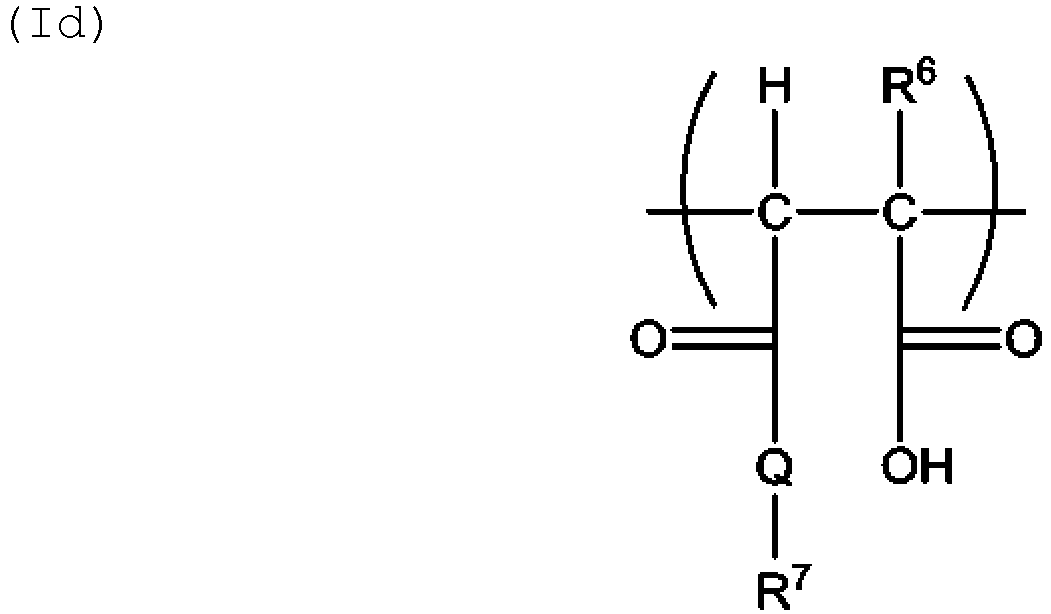 R6 est H ou un groupe alkyle en C1-C4 non ramifié ou ramifié ;Q est NH ou O ;R7 est H, (CnH2n) -SO3H, où n = 0, 1, 2, 3 ou 4, (CnH2n) -OH, où n = 0, 1, 2, 3 ou 4, (CnH2n) -PO3H2, où n = 0, 1, 2, 3 ou 4, (CnH2n) -OPO3H2, où n= 0, 1, 2, 3 ou 4, (C6H4) -SO3H, (C6H4)-PO3H2, (C6H4) -OPO3H2 ou (CmH2m)e-O- (A'O)α-R9, où m = 0, 1, 2, 3 ou 4, e = 0, 1, 2, 3 ou 4, A' = Cx'H2x', où x' = 2, 3, 4 ou 5, ou CH2CH(C6H5), α = un entier de 1 à 350, où R9 est un groupe alkyle en C1-C4 non ramifié ou ramifié.
 - Procédé selon la revendication 11 ou 12, dans lequel un motif structural est produit dans le copolymère par incorporation du macromonomère de polyéther sous la forme de motifs polymérisés, ledit motif structural étant selon une des formules générales (IIa), (IIb) et/ou (IIe)
 R10, R11 et R12, indépendamment les uns des autres, sont H ou un groupe alkyle en C1-C4 non ramifié ou ramifié ;E est un groupe alkylène en C1-C6 non ramifié ou ramifié, un groupe cyclohexylène, CH2-C6H10, C6H4 ortho-, méta- ou para-substitué ou n'est pas présent ;G est O, NH ou CO-NH, à condition que, si E n'est pas présent, G ne soit également pas présent ;A est CxH2x, où x = 2, 3, 4 ou 5 (de préférence x = 2) ou CH2CH(C6H5) ;n est 0, 1, 2, 3, 4 ou 5 ;a est un entier de 2 à 350 (de préférence 10 à 200) ; R13 est H, un groupe alkyle en C1-C4 non ramifié ou ramifié, CO-NH2, ou COCH3 ;
 R14 est H ou un groupe alkyle en C1-C4 non ramifié ou ramifié ;E est un groupe alkylène en C1-C6 non ramifié ou ramifié, un groupe cyclohexylène, CH2-C6H10, C6H4 ortho-, méta- ou para-substitué ou n'est pas présent ;G n'est pas présent, O, NH ou CO-NH, à condition que, si E n'est pas présent, G ne soit également pas présent ;A est CxH2x, où x = 2, 3, 4 ou 5, ou CH2CH (C6H5) ;n est 0, 1, 2, 3, 4 ou 5 ;a est un entier de 2 à 350 ;D n'est pas présent, NH ou O, à condition que, si D n'est pas présent : b = 0, 1, 2, 3 ou 4 et c = 0, 1, 2, 3 ou 4, où b + c = 3 ou 4, età condition que si D est NH ou O : b = 0, 1, 2 ou 3, c = 0, 1, 2 ou 3, où b + c = 2 ou 3 ;R15 est H, un groupe alkyle en C1-C4 non ramifié ou ramifié, CO-NH2, ou COCH3 ;
 R16, R17 et R18, indépendamment les uns des autres, sont H ou un groupe alkyle en C1-C4 non ramifié ou ramifié ;E est un groupe alkylène en C1-C6 non ramifié ou ramifié, un groupe cyclohexylène, CH2-C6H10, C6H4 ortho-, méta- ou para-substitué et/ou n'est pas présent,A est CxH2x, où x = 2, 3, 4 ou 5, ou CH2CH (C6H5) ;n est 0, 1, 2, 3, 4 ou 5 ;L est CxH2x, où x = 2, 3, 4 ou 5, ou CH2-CH (C6H5) ;a est un entier de 2 à 350 ;d est un entier de 1 à 350 ;R19 est H ou un groupe alkyle en C1-C4 non ramifié ou ramifié,R20 est H ou un groupe alkyle en C1-C4 non ramifié.
 - Procédé selon l'une quelconque des revendications 11 à 13, dans lequel un motif structural est produit dans le copolymère par incorporation du macromonomère de polyéther sous la forme de motifs polymérisés, ledit motif structural étant selon la formule générale (IId)
 R21, R22 et R23, indépendamment les uns des autres, sont H ou un groupe alkyle en C1-C4 non ramifié ou ramifié ;A est CxH2x, où x = 2, 3, 4 ou 5, ou CH2-CH (C6H5) ;a est un entier de 2 à 350 ;R24 est H ou un groupe alkyle en C1-C4 non ramifié ou ramifié, de préférence un groupe alkyle en C1-C4.
 - Procédé selon l'une quelconque des revendications 1 à 14, dans lequel le rapport en poids de la somme des composé de calcium hydrosoluble, composé de silicate hydrosoluble et polymère en peigne à l'eau, de préférence l'eau de mélange, est compris entre 1/1000 et 1/10, plus préférablement entre 1/500 et 1/100.
- Procédé selon l'une quelconque des revendications 11 à 15, dans lequel des polycondensats contenant(I) au moins un motif structural constitué d'un fragment aromatique ou hétéroaromatique portant une chaîne latérale polyéther et(II) au moins un motif structural constitué d'un fragment aromatique ou hétéroaromatique portant au moins un groupe ester d'acide phosphorique et/ou son sel sont présents dans la solution aqueuse qui contient un polymère en peigne hydrosoluble.
- Procédé selon la revendication 16, dans lequel, dans le polycondensat, les motifs structuraux (I) et (II) sont représenté par les formules générales suivantes
 A est un composé aromatique ou hétéroaromatique substitué ou non substitué ayant 5 à 10 atomes C ;B est N, NH ou O ;n est 2 si B est N et n est 1 si B est NH ou O ;R1 et R2, indépendamment l'un de l'autre, sont un radical alkyle en C1 à C10 ramifié ou à chaîne linéaire, un radical cycloalkyle en C5 à C8, un radical aryle, un radical hétéroaryle ou H ;a est un entier de 1 à 300 ;X est un radical alkyle en C1 à C10 ramifié ou à chaîne linéaire, un radical cycloalkyle en C5 à C8, un radical aryle, un radical hétéroaryle ou H ;
 D est un composé hétéroaromatique substitué ou non substitué ayant 5 à 10 atomes C ;E est N, NH ou O ;m est 2 si E est N et m est 1 si E est NH ou O ;R3 et R4, indépendamment l'un de l'autre, sont un radical alkyle en C1 à C10 ramifié ou à chaîne linéaire, un radical cycloalkyle en C5 à C8, un radical aryle, un radical hétéroaryle ou H ;b est un entier de 1 à 300 ;M est un ion de métal alcalin, un ion de métal alcalino-terreux, un ion ammonium, un ion ammonium organique ou H ;a est 1 ou dans le cas d'ions de métal alcalino-terreux 1/2.
 - Procédé selon la revendication 16 ou 17, dans lequel le rapport molaire des motifs structuraux (I) : (II) est de 1:10 à 10:1.
- Procédé selon l'une quelconque des revendications 16 à 18, dans lequel le polycondensat contient un motif structural (III) supplémentaire qui est représenté par la formule suivante
 Y, indépendamment les uns des autres, représente (I), (II), ou d'autres constituants du polycondensat ;R5 est H, CH3, COOH ou un composé aromatique ou hétéroaromatique substitué ou non substitué ayant 5 à 10 atomes C ;R6 est H, CH3, COOH ou un composé aromatique ou hétéroaromatique substitué ou non substitué ayant 5 à 10 atomes C.
 - Procédé selon la revendication 19, dans lequel R5 et R6 dans le motif structural (III), indépendamment l'un de l'autre, sont H, COOH ou méthyle.
- Procédé selon la revendication 19 ou 20, dans lequel le rapport molaire des motifs structuraux [(I) + (II)] : (III) est 1:0,8 à 3 dans le polycondensat.
- Procédé selon l'une quelconque des revendications 1 à 21, dans lequel la réaction est conduite complètement ou partiellement en présence d'une solution aqueuse contenant un polymère adjuvant de viscosité, choisi dans le groupe de dérivés et/ou (co)polymères de polysaccharide ayant un poids moléculaire moyen Mw supérieur à 500 000 g/mol, plus préférablement supérieur à 1 000 000 g/mol, les (co)polymères contenant des motifs structuraux dérivés (de préférence par polymérisation radicalaire) de dérivés de monomère (méth)acrylamide non ioniques et/ou de dérivés de monomère d'acide sulfonique.
- Procédé selon la revendication 22, dans lequel le polymère adjuvant de viscosité est un dérivé de polysaccharide choisi dans le groupe des méthylcellulose, hydroxyéthylcellulose (HEC), hydroxypropylcellulose (HPC), méthylhydroxyéthylcellulose (MHEC), méthylhydroxypropylcellulose (MHPC) et/ou des (co)polymères ayant un poids moléculaire moyen Mw supérieur à 500 000 g/mol, plus préférablement supérieur à 1 000 000 g/mol, les (co)polymères contenant des motifs structuraux dérivés (de préférence par polymérisation radicalaire) de dérivés de monomère (méth)acrylamide non ioniques choisis dans le groupe constitué d'un acrylamide, de préférence acrylamide, méthacrylamide, N-méthylacrylamide, N-méthylméthacrylamide, N,N-diméthylacrylamide, N-éthylacrylamide, N,N-diéthylacrylamide, N-cyclohexylacrylamide, N-benzylacrylamide, N,N-diméthylaminopropylacrylamide, N,N-diméthylaminoéthylacrylamide et/ou N-tert-butylacrylamide et/ou de dérivés de monomère d'acide sulfonique choisi dans le groupe constitué de l'acide 2-acrylamido-2-méthylpropanesulfonique, l'acide 2-méthacrylamido-2-méthylpropanesulfonique, l'acide 2-acrylamidobutanesulfonique et/ou l'acide 2-acrylamido-2,4,4-triméthylpentanesulfonique ou les sels des acides mentionnés.
- Procédé selon l'une quelconque des revendications 1 à 23, suivi d'une étape de procédé dans laquelle la composition d'accélérateur de durcissement est séchée, de préférence par un procédé de séchage par pulvérisation.
Priority Applications (1)
| Application Number | Priority Date | Filing Date | Title |
|---|---|---|---|
| PL13179258T PL2664596T3 (pl) | 2008-09-02 | 2009-09-02 | Sposób wytwarzania kompozycji środka przyspieszającego utwardzanie zawierającej plastyfikator |
Applications Claiming Priority (3)
| Application Number | Priority Date | Filing Date | Title |
|---|---|---|---|
| EP08163468 | 2008-09-02 | ||
| PCT/EP2009/061334 WO2010026155A1 (fr) | 2008-09-02 | 2009-09-02 | Composition d'un accélérateur de durcissement contenant un plastifiant |
| EP09782505.3A EP2321235B1 (fr) | 2008-09-02 | 2009-09-02 | Utilisation d'une composition d'un accélérateur de durcissement contenant un plastifiant |
Related Parent Applications (2)
| Application Number | Title | Priority Date | Filing Date |
|---|---|---|---|
| EP09782505.3A Division EP2321235B1 (fr) | 2008-09-02 | 2009-09-02 | Utilisation d'une composition d'un accélérateur de durcissement contenant un plastifiant |
| EP09782505.3A Division-Into EP2321235B1 (fr) | 2008-09-02 | 2009-09-02 | Utilisation d'une composition d'un accélérateur de durcissement contenant un plastifiant |
Publications (3)
| Publication Number | Publication Date |
|---|---|
| EP2664596A2 EP2664596A2 (fr) | 2013-11-20 |
| EP2664596A3 EP2664596A3 (fr) | 2014-10-01 |
| EP2664596B1 true EP2664596B1 (fr) | 2018-11-21 |
Family
ID=41404379
Family Applications (4)
| Application Number | Title | Priority Date | Filing Date |
|---|---|---|---|
| EP13179257.4A Active EP2664595B1 (fr) | 2008-09-02 | 2009-09-02 | Procédé de préparation d'une composition d'accélérateur de durcissement contenant un plastifiant |
| EP09782505.3A Active EP2321235B1 (fr) | 2008-09-02 | 2009-09-02 | Utilisation d'une composition d'un accélérateur de durcissement contenant un plastifiant |
| EP13179258.2A Active EP2664596B1 (fr) | 2008-09-02 | 2009-09-02 | Procédé de préparation d'une composition d'accélérateur de durcissement contenant un plastifiant |
| EP16195850.9A Active EP3153482B1 (fr) | 2008-09-02 | 2009-09-02 | Composition d'accélérateur de durcissement contenant un plastifiant |
Family Applications Before (2)
| Application Number | Title | Priority Date | Filing Date |
|---|---|---|---|
| EP13179257.4A Active EP2664595B1 (fr) | 2008-09-02 | 2009-09-02 | Procédé de préparation d'une composition d'accélérateur de durcissement contenant un plastifiant |
| EP09782505.3A Active EP2321235B1 (fr) | 2008-09-02 | 2009-09-02 | Utilisation d'une composition d'un accélérateur de durcissement contenant un plastifiant |
Family Applications After (1)
| Application Number | Title | Priority Date | Filing Date |
|---|---|---|---|
| EP16195850.9A Active EP3153482B1 (fr) | 2008-09-02 | 2009-09-02 | Composition d'accélérateur de durcissement contenant un plastifiant |
Country Status (21)
| Country | Link |
|---|---|
| US (1) | US8653186B2 (fr) |
| EP (4) | EP2664595B1 (fr) |
| JP (4) | JP6071199B2 (fr) |
| CN (2) | CN102216234B (fr) |
| AU (1) | AU2009289267B2 (fr) |
| BR (1) | BRPI0918283A2 (fr) |
| CA (1) | CA2735705C (fr) |
| DE (1) | DE202009017741U1 (fr) |
| DK (3) | DK2664596T3 (fr) |
| ES (4) | ES2711314T3 (fr) |
| HR (1) | HRP20191076T1 (fr) |
| HU (4) | HUE042657T2 (fr) |
| LT (3) | LT2664596T (fr) |
| MX (1) | MX2011002357A (fr) |
| PL (4) | PL2664596T3 (fr) |
| PT (1) | PT2321235T (fr) |
| RU (1) | RU2520105C2 (fr) |
| SI (1) | SI2321235T1 (fr) |
| TR (3) | TR201901118T4 (fr) |
| TW (1) | TW201016629A (fr) |
| WO (1) | WO2010026155A1 (fr) |
Families Citing this family (155)
| Publication number | Priority date | Publication date | Assignee | Title |
|---|---|---|---|---|
| PL2664596T3 (pl) | 2008-09-02 | 2019-05-31 | Construction Research & Tech Gmbh | Sposób wytwarzania kompozycji środka przyspieszającego utwardzanie zawierającej plastyfikator |
| CN102471476B (zh) | 2009-06-30 | 2014-05-21 | 巴斯夫欧洲公司 | 膦引发的制备超支化多元醇的方法 |
| EP2473462B1 (fr) | 2009-09-02 | 2019-10-16 | Construction Research & Technology GmbH | Composition d'accélérateur de durcissement contenant des produits de polycondensation phosphatés |
| AU2010294400B2 (en) * | 2009-09-02 | 2014-03-20 | Basf Construction Solutions Gmbh | Formulation and its use |
| CN105367025A (zh) * | 2009-09-02 | 2016-03-02 | 建筑研究和技术有限公司 | 可喷涂型水硬性粘合剂组合物及使用方法 |
| WO2011104347A1 (fr) | 2010-02-25 | 2011-09-01 | Construction Research & Technology Gmbh | Composition accélératrice de durcissement contenant des dispersants |
| FR2958931B1 (fr) * | 2010-04-20 | 2012-05-18 | Lafarge Sa | Liant hydraulique rapide pour pieces et ouvrages en beton |
| US9409820B2 (en) | 2010-04-21 | 2016-08-09 | Basf Se | Use of CSH suspensions in well cementing |
| DK2561034T3 (da) * | 2010-04-21 | 2019-08-12 | Basf Se | Anvendelse af csh-suspensioner i borehulscementering |
| AR082207A1 (es) | 2010-07-15 | 2012-11-21 | Lafarge Sa | Un aglomerante cementicio, una composicion cementica fraguable, y un metodo de cementacion que los emplea |
| US8435930B2 (en) | 2010-07-15 | 2013-05-07 | Lafarge | Low density cementitious compositions using lime kiln dust |
| EP2423175A1 (fr) * | 2010-08-24 | 2012-02-29 | Sika Technology AG | Accélérateur |
| ES2808648T3 (es) * | 2010-10-11 | 2021-03-01 | Basf Construction Solutions Gmbh | Suspensión espesa de yeso que contiene dispersante |
| JP5907985B2 (ja) * | 2010-11-29 | 2016-04-26 | コンストラクション リサーチ アンド テクノロジー ゲーエムベーハーConstruction Research & Technology GmbH | 粉末状促進剤 |
| EP2465835B1 (fr) | 2010-12-17 | 2013-09-18 | BASF Construction Polymers GmbH | Procédé de fabrication continue de masses de mortier |
| US8561701B2 (en) * | 2010-12-21 | 2013-10-22 | Halliburton Energy Services, Inc. | Methods for cementing in a subterranean formation using a cement composition containing calcium silicate hydrate seeds |
| WO2012143206A1 (fr) | 2011-04-21 | 2012-10-26 | Construction Research & Technology Gmbh | Composition d'accélérateur |
| CN103492341B (zh) * | 2011-04-21 | 2016-06-08 | 建筑研究和技术有限公司 | 促进剂组合物 |
| US9434648B2 (en) | 2011-04-21 | 2016-09-06 | Construction Research & Technology Gmbh | Accelerator composition |
| EP2714612B1 (fr) | 2011-05-26 | 2019-07-17 | Saint-Gobain Weber | Liant hydraulique comprenant un accélérateur, son utilisation et procédé de préparation d'un matériau de construction |
| US9745224B2 (en) | 2011-10-07 | 2017-08-29 | Boral Ip Holdings (Australia) Pty Limited | Inorganic polymer/organic polymer composites and methods of making same |
| US8864901B2 (en) | 2011-11-30 | 2014-10-21 | Boral Ip Holdings (Australia) Pty Limited | Calcium sulfoaluminate cement-containing inorganic polymer compositions and methods of making same |
| CN103906720B (zh) * | 2011-12-05 | 2016-12-14 | Sika技术股份公司 | 制备用于矿物粘结剂组合物的固化促进剂的方法 |
| EP2607329A1 (fr) * | 2011-12-23 | 2013-06-26 | Sika Technology AG | Accélérateur |
| ES2675323T3 (es) | 2012-01-13 | 2018-07-10 | Construction Research & Technology Gmbh | Agente de dispersión para partículas inorgánicas |
| PT2812291T (pt) * | 2012-02-08 | 2016-12-27 | Basf Se | Dispersão aquosa |
| US8883907B2 (en) | 2012-02-08 | 2014-11-11 | Basf Se | Aqueous dispersion |
| FR2989082B1 (fr) * | 2012-04-05 | 2015-03-13 | Chryso | Adjuvant pour compositions hydrauliques |
| AU2013245612B2 (en) * | 2012-04-11 | 2016-04-21 | Construction Research & Technology Gmbh | Polycondensation product based on aromatic compounds, method for the preparation and use therof |
| CN104350023B (zh) * | 2012-05-29 | 2017-02-22 | 建筑研究和技术有限公司 | 制备用于建筑材料混合物的固体加速剂的方法 |
| WO2013178417A1 (fr) * | 2012-05-29 | 2013-12-05 | Construction Research & Technology Gmbh | Accélérateur pulvérulent |
| FR2992961B1 (fr) * | 2012-07-04 | 2014-08-29 | Chryso | Procede de creation de motifs sur une surface en beton |
| EP2687496A1 (fr) * | 2012-07-20 | 2014-01-22 | BASF Construction Polymers GmbH | Synthèse et utilisation de matériau d'ensemencement de plâtre |
| EP2687498A1 (fr) | 2012-07-20 | 2014-01-22 | Construction Research & Technology GmbH | Additif pour masses se détachant hydrauliquement |
| DE102012106658B3 (de) | 2012-07-23 | 2013-09-26 | ThyssenKrupp Resource Technologies AG | Verwendung hydratationsbeschleunigender Keime als Zusatzstoff für Zement und/oder Beton |
| CN102757213B (zh) * | 2012-07-26 | 2013-11-06 | 石家庄铁道大学 | 用于粉细砂路堤加宽的边坡注浆浆液的制备方法 |
| RU2634311C2 (ru) * | 2012-08-13 | 2017-10-25 | Констракшн Рисёрч Энд Текнолоджи Гмбх | Композиция ускорителя твердения для цементных композиций |
| WO2014026938A1 (fr) * | 2012-08-13 | 2014-02-20 | Construction Research & Technology Gmbh | Composition d'accélérateur de durcissement |
| NO20121086A1 (no) * | 2012-09-25 | 2014-03-26 | Yara Int Asa | Antifrysesammensetning for produksjon av bestandig betong under kalde temperaturforhold |
| US20150299040A1 (en) * | 2012-11-09 | 2015-10-22 | Verdant Cement Llc | Molten salt synthesis for manufacture of cement precursors |
| CN102964077B (zh) * | 2012-11-20 | 2015-01-21 | 中山市东峻混凝土有限公司 | 一种聚羧酸系超塑化剂复配用稳定增强剂及制备方法和应用 |
| CN102976654B (zh) * | 2012-12-04 | 2014-12-10 | 江苏苏博特新材料股份有限公司 | 一种聚羧酸超塑化剂及其应用 |
| KR101617067B1 (ko) | 2013-01-18 | 2016-05-02 | (주)엘지하우시스 | 혹한기용 외단열 몰탈 및 이를 이용한 외단열 시스템 시공 방법 |
| EP2759337A1 (fr) * | 2013-01-25 | 2014-07-30 | Basf Se | Additif pour masses à prise hydraulique |
| CA2894829C (fr) * | 2013-01-25 | 2021-06-15 | Basf Se | Composition d'accelerateur de durcissement |
| EP2769964A1 (fr) | 2013-02-26 | 2014-08-27 | Construction Research & Technology GmbH | Additif pour compositions à prise hydraulique |
| EP2695866B1 (fr) | 2013-05-24 | 2019-04-24 | Basf Se | Additif de rhéologie modifié |
| WO2014191272A1 (fr) * | 2013-05-30 | 2014-12-04 | Sika Technology Ag | Accélérateur pour liants minéraux |
| EP3019455B1 (fr) | 2013-07-12 | 2019-07-03 | Sika Technology AG | Combinaison d'additifs comprenant un agent de broyage et un additif de béton pour accélérer l'hydratation de liants cimenteux |
| EP2826827B1 (fr) * | 2013-07-18 | 2019-06-12 | Basf Se | Composition CMP comprenant des particules abrasives à cérium |
| EP2842921A1 (fr) | 2013-08-27 | 2015-03-04 | Construction Research & Technology GmbH | Nouvelles fibres, leurs procédés de préparation et leur utilisation dans la fabrication d'éléments renforcés |
| KR101385237B1 (ko) * | 2013-08-27 | 2014-04-16 | 이코넥스 주식회사 | 실리카퓸을 이용한 나노크기의 규산칼슘 수화물 제조방법 |
| EP2842927A1 (fr) | 2013-08-29 | 2015-03-04 | BASF Construction Polymers GmbH | Accélérateur de durcissement comprenant de l'ettringite et de l'hydrate de silicate de calcium |
| US9796622B2 (en) * | 2013-09-09 | 2017-10-24 | Saudi Arabian Oil Company | Development of high temperature low density cement |
| NO20131392A1 (fr) * | 2013-10-21 | 2015-04-22 | Yara Int Asa | |
| EP2878585B1 (fr) | 2013-11-27 | 2017-05-31 | Fundacíon Tecnalia Research & Innovation | Procédé pour la fabrication de germes C-S-H cimentaires |
| ITMI20132059A1 (it) * | 2013-12-10 | 2015-06-11 | Mapei Spa | Additivo accelerante per composizioni cementizie |
| EP2886580A1 (fr) | 2013-12-20 | 2015-06-24 | Construction Research & Technology GmbH | Additif pour améliorer la rhéologie des liants inorganiques |
| EP2896603A1 (fr) * | 2014-01-21 | 2015-07-22 | Basf Se | Composition de sulfate de calcium comprenant un additif |
| EP2899162A1 (fr) * | 2014-01-22 | 2015-07-29 | Basf Se | Synthèse et utilisation d'accélérateurs de durcissement à base de CaSO4 |
| EP2899171A1 (fr) * | 2014-01-22 | 2015-07-29 | Construction Research & Technology GmbH | Additif pour liants hydrauliques |
| EP2876094A1 (fr) | 2014-04-03 | 2015-05-27 | Basf Se | Ciment et composition de liant à base de sulfate de calcium |
| CN103951308B (zh) * | 2014-04-17 | 2015-08-19 | 山东卓星化工有限公司 | 磺酸基改性聚氧乙烯醚超塑化剂及其制备方法 |
| EP2952492A1 (fr) | 2014-06-06 | 2015-12-09 | Basf Se | Composition à base d'hydrate de silicate de calcium |
| CN104402288A (zh) * | 2014-10-29 | 2015-03-11 | 上海建工集团股份有限公司 | 一种水化硅酸钙凝胶溶液早强剂及其制备方法 |
| KR101713828B1 (ko) * | 2014-11-04 | 2017-03-10 | (주)에스엠테크 | 무시멘트 촉진형 혼화제 및 이를 포함하는 무시멘트 조성물 |
| US9926233B2 (en) | 2014-12-18 | 2018-03-27 | Basf Se | Construction chemical composition for tile mortar |
| US10377674B2 (en) * | 2015-02-02 | 2019-08-13 | Carolyn Dry | Concrete coatings and compositions that absorb carbon dioxide |
| CA2977417A1 (fr) | 2015-02-27 | 2016-09-01 | Basf Se | Utilisation de fibres modifiees par des germes de csh dans des applications de champ petrolifere |
| US10144673B2 (en) | 2015-04-21 | 2018-12-04 | Basf Se | Method for producing a calcium silicate hydrate-comprising hardening accelerator in powder form |
| JP6761814B2 (ja) * | 2015-04-30 | 2020-09-30 | コンストラクション リサーチ アンド テクノロジー ゲーエムベーハーConstruction Research & Technology GmbH | 促進剤組成物 |
| AT517291A1 (de) | 2015-05-26 | 2016-12-15 | Holcim Technology Ltd | Betonzusammensetzung |
| MX2017015113A (es) | 2015-05-29 | 2018-08-09 | Fundacion Tecnalia Res & Innovation | Metodo para la fabricacion de hidrato de silicato de calcio usado como acelerador del endurecimiento en hormigon y materiales basados en cemento, hidrato de silicato de calcio fabricado con dicho metodo. |
| CA2990538C (fr) * | 2015-06-26 | 2023-09-05 | Construction Research & Technology Gmbh | Additif pour compositions a prise hydraulique |
| CA2995745C (fr) * | 2015-08-21 | 2024-02-20 | Basf Se | Composition d'accelerateur pour le durcissement du ciment |
| CN108349809A (zh) * | 2015-10-21 | 2018-07-31 | Sika技术股份公司 | 对矿物粘结剂组合物进行内部后处理的掺加剂 |
| CA3000052C (fr) * | 2015-11-10 | 2023-09-12 | Yara International Asa | Nitrate de calcium pour reduire la granulometrie d'une composition cimentaire durcie et beton arme presentant une resistance accrue a la carbonatation |
| FR3043675B1 (fr) * | 2015-11-17 | 2022-11-11 | Lafarge Sa | Mousse minerale ultra-legere et son procede de fabrication |
| JP6905795B2 (ja) * | 2015-12-16 | 2021-07-21 | コンストラクション リサーチ アンド テクノロジー ゲーエムベーハーConstruction Research & Technology GmbH | 吹付コンクリート組成物およびその製造方法 |
| JP6873136B2 (ja) | 2015-12-17 | 2021-05-19 | コンストラクション リサーチ アンド テクノロジー ゲーエムベーハーConstruction Research & Technology GmbH | 重縮合物に基づく減水剤 |
| RU2616964C1 (ru) * | 2016-03-09 | 2017-04-18 | Федеральное государственное бюджетное образовательное учреждение высшего профессионального образования "Петербургский государственный университет путей сообщения Императора Александра I" | Высокопрочный бетон |
| DE102016207858A1 (de) | 2016-05-06 | 2017-11-09 | Baustoffwerke Löbnitz GmbH & Co. KG | Dämmstoff |
| BR112018069857B1 (pt) | 2016-05-09 | 2023-10-31 | Construction Research & Technology Gmbh | Processo para moagem úmida de escória, escória moída, e, uso de uma escória |
| KR102417651B1 (ko) | 2016-06-09 | 2022-07-07 | 바스프 에스이 | 모르타르 및 시멘트 조성물을 위한 수화 제어 혼합물 |
| JP6997115B2 (ja) | 2016-06-09 | 2022-01-17 | ビーエーエスエフ ソシエタス・ヨーロピア | グリオキシル酸の亜硫酸水素塩付加物を含む建築用化学組成物 |
| EP3484830B1 (fr) * | 2016-07-18 | 2025-09-03 | Ecole Polytechnique Fédérale de Lausanne (EPFL) | Composition d'accélération/de retard de prise pour matériaux de construction |
| JP6831508B2 (ja) * | 2016-07-25 | 2021-02-17 | 学校法人福岡大学 | コンクリートの補修方法 |
| DK3532448T3 (da) * | 2016-10-31 | 2021-04-19 | Basf Se | Additiv til byggekemiske sammensætninger |
| WO2018087099A1 (fr) | 2016-11-09 | 2018-05-17 | Sika Technology Ag | Accélérateur de durcissement |
| CN107311504B (zh) * | 2016-12-26 | 2020-10-23 | 江苏苏博特新材料股份有限公司 | 一种提升水泥基材料强度的外加剂、其制备方法及其应用 |
| ES2929461T3 (es) | 2016-12-27 | 2022-11-29 | Construction Research & Technology Gmbh | Aditivo potenciador de la resistencia para composiciones cementantes |
| CA3052223A1 (fr) | 2017-02-22 | 2018-08-30 | Basf Se | Composition contenant un silicate de calcium hydrate semi-ordonne |
| EP3585752A1 (fr) | 2017-02-22 | 2020-01-01 | Cirkel GmbH & Co. KG | Composition à base d'oxydes contenant un silicate de calcium hydraté semi-ordonné |
| SG11201906437WA (en) * | 2017-02-22 | 2019-09-27 | Denka Company Ltd | Hardening agent for ready-mix shipped rapid-hardening concrete, ready-mix shipped rapid-hardening concrete material, ready-mix shipped rapid-hardening concrete composition, and method for preparing same |
| DE102017205822A1 (de) | 2017-04-05 | 2018-10-11 | Baustoffwerke Löbnitz GmbH & Co. KG | Verfahren und Vorrichtung zur Herstellung von porösem mineralischen Baumaterial |
| RU2659432C1 (ru) * | 2017-04-10 | 2018-07-02 | Общество с ограниченной ответственностью "Экспонента" | Регулятор реологических свойств дисперсных систем на основе неорганических вяжущих веществ |
| CN106986572B (zh) * | 2017-04-25 | 2020-08-14 | 北京工业大学 | 一种用超支化聚合物制备混凝土增强剂的方法 |
| EP3615491B1 (fr) * | 2017-04-25 | 2022-04-13 | GCP Applied Technologies Inc. | Agents d'amélioration de la résistance du ciment |
| CN107235650B (zh) * | 2017-07-03 | 2020-05-05 | 中建西部建设西南有限公司 | 一种水性纳米复合型早强外加剂及其制备方法 |
| WO2019081548A1 (fr) * | 2017-10-27 | 2019-05-02 | Basf Se | Procédé de séchage par pulvérisation |
| FR3073220B1 (fr) * | 2017-11-07 | 2022-11-11 | Hoffmann Jb Tech | Procede de preparation d'un liant ettringitique pour la fabrication de materiaux de construction |
| KR20200128572A (ko) | 2018-03-09 | 2020-11-13 | 더스틴 에이. 하트만 | 개선된 콘크리트 성능을 위한 신규한 조성물 |
| US12157706B2 (en) | 2018-03-22 | 2024-12-03 | E5 Incorporated | Compositions for improved concrete performance |
| EP3543220A1 (fr) * | 2018-03-22 | 2019-09-25 | Sika Technology Ag | Production de nanoparticules de calcium hydroxyde et son utilisation en tant qu'accélérateur dans des compositions de liant minéral |
| US11884600B2 (en) | 2018-03-22 | 2024-01-30 | Specification Products, Inc. | Method for preparing an improved finished concrete product |
| EP3802461A1 (fr) * | 2018-05-31 | 2021-04-14 | Sika Technology Ag | Procédé de liquéfaction de ciments contenant de la bélite, du sulfoaluminate de calcium et de la ferrite |
| CN108585559A (zh) * | 2018-06-06 | 2018-09-28 | 上海美澎材料科技有限公司 | 一种水泥基结晶母料材料及制备方法 |
| KR20210027460A (ko) * | 2018-07-06 | 2021-03-10 | 바스프 에스이 | 유동성 내화성 물질용 조성물 |
| DE102018212322A1 (de) | 2018-07-24 | 2020-01-30 | Baustoffwerke Löbnitz GmbH & Co. KG | Verfahren zur Herstellung von porösem mineralischem Baumaterial mit verbesserter Festigkeit |
| JP7405829B2 (ja) | 2018-08-13 | 2023-12-26 | ビーエーエスエフ ソシエタス・ヨーロピア | 担体材料を用いた効率的な湿潤剤 |
| JP7545385B2 (ja) * | 2018-10-02 | 2024-09-04 | シーカ テクノロジー アクチェンゲゼルシャフト | 高炉スラグ微粉末の活性化 |
| CN109020423A (zh) * | 2018-10-19 | 2018-12-18 | 济南大学 | 一种用于海洋工程的高抗蚀自密实混凝土 |
| WO2020244981A1 (fr) | 2019-06-03 | 2020-12-10 | Basf Se | Utilisatoin d'un kit additif dans l'impression 3d d'une composition de matériau de construction |
| CN110395939B (zh) * | 2019-06-19 | 2022-04-22 | 科之杰新材料集团有限公司 | 一种防水增强型无碱液体速凝剂及其制备方法 |
| RU2717021C1 (ru) * | 2019-07-17 | 2020-03-17 | Федеральное государственное бюджетное образовательное учреждение высшего образования "Петербургский государственный университет путей сообщения Императора Александра I" | Высокопрочный бетон |
| US11866366B2 (en) | 2019-09-03 | 2024-01-09 | Specification Products, Inc. | Wear-resistant concrete formulations and methods for their preparation |
| CN110759654A (zh) * | 2019-12-05 | 2020-02-07 | 长江师范学院 | 一种高温条件下具有高性能的铝酸盐基水泥及其制备方法 |
| CN110981269A (zh) * | 2019-12-31 | 2020-04-10 | 上海三瑞高分子材料股份有限公司 | 一种水泥早强剂组合物及其制备方法 |
| KR102181656B1 (ko) * | 2020-01-03 | 2020-11-23 | 주식회사 삼표산업 | 조강 첨가제 제조 방법 및 조강성 콘크리트 조성물 |
| RU2729547C1 (ru) * | 2020-02-07 | 2020-08-07 | Федеральное государственное бюджетное образовательное учреждение высшего образования "Петербургский государственный университет путей сообщения Императора Александра I" | Теплоизоляционный бетон |
| JP7693696B2 (ja) * | 2020-02-27 | 2025-06-17 | ビーエーエスエフ ソシエタス・ヨーロピア | 無電荷の粘土不活化剤 |
| CN111470794B (zh) * | 2020-03-05 | 2021-05-28 | 武汉理工大学 | 一种水化铝硅酸钙纳米晶核早强剂及其制备方法 |
| TWI717228B (zh) | 2020-03-11 | 2021-01-21 | 彩興股份有限公司 | 混凝土硬化劑組成物 |
| JP7731364B2 (ja) * | 2020-03-20 | 2025-08-29 | ビーエーエスエフ ソシエタス・ヨーロピア | 改善された初期強度を有する環境配慮型建設用材料組成物 |
| EP3916067B1 (fr) | 2020-05-27 | 2023-07-12 | Bind-X GmbH | Composition de biocementation pour la suppression de poussières |
| US20230303442A1 (en) | 2020-06-18 | 2023-09-28 | Basf Se | Hydration control mixture for mortar and cement compositions |
| JP2022011743A (ja) * | 2020-06-30 | 2022-01-17 | 株式会社日本触媒 | アルミノシリケート含有組成物及びその製造方法 |
| CN113913167B (zh) * | 2020-07-08 | 2023-05-30 | 中国石油化工股份有限公司 | 一种固井水泥浆用自由液控制剂及其制备方法与应用 |
| CN112062494A (zh) * | 2020-09-16 | 2020-12-11 | 天津炬实科技发展股份有限公司 | 一种无机矿物增强剂 |
| JPWO2022071281A1 (fr) * | 2020-09-30 | 2022-04-07 | ||
| CN116323519A (zh) | 2020-10-09 | 2023-06-23 | 巴斯夫欧洲公司 | 制备硅酸钙水合物的方法 |
| RU2754844C1 (ru) * | 2020-10-22 | 2021-09-08 | Общество с ограниченной ответственностью «Оренбургский пропант» | Акриловый полимер на водной основе для цементной композиции и способ его получения |
| CN112405734B (zh) * | 2020-11-10 | 2022-05-10 | 漳州市德根工贸有限公司 | 一种胶合板生产工艺及其设备 |
| CA3198470A1 (fr) * | 2020-11-18 | 2022-05-27 | Socpra Sciences Et Genie S.E.C. | Utilisation de carraghenane comme adjuvant modificateur de viscosite dans des suspensions cimentaires fluides |
| EP4347529A1 (fr) | 2021-05-27 | 2024-04-10 | Basf Se | Composition de dispersion comprenant une pâte de scellement à base de ciment et un mélange d'additifs |
| CN113354315B (zh) * | 2021-07-09 | 2022-11-22 | 贵州大学 | 利用磷矿酸不溶渣生产高硅硫铝酸盐水泥的方法 |
| EP4119519A1 (fr) | 2021-07-12 | 2023-01-18 | Mapei S.p.A. | Adjuvant améliorant la résistance des compositions cimentaires à faible teneur en carbone |
| WO2023025929A1 (fr) | 2021-08-27 | 2023-03-02 | Construction Research & Technology Gmbh | Utilisation d'un matériau hybride inorganique polymère colloïdal en tant qu'additif de composition de construction |
| EP4194419A1 (fr) | 2021-12-08 | 2023-06-14 | Holcim Technology Ltd | Procédé d'augmentation de la résistance d'un liant hydraulique et accélérateur minéral correspondant |
| CN114736565B (zh) * | 2022-03-29 | 2023-11-28 | 上海保立佳新材料有限公司 | 一种硬化剂及其原料组合物、制备方法和应用 |
| WO2023203207A1 (fr) | 2022-04-21 | 2023-10-26 | Construction Research & Technology Gmbh | Procédé pour la préparation d'une composition de germes de silicate de calcium hydraté utile en tant qu'accélérateur de durcissement pour des compositions à base de ciment |
| WO2023209082A1 (fr) | 2022-04-29 | 2023-11-02 | Basf Se | Combinaisons d'un polymère organique et de silicate de calcium hydraté pour la production de membranes d'étanchéité minérales |
| KR102447563B1 (ko) * | 2022-05-11 | 2022-09-26 | 주식회사 다온코리아 | 콘크리트 구조물의 균열보수재 및 이를 이용한 균열보수공법 |
| CN114804709B (zh) * | 2022-05-23 | 2023-03-28 | 广西科达新材料集团有限公司 | 一种纳米水化硅酸钙聚羧酸早强剂及其制备方法 |
| EP4543822A1 (fr) | 2022-06-22 | 2025-04-30 | Construction Research & Technology GmbH | Composition d'accélérateur de durcissement pour compositions cimentaires, composition cimentaire et procédé pour l'accélération du durcissement d'une composition cimentaire |
| EP4353699A1 (fr) | 2022-10-12 | 2024-04-17 | Mapei S.p.A. | Adjuvant pour beton a faible teneur en carbone |
| EP4378909A1 (fr) | 2022-11-29 | 2024-06-05 | Sika Technology AG | Accélérateurs pour compositions de liant minéral |
| AU2024230797A1 (en) | 2023-03-01 | 2025-08-14 | Construction Research & Technology Gmbh | Improved shotcrete compositions |
| EP4516759A1 (fr) | 2023-09-01 | 2025-03-05 | Construction Research & Technology GmbH | Matériau de construction à faible empreinte carbone présentant des résistances précoces et tardives améliorées |
| EP4534499A1 (fr) | 2023-10-06 | 2025-04-09 | Sika Technology AG | Production d'accélérateurs de durcissement pour liants minéraux |
| WO2025132259A1 (fr) | 2023-12-18 | 2025-06-26 | Holcim Technology Ltd | Procédé de production d'une composition appropriée en tant qu'accélérateur de prise et/ou de durcissement pour un liant hydraulique |
| EP4574797A1 (fr) * | 2023-12-18 | 2025-06-25 | Hilti Aktiengesellschaft | Composition d'accélération pour accélérer le durcissement de ciments d'aluminate de calcium |
| EP4574798A1 (fr) * | 2023-12-18 | 2025-06-25 | Hilti Aktiengesellschaft | Composition d'accélération pour accélérer le durcissement de ciments d'aluminate de calcium |
| EP4574796A1 (fr) * | 2023-12-18 | 2025-06-25 | Hilti Aktiengesellschaft | Procédé de préparation d'une composition d'accélération appropriée pour accélérer le durcissement de ciments d'aluminate de calcium |
| EP4574792A1 (fr) | 2023-12-22 | 2025-06-25 | A2A Ambiente SpA | Procédé de production simultanée d'agrégats artificiels et de sel à partir d'installations d'incinération de déchets solides |
Family Cites Families (32)
| Publication number | Priority date | Publication date | Assignee | Title |
|---|---|---|---|---|
| US2204113A (en) | 1937-09-30 | 1940-06-11 | Goodrich Co B F | Calcium silicate and method of preparing the same |
| RO94695B1 (ro) * | 1986-04-14 | 1988-08-16 | Institutul Politehnic "Traian Vuia" | Procedeu de obtinere a silicatului de calciu sub forma de xonotlit si wollastonit sintetic |
| DE3800091A1 (de) | 1987-08-28 | 1989-07-13 | Sandoz Ag | Copolymere verbindungen, deren herstellung und verwendung |
| US5295184A (en) * | 1991-05-30 | 1994-03-15 | Davox Corporation | Dynamically adjustable call pacing system |
| US5332041A (en) | 1992-12-30 | 1994-07-26 | Halliburton Company | Set-activated cementitious compositions and methods |
| FR2708592B1 (fr) * | 1993-07-29 | 1995-09-29 | Lafarge Coppee | Agent accélérateur de prise et du durcissement des liants hydrauliques siliciques. |
| US5355954A (en) | 1993-11-02 | 1994-10-18 | Halliburton Company | Utilizing drilling fluid in well cementing operations |
| DE4411797A1 (de) | 1994-04-06 | 1995-10-12 | Sueddeutsche Kalkstickstoff | Verfahren zur Herstellung von Sulfanilsäure enthaltenden Kondensationsprodukten auf Basis von Amino-s-triazinen |
| DE19609614A1 (de) | 1995-03-17 | 1996-09-19 | Sueddeutsche Kalkstickstoff | Wasserlösliche Polykondensationsprodukte auf Basis von Amino-s-triazinen und deren Verwendung |
| JPH08286645A (ja) * | 1995-04-14 | 1996-11-01 | Toshiba Syst Technol Kk | プラント監視装置 |
| KR100523506B1 (en) * | 1995-08-03 | 2005-10-24 | Peptide and O-glycan inhibitors of selectin mediated inflammation | |
| TW419447B (en) * | 1996-02-22 | 2001-01-21 | Nippon Catalytic Chem Ind | Cement composition |
| JP3423853B2 (ja) * | 1996-02-22 | 2003-07-07 | 株式会社日本触媒 | セメント混和剤およびセメント組成物 |
| RU2095327C1 (ru) * | 1996-03-21 | 1997-11-10 | Общество С Ограниченной Ответственностью "Предприятие Мастер Бетон" | Способ приготовления бетонной смеси |
| DK1044175T3 (da) * | 1998-08-14 | 2003-03-17 | Mbt Holding Ag | Cementblandinger med højt pozzolanindhold |
| JP2000095554A (ja) * | 1998-09-18 | 2000-04-04 | Taiheiyo Cement Corp | 超早強性セメント組成物 |
| US6170574B1 (en) | 1999-01-14 | 2001-01-09 | Downhole Solutions, Inc. | Method of forming cement seals in downhole pipes |
| JP4323016B2 (ja) * | 1999-08-23 | 2009-09-02 | 太平洋セメント株式会社 | セメント添加剤及びセメント混練物 |
| EP1138696A1 (fr) * | 2000-03-29 | 2001-10-04 | Sika AG, vorm. Kaspar Winkler & Co. | Polymères pour compositions dispersantes pour ciment |
| JP2002187758A (ja) * | 2000-12-19 | 2002-07-05 | Matsushita Electric Works Ltd | 無機質セメント板の製造方法 |
| CA2439660A1 (fr) * | 2001-03-05 | 2002-09-12 | James Hardie Research Pty. Limited | Additif accelerateur et promoteur de resistance a base d'hydrate de silicate de calcium de basse densite pour produits cimentaires |
| US6733583B2 (en) | 2001-03-14 | 2004-05-11 | Capitol Aggregates, Ltd. | Process for producing a blended cement having enhanced cementitious properties capable of combination with class C fly ash |
| US6832652B1 (en) | 2003-08-22 | 2004-12-21 | Bj Services Company | Ultra low density cementitious slurries for use in cementing of oil and gas wells |
| FR2866330B1 (fr) | 2004-02-13 | 2006-08-18 | Eiffage Tp | Beton ultra haute performance et autoplacant, son procede de preparation et son utilisation. |
| DE102004050395A1 (de) * | 2004-10-15 | 2006-04-27 | Construction Research & Technology Gmbh | Polykondensationsprodukt auf Basis von aromatischen oder heteroaromatischen Verbindungen, Verfahren zu seiner Herstellung und dessen Verwendung |
| AU2006259585B2 (en) * | 2005-06-14 | 2011-07-14 | United States Gypsum Company | Modifiers for gypsum slurries and method of using them |
| US7273949B2 (en) | 2005-08-05 | 2007-09-25 | Halliburton Energy Services, Inc. | Salts and methods for their preparation |
| DE102005060947A1 (de) | 2005-12-20 | 2007-06-28 | Construction Research & Technology Gmbh | Pulverförmige Polykondensationsprodukte |
| WO2008034616A1 (fr) * | 2006-09-20 | 2008-03-27 | Heidelbergcement Ag | Ciment portland contenant du liant, et hydrate de calcium |
| PL2664596T3 (pl) | 2008-09-02 | 2019-05-31 | Construction Research & Tech Gmbh | Sposób wytwarzania kompozycji środka przyspieszającego utwardzanie zawierającej plastyfikator |
| US9434648B2 (en) * | 2011-04-21 | 2016-09-06 | Construction Research & Technology Gmbh | Accelerator composition |
| US20120270969A1 (en) * | 2011-04-21 | 2012-10-25 | Manfred Bichler | Accelerator Composition |
-
2009
- 2009-09-02 PL PL13179258T patent/PL2664596T3/pl unknown
- 2009-09-02 TR TR2019/01118T patent/TR201901118T4/tr unknown
- 2009-09-02 PT PT09782505T patent/PT2321235T/pt unknown
- 2009-09-02 LT LTEP13179258.2T patent/LT2664596T/lt unknown
- 2009-09-02 DK DK13179258.2T patent/DK2664596T3/da active
- 2009-09-02 AU AU2009289267A patent/AU2009289267B2/en active Active
- 2009-09-02 LT LTEP09782505.3T patent/LT2321235T/lt unknown
- 2009-09-02 RU RU2011112305/03A patent/RU2520105C2/ru active
- 2009-09-02 EP EP13179257.4A patent/EP2664595B1/fr active Active
- 2009-09-02 TW TW98129620A patent/TW201016629A/zh unknown
- 2009-09-02 EP EP09782505.3A patent/EP2321235B1/fr active Active
- 2009-09-02 US US13/061,063 patent/US8653186B2/en active Active
- 2009-09-02 CN CN200980143821.8A patent/CN102216234B/zh active Active
- 2009-09-02 ES ES13179257T patent/ES2711314T3/es active Active
- 2009-09-02 HU HUE13179258A patent/HUE042657T2/hu unknown
- 2009-09-02 HR HRP20191076 patent/HRP20191076T1/hr unknown
- 2009-09-02 TR TR2019/08413T patent/TR201908413T4/tr unknown
- 2009-09-02 HU HUE16195850A patent/HUE069967T2/hu unknown
- 2009-09-02 MX MX2011002357A patent/MX2011002357A/es active IP Right Grant
- 2009-09-02 WO PCT/EP2009/061334 patent/WO2010026155A1/fr not_active Ceased
- 2009-09-02 HU HUE09782505A patent/HUE044019T2/hu unknown
- 2009-09-02 DK DK13179257.4T patent/DK2664595T3/da active
- 2009-09-02 CA CA2735705A patent/CA2735705C/fr active Active
- 2009-09-02 LT LTEP13179257.4T patent/LT2664595T/lt unknown
- 2009-09-02 ES ES16195850T patent/ES3001632T3/es active Active
- 2009-09-02 PL PL09782505T patent/PL2321235T3/pl unknown
- 2009-09-02 ES ES13179258T patent/ES2711343T3/es active Active
- 2009-09-02 PL PL13179257T patent/PL2664595T3/pl unknown
- 2009-09-02 EP EP13179258.2A patent/EP2664596B1/fr active Active
- 2009-09-02 BR BRPI0918283A patent/BRPI0918283A2/pt not_active IP Right Cessation
- 2009-09-02 ES ES09782505T patent/ES2730882T3/es active Active
- 2009-09-02 JP JP2011525533A patent/JP6071199B2/ja active Active
- 2009-09-02 EP EP16195850.9A patent/EP3153482B1/fr active Active
- 2009-09-02 DK DK09782505.3T patent/DK2321235T3/da active
- 2009-09-02 CN CN201810933412.9A patent/CN108947375B/zh active Active
- 2009-09-02 PL PL16195850.9T patent/PL3153482T3/pl unknown
- 2009-09-02 HU HUE13179257A patent/HUE042656T2/hu unknown
- 2009-09-02 SI SI200931979T patent/SI2321235T1/sl unknown
- 2009-09-02 TR TR2019/01059T patent/TR201901059T4/tr unknown
- 2009-09-02 DE DE200920017741 patent/DE202009017741U1/de not_active Expired - Lifetime
-
2015
- 2015-05-07 JP JP2015095104A patent/JP6133355B2/ja not_active Expired - Fee Related
- 2015-09-28 JP JP2015189841A patent/JP2016000695A/ja active Pending
-
2018
- 2018-02-23 JP JP2018030451A patent/JP6622335B2/ja active Active
Non-Patent Citations (2)
| Title |
|---|
| H. MATSUYAMA ET AL: "The formation of C-S-H/polymer complexes with superplasticizing polymers", CONCRETE SCIENCE AND ENGINEERING, vol. 1, 1 September 1999 (1999-09-01), pages 148 - 156, XP055255307 * |
| MARKUS ARNOLD: "Polymergesteuerte Kristallisation von Calciumhydroxid und Calciumsilicathydrat", DISSERTATION ZUR ERLANGUNG DES GARDES EINES DOKTORS DER NATUURWISSENSCHAFT, 1 January 2004 (2004-01-01), pages 3pp, I-VII, 1 - 180, XP055255314 * |
Also Published As
Similar Documents
| Publication | Publication Date | Title |
|---|---|---|
| EP2664596B1 (fr) | Procédé de préparation d'une composition d'accélérateur de durcissement contenant un plastifiant | |
| EP2473462B1 (fr) | Composition d'accélérateur de durcissement contenant des produits de polycondensation phosphatés | |
| JP6381551B2 (ja) | 硬化促進剤組成物 | |
| WO2011026723A1 (fr) | Compositions d'accélérateur de durcissement contenant des groupes acides sulfoniques et aromatiques | |
| HK1163051A (en) | Plasticizer-containing hardening accelerator composition |
Legal Events
| Date | Code | Title | Description |
|---|---|---|---|
| PUAI | Public reference made under article 153(3) epc to a published international application that has entered the european phase |
Free format text: ORIGINAL CODE: 0009012 |
|
| AC | Divisional application: reference to earlier application |
Ref document number: 2321235 Country of ref document: EP Kind code of ref document: P |
|
| AK | Designated contracting states |
Kind code of ref document: A2 Designated state(s): AT BE BG CH CY CZ DE DK EE ES FI FR GB GR HR HU IE IS IT LI LT LU LV MC MK MT NL NO PL PT RO SE SI SK SM TR |
|
| RIN1 | Information on inventor provided before grant (corrected) |
Inventor name: LORENZ, KLAUS Inventor name: ZUERN, SIEGFRIED Inventor name: KUTSCHERA, MICHAEL Inventor name: NICOLEAU, LUC Inventor name: HESSE, CHRISTOPH Inventor name: SCHOLZ, EVA Inventor name: BRAEU, MICHAEL Inventor name: VIERLE, MARIO Inventor name: SCHMITT, DIRK Inventor name: FRIDRICH, DANIEL Inventor name: MONTERO PANCERA, SABRINA Inventor name: WOHLHAUPTER, THOMAS Inventor name: ALBRECHT, GERHARD Inventor name: DORFNER, REINHARD Inventor name: LEITNER, HUBERT |
|
| PUAL | Search report despatched |
Free format text: ORIGINAL CODE: 0009013 |
|
| AK | Designated contracting states |
Kind code of ref document: A3 Designated state(s): AT BE BG CH CY CZ DE DK EE ES FI FR GB GR HR HU IE IS IT LI LT LU LV MC MK MT NL NO PL PT RO SE SI SK SM TR |
|
| RIC1 | Information provided on ipc code assigned before grant |
Ipc: C04B 40/00 20060101ALI20140826BHEP Ipc: C04B 28/02 20060101AFI20140826BHEP |
|
| 17P | Request for examination filed |
Effective date: 20150401 |
|
| RBV | Designated contracting states (corrected) |
Designated state(s): AT BE BG CH CY CZ DE DK EE ES FI FR GB GR HR HU IE IS IT LI LT LU LV MC MK MT NL NO PL PT RO SE SI SK SM TR |
|
| TPAC | Observations filed by third parties |
Free format text: ORIGINAL CODE: EPIDOSNTIPA |
|
| 17Q | First examination report despatched |
Effective date: 20160502 |
|
| STAA | Information on the status of an ep patent application or granted ep patent |
Free format text: STATUS: EXAMINATION IS IN PROGRESS |
|
| TPAC | Observations filed by third parties |
Free format text: ORIGINAL CODE: EPIDOSNTIPA |
|
| RIC1 | Information provided on ipc code assigned before grant |
Ipc: C04B 40/00 20060101AFI20171013BHEP Ipc: C04B 103/14 20060101ALN20171013BHEP Ipc: C04B 28/02 20060101ALI20171013BHEP |
|
| REG | Reference to a national code |
Ref country code: DE Ref legal event code: R079 Ref document number: 602009055855 Country of ref document: DE Free format text: PREVIOUS MAIN CLASS: C04B0028020000 Ipc: C04B0040000000 |
|
| RIC1 | Information provided on ipc code assigned before grant |
Ipc: C04B 103/14 20060101ALN20180528BHEP Ipc: C04B 40/00 20060101AFI20180528BHEP Ipc: C04B 28/02 20060101ALI20180528BHEP |
|
| GRAP | Despatch of communication of intention to grant a patent |
Free format text: ORIGINAL CODE: EPIDOSNIGR1 |
|
| STAA | Information on the status of an ep patent application or granted ep patent |
Free format text: STATUS: GRANT OF PATENT IS INTENDED |
|
| INTG | Intention to grant announced |
Effective date: 20180723 |
|
| GRAS | Grant fee paid |
Free format text: ORIGINAL CODE: EPIDOSNIGR3 |
|
| GRAA | (expected) grant |
Free format text: ORIGINAL CODE: 0009210 |
|
| STAA | Information on the status of an ep patent application or granted ep patent |
Free format text: STATUS: THE PATENT HAS BEEN GRANTED |
|
| AC | Divisional application: reference to earlier application |
Ref document number: 2321235 Country of ref document: EP Kind code of ref document: P |
|
| AK | Designated contracting states |
Kind code of ref document: B1 Designated state(s): AT BE BG CH CY CZ DE DK EE ES FI FR GB GR HR HU IE IS IT LI LT LU LV MC MK MT NL NO PL PT RO SE SI SK SM TR |
|
| REG | Reference to a national code |
Ref country code: CH Ref legal event code: EP |
|
| REG | Reference to a national code |
Ref country code: IE Ref legal event code: FG4D |
|
| REG | Reference to a national code |
Ref country code: DE Ref legal event code: R096 Ref document number: 602009055855 Country of ref document: DE |
|
| REG | Reference to a national code |
Ref country code: AT Ref legal event code: REF Ref document number: 1067339 Country of ref document: AT Kind code of ref document: T Effective date: 20181215 |
|
| REG | Reference to a national code |
Ref country code: RO Ref legal event code: EPE |
|
| REG | Reference to a national code |
Ref country code: SE Ref legal event code: TRGR |
|
| REG | Reference to a national code |
Ref country code: NL Ref legal event code: FP |
|
| REG | Reference to a national code |
Ref country code: NO Ref legal event code: T2 Effective date: 20181121 |
|
| PG25 | Lapsed in a contracting state [announced via postgrant information from national office to epo] |
Ref country code: HR Free format text: LAPSE BECAUSE OF FAILURE TO SUBMIT A TRANSLATION OF THE DESCRIPTION OR TO PAY THE FEE WITHIN THE PRESCRIBED TIME-LIMIT Effective date: 20181121 Ref country code: IS Free format text: LAPSE BECAUSE OF FAILURE TO SUBMIT A TRANSLATION OF THE DESCRIPTION OR TO PAY THE FEE WITHIN THE PRESCRIBED TIME-LIMIT Effective date: 20190321 Ref country code: BG Free format text: LAPSE BECAUSE OF FAILURE TO SUBMIT A TRANSLATION OF THE DESCRIPTION OR TO PAY THE FEE WITHIN THE PRESCRIBED TIME-LIMIT Effective date: 20190221 |
|
| REG | Reference to a national code |
Ref country code: ES Ref legal event code: FG2A Ref document number: 2711343 Country of ref document: ES Kind code of ref document: T3 Effective date: 20190503 |
|
| PG25 | Lapsed in a contracting state [announced via postgrant information from national office to epo] |
Ref country code: GR Free format text: LAPSE BECAUSE OF FAILURE TO SUBMIT A TRANSLATION OF THE DESCRIPTION OR TO PAY THE FEE WITHIN THE PRESCRIBED TIME-LIMIT Effective date: 20190222 Ref country code: PT Free format text: LAPSE BECAUSE OF FAILURE TO SUBMIT A TRANSLATION OF THE DESCRIPTION OR TO PAY THE FEE WITHIN THE PRESCRIBED TIME-LIMIT Effective date: 20190321 |
|
| REG | Reference to a national code |
Ref country code: HU Ref legal event code: AG4A Ref document number: E042657 Country of ref document: HU |
|
| PG25 | Lapsed in a contracting state [announced via postgrant information from national office to epo] |
Ref country code: DK Free format text: LAPSE BECAUSE OF FAILURE TO SUBMIT A TRANSLATION OF THE DESCRIPTION OR TO PAY THE FEE WITHIN THE PRESCRIBED TIME-LIMIT Effective date: 20181121 |
|
| REG | Reference to a national code |
Ref country code: DE Ref legal event code: R097 Ref document number: 602009055855 Country of ref document: DE |
|
| REG | Reference to a national code |
Ref country code: DK Ref legal event code: T3 Effective date: 20190822 Ref country code: DK Ref legal event code: EGE Effective date: 20190822 |
|
| PG25 | Lapsed in a contracting state [announced via postgrant information from national office to epo] |
Ref country code: SK Free format text: LAPSE BECAUSE OF FAILURE TO SUBMIT A TRANSLATION OF THE DESCRIPTION OR TO PAY THE FEE WITHIN THE PRESCRIBED TIME-LIMIT Effective date: 20181121 Ref country code: EE Free format text: LAPSE BECAUSE OF FAILURE TO SUBMIT A TRANSLATION OF THE DESCRIPTION OR TO PAY THE FEE WITHIN THE PRESCRIBED TIME-LIMIT Effective date: 20181121 Ref country code: SM Free format text: LAPSE BECAUSE OF FAILURE TO SUBMIT A TRANSLATION OF THE DESCRIPTION OR TO PAY THE FEE WITHIN THE PRESCRIBED TIME-LIMIT Effective date: 20181121 |
|
| PLBE | No opposition filed within time limit |
Free format text: ORIGINAL CODE: 0009261 |
|
| STAA | Information on the status of an ep patent application or granted ep patent |
Free format text: STATUS: NO OPPOSITION FILED WITHIN TIME LIMIT |
|
| 26N | No opposition filed |
Effective date: 20190822 |
|
| PG25 | Lapsed in a contracting state [announced via postgrant information from national office to epo] |
Ref country code: SI Free format text: LAPSE BECAUSE OF FAILURE TO SUBMIT A TRANSLATION OF THE DESCRIPTION OR TO PAY THE FEE WITHIN THE PRESCRIBED TIME-LIMIT Effective date: 20181121 |
|
| PG25 | Lapsed in a contracting state [announced via postgrant information from national office to epo] |
Ref country code: MC Free format text: LAPSE BECAUSE OF FAILURE TO SUBMIT A TRANSLATION OF THE DESCRIPTION OR TO PAY THE FEE WITHIN THE PRESCRIBED TIME-LIMIT Effective date: 20181121 |
|
| PG25 | Lapsed in a contracting state [announced via postgrant information from national office to epo] |
Ref country code: IE Free format text: LAPSE BECAUSE OF NON-PAYMENT OF DUE FEES Effective date: 20190902 |
|
| REG | Reference to a national code |
Ref country code: BE Ref legal event code: MM Effective date: 20190930 |
|
| PG25 | Lapsed in a contracting state [announced via postgrant information from national office to epo] |
Ref country code: BE Free format text: LAPSE BECAUSE OF NON-PAYMENT OF DUE FEES Effective date: 20190930 |
|
| PG25 | Lapsed in a contracting state [announced via postgrant information from national office to epo] |
Ref country code: CY Free format text: LAPSE BECAUSE OF FAILURE TO SUBMIT A TRANSLATION OF THE DESCRIPTION OR TO PAY THE FEE WITHIN THE PRESCRIBED TIME-LIMIT Effective date: 20181121 |
|
| PG25 | Lapsed in a contracting state [announced via postgrant information from national office to epo] |
Ref country code: MT Free format text: LAPSE BECAUSE OF FAILURE TO SUBMIT A TRANSLATION OF THE DESCRIPTION OR TO PAY THE FEE WITHIN THE PRESCRIBED TIME-LIMIT Effective date: 20181121 |
|
| REG | Reference to a national code |
Ref country code: AT Ref legal event code: UEP Ref document number: 1067339 Country of ref document: AT Kind code of ref document: T Effective date: 20181121 |
|
| PG25 | Lapsed in a contracting state [announced via postgrant information from national office to epo] |
Ref country code: MK Free format text: LAPSE BECAUSE OF FAILURE TO SUBMIT A TRANSLATION OF THE DESCRIPTION OR TO PAY THE FEE WITHIN THE PRESCRIBED TIME-LIMIT Effective date: 20181121 |
|
| P01 | Opt-out of the competence of the unified patent court (upc) registered |
Effective date: 20230524 |
|
| PGFP | Annual fee paid to national office [announced via postgrant information from national office to epo] |
Ref country code: NL Payment date: 20250724 Year of fee payment: 17 |
|
| PGFP | Annual fee paid to national office [announced via postgrant information from national office to epo] |
Ref country code: LU Payment date: 20250829 Year of fee payment: 17 |
|
| REG | Reference to a national code |
Ref country code: CH Ref legal event code: U11 Free format text: ST27 STATUS EVENT CODE: U-0-0-U10-U11 (AS PROVIDED BY THE NATIONAL OFFICE) Effective date: 20251001 |
|
| PGFP | Annual fee paid to national office [announced via postgrant information from national office to epo] |
Ref country code: FI Payment date: 20250912 Year of fee payment: 17 |
|
| PGFP | Annual fee paid to national office [announced via postgrant information from national office to epo] |
Ref country code: LT Payment date: 20250724 Year of fee payment: 17 Ref country code: DK Payment date: 20250911 Year of fee payment: 17 Ref country code: DE Payment date: 20250722 Year of fee payment: 17 |
|
| PGFP | Annual fee paid to national office [announced via postgrant information from national office to epo] |
Ref country code: NO Payment date: 20250909 Year of fee payment: 17 |
|
| PGFP | Annual fee paid to national office [announced via postgrant information from national office to epo] |
Ref country code: TR Payment date: 20250901 Year of fee payment: 17 Ref country code: PL Payment date: 20250729 Year of fee payment: 17 Ref country code: IT Payment date: 20250825 Year of fee payment: 17 |
|
| PGFP | Annual fee paid to national office [announced via postgrant information from national office to epo] |
Ref country code: HU Payment date: 20250813 Year of fee payment: 17 Ref country code: GB Payment date: 20250717 Year of fee payment: 17 |
|
| PGFP | Annual fee paid to national office [announced via postgrant information from national office to epo] |
Ref country code: FR Payment date: 20250721 Year of fee payment: 17 Ref country code: AT Payment date: 20250827 Year of fee payment: 17 |
|
| PGFP | Annual fee paid to national office [announced via postgrant information from national office to epo] |
Ref country code: SE Payment date: 20250728 Year of fee payment: 17 |
|
| PGFP | Annual fee paid to national office [announced via postgrant information from national office to epo] |
Ref country code: CZ Payment date: 20250820 Year of fee payment: 17 |
|
| PGFP | Annual fee paid to national office [announced via postgrant information from national office to epo] |
Ref country code: RO Payment date: 20250807 Year of fee payment: 17 |
|
| PGFP | Annual fee paid to national office [announced via postgrant information from national office to epo] |
Ref country code: LV Payment date: 20250721 Year of fee payment: 17 |
|
| PGFP | Annual fee paid to national office [announced via postgrant information from national office to epo] |
Ref country code: CH Payment date: 20251001 Year of fee payment: 17 |
|
| PGFP | Annual fee paid to national office [announced via postgrant information from national office to epo] |
Ref country code: ES Payment date: 20251014 Year of fee payment: 17 |