EP2707367B1 - Verfahren zur herstellung von naphthyridinen - Google Patents
Verfahren zur herstellung von naphthyridinen Download PDFInfo
- Publication number
- EP2707367B1 EP2707367B1 EP12782057.9A EP12782057A EP2707367B1 EP 2707367 B1 EP2707367 B1 EP 2707367B1 EP 12782057 A EP12782057 A EP 12782057A EP 2707367 B1 EP2707367 B1 EP 2707367B1
- Authority
- EP
- European Patent Office
- Prior art keywords
- formula
- compound
- lower alkyl
- solvent
- reaction
- Prior art date
- Legal status (The legal status is an assumption and is not a legal conclusion. Google has not performed a legal analysis and makes no representation as to the accuracy of the status listed.)
- Active
Links
- 0 *N(C=C1C(N)=O)c(ncc(NC2Cc3ccccc3C2)c2)c2C1=O Chemical compound *N(C=C1C(N)=O)c(ncc(NC2Cc3ccccc3C2)c2)c2C1=O 0.000 description 3
Classifications
-
- C—CHEMISTRY; METALLURGY
- C07—ORGANIC CHEMISTRY
- C07D—HETEROCYCLIC COMPOUNDS
- C07D471/00—Heterocyclic compounds containing nitrogen atoms as the only ring hetero atoms in the condensed system, at least one ring being a six-membered ring with one nitrogen atom, not provided for by groups C07D451/00 - C07D463/00
- C07D471/02—Heterocyclic compounds containing nitrogen atoms as the only ring hetero atoms in the condensed system, at least one ring being a six-membered ring with one nitrogen atom, not provided for by groups C07D451/00 - C07D463/00 in which the condensed system contains two hetero rings
- C07D471/04—Ortho-condensed systems
-
- A—HUMAN NECESSITIES
- A61—MEDICAL OR VETERINARY SCIENCE; HYGIENE
- A61K—PREPARATIONS FOR MEDICAL, DENTAL OR TOILETRY PURPOSES
- A61K31/00—Medicinal preparations containing organic active ingredients
- A61K31/33—Heterocyclic compounds
- A61K31/395—Heterocyclic compounds having nitrogen as a ring hetero atom, e.g. guanethidine or rifamycins
- A61K31/435—Heterocyclic compounds having nitrogen as a ring hetero atom, e.g. guanethidine or rifamycins having six-membered rings with one nitrogen as the only ring hetero atom
- A61K31/4353—Heterocyclic compounds having nitrogen as a ring hetero atom, e.g. guanethidine or rifamycins having six-membered rings with one nitrogen as the only ring hetero atom ortho- or peri-condensed with heterocyclic ring systems
- A61K31/4375—Heterocyclic compounds having nitrogen as a ring hetero atom, e.g. guanethidine or rifamycins having six-membered rings with one nitrogen as the only ring hetero atom ortho- or peri-condensed with heterocyclic ring systems the heterocyclic ring system containing a six-membered ring having nitrogen as a ring heteroatom, e.g. quinolizines, naphthyridines, berberine, vincamine
-
- A—HUMAN NECESSITIES
- A61—MEDICAL OR VETERINARY SCIENCE; HYGIENE
- A61P—SPECIFIC THERAPEUTIC ACTIVITY OF CHEMICAL COMPOUNDS OR MEDICINAL PREPARATIONS
- A61P25/00—Drugs for disorders of the nervous system
- A61P25/22—Anxiolytics
-
- C—CHEMISTRY; METALLURGY
- C07—ORGANIC CHEMISTRY
- C07D—HETEROCYCLIC COMPOUNDS
- C07D213/00—Heterocyclic compounds containing six-membered rings, not condensed with other rings, with one nitrogen atom as the only ring hetero atom and three or more double bonds between ring members or between ring members and non-ring members
- C07D213/02—Heterocyclic compounds containing six-membered rings, not condensed with other rings, with one nitrogen atom as the only ring hetero atom and three or more double bonds between ring members or between ring members and non-ring members having three double bonds between ring members or between ring members and non-ring members
- C07D213/04—Heterocyclic compounds containing six-membered rings, not condensed with other rings, with one nitrogen atom as the only ring hetero atom and three or more double bonds between ring members or between ring members and non-ring members having three double bonds between ring members or between ring members and non-ring members having no bond between the ring nitrogen atom and a non-ring member or having only hydrogen or carbon atoms directly attached to the ring nitrogen atom
- C07D213/60—Heterocyclic compounds containing six-membered rings, not condensed with other rings, with one nitrogen atom as the only ring hetero atom and three or more double bonds between ring members or between ring members and non-ring members having three double bonds between ring members or between ring members and non-ring members having no bond between the ring nitrogen atom and a non-ring member or having only hydrogen or carbon atoms directly attached to the ring nitrogen atom with hetero atoms or with carbon atoms having three bonds to hetero atoms with at the most one bond to halogen, e.g. ester or nitrile radicals, directly attached to ring carbon atoms
- C07D213/61—Halogen atoms or nitro radicals
-
- C—CHEMISTRY; METALLURGY
- C07—ORGANIC CHEMISTRY
- C07D—HETEROCYCLIC COMPOUNDS
- C07D213/00—Heterocyclic compounds containing six-membered rings, not condensed with other rings, with one nitrogen atom as the only ring hetero atom and three or more double bonds between ring members or between ring members and non-ring members
- C07D213/02—Heterocyclic compounds containing six-membered rings, not condensed with other rings, with one nitrogen atom as the only ring hetero atom and three or more double bonds between ring members or between ring members and non-ring members having three double bonds between ring members or between ring members and non-ring members
- C07D213/04—Heterocyclic compounds containing six-membered rings, not condensed with other rings, with one nitrogen atom as the only ring hetero atom and three or more double bonds between ring members or between ring members and non-ring members having three double bonds between ring members or between ring members and non-ring members having no bond between the ring nitrogen atom and a non-ring member or having only hydrogen or carbon atoms directly attached to the ring nitrogen atom
- C07D213/60—Heterocyclic compounds containing six-membered rings, not condensed with other rings, with one nitrogen atom as the only ring hetero atom and three or more double bonds between ring members or between ring members and non-ring members having three double bonds between ring members or between ring members and non-ring members having no bond between the ring nitrogen atom and a non-ring member or having only hydrogen or carbon atoms directly attached to the ring nitrogen atom with hetero atoms or with carbon atoms having three bonds to hetero atoms with at the most one bond to halogen, e.g. ester or nitrile radicals, directly attached to ring carbon atoms
- C07D213/72—Nitrogen atoms
- C07D213/76—Nitrogen atoms to which a second hetero atom is attached
Definitions
- the present invention relates to the synthesis of substituted 1,8-naphthyridine compounds.
- WO 2008/04613 5 discloses, inter alia , substituted 1,8-naphthyridine compounds of the following general class:
- the present invention is directed to addressing these shortcomings to enable the synthesis of 1,8-naphthyridines on a larger scale.
- the present invention provides methods of preparing compounds of formula (1) wherein Q is an optionally substituted N-containing heterocyclyl or optionally substituted N-containing heteroaryl, and Y is a lower alkyl group; comprising:
- the present invention provides methods for preparing a compound of formula (3) wherein Y and R are independently lower alkyl; comprising:
- the present invention provides compounds of formula (2b) and salts thereof: wherein R and R' are independently lower alkyl.
- the present invention provides a compound of formula (2c) and salts thereof:
- the present invention provides methods for preparing a compound of formula (1) wherein Q is an optionally substituted N-containing heterocyclyl or optionally substituted N-containing heteroaryl and Y is a lower alkyl group; comprising:
- the present invention is based on the discovery that compounds of formula (1), as described herein can be prepared efficiently and in good to high yields in kilogram-scale quantities by utilising newly advanced methodology which is shown herein to be amenable to large scale production of chemical compounds in terms of chemical efficiency and reagent safety.
- alkyl refers to a straight or branched chain saturated hydrocarbon group.
- lower alkyl refers to such groups containing from one to six carbon atoms, such as methyl (“Me”), ethyl (“Et”), n-propyl, isopropyl, n-butyl, isobutyl, sec-butyl, tert-butyl and the like.
- alkynyl refers to a linear or branched monovalent hydrocarbon radical with at least one site of unsaturation, i.e., a carbon-carbon sp triple bond, preferably having from 2 to 10 carbon atoms and more particularly 2 to 6 carbon atoms and having at least 1, and particularly from 1-2, carbon to carbon, triple bonds.
- alkynyl groups include ethynyl (-C ⁇ CH), propargyl (-CH 2 C ⁇ CH), pent-2-ynyl (-CH 2 C ⁇ CCH 2 -CH 3 ), and the like.
- alkenyl refers to a monovalent hydrocarbon radical with at least one site of unsaturation, i.e., a carbon-carbon, sp 2 double bond, which may be straight chained or branched and particularly have from 2 to 10 carbon atoms and more particularly 2 to 6 carbon atoms and have at least 1 and particularly from 1-2, carbon to carbon, double bonds.
- An alkenyl radical includes radicals having "cis” and “trans” orientations, or alternatively, "E” and "Z” orientations.
- cycloalkyl refers to cyclic alkyl groups having a single cyclic ring or multiple condensed rings, preferably incorporating 3 to 11 carbon atoms.
- Such cycloalkyl groups include, by way of example, single ring structures such as cyclopropyl, cyclobutyl, cyclopentyl, cyclohexyl, cyclooctyl, and the like.
- the term also includes polycyclic ring systems where the cycloalkyl ring is fused with one or more aromatic or non-aromatic carbocyclic or heterocyclic rings, such as adamantanyl, indanyl, 1,2,3,4-tetrahydronapthalenyl and the like.
- lower alkylamine refers to a “lower alkyl-NH 2 " where lower alkyl is as defined above.
- Y is C 1-3 alkyl. In certain embodiments, Y is methyl or ethyl. In other embodiments, Y is ethyl.
- N-containing heteroaryl refers to a monovalent aromatic heterocyclic group, preferably having from 2 to 10 carbon atoms, and 1 to 4 heteroatoms selected from nitrogen, oxygen, and sulfur within the ring, wherein at least one heteroatom is nitrogen.
- Such heteroaryl groups can have a single ring (e.g., pyridyl, pyrrolyl or imidazolyl) or multiple condensed rings (e.g., indolinyl or benzimidazolyl).
- N-containing heterocyclyl refers to a monovalent saturated or unsaturated group having a single ring or multiple condensed rings, preferably from 1 to 8 carbon atoms, and from 1 to 4 heteroatoms selected from nitrogen, oxygen, and sulfur within the ring, wherein at least one heteroatom is nitrogen.
- Examples of 5-membered monocyclic N-containing heterocyclyl and N-containing heteroaryl groups include pyrrolyl, H-pyrrolyl, pyrrolinyl, pyrrolidinyl, furazanyl, pyrazolyl, pyrazolinyl, pyrazolidinyl, imidazolyl, imidazolinyl, triazolyl (including 1,2,3 and 1,3,4 triazolyls) and tetrazolyl.
- 6-membered monocyclic N-containing heterocyclyl and N-containing heteroaryl groups include pyridyl, piperidinyl, morpholinyl, thiomorpholinyl and piperazinyl.
- heterocycles may be optionally substituted with a broad range of substituents, such as C 1-6 alkyl, C 1-6 alkoxy, C 2-6 alkenyl, C 2-6 alkynyl, halo, hydroxy, mercapto, C 1-6 haloalkyl, phenyl, phenyloxy, phenylalkyl, phenylalkyloxy, amino, cyano, or mono or di(C 1-6 alkyl) amino.
- substituents such as C 1-6 alkyl, C 1-6 alkoxy, C 2-6 alkenyl, C 2-6 alkynyl, halo, hydroxy, mercapto, C 1-6 haloalkyl, phenyl, phenyloxy, phenylalkyl, phenylalkyloxy, amino, cyano, or mono or di(C 1-6 alkyl) amino.
- the N-containing heterocycle or heteroaryl may be fused to a carbocyclic aromatic ring such as phenyl, naphthyl, indenyl, azulenyl, fluorenyl, and anthracenyl; or a heteroaryl ring such as pyridyl, pyrimidinyl, pyridazinyl, pyrazinyl, pyrrolyl, and imidazole.
- a carbocyclic aromatic ring such as phenyl, naphthyl, indenyl, azulenyl, fluorenyl, and anthracenyl
- a heteroaryl ring such as pyridyl, pyrimidinyl, pyridazinyl, pyrazinyl, pyrrolyl, and imidazole.
- Examples of 8, 9 and 10-membered bicyclic N-containing heterocyclyl and N-containing heteroaryl groups include 1H-thieno[2,3-c]pyrazolyl, indolyl, isoindolyl, benzoxazolyl, benzothiazolyl, benzisoxazolyl, benzisothiazolyl, benzimidazolyl, indazolyl, isoquinolinyl, quinolinyl, quinoxalinyl, uridinyl, purinyl, phthalazinyl, quinazolinyl, quinoxalinyl, benzotriazinyl, pteridinyl, pyrrolopyridine and the like.
- heterocycles may be optionally substituted, for example, with C 1-6 alkyl, C 1-6 alkoxy, C 2-6 alkenyl, C 2-6 alkynyl, halo, hydroxy, mercapto, C 1-6 haloalkyl, cyano, phenyl, phenyloxy, phenylalkyl, phenylalkyloxy, amino, and mono or di(C 1-6 alkyl) amino.
- N-containing heterocyclic and N-containing heteroaromatic radicals for the Q group include (optionally substituted) piperazinyl, piperidinyl, pyrrolidinyl, azetidinyl, azepanyl, diazepanyl, morpholinyl, thiomorpholinyl, pyrrolyl, imidazolyl, pyrazolyl, indolyl, isoindolyl, 3H-indolyl, and indolinyl.
- radicals can be optionally substituted with, by example, C 1-6 alkyl, C 1-6 alkoxy, C 2-6 alkenyl, C 2-6 alkynyl, halo, hydroxy, mercapto, C 1-6 haloalkyl, amino, phenyl, phenyloxy, phenylalkyl, phenylalkyloxy, cyano, or mono or di(C 1-6 alkyl) amino.
- the N-containing heteroaryl or N-containing heteroaromatic ring group Q is piperazinyl, morpholinyl, piperidinyl, or pyrrolidinyl.
- Q is morpholinyl
- the term "optionally substituted" means that a group may include one or more substituents.
- One or more hydrogen atoms on the group may be replaced by substituent groups independently selected from halogen, C 1-6 alkyl, C 2-6 alkenyl, C 2-6 alkynyl, -(CH 2 ) p -C 3-7 cycloalkyl, -(CH 2 ) p -C 4-7 cycloalkenyl, -(CH 2 ) p -aryl, -(CH 2 ) p -heterocyclyl, - (CH 2 ) p -heteroaryl, -C 6 H 4 S(O) q -C 1-6 alkyl, -C(Ph) 3 , -CN, -OR a , -O(CH 2 ) 1-6 -R a , -O-(CH 2 ) 1-6 -OR a , -OC(O)R a ,
- Y is ethyl and Q is morpholinyl.
- an inventive method comprises the formation of an acrylate ester of formula (2b) from the acid chloride (formula (2a)) of 2-chloro-5-nitro-nicotinic acid (formula (2)); and a subsequent cyclisation step ( in situ ) to form a 1,8-naphthyridine of formula (3).
- the preparation of a compound of formula (2) is detailed in WO 2008/046135 .
- the substituted pyridine of formula (2) is commercially available from Shanghai FWD Chemicals Limited.
- the present invention provides methods of preparing a compound of formula (2b): wherein R and R' are independently lower alkyl; comprising:
- the chlorinating agent is selected from thionyl chloride, oxalyl chloride, pivaloyl chloride, phosphorus pentachloride, and phosphorus oxychloride. In certain embodiments, the chlorinating agent is thionyl chloride.
- a compound of formula (2) is treated with 2 to 4 equivalents of thionyl chloride in a chlorinated solvent.
- the chlorinated solvent is chloroform.
- the reaction is conducted at reflux.
- the reaction is conducted in the presence of a catalytic amount of DMF (dimethyl formamide). In certain embodiments, between about 1-10% of DMF (relative to chloroform) is added, and in another embodiment about 2-5%, and in a further embodiment about 2.5% DMF.
- a compound of formula (2) is treated with about 2 to 4 equivalents of thionyl chloride in chloroform at reflux wherein the chloroform comprises about 2-5% DMF, or in another embodiment about 2.5% DMF (relative to chloroform).
- completion of the reaction is monitored by treating an aliquot of the reaction mixture with methanol to form the methyl ester and the relative concentrations of ester and acid is determined by HPLC.
- reaction mixture is reduced, in vacuo or by distillation (or both) to remove or at least minimise the amount of unreacted or excess chlorinating agent (for example, thionyl chloride).
- chlorinating agent for example, thionyl chloride
- Acid chloride (2a) is then dissolved in a polar aprotic solvent (for example, acetonitrile) and treated with a solution of lower alkyl N,N-lower dialkyl aminoacrylate and a non-nucleophilic organic base such as triethylamine (TEA), N,N -diisopropylethylamine (Hünigs base), or 1,8-diazabicycloundec-7-ene (DBU), to form a compound of formula (2b).
- a polar aprotic solvent for example, acetonitrile
- a solution of lower alkyl N,N-lower dialkyl aminoacrylate and a non-nucleophilic organic base such as triethylamine (TEA), N,N -diisopropylethylamine (Hünigs base), or 1,8-diazabicycloundec-7-ene (DBU), to form a compound of formula (2b).
- the acrylate is ethyl N, N-diethylamino acrylate or methyl N,N-diethylamino acrylate. Accordingly, in certain embodiments, both R' are ethyl. In other embodiments, both R' are methyl.
- a compound of formula (2a) is treated with about 2-6 molar equivalents of TEA and about 1.5-3.0 molar equivalents of ethyl N,N-dimethyl aminoacrylate. In other embodiments, a compound of formula (2a) is treated with about 4 molar equivalents of TEA and about 1.8 molar equivalents of ethyl N,N-dimethyl aminoacrylate.
- the formation of a compound of formula (2b) by treating acid chloride (2a) with TEA and ethyl N,N-dimethyl amino acrylate is conducted at room temperature.
- the reaction is conducted at a temperature range of 15-40°C, such as about 15°C, about 20°C, about 30°C, or about 40°C.
- the reaction is complete within about 2.5-3 hours. An aliquot can be quenched by MeOH for monitoring by HPLC.
- ring closure (or the cyclisation step) from a compound of formula (2b) to a compound of formula (3) occurs with the use of a lower alkyl amine as a solvent or within a solvent mixture in great excess relative to (2b).
- ring closure (i.e., cyclisation step) from (2b) to (3) occurs at refluxing temperatures.
- the reaction is conducted with acetonitrile under reflux.
- the reaction is conducted at a temperature range of 50-100°C, such as about 50°C, about 60°C, about 70°C, about 80°C, about 90°C or about 100°C.
- the progress of this reaction to form a compound of formula (3) may be followed by standard techniques such as thin layer chromatography (TLC), gas chromatography, LCMS monitoring, etc.
- the reaction step from (2b) to (3) is conducted by treating (2b) with an ethylamine solution.
- the ethylamine solution is an approximately 70 wt% ethylamine solution in water.
- the cyclisation step the molar ratio of (2b) to lower alkyl amine is about 1 : 2.5. It will be appreciated that when this step is conducted with ethylamine this corresponds to Y being ethyl in the final product (i.e., compounds of formula (1)).
- the reaction mixture is cooled to about 25-30 °C, added to a large excess of water at about 0-5 °C, and kept at about 0-25 °C for 2-4 hours to give a solid.
- the solid is separated by filtration, washed with water, and dried.
- Further optional purification of a compound of formula (3) may include column chromatography or recrystallization as the 1,8-naphthyridines of formula (3) are usually characterised as solids.
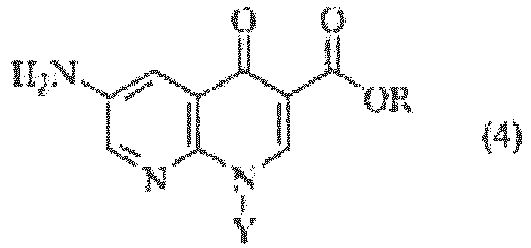
- the 6-nitro group of a compound of formula (3) is subjected to reducing conditions to form a 6-amino analogue of formula (4).
- Suitable reducing agents include Fe and sodium dithionite. The reduction may also be facilitated by hydrogenation using palladium (Pd) or Raney nickel as catalysts.
- the reducing step involves treating a compound of formula (3) with Fe and an aqueous acid (e.g., HCl or acetic acid) at a temperature of between 40°-60°C, for instance, about 50°-60°C.
- an aqueous acid e.g., HCl or acetic acid
- the reducing step involves treating a compound of formula (3) with sodium dithionite in an aqueous medium.
- the aqueous medium is an acetone/water mixture or acetone/HCl mixture.
- the reduction is conducted at elevated temperatures, for instance, about 50-70 °C, or for instance, about 50-60 °C.
- the reduction of a compound of formula (3) occurs via hydrogenation over Pd or Ni based catalysts.
- the catalyst is a palladium catalyst (e.g., Pd/C).
- the catalyst is Raney Ni.
- the reaction is conducted in a polar solvent, for instance, methanol or acidified methanol.
- the solvent also contains catalytic amounts of an acid such as acetic acid or hydrochloride acid.
- the reduction reaction is conducted at ambient temperature (room temperature), and with the use of hydrogen at atmospheric pressure or at a pressure between 1.8-2.4 kg/cm 2 .
- a list of exemplary reducing conditions includes:
- the reducing step involves the hydrogenation of (3) to (4) with the use of Pd/C as a catalyst.
- a compound of formula (4) is prepared with substantial purity such that no further purification is required prior to subjecting (4) to the next reaction step. Processing of (4) from the reaction medium in this regard simply entails separating (4) by phase separation techniques. The compound of formula (4) can also be subjected to further purification by column chromatography and/or recrystallisation, for instance, from ethanol.
- a compound of formula (4) is reacted with 2-indanone (commercially available from, for instance, Aldrich Chemicals) by reductive amination.
- the reductive amination reaction can occur in a single pot reaction using boron-containing reducing reagents, including, but not limited to, sodium borohydride, lithium borohydride, potassium borohydride, sodium triacetoxyborohydride, sodium cyanoborohydride, lithium triethylborohydride, pyridine borane, picoline borane, 5-ethyl-2-methylpyridine borane, tert-butylamine-borane in halogenated solvents such as dichloromethane or 1,2-dichloroethane, or alcohols such as methanol, ethanol or isopropanol, or polar aprotic solvents, such as dimethylsulfoxide, acetonitrile, or ethyl acetate, or ethers, such as te
- the reductive amination can also occur in two steps. Firstly by the formation of an imine in the presence of an acid including, but not limited to, lower carboxylic acids such as acetic acid, propanoic acid, butanoic acid, or p-toluenesulfonic acid or Amberlyst resin, and also a dehydrating reagent such as, but not limited to, magnesium sulphate, sodium sulphate, molecular sieves or TiCl 4 , using, for example, dichloromethane, ethanol, ethyl acetate, tetrahydrofuran, 1,2-dimethoxyethane, or dimethyl sulfoxide as solvent.
- the imine formation step is performed in a Dean Stark apparatus using toluene at 90-110 °C.
- the imine can be converted to the secondary amine using the boron containing reducing agents as described above.
- the reductive amination is conducted in a mixture of solvents comprising a halogenated solvent, ethers or alcohols with acetic acid.
- the reaction is conducted with the use of about 1-2.5 molar equivalents of 2-indanone relative to (4). In certain embodiments, about 1-1.6 molar equivalents of the borohydride or borane complex relative to (4) are employed.
- the reaction is conducted in a solvent system comprising a lower carboxylic acid such as acetic acid, propanoic acid, or butanoic acid and a solvent, such as ethanol, methanol, THF, dichloromethane (DCM) or 1,2-dichloroethane (DCE).
- the lower carboxylic acid is acetic acid (AcOH).
- the ratio of AcOH : DCE is about 1 : 1 and the concentration of (4) is about 0.04-0.05 M.
- the reaction is conducted at temperatures below 40 °C under an inert atmosphere (e.g., nitrogen or argon).
- the ratio of AcOH : EtOH is about 4 : 3 and the concentration of (4) is about 0.1-0.2 M.
- the ratio of AcOH : THF is about 5:2, and the concentration of (4) is about 0.05-0.15 M.
- a compound of formula (4) and 2-indanone are added to a AcOH : DCE (1:1) solvent system under an inert atmosphere.
- the reducing agent e.g., borohydride
- the reaction progress can be monitored by TLC.
- a compound of formula (4) and 2-indanone are added to AcOH : EtOH (4:3) solvent system under an inert atmosphere.
- the reducing agent e.g., 2-methylpyridine borane complex
- the reaction progress can be monitored by LCMS.
- an additional amount of 2-indanone and reducing agent may be added in order to ensure that the reaction reaches completion.
- reaction may be quenched (e.g., with a sodium hydrogen carbonate solution) and extracted with an organic solvent such as, for example, a chlorinated solvent (e.g., DCM) or ether.
- organic solvent such as, for example, a chlorinated solvent (e.g., DCM) or ether.
- the resultant product (5) is ordinarily characterised as a solid and further purified (if required) by recrystallization and chromatography.
- the invention provides a method of preparing a compound of formula (5) wherein R and Y are independently lower alkyl, comprising:
- Hydrolysis of a compound of formula (5) to give a compound of formula (6) may be achieved by any conventional process.
- the hydrolysis step is conducted under basic conditions (using, for instance, sodium hydroxide) in a polar solvent system (e.g., methanol or ethanol).
- the hydrolysis is conducted by dissolving a compound of formula (5) in an aqueous NaOH/ethanol solvent system.
- the hydrolysis is conducted at a temperature ranging from about room temperature to about 100 °C (for instance, from about 50 to 90 °C).
- the hydrolysis step can be monitored using TLC, and once completed the basic solvent system may be neutralised by the addition of a suitable acid (e.g. citric acid).
- a suitable acid e.g. citric acid
- the product acid i.e. a compound of formula (6)
- the product acid is typically insoluble once the solvent system is neutralised and accordingly can be separated from the reaction mixture by simple filtration. Further purification, if required, can be achieved by recrystallization or other techniques known in the art. In other embodiments, the compound of formula (6) can be directly subjected to the next process step.
- a method of the present invention comprises reacting a compound of formula (6) in situ with an acid activating agent and a nucleophilic QH group to prepare a 1,8-naphthyridine compound of formula (1) (wherein Q is an optionally substituted N-containing heterocycle or optionally substituted N-containing heteroaryl).
- Suitable activating agents include pivaloyl chloride, lower alkyl chloroformates, carbonyl diimidazole (CDI), N,N'-dicyclohexylcarbodiimide (DCC), diisopropylcarbodiimide (DIC), 1-ethyl-3-(3-dimethylaminopropyl)carbodiimide (EDCI), benzotriazole-1-yl-oxy-tris-(dimethylamino)-phosphonium hexafluorophosphate (BOP), benzotriazol-1-yl-oxytripyrrolidinophosphonium hexafluorophosphate (PyBOP), hydroxybenzotriazole (HOBt), O-(benzotriazol-1-yl)-N,N,N',N'-tetramethyluronium hexafluorophosphate (HBTU), O-(7-azabenzotriazol-1-yl)-N,N,N'
- the activating agent is an alkyl chloroformate, such as ethyl chloroformate, n-propyl chloroformate, isopropyl chloroformate, tert-butyl chloroformate, or an acid chloride, such as pivaloyl chloride.
- alkyl chloroformate such as ethyl chloroformate, n-propyl chloroformate, isopropyl chloroformate, tert-butyl chloroformate, or an acid chloride, such as pivaloyl chloride.
- the reaction is conducted in the presence of a non-nucleophilic base such as TEA, Hünigs base, or 4-dimethylaminopyridine (DMAP) in a polar solvent, including, but not limited to, DCM, DCE, THF, or CH 3 CN.
- a non-nucleophilic base such as TEA, Hünigs base, or 4-dimethylaminopyridine (DMAP)
- a polar solvent including, but not limited to, DCM, DCE, THF, or CH 3 CN.
- a compound of formula (6) is converted to an acid chloride using suitable conditions before reaction with a nucleophilic QH group to prepare a 1,8-naphthyridine compound of formula (1) (wherein Q is an optionally substituted N-containing heterocycle or optionally substituted N-containing heteroaryl). It has been found, however, that in such a process care needs to be taken to ensure that any chlorination step does not chlorinate at the 4-oxo-position which may lead to undesirable by-products and reduced yields.
- QH is morpholine
- Suitable conditions for the formation of an acid chloride include treatment of a solution of a compound of formula (6) in dichloromethane with 1-2 molar equivalents of thionyl chloride, or oxalyl chloride at 0-20 °C.
- the reaction is performed in the presence of dimethylformamide (5-10% relative to dichloromethane).
- the reaction is performed by treating a compound of formula (6) with an activating agent at a below ambient temperature (e.g., ⁇ 0-15°C) and then adding the QH (preferably at about 1-1.2 molar equivalents relative to the compound of formula (6)) and allowing the reaction mixture to warm to room temperature or slightly higher, for instance, 50 °C.
- an activating agent at a below ambient temperature (e.g., ⁇ 0-15°C) and then adding the QH (preferably at about 1-1.2 molar equivalents relative to the compound of formula (6)) and allowing the reaction mixture to warm to room temperature or slightly higher, for instance, 50 °C.
- the reaction progress can be monitored by TLC.
- a compound of formula (1) can be recovered in high purity from the final reaction step by washing the reaction mixture with a weakly basic solution (for instance, an aqueous NaHCO 3 solution) which removes much of the unreacted acid (6).
- a weakly basic solution for instance, an aqueous NaHCO 3 solution
- methods described herein allow for an overall yield of at least 15%, at least 20%, at least 25%, at least 30%, at least 40%, at least 50%, at least 60%, or at least 70% when performed on a gram scale or larger. In certain embodiments, methods described herein allow for an overall yield of at least 15%, at least 20%, at least 25%, at least 30%, at least 40%, at least 50%, at least 60%, or at least 70% when performed on a ten gram scale or larger. In certain embodiments, methods described herein allow for an overall yield of at least 15%, at least 20%, at least 25%, at least 30%, at least 40%, at least 50%, at least 60%, or at least 70% when performed on a hundred gram scale or larger.
- methods described herein allow for an overall yield of at least 15%, at least 20%, at least 25%, at least 30%, at least 40%, at least 50%, at least 60%, or at least 70% when performed on a five hundred gram scale or larger. In certain embodiments, methods described herein allow for an overall yield of at least 15%, at least 20%, at least 25%, at least 30%, at least 40%, at least 50%, at least 60%, or at least 70% when performed on a kilo gram scale or larger. In certain embodiments, methods described herein allow for an overall yield of at least 15%, at least 20%, at least 25%, at least 30%, at least 40%, at least 50%, at least 60%, or at least 70% when performed on a hundred kilogram scale or larger.
- the reductive amination step allows for a yield of isolated product of from about 60-80%, for instance, about 60%, about 65%, about 70%, about 75%, or about 80%. In certain embodiments the reductive amination step allows for an isolated yield of about 65% - 80%.
- the methods of the present invention are performed on a multi-gram scale. In certain embodiments, the methods of the present invention are performed on a kilogram scale. In certain embodiments, the methods of the present invention are performed on a multi-kilogram scale. In certain embodiments, the methods of the present invention are performed on an industrial scale (e.g., greater than hundreds of kilograms).
- Step 1:2-Chloro-5-nitronicotinic acid (5.0 kg) was added to chloroform (20.0 L) at 25-30 °C under a nitrogen atmosphere.
- N,N-dimethylformamide (500 g) and thionyl chloride (6.0 kg) was sequentially added to the flask at 25-30 °C under a nitrogen atmosphere and the reaction mixture was heated to reflux.
- the reaction was monitored by quenching 1.0 mL of the reaction mixture with 10.0 mL of methanol and recording the HPLC for 2-chloro-5-nitronicotinic acid (should be not more than 10%).
- the reaction mass was cooled to 40-45 °C, and the organic solvents were distilled under vacuum below 45 °C.
- the residue was cooled to 25-30 °C, and acetonitrile (10.0 L) was added at 25-30 °C with stirring.
- Step 2 Triethylamine (10.0 kg), ethyl-3-(N,N-dimethylamino)acrylate and acetonitrile (12.5 L) were added to a glass flask at 25-30 °C.
- the acid chloride solution prepared at step 1 was added to the reaction flask at 25-30 °C and the mixture was stirred for 2.5 h.
- the reaction mixture was monitored by quenching 0.5 mL of reaction mixture with 0.5 mL of methanol and recording the HPLC for methyl ester of 2-chloro-5-nitronicotinic acid (should be not more than 5.0%).
- Step 3 300.0 L of water was cooled to 0-5 °C in glass-lined reactor, and the reaction mixture from Step 2 was poured into it, maintaining the reactor temperature below 5 °C.
- the reaction mixture was kept at 0-5 °C for ⁇ 3 h and the solid separated was filtered through Nutsche filter.
- the solvents were removed by filtration under vacuum.
- the wet cake was suspended in diethyl ether (25.0 L), mixed thoroughly and filtered through a Nutsche filter.
- the solvent was removed by filtration under vacuum and then material was loaded into drying trays.
- the solid was dried at 50-55 °C with hot air dryers until the water content was below 2.0% and then cooled to 25-30 °C to yield 68% of desired ester as a solid.
- the reactor was flushed with nitrogen gas continuously for 2-3 minutes.
- Methanol 255.0 L
- 306 g of palladium on carbon (10.0%) and ethyl 1-ethyl-6-nitro-4-oxo-1,8-naphthyridine-3-carboxylate (5.1 kg) was added to reactor sequentially under nitrogen atmosphere at 25-30 °C.
- the reactor pressure was increased to 1.0kg/cm 2 with nitrogen and then released slowly. This process was repeated three times.
- the reactor was filled with hydrogen gas and pressure was increased to 1.0 kg/cm 2 and then slowly released. This process was repeated three times and finally the hydrogen gas pressure was increased to 2.0 kg/cm 2 at 25-30 °C and maintained thereafter for 60-72 hrs.
- reaction progress was monitored by HPLC for consumption of starting material (should be no more than 2.0%) and intermediate hydroxylamine (should be no more than 10.0%). If the reaction progress was too slow, the hydrogen pressure was released slowly and additional 10% palladium over carbon (50 g) and methanol (50.0 L) were added and hydrogen pressure (2.0 kg/cm 2 ) was re-established. After completion of the reaction (64-75 h), the hydrogen pressure was released slowly and reactor was filled with nitrogen gas up to 1.0 kg/cm 2 . The nitrogen pressure was released slowly and dichloromethane (128.0 L) was added.
- a Hyflow bed was prepared in Nutsche filter with 2.60 kg of Hyflow and 29.1 L of dichloromethane. The filtrate was discarded. The reaction mixture was then filtered through the Hyflow bed under vacuum. The Hyflow bed was washed with a mixture of methanol (38.3 L) and dichloromethane (38.3 L). The filter was again subjected to vacuum. Filtrate was transferred into distillation flask and solvents were evaporated under vacuum below 50°C. The flask was cooled to 25-30 °C and acetone was added (25.5 L) at 25-30 °C. The reaction mixture was stirred at 25-30°C and then filtered through Nutsche filter under vacuum.
- Step1 18.0 L of 1,2-dichloroethane (water content no more than 0.1%) and sodium borohydride (785 g) were sequentially added to a flask at 25-30 °C under nitrogen atmosphere. The reaction solution was cooled to 0-5 °C and 4.30 L of acetic acid (water content no more than 0.1%) was slowly added to reaction flask maintaining the temperature at 0-10 °C. The reaction mixture was warmed to 25-30 °C and maintained at this temperature for 12 h.
- Step 2 1,2-dichloroethane (118.8 L), sodium sulphate (19.3 kg) and ethyl 6-amino-1-ethyl-4-oxo-1,8-naphthyridine-3-carboxylate (3.6 kg) were added sequentially to the reactor at 25-30 °C under a nitrogen atmosphere and cooled to 0-5 °C.
- 2-Indanone (1.80 kg) was added to the reaction mixture under stirring at 0-5 °C, followed by slow addition of acetic acid (136.8 L) keeping temperature at 0-5 °C. The reaction mixture was stirred at 0-5°C for 10-15 minutes.
- Aqueous layer was washed with 36 L of dichloromethane twice and all organic layers were pooled, washed twice with water (2 x 36 L) and with aqueous sodium chloride solution (prepared by dissolving 7.2 kg of sodium chloride in 28.8 L of water); and finally dried over anhydrous sodium sulphate (1.8 kg) at 25-30 °C by stirring for 15-20 minutes.
- the solution was filtered through a Nutsche filter. The filtrate was transferred to a reactor and solvents were distilled under vacuum below 40 °C.
- Ethanol (42.0 L) was added to reactor at 25-30 °C, followed by ethyl 1-ethyl-6-(indan-2-ylamino)-4-oxo-1,8-naphthyridine-3-carboxylate (4.20 kg) with stirring.
- Aqueous sodium hydroxide solution (prepared by dissolving 3.4 kg of sodium hydroxide into 42.0 L of water) was added to reaction mixture at 25-30 °C and reactor temperature was raised to 50-55 °C. The reaction mixture was stirred at 50-55 °C for 2 h and reaction progress was monitored by TLC.
- reaction mass After completion of hydrolysis ( ⁇ 3 h), the reaction mass was cooled to 25-30 °C and pH was adjusted to 5-6 by addition of citric acid solution (prepared by dissolving 5.2 kg of citric acid in 47.0 L of water). The reaction mass was stirred for 20-25 minutes at 25-30 °C and filtered, the solid mass was washed with water (42.0 L) and acetone (21.0 L). The material was transferred to drying trays and dried with hot-air dryer at 70-75 °C until the water content decreased to 1.0%, yielding the desired compound (90%) as a solid.
- citric acid solution prepared by dissolving 5.2 kg of citric acid in 47.0 L of water.
- Step 1 160.0 L of dichloromethane (water content should be no more than 0.1%), 1-ethyl-6-(indan-2-ylamino)-4-oxo-l,8-naphthyridine-3-carboxylic acid (4.0 kg) and triethylamine (3.5 kg) were sequentially added to reactor at 25-30°C under nitrogen atmosphere and the reaction mixture was cooled to 10-15 °C. Pivaloyl chloride (4.1 kg) was slowly added to reaction mixture keeping the reaction temperature at 10-15°C. Then, the reaction temperature was raised to 25-30 °C and stirred. The reaction progress was monitored by TLC for disappearance of starting material.
- reaction mixture was again cooled to 15-20 °C and morpholine (6.0 kg) was added with stirring, keeping the reaction temperature at 15-20 °C.
- N,N-Dimethyl-4-aminopyridine (194 g) and DMF (2.0 L) were added to the reaction mixture at 15-20 °C and heated to reflux.
- the reaction progress was monitored by TLC for the disappearance of intermediate pivaloyl ester and found to be complete within 12-13 h.
- the reaction mixture was cooled to 15-20 °C and then quenched by addition of aqueous sodium bicarbonate solution (prepared by dissolving 5.6 kg of sodium bicarbonate in 56.0 L of water) with stirring.
- the organic layer was separated and washed with aqueous sodium chloride solution (prepared by dissolving 23.0 kg of sodium chloride in 57.0 L of water). The organic layer was separated and dried by stirring with anhydrous sodium sulphate (4.0 kg). The organic layer was filtered through a Nutsche filter and the sodium sulphate was washed with dichloromethane. The filtrate was transferred into a flask and evaporated under vacuum below 40 °C. The resulting material in the flask was cooled to 25-30 °C and suspended in diethyl ether (40.0 L). The solid separated was filtered using a Nutsche filter and washed with diethyl ether (8.0 L) and the isolated wet solid was dissolved in dichloromethane (20.0 L).
- 2-Picoline borane complex (140 mg, 1.3 mmol) was added to reaction mixture and stirred vigorously to completion of imine reduction (disappearance of imine by LCMS).
- the reaction mixture was transferred to a beaker, diluted with ethyl acetate (20 mL), added an ice-cooled aqueous sodium hydroxide solution (1.0 M) ( ⁇ 90 mL, enough to quench almost 90% of acetic acid) and then basified with solid sodium bicarbonate.
- the organic layer was separated, washed with brine, dried over MgSO 4 and evaporated under reduced pressure to dryness.
- the crude was dissolved in dichloromethane (20 mL) and hexane ( ⁇ 20 mL) was added dropwise to cloudiness.
- the solid separated was washed with 1/1 mixture of diethyl ether and hexane to yield the desired compound as yellow solid (yield: 70%, HPLC Purity: 95%).
- Step 1 To a suspension of ethyl 6-amino-1-ethyl-4-oxo-1,8-naphthyridine-3-carboxylate (261 mg, 1 mmol) in 4 mL of 1,2-dimethoxyethane was added acetic acid (8 mL) and the mixture was stirred until all solids went into solution (may need to warm up to 40-45 °C). 2-Indanone (180mg, 1.4 mmol) was added to reaction mixture and stirred for 1 h. The reaction mixture was diluted with anhydrous diethyl ether (10 mL), the solid separated was filtered, washed with cold diethyl ether and dried under vacuum to yield imine as dark yellow solid (275 mg, 74%).
- Step 2 Imine (275 mg, 0.74 mmol) was suspended in MeOH (5 mL) and acetic acid (5 mL), sodium cyanoborohydride (95 mg, 1.5 mmol) was added, and the mixture was vigorously stirred for 1 h.
- the reaction mixture was transferred to a beaker, diluted with ethyl acetate (40 mL), an ice-cooled aqueous sodium hydroxide solution (35 mL, 2.0 M) was added (enough to quench almost 90% of acetic acid) and then the reaction mixture was further basified with solid sodium bicarbonate to pH 7-8.
- the organic layer was separated, washed with brine, dried over MgSO 4 and evaporated under reduced pressure to dryness to dark yellow solid (260 mg, 95%, HPLC purity: 87%).
- reaction mixture was transferred to a beaker, diluted with ethyl acetate, added an ice-cooled aqueous sodium hydroxide solution (1.0 M) (enough to quench almost 90% of acetic acid) and then further basified with solid sodium bicarbonate to pH 7-8.
- the organic layer was separated, washed with brine, dried over MgSO 4 and evaporated under reduced pressure to dryness.
- the crude was passed through a plug of silica gel with increasing gradient of EtOAc in DCM to offer the required product as dark yellow solid.
- the reaction mixture was again cooled in ice-bath and morpholine (261 mg, 3 mmol) was added via syringe. The reaction mixture stirred at room temperature until the amide formation was complete ( ⁇ 30 min). The reaction mixture was again cooled in ice-bath and quenched by addition of few drops of methanol, then diluted with ethyl acetate. The organic layer was washed with NaHCO 3 (sat. aq.), brine, separated, dried over MgSO 4 and evaporated to dryness. The crude was dissolved in MeOH (5 mL) and hot water (7 mL, at ⁇ 70 °C) was added to it. The solid separated was filtered and dried under high vacuum to yield the required material as pale yellow solid (350 mg, 84%, HPLC Purity: 99%).
Landscapes
- Chemical & Material Sciences (AREA)
- Organic Chemistry (AREA)
- Health & Medical Sciences (AREA)
- Veterinary Medicine (AREA)
- Public Health (AREA)
- General Health & Medical Sciences (AREA)
- Animal Behavior & Ethology (AREA)
- Life Sciences & Earth Sciences (AREA)
- Medicinal Chemistry (AREA)
- Pharmacology & Pharmacy (AREA)
- Epidemiology (AREA)
- Neurosurgery (AREA)
- Nuclear Medicine, Radiotherapy & Molecular Imaging (AREA)
- General Chemical & Material Sciences (AREA)
- Chemical Kinetics & Catalysis (AREA)
- Neurology (AREA)
- Biomedical Technology (AREA)
- Bioinformatics & Cheminformatics (AREA)
- Engineering & Computer Science (AREA)
- Nitrogen Condensed Heterocyclic Rings (AREA)
Claims (16)
- Verfahren für die Herstellung einer Verbindung der Formel (1),

wobei das Verfahren Folgendes umfasst:a) Behandlung einer Verbindung der Forme! (2)
 a') Behandlung der Verbindung der Formel (2a) aus Schritt a) mit einer nicht-nukleophilen Base und Niederalkyl-N,N-Niederdialkylaminoacrylat, um eine Verbindung der Formel (2b) zu gewinnen,
 a") wobei R und R' unabhängig Niederalkyl sind;
Umsetzen der Verbindung der Formel (2b) aus Schritt (a') mit einem Niederalkylamin unter für die Bildung einer Verbindung der Formel (3) ausreichenden Bedingungen, b) Reduktion der Nitrogruppe der Verbindung der Forme! (3) aus Schritt (a"), um eine Verbindung der Formel (4) zu gewinnen
 c) Behandlung der Verbindung der Formel (4) aus Schritt (b) mit 2-Indanon und einem geeigneten Reduktionsmittel unter für die Gewinnung einer Verbindung der Formel (5) ausreichenden Bedingungen
 d) Hydrolisieren der Verbindung der Formel (5) aus Schritt (c), um eine Verbindung der Formel (6) zu gewinnen; und
 e) Umsetzen einer Verbindung der Formel (6) mit einem Säureaktivierungsmittel und QH unter für die Gewinnung einer Verbindung der Formel (1) ausreichenden Bedingungen,
und wobei der Begriff "Niederalkyl" Alkangruppen bezeichnet, bei denen ein Wasserstoffatom fehlt und die eins bis sechs Kohlenstoffatome enthalten. - Verfahren nach Anspruch 1, wobei das Chlorierungsmittel in Schritt a) Thionylchlorid ist und die Umsetzung in einem chlorierten Lösungsmittel stattfindet, wobei das chlorierte Lösungsmittel Chloroform ist und das Verfahren die Behandlung der Verbindung der Formel (2) mit etwa 2 bis 4 Äquivalenten von Thionylchlorid beinhaltet, und bevorzugt wobei die Umsetzung in Gegenwart einer katalytischen Menge DMF durchgeführt wird.
- Verfahren nach Anspruch 1 oder 2, wobei die nicht-nukleophile Base Triethylamin (TEA) ist; oder wobei das Niederalkyl-N,N-Niederdialkylaminoacrylat Ethyl-N,N-Dimethylaminoacrylat ist; oder wobei die Verbindung der Formel (2b) mit etwa 4 Moläquivalenten von TEA und etwa 1,8 Moläquivalenten von Ethyl-N,N-Dimethylaminoacrylat behandelt wird; oder wobei das Niederalkylamin Ethylamin ist, und bevorzugt wobei das Ethylamin als eine etwa 70 Gew.% Ethylaminlösung in Wasser bereitgestellt wird, und weiter bevorzugt wobei das Molverhältnis der Verbindung der Formel (2b) zu Niederalkylamin etwa 1:2,5 beträgt.
- Verfahren nach einem der Ansprüche 1 bis 3, wobei der Schritt der Reduktion der Nitrogruppe beinhaltet, dass eine Verbindung der Formel (3) einem geeigneten Reduktionsmittel, ausgewählt aus Fe oder Natriumdithionit, ausgesetzt wird oder dass eine Verbindung der Formel (3) unter Verwendung von Palladium (Pd) oder Raney-Nickel als Katalysator hydriert wird.
- Verfahren nach Anspruch 4, wobei der Reduktionsschritt ein Hydrieren unter Verwendung von Pd/C als Katalysator beinhaltet, wobei das Hydrieren bevorzugt unter Atmosphärendruck oder einem Druck zwischen 1,8 und 2,4 kg/cm2 durchgeführt wird.
- Verfahren nach einem der Ansprüche 1 bis 5, wobei Schritt (c) als Eintopfreaktion durchgeführt wird.
- Verfahren nach einem der Ansprüche 1 bis 6, wobei das Reduktionsmittel in Schritt (c) ein borhaltiges Reduktionsmittel ausgewählt aus Natriumborhydrid, Lithiumborhydrid, Kaliumborhydrid, Natriumtriacetoxyborhydrid, Natriumcyanoborhydrid, Lithiumtriethylborhydrid, Pyridinboran, Pikolinboran, 5-Ethyl-2-methylpyridinboran und tert-Butylaminboran ist.
- Verfahren nach einem der Ansprüche 1 bis 7, wobei Schritt (c) in Gegenwart eines organischen Lösungsmittels durchgeführt wird, wobei eine Niedercarbonsäure als Zusatzlösungsmittel verwendet wird, und bevorzugt wobei Schritt (c) als zweistufiges Verfahren mit der anfänglichen Bildung eines Imins durchgeführt wird.
- Verfahren nach einem der Ansprüche 1 bis 8, wobei die Verbindung der Forme! (4) in Schritt (b) mit etwa 1-2,5 Moläquivalenten von 2-Indanon behandelt wird und bevorzugt wobei etwa 1-1,6 Moläquivalente des Reduktionsmittels im Verhältnis zu der Verbindung der Formel (4) angewendet werden und weiter bevorzugt wobei die Umsetzung in einem Lösungsmittelsystem durchgeführt wird, das Essigsäure (AcOH) und ein aus Ethanol, Methanol, THF, Dichlormethan (DCM) und 1,2-Dichlorethan (DCE) ausgewähltes Lösungsmittel umfasst.
- Verfahren nach einem der Ansprüche 1 bis 9, wobei das Säureaktivierungsmittel in Schritt e) ein Alkylchlorformiat oder ein Säurechlorid ist, bevorzugt wobei der Umsetzungsschritt (e) in Gegenwart von TEA in einem chlorierten Lösungsmittel durchgeführt wird.
- Verfahren nach einem der Ansprüche 1 bis 10, wobei Schritt (e) die Behandlung einer Lösung der Verbindung der Formel (6) in Dichlormethan mit 1 bis 2 Moläquivalenten von Thionylchlorid oder Oxalylchlorid bei einer Temperatur von 0 bis 20 °C beinhaltet, bevorzugt wobei die Lösung DMF mit einer Konzentration von etwa 5 bis 10 % im Verhältnis zu dem Dichlormethan beinhaltet.
- Verfahren nach einem der Ansprüche 1 bis 11, wobei QH Morpholin ist.
- Verbindung der Formel (2b) oder ein Salz davon:

und wobei der Begriff "Niederalkyl" Alkangruppen bezeichnet, bei denen ein Wasserstoffatom fehlt und die eins bis sechs Kohlenstoffatome enthalten. - Verfahren nach Anspruch 1 für die Herstellung einer Verbindung der Formel (1),

wobei das Verfahren Folgendes umfasst:e) Umsetzen einer Verbindung der Formel (6) f) Reinigen der in Schritt a) gewonnenen Verbindung der Formel (1) durch Waschen mit einer schwach basischen Lösung, wobei QH bevorzugt Morpholin ist,und wobei das Aktivierungsmittel Pivalinsäurechlorid oder Ethylchlorformiat ist.
 - Verfahren nach Anspruch 14, wobei die nicht-nukleophile Base N,N- Dimethyl-4-aminopyridin ist; und/oder wobei die schwach basische Lösung eine wässrige NaHCO3-Lösung ist.
- Verfahren nach Anspruch 1 für die Herstellung einer Verbindung der Formel (5),

c) Behandlung einer Verbindung der Formel (4)
Applications Claiming Priority (2)
| Application Number | Priority Date | Filing Date | Title |
|---|---|---|---|
| AU2011901791A AU2011901791A0 (en) | 2011-05-12 | Chemical Processes | |
| PCT/AU2012/000533 WO2012151640A1 (en) | 2011-05-12 | 2012-05-11 | Methods for preparing naphthyridines |
Publications (3)
| Publication Number | Publication Date |
|---|---|
| EP2707367A1 EP2707367A1 (de) | 2014-03-19 |
| EP2707367A4 EP2707367A4 (de) | 2014-12-03 |
| EP2707367B1 true EP2707367B1 (de) | 2019-10-09 |
Family
ID=47138578
Family Applications (1)
| Application Number | Title | Priority Date | Filing Date |
|---|---|---|---|
| EP12782057.9A Active EP2707367B1 (de) | 2011-05-12 | 2012-05-11 | Verfahren zur herstellung von naphthyridinen |
Country Status (8)
| Country | Link |
|---|---|
| US (1) | US9133188B2 (de) |
| EP (1) | EP2707367B1 (de) |
| JP (1) | JP6055817B2 (de) |
| CN (1) | CN103649086A (de) |
| AU (1) | AU2012253237B2 (de) |
| CA (1) | CA2835450C (de) |
| NZ (1) | NZ615466A (de) |
| WO (1) | WO2012151640A1 (de) |
Families Citing this family (9)
| Publication number | Priority date | Publication date | Assignee | Title |
|---|---|---|---|---|
| ES2399071T3 (es) | 2006-10-16 | 2013-03-25 | Bionomics Limited | Nuevos compuestos ansiolíticos |
| US10954231B2 (en) | 2006-10-16 | 2021-03-23 | Bionomics Limited | Anxiolytic compounds |
| JP2014510065A (ja) | 2011-03-02 | 2014-04-24 | バイオノミックス リミテッド | 治療薬としての新規な小分子 |
| JP6055817B2 (ja) | 2011-05-12 | 2016-12-27 | バイオノミックス リミテッド | ナフチリジンの調製方法 |
| AU2014231722B2 (en) * | 2013-03-15 | 2016-12-22 | Bionomics Limited | Salts, co-crystals, and polymorphs of an anxiolytic compound |
| AU2013204159B2 (en) * | 2013-03-15 | 2015-05-07 | Bionomics Limited | A Crystalline Form of an Anxiolytic Compound |
| EP3302450A4 (de) * | 2015-06-04 | 2019-01-16 | Antriabio, Inc. | Aminpegylierungsverfahren zur herstellung von ortsspezifischen proteinkonjugaten |
| WO2018102885A1 (en) * | 2016-12-09 | 2018-06-14 | Bionomics Limited | Modulators of nicotinic acetylcholine receptors and uses thereof |
| US12358901B2 (en) | 2018-10-16 | 2025-07-15 | Autifony Therapeutics Limited | KV3 modulators |
Family Cites Families (79)
| Publication number | Priority date | Publication date | Assignee | Title |
|---|---|---|---|---|
| US3429887A (en) | 1965-01-26 | 1969-02-25 | Sterling Drug Inc | 1,7-naphthyridine-3-carboxylic acid derivatives and their preparation |
| JPS5023037B1 (de) | 1970-12-29 | 1975-08-05 | ||
| JPS5023036B1 (de) | 1970-12-29 | 1975-08-05 | ||
| JPS5132594A (en) | 1974-09-11 | 1976-03-19 | Kanebo Ltd | 1 88 nafuchirijinjudotai no seiho |
| JPS5331690A (en) | 1976-09-01 | 1978-03-25 | Shionogi & Co Ltd | Oxadithiacephalosporins |
| JPS54163596A (en) | 1978-06-09 | 1979-12-26 | Daiichi Seiyaku Co | Flonaphlizine derivative |
| JPS55111486A (en) | 1979-02-19 | 1980-08-28 | Dai Ichi Seiyaku Co Ltd | Preparation of pro 3,2,-b -1,8-naphthyridine derivative |
| JPS55151584A (en) | 1979-05-11 | 1980-11-26 | Dai Ichi Seiyaku Co Ltd | Preparation of 1,8-naphthyridine derivative |
| JPS56115787A (en) | 1980-02-19 | 1981-09-11 | Dai Ichi Seiyaku Co Ltd | Preparation of furo (3,2-b)(1,8)naphthyridine derivative |
| JPS56118081A (en) | 1980-02-22 | 1981-09-16 | Dai Ichi Seiyaku Co Ltd | Preparation of 6-methoxy-1,8-naphthyridine |
| JPS56118083A (en) | 1980-02-22 | 1981-09-16 | Dai Ichi Seiyaku Co Ltd | Furo(3,2-b)(1,8)naphthyridine derivative |
| JPS5726688A (en) | 1980-07-24 | 1982-02-12 | Dai Ichi Seiyaku Co Ltd | Furo 3,2-b 1,8-naphthyridine-7-carboxylic acid derivative |
| JPS57109790A (en) | 1980-12-26 | 1982-07-08 | Dai Ichi Seiyaku Co Ltd | Furo(3,2-b)1,8-naphthyridine-7-carboxylic acid derivative |
| US4404201A (en) | 1981-11-13 | 1983-09-13 | Warner-Lambert Company | Cephalosporins |
| JPS5993080A (ja) | 1982-11-18 | 1984-05-29 | Sumitomo Chem Co Ltd | 1,5−ナフチリジンカルボン酸誘導体 |
| EP0341990B1 (de) | 1988-05-10 | 1994-11-09 | Imperial Chemical Industries Plc | Cephalosporine, Verfahren zu ihrer Herstellung und pharmazeutische Präparate |
| US5095015A (en) | 1990-07-24 | 1992-03-10 | Neurogen Corporation | Certain azacycloalkyl imidazopyrimidines; a new class of gaba brain receptor ligands |
| US5182386A (en) | 1991-08-27 | 1993-01-26 | Neurogen Corporation | Certain imidazoquinoxalinones; a new class of gaba brain receptor ligands |
| US5182290A (en) | 1991-08-27 | 1993-01-26 | Neurogen Corporation | Certain oxazoloquinolinones; a new class of GABA brain receptor ligands |
| IT1251202B (it) | 1991-09-13 | 1995-05-04 | Mediolanum Farmaceutici Spa | 6-amminochinoloni, sintesi ed impiego come antibatterici |
| US5212310A (en) | 1991-12-19 | 1993-05-18 | Neurogen Corporation | Certain aryl fused imidazopyrimidines; a new class of GABA brain receptor ligands |
| US5306819A (en) | 1992-08-27 | 1994-04-26 | Neurogen Corporation | Certain aryl a cycloalkyl fused imidazopyrazinols; and new class of GABA brain receptor ligands |
| US5750702A (en) | 1993-10-27 | 1998-05-12 | Neurogen Corporation | Certain pyrrolo pyridine-3-carboxamides; a new class of GABA brain receptor ligands |
| US5484944A (en) | 1993-10-27 | 1996-01-16 | Neurogen Corporation | Certain fused pyrrolecarboxanilides and their use as GABA brain receptor ligands |
| US6211365B1 (en) | 1996-01-19 | 2001-04-03 | Neurogen Corporation | Fused pyrrolecarboxamides; a new class of GABA brain receptor ligands |
| US5804686A (en) | 1996-01-19 | 1998-09-08 | Neurogen Corporation | fused pyrrolecarboxamides; a new class of GABA brain receptor ligands |
| US6013650A (en) | 1996-03-14 | 2000-01-11 | Neurogen Corporation | Certain aryl fused imidazopyrimidines; a new class of GABA brain receptor ligands |
| AU2218997A (en) | 1996-03-22 | 1997-10-10 | Neurogen Corporation | Certain fused pyrrolecarboxamides as gaba brain receptor ligands |
| US5723462A (en) | 1996-04-26 | 1998-03-03 | Neurogen Corporation | Certain fused pyrrolecarboxamides a new class of GABA brain receptor ligands |
| US6143760A (en) | 1997-08-25 | 2000-11-07 | Neurogen Corporation | Substituted 4-oxo-napthyridine-3-carboxamides: GABA brain receptor ligands |
| US6166203A (en) | 1998-02-26 | 2000-12-26 | Neurogen Corporation | Heterocyclic amino substituted heteroaryl fused pyridines; GABA brain receptor ligands |
| DE19826050A1 (de) | 1998-06-12 | 1999-12-16 | Bayer Ag | Verfahren zur Herstellung von Chinolon- und Naphthyridoncarbonsäuren und deren Ester |
| US6177569B1 (en) | 1998-08-25 | 2001-01-23 | Neurogen Corporation | Oxo-pyridoimidazole-carboxamides: GABA brain receptor ligands |
| WO2000037471A1 (en) | 1998-12-23 | 2000-06-29 | Neurogen Corporation | 2-amino-9-alkylpurines: gaba brain receptor ligands |
| WO2000068202A1 (en) | 1999-05-06 | 2000-11-16 | Neurogen Corporation | Substituted 4-oxo-quinoline-3-carboxamides: gaba brain receptor ligands |
| US6297256B1 (en) | 1999-06-15 | 2001-10-02 | Neurogen Corporation | Aryl and heteroaryl substituted pyridino derivatives GABA brain receptor ligands |
| MXPA02004735A (es) | 1999-11-12 | 2003-01-28 | Orive Javier Uhthoff | Compuestos heteroaromaticos, biciclicos y triciclicos. |
| US6723332B2 (en) | 2000-05-26 | 2004-04-20 | Neurogen Corporation | Oxomidazopyridine-carboxamides |
| WO2002000623A2 (en) | 2000-06-26 | 2002-01-03 | Neurogen Corporation | Aryl fused substituted 4-oxy-pyridines |
| US6423956B1 (en) | 2000-07-28 | 2002-07-23 | Optical Biopsy Technologies | Fiber-coupled, high-speed, integrated, angled-dual-axis confocal scanning microscopes employing vertical cross-section scanning |
| WO2002014269A2 (en) | 2000-08-16 | 2002-02-21 | Neurogen Corporation | 2,4-substituted pyridine derivatives |
| BR0113697A (pt) | 2000-09-06 | 2003-07-22 | Neurogen Corp | Composto ou um sal farmaceuticamente aceitável do mesmo, composição farmacêutica, uso de um composto ou sal, embalagem e métodos para, para alterar a atividade transdutora de sinal dos receptores de gabaa, para tratar ansiedade, depressão, um distúrbio do sono, ou demência de alzheimer, para demonstrar a presença dos receptores de gabaa em células ou amostras de tecido e para preparar um composto |
| US20020151591A1 (en) | 2000-10-17 | 2002-10-17 | Anabella Villalobos | Combination use of acetylcholinesterase inhibitors and GABAa inverse agonists for the treatment of cognitive disorders |
| AUPR283801A0 (en) | 2001-02-01 | 2001-03-01 | Australian National University, The | Chemical compounds and methods |
| JP2004527500A (ja) | 2001-03-01 | 2004-09-09 | ファイザー・プロダクツ・インク | 認識障害の治療のためのニコチン受容体部分アゴニスト、エストロゲン、選択的エストロゲン調節剤又はビタミンeとgabaa逆アゴニストの併用 |
| WO2002076987A1 (en) | 2001-03-27 | 2002-10-03 | Neurogen Corporation | (oxo-pyrazolo[1,5a]pyrimidin-2-yl)alkyl-carboxamides |
| CA2468015A1 (en) | 2001-11-27 | 2003-06-05 | Merck & Co., Inc. | 2-aminoquinoline compounds |
| EP1451156A4 (de) | 2001-11-27 | 2005-05-25 | Merck & Co Inc | 4-aminochinolinverbindungen |
| US8163769B2 (en) * | 2002-03-12 | 2012-04-24 | Abbott Laboratories | Antibacterial compounds |
| CA2484308A1 (en) | 2002-05-14 | 2003-11-27 | The Regents Of The University Of California | Substituted quinolone carboxylic acids, their derivatives, site of action, and uses thereof |
| IS7839A (is) | 2002-11-22 | 2004-05-23 | Merck Frosst Canada Ltd. | 4-oxó-1-(3-setið fenýl-1,4-díhýdró-1,8-naftýridín-3-karboxamíð fosfódíesterasa-4 hindrar |
| US7829694B2 (en) | 2002-11-26 | 2010-11-09 | Medtronic, Inc. | Treatment of neurodegenerative disease through intracranial delivery of siRNA |
| AR042486A1 (es) | 2002-12-18 | 2005-06-22 | Glaxo Group Ltd | Compuesto de quinolina y naftiridina halosustituido en la posicion 3, procedimiento para preparar el compuesto, composicion farmaceutica que lo comprende y su uso para preparar dicha composicion . |
| TW200418835A (en) | 2003-01-24 | 2004-10-01 | Tanabe Seiyaku Co | A pyrazolopyrimidine compound and a process for preparing the same |
| JP2005162726A (ja) | 2003-01-24 | 2005-06-23 | Tanabe Seiyaku Co Ltd | ピラゾロピリミジン化合物およびその製法 |
| US20050031652A1 (en) | 2003-02-25 | 2005-02-10 | Allergan, Inc. | Compositions and methods comprising memantine and polyanionic polymers |
| WO2004083207A1 (en) | 2003-03-12 | 2004-09-30 | Abbott Laboratories | Naphthyridine derivatives as antibacterial agents |
| US7498341B2 (en) | 2004-01-31 | 2009-03-03 | Sanofi Aventis Deutschland Gmbh | Heterocyclically substituted 7-amino-4-quinolone-3-carboxylic acid derivatives, process for their preparation and their use as medicaments |
| DE102004004972B3 (de) | 2004-01-31 | 2005-09-15 | Aventis Pharma Deutschland Gmbh | Heterocyclisch substituierte 7-Amino-4-chinolon-3-carbonsäure-Derivate, Verfahren zu ihrer Herstellung und ihre Verwendung als Arzneimittel |
| DE102004004971B3 (de) | 2004-01-31 | 2005-09-15 | Aventis Pharma Deutschland Gmbh | Cycloalkyl substituierte 7-Amino-4-chinolon-3-carbonsäure-Derivate, Verfahren zu ihrer Herstellung und ihre Verwendung als Arnzeimittel |
| AU2005209365A1 (en) | 2004-01-31 | 2005-08-11 | Sanofi-Aventis Deutschland Gmbh | 7-phenylamino-4-quinolone-3-carboxylic acid derivatives, methods for production and use thereof as medicaments |
| US7470706B2 (en) | 2004-01-31 | 2008-12-30 | Sanofi-Aventis Deutschland Gmbh | Cycloalkyl-substituted 7-amino-4-quinolone-3-carboxylic acid derivatives, process for their preparation and their use as medicaments |
| US7402674B2 (en) | 2004-01-31 | 2008-07-22 | Sanofi-Aventis Deutschland Gmbh, | 7-Phenylamino-4-quinolone-3-carboxylic acid derivatives, process for their preparation and their use as medicaments |
| PE20060285A1 (es) | 2004-03-30 | 2006-05-08 | Aventis Pharma Inc | Piridonas sustituidas como inhibidores de pol(adp-ribosa)-polimerasa (parp) |
| EP1809605B1 (de) | 2004-11-01 | 2010-08-11 | F. Hoffmann-La Roche AG | Chinoline als allosterische enhancer von gaba-b-rezeptoren |
| AU2005311951A1 (en) | 2004-12-03 | 2006-06-08 | Merck & Co., Inc. | Quinoline tachykinin receptor antagonists |
| CN101189208A (zh) | 2005-06-02 | 2008-05-28 | 弗·哈夫曼-拉罗切有限公司 | 作为gaba-b增强剂的3-甲磺酰基喹啉 |
| WO2007039172A1 (en) | 2005-09-29 | 2007-04-12 | Sanofi-Aventis | Phenyl- and pyridyl-i, 2 , 4 -oxadiazolone derivatives with phenyl group, processes for their preparation and their use as pharmaceuticals |
| WO2008021210A2 (en) | 2006-08-11 | 2008-02-21 | Combinatorx, Incorporated | Methods and compositions for the treatment of neurodegenerative disorders |
| ES2399071T3 (es) * | 2006-10-16 | 2013-03-25 | Bionomics Limited | Nuevos compuestos ansiolíticos |
| RU2401166C1 (ru) | 2006-10-16 | 2010-10-10 | Текнолоджикал Ресорсиз Пти. Лимитед | Сортировка добытой породы |
| WO2008145681A2 (en) * | 2007-05-31 | 2008-12-04 | Boehringer Ingelheim International Gmbh | Ccr2 receptor antagonists and uses thereof |
| WO2009089263A2 (en) * | 2008-01-07 | 2009-07-16 | Ardea Biosciences Inc. | Novel compositions and methods of use |
| JP5877709B2 (ja) * | 2009-05-14 | 2016-03-08 | 大日本住友製薬株式会社 | 3−(4−アミノフェニル)−2−フランカルボン酸誘導体およびその薬学的に許容される塩 |
| AR076687A1 (es) | 2009-05-18 | 2011-06-29 | Infinity Pharmaceuticals Inc | Isoxazolinas como inhibidores de la amidahidrolasa de acidos grasos y com-posiciones farmaceuticas que los contienen |
| WO2010143733A1 (en) * | 2009-06-09 | 2010-12-16 | Takeda Pharmaceutical Company Limited | Novel fused cyclic compound and use thereof |
| JP2014510065A (ja) | 2011-03-02 | 2014-04-24 | バイオノミックス リミテッド | 治療薬としての新規な小分子 |
| WO2012116410A1 (en) | 2011-03-02 | 2012-09-07 | Bionomics Limited | Methods of treating a disease or condition of the central nervous system |
| JP6055817B2 (ja) | 2011-05-12 | 2016-12-27 | バイオノミックス リミテッド | ナフチリジンの調製方法 |
-
2012
- 2012-05-11 JP JP2014509568A patent/JP6055817B2/ja active Active
- 2012-05-11 CA CA2835450A patent/CA2835450C/en active Active
- 2012-05-11 NZ NZ615466A patent/NZ615466A/en not_active IP Right Cessation
- 2012-05-11 US US14/116,196 patent/US9133188B2/en active Active
- 2012-05-11 EP EP12782057.9A patent/EP2707367B1/de active Active
- 2012-05-11 CN CN201280019994.0A patent/CN103649086A/zh active Pending
- 2012-05-11 AU AU2012253237A patent/AU2012253237B2/en active Active
- 2012-05-11 WO PCT/AU2012/000533 patent/WO2012151640A1/en not_active Ceased
Non-Patent Citations (1)
| Title |
|---|
| None * |
Also Published As
| Publication number | Publication date |
|---|---|
| CA2835450C (en) | 2020-05-12 |
| CN103649086A (zh) | 2014-03-19 |
| JP6055817B2 (ja) | 2016-12-27 |
| US9133188B2 (en) | 2015-09-15 |
| AU2012253237B2 (en) | 2015-09-24 |
| WO2012151640A1 (en) | 2012-11-15 |
| CA2835450A1 (en) | 2012-11-15 |
| JP2014513142A (ja) | 2014-05-29 |
| NZ615466A (en) | 2016-02-26 |
| EP2707367A4 (de) | 2014-12-03 |
| AU2012253237A1 (en) | 2013-03-14 |
| US20140128600A1 (en) | 2014-05-08 |
| EP2707367A1 (de) | 2014-03-19 |
Similar Documents
| Publication | Publication Date | Title |
|---|---|---|
| US9133188B2 (en) | Methods for preparing naphthyridines | |
| CN101790532B (zh) | 5-氟-1H-吡唑并[3,4-b]吡啶-3-胺及其衍生物的制备方法 | |
| CN116987112B (zh) | 制备氨基嘧啶衍生物的改善方法 | |
| HRP20050159A2 (en) | Preparation of 1h-imidazo[4,5-c]quinolin-4-amines via 1h-imidazo [4,5-c]quinolin-4-ph-thalimide intermediates | |
| CS277611B6 (en) | 3-(2,2,5,6-tetrahydropyridyl)-pyrrolopyridine derivatives | |
| ES2923278T3 (es) | Intermedios útiles para la síntesis de derivados de aminopirimidinas, proceso de preparación del mismo y proceso de preparación de aminopirimidina derivados utilizando los mismos | |
| CN116113416B (zh) | 四环类衍生物、其制备方法和其医药上的用途 | |
| CN111961034A (zh) | 用作ret激酶抑制剂的化合物及其应用 | |
| CA2950300A1 (en) | Synthesis of polycyclic-carbamoylpyridone compounds | |
| KR20170039121A (ko) | 3-(3-클로로-1h-피라졸-1-일)피리딘의 제조 방법 | |
| US20240217965A1 (en) | Synthesis of heterocyclic compounds | |
| CN114423755A (zh) | 用于合成缬苯那嗪的方法 | |
| EP4249077A1 (de) | Neues acridiniumsalz und verfahren zur herstellung davon | |
| EP2185558B1 (de) | Tricyclische n-heteroaryl-carboxamid-derivate sowie deren herstellung und therapeutische anwendung | |
| CN109384785B (zh) | 吡咯并吡啶酮类衍生物、其制备方法及其在医药上的用途 | |
| EP2812330B1 (de) | Verfahren zur herstellung von 2-phenyl- [1,2,4]triazolo[1,5-a]pyridinderivaten | |
| CN119431379B (zh) | Wrn降解剂及其制备方法和应用 | |
| JP6777542B2 (ja) | 置換尿素化合物の合成のためのプロセス | |
| AU2003249262A1 (en) | Process for the preparation of imidazo(1,2-a)pyridine-3-acetamides | |
| CN122029159A (zh) | 苯并咪唑化合物的制备流程 | |
| WO2026042088A1 (en) | Trycyclic derivatives and their use as complement factor b inhibitors | |
| EA043992B1 (ru) | Способ изготовления твердой формы ингибитора бромодомена bet | |
| HK1231871A1 (en) | A process for the preparation of compound and synthetic intermediates thereof | |
| HK40027082A (en) | Novel intermediates useful for the synthesis of aminopyrimidine derivatives, process for preparing the same, and process for preparing aminopyrimidine derivatives using the same | |
| CZ20001012A3 (cs) | Imidazopyridinové deriváty a způsob jejich přípravy |
Legal Events
| Date | Code | Title | Description |
|---|---|---|---|
| PUAI | Public reference made under article 153(3) epc to a published international application that has entered the european phase |
Free format text: ORIGINAL CODE: 0009012 |
|
| 17P | Request for examination filed |
Effective date: 20131206 |
|
| AK | Designated contracting states |
Kind code of ref document: A1 Designated state(s): AL AT BE BG CH CY CZ DE DK EE ES FI FR GB GR HR HU IE IS IT LI LT LU LV MC MK MT NL NO PL PT RO RS SE SI SK SM TR |
|
| DAX | Request for extension of the european patent (deleted) | ||
| REG | Reference to a national code |
Ref country code: HK Ref legal event code: DE Ref document number: 1196019 Country of ref document: HK |
|
| A4 | Supplementary search report drawn up and despatched |
Effective date: 20141031 |
|
| RIC1 | Information provided on ipc code assigned before grant |
Ipc: A61K 31/4375 20060101ALI20141027BHEP Ipc: A61P 25/22 20060101ALI20141027BHEP Ipc: C07D 471/04 20060101AFI20141027BHEP |
|
| STAA | Information on the status of an ep patent application or granted ep patent |
Free format text: STATUS: EXAMINATION IS IN PROGRESS |
|
| 17Q | First examination report despatched |
Effective date: 20170411 |
|
| GRAP | Despatch of communication of intention to grant a patent |
Free format text: ORIGINAL CODE: EPIDOSNIGR1 |
|
| STAA | Information on the status of an ep patent application or granted ep patent |
Free format text: STATUS: GRANT OF PATENT IS INTENDED |
|
| INTG | Intention to grant announced |
Effective date: 20190429 |
|
| GRAS | Grant fee paid |
Free format text: ORIGINAL CODE: EPIDOSNIGR3 |
|
| GRAA | (expected) grant |
Free format text: ORIGINAL CODE: 0009210 |
|
| STAA | Information on the status of an ep patent application or granted ep patent |
Free format text: STATUS: THE PATENT HAS BEEN GRANTED |
|
| AK | Designated contracting states |
Kind code of ref document: B1 Designated state(s): AL AT BE BG CH CY CZ DE DK EE ES FI FR GB GR HR HU IE IS IT LI LT LU LV MC MK MT NL NO PL PT RO RS SE SI SK SM TR |
|
| REG | Reference to a national code |
Ref country code: GB Ref legal event code: FG4D |
|
| REG | Reference to a national code |
Ref country code: CH Ref legal event code: EP |
|
| REG | Reference to a national code |
Ref country code: IE Ref legal event code: FG4D |
|
| REG | Reference to a national code |
Ref country code: DE Ref legal event code: R096 Ref document number: 602012064745 Country of ref document: DE |
|
| REG | Reference to a national code |
Ref country code: AT Ref legal event code: REF Ref document number: 1188656 Country of ref document: AT Kind code of ref document: T Effective date: 20191115 |
|
| REG | Reference to a national code |
Ref country code: NL Ref legal event code: MP Effective date: 20191009 |
|
| REG | Reference to a national code |
Ref country code: LT Ref legal event code: MG4D |
|
| REG | Reference to a national code |
Ref country code: AT Ref legal event code: MK05 Ref document number: 1188656 Country of ref document: AT Kind code of ref document: T Effective date: 20191009 |
|
| PG25 | Lapsed in a contracting state [announced via postgrant information from national office to epo] |
Ref country code: PL Free format text: LAPSE BECAUSE OF FAILURE TO SUBMIT A TRANSLATION OF THE DESCRIPTION OR TO PAY THE FEE WITHIN THE PRESCRIBED TIME-LIMIT Effective date: 20191009 Ref country code: LT Free format text: LAPSE BECAUSE OF FAILURE TO SUBMIT A TRANSLATION OF THE DESCRIPTION OR TO PAY THE FEE WITHIN THE PRESCRIBED TIME-LIMIT Effective date: 20191009 Ref country code: NL Free format text: LAPSE BECAUSE OF FAILURE TO SUBMIT A TRANSLATION OF THE DESCRIPTION OR TO PAY THE FEE WITHIN THE PRESCRIBED TIME-LIMIT Effective date: 20191009 Ref country code: AT Free format text: LAPSE BECAUSE OF FAILURE TO SUBMIT A TRANSLATION OF THE DESCRIPTION OR TO PAY THE FEE WITHIN THE PRESCRIBED TIME-LIMIT Effective date: 20191009 Ref country code: FI Free format text: LAPSE BECAUSE OF FAILURE TO SUBMIT A TRANSLATION OF THE DESCRIPTION OR TO PAY THE FEE WITHIN THE PRESCRIBED TIME-LIMIT Effective date: 20191009 Ref country code: BG Free format text: LAPSE BECAUSE OF FAILURE TO SUBMIT A TRANSLATION OF THE DESCRIPTION OR TO PAY THE FEE WITHIN THE PRESCRIBED TIME-LIMIT Effective date: 20200109 Ref country code: NO Free format text: LAPSE BECAUSE OF FAILURE TO SUBMIT A TRANSLATION OF THE DESCRIPTION OR TO PAY THE FEE WITHIN THE PRESCRIBED TIME-LIMIT Effective date: 20200109 Ref country code: SE Free format text: LAPSE BECAUSE OF FAILURE TO SUBMIT A TRANSLATION OF THE DESCRIPTION OR TO PAY THE FEE WITHIN THE PRESCRIBED TIME-LIMIT Effective date: 20191009 Ref country code: LV Free format text: LAPSE BECAUSE OF FAILURE TO SUBMIT A TRANSLATION OF THE DESCRIPTION OR TO PAY THE FEE WITHIN THE PRESCRIBED TIME-LIMIT Effective date: 20191009 Ref country code: GR Free format text: LAPSE BECAUSE OF FAILURE TO SUBMIT A TRANSLATION OF THE DESCRIPTION OR TO PAY THE FEE WITHIN THE PRESCRIBED TIME-LIMIT Effective date: 20200110 Ref country code: ES Free format text: LAPSE BECAUSE OF FAILURE TO SUBMIT A TRANSLATION OF THE DESCRIPTION OR TO PAY THE FEE WITHIN THE PRESCRIBED TIME-LIMIT Effective date: 20191009 Ref country code: PT Free format text: LAPSE BECAUSE OF FAILURE TO SUBMIT A TRANSLATION OF THE DESCRIPTION OR TO PAY THE FEE WITHIN THE PRESCRIBED TIME-LIMIT Effective date: 20200210 |
|
| PG25 | Lapsed in a contracting state [announced via postgrant information from national office to epo] |
Ref country code: HR Free format text: LAPSE BECAUSE OF FAILURE TO SUBMIT A TRANSLATION OF THE DESCRIPTION OR TO PAY THE FEE WITHIN THE PRESCRIBED TIME-LIMIT Effective date: 20191009 Ref country code: IS Free format text: LAPSE BECAUSE OF FAILURE TO SUBMIT A TRANSLATION OF THE DESCRIPTION OR TO PAY THE FEE WITHIN THE PRESCRIBED TIME-LIMIT Effective date: 20200224 Ref country code: RS Free format text: LAPSE BECAUSE OF FAILURE TO SUBMIT A TRANSLATION OF THE DESCRIPTION OR TO PAY THE FEE WITHIN THE PRESCRIBED TIME-LIMIT Effective date: 20191009 |
|
| PG25 | Lapsed in a contracting state [announced via postgrant information from national office to epo] |
Ref country code: AL Free format text: LAPSE BECAUSE OF FAILURE TO SUBMIT A TRANSLATION OF THE DESCRIPTION OR TO PAY THE FEE WITHIN THE PRESCRIBED TIME-LIMIT Effective date: 20191009 |
|
| REG | Reference to a national code |
Ref country code: DE Ref legal event code: R097 Ref document number: 602012064745 Country of ref document: DE |
|
| PG2D | Information on lapse in contracting state deleted |
Ref country code: IS |
|
| PG25 | Lapsed in a contracting state [announced via postgrant information from national office to epo] |
Ref country code: CZ Free format text: LAPSE BECAUSE OF FAILURE TO SUBMIT A TRANSLATION OF THE DESCRIPTION OR TO PAY THE FEE WITHIN THE PRESCRIBED TIME-LIMIT Effective date: 20191009 Ref country code: RO Free format text: LAPSE BECAUSE OF FAILURE TO SUBMIT A TRANSLATION OF THE DESCRIPTION OR TO PAY THE FEE WITHIN THE PRESCRIBED TIME-LIMIT Effective date: 20191009 Ref country code: DK Free format text: LAPSE BECAUSE OF FAILURE TO SUBMIT A TRANSLATION OF THE DESCRIPTION OR TO PAY THE FEE WITHIN THE PRESCRIBED TIME-LIMIT Effective date: 20191009 Ref country code: EE Free format text: LAPSE BECAUSE OF FAILURE TO SUBMIT A TRANSLATION OF THE DESCRIPTION OR TO PAY THE FEE WITHIN THE PRESCRIBED TIME-LIMIT Effective date: 20191009 Ref country code: IS Free format text: LAPSE BECAUSE OF FAILURE TO SUBMIT A TRANSLATION OF THE DESCRIPTION OR TO PAY THE FEE WITHIN THE PRESCRIBED TIME-LIMIT Effective date: 20200209 |
|
| PLBE | No opposition filed within time limit |
Free format text: ORIGINAL CODE: 0009261 |
|
| STAA | Information on the status of an ep patent application or granted ep patent |
Free format text: STATUS: NO OPPOSITION FILED WITHIN TIME LIMIT |
|
| PG25 | Lapsed in a contracting state [announced via postgrant information from national office to epo] |
Ref country code: SM Free format text: LAPSE BECAUSE OF FAILURE TO SUBMIT A TRANSLATION OF THE DESCRIPTION OR TO PAY THE FEE WITHIN THE PRESCRIBED TIME-LIMIT Effective date: 20191009 Ref country code: IT Free format text: LAPSE BECAUSE OF FAILURE TO SUBMIT A TRANSLATION OF THE DESCRIPTION OR TO PAY THE FEE WITHIN THE PRESCRIBED TIME-LIMIT Effective date: 20191009 Ref country code: SK Free format text: LAPSE BECAUSE OF FAILURE TO SUBMIT A TRANSLATION OF THE DESCRIPTION OR TO PAY THE FEE WITHIN THE PRESCRIBED TIME-LIMIT Effective date: 20191009 |
|
| 26N | No opposition filed |
Effective date: 20200710 |
|
| PG25 | Lapsed in a contracting state [announced via postgrant information from national office to epo] |
Ref country code: SI Free format text: LAPSE BECAUSE OF FAILURE TO SUBMIT A TRANSLATION OF THE DESCRIPTION OR TO PAY THE FEE WITHIN THE PRESCRIBED TIME-LIMIT Effective date: 20191009 |
|
| REG | Reference to a national code |
Ref country code: HK Ref legal event code: WD Ref document number: 1196019 Country of ref document: HK |
|
| PG25 | Lapsed in a contracting state [announced via postgrant information from national office to epo] |
Ref country code: LI Free format text: LAPSE BECAUSE OF NON-PAYMENT OF DUE FEES Effective date: 20200531 Ref country code: MC Free format text: LAPSE BECAUSE OF FAILURE TO SUBMIT A TRANSLATION OF THE DESCRIPTION OR TO PAY THE FEE WITHIN THE PRESCRIBED TIME-LIMIT Effective date: 20191009 Ref country code: CH Free format text: LAPSE BECAUSE OF NON-PAYMENT OF DUE FEES Effective date: 20200531 |
|
| REG | Reference to a national code |
Ref country code: BE Ref legal event code: MM Effective date: 20200531 |
|
| PG25 | Lapsed in a contracting state [announced via postgrant information from national office to epo] |
Ref country code: LU Free format text: LAPSE BECAUSE OF NON-PAYMENT OF DUE FEES Effective date: 20200511 |
|
| PG25 | Lapsed in a contracting state [announced via postgrant information from national office to epo] |
Ref country code: IE Free format text: LAPSE BECAUSE OF NON-PAYMENT OF DUE FEES Effective date: 20200511 |
|
| PG25 | Lapsed in a contracting state [announced via postgrant information from national office to epo] |
Ref country code: BE Free format text: LAPSE BECAUSE OF NON-PAYMENT OF DUE FEES Effective date: 20200531 |
|
| PG25 | Lapsed in a contracting state [announced via postgrant information from national office to epo] |
Ref country code: TR Free format text: LAPSE BECAUSE OF FAILURE TO SUBMIT A TRANSLATION OF THE DESCRIPTION OR TO PAY THE FEE WITHIN THE PRESCRIBED TIME-LIMIT Effective date: 20191009 Ref country code: MT Free format text: LAPSE BECAUSE OF FAILURE TO SUBMIT A TRANSLATION OF THE DESCRIPTION OR TO PAY THE FEE WITHIN THE PRESCRIBED TIME-LIMIT Effective date: 20191009 Ref country code: CY Free format text: LAPSE BECAUSE OF FAILURE TO SUBMIT A TRANSLATION OF THE DESCRIPTION OR TO PAY THE FEE WITHIN THE PRESCRIBED TIME-LIMIT Effective date: 20191009 |
|
| PG25 | Lapsed in a contracting state [announced via postgrant information from national office to epo] |
Ref country code: MK Free format text: LAPSE BECAUSE OF FAILURE TO SUBMIT A TRANSLATION OF THE DESCRIPTION OR TO PAY THE FEE WITHIN THE PRESCRIBED TIME-LIMIT Effective date: 20191009 |
|
| REG | Reference to a national code |
Ref country code: FR Ref legal event code: PLFP Year of fee payment: 12 |
|
| P01 | Opt-out of the competence of the unified patent court (upc) registered |
Effective date: 20230519 |
|
| PGFP | Annual fee paid to national office [announced via postgrant information from national office to epo] |
Ref country code: DE Payment date: 20250521 Year of fee payment: 14 |
|
| PGFP | Annual fee paid to national office [announced via postgrant information from national office to epo] |
Ref country code: GB Payment date: 20250521 Year of fee payment: 14 |
|
| PGFP | Annual fee paid to national office [announced via postgrant information from national office to epo] |
Ref country code: FR Payment date: 20250528 Year of fee payment: 14 |