EP2712872A1 - Bispecific antigen binding proteins - Google Patents
Bispecific antigen binding proteins Download PDFInfo
- Publication number
- EP2712872A1 EP2712872A1 EP13197845.4A EP13197845A EP2712872A1 EP 2712872 A1 EP2712872 A1 EP 2712872A1 EP 13197845 A EP13197845 A EP 13197845A EP 2712872 A1 EP2712872 A1 EP 2712872A1
- Authority
- EP
- European Patent Office
- Prior art keywords
- fab fragments
- antibody
- replaced
- antigen binding
- binding protein
- Prior art date
- Legal status (The legal status is an assumption and is not a legal conclusion. Google has not performed a legal analysis and makes no representation as to the accuracy of the status listed.)
- Withdrawn
Links
Images




Classifications
-
- C—CHEMISTRY; METALLURGY
- C07—ORGANIC CHEMISTRY
- C07K—PEPTIDES
- C07K16/00—Immunoglobulins [IG], e.g. monoclonal or polyclonal antibodies
- C07K16/46—Hybrid immunoglobulins
-
- C—CHEMISTRY; METALLURGY
- C07—ORGANIC CHEMISTRY
- C07K—PEPTIDES
- C07K16/00—Immunoglobulins [IG], e.g. monoclonal or polyclonal antibodies
- C07K16/18—Immunoglobulins [IG], e.g. monoclonal or polyclonal antibodies against material from animals or humans
- C07K16/22—Immunoglobulins [IG], e.g. monoclonal or polyclonal antibodies against material from animals or humans against growth factors ; against growth regulators
-
- A—HUMAN NECESSITIES
- A61—MEDICAL OR VETERINARY SCIENCE; HYGIENE
- A61K—PREPARATIONS FOR MEDICAL, DENTAL OR TOILETRY PURPOSES
- A61K39/00—Medicinal preparations containing antigens or antibodies
- A61K39/395—Antibodies; Immunoglobulins; Immune serum, e.g. antilymphocytic serum
-
- A—HUMAN NECESSITIES
- A61—MEDICAL OR VETERINARY SCIENCE; HYGIENE
- A61P—SPECIFIC THERAPEUTIC ACTIVITY OF CHEMICAL COMPOUNDS OR MEDICINAL PREPARATIONS
- A61P35/00—Antineoplastic agents
-
- A—HUMAN NECESSITIES
- A61—MEDICAL OR VETERINARY SCIENCE; HYGIENE
- A61P—SPECIFIC THERAPEUTIC ACTIVITY OF CHEMICAL COMPOUNDS OR MEDICINAL PREPARATIONS
- A61P35/00—Antineoplastic agents
- A61P35/02—Antineoplastic agents specific for leukemia
-
- C—CHEMISTRY; METALLURGY
- C07—ORGANIC CHEMISTRY
- C07K—PEPTIDES
- C07K16/00—Immunoglobulins [IG], e.g. monoclonal or polyclonal antibodies
- C07K16/46—Hybrid immunoglobulins
- C07K16/468—Immunoglobulins having two or more different antigen binding sites, e.g. multifunctional antibodies
-
- C—CHEMISTRY; METALLURGY
- C12—BIOCHEMISTRY; BEER; SPIRITS; WINE; VINEGAR; MICROBIOLOGY; ENZYMOLOGY; MUTATION OR GENETIC ENGINEERING
- C12N—MICROORGANISMS OR ENZYMES; COMPOSITIONS THEREOF; PROPAGATING, PRESERVING, OR MAINTAINING MICROORGANISMS; MUTATION OR GENETIC ENGINEERING; CULTURE MEDIA
- C12N15/00—Mutation or genetic engineering; DNA or RNA concerning genetic engineering, vectors, e.g. plasmids, or their isolation, preparation or purification; Use of hosts therefor
- C12N15/09—Recombinant DNA-technology
- C12N15/11—DNA or RNA fragments; Modified forms thereof; Non-coding nucleic acids having a biological activity
-
- C—CHEMISTRY; METALLURGY
- C07—ORGANIC CHEMISTRY
- C07K—PEPTIDES
- C07K2317/00—Immunoglobulins specific features
- C07K2317/30—Immunoglobulins specific features characterized by aspects of specificity or valency
- C07K2317/31—Immunoglobulins specific features characterized by aspects of specificity or valency multispecific
-
- C—CHEMISTRY; METALLURGY
- C07—ORGANIC CHEMISTRY
- C07K—PEPTIDES
- C07K2317/00—Immunoglobulins specific features
- C07K2317/30—Immunoglobulins specific features characterized by aspects of specificity or valency
- C07K2317/35—Valency
-
- C—CHEMISTRY; METALLURGY
- C07—ORGANIC CHEMISTRY
- C07K—PEPTIDES
- C07K2317/00—Immunoglobulins specific features
- C07K2317/50—Immunoglobulins specific features characterized by immunoglobulin fragments
- C07K2317/55—Fab or Fab'
-
- C—CHEMISTRY; METALLURGY
- C07—ORGANIC CHEMISTRY
- C07K—PEPTIDES
- C07K2317/00—Immunoglobulins specific features
- C07K2317/50—Immunoglobulins specific features characterized by immunoglobulin fragments
- C07K2317/56—Immunoglobulins specific features characterized by immunoglobulin fragments variable (Fv) region, i.e. VH and/or VL
-
- C—CHEMISTRY; METALLURGY
- C07—ORGANIC CHEMISTRY
- C07K—PEPTIDES
- C07K2317/00—Immunoglobulins specific features
- C07K2317/60—Immunoglobulins specific features characterized by non-natural combinations of immunoglobulin fragments
- C07K2317/64—Immunoglobulins specific features characterized by non-natural combinations of immunoglobulin fragments comprising a combination of variable region and constant region components
-
- C—CHEMISTRY; METALLURGY
- C07—ORGANIC CHEMISTRY
- C07K—PEPTIDES
- C07K2317/00—Immunoglobulins specific features
- C07K2317/60—Immunoglobulins specific features characterized by non-natural combinations of immunoglobulin fragments
- C07K2317/66—Immunoglobulins specific features characterized by non-natural combinations of immunoglobulin fragments comprising a swap of domains, e.g. CH3-CH2, VH-CL or VL-CH1
-
- C—CHEMISTRY; METALLURGY
- C07—ORGANIC CHEMISTRY
- C07K—PEPTIDES
- C07K2317/00—Immunoglobulins specific features
- C07K2317/70—Immunoglobulins specific features characterized by effect upon binding to a cell or to an antigen
- C07K2317/73—Inducing cell death, e.g. apoptosis, necrosis or inhibition of cell proliferation
-
- C—CHEMISTRY; METALLURGY
- C07—ORGANIC CHEMISTRY
- C07K—PEPTIDES
- C07K2317/00—Immunoglobulins specific features
- C07K2317/70—Immunoglobulins specific features characterized by effect upon binding to a cell or to an antigen
- C07K2317/76—Antagonist effect on antigen, e.g. neutralization or inhibition of binding
-
- C—CHEMISTRY; METALLURGY
- C07—ORGANIC CHEMISTRY
- C07K—PEPTIDES
- C07K2319/00—Fusion polypeptide
Definitions
- the present invention relates to bispecific antigen binding proteins, methods for their production, pharmaceutical compositions containing said antibodies, and uses thereof.
- Engineered proteins such as bi- or multispecific antibodies capable of binding two or more antigens are known in the art. Such multispecific binding proteins can be generated using cell fusion, chemical conjugation, or recombinant DNA techniques.
- a wide variety of recombinant multispecific antibody formats have been developed in the recent past, e.g. tetravalent bispecific antibodies by fusion of, e.g. an IgG antibody format and single chain domains (see e.g. Coloma, M.J., et. al., Nature Biotech. 15 (1997) 159-163 ; WO 2001/077342 ; and Morrison, S.L., Nature Biotech. 25 (2007) 1233-1234 .
- linkers either to fuse the antibody core (IgA, IgD, IgE, IgG or IgM) to a further binding protein (e.g. scFv) or to fuse e.g. two Fab fragments or scFv ( Fischer, N., and Léger, O., Pathobiology 74 (2007) 3-14 ). While it is obvious that linkers have advantages for the engineering of bispecific antibodies, they may also cause problems in therapeutic settings. Indeed, these foreign peptides might elicit an immune response against the linker itself or the junction between the protein and the linker.
- CDC complement-dependent cytotoxicity
- ADCC antibody dependent cellular cytotoxicity
- bispecific antibodies that are very similar in general structure to naturally occurring antibodies (like IgA, IgD, IgE, IgG or IgM) with minimal deviation from human sequences.
- bispecific antibodies that are very similar to natural antibodies have been produced using the quadroma technology (see Milstein, C. and Cuello, A.C., Nature 305 (1983) 537-540 ) based on the somatic fusion of two different hybridoma cell lines expressing murine monoclonal antibodies with the desired specificities of the bispecific antibody. Because of the random pairing of two different antibody heavy and light chains within the resulting hybrid-hybridoma (or quadroma) cell line, up to ten different antibody species are generated of which only one is the desired, functional bispecific antibody. Due to the presence of mispaired byproducts, and significantly reduced production yields, means sophisticated purification procedures are required (see e.g. Morrison, S.L., Nature Biotech. 25 (2007) 1233-1234 ). In general the same problem of mispaired byproducts remains if recombinant expression techniques are used.
- Another approach to circumvent the problem of mispaired byproducts in the preparation of bispecific antibodies is to switch from heterodimers to homodimers by using an full length antibody which specifically binds to a first antigen and which has fused to its heavy chains N-termini two fused Fab fragments which specifically bind to a second antigen as described e.g. in WO2001/077342 .
- One important disadvantage of this strategy is the formation of undesired inactive byproducts by the mispairing of the light chains of the full length antibody with the CH1-VH domains of the Fab fragments and by the mispairing of the Fab fragment light chains with CH1-VH domains of the full length antibody.
- WO 2006/093794 relates to heterodimeric protein binding compositions.
- WO 99/37791 describes multipurpose antibody derivatives.
- Morrison, S., L., et al the J. Immunolog, 160(1998) 2802-2808 refers to the influence of variable region domain exchange on the functional properties of IgG.
- the invention comprises bispecific antigen binding protein, comprising:
- a further embodiment of the invention is a method for the preparation of an antigen binding protein according to the invention comprising the steps of
- a further embodiment of the invention is a pharmaceutical composition comprising an antigen binding protein according to the invention and at least one pharmaceutically acceptable excipient.
- a further embodiment of the invention is a method for the treatment of a patient in need of therapy, characterized by administering to the patient a therapeutically effective amount of an antigen binding protein according to the invention.
- the ratio of a desired bispecific antigen binding protein compared to undesired side products can be improved by the replacement of certain domains a) in the Fab fragment of the full length antibody which specifically binds to the a first antigen and/or b) in the two additional fused Fab fragments. In this way the undesired mispairing of the light chains with the wrong CH1-VH domains can be reduced.
- the invention comprises a bispecific antigen binding protein, comprising:
- the bispecific antigen binding protein according to the invention is characterized in that said additional Fab fragments are fused both via a peptide connector either to the C-termini of the heavy chains of a), or to the N-termini of the heavy chains of a).
- the bispecific antigen binding protein according to the invention is characterized in that said additional Fab fragments are fused both via a peptide connector either to the C-termini of the heavy chains of a).
- the bispecific antigen binding protein according to the invention is characterized in that said additional Fab fragments are fused both via a peptide connector to the N-termini of the heavy chains of a).
- the bispecific antigen binding protein according to the invention is characterized in that in the Fab fragments the following modifications are performed:
- the bispecific antigen binding protein according to the invention is characterized in that in the Fab fragments the following modifications are performed:
- the bispecific antigen binding protein according to the invention is characterized in that in the Fab fragments the following modifications are performed:
- the bispecific antigen binding protein according to the invention is characterized in that in the Fab fragments the following modifications are performed:
- the bispecific antigen binding protein according to the invention is characterized in that in the Fab fragments the following modifications are performed:
- the ratio of a desired bispecific antigen binding protein compared to undesired side products can be reduced by the replacement of certain domains a) in the Fab fragment of the full length antibody which specifically binds to the a first antigen and/or b) in the two additional fused Fab fragments.
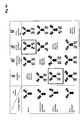
- Mispairing in this connection means the association of i) the light chain of the full length antibody under a) with CH1-VH domains of the Fab fragments under b); or ii) the light chain of the Fab fragments under b) with the CH1-VH domains of the full length antibody under a) (see Fig 3 ) which leads to undesired inactive or not fully functional byproducts.
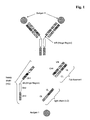
- antibody denotes a full length antibody consisting of two antibody heavy chains and two antibody light chains (see Fig. 1 ).
- a heavy chain of full length antibody is a polypeptide consisting in N-terminal to C-terminal direction of an antibody heavy chain variable domain (VH), an antibody constant heavy chain domain 1 (CH1), an antibody hinge region (HR), an antibody heavy chain constant domain 2 (CH2), and an antibody heavy chain constant domain 3 (CH3), abbreviated as VH-CH1-HR-CH2-CH3; and optionally an antibody heavy chain constant domain 4 (CH4) in case of an antibody of the subclass IgE.
- VH antibody heavy chain variable domain
- CH1 antibody constant heavy chain domain 1
- HR antibody hinge region
- CH2 antibody heavy chain constant domain 2
- CH3 antibody heavy chain constant domain 3
- the heavy chain of full length antibody is a polypeptide consisting in N-terminal to C-terminal direction of VH, CH1, HR, CH2 and CH3.
- the light chain of full length antibody is a polypeptide consisting in N-terminal to C-terminal direction of an antibody light chain variable domain (VL), and an antibody light chain constant domain (CL), abbreviated as VL-CL.
- the antibody light chain constant domain (CL) can be ⁇ (kappa) or ⁇ (lambda).
- the antibody chains are linked together via inter-polypeptide disulfide bonds between the CL domain and the CH1 domain (i.e. between the light and heavy chain) and between the hinge regions of the full length antibody heavy chains.
- full length antibodies are natural antibodies like IgG (e.g. IgG1 and IgG2), IgM, IgA, IgD, and IgE.)
- the antibodies according to the invention can be from a single species e.g. human, or they can be chimerized or humanized antibodies.
- the full length antibodies according to the invention comprise two antigen binding sites each formed by a pair of VH and VL, which both specifically bind to the same (first) antigen.
- the C-terminus of the heavy or light chain of said full length antibody denotes the last amino acid at the C-terminus of said heavy or light chain.
- Said antibody comprises two identical Fab fragments consisting of the VH and CH1 domain of the heavy chain and the VL and CL domain of the light chain. (see Fig 1 and 2 ).
- an "additional Fab fragment" (see Fig 2 ) of an antibody which specifically binds to a second antigen refers to a further Fab fragment consisting of the VH and CH1 domain of the heavy chain and the VL and CL domain of the light chain of said second antibody.
- the additional Fab fragments are fused in their unmodified form (see Fig 3 ) via the heavy chain part (either CH1 or VH domain) to the C- or N-termini of the heavy chains or light chains of the antibody specifically binding to a first antigen.
- peptide connector denotes a peptide with amino acid sequences, which is preferably of synthetic origin. These peptide connectors according to invention are used to fuse the antigen binding peptides to the C-or N-terminus of the full length and/or modified full length antibody chains to form a bispecific antigen binding protein according to the invention.
- peptide connectors under c) are peptides with an amino acid sequence with a length of at least 5 amino acids, preferably with a length of 5 to 100, more preferably of 10 to 50 amino acids.
- said peptide connector is (G 4 S) 2 .
- binding site or "antigen-binding site” as used herein denotes the region(s) of an antigen binding protein according to the invention to which a ligand (e.g. the antigen or antigen fragment of it) actually binds and which is derived from an antibody molecule or a fragment thereof (e.g. a Fab fragment).
- the antigen-binding site according to the invention comprises an antibody heavy chain variable domains (VH) and an antibody light chain variable domains (VL).
- the antigen-binding sites i. the pairs of VHNL
- the antigen-binding sites that specifically bind to the desired antigen can be derived a) from known antibodies to the antigen or b) from new antibodies or antibody fragments obtained by de novo immunization methods using inter alia either the antigen protein or nucleic acid or fragments thereof or by phage display.
- An antigen-binding site of an antigen binding protein of the invention contains six complementarity determining regions (CDRs) which contribute in varying degrees to the affinity of the binding site for antigen. There are three heavy chain variable domain CDRs (CDRH1, CDRH2 and CDRH3) and three light chain variable domain CDRs (CDRL1, CDRL2 and CDRL3). The extent of CDR and framework regions (FRs) is determined by comparison to a compiled database of amino acid sequences in which those regions have been defined according to variability among the sequences.
- Antibody specificity refers to selective recognition of the antibody or antigen binding protein for a particular epitope of an antigen. Natural antibodies, for example, are monospecific. Bispecific antibodies are antibodies which have two different antigen-binding specificities. Where an antibody has more than one specificity, the recognized epitopes may be associated with a single antigen or with more than one antigen.
- monospecific antibody or antigen binding protein denotes an antibody or antigen binding protein that has one or more binding sites each of which bind to the same epitope of the same antigen.
- the term "valent” as used within the current application denotes the presence of a specified number of binding sites in an antibody molecule.
- a natural antibody for example or a full length antibody according to the invention has two binding sites and is bivalent.
- the term “tetravalent, bispecific” as used herein denotes antigen binding protein according to the invention that has four antigen-binding sites of which two binds to another antigen (or another epitope of the antigen).
- Antigen binding proteins of the present invention have four binding sites and are tetravalent.
- the full length antibodies of the invention comprise immunoglobulin constant regions of one or more immunoglobulin classes.
- Immunoglobulin classes include IgG, IgM, IgA, IgD, and IgE isotypes and, in the case of IgG and IgA, their subtypes.
- an full length antibody of the invention has a constant domain structure of an IgG type antibody.
- monoclonal antibody or “monoclonal antibody composition” as used herein refer to a preparation of antibody or antibody or antigen binding protein molecules of a single amino acid composition.
- chimeric antibody refers to an antibody comprising a variable region, i.e., binding region, from one source or species and at least a portion of a constant region derived from a different source or species, usually prepared by recombinant DNA techniques. Chimeric antibodies comprising a murine variable region and a human constant region are preferred. Other preferred forms of “chimeric antibodies” encompassed by the present invention are those in which the constant region has been modified or changed from that of the original antibody to generate the properties according to the invention, especially in regard to C1q binding and/or Fc receptor (FcR) binding. Such chimeric antibodies are also referred to as "class-switched antibodies.”
- Chimeric antibodies are the product of expressed immunoglobulin genes comprising DNA segments encoding immunoglobulin variable regions and DNA segments encoding immunoglobulin constant regions. Methods for producing chimeric antibodies involve conventional recombinant DNA and gene transfection techniques are well known in the art. See, e.g., Morrison, S., L., et al., Proc. Natl. Acad. Sci. USA 81 (1984) 6851-6855 ; US 5,202,238 and US 5,204,244 .
- humanized antibody refers to antibodies in which the framework or "complementarity determining regions” (CDR) have been modified to comprise the CDR of an immunoglobulin of different specificity as compared to that of the parent immunoglobulin.
- CDR complementarity determining regions
- a murine CDR is grafted into the framework region of a human antibody to prepare the "humanized antibody.” See, e.g., Riechmann, L., et al., Nature 332 (1988) 323-327 ; and Neuberger, M.S., et al., Nature 314 (1985) 268-270 .
- Particularly preferred CDRs correspond to those representing sequences recognizing the antigens noted above for chimeric antibodies.
- humanized antibodies encompassed by the present invention are those in which the constant region has been additionally modified or changed from that of the original antibody to generate the properties according to the invention, especially in regard to C1q binding and/or Fc receptor (FcR) binding.
- FcR Fc receptor
- human antibody is intended to include antibodies having variable and constant regions derived from human germ line immunoglobulin sequences. Human antibodies are well-known in the state of the art ( van Dijk, M.A., and van de Winkel, J.G., Curr. Opin. Chem. Biol. 5 (2001) 368-374 ). Human antibodies can also be produced in transgenic animals (e.g., mice) that are capable, upon immunization, of producing a full repertoire or a selection of human antibodies in the absence of endogenous immunoglobulin production.
- Human antibodies can also be produced in phage display libraries ( Hoogenboom, H.R., and Winter, G., J. Mol. Biol.
- human antibody as used herein also comprises such antibodies which are modified in the constant region to generate the properties according to the invention, especially in regard to C1q binding and/or FcR binding, e.g. by "class switching” i.e. change or mutation of Fc parts (e.g. from IgG1 to IgG4 and/or IgG1/IgG4 mutation.)
- recombinant human antibody is intended to include all human antibodies that are prepared, expressed, created or isolated by recombinant means, such as antibodies isolated from a host cell such as a NS0 or CHO cell or from an animal (e.g. a mouse) that is transgenic for human immunoglobulin genes or antibodies expressed using a recombinant expression vector transfected into a host cell.
- recombinant human antibodies have variable and constant regions in a rearranged form.
- the recombinant human antibodies according to the invention have been subjected to in vivo somatic hypermutation.
- the amino acid sequences of the VH and VL regions of the recombinant antibodies are sequences that, while derived from and related to human germ line VH and VL sequences, may not naturally exist within the human antibody germ line repertoire in vivo.
- variable domain (variable domain of a light chain (VL), variable region of a heavy chain (VH) as used herein denotes each of the pair of light and heavy chains which is involved directly in binding the antibody to the antigen.
- the domains of variable human light and heavy chains have the same general structure and each domain comprises four framework (FR) regions whose sequences are widely conserved, connected by three "hypervariable regions” (or complementarity determining regions, CDRs).
- the framework regions adopt a ⁇ -sheet conformation and the CDRs may form loops connecting the ⁇ -sheet structure.
- the CDRs in each chain are held in their three-dimensional structure by the framework regions and form together with the CDRs from the other chain the antigen binding site.
- the antibody heavy and light chain CDR3 regions play a particularly important role in the binding specificity/affinity of the antibodies according to the invention and therefore provide a further object of the invention.
- hypervariable region or "antigen-binding portion of an antibody” when used herein refer to the amino acid residues of an antibody which are responsible for antigen-binding.
- the hypervariable region comprises amino acid residues from the "complementarity determining regions” or "CDRs".
- “Framework” or "FR” regions are those variable domain regions other than the hypervariable region residues as herein defined. Therefore, the light and heavy chains of an antibody comprise from N- to C-terminus the domains FR1, CDR1, FR2, CDR2, FR3, CDR3, and FR4. CDRs on each chain are separated by such framework amino acids. Especially, CDR3 of the heavy chain is the region which contributes most to antigen binding.
- CDR and FR regions are determined according to the standard definition of Kabat, et al., Sequences of Proteins of Immunological Interest, 5th ed., Public Health Service, National Institutes of Health, Bethesda, MD (1991 ).
- binding refers to the binding of the antibody to an epitope of the antigen in an in vitro assay, preferably in an plasmon resonance assay (BIAcore, GE-Healthcare Uppsala, Sweden) with purified wild-type antigen.
- the affinity of the binding is defined by the terms ka (rate constant for the association of the antibody (or antibody or antigen binding protein) from the antibody/antigen complex), k D (dissociation constant), and K D (k D /ka).
- Binding or specifically binding means a binding affinity (K D ) of 10 -8 mol/l or less, preferably 10 -9 M to 10 -13 mol/l.
- a bispecific antigen binding protein according to the invention is specifically binding to each antigen for which it is specific with a binding affinity (K D ) of 10 -8 mol/l or less, preferably 10 -9 M to 10 -3 mol/l.
- Binding of the antibody to the Fc ⁇ RIII can be investigated by a BIAcore assay (GE-Healthcare Uppsala, Sweden).
- the affinity of the binding is defined by the terms ka (rate constant for the association of the antibody from the antibody/antigen complex), k D (dissociation constant), and K D (k D /ka).
- epitope includes any polypeptide determinant capable of specific binding to an antibody.
- epitope determinant include chemically active surface groupings of molecules such as amino acids, sugar side chains, phosphoryl, or sulfonyl, and, in certain embodiments, may have specific three dimensional structural characteristics, and or specific charge characteristics.
- An epitope is a region of an antigen that is bound by an antibody.
- an antibody is said to specifically bind an antigen when it preferentially recognizes its target antigen in a complex mixture of proteins and/or macromolecules.
- the bispecific antigen binding protein according to the invention is characterized in that said full length antibody is of human IgG1 subclass, or of human IgG1 subclass with the mutations L234A and L235A.
- the bispecific antigen binding protein according to the invention is characterized in that said full length antibody is of human IgG2 subclass.
- the bispecific antigen binding protein according to the invention is characterized in that said full length antibody is of human IgG3 subclass.
- the bispecific antigen binding protein according to the invention is characterized in that said full length antibody is of human IgG4 subclass or, of human IgG4 subclass with the additional mutation S228P.
- the bispecific antigen binding protein according to the invention is characterized in that said full length antibody is of human IgG1 subclass, of human IgG4 subclass with the additional mutation S228P.
- the bispecific antigen binding proteins according to the invention have improved characteristics such as biological or pharmacological activity, pharmacokinetic properties or toxicity. They can be used e.g. for the treatment of diseases such as cancer.
- constant region denotes the sum of the domains of an antibody other than the variable region.
- the constant region is not involved directly in binding of an antigen, but exhibits various effector functions.
- antibodies are divided in the classes: IgA, IgD, IgE, IgG and IgM, and several of these may be further divided into subclasses, such as IgG1, IgG2, IgG3, and IgG4, IgA1 and IgA2.
- the heavy chain constant regions that correspond to the different classes of antibodies are called ⁇ , ⁇ , ⁇ , ⁇ , and ⁇ , respectively.
- the light chain constant regions (CL) which can be found in all five antibody classes are called ⁇ (kappa) and ⁇ (lambda).
- constant region derived from human origin denotes a constant heavy chain region of a human antibody of the subclass IgG1, IgG2, IgG3, or IgG4 and/or a constant light chain kappa or lambda region.
- constant regions are well known in the state of the art and e.g. described by Kabat, E.A., (see e.g. Johnson, G. and Wu, T.T., Nucleic Acids Res. 28 (2000) 214-218 ; Kabat, E.A., et al., Proc. Natl. Acad. Sci. USA 72 (1975) 2785-2788 ).
- an antigen binding protein according to the invention has a reduced FcR binding compared to an IgG1 antibody and the full length parent antibody is in regard to FcR binding of IgG4 subclass or of IgG1 or IgG2 subclass with a mutation in S228, L234, L235 and/or D265, and/ or contains the PVA236 mutation.
- the mutations in the full length parent antibody are S228P, L234A, L235A, L235E and/or PVA236.
- the mutations in the full length parent antibody are in IgG4 S228P and in IgG1 L234A and L235A.
- ADCC antibody-dependent cell-mediated cytotoxicity
- CDC complement-dependent cytotoxicity
- C1q complement factor C1q
- IgG antibody subclasses IgG antibody subclasses
- binding of C1q to an antibody is caused by defined protein-protein interactions at the so called binding site.
- constant region binding sites are known in the state of the art and described e.g. by Lukas, T.J., et al., J. Immunol. 127 (1981) 2555-2560 ; Brunhouse, R. and Cebra, J., J., Mol. Immunol.
- Such constant region binding sites are, e.g., characterized by the amino acids L234, L235, D270, N297, E318, K320, K322, P331, and P329 (numbering according to EU index of Kabat).
- ADCC antibody-dependent cellular cytotoxicity
- complement-dependent cytotoxicity denotes a process initiated by binding of complement factor C1q to the Fc part of most IgG antibody subclasses. Binding of C1q to an antibody is caused by defined protein-protein interactions at the so called binding site.
- Fc part binding sites are known in the state of the art (see above). Such Fc part binding sites are, e.g., characterized by the amino acids L234, L235, D270, N297, E318, K320, K322, P331, and P329 (numbering according to EU index of Kabat).
- Antibodies of subclass IgG1, IgG2, and IgG3 usually show complement activation including C1q and C3 binding, whereas IgG4 does not activate the complement system and does not bind C1q and/or C3.
- IgG1 type antibodies the most commonly used therapeutic antibodies, are glycoproteins that have a conserved N-linked glycosylation site at Asn297 in each CH2 domain.
- ADCC antibody dependent cellular cytotoxicity
- the bispecific antigen binding protein is glycosylated (if it comprises an Fc part of IgG1, IgG2, IgG3 or IgG4 subclass, preferably of IgG1 or IgG3 subclass) with a sugar chain at Asn297 whereby the amount of fucose within said sugar chain is 65% or lower (Numbering according to Kabat). In another embodiment is the amount of fucose within said sugar chain is between 5% and 65%, preferably between 20% and 40%.
- “Asn297” according to the invention means amino acid asparagine located at about position 297 in the Fc region.
- Asn297 can also be located some amino acids (usually not more than ⁇ 3 amino acids) upstream or downstream of position 297, i.e. between position 294 and 300.
- the glycosylated antigen binding protein according to the invention the IgG subclass is of human IgG1 subclass, of human IgG1 subclass with the mutations L234A and L235A or of IgG3 subclass.
- the amount of N-glycolylneuraminic acid (NGNA) is 1% or less and/or the amount of N-terminal alpha-1,3-galactose is 1 % or less within said sugar chain.
- the sugar chain show preferably the characteristics of N-linked glycans attached to Asn297 of an antibody recombinantly expressed in a CHO cell.
- the sugar chains show characteristics of N-linked glycans attached to Asn297 of an antibody recombinantly expressed in a CHO cell
- NGNA as used within this application denotes the sugar residue N-glycolylneuraminic acid.
- CHO type glycosylation of antibody Fc parts is e.g. described by Routier, F., H., Glycoconjugate J. 14 (1997) 201-207 .
- Antibodies which are recombinantly expressed in non-glycomodified CHO host cells usually are fucosylated at Asn297 in an amount of at least 85%.
- the modified oligosaccharides of the full length parent antibody may be hybrid or complex.
- the bisected, reduced/not-fucosylated oligosaccharides are hybrid.
- the bisected, reduced/not-fucosylated oligosaccharides are complex.
- amount of fucose means the amount of said sugar within the sugar chain at Asn297, related to the sum of all glycostructures attached to Asn297 (e.g. complex, hybrid and high mannose structures) measured by MALDI-TOF mass spectrometry and calculated as average value.
- the relative amount of fucose is the percentage of fucose-containing structures related to all glycostructures identified in an N-Glycosidase F treated sample (e.g. complex, hybrid and oligo- and high-mannose structures, resp.) by MALDI-TOF.
- the antigen binding protein according to the invention is produced by recombinant means.
- one aspect of the current invention is a nucleic acid encoding the antigen binding protein according to the invention and a further aspect is a cell comprising said nucleic acid encoding an antigen binding protein according to the invention.
- Methods for recombinant production are widely known in the state of the art and comprise protein expression in prokaryotic and eukaryotic cells with subsequent isolation of the antigen binding protein and usually purification to a pharmaceutically acceptable purity.
- nucleic acids encoding the respective modified light and heavy chains are inserted into expression vectors by standard methods.
- the bispecific antigen binding proteins according to the invention are suitably separated from the culture medium by conventional immunoglobulin purification procedures such as, for example, protein A-Sepharose, hydroxylapatite chromatography, gel electrophoresis, dialysis, or affinity chromatography.
- DNA or RNA encoding the monoclonal antibodies is readily isolated and sequenced using conventional procedures.
- the hybridoma cells can serve as a source of such DNA and RNA.
- the DNA may be inserted into expression vectors, which are then transfected into host cells such as HEK 293 cells, CHO cells, or myeloma cells that do not otherwise produce immunoglobulin protein, to obtain the synthesis of recombinant monoclonal antibodies in the host cells.
- Amino acid sequence variants (or mutants) of the bispecific antigen binding protein are prepared by introducing appropriate nucleotide changes into the antigen binding protein DNA, or by nucleotide synthesis. Such modifications can be performed, however, only in a very limited range, e.g. as described above. For example, the modifications do not alter the above mentioned antibody characteristics such as the IgG isotype and antigen binding, but may improve the yield of the recombinant production, protein stability or facilitate the purification.
- host cell denotes any kind of cellular system which can be engineered to generate the antibodies according to the current invention.
- HEK293 cells and CHO cells are used as host cells.
- the expressions "cell,” “cell line,” and “cell culture” are used interchangeably and all such designations include progeny.
- the words “transformants” and “transformed cells” include the primary subject cell and cultures derived therefrom without regard for the number of transfers. It is also understood that all progeny may not be precisely identical in DNA content, due to deliberate or inadvertent mutations. Variant progeny that have the same function or biological activity as screened for in the originally transformed cell are included.
- NS0 cells Expression in NS0 cells is described by, e.g., Barnes, L.M., et al., Cytotechnology 32 (2000) 109-123 ; Barnes, L.M., et al., Biotech. Bioeng. 73 (2001) 261-270 .
- Transient expression is described by, e.g., Durocher, Y., et al., Nucl. Acids. Res. 30 (2002) E9 .
- Cloning of variable domains is described by Orlandi, R., et al., Proc. Natl. Acad. Sci. USA 86 (1989) 3833-3837 ; Carter, P., et al., Proc. Natl. Acad. Sci.
- HEK 293 A preferred transient expression system (HEK 293) is described by Schlaeger, E.-J., and Christensen, K., in Cytotechnology 30 (1999) 71-83 and by Schlaeger, E.-J., in J. Immunol. Methods 194 (1996) 191-199 .
- control sequences that are suitable for prokaryotes include a promoter, optionally an operator sequence, and a ribosome binding site.
- Eukaryotic cells are known to utilize promoters, enhancers and polyadenylation signals.
- a nucleic acid is "operably linked" when it is placed in a functional relationship with another nucleic acid sequence.
- DNA for a pre-sequence or secretory leader is operably linked to DNA for a polypeptide if it is expressed as a pre-protein that participates in the secretion of the polypeptide;
- a promoter or enhancer is operably linked to a coding sequence if it affects the transcription of the sequence; or
- a ribosome binding site is operably linked to a coding sequence if it is positioned so as to facilitate translation.
- "operably linked” means that the DNA sequences being linked are contiguous, and, in the case of a secretory leader, contiguous and in reading frame. However, enhancers do not have to be contiguous. Linking is accomplished by ligation at convenient restriction sites. If such sites do not exist, the synthetic oligonucleotide adaptors or linkers are used in accordance with conventional practice.
- Purification of antibodies is performed in order to eliminate cellular components or other contaminants, e.g. other cellular nucleic acids or proteins, by standard techniques, including alkaline/SDS treatment, CsCl banding, column chromatography, agarose gel electrophoresis, and others well known in the art. See Ausubel, F., et al., ed. Current Protocols in Molecular Biology, Greene Publishing and Wiley Interscience, New York (1987 ). Different methods are well established and widespread used for protein purification, such as affinity chromatography with microbial proteins (e.g. protein A or protein G affinity chromatography), ion exchange chromatography (e.g.
- cation exchange (carboxymethyl resins), anion exchange (amino ethyl resins) and mixed-mode exchange), thiophilic adsorption (e.g. with beta-mercaptoethanol and other SH ligands), hydrophobic interaction or aromatic adsorption chromatography (e.g. with phenyl-sepharose, aza-arenophilic resins, or m-aminophenylboronic acid), metal chelate affinity chromatography (e.g.
- Ni(II)- and Cu(II)-affinity material size exclusion chromatography
- electrophoretical methods such as gel electrophoresis, capillary electrophoresis
- One aspect of the invention is a pharmaceutical composition comprising an antigen binding protein according to the invention.
- Another aspect of the invention is the use of an antigen binding protein according to the invention for the manufacture of a pharmaceutical composition.
- a further aspect of the invention is a method for the manufacture of a pharmaceutical composition comprising an antigen binding protein according to the invention.
- the present invention provides a composition, e.g. a pharmaceutical composition, containing an antigen binding protein according to the present invention, formulated together with a pharmaceutical carrier.
- Another aspect of the invention is said pharmaceutical composition for the treatment of cancer.
- Another aspect of the invention is the bispecific antigen binding protein according to the invention for the treatment of cancer.
- Another aspect of the invention is the use of an antigen binding protein according to the invention for the manufacture of a medicament for the treatment of cancer.
- Another aspect of the invention is a method of treatment of a patient suffering from cancer by administering an antigen binding protein according to the invention to said patient in the need of such treatment.
- pharmaceutical carrier includes any and all solvents, dispersion media, coatings, antibacterial and antifungal agents, isotonic and absorption delaying agents, and the like that are physiologically compatible.
- the carrier is suitable for intravenous, intramuscular, subcutaneous, parenteral, spinal or epidermal administration (e.g. by injection or infusion).
- a composition of the present invention can be administered by a variety of methods known in the art. As will be appreciated by the skilled artisan, the route and/or mode of administration will vary depending upon the desired results. To administer a compound of the invention by certain routes of administration, it may be necessary to coat the compound with, or co-administer the compound with, a material to prevent its inactivation.
- the compound may be administered to a subject in an appropriate carrier, for example, liposomes, or a diluent.
- Pharmaceutically acceptable diluents include saline and aqueous buffer solutions.
- Pharmaceutical carriers include sterile aqueous solutions or dispersions and sterile powders for the extemporaneous preparation of sterile injectable solutions or dispersion. The use of such media and agents for pharmaceutically active substances is known in the art.
- parenteral administration and “administered parenterally” as used herein means modes of administration other than enteral and topical administration, usually by injection, and includes, without limitation, intravenous, intramuscular, intra-arterial, intrathecal, intracapsular, intraorbital, intracardiac, intradermal, intraperitoneal, transtracheal, subcutaneous, subcuticular, intra-articular, subcapsular, subarachnoid, intraspinal, epidural and intrastemal injection and infusion.
- cancer refers to proliferative diseases, such as lymphomas, lymphocytic leukemias, lung cancer, non small cell lung (NSCL) cancer, bronchioloalviolar cell lung cancer, bone cancer, pancreatic cancer, skin cancer, cancer of the head or neck, cutaneous or intraocular melanoma, uterine cancer, ovarian cancer, rectal cancer, cancer of the anal region, stomach cancer, gastric cancer, colon cancer, breast cancer, uterine cancer, carcinoma of the fallopian tubes, carcinoma of the endometrium, carcinoma of the cervix, carcinoma of the vagina, carcinoma of the vulva, Hodgkin's Disease, cancer of the esophagus, cancer of the small intestine, cancer of the endocrine system, cancer of the thyroid gland, cancer of the parathyroid gland, cancer of the adrenal gland, sarcoma of soft tissue, cancer of the urethra, cancer of the penis, prostate cancer, cancer of the bladder, cancer of the kidney or ure
- compositions may also contain adjuvants such as preservatives, wetting agents, emulsifying agents and dispersing agents. Prevention of presence of microorganisms may be ensured both by sterilization procedures, supra, and by the inclusion of various antibacterial and antifungal agents, for example, paraben, chlorobutanol, phenol, sorbic acid, and the like. It may also be desirable to include isotonic agents, such as sugars, sodium chloride, and the like into the compositions. In addition, prolonged absorption of the injectable pharmaceutical form may be brought about by the inclusion of agents which delay absorption such as aluminum monostearate and gelatin.
- the compounds of the present invention which may be used in a suitable hydrated form, and/or the pharmaceutical compositions of the present invention, are formulated into pharmaceutically acceptable dosage forms by conventional methods known to those of skill in the art.
- Actual dosage levels of the active ingredients in the pharmaceutical compositions of the present invention may be varied so as to obtain an amount of the active ingredient which is effective to achieve the desired therapeutic response for a particular patient, composition, and mode of administration, without being toxic to the patient.
- the selected dosage level will depend upon a variety of pharmacokinetic factors including the activity of the particular compositions of the present invention employed, the route of administration, the time of administration, the rate of excretion of the particular compound being employed, the duration of the treatment, other drugs, compounds and/or materials used in combination with the particular compositions employed, the age, sex, weight, condition, general health and prior medical history of the patient being treated, and like factors well known in the medical arts.
- composition must be sterile and fluid to the extent that the composition is deliverable by syringe.
- carrier preferably is an isotonic buffered saline solution.
- Proper fluidity can be maintained, for example, by use of coating such as lecithin, by maintenance of required particle size in the case of dispersion and by use of surfactants.
- isotonic agents for example, sugars, polyalcohols such as mannitol or sorbitol, and sodium chloride in the composition.
- the expressions "cell,” “cell line,” and “cell culture” are used interchangeably and all such designations include progeny.
- the words “transformants” and “transformed cells” include the primary subject cell and cultures derived therefrom without regard for the number of transfers. It is also understood that all progeny may not be precisely identical in DNA content, due to deliberate or inadvertent mutations. Variant progeny that have the same function or biological activity as screened for in the originally transformed cell are included. Where distinct designations are intended, it will be clear from the context.
- transfection refers to process of transfer of a vectors/nucleic acid into a host cell. If cells without daunting cell wall barriers are used as host cells, transfection is carried out e.g. by the calcium phosphate precipitation method as described by Graham, F., L., and Van der Eb, A., J., Virology 52 (1973) 456-467 . However, other methods for introducing DNA into cells such as by nuclear injection or by protoplast fusion may also be used. If prokaryotic cells or cells which contain substantial cell wall constructions are used, e.g. one method of transfection is calcium treatment using calcium chloride as described by Cohen, S., N., et al, PNAS. 69 (1972) 2110-2114 .
- expression refers to the process by which a nucleic acid is transcribed into mRNA and/or to the process by which the transcribed mRNA (also referred to as transcript) is subsequently being translated into peptides, polypeptides, or proteins.
- the transcripts and the encoded polypeptides are collectively referred to as gene product. If the polynucleotide is derived from genomic DNA, expression in a eukaryotic cell may include splicing of the mRNA.
- a “vector” is a nucleic acid molecule, in particular self-replicating, which transfers an inserted nucleic acid molecule into and/or between host cells.
- the term includes vectors that function primarily for insertion of DNA or RNA into a cell (e.g., chromosomal integration), replication of vectors that function primarily for the replication of DNA or RNA, and expression vectors that function for transcription and/or translation of the DNA or RNA. Also included are vectors that provide more than one of the functions as described.
- an "expression vector” is a polynucleotide which, when introduced into an appropriate host cell, can be transcribed and translated into a polypeptide.
- An “expression system” usually refers to a suitable host cell comprised of an expression vector that can function to yield a desired expression product.
- Desired gene segments are prepared from oligonucleotides made by chemical synthesis.
- the gene segments which are flanked by singular restriction endonuclease cleavage sites, are assembled by annealing and ligation of oligonucleotides including PCR amplification and subsequently cloned via the indicated restriction sites e.g. KpnI/ SacI or AscI/PacI into a pPCRScript (Stratagene) based pGA4 cloning vector.
- the DNA sequences of the subcloned gene fragments are confirmed by DNA sequencing. Gene synthesis fragments are ordered according to given specifications at Geneart (Regensburg, Germany).
- DNA sequences are determined by double strand sequencing performed at MediGenomix GmbH (Martinsried, Germany) or Sequiserve GmbH (Vaterstetten, Germany).
- the GCG's (Genetics Computer Group, Madison, Wisconsin) software package version 10.2 and Infomax's Vector NT1 Advance suite version 8.0 is used for sequence creation, mapping, analysis, annotation and illustration.
- the transcription unit of the antibody gene is composed of the following elements:
- the fusion genes comprising the described antibody chains as described below are generated by PCR and/or gene synthesis and assembled with known recombinant methods and techniques by connection of the according nucleic acid segments e.g. using unique restriction sites in the respective vectors.
- the subcloned nucleic acid sequences are verified by DNA sequencing.
- larger quantities of the plasmids are prepared by plasmid preparation from transformed E. coli cultures (Nucleobond AX, Macherey-Nagel).
- Bispecific tetravalent antibodies are expressed by transient co-transfection of the respective three expression plasmids in adherently growing HEK293-EBNA or in HEK29-F cells growing in suspension as described below.
- Bispecific tetravalent antibodies are expressed by transient co-transfection of the respective three expression plasmids (e.g. encoding the modified heavy chain, as well as the corresponding light and modified light chain) in adherently growing HEK293-EBNA cells (human embryonic kidney cell line 293 expressing Epstein-Barr-Virus nuclear antigen; American type culture collection deposit number ATCC # CRL-10852, Lot. 959 218) cultivated in DMEM (Dulbecco's modified Eagle's medium, Gibco) supplemented with 10% Ultra Low IgG FCS (fetal calf serum, Gibco), 2 mM L-Glutamine (Gibco), and 250 ⁇ g/ml Geneticin (Gibco).
- DMEM Dulbecco's modified Eagle's medium, Gibco
- Ultra Low IgG FCS fetal calf serum, Gibco
- 2 mM L-Glutamine Gibco
- 250 ⁇ g/ml Geneticin Gab
- FuGENETM 6 Transfection Reagent (Roche Molecular Biochemicals) is used in a ratio of FuGENETM reagent ( ⁇ l) to DNA ( ⁇ g) of 4:1 (ranging from 3:1. to 6: 1). Proteins are expressed from the respective plasmids using a molar ratio of (modified and wildtype) light chain and modified heavy chain encoding plasmids of 1:1:1 (equimolar) ranging from 1:1:2 to 2:2:1, respectively. Cells are feeded at day 3 with L-Glutamine ad 4 mM, Glucose [Sigma] and NAA [Gibco].
- Bispecific tetravalent antibody containing cell culture supernatants are harvested from day 5 to 11 after transfection by centrifugation and stored at -20°C.
- General information regarding the recombinant expression of human immunoglobulins in e.g. HEK293 cells is given in: Meissner, P. et al., Biotechnol. Bioeng. 75 (2001) 197-203 .
- bispecific tetravalent antibodies are generated by transient transfection of the respective plasmids (e.g. encoding the modified heavy chain, as well as the corresponding light and modified light chain) using the HEK293-F system (Invitrogen) according to the manufacturer's instruction.
- HEK293-F cells growing in suspension either in a shake flask or in a stirred fermenter in serumfree FreeStyle 293 expression medium (Invitrogen) are transfected with a mix of the three expression plasmids as described above and 293fectin or fectin (Invitrogen).
- HEK293-F cells are seeded at a density of 1.0E*6 cells/mL in 600 mL and incubated at 120 rpm, 8% CO2. The day after the cells are transfected at a cell density of ca. 1.5E*6 cells/mL with ca. 42 mL mix of A) 20 mL Opti-MEM (Invitrogen) with 600 ⁇ g total plasmid DNA (1 ⁇ g/mL) encoding the modified heavy chain, the corresponding light chain and the corresponding modified light chain in an equimolar ratio and B) 20 ml Opti-MEM + 1.2 mL 293 fectin or fectin (2 ⁇ l/mL). According to the glucose consumption glucose solution is added during the course of the fermentation. The supernatant containing the secreted antibody is harvested after 5-10 days and antibodies are either directly purified from the supernatant or the supernatant is frozen and stored.
- the protein concentration of purified bispecific tetravalent antibodies and derivatives is determined by determining the optical density (OD) at 280 nm, using the molar extinction coefficient calculated on the basis of the amino acid sequence according to Pace, C., N., et al., Protein Science 4 (1995) 2411-1423 .
- the concentration of bispecific tetravalent antibodies in cell culture supernatants is estimated by immunoprecipitation with Protein A Agarose-beads (Roche). 60 ⁇ L Protein A Agarose beads are washed three times in TBS-NP40 (50 mM Tris, pH 7.5, 150 mM NaCl, 1% Nonidet-P40). Subsequently, 1-15 mL cell culture supernatant are applied to the Protein A Agarose beads pre-equilibrated in TBS-NP40.
- the concentration of bispecific tetravalent antibodies in cell culture supernatants is quantitatively measured by affinity HPLC chromatography. Briefly, cell culture supernatants containing antibodies and derivatives that bind to Protein A are applied to an Applied Biosystems Poros A/20 column in 200 mM KH2PO4, 100 mM sodium citrate, pH 7.4 and eluted from the matrix with 200 mM NaCl, 100 mM citric acid, pH 2,5 on an Agilent HPLC 1100 system. The eluted protein is quantified by UV absorbance and integration of peak areas. A purified standard IgG 1 antibody served as a standard.
- the concentration of bispecific tetravalent antibodies in cell culture supernatants is measured by Sandwich-IgG-ELISA. Briefly, StreptaWell High Bind Strepatavidin A-96 well microtiter plates (Roche) are coated with 100 ⁇ L/well biotinylated anti-human IgG capture molecule F(ab')2 ⁇ h-Fc ⁇ > BI (Dianova) at 0.1 ⁇ g/mL for 1 h at room temperature or alternatively over night at 4°C and subsequently washed three times with 200 ⁇ L/well PBS, 0.05% Tween (PBST, Sigma).
- PBST 0.05% Tween
- Proteins are purified from filtered cell culture supernatants referring to standard protocols.
- bispecific tetravalent antibodies are applied to a Protein A Sepharose column (GE healthcare) and washed with PBS. Elution of bispecific tetravalent antibodies is achieved at pH 2.8 followed by immediate neutralization of the sample.
- Aggregated protein is separated from monomeric antibodies by size exclusion chromatography (Superdex 200, GE Healthcare) in PBS or in 20 mM Histidine, 150 mM NaCl pH 6.0. Monomeric fractions are pooled, concentrated if required using e.g. a MILLIPORE Amicon Ultra (30 MWCO) centrifugal concentrator, frozen and stored at -20°C or -80°C. Part of the samples are provided for subsequent protein analytics and analytical characterization e.g. by SDS-PAGE, size exclusion chromatography or mass spectrometry.
- the NuPAGE® Pre-Cast gel system (Invitrogen) is used according to the manufacturer's instruction. In particular, 10% or 4-12% NuPAGE® Novex® Bis-TRIS Pre-Cast gels (pH 6.4) and a NuPAGE® MES (reduced gels, with NuPAGE® Antioxidant running buffer additive) or MOPS (non-reduced gels) running buffer is used.
- NuPAGE® MES reduced gels, with NuPAGE® Antioxidant running buffer additive
- MOPS non-reduced gels
- Size exclusion chromatography for the determination of the aggregation and oligomeric state of bispecific tetravalent antibodies is performed by HPLC chromatography. Briefly, Protein A purified antibodies are applied to a Tosoh TSKgel G3000SW column in 300 mM NaCl, 50 mM KH2PO4/K2HPO4, pH 7.5 on an Agilent HPLC 1100 system or to a Superdex 200 column (GE Healthcare) in 2 x PBS on a Dionex HPLC-System. The eluted protein is quantified by UV absorbance and integration of peak areas. BioRad Gel Filtration Standard 151-1901 served as a standard.
- the total deglycosylated mass of the bispecific tetravalent antibodies is determined and confirmed via electrospray ionization mass spectrometry (ESI-MS). Briefly, 100 ⁇ g purified antibodies are deglycosylated with 50 mU N-Glycosidase F (PNGaseF, ProZyme) in 100 mM KH2PO4/K2HPO4, pH 7 at 37°C for 12-24 h at a protein concentration of up to 2 mg/ml and subsequently desalted via HPLC on a Sephadex G25 column (GE Healthcare). The mass of the respective modified heavy, light chain and modified light chain is determined by ESI-MS after deglycosylation and reduction.
- PNGaseF N-Glycosidase F
- bispecific tetravalent antibody in 115 ⁇ l are incubated with 60 ⁇ l 1M TCEP and 50 ⁇ l 8 M Guanidine-hydrochloride subsequently desalted.
- the total mass and the mass of the reduced heavy and light chains is determined via ESI-MS on a Q-Star Elite MS system equipped with a NanoMate source.
- VEGF165-His protein full-length VEGF165-His protein (R&D Systems).
- Falcon polystyrene clear enhanced microtiter plates are coated with 100 ⁇ l 2 ⁇ g/mL recombinant human VEGF165 (R&D Systems) in PBS for 2 h at room temperature or over night at 4°C.
- the wells are washed three times with 300 ⁇ l PBST (0,2% Tween 20) and blocked with 200 ⁇ l 2% BSA 0,1% Tween 20 for 30 min at room temperature and subsequently washed three times with 300 ⁇ l PBST.
- Unbound detection antibody is washed away three times with 300 ⁇ L/well PBST and the bound detection antibody is detected by addition of 100 ⁇ L ABTS/well. Determination of absorbance is performed on a Tecan Fluor Spectrometer at a measurement wavelength of 405 nm (reference wavelength 492 nm).
- bispecific tetravalent antibodies are quantitatively analyzed using surface plasmon resonance technology on a Biacore T100 instrument according to the following protocol and analyzed using the T100 software package: Briefly, bispecific tetravalent antibodies are captured on a CM5-Chip via binding to a Goat Anti Human IgG (JIR 109-005-098). The capture antibody is immobilized by amino coupling using standard amino coupling as follows: HBS-N buffer served as running buffer, activation is done by mixture of EDC/NHS with the aim for a ligand density of 700 RU.
- rhVEGF rhVEGF, R&D-Systems Cat.-No, 293-VE
- the kinetic characterization of VEGF binding to bispecific tetravalent ⁇ VEGF> antibodies is performed at 25°C or 37°C in PBS + 0.005 % (v/v) Tween20 as running buffer.
- the sample is injected with a flow of 50 ⁇ L/min and an association of time 80 sec. and a dissociation time of 1200 sec with a concentration series of rhVEGF from 300 - 0.29 nM.
- Regeneration of free capture antibody surface is performed with 10 mM Glycin pH 1.5 and a contact time of 60 sec after each analyte cycle.
- Kinetic constants are calculated by using the usual double referencing method (control reference: binding of rhVEGF to capture molecule Goat Anti Human IgG, blanks on the measuring flow cell, rhVEGF concentration "0", Model: Langmuir binding 1:1, (Rmax set to local because of capture molecule binding).
- the binding properties of the bispecific tetravalent antibodies is evaluated in an ELISA assay with full-length Ang-2-His protein (R&D Systems).
- Falcon polystyrene clear enhanced microtiter plates are coated with 100 ⁇ l 1 ⁇ g/mL recombinant human Ang-2 (R&D Systems, carrier-free) in PBS for 2 h at room temperature or over night at 4°C.
- the wells are washed three times with 300 ⁇ l PBST (0,2% Tween 20) and blocked with 200 ⁇ l 2% BSA 0,1% Tween 20 for 30 min at room temperature and subsequently washed three times with 300 ⁇ l PBST.
- Unbound detection antibody is washed away three times with 300 ⁇ L/well PBST and the bound detection antibody is detected by addition of 100 ⁇ L ABTS/well. Determination of absorbance is performed on a Tecan Fluor Spectrometer at a measurement wavelength of 405 nm (reference wavelength 492 nm).
- Binding of the bispecific tetravalent antibodies to human Ang-2 is investigated by surface plasmon resonance using a BIACORE T100 instrument (GE Healthcare Biosciences AB, Uppsala, Sweden). Briefly, for affinity measurements goat ⁇ hIgG-Fc ⁇ > polyclonal antibodies are immobilized on a CM5 chip via amine coupling for presentation of the bispecific tetravalent antibodies against human Ang-2. Binding is measured in HBS buffer (HBS-P (10 mM HEPES, 150 mM NaCl, 0.005% Tween 20, ph 7.4), 25°C. Purified Ang-2-His (R&D systems or in house purified) is added in various concentrations in solution.
- HBS buffer HBS-P (10 mM HEPES, 150 mM NaCl, 0.005% Tween 20, ph 7.4
- bispecific tetravalent antibodies The binding properties of the bispecific tetravalent antibodies is evaluated in an ELISA assay with immobilized full-length VEGF165-His protein (R&D Systems) and human Ang-2-His protein (R&D Systems) for detection of bound bispecific antibody. Only a bispecific tetravalent ⁇ VEGF-Ang-2> antibody is able to o bind simultaneously to VEGF and Ang-2 and thus bridge the two antigens whereas monospecific "standard" IgG1 antibodies is not be capable of simultaneously binding to VEGF and Ang-2 ( Figure 7 ).
- the wells are washed three times with 300 ⁇ l PBST (0,2% Tween 20) and bound antibody is detected by addition of 100 ⁇ l 0.5 ⁇ g/ml human Ang-2-His (R&D Systems) in PBS.
- the wells are washed three times with 300 ⁇ l PBST (0,2% Tween 20) and bound Ang-2 is detected with 100 ⁇ l 0.5 ⁇ g/mL ⁇ Ang-2>mIgG1-Biotin antibody (BAM0981, R&D Systems) for 1 h at room temperature.
- Unbound detection antibody is washed away with three times 300 ⁇ l PBST (0,2% Tween 20) and bound antibody is detected by addition of 100 ⁇ l 1:2000 Streptavidin-POD conjugate (Roche Diagnostics GmbH, Cat. No. 11089153) 1:4 diluted in blocking buffer for 1h at room temperature. Unbound Streptavidin-POD conjugate is washed away with three-six times 300 ⁇ l PBST (0,2% Tween 20) and bound Strepatavidin-POD conjugate is detected by addition of 100 ⁇ L ABTS/well. Determination of absorbance is performed on a Tecan Fluor Spectrometer at a measurement wavelength of 405 nm (reference wavelength 492 nm).
- Ang-2 is captured with a capture level of 2000-1700 RU in PBS, 0.005 % (v/v) Tween20 running buffer via a PentaHisAntibody (PentaHis-Ab BSA-free, Qiagen No. 34660) that is immobilized on a CM5 chip via amine coupling (BSA-free).
- BSA-free PentaHisAntibody
- HBS-N buffer served as running buffer during coupling, activation is done by mixture of EDC/NHS.
- Ang-2 with a concentration of 500 nM is captured by the PentaHis-Ab at a flow of 5 ⁇ L/min diluted with running buffer + 1 mg/mL BSA.
- ⁇ Ang-2, VEGF> bispecific tetravalent antibody binding to Ang-2 and to VEGF is demonstrated by incubation with rhVEGF and formation of a sandwich complex.
- the bispecific tetravalent ⁇ VEGF-Ang-2> antibody is bound to Ang-2 at a flow of 50 ⁇ L/min and a concentration of 100 nM, diluted with running buffer + 1 mg/mL BSA and simultaneous binding is detected by incubation with VEGF (rhVEGF, R&D-Systems Cat.-No, 293-VE) in PBS + 0.005 % (v/v) Tween20 running buffer at a flow of 50 ⁇ L/min and a VEGF concentration of 150 nM.
- VEGF rhVEGF, R&D-Systems Cat.-No, 293-VE
- VEGF> bispecific tetravalent antibodies with Ang-2 stimulated Tie2 phosphorylation and binding of Ang-2 to Tie2 on cells a recombinant HEK293-Tie cell line was generated.
- a pcDNA3 based plasmid (RB22-pcDNA3 Topo hTie2) coding for full-length human Tie2 under control of a CMV promoter and a Neomycin resistance marker was transfected using Fugene (Roche Applied Science) as transfection reagent into HEK293 cells (ATCC) and resistant cells were selected in DMEM 10 % FCS, 500 ⁇ g/ml G418.
- HEK293-Tie2 clone22 HEK293-Tie2 clone22 is subsequently used for cellular assays: Ang-2 induced Tie2 phosphorylation and Ang-2 cellular ligand binding assay.
- HEK293-Tie2 clone22 is stimulated with Ang-2 for 5 minutes in the absence or presence of Ang-2 antibody and P-Tie2 is quantified by a sandwich ELISA. Briefly, 2x10⁵ HEK293-Tie2 clone 22 cells per well are grown over night on a Poly-D-Lysine coated 96 well- microtiter plate in 100 ⁇ l DMEM, 10% FCS, 500 ⁇ g/ml Geneticin.
- VEGF> bispecific tetravalent antibodies is prepared in a microtiter plate (4-fold concentrated, 75 ⁇ l final volume/well, duplicates) and mixed with 75 ⁇ l of an Ang-2 (R&D systems # 623-AN] dilution (3.2 ⁇ g/ml as 4-fold concentrated solution).
- Antibodies and Ang-2 are pre-incubated for 15 min at room temperature. 100 ⁇ l of the mix are added to the HEK293-Tie2 clone 22 cells (pre-incubated for 5 min with 1 mM NaV3O4, Sigma #S6508) and incubated for 5 min at 37°C.
- cells are washed with 200 ⁇ l ice-cold PBS + 1mM NaV3O4 per well and lysed by addition of 120 ⁇ l lysis buffer (20 mM Tris, pH 8.0, 137 mM NaCl, 1% NP-40, 10% glycerol, 2mM EDTA, 1 mM NaV304, 1 mM PMSF and 10 ⁇ g/ml Aprotinin) per well on ice.
- 120 ⁇ l lysis buffer (20 mM Tris, pH 8.0, 137 mM NaCl, 1% NP-40, 10% glycerol, 2mM EDTA, 1 mM NaV304, 1 mM PMSF and 10 ⁇ g/ml Aprotinin
- VEGF induced HUVEC Human Umbilical Vein Endothelial Cells, Promocell #C-12200 proliferation is chosen to measure the cellular function of ⁇ Ang-2, VEGF> bispecific tetravalent antibodies. Briefly, 5000 HUVEC cells (low passage number, ⁇ 5 passages) per 96 well are incubated in 100 ⁇ l starvation medium (EBM-2 Endothelial basal medium 2, Promocell # C-22211, 0.5% FCS, Penicilline/Streptomycine) in a collagen I-coated BD Biocoat Collagen I 96-well microtiter plate (BD #354407 / 35640 over night.
- EBM-2 Endothelial basal medium 2 Promocell # C-22211, 0.5% FCS, Penicilline/Streptomycine
- Varying concentrations of ⁇ Ang-2, VEGF> bispecific tetravalent antibody are mixed with rhVEGF (30 ngl/ml final concentration, BD # 354107) and pre-incubated for 15 minutes at room temperature. Subsequently, the mix is added to the HUVEC cells and they are incubated for 72 h at 37°C, 5% CO2. On the day of analysis the plate is equilibrated to room temperature for 30 min and cell viability/proliferation is determined using the CellTiter-GloTM Luminescent Cell Viability Assay kit according to the manual (Promega, # G7571/2/3). Luminescence is determined in a spectrophotometer.
- a bispecific tetravalent antibody without a linker between the respective antibody chains recognizing Ang-2 and VEGF-A was made by fusing via a (G4S)4-connector a VH-CL domain fusion against VEGF-A to the C-terminus of the heavy chain of an antibody recognizing Ang-2 (SEQ1 or a corresponding IgG1 allotype).
- this heavy chain construct was co-expressed with plasmids coding for the respective light chain of the Ang-2 antibody (SEQ3) and a VL-CH1 domain fusion recognizing VEGF-A (SEQ2).
- SEQ3 plasmids coding for the respective light chain of the Ang-2 antibody
- SEQ2 VL-CH1 domain fusion recognizing VEGF-A
- the bispecific tetravalent antibody is generated was described in the general methods section by classical molecular biology techniques and is expressed transiently in HEK293F cells as described above. Subsequently, it was purified from the supernatant by a combination of Protein A affinity chromatography and size exclusion chromatography. The obtained product was characterized for identity by mass spectrometry and analytical properties such as purity by SDS-PAGE, monomer content and stability. expression purification Titer [ ⁇ g/ml] yield final product homogeneity (final product) 21 19.2 mg/L 95%
- a bispecific tetravalent antibody without a linker between the respective antibody chains recognizing Ang-2 and VEGF-A was made by fusing via a (G4S)4-connector a VH-CL domain fusion against VEGF-A to the N-terminus of the heavy chain of an antibody recognizing Ang-2 (SEQ4 or a corresponding IgG1 allotype).
- this heavy chain construct was co-expressed with plasmids coding for the respective light chain of the Ang-2 antibody (SEQ3) and a VL-CH1 domain fusion recognizing VEGF-A (SEQ2).
- SEQ3 plasmids coding for the respective light chain of the Ang-2 antibody
- SEQ2 VL-CH1 domain fusion recognizing VEGF-A
- the bispecific tetravalent antibody was generated as described in the general methods section by classical molecular biology techniques and is expressed transiently in HEK293F cells as described above. Subsequently, it was purified from the supernatant by a combination of Protein A affinity chromatography and size exclusion chromatography. The obtained product was characterized for identity by mass spectrometry and analytical properties such as purity by SDS-PAGE, monomer content and stability. expression purification Titer [ ⁇ g/ml] yield final product homogeneity (final product) 18 12.4 mg/L 95%
- a bispecific tetravalent antibody without a linker between the respective antibody chains recognizing Ang-2 and VEGF-A was made by fusing via a (G4S)4-connector a VH-CH1 Fab domain against Ang-2 to the C-terminus of the heavy chain of a CH1-CL exchange antibody recognizing VEGF (SEQ5 or a corresponding IgG1 allotype).
- this heavy chain construct was co-expressed with plasmids coding for the respective light chain of the Ang-2 antibody (SEQ3) and a VL-CH1 domain fusion recognizing VEGF-A (SEQ2).
- SEQ3 plasmids coding for the respective light chain of the Ang-2 antibody
- SEQ2 VL-CH1 domain fusion recognizing VEGF-A
- the bispecific tetravalent antibody was generated as described in the general methods section by classical molecular biology techniques and is expressed transiently in HEK293F cells as described above. Subsequently, it was purified from the supernatant by a combination of Protein A affinity chromatography and size exclusion chromatography. The obtained product was characterized for identity by mass spectrometry and analytical properties such as purity by SDS-PAGE, monomer content and stability. expression purification Titer [ ⁇ g/ml] yield final product homogeneity (final product) 8.5- 9 1.8- 4.1 mg/L 100%
Landscapes
- Health & Medical Sciences (AREA)
- Chemical & Material Sciences (AREA)
- Organic Chemistry (AREA)
- Life Sciences & Earth Sciences (AREA)
- Immunology (AREA)
- General Health & Medical Sciences (AREA)
- Genetics & Genomics (AREA)
- Medicinal Chemistry (AREA)
- Molecular Biology (AREA)
- Biophysics (AREA)
- Biochemistry (AREA)
- Proteomics, Peptides & Aminoacids (AREA)
- Engineering & Computer Science (AREA)
- Bioinformatics & Cheminformatics (AREA)
- Pharmacology & Pharmacy (AREA)
- Veterinary Medicine (AREA)
- Public Health (AREA)
- Animal Behavior & Ethology (AREA)
- Biomedical Technology (AREA)
- Wood Science & Technology (AREA)
- Biotechnology (AREA)
- Zoology (AREA)
- Nuclear Medicine, Radiotherapy & Molecular Imaging (AREA)
- Microbiology (AREA)
- General Chemical & Material Sciences (AREA)
- Chemical Kinetics & Catalysis (AREA)
- General Engineering & Computer Science (AREA)
- Epidemiology (AREA)
- Hematology (AREA)
- Oncology (AREA)
- Plant Pathology (AREA)
- Physics & Mathematics (AREA)
- Mycology (AREA)
- Peptides Or Proteins (AREA)
- Preparation Of Compounds By Using Micro-Organisms (AREA)
- Medicines Containing Antibodies Or Antigens For Use As Internal Diagnostic Agents (AREA)
- Micro-Organisms Or Cultivation Processes Thereof (AREA)
- Compositions Of Macromolecular Compounds (AREA)
Priority Applications (1)
| Application Number | Priority Date | Filing Date | Title |
|---|---|---|---|
| EP13197845.4A EP2712872A1 (en) | 2009-06-16 | 2010-06-14 | Bispecific antigen binding proteins |
Applications Claiming Priority (3)
| Application Number | Priority Date | Filing Date | Title |
|---|---|---|---|
| EP09007857 | 2009-06-16 | ||
| EP13197845.4A EP2712872A1 (en) | 2009-06-16 | 2010-06-14 | Bispecific antigen binding proteins |
| EP10725615.8A EP2443154B1 (en) | 2009-06-16 | 2010-06-14 | Bispecific antigen binding proteins |
Related Parent Applications (2)
| Application Number | Title | Priority Date | Filing Date |
|---|---|---|---|
| PCT/EP2010/003559 Previously-Filed-Application WO2010145792A1 (en) | 2009-06-16 | 2010-06-14 | Bispecific antigen binding proteins |
| EP10725615.8A Division EP2443154B1 (en) | 2009-06-16 | 2010-06-14 | Bispecific antigen binding proteins |
Publications (1)
| Publication Number | Publication Date |
|---|---|
| EP2712872A1 true EP2712872A1 (en) | 2014-04-02 |
Family
ID=41168518
Family Applications (2)
| Application Number | Title | Priority Date | Filing Date |
|---|---|---|---|
| EP13197845.4A Withdrawn EP2712872A1 (en) | 2009-06-16 | 2010-06-14 | Bispecific antigen binding proteins |
| EP10725615.8A Active EP2443154B1 (en) | 2009-06-16 | 2010-06-14 | Bispecific antigen binding proteins |
Family Applications After (1)
| Application Number | Title | Priority Date | Filing Date |
|---|---|---|---|
| EP10725615.8A Active EP2443154B1 (en) | 2009-06-16 | 2010-06-14 | Bispecific antigen binding proteins |
Country Status (25)
| Country | Link |
|---|---|
| US (3) | US9676845B2 (pt) |
| EP (2) | EP2712872A1 (pt) |
| JP (1) | JP5689463B2 (pt) |
| KR (1) | KR101431345B1 (pt) |
| CN (1) | CN102459345B (pt) |
| AR (1) | AR077088A1 (pt) |
| AU (1) | AU2010262129A1 (pt) |
| BR (1) | BRPI1008145B8 (pt) |
| CA (1) | CA2764392C (pt) |
| CL (1) | CL2011003148A1 (pt) |
| CY (1) | CY1115091T1 (pt) |
| DK (1) | DK2443154T3 (pt) |
| ES (1) | ES2449623T3 (pt) |
| HR (1) | HRP20140258T1 (pt) |
| IL (1) | IL216266A0 (pt) |
| MX (1) | MX2011013615A (pt) |
| PE (1) | PE20120549A1 (pt) |
| PL (1) | PL2443154T3 (pt) |
| PT (1) | PT2443154E (pt) |
| RU (1) | RU2573914C2 (pt) |
| SG (1) | SG176886A1 (pt) |
| SI (1) | SI2443154T1 (pt) |
| TW (1) | TW201102087A (pt) |
| WO (1) | WO2010145792A1 (pt) |
| ZA (1) | ZA201108536B (pt) |
Cited By (1)
| Publication number | Priority date | Publication date | Assignee | Title |
|---|---|---|---|---|
| US10927185B2 (en) | 2014-11-21 | 2021-02-23 | Astellas Pharma Inc. | Bispecific antibody format |
Families Citing this family (291)
| Publication number | Priority date | Publication date | Assignee | Title |
|---|---|---|---|---|
| US7658924B2 (en) * | 2001-10-11 | 2010-02-09 | Amgen Inc. | Angiopoietin-2 specific binding agents |
| US20090162359A1 (en) | 2007-12-21 | 2009-06-25 | Christian Klein | Bivalent, bispecific antibodies |
| US9266967B2 (en) * | 2007-12-21 | 2016-02-23 | Hoffmann-La Roche, Inc. | Bivalent, bispecific antibodies |
| CA2756244A1 (en) | 2009-04-02 | 2010-10-07 | Roche Glycart Ag | Multispecific antibodies comprising full length antibodies and single chain fab fragments |
| SG175077A1 (en) | 2009-04-07 | 2011-11-28 | Roche Glycart Ag | Trivalent, bispecific antibodies |
| PE20120540A1 (es) | 2009-05-27 | 2012-05-09 | Hoffmann La Roche | Anticuerpos triespecificos o tetraespecificos |
| US9676845B2 (en) | 2009-06-16 | 2017-06-13 | Hoffmann-La Roche, Inc. | Bispecific antigen binding proteins |
| US8703132B2 (en) * | 2009-06-18 | 2014-04-22 | Hoffmann-La Roche, Inc. | Bispecific, tetravalent antigen binding proteins |
| EP2478013B1 (en) | 2009-09-16 | 2018-10-24 | F.Hoffmann-La Roche Ag | Coiled coil and/or tether containing protein complexes and uses thereof |
| TW201138821A (en) | 2010-03-26 | 2011-11-16 | Roche Glycart Ag | Bispecific antibodies |
| WO2011147834A1 (en) | 2010-05-26 | 2011-12-01 | Roche Glycart Ag | Antibodies against cd19 and uses thereof |
| KR20130126576A (ko) | 2010-07-19 | 2013-11-20 | 에프. 호프만-라 로슈 아게 | 항암요법에 반응할 가능성이 증가된 환자를 확인하는 방법 |
| CA2805618A1 (en) | 2010-07-19 | 2012-01-26 | F. Hoffmann-La Roche Ag | Method to identify a patient with an increased likelihood of responding to an anti-cancer therapy |
| WO2012010582A1 (en) | 2010-07-21 | 2012-01-26 | Roche Glycart Ag | Anti-cxcr5 antibodies and methods of use |
| JP2013541937A (ja) | 2010-08-05 | 2013-11-21 | エフ.ホフマン−ラ ロシュ アーゲー | 抗mhc抗体−抗ウイルス性サイトカイン融合タンパク質 |
| CN103068846B9 (zh) | 2010-08-24 | 2016-09-28 | 弗·哈夫曼-拉罗切有限公司 | 包含二硫键稳定性Fv片段的双特异性抗体 |
| SG191153A1 (en) | 2010-12-23 | 2013-07-31 | Hoffmann La Roche | Polypeptide-polynucleotide-complex and its use in targeted effector moiety delivery |
| MX342034B (es) | 2011-02-28 | 2016-09-12 | Hoffmann La Roche | Proteinas monovalentes que se unen a antigenos. |
| AR085404A1 (es) * | 2011-02-28 | 2013-09-25 | Hoffmann La Roche | Proteinas de union a antigeno |
| WO2012158818A2 (en) * | 2011-05-16 | 2012-11-22 | Fabion Pharmaceuticals, Inc. | Multi-specific fab fusion proteins and methods of use |
| US8623666B2 (en) | 2011-06-15 | 2014-01-07 | Hoffmann-La Roche Inc. | Method for detecting erythropoietin (EPO) receptor using anti-human EPO receptor antibodies |
| CN103649125A (zh) | 2011-06-22 | 2014-03-19 | 霍夫曼-拉罗奇有限公司 | 利用包含mhc i类的复合物通过循环中的病毒特异性细胞毒性t细胞清除靶细胞 |
| WO2013012733A1 (en) * | 2011-07-15 | 2013-01-24 | Biogen Idec Ma Inc. | Heterodimeric fc regions, binding molecules comprising same, and methods relating thereto |
| WO2013026837A1 (en) * | 2011-08-23 | 2013-02-28 | Roche Glycart Ag | Bispecific t cell activating antigen binding molecules |
| NO2748201T3 (pt) * | 2011-08-23 | 2018-05-12 | ||
| EP2748202B1 (en) * | 2011-08-23 | 2018-07-04 | Roche Glycart AG | Bispecific antigen binding molecules |
| WO2013026839A1 (en) | 2011-08-23 | 2013-02-28 | Roche Glycart Ag | Bispecific antibodies specific for t-cell activating antigens and a tumor antigen and methods of use |
| JP6041882B2 (ja) | 2011-09-23 | 2016-12-14 | ロシュ グリクアート アーゲー | 二重特異性抗egfr/抗igf−1r抗体 |
| CA2853917A1 (en) | 2011-12-19 | 2013-06-27 | F. Hoffmann-La Roche Ag | Method for the detection of free binding partner of a multispecific binder |
| SG10201900915WA (en) | 2011-12-22 | 2019-03-28 | Hoffmann La Roche | Expression vector element combinations, novel production cell generation methods and their use for the recombinant production of polypeptides |
| ES2791758T3 (es) | 2011-12-22 | 2020-11-05 | Hoffmann La Roche | Organización de vectores de expresión, procedimientos de generación de células de producción novedosos y su uso para la producción recombinante de polipéptidos |
| CN104011080B (zh) | 2011-12-22 | 2017-10-20 | 弗·哈夫曼-拉罗切有限公司 | 用于真核细胞的全长抗体展示系统及其用途 |
| WO2013113663A1 (en) | 2012-02-01 | 2013-08-08 | F. Hoffmann-La Roche Ag | Method for the detection of a binding partner of a multispecific binder |
| US10633451B2 (en) | 2012-02-03 | 2020-04-28 | Hoffmann-La Roche Inc. | Bispecific antibody molecules with antigen-transfected T-cells and their use in medicine |
| CA2861124A1 (en) | 2012-02-10 | 2013-08-15 | Genentech, Inc. | Single-chain antibodies and other heteromultimers |
| MX360352B (es) | 2012-02-15 | 2018-10-30 | Hoffmann La Roche | Cromatografia de afinidad basada en receptores fc. |
| WO2013150043A1 (en) | 2012-04-05 | 2013-10-10 | F. Hoffmann-La Roche Ag | Bispecific antibodies against human tweak and human il17 and uses thereof |
| HK1209034A1 (en) * | 2012-06-21 | 2016-03-24 | Indiana University Research And Technology Corporation | Incretin receptor ligand polypeptide fc-region fusion polypeptides and conjugates with altered fc-effector function |
| KR20150030744A (ko) | 2012-06-27 | 2015-03-20 | 에프. 호프만-라 로슈 아게 | 표적에 특이적으로 결합하는 하나 이상의 결합 단위를 포함하는 항체 Fc-영역 접합체의 제조 방법 및 그의 용도 |
| RU2639287C2 (ru) | 2012-06-27 | 2017-12-20 | Ф. Хоффманн-Ля Рош Аг | Способ отбора и получения высокоселективных и мультиспецифичных нацеливающих групп с заданными свойствами, включающих по меньшей мере две различные связывающие группировки, и их применения |
| EP2870180B1 (en) | 2012-07-04 | 2024-08-28 | F. Hoffmann-La Roche AG | Anti-biotin antibodies and methods of use |
| RU2684595C2 (ru) | 2012-07-04 | 2019-04-09 | Ф.Хоффманн-Ля Рош Аг | Ковалентно связанные конъюгаты антиген-антитело |
| DK2869837T3 (en) | 2012-07-04 | 2016-09-26 | Hoffmann La Roche | Anti-theophylline antibodies and methods of use |
| ES2627482T3 (es) | 2012-07-13 | 2017-07-28 | F. Hoffmann-La Roche Ag | Procedimiento para la detección de una proteína de unión multiespecífica |
| RU2646159C2 (ru) | 2012-09-14 | 2018-03-01 | Ф. Хоффманн-Ля Рош Аг | Способ получения и отбора молекул, включающих по меньшей мере две различные группировки, и их применение |
| RU2015117393A (ru) | 2012-10-08 | 2016-12-10 | Роше Гликарт Аг | Лишенные fc антитела, содержащие два Fab-фрагмента, и способы их применения |
| MA38165A1 (fr) | 2012-11-08 | 2018-07-31 | Hoffmann La Roche | Protéines de liaison à l'antigène her3 se liant à l'épingle à cheveux beta de her3 |
| ITTO20130012A1 (it) | 2013-01-09 | 2014-07-10 | Metheresis Translational Res S A | Nuovi frammenti anticorpali, relative composizioni ed usi |
| WO2014122143A1 (en) | 2013-02-05 | 2014-08-14 | Engmab Ag | Method for the selection of antibodies against bcma |
| EP2762497A1 (en) * | 2013-02-05 | 2014-08-06 | EngMab AG | Bispecific antibodies against CD3epsilon and BCMA |
| EP2961773B1 (en) | 2013-02-26 | 2019-03-20 | Roche Glycart AG | Bispecific t cell activating antigen binding molecules |
| LT2961771T (lt) | 2013-02-26 | 2020-03-10 | Roche Glycart Ag | Bispecifinės t ląstelę aktyvinančios antigeną surišančios molekulės, specifinės cd3 ir cea antigenams |
| JP2016514676A (ja) * | 2013-03-15 | 2016-05-23 | メルク パテント ゲゼルシャフト ミット ベシュレンクテル ハフツングMerck Patent Gesellschaft mit beschraenkter Haftung | 四価二重特異性抗体 |
| UA118028C2 (uk) | 2013-04-03 | 2018-11-12 | Рош Глікарт Аг | Біспецифічне антитіло, специфічне щодо fap і dr5, антитіло, специфічне щодо dr5, і спосіб їх застосування |
| UA118029C2 (uk) | 2013-04-29 | 2018-11-12 | Ф. Хоффманн-Ля Рош Аг | Модифіковане антитіло, що зв'язується з людським fcrn, й способи його застосування |
| MX364861B (es) | 2013-04-29 | 2019-05-09 | Hoffmann La Roche | Anticuerpos anti-receptor del factor de crecimiento de tipo insulinico humano 1 (anti-igf-1r) con abolicion de la union al fcrn y su uso en el tratamiento de enfermedades oculares vasculares. |
| WO2014177459A2 (en) | 2013-04-29 | 2014-11-06 | F. Hoffmann-La Roche Ag | Fc-receptor binding modified asymmetric antibodies and methods of use |
| EP3027649B1 (en) | 2013-08-01 | 2020-04-01 | F.Hoffmann-La Roche Ag | Tnfa-il-17 bispecific antibodies |
| WO2015025054A1 (en) | 2013-08-22 | 2015-02-26 | Medizinische Universität Wien | Dye-specific antibodies for prestained molecular weight markers and methods producing the same |
| CA2922830A1 (en) * | 2013-09-05 | 2015-04-16 | Igm Biosciences, Inc. | Constant chain modified bispecific, penta- and hexavalent ig-m antibodies |
| JPWO2015041218A1 (ja) * | 2013-09-17 | 2017-03-02 | 株式会社カネカ | 新規抗体精製方法及びそれから得られる抗体(NovelAntibodyPurificationMethodandAntibodyobtainedtherefrom)、並びに陽イオン交換基を用いた新規抗体精製法及びそれから得られる抗体(NovelAntibodyPurificationmethodusingCationExchangerandAntibodyobtainedtherefrom) |
| ES2881306T3 (es) | 2013-09-27 | 2021-11-29 | Chugai Pharmaceutical Co Ltd | Método para la producción de heteromultímeros de polipéptidos |
| BR112016006929A2 (pt) | 2013-10-11 | 2017-09-19 | Hoffmann La Roche | Anticorpo, ácido nucleico, vetor de expressão, célula hospedeira, métodos de preparação de anticorpo, de tratamento de pacientes e de geração de um anticorpo, composição farmacêutica e uso do anticorpo |
| LT3071597T (lt) | 2013-11-21 | 2020-10-12 | F. Hoffmann-La Roche Ag | Antikūnai prieš alfa-sunukleiną ir jų naudojimo būdai |
| EP3083696B1 (en) | 2013-12-20 | 2018-02-14 | F.Hoffmann-La Roche Ag | Bispecific her2 antibodies and methods of use |
| AU2014368696A1 (en) | 2013-12-20 | 2016-06-02 | F. Hoffmann-La Roche Ag | Humanized anti-Tau(pS422) antibodies and methods of use |
| US10519251B2 (en) * | 2013-12-30 | 2019-12-31 | Epimab Biotherapeutics, Inc. | Fabs-in-tandem immunoglobulin and uses thereof |
| BR112016014945A2 (pt) | 2014-01-03 | 2018-01-23 | F. Hoffmann-La Roche Ag | conjugado, formulação farmacêutica e uso |
| EP3089758B1 (en) | 2014-01-03 | 2021-01-27 | F.Hoffmann-La Roche Ag | Covalently linked helicar-anti-helicar antibody conjugates and uses thereof |
| CN105899540B (zh) | 2014-01-03 | 2020-02-07 | 豪夫迈·罗氏有限公司 | 双特异性抗-半抗原/抗-血脑屏障受体的抗体、其复合物及它们作为血脑屏障穿梭物的应用 |
| CA2932547C (en) | 2014-01-06 | 2023-05-23 | F. Hoffmann-La Roche Ag | Monovalent blood brain barrier shuttle modules |
| RU2727639C2 (ru) | 2014-01-15 | 2020-07-22 | Ф.Хоффманн-Ля Рош Аг | Варианты fc-области с модифицированной способностью связываться с fcrn и с сохраненной способностью связываться с белком а |
| CN106103478B (zh) | 2014-03-21 | 2020-04-03 | 豪夫迈·罗氏有限公司 | 抗体体内半寿期的体外预测 |
| SG11201608054YA (en) | 2014-04-02 | 2016-10-28 | Hoffmann La Roche | Method for detecting multispecific antibody light chain mispairing |
| GB201411320D0 (en) | 2014-06-25 | 2014-08-06 | Ucb Biopharma Sprl | Antibody construct |
| AR100978A1 (es) | 2014-06-26 | 2016-11-16 | Hoffmann La Roche | LANZADERAS CEREBRALES DE ANTICUERPO HUMANIZADO ANTI-Tau(pS422) Y USOS DE LAS MISMAS |
| BR112016029935A2 (pt) | 2014-06-26 | 2017-10-31 | Hoffmann La Roche | ?anticorpos anti-brdu, complexo, formulação farmacêutica e uso de anticorpo? |
| WO2015197598A2 (en) * | 2014-06-27 | 2015-12-30 | Innate Pharma | Multispecific antigen binding proteins |
| JP6822849B2 (ja) | 2014-06-27 | 2021-01-27 | イナート・ファルマ・ソシエテ・アノニムInnate Pharma Pharma S.A. | 多重特異的NKp46結合タンパク質 |
| TW201623329A (zh) | 2014-06-30 | 2016-07-01 | 亞佛瑞司股份有限公司 | 針對骨調素截斷變異體的疫苗及單株抗體暨其用途 |
| CN107074925B (zh) | 2014-07-10 | 2021-08-24 | 阿费里斯股份公司 | 用于预防和/或治疗亨廷顿氏病的物质和方法 |
| EP3177643B1 (en) | 2014-08-04 | 2019-05-08 | F.Hoffmann-La Roche Ag | Bispecific t cell activating antigen binding molecules |
| EP2982692A1 (en) | 2014-08-04 | 2016-02-10 | EngMab AG | Bispecific antibodies against CD3epsilon and BCMA |
| WO2016044224A1 (en) * | 2014-09-15 | 2016-03-24 | Amgen Inc. | Bi-specific anti-cgrp receptor/pac1 receptor antigen binding proteins and uses thereof |
| MA41044A (fr) | 2014-10-08 | 2017-08-15 | Novartis Ag | Compositions et procédés d'utilisation pour une réponse immunitaire accrue et traitement contre le cancer |
| EP3204415B1 (en) | 2014-10-09 | 2020-06-17 | EngMab Sàrl | Bispecific antibodies against cd3epsilon and ror1 |
| CA2960569A1 (en) | 2014-11-06 | 2016-05-12 | F. Hoffmann-Laroche Ag | Fc-region variants with modified fcrn- and protein a-binding properties |
| DK3215528T3 (da) | 2014-11-06 | 2019-10-07 | Hoffmann La Roche | Fc-regionvarianter med modificeret FcRn-binding og anvendelsesfremgangsmåder |
| PT3221356T (pt) | 2014-11-20 | 2020-10-29 | Hoffmann La Roche | Moléculas de ligação ao antigénio biespecíficas ativadoras das células t contra folr1 e cd3 |
| EP3023437A1 (en) | 2014-11-20 | 2016-05-25 | EngMab AG | Bispecific antibodies against CD3epsilon and BCMA |
| DK3221357T3 (da) | 2014-11-20 | 2020-08-10 | Hoffmann La Roche | Fælles letkæder og fremgangsmåder til anvendelse |
| EP4141032B1 (en) | 2014-11-20 | 2024-05-29 | F. Hoffmann-La Roche AG | Combination therapy of t cell activating bispecific antigen binding molecules and pd-1 axis binding antagonists |
| WO2016087514A1 (en) | 2014-12-02 | 2016-06-09 | Cemm - Forschungszentrum Für Molekulare Medizin Gmbh | Anti-mutant calreticulin antibodies and their use in the diagnosis and therapy of myeloid malignancies |
| EP3227332B1 (en) | 2014-12-03 | 2019-11-06 | F.Hoffmann-La Roche Ag | Multispecific antibodies |
| EP3633371A1 (en) | 2014-12-18 | 2020-04-08 | F. Hoffmann-La Roche AG | Assay and method for determining cdc eliciting antibodies |
| US9767555B2 (en) * | 2015-01-05 | 2017-09-19 | Case Western Reserve University | Disease characterization from fused pathology and radiology data |
| AU2016284871B2 (en) | 2015-06-23 | 2022-09-29 | Innate Pharma | Multispecific NK engager proteins |
| WO2016207245A1 (en) | 2015-06-24 | 2016-12-29 | F. Hoffmann-La Roche Ag | Humanized anti-tau(ps422) antibodies and methods of use |
| CN107531788B (zh) | 2015-06-24 | 2022-06-21 | 豪夫迈·罗氏有限公司 | 对her2和血脑屏障受体特异性的三特异性抗体及使用方法 |
| WO2017009419A1 (en) * | 2015-07-16 | 2017-01-19 | Ares Life Sciences S.A. | Bispecific antibody-like molecules having bivalency vis-à-vis each antigen |
| CA2998174A1 (en) * | 2015-09-15 | 2017-03-23 | Amgen Inc. | Tetravalent bispecific and tetraspecific antigen binding proteins and uses thereof |
| AR106188A1 (es) | 2015-10-01 | 2017-12-20 | Hoffmann La Roche | Anticuerpos anti-cd19 humano humanizados y métodos de utilización |
| PE20180484A1 (es) | 2015-10-02 | 2018-03-07 | Hoffmann La Roche | Moleculas biespecificas de union a antigeno activadoras de celulas t |
| US10526413B2 (en) | 2015-10-02 | 2020-01-07 | Hoffmann-La Roche Inc. | Bispecific antibodies specific for OX40 |
| JP6734919B2 (ja) | 2015-10-02 | 2020-08-05 | エフ.ホフマン−ラ ロシュ アーゲーF. Hoffmann−La Roche Aktiengesellschaft | 同時結合を測定するための細胞ベースのfretアッセイ法 |
| EP3150636A1 (en) | 2015-10-02 | 2017-04-05 | F. Hoffmann-La Roche AG | Tetravalent multispecific antibodies |
| ES2895034T3 (es) | 2015-10-02 | 2022-02-17 | Hoffmann La Roche | Anticuerpos anti-PD1 y procedimientos de uso |
| WO2017055404A1 (en) | 2015-10-02 | 2017-04-06 | F. Hoffmann-La Roche Ag | Bispecific antibodies specific for pd1 and tim3 |
| AU2016334623A1 (en) | 2015-10-07 | 2018-02-15 | F. Hoffmann-La Roche Ag | Bispecific antibodies with tetravalency for a costimulatory TNF receptor |
| EP3184547A1 (en) | 2015-10-29 | 2017-06-28 | F. Hoffmann-La Roche AG | Anti-tpbg antibodies and methods of use |
| WO2017072210A1 (en) | 2015-10-29 | 2017-05-04 | F. Hoffmann-La Roche Ag | Anti-variant fc-region antibodies and methods of use |
| IL313608A (en) | 2015-12-09 | 2024-08-01 | Hoffmann La Roche | Antibody against CD20 type II to reduce the formation of antibodies against drugs |
| KR20180097615A (ko) | 2016-01-08 | 2018-08-31 | 에프. 호프만-라 로슈 아게 | Pd-1 축 결합 길항물질 및 항-cea/항-cd3 이중특이성 항체를 사용하는 cea-양성 암의 치료 방법 |
| US11421028B2 (en) | 2016-02-06 | 2022-08-23 | Epimab Biotherapeutics, Inc. | Fabs-in-tandem immunoglobulin and uses thereof |
| EP3430058A4 (en) | 2016-03-15 | 2019-10-23 | Generon (Shanghai) Corporation Ltd. | MULTISPECIFIC FAB FUSION PROTEINS AND USES THEREOF |
| WO2017165464A1 (en) | 2016-03-21 | 2017-09-28 | Elstar Therapeutics, Inc. | Multispecific and multifunctional molecules and uses thereof |
| JP7015244B2 (ja) | 2016-03-22 | 2022-02-02 | エフ・ホフマン-ラ・ロシュ・アクチェンゲゼルシャフト | プロテアーゼ活性化t細胞二重特異性分子 |
| EP3243836A1 (en) | 2016-05-11 | 2017-11-15 | F. Hoffmann-La Roche AG | C-terminally fused tnf family ligand trimer-containing antigen binding molecules |
| JP7012668B2 (ja) | 2016-06-12 | 2022-02-14 | エフ・ホフマン-ラ・ロシュ・アクチェンゲゼルシャフト | ジヒドロピリミジニルベンズアゼピンジカルボキサミド化合物 |
| EP4549463A3 (en) | 2016-06-17 | 2025-07-30 | F. Hoffmann-La Roche AG | Purification of multispecific antibodies |
| WO2018014001A1 (en) | 2016-07-14 | 2018-01-18 | Fred Hutchinson Cancer Research Center | Multiple bi-specific binding domain constructs with different epitope binding to treat cancer |
| WO2018027204A1 (en) | 2016-08-05 | 2018-02-08 | Genentech, Inc. | Multivalent and multiepitopic anitibodies having agonistic activity and methods of use |
| JP7033328B2 (ja) | 2016-08-16 | 2022-03-10 | エピムアブ バイオセラピューティクス インコーポレイテッド | 一価の非対称タンデムFab二重特異性抗体 |
| CN109689682B (zh) | 2016-09-19 | 2022-11-29 | 豪夫迈·罗氏有限公司 | 基于补体因子的亲和层析 |
| JP6785372B2 (ja) | 2016-09-30 | 2020-11-18 | エフ.ホフマン−ラ ロシュ アーゲーF. Hoffmann−La Roche Aktiengesellschaft | 多重特異性分子の機能分析のためのsprに基づく二重結合アッセイ |
| US10882918B2 (en) | 2016-09-30 | 2021-01-05 | Hoffmann-La Roche Inc. | Bispecific T cell activating antigen binding molecules |
| TW201829463A (zh) | 2016-11-18 | 2018-08-16 | 瑞士商赫孚孟拉羅股份公司 | 抗hla-g抗體及其用途 |
| TN2019000164A1 (en) | 2016-11-23 | 2020-10-05 | Bioverativ Therapeutics Inc | Mono- and bispecific antibodies binding to coagulation factor ix and coagulation factor x |
| GB201620119D0 (en) * | 2016-11-29 | 2017-01-11 | Pharmafox Therapeutics Ag | Compounds |
| KR102317884B1 (ko) | 2016-12-21 | 2021-10-26 | 에프. 호프만-라 로슈 아게 | 항체의 시험관 내 당조작 |
| JP6931058B2 (ja) | 2016-12-21 | 2021-09-01 | エフ.ホフマン−ラ ロシュ アーゲーF. Hoffmann−La Roche Aktiengesellschaft | 抗体のインビトロ糖鎖工学における酵素の再使用 |
| CN117887794A (zh) | 2016-12-21 | 2024-04-16 | 豪夫迈·罗氏有限公司 | 用于体外糖工程化抗体的方法 |
| WO2018127473A1 (en) | 2017-01-03 | 2018-07-12 | F. Hoffmann-La Roche Ag | Bispecific antigen binding molecules comprising anti-4-1bb clone 20h4.9 |
| WO2018151820A1 (en) | 2017-02-16 | 2018-08-23 | Elstar Therapeutics, Inc. | Multifunctional molecules comprising a trimeric ligand and uses thereof |
| JP7021245B2 (ja) | 2017-03-10 | 2022-02-16 | エフ.ホフマン-ラ ロシュ アーゲー | 多重特異性抗体を生産するための方法 |
| EP3601346A1 (en) | 2017-03-29 | 2020-02-05 | H. Hoffnabb-La Roche Ag | Bispecific antigen binding molecule for a costimulatory tnf receptor |
| MY201482A (en) | 2017-04-03 | 2024-02-26 | Hoffmann La Roche | Immunoconjugates of an anti-pd-1 antibody with a mutant il-2 or with il-15 |
| MX2019011769A (es) | 2017-04-03 | 2019-11-07 | Hoffmann La Roche | Anticuerpos que se unen a steap-1. |
| JP6997209B2 (ja) | 2017-04-04 | 2022-02-04 | エフ・ホフマン-ラ・ロシュ・アクチェンゲゼルシャフト | Cd40およびfapに特異的に結合することができる新規な二重特異性抗原結合分子 |
| KR102294136B1 (ko) | 2017-04-05 | 2021-08-26 | 에프. 호프만-라 로슈 아게 | 항-lag3 항체 |
| EP4516809A3 (en) | 2017-04-05 | 2025-09-03 | F. Hoffmann-La Roche AG | Bispecific antibodies specifically binding to pd1 and lag3 |
| EP3630836A1 (en) | 2017-05-31 | 2020-04-08 | Elstar Therapeutics, Inc. | Multispecific molecules that bind to myeloproliferative leukemia (mpl) protein and uses thereof |
| WO2019035938A1 (en) | 2017-08-16 | 2019-02-21 | Elstar Therapeutics, Inc. | MULTISPECIFIC MOLECULES BINDING TO BCMA AND USES THEREOF |
| MX2020004921A (es) | 2017-11-29 | 2020-08-27 | Hoffmann La Roche | Ensayo de anticuerpo antifarmaco con supresion de interferencia del objetivo. |
| MX2020006119A (es) | 2017-12-21 | 2020-08-24 | Hoffmann La Roche | Anticuerpos de union a hla-a2/wt1. |
| EP3728327A1 (en) | 2017-12-22 | 2020-10-28 | F. Hoffmann-La Roche AG | Depletion of light chain mispaired antibody variants by hydrophobic interaction chromatography |
| EP3731864A1 (en) | 2017-12-29 | 2020-11-04 | F. Hoffmann-La Roche SA | Anti-vegf antibodies and methods of use |
| US12247060B2 (en) | 2018-01-09 | 2025-03-11 | Marengo Therapeutics, Inc. | Calreticulin binding constructs and engineered T cells for the treatment of diseases |
| WO2019149716A1 (en) | 2018-01-31 | 2019-08-08 | F. Hoffmann-La Roche Ag | Bispecific antibodies comprising an antigen-binding site binding to lag3 |
| EP3746470A1 (en) | 2018-01-31 | 2020-12-09 | F. Hoffmann-La Roche AG | Stabilized immunoglobulin domains |
| IL325995A (en) | 2018-02-08 | 2026-03-01 | Genentech Inc | Bispecific antigen binding molecules and methods of use |
| TWI829667B (zh) | 2018-02-09 | 2024-01-21 | 瑞士商赫孚孟拉羅股份公司 | 結合gprc5d之抗體 |
| EP3765516A2 (en) | 2018-03-14 | 2021-01-20 | Elstar Therapeutics, Inc. | Multifunctional molecules and uses thereof |
| EP3765517A1 (en) | 2018-03-14 | 2021-01-20 | Elstar Therapeutics, Inc. | Multifunctional molecules that bind to calreticulin and uses thereof |
| JP2021519073A (ja) | 2018-03-29 | 2021-08-10 | ジェネンテック, インコーポレイテッド | 哺乳動物細胞におけるラクトジェニック活性の制御 |
| AR114789A1 (es) | 2018-04-18 | 2020-10-14 | Hoffmann La Roche | Anticuerpos anti-hla-g y uso de los mismos |
| AR115052A1 (es) | 2018-04-18 | 2020-11-25 | Hoffmann La Roche | Anticuerpos multiespecíficos y utilización de los mismos |
| EP3788079A4 (en) | 2018-05-03 | 2022-12-21 | Shanghai Epimab Biotherapeutics Co., Ltd. | ANTIBODIES WITH HIGH AFFINITY TO PD-1 AND LAG-3 AND BI-SPECIFIC BINDING PROTEINS PRODUCTION THEREOF |
| CA3105448A1 (en) | 2018-07-03 | 2020-01-09 | Elstar Therapeutics, Inc. | Anti-tcr antibody molecules and uses thereof |
| WO2020020281A1 (zh) | 2018-07-25 | 2020-01-30 | 信达生物制药(苏州)有限公司 | 抗tigit抗体及其用途 |
| MA50586A (fr) | 2018-08-09 | 2020-09-16 | Regeneron Pharma | Procédés d'évaluation de l'affinité de liaison d'une variante d'anticorps au récepteur fc néonatal |
| EP3847196A4 (en) | 2018-09-07 | 2023-01-04 | ITabMed (HK) Limited | BISPECIFIC ANTIGEN BINDING PROTEINS AND USES THEREOF |
| AU2019372673A1 (en) | 2018-11-01 | 2021-05-27 | Gracell Biotechnologies (Shanghai) Co., Ltd. | Compositions and methods for T cell engineering |
| EP3893916A4 (en) | 2018-12-11 | 2023-03-29 | Q32 Bio Inc. | FUSION PROTEIN CONSTRUCTS FOR A COMPLEMENT-ASSOCIATED DISEASE |
| GB201820556D0 (en) | 2018-12-17 | 2019-01-30 | Alligator Bioscience Ab | Novel polypeptides |
| CR20210330A (es) | 2018-12-21 | 2021-07-20 | Hoffmann La Roche | ANTICUERPOS QUE SE UNEN A CD3 (Divisional 2021-0325) |
| WO2020132810A1 (en) | 2018-12-24 | 2020-07-02 | Generon (Shanghai) Corporation Ltd. | Multispecific antigen binding proteins capable of binding cd19 and cd3, and use thereof |
| AU2019412561A1 (en) | 2018-12-24 | 2021-08-12 | Sanofi | Multispecific binding proteins with mutant Fab domains |
| US20220073630A1 (en) | 2018-12-28 | 2022-03-10 | Hoffmann-La Roche, Inc. | A peptide-mhc-i-antibody fusion protein for therapeutic use in a patient with amplified immune response |
| WO2020141117A1 (en) | 2018-12-30 | 2020-07-09 | F. Hoffmann-La Roche Ag | Ph-gradient spr-based binding assay |
| GB2599228B (en) | 2019-02-21 | 2024-02-07 | Marengo Therapeutics Inc | Multifunctional molecules that bind to T cell related cancer cells and uses thereof |
| CN119039441A (zh) | 2019-02-21 | 2024-11-29 | 马伦戈治疗公司 | 与nkp30结合的抗体分子及其用途 |
| EP3927746A1 (en) | 2019-02-21 | 2021-12-29 | Marengo Therapeutics, Inc. | Multifunctional molecules that bind to calreticulin and uses thereof |
| EP3927431A1 (en) | 2019-02-21 | 2021-12-29 | Marengo Therapeutics, Inc. | Anti-tcr antibody molecules and uses thereof |
| JP7737306B2 (ja) | 2019-02-21 | 2025-09-10 | マレンゴ・セラピューティクス,インコーポレーテッド | T細胞に結合する多機能性分子および自己免疫障害を処置するためのその使用 |
| CN109948371B (zh) * | 2019-03-07 | 2021-06-25 | 深圳市智税链科技有限公司 | 为区块链节点发放身份证书的方法及相关装置 |
| CN113646622B (zh) | 2019-03-29 | 2024-11-12 | 豪夫迈·罗氏有限公司 | 用于多价分子的功能分析的基于spr的结合测定 |
| CN113677701B (zh) | 2019-03-29 | 2025-02-07 | 豪夫迈·罗氏有限公司 | 产生亲合结合多特异性抗体的方法 |
| JP2022531317A (ja) | 2019-05-03 | 2022-07-06 | ジェネンテック, インコーポレイテッド | 精製プラットフォームから得られた組成物中の酵素加水分解活性速度を低下させる方法 |
| US11840575B2 (en) | 2019-05-07 | 2023-12-12 | Gracell Biotechnologies (Shanghai) Co., Ltd. | Engineered immune cells targeting BCMA and their uses thereof |
| WO2020229378A1 (en) | 2019-05-13 | 2020-11-19 | F. Hoffmann-La Roche Ag | Interference-suppressed pharmacokinetic immunoassay |
| CA3140323A1 (en) | 2019-06-19 | 2020-12-24 | Johannes Auer | Method for the generation of a multivalent, bispecific antibody expressing cell by targeted integration of multiple expression cassettes in a defined organization |
| CN118547004A (zh) | 2019-06-19 | 2024-08-27 | 豪夫迈·罗氏有限公司 | 通过使用Cre mRNA进行的靶向整合来产生蛋白质表达细胞的方法 |
| AU2020294879A1 (en) | 2019-06-19 | 2021-12-16 | F. Hoffmann-La Roche Ag | Method for the generation of a bivalent, bispecific antibody expressing cell by targeted integration of multiple expression cassettes in a defined organization |
| CN114008212B (zh) | 2019-06-19 | 2024-12-06 | 豪夫迈·罗氏有限公司 | 通过以限定的组织形式靶向整合多个表达盒来产生三价抗体表达细胞的方法 |
| EP3986924A1 (en) | 2019-06-19 | 2022-04-27 | F. Hoffmann-La Roche AG | Method for the generation of a multivalent, multispecific antibody expressing cell by targeted integration of multiple expression cassettes in a defined organization |
| WO2020260327A1 (en) | 2019-06-26 | 2020-12-30 | F. Hoffmann-La Roche Ag | Mammalian cell lines with sirt-1 gene knockout |
| WO2020260326A1 (en) | 2019-06-27 | 2020-12-30 | F. Hoffmann-La Roche Ag | Novel icos antibodies and tumor-targeted antigen binding molecules comprising them |
| AR119393A1 (es) | 2019-07-15 | 2021-12-15 | Hoffmann La Roche | Anticuerpos que se unen a nkg2d |
| CA3248329A1 (en) | 2019-07-31 | 2025-11-29 | F. Hoffmann-La Roche Ag | Antibodies binding to gprc5d |
| CN114174338A (zh) | 2019-07-31 | 2022-03-11 | 豪夫迈·罗氏有限公司 | 与gprc5d结合的抗体 |
| BR112022002067A2 (pt) | 2019-08-08 | 2022-06-14 | Regeneron Pharma | Formatos de molécula de ligação ao antígeno |
| PH12022550646A1 (en) | 2019-09-18 | 2023-04-03 | Genentech Inc | Anti-klk7 antibodies, anti-klk5 antibodies, multispecific anti-klk5/klk7 antibodies, and methods of use |
| CA3152314A1 (en) | 2019-11-15 | 2021-05-20 | Andrea ALLMENDINGER | Prevention of visible particle formation in aqueous protein solutions |
| AU2020403913B2 (en) | 2019-12-18 | 2024-10-10 | F. Hoffmann-La Roche Ag | Bispecific anti-CCL2 antibodies |
| KR20220100963A (ko) | 2019-12-18 | 2022-07-18 | 에프. 호프만-라 로슈 아게 | Hla-a2/mage-a4에 결합하는 항체 |
| KR20220118527A (ko) | 2019-12-23 | 2022-08-25 | 제넨테크, 인크. | 아포지질단백질 l1-특이적 항체 및 이용 방법 |
| EP4085251B1 (en) | 2020-01-02 | 2024-07-31 | F. Hoffmann-La Roche AG | Method for determining the amount of a therapeutic antibody in the brain |
| EP4084821A4 (en) | 2020-01-03 | 2024-04-24 | Marengo Therapeutics, Inc. | Multifunctional molecules that bind to cd33 and uses thereof |
| AU2020416273A1 (en) | 2020-01-03 | 2022-07-28 | Marengo Therapeutics, Inc. | Anti-TCR antibody molecules and uses thereof |
| EP4090666A1 (en) | 2020-01-15 | 2022-11-23 | F. Hoffmann-La Roche AG | Methods to decrease impurities from recombinant protein manufacturing processes |
| JP7735291B2 (ja) | 2020-02-21 | 2025-09-08 | エーアールエス ファーマシューティカルズ、インコーポレイテッド | ネクチン-4抗体コンジュゲートおよびその使用 |
| JP2023518841A (ja) | 2020-03-26 | 2023-05-08 | ジェネンテック, インコーポレイテッド | 宿主細胞タンパク質が減少した修飾哺乳動物細胞 |
| AR121706A1 (es) | 2020-04-01 | 2022-06-29 | Hoffmann La Roche | Moléculas de unión a antígeno biespecíficas dirigidas a ox40 y fap |
| CN115843312A (zh) | 2020-04-24 | 2023-03-24 | 马伦戈治疗公司 | 结合至t细胞相关癌细胞的多功能性分子及其用途 |
| CN115605184A (zh) | 2020-05-15 | 2023-01-13 | 豪夫迈·罗氏有限公司(Ch) | 防止胃肠外蛋白质溶液中的可见颗粒形成 |
| EP4153130A1 (en) | 2020-05-19 | 2023-03-29 | F. Hoffmann-La Roche AG | The use of chelators for the prevention of visible particle formation in parenteral protein solutions |
| PE20240080A1 (es) | 2020-06-08 | 2024-01-16 | Hoffmann La Roche | Anticuerpos anti-hbv y metodos de uso |
| KR102836238B1 (ko) | 2020-06-16 | 2025-07-18 | 에프. 호프만-라 로슈 아게 | 샘플에서 항체의 유리 항원 측정 방법 |
| PH12022553489A1 (en) | 2020-06-19 | 2024-04-22 | Hoffmann La Roche | Antibodies binding to cd3 and folr1 |
| PE20230835A1 (es) | 2020-06-19 | 2023-05-19 | Hoffmann La Roche | Anticuerpos que se unen a cd3 |
| WO2021255146A1 (en) | 2020-06-19 | 2021-12-23 | F. Hoffmann-La Roche Ag | Antibodies binding to cd3 and cea |
| WO2021255155A1 (en) | 2020-06-19 | 2021-12-23 | F. Hoffmann-La Roche Ag | Antibodies binding to cd3 and cd19 |
| CA3184747A1 (en) | 2020-06-24 | 2021-12-30 | Genentech, Inc. | Apoptosis resistant cell lines |
| JP2023532304A (ja) | 2020-07-01 | 2023-07-27 | エーアールエス ファーマシューティカルズ オペレーションズ,インク. | 抗asgr1抗体コンジュゲートおよびその使用 |
| CN116133689A (zh) | 2020-07-07 | 2023-05-16 | 豪夫迈·罗氏有限公司 | 作为治疗性蛋白质制剂的稳定剂的替代表面活性剂 |
| TW202216777A (zh) | 2020-07-10 | 2022-05-01 | 美商生質分子控股有限責任公司 | 四面體抗體 |
| PH12023550112A1 (en) | 2020-07-17 | 2024-06-24 | Genentech Inc | Anti-notch2 antibodies and methods of use |
| GB2616354A (en) | 2020-08-26 | 2023-09-06 | Marengo Therapeutics Inc | Methods of detecting TRBC1 or TRBC2 |
| GB2616128A (en) | 2020-08-26 | 2023-08-30 | Marengo Therapeutics Inc | Antibody molecules that bind to NKp30 and uses thereof |
| AU2021331075A1 (en) | 2020-08-26 | 2023-04-06 | Marengo Therapeutics, Inc. | Multifunctional molecules that bind to calreticulin and uses thereof |
| CA3192344A1 (en) | 2020-08-28 | 2022-03-03 | Genentech, Inc. | Crispr/cas9 multiplex knockout of host cell proteins |
| KR20230073196A (ko) | 2020-09-21 | 2023-05-25 | 제넨테크, 인크. | 다중특이성 항체의 정제 |
| IL301366A (en) | 2020-09-24 | 2023-05-01 | Hoffmann La Roche | Mammalian cell lines with gene knockout |
| AR123855A1 (es) | 2020-10-20 | 2023-01-18 | Genentech Inc | Anticuerpos anti-mertk conjugados con peg y métodos de uso |
| KR20220082775A (ko) | 2020-12-10 | 2022-06-17 | 주식회사 유틸렉스 | 항-pd-1 항체 및 이의 용도 |
| MX2023007133A (es) | 2020-12-17 | 2023-06-27 | Hoffmann La Roche | Anticuerpos anti-hla-g y uso de estos. |
| WO2022136140A1 (en) | 2020-12-22 | 2022-06-30 | F. Hoffmann-La Roche Ag | Oligonucleotides targeting xbp1 |
| KR20230124959A (ko) | 2020-12-23 | 2023-08-28 | 이노벤트 바이오로직스 (쑤저우) 컴퍼니, 리미티드 | 항-b7-h3 항체 및 이의 용도 |
| CN114716548B (zh) | 2021-01-05 | 2024-11-05 | (株)爱恩德生物 | 抗-fgfr3抗体及其用途 |
| WO2022169872A1 (en) | 2021-02-03 | 2022-08-11 | Genentech, Inc. | Multispecific binding protein degrader platform and methods of use |
| WO2022175217A1 (en) | 2021-02-18 | 2022-08-25 | F. Hoffmann-La Roche Ag | Method for resolving complex, multistep antibody interactions |
| WO2022192647A1 (en) | 2021-03-12 | 2022-09-15 | Genentech, Inc. | Anti-klk7 antibodies, anti-klk5 antibodies, multispecific anti-klk5/klk7 antibodies, and methods of use |
| WO2022216993A2 (en) | 2021-04-08 | 2022-10-13 | Marengo Therapeutics, Inc. | Multifuntional molecules binding to tcr and uses thereof |
| JP2024513474A (ja) | 2021-04-09 | 2024-03-25 | エフ. ホフマン-ラ ロシュ アーゲー | 異種ポリペプチドを発現する細胞クローンを選択するための方法 |
| EP4326855A1 (en) | 2021-04-19 | 2024-02-28 | Genentech, Inc. | Modified mammalian cells |
| CA3213632A1 (en) | 2021-04-30 | 2022-11-03 | F. Hoffmann-La Roche Ag | Dosing for combination treatment with anti-cd20/anti-cd3 bispecific antibody and anti-cd79b antibody drug conjugate |
| CN117396599A (zh) | 2021-05-21 | 2024-01-12 | 基因泰克公司 | 用于生产目的重组产物的经修饰的细胞 |
| CN113278071B (zh) | 2021-05-27 | 2021-12-21 | 江苏荃信生物医药股份有限公司 | 抗人干扰素α受体1单克隆抗体及其应用 |
| AU2022295067A1 (en) | 2021-06-18 | 2023-12-21 | F. Hoffmann-La Roche Ag | Bispecific anti-ccl2 antibodies |
| JP7826449B2 (ja) | 2021-07-13 | 2026-03-09 | ジェネンテック, インコーポレイテッド | サイトカイン放出症候群を予測する多変量モデル |
| EP4373859A1 (en) | 2021-07-22 | 2024-05-29 | F. Hoffmann-La Roche AG | Heterodimeric fc domain antibodies |
| CN117794953A (zh) | 2021-08-03 | 2024-03-29 | 豪夫迈·罗氏有限公司 | 双特异性抗体及使用方法 |
| CN113683694B (zh) | 2021-09-03 | 2022-05-13 | 江苏荃信生物医药股份有限公司 | 一种抗人tslp单克隆抗体及其应用 |
| CN113603775B (zh) | 2021-09-03 | 2022-05-20 | 江苏荃信生物医药股份有限公司 | 抗人白介素-33单克隆抗体及其应用 |
| TW202337494A (zh) | 2021-11-16 | 2023-10-01 | 美商建南德克公司 | 用莫蘇妥珠單抗治療全身性紅斑狼瘡(sle)之方法及組成物 |
| JP2024544607A (ja) | 2021-11-25 | 2024-12-03 | エフ. ホフマン-ラ ロシュ アーゲー | 少量の抗体副産物の定量 |
| AR127887A1 (es) | 2021-12-10 | 2024-03-06 | Hoffmann La Roche | Anticuerpos que se unen a cd3 y plap |
| WO2023117325A1 (en) | 2021-12-21 | 2023-06-29 | F. Hoffmann-La Roche Ag | Method for the determination of hydrolytic activity |
| AU2022424002A1 (en) | 2021-12-29 | 2024-06-13 | Bristol-Myers Squibb Company | Generation of landing pad cell lines |
| US20230322958A1 (en) | 2022-01-19 | 2023-10-12 | Genentech, Inc. | Anti-Notch2 Antibodies and Conjugates and Methods of Use |
| EP4511388A1 (en) | 2022-04-19 | 2025-02-26 | F. Hoffmann-La Roche AG | Improved production cells |
| CN119630690A (zh) | 2022-06-03 | 2025-03-14 | 豪夫迈·罗氏有限公司 | 改进的生产细胞 |
| TW202417504A (zh) | 2022-07-22 | 2024-05-01 | 美商建南德克公司 | 抗steap1抗原結合分子及其用途 |
| KR20240016216A (ko) | 2022-07-26 | 2024-02-06 | (주)에임드바이오 | 항-ror1 항체 및 이의 용도 |
| TW202430211A (zh) | 2022-10-10 | 2024-08-01 | 瑞士商赫孚孟拉羅股份公司 | Gprc5d tcb及imid之組合療法 |
| TW202423970A (zh) | 2022-10-10 | 2024-06-16 | 瑞士商赫孚孟拉羅股份公司 | Gprc5d tcb及cd38抗體之組合療法 |
| TW202423969A (zh) | 2022-10-10 | 2024-06-16 | 瑞士商赫孚孟拉羅股份公司 | Gprc5d tcb及蛋白酶體抑制劑之組合療法 |
| JP2025535744A (ja) | 2022-10-12 | 2025-10-28 | エフ. ホフマン-ラ ロシュ アーゲー | 細胞を分類するための方法 |
| CN115724975A (zh) | 2022-10-20 | 2023-03-03 | 江苏荃信生物医药股份有限公司 | 抗人白介素36受体单克隆抗体及其应用 |
| WO2024110426A1 (en) | 2022-11-23 | 2024-05-30 | F. Hoffmann-La Roche Ag | Method for increasing recombinant protein expression |
| EP4588936A1 (en) | 2022-12-08 | 2025-07-23 | Changchun Bcht Biotechnology Co. | Antibodies specifically binding to rsv |
| WO2024129594A1 (en) | 2022-12-12 | 2024-06-20 | Genentech, Inc. | Optimizing polypeptide sialic acid content |
| CN120569410A (zh) | 2023-01-25 | 2025-08-29 | 豪夫迈·罗氏有限公司 | 与csf1r和cd3结合的抗体 |
| JP2026510318A (ja) | 2023-03-06 | 2026-04-02 | エフ・ホフマン-ラ・ロシュ・アクチェンゲゼルシャフト | 抗EGFRvIII/抗CD3抗体と腫瘍標的化4-1BBアゴニストの併用療法 |
| JP2026509243A (ja) | 2023-03-10 | 2026-03-17 | ジェネンテック, インコーポレイテッド | プロテアーゼとの融合およびその使用 |
| CN120936626A (zh) | 2023-03-31 | 2025-11-11 | 基因泰克公司 | 抗αvβ8整合素抗体及使用方法 |
| EP4709752A1 (en) | 2023-05-08 | 2026-03-18 | F. Hoffmann-La Roche AG | Targeted interferon alpha fusion proteins and methods of use |
| KR20260015834A (ko) * | 2023-05-24 | 2026-02-03 | 삼성바이오로직스 주식회사 | Ch3 도메인 변이체 또는 이를 포함하는 이중 특이적 항체 |
| AU2024282979A1 (en) | 2023-06-02 | 2026-01-22 | Aimed Bio Inc. | Anti-cd200r1 antibody and use thereof |
| EP4727967A1 (en) | 2023-06-16 | 2026-04-22 | Heidelberg ImmunoTherapeutics GmbH | Novel anti-hsv antibody |
| EP4731668A1 (en) | 2023-06-22 | 2026-04-29 | Genentech, Inc. | Antibodies and uses thereof |
| EP4737482A1 (en) | 2023-06-27 | 2026-05-06 | Atheon Bio, Inc. | Humanized anti-myct1 antibody and use thereof |
| AU2024300993A1 (en) | 2023-07-26 | 2026-01-22 | F. Hoffmann-La Roche Ag | Antibodies binding to cd3 |
| KR20260051042A (ko) | 2023-08-09 | 2026-04-15 | 에프. 호프만-라 로슈 아게 | 단일 및 다중특이성 항-trem2 항체, 그 방법 및 용도 |
| WO2025032069A1 (en) | 2023-08-09 | 2025-02-13 | F. Hoffmann-La Roche Ag | Mono and multispecific anti-trem2 antibodies, methods and uses thereof |
| WO2025040567A1 (en) | 2023-08-18 | 2025-02-27 | F. Hoffmann-La Roche Ag | Protease activatable fc domain binding molecules |
| AR133909A1 (es) | 2023-09-25 | 2025-11-12 | Hoffmann La Roche | ANTICUERPO QUE SE UNE A C3bBb |
| WO2025125386A1 (en) | 2023-12-14 | 2025-06-19 | F. Hoffmann-La Roche Ag | Antibodies that bind to folr1 and methods of use |
| WO2025132503A1 (en) | 2023-12-20 | 2025-06-26 | F. Hoffmann-La Roche Ag | Antibodies binding to ceacam5 |
| WO2025137086A1 (en) | 2023-12-20 | 2025-06-26 | Genentech, Inc. | Reducing alpha-gal |
| WO2025133042A2 (en) | 2023-12-22 | 2025-06-26 | F. Hoffmann-La Roche Ag | Activatable fusion proteins and methods of use |
| TW202540204A (zh) | 2024-01-26 | 2025-10-16 | 西班牙商阿爾米雷爾有限公司 | 雙特異性分子及使用其的治療方法 |
| WO2025181189A1 (en) | 2024-03-01 | 2025-09-04 | F. Hoffmann-La Roche Ag | Antibodies binding to cd3 |
| WO2025215060A1 (en) | 2024-04-11 | 2025-10-16 | F. Hoffmann-La Roche Ag | Antibodies that specifically bind modified oligonucleotides |
| WO2026006162A2 (en) | 2024-06-24 | 2026-01-02 | Genentech, Inc. | B vitamin modulation |
| WO2026011013A1 (en) | 2024-07-02 | 2026-01-08 | Epibiologics, Inc. | Binding agents and uses thereof |
| WO2026037841A1 (en) | 2024-08-12 | 2026-02-19 | ONA Therapeutics S.L. | Anti-fgfr4 molecules and uses thereof |
| WO2026041568A1 (en) | 2024-08-20 | 2026-02-26 | F. Hoffmann-La Roche Ag | Antibodies binding to cd3 and dotam |
| WO2026050572A2 (en) | 2024-08-29 | 2026-03-05 | Marengo Therapeutics, Inc. | Multifunctional molecules binding to tcr and uses thereof |
| WO2026057702A1 (en) | 2024-09-12 | 2026-03-19 | Alentis Therapeutics Ag | Claudin-1/egfr bispecific antibodies |
Citations (24)
| Publication number | Priority date | Publication date | Assignee | Title |
|---|---|---|---|---|
| EP0307434A1 (en) | 1987-03-18 | 1989-03-22 | Medical Res Council | CHANGED ANTIBODIES. |
| US5202238A (en) | 1987-10-27 | 1993-04-13 | Oncogen | Production of chimeric antibodies by homologous recombination |
| US5204244A (en) | 1987-10-27 | 1993-04-20 | Oncogen | Production of chimeric antibodies by homologous recombination |
| WO1996027011A1 (en) | 1995-03-01 | 1996-09-06 | Genentech, Inc. | A method for making heteromultimeric polypeptides |
| WO1997028267A1 (en) | 1996-02-02 | 1997-08-07 | Repligen Corporation | Antibodies and immunoglobulin fusion proteins having modified effector functions and uses therefor |
| WO1999037791A1 (en) | 1998-01-23 | 1999-07-29 | Vlaams Interuniversitair Instituut Voor Biotechnologie | Multipurpose antibody derivatives |
| WO1999054342A1 (en) | 1998-04-20 | 1999-10-28 | Pablo Umana | Glycosylation engineering of antibodies for improving antibody-dependent cellular cytotoxicity |
| WO2000061739A1 (fr) | 1999-04-09 | 2000-10-19 | Kyowa Hakko Kogyo Co., Ltd. | Methode de regulation de l'activite d'une molecule immunologiquement fonctionnelle |
| WO2001077342A1 (en) | 2000-04-11 | 2001-10-18 | Genentech, Inc. | Multivalent antibodies and uses therefor |
| WO2003035835A2 (en) | 2001-10-25 | 2003-05-01 | Genentech, Inc. | Glycoprotein compositions |
| WO2004065540A2 (en) | 2003-01-22 | 2004-08-05 | Glycart Biotechnology Ag | Fusion constructs and use of same to produce antibodies with increased fc receptor binding affinity and effector function |
| WO2005011735A1 (en) | 2003-07-29 | 2005-02-10 | Morphotek, Inc. | Antibodies and methods for generating genetically altered antibodies with enhanced effector function |
| WO2005018572A2 (en) | 2003-08-22 | 2005-03-03 | Biogen Idec Ma Inc. | Improved antibodies having altered effector function and methods for making the same |
| WO2005027966A2 (en) | 2003-09-05 | 2005-03-31 | Genentech, Inc. | Antibodies with altered effector functions |
| WO2006044908A2 (en) * | 2004-10-20 | 2006-04-27 | Genentech, Inc. | Antibody formulation in histidine-acetate buffer |
| US20060134709A1 (en) | 2004-11-10 | 2006-06-22 | Jeffery Stavenhagen | Engineering Fc antibody regions to confer effector function |
| WO2006093794A1 (en) | 2005-02-28 | 2006-09-08 | Centocor, Inc. | Heterodimeric protein binding compositions |
| WO2006103100A2 (en) | 2005-04-01 | 2006-10-05 | F. Hoffmann-La Roche Ag | Antibodies against ccr5 and uses thereof |
| WO2006114700A2 (en) | 2005-04-26 | 2006-11-02 | Bioren, Inc. | Method of producing human igg antibodies with enhanced effector functions |
| WO2006116260A2 (en) | 2005-04-26 | 2006-11-02 | Medimmune, Inc. | Modulation of antibody effector function by hinge domain engineering |
| WO2007044887A2 (en) * | 2005-10-11 | 2007-04-19 | Transtarget, Inc. | Method for producing a population of homogenous tetravalent bispecific antibodies |
| EP1870459A1 (en) | 2005-03-31 | 2007-12-26 | Chugai Seiyaku Kabushiki Kaisha | Methods for producing polypeptides by regulating polypeptide association |
| WO2009032782A2 (en) * | 2007-08-28 | 2009-03-12 | Biogen Idec Ma Inc. | Compositions that bind multiple epitopes of igf-1r |
| EP2443154B1 (en) * | 2009-06-16 | 2013-12-25 | F.Hoffmann-La Roche Ag | Bispecific antigen binding proteins |
Family Cites Families (288)
| Publication number | Priority date | Publication date | Assignee | Title |
|---|---|---|---|---|
| US4150149A (en) | 1976-11-29 | 1979-04-17 | Professional Staff Association Of The Los Angeles County Harbor General Hospital | Method and means for the early detection and diagnosis of certain types of cancers |
| US4444744A (en) | 1980-03-03 | 1984-04-24 | Goldenberg Milton David | Tumor localization and therapy with labeled antibodies to cell surface antigens |
| US4361544A (en) | 1980-03-03 | 1982-11-30 | Goldenberg Milton David | Tumor localization and therapy with labeled antibodies specific to intracellular tumor-associated markers |
| US4816567A (en) | 1983-04-08 | 1989-03-28 | Genentech, Inc. | Recombinant immunoglobin preparations |
| US4737456A (en) | 1985-05-09 | 1988-04-12 | Syntex (U.S.A.) Inc. | Reducing interference in ligand-receptor binding assays |
| US6548640B1 (en) | 1986-03-27 | 2003-04-15 | Btg International Limited | Altered antibodies |
| IL85035A0 (en) | 1987-01-08 | 1988-06-30 | Int Genetic Eng | Polynucleotide molecule,a chimeric antibody with specificity for human b cell surface antigen,a process for the preparation and methods utilizing the same |
| US5677425A (en) | 1987-09-04 | 1997-10-14 | Celltech Therapeutics Limited | Recombinant antibody |
| EP0368684B2 (en) | 1988-11-11 | 2004-09-29 | Medical Research Council | Cloning immunoglobulin variable domain sequences. |
| US5959177A (en) | 1989-10-27 | 1999-09-28 | The Scripps Research Institute | Transgenic plants expressing assembled secretory antibodies |
| US5571894A (en) | 1991-02-05 | 1996-11-05 | Ciba-Geigy Corporation | Recombinant antibodies specific for a growth factor receptor |
| DE4118120A1 (de) | 1991-06-03 | 1992-12-10 | Behringwerke Ag | Tetravalente bispezifische rezeptoren, ihre herstellung und verwendung |
| US6511663B1 (en) | 1991-06-11 | 2003-01-28 | Celltech R&D Limited | Tri- and tetra-valent monospecific antigen-binding proteins |
| EP1400536A1 (en) | 1991-06-14 | 2004-03-24 | Genentech Inc. | Method for making humanized antibodies |
| GB9114948D0 (en) | 1991-07-11 | 1991-08-28 | Pfizer Ltd | Process for preparing sertraline intermediates |
| US7018809B1 (en) | 1991-09-19 | 2006-03-28 | Genentech, Inc. | Expression of functional antibody fragments |
| FI941572A7 (fi) | 1991-10-07 | 1994-05-27 | Oncologix Inc | Anti-erbB-2-monoklonaalisten vasta-aineiden yhdistelmä ja käyttömenete lmä |
| JPH07509444A (ja) | 1991-11-26 | 1995-10-19 | アルカーメス・インコーポレーテツド | トランスフェリンセレプター特異的抗体−神経薬又は診断薬複合体の製造法 |
| CA2372813A1 (en) | 1992-02-06 | 1993-08-19 | L.L. Houston | Biosynthetic binding protein for cancer marker |
| GB9221657D0 (en) | 1992-10-15 | 1992-11-25 | Scotgen Ltd | Recombinant bispecific antibodies |
| AU687727B2 (en) | 1992-10-28 | 1998-03-05 | Genentech Inc. | Vascular endothelial cell growth factor antagonists |
| US5747654A (en) | 1993-06-14 | 1998-05-05 | The United States Of America As Represented By The Department Of Health And Human Services | Recombinant disulfide-stabilized polypeptide fragments having binding specificity |
| AU691811B2 (en) | 1993-06-16 | 1998-05-28 | Celltech Therapeutics Limited | Antibodies |
| US6476198B1 (en) | 1993-07-13 | 2002-11-05 | The Scripps Research Institute | Multispecific and multivalent antigen-binding polypeptide molecules |
| UA40577C2 (uk) | 1993-08-02 | 2001-08-15 | Мерк Патент Гмбх | Біспецифічна молекула, що використовується для лізису пухлинних клітин, спосіб її одержання, моноклональне антитіло (варіанти), фармацевтичний препарат, фармацевтичний набір (варіанти), спосіб видалення пухлинних клітин |
| WO1995009917A1 (en) | 1993-10-07 | 1995-04-13 | The Regents Of The University Of California | Genetically engineered bispecific tetravalent antibodies |
| US5814464A (en) | 1994-10-07 | 1998-09-29 | Regeneron Pharma | Nucleic acids encoding TIE-2 ligand-2 |
| US5789199A (en) | 1994-11-03 | 1998-08-04 | Genentech, Inc. | Process for bacterial production of polypeptides |
| CA2213404C (en) | 1995-02-28 | 2001-09-25 | Handelman, Joseph H. | Use of angiogenesis suppressors for inhibiting hair growth |
| US5840523A (en) | 1995-03-01 | 1998-11-24 | Genetech, Inc. | Methods and compositions for secretion of heterologous polypeptides |
| GB9504344D0 (en) | 1995-03-03 | 1995-04-19 | Unilever Plc | Antibody fragment production |
| US5869046A (en) | 1995-04-14 | 1999-02-09 | Genentech, Inc. | Altered polypeptides with increased half-life |
| US6267958B1 (en) | 1995-07-27 | 2001-07-31 | Genentech, Inc. | Protein formulation |
| BR9606706A (pt) | 1995-10-16 | 1999-04-06 | Unilever Nv | Análogo de fragmento de anticorpo biespecífico ou bivalente uso processo para produzir o mesmo |
| GB9603256D0 (en) | 1996-02-16 | 1996-04-17 | Wellcome Found | Antibodies |
| WO1997038102A1 (en) | 1996-04-04 | 1997-10-16 | Unilever Plc | Multivalent and multispecific antigen-binding protein |
| WO1998010431A2 (en) | 1996-09-05 | 1998-03-12 | Adrenaline Research, Inc. | High power spark plug wire |
| KR100816621B1 (ko) | 1997-04-07 | 2008-03-24 | 제넨테크, 인크. | 항-vegf 항체 |
| PT971959E (pt) | 1997-04-07 | 2006-05-31 | Genentech Inc | Anticorpos humanizados e metodos para formar anticorpos humanizados |
| WO1998048032A2 (en) | 1997-04-21 | 1998-10-29 | Donlar Corporation | POLY-(α-L-ASPARTIC ACID), POLY-(α-L-GLUTAMIC ACID) AND COPOLYMERS OF L-ASP AND L-GLU, METHOD FOR THEIR PRODUCTION AND THEIR USE |
| US20020062010A1 (en) | 1997-05-02 | 2002-05-23 | Genentech, Inc. | Method for making multispecific antibodies having heteromultimeric and common components |
| ATE299938T1 (de) | 1997-05-02 | 2005-08-15 | Genentech Inc | Ein verfahren zur herstellung multispezifischer antikörper die heteromultimere und gemeinsame komponenten besitzen |
| US7951917B1 (en) | 1997-05-02 | 2011-05-31 | Genentech, Inc. | Method for making multispecific antibodies having heteromultimeric and common components |
| US6171586B1 (en) | 1997-06-13 | 2001-01-09 | Genentech, Inc. | Antibody formulation |
| ES2244066T3 (es) | 1997-06-24 | 2005-12-01 | Genentech, Inc. | Procedimiento y composiciones de glicoproteinas galactosiladas. |
| US6040498A (en) | 1998-08-11 | 2000-03-21 | North Caroline State University | Genetically engineered duckweed |
| AU759779B2 (en) | 1997-10-31 | 2003-05-01 | Genentech Inc. | Methods and compositions comprising glycoprotein glycoforms |
| US6194551B1 (en) | 1998-04-02 | 2001-02-27 | Genentech, Inc. | Polypeptide variants |
| ATE375365T1 (de) | 1998-04-02 | 2007-10-15 | Genentech Inc | Antikörper varianten und fragmente davon |
| US7112324B1 (en) * | 1998-04-21 | 2006-09-26 | Micromet Ag | CD 19×CD3 specific polypeptides and uses thereof |
| DE19819846B4 (de) | 1998-05-05 | 2016-11-24 | Deutsches Krebsforschungszentrum Stiftung des öffentlichen Rechts | Multivalente Antikörper-Konstrukte |
| US7138103B2 (en) | 1998-06-22 | 2006-11-21 | Immunomedics, Inc. | Use of bi-specific antibodies for pre-targeting diagnosis and therapy |
| US7074405B1 (en) * | 1998-06-22 | 2006-07-11 | Immunomedics, Inc. | Use of bi-specific antibodies for pre-targeting diagnosis and therapy |
| US6312689B1 (en) | 1998-07-23 | 2001-11-06 | Millennium Pharmaceuticals, Inc. | Anti-CCR2 antibodies and methods of use therefor |
| US20030035798A1 (en) | 2000-08-16 | 2003-02-20 | Fang Fang | Humanized antibodies |
| WO2000035956A1 (fr) | 1998-12-16 | 2000-06-22 | Kyowa Hakko Kogyo Co., Ltd. | Anticorps monoclonal anti-vegf humain |
| US6737056B1 (en) | 1999-01-15 | 2004-05-18 | Genentech, Inc. | Polypeptide variants with altered effector function |
| PL209392B1 (pl) | 1999-01-15 | 2011-08-31 | Genentech Inc | Przeciwciało, komórka gospodarza, sposób wytwarzania przeciwciała oraz zastosowanie przeciwciała |
| US6897044B1 (en) | 1999-01-28 | 2005-05-24 | Biogen Idec, Inc. | Production of tetravalent antibodies |
| CN1232039A (zh) | 1999-04-02 | 1999-10-20 | 中国人民解放军海军总医院 | 一种基因工程双特异抗体及其应用 |
| ES2248127T3 (es) | 1999-10-04 | 2006-03-16 | Medicago Inc. | Metodo para regular la transcripcion de genes foraneos en presencia de nigtrogeno. |
| US7125978B1 (en) | 1999-10-04 | 2006-10-24 | Medicago Inc. | Promoter for regulating expression of foreign genes |
| EP1229125A4 (en) | 1999-10-19 | 2005-06-01 | Kyowa Hakko Kogyo Kk | PROCESS FOR PREPARING A POLYPEPTIDE |
| US7449443B2 (en) | 2000-03-23 | 2008-11-11 | California Institute Of Technology | Method for stabilization of proteins using non-natural amino acids |
| US20040038339A1 (en) | 2000-03-24 | 2004-02-26 | Peter Kufer | Multifunctional polypeptides comprising a binding site to an epitope of the nkg2d receptor complex |
| FR2807767B1 (fr) | 2000-04-12 | 2005-01-14 | Lab Francais Du Fractionnement | Anticorps monoclonaux anti-d |
| DE10021678A1 (de) | 2000-05-05 | 2002-04-18 | Stefan Duebel | Antikörperkonstrukte mit variablen Regionen |
| CA2409991A1 (en) | 2000-05-24 | 2001-11-29 | Imclone Systems Incorporated | Bispecific immunoglobulin-like antigen binding proteins and method of production |
| US6586207B2 (en) | 2000-05-26 | 2003-07-01 | California Institute Of Technology | Overexpression of aminoacyl-tRNA synthetases for efficient production of engineered proteins containing amino acid analogues |
| CA2410551A1 (en) | 2000-06-30 | 2002-01-10 | Vlaams Interuniversitair Instituut Voor Biotechnologie Vzw (Vib) | Heterodimeric fusion proteins |
| US6946292B2 (en) | 2000-10-06 | 2005-09-20 | Kyowa Hakko Kogyo Co., Ltd. | Cells producing antibody compositions with increased antibody dependent cytotoxic activity |
| CA2953239A1 (en) | 2000-10-06 | 2002-04-18 | Kyowa Hakko Kirin Co., Ltd. | Antibody composition-producing cell |
| US7064191B2 (en) | 2000-10-06 | 2006-06-20 | Kyowa Hakko Kogyo Co., Ltd. | Process for purifying antibody |
| RU2430927C2 (ru) | 2000-10-20 | 2011-10-10 | Тугаи Сейяку Кабусики Кайся | Агонистическое соединение, способное специфически узнавать и поперечно сшивать молекулу клеточной поверхности или внутриклеточную молекулу |
| AU1091802A (en) | 2000-10-20 | 2002-04-29 | Chugai Pharmaceutical Co Ltd | Degraded agonist antibody |
| WO2002096948A2 (en) | 2001-01-29 | 2002-12-05 | Idec Pharmaceuticals Corporation | Engineered tetravalent antibodies and methods of use |
| US20030099974A1 (en) | 2001-07-18 | 2003-05-29 | Millennium Pharmaceuticals, Inc. | Novel genes, compositions, kits and methods for identification, assessment, prevention, and therapy of breast cancer |
| NZ571596A (en) | 2001-08-03 | 2010-11-26 | Glycart Biotechnology Ag | Antibody glycosylation variants having increased antibody-dependent cellular cytotoxicity |
| US20050123476A1 (en) | 2001-09-05 | 2005-06-09 | The Government Of The United States As Represented By The Secretary Of The Department Of Health And | Imaging the activity of extracellular protease in cells using mutant anthrax toxin protective antigens that are cleaved by specific extracellular proteases |
| EP1293514B1 (en) | 2001-09-14 | 2006-11-29 | Affimed Therapeutics AG | Multimeric single chain tandem Fv-antibodies |
| US7521053B2 (en) | 2001-10-11 | 2009-04-21 | Amgen Inc. | Angiopoietin-2 specific binding agents |
| US7658924B2 (en) | 2001-10-11 | 2010-02-09 | Amgen Inc. | Angiopoietin-2 specific binding agents |
| US7138370B2 (en) | 2001-10-11 | 2006-11-21 | Amgen Inc. | Specific binding agents of human angiopoietin-2 |
| DE60237704D1 (de) | 2001-10-16 | 2010-10-28 | Government Of The Us Secretary | Neutralisierende antikörper gegen hiv mit breiter kreuzreaktion, die mit hilfe von env-cd4-co-rezeptorkomplexen selektiert werden |
| US7053202B2 (en) | 2001-10-19 | 2006-05-30 | Millennium Pharmaceuticals, Inc. | Immunoglobulin DNA cassette molecules, monobody constructs, methods of production, and methods of use therefor |
| US20040093621A1 (en) | 2001-12-25 | 2004-05-13 | Kyowa Hakko Kogyo Co., Ltd | Antibody composition which specifically binds to CD20 |
| WO2003073238A2 (en) | 2002-02-27 | 2003-09-04 | California Institute Of Technology | Computational method for designing enzymes for incorporation of amino acid analogs into proteins |
| JP2006502091A (ja) | 2002-03-01 | 2006-01-19 | イミューノメディクス、インコーポレイテッド | クリアランス速度を高めるための二重特異性抗体点変異 |
| US8188231B2 (en) | 2002-09-27 | 2012-05-29 | Xencor, Inc. | Optimized FC variants |
| US7317091B2 (en) | 2002-03-01 | 2008-01-08 | Xencor, Inc. | Optimized Fc variants |
| US7332585B2 (en) | 2002-04-05 | 2008-02-19 | The Regents Of The California University | Bispecific single chain Fv antibody molecules and methods of use thereof |
| ATE503829T1 (de) | 2002-04-09 | 2011-04-15 | Kyowa Hakko Kirin Co Ltd | Zelle mit erniedrigter oder deletierter aktivität eines am gdp-fucosetransport beteiligten proteins |
| CA2481658A1 (en) | 2002-04-09 | 2003-10-16 | Kyowa Hakko Kogyo Co., Ltd. | Method of enhancing of binding activity of antibody composition to fcy receptor iiia |
| BR0309145A (pt) | 2002-04-09 | 2005-02-01 | Kyowa Hakko Kogyo Kk | Células das quais o genoma é modificado |
| EP1500400A4 (en) | 2002-04-09 | 2006-10-11 | Kyowa Hakko Kogyo Kk | MEDICAMENT WITH ANTIBODY COMPOSITION |
| CA2481925A1 (en) | 2002-04-09 | 2003-10-16 | Kyowa Hakko Kogyo Co., Ltd. | Therapeutic agent for patients having human fc.gamma.riiia |
| EP1498490A4 (en) | 2002-04-09 | 2006-11-29 | Kyowa Hakko Kogyo Kk | PROCESS FOR PREPARING ANTIBODY COMPOSITION |
| CA2484182A1 (en) | 2002-04-29 | 2003-11-13 | Genpat77 Pharmacogenetics Ag | Novel antibody binding tcr and tirc7 and its use in therapy and diagnosis |
| US7081443B2 (en) | 2002-05-21 | 2006-07-25 | Korea Advanced Institutes Of Science And Technology (Kaist) | Chimeric comp-ang1 molecule |
| SE0201863D0 (en) | 2002-06-18 | 2002-06-18 | Cepep Ab | Cell penetrating peptides |
| AU2003244817B2 (en) | 2002-06-28 | 2010-08-26 | Domantis Limited | Antigen-binding immunoglobulin single variable domains and dual-specific constructs |
| US7140727B2 (en) | 2002-07-10 | 2006-11-28 | Isl Technologies, Llc | Eyeglass frame assembly |
| WO2004032961A1 (en) | 2002-10-10 | 2004-04-22 | Merck Patent Gmbh | Bispecific anti-erb-b antibodies and their use in tumor therapy |
| US7361740B2 (en) | 2002-10-15 | 2008-04-22 | Pdl Biopharma, Inc. | Alteration of FcRn binding affinities or serum half-lives of antibodies by mutagenesis |
| TWI335821B (en) | 2002-12-16 | 2011-01-11 | Genentech Inc | Immunoglobulin variants and uses thereof |
| US7534427B2 (en) | 2002-12-31 | 2009-05-19 | Immunomedics, Inc. | Immunotherapy of B cell malignancies and autoimmune diseases using unconjugated antibodies and conjugated antibodies and antibody combinations and fusion proteins |
| CA2512729C (en) | 2003-01-09 | 2014-09-16 | Macrogenics, Inc. | Identification and engineering of antibodies with variant fc regions and methods of using same |
| WO2004064045A2 (en) | 2003-01-13 | 2004-07-29 | Disney Enterprises Inc. | Fast play dvd |
| BRPI0407446A (pt) | 2003-02-13 | 2006-01-31 | Pharmacia Corp | Anticorpos para c-met para o tratamento de cânceres |
| US7871607B2 (en) | 2003-03-05 | 2011-01-18 | Halozyme, Inc. | Soluble glycosaminoglycanases and methods of preparing and using soluble glycosaminoglycanases |
| US20060104968A1 (en) | 2003-03-05 | 2006-05-18 | Halozyme, Inc. | Soluble glycosaminoglycanases and methods of preparing and using soluble glycosaminogly ycanases |
| TWI353991B (en) | 2003-05-06 | 2011-12-11 | Syntonix Pharmaceuticals Inc | Immunoglobulin chimeric monomer-dimer hybrids |
| UA101945C2 (uk) | 2003-05-30 | 2013-05-27 | Дженентек, Инк. | Лікування злоякісного новоутворення за допомогою бевацизумабу |
| WO2004106375A1 (en) | 2003-05-30 | 2004-12-09 | Merus Biopharmaceuticals B.V. I.O. | Fab library for the preparation of anti vegf and anti rabies virus fabs |
| NZ544924A (en) | 2003-06-27 | 2009-03-31 | Biogen Idec Inc | Modified binding molecules comprising connecting peptides |
| KR20060041205A (ko) | 2003-07-01 | 2006-05-11 | 이뮤노메딕스, 인코오포레이티드 | 양특이성 항체들의 다가 담체들 |
| AR046071A1 (es) | 2003-07-10 | 2005-11-23 | Hoffmann La Roche | Anticuerpos contra el receptor i del factor de crecimiento de tipo insulinico y los usos de los mismos |
| WO2005044853A2 (en) | 2003-11-01 | 2005-05-19 | Genentech, Inc. | Anti-vegf antibodies |
| US20050106667A1 (en) | 2003-08-01 | 2005-05-19 | Genentech, Inc | Binding polypeptides with restricted diversity sequences |
| US20050064509A1 (en) | 2003-09-23 | 2005-03-24 | The Regents Of The University Of California | Use of templated self assembly to create novel multifunctional species |
| CN1326881C (zh) | 2003-09-29 | 2007-07-18 | 中国人民解放军军事医学科学院基础医学研究所 | 一种三价双特异性抗体,其制备方法及用途 |
| JPWO2005035586A1 (ja) | 2003-10-08 | 2007-11-22 | 協和醗酵工業株式会社 | 融合蛋白質組成物 |
| WO2005035727A2 (en) | 2003-10-09 | 2005-04-21 | Ambrx, Inc. | Polymer derivatives |
| JPWO2005035778A1 (ja) | 2003-10-09 | 2006-12-21 | 協和醗酵工業株式会社 | α1,6−フコシルトランスフェラーゼの機能を抑制するRNAを用いた抗体組成物の製造法 |
| US9296820B2 (en) | 2003-11-05 | 2016-03-29 | Roche Glycart Ag | Polynucleotides encoding anti-CD20 antigen binding molecules with increased Fc receptor binding affinity and effector function |
| WO2005051976A2 (en) | 2003-11-20 | 2005-06-09 | Ansata Therapeutics, Inc. | Protein and peptide ligation processes and one-step purification processes |
| HUE026260T2 (en) | 2003-11-21 | 2016-06-28 | Ucb Biopharma Sprl | A method for treating multiple sclerosis by inhibiting IL-17 activity |
| WO2005053742A1 (ja) | 2003-12-04 | 2005-06-16 | Kyowa Hakko Kogyo Co., Ltd. | 抗体組成物を含有する医薬 |
| PT1718677E (pt) | 2003-12-19 | 2012-07-18 | Genentech Inc | Fragmentos de anticorpo monovalentes úteis como agentes terapêuticos |
| BRPI0507169A (pt) | 2004-02-02 | 2007-06-26 | Ambrx Inc | polipeptìdeos do hormÈnio de crescimento humano modificados e seu usos |
| US20080187954A1 (en) | 2004-03-10 | 2008-08-07 | Lonza Ltd. | Method For Producing Antibodies |
| EP1737890A2 (en) | 2004-03-24 | 2007-01-03 | Xencor, Inc. | Immunoglobulin variants outside the fc region |
| PT1737891E (pt) | 2004-04-13 | 2013-04-16 | Hoffmann La Roche | Anticorpos anti p-selectina |
| EP1786918A4 (en) | 2004-07-17 | 2009-02-11 | Imclone Systems Inc | NEW BISPECIFIC ANTIBODY TETRAVALENT |
| AU2005285347A1 (en) | 2004-08-19 | 2006-03-23 | Genentech, Inc. | Polypeptide variants with altered effector function |
| TWI380996B (zh) | 2004-09-17 | 2013-01-01 | Hoffmann La Roche | 抗ox40l抗體 |
| DK1791565T3 (en) | 2004-09-23 | 2016-08-01 | Genentech Inc | Cysteingensplejsede antibodies and conjugates |
| CA2484405C (en) | 2004-10-12 | 2011-03-22 | Armatec Survivability Corp. | Disc brake system |
| ZA200705695B (en) | 2004-12-21 | 2009-02-25 | Astrazeneca Ab | Antibodies directed to angiopoietin-2 and uses thereof |
| PL1871805T3 (pl) | 2005-02-07 | 2020-03-31 | Roche Glycart Ag | Cząsteczki wiążące antygen, które wiążą egfr, wektory kodujące te cząsteczki oraz ich zastosowania |
| CA2599606A1 (en) | 2005-02-23 | 2006-08-31 | Merrimack Pharmaceuticals, Inc. | Bispecific binding agents for modulating biological activity |
| JP5057967B2 (ja) | 2005-03-31 | 2012-10-24 | 中外製薬株式会社 | sc(Fv)2構造異性体 |
| US9963510B2 (en) | 2005-04-15 | 2018-05-08 | Macrogenics, Inc. | Covalent diabodies and uses thereof |
| ES2971647T3 (es) | 2005-04-15 | 2024-06-06 | Macrogenics Inc | Diacuerpos covalentes y usos de los mismos |
| CA2611726C (en) | 2005-06-10 | 2017-07-11 | Chugai Seiyaku Kabushiki Kaisha | Pharmaceutical compositions containing sc(fv)2 |
| WO2006132352A1 (ja) | 2005-06-10 | 2006-12-14 | Chugai Seiyaku Kabushiki Kaisha | sc(Fv)2を含有する医薬組成物 |
| US8008453B2 (en) | 2005-08-12 | 2011-08-30 | Amgen Inc. | Modified Fc molecules |
| US7612181B2 (en) | 2005-08-19 | 2009-11-03 | Abbott Laboratories | Dual variable domain immunoglobulin and uses thereof |
| NZ612578A (en) | 2005-08-19 | 2014-11-28 | Abbvie Inc | Dual variable domain immunoglobin and uses thereof |
| AU2006290433B2 (en) | 2005-08-26 | 2012-06-07 | Roche Glycart Ag | Modified antigen binding molecules with altered cell signaling activity |
| US7412827B2 (en) | 2005-09-30 | 2008-08-19 | Caterpillar Inc. | Multi-pump control system and method |
| US8053569B2 (en) | 2005-10-07 | 2011-11-08 | Armagen Technologies, Inc. | Nucleic acids encoding and methods of producing fusion proteins |
| US7666622B2 (en) | 2005-10-19 | 2010-02-23 | Regeneron Pharmaceuticals, Inc. | Monomeric self-associating fusion polypeptides and therapeutic uses thereof |
| TW200732350A (en) | 2005-10-21 | 2007-09-01 | Amgen Inc | Methods for generating monovalent IgG |
| EP1962903B1 (en) | 2005-12-15 | 2013-03-13 | MedImmune Limited | Combination of angiopoietin-2 antagonist and of vegf-a, kdr and/or fltl antagonist for treating cancer |
| FR2894959B1 (fr) | 2005-12-15 | 2008-02-29 | Galderma Res & Dev | Derives biphenyliques agonistes selectifs du recepteur rar-gamma |
| GB0601513D0 (en) | 2006-01-25 | 2006-03-08 | Univ Erasmus Medical Ct | Binding molecules 3 |
| AR059066A1 (es) | 2006-01-27 | 2008-03-12 | Amgen Inc | Combinaciones del inhibidor de la angiopoyetina -2 (ang2) y el inhibidor del factor de crecimiento endotelial vascular (vegf) |
| MX2008010561A (es) | 2006-02-15 | 2009-03-02 | Imclone Systems Inc | Anticuerpos funcionales. |
| CA2646508A1 (en) | 2006-03-17 | 2007-09-27 | Biogen Idec Ma Inc. | Stabilized polypeptide compositions |
| WO2007108013A2 (en) | 2006-03-22 | 2007-09-27 | National Institute Of Immunology | Novel bioconjugates as therapeutic agent and synthesis thereof |
| PT1999154E (pt) | 2006-03-24 | 2013-01-24 | Merck Patent Gmbh | Domínios proteicos heterodiméricos modificados |
| US20070274985A1 (en) | 2006-05-26 | 2007-11-29 | Stefan Dubel | Antibody |
| BRPI0712540A2 (pt) | 2006-06-06 | 2012-10-16 | Oleg Iliich Epshtein | agente medicinal para tratar adiposidade, diabetes, e doenças associadas com intoleráncia a glicose |
| JP2009539412A (ja) | 2006-06-12 | 2009-11-19 | レセプター バイオロジックス, インコーポレイテッド | 汎細胞表面レセプター特異的な治療薬 |
| JP2009541275A (ja) | 2006-06-22 | 2009-11-26 | ノボ・ノルデイスク・エー/エス | 二重特異性抗体の生産 |
| WO2008005828A2 (en) | 2006-06-30 | 2008-01-10 | Novo Nordisk A/S | PHARMACEUTICALLY ACCEPTABLE COMPOSITIONS COMPRISING ANTIBODY MOLECULES SPECIFIC TO LAMININ-5 α3 CHAIN DOMAINS G1G2 AND USE THEREOF |
| AR062223A1 (es) | 2006-08-09 | 2008-10-22 | Glycart Biotechnology Ag | Moleculas de adhesion al antigeno que se adhieren a egfr, vectores que los codifican, y sus usos de estas |
| US8759297B2 (en) | 2006-08-18 | 2014-06-24 | Armagen Technologies, Inc. | Genetically encoded multifunctional compositions bidirectionally transported between peripheral blood and the cns |
| WO2008027236A2 (en) | 2006-08-30 | 2008-03-06 | Genentech, Inc. | Multispecific antibodies |
| CN101205255A (zh) | 2006-12-14 | 2008-06-25 | 上海中信国健药业有限公司 | 抗cd20四价抗体、其制备方法和应用 |
| HUE029445T2 (en) | 2006-12-19 | 2017-02-28 | Genentech Inc | VEGF-specific antagonists for adjuvant and neoadjuvant therapy and treatment of early-stage tumors |
| US20080226635A1 (en) | 2006-12-22 | 2008-09-18 | Hans Koll | Antibodies against insulin-like growth factor I receptor and uses thereof |
| KR101598229B1 (ko) | 2007-02-16 | 2016-02-26 | 메리맥 파마슈티컬즈, 인크. | Erbb3에 대한 항체 및 이의 용도 |
| US10259860B2 (en) | 2007-02-27 | 2019-04-16 | Aprogen Inc. | Fusion proteins binding to VEGF and angiopoietin |
| KR20100058509A (ko) | 2007-07-31 | 2010-06-03 | 메디뮨 엘엘씨 | 다중특이적 에피토프 결합 단백질 및 이의 용도 |
| CA2696263C (en) | 2007-08-15 | 2017-06-13 | Bing Liu | Monospecific and multispecific antibodies and method of use |
| AU2008286759B2 (en) | 2007-08-15 | 2014-05-08 | Isp Investments Inc. | Polyvinylamide polymers containing polymerizable functionalities |
| DE102007038753A1 (de) | 2007-08-16 | 2009-02-19 | Giesecke & Devrient Gmbh | Vorrichtung und Verfahren für die Kalibrierung eines Sensorsystems |
| EP2050764A1 (en) | 2007-10-15 | 2009-04-22 | sanofi-aventis | Novel polyvalent bispecific antibody format and uses thereof |
| US8227577B2 (en) | 2007-12-21 | 2012-07-24 | Hoffman-La Roche Inc. | Bivalent, bispecific antibodies |
| US8242247B2 (en) | 2007-12-21 | 2012-08-14 | Hoffmann-La Roche Inc. | Bivalent, bispecific antibodies |
| US9266967B2 (en) | 2007-12-21 | 2016-02-23 | Hoffmann-La Roche, Inc. | Bivalent, bispecific antibodies |
| US20090162359A1 (en) | 2007-12-21 | 2009-06-25 | Christian Klein | Bivalent, bispecific antibodies |
| JP6157046B2 (ja) | 2008-01-07 | 2017-07-05 | アムジェン インコーポレイテッド | 静電的ステアリング(electrostaticsteering)効果を用いた抗体Fcヘテロ二量体分子を作製するための方法 |
| JP2009181819A (ja) | 2008-01-31 | 2009-08-13 | Hitachi High-Technologies Corp | 荷電粒子線装置 |
| JP4438875B2 (ja) | 2008-02-27 | 2010-03-24 | 三菱自動車工業株式会社 | 車両の貯蔵燃料量推定装置 |
| RU2531754C2 (ru) | 2008-04-11 | 2014-10-27 | ЭМЕРДЖЕНТ ПРОДАКТ ДИВЕЛОПМЕНТ СИЭТЛ,ЭлЭлСи,US | Связывающееся с cd37 иммунотерапевтическое средство и его комбинация с бифункциональным химиотерапевтическим средством |
| CA2737241C (en) | 2008-09-26 | 2017-08-29 | Ucb Pharma S.A. | Multivalent antibody fusion proteins |
| CN102164960A (zh) | 2008-09-26 | 2011-08-24 | 罗氏格黎卡特股份公司 | 双特异性抗-egfr/抗-igf-1r抗体 |
| US8268314B2 (en) | 2008-10-08 | 2012-09-18 | Hoffmann-La Roche Inc. | Bispecific anti-VEGF/anti-ANG-2 antibodies |
| JP5913980B2 (ja) | 2008-10-14 | 2016-05-11 | ジェネンテック, インコーポレイテッド | 免疫グロブリン変異体及びその用途 |
| RU2011127198A (ru) | 2008-12-04 | 2013-01-10 | Эбботт Лэборетриз | Иммуноглобулины с двойными вариабельными доменами и их применение |
| CN104262483A (zh) | 2009-01-26 | 2015-01-07 | 根马布股份公司 | 用于生成抗体混合物的方法 |
| WO2010087994A2 (en) | 2009-01-30 | 2010-08-05 | Whitehead Institute For Biomedical Research | Methods for ligation and uses thereof |
| MY152068A (en) | 2009-03-20 | 2014-08-15 | Genentech Inc | Bispecific anti-her antibodies |
| WO2010112194A1 (en) | 2009-04-02 | 2010-10-07 | F. Hoffmann-La Roche Ag | Antigen-binding polypeptides and multispecific antibodies comprising them |
| CA2756244A1 (en) | 2009-04-02 | 2010-10-07 | Roche Glycart Ag | Multispecific antibodies comprising full length antibodies and single chain fab fragments |
| MX2011010166A (es) | 2009-04-07 | 2011-10-11 | Roche Glycart Ag | Anticuerpos biespecificos anti-erbb-3/anti-c-met. |
| SG175077A1 (en) | 2009-04-07 | 2011-11-28 | Roche Glycart Ag | Trivalent, bispecific antibodies |
| EP2417164A1 (en) | 2009-04-07 | 2012-02-15 | Roche Glycart AG | Bispecific anti-erbb-2/anti-c-met antibodies |
| WO2010129304A2 (en) | 2009-04-27 | 2010-11-11 | Oncomed Pharmaceuticals, Inc. | Method for making heteromultimeric molecules |
| PE20120540A1 (es) | 2009-05-27 | 2012-05-09 | Hoffmann La Roche | Anticuerpos triespecificos o tetraespecificos |
| US8703132B2 (en) | 2009-06-18 | 2014-04-22 | Hoffmann-La Roche, Inc. | Bispecific, tetravalent antigen binding proteins |
| WO2011003780A1 (en) | 2009-07-06 | 2011-01-13 | F. Hoffmann-La Roche Ag | Bi-specific digoxigenin binding antibodies |
| WO2011028952A1 (en) | 2009-09-02 | 2011-03-10 | Xencor, Inc. | Compositions and methods for simultaneous bivalent and monovalent co-engagement of antigens |
| EP2478013B1 (en) | 2009-09-16 | 2018-10-24 | F.Hoffmann-La Roche Ag | Coiled coil and/or tether containing protein complexes and uses thereof |
| CA2773515C (en) | 2009-09-29 | 2015-04-28 | Roche Glycart Ag | Bispecific death receptor agonistic antibodies |
| CA2785907A1 (en) | 2009-12-29 | 2011-07-28 | Emergent Product Development Seattle, Llc | Ron binding constructs and methods of use thereof |
| US20130045492A1 (en) | 2010-02-08 | 2013-02-21 | Regeneron Pharmaceuticals, Inc. | Methods For Making Fully Human Bispecific Antibodies Using A Common Light Chain |
| US20120021409A1 (en) | 2010-02-08 | 2012-01-26 | Regeneron Pharmaceuticals, Inc. | Common Light Chain Mouse |
| SMT202600080T1 (it) | 2010-02-08 | 2026-03-09 | Regeneron Pharma | Topo con catena leggera comune |
| AR080794A1 (es) | 2010-03-26 | 2012-05-09 | Hoffmann La Roche | Anticuerpos bivalentes biespecificos anti- vegf/ anti-ang-2 |
| WO2011118739A1 (ja) | 2010-03-26 | 2011-09-29 | 協和発酵キリン株式会社 | 新規修飾部位導入抗体および抗体フラグメント |
| US9527926B2 (en) | 2010-05-14 | 2016-12-27 | Rinat Neuroscience Corp. | Heterodimeric proteins and methods for producing and purifying them |
| CN103261220B (zh) | 2010-08-16 | 2016-06-15 | 诺夫免疫股份有限公司 | 用于生成多特异性和多价抗体的方法 |
| CN103068846B9 (zh) | 2010-08-24 | 2016-09-28 | 弗·哈夫曼-拉罗切有限公司 | 包含二硫键稳定性Fv片段的双特异性抗体 |
| CN103068847B (zh) | 2010-08-24 | 2019-05-07 | 罗切格利卡特公司 | 可活化的双特异性抗体 |
| ES2758994T3 (es) | 2010-11-05 | 2020-05-07 | Zymeworks Inc | Diseño anticuerpo heterodimérico estable con mutaciones en el dominio Fc |
| CA2818173C (en) | 2010-11-30 | 2022-05-03 | Genentech, Inc. | Low affinity blood brain barrier receptor antibodies and uses therefor |
| PT3434767T (pt) | 2010-11-30 | 2026-01-23 | Chugai Pharmaceutical Co Ltd | Agente terapêutico indutor de citotoxicidade |
| MX342034B (es) | 2011-02-28 | 2016-09-12 | Hoffmann La Roche | Proteinas monovalentes que se unen a antigenos. |
| AR085404A1 (es) | 2011-02-28 | 2013-09-25 | Hoffmann La Roche | Proteinas de union a antigeno |
| BR112013023918A2 (pt) | 2011-03-25 | 2016-12-13 | Glenmark Pharmaceuticals Sa | imunoglobulina hetero-dimérica ou fragmento hetero-dimérico da mesma, método para produzir uma imunoglobulina hetero-dimérica ou fragmento hetero-dimérico da mesma, método para construir uma interface proteína-proteína de um domínio de uma proteína de múltiplos domínios e uso de um domínio doador de um primeiro e de um segundo membro de uma super-família de imunoglobulina de ocorrência natural |
| RU2013150331A (ru) | 2011-04-20 | 2015-05-27 | Рош Гликарт Аг | СПОСОБ И УСТРОЙСТВА ДЛЯ рН-ЗАВИСИМОГО ПРОХОЖДЕНИЯ ГЕМАТОЭНЦЕФАЛИЧЕСКОГО БАРЬЕРА |
| KR20120120826A (ko) * | 2011-04-25 | 2012-11-02 | 삼성전기주식회사 | 질화물 반도체 소자 및 그 제조방법 |
| AU2012275390A1 (en) | 2011-06-28 | 2014-01-16 | Whitehead Institute For Biomedical Research | Using sortases to install click chemistry handles for protein ligation |
| TWI687439B (zh) | 2011-06-30 | 2020-03-11 | 中外製藥股份有限公司 | 異源二聚化多胜肽 |
| WO2013012733A1 (en) | 2011-07-15 | 2013-01-24 | Biogen Idec Ma Inc. | Heterodimeric fc regions, binding molecules comprising same, and methods relating thereto |
| JP6060162B2 (ja) | 2011-08-23 | 2017-01-11 | ロシュ グリクアート アーゲー | 2つのFabフラグメントを含むFc不含抗体および使用方法 |
| RU2014109038A (ru) | 2011-08-23 | 2015-09-27 | Рош Гликарт Аг | Антитела к хондроитинсульфат протеогликану меланомы |
| WO2013026839A1 (en) | 2011-08-23 | 2013-02-28 | Roche Glycart Ag | Bispecific antibodies specific for t-cell activating antigens and a tumor antigen and methods of use |
| NO2748201T3 (pt) | 2011-08-23 | 2018-05-12 | ||
| EP2748202B1 (en) | 2011-08-23 | 2018-07-04 | Roche Glycart AG | Bispecific antigen binding molecules |
| CN109134658B (zh) | 2011-10-31 | 2022-10-14 | 中外制药株式会社 | 控制了重链与轻链的缔合的抗原结合分子 |
| HUE033245T2 (hu) | 2011-12-19 | 2017-11-28 | Synimmune Gmbh | Bispecifikus ellenanyag molekula |
| RS60499B1 (sr) | 2011-12-20 | 2020-08-31 | Medimmune Llc | Modifikovani polipeptidi za bispecifične skelete antitela |
| EP2794652B1 (en) | 2011-12-21 | 2017-11-15 | F. Hoffmann-La Roche AG | Rapid method for cloning and expression of cognate antibody variable region gene segments |
| WO2013150043A1 (en) | 2012-04-05 | 2013-10-10 | F. Hoffmann-La Roche Ag | Bispecific antibodies against human tweak and human il17 and uses thereof |
| US9248181B2 (en) | 2012-04-20 | 2016-02-02 | Merus B.V. | Methods and means for the production of Ig-like molecules |
| MX2014014162A (es) | 2012-05-24 | 2015-02-04 | Hoffmann La Roche | Anticuerpos multiespecificos. |
| KR20150030744A (ko) | 2012-06-27 | 2015-03-20 | 에프. 호프만-라 로슈 아게 | 표적에 특이적으로 결합하는 하나 이상의 결합 단위를 포함하는 항체 Fc-영역 접합체의 제조 방법 및 그의 용도 |
| WO2014001326A1 (en) | 2012-06-27 | 2014-01-03 | F. Hoffmann-La Roche Ag | Method for the selection and production of tailor-made, selective and multi-specific therapeutic molecules comprising at least two different targeting entities and uses thereof |
| AU2013289883B2 (en) | 2012-07-13 | 2018-11-01 | Zymeworks Bc Inc. | Bispecific asymmetric heterodimers comprising anti-CD3 constructs |
| RU2646159C2 (ru) | 2012-09-14 | 2018-03-01 | Ф. Хоффманн-Ля Рош Аг | Способ получения и отбора молекул, включающих по меньшей мере две различные группировки, и их применение |
| AU2013322710A1 (en) | 2012-09-25 | 2015-04-16 | Glenmark Pharmaceuticals S.A. | Purification of hetero-dimeric immunoglobulins |
| RU2015117393A (ru) | 2012-10-08 | 2016-12-10 | Роше Гликарт Аг | Лишенные fc антитела, содержащие два Fab-фрагмента, и способы их применения |
| UY35148A (es) | 2012-11-21 | 2014-05-30 | Amgen Inc | Immunoglobulinas heterodiméricas |
| CN105026430B (zh) | 2012-11-28 | 2025-03-25 | 酵活英属哥伦比亚有限公司 | 工程化免疫球蛋白重链-轻链对及其用途 |
| ES2876009T3 (es) | 2012-12-27 | 2021-11-11 | Chugai Pharmaceutical Co Ltd | Polipéptido heterodimerizado |
| US9605084B2 (en) | 2013-03-15 | 2017-03-28 | Xencor, Inc. | Heterodimeric proteins |
| JP2016514676A (ja) | 2013-03-15 | 2016-05-23 | メルク パテント ゲゼルシャフト ミット ベシュレンクテル ハフツングMerck Patent Gesellschaft mit beschraenkter Haftung | 四価二重特異性抗体 |
| UA118028C2 (uk) | 2013-04-03 | 2018-11-12 | Рош Глікарт Аг | Біспецифічне антитіло, специфічне щодо fap і dr5, антитіло, специфічне щодо dr5, і спосіб їх застосування |
| CA2922830A1 (en) | 2013-09-05 | 2015-04-16 | Igm Biosciences, Inc. | Constant chain modified bispecific, penta- and hexavalent ig-m antibodies |
| BR112016006929A2 (pt) | 2013-10-11 | 2017-09-19 | Hoffmann La Roche | Anticorpo, ácido nucleico, vetor de expressão, célula hospedeira, métodos de preparação de anticorpo, de tratamento de pacientes e de geração de um anticorpo, composição farmacêutica e uso do anticorpo |
| EP3083696B1 (en) | 2013-12-20 | 2018-02-14 | F.Hoffmann-La Roche Ag | Bispecific her2 antibodies and methods of use |
| CA2932547C (en) | 2014-01-06 | 2023-05-23 | F. Hoffmann-La Roche Ag | Monovalent blood brain barrier shuttle modules |
| MX380658B (es) | 2014-01-15 | 2025-03-11 | Hoffmann La Roche | Variantes de region fc con union mejorada de la proteina a. |
| CN113248613B (zh) | 2014-01-15 | 2024-08-23 | 豪夫迈·罗氏有限公司 | 具有修饰的FCRN结合性质的Fc区变体 |
| RU2727639C2 (ru) | 2014-01-15 | 2020-07-22 | Ф.Хоффманн-Ля Рош Аг | Варианты fc-области с модифицированной способностью связываться с fcrn и с сохраненной способностью связываться с белком а |
| UA117289C2 (uk) | 2014-04-02 | 2018-07-10 | Ф. Хоффманн-Ля Рош Аг | Мультиспецифічне антитіло |
| EP3174897B1 (en) | 2014-07-29 | 2020-02-12 | F.Hoffmann-La Roche Ag | Multispecific antibodies |
| EP3177643B1 (en) | 2014-08-04 | 2019-05-08 | F.Hoffmann-La Roche Ag | Bispecific t cell activating antigen binding molecules |
| EP2982692A1 (en) | 2014-08-04 | 2016-02-10 | EngMab AG | Bispecific antibodies against CD3epsilon and BCMA |
| JP6810687B2 (ja) | 2014-10-08 | 2021-01-06 | エフ・ホフマン−ラ・ロシュ・アクチェンゲゼルシャフト | Fap及びdr5に特異的な二重特異性抗体と化学療法剤との併用療法 |
| EP3204415B1 (en) | 2014-10-09 | 2020-06-17 | EngMab Sàrl | Bispecific antibodies against cd3epsilon and ror1 |
| DK3221357T3 (da) | 2014-11-20 | 2020-08-10 | Hoffmann La Roche | Fælles letkæder og fremgangsmåder til anvendelse |
| PT3221356T (pt) | 2014-11-20 | 2020-10-29 | Hoffmann La Roche | Moléculas de ligação ao antigénio biespecíficas ativadoras das células t contra folr1 e cd3 |
| EP3227332B1 (en) | 2014-12-03 | 2019-11-06 | F.Hoffmann-La Roche Ag | Multispecific antibodies |
| PE20180484A1 (es) | 2015-10-02 | 2018-03-07 | Hoffmann La Roche | Moleculas biespecificas de union a antigeno activadoras de celulas t |
| JP2018533930A (ja) | 2015-10-02 | 2018-11-22 | エフ・ホフマン−ラ・ロシュ・アクチェンゲゼルシャフト | 二重特異性t細胞活性化抗原結合分子 |
| WO2017055318A1 (en) | 2015-10-02 | 2017-04-06 | F. Hoffmann-La Roche Ag | Cd33xcd3 bispecific t cell activating antigen binding molecules |
| WO2017055392A1 (en) | 2015-10-02 | 2017-04-06 | F. Hoffmann-La Roche Ag | Anti-cd3xcd44v6 bispecific t cell activating antigen binding molecules |
| WO2017055404A1 (en) | 2015-10-02 | 2017-04-06 | F. Hoffmann-La Roche Ag | Bispecific antibodies specific for pd1 and tim3 |
| US10526413B2 (en) | 2015-10-02 | 2020-01-07 | Hoffmann-La Roche Inc. | Bispecific antibodies specific for OX40 |
| WO2017055314A1 (en) | 2015-10-02 | 2017-04-06 | F. Hoffmann-La Roche Ag | Bispecific anti-cd19xcd3 t cell activating antigen binding molecules |
| WO2017055393A1 (en) | 2015-10-02 | 2017-04-06 | F. Hoffmann-La Roche Ag | Anti-cd3xtim-3 bispecific t cell activating antigen binding molecules |
| JP2018536389A (ja) | 2015-10-02 | 2018-12-13 | エフ・ホフマン−ラ・ロシュ・アクチェンゲゼルシャフト | メソテリンとcd3に結合する二重特異性細胞活性化抗原結合分子 |
| WO2017055385A1 (en) | 2015-10-02 | 2017-04-06 | F. Hoffmann-La Roche Ag | Anti-cd3xgd2 bispecific t cell activating antigen binding molecules |
| EP3150636A1 (en) | 2015-10-02 | 2017-04-05 | F. Hoffmann-La Roche AG | Tetravalent multispecific antibodies |
| CN108290958B (zh) | 2015-10-02 | 2021-12-28 | 豪夫迈·罗氏有限公司 | 多特异性抗体 |
| AU2016334623A1 (en) | 2015-10-07 | 2018-02-15 | F. Hoffmann-La Roche Ag | Bispecific antibodies with tetravalency for a costimulatory TNF receptor |
| MX2020004196A (es) | 2017-11-01 | 2020-11-09 | Hoffmann La Roche | Trifab-contorsbody. |
| CR20210330A (es) | 2018-12-21 | 2021-07-20 | Hoffmann La Roche | ANTICUERPOS QUE SE UNEN A CD3 (Divisional 2021-0325) |
| JP7812230B2 (ja) | 2019-04-25 | 2026-02-09 | エフ. ホフマン-ラ ロシュ アーゲー | ポリペプチド鎖交換による抗体由来ポリペプチドの生成 |
| KR20220100963A (ko) | 2019-12-18 | 2022-07-18 | 에프. 호프만-라 로슈 아게 | Hla-a2/mage-a4에 결합하는 항체 |
| PE20230835A1 (es) | 2020-06-19 | 2023-05-19 | Hoffmann La Roche | Anticuerpos que se unen a cd3 |
| WO2021255155A1 (en) | 2020-06-19 | 2021-12-23 | F. Hoffmann-La Roche Ag | Antibodies binding to cd3 and cd19 |
-
2010
- 2010-05-17 US US12/780,971 patent/US9676845B2/en active Active
- 2010-06-14 JP JP2012515381A patent/JP5689463B2/ja active Active
- 2010-06-14 BR BRPI1008145A patent/BRPI1008145B8/pt active IP Right Grant
- 2010-06-14 WO PCT/EP2010/003559 patent/WO2010145792A1/en not_active Ceased
- 2010-06-14 CA CA2764392A patent/CA2764392C/en active Active
- 2010-06-14 ES ES10725615.8T patent/ES2449623T3/es active Active
- 2010-06-14 EP EP13197845.4A patent/EP2712872A1/en not_active Withdrawn
- 2010-06-14 AR ARP100102095A patent/AR077088A1/es unknown
- 2010-06-14 MX MX2011013615A patent/MX2011013615A/es active IP Right Grant
- 2010-06-14 KR KR1020127001029A patent/KR101431345B1/ko active Active
- 2010-06-14 PT PT107256158T patent/PT2443154E/pt unknown
- 2010-06-14 PL PL10725615T patent/PL2443154T3/pl unknown
- 2010-06-14 DK DK10725615.8T patent/DK2443154T3/da active
- 2010-06-14 CN CN201080026530.3A patent/CN102459345B/zh active Active
- 2010-06-14 HR HRP20140258AT patent/HRP20140258T1/hr unknown
- 2010-06-14 SI SI201030525T patent/SI2443154T1/sl unknown
- 2010-06-14 EP EP10725615.8A patent/EP2443154B1/en active Active
- 2010-06-14 RU RU2012100865/10A patent/RU2573914C2/ru active
- 2010-06-14 SG SG2011093317A patent/SG176886A1/en unknown
- 2010-06-14 PE PE2011002095A patent/PE20120549A1/es not_active Application Discontinuation
- 2010-06-14 AU AU2010262129A patent/AU2010262129A1/en not_active Abandoned
- 2010-06-15 TW TW099119544A patent/TW201102087A/zh unknown
-
2011
- 2011-11-10 IL IL216266A patent/IL216266A0/en unknown
- 2011-11-21 ZA ZA2011/08536A patent/ZA201108536B/en unknown
- 2011-12-14 CL CL2011003148A patent/CL2011003148A1/es unknown
-
2014
- 2014-03-06 CY CY20141100178T patent/CY1115091T1/el unknown
-
2017
- 2017-04-24 US US15/495,641 patent/US10640555B2/en active Active
-
2020
- 2020-04-08 US US16/843,763 patent/US11673945B2/en active Active
Patent Citations (27)
| Publication number | Priority date | Publication date | Assignee | Title |
|---|---|---|---|---|
| EP0307434A1 (en) | 1987-03-18 | 1989-03-22 | Medical Res Council | CHANGED ANTIBODIES. |
| US5202238A (en) | 1987-10-27 | 1993-04-13 | Oncogen | Production of chimeric antibodies by homologous recombination |
| US5204244A (en) | 1987-10-27 | 1993-04-20 | Oncogen | Production of chimeric antibodies by homologous recombination |
| WO1996027011A1 (en) | 1995-03-01 | 1996-09-06 | Genentech, Inc. | A method for making heteromultimeric polypeptides |
| WO1997028267A1 (en) | 1996-02-02 | 1997-08-07 | Repligen Corporation | Antibodies and immunoglobulin fusion proteins having modified effector functions and uses therefor |
| WO1999037791A1 (en) | 1998-01-23 | 1999-07-29 | Vlaams Interuniversitair Instituut Voor Biotechnologie | Multipurpose antibody derivatives |
| WO1999054342A1 (en) | 1998-04-20 | 1999-10-28 | Pablo Umana | Glycosylation engineering of antibodies for improving antibody-dependent cellular cytotoxicity |
| US6602684B1 (en) | 1998-04-20 | 2003-08-05 | Glycart Biotechnology Ag | Glycosylation engineering of antibodies for improving antibody-dependent cellular cytotoxicity |
| WO2000061739A1 (fr) | 1999-04-09 | 2000-10-19 | Kyowa Hakko Kogyo Co., Ltd. | Methode de regulation de l'activite d'une molecule immunologiquement fonctionnelle |
| WO2001077342A1 (en) | 2000-04-11 | 2001-10-18 | Genentech, Inc. | Multivalent antibodies and uses therefor |
| WO2003035835A2 (en) | 2001-10-25 | 2003-05-01 | Genentech, Inc. | Glycoprotein compositions |
| WO2004065540A2 (en) | 2003-01-22 | 2004-08-05 | Glycart Biotechnology Ag | Fusion constructs and use of same to produce antibodies with increased fc receptor binding affinity and effector function |
| WO2005011735A1 (en) | 2003-07-29 | 2005-02-10 | Morphotek, Inc. | Antibodies and methods for generating genetically altered antibodies with enhanced effector function |
| US20050054048A1 (en) | 2003-07-29 | 2005-03-10 | Luigi Grasso | Antibodies and methods for generating genetically altered antibodies with enhanced effector function |
| WO2005018572A2 (en) | 2003-08-22 | 2005-03-03 | Biogen Idec Ma Inc. | Improved antibodies having altered effector function and methods for making the same |
| WO2005027966A2 (en) | 2003-09-05 | 2005-03-31 | Genentech, Inc. | Antibodies with altered effector functions |
| US20050152894A1 (en) | 2003-09-05 | 2005-07-14 | Genentech, Inc. | Antibodies with altered effector functions |
| WO2006044908A2 (en) * | 2004-10-20 | 2006-04-27 | Genentech, Inc. | Antibody formulation in histidine-acetate buffer |
| US20060134709A1 (en) | 2004-11-10 | 2006-06-22 | Jeffery Stavenhagen | Engineering Fc antibody regions to confer effector function |
| WO2006093794A1 (en) | 2005-02-28 | 2006-09-08 | Centocor, Inc. | Heterodimeric protein binding compositions |
| EP1870459A1 (en) | 2005-03-31 | 2007-12-26 | Chugai Seiyaku Kabushiki Kaisha | Methods for producing polypeptides by regulating polypeptide association |
| WO2006103100A2 (en) | 2005-04-01 | 2006-10-05 | F. Hoffmann-La Roche Ag | Antibodies against ccr5 and uses thereof |
| WO2006114700A2 (en) | 2005-04-26 | 2006-11-02 | Bioren, Inc. | Method of producing human igg antibodies with enhanced effector functions |
| WO2006116260A2 (en) | 2005-04-26 | 2006-11-02 | Medimmune, Inc. | Modulation of antibody effector function by hinge domain engineering |
| WO2007044887A2 (en) * | 2005-10-11 | 2007-04-19 | Transtarget, Inc. | Method for producing a population of homogenous tetravalent bispecific antibodies |
| WO2009032782A2 (en) * | 2007-08-28 | 2009-03-12 | Biogen Idec Ma Inc. | Compositions that bind multiple epitopes of igf-1r |
| EP2443154B1 (en) * | 2009-06-16 | 2013-12-25 | F.Hoffmann-La Roche Ag | Bispecific antigen binding proteins |
Non-Patent Citations (76)
| Title |
|---|
| "Current Protocols in Molecular Biology", 1987, GREENE PUBLISHING AND WILEY INTERSCIENCE |
| ATWELL, S. ET AL., J. MOL. BIOL., vol. 270, 1997, pages 26 - 35 |
| BARNES, L.M. ET AL., BIOTECH. BIOENG., vol. 73, 2001, pages 261 - 270 |
| BARNES, L.M. ET AL., CYTOTECHNOLOGY, vol. 32, 2000, pages 109 - 123 |
| BOERNER, P. ET AL., J. IMMUNOL., vol. 147, 1991, pages 86 - 95 |
| BRUEGGEMANN, M. ET AL., J. EXP. MED., vol. 166, 1987, pages 1351 - 1361 |
| BRUEGGEMANN, M. ET AL., YEAR IMMUNOL., vol. 7, 1993, pages 33 - 40 |
| BRUNHOUSE, R.; CEBRA, J., MOL. IMMUNOL., vol. 16, 1979, pages 907 - 917 |
| BURTON, D.R. ET AL., NATURE, vol. 288, 1980, pages 338 - 344 |
| CARTER, P. ET AL., PROC. NATL. ACAD. SCI. USA, vol. 89, 1992, pages 4285 - 4289 |
| CHAN L A ET AL: "Variable region domain exchange in human IgGs promotes antibody complex formation with accompanying structural changes and altered effector functions", MOLECULAR IMMUNOLOGY, PERGAMON, GB, vol. 41, no. 5, 1 July 2004 (2004-07-01), pages 527 - 538, XP002519713, ISSN: 0161-5890 * |
| COHEN, S., N. ET AL., PNAS, vol. 69, 1972, pages 2110 - 2114 |
| COLE, S., P., C. ET AL.: "Monoclonal Antibodies and Cancer Therapy", 1985, ALAN R. LISS, pages: 77 - 96 |
| COLOMA, M.J., NATURE BIOTECH., vol. 15, 1997, pages 159 - 163 |
| DAVIES, J. ET AL., BIOTECHNOL. BIOENG., vol. 74, 2001, pages 288 - 294 |
| DUROCHER, Y. ET AL., NUCL. ACIDS. RES., vol. 30, 2002, pages E9 |
| EDELMAN, G.M. ET AL., PROC. NATL. ACAD. SCI. USA, vol. 63, 1969, pages 78 - 85 |
| EZAREH, M. ET AL., J. VIROL., vol. 75, 2001, pages 12161 - 12168 |
| FISCHER, N.; LEGER, O., PATHOBIOLOGY, vol. 74, 2007, pages 3 - 14 |
| GEISSE, S. ET AL., PROTEIN EXPR. PURIF., vol. 8, 1996, pages 271 - 282 |
| GRAHAM, F., L.; VAN DER EB, A., J., VIROLOGY, vol. 52, 1973, pages 456 - 467 |
| HOLLIGER, P., NATURE BIOTECH, vol. 23, 2005, pages 1126 - 1136 |
| HOOGENBOOM, H.R.; WINTER, G., J. MOL. BIOL., vol. 227, 1992, pages 381 - 388 |
| IDUSOGIE, E. ET AL., J. IMMUNOL., vol. 164, 2000, pages 4178 - 4184 |
| JAKOBOVITS, A. ET AL., NATURE, vol. 362, 1993, pages 255 - 258 |
| JAKOBOVITS, A. ET AL., PROC. NATL. ACAD. SCI. USA, vol. 90, 1993, pages 2551 - 2555 |
| JEFFERIS, R. ET AL., IMMUNOL. REV., vol. 163, 1998, pages 59 - 76 |
| JOHNSON, G.; WU, T.T., NUCLEIC ACIDS RES., vol. 28, 2000, pages 214 - 218 |
| KABAT, E., A. ET AL.: "Sequences of Proteins of Immunological Interest", 1991, NATIONAL INSTITUTES OF HEALTH |
| KABAT, E.A. ET AL., PROC. NATL. ACAD. SCI. USA, vol. 72, 1975, pages 2785 - 2788 |
| KABAT, E.A. ET AL.: "Sequences of Proteins of Immunological Interest", 1991, NATIONAL INSTITUTES OF HEALTH |
| KAUFMAN, R.J., MOL. BIOTECHNOL., vol. 16, 2000, pages 151 - 160 |
| LIFELY, M., R. ET AL., GLYCOBIOLOGY, vol. 5, 1995, pages 813 - 822 |
| LOVE, T., W. ET AL., METHODS ENZYMOL., vol. 178, 1989, pages 515 - 527 |
| LUKAS, T.J. ET AL., J. IMMUNOL., vol. 127, 1981, pages 2555 - 2560 |
| LUND, J. ET AL., FASEB J., vol. 9, 1995, pages 115 - 119 |
| MAKRIDES, S.C., PROTEIN EXPR. PURIF., vol. 17, 1999, pages 183 - 202 |
| MARKS, J.D. ET AL., J. MOL. BIOL., vol. 222, 1991, pages 581 - 597 |
| MEISSNER, P. ET AL., BIOTECHNOL. BIOENG., vol. 75, 2001, pages 197 - 203 |
| MERCHANT A.M ET AL., NATURE BIOTECH, vol. 16, 1998, pages 677 - 681 |
| MILLER KATHY ET AL: "Design, construction, and in vitro analyses of multivalent antibodies", JOURNAL OF IMMUNOLOGY, AMERICAN ASSOCIATION OF IMMUNOLOGISTS, US, vol. 170, no. 9, 1 May 2003 (2003-05-01), pages 4854 - 4861, XP002508787, ISSN: 0022-1767 * |
| MILSTEIN, C.; CUELLO, A.C., NATURE, vol. 305, 1983, pages 537 - 540 |
| MIMURA, Y. ET AL., J. BIOL. CHEM., vol. 276, 2001, pages 45539 - 45547 |
| MORGAN, A. ET AL., IMMUNOLOGY, vol. 86, 1995, pages 319 - 324 |
| MORRISON S L ET AL: "Variable Region Domain Exchange Influences the Functional Properties of IgG", JOURNAL OF IMMUNOLOGY, AMERICAN ASSOCIATION OF IMMUNOLOGISTS, US, vol. 160, 1 January 1998 (1998-01-01), pages 2802 - 2808, XP003001892, ISSN: 0022-1767 * |
| MORRISON S L: "Two heads are better than one", NATURE BIOTECHNOLOGY, NATURE PUBLISHING GROUP, NEW YORK, NY, US, vol. 25, no. 11, 1 November 2007 (2007-11-01), pages 1233 - 1234, XP002470803, ISSN: 1087-0156 * |
| MORRISON, S., L. ET AL., J. IMMUNOLOG, vol. 160, 1998, pages 2802 - 2808 |
| MORRISON, S., L. ET AL., PROC. NATL. ACAD. SCI. USA, vol. 81, 1984, pages 6851 - 6855 |
| MORRISON, S.L., NATURE BIOTECH, vol. 25, 2007, pages 1233 - 1234 |
| MORRISON, S.L., NATURE BIOTECH., vol. 25, 2007, pages 1233 - 1234 |
| NEUBERGER, M.S. ET AL., NATURE, vol. 314, 1985, pages 268 - 270 |
| NORDERHAUG, L. ET AL., J. IMMUNOL. METHODS, vol. 204, 1997, pages 77 - 87 |
| ORLANDI, R. ET AL., PROC. NATL. ACAD. SCI. USA, vol. 86, 1989, pages 3833 - 3837 |
| PACE, C., N. ET AL., PROTEIN SCIENCE, vol. 4, 1995, pages 2411 - 1423 |
| RADAEV, S. ET AL., J. BIOL. CHEM., vol. 276, 2001, pages 16478 - 16483 |
| RAJU, T., S., BIOPROCESS INT., vol. 1, 2003, pages 44 - 53 |
| RIDGWAY, J.B., PROTEIN ENG., vol. 9, 1996, pages 617 - 621 |
| RIECHMANN, L. ET AL., NATURE, vol. 332, 1988, pages 323 - 327 |
| ROSSI EDMUND A ET AL: "Multivalent anti-CD20/anti-CD22 bispecific antibody fusion proteins made by the DNL method show potent lymphoma cytotoxicity.", BLOOD, vol. 108, no. 11, Part 1, November 2006 (2006-11-01), & 48TH ANNUAL MEETING OF THE AMERICAN-SOCIETY-OF-HEMATOLOGY; ORLANDO, FL, USA; DECEMBER 09 -12, 2006, pages 707A, XP008113658, ISSN: 0006-4971 * |
| ROUTIER, F., H., GLYCOCONJUGATE J., vol. 14, 1997, pages 201 - 207 |
| SAMBROOK, J. ET AL.: "Molecular cloning: A laboratory manual", 1989, COLD SPRING HARBOR LABORATORY PRESS |
| SCHLAEGER, E.-J., J. IMMUNOL. METHODS, vol. 194, 1996, pages 191 - 199 |
| SCHLAEGER, E.-J.; CHRISTENSEN, K., CYTOTECHNOLOGY, vol. 30, 1999, pages 71 - 83 |
| SHEN, J., J. IMMUNOL. METHODS, vol. 318, 2007, pages 65 - 74 |
| SHIELDS, R., L. ET AL., J. BIOL. CHEM., vol. 276, 2001, pages 6591 - 6604 |
| SHIELDS, R., L. ET AL., J. BIOL. CHEM., vol. 277, 2002, pages 26733 - 26740 |
| SHIELDS, R.L. ET AL., J. BIOL. CHEM., vol. 276, 2001, pages 6591 - 6604 |
| SIMMONS, L., C. ET AL., J. IMMUNOL. METHODS, vol. 263, 2002, pages 133 - 147 |
| SIMON T ET AL: "Antibody domain mutants demonstrate autonomy of the antigen binding site", EMBO JOURNAL, OXFORD UNIVERSITY PRESS, SURREY, GB, vol. 9, no. 4, 1 April 1990 (1990-04-01), pages 1051 - 1056, XP002492746, ISSN: 0261-4189 * |
| THOMMESEN, J. ET AL., MOL. IMMUNOL., vol. 37, 2000, pages 995 - 1004 |
| UMANA, P. ET AL., NATURE BIOTECHNOL., vol. 17, 1999, pages 176 - 180 |
| VAN DIJK, M.A.; VAN DE WINKEL, J.G., CURR. OPIN. CHEM. BIOL., vol. 5, 2001, pages 368 - 374 |
| VIJAYALAKSHMI, M.A., APPL. BIOCHEM. BIOTECH., vol. 75, 1998, pages 93 - 102 |
| WERNER, R.G., DRUG RES., vol. 48, 1998, pages 870 - 880 |
| WRIGHT, A.; MORRISON, S., L., TRENDS BIOTECHNOL., vol. 15, 1997, pages 26 - 32 |
| WU, C. ET AL., NATURE BIOTECH, vol. 25, 2007, pages 1290 - 1297 |
Cited By (1)
| Publication number | Priority date | Publication date | Assignee | Title |
|---|---|---|---|---|
| US10927185B2 (en) | 2014-11-21 | 2021-02-23 | Astellas Pharma Inc. | Bispecific antibody format |
Also Published As
Similar Documents
| Publication | Publication Date | Title |
|---|---|---|
| US11673945B2 (en) | Bispecific antigen binding proteins | |
| EP2443153B1 (en) | Bispecific, tetravalent antigen binding proteins | |
| US20210309730A1 (en) | Multispecific antibodies | |
| EP2435473B1 (en) | Tri- or tetraspecific antibodies | |
| WO2013164325A1 (en) | Multispecific antigen binding proteins | |
| HK1170506B (en) | Bispecific antigen binding proteins | |
| HK1174645B (en) | Bispecific, tetravalent antigen binding proteins |
Legal Events
| Date | Code | Title | Description |
|---|---|---|---|
| PUAI | Public reference made under article 153(3) epc to a published international application that has entered the european phase |
Free format text: ORIGINAL CODE: 0009012 |
|
| AC | Divisional application: reference to earlier application |
Ref document number: 2443154 Country of ref document: EP Kind code of ref document: P |
|
| AK | Designated contracting states |
Kind code of ref document: A1 Designated state(s): AL AT BE BG CH CY CZ DE DK EE ES FI FR GB GR HR HU IE IS IT LI LT LU LV MC MK MT NL NO PL PT RO SE SI SK SM TR |
|
| RIN1 | Information on inventor provided before grant (corrected) |
Inventor name: SCHAEFER, WOLFGANG Inventor name: IMHOF-JUNG, SABINE Inventor name: REGULA, JOERG THOMAS Inventor name: SCHANZER, JUERGEN MICHAEL Inventor name: KLEIN, CHRISTIAN |
|
| 17P | Request for examination filed |
Effective date: 20141002 |
|
| RBV | Designated contracting states (corrected) |
Designated state(s): AL AT BE BG CH CY CZ DE DK EE ES FI FR GB GR HR HU IE IS IT LI LT LU LV MC MK MT NL NO PL PT RO SE SI SK SM TR |
|
| 17Q | First examination report despatched |
Effective date: 20160714 |
|
| STAA | Information on the status of an ep patent application or granted ep patent |
Free format text: STATUS: THE APPLICATION IS DEEMED TO BE WITHDRAWN |
|
| 18D | Application deemed to be withdrawn |
Effective date: 20160927 |