EP2845855A1 - Nouveaux composés hétérocycliques azotés, leur préparation et leur utilisation comme médicaments antibactériens - Google Patents
Nouveaux composés hétérocycliques azotés, leur préparation et leur utilisation comme médicaments antibactériens Download PDFInfo
- Publication number
- EP2845855A1 EP2845855A1 EP14188601.0A EP14188601A EP2845855A1 EP 2845855 A1 EP2845855 A1 EP 2845855A1 EP 14188601 A EP14188601 A EP 14188601A EP 2845855 A1 EP2845855 A1 EP 2845855A1
- Authority
- EP
- European Patent Office
- Prior art keywords
- trans
- compounds
- sulfooxy
- pyrazolo
- formula
- Prior art date
- Legal status (The legal status is an assumption and is not a legal conclusion. Google has not performed a legal analysis and makes no representation as to the accuracy of the status listed.)
- Withdrawn
Links
- -1 nitrogenous heterocyclic compounds Chemical class 0.000 title claims abstract description 83
- 238000002360 preparation method Methods 0.000 title claims abstract description 7
- 229940124350 antibacterial drug Drugs 0.000 title abstract description 3
- 229910052757 nitrogen Inorganic materials 0.000 claims abstract description 31
- 125000004433 nitrogen atom Chemical group N* 0.000 claims abstract description 19
- 150000003839 salts Chemical class 0.000 claims abstract description 19
- 125000003118 aryl group Chemical group 0.000 claims abstract description 17
- 125000002924 primary amino group Chemical group [H]N([H])* 0.000 claims abstract description 17
- 125000000217 alkyl group Chemical group 0.000 claims abstract description 13
- 125000002887 hydroxy group Chemical group [H]O* 0.000 claims abstract description 10
- 125000004435 hydrogen atom Chemical group [H]* 0.000 claims abstract description 8
- 150000007524 organic acids Chemical class 0.000 claims abstract description 8
- 235000005985 organic acids Nutrition 0.000 claims abstract description 8
- 125000003277 amino group Chemical group 0.000 claims abstract description 7
- 150000007522 mineralic acids Chemical class 0.000 claims abstract description 7
- 229910052760 oxygen Inorganic materials 0.000 claims abstract description 6
- 239000001301 oxygen Substances 0.000 claims abstract description 6
- 229910052717 sulfur Inorganic materials 0.000 claims abstract description 6
- 125000004169 (C1-C6) alkyl group Chemical group 0.000 claims abstract description 5
- MYMOFIZGZYHOMD-UHFFFAOYSA-N Dioxygen Chemical compound O=O MYMOFIZGZYHOMD-UHFFFAOYSA-N 0.000 claims abstract description 3
- 125000004434 sulfur atom Chemical group 0.000 claims abstract description 3
- 150000001875 compounds Chemical class 0.000 claims description 80
- IJGRMHOSHXDMSA-UHFFFAOYSA-N nitrogen Substances N#N IJGRMHOSHXDMSA-UHFFFAOYSA-N 0.000 claims description 38
- 239000000203 mixture Substances 0.000 claims description 31
- 125000004202 aminomethyl group Chemical group [H]N([H])C([H])([H])* 0.000 claims description 26
- XLYOFNOQVPJJNP-UHFFFAOYSA-N water Chemical compound O XLYOFNOQVPJJNP-UHFFFAOYSA-N 0.000 claims description 23
- 125000003178 carboxy group Chemical group [H]OC(*)=O 0.000 claims description 15
- 238000006243 chemical reaction Methods 0.000 claims description 15
- 239000002253 acid Substances 0.000 claims description 11
- 239000003814 drug Substances 0.000 claims description 10
- 125000000623 heterocyclic group Chemical group 0.000 claims description 10
- 238000000034 method Methods 0.000 claims description 10
- PEDIJEBHWYBPJO-UHFFFAOYSA-N 4,5-dihydrodiazepin-6-one Chemical compound O=C1CCC=NN=C1 PEDIJEBHWYBPJO-UHFFFAOYSA-N 0.000 claims description 7
- 150000007513 acids Chemical class 0.000 claims description 7
- 230000009471 action Effects 0.000 claims description 7
- 150000001412 amines Chemical class 0.000 claims description 7
- HCUYBXPSSCRKRF-UHFFFAOYSA-N diphosgene Chemical compound ClC(=O)OC(Cl)(Cl)Cl HCUYBXPSSCRKRF-UHFFFAOYSA-N 0.000 claims description 6
- 125000005843 halogen group Chemical group 0.000 claims description 6
- WNUZOEMBEYQFOA-HTQZYQBOSA-N [(1S,7R)-4-(2-aminoethyl)-7-(aminomethyl)-9-oxo-4,5,8,10-tetrazatricyclo[6.2.1.02,6]undeca-2,5-dien-10-yl] hydrogen sulfate Chemical compound C1N2[C@H](CN)C3=NN(CCN)C=C3[C@]1([H])N(OS(O)(=O)=O)C2=O WNUZOEMBEYQFOA-HTQZYQBOSA-N 0.000 claims description 5
- CPLDRWMAMNSSEI-HTQZYQBOSA-N [(1S,7R)-5-(2-aminoethyl)-7-(aminomethyl)-9-oxo-4,5,8,10-tetrazatricyclo[6.2.1.02,6]undeca-2(6),3-dien-10-yl] hydrogen sulfate Chemical compound C([C@]1(N(C2=O)OS(O)(=O)=O)[H])N2[C@H](CN)C2=C1C=NN2CCN CPLDRWMAMNSSEI-HTQZYQBOSA-N 0.000 claims description 5
- LXQMDGNFYNRRCV-NXEZZACHSA-N [(1S,7R)-7-(aminomethyl)-9-oxo-4-pyridin-2-yl-4,5,8,10-tetrazatricyclo[6.2.1.02,6]undeca-2,5-dien-10-yl] hydrogen sulfate Chemical compound C1([C@@H](CN)N2C[C@](C1=C1)(N(C2=O)OS(O)(=O)=O)[H])=NN1C1=CC=CC=N1 LXQMDGNFYNRRCV-NXEZZACHSA-N 0.000 claims description 5
- 238000010511 deprotection reaction Methods 0.000 claims description 5
- 230000008569 process Effects 0.000 claims description 5
- 230000015572 biosynthetic process Effects 0.000 claims description 4
- QJGQUHMNIGDVPM-UHFFFAOYSA-N nitrogen group Chemical group [N] QJGQUHMNIGDVPM-UHFFFAOYSA-N 0.000 claims description 4
- 239000008194 pharmaceutical composition Substances 0.000 claims description 4
- 229910052500 inorganic mineral Inorganic materials 0.000 claims description 3
- 238000005342 ion exchange Methods 0.000 claims description 3
- 239000011707 mineral Substances 0.000 claims description 3
- 238000000926 separation method Methods 0.000 claims description 3
- 238000005670 sulfation reaction Methods 0.000 claims description 3
- 238000003786 synthesis reaction Methods 0.000 claims description 3
- 239000004480 active ingredient Substances 0.000 claims description 2
- 150000002829 nitrogen Chemical class 0.000 claims description 2
- 125000004890 (C1-C6) alkylamino group Chemical group 0.000 claims 1
- 150000001491 aromatic compounds Chemical class 0.000 claims 1
- 229940079593 drug Drugs 0.000 claims 1
- YMWUJEATGCHHMB-UHFFFAOYSA-N Dichloromethane Chemical compound ClCCl YMWUJEATGCHHMB-UHFFFAOYSA-N 0.000 description 87
- JUJWROOIHBZHMG-UHFFFAOYSA-N Pyridine Chemical compound C1=CC=NC=C1 JUJWROOIHBZHMG-UHFFFAOYSA-N 0.000 description 76
- OKKJLVBELUTLKV-UHFFFAOYSA-N Methanol Chemical compound OC OKKJLVBELUTLKV-UHFFFAOYSA-N 0.000 description 63
- VYPSYNLAJGMNEJ-UHFFFAOYSA-N Silicium dioxide Chemical compound O=[Si]=O VYPSYNLAJGMNEJ-UHFFFAOYSA-N 0.000 description 38
- ZMXDDKWLCZADIW-UHFFFAOYSA-N dimethylformamide Substances CN(C)C=O ZMXDDKWLCZADIW-UHFFFAOYSA-N 0.000 description 37
- UMJSCPRVCHMLSP-UHFFFAOYSA-N pyridine Natural products COC1=CC=CN=C1 UMJSCPRVCHMLSP-UHFFFAOYSA-N 0.000 description 34
- WTKZEGDFNFYCGP-UHFFFAOYSA-N Pyrazole Chemical compound C=1C=NNC=1 WTKZEGDFNFYCGP-UHFFFAOYSA-N 0.000 description 33
- 238000005481 NMR spectroscopy Methods 0.000 description 31
- 150000003254 radicals Chemical class 0.000 description 30
- 125000004429 atom Chemical group 0.000 description 25
- 239000000047 product Substances 0.000 description 22
- HEMHJVSKTPXQMS-UHFFFAOYSA-M Sodium hydroxide Chemical compound [OH-].[Na+] HEMHJVSKTPXQMS-UHFFFAOYSA-M 0.000 description 21
- ZMANZCXQSJIPKH-UHFFFAOYSA-N Triethylamine Chemical compound CCN(CC)CC ZMANZCXQSJIPKH-UHFFFAOYSA-N 0.000 description 21
- 125000004432 carbon atom Chemical group C* 0.000 description 21
- 238000004587 chromatography analysis Methods 0.000 description 21
- WYURNTSHIVDZCO-UHFFFAOYSA-N Tetrahydrofuran Chemical compound C1CCOC1 WYURNTSHIVDZCO-UHFFFAOYSA-N 0.000 description 20
- 159000000000 sodium salts Chemical class 0.000 description 20
- 239000000377 silicon dioxide Substances 0.000 description 19
- KDLHZDBZIXYQEI-UHFFFAOYSA-N Palladium Chemical compound [Pd] KDLHZDBZIXYQEI-UHFFFAOYSA-N 0.000 description 18
- 239000002585 base Substances 0.000 description 18
- 239000003480 eluent Substances 0.000 description 17
- XEKOWRVHYACXOJ-UHFFFAOYSA-N Ethyl acetate Chemical compound CCOC(C)=O XEKOWRVHYACXOJ-UHFFFAOYSA-N 0.000 description 16
- DTQVDTLACAAQTR-UHFFFAOYSA-N Trifluoroacetic acid Chemical compound OC(=O)C(F)(F)F DTQVDTLACAAQTR-UHFFFAOYSA-N 0.000 description 16
- 125000002496 methyl group Chemical group [H]C([H])([H])* 0.000 description 16
- 239000000243 solution Substances 0.000 description 15
- SMHWCXRPSKQODY-UHFFFAOYSA-N 4,5-dihydro-1,3-diazepin-6-one Chemical compound O=C1CCN=CN=C1 SMHWCXRPSKQODY-UHFFFAOYSA-N 0.000 description 13
- 239000007787 solid Substances 0.000 description 13
- 239000011541 reaction mixture Substances 0.000 description 11
- 208000015181 infectious disease Diseases 0.000 description 10
- VFRSADQPWYCXDG-LEUCUCNGSA-N ethyl (2s,5s)-5-methylpyrrolidine-2-carboxylate;2,2,2-trifluoroacetic acid Chemical compound OC(=O)C(F)(F)F.CCOC(=O)[C@@H]1CC[C@H](C)N1 VFRSADQPWYCXDG-LEUCUCNGSA-N 0.000 description 9
- 125000000999 tert-butyl group Chemical group [H]C([H])([H])C(*)(C([H])([H])[H])C([H])([H])[H] 0.000 description 9
- KXDHJXZQYSOELW-UHFFFAOYSA-M Carbamate Chemical compound NC([O-])=O KXDHJXZQYSOELW-UHFFFAOYSA-M 0.000 description 8
- 125000003545 alkoxy group Chemical group 0.000 description 8
- BWHMMNNQKKPAPP-UHFFFAOYSA-L potassium carbonate Chemical compound [K+].[K+].[O-]C([O-])=O BWHMMNNQKKPAPP-UHFFFAOYSA-L 0.000 description 8
- 239000000843 powder Substances 0.000 description 8
- YLQBMQCUIZJEEH-UHFFFAOYSA-N tetrahydrofuran Natural products C=1C=COC=1 YLQBMQCUIZJEEH-UHFFFAOYSA-N 0.000 description 8
- LFQSCWFLJHTTHZ-UHFFFAOYSA-N Ethanol Chemical compound CCO LFQSCWFLJHTTHZ-UHFFFAOYSA-N 0.000 description 7
- DGAQECJNVWCQMB-PUAWFVPOSA-M Ilexoside XXIX Chemical compound C[C@@H]1CC[C@@]2(CC[C@@]3(C(=CC[C@H]4[C@]3(CC[C@@H]5[C@@]4(CC[C@@H](C5(C)C)OS(=O)(=O)[O-])C)C)[C@@H]2[C@]1(C)O)C)C(=O)O[C@H]6[C@@H]([C@H]([C@@H]([C@H](O6)CO)O)O)O.[Na+] DGAQECJNVWCQMB-PUAWFVPOSA-M 0.000 description 7
- 239000012074 organic phase Substances 0.000 description 7
- 229910052763 palladium Inorganic materials 0.000 description 7
- 229920001467 poly(styrenesulfonates) Polymers 0.000 description 7
- 239000011347 resin Substances 0.000 description 7
- 229920005989 resin Polymers 0.000 description 7
- 229910052708 sodium Inorganic materials 0.000 description 7
- 239000011734 sodium Substances 0.000 description 7
- NINIDFKCEFEMDL-UHFFFAOYSA-N Sulfur Chemical compound [S] NINIDFKCEFEMDL-UHFFFAOYSA-N 0.000 description 6
- UCKMPCXJQFINFW-UHFFFAOYSA-N Sulphide Chemical compound [S-2] UCKMPCXJQFINFW-UHFFFAOYSA-N 0.000 description 6
- YXFVVABEGXRONW-UHFFFAOYSA-N Toluene Chemical compound CC1=CC=CC=C1 YXFVVABEGXRONW-UHFFFAOYSA-N 0.000 description 6
- 150000001540 azides Chemical class 0.000 description 6
- 150000002148 esters Chemical class 0.000 description 6
- HBAQYPYDRFILMT-UHFFFAOYSA-N 8-[3-(1-cyclopropylpyrazol-4-yl)-1H-pyrazolo[4,3-d]pyrimidin-5-yl]-3-methyl-3,8-diazabicyclo[3.2.1]octan-2-one Chemical class C1(CC1)N1N=CC(=C1)C1=NNC2=C1N=C(N=C2)N1C2C(N(CC1CC2)C)=O HBAQYPYDRFILMT-UHFFFAOYSA-N 0.000 description 5
- 241000589517 Pseudomonas aeruginosa Species 0.000 description 5
- DTQVDTLACAAQTR-UHFFFAOYSA-M Trifluoroacetate Chemical compound [O-]C(=O)C(F)(F)F DTQVDTLACAAQTR-UHFFFAOYSA-M 0.000 description 5
- 239000007864 aqueous solution Substances 0.000 description 5
- 239000012043 crude product Substances 0.000 description 5
- 230000000694 effects Effects 0.000 description 5
- 125000000022 2-aminoethyl group Chemical group [H]C([*])([H])C([H])([H])N([H])[H] 0.000 description 4
- NLXLAEXVIDQMFP-UHFFFAOYSA-N Ammonia chloride Chemical compound [NH4+].[Cl-] NLXLAEXVIDQMFP-UHFFFAOYSA-N 0.000 description 4
- IAZDPXIOMUYVGZ-WFGJKAKNSA-N Dimethyl sulfoxide Chemical compound [2H]C([2H])([2H])S(=O)C([2H])([2H])[2H] IAZDPXIOMUYVGZ-WFGJKAKNSA-N 0.000 description 4
- BAVYZALUXZFZLV-UHFFFAOYSA-N Methylamine Chemical compound NC BAVYZALUXZFZLV-UHFFFAOYSA-N 0.000 description 4
- 125000001797 benzyl group Chemical group [H]C1=C([H])C([H])=C(C([H])=C1[H])C([H])([H])* 0.000 description 4
- 125000006297 carbonyl amino group Chemical group [H]N([*:2])C([*:1])=O 0.000 description 4
- 239000006071 cream Substances 0.000 description 4
- 229910052739 hydrogen Inorganic materials 0.000 description 4
- 229910000027 potassium carbonate Inorganic materials 0.000 description 4
- 125000001424 substituent group Chemical group 0.000 description 4
- 239000000725 suspension Substances 0.000 description 4
- FPGGTKZVZWFYPV-UHFFFAOYSA-M tetrabutylammonium fluoride Chemical compound [F-].CCCC[N+](CCCC)(CCCC)CCCC FPGGTKZVZWFYPV-UHFFFAOYSA-M 0.000 description 4
- 150000003536 tetrazoles Chemical class 0.000 description 4
- DLFVBJFMPXGRIB-UHFFFAOYSA-N thioacetamide Natural products CC(N)=O DLFVBJFMPXGRIB-UHFFFAOYSA-N 0.000 description 4
- YWWDBCBWQNCYNR-UHFFFAOYSA-N trimethylphosphine Chemical compound CP(C)C YWWDBCBWQNCYNR-UHFFFAOYSA-N 0.000 description 4
- 125000003903 2-propenyl group Chemical group [H]C([*])([H])C([H])=C([H])[H] 0.000 description 3
- UHOVQNZJYSORNB-UHFFFAOYSA-N Benzene Chemical compound C1=CC=CC=C1 UHOVQNZJYSORNB-UHFFFAOYSA-N 0.000 description 3
- RTZKZFJDLAIYFH-UHFFFAOYSA-N Diethyl ether Chemical compound CCOCC RTZKZFJDLAIYFH-UHFFFAOYSA-N 0.000 description 3
- 241001465754 Metazoa Species 0.000 description 3
- 239000012359 Methanesulfonyl chloride Substances 0.000 description 3
- 229910006069 SO3H Inorganic materials 0.000 description 3
- MDFFNEOEWAXZRQ-UHFFFAOYSA-N aminyl Chemical compound [NH2] MDFFNEOEWAXZRQ-UHFFFAOYSA-N 0.000 description 3
- QVGXLLKOCUKJST-UHFFFAOYSA-N atomic oxygen Chemical group [O] QVGXLLKOCUKJST-UHFFFAOYSA-N 0.000 description 3
- 230000003115 biocidal effect Effects 0.000 description 3
- 229910052799 carbon Inorganic materials 0.000 description 3
- ORFOPKXBNMVMKC-DWVKKRMSSA-N ceftazidime Chemical compound S([C@@H]1[C@@H](C(N1C=1C([O-])=O)=O)NC(=O)\C(=N/OC(C)(C)C(O)=O)C=2N=C(N)SC=2)CC=1C[N+]1=CC=CC=C1 ORFOPKXBNMVMKC-DWVKKRMSSA-N 0.000 description 3
- 230000001684 chronic effect Effects 0.000 description 3
- 150000002170 ethers Chemical class 0.000 description 3
- 238000004128 high performance liquid chromatography Methods 0.000 description 3
- 238000007327 hydrogenolysis reaction Methods 0.000 description 3
- QARBMVPHQWIHKH-UHFFFAOYSA-N methanesulfonyl chloride Chemical compound CS(Cl)(=O)=O QARBMVPHQWIHKH-UHFFFAOYSA-N 0.000 description 3
- 239000000546 pharmaceutical excipient Substances 0.000 description 3
- 125000001997 phenyl group Chemical group [H]C1=C([H])C([H])=C(*)C([H])=C1[H] 0.000 description 3
- 235000011181 potassium carbonates Nutrition 0.000 description 3
- 239000002244 precipitate Substances 0.000 description 3
- 238000000746 purification Methods 0.000 description 3
- SQMCFUSVGSBKFK-UHFFFAOYSA-N sodium;5-(cyclohexen-1-yl)-1,5-dimethyl-1,3-diazinane-2,4,6-trione Chemical compound [Na+].O=C1N(C)C(=O)NC(=O)C1(C)C1=CCCCC1 SQMCFUSVGSBKFK-UHFFFAOYSA-N 0.000 description 3
- 238000003756 stirring Methods 0.000 description 3
- 239000011593 sulfur Chemical group 0.000 description 3
- PZJFUNZDCRKXPZ-UHFFFAOYSA-N 2,5-dihydro-1h-tetrazole Chemical compound C1NNN=N1 PZJFUNZDCRKXPZ-UHFFFAOYSA-N 0.000 description 2
- HZAXFHJVJLSVMW-UHFFFAOYSA-N 2-Aminoethan-1-ol Chemical compound NCCO HZAXFHJVJLSVMW-UHFFFAOYSA-N 0.000 description 2
- JUIKUQOUMZUFQT-UHFFFAOYSA-N 2-bromoacetamide Chemical compound NC(=O)CBr JUIKUQOUMZUFQT-UHFFFAOYSA-N 0.000 description 2
- CPELXLSAUQHCOX-UHFFFAOYSA-M Bromide Chemical compound [Br-] CPELXLSAUQHCOX-UHFFFAOYSA-M 0.000 description 2
- ROSDSFDQCJNGOL-UHFFFAOYSA-N Dimethylamine Chemical compound CNC ROSDSFDQCJNGOL-UHFFFAOYSA-N 0.000 description 2
- IAZDPXIOMUYVGZ-UHFFFAOYSA-N Dimethylsulphoxide Chemical compound CS(C)=O IAZDPXIOMUYVGZ-UHFFFAOYSA-N 0.000 description 2
- UFHFLCQGNIYNRP-UHFFFAOYSA-N Hydrogen Chemical compound [H][H] UFHFLCQGNIYNRP-UHFFFAOYSA-N 0.000 description 2
- YNAVUWVOSKDBBP-UHFFFAOYSA-N Morpholine Chemical compound C1COCCN1 YNAVUWVOSKDBBP-UHFFFAOYSA-N 0.000 description 2
- KYQCOXFCLRTKLS-UHFFFAOYSA-N Pyrazine Chemical compound C1=CN=CC=N1 KYQCOXFCLRTKLS-UHFFFAOYSA-N 0.000 description 2
- PXIPVTKHYLBLMZ-UHFFFAOYSA-N Sodium azide Chemical compound [Na+].[N-]=[N+]=[N-] PXIPVTKHYLBLMZ-UHFFFAOYSA-N 0.000 description 2
- AGRYHKMIUNIUSE-RNFRBKRXSA-N [(1S,7R)-7-(aminomethyl)-4-(2-amino-2-oxoethyl)-9-oxo-4,5,8,10-tetrazatricyclo[6.2.1.02,6]undeca-2,5-dien-10-yl] hydrogen sulfate Chemical compound C1N2[C@H](CN)C3=NN(CC(N)=O)C=C3[C@]1([H])N(OS(O)(=O)=O)C2=O AGRYHKMIUNIUSE-RNFRBKRXSA-N 0.000 description 2
- 235000019270 ammonium chloride Nutrition 0.000 description 2
- 239000003242 anti bacterial agent Substances 0.000 description 2
- 125000003710 aryl alkyl group Chemical group 0.000 description 2
- 150000005840 aryl radicals Chemical class 0.000 description 2
- 230000001580 bacterial effect Effects 0.000 description 2
- WPYMKLBDIGXBTP-UHFFFAOYSA-N benzoic acid group Chemical group C(C1=CC=CC=C1)(=O)O WPYMKLBDIGXBTP-UHFFFAOYSA-N 0.000 description 2
- WGQKYBSKWIADBV-UHFFFAOYSA-N benzylamine Chemical compound NCC1=CC=CC=C1 WGQKYBSKWIADBV-UHFFFAOYSA-N 0.000 description 2
- 150000001721 carbon Chemical group 0.000 description 2
- 150000004649 carbonic acid derivatives Chemical class 0.000 description 2
- 125000002915 carbonyl group Chemical group [*:2]C([*:1])=O 0.000 description 2
- 239000003610 charcoal Substances 0.000 description 2
- 238000003776 cleavage reaction Methods 0.000 description 2
- 230000001143 conditioned effect Effects 0.000 description 2
- 238000001704 evaporation Methods 0.000 description 2
- 230000008020 evaporation Effects 0.000 description 2
- 229910052736 halogen Inorganic materials 0.000 description 2
- 125000005842 heteroatom Chemical group 0.000 description 2
- 239000001257 hydrogen Substances 0.000 description 2
- 125000004029 hydroxymethyl group Chemical group [H]OC([H])([H])* 0.000 description 2
- 239000007788 liquid Substances 0.000 description 2
- HQKMJHAJHXVSDF-UHFFFAOYSA-L magnesium stearate Chemical compound [Mg+2].CCCCCCCCCCCCCCCCCC([O-])=O.CCCCCCCCCCCCCCCCCC([O-])=O HQKMJHAJHXVSDF-UHFFFAOYSA-L 0.000 description 2
- VNWKTOKETHGBQD-UHFFFAOYSA-N methane Chemical compound C VNWKTOKETHGBQD-UHFFFAOYSA-N 0.000 description 2
- BDAGIHXWWSANSR-UHFFFAOYSA-N methanoic acid Natural products OC=O BDAGIHXWWSANSR-UHFFFAOYSA-N 0.000 description 2
- 235000010755 mineral Nutrition 0.000 description 2
- 230000007935 neutral effect Effects 0.000 description 2
- 125000004043 oxo group Chemical group O=* 0.000 description 2
- 125000004430 oxygen atom Chemical group O* 0.000 description 2
- 239000012071 phase Substances 0.000 description 2
- WGYKZJWCGVVSQN-UHFFFAOYSA-N propylamine Chemical compound CCCN WGYKZJWCGVVSQN-UHFFFAOYSA-N 0.000 description 2
- 238000007127 saponification reaction Methods 0.000 description 2
- 229920006395 saturated elastomer Polymers 0.000 description 2
- 230000007017 scission Effects 0.000 description 2
- PWEBUXCTKOWPCW-UHFFFAOYSA-L squarate Chemical compound [O-]C1=C([O-])C(=O)C1=O PWEBUXCTKOWPCW-UHFFFAOYSA-L 0.000 description 2
- 239000000758 substrate Substances 0.000 description 2
- DYHSDKLCOJIUFX-UHFFFAOYSA-N tert-butoxycarbonyl anhydride Chemical compound CC(C)(C)OC(=O)OC(=O)OC(C)(C)C DYHSDKLCOJIUFX-UHFFFAOYSA-N 0.000 description 2
- QQWYQAQQADNEIC-RVDMUPIBSA-N tert-butyl [(z)-[cyano(phenyl)methylidene]amino] carbonate Chemical compound CC(C)(C)OC(=O)O\N=C(/C#N)C1=CC=CC=C1 QQWYQAQQADNEIC-RVDMUPIBSA-N 0.000 description 2
- 230000017105 transposition Effects 0.000 description 2
- AQRLNPVMDITEJU-UHFFFAOYSA-N triethylsilane Chemical compound CC[SiH](CC)CC AQRLNPVMDITEJU-UHFFFAOYSA-N 0.000 description 2
- GETQZCLCWQTVFV-UHFFFAOYSA-N trimethylamine Chemical compound CN(C)C GETQZCLCWQTVFV-UHFFFAOYSA-N 0.000 description 2
- JWZMLPVLGNVRKQ-UHFFFAOYSA-N (4-nitrophenyl)methyl hydrogen carbonate Chemical class OC(=O)OCC1=CC=C([N+]([O-])=O)C=C1 JWZMLPVLGNVRKQ-UHFFFAOYSA-N 0.000 description 1
- 125000006619 (C1-C6) dialkylamino group Chemical group 0.000 description 1
- 0 *C(C(C1)N2*)C(*)C(*)(*)N1C2=O Chemical compound *C(C(C1)N2*)C(*)C(*)(*)N1C2=O 0.000 description 1
- NWUYHJFMYQTDRP-UHFFFAOYSA-N 1,2-bis(ethenyl)benzene;1-ethenyl-2-ethylbenzene;styrene Chemical compound C=CC1=CC=CC=C1.CCC1=CC=CC=C1C=C.C=CC1=CC=CC=C1C=C NWUYHJFMYQTDRP-UHFFFAOYSA-N 0.000 description 1
- LRANPJDWHYRCER-UHFFFAOYSA-N 1,2-diazepine Chemical compound N1C=CC=CC=N1 LRANPJDWHYRCER-UHFFFAOYSA-N 0.000 description 1
- YJTKZCDBKVTVBY-UHFFFAOYSA-N 1,3-Diphenylbenzene Chemical group C1=CC=CC=C1C1=CC=CC(C=2C=CC=CC=2)=C1 YJTKZCDBKVTVBY-UHFFFAOYSA-N 0.000 description 1
- GPAAEZIXSQCCES-UHFFFAOYSA-N 1-methoxy-2-(2-methoxyethoxymethoxymethoxy)ethane Chemical class COCCOCOCOCCOC GPAAEZIXSQCCES-UHFFFAOYSA-N 0.000 description 1
- 238000005160 1H NMR spectroscopy Methods 0.000 description 1
- IMRWILPUOVGIMU-UHFFFAOYSA-N 2-bromopyridine Chemical compound BrC1=CC=CC=N1 IMRWILPUOVGIMU-UHFFFAOYSA-N 0.000 description 1
- BSKHPKMHTQYZBB-UHFFFAOYSA-N 2-methylpyridine Chemical compound CC1=CC=CC=N1 BSKHPKMHTQYZBB-UHFFFAOYSA-N 0.000 description 1
- OSWFIVFLDKOXQC-UHFFFAOYSA-N 4-(3-methoxyphenyl)aniline Chemical compound COC1=CC=CC(C=2C=CC(N)=CC=2)=C1 OSWFIVFLDKOXQC-UHFFFAOYSA-N 0.000 description 1
- OTLNPYWUJOZPPA-UHFFFAOYSA-M 4-nitrobenzoate Chemical compound [O-]C(=O)C1=CC=C([N+]([O-])=O)C=C1 OTLNPYWUJOZPPA-UHFFFAOYSA-M 0.000 description 1
- 244000215068 Acacia senegal Species 0.000 description 1
- QTBSBXVTEAMEQO-UHFFFAOYSA-M Acetate Chemical compound CC([O-])=O QTBSBXVTEAMEQO-UHFFFAOYSA-M 0.000 description 1
- 208000002874 Acne Vulgaris Diseases 0.000 description 1
- QGZKDVFQNNGYKY-UHFFFAOYSA-O Ammonium Chemical compound [NH4+] QGZKDVFQNNGYKY-UHFFFAOYSA-O 0.000 description 1
- VHUUQVKOLVNVRT-UHFFFAOYSA-N Ammonium hydroxide Chemical compound [NH4+].[OH-] VHUUQVKOLVNVRT-UHFFFAOYSA-N 0.000 description 1
- 239000004475 Arginine Substances 0.000 description 1
- 206010053555 Arthritis bacterial Diseases 0.000 description 1
- 241000894006 Bacteria Species 0.000 description 1
- 108020004256 Beta-lactamase Proteins 0.000 description 1
- 206010005940 Bone and joint infections Diseases 0.000 description 1
- 208000004020 Brain Abscess Diseases 0.000 description 1
- OYPRJOBELJOOCE-UHFFFAOYSA-N Calcium Chemical compound [Ca] OYPRJOBELJOOCE-UHFFFAOYSA-N 0.000 description 1
- OKTJSMMVPCPJKN-UHFFFAOYSA-N Carbon Chemical compound [C] OKTJSMMVPCPJKN-UHFFFAOYSA-N 0.000 description 1
- BVKZGUZCCUSVTD-UHFFFAOYSA-L Carbonate Chemical compound [O-]C([O-])=O BVKZGUZCCUSVTD-UHFFFAOYSA-L 0.000 description 1
- RYGMFSIKBFXOCR-UHFFFAOYSA-N Copper Chemical compound [Cu] RYGMFSIKBFXOCR-UHFFFAOYSA-N 0.000 description 1
- 206010011409 Cross infection Diseases 0.000 description 1
- XDTMQSROBMDMFD-UHFFFAOYSA-N Cyclohexane Chemical compound C1CCCCC1 XDTMQSROBMDMFD-UHFFFAOYSA-N 0.000 description 1
- 201000003883 Cystic fibrosis Diseases 0.000 description 1
- 201000004624 Dermatitis Diseases 0.000 description 1
- XBPCUCUWBYBCDP-UHFFFAOYSA-N Dicyclohexylamine Chemical compound C1CCCCC1NC1CCCCC1 XBPCUCUWBYBCDP-UHFFFAOYSA-N 0.000 description 1
- 206010016936 Folliculitis Diseases 0.000 description 1
- 229920000084 Gum arabic Polymers 0.000 description 1
- 102100035679 Inositol monophosphatase 1 Human genes 0.000 description 1
- 101710150697 Inositol monophosphatase 1 Proteins 0.000 description 1
- ONIBWKKTOPOVIA-BYPYZUCNSA-N L-Proline Chemical compound OC(=O)[C@@H]1CCCN1 ONIBWKKTOPOVIA-BYPYZUCNSA-N 0.000 description 1
- ODKSFYDXXFIFQN-BYPYZUCNSA-P L-argininium(2+) Chemical compound NC(=[NH2+])NCCC[C@H]([NH3+])C(O)=O ODKSFYDXXFIFQN-BYPYZUCNSA-P 0.000 description 1
- HNDVDQJCIGZPNO-YFKPBYRVSA-N L-histidine Chemical compound OC(=O)[C@@H](N)CC1=CN=CN1 HNDVDQJCIGZPNO-YFKPBYRVSA-N 0.000 description 1
- KDXKERNSBIXSRK-YFKPBYRVSA-N L-lysine Chemical compound NCCCC[C@H](N)C(O)=O KDXKERNSBIXSRK-YFKPBYRVSA-N 0.000 description 1
- 229930182821 L-proline Natural products 0.000 description 1
- GUBGYTABKSRVRQ-QKKXKWKRSA-N Lactose Natural products OC[C@H]1O[C@@H](O[C@H]2[C@H](O)[C@@H](O)C(O)O[C@@H]2CO)[C@H](O)[C@@H](O)[C@H]1O GUBGYTABKSRVRQ-QKKXKWKRSA-N 0.000 description 1
- WHXSMMKQMYFTQS-UHFFFAOYSA-N Lithium Chemical compound [Li] WHXSMMKQMYFTQS-UHFFFAOYSA-N 0.000 description 1
- KDXKERNSBIXSRK-UHFFFAOYSA-N Lysine Natural products NCCCCC(N)C(O)=O KDXKERNSBIXSRK-UHFFFAOYSA-N 0.000 description 1
- 239000004472 Lysine Substances 0.000 description 1
- FYYHWMGAXLPEAU-UHFFFAOYSA-N Magnesium Chemical compound [Mg] FYYHWMGAXLPEAU-UHFFFAOYSA-N 0.000 description 1
- 201000009906 Meningitis Diseases 0.000 description 1
- AFVFQIVMOAPDHO-UHFFFAOYSA-N Methanesulfonic acid Chemical compound CS(O)(=O)=O AFVFQIVMOAPDHO-UHFFFAOYSA-N 0.000 description 1
- UEEJHVSXFDXPFK-UHFFFAOYSA-N N-dimethylaminoethanol Chemical compound CN(C)CCO UEEJHVSXFDXPFK-UHFFFAOYSA-N 0.000 description 1
- MBBZMMPHUWSWHV-BDVNFPICSA-N N-methylglucamine Chemical compound CNC[C@H](O)[C@@H](O)[C@H](O)[C@H](O)CO MBBZMMPHUWSWHV-BDVNFPICSA-N 0.000 description 1
- HBEGWEWFSUFYGT-UHFFFAOYSA-M N=1C=NCCC(C1)=O.FC(C(=O)[O-])(F)F.[Na+] Chemical compound N=1C=NCCC(C1)=O.FC(C(=O)[O-])(F)F.[Na+] HBEGWEWFSUFYGT-UHFFFAOYSA-M 0.000 description 1
- 206010051606 Necrotising colitis Diseases 0.000 description 1
- JCXJVPUVTGWSNB-UHFFFAOYSA-N Nitrogen dioxide Chemical compound O=[N]=O JCXJVPUVTGWSNB-UHFFFAOYSA-N 0.000 description 1
- WEBUESLJLGMRMW-CHWSQXEVSA-N O=C1N([C@H]2C3=C([C@H](N1C2)CNC(O)=O)NN=C3)OCC1=CC=CC=C1 Chemical compound O=C1N([C@H]2C3=C([C@H](N1C2)CNC(O)=O)NN=C3)OCC1=CC=CC=C1 WEBUESLJLGMRMW-CHWSQXEVSA-N 0.000 description 1
- 229910004727 OSO3H Inorganic materials 0.000 description 1
- 206010031252 Osteomyelitis Diseases 0.000 description 1
- 208000005141 Otitis Diseases 0.000 description 1
- ZCQWOFVYLHDMMC-UHFFFAOYSA-N Oxazole Chemical compound C1=COC=N1 ZCQWOFVYLHDMMC-UHFFFAOYSA-N 0.000 description 1
- PCNDJXKNXGMECE-UHFFFAOYSA-N Phenazine Natural products C1=CC=CC2=NC3=CC=CC=C3N=C21 PCNDJXKNXGMECE-UHFFFAOYSA-N 0.000 description 1
- 206010035664 Pneumonia Diseases 0.000 description 1
- 108010013381 Porins Proteins 0.000 description 1
- ZLMJMSJWJFRBEC-UHFFFAOYSA-N Potassium Chemical compound [K] ZLMJMSJWJFRBEC-UHFFFAOYSA-N 0.000 description 1
- XBDQKXXYIPTUBI-UHFFFAOYSA-M Propionate Chemical compound CCC([O-])=O XBDQKXXYIPTUBI-UHFFFAOYSA-M 0.000 description 1
- 208000032536 Pseudomonas Infections Diseases 0.000 description 1
- 208000006311 Pyoderma Diseases 0.000 description 1
- CZPWVGJYEJSRLH-UHFFFAOYSA-N Pyrimidine Chemical compound C1=CN=CN=C1 CZPWVGJYEJSRLH-UHFFFAOYSA-N 0.000 description 1
- 206010057190 Respiratory tract infections Diseases 0.000 description 1
- 206010040047 Sepsis Diseases 0.000 description 1
- PMZURENOXWZQFD-UHFFFAOYSA-L Sodium Sulfate Chemical compound [Na+].[Na+].[O-]S([O-])(=O)=O PMZURENOXWZQFD-UHFFFAOYSA-L 0.000 description 1
- FAPWRFPIFSIZLT-UHFFFAOYSA-M Sodium chloride Chemical class [Na+].[Cl-] FAPWRFPIFSIZLT-UHFFFAOYSA-M 0.000 description 1
- 229920002472 Starch Polymers 0.000 description 1
- FEWJPZIEWOKRBE-UHFFFAOYSA-N Tartaric acid Natural products [H+].[H+].[O-]C(=O)C(O)C(O)C([O-])=O FEWJPZIEWOKRBE-UHFFFAOYSA-N 0.000 description 1
- FZWLAAWBMGSTSO-UHFFFAOYSA-N Thiazole Chemical group C1=CSC=N1 FZWLAAWBMGSTSO-UHFFFAOYSA-N 0.000 description 1
- WKDDRNSBRWANNC-UHFFFAOYSA-N Thienamycin Natural products C1C(SCCN)=C(C(O)=O)N2C(=O)C(C(O)C)C21 WKDDRNSBRWANNC-UHFFFAOYSA-N 0.000 description 1
- 208000025865 Ulcer Diseases 0.000 description 1
- 206010064996 Ulcerative keratitis Diseases 0.000 description 1
- 206010052428 Wound Diseases 0.000 description 1
- 208000027418 Wounds and injury Diseases 0.000 description 1
- 239000000205 acacia gum Substances 0.000 description 1
- 235000010489 acacia gum Nutrition 0.000 description 1
- 238000005903 acid hydrolysis reaction Methods 0.000 description 1
- 230000002378 acidificating effect Effects 0.000 description 1
- 206010000496 acne Diseases 0.000 description 1
- 230000004913 activation Effects 0.000 description 1
- 230000001154 acute effect Effects 0.000 description 1
- 229910052783 alkali metal Inorganic materials 0.000 description 1
- 150000001340 alkali metals Chemical class 0.000 description 1
- 125000004183 alkoxy alkyl group Chemical group 0.000 description 1
- QGZKDVFQNNGYKY-UHFFFAOYSA-N ammonia Natural products N QGZKDVFQNNGYKY-UHFFFAOYSA-N 0.000 description 1
- 230000000844 anti-bacterial effect Effects 0.000 description 1
- 229940088710 antibiotic agent Drugs 0.000 description 1
- 239000008346 aqueous phase Substances 0.000 description 1
- 239000008135 aqueous vehicle Substances 0.000 description 1
- ODKSFYDXXFIFQN-UHFFFAOYSA-N arginine Natural products OC(=O)C(N)CCCNC(N)=N ODKSFYDXXFIFQN-UHFFFAOYSA-N 0.000 description 1
- 239000012298 atmosphere Substances 0.000 description 1
- 102000006635 beta-lactamase Human genes 0.000 description 1
- 239000008280 blood Substances 0.000 description 1
- 210000004369 blood Anatomy 0.000 description 1
- 125000000484 butyl group Chemical group [H]C([*])([H])C([H])([H])C([H])([H])C([H])([H])[H] 0.000 description 1
- 239000011575 calcium Substances 0.000 description 1
- 229910052791 calcium Inorganic materials 0.000 description 1
- 239000002775 capsule Substances 0.000 description 1
- 150000004657 carbamic acid derivatives Chemical class 0.000 description 1
- 125000003917 carbamoyl group Chemical group [H]N([H])C(*)=O 0.000 description 1
- 238000006555 catalytic reaction Methods 0.000 description 1
- 229960000484 ceftazidime Drugs 0.000 description 1
- 239000007795 chemical reaction product Substances 0.000 description 1
- 229940110456 cocoa butter Drugs 0.000 description 1
- 235000019868 cocoa butter Nutrition 0.000 description 1
- 239000010949 copper Substances 0.000 description 1
- 229910052802 copper Inorganic materials 0.000 description 1
- GBRBMTNGQBKBQE-UHFFFAOYSA-L copper;diiodide Chemical compound I[Cu]I GBRBMTNGQBKBQE-UHFFFAOYSA-L 0.000 description 1
- 201000007717 corneal ulcer Diseases 0.000 description 1
- 125000004093 cyano group Chemical group *C#N 0.000 description 1
- 125000004966 cyanoalkyl group Chemical group 0.000 description 1
- 239000000645 desinfectant Substances 0.000 description 1
- HPNMFZURTQLUMO-UHFFFAOYSA-N diethylamine Chemical compound CCNCC HPNMFZURTQLUMO-UHFFFAOYSA-N 0.000 description 1
- 239000012895 dilution Substances 0.000 description 1
- 238000010790 dilution Methods 0.000 description 1
- ZZVUWRFHKOJYTH-UHFFFAOYSA-N diphenhydramine Chemical group C=1C=CC=CC=1C(OCCN(C)C)C1=CC=CC=C1 ZZVUWRFHKOJYTH-UHFFFAOYSA-N 0.000 description 1
- 239000002270 dispersing agent Substances 0.000 description 1
- 208000019258 ear infection Diseases 0.000 description 1
- 239000003995 emulsifying agent Substances 0.000 description 1
- 206010014665 endocarditis Diseases 0.000 description 1
- CCIVGXIOQKPBKL-UHFFFAOYSA-N ethanesulfonic acid Chemical class CCS(O)(=O)=O CCIVGXIOQKPBKL-UHFFFAOYSA-N 0.000 description 1
- 125000001495 ethyl group Chemical group [H]C([H])([H])C([H])([H])* 0.000 description 1
- 235000019253 formic acid Nutrition 0.000 description 1
- 238000004108 freeze drying Methods 0.000 description 1
- 210000001035 gastrointestinal tract Anatomy 0.000 description 1
- 239000000499 gel Substances 0.000 description 1
- 150000002334 glycols Chemical class 0.000 description 1
- 239000008187 granular material Substances 0.000 description 1
- 150000002367 halogens Chemical class 0.000 description 1
- 125000004051 hexyl group Chemical group [H]C([H])([H])C([H])([H])C([H])([H])C([H])([H])C([H])([H])C([H])([H])* 0.000 description 1
- HNDVDQJCIGZPNO-UHFFFAOYSA-N histidine Natural products OC(=O)C(N)CC1=CN=CN1 HNDVDQJCIGZPNO-UHFFFAOYSA-N 0.000 description 1
- 238000005984 hydrogenation reaction Methods 0.000 description 1
- 230000007062 hydrolysis Effects 0.000 description 1
- 238000006460 hydrolysis reaction Methods 0.000 description 1
- TUJKJAMUKRIRHC-UHFFFAOYSA-N hydroxyl Chemical compound [OH] TUJKJAMUKRIRHC-UHFFFAOYSA-N 0.000 description 1
- 229960002182 imipenem Drugs 0.000 description 1
- ZSKVGTPCRGIANV-ZXFLCMHBSA-N imipenem Chemical compound C1C(SCC\N=C\N)=C(C(O)=O)N2C(=O)[C@H]([C@H](O)C)[C@H]21 ZSKVGTPCRGIANV-ZXFLCMHBSA-N 0.000 description 1
- 238000000338 in vitro Methods 0.000 description 1
- 238000011534 incubation Methods 0.000 description 1
- 230000002401 inhibitory effect Effects 0.000 description 1
- 238000002347 injection Methods 0.000 description 1
- 239000007924 injection Substances 0.000 description 1
- 239000002198 insoluble material Substances 0.000 description 1
- 238000007918 intramuscular administration Methods 0.000 description 1
- 239000003456 ion exchange resin Substances 0.000 description 1
- 229920003303 ion-exchange polymer Polymers 0.000 description 1
- 150000002500 ions Chemical class 0.000 description 1
- 239000012948 isocyanate Substances 0.000 description 1
- 150000002513 isocyanates Chemical class 0.000 description 1
- NIZHERJWXFHGGU-UHFFFAOYSA-N isocyanato(trimethyl)silane Chemical compound C[Si](C)(C)N=C=O NIZHERJWXFHGGU-UHFFFAOYSA-N 0.000 description 1
- 125000001449 isopropyl group Chemical group [H]C([H])([H])C([H])(*)C([H])([H])[H] 0.000 description 1
- 239000008101 lactose Substances 0.000 description 1
- 229910052744 lithium Inorganic materials 0.000 description 1
- 239000011777 magnesium Substances 0.000 description 1
- 229910052749 magnesium Inorganic materials 0.000 description 1
- 235000019359 magnesium stearate Nutrition 0.000 description 1
- 201000011643 malignant otitis externa Diseases 0.000 description 1
- 230000007246 mechanism Effects 0.000 description 1
- 125000004170 methylsulfonyl group Chemical group [H]C([H])([H])S(*)(=O)=O 0.000 description 1
- 210000004400 mucous membrane Anatomy 0.000 description 1
- 230000035772 mutation Effects 0.000 description 1
- 208000004995 necrotizing enterocolitis Diseases 0.000 description 1
- 230000017066 negative regulation of growth Effects 0.000 description 1
- 210000000653 nervous system Anatomy 0.000 description 1
- 239000002687 nonaqueous vehicle Substances 0.000 description 1
- 235000015097 nutrients Nutrition 0.000 description 1
- 239000002674 ointment Substances 0.000 description 1
- 150000007530 organic bases Chemical class 0.000 description 1
- 125000001181 organosilyl group Chemical group [SiH3]* 0.000 description 1
- 206010033072 otitis externa Diseases 0.000 description 1
- 125000006503 p-nitrobenzyl group Chemical group [H]C1=C([H])C(=C([H])C([H])=C1[N+]([O-])=O)C([H])([H])* 0.000 description 1
- NXJCBFBQEVOTOW-UHFFFAOYSA-L palladium(2+);dihydroxide Chemical compound O[Pd]O NXJCBFBQEVOTOW-UHFFFAOYSA-L 0.000 description 1
- 125000001147 pentyl group Chemical group C(CCCC)* 0.000 description 1
- 201000006195 perinatal necrotizing enterocolitis Diseases 0.000 description 1
- 230000000144 pharmacologic effect Effects 0.000 description 1
- 150000004714 phosphonium salts Chemical class 0.000 description 1
- 235000011007 phosphoric acid Nutrition 0.000 description 1
- 150000003016 phosphoric acids Chemical class 0.000 description 1
- 102000007739 porin activity proteins Human genes 0.000 description 1
- 229910052700 potassium Inorganic materials 0.000 description 1
- 239000011591 potassium Substances 0.000 description 1
- 235000015320 potassium carbonate Nutrition 0.000 description 1
- 239000003755 preservative agent Substances 0.000 description 1
- MFDFERRIHVXMIY-UHFFFAOYSA-N procaine Chemical compound CCN(CC)CCOC(=O)C1=CC=C(N)C=C1 MFDFERRIHVXMIY-UHFFFAOYSA-N 0.000 description 1
- 229960004919 procaine Drugs 0.000 description 1
- 229960002429 proline Drugs 0.000 description 1
- 125000001436 propyl group Chemical group [H]C([*])([H])C([H])([H])C([H])([H])[H] 0.000 description 1
- 125000006239 protecting group Chemical group 0.000 description 1
- 238000010926 purge Methods 0.000 description 1
- PBMFSQRYOILNGV-UHFFFAOYSA-N pyridazine Chemical compound C1=CC=NN=C1 PBMFSQRYOILNGV-UHFFFAOYSA-N 0.000 description 1
- 150000003222 pyridines Chemical class 0.000 description 1
- 125000001453 quaternary ammonium group Chemical group 0.000 description 1
- 150000003242 quaternary ammonium salts Chemical class 0.000 description 1
- 230000009467 reduction Effects 0.000 description 1
- 208000020029 respiratory tract infectious disease Diseases 0.000 description 1
- 239000012047 saturated solution Substances 0.000 description 1
- 208000013223 septicemia Diseases 0.000 description 1
- 239000001488 sodium phosphate Substances 0.000 description 1
- 229910000162 sodium phosphate Inorganic materials 0.000 description 1
- 229910052938 sodium sulfate Inorganic materials 0.000 description 1
- 235000011152 sodium sulphate Nutrition 0.000 description 1
- UYCAUPASBSROMS-UHFFFAOYSA-M sodium;2,2,2-trifluoroacetate Chemical compound [Na+].[O-]C(=O)C(F)(F)F UYCAUPASBSROMS-UHFFFAOYSA-M 0.000 description 1
- 210000004872 soft tissue Anatomy 0.000 description 1
- 239000008107 starch Substances 0.000 description 1
- 235000019698 starch Nutrition 0.000 description 1
- 239000007858 starting material Substances 0.000 description 1
- 239000000126 substance Substances 0.000 description 1
- 125000000020 sulfo group Chemical group O=S(=O)([*])O[H] 0.000 description 1
- 239000000829 suppository Substances 0.000 description 1
- 239000003826 tablet Substances 0.000 description 1
- 239000000454 talc Substances 0.000 description 1
- 229910052623 talc Inorganic materials 0.000 description 1
- 235000002906 tartaric acid Nutrition 0.000 description 1
- 239000011975 tartaric acid Substances 0.000 description 1
- BSBQLMUCJMYCJW-QZTJIDSGSA-N tert-butyl N-[2-[(1S,7S)-7-(hydroxymethyl)-9-oxo-10-phenylmethoxy-4,5,8,10-tetrazatricyclo[6.2.1.02,6]undeca-2,5-dien-4-yl]ethyl]carbamate Chemical compound C(C)(C)(C)OC(=O)NCCN1N=C2[C@H](N3C(N([C@@H](C2=C1)C3)OCC3=CC=CC=C3)=O)CO BSBQLMUCJMYCJW-QZTJIDSGSA-N 0.000 description 1
- 150000003512 tertiary amines Chemical class 0.000 description 1
- DZLFLBLQUQXARW-UHFFFAOYSA-N tetrabutylammonium Chemical class CCCC[N+](CCCC)(CCCC)CCCC DZLFLBLQUQXARW-UHFFFAOYSA-N 0.000 description 1
- 125000003831 tetrazolyl group Chemical group 0.000 description 1
- JOXIMZWYDAKGHI-UHFFFAOYSA-N toluene-4-sulfonic acid Chemical compound CC1=CC=C(S(O)(=O)=O)C=C1 JOXIMZWYDAKGHI-UHFFFAOYSA-N 0.000 description 1
- 230000000699 topical effect Effects 0.000 description 1
- LENZDBCJOHFCAS-UHFFFAOYSA-N tris Chemical compound OCC(N)(CO)CO LENZDBCJOHFCAS-UHFFFAOYSA-N 0.000 description 1
- RYFMWSXOAZQYPI-UHFFFAOYSA-K trisodium phosphate Chemical compound [Na+].[Na+].[Na+].[O-]P([O-])([O-])=O RYFMWSXOAZQYPI-UHFFFAOYSA-K 0.000 description 1
- 231100000397 ulcer Toxicity 0.000 description 1
- 208000019206 urinary tract infection Diseases 0.000 description 1
- 235000013311 vegetables Nutrition 0.000 description 1
- 239000003981 vehicle Substances 0.000 description 1
- 239000000080 wetting agent Substances 0.000 description 1
Classifications
-
- C—CHEMISTRY; METALLURGY
- C07—ORGANIC CHEMISTRY
- C07D—HETEROCYCLIC COMPOUNDS
- C07D471/00—Heterocyclic compounds containing nitrogen atoms as the only ring hetero atoms in the condensed system, at least one ring being a six-membered ring with one nitrogen atom, not provided for by groups C07D451/00 - C07D463/00
- C07D471/12—Heterocyclic compounds containing nitrogen atoms as the only ring hetero atoms in the condensed system, at least one ring being a six-membered ring with one nitrogen atom, not provided for by groups C07D451/00 - C07D463/00 in which the condensed system contains three hetero rings
- C07D471/18—Bridged systems
-
- C—CHEMISTRY; METALLURGY
- C07—ORGANIC CHEMISTRY
- C07D—HETEROCYCLIC COMPOUNDS
- C07D471/00—Heterocyclic compounds containing nitrogen atoms as the only ring hetero atoms in the condensed system, at least one ring being a six-membered ring with one nitrogen atom, not provided for by groups C07D451/00 - C07D463/00
- C07D471/02—Heterocyclic compounds containing nitrogen atoms as the only ring hetero atoms in the condensed system, at least one ring being a six-membered ring with one nitrogen atom, not provided for by groups C07D451/00 - C07D463/00 in which the condensed system contains two hetero rings
- C07D471/08—Bridged systems
-
- A—HUMAN NECESSITIES
- A61—MEDICAL OR VETERINARY SCIENCE; HYGIENE
- A61K—PREPARATIONS FOR MEDICAL, DENTAL OR TOILETRY PURPOSES
- A61K31/00—Medicinal preparations containing organic active ingredients
- A61K31/33—Heterocyclic compounds
- A61K31/395—Heterocyclic compounds having nitrogen as a ring hetero atom, e.g. guanethidine or rifamycins
- A61K31/435—Heterocyclic compounds having nitrogen as a ring hetero atom, e.g. guanethidine or rifamycins having six-membered rings with one nitrogen as the only ring hetero atom
- A61K31/4353—Heterocyclic compounds having nitrogen as a ring hetero atom, e.g. guanethidine or rifamycins having six-membered rings with one nitrogen as the only ring hetero atom ortho- or peri-condensed with heterocyclic ring systems
- A61K31/437—Heterocyclic compounds having nitrogen as a ring hetero atom, e.g. guanethidine or rifamycins having six-membered rings with one nitrogen as the only ring hetero atom ortho- or peri-condensed with heterocyclic ring systems the heterocyclic ring system containing a five-membered ring having nitrogen as a ring hetero atom, e.g. indolizine, beta-carboline
-
- A—HUMAN NECESSITIES
- A61—MEDICAL OR VETERINARY SCIENCE; HYGIENE
- A61P—SPECIFIC THERAPEUTIC ACTIVITY OF CHEMICAL COMPOUNDS OR MEDICINAL PREPARATIONS
- A61P31/00—Antiinfectives, i.e. antibiotics, antiseptics, chemotherapeutics
- A61P31/04—Antibacterial agents
Definitions
- the invention relates to nitrogen-containing heterocyclic compounds, their preparation and their use as antibacterial drugs.
- the asymmetric carbon atoms contained in the compounds of formula (I) can independently of each other have the R, S or RS configuration and the compounds of formula (I) are thus in the form of pure enantiomers or pure diastereoisomers or in the form of a mixture of enantiomers, especially racemates, or mixtures of diastereoisomers.
- the substituent R 1 , R 2 , or R 4 taken individually on the one hand and X on the other hand can be cis and / or trans position with respect to the ring to which they are attached, the compounds of formula ( I) are in the form of cis isomers or trans isomers or mixtures.
- the uniqueness of the compounds of the invention lies in the fact that they exhibit excellent activity on Pseudomonas aeruginosa, a bacterial strain frequently encountered in nocosomal infections as well as in patients suffering from cystic fibrosis.
- the compounds of the invention have been active on models of animal infection, including strains usually resistant to commonly used antibiotics.
- the compounds of the invention are capable of counteracting the main mechanisms of resistance of bacteria such as ⁇ -lactamases, efflux pumps and porin mutations.
- alkyl radical containing 1 to 6 carbon atoms is meant in particular the methyl, ethyl, propyl, isopropyl, and butyl, pentyl or hexyl linear or branched.
- heterocycle with aromatic character with 5 vertices containing 1, 2 or 3 nitrogen atoms is meant those selected from the following list, the two bonds symbolizing the junction with the nitrogenous ring formed by R 3 and R 4 :
- nitrogenous heterocycle with aromatic character with 5 or 6 vertices containing 1 or 2 nitrogen atoms and, if appropriate, 1 atom of oxygen or sulfur is meant those of the type represented above, or an oxazole or thiazole ring or a six-membered ring of pyridine, pyrazine, pyrimidine or pyridazine type, the heterocycle being attached to the chain or heterocycle formed by R 3 and R 4 by a nitrogen atom or a carbon atom.
- acid salts of the products of formula (I) mention may be made inter alia of those formed with mineral acids such as hydrochloric, hydrobromic, hydroiodic, sulfuric or phosphoric acids or with organic acids such as formic acid, acetic, trifluoroacetic, propionic, benzoic, maleic, fumaric, succinic, tartaric, citric, oxalic, glyoxylic, aspartic, alkanesulfonic, such as methane and ethanesulphonic acids, arylsulfonic acids such as benzene and paratoluenesulphonic acids.
- mineral acids such as hydrochloric, hydrobromic, hydroiodic, sulfuric or phosphoric acids
- organic acids such as formic acid, acetic, trifluoroacetic, propionic, benzoic, maleic, fumaric, succinic, tartaric, citric, oxalic, glyoxylic, aspartic, alkanesul
- base salts of the products of formula (I) mention may be made, inter alia, of those formed with mineral bases such as, for example, sodium hydroxide, of potassium, lithium, calcium, magnesium or ammonium or with organic bases such as, for example, methylamine, propylamine, trimethylamine, diethylamine, triethylamine, N, N-dimethylethanolamine, tris (hydroxymethyl) aminomethane, ethanolamine, pyridine, picoline, dicyclohexylamine, morpholine, benzylamine, procaine, lysine, arginine, histidine, N-methylglucamine, or phosphonium salts, such as alkylphosphonium, arylphosphonium, alkylarylphosphonium, alkenylarylphosphonium or quaternary ammonium salts such as tetra n-butylammonium salt.
- mineral bases such as, for example, sodium hydroxide, of potassium, lithium, calcium, magnesium or
- the asymmetric carbon atoms contained in the compounds of formula (I) can independently of each other have the R, S or RS configuration and the compounds of formula (I) are thus in the form of pure enantiomers or pure diastereoisomers or in the form of a mixture of enantiomers, especially racemates, or mixtures of diastereoisomers.
- the substituent R 1 on the one hand and the chain -C (O) -N (OSO 3 H) - on the other hand can be in cis and / or trans position with respect to the cycle on which they are attached, the compounds of formula (I) are in the form of cis isomers or trans isomers or mixtures.
- the invention particularly relates to the compounds in which R 3 and R 4 together form a substituted pyrazolyl heterocycle.
- the subject of the invention is in particular those in which R 1 is a (CH 2 ) n -NH 2 group , n being 1 and the heterocycle formed by R 3 and R 4 is substituted with a group (CH 2 ) m - (C (O)) p -R 5 as defined above, and more particularly among these, those in which R 5 represents an amino, alkyl (C 1 -C 6) group; ) or dialkyl (C 1 -C 6 ) amino, m and p being as defined above.
- the subject of the invention is particularly the compounds described below.
- the prior protection of the amine at R ' 1 and R' 5 is in particular carried out in the form of benzylated or tritylated derivatives, in the form of carbamates, in particular of allyl, benzyl, phenyl or tertbutyl, or else in the form of derivatives.
- silyl derivatives such as tertbutyl dimethyl, trimethyl, triphenyl or diphenylterbutyl-silyl derivatives, or else phenylsulfonylalkyl or cyanoalkyl derivatives.
- Deprotection can be performed by various methods known to those skilled in the art, depending on the nature of the protecting group. It may in particular be carried out by the action of an acid, for example trifluoroacetic acid, the deprotected compound then being obtained in salt form of the acid. It can also be carried out by hydrogenolysis or with the aid of soluble complexes of Palladium O or by the action of tetrabutylammonium fluoride or by reduction. An illustration is given later in the experimental section.
- the prior protection of the carboxy at R ' 5 is in particular carried out in the form of ester derivatives, in particular alkyl, allyl, benzyl, benzhydryl or p-nitro benzyl derivatives.
- the deprotection can be carried out by various methods known to those skilled in the art, for example by saponification, acid hydrolysis, hydrogenolysis or cleavage using soluble complexes of Palladium 0.
- the base in the presence of which the compounds of formulas (II) and (III) are reacted can for example be an alkaline carbonate but other bases known to those skilled in the art can be used.
- the prior protection of the hydroxy of the compound of formula (II) is carried out in a conventional manner, in the form of ethers, esters or carbonates.
- the ethers may be alkyl or alkoxyalkyl ethers, preferably methyl or methoxyethoxymethyl ethers, aryl or preferably aralkyl ethers, for example benzyl, or silylated ethers, for example derivatives thereof. silylated above.
- the esters may be any cleavable ester known to those skilled in the art and preferably acetate, propionate or benzoate or p-nitrobenzoate.
- the carbonates may be, for example, methyl, tert-butyl, allyl, benzyl or p-nitrobenzyl carbonates.
- the deprotection is carried out by the means known to those skilled in the art, in particular saponification, hydrogenolysis, cleavage with soluble complexes of palladium O, hydrolysis in an acidic medium or, for the silylated derivatives, the treatment with tetrabutylammonium fluoride.
- saponification hydrogenolysis
- cleavage with soluble complexes of palladium O hydrolysis in an acidic medium or, for the silylated derivatives
- the treatment with tetrabutylammonium fluoride An illustration is provided later in the experimental section.
- the sulfation reaction is carried out by the action of SO 3 complexes such as SO 3 -pyridine or SO 3 -dimethylformamide, by operating in pyridine or in dimethylformamide, the salt formed, for example the pyridine salt, which can then be exchanged for example by a salt of another amine, a quaternary ammonium or an alkali metal.
- SO 3 complexes such as SO 3 -pyridine or SO 3 -dimethylformamide
- Salification with acids is optionally carried out by adding an acid in the soluble phase to the compound.
- Salification with the bases of the sulphooxy function can be carried out using the amine salt and in particular pyridine obtained during the action of the SO 3 -amine complex and the other salts are obtained from this amine salt. It can in particular operate by ion exchange resin.
- the separation of the enantiomers and diastereoisomers can be carried out according to the techniques known to those skilled in the art. profession, including chromatography, chiral phase or not.
- the compounds of formula (I) in which m is 0, p is 1 and R 5 is R “ 5 , R" 5 is amino, alkyl (C 1 -C 6 ) or dialkyl (C 1 - C 6 ) amino may also be obtained by a process characterized in that a compound of formula (II) as defined above, in the presence of a base, is treated with diphosgene and then with an amine of formula HR " 5 in which R " 5 has the values of R 5 above, to obtain a compound of formula (IV '): in which R ' 1 , R 2 and P are as defined above and R 3 and R 4 together form a nitrogenous heterocycle with a 5-membered aromatic character as defined above substituted with a -C (O) -R "group 5 , R " 5 being as defined above, then continues the synthesis as described above in the case of the compound of formula (IV).
- the base used during the action of diphosgene may especially be a tertiary amine such as triethylamine
- R 5 represents a heterocycle
- the compounds of formula (I) in which R 5 represents a heterocycle may be obtained by the various reactions known to those skilled in the art to form the CN bonds and in particular by palladium or copper catalysis such as that described in one of the examples below
- the compounds of general formula (I) have excellent antibiotic activity on Pseudomonas aeruginosa as well as models of animal infection with strains resistant to antibacterial agents commonly used. This remarkable and unexpected antibiotic activity was not observed for the compounds described in the application WO 04/052891 and especially for structurally related compounds. This is illustrated below. These properties make it possible for said compounds, in free form and zwitterions or salts of pharmaceutically acceptable acids and bases, to be used as medicaments in the treatment of severe Pseudomonas infections , especially nosocomial infections and, in general , major infections among subjects at risk.
- respiratory tract infections eg acute pneumonia or chronic lower tract infections
- blood infections eg septicemia, acute or chronic urinary tract infections
- auditory system infections eg, malignant otitis externa, or chronic suppurative otitis
- those of the skin and soft tissues eg dermatitis, infected wounds, folliculitis, pyoderma, relapsing forms of acne, eyes, eg corneal ulcer, nervous system ulcers, including meningitis and brain abscesses
- heart infections such as endocarditis, bone and joint infections such as stenoarticular pyoarthrosis, osteomyelitis vertebral symphysitis pubic infections of the gastrointestinal tract, such as necrotizing enterocolitis and peri-rectal infections.
- the subject of the present invention is therefore also, as medicaments and in particular antibiotic medicaments, the compounds of formula (I) as defined above, in free form and in the form of zwitterions and salts with bases and acids. inorganic or organic pharmaceutically acceptable.
- the invention particularly relates, as medicaments, compounds wherein R 3 and R 4 together form a substituted pyrazolyl heterocycle.
- the invention more particularly relates, as medicaments, to the compounds in which R 1 is a (CH 2 ) n -NH 2 group , n being equal to 1 and the heterocycle formed by R 3 and R 4 is substituted with a group (CH 2 ) m - (C (O)) p -R 5 as defined above, and more particularly among these, those in which R 5 represents an amino group , (C 1 -C 6 ) alkyl or (C 1 -C 6 ) dialkylamino, m and p being as defined above.
- compositions containing, as active principle, at least one of the compounds according to the invention as defined above.
- These compositions may be administered orally, rectally, parenterally, in particular intramuscular, or locally by topical application to the skin and mucous membranes.
- compositions according to the invention can be solid or liquid and be in the pharmaceutical forms commonly used in human medicine, for example, single or coated tablets, capsules, granules, suppositories, injectable preparations, ointments, creams, gels; they are prepared according to the usual methods.
- the active ingredient (s) can be incorporated into excipients usually employed in these pharmaceutical compositions, such as talc, gum arabic, lactose, starch, magnesium stearate, cocoa butter, aqueous or non aqueous vehicles.
- excipients usually employed in these pharmaceutical compositions, such as talc, gum arabic, lactose, starch, magnesium stearate, cocoa butter, aqueous or non aqueous vehicles.
- compositions may in particular be in the form of a lyophilizate intended to be dissolved extemporaneously in a suitable vehicle, for example sterile, pyrogen-free water.
- the dose administered varies according to the condition being treated, the subject, the route of administration and the product under consideration. It can be, for example, between 0.250 g and 10 g per day, orally in humans, with the product described in Example 1, 4 or 5 or between 0.25 g and 10 g per day intramuscularly or intravenously.
- the products of formula (I) can also be used as disinfectants for surgical instruments.
- the dimesylated intermediate is dissolved in anhydrous dimethylformamide (45 ml), under nitrogen, in the presence of sodium azide (1.12 g, 17.3 mmol).
- the reaction mixture is heated at 70 ° C for 24 hours. 1 equivalent. azide is added if necessary for the conversion to be complete.
- the reaction is complete, the mixture is treated with a 10% aqueous solution of NaH 2 PO 4 (100 mL) and then extracted with dichloromethane. The combined organic phases are dried and then concentrated under reduced pressure to give the expected azide as a yellow oil.
- the intermediate is reacted, under nitrogen, in absolute ethanol (17.5 ml), then di-tert-butyl dicarbonate (1.38 g, 6.34 mmol), triethylsilane (1.38 ml, 8.64 mmol) are added successively and palladium hydroxide on carbon 10% (52 mg). After one night at room temperature, the reaction mixture is filtered and concentrated to give a crude yellow oil. This crude is purified by chromatography on a silica column (gradient eluent CH 2 Cl 2 / MeOH 100/0 to 95/5 by 1%) to yield the expected compound (1.36 g, 3.40 mmol, 34%) in the form of a white solid .
- Step B of Example 1 the amine obtained in Step B of Example 1 (100 mg, 0.250 mmol) is dissolved in dichloromethane (13 ml). At 0 ° C, triethylamine (70 ⁇ L, 0.500mmol) was added, followed by diphosgene (45 ⁇ L, 0.376mmol) added dropwise rapidly. After stirring for 2 hours at 0 ° C., the aqueous ammonia (20% aqueous, 0.4 ml) is added rapidly and the mixture is stirred vigorously at room temperature for 1 hour.
- the medium is transferred to a separatory funnel, rinsed with dichloromethane (5 mL) and then washed with an aqueous solution of 10% sodium phosphate (10 mL).
- the aqueous phase is extracted with dichloromethane (10 mL).
- the organic phases are combined, washed with saturated NaCl solution, dried and then concentrated under reduced pressure to give, after chromatography on a silica column (eluent CH 2 Cl 2 / ethyl acetate 70/30), the expected derivative (94 mg 0.212mmol, 85%) as a beige solid.
- the derivative obtained in Stage C (94 mg, 0.212 mmol) is dissolved in dimethylformamide (0.3 mL) and dichloromethane (0.9 mL), then 10% palladium on carbon at 50% water (68 mg, 0.032%). mmol) is added. After empty purge / nitrogen, the reaction mixture is placed under an atmosphere of hydrogen until the starting material is removed by HPLC. The mixture is then concentrated under vacuum and then coevaporated with anhydrous dichloromethane, finally dried under reduced pressure in the presence of P 2 O 5 for 2 h to give the expected debenzylated intermediate.
- the debenzylated derivative is taken up in anhydrous pyridine (0.6 ml) in the presence of the pyridine / trioxide sulfide complex (68 mg, 0.425 mmol).
- the reaction mixture is then stirred at ambient temperature until complete conversion to HPLC and then evaporated to dryness after treatment with the addition of water.
- the crude reaction product is chromatographed on a silica column (gradient eluent CH 2 Cl 2 / MeOH 100/0 to 80/20 by 5%) to give the expected product (50 mg, 0.093 mmol, 43%) in the form of a white solid. .
- a suspension of 6 g of DOWEX 50WX8 resin in a 2N sodium hydroxide solution (30 ml) is stirred for 1 h and then poured onto a chromatography column.
- the column is conditioned with demineralized water until neutral pH, then with a 90/10 water / THF mixture.
- the derivative obtained in Stage D of Example 1 (49 mg, 0.091 mmol) is dissolved in a minimum of methanol, deposited on the column and then eluted with a 90/10 water / THF mixture.
- Fractions containing the substrate are combined, frozen and lyophilized to yield the expected sodium salt (44 mg, 0.091 mmol, 100%) as a beige solid.
- Step C of Example 1 the use of the derivative obtained in Step B of Example 1 (200 mg, 0.501 mmol), dichloromethane (26 ml), triethylamine (140 ⁇ l, 1.00 mmol), Diphosgene (91 ⁇ L, 0.751 mmol) and dimethylamine (40% aqueous, 0.634 mL, 5.0 mmol) give, after chromatography on a silica column (CH 2 Cl 2 / MeOH 99/1 eluent), the expected derivative (170 mg, 0.361 g). mmol, 72%) as a beige solid.
- Step D of Example 1 the use of the derivative obtained in Step A (176mg, 0.374mmol), dimethylformamide (0.5mL), dichloromethane (1.6mL) and palladium 10% on charcoal. 50% water (119mg, 0.032mmol) lead to the expected debenzylated intermediate.
- the debenzylated intermediate, pyridine (1.1 ml) and the pyridine / trioxide sulphide complex (119 mg, 0.748 mmol) give, after chromatography on a silica column (gradient eluent CH 2 Cl 2 / MeOH 100/0 to 80/20 by 5%) to the expected derivative (167 mg, 0.309 mmol, 83%) in the form of a beige solid.
- Step E of Example 1 the use of the derivative obtained in Step B (167 mg, 0.309 mmol), DOWEX 50WX8 resin (20 g) and 2N sodium hydroxide (100 ml) give the expected sodium salt ( 139mg, 0.288mmol, 93%).
- Step C of Example 1 the reaction involving the derivative obtained in Step B of Example 1 (200 mg, 0.501 mmol), dichloromethane (26 ml), triethylamine (140 ⁇ l, 1.00 mmol) diphosgene (91 ⁇ L, 0.751 mmol) and a solution of methylamine (40% aqueous, 0.437 mL, 5.0 mmol) is repeated twice.
- the crude products are combined and lead, after chromatography on a silica column (CH 2 Cl 2 / AcOEt 100/0 to 80/20), to the expected derivative (170 mg, 0.372 mmol, 60%).
- Step D of Example 1 the use of the derivative obtained in Step A (160 mg, 0.350 mmol), dimethylformamide (0.51 ml), dichloromethane (1.52 ml), palladium 10% on charcoal at 50% water (112mg, 0.052mmol) and hydrogenation for 2.h15 lead to the expected debenzylated intermediate.
- Step A of Example 1 the use of the N1-substituted ester obtained in Step A (475 mg, 1.0 mmol of NaBH 4 (76 mg + 76 mg, 2.0 mmol + 2.0 mmol), of tetrahydrofuran (12.5 mL) and methanol (12.5 mL) at 0 ° C., after chromatography on a silica column (gradient eluent CH 2 Cl 2 / MeOH 100/0 to 90/10) to the expected derivative (321 mg, 0.72 mmol, 72%). %).
- Step B of Example 1 the use of the alcohol obtained in Step B (320 mg, 0.72 mmol) in dichloromethane (20 mL), methanesulfonyl chloride (83 ⁇ L + 55 ⁇ L, 1.08 mmol + 0.72mmol) and triethylamine (151 ⁇ L + 100 ⁇ L, 1.08mmol + 0.72mmol), after purification by chromatography on a silica column (gradient eluent CH 2 Cl 2 / MeOH 100/0 to 90/10) with the expected mesylated derivative (229mg). 0.44 mmol, 61%).
- the trimethylphosphine (1M solution in tetrahydrofuran, 748 ⁇ L, 0.75 mmol) is added at 0 ° C. to a solution of the azide obtained above (320 mg, 0.575 mmol) in tetrahydrofuran (2.5 mL) and toluene (2.5 mL). .
- This solution is stirred for 2 hours at room temperature, then cooled to 0 ° C. and a solution of BOC-ON (212 mg, 0.86 mmol) in tetrahydrofuran (2 ml) is added.
- the solution is stirred for 1 hour at room temperature, then hydrolysed by adding a saturated solution of NaHCO 3 and then extracted with ethyl acetate.
- the combined organic phases are dried and concentrated.
- the residue is purified by chromatography on a silica column (gradient cyclohexane / ethyl acetate 60/40 to 30/70) to provide the expected derivative (220mg, 0.41mmol, 70%).
- Step A of Example 1 the use of the N 2 -substituted ester obtained in Step A of Example 4 (623mg, 1.32mmol), NaBH 4 (300mg, 7.92mmol), tetrahydrofuran (13mL) and methanol (13mL) at 0 ° C, after chromatography on a silica column (CH 2 Cl gradient eluent 2 / MeOH 98/2 to 90/10) to the expected derivative (250 mg, 0.58 mmol, 43%).
- Step C of Example 4 the use of the alcohol obtained in Step A (450 mg, 1.05 mmol) in dichloromethane (30 mL), methanesulfonyl chloride (131 ⁇ L, 1.68 mmol) and triethylamine (237 ⁇ L, 1.68 mmol) lead to the expected mesylated derivative (532 mg, 1.02 mmol, 97%).
- Step D of Example 1 the use of the derivative obtained in Step A (90 mg, 0.189 mmol), a mixture of dimethylformamide / dichloromethane 1/3 (2.0 ml) and palladium 10% on carbon at room temperature. 50% water (36mg) conducted after 3 days in hydrogen to the expected debenzylated intermediate.
- the crude is then taken up in pyridine (0.73 ml), under nitrogen, in the presence of SO 3 / pyridine complex (60 mg, 0.378 mmol).
- the reaction mixture is then stirred at room temperature until complete conversion to HPLC (72h). After treatment with the addition of H 2 O, the mixture is filtered and then evaporated to dryness.
- the crude product thus obtained is purified by chromatography on silica (eluent CH 2 Cl 2 / MeOH 90/10). The product is thus obtained pure (63 mg).
- a suspension of 8.5 g of DOWEX 50WX8 resin in a 2N sodium hydroxide solution (43 mL) is stirred for 1 h and then poured onto a chromatography column.
- the column is conditioned with demineralised water until neutral pH.
- the derivative obtained (63 mg) is dissolved in a minimum of methanol and water, deposited on the column, then eluted with H 2 O.
- the fractions containing the substrate are combined, frozen and lyophilized to yield the expected sodium salt (55 mg). , 0.112mmol, 60%) as a yellow powder.
- Step F of Example 1 the use of the sodium salt obtained in Step B (55 mg, 0.112 mmol), anhydrous dichloromethane (1.92 ml), and trifluoroacetic acid / dichloromethane mixture 1/1 (7.68mL) leads to a crude derivative which is taken up in water and then washed with diethyl ether. The insoluble material is filtered and dried under reduced pressure to give the expected product (20 mg, 0.04 mmol, 35%) in the form of a beige powder.
- the crude product thus obtained is purified by chromatography on silica (gradient eluent CH 2 Cl 2 / MeOH 100/0 to 95/5) to give the expected product (188 mg, 0.41 mmol, 16%) in the form of a mixture of N 1 isomers. N2 in a ratio of about 1/2.
- Step B of Example 7 the compound obtained in Step A (188 mg, 0.411 mmol) is hydrogenated, then sulfated in the presence of SO3 / pyridine complex (131 mg, 0.823 mmol) in pyridine (1.58 mL), under nitrogen, at room temperature for 4 days.
- the crude product obtained is purified by chromatography on silica (gradient eluent CH 2 Cl 2 / MeOH / NH 4 OH 80/20/1) to yield the expected product (23 mg, 0.044 mmol, 11%) in the form of a mixture N1 / N2 isomers in a ratio of about 1/2.
- the ion exchange is carried out on DOWEX 50WX8 resin (4 g) as indicated in Step B of Example 7 to give, after lyophilization, the expected sodium salt (17 mg, 0.126 mmol, 35%) in the form of a beige powder.
- a series of tubes are prepared in which the same amount of sterile nutrient medium is distributed, distributed into each tube of increasing amounts of the product to be studied and each tube is inoculated with a bacterial strain. After incubation for 24 hours in an oven at 37 ° C., inhibition of growth is assessed by transillumination, which makes it possible to determine the minimum inhibitory concentrations (MIC) expressed in ⁇ g / ml.
- MIC minimum inhibitory concentrations
- the products of Examples 1 to 7 are thus tested in comparison with the products of Examples 7, 9, 11 and 45 of the application. WO 04/052891 .
- the products of the present application are very active on Pseudomonas aeruginosa, which is absolutely not the case for comparison products.
- the difference in activity on Pseudomonas aeruginosa between the products of the invention and the closest products of the prior art is according to the products in a range of 16 to more than 500.
Landscapes
- Chemical & Material Sciences (AREA)
- Organic Chemistry (AREA)
- Health & Medical Sciences (AREA)
- General Health & Medical Sciences (AREA)
- Public Health (AREA)
- Veterinary Medicine (AREA)
- Medicinal Chemistry (AREA)
- Animal Behavior & Ethology (AREA)
- Life Sciences & Earth Sciences (AREA)
- Pharmacology & Pharmacy (AREA)
- Oncology (AREA)
- Nuclear Medicine, Radiotherapy & Molecular Imaging (AREA)
- Communicable Diseases (AREA)
- Chemical Kinetics & Catalysis (AREA)
- General Chemical & Material Sciences (AREA)
- Epidemiology (AREA)
- Pharmaceuticals Containing Other Organic And Inorganic Compounds (AREA)
- Nitrogen Condensed Heterocyclic Rings (AREA)
Abstract
Description
- L'invention concerne des composés hétérocycliques azotés, leur préparation et leur utilisation comme médicaments antibactériens.
- La demande
WO 04/052891 
- R1 représente un atome d'hydrogène, un radical COOH, COOR, CN, (CH2)n'R5, CONR6R7 ou

- R est choisi dans le groupe constitué par un radical alkyle renfermant de 1 à 6 atomes de carbone, éventuellement substitué par un ou plusieurs atomes d'halogène ou par un radical pyridyle, un radical -CH2-alkényle renfermant au total de 3 à 9 atomes de carbone, un groupe (poly)alkoxyalkyle renfermant 1 à 4 atomes d'oxygène et 3 à 10 atomes de carbone, un radical aryle renfermant de 6 à 10 atomes de carbone ou aralkyle renfermant de 7 à 11 atomes de carbone, le noyau du radical aryle ou aralkyle étant éventuellement substitué par un radical OH, NH2, NO2, alkyle renfermant de 1 à 6 atomes de carbone, alkoxy renfermant de 1 à 6 atomes de carbone ou par un ou plusieurs atomes d'halogène,
- R5 est choisi dans le groupe constitué par un radical COOH, CN, OH, NH2, CO-NR6R7, COOR, OR, R étant défini comme ci-dessus,
- R6 et R7 sont individuellement choisis dans le groupe constitué par un atome d'hydrogène, un radical alkyle renfermant de 1 à 6 atomes de carbone, alkoxy renfermant de 1 à 6 atomes de carbone, aryle renfermant de 6 à 10 atomes de carbone et aralkyle renfermant de 7 à 11 atomes de carbone et un radical alkyle renfermant de 1 à 6 atomes de carbone substitué par un radical pyridyle,
- n' est égal à 1 ou 2,
- R3 et R4 forment ensemble un phényl ou un hétérocycle à caractère aromatique à 5 ou 6 sommets renfermant de 1 à 4 héréroatomes choisis parmi l'azote, l'oxygène et le soufre, substitué par un ou plusieurs groupements R', R' étant choisi dans le groupe constitué par les radicaux -(O)a-(CH2)b-(O)a-CONR6R7, -(O)a-(CH2)b-OSO3H, -(O)a-(CH2)b-SO3H, - (O)a-SO2R, -(O)a-SO2-CHal3, -(O)a-(CH2)b-NR6R7, - (O)a-(CH2)b-NH-COOR, -(CH2)b-COOH, -(CH2)b-COOR, -OR", OH, -(CH2)b- phényle et -(CH2)b - hétérocycle à caractère aromatique à 5 ou 6 sommets renfermant de 1 à 4 hétéroatomes choisis parmi l'azote, l'oxygène et le soufre, le phényle et l'hétérocycle étant éventuellement substitués par un ou plusieurs halogènes, alkyle renfermant de 1 à 6 atomes de carbone, alkoxy renfermant de 1 à 6 atomes de carbone ou CF3, R, R6 et R7 étant tels que définis précédemment, R" étant choisi dans le groupe constitué par les radicaux alkyles renfermant de 1 à 6 atomes de carbone substitués par un ou plusieurs radicaux hydroxy, hydroxy protégés, oxo, halogène ou cyano, a étant égal à O ou 1 et b étant un entier de 0 à 6, étant entendu que lorsque R' est OH, R1 représente le radical CONR6R7 dans lequel R6 ou R7 est un alkoxy renfermant de 1 à 6 atomes de carbone,
- R2 est choisi dans le groupe constitué par un atome d'hydrogène, un atome d'halogène et les radicaux R, S(O)mR, OR, NHCOR, NHCOOR et NHSO2R, R étant tel que défini précédemment et m étant égal à 0,1 ou 2,
- X représente un groupement divalent -C(O)-B- relié à l'atome d'azote par l'atome de carbone,
- B représente un groupement divalent -O-(CH2)n"- lié au carbonyle par l'atome d'oxygène, un groupement -NR8-(CH2)n"- ou -NR8-O-relié au carbonyle par l'atome d'azote, n" est égal à 0 ou 1 et R8 est choisi dans le groupe constitué par un atome d'hydrogène, un radical OH, R, OR, Y, OY, Y1, OY1, Y2, OY2, Y3, O-CH2-CH2-S(O)m-R, SiRaRbRc et OSiRaRbRc, Ra, Rb et Rc représentant individuellement un radical alkyle linéaire ou ramifié renfermant de 1 à 6 atomes de carbone ou un radical aryle renfermant de 6 à 10 atomes de carbone, et R et m étant définis comme précédemment,
- Y est choisi dans le groupe constitué par les radicaux COH, COR, COOR, CONH2, CONHR, CONHOH, CONHSO2R, CH2COOH, CH2COOR, CHF-COOH, CHF-COOR, CF2-COOH, CF2-COOR, CN, CH2CN, CH2CONHOH, CH2CONHCN, CH2tétrazole, CH2tétrazole protégé, CH2SO3H, CH2SO2R, CH2PO(OR)2, CH2PO(OR)(OH), CH2PO(R)(OH) et CH2PO(OH)2,
- Y1 est choisi dans le groupe constitué par les radicaux SO2R, SO2NHCOH, SO2NHCOR, SO2NHCOOR, SO2NHCONHR, SO2NHCONH2 et SO3H,
- Y2 est choisi dans le groupe constitué par les radicaux PO(OH)2, PO(OR)2, PO(OH)(OR) et PO(OH)(R),
- Y3 est choisi dans le groupe constitué par les radicaux tétrazole, tétrazole substitué par le radical R, squarate, NH ou NR tétrazole, NH ou NR tétrazole substitué par le radical R, NHSO2R et NRSO2R, CH2 tétrazole et CH2 tétrazole substitué par R, R étant défini comme ci-dessus, et
- n est égal à 1 ou 2,
- Les atomes de carbone asymétriques contenus dans les composés de formule (I) peuvent indépendamment les uns des autres présenter la configuration R, S ou RS et les composés de formule (I) se présentent donc sous la forme d'énantiomères purs ou de diastéréoisomères purs ou sous la forme d'un mélange d'énantiomères notamment de racémates, ou de mélanges de diastéréoisomères.
- En outre, le substituant R1, R2, ou R4 pris individuellement d'une part et X d'autre part pouvant être en position cis et/ou trans par rapport au cycle sur lequel ils sont fixés, les composés de formule (I) se présentent sous la forme d'isomères cis ou d'isomères trans ou de mélanges.
- Par ailleurs, la demande
WO 02/100860
La demanderesse a découvert que parmi les composés décrits dans la demandeWO 04/052891 - Le caractère unique des composés de l'invention réside dans le fait qu'ils présentent une excellente activité sur Pseudomonas aeruginosa, une souche bactérienne fréquemment rencontrée dans les infections nocosomiales ainsi que chez les patients souffrant de mucoviscidose.
- Cette activité intéressante et inattendue n'est pas présente dans les composés les plus proches préparés dans la demande
WO 04/052891 - Par ailleurs, les composés de l'invention se sont montrés actifs sur des modèles d'infection animale, y compris sur des souches habituellement résistantes aux antibiotiques communément utilisés. Les composés de l'invention sont capables de contrecarrer les principaux mécanismes de résistance des bactéries que sont les β-lactamases, les pompes à efflux et les mutations des porines.
- Les composés de l'invention sont des composés répondant à la formule ci-dessus, dans laquelle R2 représente un atome d'hydrogène, X représente un groupement divalent C(O)NR8 dans lequel R8 est un radical OY1, Y1 étant un radical SO3H, et surtout comportant la combinaison particulière de substituants R1, R3, R4 suivante:
- R1 représente un radical alkyle substitué par un radical amino et R3 et R4 forment ensemble un hétérocycle azoté à caractère aromatique à 5 sommets substitué par un groupe comportant ou consistant en un substituant polaire de type amino ou hétérocycle aromatique aminé ou carboxy.
- L'invention a ainsi pour objet les composés de formule générale (I), sous leurs formes énantiomères ou diastéroisomères ou isomères cis ou trans possibles, ou de mélanges:

- R1 représente un radical (CH2)n-NH2, n étant égal à 1 ou 2;
- R2 représente un atome d'hydrogène;
- R3 et R4 forment ensemble un hétérocycle azoté à caractère aromatique à 5 sommets renfermant 1, 2 ou 3 atomes d'azote, substitué sur cet atome d'azote ou sur l'un de ces atomes d'azote par un groupe (CH2)m-(C(O))p-R5, m étant égal à 0, 1, 2 ou 3, p étant égal à 0 ou 1 et R5 représentant un groupe hydroxy, auquel cas p est égal à 1, ou un groupe amino, alkyl(C1-C6) ou dialkyl(C1-C6) amino, ou un hétérocycle azoté à caractère aromatique à 5 ou 6 sommets renfermant 1 ou 2 atomes d'azote et, le cas échéant,un atome d'oxygène ou de soufre ;
- Par radical alkyle renfermant de 1 à 6 atomes de carbone, on entend notamment le radical méthyle, éthyle, propyle, isopropyle, ainsi que butyle, pentyle ou hexyle linéaire ou ramifié.
- Par hétérocycle à caractère aromatique à 5 sommets renfermant 1, 2 ou 3 atomes d'azote, on entend ceux choisis dans la liste qui suit, les deux liaisons symbolisant la jonction avec le cycle azoté formé par R3 et R4:


- Parmi les sels de bases des produits de formule (I), on peut citer, entre autres, ceux formés avec les bases minérales telles que, par exemple, l'hydroxyde de sodium, de potassium, de lithium, de calcium, de magnésium ou d'ammonium ou avec les bases organiques telles que, par exemple, la méthylamine, la propylamine, la triméthylamine, la diéthylamine, la triéthylamine, la N,N-diméthyléthanolamine, le tris (hydroxyméthyl)aminométhane, l'éthanolamine, la pyridine, la picoline, la dicyclohexylamine, la morpholine, la benzylamine, la procaïne, la lysine, l'arginine, l'histidine, la N-méthylglucamine, ou encore les sels de phosphonium, tels que les alkylphosphonium, les arylphosphoniums, les alkylarylphosphonium, les alkénylarylphosphonium ou les sels d'ammoniums quaternaires tels que le sel de tétra n-butylammonium.
- Les atomes de carbone asymétriques contenus dans les composés de formule (I) peuvent indépendamment les uns des autres présenter la configuration R, S ou RS et les composés de formule (I) se présentent donc sous la forme d'énantiomères purs ou de diastéréoisomères purs ou sous la forme d'un mélange d'énantiomères notamment de racémates, ou de mélanges de diastéréoisomères.
- En outre, le substituant R1 d'une part et la chaîne -C(O)-N(OSO3H)- d'autre part pouvant être en position cis et/ou trans par rapport au cycle sur lequel ils sont fixés, les composés de formule (I) se présentent sous la forme d'isomères cis ou d'isomères trans ou de mélanges.
- Parmi les composés de formule (I), l'invention a notamment pour objet les composés dans lesquels R3 et R4 forment ensemble un hétérocycle pyrazolyle substitué.
- Parmi les composés de formule (I), l'invention a notamment pour objet ceux dans lesquels R1 est un groupement (CH2)n-NH2, n étant égal à 1 et l'hétérocycle formé par R3 et R4 est substitué par un groupement (CH2)m-(C(O))p-R5 tel que défini précédemment, et plus particulièrement parmi ceux-ci, ceux dans lesquels R5 représente un groupe amino, alkyl(C1-C6) ou dialkyl (C1-C6) amino, m et p étant tels que définis précédemment.
- Parmi les composés de formule (I), l'invention a tout particulièrement pour objet les composés décrits plus loin
- Parmi les composés de formule (I), l'invention a tout particulièrement pour objet les composés décrits plus loin dans la partie expérimentale et notamment ceux dont les noms suivent:
- la trans 8-(aminométhyl)-2-carbamoyle-4,8-dihydro-5-(sulfooxy)-4,7-méthano-7H-pyrazolo[3,4-e] [1,3] diazépin-6(5H)-one,
- la trans 8-(aminométhyl)-2-diméthylcarbamoyle-4,8-dihydro-5-(sulfooxy)-4,7-méthano-7H-pyrazolo[3,4-e] [1,3] diazépin-6(5H)-one,
- la trans 8-(aminométhyl)-2-méthylcarbamoyle-4,8-dihydro-5-(sulfooxy)-4,7-méthano-7H-pyrazolo[3,4-e] [1,3] diazépin-6(5H)-one,
- la trans 8-(aminométhyl)-1-(2-aminoéthyl)-4,8-dihydro-5-(sulfooxy)-4,7-méthano-7H-pyrazolo[3,4-e] [1,3] diazépin-6(5H)-one,
- la trans 8-(aminométhyl)-2-(2-aminoéthyl)-4,8-dihydro-5-(sulfooxy)-4,7-méthano-7H-pyrazolo[3,4-e] [1,3] diazépin-6(5H)-one,
- la trans 8-(aminométhyl)-2-(2-pyridinyl)-4,8-dihydro-5-(sulfooxy)-4,7-méthano-7H-pyrazolo[3,4-e] [1,3] diazépin-6(5H)-one,
- le trans 8-(aminométhyl)-5,6-dihydro-6-oxo-5-(sulfooxy)-4H-4,7-méthanopyrazolo[3,4-e] [1,3] diazépin-2(8H)-acétamide,
- Un autre objet de l'invention est un procédé de préparation des composés de formule (I), caractérisé en ce que l'on traite un composé de formule (II) :

X-(CH2)m-(C(O))p-R'5 (III)
dans laquelle X représente un atome d'halogène ou un groupement OH pouvant être activé, m et p sont tels que définis plus haut et R'5 représente un radical R5 dans lequel le groupe réactif amino ou carboxy est le cas échéant protégé, pour obtenir un composé de formule (IV) :
puis déprotège le radical hydroxy et soumet le composé obtenu à une réaction de sulfatation par action de SO3 complexé,
puis, le cas échéant, soumet le composé obtenu à une ou plusieurs des réactions suivantes, dans un ordre approprié : - déprotection de la ou des fonctions aminées et le cas échéant carboxy présentes,
- salification,
- échange d'ions,
- dédoublement ou séparation de diastéréoisomères.
- La protection préalable de l'amine au niveau de R'1 et R'5 est notamment effectuée sous forme de dérivés benzylés ou tritylés, sous forme de carbamates, notamment d'allyle, benzyle, phényle ou tertbutyle, ou encore sous forme de dérivés silylés tels que les dérivés tertbutyle diméthyl, triméthyl, triphényl ou encore diphényltertbutyl-silyle, ou encore de dérivés phénylsulfonylalkyle ou cyanoalkyle.
- La déprotection peut être effectuée par différentes méthodes connues de l'homme du métier, selon la nature du groupement protecteur. Elle peut notamment être effectuée par action d'un acide, par exemple l'acide trifluoroacétique, le composé déprotégé étant alors obtenu sous forme de sel de l'acide. Elle peut encore être effectuée par hydrogénolyse ou à l'aide de complexes solubles du Palladium O ou par action du fluorure de tétrabutylammonium ou par réduction.Une illustration est fournie plus loin dans la partie expérimentale.
- La protection préalable du carboxy au niveau de R'5 est notamment effectuée sous forme de dérivés de type esters, notamment d'alkyle, allyle, benzyle, benzhydryle ou p-nitro benzyle.
- La déprotection peut être effectuée par différentes méthodes connues de l'homme du métier, par exemple par saponification, hydrolyse acide, hydrogénolyse ou clivage à l'aide de complexes solubles du Palladium 0.
- La base en présence de laquelle on fait réagir les composés de formules (II) et (III) peut par exemple être un carbonate alcalin mais d'autres bases connues de l'homme du métier peuvent être utilisées.
- La protection préalable de l'hydroxy du composé de formule (II) est effectuée de manière classique, sous forme d'éthers, d'esters ou de carbonates. Les éthers peuvent être des éthers d'alkyle ou d'alkoxyalkyle, de préférence des éthers de méthyle ou de méthoxyéthoxyméthyle, des éthers d'aryle ou de préférence d'aralkyle, par exemple de benzyle, ou des éthers silylés, par exemple les dérivés silylés cités plus haut. Les esters peuvent être n'importe quel ester clivable connu de l'homme du métier et de préférence l'acétate, le propionate ou le benzoate ou p-nitrobenzoate. Les carbonates peuvent être par exemple des carbonates de méthyle, tertbutyle, allyle, benzyle ou p-nitrobenzyle.
- La déprotection est effectuée par les moyens connus de l'homme du métier, notamment la saponification, l'hydrogénolyse, le clivage par des complexes solubles du Palladium O, l'hydrolyse en milieu acide ou encore, pour les dérivés silylés, le traitement par le fluorure de tétrabutylammmonium. Une illustration est fournie plus loin dans la partie expérimentale.
- L'activation éventuelle de l'hydroxy du composé de formule (III) est réalisée sous forme de mésylate ou tosylate, dans des conditions connues de l'homme du métier.
- La réaction de sulfatation est effectuée par action des complexes de SO3 tels que SO3-pyridine ou SO3-diméthylformamide, en opérant dans la pyridine ou dans le diméthylformamide, le sel formé, par exemple le sel de pyridine, pouvant ensuite être échangé par exemple par un sel d'une autre amine, d'un ammonium quaternaire ou d'un métal alcalin. Une illustration est fournie dans la partie expérimentale.
- La salification par les acides est le cas échéant réalisée par addition d'un acide en phase soluble au composé. La salification par les bases de la fonction sulfooxy peut être réalisée à partir du sel d'amine et notamment de pyridine obtenu lors de l'action du complexe SO3-amine et on obtient les autres sels à partir de ce sel d'amine. On peut notamment opérer par échange d'ions sur résine.
- La séparation des énantiomères et diastéréoisomères peut être réalisée selon les techniques connues de l'homme du métier, notamment la chromatographie, sur phase chirale ou non.
- Des exemples de conditions utilisables sont aussi décrits dans la demande
WO 04/052891 WO 02/100860 - Les composés de formule (I) dans lesquels m est égal à 0, p est égal à 1 et R5 représente R"5, R"5 représentant un groupe amino, alkyl(C1-C6) ou dialkyl(C1-C6) amino, peuvent encore être obtenus par un procédé caractérisé en ce que l'on traite un composé de formule (II) telle que définie plus haut, en présence d'une base, par le diphosgène puis par une amine de formule
H-R"5
dans laquelle R"5 a les valeurs de R5 ci-dessus, pour obtenir un composé de formule (IV') :
- La base utilisée lors de l'action du diphosgène peut notamment être une amine tertiaire telle que la triéthylamine
- Ces mêmes composés de formule (I) peuvent encore, le cas échéant, être obtenus par un procédé caractérisé en ce que l'on traite un composé de formule (II) telle que définie plus haut, par le triméthylsilyl isocyanate ou par un isocyanate de formule
alkyl(C1-C6)-N=C=O
pour obtenir un composé correspondant de formule (IV), puis poursuit la synthèse comme décrit plus haut. - Les composés de formule (I) dans lesquels R5 représente un hétérocycle peuvent être obtenus par les différentes réactions connues de l'homme du métier pour former les liaisons C-N et notamment par catalyse au palladium ou au cuivre comme celle décrite dans l'un des exemples ci-après
- Comme indiqué plus haut, les composés de formule générale (I) possèdent une excellente activité antibiotique sur Pseudomonas aeruginosa ainsi que sur des modèles d'infection animale par des souches résistantes aux agents antibactériens communément utilisés. Cette activité antibiotique remarquable et inattendue n'avait pas été observée pour les composés décrits dans la demande
WO 04/052891
Ces propriétés rendent aptes lesdits composés, sous forme libre et de zwitterions ou de sels d'acides et de bases pharmaceutiquement acceptables, à être utilisés comme médicaments dans le traitement des infections sévères à Pseudomonas, notamment les infections nosocomiales et, d'une manière générale, les infections majeures chez les sujets à risques. Il peut en particulier s'agir d'infections des voies respiratoires, par exemple la pneumonie aiguë ou les infections chroniques des voies inférieures, les infections du sang, par exemple les septicémies, les infections aiguës ou chroniques des voies urinaires, celles du système auditif, par exemple l'otite externe maligne, ou l'otite chronique suppurante, celles de la peau et des tissus mous, par exemple les dermatites, les plaies infectées, la folliculite, la pyodermite, les formes rebelles d'acnée, les infections des yeux, par exemple l'ulcère de la cornée, celles du système nerveux, notamment les méningites et les abcès du cerveau, les infections cardiaques telles que l'endocardite, les infections des os et des articulations telles que la pyoarthrose sténoarticulaire, l'ostéomyélite vertébrale, la symphysite pubienne, les infections du tube gastro-intestinal, telles que l'entérocolite nécrosante et les infections péri-rectales. - La présente invention a donc également pour objet, à titre de médicaments et notamment de médicaments antibiotiques, les composés de formule (I) tels que définis ci-dessus, sous forme libre et sous forme de zwitterions et de sels avec les bases et les acides minéraux ou organiques pharmaceutiquement acceptables.
- Parmi les composés de formule (I), l'invention a notamment pour objet, à titre de médicaments, les composés dans lesquels R3 et R4 forment ensemble un hétérocycle pyrazolyle substitué.
- Parmi les composés de formule (I), l'invention a plus particulièrement pour objet, à titre de médicaments, les composés dans lesquels R1 est un groupement (CH2)n-NH2, n étant égal à 1 et l'hétérocycle formé par R3 et R4 est substitué par un groupement (CH2)m-(C(O))p-R5 tel que défini précédemment, et plus particulièrement parmi ceux-ci, ceux dans lesquels R5 représente un groupe amino, alkyl(C1-C6) ou dialkyl(C1-C6) amino, m et p étant tels que définis précédemment.
- Parmi les composés de formule (I), l'invention a tout particulièrement pour objet, à titre de médicament, les composés dont les noms suivent:
- la trans 8-(aminométhyl)-2-carbamoyle-4,8-dihydro-5-(sulfooxy)-4,7-méthano-7H-pyrazolo[3,4-e] [1,3] diazépin-6(5H)-one,
- la trans 8-(aminométhyl)-2-diméthylcarbamoyle-4,8-dihydro-5-(sulfooxy)-4,7-méthano-7H-pyrazolo[3,4-e] [1,3] diazépin-6(5H)-one,
- la trans 8-(aminométhyl)-2-méthylcarbamoyle-4,8-dihydro-5-(sulfooxy)-4,7-méthano-7H-pyrazolo[3,4-e] [1,3] diazépin-6(5H)-one,
- la trans 8-(aminométhyl)-1-(2-aminoéthyl)-4,8-dihydro-5-(sulfooxy)-4,7-méthano-7H-pyrazolo[3,4-e] [1,3] diazépin-6(5H)-one,
- la trans 8-(aminométhyl)-2-(2-aminoéthyl)-4,8-dihydro-5-(sulfooxy)-4,7-méthano-7H-pyrazolo[3,4-e] [1,3] diazépin-6(5H)-one,
- la trans 8-(aminométhyl)-2-(2-pyridinyl)-4,8-dihydro-5-(sulfooxy)-4,7-méthano-7H-pyrazolo[3,4-e] [1,3] diazépin-6(5H)-one,
- le trans 8-(aminométhyl)-5,6-dihydro-6-oxo-5-(sulfooxy)-4H-4,7-méthanopyrazolo[3,4-e] [1,3] diazépin-2(8H)-acétamide,
- L'invention a aussi pour objet les compositions pharmaceutiques renfermant comme principe actif, au moins un des composés selon l'invention tels que définis ci-dessus. Ces compositions peuvent être administrées par voie buccale, rectale, parentérale, notamment intramusculaire, ou par voie locale en application topique sur la peau et les muqueuses.
- Les compositions selon l'invention peuvent être solides ou liquides et se présenter sous les formes pharmaceutiques couramment utilisées en médecine humaine comme par exemple, les comprimés simples ou dragéifiés, les gélules, les granulés, les suppositoires, les préparations injectables, les pommades, les crèmes, les gels; elles sont préparées selon les méthodes usuelles. Le ou les principes actifs peuvent y être incorporés à des excipients habituellement employés dans ces compositions pharmaceutiques, tels que le talc, la gomme arabique, le lactose, l'amidon, le stéarate de magnésium, le beurre de cacao, les véhicules aqueux ou non, les corps gras d'origine animale ou végétale, les dérivés paraffiniques, les glycols, les divers agents mouillants, dispersants ou émulsifiants, les conservateurs.
- Ces compositions peuvent notamment se présenter sous forme d'un lyophilisat destiné à être dissout extemporanément dans un véhicule approprié, par exemple, de l'eau stérile apyrogène.
- La dose administrée est variable selon l'affection traitée, le sujet en cause, la voie d'administration et le produit considéré. Elle peut être, par exemple, comprise entre 0,250 g et 10 g par jour, par voie orale chez l'homme, avec le produit décrit à l'exemple 1, 4 ou 5 ou encore comprise entre 0,25 g et 10 g par jour par voie intramusculaire ou intraveineuse.
- Les produits de formule (I) peuvent également être utilisés comme désinfectants des instruments chirurgicaux.
- Les exemples suivants illustrent l'invention.
- L'ester trans-4,5,6,8-tétrahydro-6-oxo-5-(phénylméthoxy)-4,7-méthano-7H-pyrazolo[3,4-e][1,3]diazépine-8-carboxylate de méthyle décrit dans la demande
WO2004/052891 (Exemple 1, stade K) (5g, 15.2mmol) est mis en solution dans un mélange méthanol/tétrahydrofurane anhydres 1/1 (100mL), sous azote. Du NaBH4 (2.3g, 60.9mmol) est alors ajouté par portions. Après une nuit d'agitation à température ambiante, le mélange réactionnel est traité avec une solution aqueuse 10% de NaH2PO4 (100mL). Après évaporation à sec, le mélange réactionnel est repris dans l'eau. Le précipité formé est agité une nuit dans la glace, puis filtré et séché sous pression réduite en présence de P2O5, pour donner le composé attendu (3.30g, 11.0mmol, 72%) sous forme de poudre blanche. - MS (ES(+)) : m/z [M+H]+ = 301
- 1H RMN (400MHz, DMSO-d6 : δ (ppm) = 3.18-3.50 (ABX, 2H, N-CH 2-CH-N), 3.65-3.76 (ABX, 2H, N-CH-CH 2-OH), 4.34 (t, 1H, N-CH-CH2-OH), 4.46 (d, 1H, N-CH2-CH-N), 4.88 (s, 2H, CH 2-Ph), 7.29-7.43 (m, 5H, Ph), 7.66 (s, 1H, H pyrazole), 12.72 (broad, 1H, OH).
- L'alcool obtenu au stade A de l'exemple 1 (1.73g, 5.76mmol) est mis en solution dans la pyridine anhydre (35mL) sous azote, à 0°C, puis du chlorure de méthanesulfonyle (1.78mL, 23mmol) est ajouté goutte à goutte. Après 2h30 d'agitation à température ambiante, le mélange réactionnel est traité avec une solution aqueuse saturée de chlorure d'ammonium (100mL), puis extrait à l'acétate d'éthyle. Les phases organiques combinées sont ensuite lavées avec une solution aqueuse saturée de chlorure d'ammonium, séchées puis concentrées sous pression réduite pour donner le dérivé dimésylé attendu sous forme d'huile jaune.
- L'intermédiaire dimésylé est mis en solution dans du diméthylformamide anhydre (45mL), sous azote, en présence d'azoture de sodium (1.12g, 17.3mmol). Le mélange réactionnel est chauffé à 70°C pendant 24h. 1 équivalent. d'azoture est ajouté le cas échéant pour que la conversion soit complète. Lorsque la réaction est complète, le mélange est traité avec une solution aqueuse 10% de NaH2PO4 (100mL) puis extrait au dichlorométhane. Les phases organiques combinées sont séchées puis concentrées sous pression réduite pour donner l'azoture attendu sous forme d'huile jaune.
- L'intermédiaire est mis en réaction, sous azote, dans l'éthanol absolu (17.5mL), puis sont ajoutés successivement du di-tert-butyl dicarbonate (1.38g, 6.34mmol), du triéthylsilane (1.38mL, 8.64mmol) et de l'hydroxyde de palladium sur charbon 10% (52mg). Après une nuit à température ambiante, le mélange réactionnel est filtré puis concentré pour donner une huile jaune brute. Ce brut est purifié par chromatographie sur colonne de silice (éluant gradient CH2Cl2/MeOH 100/0 à 95/5 par 1%) pour conduire au composé attendu (1.36g, 3.40mmol, 34%) sous forme de solide blanc.
- MS (ES(+)) : m/z [M+H]+ = 401
- 1H RMN (400MHz, MeOH-d4) : δ (ppm) = 1.51 (s, 9H, C(CH 3)3), 3.21-3.59 (m, 4H, N-CH 2-CH-N et N-CH-CH 2-NHBoc), 4.36 (m, 1H, N-CH-CH2-OH), 4.46 (m, 1H, N-CH2-CH-N), 4.99 (AB, 2H, CH 2-Ph), 7.41-7.52 (m, 5H, Ph), 7.63 (s, 1H, H pyrazole).
- Sous azote, l'amine obtenue au stade B de l'exemple 1 (100mg, 0.250mmol) est mise en solution dans le dichlorométhane (13mL). A 0°C, la triéthylamine (70µL, 0.500mmol) est ajoutée, suivie du diphosgène (45µL, 0.376mmol) ajouté par goutte à goutte rapide. Après 2h30 d'agitation à 0°C, l'ammoniaque (20% aqueux, 0.4mL) est ajoutée rapidement et le milieu est agité vigoureusement à température ambiante pendant 1h.
- Le milieu est transvasé dans une ampoule à décanter, rincé par du dichlorométhane (5mL), puis lavé par une solution aqueuse de phosphate de sodium à 10% (10mL). La phase aqueuse est extraite par le dichlorométhane (10mL). Les phases organiques sont rassemblées, lavées par une solution saturée de NaCl, séchées puis concentrées sous pression réduite pour donner, après chromatographie sur colonne de silice (éluant CH2Cl2/acétate d'éthyle 70/30), le dérivé attendu (94mg, 0.212mmol, 85%) sous forme d'un solide beige.
- MS (ES (+)) : m/z [M+H]+ = 443
- 1H NMR (400 MHz, CDCl3) : δ (ppm) = 1.44 (s, 9H, C(CH 3 )3), 3.09 (dd, 1H, N-CH 2 -CH-N), 3.32 (m, 2H, CH-CH 2 -NHBoc), 3.72 (dd, 1H, N-CH 2 -CH-N), 3.98 (d, 1H, N-CH2-CH-N), 4.59 (m, 1H, CH-CH2-NHBoc), 4.92 (AB, 2H, N-O-CH 2 -Ph), 5.93 (broad, 1H, NH), 6.95 (broad, 1H, NH), 7.37-7.41 (m, 5H, Ph), 8.03 (s, 1H, H pyrazole).
- Sous azote, le dérivé obtenu au stade C (94mg, 0.212mmol) est mis en solution dans le diméthylformamide (0.3mL) et le dichlorométhane (0.9mL), puis du palladium 10% sur charbon à 50% en eau (68mg, 0.032mmol) est ajouté. Après purge vide/azote, le mélange réactionnel est placé sous atmosphère d'hydrogène jusqu'à disparition du produit de départ en HPLC. Le mélange est alors concentré sous vide puis co-évaporé avec du dichlorométhane anhydre, enfin séché sous pression réduite en présence de P2O5 pendant 2h, pour donner l'intermédiaire débenzylé attendu.
- Le dérivé débenzylé est repris dans de la pyridine anhydre (0.6mL) en présence du complexe pyridine / sulfure de trioxyde (68mg, 0.425mmol). Le mélange réactionnel est ensuite agité à température ambiante jusqu'à conversion complète en HPLC, puis évaporé à sec après traitement par ajout d'eau. Le brut réactionnel est chromatographié sur colonne de silice (éluant gradient CH2Cl2/MeOH 100/0 à 80/20 par 5%) pour donner le produit attendu (50mg, 0.093mmol, 43%) sous forme d'un solide blanc.
- MS (ES (-)) : m/z [M-] = 431
- 1H NMR (400MHz, MeOH-d4) : δ (ppm) = 1.52 (s, 9H, C (CH 3 )3), 3.41-3.53, 3.62-3.75 (m, 4H, N-CH 2 -CH-N et CH-CH 2 -NHBoc), 4.64 (m, 1H, CH-CH2-NHBoc), 4.98 (d, 1H, N-CH2-CH-N), 8.00 (m, 2H, Py), 8.28 (s, 1H, H pyrazole), 8.74 (m, 1H, Py), 8.95 (m, 2H, Py)
- Une suspension de 6g de résine DOWEX 50WX8 dans une solution de soude 2N (30mL) est agitée pendant 1h, puis versée sur une colonne à chromatographie. La colonne est conditionnée à l'eau déminéralisée jusqu'à pH neutre, puis avec un mélange eau/THF 90/10. Le dérivé obtenu au stade D de l'exemple 1 (49mg, 0.091mmol) est dissout dans un minimum de méthanol, déposé sur la colonne, puis élué avec un mélange eau/THF 90/10. Les fractions contenant le substrat sont réunies, congelées et lyophilisées pour conduire au sel de sodium attendu (44mg, 0.091mmol, 100%) sous forme d'un solide beige.
- MS (ES (-)) : m/z [M-H]- = 431
- 1H NMR (400MHz, MeOH-d4) : δ (ppm) = 1.52 (s, 9H, C(CH 3 )3), 3.41-3.53, 3.62-3.75 (m, 4H, N-CH 2 -CH-N et CH-CH 2 -NHBoc), 4.64 (m, 1H, CH-CH2-NHBoc), 4.98 (d, 1H, N-CH2-CH-N), 8.29 (s, 1H, H pyrazole).
- Une solution d'acide trifluoroacétique (2.4mL) dans le dichlorométhane (2.4mL) est ajoutée goutte à goutte à une solution du sel de sodium obtenu au stade E (42mg, 0.092mmol) dans le dichlorométhane (1.2mL) sous azote et refroidie à 0°C. La réaction est maintenue sous agitation pendant 1h à température ambiante. Le mélange est évaporé à sec et repris dans l'eau pour donner un précipité beige. Le précipité est filtré, puis lavé par l'éthanol pour donner le dérivé attendu (12mg, 0.026mmol, 28%) sous forme d'un solide beige.
- 1H NMR (400 MHz, DMSO-d6) : δ (ppm) = 3.18 (m, 1H, N-CH 2 -CH-N), 3.40-3.47 (m, 3H, N-CH 2 -CH-N et CH-CH 2 -NH3 +), 4.68 (m, 1H, CH-CH2-NH3 +), 4.85 (d, 1H, N-CH2-CH-N), 7.79 (broad, 1H, CONH 2 ), 7.87 (broad, 1H, CONH 2 ), 8.09 (broad, 3H, NH 3 +), 8.26 (s, 1H, H pyrazole)
- En procédant comme indiqué au stade C de l'exemple 1, l'utilisation du dérivé obtenu au stade B de l'exemple 1 (200mg, 0.501mmol), de dichlorométhane (26mL), de triéthylamine (140µL, 1.00mmol), de diphosgène (91µL, 0.751mmol) et de diméthylamine (40wt.% aqueux, 0.634mL, 5.01mmol) conduisent, après chromatographie sur colonne de silice (éluant CH2Cl2/MeOH 99/1), au dérivé attendu (170mg, 0.361mmol, 72%) sous forme d'un solide beige.
- MS (ES (+)) : m/z [M+H]+ = 471
- 1H NMR (400 MHz, CDCl3) : δ (ppm) = 1.20 (s, 9H, C(CH 3 )3), 2.80 (dd, 1H, N-CH 2 -CH-N), 2.93 (s, 6H, N(CH 3 )2), 3.09 (m, 2H, CH-CH 2 -NHBoc, N-CH 2 -CH-N), 3.51 (m, 1H, CH-CH 2 -NHBoc), 3.74 (d, 1H, N-CH2-CH-N), 4.33 (m, 1H, CH-CH2-NHBoc), 4.69 (AB, 2H, CH 2 -Ph), 4.90 (broad, 1H, NH), 7.12-7.18 (m, 5H, Ph), 7.72 (s, 1H, H pyrazole).
- En procédant comme indiqué au stade D de l'exemple 1, l'utilisation du dérivé obtenu au stade A (176mg, 0.374mmol), de diméthylformamide (0.5mL), de dichlorométhane (1.6mL) et de palladium 10% sur charbon à 50% en eau (119mg, 0.032mmol) conduisent à l'intermédiaire débenzylé attendu. L'intermédiaire débenzylé, la pyridine (1.1mL) et le complexe pyridine / sulfure de trioxyde (119mg, 0.748mmol) conduisent, après chromatographie sur colonne de silice (éluant gradient CH2Cl2/MeOH 100/0 à 80/20 par 5%) au dérivé attendu (167mg, 0.309mmol, 83%) sous forme d'un solide beige.
- MS (ES(-)) : m/z [M-H]-= 459
- 1H NMR (400MHz, MeOH-d4) : δ (ppm) = 1.52 (s, 9H, C(CH 3 )3), 3.23 (s, 6H, N(CH 3 )2), 3.41-3.53, 3.56-3.65 (m, 4H, N-CH 2 -CH-N et CH-CH 2 -NHBoc), 4.64 (m, 1H, CH-CH2-NHBoc), 4.98 (d, 1H, N-CH2-CH-N), 8.07 (m, 2H, Py), 8.20 (s, 1H, H pyrazole), 8.60 (m, 1H, Py), 8.88 (m, 2H, Py)
- En procédant comme indiqué au stade E de l'exemple 1, l'utilisation du dérivé obtenu au stade B (167mg, 0.309mmol), de résine DOWEX 50WX8 (20g) et de soude 2N (100mL) conduisent au sel de sodium attendu (139mg, 0.288mmol, 93%).
- En procédant comme indiqué au stade F de l'exemple 1, le sel de sodium (139mg, 0.288mmol), le dichlorométhane (4mL), l'acide trifluoroacétique (7.9mL) dans le dichlorométhane (7.9mL) conduisent au dérivé brut qui est repris dans l'eau (∼2mL) puis congelé et lyophilisé pour conduire au dérivé attendu (143mg, 0.288mmol, 100%) sous forme d'un solide beige.
- 1H NMR (400 MHz, DMSO-d6) : δ (ppm) = 3.07 (s, 6H, N(CH 3 )2), 3.23-3.27, 3.37-3.42 (m, 4H, N-CH 2 -CH-N et CH-CH 2 -NH3 +), 4.68 (m, 1H, CH-CH2-NH3 +), 4.85 (d, 1H, N-CH2-CH-N), 8.11 (broad, 3H, NH 3 +), 8.19 (s, 1H, H pyrazole)
- En procédant comme indiqué au stade C de l'exemple 1, la réaction mettant en jeu le dérivé obtenu au stade B de l'exemple 1 (200mg, 0.501mmol), le dichlorométhane (26mL), la triéthylamine (140µL, 1.00mmol), le diphosgène (91µL, 0.751mmol) et une solution de méthylamine (40wt% aqueux, 0.437mL, 5.01mmol) est répétée 2 fois. Les produits bruts sont regroupés et conduisent, après chromatographie sur colonne de silice (CH2Cl2/AcOEt 100/0 à 80/20), au dérivé attendu (170mg, 0.372mmol, 60%).
- MS (ES(+) : m/z [M+H]+ = 457
- 1H NMR (400 MHz, CDCl3) : δ (ppm) = 1.49 (s, 9H, C(CH3)3), 3.02 (d, 3H, NH-CH3), 3.10 (AB, 1H, N-CH2-CH-N), 3.34-3.38 (m, 2H, N-CH2-CH-N et CH-CH2-NHBoc), 3.8 (broad, 1H, CH-CH2-NHBoc), 4.00 (d, 1H, N-CH2-CH-N), 4.56-4.60(m, 1H, CH-CH2-NHBoc), 4.88-5.06 (AB, 2H, N-O-CH2-Ph), 5.10 (broad, 1H , NH), 6.95 (broad, 1H, NH), 7.42- 7.75 (m, 5H, Ph), 8.07 (s, 1H, H pyrazole).
- En procédant comme indiqué au stade D de l'exemple 1, l la mise en oeuvre du dérivé obtenu au stade A (160mg, 0.350mmol), de diméthylformamide (0.51mL), de dichlorométhane (1.52mL), de palladium 10% sur charbon à 50% en eau (112mg, 0.052mmol) et une hydrogénation pendant 2.h15 conduisent à l'intermédiaire débenzylé attendu.
- La mise en oeuvre de l'intermédiaire débenzylé, de pyridine (1.0mL) et de complexe pyridine / sulfure de trioxyde (111mg, 0.699mmol) conduit, après chromatographie sur colonne de silice (éluant CH2Cl2/MeOH 100/0 à 80/20), au dérivé attendu (120mg, 0.224mmol, 64%) sous forme d'un solide beige.
- MS (ES(+) : m/z [M+H]+ = 447) et (ES(-)) : m/z [M-H]- = 445 1H NMR (400 MHz, CDCl3) : δ (ppm) = 1.48 (s, 9H, C(CH3)3), 3.01 (d, 3H, NH-CH3), 3.25 (broad, 1H, N-CH2-CH-N), 3.40 (broad, 1H, CH-CH2-NHBoc), 3.7 (broad, 1H, N-CH2-CH-N), 3.85 (broad, 1H, CH-CH2-NHBoc) 4.60 (broad, 1H, N-CH2-CH-N), 5.03(s, 1H , CH-CH2-NHBoc), 5.40 (broad, 1H , NH), 7.10 (broad, 1H, NH), 7.87-7.91 (m, 2H, Pyridine), 8.20 (s, 1H, H pyrazole), 8.36 (t, 1H, Pyridine), 8.94 (d, 2H, pyridine).
- En procédant comme indiqué au stade E de l'exemple 1, la mise en oeuvre du dérivé obtenu au stade B (120mg, 0.228mmol) déposé dans un minimum d'eau, de résine DOWEX 50WX8 (20g) et de soude 2N (70mL) conduit au sel de sodium attendu (100mg, 0.213mmol, 93%) sous forme de lyophilisat blanc.
- MS (ES(-)) : m/z [M-H]- = 445
- 1H NMR (400 MHz, D2O) : 1.48 (s, 9H, C(CH3)3), 2.85 (s, 3H, NH-CH3), 3.40-3.70 (m, 4H, N-CH2-CH-N et CH-CH2-NHBoc), 4.60 (m, 1H, N-CH2-CH-N), 5.10 (s, 1H , CH-CH2-NHBoc), 8.23 (s, 1H, H pyrazole).
- En procédant comme indiqué au stade F de l'exemple 1, la mise en oeuvre du sel de sodium obtenu au stade C ((94mg, 0.2mmol), de dichlorométhane (3mL) et d'acide trifluoroacétique (2mL) conduit au dérivé brut qui est repris dans l'eau (10mL) puis congelé et lyophilisé. On obtient le dérivé attendu (95mg, 0.196mmol, 98%) sous forme d'un solide brun.
- MS (ES(-)) : : m/z [M-H]- = 345 et ES(+) : m/z [M+H]+ = 447
- 1H NMR (400 MHz, DMSO-d6 + 1 goutte D2O) : 3.77 (s, 3H, NH-CH 3 ); 3.22-3.48 (m, 4H, N-CH 2 -CH-N et CH-CH 2 -NHBoc), 4.66-4.70 (m, 1H, N-CH2-CH-N), 4.84(s, 1H, CH-CH2-NHBoc), 8.23 (s, 1H, H pyrazole).
- L'ester trans-4,5,6,8-tétrahydro-6-oxo-5-(phénylméthoxy)-4,7-méthano-7H-pyrazolo[3,4-e][1,3]diazépine-8-carboxylate de méthyle décrit dans la demande
WO2004/052891 (Exemple 1, stade K) (1.13g, 3.44mmol) est mis en solution dans du diméthylformamide anhydre (4.0mL) en présence de carbonate de potassium (712mg, 5.16mmol) et de bromure de 2-(boc-amino)-éthyle (770mg, 3.44mmol). Le mélange réactionnel est chauffé à 55°C. Des quantités supplémentaires de K2CO3 (2 x 712mg, 2 x 5.16mmol) et de bromure (2 x 770mg, 2 x 3.44mmol) sont ajoutées au bout de 4h et 14h supplémentaires. La réaction est poursuivie encore 8h à 55°°C. La suspension est refroidie, filtrée et rincée par l'acétate d'éthyle. La phase organique est lavée avec une solution d'acide tartrique 10% puis séchée et concentrée sous pression réduite. Le brut est purifié par chromatographie sur silice (éluant gradient CH2Cl2/MeOH 100/0 à 90/10) pour conduire au dérivé substitué en N1 (380mg, 0.81mmol, 23%) ainsi qu'à l'isomère substitué en N2 (475mg, 1.01mmol, 29%). - MS (ES(+)) : m/z [M+H]+ = 472
- 1H NMR (400 MHz, CDCl3) : δ (ppm) = 1.45 (s, 9H, C(CH3)3), 3.24 (d, 1H, N-CH2-CH-N), 3.42 (dd, 1H, N-CH2-CH-N), 3.50 (m, 1H, CH2-CH2-NHBoc), 3.60 (m, 1H, CH2-CH2-NHBoc), 3.86 (s, 3H, CH3), 3.98 (d, 1H, N-CH2-CH-N), 4.09 (m, 2H, CH2-CH2-NHboc), 4.95 (AB, 2H, CH2-Ph), 5.19 (broad, 1H, NH), 5.23 (s, 1H, CH-CO2Me), 7.39-7.44 (m, 6H, H pyrazole + Ph)
- Dérivé substitué en N2 :
- MS (ES(+)) : m/z [M+H]+ = 472
- 1H NMR (400 MHz, CDCl3) : δ (ppm) = 1.45 (s, 9H, C(CH 3 )3), 3.48-3.53 (m, 4H, N-CH 2 -CH-N, CH2-CH 2 -NHBoc), 3.85 (s, 3H, CH 3 ), 3.97 (d, 1H, N-CH2-CH-N), 4.18 (m, 2H, CH2 CH 2 -NHboc), 4.95 (AB, 2H, CH 2 -Ph), 5.29 (s, 1H, CH-CO2Me), 7.25 (s, 1H, H pyrazole), 7.38-7.43 (massif, 5H, Ph)
- En procédant comme indiqué au stade A de l'exemple 1, la mise en oeuvre de l'ester substitué en N1 obtenu au stade A (475mg, 1.0mmol de NaBH4 (76mg+76mg, 2.0mmol+2.0mmol), de tétrahydrofurane (12.5mL) et de méthanol (12.5mL) à 0°C conduit, après chromatographie sur colonne de silice (éluant gradient CH2Cl2/MeOH 100/0 à 90/10) au dérivé attendu (321mg, 0.72mmol, 72%).
- 1H NMR (400 MHz, CDCl3) : δ (ppm) = 1.42 (s, 9H, C(CH3)3)), 3.26-3.32 (m, 3H, N-CH2-CH-N, CH2-CH2-NHBoc), 3.50 (m, 2H, N-CH2-CH-N, CH2-CH2-NHboc), 3.95 (d, 1H, N-CH2-CH-N), 4.06 (m, 3H, CH2-CH2-NHBoc, CH-CH2-OH), 4.62 (m, 1H, CH-CH2-OH), 4.95 (AB, 2H, CH2-Ph), 5.28 (broad, 1H, NH), 7.36-7.44 (m, 6H, Ph + H pyrazole).
- En procédant comme indiqué au stade B de l'exemple 1, la mise en oeuvre de l'alcool obtenu au stade B (320mg, 0.72mmol) dans le dichlorométhane (20mL), de chlorure de méthanesulfonyle (83µL+55µL, 1.08mmol+0.72mmol) et de triéthylamine (151µL+100µL, 1.08mmol+0.72mmol) conduit, après purification par chromatographie sur colonne de silice (éluant gradient CH2Cl2/MeOH 100/0 à 90/10) au dérivé mésylé attendu (229mg, 0.44mmol, 61%).
- 1H RMN (400 MHz, CDCl3) : δ (ppm) = 1.46 (s, 9H, C(CH3)3), 3.17 (s, 3H, SO2Me), 3.23 (d, 1H, N-CH2-CH-N), 3.37 (dd, 1H, N-CH2-CH-N), 3.54 (m, 2H, CH2-CH2-NHBoc), 3.97 (d, 1H, N-CH2-CH-N), 4.07 (m, 2H, CH2-CH2-NHBoc), 4.62 (m, 2H, CH2-OMs), 4.87 (m, 1H, CH-CH2-OMs), 4.95 (AB, 2H, CH2-Ph), 5.06 (broad, 1H, NH), 7.38-7.45 (m, 6H, Ph, H pyrazole).
- L'intermédiaire mésylé (300mg, 0.575mmol) dans le diméthylformamide (4mL) et NaN3 (75mg+75mg, 1.15mmol+1.15mmol) conduisent à l'azide attendu.
- 1H RMN (400 MHz, CDCl3) : δ (ppm) = 1.43 (s, 9H, C(CH3)3), 3.24 (d, 1H, N-CH2-CH-N), 3.31 (dd, 1H, N-CH2-CH-N), 3.49 (m, 2H, CH2-CH2-NHBoc), 3.75 (m, 2H, CH2-N3), 3.94 (d, 1H, N-CH2-CH-N), 3.99 (m, 2H, CH2-CH2-NHBoc), 4.68 (dd, 1H, CH-CH2-N3), 4.91 (AB, 2H, CH2-Ph), 5.17 (broad, 1H, NH), 7.33-7.41 (m, 6H, Ph, H pyrazole).
- La triméthylphosphine (solution 1M dans le tétrahydrofurane, 748µL, 0.75mmol) est ajoutée 0°C à une solution de l'azide obtenu ci-dessus(320mg, 0.575mmol) dans le tétrahydrofurane (2.5mL) et le toluène (2.5mL). Cette solution est agitée 2h à température ambiante, puis refroidie à 0°C et une solution de BOC-ON (212mg, 0.86mmol) dans le tétrahydrofurane (2mL) est ajoutée. La solution est agitée 1h à température ambiante, puis hydrolysée par ajout d'une solution saturée de NaHCO3 puis extraite avec l'acétate d'éthyle. Les phases organiques rassemblées sont séchées puis concentrées. Le résidu est purifié par chromatographie sur colonne de silice (éluant gradient cyclohexane/acétate d'éthyle 60/40 à 30/70) pour fournir le dérivé attendu (220mg, 0.41mmol, 70%).
- MS (ES(+)) : m/z [M+H]+ = 543
- 1H RMN (400 MHz, CDCl3) : δ (ppm) = 1.44 (s, 9H, C(CH3)3), 1.45 (s, 9H, C(CH3)3), 3.13 (d, 1H, N-CH2-CH-N), 3.25 (m, 2H, N-CH2-CH-N, CH-CH2-NHBoc), 3.56 (m, 2H, CH2-CH2-NHBoc), 3.75 (m, 1H, CH-CH2-NHBoc), 3.95 (d, 1H, N-CH2-CH-N), 4.11 (m, 2H, CH2-CH2-NHBoc), 4.55 (dd, 1H, CH-CH2-NHBoc), 4.92 (AB, 2H, CH2-Ph), 5.29 (broad, 2H, NH), 7.35-7.43 (m, 6H, Ph, H pyrazole).
- En procédant comme indiqué au stade D de l'exemple 1, la mise en oeuvre du composé obtenu au stade C (210mg, 0.387mmol) dans le diméthylformamide (1mL) et de dichlorométhane (3mL), Pd/C (50% H2O, 75mg+40mg) conduisent au dérivé débenzylé attendu.
- La mise en oeuvre de l'intermédiaire débenzylé, du complexe pyridine/sulfure de trioxyde (123mg, 0.775mmol) et de la pyridine (2mL) conduit après purification par chromatographie sur colonne de silice (éluant gradient CH2Cl2/MeOH 100/0 à 80/20) au sel de pyridinium attendu (230mg, 0.387mmol, 100%). En procédant comme indiqué au stade C de l'exemple 2, la mise en oeuvre de sel de pyridinium obtenu ci-dessus (230mg, 0.387mmol), d'une solution de soude 2N (50mL) et de résine DOWEX 50WX8 (18g) conduit au sel de sodium attendu (121mg, 0.22mmol, 56%) sous forme d'une poudre blanche.
- MS (ES(-)) : m/z [M-H]-= 531
- 1H RMN (400 MHz, DMSO-d6): δ (ppm) = 1.37 (s, 9H, C(CH3)3), 1.41 (s, 9H, C(CH3)3), 3.20-3.33 (m, 5H, N-CH2-CH-N, CH-CH2-NHBoc, CH2-CH2-NHBoc), 3.43 (m, 1H, CH-CH2-NHBoc), 3.99 (m, 2H, CH2-CH2-NHBoc), 4.44 (dd, 1H, CH-CH2-NHBoc), 4.65 (d, 1H, N-CH2-CH-N), 6.92 (broad, 1H, NH), 7.11 (broad, 1H, NH), 7.43 (s, 1H, H pyrazole).
- La mise en oeuvre du sel de sodium (55mg, 0.099mmol) dans le dichlorométhane (1.5mL) et d'un mélange d'acide trifluoroacétique (3mL) et de dichlorométhane (3mL) conduit au sel de sodium et de trifluoroacétate attendu (47mg, 0.081mmol, 70%) sous la forme d'une poudre crème.
- 1H RMN (400 MHz, DMSO-d6): δ (ppm) = 3.26-3.42 (m, 6H, N-CH2-CH-N, CH-CH2-NH3 +, CH2-CH2-NH3 +), 4.23 (m, 2H, CH2-CH2-NH3 +), 4.78 (m, 2H, CH-CH2-NH3 +, N-CH2-CH-N), 7.60 (s, 1H, H pyrazole), 8.02 (broad, 3H, NH3 +), 8.19 (broad, 3H, NH3 +).
- En procédant comme indiqué au stade A de l'exemple 1, la mise en oeuvre de l'ester substitué en N2 obtenu au stade A de l'exemple 4 (623mg, 1.32mmol), de NaBH4 (300mg, 7.92mmol), de tétrahydrofurane (13mL) et de méthanol (13mL) à 0°C conduit, après chromatographie sur colonne de silice (éluant gradient CH2Cl2/MeOH 98/2 à 90/10) au dérivé attendu (250mg, 0.58mmol, 43%).
- MS (ES(+)) : m/z [M+H]+ = 444
- 1H NMR (400 MHz, CDCl3) : δ (ppm) = 1.40 (s, 9H, C(CH3)3), 3.24 (d, 1H, N-CH2-CH-N), 3.31 (dd, 1H, N-CH2-CH-N), 3.35 (m, 1H, CH2-CH2-NHBoc), 3.48 (m, 1H, CH2-CH2-NHBoc), 3.89-4.11 (m, 5H, CH2-CH2-NHBoc, N-CH2-CH-N, CH-CH2-OH), 4.61 (dd, 1H, N-CH-CH2-N), 4.92 (AB, 2H, CH2-Ph), 5.18 (broad, 1H, NH), 7.21 (s, 1H, H pyrazole), 7.33-7.42 (m, 5H, Ph).
- En procédant comme indiqué au stade C de l'exemple 4, la mise en oeuvre de l'alcool obtenu au stade A (450mg, 1.05mmol) dans le dichlorométhane (30mL), de chlorure de méthanesulfonyl (131µL, 1.68mmol) et de triéthylamine (237µL, 1.68mmol) conduisent au dérivé mésylé attendu (532mg, 1.02mmol, 97%).
- MS (ES(+)) : m/z [M+H]+ = 522
- 1H NMR (400 MHz, CDCl3) : δ (ppm) = 1.45 (s, 9H, C(CH3)3), 3.15 (s, 3H, SO2CH3), 3.20 (d, 1H, N-CH2-CH-N), 3.40 (dd, 1H, N-CH2-CH-N), 3.50 (m, 2H, CH2-CH2-NHboc), 3.98 (d, 1H, N-CH2-CH-N), 4.13 (m, 2H, CH2-CH2-NHBoc), 4.61 (m, 2H, CH2-OMs), 4.88 (m, 1H, CH-CH2-OMs), 4.95 (AB, 2H, CH2-Ph), 7.24 (s, 1H, H pyrazole), 7.37-7.45 (m, 5H, Ph).
- La mise en oeuvre de l'intermédiaire mésylé (532mg, 1.05mmol) dans le diméthylformamide (7.5mL) et de NaN3 (615mg, 9.45mmol) conduit à l'azide attendu (566 mg, 1.05mmol).
- 1H NMR (400 MHz, CDCl3) : δ (ppm) = 1.41 (s, 9H, C(CH3)3)), 3.20 (d, 1H, N-CH2-CH-N), 3.35 (dd, 1H, N-CH2-CH-N), 3.44 (m, 2H, CH2-CH2-NHBoc), 3.65 (m, 2H, CH2-N3), 3.95 (d, 1H, N-CH2-CH-N),
- 4.09 (m, 2H, CH2-CH2-NHBoc), 4.71 (dd, 1H, CH-CH2-N3), 4.92 (AB, 2H, CH2-Ph), 4.98 (broad, 1H, NH), 7.21 (s, 1H, H pyrazole), 7.33-7.41 (m, 5H, Ph).
- La mise en oeuvre de l'azide ci-dessus (565mg, 1.05mmol), de triméthylphosphine (solution 1M dans le tétrahydrofurane, 1.36mL, 1.36mmol), de BOC-ON (388mg, 1.58mmol), de tétrahydrofurane (5.5mL) et de toluène (3mL) conduit au produit attendu (205mg, 0.38mmol, 36%).
- MS (ES(+)) : m/z [M+H]+ = 543
- 1H NMR (400 MHz, CDCl3) : δ ppm) = 1.45 (s, 9H, C(CH3)3), 1.46 (s, 9H, C(CH3)3), 3.10 (d, 1H, N-CH2-CH-N), 3.29 (dd, 1H, N-CH2-CH-N), 3.37 (m, 1H, CH-CH2-NHBoc), 3.49 (m, 2H, CH2-CH2-NHBoc), 3.69 (m, 1H, CH-CH2-NHBoc), 3.94 (d, 1H, N-CH2-CH-N), 4.10 (m, 2H, CH2-CH2-NHBoc), 4.58 (dd, 1H, CH-CH2-NHBoc), 4.91 (broad, 1H, NH), 4.92 (AB, 2H, CH2-Ph), 5.13 (broad, 1H, NH), 7.20 (s, 1H, H pyrazole), 7.37-7.44 (m, 5H, Ph).
- En procédant comme indiqué au stade D de l'exemple 1, la mise en oeuvre du composé obtenu au stade B (85mg, 0.157mmol) dans un mélange diméthylformamide/dichlorométhane (1/3, 2mL) et de Pd/C (50% H2O, 30mg) conduit au dérivé débenzylé attendu.
- La mise en oeuvre de l'intermédiaire débenzylé obtenu, de complexe pyridine/sulfure de trioxyde (50mg, 0.314mmol) et de pyridine (0.75mL) conduit, après purification par chromatographie sur colonne de silice (éluant gradient CH2Cl2/MeOH 98/2 à 80/20), au sel de pyridinium attendu (85mg, 0.139mmol, 86%).
- En procédant comme indiqué au stade C de l'exemple 2, la mise en oeuvre de sel de pyridinium (85mg, 0.139mmol), d'une solution de soude 2N (42mL) et de résine DOWEX 50WX8 (8.5g) conduit au sel de sodium attendu (75mg, 0.135mmol, 86%), sous forme d'une poudre crème.
- MS (ES(-)) : m/z [M-] = 531
- 1H NMR (400 MHz, DMSO-d6) : δ (ppm) = 1.37 (s, 9H, C(CH3)3), 1.40 (s, 9H, C(CH3)3)), 3.17-3.32 (m, 5H, N-CH2-CH-N, CH-CH2-NHBoc, CH2-CH2-NHBoc), 3.60 (m, 1H, CH-CH2-NHBoc), 4.04 (m, 2H, CH-CH2-NHBoc), 4.31 (dd, 1H, CH-CH2-NHBoc), 4.65 (s, 1H, N-CH2-CH-N), 6.94 (broad, 2H, NH), 7.65 (s, 1H, H pyrazole).
- La mise en oeuvre du sel de sodium (75mg, 0.135mmol) dans le dichlorométhane (2mL) et d'un mélange d'acide trifluoroacétique (4mL) et de dichlorométhane (4mL) conduit au sel de sodium et de trifluoroacétate (35mg, 0.059mmol, 44%) sous la forme d'une poudre crème.
- 1H NMR (400 MHz, DMSO-d6) : δ (ppm) = 3.20-3.41 (m, 6H, N-CH2-CH-N, CH-CH2-NNH3 +, CH2-CH2-NH3 +), 4.30 (m, 2H, CH2-CH2-NH3 +), 4.63 (dd, 1H, CH-CH2-NH3 +), 4.77 (d, 1H, N-CH2-CH-N), 7.85 (s, 1H, H pyrazole), 8.04 (broad, 3H, NH3 +), 8.17 (broad, 3H, NH3 +).
- Le dérivé obtenu au stade B de l'exemple 1 (0.500g, 1.248mmol), la 2-bromopyridine (217mg, 1,373mmol), la L-proline (32mg, 0.275mmol), l'iodure de cuivre (24mg, 0.125mmol) et le carbonate de potassium (345mg, 2.497mmol) sont mis en suspension dans du diméthylsulfoxyde anhydre (1.875mL). La réaction est ensuite poursuivie sous azote, en tube scellé à 100°C pendant 48h. Le mélange réactionnel est ensuite traité à l'eau, puis extrait au dichlorométhane. La phase organique est ensuite séchée puis concentrée. Le brut ainsi obtenu est alors purifié par chromatographie sur silice (éluant CH2Cl2/MeOH 98/2 puis 95/5) pour donner le produit attendu (91mg, 0.189mmol, 15%).
- MS (ES(+)) : m/z [M+H]+ = 477
- 1H RMN (400MHz, MeOD-d4) : δ (ppm) = 1.51 (s, 9H, tBu), 3.37-3.39 (m, 4H, N-CH 2 -CH-N, N-CH-CH 2 -NHBOC), 4.44 (d, 1H, N-CH-CH2-NHBOC), 4.65 (dd, 1H, N-CH2-CH-N), 4.98 (AB, 2H, CH 2 Ph), 7.25-7.53 (m, 6H, Ph, pyridine), 7.90 (m, 2H, pyridine), 8.42 (d, 1H, pyridine), 8.51 (s, 1H, pyrazole).
- En procédant comme indiqué au stade D de l'exemple 1, la mise en oeuvre du dérivé obtenu au stade A (90mg, 0.189mmol), de mélange diméthylformamide / dichlorométhane 1/3 (2.0mL) et de palladium 10% sur charbon à 50% en eau (36mg) conduit après 3 jours sous hydrogène à l'intermédiaire débenzylé attendu.
- La mise en oeuvre de l'intermédiaire débenzylé, de pyridine (0.73mL) et de complexe pyridine / sulfure de trioxyde (60mg, 0.378mmol) conduit, après chromatographie sur colonne de silice (éluant CH2Cl2/MeOH 90/10), au dérivé attendu (63mg).
- Le brut est ensuite repris dans de la pyridine (0.73mL), sous azote, en présence de complexe SO3/pyridine (60mg, 0.378mmol). Le mélange réactionnel est ensuite agité à température ambiante jusqu'à conversion complète en HPLC (72h). Après traitement par ajout d'H2O, le mélange est filtré puis évaporé à sec. Le brut ainsi obtenu est purifié par chromatographie sur silice (éluant CH2Cl2/MeOH 90/10). Le produit est ainsi obtenu pur (63mg).
- Une suspension de 8.5g de résine DOWEX 50WX8 dans une solution de soude 2N (43mL) est agitée pendant 1h, puis versée sur une colonne à chromatographie. La colonne est conditionnée à l'eau déminéralisée jusqu'à pH neutre. Le dérivé obtenu (63mg) est dissout dans un minimum de méthanol et d'eau, déposé sur la colonne, puis élué avec H2O. Les fractions contenant le substrat sont réunies, congelées et lyophilisées pour conduire au sel de sodium attendu (55mg, 0.112mmol, 60%) sous forme d'une poudre jaune.
- MS (ES (-)) : m/z [M-H]- = 465
- 1H RMN (400MHz, MeOD-d4) : δ (ppm) = 1.53 (s, 9H, tBu), 1.54 (m, 4H, N-CH 2 -CH-N, N-CH-CH 2-NHBoc), 4.58 (dd, 2H, N-CH-CH2-NHBoc), 5.02 (d, 1H, N-CH2-CH-N), 7.34 (m, 1H, pyridine), 7.97 (m, 2H, pyridine), 8.47 (d, 1H, pyridine), 8.65 (s, 1H, H pyrazole).
- En procédant comme indiqué au stade F de l'exemple 1, la mise en oeuvre du sel de sodium obtenu au stade B (55mg, 0.112mmol), de dichlorométhane anhydre (1.92mL), et de mélange acide trifluoroacétique/dichlorométhane 1/1 (7.68mL) conduit à un dérivé brut qui est repris dans l'eau puis lavé à l'éther diethylique. L'insoluble est filtré et séché sous pression réduite pour donner le produit attendu (20mg, 0.04mmol, 35%) sous forme de poudre beige.
- MS (ES (+)) : m/z [M+H]+ = 367
- 1H RMN (400MHz, DMSO-d6) : δ (ppm) = 3.30-3.49 (2 ABX, 4H, N-CH 2-CH-N, N-CH-CH 2-NH3 +), 4.75 (dd, 2H, N-CH-CH2-NH3 +), 4.92 (m, 1H, N-CH2-CH-N), 7.35 (m, 1H, pyridine), 7.83 (d, 1H, pyridine), 7.95 (m, 1H, pyridine), 8.49 (m, 1H, pyridine), 8.61 (s, 1H, H pyrazole).
- Le dérivé obtenu au stade B de l'Exemple 1 (1g, 2.5mmol) est mis en solution dans du diméthylformamide anhydre (2.5mL). Du 2-bromoacetamide (829mg, 6mmol) et du carbonate de potassium (692mg, 5mmol) sont ajoutés. La réaction est agitée, sous azote, en tube scellé à 75°C. Du 2-bromoacetamide (1 eq.) et du K2CO3 (1 eq.) sont ajoutés après une nuit, et la réaction est poursuivie pendant 4 jours (∼60% de conversion). Le mélange réactionnel est traité avec H2O puis extrait au dichlorométhane. Les phases organiques combinées sont ensuite séchées sur sulfate de sodium, filtrées puis concentrées. Le brut ainsi obtenu est purifié par chromatographie sur silice (éluant gradient CH2Cl2/MeOH 100/0 à 95/5) pour donner le produit attendu (188mg, 0.41mmol, 16%) sous forme de mélange d'isomères N1/N2 dans un rapport d'environ 1/2.
- Isomère N2 :
- MS (ES (+)) : m/z [M+H]+ = 457
- 1H RMN (400MHz, DMSO-d6 ) : δ (ppm) = 1.39 (s, 9H, C(CH 3)3), 3.12-3.33 (m, 4H, N-CH 2 -CH-N, N-CH-CH 2-NHBoc), 4.31 (m, 1H, N-CH-CH2-NHBoc), 4.40 (m, 1H, N-CH2-CH-N), 4.66 (s, 2H, CH 2 CONH2), 4.89 (s, 2H, CH 2 Bn), 6.99 (m, 1H, NHBOC), 7.58-7.62 (m, 5H, Ph), 7.66 (s, 1H, pyrazole).
- En procédant comme au stade B de l'Exemple 7, le composé obtenu au stade A (188mg, 0.411mmol) est hydrogéné, puis sulfaté en présence de complexe SO3/pyridine (131mg, 0.823mmol) dans la pyridine (1.58mL), sous azote, à température ambiante pendant 4 jours. Le produit brut obtenu est purifié par chromatographie sur silice (éluant gradient CH2Cl2/MeOH/NH4OH 80/20/1)pour conduire au produit attendu (23mg, 0.044mmol, 11%) sous la forme d'un mélange d'isomères N1/N2 dans un rapport d'environ 1/2.
- Isomère N2 :
- MS (ES (+)) : m/z [M+H]+ = 447
- 1H RMN (400MHz, DMSO-d6 ) : δ (ppm) = 1.41 (s, 9H, C(CH3)3), 3.24-3.32 (m, 4H, N-CH 2 -CH-N, N-CH-CH 2-NHBoc), 4.36 (m, 1H, N-CH-CH2-NHBoc), 4.67 (m, 1H, N-CH2-CH-N), 4.69 (s, 2H, CH 2 CONH2), 7.02 (m, 1H, NHBOC), 7.40 (s, 2H, NH2), 7.65 (s, 1H, pyrazole).
- L'échange d'ion est réalisé sur résine DOWEX 50WX8 (4g) comme indiqué au stade B de l'Exemple7 pour donner après lyophilisation le sel de sodium attendu (17mg, 0.126mmol, 35%) sous forme d'une poudre beige.
- MS (ES (-)) : m/z [M-H]- = 445
- Le composé obtenu au stade B (17mg, 0.036mmol) est placé en suspension dans du dichlorométhane anhydre (0.07mL), sous azote. De l'acide trifluoroacétique (0.027mL) est ensuite ajouté goutte à goutte puis la réaction est poursuivie à température ambiante pendant trois heures. Après évaporation à sec, le produit est ensuite repris dans l'eau, gelé puis lyophilisé pour conduire au produit attendu (17mg, 0.035mmol, 98%) sous forme de solide beige, en mélange d'isomères N1/N2 dans un rapport d'environ 1/2.
- Isomère N2
- MS (ES (-)) : m/z [M-H]- = 345
- 1H RMN (400MHz, MeOD-d4 ) : δ (ppm) = 3.31-3.36 (m, 4H, N-CH 2-CH-N, N-CH-CH 2-NH3 +), 4.60 (m, 1H, N-CH-CH2-NH3 +), 4.71 (m, 1H, N-CH2-CH-N), 4.74 (s, 2H, CH 2 CONH2), 7.25 (broad s, 1H, NH), 7.45 (broad s, 1H, NH), 7.73 (s, 1H, pyrazole), 8.04 (sl, 1H ,NH3 +).
- On a préparé une composition pour injection renfermant:
- Composé de l'exemple 1: 500 mg
- Excipient aqueux stérile: q.s.p. 5 cm3
- On prépare une série de tubes dans lesquels on répartit la même quantité de milieu nutritif stérile, on distribue dans chaque tube des quantités croissantes du produit à étudier puis chaque tube est ensemencé avec une souche bactérienne. Après incubation de 24 heures à l'étuve à 37°C, l'inhibition de la croissance est appréciée par transillumination, ce qui permet de déterminer les concentrations minimales inhibitrices (C.M.I.) exprimées en µg/ml.
- On effectue ainsi des tests avec les produits des exemples 1 à 7 en comparaison avec les produits des exemples 7, 9, 11 et 45 de la demande
WO 04/052891 Activité sur Pseudomonas aeruginosa (1771 Souche type sauvage) Molécule MIC (µg/mL) 24h (P, aerug, 1771) Ex 1 0.25 Ex 2 2 Ex 3 2 Ex 4 0.25 Ex 5 0.25 Ex 6 8 Ex 7 0.5 Ex 7 Demande de brevet WO 04/052891 >128 Ex 9 Demande de brevet WO 04/052891 >128 Ex 11 Demande de brevet WO 04/052891 >128 Ex 45 Demande de brevet WO 04/052891 >128 IMP 1 CAZ 1
sous forme libre et sous forme de zwitterions et de sels avec les bases et les acides minéraux ou organiques pharmaceutiquement acceptables.
Claims (10)
- Les composés de formule générale (I), sous leurs formes énantiomères ou diastéroisomères ou isomères cis ou trans possibles, ou de mélanges:
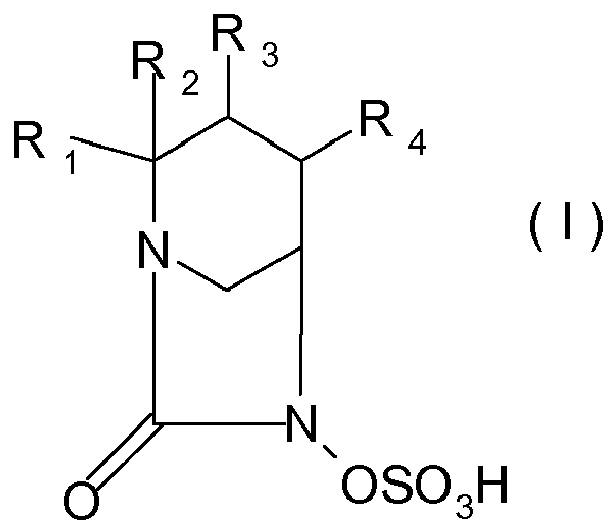 R1 représente un radical (CH2)n-NH2 n étant égal à 1 ou 2;R2 représente un atome d'hydrogène;R3 et R4 forment ensemble un hétérocycle azoté à caractère aromatique à 5 sommets renfermant 1, 2 ou 3 atomes d'azote, substitué sur cet atome d'azote ou sur l'un de ces atomes d'azote par un groupe (CH2)m-(C(O))p-R5, m étant égal à 0, 1, 2 ou 3, p étant égal à 0 ou 1 et R5 représentant un groupe hydroxy, auquel cas p est égal à 1, ou un groupe amino, alkyl(C1-C6) ou dialkyl(C1-C6) amino, ou un hétérocycle azoté à caractère aromatique à 5 ou 6 sommets renfermant 1 ou 2 atomes d'azote et, le cas échéant,un atome d'oxygène ou de soufre ;étant entendu que lorsque le sous-groupe (C(O))p-R5 forme un groupe carboxy, amino, alkyl(C1-C6) ou dialkyl(C1-C6) amino, m est différent de 0 ou 1;
sous forme libre et sous forme de zwitterions et de sels avec les bases et les acides minéraux ou organiques pharmaceutiquement acceptables. - Les composés de formule générale (I) selon la revendication 1, caractérisés en ce que R3 et R4 forment ensemble un radical pyrazolyle substitué.
- Les composés de formule générale (I) selon la revendication 1 ou 2, caractérisés en ce que R1 est un groupement (CH2)n-NH2, n étant égal à 1, et l'hétérocycle formé par R3 et R4 est substitué par un groupement (CH2)m-(C(O))p-R5 tel que défini à la revendication 1.
- Les composés de formule générale (I) selon la revendication 1, 2 ou 3, caractérisés en ce que R5 représente un groupe amino, alkyl(C1-C6) ou dialkyl(C1-C6) amino.
- L'un quelconque des composés de formule générale (I) selon la revendication 1 dont les noms suivent:- la trans 8-(aminométhyl)-2-carbamoyle-4,8-dihydro-5-(sulfooxy)-4,7-méthano-7H-pyrazolo[3,4-e][1,3]diazépin-6(5H)-one,- la trans 8-(aminométhyl)-2-diméthylcarbamoyle-4,8-dihydro-5-(sulfooxy)-4,7-méthano-7H-pyrazolo[3,4-e][1,3]diazépin-6(5H)-one,- la trans 8-(aminométhyl)-2-méthylcarbamoyle-4,8-dihydro-5-(sulfooxy)-4,7-méthano-7H-pyrazolo[3,4-e][1,3]diazépin-6(5H)-one,- la trans 8-(aminométhyl)-1-(2-aminoéthyl)-4,8-dihydro-5-(sulfooxy)-4,7-méthano-7H-pyrazolo[3,4-e][1,3]diazépin-6(5H)-one,- la trans 8-(aminométhyl)-2-(2-aminoéthyl)-4,8-dihydro-5-(sulfooxy)-4,7-méthano-7H-pyrazolo[3,4-e][1,3]diazépin-6(5H)-one,- la trans 8-(aminométhyl)-2-(2-pyridinyl)-4,8-dihydro-5-(sulfooxy)-4,7-méthano-7H-pyrazolo[3,4-e][1,3]diazépin-6(5H)-one,- le trans 8-(aminométhyl)-5,6-dihydro-6-oxo-5-(sulfooxy)-4H-4,7-méthanopyrazolo[3,4-e][1,3]diazépin-2(8H)-acétamide,sous forme libre, de zwitterions et de sels avec les bases et les acides minéraux ou organiques pharmarceutiquement acceptables et sous ses formes énantiomères ou diastéroisomères ou isomères cis ou trans possibles, ou de mélanges.
- Procédé de préparation des composés de formule (I), tel que défini à la revendication 1, caractérisé en ce que l'on traite un composé de formule (II) :

X-(CH2)m-(C(O))p-R'5 (III)
dans laquelle X représente un atome d'halogène ou un groupement OH pouvant être activé, m et p sont tels que définis à la revendication 1 et R'5 représente un radical R5 dans lequel le groupe réactif amino ou carboxy est le cas échéant protégé, pour obtenir un composé de formule (IV):
puis déprotège le radical hydroxy et soumet le composé obtenu à une réaction de sulfatation par action de SO3 complexé, puis, le cas échéant, soumet le composé obtenu à une ou plusieurs des réactions suivantes, dans un ordre approprié :- déprotection de la ou des fonctions aminées et le cas échéant carboxy présentes,- salification,- échange d'ions,- dédoublement ou séparation de diastéréoisomères. - Procédé de préparation des composés de formule (I) dans lesquels m est égal à 0, p est égal à 1 et R5 représente R''5, R''5 représentant un groupe amino, alkyl(C1-C6) ou dialkyl (C1-C6) amino, caractérisé en ce que l'on traite un composé de formule (II) telle que définie à la revendication 6, en présence d'une base, par le diphosgène, puis par une amine de formule
H-R''5
dans laquelle R''5 est tel que défini ci-dessus, pour obtenir un composé de formule (IV') :
- A titre de médicaments, les composés tels que définis à l'une quelconque des revendications 1 à 4, ainsi que leurs sels avec les acides et les bases pharmaceutiquement acceptables.
- A titre de médicaments, les composés tels que définis à la revendication 5.
- Compositions pharmaceutiques contenant, à titre de principe actif, au moins un médicament selon l'une des revendications 8 ou 9.
Applications Claiming Priority (2)
| Application Number | Priority Date | Filing Date | Title |
|---|---|---|---|
| FR0805472A FR2936798B1 (fr) | 2008-10-03 | 2008-10-03 | Nouveaux composes heterocycliques azotes, leur preparation et leur utilisation comme medicaments antibacteriens. |
| EP09786093A EP2344499A1 (fr) | 2008-10-03 | 2009-08-03 | Nouveaux composes heterocycliques azotes, leur préparation et leur utilisation comme médicaments antibactériens |
Related Parent Applications (1)
| Application Number | Title | Priority Date | Filing Date |
|---|---|---|---|
| EP09786093A Division EP2344499A1 (fr) | 2008-10-03 | 2009-08-03 | Nouveaux composes heterocycliques azotes, leur préparation et leur utilisation comme médicaments antibactériens |
Publications (1)
| Publication Number | Publication Date |
|---|---|
| EP2845855A1 true EP2845855A1 (fr) | 2015-03-11 |
Family
ID=40548019
Family Applications (2)
| Application Number | Title | Priority Date | Filing Date |
|---|---|---|---|
| EP09786093A Withdrawn EP2344499A1 (fr) | 2008-10-03 | 2009-08-03 | Nouveaux composes heterocycliques azotes, leur préparation et leur utilisation comme médicaments antibactériens |
| EP14188601.0A Withdrawn EP2845855A1 (fr) | 2008-10-03 | 2009-08-03 | Nouveaux composés hétérocycliques azotés, leur préparation et leur utilisation comme médicaments antibactériens |
Family Applications Before (1)
| Application Number | Title | Priority Date | Filing Date |
|---|---|---|---|
| EP09786093A Withdrawn EP2344499A1 (fr) | 2008-10-03 | 2009-08-03 | Nouveaux composes heterocycliques azotes, leur préparation et leur utilisation comme médicaments antibactériens |
Country Status (18)
| Country | Link |
|---|---|
| US (1) | US8067435B2 (fr) |
| EP (2) | EP2344499A1 (fr) |
| JP (1) | JP5555240B2 (fr) |
| KR (1) | KR20110067137A (fr) |
| CN (1) | CN102203094B (fr) |
| AU (1) | AU2009299511A1 (fr) |
| BR (1) | BRPI0919810A8 (fr) |
| CA (1) | CA2739503A1 (fr) |
| CL (1) | CL2011000729A1 (fr) |
| CO (1) | CO6361957A2 (fr) |
| EA (1) | EA021799B1 (fr) |
| EC (1) | ECSP11010946A (fr) |
| FR (1) | FR2936798B1 (fr) |
| IL (1) | IL212059A0 (fr) |
| MX (1) | MX2011003573A (fr) |
| PE (1) | PE20110845A1 (fr) |
| WO (1) | WO2010038115A1 (fr) |
| ZA (1) | ZA201102429B (fr) |
Families Citing this family (20)
| Publication number | Priority date | Publication date | Assignee | Title |
|---|---|---|---|---|
| US8772490B2 (en) | 2010-12-22 | 2014-07-08 | Meiji Seika Pharma Co., Ltd. | Optically active diazabicyclooctane derivatives and process for preparing the same |
| KR101618424B1 (ko) | 2011-08-30 | 2016-05-04 | 욱크하르트 리미티드 | 1,6-디아자비시클로[3,2,1]옥탄-7-온 유도체 및 세균 감염 치료에서의 그 유도체의 용도 |
| BR112014003476A2 (pt) * | 2011-09-13 | 2017-03-01 | Wockhardt Ltd | compostos contendo nitrogênio e seu uso |
| MX2014011825A (es) * | 2012-03-30 | 2015-02-20 | Cubist Pharm Inc | INHIBIDORES DE ISOXAZOL ß-LACTAMASA. |
| AR090539A1 (es) | 2012-04-02 | 2014-11-19 | Astrazeneca Ab | COMPUESTOS INHIBIDORES DE b LACTAMASA |
| AR091222A1 (es) | 2012-05-30 | 2015-01-21 | Meiji Seika Pharma Co Ltd | INHIBIDOR DE b-LACTAMASA Y PROCESO PARA PREPARARLO |
| CA2881169C (fr) * | 2012-08-25 | 2020-06-16 | Wockhardt Limited | Derives de 1,6-diazabicyclo[3,2,1]octan-7-one et leur utilisation dans le traitement d'infections bacteriennes |
| KR102239725B1 (ko) | 2013-09-24 | 2021-04-12 | 메이지 세이카 파루마 가부시키가이샤 | 디아자비시클로옥탄 유도체의 제조법과 그의 중간체 |
| MY199066A (en) | 2013-10-08 | 2023-10-12 | Meiji Seika Pharma Co Ltd | Processes for producing diazabicyclooctane compounds |
| EP3055311B1 (fr) * | 2013-10-11 | 2017-08-09 | Wockhardt Limited | Composés azotés et leur utilisation |
| BR112017010132B1 (pt) | 2014-11-17 | 2023-02-14 | Entasis Therapeutics Limited | Combinações e seus usos no tratamento de infecções bacterianas resistentes |
| BR112017010445B8 (pt) | 2014-12-05 | 2024-02-27 | Meiji Seika Pharma Co Ltd | Processo de produção de cristais de derivado de diazabiciclo-octano e preparação liofilizada estável |
| WO2016156348A1 (fr) | 2015-03-31 | 2016-10-06 | Mutabilis | Nouveaux composés hétérocycliques et utilisation de ceux-ci pour prévenir ou traiter des infections bactériennes |
| EP3075733A1 (fr) * | 2015-03-31 | 2016-10-05 | Mutabilis | Nouveaux composés hétérocycliques et leur utilisation dans la prévention ou le traitement d'infections bactériennes |
| RU2714197C2 (ru) | 2015-04-03 | 2020-02-13 | Мутабилис | Гетероциклические соединения и их применение для предупреждения или лечения бактериальных инфекций |
| CA3000087A1 (fr) | 2015-10-02 | 2017-04-06 | Legochem Biosciences, Inc. | Compositions et methodes pour inhiber la beta-lactamase |
| CA3036557A1 (fr) | 2016-09-16 | 2018-03-22 | Entasis Therapeutics Limited | Composes inhibiteurs de beta-lactamase |
| PL3630111T3 (pl) | 2017-05-08 | 2022-05-23 | Entasis Therapeutics, Inc. | Związki i sposoby leczenia zakażeń bakteryjnych |
| EP3604315A1 (fr) | 2018-07-30 | 2020-02-05 | Mutabilis | Nouveaux composés hétérocycliques et leur utilisation dans la prévention ou le traitement d'infections bactériennes |
| CN119998293A (zh) * | 2023-08-08 | 2025-05-13 | 成都四面体药物研究有限公司 | 一种含脲三环的β-内酰胺酶抑制剂、其制备方法及其用途 |
Citations (2)
| Publication number | Priority date | Publication date | Assignee | Title |
|---|---|---|---|---|
| WO2002100860A2 (fr) | 2001-06-08 | 2002-12-19 | Aventis Pharma S.A. | Composes heterocycliques, leur preparation et leur utilisation comme medicaments, notamment comme anti-bacteriens |
| WO2004052891A1 (fr) | 2002-12-06 | 2004-06-24 | Aventis Pharma S.A. | Composes heterocyclique, leur preparation et leur utilisation comme medicaments, notamment comme anti-bacteriens et inhibiteurs de beta-lactamases |
Family Cites Families (16)
| Publication number | Priority date | Publication date | Assignee | Title |
|---|---|---|---|---|
| US6387928B1 (en) * | 1997-09-15 | 2002-05-14 | The Procter & Gamble Co. | Antimicrobial quinolones, their compositions and uses |
| ES2321042T3 (es) * | 1997-09-15 | 2009-06-01 | THE PROCTER & GAMBLE COMPANY | Quinolonas antimicrobianas, composiciones y usos de las mismas. |
| FR2812635B1 (fr) | 2000-08-01 | 2002-10-11 | Aventis Pharma Sa | Nouveaux composes heterocycliques, preparation et utilisation comme medicaments notamment comme anti- bacteriens |
| NZ525571A (en) * | 2000-12-14 | 2004-09-24 | Procter & Gamble | Antimicrobial quinolones |
| JP2004515549A (ja) * | 2000-12-14 | 2004-05-27 | ザ プロクター アンド ギャンブル カンパニー | 抗微生物2−ピリドン類、その組成物と使用 |
| FR2833596B1 (fr) * | 2001-12-14 | 2005-02-18 | Aventis Pharma Sa | Procede de preparation de derives d'echinocandine |
| FR2835186B1 (fr) * | 2002-01-28 | 2006-10-20 | Aventis Pharma Sa | Nouveaux composes heterocycliques, actifs comme inhibiteurs de beta-lactamases |
| US6900224B2 (en) * | 2002-07-31 | 2005-05-31 | The Procter & Gamble Company | Antimicrobial quinolones, their compositions and uses |
| FR2844273B1 (fr) | 2002-09-05 | 2008-04-04 | Aventis Pharma Sa | Nouveaux composes heterocycliques, procede et intermediaires de preparation et utilisation comme medicament, notamment comme inhibiteurs de beta-lactamases et anti-bacteriens. |
| FR2844270B1 (fr) * | 2002-09-11 | 2006-05-19 | Aventis Pharma Sa | Derives de la quinolyl propyl piperidine, leur procede et intermediaires de preparation et les compositions qui les contiennent |
| FR2844268B1 (fr) * | 2002-09-11 | 2004-10-22 | Aventis Pharma Sa | Derives de la quinolyl propyl piperidine, leurs procedes et intermediaires de preparation et les compositions qui les contiennent |
| US7439253B2 (en) * | 2002-12-06 | 2008-10-21 | Novexel | Heterocyclic compounds, their preparation and their use as medicaments, in particular as antibacterials and beta-lactamase inhibitors |
| US7232833B2 (en) * | 2003-03-28 | 2007-06-19 | Novexel | 4-substituted quinoline derivatives, method and intermediates for their preparation and pharmaceutical compositions containing them |
| US7449481B2 (en) * | 2004-04-13 | 2008-11-11 | Cephalon, Inc. | Thio-substituted biaryl-methanesulfinyl derivatives |
| FR2914923B1 (fr) * | 2007-04-12 | 2013-06-14 | Novexel | Nouveaux composes heterocycliques azotes,leur preparation et leur utilisation comme medicaments antibacteriens. |
| FR2937034B1 (fr) * | 2008-10-10 | 2012-11-23 | Novexel | Nouveaux composes heterocycliques azotes, leur preparation et leur utilisation comme medicaments antibacteriens |
-
2008
- 2008-10-03 FR FR0805472A patent/FR2936798B1/fr not_active Expired - Fee Related
-
2009
- 2009-08-03 AU AU2009299511A patent/AU2009299511A1/en not_active Abandoned
- 2009-08-03 BR BRPI0919810A patent/BRPI0919810A8/pt not_active IP Right Cessation
- 2009-08-03 WO PCT/IB2009/006433 patent/WO2010038115A1/fr not_active Ceased
- 2009-08-03 EA EA201170522A patent/EA021799B1/ru not_active IP Right Cessation
- 2009-08-03 CA CA2739503A patent/CA2739503A1/fr not_active Abandoned
- 2009-08-03 PE PE2011000827A patent/PE20110845A1/es not_active Application Discontinuation
- 2009-08-03 CN CN200980141781.3A patent/CN102203094B/zh not_active Expired - Fee Related
- 2009-08-03 KR KR1020117009615A patent/KR20110067137A/ko not_active Ceased
- 2009-08-03 EP EP09786093A patent/EP2344499A1/fr not_active Withdrawn
- 2009-08-03 JP JP2011529643A patent/JP5555240B2/ja not_active Expired - Fee Related
- 2009-08-03 MX MX2011003573A patent/MX2011003573A/es active IP Right Grant
- 2009-08-03 EP EP14188601.0A patent/EP2845855A1/fr not_active Withdrawn
- 2009-08-05 US US12/536,096 patent/US8067435B2/en not_active Expired - Fee Related
-
2011
- 2011-03-30 ZA ZA2011/02429A patent/ZA201102429B/en unknown
- 2011-03-31 IL IL212059A patent/IL212059A0/en unknown
- 2011-04-01 CL CL2011000729A patent/CL2011000729A1/es unknown
- 2011-04-01 CO CO11040684A patent/CO6361957A2/es active IP Right Grant
- 2011-04-01 EC EC2011010946A patent/ECSP11010946A/es unknown
Patent Citations (2)
| Publication number | Priority date | Publication date | Assignee | Title |
|---|---|---|---|---|
| WO2002100860A2 (fr) | 2001-06-08 | 2002-12-19 | Aventis Pharma S.A. | Composes heterocycliques, leur preparation et leur utilisation comme medicaments, notamment comme anti-bacteriens |
| WO2004052891A1 (fr) | 2002-12-06 | 2004-06-24 | Aventis Pharma S.A. | Composes heterocyclique, leur preparation et leur utilisation comme medicaments, notamment comme anti-bacteriens et inhibiteurs de beta-lactamases |
Also Published As
| Publication number | Publication date |
|---|---|
| JP2012504593A (ja) | 2012-02-23 |
| EP2344499A1 (fr) | 2011-07-20 |
| FR2936798A1 (fr) | 2010-04-09 |
| CO6361957A2 (es) | 2012-01-20 |
| CL2011000729A1 (es) | 2012-07-06 |
| CN102203094A (zh) | 2011-09-28 |
| FR2936798B1 (fr) | 2012-09-28 |
| JP5555240B2 (ja) | 2014-07-23 |
| WO2010038115A1 (fr) | 2010-04-08 |
| ZA201102429B (en) | 2012-05-30 |
| US20100087648A1 (en) | 2010-04-08 |
| BRPI0919810A8 (pt) | 2017-12-12 |
| BRPI0919810A2 (pt) | 2017-10-31 |
| KR20110067137A (ko) | 2011-06-21 |
| CN102203094B (zh) | 2014-04-02 |
| PE20110845A1 (es) | 2011-11-17 |
| EA021799B1 (ru) | 2015-09-30 |
| MX2011003573A (es) | 2011-08-12 |
| AU2009299511A1 (en) | 2010-04-08 |
| ECSP11010946A (es) | 2011-05-31 |
| EA201170522A1 (ru) | 2011-12-30 |
| IL212059A0 (en) | 2011-06-30 |
| CA2739503A1 (fr) | 2010-04-08 |
| US8067435B2 (en) | 2011-11-29 |
Similar Documents
| Publication | Publication Date | Title |
|---|---|---|
| EP2344499A1 (fr) | Nouveaux composes heterocycliques azotes, leur préparation et leur utilisation comme médicaments antibactériens | |
| EP2146994B1 (fr) | Composes heterocycliques azotes, leur preparation et leur utilisation comme medicaments antibacteriens | |
| EP2853534A1 (fr) | Nouveaux composés hétérocycliques azotes, leur préparation et leur utilisation comme médicaments antibactériens | |
| EP1569935B1 (fr) | Composes heterocycliques, leur preparation et leur utilisation comme medicaments, notamment comme anti-bacteriens et inhibiteurs de beta-lactamases | |
| FR2936951A1 (fr) | Nouvelles combinaisons de composes heterocycliques azotes antibacteriens avec d'autres composes antibacteriens et leur utilisation comme medicaments | |
| EP0708774B1 (fr) | DERIVES D'IMIDAZO[1,2-a]PYRAZIN-4-ONE ANTAGONISTES DES RECEPTEURS AMPA ET NMDA | |
| CH655317A5 (fr) | Derives de l'acide 3-amino 2-oxo azetidine 1-sulfonique, leur preparation, medicaments et compositions les renfermant. | |
| FR2726275A1 (fr) | Spiro heterocycle-imidazo(1,2-a)indeno(1,2-e)pyrazine)-4'- ones, leur preparation et les medicaments les contenants | |
| EP0379412A1 (fr) | Dérivés de benzonaphtyridine-1,8 leur préparation et les compositions qui les contiennent | |
| EP0752992B1 (fr) | DERIVES D'IMIDAZO[1,2-a]INDENO[1,2-e]PYRAZIN-4-ONE ET COMPOSITIONS PHARMACEUTIQUES LES CONTENANT | |
| EP1001944B1 (fr) | Derives de pyrazine, leur preparation et les medicaments les contenant | |
| EP0772615B1 (fr) | DERIVES D'ACIDE IMIDAZO[1,2-a]INDENO[1,2-e]PYRAZINE-2-CARBOXYLIQUE, LEUR PREPARATION ET LES MEDICAMENTS LES CONTENANT | |
| EP0133096B1 (fr) | Nouveaux dérivés de synergistines, leur préparation et les compositions pharmaceutiques qui les contiennent | |
| EP0234971A1 (fr) | Nouveaux amides substitues, leur preparation et les compositions pharmaceutiques qui les contiennent | |
| EP0269512B1 (fr) | Dérivés des céphalosporines à pharmacocinétique améliorée, procédé pour leur préparation et compositions pharmaceutiques les contenant | |
| LU84887A1 (fr) | Antibiotiques de la nature des cephalosporines et leur procede de preparation | |
| FR2796949A1 (fr) | Derives de streptogramines, leur preparation et les compositions qui les contiennent | |
| EP1353929B1 (fr) | Derives de streptogramines, leur preparation et les compositions qui les contiennent | |
| CA2431557C (fr) | Derives de streptogramines, leur preparation et les compositions qui les contiennent | |
| HK1162466A (en) | Nitrogenous heterocyclic compounds, preparation thereof and use thereof as antibacterial medicaments | |
| HK1162466B (en) | Nitrogenous heterocyclic compounds, preparation thereof and use thereof as antibacterial medicaments |
Legal Events
| Date | Code | Title | Description |
|---|---|---|---|
| 17P | Request for examination filed |
Effective date: 20141013 |
|
| AC | Divisional application: reference to earlier application |
Ref document number: 2344499 Country of ref document: EP Kind code of ref document: P |
|
| AK | Designated contracting states |
Kind code of ref document: A1 Designated state(s): AT BE BG CH CY CZ DE DK EE ES FI FR GB GR HR HU IE IS IT LI LT LU LV MC MK MT NL NO PL PT RO SE SI SK SM TR |
|
| AX | Request for extension of the european patent |
Extension state: AL BA RS |
|
| PUAI | Public reference made under article 153(3) epc to a published international application that has entered the european phase |
Free format text: ORIGINAL CODE: 0009012 |
|
| STAA | Information on the status of an ep patent application or granted ep patent |
Free format text: STATUS: THE APPLICATION IS DEEMED TO BE WITHDRAWN |
|
| 18D | Application deemed to be withdrawn |
Effective date: 20150912 |