EP2875019B1 - Matériaux pour dispositifs électroluminescents organiques - Google Patents
Matériaux pour dispositifs électroluminescents organiques Download PDFInfo
- Publication number
- EP2875019B1 EP2875019B1 EP13732363.0A EP13732363A EP2875019B1 EP 2875019 B1 EP2875019 B1 EP 2875019B1 EP 13732363 A EP13732363 A EP 13732363A EP 2875019 B1 EP2875019 B1 EP 2875019B1
- Authority
- EP
- European Patent Office
- Prior art keywords
- group
- substituted
- radicals
- atoms
- occurrence
- Prior art date
- Legal status (The legal status is an assumption and is not a legal conclusion. Google has not performed a legal analysis and makes no representation as to the accuracy of the status listed.)
- Active
Links
- 0 CC(C(*)=C1I)(C(I)=C(*)c2c1[n]c1c2c(I)c(*)c(*)c1*)[Al]c1nc(*)nc(*)n1 Chemical compound CC(C(*)=C1I)(C(I)=C(*)c2c1[n]c1c2c(I)c(*)c(*)c1*)[Al]c1nc(*)nc(*)n1 0.000 description 4
- IMXAAVQSVZWWEZ-UHFFFAOYSA-N Bc1cccc(-c2nc(-c3ccccc3)nc(-c3ccccc3)n2)c1 Chemical compound Bc1cccc(-c2nc(-c3ccccc3)nc(-c3ccccc3)n2)c1 IMXAAVQSVZWWEZ-UHFFFAOYSA-N 0.000 description 1
- ICDMENBLHJJFJX-UHFFFAOYSA-N Brc(c(-c1ccccc1)c1)ccc1-c(cc1)cc(c2ccccc22)c1[n]2-c1ccccc1 Chemical compound Brc(c(-c1ccccc1)c1)ccc1-c(cc1)cc(c2ccccc22)c1[n]2-c1ccccc1 ICDMENBLHJJFJX-UHFFFAOYSA-N 0.000 description 1
- XTOBLVABXBHCGH-UHFFFAOYSA-N Brc(cc1)cc(-c2ccccc2)c1-c(cc1)cc(c2ccccc22)c1[n]2-c1ccccc1 Chemical compound Brc(cc1)cc(-c2ccccc2)c1-c(cc1)cc(c2ccccc22)c1[n]2-c1ccccc1 XTOBLVABXBHCGH-UHFFFAOYSA-N 0.000 description 1
- MSTJGWCHJCZPEQ-UHFFFAOYSA-N Brc(cccc1)c1-c1nc(-c2ccccc2)nc(-c2ccccc2)n1 Chemical compound Brc(cccc1)c1-c1nc(-c2ccccc2)nc(-c2ccccc2)n1 MSTJGWCHJCZPEQ-UHFFFAOYSA-N 0.000 description 1
- MKNGQVNVYAIGHL-UHFFFAOYSA-N Clc1nc(-c2cc(-c3ccccc3)cc(-c3ccccc3)c2)nc(-c2cc(-c3ccccc3)cc(-c3ccccc3)c2)n1 Chemical compound Clc1nc(-c2cc(-c3ccccc3)cc(-c3ccccc3)c2)nc(-c2cc(-c3ccccc3)cc(-c3ccccc3)c2)n1 MKNGQVNVYAIGHL-UHFFFAOYSA-N 0.000 description 1
- PLLZAAHTCWGQFW-UHFFFAOYSA-N c(cc1)ccc1-c1nc(-c(cc2)ccc2-c2cccc(-c(cc3)cc(c4ccccc44)c3[n]4-c3ccccc3)c2)nc(-c2ccccc2)n1 Chemical compound c(cc1)ccc1-c1nc(-c(cc2)ccc2-c2cccc(-c(cc3)cc(c4ccccc44)c3[n]4-c3ccccc3)c2)nc(-c2ccccc2)n1 PLLZAAHTCWGQFW-UHFFFAOYSA-N 0.000 description 1
Classifications
-
- H—ELECTRICITY
- H10—SEMICONDUCTOR DEVICES; ELECTRIC SOLID-STATE DEVICES NOT OTHERWISE PROVIDED FOR
- H10K—ORGANIC ELECTRIC SOLID-STATE DEVICES
- H10K85/00—Organic materials used in the body or electrodes of devices covered by this subclass
- H10K85/60—Organic compounds having low molecular weight
- H10K85/649—Aromatic compounds comprising a hetero atom
- H10K85/657—Polycyclic condensed heteroaromatic hydrocarbons
- H10K85/6572—Polycyclic condensed heteroaromatic hydrocarbons comprising only nitrogen in the heteroaromatic polycondensed ring system, e.g. phenanthroline or carbazole
-
- C—CHEMISTRY; METALLURGY
- C07—ORGANIC CHEMISTRY
- C07D—HETEROCYCLIC COMPOUNDS
- C07D403/00—Heterocyclic compounds containing two or more hetero rings, having nitrogen atoms as the only ring hetero atoms, not provided for by group C07D401/00
- C07D403/02—Heterocyclic compounds containing two or more hetero rings, having nitrogen atoms as the only ring hetero atoms, not provided for by group C07D401/00 containing two hetero rings
- C07D403/10—Heterocyclic compounds containing two or more hetero rings, having nitrogen atoms as the only ring hetero atoms, not provided for by group C07D401/00 containing two hetero rings linked by a carbon chain containing aromatic rings
-
- C—CHEMISTRY; METALLURGY
- C07—ORGANIC CHEMISTRY
- C07D—HETEROCYCLIC COMPOUNDS
- C07D209/00—Heterocyclic compounds containing five-membered rings, condensed with other rings, with one nitrogen atom as the only ring hetero atom
- C07D209/56—Ring systems containing three or more rings
- C07D209/80—[b, c]- or [b, d]-condensed
- C07D209/82—Carbazoles; Hydrogenated carbazoles
-
- C—CHEMISTRY; METALLURGY
- C07—ORGANIC CHEMISTRY
- C07D—HETEROCYCLIC COMPOUNDS
- C07D251/00—Heterocyclic compounds containing 1,3,5-triazine rings
- C07D251/02—Heterocyclic compounds containing 1,3,5-triazine rings not condensed with other rings
- C07D251/12—Heterocyclic compounds containing 1,3,5-triazine rings not condensed with other rings having three double bonds between ring members or between ring members and non-ring members
-
- C—CHEMISTRY; METALLURGY
- C07—ORGANIC CHEMISTRY
- C07D—HETEROCYCLIC COMPOUNDS
- C07D403/00—Heterocyclic compounds containing two or more hetero rings, having nitrogen atoms as the only ring hetero atoms, not provided for by group C07D401/00
- C07D403/14—Heterocyclic compounds containing two or more hetero rings, having nitrogen atoms as the only ring hetero atoms, not provided for by group C07D401/00 containing three or more hetero rings
-
- C—CHEMISTRY; METALLURGY
- C07—ORGANIC CHEMISTRY
- C07D—HETEROCYCLIC COMPOUNDS
- C07D405/00—Heterocyclic compounds containing both one or more hetero rings having oxygen atoms as the only ring hetero atoms, and one or more rings having nitrogen as the only ring hetero atom
- C07D405/14—Heterocyclic compounds containing both one or more hetero rings having oxygen atoms as the only ring hetero atoms, and one or more rings having nitrogen as the only ring hetero atom containing three or more hetero rings
-
- C—CHEMISTRY; METALLURGY
- C09—DYES; PAINTS; POLISHES; NATURAL RESINS; ADHESIVES; COMPOSITIONS NOT OTHERWISE PROVIDED FOR; APPLICATIONS OF MATERIALS NOT OTHERWISE PROVIDED FOR
- C09K—MATERIALS FOR MISCELLANEOUS APPLICATIONS, NOT PROVIDED FOR ELSEWHERE
- C09K11/00—Luminescent materials, e.g. electroluminescent or chemiluminescent
- C09K11/02—Use of particular materials as binders, particle coatings or suspension media therefor
- C09K11/025—Use of particular materials as binders, particle coatings or suspension media therefor non-luminescent particle coatings or suspension media
-
- C—CHEMISTRY; METALLURGY
- C09—DYES; PAINTS; POLISHES; NATURAL RESINS; ADHESIVES; COMPOSITIONS NOT OTHERWISE PROVIDED FOR; APPLICATIONS OF MATERIALS NOT OTHERWISE PROVIDED FOR
- C09K—MATERIALS FOR MISCELLANEOUS APPLICATIONS, NOT PROVIDED FOR ELSEWHERE
- C09K11/00—Luminescent materials, e.g. electroluminescent or chemiluminescent
- C09K11/06—Luminescent materials, e.g. electroluminescent or chemiluminescent containing organic luminescent materials
-
- H—ELECTRICITY
- H10—SEMICONDUCTOR DEVICES; ELECTRIC SOLID-STATE DEVICES NOT OTHERWISE PROVIDED FOR
- H10K—ORGANIC ELECTRIC SOLID-STATE DEVICES
- H10K50/00—Organic light-emitting devices
-
- H—ELECTRICITY
- H10—SEMICONDUCTOR DEVICES; ELECTRIC SOLID-STATE DEVICES NOT OTHERWISE PROVIDED FOR
- H10K—ORGANIC ELECTRIC SOLID-STATE DEVICES
- H10K85/00—Organic materials used in the body or electrodes of devices covered by this subclass
- H10K85/60—Organic compounds having low molecular weight
- H10K85/649—Aromatic compounds comprising a hetero atom
- H10K85/654—Aromatic compounds comprising a hetero atom comprising only nitrogen as heteroatom
-
- H—ELECTRICITY
- H10—SEMICONDUCTOR DEVICES; ELECTRIC SOLID-STATE DEVICES NOT OTHERWISE PROVIDED FOR
- H10K—ORGANIC ELECTRIC SOLID-STATE DEVICES
- H10K85/00—Organic materials used in the body or electrodes of devices covered by this subclass
- H10K85/60—Organic compounds having low molecular weight
- H10K85/649—Aromatic compounds comprising a hetero atom
- H10K85/657—Polycyclic condensed heteroaromatic hydrocarbons
- H10K85/6574—Polycyclic condensed heteroaromatic hydrocarbons comprising only oxygen in the heteroaromatic polycondensed ring system, e.g. cumarine dyes
-
- H—ELECTRICITY
- H10—SEMICONDUCTOR DEVICES; ELECTRIC SOLID-STATE DEVICES NOT OTHERWISE PROVIDED FOR
- H10K—ORGANIC ELECTRIC SOLID-STATE DEVICES
- H10K50/00—Organic light-emitting devices
- H10K50/10—OLEDs or polymer light-emitting diodes [PLED]
- H10K50/14—Carrier transporting layers
- H10K50/16—Electron transporting layers
-
- Y—GENERAL TAGGING OF NEW TECHNOLOGICAL DEVELOPMENTS; GENERAL TAGGING OF CROSS-SECTIONAL TECHNOLOGIES SPANNING OVER SEVERAL SECTIONS OF THE IPC; TECHNICAL SUBJECTS COVERED BY FORMER USPC CROSS-REFERENCE ART COLLECTIONS [XRACs] AND DIGESTS
- Y02—TECHNOLOGIES OR APPLICATIONS FOR MITIGATION OR ADAPTATION AGAINST CLIMATE CHANGE
- Y02E—REDUCTION OF GREENHOUSE GAS [GHG] EMISSIONS, RELATED TO ENERGY GENERATION, TRANSMISSION OR DISTRIBUTION
- Y02E10/00—Energy generation through renewable energy sources
- Y02E10/50—Photovoltaic [PV] energy
- Y02E10/549—Organic PV cells
Definitions
- the present invention describes carbazole derivatives, especially for use as triplet matrix materials in organic electroluminescent devices.
- the invention further relates to a process for the preparation of the compounds according to the invention and electronic devices containing these compounds.
- OLEDs organic electroluminescent devices
- OLEDs organic electroluminescent devices
- US Pat US 4539507 US 5151629 .
- EP 0676461 and WO 98/27136 described.
- organometallic complexes which exhibit phosphorescence instead of fluorescence.
- organometallic compounds for quantum mechanical reasons, up to four times energy and power efficiency is possible using organometallic compounds as phosphorescence emitters.
- the properties of phosphorescent OLEDs are not only determined by the triplet emitters used.
- the other materials used such as matrix materials of particular importance. Improvements to these materials can thus also lead to significant improvements in the OLED properties.
- indolocarbazole derivatives for example according to US Pat WO 2007/063754 or WO 2008/056746
- indenocarbazole derivatives eg according to WO 2010/136109 or WO 2011/000455
- bisdibenzofuran derivatives for example according to US Pat EP 2301926
- matrix materials for phosphorescent emitters there is still room for improvement when using these matrix materials, in particular in terms of efficiency, life and operating voltage of the device.
- the object of the present invention is to provide compounds which are suitable for use in a fluorescent or in particular in a phosphorescent OLED, in particular as a matrix material.
- the properties of the matrix materials have a significant influence on the life and the efficiency of the organic electroluminescent device.
- a triphenylene derivative which is substituted with a carbazole group and a diphenyltriazine group.
- the characterizing feature of this compound is the presence of the triphenylene group.
- Compounds which do not have triphenylene are not disclosed.
- Carbazole-arylene-triazine derivatives which are substituted on the triazine with a fluorenyl group.
- the characterizing feature of these compounds is the presence of the fluorenyl group.
- Compounds which do not have a fluorenyl group as a substituent are not disclosed.
- WO 2012/074210 discloses compounds in which a carbazole group and a triazine group are linked together via a fluorene group, the linking being at the 2-position and the 9-position. There are no disclosed compounds in which a carbazole group and a triazine group are linked together via phenylene groups.
- WO 2010/131930 discloses compounds in which a carbazole group and a triazine group are linked together via a 9,9-diphenylfluorene group or a 9-phenylfluorene group. The linkage takes place either via the two phenyl groups of the diphenyl fluorene or via the phenyl group and the 9-position of the phenyl fluorene. There are no disclosed compounds in which a carbazole group and a triazine group are linked together via phenylene groups.
- electroluminescent devices which contain compounds according to the following formula (1) have improvements over the prior art, in particular when used as matrix material for phosphorescent dopants.
- Adjacent substituents in the context of the present invention are substituents which are bonded to carbon atoms which are directly linked to one another. In contrast, substituents which are bonded to different aryl groups are not adjacent substituents in the sense of the present invention.
- the aryl group having 6 to 10 aromatic ring atoms, as defined for Ar 2 , R and R 1 is benzene or naphthalene, preferably benzene. Further preferably, the aromatic ring system, as defined for Ar 1 , contains no condensed aryl groups at all.
- a biaryl group is understood to mean two directly linked aryl groups, for example biphenyl.
- a triaryl group is understood as meaning three aryl groups directly linked to one another, for example terphenyl.
- a quateraryl group means four directly linked aryl groups, for example quaterphenyl. These four aryl groups can be linked to one another linear or branched.
- a fused aryl group is a group in which two or more aromatic groups condense to one another via a common edge, ie. H. are fused, such as in naphthalene.
- fluorene is not a condensed aryl group in the context of the present invention, since in fluorene, the two aromatic groups have no common edge.
- An aromatic ring system in the sense of this invention contains 6 to 24 carbon atoms in the ring system.
- This invention is intended to be understood to mean a system which does not necessarily contain only aryl or heteroaryl groups but in which also several aryl or heteroaryl groups are replaced by a non-aromatic unit (preferably less than 10% of the atoms other than H), such as e.g. As a carbon atom can be connected.
- a non-aromatic unit preferably less than 10% of the atoms other than H
- systems such as fluorene, 9,9'-spirobifluorene, 9,9-diarylfluorene, etc.
- aromatic ring systems in the context of this invention, as well as systems in which two or more aryl groups are connected for example by a short alkyl group , Furthermore, aromatics linked to one another by single bond, for example biphenyl, terphenyl or quaterphenyl, are referred to as the aromatic ring system in the context of this application.
- an aliphatic hydrocarbon radical or an alkyl group or an alkenyl group which may contain 1 to 20 C atoms and in which individual H atoms or CH 2 groups may also be substituted by the abovementioned groups , preferably the radicals methyl, ethyl, n-propyl, i-propyl, n-butyl, i-butyl, s-butyl, t-butyl, 2-methylbutyl, n-pentyl, s-pentyl, cyclopentyl, n-hexyl, Cyclohexyl, n-heptyl, cycloheptyl, n-octyl, cyclooctyl, 2-ethylhexyl, trifluoromethyl, pentafluoroethyl, 2,2,2-trifluoroethyl, ethenyl, propenyl, butenyl
- alkoxy group having 1 to 40 carbon atoms methoxy, trifluoromethoxy, ethoxy, n-propoxy, i-propoxy, n-butoxy, i-butoxy, s-butoxy, t-butoxy, n-pentoxy, s-pentoxy, 2-methylbutoxy, n-hexoxy, cyclohexyloxy, n-heptoxy, cycloheptyloxy, n-octyloxy, cyclooctyloxy, 2-ethylhexyloxy, pentafluoroethoxy and 2,2,2-trifluoroethoxy understood.
- alkyl, alkenyl, alkynyl, alkoxy groups may be straight-chain, branched or cyclic, wherein one or more non-adjacent CH 2 groups may be replaced by the above-mentioned groups; Furthermore, one or more H atoms can also be replaced by D or F.
- At most one group X per cycle stands for N and the remaining groups X stand the same or different for each occurrence for CR 1 . Most preferably, X is the same or different at each occurrence for CR 1 .
- Preferred compounds of the formula (1) are therefore the compounds of the following formula (2) where the symbols and indices used have the abovementioned meanings and the radical R 1 is absent if the group Ar is bonded at this position.
- the group Ar may be attached at the 1, 2, 3 or 4 position of the carbazole. In a preferred embodiment of the present invention, the group Ar is attached in the 1, 2 or 3 position of the carbazole. Preference is therefore given to the compounds of the following formulas (2a), (2b) and (2c), wherein the symbols and indices used have the meanings given above.
- n 1, 2 or 3 and Ar is a phenylene group which may be substituted by one or more radicals R.
- Ar is the same or different each occurrence of a group selected from the following formulas (3), (4) or (5), wherein the dashed bond indicates the linkage of these groups and each of these groups may be substituted by one or more radicals R.
- the group - (Ar) n - is a group selected from the formulas (6) to (18), where the dashed bond in each case indicates the linking of these groups, each of these groups may also be substituted by one or more radicals R and R has the abovementioned meanings.
- the radical R which is bonded to Ar or to the above-described preferred embodiments of Ar, is preferably the same or different in each occurrence selected from the group consisting of H, D, F, CN, phenyl, biphenyl or terphenyl, where each of the aryl groups in the abovementioned groups may be substituted by one or more radicals R 1 and R 1 is preferably the same or different in each occurrence as H or an alkyl group having 1 to 5 C atoms, or a carbazole group linked via a carbon atom, which may also be substituted by one or more radicals R 1 .
- R is particularly preferably selected from the group consisting of H, phenyl, biphenyl or terphenyl or an N-phenylcarbazole group linked via a carbon atom.
- Ar 1 is selected from the group consisting of phenyl, biphenyl, terphenyl or quaterphenyl, which may each be substituted by one or more radicals R 1 .
- Ar 2 is the same or different at each occurrence selected from the group consisting of phenyl, biphenyl, terphenyl or quaterphenyl, which may be substituted by one or more R 1 each.
- each occurrence of R 1 is the same or different selected from the group consisting of H, a straight-chain alkyl group having 1 to 5 C atoms or a branched or cyclic alkyl group having 3 to 5 C atoms, or an aryl group having 6 to 10 C atoms, which may be substituted by one or more radicals R 2 .
- the compounds of the invention can according to the expert known synthesis steps, such as. As bromination, Suzuki coupling, Ullmann coupling, Hartwig-Buchwald coupling, etc., are shown. A suitable method of synthesis is shown generally in Scheme 1 below:
- Another object of the invention is therefore a process for preparing a compound according to the invention, characterized in that the unit (Ar 2 ) 2 triazine (Ar) n is introduced by a Suzuki coupling.
- Another object of the present invention are mixtures containing at least one compound of the invention and at least one further compound.
- the further compound can be, for example, a fluorescent or phosphorescent dopant, if the compound according to the invention is used as matrix material, in particular a phosphorescent dopant. Suitable dopants are listed below in connection with the organic electroluminescent devices and are also preferred for the mixtures according to the invention.
- solutions or formulations of the compounds or mixtures according to the invention are required. It may be preferable to use mixtures of two or more solvents. Suitable and preferred solvents are, for example, toluene, anisole, o-, m- or p-xylene, methyl benzoate, dimethylanisole, mesitylene, tetralin, veratrole, THF, methyl THF, THP, chlorobenzene, dioxane or mixtures of these solvents.
- Another object of the present invention is therefore a formulation, in particular a solution, a suspension or a miniemulsion containing at least one compound or mixture according to the invention and one or more solvents, in particular organic solvents.
- a formulation in particular a solution, a suspension or a miniemulsion containing at least one compound or mixture according to the invention and one or more solvents, in particular organic solvents.
- an electronic device is understood to mean a device which contains at least one layer which contains at least one organic compound.
- the component may also contain inorganic materials or even layers which are completely composed of inorganic materials.
- Another object of the present invention is therefore the use of the compounds or mixtures according to the invention in an electronic device, in particular in an organic electroluminescent device.
- Yet another object of the present invention is an electronic device containing at least one of the compounds or mixtures of the invention outlined above.
- the preferences given above for the connection also apply to the electronic devices.
- the electronic device is preferably selected from the group consisting of organic electroluminescent devices (OLEDs, PLEDs), organic integrated circuits (O-ICs), organic field effect transistors (O-FETs), organic thin-film transistors (O-TFTs), organic light-emitting Transistors (O-LETs), organic solar cells (O-SCs), organic dye-sensitized solar cells, organic optical detectors, organic photoreceptors, organic field quench devices (O-FQDs), light-emitting electrochemical cells (LECs), organic laser diodes ( O-laser) and " organic plasma devices "(DM Koller et al., Nature Photonics 2008, 1-4 ), preferably organic electroluminescent devices (OLEDs, PLEDs), in particular phosphorescent OLEDs.
- OLEDs organic electroluminescent devices
- O-ICs organic integrated circuits
- O-FETs organic field effect transistors
- OF-TFTs organic thin-film transistors
- O-LETs organic
- the organic electroluminescent device includes cathode, anode and at least one emitting layer. In addition to these layers, they may also contain further layers, for example one or more hole injection layers, hole transport layers, hole blocking layers, electron transport layers, electron injection layers, exciton blocking layers, electron blocking layers and / or charge generation layers. Likewise, intermediate layers (interlayers) can be introduced between two emitting layers, which have, for example, an exciton-blocking function. It should be noted, however, that not necessarily each of these layers must be present. In this case, the organic electroluminescent device may contain an emitting layer, or it may contain a plurality of emitting layers.
- emission layers are present, they preferably have a total of a plurality of emission maxima between 380 nm and 750 nm, so that overall white emission results, ie in the emitting layers different emitting compounds are used, which can fluoresce or phosphoresce.
- Particular preference is given to systems having three emitting layers, the three layers exhibiting blue, green and orange or red emission (for the basic structure see, for example, FIG. WO 2005/011013 ).
- These may be fluorescent or phosphorescent emission layers or Hybrid systems that combine fluorescent and phosphorescent emission layers.
- the compound of the invention according to the embodiments listed above can be used in different layers, depending on the exact structure.
- Preference is given to an organic electroluminescent device comprising a compound according to formula (1) or according to the preferred embodiments as matrix material for fluorescent or phosphorescent emitters, in particular for phosphorescent emitters, and / or in an electron transport layer and / or in an electron-blocking or exciton-blocking layer and / or in a hole transport layer, depending on the exact substitution.
- the above-mentioned preferred embodiments also apply to the use of the materials in organic electronic devices.
- the compound according to formula (1) or according to the preferred embodiments is used as matrix material for a fluorescent or phosphorescent compound, in particular for a phosphorescent compound, in an emitting layer.
- the organic electroluminescent device may contain an emitting layer, or it may contain a plurality of emitting layers, wherein at least one emitting layer contains at least one compound according to the invention as matrix material.
- the compound according to formula (1) or according to the preferred embodiments is used as the matrix material for an emitting compound in an emitting layer, it is preferably used in combination with one or more phosphorescent materials (triplet emitters).
- phosphorescent materials triplet emitters
- all luminescent transition metal complexes and luminescent lanthanide complexes, in particular all iridium, Platinum and copper complexes are regarded as phosphorescent compounds.
- the mixture of the compound according to formula (1) or according to the preferred embodiments and the emitting compound contains between 99 and 1 vol.%, Preferably between 98 and 10 vol.%, Particularly preferably between 97 and 60 vol. , In particular between 95 and 80 vol .-% of the compound according to formula (1) or according to the preferred embodiments based on the total mixture of emitter and matrix material. Accordingly, the mixture contains between 1 and 99% by volume, preferably between 2 and 90% by volume, more preferably between 3 and 40% by volume, in particular between 5 and 20% by volume of the emitter, based on the total mixture Emitter and matrix material.
- a further preferred embodiment of the present invention is the use of the compound according to formula (1) or according to the preferred embodiments as a matrix material for a phosphorescent emitter in combination with another matrix material.
- Particularly suitable matrix materials which can be used in combination with the compounds according to formula (1) or according to the preferred embodiments are aromatic ketones, aromatic phosphine oxides or aromatic sulfoxides or sulfones, eg. B. according to WO 2004/013080 . WO 2004/093207 . WO 2006/005627 or WO 2010/006680 , Triarylamines, carbazole derivatives, e.g. B. CBP (N, N-bis-carbazolylbiphenyl) or in WO 2005/039246 .
- EP 1205527 or WO 2008/086851 disclosed carbazole derivatives, indolocarbazole derivatives, e.g. B. according to WO 2007/063754 or WO 2008/056746 , Indenocarbazole derivatives, e.g. B. according to WO 2010/136109 and WO 2011/000455 , Azacarbazolderivate, z. B. according to EP 1617710 . EP 1617711 . EP 1731584 . JP 2005/347160 , bipolar matrix materials, e.g. B. according to WO 2007/137725 , Silane, z. B.
- a further phosphorescent emitter which emits shorter wavelength than the actual emitter, may be present as a co-host in the mixture.
- Suitable phosphorescent compounds are, in particular, compounds which emit light, preferably in the visible range, with suitable excitation and also contain at least one atom of atomic number greater than 20, preferably greater than 38 and less than 84, particularly preferably greater than 56 and less than 80, in particular a metal with this atomic number.
- Preferred phosphorescence emitters used are compounds containing copper, molybdenum, tungsten, rhenium, ruthenium, osmium, rhodium, iridium, palladium, platinum, silver, gold or europium, in particular compounds containing iridium or platinum.
- all luminescent compounds which contain the abovementioned metals are regarded as phosphorescent compounds.
- Examples of the emitters described above can be found in the applications WO 00/70655 .
- WO 2010/031485 .
- WO 2011/066898 Examples of the emitters described above can be found in the applications WO 00/70655 .
- WO 2011/157339 or WO 2012/007086 be removed.
- all phosphorescent complexes used in the prior art for phosphorescent OLEDs and as known to those skilled in the art of organic electroluminescence are suitable, and those skilled in the art may use other phosphorescent complexes without inventive step.
- the organic electroluminescent device according to the invention does not contain a separate hole injection layer and / or hole transport layer and / or hole blocking layer and / or electron transport layer, ie the emitting layer directly adjoins the hole injection layer or the anode, and / or the emitting layer directly adjoins the electron transport layer or the electron injection layer or the cathode, such as in WO 2005/053051 described.
- a metal complex which is the same or similar to the metal complex in the emitting layer, directly adjacent to the emitting layer as a hole-transporting or hole-injection material, such as. In WO 2009/030981 described.
- the compounds according to the invention in a hole transport layer or in a hole injection layer or in an exciton or electron blocking layer.
- an organic electroluminescent device characterized in that one or more layers are coated with a sublimation process.
- the materials are vapor-deposited in vacuum sublimation systems at an initial pressure of less than 10 -5 mbar, preferably less than 10 -6 mbar. But it is also possible that the initial pressure is even lower or higher, for example less than 10 -7 mbar.
- an organic electroluminescent device characterized in that one or more layers with the OVPD (Organic Vapor Phase Deposition) method or with the aid of a Carrier gas sublimation are coated.
- the materials are applied at a pressure between 10 -5 mbar and 1 bar.
- OVJP Organic Vapor Jet Printing
- the materials are applied directly through a nozzle and thus structured (eg. MS Arnold et al., Appl. Phys. Lett. 2008, 92, 053301 ).
- an organic electroluminescent device characterized in that one or more layers of solution, such. B. by spin coating, or with any printing process, such.
- ink-jet printing ink jet printing
- LITI Light Induced Thermal Imaging, thermal transfer printing
- screen printing flexographic printing
- offset printing Nozzle-Printing
- soluble compounds are necessary, which are obtained for example by suitable substitution.
- hybrid processes are possible in which, for example, one or more layers are applied from solution and one or more further layers are vapor-deposited.
- one or more layers are applied from solution and one or more further layers are vapor-deposited.
- reaction mixture is mixed with 150 mL of HCl, the aqueous phase extracted three times with dichloromethane. The combined organic phases are washed with water and dried over Na 2 SO 4 and concentrated. The residue is recrystallized from toluene. The yield is 6.8 g (9.4 mmol, 28%).
- Starting material 1 Starting material 2 product yield 6a 79% 6b 81% 6c 83% 6d 77% 6e 88% 6f 76% 6g 73% 6h 88% 6i 76% 6y 72% 6k 89% 6l 77% 6m 85% 6n 76% 6o 68% 6p 78% 6q 69% 6r 84% 6s 80% 6t 79% 6u 69%
- inventive OLEDs and OLEDs according to the prior art is carried out according to a general method according to WO 04/058911 , which is adapted to the conditions described here (layer thickness variation, materials).
- the OLEDs have in principle the following layer structure: substrate / hole transport layer (HTL) / intermediate layer (IL) / electron blocker layer (EBL) / emission layer (EML) / optional hole blocking layer (HBL) / electron transport layer (ETL) / optional electron injection layer (EIL) and finally a cathode.
- the cathode is formed by a 100 nm thick aluminum layer.
- Table 1 The exact structure of the OLEDs is shown in Table 1.
- the materials needed to make the OLEDs are shown in Table 3.
- a designation such as "6a" refers to the material mentioned in example 6a described above. This applies analogously to all other compounds of the invention.
- the emission layer always consists of at least one matrix material (host material, host material) and an emitting dopant (dopant, emitter), which is admixed to the matrix material or the matrix materials by co-evaporation in a specific volume fraction.
- the electron transport layer may consist of a mixture of two materials.
- the OLEDs are characterized by default.
- the electroluminescence spectra are determined at a luminance of 1000 cd / m 2 and from this the CIE 1931 x and y color coordinates are calculated.
- the indication U1000 in Table 2 denotes the voltage required for luminance of 1000 cd / m 2.
- SE1000 and LE1000 indicate the power efficiency achieved at 1000 cd / m 2 .
- EQE1000 refers to external quantum efficiency at an operating luminance of 1000 cd / m 2 .
- the lifetime LD is defined as the time after which the luminance drops from the start luminance L0 to a certain amount L1 during operation with a constant current.
- the data of the different OLEDs are summarized in Table 2.
- the examples V1-V6 are OLEDs containing materials according to the prior art
- the examples E1-E17 show data of OLEDs with materials according to the invention.
- the inventive material 6n in combination with VCbz1 gives about 30% improved lifetime and about 20% higher power efficiency over using H2 with VCbz1 (Examples V4 and E10) ).
- the materials according to the invention When used as matrix materials in phosphorescent OLEDs, the materials according to the invention thus provide significant improvements over the prior art.
Landscapes
- Chemical & Material Sciences (AREA)
- Organic Chemistry (AREA)
- Engineering & Computer Science (AREA)
- Materials Engineering (AREA)
- Physics & Mathematics (AREA)
- Spectroscopy & Molecular Physics (AREA)
- Optics & Photonics (AREA)
- Electroluminescent Light Sources (AREA)
- Plural Heterocyclic Compounds (AREA)
- Indole Compounds (AREA)
Claims (16)
- Composé de la formule (1) :
 X est pour chaque occurrence, de manière identique ou différente, CR1 ou N ; ou X est C si le groupe Ar est lié au niveau de cette position ;Ar est pour chaque occurrence, de manière identique ou différente, un groupe phénylène, lequel peut être substitué par un radical ou plusieurs radicaux R ;Ar1 est un système de cycle aromatique comportant 6 à 24 atomes de cycle aromatique, lequel ne contient pas de groupes aryle condensés comportant plus de 10 atomes de cycle aromatique et lequel peut être substitué par un radical ou plusieurs radicaux R1, ou est un groupe dibenzofurane ou dibenzothiophène, dont chacun peut être substitué par un radical ou plusieurs radicaux R1 ;Ar2 est pour chaque occurrence, de manière identique ou différente, un groupe aryle, un groupe biaryle, un groupe triaryle ou un groupe quateraryle, où chaque groupe individuel des groupes aryle dans les groupes mentionnés ci avant comporte 6 à 10 atomes de cycle aromatique et peut être substitué par un radical ou plusieurs radicaux R1, ou est un groupe dibenzofurane ou dibenzothiophène, dont chacun peut être substitué par un radical ou plusieurs radicaux R1 ;R est pour chaque occurrence, de manière identique ou différente, H, D, F, CN, un groupe aryle, un groupe biaryle, un groupe triaryle ou un groupe quateraryle, où chaque groupe individuel des groupes aryle dans les groupes mentionnés ci avant comporte 6 à 10 atomes de cycle aromatique et peut être substitué par un radical ou plusieurs radicaux R1, ou un groupe carbazole, lequel est lié via un atome de carbone et lequel peut également être substitué par un radical ou plusieurs radicaux R1 ;R1 est pour chaque occurrence, de manière identique ou différente, H, D, F, CN, un groupe alkyle ou alcoxy en chaîne droite comportant 1 à 20 atome(s) de C ou un groupe alkyle ou alcoxy ramifié ou cyclique comportant 3 à 20 atomes de C, où un ou plusieurs groupe(s) CH2 non adjacents peut/peuvent être remplacé(s) par R2C=CR2, C≡C ou O et où un ou plusieurs atome(s) de H peut/ peuvent être remplacé(s) par D ou F, ou un groupe aryle comportant 6 à 10 atomes de C, lequel peut être substitué par un radical ou plusieurs radicaux R2, ou est un groupe dibenzofurane ou dibenzothiophène, dont chacun peut être substitué par un radical ou plusieurs radicaux R2, ou un groupe carbazole, lequel est lié via un atome de carbone et lequel peut également être substitué par un radical ou plusieurs radicaux R2, ou un groupe aralkyle comportant 6 à 10 atomes de cycle aromatique, lequel peut être substitué par un radical ou plusieurs radicaux R2; deux substituants R1 adjacents ici, en association avec les atomes auxquels ils sont liés, peuvent également former un système de cycle aliphatique monocyclique ou polycyclique l'un avec l'autre ;R2 est pour chaque occurrence, de manière identique ou différente, H, D ou un radical hydrocarbone aliphatique comportant 1 à 20 atome(s) de C ou un groupe aryle comportant 6 à 10 atomes de cycle ;n est 1, 2, 3 ou 4, de façon préférable, 1, 2 ou 3.
 - Composé selon la revendication 1, caractérisé en ce qu'un maximum d'un groupe X par cycle représente N et les groupes X restants représentent, de manière identique ou différente pour chaque occurrence, CR1.
- Composé selon la revendication 1 de la formule (2) :

- Composé selon une ou plusieurs des revendications 1 à 3, choisi parmi les composés des formules (2a), (2b) et (2c) :
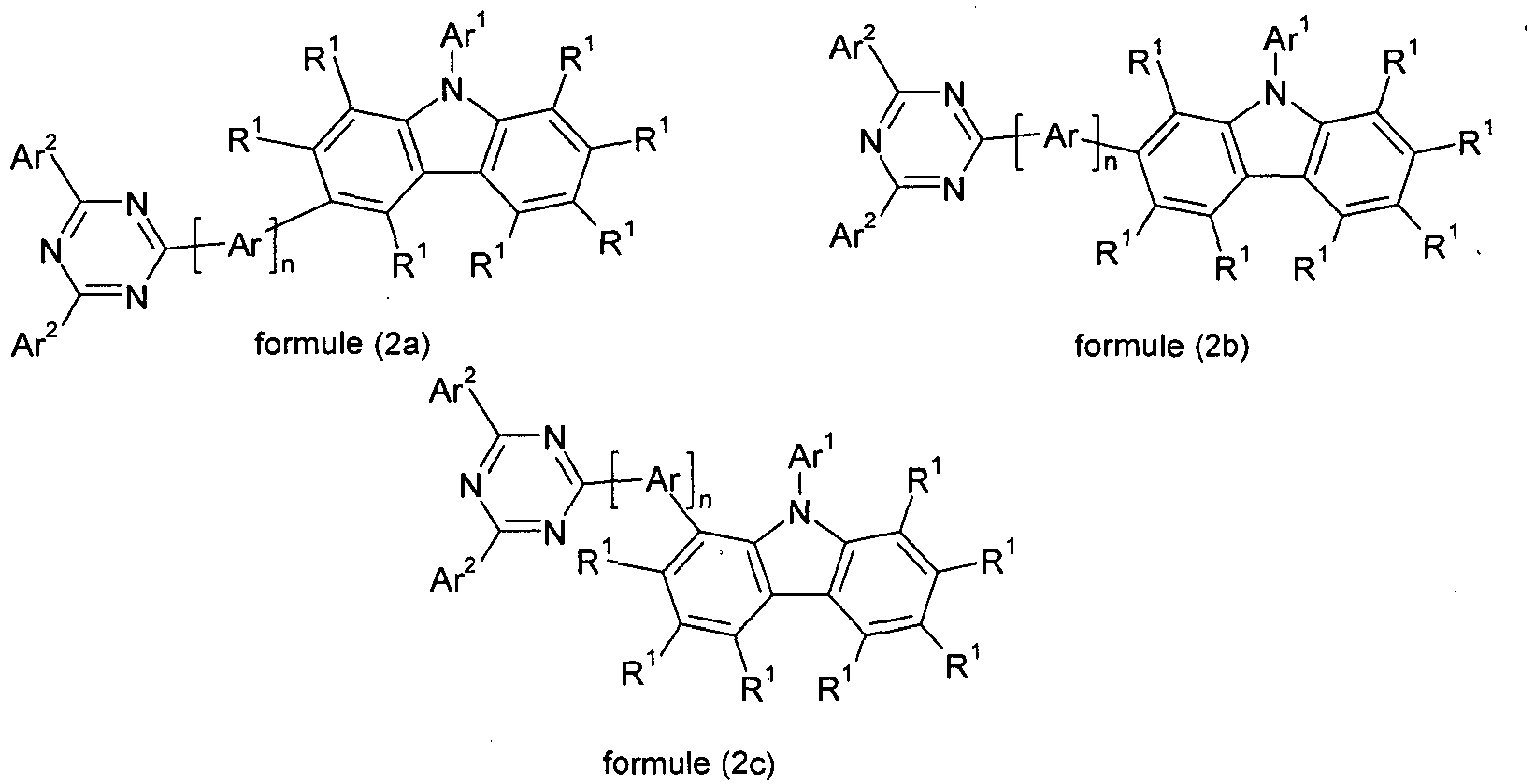
- Composé selon une ou plusieurs des revendications 1 à 4, caractérisé en ce que n = 1, 2 ou 3 et Ar est choisi, de manière identique ou différente pour chaque occurrence, parmi les formules (3), (4) ou (5) :

- Composé selon une ou plusieurs des revendications 1 à 5, caractérisé en ce que le groupe -(Ar)n- est choisi parmi les formules (6) à (18) :


- Composé selon une ou plusieurs des revendications 1 à 6, caractérisé en ce que le radical R est choisi, de manière identique ou différente pour chaque occurrence, parmi le groupe constitué par H, D, F, CN, phényle, biphényle ou terphényle, où chacun des groupes aryle dans les groupes mentionnés ci avant peut être substitué par un radical ou plusieurs radicaux R1, et R1 représente, de manière identique ou différente pour chaque occurrence, H ou un groupe alkyle comportant 1 à 5 atome(s) de C ; ou un groupe carbazole, lequel est lié via un atome de carbone et lequel peut être substitué par un radical ou plusieurs radicaux R1.
- Composé selon une ou plusieurs des revendications 1 à 7, caractérisé en ce que Ar1 est choisi parmi le groupe constitué par phényle, biphényle, terphényle ou quaterphényle, dont chacun peut être substitué par un radical ou plusieurs radicaux R1.
- Composé selon une ou plusieurs des revendications 1 à 8, caractérisé en ce que Ar2 est choisi, de manière identique ou différente pour chaque occurrence, parmi le groupe constitué par phényle, biphényle, terphényle ou quaterphényle, dont chacun peut être substitué par un radical ou plusieurs radicaux R1.
- Composé selon une ou plusieurs des revendications 1 à 9, caractérisé en ce qui suit s'applique aux symboles et indices :Ar représente, de manière identique ou différente pour chaque occurrence, un groupe des formule (3), (4) ou (5) mentionnées ci avant selon la revendication 5, où n = 1, 2 ou 3 ;R est choisi, de manière identique ou différente pour chaque occurrence, parmi le groupe constitué par H, D, F, CN, phényle, biphényle ou terphényle, où chacun des groupes aryle peut être substitué par un radical ou plusieurs radicaux R1, et R1 représente, de manière identique ou différente pour chaque occurrence, H ou un groupe alkyle comportant 1 à 5 atome(s) de C ; ou un groupe carbazole, lequel est lié via un atome de carbone et lequel peut également être substitué par un radical ou plusieurs radicaux R1 ;Ar1 est choisi parmi le groupe constitué par phényle, biphényle, terphényle ou quaterphényle, dont chacun peut être substitué par un radical ou plusieurs radicaux R1 ;Ar2 est choisi, de manière identique ou différente pour chaque occurrence, parmi le groupe constitué par phényle, biphényle, terphényle ou quaterphényle, dont chacun peut être substitué par un radical ou plusieurs radicaux R1 ;R1 est choisi pour chaque occurrence, de manière identique ou différente, parmi le groupe constitué par H, D, F, un groupe alkyle en chaîne droite comportant 1 à 10 atome(s) de C ou un groupe alkyle ramifié ou cyclique comportant 3 à 10 atomes de C, où un ou plusieurs groupe(s) CH2 non adjacents peut/peuvent être remplacé(s) par R2C=CR2 et où un ou plusieurs atome(s) de H peut/ peuvent être remplacé(s) par F, ou un groupe aryle comportant 6 à 10 atomes de C, lequel peut être substitué par un radical ou plusieurs radicaux R2, ou est un groupe dibenzofurane ou dibenzothiophène, dont chacun peut être substitué par un radical ou plusieurs radicaux R2, ou un groupe carbazole, lequel est lié via un atome de carbone et lequel peut également être substitué par un radical ou plusieurs radicaux R2.
- Procédé pour la préparation d'un composé selon une ou plusieurs des revendications 1 à 10, caractérisé en ce que l'unité (Ar2)2triazine-(Ar)n est introduite au moyen d'un couplage de Suzuki.
- Mélange comprenant au moins un composé selon une ou plusieurs des revendications 1 à 10 et au moins un autre composé, en particulier un dopant fluorescent ou phosphorescent.
- Formulation, en particulier une solution, une suspension ou une mini-émulsion, comprenant au moins un composé selon une ou plusieurs des revendications 1 à 10 ou un mélange selon la revendication 12 et un ou plusieurs solvant(s).
- Utilisation d'un composé selon une ou plusieurs des revendications 1 à 10 ou d'un mélange selon la revendication 12 dans un dispositif électronique, en particulier dans un dispositif électroluminescent organique.
- Dispositif électronique comprenant au moins un composé selon une ou plusieurs des revendications 1 à 10 ou au moins un mélange selon la revendication 12, de façon préférable choisi parmi le groupe constitué par les dispositifs électroluminescents organiques, les circuits intégrés organiques, les transistors à effet de champ organiques, les transistors à film mince organiques, les transistors à émission de lumière organiques, les cellules solaires organiques, les cellules solaires sensibilisées par colorant(s) organiques, les détecteurs optiques organiques, les photorécepteurs organiques, les dispositifs à extinction de champ organiques, les cellules électrochimiques à émission de lumière, les diodes laser organiques et les "dispositifs à émission de plasmons organiques".
- Dispositif électronique selon la revendication 15, lequel est un dispositif électroluminescent organique, caractérisé en ce que le composé selon une ou plusieurs des revendications 1 à 10 est utilisé en tant que matériau de matrice pour des émetteurs phosphorescents dans une couche d'émission.
Priority Applications (1)
| Application Number | Priority Date | Filing Date | Title |
|---|---|---|---|
| EP13732363.0A EP2875019B1 (fr) | 2012-07-23 | 2013-06-25 | Matériaux pour dispositifs électroluminescents organiques |
Applications Claiming Priority (3)
| Application Number | Priority Date | Filing Date | Title |
|---|---|---|---|
| EP12005368 | 2012-07-23 | ||
| PCT/EP2013/001861 WO2014015931A1 (fr) | 2012-07-23 | 2013-06-25 | Matériaux destinés à des dispositifs électroluminescents organiques |
| EP13732363.0A EP2875019B1 (fr) | 2012-07-23 | 2013-06-25 | Matériaux pour dispositifs électroluminescents organiques |
Publications (2)
| Publication Number | Publication Date |
|---|---|
| EP2875019A1 EP2875019A1 (fr) | 2015-05-27 |
| EP2875019B1 true EP2875019B1 (fr) | 2017-03-29 |
Family
ID=48703404
Family Applications (1)
| Application Number | Title | Priority Date | Filing Date |
|---|---|---|---|
| EP13732363.0A Active EP2875019B1 (fr) | 2012-07-23 | 2013-06-25 | Matériaux pour dispositifs électroluminescents organiques |
Country Status (6)
| Country | Link |
|---|---|
| US (2) | US10991892B2 (fr) |
| EP (1) | EP2875019B1 (fr) |
| JP (1) | JP6339071B2 (fr) |
| KR (1) | KR102125199B1 (fr) |
| CN (1) | CN104507932B (fr) |
| WO (1) | WO2014015931A1 (fr) |
Families Citing this family (68)
| Publication number | Priority date | Publication date | Assignee | Title |
|---|---|---|---|---|
| KR101649683B1 (ko) * | 2013-09-06 | 2016-08-19 | 제일모직 주식회사 | 유기광전자소자용 조성물, 유기 광전자 소자 및 표시 장치 |
| KR101812581B1 (ko) | 2013-10-11 | 2017-12-27 | 제일모직 주식회사 | 유기광전자소자용 유기합화물, 유기 광전자 소자 및 표시 장치 |
| US10396294B2 (en) | 2013-12-27 | 2019-08-27 | Samsung Electronics Co., Ltd. | Carbazole compound and organic light-emitting device including the same |
| KR101829745B1 (ko) | 2014-01-24 | 2018-02-19 | 삼성에스디아이 주식회사 | 유기 화합물, 조성물, 유기 광전자 소자 및 표시 장치 |
| WO2015165563A1 (fr) | 2014-04-30 | 2015-11-05 | Merck Patent Gmbh | Matériaux pour dispositifs électroniques |
| CN106459018B (zh) * | 2014-05-05 | 2022-01-25 | 默克专利有限公司 | 用于有机发光器件的材料 |
| US9997716B2 (en) | 2014-05-27 | 2018-06-12 | Universal Display Corporation | Organic electroluminescent materials and devices |
| US10297762B2 (en) | 2014-07-09 | 2019-05-21 | Universal Display Corporation | Organic electroluminescent materials and devices |
| US10749113B2 (en) | 2014-09-29 | 2020-08-18 | Universal Display Corporation | Organic electroluminescent materials and devices |
| US10361375B2 (en) | 2014-10-06 | 2019-07-23 | Universal Display Corporation | Organic electroluminescent materials and devices |
| CN105646458A (zh) * | 2014-11-13 | 2016-06-08 | 上海和辉光电有限公司 | 一种化合物及其制备方法和应用 |
| CN105810846B (zh) | 2014-12-31 | 2020-07-07 | 北京维信诺科技有限公司 | 一种有机电致发光器件 |
| US9406892B2 (en) | 2015-01-07 | 2016-08-02 | Universal Display Corporation | Organic electroluminescent materials and devices |
| JP6464779B2 (ja) * | 2015-01-30 | 2019-02-06 | 東ソー株式会社 | トリアジン化合物、その製造方法、及びそれを用いた有機電界発光素子 |
| WO2016124304A1 (fr) | 2015-02-03 | 2016-08-11 | Merck Patent Gmbh | Complexes métalliques |
| CN107592860B (zh) | 2015-04-24 | 2020-11-03 | 三星Sdi株式会社 | 有机化合物、组合物及有机光电二极管 |
| CN106328816B (zh) * | 2015-06-16 | 2018-11-13 | 昆山国显光电有限公司 | 一种有机电致发光器件及其制备方法 |
| US11522140B2 (en) | 2015-08-17 | 2022-12-06 | Universal Display Corporation | Organic electroluminescent materials and devices |
| KR102155550B1 (ko) * | 2015-12-08 | 2020-09-14 | 엘티소재주식회사 | 헤테로고리 화합물 및 이를 이용한 유기 발광 소자 |
| JP6940275B2 (ja) * | 2015-12-22 | 2021-09-22 | 三星電子株式会社Samsung Electronics Co.,Ltd. | 化合物、有機エレクトロルミネッセンス素子材料、有機エレクトロルミネッセンス素子製造用組成物および有機エレクトロルミネッセンス素子 |
| KR20250004078A (ko) * | 2016-04-11 | 2025-01-07 | 메르크 파텐트 게엠베하 | 디벤조푸란 및/또는 디벤조티오펜 구조를 포함하는 헤테로시클릭 화합물 |
| KR102027961B1 (ko) * | 2016-06-29 | 2019-10-02 | 삼성에스디아이 주식회사 | 유기 광전자 소자용 화합물, 유기 광전자 소자용 조성물, 유기 광전자 소자 및 표시 장치 |
| KR102054276B1 (ko) | 2016-06-29 | 2019-12-10 | 삼성에스디아이 주식회사 | 유기 광전자 소자용 화합물, 유기 광전자 소자용 조성물, 유기 광전자 소자 및 표시 장치 |
| KR102050000B1 (ko) | 2016-07-12 | 2019-11-28 | 삼성에스디아이 주식회사 | 유기 광전자 소자용 화합물, 유기 광전자 소자용 조성물, 유기 광전자 소자 및 표시 장치 |
| JP2018009078A (ja) * | 2016-07-12 | 2018-01-18 | 三星電子株式会社Samsung Electronics Co.,Ltd. | 有機発光素子用インキ組成物、並びにこれを用いた有機発光素子およびその製造方法 |
| KR102054277B1 (ko) | 2016-07-29 | 2019-12-10 | 삼성에스디아이 주식회사 | 유기 광전자 소자용 조성물, 유기 광전자 소자 및 표시 장치 |
| JP7214633B2 (ja) | 2016-11-09 | 2023-01-30 | メルク パテント ゲーエムベーハー | 有機エレクトロルミネッセントデバイス用材料 |
| CN108264490B (zh) * | 2016-12-30 | 2021-06-01 | 湖北尚赛光电材料有限公司 | 1,3,5-三嗪衍生物及其制备方法和应用 |
| KR102199076B1 (ko) | 2017-01-05 | 2021-01-07 | 삼성에스디아이 주식회사 | 유기 광전자 소자용 화합물, 유기 광전자 소자용 조성물, 유기 광전자 소자 및 표시 장치 |
| EP3609977B1 (fr) | 2017-04-13 | 2024-05-29 | Merck Patent GmbH | Composition pour dispositifs électroniques organiques |
| JP7247121B2 (ja) | 2017-07-05 | 2023-03-28 | メルク パテント ゲーエムベーハー | 有機電子デバイスのための組成物 |
| KR102616338B1 (ko) | 2017-07-05 | 2023-12-20 | 메르크 파텐트 게엠베하 | 유기 전자 디바이스용 조성물 |
| TWI785142B (zh) | 2017-11-14 | 2022-12-01 | 德商麥克專利有限公司 | 用於有機電子裝置之組成物 |
| KR20190070586A (ko) | 2017-12-13 | 2019-06-21 | 엘지디스플레이 주식회사 | 전자수송 재료용 화합물 및 이를 포함하는 유기 발광 다이오드 |
| CN109994628B (zh) * | 2017-12-29 | 2021-05-04 | 昆山国显光电有限公司 | 有机电致发光器件及有机电致发光器件的制备方法 |
| CN109994634B (zh) * | 2017-12-29 | 2020-12-11 | 昆山国显光电有限公司 | 有机电致发光器件 |
| EP3527557A1 (fr) * | 2018-02-16 | 2019-08-21 | Novaled GmbH | Composés n-hétéroarylène |
| CN111183139B (zh) * | 2018-03-28 | 2023-05-19 | 株式会社Lg化学 | 化合物及包含其的有机发光装置 |
| KR102456677B1 (ko) | 2019-03-14 | 2022-10-19 | 주식회사 엘지화학 | 신규한 화합물 및 이를 이용한 유기발광 소자 |
| CN111063818A (zh) | 2019-12-26 | 2020-04-24 | 武汉华星光电半导体显示技术有限公司 | 显示面板及其制备方法 |
| CN115039248B (zh) * | 2020-02-05 | 2026-04-21 | 出光兴产株式会社 | 有机电致发光元件和电子设备 |
| EP4340969A1 (fr) | 2021-05-21 | 2024-03-27 | Merck Patent GmbH | Procédé de purification continue d'au moins un matériau fonctionnel et dispositif de purification continue d'au moins un matériau fonctionnel |
| CN113336771B (zh) * | 2021-06-25 | 2024-04-30 | 长春海谱润斯科技股份有限公司 | 一种稠环咔唑衍生物及其有机电致发光器件 |
| TW202340423A (zh) | 2022-01-20 | 2023-10-16 | 德商麥克專利有限公司 | 具有混合主體系統之有機電元件 |
| CN114907322B (zh) * | 2022-05-09 | 2024-05-03 | 吉林奥来德光电材料股份有限公司 | 一种含杂环结构的电子传输材料及其制备方法与应用 |
| KR20240028926A (ko) | 2022-08-25 | 2024-03-05 | 롬엔드하스전자재료코리아유한회사 | 복수 종의 호스트 재료, 유기 전계 발광 화합물 및 이를 포함하는 유기 전계 발광 소자 |
| US20240130230A1 (en) | 2022-08-25 | 2024-04-18 | Rohm And Haas Electronic Materials Korea Ltd. | Plurality of host materials, organic electroluminescent compound, and organic electroluminescent device comprising the same |
| CN120323113A (zh) | 2022-12-08 | 2025-07-15 | 默克专利有限公司 | 有机电子器件和用于有机电子器件的特定材料 |
| EP4640022A1 (fr) | 2022-12-19 | 2025-10-29 | Merck Patent GmbH | Matériaux pour dispositifs électroniques |
| KR20240104331A (ko) * | 2022-12-27 | 2024-07-05 | 솔루스첨단소재 주식회사 | 유기 화합물 및 이를 이용한 유기 전계 발광 소자 |
| EP4683925A1 (fr) | 2023-03-20 | 2026-01-28 | Merck Patent GmbH | Matériaux pour dispositifs électroluminescents organiques |
| WO2025045816A1 (fr) | 2023-08-29 | 2025-03-06 | Merck Patent Gmbh | Matériaux pour dispositifs électroluminescents organiques |
| WO2025045842A1 (fr) | 2023-08-30 | 2025-03-06 | Merck Patent Gmbh | Matériaux pour dispositifs électroluminescents organiques |
| CN121753521A (zh) | 2023-08-30 | 2026-03-27 | 默克专利有限公司 | 用于有机发光器件的材料 |
| CN121773745A (zh) | 2023-08-30 | 2026-03-31 | 默克专利有限公司 | 用于有机发光器件的材料 |
| CN121969629A (zh) | 2023-10-04 | 2026-05-01 | 默克专利有限公司 | 用于有机电致发光器件的材料 |
| KR20250070650A (ko) * | 2023-11-13 | 2025-05-21 | 엘티소재주식회사 | 화합물, 유기 발광 소자 및 유기 발광 소자의 유기물층용 조성물 |
| WO2025104058A1 (fr) | 2023-11-16 | 2025-05-22 | Merck Patent Gmbh | Matériaux pour dispositifs électroniques organiques |
| WO2025119821A1 (fr) | 2023-12-05 | 2025-06-12 | Merck Patent Gmbh | Composition de matériau pour dispositifs électroluminescents organiques |
| WO2025168515A1 (fr) | 2024-02-06 | 2025-08-14 | Merck Patent Gmbh | Matériaux pour dispositifs électroniques organiques |
| WO2025195961A1 (fr) | 2024-03-19 | 2025-09-25 | Merck Patent Gmbh | Dispositifs électroluminescents organiques |
| WO2025228800A1 (fr) | 2024-04-30 | 2025-11-06 | Merck Patent Gmbh | Matériaux pour dispositifs électroniques organiques |
| CN118221654A (zh) * | 2024-05-22 | 2024-06-21 | 季华实验室 | 一种螺芴化合物、包含其的发光层和有机电致发光器件 |
| CN118702682A (zh) * | 2024-06-12 | 2024-09-27 | 厦门稀土材料研究所 | 基于螺二芴的化合物及其制备方法和应用 |
| WO2026017608A1 (fr) | 2024-07-15 | 2026-01-22 | Merck Patent Gmbh | Matériaux pour dispositifs électroluminescents organiques |
| WO2026017611A1 (fr) | 2024-07-15 | 2026-01-22 | Merck Patent Gmbh | Dispositif électroluminescent organique |
| WO2026017612A1 (fr) | 2024-07-15 | 2026-01-22 | Merck Patent Gmbh | Dispositif électroluminescent organique |
| WO2026017607A1 (fr) | 2024-07-15 | 2026-01-22 | Merck Patent Gmbh | Dispositif électroluminescent organique |
Family Cites Families (85)
| Publication number | Priority date | Publication date | Assignee | Title |
|---|---|---|---|---|
| US4539507A (en) | 1983-03-25 | 1985-09-03 | Eastman Kodak Company | Organic electroluminescent devices having improved power conversion efficiencies |
| US5151629A (en) | 1991-08-01 | 1992-09-29 | Eastman Kodak Company | Blue emitting internal junction organic electroluminescent device (I) |
| JPH07133483A (ja) | 1993-11-09 | 1995-05-23 | Shinko Electric Ind Co Ltd | El素子用有機発光材料及びel素子 |
| EP0676461B1 (fr) | 1994-04-07 | 2002-08-14 | Covion Organic Semiconductors GmbH | Composés spiro et leur application comme matières électroluminescentes |
| DE19652261A1 (de) | 1996-12-16 | 1998-06-18 | Hoechst Ag | Arylsubstituierte Poly(p-arylenvinylene), Verfahren zur Herstellung und deren Verwendung in Elektroluminszenzbauelementen |
| EP1729327B2 (fr) | 1999-05-13 | 2022-08-10 | The Trustees Of Princeton University | Utilisation d'un composé d'iridium phosphorescent comme molécule émissive dans un dispositif électroluminescent organique |
| EP1933395B2 (fr) | 1999-12-01 | 2019-08-07 | The Trustees of Princeton University | Complexes de formule L2lrX |
| US6660410B2 (en) | 2000-03-27 | 2003-12-09 | Idemitsu Kosan Co., Ltd. | Organic electroluminescence element |
| US20020121638A1 (en) | 2000-06-30 | 2002-09-05 | Vladimir Grushin | Electroluminescent iridium compounds with fluorinated phenylpyridines, phenylpyrimidines, and phenylquinolines and devices made with such compounds |
| EP1325671B1 (fr) | 2000-08-11 | 2012-10-24 | The Trustees Of Princeton University | Composes organometalliques et electrophosphorescence organique presentant un deplacement d'emission |
| JP4154139B2 (ja) | 2000-09-26 | 2008-09-24 | キヤノン株式会社 | 発光素子 |
| JP4154138B2 (ja) | 2000-09-26 | 2008-09-24 | キヤノン株式会社 | 発光素子、表示装置及び金属配位化合物 |
| JP4154140B2 (ja) | 2000-09-26 | 2008-09-24 | キヤノン株式会社 | 金属配位化合物 |
| KR20080110928A (ko) | 2001-03-10 | 2008-12-19 | 메르크 파텐트 게엠베하 | 유기 반도체 용액 및 분산액 |
| DE10141624A1 (de) | 2001-08-24 | 2003-03-06 | Covion Organic Semiconductors | Lösungen polymerer Halbleiter |
| ITRM20020411A1 (it) | 2002-08-01 | 2004-02-02 | Univ Roma La Sapienza | Derivati dello spirobifluorene, loro preparazione e loro uso. |
| US20060063027A1 (en) | 2002-12-23 | 2006-03-23 | Covion Organic Semiconductors Gmbh | Organic electroluminescent element |
| JP4411851B2 (ja) | 2003-03-19 | 2010-02-10 | コニカミノルタホールディングス株式会社 | 有機エレクトロルミネッセンス素子 |
| EP1618170A2 (fr) | 2003-04-15 | 2006-01-25 | Covion Organic Semiconductors GmbH | Melanges de semi-conducteurs organiques aptes a l'emission et de matieres matricielles, leur utilisation et composants electroniques contenant ces melanges |
| JP4635870B2 (ja) | 2003-04-23 | 2011-02-23 | コニカミノルタホールディングス株式会社 | 有機エレクトロルミネッセンス素子、照明装置及び表示装置 |
| DE10333232A1 (de) | 2003-07-21 | 2007-10-11 | Merck Patent Gmbh | Organisches Elektrolumineszenzelement |
| DE10338550A1 (de) | 2003-08-19 | 2005-03-31 | Basf Ag | Übergangsmetallkomplexe mit Carbenliganden als Emitter für organische Licht-emittierende Dioden (OLEDs) |
| DE10345572A1 (de) | 2003-09-29 | 2005-05-19 | Covion Organic Semiconductors Gmbh | Metallkomplexe |
| US7795801B2 (en) | 2003-09-30 | 2010-09-14 | Konica Minolta Holdings, Inc. | Organic electroluminescent element, illuminator, display and compound |
| WO2005053051A1 (fr) | 2003-11-25 | 2005-06-09 | Merck Patent Gmbh | Element organique electroluminescent |
| TWI428053B (zh) * | 2004-02-09 | 2014-02-21 | Idemitsu Kosan Co | Organic electroluminescent element |
| US7790890B2 (en) | 2004-03-31 | 2010-09-07 | Konica Minolta Holdings, Inc. | Organic electroluminescence element material, organic electroluminescence element, display device and illumination device |
| DE102004023277A1 (de) | 2004-05-11 | 2005-12-01 | Covion Organic Semiconductors Gmbh | Neue Materialmischungen für die Elektrolumineszenz |
| US7598388B2 (en) | 2004-05-18 | 2009-10-06 | The University Of Southern California | Carbene containing metal complexes as OLEDs |
| JP4862248B2 (ja) | 2004-06-04 | 2012-01-25 | コニカミノルタホールディングス株式会社 | 有機エレクトロルミネッセンス素子、照明装置及び表示装置 |
| ITRM20040352A1 (it) | 2004-07-15 | 2004-10-15 | Univ Roma La Sapienza | Derivati oligomerici dello spirobifluorene, loro preparazione e loro uso. |
| EP1888706B1 (fr) | 2005-05-03 | 2017-03-01 | Merck Patent GmbH | Dispositif electroluminescent organique, et derives d'acide boronique et d'acide borinique utilises pour produire ce dispositif electroluminescent organique |
| WO2007063754A1 (fr) | 2005-12-01 | 2007-06-07 | Nippon Steel Chemical Co., Ltd. | Compose pour element electroluminescent organique et element electroluminescent organique |
| DE102006025777A1 (de) | 2006-05-31 | 2007-12-06 | Merck Patent Gmbh | Neue Materialien für organische Elektrolumineszenzvorrichtungen |
| US8062769B2 (en) | 2006-11-09 | 2011-11-22 | Nippon Steel Chemical Co., Ltd. | Indolocarbazole compound for use in organic electroluminescent device and organic electroluminescent device |
| TWI481089B (zh) | 2006-12-28 | 2015-04-11 | Universal Display Corp | 長使用期限之磷光性有機發光裝置結構 |
| DE102007002714A1 (de) | 2007-01-18 | 2008-07-31 | Merck Patent Gmbh | Neue Materialien für organische Elektrolumineszenzvorrichtungen |
| US20100258790A1 (en) * | 2007-10-24 | 2010-10-14 | Basf Se | Use of diphenylamino-bis(phenoxy)- and bis(diphenylamino)-phenoxytriazine compounds |
| DE102007053771A1 (de) | 2007-11-12 | 2009-05-14 | Merck Patent Gmbh | Organische Elektrolumineszenzvorrichtungen |
| US7862908B2 (en) | 2007-11-26 | 2011-01-04 | National Tsing Hua University | Conjugated compounds containing hydroindoloacridine structural elements, and their use |
| CN102056911B (zh) | 2008-06-05 | 2015-07-22 | 出光兴产株式会社 | 卤素化合物、多环系化合物及使用其的有机电致发光元件 |
| DE102008027005A1 (de) | 2008-06-05 | 2009-12-10 | Merck Patent Gmbh | Organische elektronische Vorrichtung enthaltend Metallkomplexe |
| DE102008033943A1 (de) | 2008-07-18 | 2010-01-21 | Merck Patent Gmbh | Neue Materialien für organische Elektrolumineszenzvorrichtungen |
| DE102008036247A1 (de) | 2008-08-04 | 2010-02-11 | Merck Patent Gmbh | Elektronische Vorrichtungen enthaltend Metallkomplexe |
| DE102008036982A1 (de) | 2008-08-08 | 2010-02-11 | Merck Patent Gmbh | Organische Elektrolumineszenzvorrichtung |
| JP5479759B2 (ja) * | 2008-09-05 | 2014-04-23 | 株式会社半導体エネルギー研究所 | ベンゾオキサゾール誘導体、発光素子用材料、発光素子、発光装置及び電子機器 |
| DE102008048336A1 (de) | 2008-09-22 | 2010-03-25 | Merck Patent Gmbh | Einkernige neutrale Kupfer(I)-Komplexe und deren Verwendung zur Herstellung von optoelektronischen Bauelementen |
| KR101506919B1 (ko) | 2008-10-31 | 2015-03-30 | 롬엔드하스전자재료코리아유한회사 | 신규한 유기 전자재료용 화합물 및 이를 포함하는 유기 전자 소자 |
| DE102008056688A1 (de) | 2008-11-11 | 2010-05-12 | Merck Patent Gmbh | Materialien für organische Elektrolumineszenzvorrichtungen |
| JP5701766B2 (ja) | 2008-11-11 | 2015-04-15 | メルク パテント ゲーエムベーハー | 有機エレクトロルミネセント素子 |
| DE102008057051B4 (de) | 2008-11-13 | 2021-06-17 | Merck Patent Gmbh | Materialien für organische Elektrolumineszenzvorrichtungen |
| DE102008057050B4 (de) | 2008-11-13 | 2021-06-02 | Merck Patent Gmbh | Materialien für organische Elektrolumineszenzvorrichtungen |
| DE102008064200A1 (de) | 2008-12-22 | 2010-07-01 | Merck Patent Gmbh | Organische Elektrolumineszenzvorrichtung |
| DE102009007038A1 (de) | 2009-02-02 | 2010-08-05 | Merck Patent Gmbh | Metallkomplexe |
| DE102009011223A1 (de) | 2009-03-02 | 2010-09-23 | Merck Patent Gmbh | Metallkomplexe |
| DE102009013041A1 (de) | 2009-03-13 | 2010-09-16 | Merck Patent Gmbh | Materialien für organische Elektrolumineszenzvorrichtungen |
| KR101297161B1 (ko) | 2009-05-15 | 2013-08-21 | 제일모직주식회사 | 유기광전소자용 화합물 및 이를 포함하는 유기광전소자 |
| DE102009023155A1 (de) | 2009-05-29 | 2010-12-02 | Merck Patent Gmbh | Materialien für organische Elektrolumineszenzvorrichtungen |
| DE102009031021A1 (de) | 2009-06-30 | 2011-01-05 | Merck Patent Gmbh | Materialien für organische Elektrolumineszenzvorrichtungen |
| KR101265658B1 (ko) * | 2009-08-10 | 2013-05-22 | 에스에프씨 주식회사 | 방향족 화합물 및 이를 이용한 유기전계발광소자 |
| DE102009041414A1 (de) | 2009-09-16 | 2011-03-17 | Merck Patent Gmbh | Metallkomplexe |
| DE102009048791A1 (de) | 2009-10-08 | 2011-04-14 | Merck Patent Gmbh | Materialien für organische Elektrolumineszenzvorrichtungen |
| EP2489664A4 (fr) | 2009-10-16 | 2013-04-03 | Idemitsu Kosan Co | Composé aromatique contenant du fluorène, matériau pour élément électroluminescent organique, et élément électroluminescent organique utilisant un tel matériau |
| KR20110049012A (ko) | 2009-11-04 | 2011-05-12 | 다우어드밴스드디스플레이머티리얼 유한회사 | 신규한 유기 발광 화합물 및 이를 채용하고 있는 유기 전계 발광 소자 |
| DE102009053382A1 (de) | 2009-11-14 | 2011-05-19 | Merck Patent Gmbh | Materialien für elektronische Vorrichtungen |
| KR101147318B1 (ko) * | 2009-11-26 | 2012-05-21 | 덕산하이메탈(주) | 카바졸 골격에 헤테로 고리를 포함하는 화합물 및 이를 이용한 유기전기소자, 그 단말 |
| DE102009057167A1 (de) | 2009-12-05 | 2011-06-09 | Merck Patent Gmbh | Elektronische Vorrichtung enthaltend Metallkomplexe |
| KR101219492B1 (ko) | 2009-12-11 | 2013-01-28 | 삼성디스플레이 주식회사 | 오원자 헤테로 고리를 포함하는 화합물 및 이를 이용한 유기전기소자, 그 단말 |
| DE102010005697A1 (de) | 2010-01-25 | 2011-07-28 | Merck Patent GmbH, 64293 | Verbindungen für elektronische Vorrichtungen |
| KR20110100762A (ko) | 2010-03-05 | 2011-09-15 | 덕산하이메탈(주) | 스파이로 골격을 포함하는 스파이로 카바졸 화합물 및 이를 이용한 유기전자소자, 그 단말 |
| DE102010012738A1 (de) | 2010-03-25 | 2011-09-29 | Merck Patent Gmbh | Materialien für organische Elektrolumineszenzvorrichtungen |
| DE102010019306B4 (de) | 2010-05-04 | 2021-05-20 | Merck Patent Gmbh | Organische Elektrolumineszenzvorrichtungen |
| KR101244599B1 (ko) * | 2010-05-28 | 2013-03-25 | 주식회사 두산 | 바이폴라 트리페닐렌계 화합물 및 이를 포함하는 유기 전계 발광 소자 |
| JP6054290B2 (ja) | 2010-06-15 | 2016-12-27 | メルク パテント ゲーエムベーハー | 金属錯体 |
| DE102010027317A1 (de) | 2010-07-16 | 2012-01-19 | Merck Patent Gmbh | Metallkomplexe |
| KR101423066B1 (ko) | 2010-09-17 | 2014-07-25 | 롬엔드하스전자재료코리아유한회사 | 신규한 유기 발광 화합물 및 이를 포함하는 유기 전계 발광 소자 |
| DE102010048608A1 (de) | 2010-10-15 | 2012-04-19 | Merck Patent Gmbh | Materialien für organische Elektrolumineszenzvorrichtungen |
| KR101531612B1 (ko) | 2010-12-02 | 2015-06-25 | 제일모직 주식회사 | 유기광전소자용 화합물 및 이를 포함하는 유기광전소자 |
| US20130264560A1 (en) * | 2010-12-20 | 2013-10-10 | E I Du Pont De Nemours And Company | Triazine derivatives for electronic applications |
| JP5206907B2 (ja) * | 2011-04-07 | 2013-06-12 | 三菱化学株式会社 | 有機化合物、電荷輸送材料、該化合物を含有する組成物、有機電界発光素子、表示装置及び照明装置 |
| KR102261235B1 (ko) | 2011-11-22 | 2021-06-04 | 이데미쓰 고산 가부시키가이샤 | 방향족 복소 고리 유도체, 유기 일렉트로루미네선스 소자용 재료 및 유기 일렉트로루미네선스 소자 |
| KR20130078437A (ko) | 2011-12-30 | 2013-07-10 | 제일모직주식회사 | 유기광전자소자용 화합물, 이를 포함하는 유기발광소자 및 상기 유기발광소자를 포함하는 표시장치 |
| KR101395080B1 (ko) | 2012-04-05 | 2014-05-16 | (주)피엔에이치테크 | 신규한 유기전기발광소자용 유기화합물 및 이를 포함하는 유기전기발광소자 |
| TWI564297B (zh) * | 2012-06-18 | 2017-01-01 | Tosoh Corp | ring A compound, a method for producing the same, and an organic electroluminescent device containing the same |
| JP2017187609A (ja) | 2016-04-05 | 2017-10-12 | アーゼッド・エレクトロニック・マテリアルズ(ルクセンブルグ)ソシエテ・ア・レスポンサビリテ・リミテ | ギャップフィリング組成物および低分子化合物を用いたパターン形成方法 |
-
2013
- 2013-06-25 EP EP13732363.0A patent/EP2875019B1/fr active Active
- 2013-06-25 WO PCT/EP2013/001861 patent/WO2014015931A1/fr not_active Ceased
- 2013-06-25 KR KR1020157004525A patent/KR102125199B1/ko active Active
- 2013-06-25 CN CN201380039254.8A patent/CN104507932B/zh active Active
- 2013-06-25 JP JP2015523432A patent/JP6339071B2/ja active Active
- 2013-06-25 US US14/416,879 patent/US10991892B2/en active Active
-
2021
- 2021-03-24 US US17/211,520 patent/US12022732B2/en active Active
Non-Patent Citations (1)
| Title |
|---|
| None * |
Also Published As
| Publication number | Publication date |
|---|---|
| EP2875019A1 (fr) | 2015-05-27 |
| CN104507932B (zh) | 2016-12-07 |
| US12022732B2 (en) | 2024-06-25 |
| JP2015530363A (ja) | 2015-10-15 |
| CN104507932A (zh) | 2015-04-08 |
| US10991892B2 (en) | 2021-04-27 |
| KR102125199B1 (ko) | 2020-06-22 |
| US20150214489A1 (en) | 2015-07-30 |
| WO2014015931A1 (fr) | 2014-01-30 |
| KR20150036736A (ko) | 2015-04-07 |
| JP6339071B2 (ja) | 2018-06-06 |
| US20210217966A1 (en) | 2021-07-15 |
Similar Documents
| Publication | Publication Date | Title |
|---|---|---|
| EP2875019B1 (fr) | Matériaux pour dispositifs électroluminescents organiques | |
| EP3768692B1 (fr) | Complexes métalliques | |
| EP2616428B1 (fr) | Matériaux pour dispositifs électroluminescents organiques | |
| EP3744155B1 (fr) | Matériaux pour dispositifs électroluminescents organiques | |
| EP3423542B1 (fr) | Matériaux pour dispositifs électroluminescents organiques | |
| EP2883422B1 (fr) | Matériaux pour dispositifs organiques à électroluminescence | |
| EP2872589B1 (fr) | Matériaux conçus pour des dispositifs électroluminescents organiques | |
| EP2935276B1 (fr) | Matériaux pour dispositifs organiques électroluminescents | |
| DE112011103904B4 (de) | Materialien für organische Elektrolumineszenzvorrichtungen | |
| EP2486036B1 (fr) | Matériaux pour dispositifs électroluminescents organiques | |
| EP2758372B1 (fr) | Dérivés de carbazole pour des dispositifs électroluminescents organiques | |
| EP2768808B1 (fr) | Matériaux destinés à des dispositifs électroluminescents organiques | |
| EP2936577B1 (fr) | Dispositif organic electroluminescent | |
| EP2714841B1 (fr) | Dispositif électroluminescent organique | |
| EP3016952B1 (fr) | Composés de lactame spirocondensés pour des dispositifs électroluminescents organiques | |
| EP3515925A1 (fr) | Complexes métalliques trouvant application comme émetteurs dans des dispositifs électroluminescents organiques | |
| EP3107977B1 (fr) | Matières pour dispositifs électroluminescents organiques | |
| WO2017076485A1 (fr) | Matériaux pour dispositifs électroluminescents organiques | |
| EP3140302A1 (fr) | Matières pour des dispositifs organiques électroluminescents | |
| EP3254317A1 (fr) | Complexes métalliques | |
| EP3110796B1 (fr) | Matières pour dispositifs électroluminescents organiques | |
| WO2021185829A1 (fr) | Composés hétérocycliques pour dispositifs électroluminescents organiques | |
| WO2021191117A1 (fr) | Matériaux pour dispositifs électroniques |
Legal Events
| Date | Code | Title | Description |
|---|---|---|---|
| PUAI | Public reference made under article 153(3) epc to a published international application that has entered the european phase |
Free format text: ORIGINAL CODE: 0009012 |
|
| 17P | Request for examination filed |
Effective date: 20141231 |
|
| AK | Designated contracting states |
Kind code of ref document: A1 Designated state(s): AL AT BE BG CH CY CZ DE DK EE ES FI FR GB GR HR HU IE IS IT LI LT LU LV MC MK MT NL NO PL PT RO RS SE SI SK SM TR |
|
| AX | Request for extension of the european patent |
Extension state: BA ME |
|
| RIN1 | Information on inventor provided before grant (corrected) |
Inventor name: EBERLE, THOMAS Inventor name: PFLUMM, CHRISTOF Inventor name: KROEBER, JONAS VALENTIN Inventor name: PARHAM, AMIR HOSSAIN Inventor name: JATSCH, ANJA |
|
| DAX | Request for extension of the european patent (deleted) | ||
| 17Q | First examination report despatched |
Effective date: 20151127 |
|
| GRAP | Despatch of communication of intention to grant a patent |
Free format text: ORIGINAL CODE: EPIDOSNIGR1 |
|
| INTG | Intention to grant announced |
Effective date: 20161102 |
|
| GRAS | Grant fee paid |
Free format text: ORIGINAL CODE: EPIDOSNIGR3 |
|
| GRAA | (expected) grant |
Free format text: ORIGINAL CODE: 0009210 |
|
| AK | Designated contracting states |
Kind code of ref document: B1 Designated state(s): AL AT BE BG CH CY CZ DE DK EE ES FI FR GB GR HR HU IE IS IT LI LT LU LV MC MK MT NL NO PL PT RO RS SE SI SK SM TR |
|
| REG | Reference to a national code |
Ref country code: GB Ref legal event code: FG4D Free format text: NOT ENGLISH |
|
| REG | Reference to a national code |
Ref country code: CH Ref legal event code: EP |
|
| REG | Reference to a national code |
Ref country code: AT Ref legal event code: REF Ref document number: 879637 Country of ref document: AT Kind code of ref document: T Effective date: 20170415 |
|
| REG | Reference to a national code |
Ref country code: IE Ref legal event code: FG4D Free format text: LANGUAGE OF EP DOCUMENT: GERMAN |
|
| REG | Reference to a national code |
Ref country code: DE Ref legal event code: R096 Ref document number: 502013006808 Country of ref document: DE |
|
| PG25 | Lapsed in a contracting state [announced via postgrant information from national office to epo] |
Ref country code: GR Free format text: LAPSE BECAUSE OF FAILURE TO SUBMIT A TRANSLATION OF THE DESCRIPTION OR TO PAY THE FEE WITHIN THE PRESCRIBED TIME-LIMIT Effective date: 20170630 Ref country code: LT Free format text: LAPSE BECAUSE OF FAILURE TO SUBMIT A TRANSLATION OF THE DESCRIPTION OR TO PAY THE FEE WITHIN THE PRESCRIBED TIME-LIMIT Effective date: 20170329 Ref country code: FI Free format text: LAPSE BECAUSE OF FAILURE TO SUBMIT A TRANSLATION OF THE DESCRIPTION OR TO PAY THE FEE WITHIN THE PRESCRIBED TIME-LIMIT Effective date: 20170329 Ref country code: HR Free format text: LAPSE BECAUSE OF FAILURE TO SUBMIT A TRANSLATION OF THE DESCRIPTION OR TO PAY THE FEE WITHIN THE PRESCRIBED TIME-LIMIT Effective date: 20170329 Ref country code: NO Free format text: LAPSE BECAUSE OF FAILURE TO SUBMIT A TRANSLATION OF THE DESCRIPTION OR TO PAY THE FEE WITHIN THE PRESCRIBED TIME-LIMIT Effective date: 20170629 |
|
| REG | Reference to a national code |
Ref country code: NL Ref legal event code: MP Effective date: 20170329 |
|
| PG25 | Lapsed in a contracting state [announced via postgrant information from national office to epo] |
Ref country code: RS Free format text: LAPSE BECAUSE OF FAILURE TO SUBMIT A TRANSLATION OF THE DESCRIPTION OR TO PAY THE FEE WITHIN THE PRESCRIBED TIME-LIMIT Effective date: 20170329 Ref country code: LV Free format text: LAPSE BECAUSE OF FAILURE TO SUBMIT A TRANSLATION OF THE DESCRIPTION OR TO PAY THE FEE WITHIN THE PRESCRIBED TIME-LIMIT Effective date: 20170329 Ref country code: BG Free format text: LAPSE BECAUSE OF FAILURE TO SUBMIT A TRANSLATION OF THE DESCRIPTION OR TO PAY THE FEE WITHIN THE PRESCRIBED TIME-LIMIT Effective date: 20170629 Ref country code: SE Free format text: LAPSE BECAUSE OF FAILURE TO SUBMIT A TRANSLATION OF THE DESCRIPTION OR TO PAY THE FEE WITHIN THE PRESCRIBED TIME-LIMIT Effective date: 20170329 |
|
| PG25 | Lapsed in a contracting state [announced via postgrant information from national office to epo] |
Ref country code: NL Free format text: LAPSE BECAUSE OF FAILURE TO SUBMIT A TRANSLATION OF THE DESCRIPTION OR TO PAY THE FEE WITHIN THE PRESCRIBED TIME-LIMIT Effective date: 20170329 |
|
| PG25 | Lapsed in a contracting state [announced via postgrant information from national office to epo] |
Ref country code: EE Free format text: LAPSE BECAUSE OF FAILURE TO SUBMIT A TRANSLATION OF THE DESCRIPTION OR TO PAY THE FEE WITHIN THE PRESCRIBED TIME-LIMIT Effective date: 20170329 Ref country code: IT Free format text: LAPSE BECAUSE OF FAILURE TO SUBMIT A TRANSLATION OF THE DESCRIPTION OR TO PAY THE FEE WITHIN THE PRESCRIBED TIME-LIMIT Effective date: 20170329 Ref country code: RO Free format text: LAPSE BECAUSE OF FAILURE TO SUBMIT A TRANSLATION OF THE DESCRIPTION OR TO PAY THE FEE WITHIN THE PRESCRIBED TIME-LIMIT Effective date: 20170329 Ref country code: ES Free format text: LAPSE BECAUSE OF FAILURE TO SUBMIT A TRANSLATION OF THE DESCRIPTION OR TO PAY THE FEE WITHIN THE PRESCRIBED TIME-LIMIT Effective date: 20170329 Ref country code: SK Free format text: LAPSE BECAUSE OF FAILURE TO SUBMIT A TRANSLATION OF THE DESCRIPTION OR TO PAY THE FEE WITHIN THE PRESCRIBED TIME-LIMIT Effective date: 20170329 Ref country code: CZ Free format text: LAPSE BECAUSE OF FAILURE TO SUBMIT A TRANSLATION OF THE DESCRIPTION OR TO PAY THE FEE WITHIN THE PRESCRIBED TIME-LIMIT Effective date: 20170329 |
|
| PG25 | Lapsed in a contracting state [announced via postgrant information from national office to epo] |
Ref country code: IS Free format text: LAPSE BECAUSE OF FAILURE TO SUBMIT A TRANSLATION OF THE DESCRIPTION OR TO PAY THE FEE WITHIN THE PRESCRIBED TIME-LIMIT Effective date: 20170729 Ref country code: PT Free format text: LAPSE BECAUSE OF FAILURE TO SUBMIT A TRANSLATION OF THE DESCRIPTION OR TO PAY THE FEE WITHIN THE PRESCRIBED TIME-LIMIT Effective date: 20170731 Ref country code: SM Free format text: LAPSE BECAUSE OF FAILURE TO SUBMIT A TRANSLATION OF THE DESCRIPTION OR TO PAY THE FEE WITHIN THE PRESCRIBED TIME-LIMIT Effective date: 20170329 Ref country code: PL Free format text: LAPSE BECAUSE OF FAILURE TO SUBMIT A TRANSLATION OF THE DESCRIPTION OR TO PAY THE FEE WITHIN THE PRESCRIBED TIME-LIMIT Effective date: 20170329 |
|
| REG | Reference to a national code |
Ref country code: DE Ref legal event code: R097 Ref document number: 502013006808 Country of ref document: DE |
|
| PG25 | Lapsed in a contracting state [announced via postgrant information from national office to epo] |
Ref country code: DK Free format text: LAPSE BECAUSE OF FAILURE TO SUBMIT A TRANSLATION OF THE DESCRIPTION OR TO PAY THE FEE WITHIN THE PRESCRIBED TIME-LIMIT Effective date: 20170329 Ref country code: MC Free format text: LAPSE BECAUSE OF FAILURE TO SUBMIT A TRANSLATION OF THE DESCRIPTION OR TO PAY THE FEE WITHIN THE PRESCRIBED TIME-LIMIT Effective date: 20170329 |
|
| REG | Reference to a national code |
Ref country code: CH Ref legal event code: PL |
|
| PLBE | No opposition filed within time limit |
Free format text: ORIGINAL CODE: 0009261 |
|
| STAA | Information on the status of an ep patent application or granted ep patent |
Free format text: STATUS: NO OPPOSITION FILED WITHIN TIME LIMIT |
|
| GBPC | Gb: european patent ceased through non-payment of renewal fee |
Effective date: 20170629 |
|
| 26N | No opposition filed |
Effective date: 20180103 |
|
| REG | Reference to a national code |
Ref country code: IE Ref legal event code: MM4A |
|
| REG | Reference to a national code |
Ref country code: FR Ref legal event code: ST Effective date: 20180228 |
|
| PG25 | Lapsed in a contracting state [announced via postgrant information from national office to epo] |
Ref country code: GB Free format text: LAPSE BECAUSE OF NON-PAYMENT OF DUE FEES Effective date: 20170629 Ref country code: IE Free format text: LAPSE BECAUSE OF NON-PAYMENT OF DUE FEES Effective date: 20170625 Ref country code: CH Free format text: LAPSE BECAUSE OF NON-PAYMENT OF DUE FEES Effective date: 20170630 Ref country code: LI Free format text: LAPSE BECAUSE OF NON-PAYMENT OF DUE FEES Effective date: 20170630 Ref country code: LU Free format text: LAPSE BECAUSE OF NON-PAYMENT OF DUE FEES Effective date: 20170625 |
|
| PG25 | Lapsed in a contracting state [announced via postgrant information from national office to epo] |
Ref country code: SI Free format text: LAPSE BECAUSE OF FAILURE TO SUBMIT A TRANSLATION OF THE DESCRIPTION OR TO PAY THE FEE WITHIN THE PRESCRIBED TIME-LIMIT Effective date: 20170329 Ref country code: FR Free format text: LAPSE BECAUSE OF NON-PAYMENT OF DUE FEES Effective date: 20170630 |
|
| REG | Reference to a national code |
Ref country code: BE Ref legal event code: MM Effective date: 20170630 |
|
| PG25 | Lapsed in a contracting state [announced via postgrant information from national office to epo] |
Ref country code: BE Free format text: LAPSE BECAUSE OF NON-PAYMENT OF DUE FEES Effective date: 20170630 |
|
| PG25 | Lapsed in a contracting state [announced via postgrant information from national office to epo] |
Ref country code: MT Free format text: LAPSE BECAUSE OF FAILURE TO SUBMIT A TRANSLATION OF THE DESCRIPTION OR TO PAY THE FEE WITHIN THE PRESCRIBED TIME-LIMIT Effective date: 20170329 |
|
| PG25 | Lapsed in a contracting state [announced via postgrant information from national office to epo] |
Ref country code: HU Free format text: LAPSE BECAUSE OF FAILURE TO SUBMIT A TRANSLATION OF THE DESCRIPTION OR TO PAY THE FEE WITHIN THE PRESCRIBED TIME-LIMIT; INVALID AB INITIO Effective date: 20130625 |
|
| REG | Reference to a national code |
Ref country code: AT Ref legal event code: MM01 Ref document number: 879637 Country of ref document: AT Kind code of ref document: T Effective date: 20180625 |
|
| PG25 | Lapsed in a contracting state [announced via postgrant information from national office to epo] |
Ref country code: CY Free format text: LAPSE BECAUSE OF FAILURE TO SUBMIT A TRANSLATION OF THE DESCRIPTION OR TO PAY THE FEE WITHIN THE PRESCRIBED TIME-LIMIT Effective date: 20170329 |
|
| PG25 | Lapsed in a contracting state [announced via postgrant information from national office to epo] |
Ref country code: MK Free format text: LAPSE BECAUSE OF FAILURE TO SUBMIT A TRANSLATION OF THE DESCRIPTION OR TO PAY THE FEE WITHIN THE PRESCRIBED TIME-LIMIT Effective date: 20170329 |
|
| PG25 | Lapsed in a contracting state [announced via postgrant information from national office to epo] |
Ref country code: AT Free format text: LAPSE BECAUSE OF NON-PAYMENT OF DUE FEES Effective date: 20180625 |
|
| PG25 | Lapsed in a contracting state [announced via postgrant information from national office to epo] |
Ref country code: TR Free format text: LAPSE BECAUSE OF FAILURE TO SUBMIT A TRANSLATION OF THE DESCRIPTION OR TO PAY THE FEE WITHIN THE PRESCRIBED TIME-LIMIT Effective date: 20170329 |
|
| PG25 | Lapsed in a contracting state [announced via postgrant information from national office to epo] |
Ref country code: AL Free format text: LAPSE BECAUSE OF FAILURE TO SUBMIT A TRANSLATION OF THE DESCRIPTION OR TO PAY THE FEE WITHIN THE PRESCRIBED TIME-LIMIT Effective date: 20170329 |
|
| P01 | Opt-out of the competence of the unified patent court (upc) registered |
Effective date: 20230518 |
|
| PGFP | Annual fee paid to national office [announced via postgrant information from national office to epo] |
Ref country code: DE Payment date: 20250520 Year of fee payment: 13 |