EP3012025A2 - Fasermaterialien und zusammensetzungen - Google Patents
Fasermaterialien und zusammensetzungen Download PDFInfo
- Publication number
- EP3012025A2 EP3012025A2 EP15191750.7A EP15191750A EP3012025A2 EP 3012025 A2 EP3012025 A2 EP 3012025A2 EP 15191750 A EP15191750 A EP 15191750A EP 3012025 A2 EP3012025 A2 EP 3012025A2
- Authority
- EP
- European Patent Office
- Prior art keywords
- fibrous material
- acid
- fibrous
- percent
- inch
- Prior art date
- Legal status (The legal status is an assumption and is not a legal conclusion. Google has not performed a legal analysis and makes no representation as to the accuracy of the status listed.)
- Granted
Links
Images





Classifications
-
- B—PERFORMING OPERATIONS; TRANSPORTING
- B29—WORKING OF PLASTICS; WORKING OF SUBSTANCES IN A PLASTIC STATE IN GENERAL
- B29B—PREPARATION OR PRETREATMENT OF THE MATERIAL TO BE SHAPED; MAKING GRANULES OR PREFORMS; RECOVERY OF PLASTICS OR OTHER CONSTITUENTS OF WASTE MATERIAL CONTAINING PLASTICS
- B29B17/00—Recovery of plastics or other constituents of waste material containing plastics
- B29B17/0026—Recovery of plastics or other constituents of waste material containing plastics by agglomeration or compacting
- B29B17/0042—Recovery of plastics or other constituents of waste material containing plastics by agglomeration or compacting for shaping parts, e.g. multilayered parts with at least one layer containing regenerated plastic
-
- C—CHEMISTRY; METALLURGY
- C12—BIOCHEMISTRY; BEER; SPIRITS; WINE; VINEGAR; MICROBIOLOGY; ENZYMOLOGY; MUTATION OR GENETIC ENGINEERING
- C12P—FERMENTATION OR ENZYME-USING PROCESSES TO SYNTHESISE A DESIRED CHEMICAL COMPOUND OR COMPOSITION OR TO SEPARATE OPTICAL ISOMERS FROM A RACEMIC MIXTURE
- C12P7/00—Preparation of oxygen-containing organic compounds
- C12P7/02—Preparation of oxygen-containing organic compounds containing a hydroxy group
- C12P7/04—Preparation of oxygen-containing organic compounds containing a hydroxy group acyclic
- C12P7/06—Ethanol, i.e. non-beverage
- C12P7/08—Ethanol, i.e. non-beverage produced as by-product or from waste or cellulosic material substrate
-
- B—PERFORMING OPERATIONS; TRANSPORTING
- B29—WORKING OF PLASTICS; WORKING OF SUBSTANCES IN A PLASTIC STATE IN GENERAL
- B29B—PREPARATION OR PRETREATMENT OF THE MATERIAL TO BE SHAPED; MAKING GRANULES OR PREFORMS; RECOVERY OF PLASTICS OR OTHER CONSTITUENTS OF WASTE MATERIAL CONTAINING PLASTICS
- B29B13/00—Conditioning or physical treatment of the material to be shaped
- B29B13/08—Conditioning or physical treatment of the material to be shaped by using wave energy or particle radiation
-
- A—HUMAN NECESSITIES
- A61—MEDICAL OR VETERINARY SCIENCE; HYGIENE
- A61L—METHODS OR APPARATUS FOR STERILISING MATERIALS OR OBJECTS IN GENERAL; DISINFECTION, STERILISATION OR DEODORISATION OF AIR; CHEMICAL ASPECTS OF BANDAGES, DRESSINGS, ABSORBENT PADS OR SURGICAL ARTICLES; MATERIALS FOR BANDAGES, DRESSINGS, ABSORBENT PADS OR SURGICAL ARTICLES
- A61L2/00—Disinfection or sterilisation of materials or objects, in general; Accessories therefor
- A61L2/02—Disinfection or sterilisation of materials or objects, in general; Accessories therefor using physical processes
- A61L2/08—Radiation
- A61L2/081—Gamma radiation
-
- A—HUMAN NECESSITIES
- A61—MEDICAL OR VETERINARY SCIENCE; HYGIENE
- A61L—METHODS OR APPARATUS FOR STERILISING MATERIALS OR OBJECTS IN GENERAL; DISINFECTION, STERILISATION OR DEODORISATION OF AIR; CHEMICAL ASPECTS OF BANDAGES, DRESSINGS, ABSORBENT PADS OR SURGICAL ARTICLES; MATERIALS FOR BANDAGES, DRESSINGS, ABSORBENT PADS OR SURGICAL ARTICLES
- A61L2/00—Disinfection or sterilisation of materials or objects, in general; Accessories therefor
- A61L2/02—Disinfection or sterilisation of materials or objects, in general; Accessories therefor using physical processes
- A61L2/08—Radiation
- A61L2/082—X-rays
-
- A—HUMAN NECESSITIES
- A61—MEDICAL OR VETERINARY SCIENCE; HYGIENE
- A61L—METHODS OR APPARATUS FOR STERILISING MATERIALS OR OBJECTS IN GENERAL; DISINFECTION, STERILISATION OR DEODORISATION OF AIR; CHEMICAL ASPECTS OF BANDAGES, DRESSINGS, ABSORBENT PADS OR SURGICAL ARTICLES; MATERIALS FOR BANDAGES, DRESSINGS, ABSORBENT PADS OR SURGICAL ARTICLES
- A61L2/00—Disinfection or sterilisation of materials or objects, in general; Accessories therefor
- A61L2/02—Disinfection or sterilisation of materials or objects, in general; Accessories therefor using physical processes
- A61L2/08—Radiation
- A61L2/087—Particle radiation, e.g. electron-beam, alpha or beta radiation
-
- B—PERFORMING OPERATIONS; TRANSPORTING
- B02—CRUSHING, PULVERISING, OR DISINTEGRATING; PREPARATORY TREATMENT OF GRAIN FOR MILLING
- B02C—CRUSHING, PULVERISING, OR DISINTEGRATING IN GENERAL; MILLING GRAIN
- B02C19/00—Other disintegrating devices or methods
- B02C19/0056—Other disintegrating devices or methods specially adapted for specific materials not otherwise provided for
-
- B—PERFORMING OPERATIONS; TRANSPORTING
- B02—CRUSHING, PULVERISING, OR DISINTEGRATING; PREPARATORY TREATMENT OF GRAIN FOR MILLING
- B02C—CRUSHING, PULVERISING, OR DISINTEGRATING IN GENERAL; MILLING GRAIN
- B02C23/00—Auxiliary methods or auxiliary devices or accessories specially adapted for crushing or disintegrating not provided for in preceding groups or not specially adapted to apparatus covered by a single preceding group
- B02C23/08—Separating or sorting of material, associated with crushing or disintegrating
- B02C23/10—Separating or sorting of material, associated with crushing or disintegrating with separator arranged in discharge path of crushing or disintegrating zone
-
- B—PERFORMING OPERATIONS; TRANSPORTING
- B02—CRUSHING, PULVERISING, OR DISINTEGRATING; PREPARATORY TREATMENT OF GRAIN FOR MILLING
- B02C—CRUSHING, PULVERISING, OR DISINTEGRATING IN GENERAL; MILLING GRAIN
- B02C23/00—Auxiliary methods or auxiliary devices or accessories specially adapted for crushing or disintegrating not provided for in preceding groups or not specially adapted to apparatus covered by a single preceding group
- B02C23/08—Separating or sorting of material, associated with crushing or disintegrating
- B02C23/14—Separating or sorting of material, associated with crushing or disintegrating with more than one separator
-
- B—PERFORMING OPERATIONS; TRANSPORTING
- B29—WORKING OF PLASTICS; WORKING OF SUBSTANCES IN A PLASTIC STATE IN GENERAL
- B29B—PREPARATION OR PRETREATMENT OF THE MATERIAL TO BE SHAPED; MAKING GRANULES OR PREFORMS; RECOVERY OF PLASTICS OR OTHER CONSTITUENTS OF WASTE MATERIAL CONTAINING PLASTICS
- B29B17/00—Recovery of plastics or other constituents of waste material containing plastics
- B29B17/04—Disintegrating plastics, e.g. by milling
- B29B17/0412—Disintegrating plastics, e.g. by milling to large particles, e.g. beads, granules, flakes, slices
-
- B—PERFORMING OPERATIONS; TRANSPORTING
- B29—WORKING OF PLASTICS; WORKING OF SUBSTANCES IN A PLASTIC STATE IN GENERAL
- B29B—PREPARATION OR PRETREATMENT OF THE MATERIAL TO BE SHAPED; MAKING GRANULES OR PREFORMS; RECOVERY OF PLASTICS OR OTHER CONSTITUENTS OF WASTE MATERIAL CONTAINING PLASTICS
- B29B9/00—Making granules
- B29B9/08—Making granules by agglomerating smaller particles
-
- B—PERFORMING OPERATIONS; TRANSPORTING
- B29—WORKING OF PLASTICS; WORKING OF SUBSTANCES IN A PLASTIC STATE IN GENERAL
- B29C—SHAPING OR JOINING OF PLASTICS; SHAPING OF MATERIAL IN A PLASTIC STATE, NOT OTHERWISE PROVIDED FOR; AFTER-TREATMENT OF THE SHAPED PRODUCTS, e.g. REPAIRING
- B29C43/00—Compression moulding, i.e. applying external pressure to flow the moulding material; Apparatus therefor
- B29C43/003—Compression moulding, i.e. applying external pressure to flow the moulding material; Apparatus therefor characterised by the choice of material
-
- B—PERFORMING OPERATIONS; TRANSPORTING
- B29—WORKING OF PLASTICS; WORKING OF SUBSTANCES IN A PLASTIC STATE IN GENERAL
- B29C—SHAPING OR JOINING OF PLASTICS; SHAPING OF MATERIAL IN A PLASTIC STATE, NOT OTHERWISE PROVIDED FOR; AFTER-TREATMENT OF THE SHAPED PRODUCTS, e.g. REPAIRING
- B29C43/00—Compression moulding, i.e. applying external pressure to flow the moulding material; Apparatus therefor
- B29C43/02—Compression moulding, i.e. applying external pressure to flow the moulding material; Apparatus therefor of articles of definite length, i.e. discrete articles
-
- B—PERFORMING OPERATIONS; TRANSPORTING
- B29—WORKING OF PLASTICS; WORKING OF SUBSTANCES IN A PLASTIC STATE IN GENERAL
- B29C—SHAPING OR JOINING OF PLASTICS; SHAPING OF MATERIAL IN A PLASTIC STATE, NOT OTHERWISE PROVIDED FOR; AFTER-TREATMENT OF THE SHAPED PRODUCTS, e.g. REPAIRING
- B29C45/00—Injection moulding, i.e. forcing the required volume of moulding material through a nozzle into a closed mould; Apparatus therefor
- B29C45/0001—Injection moulding, i.e. forcing the required volume of moulding material through a nozzle into a closed mould; Apparatus therefor characterised by the choice of material
-
- B—PERFORMING OPERATIONS; TRANSPORTING
- B29—WORKING OF PLASTICS; WORKING OF SUBSTANCES IN A PLASTIC STATE IN GENERAL
- B29C—SHAPING OR JOINING OF PLASTICS; SHAPING OF MATERIAL IN A PLASTIC STATE, NOT OTHERWISE PROVIDED FOR; AFTER-TREATMENT OF THE SHAPED PRODUCTS, e.g. REPAIRING
- B29C45/00—Injection moulding, i.e. forcing the required volume of moulding material through a nozzle into a closed mould; Apparatus therefor
- B29C45/0005—Injection moulding, i.e. forcing the required volume of moulding material through a nozzle into a closed mould; Apparatus therefor using fibre reinforcements
-
- B—PERFORMING OPERATIONS; TRANSPORTING
- B29—WORKING OF PLASTICS; WORKING OF SUBSTANCES IN A PLASTIC STATE IN GENERAL
- B29C—SHAPING OR JOINING OF PLASTICS; SHAPING OF MATERIAL IN A PLASTIC STATE, NOT OTHERWISE PROVIDED FOR; AFTER-TREATMENT OF THE SHAPED PRODUCTS, e.g. REPAIRING
- B29C48/00—Extrusion moulding, i.e. expressing the moulding material through a die or nozzle which imparts the desired form; Apparatus therefor
- B29C48/022—Extrusion moulding, i.e. expressing the moulding material through a die or nozzle which imparts the desired form; Apparatus therefor characterised by the choice of material
-
- B—PERFORMING OPERATIONS; TRANSPORTING
- B29—WORKING OF PLASTICS; WORKING OF SUBSTANCES IN A PLASTIC STATE IN GENERAL
- B29C—SHAPING OR JOINING OF PLASTICS; SHAPING OF MATERIAL IN A PLASTIC STATE, NOT OTHERWISE PROVIDED FOR; AFTER-TREATMENT OF THE SHAPED PRODUCTS, e.g. REPAIRING
- B29C48/00—Extrusion moulding, i.e. expressing the moulding material through a die or nozzle which imparts the desired form; Apparatus therefor
- B29C48/03—Extrusion moulding, i.e. expressing the moulding material through a die or nozzle which imparts the desired form; Apparatus therefor characterised by the shape of the extruded material at extrusion
- B29C48/07—Flat, e.g. panels
-
- B—PERFORMING OPERATIONS; TRANSPORTING
- B29—WORKING OF PLASTICS; WORKING OF SUBSTANCES IN A PLASTIC STATE IN GENERAL
- B29C—SHAPING OR JOINING OF PLASTICS; SHAPING OF MATERIAL IN A PLASTIC STATE, NOT OTHERWISE PROVIDED FOR; AFTER-TREATMENT OF THE SHAPED PRODUCTS, e.g. REPAIRING
- B29C67/00—Shaping techniques not covered by groups B29C39/00 - B29C65/00, B29C70/00 or B29C73/00
- B29C67/24—Shaping techniques not covered by groups B29C39/00 - B29C65/00, B29C70/00 or B29C73/00 characterised by the choice of material
-
- C—CHEMISTRY; METALLURGY
- C08—ORGANIC MACROMOLECULAR COMPOUNDS; THEIR PREPARATION OR CHEMICAL WORKING-UP; COMPOSITIONS BASED THEREON
- C08L—COMPOSITIONS OF MACROMOLECULAR COMPOUNDS
- C08L97/00—Compositions of lignin-containing materials
- C08L97/02—Lignocellulosic material, e.g. wood, straw or bagasse
-
- C—CHEMISTRY; METALLURGY
- C10—PETROLEUM, GAS OR COKE INDUSTRIES; TECHNICAL GASES CONTAINING CARBON MONOXIDE; FUELS; LUBRICANTS; PEAT
- C10G—CRACKING HYDROCARBON OILS; PRODUCTION OF LIQUID HYDROCARBON MIXTURES, e.g. BY DESTRUCTIVE HYDROGENATION, OLIGOMERISATION, POLYMERISATION; RECOVERY OF HYDROCARBON OILS FROM OIL-SHALE, OIL-SAND, OR GASES; REFINING MIXTURES MAINLY CONSISTING OF HYDROCARBONS; REFORMING OF NAPHTHA; MINERAL WAXES
- C10G3/00—Production of liquid hydrocarbon mixtures from oxygen-containing organic materials, e.g. fatty oils, fatty acids
-
- C—CHEMISTRY; METALLURGY
- C10—PETROLEUM, GAS OR COKE INDUSTRIES; TECHNICAL GASES CONTAINING CARBON MONOXIDE; FUELS; LUBRICANTS; PEAT
- C10L—FUELS NOT OTHERWISE PROVIDED FOR; NATURAL GAS; SYNTHETIC NATURAL GAS OBTAINED BY PROCESSES NOT COVERED BY SUBCLASSES C10G OR C10K; LIQUIFIED PETROLEUM GAS; USE OF ADDITIVES TO FUELS OR FIRES; FIRE-LIGHTERS
- C10L1/00—Liquid carbonaceous fuels
- C10L1/10—Liquid carbonaceous fuels containing additives
- C10L1/14—Organic compounds
- C10L1/30—Organic compounds compounds not mentioned before (complexes)
-
- C—CHEMISTRY; METALLURGY
- C12—BIOCHEMISTRY; BEER; SPIRITS; WINE; VINEGAR; MICROBIOLOGY; ENZYMOLOGY; MUTATION OR GENETIC ENGINEERING
- C12P—FERMENTATION OR ENZYME-USING PROCESSES TO SYNTHESISE A DESIRED CHEMICAL COMPOUND OR COMPOSITION OR TO SEPARATE OPTICAL ISOMERS FROM A RACEMIC MIXTURE
- C12P19/00—Preparation of compounds containing saccharide radicals
-
- C—CHEMISTRY; METALLURGY
- C12—BIOCHEMISTRY; BEER; SPIRITS; WINE; VINEGAR; MICROBIOLOGY; ENZYMOLOGY; MUTATION OR GENETIC ENGINEERING
- C12P—FERMENTATION OR ENZYME-USING PROCESSES TO SYNTHESISE A DESIRED CHEMICAL COMPOUND OR COMPOSITION OR TO SEPARATE OPTICAL ISOMERS FROM A RACEMIC MIXTURE
- C12P19/00—Preparation of compounds containing saccharide radicals
- C12P19/02—Monosaccharides
-
- C—CHEMISTRY; METALLURGY
- C12—BIOCHEMISTRY; BEER; SPIRITS; WINE; VINEGAR; MICROBIOLOGY; ENZYMOLOGY; MUTATION OR GENETIC ENGINEERING
- C12P—FERMENTATION OR ENZYME-USING PROCESSES TO SYNTHESISE A DESIRED CHEMICAL COMPOUND OR COMPOSITION OR TO SEPARATE OPTICAL ISOMERS FROM A RACEMIC MIXTURE
- C12P19/00—Preparation of compounds containing saccharide radicals
- C12P19/14—Preparation of compounds containing saccharide radicals produced by the action of a carbohydrase (EC 3.2.x), e.g. by alpha-amylase, e.g. by cellulase, hemicellulase
-
- C—CHEMISTRY; METALLURGY
- C12—BIOCHEMISTRY; BEER; SPIRITS; WINE; VINEGAR; MICROBIOLOGY; ENZYMOLOGY; MUTATION OR GENETIC ENGINEERING
- C12P—FERMENTATION OR ENZYME-USING PROCESSES TO SYNTHESISE A DESIRED CHEMICAL COMPOUND OR COMPOSITION OR TO SEPARATE OPTICAL ISOMERS FROM A RACEMIC MIXTURE
- C12P7/00—Preparation of oxygen-containing organic compounds
- C12P7/02—Preparation of oxygen-containing organic compounds containing a hydroxy group
- C12P7/04—Preparation of oxygen-containing organic compounds containing a hydroxy group acyclic
- C12P7/06—Ethanol, i.e. non-beverage
- C12P7/08—Ethanol, i.e. non-beverage produced as by-product or from waste or cellulosic material substrate
- C12P7/10—Ethanol, i.e. non-beverage produced as by-product or from waste or cellulosic material substrate substrate containing cellulosic material
-
- C—CHEMISTRY; METALLURGY
- C12—BIOCHEMISTRY; BEER; SPIRITS; WINE; VINEGAR; MICROBIOLOGY; ENZYMOLOGY; MUTATION OR GENETIC ENGINEERING
- C12P—FERMENTATION OR ENZYME-USING PROCESSES TO SYNTHESISE A DESIRED CHEMICAL COMPOUND OR COMPOSITION OR TO SEPARATE OPTICAL ISOMERS FROM A RACEMIC MIXTURE
- C12P7/00—Preparation of oxygen-containing organic compounds
- C12P7/02—Preparation of oxygen-containing organic compounds containing a hydroxy group
- C12P7/04—Preparation of oxygen-containing organic compounds containing a hydroxy group acyclic
- C12P7/16—Butanols
-
- B—PERFORMING OPERATIONS; TRANSPORTING
- B29—WORKING OF PLASTICS; WORKING OF SUBSTANCES IN A PLASTIC STATE IN GENERAL
- B29B—PREPARATION OR PRETREATMENT OF THE MATERIAL TO BE SHAPED; MAKING GRANULES OR PREFORMS; RECOVERY OF PLASTICS OR OTHER CONSTITUENTS OF WASTE MATERIAL CONTAINING PLASTICS
- B29B17/00—Recovery of plastics or other constituents of waste material containing plastics
- B29B17/02—Separating plastics from other materials
- B29B2017/0213—Specific separating techniques
- B29B2017/0217—Mechanical separating techniques; devices therefor
- B29B2017/0224—Screens, sieves
-
- B—PERFORMING OPERATIONS; TRANSPORTING
- B29—WORKING OF PLASTICS; WORKING OF SUBSTANCES IN A PLASTIC STATE IN GENERAL
- B29B—PREPARATION OR PRETREATMENT OF THE MATERIAL TO BE SHAPED; MAKING GRANULES OR PREFORMS; RECOVERY OF PLASTICS OR OTHER CONSTITUENTS OF WASTE MATERIAL CONTAINING PLASTICS
- B29B17/00—Recovery of plastics or other constituents of waste material containing plastics
- B29B17/04—Disintegrating plastics, e.g. by milling
- B29B2017/0424—Specific disintegrating techniques; devices therefor
- B29B2017/0476—Cutting or tearing members, e.g. spiked or toothed cylinders or intermeshing rollers
-
- B—PERFORMING OPERATIONS; TRANSPORTING
- B29—WORKING OF PLASTICS; WORKING OF SUBSTANCES IN A PLASTIC STATE IN GENERAL
- B29K—INDEXING SCHEME ASSOCIATED WITH SUBCLASSES B29B, B29C OR B29D, RELATING TO MOULDING MATERIALS OR TO MATERIALS FOR MOULDS, REINFORCEMENTS, FILLERS OR PREFORMED PARTS, e.g. INSERTS
- B29K2105/00—Condition, form or state of moulded material or of the material to be shaped
- B29K2105/0005—Condition, form or state of moulded material or of the material to be shaped containing compounding ingredients
- B29K2105/0029—Perfuming, odour masking or flavouring agents
-
- B—PERFORMING OPERATIONS; TRANSPORTING
- B29—WORKING OF PLASTICS; WORKING OF SUBSTANCES IN A PLASTIC STATE IN GENERAL
- B29K—INDEXING SCHEME ASSOCIATED WITH SUBCLASSES B29B, B29C OR B29D, RELATING TO MOULDING MATERIALS OR TO MATERIALS FOR MOULDS, REINFORCEMENTS, FILLERS OR PREFORMED PARTS, e.g. INSERTS
- B29K2105/00—Condition, form or state of moulded material or of the material to be shaped
- B29K2105/0005—Condition, form or state of moulded material or of the material to be shaped containing compounding ingredients
- B29K2105/0032—Pigments, colouring agents or opacifiyng agents
-
- B—PERFORMING OPERATIONS; TRANSPORTING
- B29—WORKING OF PLASTICS; WORKING OF SUBSTANCES IN A PLASTIC STATE IN GENERAL
- B29K—INDEXING SCHEME ASSOCIATED WITH SUBCLASSES B29B, B29C OR B29D, RELATING TO MOULDING MATERIALS OR TO MATERIALS FOR MOULDS, REINFORCEMENTS, FILLERS OR PREFORMED PARTS, e.g. INSERTS
- B29K2105/00—Condition, form or state of moulded material or of the material to be shaped
- B29K2105/06—Condition, form or state of moulded material or of the material to be shaped containing reinforcements, fillers or inserts
-
- B—PERFORMING OPERATIONS; TRANSPORTING
- B29—WORKING OF PLASTICS; WORKING OF SUBSTANCES IN A PLASTIC STATE IN GENERAL
- B29K—INDEXING SCHEME ASSOCIATED WITH SUBCLASSES B29B, B29C OR B29D, RELATING TO MOULDING MATERIALS OR TO MATERIALS FOR MOULDS, REINFORCEMENTS, FILLERS OR PREFORMED PARTS, e.g. INSERTS
- B29K2105/00—Condition, form or state of moulded material or of the material to be shaped
- B29K2105/06—Condition, form or state of moulded material or of the material to be shaped containing reinforcements, fillers or inserts
- B29K2105/065—Condition, form or state of moulded material or of the material to be shaped containing reinforcements, fillers or inserts containing impurities
-
- B—PERFORMING OPERATIONS; TRANSPORTING
- B29—WORKING OF PLASTICS; WORKING OF SUBSTANCES IN A PLASTIC STATE IN GENERAL
- B29K—INDEXING SCHEME ASSOCIATED WITH SUBCLASSES B29B, B29C OR B29D, RELATING TO MOULDING MATERIALS OR TO MATERIALS FOR MOULDS, REINFORCEMENTS, FILLERS OR PREFORMED PARTS, e.g. INSERTS
- B29K2105/00—Condition, form or state of moulded material or of the material to be shaped
- B29K2105/06—Condition, form or state of moulded material or of the material to be shaped containing reinforcements, fillers or inserts
- B29K2105/12—Condition, form or state of moulded material or of the material to be shaped containing reinforcements, fillers or inserts of short lengths, e.g. chopped filaments, staple fibres or bristles
-
- B—PERFORMING OPERATIONS; TRANSPORTING
- B29—WORKING OF PLASTICS; WORKING OF SUBSTANCES IN A PLASTIC STATE IN GENERAL
- B29K—INDEXING SCHEME ASSOCIATED WITH SUBCLASSES B29B, B29C OR B29D, RELATING TO MOULDING MATERIALS OR TO MATERIALS FOR MOULDS, REINFORCEMENTS, FILLERS OR PREFORMED PARTS, e.g. INSERTS
- B29K2105/00—Condition, form or state of moulded material or of the material to be shaped
- B29K2105/06—Condition, form or state of moulded material or of the material to be shaped containing reinforcements, fillers or inserts
- B29K2105/16—Fillers
-
- B—PERFORMING OPERATIONS; TRANSPORTING
- B29—WORKING OF PLASTICS; WORKING OF SUBSTANCES IN A PLASTIC STATE IN GENERAL
- B29K—INDEXING SCHEME ASSOCIATED WITH SUBCLASSES B29B, B29C OR B29D, RELATING TO MOULDING MATERIALS OR TO MATERIALS FOR MOULDS, REINFORCEMENTS, FILLERS OR PREFORMED PARTS, e.g. INSERTS
- B29K2105/00—Condition, form or state of moulded material or of the material to be shaped
- B29K2105/25—Solid
-
- B—PERFORMING OPERATIONS; TRANSPORTING
- B29—WORKING OF PLASTICS; WORKING OF SUBSTANCES IN A PLASTIC STATE IN GENERAL
- B29K—INDEXING SCHEME ASSOCIATED WITH SUBCLASSES B29B, B29C OR B29D, RELATING TO MOULDING MATERIALS OR TO MATERIALS FOR MOULDS, REINFORCEMENTS, FILLERS OR PREFORMED PARTS, e.g. INSERTS
- B29K2201/00—Use of cellulose, modified cellulose or cellulose derivatives, e.g. viscose, as reinforcement
-
- B—PERFORMING OPERATIONS; TRANSPORTING
- B29—WORKING OF PLASTICS; WORKING OF SUBSTANCES IN A PLASTIC STATE IN GENERAL
- B29K—INDEXING SCHEME ASSOCIATED WITH SUBCLASSES B29B, B29C OR B29D, RELATING TO MOULDING MATERIALS OR TO MATERIALS FOR MOULDS, REINFORCEMENTS, FILLERS OR PREFORMED PARTS, e.g. INSERTS
- B29K2995/00—Properties of moulding materials, reinforcements, fillers, preformed parts or moulds
- B29K2995/0037—Other properties
- B29K2995/0059—Degradable
-
- C—CHEMISTRY; METALLURGY
- C12—BIOCHEMISTRY; BEER; SPIRITS; WINE; VINEGAR; MICROBIOLOGY; ENZYMOLOGY; MUTATION OR GENETIC ENGINEERING
- C12P—FERMENTATION OR ENZYME-USING PROCESSES TO SYNTHESISE A DESIRED CHEMICAL COMPOUND OR COMPOSITION OR TO SEPARATE OPTICAL ISOMERS FROM A RACEMIC MIXTURE
- C12P2203/00—Fermentation products obtained from optionally pretreated or hydrolyzed cellulosic or lignocellulosic material as the carbon source
-
- Y—GENERAL TAGGING OF NEW TECHNOLOGICAL DEVELOPMENTS; GENERAL TAGGING OF CROSS-SECTIONAL TECHNOLOGIES SPANNING OVER SEVERAL SECTIONS OF THE IPC; TECHNICAL SUBJECTS COVERED BY FORMER USPC CROSS-REFERENCE ART COLLECTIONS [XRACs] AND DIGESTS
- Y02—TECHNOLOGIES OR APPLICATIONS FOR MITIGATION OR ADAPTATION AGAINST CLIMATE CHANGE
- Y02E—REDUCTION OF GREENHOUSE GAS [GHG] EMISSIONS, RELATED TO ENERGY GENERATION, TRANSMISSION OR DISTRIBUTION
- Y02E50/00—Technologies for the production of fuel of non-fossil origin
- Y02E50/10—Biofuels, e.g. bio-diesel
-
- Y—GENERAL TAGGING OF NEW TECHNOLOGICAL DEVELOPMENTS; GENERAL TAGGING OF CROSS-SECTIONAL TECHNOLOGIES SPANNING OVER SEVERAL SECTIONS OF THE IPC; TECHNICAL SUBJECTS COVERED BY FORMER USPC CROSS-REFERENCE ART COLLECTIONS [XRACs] AND DIGESTS
- Y02—TECHNOLOGIES OR APPLICATIONS FOR MITIGATION OR ADAPTATION AGAINST CLIMATE CHANGE
- Y02E—REDUCTION OF GREENHOUSE GAS [GHG] EMISSIONS, RELATED TO ENERGY GENERATION, TRANSMISSION OR DISTRIBUTION
- Y02E50/00—Technologies for the production of fuel of non-fossil origin
- Y02E50/30—Fuel from waste, e.g. synthetic alcohol or diesel
-
- Y—GENERAL TAGGING OF NEW TECHNOLOGICAL DEVELOPMENTS; GENERAL TAGGING OF CROSS-SECTIONAL TECHNOLOGIES SPANNING OVER SEVERAL SECTIONS OF THE IPC; TECHNICAL SUBJECTS COVERED BY FORMER USPC CROSS-REFERENCE ART COLLECTIONS [XRACs] AND DIGESTS
- Y02—TECHNOLOGIES OR APPLICATIONS FOR MITIGATION OR ADAPTATION AGAINST CLIMATE CHANGE
- Y02P—CLIMATE CHANGE MITIGATION TECHNOLOGIES IN THE PRODUCTION OR PROCESSING OF GOODS
- Y02P30/00—Technologies relating to oil refining and petrochemical industry
- Y02P30/20—Technologies relating to oil refining and petrochemical industry using bio-feedstock
-
- Y—GENERAL TAGGING OF NEW TECHNOLOGICAL DEVELOPMENTS; GENERAL TAGGING OF CROSS-SECTIONAL TECHNOLOGIES SPANNING OVER SEVERAL SECTIONS OF THE IPC; TECHNICAL SUBJECTS COVERED BY FORMER USPC CROSS-REFERENCE ART COLLECTIONS [XRACs] AND DIGESTS
- Y02—TECHNOLOGIES OR APPLICATIONS FOR MITIGATION OR ADAPTATION AGAINST CLIMATE CHANGE
- Y02W—CLIMATE CHANGE MITIGATION TECHNOLOGIES RELATED TO WASTEWATER TREATMENT OR WASTE MANAGEMENT
- Y02W30/00—Technologies for solid waste management
- Y02W30/50—Reuse, recycling or recovery technologies
- Y02W30/52—Mechanical processing of waste for the recovery of materials, e.g. crushing, shredding, separation or disassembly
-
- Y—GENERAL TAGGING OF NEW TECHNOLOGICAL DEVELOPMENTS; GENERAL TAGGING OF CROSS-SECTIONAL TECHNOLOGIES SPANNING OVER SEVERAL SECTIONS OF THE IPC; TECHNICAL SUBJECTS COVERED BY FORMER USPC CROSS-REFERENCE ART COLLECTIONS [XRACs] AND DIGESTS
- Y02—TECHNOLOGIES OR APPLICATIONS FOR MITIGATION OR ADAPTATION AGAINST CLIMATE CHANGE
- Y02W—CLIMATE CHANGE MITIGATION TECHNOLOGIES RELATED TO WASTEWATER TREATMENT OR WASTE MANAGEMENT
- Y02W30/00—Technologies for solid waste management
- Y02W30/50—Reuse, recycling or recovery technologies
- Y02W30/62—Plastics recycling; Rubber recycling
-
- Y—GENERAL TAGGING OF NEW TECHNOLOGICAL DEVELOPMENTS; GENERAL TAGGING OF CROSS-SECTIONAL TECHNOLOGIES SPANNING OVER SEVERAL SECTIONS OF THE IPC; TECHNICAL SUBJECTS COVERED BY FORMER USPC CROSS-REFERENCE ART COLLECTIONS [XRACs] AND DIGESTS
- Y10—TECHNICAL SUBJECTS COVERED BY FORMER USPC
- Y10T—TECHNICAL SUBJECTS COVERED BY FORMER US CLASSIFICATION
- Y10T29/00—Metal working
- Y10T29/49—Method of mechanical manufacture
- Y10T29/49801—Shaping fiber or fibered material
Definitions
- This invention related to fibrous materials and to compositions.
- Fibrous materials e.g., cellulosic and lignocellulosic materials, are produced, processed, and used in large quantities in a number of applications. Often such fibrous materials are used once, and then discarded as waste.
- this invention relates to fibrous materials, methods of making fibrous materials, compositions that include fibrous materials (e.g., composites that include the fibrous materials and a resin, or compositions that include the fibrous materials and bacteria and/or an enzyme), and to uses of the same.
- the compositions can be used to make ethanol, or a by-product, such as a protein or liguin, or applied to a structure as insulation.
- any of the fibrous materials disclosed herein can be used in combination with any of the fibrous materials, resins, additives, or other components disclosed in U.S. Patent Nos. 6,448,307 , 6,258,876 , 6,207,729 , 5,973,035 and 5,952,105 .
- these fibrous; materials and/or components can be used in any of the applications, products, procedures, et cetera diseased in any of these patents or in this application.
- the fibrous materials or compositions that include the fibrous materials can be, e.g., associated with, blended with, adjacent to, surrounded by, or within a structure or carrier (e.g., a netting, a membrane, a flotation device, a bag, a shell, or a biodegradable substance).
- a structure or carrier e.g., a netting, a membrane, a flotation device, a bag, a shell, or a biodegradable substance.
- the structure or carrier may itself be made from a fibrous material or of a composition that includes a fibrous material.
- the fibrous material is combined with a material, such as a protic acid, that enhances the rate of biodegradation of the fibrous material.
- the fibrous material is combined with a material that retards degradation of the fibrous material, such as a buffer.
- the ratio of fibrous materials to the other components of the compositions will depend upon the nature of the components, and can be readily adjusted for a specific product application.
- any of the fibrous materials described herein can be used, e.g., to form composites with resin, or can be combined with bacteria and/or one or more enzymes to produce a valuable product, such as a fuel (e.g., ethanol, a hydrocarbon, or hydrogen).
- a fuel e.g., ethanol, a hydrocarbon, or hydrogen.
- the invention features methods of making fibrous materials.
- the methods include shearing a fiber source to provide a first fibrous material, and passing the first fibrous material trough a first screen having an average opening size off 1.59 mm or less (1/16 inch, 0.0625 inch) to provide a second fibrous material.
- the fiber source can, e.g., be cut into pieces or strips of confetti-like material prior to the shearing.
- the average opening size of the first screen is less than 0.79 mm (1/32 inch, 0.03125 inch), e.g., less than 0.40 mm (1/64 inch, (0.15625 inch), less than 020 mm (1/128 inch, 0.0078125 inch), or even less than 0.10 mm (1/256 inch, 0.00390625 inch).
- the shearing is performed with a rotary knife cutter. If desired, the shearing can be performed while the fiber source is dry (e.g., having less than 0.25 percent by weight absorbed water), hydrated, or even white the fiber source is partially or fully submerged in a liquid, such as water or isopropanol.
- the second fibrous material can, e.g., be collected in a bin having a pressure below nominal atmospheric pressure, e.g., at least 10 percent below nominal atmospheric pressure, at least 50 percent below nominal atmospheric pressure, or at least 75 percent below nominal atmospheric pressure.
- a pressure below nominal atmospheric pressure e.g., at least 10 percent below nominal atmospheric pressure, at least 50 percent below nominal atmospheric pressure, or at least 75 percent below nominal atmospheric pressure.
- the second fibrous material can, e.g., be sheared once or numerous times, e.g., twice, thrice, or even more, e.g., ten times. Shearing can "open up” and/or "stress" the fibrous materials, making the materials more dispersible, e.g., in a solution or in a resin.
- the second fibrous material can be, e.g.. sheared and the resuming fibres material passed through the first screen.
- the second fibrous material can be sheared, and the resulting fibrous material passed through a second screen having an average opening size less than the first screen, providing a third fibrous material.
- a ratio of an average length-to-diameter ratio of the second fibrous material to an average length-to-diameter ratio of the third fibrous material can be, e.g., leas than 1.5, less than 1 A , less than 1.25, or even less than 1.1.
- the second fibrous can be, e.g., passed through a second screen having an average opening size less than the first screen.
- the shearing and passing can be, e.g., performed concurrently.
- the second fibrous material can have an average length-to-diameter ratio of, e.g., greater than 10/l, greater than 25/l, or even greater than 50/l,
- an average length of the second fibrous material can be between 0.5 mm and 2.5 mm, e.g., between 0.75 mm and 1.0 mm.
- an average width of the second fibrous material can be between 5 ⁇ m and 50 ⁇ m, e.g., between 10 ⁇ m and 30 ⁇ m.
- a standard deviation of a length of the second fibrous material can be less than 60 percent of an average length of the second fibrous material, e.g., less than 50 percent of an average length of the second fibrous material.
- a BET surface area of the second fibrous material is greater than 0.5 m 2 /g, e.g., greater than 1.0m 2 /g, greater than 1.5 m 2 /g, greater than 1.75 m 2 /g, greater than 2.5 m 2 /g, greater than 10.0 m 2 /g, greater than 25.0 m 2 /g, greater than 50.0 m 2 /g, or even greater than 100.0 m 2 /g.
- a porosity of the second fibrous material is greater than 25 percent, e.g., greater than 50 percent, greater than 75 percent, greater than 85 percent, greater than 90 percent, greater than 92 percent, greater than 95 percent, or even greater than 99 percent.
- the screen is formed by interleaving monofilaments.
- the fiber source can include, e.g., a cellulosic material, a lignocellulosic material.
- the fiber source includes a blend of fibers, e.g., fibers derived from a paper source and fibers derived from a textile source, e.g., cotton.
- the invention features methods of making fibrous materials that include shearing a fiber source to provide a first fibrous material; and passing the fibrous material through a first screen to provide a second fibrous material.
- a ratio of an average length-to-diameter ratio of the first fibrous material to an average length-to-diameter of the second fibrous material is less than 1.5.
- the invention features methods of making fibrous materials that include shearing a fiber source to provide a first fibrous material; passing the fibrous material through a first screen to provide a second fibrous material; and then sharing the second fibrous-material again to provide a third fibrous material.
- compositions can include any of the fibrous materials described herein and a bacterium and/or an enzyme.
- the compositions that include any of the fibrous materials described herein and the bacterium and/or enzyme can be in a dry state, or they can include a liquid, such as water.
- the composite can be in the form of a stepping stool, pipes, panels, decking materials, boards, housings, sheets, blocks, bricks, poles, fencing, members, doors, shutters, awnings, shades, signs, frames, window casings, backboards, flooring, files, railroad ties, trays, tool handles, stalls, films, wraps, tapes, boxes, baskets, racks, casings, binders, dividers, walls, mats, frames, bookcases, sculptures, chairs, tables, desks, toys, games, pallets, wharves, piers, boats, masts, septic tanks, automotive panels, computer housings, above- and below-ground electrical castings, furniture, picnic tables, benches, shelters, trays, hangers, servers, caskets, book covers, canes and crutches.
- the invention features fibrous materials having an average lengthto-diameter ratio of greater than 5, and having a standard deviation of a fiber length of less than sixty percent of an average fiber length.
- the average length-to-diameter ratio can be greater than 10/l e.g., greater than 15/l, greater than 25/l, greater than 35/l, greater than 45/l, or even greater than 50/l.
- the average length can be between 0.5 mm and 2.5 mm.
- the invention features methods of making fibrous materials that include shearing a fiber source to provide a first fibrous material; collecting the first fibrous material; and then shearing the first fibrous to provide a second fibrous material.
- the invention features methods of making a useful material, such as a fuel.
- the methods include shearing a fiber source to provide a first fibrous material; passing the first fibrous material through a first screen having an average opening size of about 1.59 mm or less (1/16 inch, 0.0625 inch) to provide a second fibrous material; and combining the second fibrous material with a bacterium and/or enzyme, the bacterium and/or enzyme utilizing the second fibrous material to produce a fuel that includes hydrogen, an alcohol, an organic acid and/or a hydrocarbon.
- the alcohol can be, e.g., methanol, ethanol, propanol, isopropanol, butanol, ethylene glycol, propylene glycol, 1,4-butane diol, glycerin, or mixtures of these alcohols;
- the organic acid can be, e.g., malonic acid, succinic acid, glutaric acid, oleic acid, linoleic acid, glycolic acid, lactic acid, ⁇ -hydroxybutyric acid, or mixtures of these acids;
- the hydrocarbon can be, e.g., methane, ethane, propane, isobutene, pentane, n-hexane, or mixtures of these hydrocarbons.
- any of the fibrous materials described herein Prior to combining with the bacterium and/or enzyme, any of the fibrous materials described herein can be hydrolyzed to break down higher molecular weight carbohydrates into lower molecular weight carbohydrates.
- the invention features methods of making a useful material, such as a fuel, by shearing a fiber source or a fibrous material, and then combining it with a bacterium and/or an enzyme.
- a useful material such as a fuel
- the fiber source can be sheared once to provide a fibrous material, and then the fibrous material can be combined with a bacterium and/or an enzyme to make the useful material.
- the invention features methods of densifying fibrous compositions.
- the methods include shearing a fiber source to provide a fibrous material; combining the fibrous material with a bacterium and/or enzyme to provide a fibrous material composition; encapsulating the composition in a substantially gas impermeable material; and removing entrapped gas from the encapsulated composition to densify the composition.
- the gas impermeable material can be in the form of a bag, and the composition can be densified by evacuating air from the bag, and then sealing the bag.
- the invention features composites that include a fibrous material, a resin and a dye.
- the fibrous material can have an average length-to-diameter ratio of greater than 5, and a standard deviation of a fiber length of less than sixty percent of an average fiber length.
- the composite additionally includes a pigment.
- the dye soaked into or surfaced on the fibers.
- the invention features methods of making composites that include dyeing a fibrous material; combining the fibrous material with a resin; and forming a composite from the combination.
- the invention features methods of making composite that include adding a dye to a resin to provide a dye/resin combination; combining the dye/resin combination with a fibrous material; and forming a composite from the dye/resin combination and fibrous material.
- fibrous material is a material that includes minerous loose, discrete and separable fibers.
- a fibrous material can be prepared from a polycoated paper or a bleached Kraft paper fiber source by shearing, e.g., with a rotary knife cutter.
- screen menus a member capable of sieving material according to size. e.g., a perforated plate, cylinder or the like, or a wire mesh or cloth fabric.
- Embodiments and/or aspects can have any one of, or combinations of, the following advantages.
- the fibrous materials are opened up and/or stressed, making the materials more dispersible, e.g., in a solution or in a resin, and making them more susceptible to chemical, enzymatic or biological attack.
- the fibrous materials can have, e.g., a relatively narrow length and/or length-to-diameter ratio distribution, such that their propertied are consistently defined.
- the fibers of the fibrous materials when blended with a molten resin or a solution, can modify the theology of the molten resin or solution in a consistent and predicabie manner, e.g., resulting in resin/fibrous material combinations that are, e.g., easier to mold and extrude.
- the fibrous materials can easily pass through small openings or channels, such as those found in or associated with injection molds, e.g., gates or hot runners. Parts molded from such fibrous materials can exhibit a good surface finish, e.g., with few visible speckles of large particles and/or agglomerated particles.
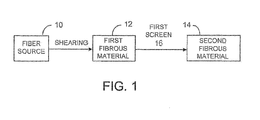
- a fiber source 10 is sheared, e.g., in a rotary knife cutter, to provide a first fibrous material 12.
- the first fibrous material 12 is passed through a first screen 16 having an average opening size of 1.59 mm or less (1/16 inch, 0.0625 inch) to provide a second fibrous material 14.
- fiber source 10 can be cut prior to the shearing, e.g., with a shredder.
- the paper when a paper is used as the fiber source 10, the paper can be first cut into strips that are, e.g., 1/4- to 1/2-inch wide, using a shredder, e.g., a counter-rotating screw shredder, such as those manufactured by Munson (Utica, N.Y.).
- a shredder e.g., a counter-rotating screw shredder, such as those manufactured by Munson (Utica, N.Y.
- the paper can be reduced in size by cutting to a desired size using a guillotine cutter.
- the guillotine cutter can be used to cut the paper into sheets that are, e.g., 10 inches wide by 12 inches long.
- the shearing of fiber source 10 and the passing of the resulting first fibrous material 12 through first screen 16 are performed concurrently.
- the shearing and the passing can also be performed in a batch-type process.
- a rotary knife cutter can be used to concurrently shear the fiber source 10 and screen the first fibrous material 12.
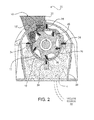
- a rotary knife cutter 20 includes a hopper 22 that can be loaded with a shredded fiber source 10' prepared by shredding fiber source 10.
- Shredded fiber source 10' is sheared between stationary blades 24 and rotating blades 26 to provide a first fibrous material 12.
- First fibrous material 12 passes through screen 16 having the dimensions described above, and the resulting second fibrous material 14 is captured in bin 30.
- bin 30 can have a pressure bellow nominal atmospheric pressure, e.g., at least 10 percent below nominal atmospheric pressure, e.g., at least 25 percent below nominal, atmospheric pressure, at least 50 percent below nominal atmospheric pressure, or at least 75 percent below nominal atmospheric pressure.
- a vacuum source 50 Fig. 2 is utilized to maintain the bin below nominal atmospheric pressure.
- Shearing can be advantageous for "opening up” and “stressing” the fibrous material, making the materials more dispersible, e.g., in a solution or in a resin, and making them more susceptible to chemical, enzymatic or biological attack.
- shearing can functionalize fiber surfaces with functional groups, such as hydroxyl or carboxylic acid groups, which can, e.g., help disperse the fibers in a molten resin or enhance chemical or biological attack.
- the fiber source can be sheared in a dry state, a hydrated state (e.g., having up to ten percent by weight absorbed water), or in a wet state, e.g., having between about 10 percent and about 75 percent by weight water.
- the fiber source can even be sheared while partially or fully submerged under a liquid, such as water, ethanol, isopropanol
- the fiber source can also be sheared in under a gas (such as a stream or atmosphere of gas other than air), e.g., oxygen or nitrogen, or steam.
- a gas such as a stream or atmosphere of gas other than air
- oxygen or nitrogen e.g., oxygen or nitrogen, or steam.
- the fibrous materials can be separated, e.g., continuously or in batches, into fractions according to their length, width, density, material type, or some combination of these attributes. For example, tor forming composites, it is often desirable to have a relatively narrow distribution of fiber length. In addition, e.g., when making compositions that include bacteria and/or an enzyme, it is often desirable to use a substantially single material as a feedstock.
- ferrous materials can be separated from any of the fibrous materials by passing a fibrous material that includes a ferrous material past a magnet, e.g., an electromagnet, and then passing the resulting fibrous material through a series of screens, each screen having different sized apertures.
- a magnet e.g., an electromagnet
- the fibrous materials can also be separated, e.g., by using a high velocity gas, e.g., air.
- a high velocity gas e.g., air.
- the fibrous materials are separated by drawing off different fractions, which can be characterized photonically, if desired.
- Such a separation apparatus is discussed in Lindsey et al, U.S. Patent No. 6,883,667 , the entire disclosure of which is hereby incorporated by reference herein in its entirety.
- the fibrous materials can be used immediately following their preparation, or they can may be dried, e.g., at approximately 105 °C for 4-18 hours, so that the moisture content is, e.g., less than about 0.5% before use.
- lignin can be removed from any of the fibrous materials that include liguia, such as lignocell ulosie materials.
- the fibrous material can be sterilized to kill any microorganisms that may be on the fibrous material.
- the fibrous material can be sterilized by exposing the fibrous material to radiation, such as infrared radiation, ultraviolet radiation, or an ionizing radiation, such as gamma radiation.
- the fibrous materials can also be sterilized by temperature adjustment, e.g., heating or cooling the fibrous material under conditions and for a sufficient time to kill any microorganisms, or by employing a chemical sterilant, such as bleach (e.g., sodium hypochlorite), chlorhexidine, or ethylene oxide.
- a chemical sterilant such as bleach (e.g., sodium hypochlorite), chlorhexidine, or ethylene oxide.
- the fibrous materials can also be sterilized by using a competitive organism, such as yeast against bacteria.
- the average opening size of the first screen 16 is less than 0.79 mm (1/32 inch, 0.03123 inch), e.g., less than 0.51 mm (1/50 inch, 0.02000 inch), less than 0.40 mm (1/64 inch, 0.015625 inch), less than 0.23 mm (0.009 inch), less than 0.20 mm (1/128 inch, 0.0078125 inch), less than 0.18 mm (0.007 inch), less than 0.13 mm (0.005 inch), or even less than less than 0.10 mm (1/256 inch, 0.00390625 inch).
- Screen 16 is prepared by interweaving monofilaments 33 having an appropriate diameter to give the desired opening size.
- the monofilaments can be made of a metal, e.g., stainless steel.
- a metal e.g., stainless steel.
- the screens can be made from monofilaments made from a material other than stainless steel, e.g., titanium, titanium alloys, amorphous metals, nickel, tungsten, rhodium, rhenium, ceramics, or glass.
- the screen is made from a plate, e.g. a metal plate, having apertures, e.g., cut into the plate using a laser.
- the second fibrous 14 is sheared and passed through the first screen 16, or a different sized scree. In some embodiments, the second fibrous material 14 is passed through a second screen having an average opening size equal to or less than that of first screen 16.
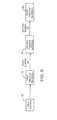
- a third fibrous material 62 can be prepared from the second fibrous material 14 by shearing the second fibrous material 14 and passing the resulting material through a second screen 60 having an average opening size less than the first screen 16.
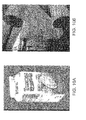
- Fiber sources include cellulosic fiber sources, including paper and paper products like those shown in Figs. 10A (polycoated paper) and 10B (Kraft paper), and lignocellulosic fiber sources, including wood, and wood-related materials, e.g., particle board.
- Other suitable liber sources include natural fiber sources, e.g., grasses, rice halls, bagasse, cotton, jute, hemp, flax, bamboo, sisal, abaca, straw, corn cobs, rice hulls, coconut hair; fiber sources high in ⁇ -cellulose content, e.g., cotton; synthetic fiber sources, e.g., extruded yarn (oriented yarn or un-oriented yarn) or carbon fiber sources; inorganic fiber sources; and mental fiber sources.
- Natural or synthetic tiber sources can be obtained from virgin scrap textile materials, e.g., remnants or they can be post consumer waste, e.g., rags.
- virgin materials e.g., scrap virgin materials, or they can be post-consumer waste.
- industrial e.g., offal
- processing waste e.g., effluent from paper processing
- the fiber source can be obtained or derived from human (e.g., sewage), animal or plant wastes. Additional fiber sources have been described in U.S. Patent Nos. 6,448,307 , 6,258,876 , 6,207,729 , 5,973,035 and 5,952,105 , each of which is incorporated by reference herein in its entirety.
- Blends of any of the above fibrous sources may be used.
- the fibers of the fibrous materials can have a relatively large average length-to-diameter ratio (e.g., greater than 20-to-1), even if they have been sheared more than once.
- the fibers of the fibrous material described herein may have a relatively narrow length and/or length-to-diameter ratio distribution.
- the relatively large average length-to-diameter ratio and the relatively narrow length and/or length-to-diameter ratio distribution are, at least in part, responsible for the ease at which the fibrous materials are dispersed in a resin, e.g., a molten thermoplastic resin.
- the relatively large average length-to-diameter ratio and the relatively narrow length and/or length-to-diameter ratio distribution are, at least part, responsible for the consistent properties of the fibrous materials, the predictable rheology modification the fibrous impart on a resin, the ease at which the combinations of the fibrous materials and resins are east, extruded and injection molded, the ease which the fibrous materials pass through small, often torturous channels and openings, and the excellent surface finishes possible with molded parts, e.g., glossy finishes and/or finishes substantially devoid of visible speckles.
- average fiber widths are those determined optically by randomly selecting approximately 5,000 fibers.
- Average fiber lengths are corrected length-weighted lengths.
- BET Brunauer, Emmet and Teller
- surface areas are multi-point surface areas, and porosities are those determined by mercury porosimetry.
- the average length-to-diameter ratio of the second fibrous material 14 can be, e.g. greater than 8/l, e.g., greater than 10/l, greater than 15/l, greater titan 20/l, greater than 25/l, or greater than 50/l.
- An average length of the second fibrous material 14 can be, e.g., between about 0.5 mm and 2.5 mm, e.g., between about 0.75 mm and 1.0 mm, and an average width (i.e., diameter) of the second fibrous material 14 can be, e.g., between about 5 ⁇ m and 50 ⁇ m, e.g., between about 10 ⁇ m and 30 ⁇ m.
- a standard deviation of the length of the second fibrous material 14 is less than 60 percent of an average length of the second fibrous material 14, e.g., less than 50 percent of the average length, less than 40 percent of the average length, less than 25 percent of the average length, less than 10 percent of the average length, less than 5 percent, of the average length, or even less than 1 percent of the average length.
- a BET surface area of the second fibrous material 14 is greater than 0.1 m 2 /g, e.g., greater than 0.25 m 2 /g, greater than 0.5 m 2 /g, greater than 1.0 m 2 /g, greater than 1.5 m 2 /g, greater than 1.75 m 2 /g, greater than 5.0 m 2 /g, greater than 10 m 2 /g, greater than 25 m 2 /g, greater than 35 m 2 /g, greater than 50m 2 /g, greater than 60 m 2 /g, greater than 75 m 2 /g, greater than 100 m 2 /g, greater than 150 m 2 /g, greater than 200 m 2 /g, or even greater than 250 m 2 /g.
- a porosity of the second fibrous material 14 can be, e.g., greater than 20 percent, greater than 25 percent, greater than 35 percent, greater than 50 percent, greater than 60 percent, greater than 70 percent, e.g., greater than 80 percent, greater than 85 percent, greater than 90 percent, greater than 92 percent, greater than 94 percent, greater than 95 percent, greater than 97.5 percent, greater than 99 percent, or even greater than 99.5 percent.
- a ratio of the average length-to-diameter ratio of the first fibrous material 12 to the average length-to-diameter ratio of the second fibrous material 14 is, e.g., less than 1.5, e.g., less than 1.4, less than 1.25, less than 1.1, less than 1.075, less than 1.05, less than 1.025, or even substantially equal to 1.
- the second fibrous material 14 is sheared again and the resulting fibrous material passed through a second screen having an average opening size less than the first screen to provide a third fibrous material 62.
- a ratio of the average length-to-diameter ratio of the second fibrous material 14 to the average length-to-diameter ratio of the third fibrous material 62 can be, e.g., less than 1.5, e.g., less than 1.4, less than 1.25, or even less than 1.1.
- the third fibrous material 62 is passed through a third screen to produce a fourth fibrous material.
- the fourth fibrous material can be, e.g., passed through a fourth screen to produce a fifth material. Similar screening processes can be repeated as many times as desired to produce the desired fibrous material having the desired propertied.
- the desired fibrous material includes fibers having an average length-to-diameter ratio of greater than 5 and having a standard deviation of the fiber length that is less than sixty percent of the average length.
- the average length-to-diameter ratio can be greater than 10/l, e.g., greater than 25/l, or greater than 50/l, and the average length can be between about 0.5 mm and 2.5 mm, e.g., between about 0.75 mm and 1.0 mm.
- An average width of the fibrous material can be between about 5 ⁇ m and 50 ⁇ m, e.g., between about 10 ⁇ m and 30 ⁇ m.
- the standard-deviation can be less than 50 percent of the average length, e.g., less than 40 percent, less than 30 percent, less than 25 percent, less than 20 percent, less than 10 percent, less than 5 percent, or even less than 1 percent of the average length.
- a desirable fibrous material can have, e.g., a BET surface area of greater than 0.5 m 2 /g, e.g., greater than 1.0 m 2 /g, greater than 1.5 m 2 /g, greater than 1.75 m 2 /g, greater than 5 m 2 /g, greater than 10 m 2 /g, greater than 25.0 m 2 /g, greater than 50.0 m 2 /g, greater than 75.0 m 2 /g, or even greater than 100.0 m 2 /g.
- a desired material can have, e.g., a porosity of greater than 70 percent, e.g., greater than 80 percent, greater than 87.5 percent, greater than 90 percent, greater than 92.5, greater than 95, greater than 97.5, or even greater than 99 percent.
- a particularly preferred embodiment has a BET surface area of greater than 1.25 m 2 /g and a porosity of greater than 85 percent.
- Composites including any of the fibrous materials or blends of any of the fibrous materials described herein (including any of the fibrous materials disclosed in U.S. Patent Nos. 6,448,307 , 6,258,876 , 6,207,729 , 5,973,035 and 5,952,105 ), e.g., the first 12 or second fibrous material 14, and a resin, e.g., a thermoplastic resin or a thermosetting resin, can be prepared by combining the desired fibrous material and the desired resin.
- the desired fibrous material can be combined with the desired resin, e.g., by mixing the fibrous material and the resin in an extruder or other mixer.
- the fibrous material can be combined with the resin as the fibrous material itself or as a densified fibrous material that can be re-opened during the combining.
- a densified material is discussed in International Application No. PCT/US2006/010648, filed on March 23, 2006 , the disclosure of which is incorporated herein by reference in its entirety.
- thermoplastic resins include rigid and elastomeric thermoplastics.
- Rigid thermoplastics include polyolefins (e.g., polyethylene, polypropylene, or polyolefin copolymers), polyesters (e.g., polyethylene terephthalate), polyamides (e.g., nylon 6, 6/12 or 6/10), and polyethyleneimines.
- elastomeric thermoplastic resins include elastomeric styrenic copolymers (e.g., styrene-ethylene-butylens-styrene copolymers), polyamide elastomers (e.g., polyether-polyamide copolymers) and ethylene-vinyl acetate copolymer.
- the thermoplastic resin has a melt flow rate of between 10 g/10 minutes to 60 g/10 minutes, e.g., between 20 g/10 minutes to 50 g/10 minutes, or between 30 g/10 minutes to 45 g/10 minutes, as measured using ASTM 1238.
- compatible blends of any of the above thermoplastic resins can be used.
- the thermoplastic resin has a polydispersity index (PDI), i.e., a ratio of the weight average molecular weight to the number average molecular weight, of greater than 1.5, e.g., greater than 2.0, greater than 2.5, greater than 5.0, greater than 7.5, or even greater than 10.0.
- PDI polydispersity index
- polyolefins or blends of polyolefins are utilized as the thermoplastic resin.
- thermosetting resins examples include natural rubber, butadiene-rubber and polyurethanes.
- additives e.g., in the form of a solid or a liquid
- suitable additives include fillers such as calcium carbonate, graphite, wollastonite, mica, glass, fiber glass, silica, and talc; inorganic flame retardants such as alumina trihydrate or magnesium hydroxide; organic flame retardants such as chlorinated or brominated organic compounds; ground construction waste; ground tire rubber; carbon fibers; or metal fibers or powders (e.g., aluminum, stainless steel).
- suitable additives include fillers such as calcium carbonate, graphite, wollastonite, mica, glass, fiber glass, silica, and talc; inorganic flame retardants such as alumina trihydrate or magnesium hydroxide; organic flame retardants such as chlorinated or brominated organic compounds; ground construction waste; ground tire rubber; carbon fibers; or metal fibers or powders (e.g., aluminum, stainless steel).
- fragrances include fragrances, coupling agents, compatibilizers, e.g., maleated polypropylene, processing aids, lubricants, e.g., fruorinated polyethylene, plasticizers, antioxidants, opacifiers, heat stabilizers, colorants, foaming agents, impact modifiers, polymers, e.g., degradable polymers, photostaibilizers, biocides, antistatic agents, e.g., stearates or ethoxylated fatty acid amines.
- compatibilizers e.g., maleated polypropylene
- processing aids e.g., lubricants, e.g., fruorinated polyethylene, plasticizers, antioxidants, opacifiers, heat stabilizers, colorants, foaming agents, impact modifiers, polymers, e.g., degradable polymers, photostaibilizers, biocides, antistatic agents, e.g., stearates or e
- Suitable antistatic compounds include conductive carbon blacks, carbon fibers, metal fillers, cationic compounds, e.g., quaternary ammonium compounds, e.g., N-(3-chloro-2-hydroxypropyl)-trimethylammonium chloride, alkanolamides, and amines.
- cationic compounds e.g., quaternary ammonium compounds, e.g., N-(3-chloro-2-hydroxypropyl)-trimethylammonium chloride, alkanolamides, and amines.
- degradable polymers include polyhydroxy acids, e.g., polylactides, polyglycolides and copolymers of lactic acid and glycolic acid, poly(hydroxybutyric acid), poly(hydroxyvaleric acid), poly[lactide-co-(e-caprolactone)], poly[glycolide-co-(e-caprolactoae)], polycarbonates, poly(amino acids), poly(hydroxyalkanoate)s, polyanhydrides, polyorthoesters and blends of these polymers.
- polyhydroxy acids e.g., polylactides, polyglycolides and copolymers of lactic acid and glycolic acid, poly(hydroxybutyric acid), poly(hydroxyvaleric acid), poly[lactide-co-(e-caprolactone)], poly[glycolide-co-(e-caprolactoae)], polycarbonates, poly(amino acids), poly(hydroxyalkanoate)s, polyanhydrides, polyorthoesters and
- the fibrous material is sterilized prior to combining with a resin to kill any microorganisms that may be on the fibrous material.
- the fibrous material can be sterilized by exposing the fibrous material to radiation; by heating the fibrous material under conditions and for a sufficient time to kill any microorganisms, e.g., boiling at normal atmospheric pressure; or by employing chemical sterifants.
- the fragrance e.g., natural wood fragrance
- the fragrance can be compounded into the resin used to make the composite.
- the fragrance a compounded directly into the resin as an oil.
- the oil can be compounded into the resin using a roll mill, e.g., a Banbury ® mixer or an extruder, e.g., a twin-screw extruder with counter-rotating screws.
- a Banbary ® mixer is the F-Series Banbury ® mixer, manufactured by Farrel.
- the WP ZSK 50 MEGAcompunderTM manufactured by Krupp Werner & Pfleiderer.
- the scented resin can be added to the fibrous material and extruded or molded.
- master batches of fragrance-filled resins are available commercially from International Flavors and Fragrances, under the tradename PolylffTM or from the RTP Company.
- the amount of fragrance in the composite is between about 0.005 % by weight and about 10 % by weight, e.g., between about 0.1 % and about 5 % or 0.25 % and about 2.5 %.
- fragrances include evergreen or redwood.
- Other fragrances include peppermint, cherry, strawberry, peach, lime, spearmint, cinnamon, anise, basil, bergamot, black pepper, camphor, chamomile, citronella, eucalyptus, pine, fir, geranium, ginger, grapefruit, jasmine, juniperberry, lavender, lemon, mandaria, marjoram, musk, myrhh, grange, patchouli, rose, rosemary, sage, sandalwood, tea tree, thyme, wintergreen, ylang ylang, vanilla, new car or mixtures of these fragrances.
- the amount of fragrance in the fibrous material-fragrance combination is between about 0.005 % by weight and about 20 % by weight, e.g., between about 0.1 % and about 5 % or 0.25 % and about 2.5 %. Even other fragrances and methods are described U.S. Provisional Application Serial No. 60/688,002, filed June 7, 2005 , the entire disclosure of which is hereby incorporated by reference herein.
- any of the fibrous material described above, e.g., the first 12 or second fibrous material 14, together with a resin, can be used to form articles such as pipes, panels, decking materials, boards, housing, sheets, blocks, bricks, poles, fencing, members, doors, shutters, awnings, shades, signs, frames, window casings, backboards, flooring, tiles, railroad ties, trays, tool handles, stalls, films, wraps, tapes, boxes, baskets, racks, casings, binders, dividers, walls, mats, frames, bookcases, sculptures, chairs, tables, desks, toys, games, pallets, wharves, piers, boats, masts, septic tanks, automotive panels, computer housings, above- and below-ground electrical casings, furniture, picnic tables, benches, shelters, trays, hangers, servers, caskets, book covers, canes, crutches, insulation, thread, cloth, novelties, house wares and structures.
- the fibrous material may be dyed before combining with the resin and compounding to form the composites described above.
- this dyeing can be helpful in masking or hiding the fibrous material, especially large agglomerations of the fibrous material, in molded or extruded parts.
- Such large agglomerations when present in relatively high concentrations, can show up as speckles in the surfaces of the molded or extruded parts.
- the desired fibrous material can be dyed using an acid dye, direct dye or a reactive dye.
- dyes are available from Spectra Dyes, Kearny, NJ or Keystone Aniline Corporation, Chicago, IL.
- Specific examples of dyes include SPECTRATM LIGHT YELLOW 2G, SPECTRACIDTM YELLOW 4GL CONC 200, SPECTRANYLTM RHODAMINE 8, SPECTRANYLTM NEUTRAL RED B, SPECTRAMINETM BENZOPERPURINE, SPECTRADIAZOTM BLACK OB, SPECTRAMINETM TURQUOISE G, and SPECTRAMINETM GREY LVL 200%, each being available from Spectra Dyes.
- resin color concentrates containing pigments are blended with dyes. When such blends are then compounded with the desired fibrous material, the fibrous material may be dyed in-situ during the compounding. Color concentrates are available from Clariant.
- a 1500 pound skid of virgin, half-gallon juice cartons made of un-printed polycoated white Kraft board having a bulk density of 20 lb/ft 3 was obtained from International Paper.
- the material was cut into pieces 8 1/4 inches by 11 inches using a guillotine cutter and fed to a Munson rotary knife cutter, Model SC30.
- Model SC30 is equipped with four rotary blades, four fixed blades, and a discharge screen having 1/8 inch openings.
- the gap between the rotary and fixed blades was set to approximately 0.020 inch.
- the rotary knife cutter sheared the confetti-like pieces across the knife-edges, tearing the pieces apart and releasing a fibrous material at a rate of about one pound per hour.
- the fibrous material had a BET surface area of 0.9748 m 2 /g +/- 0.0167 m 2 /g, a porosity of 89.043.7 percent and a bulk density (@0.53 psia) of 0.1260 g/mL.
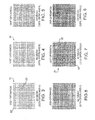
- An average length of the fibers was 1.141 mm and an average width of the fibers was 0.027 mm, giving an average L/D of 42:1. Scanning electron micrographs of the fibrous material are shown in Figs. 11 and 12 at 25 X magnification and 1000 X magnification, respectively.
- a 1500 pound skid of virgin bleached white Kraft board having a bulk density of 30 lb/ft 3 was obtained from International Paper.
- the material was cut into pieces 8 1/4 inches by 11 inches using a guillotine cutter and fed to a Manson rotary knife cutter, Model SC30.
- the discharge screen had 1/8 inch openings.
- the gap between the rotary and fixed blades was set to approximately 0.020 inch.
- the rotary knife cutter sheared the confetti-like pieces, releasing a fibrous material at a rate of about one pound per hour.
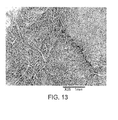
- the fibrous material had a BET surface area of 1.1316 m 2 /g +/- 0.0103 m 2 /g, a porosity of 88.3285 percent and a bulk density (@0.53 psia) of 0.1497 g/mL.
- An average length of the fibers was 1.063 mm and an average width of the fibers was 0.0245 mm, giving an average L/D of 43:1. Scanning electron micrographs of the fibrous material are shown in Figs. 13 and 14 at 25 X magnification and 1000 X magnification, respectively.
- a 1500 pound skid of virgin bleached white Kraft board having a bulk density of 30 lb/ft 3 was obtained from International Paper.
- the material was cut into pieces 8 1/4 inches by 11 inches using a guillotine cutter and fed to a Munson rotary knife cutter, Model SC30.
- the discharge screen had 1/16 inch openings.
- the gap between the rotary and fixed blades was set to approximately 0.020 inch.
- the rotary knife cutter the confetti-like pieces, releasing a fibrous material at a rate of about one pound per hour.
- the material resulting from the first shearing was fed back into the same setup described above and sheared again.
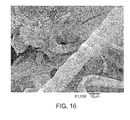
- the resulting fibrous material had a BET surface area of 1.4408 m 2 /g +/- 0.0156 m 2 /g, a porosity of 90.8998 percent and a bulk density (@0.53 psia) of 0.1298 g/mL.
- An average length of the fibers was 0.891 mm and an average width of the fibers was 0.026 mm, giving an average L/D of 34:1. Scanning electron micrographs of the fibrous material are shown in Figs. 15 and 16 at 25 X magnification and 1000 X magnification, respectively.
- a 1500 pound skid of virgin bleached white Kraft board having a bulk density of 30 lb/ft 3 was obtained from International Paper.
- the material was cut into pieces 8 1/4 inches by 11 inches using a guillotine cutter and fed to a Munson rotary knife cutter, Model SC30.
- the discharge screen had 1/8 inch openings.
- the gap between the rotary and fixed blades was set to approximately 0.020 inch.
- the rotary knife cutter sheared the confetti-like pieces across the knife-edges.
- the material resulting from the first shearing was fed back into the same setup and the screen was replaced with a 1/16 inch screen. This material was sheared.
- the material resulting from the second shearing was fed back into the same setup and the screen was replaced with a 1/32 inch screen.
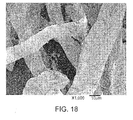
- the resulting fibrous material had a BET surface area of 1.6897 m 2 /g +/-0.0155 m 2 /g, a porosity of 87.7163 percent and a bulk density (@0.53 psia) of 0.1448 g/mL.
- An average length of the fibers was 0.824 mm and an average width of the fibers was 0.0262 mm, giving an average L/D of 32:1. Scanning electron micrographs of the fibrous material are shown in Figs. 17 and 18 at 25 X magnification and 1000 X magnification, respectively.
- compositions can be prepared that include any of the fibrous materials described herein, including any of the fibrous materials, resins, additives or other components disclosed in U.S. Patent Nos. 6,448,307 , 6,258,876 , 6,207,729 , 5,973,035 and 5,952,105 ).
- any of the fibrous materials described herein can be combined with a solid, a liquid or a gas, e.g., a chemical or chemical formulation (in the solid or liquid state), such as a pharmaceutical (e.g., an antibiotic), an agricultural material (e.g., plant seeds, a fertilizer, herbicide or pesticide), or an enzyme or a formulation that includes enzymes.
- Compositions that include one or more type of bacteria or bacteria in combination with one or more enzymes can also be prepared.
- any of the fibrous materials can be used to absorb chemicals, potentially absorbing many times their own weight.
- the fibrous materials can be used to absorb spilled oil, or other chemicals, Combining these fibrous materials with a microorganism, such as a bacterium, that can metabolize the oil or chemical can aid in cleanup.
- the fibrous materials can be combined with solutions of enzymes, dried, and then used in pet bedding, or combined with a pharmaceutical and used for delivering a therapeutic agent, such as a drug.
- the fibrous materials can be combined with a degradable polymer, e.g., polyglycolic acid, polylactic acid and copolymers of glycolic and lactic acid. Other degradable materials that can be used have been discussed above.
- compositions that include fibrous materials, e.g., cellulosic or lignocellulosic materials and, e.g., chemicals or chemical formulations in the solid, liquid or gaseous state, can be prepared, e.g., in various immersion, spraying, or blending apparatuses.
- the compositions can be prepared using ribbon blenders, cone blenders, double cone blenders, and Patterson-Kelly "V" blenders.
- lignin can be removed from any of the fibrous materials that include lignin, such as lignocellulosic materials.
- the fibrous material can be sterilized to kill any microorganisms that may be on the fibrous material.
- the fibrous material can be sterilized by exposing the fibrous material to radiation, such as infrared radiation, ultraviolet radiation, or an ionizing radiation, such as gamma radiation.
- the fibrous materials can also be sterilized by heating the fibrous material under conditions and for a sufficient time to kill any microorganisms, or by employing a chemical sterilant, such as bleach (e.g., sodium hypochlorite), chlorhexidine, or ethylene oxide.
- any of the fibrous materials can be washed, with a liquid such as water, to remove any undesirable impurities and/or contaminants.
- the fibrous materials can be used as a feedstock for various microorganisms, such as yeast and bacteria, that can ferment or otherwise work on the fibrous materials to produce a useful material, such as a fuel, e.g., an alcohol, an organic acid, a hydrocarbon or hydrogen, or a protein.
- a fuel e.g., an alcohol, an organic acid, a hydrocarbon or hydrogen, or a protein.
- the alcohol produced can be a monohydroxy alcohol, e.g., ethanol, or a polyhydroxy alcohol, e.g., ethylene glycol or glycerin.
- examples of alcohols that can be produced include methanol, ethanol, propanol, isopropanol, butanol, ethylene glycol, propylene glycol, 1, 4-butane diol, glycerin or mixtures of these alcohols.
- the organic acid produced can a monocarboxylic acid or a polycarboxylic acid.
- organic acids include formic acid, acetic acid, propionic acid, butyric acid, valeric acid, caproic, palmitic acid, stearic acid, oxalic acid, malonic acid, succinic acid, glutaric acid, oleic acid, linoleic acid, glycolic acid lactic acid, ⁇ -hydroxybutyric acid or mixtures of these acids.
- the hydrocarbon produced can be, e.g., an alkane or an alkene.
- hydrocarbons that can be produced include methane, ethane, propane, isobutene, pentane, n-hexane or mixtures of these hydrocarbons.
- a fiber source that includes a cellulosic and/or lignocellulosic fiber source is sheared to provide a first fibrous material.
- the first fibrous material is then passed through a first screen having an average opening size of about 1.59 mm or less (1/16 inch, 0.0625 inch) to provide a second fibrous material.
- the second fibrous material is combined with a bacterium and/or enzyme.
- the bacterium and/or enzyme is capable of utilizing the second fibrous material directly without pre-treatment to produce a fuel that includes hydrogen, an alcohol, an organic acid and/or a hydrocarbon.
- the fibrous material prior to combining the bacteria and/or enzyme, is sterilized to kill any microorganisms that may be on the fibrous material.
- the fibrous material can be sterilized by exposing the fibrous material to radiation, such as infrared radiation, ultraviolet radiation, or an ionizing radiation, such as gamma radiation.
- radiation such as infrared radiation, ultraviolet radiation, or an ionizing radiation, such as gamma radiation.
- the microorganisms can also be killed using chemical sterilants, such as bleach (e.g., sodium hypochlorite), chlorhexidine, or ethylene oxide.
- the cellulosic and/or lignocellulosic material of the fibrous material is first broken down into lower molecular weight sugars, which are then added to a solution of yeast and/or bacteria that ferment the lower molecular weight sugars to produce ethanol.
- the cellulosic and/or lignocellulosic material can be broken down using chemicals, such as acids or bases, by enzymes, or by a combination of the two. Chemical hydrolysis of cellulosic materials is described by Bjerre, in Biotechnol. Bioeng., 49:568 (1996 ) and Kim in Biotechnol. Prog., 18;489 (2002 ), which are each hereby incorporated by reference herein in their entirety.
- Bioethanol strategies are discussed by DiPardo in Journal of Outlook for Biomass Ethanol Production and Demand (EIA Forecasts), 2002 ; Sheehan in Biotechnology Progress, 15:8179, 1999 ; Martin in Enzyme Microbes Technology, 31:274, 2002 ; Greer in BioCycle, 61-65, April 2005 ; Lynd in Microbiology and Molecular Biology Reviews, 66:3, 506-577, 2002 ; Ljungdahl et al. in U.S. Patent No. 4,292,406 ; and Bellamy in U.S. Patent No. 4,094,742 , which are each hereby incorporated by reference herein in their entirety.
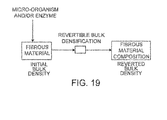
- a fibrous material having a low bulk density can be combined with a microorganism, e.g., freeze-dried yeast or bacteria, and/or a enzyme, and then revertibly densified to a fibrous material composition having a higher bulk density.
- a fibrous material composition having a bulk density of 0.05 g/cm 3 can be densified by sealing the fibrous material in a relatively gas impermeable structure, e.g., a bag made of polyethylene or a bag made of alternating layers of polyethylene and a nylon, and then evacuting the entrapped gas, e.g., air, from the structure.
- the fibrous material can have, e.g., a bulk density of greater than 0.3 g/cm 3 , e.g., 0.5 g/cm 3 , 0.6 g/cm 3 , 0.7 g/cm 3 or more, e.g., 0.83 g/ cm 3 .
- This can be advantageous when it is desirable to transport the fibrous material to another location, e.g., a remote manufacturing plant, where the fibrous material composition can be added to a solution, e.g., to produce ethanol.
- the densified fibrous material After piercing the substantially gas impermeable structure, the densified fibrous material reverts to nearly its initial bulk density, e.g., greater than 60 percent of its initial bulk density, e.g., 70 percent, 80 percent, 85 percent or more, e.g., 95 percent of its initial bulk density.
- an anti-static agent can be added to the fibrous material.
- a chemical, anti-static compound e.g., a cationic compound, e.g., quaternary ammonium compound, can be added to the fibrous material.
- the structure e.g., bag
- the structure is formed of a material that dissolves in a liquid, such as water.
- the structure can be formed from a polyvinyl alcohol so that it dissolves when in contact with a water-based system.
- densified structures allow densified structures to be added directly to solutions, e.g., that include a microorganism, without first releasing the contents of the structure, e.g., by cutting.
- a fiber source is sheared between a first pair of blades that defines a first gap, resulting in a first fibrous material.
- the first fibrous material is then sheared between a second pair of blades that define a second gap that is smaller than the first gap, resulting in a second fibrous material.
- Similar screening processes can be repeated as many times as desired to produce the desired fibrous material having the desired properties.
- a ratio of an average length-to-diameter ratio of the first fibrous material to an average length-to-diameter of the second fibrous material is less than 1.5.
Landscapes
- Engineering & Computer Science (AREA)
- Chemical & Material Sciences (AREA)
- Organic Chemistry (AREA)
- Life Sciences & Earth Sciences (AREA)
- Wood Science & Technology (AREA)
- Health & Medical Sciences (AREA)
- Zoology (AREA)
- Mechanical Engineering (AREA)
- Chemical Kinetics & Catalysis (AREA)
- General Health & Medical Sciences (AREA)
- General Chemical & Material Sciences (AREA)
- Genetics & Genomics (AREA)
- Microbiology (AREA)
- Biochemistry (AREA)
- Bioinformatics & Cheminformatics (AREA)
- General Engineering & Computer Science (AREA)
- Biotechnology (AREA)
- Oil, Petroleum & Natural Gas (AREA)
- Environmental & Geological Engineering (AREA)
- Animal Behavior & Ethology (AREA)
- Veterinary Medicine (AREA)
- Food Science & Technology (AREA)
- Public Health (AREA)
- Epidemiology (AREA)
- Manufacturing & Machinery (AREA)
- Polymers & Plastics (AREA)
- Medicinal Chemistry (AREA)
- Materials Engineering (AREA)
- Toxicology (AREA)
- Compositions Of Macromolecular Compounds (AREA)
- Preparation Of Compounds By Using Micro-Organisms (AREA)
- Paper (AREA)
- Nonwoven Fabrics (AREA)
- Chemical Or Physical Treatment Of Fibers (AREA)
- Micro-Organisms Or Cultivation Processes Thereof (AREA)
- Processing Of Solid Wastes (AREA)
- Liquid Carbonaceous Fuels (AREA)
- Immobilizing And Processing Of Enzymes And Microorganisms (AREA)
- Solid Fuels And Fuel-Associated Substances (AREA)
- Disintegrating Or Milling (AREA)
Priority Applications (5)
| Application Number | Priority Date | Filing Date | Title |
|---|---|---|---|
| SI200732030T SI3012025T1 (en) | 2006-06-15 | 2007-06-12 | Method of thickening the fibrous mixture |
| PL15191750T PL3012025T3 (pl) | 2006-06-15 | 2007-06-12 | Sposób zagęszczania kompozycji włóknistej |
| EP16189685.7A EP3135379B1 (de) | 2006-06-15 | 2007-06-12 | Verfahren zur herstellung eines brennstoffs |
| EP18213457.7A EP3492173A3 (de) | 2006-06-15 | 2007-06-12 | Fasermaterialien und zusammensetzungen |
| PL16189685T PL3135379T3 (pl) | 2006-06-15 | 2007-06-12 | Materiały i kompozyty włókniste |
Applications Claiming Priority (2)
| Application Number | Priority Date | Filing Date | Title |
|---|---|---|---|
| US11/453,951 US7708214B2 (en) | 2005-08-24 | 2006-06-15 | Fibrous materials and composites |
| EP07798424.3A EP2032261B1 (de) | 2006-06-15 | 2007-06-12 | Verfahren zur Herstellung eines Brennstoffs |
Related Parent Applications (2)
| Application Number | Title | Priority Date | Filing Date |
|---|---|---|---|
| EP07798424.3A Division-Into EP2032261B1 (de) | 2006-06-15 | 2007-06-12 | Verfahren zur Herstellung eines Brennstoffs |
| EP07798424.3A Division EP2032261B1 (de) | 2006-06-15 | 2007-06-12 | Verfahren zur Herstellung eines Brennstoffs |
Related Child Applications (3)
| Application Number | Title | Priority Date | Filing Date |
|---|---|---|---|
| EP16189685.7A Division EP3135379B1 (de) | 2006-06-15 | 2007-06-12 | Verfahren zur herstellung eines brennstoffs |
| EP16189685.7A Division-Into EP3135379B1 (de) | 2006-06-15 | 2007-06-12 | Verfahren zur herstellung eines brennstoffs |
| EP18213457.7A Division EP3492173A3 (de) | 2006-06-15 | 2007-06-12 | Fasermaterialien und zusammensetzungen |
Publications (3)
| Publication Number | Publication Date |
|---|---|
| EP3012025A2 true EP3012025A2 (de) | 2016-04-27 |
| EP3012025A3 EP3012025A3 (de) | 2016-08-03 |
| EP3012025B1 EP3012025B1 (de) | 2018-04-25 |
Family
ID=38832774
Family Applications (4)
| Application Number | Title | Priority Date | Filing Date |
|---|---|---|---|
| EP16189685.7A Not-in-force EP3135379B1 (de) | 2006-06-15 | 2007-06-12 | Verfahren zur herstellung eines brennstoffs |
| EP15191750.7A Not-in-force EP3012025B1 (de) | 2006-06-15 | 2007-06-12 | Verfahren zum verdichten einer faserzusammensetzung |
| EP18213457.7A Withdrawn EP3492173A3 (de) | 2006-06-15 | 2007-06-12 | Fasermaterialien und zusammensetzungen |
| EP07798424.3A Not-in-force EP2032261B1 (de) | 2006-06-15 | 2007-06-12 | Verfahren zur Herstellung eines Brennstoffs |
Family Applications Before (1)
| Application Number | Title | Priority Date | Filing Date |
|---|---|---|---|
| EP16189685.7A Not-in-force EP3135379B1 (de) | 2006-06-15 | 2007-06-12 | Verfahren zur herstellung eines brennstoffs |
Family Applications After (2)
| Application Number | Title | Priority Date | Filing Date |
|---|---|---|---|
| EP18213457.7A Withdrawn EP3492173A3 (de) | 2006-06-15 | 2007-06-12 | Fasermaterialien und zusammensetzungen |
| EP07798424.3A Not-in-force EP2032261B1 (de) | 2006-06-15 | 2007-06-12 | Verfahren zur Herstellung eines Brennstoffs |
Country Status (24)
| Country | Link |
|---|---|
| US (6) | US7708214B2 (de) |
| EP (4) | EP3135379B1 (de) |
| KR (1) | KR101159628B1 (de) |
| CN (2) | CN103131483A (de) |
| AP (1) | AP2464A (de) |
| AU (1) | AU2007257741B2 (de) |
| BR (3) | BR122018075069B1 (de) |
| CA (1) | CA2655111C (de) |
| DK (2) | DK2032261T3 (de) |
| EA (1) | EA013498B1 (de) |
| ES (2) | ES2674252T3 (de) |
| HU (2) | HUE028695T2 (de) |
| IL (3) | IL195910A (de) |
| LT (1) | LT3012025T (de) |
| MX (2) | MX2008016029A (de) |
| MY (3) | MY159431A (de) |
| NZ (3) | NZ620525A (de) |
| PL (3) | PL2032261T3 (de) |
| RU (1) | RU2434945C2 (de) |
| SI (2) | SI3012025T1 (de) |
| TR (1) | TR201807349T4 (de) |
| UA (1) | UA93719C2 (de) |
| WO (1) | WO2007146922A2 (de) |
| ZA (1) | ZA200900054B (de) |
Families Citing this family (77)
| Publication number | Priority date | Publication date | Assignee | Title |
|---|---|---|---|---|
| US7537826B2 (en) * | 1999-06-22 | 2009-05-26 | Xyleco, Inc. | Cellulosic and lignocellulosic materials and compositions and composites made therefrom |
| US20150328347A1 (en) | 2005-03-24 | 2015-11-19 | Xyleco, Inc. | Fibrous materials and composites |
| ES2662168T3 (es) * | 2005-03-24 | 2018-04-05 | Xyleco, Inc. | Procedimiento para preparar un material compuesto |
| US7708214B2 (en) | 2005-08-24 | 2010-05-04 | Xyleco, Inc. | Fibrous materials and composites |
| EP2415820A3 (de) | 2006-10-26 | 2012-10-31 | Xyleco, Inc. | Verfahren zur Änderung der molekularen Struktur von Biomasse |
| US8236535B2 (en) | 2008-04-30 | 2012-08-07 | Xyleco, Inc. | Processing biomass |
| US7867358B2 (en) | 2008-04-30 | 2011-01-11 | Xyleco, Inc. | Paper products and methods and systems for manufacturing such products |
| NL1035521C2 (nl) * | 2008-06-03 | 2009-12-07 | Majac B V | Werkwijze voor het recycleren van gebruikte kleding en huishoudelijk textiel. |
| US7900857B2 (en) * | 2008-07-17 | 2011-03-08 | Xyleco, Inc. | Cooling and processing materials |
| EP3095512B1 (de) | 2009-02-11 | 2018-10-17 | Xyleco, Inc. | Verarbeitung von biomasse durch ionisierende strahlung |
| NZ600967A (en) | 2009-02-11 | 2013-06-28 | Xyleco Inc | Saccharifying biomass |
| US20100203607A1 (en) * | 2009-02-11 | 2010-08-12 | Xyleco, Inc. | Processing biomass |
| AU2013203080B9 (en) * | 2009-05-20 | 2015-09-10 | Xyleco, Inc. | Processing biomass |
| NZ704219A (en) | 2009-05-20 | 2016-01-29 | Xyleco Inc | Bioprocessing |
| BRPI1010672A2 (pt) * | 2009-05-20 | 2016-08-09 | Xyleco Inc | processamento de biomassa |
| SI2432865T1 (en) | 2009-05-20 | 2018-07-31 | Xyleco, Inc. | Treatment of biomass |
| US9512563B2 (en) | 2009-05-28 | 2016-12-06 | Gp Cellulose Gmbh | Surface treated modified cellulose from chemical kraft fiber and methods of making and using same |
| US9511167B2 (en) | 2009-05-28 | 2016-12-06 | Gp Cellulose Gmbh | Modified cellulose from chemical kraft fiber and methods of making and using the same |
| BRPI1012052A2 (pt) | 2009-05-28 | 2017-12-26 | Gp Cellulose Gmbh | fibras kraft hidrolisadas e quimicamente modificadas e métodos de produção e de branqueamento de fibras kraft |
| US9512237B2 (en) | 2009-05-28 | 2016-12-06 | Gp Cellulose Gmbh | Method for inhibiting the growth of microbes with a modified cellulose fiber |
| US20100319865A1 (en) * | 2009-06-19 | 2010-12-23 | Weyerhaeuser Nr Company | Pulp for Odor Control |
| ES2959473T3 (es) * | 2009-12-01 | 2024-02-26 | Vive Textile Recycling Spolka Z O O | Procedimiento para reciclar ropa y textil doméstico usado |
| MY181812A (en) | 2010-01-20 | 2021-01-07 | Xyleco Inc | Dispersing feedstocks and processing materials |
| MX355997B (es) | 2010-01-20 | 2018-05-08 | Xyleco Inc | Metodo y sistema para la sacarificacion y fermentacion de una materia prima de masa biologica. |
| US9005758B2 (en) | 2010-04-22 | 2015-04-14 | Forest Concepts, LLC | Multipass rotary shear comminution process to produce corn stover particles |
| US9440237B2 (en) * | 2010-04-22 | 2016-09-13 | Forest Concepts, LLC | Corn stover biomass feedstocks with uniform particle size distribution profiles at retained field moisture contents |
| US8871346B2 (en) | 2010-04-22 | 2014-10-28 | Forest Concepts, LLC | Precision wood particle feedstocks with retained moisture contents of greater than 30% dry basis |
| US8497020B2 (en) | 2010-04-22 | 2013-07-30 | Forest Concepts, LLC | Precision wood particle feedstocks |
| US8758895B2 (en) | 2010-04-22 | 2014-06-24 | Forest Concepts, LLC | Engineered plant biomass particles coated with biological agents |
| US8507093B2 (en) * | 2010-04-22 | 2013-08-13 | Forest Concepts, LLC | Comminution process to produce precision wood particles of uniform size and shape with disrupted grain structure from wood chips |
| US9604387B2 (en) | 2010-04-22 | 2017-03-28 | Forest Concepts, LLC | Comminution process to produce wood particles of uniform size and shape with disrupted grain structure from veneer |
| US8481160B2 (en) | 2010-04-22 | 2013-07-09 | Forest Concepts, LLC | Bimodal and multimodal plant biomass particle mixtures |
| US8734947B2 (en) * | 2010-04-22 | 2014-05-27 | Forst Concepts, LLC | Multipass comminution process to produce precision wood particles of uniform size and shape with disrupted grain structure from wood chips |
| US9061286B2 (en) | 2010-04-22 | 2015-06-23 | Forest Concepts, LLC | Comminution process to produce precision wood particles of uniform size and shape with disrupted grain structure from wood chips |
| US8497019B2 (en) | 2010-04-22 | 2013-07-30 | Forest Concepts, LLC | Engineered plant biomass particles coated with bioactive agents |
| US8034449B1 (en) | 2010-04-22 | 2011-10-11 | Forest Concepts, LLC | Engineered plant biomass feedstock particles |
| SG186348A1 (en) | 2010-07-19 | 2013-01-30 | Xyleco Inc | Processing biomass |
| US8651403B2 (en) * | 2010-07-21 | 2014-02-18 | E I Du Pont De Nemours And Company | Anhydrous ammonia treatment for improved milling of biomass |
| US20120024859A1 (en) * | 2010-07-30 | 2012-02-02 | Francesco Longoni | Container |
| CN102478716B (zh) * | 2010-11-30 | 2013-08-28 | 东莞冠狄塑胶有限公司 | 一种眼镜架板材的制作方法 |
| US8722773B2 (en) | 2011-02-14 | 2014-05-13 | Weyerhaeuser Nr Company | Polymeric composites |
| US8765010B2 (en) | 2011-03-22 | 2014-07-01 | Eco-Composites Llc | Lignocellulosic fibrous composites and associated methods for preparing the same |
| US8757092B2 (en) | 2011-03-22 | 2014-06-24 | Eco-Composites Llc | Animal bedding and associated method for preparing the same |
| US9737047B2 (en) * | 2011-03-22 | 2017-08-22 | Ccd Holdings Llc | Method for the treatment, control, minimization, and prevention of bovine mastitis |
| US9181134B1 (en) | 2011-04-27 | 2015-11-10 | Israzion Ltd. | Process of converting textile solid waste into graphite simple or complex shaped manufacture |
| BR112013030060A2 (pt) | 2011-05-23 | 2018-01-16 | Gp Cellulose Gmbh | fibras e tábua de madeira resinosa kraft e respectivo método para fabricação de fibra kraft |
| US8329455B2 (en) | 2011-07-08 | 2012-12-11 | Aikan North America, Inc. | Systems and methods for digestion of solid waste |
| FI124380B (en) * | 2011-11-15 | 2014-07-31 | Upm Kymmene Corp | Composite product, process for the manufacture of the composite product and its use, and end product |
| CA2860609C (en) | 2012-01-12 | 2021-02-16 | Gp Cellulose Gmbh | A low viscosity kraft fiber having reduced yellowing properties and methods of making and using the same |
| US9328231B2 (en) * | 2012-02-14 | 2016-05-03 | Weyerhaeuser Nr Company | Composite polymer |
| MX364847B (es) | 2012-04-18 | 2019-05-08 | Gp Cellulose Gmbh | El uso de surfactante para tratar pulpa y mejorar la incorporacion de pulpa kraft en fibra para la produccion de viscosa y otros productos de fibra secundarios. |
| UA116630C2 (uk) | 2012-07-03 | 2018-04-25 | Ксілеко, Інк. | Спосіб перетворення цукру на фурфуриловий спирт |
| CN104602879B (zh) | 2012-08-28 | 2017-05-17 | 芬欧汇川集团 | 制造复合产品的方法和系统以及复合产品 |
| DK2708643T3 (en) * | 2012-09-14 | 2018-02-12 | Mediterranea Solutions S U A R L | Process for biomass pretreatment prior to biofuel conversion |
| JP5948222B2 (ja) * | 2012-11-02 | 2016-07-06 | ユニ・チャーム株式会社 | 吸収性物品に係る材料の分離装置、及び分離方法 |
| CA2839488A1 (en) * | 2013-01-15 | 2014-07-15 | Barry Beyerlein | Double-barrel trimmer for plant materials |
| RU2018117289A (ru) | 2013-02-08 | 2018-10-26 | ДжиПи СЕЛЛЬЮЛОУС ГМБХ | КРАФТ-ВОЛОКНО ДРЕВЕСИНЫ ХВОЙНЫХ ПОРОД С УЛУЧШЕННЫМ СОДЕРЖАНИЕМ α-ЦЕЛЛЮЛОЗЫ И ЕГО ПРИМЕНЕНИЕ ПРИ ПРОИЗВОДСТВЕ ХИМИЧЕСКИХ ЦЕЛЛЮЛОЗНЫХ ПРОДУКТОВ |
| RU2671653C2 (ru) | 2013-03-14 | 2018-11-06 | ДжиПи СЕЛЛЬЮЛОУС ГМБХ | Способ изготовления высокофункционального маловязкого крафтволокна с использованием последовательности кислотного отбеливания и волокно, изготовленное с помощью этого процесса |
| CN105143547B (zh) | 2013-03-15 | 2018-05-01 | Gp 纤维素股份有限公司 | 具有增高羧基含量的低粘度牛皮纸纤维及其制造和使用方法 |
| CA2924964C (en) * | 2013-09-27 | 2018-01-09 | Toyo Seikan Group Holdings, Ltd. | Method for degrading biodegradable resin |
| JP5977726B2 (ja) * | 2013-11-07 | 2016-08-24 | 鈴鹿エンヂニヤリング株式会社 | ゴムベール細断方法及びその装置 |
| US10227623B2 (en) | 2013-11-24 | 2019-03-12 | E I Du Pont De Nemours And Company | High force and high stress destructuring of cellulosic biomass |
| DE202014001280U1 (de) * | 2014-02-11 | 2014-04-04 | Landpack GmbH & Co. KG | Isolierverpackung zur Wärmedämmung oder Schockabsorption aus Stroh oder Heu |
| US9809011B1 (en) | 2014-06-11 | 2017-11-07 | Giuseppe Puppin | Composite fabric member and methods |
| DE102014225105B4 (de) * | 2014-12-08 | 2019-01-03 | Currenta Gmbh & Co.Ohg | Verfahren zur mechanischen Aufbereitung von Carbonfasern |
| US10456959B2 (en) * | 2015-01-21 | 2019-10-29 | TieBam, Inc. | Bamboo railroad tie manufacturing system |
| ITUA20164301A1 (it) * | 2016-05-24 | 2017-11-24 | Maria Giovanna Gamberini | Termocompattatore |
| US11078630B2 (en) * | 2016-11-03 | 2021-08-03 | Oregon State University | Molded pomace pulp products and methods |
| WO2018093697A1 (en) | 2016-11-16 | 2018-05-24 | Gp Cellulose Gmbh | Modified cellulose from chemical fiber and methods of making and using the same |
| WO2019050960A1 (en) | 2017-09-05 | 2019-03-14 | Poet Research, Inc. | METHODS AND SYSTEMS FOR PROPAGATION OF A MICROORGANISM USING A WASTE BY-PRODUCT OF A PULP MILL AND / OR PAPER MILL AND METHODS AND SYSTEMS THEREOF |
| JP2021501231A (ja) | 2017-10-27 | 2021-01-14 | キシレコ インコーポレイテッド | バイオマスの加工方法 |
| US11738927B2 (en) * | 2018-06-21 | 2023-08-29 | First Quality Tissue, Llc | Bundled product and system and method for forming the same |
| US11697538B2 (en) * | 2018-06-21 | 2023-07-11 | First Quality Tissue, Llc | Bundled product and system and method for forming the same |
| KR20220027075A (ko) | 2019-05-23 | 2022-03-07 | 볼트 쓰레즈, 인크. | 복합 재료, 및 이의 제조 방법 |
| CN114102789B (zh) * | 2021-11-12 | 2023-04-07 | 浙江品阁木业有限公司 | 一种改性纤维板原料的脱水装置 |
| CN114957964B (zh) * | 2022-06-17 | 2023-03-31 | 宋伟杰 | 一种可降解汽车脚垫材料及其制备方法 |
| EP4587187A1 (de) * | 2022-09-16 | 2025-07-23 | Pocket Coil Recycling LLC | Recyclingsystem |
Family Cites Families (365)
| Publication number | Priority date | Publication date | Assignee | Title |
|---|---|---|---|---|
| US1824221A (en) | 1928-10-24 | 1931-09-22 | Masonite Corp | Process and apparatus for disintegration of fibrous material |
| US2519442A (en) | 1944-04-28 | 1950-08-22 | Saint Gobain | Compositions containing cellulosic filler united by polyvinyl chloride |
| US2516847A (en) | 1944-12-01 | 1950-08-01 | Masonite Corp | Process of sizing exploded fibers |
| US2558378A (en) | 1947-01-15 | 1951-06-26 | Delaware Floor Products Inc | Composition for floor and wall covering comprising plasticized vinyl resin and filler and method of making same |
| US2635976A (en) | 1948-06-15 | 1953-04-21 | Plywood Res Foundation | Method of making synthetic constructional boards and products thereof |
| US2658828A (en) | 1948-09-15 | 1953-11-10 | Chemloch Corp | Process of combining synthetic resins and other materials with cellulose |
| US2665261A (en) | 1950-05-12 | 1954-01-05 | Allied Chem & Dye Corp | Production of articles of high impact strength |
| US2680102A (en) | 1952-07-03 | 1954-06-01 | Homasote Company | Fire-resistant product from comminuted woody material, urea, or melamine-formaldehyde, chlorinated hydrocarbon resin, and hydrated alumina |
| US2757150A (en) | 1953-01-30 | 1956-07-31 | Weyerhaeuser Timber Co | Preparing hot-moldable thermosetting resin and cellulose fiber mixtures |
| US2935763A (en) | 1954-09-01 | 1960-05-10 | Us Rubber Co | Method of forming pellets of a synthetic rubber latex and a particulate resin |
| US2789903A (en) | 1954-09-02 | 1957-04-23 | Celanese Corp | Process for production of shaped articles comprising fibrous particles and a copolymer of vinyl acetate and an ethylenically unsaturated acid |
| US3308218A (en) | 1961-05-24 | 1967-03-07 | Wood Conversion Co | Method for producing bonded fibrous products |
| US3493527A (en) | 1962-06-07 | 1970-02-03 | George Berthold Edward Schuele | Moldable composition formed of waste wood or the like |
| GB1046246A (en) | 1962-06-07 | 1966-10-19 | George Berthold Edward Schuele | Improvements in or relating to the utilisation of natural fibrous materials |
| US3645939A (en) | 1968-02-01 | 1972-02-29 | Us Plywood Champ Papers Inc | Compatibilization of hydroxyl containing materials and thermoplastic polymers |
| US3516953A (en) | 1968-03-25 | 1970-06-23 | Ernest Herbert Wood | Granular,free-flowing,synthetic thermosetting aminoplast resin molding composition containing defiberized alpha-cellulosic pulp of a certain fiber length wherein said filler is substantially the sole filler present |
| US3596314A (en) | 1968-11-26 | 1971-08-03 | Hitco | Apparatus for forming a densified fibrous article |
| US3697364A (en) | 1970-04-16 | 1972-10-10 | Monsanto Co | Discontinuous cellulose reinforced elastomer |
| US3836412A (en) | 1970-04-16 | 1974-09-17 | Monsanto Co | Preparation of discontinuous fiber reinforced elastomer |
| US3718536A (en) | 1970-04-22 | 1973-02-27 | Thilmany Pulp & Paper Co | Composite board and method of manufacture |
| US3671615A (en) | 1970-11-10 | 1972-06-20 | Reynolds Metals Co | Method of making a composite board product from scrap materials |
| US3709845A (en) | 1971-07-06 | 1973-01-09 | Monsanto Co | Mixed discontinuous fiber reinforced composites |
| JPS5654335B2 (de) | 1972-07-11 | 1981-12-24 | ||
| SE368793B (de) | 1972-11-03 | 1974-07-22 | Sonesson Plast Ab | |
| JPS594447B2 (ja) | 1972-12-28 | 1984-01-30 | 日石三菱株式会社 | 合成紙 |
| CH570869A5 (de) | 1973-03-23 | 1976-05-14 | Icma San Giorgio S R L Ind Cos | |
| US4305901A (en) | 1973-07-23 | 1981-12-15 | National Gypsum Company | Wet extrusion of reinforced thermoplastic |
| SE398134B (sv) | 1973-11-19 | 1977-12-05 | Sunden Olof | Forfarande for modifiering av cellulosafibrer medelst kiselsyra samt impregneringslosning for utovande av forfarandet |
| US4056591A (en) | 1973-12-26 | 1977-11-01 | Monsanto Company | Process for controlling orientation of discontinuous fiber in a fiber-reinforced product formed by extrusion |
| SE7415817L (de) | 1974-01-18 | 1975-07-21 | Baehre & Greten | |
| US3943079A (en) | 1974-03-15 | 1976-03-09 | Monsanto Company | Discontinuous cellulose fiber treated with plastic polymer and lubricant |
| US3956541A (en) | 1974-05-02 | 1976-05-11 | Capital Wire & Cable, Division Of U. S. Industries | Structural member of particulate material and method of making same |
| US4016232A (en) | 1974-05-02 | 1977-04-05 | Capital Wire And Cable, Division Of U.S. Industries | Process of making laminated structural member |
| US4020212A (en) | 1974-09-13 | 1977-04-26 | Phillips Petroleum Company | Polyolefin fibers useful as fiberfill treated with finishing agent comprising an organopolysiloxane and a surface active softener |
| US3956555A (en) | 1974-09-23 | 1976-05-11 | Potlatch Corporation | Load carrying member constructed of oriented wood strands and process for making same |
| US4058580A (en) | 1974-12-02 | 1977-11-15 | Flanders Robert D | Process for making a reinforced board from lignocellulosic particles |
| FR2296513A1 (fr) | 1974-12-31 | 1976-07-30 | Inst Nat Rech Chimique | Procede de fabrication de produits finis ou semi-finis a partir de melanges de dechets de resines synthetiques differentes |
| US4097648A (en) | 1975-02-10 | 1978-06-27 | Capital Wire & Cable, Division Of U.S. Industries, Inc. | Laminated structural member and method of making same |
| US3985927A (en) | 1975-02-24 | 1976-10-12 | Nekoosa Edwards Paper Company, Inc. | Compositions and method for producing a chemical watermark on finished paper products |
| US4045603A (en) | 1975-10-28 | 1977-08-30 | Nora S. Smith | Construction material of recycled waste thermoplastic synthetic resin and cellulose fibers |
| NO138127C (no) | 1975-12-01 | 1978-07-12 | Elopak As | Framgangsmaate for av "kommunalt" avfall aa framstille raamateriale for presslegemer |
| DE2610721C3 (de) | 1976-03-13 | 1978-12-21 | Rehau-Plastiks Gmbh, 8673 Rehau | Verwendung eines Kunststoff-Holzmehlgemisches zur Herstellung von Isolationswerkstoff für die Elektroindustrie |
| US4112038A (en) | 1976-09-02 | 1978-09-05 | Lowe Paper Company | Method for producing molded articles |
| US4204010A (en) | 1976-09-17 | 1980-05-20 | W. R. Grace & Co. | Radiation curable, ethylenically unsaturated thixotropic agent and method of preparation |
| DE2647944C2 (de) | 1976-10-22 | 1979-04-12 | Rolf 8502 Zirndorf Schnause | Verfahren und Vorrichtung zum Herstellen von Formkörpern aus thermoplastischen Kunststoffen und einem blattförmigen, geschnitzelten, faserigen, nicht-thermoplastischen Werkstoff |
| CA1099858A (en) | 1976-11-11 | 1981-04-28 | Heikki Mamers | Recovery of fibre from laminated carton boards |
| US4263184A (en) | 1977-01-05 | 1981-04-21 | Wyrough And Loser, Inc. | Homogeneous predispersed fiber compositions |
| FR2381804A1 (fr) | 1977-02-28 | 1978-09-22 | Solvay | Compositions moulables a base de polymeres thermoplastiques et de matieres fibreuses vegetales et utilisation de ces compositions pour le calandrage et le thermoformage |
| US4184311A (en) * | 1977-03-25 | 1980-01-22 | Rood Leonard D | Fire retardant insulation |
| NL184773C (nl) | 1977-04-19 | 1989-11-01 | Lankhorst Touwfab Bv | Werkwijze voor het verwerken van thermoplastisch kunststofmateriaal tot een voorwerp met de be- en verwerkbaarheidseigenschappen van hout. |
| US4123489A (en) * | 1977-05-17 | 1978-10-31 | Flett Development Company | Method for converting waste paper products into useful forms |
| US4145389A (en) | 1977-08-22 | 1979-03-20 | Smith Teddy V | Process for making extruded panel product |
| US4277428A (en) | 1977-09-14 | 1981-07-07 | Masonite Corporation | Post-press molding of man-made boards to produce contoured furniture parts |
| US4508595A (en) | 1978-05-25 | 1985-04-02 | Stein Gasland | Process for manufacturing of formed products |
| DE2831616C2 (de) | 1978-07-19 | 1984-08-09 | Kataflox Patentverwaltungs-Gesellschaft mbH, 7500 Karlsruhe | Verfahren zum Herstellen eines nicht brennbaren Formkörpers |
| US4244847A (en) | 1978-08-10 | 1981-01-13 | The Gates Rubber Company | Fibrated admix or polymer and process therefore |
| US4202804A (en) | 1978-09-11 | 1980-05-13 | Desoto, Inc. | Viscosity stable, stainable wood textured caulking composition containing water immiscible organic solvent |
| JPS5944963B2 (ja) | 1978-10-06 | 1984-11-02 | ロンシール工業株式会社 | プリント絞模様を有する塩化ビニルシ−トの製造方法 |
| DE2845112C3 (de) | 1978-10-17 | 1981-11-05 | Casimir Kast Gmbh & Co Kg, 7562 Gernsbach | Verfahren und Anlage zur Herstellung von Matten aus zellulosehaltigen Fasern und Verfahren zur Herstellung von Formteilen aus diesen |
| DE7831283U1 (de) | 1978-10-20 | 1979-04-05 | Werz Furnier Sperrholz | Stapelbare Palette mit integrierter Stapelnocke |
| US4248820A (en) | 1978-12-21 | 1981-02-03 | Board Of Control Of Michigan Technological University | Method for molding apertures in molded wood products |
| US4440708A (en) | 1978-12-21 | 1984-04-03 | Board Of Control Of Michigan Technological University | Method for molding articles having non-planar portions from matted wood flakes |
| US4237226A (en) | 1979-02-23 | 1980-12-02 | Trustees Of Dartmouth College | Process for pretreating cellulosic substrates and for producing sugar therefrom |
| US4303019A (en) | 1979-03-07 | 1981-12-01 | Board Of Control Of Michigan Technological University | Articles molded from papermill sludge |
| US5628830A (en) | 1979-03-23 | 1997-05-13 | The Regents Of The University Of California | Enzymatic hydrolysis of biomass material |
| US4311621A (en) | 1979-04-26 | 1982-01-19 | Kikkoman Corporation | Process for producing a filler for adhesive for bonding wood |
| US4239679A (en) | 1979-06-27 | 1980-12-16 | Diamond Shamrock Corporation | High bulk density rigid poly(vinyl chloride) resin powder composition and preparation thereof |
| US4279790A (en) | 1979-07-05 | 1981-07-21 | Kabushiki Kaisha Mikuni Seisakusho | Composite material compositions using wasterpaper and method of producing same |
| SE8005194L (sv) | 1979-07-17 | 1981-01-18 | Lion Corp | Termoplastkomposition och sett att forma foremal derav |
| AU553080B2 (en) * | 1979-08-10 | 1986-07-03 | Timothy Warren Gilder | Method of forming wood fibres |
| US4248743A (en) | 1979-08-17 | 1981-02-03 | Monsanto Company | Preparing a composite of wood pulp dispersed in a polymeric matrix |
| DE3063511D1 (en) | 1979-08-29 | 1983-07-07 | Michael John Hewitt | Manufacture of frames for windows and the like from cored plastics profiles |
| US4265846A (en) | 1979-10-05 | 1981-05-05 | Canadian Patents And Development Limited | Method of binding lignocellulosic materials |
| US4393020A (en) | 1979-12-20 | 1983-07-12 | The Standard Oil Company | Method for manufacturing a fiber-reinforced thermoplastic molded article |
| CA1173380A (en) | 1980-02-19 | 1984-08-28 | Michael I. Sherman | Acid hydrolysis of biomass for ethanol production |
| US4480035A (en) | 1980-06-09 | 1984-10-30 | Sukomal Roychowdhury | Production of hydrogen |
| FR2483966A1 (fr) | 1980-06-10 | 1981-12-11 | Rhone Poulenc Textile | Solutions conformables a partir de melanges de cellulose et polychlorure de vinyle et articles en forme obtenus |
| US4323625A (en) | 1980-06-13 | 1982-04-06 | Monsanto Company | Composites of grafted olefin polymers and cellulose fibers |
| US4328136A (en) | 1980-12-30 | 1982-05-04 | Blount David H | Process for the production of cellulose-silicate products |
| US4400470A (en) | 1981-01-14 | 1983-08-23 | Wisconsin Alumni Research Foundation | Use of co-cultures in the production of ethanol by the fermentation of biomass |
| US4376144A (en) | 1981-04-08 | 1983-03-08 | Monsanto Company | Treated fibers and bonded composites of cellulose fibers in vinyl chloride polymer characterized by an isocyanate bonding agent |
| US4414267A (en) | 1981-04-08 | 1983-11-08 | Monsanto Company | Method for treating discontinuous cellulose fibers characterized by specific polymer to plasticizer and polymer-plasticizer to fiber ratios, fibers thus treated and composites made from the treated fibers |
| US4359534A (en) | 1981-04-28 | 1982-11-16 | The United States Of America As Represented By The Secretary Of Agriculture | Conversion of D-xylose to ethanol by the yeast Pachysolen tannophilus |
| US4511656A (en) | 1981-05-15 | 1985-04-16 | Purdue Research Foundation | Direct fermentation of D-xylose to ethanol by a xylose-fermenting yeast mutant |
| US4368268A (en) | 1981-05-15 | 1983-01-11 | Purdue Research Foundation | Direct fermentation of D-xylose to ethanol by a xylose-fermenting yeast mutant |
| US4426470A (en) | 1981-07-27 | 1984-01-17 | The Dow Chemical Company | Aqueous method of making reinforced composite material from latex, solid polymer and reinforcing material |
| HU183546B (en) | 1981-08-19 | 1984-05-28 | Muanyagipari Kutato Intezet | Process for preparing a combined substance containing a thermoplastic material, a fibrous polymeric skeleton substance of natural origin and an insaturated polyester |
| DE3147989A1 (de) | 1981-12-04 | 1983-06-16 | Hoechst Ag, 6230 Frankfurt | Dekoratives, insbesondere plattenfoermiges formteil, verfahren zu seiner herstellung und seine verwendung |
| DE3280437T2 (de) | 1981-12-11 | 1993-12-02 | Tore Carl Fredrik Klason | Verfahren zur herstellung von auf cellulose- oder lignocellulosematerialien und kunststoffen basierenden kompositen. |
| US4382108A (en) | 1981-12-21 | 1983-05-03 | The Upjohn Company | Novel compositions and process |
| US4738723A (en) | 1981-12-24 | 1988-04-19 | Gulf States Asphalt Co. | Asbestos-free asphalt composition |
| US4505869A (en) | 1982-03-03 | 1985-03-19 | Sadao Nishibori | Method for manufacturing wood-like molded product |
| US4420351A (en) | 1982-04-29 | 1983-12-13 | Tarkett Ab | Method of making decorative laminated products such as tiles, panels or webs from cellulosic materials |
| US4455709A (en) | 1982-06-16 | 1984-06-26 | Zanini Walter D | Floor mounted guide and shim assembly for sliding doors |
| US4562218A (en) | 1982-09-30 | 1985-12-31 | Armstrong World Industries, Inc. | Formable pulp compositions |
| EP0122460B1 (de) | 1983-03-23 | 1988-07-06 | Chuo Kagaku Co., Ltd. | Herstellung eines Harzschaumes mit wässrigem Medium |
| BG39560A1 (en) | 1983-08-25 | 1986-07-15 | Natov | Polyvinylchloride composition |
| US4520530A (en) | 1983-09-02 | 1985-06-04 | Akiva Pinto | Fiber feeding apparatus with a pivoted air exhaust wall portion |
| DE3336647A1 (de) | 1983-10-08 | 1985-04-25 | Hoechst Ag, 6230 Frankfurt | Formmasse auf der basis von vinylchloridpolymerisaten und verfahren zur herstellung von folien aus diesen formmassen fuer die bereitung von faelschungssicheren wertpapieren |
| DE3346469C2 (de) | 1983-12-22 | 1987-02-26 | Heggenstaller, Anton, 8892 Kühbach | Verfahren und Vorrichtung zum Strangpressen von mit Bindemittel vermengten pflanzlichen Kleinteilen, insbesondere Holzkleinteilen |
| US4609624A (en) | 1984-02-03 | 1986-09-02 | Les Services De Consultation D.B. Plus Limitee | Process for producing isopropyl alcohol from cellulosic substrates |
| GB8404000D0 (en) | 1984-02-15 | 1984-03-21 | Unilever Plc | Wiping surfaces |
| US4597928A (en) | 1984-03-23 | 1986-07-01 | Leningradsky Tekhnologichesky Institute Tselljulozno-Bumazhnoi Promyshlennosti | Method for fiberboard manufacture |
| JPS60206604A (ja) | 1984-03-30 | 1985-10-18 | Ota Shoji | リグノセルロ−ス物質を再構成された複合物品に変換させる方法 |
| DE3417712A1 (de) | 1984-05-12 | 1985-11-14 | Andreas 8077 Reichertshofen Pöhl | Buch-presse |
| JPS6131447A (ja) | 1984-07-23 | 1986-02-13 | Kanegafuchi Chem Ind Co Ltd | 熱可塑性木質材組成物 |
| FR2568164B1 (fr) | 1984-07-27 | 1987-09-04 | Ostermann Michel | Procede de production de produits decoratifs a partir de fragments ou morceaux de bois et produits obtenus |
| KR920005729B1 (ko) | 1984-09-06 | 1992-07-16 | 미쓰비시 레이온 캄파니 리미티드 | 방향성 섬유 |
| ATE35663T1 (de) | 1984-09-20 | 1988-07-15 | Werz Pressholz Werzalit | Palette. |
| DE3446139A1 (de) | 1984-12-18 | 1986-06-19 | Andreas Peter Dipl.-Ing. 8200 Rosenheim Pöhl | Tiegel fuer metallbeschichtung |
| US4610900A (en) | 1984-12-19 | 1986-09-09 | Sadao Nishibori | Wood-like molded product of synthetic resin |
| JPS61151266A (ja) | 1984-12-25 | 1986-07-09 | Chisso Corp | 熱可塑性樹脂用セルロ−ス系充填剤 |
| DE3504686A1 (de) * | 1985-02-12 | 1986-08-14 | Hercules Vollkornmühlenbäckerei GmbH, 4000 Düsseldorf | Verfahren zur herstellung einer lagerfaehigen gebrauchsfertigen sauerteig-mehl-mischung |
| DE3507640A1 (de) | 1985-03-05 | 1986-09-11 | Hubert 5778 Meschede Möller | Verfahren zur herstellung verstaerkter profilteile |
| US4812410A (en) | 1985-04-12 | 1989-03-14 | George Weston Limited | Continuous process for ethanol production by bacterial fermentation |
| US4717742A (en) | 1985-05-29 | 1988-01-05 | Beshay Alphons D | Reinforced polymer composites with wood fibers grafted with silanes - grafting of celluloses or lignocelluloses with silanes to reinforce the polymer composites |
| US4911700A (en) | 1985-07-22 | 1990-03-27 | Mcneil-Ppc, Inc. | Cross-linked microfibrillated cellulose prepared from pure generating particles |
| US5104411A (en) | 1985-07-22 | 1992-04-14 | Mcneil-Ppc, Inc. | Freeze dried, cross-linked microfibrillated cellulose |
| US4840903A (en) | 1985-08-08 | 1989-06-20 | The United States Of America As Represented By The United States Department Of Energy | Process for producing ethanol from plant biomass using the fungus paecilomyces sp. |
| US4716062A (en) | 1985-11-08 | 1987-12-29 | Max Klein | Composite materials, their preparation and articles made therefrom |
| US4659754A (en) | 1985-11-18 | 1987-04-21 | Polysar Limited | Dispersions of fibres in rubber |
| US4865788A (en) | 1985-12-02 | 1989-09-12 | Sheller-Globe Corporation | Method for forming fiber web for compression molding structural substrates for panels and fiber web |
| US4734236A (en) | 1985-12-02 | 1988-03-29 | Sheller-Globe Corporation | Method for forming fiber web for compression molding structural substrates for panels |
| US4663225A (en) | 1986-05-02 | 1987-05-05 | Allied Corporation | Fiber reinforced composites and method for their manufacture |
| US4833181A (en) | 1986-07-25 | 1989-05-23 | Tonen Sekiyukagaku Kabushiki Kaisha | Polyolefin composition containing cellulose fibers and a deodorizer |
| GB8618729D0 (en) | 1986-07-31 | 1986-09-10 | Wiggins Teape Group Ltd | Fibrous structure |
| JPH0679811B2 (ja) | 1986-08-06 | 1994-10-12 | トヨタ自動車株式会社 | 木質系成形体の製造方法 |
| DE3630937A1 (de) | 1986-09-11 | 1988-03-24 | Rehau Ag & Co | Verwendung von natuerlichen cellulosefasern als beimischung zu polyvinylchlorid |
| US4810445A (en) | 1986-09-26 | 1989-03-07 | Fortifiber Corporation | Process for making pressboard from poly-coated paper |
| US4769274A (en) | 1986-12-22 | 1988-09-06 | Tarkett Inc. | Relatively inexpensive thermoformable mat of reduced density and rigid laminate which incorporates the same |
| US4769109A (en) | 1986-12-22 | 1988-09-06 | Tarkett Inc. | Relatively inexpensive thermoformable mat and rigid laminate formed therefrom |
| US4791020A (en) | 1987-02-02 | 1988-12-13 | Novacor Chemicals Ltd. | Bonded composites of cellulose fibers polyethylene |
| DE3726921A1 (de) | 1987-02-10 | 1988-08-18 | Menzolit Gmbh | Halbzeug und verfahren und vorrichtung zum herstellen formhaltigen halbzeugs aus thermoplast |
| US4818604A (en) | 1987-03-27 | 1989-04-04 | Sub-Tank Renewal Systems, Inc. | Composite board and method |
| DE3714828A1 (de) | 1987-05-01 | 1988-11-17 | Rettenmaier Stefan | Verfahren zur herstellung von bitumenmassen |
| US4840902A (en) | 1987-05-04 | 1989-06-20 | George Weston Limited | Continuous process for ethanol production by bacterial fermentation using pH control |
| US4746688A (en) | 1987-05-21 | 1988-05-24 | Ford Motor Company | Remoldable, wood-filled acoustic sheet |
| ES2027653T3 (es) | 1987-05-23 | 1992-06-16 | Mario Miani | Metodo de fabricar paneles, aparato para realizar este metodo y paneles obtenidos con los mismos. |
| DE3718545A1 (de) | 1987-06-03 | 1988-12-22 | Signode System Gmbh | Kantenschutzprofilabschnitt und verfahren zur herstellung |
| DE3725965A1 (de) | 1987-08-05 | 1989-02-16 | Signode System Gmbh | Verfahren zur herstellung von formkoerpern aus papier und einem thermoplastischen kunststoff |
| FR2622833B1 (fr) | 1987-11-06 | 1990-04-27 | Omnium Traitement Valorisa | Procede et installation pour la fabrication d'objets moules ou extrudes a partir de dechets contenant des matieres plastiques |
| CN1017881B (zh) | 1987-12-16 | 1992-08-19 | 库特·赫尔德·法布里肯特 | 制造木材板的设备和方法 |
| ATE123305T1 (de) | 1987-12-22 | 1995-06-15 | Willem Hemmo Kampen | Verfahren zur produktion von ethanol, glycerin und bernsteinsäure. |
| FR2625645B1 (fr) | 1988-01-13 | 1991-07-05 | Wogegal Sa | Procede et installation de realisation d'un produit servant de support de culture |
| US4854204A (en) | 1988-03-03 | 1989-08-08 | Am International Incorporated | Rotary knife paper trimmer with long life shearing surfaces for trimming thick and shingled paper products |
| US5183837A (en) | 1988-03-30 | 1993-02-02 | Presidenza Del Consiglio Dei Ministri - Ufficio Del Ministro Per Il Coordinamento Delle Iniziativae Per La Ricerca Scientifica E Tecnologica | Process for binding cellulosic materials with a binding agent of an aqueous emulsions of polyisocyanates and cellulose ether |
| US4927579A (en) | 1988-04-08 | 1990-05-22 | The Dow Chemical Company | Method for making fiber-reinforced plastics |
| US5554520A (en) | 1988-08-31 | 1996-09-10 | Bioenergy International, L.C. | Ethanol production by recombinant hosts |
| US5028539A (en) | 1988-08-31 | 1991-07-02 | The University Of Florida | Ethanol production using engineered mutant E. coli |
| US5424202A (en) | 1988-08-31 | 1995-06-13 | The University Of Florida | Ethanol production by recombinant hosts |
| US5487989A (en) | 1988-08-31 | 1996-01-30 | Bioenergy International, L.C. | Ethanol production by recombinant hosts |
| US4963603A (en) | 1989-05-24 | 1990-10-16 | Armstrong World Industries, Inc. | Composite fiberboard and process of manufacture |
| DE3841310C1 (de) | 1988-12-08 | 1990-06-07 | Werzalit Ag + Co, 7141 Oberstenfeld, De | |
| DE3842072C1 (de) | 1988-12-14 | 1989-12-28 | Pallmann Maschinenfabrik Gmbh & Co Kg, 6660 Zweibruecken, De | |
| US5582682A (en) | 1988-12-28 | 1996-12-10 | Ferretti; Arthur | Process and a composition for making cellulosic composites |
| AU623471B2 (en) | 1989-01-09 | 1992-05-14 | Peter T. Locke | A composite board and method of producing same |
| US4929498A (en) | 1989-01-31 | 1990-05-29 | James River Corporation Of Virginia | Engineered-pulp wet wiper fabric |
| DE3903022C1 (de) | 1989-02-02 | 1990-04-26 | Hermann Berstorff Maschinenbau Gmbh, 3000 Hannover, De | |
| US4973440A (en) | 1989-03-15 | 1990-11-27 | Nippon Shokubai Kagaku Kogyo Co., Ltd. | Method for production of fiber-reinforced thermosetting resin molding material |
| US5230959A (en) | 1989-03-20 | 1993-07-27 | Weyerhaeuser Company | Coated fiber product with adhered super absorbent particles |
| US5093058A (en) | 1989-03-20 | 1992-03-03 | Medite Corporation | Apparatus and method of manufacturing synthetic boards |
| US5432000A (en) | 1989-03-20 | 1995-07-11 | Weyerhaeuser Company | Binder coated discontinuous fibers with adhered particulate materials |
| US5498478A (en) | 1989-03-20 | 1996-03-12 | Weyerhaeuser Company | Polyethylene glycol as a binder material for fibers |
| CA1332987C (en) | 1989-04-19 | 1994-11-08 | Govinda Raj | Process for chemical treatment of discontinuous cellulosic fibers and composites of polyethylene and treated fibers |
| US5008310A (en) | 1989-05-15 | 1991-04-16 | Beshay Alphons D | Polymer composites based cellulose-V |
| US5076503A (en) * | 1989-07-12 | 1991-12-31 | Cook Robert L | Size reduction processing apparatus for solid material |
| CA2014089C (en) | 1989-07-21 | 1997-01-14 | Vernon L. Lamb | Apparatus and method for making pressboard from poly-coated paper using relative movement of facing webs |
| HUT63795A (en) | 1989-07-24 | 1993-10-28 | A C I Int Ltd | Coating material and method for producing same |
| US5075359A (en) | 1989-10-16 | 1991-12-24 | Ici Americas Inc. | Polymer additive concentrate |
| EP0454870B1 (de) | 1989-11-16 | 1995-01-18 | Mitsui Petrochemical Industries, Ltd. | Harzmischung für folien und verfahren zur herstellung von folien unter verwendung der harzmischung |
| US5002713A (en) | 1989-12-22 | 1991-03-26 | Board Of Control Of Michigan Technological University | Method for compression molding articles from lignocellulosic materials |
| US7109005B2 (en) | 1990-01-15 | 2006-09-19 | Danisco Sweeteners Oy | Process for the simultaneous production of xylitol and ethanol |
| FI86440C (fi) | 1990-01-15 | 1992-08-25 | Cultor Oy | Foerfarande foer samtidig framstaellning av xylitol och etanol. |
| US5124519A (en) | 1990-01-23 | 1992-06-23 | International Paper Company | Absorbent microwave susceptor composite and related method of manufacture |
| US5064692A (en) | 1990-02-15 | 1991-11-12 | International Paper Company | Method for producing paper products having increased gloss in which surface characteristics of a release film are imparted to coated substrates |
| US5082605A (en) | 1990-03-14 | 1992-01-21 | Advanced Environmental Recycling Technologies, Inc. | Method for making composite material |
| US5096406A (en) | 1990-03-14 | 1992-03-17 | Advanced Environmental Recycling Technologies, Inc. | Extruder assembly for composite materials |
| US5759680A (en) | 1990-03-14 | 1998-06-02 | Advanced Environmetal Recycling Technologies, Inc. | Extruded composite profile |
| US5213021A (en) | 1990-03-14 | 1993-05-25 | Advanced Environmental Recycling Technologies, Inc. | Reciprocating cutter assembly |
| US5088910A (en) | 1990-03-14 | 1992-02-18 | Advanced Environmental Recycling Technologies, Inc. | System for making synthetic wood products from recycled materials |
| US5096046A (en) | 1990-03-14 | 1992-03-17 | Advanced Environmental Recycling Technologies, Inc. | System and process for making synthetic wood products from recycled materials |
| US5268074A (en) | 1990-03-27 | 1993-12-07 | Advanced Environmental Recycling Technologies, Inc. | Method for recycling polymeric film |
| US5084135A (en) | 1990-03-27 | 1992-01-28 | Advanced Environmental Recycling Technologies, Inc. | Recycling plastic coated paper product waste |
| US5100603A (en) | 1990-04-30 | 1992-03-31 | Neefe Charles W | Method of recycling multimaterial containers |
| EP0510228B1 (de) * | 1990-05-23 | 1997-01-22 | Didier-Werke Ag | Verfahren und Vorrichtung zum Aufschliessen eines Faseragglomerats |
| US5134023A (en) | 1990-07-05 | 1992-07-28 | Forintek Canada Corp. | Process for making stable fiberboard from used paper and fiberboard made by such process |
| US5100545A (en) | 1990-12-03 | 1992-03-31 | Advanced Environmental Recycling Technologies, Inc. | Separation tank |
| DE4042222A1 (de) | 1990-12-29 | 1992-07-02 | Pwa Industriepapier Gmbh | Verfahren zur wiederaufbereitung von thermoplastbeschichteten verpackungsmaterialien sowie thermoplastmaterial fuer weitere verarbeitung |
| US5075057A (en) | 1991-01-08 | 1991-12-24 | Hoedl Herbert K | Manufacture of molded composite products from scrap plastics |
| US5100791A (en) | 1991-01-16 | 1992-03-31 | The United States Of America As Represented By The United States Department Of Energy | Simultaneous saccharification and fermentation (SSF) using cellobiose fermenting yeast Brettanomyces custersii |
| US5134944A (en) | 1991-02-28 | 1992-08-04 | Keller Leonard J | Processes and means for waste resources utilization |
| US5372939A (en) | 1991-03-21 | 1994-12-13 | The United States Of America As Represented By The United States Department Of Energy | Combined enzyme mediated fermentation of cellulous and xylose to ethanol by Schizosaccharoyces pombe, cellulase, β-glucosidase, and xylose isomerase |
| AU1572192A (en) | 1991-03-21 | 1992-10-21 | Advanced Recycling Technologies, Inc. | Method for recycling plastic coated paper product waste and polymeric film |
| US5824246A (en) | 1991-03-29 | 1998-10-20 | Engineered Composites | Method of forming a thermoactive binder composite |
| US5173257A (en) * | 1991-04-03 | 1992-12-22 | Pearson Erich H | Continuous process and apparatus for the separation of recyclable material from and the disinfection of infectious medical waste |
| US5543205A (en) | 1991-06-14 | 1996-08-06 | Corrcycle, Inc. | Composite article made from used or surplus corrugated boxes or sheets |
| US5366790A (en) | 1991-06-14 | 1994-11-22 | Liebel Henry L | Composite article made from used or surplus corrugated boxes or sheets |
| US5194461A (en) | 1991-06-26 | 1993-03-16 | University Of Northern Iowa Foundation | Structural materials from recycled high density polyethylene and herbaceous fibers, and method for production |
| US5196069A (en) | 1991-07-05 | 1993-03-23 | The United States Of America As Represented By The United States National Aeronautics And Space Administration | Apparatus and method for cellulose processing using microwave pretreatment |
| US5374474A (en) | 1991-09-26 | 1994-12-20 | Earth Partners, Inc. | Composite board and method of manufacture |
| IT1251723B (it) | 1991-10-31 | 1995-05-23 | Himont Inc | Compositi poliolefinici e procedimento per la loro preparazione |
| US5198074A (en) | 1991-11-29 | 1993-03-30 | Companhia Industreas Brasileiras Portela | Process to produce a high quality paper product and an ethanol product from bamboo |
| EP0555509A1 (de) | 1992-02-14 | 1993-08-18 | Carl Schenck Ag | Maschine für die Schnellzerreissprüfung |
| US5348871A (en) | 1992-05-15 | 1994-09-20 | Martin Marietta Energy Systems, Inc. | Process for converting cellulosic materials into fuels and chemicals |
| US5508183A (en) | 1992-05-15 | 1996-04-16 | Martin Marietta Energy Systems, Inc. | Enhanced attrition bioreactor for enzyme hydrolysis or cellulosic materials |
| US5372878A (en) | 1992-06-23 | 1994-12-13 | Yamasa Momi Kikaku Co., Ltd. | Slackened or creased fibrous sheet |
| US5285973A (en) | 1992-07-15 | 1994-02-15 | Advanced Environmental Recycling Technologies, Inc. | Close tolerance shredder |
| US5352480A (en) | 1992-08-17 | 1994-10-04 | Weyerhaeuser Company | Method for binding particles to fibers using reactivatable binders |
| KR950702909A (ko) | 1992-08-17 | 1995-08-23 | 패트릭 디. 쿠갠 | 입자 결합제 |
| US6340411B1 (en) | 1992-08-17 | 2002-01-22 | Weyerhaeuser Company | Fibrous product containing densifying agent |
| US5308896A (en) | 1992-08-17 | 1994-05-03 | Weyerhaeuser Company | Particle binders for high bulk fibers |
| CA2100319C (en) | 1992-08-31 | 2003-10-07 | Michael J. Deaner | Advanced polymer/wood composite structural member |
| US6004668A (en) | 1992-08-31 | 1999-12-21 | Andersen Corporation | Advanced polymer wood composite |
| US5773138A (en) | 1992-08-31 | 1998-06-30 | Andersen Corporation | Advanced compatible polymer wood fiber composite |
| CA2100320C (en) | 1992-08-31 | 2011-02-08 | Michael J. Deaner | Advanced polymer wood composite |
| US5985429A (en) | 1992-08-31 | 1999-11-16 | Andersen Corporation | Polymer fiber composite with mechanical properties enhanced by particle size distribution |
| US5981067A (en) | 1992-08-31 | 1999-11-09 | Andersen Corporation | Advanced compatible polymer wood fiber composite |
| US5406768A (en) | 1992-09-01 | 1995-04-18 | Andersen Corporation | Advanced polymer and wood fiber composite structural component |
| US5821111A (en) | 1994-03-31 | 1998-10-13 | Bioengineering Resources, Inc. | Bioconversion of waste biomass to useful products |
| US5370999A (en) | 1992-12-17 | 1994-12-06 | Colorado State University Research Foundation | Treatment of fibrous lignocellulosic biomass by high shear forces in a turbulent couette flow to make the biomass more susceptible to hydrolysis |
| US5298102A (en) | 1993-01-08 | 1994-03-29 | Sorbilite Inc. | Expanding pressure chamber for bonding skins to flat and shaped articles |
| US5284610A (en) | 1993-02-09 | 1994-02-08 | Kang Na Hsiung Enterprise Co., Ltd. | High molecular absorbent sheet manufacturing process and the related equipment |
| US5441801A (en) | 1993-02-12 | 1995-08-15 | Andersen Corporation | Advanced polymer/wood composite pellet process |
| US5350370A (en) | 1993-04-30 | 1994-09-27 | Kimberly-Clark Corporation | High wicking liquid absorbent composite |
| FR2704863B1 (fr) | 1993-05-04 | 1995-06-23 | Simmaco | Composition thermodurcissable, notamment pour carrosserie de vehicules automobiles, procede d'obtention et procede de recyclage. |
| US5472651A (en) | 1993-05-28 | 1995-12-05 | Repete Corporation | Optimizing pellet mill controller |
| AU680277B2 (en) | 1993-07-28 | 1997-07-24 | Bio-Tec Biologische Naturverpackungen Gmbh & Co. Kg | Reinforced biodegradable polymer |
| DE4331747A1 (de) | 1993-09-20 | 1995-03-23 | Wuenning Paul | Extrudiertes, faserverstärktes Naturstoff-Granulat zur thermoplastischen Weiterverarbeitung, sowie Verfahren zu seiner Herstellung |
| EP0723698A4 (de) | 1993-10-15 | 1997-11-05 | Georgia Power Co | Kurzschlussschutzvorrichtung |
| US5437766A (en) | 1993-10-22 | 1995-08-01 | The Procter & Gamble Company | Multi-ply facial tissue paper product comprising biodegradable chemical softening compositions and binder materials |
| US5516472A (en) | 1993-11-12 | 1996-05-14 | Strandex Corporation | Extruded synthetic wood composition and method for making same |
| US5540244A (en) | 1993-12-07 | 1996-07-30 | Advanced Environmental Recycling Technologies, Inc. | Method and apparatus for cleaning and recycling post-consumer plastic films |
| US5571703A (en) | 1993-12-23 | 1996-11-05 | Controlled Environmental Systems Corporation | Municipal solid waste processing facility and commercial ethanol production process |
| HU222009B1 (hu) * | 1993-12-23 | 2003-03-28 | Controlled Environmental Systems Corporation | Nagyüzemi eljárás etanol előállítására |
| US5791262A (en) | 1994-02-14 | 1998-08-11 | The Fabri-Form Co. | Reinforced plastic pallet |
| KR200144868Y1 (ko) | 1995-01-10 | 1999-06-15 | 최진호 | 진공청소기의 물걸레 고정장치 |
| US5480602A (en) | 1994-06-17 | 1996-01-02 | Nagaich; Laxmi | Extruded particle board |
| US5439749A (en) | 1994-08-18 | 1995-08-08 | Andersen Corporation | Composite wood structure |
| US5705369A (en) * | 1994-12-27 | 1998-01-06 | Midwest Research Institute | Prehydrolysis of lignocellulose |
| US5746958A (en) | 1995-03-30 | 1998-05-05 | Trex Company, L.L.C. | Method of producing a wood-thermoplastic composite material |
| US5837506A (en) | 1995-05-11 | 1998-11-17 | The Trustee Of Dartmouth College | Continuous process for making ethanol |
| US5932456A (en) | 1995-06-07 | 1999-08-03 | Ingram-Howell, L.L.C. | Production of ethanol and other fermentation products from biomass |
| US5677154A (en) | 1995-06-07 | 1997-10-14 | Ingram-Howell, L.L.C. | Production of ethanol from biomass |
| US5585155A (en) | 1995-06-07 | 1996-12-17 | Andersen Corporation | Fiber reinforced thermoplastic structural member |
| US5735916A (en) | 1995-07-13 | 1998-04-07 | Lucas; James Lewis | Process for production of lignin fuel, ethyl alcohol, cellulose, silica/silicates, and cellulose derivatives from plant biomass |
| US5876641A (en) | 1995-07-31 | 1999-03-02 | Andersen Corporation | In-line process for injection of foam material into a composite profile |
| US5705216A (en) | 1995-08-11 | 1998-01-06 | Tyson; George J. | Production of hydrophobic fibers |
| US5643359A (en) | 1995-11-15 | 1997-07-01 | Dpd, Inc. | Dispersion of plant pulp in concrete and use thereof |
| US5753474A (en) | 1995-12-26 | 1998-05-19 | Environmental Energy, Inc. | Continuous two stage, dual path anaerobic fermentation of butanol and other organic solvents using two different strains of bacteria |
| US5851469A (en) | 1995-12-27 | 1998-12-22 | Trex Company, L.L.C. | Process for making a wood-thermoplastic composite |
| US5948524A (en) | 1996-01-08 | 1999-09-07 | Andersen Corporation | Advanced engineering resin and wood fiber composite |
| US5819491A (en) | 1996-01-22 | 1998-10-13 | L.B. Plastics Limited | Modular construction elements |
| JP3626274B2 (ja) | 1996-04-09 | 2005-03-02 | アイン・エンジニアリング株式会社 | 複合フィルムの再生処理方法及び装置 |
| US6054198A (en) | 1996-04-29 | 2000-04-25 | Parker-Hannifin Corporation | Conformal thermal interface material for electronic components |
| US5882564A (en) | 1996-06-24 | 1999-03-16 | Andersen Corporation | Resin and wood fiber composite profile extrusion method |
| US20040005461A1 (en) | 1996-07-11 | 2004-01-08 | Nagle Dennis C. | Carbonized wood-based materials |
| US5874263A (en) | 1996-07-31 | 1999-02-23 | The Texas A&M University System | Method and apparatus for producing organic acids |
| AU721064B2 (en) * | 1996-12-20 | 2000-06-22 | Evoqua Water Technologies Llc | Scouring method |
| US5733758A (en) | 1997-01-10 | 1998-03-31 | Nguyen; Quang A. | Tower reactors for bioconversion of lignocellulosic material |
| US6357197B1 (en) | 1997-02-05 | 2002-03-19 | Andersen Corporation | Polymer covered advanced polymer/wood composite structural member |
| US5948505A (en) | 1997-03-28 | 1999-09-07 | Andersen Corporation | Thermoplastic resin and fiberglass fabric composite and method |
| US6102690A (en) | 1997-04-07 | 2000-08-15 | Univ. Of Florida Research Foundation, Inc. | Recombinant organisms capable of fermenting cellobiose |
| US6333181B1 (en) | 1997-04-07 | 2001-12-25 | University Of Florida Research Foundation, Inc. | Ethanol production from lignocellulose |
| JP2001527476A (ja) | 1997-05-13 | 2001-12-25 | ウェヤーハウザー・カンパニー | 網状吸収性複合体 |
| US6122877A (en) | 1997-05-30 | 2000-09-26 | Andersen Corporation | Fiber-polymeric composite siding unit and method of manufacture |
| US5916780A (en) | 1997-06-09 | 1999-06-29 | Iogen Corporation | Pretreatment process for conversion of cellulose to fuel ethanol |
| US5942424A (en) | 1997-06-19 | 1999-08-24 | Lockheed Martin Energy Research Corporation | Method for the enzymatic production of hydrogen |
| US6130076A (en) | 1997-06-19 | 2000-10-10 | University Of Florida Research Foundation, Inc. | Ethanol production using a soy hydrolysate-based medium or a yeast autolysate-based medium |
| US6043392A (en) | 1997-06-30 | 2000-03-28 | Texas A&M University System | Method for conversion of biomass to chemicals and fuels |
| US5882905A (en) | 1997-08-01 | 1999-03-16 | The United States Of America As Represented By The Secretary Of Agriculture | Thermostable α-L-arabinofuranosidase from Aureobasidium pullulans |
| US5968362A (en) | 1997-08-04 | 1999-10-19 | Controlled Enviromental Systems Corporation | Method for the separation of acid from sugars |
| US6448307B1 (en) | 1997-09-02 | 2002-09-10 | Xyleco, Inc. | Compositions of texturized fibrous materials |
| US5952105A (en) | 1997-09-02 | 1999-09-14 | Xyleco, Inc. | Poly-coated paper composites |
| US20020010229A1 (en) | 1997-09-02 | 2002-01-24 | Marshall Medoff | Cellulosic and lignocellulosic materials and compositions and composites made therefrom |
| US20030187102A1 (en) * | 1997-09-02 | 2003-10-02 | Marshall Medoff | Compositions and composites of cellulosic and lignocellulosic materials and resins, and methods of making the same |
| US20030032702A1 (en) | 1997-09-02 | 2003-02-13 | Marshall Medoff | Compositions and composites of cellulosic and lignocellulosic materials and resins, and methods of making the same |
| US5973035A (en) | 1997-10-31 | 1999-10-26 | Xyleco, Inc. | Cellulosic fiber composites |
| US6054207A (en) | 1998-01-21 | 2000-04-25 | Andersen Corporation | Foamed thermoplastic polymer and wood fiber profile and member |
| US6015703A (en) | 1998-03-10 | 2000-01-18 | Iogen Corporation | Genetic constructs and genetically modified microbes for enhanced production of beta-glucosidase |
| US6410302B1 (en) | 1998-04-20 | 2002-06-25 | Forskarpatent I Syd Ab | Genetically engineered yeast and mutants thereof for the efficient fermentation of lignocellulose hydrolysates |
| US6420626B1 (en) | 1999-06-08 | 2002-07-16 | Buckeye Technologies Inc. | Unitary fluid acquisition, storage, and wicking material |
| ZA200004369B (en) * | 1998-07-02 | 2002-05-29 | Procter & Gamble | Carbon fiber filters. |
| US6270883B1 (en) | 1998-10-09 | 2001-08-07 | The United States Of America As Represented By The Secretary Of Agriculture | Composites containing cellulosic pulp fibers and methods of making and using the same |
| US6703227B2 (en) | 1999-02-11 | 2004-03-09 | Renessen Llc | Method for producing fermentation-based products from high oil corn |
| ES2312337T3 (es) | 1999-03-11 | 2009-03-01 | Zeachem Inc. | Proceso para producir etanol. |
| US7074603B2 (en) | 1999-03-11 | 2006-07-11 | Zeachem, Inc. | Process for producing ethanol from corn dry milling |
| BR9902606B1 (pt) | 1999-06-23 | 2011-04-19 | combustìvel de celulignina catalìtica. | |
| US6746976B1 (en) | 1999-09-24 | 2004-06-08 | The Procter & Gamble Company | Thin until wet structures for acquiring aqueous fluids |
| US6409841B1 (en) | 1999-11-02 | 2002-06-25 | Waste Energy Integrated Systems, Llc. | Process for the production of organic products from diverse biomass sources |
| AU1584201A (en) | 1999-11-02 | 2001-05-14 | Waste Energy Integrated Sytems, Llc | Process for the production of organic products from lignocellulose containing biomass sources |
| US6258175B1 (en) | 1999-11-03 | 2001-07-10 | Gene E. Lightner | Method to produce fermentable sugars from a lignocellulose material |
| AU2001233621A1 (en) | 2000-02-17 | 2001-08-27 | Birgitte Kiaer Ahring | A method for processing lignocellulosic material |
| ES2166316B1 (es) | 2000-02-24 | 2003-02-16 | Ct Investig Energeticas Ciemat | Procedimiento de produccion de etanol a partir de biomasa lignocelulosica utilizando una nueva levadura termotolerante. |
| PT1282686E (pt) | 2000-05-15 | 2007-11-07 | Scandinavian Technology Group | Levedura recombinante para matérias-primas de lignocelulose |
| US20020019614A1 (en) | 2000-05-17 | 2002-02-14 | Woon Paul S. | Absorbent articles having improved performance |
| EP1299552A2 (de) | 2000-06-26 | 2003-04-09 | The University Of Florida Research Foundation, Inc. | Methoden und zusammensetzungen zur simultanen verzuckerung und fermentation |
| AU2001271344A1 (en) | 2000-06-26 | 2002-01-08 | University Of Florida | Methods for improving cell growth and alcohol production during fermentation |
| WO2002002559A1 (en) | 2000-07-04 | 2002-01-10 | Neurosearch A/S | Steric isomers of fused tropane derivatives and their use as monoamine neurotransmitter re-uptake inhibitors |
| US20020012980A1 (en) * | 2000-07-25 | 2002-01-31 | Wisconsin Alumni Research Foundation | Method for simultaneous saccharification and fermentation of spent cellulose sausage casings |
| US6620503B2 (en) | 2000-07-26 | 2003-09-16 | Kimberly-Clark Worldwide, Inc. | Synthetic fiber nonwoven web and method |
| US6423145B1 (en) | 2000-08-09 | 2002-07-23 | Midwest Research Institute | Dilute acid/metal salt hydrolysis of lignocellulosics |
| US6596209B2 (en) | 2000-08-10 | 2003-07-22 | California Agriboard Llc | Production of particle board from agricultural waste |
| AU2002210409A1 (en) | 2000-11-10 | 2002-05-21 | Novozymes A/S | Ethanol process |
| US6908995B2 (en) | 2001-01-05 | 2005-06-21 | David H. Blount | Production of carbohydrates, alcohol and resins from biomass |
| JP4077158B2 (ja) * | 2001-01-10 | 2008-04-16 | 株式会社メニコン | 植物性繊維分解剤およびそれを用いた植物性廃棄物の処理法 |
| ATE426618T1 (de) | 2001-01-16 | 2009-04-15 | Biomass Conversions L L C | Aufschluss von pflanzenmaterial zu leicht hydrolysierbaren zelluloseteilchen |
| WO2002070753A2 (en) | 2001-02-28 | 2002-09-12 | Iogen Energy Corporation | Method of processing lignocellulosic feedstock for enhanced xylose and ethanol production |
| WO2002103113A2 (en) | 2001-06-15 | 2002-12-27 | International Paper Company | Cellulose-polymer composites and related manufacturing methods |
| PL197595B1 (pl) | 2001-07-12 | 2008-04-30 | Kazimierz Chrzanowski | Sposób i układ wytwarzania metanu i energii elektrycznej i cieplnej |
| US6835560B2 (en) | 2001-10-18 | 2004-12-28 | Clemson University | Process for ozonating and converting organic materials into useful products |
| FI20012091A0 (fi) | 2001-10-29 | 2001-10-29 | Valtion Teknillinen | Sienimikro-organismi, jolla on parantunut suorituskyky bioteknisessä prosesseissa |
| US20030125688A1 (en) | 2001-11-30 | 2003-07-03 | Keane James M. | Adhesive system for mechanically post-treated absorbent structures |
| US6837956B2 (en) | 2001-11-30 | 2005-01-04 | Kimberly-Clark Worldwide, Inc. | System for aperturing and coaperturing webs and web assemblies |
| US6962722B2 (en) | 2001-12-04 | 2005-11-08 | Dawley Larry J | High protein corn product production and use |
| WO2003049538A2 (en) | 2001-12-06 | 2003-06-19 | Prodigene, Inc. | Methods for the cost-effective saccharification of lignocellulosic biomass |
| US8558058B2 (en) | 2001-12-06 | 2013-10-15 | Applied Biotechnology Institute | Monocotyledonous seed expressing exo-1,4B-glucanase |
| BR0215051A (pt) | 2001-12-18 | 2004-12-07 | Jerrel Dale Branson | Sistema e método para extração de energia a partir de resìduo agrìcola |
| DE60325457D1 (de) | 2002-01-23 | 2009-02-05 | Royal Nedalco B V | Fermentation von pentosezuckern |
| JP4001488B2 (ja) * | 2002-01-28 | 2007-10-31 | アキレス株式会社 | 微生物固定用担体チップの梱包体 |
| US6670035B2 (en) | 2002-04-05 | 2003-12-30 | Arteva North America S.A.R.L. | Binder fiber and nonwoven web |
| US6743507B2 (en) | 2002-06-07 | 2004-06-01 | Rayonier Products And Financial Services Company | Cellulose fiber reinforced composites having reduced discoloration and improved dispersion and associated methods of manufacture |
| US6855182B2 (en) | 2002-07-17 | 2005-02-15 | Rayonier Products And Financial Services Company | Lignocellulose fiber composite with soil conditioners |
| GB0218012D0 (en) | 2002-08-05 | 2002-09-11 | Ciba Spec Chem Water Treat Ltd | Production of a fermentation product |
| GB0218021D0 (en) | 2002-08-05 | 2002-09-11 | Ciba Spec Chem Water Treat Ltd | Production of a fermentation product |
| DE60328715D1 (de) | 2002-12-20 | 2009-09-17 | Novozymes As | Polypeptide mit cellobiohydrolase ii-aktivität und dafür kodierende polynucleotide |
| US20040219649A1 (en) | 2003-03-10 | 2004-11-04 | Novozymes A/S | Alcohol product processes |
| US7604967B2 (en) | 2003-03-19 | 2009-10-20 | The Trustees Of Dartmouth College | Lignin-blocking treatment of biomass and uses thereof |
| US20040187863A1 (en) | 2003-03-25 | 2004-09-30 | Langhauser Associates Inc. | Biomilling and grain fractionation |
| ES2543385T3 (es) | 2003-05-02 | 2015-08-18 | Cargill, Incorporated | Especies de levadura genéticamente modificadas y procesos de fermentación que emplean levaduras genéticamente modificadas |
| US20040253696A1 (en) | 2003-06-10 | 2004-12-16 | Novozymes North America, Inc. | Fermentation processes and compositions |
| US7960148B2 (en) | 2003-07-02 | 2011-06-14 | Verenium Corporation | Glucanases, nucleic acids encoding them and methods for making and using them |
| WO2005079190A2 (en) | 2003-09-12 | 2005-09-01 | Midwest Research Institute | Production of ethanol and high-protein feed co-products from high-solids conversion of cereal grains and legumes |
| US7504245B2 (en) | 2003-10-03 | 2009-03-17 | Fcstone Carbon, Llc | Biomass conversion to alcohol using ultrasonic energy |
| SE526429C2 (sv) | 2003-10-24 | 2005-09-13 | Swedish Biofuels Ab | Metod för att framställa syreinnehållande föreningar utgående från biomassa |
| AU2004295648B2 (en) | 2003-12-01 | 2009-05-28 | Swetree Technologies Ab | Fermentation process, starter culture and growth medium |
| US20080227166A1 (en) | 2004-01-16 | 2008-09-18 | Novozymes A/S | Fermentation Processes |
| CN102876754A (zh) | 2004-01-16 | 2013-01-16 | 诺维信股份有限公司 | 降解木质素纤维素材料的方法 |
| ES2469840T3 (es) | 2004-01-30 | 2014-06-20 | Novozymes Inc. | Polip�ptidos con actividad de mejora celulol�tica y polinucle�tidos que los codifican |
| CN103667215A (zh) | 2004-02-06 | 2014-03-26 | 诺维信股份有限公司 | 具有增强分解纤维素活性的多肽和编码所述多肽的多核苷酸 |
| JP4463719B2 (ja) * | 2004-04-22 | 2010-05-19 | 日本特殊陶業株式会社 | 有機−無機複合多孔体、繊維状有機物の製造方法、及び有機−無機複合多孔体の製造方法 |
| US20060014260A1 (en) | 2004-05-07 | 2006-01-19 | Zhiliang Fan | Lower cellulase requirements for biomass cellulose hydrolysis and fermentation |
| US20070224669A1 (en) | 2004-05-13 | 2007-09-27 | Cornell Research Foundation, Inc. | Self-Pressurizing, Self-Purifying System and Method for Methane Production by Anaerobic Digestion |
| SE0401303D0 (sv) | 2004-05-19 | 2004-05-19 | Forskarpatent I Syd Ab | Ethanol productivities of microbial strains in fermentation of dilute-acid hydrolyzates depend on their furan reduction capacities |
| FI118012B (fi) | 2004-06-04 | 2007-05-31 | Valtion Teknillinen | Menetelmä etanolin valmistamiseksi |
| US6998374B2 (en) | 2004-06-14 | 2006-02-14 | Carl Niedbala | Composition and method for cleaning gelatin encapsulated products comprising a non-volatile silicone/volatile silicone mixture |
| ITMI20041646A1 (it) | 2004-08-11 | 2004-11-11 | Ocrim Spa | Procedimento per la produzione di etanolo con l'impiego di farine di mais |
| WO2006031757A1 (en) | 2004-09-10 | 2006-03-23 | Rutgers, The State University | Energy production from the treatment of organic waste material comprising immiscible polymer blend membrane |
| US8309324B2 (en) | 2004-11-10 | 2012-11-13 | University Of Rochester | Promoters and proteins from Clostridium thermocellum and uses thereof |
| WO2006096527A2 (en) | 2005-03-04 | 2006-09-14 | Diversa Corporation | Nucleic acids and proteins and methods for making and using them |
| CA2611859C (en) | 2005-03-15 | 2015-03-31 | Verenium Corporation | Cellulases, nucleic acids encoding them and methods for making and using them |
| US7708214B2 (en) * | 2005-08-24 | 2010-05-04 | Xyleco, Inc. | Fibrous materials and composites |
| CA2603774C (en) | 2005-04-12 | 2015-11-17 | E.I. Du Pont De Nemours And Company | System and process for biomass treatment |
| EP1887880B1 (de) | 2005-04-19 | 2015-03-25 | Archer-Daniels-Midland Company | Verfahren zur herstellung von tierfutter und ethanol sowie neues tierfutter |
| EP1877568B9 (de) | 2005-04-26 | 2021-05-12 | Novozymes A/S | Hydrolyse von Arabinoxylan |
| WO2006119052A2 (en) | 2005-05-03 | 2006-11-09 | Anaerobe Systems | Anaerobic production of hydrogen and other chemical products |
| CA2610797C (en) | 2005-06-03 | 2014-08-05 | Iogen Energy Corporation | Method of continuous processing of lignocellulosic feedstocks |
| US20060292677A1 (en) | 2005-06-22 | 2006-12-28 | Brad Ostrander | Use of corn with low gelatinization temperature for production of fermentation-based products |
| WO2007005646A2 (en) | 2005-07-01 | 2007-01-11 | The University Of Florida Research Foundation, Inc. | Recombinant host cells and media for ethanol production |
| UA114465C2 (uk) | 2005-07-19 | 2017-06-26 | Інбікон А/С | Спосіб перетворення целюлозного матеріалу в етанол |
| US20070020375A1 (en) * | 2005-07-20 | 2007-01-25 | Robert Jansen | Corn wet milling process |
| US20090258106A1 (en) * | 2005-07-20 | 2009-10-15 | Robert Jansen | Corn Wet Milling Process |
| US7135308B1 (en) | 2006-02-28 | 2006-11-14 | Propulsion Logic, Llc | Process for the production of ethanol from algae |
| US9090915B2 (en) * | 2008-04-22 | 2015-07-28 | Wisconsin Alumni Research Foundation | Sulfite pretreatment for biorefining biomass |
| NZ704219A (en) * | 2009-05-20 | 2016-01-29 | Xyleco Inc | Bioprocessing |
| US8146841B2 (en) * | 2010-07-26 | 2012-04-03 | Glass Processing Solutions, Llc | Production of clean glass particles from post-consumer waste |
-
2006
- 2006-06-15 US US11/453,951 patent/US7708214B2/en not_active Expired - Fee Related
-
2007
- 2007-06-12 HU HUE07798424A patent/HUE028695T2/en unknown
- 2007-06-12 BR BR122018075069-3A patent/BR122018075069B1/pt not_active IP Right Cessation
- 2007-06-12 NZ NZ620525A patent/NZ620525A/en not_active IP Right Cessation
- 2007-06-12 DK DK07798424.3T patent/DK2032261T3/en active
- 2007-06-12 BR BRPI0713417-7A patent/BRPI0713417B1/pt not_active IP Right Cessation
- 2007-06-12 EP EP16189685.7A patent/EP3135379B1/de not_active Not-in-force
- 2007-06-12 DK DK15191750.7T patent/DK3012025T3/en active
- 2007-06-12 PL PL07798424T patent/PL2032261T3/pl unknown
- 2007-06-12 CA CA2655111A patent/CA2655111C/en not_active Expired - Fee Related
- 2007-06-12 CN CN2013100304869A patent/CN103131483A/zh active Pending
- 2007-06-12 KR KR1020097000485A patent/KR101159628B1/ko not_active Expired - Fee Related
- 2007-06-12 ES ES15191750.7T patent/ES2674252T3/es active Active
- 2007-06-12 EA EA200970015A patent/EA013498B1/ru not_active IP Right Cessation
- 2007-06-12 SI SI200732030T patent/SI3012025T1/en unknown
- 2007-06-12 MY MYPI2012001146A patent/MY159431A/en unknown
- 2007-06-12 MX MX2008016029A patent/MX2008016029A/es active IP Right Grant
- 2007-06-12 SI SI200731733A patent/SI2032261T1/sl unknown
- 2007-06-12 EP EP15191750.7A patent/EP3012025B1/de not_active Not-in-force
- 2007-06-12 TR TR2018/07349T patent/TR201807349T4/tr unknown
- 2007-06-12 HU HUE15191750A patent/HUE038356T2/hu unknown
- 2007-06-12 ES ES07798424.3T patent/ES2558308T3/es active Active
- 2007-06-12 NZ NZ60963607A patent/NZ609636A/en not_active IP Right Cessation
- 2007-06-12 AU AU2007257741A patent/AU2007257741B2/en not_active Ceased
- 2007-06-12 MY MYPI20085072 patent/MY147493A/en unknown
- 2007-06-12 EP EP18213457.7A patent/EP3492173A3/de not_active Withdrawn
- 2007-06-12 LT LTEP15191750.7T patent/LT3012025T/lt unknown
- 2007-06-12 NZ NZ59817707A patent/NZ598177A/xx not_active IP Right Cessation
- 2007-06-12 PL PL15191750T patent/PL3012025T3/pl unknown
- 2007-06-12 CN CNA2007800289058A patent/CN101541432A/zh active Pending
- 2007-06-12 AP AP2008004725A patent/AP2464A/xx active
- 2007-06-12 EP EP07798424.3A patent/EP2032261B1/de not_active Not-in-force
- 2007-06-12 PL PL16189685T patent/PL3135379T3/pl unknown
- 2007-06-12 RU RU2009101224A patent/RU2434945C2/ru not_active IP Right Cessation
- 2007-06-12 WO PCT/US2007/070972 patent/WO2007146922A2/en not_active Ceased
- 2007-06-12 MY MYPI2012001148A patent/MY159433A/en unknown
- 2007-06-12 BR BR122017001646A patent/BR122017001646B1/pt not_active IP Right Cessation
- 2007-06-12 MX MX2012012922A patent/MX342620B/es unknown
- 2007-12-06 UA UAA200900236A patent/UA93719C2/uk unknown
-
2008
- 2008-12-11 IL IL195910A patent/IL195910A/en active IP Right Grant
-
2009
- 2009-01-05 ZA ZA200900054A patent/ZA200900054B/xx unknown
-
2010
- 2010-04-29 US US12/769,931 patent/US7980495B2/en not_active Expired - Fee Related
-
2011
- 2011-06-16 US US13/162,225 patent/US8413915B2/en not_active Expired - Fee Related
-
2013
- 2013-03-07 US US13/789,212 patent/US8544773B2/en not_active Expired - Fee Related
- 2013-07-26 US US13/952,129 patent/US8757525B2/en not_active Expired - Fee Related
- 2013-08-27 IL IL228130A patent/IL228130A/en active IP Right Grant
- 2013-08-27 IL IL228131A patent/IL228131A/en active IP Right Grant
-
2018
- 2018-07-26 US US16/045,914 patent/US20180339428A1/en not_active Abandoned
Also Published As
Similar Documents
| Publication | Publication Date | Title |
|---|---|---|
| US8413915B2 (en) | Fibrous materials and composites | |
| EP1877192B9 (de) | Verfahren zur herstellung von fasermaterial | |
| US10059035B2 (en) | Fibrous materials and composites | |
| AU2019206008A1 (en) | Fibrous materials and composites |
Legal Events
| Date | Code | Title | Description |
|---|---|---|---|
| PUAI | Public reference made under article 153(3) epc to a published international application that has entered the european phase |
Free format text: ORIGINAL CODE: 0009012 |
|
| AC | Divisional application: reference to earlier application |
Ref document number: 2032261 Country of ref document: EP Kind code of ref document: P |
|
| AK | Designated contracting states |
Kind code of ref document: A2 Designated state(s): AT BE BG CH CY CZ DE DK EE ES FI FR GB GR HU IE IS IT LI LT LU LV MC MT NL PL PT RO SE SI SK TR |
|
| PUAL | Search report despatched |
Free format text: ORIGINAL CODE: 0009013 |
|
| AK | Designated contracting states |
Kind code of ref document: A3 Designated state(s): AT BE BG CH CY CZ DE DK EE ES FI FR GB GR HU IE IS IT LI LT LU LV MC MT NL PL PT RO SE SI SK TR |
|
| RIC1 | Information provided on ipc code assigned before grant |
Ipc: B02C 19/00 20060101AFI20160628BHEP Ipc: C12P 7/10 20060101ALI20160628BHEP Ipc: C12P 7/06 20060101ALI20160628BHEP |
|
| 17P | Request for examination filed |
Effective date: 20170123 |
|
| RBV | Designated contracting states (corrected) |
Designated state(s): AT BE BG CH CY CZ DE DK EE ES FI FR GB GR HU IE IS IT LI LT LU LV MC MT NL PL PT RO SE SI SK TR |
|
| 17Q | First examination report despatched |
Effective date: 20170627 |
|
| GRAP | Despatch of communication of intention to grant a patent |
Free format text: ORIGINAL CODE: EPIDOSNIGR1 |
|
| INTG | Intention to grant announced |
Effective date: 20180207 |
|
| GRAS | Grant fee paid |
Free format text: ORIGINAL CODE: EPIDOSNIGR3 |
|
| GRAA | (expected) grant |
Free format text: ORIGINAL CODE: 0009210 |
|
| AC | Divisional application: reference to earlier application |
Ref document number: 2032261 Country of ref document: EP Kind code of ref document: P |
|
| AK | Designated contracting states |
Kind code of ref document: B1 Designated state(s): AT BE BG CH CY CZ DE DK EE ES FI FR GB GR HU IE IS IT LI LT LU LV MC MT NL PL PT RO SE SI SK TR |
|
| REG | Reference to a national code |
Ref country code: GB Ref legal event code: FG4D |
|
| REG | Reference to a national code |
Ref country code: CH Ref legal event code: EP Ref country code: CH Ref legal event code: NV Representative=s name: STOLMAR AND PARTNER INTELLECTUAL PROPERTY S.A., CH |
|
| REG | Reference to a national code |
Ref country code: AT Ref legal event code: REF Ref document number: 992310 Country of ref document: AT Kind code of ref document: T Effective date: 20180515 |
|
| REG | Reference to a national code |
Ref country code: IE Ref legal event code: FG4D |
|
| REG | Reference to a national code |
Ref country code: DE Ref legal event code: R096 Ref document number: 602007054708 Country of ref document: DE |
|
| REG | Reference to a national code |
Ref country code: DK Ref legal event code: T3 Effective date: 20180606 |
|
| REG | Reference to a national code |
Ref country code: SE Ref legal event code: TRGR |
|
| REG | Reference to a national code |
Ref country code: FR Ref legal event code: PLFP Year of fee payment: 12 |
|
| REG | Reference to a national code |
Ref country code: NL Ref legal event code: FP |
|
| REG | Reference to a national code |
Ref country code: ES Ref legal event code: FG2A Ref document number: 2674252 Country of ref document: ES Kind code of ref document: T3 Effective date: 20180628 |
|
| PGFP | Annual fee paid to national office [announced via postgrant information from national office to epo] |
Ref country code: LU Payment date: 20180627 Year of fee payment: 12 Ref country code: FI Payment date: 20180627 Year of fee payment: 12 Ref country code: NL Payment date: 20180626 Year of fee payment: 12 Ref country code: LT Payment date: 20180525 Year of fee payment: 12 Ref country code: IE Payment date: 20180628 Year of fee payment: 12 |
|
| PGFP | Annual fee paid to national office [announced via postgrant information from national office to epo] |
Ref country code: GB Payment date: 20171019 Year of fee payment: 19 Ref country code: IS Payment date: 20180525 Year of fee payment: 12 Ref country code: BE Payment date: 20180627 Year of fee payment: 12 Ref country code: SI Payment date: 20180517 Year of fee payment: 12 |
|
| PGFP | Annual fee paid to national office [announced via postgrant information from national office to epo] |
Ref country code: SE Payment date: 20180627 Year of fee payment: 12 |
|
| REG | Reference to a national code |
Ref country code: HU Ref legal event code: AG4A Ref document number: E038356 Country of ref document: HU |
|
| PG25 | Lapsed in a contracting state [announced via postgrant information from national office to epo] |
Ref country code: BG Free format text: LAPSE BECAUSE OF FAILURE TO SUBMIT A TRANSLATION OF THE DESCRIPTION OR TO PAY THE FEE WITHIN THE PRESCRIBED TIME-LIMIT Effective date: 20180725 |
|
| PG25 | Lapsed in a contracting state [announced via postgrant information from national office to epo] |
Ref country code: GR Free format text: LAPSE BECAUSE OF FAILURE TO SUBMIT A TRANSLATION OF THE DESCRIPTION OR TO PAY THE FEE WITHIN THE PRESCRIBED TIME-LIMIT Effective date: 20180726 |
|
| PGFP | Annual fee paid to national office [announced via postgrant information from national office to epo] |
Ref country code: HU Payment date: 20180601 Year of fee payment: 12 Ref country code: CH Payment date: 20180704 Year of fee payment: 12 Ref country code: DK Payment date: 20180625 Year of fee payment: 12 |
|
| REG | Reference to a national code |
Ref country code: AT Ref legal event code: MK05 Ref document number: 992310 Country of ref document: AT Kind code of ref document: T Effective date: 20180425 |
|
| PG25 | Lapsed in a contracting state [announced via postgrant information from national office to epo] |
Ref country code: PT Free format text: LAPSE BECAUSE OF FAILURE TO SUBMIT A TRANSLATION OF THE DESCRIPTION OR TO PAY THE FEE WITHIN THE PRESCRIBED TIME-LIMIT Effective date: 20180827 |
|
| REG | Reference to a national code |
Ref country code: DE Ref legal event code: R097 Ref document number: 602007054708 Country of ref document: DE |
|
| PG25 | Lapsed in a contracting state [announced via postgrant information from national office to epo] |
Ref country code: AT Free format text: LAPSE BECAUSE OF FAILURE TO SUBMIT A TRANSLATION OF THE DESCRIPTION OR TO PAY THE FEE WITHIN THE PRESCRIBED TIME-LIMIT Effective date: 20180425 Ref country code: EE Free format text: LAPSE BECAUSE OF FAILURE TO SUBMIT A TRANSLATION OF THE DESCRIPTION OR TO PAY THE FEE WITHIN THE PRESCRIBED TIME-LIMIT Effective date: 20180425 Ref country code: CZ Free format text: LAPSE BECAUSE OF FAILURE TO SUBMIT A TRANSLATION OF THE DESCRIPTION OR TO PAY THE FEE WITHIN THE PRESCRIBED TIME-LIMIT Effective date: 20180425 Ref country code: RO Free format text: LAPSE BECAUSE OF FAILURE TO SUBMIT A TRANSLATION OF THE DESCRIPTION OR TO PAY THE FEE WITHIN THE PRESCRIBED TIME-LIMIT Effective date: 20180425 Ref country code: SK Free format text: LAPSE BECAUSE OF FAILURE TO SUBMIT A TRANSLATION OF THE DESCRIPTION OR TO PAY THE FEE WITHIN THE PRESCRIBED TIME-LIMIT Effective date: 20180425 |
|
| PLBE | No opposition filed within time limit |
Free format text: ORIGINAL CODE: 0009261 |
|
| STAA | Information on the status of an ep patent application or granted ep patent |
Free format text: STATUS: NO OPPOSITION FILED WITHIN TIME LIMIT |
|
| PG25 | Lapsed in a contracting state [announced via postgrant information from national office to epo] |
Ref country code: MC Free format text: LAPSE BECAUSE OF FAILURE TO SUBMIT A TRANSLATION OF THE DESCRIPTION OR TO PAY THE FEE WITHIN THE PRESCRIBED TIME-LIMIT Effective date: 20180425 |
|
| 26N | No opposition filed |
Effective date: 20190128 |
|
| REG | Reference to a national code |
Ref country code: LT Ref legal event code: MM4D Effective date: 20190612 |
|
| REG | Reference to a national code |
Ref country code: FI Ref legal event code: MAE |
|
| REG | Reference to a national code |
Ref country code: DK Ref legal event code: EBP Effective date: 20190630 |
|
| REG | Reference to a national code |
Ref country code: SE Ref legal event code: EUG |
|
| PG25 | Lapsed in a contracting state [announced via postgrant information from national office to epo] |
Ref country code: SE Free format text: LAPSE BECAUSE OF NON-PAYMENT OF DUE FEES Effective date: 20190613 Ref country code: MT Free format text: LAPSE BECAUSE OF NON-PAYMENT OF DUE FEES Effective date: 20180612 Ref country code: LT Free format text: LAPSE BECAUSE OF NON-PAYMENT OF DUE FEES Effective date: 20190612 Ref country code: FI Free format text: LAPSE BECAUSE OF NON-PAYMENT OF DUE FEES Effective date: 20190612 |
|
| REG | Reference to a national code |
Ref country code: CH Ref legal event code: PL |
|
| REG | Reference to a national code |
Ref country code: NL Ref legal event code: MM Effective date: 20190701 |
|
| PG25 | Lapsed in a contracting state [announced via postgrant information from national office to epo] |
Ref country code: IS Free format text: LAPSE BECAUSE OF FAILURE TO SUBMIT A TRANSLATION OF THE DESCRIPTION OR TO PAY THE FEE WITHIN THE PRESCRIBED TIME-LIMIT Effective date: 20191231 Ref country code: SI Free format text: LAPSE BECAUSE OF NON-PAYMENT OF DUE FEES Effective date: 20190613 Ref country code: LV Free format text: LAPSE BECAUSE OF NON-PAYMENT OF DUE FEES Effective date: 20190612 |
|
| REG | Reference to a national code |
Ref country code: SI Ref legal event code: KO00 Effective date: 20200116 |
|
| REG | Reference to a national code |
Ref country code: BE Ref legal event code: MM Effective date: 20190630 |
|
| PG25 | Lapsed in a contracting state [announced via postgrant information from national office to epo] |
Ref country code: IE Free format text: LAPSE BECAUSE OF NON-PAYMENT OF DUE FEES Effective date: 20190612 Ref country code: HU Free format text: LAPSE BECAUSE OF NON-PAYMENT OF DUE FEES Effective date: 20190613 Ref country code: NL Free format text: LAPSE BECAUSE OF NON-PAYMENT OF DUE FEES Effective date: 20190701 |
|
| PG25 | Lapsed in a contracting state [announced via postgrant information from national office to epo] |
Ref country code: LI Free format text: LAPSE BECAUSE OF NON-PAYMENT OF DUE FEES Effective date: 20190630 Ref country code: LU Free format text: LAPSE BECAUSE OF NON-PAYMENT OF DUE FEES Effective date: 20190612 Ref country code: CH Free format text: LAPSE BECAUSE OF NON-PAYMENT OF DUE FEES Effective date: 20190630 Ref country code: BE Free format text: LAPSE BECAUSE OF NON-PAYMENT OF DUE FEES Effective date: 20190630 |
|
| PG25 | Lapsed in a contracting state [announced via postgrant information from national office to epo] |
Ref country code: CY Free format text: LAPSE BECAUSE OF FAILURE TO SUBMIT A TRANSLATION OF THE DESCRIPTION OR TO PAY THE FEE WITHIN THE PRESCRIBED TIME-LIMIT Effective date: 20180425 |
|
| PG25 | Lapsed in a contracting state [announced via postgrant information from national office to epo] |
Ref country code: DK Free format text: LAPSE BECAUSE OF NON-PAYMENT OF DUE FEES Effective date: 20190630 |
|
| PGFP | Annual fee paid to national office [announced via postgrant information from national office to epo] |
Ref country code: FR Payment date: 20200625 Year of fee payment: 14 Ref country code: DE Payment date: 20200629 Year of fee payment: 14 |
|
| PGFP | Annual fee paid to national office [announced via postgrant information from national office to epo] |
Ref country code: IT Payment date: 20200619 Year of fee payment: 14 Ref country code: PL Payment date: 20200521 Year of fee payment: 14 |
|
| REG | Reference to a national code |
Ref country code: ES Ref legal event code: FD2A Effective date: 20201027 |
|
| PG25 | Lapsed in a contracting state [announced via postgrant information from national office to epo] |
Ref country code: ES Free format text: LAPSE BECAUSE OF NON-PAYMENT OF DUE FEES Effective date: 20190613 |
|
| REG | Reference to a national code |
Ref country code: DE Ref legal event code: R119 Ref document number: 602007054708 Country of ref document: DE |
|
| GBPC | Gb: european patent ceased through non-payment of renewal fee |
Effective date: 20210612 |
|
| PG25 | Lapsed in a contracting state [announced via postgrant information from national office to epo] |
Ref country code: GB Free format text: LAPSE BECAUSE OF NON-PAYMENT OF DUE FEES Effective date: 20210612 Ref country code: DE Free format text: LAPSE BECAUSE OF NON-PAYMENT OF DUE FEES Effective date: 20220101 |
|
| PG25 | Lapsed in a contracting state [announced via postgrant information from national office to epo] |
Ref country code: FR Free format text: LAPSE BECAUSE OF NON-PAYMENT OF DUE FEES Effective date: 20210630 |
|
| PG25 | Lapsed in a contracting state [announced via postgrant information from national office to epo] |
Ref country code: TR Free format text: LAPSE BECAUSE OF NON-PAYMENT OF DUE FEES Effective date: 20190612 |
|
| PG25 | Lapsed in a contracting state [announced via postgrant information from national office to epo] |
Ref country code: IT Free format text: LAPSE BECAUSE OF NON-PAYMENT OF DUE FEES Effective date: 20210612 |
|
| PG25 | Lapsed in a contracting state [announced via postgrant information from national office to epo] |
Ref country code: PL Free format text: LAPSE BECAUSE OF NON-PAYMENT OF DUE FEES Effective date: 20210612 |