EP3285923B1 - Ligands bi-aromatiques pontés et catalyseurs de polymérisation d'oléfines préparés à partir de ceux-ci - Google Patents
Ligands bi-aromatiques pontés et catalyseurs de polymérisation d'oléfines préparés à partir de ceux-ci Download PDFInfo
- Publication number
- EP3285923B1 EP3285923B1 EP16718971.1A EP16718971A EP3285923B1 EP 3285923 B1 EP3285923 B1 EP 3285923B1 EP 16718971 A EP16718971 A EP 16718971A EP 3285923 B1 EP3285923 B1 EP 3285923B1
- Authority
- EP
- European Patent Office
- Prior art keywords
- optionally substituted
- group
- aryl
- bridged
- catalyst
- Prior art date
- Legal status (The legal status is an assumption and is not a legal conclusion. Google has not performed a legal analysis and makes no representation as to the accuracy of the status listed.)
- Active
Links
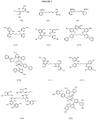
- 0 *c(c(*)c1*)c(*)c(***c(c(*)c(*)c(*)c2*)c2-c2c(*)c(*)c(*)c(*)c2O)c1-c(c(*)c(*)c(*)c1*)c1O Chemical compound *c(c(*)c1*)c(*)c(***c(c(*)c(*)c(*)c2*)c2-c2c(*)c(*)c(*)c(*)c2O)c1-c(c(*)c(*)c(*)c1*)c1O 0.000 description 1
Images


Classifications
-
- B—PERFORMING OPERATIONS; TRANSPORTING
- B01—PHYSICAL OR CHEMICAL PROCESSES OR APPARATUS IN GENERAL
- B01J—CHEMICAL OR PHYSICAL PROCESSES, e.g. CATALYSIS OR COLLOID CHEMISTRY; THEIR RELEVANT APPARATUS
- B01J23/00—Catalysts comprising metals or metal oxides or hydroxides, not provided for in group B01J21/00
- B01J23/38—Catalysts comprising metals or metal oxides or hydroxides, not provided for in group B01J21/00 of noble metals
- B01J23/40—Catalysts comprising metals or metal oxides or hydroxides, not provided for in group B01J21/00 of noble metals of the platinum group metals
- B01J23/44—Palladium
-
- B—PERFORMING OPERATIONS; TRANSPORTING
- B01—PHYSICAL OR CHEMICAL PROCESSES OR APPARATUS IN GENERAL
- B01J—CHEMICAL OR PHYSICAL PROCESSES, e.g. CATALYSIS OR COLLOID CHEMISTRY; THEIR RELEVANT APPARATUS
- B01J31/00—Catalysts comprising hydrides, coordination complexes or organic compounds
- B01J31/26—Catalysts comprising hydrides, coordination complexes or organic compounds containing in addition, inorganic metal compounds not provided for in groups B01J31/02 - B01J31/24
- B01J31/38—Catalysts comprising hydrides, coordination complexes or organic compounds containing in addition, inorganic metal compounds not provided for in groups B01J31/02 - B01J31/24 of titanium, zirconium or hafnium
-
- B—PERFORMING OPERATIONS; TRANSPORTING
- B21—MECHANICAL METAL-WORKING WITHOUT ESSENTIALLY REMOVING MATERIAL; PUNCHING METAL
- B21K—MAKING FORGED OR PRESSED METAL PRODUCTS, e.g. HORSE-SHOES, RIVETS, BOLTS OR WHEELS
- B21K3/00—Making engine or like machine parts not covered by sub-groups of B21K1/00; Making propellers or the like
-
- B—PERFORMING OPERATIONS; TRANSPORTING
- B23—MACHINE TOOLS; METAL-WORKING NOT OTHERWISE PROVIDED FOR
- B23P—METAL-WORKING NOT OTHERWISE PROVIDED FOR; COMBINED OPERATIONS; UNIVERSAL MACHINE TOOLS
- B23P15/00—Making specific metal objects by operations not covered by a single other subclass or a group in this subclass
- B23P15/10—Making specific metal objects by operations not covered by a single other subclass or a group in this subclass pistons
-
- C—CHEMISTRY; METALLURGY
- C07—ORGANIC CHEMISTRY
- C07C—ACYCLIC OR CARBOCYCLIC COMPOUNDS
- C07C43/00—Ethers; Compounds having groups, groups or groups
- C07C43/02—Ethers
- C07C43/20—Ethers having an ether-oxygen atom bound to a carbon atom of a six-membered aromatic ring
- C07C43/205—Ethers having an ether-oxygen atom bound to a carbon atom of a six-membered aromatic ring the aromatic ring being a non-condensed ring
- C07C43/2055—Ethers having an ether-oxygen atom bound to a carbon atom of a six-membered aromatic ring the aromatic ring being a non-condensed ring containing more than one ether bond
-
- C—CHEMISTRY; METALLURGY
- C07—ORGANIC CHEMISTRY
- C07C—ACYCLIC OR CARBOCYCLIC COMPOUNDS
- C07C43/00—Ethers; Compounds having groups, groups or groups
- C07C43/02—Ethers
- C07C43/20—Ethers having an ether-oxygen atom bound to a carbon atom of a six-membered aromatic ring
- C07C43/225—Ethers having an ether-oxygen atom bound to a carbon atom of a six-membered aromatic ring containing halogen
-
- C—CHEMISTRY; METALLURGY
- C07—ORGANIC CHEMISTRY
- C07C—ACYCLIC OR CARBOCYCLIC COMPOUNDS
- C07C43/00—Ethers; Compounds having groups, groups or groups
- C07C43/02—Ethers
- C07C43/20—Ethers having an ether-oxygen atom bound to a carbon atom of a six-membered aromatic ring
- C07C43/23—Ethers having an ether-oxygen atom bound to a carbon atom of a six-membered aromatic ring containing hydroxy or O-metal groups
-
- C—CHEMISTRY; METALLURGY
- C07—ORGANIC CHEMISTRY
- C07F—ACYCLIC, CARBOCYCLIC OR HETEROCYCLIC COMPOUNDS CONTAINING ELEMENTS OTHER THAN CARBON, HYDROGEN, HALOGEN, OXYGEN, NITROGEN, SULFUR, SELENIUM OR TELLURIUM
- C07F7/00—Compounds containing elements of Groups 4 or 14 of the Periodic Table
- C07F7/003—Compounds containing elements of Groups 4 or 14 of the Periodic Table without C-Metal linkages
-
- C—CHEMISTRY; METALLURGY
- C08—ORGANIC MACROMOLECULAR COMPOUNDS; THEIR PREPARATION OR CHEMICAL WORKING-UP; COMPOSITIONS BASED THEREON
- C08F—MACROMOLECULAR COMPOUNDS OBTAINED BY REACTIONS ONLY INVOLVING CARBON-TO-CARBON UNSATURATED BONDS
- C08F10/00—Homopolymers and copolymers of unsaturated aliphatic hydrocarbons having only one carbon-to-carbon double bond
-
- F—MECHANICAL ENGINEERING; LIGHTING; HEATING; WEAPONS; BLASTING
- F02—COMBUSTION ENGINES; HOT-GAS OR COMBUSTION-PRODUCT ENGINE PLANTS
- F02F—CYLINDERS, PISTONS OR CASINGS, FOR COMBUSTION ENGINES; ARRANGEMENTS OF SEALINGS IN COMBUSTION ENGINES
- F02F3/00—Pistons
- F02F3/0015—Multi-part pistons
- F02F3/003—Multi-part pistons the parts being connected by casting, brazing, welding or clamping
-
- F—MECHANICAL ENGINEERING; LIGHTING; HEATING; WEAPONS; BLASTING
- F02—COMBUSTION ENGINES; HOT-GAS OR COMBUSTION-PRODUCT ENGINE PLANTS
- F02F—CYLINDERS, PISTONS OR CASINGS, FOR COMBUSTION ENGINES; ARRANGEMENTS OF SEALINGS IN COMBUSTION ENGINES
- F02F3/00—Pistons
- F02F3/0084—Pistons the pistons being constructed from specific materials
-
- F—MECHANICAL ENGINEERING; LIGHTING; HEATING; WEAPONS; BLASTING
- F02—COMBUSTION ENGINES; HOT-GAS OR COMBUSTION-PRODUCT ENGINE PLANTS
- F02F—CYLINDERS, PISTONS OR CASINGS, FOR COMBUSTION ENGINES; ARRANGEMENTS OF SEALINGS IN COMBUSTION ENGINES
- F02F3/00—Pistons
- F02F3/16—Pistons having cooling means
-
- F—MECHANICAL ENGINEERING; LIGHTING; HEATING; WEAPONS; BLASTING
- F02—COMBUSTION ENGINES; HOT-GAS OR COMBUSTION-PRODUCT ENGINE PLANTS
- F02F—CYLINDERS, PISTONS OR CASINGS, FOR COMBUSTION ENGINES; ARRANGEMENTS OF SEALINGS IN COMBUSTION ENGINES
- F02F3/00—Pistons
- F02F3/26—Pistons having combustion chamber in piston head
-
- B—PERFORMING OPERATIONS; TRANSPORTING
- B01—PHYSICAL OR CHEMICAL PROCESSES OR APPARATUS IN GENERAL
- B01J—CHEMICAL OR PHYSICAL PROCESSES, e.g. CATALYSIS OR COLLOID CHEMISTRY; THEIR RELEVANT APPARATUS
- B01J2531/00—Additional information regarding catalytic systems classified in B01J31/00
- B01J2531/02—Compositional aspects of complexes used, e.g. polynuclearity
- B01J2531/0238—Complexes comprising multidentate ligands, i.e. more than 2 ionic or coordinative bonds from the central metal to the ligand, the latter having at least two donor atoms, e.g. N, O, S, P
- B01J2531/0258—Flexible ligands, e.g. mainly sp3-carbon framework as exemplified by the "tedicyp" ligand, i.e. cis-cis-cis-1,2,3,4-tetrakis(diphenylphosphinomethyl)cyclopentane
-
- B—PERFORMING OPERATIONS; TRANSPORTING
- B01—PHYSICAL OR CHEMICAL PROCESSES OR APPARATUS IN GENERAL
- B01J—CHEMICAL OR PHYSICAL PROCESSES, e.g. CATALYSIS OR COLLOID CHEMISTRY; THEIR RELEVANT APPARATUS
- B01J2531/00—Additional information regarding catalytic systems classified in B01J31/00
- B01J2531/40—Complexes comprising metals of Group IV (IVA or IVB) as the central metal
- B01J2531/48—Zirconium
-
- B—PERFORMING OPERATIONS; TRANSPORTING
- B01—PHYSICAL OR CHEMICAL PROCESSES OR APPARATUS IN GENERAL
- B01J—CHEMICAL OR PHYSICAL PROCESSES, e.g. CATALYSIS OR COLLOID CHEMISTRY; THEIR RELEVANT APPARATUS
- B01J31/00—Catalysts comprising hydrides, coordination complexes or organic compounds
- B01J31/16—Catalysts comprising hydrides, coordination complexes or organic compounds containing coordination complexes
- B01J31/22—Organic complexes
- B01J31/2204—Organic complexes the ligands containing oxygen or sulfur as complexing atoms
- B01J31/2208—Oxygen, e.g. acetylacetonates
- B01J31/2226—Anionic ligands, i.e. the overall ligand carries at least one formal negative charge
- B01J31/223—At least two oxygen atoms present in one at least bidentate or bridging ligand
- B01J31/2239—Bridging ligands, e.g. OAc in Cr2(OAc)4, Pt4(OAc)8 or dicarboxylate ligands
-
- B—PERFORMING OPERATIONS; TRANSPORTING
- B23—MACHINE TOOLS; METAL-WORKING NOT OTHERWISE PROVIDED FOR
- B23B—TURNING; BORING
- B23B2215/00—Details of workpieces
- B23B2215/24—Components of internal combustion engines
- B23B2215/245—Pistons
-
- F—MECHANICAL ENGINEERING; LIGHTING; HEATING; WEAPONS; BLASTING
- F02—COMBUSTION ENGINES; HOT-GAS OR COMBUSTION-PRODUCT ENGINE PLANTS
- F02F—CYLINDERS, PISTONS OR CASINGS, FOR COMBUSTION ENGINES; ARRANGEMENTS OF SEALINGS IN COMBUSTION ENGINES
- F02F3/00—Pistons
- F02F3/0015—Multi-part pistons
- F02F3/003—Multi-part pistons the parts being connected by casting, brazing, welding or clamping
- F02F2003/0061—Multi-part pistons the parts being connected by casting, brazing, welding or clamping by welding
-
- F—MECHANICAL ENGINEERING; LIGHTING; HEATING; WEAPONS; BLASTING
- F02—COMBUSTION ENGINES; HOT-GAS OR COMBUSTION-PRODUCT ENGINE PLANTS
- F02F—CYLINDERS, PISTONS OR CASINGS, FOR COMBUSTION ENGINES; ARRANGEMENTS OF SEALINGS IN COMBUSTION ENGINES
- F02F2200/00—Manufacturing
- F02F2200/04—Forging of engine parts
-
- F—MECHANICAL ENGINEERING; LIGHTING; HEATING; WEAPONS; BLASTING
- F02—COMBUSTION ENGINES; HOT-GAS OR COMBUSTION-PRODUCT ENGINE PLANTS
- F02F—CYLINDERS, PISTONS OR CASINGS, FOR COMBUSTION ENGINES; ARRANGEMENTS OF SEALINGS IN COMBUSTION ENGINES
- F02F3/00—Pistons
- F02F3/16—Pistons having cooling means
- F02F3/20—Pistons having cooling means the means being a fluid flowing through or along piston
- F02F3/22—Pistons having cooling means the means being a fluid flowing through or along piston the fluid being liquid
-
- Y—GENERAL TAGGING OF NEW TECHNOLOGICAL DEVELOPMENTS; GENERAL TAGGING OF CROSS-SECTIONAL TECHNOLOGIES SPANNING OVER SEVERAL SECTIONS OF THE IPC; TECHNICAL SUBJECTS COVERED BY FORMER USPC CROSS-REFERENCE ART COLLECTIONS [XRACs] AND DIGESTS
- Y02—TECHNOLOGIES OR APPLICATIONS FOR MITIGATION OR ADAPTATION AGAINST CLIMATE CHANGE
- Y02P—CLIMATE CHANGE MITIGATION TECHNOLOGIES IN THE PRODUCTION OR PROCESSING OF GOODS
- Y02P20/00—Technologies relating to chemical industry
- Y02P20/50—Improvements relating to the production of bulk chemicals
- Y02P20/52—Improvements relating to the production of bulk chemicals using catalysts, e.g. selective catalysts
Definitions
- the present disclosure is directed to bridged bi-aromatic ligands and transition metal compounds prepared therefrom.
- the disclosure is also directed to methods of preparing the ligands and transition metal compounds, and to methods of using the transition metal compounds as catalyst components in olefin polymerization.
- WO 03/09162 discloses bridged bi-aromatic ligands, methods for their preparation and transition metal compounds derived therefrom.
- R 1 , R 2 , R 3 , R 4 , R 5 , R 6 , R 7 , R 8 , R 9 , R 10 , R 11 and R 12 may be independently selected from the group consisting of hydride, halide, and optionally substituted alkyl, heteroalkyl, aryl, heteroaryl, alkoxyl, aryloxyl, silyl, boryl, dialkylamino, alkylthio, arylthio and seleno.
- R 1 , R 2 , R 3 , R 4 , R 5 , R 6 , R 7 , R 8 , R 9 , R 10 , R 11 and R 12 may be independently selected from the group consisting of hydride, halide, and optionally substituted alkyl, heteroalkyl, aryl, heteroaryl, alkoxyl and aryloxyl.
- R 1 , R 2 , R 3 , R 4 , R 5 , R 6 , R 7 , R 8 , R 9 , R 10 , R 11 and R 12 may be independently selected from the group consisting of hydride, fluoro, chloro, and optionally substituted alkyl, heteroalkyl, aryl and heteroaryl.
- the bridging group A may be selected from the group consisting of optionally substituted divalent hydrocarbyl and divalent heteroatom containing hydrocarbyl.
- the bridging group A may be selected from the group consisting of optionally substituted divalent alkyl, alkenyl, alkynyl, heteroalkyl, heteroalkenyl, heteroalkynyl, aryl, heteroaryl and silyl.
- the bridging group A may be represented by the general formula-(QR 13 2-z" ) z' -wherein each Q is either carbon or silicon and each R 13 may be the same or different from the others such that each R 13 is selected from the group consisting of hydride and optionally substituted hydrocarbyl and heteroatom containing hydrocarbyl, and optionally two or more R 13 groups may be joined into a ring structure having from 3 to 50 atoms in the ring structure not counting hydrogen atoms; z' is an integer from 1 to 10; and z" is 0, 1 or 2.
- Ar may be, independently, an optionally substituted phenyl, naphthyl, biphenyl, anthracenyl or phenanthrenyl.
- Ar may be, independently, an optionally substituted thiophene, pyridine, isoxazole, pyrazole, pyrrole, furan, or benzo-fused analogues of these rings.
- each occurrence of Ar is the same.
- the bridged bi-aromatic phenol ligand of formula (I) may be of formula (II): wherein each of R 1 , R 2 , R 3 , R 4 , R 5 , R 6 , R 7 , R 8 , R 9 , R 10 , R 11 , R 12 , Ar and A is as defined in any one of the hereinbefore disclosed embodiments.
- a method for preparing a bridged bi-aromatic phenol ligand of formula (I) or formula (II) comprising at least one step of halogenation of an aromatic ring and at least one step of aryl coupling.
- the method may comprise at least one step of Negishi coupling.
- the method may comprise at least one step of Suzuki coupling.
- the method may comprise both at least one step of Negishi coupling and at least one step of Suzuki coupling.
- the method may comprise the steps of:
- the method may comprise the steps of:
- each of R 1 , R 2 , R 3 , R 4 , R 5 , R 6 , R 7 , R 8 , R 9 , R 10 , R 11 and R 12 may be independently selected from the group consisting of hydride, halide, and optionally substituted alkyl, heteroalkyl, aryl, heteroaryl, alkoxyl, aryloxyl, silyl, boryl, dialkylamino, alkylthio, arylthio and seleno.
- each of R 1 , R 2 , R 3 , R 4 , R 5 , R 6 , R 7 , R 8 , R 9 , R 10 , R 11 , and R 12 may be independently selected from the group consisting of hydride, halide, and optionally substituted alkyl, heteroalkyl, aryl, heteroaryl, alkoxyl, aryloxyl, silyl, dialkylamino, alkylthio, and arylthio.
- the bridging group A may be selected from the group consisting of optionally substituted divalent hydrocarbyl and divalent heteroatom containing hydrocarbyl.
- the bridging group A may be selected from the group consisting of optionally substituted divalent alkyl, alkenyl, alkynyl, heteroalkyl, heteroalkenyl, heteroalkynyl, carbocycle, heterocarbocycle, aryl, heteroaryl and silyl.
- the bridging group A may be represented by the general formula-(QR 13 2-z" ) z' -wherein each Q is either carbon or silicon and each R 13 may be the same or different from the others such that each R 13 is selected from the group consisting of hydride and optionally substituted hydrocarbyl and heteroatom containing hydrocarbyl, and optionally two or more R 13 groups may be joined into a ring structure having from 3 to 50 atoms in the ring structure not counting hydrogen atoms; z' is an integer from 1 to 10; and z" is 0, 1 or 2.
- a major advantage of the herein disclosed methods is that the number of reaction steps to access the ligands is low.
- the disclosed ligands may be prepared from a bromophenol in three or four reaction steps.
- the catalyst may comprise a palladium or nickel catalyst.
- the palladium catalyst may comprise a palladium phosphine catalyst.
- the catalyst may further comprise a base.
- the base may comprise an alkali metal carbonate, alkali metal phosphate, alkali metal hydroxide, alkali metal alkoxide or an amine.
- X may be bromo or chloro.
- the source of halogen may be bromine or chlorine.
- the aryl-boron compound may be an optionally substituted arylborane or an optionally substituted heteroarylborane.
- the aryl-boron compound may be an optionally substituted aryl boronic acid or an optionally substituted heteroaryl boronic acid.
- the aryl-boron compound may be an optionally substituted aryl boronic ester or aryl cyclic boronic ester or an optionally substituted heteroaryl boronic ester or hetero aryl cyclic boronic ester.
- the aryl-boron compound may be an optionally substituted aryl trifluoroborate or an optionally substituted heteroaryl trifluoroborate.
- transition metal compound formed from any one of the hereinbefore disclosed ligands.
- the transition metal compound may comprise a titanium, a zirconium or a hafnium atom.
- a catalyst composition comprising one or more transition metal compounds as hereinbefore disclosed, and one or more activators.
- the activator may comprise one or more alumoxanes.
- the activator may comprise methylalumoxane.
- a supported catalyst composition comprising one or more transition metal compounds as hereinbefore disclosed, one or more activators and one or more support materials.
- the activator may comprise one or more alumoxanes.
- the activator may comprise methylalumoxane.
- the support may be silica.
- the catalyst composition or supported catalyst composition may comprise two or more transition metal compounds.
- the transition metal compounds may be selected from any one of those hereinbefore disclosed or at least one of the transition metal compounds may be different from those hereinbefore disclosed.
- at least one of the transition metal compounds may be a metallocene.
- a process for polymerizing olefins comprising: contacting olefins with one or more catalyst compositions or supported catalyst compositions comprising at least one transition metal compound as hereinbefore disclosed in a reactor under polymerization conditions to produce an olefin polymer or copolymer
- ligands, catalyst compounds, catalyst compositions and supported catalyst compositions for use in the polymerization of olefins which are advantageous to prepare and use. Also disclosed herein are methods of making the ligands, catalyst compounds, catalyst compositions and supported catalyst compositions and polymerization processes utilizing the catalyst compositions and supported catalyst compositions for the production of olefin polymers.
- a "catalyst composition” includes one or more catalyst compounds utilized to polymerize olefins and at least one activator or, alternatively, at least one cocatalyst.
- the catalyst composition may include any suitable number of catalyst compounds in any combination as described herein, as well as any activator or cocatalyst in any combination as described herein.
- a "supported catalyst composition” includes one or more catalyst compounds utilized to polymerize olefins and at least one activator or, alternatively, at least one cocatalyst, and at least one support.
- the supported catalyst composition may include any suitable number of catalyst compounds in any combination as described herein, as well as any activator or cocatalyst in any combination as described herein.
- a “supported catalyst composition” may also contain one or more additional components known in the art to reduce or eliminate reactor fouling such as continuity additives.
- a "catalyst compound” may include any compound that, when activated, is capable of catalyzing the polymerization or oligomerization of olefins, wherein the catalyst compound comprises at least one Group 3 to 12 atom, and optionally at least one leaving group bound thereto.
- R groups e.g., R 1 , R 2 , R 3 , R 4 , and R 5 can be identical or different (e.g. R 1 , R 2 , R 3 , R 4 , and R 5 may all be substituted alkyls or R 1 and R 2 may be a substituted alkyl and R 3 may be an aryl, etc.).
- Use of the singular includes use of the plural and vice versa (e.g., a hexane solvent, includes hexanes).
- a named R group will generally have the structure that is recognized in the art as corresponding to R groups having that name.
- alkyl refers to a branched or unbranched saturated hydrocarbon group typically although not necessarily containing 1 to about 50 carbon atoms, such as methyl, ethyl, n-propyl, isopropyl, n-butyl, iso-butyl, t-butyl, octyl, decyl, and the like, as well as cycloalkyl groups such as cyclopentyl, cyclohexyl and the like. Generally, although again not necessarily, alkyl groups herein may contain 1 to about 12 carbon atoms.
- the term "lower alkyl” intends an alkyl group of one to six carbon atoms, specifically one to four carbon atoms.
- Substituted alkyl refers to alkyl substituted with one or more substituent groups (e.g., benzyl or chloromethyl), and the terms "heteroatom-containing alkyl” and “heteroalkyl” refer to alkyl in which at least one carbon atom is replaced with a heteroatom (e.g., -CH 2 OCH 3 is an example of a heteroalkyl).
- substituent groups e.g., benzyl or chloromethyl
- heteroatom-containing alkyl and “heteroalkyl” refer to alkyl in which at least one carbon atom is replaced with a heteroatom (e.g., -CH 2 OCH 3 is an example of a heteroalkyl).
- alkenyl refers to a branched or unbranched hydrocarbon group typically although not necessarily containing 2 to about 50 carbon atoms and at least one double bond, such as ethenyl, n-propenyl, iso-propenyl, n-butenyl, iso-butenyl, octenyl, decenyl, and the like. Generally, although again not necessarily, alkenyl groups herein contain 2 to about 12 carbon atoms.
- lower alkenyl refers to an alkenyl group of two to six carbon atoms, specifically two to four carbon atoms.
- Substituted alkenyl refers to alkenyl substituted with one or more substituent groups
- heteroatom-containing alkenyl and “heteroalkenyl” refer to alkenyl in which at least one carbon atom is replaced with a heteroatom.
- alkynyl refers to a branched or unbranched hydrocarbon group typically although not necessarily containing 2 to about 50 carbon atoms and at least one triple bond, such as ethynyl, n-propynyl, iso-propynyl, n-butynyl, isobutynyl, octynyl, decynyl, and the like. Generally, although again not necessarily, alkynyl groups herein may have 2 to about 12 carbon atoms.
- lower alkynyl refers to an alkynyl group of two to six carbon atoms, specifically three or four carbon atoms.
- Substituted alkynyl refers to alkynyl substituted with one or more substituent groups
- heteroatom-containing alkynyl and heteroalkynyl refer to alkynyl in which at least one carbon atom is replaced with a heteroatom
- alkoxy intends an alkyl group bound through a single, terminal ether linkage; that is, an "alkoxy” group may be represented as -O-alkyl where alkyl is as defined above.
- a "lower alkoxy” group refers to an alkoxy group having one to six, more specifically one to four, carbon atoms.
- aryloxy is used in a similar fashion, with aryl as defined below.
- hydroxy refers to -OH.
- alkylthio intends an alkyl group bound through a single, terminal thioether linkage; that is, an "alkylthio" group may be represented as - S-alkyl where alkyl is as defined above.
- a "lower alkyl thio” group refers to an alkyl thio group having one to six, more specifically one to four, carbon atoms.
- arylthio is used similarly, with aryl as defined below.
- thioxy refers to -SH.
- An “allenyl” group may be unsubstituted or substituted with one or more non-hydrogen substituents.
- aryl refers to an aromatic substituent containing a single aromatic ring or multiple aromatic rings that are fused together, linked covalently, or linked to a common group such as a methylene or ethylene moiety. More specific aryl groups contain one aromatic ring or two or three fused or linked aromatic rings, e.g., phenyl, naphthyl, biphenyl, anthracenyl, phenanthrenyl, and the like.
- the aryl substituents may have 1 to about 200 carbon atoms, typically 1 to about 50 carbon atoms, and specifically 1 to about 20 carbon atoms.
- Substituted aryl refers to an aryl moiety substituted with one or more substituent groups, (e.g., tolyl, mesityl and perfluorophenyl) and the terms "heteroatom-containing aryl” and “heteroaryl” refer to aryl in which at least one carbon atom is replaced with a heteroatom (e.g., rings such as thiophene, pyridine, isoxazole, pyrazole, pyrrole, furan, etc. or benzo-fused analogues of these rings are included in the term "heteroaryl”).
- multi-ring moieties are substituents and in such an embodiment the multi-ring moiety can be attached at an appropriate atom.
- naphthyl can be 1-naphthyl or 2-naphthyl
- anthracenyl can be 1-anthracenyl, 2-anthracenyl or 9-anthracenyl
- phenanthrenyl can be 1-phenanthrenyl, 2-phenanthrenyl, 3-phenanthrenyl, 4-phenanthrenyl or 9-phenanthrenyl.
- aralkyl refers to an alkyl group with an aryl substituent
- aralkylene refers to an alkylene group with an aryl substituent
- alkaryl refers to an aryl group that has an alkyl substituent
- alkarylene refers to an arylene group with an alkyl substituent
- halo and “halogen” are used in the conventional sense to refer to a chloro, bromo, fluoro or iodo substituent.
- haloalkyl refers to an alkyl, alkenyl or alkynyl group, respectively, in which at least one of the hydrogen atoms in the group has been replaced with a halogen atom.
- heteroatom-containing refers to a molecule or molecular fragment in which one or more carbon atoms is replaced with an atom other than carbon, e.g., nitrogen, oxygen, sulfur, phosphorus, boron or silicon.
- heteroalkyl refers to an alkyl substituent that is heteroatom-containing
- heterocyclic refers to a cyclic substituent that is heteroatom-containing
- heteroaryl refers to an aryl substituent that is heteroatom-containing
- heteroatom-containing When the term “heteroatom-containing” appears prior to a list of possible heteroatom-containing groups, it is intended that the term apply to every member of that group. That is, the phrase “heteroatom-containing alkyl, alkenyl and alkynyl” is to be interpreted as “heteroatom-containing alkyl, heteroatom-containing alkenyl and heteroatom-containing alkynyl.”
- Hydrocarbyl refers to hydrocarbyl radicals containing 1 to about 50 carbon atoms, specifically 1 to about 24 carbon atoms, most specifically 1 to about 16 carbon atoms, including branched or unbranched, saturated or unsaturated species, such as alkyl groups, alkenyl groups, aryl groups, and the like.
- lower hydrocarbyl refers to a hydrocarbyl group of one to six carbon atoms, specifically one to four carbon atoms.
- Substituted hydrocarbyl refers to hydrocarbyl substituted with one or more substituent groups
- heteroatom-containing hydrocarbyl and “heterohydrocarbyl” refer to hydrocarbyl in which at least one carbon atom is replaced with a heteroatom.
- substituted as in “substituted hydrocarbyl,” “substituted aryl,” “substituted alkyl,” “substituted alkenyl” and the like, as alluded to in some of the aforementioned definitions, is meant that in the hydrocarbyl, hydrocarbylene, alkyl, alkenyl, aryl or other moiety, at least one hydrogen atom bound to a carbon atom is replaced with one or more substituents that are functional groups such as hydroxyl, alkoxy, alkylthio, phosphino, amino, halo, silyl, and the like.
- substituted When the term "substituted" appears prior to a list of possible substituted groups, it is intended that the term apply to every member of that group. That is, the phrase “substituted alkyl, alkenyl and alkynyl” is to be interpreted as “substituted alkyl, substituted alkenyl and substituted alkynyl.” Similarly, “optionally substituted alkyl, alkenyl and alkynyl” is to be interpreted as “optionally substituted alkyl, optionally substituted alkenyl and optionally substituted alkynyl.”
- divalent as in “divalent hydrocarbyl”, “divalent alkyl”, “divalent aryl” and the like, is meant that the hydrocarbyl, alkyl, aryl or other moiety is bonded at two points to atoms, molecules or moieties with the two bonding points being covalent bonds.
- aromatic is used in its usual sense, including unsaturation that is essentially delocalized across multiple bonds, such as around a ring.'
- silyl refers to the -SiZ 1 Z 2 Z 3 radical, where each of Z 1 , Z 2 , and Z 3 is independently selected from the group consisting of hydride and optionally substituted alkyl, alkenyl, alkynyl, heteroatom-containing alkyl, heteroatom-containing alkenyl, heteroatom-containing alkynyl, aryl, heteroaryl, alkoxy, aryloxy, amino, silyl and combinations thereof.
- boryl refers to the -BZ 1 Z 2 group, where each of Z 1 and Z 2 is as defined above.
- phosphino refers to the group -PZ 1 Z 2 , where each of Z 1 and Z 2 is as defined above.
- phosphine refers to the group PZ 1 Z 2 Z 3 , where each of Z 1 , Z 2 and Z 3 is as defined above.
- amino is used herein to refer to the group -NZ 1 Z 2 , where each of Z 1 and Z 2 is as defined above.
- amine is used herein to refer to the group NZ 1 Z 2 Z 3 , where each of Z 1 , Z 2 and Z 3 is as defined above.
- saturated refers to lack of double and triple bonds between atoms of a radical group such as ethyl, cyclohexyl, pyrrolidinyl, and the like.
- unsaturated refers to the presence of one or more double and triple bonds between atoms of a radical group such as vinyl, acetylide, oxazolinyl, cyclohexenyl, acetyl and the like.
- the bridged bi-aromatic ligands disclosed herein have the following general formula (I): wherein each of R 1 , R 2 , R 3 , R 4 , R 5 , R 6 , R 7 , R 8 , R 9 , R 10 , R 11 and R 12 is independently selected from the group consisting of hydride, halide, optionally substituted hydrocarbyl, heteroatom-containing optionally substituted hydrocarbyl, alkoxy, aryloxy, silyl, boryl, dialkyl amino, alkylthio, arylthio and seleno; optionally two or more R groups can combine together into ring structures with such ring structures having from 3 to 100 non-hydrogen atoms in the ring; A is a bridging group having from one to 50 non-hydrogen atoms; Y and Y' are independently selected from O, S, NR a and PR a wherein R a is optionally substituted hydrocarbyl; Ar is, independently, optionally substituted
- the ligands may also have the following formula (II): wherein each of R 1 , R 2 , R 3 , R 4 , R 5 , R 6 , R 7 , R 8 , R 9 , R 10 , R 11 and R 12 is independently selected from the group consisting of hydride, halide, optionally substituted hydrocarbyl, heteroatom-containing optionally substituted hydrocarbyl, alkoxy, aryloxy, silyl, boryl, dialkyl amino, alkylthio, arylthio and seleno; optionally two or more R groups can combine together into ring structures with such ring structures having from 3 to 100 non-hydrogen atoms in the ring; A is a bridging group having from one to 50 non-hydrogen atoms; Ar is, independently, optionally substituted aryl or optionally substituted heteroaryl.
- R 1 , R 2 , R 3 , R 4 , R 5 , R 6 , R 7 , R 8 , R 9 , R 10 , R 11 and R 12 may be hydride or optionally substituted alkyl or aryl.
- R 2 and R 8 may be optionally substituted alkyl and each of R 1 , R 3 , R 4 , R 5 , R 6 , R 7 , R 9 , R 10 , R 11 and R 12 may be hydride.
- the bridging group A may be optionally substituted alkyl.
- Ar may be optionally substituted phenyl, naphthyl, biphenyl, anthracenyl, phenanthrenyl or optionally substituted thiophene, pyridine, isoxazole, pyrazole, pyrrole, furan, etc. or benzo-fused analogues.
- the optional substituents may be alkyl groups.
- the ligands may have the following structure: wherein Ar may be optionally substituted phenyl, naphthyl, biphenyl, anthracenyl, phenanthrenyl or optionally substituted thiophene, pyridine, isoxazole, pyrazole, pyrrole, furan, or benzo-fused analogues and the bridging group A is a divalent alkyl.
- R 2 and R 8 may be optionally substituted alkyl.
- the ligands disclosed herein may be prepared by a variety of methods.
- the ligands may be prepared by employing a tetrabromination of a bridged phenyl phenol and aryl coupling.
- the aryl coupling may be Suzuki coupling and/or Negishi coupling.
- a major advantage of the herein disclosed methods is that the number of reaction steps to access the ligands is low.
- the disclosed ligands may be prepared from a bromophenol in three or four reaction steps.
- Bridged bi-aromatic ligand syntheses disclosed in WO 03/09162 suffer from an abundance of synthetic steps which add time and cost to a synthesis.
- Suzuki couplings disclosed in WO 03/091162 were performed on protected phenols (THP, Bn, MOM, etc), which add steps due to the required protections and deprotections.
- THP protected phenols
- Bn protected phenols
- MOM protected phenols
- Schemes 1 and 2 illustrate Suzuki coupling of a brominated phenol with a bridged diboronic acid.
- Schemes 5 and 6 illustrate Suzuki coupling of the tetrahalogenated phenols with aryl boronic acid.
- each of R 1 , R 2 , R 3 , R 4 , R 5 , R 6 , R 7 , R 8 , R 9 , R 10 , R 11 and R 12 may be independently selected from the group consisting of hydride and optionally substituted alkyl or aryl.
- Y and Y' may be O.
- A may be selected from the group consisting of optionally substituted divalent alkyl, alkenyl, alkynyl, heteroalkyl, heteroalkenyl, heteroalkynyl, carbocycle, heterocarbocycle, aryl, heteroaryl and silyl.
- A may be optionally substituted alkyl.
- the palladium catalyst may comprise a palladium phosphine compound, for example, bis(tri-tert-butylphosphine)palladium (Pd(PPh 3 ) 4 ), tetrakis(triphenylphosphine)palladium(0) (Pd(dppe) 2 ), bis[1,2-bis(diphenylphosphino)ethane] palladium(0) (Pd(dppf)), 1,1'-bis(diphenylphosphino)ferrocene palladium, (2,2'-bis(diphenylphosphino)-1,1'-binaphthyl palladium (Pd(BINAP).
- a palladium phosphine compound for example, bis(tri-tert-butylphosphine)palladium (Pd(PPh 3 ) 4 ), tetrakis(triphenylphosphine)palladium(0) (Pd(dppe) 2 ), bis[
- the palladium catalyst may comprise a palladium compound and one or more phosphines.
- phosphines for example, tris(dibenzylideneacetone)dipalladium(0) (Pd 2 (dba) 3 ) and Pd(OAc) 2 and one or more phosphine compounds.
- X may be bromo or chloro.
- the source of halogen may be bromine or chlorine.
- the Ar-boron compound may be an optionally substituted aryl boronic acid or an optionally substituted heteroaryl boronic acid.
- the Ar-boron compound may be an optionally substituted aryl boronic ester or an optionally substituted heteroaryl boronic ester.
- Ar-boron compound may be an optionally substituted aryl trifluoroborate or an optionally substituted heteroaryl trifluoroborate.
- Ar-boron compound may be an optionally substituted arylborane or an optionally substituted heteroarylborane.
- a base may be utilized along with the palladium catalyst.
- the base may comprise an alkali metal carbonate, alkali metal phosphate, alkali metal hydroxide, alkali metal alkoxide or an amine.
- the base may comprise sodium or potassium carbonate or sodium or potassium phosphate.
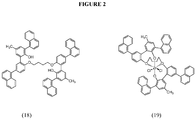
- the diphenolic compound (10) was dissolved in dichloromethane and treated with bromine. The reaction was quenched with saturated sodium bicarbonate to yield 6',6'''-(Propane-1,3-diylbisoxy)bis(3,3'-dibromo-5-methyl-[1,1'-biphenyl]-2-ol) (11).
- the brominated compound was combined with phenylboronic acid, SPhos and potassium phosphate in THF/H 2 O and the mixture was stirred at room temperature overnight to yield 6",6''''''-(Propane-1,3-diylbisoxy)bis(5'-methyl-[1,1':3',1":3",1'''-quaterphenyl]-2'-ol) (12).
- the catalyst compounds may be prepared by any suitable synthesis method and the method of synthesis is not critical to the present disclosure.
- One useful method of preparing the catalyst compounds of the present disclosure is by reacting a suitable metal compound, for example one having a displaceable anionic ligand, with the bridged bi-aromatic ligands of this disclosure.
- Non-limiting examples of suitable metal compounds include organometallics, metal halids, sulfonates, carboxylates, phosphates, organoborates (including fluoro-containing and other subclasses), acetonacetonates, sulfides, sulfates, tetrafluoroborates, nitrates, perchlorates, phenoxides, alkoxides, silicates, arsenates, borohydrides, naphthenates, cyclooctadienes, diene conjugated complexes, thiocynates, cyanates, and the metal cyanides.
- the metal compound may be an organometallic or metal halide.
- the metal compound may be an organometallic.
- the metal of the organometallic compound may be selected from Groups 1 to 16, or a transition metal selected from Groups 3 to 13 elements and Lanthanide series elements.
- the metal may be selected from Groups 3 to 7 elements.
- the metal may be a Group 4 metal, titanium, zirconium or hafnium.
- the metal compound can, for example, be a metal hydrocarbyl such as: a metal alkyl, a metal aryl, a metal arylalkyl; a metal silylalkyl; a metal diene, a metal amide; or a metal phosphide.
- the metal compound may be a zirconium or hafnium hydrocarbyl.
- the transition metal compound may be a zirconium arylalkyl.
- Examples of useful and preferred metal compounds include:
- the catalyst compositions disclosed herein may comprise one or more catalyst compounds as disclosed herein and one or more activators as disclosed herein.
- the supported catalyst compositions as disclosed herein may comprise one or more supports as disclosed herein, one or more catalyst compounds as disclosed herein and one or more activators as disclosed herein.
- the catalyst compositions and supported catalyst compositions may comprise one or more of the catalyst compounds as hereinbefore disclosed along with another catalyst compound, such as a metallocene catalyst compound or a Group V atom containing catalyst compound.
- Suitable other catalyst compounds include, but are not limited to:
- the supported catalyst composition may in the form of a substantially dry powder or be in the form of a slurry in at least one liquid vehicle.
- liquid vehicles include mineral oils, aromatic hydrocarbons or aliphatic hydrocarbons.
- An activator is defined in a broad sense as any combination of reagents that increases the rate at which a transition metal compound oligomerizes or polymerizes unsaturated monomers, such as olefins.
- the catalyst compounds may be activated for oligomerization and/or polymerization catalysis in any manner sufficient to allow coordination or cationic oligomerization and/or polymerization.
- the activator may be a Lewis-base, such as for example, diethyl ether, dimethyl ether, ethanol, or methanol.
- Other activators that may be used include those described in WO 98/07515 such as tris (2,2',2"- nonafluorobiphenyl) fluoroaluminate.
- alumoxanes and ionizing activators may be used in combinations, see for example, EP-B1 0 573 120 , WO 94/07928 and WO 95/14044 and U.S. Pat. Nos. 5,153,157 and 5,453,410 .
- WO 98/09996 describes activating metallocene catalyst compounds with perchlorates, periodates and iodates including their hydrates.
- WO 98/30602 and WO 98/30603 describe the use of lithium (2,2'-bisphenyl-ditrimethylsilicate).4THF as an activator for a metallocene catalyst compound.
- WO 99/18135 describes the use of organo-boron-aluminum activators.
- EP-B1-0 781 299 describes using a silylium salt in combination with a non-coordinating compatible anion.
- WO 2007/024773 suggests the use of activator-supports which may comprise a chemically-treated solid oxide, clay mineral, silicate mineral, or any combination thereof.
- methods of activation such as using radiation (see EP-B1-0 615 981 ), electro-chemical oxidation, and the like are also contemplated as activating methods for the purposes of rendering the neutral metallocene catalyst compound or precursor to a metallocene cation capable of polymerizing olefins.
- activators or methods for activating a metallocene catalyst compound are described in, for example, U.S. Pat. Nos. 5,849,852 , 5,859,653 and 5,869,723 and PCT WO 98/32775 .
- Alumoxanes may also be utilized as an activator in the catalyst composition.
- Alumoxanes are generally oligomeric compounds containing --Al(R)--O-- subunits, where R is an alkyl group.
- Examples of alumoxanes include methylalumoxane (MAO), modified methylalumoxane (MMAO), ethylalumoxane and isobutylalumoxane.
- Alkylalumoxanes and modified alkylalumoxanes are suitable as catalyst activators, particularly when the abstractable ligand is a halide. Mixtures of different alumoxanes and modified alumoxanes may also be used. For further descriptions, see U.S. Pat.
- Alumoxanes may be produced by the hydrolysis of the respective trialkylaluminum compound.
- MMAO may be produced by the hydrolysis of trimethylaluminum and a higher trialkylaluminum such as triisobutylaluminum.
- MMAO's are generally more soluble in aliphatic solvents and more stable during storage.
- a visually clear methylalumoxane may be used.
- a cloudy or gelled alumoxane can be filtered to produce a clear solution or clear alumoxane can be decanted from the cloudy solution.
- Another alumoxane is a modified methyl alumoxane (MMAO) cocatalyst type 3A (commercially available from Akzo Chemicals, Inc. under the trade name Modified Methylalumoxane type 3A, disclosed in U.S. Pat. No. 5,041,584 ).
- MMAO modified methyl alumoxane
- An ionizing or stoichiometric activator such as tri (n-butyl) ammonium tetrakis (pentafluorophenyl) boron, a trisperfluorophenyl boron metalloid precursor or a trisperfluoronapthyl boron metalloid precursor, polyhalogenated heteroborane anions (see, for example, WO 98/43983 ), boric acid (see, for example, U.S. Pat. No. 5,942,459 ) or combinations thereof, may also be used.
- the neutral or ionic activators may be used alone or in combination with alumoxane or modified alumoxane activators.
- neutral stoichiometric activators may include tri-substituted boron, tellurium, aluminum, gallium and indium or mixtures thereof.
- the three substituent groups may be each independently selected from the group of alkyls, alkenyls, halogen, substituted alkyls, aryls, arylhalides, alkoxy and halides.
- the three substituent groups may be independently selected from the group of halogen, mono or multicyclic (including halosubstituted) aryls, alkyls, and alkenyl compounds and mixtures thereof; or alkenyl groups having 1 to 20 carbon atoms, alkyl groups having 1 to 20 carbon atoms, alkoxy groups having 1 to 20 carbon atoms and aryl groups having 3 to 20 carbon atoms (including substituted aryls).
- the three groups are alkyls having 1 to 4 carbon groups, phenyl, napthyl or mixtures thereof.
- the three groups may be halogenated, for example fluorinated, aryl groups.
- the neutral stoichiometric activator is trisperfluorophenyl boron or trisperfluoronapthyl boron.
- Ionic stoichiometric activator compounds may contain an active proton, or some other cation associated with, but not coordinated to, or only loosely coordinated to, the remaining ion of the ionizing compound.
- Such compounds and the like are described in, for example, European publications EP-A-0 570 982 , EP-A-0 520 732 , EP-A-0 495 375 , EP-B1-0 500 944 , EP-A-0 277 003 and EP-A-0 277 004 , and U.S. Pat. Nos. 5,153,157 , 5,198,401 , 5,066,741 , 5,206,197 , 5,241,025 , 5,384,299 and 5,502,124 .
- the above described catalyst compounds may be combined with one or more supports using one of the support methods well known in the art or as described below.
- the catalyst compound may be used in a supported form, such as, deposited on, contacted with, or incorporated within, adsorbed or absorbed in, or on the support.
- support refers to compounds comprising Group 2, 3, 4, 5, 13 and 14 oxides and chlorides.
- Suitable supports include, for example, silica, magnesia, titania, zirconia, montmorillonite, phyllosilicate, alumina, silica-alumina, silica-chromium, silica-titania, magnesium chloride, graphite, magnesia, titania, zirconia, montmorillonite, phyllosilicate, and the like.
- the support may possess an average particle size in the range of from 0.1 to 500 ⁇ m, or from 1 to 200 ⁇ m, or from 1 to 50 ⁇ m, or from 5 to 50 ⁇ m.
- the support may have an average pore size in the range of from 10 to 1000 ⁇ , or 50 to 500 ⁇ , or 75 to 350 ⁇ .
- the support may have a surface area in the range of from 10 to 700 m 2 /g, or from 50 to 500 m 2 /g, or from 100 to 400 m 2 /g.
- the support may have a pore volume in the range of from 0.1 to 4.0 cc/g, or from 0.5 to 3.5 cc/g, or from 0.8 to 3.0 cc/g.
- the support such as an inorganic oxide, may have a surface area in the range of from 10 to 700 m 2 /g, a pore volume in the range of from 0.1 to 4.0 cc/g, and an average particle size in the range of from 1 to 500 ⁇ m.
- the support may have a surface area in the range of from 50 to 500 m 2 /g, a pore volume of from 0.5 to 3.5 cc/g, and an average particle size of from 10 to 200 ⁇ m.
- the surface area of the support may be in the range from 100 to 400 m 2 /g, a pore volume of from 0.8 to 3.0 cc/g and an average particle size of from 5 to 100 ⁇ m.
- the catalyst compounds may be supported on the same or separate supports together with an activator, or the activator may be used in an unsupported form, or may be deposited on a support different from the supported catalyst compound.
- the catalyst compound may contain a polymer bound ligand as described in, for example, U.S. Pat. Nos. 5,473,202 and 5,770,755 ; the catalyst may be spray dried as described in, for example, U.S. Pat. No. 5,648,310 ; the support used with the catalyst may be functionalized as described in European publication EP-A-0 802 203 , or at least one substituent or leaving group is selected as described in U.S. Pat. No. 5,688,880 .
- Polymerization processes may include solution, gas phase, slurry phase and a high pressure process or a combination thereof.
- a gas phase or slurry phase polymerization of one or more olefins at least one of which is ethylene or propylene is provided.
- the reactor is a gas phase fluidized bed polymerization reactor.
- the catalyst compositions or supported catalyst compositions as hereinbefore described are suitable for use in any prepolymerization and/or polymerization process over a wide range of temperatures and pressures.
- the temperatures may be in the range of from -60°C to 280°C, from 50°C to 200°C; from 60°C to 120°C from 70°C to 100°C or from 80°C to 95°C.
- the present process may be directed toward a solution, high pressure, slurry or gas phase polymerization process of one or more olefin monomers having from 2 to 30 carbon atoms, preferably 2 to 12 carbon atoms, and more preferably 2 to 8 carbon atoms.
- the process is particularly well suited to the polymerization of two or more olefins or comonomers such as ethylene, propylene, 1-butene, 1-pentene, 4-methyl-1-pentene, 1-hexene, 1-octene 1-decene or the like.
- olefins useful in the present process include ethylenically unsaturated monomers, diolefins having 4 to 18 carbon atoms, conjugated or nonconjugated dienes, polyenes, vinyl monomers and cyclic olefins.
- Useful monomers may include, but are not limited to, norbornene, norbornadiene, isobutylene, isoprene, vinylbenzocyclobutane, styrenes, alkyl substituted styrene, ethylidene norbornene, dicyclopentadiene and cyclopentene.
- a copolymer of ethylene is produced, where with ethylene, a comonomer having at least one alpha-olefin having from 4 to 15 carbon atoms, preferably from 4 to 12 carbon atoms, and most preferably from 4 to 8 carbon atoms, is polymerized in a gas phase process.
- ethylene or propylene is polymerized with at least two different comonomers, optionally one of which may be a diene, to form a terpolymer.
- the present process may be directed to a polymerization process, particularly a gas phase or slurry phase process, for polymerizing propylene alone or with one or more other monomers including ethylene, and/or other olefins having from 4 to 12 carbon atoms.
- the polymerization process may comprise contacting ethylene and optionally an alpha-olefin with one or more of the catalyst compositions or supported catalyst compositions as hereinbefore described in a reactor under polymerization conditions to produce the ethylene polymer or copolymer.
- Suitable gas phase polymerization processes are described in, for example, U.S. Pat. Nos. 4,543,399 , 4,588,790 , 5,028,670 , 5,317,036 , 5,352,749 , 5,405,922 , 5,436,304 , 5,453,471 , 5,462,999 , 5,616,661 , 5,668,228 , 5,627,242 , 5,665,818 , and 5,677,375 , and European publications EP-A-0 794 200 , EP-A-0 802 202 , EP-A2 0 891 990 , and EP-B-634 421 .
- a slurry polymerization process generally uses pressures in the range of from about 1 to about 50 atmospheres (101.3kPa to 5066 kPa) and even greater and temperatures in the range of 0°C to 120°C.
- a suspension of solid, particulate polymer is formed in a liquid polymerization diluent medium to which ethylene and comonomers and often hydrogen along with catalyst are added.
- the suspension including diluent is intermittently or continuously removed from the reactor where the volatile components are separated from the polymer and recycled, optionally after a distillation, to the reactor.
- the liquid diluent employed in the polymerization medium is typically an alkane having from 3 to 7 carbon atoms, preferably a branched alkane.
- the medium employed should be liquid under the conditions of polymerization and relatively inert. When a propane medium is used the process must be operated above the reaction diluent critical temperature and pressure. Preferably, a hexane or an isobutane medium is employed.
- a preferred polymerization process is referred to as a particle form polymerization, or a slurry process where the temperature is kept below the temperature at which the polymer goes into solution.
- a particle form polymerization or a slurry process where the temperature is kept below the temperature at which the polymer goes into solution.
- Other slurry processes include those employing a loop reactor and those utilizing a plurality of stirred reactors in series, parallel, or combinations thereof.
- Non-limiting examples of slurry processes include continuous loop or stirred tank processes.
- other examples of slurry processes are described in U.S. Pat. No. 4,613,484 .
- Examples of solution processes are described in U.S. Pat. Nos. 4,271,060 , 5,001,205 , 5,236,998 and 5,589,555 .
- the zirconium complex typically between 15 to 30 mg, was dissolved in toluene and a solution of methylalumoxane (MAO; Albemarle, 30 wt. % in toluene) added.
- MAO methylalumoxane
- Silica gel (Grace-Davison 757 pretreated at 600°C) was added and the slurry stirred until completely mixed (approximately 5 minutes). Toluene was then removed under vacuum to give a dry free flowing powder.
- a 2L autoclave was charged with fine granular sodium chloride under an inert N 2 atmosphere. 5g of methylalumoxane treated silica was added to the reactor by pressuring it in with a N 2 push.
- the reactor temperature was set to 85 °C.
- the reactor was composed with hydrogen, 1-hexene and ethylene such that the set-point reactor pressure was 220 psig and the 1-hexene/ethylene mole ratio set.
- the pressure set-point of the reactor was set to 220 psig. Ethylene was fed to the reactor to maintain this set-point. H 2 and 1-hexene were also fed to the reactor such that their set-point concentration and C 6 /C 2 ratio, respectively, were maintained. After one hour of run time, the polymer product was recovered and weighed.
- 'Recovery %' refers to the % polymer recovered from the reactor.
- 'Me' refers to the number of short chain branch end groups as measured by NMR spectroscopy.
- ranges from any lower limit may be combined with any upper limit to recite a range not explicitly recited, as well as, ranges from any lower limit may be combined with any other lower limit to recite a range not explicitly recited, in the same way, ranges from any upper limit may be combined with any other upper limit to recite a range not explicitly recited.
Landscapes
- Chemical & Material Sciences (AREA)
- Engineering & Computer Science (AREA)
- Organic Chemistry (AREA)
- Mechanical Engineering (AREA)
- Combustion & Propulsion (AREA)
- General Engineering & Computer Science (AREA)
- Chemical Kinetics & Catalysis (AREA)
- Materials Engineering (AREA)
- Health & Medical Sciences (AREA)
- Polymers & Plastics (AREA)
- Medicinal Chemistry (AREA)
- Inorganic Chemistry (AREA)
- Organic Low-Molecular-Weight Compounds And Preparation Thereof (AREA)
- Transition And Organic Metals Composition Catalysts For Addition Polymerization (AREA)
- Catalysts (AREA)
Claims (15)
- Un ligand phénol bi-aromatique ponté de formule (I) :

- Un ligand phénol bi-aromatique ponté selon la revendication 1 de formule (II) :

- Un ligand phénol bi-aromatique ponté selon la revendication 1 ou la revendication 2 dans lequel R1, R2, R3, R4, R5, R6, R7, R8, R9, R10, R11 et R12 sont indépendamment sélectionnés dans le groupe constitué d'un hydrure, d'un halogénure, et d'un alkyle, d'un hétéroalkyle, d'un aryle, d'un hétéroaryle, d'un alcoxyle, d'un aryloxyle, d'un silyle, d'un boryle, d'un dialkylamino, d'un alkylthio, d'un arylthio et d'un séléno, facultativement substitués ; ou
dans lequel R1, R2, R3, R4, R5, R6, R7, R8, R10, R11, R11 et R12 sont indépendamment sélectionnés dans le groupe constitué d'un hydrure, d'un halogénure, et d'un alkyle, d'un hétéroalkyle, d'un aryle, d'un hétéroaryle, d'un alcoxyle et d'un aryloxyle, facultativement substitués ; ou
dans lequel R1, R2, R3, R4, R5, R6, R7, R8, R9, R10, R11 et R12 sont indépendamment sélectionnés dans le groupe constitué d'un hydrure, et d'un alkyle, d'un hétéroalkyle, d'un aryle et d'un hétéroaryle, facultativement substitués ; ou
dans lequel le groupe pontant A est sélectionné dans le groupe constitué d'un hydrocarbyle divalent et d'un hydrocarbyle divalent à teneur en hétéroatome, facultativement substitués ; ou
dans lequel le groupe pontant A est sélectionné dans le groupe constitué d'un alkyle, d'un alcényle, d'un alcynyle, d'un hétéroalkyle, d'un hétéroalcényle, d'un hétéroalcynyle, d'un aryle, d'un hétéroaryle et d'un silyle, divalents, facultativement substitués ; ou
dans lequel le groupe pontant A est représenté par la formule générale -(QR13 2-z")z'- dans laquelle chaque Q est soit un carbone, soit un silicium, et chaque R13 peut être identique aux autres ou différent des autres de telle sorte que chaque R13 est sélectionné dans le groupe constitué d'un hydrure et d'un hydrocarbyle et d'un hydrocarbyle à teneur en hétéroatome, facultativement substitués, et facultativement deux groupes R13 ou plus peuvent être réunis en une structure d'anneau ayant de 3 à 50 atomes dans la structure d'anneau sans compter les atomes d'hydrogène ; z' est un nombre entier allant de 1 à 10 ; et z" vaut 0, 1 ou 2. - Un ligand phénol bi-aromatique ponté selon l'une quelconque des revendications 1 à 3 dans lequel Ar est, indépendamment, un aryle ou un hétéroaryle, facultativement substitué ; ou
dans lequel Ar est, indépendamment, un phényle, un naphtyle, un biphényle, un anthracényle ou un phénanthrényle facultativement substitué ; ou
dans lequel Ar est, indépendamment, un thiophène, une pyridine, un isoxazole, un pyrazole, un pyrrole, un furane, facultativement substitué, ou des analogues benzocondensés de ces anneaux ; ou
dans lequel chaque occurrence d'Ar est identique. - Un procédé de préparation d'un ligand phénol bi-aromatique ponté selon l'une quelconque des revendications 1 à 4 comprenant les étapes consistant à :a) traiter un phénol bi-aromatique ponté de formule (III) avec une source d'halogène afin d'obtenir un phénol bi-aromatique ponté tétrahalo de formule (IV) ; et

 b) traiter le phénol bi-aromatique ponté tétrahalo de formule (IV) avec un composé arylique de bore (ArBRb 2 ou ArBF3 -M+) en présence d'un catalyseur, afin d'obtenir le ligand phénol bi-aromatique ponté de formule (I) ;dans lequel chaque élément parmi R1, R2, R3, R4, R5, R6, R7, R8, R9, R10, R11 et R12 est indépendamment sélectionné dans le groupe constitué d'un hydrure, d'un halogénure, d'un hydrocarbyle facultativement substitué, d'un hydrocarbyle facultativement substitué à teneur en hétéroatome, d'un alcoxy, d'un aryloxy, d'un silyle, d'un boryle, d'un dialkylamino, d'un alkylthio, d'un arylthio et d'un séléno ; facultativement deux groupes R ou plus peuvent se combiner ensemble en structures d'anneau avec de telles structures d'anneau ayant de 3 à 100 atomes autres que l'hydrogène dans l'anneau ; A est un groupe pontant ayant de un à 50 atomes autres que l'hydrogène ; Y et Y' sont indépendamment sélectionnés parmi O, S, NRa et PRa, Ra étant un hydrocarbyle facultativement substitué ; Ar est, indépendamment, un aryle facultativement substitué ou un hétéroaryle facultativement substitué ; X est un halo ; Rb est indépendamment sélectionné parmi un hydrure, un alkyle, un hydroxy et un alcoxy, dans lequel lorsque les deux Rb sont un alcoxy, ils peuvent facultativement se combiner afin de former une structure d'anneau de formule BO2Rb 2, et dans lequel M+ est un cation de métal alcalin.
 - Un procédé selon la revendication 5 dans lequel le catalyseur comprend du palladium
ou du nickel ; ou
dans lequel le catalyseur est un catalyseur palladium-phosphine ; ou
dans lequel le catalyseur comprend en outre une base ; ou
dans lequel le catalyseur comprend en outre une base qui est un carbonate de métal alcalin ou un phosphate de métal alcalin. - Un procédé selon l'une quelconque des revendications 5 ou 6 dans lequel X est un bromo ou un chloro ; ou
dans lequel le composé arylique de bore est un acide arylboronique facultativement substitué, un acide hétéroarylboronique facultativement substitué, un ester arylboronique facultativement substitué, un ester hétéroarylboronique facultativement substitué, un trifluoroborate arylique facultativement substitué, un trifluoroborate hétéroarylique facultativement substitué, un arylborane facultativement substitué ou un hétéroarylborane facultativement substitué. - Un composé de métal de transition comprenant un ligand selon l'une quelconque des revendications 1 à 4.
- Un composé de métal de transition selon la revendication 8 comprenant un atome de titane, de zirconium ou d'hafnium.
- Une composition de catalyseur comprenant un ou plusieurs composés de métal de transition selon la revendication 8 ou la revendication 9 et un ou plusieurs activateurs.
- Une composition de catalyseur selon la revendication 10 dans laquelle les un ou plusieurs activateurs sont le méthylalumoxane.
- Une composition de catalyseur supporté comprenant un ou plusieurs composés de métal de transition selon la revendication 8 ou la revendication 9, un ou plusieurs activateurs et une ou plusieurs matières de support.
- Une composition de catalyseur supporté selon la revendication 12 dans laquelle les un ou plusieurs activateurs sont le méthylalumoxane.
- Une composition de catalyseur ou une composition de catalyseur supporté selon l'une quelconque des revendications 10 à 13 comprenant en outre un ou plusieurs autres composés de métal de transition.
- Un procédé pour la polymérisation d'oléfines, le procédé comprenant :
la mise en contact d'oléfines avec une ou plusieurs compositions de catalyseur ou compositions de catalyseur supporté selon l'une quelconque des revendications 12 à 14 dans un réacteur dans des conditions de polymérisation afin de produire un polymère ou un copolymère d'oléfine.
Applications Claiming Priority (2)
| Application Number | Priority Date | Filing Date | Title |
|---|---|---|---|
| US201562150124P | 2015-04-20 | 2015-04-20 | |
| PCT/US2016/028268 WO2016172097A1 (fr) | 2015-04-20 | 2016-04-19 | Ligands bi-aromatiques pontés et catalyseurs de polymérisation d'oléfines préparés à partir de ceux-ci |
Publications (2)
| Publication Number | Publication Date |
|---|---|
| EP3285923A1 EP3285923A1 (fr) | 2018-02-28 |
| EP3285923B1 true EP3285923B1 (fr) | 2019-07-17 |
Family
ID=55854817
Family Applications (1)
| Application Number | Title | Priority Date | Filing Date |
|---|---|---|---|
| EP16718971.1A Active EP3285923B1 (fr) | 2015-04-20 | 2016-04-19 | Ligands bi-aromatiques pontés et catalyseurs de polymérisation d'oléfines préparés à partir de ceux-ci |
Country Status (7)
| Country | Link |
|---|---|
| US (2) | US10195589B2 (fr) |
| EP (1) | EP3285923B1 (fr) |
| CN (1) | CN107567433B (fr) |
| CA (1) | CA2982900C (fr) |
| ES (1) | ES2741625T3 (fr) |
| SG (1) | SG11201708410UA (fr) |
| WO (1) | WO2016172097A1 (fr) |
Families Citing this family (8)
| Publication number | Priority date | Publication date | Assignee | Title |
|---|---|---|---|---|
| CN110114363B (zh) * | 2017-01-06 | 2023-01-20 | 尤尼威蒂恩技术有限责任公司 | 苯甲基氧基苯氧基酚配体的合成 |
| WO2020198196A1 (fr) * | 2019-03-28 | 2020-10-01 | Dow Global Technologies Llc | Complexes anioniques du groupe iii utilisés en tant qu'anions faiblement coordonnants pour des activateurs de catalyseurs de polymérisation d'oléfines |
| CN114616255B (zh) | 2019-11-04 | 2024-09-13 | 陶氏环球技术有限责任公司 | 联苯酚聚合催化剂 |
| KR20220097924A (ko) | 2019-11-04 | 2022-07-08 | 다우 글로벌 테크놀로지스 엘엘씨 | 바이모달 촉매 시스템 |
| US12595322B2 (en) | 2019-12-19 | 2026-04-07 | Dow Global Technologies Llc | Gas-phase biphenylphenol polymerization catalysts |
| EP4157893B1 (fr) | 2020-05-29 | 2026-04-29 | Dow Global Technologies LLC | Catalyseurs hybrides atténués |
| KR20230017245A (ko) | 2020-05-29 | 2023-02-03 | 다우 글로벌 테크놀로지스 엘엘씨 | 감쇠된 포스트-메탈로센 촉매 |
| US20240002562A1 (en) | 2021-02-15 | 2024-01-04 | Dow Global Technologies Llc | Method for making a poly(ethylene-co-1 -alkene) copolymer with reverse comonomer distribution |
Family Cites Families (94)
| Publication number | Priority date | Publication date | Assignee | Title |
|---|---|---|---|---|
| US3248179A (en) | 1962-02-26 | 1966-04-26 | Phillips Petroleum Co | Method and apparatus for the production of solid polymers of olefins |
| US4271060A (en) | 1979-09-17 | 1981-06-02 | Phillips Petroleum Company | Solution polymerization process |
| US4543399A (en) | 1982-03-24 | 1985-09-24 | Union Carbide Corporation | Fluidized bed reaction systems |
| US4588790A (en) | 1982-03-24 | 1986-05-13 | Union Carbide Corporation | Method for fluidized bed polymerization |
| US4613484A (en) | 1984-11-30 | 1986-09-23 | Phillips Petroleum Company | Loop reactor settling leg system for separation of solid polymers and liquid diluent |
| US4665208A (en) | 1985-07-11 | 1987-05-12 | Exxon Chemical Patents Inc. | Process for the preparation of alumoxanes |
| EP0406912B1 (fr) | 1986-09-24 | 1994-11-30 | Mitsui Petrochemical Industries, Ltd. | Procédé de polymérisation d'oléfines |
| JPH0780933B2 (ja) | 1986-11-20 | 1995-08-30 | 三井石油化学工業株式会社 | オレフインの重合方法 |
| PL276385A1 (en) | 1987-01-30 | 1989-07-24 | Exxon Chemical Patents Inc | Method for polymerization of olefines,diolefins and acetylene unsaturated compounds |
| US5198401A (en) | 1987-01-30 | 1993-03-30 | Exxon Chemical Patents Inc. | Ionic metallocene catalyst compositions |
| US5153157A (en) | 1987-01-30 | 1992-10-06 | Exxon Chemical Patents Inc. | Catalyst system of enhanced productivity |
| US5241025A (en) | 1987-01-30 | 1993-08-31 | Exxon Chemical Patents Inc. | Catalyst system of enhanced productivity |
| IL85097A (en) | 1987-01-30 | 1992-02-16 | Exxon Chemical Patents Inc | Catalysts based on derivatives of a bis(cyclopentadienyl)group ivb metal compound,their preparation and their use in polymerization processes |
| US5384299A (en) | 1987-01-30 | 1995-01-24 | Exxon Chemical Patents Inc. | Ionic metallocene catalyst compositions |
| JPH0742301B2 (ja) | 1987-02-14 | 1995-05-10 | 三井石油化学工業株式会社 | 微粒子状アルミノオキサン、その製法およびその用途 |
| JP2538588B2 (ja) | 1987-04-03 | 1996-09-25 | 三井石油化学工業株式会社 | オレフイン重合用固体触媒の製法 |
| US5206199A (en) | 1987-04-20 | 1993-04-27 | Mitsui Petrochemical Industries, Ltd. | Catalyst for polymerizing an olefin and process for polymerizing an olefin |
| US5001205A (en) | 1988-06-16 | 1991-03-19 | Exxon Chemical Patents Inc. | Process for production of a high molecular weight ethylene α-olefin elastomer with a metallocene alumoxane catalyst |
| FR2634212B1 (fr) | 1988-07-15 | 1991-04-19 | Bp Chimie Sa | Appareillage et procede de polymerisation d'olefines en phase gazeuse dans un reacteur a lit fluidise |
| US5091352A (en) | 1988-09-14 | 1992-02-25 | Mitsui Petrochemical Industries, Ltd. | Olefin polymerization catalyst component, olefin polymerization catalyst and process for the polymerization of olefins |
| US5041584A (en) | 1988-12-02 | 1991-08-20 | Texas Alkyls, Inc. | Modified methylaluminoxane |
| US4908463A (en) | 1988-12-05 | 1990-03-13 | Ethyl Corporation | Aluminoxane process |
| US5103031A (en) | 1989-02-21 | 1992-04-07 | Ethyl Corporation | Falling film aluminoxane process |
| US4968827A (en) | 1989-06-06 | 1990-11-06 | Ethyl Corporation | Alkylaluminoxane process |
| US4924018A (en) | 1989-06-26 | 1990-05-08 | Ethyl Corporation | Alkylaluminoxane process |
| US5066741A (en) | 1990-03-22 | 1991-11-19 | The Dow Chemical Company | Process for preparation of syndiotactic vinyl aromatic polymers |
| DE69130320T2 (de) | 1990-07-24 | 1999-04-08 | Mitsui Chemicals Inc | Katalysator für alpha-olefinpolymerisation und herstellung von poly(alpha)olefinen damit |
| US5189192A (en) | 1991-01-16 | 1993-02-23 | The Dow Chemical Company | Process for preparing addition polymerization catalysts via metal center oxidation |
| US5206197A (en) | 1991-03-04 | 1993-04-27 | The Dow Chemical Company | Catalyst composition for preparation of syndiotactic vinyl aromatic polymers |
| US5236998A (en) | 1991-03-07 | 1993-08-17 | Occidental Chemical Corporation | Process for the manufacture of linear polyethylene containing α-alkene commonomers |
| US5341124A (en) | 1991-05-29 | 1994-08-23 | Se-Kure Controls, Inc. | Mountable product sensor and display stand |
| US5721185A (en) | 1991-06-24 | 1998-02-24 | The Dow Chemical Company | Homogeneous olefin polymerization catalyst by abstraction with lewis acids |
| US5235081A (en) | 1992-03-18 | 1993-08-10 | Ethyl Corporation | Method of removing gel forming materials from methylaluminoxanes |
| US5157137A (en) | 1991-07-26 | 1992-10-20 | Ethyl Corporation | Method of making gel free alkylaluminoxane solutions |
| US5308815A (en) | 1991-07-26 | 1994-05-03 | Ethyl Corporation | Heterogeneous methylaluminoxane catalyst system |
| US5589555A (en) | 1991-10-03 | 1996-12-31 | Novacor Chemicals (International) S.A. | Control of a solution process for polymerization of ethylene |
| CA2105555C (fr) | 1992-01-06 | 2003-12-30 | Brian W. S. Kolthammer | Composition de catalyseur amelioree |
| US5329032A (en) | 1992-03-18 | 1994-07-12 | Akzo Chemicals Inc. | Polymethylaluminoxane of enhanced solution stability |
| US5352749A (en) | 1992-03-19 | 1994-10-04 | Exxon Chemical Patents, Inc. | Process for polymerizing monomers in fluidized beds |
| US5436304A (en) | 1992-03-19 | 1995-07-25 | Exxon Chemical Patents Inc. | Process for polymerizing monomers in fluidized beds |
| US5434115A (en) | 1992-05-22 | 1995-07-18 | Tosoh Corporation | Process for producing olefin polymer |
| US5473202A (en) | 1992-06-05 | 1995-12-05 | Brian Platner | Control unit for occupancy sensor switching of high efficiency lighting |
| BE1005957A5 (fr) | 1992-06-05 | 1994-04-05 | Solvay | Procede de preparation d'un systeme catalytique, procede de (co)polymerisation d'olefines et (co)polymeres d'au moins une olefine. |
| WO1994001471A1 (fr) | 1992-07-01 | 1994-01-20 | Exxon Chemical Patents Inc. | Metaux de transition utilises comme catalyseurs de polymerisation d'olefines |
| US5248801A (en) | 1992-08-27 | 1993-09-28 | Ethyl Corporation | Preparation of methylaluminoxanes |
| DE69312306T2 (de) | 1992-10-02 | 1997-11-13 | Dow Chemical Co | Aufträger homogener komplexkatalysator für olefinpolymerisation |
| US5317036A (en) | 1992-10-16 | 1994-05-31 | Union Carbide Chemicals & Plastics Technology Corporation | Gas phase polymerization reactions utilizing soluble unsupported catalysts |
| US5391793A (en) | 1992-11-02 | 1995-02-21 | Akzo Nobel N.V. | Aryloxyaluminoxanes |
| US5939346A (en) | 1992-11-02 | 1999-08-17 | Akzo Nobel N.V. | Catalyst system comprising an aryloxyaluminoxane containing an electron withdrawing group |
| US5391529A (en) | 1993-02-01 | 1995-02-21 | Albemarle Corporation | Siloxy-aluminoxane compositions, and catalysts which include such compositions with a metallocene |
| TW298593B (fr) | 1993-02-12 | 1997-02-21 | Hoechst Ag | |
| JP3077940B2 (ja) | 1993-04-26 | 2000-08-21 | エクソン・ケミカル・パテンツ・インク | 流動層重合法のための安定な操作条件を決定する方法 |
| US5462999A (en) | 1993-04-26 | 1995-10-31 | Exxon Chemical Patents Inc. | Process for polymerizing monomers in fluidized beds |
| BE1007148A3 (fr) | 1993-05-17 | 1995-04-11 | Solvay | Support pour catalyseurs, procede pour la fabrication d'un gel precurseur d'un support pour catalyseurs, procede de preparation d'un support pour catalyseurs, catalyseur pour la polymerisation d'olefines et procede pour la polymerisation d'olefines au moyen de ce catalyseur. |
| ZA943399B (en) | 1993-05-20 | 1995-11-17 | Bp Chem Int Ltd | Polymerisation process |
| CA2127822A1 (fr) | 1993-07-13 | 1995-01-14 | Yoshinori Morita | Procede de polymerisation en phase gazeuse d'olefine |
| DE69421411T2 (de) | 1993-11-19 | 2000-06-08 | Exxon Chemical Patents, Inc. | Polymerisationskatalysatorsysteme, ihre herstellung und verwendung |
| JPH07144455A (ja) | 1993-11-25 | 1995-06-06 | Canon Inc | インクジェット記録装置 |
| US5648310A (en) | 1993-12-23 | 1997-07-15 | Union Carbide Chemicals & Plastics Technology Corporation | Spray dried, filled metallocene catalyst composition for use in polyolefin manufacture |
| US5453471B1 (en) | 1994-08-02 | 1999-02-09 | Carbide Chemicals & Plastics T | Gas phase polymerization process |
| US5625087A (en) | 1994-09-12 | 1997-04-29 | The Dow Chemical Company | Silylium cationic polymerization activators for metallocene complexes |
| US5770755A (en) | 1994-11-15 | 1998-06-23 | Phillips Petroleum Company | Process to prepare polymeric metallocenes |
| EP0728773B1 (fr) | 1995-02-21 | 1998-11-04 | Mitsubishi Chemical Corporation | Catalyseurs de polymérisation d'oléfines et procédé pour la préparation des polymères d'oléfine utilisant ces catalyseurs |
| US5616661A (en) | 1995-03-31 | 1997-04-01 | Union Carbide Chemicals & Plastics Technology Corporation | Process for controlling particle growth during production of sticky polymers |
| WO1996041808A1 (fr) | 1995-06-08 | 1996-12-27 | Showa Denko K.K. | Composes ioniques et catalyseurs destines a polymeriser les olefines au moyen de ces composes |
| US5677375A (en) | 1995-07-21 | 1997-10-14 | Union Carbide Chemicals & Plastics Technology Corporation | Process for producing an in situ polyethylene blend |
| US5731253A (en) | 1995-07-27 | 1998-03-24 | Albemarle Corporation | Hydrocarbylsilloxy - aluminoxane compositions |
| US5693838A (en) | 1995-11-13 | 1997-12-02 | Albemarle Corporation | Aluminoxane process and product |
| US5688880A (en) | 1995-12-11 | 1997-11-18 | The Dow Chemical Company | Readily supportable metal complexes |
| US5856256A (en) | 1996-02-20 | 1999-01-05 | Northwestern University | Organo-Lewis acid as cocatalyst for cationic homogeneous Ziegler-Natta olefin polymerizations |
| US5665818A (en) | 1996-03-05 | 1997-09-09 | Union Carbide Chemicals & Plastics Technology Corporation | High activity staged reactor process |
| US5627242A (en) | 1996-03-28 | 1997-05-06 | Union Carbide Chemicals & Plastics Technology Corporation | Process for controlling gas phase fluidized bed polymerization reactor |
| ES2129323B1 (es) | 1996-04-18 | 2000-09-16 | Repsol Quimica Sa | Procedimiento para la obtencion de un sistema catalitico para la polimerizacion de alpha-olefinas en suspension en fase gas a bajas y altas temperaturas o en masa a altas presiones y altas o bajas temperaturas |
| US5731451A (en) | 1996-07-12 | 1998-03-24 | Akzo Nobel Nv | Modified polyalkylauminoxane composition formed using reagent containing aluminum trialkyl siloxide |
| US5854166A (en) | 1996-08-19 | 1998-12-29 | Northwestern University | Synthesis and use of (perfluoroaryl) fluoro-aluminate anion |
| WO1998009996A1 (fr) | 1996-09-06 | 1998-03-12 | Hyundai Petrochemical Co., Ltd. | Systeme de catalyseur destine a la (co)polymerisation d'olefines, et procede de preparation de (co)polymeres olefiniques mettant en oeuvre ce systeme |
| US5847177A (en) | 1996-10-10 | 1998-12-08 | Albemarle Corporation | Production of hydrocarbon-soluble hydrocarbylaluminoxanes |
| US5744656A (en) | 1996-10-25 | 1998-04-28 | Boulder Scientific Company | Conversion of hexafluorobenzene to bromopentafluorobenzene |
| NL1004992C2 (nl) | 1997-01-14 | 1998-07-15 | Dsm Nv | Toepassing van verbindingen die Si, Ge, Sn of Pb bevatten als cokatalysator bij de polymerisatie van olefinen. |
| EP0954540B1 (fr) | 1997-01-14 | 2004-07-28 | SABIC Polypropylenes B.V. | Procede pour polymeriser des olefines |
| FI970349A7 (fi) | 1997-01-28 | 1998-07-29 | Borealis As | Uudet metalloseeniyhdisteiden aktivaattorisysteemit |
| WO1998043983A1 (fr) | 1997-04-03 | 1998-10-08 | Colorado State University Research Foundation | Compositions a anions monoheteroborane polyhalogenes |
| US6239235B1 (en) | 1997-07-15 | 2001-05-29 | Phillips Petroleum Company | High solids slurry polymerization |
| ID24920A (id) | 1997-09-19 | 2000-08-31 | Teh Dow Chemical Company | Bahan pengaktif katalis alumoksan dimodifikasi |
| DE19744102A1 (de) | 1997-10-06 | 1999-04-15 | Targor Gmbh | Katalysatorsystem |
| US6708137B2 (en) | 2001-07-16 | 2004-03-16 | Cable & Wireless Internet Services, Inc. | System and method for providing composite variance analysis for network operation |
| US7091292B2 (en) * | 2002-04-24 | 2006-08-15 | Symyx Technologies, Inc. | Bridged bi-aromatic catalysts, complexes, and methods of using the same |
| US20040074850A1 (en) | 2002-04-24 | 2004-04-22 | Praxair Technology, Inc. | Integrated energy recovery system |
| US6841502B2 (en) * | 2002-04-24 | 2005-01-11 | Symyx Technologies, Inc. | Bridged bi-aromatic ligands, catalysts, processes for polymerizing and polymers therefrom |
| CA2562090C (fr) | 2004-04-29 | 2014-12-02 | Symyx Technologies, Inc. | Catalyseurs bi-aromatiques pontes, complexes, et procede d'utilisation de ceux-ci |
| US7312283B2 (en) | 2005-08-22 | 2007-12-25 | Chevron Phillips Chemical Company Lp | Polymerization catalysts and process for producing bimodal polymers in a single reactor |
| JP5061459B2 (ja) * | 2005-12-26 | 2012-10-31 | 住友ベークライト株式会社 | テトラキスアミノフェノール化合物 |
| EP2591017B1 (fr) | 2010-07-06 | 2015-09-09 | Ticona GmbH | Procédé de production d'un polyéthylène à haute masse moléculaire |
| ES2659733T3 (es) * | 2010-08-25 | 2018-03-19 | Dow Global Technologies Llc | Proceso de polimerización de olefina polimerizable y catalizador para ello |
-
2016
- 2016-04-19 EP EP16718971.1A patent/EP3285923B1/fr active Active
- 2016-04-19 WO PCT/US2016/028268 patent/WO2016172097A1/fr not_active Ceased
- 2016-04-19 CN CN201680022940.8A patent/CN107567433B/zh active Active
- 2016-04-19 CA CA2982900A patent/CA2982900C/fr active Active
- 2016-04-19 ES ES16718971T patent/ES2741625T3/es active Active
- 2016-04-19 US US15/567,713 patent/US10195589B2/en active Active
- 2016-04-19 SG SG11201708410UA patent/SG11201708410UA/en unknown
-
2018
- 2018-12-12 US US16/217,623 patent/US10654029B2/en active Active
Non-Patent Citations (1)
| Title |
|---|
| None * |
Also Published As
| Publication number | Publication date |
|---|---|
| US10654029B2 (en) | 2020-05-19 |
| CA2982900C (fr) | 2023-09-12 |
| US20190111414A1 (en) | 2019-04-18 |
| CN107567433A (zh) | 2018-01-09 |
| WO2016172097A1 (fr) | 2016-10-27 |
| CA2982900A1 (fr) | 2016-10-27 |
| US20180147562A1 (en) | 2018-05-31 |
| US10195589B2 (en) | 2019-02-05 |
| CN107567433B (zh) | 2022-01-18 |
| SG11201708410UA (en) | 2017-11-29 |
| EP3285923A1 (fr) | 2018-02-28 |
| ES2741625T3 (es) | 2020-02-11 |
| BR112017022405A2 (pt) | 2018-07-31 |
Similar Documents
| Publication | Publication Date | Title |
|---|---|---|
| US10654029B2 (en) | Bridged bi-aromatic ligands and olefin polymerization catalysts prepared therefrom | |
| EP3286202B1 (fr) | Ligands bi-aromatiques pontés et composés à base de métaux de transition préparés à partir de ceux-ci | |
| US11491474B2 (en) | Chromium complex and catalyst therefrom | |
| JP2004524959A (ja) | オレフィンの三量化のための触媒系 | |
| EP1501840A1 (fr) | Ligands biaromatiques pontes, complexes, catalyseurs et procedes de polymerisation et polymeres obtenus | |
| TW469272B (en) | Three coordinate fluoroaryl aluminum catalyst activator composition | |
| EP3288953B1 (fr) | Ligands de bis(aminophénylphénol) et composés de métaux de transition préparés à partir de ceux-ci | |
| EP3036244B1 (fr) | Procédé de préparation de ligands 2,2 '-bis-indenyl biphényle et leurs complexes métallocènes | |
| CA2983739C (fr) | Ligands de bis(aminophenylphenol) et composes de metaux de transition prepares a partir de ceux-ci | |
| JP2005501142A (ja) | オレフィン重合用触媒およびポリオレフィンの製造方法 | |
| CA2982901C (fr) | Ligands bi-aromatiques pontes et composes a base de metaux de transition prepares a partir de ceux-ci | |
| BR112017022405B1 (pt) | Ligante de fenol biaromático em ponte, método para preparar um ligante de fenol biaromático em ponte, composto de metal de transição, composição de catalisador, composição de catalisador suportado e processo para polimerizar olefinas |
Legal Events
| Date | Code | Title | Description |
|---|---|---|---|
| STAA | Information on the status of an ep patent application or granted ep patent |
Free format text: STATUS: THE INTERNATIONAL PUBLICATION HAS BEEN MADE |
|
| PUAI | Public reference made under article 153(3) epc to a published international application that has entered the european phase |
Free format text: ORIGINAL CODE: 0009012 |
|
| STAA | Information on the status of an ep patent application or granted ep patent |
Free format text: STATUS: REQUEST FOR EXAMINATION WAS MADE |
|
| 17P | Request for examination filed |
Effective date: 20171117 |
|
| AK | Designated contracting states |
Kind code of ref document: A1 Designated state(s): AL AT BE BG CH CY CZ DE DK EE ES FI FR GB GR HR HU IE IS IT LI LT LU LV MC MK MT NL NO PL PT RO RS SE SI SK SM TR |
|
| AX | Request for extension of the european patent |
Extension state: BA ME |
|
| DAV | Request for validation of the european patent (deleted) | ||
| DAX | Request for extension of the european patent (deleted) | ||
| GRAP | Despatch of communication of intention to grant a patent |
Free format text: ORIGINAL CODE: EPIDOSNIGR1 |
|
| STAA | Information on the status of an ep patent application or granted ep patent |
Free format text: STATUS: GRANT OF PATENT IS INTENDED |
|
| INTG | Intention to grant announced |
Effective date: 20180919 |
|
| GRAJ | Information related to disapproval of communication of intention to grant by the applicant or resumption of examination proceedings by the epo deleted |
Free format text: ORIGINAL CODE: EPIDOSDIGR1 |
|
| STAA | Information on the status of an ep patent application or granted ep patent |
Free format text: STATUS: REQUEST FOR EXAMINATION WAS MADE |
|
| GRAP | Despatch of communication of intention to grant a patent |
Free format text: ORIGINAL CODE: EPIDOSNIGR1 |
|
| STAA | Information on the status of an ep patent application or granted ep patent |
Free format text: STATUS: GRANT OF PATENT IS INTENDED |
|
| INTC | Intention to grant announced (deleted) | ||
| INTG | Intention to grant announced |
Effective date: 20190204 |
|
| GRAS | Grant fee paid |
Free format text: ORIGINAL CODE: EPIDOSNIGR3 |
|
| GRAA | (expected) grant |
Free format text: ORIGINAL CODE: 0009210 |
|
| STAA | Information on the status of an ep patent application or granted ep patent |
Free format text: STATUS: THE PATENT HAS BEEN GRANTED |
|
| AK | Designated contracting states |
Kind code of ref document: B1 Designated state(s): AL AT BE BG CH CY CZ DE DK EE ES FI FR GB GR HR HU IE IS IT LI LT LU LV MC MK MT NL NO PL PT RO RS SE SI SK SM TR |
|
| REG | Reference to a national code |
Ref country code: GB Ref legal event code: FG4D |
|
| REG | Reference to a national code |
Ref country code: CH Ref legal event code: EP |
|
| REG | Reference to a national code |
Ref country code: IE Ref legal event code: FG4D |
|
| REG | Reference to a national code |
Ref country code: DE Ref legal event code: R096 Ref document number: 602016016993 Country of ref document: DE |
|
| REG | Reference to a national code |
Ref country code: AT Ref legal event code: REF Ref document number: 1155343 Country of ref document: AT Kind code of ref document: T Effective date: 20190815 |
|
| REG | Reference to a national code |
Ref country code: NL Ref legal event code: FP |
|
| REG | Reference to a national code |
Ref country code: LT Ref legal event code: MG4D |
|
| REG | Reference to a national code |
Ref country code: AT Ref legal event code: MK05 Ref document number: 1155343 Country of ref document: AT Kind code of ref document: T Effective date: 20190717 |
|
| PG25 | Lapsed in a contracting state [announced via postgrant information from national office to epo] |
Ref country code: SE Free format text: LAPSE BECAUSE OF FAILURE TO SUBMIT A TRANSLATION OF THE DESCRIPTION OR TO PAY THE FEE WITHIN THE PRESCRIBED TIME-LIMIT Effective date: 20190717 Ref country code: NO Free format text: LAPSE BECAUSE OF FAILURE TO SUBMIT A TRANSLATION OF THE DESCRIPTION OR TO PAY THE FEE WITHIN THE PRESCRIBED TIME-LIMIT Effective date: 20191017 Ref country code: AT Free format text: LAPSE BECAUSE OF FAILURE TO SUBMIT A TRANSLATION OF THE DESCRIPTION OR TO PAY THE FEE WITHIN THE PRESCRIBED TIME-LIMIT Effective date: 20190717 Ref country code: HR Free format text: LAPSE BECAUSE OF FAILURE TO SUBMIT A TRANSLATION OF THE DESCRIPTION OR TO PAY THE FEE WITHIN THE PRESCRIBED TIME-LIMIT Effective date: 20190717 Ref country code: FI Free format text: LAPSE BECAUSE OF FAILURE TO SUBMIT A TRANSLATION OF THE DESCRIPTION OR TO PAY THE FEE WITHIN THE PRESCRIBED TIME-LIMIT Effective date: 20190717 Ref country code: LT Free format text: LAPSE BECAUSE OF FAILURE TO SUBMIT A TRANSLATION OF THE DESCRIPTION OR TO PAY THE FEE WITHIN THE PRESCRIBED TIME-LIMIT Effective date: 20190717 Ref country code: BG Free format text: LAPSE BECAUSE OF FAILURE TO SUBMIT A TRANSLATION OF THE DESCRIPTION OR TO PAY THE FEE WITHIN THE PRESCRIBED TIME-LIMIT Effective date: 20191017 Ref country code: PT Free format text: LAPSE BECAUSE OF FAILURE TO SUBMIT A TRANSLATION OF THE DESCRIPTION OR TO PAY THE FEE WITHIN THE PRESCRIBED TIME-LIMIT Effective date: 20191118 |
|
| REG | Reference to a national code |
Ref country code: ES Ref legal event code: FG2A Ref document number: 2741625 Country of ref document: ES Kind code of ref document: T3 Effective date: 20200211 |
|
| PG25 | Lapsed in a contracting state [announced via postgrant information from national office to epo] |
Ref country code: LV Free format text: LAPSE BECAUSE OF FAILURE TO SUBMIT A TRANSLATION OF THE DESCRIPTION OR TO PAY THE FEE WITHIN THE PRESCRIBED TIME-LIMIT Effective date: 20190717 Ref country code: IS Free format text: LAPSE BECAUSE OF FAILURE TO SUBMIT A TRANSLATION OF THE DESCRIPTION OR TO PAY THE FEE WITHIN THE PRESCRIBED TIME-LIMIT Effective date: 20191117 Ref country code: GR Free format text: LAPSE BECAUSE OF FAILURE TO SUBMIT A TRANSLATION OF THE DESCRIPTION OR TO PAY THE FEE WITHIN THE PRESCRIBED TIME-LIMIT Effective date: 20191018 Ref country code: RS Free format text: LAPSE BECAUSE OF FAILURE TO SUBMIT A TRANSLATION OF THE DESCRIPTION OR TO PAY THE FEE WITHIN THE PRESCRIBED TIME-LIMIT Effective date: 20190717 Ref country code: AL Free format text: LAPSE BECAUSE OF FAILURE TO SUBMIT A TRANSLATION OF THE DESCRIPTION OR TO PAY THE FEE WITHIN THE PRESCRIBED TIME-LIMIT Effective date: 20190717 |
|
| PG25 | Lapsed in a contracting state [announced via postgrant information from national office to epo] |
Ref country code: TR Free format text: LAPSE BECAUSE OF FAILURE TO SUBMIT A TRANSLATION OF THE DESCRIPTION OR TO PAY THE FEE WITHIN THE PRESCRIBED TIME-LIMIT Effective date: 20190717 |
|
| PG25 | Lapsed in a contracting state [announced via postgrant information from national office to epo] |
Ref country code: PL Free format text: LAPSE BECAUSE OF FAILURE TO SUBMIT A TRANSLATION OF THE DESCRIPTION OR TO PAY THE FEE WITHIN THE PRESCRIBED TIME-LIMIT Effective date: 20190717 Ref country code: RO Free format text: LAPSE BECAUSE OF FAILURE TO SUBMIT A TRANSLATION OF THE DESCRIPTION OR TO PAY THE FEE WITHIN THE PRESCRIBED TIME-LIMIT Effective date: 20190717 Ref country code: EE Free format text: LAPSE BECAUSE OF FAILURE TO SUBMIT A TRANSLATION OF THE DESCRIPTION OR TO PAY THE FEE WITHIN THE PRESCRIBED TIME-LIMIT Effective date: 20190717 Ref country code: DK Free format text: LAPSE BECAUSE OF FAILURE TO SUBMIT A TRANSLATION OF THE DESCRIPTION OR TO PAY THE FEE WITHIN THE PRESCRIBED TIME-LIMIT Effective date: 20190717 |
|
| PG25 | Lapsed in a contracting state [announced via postgrant information from national office to epo] |
Ref country code: IS Free format text: LAPSE BECAUSE OF FAILURE TO SUBMIT A TRANSLATION OF THE DESCRIPTION OR TO PAY THE FEE WITHIN THE PRESCRIBED TIME-LIMIT Effective date: 20200224 Ref country code: SM Free format text: LAPSE BECAUSE OF FAILURE TO SUBMIT A TRANSLATION OF THE DESCRIPTION OR TO PAY THE FEE WITHIN THE PRESCRIBED TIME-LIMIT Effective date: 20190717 Ref country code: CZ Free format text: LAPSE BECAUSE OF FAILURE TO SUBMIT A TRANSLATION OF THE DESCRIPTION OR TO PAY THE FEE WITHIN THE PRESCRIBED TIME-LIMIT Effective date: 20190717 Ref country code: SK Free format text: LAPSE BECAUSE OF FAILURE TO SUBMIT A TRANSLATION OF THE DESCRIPTION OR TO PAY THE FEE WITHIN THE PRESCRIBED TIME-LIMIT Effective date: 20190717 |
|
| REG | Reference to a national code |
Ref country code: DE Ref legal event code: R097 Ref document number: 602016016993 Country of ref document: DE |
|
| PLBE | No opposition filed within time limit |
Free format text: ORIGINAL CODE: 0009261 |
|
| STAA | Information on the status of an ep patent application or granted ep patent |
Free format text: STATUS: NO OPPOSITION FILED WITHIN TIME LIMIT |
|
| PG2D | Information on lapse in contracting state deleted |
Ref country code: IS |
|
| 26N | No opposition filed |
Effective date: 20200603 |
|
| PG25 | Lapsed in a contracting state [announced via postgrant information from national office to epo] |
Ref country code: SI Free format text: LAPSE BECAUSE OF FAILURE TO SUBMIT A TRANSLATION OF THE DESCRIPTION OR TO PAY THE FEE WITHIN THE PRESCRIBED TIME-LIMIT Effective date: 20190717 |
|
| PG25 | Lapsed in a contracting state [announced via postgrant information from national office to epo] |
Ref country code: MC Free format text: LAPSE BECAUSE OF FAILURE TO SUBMIT A TRANSLATION OF THE DESCRIPTION OR TO PAY THE FEE WITHIN THE PRESCRIBED TIME-LIMIT Effective date: 20190717 |
|
| REG | Reference to a national code |
Ref country code: CH Ref legal event code: PL |
|
| PG25 | Lapsed in a contracting state [announced via postgrant information from national office to epo] |
Ref country code: CH Free format text: LAPSE BECAUSE OF NON-PAYMENT OF DUE FEES Effective date: 20200430 Ref country code: LU Free format text: LAPSE BECAUSE OF NON-PAYMENT OF DUE FEES Effective date: 20200419 Ref country code: LI Free format text: LAPSE BECAUSE OF NON-PAYMENT OF DUE FEES Effective date: 20200430 |
|
| GBPC | Gb: european patent ceased through non-payment of renewal fee |
Effective date: 20200419 |
|
| PG25 | Lapsed in a contracting state [announced via postgrant information from national office to epo] |
Ref country code: IE Free format text: LAPSE BECAUSE OF NON-PAYMENT OF DUE FEES Effective date: 20200419 Ref country code: GB Free format text: LAPSE BECAUSE OF NON-PAYMENT OF DUE FEES Effective date: 20200419 |
|
| PG25 | Lapsed in a contracting state [announced via postgrant information from national office to epo] |
Ref country code: MT Free format text: LAPSE BECAUSE OF FAILURE TO SUBMIT A TRANSLATION OF THE DESCRIPTION OR TO PAY THE FEE WITHIN THE PRESCRIBED TIME-LIMIT Effective date: 20190717 Ref country code: CY Free format text: LAPSE BECAUSE OF FAILURE TO SUBMIT A TRANSLATION OF THE DESCRIPTION OR TO PAY THE FEE WITHIN THE PRESCRIBED TIME-LIMIT Effective date: 20190717 |
|
| PG25 | Lapsed in a contracting state [announced via postgrant information from national office to epo] |
Ref country code: MK Free format text: LAPSE BECAUSE OF FAILURE TO SUBMIT A TRANSLATION OF THE DESCRIPTION OR TO PAY THE FEE WITHIN THE PRESCRIBED TIME-LIMIT Effective date: 20190717 |
|
| P01 | Opt-out of the competence of the unified patent court (upc) registered |
Effective date: 20230526 |
|
| PGFP | Annual fee paid to national office [announced via postgrant information from national office to epo] |
Ref country code: DE Payment date: 20250305 Year of fee payment: 10 |
|
| PGFP | Annual fee paid to national office [announced via postgrant information from national office to epo] |
Ref country code: ES Payment date: 20250508 Year of fee payment: 10 |
|
| PGFP | Annual fee paid to national office [announced via postgrant information from national office to epo] |
Ref country code: BE Payment date: 20260317 Year of fee payment: 11 Ref country code: IT Payment date: 20260320 Year of fee payment: 11 |
|
| PGFP | Annual fee paid to national office [announced via postgrant information from national office to epo] |
Ref country code: NL Payment date: 20260317 Year of fee payment: 11 |
|
| PGFP | Annual fee paid to national office [announced via postgrant information from national office to epo] |
Ref country code: FR Payment date: 20260309 Year of fee payment: 11 |