EP3310760B1 - Sel l-arginine cristallin d'acide (r)-2-(7-(4-cyclopentyl-3-(trifluorométhyl)benzyloxy)-1,2,3,4-tétrahydrocyclo-penta[b]indol-3-yl)acétique pour une utilisation dans des troubles associés au récepteur de s1p1 - Google Patents
Sel l-arginine cristallin d'acide (r)-2-(7-(4-cyclopentyl-3-(trifluorométhyl)benzyloxy)-1,2,3,4-tétrahydrocyclo-penta[b]indol-3-yl)acétique pour une utilisation dans des troubles associés au récepteur de s1p1 Download PDFInfo
- Publication number
- EP3310760B1 EP3310760B1 EP16734529.7A EP16734529A EP3310760B1 EP 3310760 B1 EP3310760 B1 EP 3310760B1 EP 16734529 A EP16734529 A EP 16734529A EP 3310760 B1 EP3310760 B1 EP 3310760B1
- Authority
- EP
- European Patent Office
- Prior art keywords
- indol
- cyclopentyl
- benzyloxy
- trifluoromethyl
- acetic acid
- Prior art date
- Legal status (The legal status is an assumption and is not a legal conclusion. Google has not performed a legal analysis and makes no representation as to the accuracy of the status listed.)
- Active
Links
Images


Classifications
-
- C—CHEMISTRY; METALLURGY
- C07—ORGANIC CHEMISTRY
- C07D—HETEROCYCLIC COMPOUNDS
- C07D209/00—Heterocyclic compounds containing five-membered rings, condensed with other rings, with one nitrogen atom as the only ring hetero atom
- C07D209/56—Ring systems containing three or more rings
- C07D209/80—[b, c]- or [b, d]-condensed
- C07D209/94—[b, c]- or [b, d]-condensed containing carbocyclic rings other than six-membered
-
- A—HUMAN NECESSITIES
- A61—MEDICAL OR VETERINARY SCIENCE; HYGIENE
- A61K—PREPARATIONS FOR MEDICAL, DENTAL OR TOILETRY PURPOSES
- A61K31/00—Medicinal preparations containing organic active ingredients
- A61K31/33—Heterocyclic compounds
- A61K31/395—Heterocyclic compounds having nitrogen as a ring hetero atom, e.g. guanethidine or rifamycins
- A61K31/40—Heterocyclic compounds having nitrogen as a ring hetero atom, e.g. guanethidine or rifamycins having five-membered rings with one nitrogen as the only ring hetero atom, e.g. sulpiride, succinimide, tolmetin, buflomedil
- A61K31/403—Heterocyclic compounds having nitrogen as a ring hetero atom, e.g. guanethidine or rifamycins having five-membered rings with one nitrogen as the only ring hetero atom, e.g. sulpiride, succinimide, tolmetin, buflomedil condensed with carbocyclic rings, e.g. carbazole
-
- A—HUMAN NECESSITIES
- A61—MEDICAL OR VETERINARY SCIENCE; HYGIENE
- A61P—SPECIFIC THERAPEUTIC ACTIVITY OF CHEMICAL COMPOUNDS OR MEDICINAL PREPARATIONS
- A61P1/00—Drugs for disorders of the alimentary tract or the digestive system
-
- A—HUMAN NECESSITIES
- A61—MEDICAL OR VETERINARY SCIENCE; HYGIENE
- A61P—SPECIFIC THERAPEUTIC ACTIVITY OF CHEMICAL COMPOUNDS OR MEDICINAL PREPARATIONS
- A61P1/00—Drugs for disorders of the alimentary tract or the digestive system
- A61P1/04—Drugs for disorders of the alimentary tract or the digestive system for ulcers, gastritis or reflux esophagitis, e.g. antacids, inhibitors of acid secretion, mucosal protectants
-
- A—HUMAN NECESSITIES
- A61—MEDICAL OR VETERINARY SCIENCE; HYGIENE
- A61P—SPECIFIC THERAPEUTIC ACTIVITY OF CHEMICAL COMPOUNDS OR MEDICINAL PREPARATIONS
- A61P1/00—Drugs for disorders of the alimentary tract or the digestive system
- A61P1/16—Drugs for disorders of the alimentary tract or the digestive system for liver or gallbladder disorders, e.g. hepatoprotective agents, cholagogues, litholytics
-
- A—HUMAN NECESSITIES
- A61—MEDICAL OR VETERINARY SCIENCE; HYGIENE
- A61P—SPECIFIC THERAPEUTIC ACTIVITY OF CHEMICAL COMPOUNDS OR MEDICINAL PREPARATIONS
- A61P17/00—Drugs for dermatological disorders
- A61P17/02—Drugs for dermatological disorders for treating wounds, ulcers, burns, scars, keloids, or the like
-
- A—HUMAN NECESSITIES
- A61—MEDICAL OR VETERINARY SCIENCE; HYGIENE
- A61P—SPECIFIC THERAPEUTIC ACTIVITY OF CHEMICAL COMPOUNDS OR MEDICINAL PREPARATIONS
- A61P17/00—Drugs for dermatological disorders
- A61P17/06—Antipsoriatics
-
- A—HUMAN NECESSITIES
- A61—MEDICAL OR VETERINARY SCIENCE; HYGIENE
- A61P—SPECIFIC THERAPEUTIC ACTIVITY OF CHEMICAL COMPOUNDS OR MEDICINAL PREPARATIONS
- A61P17/00—Drugs for dermatological disorders
- A61P17/10—Anti-acne agents
-
- A—HUMAN NECESSITIES
- A61—MEDICAL OR VETERINARY SCIENCE; HYGIENE
- A61P—SPECIFIC THERAPEUTIC ACTIVITY OF CHEMICAL COMPOUNDS OR MEDICINAL PREPARATIONS
- A61P19/00—Drugs for skeletal disorders
- A61P19/02—Drugs for skeletal disorders for joint disorders, e.g. arthritis, arthrosis
-
- A—HUMAN NECESSITIES
- A61—MEDICAL OR VETERINARY SCIENCE; HYGIENE
- A61P—SPECIFIC THERAPEUTIC ACTIVITY OF CHEMICAL COMPOUNDS OR MEDICINAL PREPARATIONS
- A61P25/00—Drugs for disorders of the nervous system
-
- A—HUMAN NECESSITIES
- A61—MEDICAL OR VETERINARY SCIENCE; HYGIENE
- A61P—SPECIFIC THERAPEUTIC ACTIVITY OF CHEMICAL COMPOUNDS OR MEDICINAL PREPARATIONS
- A61P29/00—Non-central analgesic, antipyretic or antiinflammatory agents, e.g. antirheumatic agents; Non-steroidal antiinflammatory drugs [NSAID]
-
- A—HUMAN NECESSITIES
- A61—MEDICAL OR VETERINARY SCIENCE; HYGIENE
- A61P—SPECIFIC THERAPEUTIC ACTIVITY OF CHEMICAL COMPOUNDS OR MEDICINAL PREPARATIONS
- A61P3/00—Drugs for disorders of the metabolism
-
- A—HUMAN NECESSITIES
- A61—MEDICAL OR VETERINARY SCIENCE; HYGIENE
- A61P—SPECIFIC THERAPEUTIC ACTIVITY OF CHEMICAL COMPOUNDS OR MEDICINAL PREPARATIONS
- A61P3/00—Drugs for disorders of the metabolism
- A61P3/08—Drugs for disorders of the metabolism for glucose homeostasis
- A61P3/10—Drugs for disorders of the metabolism for glucose homeostasis for hyperglycaemia, e.g. antidiabetics
-
- A—HUMAN NECESSITIES
- A61—MEDICAL OR VETERINARY SCIENCE; HYGIENE
- A61P—SPECIFIC THERAPEUTIC ACTIVITY OF CHEMICAL COMPOUNDS OR MEDICINAL PREPARATIONS
- A61P35/00—Antineoplastic agents
-
- A—HUMAN NECESSITIES
- A61—MEDICAL OR VETERINARY SCIENCE; HYGIENE
- A61P—SPECIFIC THERAPEUTIC ACTIVITY OF CHEMICAL COMPOUNDS OR MEDICINAL PREPARATIONS
- A61P37/00—Drugs for immunological or allergic disorders
-
- A—HUMAN NECESSITIES
- A61—MEDICAL OR VETERINARY SCIENCE; HYGIENE
- A61P—SPECIFIC THERAPEUTIC ACTIVITY OF CHEMICAL COMPOUNDS OR MEDICINAL PREPARATIONS
- A61P37/00—Drugs for immunological or allergic disorders
- A61P37/02—Immunomodulators
-
- A—HUMAN NECESSITIES
- A61—MEDICAL OR VETERINARY SCIENCE; HYGIENE
- A61P—SPECIFIC THERAPEUTIC ACTIVITY OF CHEMICAL COMPOUNDS OR MEDICINAL PREPARATIONS
- A61P43/00—Drugs for specific purposes, not provided for in groups A61P1/00-A61P41/00
-
- A—HUMAN NECESSITIES
- A61—MEDICAL OR VETERINARY SCIENCE; HYGIENE
- A61P—SPECIFIC THERAPEUTIC ACTIVITY OF CHEMICAL COMPOUNDS OR MEDICINAL PREPARATIONS
- A61P5/00—Drugs for disorders of the endocrine system
-
- A—HUMAN NECESSITIES
- A61—MEDICAL OR VETERINARY SCIENCE; HYGIENE
- A61P—SPECIFIC THERAPEUTIC ACTIVITY OF CHEMICAL COMPOUNDS OR MEDICINAL PREPARATIONS
- A61P7/00—Drugs for disorders of the blood or the extracellular fluid
-
- A—HUMAN NECESSITIES
- A61—MEDICAL OR VETERINARY SCIENCE; HYGIENE
- A61P—SPECIFIC THERAPEUTIC ACTIVITY OF CHEMICAL COMPOUNDS OR MEDICINAL PREPARATIONS
- A61P9/00—Drugs for disorders of the cardiovascular system
-
- C—CHEMISTRY; METALLURGY
- C07—ORGANIC CHEMISTRY
- C07C—ACYCLIC OR CARBOCYCLIC COMPOUNDS
- C07C279/00—Derivatives of guanidine, i.e. compounds containing the group, the singly-bound nitrogen atoms not being part of nitro or nitroso groups
- C07C279/04—Derivatives of guanidine, i.e. compounds containing the group, the singly-bound nitrogen atoms not being part of nitro or nitroso groups having nitrogen atoms of guanidine groups bound to acyclic carbon atoms of a carbon skeleton
- C07C279/12—Derivatives of guanidine, i.e. compounds containing the group, the singly-bound nitrogen atoms not being part of nitro or nitroso groups having nitrogen atoms of guanidine groups bound to acyclic carbon atoms of a carbon skeleton being further substituted by nitrogen atoms not being part of nitro or nitroso groups
-
- C—CHEMISTRY; METALLURGY
- C07—ORGANIC CHEMISTRY
- C07C—ACYCLIC OR CARBOCYCLIC COMPOUNDS
- C07C279/00—Derivatives of guanidine, i.e. compounds containing the group, the singly-bound nitrogen atoms not being part of nitro or nitroso groups
- C07C279/04—Derivatives of guanidine, i.e. compounds containing the group, the singly-bound nitrogen atoms not being part of nitro or nitroso groups having nitrogen atoms of guanidine groups bound to acyclic carbon atoms of a carbon skeleton
- C07C279/14—Derivatives of guanidine, i.e. compounds containing the group, the singly-bound nitrogen atoms not being part of nitro or nitroso groups having nitrogen atoms of guanidine groups bound to acyclic carbon atoms of a carbon skeleton being further substituted by carboxyl groups
-
- C—CHEMISTRY; METALLURGY
- C07—ORGANIC CHEMISTRY
- C07B—GENERAL METHODS OF ORGANIC CHEMISTRY; APPARATUS THEREFOR
- C07B2200/00—Indexing scheme relating to specific properties of organic compounds
- C07B2200/13—Crystalline forms, e.g. polymorphs
Definitions
- the present invention relates to, inter alia, a novel crystalline free-plate habit or morphology, processes for preparing the crystalline free-plate habit, and uses of the crystalline free-plate habit of the L-arginine salt of ( R )-2-(7-(4-cyclopentyl-3-(trifluoromethyl)benzyloxy)-1,2,3,4-tetrahydrocyclo-penta[b]indol-3-yl)acetic acid ( Compound 1 ) in the treatment of S1P 1 receptor-associated disorders, for example, diseases and disorders mediated by lymphocytes, transplant rejection, autoimmune diseases and disorders, inflammatory diseases and disorders ( e.g ., acute and chronic inflammatory c onditions), cancer, and conditions characterized by an underlying defect in the vascular integrity or that are associated with pathological angiogenesis (e.g ., as may occur in inflammation, tumor development, and atherosclerosis).
- S1P 1 receptor-associated disorders for example, diseases and disorders mediated by lymphocytes
- the sphingosine-1-phosphate (SIP) receptors 1-5 constitute a family of G protein-coupled receptors with a seven-transmembrane domain. These receptors, referred to as S1P 1 to S1P 5 (formerly termed endothelial differentiation gene (EDG) receptor-1, -5, -3, -6, and -8, respectively; Chun et. al., Pharmacological Reviews, 54:265-269, 2002 ), are activated via binding by sphingosine-1-phosphate, which is produced by the sphingosine kinase-catalyzed phosphorylation of sphingosine.
- EDG endothelial differentiation gene
- S1P 1 , S1P 4 , and S1P 5 receptors activate Gi but not Gq, whereas S1P 2 and S1P 3 receptors activate both Gi and Gq.
- the compound ( R )-2-(7-(4-cyclopentyl-3-(trifluoromethyl)benzyloxy)-1,2,3,4-tetrahydrocyclopenta[b]indol-3-yl)acetic acid ( Compound 1 ) is a potent (EC 50 cAMP, 0.093 nM (human)) and selective (EC 50 ⁇ -arrestin, 6.10 nM (S1P 1 ), >10,000 nM (S1P 2 ), >10,000 nM, (S1P 3 ), 147 nM (S1P 4 ), and 24.4 nM (S1P 5 )), orally available investigational drug candidate for the S1P 1 receptor.
- Compound 1 showed calculated lymphocyte lowering IC 50 values in four different species: 0.101 ⁇ M (mouse), 0.051 ⁇ M (rat), 0.058 ⁇ M (dog), and 0.098 ⁇ M (monkey). Notably, the calculated lymphocyte lowering IC 50 values reflect total plasma concentration wherein Compound 1 is highly protein bound (97.8% human, 98.0% rat).
- Compound 1 was shown to be efficacious in the murine experimental autoimmune encephalomyelitis (EAE) model that mimics multiple sclerosis. Prophylactically, Compound 1 prevented the onset and severity of disease relative to vehicle up to day 25, at which time dosing was discontinued. All treatment arms went on to develop severe disease. Therapeutic administration of Compound 1 was also examined.
- EAE murine experimental autoimmune encephalomyelitis
- Treatment began at day 18, by which time all animals had developed severe disease.
- Compound 1 was administered from day 18 to day 37 and showed to reverse the disease relative to vehicle and was similar to the efficacy observed with fingolimod (i.e., GILENYA ® was approved in September 2010 for the treatment of patients with relapsing forms of multiple sclerosis).
- Compound 1 was efficacious in a collagen induced arthritis (CIA) model.
- CIA collagen induced arthritis
- Prophylactic oral administration in female Lewis rats resulted in a significant reduction in ankle diameters on day 17 following a daily oral dose and was similar to that observed in rats treated with fingolimod or methotrexate.
- the L-arginine salt of Compound 1 was selected for clinical evaluation.
- a randomized, double-blind, placebo-controlled Phase 1b clinical trial was conducted to evaluate the safety, tolerability, pharmacodynamics, and pharmacokinetics of multiple-ascending doses of the L-arginine salt of Compound 1 in five different dosing cohorts.
- a total of 50 healthy volunteers received the L-arginine salt of Compound 1 and 10 healthy volunteers received placebo for 21 days.
- the administration of the L-arginine salt of Compound 1 demonstrated a dose-dependent effect on lymphocyte count lowering in blood, with a mean decrease from baseline of up to 69%. Lymphocyte counts, on average, recovered to baseline within one week of the conclusion of dosing.
- WO 2011/094008 A1 (Arena Pharmaceuticals, Inc. - 04 August 2011 ) describes methods for preparing an L-arginine salt of ( R )-2-(7-(4-cyclopentyl-3-(trifluoromethyl)benzyloxy)-1,2,3,4-tetrahydrocyclopenta[b]indol-3-yl)acetic acid. More specifically, Example 7, Method 1, Step B (see pages 93-94 therein), Example 8, Method 1 (see page 95 therein), and Example 8, Method 2, Step H (see pages 101-102 therein) all describe the preparation of the L-arginine salt.
- WO 2010/011316 A1 (Arena Pharmaceuticals, Inc. - 28 January 2010 ) describes certain substituted 1,2,3,4-tetrahydrocyclopenta[b]indol-3-yl acetic acid compounds and their use as agonists of the S1P1 receptor.
- Example 1.33 (see pages 88-89 therein) describes the preparation of the L-arginine salt of an enantiomer (in fact, the R enantiomer) of Compound 12, 2-(7-(4-cyclopentyl-3-(trifluoromethyl)benzyloxy)-1,2,3,4-tetrahydrocyclopenta[b]indol-3-yl)acetic acid.
- a first aspect of the invention is a crystalline free-plate habit of L-arginine salt of ( R )-2-(7-(4-cyclopentyl-3-(trifluoromethyl)benzyloxy)-1,2,3,4-tetrahydrocyclopenta[b]indol-3-yl)acetic acid; wherein said crystalline free-plate habit has a BET specific surface area of 0.1 m 2 /g to 5.0 m 2 /g.
- the crystalline free-plate habit has a BET specific surface area of 0.6 m 2 /g to 4.0 m 2 /g.
- the crystalline free-plate habit has a BET specific surface area of 0.6 m 2 /g to 1.6 m 2 /g.
- the crystalline free-plate habit has a powder X-ray diffraction pattern comprising peaks, in terms of 2 ⁇ , at 8.2° ⁇ 0.2°, 16.4° ⁇ 0.2°, and 20.5° ⁇ 0.2°.
- the crystalline free-plate habit has a powder X-ray diffraction pattern comprising peaks, in terms of 2 ⁇ , at 8.2° ⁇ 0.2°, 16.4° ⁇ 0.2°, 20.5° ⁇ 0.2°, and 24.6° ⁇ 0.2°.
- the crystalline free-plate habit has a powder X-ray diffraction pattern comprising peaks, in terms of 2 ⁇ , at 8.2° ⁇ 0.2°, 16.4° ⁇ 0.2°, 20.5° ⁇ 0.2°, 24.6° ⁇ 0.2°, 28.8° ⁇ 0.2°, and 37.3° ⁇ 0.2°.
- the crystalline free-plate habit has a differential scanning calorimetry trace comprising an endotherm with an extrapolated onset temperature of 205.0°C to 208.5°C at a scan rate of 10°C/minute.
- the crystalline free-plate habit has a differential scanning calorimetry trace comprising an endotherm with an extrapolated onset temperature of 205.5°C to 208.1°C at a scan rate of 10°C/minute.
- the crystalline free-plate habit has a differential scanning calorimetry trace conducted at a scan rate of 10°C/minute comprising an endotherm substantially as depicted in any one of Figures 6 to 10 and Figures 22 to 25 .
- the crystalline free-plate habit has a dynamic moisture sorption (DMS) profile with an adsorption phase from 30% RH to 90% RH wherein said crystalline free-plate habit gains 0.3% weight or less at 90% RH.
- DMS dynamic moisture sorption
- the crystalline free-plate habit has:
- the crystalline free-plate habit has:
- a second aspect of the invention is a composition comprising a crystalline free-plate habit of L-arginine salt of ( R )-2-(7-(4-cyclopentyl-3-(trifluoromethyl)benzyloxy)-1,2,3,4-tetrahydrocyclo-penta[b]indol-3-yl)acetic acid of the first aspect.
- a third aspect of the invention is a pharmaceutical composition
- a pharmaceutical composition comprising a crystalline free-plate habit of L-arginine salt of ( R )-2-(7-(4-cyclopentyl-3-(trifluoromethyl)benzyloxy)-1,2,3,4-tetrahydrocyclo-penta[b]indol-3-yl)acetic acid of the first aspect and a pharmaceutical excipient.
- the pharmaceutical composition is suitable for oral administration.
- a fourth aspect of the invention is a crystalline free-plate habit of L-arginine salt of ( R )-2-(7-(4-cyclopentyl-3-(trifluoromethyl)benzyloxy)-1,2,3,4-tetrahydrocyclopenta[b]indol-3-yl)acetic acid of the first aspect for use in a method for the treatment of the human or animal body by therapy.
- a fifth aspect of the invention is a crystalline free-plate habit of L-arginine salt of ( R )-2-(7-(4-cyclopentyl-3-(trifluoromethyl)benzyloxy)-1,2,3,4-tetrahydrocyclopenta[b]indol-3-yl)acetic acid of the first aspect for use in a method for the treatment of an S1P 1 receptor-associated disorder.
- a sixth aspect of the invention is a crystalline free-plate habit of L-arginine salt of ( R )-2-(7-(4-cyclopentyl-3-(trifluoromethyl)benzyloxy)-1,2,3,4-tetrahydrocyclopenta[b]indol-3-yl)acetic acid of the first aspect for use in a method for the treatment of an S1P 1 receptor-associated disorder selected from the group consisting of a disease or disorder mediated by lymphocytes, an autoimmune disease or disorder, an inflammatory disease or disorder, primary biliary cirrhosis, cancer, psoriasis, psoriatic arthritis, rheumatoid arthritis, Crohn's disease, transplant rejection, multiple sclerosis, systemic lupus erythematosus, inflammatory bowel disease, ulcerative colitis, type I diabetes, and acne.
- an S1P 1 receptor-associated disorder selected from the group consisting of a disease or disorder mediated by lymphocytes,
- a seventh aspect of the invention is a crystalline free-plate habit of L-arginine salt of ( R ) - 2-(7-(4-cyclopentyl-3-(trifluoromethyl)benzyloxy)-1,2,3,4-tetrahydrocyclopenta(b]indol-3-yl)acetic acid of the first aspect for use in a method for the treatment of an S 1P 1 receptor-associated disorder selected from the group consisting of primary biliary cirrhosis, Crohn's disease, inflammatory bowel disease, and ulcerative colitis.
- An eighth aspect of the invention is a crystalline free-plate habit of L-arginine salt of ( R ) - 2-(7-(4-cyclopentyl-3-(trifluoromethyl)benzyloxy)-1,2,3,4-tetrahydrocyclopenta[b]indol-3-yl)acetic acid of the first aspect for use in a method for the treatment of a disease or disorder mediated by lymphocytes.
- a ninth aspect of the invention is a crystalline free-plate habit of L-arginine salt of ( R )-2-(7-(4-cyclopentyl-3-(trifluoromethyl)benzyloxy)-1,2,3,4-tetrahydrocyclopenta[b]indol-3-yl)acetic acid of the first aspect for use in a method for the treatment of an autoimmune disease or disorder.
- a tenth aspect of the invention is a crystalline free-plate habit of L-arginine salt of ( R )-2-(7-(4-cyclopentyl-3-(trifluoromethyl)benzyloxy)-1,2,3,4-tetrahydrocyclopenta[b]indol-3-yl)acetic acid of the first aspect for use in a method for the treatment of an inflammatory disease or disorder.
- An eleventh aspect of the invention is a method for preparing a crystalline free-plate habit of L-arginine salt of ( R )-2-(7-(4-cyclopentyl-3-(trifluoromethyl)benzyloxy)-1,2,3,4-tetrahydrocyclopenta[b]indol-3-yl)acetic acid of the first aspect, said method comprising the steps of:
- the method comprises the steps of:
- said hydrolyzing is conducted in the presence of a phosphate buffer at a pH of 6.9 to 8.1, wherein said phosphate buffer is a potassium phosphate buffer.
- said hydrolyzing is conducted at a temperature of 35°C to 45°C.
- said ( R )-2-(7-(4-cyclopentyl-3-(trifluoromethyl)benzyloxy)-1,2,3,4-tetrahydrocyclopenta[b]indol-3-yl)acetic acid is not isolated, and is present in an amount of at least 40% as determined by HPLC.
- forming said first mixture in Step b) comprises the step of adding L-arginine and H 2 O, either together or separately in any order, to a salt-forming mixture comprising ( R )-2-(7-(4-cyclopentyl-3-(trifluoromethy1)benzyloxy)-1,2,3,4-tetrahydrocyclopenta[b]indol-3-yl)acetic acid and said water-miscible anti-solvent to form said first mixture.
- said water-miscible anti-solvent comprises a solvent selected from the group consisting of: acetonitrile, acetone, tetrahydrofuran, and C 2 -C 4 alkanol.
- said water-miscible anti-solvent comprises 2-propanol.
- said salt-forming mixture comprises ( R )-2-(7-(4-cyclopentyl-3-(trifluoromethyl)benzyloxy)-1,2,3,4-tetrahydro-cyclopenta[b]indol-3-yl)acetic acid and 2-propanol in a weight ratio of 1.0:6.0 to 1.0:8.0.
- the molar ratio between ( R )-2-(7-(4-cyclopentyl-3-(trifluoromethyl)benzyloxy)-1,2,3,4-tetrahydrocyclopenta[b]indol-3-yl)acetic acid and L-arginine is 1.0:0.93 to 1.0:1.01.
- the weight ratio of L-arginine and H 2 O is 1.0:1.2 to 1.0:1.5.
- said salt-forming mixture prior to said adding L-arginine is at a temperature of 18°C to 30°C.
- said salt-forming mixture comprises ( R )-2-(7-(4-cyclopentyl-3-(trifluoromethyl)benzyloxy)-l,2,3,4-tetrahydro-cyclopenta[b]indol-3-yl)acetic acid, 2-propanol, and water in a weight ratio of 1.0:6.0:0.25 to 1.0:8.0:0.7.
- said salt-forming mixture during said adding L-arginine is at a temperature of 18°C to 30°C.
- the weight ratio of L-arginine salt of ( R )-2-(7-(4-cyclopentyl-3-(trifluoromethyl)benzyloxy)-1,2,3,4-tetrahydrocyclo-penta[b]indol-3-yl)acetic acid to said first additional amount of 2-propanol is 1.00:5.95 to 1.00:6.25.
- said first additional amount of said water-miscible anti-solvent is added during a first time point and a second time point.
- 8% to 12% of said first additional amount of said water-miscible anti-solvent is added at said first time point.
- said first additional amount of said water-miscible anti-solvent is added at said first time point to form a cloudy mixture.
- a seed crystal of L-arginine salt of (R)-2-(7-(4-cyclopentyl-3-(trifluoromethyl)benzyloxy)-1,2,3,4-tetrahydrocyclopenta[b]indol-3-yl)acetic acid is optionally added.
- said first additional amount of said water-miscible anti-solvent is added at said second time point at a rate to complete the addition in 1.00 hour or greater.
- cooling said suspension to said first cooling temperature in Step e) is conducted at a rate of 9°C/hour to 11°C/hour.
- said cycling in Step f) comprises said cycling Step e) two times.
- said cycling Step e) two times comprises cooling the suspension to a first cycling cooling temperature, heating the suspension to a first cycling heating temperature, cooling the suspension to a second cycling cooling temperature, and heating the suspension to a second cycling heating temperature.
- said first cycling cooling temperature is 16°C to 26°C
- said first heating cycling temperature is 55°C to 65°C
- said second cycling cooling temperature is 26°C to 36°C
- said second cycling heating temperature is 45°C to 55°C.
- said cycling in Step f) comprises said cycling Step e) three times.
- said cycling Step e) three times comprises: cooling the suspension to a first cycling cooling temperature, heating the suspension to a first cycling heating temperature, cooling the suspension to a second cycling cooling temperature, heating the suspension to a second cycling heating temperature, cooling the suspension to a third cycling cooling temperature, and heating the suspension to a third cycling heating temperature.
- said first cycling cooling temperature is 16°C to 26°C
- said first heating cycling temperature is 66°C to 76°C
- said second cycling cooling temperature is 16°C to 26°C
- said second cycling heating temperature is 55°C to 65°C
- said third cycling cooling temperature is 26°C to 36°C
- said third cycling heating temperature is 45°C to 55°C.
- Described herein is, inter alia, a novel crystalline free-plate habit or morphology, processes for preparing the crystalline free-plate habit, and uses of the crystalline free-plate habit of the L-arginine salt of ( R )-2-(7-(4-cyclopentyl-3-(trifluoromethyl)benzyloxy)-1,2,3,4-tetrahydrocyclopenta[b]indol-3-yl)acetic acid ( Compound 1 ) in the treatment of S1P 1 receptor-associated disorders, such as, those described herein.
- free-plate habit Discovery of the novel crystalline plate habit, referred to as "free-plate habit" herein, led to certain advantageous properties, such as, improved in-process filtrations, formulation stability and/or stability to degradation, higher degree of crystallinity, and lower degree of hygroscopicity, see Example 8 for details.
- Also described herein are methods for preparing a crystalline free-plate habit of L-arginine salt of ( R )-2-(7-(4-cyclopentyl-3-(trifluoromethyl)benzyloxy)-1,2,3,4-tetrahydrocyclopenta[b]indol-3-yl)acetic acid further comprising the step of admixing the crystalline free-plate habit of L-arginine salt of ( R )-2-(7-(4-cyclopentyl-3-(trifluoromethyl)benzyloxy)-1,2,3,4-tetrahydrocyclopenta[b]indol-3-yl)acetic acid with a pharmaceutical excipient to form a pharmaceutical composition.
- compositions prepared according to any of the methods described herein.
- Also described herein is a crystalline free-plate habit of L-arginine salt of ( R )-2-(7-(4-cyclopentyl-3-(trifluoromethyl)benzyloxy)-1,2,3,4-tetrahydrocyclopenta[b]indol-3-yl)acetic acid prepared according to any of the methods described herein.
- compositions comprising a crystalline free-plate habit of L-arginine salt of ( R )-2-(7-(4-cyclopentyl-3-(trifluoromethyl)benzyloxy)-1,2,3,4-tetrahydrocyclo-penta[b]indol-3-yl)acetic acid prepared according to any of the methods described herein.
- compositions comprising a crystalline free-plate habit of L-arginine salt of ( R )-2-(7-(4-cyclopentyl-3-(trifluoromethyl)benzyloxy)-1,2,3,4-tetrahydrocyclo-penta[b]indol-3-yl)acetic acid prepared according to any of the methods described herein and a pharmaceutical excipient.
- compositions comprising a crystalline free-plate habit of L-arginine salt of ( R )-2-(7-(4-cyclopentyl-3-(trifluoromethyl)benzyloxy)-1,2,3,4-tetrahydrocyclopenta[b]indol-3-yl)acetic acid (Compound 1) in an amount equivalent to a therapeutically effective amount of Compound 1 of the crystalline free-plate habit, wherein the pharmaceutical composition further comprises a diluent, a disintegrant, and a lubricant.
- Also described herein is a crystalline free-plate habit of L-arginine salt of ( R) -2-(7-(4-cyclopentyl-3-(trifluoromethyl)benzyloxy)-1,2,3,4-tetrahydrocyclopenta[b]indol-3-yl)acetic acid.
- Also described herein is a crystalline free-plate habit of L-arginine salt of ( R )-2-(7-(4-cyclopentyl-3-(trifluoromethyl)benzyloxy)-1,2,3,4-tetrahydrocyclopenta[b]indol-3-yl)acetic acid having a powder X-ray diffraction pattern comprising peaks, in terms of 2 ⁇ , at 8.2° ⁇ 0.2°, 16.4° ⁇ 0.2°, and 20.5° ⁇ 0.2°.
- a crystalline free-plate habit of L-arginine salt of ( R )-2-(7-(4-cyclopentyl-3-(trifluoromethyl)benzyloxy)-1,2,3,4-tetrahydrocyclopenta[b]indol-3-yl)acetic acid having a differential scanning calorimetry trace comprising an endotherm with an extrapolated onset temperature of 205.0°C to 208.5°C when scanned at 10°C per minute.
- DMS dynamic moisture sorption
- compositions comprising a crystalline free-plate habit of L-arginine salt of ( R )-2-(7-(4-cyclopentyl-3-(trifluoromethyl)benzyloxy)-1,2,3,4-tetrahydrocyclo-penta[b]indol-3-yl)acetic acid as described herein.
- compositions comprising a crystalline free-plate habit of L-arginine salt of ( R )-2-(7-(4-cyclopentyl-3-(trifluoromethyl)benzyloxy)-1,2,3,4-tetrahydrocyclo-penta[b]indol-3-yl)acetic acid as described herein and a pharmaceutical excipient.
- Also described herein are methods for treating an S1P 1 receptor-associated disorder in an individual comprising administering to the individual in need thereof a therapeutically effective amount of a crystalline free-plate habit of L-arginine salt of ( R )-2-(7-(4-cyclopentyl-3-(trifluoromethyl)benzyloxy)-1,2,3,4-tetrahydrocyclopenta[b]indol-3-yl)acetic acid as described herein, a composition as described herein, or a pharmaceutical composition as described herein.
- compositions comprising a crystalline free-plate habit of L-arginine salt of ( R )-2-(7-(4-cyclopentyl-3-(trifluoromethyl)benzyloxy)-1,2,3,4-tetrahydrocyclopenta[b]indol-3-yl)acetic acid as described herein and an excipient in the manufacture of a medicament for administration in the treatment of an S 1P 1 receptor-associated disorder.
- compositions comprising a crystalline free-plate habit of L-arginine salt of ( R )-2-(7-(4-cyclopentyl-3-(trifluoromethyl)benzyloxy)-1,2,3,4-tetrahydrocyclopenta[b]indol-3-yl)acetic acid as described herein and an excipient for preparation a medicament for administration in the treatment of an S1P 1 receptor-associated disorder.
- compositions comprising a crystalline free-plate habit of L-arginine salt of ( R )-2-(7-(4-cyclopentyl-3-(trifluoromethyl)benzyloxy)-1,2,3,4-tetrahydrocyclopenta[b]indol-3-yl)acetic acid as described herein and an excipient for compounding a medicament for administration in the treatment of an S1P 1 receptor-associated disorder.
- Also described herein is a crystalline free-plate habit of L-arginine salt of ( R )-2-(7-(4-cyclopentyl-3-(trifluoromethyl)benzyloxy)-1,2,3,4-tetrahydrocyclopenta[b]indol-3-yl)acetic acid as described herein for use in a method for the treatment of the human or animal body by therapy.
- Also described herein is a crystalline free-plate habit of L-arginine salt of ( R )-2-(7-(4-cyclopentyl-3-(trifluoromethyl)benzyloxy)-1,2,3,4-tetrahydrocyclopenta[b]indol-3-yl)acetic acid as described herein for use in a method for the treatment of an S1P 1 receptor-associated disorder.
- the S1P 1 receptor-associated disorder is selected from: primary biliary cirrhosis, psoriasis, psoriatic arthritis, rheumatoid arthritis, Crohn's disease, multiple sclerosis, inflammatory bowel disease, systemic lupus erythematosus, and ulcerative colitis.
- L-arginine salt of Compound 1 refers to the L-arginine salt of ( R )-2-(7-(4-cyclopentyl-3-(trifluoromethyl)benzyloxy)-1,2,3,4-tetrahydrocyclo-penta[b]indol-3-yl)acetic acid:
- a crystalline free-plate habit of the L-arginine salt of ( R )-2-(7-(4-cyclopentyl-3-(trifluoromethyl)-benzyloxy)-1,2,3,4-tetrahydrocyclopenta[b]indol-3-yl)acetic acid ( Compound 1 ) referred to herein as being characterized by graphical data "as depicted in" a Figure will thus be understood to include any morphologies characterized with the graphical data having such small variations, as are well known to the skilled person, in comparison with the Figure.
- composition refers to a compound or salt thereof, such as, L-arginine salt of (R)-2-(7-(4-cyclopentyl-3-(trifluoromethyl)-benzyloxy)-1,2,3,4-tetrahydrocyclopenta[b]indol-3-yl)acetic acid, in combination with at least one additional component.
- formulating refers to the step(s) to transform the bulk active pharmaceutical agent (i.e., API) into the drug substance or drug product for use in an individual for the treatment of a disease, wherein “treatment” and “individual” has the same definitions as described herein.
- free-plate habit refers to the general shape of an independent substantially flat crystal with a length and width of the crystal being similar and substantially greater than the thickness and wherein the plate is not part of a radial cluster such as a spherulite. It is appreciated that due to the thin characteristic of the crystals, the phrase “free-plate habit” encompasses complete plates, substantially complete plates, fragments/broken pieces of plates, and mixtures thereof that are free or substantially free of radial clusters or spherulites.
- spherulite and radial cluster refers to a crystal habit consisting of thin plates or flakes that are clustered in a radial manner around a nucleation site that exhibit a cross when viewed using crossed-polarized light, see Figure 1 and Figure 2 for micrographs of representative spherulites/radial clusters.
- the length of the thin plates making up the radial cluster is less than 10 ⁇ m.
- length in the context of a crystalline habit refers to the longest dimension from edge to edge of a particle oriented parallel to the ocular scale.
- width in the context of a crystalline habit refers to the longest dimension of the particle measured at right angles to the length.
- mice preferably mice, rats, other rodents, rabbits, dogs, cats, swine, cattle, sheep, horses, or primates and most preferably humans.
- inert atmosphere refers to an atmosphere substantially free of oxygen.
- examples of an inert atmosphere include, for example, argon and nitrogen.
- composition refers to a composition comprising at least one active ingredient; such as Compound 1 and the L-arginine salt thereof, whereby the composition is amenable to investigation for a specified pharmacological outcome in a mammal (for example, without limitation, a human) or the treatment of a disease or disorder as described herein.
- active ingredient such as Compound 1 and the L-arginine salt thereof
- Those of ordinary skill in the art will understand and appreciate the techniques appropriate for determining whether an active ingredient has a desired efficacious outcome based upon the needs of the artisan.
- treatment or " treating" as used herein includes one or more of the following:
- Whether an individual is in need of treatment is a judgment made by a caregiver (e.g . nurse practitioner, physician, physician assistant, nurse, etc. in the case of humans; veterinarian in the case of animals, including non-human mammals) that an individual or animal requires or will benefit from treatment. This judgment is made based on a variety of factors that are in the realm of a caregiver's expertise, but that includes the knowledge that the individual or animal is ill, or will become ill, as the result of a disease, condition or disorder that is treatable by Compound 1 or a pharmaceutically acceptable salt, solvate, and hydrate thereof, such as, the L-arginine salt of Compound 1 .
- Compound 1 and/or pharmaceutically acceptable salts, solvates and hydrates thereof, such as, the L-arginine salt of Compound 1 can be used in a protective or preventive manner; or Compound 1 and pharmaceutically acceptable salts, solvates and hydrates thereof, such as, the L-arginine salt of Compound 1, can be used to alleviate, inhibit, or ameliorate a disease, condition, or disorder.
- water-miscible anti-solvent refers to a water soluble solvent in which the product, such as the L-arginine salt of ( R )-2-(7-(4-cyclopentyl-3-(trifluoromethyl)-benzyloxy)-1,2,3,4-tetrahydrocyclopenta[b]indol-3-yl)acetic acid, has limited solubility.
- C 2 -C 4 alkanol refers to a straight or branched carbon radical containing 2 to 4 carbons bonded to an -OH group. Some embodiments are 2 to 3 carbons and some embodiments are 3 to 4 carbons. Examples of a C 2 -C 4 alkanol include, but are not limited to, ethanol, 1-propanol, 2-propanol, 1-butanol, 2-butanol, and the like.
- C 1 -C 6 alkyl refers to a straight or branched carbon radical containing 1 to 6 carbons. Some embodiments are 1 to 5 carbons, some embodiments are 1 to 4 carbons, some embodiments are 1 to 3 carbons and some embodiments are 1 or 2 carbons.
- alkyl examples include, but are not limited to, methyl, ethyl, n -propyl, isopropyl, n -butyl, sec -butyl, isobutyl, tert- butyl, pentyl, isopentyl, tert -pentyl, neo- pentyl, 1-methylbutyl [ i.e., CH(CH 3 )CH 2 CH 2 CH 3 ], 2-methylbutyl [ i.e., CH 2 CH(CH 3 )CH 2 CH 3 ], n -hexyl and the like.
- the method for preparing a crystalline free-plate habit of L-arginine salt of ( R )-2-(7-(4-cyclopentyl-3-(trifluoromethyl)benzyloxy)-1,2,3,4-tetrahydrocyclopenta[b]indol-3-yl)acetic acid is conducted under an inert atmosphere.
- the method is conducted under an inert atmosphere comprising nitrogen or argon.
- the method is conducted under an inert atmosphere comprising nitrogen.
- the hydrolyzing in Step a) is conducted under an inert atmosphere. In some embodiments, the hydrolyzing in Step a) is conducted under an inert atmosphere comprising nitrogen or argon. In some embodiments, the hydrolyzing in Step a) is conducted under an inert atmosphere comprising nitrogen.
- R 3 is methyl or ethyl. In some embodiments, R 3 is ethyl.
- the lipase is Candida antarctica lipase B. In some embodiments, the lipase is immobilized Candida antarctica lipase B.
- the hydrolyzing-step solvent comprises dimethylformamide (DMF), dimethylacetamide (DMA), dimethylsulfoxide (DMSO), tetrahydrofuran (THF), or acetonitrile. In some embodiments, the hydrolyzing-step solvent comprises acetonitrile.
- the compound of Formula ( IIa) is: the lipase is immobilized Candida antarctica lipase B; and the hydrolyzing-step solvent comprises acetonitrile.
- the hydrolyzing in Step a) is conducted in the presence of a phosphate buffer. In some embodiments, the hydrolyzing in Step a) is conducted in the presence of a phosphate buffer at a pH of about 6.0 to about 9.0. In some embodiments, the hydrolyzing in Step a) is conducted in the presence of a phosphate buffer at a pH of about 7.0 to about 8.5. In some embodiments, the hydrolyzing in Step a) is conducted in the presence of a phosphate buffer at a pH of about 7.3 to about 8.3. In some embodiments, the hydrolyzing in Step a) is conducted in the presence of a phosphate buffer at a pH of about 7.6 to about 8.0.
- the hydrolyzing in Step a) is conducted in the presence of a phosphate buffer at a pH of about 7.8.
- the phosphate buffer is a sodium phosphate buffer.
- the phosphate buffer is a potassium phosphate buffer.
- the hydrolyzing in Step a) is conducted at a temperature of about 0°C to about 75°C. In some embodiments, the hydrolyzing in Step a) is conducted at a temperature of about 20°C to about 65°C. In some embodiments, the hydrolyzing in Step a) is conducted at a temperature of about 30°C to about 55°C. In some embodiments, the hydrolyzing in Step a) is conducted at a temperature of about 35°C to about 45°C.
- the hydrolyzing in Step a) further comprises the step of isolating the ( R )-2-(7-(4-cyclopentyl-3-(trifluoromethyl)benzyloxy)-1,2,3,4-tetrahydrocyclopenta[b]indol-3-yl)acetic acid.
- the ( R )-2-(7-(4-cyclopentyl-3-(trifluoromethyl)-benzyloxy)-1,2,3,4-tetrahydrocyclopenta[b]indol-3-yl)acetic acid has an enantiomeric excess of about 95% or greater. In some embodiments, after isolating, the ( R )-2-(7-(4-cyclopentyl-3-(trifluoromethyl)-benzyloxy)-1,2,3,4-tetrahydrocyclopenta[b]indol-3-yl)acetic acid has an enantiomeric excess of about 98% or greater.
- the ( R )-2-(7-(4-cyclopentyl-3-(trifluoromethyl)-benzyloxy)-1,2,3,4-tetrahydrocyclopenta[b]indol-3-yl)acetic acid has an enantiomeric excess of about 99% or greater.
- Step b) Adding L-Arginine to a Salt-Forming Mixture.
- the adding in Step b) is conducted under an inert atmosphere. In some embodiments, the adding in Step b) is conducted under an inert atmosphere comprising argon or nitrogen. In some embodiments, the adding in Step b) is conducted under an inert atmosphere comprising nitrogen.
- the water-miscible anti-solvent in Step b) comprises a solvent selected from the group consisting of: acetonitrile, acetone, tetrahydrofuran, and C 2 -C 4 alkanol.
- the water-miscible anti-solvent in Step b) comprises a solvent selected from the group consisting of: acetonitrile, acetone, tetrahydrofuran, ethanol, 1-propanol, 2-propanol, and 1-butanol.
- the water-miscible anti-solvent in Step b) comprises 2-propanol.
- the molar ratio between ( R )-2-(7-(4-cyclopentyl-3-(trifluoromethyl)benzyloxy)-1,2,3,4-tetrahydrocyclopenta[b]indol-3-yl)acetic acid and L-arginine is about 1.0:0.95 to about 1.0:1.2. In some embodiments, the molar ratio between ( R )-2-(7-(4-cyclopentyl-3-(trifluoromethyl)benzyloxy)-1,2,3,4-tetrahydrocyclopenta[b]indol-3-yl)acetic acid and L-arginine is about 1.0:1.0 to about 1.0:1.2.
- the molar ratio between (R)-2-(7-(4-cyclopentyl-3-(trifluoromethyl)benzyloxy)-1,2,3,4-tetrahydrocyclopenta[b]indol-3-yl)acetic acid and L-arginine is about 1.0:1.0.
- the salt-forming mixture prior to the adding L-arginine is at a temperature of about 15°C to about 83°C. In some embodiments, the salt-forming mixture prior to the adding L-arginine is at a temperature of about 18°C to about 80°C. In some embodiments, the salt-forming mixture prior to the adding L-arginine is at a temperature of about 20°C to about 40°C.
- Some embodiments allow for the L-arginine to be added to the salt-forming mixture as a solid.
- the adding L-arginine in Step b) is conducted by adding L-arginine as a solid to the salt-forming mixture.
- the adding L-arginine in Step b) is conducted by adding L-arginine as a solid to the salt-forming mixture substantially all at once.
- the phrase "substantially all at once” or “all at once” refers to the addition of all of the L-arginine to the salt-forming mixture at one time with the only limitation that is placed on the addition is by any limitation associated with the equipment used.
- the adding L-arginine in Step b) is conducted by adding L-arginine as a solid to the salt-forming mixture over a period of 30 minutes. In some embodiments, the adding L-arginine in Step b) is conducted by adding L-arginine as a solid to the salt-forming mixture over a period of 1 hour. In some embodiments, the adding L-arginine in Step b) is conducted by adding L-arginine as a solid to the salt-forming mixture over a period of 2 hours.
- the salt-forming mixture comprises ( R )-2-(7-(4-cyclopentyl-3-(trifluoromethyl)benzyloxy)-l,2,3,4-tetrahydro-cyclopenta[b]indol-3-yl)acetic acid, 2-propanol, and water in a weight ratio of about 1.00:4.98:0.94 to about 1.00:7.46:1.40.
- the salt-forming mixture comprises ( R )-2-(7-(4-cyclopentyl-3-(trifluoromethyl)benzyloxy)-1,2,3,4-tetrahydro-cyclopenta[b]indol-3-yl)acetic acid, 2-propanol, and water in a weight ratio of about 1.00:5.29:0.99 to about 1.00:7.15:1.35.
- the salt-forming mixture comprises ( R )-2-(7-(4-cyclopentyl-3-(trifluoromethyl)benzyloxy)-1,2,3,4-tetrahydro-cyclopenta[b]indol-3-yl)acetic acid, 2-propanol, and water in a weight ratio of about 1.00:5.60:1.05 to about 1.00:6.84:1.29.
- the salt-forming mixture comprises ( R )-2-(7-(4-cyclopentyl-3-(trifluoromethyl)benzyloxy)-1,2,3,4-tetrahydro-cyclopenta[b]indol-3-yl)acetic acid, 2-propanol, and water in a weight ratio of about 1.00:5.72:1.08 to about 1.00:6.72:1.26.
- the salt-forming mixture comprises ( R )-2-(7-(4-cyclopentyl-3-(trifluoromethyl)benzyloxy)-1,2,3,4-tetrahydro-cyclopenta[b]indol-3-yl)acetic acid, 2-propanol, and water in a weight ratio of about 1.00:5.85:1.10 to about 1.00:6.59:1.24.
- the salt-forming mixture comprises ( R )-2-(7-(4-cyclopentyl-3-(trifluoromethyl)benzyloxy)-1,2,3,4-tetrahydro-cyclopenta[b]indol-3-yl)acetic acid, 2-propanol, and water in a weight ratio of about 1.00:5.97:1.12 to about 1.00:6.47:1.22.
- the salt-forming mixture comprises ( R )-2-(7-(4-cyclopentyl-3-(trifluoromethyl)benzyloxy)-1,2,3,4-tetrahydro-cyclopenta[b]indol-3-yl)acetic acid, 2-propanol, and water in a weight ratio of about 1.00:6.10:1.15 to about 1.00:6.34:1.19.
- the salt-forming mixture comprises ( R )-2-(7-(4-cyclopentyl-3-(trifluoromethyl)benzyloxy)-1,2,3,4-tetrahydro-cyclopenta[b]indol-3-yl)acetic acid, 2-propanol, and water in a weight ratio of about 1.00:6.22:1.17.
- the salt-forming mixture during the adding L-arginine is at a temperature of about 15°C to about 83°C. In some embodiments, the salt-forming mixture during the adding L-arginine is at a temperature of about 18°C to about 80°C. In some embodiments, the salt-forming mixture during the adding L-arginine is at a temperature of about 20°C to about 40°C.
- Some embodiments allow for the L-arginine to be added to the salt-forming mixture as an aqueous solution.
- the adding L-arginine in Step b) is conducted by adding L-arginine as an aqueous solution to the salt-forming mixture.
- the adding L-arginine in Step b) is conducted by adding L-arginine to the salt-forming mixture wherein L-arginine is a solution of about 2.1M to about 2.3M aqueous solution at a temperature of about 50°C to about 75°C. In some embodiments, the adding L-arginine in Step b) is conducted by adding L-arginine to the salt-forming mixture wherein L-arginine is a solution of about 2.26 M to about 2.28 M aqueous solution at a temperature of about 55°C to about 65°C.
- the weight ratio of ( R )-2-(7-(4-cyclopentyl-3-(trifluoromethyl)benzyloxy)-1,2,3,4-tetrahydro-cyclopenta[b]indol-3-yl)acetic acid, 2-propanol, and H 2 O is about 1.00:4.98:0.94 to about 1.00:7.46:1.40.
- the weight ratio of (R)-2-(7-(4-cyclopentyl-3-(trifluoromethyl)benzyloxy)-1,2,3,4-tetrahydro-cyclopenta[b]indol-3-yl)acetic acid, 2-propanol, and H 2 O is about 1.00:5.29:0.99 to about 1.00:7.15:1.35.
- the weight ratio of ( R )-2-(7-(4-cyclopentyl-3-(trifluoro-methyl)benzyloxy)-1,2,3,4-tetrahydro-cyclopenta[b]indol-3-yl)acetic acid, 2-propanol, and H 2 O is about 1.00:5.60:1.05 to about 1.00:6.84:1.29.
- the weight ratio of ( R )-2-(7-(4-cyclopentyl-3-(trifluoromethyl)benzyloxy)-l,2,3,4-tetrahydro-cyclopenta[b]indol-3-yl)acetic acid, 2-propanol, and H 2 O is about 1.00:5.72:1.08 to about 1.00:6.72:1.26.
- the weight ratio of ( R )-2-(7-(4-cyclopentyl-3-(trifluoromethyl)benzyloxy)-1,2,3,4-tetrahydro-cyclo-penta[b] indol-3 -yl)acetic acid, 2-propanol, and H 2 O is about 1.00:5.85:1.10 to about 1.00:6.59:1.24.
- the weight ratio of ( R )-2-(7-(4-cyclopentyl-3-(trifluoromethyl)benzyloxy)-l,2,3,4-tetrahydro-cyclopenta[b]indol-3-yl)acetic acid, 2-propanol, and H 2 O is about 1.00:5.97:1.12 to about 1.00:6.47:1.22.
- the weight ratio of ( R )-2-(7-(4-cyclopentyl-3-(trifluoromethyl)benzyloxy)-l,2,3,4-tetrahydro-cyclopenta[b]indol-3-yl)acetic acid, 2-propanol, and H 2 O is about 1.00:6.10:1.15 to about 1.00:6.34:1.19.
- the weight ratio of ( R )-2-(7-(4-cyclopentyl-3-(trifluoromethyl)benzyl-oxy)-1,2,3,4-tetrahydro-cyclopenta[b]indol-3-yl)acetic acid, 2-propanol, and H 2 O is about 1.00:6.22: 1.17.
- Step b) is conducted at a stir rate of about 100 rpm to about 200 rpm. In some embodiments, Step b) is conducted at a stir rate of about 125 rpm to about 175 rpm. In some embodiments, Step b) is conducted at a stir rate of about 150 rpm.
- Step c) Heating the First Mixture to a First Heating Temperature.
- the first heating temperature is about 20°C to about 83°C. In some embodiments, the first heating temperature is about 20°C to about 55°C. In some embodiments, the first heating temperature is about 25°C to about 45°C. In some embodiments, the first heating temperature is about 50°C to about 83°C. In some embodiments, the first heating temperature is about 60°C to about 80°C. In some embodiments, the first heating temperature is about 70°C to about 80°C.
- the first mixture is substantially a homogeneous solution.
- Step c) is conducted at a stir rate of about 100 rpm to about 200 rpm. In some embodiments, Step c) is conducted at a stir rate of about 125 rpm to about 175 rpm. In some embodiments, Step c) is conducted at a stir rate of about 150 rpm.
- Step d) Adding a First Additional Amount of the Water-Miscible Anti-Solvent to the First Mixture to Form a Suspension.
- the water-miscible anti-solvent in Step b) comprises a solvent selected from the group consisting of: acetonitrile, acetone, tetrahydrofuran, and C 2 -C 4 alkanol.
- the water-miscible anti-solvent in Step b) comprises a solvent selected from the group consisting of: acetonitrile, acetone, tetrahydrofuran, ethanol, 1-propanol, 2-propanol, and 1-butanol.
- the water-miscible anti-solvent in Step b) comprises 2-propanol.
- the weight ratio of L-arginine salt of ( R )-2-(7-(4-cyclopentyl-3-(trifluoromethyl)benzyloxy)-1,2,3,4-tetrahydrocyclo-penta[b]indol-3-yl)acetic acid to the first additional amount of 2-propanol is about 1.00:5.46 to about 1.00:8.20.
- the weight ratio of L-arginine salt of ( R )-2-(7-(4-cyclopentyl-3-(trifluoromethyl)benzyloxy)-1,2,3,4-tetrahydrocyclo-penta[b]indol-3-yl)acetic acid to the first additional amount of 2-propanol is about 1.00:5.81 to about 1.00:7.86.
- the weight ratio of L-arginine salt of ( R )-2-(7-(4-cyclopentyl-3-(trifluoromethyl)benzyloxy)-1,2,3,4-tetrahydrocyclo-penta[b]indol-3-yl)acetic acid to the first additional amount of 2-propanol is about 1.00:6.15 to about 1.00:7.51.
- the weight ratio of L-arginine salt of ( R )-2-(7-(4-cyclopentyl-3-(trifluoromethyl)benzyloxy)-1,2,3,4-tetrahydrocyclo-penta[b]indol-3-yl)acetic acid to the first additional amount of 2-propanol is about 1.00:6.28 to about 1.00:7.38.
- the weight ratio of L-arginine salt of ( R )-2-(7-(4-cyclopentyl-3-(trifluoromethyl)benzyloxy)-1,2,3,4-tetrahydrocyclo-penta[b]indol-3-yl)acetic acid to the first additional amount of 2-propanol is about 1.00:6.42 to about 1.00:7.24.
- the weight ratio of L-arginine salt of ( R )-2-(7-(4-cyclopentyl-3-(trifluoromethyl)benzyloxy)-1,2,3,4-tetrahydrocyclo-penta[b]indol-3-yl)acetic acid to the first additional amount of 2-propanol is about 1.00:6.56 to about 1.00:7.10.
- the weight ratio of L-arginine salt of ( R )-2-(7-(4-cyclopentyl-3-(trifluoromethyl)benzyloxy)-1,2,3,4-tetrahydrocyclo-penta[b]indol-3-yl)acetic acid to the first additional amount of 2-propanol is about 1.00:6.69 to about 1.00:6.97.
- the weight ratio of L-arginine salt of ( R )-2-(7-(4-cyclopentyl-3-(trifluoromethyl)benzyloxy)-1,2,3,4-tetrahydrocyclo-penta[b]indol-3-yl)acetic acid to the first additional amount of 2-propanol is about 1.00:6.83.
- adding the first additional amount of 2-propanol to the first mixture is conducted at a rate to complete the addition in about 5.00 hours to about 10.00 hours. In some embodiments, adding the first additional amount of 2-propanol to the first mixture is conducted at a rate to complete the addition in about 6.75 hours to about 8.25 hours. In some embodiments, adding the first additional amount of 2-propanol to the first mixture is conducted at a rate to complete the addition in about 6.90 hours to about 8.10 hours. In some embodiments, adding the first additional amount of 2-propanol to the first mixture is conducted at a rate to complete the addition in about 7.05 hour to about 7.95 hour.
- adding the first additional amount of 2-propanol to the first mixture is conducted at a rate to complete the addition in about 7.20 hours to about 7.80 hours. In some embodiments, adding the first additional amount of 2-propanol to the first mixture is conducted at a rate to complete the addition in about 7.35 hours to about 7.65 hours. In some embodiments, adding the first additional amount of 2-propanol to the first mixture is conducted at a rate to complete the addition in about 7.50 hours.
- the first heating temperature is maintained during adding the first additional amount of 2-propanol to the first mixture.
- the method further comprises forming a second mixture while maintaining the first heating temperature, wherein the second mixture is formed prior to forming the suspension.
- the method further comprises cooling the second mixture to a first cooling temperature followed by heating to a second heating temperature to form the suspension.
- cooling the second mixture to the first cooling temperature is conducted at a rate of about 8.80°C/hour to about 14.40°C/hour. In some embodiments, cooling the second mixture to the first cooling temperature is conducted at a rate of about 9.35°C/hour to about 13.80°C/hour. In some embodiments, cooling the second mixture to the first cooling temperature is conducted at a rate of about 9.90°C/hour to about 13.20°C/hour. In some embodiments, cooling the second mixture to the first cooling temperature is conducted at a rate of about 10.45°C/hour to about 12.60°C/hour. In some embodiments, cooling the second mixture to the first cooling temperature is conducted at a rate of about 10°C/hour to about 12°C/hour.
- the first cooling temperature is about 15°C to about 40°C. In some embodiments, the first cooling temperature is about 20°C to about 30°C. In some embodiments, the first cooling temperature is about 22°C to about 24°C.
- the first cooling temperature is maintained for at least 1 hour prior to heating to the second heating temperature.
- the second heating temperature is about 65°C to about 83°C. In some embodiments, the second heating temperature is about 70°C to about 80°C. In some embodiments, the second heating temperature is about 70°C to about 75°C.
- the second heating temperature is maintained for at least 30 minutes.
- Step d) is conducted at a stir rate of about 100 rpm to about 200 rpm. In some embodiments, Step d) is conducted at a stir rate of about 125 rpm to about 175 rpm. In some embodiments, Step d) is conducted at a stir rate of about 150 rpm.
- Step e) Cooling the Suspension to Form the Crystalline Free-Plate Habit of L-Arginine Salt of ( R )-2-(7-(4-Cyclopentyl-3-(trifluoromethyl)benzyloxy)-1,2,3,4-tetrahydrocyclo-penta[b]indol-3-yl)acetic Acid.
- cooling the suspension in Step e) is conducted at a rate of about 8.8°C/hour to about 14.4°C/hour. In some embodiments, cooling the suspension in Step e) is conducted at a rate of about 9.4°C/hour to about 13.8°C/hour. In some embodiments, cooling the suspension in Step e) is conducted at a rate of about 9.9°C/hour to about 13.2°C/hour. In some embodiments, cooling the suspension in Step e) is conducted at a rate of about 10.5°C/hour to about 12.6°C/hour. In some embodiments, cooling the suspension in Step e) is conducted at a rate of about 10°C/hour to about 12°C/hour.
- the temperature of the suspension is about 15°C to about 40°C. In some embodiments, after cooling in Step e) the temperature of the suspension is about 20°C to about 30°C. In some embodiments, after cooling in Step e) the temperature of the suspension is about 22°C to about 24°C.
- Step e) is conducted at a stir rate of about 100 rpm to about 200 rpm. In some embodiments, Step e) is conducted at a stir rate of about 125 rpm to about 175 rpm. In some embodiments, Step e) is conducted at a stir rate of about 150 rpm.
- the method further comprises the step of isolating the crystalline free-plate habit of L-arginine salt of ( R )-2-(7-(4-cyclopentyl-3-(trifluoromethyl)benzyloxy)-1,2,3,4-tetrahydrocyclopenta[b]indol-3-yl)acetic acid.
- the step of isolating comprises filtering the crystalline free-plate habit of L-arginine salt of ( R )-2-(7-(4-cyclopentyl-3-(trifluoromethyl)benzyloxy)-1,2,3,4-tetrahydrocyclopenta[b]indol-3-yl)acetic acid from the suspension.
- the step of isolating comprises filtering the crystalline free-plate habit of L-arginine salt of ( R )-2-(7-(4-cyclopentyl-3-(trifluoromethyl)benzyloxy)-1,2,3,4-tetrahydrocyclopenta[b]indol-3-yl)acetic acid from the suspension and drying the crystalline free-plate habit of L-arginine salt at a reduced pressure.
- the crystalline free-plate habit of L-arginine salt of (R)-2-(7-(4-cyclopentyl-3-(trifluoromethyl)benzyloxy)-1,2,3,4-tetrahydrocyclopenta[b]indol-3-yl)acetic acid has an onset temperature of 205.0°C to 208.5°C as determined by differential scanning calorimetry at a scan rate of 10°C/minute.
- the crystalline free-plate habit of L-arginine salt of ( R )-2-(7-(4-cyclopentyl-3-(trifluoromethyl)benzyloxy)-1,2,3,4-tetrahydrocyclopenta[b]indol-3-yl)acetic acid has an onset temperature of 205.5°C to 208.5°C as determined by differential scanning calorimetry at a scan rate of 10°C/minute.
- the crystalline free-plate habit of L-arginine salt of ( R )-2-(7-(4-cyclopentyl-3-(trifluoromethyl)benzyloxy)-1,2,3,4-tetrahydrocyclopenta[b]indol-3-yl)acetic acid has an onset temperature of 206.5°C to 208.5°C as determined by differential scanning calorimetry at a scan rate of 10°C/minute.
- the crystalline free-plate habit of L-arginine salt of (R)-2-(7-(4-cyclopentyl-3-(trifluoromethyl)benzyloxy)-1,2,3,4-tetrahydrocyclopenta[b]indol-3-yl)acetic acid has an onset temperature of 207.0°C to 208.1°C as determined by differential scanning calorimetry at a scan rate of 10°C/minute.
- the crystalline free-plate habit of L-arginine salt of ( R )-2-(7-(4-cyclopentyl-3-(trifluoromethyl)benzyloxy)-1,2,3,4-tetrahydrocyclopenta[b]indol-3-yl)acetic acid has a differential scanning calorimetry trace conducted at a scan rate of 10°C/minute comprising an endotherm substantially as depicted in any one of Figures 6 to 10 .
- the crystalline free-plate habit of L-arginine salt of ( R )-2-(7-(4-cyclopentyl-3-(trifluoromethyl)benzyloxy)-1,2,3,4-tetrahydrocyclopenta[b]indol-3-yl)acetic acid has a differential scanning calorimetry trace conducted at a scan rate of 10°C/minute comprising an endotherm substantially as depicted in any one of Figures 6 to 10 and Figures 22 to 25 .
- the crystalline free-plate habit of L-arginine salt of ( R )-2-(7-(4-cyclopentyl-3-(trifluoromethyl)benzyloxy)-1,2,3,4-tetrahydrocyclopenta[b]indol-3-yl)acetic acid has a dynamic moisture sorption (DMS) profile with an adsorption phase from 30% RH to 90% RH wherein the crystalline free-plate habit gains about 0.3% weight or less at 90% RH.
- DMS dynamic moisture sorption
- the crystalline free-plate habit of L-arginine salt of ( R )-2-(7-(4-cyclopentyl-3-(trifluoromethyl)benzyloxy)-1,2,3,4-tetrahydrocyclopenta[b]indol-3-yl)acetic acid has a dynamic moisture sorption (DMS) profile with an adsorption phase from 30% RH to 90% RH wherein the crystalline free-plate habit gains about 0.2% weight or less at 90% RH.
- DMS dynamic moisture sorption
- the crystalline free-plate habit of L-arginine salt of ( R )-2-(7-(4-cyclopentyl-3-(trifluoromethyl)benzyloxy)-1,2,3,4-tetrahydrocyclopenta[b]indol-3-yl)acetic acid has a total impurity profile by achiral HPLC of less than or equal to 0.5% by area.
- the crystalline free-plate habit of L-arginine salt of ( R )-2-(7-(4-cyclopentyl-3-(trifluoromethyl)benzyloxy)-1,2,3,4-tetrahydrocyclopenta[b]indol-3-yl)acetic acid has a total impurity profile by achiral HPLC of less than or equal to 0.3% by area.
- the crystalline free-plate habit of L-arginine salt of ( R )-2-(7-(4-cyclopentyl-3-(trifluoromethyl)benzyloxy)-1,2,3,4-tetrahydrocyclopenta[b]indol-3-yl)acetic acid has a total impurity profile by achiral HPLC of less than or equal to 0.2% by area.
- the method further comprises the step of formulating the crystalline free-plate habit of L-arginine salt of ( R )-2-(7-(4-cyclopentyl-3-(trifluoromethyl)benzyloxy)-1,2,3,4-tetrahydrocyclopenta[b]indol-3-yl)acetic acid to form a pharmaceutical composition.
- the method further comprises the step of admixing the crystalline free-plate habit of L-arginine salt of ( R )-2-(7-(4-cyclopentyl-3-(trifluoromethyl)benzyloxy)-1,2,3,4-tetrahydrocyclopenta[b]indol-3-yl)acetic acid with a pharmaceutical excipient to form a pharmaceutical composition.
- the method for preparing a crystalline free-plate habit of L-arginine salt of ( R )-2-(7-(4-cyclopentyl-3-(trifluoromethyl)benzyloxy)-1,2,3,4-tetrahydrocyclopenta[b]indol-3-yl)acetic acid is conducted under an inert atmosphere.
- the method is conducted under an inert atmosphere comprising nitrogen or argon.
- the method is conducted under an inert atmosphere comprising nitrogen.
- the hydrolyzing in Step a) is conducted under an inert atmosphere. In some embodiments, the hydrolyzing in Step a) is conducted under an inert atmosphere comprising nitrogen or argon. In some embodiments, the hydrolyzing in Step a) is conducted under an inert atmosphere comprising nitrogen.
- R 3 is methyl or ethyl. In some embodiments, R 3 is ethyl.
- the lipase is Candida Antarctica lipase B. In some embodiments, the lipase is immobilized Candida Antarctica lipase B.
- the hydrolyzing-step solvent comprises dimethylformamide (DMF), dimethylacetamide (DMA), dimethylsulfoxide (DMSO), tetrahydrofuran (THF), or acetonitrile. In some embodiments, the hydrolyzing-step solvent comprises acetonitrile.
- the compound of Formula ( IIa) is: the lipase is immobilized Candida Antarctica lipase B; and the hydrolyzing-step solvent comprises acetonitrile.
- the hydrolyzing is conducted in the presence of a phosphate buffer. In some embodiments, the hydrolyzing is conducted in the presence of a phosphate buffer at a pH of about 6.0 to about 9.0. In some embodiments, the hydrolyzing is conducted in the presence of a phosphate buffer at a pH of about 6.9 to about 8.1. In some embodiments, the hydrolyzing is conducted in the presence of a phosphate buffer at a pH of about 7.0 to about 8.5. In some embodiments, the hydrolyzing is conducted in the presence of a phosphate buffer at a pH of about 7.3 to about 8.3. In some embodiments, the hydrolyzing is conducted in the presence of a phosphate buffer at a pH of about 7.6 to about 8.0.
- the hydrolyzing is conducted in the presence of a phosphate buffer at a pH of about 7.8.
- the phosphate buffer is a sodium phosphate buffer.
- the phosphate buffer is a potassium phosphate buffer.
- the hydrolyzing is conducted at a temperature of about 0°C to about 75°C. In some embodiments, the hydrolyzing is conducted at a temperature of about 20°C to about 65°C. In some embodiments, the hydrolyzing is conducted at a temperature of about 30°C to about 55°C. In some embodiments, the hydrolyzing is conducted at a temperature of about 35°C to about 45°C.
- the hydrolyzing further comprises the step of isolating the ( R )-2-(7-(4-cyclopentyl-3-(trifluoromethyl)benzyloxy)-1,2,3,4-tetrahydrocyclopenta[b]indol-3-yl)acetic acid.
- the ( R )-2-(7-(4-cyclopentyl-3-(trifluoromethyl)benzyloxy)-1,2,3,4-tetrahydrocyclopenta[b]indol-3-yl)acetic acid has an enantiomeric excess of about 95% or greater. In some embodiments, after the isolating, the ( R )-2-(7-(4-cyclopentyl-3-(trifluoromethyl)benzyloxy)-1,2,3,4-tetrahydrocyclopenta[b]indol-3-yl)acetic acid has an enantiomeric excess of about 98% or greater.
- the (R)-2-(7-(4-cyclopentyl-3-(trifluoromethy1)benzyloxy)-1,2,3,4-tetrahydrocyclopenta[b]indol-3-yl)acetic acid has an enantiomeric excess of about 99% or greater.
- Step a after hydrolyzing in Step a), the ( R )-2-(7-(4-cyclopentyl-3-(trifluoromethyl)benzyloxy)-1,2,3,4-tetrahydrocyclopenta[b]indol-3-yl)acetic acid is not isolated.
- the ( R )-2-(7-(4-cyclopentyl-3-(trifluoromethyl)benzyloxy)-1,2,3,4-tetrahydrocyclopenta[b]indol-3-yl)acetic acid is present in an amount of at least 40% as determined by HPLC.
- the (R)-2-(7-(4-cyclopentyl-3-(trifluoromethy1)benzyloxy)-1,2,3,4-tetrahydrocyclopenta[b]indol-3-yl)acetic acid is present in an amount of at least 45% as determined by HPLC.
- forming a first mixture in Step b) is conducted under an inert atmosphere. In some embodiments, forming a first mixture in Step b) is conducted under an inert atmosphere comprising argon or nitrogen. In some embodiments, forming a first mixture in Step b) is conducted under an inert atmosphere comprising nitrogen.
- forming a first mixture comprising L-arginine salt of ( R )-2-(7-(4-cyclopentyl-3-(trifluoromethyl)benzyloxy)-1,2,3,4-tetrahydrocyclopenta[b]indol-3-yl)acetic acid, a water-miscible anti-solvent, and H 2 O, may be performed in any manner routine to the skilled artisan.
- forming the first mixture may comprise forming the L-arginine salt by reacting L-arginine with (R)-2-(7-(4-cyclopentyl-3-(trifluoromethyl)benzyloxy)-1,2,3,4-tetrahydrocyclopenta[b]indol-3-yl)acetic acid; and mixing the L-arginine salt, the water-miscible anti-solvent, and H 2 O.
- forming the first mixture may comprise forming a mixture of (R)-2-(7-(4-cyclopentyl-3-(trifluoromethyl)benzyloxy)-1,2,3,4-tetrahydrocyclopenta[b]indol-3-yl)acetic acid, the water-miscible anti-solvent and H 2 O;and reacting the L-arginine with (R)-2-(7-(4-cyclopentyl-3-(trifluoromethyl)benzyloxy)-1,2,3,4-tetrahydrocyclopenta[b]indol-3-yl)acetic acid to form the first mixture.
- forming the first mixture may comprise forming a mixture of (R)-2-(7-(4-cyclopentyl-3-(trifluoromethyl)benzyloxy)-1,2,3,4-tetrahydrocyclopenta[b]indol-3-yl)acetic acid and the water-miscible anti-solvent; and reacting the L-arginine as an aqueous slurry or solution with (R)-2-(7-(4-cyclopentyl-3-(trifluoromethyl)benzyloxy)-1,2,3,4-tetrahydrocyclopenta[b]indol-3-yl)acetic acid to form the first mixture.
- forming the first mixture may comprise forming a mixture of (R)-2-(7-(4-cyclopentyl-3-(trifluoromethyl)benzyloxy)-1,2,3,4-tetrahydrocyclopenta[b]indol-3-yl)acetic acid, the water-miscible anti-solvent and the L-arginine; and adding H 2 O to form the first mixture.
- forming the first mixture in Step b) comprises the step of adding L-arginine and H 2 O, either together or separately in any order, to a salt-forming mixture comprising ( R )-2-(7-(4-cyclopentyl-3-(trifluoromethyl)benzyloxy)-1,2,3,4-tetrahydrocyclopenta[b]indol-3-yl)acetic acid and the water-miscible anti-solvent to form the first mixture.
- the adding L-arginine and H 2 O is conducted under an inert atmosphere. In some embodiments, the adding L-arginine and H 2 O is conducted under an inert atmosphere comprising argon or nitrogen. In some embodiments, the adding L-arginine and H 2 O is conducted under an inert atmosphere comprising nitrogen.
- the water-miscible anti-solvent comprises a solvent selected from the group consisting of: acetonitrile, acetone, tetrahydrofuran, and C 2 -C 4 alkanol. In some embodiments, the water-miscible anti-solvent comprises a solvent selected from the group consisting of: acetonitrile, acetone, tetrahydrofuran, ethanol, 1-propanol, 2-propanol, and 1-butanol. In some embodiments, the water-miscible anti-solvent comprises 2-propanol.
- the salt-forming mixture prior to adding the L-arginine and H 2 O, comprises ( R )-2-(7-(4-cyclopentyl-3-(trifluoromethyl)benzyloxy)-1,2,3,4-tetrahydro-cyclopenta[b]indol-3-yl)acetic acid and 2-propanol in a weight ratio of about 1.0:3.0 to about 1.0:11.0.
- the salt-forming mixture prior to adding the L-arginine and H 2 O, comprises ( R )-2-(7-(4-cyclopentyl-3-(trifluoromethyl)benzyloxy)-1,2,3,4-tetrahydro-cyclopenta[b]indol-3-yl)acetic acid and 2-propanol in a weight ratio of about 1.0:4.0 to about 1.0:10.0.
- the salt-forming mixture prior to adding the L-arginine and H 2 O, comprises ( R )-2-(7-(4-cyclopentyl-3-(trifluoromethyl)benzyloxy)-1,2,3,4-tetrahydro-cyclopenta[b]indol-3-yl)acetic acid and 2-propanol in a weight ratio of about 1.0:5.0 to about 1.0:9.0.
- the salt-forming mixture prior to adding the L-arginine and H 2 O, comprises ( R )-2-(7-(4-cyclopentyl-3-(trifluoromethyl)benzyloxy)-1,2,3,4-tetrahydro-cyclopenta[b]indol-3-yl)acetic acid and 2-propanol in a weight ratio of about 1.0:6.0 to about 1.0:8.0.
- the molar ratio between ( R )-2-(7-(4-cyclopentyl-3-(trifluoromethyl)benzyloxy)-1,2,3,4-tetrahydrocyclopenta[b]indol-3-yl)acetic acid and L-arginine is about 1.0:0.8 to about 1.0:1.2.
- the molar ratio between ( R )-2-(7-(4-cyclopentyl-3-(trifluoromethyl)benzyloxy)-1,2,3,4-tetrahydrocyclopenta[b]indol-3-yl)acetic acid and L-arginine is about 1.0:0.9 to about 1.0:1.2. In some embodiments, the molar ratio between ( R )-2-(7-(4-cyclopentyl-3-(trifluoromethyl)benzyloxy)-1,2,3,4-tetrahydrocyclopenta[b]indol-3-yl)acetic acid and L-arginine is about 1.0:1.0 to about 1.0:1.2.
- the molar ratio between (R)-2-(7-(4-cyclopentyl-3-(trifluoromethyl)benzyloxy)-1,2,3,4-tetrahydrocyclopenta[b]indol-3-yl)acetic acid and L-arginine is about 1.0:0.93 to about 1.0:1.01. In some embodiments, the molar ratio between (R)-2-(7-(4-cyclopentyl-3-(trifluoromethy1)benzyloxy)-1,2,3,4-tetrahydrocyclopenta[b]indol-3-yl)acetic acid and L-arginine is about 1.0:0.93 to about 1.0:0.97.
- the molar ratio between ( R )-2-(7-(4-cyclopentyl-3-(trifluoromethyl)benzyloxy)-1,2,3,4-tetrahydrocyclopenta[b]indol-3-yl)acetic acid and L-arginine is about 1.0:1.0. In some embodiments, the molar ratio between ( R )-2-(7-(4-cyclopentyl-3-(trifluoromethyl)benzyloxy)-1,2,3,4-tetrahydrocyclopenta[b]indol-3-yl)acetic acid and L-arginine is about 1.0:0.95.
- the weight ratio of L-arginine and H 2 O is about 1.0:0.4 to about 1.0:2.3. In some embodiments, the weight ratio of L-arginine and H 2 O is about 1.0:1.6 to about 1.0:2.1. In some embodiments, the weight ratio of L-arginine and H 2 O is about 1.0:0.8 to about 1.0:1.9. In some embodiments, the weight ratio of L-arginine and H 2 O is about 1.0:1.0 to about 1.0:1.7. In some embodiments, the weight ratio of L-arginine and H 2 O is about 1.0:1.1 to about 1.0:1.6. In some embodiments, the weight ratio of L-arginine and H 2 O is about 1.0:1.2 to about 1.0:1.5.
- the salt-forming mixture prior to the adding L-arginine is at a temperature of about 15°C to about 83°C. In some embodiments, the salt-forming mixture prior to the adding L-arginine is at a temperature of about 18°C to about 80°C. In some embodiments, the salt-forming mixture prior to the adding L-arginine is at a temperature of about 20°C to about 40°C. In some embodiments, the salt-forming mixture prior to the adding L-arginine is at a temperature of about 18°C to about 30°C.
- the adding L-arginine is conducted by adding L-arginine as an aqueous slurry to the salt-forming mixture.
- the adding L-arginine is conducted by adding L-arginine as a solid to the salt-forming mixture.
- the adding L-arginine to the salt-forming mixture is conducted by adding L-arginine as a solid to the salt-forming mixture substantially all at once.
- the phrase “substantially all at once” or “all at once” refers to the addition of all of the L-arginine to the salt-forming mixture at one time with the only limitation that is placed on the addition is by any limitation associated with the equipment used.
- the adding L-arginine to the salt-forming mixture is conducted by adding L-arginine as a solid to the salt-forming mixture over a period of about 30 minutes. In some embodiments, the adding L-arginine to the salt-forming mixture is conducted by adding L-arginine as a solid to the salt-forming mixture over a period of about 1 hour. In some embodiments, the adding L-arginine to the salt-forming mixture is conducted by adding L-arginine as a solid to the salt-forming mixture over a period of about 2 hours.
- the salt-forming mixture comprises ( R )-2-(7-(4-cyclopentyl-3-(trifluoromethyl)benzyloxy)-l,2,3,4-tetrahydro-cyclopenta[b]indol-3-yl)acetic acid, 2-propanol, and water in a weight ratio of about 1.0:3.0:0.05 to about 1.0:11.0:1.0.
- the salt-forming mixture comprises ( R )-2-(7-(4-cyclopentyl-3-(trifluoromethyl)benzyloxy)-1,2,3,4-tetrahydro-cyclopenta[b]indol-3-yl)acetic acid, 2-propanol, and water in a weight ratio of about 1.0:4.0:0.1 to about 1.0:10.0:0.9.
- the salt-forming mixture comprises ( R )-2-(7-(4-cyclopentyl-3-(trifluoromethyl)benzyloxy)-1,2,3,4-tetrahydro-cyclopenta[b]indol-3-yl)acetic acid, 2-propanol, and water in a weight ratio of about 1.0:5.0:0.15 to about 1.0:9.0:0.8.
- the salt-forming mixture comprises ( R )-2-(7-(4-cyclopentyl-3-(trifluoromethyl)benzyloxy)-1,2,3,4-tetrahydro-cyclopenta[b]indol-3-yl)acetic acid, 2-propanol, and water in a weight ratio of about 1.0:6.0:0.25 to about 1.0:8.0:0.7.
- the salt-forming mixture comprises ( R )-2-(7-(4-cyclopentyl-3-(trifluoromethyl)benzyloxy)-1,2,3,4-tetrahydro-cyclopenta[b]indol-3-yl)acetic acid, 2-propanol, and water in a weight ratio of about 1.00:4.98:0.94 to about 1.00:7.46:1.40, about 1.00:5.29:0.99 to about 1.00:7.15:1.35, about 1.00:5.60:1.05 to about 1.00:6.84:1.29, about 1.00:5.72:1.08 to about 1.00:6.72:1.26, about 1.00:5.85:1.10 to about 1.00:6.59:1.24, about 1.00:5.97:1.12 to about 1.00:6.47:1.22, about 1.00:6.10:1.15 to about 1.00:6.34:1.19, or about 1.00:6.22:1.17.
- the salt-forming mixture during the adding L-arginine is at a temperature of about 15°C to about 83°C. In some embodiments, the salt-forming mixture during the adding L-arginine is at a temperature of about 18°C to about 80°C. In some embodiments, the salt-forming mixture during the adding L-arginine is at a temperature of about 20°C to about 40°C. In some embodiments, the salt-forming mixture during the adding L-arginine is at a temperature of about 18°C to about 30°C.
- the adding L-arginine is conducted by adding L-arginine as an aqueous solution to the salt-forming mixture.
- the adding L-arginine is conducted by adding L-arginine to the salt-forming mixture wherein L-arginine is a solution of about 2.1M to about 2.3M aqueous solution at a temperature of about 50°C to about 75°C.
- forming the first mixture in Step b) is conducted at a stir rate of about 100 rpm to about 200 rpm. In some embodiments, forming the first mixture in Step b) is conducted at a stir rate of about 125 rpm to about 175 rpm. In some embodiments, forming the first mixture in Step b) is conducted at a stir rate of about 150 rpm.
- Step c) Heating the First Mixture to a First Heating Temperature to form a Second Mixture.
- the first heating temperature is about 20°C to about 85°C. In some embodiments, the first heating temperature is about 20°C to about 83°C. In some embodiments, the first heating temperature is about 20°C to about 55°C. In some embodiments, the first heating temperature is about 25°C to about 45°C. In some embodiments, the first heating temperature is about 50°C to about 83°C. In some embodiments, the first heating temperature is about 60°C to about 80°C. In some embodiments, the first heating temperature is about 70°C to about 80°C. In some embodiments, the first heating temperature is about 79°C to about 85°C.
- an optional amount of H 2 O is added to the second mixture.
- the weight amount of water added is about 0.4 to about 2.3 times the weight of L-arginine originally added in forming the first mixture.
- the weight amount of water added when the optional amount of H 2 O is added to the second mixture, is about 1.0:1.6 to about 1.0:2.1 times the weight of L-arginine originally added in forming the first mixture. In some embodiments, when water is added to the second mixture, the weight amount of water added is about 1.0:0.8 to about 1.0:1.9 times the weight of L-arginine originally added in forming the first mixture. In some embodiments, when water is added to the second mixture, the weight amount of water added is about 1.0:1.0 to about 1.0:1.7 times the weight of L-arginine originally added in forming the first mixture.
- the weight amount of water added when water is added to the second mixture, is about 1.0:1.1 to about 1.0:1.6 times the weight of L-arginine originally added in forming the first mixture. In some embodiments, when water is added to the second mixture, the weight amount of water added is about 1.0:1.2 to about 1.0:1.5 times the weight of L-arginine originally added in forming the first mixture.
- the second mixture is substantially a homogeneous solution.
- Step c) is conducted at a stir rate of about 100 rpm to about 200 rpm. In some embodiments, Step c) is conducted at a stir rate of about 125 rpm to about 175 rpm. In some embodiments, Step c) is conducted at a stir rate of about 150 rpm.
- Step d) Adding a First Additional Amount of the Water-Miscible Anti-Solvent to the Second Mixture while maintaining the First Heating Temperature to Form a Suspension.
- the weight ratio of L-arginine salt of ( R )-2-(7-(4-cyclopentyl-3-(trifluoromethyl)benzyloxy)-1,2,3,4-tetrahydrocyclo-penta[b]indol-3-yl)acetic acid to the first additional amount of 2-propanol is about 1.00:5.46 to about 1.00:8.20.
- the weight ratio of L-arginine salt of ( R )-2-(7-(4-cyclopentyl-3-(trifluoromethyl)benzyloxy)-1,2,3,4-tetrahydrocyclo-penta[b]indol-3-yl)acetic acid to the first additional amount of 2-propanol is about 1.00:4.70 to about 1.00:7.50.
- the weight ratio of L-arginine salt of ( R )-2-(7-(4-cyclopentyl-3-(trifluoromethyl)benzyloxy)-1,2,3,4-tetrahydrocyclo-penta[b]indol-3-yl)acetic acid to the first additional amount of 2-propanol is about 1.00:5.20 to about 1.00:7.00.
- the weight ratio of L-arginine salt of ( R )-2-(7-(4-cyclopentyl-3-(trifluoromethyl)benzyloxy)-1,2,3,4-tetrahydrocyclo-penta[b]indol-3-yl)acetic acid to the first additional amount of 2-propanol is about 1.00:5.70 to about 1.00:6.50.
- the weight ratio of L-arginine salt of ( R )-2-(7-(4-cyclopentyl-3-(trifluoromethyl)benzyloxy)-1,2,3,4-tetrahydrocyclo-penta[b]indol-3-yl)acetic acid to the first additional amount of 2-propanol is about 1.00:5.90 to about 1.00:6.30.
- the weight ratio of L-arginine salt of ( R )-2-(7-(4-cyclopentyl-3-(trifluoromethyl)benzyloxy)-1,2,3,4-tetrahydrocyclo-penta[b]indol-3-yl)acetic acid to the first additional amount of 2-propanol is about 1.00:5.95 to about 1.00:6.25.
- the weight ratio of L-arginine salt of ( R )-2-(7-(4-cyclopentyl-3-(trifluoromethyl)benzyloxy)-1,2,3,4-tetrahydrocyclo-penta[b]indol-3-yl)acetic acid to the first additional amount of 2-propanol is about 1.00:6.00 to about 1.00:6.20.
- the weight ratio of L-arginine salt of ( R )-2-(7-(4-cyclopentyl-3-(trifluoromethyl)benzyloxy)-1,2,3,4-tetrahydrocyclo-penta[b]indol-3-yl)acetic acid to the first additional amount of 2-propanol is about 1.00:5.46 to about 1.00:8.20, about 1.00:5.81 to about 1.00:7.86, about 1.00:6.15 to about 1.00:7.51, about 1.00:6.28 to about 1.00:7.38, about 1.00:6.42 to about 1.00:7.24, about 1.00:6.56 to about 1.00:7.10, about 1.00:6.69 to about 1.00:6.97, or about 1.00:6.83.
- the first additional amount of the water-miscible anti-solvent is added during a first time point and a second time point.
- about 5% to about 15% of the first additional amount of the water-miscible anti-solvent is added at the first time point.
- about 7% to about 13% of the first additional amount of the water-miscible anti-solvent is added at the first time point.
- the first additional amount of the water-miscible anti-solvent is added at the first time point. In some embodiments, about 9% to about 11% of the first additional amount of the water-miscible anti-solvent is added at the first time point.
- the first additional amount of the water-miscible anti-solvent is added at the first time point to form a cloudy mixture.
- a seed crystal of L-arginine salt of (R)-2-(7-(4-cyclopentyl-3-(trifluoromethy1)benzyloxy)-1,2,3,4-tetrahydrocyclopenta[b]indol-3-yl)acetic acid is optionally added.
- the first additional amount of the water-miscible anti-solvent is added at the second time point at a rate to complete the addition in about 1.00 hour or greater. In some embodiments, the first additional amount of the water-miscible anti-solvent is added at the second time point at a rate to complete the addition in about 1.00 hour to about 6.00 hours. In some embodiments, the first additional amount of the water-miscible anti-solvent is added at the second time point at a rate to complete the addition in about 1.00 hour to about 5.00 hours. In some embodiments, the first additional amount of the water-miscible anti-solvent is added at the second time point at a rate to complete the addition in about 1.00 hour to about 4.00 hours.
- the first additional amount of the water-miscible anti-solvent is added at the second time point at a rate to complete the addition in about 1.00 hour to about 3.00 hours. In some embodiments, the first additional amount of the water-miscible anti-solvent is added at the second time point at a rate to complete the addition in about 1.00 hour to about 2.00 hours.
- the first heating temperature is maintained during the addition of the first additional amount of 2-propanol to the second mixture.
- Step d) is conducted at a stir rate of about 100 rpm to about 200 rpm. In some embodiments, Step d) is conducted at a stir rate of about 125 rpm to about 175 rpm. In some embodiments, Step d) is conducted at a stir rate of about 150 rpm.
- Step e) Cooling the Suspension to a First Cooling Temperature and Thereafter Heating to a Second Heating Temperature.
- cooling the suspension to the first cooling temperature in Step e) is conducted at a rate of about 8.80°C/hour to about 14.40°C/hour. In some embodiments, cooling the suspension to the first cooling temperature in Step e) is conducted at a rate of about 9.35°C/hour to about 13.80°C/hour. In some embodiments, cooling the suspension to the first cooling temperature in Step e) is conducted at a rate of about 9.90°C/hour to about 13.20°C/hour. In some embodiments, cooling the suspension to the first cooling temperature in Step e) is conducted at a rate of about 10.45°C/hour to about 12.60°C/hour.
- cooling the suspension to the first cooling temperature in Step e) is conducted at a rate of about 10°C/hour to about 12°C/hour. In some embodiments, cooling the suspension to the first cooling temperature in Step e) is conducted at a rate of about 9°C/hour to about 11°C/hour. In some embodiments, cooling the suspension to the first cooling temperature in Step e) is conducted at a rate of about 9.5°C/hour to about 10.5°C/hour.
- the first cooling temperature in Step e) is about 15°C to about 40°C. In some embodiments, the first cooling temperature in Step e) is about 20°C to about 30°C. In some embodiments, the first cooling temperature in Step e) is about 22°C to about 24°C. In some embodiments, the first cooling temperature in Step e) is about 18°C to about 22°C.
- the first cooling temperature is maintained for at least 1 hour prior to heating to the second heating temperature.
- the second heating temperature in Step e) is about 65°C to about 83°C. In some embodiments, the second heating temperature in Step e) is about 70°C to about 80°C. In some embodiments, the second heating temperature in Step e) is about 70°C to about 75°C. In some embodiments, the second heating temperature in Step e) is about 69°C to about 73°C.
- the second heating temperature is maintained for at least 30 minutes.
- Step e) is conducted at a stir rate of about 100 rpm to about 200 rpm. In some embodiments, Step e) is conducted at a stir rate of about 125 rpm to about 175 rpm. In some embodiments, Step e) is conducted at a stir rate of about 150 rpm.
- the cycling in Step f) comprises the cycling Step e) two times.
- cycling Step e) two times comprises cooling the suspension to a first cycling cooling temperature, heating the suspension to a first cycling heating temperature, cooling the suspension to a second cycling cooling temperature, and heating the suspension to a second cycling heating temperature.
- the first cycling cooling temperature is about 16°C to about 26°C
- the first heating cycling temperature is about 55°C to about 65°C
- the second cycling cooling temperature is about 26°C to about 36°C
- the second cycling heating temperature is about 45°C to about 55°C.
- the first cycling cooling temperature is about 19°C to about 23°C
- the first heating cycling temperature is about 58°C to about 62°C
- the second cycling cooling temperature is about 29°C to about 33°C
- the second cycling heating temperature is about 48°C to about 52°C.
- cooling to each cooling temperature is conducted at a substantially different cooling rate. In some embodiments, cooling to each cooling temperature is conducted at a different cooling rate.
- the cycling in Step f) comprises the cycling Step e) two times.
- cooling to the first cycling cooling temperature is conducted at a rate of about 10.0°C/hour to about 15.0°C/hour.
- cooling to the first cycling cooling temperature is conducted at a rate of about 11.0°C/hour to about 14.0°C/hour.
- cooling to the first cycling cooling temperature is conducted at a rate of about 12.0°C/hour to about 13.0°C/hour.
- cooling to the first cycling cooling temperature is conducted at a rate of about 12.5°C/hour.
- the cycling in Step f) comprises the cycling Step e) two times.
- cooling to the second cycling cooling temperature is conducted at a rate of about 7.5°C/hour to about 12.5°C/hour. In some embodiments, cooling to the second cycling cooling temperature is conducted at a rate of about 8.5°C/hour to about 11.5°C/hour. In some embodiments, cooling to the second cycling cooling temperature is conducted at a rate of about 9.5°C/hour to about 10.5°C/hour. In some embodiments, cooling to the second cycling cooling temperature is conducted at a rate of about 10.0°C/hour.
- the cycling in Step f) comprises the cycling Step e) three times.
- cycling Step e) three times comprises: cooling the suspension to a first cycling cooling temperature, heating the suspension to a first cycling heating temperature, cooling the suspension to a second cycling cooling temperature, heating the suspension to a second cycling heating temperature, cooling the suspension to a third cycling cooling temperature, and heating the suspension to a third cycling heating temperature.
- the first cycling cooling temperature is about 16°C to about 26°C
- the first heating cycling temperature is about 66°C to about 76°C
- the second cycling cooling temperature is about 16°C to about 26°C
- the second cycling heating temperature is about 55°C to about 65°C
- the third cycling cooling temperature is about 26°C to about 36°C
- the third cycling heating temperature is about 45°C to about 55°C.
- the first cycling cooling temperature is about 19°C to about 23°C
- the first heating cycling temperature is about 69°C to about 73°C
- the second cycling cooling temperature is about 19°C to about 23°C
- the second cycling heating temperature is about 58°C to about 62°C
- the third cycling cooling temperature is about 29°C to about 33°C
- the third cycling heating temperature is about 48°C to about 52°C.
- cooling to each cooling temperature is conducted at a substantially different cooling rate. In some embodiments, cooling to each cooling temperature is conducted at a different cooling rate.
- cooling to the first cycling cooling temperature and the second cycling cooling temperature are each conducted at substantially the same cooling rate.
- the cycling in Step f) comprises the cycling Step e) three times.
- cooling to the first cycling cooling temperature is conducted at a rate of about 10.0°C/hour to about 15.0°C/hour.
- cooling to the first cycling cooling temperature is conducted at a rate of about 11.0°C/hour to about 14.0°C/hour.
- cooling to the first cycling cooling temperature is conducted at a rate of about 12.0°C/hour to about 13.0°C/hour.
- cooling to the first cycling cooling temperature is conducted at a rate of about 12.5°C/hour.
- the cycling in Step f) comprises the cycling Step e) three times.
- cooling to the second cycling cooling temperature is conducted at a rate of about 10.0°C/hour to about 15.0°C/hour.
- cooling to the second cycling cooling temperature is conducted at a rate of about 11.0°C/hour to about 14.0°C/hour.
- cooling to the second cycling cooling temperature is conducted at a rate of about 12.0°C/hour to about 13.0°C/hour.
- cooling to the first cycling cooling temperature is conducted at a rate of about 12.5°C/hour.
- the cycling in Step f) comprises the cycling Step e) three times.
- cooling to the third cycling cooling temperature is conducted at a rate of about 7.5°C/hour to about 12.5°C/hour.
- cooling to the third cycling cooling temperature is conducted at a rate of about 8.5°C/hour to about 11.5°C/hour.
- cooling to the third cycling cooling temperature is conducted at a rate of about 9.5°C/hour to about 10.5°C/hour.
- cooling to the second cycling cooling temperature is conducted at a rate of about 10.0°C/hour.
- the cycling in Step f) comprises the cycling Step e) four times.
- cycling Step e) four times comprises: cooling the suspension to a first cycling cooling temperature, heating the suspension to a first cycling heating temperature, cooling the suspension to a second cycling cooling temperature, heating the suspension to a second cycling heating temperature, cooling the suspension to a third cycling cooling temperature, heating the suspension to a third cycling heating temperature, cooling the suspension to a fourth cycling cooling temperature, and heating the suspension to a fourth cycling heating temperature.
- the first cycling cooling temperature is about 16°C to about 26°C
- the first heating cycling temperature is about 66°C to about 76°C
- the second cycling cooling temperature is about 16°C to about 26°C
- the second cycling heating temperature is about 66°C to about 76°C
- the third cycling cooling temperature is about 16°C to about 26°C
- the third cycling heating temperature is about 55°C to about 65°C
- the fourth cycling cooling temperature is about 26°C to about 36°C
- the fourth cycling heating temperature is about 45°C to about 55°C.
- the first cycling cooling temperature is about 19°C to about 23°C
- the first heating cycling temperature is about 69°C to about 73°C
- the second cycling cooling temperature is about 19°C to about 23°C
- the second cycling heating temperature is about 69°C to about 73°C
- the third cycling cooling temperature is about 19°C to about 23°C
- the third cycling heating temperature is about 58°C to about 62°C
- the fourth cycling cooling temperature is about 29°C to about 33°C
- the fourth cycling heating temperature is about 48°C to about 52°C.
- cooling to each cooling temperature is conducted at a substantially different cooling rate. In some embodiments, cooling to each cooling temperature is conducted at a different cooling rate.
- cooling to the first cycling cooling temperature, the second cycling cooling temperature, and the third cycling cooling temperature are each conducted at substantially the same cooling rate.
- the cycling in Step f) comprises the cycling Step e) four times.
- cooling to the first cycling cooling temperature is conducted at a rate of about 10.0°C/hour to about 15.0°C/hour.
- cooling to the first cycling cooling temperature is conducted at a rate of about 11.0°C/hour to about 14.0°C/hour.
- cooling to the first cycling cooling temperature is conducted at a rate of about 12.0°C/hour to about 13.0°C/hour.
- cooling to the first cycling cooling temperature is conducted at a rate of about 12.5°C/hour.
- the cycling in Step f) comprises the cycling Step e) four times.
- cooling to the second cycling cooling temperature is conducted at a rate of about 10.0°C/hour to about 15.0°C/hour.
- cooling to the second cycling cooling temperature is conducted at a rate of about 11.0°C/hour to about 14.0°C/hour.
- cooling to the second cycling cooling temperature is conducted at a rate of about 12.0°C/hour to about 13.0°C/hour.
- cooling to the first cycling cooling temperature is conducted at a rate of about 12.5°C/hour.
- the cycling in Step f) comprises the cycling Step e) four times.
- cooling to the third cycling cooling temperature is conducted at a rate of about 10.0°C/hour to about 15.0°C/hour.
- cooling to the third cycling cooling temperature is conducted at a rate of about 11.0°C/hour to about 14.0°C/hour.
- cooling to the third cycling cooling temperature is conducted at a rate of about 12.0°C/hour to about 13.0°C/hour.
- cooling to the first cycling cooling temperature is conducted at a rate of about 12.5°C/hour.
- the cycling in Step f) comprises the cycling Step e) four times.
- cooling to the fourth cycling cooling temperature is conducted at a rate of about 7.5°C/hour to about 12.5°C/hour. In some embodiments, cooling to the fourth cycling cooling temperature is conducted at a rate of about 8.5°C/hour to about 11.5°C/hour. In some embodiments, cooling to the fourth cycling cooling temperature is conducted at a rate of about 9.5°C/hour to about 10.5°C/hour. In some embodiments, cooling to the second cycling cooling temperature is conducted at a rate of about 10.0°C/hour.
- Step f) is conducted at a stir rate of about 100 rpm to about 200 rpm. In some embodiments, Step f) is conducted at a stir rate of about 125 rpm to about 175 rpm. In some embodiments, Step f) is conducted at a stir rate of about 150 rpm.
- Step g) Cooling the Suspension to a Final Cooling Temperature to Form the Crystalline Free-Plate Habit of L-Arginine Salt of ( R )-2-(7-(4-Cyclopentyl-3-(trifluoromethyl)benzyloxy)-1,2,3,4-tetrahydrocyclo-penta[b]indol-3-yl)acetic Acid.
- cooling the suspension in Step g) is conducted at a rate of about 7.5°C/hour to about 12.5°C/hour. In some embodiments, cooling the suspension in Step g) is conducted at a rate of about 8.5°C/hour to about 11.5°C/hour. In some embodiments, cooling the suspension in Step g) is conducted at a rate of about 9.5°C/hour to about 10.5°C/hour. In some embodiments, cooling the suspension in Step g) is conducted at a rate of about 10.0°C/hour.
- cooling the suspension in Step g) is conducted at a rate of about 8.8°C/hour to about 14.4°C/hour. In some embodiments, cooling the suspension in Step g) is conducted at a rate of about 9.4°C/hour to about 13.8°C/hour. In some embodiments, cooling the suspension in Step g) is conducted at a rate of about 9.9°C/hour to about 13.2°C/hour. In some embodiments, cooling the suspension in Step g) is conducted at a rate of about 10.5°C/hour to about 12.6°C/hour. In some embodiments, cooling the suspension in Step g) is conducted at a rate of about 10°C/hour to about 12°C/hour.
- the temperature of the suspension is about 15°C to about 40°C. In some embodiments, after cooling in Step g) the temperature of the suspension is about 20°C to about 30°C. In some embodiments, after cooling in Step g) the temperature of the suspension is about 22°C to about 24°C. In some embodiments, after cooling in Step g) the temperature of said suspension is about 18°C to about 22°C.
- Step g) is conducted at a stir rate of about 100 rpm to about 200 rpm. In some embodiments, Step g) is conducted at a stir rate of about 125 rpm to about 175 rpm. In some embodiments, Step g) is conducted at a stir rate of about 150 rpm.
- the method further comprises the step of isolating the crystalline free-plate habit of L-arginine salt of ( R )-2-(7-(4-cyclopentyl-3-(trifluoromethyl)benzyloxy)-1,2,3,4-tetrahydrocyclopenta[b]indol-3-yl)acetic acid.
- the step of isolating comprises filtering the crystalline free-plate habit of L-arginine salt of ( R )-2-(7-(4-cyclopentyl-3-(trifluoromethyl)benzyloxy)-1,2,3,4-tetrahydrocyclopenta[b]indol-3-yl)acetic acid from the suspension.
- the step of isolating comprises filtering the crystalline free-plate habit of L-arginine salt of ( R )-2-(7-(4-cyclopentyl-3-(trifluoromethyl)benzyloxy)-1,2,3,4-tetrahydrocyclopenta[b]indol-3-yl)acetic acid from the suspension and drying the crystalline free-plate habit of L-arginine salt at a reduced pressure.
- the crystalline free-plate habit of L-arginine salt of (R)-2-(7-(4-cyclopentyl-3-(trifluoromethy1)benzyloxy)-1,2,3,4-tetrahydrocyclopenta[b]indol-3-yl)acetic acid has any one or more of the characteristics as described herein.
- the crystalline free-plate habit of L-arginine salt of ( R )-2-(7-(4-cyclopentyl-3-(trifluoromethyl)benzyloxy)-1,2,3,4-tetrahydrocyclopenta[b]indol-3-yl)acetic acid has an onset temperature of 205.0°C to 208.5°C as determined by differential scanning calorimetry at a scan rate of 10°C/minute.
- the crystalline free-plate habit of L-arginine salt of ( R )-2-(7-(4-cyclopentyl-3-(trifluoromethyl)benzyloxy)-1,2,3,4-tetrahydrocyclopenta[b]indol-3-yl)acetic acid has an onset temperature of 205.5°C to 208.5°C as determined by differential scanning calorimetry at a scan rate of 10°C/minute.
- the crystalline free-plate habit of L-arginine salt of ( R )-2-(7-(4-cyclopentyl-3-(trifluoromethyl)benzyloxy)-1,2,3,4-tetrahydrocyclopenta[b]indol-3-yl)acetic acid has an onset temperature of 206.5°C to 208.5°C as determined by differential scanning calorimetry at a scan rate of 10°C/minute.
- the crystalline free-plate habit of L-arginine salt of ( R )-2-(7-(4-cyclopentyl-3-(trifluoromethyl)benzyloxy)-1,2,3,4-tetrahydrocyclopenta[b]indol-3-yl)acetic acid has an onset temperature of 207.0°C to 208.1°C as determined by differential scanning calorimetry at a scan rate of 10°C/minute.
- the crystalline free-plate habit of L-arginine salt of ( R )-2-(7-(4-cyclopentyl-3-(trifluoromethyl)benzyloxy)-1,2,3,4-tetrahydrocyclopenta[b]indol-3-yl)acetic acid has a differential scanning calorimetry trace conducted at a scan rate of 10°C/minute comprising an endotherm substantially as depicted in any one of Figures 6 to 10 .
- the crystalline free-plate habit of L-arginine salt of ( R )-2-(7-(4-cyclopentyl-3-(trifluoromethyl)benzyloxy)-1,2,3,4-tetrahydrocyclopenta[b]indol-3-yl)acetic acid has a differential scanning calorimetry trace conducted at a scan rate of 10°C/minute comprising an endotherm substantially as depicted in any one of Figures 6 to 10 and Figures 22 to 25 .
- the crystalline free-plate habit of L-arginine salt of ( R )-2-(7-(4-cyclopentyl-3-(trifluoromethyl)benzyloxy)-1,2,3,4-tetrahydrocyclopenta[b]indol-3-yl)acetic acid has a dynamic moisture sorption (DMS) profile with an adsorption phase from 30% RH to 90% RH wherein the crystalline free-plate habit gains about 0.3% weight or less at 90% RH.
- DMS dynamic moisture sorption
- the crystalline free-plate habit of L-arginine salt of ( R )-2-(7-(4-cyclopentyl-3-(trifluoromethyl)benzyloxy)-1,2,3,4-tetrahydrocyclopenta[b]indol-3-yl)acetic acid has a dynamic moisture sorption (DMS) profile with an adsorption phase from 30% RH to 90% RH wherein the crystalline free-plate habit gains about 0.2% weight or less at 90% RH.
- DMS dynamic moisture sorption
- the crystalline free-plate habit of L-arginine salt of ( R )-2-(7-(4-cyclopentyl-3-(trifluoromethyl)benzyloxy)-1,2,3,4-tetrahydrocyclopenta[b]indol-3-yl)acetic acid has a total impurity profile by achiral HPLC of less than or equal to 0.5% by area.
- the crystalline free-plate habit of L-arginine salt of ( R )-2-(7-(4-cyclopentyl-3-(trifluoromethyl)benzyloxy)-1,2,3,4-tetrahydrocyclopenta[b]indol-3-yl)acetic acid has a total impurity profile by achiral HPLC of less than or equal to 0.3% by area.
- the crystalline free-plate habit of L-arginine salt of ( R )-2-(7-(4-cyclopentyl-3-(trifluoromethyl)benzyloxy)-1,2,3,4-tetrahydrocyclopenta[b]indol-3-yl)acetic acid has a total impurity profile by achiral HPLC of less than or equal to 0.2% by area.
- the method further comprises the step of formulating the crystalline free-plate habit of L-arginine salt of ( R )-2-(7-(4-cyclopentyl-3-(trifluoromethyl)benzyloxy)-1,2,3,4-tetrahydrocyclopenta[b]indol-3-yl)acetic acid to form a pharmaceutical composition.
- the method further comprises the step of admixing the crystalline free-plate habit of L-arginine salt of ( R )-2-(7-(4-cyclopentyl-3-(trifluoromethyl)benzyloxy)-1,2,3,4-tetrahydrocyclopenta[b]indol-3-yl)acetic acid with a pharmaceutical excipient to form a pharmaceutical composition.
- the method further comprises the step of admixing the crystalline free-plate habit of L-arginine salt of ( R )-2-(7-(4-cyclopentyl-3-(trifluoromethyl)benzyloxy)-1,2,3,4-tetrahydrocyclopenta[b]indol-3-yl)acetic acid with a pharmaceutical excipient to form a pharmaceutical composition suitable for oral, rectal, nasal, topical, buccal, sub-lingual, or vaginal, or in a form suitable for administration by inhalation, insufflation, or by a transdermal patch.
- the pharmaceutical composition is suitable for oral administration.
- the water-miscible anti-solvent comprises a solvent selected from the group consisting of: acetonitrile, acetone, tetrahydrofuran, and C 2 -C 4 alkanol. In some embodiments, the water-miscible anti-solvent comprises a solvent selected from the group consisting of: acetonitrile, acetone, tetrahydrofuran, ethanol, 1-propanol, 2-propanol, and 1-butanol. In some embodiments, the water-miscible anti-solvent comprises 2-propanol.
- the L-arginine salt of ( R )-2-(7-(4-cyclopentyl-3-(trifluoromethyl)-benzyloxy)-1,2,3,4-tetrahydrocyclopenta[b]indol-3-yl)acetic acid in Step a) is a spherulite, a radial cluster, a fine particle, an agglomerate, a flake, or a mixture thereof.
- the L-arginine salt of ( R )-2-(7-(4-cyclopentyl-3-(trifluoromethyl)-benzyloxy)-1,2,3,4-tetrahydrocyclopenta[b]indol-3-yl)acetic acid in Step a) is a crystalline spherulite habit or a mixture comprising a crystalline spherulite habit.
- the method for preparing a crystalline free-plate habit of L-arginine salt of ( R )-2-(7-(4-cyclopentyl-3-(trifluoromethyl)benzyloxy)-1,2,3,4-tetrahydrocyclopenta[b]indol-3-yl)acetic acid is conducted under an inert atmosphere.
- the method is conducted under an inert atmosphere comprising nitrogen or argon.
- the method is conducted under an inert atmosphere comprising nitrogen.
- the first mixture comprises L-arginine salt of ( R )-2-(7-(4-cyclopentyl-3-(trifluoromethyl)benzyloxy)-1,2,3,4-tetrahydrocyclopenta[b]indol-3-yl)acetic acid, 2-propanol, and water in a weight ratio of about 1.00:3.35:0.75 to about 1.00:5.03:1.13.
- the first mixture comprises L-arginine salt of ( R )-2-(7-(4-cyclopentyl-3-(trifluoromethyl)benzyloxy)-1,2,3,4-tetrahydrocyclopenta[b]indol-3-yl)acetic acid, 2-propanol, and water in a weight ratio of about 1.00:3.56:0.80 to about 1.00:4.82:1.08.
- the first mixture comprises L-arginine salt of ( R )-2-(7-(4-cyclopentyl-3-(trifluoromethyl)benzyloxy)-1,2,3,4-tetrahydrocyclopenta[b]indol-3-yl)acetic acid, 2-propanol, and water in a weight ratio of about 1.00:3.77:0.85 to about 1.00:4.61:1.03.
- the first mixture comprises L-arginine salt of ( R )-2-(7-(4-cyclopentyl-3-(trifluoromethyl)benzyloxy)-1,2,3,4-tetrahydrocyclopenta[b]indol-3-yl)acetic acid, 2-propanol, and water in a weight ratio of about 1.00:3.85:0.86 to about 1.00:4.52:1.02.
- the first mixture comprises L-arginine salt of ( R )-2-(7-(4-cyclopentyl-3-(trifluoromethyl)benzyloxy)-1,2,3,4-tetrahydrocyclopenta[b]indol-3-yl)acetic acid, 2-propanol, and water in a weight ratio of about 1.00:3.94:0.88 to about 1.00:4.44:1.00.
- the first mixture comprises L-arginine salt of ( R )-2-(7-(4-cyclopentyl-3-(trifluoromethyl)benzyloxy)-1,2,3,4-tetrahydrocyclopenta[b]indol-3-yl)acetic acid, 2-propanol, and water in a weight ratio of about 1.00:4.02:0.90 to about 1.00:4.36:0.98.
- the first mixture comprises L-arginine salt of ( R )-2-(7-(4-cyclopentyl-3-(trifluoromethyl)benzyloxy)-1,2,3,4-tetrahydrocyclopenta[b]indol-3-yl)acetic acid, 2-propanol, and water in a weight ratio of about 1.00:4.11:0.92 to about 1.00:4.27:0.96.
- the first mixture comprises L-arginine salt of ( R )-2-(7-(4-cyclopentyl-3-(trifluoromethyl)benzyloxy)-1,2,3,4-tetrahydrocyclopenta[b]indol-3-yl)acetic acid, 2-propanol, and water in a weight ratio of about 1.00:4.19:0.94.
- the first mixture is at a temperature of about 10°C to about 30°C prior to heating to the first heating temperature. In some embodiments, the first mixture is at a temperature of about 15°C to about 25°C prior to heating to the first heating temperature.
- the first heating temperature is about 60°C to about 83°C. In some embodiments, the first heating temperature is about 70°C to about 83°C. In some embodiments, the first heating temperature is about 75°C to about 80°C.
- the second mixture after heating to the first heating temperature the second mixture is substantially a homogeneous solution.
- Step a) is conducted at a stir rate of about 50 rpm to about 250 rpm. In some embodiments, Step a) is conducted at a stir rate of about 75 rpm to about 150 rpm.
- Step b) Cooling the Second Mixture to a First Cooling Temperature.
- the first cooling temperature is about 50°C to about 70°C. In some embodiments, the first cooling temperature is about 60°C to about 70°C. In some embodiments, the first cooling temperature is about 63°C to about 67°C.
- the first cooling temperature is maintained for at least 30 minutes.
- adding the first additional amount of 2-propanol to the second mixture is conducted at a rate of about 107.20 g/minute to about 160.80 g/minute. In some embodiments, adding the first additional amount of 2-propanol to the second mixture is conducted at a rate of about 113.90 g/minute to about 154.10 g/minute. In some embodiments, adding the first additional amount of 2-propanol to the second mixture is conducted at a rate of about 120.60 g/minute to about 147.40 g/minute. In some embodiments, adding the first additional amount of 2-propanol to the second mixture is conducted at a rate of about 127.30 g/minute to about 140.70 g/minute. In some embodiments, adding the first additional amount of 2-propanol to the second mixture is conducted at a rate of about 134 g/minute.
- the weight ratio of L-arginine salt of ( R )-2-(7-(4-cyclopentyl-3-(trifluoromethyl)benzyloxy)-1,2,3,4-tetrahydrocyclo-penta[b]indol-3-yl)acetic acid to the first additional amount of 2-propanol is about 1.00:0.98 to about 1.00:1.47.
- the weight ratio of L-arginine salt of ( R )-2-(7-(4-cyclopentyl-3-(trifluoromethyl)benzyloxy)-1,2,3,4-tetrahydrocyclo-penta[b]indol-3-yl)acetic acid to the first additional amount of 2-propanol is about 1.00:1.04 to about 1.00:1.41.
- the weight ratio of L-arginine salt of ( R )-2-(7-(4-cyclopentyl-3-(trifluoromethyl)benzyloxy)-l,2,3,4-tetrahydrocyclo-penta[b]indol-3-yl)acetic acid to the first additional amount of 2-propanol is about 1.00:1.10 to about 1.00:1.35.
- the weight ratio of L-arginine salt of ( R )-2-(7-(4-cyclopentyl-3-(trifluoromethyl)benzyloxy)-1,2,3,4-tetrahydrocyclo-penta[b]indol-3-yl)acetic acid to the first additional amount of 2-propanol is about 1.00:1.13 to about 1.00:1.32.
- the weight ratio of L-arginine salt of ( R )-2-(7-(4-cyclopentyl-3-(trifluoromethyl)benzyloxy)-l,2,3,4-tetrahydrocyclo-penta[b]indol-3-yl)acetic acid to the first additional amount of 2-propanol is about 1.00:1.15 to about 1.00:1.30.
- the weight ratio of L-arginine salt of ( R )-2-(7-(4-cyclopentyl-3-(trifluoromethyl)benzyloxy)-1,2,3,4-tetrahydrocyclo-penta[b]indol-3-yl)acetic acid to the first additional amount of 2-propanol is about 1.00:1.18 to about 1.00:127.
- the weight ratio of L-arginine salt of ( R )-2-(7-(4-cyclopentyl-3-(trifluoromethyl)benzyloxy)-l,2,3,4-tetrahydrocyclo-penta[b]indol-3-yl)acetic acid to the first additional amount of 2-propanol is about 1.00:1.20 to about 1.00:125.
- the weight ratio of L-arginine salt of ( R )-2-(7-(4-cyclopentyl-3-(trifluoromethyl)benzyloxy)-1,2,3,4-tetrahydrocyclo-penta[b]indol-3-yl)acetic acid to the first additional amount of 2-propanol is about 1.00: 1.23.
- the first cooling temperature is maintained for at least 1 hour prior to heating to the second heating temperature.
- the second heating temperature is about 65°C to about 83°C. In some embodiments, the second heating temperature is about 70°C to about 80°C. In some embodiments, the second heating temperature is about 70°C to about 75°C.
- the second heating temperature is at a temperature to retain the suspension.
- the second heating temperature is maintained for at least 30 minutes while retaining the suspension.
- Step b) is conducted at a stir rate of about 50 rpm to about 150 rpm. In some embodiments, Step b) is conducted at a stir rate of about 70 rpm to about 110 rpm.
- cycling Step b) is conducted once.
- cycling Step b) is conducted once, wherein the cycling conditions are substantially the same conditions as used for Step b).
- cycling Step b) is conducted once, wherein the cycling conditions are different from the conditions used for Step b); it is understood that the selected cycling conditions are still within the embodiments as described herein for Step b).
- cycling Step b) is conducted twice.
- cycling Step b) is conducted twice, wherein the cycling conditions for the first cycle and the second cycle are substantially the same conditions as used for Step b).
- cycling Step b) is conducted twice, wherein at least one of the conditions for the first cycle, the second cycle, or Step b) is different; it is understood that whether or not the first cycle and/or the second cycle is different from each other or one or both of the cycles are different from Step b) that each of selected conditions for the first cycle and the second cycle are still within the embodiments as described herein for Step b).
- Step d) Cooling the Suspension to a Second Cooling Temperature to Form the Crystalline Free-Plate Habit of L-Arginine Salt of ( R )-2-(7-(4-Cyclopentyl-3-(trifluoro-methyl)benzyloxy)-1,2,3,4-tetrahydrocyclopenta[b]indol-3-yl)acetic Acid.
- the second cooling temperature is about 50°C to about 70°C. In some embodiments, the second cooling temperature is about 60°C to about 70°C. In some embodiments, the second cooling temperature is about 63°C to about 67°C.
- the second cooling temperature is maintained for at least 30 minutes.
- Step d) is conducted at a stir rate of about 25 rpm to about 105 rpm. In some embodiments, Step d) is conducted at a stir rate of about 45 rpm to about 85 rpm.
- the method further comprises the step of cooling the suspension to a third cooling temperature.
- the method further comprises the step of cooling the suspension to a third cooling temperature of about 10°C to about 30°C. In some embodiments, after cooling to the second cooling temperature, the method further comprises the step of cooling the suspension to a third cooling temperature of about 15°C to about 25°C.
- the cooling rate from the second cooling temperature to the third cooling temperature is about 5°C per hour to about 15°C per hour. In some embodiments, the cooling rate from the second cooling temperature to the third cooling temperature is about 8°C per hour to about 12°C per hour. In some embodiments, the cooling rate from the second cooling temperature to the third cooling temperature is about 10°C per hour.
- the method further comprises the step of isolating the crystalline free-plate habit of L-arginine salt of ( R )-2-(7-(4-cyclopentyl-3-(trifluoromethyl)benzyloxy)-1,2,3,4-tetrahydrocyclopenta[b]indol-3-yl)acetic acid.
- the step of isolating comprises filtering the crystalline free-plate habit of L-arginine salt of ( R )-2-(7-(4-cyclopentyl-3-(trifluoromethyl)benzyloxy)-1,2,3,4-tetrahydrocyclopenta[b]indol-3-yl)acetic acid from the suspension.
- the step of isolating comprises filtering the crystalline free-plate habit of L-arginine salt of ( R )-2-(7-(4-cyclopentyl-3-(trifluoromethyl)benzyloxy)-1,2,3,4-tetrahydrocyclopenta[b]indol-3-yl)acetic acid from the suspension and drying the crystalline free-plate habit of L-arginine salt at a reduced pressure.
- the crystalline free-plate habit of L-arginine salt of (R)-2-(7-(4-cyclopentyl-3-(trifluoromethyl)benzyloxy)-1,2,3,4-tetrahydrocyclopenta[b]indol-3-yl)acetic acid has an onset temperature of 205.0°C to 208.5°C as determined by differential scanning calorimetry at a scan rate of 10°C/minute.
- the crystalline free-plate habit of L-arginine salt of ( R )-2-(7-(4-cyclopentyl-3-(trifluoromethyl)benzyloxy)-1,2,3,4-tetrahydrocyclopenta[b]indol-3-yl)acetic acid has an onset temperature of 205.5°C to 208.5°C as determined by differential scanning calorimetry at a scan rate of 10°C/minute.
- the crystalline free-plate habit of L-arginine salt of ( R )-2-(7-(4-cyclopentyl-3-(trifluoromethyl)benzyloxy)-1,2,3,4-tetrahydrocyclopenta[b]indol-3-yl)acetic acid has an onset temperature of 206.5°C to 208.5°C as determined by differential scanning calorimetry at a scan rate of 10°C/minute.
- the crystalline free-plate habit of L-arginine salt of ( R )-2-(7-(4-cyclopentyl-3-(trifluoromethyl)benzyloxy)-1,2,3,4-tetrahydrocyclopenta[b]indol-3-yl)acetic acid has an onset temperature of 207.0°C to 208.1°C as determined by differential scanning calorimetry at a scan rate of 10°C/minute.
- the crystalline free-plate habit of L-arginine salt of ( R )-2-(7-(4-cyclopentyl-3-(trifluoromethyl)benzyloxy)-1,2,3,4-tetrahydrocyclopenta[b]indol-3-yl)acetic acid has a differential scanning calorimetry trace conducted at a scan rate of 10°C/minute comprising an endotherm substantially as depicted in any one of Figures 6 to 10 .
- the crystalline free-plate habit of L-arginine salt of (R)-2-(7-(4-cyclopentyl-3-(trifluoromethyl)benzyloxy)-1,2,3,4-tetrahydrocyclopenta[b]indol-3-yl)acetic acid has a differential scanning calorimetry trace conducted at a scan rate of 10°C/minute comprising an endotherm substantially as depicted in any one of Figures 6 to 10 and Figures 22 to 25 .
- the crystalline free-plate habit of L-arginine salt of ( R )-2-(7-(4-cyclopentyl-3-(trifluoromethyl)benzyloxy)-1,2,3,4-tetrahydrocyclopenta[b]indol-3-yl)acetic acid has a dynamic moisture sorption (DMS) profile with an adsorption phase from 30% RH to 90% RH wherein the crystalline free-plate habit gains about 0.3% weight or less at 90% RH.
- DMS dynamic moisture sorption
- the crystalline free-plate habit of L-arginine salt of ( R )-2-(7-(4-cyclopentyl-3-(trifluoromethyl)benzyloxy)-1,2,3,4-tetrahydrocyclopenta[b]indol-3-yl)acetic acid has a dynamic moisture sorption (DMS) profile with an adsorption phase from 30% RH to 90% RH wherein the crystalline free-plate habit gains about 0.2% weight or less at 90% RH.
- DMS dynamic moisture sorption
- the crystalline free-plate habit of L-arginine salt of ( R )-2-(7-(4-cyclopentyl-3-(trifluoromethyl)benzyloxy)-1,2,3,4-tetrahydrocyclopenta[b]indol-3-yl)acetic acid has a total impurity profile by achiral HPLC of less than or equal to 0.5% by area.
- the crystalline free-plate habit of L-arginine salt of ( R )-2-(7-(4-cyclopentyl-3-(trifluoromethyl)benzyloxy)-1,2,3,4-tetrahydrocyclopenta[b]indol-3-yl)acetic acid has a total impurity profile by achiral HPLC of less than or equal to 0.3% by area.
- the crystalline free-plate habit of L-arginine salt of ( R )-2-(7-(4-cyclopentyl-3-(trifluoromethyl)benzyloxy)-1,2,3,4-tetrahydrocyclopenta[b]indol-3-yl)acetic acid has a total impurity profile by achiral HPLC of less than or equal to 0.2% by area.
- the method further comprises the step of formulating the crystalline free-plate habit of L-arginine salt of ( R )-2-(7-(4-cyclopentyl-3-(trifluoromethyl)benzyloxy)-1,2,3,4-tetrahydrocyclopenta[b]indol-3-yl)acetic acid to form a pharmaceutical composition.
- the method further comprises the step of admixing the crystalline free-plate habit of L-arginine salt of ( R )-2-(7-(4-cyclopentyl-3-(trifluoromethyl)benzyloxy)-1,2,3,4-tetrahydrocyclopenta[b]indol-3-yl)acetic acid with a pharmaceutical excipient to form a pharmaceutical composition.
- forming a first mixture in Step a) is conducted under an inert atmosphere. In some embodiments, forming a first mixture in Step a) is conducted under an inert atmosphere comprising argon or nitrogen. In some embodiments, forming a first mixture in Step a) is conducted under an inert atmosphere comprising nitrogen.
- forming a first mixture comprising L-arginine salt of ( R )-2-(7-(4-cyclopentyl-3-(trifluoromethyl)benzyloxy)-1,2,3,4-tetrahydrocyclopenta[b]indol-3-yl)acetic acid, a water-miscible anti-solvent, and H 2 O, may be performed in any manner routine to the skilled artisan, such as, the examples described supra .
- forming the first mixture in Step a) comprises the step of adding L-arginine and H 2 O, either together or separately in any order, to a salt-forming mixture comprising ( R )-2-(7-(4-cyclopentyl-3-(trifluoromethyl)benzyloxy)-1,2,3,4-tetrahydrocyclopenta[b]indol-3-yl)acetic acid and the water-miscible anti-solvent to form the first mixture.
- the adding L-arginine and H 2 O is conducted under an inert atmosphere. In some embodiments, the adding L-arginine and H 2 O is conducted under an inert atmosphere comprising argon or nitrogen. In some embodiments, the adding L-arginine and H 2 O is conducted under an inert atmosphere comprising nitrogen.
- the water-miscible anti-solvent comprises a solvent selected from the group consisting of: acetonitrile, acetone, tetrahydrofuran, and C 2 -C 4 alkanol. In some embodiments, the water-miscible anti-solvent comprises a solvent selected from the group consisting of: acetonitrile, acetone, tetrahydrofuran, ethanol, 1-propanol, 2-propanol, and 1-butanol. In some embodiments, the water-miscible anti-solvent comprises 2-propanol.
- the salt-forming mixture prior to adding the L-arginine and H 2 O, comprises ( R )-2-(7-(4-cyclopentyl-3-(trifluoromethyl)benzyloxy)-1,2,3,4-tetrahydro-cyclopenta[b]indol-3-yl)acetic acid and 2-propanol in a weight ratio of about 1.0:3.0 to about 1.0:11.0.
- the salt-forming mixture prior to adding the L-arginine and H 2 O, comprises ( R )-2-(7-(4-cyclopentyl-3-(trifluoromethyl)benzyloxy)-1,2,3,4-tetrahydro-cyclopenta[b]indol-3-yl)acetic acid and 2-propanol in a weight ratio of about 1.0:4.0 to about 1.0:10.0.
- the salt-forming mixture prior to adding the L-arginine and H 2 O, comprises ( R )-2-(7-(4-cyclopentyl-3-(trifluoromethyl)benzyloxy)-1,2,3,4-tetrahydro-cyclopenta[b]indol-3-yl)acetic acid and 2-propanol in a weight ratio of about 1.0:5.0 to about 1.0:9.0.
- the salt-forming mixture prior to adding the L-arginine and H 2 O, comprises ( R )-2-(7-(4-cyclopentyl-3-(trifluoromethyl)benzyloxy)-1,2,3,4-tetrahydro-cyclopenta[b]indol-3-yl)acetic acid and 2-propanol in a weight ratio of about 1.0:6.0 to about 1.0:8.0.
- the molar ratio between ( R )-2-(7-(4-cyclopentyl-3-(trifluoromethyl)benzyloxy)-1,2,3,4-tetrahydrocyclopenta[b]indol-3-yl)acetic acid and L-arginine is about 1.0:0.8 to about 1.0:1.2.
- the molar ratio between ( R )-2-(7-(4-cyclopentyl-3-(trifluoromethyl)benzyloxy)-1,2,3,4-tetrahydrocyclopenta[b]indol-3-yl)acetic acid and L-arginine is about 1.0:0.9 to about 1.0:1.2. In some embodiments, the molar ratio between ( R )-2-(7-(4-cyclopentyl-3-(trifluoromethyl)benzyloxy)-1,2,3,4-tetrahydrocyclopenta[b]indol-3-yl)acetic acid and L-arginine is about 1.0:1.0 to about 1.0:1.2.
- the molar ratio between ( R )-2-(7-(4-cyclopentyl-3-(trifluoromethyl)benzyloxy)-1,2,3,4-tetrahydrocyclopenta[b]indol-3-yl)acetic acid and L-arginine is about 1.0:0.93 to about 1.0:1.01. In some embodiments, the molar ratio between (R)-2-(7-(4-cyclopentyl-3-(trifluoromethyl)benzyloxy)-1,2,3,4-tetrahydrocyclopenta[b]indol-3-yl)acetic acid and L-arginine is about 1.0:0.93 to about 1.0:0.97.
- the molar ratio between ( R )-2-(7-(4-cyclopentyl-3-(trifluoromethyl)benzyloxy)-1,2,3,4-tetrahydrocyclopenta[b]indol-3-yl)acetic acid and L-arginine is about 1.0:1.0. In some embodiments, the molar ratio between ( R )-2-(7-(4-cyclopentyl-3-(trifluoromethyl)benzyloxy)-1,2,3,4-tetrahydrocyclopenta[b]indol-3-yl)acetic acid and L-arginine is about 1.0:0.95.
- the weight ratio of L-arginine and H 2 O is about 1.0:0.4 to about 1.0:2.3. In some embodiments, the weight ratio of L-arginine and H 2 O is about 1.0:1.6 to about 1.0:2.1. In some embodiments, the weight ratio of L-arginine and H 2 O is about 1.0:0.8 to about 1.0:1.9. In some embodiments, the weight ratio of L-arginine and H 2 O is about 1.0:1.0 to about 1.0:1.7. In some embodiments, the weight ratio of L-arginine and H 2 O is about 1.0:1.1 to about 1.0:1.6. In some embodiments, the weight ratio of L-arginine and H 2 O is about 1.0:1.2 to about 1.0:1.5.
- the salt-forming mixture prior to the adding L-arginine is at a temperature of about 15°C to about 83°C. In some embodiments, the salt-forming mixture prior to the adding L-arginine is at a temperature of about 18°C to about 80°C. In some embodiments, the salt-forming mixture prior to the adding L-arginine is at a temperature of about 20°C to about 40°C. In some embodiments, the salt-forming mixture prior to the adding L-arginine is at a temperature of about 18°C to about 30°C.
- the adding L-arginine is conducted by adding L-arginine as an aqueous slurry to the salt-forming mixture.
- the adding L-arginine is conducted by adding L-arginine as a solid to the salt-forming mixture.
- the adding L-arginine to the salt-forming mixture is conducted by adding L-arginine as a solid to the salt-forming mixture substantially all at once.
- the phrase “substantially all at once” or “all at once” refers to the addition of all of the L-arginine to the salt-forming mixture at one time with the only limitation that is placed on the addition is by any limitation associated with the equipment used.
- the adding L-arginine to the salt-forming mixture is conducted by adding L-arginine as a solid to the salt-forming mixture over a period of about 30 minutes. In some embodiments, the adding L-arginine to the salt-forming mixture is conducted by adding L-arginine as a solid to the salt-forming mixture over a period of about 1 hour. In some embodiments, the adding L-arginine to the salt-forming mixture is conducted by adding L-arginine as a solid to the salt-forming mixture over a period of about 2 hours.
- the salt-forming mixture comprises ( R )-2-(7-(4-cyclopentyl-3-(trifluoromethyl)benzyloxy)-1,2,3,4-tetrahydro-cyclopenta[b]indol-3-yl)acetic acid, 2-propanol, and water in a weight ratio of about 1.0:3.0:0.05 to about 1.0:11.0:1.0.
- the salt-forming mixture comprises ( R )-2-(7-(4-cyclopentyl-3-(trifluoromethyl)benzyloxy)-1,2,3,4-tetrahydro-cyclopenta[b]indol-3-yl)acetic acid, 2-propanol, and water in a weight ratio of about 1.0:4.0:0.1 to about 1.0:10.0:0.9.
- the salt-forming mixture comprises ( R )-2-(7-(4-cyclopentyl-3-(trifluoromethyl)benzyloxy)-1,2,3,4-tetrahydro-cyclopenta[b]indol-3-yl)acetic acid, 2-propanol, and water in a weight ratio of about 1.0:5.0:0.15 to about 1.0:9.0:0.8.
- the salt-forming mixture comprises ( R )-2-(7-(4-cyclopentyl-3-(trifluoromethyl)benzyloxy)-1,2,3,4-tetrahydro-cyclopenta[b]indol-3-yl)acetic acid, 2-propanol, and water in a weight ratio of about 1.0:6.0:0.25 to about 1.0:8.0:0.7.
- the salt-forming mixture during the adding L-arginine is at a temperature of about 15°C to about 83°C. In some embodiments, the salt-forming mixture during the adding L-arginine is at a temperature of about 18°C to about 80°C. In some embodiments, the salt-forming mixture during the adding L-arginine is at a temperature of about 20°C to about 40°C. In some embodiments, the salt-forming mixture during the adding L-arginine is at a temperature of about 18°C to about 30°C.
- the salt-forming mixture during the adding L-arginine is at a temperature of about 15°C to about 83°C. In some embodiments, the salt-forming mixture during the adding L-arginine is at a temperature of about 18°C to about 80°C. In some embodiments, the salt-forming mixture during the adding L-arginine is at a temperature of about 20°C to about 40°C. In some embodiments, the salt-forming mixture during the adding L-arginine is at a temperature of about 18°C to about 30°C.
- the adding L-arginine is conducted by adding L-arginine as an aqueous solution to the salt-forming mixture.
- the adding L-arginine is conducted by adding L-arginine to the salt-forming mixture wherein L-arginine is a solution of about 2.1M to about 2.3M aqueous solution at a temperature of about 50°C to about 75°C.
- forming the first mixture in Step a) is conducted at a stir rate of about 100 rpm to about 200 rpm. In some embodiments, forming the first mixture in Step a) is conducted at a stir rate of about 125 rpm to about 175 rpm. In some embodiments, forming the first mixture in Step a) is conducted at a stir rate of about 150 rpm.
- Step b) Heating the First Mixture to a First Heating Temperature to form a Second Mixture.
- the first heating temperature is about 20°C to about 85°C. In some embodiments, the first heating temperature is about 20°C to about 83°C. In some embodiments, the first heating temperature is about 20°C to about 55°C. In some embodiments, the first heating temperature is about 25°C to about 45°C. In some embodiments, the first heating temperature is about 50°C to about 83°C. In some embodiments, the first heating temperature is about 60°C to about 80°C. In some embodiments, the first heating temperature is about 70°C to about 80°C. In some embodiments, the first heating temperature is about 79°C to about 85°C.
- an optional amount of H 2 O is added to the second mixture.
- the weight amount of water added is about 0.4 to about 2.3 times the weight of L-arginine originally added in forming the first mixture.
- the weight amount of water added when water is added to the second mixture, is about 1.0:1.6 to about 1.0:2.1 times the weight of L-arginine originally added in forming the first mixture. In some embodiments, when water is added to the second mixture, the weight amount of water added is about 1.0:0.8 to about 1.0:1.9 times the weight of L-arginine originally added in forming the first mixture. In some embodiments, when water is added to the second mixture, the weight amount of water added is about 1.0:1.0 to about 1.0:1.7 times the weight of L-arginine originally added in forming the first mixture.
- the weight amount of water added when water is added to the second mixture, is about 1.0:1.1 to about 1.0:1.6 times the weight of L-arginine originally added in forming the first mixture. In some embodiments, when water is added to the second mixture, the weight amount of water added is about 1.0:1.2 to about 1.0:1.5 times the weight of L-arginine originally added in forming the first mixture.
- the second mixture is substantially a homogeneous solution.
- Step b) is conducted at a stir rate of about 100 rpm to about 200 rpm. In some embodiments, Step b) is conducted at a stir rate of about 125 rpm to about 175 rpm. In some embodiments, Step b) is conducted at a stir rate of about 150 rpm.
- Step c) Adding a First Additional Amount of the Water-Miscible Anti-Solvent to the Second Mixture while maintaining the First Heating Temperature to Form a Suspension.
- the weight ratio of L-arginine salt of ( R )-2-(7-(4-cyclopentyl-3-(trifluoromethyl)benzyloxy)-1,2,3,4-tetrahydrocyclo-penta[b]indol-3-yl)acetic acid to the first additional amount of 2-propanol is about 1.00:5.46 to about 1.00:8.20.
- the weight ratio of L-arginine salt of ( R )-2-(7-(4-cyclopentyl-3-(trifluoromethyl)benzyloxy)-1,2,3,4-tetrahydrocyclo-penta[b]indol-3-yl)acetic acid to the first additional amount of 2-propanol is about 1.00:4.70 to about 1.00:7.50.
- the weight ratio of L-arginine salt of ( R )-2-(7-(4-cyclopentyl-3-(trifluoromethyl)benzyloxy)-1,2,3,4-tetrahydrocyclo-penta[b]indol-3-yl)acetic acid to the first additional amount of 2-propanol is about 1.00:5.20 to about 1.00:7.00.
- the weight ratio of L-arginine salt of ( R )-2-(7-(4-cyclopentyl-3-(trifluoromethyl)benzyloxy)-1,2,3,4-tetrahydrocyclo-penta[b]indol-3-yl)acetic acid to the first additional amount of 2-propanol is about 1.00:5.70 to about 1.00:6.50.
- the weight ratio of L-arginine salt of ( R )-2-(7-(4-cyclopentyl-3-(trifluoromethyl)benzyloxy)-1,2,3,4-tetrahydrocyclo-penta[b]indol-3-yl)acetic acid to the first additional amount of 2-propanol is about 1.00:5.90 to about 1.00:6.30.
- the weight ratio of L-arginine salt of ( R )-2-(7-(4-cyclopentyl-3-(trifluoromethyl)benzyloxy)-1,2,3,4-tetrahydrocyclo-penta[b]indol-3-yl)acetic acid to the first additional amount of 2-propanol is about 1.00:5.95 to about 1.00:6.25.
- the weight ratio of L-arginine salt of ( R )-2-(7-(4-cyclopentyl-3-(trifluoromethyl)benzyloxy)-1,2,3,4-tetrahydrocyclo-penta[b]indol-3-yl)acetic acid to the first additional amount of 2-propanol is about 1.00:6.00 to about 1.00:6.20.
- the weight ratio of L-arginine salt of ( R )-2-(7-(4-cyclopentyl-3-(trifluoromethyl)benzyloxy)-1,2,3,4-tetrahydrocyclo-penta[b]indol-3-yl)acetic acid to the first additional amount of 2-propanol is about 1.00:5.46 to about 1.00:8.20, about 1.00:5.81 to about 1.00:7.86, about 1.00:6.15 to about 1.00:7.51, about 1.00:6.28 to about 1.00:7.38, about 1.00:6.42 to about 1.00:7.24, about 1.00:6.56 to about 1.00:7.10, about 1.00:6.69 to about 1.00:6.97, or about 1.00:6.83.
- the first additional amount of the water-miscible anti-solvent is added during a first time point and a second time point.
- about 5% to about 15% of the first additional amount of the water-miscible anti-solvent is added at the first time point. In some embodiments, about 7% to about 13% of the first additional amount of the water-miscible anti-solvent is added at the first time point. In some embodiments, about 8% to about 12% of the first additional amount of the water-miscible anti-solvent is added at the first time point. In some embodiments, about 9% to about 11% of the first additional amount of the water-miscible anti-solvent is added at the first time point.
- the first additional amount of the water-miscible anti-solvent is added at the first time point to form a cloudy mixture.
- a seed crystal of L-arginine salt of (R)-2-(7-(4-cyclopentyl-3-(trifluoromethyl)benzyloxy)-1,2,3,4-tetrahydrocyclopenta[b]indol-3-yl)acetic acid is optionally added.
- the first additional amount of the water-miscible anti-solvent is added at the second time point at a rate to complete the addition in about 1.00 hour or greater. In some embodiments, the first additional amount of the water-miscible anti-solvent is added at the second time point at a rate to complete the addition in about 1.00 hour to about 6.00 hours. In some embodiments, the first additional amount of the water-miscible anti-solvent is added at the second time point at a rate to complete the addition in about 1.00 hour to about 5.00 hours. In some embodiments, the first additional amount of the water-miscible anti-solvent is added at the second time point at a rate to complete the addition in about 1.00 hour to about 4.00 hours.
- the first additional amount of the water-miscible anti-solvent is added at the second time point at a rate to complete the addition in about 1.00 hour to about 3.00 hours. In some embodiments, the first additional amount of the water-miscible anti-solvent is added at the second time point at a rate to complete the addition in about 1.00 hour to about 2.00 hours.
- the first heating temperature is maintained during the addition of the first additional amount of 2-propanol to the second mixture.
- Step c) is conducted at a stir rate of about 100 rpm to about 200 rpm. In some embodiments, Step c) is conducted at a stir rate of about 125 rpm to about 175 rpm. In some embodiments, Step c) is conducted at a stir rate of about 150 rpm.
- Step d) Cooling the Suspension to a First Cooling Temperature and Thereafter Heating to a Second Heating Temperature.
- cooling the suspension to the first cooling temperature in Step d) is conducted at a rate of about 8.80°C/hour to about 14.40°C/hour. In some embodiments, cooling the suspension to the first cooling temperature in Step d) is conducted at a rate of about 9.35°C/hour to about 13.80°C/hour. In some embodiments, cooling the suspension to the first cooling temperature in Step d) is conducted at a rate of about 9.90°C/hour to about 13.20°C/hour. In some embodiments, cooling the suspension to the first cooling temperature in Step d) is conducted at a rate of about 10.45°C/hour to about 12.60°C/hour.
- cooling the suspension to the first cooling temperature in Step d) is conducted at a rate of about 10°C/hour to about 12°C/hour. In some embodiments, cooling the suspension to the first cooling temperature in Step d) is conducted at a rate of about 9°C/hour to about 11°C/hour. In some embodiments, cooling the suspension to the first cooling temperature in Step d) is conducted at a rate of about 9.5°C/hour to about 10.5°C/hour.
- the first cooling temperature in Step d) is about 15°C to about 40°C. In some embodiments, the first cooling temperature in Step d) is about 20°C to about 30°C. In some embodiments, the first cooling temperature in Step d) is about 22°C to about 24°C. In some embodiments, the first cooling temperature in Step d) is about 18°C to about 22°C.
- the first cooling temperature is maintained for at least 1 hour prior to heating to the second heating temperature.
- the second heating temperature in Step d) is about 65°C to about 83°C. In some embodiments, the second heating temperature in Step d) is about 70°C to about 80°C. In some embodiments, the second heating temperature in Step d) is about 70°C to about 75°C. In some embodiments, the second heating temperature in Step d) is about 69°C to about 73°C.
- the second heating temperature is maintained for at least 30 minutes.
- Step d) is conducted at a stir rate of about 100 rpm to about 200 rpm. In some embodiments, Step d) is conducted at a stir rate of about 125 rpm to about 175 rpm. In some embodiments, Step d) is conducted at a stir rate of about 150 rpm.
- Step d when cycling Step d) more than once that the first cooling temperature at each cycle may be the same or different and the second heating temperature at each cycle may be the same or different.
- the cycling in Step e) comprises the cycling Step d) two times.
- cycling Step d) two times comprises cooling the suspension to a first cycling cooling temperature, heating the suspension to a first cycling heating temperature, cooling the suspension to a second cycling cooling temperature, and heating the suspension to a second cycling heating temperature.
- the first cycling cooling temperature is about 16°C to about 26°C
- the first heating cycling temperature is about 55°C to about 65°C
- the second cycling cooling temperature is about 26°C to about 36°C
- the second cycling heating temperature is about 45°C to about 55°C.
- the first cycling cooling temperature is about 19°C to about 23°C
- the first heating cycling temperature is about 58°C to about 62°C
- the second cycling cooling temperature is about 29°C to about 33°C
- the second cycling heating temperature is about 48°C to about 52°C.
- cooling to each cooling temperature is conducted at a substantially different cooling rate. In some embodiments, cooling to each cooling temperature is conducted at a different cooling rate.
- the cycling in Step e) comprises the cycling Step d) two times.
- cooling to the first cycling cooling temperature is conducted at a rate of about 10.0°C/hour to about 15.0°C/hour.
- cooling to the first cycling cooling temperature is conducted at a rate of about 11.0°C/hour to about 14.0°C/hour.
- cooling to the first cycling cooling temperature is conducted at a rate of about 12.0°C/hour to about 13.0°C/hour.
- cooling to the first cycling cooling temperature is conducted at a rate of about 12.5°C/hour.
- the cycling in Step e) comprises the cycling Step d) two times.
- cooling to the second cycling cooling temperature is conducted at a rate of about 7.5°C/hour to about 12.5°C/hour. In some embodiments, cooling to the second cycling cooling temperature is conducted at a rate of about 8.5°C/hour to about 11.5°C/hour. In some embodiments, cooling to the second cycling cooling temperature is conducted at a rate of about 9.5°C/hour to about 10.5°C/hour. In some embodiments, cooling to the second cycling cooling temperature is conducted at a rate of about 10.0°C/hour.
- the cycling in Step e) comprises the cycling Step d) three times.
- cycling Step d) three times comprises: cooling the suspension to a first cycling cooling temperature, heating the suspension to a first cycling heating temperature, cooling the suspension to a second cycling cooling temperature, heating the suspension to a second cycling heating temperature, cooling the suspension to a third cycling cooling temperature, and heating the suspension to a third cycling heating temperature.
- the first cycling cooling temperature is about 16°C to about 26°C
- the first heating cycling temperature is about 66°C to about 76°C
- the second cycling cooling temperature is about 16°C to about 26°C
- the second cycling heating temperature is about 55°C to about 65°C
- the third cycling cooling temperature is about 26°C to about 36°C
- the third cycling heating temperature is about 45°C to about 55°C.
- the first cycling cooling temperature is about 19°C to about 23°C
- the first heating cycling temperature is about 69°C to about 73°C
- the second cycling cooling temperature is about 19°C to about 23°C
- the second cycling heating temperature is about 58°C to about 62°C
- the third cycling cooling temperature is about 29°C to about 33°C
- the third cycling heating temperature is about 48°C to about 52°C.
- cooling to each cooling temperature is conducted at a substantially different cooling rate. In some embodiments, cooling to each cooling temperature is conducted at a different cooling rate.
- cooling to the first cycling cooling temperature and the second cycling cooling temperature are each conducted at substantially the same cooling rate.
- the cycling in Step e) comprises the cycling Step d) three times.
- cooling to the first cycling cooling temperature is conducted at a rate of about 10.0°C/hour to about 15.0°C/hour.
- cooling to the first cycling cooling temperature is conducted at a rate of about 11.0°C/hour to about 14.0°C/hour.
- cooling to the first cycling cooling temperature is conducted at a rate of about 12.0°C/hour to about 13.0°C/hour.
- cooling to the first cycling cooling temperature is conducted at a rate of about 12.5°C/hour.
- the cycling in Step e) comprises the cycling Step d) three times.
- cooling to the second cycling cooling temperature is conducted at a rate of about 10.0°C/hour to about 15.0°C/hour.
- cooling to the second cycling cooling temperature is conducted at a rate of about 11.0°C/hour to about 14.0°C/hour.
- cooling to the second cycling cooling temperature is conducted at a rate of about 12.0°C/hour to about 13.0°C/hour.
- cooling to the first cycling cooling temperature is conducted at a rate of about 12.5°C/hour.
- the cycling in Step e) comprises the cycling Step d) three times.
- cooling to the third cycling cooling temperature is conducted at a rate of about 7.5°C/hour to about 12.5°C/hour.
- cooling to the third cycling cooling temperature is conducted at a rate of about 8.5°C/hour to about 11.5°C/hour.
- cooling to the third cycling cooling temperature is conducted at a rate of about 9.5°C/hour to about 10.5°C/hour.
- cooling to the second cycling cooling temperature is conducted at a rate of about 10.0°C/hour.
- the cycling in Step e) comprises the cycling Step d) four times.
- cycling Step d) four times comprises: cooling the suspension to a first cycling cooling temperature, heating the suspension to a first cycling heating temperature, cooling the suspension to a second cycling cooling temperature, heating the suspension to a second cycling heating temperature, cooling the suspension to a third cycling cooling temperature, heating the suspension to a third cycling heating temperature, cooling the suspension to a fourth cycling cooling temperature, and heating the suspension to a fourth cycling heating temperature.
- the first cycling cooling temperature is about 16°C to about 26°C
- the first heating cycling temperature is about 66°C to about 76°C
- the second cycling cooling temperature is about 16°C to about 26°C
- the second cycling heating temperature is about 66°C to about 76°C
- the third cycling cooling temperature is about 16°C to about 26°C
- the third cycling heating temperature is about 55°C to about 65°C
- the fourth cycling cooling temperature is about 26°C to about 36°C
- the fourth cycling heating temperature is about 45°C to about 55°C.
- the first cycling cooling temperature is about 19°C to about 23°C
- the first heating cycling temperature is about 69°C to about 73°C
- the second cycling cooling temperature is about 19°C to about 23°C
- the second cycling heating temperature is about 69°C to about 73°C
- the third cycling cooling temperature is about 19°C to about 23°C
- the third cycling heating temperature is about 58°C to about 62°C
- the fourth cycling cooling temperature is about 29°C to about 33°C
- the fourth cycling heating temperature is about 48°C to about 52°C.
- cooling to each cooling temperature is conducted at a substantially different cooling rate. In some embodiments, cooling to each cooling temperature is conducted at a different cooling rate.
- cooling to the first cycling cooling temperature, the second cycling cooling temperature, and the third cycling cooling temperature are each conducted at substantially the same cooling rate.
- the cycling in Step e) comprises the cycling Step d) four times.
- cooling to the first cycling cooling temperature is conducted at a rate of about 10.0°C/hour to about 15.0°C/hour.
- cooling to the first cycling cooling temperature is conducted at a rate of about 11.0°C/hour to about 14.0°C/hour.
- cooling to the first cycling cooling temperature is conducted at a rate of about 12.0°C/hour to about 13.0°C/hour.
- cooling to the first cycling cooling temperature is conducted at a rate of about 12.5°C/hour.
- the cycling in Step e) comprises the cycling Step d) four times.
- cooling to the second cycling cooling temperature is conducted at a rate of about 10.0°C/hour to about 15.0°C/hour.
- cooling to the second cycling cooling temperature is conducted at a rate of about 11.0°C/hour to about 14.0°C/hour.
- cooling to the second cycling cooling temperature is conducted at a rate of about 12.0°C/hour to about 13.0°C/hour.
- cooling to the first cycling cooling temperature is conducted at a rate of about 12.5°C/hour.
- the cycling in Step e) comprises the cycling Step d) four times.
- cooling to the third cycling cooling temperature is conducted at a rate of about 10.0°C/hour to about 15.0°C/hour.
- cooling to the third cycling cooling temperature is conducted at a rate of about 11.0°C/hour to about 14.0°C/hour.
- cooling to the third cycling cooling temperature is conducted at a rate of about 12.0°C/hour to about 13.0°C/hour.
- cooling to the first cycling cooling temperature is conducted at a rate of about 12.5°C/hour.
- the cycling in Step e) comprises the cycling Step d) four times.
- cooling to the fourth cycling cooling temperature is conducted at a rate of about 7.5°C/hour to about 12.5°C/hour. In some embodiments, cooling to the fourth cycling cooling temperature is conducted at a rate of about 8.5°C/hour to about 11.5°C/hour. In some embodiments, cooling to the fourth cycling cooling temperature is conducted at a rate of about 9.5°C/hour to about 10.5°C/hour. In some embodiments, cooling to the second cycling cooling temperature is conducted at a rate of about 10.0°C/hour.
- Step e) is conducted at a stir rate of about 100 rpm to about 200 rpm. In some embodiments, Step e) is conducted at a stir rate of about 125 rpm to about 175 rpm. In some embodiments, Step e) is conducted at a stir rate of about 150 rpm.
- Step f) Cooling the Suspension to a Final Cooling Temperature to Form the Crystalline Free-Plate Habit of L-Arginine Salt of ( R )-2-(7-(4-Cyclopentyl-3-(trifluoromethyl)benzyloxy)-1,2,3,4-tetrahydrocyclo-penta[b]indol-3-yl)acetic Acid.
- cooling the suspension in Step f) is conducted at a rate of about 7.5°C/hour to about 12.5°C/hour. In some embodiments, cooling the suspension in Step f) is conducted at a rate of about 8.5°C/hour to about 11.5°C/hour. In some embodiments, cooling the suspension in Step f) is conducted at a rate of about 9.5°C/hour to about 10.5°C/hour. In some embodiments, cooling the suspension in Step f) is conducted at a rate of about 10.0°C/hour.
- cooling the suspension in Step f) is conducted at a rate of about 8.8°C/hour to about 14.4°C/hour. In some embodiments, cooling the suspension in Step f) is conducted at a rate of about 9.4°C/hour to about 13.8°C/hour. In some embodiments, cooling the suspension in Step f) is conducted at a rate of about 9.9°C/hour to about 13.2°C/hour. In some embodiments, cooling the suspension in Step f) is conducted at a rate of about 10.5°C/hour to about 12.6°C/hour. In some embodiments, cooling the suspension in Step f) is conducted at a rate of about 10°C/hour to about 12°C/hour.
- the temperature of the suspension is about 15°C to about 40°C. In some embodiments, after cooling in Step f) the temperature of the suspension is about 20°C to about 30°C. In some embodiments, after cooling in Step f) the temperature of the suspension is about 22°C to about 24°C. In some embodiments, after cooling in Step f) the temperature of said suspension is about 18°C to about 22°C.
- Step f) is conducted at a stir rate of about 100 rpm to about 200 rpm. In some embodiments, Step f) is conducted at a stir rate of about 125 rpm to about 175 rpm. In some embodiments, Step f) is conducted at a stir rate of about 150 rpm.
- the method further comprises the step of isolating the crystalline free-plate habit of L-arginine salt of ( R )-2-(7-(4-cyclopentyl-3-(trifluoromethyl)benzyloxy)-1,2,3,4-tetrahydrocyclopenta[b]indol-3-yl)acetic acid.
- the step of isolating comprises filtering the crystalline free-plate habit of L-arginine salt of ( R )-2-(7-(4-cyclopentyl-3-(trifluoromethyl)benzyloxy)-1,2,3,4-tetrahydrocyclopenta[b]indol-3-yl)acetic acid from the suspension.
- the step of isolating comprises filtering the crystalline free-plate habit of L-arginine salt of ( R )-2-(7-(4-cyclopentyl-3-(trifluoromethyl)benzyloxy)-1,2,3,4-tetrahydrocyclopenta[b]indol-3-yl)acetic acid from the suspension and drying the crystalline free-plate habit of L-arginine salt at a reduced pressure.
- the crystalline free-plate habit of L-arginine salt of (R)-2-(7-(4-cyclopentyl-3-(trifluoromethyl)benzyloxy)-1,2,3,4-tetrahydrocyclopenta[b]indol-3-yl)acetic acid has any one or more of the characteristics as described herein.
- compositions prepared according to any of the methods as described herein.
- Also described herein is a crystalline free-plate habit of L-arginine salt of ( R )-2-(7-(4-cyclopentyl-3-(trifluoromethyl)benzyloxy)-1,2,3,4-tetrahydrocyclopenta[b]indol-3-yl)acetic acid prepared according to any of the methods as described herein.
- composition comprising a crystalline free-plate habit of L-arginine salt of ( R )-2-(7-(4-cyclopentyl-3-(trifluoromethyl)benzyloxy)-1,2,3,4-tetrahydrocyclo-penta[b]indol-3-yl)acetic acid prepared according to any of the methods as described herein.
- a pharmaceutical composition comprising a crystalline free-plate habit of L-arginine salt of ( R )-2-(7-(4-cyclopentyl-3-(trifluoromethyl)benzyloxy)-1,2,3,4-tetrahydrocyclo-penta[b]indol-3-yl)acetic acid prepared according to any of the methods as described herein and a pharmaceutical excipient.
- the pharmaceutical composition is suitable for oral, rectal, nasal, topical, buccal, sub-lingual, or vaginal, or in a form suitable for administration by inhalation, insufflation, or by a transdermal patch. In some embodiments, the pharmaceutical composition is suitable for oral administration.
- the present disclosure is directed, inter alia , to a crystalline free-plate habit or morphology and processes useful in the preparation of a crystalline free-plate habit of L-arginine salt of ( R )-2-(7-(4-cyclopentyl-3-(trifluoromethyl)-benzyloxy)-1,2,3,4-tetrahydrocyclopenta[b]indol-3-yl)acetic acid.
- the plates were discovered from the novel synthetic methods as described herein and were shown to be thin hexagonal-like plates with two opposite sides of the plate being longer that the other sides (i.e., elongated hexagonal plate). However, due to the thin characteristic of the plates, a complete unbroken plate is rarely seen.
- Figure 5B shows a copy of Figure 5A that has been modified to add an outline to highlight the substantially intact/complete free-plate with an elongated hexagonal shape. It is understood by those skilled in the art that microscopy is one of the more useful techniques to distinguish two crystalline habits or morphologies. This is particularly useful when 2 or more morphologies are associated with the same or substantially the same crystal phase as is the case with the L-arginine salt of Compound 1 . Comparing the PXRD patterns of the habit prepared previously ( i.e. , WO2011/094008 and Example 2 infra ) and the plate habit prepared as described herein ( i.e.
- microscopy is one of the more useful methods. Accordingly, the skilled person would be capable of reviewing a micrograph for a crystal habit prepared by the processes described herein and readily acknowledge that the crystal habit was a free-plate or pieces resulting from a broken free-plate and not some other habit, such as, what was prepared previously in the art. Similarly, by simple inspection of two micrographs, such as Figure 1 (spherulites) and Figure 5A (free-plates), one can readily confirm they are different habits.
- specific surface can also be used to characterize the free-plates described herein. Accordingly, the specific surface area values described herein have been obtained by means of a specific surface area analysis technique based on the BET (Brunauer, Emmett and Teller) theory, which is a well-accepted theory known in the art for the calculation of surface areas of solids by means of measuring their physical adsorption of gas molecules (see: Brunauer, S.; Emmett, P. H.; and Teller, E.; J. Am. Chem. Soc., 1938, 60, 309 ).
- BET Brunauer, Emmett and Teller
- the specific surface area values measured herein have been calculated from the BET surface area plot obtained by measuring the quantity of nitrogen gas molecules adsorbed by a weighted amount of solid at different relative pressures (P/P 0 ) within the range 0.05-0.3 (P/P 0 ), at 77.3 K.
- the measurement of the adsorption of gas molecules was carried out by means of a Micromeritics TM TriStar II BET surface analyzer having the characteristics as set out below in Example 14 . Namely, nitrogen gas was used for the adsorption measurement.
- the sample for each analysis was degassed at 25°C for 960 minutes under vacuum ( i.e. , 100 mm/Hg).
- the determination of the adsorption of nitrogen was measured at 77.3 K at eleven relative pressures (P/Po) sufficiently dispersed within the range of about 0.05 to about 0.30 (i.e. eleven absolute pressures in the range of about 36 mm Hg to about 223 mm Hg relative to the saturated pressure at the time of measurement that ranged from about 738 mmHg to about 743 mmHg).
- Also described herein is a crystalline free-plate habit of L-arginine salt of ( R )-2-(7-(4-cyclopentyl-3-(trifluoromethyl)benzyloxy)-1,2,3,4-tetrahydrocyclopenta[b]indol-3-yl)acetic acid.
- the crystalline free-plate habit has a powder X-ray diffraction pattern comprising peaks, in terms of 2 ⁇ , at 8.2° ⁇ 0.2°, 16.4° ⁇ 0.2°, and 20.5° ⁇ 0.2°. In some embodiments, the crystalline free-plate habit has a powder X-ray diffraction pattern comprising peaks, in terms of 2 ⁇ , at 8.2° ⁇ 0.2°, 20.5° ⁇ 0.2°, and 24.6° ⁇ 0.2°.
- the crystalline free-plate habit has a powder X-ray diffraction pattern comprising peaks, in terms of 2 ⁇ , at 8.2° ⁇ 0.2°, 16.4° ⁇ 0.2°, 20.5° ⁇ 0.2°, and 24.6° ⁇ 0.2°.
- the crystalline free-plate habit has a powder X-ray diffraction pattern comprising peaks, in terms of 2 ⁇ , at 8.2° ⁇ 0.2°, 16.4° ⁇ 0.2°, 20.5° ⁇ 0.2°, 24.6° ⁇ 0.2°, and 28.8° ⁇ 0.2°.
- the crystalline free-plate habit has a powder X-ray diffraction pattern comprising peaks, in terms of 2 ⁇ , at 8.2° ⁇ 0.2°, 16.4° ⁇ 0.2°, 20.5° ⁇ 0.2°, 24.6° ⁇ 0.2°, 28.8° ⁇ 0.2°, and 37.3° ⁇ 0.2°.
- the crystalline free-plate habit has a differential scanning calorimetry trace comprising an endotherm with an extrapolated onset temperature of 205.0°C to 208.5°C at a scan rate of 10°C/minute. In some embodiments, the crystalline free-plate habit has a differential scanning calorimetry trace comprising an endotherm with an extrapolated onset temperature of 205.0°C to 208.1°C at a scan rate of 10°C/minute. In some embodiments, the crystalline free-plate habit has a differential scanning calorimetry trace comprising an endotherm with an extrapolated onset temperature of 205.5°C to 208.5°C at a scan rate of 10°C/minute.
- the crystalline free-plate habit has a differential scanning calorimetry trace comprising an endotherm with an extrapolated onset temperature of 206.0°C to 208.5°C at a scan rate of 10°C/minute. In some embodiments, the crystalline free-plate habit has a differential scanning calorimetry trace comprising an endotherm with an extrapolated onset temperature of 206.5°C to 208.5°C at a scan rate of 10°C/minute. In some embodiments, the crystalline free-plate habit has a differential scanning calorimetry trace comprising an endotherm with an extrapolated onset temperature of 205.5°C to 208.1°C at a scan rate of 10°C/minute.
- the crystalline free-plate habit has a differential scanning calorimetry trace comprising an endotherm with an extrapolated onset temperature of 206.5°C to 208.1°C at a scan rate of 10°C/minute. In some embodiments, the crystalline free-plate habit has a differential scanning calorimetry trace comprising an endotherm with an extrapolated onset temperature of 207.0°C to 208.1°C at a scan rate of 10°C/minute. In some embodiments, the crystalline free-plate habit has a differential scanning calorimetry trace conducted at a scan rate of 10°C/minute comprising an endotherm substantially as depicted in any one of Figures 6 to 10 . In some embodiments, the crystalline free-plate habit has a differential scanning calorimetry trace conducted at a scan rate of 10°C/minute comprising an endotherm substantially as depicted in any one of Figures 6 to 10 and Figures 22 to 25 .
- the crystalline free-plate habit has a dynamic moisture sorption (DMS) profile with an adsorption phase from 30% RH to 90% RH wherein the crystalline free-plate habit gains about 0.3% weight or less at 90% RH. In some embodiments, the crystalline free-plate habit has a dynamic moisture sorption (DMS) profile with an adsorption phase from 30% RH to 90% RH wherein the crystalline free-plate habit gains about 0.2% weight or less at 90% RH.
- DMS dynamic moisture sorption
- a crystalline free-plate habit of L-arginine salt of ( R )-2-(7-(4-cyclopentyl-3-(trifluoromethyl)benzyloxy)-1,2,3,4-tetrahydrocyclopenta[b]indol-3-yl)acetic acid having a BET specific surface area of about 0.05 m 2 /g, about 0.1 m 2 /g, about 0.15 m 2 /g, about 0.2 m 2 /g, about 0.25 m 2 /g, about 0.3 m 2 /g, about 0.35 m 2 /g, about 0.4 m 2 /g, about 0.45 m 2 /g, about 0.5 m 2 /g, about 0.55 m 2 /g, about 0.6 m 2 /g, about 0.65 m 2 /g, or about 0.7 m 2 /g to about 2.0 m 2 /g, about 2.5 m 2 /g, about 3.0 m
- the crystalline free-plate habit has a BET specific surface area of about 0.1 m 2 /g to about 5.0 m 2 /g. In some embodiments, the crystalline free-plate habit has a BET specific surface area of about 0.1 m 2 /g to about 4.0 m 2 /g. In some embodiments, the crystalline free-plate habit has a BET specific surface area of about 0.3 m 2 /g to about 4.0 m 2 /g. In some embodiments, the crystalline free-plate habit has a BET specific surface area of about 0.5 m 2 /g to about 4.0 m 2 /g.
- the crystalline free-plate habit has a BET specific surface area of about 0.6 m 2 /g to about 4.0 m 2 /g. In some embodiments, the crystalline free-plate habit has a BET specific surface area of about 0.3 m 2 /g to about 3.0 m 2 /g. In some embodiments, the crystalline free-plate habit has a BET specific surface area of about 0.4 m 2 /g to about 2.0 m 2 /g. In some embodiments, the crystalline free-plate habit has a BET specific surface area of about 0.5 m 2 /g to about 1.8 m 2 /g. In some embodiments, the crystalline free-plate habit has a BET specific surface area of about 0.6 m 2 /g to about 1.6 m 2 /g.
- the crystalline free-plate habit has:
- the crystalline free-plate habit has:
- the crystalline free-plate habit has:
- the crystalline free-plate habit has:
- the crystalline free-plate habit has:
- the crystalline free-plate habit has:
- the crystalline free-plate habit has:
- the crystalline free-plate habit has:
- the crystalline free-plate habit has:
- the crystalline free-plate habit has:
- the crystalline free-plate habit has:
- the crystalline free-plate habit has:
- the crystalline free-plate habit has:
- the crystalline free-plate habit has:
- Also described herein is a crystalline free-plate habit of L-arginine salt of ( R )-2-(7-(4-cyclopentyl-3-(trifluoromethyl)benzyloxy)-1,2,3,4-tetrahydrocyclopenta[b]indol-3-yl)acetic acid having a powder X-ray diffraction pattern comprising peaks, in terms of 2 ⁇ , at 8.2° ⁇ 0.2°, 16.4° ⁇ 0.2°, and 20.5° ⁇ 0.2°.
- the crystalline free-plate habit has a powder X-ray diffraction pattern comprising peaks, in terms of 2 ⁇ , at 8.2° ⁇ 0.2°, 20.5° ⁇ 0.2°, and 24.6° ⁇ 0.2°. In some embodiments, the crystalline free-plate habit has a powder X-ray diffraction pattern comprising peaks, in terms of 2 ⁇ , at 8.2° ⁇ 0.2°, 16.4° ⁇ 0.2°, 20.5° ⁇ 0.2°, and 24.6° ⁇ 0.2°.
- the crystalline free-plate habit has a powder X-ray diffraction pattern comprising peaks, in terms of 2 ⁇ , at 8.2° ⁇ 0.2°, 16.4° ⁇ 0.2°, 20.5° ⁇ 0.2°, 24.6° ⁇ 0.2°, and 28.8° ⁇ 0.2°.
- the crystalline free-plate habit has a powder X-ray diffraction pattern comprising peaks, in terms of 2 ⁇ , at 8.2° ⁇ 0.2°, 16.4° ⁇ 0.2°, 20.5° ⁇ 0.2°, 24.6° ⁇ 0.2°, 28.8° ⁇ 0.2°, and 37.3° ⁇ 0.2°.
- a crystalline free-plate habit of L-arginine salt of ( R )-2-(7-(4-cyclopentyl-3-(trifluoromethyl)benzyloxy)-1,2,3,4-tetrahydrocyclopenta[b]indol-3-yl)acetic acid having a differential scanning calorimetry trace comprising an endotherm with an extrapolated onset temperature of 205.0°C to 208.5°C when scanned at 10°C per minute.
- the crystalline free-plate habit has a differential scanning calorimetry trace comprising an endotherm with an extrapolated onset temperature of 205.0°C to 208.1°C at a scan rate of 10°C/minute.
- the crystalline free-plate habit has a differential scanning calorimetry trace comprising an endotherm with an extrapolated onset temperature of 205.5°C to 208.5°C at a scan rate of 10°C/minute. In some embodiments, the crystalline free-plate habit has a differential scanning calorimetry trace comprising an endotherm with an extrapolated onset temperature of 205.5°C to 208.1°C at a scan rate of 10°C/minute. In some embodiments, the crystalline free-plate habit has a differential scanning calorimetry trace comprising an endotherm with an extrapolated onset temperature of 206.0°C to 208.5°C at a scan rate of 10°C/minute.
- the crystalline free-plate habit has a differential scanning calorimetry trace comprising an endotherm with an extrapolated onset temperature of 206.5°C to 208.5°C at a scan rate of 10°C/minute. In some embodiments, the crystalline free-plate habit has a differential scanning calorimetry trace comprising an endotherm with an extrapolated onset temperature of 206.5°C to 208.1°C at a scan rate of 10°C/minute. In some embodiments, the crystalline free-plate habit has a differential scanning calorimetry trace comprising an endotherm with an extrapolated onset temperature of 207.0°C to 208.1°C at a scan rate of 10°C/minute.
- the crystalline free-plate habit has a differential scanning calorimetry trace conducted at a scan rate of 10°C/minute comprising an endotherm substantially as depicted in any one of Figures 6 to 10 . In some embodiments, the crystalline free-plate habit has a differential scanning calorimetry trace conducted at a scan rate of 10°C/minute comprising an endotherm substantially as depicted in any one of Figures 6 to 10 and Figures 22 to 25 . In some embodiments, the crystalline free-plate habit has a powder X-ray diffraction pattern comprising peaks, in terms of 2 ⁇ , at 8.2° ⁇ 0.2°, 16.4° ⁇ 0.2°, and 20.5° ⁇ 0.2°.
- the crystalline free-plate habit has a powder X-ray diffraction pattern comprising peaks, in terms of 2 ⁇ , at 8.2° ⁇ 0.2°, 20.5° ⁇ 0.2°, and 24.6° ⁇ 0.2°. In some embodiments, the crystalline free-plate habit has a powder X-ray diffraction pattern comprising peaks, in terms of 2 ⁇ , at 8.2° ⁇ 0.2°, 16.4° ⁇ 0.2°, 20.5° ⁇ 0.2°, and 24.6° ⁇ 0.2°.
- the crystalline free-plate habit has a powder X-ray diffraction pattern comprising peaks, in terms of 2 ⁇ , at 8.2° ⁇ 0.2°, 16.4° ⁇ 0.2°, 20.5° ⁇ 0.2°, 24.6° ⁇ 0.2°, and 28.8° ⁇ 0.2°.
- the crystalline free-plate habit has a powder X-ray diffraction pattern comprising peaks, in terms of 2 ⁇ , at 8.2° ⁇ 0.2°, 16.4° ⁇ 0.2°, 20.5° ⁇ 0.2°, 24.6° ⁇ 0.2°, 28.8° ⁇ 0.2°, and 37.3° ⁇ 0.2°.
- a crystalline free-plate habit of L-arginine salt of ( R )-2-(7-(4-cyclopentyl-3-(trifluoromethyl)benzyloxy)-1,2,3,4-tetrahydrocyclopenta[b]indol-3-yl)acetic acid having a dynamic moisture sorption (DMS) profile with an adsorption phase from 30% RH to 90% RH wherein the crystalline free-plate habit gains about 0.3% weight or less at 90% RH.
- the crystalline free-plate habit has a dynamic moisture sorption (DMS) profile with an adsorption phase from 30% RH to 90% RH wherein the crystalline free-plate habit gains about 0.2% weight or less at 90% RH.
- the crystalline free-plate habit has a powder X-ray diffraction pattern comprising peaks, in terms of 2 ⁇ , at 8.2° ⁇ 0.2°, 16.4° ⁇ 0.2°, and 20.5° ⁇ 0.2°. In some embodiments, the crystalline free-plate habit has a powder X-ray diffraction pattern comprising peaks, in terms of 2 ⁇ , at 8.2° ⁇ 0.2°, 20.5° ⁇ 0.2°, and 24.6° ⁇ 0.2°.
- the crystalline free-plate habit has a powder X-ray diffraction pattern comprising peaks, in terms of 2 ⁇ , at 8.2° ⁇ 0.2°, 16.4° ⁇ 0.2°, 20.5° ⁇ 0.2°, and 24.6° ⁇ 0.2°.
- the crystalline free-plate habit has a powder X-ray diffraction pattern comprising peaks, in terms of 2 ⁇ , at 8.2° ⁇ 0.2°, 16.4° ⁇ 0.2°, 20.5° ⁇ 0.2°, 24.6° ⁇ 0.2°, and 28.8° ⁇ 0.2°.
- the crystalline free-plate habit has a powder X-ray diffraction pattern comprising peaks, in terms of 2 ⁇ , at 8.2° ⁇ 0.2°, 16.4° ⁇ 0.2°, 20.5° ⁇ 0.2°, 24.6° ⁇ 0.2°, 28.8° ⁇ 0.2°, and 37.3° ⁇ 0.2°.
- a crystalline free-plate habit of L-arginine salt of ( R )-2-(7-(4-cyclopentyl-3-(trifluoromethyl)benzyloxy)-1,2,3,4-tetrahydrocyclopenta[b]indol-3-yl)acetic acid having a BET specific surface area of about 0.1 m 2 /g to about 5.0 m 2 /g.
- the crystalline free-plate habit has a BET specific surface area of about 0.1 m 2 /g to about 4.0 m 2 /g.
- the crystalline free-plate habit has a BET specific surface area of about 0.3 m 2 /g to about 4.0 m 2 /g. In some embodiments, the crystalline free-plate habit has a BET specific surface area of about 0.5 m 2 /g to about 4.0 m 2 /g. In some embodiments, the crystalline free-plate habit has a BET specific surface area of about 0.6 m 2 /g to about 4.0 m 2 /g. In some embodiments, the crystalline free-plate habit has a BET specific surface area of about 0.3 m 2 /g to about 3.0 m 2 /g.
- the crystalline free-plate habit has a BET specific surface area of about 0.4 m 2 /g to about 2.0 m 2 /g. In some embodiments, the crystalline free-plate habit has a BET specific surface area of about 0.5 m 2 /g to about 1.8 m 2 /g. In some embodiments, the crystalline free-plate habit has a BET specific surface area of about 0.6 m 2 /g to about 1.6 m 2 /g. In some embodiments, the crystalline free-plate habit has a powder X-ray diffraction pattern comprising peaks, in terms of 2 ⁇ , at 8.2° ⁇ 0.2°, 16.4° ⁇ 0.2°, and 20.5° ⁇ 0.2°.
- the crystalline free-plate habit has a powder X-ray diffraction pattern comprising peaks, in terms of 2 ⁇ , at 8.2° ⁇ 0.2°, 20.5° ⁇ 0.2°, and 24.6° ⁇ 0.2°. In some embodiments, the crystalline free-plate habit has a powder X-ray diffraction pattern comprising peaks, in terms of 2 ⁇ , at 8.2° ⁇ 0.2°, 16.4° ⁇ 0.2°, 20.5° ⁇ 0.2°, and 24.6° ⁇ 0.2°.
- the crystalline free-plate habit has a powder X-ray diffraction pattern comprising peaks, in terms of 2 ⁇ , at 8.2° ⁇ 0.2°, 16.4° ⁇ 0.2°, 20.5° ⁇ 0.2°, 24.6° ⁇ 0.2°, and 28.8° ⁇ 0.2°.
- the crystalline free-plate habit has a powder X-ray diffraction pattern comprising peaks, in terms of 2 ⁇ , at 8.2° ⁇ 0.2°, 16.4° ⁇ 0.2°, 20.5° ⁇ 0.2°, 24.6° ⁇ 0.2°, 28.8° ⁇ 0.2°, and 37.3° ⁇ 0.2°.
- lymphopenia also referred to as peripheral lymphocyte lowering (PLL); Hale et al., Bioorg. Med. Chem. Lett., 14:3351-3355, 2004 ). This is attended by clinically useful immunosuppression by virtue of sequestering T- and B-cells in secondary lymphoid tissue (lymph nodes and Peyer's patches) and thus apart from sites of inflammation and organ grafts ( Rosen et al., Immunol. Rev., 195:160-177, 2003 ; Schwab et al., Nature Immunol., 8:1295-1301, 2007 ).
- lymphocyte sequestration for example in lymph nodes, is thought to be a consequence of concurrent agonist-driven functional antagonism of the S1P 1 receptor on T-cells (whereby the ability of S1P to mobilize T-cell egress from lymph nodes is reduced) and persistent agonism of the S1P 1 receptor on lymph node endothelium (such that barrier function opposing transmigration of lymphocytes is increased) ( Matloubian et al., Nature, 427:355-360, 2004 ; Baumruker et al., Expert Opin. Investig. Drugs, 16:283-289, 2007 ).
- agonism of the S1P 1 receptor alone is sufficient to achieve lymphocyte sequestration ( Sanna et al., J Biol Chem., 279:13839-13848, 2004 ) and that this occurs without impairment of immune responses to systemic infection ( Brinkmann et al., Transplantation, 72:764-769, 2001 ; Brinkmann et al., Transplant Proc., 33:530-531, 2001 ).
- That agonism of endothelial S1P 1 receptors has a broader role in promoting vascular integrity is supported by work implicating the S1P 1 receptor in capillary integrity in mouse skin and lung ( Sanna et al., Nat Chem Biol., 2:434-441, 2006 ).
- Vascular integrity can be compromised by inflammatory processes, for example as may derive from sepsis, major trauma and surgery so as to lead to acute lung injury or respiratory distress syndrome ( Johan Groeneveld, Vascul. Pharmacol., 39:247-256, 2003 ).
- An exemplary S1P receptor agonist having agonist activity on the S1P 1 receptor is FTY720, an immunosuppressive agent ( Martini et al., Expert Opin. Investig. Drugs, 16:505-518, 2007 ) that was approved by the FDA as Gilenya ® (fingolimod) in September 2010 for the treatment of relapsing multiple sclerosis.
- FTY720 acts as a prodrug which is phosphorylated in vivo ; the phosphorylated derivative is an agonist for S1P 1 , S1P 3 , S1P 4 , and S1P 5 receptors (but not the S1P 2 receptor) ( Chiba, Pharmacology & Therapeutics, 108:308-319, 2005 ).
- FTY720 has been shown to rapidly and reversibly induce lymphopenia (also referred to as peripheral lymphocyte lowering (PLL); Hale et al., Bioorg. Med. Chem. Lett., 14:3351-3355, 2004 ). This is attended by clinically useful immunosuppression by virtue of sequestering T- and B-cells in secondary lymphoid tissue (lymph nodes and Peyer's patches) and thus apart from sites of inflammation and organ grafts ( Rosen et al., Immunol. Rev., 195:160-177, 2003 ; Schwab et al., Nature Immunol., 8:1295-1301, 2007 ).
- lymphopenia also referred to as peripheral lymphocyte lowering (PLL); Hale et al., Bioorg. Med. Chem. Lett., 14:3351-3355, 2004 . This is attended by clinically useful immunosuppression by virtue of sequestering T- and B-cells in secondary lymphoid tissue (
- FTY720 has been reported to have therapeutic efficacy in at least: a rat model for autoimmune myocarditis and a mouse model for acute viral myocarditis ( Kiyabayashi et al., J. Cardiovasc. Pharmacol., 35:410-416, 2000 ; Miyamoto et al., J. Am. Coll. Cardiol., 37:1713-1718, 2001 ); mouse models for inflammatory bowel disease including colitis ( Mizushima et al., Inflamm. Bowel Dis., 10:182-192, 2004 ; Deguchi et al., Oncology Reports, 16:699-703, 2006 ; Fujii et al., Am. J. Physiol. Gastrointest.
- Invest., 116:2935-2944, 2006 a mouse model for airway inflammation and induction of bronchial hyperresponsiveness ( Sawicka et al., J. Immunol., 171;6206-6214, 2003 ); a mouse model for atopic dermatitis ( Kohno et al., Biol. Pharm. Bull., 27:1392-1396, 2004 ); a mouse model for ischemia-reperfusion injury ( Kaudel et al., Transplant. Proc, 39:499-502, 2007 ); a mouse model for systemic lupus erythematosus (SLE) ( Okazaki et al., J.
- mice for type I diabetes Fu et al, Transplantation, 73:1425-1430, 2002 ; Maki et al., Transplantation, 74:1684-1686, 2002 ; Yang et al., Clinical Immunology, 107:30-35, 2003 ; Maki et al., Transplantation, 79:1051-1055, 2005 ); mouse models for atherosclerosis ( Nofer et al., Circulation, 115:501-508, 2007 ; Keul et al., Arterioscler. Thromb. Vasc.
- KRP-203 an S1P receptor agonist having agonist activity on the S1P 1 receptor, has been reported to have therapeutic efficacy in a rat model for autoimmune myocarditis ( Ogawa et al., BBRC, 361:621-628, 2007 ).
- SEW2871 agonism of endothelial S1P 1 receptors prevents proinflammatory monocyte/endothelial interactions in type I diabetic vascular endothelium ( Whetzel et al., Circ.
- FTY720 has been reported to have therapeutic efficacy in experimental autoimmune encephalomyelitis (EAE) in rats and mice, a model for human multiple sclerosis ( Brinkmann et al., J. Biol. Chem., 277:21453-21457, 2002 ; Fujino et al., J. Pharmacol. Exp. Ther., 305:70-77, 2003 ; Webb et al., J. Neuroimmunol., 153:108-121, 2004 ; Rausch et al., J. Magn. Reson.
- EAE experimental autoimmune encephalomyelitis
- FTY720 has been found to have therapeutic efficacy for multiple sclerosis in clinical trials.
- FTY720 was found to reduce the number of lesions detected by magnetic resonance imaging (MRI) and clinical disease activity in patients with multiple sclerosis ( Kappos et al., N. Engl. J. Med., 355:1124-1140, 2006 ; Martini et al., Expert Opin. Investig. Drugs, 16:505-518, 2007 ; Zhang et al., Mini-Reviews in Medicinal Chemistry, 7:845-850, 2007 ; Brinkmann, Pharmacology & Therapeutics, 115:84-105, 2007 ).
- MRI magnetic resonance imaging
- FTY720 is currently in Phase III studies of remitting-relapsing multiple sclerosis ( Brinkmann, Pharmacology & Therapeutics, 115:84-105, 2007 ; Baumruker et al., Expert. Opin. Investig. Drugs, 16:283-289, 2007 ; Dev et al., Pharmacology and Therapeutics, 117:77-93, 2008 ).
- FTY720 has also been reported to have anti-viral activity. Specific data has been presented in the lymphocytic choriomeningitis virus (LCMV) mouse model, wherein the mice were infected with either the Armstrong or the clone 13 strain of LCMV ( Premenko-Lanier et al., Nature, 454, 894, 2008 ).
- LCMV lymphocytic choriomeningitis virus
- FTY720 has also been reported to impair migration of dendritic cells infected with Francisella tularensis to the mediastinal lymph node, thereby reducing the bacterial colonization of it.
- Francisella tularensis is associated with tularemia, ulceroglandular infection, respiratory infection and a typhoidal disease ( E. Bar-Haim et al., PLoS Pathog 4(11): e1000211. doi:10.1371/journal.ppat.1000211, 2008 ).
- Agonism of the S1P 1 receptor has been implicated in enhancement of survival of oligodendrocyte progenitor cells. Survival of oligodendrocyte progenitor cells is a required component of the remyelination process. Remyelination of multiple sclerosis lesions is considered to promote recovery from clinical relapses. ( Miron et al., Ann. Neurol., 63:61-71, 2008 ; Coelho et al., J. Pharmacol. Exp. Ther., 323:626-635, 2007 ; Dev et al., Pharmacology and Therapeutics, 117:77-93, 2008 ).
- S1P 1 receptor plays a role in platelet-derived growth factor (PDGF)-induced oligodendrocyte progenitor cell mitogenesis ( Jung et al., Glia, 55:1656-1667, 2007 ).
- PDGF platelet-derived growth factor
- Agonism of the S1P 1 receptor has also been reported to mediate migration of neural stem cells toward injured areas of the central nervous system (CNS), including in a rat model of spinal cord injury ( Kimura et al., Stem Cells, 25:115-124, 2007 ).
- Agonism of the S1P 1 receptor has been implicated in the inhibition of keratinocyte proliferation ( Sauer et al., J. Biol. Chem., 279:38471-38479, 2004 ), consistent with reports that S1P inhibits keratinocyte proliferation ( Kim et al., Cell Signal, 16:89-95, 2004 ).
- the hyperproliferation of keratinocytes at the entrance to the hair follicle, which can then become blocked, and an associated inflammation are significant pathogenetic factors of acne ( Koreck et al., Dermatology, 206:96-105, 2003 ; Webster, Cutis, 76:4-7, 2005 ).
- FTY720 has been reported to have therapeutic efficacy in inhibiting pathologic angiogenesis, such as that as may occur in tumor development. Inhibition of angiogenesis by FTY720 is thought to involve agonism of the S1P 1 receptor ( Oo et al., J. Biol. Chem., 282;9082-9089, 2007 ; Schmid et al., J. Cell Biochem., 101:259-270, 2007 ). FTY720 has been reported to have therapeutic efficacy for inhibiting primary and metastatic tumor growth in a mouse model of melanoma ( LaMontagne et al., Cancer Res., 66:221-231, 2006 ). FTY720 has been reported to have therapeutic efficacy in a mouse model for metastatic hepatocellular carcinoma ( Lee et al., Clin. Cancer Res., 11:84588466, 2005 ).
- FTY720 has been shown to have therapeutic efficacy in transplant rejection both as a monotherapy and in synergistic combination with a classical immunosuppressant, including cyclosporin A, FK506 and RAD (an mTOR inhibitor). It has been shown that, unlike the classical immunosuppressants cyclosporin A, FK506 and RAD, FTY720 has efficacy for prolonging graft survival without inducing general immunosuppression, and this difference in drug action is believed to be relevant to the synergism observed for the combination ( Brinkmann et al., Transplant Proc., 33:530-531, 2001 ; Brinkmann et al., Transplantation, 72:764-769, 2001 ).
- a classical immunosuppressant including cyclosporin A, FK506 and RAD (an mTOR inhibitor). It has been shown that, unlike the classical immunosuppressants cyclosporin A, FK506 and RAD, FTY720 has efficacy for prolonging
- Agonism of the S1P 1 receptor has been reported to have therapeutic efficacy for prolonging allograft survival in mouse and rat skin allograft models ( Lima et al., Transplant Proc., 36:1015-1017, 2004 ; Yan et al., Bioorg. & Med. Chem. Lett., 16:3679-3683, 2006 ).
- FTY720 has been reported to have therapeutic efficacy for prolonging allograft survival in a rat cardiac allograft model ( Suzuki et al., Transpl. Immunol., 4:252-255, 1996 ).
- FTY720 has been reported to act synergistically with cyclosporin A to prolong rat skin allograft survival ( Yanagawa et al., J. Immunol., 160:5493-5499, 1998 ), to act synergistically with cyclosporin A and with FK506 to prolong rat cardiac allograft survival, and to act synergistically with cyclosporin A to prolong canine renal allograft survival and monkey renal allograft survival ( Chiba et al., Cell Mol. Biol., 3:11-19, 2006 ).
- KRP-203 an S1P receptor agonist has been reported to have therapeutic efficacy for prolonging allograft survival in a rat skin allograft model and both as monotherapy and in synergistic combination with cyclosporin A in a rat cardiac allograft model ( Shimizu et al., Circulation, 111:222-229, 2005 ).
- KRP-203 also has been reported to have therapeutic efficacy in combination with mycophenolate mofetil (MMF; a prodrug for which the active metabolite is mycophenolic acid, an inhibitor of purine biosynthesis) for prolonging allograft survival both in a rat renal allograft model and in a rat cardiac allograft model ( Suzuki et al., J.
- MMF mycophenolate mofetil
- FTY720 has been reported to have therapeutic efficacy in a mouse islet graft model ( Fu et al., Transplantation, 73:1425-1430, 2002 ; Liu et al., Microsurgery, 27:300-304; 2007 ) and in a study using human islet cells to evidence no detrimental effects on human islet function ( Truong et al., American Journal of Transplantation, 7:2031-2038, 2007 ).
- FTY720 has been reported to reduce the nociceptive behavior in the spared nerve injury model for neuropathic pain which does not depend on prostaglandin synthesis ( O. Costu et al., Journal of Cellular and Molecular Medicine 12(3), 995-1004, 2008 ).
- FTY720 has been reported to impair initiation of murine contact hypersensitivity (CHS).
- CHS murine contact hypersensitivity
- S1P 1 receptor agonists are useful for treating or preventing conditions where suppression of the immune system or agonism of the S1P 1 receptor is in order, such as diseases and disorders mediated by lymphocytes, transplant rejection, autoimmune diseases and disorders, inflammatory diseases and disorders, and conditions that have an underlying defect in vascular integrity or that relate to angiogenesis such as may be pathologic.
- an S1P 1 receptor-associated disorder is selected from, for example, diseases and disorders mediated by lymphocytes, transplant rejection, autoimmune diseases and disorders, inflammatory diseases and disorders (e.g., acute and chronic inflammatory conditions), cancer, and conditions that have an underlying defect in vascular integrity or that are associated with angiogenesis such as may be pathologic (e.g., as may occur in inflammation, tumor development and atherosclerosis).
- diseases and disorders mediated by lymphocytes transplant rejection, autoimmune diseases and disorders, inflammatory diseases and disorders (e.g., acute and chronic inflammatory conditions), cancer, and conditions that have an underlying defect in vascular integrity or that are associated with angiogenesis such as may be pathologic (e.g., as may occur in inflammation, tumor development and atherosclerosis).
- diseases and disorders mediated by lymphocytes include diseases and disorders mediated by lymphocytes, conditions that have an underlying defect in vascular integrity, autoimmune diseases and disorders, inflammatory diseases and disorders ( e .
- an autoimmune disease of the liver including biliary cirrhosis, primary biliary cirrhosis, autoimmune hepatitis, primary sclerosing cholangitis, and primary biliary cholangitis, tissue or solid organ grafts, arthritis including psoriatic arthritis and rheumatoid arthritis, diabetes including type I diabetes and the disorders associated therewith, myasthenia gravis, demyelinating disease including multiple sclerosis, ischemia-reperfusion injury including renal and cardiac ischemia-reperfusion injury, inflammatory skin disease including psoriasis, atopic dermatitis and acne, hyperproliferative skin disease including acne, inflammatory bowel disease including Crohn's disease and ulcerative colitis, systemic lupus erythematosus, asthma, uveitis, myocarditis, allergy, atherosclerosis, brain inflammation including Alzheimer's disease and brain
- Also described herein are methods for treating an S1P 1 receptor-associated disorder in an individual comprising administering to the individual in need thereof a therapeutically effective amount of a crystalline free-plate habit of L-arginine salt of ( R )-2-(7-(4-cyclopentyl-3-(trifluoromethyl)benzyloxy)-1,2,3,4-tetrahydrocyclopenta[b]indol-3-yl)acetic acid as described herein, a composition as described herein, or a pharmaceutical composition as described herein.
- Also described herein are methods for treating an S1P 1 receptor-associated disorder in an individual comprising administering to the individual in need thereof a therapeutically effective amount of a crystalline free-plate habit of L-arginine salt of ( R )-2-(7-(4-cyclopentyl-3-(trifluoromethyl)benzyloxy)-1,2,3,4-tetrahydrocyclopenta[b]indol-3-yl)acetic acid as described herein, a composition as described herein, or a pharmaceutical composition as described herein, wherein the disorder is selected from the group consisting of a disease or disorder mediated by lymphocytes, an autoimmune disease or disorder, an inflammatory disease or disorder, primary biliary cirrhosis, cancer, psoriasis, psoriatic arthritis, rheumatoid arthritis, Crohn's disease, transplant rejection, multiple sclerosis, systemic lupus erythematosus, inflammatory bowel disease, ulcerative colitis, type I
- Also described herein are methods for treating a disorder in an individual comprising administering to the individual in need thereof a therapeutically effective amount of a crystalline free-plate habit of L-arginine salt of ( R )-2-(7-(4-cyclopentyl-3-(trifluoromethyl)benzyloxy)-1,2,3,4-tetrahydrocyclopenta[b]indol-3-yl)acetic acid as described herein, a composition as described herein, or a pharmaceutical composition as described herein, wherein the disorder is selected from the group consisting of primary biliary cirrhosis, psoriasis, psoriatic arthritis, rheumatoid arthritis, Crohn's disease, multiple sclerosis, inflammatory bowel disease, systemic lupus erythematosus, and ulcerative colitis.
- Also described herein are methods for treating a disease or disorder mediated by lymphocytes in an individual comprising administering to the individual in need thereof a therapeutically effective amount of a crystalline free-plate habit of L-arginine salt of ( R )-2-(7-(4-cyclopentyl-3-(trifluoromethyl)benzyloxy)-1,2,3,4-tetrahydrocyclopenta[b]indol-3-yl)acetic acid as described herein, a composition as described herein, or a pharmaceutical composition as described herein.
- Also described herein are methods for treating primary biliary cirrhosis in an individual comprising administering to the individual in need thereof a therapeutically effective amount of a crystalline free-plate habit of L-arginine salt of ( R )-2-(7-(4-cyclopentyl-3-(trifluoromethyl)benzyloxy)-1,2,3,4-tetrahydrocyclopenta[b]indol-3-yl)acetic acid as described herein, a composition as described herein, or a pharmaceutical composition as described herein.
- Also described herein are methods for treating psoriasis in an individual comprising administering to the individual in need thereof a therapeutically effective amount of a crystalline free-plate habit of L-arginine salt of ( R )-2-(7-(4-cyclopentyl-3-(trifluoromethyl)benzyloxy)-1,2,3,4-tetrahydrocyclopenta[b]indol-3-yl)acetic acid as described herein, a composition as described herein, or a pharmaceutical composition as described herein.
- Also described herein are methods for treating psoriatic arthritis in an individual comprising administering to the individual in need thereof a therapeutically effective amount of a crystalline free-plate habit of L-arginine salt of ( R )-2-(7-(4-cyclopentyl-3-(trifluoromethyl)benzyloxy)-1,2,3,4-tetrahydrocyclopenta[b]indol-3-yl)acetic acid as described herein, a composition as described herein, or a pharmaceutical composition as described herein.
- Also described herein are methods for treating rheumatoid arthritis in an individual comprising administering to the individual in need thereof a therapeutically effective amount of a crystalline free-plate habit of L-arginine salt of ( R )-2-(7-(4-cyclopentyl-3-(trifluoromethyl)benzyloxy)-1,2,3,4-tetrahydrocyclopenta[b]indol-3-yl)acetic acid as described herein, a composition as described herein, or a pharmaceutical composition as described herein.
- Also described herein are methods for treating Crohn's disease in an individual comprising administering to the individual in need thereof a therapeutically effective amount of a crystalline free-plate habit of L-arginine salt of ( R )-2-(7-(4-cyclopentyl-3-(trifluoromethyl)benzyloxy)-1,2,3,4-tetrahydrocyclopenta[b]indol-3-yl)acetic acid as described herein, a composition as described herein, or a pharmaceutical composition as described herein.
- Also described herein are methods for treating multiple sclerosis in an individual comprising administering to the individual in need thereof a therapeutically effective amount of a crystalline free-plate habit of L-arginine salt of ( R )-2-(7-(4-cyclopentyl-3-(trifluoromethyl)benzyloxy)-1,2,3,4-tetrahydrocyclopenta[b]indol-3-yl)acetic acid as described herein, a composition as described herein, or a pharmaceutical composition as described herein.
- Also described herein are methods for treating inflammatory bowel disease in an individual comprising administering to the individual in need thereof a therapeutically effective amount of a crystalline free-plate habit of L-arginine salt of ( R )-2-(7-(4-cyclopentyl-3-(trifluoromethyl)benzyloxy)-1,2,3,4-tetrahydrocyclopenta[b]indol-3-yl)acetic acid as described herein, a composition as described herein, or a pharmaceutical composition as described herein.
- Also described herein are methods for treating systemic lupus erythematosus in an individual comprising administering to the individual in need thereof a therapeutically effective amount of a crystalline free-plate habit of L-arginine salt of ( R )-2-(7-(4-cyclopentyl-3-(trifluoromethyl)benzyloxy)-1,2,3,4-tetrahydrocyclopenta[b]indol-3-yl)acetic acid as described herein, a composition as described herein, or a pharmaceutical composition as described herein.
- Also described herein are methods for treating ulcerative colitis in an individual comprising administering to the individual in need thereof a therapeutically effective amount of a crystalline free-plate habit of L-arginine salt of ( R )-2-(7-(4-cyclopentyl-3-(trifluoromethyl)benzyloxy)-1,2,3,4-tetrahydrocyclopenta[b]indol-3-yl)acetic acid as described herein, a composition as described herein, or a pharmaceutical composition as described herein.
- Also described herein are methods for treating an autoimmune disease or disorder in an individual comprising administering to the individual in need thereof a therapeutically effective amount of a crystalline free-plate habit of L-arginine salt of ( R )-2-(7-(4-cyclopentyl-3-(trifluoromethyl)benzyloxy)-1,2,3,4-tetrahydrocyclopenta[b]indol-3-yl)acetic acid as described herein, a composition as described herein, or a pharmaceutical composition as described herein.
- Also described herein are methods for treating an inflammatory disease or disorder in an individual comprising administering to the individual in need thereof a therapeutically effective amount of a crystalline free-plate habit of L-arginine salt of ( R )-2-(7-(4-cyclopentyl-3-(trifluoromethyl)benzyloxy)-1,2,3,4-tetrahydrocyclopenta[b]indol-3-yl)acetic acid as described herein, a composition as described herein, or a pharmaceutical composition as described herein.
- Also described herein are methods for treating a microbial or viral infection or disease in an individual comprising administering to the individual in need thereof a therapeutically effective amount of a crystalline free-plate habit of L-arginine salt of ( R )-2-(7-(4-cyclopentyl-3-(trifluoromethyl)benzyloxy)-1,2,3,4-tetrahydrocyclopenta[b]indol-3-yl)acetic acid as described herein, a composition as described herein, or a pharmaceutical composition as described herein.
- Also described herein is a crystalline free-plate habit of L-arginine salt of ( R )-2-(7-(4-cyclopentyl-3-(trifluoromethyl)benzyloxy)-1,2,3,4-tetrahydrocyclopenta[b]indol-3-yl)acetic acid as described herein in the manufacture of a medicament for the treatment of an S1P 1 receptor-associated disorder.
- an S1P 1 receptor-associated disorder selected from the group consisting of a disease or disorder mediated by lymphocytes,
- an S1P 1 receptor-associated disorder selected from the group consisting of primary biliary cirrhosis, psoriasis, psoriatic arthritis, rheumatoid arthritis, Crohn's disease, multiple sclerosis, inflammatory
- compositions comprising a crystalline free-plate habit of L-arginine salt of ( R )-2-(7-(4-cyclopentyl-3-(trifluoromethyl)benzyloxy)-1,2,3,4-tetrahydrocyclopenta[b]indol-3-yl)acetic acid as described herein and an excipient in the manufacture of a medicament for administration in the treatment of an S1P 1 receptor-associated disorder.
- compositions comprising a crystalline free-plate habit of L-arginine salt of ( R )-2-(7-(4-cyclopentyl-3-(trifluoromethyl)benzyloxy)-1,2,3,4-tetrahydrocyclopenta[b]indol-3-yl)acetic acid as described herein and an excipient for preparation a medicament for administration in the treatment of an S1P 1 receptor-associated disorder.
- compositions comprising a crystalline free-plate habit of L-arginine salt of ( R )-2-(7-(4-cyclopentyl-3-(trifluoromethyl)benzyloxy)-1,2,3,4-tetrahydrocyclopenta[b]indol-3-yl)acetic acid as described herein and an excipient for compounding a medicament for administration in the treatment of an S1P 1 receptor-associated disorder.
- Also described herein is a crystalline free-plate habit of L-arginine salt of ( R )-2-(7-(4-cyclopentyl-3-(trifluoromethyl)benzyloxy)-1,2,3,4-tetrahydrocyclopenta[b]indol-3-yl)acetic acid as described herein for use in a method for the treatment of the human or animal body by therapy.
- Also described herein is a crystalline free-plate habit of L-arginine salt of ( R )-2-(7-(4-cyclopentyl-3-(trifluoromethyl)benzyloxy)-1,2,3,4-tetrahydrocyclopenta[b]indol-3-yl)acetic acid as described herein for use in a method for the treatment of an S1P 1 receptor-associated disorder.
- Also described herein is a crystalline free-plate habit of L-arginine salt of ( R )-2-(7-(4-cyclopentyl-3-(trifluoromethyl)benzyloxy)-1,2,3,4-tetrahydrocyclopenta[b]indol-3-yl)acetic acid as described herein for use in a method for the treatment of an S1P 1 receptor-associated disorder selected from the group consisting of a disease or disorder mediated by lymphocytes, an autoimmune disease or disorder, an inflammatory disease or disorder, primary biliary cirrhosis, cancer, psoriasis, psoriatic arthritis, rheumatoid arthritis, Crohn's disease, transplant rejection, multiple sclerosis, systemic lupus erythematosus, inflammatory bowel disease, ulcerative colitis, type I diabetes, and acne.
- an S1P 1 receptor-associated disorder selected from the group consisting of a disease or disorder mediated by lymphocytes, an
- Also described herein is a crystalline free-plate habit of L-arginine salt of ( R )-2-(7-(4-cyclopentyl-3-(trifluoromethyl)benzyloxy)-1,2,3,4-tetrahydrocyclopenta[b]indol-3-yl)acetic acid as described herein for use in a method for the treatment of an S1P 1 receptor-associated disorder selected from the group consisting of primary biliary cirrhosis, psoriasis, psoriatic arthritis, rheumatoid arthritis, Crohn's disease, multiple sclerosis, inflammatory bowel disease, systemic lupus erythematosus, and ulcerative colitis.
- an S1P 1 receptor-associated disorder selected from the group consisting of primary biliary cirrhosis, psoriasis, psoriatic arthritis, rheumatoid arthritis, Crohn's disease, multiple sclerosis, inflammatory bowel
- Also described herein is a crystalline free-plate habit of L-arginine salt of ( R )-2-(7-(4-cyclopentyl-3-(trifluoromethyl)benzyloxy)-1,2,3,4-tetrahydrocyclopenta[b]indol-3-yl)acetic acid as described herein for use in a method for the treatment of a disease or disorder mediated by lymphocytes.
- Also described herein is a crystalline free-plate habit of L-arginine salt of ( R )-2-(7-(4-cyclopentyl-3-(trifluoromethyl)benzyloxy)-1,2,3,4-tetrahydrocyclopenta[b]indol-3-yl)acetic acid as described herein for use in a method for the treatment of primary biliary cirrhosis.
- Also described herein is a crystalline free-plate habit of L-arginine salt of ( R )-2-(7-(4-cyclopentyl-3-(trifluoromethyl)benzyloxy)-1,2,3,4-tetrahydrocyclopenta[b]indol-3-yl)acetic acid as described herein for use in a method for the treatment of psoriasis.
- Also described herein is a crystalline free-plate habit of L-arginine salt of ( R )-2-(7-(4-cyclopentyl-3-(trifluoromethyl)benzyloxy)-1,2,3,4-tetrahydrocyclopenta[b]indol-3-yl)acetic acid as described herein for use in a method for the treatment of psoriatic arthritis.
- Also described herein is a crystalline free-plate habit of L-arginine salt of ( R )-2-(7-(4-cyclopentyl-3-(trifluoromethyl)benzyloxy)-1,2,3,4-tetrahydrocyclopenta[b]indol-3-yl)acetic acid as described herein for use in a method for the treatment of rheumatoid arthritis.
- Also described herein is a crystalline free-plate habit of L-arginine salt of ( R )-2-(7-(4-cyclopentyl-3-(trifluoromethyl)benzyloxy)-1,2,3,4-tetrahydrocyclopenta[b]indol-3-yl)acetic acid as described herein for use in a method for the treatment of Crohn's disease.
- Also described herein is a crystalline free-plate habit of L-arginine salt of ( R )-2-(7-(4-cyclopentyl-3-(trifluoromethyl)benzyloxy)-1,2,3,4-tetrahydrocyclopenta[b]indol-3-yl)acetic acid as described herein for use in a method for the treatment of multiple sclerosis.
- Also described herein is a crystalline free-plate habit of L-arginine salt of ( R )-2-(7-(4-cyclopentyl-3-(trifluoromethyl)benzyloxy)-1,2,3,4-tetrahydrocyclopenta[b]indol-3-yl)acetic acid as described herein for use in a method for the treatment of inflammatory bowel disease.
- Also described herein is a crystalline free-plate habit of L-arginine salt of ( R )-2-(7-(4-cyclopentyl-3-(trifluoromethyl)benzyloxy)-1,2,3,4-tetrahydrocyclopenta[b]indol-3-yl)acetic acid as described herein for use in a method for the treatment of systemic lupus erythematosus.
- Also described herein is a crystalline free-plate habit of L-arginine salt of ( R )-2-(7-(4-cyclopentyl-3-(trifluoromethyl)benzyloxy)-1,2,3,4-tetrahydrocyclopenta[b]indol-3-yl)acetic acid as described herein for use in a method for the treatment of ulcerative colitis.
- Also described herein is a crystalline free-plate habit of L-arginine salt of ( R )-2-(7-(4-cyclopentyl-3-(trifluoromethyl)benzyloxy)-1,2,3,4-tetrahydrocyclopenta[b]indol-3-yl)acetic acid as described herein for use in a method for the treatment of an autoimmune disease or disorder.
- Also described herein is a crystalline free-plate habit of L-arginine salt of ( R )-2-(7-(4-cyclopentyl-3-(trifluoromethyl)benzyloxy)-1,2,3,4-tetrahydrocyclopenta[b]indol-3-yl)acetic acid as described herein for use in a method for the treatment of an inflammatory disease or disorder.
- Also described herein is a crystalline free-plate habit of L-arginine salt of ( R )-2-(7-(4-cyclopentyl-3-(trifluoromethyl)benzyloxy)-1,2,3,4-tetrahydrocyclopenta[b]indol-3-yl)acetic acid as described herein for use in a method for the treatment of a microbial or viral infection or disease.
- the S1P 1 receptor-associated disorder is mediated by lymphocytes. In some embodiments, the S1P 1 receptor-associated disorder is primary biliary cirrhosis. In some embodiments, the S1P 1 receptor-associated disorder is psoriasis. In some embodiments, the S1P 1 receptor-associated disorder is psoriatic arthritis. In some embodiments, the S1P 1 receptor-associated disorder is rheumatoid arthritis. In some embodiments, the S1P 1 receptor-associated disorder is Crohn's disease. In some embodiments, the S1P 1 receptor-associated disorder is multiple sclerosis. In some embodiments, the S1P 1 receptor-associated disorder is inflammatory bowel disease. In some embodiments, the S1P 1 receptor-associated disorder is systemic lupus erythematosus. In some embodiments, the S1P 1 receptor-associated disorder is ulcerative colitis.
- compositions comprising a crystalline free-plate habit of L-arginine salt of ( R )-2-(7-(4-cyclopentyl-3-(trifluoromethyl)benzyloxy)-1,2,3,4-tetrahydrocyclo-penta[b]indol-3-yl)acetic acid as described herein and a pharmaceutical excipient.
- compositions comprising a crystalline free-plate habit of L-arginine salt of ( R )-2-(7-(4-cyclopentyl-3-(trifluoromethyl)benzyloxy)-1,2,3,4-tetrahydrocyclo-penta[b]indol-3-yl)acetic acid prepared according to any of the methods described herein and a pharmaceutical excipient.
- compositions comprising a crystalline free-plate habit of L-arginine salt of ( R )-2-(7-(4-cyclopentyl-3-(trifluoromethyl)benzyloxy)-1,2,3,4-tetrahydrocyclopenta[b]indol-3-yl)acetic acid ( Compound 1 ) in an amount equivalent to a therapeutically effective amount of Compound 1 of the crystalline free-plate habit, wherein the pharmaceutical composition further comprises a diluent, a disintegrant, and a lubricant.
- the diluent comprises a first diluent and a second diluent.
- the first diluent comprises mannitol. In some embodiments, the first diluent comprises mannitol 200 SD, USP.
- the second diluent comprises microcrystalline cellulose. In some embodiments, the second diluent comprises Avicel ® . In some embodiments, the second diluent comprises Avicel ® PH102, NF.
- the disintegrant is sodium starch glycolate. In some embodiments, the disintegrant is Explotab ® , NF.
- the lubricant is magnesium stearate, NF.
- the pharmaceutical composition has a diluent content of about 91% to about 95%.
- the pharmaceutical composition has a first diluent content of about 51% to about 55%.
- the pharmaceutical composition has a second diluent content of about 37% to about 43%.
- the pharmaceutical composition has a disintegrant content of about 3% to about 5%.
- the pharmaceutical composition has a lubricant content of about 0.2% to about 0.8%.
- the pharmaceutical composition has:
- the pharmaceutical composition has:
- the pharmaceutical composition has:
- the pharmaceutical composition has:
- compositions comprising a crystalline free-plate habit of L-arginine salt of ( R )-2-(7-(4-cyclopentyl-3-(trifluoromethyl)benzyloxy)-1,2,3,4-tetrahydrocyclo-penta[b]indol-3-yl)acetic acid as described herein or prepared according to any of the methods described herein.
- compositions comprising a crystalline free-plate habit of L-arginine salt of ( R )-2-(7-(4-cyclopentyl-3-(trifluoromethyl)benzyloxy)-1,2,3,4-tetrahydrocyclo-penta[b]indol-3-yl)acetic acid as described herein or prepared according to any of the methods described herein, and a pharmaceutical excipient.
- composition and/or pharmaceutical composition is suitable for oral, rectal, nasal, topical, buccal, sub-lingual, or vaginal, or in a form suitable for administration by inhalation, insufflation, or by a transdermal patch. In some embodiments, the composition and/or pharmaceutical composition is suitable for oral administration.
- Formulations may be prepared by any suitable method, typically by uniformly mixing the active compound(s) with liquids or finely divided solid carriers, or both, in the required proportions and then, if necessary, forming the resulting mixture into a desired shape.
- Liquid preparations for oral administration can be in the form of solutions, emulsions, aqueous or oily suspensions and syrups.
- the oral preparations can be in the form of dry powder that can be reconstituted with water or another suitable liquid vehicle before use. Additional additives such as suspending or emulsifying agents, non-aqueous vehicles (including edible oils), preservatives and flavorings and colorants can be added to the liquid preparations.
- Parenteral dosage forms can be prepared by dissolving the compound provided herein in a suitable liquid vehicle and filter sterilizing the solution before filling and sealing an appropriate vial or ampule. These are just a few examples of the many appropriate methods well known in the art for preparing dosage forms.
- the compounds provided herein such as, the L-arginine salt of Compound 1, can be formulated into pharmaceutical compositions using techniques well known to those in the art. Suitable pharmaceutically-acceptable carriers, outside those mentioned herein, are known in the art; for example, see Remington, The Science and Practice of Pharmacy, 20th Edition, 2000, Lippincott Williams & Wilkins, (Editors: Gennaro et al .).
- composition refers to at least one compound described herein in combination with at least one other component.
- compositions include, but are not limited to, a reference standard comprising a compound described herein (e.g. , for use in method development, in-process testing, and the like); bulk API (i.e. , Active Pharmaceutical Ingredient) of a compound described herein (e.g. , for use in formulating a pharmaceutical composition, compounding to form a medicament for use in administrating to a patient, and the like); a combined preparation ( i.e. , a compound described herein in combination with a pharmaceutical/therapeutic agent or agents); a biological sample comprising a compound described herein (e.g.
- compositions are a specific subset of compositions.
- a composition can be used in the treatment of a disease or order as described herein.
- the compounds provided herein can be “compounded” or be involved in a process of "compounding” to prepare a personalized medication for a patient or a group of patients for the treatment of a disease or disorder as described herein.
- Techniques used in “compounding” are well known to those in the art, such as, the Compounding Pharmacist. In general, “compounding” refers to the practice of preparing a prescription medication for a specific patient.
- Compounding can involve the preparation, mixing, assembling, packaging, and/or labeling of a drug (1) as the result of a practitioner's Prescription Drug Order or initiative based on the pharmacist/patient/prescriber relationship in the course of professional practice, or (2) for the purpose of research, teaching, or chemical analysis and not for sale or dispensing.
- Compounding also includes the preparation of drugs in anticipation of Prescription Drug Orders based on routine, regularly observed patterns.
- Compounding services provide a vital role in health care as commercially manufactured drugs may not be suited for every person.
- a patient may require a medication that is not commercially available with the exact strength needed or may require a medication that lacks a certain component found in the commercial drug.
- the pharmacist can adjust the medication to the exact dosage and excipient(s) needed by the patient, for example, a medication or medicament suitable for oral, rectal, nasal, topical, buccal, sub-lingual, vaginal, parenteral, intramuscular, sub-cutaneous, or intravenous administration, or in a form suitable for administration by inhalation, insufflation, or by a transdermal patch.
- a medication or medicament suitable for oral, rectal, nasal, topical, buccal, sub-lingual, vaginal, parenteral, intramuscular, sub-cutaneous, or intravenous administration, or in a form suitable for administration by inhalation, insufflation, or by a transdermal patch.
- a compound provided herein can, in an alternative use, be administered as a raw or pure chemical, it is preferable however to present the compound or active ingredient as a pharmaceutical formulation or composition further comprising a pharmaceutically acceptable carrier.
- Transdermal patches dispense a drug at a controlled rate by presenting the drug for absorption in an efficient manner with minimal degradation of the drug.
- transdermal patches comprise an impermeable backing layer, a single pressure sensitive adhesive and a removable protective layer with a release liner.
- the compounds provided herein such as, the L-arginine salt of Compound 1, together with a conventional adjuvant, carrier, or diluent, can thus be placed into the form of pharmaceutical formulations and unit dosages thereof and in such form may be employed as solids, such as tablets or filled capsules, or liquids such as solutions, suspensions, emulsions, elixirs, gels or capsules filled with the same, all for oral use, in the form of suppositories for rectal administration; or in the form of sterile injectable solutions for parenteral (including subcutaneous) use.
- Such pharmaceutical compositions and unit dosage forms thereof can comprise conventional ingredients in conventional proportions, with or without additional active compounds or principles and such unit dosage forms may contain any suitably effective amount of the active ingredient commensurate with the intended daily dosage range to be employed.
- the pharmaceutical composition may be in the form of, for example, a tablet, capsule, suspension, or liquid.
- the pharmaceutical composition is preferably made in the form of a dosage unit containing a particular amount of the active ingredient.
- dosage units are capsules, tablets, powders, granules or a suspension, with conventional additives such as lactose, mannitol, corn starch or potato starch; with binders such as crystalline cellulose, cellulose derivatives, acacia, corn starch or gelatins; with disintegrators such as corn starch, potato starch or sodium carboxymethyl-cellulose; and with lubricants such as talc or magnesium stearate.
- the active ingredient may also be administered by injection as a composition wherein, for example, saline, dextrose or water may be used as a suitable pharmaceutically acceptable carrier.
- the pharmaceutical composition is a solid formulation, such as, a tablet, capsule, suspension for oral administration, and the like.
- the dose when using the compounds provided herein, such as, the L-arginine salt of Compound 1 can vary within wide limits and as is customary and is known to the physician, it is to be tailored to the individual conditions in each individual case. It depends, for example, on the nature and severity of the illness to be treated, on the condition of the individual, such as a patient, on the compound employed, on whether an acute or chronic disease state is treated, or prophylaxis conducted, or on whether further active compounds are administered in addition to the compounds provided herein, such as, the L-arginine salt of Compound 1 .
- Representative doses include, but are not limited to, about 0.001 mg to about 5000 mg, about 0.001 mg to about 2500 mg, about 0.001 mg to about 1000 mg, about 0.001 mg to about 500 mg, about 0.001 mg to about 250 mg, about 0.001 mg to 100 mg, about 0.001 mg to about 50 mg and about 0.001 mg to about 25 mg.
- Multiple doses may be administered during the day, especially when relatively large amounts are deemed to be needed, for example 2, 3 or 4 doses. Depending on the individual and as deemed appropriate from the healthcare provider it may be necessary to deviate upward or downward from the doses described herein.
- the dose is 0.5 mg. In some embodiments, the dose is 1.0 mg. In some embodiments, the dose is 2.0 mg. In some embodiments, the dose is 3.0 mg. In some embodiments, the dose is 5.0 mg.
- the amount of active ingredient, or an active salt or derivative thereof, required for use in treatment will vary not only with the particular salt selected but also with the route of administration, the nature of the condition being treated and the age and condition of the individual and will ultimately be at the discretion of the attendant physician or clinician.
- a model system typically an animal model
- these extrapolations may merely be based on the weight of the animal model in comparison to another, such as a mammal, preferably a human, however, more often, these extrapolations are not simply based on weights, but rather incorporate a variety of factors.
- compositions provided herein e.g. L-arginine salt of Compound 1
- the dosage regimen for treating a disease condition with the compounds and/or compositions provided herein is selected in accordance with a variety of factors as cited above. Thus, the actual dosage regimen employed may vary widely and therefore may deviate from a preferred dosage regimen and one skilled in the art will recognize that dosage and dosage regimen outside these typical ranges can be tested and, where appropriate, may be used in the methods disclosed herein.
- the desired dose may conveniently be presented in a single dose or as divided doses administered at appropriate intervals, for example, as two, three, four, or more sub-doses per day.
- the sub-dose itself may be further divided, e.g., into a number of discrete loosely spaced administrations.
- the daily dose can be divided, especially when relatively large amounts are administered as deemed appropriate, into several, for example 2, 3, or 4 part administrations. If appropriate, depending on individual behavior, it may be necessary to deviate upward or downward from the daily dose indicated.
- the compounds provided herein can be administered in a wide variety of oral and parenteral dosage forms. It will be obvious to those skilled in the art that the dosage forms may comprise, as the active component, either a compound provided herein or a pharmaceutically acceptable salt, hydrate, or solvate of a compound provided herein.
- a suitable pharmaceutically acceptable carrier can be a solid, liquid, or a mixture of both.
- Solid form preparations include powders, tablets, pills, capsules, cachets, suppositories and dispersible granules.
- a solid carrier can be one or more substances which may also act as diluents, flavoring agents, solubilizers, lubricants, suspending agents, binders, preservatives, tablet disintegrating agents, or an encapsulating material.
- the carrier is a finely divided solid which is in a mixture with the finely divided active component.
- the active component is mixed with the carrier having the necessary binding capacity in suitable proportions and compacted to the desired shape and size.
- the powders and tablets may contain varying percentage amounts of the active compound.
- a representative amount in a powder or tablet may contain from 0.5 to about 90 percent of the active compound; however, an artisan would know when amounts outside of this range are necessary.
- Suitable carriers for powders and tablets are magnesium carbonate, magnesium stearate, talc, sugar, lactose, pectin, dextrin, starch, gelatin, tragacanth, methylcellulose, sodium carboxymethylcellulose, a low melting wax, cocoa butter and the like.
- the term "preparation” refers to the formulation of the active compound with encapsulating material as carrier providing a capsule in which the active component, with or without carriers, is surrounded by a carrier, which is thus in association with it.
- cachets and lozenges are included. Tablets, powders, capsules, pills, cachets and lozenges can be used as solid forms suitable for oral administration.
- a low melting wax such as an admixture of fatty acid glycerides or cocoa butter
- the active component is dispersed homogeneously therein, as by stirring.
- the molten homogenous mixture is then poured into convenient sized molds, allowed to cool and thereby to solidify.
- Formulations suitable for vaginal administration may be presented as pessaries, tampons, creams, gels, pastes, foams or sprays containing in addition to the active ingredient such carriers as are known in the art to be appropriate.
- Liquid form preparations include solutions, suspensions and emulsions, for example, water or water-propylene glycol solutions.
- parenteral injection liquid preparations can be formulated as solutions in aqueous polyethylene glycol solution.
- injectable preparations for example, sterile injectable aqueous or oleaginous suspensions may be formulated according to the known art using suitable dispersing or wetting agents and suspending agents.
- the sterile injectable preparation may also be a sterile injectable solution or suspension in a nontoxic parenterally acceptable diluent or solvent, for example, as a solution in 1,3-butanediol.
- Suitable vehicles and solvents that may be employed are water, Ringer's solution and isotonic sodium chloride solution.
- sterile, fixed oils are conventionally employed as a solvent or suspending medium.
- any bland fixed oil may be employed including synthetic mono- or diglycerides.
- fatty acids such as oleic acid find use in the preparation of injectables.
- the compounds provided herein, such as, the L-arginine salt of Compound 1 may thus be formulated for parenteral administration (e.g. by injection, for example bolus injection or continuous infusion) and may be presented in unit dose form in ampoules, pre-filled syringes, small volume infusion or in multi-dose containers with an added preservative.
- the pharmaceutical compositions may take such forms as suspensions, solutions, or emulsions in oily or aqueous vehicles and may contain formulatory agents such as suspending, stabilizing and/or dispersing agents.
- the active ingredient may be in powder form, obtained by aseptic isolation of sterile solid or by lyophilization from solution, for constitution with a suitable vehicle, e.g. sterile, pyrogen-free water, before use.
- Aqueous formulations suitable for oral use can be prepared by dissolving or suspending the active component in water and adding suitable colorants, flavors, stabilizing and thickening agents, as desired.
- Aqueous suspensions suitable for oral use can be made by dispersing the finely divided active component in water with viscous material, such as natural or synthetic gums, resins, methylcellulose, sodium carboxymethylcellulose, or other well-known suspending agents.
- viscous material such as natural or synthetic gums, resins, methylcellulose, sodium carboxymethylcellulose, or other well-known suspending agents.
- solid form preparations which are intended to be converted, shortly before use, to liquid form preparations for oral administration.
- liquid forms include solutions, suspensions and emulsions.
- These preparations may contain, in addition to the active component, colorants, flavors, stabilizers, buffers, artificial and natural sweeteners, dispersants, thickeners, solubilizing agents and the like.
- the compounds provided herein such as, the L-arginine salt of Compound 1
- Ointments and creams may, for example, be formulated with an aqueous or oily base with the addition of suitable thickening and/or gelling agents.
- Lotions may be formulated with an aqueous or oily base and will in general also contain one or more emulsifying agents, stabilizing agents, dispersing agents, suspending agents, thickening agents, or coloring agents.
- Formulations suitable for topical administration in the mouth include lozenges comprising active agent in a flavored base, usually sucrose and acacia or tragacanth; pastilles comprising the active ingredient in an inert base such as gelatin and glycerin or sucrose and acacia; and mouthwashes comprising the active ingredient in a suitable liquid carrier.
- Solutions or suspensions are applied directly to the nasal cavity by conventional means, for example with a dropper, pipette or spray.
- the formulations may be provided in single or multi-dose form. In the latter case of a dropper or pipette, this may be achieved by the patient administering an appropriate, predetermined volume of the solution or suspension. In the case of a spray, this may be achieved for example by means of a metering atomizing spray pump.
- Administration to the respiratory tract may also be achieved by means of an aerosol formulation in which the active ingredient is provided in a pressurized pack with a suitable propellant.
- the compounds provided herein, such as, the L-arginine salt of Compound 1 , or pharmaceutical compositions comprising them are administered as aerosols, for example as nasal aerosols or by inhalation, this can be carried out, for example, using a spray, a nebulizer, a pump nebulizer, an inhalation apparatus, a metered inhaler or a dry powder inhaler.
- Pharmaceutical forms for administration of the compounds provided herein as an aerosol can be prepared by processes well known to the person skilled in the art.
- solutions or dispersions of the compounds provided herein in water, water/alcohol mixtures or suitable saline solutions can be employed using customary additives, for example benzyl alcohol or other suitable preservatives, absorption enhancers for increasing the bioavailability, solubilizers, dispersants and others and, if appropriate, customary propellants, for example include carbon dioxide, CFCs, such as, dichlorodifluoromethane, trichlorofluoromethane, or dichlorotetrafluoroethane; and the like.
- the aerosol may conveniently also contain a surfactant such as lecithin.
- the dose of drug may be controlled by provision of a metered valve.
- the compound In formulations intended for administration to the respiratory tract, including intranasal formulations, the compound will generally have a small particle size for example of the order of 10 microns or less. Such a particle size may be obtained by means known in the art, for example by micronization. When desired, formulations adapted to give sustained release of the active ingredient may be employed.
- the active ingredients may be provided in the form of a dry powder, for example, a powder mix of the compound in a suitable powder base such as lactose, starch, starch derivatives such as hydroxypropylmethyl cellulose and polyvinylpyrrolidone (PVP).
- a powder mix of the compound in a suitable powder base such as lactose, starch, starch derivatives such as hydroxypropylmethyl cellulose and polyvinylpyrrolidone (PVP).
- PVP polyvinylpyrrolidone
- the powder carrier will form a gel in the nasal cavity.
- the powder composition may be presented in unit dose form for example in capsules or cartridges of, e.g. , gelatin, or blister packs from which the powder may be administered by means of an inhaler.
- the pharmaceutical preparations are preferably in unit dosage forms.
- the preparation is subdivided into unit doses containing appropriate quantities of the active component.
- the unit dosage form can be a packaged preparation, the package containing discrete quantities of preparation, such as packeted tablets, capsules and powders in vials or ampoules.
- the unit dosage form can be a capsule, tablet, cachet, or lozenge itself, or it can be the appropriate number of any of these in packaged form.
- Tablets or capsules for oral administration and liquids for intravenous administration are preferred compositions.
- TLC Thin-layer chromatography
- LCMS spec HPLC- Agilent 1200; pumps: G1312A; DAD:G1315B; Autosampler: G1367B; Mass spectrometer-Agilent G1956A; ionization source: ESI; Drying Gas Flow: 10 L/min; Nebulizer Pressure: 40 psig; Drying Gas Temperature: 350°C; Capillary Voltage: 2500 V) Software: Agilent Chemstation Rev.B.04.03.
- Example 1 Preparation and Crystallization of L-Arginine Salt of ( R )-2-(7-(4-Cyclopentyl-3-(trifluoromethyl)benzyloxy)-1,2,3,4-tetrahydrocyclopenta[b]indol-3-yl)acetic Acid as Crystalline Spherulite Morphology.
- the ethyl acetate phase was washed with water (2 ⁇ 58 mL) and then with brine (3 ⁇ 58 mL) at least twice and until the pH of the brine wash was 4 to 7 and the level of citric acid in the ethyl acetate phase was verified to be ⁇ 0.1% by 1 H NMR spectroscopy.
- Ethyl acetate was replaced with 2-propanol (3 ⁇ 87 mL) by vacuum distillation.
- the L-arginine salt was isolated by filtration and washed with 2-propanol (3 ⁇ 3 mL) and then ethyl acetate (3 ⁇ 3 mL) until no wet cake impurity exceeds 1% area by HPLC.
- Example 2 Preparation and Crystallization of L-Arginine Salt of ( R )-2-(7-(4-Cyclopentyl-3-(trifluoromethyl)benzyloxy)-1,2,3,4-tetrahydrocyclopenta[b]indol-3-yl)acetic Acid.
- the ethyl acetate phase was washed with brine (2 ⁇ 54 kg) at least twice and until the pH of the brine wash was 4 to 6 and the level of citric acid in the ethyl acetate phase was verified to be ⁇ 0.1% by 1 H NMR spectroscopy.
- Ethyl acetate was replaced with 2-propanol (106 kg) by vacuum distillation.
- a 2-propanol product mixture containing approximately equal amounts of ( R )-2-(7-(4-cyclopentyl-3-(trifluoromethyl)benzyloxy)-1,2,3,4-tetrahydrocyclopenta[b]indol-3-yl)acetic acid and the corresponding ( S )-ethyl ester was adjusted to 16.7 L/kg of the ( R )-acid by adding 2-propanol and stirred at 60°C ⁇ 5°C.
- L-arginine salt of Compound 1 seed material (0.18 kg) was added.
- an aqueous solution of L-arginine (2.27 M, 3.63 kg, 20.8 mol, 0.463 equiv.
- Lot J1 In addition to Lot J2, the morphology of Lot J1 was also analyzed by microscopy.
- the morphology for Lot J1 was characterized as thin lamellar (stacked) flakes, layered into agglomerates that were tightly-layered and the agglomerates not very porous (see Figure 4A and Figure 4B ). Differences were observed for the morphologies for Lots J1 and J2.
- Example 3 Preparation of a Crystalline Plate Habit or Morphology by Recrystallization of L-Arginine Salt of ( R )-2-(7-(4-Cyclopentyl-3-(trifluoromethyl)benzyloxy)-1,2,3,4-tetrahydrocyclopenta[b]indol-3-yl)acetic Acid.
- the slurry was then cooled to 65°C over 1 hour and 51 minutes and stirred at 60°C to 65°C for an additional 55 minutes and 2-Propanol (10.71 kg) was added at 65°C over 1 hour and 15 minutes.
- the slurry was stirred at 66°C for 1 hour 57 minutes.
- the slurry was heated again to 75°C over 1 hour, stirred at 75°C to 78°C for 40 minutes, and gradually cooled to 67°C over approximately 1 hour.
- the slurry was stirred at about 66°C to 67°C for 34 minutes and the slurry was further cooled to 20°C over 10 hour 48 minutes and continued to stir for additional 6 hour 10 minutes prior to filtration.
- the resultant slurry was filtered.
- FIG. 5A shows the plates using polarized light microscopy (PLM). DSC: 207.19°C; PLM: Mean Length: 80 ⁇ m, (65 ⁇ m std dev), 12 ⁇ m minimum and 266 ⁇ m maximum.
- Figure 5B shows a copy of Figure 5A that has been modified to add an outline of a substantially intact/complete free-plate with an elongated hexagonal shape.
- Example 4 Preparation of a Crystalline Plate Habit or Morphology of L-Arginine Salt of ( R )-2-(7-(4-Cyclopentyl-3-(trifluoromethyl)benzyloxy)-1,2,3,4-tetrahydrocyclopenta[b]indol-3-yl)acetic Acid from ( R / S )-Ethyl 2-(7-(4-Cyclopentyl-3-(trifluoromethyl)benzyloxy)-1,2,3,4-tetrahydrocyclo-penta[b]indol-3-yl)acetate.
- Method 1 Three methods, referred to as Method 1, Method 2, and Method 3 , are described in this example.
- the crystalline free-plate habit of the L-arginine salt of ( R )-2-(7-(4-cyclopentyl-3-(trifluoromethyl)benzyloxy)-1,2,3,4-tetrahydrocyclopenta[b]indol-3-yl)acetic acid was prepared by enzymatic hydrolysis of the corresponding ( R / S )-ethyl ester to the ( R )-acid followed by a modified L-arginine salt-forming procedure compared to what was previously disclosed in WO2011/094008 . Thereafter, these methods describe isolating the L-arginine salt directly as the crystalline free-plate habit without a recrystallization step.
- Example 4.1 Method 1, Preparation of a Crystalline Plate Morphology of L-Arginine Salt of ( R )-2-(7-(4-Cyclopentyl-3-(trifluoromethyl)benzyloxy)-1,2,3,4-tetrahydrocyclopenta[b]-indol-3-yl)acetic Acid.
- the organics were concentrated to 107 g using a rotary evaporator under vacuum (bath at 55°C, pressure dropping to 20 mmHg).
- the residue was dissolved in 80 g (101 mL) of 2-propanol and concentrated to 140 g using a rotary evaporator under vacuum (bath at 55°C, pressure dropping to 20 mmHg).
- the residue was diluted with 2-propanol to a weight of 300 g (160 g of 2-propanol, 202 mL, was added).
- the solution was passed through a medium porosity filter and then transferred to a one liter jacketed reaction vessel.
- the reaction vessel was equipped with an overhead stirrer, curved stir paddles, reflux condenser, internal temperature probe, and Mini Huber recirculating heating/cooling control. An additional 100 g of 2-propanol were used in transfer.
- the product solution which contained a total of 300 g (379.7 mL) 2-propanol was clear, containing no detectable solids or cloudiness.
- To the stirred solution was added 23.4 g of water followed by solid L-arginine 17.94 g, (103.0 mmol, 0.5 eq. based on ( R / S )-ethyl ester). The reaction mixture was heated to an internal temperature of 40°C.
- the reaction mixture changed consistence after 5 minutes and then the mixture was heated to an internal temperature of 76°C.
- the internal temperature was adjusted to 80°C to form a solution. With the internal temperature at 83°C, 3.3 g of the L-arginine salt were added for seeding.
- the L-arginine salt dissolved into the solution.
- the resulting stirred solution was cooled to an internal temperature of 70°C and 2-propanol was added drop-wise until the solution became cloudy (40.3 g added over 20 minutes).
- the mixture was heated to an internal temperature of 75°C-80°C and a clear solution formed.
- the stirred mixture was subjected to two cycles of heating to an internal temperature of 70°C to 72°C and cooling to 20 over 4 hours. After the second cycle the mixture was held at 20°C and a sample was checked by PLM. The PLM showed only plates (see Figure 11 ). The mixture was heated to an internal temperature of 55°C to 60°C, held for 1 hour and then cool slowly (3 hours) to 30°C. After a 30 minute hold, the mixture was heated to 50°C to 55°C, held for 1 hour and then cooled slowly (3 hours) to 20°C and held.
- the solids were isolated by filtration using a medium porosity filter paper and a slight pressure reduction (60 mmHg reduction from atmospheric).
- the filter cake was washed (reslurry) with 125 g of 2-propanol and followed with a displacement wash with 75 g of 2-propanol.
- the semi-dry cake was washed (reslurry) with 100 g of ethyl acetate followed by displacement wash with 100 g of ethyl acetate.
- the cake was dried in a vacuum oven (40°C, high house vacuum) to give 65.2 g of the L-arginine salt as an off-white solid (plates, see Figure 12A ) with an onset temperature of 205.6°C by DSC ( Figure 12B ).
- Example 4.2 Method 2, Preparation of a Crystalline Plate Morphology of L-Arginine Salt of ( R )-2-(7-(4-Cyclopentyl-3-(trifluoromethyl)benzyloxy)-1,2,3,4-tetrahydrocyclopenta[b]-indol-3-yl)acetic Acid.
- a 1.0M buffer solution (pH of 7-8) was prepared by mixing a solution of potassium phosphate monobasic (942 mg, 6.92 mmol) in 7.0 g of water with a solution containing potassium phosphate dibasic (12.0 g, 68.90 mmol) in 69.2 g of water.
- the reaction mixture was cooled to room temperature and the pH of the reaction mixture was adjusted to 4-5 with a slow addition of a solution containing citric acid (9.0 g, 46.84 mmol) dissolved in 47.9 g of water.
- the solids were filtered off and washed with acetonitrile (150 g).
- the filtrates were combined and concentrated to 121.4 g using a rotary evaporator under vacuum (bath at 55°C, pressure dropping to 141 mmHg).
- the residue was dissolved in 200 g of ethyl acetate. With good stirring, 200 g of water were added followed by 39.5 g of saturated sodium chloride brine.
- the solution was passed through a medium porosity filter and then transferred to a 1-L jacketed reaction vessel.
- the reaction vessel was equipped with an overhead stirrer, curved stir paddles, reflux condenser, internal temperature probe, and Mini Huber recirculating heating/cooling control.
- An additional 2-propanol (187.3 g) was used for rinses and transfer. Total amount of 2-propanol was 300.1 g. Material was a solution.
- Table A showed that the sample was the same crystal phase as Lot A5 ( Figure 13 ).
- the PLM showed predominantly plate morphology with plates up to ⁇ 200 microns by visual observation along with a few aggregates of plates and plate fragments ( Figure 14 ).
- the reaction suspension was subjected to two cycles of heating to an internal temperature of 75°C-78°C, hold for 45 min, and cooling to 24°C over 5 hours. After the first cycle a 500 mg sample of the mixture held at 24°C was centrifuged, and the resultant solids were slurried in 0.5 mL of 2-propanol. The resultant solids obtained by centrifuging off 2-propanol was again slurried in 0.5 mL of ethyl acetate, centrifuged, dried at 40°C in a vacuum oven at 100 mm Hg, and checked for morphology. PLM showed predominantly plate morphology with a few aggregates. DSC showed a bimodal melt. The mixture in the jacketed reactor was held at 24°C and at a stir rate of 180 rpm.
- the solids were isolated by filtration using a medium porosity filter paper and a slight pressure reduction.
- the initial deliquoring time was 90 minutes.
- the filter cake was washed with 79 g of 2-propanol (by a reslurry method) and with 79 g of 2-propanol (by a displacement method).
- Total deliquoring time for 2-propanol washes was 45 min.
- the semi-dry cake was washed with 90.2 g of ethyl acetate (by a reslurry method) and with 90.2 g of ethyl acetate (by a displacement wash).
- Total deliquoring time for ethyl acetate washes was 40 min.
- Example 4.3 Method 3, Preparation of a Crystalline Plate Morphology of L-Arginine Salt of ( R )-2-(7-(4-Cyclopentyl-3-(trifluoromethyl)benzyloxy)-1,2,3,4-tetrahydrocyclopenta[b]-indol-3-yl)acetic Acid (Lot 06GSp).
- Isopropanol was added or removed (vacuum distilled) to provide a solution of the ( R )-free carboxylic acid in isopropanol with a concentration in the range of 11-14 wt%, for this batch the concentration was 12.4%.
- the isopropanol product solution was treated with the calculated amount of water (23 g) and L-arginine (15.9 g) and heated to 83°C ⁇ 2°C. At this temperature, water (28.1 g) was added until the solids dissolved. Subsequently, the solution was cooled to 73 °C ⁇ 2°C and was treated with isopropanol (26.1 g) to obtain a hazy solution.
- the heating/cooling cycles were conducted in the following manner.
- the stirred product mixture was heated to 71°C ⁇ 2°C and then cooled over 4 h to 21 °C ⁇ 2°C.
- the mixture was then heated to 60°C ⁇ 2°C, stirred at that temperature for 60 ⁇ 10 min before being cooled over 3 h to 31°C ⁇ 2°C.
- the stirred mixture was heated to 50°C ⁇ 2°C, stirred at that temperature for 45 ⁇ 5 min, and then cooled over 3 h to 20°C ⁇ 2°C.
- the heating/cooling cycles can be represented as 71°C to 21°C to 60°C to 31°C to 50°C; temps ⁇ 2°C for comparison with the cycles described for other lots shown in TABLE 2A. Stirring at 20°C ⁇ 2°C was continued for at least 2 h before suspension was filtered.
- the product was vacuum dried at 40°C ⁇ 5°C until loss on drying (LOD) was passed ( ⁇ 2%, for a 12h period), providing 54.9 g of the L-arginine salt of ( R )-2-(7-(4-Cyclopentyl-3-(trifluoromethyl)benzyloxy)-1,2,3,4-tetrahydrocyclopenta[b]-indol-3-yl)acetic acid as off-white crystalline plates with 100.0 area % by HPLC, L-arginine content of 27.5%, and chiral purity of 99.67%.
- Example 5A Formulations - Evaluation of Spherulites and Plates on Formulation Stability.
- Example 5B Formulations for L-Arginine Salt of ( R )-2-(7-(4-Cyclopentyl-3-(trifluoromethyl)-benzyloxy)-1.l,2,3,4-tetrahydrocyclopenta[b]indol-3-yl)acetic Acid.
- Example 6 Hygroscopicity Comparison between Plates and Spherulites by Dynamic Moisture-Sorption (DMS) Analysis.
- DMS dynamic moisture-sorption
- Example 7 Powder X-ray Diffraction Comparison between Plates and Spherulites.
- Powder X-ray diffraction showed that Lots A1 to A5 from Example 3 (see Table A ) were crystalline with matching patterns, indicating the same crystal phase (see Figure 18 ).
- a PXRD analysis was performed on representative Lot A2 (see, Example 3, TABLE A ) of the L-arginine salt of Compound 1 having the plate morphology and representative Lot H2 (prepared in a similar manner as described in Example 8, Method 2 Steps G and H in WO2011/094008 ; and described in TABLE K, Example 8 herein) of the L-arginine salt of Compound 1 having the spherulite morphology.
- Lot A2 plate morphology
- Lot H2 spherulite morphology
- Example 8 Evaluation of Preparations of L-Arginine Salt of ( R )-2-(7-(4-Cyclopentyl-3-(trifluoromethyl)benzyloxy)-1,2,3,4-tetrahydrocyclopenta[b]indol-3-yl)acetic Acid.
- the L-arginine salt of Compound 1 that was prepared in a similar manner as described in Example 1.33 ( WO2010/011316 ) was observed to have a morphology by PLM as containing aggregates and spherulites along with crystalline fine particles too small to identify the morphology. Overall the sample was poorly crystalline and no plates were observed. The same procedure was also described in WO2011/094008 (see Example 8, Method 1 ). In this procedure, the L-arginine salt was prepared starting from the substantially pure ( R )-2-(7-(4-cyclopentyl-3-(trifluoromethyl)benzyloxy)-1,2,3,4-tetrahydrocyclopenta[b]indol-3-yl)acetic acid.
- the L-arginine salt of Compound 1 prepared from Example 7, Method 1 Step B from WO2011/094008 was observed to have a morphology by PLM as containing spherulites with a few fine particles, see Figure 20 . Based on PLM analysis, the particle size for the sample is described in TABLE J. In this example, the L-arginine salt of Compound 1 was prepared in the presence of the ( S )-ethyl ester that remained after the enzymatic hydrolysis step. TABLE J Sample Mean St.Dev Minimum Maximum Example 7, Method 1 Step B 1 18.05 12.18 5.43 58.37 1 WO2011/094008
- Example 9 Powder X-ray Diffraction.
- Powder X-ray Diffraction (PXRD) data were collected on an X'Pert PRO MPD powder diffractometer (PANalytical, Inc.) with a Cu source set at 45 kV and 40 mA, Cu(K ⁇ ) radiation and an X'Celerator detector. Samples were added to the sample holder and smoothed flat with a spatula and weigh paper. With the samples spinning, X-ray diffractograms were obtained by a 12-min scan over the 2-theta range 5-40 °2 ⁇ . Diffraction data were viewed and analyzed with the X'Pert Data Viewer Software, version 1.0a and X'Pert HighScore Software, version 1.0b.
- DSC Differential scanning calorimetry
- Thermogravimetric analysis was conducted using a TA Instruments TGA Q500 or Q5000 at a heating rate 10°C/min. The instrument was calibrated using a standard weight for the balance, and Alumel and Nickel standards for the furnace (Curie point measurements). Thermal events such as weight-loss are calculated using the Universal Analysis 2000 software, version 4.1D, Build 4.1.0.16.
- Example 12 Dynamic Moisture-Sorption Analysis.
- DMS analysis was performed using a TA Instruments Q5000 SA (EQ2418). Instrument performance was verified in-house. Samples were added to a tared sample holder on the Q5000 SA balance. The sample was dried at 40°C and then analyzed at 25°C with an adsorption phase from 30%RH to 90%RH and a desorption phase from 90%RH to 10%RH.
- Example 13 Microscopy.
- Microscopy was performed using a Nikon Eclipse E600 POL (EQ0124), with a Nikon DS Fi1 digital camera (EQ0123).
- Nikon (NIS-Elements BR 3.0) software program was used to collect photomicrographs. Instrument performance was verified in-house. Samples were prepared by placing a small amount of solid on a glass slide, adding a drop of mineral oil to a glass cover slip, placing the oil and cover slip on the sample, and gently pressing down with a gloved finger.
- Example 14 BET (Brunauer, Emmett, and Teller) Specific Surface Area Method.
- the BET surface areas for the samples were measured by Micromeritics Pharmaceutical Servies using a Micromeritics TM TriStar II BET surface area analyzer (MicroActive for TriStar II Plus 2.02 Software TM ).
- the samples were degassed at 25°C for 960 minutes under vacuum (i.e., 100 mm/Hg).
- the determination of the adsorption of N 2 at 77.3 K was measured using a BET surface area eleven point method with relative pressures in the range of about 0.05 to about 0.3 (P/Po) for a weighed amount of each sample, see TABLE M1, TABLE M2, and TABLE N below.
- the analysis was performed per ISO9277.
Landscapes
- Health & Medical Sciences (AREA)
- Chemical & Material Sciences (AREA)
- Organic Chemistry (AREA)
- Pharmacology & Pharmacy (AREA)
- Veterinary Medicine (AREA)
- Public Health (AREA)
- General Health & Medical Sciences (AREA)
- Animal Behavior & Ethology (AREA)
- Life Sciences & Earth Sciences (AREA)
- Medicinal Chemistry (AREA)
- General Chemical & Material Sciences (AREA)
- Nuclear Medicine, Radiotherapy & Molecular Imaging (AREA)
- Chemical Kinetics & Catalysis (AREA)
- Bioinformatics & Cheminformatics (AREA)
- Engineering & Computer Science (AREA)
- Immunology (AREA)
- Diabetes (AREA)
- Rheumatology (AREA)
- Pain & Pain Management (AREA)
- Dermatology (AREA)
- Hematology (AREA)
- Cardiology (AREA)
- Heart & Thoracic Surgery (AREA)
- Obesity (AREA)
- Endocrinology (AREA)
- Epidemiology (AREA)
- Biomedical Technology (AREA)
- Neurology (AREA)
- Emergency Medicine (AREA)
- Gastroenterology & Hepatology (AREA)
- Orthopedic Medicine & Surgery (AREA)
- Physical Education & Sports Medicine (AREA)
- Neurosurgery (AREA)
- Pharmaceuticals Containing Other Organic And Inorganic Compounds (AREA)
- Indole Compounds (AREA)
- Preparation Of Compounds By Using Micro-Organisms (AREA)
- Enzymes And Modification Thereof (AREA)
- Immobilizing And Processing Of Enzymes And Microorganisms (AREA)
Claims (50)
- Habitus cristallin exempt de plaques de sel de L-arginine de l'acide (R)-2-(7-(4-cyclopentyl-3-(trifluorométhyl)benzyloxy)-1,2,3,4-tétrahydrocyclopenta[b]indol-3-yl)acétique; dans lequel ledit habitus cristallin exempt de plaques a une surface spécifique BET de 0,1 m2/g à 5,0 m2/g.
- Habitus cristallin exempt de plaques selon la revendication 1, ayant une surface spécifique BET de 0,6 m2/g à 4,0 m2/g.
- Habitus cristallin exempt de plaques selon la revendication 1, ayant une surface spécifique BET de 0,6 m2/g à 1,6 m2/g.
- Habitus cristallin exempt de plaques selon l'une des revendications 1 à 3, ayant un diagramme de diffraction des rayons X sur poudre comprenant des pics, en termes de 2θ, à 8,2° ± 0,2°, 16,4° ± 0,2° et 20,5° ± 0,2°.
- Habitus cristallin exempt de plaques selon l'une des revendications 1 à 3, ayant un diagramme de diffraction des rayons X sur poudre comprenant des pics, en termes de 2θ, à 8,2° ± 0,2°, 16,4° ± 0,2°, 20,5° ± 0,2° et 24,6° ± 0,2°.
- Habitus cristallin exempt de plaques selon l'une des revendications 1 à 3, ayant un diagramme de diffraction des rayons X sur poudre comprenant des pics, en termes de 2θ, à 8,2° ± 0,2°, 16,4° ± 0,2°, 20,5° ± 0,2°, 24,6° ± 0,2°, 28,8° ± 0,2° et 37,3° ± 0,2°.
- Habitus cristallin exempt de plaques selon l'une des revendications 1 à 6, ayant un tracé de calorimétrie différentielle à balayage comprenant un endotherme avec une température de début extrapolée de 205,0 °C à 208,5 °C à une vitesse de balayage de 10 °C/minute.
- Habitus cristallin exempt de plaques selon l'une des revendications 1 à 6, ayant un tracé de calorimétrie différentielle à balayage comprenant un endotherme avec une température de début extrapolée de 205,5 °C à 208,1 °C à une vitesse de balayage de 10 °C/minute.
- Habitus cristallin exempt de plaques selon l'une des revendications 1 à 6, ayant un tracé de calorimétrie différentielle à balayage réalisé à une vitesse de balayage de 10 °C/minute comprenant un endotherme sensiblement tel que représenté sur l'une quelconque des figures 6 à 10 et des figures 22 à 25.
- Habitus cristallin exempt de plaques selon l'une des revendications 1 à 9, ayant un profil de sorption dynamique d'humidité (DMS) avec une phase d'adsorption de 30 % d'HR à 90 % d'HR dans lequel ledit habitus cristallin exempt de plaques gagne 0,3 % en poids ou moins à 90 % d'HR.
- Habitus cristallin exempt de plaques selon la revendication 1, ayant :1) un diagramme de diffraction des rayons X sur poudre comprenant des pics, en termes de 2θ, à 8,2° ± 0,2°, 16,4° ± 0,2°, 20,5° ± 0,2° et 24,6° ± 0,2° ;2) un tracé de calorimétrie différentielle à balayage comprenant un endotherme avec une température de début extrapolée de 205,5 °C à 208,5 °C à une vitesse de balayage de 10 °C/minute ;3) un profil de sorption dynamique d'humidité (DMS) avec une phase d'adsorption de 30 % d'HR à 90 % d'HR dans lequel ledit habitus cristallin exempt de plaques gagne 0,3 % en poids ou moins à 90 % d'HR ; et/ou4) une surface spécifique BET de 0,6 m2/g à 4,0 m2/g.
- Habitus cristallin exempt de plaques selon la revendication 1, ayant :1) un diagramme de diffraction des rayons X sur poudre comprenant des pics, en termes de 2θ, à 8,2° ± 0,2°, 16,4° ± 0,2°, 20,5° ± 0,2°, 24,6° ± 0,2°, 28,8° ± 0,2° et 37,3° ± 0,2° ;2) un tracé de calorimétrie différentielle à balayage comprenant un endotherme avec une température de début extrapolée de 205,5 °C à 208,1 °C à une vitesse de balayage de 10 °C/minute ;3) un profil de sorption dynamique d'humidité (DMS) avec une phase d'adsorption de 30 % d'HR à 90 % d'HR dans lequel ledit habitus cristallin exempt de plaques gagne 0,2 % en poids ou moins à 90 % d'HR ; et/ou4) une surface spécifique BET de 0,6 m2/g à 4,0 m2/g.
- Composition comprenant un habitus cristallin exempt de plaques de sel de L-arginine de l'acide (R)-2-(7-(4-cyclopentyl-3-(trifluorométhyl)benzyloxy)-1,2,3,4-tétrahydrocyclopenta[b]indol-3-yl)acétique selon l'une quelconque des revendications 1 à 12.
- Composition pharmaceutique comprenant un habitus cristallin exempt de plaques de sel de L-arginine de l'acide (R)-2-(7-(4-cyclopentyl-3-(trifluorométhyl)benzyloxy)-1,2,3,4-tétrahydrocyclopenta[b]indol-3-yl)acétique selon l'une quelconque des revendications 1 à 12 et un excipient pharmaceutique.
- Composition pharmaceutique selon la revendication 14, dans laquelle ladite composition pharmaceutique est appropriée pour une administration par voie orale.
- Habitus cristallin exempt de plaques de sel de L-arginine de l'acide (R)-2-(7-(4-cyclopentyl-3-(trifluorométhyl)benzyloxy)-1,2,3,4-tétrahydrocyclopenta[b]indol-3-yl)acétique selon l'une quelconque des revendications 1 à 12 pour une utilisation dans une méthode de traitement du corps humain ou animal par thérapie.
- Habitus cristallin exempt de plaques de sel de L-arginine de l'acide (R)-2-(7-(4-cyclopentyl-3-(trifluorométhyl)benzyloxy)-1,2,3,4-tétrahydrocyclopenta[b]indol-3-yl)acétique selon l'une quelconque des revendications 1 à 12 pour une utilisation dans une méthode de traitement d'une affection associée au récepteur S1P1.
- Habitus cristallin exempt de plaques de sel de L-arginine de l'acide (R)-2-(7-(4-cyclopentyl-3-(trifluorométhyl)benzyloxy)-1,2,3,4-tétrahydrocyclopenta[b]indol-3-yl)acétique selon l'une quelconque des revendications 1 à 12 pour une utilisation dans une méthode de traitement d'une affection associée au récepteur S1P1 choisie dans le groupe constitué par une maladie ou une affection médiée par les lymphocytes, une maladie ou une affection auto-immune, une maladie ou une affection inflammatoire, une cirrhose biliaire primitive, un cancer, un psoriasis, une arthrite psoriasique, une polyarthrite rhumatoïde, la maladie de Crohn, un rejet de greffe, une sclérose en plaques, un lupus érythémateux disséminé, une maladie inflammatoire de l'intestin, une colite ulcéreuse, un diabète de type I et l'acné.
- Habitus cristallin exempt de plaques de sel de L-arginine de l'acide (R)-2-(7-(4-cyclopentyl-3-(trifluorométhyl)benzyloxy)-1,2,3,4-tétrahydrocyclopenta[b]indol-3-yl)acétique selon l'une quelconque des revendications 1 à 12 pour une utilisation dans une méthode de traitement d'une affection associée au récepteur S1P1 choisie dans le groupe constitué par une cirrhose biliaire primitive, la maladie de Crohn, une maladie inflammatoire de l'intestin et une colite ulcéreuse.
- Habitus cristallin exempt de plaques de sel de L-arginine de l'acide (R)-2-(7-(4-cyclopentyl-3-(trifluorométhyl)benzyloxy)-1,2,3,4-tétrahydrocyclopenta[b]indol-3-yl)acétique selon l'une quelconque des revendications 1 à 12 pour une utilisation dans une méthode de traitement d'une maladie ou d'une affection médiée par les lymphocytes.
- Habitus cristallin exempt de plaques de sel de L-arginine de l'acide (R)-2-(7-(4-cyclopentyl-3-(trifluorométhyl)benzyloxy)-1,2,3,4-tétrahydrocyclopenta[b]indol-3-yl)acétique selon l'une quelconque des revendications 1 à 12 pour une utilisation dans une méthode de traitement d'une maladie ou d'une affection auto-immune.
- Habitus cristallin exempt de plaques de sel de L-arginine de l'acide (R)-2-(7-(4-cyclopentyl-3-(trifluorométhyl)benzyloxy)-1,2,3,4-tétrahydrocyclopenta[b]indol-3-yl)acétique selon l'une quelconque des revendications 1 à 12 pour une utilisation dans une méthode de traitement d'une affection ou d'une maladie inflammatoire.
- Procédé de préparation d'un habitus cristallin exempt de plaques de sel de L-arginine de l'acide (R)-2-(7-(4-cyclopentyl-3-(trifluorométhyl)benzyloxy)-1,2,3,4-tétrahydrocyclopenta[b]indol-3-yl)acétique selon l'une quelconque des revendications 1 à 12, ledit procédé comprenant les étapes consistant à :a) former un premier mélange comprenant le sel de L-arginine de l'acide (R)-2-(7-(4-cyclopentyl-3-(trifluorométhyl)benzyloxy)-1,2,3,4-tétrahydrocyclopenta[b]indol-3-yl)acétique, un anti-solvant miscible à l'eau et de l'H2O ;b) chauffer le premier mélange à une première température de chauffage pour former un second mélange ; ladite première température de chauffage étant de 79 °C à 85 °C ;c) ajouter une première quantité supplémentaire dudit anti-solvant miscible à l'eau audit second mélange tout en maintenant ladite première température de chauffage pour former une suspension ;d) refroidir la suspension à une première température de refroidissement puis chauffer à une seconde température de chauffage ; ladite première température de refroidissement étant de 18 °C à 22 °C, et ladite seconde température de chauffage étant de 69 °C à 73 °C ;e) répéter le cycle de l'étape d) éventuellement une ou plusieurs fois, la première température de refroidissement à chaque cycle pouvant être identique ou différente et la seconde température de chauffage à chaque cycle pouvant être identique ou différente ; etf) refroidir ladite suspension à une température de refroidissement finale pour former ledit habitus cristallin exempt de plaques de sel de L-arginine de l'acide (R)-2-(7-(4-cyclopentyl-3-(trifluorométhyl)benzyloxy)-1,2,3,4-tétrahydrocyclopenta[b]indol-3-yl)acétique ; ladite température de refroidissement finale étant de 18 °C à 22 °C.
- Procédé selon la revendication 23, pour la préparation d'un habitus cristallin exempt de plaques de sel de L-arginine de l'acide (R)-2-(7-(4-cyclopentyl-3-(trifluorométhyl)benzyloxy)-1,2,3,4-tétrahydrocyclopenta[b]indol-3-yl)acétique, ledit procédé comprenant les étapes consistant à :a) hydrolyser un composé de formule (IIa) :
 b) former un premier mélange comprenant le sel de L-arginine de l'acide (R)-2-(7-(4-cyclopentyl-3-(trifluorométhyl)benzyloxy)-1,2,3,4-tétrahydrocyclopenta[b]indol-3-yl)acétique, un anti-solvant miscible à l'eau et de l'H2O ;c) chauffer le premier mélange à une première température de chauffage pour former un second mélange ; ladite première température de chauffage étant de 79 °C à 85 °C ;d) ajouter une première quantité supplémentaire dudit anti-solvant miscible à l'eau audit second mélange tout en maintenant ladite première température de chauffage pour former une suspension ;e) refroidir la suspension à une première température de refroidissement puis chauffer à une seconde température de chauffage ; ladite première température de refroidissement étant de 18 °C à 22 °C, et ladite seconde température de chauffage étant de 69 °C à 73 °C ;f) répéter le cycle de l'étape e) éventuellement une ou plusieurs fois, la première température de refroidissement à chaque cycle pouvant être identique ou différente et la seconde température de chauffage à chaque cycle pouvant être identique ou différente ; etg) refroidir ladite suspension à une température de refroidissement finale pour former ledit habitus cristallin exempt de plaques de sel de L-arginine de l'acide (R)-2-(7-(4-cyclopentyl-3-(trifluorométhyl)benzyloxy)-1,2,3,4-tétrahydrocyclopenta[b]indol-3-yl)acétique ; ladite température de refroidissement finale étant de 18 °C à 22 °C.
- Procédé selon la revendication 24, dans lequel :ledit composé de formule (IIa) est :
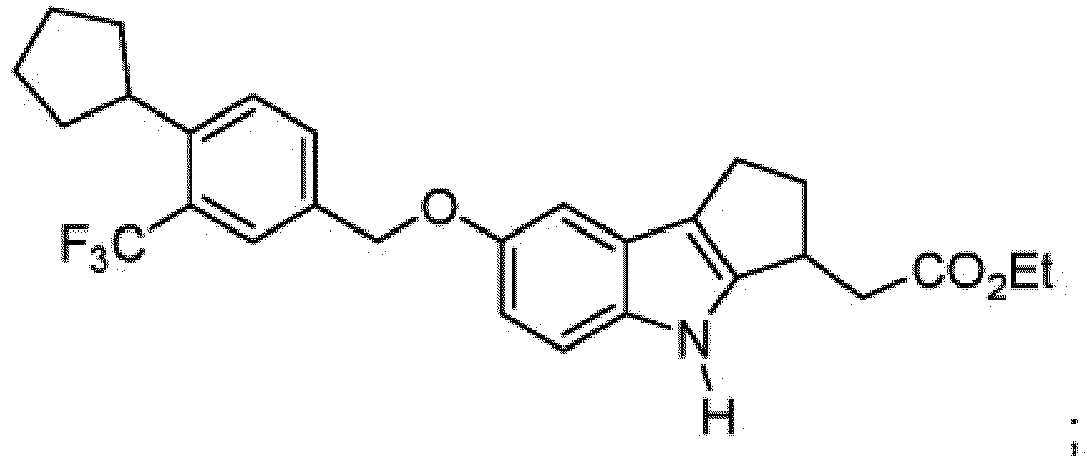 ladite lipase est la lipase B de Candida Antarctica immobilisée ; etledit solvant de l'étape d'hydrolyse comprend l'acétonitrile.
- Procédé selon la revendication 24 ou 25, dans lequel ladite hydrolyse est réalisée en présence d'un tampon phosphate à un pH de 6,9 à 8,1, dans lequel ledit tampon phosphate est un tampon phosphate de potassium.
- Procédé selon l'une quelconque des revendications 24 à 26, dans lequel ladite hydrolyse est réalisée à une température de 35 °C à 45 °C.
- Procédé selon l'une quelconque des revendications 24 à 27, dans lequel après ladite hydrolyse, ledit acide (R)-2-(7-(4-cyclopentyl-3-(trifluorométhyl)benzyloxy)-1,2,3,4-tétrahydrocyclopenta[b]indol-3-yl)acétique n'est pas isolé, et est présent une quantité d'au moins 40 % comme déterminé par CLHP.
- Procédé selon l'une quelconque des revendications 24 à 28, dans lequel la formation dudit premier mélange à l'étape b) comprend l'étape d'ajout de L-arginine et d'H2O, conjointement ou séparément dans n'importe quel ordre, à un mélange de formation de sel comprenant l'acide (R)-2-(7-(4-cyclopentyl-3-(trifluorométhyl)benzyloxy)-1,2,3,4-tétrahydrocyclopenta[b]indol-3-yl)acétique et ledit anti-solvant miscible à l'eau pour former ledit premier mélange.
- Procédé selon l'une quelconque des revendications 24 à 29, dans lequel ledit anti-solvant miscible à l'eau comprend un solvant choisi dans le groupe constitué par: l'acétonitrile, l'acétone, le tétrahydrofurane et un alcanol en C2 à C4.
- Procédé selon l'une quelconque des revendications 24 à 29, dans lequel ledit anti-solvant miscible à l'eau comprend le 2-propanol.
- Procédé selon l'une quelconque des revendications 29 à 31, dans lequel avant l'ajout de ladite L-arginine et d'H2O, ledit mélange de formation de sel comprend l'acide (R)-2-(7-(4-cyclopentyl-3-(trifluorométhyl)benzyloxy)-1,2,3,4-tétrahydrocyclopenta[b]indol-3-yl)acétique et le 2-propanol selon un rapport pondéral de 1,0:6,0 à 1,0:8,0.
- Procédé selon l'une quelconque des revendications 29 à 32, dans lequel le rapport molaire entre l'acide (R)-2-(7-(4-cyclopentyl-3-(trifluorométhyl)benzyloxy)-1,2,3,4-tétrahydrocyclopenta[b]indol-3-yl)acétique et la L-arginine est de 1,0:0,93 à 1,0:1,01.
- Procédé selon l'une quelconque des revendications 29 à 33, dans lequel le rapport pondéral de L-arginine et de l'H2O est de 1,0:1,2 à 1,0:1,5.
- Procédé selon l'une quelconque des revendications 29 à 34, dans lequel ledit mélange de formation de sel avant ledit ajout de L-arginine est à une température de 18 °C à 30 °C.
- Procédé selon l'une quelconque des revendications 29 à 35, dans lequel ledit mélange de formation de sel comprend l'acide (R)-2-(7-(4-cyclopentyl-3-(trifluorométhyl)benzyloxy)-1,2,3,4-tétrahydrocyclopenta[b]indol-3-yl)acétique, le 2-propanol et de l'eau selon un rapport pondéral de 1,0:6,0:0,25 à 1,0:8,0:0,7.
- Procédé selon l'une quelconque des revendications 29 à 35, dans lequel ledit mélange de formation de sel pendant ledit ajout de L-arginine est à une température de 18 °C à 30 °C.
- Procédé selon l'une quelconque des revendications 24 à 37, dans lequel le rapport pondéral du sel de L-arginine de l'acide (R)-2-(7-(4-cyclopentyl-3-(trifluorométhyl)benzyloxy)-1,2,3,4-tétrahydrocyclopenta[b]indol-3-yl)acétique à ladite première quantité supplémentaire de 2-propanol est de 1,00:5,95 à 1,00:6,25.
- Procédé selon l'une quelconque des revendications 24 à 38, dans lequel ladite première quantité supplémentaire dudit anti-solvant miscible à l'eau est ajoutée pendant un premier point temporel et un second point temporel.
- Procédé selon la revendication 39, dans lequel 8 % à 12 % de ladite première quantité supplémentaire dudit anti-solvant miscible à l'eau sont ajoutés audit premier point temporel.
- Procédé selon la revendication 39 ou 40, dans lequel ladite première quantité supplémentaire dudit anti-solvant miscible à l'eau est ajoutée audit premier point temporel pour former un mélange trouble.
- Procédé selon l'une quelconque des revendications 39 à 41, dans lequel, avant ledit second point temporel, un germe cristallin du sel de L-arginine de l'acide (R)-2-(7-(4-cyclopentyl-3-(trifluorométhyl)benzyloxy)-1,2,3,4-tétrahydrocyclopenta[b]indol-3-yl)acétique est éventuellement ajouté.
- Procédé selon l'une quelconque des revendications 39 à 42, dans lequel ladite première quantité supplémentaire dudit anti-solvant miscible à l'eau est ajoutée audit second point temporel à une vitesse pour terminer l'ajout en environ 1,00 heure ou plus.
- Procédé selon l'une quelconque des revendications 24 à 43, dans lequel le refroidissement de ladite suspension à ladite première température de refroidissement à l'étape e) est effectué à une vitesse de 9 °C/heure à 11 °C/heure.
- Procédé selon l'une quelconque des revendications 24 à 44, dans lequel ladite répétition de cycle à l'étape f) comprend ladite répétition de cycle de l'étape e) réalisée deux fois.
- Procédé selon la revendication 45, dans lequel ladite répétition de cycle de l'étape e) réalisée deux fois comprend le refroidissement de la suspension à une température de refroidissement de première répétition de cycle, le chauffage de la suspension à une température de chauffage de première répétition de cycle, le refroidissement de la suspension à une température de refroidissement de seconde répétition de cycle, et le chauffage de la suspension à une température de chauffage de seconde répétition de cycle.
- Procédé selon la revendication 46, dans lequel ladite température de refroidissement de première répétition de cycle est de 16 °C à 26 °C, ladite température de chauffage de première répétition de cycle est de 55 °C à 65 °C, ladite température de refroidissement de seconde répétition de cycle est de 26 °C à 36 °C, et ladite température de chauffage de seconde répétition de cycle est de 45 °C à 55 °C.
- Procédé selon l'une quelconque des revendications 24 à 44, dans lequel ladite répétition de cycle à l'étape f) comprend ladite répétition de cycle de l'étape e) réalisée trois fois.
- Procédé selon la revendication 48, dans lequel ladite répétition de cycle de l'étape e) réalisée trois fois comprend : le refroidissement de la suspension à une température de refroidissement de première répétition de cycle, le chauffage de la suspension à une température de chauffage de première répétition de cycle, le refroidissement de la suspension à une température de refroidissement de deuxième répétition de cycle, le chauffage de la suspension à une température de chauffage de deuxième répétition de cycle, le refroidissement de la suspension à une température de refroidissement de troisième répétition de cycle et le chauffage de la suspension à une température de chauffage de troisième répétition de cycle.
- Procédé selon la revendication 49, dans lequel ladite température de refroidissement de première répétition de cycle est de 16 °C à 26 °C, ladite température de chauffage de première répétition de cycle est de 66 °C à 76 °C, ladite température de refroidissement de deuxième répétition de cycle est de 16 °C à 26 °C, ladite température de chauffage de deuxième répétition de cycle est de 55 °C à 65 °C, ladite température de refroidissement de troisième répétition de cycle est de 26 °C à 36 °C, et ladite température de chauffage de troisième répétition de cycle est de 45 °C à 55 °C.
Priority Applications (2)
| Application Number | Priority Date | Filing Date | Title |
|---|---|---|---|
| SI201631637T SI3310760T1 (sl) | 2015-06-22 | 2016-06-21 | Kristalinična L-argininska sol (R)-2-(7-(4-ciklopentil-3-(trifluorometil)benziloksi)-1,2,3,4- tetrahidrociklo-penta(b)indol-3-il)ocetne kisline za uporabo pri motnjah, povezanih z receptorjem S1P1 |
| EP21178613.2A EP3939965A1 (fr) | 2015-06-22 | 2016-06-21 | Sel l-arginine cristallin d'acide (r)-2-(7-(4-cyclopentyl-3-(trifluorométhyl)benzyloxy)-1,2,3,4-tétrahydrocyclo-penta[b]indol-3-yl)acétique pour une utilisation dans des troubles associés au récepteur de s1p1 |
Applications Claiming Priority (3)
| Application Number | Priority Date | Filing Date | Title |
|---|---|---|---|
| US201562182841P | 2015-06-22 | 2015-06-22 | |
| US201562207531P | 2015-08-20 | 2015-08-20 | |
| PCT/US2016/038506 WO2016209809A1 (fr) | 2015-06-22 | 2016-06-21 | Sel l-arginine cristallin d'acide (r)-2-(7-(4-cyclopentyl-3-(trifluorométhyl)benzyloxy)-1,2,3,4-tétrahydrocyclo-penta[b]indol-3-yl)acétique (composé 1) pour une utilisation dans des troubles associés au récepteur de s1p1 |
Related Child Applications (2)
| Application Number | Title | Priority Date | Filing Date |
|---|---|---|---|
| EP21178613.2A Division-Into EP3939965A1 (fr) | 2015-06-22 | 2016-06-21 | Sel l-arginine cristallin d'acide (r)-2-(7-(4-cyclopentyl-3-(trifluorométhyl)benzyloxy)-1,2,3,4-tétrahydrocyclo-penta[b]indol-3-yl)acétique pour une utilisation dans des troubles associés au récepteur de s1p1 |
| EP21178613.2A Division EP3939965A1 (fr) | 2015-06-22 | 2016-06-21 | Sel l-arginine cristallin d'acide (r)-2-(7-(4-cyclopentyl-3-(trifluorométhyl)benzyloxy)-1,2,3,4-tétrahydrocyclo-penta[b]indol-3-yl)acétique pour une utilisation dans des troubles associés au récepteur de s1p1 |
Publications (3)
| Publication Number | Publication Date |
|---|---|
| EP3310760A1 EP3310760A1 (fr) | 2018-04-25 |
| EP3310760B1 true EP3310760B1 (fr) | 2022-09-14 |
| EP3310760B8 EP3310760B8 (fr) | 2022-10-19 |
Family
ID=56322311
Family Applications (2)
| Application Number | Title | Priority Date | Filing Date |
|---|---|---|---|
| EP21178613.2A Withdrawn EP3939965A1 (fr) | 2015-06-22 | 2016-06-21 | Sel l-arginine cristallin d'acide (r)-2-(7-(4-cyclopentyl-3-(trifluorométhyl)benzyloxy)-1,2,3,4-tétrahydrocyclo-penta[b]indol-3-yl)acétique pour une utilisation dans des troubles associés au récepteur de s1p1 |
| EP16734529.7A Active EP3310760B8 (fr) | 2015-06-22 | 2016-06-21 | Sel l-arginine cristallin d'acide (r)-2-(7-(4-cyclopentyl-3-(trifluorométhyl)benzyloxy)-1,2,3,4-tétrahydrocyclo-penta[b]indol-3-yl)acétique pour une utilisation dans des troubles associés au récepteur de s1p1 |
Family Applications Before (1)
| Application Number | Title | Priority Date | Filing Date |
|---|---|---|---|
| EP21178613.2A Withdrawn EP3939965A1 (fr) | 2015-06-22 | 2016-06-21 | Sel l-arginine cristallin d'acide (r)-2-(7-(4-cyclopentyl-3-(trifluorométhyl)benzyloxy)-1,2,3,4-tétrahydrocyclo-penta[b]indol-3-yl)acétique pour une utilisation dans des troubles associés au récepteur de s1p1 |
Country Status (20)
| Country | Link |
|---|---|
| US (6) | US10301262B2 (fr) |
| EP (2) | EP3939965A1 (fr) |
| JP (3) | JP6838744B2 (fr) |
| KR (2) | KR102603199B1 (fr) |
| CN (1) | CN108349891B (fr) |
| AU (4) | AU2016284162A1 (fr) |
| BR (1) | BR112017027656B1 (fr) |
| CA (1) | CA3002551A1 (fr) |
| CY (1) | CY1125778T1 (fr) |
| DK (1) | DK3310760T3 (fr) |
| EA (1) | EA201890096A1 (fr) |
| ES (1) | ES2929526T3 (fr) |
| HU (1) | HUE060476T2 (fr) |
| IL (2) | IL285890B (fr) |
| MA (1) | MA42807A (fr) |
| MX (2) | MX383854B (fr) |
| PL (1) | PL3310760T3 (fr) |
| PT (1) | PT3310760T (fr) |
| SI (1) | SI3310760T1 (fr) |
| WO (1) | WO2016209809A1 (fr) |
Cited By (1)
| Publication number | Priority date | Publication date | Assignee | Title |
|---|---|---|---|---|
| WO2025243320A1 (fr) * | 2024-05-24 | 2025-11-27 | Cipla Limited | Nouveaux polymorphes d'étrasimod l-arginine et formes amorphes et procédés associés |
Families Citing this family (16)
| Publication number | Priority date | Publication date | Assignee | Title |
|---|---|---|---|---|
| EP2528894A1 (fr) | 2010-01-27 | 2012-12-05 | Arena Pharmaceuticals, Inc. | Procédés de préparation d'acide (r)-2-(7-(4-cyclopentyl-3-(trifluorométhyl)benzyloxy)-1,2,3,4-tétrahydrocyclopenta[b]indol-3-yl) acétique et de ses sels |
| CA3002540C (fr) | 2015-01-06 | 2023-11-07 | Arena Pharmaceuticals, Inc. | Utilisation de (r)-2-(7-(4-cyclopentyl-3(trifluoromethyl)benzyloxy)-1,2,3,4-tetrahydrocyclopenta[b]indol-3-yl)acide acetique pour le traitement de conditions liees au recepteur s1p1 |
| JP6838744B2 (ja) * | 2015-06-22 | 2021-03-03 | アリーナ ファーマシューティカルズ, インコーポレイテッド | S1P1レセプター関連障害における使用のための(R)−2−(7−(4−シクロペンチル−3−(トリフルオロメチル)ベンジルオキシ)−1,2,3,4−テトラヒドロシクロペンタ[b]インドール−3−イル)酢酸(化合物1)の結晶性L−アルギニン塩 |
| KR20190113955A (ko) | 2017-02-16 | 2019-10-08 | 아레나 파마슈티칼스, 인크. | 장-외 증상을 갖는 염증성 장질환의 치료를 위한 화합물 및 방법 |
| CN110520124A (zh) * | 2017-02-16 | 2019-11-29 | 艾尼纳制药公司 | 用于治疗原发性胆汁性胆管炎的化合物和方法 |
| CN110831593A (zh) * | 2017-06-14 | 2020-02-21 | 特维娜有限公司 | 用于调节s1p1活性的化合物及其使用方法 |
| JP7397011B2 (ja) | 2018-06-06 | 2023-12-12 | アリーナ ファーマシューティカルズ, インコーポレイテッド | S1p1受容体に関連する状態を治療する方法 |
| EP3847158B1 (fr) * | 2018-09-06 | 2026-06-24 | Arena Pharmaceuticals, Inc. | Composés utiles dans le traitement des troubles auto-immuns et inflammatoires |
| ES2951870T3 (es) | 2018-10-03 | 2023-10-25 | Arena Pharm Inc | Etrasimod para su uso en procedimientos para el tratamiento de la esclerodermia |
| CN109678715B (zh) * | 2018-11-28 | 2019-11-12 | 中国药科大学 | 2-(1-酰氧正戊基)苯甲酸与碱性氨基酸或氨基胍形成的盐、其制备方法及用途 |
| JP2022550458A (ja) * | 2019-10-01 | 2022-12-01 | アリーナ ファーマシューティカルズ, インコーポレイテッド | S1p1受容体に関連する状態を処置する方法 |
| CA3156298A1 (fr) | 2019-10-31 | 2021-05-06 | Laetitia POUZOL | Combinaison d'un antagoniste de cxcr7 avec un modulateur du recepteur s1p1 |
| MX2022005766A (es) | 2019-11-19 | 2022-08-08 | Trevena Inc | Compuestos y métodos para la preparación de compuestos moduladores de esfingosina 1-fosfato tipo 1 (s1p1). |
| KR20220103750A (ko) | 2019-11-20 | 2022-07-22 | 아레나 파마슈티칼스, 인크. | S1p1 수용체와 관련된 상태를 치료하는 방법 |
| WO2025177319A2 (fr) * | 2024-02-22 | 2025-08-28 | Msn Laboratories Private Limited, R&D Center | Formes à l'état solide de l-arginine, (3r)-7-[[4-cyclopentyl-3-(trifluorométhyl)phényl]méthoxy]-1,2,3,4-tétrahydrocyclopent[b]indole-3-acétate et leurs procédés de préparation |
| EP4685237A1 (fr) | 2024-07-26 | 2026-01-28 | Curia Spain, S.A.U. | Procédé et intermédiaires pour la préparation d'etrasimod et composés apparentés |
Citations (3)
| Publication number | Priority date | Publication date | Assignee | Title |
|---|---|---|---|---|
| WO2006060808A1 (fr) | 2004-12-03 | 2006-06-08 | Teva Pharmaceutical Industries Ltd. | Polymorphes de l'ezetimibe |
| WO2010011316A1 (fr) | 2008-07-23 | 2010-01-28 | Arena Pharmaceuticals, Inc. | Dérivés de l’acide 1,2,3,4-tétrahydrocyclopenta[b]indol-3-yle acétique substitué utilisés dans le traitement des maladies auto-immunes et inflammatoires |
| WO2011094008A1 (fr) | 2010-01-27 | 2011-08-04 | Arena Pharmaceuticals, Inc. | Procédés de préparation d'acide (r)-2-(7-(4-cyclopentyl-3-(trifluorométhyl)benzyloxy)-1,2,3,4-tétrahydrocyclopenta]indol-3-yl) acétique et de ses sels |
Family Cites Families (516)
| Publication number | Priority date | Publication date | Assignee | Title |
|---|---|---|---|---|
| CH389134A (de) | 1960-03-15 | 1965-03-15 | Ciba Geigy | Verfahren zur Herstellung neuer Anthrachinonküpenfarbstoffe |
| NL293572A (fr) | 1962-06-07 | |||
| CH499528A (de) | 1965-10-22 | 1970-11-30 | Ciba Geigy Ag | Verfahren zur Herstellung neuer Pyrimidine |
| CH480410A (de) | 1967-01-09 | 1969-10-31 | Geigy Ag J R | Verfahren zur Herstellung von wasserlöslichen Azopyrimidinfarbstoffen |
| CA961052A (en) | 1967-01-12 | 1975-01-14 | Max Schellenbaum | N-2-ethylhexyl-n'-aryl ureas and preparation containing them |
| FR1593586A (fr) | 1967-10-17 | 1970-06-01 | ||
| US3608087A (en) | 1968-06-21 | 1971-09-21 | Merck & Co Inc | Feed compositions |
| US3887329A (en) | 1969-05-05 | 1975-06-03 | Ciba Geigy Ag | Hexamethyl phosphotriamide-dye compositions |
| BE756953A (fr) | 1969-10-02 | 1971-04-01 | Merck & Co Inc | Potentialisation d'antibiotiques |
| US3686238A (en) | 1970-01-19 | 1972-08-22 | Syntex Corp | Glycerol esterified with 2-naphthyl-acetic acids and fatty acids |
| US3852434A (en) | 1970-09-11 | 1974-12-03 | Merck & Co Inc | Potentiation of ({31 ) cis-1,2-epoxypropyl)phosphonic acid and analogues thereof |
| US3966744A (en) | 1971-01-11 | 1976-06-29 | Syva Company | Spin labeled compounds |
| US3690834A (en) | 1971-01-11 | 1972-09-12 | Syva Co | Ligand determination with spin labeled compounds by receptor displacement |
| DE2106585A1 (de) | 1971-02-11 | 1972-08-24 | Farbenfabriken Bayer Ag, 5090 Leverkusen | Aminothiodiazole und Thiodiazol-Azofarbstoffe |
| CH560197A5 (en) | 1971-05-17 | 1975-03-27 | Ciba Geigy Ag | 2-alkylthio-4,6-bis (subst amino)-5-nitropyrimidines - - herbicides |
| CH558137A (de) | 1971-05-17 | 1975-01-31 | Ciba Geigy Ag | Mittel zur beeinflussung des pflanzenwachstums. |
| DE2226703A1 (de) | 1972-05-25 | 1973-12-13 | Schering Ag | Neue tetrahydrocarbazolderivate und verfahren zu ihrer herstellung |
| US3966764A (en) | 1972-07-10 | 1976-06-29 | Syva Company | Ligand determination of spin labeled compounds by receptor displacement-amphetamine analogs |
| US3849420A (en) | 1972-10-20 | 1974-11-19 | Dow Chemical Co | Bis-(alkylthio-and alkylsulfonyl)-pentachloroquinolines |
| CH574206A5 (fr) | 1972-11-16 | 1976-04-15 | Ciba Geigy Ag | |
| DE2340569C2 (de) | 1973-08-10 | 1982-12-02 | Bayer Ag, 5090 Leverkusen | Azofarbstoffe |
| DE2341925A1 (de) | 1973-08-20 | 1975-03-06 | Thomae Gmbh Dr K | Neue pyrimidinderivate und verfahren zu ihrer herstellung |
| AT340933B (de) | 1973-08-20 | 1978-01-10 | Thomae Gmbh Dr K | Verfahren zur herstellung neuer pyrimidinderivate und ihrer saureadditionssalze |
| US4057559A (en) | 1973-10-01 | 1977-11-08 | American Home Products Corporation | Carbazole acetic acid derivatives |
| US4101541A (en) | 1973-12-21 | 1978-07-18 | Ciba-Geigy Corporation | 3-Cyano-1,2,4-thiadiazolyl-5-czo dyestuffs |
| CH584739A5 (fr) | 1973-12-21 | 1977-02-15 | Ciba Geigy Ag | |
| FR2258841B1 (fr) | 1974-01-29 | 1977-11-04 | Ugine Kuhlmann | |
| AT327605B (de) | 1974-05-06 | 1976-02-10 | Ciba Geigy Ag | Mittel zur hemmung des pflanzenwachstums |
| AU492126B2 (en) | 1974-05-14 | 1975-11-20 | Ciba-Geigy Ag | Nitropyrimidine derivatives |
| FR2306697A1 (fr) | 1975-04-10 | 1976-11-05 | Sogeras | Nouvelles pyrimidines utilisables comme medicaments antidiabetiques et hypocholesterolemiants |
| US4139705A (en) | 1977-05-20 | 1979-02-13 | The Dow Chemical Company | Pyrazolopyrimidines |
| US4189579A (en) | 1977-05-20 | 1980-02-19 | The Dow Chemical Company | Aminoalkylthiopurines |
| DE2731264A1 (de) | 1977-07-11 | 1979-02-01 | Boehringer Mannheim Gmbh | Neue 1-acyl-2-cyanaziridine, verfahren zu deren herstellung und diese verbindungen enthaltende pharmazeutische zubereitungen |
| JPS6038696B2 (ja) | 1977-12-09 | 1985-09-02 | コニカ株式会社 | ハロゲン化銀カラ−写真感光材料 |
| US4242507A (en) | 1978-02-23 | 1980-12-30 | Fujisawa Pharmaceutical Co., Ltd. | Sulfonic acid esters |
| DE2831580C2 (de) | 1978-07-18 | 1980-09-18 | Boehringer Mannheim Gmbh, 6800 Mannheim | Verfahren und Reagens zur Bestimmung von Glycerin |
| DE2831850A1 (de) | 1978-07-20 | 1980-02-07 | Basf Ag | N-arylsulfonylpyrrole, ihre herstellung und diese enthaltende therapeutische mittel |
| DE2906603A1 (de) | 1979-02-21 | 1980-09-04 | Boehringer Mannheim Gmbh | N-substituierte aziridin-2-carbonsaeurederivate, verfahren zu deren herstellung sowie diese substanzen enthaltende arzneimittel |
| US4343804A (en) | 1979-03-26 | 1982-08-10 | A. H. Robins Company, Inc. | 4-Amino-3-quinolinecarboxylic acids and esters-antisecretory anti-ulcer compounds |
| WO1981003174A1 (fr) | 1980-04-28 | 1981-11-12 | Teijin Ltd | Derives de thiazolo (3,2-a) pyrimidine, leur procede de preparation, et medicaments les contenant |
| EP0053678A1 (fr) | 1980-12-05 | 1982-06-16 | BASF Aktiengesellschaft | Amino-5-phényl-1-cyano-4-pyrazoles, herbicides les contenant, leur procédé de préparation et leur application comme herbicides |
| RU938559C (ru) | 1980-12-12 | 1993-11-30 | Всесоюзный научно-исследовательский химико-фармацевтический институт им.Серго Орджоникидзе | S-Производные 5-амино-6-меркаптопиримидина, обладающие противоопухолевым и цитостатическим действием |
| DOP1981004033A (es) | 1980-12-23 | 1990-12-29 | Ciba Geigy Ag | Procedimiento para proteger plantas de cultivo de la accion fitotoxica de herbicidas. |
| US4476248A (en) | 1983-02-28 | 1984-10-09 | The Upjohn Company | Crystallization of ibuprofen |
| DE3334455A1 (de) | 1983-03-04 | 1984-09-06 | Bayer Ag, 5090 Leverkusen | Guanidin - derivate |
| US4612376A (en) | 1983-03-25 | 1986-09-16 | Fujisawa Pharmaceutical Co., Ltd. | Substituted-3,4-dihydro-4-(2,4,6-trimethoxyphenylimino)-2(1H)-pyrimidones useful as cardiotonic, antihypertensive, cerebrovascular vasodilator and anti-platelet agent |
| ZA848275B (en) | 1983-12-28 | 1985-08-28 | Degussa | New piridine-2-ethers or pyridine-2-thioethers having a nitrogen-containing cycloaliphatic ring |
| DE3406329A1 (de) | 1984-02-22 | 1985-08-22 | Merck Patent Gmbh, 6100 Darmstadt | Pyridone |
| JPS6157587A (ja) | 1984-08-29 | 1986-03-24 | Shionogi & Co Ltd | 縮合複素環誘導体および抗潰瘍剤 |
| PH22302A (en) | 1985-02-11 | 1988-07-22 | Fujisawa Pharmaceutical Co | Piperidine compounds |
| ES8801896A1 (es) | 1985-03-01 | 1988-03-01 | Duphar Int Res | Procedimiento para preparar derivados de urea |
| DE3601196A1 (de) | 1986-01-17 | 1987-07-23 | Merck Patent Gmbh | 1,4-dihydropyridine |
| US4810699A (en) | 1987-02-20 | 1989-03-07 | American Home Products Corporation | Substituted 1,3,4,9-tetrahydropyrano[3,4,-b]indole-1-acetic acids, pharmaceutical compositions containing them, and methods for treating inflammatory conditions and for analgesic purposes using them |
| CA1340284C (fr) | 1987-03-19 | 1998-12-22 | Zeneca Inc. | Diones cycliques avec substitution, herbicides |
| EP0324426B1 (fr) | 1988-01-11 | 1996-06-19 | Fuji Photo Film Co., Ltd. | Procédé pour former des images négatives à très haut contraste |
| US4782076A (en) | 1988-03-01 | 1988-11-01 | American Home Products Corporation | Substituted 2,3,4,9-tetrahydro-1H-carbazole-1-acetic acid derivatives, composition and use |
| PT95692A (pt) | 1989-10-27 | 1991-09-13 | American Home Prod | Processo para a preparacao de derivados de acidos indole-,indeno-,piranoindole- e tetra-hidrocarbazole-alcanoicos, ou quais sao uteis como inibidores de pla2 e da lipoxigenase |
| NZ238863A (en) | 1990-07-19 | 1993-03-26 | Janssen Pharmaceutica Nv | Substituted thiazolyl and pyridinyl derivatives |
| US5221678A (en) | 1990-07-26 | 1993-06-22 | Merck Frosst Canada, Inc. | (quinolin-2-ylmethoxy)tetrahydrocarbazoles as inhibitors of the biosynthesis of leukotrienes |
| EP0567643A4 (fr) | 1991-01-16 | 1995-07-19 | Yoshitomi Pharmaceutical | Compose de pyridine utilise comme medicament selectif et nouveau compose de pyridine. |
| CA2070978A1 (fr) | 1991-06-11 | 1992-12-12 | William J. Greenlee | Inhibiteurs cycliques de la renine |
| GB9114760D0 (en) | 1991-07-09 | 1991-08-28 | Pfizer Ltd | Therapeutic agents |
| JPH0533359A (ja) | 1991-08-02 | 1993-02-09 | Kubota Corp | 全旋回型の小型バツクホウ |
| EP0556889A1 (fr) | 1992-02-18 | 1993-08-25 | Duphar International Research B.V | Méthode pour la préparation de aryl(homo)préparation |
| DE4208254A1 (de) | 1992-03-14 | 1993-09-16 | Hoechst Ag | Substituierte pyrimidine, verfahren zu ihrer herstellung und ihre verwendung als schaedlingsbekaempfungsmittel und fungizid |
| TW237456B (fr) | 1992-04-09 | 1995-01-01 | Ciba Geigy | |
| FR2692575B1 (fr) | 1992-06-23 | 1995-06-30 | Sanofi Elf | Nouveaux derives du pyrazole, procede pour leur preparation et compositions pharmaceutiques les contenant. |
| NZ314207A (en) | 1992-09-28 | 2000-12-22 | Vertex Pharma | 1-(2-Oxoacetyl)-piperidine-2-carboxylic acid derivatives as multi drug resistant cancer cell sensitizers |
| DE4241632A1 (de) | 1992-12-10 | 1994-06-16 | Thomae Gmbh Dr K | Carbonsäurederivate, diese Verbindungen enthaltende Arzneimittel und Verfahren zu ihrer Herstellung |
| TW370529B (en) | 1992-12-17 | 1999-09-21 | Pfizer | Pyrazolopyrimidines |
| US5998499A (en) | 1994-03-25 | 1999-12-07 | Dentsply G.M.B.H. | Liquid crystalline (meth)acrylate compounds, composition and method |
| JPH0753546A (ja) | 1993-08-09 | 1995-02-28 | Kuraray Co Ltd | ジアリール置換複素環化合物およびその医薬用途 |
| NZ274978A (en) | 1993-10-12 | 1998-04-27 | Du Pont Merck Pharma | 1n-alkyl-n-aryl pyrimidinamine derivatives and pharmaceutical compositions thereof |
| GB9400889D0 (en) | 1994-01-18 | 1994-03-16 | Sandoz Ltd | Novel compounds |
| TW574214B (en) | 1994-06-08 | 2004-02-01 | Pfizer | Corticotropin releasing factor antagonists |
| RU2128996C1 (ru) | 1994-09-09 | 1999-04-20 | Ниппон Синяку Ко., Лтд. | Гетероциклическое производное и лекарственное средство |
| JP3100165B2 (ja) | 1994-11-29 | 2000-10-16 | 大日本製薬株式会社 | インドール誘導体 |
| EP0813525B9 (fr) | 1995-03-10 | 2004-02-04 | Berlex Laboratories, Inc. | Derives de benzamidine et utilisation de ces derives en tant qu'anticoagulants |
| US5691364A (en) | 1995-03-10 | 1997-11-25 | Berlex Laboratories, Inc. | Benzamidine derivatives and their use as anti-coagulants |
| IL117659A (en) | 1995-04-13 | 2000-12-06 | Dainippon Pharmaceutical Co | Substituted 2-phenyl pyrimidino amino acetamide derivative process for preparing the same and a pharmaceutical composition containing same |
| GB9508538D0 (en) | 1995-04-27 | 1995-06-14 | Zeneca Ltd | Quinazoline derivatives |
| WO1996033994A1 (fr) | 1995-04-28 | 1996-10-31 | Nippon Soda Co., Ltd. | Derives amino-substitues, leur procede de preparation et herbicide |
| JPH10506126A (ja) | 1995-05-12 | 1998-06-16 | ニューロゲン コーポレイション | 新規なデアザプリン誘導体;crf1特異性リガンドの新規なクラス |
| WO1996036613A1 (fr) | 1995-05-19 | 1996-11-21 | Nippon Soda Co., Ltd. | Derives d'acides benzoiques substitues, procede de production desdits derives et herbicides |
| US6956047B1 (en) | 1995-06-06 | 2005-10-18 | Pfizer Inc. | Corticotropin releasing factor antagonists |
| US6403599B1 (en) | 1995-11-08 | 2002-06-11 | Pfizer Inc | Corticotropin releasing factor antagonists |
| TW438587B (en) | 1995-06-20 | 2001-06-07 | Takeda Chemical Industries Ltd | A pharmaceutical composition for prophylaxis and treatment of diabetes |
| KR0169813B1 (ko) | 1995-07-12 | 1999-01-15 | 김종인 | 4-아미노-3-아실나프티리딘 유도체 |
| JP2000507911A (ja) | 1995-08-31 | 2000-06-27 | ロンザ アーゲー | ジヒドロキシピリミジン誘導体の製造方法 |
| CZ126598A3 (cs) | 1995-10-26 | 1998-09-16 | Mitsubishi-Tokyo Pharmaceuticals, Inc. | Fenylethanolaminové sloučeniny, způsob jejich výroby a farmaceutické prostředky s jejich obsahem |
| US5849759A (en) | 1995-12-08 | 1998-12-15 | Berlex Laboratories, Inc. | Naphthyl-substituted benzimidazole derivatives as anti-coagulants |
| USH2007H1 (en) | 1996-01-19 | 2001-12-04 | Fmc Corporation | Insecticidal N-heterocyclylalkyl-or N-[(polycyclyl)alkyl]-N′substituted piperazines |
| DE19602095A1 (de) | 1996-01-22 | 1997-07-24 | Bayer Ag | Halogenpyrimidine |
| ATE236137T1 (de) | 1996-02-02 | 2003-04-15 | Merck & Co Inc | Heterocyclische verbindungen als antidiabetische mittel und für die behandlung von fettleibigkeit |
| ES2168237T3 (es) | 1996-02-07 | 2007-04-01 | Neurocrine Biosciences, Inc. | Pirazolopirimidinas como antagonistas de receptores de crf. |
| US5948786A (en) | 1996-04-12 | 1999-09-07 | Sumitomo Pharmaceuticals Company, Limited | Piperidinylpyrimidine derivatives |
| DE122010000020I1 (de) | 1996-04-25 | 2010-07-08 | Prosidion Ltd | Verfahren zur Senkung des Blutglukosespiegels in Säugern |
| DE19624659A1 (de) | 1996-06-20 | 1998-01-08 | Klinge Co Chem Pharm Fab | Neue Pyridylalken- und Pyridylalkinsäureamide |
| AU3176297A (en) | 1996-06-25 | 1998-01-14 | Novartis Ag | Substituted 7-amino-pyrrolo{3,2-d}pyrimidines and the use thereof |
| US6060478A (en) | 1996-07-24 | 2000-05-09 | Dupont Pharmaceuticals | Azolo triazines and pyrimidines |
| US5776967A (en) | 1996-07-26 | 1998-07-07 | American Home Products Corporation | Pyranoindole inhibitors of COX--2 |
| AR008789A1 (es) | 1996-07-31 | 2000-02-23 | Bayer Corp | Piridinas y bifenilos substituidos |
| US5830911A (en) | 1996-08-14 | 1998-11-03 | American Home Products Corporation | Pyranoindole and tetrahydrocarbazole inhibitors of COX-2 |
| TW477787B (en) | 1996-08-27 | 2002-03-01 | Pfizer | Pyrido six-membered nitrogen-containing cyclic ring derivatives having corticotropin releasing factor antagonist activity and pharmaceutical composition containing same |
| PL332040A1 (en) | 1996-08-28 | 1999-08-16 | Pfizer | Substitution 6,5-heterobicyclic derivatives |
| CA2264521A1 (fr) | 1996-09-12 | 1998-03-19 | Schering Aktiengesellschaft | Derives benzamidine, substitues par des derives d'acides amines cycliques ou d'hydroxyacides cycliques, et leur utilisation en tant qu'anticoagulants |
| US6008234A (en) | 1996-09-12 | 1999-12-28 | Berlex Laboratories, Inc. | Benzamidine derivatives substituted by cyclic amino acid and cyclic hydroxy acid derivatives and their use as anti-coagulants |
| GB9718972D0 (en) | 1996-09-25 | 1997-11-12 | Zeneca Ltd | Chemical compounds |
| TW492957B (en) | 1996-11-07 | 2002-07-01 | Novartis Ag | N-substituted 2-cyanopyrrolidnes |
| DZ2376A1 (fr) | 1996-12-19 | 2002-12-28 | Smithkline Beecham Plc | Dérivés de sulfonamides nouveaux procédé pour leurpréparation et compositions pharmaceutiques les c ontenant. |
| NO980546L (no) | 1997-02-11 | 1998-08-12 | Lilly Co Eli | Farmas°ytiske midler |
| JP2001511813A (ja) | 1997-02-18 | 2001-08-14 | ニューロクライン バイオサイエンシーズ,インコーポレイテッド | Crfレセプターアンタゴニストおよびそれらに関連する方法 |
| NZ335823A (en) | 1997-04-22 | 2001-06-29 | Neurocrine Biosciences Inc | Thiophenopyridines, preparation as CRF receptor antagonists |
| DK0977737T3 (da) | 1997-04-22 | 2004-01-26 | Janssen Pharmaceutica Nv | CRF-antagonistisk quino- og quinazoline |
| JPH11193277A (ja) | 1997-05-14 | 1999-07-21 | Nippon Soda Co Ltd | ピリミジン誘導体、その製法および有害生物防除剤 |
| DE19737723A1 (de) | 1997-08-14 | 1999-02-18 | Bayer Ag | Methoximinomethyloxadiazine |
| JP2001515076A (ja) | 1997-08-14 | 2001-09-18 | バイエル・アクチエンゲゼルシヤフト | 有害生物防除剤として使用されるメトキシイミノメチルオキサジアジン |
| NL1010018C2 (nl) | 1997-09-09 | 1999-03-10 | Duphar Int Res | Chinoline en chinazoline derivaten met corticotropine releasing factor (CRF) antagonistische werking. |
| US6861448B2 (en) | 1998-01-14 | 2005-03-01 | Virtual Drug Development, Inc. | NAD synthetase inhibitors and uses thereof |
| US6187777B1 (en) | 1998-02-06 | 2001-02-13 | Amgen Inc. | Compounds and methods which modulate feeding behavior and related diseases |
| US6310063B1 (en) | 1998-04-02 | 2001-10-30 | Neurogen Corporation | Aminoalkyl substituted pyrrolo [3,2-E]pyridine and pyrollo [2,3-b]pyrimidine derivatives: modulators of CRF1 receptors |
| JP2000038350A (ja) | 1998-05-18 | 2000-02-08 | Yoshitomi Pharmaceut Ind Ltd | 糖尿病治療薬 |
| CA2339188A1 (fr) | 1998-08-21 | 2000-03-02 | Dupont Pharmaceuticals Company | Isoxazolo¬4,5-d|pyrimidines comme antagonistes du crf |
| ID28376A (id) | 1998-11-10 | 2001-05-17 | Janssen Pharmaceutica Nv | Pirimidina yang menghambat replikasi hiv |
| US6262088B1 (en) | 1998-11-19 | 2001-07-17 | Berlex Laboratories, Inc. | Polyhydroxylated monocyclic N-heterocyclic derivatives as anti-coagulants |
| ATE301673T1 (de) | 1998-11-20 | 2005-08-15 | Arena Pharm Inc | Menschliche, an ein g-protein gekoppelter rezeptor rup3 ohne bekannten ligand |
| CO5150173A1 (es) | 1998-12-10 | 2002-04-29 | Novartis Ag | Compuestos n-(glicilo sustituido)-2-cianopirrolidinas inhibidores de peptidasa de dipeptidilo-iv (dpp-iv) los cuales son efectivos en el tratamiento de condiciones mediadas por la inhibicion de dpp-iv |
| US6239126B1 (en) | 1998-12-17 | 2001-05-29 | American Home Products Corporation | Arylpiperidine and aryl-1,2,5,6-tetra-hydropyridine urea derivatives |
| CN1335835A (zh) | 1998-12-17 | 2002-02-13 | 美国家用产品公司 | 具有5ht1a受体活性的芳基哌啶和芳基-1,2,5,6-四氢吡啶脲衍生物 |
| HUP0104987A3 (en) | 1998-12-18 | 2002-09-30 | Axys Pharmaceuticals Inc South | Benzimidazole or indole derivatives protease inhibitors, and pharmaceutical compositions containing them |
| CZ27399A3 (cs) | 1999-01-26 | 2000-08-16 | Ústav Experimentální Botaniky Av Čr | Substituované dusíkaté heterocyklické deriváty, způsob jejich přípravy, tyto deriváty pro použití jako léčiva, farmaceutická kompozice a kombinovaný farmaceutický přípravek tyto deriváty obsahující a použití těchto derivátů pro výrobu léčiv |
| US6267985B1 (en) | 1999-06-30 | 2001-07-31 | Lipocine Inc. | Clear oil-containing pharmaceutical compositions |
| DE60010448T2 (de) | 1999-03-17 | 2005-04-07 | Astrazeneca Ab | Amid-derivate |
| EP1040831A3 (fr) | 1999-04-02 | 2003-05-02 | Pfizer Products Inc. | Utilisation d'antagonistes du facteur de libération de la corticotropine pour la prévention de la mort subite |
| HRP20010795A2 (en) | 1999-04-28 | 2003-02-28 | Aventis Pharma Gmbh | Di-aryl acid derivatives as ppar receptor ligands |
| EP1195165A4 (fr) | 1999-07-12 | 2005-08-10 | Ono Pharmaceutical Co | Inhibiteurs de fibrose contenant comme ingredient actif l'agoniste du recepteur de sphingosine-1-phosphate ou la sphingosine-1-phosphate |
| EP1074549B1 (fr) | 1999-08-06 | 2003-11-19 | F. Hoffmann-La Roche Ag | Tétrahydro-benzo(d)azépines et leurs utilisations en tant qu'antagonistes du récepteur de glutamate métabotropique |
| KR20020088406A (ko) | 1999-09-17 | 2002-11-27 | 애보트 게엠베하 운트 콤파니 카게 | 치료제로서의 피라졸로피리미딘 |
| US6921763B2 (en) | 1999-09-17 | 2005-07-26 | Abbott Laboratories | Pyrazolopyrimidines as therapeutic agents |
| JP2001089452A (ja) | 1999-09-22 | 2001-04-03 | Sankyo Co Ltd | ピリミジン誘導体 |
| US6414002B1 (en) | 1999-09-22 | 2002-07-02 | Bristol-Myers Squibb Company | Substituted acid derivatives useful as antidiabetic and antiobesity agents and method |
| TR200200763T2 (tr) | 1999-09-24 | 2003-09-22 | Janssen Pharmaceutica N.V. | Antiviral bileşimler |
| YU23602A (sh) | 1999-09-30 | 2004-09-03 | Neurogen Corporation | Amino supstituisani pirazolo /1,5/a/-1,5-pirimidini i pirazolo /1,5-a/-1,3,5-triazini |
| PL354675A1 (en) | 1999-09-30 | 2004-02-09 | Neurogen Corporation | Certain alkylene diamine-substituted pyrazolo[1,5,-a]-1,5-pyrimidines and pyrazolo[1,5-a]-1,3,5-triazines |
| AU7738000A (en) | 1999-09-30 | 2001-04-30 | Neurogen Corporation | Certain alkylene diamine-substituted heterocycles |
| DE19947154A1 (de) | 1999-10-01 | 2001-10-04 | Bayer Ag | Substituierte 2-Thio-3,5-dicyano-4-aryl-6-aminopyridine und ihre Verwendung |
| US6887870B1 (en) | 1999-10-12 | 2005-05-03 | Bristol-Myers Squibb Company | Heterocyclic sodium/proton exchange inhibitors and method |
| IL139197A0 (en) | 1999-10-29 | 2001-11-25 | Pfizer Prod Inc | Use of corticotropin releasing factor antagonists and related compositions |
| GR990100388A (el) | 1999-11-09 | 2001-07-31 | Φαρμακευτικος συνδυασμος αποτελουμενος απο χωριστες δοσολογικες μορφες σε συσκευασια συμμορφωσης (compliance package) ενος αναστολεα της αναγωγασης του υδροξυ-μεθυλο-γλουταρυλο συνενζυμου α (στατινης, statin) και ενος παραγωγου του φιμπρικου οξεος.... | |
| JP2003518128A (ja) | 1999-12-22 | 2003-06-03 | メルク フロスト カナダ アンド カンパニー | タンパク質チロシンホスファターゼ1b(ptp−1b)のインヒビターとなる芳香族ホスホネート |
| DE19962936A1 (de) | 1999-12-24 | 2001-06-28 | Bayer Ag | Neue beta-Aminosäureverbindungen als Integrinantagonisten |
| DE60009154D1 (de) | 1999-12-30 | 2004-04-22 | Lundbeck & Co As H | Phenylpiperazinyl-derivate |
| CA2397633A1 (fr) | 2000-01-18 | 2001-07-26 | Pfizer Products Inc. | Antagonistes de la corticoliberine |
| IL150841A0 (en) | 2000-02-09 | 2003-02-12 | Hokuriku Pharmaceutical | 1h-imidazopyridine derivatives |
| US6894084B2 (en) | 2000-02-15 | 2005-05-17 | Foster-Miller, Inc. | No VOC radiation curable resin compositions |
| JP2003523336A (ja) | 2000-02-18 | 2003-08-05 | メルク エンド カムパニー インコーポレーテッド | 糖尿病及び脂質障害のためのアリールオキシ酢酸 |
| US6569879B2 (en) | 2000-02-18 | 2003-05-27 | Merck & Co., Inc. | Aryloxyacetic acids for diabetes and lipid disorders |
| YU63802A (sh) | 2000-02-25 | 2005-06-10 | F. Hoffmann-La Roche Ag. | Modulatori adenozinskih receptora |
| US20040023840A1 (en) | 2000-04-12 | 2004-02-05 | Marc De Gasparo | Combination of organic compounds |
| US7034019B2 (en) | 2000-05-08 | 2006-04-25 | Janssen Pharmaceutica N.V. | Prodrugs of HIV replication inhibiting pyrimidines |
| DE10024319A1 (de) | 2000-05-17 | 2001-11-22 | Merck Patent Gmbh | Bisacylguanidine |
| EP1287133B1 (fr) | 2000-05-18 | 2006-12-13 | Bayer HealthCare AG | Regulation de recepteur couple aux proteines g de type dopamine humain |
| JP2003533530A (ja) | 2000-05-18 | 2003-11-11 | ニューロクライン バイオサイエンシーズ, インコーポレイテッド | Crfレセプターアンタゴニスト |
| CN1187342C (zh) | 2000-05-25 | 2005-02-02 | 弗·哈夫曼-拉罗切有限公司 | 取代的1-氨基烷基内酰胺化合物及其作为毒蕈碱受体拮抗剂的用途 |
| US6620821B2 (en) | 2000-06-15 | 2003-09-16 | Bristol-Myers Squibb Company | HMG-CoA reductase inhibitors and method |
| CA2413702A1 (fr) | 2000-06-28 | 2002-01-03 | Teva Pharmaceuticals Industries Ltd. | Carvedilol |
| AU2001268718B2 (en) | 2000-06-29 | 2006-01-05 | Abbott Laboratories | Aryl phenylheterocyclyl sulfide derivatives and their use as cell adhesion-inhibiting anti-inflammatory and immune-suppressive agents |
| AR028782A1 (es) | 2000-07-05 | 2003-05-21 | Taisho Pharmaceutical Co Ltd | Derivados heterociclicos tetrahidropiridino o piperidino |
| US6444685B1 (en) | 2000-07-17 | 2002-09-03 | Wyeth | N-(4-sulfonylaryl)Cyclylamine 2-hydroxyethylamines as beta-3 adrenergic receptor agonists |
| MXPA03000436A (es) | 2000-07-18 | 2003-06-24 | Yamanouchi Pharma Co Ltd | Medicamentos que compreden derivados de dicianopiridina. |
| US6410583B1 (en) | 2000-07-25 | 2002-06-25 | Merck Frosst Canada & Co. | Cyclopentanoindoles, compositions containing such compounds and methods of treatment |
| CA2415742A1 (fr) | 2000-07-25 | 2002-01-31 | Merck & Co., Inc. | Indoles n-substitues utiles pour le traitement du diabete |
| AU2001284417A1 (en) | 2000-09-05 | 2002-03-22 | Taisho Pharmaceutical Co. Ltd. | Hair growth stimulants |
| AU6294501A (en) | 2000-09-20 | 2002-04-02 | Rtp Pharma Inc | Spray drying process and compositions of fenofibrate |
| US7276249B2 (en) | 2002-05-24 | 2007-10-02 | Elan Pharma International, Ltd. | Nanoparticulate fibrate formulations |
| US20030224058A1 (en) | 2002-05-24 | 2003-12-04 | Elan Pharma International, Ltd. | Nanoparticulate fibrate formulations |
| PE20020507A1 (es) | 2000-10-17 | 2002-06-25 | Schering Corp | Compuestos no-imidazoles como antagonistas del receptor histamina h3 |
| AU2002223626A1 (en) | 2000-10-20 | 2002-04-29 | Novartis Ag | Combinations of a thyromimetic compound and a statin |
| AU2002246855B2 (en) | 2000-10-23 | 2005-12-22 | Smithkline Beecham Corporation | Novel compounds |
| WO2002060434A2 (fr) | 2000-10-31 | 2002-08-08 | Merck & Co., Inc. | Derives d'acide benzopyranocarboxylique pour traiter le diabete et d'autres troubles lipidiques |
| CA2427656A1 (fr) | 2000-11-03 | 2002-05-23 | Neurocrine Biosciences, Inc. | Antagonistes du recepteur crf et methodes liees a ces derniers |
| US20020058026A1 (en) | 2000-11-13 | 2002-05-16 | Milton Hammerly | HMG CoA reductase inhibitor medications combined wih CoEnzyme Q-10 |
| AU2002223492A1 (en) | 2000-11-14 | 2002-05-27 | Neurosearch A/S | Use of malaria parasite anion channel blockers for treating malaria |
| UA77165C2 (en) | 2000-11-17 | 2006-11-15 | Lilly Co Eli | (n)-((s)-2-hydroxy-3-methyl-butyryl)-1-(l-alaninyl)-(s)-1-amino-3-methyl-4,5,6,7-tetrahydro-2h-3-benzazepin-2-one dihydrate, processes for manufacturing and pharmaceutical composition |
| US7022725B2 (en) | 2000-11-17 | 2006-04-04 | Takeda Pharmaceutical Company Limited | Isoxazole derivatives |
| AU2426602A (en) | 2000-11-20 | 2002-05-27 | Biovitrum Ab | Piperazinylpyrazine compounds as agonist or antagonist of serotonin 5ht-2 receptor |
| EP1770159A1 (fr) | 2000-12-01 | 2007-04-04 | Astellas Pharma Inc. | Procédé de production d'une composition thérapeutique destinée au traitement de diabète |
| US20020137755A1 (en) | 2000-12-04 | 2002-09-26 | Bilodeau Mark T. | Tyrosine kinase inhibitors |
| US6525064B1 (en) | 2000-12-08 | 2003-02-25 | 3M Innovative Properties Company | Sulfonamido substituted imidazopyridines |
| US20020107262A1 (en) | 2000-12-08 | 2002-08-08 | 3M Innovative Properties Company | Substituted imidazopyridines |
| US6545016B1 (en) | 2000-12-08 | 2003-04-08 | 3M Innovative Properties Company | Amide substituted imidazopyridines |
| US6545017B1 (en) | 2000-12-08 | 2003-04-08 | 3M Innovative Properties Company | Urea substituted imidazopyridines |
| ES2257461T3 (es) | 2000-12-21 | 2006-08-01 | Bristol-Myers Squibb Company | Inhibidores de tiazolilo de tirosina quinasas de la familia tec. |
| KR20070120617A (ko) | 2001-01-26 | 2007-12-24 | 쉐링 코포레이션 | 치환된 아제티딘온 화합물을 포함하는 약제학적 조성물 |
| JP2004529100A (ja) | 2001-01-30 | 2004-09-24 | ユニバーシティ オブ バージニア パテント ファウンデーション | スフィンゴシン−1−ホスフェートレセプターのアゴニストおよびアンタゴニスト |
| US6852738B2 (en) | 2001-01-30 | 2005-02-08 | Merck & Co., Inc. | Acyl sulfamides for treatment of obesity, diabetes and lipid disorders |
| BR0207302A (pt) | 2001-02-08 | 2004-02-10 | Memory Pharm Corp | Trifluorometilpurinas como inibidores da fosfodiesterase 4 |
| EP1366012A4 (fr) | 2001-02-09 | 2005-11-02 | Merck & Co Inc | Acides 2-aryloxy-2-arylalcano ques utilis s pour le traitement du diab tes et des troubles lipidiques |
| DE10110754A1 (de) | 2001-03-07 | 2002-09-19 | Bayer Ag | Substituierte 2-Thio-3,5-dicyano-4-aryl-6-aminopyridine und ihre Verwendung |
| WO2002072101A1 (fr) | 2001-03-13 | 2002-09-19 | Bristol-Myers Squibb Pharma Company | Ligand du recepteur de la corticoliberine, son enantiomere et ses sels pharmaceutiquement acceptables |
| WO2002079131A1 (fr) | 2001-03-29 | 2002-10-10 | Kansai Research Institute, Inc. | Compose optiquement actif et composition de resine photosensible |
| WO2002081454A1 (fr) | 2001-04-09 | 2002-10-17 | Dr. Reddy's Laboratories Ltd. | Derives d'acides aryliques et leur utilisation en medecine, procede de preparation de ces derives et compositions pharmaceutiques contenant lesdits derives |
| KR20030088508A (ko) | 2001-04-20 | 2003-11-19 | 와이어쓰 | 5-하이드록시트립타민-6 리간드로서의헤테로사이클릴옥시-, -티옥시- 및 -아미노벤즈아졸 유도체 |
| EP1391199B1 (fr) | 2001-05-10 | 2008-12-10 | Ono Pharmaceutical Co., Ltd. | Derives d'acide carboxylique et medicaments contenant ces derives comme principe actif |
| BR0210102A (pt) | 2001-06-01 | 2004-06-08 | Hoffmann La Roche | Derivados de pirimidina, triazina e pirazina como receptores de glutamato |
| CA2450934A1 (fr) | 2001-06-19 | 2002-12-27 | Marco Dodier | Inhibiteurs pyrimidine de la phosphodiesterase (pde) 7 |
| US6825198B2 (en) | 2001-06-21 | 2004-11-30 | Pfizer Inc | 5-HT receptor ligands and uses thereof |
| AU2002316421B2 (en) | 2001-06-26 | 2008-05-15 | Bristol-Myers Squibb Company | N-heterocyclic inhibitors of TNF-ALPHA expression |
| UA74912C2 (en) | 2001-07-06 | 2006-02-15 | Merck & Co Inc | Beta-aminotetrahydroimidazo-(1,2-a)-pyrazines and tetratriazolo-(4,3-a)-pyrazines as inhibitors of dipeptylpeptidase for the treatment or prevention of diabetes |
| GB0117899D0 (en) | 2001-07-23 | 2001-09-12 | Astrazeneca Ab | Chemical compounds |
| WO2003026661A1 (fr) | 2001-09-14 | 2003-04-03 | Yamanouchi Pharmaceutical Co., Ltd. | Accelerateur de secretion de l'insuline et nouveau derive de pyrimidine |
| KR100913269B1 (ko) | 2001-09-27 | 2009-08-21 | 교린 세이야꾸 가부시키 가이샤 | 디아릴 황화물 유도체, 그의 염 및 이를 이용한 면역억제제 |
| WO2003032989A1 (fr) | 2001-10-18 | 2003-04-24 | Boehringer Ingelheim Pharmaceuticals, Inc. | Composes d'uree benzo fusionnes 1,4-disubstitues utilises comme inhibiteurs des cytokines |
| GB0229931D0 (en) | 2002-12-21 | 2003-01-29 | Astrazeneca Ab | Therapeutic agents |
| SE0104334D0 (sv) | 2001-12-19 | 2001-12-19 | Astrazeneca Ab | Therapeutic agents |
| AU2002351752A1 (en) | 2001-12-29 | 2003-07-30 | Novo Nordisk A/S | Combined use of a glp-1 compound and another drug for treating dyslipidemia |
| WO2003057689A1 (fr) | 2002-01-02 | 2003-07-17 | Fujisawa Pharmaceutical Co., Ltd. | Composes aminopyrimidine, procedes de preparation de ces composes et compositions pharmaceutiques les contenant |
| US20070225351A1 (en) | 2002-01-11 | 2007-09-27 | Lippa Arnold S | Methods and compositions for controlling body weight and appetite |
| EP1469863A2 (fr) | 2002-01-18 | 2004-10-27 | Merck & Co., Inc. | Antagonisteses lectifs du recepteur s1p1/edg1 |
| DE60329073D1 (de) | 2002-01-18 | 2009-10-15 | Merck & Co Inc | Edg-rezeptoragonisten |
| AU2003205630A1 (en) | 2002-01-18 | 2003-07-30 | The Genetics Company Inc. | Beta-secretase inhibitors |
| GB0201850D0 (en) | 2002-01-26 | 2002-03-13 | Astrazeneca Ab | Therapeutic treatment |
| JP2005531506A (ja) | 2002-03-01 | 2005-10-20 | メルク エンド カムパニー インコーポレーテッド | Edg受容体作動薬としてのアミノアルキルホスホネートおよび関連化合物 |
| EP1482896A4 (fr) | 2002-03-01 | 2005-11-23 | Merck & Co Inc | Aminoalkylphosphonates et composes associes utilises en tant qu'agonistes du recepteur edg |
| DE60336901D1 (de) | 2002-03-07 | 2011-06-09 | X Ceptor Therapeutics Inc | Chinazolinon modulatoren von nukleinrezeptoren |
| AU2003214110A1 (en) | 2002-03-15 | 2003-09-29 | Ciba Specialty Chemicals Holding Inc. | 4-aminopyrimidines and their use for the antimicrobial treatment of surfaces |
| PE20040291A1 (es) | 2002-03-22 | 2004-07-02 | Novartis Ag | COMBINACION QUE COMPRENDE UN INHIBIDOR DE HMG-CoA-REDUCTASA Y UN POTENCIADOR DE LA SECRECION DE INSULINA Y/O UN SENSIBILIZANTE DE INSULINA |
| WO2003088962A1 (fr) | 2002-04-16 | 2003-10-30 | Merck & Co., Inc. | Therapie combinatoire faisant appel a un agoniste de ppar alpha/gamma |
| WO2003087064A1 (fr) | 2002-04-18 | 2003-10-23 | Ucb, S.A. | Composes chimiques a double activite, procedes de leur preparation et compositions pharmaceutiques |
| DE10219435A1 (de) | 2002-05-02 | 2003-11-13 | Bayer Cropscience Ag | Substituierte Pyrazolo-pyrimidin-4-one |
| WO2003094845A2 (fr) | 2002-05-08 | 2003-11-20 | Bristol-Myers Squibb Company | Ligands du recepteur de la thyroide a base de pyridine |
| US7057046B2 (en) | 2002-05-20 | 2006-06-06 | Bristol-Myers Squibb Company | Lactam glycogen phosphorylase inhibitors and method of use |
| CA2488499C (fr) | 2002-06-10 | 2013-03-19 | Elan Pharma International Ltd. | Compositions nanoparticulaires comprenant des derives inhibiteurs de la hmg-coa reductase (statines), leurs combinaisons ainsi que la fabrication de ces compositions pharmaceutiques |
| AU2003241478A1 (en) | 2002-06-10 | 2003-12-22 | Elan Pharma International, Ltd. | Nanoparticulate sterol formulations and sterol combinations |
| AR040241A1 (es) | 2002-06-10 | 2005-03-23 | Merck & Co Inc | Inhibidores de la 11-beta-hidroxiesteroide deshidrogrenasa 1 para el tratamiento de la diabetes obesidad y dislipidemia |
| EP1511467A1 (fr) | 2002-06-10 | 2005-03-09 | Elan Pharma International Limited | Formulation de polycosanol nanoparticulaires et nouvelles combinaisons de polycosanol |
| US20060122106A1 (en) | 2002-06-14 | 2006-06-08 | Amylin Pharmaceuticals, Inc | Prevention and/or treatment of inflammatory bowel disease using pyy or agonists thereof |
| EP1549640A4 (fr) | 2002-06-17 | 2008-08-06 | Merck & Co Inc | 1-((5-aryl-1,2,4-oxadiazol-3-yl)benzyl)azetidine-3-carboxylates et 1-((5-aryl-1,2,4-oxadiazol-3-yl)benzyl)pyrrolidine-3-carboxylates utilises en tant qu'agonistes du recepteur edg |
| DE10226943A1 (de) | 2002-06-17 | 2004-01-08 | Bayer Ag | Phenylaminopyrimidine und ihre Verwendung |
| GB0214254D0 (en) | 2002-06-20 | 2002-07-31 | Glaxo Group Ltd | Chemical compounds |
| SE0201976D0 (sv) | 2002-06-24 | 2002-06-24 | Astrazeneca Ab | Novel compounds |
| SE0201980D0 (sv) | 2002-06-24 | 2002-06-24 | Astrazeneca Ab | Novel compounds |
| EP2272522B1 (fr) | 2002-06-28 | 2017-09-06 | Nestec S.A. | Compositions thérapeutiques pour une utilisation dans la prophylaxie ou le traitement des diarrhées |
| US20040053842A1 (en) | 2002-07-02 | 2004-03-18 | Pfizer Inc. | Methods of treatment with CETP inhibitors and antihypertensive agents |
| US7071210B2 (en) | 2002-07-02 | 2006-07-04 | Pfizer Inc. | CETP inhibitors in combination with antihypertensive agents and uses thereof |
| WO2004007472A1 (fr) | 2002-07-10 | 2004-01-22 | Ono Pharmaceutical Co., Ltd. | Antagoniste du ccr4 et utilisation medicinale correspondante |
| EP1534389A2 (fr) | 2002-07-23 | 2005-06-01 | SmithKline Beecham Corporation | Pyrazolopyrimidines en tant qu'inhibiteurs de kinases |
| WO2004009597A2 (fr) | 2002-07-23 | 2004-01-29 | Smithkline Beecham Corporation | Pyrazolopyrimidines en tant qu'inhibiteurs de kinases |
| JP2005536517A (ja) | 2002-07-23 | 2005-12-02 | スミスクライン ビーチャム コーポレーション | キナーゼインヒビターとしてのピラゾロピリミジン |
| AU2003258542A1 (en) | 2002-07-29 | 2004-02-23 | Axxima Pharmaceuticals Ag | Method for isolating atp binding proteins by means of immobolized protein inhibitors |
| JP4505327B2 (ja) | 2002-07-30 | 2010-07-21 | メルク・シャープ・エンド・ドーム・コーポレイション | 異常脂血症および他の脂質障害の治療用のPPARα選択的化合物 |
| AU2003259296A1 (en) | 2002-07-30 | 2004-02-16 | University Of Virginia Patent Foundation | Compounds active in spinigosine 1-phosphate signaling |
| JP4475406B2 (ja) | 2002-07-30 | 2010-06-09 | メルク・シャープ・エンド・ドーム・コーポレイション | 異常脂血症および他の脂質障害の治療用のPPARα選択的化合物 |
| JP2004067575A (ja) | 2002-08-06 | 2004-03-04 | Yaizu Suisankagaku Industry Co Ltd | 糖尿病治療薬効果促進剤 |
| TW200410945A (en) | 2002-08-08 | 2004-07-01 | Amgen Inc | Vanilloid receptor ligands and their use in treatments" |
| DE10237722A1 (de) | 2002-08-17 | 2004-08-19 | Aventis Pharma Deutschland Gmbh | Indol- oder Benzimidazolderivate zur Modulation der IKappaB-Kinase |
| JP2006500378A (ja) | 2002-08-21 | 2006-01-05 | メルク エンド カムパニー インコーポレーテッド | 二元PPARα/γアゴニストとアンギオテンシンIIのI型受容体アンタゴニストを使用する併用療法 |
| CA2495943C (fr) | 2002-08-29 | 2009-07-21 | Merck & Co., Inc. | Indoles a activite antidiabetique |
| WO2004019869A2 (fr) | 2002-08-29 | 2004-03-11 | Merck & Co., Inc. | Indoles presentant un effet antidiabetique |
| EP1538217A4 (fr) | 2002-09-11 | 2006-09-27 | Astellas Pharma Inc | Procede de criblage d'un amplificateur de la teneur en insuline |
| AU2003275242B2 (en) | 2002-09-27 | 2010-03-04 | Merck Sharp & Dohme Corp. | Substituted pyrimidines |
| US7067658B2 (en) | 2002-09-30 | 2006-06-27 | Bristol-Myers Squibb Company | Pyridino and pyrimidino pyrazinones |
| WO2004033431A2 (fr) | 2002-10-04 | 2004-04-22 | Arena Pharmaceuticals, Inc. | Hydroxypyrazoles et methodes prophylactiques ou de traitement de troubles lies au metabolisme |
| WO2004033710A2 (fr) | 2002-10-09 | 2004-04-22 | Genaissance Pharmaceuticals, Inc. | Haplotypes du gene itgb3 et effets de doses d'atorvastatine sur le cholesterol hdl |
| WO2004035588A1 (fr) | 2002-10-15 | 2004-04-29 | Smithkline Beecham Corporation | Composes de pyradazine utiles comme inhibiteurs de gsk-3 |
| US7129239B2 (en) | 2002-10-28 | 2006-10-31 | Pfizer Inc. | Purine compounds and uses thereof |
| EP1558609A4 (fr) | 2002-10-30 | 2008-05-28 | Merck & Co Inc | Inhibiteurs de kinase |
| AU2003277576A1 (en) | 2002-11-08 | 2004-06-07 | Takeda Pharmaceutical Company Limited | Receptor function controlling agent |
| US7098235B2 (en) | 2002-11-14 | 2006-08-29 | Bristol-Myers Squibb Co. | Triglyceride and triglyceride-like prodrugs of glycogen phosphorylase inhibiting compounds |
| US20040110241A1 (en) | 2002-12-06 | 2004-06-10 | Segal Mark S. | Materials and methods for monitoring vascular endothelial function |
| CA2510793A1 (fr) | 2002-12-20 | 2004-07-15 | Bayer Pharmaceuticals Corporation | Derives d'acide acetique d'indane et leur utilisation en tant qu'agents pharmaceutiques et intermediaires, et procede de preparation correspondant |
| ATE496024T1 (de) | 2002-12-20 | 2011-02-15 | Merck Sharp & Dohme | 1-(amino)indane als edg-rezeptoragonisten |
| WO2004058727A1 (fr) | 2002-12-20 | 2004-07-15 | Bayer Pharmaceuticals Corporation | 3,5-dihydro-4-h-imidazol-4-ones substitues utilises dans le traitement de l'obesite |
| JO2397B1 (en) | 2002-12-20 | 2007-06-17 | ميرك شارب اند دوم كوربوريشن | Terazol derivatives as beta-hydroxy steroid dihydrogenase-1 inhibitors |
| GB0230021D0 (en) | 2002-12-23 | 2003-01-29 | Syngenta Ltd | Fungicides |
| GB0230020D0 (en) | 2002-12-23 | 2003-01-29 | Syngenta Ltd | Fungicides |
| RS20050532A (sr) | 2003-01-14 | 2007-12-31 | Arena Pharmaceuticals Inc., | Derivati 1,2,3-trisupstituisanog arila i heteroarila kao modulatori metabolizma za profilaksu i tretman poremećaja povezanih sa njim, kao što su dijebetes i hiperglikemija |
| EP1583531B1 (fr) | 2003-01-16 | 2007-04-18 | SB Pharmco Puerto Rico Inc | Derives pyrrolo[2,3- b]pyridine a substitution heteroaryle utilises comme antagonistes des recepteurs du crf |
| CA2512879A1 (fr) | 2003-01-17 | 2004-08-12 | Soumya P. Sahoo | Derives de n-cyclohexylaminocarbonyl benzenesulfonamide |
| GB0301259D0 (en) | 2003-01-20 | 2003-02-19 | Novartis Ag | Organic compounds |
| MXPA05008531A (es) | 2003-02-11 | 2005-11-17 | Irm Llc | Compuestos biciclicos novedosos y composiciones. |
| TW200418829A (en) | 2003-02-14 | 2004-10-01 | Avanir Pharmaceutics | Inhibitors of macrophage migration inhibitory factor and methods for identifying the same |
| DK1602660T3 (da) | 2003-02-18 | 2011-05-23 | Kyorin Seiyaku Kk | Aminophosphonsyrederivater, additionssalte deraf og S1P-receptormodulatorer |
| DE602004017703D1 (de) | 2003-02-24 | 2008-12-24 | Arena Pharm Inc | Phenyl- und pyridylpiperidinderivate als modulatoren des glucose-metabolismus |
| JP2004269469A (ja) | 2003-03-12 | 2004-09-30 | Yamanouchi Pharmaceut Co Ltd | ピリミジン誘導体又はその塩 |
| JP2004269468A (ja) | 2003-03-12 | 2004-09-30 | Yamanouchi Pharmaceut Co Ltd | ピリミジン誘導体又はその塩 |
| JP2006521344A (ja) | 2003-03-28 | 2006-09-21 | ファイザー・プロダクツ・インク | アテローム性動脈硬化症および肥満の治療のためのcetp阻害剤としての1,2,4−置換1,2,3,4−テトラヒドロ−および1,2−ジヒドロ−キノリンおよび1,2,3,4−テトラヒドロ−キノキサリン誘導体 |
| AU2004234066B2 (en) | 2003-04-30 | 2008-02-21 | Novartis Ag | Amino-propanol derivatives as sphingosine-1-phosphate receptor modulator |
| AU2004234067B2 (en) | 2003-04-30 | 2008-02-28 | Novartis Ag | Aminopropanol derivatives as sphingosine-1-phosphate receptor modulators |
| CA2523743A1 (fr) | 2003-04-30 | 2004-11-18 | The Institutes For Pharmaceutical Discovery, Llc | Acides carboxyliques substitues par des heterocycles |
| TWI393560B (zh) | 2003-05-02 | 2013-04-21 | Japan Tobacco Inc | 包含s-〔2(〔〔1-(2-乙基丁基)環己基〕羰基〕胺基)苯基〕2-甲基丙烷硫酯及hmg輔酶a還原酶抑制劑之組合 |
| ES2351624T3 (es) | 2003-05-06 | 2011-02-08 | Ústav Experimentálni Botaniky Av Cr, V.V.I. (Institute Of Experimental Botany Academy Of Sciences Of The Czech Republic, Pro) | Pirazolo[4,3-d]pirimidinas, procedimiento para su preparación y uso. |
| SE0301368D0 (sv) | 2003-05-09 | 2003-05-09 | Astrazeneca Ab | Chemical compounds |
| US7083933B1 (en) | 2003-05-09 | 2006-08-01 | Prosidion Limited | Methods for identification of modulators of OSGPR116 activity |
| CA2524867A1 (fr) | 2003-05-15 | 2004-12-02 | Merck & Co., Inc. | 3-(2-amino-1-azacyclyl)-5-aryl-1,2,4-oxadiazoles servant d'agonistes du recepteur s1p |
| WO2004104205A2 (fr) | 2003-05-16 | 2004-12-02 | Merck & Co., Inc. | Preparation enzymatique d'esters d'indole chiraux |
| CN102174042B (zh) | 2003-05-19 | 2013-09-18 | Irm有限责任公司 | 免疫抑制剂化合物和组合物 |
| EP1628967B1 (fr) | 2003-05-19 | 2014-04-09 | Irm Llc | Composés immunosuppresseurs et compositions |
| MY150088A (en) | 2003-05-19 | 2013-11-29 | Irm Llc | Immunosuppressant compounds and compositions |
| AU2004240649A1 (en) | 2003-05-19 | 2004-12-02 | Irm, Llc | Immunosuppressant compounds and compositions |
| US6987118B2 (en) | 2003-05-21 | 2006-01-17 | Pfizer Inc. | Tetrahydroisoquinoline derivatives as PPAR-alpha activators |
| US20060160834A1 (en) | 2003-06-06 | 2006-07-20 | Fong Tung M | Combination therapy for the treatment of hypertension |
| AU2003902882A0 (en) | 2003-06-10 | 2003-06-26 | Fujisawa Pharmaceutical Co., Ltd. | Piperidyl derivatives |
| GB0313612D0 (en) | 2003-06-12 | 2003-07-16 | Novartis Ag | Organic compounds |
| AR045047A1 (es) | 2003-07-11 | 2005-10-12 | Arena Pharm Inc | Derivados arilo y heteroarilo trisustituidos como moduladores del metabolismo y de la profilaxis y tratamiento de desordenes relacionados con los mismos |
| KR20060056944A (ko) | 2003-07-14 | 2006-05-25 | 아레나 파마슈티칼스, 인크. | 대사 조절제로서 융합된 아릴 및 헤테로아릴 유도체 및이에 관련된 장애의 예방 또는 치료 |
| JPWO2005012221A1 (ja) | 2003-08-04 | 2006-09-14 | 小野薬品工業株式会社 | ジフェニルエーテル化合物、その製造方法および用途 |
| ATE542801T1 (de) | 2003-08-15 | 2012-02-15 | Novartis Ag | Zur behandlung von neoplastischen krankheiten, entzündlichen erkrankungen und erkrankungen des immunsystems geeignete 2,4-pyrimidindiamine |
| EP1660449B1 (fr) | 2003-08-28 | 2009-11-18 | Novartis AG | Derives d'aminopropanol |
| AU2004268455B2 (en) | 2003-08-29 | 2009-12-17 | Ono Pharmaceutical Co., Ltd. | Compound capable of binding S1P receptor and pharmaceutical use thereof |
| US7825109B2 (en) | 2003-08-29 | 2010-11-02 | Ono Pharmaceutical Co., Ltd. | Compound capable of binding S1P receptor and pharmaceutical use thereof |
| CN100457108C (zh) | 2003-09-02 | 2009-02-04 | 默克公司 | 一种二肽基肽酶iv抑制剂的磷酸盐新晶体 |
| WO2005023762A1 (fr) | 2003-09-04 | 2005-03-17 | Abbott Laboratories | Derives de pyrrolidine-2-carbonitrile et leur utilisation comme inhibiteurs de la dipeptidyle peptidase-iv (dpp-iv) |
| EP1661889A4 (fr) | 2003-09-05 | 2009-08-05 | Ono Pharmaceutical Co | Antagoniste du recepteur de la chimiokine et son utilisation a des fins medicales |
| MY148123A (en) | 2003-09-05 | 2013-02-28 | Vertex Pharma | Inhibitors of serine proteases, particularly hcv ns3-ns4a protease |
| US20050065144A1 (en) | 2003-09-08 | 2005-03-24 | Syrrx, Inc. | Dipeptidyl peptidase inhibitors |
| WO2005026148A1 (fr) | 2003-09-08 | 2005-03-24 | Takeda San Diego, Inc. | Inhibiteurs de la dipeptidylpeptidase |
| WO2005025554A2 (fr) | 2003-09-09 | 2005-03-24 | Japan Tobacco Inc. | Inhibiteur de la dipeptidylpeptidase iv |
| CN1856307A (zh) | 2003-09-23 | 2006-11-01 | 默克公司 | 喹啉钾通道抑制剂 |
| WO2005030127A2 (fr) | 2003-09-23 | 2005-04-07 | Merck & Co., Inc. | Nouvelle forme cristalline d'un sel d'acide phosphorique d'un inhibiteur de dipeptidyle peptase-iv |
| WO2005032465A2 (fr) | 2003-10-01 | 2005-04-14 | Merck & Co., Inc. | 1,2,4-oxadiazoles substitues 3,5-aryle, heteroaryle ou cycloalkyle servant d'agonistes du recepteur s1p |
| WO2005033099A2 (fr) | 2003-10-03 | 2005-04-14 | Glenmark Pharmaceuticals Ltd. | Nouveaux inhibiteurs de dipeptidylpeptidase iv, leurs procedes de preparation et compositions les contenant |
| US20060089335A1 (en) | 2003-10-14 | 2006-04-27 | Guosong Liu | Compositions and methods for enhancing cognitive function and synaptic plasticity |
| GB0324236D0 (en) | 2003-10-16 | 2003-11-19 | Astrazeneca Ab | Chemical compounds |
| TW200523252A (en) | 2003-10-31 | 2005-07-16 | Takeda Pharmaceutical | Pyridine compounds |
| WO2005041899A2 (fr) | 2003-11-03 | 2005-05-12 | University Of Virginia Patent Foundation | Agonistes et antagonistes du recepteur de la sphingosine-1-phosphate pouvant etre pris par voie orale |
| WO2005044780A1 (fr) | 2003-11-10 | 2005-05-19 | Kyorin Pharmaceutical Co., Ltd. | Derive d'acide aminocarboxylique, son sel d'addition et agent de regulation du recepteur s1p |
| EP1687004A4 (fr) | 2003-11-10 | 2009-04-08 | Synta Pharmaceuticals Corp | Composes pyridiniques |
| AU2004288831B2 (en) | 2003-11-12 | 2010-08-26 | Phenomix Corporation | Heterocyclic boronic acid compounds |
| MY141220A (en) | 2003-11-17 | 2010-03-31 | Astrazeneca Ab | Pyrazole derivatives as inhibitors of receptor tyrosine kinases |
| WO2005058315A1 (fr) | 2003-12-12 | 2005-06-30 | Ribapharm, Inc. | Nouveaux composes heterocycliques utilises comme inhibiteurs et presentant une activite anti-hbv |
| WO2005058849A1 (fr) | 2003-12-15 | 2005-06-30 | Glenmark Pharmaceuticals Ltd. | Nouveaux inhibiteurs de dipeptidyle peptidase iv, leur procede de preparation et compositions les contenant |
| US7605171B2 (en) | 2003-12-17 | 2009-10-20 | Merck & Co., Inc. | (3,4-disubstituted)propanoic carboxylates as S1P (Edg) receptor agonists |
| TW200521108A (en) | 2003-12-19 | 2005-07-01 | Ono Pharmaceutical Co | Compounds having lysophosphatidic acid receptor(LPA)-antagonizing effect and their use |
| GB0329498D0 (en) | 2003-12-19 | 2004-01-28 | Novartis Ag | Organic compounds |
| DE10360835A1 (de) | 2003-12-23 | 2005-07-21 | Boehringer Ingelheim Pharma Gmbh & Co. Kg | Bicyclische Imidazolverbindungen, deren Herstellung und deren Verwendung als Arzneimittel |
| US8207147B2 (en) | 2003-12-24 | 2012-06-26 | Prosidion Limited | Heterocyclic derivatives as GPCR receptor agonists |
| EP1708571A4 (fr) | 2004-01-16 | 2009-07-08 | Merck & Co Inc | Nouveau sel cristallin d'un inhibiteur de dipeptidyle peptidase-iv |
| GB0401332D0 (en) | 2004-01-21 | 2004-02-25 | Novartis Ag | Organic compounds |
| WO2005075426A1 (fr) | 2004-02-03 | 2005-08-18 | Glenmark Pharmaceuticals Ltd. | Nouveaux inhibiteurs de dipeptidyle peptidase iv, leur procedes de preparation et compositions en comportant |
| JP2007522233A (ja) | 2004-02-11 | 2007-08-09 | アムジエン・インコーポレーテツド | バニロイド受容体リガンド及び治療におけるそれらの使用 |
| TW200530236A (en) | 2004-02-23 | 2005-09-16 | Chugai Pharmaceutical Co Ltd | Heteroaryl phenylurea |
| TW200538433A (en) | 2004-02-24 | 2005-12-01 | Irm Llc | Immunosuppressant compounds and compositiions |
| US7718704B2 (en) | 2004-02-24 | 2010-05-18 | Irm Llc | Immunosuppressant compounds and compositions |
| KR20110136901A (ko) | 2004-02-24 | 2011-12-21 | 상꾜 가부시키가이샤 | 아미노 알코올 화합물 |
| AU2005219791B2 (en) | 2004-03-05 | 2011-06-09 | Msd K.K. | Diaryl-substituted five-membered heterocycle derivative |
| GB0405289D0 (en) | 2004-03-09 | 2004-04-21 | Novartis Ag | Organic compounds |
| GB0405933D0 (en) | 2004-03-16 | 2004-04-21 | Glaxo Group Ltd | Compounds |
| CN1942440B (zh) | 2004-04-02 | 2011-09-14 | 默沙东公司 | 用于制备环烷基并吲哚衍生物的不对称氢化方法 |
| TW200609237A (en) | 2004-04-12 | 2006-03-16 | Sankyo Co | Thienopyridine derivatives |
| WO2005117909A2 (fr) | 2004-04-23 | 2005-12-15 | Exelixis, Inc. | Modulateurs des proteines kinases et leurs methodes d'utilisation |
| EA011671B1 (ru) | 2004-06-04 | 2009-04-28 | Арена Фармасьютикалз, Инк. | Замещенные производные арила и гетероарила в качестве модуляторов метаболизма и для профилактики и лечения связанных с ним расстройств |
| WO2005123677A1 (fr) | 2004-06-16 | 2005-12-29 | Actelion Pharmaceuticals Ltd | Utilisation de derives de 1,1,2-trimethyl-1a,4,5,5a-tetrahydro-1h-4-aza-cyclopropa[a]pentalene a substitution 4-carbonyle comme agonistes du recepteur couple aux proteines g s1p1/edg1 et agents immunosuppresseurs |
| WO2006001463A1 (fr) | 2004-06-23 | 2006-01-05 | Ono Pharmaceutical Co., Ltd. | Composé ayant une activité de liaison aux récepteurs s1p et utilisation de celui-ci |
| CN101905023B (zh) | 2004-07-16 | 2012-07-11 | 杏林制药株式会社 | 有效的医药使用方法及与副作用发生的防御相关的方法 |
| JP2007284350A (ja) | 2004-07-27 | 2007-11-01 | Takeda Chem Ind Ltd | 糖尿病治療剤 |
| WO2006010379A1 (fr) | 2004-07-29 | 2006-02-02 | Actelion Pharmaceuticals Ltd. | Nouveaux derives du thiophene utilises comme agents immunosupresseurs |
| TW200611687A (en) | 2004-07-29 | 2006-04-16 | Sankyo Co | Pharmaceutical compositions used for immunosuppressant |
| JP4993407B2 (ja) | 2004-08-04 | 2012-08-08 | 大正製薬株式会社 | トリアゾール誘導体 |
| BRPI0514316A (pt) | 2004-08-13 | 2008-06-10 | Praecis Pharm Inc | métodos e composições para modulação de atividade de receptor de esfingosina-1-fosfato (s1p) |
| US20060223866A1 (en) | 2004-08-13 | 2006-10-05 | Praecis Pharmaceuticals, Inc. | Methods and compositions for modulating sphingosine-1-phosphate (S1P) receptor activity |
| JP4958787B2 (ja) | 2004-09-20 | 2012-06-20 | ゼノン・ファーマシューティカルズ・インコーポレイテッド | ヒトステアロイル−CoAデサチュラーゼを阻害するためのピリジン誘導体 |
| WO2006034337A2 (fr) | 2004-09-23 | 2006-03-30 | Wyeth | Derives de carbazole et de cyclopentaindole destines a traiter une infection par le virus de l'hepatite c |
| US7884104B2 (en) | 2004-10-01 | 2011-02-08 | Merck Sharp & Dohme Corp. | Aminopiperidines as dipeptidyl peptidase-IV inhibitors for the treatment or prevention of diabetes |
| WO2006040966A1 (fr) | 2004-10-08 | 2006-04-20 | Astellas Pharma Inc. | Dérivé polycyclique aromatique de pyrimidine |
| US7189748B2 (en) | 2004-10-12 | 2007-03-13 | Forbes Medi-Tech (Research), Inc. | Compounds and methods for treating insulin resistance and cardiomyopathy |
| TW200621257A (en) | 2004-10-20 | 2006-07-01 | Astellas Pharma Inc | Pyrimidine derivative fused with nonaromatic ring |
| CA2583681A1 (fr) | 2004-10-22 | 2006-05-04 | Merck & Co., Inc. | Carboxylates, sulfonates, phosphonates, phosphinates 2-(aryl)azacyclylmethyle et heterocycles utilises comme agonistes des recepteurs s1p |
| ES2308127T3 (es) | 2004-10-22 | 2008-12-01 | Bioprojet | Nuevos derivados de acidos dicarboxilicos. |
| AR051596A1 (es) | 2004-10-26 | 2007-01-24 | Irm Llc | Compuestos heterociclicos condensados nitrogenados como inhibidores de la actividad del receptor canabinoide 1; composiciones farmaceuticas que los contienen y su empleo en la preparacion de medicamentos para el tratamiento de trastornos alimentarios |
| AU2005305083B2 (en) | 2004-11-03 | 2012-02-02 | Arena Pharmaceuticals, Inc. | GPR41 and modulators thereof for the treatment of insulin-related disorders |
| GB0425035D0 (en) | 2004-11-12 | 2004-12-15 | Novartis Ag | Organic compounds |
| EP1844043A2 (fr) | 2004-11-18 | 2007-10-17 | The Institutes for Pharmaceutical Discovery, LLC | Acides carboxyliques qui sont substituées par hétérocycles pour la traitement de diabetes |
| JPWO2006057448A1 (ja) | 2004-11-26 | 2008-06-05 | 武田薬品工業株式会社 | アリールアルカン酸誘導体 |
| CA2590748A1 (fr) | 2004-12-06 | 2006-06-15 | University Of Virginia Patent Foundation | Analogues d'aryl amide sphingosine 1-phosphate |
| CA2591399C (fr) | 2004-12-13 | 2014-05-20 | Ono Pharmaceutical Co., Ltd. | Derive d'acide aminocarboxylique et applications therapeutiques dudit derive |
| BRPI0519006A2 (pt) | 2004-12-13 | 2008-12-23 | Daiichi Sankyo Co Ltd | uso de um inibidor de fbpase, kit de uma composiÇço farmacÊutica, uso de uma preparaÇço de biguanida e um inibidor de fbpase, agente terapÊutico para diabetes melito, e, combinaÇço de agentes terapÊuticos |
| EP1838706A1 (fr) | 2004-12-24 | 2007-10-03 | Prosidion Limited | Agonistes du récepteur couplé aux protéines g |
| KR20070091038A (ko) | 2004-12-24 | 2007-09-06 | 프로시디온 리미티드 | G-단백질 결합 수용체(gpr116) 효능제 및 비만 및당뇨병을 치료하기 위한 이의 용도 |
| GB0428514D0 (en) | 2004-12-31 | 2005-02-09 | Prosidion Ltd | Compounds |
| MY148521A (en) | 2005-01-10 | 2013-04-30 | Arena Pharm Inc | Substituted pyridinyl and pyrimidinyl derivatives as modulators of metabolism and the treatment of disorders related thereto |
| DOP2006000010A (es) | 2005-01-10 | 2006-07-31 | Arena Pharm Inc | Procedimiento para preparar eteres aromáticos |
| DOP2006000008A (es) | 2005-01-10 | 2006-08-31 | Arena Pharm Inc | Terapia combinada para el tratamiento de la diabetes y afecciones relacionadas y para el tratamiento de afecciones que mejoran mediante un incremento de la concentración sanguínea de glp-1 |
| DOP2006000009A (es) | 2005-01-13 | 2006-08-15 | Arena Pharm Inc | Procedimiento para preparar eteres de pirazolo [3,4-d] pirimidina |
| EP1838703A2 (fr) | 2005-01-19 | 2007-10-03 | Neurogen Corporation | Analogues de piperazinyl-pyridine à substitution hétéroaryle |
| US7914859B2 (en) | 2005-01-25 | 2011-03-29 | Merck Patent Gmbh | Mesogenic compounds, liquid crystal medium and liquid crystal display |
| EP1685841A1 (fr) | 2005-01-31 | 2006-08-02 | Bayer Health Care Aktiengesellschaft | Prevention et traitement de troubles thromboemboliques |
| CA2596990A1 (fr) | 2005-02-14 | 2006-08-24 | University Of Virginia Patent Foundation | Agonistes de sphingosine-1-phosphate comportant des cycloalcanes et heterocycles substitues par des groupes amino et phenyle |
| WO2006100633A1 (fr) | 2005-03-23 | 2006-09-28 | Actelion Pharmaceuticals Ltd | Nouveaux derives de thiophene en tant qu'agonistes du recepteur de sphingosine-l-phosphate-1 |
| ES2370791T3 (es) | 2005-03-23 | 2011-12-22 | Actelion Pharmaceuticals Ltd. | Nuevos derivados de tiofeno como agonistas del receptor de esfingosina-1-fosfato-1. |
| JP5047941B2 (ja) | 2005-03-23 | 2012-10-10 | アクテリオン ファーマシューティカルズ リミテッド | 免疫調節物質としての水素付加されたベンゾ(c)チオフェン誘導体 |
| US20080306124A1 (en) | 2005-06-08 | 2008-12-11 | Rainer Albert | Polycyclic Oxadiazoles or I Soxazoles and Their Use as Sip Receptor Ligands |
| EP1902730A4 (fr) | 2005-06-09 | 2009-11-11 | Banyu Pharma Co Ltd | Agoniste de npy y2 pour une utilisation en tant qu agent thérapeutique contre une maladie s accompagnant de diarrhée |
| CA2612661A1 (fr) | 2005-06-24 | 2006-12-28 | Actelion Pharmaceuticals Ltd. | Nouveaux derives de thiofene |
| TWI418350B (zh) | 2005-06-24 | 2013-12-11 | Sankyo Co | 含有ppar調節劑之醫藥組成物的用途 |
| JP2008545010A (ja) | 2005-06-30 | 2008-12-11 | プロシディオン・リミテッド | Gタンパク質共役受容体アゴニスト |
| BRPI0613501A2 (pt) | 2005-07-01 | 2011-01-11 | Irm Llc | composto, composição farmacêutica e uso do mesmo |
| US20070060573A1 (en) | 2005-08-10 | 2007-03-15 | Lars Wortmann | Acyltryptophanols |
| CN101291908A (zh) | 2005-08-23 | 2008-10-22 | Irm责任有限公司 | 免疫抑制剂化合物和组合物 |
| BRPI0616245A2 (pt) | 2005-09-16 | 2011-06-14 | Arena Pharm Inc | modulador de metabolismo, seus usos, composiÇço farmaceutica compreendendo o mesmo, bem como mÉtodo para produÇço da referida composiÇço |
| TW200745055A (en) | 2005-09-23 | 2007-12-16 | Organon Nv | 4-Phenyl-6-substituted-pyrimidine-2-carbonitrile derivatives |
| WO2007037196A1 (fr) | 2005-09-29 | 2007-04-05 | Yamamoto Chemicals, Inc. | Composé indoline et procédé pour le produire |
| SI1932522T1 (sl) | 2005-10-07 | 2012-08-31 | Kyorin Seiyaku Kk | Terapevtsko sredstvo za jetrno bolezen, ki vsebuje 2-amino-1,3- propandiolni derivat kot aktivno sestavino |
| AR057894A1 (es) | 2005-11-23 | 2007-12-26 | Actelion Pharmaceuticals Ltd | Derivados de tiofeno |
| CA2630714C (fr) | 2005-11-23 | 2014-01-14 | Epix Delaware, Inc. | Composes modulateurs du recepteur s1p et utilisation associee |
| WO2007089335A2 (fr) | 2005-12-29 | 2007-08-09 | Lexicon Pharmaceutical Inc. | Derives d'acides amines multicycliques et procedes d'utilisation de ceux-ci |
| TWI404706B (zh) | 2006-01-11 | 2013-08-11 | Actelion Pharmaceuticals Ltd | 新穎噻吩衍生物 |
| TW200736234A (en) | 2006-01-17 | 2007-10-01 | Astrazeneca Ab | Chemical compounds |
| PL1973884T3 (pl) | 2006-01-19 | 2017-05-31 | Orchid Pharma Limited | Nowe związki heterocykliczne |
| CN101370805B (zh) | 2006-01-24 | 2011-04-27 | 埃科特莱茵药品有限公司 | 吡啶衍生物 |
| GB0601744D0 (en) | 2006-01-27 | 2006-03-08 | Novartis Ag | Organic compounds |
| TWI389683B (zh) | 2006-02-06 | 2013-03-21 | Kyorin Seiyaku Kk | A therapeutic agent for an inflammatory bowel disease or an inflammatory bowel disease treatment using a 2-amino-1,3-propanediol derivative as an active ingredient |
| WO2007092638A1 (fr) | 2006-02-09 | 2007-08-16 | University Of Virginia Patent Foundation | Analogues de sphingosine 1-phosphate bicyclique |
| TW200806611A (en) | 2006-02-09 | 2008-02-01 | Daiichi Seiyaku Co | Novel amidopropionic acid derivatives and medicine containing the same |
| US20070191371A1 (en) | 2006-02-14 | 2007-08-16 | Kalypsys, Inc. | Heterocyclic modulators of ppar |
| AU2007214434B2 (en) | 2006-02-15 | 2012-06-14 | Allergan, Inc. | Indole-3-carboxylic acid amide, ester, thioamide and thiol ester compounds bearing aryl or heteroaryl groups having sphingosine-1-phosphate (S1P) receptor antagonist biological activity |
| CN101460458A (zh) | 2006-02-15 | 2009-06-17 | 阿勒根公司 | 具有1-磷酸-鞘氨醇(s1p)受体拮抗剂生物活性的带芳基或者杂芳基基团的吲哚-3-羧酸的酰胺、酯、硫代酰胺和硫羟酸酯化合物 |
| BRPI0707957A2 (pt) | 2006-02-21 | 2011-05-17 | Univ Virginia Patent Found | composto, e, método para prevenção ou tratamento de uma condição ou sintoma patológico em um mamìfero |
| US7649098B2 (en) | 2006-02-24 | 2010-01-19 | Lexicon Pharmaceuticals, Inc. | Imidazole-based compounds, compositions comprising them and methods of their use |
| AU2007225208A1 (en) | 2006-03-14 | 2007-09-20 | Amgen Inc. | Bicyclic carboxylic acid derivatives useful for treating metabolic disorders |
| WO2007109330A2 (fr) | 2006-03-21 | 2007-09-27 | Epix Delaware, Inc. | Composés modulant le récepteur de la sip |
| JP2007262009A (ja) | 2006-03-29 | 2007-10-11 | Dai Ichi Seiyaku Co Ltd | ヘテロアリール低級カルボン酸誘導体 |
| EP2003132B1 (fr) | 2006-04-03 | 2014-03-05 | Astellas Pharma Inc. | Dérivés d'oxadiazole en tant qu'agonistes du S1P1 |
| NZ571110A (en) | 2006-04-11 | 2011-03-31 | Arena Pharm Inc | Methods of using GPR119 receptor to identify Glucose-dependent Insulinotropic Peptide (GIP) secretagogue compounds useful for increasing bone mass in an individual |
| PE20071221A1 (es) | 2006-04-11 | 2007-12-14 | Arena Pharm Inc | Agonistas del receptor gpr119 en metodos para aumentar la masa osea y para tratar la osteoporosis y otras afecciones caracterizadas por masa osea baja, y la terapia combinada relacionada a estos agonistas |
| GB0607389D0 (en) | 2006-04-12 | 2006-05-24 | Novartis Ag | Organic compounds |
| WO2007129473A1 (fr) | 2006-05-09 | 2007-11-15 | Daiichi Sankyo Company, Limited | Dérivé arylique bicyclique |
| EP2017263A4 (fr) | 2006-05-09 | 2011-11-30 | Daiichi Sankyo Co Ltd | Derive acide carboxylique inferieur d'heteroarylamide |
| EA200802058A1 (ru) | 2006-05-09 | 2009-06-30 | Пфайзер Продактс Инк. | Производные циклоалкиламинокислот и их фармацевтические композиции |
| TW200811147A (en) | 2006-07-06 | 2008-03-01 | Arena Pharm Inc | Modulators of metabolism and the treatment of disorders related thereto |
| TW200811140A (en) | 2006-07-06 | 2008-03-01 | Arena Pharm Inc | Modulators of metabolism and the treatment of disorders related thereto |
| US8222261B2 (en) | 2006-07-13 | 2012-07-17 | GlaxoSmithKline, LLC | Chemical compounds |
| TW200823182A (en) | 2006-08-01 | 2008-06-01 | Praecis Pharm Inc | Chemical compounds |
| US20100016260A1 (en) | 2006-08-01 | 2010-01-21 | Praecis Pharmaceuticals Incorporated | Agonists of sphingosine-1 phosphate receptor (slp) |
| JP2009545630A (ja) | 2006-08-04 | 2009-12-24 | プリーシス・ファーマシューティカルズ・インコーポレイテッド | 化合物 |
| RU2430925C2 (ru) | 2006-08-08 | 2011-10-10 | Киорин Фармасьютикал Ко., Лтд. | Производное аминофосфата и модулятор рецептора s1p, содержащий его в качестве активного ингредиента |
| WO2008024196A1 (fr) | 2006-08-24 | 2008-02-28 | Praecis Pharmaceuticals Incorporated | Composés chimiques |
| JP2009269819A (ja) | 2006-08-25 | 2009-11-19 | Asahi Kasei Pharma Kk | アミン化合物 |
| EP2059517A1 (fr) | 2006-08-30 | 2009-05-20 | Biovitrum AB (publ) | Composés de pyrimidine permettant de traiter des troubles liés à gpr119 |
| CA2662852A1 (fr) | 2006-09-07 | 2008-03-13 | Allergan, Inc. | Composes heteroaromatiques presentant une activite biologique agoniste et/ou antagoniste sur le recepteur sphingosine-1-phosphate (s1p) |
| JP5253401B2 (ja) | 2006-09-07 | 2013-07-31 | アクテリオン ファーマシューティカルズ リミテッド | 免疫調節薬としてのピリジン−4−イル誘導体 |
| AR061841A1 (es) | 2006-09-07 | 2008-09-24 | Actelion Pharmaceuticals Ltd | Derivados de tiofen-oxadiazoles, agonistas del receptor s1p1/edg1, composiciones farmaceuticas que los contienen y usos como agentes inmunomoduladores. |
| RU2009112719A (ru) | 2006-09-08 | 2010-10-20 | Новартис АГ (CH) | Производные n-биарил(гетеро)арилсульфонамида, применимые в лечении заболеваний, опосредованных взаимодействием лимфоцитов |
| CA2662673A1 (fr) | 2006-09-21 | 2008-03-27 | Martin Bolli | Derives phenyliques et utilisation de ceux-ci en tant qu'immunomodulateurs |
| JP5330260B2 (ja) | 2006-12-06 | 2013-10-30 | スミスクライン ビーチャム コーポレーション | 二環式化合物ならびに抗糖尿病薬としての使用 |
| WO2008076243A2 (fr) | 2006-12-14 | 2008-06-26 | Merck & Co., Inc. | Composés acyl-bipipéridinyle, compositions contenant de tels composés et procédés de traitement |
| RU2009127095A (ru) | 2006-12-15 | 2011-01-20 | Эбботт Лэборетриз (Us) | Новые оксадиазольные соединения |
| GB0625648D0 (en) | 2006-12-21 | 2007-01-31 | Glaxo Group Ltd | Compounds |
| JO2701B1 (en) | 2006-12-21 | 2013-03-03 | جلاكسو جروب ليميتد | Vehicles |
| BRPI0720478A2 (pt) | 2006-12-21 | 2014-01-14 | Abbott Laboratoires | Compostos agonistas e antagonistas do receptor esfingosina-1-fosfato |
| EP2125723A1 (fr) | 2007-01-11 | 2009-12-02 | Allergan, Inc. | Composé amide d'acide indole-3-carboxylique 6-substitué ayant une activité biologique d'antagoniste du récepteur de sphingosine-1-phosphate (s1p) |
| WO2008091967A1 (fr) | 2007-01-26 | 2008-07-31 | Smithkline Beecham Corporation | Composés chimiques |
| WO2008097819A2 (fr) | 2007-02-05 | 2008-08-14 | Smithkline Beecham Corporation | Composés chimiques |
| DK2125797T3 (da) | 2007-03-16 | 2014-02-10 | Actelion Pharmaceuticals Ltd | Aminopyridinderivater som s1p1/edg1-receptoragonister |
| AU2007227278B2 (en) | 2007-03-21 | 2014-09-11 | Epix Pharmaceuticals, Inc. | SIP receptor modulating compounds and use thereof |
| WO2008128832A1 (fr) | 2007-04-18 | 2008-10-30 | Nicox S.A. | Nitrodérivés non peptidiques d'inhibiteurs de la rénine destinés au traitement de maladies cardiovasculaires, rénales et chroniques du foie, des inflammations et du syndrome métabolique |
| CA2684385A1 (fr) | 2007-04-19 | 2008-10-30 | Glaxo Group Limited | Derives d'indazole substitues par oxadiazole, destines a etre utilises comme agonistes de la sphingosine 1-phosphate (s1p) |
| PE20090222A1 (es) | 2007-05-04 | 2009-03-27 | Bristol Myers Squibb Co | Compuestos [6,6] y [6,7]-biciclicos como agonistas del receptor acoplado a la proteina g gpr119 |
| EP2014653A1 (fr) | 2007-06-15 | 2009-01-14 | Bioprojet | Nouveaux dérivés d'acide dicarboxylique comme agonistes du recepteur S1P1 |
| WO2009011850A2 (fr) | 2007-07-16 | 2009-01-22 | Abbott Laboratories | Nouveaux composés thérapeutiques |
| WO2009019506A1 (fr) | 2007-08-03 | 2009-02-12 | Astrazeneca Ab | Sulfonamides hétérocycliques ayant une activité antagoniste de edg-1 |
| US8399448B2 (en) | 2007-08-08 | 2013-03-19 | Merck Serono Sa | 6-amino-pyrimidine-4-carboxamide derivatives and related compounds which bind to the sphingosine 1-phosphate (S1P) receptor for the treatment of multiple sclerosis |
| ES2499018T3 (es) | 2007-09-20 | 2014-09-26 | Irm Llc | Compuestos y composiciones como moduladores de la actividad de GPR119 |
| UY31468A1 (es) | 2007-11-15 | 2009-07-17 | Derivados bis-(sulfonilamino) en terapia 065 | |
| EP2225201A2 (fr) | 2007-11-28 | 2010-09-08 | Synta Pharmaceuticals Corp. | Polymorphes de n-malonyl-bis(n'-méthyl-n'-thiobenzoylhydrazide) |
| US20100273806A1 (en) | 2007-12-18 | 2010-10-28 | Arena Pharmaceuticals, Inc. | Tetrahydrocyclopenta[b]indol-3-yl carboxylic acid derivatives useful in the treatment of autoimmune and inflammatory disorders |
| WO2009094157A1 (fr) | 2008-01-25 | 2009-07-30 | Arena Pharmaceuticals, Inc. | Dérivés carboxyliques dihydro-1h-pyrrolo[1,2-a]indol-1-yle agissant comme des agonistes de s1p1 |
| AR070398A1 (es) | 2008-02-22 | 2010-03-31 | Gruenenthal Chemie | Derivados sustituidos de indol |
| EP2258040A2 (fr) | 2008-02-28 | 2010-12-08 | Solar Roofing Systems, Inc. | Tuile photovoltaïque avec matériau anti-incendie |
| CA2716448A1 (fr) | 2008-03-17 | 2009-09-24 | Patrick Brossard | Regime de dosage pour un agoniste selectif du recepteur s1p<sb>1</sb> |
| EP2146210A1 (fr) | 2008-04-07 | 2010-01-20 | Arena Pharmaceuticals, Inc. | Procédés d'utilisation du récepteur couplé aux protéines A G pour identifier les secrétagogues de peptide YY (PYY) et composés utiles dans le traitement d'états modulés par PYY |
| BRPI0911118A2 (pt) | 2008-04-07 | 2015-10-06 | Irm Llc | composto e compisições como moduladores de atividade de gpr119 |
| WO2009125434A2 (fr) | 2008-04-07 | 2009-10-15 | Cadila Healthcare Limited | Dérivés d’oxime |
| PT2291080E (pt) | 2008-05-14 | 2015-10-30 | Scripps Research Inst | Novos modelamodeladores dos recetores da esfingosina fosfato |
| WO2009151626A1 (fr) | 2008-06-13 | 2009-12-17 | Arena Pharmaceuticals, Inc. | Dérivés de l’acide (1, 2, 4-oxadiazol-3-yl)indolin-1-yl carboxylique substitué pouvant être utilisés comme agonistes de s1p1 |
| WO2009151621A1 (fr) | 2008-06-13 | 2009-12-17 | Arena Pharmaceuticals, Inc. | Dérivés de l’acide (1, 2, 4-oxadiazol-3-yl)indolin-1-yl carboxylique substitué utiles comme agonistes de s1p1 |
| PL2342205T4 (pl) | 2008-08-27 | 2016-12-30 | Podstawione tricykliczne pochodne kwasowe jako antagoniści receptora S1P1 użyteczni w leczeniu zaburzeń autoimmunologicznych i zapalnych | |
| US20100160259A1 (en) | 2008-12-22 | 2010-06-24 | Robert Schmouder | Dosage regimen for a s1p receptor agonist |
| MX367667B (es) | 2008-12-22 | 2019-08-30 | Novartis Ag | Régimen de dosificación de un agonista de los receptores de s1p. |
| WO2010075273A1 (fr) | 2008-12-23 | 2010-07-01 | Schering Corporation | Dérivés d'hétérocycles bicycliques et leurs procédés d'utilisation |
| AU2009330208A1 (en) | 2008-12-23 | 2011-08-04 | Merck Sharp & Dohme Corp. | Bicyclic heterocycle derivatives and methods of use thereof |
| WO2010074271A1 (fr) | 2008-12-26 | 2010-07-01 | 武田薬品工業株式会社 | Agent thérapeutique pour le diabète |
| EP2390254A1 (fr) | 2009-01-22 | 2011-11-30 | Mitsubishi Tanabe Pharma Corporation | NOUVEAU COMPOSÉ PYRROLOÝ2,3-d¨PYRIMIDINE |
| AU2010213794A1 (en) | 2009-02-10 | 2011-09-01 | Abbott Laboratories | Agonists and antagonists of the S1P5 receptor, and methods of uses thereof |
| WO2011005290A1 (fr) | 2009-06-23 | 2011-01-13 | Arena Pharmaceuticals, Inc. | Dérivés d'oxadiazole disubstitués utiles dans le traitement de troubles auto-immuns et inflammatoires |
| WO2011005295A1 (fr) | 2009-06-24 | 2011-01-13 | Arena Pharmaceuticals, Inc. | Modulateurs du récepteur sphingosine-1-phosphate (s1p) utiles pour le traitement de troubles associés à ceux-ci |
| AR077642A1 (es) | 2009-07-09 | 2011-09-14 | Arena Pharm Inc | Moduladores del metabolismo y el tratamiento de trastornos relacionados con el mismo |
| AR077638A1 (es) | 2009-07-15 | 2011-09-14 | Lilly Co Eli | Compuesto de (metanosulfonil -piperidin )-( alcoxi-aril) -tetrahidro- piridina , composicion farmaceutica que lo comprende y su uso para preparar un medicamento util para el tratamiento de diabetes u obesidad |
| WO2011030139A1 (fr) | 2009-09-11 | 2011-03-17 | Astrazeneca Ab | Derives de 4-(pyrimidin-2-yl)-piperazine et de 4-(pyrimidin-2-yl)-piperidine utilises en tant que modulateurs du gpr119 |
| AU2010319879A1 (en) | 2009-10-29 | 2012-06-14 | Bristol-Myers Squibb Company | Tricyclic heterocyclic compounds |
| US8299059B2 (en) | 2009-10-30 | 2012-10-30 | Eli Lilly And Company | Crystalline compound and a process for its preparation |
| US8440693B2 (en) | 2009-12-22 | 2013-05-14 | Novartis Ag | Substituted isoquinolinones and quinazolinones |
| CN102753543A (zh) | 2009-12-30 | 2012-10-24 | 麦迪凯姆股份公司 | 药用用途的1-(1h-1,2,4-三唑-1-基)-2-丁醇衍生物,以及使用具有基本上未定义晶形的1-(1h-1,2,4-三唑-1-基)-2-丁醇衍生物制备所述1-(1h-1,2,4-三唑-1-基) -2-丁醇衍生物 |
| CN105503882B (zh) | 2010-03-03 | 2019-07-05 | 艾尼纳制药公司 | 制备s1p1受体调节剂及其晶体形式的方法 |
| JP2013523819A (ja) | 2010-04-06 | 2013-06-17 | アリーナ ファーマシューティカルズ, インコーポレイテッド | Gpr119レセプターのモジュレーターおよびそれに関連する障害の処置 |
| JP2013533286A (ja) | 2010-07-30 | 2013-08-22 | セントルイス ユニバーシティ | 疼痛を治療する方法 |
| CN103221410B (zh) | 2010-09-22 | 2017-09-15 | 艾尼纳制药公司 | Gpr119受体调节剂和对与其相关的障碍的治疗 |
| CN106278999B (zh) | 2011-02-07 | 2019-10-25 | 比奥根Ma公司 | S1p调节剂 |
| US20140018371A1 (en) | 2011-04-01 | 2014-01-16 | Arena Pharmaceuticals, Inc. | Modulators Of The GPR119 Receptor And The Treatment Of Disorders Related Thereto |
| WO2012145361A1 (fr) | 2011-04-19 | 2012-10-26 | Arena Pharmaceuticals, Inc. | Modulateurs du récepteur gpr119 et traitement de troubles liés à celui-ci |
| WO2012145604A1 (fr) | 2011-04-22 | 2012-10-26 | Arena Pharmaceuticals, Inc. | Modulateurs du récepteur gpr119 et traitement de troubles liés à celui-ci |
| WO2012145603A1 (fr) | 2011-04-22 | 2012-10-26 | Arena Pharmaceuticals, Inc. | Modulateurs du récepteur gpr119 et traitement de troubles liés à celui-ci |
| WO2012170702A1 (fr) | 2011-06-08 | 2012-12-13 | Arena Pharmaceuticals, Inc. | Modulateurs du récepteur gpr119 et traitement de troubles associés à celui-ci |
| WO2013055910A1 (fr) | 2011-10-12 | 2013-04-18 | Arena Pharmaceuticals, Inc. | Modulateurs du récepteur gpr119 et traitement de troubles associés |
| WO2013116657A1 (fr) | 2012-02-03 | 2013-08-08 | Teva Pharmaceutical Industries Ltd. | Utilisation de laquinimod pour le traitement de patients souffrant de la maladie de crohn pour lesquels la thérapie anti-tnfα de première intention a échoué |
| US20160038506A1 (en) | 2012-02-14 | 2016-02-11 | Repros Therapeutics Inc. | Selective Estrogen Receptor Modulators With Short Half-Lives and Uses Thereof |
| US8962888B2 (en) | 2012-12-03 | 2015-02-24 | Physical Sciences, Inc. | Forming spherical crystal habit |
| JP5589110B1 (ja) | 2013-03-08 | 2014-09-10 | 株式会社ポーラファルマ | 晶癖を有する結晶及び該結晶を有効成分として含有する医薬組成物 |
| CA3002540C (fr) | 2015-01-06 | 2023-11-07 | Arena Pharmaceuticals, Inc. | Utilisation de (r)-2-(7-(4-cyclopentyl-3(trifluoromethyl)benzyloxy)-1,2,3,4-tetrahydrocyclopenta[b]indol-3-yl)acide acetique pour le traitement de conditions liees au recepteur s1p1 |
| JP6838744B2 (ja) | 2015-06-22 | 2021-03-03 | アリーナ ファーマシューティカルズ, インコーポレイテッド | S1P1レセプター関連障害における使用のための(R)−2−(7−(4−シクロペンチル−3−(トリフルオロメチル)ベンジルオキシ)−1,2,3,4−テトラヒドロシクロペンタ[b]インドール−3−イル)酢酸(化合物1)の結晶性L−アルギニン塩 |
| KR20190113955A (ko) * | 2017-02-16 | 2019-10-08 | 아레나 파마슈티칼스, 인크. | 장-외 증상을 갖는 염증성 장질환의 치료를 위한 화합물 및 방법 |
| CN110520124A (zh) * | 2017-02-16 | 2019-11-29 | 艾尼纳制药公司 | 用于治疗原发性胆汁性胆管炎的化合物和方法 |
| JP7397011B2 (ja) | 2018-06-06 | 2023-12-12 | アリーナ ファーマシューティカルズ, インコーポレイテッド | S1p1受容体に関連する状態を治療する方法 |
| ES2951870T3 (es) | 2018-10-03 | 2023-10-25 | Arena Pharm Inc | Etrasimod para su uso en procedimientos para el tratamiento de la esclerodermia |
| JP2022511788A (ja) | 2018-11-30 | 2022-02-01 | アリーナ ファーマシューティカルズ, インコーポレイテッド | S1p1受容体に関連する状態を治療する方法 |
| MX2021008263A (es) | 2019-01-08 | 2021-10-13 | Arena Pharm Inc | Métodos de tratamiento de afecciones relacionadas con el receptor s1p1. |
-
2016
- 2016-06-21 JP JP2017566114A patent/JP6838744B2/ja active Active
- 2016-06-21 KR KR1020187001785A patent/KR102603199B1/ko active Active
- 2016-06-21 SI SI201631637T patent/SI3310760T1/sl unknown
- 2016-06-21 EP EP21178613.2A patent/EP3939965A1/fr not_active Withdrawn
- 2016-06-21 IL IL285890A patent/IL285890B/en unknown
- 2016-06-21 MA MA042807A patent/MA42807A/fr unknown
- 2016-06-21 WO PCT/US2016/038506 patent/WO2016209809A1/fr not_active Ceased
- 2016-06-21 PT PT167345297T patent/PT3310760T/pt unknown
- 2016-06-21 KR KR1020237039088A patent/KR102883123B1/ko active Active
- 2016-06-21 US US15/738,175 patent/US10301262B2/en active Active
- 2016-06-21 PL PL16734529.7T patent/PL3310760T3/pl unknown
- 2016-06-21 HU HUE16734529A patent/HUE060476T2/hu unknown
- 2016-06-21 ES ES16734529T patent/ES2929526T3/es active Active
- 2016-06-21 AU AU2016284162A patent/AU2016284162A1/en not_active Abandoned
- 2016-06-21 EP EP16734529.7A patent/EP3310760B8/fr active Active
- 2016-06-21 MX MX2017016530A patent/MX383854B/es unknown
- 2016-06-21 EA EA201890096A patent/EA201890096A1/ru unknown
- 2016-06-21 CA CA3002551A patent/CA3002551A1/fr active Pending
- 2016-06-21 CN CN201680048241.0A patent/CN108349891B/zh active Active
- 2016-06-21 BR BR112017027656-9A patent/BR112017027656B1/pt active IP Right Grant
- 2016-06-21 DK DK16734529.7T patent/DK3310760T3/da active
-
2017
- 2017-12-04 IL IL256084A patent/IL256084B/en unknown
- 2017-12-15 MX MX2021007666A patent/MX2021007666A/es unknown
-
2019
- 2019-04-09 US US16/379,265 patent/US10676435B2/en active Active
-
2020
- 2020-04-30 US US16/862,681 patent/US11091435B2/en active Active
- 2020-06-22 AU AU2020204164A patent/AU2020204164B2/en active Active
- 2020-08-28 JP JP2020144358A patent/JP2020196756A/ja active Pending
-
2021
- 2021-07-14 US US17/375,063 patent/US11884626B2/en active Active
- 2021-10-11 AU AU2021249972A patent/AU2021249972B2/en active Active
-
2022
- 2022-11-24 JP JP2022187106A patent/JP2023022155A/ja active Pending
- 2022-12-02 CY CY20221100761T patent/CY1125778T1/el unknown
-
2023
- 2023-02-20 AU AU2023200978A patent/AU2023200978B2/en active Active
- 2023-12-18 US US18/542,913 patent/US12378198B2/en active Active
-
2025
- 2025-07-17 US US19/272,174 patent/US20250346560A1/en active Pending
Patent Citations (3)
| Publication number | Priority date | Publication date | Assignee | Title |
|---|---|---|---|---|
| WO2006060808A1 (fr) | 2004-12-03 | 2006-06-08 | Teva Pharmaceutical Industries Ltd. | Polymorphes de l'ezetimibe |
| WO2010011316A1 (fr) | 2008-07-23 | 2010-01-28 | Arena Pharmaceuticals, Inc. | Dérivés de l’acide 1,2,3,4-tétrahydrocyclopenta[b]indol-3-yle acétique substitué utilisés dans le traitement des maladies auto-immunes et inflammatoires |
| WO2011094008A1 (fr) | 2010-01-27 | 2011-08-04 | Arena Pharmaceuticals, Inc. | Procédés de préparation d'acide (r)-2-(7-(4-cyclopentyl-3-(trifluorométhyl)benzyloxy)-1,2,3,4-tétrahydrocyclopenta]indol-3-yl) acétique et de ses sels |
Non-Patent Citations (10)
| Title |
|---|
| ANONYMOUS: "776 Optical microscopy", USP 35, 1 May 2012 (2012-05-01), pages 331 - 333, XP093140987 |
| BANGA SHEERE; CHAWLA GARIMA; VARANDANI DEEPAK; MEHTA B R; BANSAL ARVIND K: "Modification of the crystal habit of celecoxib for improved processability", JOURNAL OF PHARMACY AND PHARMACOLOGY : JPP, JOHN WILEY & SONS LTD, LONDON, GB, vol. 59, no. 1, 1 January 2007 (2007-01-01), GB , pages 29 - 39, XP009145820, ISSN: 0022-3573, DOI: 10.1211/jpp.59.1.0005 |
| HILFIKER ROLF: "Polymorphism : in the Pharmaceutical Industry", 1 January 2006, WILEY, ISBN: 978-3-527-60788-4, article NICHOLS GARY: "Light Microscopy", pages: 167 - 209, XP093140997, DOI: 10.1002/3527607889.ch7 |
| NORBERT RASENACK, BERND W MÜLLER: "Crystal habit and tableting behavior", INTERNATIONAL JOURNAL OF PHARMACEUTICS, ELSEVIER, NL, vol. 244, no. 1-2, 1 September 2002 (2002-09-01), NL , pages 45 - 57, XP055291502, ISSN: 0378-5173, DOI: 10.1016/S0378-5173(02)00296-X |
| NORBERT RASENACK, BERND W MÜLLER: "Crystal habit and tableting behavior", INTERNATIONAL JOURNAL OF PHARMACEUTICS, vol. 244, no. 1-2, 1 September 2002 (2002-09-01), NL , pages 45 - 57, XP055291502, ISSN: 0378-5173, DOI: 10.1016/S0378-5173(02)00296-X |
| SHAWN X YIN, JOHN A GROSSO: "Selecting and controlling API crystal form for pharmaceutical development--strategies and processes", CURRENT OPINION IN DRUG DISCOVERY & DEVELOPMENT, vol. 11, no. 6, November 2008 (2008-11-01), pages 771 - 777 |
| STEPHEN BYRN; PFEIFFER RALPH; GANEY MICHAEL; HOIBERG CHARLES; POOCHIKIAN GUIRAG: "Pharmaceutical Solids: A strategic Approach to Regulatory Considerations", ENVIRONMENTAL SCIENCE AND POLLUTION RESEARCH, vol. 12, no. 07, 1 July 1995 (1995-07-01), Berlin/Heidelberg, pages 945 - 954, XP000996386, ISSN: 0724-8741, DOI: 10.1023/A:1016241927429 |
| TICEHURST MARTYN DAVID, MARZIANO IVAN: "Integration of active pharmaceutical ingredient solid form selection and particle engineering into drug product design", JOURNAL OF PHARMACY AND PHARMACOLOGY : JPP, JOHN WILEY & SONS LTD, LONDON, GB, vol. 67, no. 6, 1 June 2015 (2015-06-01), GB , pages 782 - 802, XP093303088, ISSN: 0022-3573, DOI: 10.1111/jphp.12375 |
| WEI, H.Y.: "Computer-aided design and scale-up of crystallization processes: Integrating approaches and case studies", CHEMICAL ENGINEERING RESEARCH AND DESIGN, vol. 88, no. 10, 1 October 2010 (2010-10-01), AMSTERDAM, NL, pages 1377 - 1380, XP027382185, ISSN: 0263-8762 |
| WU ZHAOHUI, YANG SHUANGLEI, WU WEI: "Application of temperature cycling for crystal quality control during crystallization", CRYSTENGCOMM, vol. 18, no. 13, 1 January 2016 (2016-01-01), pages 2222 - 2238, XP055874263, DOI: 10.1039/C5CE02522B |
Cited By (1)
| Publication number | Priority date | Publication date | Assignee | Title |
|---|---|---|---|---|
| WO2025243320A1 (fr) * | 2024-05-24 | 2025-11-27 | Cipla Limited | Nouveaux polymorphes d'étrasimod l-arginine et formes amorphes et procédés associés |
Also Published As
Similar Documents
| Publication | Publication Date | Title |
|---|---|---|
| US12378198B2 (en) | Crystalline l-arginine salt of (R)-2-(7-(4-cyclopentyl-3-(trifluoromethyl)benzyloxy)-1,2,3,4-tetrahydrocyclo-penta [b]indol-3-yl)acetic acid(compound1) for use in SIPI receptor-associated disorders | |
| EP3057965B1 (fr) | Sel et formes cristallines d'un inhibiteur de plk-4 | |
| HK40067541A (en) | Crystalline l-arginine salt of (r)-2-(7-(4-cyclopentyl-3-(trifluoromethyl)benzyloxy)-1,2,3,4-tetrahydrocyclo-penta[b]indol-3-yl)acetic acid for use in sipi receptor-associated disorders | |
| HK1253714B (en) | Crystalline l-arginine salt of (r)-2-(7-(4-cyclopentyl-3-(trifluoromethyl)benzyloxy)-1,2,3,4-tetrahydrocyclo-penta[b]indol-3-yl) acetic acid for use in s1p1 receptor-associated disorders | |
| CN102770416B (zh) | 美他沙酮共晶体 | |
| EA040427B1 (ru) | КРИСТАЛЛИЧЕСКАЯ L-АРГИНИНОВАЯ СОЛЬ (R)-2-(7-(4-ЦИКЛОПЕНТИЛ-3-(ТРИФТОРМЕТИЛ)БЕНЗИЛОКСИ)-1,2,3,4-ТЕТРАГИДРОЦИКЛОПЕНТА[b]ИНДОЛ-3-ИЛ)УКСУСНОЙ КИСЛОТЫ (СОЕДИНЕНИЯ 1) ДЛЯ ПРИМЕНЕНИЯ ПРИ РАССТРОЙСТВАХ, СВЯЗАННЫХ С S1P1-РЕЦЕПТОРОМ | |
| EA045975B1 (ru) | Кристаллическая l-аргининовая соль (r)-2-(7-(4-циклопентил-3-(трифторметил)бензилокси)-1,2,3,4-тетрагидроциклопента[b]индол-3-ил)уксусной кислоты (соединения 1) для применения при расстройствах, связанных с s1p1-рецептором | |
| KR20240158969A (ko) | 새로운 s1p1 수용체 작용제, 결정질 염, 제조 방법, 및 이에 관한 용도 | |
| CN118922405A (zh) | 新的s1p1受体激动剂、结晶盐、制备方法及其相关用途 | |
| HK40112318A (en) | Novel s1p1 receptor agonist, crystalline salts, processes for preparing, and uses related thereto | |
| US7595335B2 (en) | Pharmaceutical composition based on idazoxan, salts, hydrates or polymorphs thereof | |
| US20080262067A1 (en) | Pharmaceutical composition based on idazoxan, salts, hydrates or polymorphs thereof | |
| TW201249841A (en) | Novel salt forms of 3-cyclopropylcarbonyl-3,6-diazabicyclo[3.1.1]heptane |
Legal Events
| Date | Code | Title | Description |
|---|---|---|---|
| STAA | Information on the status of an ep patent application or granted ep patent |
Free format text: STATUS: THE INTERNATIONAL PUBLICATION HAS BEEN MADE |
|
| PUAI | Public reference made under article 153(3) epc to a published international application that has entered the european phase |
Free format text: ORIGINAL CODE: 0009012 |
|
| STAA | Information on the status of an ep patent application or granted ep patent |
Free format text: STATUS: REQUEST FOR EXAMINATION WAS MADE |
|
| 17P | Request for examination filed |
Effective date: 20180117 |
|
| AK | Designated contracting states |
Kind code of ref document: A1 Designated state(s): AL AT BE BG CH CY CZ DE DK EE ES FI FR GB GR HR HU IE IS IT LI LT LU LV MC MK MT NL NO PL PT RO RS SE SI SK SM TR |
|
| AX | Request for extension of the european patent |
Extension state: BA ME |
|
| RIN1 | Information on inventor provided before grant (corrected) |
Inventor name: BLACKBURN, ANTHONY C. Inventor name: SHAKYA, SAGAR RAJ Inventor name: HADD, MARK A. Inventor name: MONTALBAN, ANTONIO GARRIDO Inventor name: SELVEY, LEE ALANI Inventor name: MA, YOU-AN Inventor name: CASTRO, RYAN O. Inventor name: CARLOS, MARLON Inventor name: RUETER, JAIMIE KARYN |
|
| STAA | Information on the status of an ep patent application or granted ep patent |
Free format text: STATUS: EXAMINATION IS IN PROGRESS |
|
| 17Q | First examination report despatched |
Effective date: 20181220 |
|
| REG | Reference to a national code |
Ref country code: HK Ref legal event code: DE Ref document number: 1253714 Country of ref document: HK |
|
| GRAP | Despatch of communication of intention to grant a patent |
Free format text: ORIGINAL CODE: EPIDOSNIGR1 |
|
| STAA | Information on the status of an ep patent application or granted ep patent |
Free format text: STATUS: GRANT OF PATENT IS INTENDED |
|
| INTG | Intention to grant announced |
Effective date: 20200221 |
|
| GRAJ | Information related to disapproval of communication of intention to grant by the applicant or resumption of examination proceedings by the epo deleted |
Free format text: ORIGINAL CODE: EPIDOSDIGR1 |
|
| STAA | Information on the status of an ep patent application or granted ep patent |
Free format text: STATUS: EXAMINATION IS IN PROGRESS |
|
| INTC | Intention to grant announced (deleted) | ||
| GRAP | Despatch of communication of intention to grant a patent |
Free format text: ORIGINAL CODE: EPIDOSNIGR1 |
|
| STAA | Information on the status of an ep patent application or granted ep patent |
Free format text: STATUS: GRANT OF PATENT IS INTENDED |
|
| INTG | Intention to grant announced |
Effective date: 20201117 |
|
| GRAJ | Information related to disapproval of communication of intention to grant by the applicant or resumption of examination proceedings by the epo deleted |
Free format text: ORIGINAL CODE: EPIDOSDIGR1 |
|
| STAA | Information on the status of an ep patent application or granted ep patent |
Free format text: STATUS: EXAMINATION IS IN PROGRESS |
|
| GRAP | Despatch of communication of intention to grant a patent |
Free format text: ORIGINAL CODE: EPIDOSNIGR1 |
|
| STAA | Information on the status of an ep patent application or granted ep patent |
Free format text: STATUS: GRANT OF PATENT IS INTENDED |
|
| INTC | Intention to grant announced (deleted) | ||
| INTG | Intention to grant announced |
Effective date: 20210729 |
|
| GRAJ | Information related to disapproval of communication of intention to grant by the applicant or resumption of examination proceedings by the epo deleted |
Free format text: ORIGINAL CODE: EPIDOSDIGR1 |
|
| STAA | Information on the status of an ep patent application or granted ep patent |
Free format text: STATUS: EXAMINATION IS IN PROGRESS |
|
| INTC | Intention to grant announced (deleted) | ||
| GRAP | Despatch of communication of intention to grant a patent |
Free format text: ORIGINAL CODE: EPIDOSNIGR1 |
|
| STAA | Information on the status of an ep patent application or granted ep patent |
Free format text: STATUS: GRANT OF PATENT IS INTENDED |
|
| INTG | Intention to grant announced |
Effective date: 20220504 |
|
| GRAS | Grant fee paid |
Free format text: ORIGINAL CODE: EPIDOSNIGR3 |
|
| GRAA | (expected) grant |
Free format text: ORIGINAL CODE: 0009210 |
|
| STAA | Information on the status of an ep patent application or granted ep patent |
Free format text: STATUS: THE PATENT HAS BEEN GRANTED |
|
| AK | Designated contracting states |
Kind code of ref document: B1 Designated state(s): AL AT BE BG CH CY CZ DE DK EE ES FI FR GB GR HR HU IE IS IT LI LT LU LV MC MK MT NL NO PL PT RO RS SE SI SK SM TR |
|
| REG | Reference to a national code |
Ref country code: GB Ref legal event code: FG4D |
|
| REG | Reference to a national code |
Ref country code: CH Ref legal event code: EP |
|
| REG | Reference to a national code |
Ref country code: DE Ref legal event code: R096 Ref document number: 602016074996 Country of ref document: DE |
|
| REG | Reference to a national code |
Ref country code: CH Ref legal event code: PK Free format text: BERICHTIGUNG B8 Ref country code: DE Ref legal event code: R081 Ref document number: 602016074996 Country of ref document: DE Owner name: ARENA PHARMACEUTICALS, INC., NEW YORK, US Free format text: FORMER OWNER: ARENA PHARMACEUTICALS, INC., SAN DIEGO, CA, US |
|
| RAP4 | Party data changed (patent owner data changed or rights of a patent transferred) |
Owner name: ARENA PHARMACEUTICALS, INC. |
|
| REG | Reference to a national code |
Ref country code: IE Ref legal event code: FG4D |
|
| REG | Reference to a national code |
Ref country code: AT Ref legal event code: REF Ref document number: 1518619 Country of ref document: AT Kind code of ref document: T Effective date: 20221015 |
|
| REG | Reference to a national code |
Ref country code: DK Ref legal event code: T3 Effective date: 20221017 |
|
| REG | Reference to a national code |
Ref country code: PT Ref legal event code: SC4A Ref document number: 3310760 Country of ref document: PT Date of ref document: 20221110 Kind code of ref document: T Free format text: AVAILABILITY OF NATIONAL TRANSLATION Effective date: 20221103 |
|
| REG | Reference to a national code |
Ref country code: SE Ref legal event code: TRGR |
|
| REG | Reference to a national code |
Ref country code: ES Ref legal event code: FG2A Ref document number: 2929526 Country of ref document: ES Kind code of ref document: T3 Effective date: 20221129 |
|
| REG | Reference to a national code |
Ref country code: NL Ref legal event code: FP |
|
| REG | Reference to a national code |
Ref country code: GR Ref legal event code: EP Ref document number: 20220402305 Country of ref document: GR Effective date: 20221212 |
|
| REG | Reference to a national code |
Ref country code: LT Ref legal event code: MG9D |
|
| REG | Reference to a national code |
Ref country code: EE Ref legal event code: FG4A Ref document number: E022858 Country of ref document: EE Effective date: 20221129 |
|
| REG | Reference to a national code |
Ref country code: SK Ref legal event code: T3 Ref document number: E 40871 Country of ref document: SK |
|
| PG25 | Lapsed in a contracting state [announced via postgrant information from national office to epo] |
Ref country code: RS Free format text: LAPSE BECAUSE OF FAILURE TO SUBMIT A TRANSLATION OF THE DESCRIPTION OR TO PAY THE FEE WITHIN THE PRESCRIBED TIME-LIMIT Effective date: 20220914 Ref country code: NO Free format text: LAPSE BECAUSE OF FAILURE TO SUBMIT A TRANSLATION OF THE DESCRIPTION OR TO PAY THE FEE WITHIN THE PRESCRIBED TIME-LIMIT Effective date: 20221214 Ref country code: LV Free format text: LAPSE BECAUSE OF FAILURE TO SUBMIT A TRANSLATION OF THE DESCRIPTION OR TO PAY THE FEE WITHIN THE PRESCRIBED TIME-LIMIT Effective date: 20220914 Ref country code: LT Free format text: LAPSE BECAUSE OF FAILURE TO SUBMIT A TRANSLATION OF THE DESCRIPTION OR TO PAY THE FEE WITHIN THE PRESCRIBED TIME-LIMIT Effective date: 20220914 |
|
| PG25 | Lapsed in a contracting state [announced via postgrant information from national office to epo] |
Ref country code: HR Free format text: LAPSE BECAUSE OF FAILURE TO SUBMIT A TRANSLATION OF THE DESCRIPTION OR TO PAY THE FEE WITHIN THE PRESCRIBED TIME-LIMIT Effective date: 20220914 |
|
| REG | Reference to a national code |
Ref country code: HU Ref legal event code: AG4A Ref document number: E060476 Country of ref document: HU |
|
| RAP4 | Party data changed (patent owner data changed or rights of a patent transferred) |
Owner name: ARENA PHARMACEUTICALS, INC. |
|
| PG25 | Lapsed in a contracting state [announced via postgrant information from national office to epo] |
Ref country code: SM Free format text: LAPSE BECAUSE OF FAILURE TO SUBMIT A TRANSLATION OF THE DESCRIPTION OR TO PAY THE FEE WITHIN THE PRESCRIBED TIME-LIMIT Effective date: 20220914 |
|
| VS25 | Lapsed in a validation state [announced via postgrant information from nat. office to epo] |
Ref country code: MD Free format text: LAPSE BECAUSE OF FAILURE TO SUBMIT A TRANSLATION OF THE DESCRIPTION OR TO PAY THE FEE WITHIN THE PRESCRIBED TIME-LIMIT Effective date: 20220914 |
|
| PG25 | Lapsed in a contracting state [announced via postgrant information from national office to epo] |
Ref country code: IS Free format text: LAPSE BECAUSE OF FAILURE TO SUBMIT A TRANSLATION OF THE DESCRIPTION OR TO PAY THE FEE WITHIN THE PRESCRIBED TIME-LIMIT Effective date: 20230114 |
|
| P01 | Opt-out of the competence of the unified patent court (upc) registered |
Effective date: 20230323 |
|
| REG | Reference to a national code |
Ref country code: DE Ref legal event code: R026 Ref document number: 602016074996 Country of ref document: DE |
|
| PLBI | Opposition filed |
Free format text: ORIGINAL CODE: 0009260 |
|
| PLAX | Notice of opposition and request to file observation + time limit sent |
Free format text: ORIGINAL CODE: EPIDOSNOBS2 |
|
| PG25 | Lapsed in a contracting state [announced via postgrant information from national office to epo] |
Ref country code: AL Free format text: LAPSE BECAUSE OF FAILURE TO SUBMIT A TRANSLATION OF THE DESCRIPTION OR TO PAY THE FEE WITHIN THE PRESCRIBED TIME-LIMIT Effective date: 20220914 |
|
| 26 | Opposition filed |
Opponent name: SCORPIO IP LIMITED Effective date: 20230614 Opponent name: SANDOZ AG Effective date: 20230614 |
|
| PLAB | Opposition data, opponent's data or that of the opponent's representative modified |
Free format text: ORIGINAL CODE: 0009299OPPO |
|
| R26 | Opposition filed (corrected) |
Opponent name: SCORPIO IP LIMITED Effective date: 20230614 |
|
| REG | Reference to a national code |
Ref country code: AT Ref legal event code: UEP Ref document number: 1518619 Country of ref document: AT Kind code of ref document: T Effective date: 20220914 |
|
| PLBB | Reply of patent proprietor to notice(s) of opposition received |
Free format text: ORIGINAL CODE: EPIDOSNOBS3 |
|
| PG25 | Lapsed in a contracting state [announced via postgrant information from national office to epo] |
Ref country code: MC Free format text: LAPSE BECAUSE OF FAILURE TO SUBMIT A TRANSLATION OF THE DESCRIPTION OR TO PAY THE FEE WITHIN THE PRESCRIBED TIME-LIMIT Effective date: 20220914 |
|
| PG25 | Lapsed in a contracting state [announced via postgrant information from national office to epo] |
Ref country code: MC Free format text: LAPSE BECAUSE OF FAILURE TO SUBMIT A TRANSLATION OF THE DESCRIPTION OR TO PAY THE FEE WITHIN THE PRESCRIBED TIME-LIMIT Effective date: 20220914 |
|
| PLAB | Opposition data, opponent's data or that of the opponent's representative modified |
Free format text: ORIGINAL CODE: 0009299OPPO |
|
| REG | Reference to a national code |
Ref country code: EE Ref legal event code: HE1A Ref document number: E022858 Country of ref document: EE |
|
| R26 | Opposition filed (corrected) |
Opponent name: SANDOZ AG Effective date: 20230614 |
|
| REG | Reference to a national code |
Ref country code: SK Ref legal event code: TC4A Ref document number: E 40871 Country of ref document: SK Owner name: ARENA PHARMACEUTICALS, INC., NEW YORK, NY, US Effective date: 20240606 |
|
| REG | Reference to a national code |
Ref country code: HU Ref legal event code: HC9C Owner name: ARENA PHARMACEUTICALS, INC., US Free format text: FORMER OWNER(S): ARENA PHARMACEUTICALS, INC., US |
|
| REG | Reference to a national code |
Ref country code: SI Ref legal event code: SP73 Owner name: ARENA PHARMACEUTICALS, INC.; US Effective date: 20240702 |
|
| REG | Reference to a national code |
Ref country code: BE Ref legal event code: PD Owner name: ARENA PHARMACEUTICALS, INC.; US Free format text: DETAILS ASSIGNMENT: CHANGE OF OWNER(S), OTHER; FORMER OWNER NAME: ARENA PHARMACEUTICALS, INC. Effective date: 20240603 |
|
| PLAB | Opposition data, opponent's data or that of the opponent's representative modified |
Free format text: ORIGINAL CODE: 0009299OPPO |
|
| R26 | Opposition filed (corrected) |
Opponent name: SANDOZ AG Effective date: 20230614 |
|
| PGFP | Annual fee paid to national office [announced via postgrant information from national office to epo] |
Ref country code: BG Payment date: 20250321 Year of fee payment: 10 |
|
| PGFP | Annual fee paid to national office [announced via postgrant information from national office to epo] |
Ref country code: FI Payment date: 20250527 Year of fee payment: 10 |
|
| PGFP | Annual fee paid to national office [announced via postgrant information from national office to epo] |
Ref country code: LU Payment date: 20250513 Year of fee payment: 10 |
|
| PGFP | Annual fee paid to national office [announced via postgrant information from national office to epo] |
Ref country code: PT Payment date: 20250526 Year of fee payment: 10 |
|
| PGFP | Annual fee paid to national office [announced via postgrant information from national office to epo] |
Ref country code: HU Payment date: 20250605 Year of fee payment: 10 Ref country code: EE Payment date: 20250526 Year of fee payment: 10 |
|
| PGFP | Annual fee paid to national office [announced via postgrant information from national office to epo] |
Ref country code: GR Payment date: 20250509 Year of fee payment: 10 |
|
| PGFP | Annual fee paid to national office [announced via postgrant information from national office to epo] |
Ref country code: RO Payment date: 20250528 Year of fee payment: 10 |
|
| PGFP | Annual fee paid to national office [announced via postgrant information from national office to epo] |
Ref country code: SK Payment date: 20250509 Year of fee payment: 10 |
|
| PGFP | Annual fee paid to national office [announced via postgrant information from national office to epo] |
Ref country code: CZ Payment date: 20250514 Year of fee payment: 10 |
|
| PGFP | Annual fee paid to national office [announced via postgrant information from national office to epo] |
Ref country code: SI Payment date: 20250512 Year of fee payment: 10 |
|
| PGFP | Annual fee paid to national office [announced via postgrant information from national office to epo] |
Ref country code: ES Payment date: 20250709 Year of fee payment: 10 |
|
| PGFP | Annual fee paid to national office [announced via postgrant information from national office to epo] |
Ref country code: CH Payment date: 20250701 Year of fee payment: 10 |
|
| VS25 | Lapsed in a validation state [announced via postgrant information from nat. office to epo] |
Ref country code: MA Free format text: FAILURE TO ELECT DOMICILE IN THE NATIONAL COUNTRY Effective date: 20221215 |
|
| PLCK | Communication despatched that opposition was rejected |
Free format text: ORIGINAL CODE: EPIDOSNREJ1 |
|
| PGFP | Annual fee paid to national office [announced via postgrant information from national office to epo] |
Ref country code: CY Payment date: 20250513 Year of fee payment: 10 |
|
| APBP | Date of receipt of notice of appeal recorded |
Free format text: ORIGINAL CODE: EPIDOSNNOA2O |
|
| APAH | Appeal reference modified |
Free format text: ORIGINAL CODE: EPIDOSCREFNO |
|
| APAW | Appeal reference deleted |
Free format text: ORIGINAL CODE: EPIDOSDREFNO |
|
| APBP | Date of receipt of notice of appeal recorded |
Free format text: ORIGINAL CODE: EPIDOSNNOA2O |
|
| PLAB | Opposition data, opponent's data or that of the opponent's representative modified |
Free format text: ORIGINAL CODE: 0009299OPPO |
|
| REG | Reference to a national code |
Ref country code: CH Ref legal event code: L10 Free format text: ST27 STATUS EVENT CODE: U-0-0-L10-L00 (AS PROVIDED BY THE NATIONAL OFFICE) Effective date: 20260204 |
|
| R26 | Opposition filed (corrected) |
Opponent name: SANDOZ AG Effective date: 20230614 |
|
| PGFP | Annual fee paid to national office [announced via postgrant information from national office to epo] |
Ref country code: PL Payment date: 20260323 Year of fee payment: 11 |
|
| PGFP | Annual fee paid to national office [announced via postgrant information from national office to epo] |
Ref country code: NL Payment date: 20260513 Year of fee payment: 11 |
|
| REG | Reference to a national code |
Ref country code: CH Ref legal event code: U11 Free format text: ST27 STATUS EVENT CODE: U-0-0-U10-U11 (AS PROVIDED BY THE NATIONAL OFFICE) Effective date: 20260701 |
|
| PGFP | Annual fee paid to national office [announced via postgrant information from national office to epo] |
Ref country code: GB Payment date: 20260518 Year of fee payment: 11 Ref country code: DK Payment date: 20260528 Year of fee payment: 11 |
|
| PGFP | Annual fee paid to national office [announced via postgrant information from national office to epo] |
Ref country code: IT Payment date: 20260610 Year of fee payment: 11 |
|
| PGFP | Annual fee paid to national office [announced via postgrant information from national office to epo] |
Ref country code: DE Payment date: 20260514 Year of fee payment: 11 |
|
| PGFP | Annual fee paid to national office [announced via postgrant information from national office to epo] |
Ref country code: AT Payment date: 20260527 Year of fee payment: 11 Ref country code: SE Payment date: 20260608 Year of fee payment: 11 |
|
| PGFP | Annual fee paid to national office [announced via postgrant information from national office to epo] |
Ref country code: IE Payment date: 20260511 Year of fee payment: 11 Ref country code: BE Payment date: 20260513 Year of fee payment: 11 |
|
| PGFP | Annual fee paid to national office [announced via postgrant information from national office to epo] |
Ref country code: TR Payment date: 20260522 Year of fee payment: 11 |
|
| PGFP | Annual fee paid to national office [announced via postgrant information from national office to epo] |
Ref country code: FR Payment date: 20260512 Year of fee payment: 11 |