EP3403667B1 - Composition de vaccin contenant un adjuvant synthétique - Google Patents
Composition de vaccin contenant un adjuvant synthétique Download PDFInfo
- Publication number
- EP3403667B1 EP3403667B1 EP18165195.1A EP18165195A EP3403667B1 EP 3403667 B1 EP3403667 B1 EP 3403667B1 EP 18165195 A EP18165195 A EP 18165195A EP 3403667 B1 EP3403667 B1 EP 3403667B1
- Authority
- EP
- European Patent Office
- Prior art keywords
- gla
- composition
- antigen
- adjuvant
- vaccine
- Prior art date
- Legal status (The legal status is an assumption and is not a legal conclusion. Google has not performed a legal analysis and makes no representation as to the accuracy of the status listed.)
- Active
Links
Images





Classifications
-
- A—HUMAN NECESSITIES
- A61—MEDICAL OR VETERINARY SCIENCE; HYGIENE
- A61K—PREPARATIONS FOR MEDICAL, DENTAL OR TOILETRY PURPOSES
- A61K39/00—Medicinal preparations containing antigens or antibodies
- A61K39/39—Medicinal preparations containing antigens or antibodies characterised by the immunostimulating additives, e.g. chemical adjuvants
-
- A—HUMAN NECESSITIES
- A61—MEDICAL OR VETERINARY SCIENCE; HYGIENE
- A61K—PREPARATIONS FOR MEDICAL, DENTAL OR TOILETRY PURPOSES
- A61K39/00—Medicinal preparations containing antigens or antibodies
-
- A—HUMAN NECESSITIES
- A61—MEDICAL OR VETERINARY SCIENCE; HYGIENE
- A61K—PREPARATIONS FOR MEDICAL, DENTAL OR TOILETRY PURPOSES
- A61K39/00—Medicinal preparations containing antigens or antibodies
- A61K39/0005—Vertebrate antigens
-
- A—HUMAN NECESSITIES
- A61—MEDICAL OR VETERINARY SCIENCE; HYGIENE
- A61K—PREPARATIONS FOR MEDICAL, DENTAL OR TOILETRY PURPOSES
- A61K39/00—Medicinal preparations containing antigens or antibodies
- A61K39/0005—Vertebrate antigens
- A61K39/0011—Cancer antigens
-
- A—HUMAN NECESSITIES
- A61—MEDICAL OR VETERINARY SCIENCE; HYGIENE
- A61K—PREPARATIONS FOR MEDICAL, DENTAL OR TOILETRY PURPOSES
- A61K39/00—Medicinal preparations containing antigens or antibodies
- A61K39/002—Protozoa antigens
- A61K39/008—Leishmania antigens
-
- A—HUMAN NECESSITIES
- A61—MEDICAL OR VETERINARY SCIENCE; HYGIENE
- A61K—PREPARATIONS FOR MEDICAL, DENTAL OR TOILETRY PURPOSES
- A61K39/00—Medicinal preparations containing antigens or antibodies
- A61K39/02—Bacterial antigens
- A61K39/04—Mycobacterium, e.g. Mycobacterium tuberculosis
-
- A—HUMAN NECESSITIES
- A61—MEDICAL OR VETERINARY SCIENCE; HYGIENE
- A61K—PREPARATIONS FOR MEDICAL, DENTAL OR TOILETRY PURPOSES
- A61K39/00—Medicinal preparations containing antigens or antibodies
- A61K39/12—Viral antigens
- A61K39/145—Orthomyxoviridae, e.g. influenza virus
-
- A—HUMAN NECESSITIES
- A61—MEDICAL OR VETERINARY SCIENCE; HYGIENE
- A61K—PREPARATIONS FOR MEDICAL, DENTAL OR TOILETRY PURPOSES
- A61K39/00—Medicinal preparations containing antigens or antibodies
- A61K39/35—Allergens
-
- A—HUMAN NECESSITIES
- A61—MEDICAL OR VETERINARY SCIENCE; HYGIENE
- A61K—PREPARATIONS FOR MEDICAL, DENTAL OR TOILETRY PURPOSES
- A61K45/00—Medicinal preparations containing active ingredients not provided for in groups A61K31/00 - A61K41/00
- A61K45/06—Mixtures of active ingredients without chemical characterisation, e.g. antiphlogistics and cardiaca
-
- A—HUMAN NECESSITIES
- A61—MEDICAL OR VETERINARY SCIENCE; HYGIENE
- A61K—PREPARATIONS FOR MEDICAL, DENTAL OR TOILETRY PURPOSES
- A61K9/00—Medicinal preparations characterised by special physical form
- A61K9/10—Dispersions; Emulsions
- A61K9/107—Emulsions ; Emulsion preconcentrates; Micelles
-
- A—HUMAN NECESSITIES
- A61—MEDICAL OR VETERINARY SCIENCE; HYGIENE
- A61P—SPECIFIC THERAPEUTIC ACTIVITY OF CHEMICAL COMPOUNDS OR MEDICINAL PREPARATIONS
- A61P11/00—Drugs for disorders of the respiratory system
- A61P11/08—Bronchodilators
-
- A—HUMAN NECESSITIES
- A61—MEDICAL OR VETERINARY SCIENCE; HYGIENE
- A61P—SPECIFIC THERAPEUTIC ACTIVITY OF CHEMICAL COMPOUNDS OR MEDICINAL PREPARATIONS
- A61P31/00—Antiinfectives, i.e. antibiotics, antiseptics, chemotherapeutics
-
- A—HUMAN NECESSITIES
- A61—MEDICAL OR VETERINARY SCIENCE; HYGIENE
- A61P—SPECIFIC THERAPEUTIC ACTIVITY OF CHEMICAL COMPOUNDS OR MEDICINAL PREPARATIONS
- A61P31/00—Antiinfectives, i.e. antibiotics, antiseptics, chemotherapeutics
- A61P31/04—Antibacterial agents
- A61P31/06—Antibacterial agents for tuberculosis
-
- A—HUMAN NECESSITIES
- A61—MEDICAL OR VETERINARY SCIENCE; HYGIENE
- A61P—SPECIFIC THERAPEUTIC ACTIVITY OF CHEMICAL COMPOUNDS OR MEDICINAL PREPARATIONS
- A61P31/00—Antiinfectives, i.e. antibiotics, antiseptics, chemotherapeutics
- A61P31/04—Antibacterial agents
- A61P31/08—Antibacterial agents for leprosy
-
- A—HUMAN NECESSITIES
- A61—MEDICAL OR VETERINARY SCIENCE; HYGIENE
- A61P—SPECIFIC THERAPEUTIC ACTIVITY OF CHEMICAL COMPOUNDS OR MEDICINAL PREPARATIONS
- A61P31/00—Antiinfectives, i.e. antibiotics, antiseptics, chemotherapeutics
- A61P31/12—Antivirals
- A61P31/14—Antivirals for RNA viruses
- A61P31/16—Antivirals for RNA viruses for influenza or rhinoviruses
-
- A—HUMAN NECESSITIES
- A61—MEDICAL OR VETERINARY SCIENCE; HYGIENE
- A61P—SPECIFIC THERAPEUTIC ACTIVITY OF CHEMICAL COMPOUNDS OR MEDICINAL PREPARATIONS
- A61P31/00—Antiinfectives, i.e. antibiotics, antiseptics, chemotherapeutics
- A61P31/12—Antivirals
- A61P31/20—Antivirals for DNA viruses
- A61P31/22—Antivirals for DNA viruses for herpes viruses
-
- A—HUMAN NECESSITIES
- A61—MEDICAL OR VETERINARY SCIENCE; HYGIENE
- A61P—SPECIFIC THERAPEUTIC ACTIVITY OF CHEMICAL COMPOUNDS OR MEDICINAL PREPARATIONS
- A61P33/00—Antiparasitic agents
- A61P33/02—Antiprotozoals, e.g. for leishmaniasis, trichomoniasis, toxoplasmosis
-
- A—HUMAN NECESSITIES
- A61—MEDICAL OR VETERINARY SCIENCE; HYGIENE
- A61P—SPECIFIC THERAPEUTIC ACTIVITY OF CHEMICAL COMPOUNDS OR MEDICINAL PREPARATIONS
- A61P35/00—Antineoplastic agents
-
- A—HUMAN NECESSITIES
- A61—MEDICAL OR VETERINARY SCIENCE; HYGIENE
- A61P—SPECIFIC THERAPEUTIC ACTIVITY OF CHEMICAL COMPOUNDS OR MEDICINAL PREPARATIONS
- A61P37/00—Drugs for immunological or allergic disorders
-
- A—HUMAN NECESSITIES
- A61—MEDICAL OR VETERINARY SCIENCE; HYGIENE
- A61P—SPECIFIC THERAPEUTIC ACTIVITY OF CHEMICAL COMPOUNDS OR MEDICINAL PREPARATIONS
- A61P37/00—Drugs for immunological or allergic disorders
- A61P37/02—Immunomodulators
-
- A—HUMAN NECESSITIES
- A61—MEDICAL OR VETERINARY SCIENCE; HYGIENE
- A61P—SPECIFIC THERAPEUTIC ACTIVITY OF CHEMICAL COMPOUNDS OR MEDICINAL PREPARATIONS
- A61P37/00—Drugs for immunological or allergic disorders
- A61P37/02—Immunomodulators
- A61P37/04—Immunostimulants
-
- A—HUMAN NECESSITIES
- A61—MEDICAL OR VETERINARY SCIENCE; HYGIENE
- A61P—SPECIFIC THERAPEUTIC ACTIVITY OF CHEMICAL COMPOUNDS OR MEDICINAL PREPARATIONS
- A61P39/00—General protective or antinoxious agents
- A61P39/06—Free radical scavengers or antioxidants
-
- A—HUMAN NECESSITIES
- A61—MEDICAL OR VETERINARY SCIENCE; HYGIENE
- A61P—SPECIFIC THERAPEUTIC ACTIVITY OF CHEMICAL COMPOUNDS OR MEDICINAL PREPARATIONS
- A61P43/00—Drugs for specific purposes, not provided for in groups A61P1/00-A61P41/00
-
- C—CHEMISTRY; METALLURGY
- C12—BIOCHEMISTRY; BEER; SPIRITS; WINE; VINEGAR; MICROBIOLOGY; ENZYMOLOGY; MUTATION OR GENETIC ENGINEERING
- C12N—MICROORGANISMS OR ENZYMES; COMPOSITIONS THEREOF; PROPAGATING, PRESERVING, OR MAINTAINING MICROORGANISMS; MUTATION OR GENETIC ENGINEERING; CULTURE MEDIA
- C12N7/00—Viruses; Bacteriophages; Compositions thereof; Preparation or purification thereof
-
- A—HUMAN NECESSITIES
- A61—MEDICAL OR VETERINARY SCIENCE; HYGIENE
- A61K—PREPARATIONS FOR MEDICAL, DENTAL OR TOILETRY PURPOSES
- A61K39/00—Medicinal preparations containing antigens or antibodies
- A61K2039/51—Medicinal preparations containing antigens or antibodies comprising whole cells, viruses or DNA/RNA
- A61K2039/53—DNA (RNA) vaccination
-
- A—HUMAN NECESSITIES
- A61—MEDICAL OR VETERINARY SCIENCE; HYGIENE
- A61K—PREPARATIONS FOR MEDICAL, DENTAL OR TOILETRY PURPOSES
- A61K39/00—Medicinal preparations containing antigens or antibodies
- A61K2039/555—Medicinal preparations containing antigens or antibodies characterised by a specific combination antigen/adjuvant
- A61K2039/55511—Organic adjuvants
-
- A—HUMAN NECESSITIES
- A61—MEDICAL OR VETERINARY SCIENCE; HYGIENE
- A61K—PREPARATIONS FOR MEDICAL, DENTAL OR TOILETRY PURPOSES
- A61K39/00—Medicinal preparations containing antigens or antibodies
- A61K2039/555—Medicinal preparations containing antigens or antibodies characterised by a specific combination antigen/adjuvant
- A61K2039/55511—Organic adjuvants
- A61K2039/55566—Emulsions, e.g. Freund's adjuvant, MF59
-
- A—HUMAN NECESSITIES
- A61—MEDICAL OR VETERINARY SCIENCE; HYGIENE
- A61K—PREPARATIONS FOR MEDICAL, DENTAL OR TOILETRY PURPOSES
- A61K39/00—Medicinal preparations containing antigens or antibodies
- A61K2039/555—Medicinal preparations containing antigens or antibodies characterised by a specific combination antigen/adjuvant
- A61K2039/55511—Organic adjuvants
- A61K2039/55572—Lipopolysaccharides; Lipid A; Monophosphoryl lipid A
-
- A—HUMAN NECESSITIES
- A61—MEDICAL OR VETERINARY SCIENCE; HYGIENE
- A61K—PREPARATIONS FOR MEDICAL, DENTAL OR TOILETRY PURPOSES
- A61K39/00—Medicinal preparations containing antigens or antibodies
- A61K2039/57—Medicinal preparations containing antigens or antibodies characterised by the type of response, e.g. Th1, Th2
-
- C—CHEMISTRY; METALLURGY
- C12—BIOCHEMISTRY; BEER; SPIRITS; WINE; VINEGAR; MICROBIOLOGY; ENZYMOLOGY; MUTATION OR GENETIC ENGINEERING
- C12N—MICROORGANISMS OR ENZYMES; COMPOSITIONS THEREOF; PROPAGATING, PRESERVING, OR MAINTAINING MICROORGANISMS; MUTATION OR GENETIC ENGINEERING; CULTURE MEDIA
- C12N2760/00—MICROORGANISMS OR ENZYMES; COMPOSITIONS THEREOF; PROPAGATING, PRESERVING, OR MAINTAINING MICROORGANISMS; MUTATION OR GENETIC ENGINEERING; CULTURE MEDIA ssRNA viruses negative-sense
- C12N2760/00011—Details
- C12N2760/16011—Orthomyxoviridae
- C12N2760/16034—Use of virus or viral component as vaccine, e.g. live-attenuated or inactivated virus, VLP, viral protein
-
- C—CHEMISTRY; METALLURGY
- C12—BIOCHEMISTRY; BEER; SPIRITS; WINE; VINEGAR; MICROBIOLOGY; ENZYMOLOGY; MUTATION OR GENETIC ENGINEERING
- C12N—MICROORGANISMS OR ENZYMES; COMPOSITIONS THEREOF; PROPAGATING, PRESERVING, OR MAINTAINING MICROORGANISMS; MUTATION OR GENETIC ENGINEERING; CULTURE MEDIA
- C12N2760/00—MICROORGANISMS OR ENZYMES; COMPOSITIONS THEREOF; PROPAGATING, PRESERVING, OR MAINTAINING MICROORGANISMS; MUTATION OR GENETIC ENGINEERING; CULTURE MEDIA ssRNA viruses negative-sense
- C12N2760/00011—Details
- C12N2760/16011—Orthomyxoviridae
- C12N2760/16071—Demonstrated in vivo effect
-
- Y—GENERAL TAGGING OF NEW TECHNOLOGICAL DEVELOPMENTS; GENERAL TAGGING OF CROSS-SECTIONAL TECHNOLOGIES SPANNING OVER SEVERAL SECTIONS OF THE IPC; TECHNICAL SUBJECTS COVERED BY FORMER USPC CROSS-REFERENCE ART COLLECTIONS [XRACs] AND DIGESTS
- Y02—TECHNOLOGIES OR APPLICATIONS FOR MITIGATION OR ADAPTATION AGAINST CLIMATE CHANGE
- Y02A—TECHNOLOGIES FOR ADAPTATION TO CLIMATE CHANGE
- Y02A50/00—TECHNOLOGIES FOR ADAPTATION TO CLIMATE CHANGE in human health protection, e.g. against extreme weather
- Y02A50/30—Against vector-borne diseases, e.g. mosquito-borne, fly-borne, tick-borne or waterborne diseases whose impact is exacerbated by climate change
Definitions
- the present invention relates to the field of pharmaceutical and vaccine compositions. More specifically, embodiments described herein relate to pharmaceutical and vaccine compositions, as well as related prophylactic and therapeutic methods, wherein the compositions comprise a glucopyranosyl lipid adjuvant (GLA).
- GLA glucopyranosyl lipid adjuvant
- Immune responses have traditionally been characterized as either humoral responses, in which antibodies specific for antigens are produced by differentiated B lymphocytes known as plasma cells, or cell mediated responses, in which various types of T lymphocytes act to eliminate antigens by a number of mechanisms.
- B lymphocytes differentiated B lymphocytes known as plasma cells
- cell mediated responses in which various types of T lymphocytes act to eliminate antigens by a number of mechanisms.
- CD4+ helper T cells that are capable of recognizing specific antigens may respond by releasing soluble mediators such as cytokines to recruit additional cells of the immune system to participate in an immune response.
- CD8+ cytotoxic T cells that are also capable of specific antigen recognition may respond by binding to and destroying or damaging an antigen-bearing cell or particle. It is known in the immunological arts to provide certain vaccines according to a variety of formulations, usually for the purpose of inducing a desired immune response in a host.
- Several strategies for eliciting specific immune responses through the administration of a vaccine to a host include immunization with heat-killed or with live, attenuated infectious pathogens such as viruses, bacteria or certain eukaryotic pathogens; immunization with a non-virulent infective agent capable of directing the expression of genetic material encoding the antigen(s) to which an immune response is desired; and immunization with subunit vaccines that contain isolated immunogens (such as proteins) from a particular pathogen in order to induce immunity against the pathogen. (See, e.g.
- enterobacterial lipopolysaccharide is a potent stimulator of the immune system, although its use in adjuvants has been curtailed by its toxic effects.
- LPS enterobacterial lipopolysaccharide
- MPL monophosphoryl lipid A
- a further detoxified version of MPL results from the removal of the acyl chain from the 3-position of the disaccharide backbone, and is called 3-O-deacylated monophosphoryl lipid A (3D-MPL). It can be purified and prepared by the methods taught in GB 2122204B , which reference also discloses the preparation of diphosphoryl lipid A, and 3-O-deacylated variants thereof.
- 3D-MPL has been prepared in the form of an emulsion having a small particle size less than 0.2 ⁇ m in diameter, and its method of manufacture is disclosed in WO 94/21292 .
- Aqueous formulations comprising monophosphoryl lipid A and a surfactant have been described in WO9843670A2 .
- Bacterial lipopolysaccharide-derived adjuvants to be formulated in adjuvant combinations may be purified and processed from bacterial sources, or alternatively they may be synthetic.
- purified monophosphoryl lipid A is described in Ribi et at 1986 ( supra )
- 3-O-deacylated monophosphoryl or diphosphoryl lipid A derived from Salmonella sp. is described in GB 2220211 and U.S. Pat. No. 4,912,094 .
- 3D-MPL and the ⁇ (1-6) glucosamine disaccharides as well as other purified and synthetic lipopolysaccharides have been described ( WO 98/01139 ; U.S. Pat. No.
- WO 95/17210 discloses an adjuvant emulsion system based on squalene, ⁇ -tocopherol, and polyoxyethylene sorbitan monooleate (TWEENTM-80), formulated with the immunostimulant QS21, and optionally including 3D-MPL.
- TWEENTM-80 polyoxyethylene sorbitan monooleate
- the use of adjuvants derived from natural products is accompanied by high production costs, inconsistency from lot to lot, difficulties associated with large-scale production, and uncertainty with respect to the presence of impurities in the compositional make-up of any given preparation.
- the present invention in its several embodiments is directed to compositions and methods that advantageously employ the synthetic glucopyranosyllipid adjuvant (GLA) as an adjuvant and vaccine component in an oil-in-water emulsion form.
- GLA synthetic glucopyranosyllipid adjuvant
- the invention provides a pharmaceutical composition
- a pharmaceutical composition comprising a glucopyranosyl lipid adjuvant (GLA) having the formula:
- the composition may further comprise a surfactant.
- the oil comprise squalene.
- the oil droplets may have a size of less than 1 micron in diameter.
- the composition may be in a form, for delivery by injection.
- composition may comprise liposomes or aluminium salts.
- the composition may be in an aerosol form or a lyophilizate form, or formulated for topical administration.
- the composition may be in a liquid form and further comprise one or more of: sterile diluents such as water for injection, saline solution, preferably physiological saline, Ringer's solution, isotonic sodium chloride, fixed oils such as squalene, squalane, mineral oil, a mannide monooleate, cholesterol, and/or synthetic mono or digylcerides which may serve as the solvent or suspending medium, polyethylene glycols, glycerin, propylene glycol or other solvents; antibacterial agents such as benzyl alcohol or methyl paraben; antioxidants such as ascorbic acid or sodium bisulfite; chelating agents such as ethylenediaminetetraacetic acid; buffers such as acetates, citrates or phosphates and agents for the adjustment of tonicity such as sodium chloride or dextrose.
- the composition may comprise a dispersing agent and/or a suspending agent, and/or a buffer.
- composition may further comprise alpha tocopherol.
- the carrier may be a microsphere.
- the composition may comprise a carrier which comprises at least one of petrolatum, lanolin, polyethylene glycol, beeswax, and mineral oil.
- composition may be substantially devoid of antigens.
- the GLA may be a pharmaceutically acceptable salt.
- composition may be for use in a method for inducing or enhancing an immune response in a subject.
- the use may be stimulating a non-specific immune response.
- the comprising may comprise a recombinant viral vector.
- the present invention in its several embodiments provides vaccine compositions, adjuvant compositions, and related methods that include the use of a synthetic glucopyranosyl lipid adjuvant (GLA) as set out in the claims.
- GLA provides a synthetic immunological adjuvant which, advantageously relative to adjuvants of the prior art, and in particular, relative to natural product adjuvants, can be prepared in substantially homogeneous form.
- GLA can be prepared efficiently and economically through large-scale synthetic chemical manufacturing, unlike natural product-derived adjuvants.
- GLA thus offers unprecedented benefits including improved product quality control.
- GLA-containing compositions and methods for their use include in some embodiments the use of GLA by itself as et out in the claims with a pharmaceutically acceptable carrier or excipient for immunological adjuvant activity, including "adjuvanting" in which GLA administration to a subject may be wholly independent of, and/or separated temporally and/or spatially from, administration to the subject of one or more antigens against which elicitation or enhancement of an immune response (e.g ., an antigen-specific response) in the subject is desired.
- Other embodiments include the use of GLA in a vaccine composition that also includes one or a plurality of antigens to which an immune response elicited or enhanced by such a vaccine is desired.
- these vaccine compositions may in certain related embodiments also include one or more toll-like receptor (TLR) agonist and/or one or a plurality of one or more of a co-adjuvant, an imidazoquinoline immune response modifier, and a double stem loop immune modifier (dSLIM).
- TLR toll-like receptor
- dSLIM double stem loop immune modifier
- a vaccine composition as provided herein may comprise GLA and one or more recombinant expression constructs each comprising a promoter operably linked to a nucleic acid sequence encoding the antigen against which elicitation or enhancement of an immune response (e.g ., an antigen-specific response) in the subject is desired.
- a chemically synthesized adjuvant GLA can be prepared in substantially homogeneous form, which refers to a GLA preparation that is at least 80%, preferably at least 85%, more preferably at least 90%, more preferably at least 95% and still more preferably at least 96%, 97%, 98% or 99% pure with respect to the GLA molecule. Determination of the degree of purity of a given GLA preparation can be readily made by those familiar with the appropriate analytical chemistry methodologies, such as by gas chromatography, liquid chromatography, mass spectroscopy and/or nuclear magnetic resonance analysis.
- a GLA as used herein has the following structural formula: where R 1 , R 3 , R 5 and R 6 are undecyl; and R 2 and R 4 are dodecyl
- GLA can be obtained commercially, for example, from Avanti Polar Lipids, Inc. (Alabaster, AL; product number 699800, wherein where R 1 , R 3 , R 5 and R 6 are undecyl and R 2 and R 4 are dodecyl).
- an antigen for use in certain embodiments of the herein described vaccine compositions and methods employing GLA, may be any target epitope, molecule (including a biomolecule), molecular complex (including molecular complexes that contain biomolecules), subcellular assembly, cell or tissue against which elicitation or enhancement of immunreactivity in a subject is desired.
- the term antigen will refer to a polypeptide antigen of interest.
- antigen as used herein, may also refer to a recombinant construct which encodes a polypeptide antigen of interest (e.g, an expression construct).
- the antigen may be, or may be derived from, or may be immunologically cross-reactive with, an infectious pathogen and/or an epitope, biomolecule, cell or tissue that is associated with infection, cancer, autoimmune disease, allergy, asthma, or any other condition where stimulation of an antigen-specific immune response would be desirable or beneficial.
- Vaccine formulations may contain an antigen or antigenic composition capable of eliciting an immune response against a human or other mammalian pathogen, which antigen or antigenic composition may include a composition derived from a virus such as from HIV-1, (such as tat, nef, gp120 or gp160), human herpes viruses, such as gD or derivatives thereof or Immediate Early protein such as ICP27 from HSV1 or HSV2, cytomegalovirus ((esp.
- hepatitis virus such as hepatitis B virus (for example Hepatitis B Surface antigen or a derivative thereof), hepatitis A virus, hepatitis C virus and hepatitis E virus, or from other viral pathogens, such as paramyxoviruses: Respiratory Syncytial virus (such as F and G proteins or derivatives thereof), parainfluenza virus, measles virus, mumps virus, human papilloma viruses (for example HPV6, 11, 16, 18, etc.), flaviviruses (e.g., Yellow Fever Virus, Dengue Virus, Tick-borne encephalitis virus, Japanese Encephalitis Virus) or Influenza virus (whole live or inactivated virus, split influenza
- Vaccine formutations may contain an antigen or antigenic composition capable of eliciting an immune response against a human or other mammlian pathogen, which antigen or antigenic composition may include a compostion derived from one or more bacterial pathogens such as Neisseria spp, including N. gonorrhea and N. meningitidis (for example capsular polysaccharides and conjugates thereof, transferrin-binding proteins, lactoferrin binding proteins, PilC, adhesins); S. pyogenes (for example M proteins or fragments thereof, C5A protease, lipoteichoic acids), S. agalactiae, S. mutans: H.
- Neisseria spp including N. gonorrhea and N. meningitidis
- S. pyogenes for example M proteins or fragments thereof, C5A protease, lipoteichoic acids
- Moraxella spp including M catarrhalis, also known as Branhamella catarrhalis (for example high and low molecular weight adhesins and invasins); Bordetella spp, including B. pertussis (for example pertactin, pertussis toxin or derivatives thereof, filamenteous hemagglutinin, adenylate cyclase, fimbriae), B. parapertussis and B. bronchiseptica; Mycobacterium spp., including M. tuberculosis (for example ESAT6, Antigen 85A, -B or -C), M. bovis, M. leprae, M. avium, M.
- M. tuberculosis for example ESAT6, Antigen 85A, -B or -C
- paratuberculosis M. smegmatis; Legionella spp, including L. pneumophila; Escherichia spp, including enterotoxic E. coli (for example colonization factors, heat-labile toxin or derivatives thereof, heat-stable toxin or derivatives thereof), enterohemorragic E. coli, enteropathogenic E. coli (for example shiga toxin-like toxin or derivatives thereof); Vibrio spp, including V. cholera (for example cholera toxin or derivatives thereof); Shigella spp, including S. sonnei, S. dysenteriae, S. flexnerii; Yersinia spp, including Y .
- enterotoxic E. coli for example colonization factors, heat-labile toxin or derivatives thereof, heat-stable toxin or derivatives thereof
- enterohemorragic E. coli enteropathogenic E. coli
- Vibrio spp including V
- enterocolitica for example a Yop protein
- Y. pestis for example a Yop protein
- Campylobacter spp including C . jejuni (for example toxins, adhesins and invasins) and C. coli
- Salmonella spp including S. typhi, S. paratyphi, S. choleraesuis, S. enteritidis
- Listeria spp. including L. monocytogenes
- Helicobacter spp including H. pylori (for example urease, catalase, vacuolating toxin); Pseudomonas spp, including P.
- Clostridium spp. including C. tetani (for example tetanus toxin and derivative thereof), C. botulinum (for example botulinum toxin and derivative thereof), C. difficile (for example clostridium toxins A or B and derivatives thereof); Bacillus spp., including B. anthracis (for example botulinum toxin and derivatives thereof); Corynebacterium spp., including C.
- diphtheriae for example diphtheria toxin and derivatives thereof
- Borrelia spp. including B. burgdorferi (for example OspA, OspC, DbpA, DbpB), B. garinii (for example OspA, OspC, DbpA, DbpB), B. afzelii (for example OspA, OspC, DbpA, DbpB), B. andersonii (for example OspA, OspC, DbpA, DbpB), B. hermsii; Ehrlichia spp., including E .
- B. burgdorferi for example OspA, OspC, DbpA, DbpB
- B. garinii for example OspA, OspC, DbpA, DbpB
- B. afzelii for example OspA, OspC, DbpA,
- Vaccine formulations may contain an antigen or antigenic composition capable of eliciting an immune response against a human or other mammalian pathogen, which antigen or antigenic composition may include a compostion derived from one or more parasites (See, e.g., John, D.T. and Petri, W.A., Markell and Voge's Medical Parasitology-9th Ed., 2006, WB Saunders, Philadelphia ; Bowman, D.D., Georgis' Parasitology for Veterinarians-8th Ed., 2002, WB Saunders, Philadelphia ) such as Plasmodium spp., including P. falciparum; Toxoplasma spp., including T.
- parasites See, e.g., John, D.T. and Petri, W.A., Markell and Voge's Medical Parasitology-9th Ed., 2006, WB Saunders, Philadelphia ; Bowman, D.D., Georgis' Parasitology for Veterinarian
- gondii for example SAG2, SAG3, Tg34
- Entamoeba spp. including E . histolytica
- Babesia spp. including B. microti
- Trypanosoma spp. including T. cruzi
- Giardia spp. including G. lamblia
- Leshmania spp. including L. major
- Pneumocystis spp. including P. carinii
- Trichomonas spp. including T.
- vaginalis or from a helminth capable of infecting a mammal, such as: (i) nematode infections (including, but not limited to, Enterobius vermicularis, Ascaris lumbricoides, Trichuris trichuria, Necator americanus, Ancylostoma duodenale, Wuchereria bancrofti, Brugia malayi, Onchocerca volvulus, Dracanculus medinensis, Trichinella spiralis, and Strongyloides stercoralis ); (ii) trematode infections (including, but not limited to, Schistosoma mansoni, Schistosoma haematobium, Schistosoma japonicum, Schistosoma mekongi, Opisthorchis sinensis, Paragonimus sp, Fasciola hepatica, Fasciola magna, Fasciola gigantica ); and (iii) cestode infections (including
- Certain embodiments may therefore contemplate vaccine compositions that include an antigen derived from Schisostoma spp., Schistosoma mansonii, Schistosoma haematobium, and/or Schistosoma japonicum, or derived from yeast such as Candida spp., including C. albicans; Cryptococcus spp., including C. neoformans.
- M. tuberculosis preferred specific antigens for M. tuberculosis are for example Th Ra12, Tb H9, Tb Ra35, Tb38-1, Erd 14, DPV, MTI, MSL, mTTC2 and hTCC1 ( WO 99/51748 ).
- Proteins for M. tuberculosis also include fusion proteins and variants thereof where at least two, preferably three polypeptides of M. tuberculosis are fused into a larger protein.
- Preferred fusions include Ra12-TbH9-Ra35, Erd14-DPV-MTI, DPV-MTI-MSL, Erd14DPV-MTI-MSL-mTCC2, Erd14-DPV-MTI-MSL, DPV-MTI-MSL-mTCC2, TbH9-DPV-MTI ( WO 99151748 ).
- Chlamydia antigens for Chlamydia include for example the High Molecular Weight Protein (HWMP) ( WO 99/17741 ), ORF3 ( EP 366 412 ), and putative membrane proteins (Pmps).
- HWMP High Molecular Weight Protein
- ORF3 EP 366 412
- Pmps putative membrane proteins
- Other Chlamydia antigens of the vaccine formulation can be selected from the group described in WO 99128475 .
- Preferred bacterial vaccines comprise antigens derived from Streptococcus spp, including S.
- pneumoniae for example capsular polysaccharides and conjugates thereof, PsaA, PspA, streptolysin, choline-binding proteins
- PsaA capsular polysaccharides and conjugates thereof
- PspA capsular polysaccharides and conjugates thereof
- Pneumolysin the protein antigen Pneumolysin
- Other preferred bacterial vaccines comprise antigens derived from Haemophilus spp., including H. influenzae type B (for example PRP and conjugates thereof), non typeable H.
- influenzae for example OMP26, high molecular weight adhesins, P5, P6, protein D and lipoprotein D, and fimbrin and fimbrin derived peptides ( U.S. Pat. No. 5,843,464 ) or multiple copy varients or fusion proteins thereof.
- the vaccine formulation of the invention comprises the HIV-1 antigen, gp120, especially when expressed in CHO cells.
- the vaccine formulation may comprise gD2t as hereinabove defined.
- Vaccines containing the claimed adjuvant may comprise antigen derived from the Human Papilloma Virus (HPV) considered to be responsible for genital warts (HPV 6 or HPV 11 and others), and the HPV viruses responsible for cervical cancer (HPV16, HPV18 and others).
- HPV Human Papilloma Virus
- Particularly preferred forms of genital wart prophylactic, or therapeutic, vaccine comprise L1 particles or capsomers, and fusion proteins comprising one or more antigens selected from the HPV 6 and HPV 11 proteins E6, E7, L1, and L2.
- Certain preferred forms of fusion protein include L2E7 as disclosed in WO 96/26277 , and proteinD(1/3)-E7 disclosed in GB 9717953.5 ( PCT/EP98/05285 ).
- a preferred HPV cervical infection or cancer, prophylaxis or therapeutic vaccine, composition may comprise HPV 16 or 18 antigens.
- HPV 16 or 18 antigens For example, L1 or L2 antigen monomers, or L1 or L2 antigens presented together as a virus like particle (VLP) or the L1 alone protein presented alone in a VLP or caposmer structure.
- VLP virus like particle
- antigens, virus like particles and capsomer are per se known. See for example WO94/00152 , WO94/20137 , WO94/05792 , and WO93/02184 .
- Additional early proteins may be included alone or as fusion proteins such as E7, E2 or preferably F5 for example; particularly preferred embodiments include a VLP comprising L1E7 fusion proteins ( WO 96/11272 ).
- Particularly preferred HPV 16 antigens comprise the early proteins E6 or F7 in fusion with a protein D carrier to form Protein D-E6 or E7 fusions from HPV 16, or combinations thereof; or combinations of E6 or E7 with L2 ( WO 96/26277 ).
- the HPV 16 or 18 early proteins E6 and E7 may be presented in a single molecule, preferably a Protein D-E6/E7 fusion.
- Such vaccine may optionally contain either or both E6 and E7 proteins front HPV 18, preferably in the form of a Protein D-E6 or Protein D-E7 fusion protein or Protein D E6/E7 fusion protein.
- the vaccine may additionally comprise antigens from other HPV strains, preferably from strains HPV 31 or 33.
- Vaccines may further comprise antigens derived from parasites that cause Malaria.
- preferred antigens from Plasmodia falciparum include RTS,S and TRAP.
- RTS is a hybrid protein comprising substantially all the C-terminal portion of the circumsporozoite (CS) protein of P.falciparum linked via four amino acids of the preS2 portion of Hepatitis B surface antigen to the surface (S) antigen of hepatitis B virus. Its full structure is disclosed in the International Patent Application No. PCT/EP92/02591 , published as WO 93/10152 claiming priority from UK patent application No. 9124390.7 . When expressed in yeast RTS is produced as a lipoprotein particle, and when it is co-expressed with the S antigen from HBV it produces a mixed particle known as RTS,S.
- TRAP antigens are described in the International Patent Application No. PCT/GB89/00895 published as WO 90/01496 . Also disclosed is a Malaria vaccine wherein the antigenic preparation comprises a combination of the RTS,S and TRAP antigens. Other plasmodia antigens that are likely candidates to be components of a multistage Malaria vaccine are P.
- An antigen may be derived from at least one infectious pathogen such as a bacterium, a virus or a fungus, including an Actinobacterium such as M. tuberculosis or M. leprae or another mycobacterium; a bacterium such as a member of the genus Salmonella, Neisseria, Borrelia, Chlamydia or Bordetella; a virus such as a herpes simplex virus, a human immunodeficiency virus (HIV), a feline immunodeficiency virus (FIV), cytomegalovirus, Varicella Zoster Virus, hepatitis virus, Epstein Barr Virus (EBV), respiratory syncytial virus, human papilloma virus (HPV) and a cytomegalovirus; HIV such as HIV-1 or HIV-2; a fungus such as Aspergillus, Blastomyces, Coccidioides and Pneumocysti or a yeast, including Candida species such as C
- a parasite such as a protozoan, for example, a Plasmodium species including P. falciparum, P. vivax, P. malariae and P.
- ovale or another parasite such as one or more of Acanthamoeba, Entamoeba histolytica, Angiostrongylus, Schistosoma mansonii, Schistosoma haematobium, Schistosoma japonicum, Cryptosporidium, Ancylostoma, Entamoeba histolytica, Entamoeba coli, Entamoeba dispar, Entamoeba hartmanni, Entamoeba polecki, Wuchereria bancrofti, Giardia, and Leishmania.
- another parasite such as one or more of Acanthamoeba, Entamoeba histolytica, Angiostrongylus, Schistosoma mansonii, Schistosoma haematobium, Schistosoma japonicum, Cryptosporidium, Ancylostoma, Entamoeba histolytica, Entamoeba coli, Entamoeba dispar, Entam
- the antigens may include nucleic acid, pathogen derived antigen or antigenic preparations, recombinantly produced protein or peptides, and chimeric fusion proteins.
- One such antigen is OspA.
- the OspA may be a full mature protein in a lipidated form by virtue of its biosynthesis in a host cell (Lipo-OspA) or may alternatively be a non-lipidated derivative.
- non-lipidated derivatives include the non-lipidated NS1-OspA fusion protein which has the first 81 N-terminal amino acids of the non-structural protein (NS1) of the influenza virus, and the complete OspA protein, and another, MDP-OspA is a non-lipidated form of OspA carrying 3 additional N-terminal amino acids.
- compositions and methods are known in the art for identifying subjects having, or suspected of being at risk for having, an infection with an infectious pathogen as described herein.
- TB tuberculosis
- the bacteria usually attack the lungs but can also attack the kidney, spine, and brain. If not treated properly, TB disease can be fatal. The disease is spread from one person to another in the air when an infected person sneezes or coughs. In 2003, more than 14,000 cases of TB were reported in the United States.
- tuberculosis can generally be controlled using extended antibiotic therapy, such treatment is not sufficient to prevent the spread of the disease and concerns exist regarding the potential selection for antibioticresistant strains.
- Infected individuals may be asymptomatic, but contagious, for some time.
- compliance with the treatment regimen is critical, patient behavior is difficult to monitor. Some patients do not complete the course of treatment, which can lead to ineffective treatment and the development of drug resistance. ( e.g., U.S. Patent 7,087,713 )
- BCG Bacillus Calmette-Guerin
- Mycobacterium bovis an avirulent strain of Mycobacterium bovis.
- PPD protein-purified derivative
- T cells While macrophages have been shown to act as the principal effectors of M. tuberculosis immunity, T cells are the predominant inducers of such immunity.
- the essential role of T cells in protection against M. tuberculosis infection is illustrated by the frequent occurrence of M. tuberculosis in AIDS patients, due to the depletion of CD4 T cells associated with human immunodeficiency virus (HIV) infection.
- Mycobacterium-reactive CD4 T cells have been shown to be potent producers of gamma-interferon (IFN-gamma), which, in turn, has been shown to trigger the anti-mycobacterial effects of macrophages in mice.
- IFN-gamma gamma-interferon
- IFN-gamma While the role of IFN-gamma in humans is less clear, studies have shown that 1,25-dihydroxy-vitamin D3, either alone or in combination with IFN-gamma or tumor necrosis factor-alpha, activates human macrophages to inhibit M. tuberculosis infection. Furthermore, it is known that IFN-gamma stimulates human macrophages to make 1,25-dihydroxy-vitamin D3. Similarly, IL-12 has been shown to play a role in stimulating resistance to M. tuberculosis infection. For a review of the immunology of M. tuberculosis infection, see Chan and Kaufmann, in Tuberculosis: Pathogenesis, Protection and Control, Bloom (ed.), ASM Press. Washington, D.C. (1994 ).
- Existing compounds and methods for diagnosing tuberculosis or for inducing protective immunity against tuberculosis include the use of polypeptides that contain at least one immunogenic portion of one or more Mycobacterium proteins and DNA molecules encoding such polypeptides. Diagnostic kits containing such polypeptides or DNA sequences and a suitable detection reagent may be used for the detection of Mycobacterium infection in patients and biological samples. Antibodies directed against such polypeptides are also provided. In addition, such compounds may be formulated into vaccines and/or pharmaceutical compositions for immunization against Mycobacterium infection. ( U.S. Patent Nos. 6,949,246 and 6,555,653 ).
- Malaria is usually transmitted when a person is bitten by an infected female Anopheles mosquito. To transmit the mosquito must have been infected by having drawn blood from a person already infected with malaria. Malaria is caused by a parasite and the clinical symptoms of the disease include fever and flu-like illness, such as chills, headache, muscle aches, and tiredness. These symptoms may be accompanied by nausea, vomiting, and diarrhea. Malaria can also cause anemia and jaundice because of the loss of red blood cells. Infection with one type of malaria, Plasmodium falciparum, if not promptly treated, may cause kidney failure, seizures, mental confusion, coma, and death.
- An in vitro diagnostic method for malaria in an individual comprising placing a tissue or a biological fluid taken from an individual in contact with a molecule or polypeptide composition, wherein said molecule or polypeptide composition comprises one or more peptide sequences bearing all or part of one or more T epitopes of the proteins resulting from the infectious activity of P. falciparum, under conditions allowing an in vitro immunological reaction to occur between said composition and the antibodies that may be present in the tissue or biological fluid, and in vitro detection of the antigen-antibody complexes formed (see, e.g., U.S. Patent 7,087,231 ).
- AMA-1 ectodomain a recombinant Plasmodium falciparum (3D7) AMA-1 ectodomain have been described. Previous methods have produced a highly purified protein which retains folding and disulfide bridging of the native molecule.
- the recombinant AMA-1 is useful as a diagnostic reagentas well as in antibody production, and as a protein for use alone, or as part of, a vaccine to prevent malaria. ( U.S. Patent 7,029,685 )
- Polynuclectides have been described in the art that encode species-specific P. vivax malarial peptide antigens which are proteins or fragments of proteins secreted into the plasma of a susceptible mammalian host after infection, as have monoclonal or polyclonal antibodies directed against these antigens.
- the peptide antigens, monoclonal antibodies, and/or polyclonal antibodies are utilized in assays used to diagnose malaria, as well as to determine whether Plasmodium vivax is the species responsible for the infection. ( U.S. Patent 6,706,872 ) Species-specific P.
- vivax malarial peptide antigens have also been reported which are proteins or fragments of proteins secreted into the plasma of a susceptible mammalian host after infection, as have monoclonal or polyclonal antibodies directed against these antigens.
- the peptide antigens, monoclonal antibodies, and/or polyclonal antibodies are utilized in assays used to diagnose malaria, as well as to determine whether Plasmodium vivax is the species responsible for the infection (see, e.g., U.S. Patent 6,231,861 ).
- a recombinant Plasmodium falciparum (3D7) AMA-1 ectodomain has also been expressed by a method that produces a highly purified protein which retains folding and disulfide bridging of the native molecule.
- the recombinant AMA-1 is useful as a diagnostic reagent, for use in antibody production, and as a vaccine.
- U.S. Patent 7,060,276 Similarly known are the expression and purification of a recombinant Plasmodium falciparum (3D7) MSP-1 42 , which retains folding and disulfide bridging of the native molecule.
- the recombinant MSP-1 42 is useful as a diagnostic reagent, for use in antibody production, and as a vaccine.
- U.S. Patent 6,855,322 U.S. Patent 6,855,322
- Diagnostic methods for the detection of human malaria infections to identify a subject having or suspected of being at risk for having an infection with a malaria infectious pathogen are thus known according to these and related disclosures.
- blood samples are combined with a reagent containing 3-acetyl pyridine adenine dinucleotide (APAD), a substrate (e.g . a lactate salt or lactic acid), and a buffer.
- APAD 3-acetyl pyridine adenine dinucleotide
- substrate e.g . a lactate salt or lactic acid
- the reagent is designed to detect the presence of a unique glycolytic enzyme produced by the malaria parasite. This enzyme is known as parasite lactic acid dehydrogenase (PLDH).
- PLDH is readily distinguishable from host LDH using the above-described reagent.
- APAD is not reduced by host LDH.
- the reduced APAD may then be detected by various techniques, including spectral, fluorimetric, electrophoretic, or colorimetric analysis. Detection of the reduced APAD in the foregoing manner provides a positive indication of malaria infection (e.g., U.S. Patent 5,124,141 ).
- a polypeptide comprising a characteristic amino acid sequence derived from the Plasmodium falciparum antigen GLURP, is recognized in a test sample by a specific antibody raised against or reactive with the polypeptide.
- Leishmaniasis is a widespread parasitic disease with frequent epidemics in the Indian subcontinent, Africa, and Latin America and is a World Health Organization priority for vaccine development.
- a complex of different diseases, Leishmania parasites cause fatal infections of internal organs, as well as serious skin disease.
- One of the most devastating forms of leishmaniasis is a disfiguring infection of the nose and mouth.
- the number of cases of leishmaniasis are increasing, and it is now out of control in many areas.
- Leishmaniasis is also on the rise in some developed countries, specifically southern Europe as a result of HIV infection. Available drugs are toxic, expensive, and require long-term daily injections.
- Leishmania are protozoan parasites that inhabit macrophages or the white blood cells of the immune system.
- the parasites are transmitted by the bite of small blood sucking insects (sand flies), which are difficult to control, as they inhabit vast areas of the planet.
- Visceral leishmaniasis is the most dangerous of the three manifestations of the disease. It is estimated that about 500,000 new cases of the visceral form (kala-azar or "the killing disease") occur each year. More than 200 million people are currently at risk for contracting visceral leishmaniasis. Over 90 percent of visceral leishmaniasis cases occur in India, Bangladesh, Sudan, Brazil, and Nepal. Most of the deaths occur in children. Those with the cutaneous forms are often left permanently disfigured.
- HIV human immunodeficiency virus
- HIV human immunodeficiency virus
- the most robust solution to the problem is preventing the virus from spreading.
- Making a safe, effective, and affordable HIV vaccine is one way to reach this goal. Across the world, fewer than one in five people at high risk for HIV infection have access to effective prevention.
- Vaccine compositions and related formulations and methods of use may include an antigen that is derived from a cancer cell, as may be useful for the immunotherapeutic treatment of cancers.
- the adjuvant formulation may finds utility with tumor rejection antigens such as those for prostate, breast, colorectal, lung, pancreatic, renal or melanoma cancers.
- Exemplary cancer or cancer cell-derived antigens include MAGE 1, 3 and MAGE 4 or other MAGE antigens such as those disclosed in WO99/40188 , PRAME, BAGE, Lü (also known as NY Eos 1) SAGE and HAGE ( WO 99/53061 ) or GAGE ( Robbins and Kawakami, 1996 Current Opinions in Immunology 8, pps 628-636 ; Van den Eynde et al., International Journal of Clinical & Laboratory Research (1997 & 1998 ); Correale et al. (1997), Journal of the National Cancer Institute 89, p. 293 .
- These non-limiting examples of cancer antigens are expressed in a wide range of tumor types such as melanoma, lung carcinoma, sarcoma and bladder carcinoma. See, e.g., U.S. Patent No. 6,544,518 .
- tumor-specific antigens are suitable for use with GLA include, but are not restricted to, tumor-specific or tumor-associated gangliosides such as GM 2 , and GM 3 or conjugates thereof to carrier proteins; or an antigen for use in a GLA vaccine composition for eliciting or enhancing an anti-cancer immune response may be a self peptide hormone such as whole length Gonadotrophin hormone releasing hormone (GnRH, WO 95/20600 ), a short 10 amino acid long peptide, useful in the treatment of many cancers.
- Prostate antigens may be used, such as Prostate specific antigen (PSA), PAP, PSCA ( e.g. , Proc. Nat. Acad. Sci.
- PSMA or, an antigen known as Prostase.
- Prostase e.g ., Nelson, et al., Proc. Natl. Acad. Sci. USA (1999) 96: 3114-3119 ; Ferguson, et al. Proc. Natl. Acad. Sci. USA 1999. 96, 3114-3119 ; WO 98/12302 ; U.S. Pat. No. 5,955,306 ; WO 98/20117 ; U.S. Pat. Nos. 5,840,871 and 5,786,148 ; WO 00/04149 .
- Other prostate specific antigens are known from WO 98/137418 , and WO/004149 .
- Another is STEAP PNAS 96 14523 14528 7-12 1999 ).
- tumor associated antigens useful in the context of the present disclosure include: Plu -1 ( J Biol. Chem 274 (22) 15633 -15645, 1999 ), HASH -1, HasH-2, Cripto ( Salomon et al Bioessays 199, 21:61-70 , U.S. Pat. No. 5,654,140 ) and Criptin ( U.S. Pat. No. 5,981,215 ). Additionally, antigens particularly relevant for vaccines in the therapy of cancer also comprise tyrosinase and survivin.
- GLA-containing vaccine compositions comprising a cancer antigen will be useful against any cancer characterised by tumor associated antigen expression, such as HER-2/neu expression or other cancer-specific or cancer-associated antigens.
- Diagnosis of cancer in a subject having or suspected of being at risk for having cancer may be accomplished by any of a wide range of art-accepted methodologies, which may vary depending on a variety of factors including clinical presentation, degree of progression of the cancer, the type of cancer, and other factors.
- cancer diagnostics include histopathological, histocytochemical, immunohistocytochemical and immunohistopathological examination of patient samples (e.g ., blood, skin biopsy, other tissue biopsy, surgical specimens, etc.), PCR tests for defined genetic (e.g ., nucleic acid) markers, serological tests for circulating cancer-associated antigens or cells bearing such antigens, or for antibodies of defined specificity, or other methodologies with which those skilled in the art will be familiar.
- Vaccine compositions and methods disclosed herein may also be used for the prophylaxis or therapy of autoimmune diseases, which include diseases, conditions or disorders wherein a host's or subject's immune system detrimentally mediates an immune response that is directed against "self" tissues, cells, biomolecules (e.g ., peptides, polypeptides, proteins, glycoproteins, lipoproteins, proteolipids, lipids, glycolipids, nucleic acids such as RNA and DNA, oligosaccharides, polysaccharides, proteoglycans, glycosaminoglycans, or the like, and other molecular components of the subjects cells and tissues) or epitopes (e.g ., specific immunologically defined recognition structures such as those recognized by an antibody variable region complementarity determining region (CDR) or by a T cell receptor CDR.
- CDR antibody variable region complementarity determining region
- Autoimmune diseases are thus characterized by an abnormal immune response involving either cells or antibodies, that are in either case directed against normal autologous tissues.
- Autoimmune diseases in mammals can generally be classified in one of two different categories: cell-mediated disease (i.e., T-cell) or antibody-mediated disorders.
- cell-mediated autoimmune diseases include multiple sclerosis, rheumatoid arthritis, Hashimoto thyroiditis, type I diabetes mellitus (Juvenile onset diabetes) and autoimmune uvoretinitis.
- Antibody-mediated autoimmune disorders include, but are not limited to, myasthenia gravis, systemic lupus erythematosus (or SLE), Graves' disease, autoimmune hemolytic anemia, autoimmune thrombocytopenia, autoimmune asthma, cryoglobulinemia, thrombic thrombocytopenic purpura, primary biliary sclerosis and pernicious anemia.
- the antigen(s) associated with: systemic lupus erythematosus is small nuclear ribonucleic acid proteins (snRNP); Graves' disease is the thyrotropin receptor, thyroglobulin and other components of thyroid epithelial cells (Akamizu et al., 1996; Kellerman et al., 1995; Raju et al., 1997; and Texier et al., 1992); pemphigus is cadherin-like pemphigus antigens such as desmoglein 3 and other adhesion molecules (Memar et al., 1996: Stanley, 1995; Plott et al., 1994; and Hashimoto, 1993); and thrombic thrombocytopenic purpura is antigens of platelets.
- snRNP small nuclear ribonucleic acid proteins
- Graves' disease is the thyrotropin receptor, thyroglobulin and other components of thyroid epitheli
- Autoimmunity plays a role in more than 80 different diseases, including type 1 diabetes, multiple sclerosis, lupus, rheumatoid arthritis, scleroderma, and thyroid diseases. Vigorous quantitative estimates of morbidity for most autoimmune diseases are lacking. Most recent studies done in the late 1990s reveal that autoimmune diseases are the third most common major illness in the United States; and the most common autoimmune diseases affect more than 8.5 million Americans. Current estimates of the prevalence of the disease range from 5 to 8 percent of the United States population. Most autoimmune diseases disproportionately affect women. Women are 2.7 times more likely than men to acquire an autoimmune disease. Women are more susceptible to autoimmune diseases; men appear to have higher levels of natural killer cell activity than do women. ( Jacobsen et al, Clinical Immunology and Immunopathology, 84:223-243, 1997 .)
- Autoimmune diseases occur when the immune system mistakes self tissues for nonself and mounts an inappropriate attack.
- the body can be affected in different ways from autoimmune diseases, including, for example, the gut (Crohn's disease) and the brain (multiple sclerosis).
- autoimmune diseases including, for example, the gut (Crohn's disease) and the brain (multiple sclerosis).
- an autoantibody attacks self-cells or self-tissues to injure their function and as a result causes autoimmune diseases, and that the autoantibody may be detected in the patient's serum prior to the actual occurrence of an autoimmune disease (e.g ., appearance of clinical signs and symptoms). Detection of an autoantibody thus permits early discovery or recognition of presence or risk for developing an autoimmune disease.
- compositions disclosed herein may be particularly applicable in treatment of the elderly and/or the immunosuppressed, including subjects on kidney dialysis, subjects on chemo-therapy and/or radiation therapy, transplant recipients, and the like. Such individuals generally exhibit diminished immune responses to vaccines and therefore use of the compositions disclosed herein can enhance the immune responses achieved in these subjects.
- the antigen or antigens used in the disclosed herein compositions disclosed herein include antigens associated with respiratory diseases, such as those caused or exacerbated by bacterial infection (e.g . pneumococcal), for the prophylaxis and therapy of conditions such as chronic obstructive pulmonary disease (COPD).
- COPD chronic obstructive pulmonary disease
- COPD is defined physiologically by the presence of irreversible or partially reversible airway obstruction in patients with chronic bronchitis and/or emphysema ( Am J Respir Crit Care Med. 1995 Nov;152(5 Pt 2):S77-121 ). Exacerbations of COPD are often caused by bacterial (e.g. pneumococcal) infection ( Clin Microbiol Rev. 2001 Apr;14(2):336-63 ).
- TLR agonist toll-like receptor agonist
- TLR toll-like receptor agonist
- TLR agonist include cell surface transmembrane receptors of the innate immune system that confer early-phase recognition capability to host cells for a variety of conserved microbial molecular structures such as may be present in or on a large number of infectious pathogens.
- TLR agonists which engage cell surface TLR.
- lipopolysaccharide may be a TLR agonist through TLR2 or TLR4 ( Tsan et al., 2004 J. Leuk. Biol. 76:514 ; Tsan et al., 2004 Am. J. Physiol. Cell Phsiol.
- poly(inosine-cytidine) may be a TLR agonist through TLR3 ( Salem et al., 2006 Vaccine 24:5119 ); CpG sequences (oligodeoxynucleotides containing unmethylated cytosine-guanosine or "CpG" dinucleotide motifs, e.g., CpG 7909, Cooper et al., 2005 AIDS 19:1473 ; CpG 10101 Bayes et al. Methods Find Exp Clin Pharmacol 27:193 ; Vollmer et al.
- TLR agonists may be TLR9 ( Andaloussi et a., 2006 Glia 54:526 ; Chen et al., 2006 J. Immunol. 177:2373 ); peptidoglycans may be TLR2 and/or TLR6 agonists ( Soboll et al., 2006 Biol. Reprod. 75:131 ; Nakao et al., 2005 J. Immunol.
- 3M003 (4-amino-2-(ethoxymethyl)- ⁇ , ⁇ -dimethyl-6,7,8,9-tetrahydro-1H-imidazo[4,5-c]quinoline-1-ethanol hydrate, Mol. Wt. 318 Da from 3M Pharmaceuticals, St. Paul, MN, which is also a source of the related compounds 3M001 and 3M002; Gorden et al., 2005 J. Immunol. 174:1259 ) may be a TLR7 agonist ( Johansen 2005 Clin. Exp. Allerg.
- TLR8 agonist 35:1591 and/or a TLR8 agonist (Johansen 2005); flagellin may be a TLR5 agonist ( Feuillet et al., 2006 Proc. Nat. Acad. Sci. USA 103:12487 ); and hepatitis C antigens may act as TLR agonists through TLR7 and/or TLR9 ( Lee et al., 2006 Proc. Nat. Acad. Sci. USA 103:1828 ; Horsmans et al., 2005 Hepatol. 42:724 ).
- Other TLR agonists are known (e.g., Schirmbeck et al., 2003 J. Immunol. 171:5198 ) and may be used
- immunostimulatory oligonucleotides containing ummethylated CpG dinucleotides are known as being adjuvants when administered by both systemic and mucosal routes ( WO 96/02555 , EP 468520 , Davis et al., J. Immunol, 1998. 160(2):870-876 ; McCluskie and Davis, J. Immunol., 1998, 161(9):4463-6 ).
- CpG is an abbreviation for cytosine-guanosine dinucleotide motifs present in DNA.
- the central role of the CG motif in immunostimulation was elucidated by Krieg, Nature 374, p546 1995 . Detailed analysis has shown that the CG motif has to be in a certain sequence context, and that such sequences are common in bacterial DNA but are rare in vertebrate DNA.
- the immunostimulatory sequence is often: Purine, Purine, C, G, pyrimidine, pyrimidine; wherein the dinucleotide CG motif is not methylated, but other unmethylated CpG sequences are known to be immunostimulatory and may be used.
- CpG when formulated into vaccines may be administered in free solution together with free antigen ( WO 96/02555 ; McCluskie and Davis, supra ) or covalently conjugated to an antigen ( PCT Publication No. WO 98/16247 ), or formulated with a carrier such as aluminium hydroxide (e.g., Davis et al. supra, Brazolot-Millan et al., Proc.Natl.Acad.Sci., USA, 1998, 95(26), 15553-8 ).
- a carrier such as aluminium hydroxide
- the preferred oligonucleotides for use in adjuvants or vaccines disclosed herein preferably contain two or more dinucleotide CpG motifs separated by at least three, more preferably at least six or more nucleotides.
- the oligonucleotides are typically deoxynucleotides.
- the internucleotide in the oligonucleotide may be phosphorodithioate, or more preferably a phosphorothioate bond, although phosphodiester and other internucleotide bonds are within the scope of the disclosure including oligonucleotides with mixed internucleotide linkages. Methods for producing phosphorothioate oligonucleotides or phosphorodithioate are described in U.S. Pat. Nos. 5,666,153 , 5,278,302 and WO95/26204 .
- oligonucleotides have sequences that are disclosed in the following publications; for certain herein disclosed embodiments the sequences preferably contain phosphorothioate modified internucleotide linkages: CPG 7909: Cooper et al., "CPG 7909 adjuvant improves hepatitis B virus vaccine seroprotection in antiretroviral-treated HIV-infected adults.” AIDS, 2005 Sep 23;19(14):1473-9 .
- CpG 10101 Bayes et al., "Gateways to clinical trials.” Methods Find. Exp. Clin. Pharmacol. 2005 Apr;27(3):193-219 .
- Alternative CpG oligonucleotides may comprise variants of the preferred sequences described in the above-cited publications that differ in that they have inconsequential nucleotide sequence substitutions, insertions, deletions and/or additions thereto.
- the CpG oligonucleotides utilized may be synthesized by any method known in the art ( e.g., EP 468520 ). Conveniently, such oligonucleotides may be synthesized utilising an automated synthesizer.
- the oligonucleotides are typically deoxynucleotides.
- the internucleotide bond in the oligonucleotide is phosphorodithioate, or more preferably phosphorothioate bond, although phosphodiesters are also within the scope of the presently contemplated embdiments. Oligonucleotides comprising different internucleotide linkages are also contemplated, e.g., mixed phosphorothioate phophodiesters. Other internucleotide bonds which stabilize the oligonucleotide may also be used.
- vaccine compositions and immunological adjuvant compositions including pharmaceutical compositions, that contain, in addition to GLA, at least one co-adjuvant, which refers to a component of such compositions that has adjuvant activity but that is other than GLA.
- a co-adjuvant having such adjuvant activity includes a composition that, when administered to a subject such as a human ( e.g ., a human patient), a non-human primate, a mammal or another higher eukaryotic organism having a recognized immune system, is capable of altering ( i.e., increasing or decreasing in a statistically significant manner, and in certain preferred embodiments, enhancing or increasing) the potency and/or longevity of an immune response.
- GLA and a desired antigen, and optionally one or more co-adjuvants may so alter, e.g., elicit or enhance, an immune response that is directed against the desired antigen which may be administered at the same time as GLA or may be separated in time and/or space ( e.g., at a different anatomic site) in its administration, but certain invention embodiments are not intended to be so limited and thus also contemplate administration of GLA in a composition that does not include a specified antigen but which may also include one or more of a TLR agonist, a co-adjuvant, an imidazoquinline immune response modifier, and a double stem loop immune modifier (dSLIM).
- dSLIM double stem loop immune modifier
- co-adjuvants include compositions other than GLA that have adjuvant effects, such as saponins and saponin mimetics, including QS21 and QS21 mimetics (see, e.g., U.S. Pat. No.
- alum plant alkaloids such as tomatine, detergents such as (but not limited to) saponin, polysorbate 80, Span 85 and stearyl tyrosine, one or more cytokines (e.g., GM-CSF, IL-2, IL-7, IL-12, TNF-alpha, IFN-gamma), an imidazoquinoline immune response modifier, and a double stem loop immune modifier (dSLIM, e.g., Weeratna et al., 2005 Vaccine 23:5263 ).
- cytokines e.g., GM-CSF, IL-2, IL-7, IL-12, TNF-alpha, IFN-gamma
- dSLIM double stem loop immune modifier
- Detergents including saponins are taught in, e.g., U.S. Patent 6,544,518 ; Lacaille-Dubois, M and Wagner H. (1996 Phytomedicine 2:363-386 ), U.S. Pat. No. 5,057,540 , Kensil, Crit Rev Ther Drug Carrier Syst, 1996, 12 (1-2):1-55 , and EP 0 362 279 B1 .
- Particulate structures termed Immune Stimulating Complexes (ISCOMS), comprising fractions of Quil A (saponin) are haemolytic and have been used in the manufacture of vaccines ( Morein, B., EP 0 109 942 B1 ).
- Combinations of QS21 and polysorbate or cyclodextrin are also known ( WO 99/10008 ).
- Particulate adjuvant systems comprising fractions of QuilA, such as QS21 and QS7 are described in WO 96/33739 and WO 96/11711 .
- Other saponins which have been used in systemic vaccination studies include those derived from other plant species such as Gypsophila and Saponaria ( Bomford et al., Vaccine, 10(9):572-577, 1992 ).
- Escin is another detergent related to the saponins for use in the adjuvant compositions of the embodiments herein disclosed. Escin is described in the Merck index (12th Ed.: entry 3737 ) as a mixture of saponin occurring in the seed of the horse chestnut tree, Aesculus hippocastanum. Its isolation is described by chromatography and purification ( Fiedler, Arzneistoff-Forsch. 4, 213 (1953 )), and by ion-exchange resins ( Erbring et al., U.S. Pat. No. 3,238,190 ). Fractions of escin (also known as aescin) have been purified and shown to be biologically active ( Yoshikawa M, et al.
- Digitonin is another detergent, also being described in the Merck index (12th Ed., entry 3204 ) as a saponin, being derived from the seeds of Digitalis purpurea and purified according to the procedure described by Gisvold et al., J. Am. Pharm.Assoc., 1934, 23, 664 ; and Rubenstroth-Bauer, Physiol. Chem., 1955, 301, 621 .
- co-adjuvants for use according to certain herein disclosed embodiments include a block co-polymer or biodegradable polymer, which refers to a class of polymeric compounds with which those in the relevant art will be familiar.
- a block co-polymer or biodegradable polymer that may be included in a GLA vaccine composition or a GLA immunological adjuvant include Pluronic® L121 (BASF Corp., Mount Olive, NJ; see, e.g., Yeh et al., 1996 Pharm. Res. 13:1693 ; U.S. Patent No. 5,565,209 ), CRL1005 ( e.g., Triozzi et al., 1997 Clin Canc. Res.
- poly(lactic-co-glycolic acid) PLGA
- poly(lactic acid) PLA
- poly-(D,L-lactide-co-glycolide) PLA
- polyl:C poly(ethylene glycol)
- GLA vaccines and GLA immunological adjuvants that include an oil, which in some such embodiments may contribute co-adjuvant activity and in other such embodiments may additionally or alternatively provide a pharmaceutically acceptable carrier or excipient.
- oils Any number of suitable oils are known and may be selected for inclusion in vaccine compositions and immunological adjuvant compositions based on the present disclosure. Examples of such oils, by way of illustration and not limitation, include squalene, squalane, mineral oil, olive oil, cholesterol, and a mannide monooleate.
- Immune response modifiers such as imidazoquinoline immune response modifiers are also known in the art and may also be included as co-adjuvants
- Certain preferred imidazoquinoline immune response modifiers include, by way of non-limiting example, resiquimod (R848), imiquimod and gardiquimod ( Hemmi et al., 2002 Nat. Immunol. 3:196 ; Gibson et al., 2002 Cell. Immunol. 218:74 ; Gorden et al., 2005 J. Immunol. 174:1259 ); these and other imidazoquinoline immune response modifiers may, under appropriate conditions, also have TLR agonist activity as described herein.
- dSLIM nucleic acid-based double stem loop immune modifiers
- one type of co-adjuvant for use with GLA as described herein may be the aluminum co-adjuvants, which are generally referred to as "alum.”
- Alum co-adjuvants are based on the following: aluminum oxy-hydroxide; aluminum hydroxyphosphoate; or various proprietary salts.
- Vaccines that use alum co-adjuvants may include vaccines for tetanus strains, HPV, hepatitis A, inactivated polio virus, and other antigens as described herein.
- Alum co-adjuvants are advantageous because they have a good safety record, augment antibody responses, stabilize antigens, and are relatively simple for large-scale production. ( Edelman 2002 Mol. Biotechnol. 21:129-148 ; Edelman, R. 1980 Rev. Infect. Dis. 2:370-383 .)
- co-adjuvants that may be combined with GLA for effective immune stimulation include saponins and saponin mimetics, including QS21 and structurally related compounds conferring similar effects and referred to herein as QS21 mimetics.
- QS21 has been recognized as a preferred co-adjuvant.
- QS21 may comprise an HPLC purified non-toxic fraction derived from the bark of Quillaja Saponaria Molina. The production of QS21 is disclosed in U.S. Pat. No. 5,057,540 . (See also U.S. Patent Nos. 6,936,255 , 7,029,678 and 6,932,972 .)
- GLA may also in certain embodiments be combined with "immunostimulatory complexes" known as ISCOMS (e.g., U.S. Patent Nos. 6,869,607 , 6,846,489 , 6,027,732 , 4,981,684 ), including saponin-derived ISCOMATRIX®, which is commercially available, for example, from Iscotec (Stockholm, Sweden) and CSL Ltd. (Parkville, Victoria, Australia).
- ISCOMS immunosys
- saponin-derived ISCOMATRIX® which is commercially available, for example, from Iscotec (Stockholm, Sweden) and CSL Ltd. (Parkville, Victoria, Australia).
- the GLA vaccine composition may contain at least one recombinant expression construct which comprises a promoter operably linked to a nucleic acid sequence encoding an antigen.
- the recombinant expression construct is present in a viral vector, such as an adenovirus, adeno-associated virus, herpesvirus, lentivirus, poxvirus or retrovirus vector.
- a viral vector such as an adenovirus, adeno-associated virus, herpesvirus, lentivirus, poxvirus or retrovirus vector.
- Compositions and methods for making and using such expression constructs and vectors are known in the art, for the expression of polypeptide antigens as provided herein, for example, according to Ausubel et al. (Eds.), Current Protocols in Molecular Biology, 2006 John Wiley & Sons, NY .
- Non-limiting examples of recombinant expression constructs generally can be found, for instance, in U.S. Patent Nos. 6,844,192 ; 7,037,712 ; 7,052,904 ; 7,001,770 ; 6,106,824 ; 5,693,531 ; 6,613,892 ; 6,875,610 ; 7,067,310 ; 6,218,186 ; 6,783,981 ; 7,052,904 ; 6,783,981 ; 6,734,172 ; 6,713,068 ; 5,795,577 and 6,770,445 and elsewhere, with teachings that can be adapted to the expression of polypeptide antigens as provided herein, for use in certain presently disclosed embodiments.
- compositions for altering i.e., increasing or decreasing in a statistically significant manner, for example, relative to an appropriate control as will be familiar to persons skilled in the art
- an immune response may be any active alteration of the immune status of a host, which may include any alteration in the structure or function of one or more tissues, organs, cells or molecules that participate in maintenance and/or regulation of host immune status.
- immune responses may be detected by any of a variety of well known parameters, including but not limited to in vivo or in vitro determination of: soluble immunoglobulins or antibodies; soluble mediators such as cytokines, lymphokines, chemokines, hormones, growth factors and the like as well as other soluble small peptide, carbohydrate, nucleotide and/or lipid mediators; cellular activation state changes as determined by altered functional or structural properties of cells of the immune system, for example cell proliferation, altered motility, induction of specialized activities such as specific gene expression or cytolytic behavior; cellular differentiation by cells of the immune system, including altered surface antigen expression profiles or the onset of apoptosis (programmed cell death); or any other criterion by which the presence of an immune response may be detected.
- soluble immunoglobulins or antibodies soluble mediators such as cytokines, lymphokines, chemokines, hormones, growth factors and the like as well as other soluble small peptide, carbohydrate, nu
- Immune responses may often be regarded, for instance, as discrimination between self and non-self structures by the cells and tissues of a host's immune system at the molecular and cellular levels, but the invention should not be so limited.
- immune responses may also include immune system state changes that result from immune recognition of self molecules, cells or tissues, as may accompany any number of normal conditions such as typical regulation of immune system components, or as may be present in pathological conditions such as the inappropriate autoimmune responses observed in autoimmune and degenerative diseases.
- immune responses may also include suppression, attenuation or any other down-regulation of detectable immunity, which may be the consequence of the antigen selected, the route of antigen administration, specific tolerance induction or other factors.
- Determination of the induction of an immune response by the vaccines of the present invention may be established by any of a number of well known immunological assays with which those having ordinary skill in the art will be readily familiar.
- assays include, but need not be limited to, to in vivo or in vitro determination of: soluble antibodies; soluble mediators such as cytokines, lymphokines, chemokines, hormones, growth factors and the like as well as other soluble small peptide, carbohydrate, nucleotide and/or lipid mediators; cellular activation state changes as determined by altered functional or structural properties of cells of the immune system, for example cell proliferation, altered motility, induction of specialized activities such as specific gene expression or cytolytic behavior; cellular differentiation by cells of the immune system, including altered surface antigen expression profiles or the onset of apoptosis (programmed cell death).
- T cell proliferation can be detected by measuring the rate of DNA synthesis, and antigen specificity can be determined by controlling the stimuli (such as, for example, a specific desired antigen- or a control antigen-pulsed antigen presenting cells) to which candidate antigen-reactive T cells are exposed.
- T cells which have been stimulated to proliferate exhibit an increased rate of DNA synthesis.
- a typical way to measure the rate of DNA synthesis is, for example, by pulse-labeling cultures of T cells with tritiated thymidine, a nucleoside precursor which is incorporated into newly synthesized DNA.
- the amount of tritiated thymidine incorporated can be determined using a liquid scintillation spectrophotometer.
- Other ways to detect T cell proliferation include measuring increases in interleukin-2 (IL-2) production, Ca 2+ flux, or dye uptake, such as 3-(4,5-dimethylthiazol-2-yl)-2,5-diphenyl-tetrazolium.
- IL-2 interleukin-2
- dye uptake such as 3-(4,5-dimethylthiazol-2-yl)-2,5-diphenyl-tetrazolium.
- lymphokines such as interferon-gamma
- the relative number of T cells that can respond to a particular antigen may be quantified.
- Detection of antigen-specific antibody production may be achieved, for example, by assaying a sample (e.g., an immunoglobulin containing sample such as serum, plasma or blood) from a host treated with a vaccine according to the present invention using in vitro methodologies such as radioimmunoassay (RIA), enzyme linked immunosorbent assays (ELISA), equilibrium dialysis or solid phase immunoblotting including Western blotting.
- ELISA assays may further include antigen-capture immobilization of the target antigen with a solid phase monoclonal antibody specific for the antigen, for example, to enhance the sensitivity of the assay.
- Elaboration of soluble mediators may also be readily determined by enzyme-linked immunosorbent assay (ELISA), for example, using methods, apparatus and reagents that are readily available from commercial sources (e.g., Sigma, St. Louis, MO; see also R & D Systems 2006 Catalog, R & D Systems, Minneapolis, MN).
- ELISA enzyme-linked immunosorbent assay
- any number of other immunological parameters may be monitored using routine assays that are well known in the art. These may include, for example, antibody dependent cell-mediated cytotoxicity (ADCC) assays, secondary in vitro antibody responses, flow immunocytofluorimetric analysis of various peripheral blood or lymphoid mononuclear cell subpopulations using well established marker antigen systems, immunohistochemistry or other relevant assays. These and other assays may be found, for example, in Rose et al. (Eds.), Manual of Clinical Laboratory Immunology, 5th Ed., 1997 American Society of Microbiology, Washington, DC .
- ADCC antibody dependent cell-mediated cytotoxicity
- the vaccine and adjuvant compositions provided herein will be capable of eliciting or enhancing in a host at least one immune response that is selected from a T H 1-type T lymphocyte response, a T H 2-type T lymphocyte response, a cytotoxic T lymphocyte (CTL) response, an antibody response, a cytokine response, a lymphokine response, a chemokine response, and an inflammatory response.
- TTL cytotoxic T lymphocyte
- the immune response may comprise at least one of production of one or a plurality of cytokines wherein the cytokine is selected from interferon-gamma (IFN-y), tumor necrosis factor-alpha (TNF- ⁇ ), production of one or a plurality of interleukins wherein the interleukin is selected from IL-1, IL-2, IL-3, IL-4, IL-6, IL-8, IL-10, IL-12, IL-13, IL-16, IL-18 and IL-23, production one or a plurality of chemokines wherein the chemokine is selected from MIP-1 ⁇ , MIP-1 ⁇ , RANTES, CCL4 and CCL5, and a lymphocyte response that is selected from a memory T cell response, a memory B cell response, an effector T cell response, a cytotoxic T cell response and an effector B cell response.
- IFN-y interferon-gamma
- TNF- ⁇ tumor necrosis factor-alpha
- compositions generally comprise GLA (available from Avanti Polar Lipids, Inc., Alabaster, AL; product number 699800) and may further comprise one or more components as provided herein that are selected from antigen, TLR agonist, co-adjuvant (including optionally a cytokine, an imidazoquinoline immune response modifier and/or a dSLIM), and/or a recombinant expression construct, in combination with a pharmaceutically acceptable carrier, excipient or diluent.
- GLA available from Avanti Polar Lipids, Inc., Alabaster, AL; product number 699800
- TLR agonist including optionally a cytokine, an imidazoquinoline immune response modifier and/or a dSLIM
- a recombinant expression construct in combination with a pharmaceutically acceptable carrier, excipient or diluent.
- the present invention is drawn to GLA "monotherapy" wherein GLA, as described herein, is formulated in a composition that is substantially devoid of other antigens, and is administered to a subject in order to stimulate an immune response, e.g., a non-specific immune response, for the purpose of treating or preventing a disease or other condition, such as an infection by an organism.
- GLA may be in the form of a spray, optionally provided in a kit.
- the pharmaceutical composition may be a vaccine composition that comprises both GLA and an antigen and may further comprise one or more components, as provided herein, that are selected from TLR agonist, co-adjuvant (including, e.g., a cytokine, an imidazoquinoline immune response modifier and/or a dSLIM) and the like and/or a recombinant expression construct, in combination with a pharmaceutically acceptable carrier, excipient or diluent.
- TLR agonist including, e.g., a cytokine, an imidazoquinoline immune response modifier and/or a dSLIM
- co-adjuvant including, e.g., a cytokine, an imidazoquinoline immune response modifier and/or a dSLIM
- a recombinant expression construct in combination with a pharmaceutically acceptable carrier, excipient or diluent.
- Illustrative carriers will be nontoxic to recipients at the dosages and concentrations employed.
- GLA-plus-nucleic acid-based vaccines or for vaccines comprising GLA plus an antigen, about 0.01 ⁇ g/kg to about 100 mg/kg body weight will be administered, typically by the intradermal, subcutaneous, intramuscular or intravenous route, or by other routes.
- a preferred dosage is about 1 ⁇ g/kg to about 1 mg/kg, with about 5 ⁇ g/kg to about 200 ⁇ g/kg particularly preferred. It will be evident to those skilled in the art that the number and frequency of administration will be dependent upon the response of the host.
- “Pharmaceutically acceptable carriers” for therapeutic use are well known in the pharmaceutical art, and are described, for example, in Remingtons Pharmaceutical Sciences,Mack Publishing Co. (A.R. Gennaro edit. 1985 ).
- sterile saline and phosphate-buffered saline at physiological pH may be used.
- Preservatives, stabilizers, dyes and even flavoring agents may be provided in the pharmaceutical composition.
- sodium benzoate, sorbic acid and esters of p -hydroxybenzoic acid may be added as preservatives. Id . at 1449.
- antioxidants and suspending agents may be used. Id .
- “Pharmaceutically acceptable salt” refers to salts of the compounds of the present invention derived from the combination of such compounds and an organic or inorganic acid (acid addition salts) or an organic or inorganic base (base addition salts).
- the compositions of the present invention may be used in either the free base or salt forms, with both forms being considered as being within the scope of the present invention.
- compositions may be in any form which allows for the composition to be administered to a patient.
- the composition may be in the form of a solid, liquid or gas (aerosol).
- routes of administration include, without limitation, oral, topical, parenteral (e.g., sublingually or buccally), sublingual, rectal, vaginal, and intranasal ( e.g., as a spray).
- parenteral as used herein includes iontophoretic (e.g., U.S. 7,033,598 ; 7,018,345 ; 6,970,739 ), sonophoretic (e.g., U.S.
- microneedle e.g., U.S. 6,908,453 ; 5,457,041 ; 5,591,139 ; 6,033,928 ) administration and also subcutaneous injections, intravenous, intramuscular, intrasternal, intracavernous, intrathecal, intrameatal, intraurethral injection or infusion techniques.
- a composition as described herein is administered intradermally by a technique selected from iontophoresis, microcavitation, sonophoresis or microneedles.
- compositions that will be administered to a patient take the form of one or more dosage units, where for example, a tablet may be a single dosage unit, and a container of one or more compounds in aerosol form may hold a plurality of dosage units.
- an excipient and/or binder may be present.
- examples are sucrose, kaolin, glycerin, starch dextrins, sodium alginate, carboxymethylcellulose and ethyl cellulose.
- Coloring and/or flavoring agents may be present.
- a coating shell may be employed.
- composition is in the form of a liquid, emulsion
- the liquid may be for oral administration or for delivery by injection, as two examples.
- preferred compositions contain one or more of a sweetening agent, preservatives, dye/colorant and flavor enhancer.
- a surfactant, preservative, wetting agent, dispersing agent, suspending agent, buffer, stabilizer and isotonic agent may be included.
- a liquid pharmaceutical composition as used herein may include one or more of the following carriers or excipients: sterile diluents such as water for injection, saline solution, preferably physiological saline, Ringer's solution, isotonic sodium chloride, fixed oils such as squalene, squalane, mineral oil, a mannide monooleate, cholesterol, and/or synthetic mono or digylcerides which may serve as the solvent or suspending medium, polyethylene glycols, glycerin, propylene glycol or other solvents; antibacterial agents such as benzyl alcohol or methyl paraben; antioxidants such as ascorbic acid or sodium bisulfite; chelating agents such as ethylenediaminetetraacetic acid; buffers such as acetates, citrates or phosphates and agents for the adjustment of tonicity such as sodium chloride or dextrose.
- the parenteral preparation can be enclosed in ampoules, disposable syringes or multiple dose vial
- composition of the invention is formulated in a manner which can be aerosolized.
- a vaccine or pharmaceutical composition such as delivery vehicles including but not limited to aluminum salts, water-in-oil emulsions, biodegradable oil vehicles, oil-in-water emulsions, biodegradable microcapsules, and liposomes.
- delivery vehicles including but not limited to aluminum salts, water-in-oil emulsions, biodegradable oil vehicles, oil-in-water emulsions, biodegradable microcapsules, and liposomes.
- additional immunostimulatory substances for use in such vehicles are also described above and may include N-acetylmuramyl-L-alanine-D-isoglutamine (MDP), glucan, IL-12, GM-CSF, gamma interferon and IL-12.
- the carrier preferably comprises water, saline, alcohol, a fat, a wax or a buffer.
- the carrier preferably comprises water, saline, alcohol, a fat, a wax or a buffer.
- any of the above carriers or a solid carrier such as mannitol, lactose, starch, magnesium stearate, sodium saccharine, talcum, cellulose, glucose, sucrose, and magnesium carbonate, may be employed.
- Biodegradable microspheres e.g., polylactic galactide
- suitable biodegradable microspheres are disclosed, for example, in U.S. Patent Nos. 4,897,268 and 5,075,109 . In this regard, it is preferable that the microsphere be larger than approximately 25 microns.
- compositions may also contain diluents such as buffers, antioxidants such as ascorbic acid, low molecular weight (less than about 10 residues) polypeptides, proteins, amino acids, carbohydrates including glucose, sucrose or dextrins, chelating agents such as EDTA, glutathione and other stabilizers and excipients.
- diluents such as buffers, antioxidants such as ascorbic acid, low molecular weight (less than about 10 residues) polypeptides, proteins, amino acids, carbohydrates including glucose, sucrose or dextrins, chelating agents such as EDTA, glutathione and other stabilizers and excipients.
- Neutral buffered saline or saline mixed with nonspecific serum albumin are exemplary appropriate diluents.
- product may be formulated as a lyophilizate using appropriate excipient solutions (e.g., sucrose) as diluents.
- compositions capable of delivering nucleic acid molecules encoding desired antigens.
- compositions include recombinant viral vectors (e.g., retroviruses ( see WO 90/07936 , WO 91/02805 , WO 93/25234 , WO 93/25698 , and WO 94/03622 ), adenovirus ( see Berkner, Biotechniques 6:616-627, 1988 ; Li et al., Hum. Gene Ther. 4:403-409, 1993 ; Vincent et al., Nat. Genet. 5:130-134, 1993 ; and Kolls et al., Proc. Natl.
- retroviruses see WO 90/07936 , WO 91/02805 , WO 93/25234 , WO 93/25698 , and WO 94/03622
- adenovirus see Berkner, Biotechniques 6:616-627, 1988
- the DNA may be linked to killed or inactivated adenovirus (see Curiel et al., Hum. Gene Ther.
- compositions include DNA-ligand (see Wu et al., J. Biol. Chem. 264:16985-16987, 1989 ) and lipid-DNA combinations (see Felgner et al., Proc. Natl. Acad. Sci. USA 84:7413-7417, 1989 ).
- ex vivo procedures may be used in which cells are removed from a host, modified, and placed into the same or another host animal. It will be evident that one can utilize any of the compositions noted above for introduction of antigen-encoding nucleic acid molecules into tissue cells in an ex vivo context. Protocols for viral, physical and chemical methods of uptake are well known in the art.
- the present invention is useful for enhancing or eliciting, in a host, a patient or in cell culture, an immune response.
- the term "patient” refers to any warm-blooded animal, preferably a human.
- a patient may be afflicted with an infectious disease, cancer, such as breast cancer, or an autoimmune disease, or may be normal ( i.e., free of detectable disease and/or infection).
- a "cell culture” is any preparation containing immunocompetent cells or isolated cells of the immune system (including, but not limited to, T cells, macrophages, monocytes, B cells and dendritic cells).
- Such cells may be isolated by any of a variety of techniques well known to those of ordinary skill in the art (e.g., Ficoll-hypaque density centrifugation).
- the cells may (but need not) have been isolated from a patient afflicted with cancer, and may be reintroduced into a patient after treatment.
- a liquid composition intended for either parenteral or oral administration should contain an amount of GLA vaccine composition such that a suitable dosage will be obtained. Typically, this amount is at least 0.01 wt% of an antigen in the composition. When intended for oral administration, this amount may be varied to be between 0.1 and about 70% of the weight of the composition. Preferred oral compositions contain between about 4% and about 50% of the antigen. Preferred compositions and preparations are prepared so that a parenteral dosage unit contains between 0.01 to 1% by weight of active composition.
- the pharmaceutical composition may be intended for topical administration, in which case the carrier may suitably comprise a solution, emulsion, ointment or gel base.
- the base for example, may comprise one or more of the following: petrolatum, lanolin, polyethylene glycols, beeswax, mineral oil, diluents such as water and alcohol, and emulsifiers and stabilizers.
- Thickening agents may be present in a pharmaceutical composition for topical administration.
- the composition may include a transdermal patch or iontophoresis device.
- Topical formulations may contain a concentration of the antigen (e.g., GLA-antigen vaccine composition) or GLA (e.g ., immunological adjuvant composition; GLA is available from Avanti Polar Lipids, Inc., Alabaster, AL; e.g., product number 699800) of from about 0.1 to about 10% w/v (weight per unit volume).
- GLA e.g., GLA-antigen vaccine composition
- GLA e.g ., immunological adjuvant composition
- GLA is available from Avanti Polar Lipids, Inc., Alabaster, AL; e.g., product number 699800
- the composition may be intended for rectal administration, in the form, e.g., of a suppository which will melt in the rectum and release the drug.
- the composition for rectal administration may contain an oleaginous base as a suitable nonirritating excipient.
- bases include, without limitation, lanolin, cocoa butter and polyethylene glycol.
- the vaccine compositions/ adjuvants may be administered through use of insert(s), bead(s), timed-release formulation(s), patch(es) or fast-release formulation(s).
- kits comprising the herein described GLA vaccine compositions and/or GLA immunological adjuvant compositions, which may be provided in one or more containers. All components of the GLA vaccine compositions and/or GLA immunological adjuvant compositions may be present together in a single container, or two or more containers in which, for example, a GLA immunological adjuvant composition is separate from, and not in contact with, the antigen component.
- administering may be performed beneficially, whilst in other cases such administration may beneficially be separated temporally and/or spatially (e.g., at a different anatomical site) from administration of the antigen, whilst in still other cases administration to the subject is beneficially conducted of a GLA vaccine composition as described herein and containing both antigen and GLA, and optionally other herein described components as well.
- a container according to such kit may be any suitable container, vessel, vial, ampule, tube, cup, box, bottle, flask, jar, dish, well of a single-well or multi-well apparatus, reservoir, tank, or the like, or other device in which the herein disclosed compositions may be placed, stored and/or transported, and accessed to remove the contents.
- a container may be made of a material that is compatible with the intended use and from which recovery of the contained contents can be readily achieved.
- Preferred examples of such containers include glass and/or plastic sealed or re-sealable tubes and ampules, including those having a rubber septum or other sealing means that is compatible with withdrawal of the contents using a needle and syringe.
- Such containers may, for instance, by made of glass or a chemically compatible plastic or resin, which may be made of, or may be coated with, a material that permits efficient recovery of material from the container and/or protects the material from, e.g., degradative conditions such as ultraviolet light or temperature extremes, or from the introduction of unwanted contaminants including microbial contaminants.
- the containers are preferably sterile or sterilizable, and made of materials that will be compatible with any carrier, excipient, solvent, vehicle or the like, such as may be used to suspend or dissolve the herein described vaccine compositions and/or immunological adjuvant compositions and/or antigens and/or recombinant expression constructs, etc.
- Emulsion systems are used formulating compositions of the present invention. For example, many single or multiphase emulsion systems have been described. Oil in water emulsion adjuvants per se have been suggested to be useful as adjuvant composition (EP 0 399 843B ), also combinations of oil in water emulsions and other active agents have been described as adjuvants for vaccines ( WO 95/17210 ; WO 98/56414 ; WO 99/12565 ; WO 99/11241 ). Other oil emulsion adjuvants have been described, such as water in oil emulsions ( U.S. Pat. No.
- the oil emulsion adjuvants for use in the present invention may be natural or synthetic, and may be mineral or organic. Examples of mineral and organic oils will be readily apparent to the man skilled in the art.
- a composition of the invention comprises an emulsion of oil in water wherein the GLA is incorporated in the oil phase.
- a composition of the invention comprises an emulsion of oil in water wherein the GLA is incorporated in the oil phase and wherein an additional component is present, such as a co-adjuvant, TLR agonist, or the like, as described herein.
- the oil phase of the emulsion system comprises a metabolizable oil.
- metabolizable oil is well known in the art. Metabolizable can be defined as "being capable of being transformed by metabolism” (Dorland's illustrated Medical Dictionary, W. B. Saunders Company, 25th edition (1974 )).
- the oil may be any vegetable oil, fish oil, animal oil or synthetic oil, which is not toxic to the recipient and is capable of being transformed by metabolism. Nuts (such as peanut oil), seeds, and grains are common sources of vegetable oils. Synthetic oils are also part of this invention and can include commercially available oils such as NEOBEE® and others.
- Squalene (2,6,10,15,19,23-Hexamethyl-2,6,10,14,18,22-tetracosahexaene), for example, is an unsaturated oil which is found in large quantities in shark-liver oil, and in lower quantities in olive oil, wheat germ nil, rice bran oil, and yeast, and is a particularly preferred oil for use in this invention.
- Squalene is a metabolizable oil virtue of the fact that it is an intermediate in the biosynthesis of cholesterol ( Merck index, 10th Edition, entry no.8619 ).
- Particularly preferred oil in water emulsions are squalene in water emulsions.
- the most preferred oil emulsion adjuvants of the present invention comprise an antioxidant, which is preferably the oil .alpha.-tocopherol (vitamin E, EP 0 382 271 B1 ).
- an antioxidant which is preferably the oil .alpha.-tocopherol (vitamin E, EP 0 382 271 B1 ).
- WO 95/17210 and WO 99/11241 disclose emulsion adjuvants based on squalene, alpha-tocopherol, and TWEEN® 80, optionally formulated with the immunostimulants QS21 and/or 3D-MPL (which are discussed above).
- WO 99/12565 discloses an improvement to these squalene emulsions with the addition of a sterol into the oil phase.
- a triglyceride such as tricaprylin (C 27 H 50 0 6 ), may be added to the oil phase in order to stabilize the emulsion ( WO 98/56414 ).
- the size of the oil droplets found within the stable oil in water emulsion are preferably less than 1 micron, may be in the range of substantially 30-600 nm, preferably substantially around 30-500 nm in diameter, and most preferably substantially 150-500 nm in diameter, and in particular about 150 nm in diameter as measured by photon correlation spectroscopy.
- the oil droplets by number should be within the preferred ranges, more preferably more than 90% and most preferably more than 95% of the oil droplets by number are within the defined size ranges
- the amounts of the components present in the oil emulsions of the present invention are conventionally in the range of from 2 to 10% oil, such as squalene; and when present, from 2 to 10% alpha tocopherol; and from 0.3 to 3% surfactant, such as polyoxyethylene sorbitan monooleate.
- the ratio of oil: alpha tocopherol is equal or less than 1 as this provides a more stable emulsion.
- Span 85 may also be present at a level of about 1%. In some cases it may be advantageous that the vaccines of the present invention will further contain a stabiliser.
- the method comprises the mixing the oil phase with a surfactant such as a PBS/TWEEN80® solution, followed by homogenization using a homogenizer.
- a surfactant such as a PBS/TWEEN80® solution
- a method that comprises passing the mixture once, twice or more times through a syringe needle would be suitable for homogenizing small volumes of liquid.
- the emulsification process in a microfluidiser M110S microfluidics machine, maximum of 50 passes, for a period of 2 minutes at maximum pressure input of 6 bar (output pressure of about 850 bar)
- This adaptation could be achieved by routine experimentation comprising the measurement of the resultant emulsion until a preparation was achieved with oil droplets of the required diameter.
- GLA-AF GLA-containing adjuvant aqueous formulation
- the aqueous formulation of GLA contains Water For Injection (WFI), GLA (Avanti Polar Lipids, Inc., Alabaster, AL; product number 699800), and 1-palmitoyl-2-oleoyl-sn-glycero-3-phosphocholine (POPC).
- WFI Water For Injection
- GLA Advanti Polar Lipids, Inc., Alabaster, AL; product number 699800
- POPC 1-palmitoyl-2-oleoyl-sn-glycero-3-phosphocholine
- the formulation was prepared by adding a solution of ethanol and POPC to a preweighed amount of GLA. This wetted GLA was sonicated for 10 minutes to disperse the GLA as much as possible. The GLA was then dried under nitrogen gas. The dried GLA and POPC were reconstituted with WFI to the correct volume.
- This solution was sonicated at 60°C for 15 - 30 minutes until all the GLA and POPC were in solution.
- GLA-AF formulations must be lyophilized.
- the lyophilization process consisted of adding glycerol to the solution until it was 2% of the total volume. Then the solution was placed in vials in 1 - 10 mL amounts. The vials were then run through the lyophilization process which consisted of freezing the solution and then putting it under vacuum to draw off the frozen water by sublimation.
- This example describes HPLC analysis of a GLA-containing adjuvant aqueous formulation. After the formulation was manufactured (see Example 1 above), certain release and stability tests were conducted to ensure product quality and reproducibility. All formulations were tested for release and long-term stability using High Performance Liquid Chromatography (HPLC), Dynamic Light Scattering (DLS) and a visual examination. HPLC chromatograms were collected using an Agilent 1100 system and an ESA Corona CAD detector. The method was run using a methanol to chloroform gradient on a Waters Atlantis C18 column.
- HPLC High Performance Liquid Chromatography
- DLS Dynamic Light Scattering
- the injections included 2.5 ⁇ g of GLA (Avanti Polar Lipids, Inc., Alabaster, AL; product number 699800, GLA-AF) or MPL® (GSK Biologicals, Rixensart, Belgium, MPL-AF) respectively, and 0.27 ⁇ g of synthetic phosphocholine (POPC) which was used as a solubilizing agent.
- GLA Advanti Polar Lipids, Inc., Alabaster, AL; product number 699800, GLA-AF
- MPL® GSK Biologicals, Rixensart, Belgium, MPL-AF
- POPC synthetic phosphocholine
- Figure 1 shows HPLC data demonstrating the number and amounts of contaminating materials in MPL-AF and GLA-AF.
- This example describes preparation of one milliliter of a GLA-containing adjuvant oil formulation.
- GLA 100 micrograms; Avanti Polar Lipids, Inc., Alabaster, AL; product number 699800
- squalene 34.3 mg
- glycerol 22.7 mg
- phosphotidylcholine or lecithin 7.64 mg
- Pluronic® F-68 BASF Corp., Mount Olive, NJ
- similar block co-polymer 0.364 mg
- the mixture was processed under high pressure until an emulsion formed that did not separate and that had an average particle size of less than 180 nm.
- the emulsion was then sterile-filtered into glass unidose vials and capped for longer term storage. This preparation may be used for at least three years when stored at 2-8°C.
- This example describes an in vitro model demonstrating an adjuvant effect of GLA.
- Standard tissue culture methodologies and reagents were employed.
- Cells of the murine J774 and RAW267.4 macrophage cell line (American Type Culture Collection, Manassas, VA) were maintained according to the supplier's recommendations and cultured as adherent cell monolayers in multiwell dishes.
- Dendritic cells were derived from bone marrow progenitor cells following a protocol by Xiong et al. (J. Biol. Chem 2004, 279, pp10776-83 ).
- Various adjuvant concentrations of synthetic GLA were achieved by diluting an aqueous adjuvant preparation in cell culture medium (DMEM containing 10% fetal bovine serum), and cells were maintained for 24 hours at 37°C in a humidified atmosphere containing 5% CO 2 , prior to collection of cell-free culture supernatants.
- DMEM fetal bovine serum
- soluble murine cytokines such as IL-12, IL-6, and TNF
- chemokines such as RANTES
- specific sandwich ELISA assay kits eBiosciences, San Diego, CA for cytokines, and R&D Systems, Minneapolis, MN for chemokines
- GLA-AF induced dose-dependent immune responses in mouse macrophage cell lines and primary murine DC characterized by the secretion of cytokines such as IL-12p40, IL-6, and TNF, and chemokines like RANTES.
- This example describes an in vitro model demonstrating the adjuvant effects of GLA. Standard tissue culture methodologies and reagents were employed.
- PBMC peripheral blood mononuclear cells
- Various adjuvant concentrations of either synthetic GLA (Avanti Polar Lipids, Inc., Alabaster, AL; product number 699800) or the natural product MPL® (GSK Biologicals, Rixensart, Belgium) were achieved by diluting an aqueous adjuvant preparation in cell culture medium (DMEM containing 10% fetal bovine serum, for MonoMac 6, or 10% human serum, for DC), and cells were maintained for 24 hours at 37°C in a humidified atmosphere containing 5% CO 2 , prior to collection of cell-free culture supernatants.
- DMEM containing 10% fetal bovine serum, for MonoMac 6, or 10% human serum, for DC
- cytokines such as IL-1 ⁇ , IL-23, and IL-6
- chemokines such as IP-10, RANTES and MIP-1 ⁇ using specific sandwich ELISA assay kits (eBiosciences, San Diego, CA for cytokines, and Invitrogen, Carlsbad, CA, for chemokines) according to the manufacturer's instructions.
- Figure 2 shows ELISA data demonstrating levels of cytokines and chemokines expressed by human macrophages of the Mono Mac 6 cell line (panels a - e), and monocyte-derived DC (panels f - h) in response to GLA stimulation.
- GLA-AF induced a dose-dependent immune response in the human macrophage cell line Mono Mac 6 ( FIGURE 2 , panels a - e), and primary DC ( FIGURE 2 , panels f - h), characterized by the secretion of cytokines such as IL-1 ⁇ , IL-6, IL-23, and chemokines such as RANTES, IP-10, MIP-1 ⁇ .
- cytokines such as IL-1 ⁇ , IL-6, IL-23
- chemokines such as RANTES, IP-10, MIP-1 ⁇ .
- GLA-AF was active at concentrations 5 -500 lower compared to MPL-AF for all the cytokines and chemokines that were tested.
- This example describes an in vitro model demonstrating adjuvant effects of GLA. Standard tissue culture methodologies and reagents were employed.
- Human whole blood cells were cultured with various adjuvant concentrations of either synthetic GLA (Avanti Polar Lipids, Inc., Alabaster, AL; product number 699800) or the natural product MPL® (GSK Biologicals, Rixensart, Belgium), achieved by diluting an aqueous adjuvant preparation in cell culture medium (DMEM containing 10% fetal bovine serum).
- DMEM cell culture medium
- Blood cells were maintained for 16 hours at 37°C in a humidified atmosphere containing 5% CO 2 , prior to collection of cell-free culture supernatants.
- Supernatant fluids were assayed for soluble human cytokine IL-1 ⁇ using specific sandwich ELISA assay kit (eBiosciences, San Diego, CA) according to the manufacturer's instructions.
- GLA-AF induced a dose-dependent immune response in human whole blood cells, characterized by the secretion of IL-1 ⁇ cytokine.
- 92 nM of GLA was equivalent in potency to 57,000 nM of MPL-AF.
- mice three Balb/c animals per group were immunized twice at three-week intervals with the Fluzone vaccine (Sanofi-Aventis, Swiftwater, PA, at 1/25 (20 ⁇ l) and 1/250 (2 ⁇ l) of the human dosage, alone, or formulated in (i) an aqueous emulsion containing GLA (Avanti Polar Lipids, Inc., Alabaster, AL; product number 699800; 20 ⁇ g per animal for each immunization) according to the procedure used in Example 1 above (“GLA-AF"), or (ii) a stable emulsion containing GLA (Avanti Polar Lipids, Inc., Alabaster, AL; product number 699800; 20 ⁇ g per animal for each immunization) according to the procedure used in Example 3 above (“GLA-SE").
- GLA aqueous emulsion containing GLA
- Alabaster, AL a stable emulsion containing GLA (Avanti Polar Lipids, Inc., Alaba
- Sera were collected by bleeding animals one week after each immunization, and serum levels of total IgG antibodies specific for Fluzone were examined by ELISA according to published methods ( Id .). Serum levels of virus neutralizing antibodies were also examined by Hemagglutination Inhibition Assay (HAI) according to published methods.
- HAI Hemagglutination Inhibition Assay
- Figure 3 shows ELISA data demonstrating levels of anti-Fluzone antibody production induced in mice one week after each immunization (i.e., at day 7, panel A; and at day 28, panel B) using two different doses of Fluzone vaccine formulated with GLA-AF, or GLA-SE, compared to Fluzone alone. Means and SEM of reciprocal endpoint titers in each group/ time point are shown.
- FIGURE 3 panel C shows HAI data demonstrating levels of virus neutralizing antibody production induced in mice one week after the second immunization using two different doses of Fluzone vaccine formulated with GLA-AF, or GLA-SE, compared to Fluzone alone. Means and SEM of reciprocal endpoint titers in each group/ time point are shown.
- This example describes an in vivo model demonstrating an adjuvant effect of GLA in a vaccine containing a specific Leishmania antigen. Standard immunological methodologies and reagents were employed ( Current Protocols in Immunology, Coligan et al. (Eds.) 2006 John Wiley & Sons, NY ).
- mice three C57BL/6 animals per group were immunized three times at three-week intervals with the SMT antigen (10 ⁇ g per animal for each immunization) used alone or formulated in a stable emulsion containing GLA (Avanti Polar Lipids, Inc., Alabaster, AL; product number 699800; 20 ⁇ g per animal for each immunization) according to the procedure used in Example 3 above, GLA-SE).
- Sera were collected by bleeding animals one week after the third immunization, and serum levels of IgG1 and IgG2c antibodies specific for SMT antigen were examined by ELISA according to published methods.
- Figure 4 shows ELISA data demonstrating levels of anti-SMT antibody production induced in mice one week after the third immunization using SMT antigen alone, or formulated with GLA-SE. Means and SEM of reciprocal endpoint titers in each group are shown.
- IgG1 or IgG2c antibody isotype is associated with TH2 or TH1 responses respectively. It has been demonstrated that a TH1 response is necessary for protection against Leishmania infection.
- SMT alone vaccination induced predominantly SMT-specific IgG1 antibody.
- SMT+ GLA-SE vaccination induced higher antibody titers, and reverted the phenotype to a predominantly IgG2c antigen-specific antibody response, associated with protection against the disease.
- This example describes an in vivo model demonstrating an adjuvant effect of GLA in a vaccine containing a specific Leishmania antigen. Standard immunological methodologies and reagents were employed ( Current Protocols in Immunology, Coligan et al. (Eds.) 2006 John Wiley & Sons, NY ).
- mice three Balb/c animals per group were immunized three times at two-week intervals with the Leish-110f antigen (10 ⁇ g per animal for each immunization) formulated in a stable emulsion containing different amounts of GLA (Avanti Polar Lipids, Inc., Alabaster, AL; product number 699800; 40, 20, 5, or 1 ⁇ g per animal for each immunization according to the procedure used in Example 3 above, GLA-SE).
- GLA Advanti Polar Lipids, Inc., Alabaster, AL
- Sera were collected by bleeding animals one week after the first immunization, and serum levels of IgG1 and IgG2a antibodies specific for Leish-110f were examined by ELISA according to published methods ( Id .).
- Figure 5 shows ELISA data demonstrating levels of anti-Leish-110f antibody production induced in mice one week after the first immunization using Leish-110f antigen formulated with different amounts of GLA (40, 20, 5, or 1 ⁇ g), compared to saline controls. Means and SEM of reciprocal endpoint titers in each group are shown.
- Leish-110f-specific IgG1 and IgG2a antibody titers were GLA dose-dependent. Predominance of TH1 associated IgG2a antibody was observed at all concentrations of GLA tested.
- This example describes an in vivo model demonstrating an adjuvant effect of GLA in a vaccine containing a specific Leishmania antigen. Standard immunological methodologies and reagents were employed ( Current Protocols in Immunology, Coligan et al. (Eds.) 2006 John Wiley & Sons, NY ).
- mice three Balb/c animals per group were immunized three times at three-week intervals with saline or the Leish-111f antigen (10 ⁇ g per animal for each immunization) formulated in a stable emulsion containing GLA (Avanti Polar Lipids, Inc., Alabaster, AL; product number 699800; 20 ⁇ g per animal for each immunization, according to the procedure used in Example 3 above, GLA-SE). Two weeks after the last injection, mice were sacrificed and spleen collected to analyze T cell-dependent IFN- ⁇ and IL-4 cytokine responses to in vitro antigen stimulation by ELISA according to published methods.
- GLA Advanti Polar Lipids, Inc., Alabaster, AL
- product number 699800 20 ⁇ g per animal for each immunization
- TH1 response is necessary for protection against Leishmania infection. All animals responded well to ConA, a potent mitogen. Leish-111f+GLA-SE vaccination induced Leish-111f antigen-specific cytokine responses while no such responses were observed in the saline control group. When compared to ConA, Leish-111f+GLA-SE vaccination induced much more IFN- ⁇ than IL-4, a TH1:TH2 ratio or phenotype associated with protection against the disease.
- This example describes an in vivo model demonstrating an adjuvant effect of GLA in a vaccine containing a specific Leishmania antigen. Standard immunological methodologies and reagents were employed ( Current Protocols in Immunology, Coligan et al. (Eds.) 2006 John Wiley & Sons, NY ).
- mice three Balb/c animals per group were immunized three times at two-week intervals with saline or the Leish-11 0f antigen (10 ⁇ g per animal for each immunization) formulated in a stable emulsion containing different amounts of (i) GLA (Avanti Polar Lipids, Inc., Alabaster, AL; product number 699800; 40, 5, or 1 ⁇ g per animal for each immunization) according to the procedure used in Example 3 above (GLA-SE), or (ii) MPL® (40, 5, or 1 ⁇ g per animal for each immunization) in an emulsion as supplied by the manufacturer ("MPL-SE", GSK Biologicals, Rixensart, Belgium).
- GLA Advanti Polar Lipids, Inc., Alabaster, AL
- product number 699800 40, 5, or 1 ⁇ g per animal for each immunization
- MPL® 40, 5, or 1 ⁇ g per animal for each immunization
- mice were sacrificed and spleen collected to analyze T cell-dependent IFN- ⁇ cytokine responses to in vitro antigen stimulation by ELISA according to published methods ( Id .). IFN- ⁇ cytokine responses have been associated with a TH1 protective phenotype against Leishmania infection.
- Figure 6 shows ELISA data demonstrating levels of anti-Leish-110f IFN- ⁇ cytokine production induced in mice one week after the third immunization using Leish-110f antigen formulated with different amounts of GLA, compared to saline controls. Means and SEM in each group are shown.
- GLA-SE was more potent than MPL-SE in inducing protection-associated cytokines like IFN- ⁇ .
- This example describes an in vivo model demonstrating an adjuvant effect of GLA in a vaccine containing a specific Leishmania antigen. Standard immunological methodologies and reagents were employed ( Current Protocols in Immunology, Coligan et al. (Eds.) 2006 John Wiley & Sons, NY ).
- mice three Balb/c animals per group were immunized three times at two-week intervals with saline or the Leish-110f antigen (10 ⁇ g per animal for each immunization) formulated in a stable emulsion containing different amounts of (i) GLA (Avanti Polar Lipids, Inc., Alabaster, AL; product number 699800; 20 ⁇ g or 5 ⁇ g per animal for each immunization) according to the procedure used in Example 3 above (GLA-SE), or (ii) MPL® (20 ⁇ g or 5 ⁇ g per animal for each immunization) in an emulsion as supplied by the manufacturer ("MPL-SE", GSK Biologicals, Rixensart, Belgium).
- GLA Advanti Polar Lipids, Inc., Alabaster, AL
- product number 699800 20 ⁇ g or 5 ⁇ g per animal for each immunization
- MPL® 20 ⁇ g or 5 ⁇ g per animal for each immunization
- mice were sacrificed and spleen collected to analyze T cell-dependent IFN- ⁇ , IL-2, and TNF cytokine responses to in vitro antigen stimulation by intracellular cell staining (ICS) and Flow cytometry according to published methods ( Id .). These three cytokines have been associated with a TH1 protective phenotype against Leishmania infection.
- the frequency of CD4+T cells expressing all three cytokines IFN- ⁇ , IL-2, and TNF or a combination of IFN- ⁇ and IL-2 was higher in the Leish-110f+GLA-SE group compared to the Leish-110f+MPL-SE group, and this was observed at both 20 and 5 ⁇ g doses. It has been reported (Seder et al.) that high frequencies of CD4+ T cells expressing all three cytokines IFN- ⁇ , IL-2, and TNF correlates with protection against Leishmania infection.
- GLA-SE was more potent than MPL-SE in inducing protection-associated cytokines like IFN- ⁇ , IL-2, and TNF.
- This example describes an in vivo model demonstrating an adjuvant effect of GLA in a vaccine containing a specific Mycobacterium tuberculosis antigen. Standard immunological methodologies and reagents were employed ( Current Protocols in Immunology, Coligan et al. (Eds.) 2006 John Wiley & Sons, NY ).
- mice three C57BL/6 animals per group were immunized three times at three-week intervals with the ID83 antigen (8 ⁇ g per animal for each immunization) used alone or formulated in a stable emulsion containing GLA (Avanti Polar Lipids, Inc., Alabaster, AL; product number 699800; 20 ⁇ g per animal for each immunization, according to the procedure used in Example 3 above, GLA-SE).
- GLA Advanti Polar Lipids, Inc., Alabaster, AL
- product number 699800 20 ⁇ g per animal for each immunization, according to the procedure used in Example 3 above, GLA-SE.
- ID83 alone induced predominantly antigen-specific IgG1 antibody.
- ID83+ GLA-SE vaccination induced higher antibody titers, and reverted the phenotype to a predominantly IgG2c antigen-specific antibody response, associated with protection against the disease.
- This example describes an in vivo model demonstrating an adjuvant effect of GLA in a vaccine containing a specific Mycobacterium tuberculosis antigen. Standard immunological methodologies and reagents were employed ( Current Protocols in Immunology, Coligan et al. (Eds.) 2006 John Wiley & Sons, NY ).
- mice three C57BL/6 animals per group were immunized three times at three-week intervals with the ID83 antigen (8 ⁇ g per animal for each immunization) used alone or formulated in a stable emulsion containing GLA (GLA-SE), GLA + CpG (CpG 1826 , Coley Pharmaceuticals, 25 ⁇ g) (GLA/CpG-SE), or GLA + Gardiquimod (GDQ) (Invivogen, 20 ⁇ g) (GLA/GDQ-SE).
- GLA-SE GLA + CpG
- CpG 1826 Coley Pharmaceuticals, 25 ⁇ g
- GDQ GLA + Gardiquimod
- mice were sacrificed and spleens collected to analyze CD4+ and CD8+ T cell-dependent IFN- ⁇ , IL-2, and TNF cytokine responses to in vitro ID83 antigen stimulation by ICS and Flow cytometry according to published methods.
- IFN- ⁇ , IL-2, and TNF cytokines have been associated with protective TH1 responses against M . tuberculosis infection.
- Figure 7 shows ICS data demonstrating the frequencies of ID83-specific IFN- ⁇ , IL-2, and TNF cytokine producing CD4+ and CD8+ T cells induced in mice one week after the third immunization using ID83 alone or adjuvanted with formulations containing GLA (GLA-SE), GLA+CpG (GLA/CpG-SE), or GLA+GDQ (GLA/GDQ-SE).
- GLA-SE GLA+CpG
- GLA/GDQ-SE GLA+GDQ
- ID83 specific cytokine producing CD4+ or CD8+ T cells were at background levels for the saline and ID83 alone vaccine groups.
- ID83 antigen specific cytokine producing T cells, both CD4+ and CD8+ were induced by ID83+GLA-SE vaccination, and their frequency further increased by the addition of a second TLR ligand like GDQ (TLR7/8) or CpG (TLR9).
- TLR7/8 TLR7/8
- CpG TLR9
- This example describes an in vivo model demonstrating an adjuvant effect of GLA in a vaccine containing a specific Mycobacterium leprae antigen. Standard immunological methodologies and reagents were employed ( Current Protocols in Immunology, Coligan et al. (Eds.) 2006 John Wiley & Sons, NY ).
- mice three C57BL/6 animals per group were immunized three times at three-week intervals with the ML0276 antigen (10 ⁇ g per animal for each immunization) adjuvanted with aqueous formulations containing CpG (CpG 1826 , Coley Pharmaceutical, 25 ⁇ g per animal for each immunization), or Imiquimod (IMQ) (3M Pharma, 25 ⁇ g per animal for each immunization), or GLA (Avanti Polar Lipids, Inc., Alabaster, AL; product number 699800; 25 ⁇ g per animal for each immunization according to the procedure used in Example 3 above, GLA-SE), a mix of the three, or saline as negative control. Sera were collected by bleeding animals three weeks after the second immunization, and serum levels of IgG antibodies specific for ML0276 were examined by ELISA according to published methods ( Id .).
- the data support the adjuvanting effect of GLA-SE and/or a combination of GLA-SE with additional TLR ligands when used with antigen ML0276 for the induction of antigen specific antibodies.
- This example describes an in vivo model demonstrating an adjuvant effect of GLA in a vaccine containing a specific Mycobacterium leprae antigen. Standard immunological methodologies and reagents were employed ( Current Protocols in Immunology, Coligan et al. (Eds.) 2006 John Wiley & Sons, NY ).
- mice three C57BL/6 animals per group were immunized three times at three-week intervals with the ML0276 antigen (10 ⁇ g per animal for each immunization) adjuvanted with aqueous formulations containing CpG (CpG 1826 , Coley Pharmaceutical, 25 ⁇ g per animal for each immunization), or Imiquimod (IMQ) (3M Pharma, 25 ⁇ g per animal for each immunization), or GLA (Avanti Polar Lipids, Inc., Alabaster, AL; product number 699800; 25 ⁇ g per animal for each immunization, according to the procedure used in Example 3 above, GLA-SE), a mix of the three, or saline as negative control.
- CpG CpG 1826 , Coley Pharmaceutical, 25 ⁇ g per animal for each immunization
- IMQ Imiquimod
- GLA Advanti Polar Lipids, Inc., Alabaster, AL
- product number 699800 25 ⁇ g per animal for each im
- mice were sacrificed and spleen collected to analyze CD4+ T cell-dependent IFN- ⁇ cytokine responses to in vitro ML0276 antigen stimulation by ICS and Flow cytometry according to published methods.
- Expression of IFN- ⁇ cytokine has been associated with protective TH1 responses against M . leprae infection.
- FIG 8 panel A shows ICS data demonstrating the frequencies of ML0276-specific IFN- ⁇ cytokine producing CD4+ T cells induced in mice one week after the third immunization using ML0276 antigen formulated with aqueous formulations containing CpG, or Imiquimod (IMQ), or a stable oil emulsion containing GLA (GLA-SE), or the three mixed together, compared to saline and na ⁇ ve controls. Means in each group are shown.
- Figure 8 panel B shows data demonstrating the cellularity of lymph nodes draining the site of M.
- mice from the saline control group did not show ML0276 specific IFN- responses with a background frequency of 0.04% positive cells.
- Those from the CpG and IMQ groups showed a slightly increased frequency of antigen specific cytokine producing cells with 0.17% and 0.11% respectively.
- a significantly higher number of ML0276 specific IFN- + CD4+ T cells (0.66%) were observed when GLA-SE was used as an adjuvant, a frequency that was further increased when the three adjuvants were mixed together (2.14%).
- a subset of mice was subsequently challenged with M.
- ML0276+GLA-SE leprae and found to be protected by ML0276+GLA-SE as measured by the reduction in the number of cells in the lymph nodes draining the site of challenge as compared to infected saline controls.
- Vaccination with ML0276+CpG and ML0276+IMQ induced only a modest decrease in cell numbers compared to saline.
- the data support the adjuvanting effect of GLA-SE and/or a combination of GLA-SE with additional TLR ligands when used with antigen ML0276 for the induction of antigen specific cellular responses.
Landscapes
- Health & Medical Sciences (AREA)
- Life Sciences & Earth Sciences (AREA)
- Chemical & Material Sciences (AREA)
- Medicinal Chemistry (AREA)
- Veterinary Medicine (AREA)
- General Health & Medical Sciences (AREA)
- Pharmacology & Pharmacy (AREA)
- Public Health (AREA)
- Animal Behavior & Ethology (AREA)
- Immunology (AREA)
- Epidemiology (AREA)
- Microbiology (AREA)
- Chemical Kinetics & Catalysis (AREA)
- General Chemical & Material Sciences (AREA)
- Mycology (AREA)
- Organic Chemistry (AREA)
- Nuclear Medicine, Radiotherapy & Molecular Imaging (AREA)
- Virology (AREA)
- Engineering & Computer Science (AREA)
- Bioinformatics & Cheminformatics (AREA)
- Pulmonology (AREA)
- Oncology (AREA)
- Communicable Diseases (AREA)
- Tropical Medicine & Parasitology (AREA)
- Zoology (AREA)
- Molecular Biology (AREA)
- Biochemistry (AREA)
- Biotechnology (AREA)
- Genetics & Genomics (AREA)
- Wood Science & Technology (AREA)
- Dispersion Chemistry (AREA)
- Biomedical Technology (AREA)
- General Engineering & Computer Science (AREA)
- Toxicology (AREA)
- Medicines Containing Antibodies Or Antigens For Use As Internal Diagnostic Agents (AREA)
- Medicinal Preparation (AREA)
- Medicines That Contain Protein Lipid Enzymes And Other Medicines (AREA)
- Pharmaceuticals Containing Other Organic And Inorganic Compounds (AREA)
- Medicines Containing Material From Animals Or Micro-Organisms (AREA)
Claims (17)
- Composition pharmaceutique comprenant un adjuvant lipidique à base de glucopyranosyle (GLA) ayant la formule :
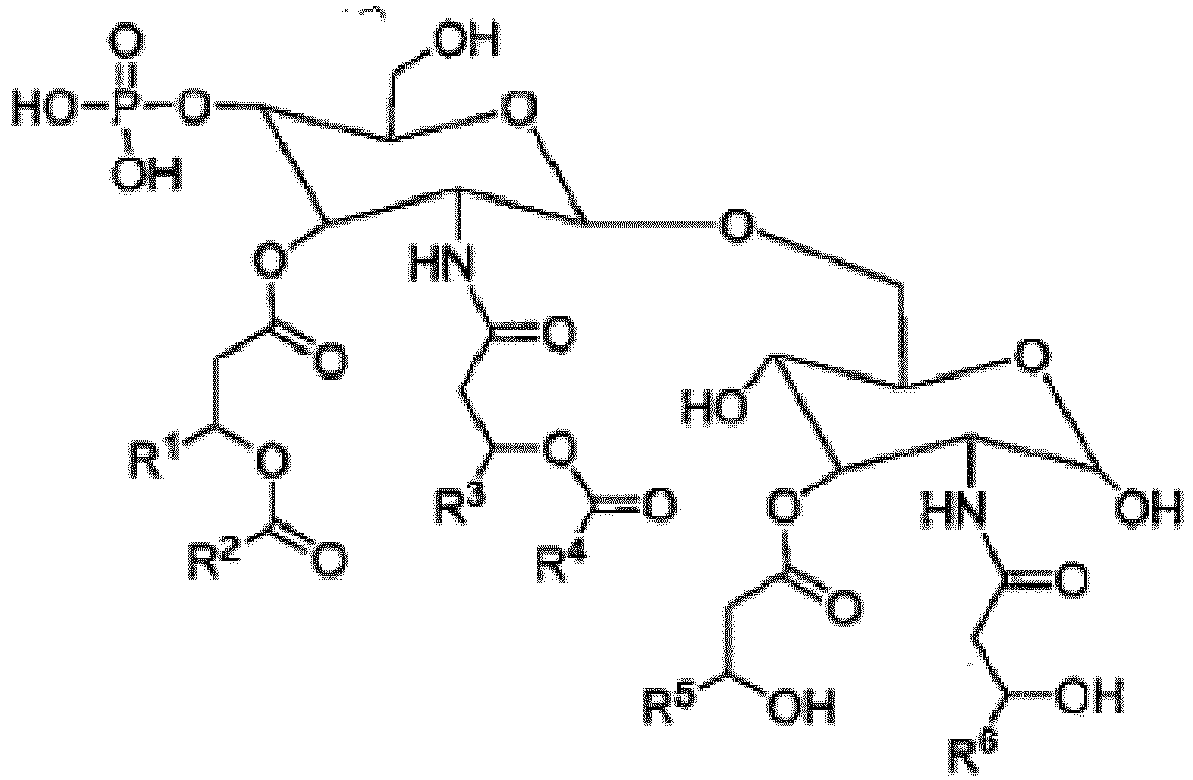 où : R1, R3, R5 et R6 sont un undécyle ; et R2 et R4 sont un tridécyle ;une huile métabolisable ;et un support, excipient ou diluant pharmaceutiquement acceptable, sous une forme d'émulsion huile-dans-eau.
 - Composition selon la revendication 1, comprenant en outre un tensioactif.
- Composition selon l'une quelconque des revendications 1 à 2, dans laquelle l'huile comprend du squalène.
- Composition selon l'une quelconque des revendications précédentes, comprenant des gouttelettes d'huile ayant une taille inférieure à 1 micron de diamètre.
- Composition selon l'une quelconque des revendications précédentes sous une forme à délivrer par injection.
- Composition selon la revendication 1 comprenant des liposomes ou des sels d'aluminium.
- Composition selon l'une quelconque des revendications 1 à 6, dans laquelle le support est une microsphère.
- Composition selon la revendication 1 sous une forme d'aérosol ou sous une forme de lyophilisat, ou formulée pour une administration par application topique.
- Composition selon l'une quelconque des revendications 1 à 7, dans laquelle la composition comprend en outre un ou plusieurs parmi : des diluants stériles tels que de l'eau pour injection, solution saline, de préférence solution saline physiologique, solution de Ringer, chlorure de sodium isotonique, huiles fixes telles que squalène, squalane, huile minérale, un monooléate de mannide, cholestérol, et/ou mono ou digylcérides synthétiques qui peuvent servir de solvant ou de milieu de suspension, polyéthylène glycols, glycérine, propylène glycol ou autres solvants ; des agents antibactériens tels que de l'alcool benzylique ou méthylparabène ; des antioxydants tels que de l'acide ascorbique ou bisulfite de sodium ; des agents chélatants tels que de l'acide éthylènediaminetétraacétique ; des tampons tels que des acétates, citrates ou phosphates et des agents pour l'ajustement de tonicité tels que du chlorure de sodium ou dextrose.
- Composition selon l'une quelconque des revendications 1 à 8 comprenant un agent dispersant et/ou un agent de suspension, et/ou un tampon.
- Composition selon les revendications 1 à 9, comprenant de l'alpha tocophérol.
- Composition selon la revendication 1, comprenant un support qui comprend au moins l'un parmi de la vaseline, de la lanoline, du polyéthylène glycol, de la cire d'abeille, et de l'huile minérale.
- Composition selon l'une quelconque des revendications 1 à 12 qui est sensiblement dépourvue d'antigènes.
- Composition selon l'une quelconque des revendications 1 à 13, dans laquelle le GLA est un sel pharmaceutiquement acceptable.
- Composition selon l'une quelconque des revendications 1 à 15 à utiliser dans un procédé pour induire ou renforcer une réponse immunitaire chez un sujet.
- Composition à utiliser selon la revendication 15 à utiliser pour stimuler une réponse immunitaire non spécifique.
- Composition selon la revendication 1 comprenant un vecteur viral recombinant.
Priority Applications (1)
| Application Number | Priority Date | Filing Date | Title |
|---|---|---|---|
| EP20187078.9A EP3795173A1 (fr) | 2006-09-26 | 2007-09-26 | Composition de vaccin contenant un adjuvant synthétique |
Applications Claiming Priority (4)
| Application Number | Priority Date | Filing Date | Title |
|---|---|---|---|
| US84740406P | 2006-09-26 | 2006-09-26 | |
| PCT/US2007/021017 WO2008153541A1 (fr) | 2006-09-26 | 2007-09-26 | Composition de vaccin contenant un adjuvant synthétique |
| EP12153256.8A EP2486938B1 (fr) | 2006-09-26 | 2007-09-26 | Composition de vaccin contenant un adjuvant synthétique |
| EP07875082.5A EP2068918B2 (fr) | 2006-09-26 | 2007-09-26 | Composition de vaccin contenant un adjuvant synthetique |
Related Parent Applications (4)
| Application Number | Title | Priority Date | Filing Date |
|---|---|---|---|
| EP12153256.8A Division-Into EP2486938B1 (fr) | 2006-09-26 | 2007-09-26 | Composition de vaccin contenant un adjuvant synthétique |
| EP12153256.8A Division EP2486938B1 (fr) | 2006-09-26 | 2007-09-26 | Composition de vaccin contenant un adjuvant synthétique |
| EP07875082.5A Division-Into EP2068918B2 (fr) | 2006-09-26 | 2007-09-26 | Composition de vaccin contenant un adjuvant synthetique |
| EP07875082.5A Division EP2068918B2 (fr) | 2006-09-26 | 2007-09-26 | Composition de vaccin contenant un adjuvant synthetique |
Related Child Applications (1)
| Application Number | Title | Priority Date | Filing Date |
|---|---|---|---|
| EP20187078.9A Division EP3795173A1 (fr) | 2006-09-26 | 2007-09-26 | Composition de vaccin contenant un adjuvant synthétique |
Publications (2)
| Publication Number | Publication Date |
|---|---|
| EP3403667A1 EP3403667A1 (fr) | 2018-11-21 |
| EP3403667B1 true EP3403667B1 (fr) | 2020-07-22 |
Family
ID=39776582
Family Applications (6)
| Application Number | Title | Priority Date | Filing Date |
|---|---|---|---|
| EP12153249.3A Active EP2484375B1 (fr) | 2006-09-26 | 2007-09-26 | Composition de vaccin contenant un adjuvant synthétique |
| EP12153256.8A Active EP2486938B1 (fr) | 2006-09-26 | 2007-09-26 | Composition de vaccin contenant un adjuvant synthétique |
| EP18165195.1A Active EP3403667B1 (fr) | 2006-09-26 | 2007-09-26 | Composition de vaccin contenant un adjuvant synthétique |
| EP20187078.9A Pending EP3795173A1 (fr) | 2006-09-26 | 2007-09-26 | Composition de vaccin contenant un adjuvant synthétique |
| EP07875082.5A Active EP2068918B2 (fr) | 2006-09-26 | 2007-09-26 | Composition de vaccin contenant un adjuvant synthetique |
| EP12153267.5A Active EP2468300B1 (fr) | 2006-09-26 | 2007-09-26 | Composition de vaccin contenant un adjuvant synthétique |
Family Applications Before (2)
| Application Number | Title | Priority Date | Filing Date |
|---|---|---|---|
| EP12153249.3A Active EP2484375B1 (fr) | 2006-09-26 | 2007-09-26 | Composition de vaccin contenant un adjuvant synthétique |
| EP12153256.8A Active EP2486938B1 (fr) | 2006-09-26 | 2007-09-26 | Composition de vaccin contenant un adjuvant synthétique |
Family Applications After (3)
| Application Number | Title | Priority Date | Filing Date |
|---|---|---|---|
| EP20187078.9A Pending EP3795173A1 (fr) | 2006-09-26 | 2007-09-26 | Composition de vaccin contenant un adjuvant synthétique |
| EP07875082.5A Active EP2068918B2 (fr) | 2006-09-26 | 2007-09-26 | Composition de vaccin contenant un adjuvant synthetique |
| EP12153267.5A Active EP2468300B1 (fr) | 2006-09-26 | 2007-09-26 | Composition de vaccin contenant un adjuvant synthétique |
Country Status (20)
| Country | Link |
|---|---|
| US (10) | US8273361B2 (fr) |
| EP (6) | EP2484375B1 (fr) |
| JP (6) | JP5443164B2 (fr) |
| KR (1) | KR101378872B1 (fr) |
| CN (2) | CN103705919B (fr) |
| AT (1) | ATE555808T1 (fr) |
| AU (1) | AU2007354917B2 (fr) |
| BR (1) | BRPI0716959A2 (fr) |
| CA (1) | CA2662921C (fr) |
| CY (4) | CY1112943T1 (fr) |
| DK (4) | DK2486938T3 (fr) |
| ES (5) | ES2675915T3 (fr) |
| FI (1) | FI2068918T4 (fr) |
| HU (3) | HUE036180T2 (fr) |
| LT (3) | LT2486938T (fr) |
| PL (4) | PL2068918T5 (fr) |
| PT (4) | PT2484375T (fr) |
| SI (4) | SI2484375T1 (fr) |
| TR (2) | TR201809043T4 (fr) |
| WO (1) | WO2008153541A1 (fr) |
Families Citing this family (151)
| Publication number | Priority date | Publication date | Assignee | Title |
|---|---|---|---|---|
| US6207646B1 (en) * | 1994-07-15 | 2001-03-27 | University Of Iowa Research Foundation | Immunostimulatory nucleic acid molecules |
| DK1716234T3 (da) * | 2004-02-20 | 2014-01-20 | Mologen Ag | Substitueret, ikke-kodende nukleinsyremolekyle til terapeutisk og profylaktisk immunstimulering i mennesker og højerestående dyr |
| KR101378872B1 (ko) | 2006-09-26 | 2014-04-11 | 인펙셔스 디지즈 리서치 인스티튜트 (아이디알아이) | 합성 애주번트를 함유하는 백신 조성물 |
| US20090181078A1 (en) * | 2006-09-26 | 2009-07-16 | Infectious Disease Research Institute | Vaccine composition containing synthetic adjuvant |
| US20110245323A1 (en) * | 2006-10-16 | 2011-10-06 | Yale University | RIG-Like Helicase Innate Immunity Inhibits VEGF-Induced Tissue Responses |
| BRPI0809926B8 (pt) * | 2007-04-04 | 2021-05-25 | Infectious Disease Res Inst | composição que compreende antígenos de mycobacterium tuberculosis, polipeptídeo de fusão isolado, polinucleotídeo isolado que codifica o dito polipeptídeo e uso da dita composição para estimular uma resposta imune protetora |
| US8846003B2 (en) | 2008-03-27 | 2014-09-30 | Symic Biomedical, Inc. | Collagen-binding synthetic peptidoglycans, preparation, and methods of use |
| US8410258B2 (en) * | 2008-05-21 | 2013-04-02 | Infections Disease Research Institute | Recombinant polyprotein vaccines for the treatment and diagnosis of leishmaniasis |
| US8425919B2 (en) * | 2008-05-21 | 2013-04-23 | Infectious Disease Research Institute | Recombinant polyprotein vaccines for the treatment and diagnosis of leishmaniasis |
| RS51999B (sr) * | 2008-08-28 | 2012-04-30 | Novartis Ag | Dobijanje skvalena iz hiperprodukcijskih kvasaca |
| US20110177163A1 (en) * | 2008-09-18 | 2011-07-21 | Variation Biotechnologies, Inc. | Compositions and methods for treating hepatitis a |
| WO2010067262A1 (fr) | 2008-12-09 | 2010-06-17 | Pfizer Inc. | Oligonucléotides immunostimulants |
| WO2010091265A1 (fr) * | 2009-02-05 | 2010-08-12 | Yale University | Composés et procédés destinés au traitement d'une encéphalite virale |
| SI2437753T1 (sl) * | 2009-06-05 | 2016-12-30 | Infectious Disease Research Institute | Sintetični glukopiranozil-lipidni adjuvansi in cepivni sestavki, ki jih vsebujejo |
| WO2010147971A2 (fr) * | 2009-06-15 | 2010-12-23 | New York University | Vecteur viral modifié par il23 pour vaccins recombinants et traitement de tumeurs |
| CA2803282C (fr) | 2009-07-06 | 2018-05-01 | David E. Anderson | Procedes pour preparer des vesicules et formulations produites a partir de ces procedes |
| CN102482666B (zh) * | 2009-07-06 | 2017-02-08 | 变异生物技术公司 | 制备囊泡的方法和由其产生的制剂 |
| KR101790187B1 (ko) | 2009-07-24 | 2017-10-25 | 이뮨 디자인 코포레이션 | 신드비스 바이러스 외피 당단백질로 가성형태화된 렌티바이러스 벡터 |
| EP2461679B1 (fr) | 2009-07-28 | 2019-02-13 | GE Healthcare Bio-Sciences Corp. | Stabilisant pour vaccin |
| CN102596220A (zh) * | 2009-07-31 | 2012-07-18 | 韦恩州立大学 | 单磷酸化的脂质a衍生物 |
| US9259476B2 (en) | 2009-07-31 | 2016-02-16 | Wayne State University | Monophosphorylated lipid A derivatives |
| CA2787598A1 (fr) * | 2010-01-24 | 2012-06-21 | Novartis Ag | Microparticules de polymere biodegradable irradiees |
| NZ602217A (en) * | 2010-03-11 | 2014-08-29 | Immune Design Corp | Vaccines for influenza |
| BR112012027745A2 (pt) | 2010-04-27 | 2017-01-10 | Univ Johns Hopkins | método e composição imunogênica para tratamento de neoplásia |
| CN101850117B (zh) * | 2010-06-03 | 2012-05-30 | 国家兽用生物制品工程技术研究中心 | 一种复方免疫佐剂及疫苗 |
| AU2011270862B2 (en) * | 2010-06-23 | 2017-05-11 | Purdue Research Foundation | Collagen-binding synthetic peptidoglycans for use in vascular intervention |
| CN103096922B (zh) * | 2010-07-06 | 2019-08-06 | 变异生物技术公司 | 用于治疗流行性感冒的组合物和方法 |
| EP2637687B1 (fr) | 2010-11-08 | 2021-01-06 | Infectious Disease Research Institute | Vaccins comprenant des polypeptides d'hydrolase nucléosidique et de stérol 24-c-méthyltransférase (smt) non spécifiques destinés à traiter et à diagnostiquer la leishmaniose |
| BR112013017939B1 (pt) | 2011-01-13 | 2022-11-16 | Variation Biotechnologies Inc | Composição imunogênica liofilizada termoestável, uso e método para preparação da mesma |
| US20120263754A1 (en) | 2011-02-15 | 2012-10-18 | Immune Design Corp. | Methods for Enhancing Immunogen Specific Immune Responses by Vectored Vaccines |
| AU2012243039B2 (en) | 2011-04-08 | 2017-07-13 | Immune Design Corp. | Immunogenic compositions and methods of using the compositions for inducing humoral and cellular immune responses |
| KR101376675B1 (ko) * | 2011-04-19 | 2014-03-20 | 광주과학기술원 | 이미징 및 운반 이중기능 나노입자-기반 백신 전달체 |
| WO2012149307A2 (fr) | 2011-04-27 | 2012-11-01 | Immune Design Corp. | Vaccins à base de longs peptides synthétiques (slp) |
| SG194733A1 (en) * | 2011-05-17 | 2013-12-30 | Glaxosmithkline Biolog Sa | Vaccine against streptococcus pneumoniae |
| EP2714718B1 (fr) | 2011-05-24 | 2017-01-11 | Symic IP, LLC | Peptidoglycanes synthétiques se liant à l'acide hyaluronique, préparation et procédés d'utilisation |
| JP2014525458A (ja) | 2011-08-31 | 2014-09-29 | ペロスフィア インコーポレイテッド | アレルギー患者を有効かつ迅速に脱感作するための方法 |
| AU2012308149A1 (en) | 2011-09-12 | 2014-03-27 | Sheena Mary Geraldine MCCORMACK | Methods and compositions for raising an immune response to HIV |
| US20140328876A1 (en) * | 2011-11-18 | 2014-11-06 | Variation Biotechnologies Inc. | Synthetic derivatives of mpl and uses thereof |
| EP2802353A4 (fr) | 2012-01-12 | 2015-12-02 | Variation Biotechnologies Inc | Compositions et méthodes de traitement d'infections virales |
| CN104244984B (zh) | 2012-01-27 | 2020-03-31 | 变异生物技术公司 | 用于治疗剂的方法和组合物 |
| CN110339160A (zh) * | 2012-02-07 | 2019-10-18 | 传染性疾病研究院 | 包含tlr4激动剂的改进佐剂制剂及其使用方法 |
| US20150359874A1 (en) * | 2012-03-05 | 2015-12-17 | Duke University | Vaccine formulation |
| DK2831095T3 (en) | 2012-03-30 | 2019-02-18 | Immune Design Corp | LENTIVIRAL VECTOR PARTICLES WITH IMPROVED TRANSDUCTION EFFICIENCY FOR CELL EXPRESSING DC SIGN |
| PT2850431T (pt) * | 2012-05-16 | 2018-07-23 | Immune Design Corp | Vacinas para hsv-2 |
| US8986704B2 (en) * | 2012-07-06 | 2015-03-24 | Valneva Austria Gmbh | Mutant fragments of OspA and methods and uses relating thereto |
| MX385774B (es) | 2012-08-03 | 2025-03-18 | Infectious Disease Res Inst | Composiciones para usarse en el tratamiento de una infección activa por mycobacterium tuberculosis. |
| CN103768604B (zh) * | 2012-10-24 | 2016-03-30 | 北京圣沃德生物科技有限公司 | 治疗性肿瘤疫苗 |
| EP2958551B1 (fr) * | 2013-02-25 | 2020-08-05 | Particle Sciences, Inc. | Formulations particulaires pour l'administration d'agonistes du tlr et d'antigènes |
| BR112015022917A2 (pt) | 2013-03-15 | 2017-07-18 | Symic Biomedical Inc | peptidoglicanos sintéticos componentes da matriz extracelular |
| WO2014160987A2 (fr) | 2013-03-28 | 2014-10-02 | Infectious Disease Research Institute | Vaccins comprenant des polypeptides de leishmania pour le traitement et le diagnostic de la leishmaniose |
| EP3711768A1 (fr) * | 2013-04-18 | 2020-09-23 | Immune Design Corp. | Monothérapie de gla destinée à être utilisée dans le traitement du cancer |
| US9463198B2 (en) * | 2013-06-04 | 2016-10-11 | Infectious Disease Research Institute | Compositions and methods for reducing or preventing metastasis |
| KR20160042917A (ko) | 2013-07-25 | 2016-04-20 | 엑시큐어, 인크. | 예방 및 치료 용도를 위한 면역자극제로서의 구형 핵산-기재 구축물 |
| EP3041478A4 (fr) * | 2013-09-05 | 2017-04-26 | Immune Design Corp. | Compositions de vaccin pour toxicomanie |
| US9149521B2 (en) | 2013-09-25 | 2015-10-06 | Sequoia Sciences, Inc. | Compositions of vaccines and adjuvants and methods for the treatment of urinary tract infections |
| US9504743B2 (en) | 2013-09-25 | 2016-11-29 | Sequoia Sciences, Inc | Compositions of vaccines and adjuvants and methods for the treatment of urinary tract infections |
| US9149522B2 (en) | 2013-09-25 | 2015-10-06 | Sequoia Sciences, Inc. | Compositions of vaccines and adjuvants and methods for the treatment of urinary tract infections |
| US20150086592A1 (en) | 2013-09-25 | 2015-03-26 | Sequoia Sciences, Inc | Compositions of vaccines and adjuvants and methods for the treatment of urinary tract infections |
| IL310015B2 (en) | 2013-12-31 | 2026-02-01 | Access To Advanced Health Inst | Single vial formulation |
| HRP20250954T1 (hr) | 2014-01-09 | 2025-10-10 | Valneva Austria Gmbh | Mutantni fragmenti ospa i postupci i upotrebe koji se na njih odnose |
| EA201691452A1 (ru) | 2014-01-21 | 2016-12-30 | Иммьюн Дизайн Корп. | Композиции для применения в лечении аллергических состояний |
| WO2015123496A1 (fr) * | 2014-02-14 | 2015-08-20 | Immune Design Corp. | Immunothérapie du cancer par combinaison de stimulation immunitaire locale et systémique |
| WO2015164798A1 (fr) | 2014-04-25 | 2015-10-29 | Tria Bioscience Corp. | Compositions de support d'haptène synthétique et procédés |
| US10772931B2 (en) | 2014-04-25 | 2020-09-15 | Purdue Research Foundation | Collagen binding synthetic peptidoglycans for treatment of endothelial dysfunction |
| EP3164113B1 (fr) | 2014-06-04 | 2019-03-27 | Exicure, Inc. | Libération polyvalente de modulateurs immunitaires par des acides nucléiques sphériques liposomaux pour des applications prophylactiques ou thérapeutiques |
| KR20170032373A (ko) | 2014-07-15 | 2017-03-22 | 이뮨 디자인 코포레이션 | Tlr4 작용제 보조제 및 렌티바이러스 벡터를 이용한 프라임-부스트 요법 |
| RU2700881C2 (ru) * | 2014-08-04 | 2019-09-23 | Онкотерапи Сайенс, Инк. | Пептид, полученный из urlc10, и содержащая его вакцина |
| AU2015310518A1 (en) * | 2014-09-02 | 2017-03-09 | Cadila Healthcare Limited | Synergistic compositions of immunostimulating reconstituted influenza virosomes with immunopotentiators and vaccines containing them |
| US11213593B2 (en) | 2014-11-21 | 2022-01-04 | Northwestern University | Sequence-specific cellular uptake of spherical nucleic acid nanoparticle conjugates |
| EP3069729A1 (fr) | 2015-03-17 | 2016-09-21 | Sequoia Sciences, Inc. | Compositions de vaccins et adjuvants et procédés pour le traitement d'infections des voies urinaires |
| WO2016149417A1 (fr) * | 2015-03-17 | 2016-09-22 | Sequoia Sciences, Inc. | Compositions de vaccins, adjuvants et méthodes de traitement d'infections urinaires |
| TW201709926A (zh) * | 2015-04-23 | 2017-03-16 | 賽諾菲公司 | 用於舌下投藥之吡喃葡萄糖基脂a及過敏原調配物 |
| JP6918365B2 (ja) * | 2015-08-19 | 2021-08-11 | プレジデント アンド フェローズ オブ ハーバード カレッジ | 脂質化psa組成物および方法 |
| LU92821B1 (en) | 2015-09-09 | 2017-03-20 | Mologen Ag | Combination comprising immunostimulatory oligonucleotides |
| CA2997749A1 (fr) | 2015-09-09 | 2017-03-16 | Immune Design Corp. | Tcr specifiques de ny-eso-1 et leurs methodes d'utilisation |
| GB2542425A (en) | 2015-09-21 | 2017-03-22 | Mologen Ag | Means for the treatment of HIV |
| CA3004132A1 (fr) | 2015-11-09 | 2017-05-18 | Immune Design Corp. | Vecteur retroviral pour l'administration et l'expression d'un replicon arn exprimant des acides nucleiques heterologues |
| SG11201803546WA (en) | 2015-11-09 | 2018-05-30 | Immune Design Corp | Compositions comprising lentiviral vectors expressing il-12 and methods of use thereof |
| US10946085B2 (en) | 2016-02-15 | 2021-03-16 | Hipra Scientific, S.L.U. | Streptococcus uberis extract as an immunogenic agent |
| KR20180111874A (ko) | 2016-02-23 | 2018-10-11 | 이뮨 디자인 코포레이션 | 멀티게놈 레트로바이러스 벡터 제제 및 이를 생산 및 사용하는 방법 및 시스템 |
| CN105749275A (zh) * | 2016-03-30 | 2016-07-13 | 山东农业大学 | 一种核酸缓释佐剂及其制备和使用方法 |
| IL263030B2 (en) | 2016-05-16 | 2024-11-01 | Access To Advanced Health Inst | Pegylated liposomes and methods of use |
| MX2018014270A (es) | 2016-05-21 | 2019-02-14 | Infectious Disease Res Inst | Composiciones y metodos para tratar la tuberculosis secundaria e infecciones po micobacteria no tuberculosa. |
| US11491181B2 (en) | 2016-07-15 | 2022-11-08 | President And Fellows Of Harvard College | Glycolipid compositions and methods of use |
| US11364304B2 (en) | 2016-08-25 | 2022-06-21 | Northwestern University | Crosslinked micellar spherical nucleic acids |
| CA3036218A1 (fr) | 2016-09-16 | 2018-03-22 | Infectious Disease Research Institute | Vaccins comprenant des polypeptides de mycobacterium leprae pour la prevention, le traitement et le diagnostic de la lepre |
| GB201616904D0 (en) | 2016-10-05 | 2016-11-16 | Glaxosmithkline Biologicals Sa | Vaccine |
| EP3551222B1 (fr) | 2016-12-07 | 2024-08-07 | GlaxoSmithKline Biologicals SA | Procede de fabrication d'une composition de liposome comprenant une saponine |
| GB201621686D0 (en) | 2016-12-20 | 2017-02-01 | Glaxosmithkline Biologicals Sa | Novel methods for inducing an immune response |
| CA3048608C (fr) | 2016-12-26 | 2021-11-23 | Mogam Institute For Biomedical Research | Composition de vaccin contre le zona |
| WO2018148180A2 (fr) | 2017-02-07 | 2018-08-16 | Immune Design Corp. | Matériaux et méthodes pour l'identification et le traitement du cancer |
| KR101996538B1 (ko) * | 2017-02-13 | 2019-07-04 | 단디바이오사이언스 주식회사 | 이미다조퀴놀린계열 물질을 포함하는 나노에멀젼 및 이의 용도 |
| EP3609911B1 (fr) | 2017-04-13 | 2023-07-05 | Valneva Austria GmbH | Polypeptides ospa multivalents, procédés et utilisations associés |
| US11696954B2 (en) | 2017-04-28 | 2023-07-11 | Exicure Operating Company | Synthesis of spherical nucleic acids using lipophilic moieties |
| US20210187098A1 (en) | 2017-04-28 | 2021-06-24 | Glaxosmithkline Biologicals Sa | Vaccination |
| GB201707700D0 (en) | 2017-05-12 | 2017-06-28 | Glaxosmithkline Biologicals Sa | Dried composition |
| GB2600654B (en) | 2017-05-30 | 2022-11-02 | Glaxosmithkline Biologicals Sa | Novel devices |
| KR102673794B1 (ko) | 2017-06-15 | 2024-06-11 | 액세스 투 어드밴스드 헬스 인스티튜트 | 나노구조 지질 담체 및 안정적인 에멀션 그리고 이들의 용도 |
| EP3648774A4 (fr) | 2017-07-07 | 2021-04-21 | Symic IP, LLC | Bioconjugués synthétiques |
| CN110200516A (zh) | 2017-08-09 | 2019-09-06 | 沙克忍者运营有限责任公司 | 烹饪系统 |
| CN111315406A (zh) * | 2017-09-08 | 2020-06-19 | 传染病研究所 | 包括皂苷的脂质体调配物及其使用方法 |
| WO2019106192A1 (fr) | 2017-12-01 | 2019-06-06 | Glaxosmithkline Biologicals Sa | Purification de saponine |
| PL3752182T3 (pl) | 2018-02-12 | 2024-11-25 | Inimmune Corporation | Ligandy receptorów toll-podobnych |
| ES3038006T3 (en) | 2018-07-31 | 2025-10-08 | Glaxosmithkline Biologicals Sa | Antigen purification method |
| CN110882232B (zh) * | 2018-08-20 | 2026-02-24 | 中国科学院过程工程研究所 | 一种基于微囊的疫苗 |
| JP2021535930A (ja) * | 2018-09-17 | 2021-12-23 | キュラティス インコーポレイティッド | Stingアゴニストを含む抗原性補強剤及びワクチン組成物 |
| WO2020109365A1 (fr) | 2018-11-29 | 2020-06-04 | Glaxosmithkline Biologicals Sa | Procédés de fabrication d'un adjuvant |
| CN109652384B (zh) * | 2019-02-21 | 2021-10-26 | 昆明理工大学 | 一种体外培养戊型肝炎病毒的方法 |
| CN109701011B (zh) * | 2019-02-26 | 2022-04-05 | 苏文全 | 疫苗复合佐剂系统及其在抗原中的应用 |
| WO2020247851A1 (fr) * | 2019-06-05 | 2020-12-10 | Global Health Solutions Llc | Administration transdermique de vaccin |
| JP7640473B2 (ja) | 2019-06-05 | 2025-03-05 | グラクソスミスクライン バイオロジカルズ ソシエテ アノニム | サポニン精製 |
| US11911463B2 (en) | 2019-07-16 | 2024-02-27 | Michael J. Dochniak | Topical hyper-allergenic composition and method of treating using the same |
| EP3777884A1 (fr) | 2019-08-15 | 2021-02-17 | GlaxoSmithKline Biologicals S.A. | Composition immunogène |
| EP4028051A1 (fr) | 2019-09-09 | 2022-07-20 | GlaxoSmithKline Biologicals S.A. | Compositions immunothérapeutiques |
| US11679163B2 (en) | 2019-09-20 | 2023-06-20 | Hdt Bio Corp. | Compositions and methods for delivery of RNA |
| IL291821A (en) | 2019-10-02 | 2022-06-01 | Janssen Vaccines & Prevention Bv | Staphylococcus peptides and methods of use |
| RU2724896C1 (ru) * | 2019-11-14 | 2020-06-26 | федеральное государственное бюджетное учреждение "Национальный исследовательский центр эпидемиологии и микробиологии имени почетного академика Н.Ф. Гамалеи" Министерства здравоохранения Российской Федерации | Полиантигенная вакцина для профилактики и вспомогательного лечения туберкулеза |
| BR112022008761A2 (pt) | 2019-11-22 | 2022-07-26 | Glaxosmithkline Biologicals Sa | Dosagem e administração de uma vacina de glicoconjugado de sacarídeo |
| WO2021122551A1 (fr) | 2019-12-19 | 2021-06-24 | Glaxosmithkline Biologicals Sa | Antigènes de s. aureus et compositions associées |
| KR20210117832A (ko) * | 2020-03-20 | 2021-09-29 | 강원대학교산학협력단 | Gla-se를 포함하는 수족구병 백신 조성물 |
| JP2023518976A (ja) | 2020-03-23 | 2023-05-09 | エイチディーティー バイオ コーポレーション | Rnaを送達するための組成物および方法 |
| US11647861B2 (en) | 2020-03-30 | 2023-05-16 | Sharkninja Operating Llc | Cooking device and components thereof |
| EP4132950A1 (fr) | 2020-04-09 | 2023-02-15 | Valneva Austria GmbH | Compositions comprenant trois protéines de fusion ospa à usage médical |
| BR112022020660A2 (pt) | 2020-05-05 | 2022-11-29 | Glaxosmithkline Biologicals Sa | Dispositivo de mistura microfluídica e métodos de uso |
| US10973908B1 (en) | 2020-05-14 | 2021-04-13 | David Gordon Bermudes | Expression of SARS-CoV-2 spike protein receptor binding domain in attenuated salmonella as a vaccine |
| US12537071B1 (en) | 2020-07-22 | 2026-01-27 | David Gordon Bermudes | Bacteria having boolean control pathways expressing therapeutic proteins including immunotherapeutic cytotoxins |
| AU2021321944A1 (en) | 2020-08-07 | 2023-04-06 | Access To Advanced Health Institute | Purified saponins and chromatographic process for purification of same |
| EP4199961A4 (fr) * | 2020-08-20 | 2024-03-13 | The Board of Regents of the University of Texas System | Méthodes d'immunothérapie combinée pour le traitement d'un cancer |
| CA3174411A1 (fr) | 2020-09-04 | 2022-03-10 | Ryan M. Kramer | Arn co-lyophilise et support lipidique nanostructure |
| MX2023006769A (es) | 2020-12-09 | 2023-08-18 | Glaxosmithkline Biologicals Sa | Modificacion de saponinas. |
| CA3173408A1 (fr) | 2020-12-23 | 2022-06-30 | Access To Advanced Health Institute | Adjuvants de vaccins a base de solanesol et leurs procedes de preparation |
| US20240102069A1 (en) | 2020-12-24 | 2024-03-28 | Plant Bioscience Limited | Methods and compositions |
| US20240207394A1 (en) * | 2021-04-21 | 2024-06-27 | The Board Of Trustees Of The Leland Stanford Junior University | Toll-like receptor agonist-nanoparticle vaccine adjuvant |
| BR112023023094A2 (pt) | 2021-05-06 | 2024-02-06 | Hipra Scient S L U | Vacina de subunidade de sars-cov-2 |
| EP4333883A2 (fr) | 2021-05-06 | 2024-03-13 | Hipra Scientific, S.L.U. | Vaccin sous-unitaire contre le sars-cov-2 |
| CN113416255A (zh) * | 2021-06-02 | 2021-09-21 | 广西大学 | 一种抗大片形吸虫Cat L1单克隆抗体及其制备方法与应用 |
| WO2022256740A1 (fr) | 2021-06-04 | 2022-12-08 | Curia Ip Holdings, Llc | Protéines de fusion polymères et compositions pour induire une réponse immunitaire contre une infection |
| WO2023020993A1 (fr) | 2021-08-16 | 2023-02-23 | Glaxosmithkline Biologicals Sa | Nouveaux procédés |
| WO2023020992A1 (fr) | 2021-08-16 | 2023-02-23 | Glaxosmithkline Biologicals Sa | Nouveaux procédés |
| WO2023020994A1 (fr) | 2021-08-16 | 2023-02-23 | Glaxosmithkline Biologicals Sa | Nouveaux procédés |
| KR20240096468A (ko) | 2021-09-22 | 2024-06-26 | 에이치디티 바이오 코포레이션 | 감염병에 대한 rna 백신 |
| KR20240088845A (ko) | 2021-09-22 | 2024-06-20 | 에이치디티 바이오 코포레이션 | 건조된 나노입자 조성물 |
| AU2022349251A1 (en) | 2021-09-22 | 2024-04-11 | Hdt Bio Corp. | Sars-cov-2 rna vaccine compositions and methods of use |
| JP2024535354A (ja) | 2021-09-22 | 2024-09-30 | エイチディーティー バイオ コーポレーション | がん治療組成物およびその使用 |
| US20250207166A1 (en) | 2022-03-25 | 2025-06-26 | Plant Bioscience Limited | Biosynthesis |
| WO2023242187A1 (fr) | 2022-06-15 | 2023-12-21 | Glaxosmithkline Biologicals Sa | Modification enzymatique de saponines |
| GB202209588D0 (en) | 2022-06-29 | 2022-08-10 | Plant Bioscience Ltd | Methods and compositions |
| KR102901149B1 (ko) * | 2022-09-05 | 2025-12-17 | 주식회사 차백신연구소 | 에멀전 제형의 면역증강제 조성물 및 이의 제조 방법 |
| EP4583841A1 (fr) | 2022-09-09 | 2025-07-16 | Access to Advanced Health Institute | Composition de vaccin immunogène incorporant une saponine |
| EP4608438A1 (fr) * | 2022-10-24 | 2025-09-03 | Virginia Commonwealth University | Protéines recombinantes chimériques et panels de protéines recombinantes pour le diagnostic de la maladie de lyme chez les animaux et les êtres humains |
| WO2024174011A1 (fr) | 2023-02-24 | 2024-08-29 | Rossi Bergmann Bartira | Liposome, procédé de préparation d'un liposome, composition intranasale comprenant un liposome, procédé de préparation d'une composition intranasale, kit et utilisation de la composition |
Family Cites Families (249)
| Publication number | Priority date | Publication date | Assignee | Title |
|---|---|---|---|---|
| US1001427A (en) | 1911-05-13 | 1911-08-22 | Walter S Morton | Concrete dam. |
| US3238190A (en) | 1963-10-23 | 1966-03-01 | Madaus & Co K G Fa Dr | Aescin recovery |
| US3598122A (en) | 1969-04-01 | 1971-08-10 | Alza Corp | Bandage for administering drugs |
| US3598123A (en) | 1969-04-01 | 1971-08-10 | Alza Corp | Bandage for administering drugs |
| US4029762A (en) | 1971-11-17 | 1977-06-14 | Max-Planck-Gesellschaft Zur Forderung Der Wissenschaften E.V. | Lipid A-preparation |
| US4286592A (en) | 1980-02-04 | 1981-09-01 | Alza Corporation | Therapeutic system for administering drugs to the skin |
| US4314557A (en) | 1980-05-19 | 1982-02-09 | Alza Corporation | Dissolution controlled active agent dispenser |
| US4420558A (en) | 1981-02-12 | 1983-12-13 | Janssen Pharmaceutica N.V. | Bright field light microscopic method of enumerating and characterizing subtypes of white blood cells and their precursors |
| US4379454A (en) | 1981-02-17 | 1983-04-12 | Alza Corporation | Dosage for coadministering drug and percutaneous absorption enhancer |
| US4769330A (en) | 1981-12-24 | 1988-09-06 | Health Research, Incorporated | Modified vaccinia virus and methods for making and using the same |
| JPS591527A (ja) | 1982-06-25 | 1984-01-06 | Mitsubishi Monsanto Chem Co | ポリエステルの製造方法 |
| US4866034A (en) | 1982-05-26 | 1989-09-12 | Ribi Immunochem Research Inc. | Refined detoxified endotoxin |
| US4436727A (en) | 1982-05-26 | 1984-03-13 | Ribi Immunochem Research, Inc. | Refined detoxified endotoxin product |
| US4420461A (en) | 1982-05-26 | 1983-12-13 | Ortho Diagnostic Systems Inc. | Agglutination-inhibition test kit for detecting immune complexes |
| SE8205892D0 (sv) | 1982-10-18 | 1982-10-18 | Bror Morein | Immunogent membranproteinkomplex, sett for framstellning och anvendning derav som immunstimulerande medel och sasom vaccin |
| US4987237A (en) | 1983-08-26 | 1991-01-22 | Ribi Immunochem Research, Inc. | Derivatives of monophosphoryl lipid A |
| US4743540A (en) | 1983-09-27 | 1988-05-10 | Memorial Sloan-Kettering Cancer Center | Method for diagnosis of subclassifications of common varied immunodeficiency disease group |
| US5147785A (en) | 1983-11-01 | 1992-09-15 | Amtl Corporation | Method and apparatus for measuring the degree of reaction between a foreign entity and white blood cells |
| US4614722A (en) | 1983-11-01 | 1986-09-30 | Pasula Mark J | Method and apparatus for measuring the degree of reaction between antigens and leukocyte cellular antibodies |
| US4595654A (en) | 1983-11-07 | 1986-06-17 | Immunomedics Inc. | Method for detecting immune complexes in serum |
| US4855238A (en) | 1983-12-16 | 1989-08-08 | Genentech, Inc. | Recombinant gamma interferons having enhanced stability and methods therefor |
| US4629722A (en) | 1984-07-12 | 1986-12-16 | Ribi Immunochem Research, Inc. | Method of inhibiting the onset of acute radiation syndrome |
| US4844894A (en) | 1984-07-12 | 1989-07-04 | Ribi Immunochem Research Inc. | Method of inhibiting the onset of septicemia and endotoxemia |
| US5612041A (en) | 1984-07-17 | 1997-03-18 | Chiron Corporation | Recombinant herpes simplex gD vaccine |
| US4568343A (en) | 1984-10-09 | 1986-02-04 | Alza Corporation | Skin permeation enhancer compositions |
| US4659659A (en) | 1985-01-22 | 1987-04-21 | Monsanto Company | Diagnostic method for diseases having an arthritic component |
| GB8508845D0 (en) | 1985-04-04 | 1985-05-09 | Hoffmann La Roche | Vaccinia dna |
| FI861417A0 (fi) | 1985-04-15 | 1986-04-01 | Endotronics Inc | Hepatitis b ytantigen framstaelld med rekombinant-dna-teknik, vaccin, diagnostiskt medel och cellinjer samt foerfaranden foer framstaellning daerav. |
| US4746742A (en) * | 1985-11-28 | 1988-05-24 | Toho Yakuhin Kogyo Kabushiki Kaisha | Analogs of nonreducing monosaccharide moiety of lipid A |
| US5976785A (en) | 1986-01-22 | 1999-11-02 | Institut Pasteur | Competitive assays for determining the effectiveness of a human immunodeficiency virus type 2 (HIV-2) antiviral agent, employing peptides and proteins of HIV-2 |
| US6514691B1 (en) | 1986-01-22 | 2003-02-04 | Institut Pasteur | Peptides of human immunodeficiency virus type 2 (HIV-2), antibodies against peptides of HIV-2, and methods and kits for detecting HIV-2 |
| US5310651A (en) | 1986-01-22 | 1994-05-10 | Institut Pasteur | DNA probes of human immunodeficiency virus type 2 (HIV-2), and methods employing these probes for dectecting the presence of HIV-2 |
| US6054565A (en) | 1986-03-03 | 2000-04-25 | Institut Pasteur | Nucleic Acids of HIV-2, Diagnostic Test Kit and Method using Nucleic Acid Probes of HIV-2 |
| US5169763A (en) | 1986-04-08 | 1992-12-08 | Transgene S.A., Institut Pasteur | Viral vector coding glycoprotein of HIV-1 |
| US4877611A (en) | 1986-04-15 | 1989-10-31 | Ribi Immunochem Research Inc. | Vaccine containing tumor antigens and adjuvants |
| JPH0755906B2 (ja) | 1986-07-01 | 1995-06-14 | 第一製薬株式会社 | ジサツカライド誘導体含有鎮痛剤 |
| US4767402A (en) | 1986-07-08 | 1988-08-30 | Massachusetts Institute Of Technology | Ultrasound enhancement of transdermal drug delivery |
| US4948587A (en) | 1986-07-08 | 1990-08-14 | Massachusetts Institute Of Technology | Ultrasound enhancement of transbuccal drug delivery |
| US5075109A (en) | 1986-10-24 | 1991-12-24 | Southern Research Institute | Method of potentiating an immune response |
| FR2672290B1 (fr) | 1991-02-05 | 1995-04-21 | Pasteur Institut | Sequences peptidiques specifiques des stades hepatiques de p. falciparum porteuses d'epitopes capables de stimuler les lymphocytes t. |
| US5565209A (en) | 1987-03-17 | 1996-10-15 | Akzo Nobel N.V. | Adjuvant mixture |
| US5057540A (en) | 1987-05-29 | 1991-10-15 | Cambridge Biotech Corporation | Saponin adjuvant |
| CA1331443C (fr) | 1987-05-29 | 1994-08-16 | Charlotte A. Kensil | Adjuvant a saponine |
| EP0304578B1 (fr) | 1987-06-22 | 2001-10-24 | Medeva Holdings Bv | Peptide contenant l'antigène de surface de l'hépatite B |
| US4780212A (en) | 1987-07-31 | 1988-10-25 | Massachusetts Institute Of Technology | Ultrasound enchancement of membrane permeability |
| US4897268A (en) | 1987-08-03 | 1990-01-30 | Southern Research Institute | Drug delivery system and method of making the same |
| WO1989001973A2 (fr) | 1987-09-02 | 1989-03-09 | Applied Biotechnology, Inc. | Virus variolique recombinant d'immunisation contre des antigenes associes a une tumeur |
| EP0324455A3 (fr) | 1988-01-15 | 1991-03-27 | Hans O. Ribi | Nouvel adjuvant immunologique polymerique |
| GB2232892B (en) | 1988-02-23 | 1991-07-24 | John Mark Tucker | Occlusive body for administering a physiologically active substance |
| US5278302A (en) | 1988-05-26 | 1994-01-11 | University Patents, Inc. | Polynucleotide phosphorodithioates |
| US5888519A (en) | 1988-06-02 | 1999-03-30 | The United States Of America As Represented By The Secretary Of The Army | Encapsulated high-concentration lipid a compositions as immunogenic agents to produce human antibodies to prevent or treat gram-negative bacterial infections |
| US4912094B1 (en) | 1988-06-29 | 1994-02-15 | Ribi Immunochem Research Inc. | Modified lipopolysaccharides and process of preparation |
| DE3826572A1 (de) | 1988-08-04 | 1990-02-08 | Hoechst Ag | Verfahren zur herstellung von hochreinem 5,5'-(2,2,2-trifluor-1-(trifluormethyl) -ethyliden) bis-1,3-isobenzofurandion, verwendung des verfahrensproduktes zur herstellung von polyimiden sowie deren verwendung in der mikroelektronik |
| GB8819209D0 (en) | 1988-08-12 | 1988-09-14 | Research Corp Ltd | Polypeptide & dna encoding same |
| US5231168A (en) | 1988-09-16 | 1993-07-27 | Statens Seruminstitut | Malaria antigen |
| US4999403A (en) | 1988-10-28 | 1991-03-12 | Exxon Chemical Patents Inc. | Graft polymers of functionalized ethylene-alpha-olefin copolymer with polypropylene, methods of preparation, and use in polypropylene compositions |
| MC2178A1 (fr) | 1988-12-16 | 1992-05-22 | Nederlanden Staat | Mutants de la pneumolysine et vaccins a base de pneumocoque prepares a partir de ces mutants |
| WO1990007936A1 (fr) | 1989-01-23 | 1990-07-26 | Chiron Corporation | Therapies de recombinaison pour infections et troubles hyperproliferatifs |
| DE69015222T2 (de) | 1989-02-04 | 1995-05-04 | Akzo Nv | Tocole als Impfstoffadjuvans. |
| US4886034A (en) | 1989-03-30 | 1989-12-12 | Gas Research Institute | Internal combustion engine control system |
| WO1990014837A1 (fr) | 1989-05-25 | 1990-12-13 | Chiron Corporation | Composition d'adjuvant comprenant une emulsion de gouttelettes d'huile d'une taille inferieure au micron |
| FR2649012B1 (fr) | 1989-07-03 | 1991-10-25 | Seppic Sa | Emulsions multiphasiques injectables |
| FR2649013B1 (fr) | 1989-07-03 | 1991-10-25 | Seppic Sa | Vaccins et vecteurs de principes actifs fluides contenant une huile metabolisable |
| US5158939A (en) * | 1989-07-21 | 1992-10-27 | Wisconsin Alumni Research Foundation | Method of stimulating the immune systems of animals and compositions useful therefor |
| EP0414374B1 (fr) | 1989-07-25 | 1997-10-08 | Smithkline Biologicals S.A. | Antigènes ainsi que les méthodes pour leur préparation |
| EP0487587A1 (fr) | 1989-08-18 | 1992-06-03 | Chiron Corporation | Retrovirus de recombinaison apportant des constructions de vecteur a des cellules cibles |
| US4981684A (en) | 1989-10-24 | 1991-01-01 | Coopers Animal Health Limited | Formation of adjuvant complexes |
| US6120769A (en) | 1989-11-03 | 2000-09-19 | Immulogic Pharmaceutical Corporation | Human T cell reactive feline protein (TRFP) isolated from house dust and uses therefor |
| US5298396A (en) | 1989-11-15 | 1994-03-29 | National Jewish Center For Immunology And Respiratory Medicine | Method for identifying T cells disease involved in autoimmune disease |
| US5256643A (en) | 1990-05-29 | 1993-10-26 | The Government Of The United States | Human cripto protein |
| US5124141A (en) | 1990-06-14 | 1992-06-23 | Flow Incorporated | Method for diagnosing malaria |
| US5162990A (en) | 1990-06-15 | 1992-11-10 | The United States Of America As Represented By The United States Navy | System and method for quantifying macrophage phagocytosis by computer image analysis |
| EP0468520A3 (en) | 1990-07-27 | 1992-07-01 | Mitsui Toatsu Chemicals, Inc. | Immunostimulatory remedies containing palindromic dna sequences |
| US6277969B1 (en) | 1991-03-18 | 2001-08-21 | New York University | Anti-TNF antibodies and peptides of human tumor necrosis factor |
| GB9105992D0 (en) | 1991-03-21 | 1991-05-08 | Smithkline Beecham Biolog | Vaccine |
| DE69233639T2 (de) | 1991-07-19 | 2007-05-31 | Csl Ltd., Parkville | Polynukleotidabschnitt des HPV16-Genoms |
| US5464387A (en) | 1991-07-24 | 1995-11-07 | Alza Corporation | Transdermal delivery device |
| ATE166578T1 (de) | 1991-07-25 | 1998-06-15 | Idec Pharma Corp | Anregung von antworten zytotoxischer t- lymphozyten |
| US6197311B1 (en) | 1991-07-25 | 2001-03-06 | Idec Pharmaceuticals Corporation | Induction of cytotoxic T-lymphocyte responses |
| ATE132742T1 (de) | 1991-08-16 | 1996-01-15 | Vical Inc | Zusammensetzung und verfahren zur behandlung von zystischer fibrose |
| AU660325B2 (en) | 1991-10-11 | 1995-06-22 | Eisai Co. Ltd. | Anti-endotoxin compounds and related molecules and methods |
| US5530113A (en) | 1991-10-11 | 1996-06-25 | Eisai Co., Ltd. | Anti-endotoxin compounds |
| CA2123612C (fr) | 1991-11-16 | 2002-06-25 | Michel De Wilde | Proteine hybride entre la proteine cs de plasmodium et l'antigene de surface du virus de l'hepatite b |
| US6057427A (en) | 1991-11-20 | 2000-05-02 | Trustees Of Dartmouth College | Antibody to cytokine response gene 2(CR2) polypeptide |
| ZA929870B (en) | 1991-12-23 | 1993-08-18 | Duphar Int Res | Adjuvants |
| US5286718A (en) | 1991-12-31 | 1994-02-15 | Ribi Immunochem Research, Inc. | Method and composition for ameliorating tissue damage due to ischemia and reperfusion |
| JPH05328975A (ja) | 1992-06-02 | 1993-12-14 | Takara Shuzo Co Ltd | E1a−f遺伝子 |
| JPH07507689A (ja) | 1992-06-08 | 1995-08-31 | ザ リージェンツ オブ ザ ユニバーシティ オブ カリフォルニア | 特定組織のターゲティング方法及び組成物 |
| WO1993025698A1 (fr) | 1992-06-10 | 1993-12-23 | The United States Government As Represented By The | Particules vecteurs resistantes a l'inactivation par le serum humain |
| CA2138997C (fr) | 1992-06-25 | 2003-06-03 | Jean-Paul Prieels | Composition vaccinale qui contient des adjuvants |
| PT647140E (pt) | 1992-06-25 | 2007-12-27 | Univ Georgetown | Vacinas de papilomavírus |
| US5786148A (en) | 1996-11-05 | 1998-07-28 | Incyte Pharmaceuticals, Inc. | Polynucleotides encoding a novel prostate-specific kallikrein |
| GB2269175A (en) | 1992-07-31 | 1994-02-02 | Imperial College | Retroviral vectors |
| US5437951A (en) | 1992-09-03 | 1995-08-01 | The United States Of America As Represented By The Department Of Health And Human Services | Self-assembling recombinant papillomavirus capsid proteins |
| US5411865A (en) | 1993-01-15 | 1995-05-02 | Iasys Corporation | Method of detecting anti-leishmania parasite antibodies |
| ATE296111T1 (de) | 1993-03-09 | 2005-06-15 | Univ Rochester | Herstellung von menschlichem papillomavirus hüllprotein und virus-ähnlichen teilchen |
| SG48309A1 (en) * | 1993-03-23 | 1998-04-17 | Smithkline Beecham Biolog | Vaccine compositions containing 3-0 deacylated monophosphoryl lipid a |
| US5532133A (en) | 1993-06-02 | 1996-07-02 | New York University | Plasmodium vivax blood stage antigens, PvESP-1, antibodies, and diagnostic assays |
| JP3286030B2 (ja) | 1993-08-10 | 2002-05-27 | 株式会社東芝 | 保全管理装置および保全管理ガイド装置 |
| US6106824A (en) | 1993-08-13 | 2000-08-22 | The Rockefeller University | Expression of growth associated protein B-50/GAP-43 in vitro and in vivo |
| US5961970A (en) | 1993-10-29 | 1999-10-05 | Pharmos Corporation | Submicron emulsions as vaccine adjuvants |
| DE69433694T2 (de) | 1993-11-02 | 2004-08-12 | Matsushita Electric Industrial Co., Ltd., Kadoma | Halbleiterbauelement mit einem Aggregat von Mikro-Nadeln aus Halbleitermaterial |
| US5885211A (en) | 1993-11-15 | 1999-03-23 | Spectrix, Inc. | Microporation of human skin for monitoring the concentration of an analyte |
| US5458140A (en) | 1993-11-15 | 1995-10-17 | Non-Invasive Monitoring Company (Nimco) | Enhancement of transdermal monitoring applications with ultrasound and chemical enhancers |
| US5814599A (en) | 1995-08-04 | 1998-09-29 | Massachusetts Insitiute Of Technology | Transdermal delivery of encapsulated drugs |
| JP3967769B2 (ja) | 1993-11-17 | 2007-08-29 | オーエム・ファルマ | グルコサミンジサッカライド、それらの製造法、それらを含む医薬組成物およびそれらの使用 |
| US5693531A (en) | 1993-11-24 | 1997-12-02 | The United States Of America As Represented By The Department Of Health And Human Services | Vector systems for the generation of adeno-associated virus particles |
| GB9326253D0 (en) | 1993-12-23 | 1994-02-23 | Smithkline Beecham Biolog | Vaccines |
| US5688506A (en) | 1994-01-27 | 1997-11-18 | Aphton Corp. | Immunogens against gonadotropin releasing hormone |
| US5457041A (en) | 1994-03-25 | 1995-10-10 | Science Applications International Corporation | Needle array and method of introducing biological substances into living cells using the needle array |
| WO1995026204A1 (fr) | 1994-03-25 | 1995-10-05 | Isis Pharmaceuticals, Inc. | Stimulation immunitaire par des analogues d'oligonucleotides de phosphorothioate |
| US5591139A (en) | 1994-06-06 | 1997-01-07 | The Regents Of The University Of California | IC-processed microneedles |
| WO1996002555A1 (fr) | 1994-07-15 | 1996-02-01 | The University Of Iowa Research Foundation | Oligonucleotides immunomodulateurs |
| US7037712B2 (en) | 1994-07-26 | 2006-05-02 | Commonwealth Scientific And Industrial Research Organisation | DNA encoding ovine adenovirus (OAV287) and its use as a viral vector |
| GB9415319D0 (en) | 1994-07-29 | 1994-09-21 | Medical Res Council | HSV viral vector |
| SE9403137D0 (sv) | 1994-09-20 | 1994-09-20 | Perstorp Ab | Derivatives of carbohydrates and compositions containing them |
| AU4270196A (en) | 1994-10-07 | 1996-05-02 | Lutz Gissmann | Papilloma virus-like particles, fusion proteins and process for producing the same |
| AUPM873294A0 (en) | 1994-10-12 | 1994-11-03 | Csl Limited | Saponin preparations and use thereof in iscoms |
| FR2727689A1 (fr) | 1994-12-01 | 1996-06-07 | Transgene Sa | Nouveau procede de preparation d'un vecteur viral |
| JP3844501B2 (ja) | 1995-02-08 | 2006-11-15 | タカラバイオ株式会社 | 癌の制御 |
| WO1996026277A1 (fr) | 1995-02-24 | 1996-08-29 | Cantab Pharmaceuticals Research Limited | Polypeptides utiles comme agents immunotherapeutiques et procedes de preparation de polypeptides |
| US5912166A (en) | 1995-04-21 | 1999-06-15 | Corixa Corporation | Compounds and methods for diagnosis of leishmaniasis |
| UA56132C2 (uk) | 1995-04-25 | 2003-05-15 | Смітклайн Бічем Байолоджікалс С.А. | Композиція вакцини (варіанти), спосіб стабілізації qs21 відносно гідролізу (варіанти), спосіб приготування композиції вакцини |
| US6846489B1 (en) | 1995-04-25 | 2005-01-25 | Smithkline Beecham Biologicals S.A. | Vaccines containing a saponin and a sterol |
| US5843464A (en) | 1995-06-02 | 1998-12-01 | The Ohio State University | Synthetic chimeric fimbrin peptides |
| US5718904A (en) | 1995-06-02 | 1998-02-17 | American Home Products Corporation | Adjuvants for viral vaccines |
| US6417172B1 (en) | 1995-06-05 | 2002-07-09 | Eisai Co., Ltd. | Prevention and treatment of pulmonary bacterial infection or symptomatic pulmonary exposure to endotoxin by inhalation of antiendotoxin drugs |
| US5993800A (en) | 1995-06-05 | 1999-11-30 | Bristol-Myers Squibb Company | Methods for prolonging the expression of a heterologous gene of interest using soluble CTLA4 molecules and an antiCD40 ligand |
| US5981215A (en) | 1995-06-06 | 1999-11-09 | Human Genome Sciences, Inc. | Human criptin growth factor |
| US5631245A (en) * | 1995-06-06 | 1997-05-20 | Biodynamics Pharmaceuticals, Inc. | Method for medicating the inflammatory controlling system and adverse inflammatory reactions and for making compounds for treating the pathology of adverse inflammatory reactions |
| US6309847B1 (en) | 1995-07-05 | 2001-10-30 | Yeda Research And Development Co. Ltd. | Method for detecting or monitoring the effectiveness of treatment of T cell mediated diseases |
| US6458366B1 (en) | 1995-09-01 | 2002-10-01 | Corixa Corporation | Compounds and methods for diagnosis of tuberculosis |
| AU7254396A (en) | 1995-09-29 | 1997-04-17 | Eisai Research Institute | Method for treating alcoholic liver disease |
| US5666153A (en) | 1995-10-03 | 1997-09-09 | Virtual Shopping, Inc. | Retractable teleconferencing apparatus |
| US5618275A (en) | 1995-10-27 | 1997-04-08 | Sonex International Corporation | Ultrasonic method and apparatus for cosmetic and dermatological applications |
| US5843462A (en) | 1995-11-30 | 1998-12-01 | Regents Of The University Of Minnesota | Diphtheria toxin epitopes |
| US5846758A (en) | 1995-11-30 | 1998-12-08 | His Excellency Ghassan I. Shaker | Method for diagnosing autoimmune diseases |
| SE9600648D0 (sv) | 1996-02-21 | 1996-02-21 | Bror Morein | Receptorbimdande enhet |
| US5656016A (en) | 1996-03-18 | 1997-08-12 | Abbott Laboratories | Sonophoretic drug delivery system |
| US5762943A (en) * | 1996-05-14 | 1998-06-09 | Ribi Immunochem Research, Inc. | Methods of treating type I hypersensitivity using monophosphoryl lipid A |
| DK0909562T3 (da) | 1996-07-03 | 2005-08-22 | Eisai Co Ltd | Injektionspræparat indeholdende en lipid A analog og fremgangsmåde til fremstilling deraf |
| ATE229073T1 (de) | 1996-09-06 | 2002-12-15 | Univ California | Protein e25a, methoden zu dessen herstellung und anwendung |
| US5955306A (en) | 1996-09-17 | 1999-09-21 | Millenium Pharmaceuticals, Inc. | Genes encoding proteins that interact with the tub protein |
| JP4111403B2 (ja) | 1996-10-11 | 2008-07-02 | ザ リージェンツ オブ ザ ユニバーシティー オブ カリフォルニア | 免疫刺激ポリヌクレオチド/免疫調節分子複合体 |
| JPH10131046A (ja) | 1996-10-29 | 1998-05-19 | Nikka Chem Co Ltd | 繊維の耐久性pH緩衝加工方法 |
| US6797276B1 (en) | 1996-11-14 | 2004-09-28 | The United States Of America As Represented By The Secretary Of The Army | Use of penetration enhancers and barrier disruption agents to enhance the transcutaneous immune response |
| US7033598B2 (en) | 1996-11-19 | 2006-04-25 | Intrabrain International N.V. | Methods and apparatus for enhanced and controlled delivery of a biologically active agent into the central nervous system of a mammal |
| DE19654221B4 (de) | 1996-12-23 | 2005-11-24 | Telefonaktiebolaget Lm Ericsson (Publ) | Leitungsanschlußschaltkreis |
| US5840871A (en) | 1997-01-29 | 1998-11-24 | Incyte Pharmaceuticals, Inc. | Prostate-associated kallikrein |
| US6977073B1 (en) | 1997-02-07 | 2005-12-20 | Cem Cezayirli | Method for stimulating an immune response |
| ES2248891T3 (es) | 1997-02-25 | 2006-03-16 | Corixa Corporation | Compuestos para inmunodiagnostico de cancer de prostata y metodos para su uso. |
| US6541212B2 (en) | 1997-03-10 | 2003-04-01 | The Regents Of The University Of California | Methods for detecting prostate stem cell antigen protein |
| ES2227825T3 (es) | 1997-04-01 | 2005-04-01 | Corixa Corporation | Composiciones inmunologicas aduvantes acuosas de monofosforil lipido a. |
| US6491919B2 (en) | 1997-04-01 | 2002-12-10 | Corixa Corporation | Aqueous immunologic adjuvant compostions of monophosphoryl lipid A |
| US7037510B2 (en) | 1997-04-18 | 2006-05-02 | Statens Serum Institut | Hybrids of M. tuberculosis antigens |
| US6555653B2 (en) | 1997-05-20 | 2003-04-29 | Corixa Corporation | Compounds for diagnosis of tuberculosis and methods for their use |
| GB9711990D0 (en) | 1997-06-11 | 1997-08-06 | Smithkline Beecham Biolog | Vaccine |
| US6358508B1 (en) | 1997-06-11 | 2002-03-19 | Human Genome Sciences, Inc. | Antibodies to human tumor necrosis factor receptor TR9 |
| WO1998058956A2 (fr) * | 1997-06-23 | 1998-12-30 | Ludwig Institute For Cancer Research | Procedes ameliores visant a induire une reponse immunitaire |
| AU740956B2 (en) | 1997-07-21 | 2001-11-15 | Baxter Healthcare Sa | Modified immunogenic pneumolysin compositions as vaccines |
| GB9717953D0 (en) | 1997-08-22 | 1997-10-29 | Smithkline Beecham Biolog | Vaccine |
| CA2654522C (fr) | 1997-08-29 | 2014-01-28 | Antigenics Inc. | Compositions renfermant l'adjuvant qs-21 et du polysorbate ou de la cyclodextrine comme excipient |
| AU1145699A (en) | 1997-09-05 | 1999-03-22 | Smithkline Beecham Biologicals (Sa) | Oil in water emulsions containing saponins |
| GB9718901D0 (en) | 1997-09-05 | 1997-11-12 | Smithkline Beecham Biolog | Vaccine |
| US6749856B1 (en) | 1997-09-11 | 2004-06-15 | The United States Of America, As Represented By The Department Of Health And Human Services | Mucosal cytotoxic T lymphocyte responses |
| US6368604B1 (en) | 1997-09-26 | 2002-04-09 | University Of Maryland Biotechnology Institute | Non-pyrogenic derivatives of lipid A |
| US7459524B1 (en) | 1997-10-02 | 2008-12-02 | Emergent Product Development Gaithersburg Inc. | Chlamydia protein, sequence and uses thereof |
| EP2218732A1 (fr) | 1997-11-28 | 2010-08-18 | Merck Serono Biodevelopment | Séquence génomique de Chlamydia pneumoniae, polypeptides, fragments et leurs utilisations, en particulier pour le diagnostic, la prévention et le traitement de l'infection |
| US7012134B2 (en) | 1998-01-26 | 2006-03-14 | Human Genome Sciences, Inc. | Dendritic enriched secreted lymphocyte activation molecule |
| DE19803453A1 (de) | 1998-01-30 | 1999-08-12 | Boehringer Ingelheim Int | Vakzine |
| ATE513042T1 (de) | 1998-02-05 | 2011-07-15 | Glaxosmithkline Biolog Sa | Tumorassoziierte antigenderivate der mage-familie,nukleinsäuresequenzen, die dafür kodieren, zur herstellung von fusionsproteinen und zusammensetzungen zur impfung |
| BR9907883A (pt) | 1998-02-12 | 2000-11-14 | American Cyanamid Co | Composição de vacina, processo para eliciar uma resposta imune a um antìgeno de vìrus de herpes simplex, e, composição imunogênica |
| DE59913841D1 (de) | 1998-02-12 | 2006-10-26 | Infineon Technologies Ag | EEPROM und Verfahren zur Ansteuerung eines EEPROM |
| US6596501B2 (en) | 1998-02-23 | 2003-07-22 | Fred Hutchinson Cancer Research Center | Method of diagnosing autoimmune disease |
| FR2775601B1 (fr) | 1998-03-03 | 2001-09-21 | Merial Sas | Vaccins vivants recombines et adjuves |
| DE69933200T2 (de) | 1998-03-09 | 2007-02-22 | Glaxosmithkline Biologicals S.A. | Kombinierte impfstoffzusammensetzungen |
| KR100797876B1 (ko) | 1998-04-07 | 2008-01-24 | 코릭사 코포레이션 | 마이코박테리움 튜베르쿨로시스 항원의 융합 단백질 및이의 용도 |
| GB2336310B (en) | 1998-04-14 | 2003-09-10 | Stowic Resources Ltd | Method of manufacturing transdermal patches |
| WO1999053061A2 (fr) | 1998-04-15 | 1999-10-21 | Ludwig Institute For Cancer Research | Acides nucleiques associes a des tumeurs et leur emploi |
| US6680175B2 (en) | 1998-05-05 | 2004-01-20 | Adherex Technologies, Inc. | Methods for diagnosing and evaluating cancer |
| HK1039072A1 (zh) | 1998-05-07 | 2002-04-12 | 科里克萨有限公司 | 佐剂组合物及其使用方法 |
| US6322532B1 (en) | 1998-06-24 | 2001-11-27 | 3M Innovative Properties Company | Sonophoresis method and apparatus |
| JP2002520054A (ja) | 1998-07-14 | 2002-07-09 | コリクサ コーポレイション | 前立腺癌の治療及び診断のための組成物及び方法 |
| US6828155B1 (en) | 1998-09-01 | 2004-12-07 | Eisai Co., Ltd. | Method for evaluating lipid a analog-containing injections |
| US6692752B1 (en) | 1999-09-08 | 2004-02-17 | Smithkline Beecham Biologicals S.A. | Methods of treating human females susceptible to HSV infection |
| AU5980899A (en) | 1998-09-25 | 2000-04-17 | Smithkline Beecham Biologicals (Sa) | Novel compounds |
| US6375944B1 (en) | 1998-09-25 | 2002-04-23 | The Wistar Institute Of Anatomy And Biology | Methods and compositions for enhancing the immunostimulatory effect of interleukin-12 |
| US7001770B1 (en) | 1998-10-15 | 2006-02-21 | Canji, Inc. | Calpain inhibitors and their applications |
| AU750587B2 (en) | 1998-10-16 | 2002-07-25 | Smithkline Beecham Biologicals (Sa) | Adjuvant systems and vaccines |
| US6261573B1 (en) | 1998-10-30 | 2001-07-17 | Avant Immunotherapeutics, Inc. | Immunoadjuvants |
| US6734172B2 (en) | 1998-11-18 | 2004-05-11 | Pacific Northwest Research Institute | Surface receptor antigen vaccines |
| US6512102B1 (en) | 1998-12-31 | 2003-01-28 | Chiron Corporation | Compositions and methods of diagnosis and treatment using casein kinase I |
| WO2000042994A2 (fr) | 1999-01-21 | 2000-07-27 | North Shore-Long Island Jewish Research Institute | Inhibition de la dissemination de bacteries |
| AU769539B2 (en) | 1999-01-29 | 2004-01-29 | Zoetis Services Llc | Adjuvants for use in vaccines |
| US20030170249A1 (en) | 1999-02-19 | 2003-09-11 | Hakomori Sen-Itiroh | Vaccines directed to cancer-associated carbohydrate antigens |
| US6770445B1 (en) | 1999-02-26 | 2004-08-03 | Pacific Northwest Research Institute | Methods and compositions for diagnosing carcinomas |
| US6599710B1 (en) | 1999-03-10 | 2003-07-29 | The General Hospital Corporation | Treatment of autoimmune disease |
| GB9906177D0 (en) | 1999-03-17 | 1999-05-12 | Oxford Biomedica Ltd | Anti-viral vectors |
| DE60030701T2 (de) | 1999-04-07 | 2007-09-13 | Okamoto, Hiroshi, Sendai | VERFAHREN ZUM BEWERTEN VON AUTOIMMUNKRANKHEITEN, VERFAHREN ZUM NACHWEIS VON GEGEN Reg GERICHTETEN AUTOANTIKÖRPERN |
| CN1227030C (zh) | 1999-04-19 | 2005-11-16 | 史密丝克莱恩比彻姆生物有限公司 | 包含皂甙和免疫刺激寡核苷酸的佐剂组合物 |
| US6685699B1 (en) | 1999-06-09 | 2004-02-03 | Spectrx, Inc. | Self-removing energy absorbing structure for thermal tissue ablation |
| WO2001014544A1 (fr) | 1999-08-26 | 2001-03-01 | Biovitrum Ab | Nouvel element de reponse |
| GB9921146D0 (en) | 1999-09-07 | 1999-11-10 | Smithkline Beecham Biolog | Novel composition |
| US7084256B2 (en) | 1999-09-24 | 2006-08-01 | Large Scale Biology Corporation | Self antigen vaccines for treating B cell lymphomas and other cancers |
| JP4162813B2 (ja) | 1999-10-28 | 2008-10-08 | 久光製薬株式会社 | イオントフォレーシス装置 |
| US6218186B1 (en) | 1999-11-12 | 2001-04-17 | Trustees Of The University Of Pennsylvania | HIV-MSCV hybrid viral vector for gene transfer |
| AU780577B2 (en) | 1999-11-15 | 2005-04-07 | Oncothyreon Inc. | Synthetic Lipid-A analogs and uses thereof |
| US20020064801A1 (en) | 1999-12-01 | 2002-05-30 | Ryan Jeffrey R. | Novel and practical serological assay for the clinical diagnosis of leishmaniasis |
| US6974588B1 (en) | 1999-12-07 | 2005-12-13 | Elan Pharma International Limited | Transdermal patch for delivering volatile liquid drugs |
| US6587792B1 (en) | 2000-01-11 | 2003-07-01 | Richard A. Thomas | Nuclear packing efficiency |
| GB0000891D0 (en) | 2000-01-14 | 2000-03-08 | Allergy Therapeutics Ltd | Formulation |
| WO2001055362A2 (fr) | 2000-01-31 | 2001-08-02 | The Governement Of The United States Of America, As Represented By The Secretary, Departement Of Health & Human Services, The National Institutes Of Health | Vecteur adeno-retroviral hybride pour la transfection de cellules |
| EP1122542A1 (fr) | 2000-02-01 | 2001-08-08 | Anda Biologicals S.A. | Méthode pour la détection rapide de microorganismes entiers sur des membranes retenantes à l'aide d' agents chaotropiques |
| AU2001241738A1 (en) | 2000-02-25 | 2001-09-03 | Corixa Corporation | Compounds and methods for diagnosis and immunotherapy of tuberculosis |
| WO2001090129A2 (fr) | 2000-05-19 | 2001-11-29 | Corixa Corporation | Traitement prophylactique et therapeutique de maladies infectieuses et autres avec des composes a base de mono- et disaccharides |
| ATE444372T1 (de) | 2000-05-31 | 2009-10-15 | Human Gene Therapy Res Inst | Methode und zusammensetzungen für effizienten gentransfer durch transcomplementierende vektoren |
| DE10041515A1 (de) | 2000-08-24 | 2002-03-14 | Gerold Schuler | Verfahren zur Herstellung gebrauchsfertiger, Antigen-beladener oder -unbeladener, kryokonservierter reifer dendritischer Zellen |
| US6969704B1 (en) | 2000-08-25 | 2005-11-29 | The Trustees Of Columbia University In The City Of New York | Methods for suppressing early growth response—1protein (Egr-1) to reduce vascular injury in a subject |
| US7060802B1 (en) | 2000-09-18 | 2006-06-13 | The Trustees Of Columbia University In The City Of New York | Tumor-associated marker |
| WO2002028424A2 (fr) | 2000-10-06 | 2002-04-11 | Paradies H Henrich | Cybermedicament utilise comme autovaccins avec effets d'immunoregulation |
| HU229642B1 (en) | 2000-10-18 | 2014-03-28 | Glaxosmithkline Beecham Biolog S A | Vaccines against cancers |
| GB0025577D0 (en) * | 2000-10-18 | 2000-12-06 | Smithkline Beecham Biolog | Vaccine |
| CA2462946C (fr) | 2001-01-26 | 2014-04-29 | Jeffrey A. Lyon | Vaccin a base de proteine 142 de merozoite p.falciparum de recom binaison |
| US6893820B1 (en) | 2001-01-31 | 2005-05-17 | The Ohio State University Research Foundation | Detection of methylated CpG rich sequences diagnostic for malignant cells |
| GB0105360D0 (en) | 2001-03-03 | 2001-04-18 | Glaxo Group Ltd | Chimaeric immunogens |
| WO2002077195A2 (fr) | 2001-03-26 | 2002-10-03 | Walter Reed Army Institute Of Research | Proteine ama-1 de plasmodium falciparum et ses applications |
| US7029685B2 (en) | 2001-03-26 | 2006-04-18 | The United States Of America As Represented By The Secretary Of The Army | Plasmodium falciparum AMA-1 protein and uses thereof |
| US6933123B2 (en) | 2001-04-05 | 2005-08-23 | Yao Xiong Hu | Peptides from the E2, E6, and E7 proteins of human papilloma viruses 16 and 18 for detecting and/or diagnosing cervical and other human papillomavirus associated cancers |
| US6844192B2 (en) | 2001-06-29 | 2005-01-18 | Wake Forest University | Adenovirus E4 protein variants for virus production |
| US7727974B2 (en) | 2001-08-10 | 2010-06-01 | Eisai R & D Management Co., Ltd. | Methods of reducing the severity of mucositis |
| WO2003021227A2 (fr) | 2001-09-05 | 2003-03-13 | The Children's Hospital Of Philadelphia | Methodes et compositions utiles pour diagnostiquer, determiner un stade, et traiter des cancers et des tumeurs |
| US20040161776A1 (en) | 2001-10-23 | 2004-08-19 | Maddon Paul J. | PSMA formulations and uses thereof |
| US6752995B2 (en) | 2002-04-15 | 2004-06-22 | Board Of Regents, The University Of Texas System | Nucleic acid and polypeptide sequences useful as adjuvants |
| US6908453B2 (en) | 2002-01-15 | 2005-06-21 | 3M Innovative Properties Company | Microneedle devices and methods of manufacture |
| US6911434B2 (en) | 2002-02-04 | 2005-06-28 | Corixa Corporation | Prophylactic and therapeutic treatment of infectious and other diseases with immunoeffector compounds |
| US6676961B1 (en) | 2002-03-06 | 2004-01-13 | Automated Carrier Technologies, Inc. | Transdermal patch assembly |
| ATE457733T1 (de) | 2002-05-09 | 2010-03-15 | Oncothyreon Inc | Lipid-a- und andere kohlenhydrat-liganden-analoga |
| US7018345B2 (en) | 2002-12-06 | 2006-03-28 | Hisamitsu Pharmaceutical Co., Inc. | Iontophoresis system |
| TW200416046A (en) * | 2002-12-23 | 2004-09-01 | Alcon Inc | Contact lens care compositions containing chitin derivatives |
| US20050123550A1 (en) | 2003-05-12 | 2005-06-09 | Laurent Philippe E. | Molecules enhancing dermal delivery of influenza vaccines |
| US20050244419A1 (en) | 2003-07-25 | 2005-11-03 | Pierre-Francois Tosi | Therapeutic vaccine targeted against P-glycoprotein 170 for inhibiting multidrug resistance in the treatment of cancers |
| FR2857875A1 (fr) | 2003-07-25 | 2005-01-28 | Univ Reims Champagne Ardenne | Vaccin therapeutique cible contre la p-glycoproteine 170 pour inhiber la resistance multidrogues dans le traitement des cancers |
| FR2862062B1 (fr) | 2003-11-06 | 2005-12-23 | Oreal | Lipide a et composition topique, notamment cosmetique, le comprenant |
| WO2006055729A1 (fr) | 2004-11-16 | 2006-05-26 | Transcutaneous Technologies Inc. | Dispositif iontophoretique et procede pour adminstrer des agents ameliorant la reponse immunitaire et des compositions |
| US20090181078A1 (en) | 2006-09-26 | 2009-07-16 | Infectious Disease Research Institute | Vaccine composition containing synthetic adjuvant |
| KR101378872B1 (ko) | 2006-09-26 | 2014-04-11 | 인펙셔스 디지즈 리서치 인스티튜트 (아이디알아이) | 합성 애주번트를 함유하는 백신 조성물 |
| SI2437753T1 (sl) | 2009-06-05 | 2016-12-30 | Infectious Disease Research Institute | Sintetični glukopiranozil-lipidni adjuvansi in cepivni sestavki, ki jih vsebujejo |
| US9241988B2 (en) | 2012-04-12 | 2016-01-26 | Avanti Polar Lipids, Inc. | Disaccharide synthetic lipid compounds and uses thereof |
| JP5328975B2 (ja) | 2012-12-19 | 2013-10-30 | ルネサスエレクトロニクス株式会社 | Rfパワーモジュール |
-
2007
- 2007-09-26 KR KR1020097008370A patent/KR101378872B1/ko active Active
- 2007-09-26 EP EP12153249.3A patent/EP2484375B1/fr active Active
- 2007-09-26 HU HUE12153267A patent/HUE036180T2/hu unknown
- 2007-09-26 SI SI200732037T patent/SI2484375T1/en unknown
- 2007-09-26 PT PT121532493T patent/PT2484375T/pt unknown
- 2007-09-26 US US11/862,122 patent/US8273361B2/en active Active
- 2007-09-26 PT PT121532568T patent/PT2486938T/pt unknown
- 2007-09-26 TR TR2018/09043T patent/TR201809043T4/tr unknown
- 2007-09-26 ES ES12153249.3T patent/ES2675915T3/es active Active
- 2007-09-26 DK DK12153256.8T patent/DK2486938T3/en active
- 2007-09-26 PL PL07875082.5T patent/PL2068918T5/pl unknown
- 2007-09-26 LT LTEP12153256.8T patent/LT2486938T/lt unknown
- 2007-09-26 JP JP2009529280A patent/JP5443164B2/ja active Active
- 2007-09-26 HU HUE12153256A patent/HUE037901T2/hu unknown
- 2007-09-26 WO PCT/US2007/021017 patent/WO2008153541A1/fr not_active Ceased
- 2007-09-26 EP EP12153256.8A patent/EP2486938B1/fr active Active
- 2007-09-26 PT PT121532675T patent/PT2468300T/pt unknown
- 2007-09-26 AU AU2007354917A patent/AU2007354917B2/en active Active
- 2007-09-26 FI FIEP07875082.5T patent/FI2068918T4/fi active
- 2007-09-26 PL PL12153256T patent/PL2486938T3/pl unknown
- 2007-09-26 BR BRPI0716959-0A2A patent/BRPI0716959A2/pt not_active Application Discontinuation
- 2007-09-26 CN CN201310404297.3A patent/CN103705919B/zh active Active
- 2007-09-26 EP EP18165195.1A patent/EP3403667B1/fr active Active
- 2007-09-26 SI SI200732032T patent/SI2486938T1/sl unknown
- 2007-09-26 CN CN2007800357746A patent/CN101516396B/zh active Active
- 2007-09-26 DK DK12153267.5T patent/DK2468300T3/da active
- 2007-09-26 EP EP20187078.9A patent/EP3795173A1/fr active Pending
- 2007-09-26 PL PL12153267T patent/PL2468300T3/pl unknown
- 2007-09-26 LT LTEP12153267.5T patent/LT2468300T/lt unknown
- 2007-09-26 CA CA2662921A patent/CA2662921C/fr active Active
- 2007-09-26 PT PT07875082T patent/PT2068918E/pt unknown
- 2007-09-26 SI SI200730970T patent/SI2068918T2/sl unknown
- 2007-09-26 EP EP07875082.5A patent/EP2068918B2/fr active Active
- 2007-09-26 DK DK12153249.3T patent/DK2484375T3/en active
- 2007-09-26 ES ES18165195T patent/ES2822058T3/es active Active
- 2007-09-26 ES ES12153256.8T patent/ES2673046T3/es active Active
- 2007-09-26 ES ES12153267.5T patent/ES2657392T3/es active Active
- 2007-09-26 DK DK07875082.5T patent/DK2068918T4/da active
- 2007-09-26 EP EP12153267.5A patent/EP2468300B1/fr active Active
- 2007-09-26 TR TR2018/07756T patent/TR201807756T4/tr unknown
- 2007-09-26 PL PL12153249T patent/PL2484375T3/pl unknown
- 2007-09-26 LT LTEP12153249.3T patent/LT2484375T/lt unknown
- 2007-09-26 HU HUE12153249A patent/HUE037808T2/hu unknown
- 2007-09-26 AT AT07875082T patent/ATE555808T1/de active
- 2007-09-26 ES ES07875082T patent/ES2387327T5/es active Active
- 2007-09-26 SI SI200732001T patent/SI2468300T1/en unknown
-
2012
- 2012-07-26 CY CY20121100668T patent/CY1112943T1/el unknown
- 2012-08-30 US US13/599,701 patent/US8840908B2/en active Active
- 2012-08-30 US US13/599,695 patent/US8609114B2/en active Active
-
2013
- 2013-06-28 US US13/930,953 patent/US9987355B2/en active Active
- 2013-08-23 JP JP2013172778A patent/JP5778725B2/ja active Active
- 2013-12-04 US US14/096,582 patent/US9907845B2/en active Active
-
2014
- 2014-12-23 US US14/581,062 patent/US9950063B2/en active Active
-
2015
- 2015-07-09 JP JP2015137685A patent/JP2016000738A/ja active Pending
-
2016
- 2016-11-10 JP JP2016219466A patent/JP6190031B2/ja active Active
-
2017
- 2017-08-03 JP JP2017150561A patent/JP6463808B2/ja active Active
- 2017-11-28 US US15/823,852 patent/US10765736B2/en active Active
-
2018
- 2018-01-19 US US15/875,517 patent/US10792359B2/en active Active
- 2018-01-24 CY CY20181100089T patent/CY1119822T1/el unknown
- 2018-06-06 CY CY20181100594T patent/CY1120305T1/el unknown
- 2018-06-12 CY CY20181100609T patent/CY1120328T1/el unknown
-
2019
- 2019-01-04 JP JP2019000232A patent/JP2019070007A/ja active Pending
-
2020
- 2020-04-22 US US16/855,656 patent/US20210069324A1/en not_active Abandoned
- 2020-04-22 US US16/855,622 patent/US20210069323A1/en not_active Abandoned
Non-Patent Citations (1)
| Title |
|---|
| None * |
Also Published As
Similar Documents
| Publication | Publication Date | Title |
|---|---|---|
| US10792359B2 (en) | Methods of using a vaccine composition containing synthetic adjuvant | |
| US20180169226A1 (en) | Vaccine Composition Containing Synthetic Adjuvant | |
| HK1262792A1 (en) | Vaccine composition containing synthetic adjuvant | |
| HK1262792B (en) | Vaccine composition containing synthetic adjuvant | |
| HK1172267B (en) | Vaccine composition containing synthetic adjuvant | |
| HK1174830B (en) | Vaccine composition containing synthetic adjuvant | |
| HK1172267A (en) | Vaccine composition containing synthetic adjuvant | |
| HK1174283A (en) | Vaccine composition containing synthetic adjuvant | |
| HK1174283B (en) | Vaccine composition containing synthetic adjuvant | |
| AU2013224764A1 (en) | Vaccine composition containing synthetic adjuvant | |
| HK1174830A (en) | Vaccine composition containing synthetic adjuvant | |
| HK1132934B (en) | Vaccine composition containing synthetic adjuvant |
Legal Events
| Date | Code | Title | Description |
|---|---|---|---|
| PUAI | Public reference made under article 153(3) epc to a published international application that has entered the european phase |
Free format text: ORIGINAL CODE: 0009012 |
|
| STAA | Information on the status of an ep patent application or granted ep patent |
Free format text: STATUS: THE APPLICATION HAS BEEN PUBLISHED |
|
| AC | Divisional application: reference to earlier application |
Ref document number: 2486938 Country of ref document: EP Kind code of ref document: P Ref document number: 2068918 Country of ref document: EP Kind code of ref document: P |
|
| AK | Designated contracting states |
Kind code of ref document: A1 Designated state(s): AT BE BG CH CY CZ DE DK EE ES FI FR GB GR HU IE IS IT LI LT LU LV MC MT NL PL PT RO SE SI SK TR |
|
| STAA | Information on the status of an ep patent application or granted ep patent |
Free format text: STATUS: REQUEST FOR EXAMINATION WAS MADE |
|
| 17P | Request for examination filed |
Effective date: 20190515 |
|
| RBV | Designated contracting states (corrected) |
Designated state(s): AT BE BG CH CY CZ DE DK EE ES FI FR GB GR HU IE IS IT LI LT LU LV MC MT NL PL PT RO SE SI SK TR |
|
| STAA | Information on the status of an ep patent application or granted ep patent |
Free format text: STATUS: EXAMINATION IS IN PROGRESS |
|
| 17Q | First examination report despatched |
Effective date: 20190903 |
|
| REG | Reference to a national code |
Ref country code: HK Ref legal event code: DE Ref document number: 1262792 Country of ref document: HK |
|
| GRAP | Despatch of communication of intention to grant a patent |
Free format text: ORIGINAL CODE: EPIDOSNIGR1 |
|
| STAA | Information on the status of an ep patent application or granted ep patent |
Free format text: STATUS: GRANT OF PATENT IS INTENDED |
|
| INTG | Intention to grant announced |
Effective date: 20200204 |
|
| GRAS | Grant fee paid |
Free format text: ORIGINAL CODE: EPIDOSNIGR3 |
|
| GRAA | (expected) grant |
Free format text: ORIGINAL CODE: 0009210 |
|
| STAA | Information on the status of an ep patent application or granted ep patent |
Free format text: STATUS: THE PATENT HAS BEEN GRANTED |
|
| AC | Divisional application: reference to earlier application |
Ref document number: 2068918 Country of ref document: EP Kind code of ref document: P Ref document number: 2486938 Country of ref document: EP Kind code of ref document: P |
|
| AK | Designated contracting states |
Kind code of ref document: B1 Designated state(s): AT BE BG CH CY CZ DE DK EE ES FI FR GB GR HU IE IS IT LI LT LU LV MC MT NL PL PT RO SE SI SK TR |
|
| REG | Reference to a national code |
Ref country code: GB Ref legal event code: FG4D |
|
| REG | Reference to a national code |
Ref country code: CH Ref legal event code: EP |
|
| REG | Reference to a national code |
Ref country code: DE Ref legal event code: R096 Ref document number: 602007060489 Country of ref document: DE |
|
| REG | Reference to a national code |
Ref country code: AT Ref legal event code: REF Ref document number: 1292778 Country of ref document: AT Kind code of ref document: T Effective date: 20200815 |
|
| REG | Reference to a national code |
Ref country code: IE Ref legal event code: FG4D |
|
| REG | Reference to a national code |
Ref country code: NL Ref legal event code: FP |
|
| REG | Reference to a national code |
Ref country code: LT Ref legal event code: MG4D |
|
| REG | Reference to a national code |
Ref country code: AT Ref legal event code: MK05 Ref document number: 1292778 Country of ref document: AT Kind code of ref document: T Effective date: 20200722 |
|
| PG25 | Lapsed in a contracting state [announced via postgrant information from national office to epo] |
Ref country code: GR Free format text: LAPSE BECAUSE OF FAILURE TO SUBMIT A TRANSLATION OF THE DESCRIPTION OR TO PAY THE FEE WITHIN THE PRESCRIBED TIME-LIMIT Effective date: 20201023 Ref country code: FI Free format text: LAPSE BECAUSE OF FAILURE TO SUBMIT A TRANSLATION OF THE DESCRIPTION OR TO PAY THE FEE WITHIN THE PRESCRIBED TIME-LIMIT Effective date: 20200722 Ref country code: SE Free format text: LAPSE BECAUSE OF FAILURE TO SUBMIT A TRANSLATION OF THE DESCRIPTION OR TO PAY THE FEE WITHIN THE PRESCRIBED TIME-LIMIT Effective date: 20200722 Ref country code: PT Free format text: LAPSE BECAUSE OF FAILURE TO SUBMIT A TRANSLATION OF THE DESCRIPTION OR TO PAY THE FEE WITHIN THE PRESCRIBED TIME-LIMIT Effective date: 20201123 Ref country code: BG Free format text: LAPSE BECAUSE OF FAILURE TO SUBMIT A TRANSLATION OF THE DESCRIPTION OR TO PAY THE FEE WITHIN THE PRESCRIBED TIME-LIMIT Effective date: 20201022 Ref country code: LT Free format text: LAPSE BECAUSE OF FAILURE TO SUBMIT A TRANSLATION OF THE DESCRIPTION OR TO PAY THE FEE WITHIN THE PRESCRIBED TIME-LIMIT Effective date: 20200722 Ref country code: AT Free format text: LAPSE BECAUSE OF FAILURE TO SUBMIT A TRANSLATION OF THE DESCRIPTION OR TO PAY THE FEE WITHIN THE PRESCRIBED TIME-LIMIT Effective date: 20200722 |
|
| PG25 | Lapsed in a contracting state [announced via postgrant information from national office to epo] |
Ref country code: IS Free format text: LAPSE BECAUSE OF FAILURE TO SUBMIT A TRANSLATION OF THE DESCRIPTION OR TO PAY THE FEE WITHIN THE PRESCRIBED TIME-LIMIT Effective date: 20201122 Ref country code: PL Free format text: LAPSE BECAUSE OF FAILURE TO SUBMIT A TRANSLATION OF THE DESCRIPTION OR TO PAY THE FEE WITHIN THE PRESCRIBED TIME-LIMIT Effective date: 20200722 Ref country code: LV Free format text: LAPSE BECAUSE OF FAILURE TO SUBMIT A TRANSLATION OF THE DESCRIPTION OR TO PAY THE FEE WITHIN THE PRESCRIBED TIME-LIMIT Effective date: 20200722 |
|
| REG | Reference to a national code |
Ref country code: DE Ref legal event code: R097 Ref document number: 602007060489 Country of ref document: DE |
|
| REG | Reference to a national code |
Ref country code: ES Ref legal event code: FG2A Ref document number: 2822058 Country of ref document: ES Kind code of ref document: T3 Effective date: 20210428 |
|
| PG25 | Lapsed in a contracting state [announced via postgrant information from national office to epo] |
Ref country code: RO Free format text: LAPSE BECAUSE OF FAILURE TO SUBMIT A TRANSLATION OF THE DESCRIPTION OR TO PAY THE FEE WITHIN THE PRESCRIBED TIME-LIMIT Effective date: 20200722 Ref country code: CZ Free format text: LAPSE BECAUSE OF FAILURE TO SUBMIT A TRANSLATION OF THE DESCRIPTION OR TO PAY THE FEE WITHIN THE PRESCRIBED TIME-LIMIT Effective date: 20200722 Ref country code: DK Free format text: LAPSE BECAUSE OF FAILURE TO SUBMIT A TRANSLATION OF THE DESCRIPTION OR TO PAY THE FEE WITHIN THE PRESCRIBED TIME-LIMIT Effective date: 20200722 Ref country code: EE Free format text: LAPSE BECAUSE OF FAILURE TO SUBMIT A TRANSLATION OF THE DESCRIPTION OR TO PAY THE FEE WITHIN THE PRESCRIBED TIME-LIMIT Effective date: 20200722 |
|
| PLBE | No opposition filed within time limit |
Free format text: ORIGINAL CODE: 0009261 |
|
| STAA | Information on the status of an ep patent application or granted ep patent |
Free format text: STATUS: NO OPPOSITION FILED WITHIN TIME LIMIT |
|
| 26N | No opposition filed |
Effective date: 20210423 |
|
| PG25 | Lapsed in a contracting state [announced via postgrant information from national office to epo] |
Ref country code: LU Free format text: LAPSE BECAUSE OF NON-PAYMENT OF DUE FEES Effective date: 20200926 Ref country code: SK Free format text: LAPSE BECAUSE OF FAILURE TO SUBMIT A TRANSLATION OF THE DESCRIPTION OR TO PAY THE FEE WITHIN THE PRESCRIBED TIME-LIMIT Effective date: 20200722 |
|
| PG25 | Lapsed in a contracting state [announced via postgrant information from national office to epo] |
Ref country code: SI Free format text: LAPSE BECAUSE OF FAILURE TO SUBMIT A TRANSLATION OF THE DESCRIPTION OR TO PAY THE FEE WITHIN THE PRESCRIBED TIME-LIMIT Effective date: 20200722 |
|
| PG25 | Lapsed in a contracting state [announced via postgrant information from national office to epo] |
Ref country code: TR Free format text: LAPSE BECAUSE OF FAILURE TO SUBMIT A TRANSLATION OF THE DESCRIPTION OR TO PAY THE FEE WITHIN THE PRESCRIBED TIME-LIMIT Effective date: 20200722 Ref country code: MT Free format text: LAPSE BECAUSE OF FAILURE TO SUBMIT A TRANSLATION OF THE DESCRIPTION OR TO PAY THE FEE WITHIN THE PRESCRIBED TIME-LIMIT Effective date: 20200722 Ref country code: CY Free format text: LAPSE BECAUSE OF FAILURE TO SUBMIT A TRANSLATION OF THE DESCRIPTION OR TO PAY THE FEE WITHIN THE PRESCRIBED TIME-LIMIT Effective date: 20200722 |
|
| PG25 | Lapsed in a contracting state [announced via postgrant information from national office to epo] |
Ref country code: MC Free format text: LAPSE BECAUSE OF FAILURE TO SUBMIT A TRANSLATION OF THE DESCRIPTION OR TO PAY THE FEE WITHIN THE PRESCRIBED TIME-LIMIT Effective date: 20200722 |
|
| P01 | Opt-out of the competence of the unified patent court (upc) registered |
Effective date: 20230524 |
|
| PGFP | Annual fee paid to national office [announced via postgrant information from national office to epo] |
Ref country code: NL Payment date: 20250812 Year of fee payment: 19 |
|
| REG | Reference to a national code |
Ref country code: CH Ref legal event code: U11 Free format text: ST27 STATUS EVENT CODE: U-0-0-U10-U11 (AS PROVIDED BY THE NATIONAL OFFICE) Effective date: 20251001 |
|
| PGFP | Annual fee paid to national office [announced via postgrant information from national office to epo] |
Ref country code: DE Payment date: 20250808 Year of fee payment: 19 |
|
| PGFP | Annual fee paid to national office [announced via postgrant information from national office to epo] |
Ref country code: IT Payment date: 20250909 Year of fee payment: 19 |
|
| PGFP | Annual fee paid to national office [announced via postgrant information from national office to epo] |
Ref country code: GB Payment date: 20250814 Year of fee payment: 19 Ref country code: BE Payment date: 20250812 Year of fee payment: 19 |
|
| PGFP | Annual fee paid to national office [announced via postgrant information from national office to epo] |
Ref country code: FR Payment date: 20250808 Year of fee payment: 19 |
|
| PGFP | Annual fee paid to national office [announced via postgrant information from national office to epo] |
Ref country code: IE Payment date: 20250808 Year of fee payment: 19 |
|
| PGFP | Annual fee paid to national office [announced via postgrant information from national office to epo] |
Ref country code: CH Payment date: 20251001 Year of fee payment: 19 |
|
| PGFP | Annual fee paid to national office [announced via postgrant information from national office to epo] |
Ref country code: ES Payment date: 20251003 Year of fee payment: 19 |