EP3601206B1 - Verfahren zur herstellung einer korrosionsschutzkomponente für ein gefrierschutzmittel - Google Patents
Verfahren zur herstellung einer korrosionsschutzkomponente für ein gefrierschutzmittel Download PDFInfo
- Publication number
- EP3601206B1 EP3601206B1 EP18707929.8A EP18707929A EP3601206B1 EP 3601206 B1 EP3601206 B1 EP 3601206B1 EP 18707929 A EP18707929 A EP 18707929A EP 3601206 B1 EP3601206 B1 EP 3601206B1
- Authority
- EP
- European Patent Office
- Prior art keywords
- acid
- weight
- oxydiol
- platinum
- water
- Prior art date
- Legal status (The legal status is an assumption and is not a legal conclusion. Google has not performed a legal analysis and makes no representation as to the accuracy of the status listed.)
- Active
Links
Classifications
-
- C—CHEMISTRY; METALLURGY
- C09—DYES; PAINTS; POLISHES; NATURAL RESINS; ADHESIVES; COMPOSITIONS NOT OTHERWISE PROVIDED FOR; APPLICATIONS OF MATERIALS NOT OTHERWISE PROVIDED FOR
- C09K—MATERIALS FOR MISCELLANEOUS APPLICATIONS, NOT PROVIDED FOR ELSEWHERE
- C09K5/00—Heat-transfer, heat-exchange or heat-storage materials, e.g. refrigerants; Materials for the production of heat or cold by chemical reactions other than by combustion
- C09K5/20—Antifreeze additives therefor, e.g. for radiator liquids
-
- C—CHEMISTRY; METALLURGY
- C07—ORGANIC CHEMISTRY
- C07C—ACYCLIC OR CARBOCYCLIC COMPOUNDS
- C07C51/00—Preparation of carboxylic acids or their salts, halides or anhydrides
- C07C51/16—Preparation of carboxylic acids or their salts, halides or anhydrides by oxidation
- C07C51/21—Preparation of carboxylic acids or their salts, halides or anhydrides by oxidation with molecular oxygen
- C07C51/23—Preparation of carboxylic acids or their salts, halides or anhydrides by oxidation with molecular oxygen of oxygen-containing groups to carboxyl groups
- C07C51/235—Preparation of carboxylic acids or their salts, halides or anhydrides by oxidation with molecular oxygen of oxygen-containing groups to carboxyl groups of —CHO groups or primary alcohol groups
-
- C—CHEMISTRY; METALLURGY
- C07—ORGANIC CHEMISTRY
- C07C—ACYCLIC OR CARBOCYCLIC COMPOUNDS
- C07C51/00—Preparation of carboxylic acids or their salts, halides or anhydrides
- C07C51/42—Separation; Purification; Stabilisation; Use of additives
- C07C51/43—Separation; Purification; Stabilisation; Use of additives by change of the physical state, e.g. crystallisation
- C07C51/44—Separation; Purification; Stabilisation; Use of additives by change of the physical state, e.g. crystallisation by distillation
-
- C—CHEMISTRY; METALLURGY
- C07—ORGANIC CHEMISTRY
- C07C—ACYCLIC OR CARBOCYCLIC COMPOUNDS
- C07C59/00—Compounds having carboxyl groups bound to acyclic carbon atoms and containing any of the groups OH, O—metal, —CHO, keto, ether, groups, groups, or groups
- C07C59/235—Saturated compounds containing more than one carboxyl group
- C07C59/305—Saturated compounds containing more than one carboxyl group containing ether groups, groups, groups, or groups
-
- C—CHEMISTRY; METALLURGY
- C23—COATING METALLIC MATERIAL; COATING MATERIAL WITH METALLIC MATERIAL; CHEMICAL SURFACE TREATMENT; DIFFUSION TREATMENT OF METALLIC MATERIAL; COATING BY VACUUM EVAPORATION, BY SPUTTERING, BY ION IMPLANTATION OR BY CHEMICAL VAPOUR DEPOSITION, IN GENERAL; INHIBITING CORROSION OF METALLIC MATERIAL OR INCRUSTATION IN GENERAL
- C23F—NON-MECHANICAL REMOVAL OF METALLIC MATERIAL FROM SURFACE; INHIBITING CORROSION OF METALLIC MATERIAL OR INCRUSTATION IN GENERAL; MULTI-STEP PROCESSES FOR SURFACE TREATMENT OF METALLIC MATERIAL INVOLVING AT LEAST ONE PROCESS PROVIDED FOR IN CLASS C23 AND AT LEAST ONE PROCESS COVERED BY SUBCLASS C21D OR C22F OR CLASS C25
- C23F11/00—Inhibiting corrosion of metallic material by applying inhibitors to the surface in danger of corrosion or adding them to the corrosive agent
- C23F11/08—Inhibiting corrosion of metallic material by applying inhibitors to the surface in danger of corrosion or adding them to the corrosive agent in other liquids
- C23F11/10—Inhibiting corrosion of metallic material by applying inhibitors to the surface in danger of corrosion or adding them to the corrosive agent in other liquids using organic inhibitors
- C23F11/12—Oxygen-containing compounds
- C23F11/124—Carboxylic acids
-
- C—CHEMISTRY; METALLURGY
- C23—COATING METALLIC MATERIAL; COATING MATERIAL WITH METALLIC MATERIAL; CHEMICAL SURFACE TREATMENT; DIFFUSION TREATMENT OF METALLIC MATERIAL; COATING BY VACUUM EVAPORATION, BY SPUTTERING, BY ION IMPLANTATION OR BY CHEMICAL VAPOUR DEPOSITION, IN GENERAL; INHIBITING CORROSION OF METALLIC MATERIAL OR INCRUSTATION IN GENERAL
- C23F—NON-MECHANICAL REMOVAL OF METALLIC MATERIAL FROM SURFACE; INHIBITING CORROSION OF METALLIC MATERIAL OR INCRUSTATION IN GENERAL; MULTI-STEP PROCESSES FOR SURFACE TREATMENT OF METALLIC MATERIAL INVOLVING AT LEAST ONE PROCESS PROVIDED FOR IN CLASS C23 AND AT LEAST ONE PROCESS COVERED BY SUBCLASS C21D OR C22F OR CLASS C25
- C23F11/00—Inhibiting corrosion of metallic material by applying inhibitors to the surface in danger of corrosion or adding them to the corrosive agent
- C23F11/08—Inhibiting corrosion of metallic material by applying inhibitors to the surface in danger of corrosion or adding them to the corrosive agent in other liquids
- C23F11/10—Inhibiting corrosion of metallic material by applying inhibitors to the surface in danger of corrosion or adding them to the corrosive agent in other liquids using organic inhibitors
- C23F11/12—Oxygen-containing compounds
- C23F11/124—Carboxylic acids
- C23F11/126—Aliphatic acids
Definitions
- the present invention relates to a method for producing a corrosion protection component for an antifreeze by oxidation of an oxydiol of the general formula (I) in which x stands for a positive integer from 1 to 10, with molecular oxygen at a temperature of 20 to 100 ° C and an oxygen partial pressure of 0.01 to 2 MPa in the presence of water and a heterogeneous catalyst which contains platinum , with formation of an oxydicarboxylic acid of the general formula (II) where y is a positive integer from 1 to 10.
- Antifreeze agents are mainly used in the cooling circuits of internal combustion engines to prevent the coolant liquid from freezing out at low temperatures.
- the antifreeze is added in the required amount to the actual cooling medium, which is usually water.
- antifreeze agents are usually low molecular weight alkylene glycols such as ethylene glycol and propylene glycol.
- antifreeze should also protect the cooling circuit from corrosion.
- anti-corrosion agents are usually added to the antifreeze.
- These are mostly a mixture of different substances from different chemical substance classes.
- Medium- to long-chain carboxylic acids represent an important class of substances in the corrosion protection agents used. These are usually saturated and unsaturated, branched and unbranched, aliphatic and aromatic mono- and dicarboxylic acids with usually 3 to 16 carbon atoms.
- EP 0,479,470 B1 discloses an antifreeze composition in which, in addition to other components, neopentanoic acid, isononanoic acid, neoheptanoic acid, dimethylglutaric acid, diethylmalonic acid, 2-ethylbutyric acid, methylvaleric acid, suberic acid, azelaic acid, sebacic acid, undecanedioic acid, dodecanedioic acid, dodecanedioic acid, dicyclopentereic acid are used as corrosion inhibitors. Sebacic acid (decanedioic acid) is mentioned as being particularly preferred.
- EP 0,552,988 B1 describes an anti-freeze composition in which malonic acid, succinic acid, glutaric acid, adipic acid, pimelic acid, sebacic acid, azelaic acid, itaconic acid or heptanoic acid are used as corrosion protection agents. Sebacic acid and azelaic acid (nonanedioic acid) are mentioned as particularly preferred.
- U.S. 4,561,990 teaches the use of a mixture of an alkali molybdate and a C 8-12 dicarboxylic acid such as suberic acid, azelaic acid, sebacic acid, undecanedioic acid or dodecanedioic acid as a corrosion protection agent, with sebacic acid also being emphasized here as being particularly preferred.
- EP 0,229,440 B1 names an anti-freeze composition in which octanoic acid, nonanoic acid, decanoic acid, undecanoic acid, dodecanoic acid, suberic acid, azelaic acid, sebacic acid, undecanedioic acid, dodecanedioic acid, dicyclopentadienedioic acid or terephthalic acid are used as corrosion protection agents.
- sebacic acid was mentioned as being particularly preferred.
- the monocarboxylic and dicarboxylic acids mentioned in the prior art cited above have a good anti-corrosive effect, their chemical structure means that they can sometimes only be produced in larger quantities with great effort.
- the long-chain mono- and dicarboxylic acids in particular show a low solubility in polar media such as water.
- sebacic acid has a solubility of only approx. 1 g / l in water at 20 ° C.
- the further components mentioned can be additives from one or more substance classes. These can be, for example, monohydric, dihydric or trihydric alcohols, polyhydroxy alcohols or their ethers.
- alcohols are ethylene glycol, 1,2-propylene glycol (1,2-propanediol), diethylene glycol, dipropylene glycol, triethylene glycol, tetraethylene glycol, pentaethylene glycol, hexaethylene glycol, dipropylene glycol, tripropylene glycol, propylene glycol, propylene glycol, 1,3-hexropylene glycol, pentapropylene glycol Called monoethers of glycols such as the methyl, ethyl, propyl and butyl ethers of ethylene glycol, propylene glycol, diethylene glycol and dipropylene glycol. Ethylene glycol, propylene glycol and glycerine, in particular ethylene glycol, are preferred.
- the concentrate found has to be diluted with a basic antifreeze, which is then the main component of the ready-to-use antifreeze.
- the basic antifreeze agents used in the present case are primarily low molecular weight alkylene glycols such as ethylene glycol and propylene glycol.
- An essential component of the corrosion protection concentrate found, which is not part of the claimed invention, is the oxydicarboxylic acid
- Oxydicarboxylic acids can be prepared, for example, by oxidation of the —CH 2 OH groups of the corresponding oxydiols.
- the corresponding oxydiols are relatively easy to obtain on an industrial scale by polymerizing ethylene oxide in the presence of water or by ethoxylating ethylene glycol with ethylene oxide.
- alkaline compounds of alkali and alkaline earth metals such as the hydroxides and carbonates of Na and K are mentioned as suitable alkalis. Since this is stoichiometric are bound by the alkyloxyacetic acid formed, they are according to the teaching of DE 31 35 846 A1 to use in excess in an amount of 1 to 1.5 mol of alkali per mole of alkyloxyethanol.
- the disadvantage of the above-mentioned oxidation process in the presence of an aqueous alkaline medium is the formation of the corresponding carboxylic acid salt as a direct oxidation product.
- the free carboxylic acid can only be obtained therefrom in a subsequent step by reaction with an acid and isolation from the acidified solution.
- This procedure is not only very expensive, but also requires an at least stoichiometric use of a base and subsequently an at least stoichiometric use of an acid. In this way, an at least stoichiometric amount of salt is produced, which has to be separated off and disposed of.
- Example 1 a methoxyacetic acid yield of 95% was achieved in the oxidation of methyl glycol to 5% Pt on activated carbon at a molar ratio of Pt to methyl glycol of 0.0065 and a reaction temperature of 45 ° C. at atmospheric pressure.
- U.S. 4,256,916 teaches the oxidation of polyethylene glycol with oxygen in the liquid phase without the addition of a base and in the presence of platinum on activated carbon in a fixed bed reactor to give the corresponding polyethylene glycol diacids, with the polyethylene glycol-containing educt solution at a rate of 0.1 to 0.6 feet per second ( 3.05 to 18.3 cm per second) flows over the fixed bed catalyst.
- an aqueous solution of diethylene glycol or triethylene glycol was placed in a tubular reactor with a Pt / activated carbon fixed-bed catalyst and pumped in a circle with a continuous supply of oxygen, so that the flow rate over the catalyst was in the range 0.1 to 0.4 feet per Second (3.05 to 12.2 cm per second).
- the initial molar ratio of Pt to the polyethylene glycol used was in the range from 0.02 to 0.031.
- the oxidative degradation to glycolic acid not only reduces the yield of the desired diglycolic acid, but also leads to a loss of valuable CH 2 units.
- glycolic acid as a relatively strong and short-chain acid with a pKa value of 3.83, promotes rather than reduces corrosion and thus in an amount as it is obtained according to the method of U.S. 4,256,916 is formed, is unsuitable as a component in an anti-freeze and anti-corrosion agent. If one were to use the U.S. 4,256,916 If you want to use produced oxydicarboxylic acid (polyglycol diacid) as a corrosion protection component for an antifreeze, a prior separation of the majority of the glycolic acid would be necessary. However, separating off the glycolic acid from an aqueous polyglycol diacid mixture is extremely difficult.
- the object of the present invention was therefore to find a method for producing an oxydicarboxylic acid suitable for use as a corrosion protection component for an antifreeze, which is based on the use of a readily available feedstock, is easy to carry out, enables high yield and purity, and before in particular a reaction product is generated which can also be used as a corrosion protection component for an antifreeze without complex purification.
- the reaction product should be none or only Contain a small amount of components which counteract the effect as a corrosion protection component for an antifreeze.
- the glycolic acid content should therefore explicitly be relatively low.
- the starting material for the production of the mentioned corrosion protection component is an oxydiol of the general formula (I) where x is a positive integer from 1 to 10.
- X is preferably a positive integer from 1 to 8, particularly preferably from 1 to 6, very particularly preferably from 1 to 5 and in particular from 1 to 4.
- Oxydiols (I) are relatively easy to obtain on an industrial scale by polymerizing ethylene oxide in the presence of water or by ethoxylating ethylene glycol with ethylene oxide.
- Oxydiols (I) with an average molar mass of 200 to 400 g / mol are liquid at room temperature. Because they are hygroscopic, they often contain small amounts of water.
- the oxydiol (I) to be used can be a specific species with a specific value for x or a mixture of oxydiols (I) with different values for x. Since oxydiols (I) are produced as mixtures of different oxydiols (I) with different values for x, it is preferred to use corresponding mixtures with different values for x. In practice, these are often referred to by the letter combination "PEG” for polyethylene glycol and the following number, which indicates the average molar mass. For example, "PEG 200" stands for polyethylene glycol with an average molar mass of 200 g / mol.
- the mean molar mass of the oxydiol (I) is defined as the quotient of the sum of the masses of the various oxydiols (I) in the mixture and the sum of the amounts of substance of the various oxydiols (I) in the mixture.
- the mean molar mass can easily be determined experimentally by measuring the hydroxyl number, from which the mean amount of substance of the oxydiols (I) in the mixture can be calculated.
- the starting material to be used in the process according to the invention can also contain other components, such as, for example, water.
- the oxydiols (I) have a relatively high purity due to the production process.
- the oxydiol (I) is converted into the oxydicarboxylic acid of the general formula (II) oxidized, where y is also a positive integer from 1 to 10.
- Y is preferably a positive integer from 1 to 8, particularly preferably from 1 to 6, very particularly preferably from 1 to 5 and in particular from 1 to 4.
- the oxydicarboxylic acid (II) formed can also be a specific species or a mixture of different oxydicarboxylic acids (II). If a mixture of different oxydiols (I) is used, a mixture of different oxydicarboxylic acids (II) is also obtained.
- the process according to the invention is carried out in the presence of water.
- Water promotes the conversion of oxydiol (I) to oxydicarboxylic acid (II) in several ways.
- water improves its suspension in the reaction mixture and also reduces the viscosity of the reaction mixture.
- the dilution effect reduces the heat input from the released heat of oxidation and thus counteracts excessive heating.
- the main advantage of using water lies in the physical nature of the oxydicarboxylic acids (II).
- the method according to the invention is therefore carried out in aqueous solution in the liquid phase, the concentration of water in the liquid phase being 50 to 95% by weight.
- the concentration of water in the liquid phase is preferably 60% by weight, and preferably 70% by weight.
- the catalyst used in the process according to the invention is a heterogeneous catalyst which contains platinum as the active component.
- platinum is fixed on a carrier.
- a wide variety of materials can be used as a carrier. Examples are inorganic oxides such as aluminum oxide, zirconium oxide, titanium dioxide, silicon oxide, inorganic silicates such as aluminum silicate or carbon. Mixtures of different carrier materials can of course also be used. The use of carbon as a carrier is preferred.
- the catalyst generally contains 0.1 to 10% by weight, preferably 0.5% by weight, particularly preferably 1% by weight and very particularly preferably 4% by weight, and preferably 8% by weight. -% and particularly preferably 6% by weight of platinum, based in each case on the total mass of the heterogeneous catalyst.
- heterogeneous catalyst containing 0.1 to 10% by weight, very particularly preferably containing 1 to 10% by weight and in particular containing 4 to 10% by weight of platinum on carbon.
- the catalyst to be used can contain other metals in addition to platinum.
- the term "further metals” is to be understood as meaning metals of the fourth to sixth periods of groups 3 to 16 of the Periodic Table of the Elements, starting with scandium (atomic number 21) and ending with polonium (atomic number 84). If other metals are also present, their content is advantageously very low.
- the total content of further metals is preferably from 0 to 5% by weight, preferably from 0 to 1% by weight, particularly preferably from 0 to 0.5% by weight, very particularly preferably from 0 to 0.1% by weight. % and in particular from 0 to 0.01% by weight, based on the mass of platinum.
- the total content of cadmium, lead and bismuth is preferably 0 to 1% by weight, preferably 0 to 0.5% by weight, particularly preferably 0 to 0.1% by weight, very particularly preferably 0 up to 0.05% by weight and in particular from 0 to 0.01% by weight, based on the mass of platinum.
- the catalyst is therefore preferably produced without the targeted addition of further metals.
- the heterogeneous, supported catalyst can be used in various geometric shapes and sizes, such as, for example, as a powder or shaped body. Powdered catalysts can be operated, for example, in the suspension mode. In the case of a fixed-bed procedure, it is preferred to use shaped bodies, such as, for example, granules, cylinders, hollow cylinders, spheres or extrudates. The shaped bodies are then usually fixed in the reactor by known methods. In the case of shaped catalyst bodies, these preferably have an average particle size of 1 to 10 mm.
- the catalyst in the form of a powder.
- the powdery catalyst is then in suspension in the reactor.
- a filter is usually used to hold back the suspension catalyst.
- the cross-flow filter may be mentioned as an example of a filter that is usually suitable.
- the platinum is generally in the form of particles with an average diameter of 0.1 to 50 nm, measured by means of X-ray diffraction. However, smaller or larger particles can also be present.
- the platinum is generally applied to the support by suitable methods.
- Platinum is usually applied to the carrier from solutions of suitable salts.
- suitable platinum salts are, for example, those which are soluble in aqueous or aqueous-acidic media and from which a platinum compound can be precipitated by increasing the pH.
- Preferred examples of a suitable platinum salt are platinum (II) nitrate, platinum (IV) chloride and hexachloroplatinic acid hexahydrate.
- Aqueous solutions of alkaline salts, such as, for example, alkali metal carbonates, preferably sodium carbonate, are particularly suitable as pH-increasing agents.
- the support is placed in a suitable apparatus, for example a rotating drum or a stirred container, in a supernatant liquid, for example water, and the solution of the platinum salt and the pH-increasing solution are added. It is possible to add the platinum salt first and then the pH-increasing solution, or first the pH-increasing solution and then the platinum salt, or both alternately or simultaneously.
- the carrier is preferably placed in water and the pH is adjusted with the pH-increasing solution to a value at which the platinum salt precipitates as an insoluble or sparingly soluble platinum compound.
- the solution of the platinum salt is then added with thorough mixing, the pH value being kept by further addition of the pH-increasing solution in a range in which the platinum salt precipitates as an insoluble or sparingly soluble platinum compound.
- the weight ratio between the total amount of liquid to be added and the carrier is generally from 1 to 100.
- the agents suitable for reducing noble metal salts are generally used as reducing agents. Examples include hydrogen, alcohols such as ethanol or isopropanol, and ascorbic acid.
- the solution of a suitable platinum salt is sprayed onto the carrier in a suitable apparatus, for example a rotating mixing drum.
- the total amount of platinum salt solution to be sprayed on is preferably at or below the liquid absorption of the carrier provided.
- platinum salts which are converted into elemental platinum by tempering without leaving any residue.
- Preferred platinum salts for impregnation are, for example, platinum (II) nitrate and hexachloroplatinic acid.
- the heterogeneous, supported catalyst generally has a BET surface area of 1 m 2 / g and 10,000 m 2 / g, determined in accordance with DIN ISO 9277: 2014-01.
- the BET surface area is preferably in the range from 500 m 2 / g and 10,000 m 2 / g.
- the amount of platinum used in the oxidation has a decisive influence on the amount of glycolic acid formed.
- a disproportionately large amount of undesired glycolic acid is formed.
- the reaction rate to the oxydicarboxylic acid (II) remaining sufficiently high over a wide range. Only when the amount of platinum is very low does the reaction rate drop to an unattractively low value.
- a range for the ratio of the molar amount of platinum based on the sum of the molar amounts of oxydiol (I) and oxydicarboxylic acid (II) was found in which, on the one hand, the reaction rate is still in an efficient range and, on the other hand, the amount of glycolic acid formed what is low is that it does not have to be laboriously separated from it when the reaction mixture is used as intended as a corrosion protection component.
- the molar ratio according to the invention is 0.002 ⁇ n Pt / n Oxydiol I.
- n (Pt) stands for the molar amount of platinum
- n (oxydiol (I)) for the molar amount of oxydiol (I)
- n (oxydicarboxylic acid (II)) stands for the molar amount of oxydicarboxylic acid (II).
- the mentioned molar ratio is preferably 0.005 and particularly preferably 0.007, and also preferably 0.017 and particularly preferably 0.015.
- the average chain length decreases somewhat, so that it is somewhat lower in the oxydicarboxylic acid (II) obtained than that in the oxydiol (I) used.
- the decrease in the average chain length mentioned is significantly smaller than that in a process above the inventive ratio of the molar amount of platinum based on the sum of the molar amounts of oxydiol (I) and oxydicarboxylic acid (II).
- the high yield of oxydicarboxylic acid (II) with at the same time very low formation of glycolic acid is achieved in the process according to the invention without the addition of basic compounds.
- the oxidation is carried out accordingly at a pH of 1 to 7. Since the starting material Oxydiol (I) is pH-neutral in aqueous solution, the pH value at the beginning of the oxidation is usually at or close to 7.
- the formation of the oxydicarboxylic acid (II) causes the pH value to decrease gradually, so that towards the end of the Oxidation usually has a value of 1 to 2.
- the desired oxydicarboxylic acid (II) is formed directly and not its salt. This has the enormous advantage that the desired oxydicarboxylic acid (II) does not have to be released afterwards by adding a stoichiometric amount of foreign acid. Overall, this saves (i) the use of additional chemicals (base and foreign acid), (ii) a subsequent work-up step including isolation of the oxydicarboxylic acid (II), and (iii) the disposal of the salt formed from the base and the foreign acid.
- Oxygen is added either in pure form or diluted with other gases, for example in the form of air or an O 2 / N 2 mixture.
- a gas with the highest possible oxygen content Preference is therefore given to using an oxygen-containing gas with a content of 90% by volume, particularly preferably 95 95% by volume, very particularly preferably 99% by volume and in particular 99.5% by volume .
- the oxygen partial pressure present during the oxidation is 0.01 to 2 MPa, preferably 0.02 MPa and particularly preferably 0.05 MPa, and also preferably 1 MPa and particularly preferably 0.3 MPa.
- the oxidation takes place at a temperature of 20 to 100 ° C, preferably ⁇ 30 ° C and particularly preferably ⁇ 40 ° C, and preferably ⁇ 80 ° C and particularly preferably ⁇ 70 ° C.
- reactors which are suitable for carrying out exothermic gas / liquid reactions are suitable as reactors for carrying out the process according to the invention.
- stirred kettles trickle bed reactors and bubble column reactors may be mentioned.
- the reactors are usually equipped with a cooling device.
- a cooling device Depending on the type of reactor and the type of catalyst, these are advantageously inside the reactor lying cooling elements or around existing cooling elements outside the reactor in an external circuit.
- a stirred tank preferably contains internal cooling elements, whereas in the case of a bubble column, for example, it is more advantageous to integrate the cooling elements in the external circuit.
- the catalyst is in the form of a shaped body, it is usually fixed in the reactor in the form of a fixed bed.
- the trickle bed reactor in which the catalyst can be introduced in the form of a bed, is particularly suitable for this purpose.
- a pulverulent catalyst is preferably used, it is advantageously suspended in the reaction mixture.
- Preferred reactors for this purpose are, for example, stirred tanks or bubble columns. Appropriate mixing of the liquid reaction mixture is necessary in order to prevent the powdered catalyst from settling. This is usually achieved in a stirred tank by using a stirrer. In the case of a bubble column, mixing is usually achieved by an external circuit with a feed pump. In principle, with regard to the liquid circuit, the bubble column can be operated both in the upward direction and in the downward direction, but operation in the downward direction is usually more advantageous.
- the process according to the invention can be operated either semicontinuously or continuously. In both cases, to ensure the desired partial pressure, the oxygen is metered into the reactor continuously or at least intermittently, but preferably continuously.
- the entire amount of aqueous starting material mixture, including the catalyst, is placed in the reactor and neither fresh starting material is added nor liquid reaction mixture is removed during the oxidation reaction.
- the reactor is only emptied after the end of the oxidation reaction.
- there is also a liquid reaction mixture together with the catalyst in the reactor but a small amount of liquid reaction mixture is always withdrawn and a corresponding amount of aqueous starting material is added. If a suspension catalyst was used here, the liquid reaction mixture is advantageously removed from the reactor via a filter device, for example a cross-flow filter.
- reaction rate is essentially determined by the temperature, the partial pressure of oxygen and the type of heterogeneous Catalyst is specified, the desired conversion under the specified framework conditions is finally set by the reaction time.
- a reaction time is preferably chosen which enables a conversion of oxydiol (I) from 90 to 100%, particularly preferably from 95 to 100%, very particularly preferably from 99 to 100% and in particular from 99.9 to 100%.
- the reaction time to achieve a conversion of oxydiol (I) of 90 to 100% is usually 10 to 60 hours.
- the reaction time required in the specific individual case is advantageously determined either by preliminary tests under the corresponding reaction conditions or by recording suitable measured values while the reaction is being carried out.
- Physical or chemical analyzes of the currently present reaction mixture or the amount of oxygen consumed may be mentioned as suitable measured values. Physical analyzes can be carried out, for example, offline by taking samples or online in the reactor or in an external circuit. Possible physical methods include gas chromatography and the measurement of electrical conductivity, dielectric constant or impedance. In the case of measuring the amount of oxygen consumed, the amount of oxygen supplied is generally used.
- the reaction mixture is usually removed from the reactor and separated from the catalyst. If a suspension catalyst is used, the separation is expediently carried out by filtration. Alternatively, however, it is also possible to allow the suspension catalyst to settle on the bottom of the reactor after the end of the reaction and to remove the supernatant liquid.
- the catalyst which has been separated off can generally be reused without further work-up.
- the reaction mixture obtainable by the process according to the invention is distinguished by a relatively low content of undesired glycolic acid. This is usually only 0 to 1% by weight, preferably 0.1% by weight and particularly preferably 0.2% by weight, and also preferably 0,7 0.7% by weight and particularly preferably 0,5 0.5 % By weight, based on the oxydicarboxylic acid (II). Since the reaction mixture separated from the catalyst contains a considerable part of water, it is advantageous to remove at least part of the water before it is used as a corrosion protection component for an antifreeze. The technically simplest option here is removal by distillation, since the boiling point of water is well below the boiling point of the oxydicarboxylic acids (II). It is therefore preferred in the process according to the invention to remove water from the reaction mixture obtained by distillation. The removal of water by distillation is advantageously carried out in vacuo, preferably at a pressure of 0.001 to 0.01 MPa abs.
- the reaction mixture prepared by removing water by distillation preferably has a water content of 0 to 40% by weight, preferably ⁇ 1% by weight and particularly preferably 2% by weight, and preferably 30% by weight, particularly preferably 20% by weight and very particularly preferably 10% by weight.
- the oxydicarboxylic acid (II) produced by the process according to the invention can be used excellently as a corrosion protection component for an antifreeze.
- the desired amount of oxydiol (I) is placed in a stirred tank together with the desired amount of powdered Pt / activated carbon catalyst and the contents are brought to the desired reaction temperature with stirring.
- the introduction of oxygen is now started with continued stirring and the desired total pressure is set by maintaining the pressure.
- the course of the oxidation is determined from the amount of oxygen added.
- the supply of oxygen is stopped, the system is cooled and the pressure is released, and the reaction mixture obtained is removed with the catalyst being filtered off.
- the reaction mixture freed from the catalyst is then freed from the majority of the water present in a preferred variant in vacuo.
- the mixture prepared in this way can then be used as a corrosion protection component for an antifreeze without any problems.
- the other anti-corrosion and anti-freeze components can then be mixed in with the further formulation.
- the process according to the invention enables an oxydicarboxylic acid suitable for use as a corrosion protection component for an antifreeze to be produced in high yield and purity.
- the oxydiol to be used as a starting material is easy to manufacture on an industrial scale and is therefore readily available in larger quantities.
- the method according to the invention is further distinguished by the fact that the glycolic acid content in the reaction product is relatively low and therefore there is no need for costly purification. A product mixture with little water can be obtained by simply dewatering in a vacuum.
- the oxydiol (I) used in the examples and the reaction product obtained were each analyzed by gas chromatography with regard to its organic components.
- the procedure for this was as follows: Gas chromatograph: Agilent 7890B Pillar: Rxi-1ms (30 m length, 0.25 mm (ID), 0.25 ⁇ m (film) Temperature program: 3 minutes at 60 ° C, heating from 60 ° C to 290 ° C at 5 ° C / min, 12 minutes at 290 ° C Sample preparation: The catalyst was filtered off and the water removed. 50 mg of the anhydrous mixture were then mixed with 1 ml of MSTFA (N-methyl-N- (trimethylsilyl) -trifluoroacetamide), heated to 80 ° C. for 1 hour and the sample was injected into the gas chromatograph.
- MSTFA N-methyl-N- (trimethylsilyl) -trifluoroacetamide
- Example 2 shows that with a molar ratio of Pt to oxydiol (I) according to the invention of 0.0098 (Example 2), an approximately 65% higher yield of oxydicarboxylic acid (II) is obtained than with a molar ratio of 0.025 (Example 1).
- inventive molar ratio of Example 2 only one extremely small amount of 0.3 GC area% formed of interfering glycolic acid, whereas with the higher ratio in Example 1 with 4.5 GC area% a 15 times higher amount of glycolic acid was obtained.
- Example 3 The catalyst separated off in Example 3 was used again under the experimental conditions described in Example 2. 467 g of product mixture with the composition shown in Table 4b were obtained.
- Examples 3 and 4 show that the catalyst used can be reused several times.
Landscapes
- Chemical & Material Sciences (AREA)
- Organic Chemistry (AREA)
- Engineering & Computer Science (AREA)
- Materials Engineering (AREA)
- Oil, Petroleum & Natural Gas (AREA)
- Physics & Mathematics (AREA)
- Metallurgy (AREA)
- Chemical Kinetics & Catalysis (AREA)
- Combustion & Propulsion (AREA)
- Thermal Sciences (AREA)
- Mechanical Engineering (AREA)
- Crystallography & Structural Chemistry (AREA)
- Organic Low-Molecular-Weight Compounds And Preparation Thereof (AREA)
- Low-Molecular Organic Synthesis Reactions Using Catalysts (AREA)
- Preventing Corrosion Or Incrustation Of Metals (AREA)
Description
- Die vorliegende Erfindung betrifft ein Verfahren zur Herstellung einer Korrosionsschutzkomponente für ein Gefrierschutzmittel durch Oxidation eines Oxydiols der allgemeinen Formel (I)


- Gefrierschutzmittel werden vor allem in Kühlkreisläufen von Verbrennungsmotoren eingesetzt um darin ein Ausfrieren der Kühlmittelflüssigkeit bei niedrigen Temperaturen zu verhindern. Das Gefrierschutzmittel wird dabei dem eigentlichen Kühlmedium, bei dem es sich in der Regel um Wasser handelt, in der erforderlichen Menge zugesetzt.
- Hauptbestandteil der Gefrierschutzmittel sind üblicherweise niedermolekulare Alkylenglykole wie Ethylenglykol und Propylenglykol. Gleichzeitig sollen Gefrierschutzmittel aber auch den Kühlkreislauf vor Korrosion schützen. Daher sind den Gefrierschutzmitteln in der Regel Korrosionsschutzmittel beigefügt. Bei diesen handelt es sich zumeist um eine Mischung aus verschiedenen Substanzen aus verschiedenen chemischen Stoffklassen. Eine wichtige Stoffklasse bei den eingesetzten Korrosionsschutzmittel stellen mittel- bis langkettige Carbonsäuren dar. Bei diesen handelt es sich üblicherweise um gesättigte und ungesättigte, verzweigte und unverzweigte, aliphatische und aromatische Mono- und Dicarbonsäuren mit gewöhnlich 3 bis 16 Kohlenstoffatomen.
-
EP 0,479,470 B1 offenbart eine Gefrierschutzmittelzusammensetzung, in der neben weiteren Komponenten als Korrosionsschutzmittel Neopentansäure, Isononansäure, Neoheptansäure, Dimethylglutarsäure, Diethylmalonsäure, 2-Ethylbuttersäure, Methylvaleriansäure, Korksäure, Azelainsäure, Sebacinsäure, Undecandisäure, Dodecandisäure, Dicyclopentadiendisäure oder Terephtalsäure eingesetzt werden. Sebacinsäure (Decandisäure) ist als besonders bevorzugt genannt. - In
EP 0,552,988 B1 ist eine Gefrierschutzmittelzusammensetzung beschrieben, in der neben weiteren Komponenten als Korrosionsschutzmittel Malonsäure, Bernsteinsäure, Glutarsäure, Adipinsäure, Pimelinsäure, Sebacinsäure, Azelainsäure, Itaconsäure oder Heptansäure eingesetzt werden. Als besonders bevorzugt sind Sebacinsäure und Azelainsäure (Nonandisäure) genannt. -
US 4,561,990 lehrt als Korrosionsschutzmittel den Einsatz einer Mischung aus einem Alkali-Molybdat und einer C8-12-Dicarbonsäure wie Korksäure, Azelainsäure, Sebacinsäure, Undecandisäure oder Dodecandisäure, wobei auch hier Sebacinsäure als besonders bevorzugt hervorgehoben wurde. -
EP 0,229,440 B1 nennt eine Gefrierschutzmittelzusammensetzung, in der neben weiteren Komponenten als Korrosionsschutzmittel Octansäure, Nonansäure, Decansäure, Undecansäure, Dodecansäure, Korksäure, Azelainsäure, Sebacinsäure, Undecandisäure, Dodecandisäure, Dicyclopentadiendisäure oder Terephtalsäure eingesetzt werden. Auch bei dieser Aufzählung wurde Sebacinsäure als besonders bevorzugt erwähnt. - Die im oben zitierten Stand der Technik genannten Mono- und Dicarbonsäuren weisen zwar eine gute Korrosionsschutzwirkung auf, sind jedoch aufgrund ihrer chemischen Struktur teilweise nur aufwendig in größeren Mengen herstellbar. Zudem zeigen insbesondere die langkettigen Mono- und Dicarbonsäuren eine geringe Löslichkeit in polaren Medien wie Wasser. So besitzt beispielsweise Sebacinsäure in Wasser bei 20° C nur eine Löslichkeit von ca. 1 g/l.
- Y. Ein-Eli, Electrochemical and Solid-State Letters, 7 (1) B5-B7, 2004, fand durch Versuche an reinem Zn-Metall heraus, dass Oxycarbonsäuren im Vergleich zu Polyethylenglykol eine bessere Korrosionsinhibierung aufweisen und sowohl den Korrosionsstrom erheblich reduzieren als auch das Inhibierungspotenzial zu sehr niedrigen Potenzialwerten verschieben.
- Im Zuge der Suche nach einem verbesserten Gefrierschutz- und Korrosionsschutzmittel wurde nun ein Konzentrat mit verbesserten Eigenschaften gefunden.
- Dieses ist nicht Teil der beanspruchten Erfindung und enthält
(1) 1 bis 10 Gew.-% eines Gemisches aus30-100 Gew.-% 
0-40 Gew.-% 
und 0-30 Gew.-% 
(2) 90 bis 99 Gew.-% weiterer Komponenten. - Bei den genannten weiteren Komponenten kann es sich um Additive aus einer oder mehrerer Substanzklassen handeln. Bei diesen kann es sich beispielsweise um einwertige, zweiwertige oder dreiwertige Alkohole, Polyhydroxyalkohole oder deren Ether handeln. Als Beispiele derartiger Alkohole seien Ethylenglykol, 1,2-Propylenglykol (1,2-Propandiol), Diethylenglykol, Dipropylenglykol, Triethylenglykol, Tetraethylenglykol, Pentaethylenglykol, Hexaethylenglykol, Dipropylenglykol, Tripropylenglykol, Tetrapropylenglykol, Pentapropylenglykol, Hexapropylenglykol, 1,3-Propylenglykol, Glycerin, Monoether von Glykolen wie der Methyl-, Ethyl-, Propyl- und Butylether von Ethylenglykol, Propylenglykol, Diethylenglykol und Dipropylenglykol genannt. Bevorzugt sind dabei Ethylenglykol, Propylenglykol und Glycerin, insbesondere Ethylenglykol.
- Als weitere, mögliche Additive im Konzentrat seien genannt
- (a) aliphatische, cycloaliphatische oder aromatische Monocarbonsäuren mit jeweils 3 bis 16 C-Atomen in Form von deren Alkalimetall-, Ammonium- oder substituierten Ammoniumsalzen;
- (b) aliphatische oder aromatische Di- oder Tri-carbonsäuren mit jeweils 3 bis 21 C-Atomen in Form von deren Alkalimetall-, Ammonium- oder substituierter Ammoniumsalzen;
- (c) Alkalimetallborate, Alkalimetallphosphate, Alkalimetallsilikate, Alkalimetallnitrite, Alkali- oder Erdalkalimetallnitrate, Alkalimetallmolybdate oder Alkali- oder Erdalkalimetallfluoride;
- (d) aliphatische, cycloaliphatische oder aromatische Amine mit 2 bis 15 C-Atomen, welche zusätzlich Ethersauerstoffatome oder Hydroxylgruppen enthalten können;
- (e) ein- oder zweikernige ungesättigte oder teilungesättigte Heterocyclen mit 4 bis 10 C-Atomen, welche benzanelliert sein können und/oder zusätzliche funktionelle Gruppen tragen können;
- (f) Tetra-(C1-C8-alkoxy)-silane (Orthokieselsäuretetra-C1-C8-alkylester);
- (g) Carbonsäure- oder Sulfonsäureamide;
- (h) Hartwasserstabilisatoren auf Basis von Polyacrylsäure, Polymaleinsäure, Acrylsäure-Maleinsäure-Copolymeren, Polyvinylpyrrolidon, Polyvinylimidazol, Vinylpyrrolidon-Vinylimidazol-Copolymeren und/oder Copolymeren aus ungesättigten Carbonsäuren und Olefinen.
- Zur Herstellung eines gebrauchsfertigen Gefrierschutzmittels ist das gefundene Konzentrat mit einem Basis-Gefrierschutzmittel zu verdünnen, welches dann den Hauptbestandteil des gebrauchsfertigen Gefrierschutzmittels darstellt. Wie eingangs erwähnt, kommen auch im vorliegenden Fall als Basis-Gefrierschutzmittel vor allem niedermolekulare Alkylenglykole wie Ethylenglykol und Propylenglykol zum Einsatz.
- Eine wesentliche Komponente des gefundenen Korrosionsschutzmittelkonzentrats, die nicht Teil der beanspruchten Erfindung ist, ist die Oxydicarbonsäure

- in der k die oben genannte Bedeutung hat. Oxydicarbonsäuren können beispielsweise durch Oxidation der -CH2OH-Gruppen der entsprechenden Oxydiole hergestellt werden. Die entsprechenden Oxydiole sind großtechnisch durch Polymerisation von Ethylenoxid in Gegenwart von Wasser oder durch Ethoxylierung von Ethylenglykol mit Ethylenoxid relativ einfach zugänglich.
- Eine gängige Methode zur Oxidation von -CH2OH-Gruppen zu den entsprechenden -COOH-Gruppen ist die heterogenkatalytische Oxidation mit Sauerstoff in wässriger Flüssigphase in Gegenwart eines Pt-haltigen Katalysators. So wurde in K.Heyns et al., Tetrahedron, 1960, Vol. 9, 67-75 die Pt-katalysierte Oxidation von primären und sekundären Hydroxylverbindungen zu den entsprechenden Aldehyden, Ketonen und Carbonsäuren untersucht. Darin wurde festgestellt, dass in neutraler Lösung primäre Alkohole im Wesentlichen nur zu den Aldehyden oxidiert werden und die durch teilweise Weiteroxidation der Aldehyde gebildeten geringen Mengen an Säure die weitere Oxidation hemmen, so dass die Ausbeuten gering sind. Erst durch Zugabe von mindestens stöchiometrischen Mengen an Alkali, wie beispielsweise NaOH, konnten gute Ausbeuten an Carbonsäuren erreicht werden.
- C.Donze et al., Applied Catalysis B: Environmental 70 (2007) 621-629 bestätigt diese Erkenntnis am Beispiel der Pt-katalysierten Oxidation von Benzylalkohol. Ohne Zugabe von NaOH wurden selbst nach mehreren Stunden Reaktionszeit nur geringe Mengen an Benzoesäure erhalten, wohingegen die Selektivität zum Benzaldehyd sehr hoch war. Erst in Gegenwart einer mindestens stöchiometrischen Menge an NaOH konnte die Benzoesäure in hoher Ausbeute erhalten werden.
- H.Fiege et al., Angew. Chem. 93 (1981) Nr. 9, 812-813 sowie
US 4,238,625 zeigen, dass selbst in Gegenwart einer mindestens stöchiometrischen Menge an NaOH an einem Katalysator mit 1% Pt auf Aktivkohle keine Oxidation von 2-Aryloxyethanol erfolgt. Erst durch Bereitstellung eines durch Pb, Bi und/oder Cd aktivierten Pt-haltigen Katalysators konnte eine Oxidation zu 2-Aryloxyessigsäuren ermöglicht werden. -
DE 31 35 946 A1 lehrt die Oxidation von 2-Alkyloxyethanolen in einem wässrig-alkalischen Medium mit Sauerstoff in Gegenwart eines, mit Pb, Bi und/oder Cd aktivierten Pt-haltigen Katalysators zu den entsprechenden 2-Alkyloxyessigsäuren. Auch diese Schrift zeigt durch Kontrollexperimente, dass selbst in Gegenwart einer mindestens stöchiometrischen Menge an NaOH an einem nicht durch Pb, Bi und/oder Cd aktivierten Katalysator mit 1% Pt auf Aktivkohle keine Oxidation des 2-Alkyloxyethanols erfolgt. Erst durch Bereitstellung eines durch Pb, Bi und/oder Cd aktivierten Pt-haltigen Katalysators konnte eine Oxidation zur 2-Alkyloxyessigsäure ermöglicht werden. Für die Bereitstellung eines wässrig-alkalischen Mediums sind als geeignete Alkalien alkalische Verbindungen von Alkali- und Erdalkalimetallen wie beispielsweise die Hydroxide und Carbonate von Na und K genannt. Da diese stöchiometrisch durch die gebildete Alkyloxyessigsäure gebunden werden, sind sie entsprechend der Lehre vonDE 31 35 846 A1 im Überschuss in einer Menge von 1 bis 1,5 mol Alkali pro Mol Alkyloxyethanol einzusetzen.
Nachteilig an den oben genannten Oxidationsverfahren in Gegenwart eines wässrig-alkalischen Mediums ist die Bildung des entsprechenden Carbonsäuresalzes als direktes Oxidationsprodukt. Die freie Carbonsäure ist daraus erst in einem Folgeschritt durch Umsetzung mit einer Säure und Isolierung aus der angesäuerten Lösung erhältlich. Dieses Prozedere ist nicht nur sehr aufwendig, sondern erfordert zudem einen mindestens stöchiometrischen Einsatz einer Base und nachfolgend einen mindestens stöchiometrischen Einsatz einer Säure. Somit wird eine mindestens stöchiometrische Menge an Salz produziert, welches abzutrennen und zu entsorgen ist. - In
DE 29 36 123 A wurde zumindest für die Oxidation von 2-Alkyloxyethanolen erkannt, dass die Oxidation an Pt-haltigen Katalysatoren auch ohne Zusatz einer Base zur Bildung von 2-Alkyloxyessigsäuren führt. So wurde in Beispiel 1 bei der Oxidation von Methylglykol an 5% Pt auf Aktivkohle bei einem Molverhältnis von Pt zu Methylglykol von 0,0065 und einer Reaktionstemperatur von 45° C bei Normaldruck eine Ausbeute an Methoxyessigsäure von 95% erreicht. Allerdings wurden bei der Oxidation höhermolekularer Alkoxyessigsäuren, wie n-Butylglykol und Methyldiglykol, trotz eines höheren Molverhältnisses von Pt zum entsprechenden 2-Alkyloxyethanol von 0,01 unter sonst gleichen Reaktionsbedingungen deutlich geringere Ausbeuten als beim niedermolekularen Methylglykol erhalten. So betrug die Ausbeute an n-Butoxyessigsäure nur 90% und jene an Methoxyethoxyessigsäure nur 91%. -
US 4,256,916 lehrt die Oxidation von Polyethylenglykol mit Sauerstoff in der Flüssigphase ohne Zugabe einer Base und in Gegenwart von Platin auf Aktivkohle in einem Festbettreaktor zu den entsprechenden Polyethylenglykoldisäuren, wobei die Polyethylenglykol-haltige Eduktlösung mit einer Geschwindigkeit von 0,1 bis 0,6 Fuß pro Sekunde (3,05 bis 18,3 cm pro Sekunde) über den Festbettkatalysator fließt. In den Beispielen wurde jeweils eine wässrige Lösung von Diethylenglykol beziehungsweise Triethylenglykol in einen Rohrreaktor mit einem Pt/Aktivkohle Festbettkatalysator gegeben und unter kontinuierlicher Zufuhr von Sauerstoff im Kreis gepumpt, so dass die Strömungsgeschwindigkeit über dem Katalysator im Bereich 0,1 bis 0,4 Fuß pro Sekunde (3,05 bis 12,2 cm pro Sekunde) betrug. Das anfängliche Molverhältnis von Pt zum eingesetzten Polyethylenglykol (Diethylenglykol beziehungsweise Triethylenglykol) lag im Bereich von 0,02 bis 0,031. - Durch die Einstellung einer hohen Strömungsgeschwindigkeit über den Festbettkatalysator konnte zwar ein Polyethylenglykol-Umsatz von bis zu 99% erreicht werden, jedoch betrug die Ausbeute an der entsprechenden Polyethylenglykolsäure nur 49 bis 90,7%. Somit wurde ein nicht unerheblicher Teil des Edukts zu unerwünschten Nebenprodukten umgesetzt. Wesentliches Nebenprodukt war Glykolsäure (Hydroxyessigsäure). Glykolsäure entsteht durch oxidativen Abbau von -CH2-O-CH2CH2OH Gruppen. Die Reaktionsgleichung am Beispiel von Diethylenglykol lautet:

- In den Beispielen der
US 4,256,916 wurde Glykolsäure in einem sehr hohen Verhältnis von 2,9 bis 11,7 g/100 g Diglykolsäure erhalten. - Der oxidative Abbau zur Glykolsäure mindert nicht nur die Ausbeute an der gewünschten Diglykolsäure, sondern führt auch zu einem Verlust an wertvollen CH2-Einheiten.
- Im Rahmen der vorliegenden Erfindung wurde erkannt, dass Glykolsäure als relativ starke und kurzkettige Säure mit einem pKs-Wert von 3,83 die Korrosion eher fördert als mindert und somit in einer Menge, wie sie nach dem Verfahren der
US 4,256,916 gebildet wird, als Bestandteil in einem Gefrierschutz- und Korrosionsschutzmittel ungeeignet ist. Würde man daher eine nach dem Verfahren derUS 4,256,916 hergestellte Oxydicarbonsäure (Polyglykoldisäure) als Korrosionsschutzkomponente für ein Gefrierschutzmittel einsetzen wollen, so wäre eine vorherige Abtrennung des Großteils der Glykolsäure erforderlich. Eine Abtrennung der Glykolsäure aus einem wässrigen Polyglykoldisäure-Gemisch ist jedoch außerordentlich schwierig. Bei dem Versuch einer destillativen Abtrennung würden neben der Glykolsäure zwangsläufig auch größere Mengen an Wasser abgetrennt werden. Dies führt nicht nur zu einem deutlich erhöhten Energieaufwand, sondern auch dazu, dass das entwässerte Polyglykoldisäure-Gemisch im Kolonnensumpf aufgrund des hohen Schmelzpunktes als Feststoff ausfällt. Um das Polyglykoldisäure-Gemisch im Kolonnensumpf flüssig zu halten, müsste stets Wasser zugefügt werden, welches den Energieaufwand noch mehr in die Höhe treibt. Eine Abtrennung der Glykolsäure aus dem wässrigen Polyglykoldisäure-Gemisch ist daher aufgrund der äußerst schlechten Energiebilanz wirtschaftlich nicht sinnvoll. Somit ist das inUS 4,256,916 beschriebene Verfahren trotz Verwendung von Polyethylenglykol als leicht zugänglichen Einsatzstoff für die Herstellung des gewünschten Gefrierschutz- und Korrosionsschutzmittel-Konzentrats nicht brauchbar. - Aufgabe der vorliegenden Erfindung war es daher, ein Verfahren zur Herstellung einer, für den Einsatz als Korrosionsschutzkomponente für ein Gefrierschutzmittel geeigneten Oxydicarbonsäure zu finden, welches auf den Einsatz eines gut verfügbaren Einsatzstoffes beruht, einfach durchzuführen ist, eine hohe Ausbeute und Reinheit ermöglicht, und vor allem ein Reaktionsprodukt erzeugt, welches auch ohne aufwendige Aufreinigung als Korrosionsschutzkomponente für ein Gefrierschutzmittel einsetzbar ist. In diesem Zusammenhang soll das Reaktionsprodukt keine oder nur in geringfügiger Menge Komponenten enthalten, welche der Wirkung als Korrosionsschutzkomponente für ein Gefrierschutzmittel entgegenstehen. Explizit soll daher der Gehalt an Glykolsäure relativ niedrig sein.
- Überraschend wurde ein Verfahren zur Herstellung einer Korrosionsschutzkomponente für ein Gefrierschutzmittel durch Oxidation eines Oxydiols der allgemeinen Formel (I)


- (a) bei einem Molverhältnis von

- (b) bei einer Konzentration an Wasser von 50 bis 95 Gew.-% in der flüssigen Phase; und
- (c) bei einem pH-Wert von 1 bis 7
- Ausgangsstoff für die Herstellung der genannten Korrosionsschutzkomponente ist ein Oxydiol der allgemeinen Formel (I)

- Wie eingangs bereits erwähnt, sind Oxydiole (I) großtechnisch relativ einfach durch Polymerisation von Ethylenoxid in Gegenwart von Wasser oder durch Ethoxylierung von Ethylenglykol mit Ethylenoxid zugänglich. Oxydiole (I) mit einer mittleren Molmasse von 200 bis 400 g/mol sind bei Raumtemperatur flüssig. Da sie hygroskopisch sind, enthalten sie oftmals geringe Mengen an Wasser.
- Bei dem einzusetzenden Oxydiol (I) kann es sich um eine konkrete Spezies mit einem bestimmten Wert für x oder um ein Gemisch aus Oxydiolen (I) mit unterschiedlichen Werten für x handeln. Da Oxydiole (I) herstellungsbedingt bereits als Gemische verschiedener Oxydiole (I) mit unterschiedlichen Werten für x anfallen, werden bevorzugt auch entsprechende Gemische mit unterschiedlichen Werten für x eingesetzt. Diese werden in der Praxis oftmals durch die Buchstabenkombination "PEG" für Polyethylenglykol und nachfolgender Zahl, die die mittlere Molmasse angibt, bezeichnet. So steht beispielsweise "PEG 200" für Polyethylenglykol mit einer mittleren Molmasse von 200 g/mol.
- Somit werden bevorzugt Gemisch von Oxydiolen (I) mit einer mittlere Molmasse von 125 bis 500 g/mol, besonders bevorzugt von ≥ 140 g/mol und ganz besonders bevorzugt von ≥ 150 g/mol, sowie besonders bevorzugt von ≤ 400 g/mol und ganz besonders bevorzugt von ≤ 300 g/mol eingesetzt. Die mittlere Molmasse des Oxydiols (I) ist definiert als Quotient aus der Summe der Massen der verschiedenen Oxydiole (I) im Gemisch und der Summe der Stoffmengen der verschiedenen Oxydiole (I) im Gemisch. Experimentell lässt sich die mittlere Molmasse leicht über die Messung der Hydroxylzahl bestimmen, wobei sich daraus die mittlere Stoffmenge der Oxydiole (I) im Gemisch berechnen lässt.
- Das beim erfindungsgemäßen Verfahren einzusetzende Edukt kann neben dem Oxydiol (I) noch weitere Komponenten, wie beispielsweise Wasser, enthalten. In der Regel weisen die Oxydiole (I) herstellungsbedingt jedoch eine relativ hohe Reinheit auf.
- Das Oxydiol (I) wird beim erfindungsgemäßen Verfahren zur Oxydicarbonsäure der allgemeinen Formel (II)

- Wie bei dem eingesetzten Oxydiol (I) kann es sich auch bei der gebildeten Oxydicarbonsäure (II) um eine konkrete Spezies oder um ein Gemisch verschiedener Oxydicarbonsäure (II) handeln. Wird ein Gemisch verschiedener Oxydiol (I) eingesetzt, so wird auch ein Gemisch verschiedener Oxydicarbonsäure (II) erhalten.
- Das erfindungsgemäße Verfahren wird in Gegenwart von Wasser durchgeführt. Wasser fördert in mehrfacher Hinsicht die Umsetzung vom Oxydiol (I) zur Oxydicarbonsäure (II). So verbessert Wasser im Falle des Einsatzes eines Suspensionskatalysators dessen Suspension im Reaktionsgemisch und setzt zudem auch die Viskosität des Reaktionsgemisches herab. Durch den Verdünnungseffekt wird der Wärmeeintrag durch die freiwerdende Oxidationswärme verringert und somit einer zu starken Erwärmung entgegengewirkt. Der wesentliche Vorteil durch den Einsatz von Wasser liegt jedoch in der physikalischen Natur der Oxydicarbonsäuren (II). Da diese einen deutlich höheren Schmelzpunkt als die entsprechenden Oxydiole (I) aufweisen, würden ohne Gegenwart von Wasser diese im Laufe der Oxidationsreaktion als Feststoff ausfallen und somit eine sichere Reaktionsführung mit hohem Umsatz, hoher Selektivität und leichter Aufarbeitung des Reaktionsgemisches unterbinden. So hat bereits die Diglykolsäure (Oxydicarbonsäuren (II) mit x=0) einen Schmelzpunkt von oberhalb 140° C. Aufgrund der sehr guten Wasserlöslichkeit werden die gebildeten Oxydicarbonsäuren (II) in Lösung gehalten.
- Das erfindungsgemäße Verfahren erfolgt daher in wässriger Lösung in der Flüssigphase, wobei die Konzentration an Wasser in der Flüssigphase 50 bis 95 Gew.-% beträgt. Die Konzentration an Wasser in der Flüssigphase beträgt bevorzugt ≥ 60 Gew.-%, sowie bevorzugt ≤ 70 Gew.-%.
- Als Katalysator setzt man beim erfindungsgemäßen Verfahren einen heterogenen Katalysator ein, welcher Platin als aktive Komponente enthält. Üblicherweise ist das Platin auf einem Träger fixiert. Als Träger können die verschiedensten Materialien eingesetzt werden. Als Beispiele seien anorganische Oxide wie etwa Aluminiumoxid, Zirkoniumoxid, Titandioxid, Siliziumoxid, anorganische Silikate wie etwa Aluminiumsilikat oder Kohle genannt. Es können natürlich auch Mischungen verschiedener Trägermaterialien eingesetzt werden. Bevorzugt ist der Einsatz von Kohle als Träger. Der Katalysator enthält im Allgemeinen 0,1 bis 10 Gew.-%, bevorzugt ≥ 0,5 Gew.-%, besonders bevorzugt ≥ 1 Gew.-% und ganz besonders bevorzugt ≥ 4 Gew.-%, sowie bevorzugt ≤ 8 Gew.-% und besonders bevorzugt ≤ 6 Gew.-% Platin, jeweils bezogen auf die Gesamtmasse des heterogenen Katalysators.
- Besonders bevorzugt setzt man beim erfindungsgemäßen Verfahren einen heterogenen Katalysator enthaltend 0,1 bis 10 Gew.-%, ganz besonders bevorzugt enthaltend 1 bis 10 Gew.-% und insbesondere enthaltend 4 bis 10 Gew.-% Platin auf Kohle ein.
- Der einzusetzende Katalysator kann neben Platin noch weitere Metalle enthalten. Unter dem Begriff "weitere Metalle" sind Metalle der vierten bis sechsten Periode der Gruppen 3 bis 16 des Periodensystems der Elemente, beginnend mit Scandium (Ordnungszahl 21) und endend mit Polonium (Ordnungszahl 84) zu verstehen. Sind noch weitere Metalle zugegen, so ist deren Gehalt vorteilhafterweise sehr niedrig. Vorzugsweise liegt der Gesamtgehalt weiterer Metalle bei 0 bis 5 Gew.-%, bevorzugt bei 0 bis 1 Gew.-%, besonders bevorzugt bei 0 bis 0,5 Gew.-%, ganz besonders bevorzugt bei 0 bis 0,1 Gew.-% und insbesondere bei 0 bis 0,01 Gew.-%, bezogen auf die Masse an Platin. Insbesondere liegt der Gesamtgehalt an Cadmium, Blei und Bismut bei vorzugsweise 0 bis 1 Gew.-%, bevorzugt bei 0 bis 0,5 Gew.-%, besonders bevorzugt bei 0 bis 0,1 Gew.-%, ganz besonders bevorzugt bei 0 bis 0,05 Gew.-% und insbesondere bei 0 bis 0,01 Gew.-%, bezogen auf die Masse an Platin. Die Herstellung des Katalysators erfolgt somit bevorzugt ohne gezielte Zugabe weiterer Metalle.
- Der heterogene, geträgerte Katalysator kann in verschiedenen geometrischen Formen und Größen, wie etwa als Pulver oder Formkörper, eingesetzt werden. Pulverförmige Katalysatoren können beispielsweise in Suspensionsfahrweise betrieben werden. Bei einer Festbettfahrweise setzt man bevorzugt Formkörper ein, wie beispielsweise Granulat, Zylinder, Hohlzylinder, Kugeln oder Extrudate. Die Formkörper sind dann üblicherweise nach den bekannten Methoden im Reaktor fixiert. Im Falle von Katalysatorformkörpern weisen diese bevorzugt eine mittlere Partikelgröße von 1 bis 10 mm auf.
- Bevorzugt setzt man jedoch den Katalysator in Form eines Pulvers ein. Der pulverförmige Katalysator liegt dann im Reaktor in Suspension vor. Um einen Austrag aus dem Reaktionssystem zu verhindern, wird hierbei üblicherweise ein Filter zum Rückhalt des Suspensionskatalysators eingesetzt. Als Beispiel eines üblicherweise geeigneten Filters sei der Querstromfilter genannt.
- Unabhängig von der geometrischen Form und Größe der Katalysatorpartikel liegt das Platin im Allgemeinen in Form von Partikeln mit einem mittleren Durchmesser von 0,1 bis 50 nm, gemessen über Röntgenbeugung, vor. Es können jedoch auch kleinere oder größere Partikel vorliegen.
- Bei der Herstellung des heterogenen, geträgerten Katalysators wird das Platin im Allgemeinen durch geeignete Methoden auf den Träger aufgebracht.
- Platin wird dabei üblicherweise aus Lösungen geeigneter Salze auf den Träger aufgebracht. Geeignete Platinsalze sind beispielsweise solche, welche in wässrigen beziehungsweise wässrig-sauren Medien löslich sind und aus denen durch eine Erhöhung des pH-Wertes eine Platinverbindung ausgefällt werden kann. Als bevorzugte Beispiele eines geeigneten Platinsalzes seien Platin(II)nitrat, Platin(IV)chlorid und Hexachloroplatinsäure Hexahydrat genannt. Als pH-Wert erhöhende Mittel kommen insbesondere wässrige Lösungen alkalischer Salze in Frage, wie beispielsweise Alkalicarbonate, bevorzugt Natriumcarbonat.
- Zur Aufbringung der unlöslichen oder schwer löslichen Platinverbindungen sind prinzipiell die verschiedensten Methoden möglich. In einer bevorzugten Ausführungsform wird der Träger in einer geeigneten Apparatur, beispielsweise einer rotierenden Trommel oder einem gerührten Behälter, in überstehender Flüssigkeit, beispielsweise Wasser, vorgelegt und mit der Lösung des Platinsalzes sowie der pH-Wert erhöhenden Lösung versetzt. Dabei ist es möglich, zuerst das Platinsalz und anschließend die pH-Wert erhöhende Lösung, oder zuerst die pH-Wert erhöhende Lösung und anschließend das Platinsalz, oder beide alternierend oder auch gleichzeitig zuzufügen.
- Bevorzugt wird der Träger in Wasser vorgelegt und der pH-Wert mit der pH-Wert erhöhenden Lösung auf einen Wert eingestellt, bei dem das Platinsalz als unlösliche oder schwer lösliche Platinverbindung ausfällt. Anschließend wird unter Durchmischung die Lösung des Platinsalzes zugefügt, wobei der pH-Wert durch weitere Zugabe der den pH-Wert erhöhenden Lösung in einem Bereich gehalten wird, in dem das Platinsalz als unlösliche oder schwer lösliche Platinverbindung ausfällt. Das Gewichtsverhältnis zwischen der insgesamt zuzugebenden Flüssigkeitsmenge und dem Träger liegt im Allgemeinen bei einem Wert von 1 bis 100.
- Nach erfolgter Auffällung wird der, die Platinverbindung enthaltende Träger isoliert, getrocknet und reduziert. Als Reduktionsmittel werde im Allgemeinen die zur Reduktion von Edelmetallsalzen geeigneten Mittel eingesetzt. Beispielhaft genannt seien Wasserstoff, Alkohole wie etwa Ethanol oder Isopropanol, sowie Ascorbinsäure.
- Bei der Imprägnierung wird die Lösung eines geeigneten Platinsalzes in einer geeigneten Apparatur, beispielsweise einer rotierenden Mischtrommel auf den Träger ausgesprüht. Die insgesamt aufzusprühende Menge an Platinsalz-Lösung liegt dabei bevorzugt bei oder unterhalb der Flüssigkeitsaufnahme des vorgelegten Trägers. Bei der Imprägnierung werden bevorzugt Platinsalze eingesetzt, welche sich durch Tempern rückstandsfrei in elementares Platin umwandeln. Bevorzugte Platinsalze zur Imprägnierung sind beispielsweise Platin(II)nitrat sowie Hexachloroplatinsäure.
- Der heterogene, geträgerte Katalysator weist im Allgemeinen eine BET-Oberfläche von ≥ 1 m2/g und ≤ 10000 m2/g, bestimmt nach DIN ISO 9277:2014-01, auf. Beim Einsatz von Kohle als Träger liegt die BET-Oberfläche bevorzugt im Bereich von ≥ 500 m2/g und ≤ 10000 m2/g.
- Es wurde nun überraschend gefunden, dass die bei der Oxidation eingesetzte Menge an Platin einen entscheidenden Einfluss auf die Menge an gebildeter Glykolsäure ausübt. Beim Einsatz einer hohen Menge an Platin in Bezug auf die vorliegende Gesamtmenge an Oxydiol (I) und Oxydicarbonsäure (II) wird unverhältnismäßig viel unerwünschte Glykolsäure gebildet. Mit sinkender Menge an Platin sinkt auch der Gehalt an Glykolsäure im Reaktionsprodukt, wobei die Reaktionsgeschwindigkeit zur Oxydicarbonsäure (II) über einen breiten Bereich ausreichend hoch bleibt. Erst bei einer sehr niedrigen Menge an Platin fällt die Reaktionsgeschwindigkeit auf einen unattraktiv geringen Wert ab.
- Noch überraschender ist die Erkenntnis, dass die Ausbeute an Oxydicarbonsäure (II) mit sinkender Menge an Platin deutlich zunimmt. Eigentlich wäre genau das Gegenteil erwartet worden. So konnte beispielsweise durch eine Verringerung der Menge an Platin auf nur noch 40% des Ausgangswertes eine Steigerung der Ausbeute an Oxydicarbonsäure (II) um rund 65% auf somit 165% des Ausgangswertes erreicht werden.
- Es wurde somit überraschend ein Bereich für das Verhältnis der Molmenge an Platin bezogen auf die Summe der Molmengen an Oxydiol (I) und Oxydicarbonsäure (II) gefunden, bei dem einerseits die Reaktionsgeschwindigkeit noch in einem effizienten Bereich liegt und andererseits die Menge an gebildeter Glykolsäure so niedrig ist, dass diese bei der bestimmungsgemäßen Verwendung des Reaktionsgemischs als Korrosionsschutzkomponente daraus nicht aufwendig abgetrennt werden muss. Das erfindungsgemäße Molverhältnis beträgt

- In diesem Zusammenhang sei jedoch auch erwähnt, dass neben der beabsichtigten Oxidation der -CH2OH Gruppen zu den entsprechenden -COOH Gruppen gemäß dem dargestellten Reaktionsschema


- Die exemplarische Reaktionsgleichung für die Bildung von Glykolsäure geht von Oxydiol (I) mit x=0 aus.

- Die hohe Ausbeute an Oxydicarbonsäure (II) bei gleichzeitig sehr niedriger Bildung von Glykolsäure wird beim erfindungsgemäßen Verfahren ohne Zusatz basischer Verbindungen erreicht. Entsprechend führt man die Oxidation bei einem pH-Wert von 1 bis 7 durch. Da der Einsatzstoff Oxydiol (I) in wässriger Lösung pH-neutral ist, liegt der pH-Wert zu Beginn der Oxidation üblicherweise bei oder nahe 7. Durch die Bildung der Oxydicarbonsäure (II) sinkt der pH-Wert allmählich, so dass gegen Ende der Oxidation in der Regel ein Wert von 1 bis 2 vorliegt.
- Durch die Abwesenheit basischer Verbindungen bildet sich direkt die gewünschte Oxydicarbonsäure (II) und nicht dessen Salz. Dies hat den enormen Vorteil, dass die gewünschte Oxydicarbonsäure (II) anschließend nicht erst durch Zugabe einer stöchiometrischen Menge an Fremdsäure freigesetzt werden muss. Dies erspart insgesamt (i) den Einsatz zusätzlicher Chemikalien (Base und Fremdsäure), (ii) einen nachfolgenden Aufarbeitungsschritt samt Isolierung der Oxydicarbonsäure (II), und (iii) die Entsorgung des gebildeten Salzes aus der Base und der Fremdsäure.
- Als Oxidationsmedium wird beim erfindungsgemäßen Verfahren molekularer Sauerstoff eingesetzt. Sauerstoff wird dabei entweder in reiner Form oder verdünnt mit anderen Gasen, beispielsweise in Form von Luft oder einem O2/N2-Gemisch zugegeben. Um bei einem vorgegebenen Sauerstoff-Partialdruck die Menge an einzusetzendem Sauerstoff so gering wie möglich zu halten, ist der Einsatz eines Gases mit möglichst hohem Sauerstoff-Gehalt vorteilhaft. Bevorzugt setzt man daher ein sauerstoffhaltiges Gas mit einem Gehalt von ≥ 90 Vol.-%, besonders bevorzugt von ≥ 95 Vol.-%, ganz besonders bevorzugt von ≥99 Vol.-% und insbesondere von ≥ 99,5 Vol.-% ein. Durch den Einsatz von möglichst hoch konzentrierten beziehungsweise reinen Sauerstoff ist es möglich, die Menge an Abgas relativ gering zu halten.
- Um die Verteilung des Sauerstoffs im Reaktor zu begünstigen, ist es gegebenenfalls vorteilhaft, diesen feinperlig, beispielsweise durch eine Fritte, zuzudosieren.
- Der bei der Oxidation vorliegende Sauerstoff-Partialdruck beträgt 0,01 bis 2 MPa, bevorzugt ≥ 0,02 MPa und besonders bevorzugt ≥ 0,05 MPa, sowie bevorzugt ≤ 1 MPa und besonders bevorzugt ≤ 0,3 MPa.
- Die Oxidation erfolgt bei einer Temperatur von 20 bis 100° C, bevorzugt ≥ 30° C und besonders bevorzugt ≥ 40° C, sowie bevorzugt ≤ 80° C und besonders bevorzugt ≤ 70° C.
- Als Reaktoren zur Durchführung des erfindungsgemäßen Verfahrens eignen sich prinzipiell alle Reaktoren, die für die Durchführung exothermer gas/flüssig-Reaktionen geeignet sind. So seien beispielhaft Rührkessel, Rieselbettreaktoren und Blasensäulenreaktoren genannt. Um die Reaktionswärme abzuführen sind die Reaktoren üblicherweise mit einer Kühleinrichtung ausgestattet. Je nach Reaktortyp und Art des Katalysators handelt es sich dabei vorteilhafterweise um innerhalb des Reaktors liegende Kühlelemente oder um außerhalb des Reaktors in einem externen Kreislauf vorhandene Kühlelemente. So enthält beispielsweise ein Rührkessel bevorzugt innenliegende Kühlelemente, wohingegen es beispielsweise bei einer Blasensäule vorteilhafter ist, die Kühlelemente im externen Kreislauf zu integrieren.
- Liegt der Katalysator als Formkörper vor, so wird dieser üblicherweise in Form eines Festbettes im Reaktor fixiert. Hierzu bietet sich besonders der Rieselbettreaktor an, in dem der Katalysator in Form einer Schüttung eingebracht werden kann. Es ist aber möglich, Katalysatorformkörper in einem Rührkesselreaktor einzusetzen. In diesem Fall ist es dann vorteilhaft, die Katalysatorformkörper in einem Kompartiment, beispielweise einem Drahtkorb, zu fixieren.
- Bei dem bevorzugten Einsatz eines pulverförmigen Katalysators liegt dieser vorteilhafterweise im Reaktionsgemisch suspendiert vor. Bevorzugte Reaktoren hierfür sind beispielsweise Rührkessel oder Blasensäule. Um ein Absetzen des pulverförmigen Katalysators zu vermeiden, ist eine entsprechende Durchmischung des flüssigen Reaktionsgemischs erforderlich. Diese wird in einem Rührkessel üblicherweise durch Einsatz eines Rührers erreicht. Im Falle einer Blasensäule wird die Vermischung gewöhnlich durch einen externen Kreislauf mit Förderpumpe erreicht. Prinzipiell kann die Blasensäule hinsichtlich des Flüssigkreislaufs zwar sowohl in Aufwärtsrichtung als auch in Abwärtsrichtung betrieben werden, jedoch ist der Betrieb in Abwärtsrichtung üblicherweise vorteilhafter.
- Beim erfindungsgemäßen Verfahren kann sowohl halbkontinuierlich als auch kontinuierlich betrieben werden. In beiden Fällen wird der Sauerstoff zur Sicherstellung des gewünschten Partialdrucks kontinuierlich oder zumindest intermittierend, bevorzugt jedoch kontinuierlich dem Reaktor zudosiert.
- Bei der halbkontinuierlichen Fahrweise wird vor Beginn der Reaktion die komplette Menge an wässrigem Eduktgemisch samt Katalysator im Reaktor vorgelegt und während der Oxidationsreaktion weder frisches Edukt zugeführt noch flüssiges Reaktionsgemisch entnommen. Eine Entleerung des Reaktors erfolgt erst nach Ende der Oxidationsreaktion.
Bei der kontinuierlichen Fahrweise befindet sich zwar ebenfalls flüssiges Reaktionsgemisch samt Katalysator im Reaktor, es wird jedoch stets eine kleine Menge an flüssigem Reaktionsgemisch entnommen und eine entsprechende Menge an wässrigem Edukt zugeführt. Falls hierbei ein Suspensionskatalysator eingesetzt wurde, wird das flüssige Reaktionsgemisch vorteilhafterweise über eine Filtereinrichtung, beispielsweise einem Querstromfilter, aus dem Reaktor entnommen. - Beim erfindungsgemäßen Verfahren ist es natürlich erstrebenswert einen möglichst hohen Umsatz an Oxydiol (I) zu erreichen. Da die Reaktionsgeschwindigkeit im Wesentlichen durch die Temperatur, den Sauerstoff-Partialdruck sowie die Art des heterogenen Katalysators vorgegeben ist, wird der gewünschte Umsatz bei den vorgegebenen Rahmenbedingungen schließlich durch die Reaktionsdauer eingestellt. Bevorzugt wählt man eine Reaktionsdauer, die einen Umsatz an Oxydiol (I) von 90 bis 100%, besonders bevorzugt von 95 bis 100%, ganz besonders bevorzugt von 99 bis 100% und insbesondere von 99,9 bis 100% ermöglicht. Üblicherweise liegt die Reaktionsdauer zur Erreichung eines Umsatzes an Oxydiol (I) von 90 bis 100% bei 10 bis 60 Stunden. Die im konkreten Einzelfall erforderliche Reaktionsdauer wird vorteilhafterweise entweder durch Vorversuche unter den entsprechenden Reaktionsbedingungen oder durch die Aufnahme geeigneter Messwerte während der Reaktionsführung ermittelt. Als geeignete Messwerte seien physikalische oder chemische Analysen des aktuell vorliegenden Reaktionsgemisches oder die Menge an verbrauchtem Sauerstoff genannt. Die Durchführung physikalischer Analysen kann beispielsweise offline durch Probenentnahme oder online im Reaktor oder in einem externen Kreislauf erfolgen. Als mögliche physikalische Methoden seien die Gaschromatographie sowie die Messung der elektrischen Leitfähigkeit, der Dielektrizitätskonstante oder der Impedanz genannt. Im Falle der Messung der Menge an verbrauchtem Sauerstoff wird in der Regel die Menge an zugeführtem Sauerstoff herangezogen.
- Nach dem Ende der Umsetzung wird das Reaktionsgemisch üblicherweise aus dem Reaktor entnommen und vom Katalysator getrennt. Im Falle des Einsatzes eines Suspensionskatalysators erfolgt die Abtrennung sinnvollerweise durch Filtration. Alternativ ist es aber auch möglich, den Suspensionskatalysator nach dem Ende der Reaktion am Reaktorboden absetzen zu lassen und die überstehende Flüssigkeit zu entnehmen. Der abgetrennte Katalysator kann in der Regel ohne weitere Aufarbeitung wiederverwendet werden.
- Das durch das erfindungsgemäße Verfahren erhältliche Reaktionsgemisch zeichnet sich durch einen relativ geringen Gehalt an unerwünschter Glykolsäure aus. Dieser beträgt üblicherweise nur 0 bis 1 Gew.-%, bevorzugt ≥ 0,1 Gew.-% und besonders bevorzugt ≥ 0,2 Gew.-%, sowie bevorzugt ≤ 0,7 Gew.-% und besonders bevorzugt ≤ 0,5 Gew.-%, bezogen auf die Oxydicarbonsäure (II).
Da das vom Katalysator abgetrennte Reaktionsgemisch einen erheblichen Teil Wasser enthält, ist es vor dessen Einsatz als Korrosionsschutzkomponente für ein Gefrierschutzmittel vorteilhaft, zumindest einen Teil des Wassers zu entfernen. Die technisch einfachste Möglichkeit ist hierbei die destillative Entfernung, da der Siedepunkt von Wasser deutlich unter den Siedepunkten der Oxydicarbonsäuren (II) liegt. Daher ist es beim erfindungsgemäßen Verfahren bevorzugt, aus dem erhaltenen Reaktionsgemisch Wasser destillativ zu entfernen. Vorteilhafterweise führt man die destillative Entfernung von Wasser im Vakuum, bevorzugt bei einem Druck von 0,001 bis 0,01 MPa abs durch. - Das durch destillative Entfernung von Wasser aufbereitete Reaktionsgemisch weist bevorzugt einen Wassergehalt von 0 bis 40 Gew.-%, bevorzugt von ≥ 1 Gew.-% und besonders bevorzugt von ≥ 2 Gew.-%, sowie bevorzugt von ≤ 30 Gew.-%, besonders bevorzugt von ≤ 20 Gew.-% und ganz besonders bevorzugt von ≤ 10 Gew.-% auf.
- Die durch das erfindungsgemäße Verfahren hergestellte Oxydicarbonsäure (II) kann hervorragend als Korrosionsschutzkomponente für ein Gefrierschutzmittel eingesetzt werden.
- In einer allgemeinen Ausführungsform des erfindungsgemäßen Verfahrens legt man die gewünschte Menge an Oxydiol (I) in einem Rührkessel zusammen mit der gewünschten Menge an pulverförmigen Pt/Aktivkohle-Katalysator vor und bringt den Inhalt unter Rühren auf die gewünschte Reaktionstemperatur. Nun beginnt man unter weiterem Rühren mit der Einleitung von Sauerstoff und stellt über eine Druckhaltung den gewünschten Gesamtdruck ein. Den Verlauf der Oxidation ermittelt man im einfachsten Falle aus der Menge an zudosiertem Sauerstoff. Nach Erreichen des gewünschten Umsatzes stoppt man die Zufuhr von Sauerstoff, kühlt ab, entspannt und entnimmt das erhaltene Reaktionsgemisch unter Abfiltration des Katalysators. Das vom Katalysator befreite Reaktionsgemisch wird dann in einer bevorzugten Variante im Vakuum von der Hauptmenge des vorhandenen Wassers befreit.
- Das derart aufbereitete Gemisch kann dann problemlos als Korrosionsschutzkomponente für ein Gefrierschutzmittel eingesetzt werden. In der weiteren Formulierung kann man dann die weiteren Korrosionsschutz- und Gefrierschutz-Komponenten zumischen.
- Das erfindungsgemäße Verfahren ermöglicht die Herstellung einer, für den Einsatz als Korrosionsschutzkomponente für ein Gefrierschutzmittel geeigneten Oxydicarbonsäure in hoher Ausbeute und Reinheit. Das als Einsatzstoff einzusetzende Oxydiol ist großtechnisch einfach herzustellen und somit auch in größeren Mengen gut verfügbar. Das erfindungsgemäße Verfahren zeichnet sich weiterhin dadurch aus, dass der Gehalt an Glykolsäure im Reaktionsprodukt relativ niedrig ist und somit eine aufwendige Aufreinigung entfällt. Durch eine simple Entwässerung im Vakuum kann ein wasserarmes Produktgemisch erhalten werden.
- Das in den Beispielen eingesetzt Oxydiol (I) sowie das erhaltene Reaktionsprodukt wurden jeweils gaschromatographisch hinsichtlich seiner organischen Komponenten analysiert. Hierzu wurde wie folgt vorgegangen:
Gaschromatograph: Agilent 7890B Säule: Rxi-1ms (30 m Länge, 0.25 mm (ID), 0.25 µm (Film) Temperaturprogramm: 3 Minuten bei 60° C, Aufheizen von 60° C auf 290° C mit 5° C/min, 12 Minuten bei 290° C Probenvorbereitung: Der Katalysator wurde abfiltriert und das Wasser entfernt. 50 mg der wasserfreien Mischung wurden dann mit 1 mL MSTFA (N-Methyl-N-(trimethylsilyl)-trifluoroacetamid) vermischt, für 1 Stunde auf 80° C erhitzt und die Probe in den Gaschromatographen injiziert. - 200 g pulverförmiger Katalysator mit 5 Gew.-% Platin auf Aktivkohle, entsprechend 10 g beziehungsweise 0,0513 mol Pt (Bezugsquelle Sigma-Aldrich) wurden in einen 4-Liter Glasreaktor gefüllt und mit 957 g Wasser bei 1000 U/min aufgerührt. Anschließend wurden 410 g Oxydiol (I) mit der in Tabelle 1a dargestellten Verteilung und einer mittleren Molmasse von 200 g/mol zugegeben, auf 60° C thermostatisiert und unter weiterem Rühren 50 l/h Sauerstoff durch das Reaktionsgemisch geleitet. Das Molverhältnis von Pt zu Oxydiol (I) betrug somit 0,025, und die Konzentration an Wasser in der flüssigen Phase 70 Gew.-%. Da keine Base zugegeben wurde, lag der anfängliche pH-Wert bei 6,9. Nach 27 Stunden war Vollumsatz erreicht. Die Zufuhr an Sauerstoff wurde beendet, das Reaktionsgemisch abgekühlt und vom Glasreaktor abgelassen. Das Reaktionsgemisch hatte einen pH-Wert von 1,5. Über eine D4-Glasfilternutsche wurde es filtriert und der Filterkuchen dreimal mit jeweils 200 ml warmem Wasser gewaschen. Das Filtrat wurde dann am Rotationsverdampfer bei 45° C bei einem Druck bis 10 mbar eingeengt. Es wurden 280 g Produktgemisch mit der in Tabelle 1b dargestellten Zusammensetzung erhalten. Die Analysen der organischen Komponenten erfolgten jeweils gaschromatographisch. Der Wassergehalt wurde durch Titration nach Karl Fischer bestimmt.
Tabelle 1a (Edukt) Oxydiol (I) x=0 x=1 x=2 x=3 x=4 x=5 x=6 x=7 GC Flächen% 4,9 23,9 31,0 22,1 11,2 4,5 1,4 0,3 Tabelle 1b (Produkt) Oxydicarbonsäure (II) [GC-Flächen%] y=0 y=1 y=2 y=3 y=4 26,6 31,1 24,7 11,2 1,9 Glykolsäure [GC-Flächen%] 4,5 Wasser [Gew.-%] 7 - Unter Berücksichtigung des Wassergehalts von 7 Gew.-% und unter der näherungsweisen Abschätzung, dass die 4,5 GC-Flächen% Glykolsäure etwa 4,5 Gew.-% Glykolsäure bezogen auf das wasserfreie Produktgemisch entsprechen, ergab sich somit eine Ausbeute von etwa 249 g Oxydicarbonsäure (II).
- 78 g pulverförmiger Katalysator des gleichen Typs wie in Beispiel 1 mit 5 Gew.-% Platin auf Aktivkohle, entsprechend 3,9 g beziehungsweise 0,020 mol Pt (Bezugsquelle Sigma-Aldrich) wurden in einen 4-Liter Glasreaktor gefüllt und mit 957 g Wasser bei 1000 U/min aufgerührt. Anschließend wurden analog Beispiel 1 410 g Oxydiol (I) mit der in Tabelle 1a dargestellten Verteilung und einer mittleren Molmasse von 200 g/mol zugegeben, auf 60° C thermostatisiert und unter weiterem Rühren 50 l/h Sauerstoff durch das Reaktionsgemisch geleitet. Das Molverhältnis von Pt zu Oxydiol (I) betrug somit 0,0098, und die Konzentration an Wasser in der flüssigen Phase 70 Gew.-%. Da keine Base zugegeben wurde, lag der anfängliche pH-Wert bei 6,9. Nach 67 Stunden war Vollumsatz erreicht. Die Zufuhr an Sauerstoff wurde beendet, das Reaktionsgemisch abgekühlt und vom Glasreaktor abgelassen. Das Reaktionsgemisch hatte ebenfalls einen pH-Wert von 1,5. Über eine D4-Glasfilternutsche wurde es filtriert und der Filterkuchen dreimal mit jeweils 200 ml warmem Wasser gewaschen. Das Filtrat wurde dann am Rotationsverdampfer bei 45° C bei einem Druck bis 10 mbar eingeengt. Es wurden 436 g Produktgemisch mit der in Tabelle 2b dargestellten Zusammensetzung erhalten. Die Analysen der organischen Komponenten erfolgten jeweils gaschromatographisch. Der Wassergehalt wurde durch Titration nach Karl Fischer bestimmt.
Tabelle 2b (Produkt) Oxydicarbonsäure (II) [GC-Flächen%] y=0 y=1 y=2 y=3 y=4 12,3 29,2 32,5 19,6 5,8 Glykolsäure [GC-Flächen%] 0,3 Wasser [Gew.-%] 4,9 - Unter Berücksichtigung des Wassergehalts von 4,9 Gew.-% und unter der näherungsweisen Abschätzung, dass die 0,3 GC-Flächen% Glykolsäure etwa 0,3 Gew.-% Glykolsäure bezogen auf das wasserfreie Produktgemisch entsprechen, ergab sich somit eine Ausbeute von etwa 413 g Oxydicarbonsäure (II).
- Die beiden Beispiele zeigen, dass bei einem erfindungsgemäßen Molverhältnis von Pt zu Oxydiol (I) von 0,0098 (Beispiel 2) eine um rund 65% höhere Ausbeute an Oxydicarbonsäure (II) erhalten wird als bei einem Molverhältnis von 0,025 (Beispiel 1). Zudem wurden bei dem erfindungsgemäßen Molverhältnis von Beispiel 2 nur eine äußerst geringe Menge von 0,3 GC-Flächen% an störender Glykolsäure gebildet, wohingegen bei dem höheren Verhältnis in Beispiel 1 mit 4,5 GC-Flächen% eine 15-mal höhere Menge an Glykolsäure erhalten wurde.
- Der in Beispiel 2 abgetrennte Katalysator wurde erneut unter den in Beispiel 2 beschriebenen Versuchsbedingungen eingesetzt. Es wurden 464 g Produktgemisch mit der in Tabelle 3b dargestellten Zusammensetzung erhalten.
Tabelle 3b (Produkt) Oxydicarbonsäure (II) [GC-Flächen%] y=0 y=1 y=2 y=3 y=4 11,0 29,0 33,0 20,0 6,0 Glykolsäure [GC-Flächen%] 0,8 Wasser [Gew.-%] 6,8 - Unter Berücksichtigung des Wassergehalts von 6,8 Gew.-% und unter der näherungsweisen Abschätzung, dass die 0,8 GC-Flächen% Glykolsäure etwa 0,8 Gew.-% Glykolsäure bezogen auf das wasserfreie Produktgemisch entsprechen, ergab sich somit eine Ausbeute von etwa 429 g Oxydicarbonsäure (II).
- Der in Beispiel 3 abgetrennte Katalysator wurde erneut unter den in Beispiel 2 beschriebenen Versuchsbedingungen eingesetzt. Es wurden 467 g Produktgemisch mit der in Tabelle 4b dargestellten Zusammensetzung erhalten.
Tabelle 4b (Produkt) Oxydicarbonsäure (II) [GC-Flächen%] y=0 y=1 y=2 y=3 y=4 11,1 28,5 33,0 20,5 6,3 Glykolsäure [GC-Flächen%] 0,7 Wasser [Gew.-%] 7,3 - Unter Berücksichtigung des Wassergehalts von 7,3 Gew.-% und unter der näherungsweisen Abschätzung, dass die 0,7 GC-Flächen% Glykolsäure etwa 0,7 Gew.-% Glykolsäure bezogen auf das wasserfreie Produktgemisch entsprechen, ergab sich somit eine Ausbeute von etwa 428 g Oxydicarbonsäure (II).
- Die Beispiele 3 und 4 zeigen, dass der verwendete Katalysator mehrfach wiederverwendet werden kann.
Claims (10)
- Verfahren zur Herstellung einer Korrosionsschutzkomponente für ein Gefrierschutzmittel durch Oxidation eines Oxydiols der allgemeinen Formel (I)

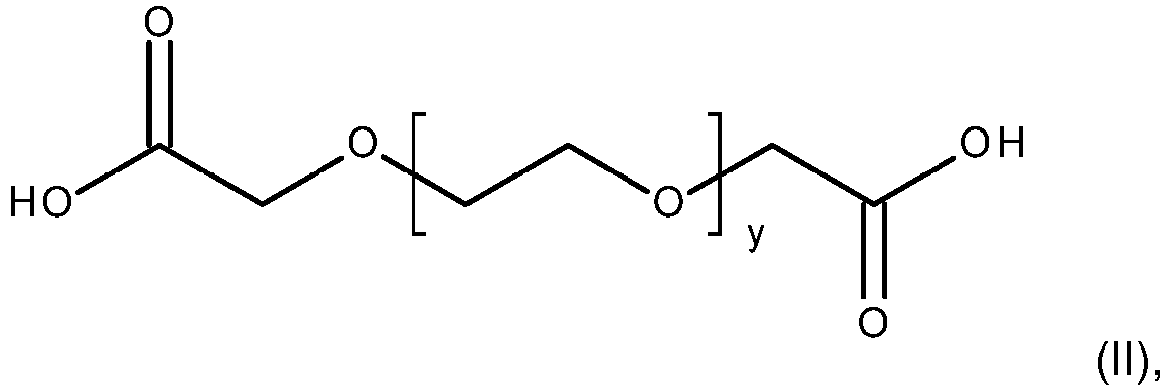 (a) bei einem Molverhältnis von
 (b) bei einer Konzentration an Wasser von 50 bis 95 Gew.-% in der flüssigen Phase; und(c) bei einem pH-Wert von 1 bis 7durchführt.
 - Verfahren nach Anspruch 1, dadurch gekennzeichnet, dass man ein Oxydiol (I) einsetzt, bei dem x für eine positive ganze Zahl von 1 bis 5 steht.
- Verfahren nach den Ansprüchen 1 bis 2, dadurch gekennzeichnet, dass man ein Gemisch von Oxydiolen (I) mit einer mittlere Molmasse von 150 bis 300 g/mol einsetzt.
- Verfahren nach den Ansprüchen 1 bis 3, dadurch gekennzeichnet, dass man einen heterogenen Katalysator enthaltend 0,1 bis 10 Gew.-% Platin auf Kohle einsetzt.
- Verfahren nach den Ansprüchen 1 bis 4, dadurch gekennzeichnet, dass man einen heterogenen Katalysator einsetzt, welcher einen Gesamtgehalt an Cadmium, Blei und Bismut von 0 bis 0,1 Gew.-%, bezogen auf die Masse an Platin, aufweist.
- Verfahren nach den Ansprüchen 1 bis 5, dadurch gekennzeichnet, dass man das Verfahren bei einem Molverhältnis von

- Verfahren nach den Ansprüchen 1 bis 6, dadurch gekennzeichnet, dass man ein Reaktionsgemisch mit einem Gehalt an Glykolsäure von 0 bis 1 Gew.-%, bezogen auf die Oxydicarbonsäure (II) erhält.
- Verfahren nach den Ansprüchen 1 bis 7, dadurch gekennzeichnet, dass man aus dem erhaltenen Reaktionsgemisch Wasser destillativ entfernt.
- Verfahren nach Anspruch 8, dadurch gekennzeichnet, dass man ein aufbereitetes Reaktionsgemisch mit einem Wassergehalt von 0 bis 40 Gew.-% erzeugt.
- Verwendung einer gemäß den Ansprüchen 2 bis 3 hergestellten Oxydicarbonsäure (II) als Korrosionsschutzkomponente für ein Gefrierschutzmittel.
Applications Claiming Priority (2)
| Application Number | Priority Date | Filing Date | Title |
|---|---|---|---|
| EP17161965 | 2017-03-21 | ||
| PCT/EP2018/055443 WO2018172062A1 (de) | 2017-03-21 | 2018-03-06 | Verfahren zur herstellung einer korrosionsschutzkomponente für ein gefrierschutzmittel |
Publications (2)
| Publication Number | Publication Date |
|---|---|
| EP3601206A1 EP3601206A1 (de) | 2020-02-05 |
| EP3601206B1 true EP3601206B1 (de) | 2021-07-21 |
Family
ID=58448329
Family Applications (1)
| Application Number | Title | Priority Date | Filing Date |
|---|---|---|---|
| EP18707929.8A Active EP3601206B1 (de) | 2017-03-21 | 2018-03-06 | Verfahren zur herstellung einer korrosionsschutzkomponente für ein gefrierschutzmittel |
Country Status (8)
| Country | Link |
|---|---|
| US (1) | US10961177B2 (de) |
| EP (1) | EP3601206B1 (de) |
| JP (1) | JP2020512325A (de) |
| KR (1) | KR20190132376A (de) |
| CN (1) | CN110431128A (de) |
| CA (1) | CA3056168A1 (de) |
| ES (1) | ES2893024T3 (de) |
| WO (1) | WO2018172062A1 (de) |
Families Citing this family (1)
| Publication number | Priority date | Publication date | Assignee | Title |
|---|---|---|---|---|
| CN112996892A (zh) * | 2018-11-14 | 2021-06-18 | 联合利华知识产权控股有限公司 | 织物调理剂组合物 |
Family Cites Families (32)
| Publication number | Priority date | Publication date | Assignee | Title |
|---|---|---|---|---|
| US3929873A (en) * | 1973-10-23 | 1975-12-30 | Eastman Kodak Co | Oxidation of polyethylene glycols to dicarboxylic acids |
| JPS51128909A (en) * | 1975-04-30 | 1976-11-10 | Mitsubishi Gas Chem Co Inc | Process for preparing polyglycolic acid salts |
| JPS6040453B2 (ja) * | 1977-05-11 | 1985-09-11 | 川研フアインケミカル株式会社 | ポリエチレングリコ−ル酸の製造方法 |
| DE2854646A1 (de) * | 1977-12-19 | 1979-06-28 | Eastman Kodak Co | Verfahren zur herstellung von dikarbonsaeuren |
| DE2851788A1 (de) | 1978-11-30 | 1980-06-12 | Bayer Ag | Verfahren zur herstellung von aryloxiessigsaeuren |
| DE2936123C2 (de) | 1979-09-07 | 1987-04-09 | Hoechst Ag, 6230 Frankfurt | Verfahren zur Herstellung von Alkoxyessigsäuren |
| DE3135846A1 (de) | 1981-09-10 | 1983-04-28 | Horst 2741 Kutenholz Erzmoneit | Billard |
| DE3135946A1 (de) | 1981-09-10 | 1983-03-24 | Bayer Ag, 5090 Leverkusen | Verfahren zur herstellung von alkoxyessigsaeuren |
| US4561990A (en) | 1984-10-04 | 1985-12-31 | Texaco Inc. | High lead solder corrosion inhibitors |
| US4647392A (en) | 1985-12-27 | 1987-03-03 | Texaco Inc. | Monobasic-dibasic acid/salt antifreeze corrosion inhibitor |
| JPS63211251A (ja) * | 1987-02-27 | 1988-09-02 | Kawaken Fine Chem Co Ltd | ポリエチレングリコ−ル酸の製造方法 |
| CA2051609A1 (en) | 1990-10-01 | 1992-04-02 | Jeffrey M. Burns | Corrosion-inhibited antifreeze/coolant composition |
| FR2686346B1 (fr) | 1992-01-21 | 1994-09-30 | Bp Chemicals Snc | Composition antigel et fluide aqueux. |
| DE10235477A1 (de) * | 2002-08-02 | 2004-02-12 | Basf Ag | Glykolfreie wässrige Gefrierschutzmittel enthaltend Dicarbonsäuresalze |
| JP2016148095A (ja) * | 2015-02-13 | 2016-08-18 | 出光興産株式会社 | 水系防錆剤組成物 |
| JP6741687B2 (ja) | 2015-05-04 | 2020-08-19 | ビーエーエスエフ ソシエタス・ヨーロピアBasf Se | メロナールの調製方法 |
| BR112018000606B1 (pt) | 2015-07-22 | 2022-01-18 | Basf Se | Processo para preparação de ácido furan-2,5- dicarboxílico e uso de um catalisador |
| WO2017012937A1 (en) | 2015-07-22 | 2017-01-26 | Basf Se | Mixture of n-(1,3-benzothiazol-2-ylsulfanyl)-2-methylcyclohexanamine and n-(1,3-benzothiazol-2-ylsulfanyl)-4-methylcyclohexanamine |
| EP3153493A1 (de) | 2015-10-08 | 2017-04-12 | Basf Se | Verfahren zur reinigung von cyclohexadec-8-en-1-on |
| EP3359516A1 (de) | 2015-10-08 | 2018-08-15 | Basf Se | Verwendung neuartiger gemische von (e/z)-cyclopentadecenon-isomeren, deren herstellung und deren verwendung als aromastoff |
| EP3170828A1 (de) | 2015-11-23 | 2017-05-24 | Basf Se | Verfahren zur herstellung von verbindungen mit 16-oxabicyclo[10.3.1]pentadecengerüst und deren folgeprodukten |
| ES2899827T3 (es) | 2015-12-08 | 2022-03-14 | Basf Se | Material zeolítico que contiene estaño y que tiene una estructura de marco BEA |
| EP3178788A1 (de) | 2015-12-08 | 2017-06-14 | Basf Se | Zinnhaltiges zeolithmaterial mit einer bea-rahmenstruktur |
| WO2017140774A1 (en) | 2016-02-17 | 2017-08-24 | Basf Se | A process for the preparation of propylene oxide |
| US11613681B2 (en) | 2016-06-03 | 2023-03-28 | Basf Se | Use of compounds having n 2-oxo-1,3-dioxolane-4-carboxamide units in two-component adhesives |
| JP7039498B2 (ja) | 2016-06-29 | 2022-03-22 | ビーエーエスエフ ソシエタス・ヨーロピア | 液相の存在下でのアルコールの酸化によるアルファ,ベータ不飽和アルデヒドの製造方法 |
| EP3481800B1 (de) | 2016-07-08 | 2020-08-05 | Basf Se | Verfahren zur herstellung eines organischen sulfons |
| CN109476618A (zh) | 2016-07-13 | 2019-03-15 | 巴斯夫欧洲公司 | 制备环氧乙烷的方法 |
| CN109641861B (zh) | 2016-07-20 | 2023-05-12 | 巴斯夫欧洲公司 | 制备环氧丙烷的方法 |
| BR112018076286B1 (pt) | 2016-07-20 | 2022-11-22 | Dow Global Technologies Llc | Processo para purificar óxido de propileno |
| PL3487845T3 (pl) | 2016-07-20 | 2020-12-14 | Basf Se | Sposób oczyszczania tlenku propylenu |
| WO2019006413A1 (en) | 2017-06-30 | 2019-01-03 | Abbott Diabetes Care | METHOD AND APPARATUS FOR ANALYTE DETECTION USING ELECTROCHEMICAL BIOSENSOR |
-
2018
- 2018-03-06 EP EP18707929.8A patent/EP3601206B1/de active Active
- 2018-03-06 CA CA3056168A patent/CA3056168A1/en active Pending
- 2018-03-06 JP JP2019551934A patent/JP2020512325A/ja not_active Ceased
- 2018-03-06 US US16/494,970 patent/US10961177B2/en not_active Expired - Fee Related
- 2018-03-06 WO PCT/EP2018/055443 patent/WO2018172062A1/de not_active Ceased
- 2018-03-06 ES ES18707929T patent/ES2893024T3/es active Active
- 2018-03-06 KR KR1020197027192A patent/KR20190132376A/ko not_active Withdrawn
- 2018-03-06 CN CN201880019083.5A patent/CN110431128A/zh active Pending
Non-Patent Citations (1)
| Title |
|---|
| None * |
Also Published As
| Publication number | Publication date |
|---|---|
| CA3056168A1 (en) | 2018-09-27 |
| US10961177B2 (en) | 2021-03-30 |
| CN110431128A (zh) | 2019-11-08 |
| US20200283365A1 (en) | 2020-09-10 |
| ES2893024T3 (es) | 2022-02-07 |
| KR20190132376A (ko) | 2019-11-27 |
| JP2020512325A (ja) | 2020-04-23 |
| EP3601206A1 (de) | 2020-02-05 |
| WO2018172062A1 (de) | 2018-09-27 |
Similar Documents
| Publication | Publication Date | Title |
|---|---|---|
| EP0415202B1 (de) | Verfahren zur Herstellung niederer, mehrwertiger Alkohole | |
| EP2486000B1 (de) | Verfahren zur herstellung von polyolestern | |
| EP2102137A1 (de) | Verfahren zur herstellung von 1,2-ethylenglycol und 1,2-propylenglycol durch heterogen katalysierte hydrogenolyse eines polyols | |
| EP3359290B1 (de) | Verfahren zur herstellung von ruthenium/eisen/kohlenstoffträger-katalysatoren | |
| EP0071787B1 (de) | Neue Ruthenium/Kohle-Hydrierkatalysatoren, deren Herstellung und Verwendung zur selektiven Hydrierung von ungesättigten Carbonylverbindungen | |
| EP3209650B1 (de) | Verfahren zur herstellung von glycerinsäurecarbonat | |
| WO2010149507A2 (de) | Verfahren zur herstellung von ameisensäure | |
| WO2014040680A1 (de) | Verfahren zur herstellung von polyolestern | |
| EP2788309A1 (de) | Verfahren zur gewinnung von aliphatischen monocarbonsäuren aus destillationsrückständen | |
| WO2013014160A1 (de) | Verfahren zur herstellung von formamiden und ameisensäureestern | |
| EP2723704B1 (de) | Verfahren zur herstellung von 2-ethylheptansäure | |
| DE69413946T2 (de) | Verfahren zur Herstellung von hochreiner 2,6-Naphthalindicarbonsäure | |
| EP3044200A1 (de) | Verfahren zur nachbehandlung von polyolestern | |
| EP3601206B1 (de) | Verfahren zur herstellung einer korrosionsschutzkomponente für ein gefrierschutzmittel | |
| DE69303660T2 (de) | Verfahren zur Herstellung eines metallhaltigen Trägerkatalysators | |
| WO2017093308A1 (de) | Isomerisierung von mdach | |
| WO2008071641A1 (de) | Verfahren zur herstellung von 1,2-ethylenglycol und 1,2-propylenglycol durch heterogen katalysierte hydrogenolyse eines polyols | |
| EP3436420B1 (de) | Verfahren zur hydrierung von carbonsäuren zu alkoholen | |
| EP4061525A1 (de) | Chromfreier wasser- und saeurestabiler katalysator fuer hydrierungen | |
| EP1082282A1 (de) | Verfahren zur herstellung von hexandiol | |
| EP3074372A1 (de) | Verfahren zur ruthenium-katalysierten umvinylierung von carbonsäuren | |
| EP1035917B1 (de) | Verfahren zur herstellung eines katalysators und nach diesem verfahren erhältliche katalysatoren | |
| WO2008071616A1 (de) | Verfahren zur herstellung von 1,2-ethylenglycol und 1,2-propylenglycol durch heterogen katalysierte hydrogenolyse eines polyols | |
| DE112006002975B4 (de) | Verfahren zur Herstellung von Menthylbenzoat | |
| DE102015208708A1 (de) | Verfahren zur Herstellung von Ameisensäure |
Legal Events
| Date | Code | Title | Description |
|---|---|---|---|
| STAA | Information on the status of an ep patent application or granted ep patent |
Free format text: STATUS: UNKNOWN |
|
| STAA | Information on the status of an ep patent application or granted ep patent |
Free format text: STATUS: THE INTERNATIONAL PUBLICATION HAS BEEN MADE |
|
| PUAI | Public reference made under article 153(3) epc to a published international application that has entered the european phase |
Free format text: ORIGINAL CODE: 0009012 |
|
| STAA | Information on the status of an ep patent application or granted ep patent |
Free format text: STATUS: REQUEST FOR EXAMINATION WAS MADE |
|
| 17P | Request for examination filed |
Effective date: 20191021 |
|
| AK | Designated contracting states |
Kind code of ref document: A1 Designated state(s): AL AT BE BG CH CY CZ DE DK EE ES FI FR GB GR HR HU IE IS IT LI LT LU LV MC MK MT NL NO PL PT RO RS SE SI SK SM TR |
|
| AX | Request for extension of the european patent |
Extension state: BA ME |
|
| DAV | Request for validation of the european patent (deleted) | ||
| DAX | Request for extension of the european patent (deleted) | ||
| STAA | Information on the status of an ep patent application or granted ep patent |
Free format text: STATUS: EXAMINATION IS IN PROGRESS |
|
| 17Q | First examination report despatched |
Effective date: 20200814 |
|
| GRAP | Despatch of communication of intention to grant a patent |
Free format text: ORIGINAL CODE: EPIDOSNIGR1 |
|
| STAA | Information on the status of an ep patent application or granted ep patent |
Free format text: STATUS: GRANT OF PATENT IS INTENDED |
|
| INTG | Intention to grant announced |
Effective date: 20210219 |
|
| GRAS | Grant fee paid |
Free format text: ORIGINAL CODE: EPIDOSNIGR3 |
|
| GRAA | (expected) grant |
Free format text: ORIGINAL CODE: 0009210 |
|
| STAA | Information on the status of an ep patent application or granted ep patent |
Free format text: STATUS: THE PATENT HAS BEEN GRANTED |
|
| AK | Designated contracting states |
Kind code of ref document: B1 Designated state(s): AL AT BE BG CH CY CZ DE DK EE ES FI FR GB GR HR HU IE IS IT LI LT LU LV MC MK MT NL NO PL PT RO RS SE SI SK SM TR |
|
| REG | Reference to a national code |
Ref country code: GB Ref legal event code: FG4D Free format text: NOT ENGLISH |
|
| REG | Reference to a national code |
Ref country code: CH Ref legal event code: EP |
|
| REG | Reference to a national code |
Ref country code: DE Ref legal event code: R096 Ref document number: 502018006213 Country of ref document: DE |
|
| REG | Reference to a national code |
Ref country code: AT Ref legal event code: REF Ref document number: 1412477 Country of ref document: AT Kind code of ref document: T Effective date: 20210815 |
|
| REG | Reference to a national code |
Ref country code: IE Ref legal event code: FG4D Free format text: LANGUAGE OF EP DOCUMENT: GERMAN |
|
| REG | Reference to a national code |
Ref country code: SE Ref legal event code: TRGR |
|
| REG | Reference to a national code |
Ref country code: NL Ref legal event code: FP |
|
| REG | Reference to a national code |
Ref country code: LT Ref legal event code: MG9D |
|
| PG25 | Lapsed in a contracting state [announced via postgrant information from national office to epo] |
Ref country code: PT Free format text: LAPSE BECAUSE OF FAILURE TO SUBMIT A TRANSLATION OF THE DESCRIPTION OR TO PAY THE FEE WITHIN THE PRESCRIBED TIME-LIMIT Effective date: 20211122 Ref country code: NO Free format text: LAPSE BECAUSE OF FAILURE TO SUBMIT A TRANSLATION OF THE DESCRIPTION OR TO PAY THE FEE WITHIN THE PRESCRIBED TIME-LIMIT Effective date: 20211021 Ref country code: LT Free format text: LAPSE BECAUSE OF FAILURE TO SUBMIT A TRANSLATION OF THE DESCRIPTION OR TO PAY THE FEE WITHIN THE PRESCRIBED TIME-LIMIT Effective date: 20210721 Ref country code: BG Free format text: LAPSE BECAUSE OF FAILURE TO SUBMIT A TRANSLATION OF THE DESCRIPTION OR TO PAY THE FEE WITHIN THE PRESCRIBED TIME-LIMIT Effective date: 20211021 Ref country code: RS Free format text: LAPSE BECAUSE OF FAILURE TO SUBMIT A TRANSLATION OF THE DESCRIPTION OR TO PAY THE FEE WITHIN THE PRESCRIBED TIME-LIMIT Effective date: 20210721 Ref country code: HR Free format text: LAPSE BECAUSE OF FAILURE TO SUBMIT A TRANSLATION OF THE DESCRIPTION OR TO PAY THE FEE WITHIN THE PRESCRIBED TIME-LIMIT Effective date: 20210721 Ref country code: FI Free format text: LAPSE BECAUSE OF FAILURE TO SUBMIT A TRANSLATION OF THE DESCRIPTION OR TO PAY THE FEE WITHIN THE PRESCRIBED TIME-LIMIT Effective date: 20210721 |
|
| REG | Reference to a national code |
Ref country code: ES Ref legal event code: FG2A Ref document number: 2893024 Country of ref document: ES Kind code of ref document: T3 Effective date: 20220207 |
|
| PG25 | Lapsed in a contracting state [announced via postgrant information from national office to epo] |
Ref country code: PL Free format text: LAPSE BECAUSE OF FAILURE TO SUBMIT A TRANSLATION OF THE DESCRIPTION OR TO PAY THE FEE WITHIN THE PRESCRIBED TIME-LIMIT Effective date: 20210721 Ref country code: LV Free format text: LAPSE BECAUSE OF FAILURE TO SUBMIT A TRANSLATION OF THE DESCRIPTION OR TO PAY THE FEE WITHIN THE PRESCRIBED TIME-LIMIT Effective date: 20210721 Ref country code: GR Free format text: LAPSE BECAUSE OF FAILURE TO SUBMIT A TRANSLATION OF THE DESCRIPTION OR TO PAY THE FEE WITHIN THE PRESCRIBED TIME-LIMIT Effective date: 20211022 |
|
| REG | Reference to a national code |
Ref country code: DE Ref legal event code: R097 Ref document number: 502018006213 Country of ref document: DE |
|
| PG25 | Lapsed in a contracting state [announced via postgrant information from national office to epo] |
Ref country code: DK Free format text: LAPSE BECAUSE OF FAILURE TO SUBMIT A TRANSLATION OF THE DESCRIPTION OR TO PAY THE FEE WITHIN THE PRESCRIBED TIME-LIMIT Effective date: 20210721 |
|
| PGFP | Annual fee paid to national office [announced via postgrant information from national office to epo] |
Ref country code: GB Payment date: 20220322 Year of fee payment: 5 Ref country code: DE Payment date: 20220329 Year of fee payment: 5 Ref country code: CH Payment date: 20220324 Year of fee payment: 5 |
|
| PLBE | No opposition filed within time limit |
Free format text: ORIGINAL CODE: 0009261 |
|
| STAA | Information on the status of an ep patent application or granted ep patent |
Free format text: STATUS: NO OPPOSITION FILED WITHIN TIME LIMIT |
|
| PG25 | Lapsed in a contracting state [announced via postgrant information from national office to epo] |
Ref country code: SM Free format text: LAPSE BECAUSE OF FAILURE TO SUBMIT A TRANSLATION OF THE DESCRIPTION OR TO PAY THE FEE WITHIN THE PRESCRIBED TIME-LIMIT Effective date: 20210721 Ref country code: SK Free format text: LAPSE BECAUSE OF FAILURE TO SUBMIT A TRANSLATION OF THE DESCRIPTION OR TO PAY THE FEE WITHIN THE PRESCRIBED TIME-LIMIT Effective date: 20210721 Ref country code: RO Free format text: LAPSE BECAUSE OF FAILURE TO SUBMIT A TRANSLATION OF THE DESCRIPTION OR TO PAY THE FEE WITHIN THE PRESCRIBED TIME-LIMIT Effective date: 20210721 Ref country code: EE Free format text: LAPSE BECAUSE OF FAILURE TO SUBMIT A TRANSLATION OF THE DESCRIPTION OR TO PAY THE FEE WITHIN THE PRESCRIBED TIME-LIMIT Effective date: 20210721 Ref country code: CZ Free format text: LAPSE BECAUSE OF FAILURE TO SUBMIT A TRANSLATION OF THE DESCRIPTION OR TO PAY THE FEE WITHIN THE PRESCRIBED TIME-LIMIT Effective date: 20210721 Ref country code: AL Free format text: LAPSE BECAUSE OF FAILURE TO SUBMIT A TRANSLATION OF THE DESCRIPTION OR TO PAY THE FEE WITHIN THE PRESCRIBED TIME-LIMIT Effective date: 20210721 |
|
| PGFP | Annual fee paid to national office [announced via postgrant information from national office to epo] |
Ref country code: SE Payment date: 20220324 Year of fee payment: 5 Ref country code: NL Payment date: 20220325 Year of fee payment: 5 Ref country code: IT Payment date: 20220323 Year of fee payment: 5 Ref country code: FR Payment date: 20220325 Year of fee payment: 5 Ref country code: BE Payment date: 20220325 Year of fee payment: 5 |
|
| 26N | No opposition filed |
Effective date: 20220422 |
|
| PGFP | Annual fee paid to national office [announced via postgrant information from national office to epo] |
Ref country code: ES Payment date: 20220418 Year of fee payment: 5 |
|
| PG25 | Lapsed in a contracting state [announced via postgrant information from national office to epo] |
Ref country code: MC Free format text: LAPSE BECAUSE OF FAILURE TO SUBMIT A TRANSLATION OF THE DESCRIPTION OR TO PAY THE FEE WITHIN THE PRESCRIBED TIME-LIMIT Effective date: 20210721 |
|
| PG25 | Lapsed in a contracting state [announced via postgrant information from national office to epo] |
Ref country code: LU Free format text: LAPSE BECAUSE OF NON-PAYMENT OF DUE FEES Effective date: 20220306 Ref country code: IE Free format text: LAPSE BECAUSE OF NON-PAYMENT OF DUE FEES Effective date: 20220306 |
|
| REG | Reference to a national code |
Ref country code: DE Ref legal event code: R119 Ref document number: 502018006213 Country of ref document: DE |
|
| REG | Reference to a national code |
Ref country code: CH Ref legal event code: PL Ref country code: SE Ref legal event code: EUG |
|
| REG | Reference to a national code |
Ref country code: NL Ref legal event code: MM Effective date: 20230401 |
|
| GBPC | Gb: european patent ceased through non-payment of renewal fee |
Effective date: 20230306 |
|
| REG | Reference to a national code |
Ref country code: BE Ref legal event code: MM Effective date: 20230331 |
|
| PG25 | Lapsed in a contracting state [announced via postgrant information from national office to epo] |
Ref country code: NL Free format text: LAPSE BECAUSE OF NON-PAYMENT OF DUE FEES Effective date: 20230401 |
|
| PG25 | Lapsed in a contracting state [announced via postgrant information from national office to epo] |
Ref country code: GB Free format text: LAPSE BECAUSE OF NON-PAYMENT OF DUE FEES Effective date: 20230306 |
|
| PG25 | Lapsed in a contracting state [announced via postgrant information from national office to epo] |
Ref country code: SE Free format text: LAPSE BECAUSE OF NON-PAYMENT OF DUE FEES Effective date: 20230307 Ref country code: LI Free format text: LAPSE BECAUSE OF NON-PAYMENT OF DUE FEES Effective date: 20230331 Ref country code: GB Free format text: LAPSE BECAUSE OF NON-PAYMENT OF DUE FEES Effective date: 20230306 Ref country code: FR Free format text: LAPSE BECAUSE OF NON-PAYMENT OF DUE FEES Effective date: 20230331 Ref country code: DE Free format text: LAPSE BECAUSE OF NON-PAYMENT OF DUE FEES Effective date: 20231003 Ref country code: CH Free format text: LAPSE BECAUSE OF NON-PAYMENT OF DUE FEES Effective date: 20230331 |
|
| PG25 | Lapsed in a contracting state [announced via postgrant information from national office to epo] |
Ref country code: BE Free format text: LAPSE BECAUSE OF NON-PAYMENT OF DUE FEES Effective date: 20230331 |
|
| PG25 | Lapsed in a contracting state [announced via postgrant information from national office to epo] |
Ref country code: ES Free format text: LAPSE BECAUSE OF NON-PAYMENT OF DUE FEES Effective date: 20230307 |
|
| REG | Reference to a national code |
Ref country code: ES Ref legal event code: FD2A Effective date: 20240426 |
|
| PG25 | Lapsed in a contracting state [announced via postgrant information from national office to epo] |
Ref country code: MK Free format text: LAPSE BECAUSE OF FAILURE TO SUBMIT A TRANSLATION OF THE DESCRIPTION OR TO PAY THE FEE WITHIN THE PRESCRIBED TIME-LIMIT Effective date: 20210721 Ref country code: IT Free format text: LAPSE BECAUSE OF NON-PAYMENT OF DUE FEES Effective date: 20230306 Ref country code: ES Free format text: LAPSE BECAUSE OF NON-PAYMENT OF DUE FEES Effective date: 20230307 Ref country code: CY Free format text: LAPSE BECAUSE OF FAILURE TO SUBMIT A TRANSLATION OF THE DESCRIPTION OR TO PAY THE FEE WITHIN THE PRESCRIBED TIME-LIMIT Effective date: 20210721 |
|
| REG | Reference to a national code |
Ref country code: AT Ref legal event code: MM01 Ref document number: 1412477 Country of ref document: AT Kind code of ref document: T Effective date: 20230306 |
|
| PG25 | Lapsed in a contracting state [announced via postgrant information from national office to epo] |
Ref country code: HU Free format text: LAPSE BECAUSE OF FAILURE TO SUBMIT A TRANSLATION OF THE DESCRIPTION OR TO PAY THE FEE WITHIN THE PRESCRIBED TIME-LIMIT; INVALID AB INITIO Effective date: 20180306 |
|
| PG25 | Lapsed in a contracting state [announced via postgrant information from national office to epo] |
Ref country code: TR Free format text: LAPSE BECAUSE OF FAILURE TO SUBMIT A TRANSLATION OF THE DESCRIPTION OR TO PAY THE FEE WITHIN THE PRESCRIBED TIME-LIMIT Effective date: 20210721 |
|
| PG25 | Lapsed in a contracting state [announced via postgrant information from national office to epo] |
Ref country code: AT Free format text: LAPSE BECAUSE OF NON-PAYMENT OF DUE FEES Effective date: 20230306 |
|
| PG25 | Lapsed in a contracting state [announced via postgrant information from national office to epo] |
Ref country code: AT Free format text: LAPSE BECAUSE OF NON-PAYMENT OF DUE FEES Effective date: 20230306 |
|
| PG25 | Lapsed in a contracting state [announced via postgrant information from national office to epo] |
Ref country code: MT Free format text: LAPSE BECAUSE OF FAILURE TO SUBMIT A TRANSLATION OF THE DESCRIPTION OR TO PAY THE FEE WITHIN THE PRESCRIBED TIME-LIMIT Effective date: 20210721 |
|
| PGFP | Annual fee paid to national office [announced via postgrant information from national office to epo] |
Ref country code: AT Payment date: 20260410 Year of fee payment: 5 |