EP3897855B1 - Kif18a-inhibitoren - Google Patents
Kif18a-inhibitoren Download PDFInfo
- Publication number
- EP3897855B1 EP3897855B1 EP19845855.6A EP19845855A EP3897855B1 EP 3897855 B1 EP3897855 B1 EP 3897855B1 EP 19845855 A EP19845855 A EP 19845855A EP 3897855 B1 EP3897855 B1 EP 3897855B1
- Authority
- EP
- European Patent Office
- Prior art keywords
- azaspiro
- octan
- alk
- benzamide
- mmol
- Prior art date
- Legal status (The legal status is an assumption and is not a legal conclusion. Google has not performed a legal analysis and makes no representation as to the accuracy of the status listed.)
- Active
Links
Classifications
-
- C—CHEMISTRY; METALLURGY
- C07—ORGANIC CHEMISTRY
- C07D—HETEROCYCLIC COMPOUNDS
- C07D413/00—Heterocyclic compounds containing two or more hetero rings, at least one ring having nitrogen and oxygen atoms as the only ring hetero atoms
- C07D413/14—Heterocyclic compounds containing two or more hetero rings, at least one ring having nitrogen and oxygen atoms as the only ring hetero atoms containing three or more hetero rings
-
- C—CHEMISTRY; METALLURGY
- C07—ORGANIC CHEMISTRY
- C07D—HETEROCYCLIC COMPOUNDS
- C07D417/00—Heterocyclic compounds containing two or more hetero rings, at least one ring having nitrogen and sulfur atoms as the only ring hetero atoms, not provided for by group C07D415/00
- C07D417/14—Heterocyclic compounds containing two or more hetero rings, at least one ring having nitrogen and sulfur atoms as the only ring hetero atoms, not provided for by group C07D415/00 containing three or more hetero rings
-
- A—HUMAN NECESSITIES
- A61—MEDICAL OR VETERINARY SCIENCE; HYGIENE
- A61P—SPECIFIC THERAPEUTIC ACTIVITY OF CHEMICAL COMPOUNDS OR MEDICINAL PREPARATIONS
- A61P35/00—Antineoplastic agents
-
- C—CHEMISTRY; METALLURGY
- C07—ORGANIC CHEMISTRY
- C07D—HETEROCYCLIC COMPOUNDS
- C07D401/00—Heterocyclic compounds containing two or more hetero rings, having nitrogen atoms as the only ring hetero atoms, at least one ring being a six-membered ring with only one nitrogen atom
- C07D401/02—Heterocyclic compounds containing two or more hetero rings, having nitrogen atoms as the only ring hetero atoms, at least one ring being a six-membered ring with only one nitrogen atom containing two hetero rings
- C07D401/12—Heterocyclic compounds containing two or more hetero rings, having nitrogen atoms as the only ring hetero atoms, at least one ring being a six-membered ring with only one nitrogen atom containing two hetero rings linked by a chain containing hetero atoms as chain links
-
- C—CHEMISTRY; METALLURGY
- C07—ORGANIC CHEMISTRY
- C07D—HETEROCYCLIC COMPOUNDS
- C07D401/00—Heterocyclic compounds containing two or more hetero rings, having nitrogen atoms as the only ring hetero atoms, at least one ring being a six-membered ring with only one nitrogen atom
- C07D401/14—Heterocyclic compounds containing two or more hetero rings, having nitrogen atoms as the only ring hetero atoms, at least one ring being a six-membered ring with only one nitrogen atom containing three or more hetero rings
-
- C—CHEMISTRY; METALLURGY
- C07—ORGANIC CHEMISTRY
- C07D—HETEROCYCLIC COMPOUNDS
- C07D405/00—Heterocyclic compounds containing both one or more hetero rings having oxygen atoms as the only ring hetero atoms, and one or more rings having nitrogen as the only ring hetero atom
- C07D405/14—Heterocyclic compounds containing both one or more hetero rings having oxygen atoms as the only ring hetero atoms, and one or more rings having nitrogen as the only ring hetero atom containing three or more hetero rings
Definitions
- the invention relates to the field of pharmaceutical agents and, more specifically, is directed to compounds and compositions useful for modulating KIF18A, and to uses and methods for managing cell proliferation and for treating cancer.
- Cancer is one of the most widespread diseases afflicting centuries and a major cause of death worldwide.
- numerous groups have invested a tremendous amount of time, effort and financial resources.
- of the available cancer treatments and therapies only a few offer any considerable degree of success.
- Cancer is often characterized by unregulated cell proliferation. Damage to one or more genes, responsible for the cellular pathways, which control progress of proliferation through the cell cycle and centrosome cycle, can cause the loss of normal regulation of cell proliferation. These deregulated genes can code for various tumor suppressor or oncogene proteins, which participate in a cascade of events, leading to unchecked cell-cycling progression and cell proliferation. Various kinase and kinesin proteins have been identified, which play key roles in cell cycle and mitotic regulation and progression of normal dividing cells and cancer cells.
- Kinesins are molecular motors that play important roles in cell division and intracellular vesicle and organelle transport. Mitotic kinesin plays roles in several aspects of spindle assembly, chromosome segregation, centrosome separation and dynamics (reviewed in O. Rath and F. Kozielski, Nature Review Cancer, 12:527-39, 2012 ). Human kinesins are categorized into 14 subfamilies based on sequence homology within the so called “motor domain", this domains ATPase activity drives unidirectional movement along microtubules (MTs).
- MTs microtubules
- a "cargo” can include any one of a variety of different membranous organelles, signal transduction scaffolding systems, and chromosomes.
- Kinesins use the energy of ATP hydrolysis to move cargo along polarized microtubules. Thus, kinesins are often called “plus-end” or “minus-end” directed motors.
- KIF18A gene belongs to Kinesin-8 subfamily and is a plus-end-directed motor. KIF18A is believed to influence dynamics at the plus end of kinetochore microtubules to control correct chromosome positioning and spindle tension. Depletion of human KIF18A leads to longer spindles, increased chromosome oscillation at metaphase, and activation of the mitotic spindle assembly checkpoint in HeLa cervical cancer cells ( MI Mayr et al, Current Biology 17, 488-98, 2007 ). KIF18A appears to be viable target for the treatment of cancer.
- KIF18A is overexpressed in various types of cancers, including but not limited to colon, breast, lung, pancreas, prostate, bladder, head, neck, cervix, and ovarian cancers. Further, genetic deletion or knockdown, or inhibition of KIF 18A effects mitotic spindle apparatus in cancer cell lines. Particularly, inhibition of KIF18A has been found to induce mitotic cell arrest, a known vulnerability that can promote cell death in mitosis via apoptosis, mitotic catastrophe, or multipolarity driven lethality or death after mitotic slippage in interphase. Accordingly, there has been a strong interest in finding inhibitors of KIF18A proteins.
- WO2011085261 discloses benzamide derivatives as anti-cancer agents.
- the present invention provides a new class of compounds useful for modulating KIF18A protein alone or in a bound complex with microtubules for treating KIF18A-mediated conditions and/or diseases, including cancer, inflammation, or ciliopathologies.
- the compounds provided by the invention have MT-based KIF18A modulatory activity and, in particular, KIF18A inhibitory activity.
- the invention also provides the use of these compounds, as well as pharmaceutically acceptable salts thereof, in the preparation and manufacture of a pharmaceutical composition or medicament for therapeutic, prophylactic, acute or chronic treatment of KIF18A mediated diseases and disorders, including without limitation, cancer.
- the compounds of the invention are useful in the manufacture of anti-cancer medicaments.
- the invention also provides processes for making compounds of Formula I, as well as intermediates useful in such processes.
- the present invention provides a compound of Formula (I), A compound of formula I: or any pharmaceutically-acceptable salt thereof, wherein:
- the present invention provides compounds wherein R x is
- the present invention provides compounds wherein X 1 is -CR 6 ; having the formula (Ia):
- the present invention provides compounds wherein X 1 is N; having the formula (Ib):
- the present invention provides compounds in accordance with any of the above embodiments, or pharmaceutically acceptable salts thereof, wherein R 3 is H or methyl.
- the present invention provides compounds in accordance with any of the above embodiments, or pharmaceutically acceptable salts thereof, wherein each of R 10c , R 10d , R 10e , R 10f , R 10g , R 10h , R 10i , and R 10j is H, halo, C 1-6 alk, or C 1-4 haloalk; and each of R 10a and R 10b pair combine with the carbon atom attached to each of them form a saturated 3-, 4-, or 5-membered monocyclic ring spiro to the R x ring; wherein said ring contains 0, 1, 2 or 3 N atoms and 0 or 1 atoms selected from 0 and S.
- the present invention provides compounds in accordance with any of the above embodiments, or pharmaceutically acceptable salts thereof, wherein each of R 10c , R 10d , R 10e , R 10f , R 10g , R 10h , R 10i , and R 10j is H, methyl, or ethyl; and each of R 10a and R 10b pair combine with the carbon atom attached to each of them form a cyclopropyl, cyclobutyl, or cyclopentyl ring spiro to the R x ring.
- the present invention provides compounds in accordance with any of the above embodiments, or pharmaceutically acceptable salts thereof, wherein R x is selected from:
- the present invention provides compounds in accordance with any of the above embodiments, or pharmaceutically acceptable salts thereof, wherein R x is
- the present invention provides compounds in accordance with any of the above embodiments, or pharmaceutically acceptable salts thereof, wherein R 1 is a group -Z-R 12 , wherein Z is -NHSO 2 - or -SO 2 NH-; and R 12 is oxetanyl, cyclopropyl, or R 12 is C 1-6 alk substituted by 0, 1, 2 or 3 OH group(s).
- the present invention provides compounds in accordance with any of the above embodiments, or pharmaceutically acceptable salts thereof, wherein R 1 is a group -Z-R 12 , wherein Z is -NHSO 2 - and R 12 is -CH 2 -CH 2 -OH.
- the present invention provides compounds in accordance with any of the above embodiments, or pharmaceutically acceptable salts thereof, wherein
- the present invention provides compounds in accordance with any of the above embodiments, or pharmaceutically acceptable salts thereof, wherein R 2 is a saturated 5- or 6-membered monocyclic ring wherein each said ring contains 0, 1, or 2 N atoms and 0 or 1 O atom, and wherein each said ring is substituted by 0, 1, 2 or 3 group(s) selected from F, Cl, Br, C 1-6 alk, C 1-4 haloalk, -OH, -OCH 3 , -OC 1-4 haloalk, CN, R 14 , and oxo.
- the present invention provides compounds in accordance with any of the above embodiments, or pharmaceutically acceptable salts thereof, wherein R 2 is
- the present invention provides compounds in accordance with any of the above embodiments, or pharmaceutically acceptable salts thereof, wherein R 2 is morpholinyl or piperidinyl substituted by 0, 1, 2 or 3 group(s) selected from F, Cl, Br, methyl, CF 3 , -OH, -OCHF 2 , CN, or oxo.
- the present invention provides compounds in accordance with any of the above embodiments, or pharmaceutically acceptable salts thereof, wherein R 2 is morpholinyl substituted by 1, 2 or 3 methyl group(s).
- the present invention provides compounds in accordance with any of the above embodiments, or pharmaceutically acceptable salts thereof, wherein R 4 is selected from H, F, methyl, CN, or Br.
- the present invention provides compounds in accordance with any of the above embodiments, or pharmaceutically acceptable salts thereof, wherein R 4 is H.
- the present invention provides compounds in accordance with any of the above embodiments, or pharmaceutically acceptable salts thereof, wherein R 5 is H.
- the present invention provides compounds in accordance with any of the above embodiments, or pharmaceutically acceptable salts thereof, wherein R 6 is H, methyl, cyclopropyl, CN, CF 3 , or azetidinyl.
- the present invention provides compounds in accordance with any of the above embodiments, or pharmaceutically acceptable salts thereof, wherein R 7 is H.
- the present invention provides compounds in accordance with any of the above embodiments, or pharmaceutically acceptable salts thereof, wherein R 8 is H or F.
- the present invention provides compounds in accordance with any of the above embodiments, or pharmaceutically acceptable salts thereof, wherein R 9 is H or F.
- the present invention provides a compound, or pharmaceutically acceptable salts thereof, selected from: Ex. # Chemical Structure Name 1 4-(N-(2-Hydroxyethyl)sulfamoyl)-2-(6-azaspiro[2.5]octan-6-yl)-N-(6-(3,3,3-trifluoropropoxy)pyridin-2-yl)benzamide 1-1 ( R )-4-( N -(2-Hydroxyethyl)sulfamoyl)- N -(6-(2-methylmorpholino)pyridin-2-yl)-2-(6-azaspiro[2.5]octan-6-yl)benzamide 1-2 N -(6-(4,4-Diffuoropiperidin-1-yl)-4-methylpyridin-2-yl)-4-( N -(2-hydroxyethyl)sulfamoyl)-2-(6-azaspiro[2.5]octan-6-yl)
- the present invention provides pharmaceutical compositions comprising a compound, or pharmaceutically acceptable salts thereof, in accordance with any one of embodiments 1-29, and a pharmaceutically acceptable diluent or carrier.
- the present invention provides a method of treating a condition that may be treated with KIF18a inhibitors, the method comprising administering to a patient in need thereof a therapeutically effective amount of the compound in accordance with embodiments 1-29, or the composition according to embodiment 30.
- the present invention provides the method of embodiment 31, wherein said condition is cancer selected from the group consisting of (a) a solid or hematologically derived tumor selected from cancer of the cancer of the bladder, endometrial, lung squamous cell, breast, colon, kidney, liver, lung, small cell lung cancer, esophagus, gall-bladder, brain, head and neck, ovary, pancreas, stomach, cervix, thyroid, prostate and skin, (b) a hematopoietic tumor of lymphoid lineage selected from leukemia, acute lymphocitic leukemia, acute lymphoblastic leukemia, B-cell lymphoma, T-cell-lymphoma, Hodgkin's lymphoma, non-Hodgkin's lymphoma, hairy cell lymphoma and Burkett's lymphoma, (c) a hematopoietic tumor of myeloid lineage selected from acute and chronic myelogenous leukemia
- the present invention provides the method of embodiment 31, wherein said condition is cancer selected from the group consisting of melanoma, prostate cancer, cervical cancer, breast cancer, colon cancer, sarcoma, or leukemia.
- said condition is cancer selected from the group consisting of melanoma, prostate cancer, cervical cancer, breast cancer, colon cancer, sarcoma, or leukemia.
- the present invention provides a method of reducing the size of a solid tumor in a subject, the method comprising administering to the subject in need thereof a therapeutically effective amount of the compound in accordance with embodiments 1-29, or the composition according to embodiment 30.
- the present invention provides a method of treating a cell proliferation disorder in a subject, the method comprising administering to the subject in need thereof a therapeutically effective amount of the compound in accordance with embodiments embodiments 1-29, or the composition according to embodiment 30.
- the present invention provides a method of inhibiting KIF18A in a cell, comprising contacting the cell with a compound, or pharmaceutically acceptable salts thereof, in accordance with embodiments embodiments 1-29, or the composition according to embodiment 30.
- the invention provides a method of preparing a compound of Formula (I) as described herein.
- the invention provides an intermediate compound used in the method of preparing a compound of Formula (I) as described herein.
- the present invention includes all pharmaceutically acceptable isotopically-labelled compounds of the present invention wherein one or more atoms are replaced by atoms having the same atomic number, but an atomic mass or mass number different from the atomic mass or mass number which predominates in nature.
- isotopes suitable for inclusion in the compounds of the invention include, but are not limited to, isotopes of hydrogen, such as 2 H and 3 H, carbon, such as 11 C, 13 C and 14 C, chlorine, such as 38 Cl, fluorine, such as 18 F, iodine, such as 123 I and 125 I, nitrogen, such as 13 N and 15 N, oxygen, such as 15 O, 17 O and 18 O, phosphorus, such as 32 P, and sulphur, such as 35 S.
- isotopes of hydrogen such as 2 H and 3 H
- carbon such as 11 C, 13 C and 14 C
- chlorine such as 38 Cl
- fluorine such as 18 F
- iodine such as 123 I and 125 I
- nitrogen such as 13 N and 15 N
- oxygen such as 15 O, 17 O and 18 O
- phosphorus such as 32 P
- sulphur such as 35 S.
- isotopically-labelled compounds of the present invention for example, those incorporating a radioactive isotope, are useful in drug and/or substrate tissue distribution studies.
- the radioactive isotopes tritium, i.e. 3 H, and carbon-14, i.e. 14 C, are particularly useful for this purpose in view of their ease of incorporation and ready means of detection.
- substitution with heavier isotopes such as deuterium, i.e. 2 H, may afford certain therapeutic advantages resulting from greater metabolic stability, for example, increased in vivo half-life or reduced dosage requirements, and hence may be preferred in some circumstances.
- Isotopically-labeled compounds of the present invention can generally be prepared by conventional techniques known to those skilled in the art or by processes analogous to those described in the accompanying Examples and Preparations using an appropriate isotopically-labeled reagent in place of the non-labeled reagent previously employed.
- solvates in accordance with the invention include those wherein the solvent of crystallization may be isotopically substituted, e.g. D 2 O, d 6 -acetone, d 6 -DMSO.
- Specific embodiments of the present invention include the compounds exemplified in the Examples below and their pharmaceutically acceptable salts, complexes, solvates, polymorphs, stereoisomers, metabolites, prodrugs, and other derivatives thereof.
- C ⁇ - ⁇ alk means an alkyl group comprising a minimum of ⁇ and a maximum of ⁇ carbon atoms in a branched or linear relationship or any combination of the three, wherein ⁇ and ⁇ represent integers.
- the alkyl groups described in this section may also contain one or two double or triple bonds.
- a designation of C 0 alk indicates a direct bond. Examples of C 1-6 alkyl include, but are not limited to the following:
- Halo or "halogen” means a halogen atom selected from F, Cl, Br and I.
- C ⁇ - ⁇ haloalk means an alk group, as described above, wherein any number --at least one-- of the hydrogen atoms attached to the alk chain are replaced by F, Cl, Br or I.
- the group N(R a )R a and the like include substituents where the two R a groups together form a ring, optionally including a N, O or S atom, and include groups such as:
- N(C ⁇ - ⁇ alk) C ⁇ - ⁇ palk wherein ⁇ and ⁇ are as defined above, include substituents where the two C ⁇ - ⁇ alk groups together form a ring, optionally including a N, O or S atom, and include groups such as
- Bicyclic ring means a group that features two joined rings.
- a bicyclic ring can be carbocyclic (all of the ring atoms are carbons), or heterocyclic (the rings atoms consist, for example, 1, 2 or 3 heteroatoms, such as N, O, or S, in addition to carbon atoms).
- the two rings can both be aliphatic ( e.g . decalin and norbomane), or can be aromatic ( e.g. naphthalene), or a combination of aliphatic and aromatic ( e.g . tetralin).
- Bicyclic rings include (a) spirocyclic compounds, wherein the two rings share only one single atom, the spiro atom, which is usually a quaternary carbon.
- spirocyclic compound include, but are not limited to: (b) fused bicyclic compounds, wherein two rings share two adjacent atoms. In other words, the rings share one covalent bond, i.e. the bridgehead atoms are directly connected (e.g. ⁇ -thujene and decalin).
- fused bicyclic rings include, but are not limited to: ; and (c) bridged bicyclic compounds, wherein the two rings share three or more atoms, separating the two bridgehead atoms by a bridge containing at least one atom.
- norbornane also known as bicyclo[2.2.1]heptane
- bicyclo[2.2.1]heptane can be thought of as a pair of cyclopentane rings each sharing three of their five carbon atoms.
- bridged bicyclic rings include, but are not limited to: or
- Carbocycle or “Carbocyclic” means a ring comprising by itself or in combination with other terms, represents, unless otherwise stated, cyclic version of "C ⁇ - ⁇ alk".
- Examples of carbocycle include cyclopentyl, cyclohexyl, 1-cyclohexenyl, 3-cyclohexenyl, cycloheptyl, cyclobutylene, cyclohexylene and the like.
- Heterocycle or Heterocyclic means a ring comprising at least one carbon atom and at least one other atom selected from N, O and S.
- heterocycles that may be found in the claims include, but are not limited to, the following:
- “Pharmaceutically-acceptable salt” means a salt prepared by conventional means, and are well known by those skilled in the art.
- the “pharmacologically acceptable salts” include basic salts of inorganic and organic acids, including but not limited to hydrochloric acid, hydrobromic acid, sulfuric acid, phosphoric acid, methane sulfonic acid, ethane sulfonic acid, malic acid, acetic acid, oxalic acid, tartaric acid, citric acid, lactic acid, fumaric acid, succinic acid, maleic acid, salicylic acid, benzoic acid, phenylacetic acid, mandelic acid and the like.
- suitable pharmaceutically acceptable cation pairs for the carboxy group are well known to those skilled in the art and include alkaline, alkaline earth, ammonium, quaternary ammonium cations and the like.
- pharmaceutically acceptable salts see infra and Berge et al., J. Pharm. Sci. 66:1 (1977 ).
- “Saturated, partially-saturated or unsaturated” includes substituents saturated with hydrogens, substituents completely unsaturated with hydrogens and substituents partially saturated with hydrogens.
- leaving group generally refers to groups readily displaceable by a nucleophile, such as an amine, a thiol or an alcohol nucleophile. Such leaving groups are well known in the art. Examples of such leaving groups include, but are not limited to, N-hydroxysuccinimide, N-hydroxybenzotriazole, halides, triflates, tosylates and the like. Preferred leaving groups are indicated herein where appropriate.
- Protecting group generally refers to groups well known in the art which are used to prevent selected reactive groups, such as carboxy, amino, hydroxy, mercapto and the like, from undergoing undesired reactions, such as nucleophilic, electrophilic, oxidation, reduction and the like. Preferred protecting groups are indicated herein where appropriate. Examples of amino protecting groups include, but are not limited to, aralkyl, substituted aralkyl, cycloalkenylalkyl and substituted cycloalkenyl alkyl, allyl, substituted allyl, acyl, alkoxycarbonyl, aralkoxycarbonyl, silyl and the like.
- aralkyl examples include, but are not limited to, benzyl, ortho-methylbenzyl, trityl and benzhydryl, which can be optionally substituted with halogen, alkyl, alkoxy, hydroxy, nitro, acylamino, acyl and the like, and salts, such as phosphonium and ammonium salts.
- aryl groups include phenyl, naphthyl, indanyl, anthracenyl, 9-(9-phenylfluorenyl), phenanthrenyl, durenyl and the like.
- cycloalkenylalkyl or substituted cycloalkylenylalkyl radicals preferably have 6-10 carbon atoms, include, but are not limited to, cyclohexenyl methyl and the like.
- Suitable acyl, alkoxycarbonyl and aralkoxycarbonyl groups include benzyloxycarbonyl, t-butoxycarbonyl, iso-butoxycarbonyl, benzoyl, substituted benzoyl, butyryl, acetyl, trifluoroacetyl, trichloro acetyl, phthaloyl and the like.
- a mixture of protecting groups can be used to protect the same amino group, such as a primary amino group can be protected by both an aralkyl group and an aralkoxycarbonyl group.
- Amino protecting groups can also form a heterocyclic ring with the nitrogen to which they are attached, for example, 1,2-bis(methylene)benzene, phthalimidyl, succinimidyl, maleimidyl and the like and where these heterocyclic groups can further include adjoining aryl and cycloalkyl rings.
- the heterocyclic groups can be mono-, di- or tri-substituted, such as nitrophthalimidyl.
- Amino groups may also be protected against undesired reactions, such as oxidation, through the formation of an addition salt, such as hydrochloride, toluene sulfonic acid, trifluoroacetic acid and the like.
- an addition salt such as hydrochloride, toluene sulfonic acid, trifluoroacetic acid and the like.
- Many of the amino protecting groups are also suitable for protecting carboxy, hydroxy and mercapto groups.
- aralkyl groups are also suitable groups for protecting hydroxy and mercapto groups, such as tert-butyl.
- Silyl protecting groups are silicon atoms optionally substituted by one or more alkyl, aryl and aralkyl groups. Suitable silyl protecting groups include, but are not limited to, trimethylsilyl, triethylsilyl, triisopropylsilyl, tert-butyldimethylsilyl, dimethylphenylsilyl, 1,2-bis(dimethylsilyl)benzene, 1,2-bis(dimethylsilyl)ethane and diphenylmethylsilyl. Silylation of an amino groups provide mono- or di-silylamino groups. Silylation of aminoalcohol compounds can lead to a N,N,O-trisilyl derivative.
- silyl function from a silyl ether function is readily accomplished by treatment with, for example, a metal hydroxide or ammonium fluoride reagent, either as a discrete reaction step or in situ during a reaction with the alcohol group.
- Suitable silylating agents are, for example, trimethylsilyl chloride, tert-butyl-dimethylsilyl chloride, phenyldimethylsilyl chloride, diphenylmethyl silyl chloride or their combination products with imidazole or DMF.
- Methods for silylation of amines and removal of silyl protecting groups are well known to those skilled in the art.
- Methods of preparation of these amine derivatives from corresponding amino acids, amino acid amides or amino acid esters are also well known to those skilled in the art of organic chemistry including amino acid/amino acid ester or aminoalcohol chemistry.
- Protecting groups are removed under conditions which will not affect the remaining portion of the molecule. These methods are well known in the art and include acid hydrolysis, hydrogenolysis and the like.
- a preferred method involves removal of a protecting group, such as removal of a benzyloxycarbonyl group by hydrogenolysis utilizing palladium on carbon in a suitable solvent system such as an alcohol, acetic acid, and the like or mixtures thereof.
- a t-butoxycarbonyl protecting group can be removed utilizing an inorganic or organic acid, such as HCl or trifluoroacetic acid, in a suitable solvent system, such as dioxane or methylene chloride. The resulting amino salt can readily be neutralized to yield the free amine.
- Carboxy protecting group such as methyl, ethyl, benzyl, tert-butyl, 4-methoxyphenylmethyl and the like, can be removed under hydrolysis and hydrogenolysis conditions well known to those skilled in the art.
- Prodrugs of the compounds of this invention are also contemplated by this invention.
- a prodrug is an active or inactive compound that is modified chemically through in vivo physiological action, such as hydrolysis, metabolism and the like, into a compound of this invention following administration of the prodrug to a patient.
- the suitability and techniques involved in making and using prodrugs are well known by those skilled in the art.
- For a general discussion of prodrugs involving esters see Svensson and Tunek Drug Metabolism Reviews 165 (1988 ) and Bundgaard Design of Prodrugs, Elsevier (1985 ).
- Examples of a masked carboxylate anion include a variety of esters, such as alkyl (for example, methyl, ethyl), cycloalkyl (for example, cyclohexyl), aralkyl (for example, benzyl, p-methoxybenzyl), and alkylcarbonyloxyalkyl (for example, pivaloyloxymethyl).
- esters such as alkyl (for example, methyl, ethyl), cycloalkyl (for example, cyclohexyl), aralkyl (for example, benzyl, p-methoxybenzyl), and alkylcarbonyloxyalkyl (for example, pivaloyloxymethyl).
- Amines have been masked as arylcarbonyloxymethyl substituted derivatives which are cleaved by esterases in vivo releasing the free drug and formaldehyde ( Bungaard J. Med. Chem. 2503 (1989
- drugs containing an acidic NH group such as imidazole, imide, indole and the like, have been masked with N-acyloxymethyl groups ( Bundgaard Design of Prodrugs, Elsevier (1985 )). Hydroxy groups have been masked as esters and ethers.
- EP 039,051 (Sloan and Little, 4/11/81) discloses Mannich-base hydroxamic acid prodrugs, their preparation and use.
- compositions that includes a compound as disclosed herein, together with a pharmaceutically acceptable excipient, such as, for example, a diluent or carrier.
- a pharmaceutically acceptable excipient such as, for example, a diluent or carrier.
- Compounds and pharmaceutical compositions suitable for use in the present invention include those wherein the compound can be administered in an effective amount to achieve its intended purpose. Administration of the compound described in more detail below.
- Suitable pharmaceutical formulations can be determined by the skilled artisan depending on the route of administration and the desired dosage. See, e.g., Remington's Pharmaceutical Sciences, 1435-712 (18th ed., Mack Publishing Co, Easton, Pennsylvania, 1990 ). Formulations may influence the physical state, stability, rate of in vivo release and rate of in vivo clearance of the administered agents. Depending on the route of administration, a suitable dose may be calculated according to body weight, body surface areas or organ size. Further refinement of the calculations necessary to determine the appropriate treatment dose is routinely made by those of ordinary skill in the art without undue experimentation, especially in light of the dosage information and assays disclosed herein as well as the pharmacokinetic data obtainable through animal or human clinical trials.
- phrases “pharmaceutically acceptable” or “pharmacologically acceptable” refer to molecular entities and compositions that do not produce adverse, allergic, or other untoward reactions when administered to an animal or a human.
- pharmaceutically acceptable e includes any and all solvents, dispersion media, coatings, antibacterial and antifungal agents, isotonic and absorption delaying agents and the like. The use of such excipients for pharmaceutically active substances is well known in the art. Except insofar as any conventional media or agent is incompatible with the therapeutic compositions, its use in therapeutic compositions is contemplated. Supplementary active ingredients also can be incorporated into the compositions.
- the formulation may comprise corn syrup solids, high-oleic safflower oil, coconut oil, soy oil, L-leucine, calcium phosphate tribasic, L-tyrosine, L-proline, L-lysine acetate, DATEM (an emulsifier), L-glutamine, L-valine, potassium phosphate dibasic, L-isoleucine, L-arginine, L-alanine, glycine, L-asparagine monohydrate, L-serine, potassium citrate, L-threonine, sodium citrate, magnesium chloride, L-histidine, L-methionine, ascorbic acid, calcium carbonate, L-glutamic acid, L-cystine dihydrochloride, L-tryptophan, L-aspartic acid, choline chloride, taurine, m-inositol, ferrous sulfate, ascorbyl palmitate, zinc sulfate, L
- DATEM
- the compound can be present in a pharmaceutical composition as a pharmaceutically acceptable salt.
- pharmaceutically acceptable salts include, for example base addition salts and acid addition salts.
- Pharmaceutically acceptable base addition salts may be formed with metals or amines, such as alkali and alkaline earth metals or organic amines.
- Pharmaceutically acceptable salts of compounds may also be prepared with a pharmaceutically acceptable cation. Suitable pharmaceutically acceptable cations are well known to those skilled in the art and include alkaline, alkaline earth, ammonium and quaternary ammonium cations. Carbonates or hydrogen carbonates are also possible. Examples of metals used as cations are sodium, potassium, magnesium, ammonium, calcium, or ferric, and the like.
- Suitable amines include isopropylamine, trimethylamine, histidine, N,N'-dibenzylethylenediamine, chloroprocaine, choline, diethanolamine, dicyclohexylamine, ethylenediamine, N-methylglucamine, and procaine.
- Pharmaceutically acceptable acid addition salts include inorganic or organic acid salts.
- suitable acid salts include the hydrochlorides, formates, acetates, citrates, salicylates, nitrates, phosphates.
- Other suitable pharmaceutically acceptable salts are well known to those skilled in the art and include, for example, formic, acetic, citric, oxalic, tartaric, or mandelic acids, hydrochloric acid, hydrobromic acid, sulfuric acid or phosphoric acid; with organic carboxylic, sulfonic, sulfo or phospho acids or N-substituted sulfamic acids, for example acetic acid, trifluoroacetic acid (TFA), propionic acid, glycolic acid, succinic acid, maleic acid, hydroxymaleic acid, methylmaleic acid, fumaric acid, malic acid, tartaric acid, lactic acid, oxalic acid, gluconic acid, glucaric acid, glucuronic
- compositions containing the compounds disclosed herein can be manufactured in a conventional manner, e.g., by conventional mixing, dissolving, granulating, dragee-making, levigating, emulsifying, encapsulating, entrapping, or lyophilizing processes. Proper formulation is dependent upon the route of administration chosen.
- compositions can be formulated readily by combining a compound disclosed herein with pharmaceutically acceptable excipients such as carriers well known in the art.
- excipients and carriers enable the present compounds to be formulated as tablets, pills, dragees, capsules, liquids, gels, syrups, slurries, suspensions and the like, for oral ingestion by a patient to be treated.
- Pharmaceutical preparations for oral use can be obtained by adding a compound as disclosed herein with a solid excipient, optionally grinding a resulting mixture, and processing the mixture of granules, after adding suitable auxiliaries, if desired, to obtain tablets or dragee cores.
- Suitable excipients include, for example, fillers and cellulose preparations.
- disintegrating agents can be added.
- Pharmaceutically acceptable ingredients are well known for the various types of formulation and may be for example binders (e.g., natural or synthetic polymers), lubricants, surfactants, sweetening and flavoring agents, coating materials, preservatives, dyes, thickeners, adjuvants, antimicrobial agents, antioxidants and carriers for the various formulation types.
- the composition typically is in the form of a solid (e.g., tablet, capsule, pill, powder, or troche) or a liquid formulation (e.g., aqueous suspension, solution, elixir, or syrup).
- a solid e.g., tablet, capsule, pill, powder, or troche
- a liquid formulation e.g., aqueous suspension, solution, elixir, or syrup.
- the composition can additionally contain a functional solid and/or solid carrier, such as a gelatin or an adjuvant.
- a functional solid and/or solid carrier such as a gelatin or an adjuvant.
- the tablet, capsule, and powder can contain about 1 to about 95% compound, and preferably from about 15 to about 90% compound.
- a functional liquid and/or a liquid carrier such as water, petroleum, or oils of animal or plant origin can be added.
- the liquid form of the composition can further contain physiological saline solution, sugar alcohol solutions, dextrose or other saccharide solutions, or glycols.
- the composition can contain about 0.5 to about 90% by weight of a compound disclosed herein, and preferably about 1 to about 50% of a compound disclosed herein.
- the liquid carrier is non-aqueous or substantially non-aqueous.
- the composition may be supplied as a rapidly-dissolving solid formulation for dissolution or suspension immediately prior to administration.
- compositions When a therapeutically effective amount of a compound disclosed herein is administered by intravenous, cutaneous, or subcutaneous injection, the composition is in the form of a pyrogen-free, parenterally acceptable aqueous solution.
- parenterally acceptable solutions having due regard to pH, isotonicity, stability, and the like, is within the skill in the art.
- a preferred composition for intravenous, cutaneous, or subcutaneous injection typically contains, in addition to a compound disclosed herein, an isotonic vehicle.
- Such compositions may be prepared for administration as solutions of free base or pharmacologically acceptable salts in water suitably mixed with a surfactant, such as hydroxypropylcellulose.
- Dispersions also can be prepared in glycerol, liquid polyethylene glycols, and mixtures thereof and in oils. Under ordinary conditions of storage and use, these preparations can optionally contain a preservative to prevent the growth of microorganisms.
- Injectable compositions can include sterile aqueous solutions, suspensions, or dispersions and sterile powders for the extemporaneous preparation of sterile injectable solutions, suspensions, or dispersions.
- the form must be sterile and must be fluid to the extent that easy syringability exists. It must be stable under the conditions of manufacture and storage and must resist the contaminating action of microorganisms, such as bacteria and fungi, by optional inclusion of a preservative.
- the carrier can be a solvent or dispersion medium containing, for example, water, ethanol, polyol (e.g., glycerol, propylene glycol, and liquid polyethylene glycol, and the like), suitable mixtures thereof, and vegetable oils.
- the carrier is non-aqueous or substantially non-aqueous.
- the proper fluidity can be maintained, for example, by the use of a coating, such as lecithin, by the maintenance of the required particle size of the compound in the embodiment of dispersion and by the use of surfactants.
- the prevention of the action of microorganisms can be brought about by various antibacterial and antifungal agents, for example, parabens, chlorobutanol, phenol, sorbic acid, thimerosal, and the like.
- Prolonged absorption of the injectable compositions can be brought about by the use in the compositions of agents delaying absorption, for example, aluminum monostearate and gelatin.
- Sterile injectable solutions are prepared by incorporating the active compounds in the required amount in the appropriate solvent with various of the other ingredients enumerated above, as required, followed by filtered sterilization.
- dispersions are prepared by incorporating the various sterilized active ingredients into a sterile vehicle which contains the basic dispersion medium and the required other ingredients from those enumerated above.
- the preferred methods of preparation are vacuum-drying and freeze-drying techniques which yield a powder of the active ingredient plus any additional desired ingredient from a previously sterile-filtered solution thereof.
- Slow release or sustained release formulations may also be prepared in order to achieve a controlled release of the active compound in contact with the body fluids in the GI tract, and to provide a substantially constant and effective level of the active compound in the blood plasma.
- release can be controlled by one or more of dissolution, diffusion, and ion-exchange.
- the slow release approach may enhance absorption via saturable or limiting pathways within the GI tract.
- the compound may be embedded for this purpose in a polymer matrix of a biological degradable polymer, a water-soluble polymer or a mixture of both, and optionally suitable surfactants. Embedding can mean in this context the incorporation of micro-particles in a matrix of polymers. Controlled release formulations are also obtained through encapsulation of dispersed micro-particles or emulsified micro-droplets via known dispersion or emulsion coating technologies.
- compounds of the present invention are conveniently delivered in the form of an aerosol spray presentation from pressurized packs or a nebulizer, with the use of a suitable propellant.
- the dosage unit can be determined by providing a valve to deliver a metered amount.
- Capsules and cartridges of, e.g., gelatin, for use in an inhaler or insufflator can be formulated containing a powder mix of the compound and a suitable powder base such as lactose or starch.
- compositions can take such forms as suspensions, solutions, or emulsions in oily or aqueous vehicles, and can contain formulatory agents such as suspending, stabilizing, and/or dispersing agents.
- compositions for parenteral administration include aqueous solutions of the compounds in water-soluble form.
- suspensions of the compounds can be prepared as appropriate oily injection suspensions.
- Suitable lipophilic solvents or vehicles include fatty oils or synthetic fatty acid esters.
- Aqueous injection suspensions can contain substances which increase the viscosity of the suspension.
- the suspension also can contain suitable stabilizers or agents that increase the solubility of the compounds and allow for the preparation of highly concentrated solutions.
- a present composition can be in powder form for constitution with a suitable vehicle (e.g., sterile pyrogen-free water) before use.
- Compounds disclosed herein also can be formulated in rectal compositions, such as suppositories or retention enemas (e.g., containing conventional suppository bases).
- the compounds also can be formulated as a depot preparation.
- Such long-acting formulations can be administered by implantation (e.g., subcutaneously or intramuscularly) or by intramuscular injection.
- the compounds can be formulated with suitable polymeric or hydrophobic materials (for example, as an emulsion in an acceptable oil) or ion exchange resins, or as sparingly soluble derivatives, for example, as a sparingly soluble salt.
- a compound disclosed herein can be administered orally, buccally, or sublingually in the form of tablets containing excipients, such as starch or lactose, or in capsules or ovules, either alone or in admixture with excipients, or in the form of elixirs or suspensions containing flavoring or coloring agents.
- excipients such as starch or lactose
- capsules or ovules either alone or in admixture with excipients, or in the form of elixirs or suspensions containing flavoring or coloring agents.
- Such liquid preparations can be prepared with pharmaceutically acceptable additives, such as suspending agents.
- a compound also can be injected parenterally, for example, intravenously, intramuscularly, subcutaneously, or intracoronarily.
- the compound is best used in the form of a sterile aqueous solution which can contain other substances, for example, salts, or sugar alcohols, such as mannitol, or glucose, to make the solution isotonic with blood.
- a sterile aqueous solution which can contain other substances, for example, salts, or sugar alcohols, such as mannitol, or glucose, to make the solution isotonic with blood.
- a compound disclosed herein is administered as a suitably acceptable formulation in accordance with normal veterinary practice.
- the veterinarian can readily determine the dosing regimen and route of administration that is most appropriate for a particular animal.
- kits for use in the therapeutic intervention of the disease comprising a packaged set of medicaments that include the compound disclosed herein as well as buffers and other components for preparing deliverable forms of said medicaments, and/or devices for delivering such medicaments, and/or any agents that are used in combination therapy with the compound disclosed herein, and/or instructions for the treatment of the disease packaged with the medicaments.
- the instructions may be fixed in any tangible medium, such as printed paper, or a computer readable magnetic or optical medium, or instructions to reference a remote computer data source such as a world wide web page accessible via the internet.
- a “therapeutically effective amount” means an amount effective to treat or to prevent development of, or to alleviate the existing symptoms of, the subject being treated. Determination of the effective amounts is well within the capability of those skilled in the art, especially in light of the detailed disclosure provided herein. Generally, a “therapeutically effective dose” refers to that amount of the compound that results in achieving the desired effect.
- a therapeutically effective amount of a compound disclosed herein decreases KIF18A activity by at least 5%, compared to control, at least 10%, at least 15%, at least 20%, at least 25%, at least 30%, at least 35%, at least 40%, at least 45%, at least 50%, at least 55%, at least 60%, at least 65%, at least 70%, at least 75%, at least 80%, at least 85%, or at least 90%.
- the amount of compound administered can be dependent on the subject being treated, on the subject's age, health, sex, and weight, the kind of concurrent treatment (if any), severity of the affliction, the nature of the effect desired, the manner and frequency of treatment, and the judgment of the prescribing physician.
- the frequency of dosing also can be dependent on pharmacodynamic effects on arterial oxygen pressures. While individual needs vary, determination of optimal ranges of effective amounts of the compound is within the skill of the art.
- Such doses may be administered in a single dose or it may be divided into multiple doses.
- cancer and “cancerous” when used herein refer to or describe the physiological condition in mammals that is typically characterized by unregulated cell growth.
- examples of cancer include, without limitation, carcinoma, lymphoma, sarcoma, blastoma and leukemia. More particular examples of such cancers include squamous cell carcinoma, lung cancer, pancreatic cancer, cervical cancer, bladder cancer, hepatoma, breast cancer, colon carcinoma, and head and neck cancer, ovarian cancer, and endometrial cancer.
- cancer as used herein is not limited to any one specific form of the disease, it is believed that the methods of the invention will be particularly effective for cancers which are found to be accompanied by unregulated levels of KIF18A or dependent on KIF 18A for proper chromosome segregation and survival in the mammal.
- treat refers to therapy, including without limitation, curative therapy, prophylactic therapy, and preventative therapy.
- Prophylactic treatment generally constitutes either preventing the onset of disorders altogether or delaying the onset of a pre-clinically evident stage of disorders in individuals.
- patient refers to any "patient”, “subject”, or “mammal” including humans, cows, horses, dogs and cats.
- the mammal is a human.
- the present disclosure provides compounds having MT-based KIF18A modulatory activity in general, and inhibitory activity in particular.
- a method of modulating KIF 18A protein in a subject comprising administering to the subject an effective dosage amount of a compound of Formulas I.
- the compounds of the invention may be used to treat cellular proliferation disorders, including uncontrolled cell growth, aberrant cell cycle regulation, centrosome abnormalities (structural and or numeric, fragmentation).
- Other diseases or disorders associated with the accumulation of extra centrosomes (>2) include human papillomavirus (HPV) infection, including HPV-associated neoplasias.
- HPV human papillomavirus
- the compounds are also useful for cilia-related dieases as well as ablating haploid germ cell population which could be used as a male contraceptive.
- compounds of the invention are useful for, but not limited to, the prevention or treatment of cancer and other KIF 18A-mediated diseases or disorders.
- compounds of the invention would be useful for the treatment of various solid and hematologically derived tumors, such as carcinomas, including, without limitation, cancer of the bladder, breast, colon, kidney, liver, lung (including squamous cell and small cell lung cancer), esophagus, gall-bladder, ovary, pancreas, stomach, cervix, thyroid, prostate, and skin (including squamous cell carcinoma); hematopoietic tumors of lymphoid lineage (including leukemia, acute lymphocitic leukemia, acute lymphoblastic leukemia, B-cell lymphoma, T-cell-lymphoma, Hodgkin's lymphoma, non-Hodgkin's lymphoma, hairy cell lymphoma and Burkett's lymphoma); hematopoietic tumors of mye
- tumors of the central and peripheral nervous system including astrocytoma, neuroblastoma, glioma and schwannomas); and other tumors (including melanoma, seminoma, teratocarcinoma, osteosarcoma, xenoderoma pigmentosum, keratoctanthoma, thyroid follicular cancer and Kaposi's sarcoma).
- the compounds of the invention are also useful in the treatment of cancer related indications such as solid tumors, sarcomas (especially Ewing's sarcoma and osteosarcoma), retinoblastoma, rhabdomyosarcomas, neuroblastoma, hematopoietic malignancies, including leukemia and lymphoma, tumor- induced pleural or pericardial effusions, and malignant ascites.
- cancer related indications such as solid tumors, sarcomas (especially Ewing's sarcoma and osteosarcoma), retinoblastoma, rhabdomyosarcomas, neuroblastoma, hematopoietic malignancies, including leukemia and lymphoma, tumor- induced pleural or pericardial effusions, and malignant ascites.
- the compounds of the invention are also useful in treatment and therapy of proliferative diseases.
- these compounds can be used for the treatment of an inflammatory disease, especially of manifestations at the locomotor apparatus, such as various inflammatory rheumatoid diseases, especially chronic polyarthritis including rheumatoid arthritis, juvenile arthritis or psoriasis arthropathy; paraneoplastic syndrome or tumor-induced inflammatory diseases, turbid effusions, collagenosis, such as systemic Lupus erythematosus, poly-myositis, dermato-myositis, systemic sclerodermia or mixed collagenosis; postinfectious arthritis (where no living pathogenic organism can be found at or in the affected part of the body), seronegative spondylarthritis, such as spondylitis ankylosans; vasculitis, sarcoidosis, or arthrosis; or further
- the compounds of the invention can also be used as active agents against such disease states as arthritis, atherosclerosis, psoriasis, hemangiomas, myocardial angiogenesis, coronary and cerebral collaterals, ischemic limb angiogenesis, wound healing, peptic ulcer Helicobacter related diseases, fractures, cat scratch fever, rubeosis, neovascular glaucoma and retinopathies such as those associated with diabetic retinopathy or macular degeneration.
- some of these compounds can be used as active agents against solid tumors, malignant ascites, hematopoietic cancers and hyperproliferative disorders such as thyroid hyperplasia (especially Grave's disease), and cysts (such as hypervascularity of ovarian stroma, characteristic of polycystic ovarian syndrome (Stein- Leventhal syndrome)) since such diseases require a proliferation of blood vessel cells for growth and/or metastasis.
- thyroid hyperplasia especially Grave's disease
- cysts such as hypervascularity of ovarian stroma, characteristic of polycystic ovarian syndrome (Stein- Leventhal syndrome)
- these compounds are useful for veterinary treatment of companion animals, exotic animals and farm animals, including mammals, rodents, and the like.
- animals including horses, dogs, and cats may be treated with compounds provided by the invention.
- the compounds of the invention can be dosed or administered as the sole active pharmaceutical agent, they can also be used in combination with one or more compounds of the invention or in conjunction with other agents.
- the therapeutic agents can be formulated as separate compositions that are administered simultaneously or sequentially at different times, or the therapeutic agents can be given as a single composition.
- co-therapy in defining use of a compound of the present invention and another pharmaceutical agent, is intended to embrace administration of each agent in a sequential manner in a regimen that will provide beneficial effects of the drug combination, and is intended as well to embrace co-administration of these agents in a substantially simultaneous manner, such as in a single capsule having a fixed ratio of these active agents or in multiple, separate capsules for each agent.
- the administration of compounds of the present invention may be in conjunction with additional therapies known to those skilled in the art in the prevention or treatment of cancer, such as with radiation therapy, small molecule targeted agents (e.g. PARP inhibitors, kinase inhibitors), therapeutic antibodies (e.g. naked and drug-conjugate) immunotherapy antibodies (checkpoint inhibitors, bi-specific T-cell engagers) with neoplastic or cytotoxic agents.
- additional therapies known to those skilled in the art in the prevention or treatment of cancer, such as with radiation therapy, small molecule targeted agents (e.g. PARP inhibitors, kinase inhibitors), therapeutic antibodies (e.g. naked and drug-conjugate) immunotherapy antibodies (checkpoint inhibitors, bi-specific T-cell engagers) with neoplastic or cytotoxic agents.
- radiation therapy e.g. PARP inhibitors, kinase inhibitors
- therapeutic antibodies e.g. naked and drug-conjugate
- immunotherapy antibodies checkpoint inhibitors, bi-specific T-cell engager
- Such combination products employ the compounds of this invention within the accepted dosage ranges.
- Compounds of Formula I may also be administered sequentially with known anticancer or cytotoxic agents when a combination formulation is inappropriate.
- the invention is not limited in the sequence of administration; compounds of the invention may be administered either prior to, simultaneous with or after administration of the known anticancer or cytotoxic agent.
- anticancer agents there are large numbers of anticancer agents available in commercial use, in clinical evaluation and in pre-clinical development, which would be selected for treatment of neoplasia by combination drug chemotherapy. Such agents fall into several major categories such as antibiotic-type agents, alkylating and alkylating-like agents, antimitotic agents, targeted small molecule agents, antimetabolite agents, hormonal agents, immunological agents, anti-angiogenic agents, interferon-type agents and a category of miscellaneous agents.
- the present disclosure also provides methods for combination therapies in which an agent known to modulate other pathways, or other components of the same pathway, or even overlapping sets of target enzymes are used in combination with a compound of the present disclosure, or a pharmaceutically acceptable salt thereof.
- such therapy includes but is not limited to the combination of one or more compounds of the disclosure with chemotherapeutic agents, therapeutic antibodies, targeted small molecule agents, and radiation treatment, to provide a synergistic or additive therapeutic effect.
- chemotherapeutics are presently known in the art and can be used in combination with the compounds of the disclosure.
- the chemotherapeutic is selected from the group consisting of antimitotic agents, alkylating agents, anti-metabolites, intercalating antibiotics, growth factor inhibitors, cell cycle inhibitors, enzymes, topoisomerase inhibitors, biological response modifiers, anti-hormones, angiogenesis inhibitors, and anti-androgens.
- Non-limiting examples are chemotherapeutic agents, cytotoxic agents, and non-peptide small molecules such as Gleevec ® (Imatinib Mesylate), Kyprolis ® (carfilzomib), Velcade ® (bortezomib), Casodex (bicalutamide), Iressa ® (gefitinib), and Adriamycin as well as a host of chemotherapeutic agents.
- Non-limiting examples of chemotherapeutic agents include alkylating agents such as thiotepa and cyclosphosphamide (CYTOXANTM); alkyl sulfonates such as busulfan, improsulfan and piposulfan; aziridines such as benzodopa, carboquone, meturedopa, and uredopa; ethylenimines and methylamelamines including altretamine, triethylenemelamine, trietylenephosphoramide, triethylenethiophosphaoramide and trimethylolomelamine; nitrogen mustards such as chlorambucil, chlomaphazine, cholophosphamide, estramustine, ifosfamide, mechlorethamine, mechlorethamine oxide hydrochloride, melphalan, novembichin, phenesterine, prednimustine, trofosfamide, uracil mustard; nitrosureas such as
- chemotherapeutic cell conditioners are anti-hormonal agents that act to regulate or inhibit hormone action on tumors such as anti-estrogens including for example tamoxifen, (NolvadexTM), raloxifene, aromatase inhibiting 4(5)- imidazoles, 4-hydroxytamoxifen, trioxifene, keoxifene, LY 117018, onapristone, and toremifene (Fareston); and anti-androgens such as flutamide, nilutamide, bicalutamide, leuprolide, and goserelin; chlorambucil; gemcitabine; 6-thioguanine; mercaptopurine; methotrexate; platinum analogs such as cisplatin, oxaliplatin, carboplatin; etoposide (VP-16); ifosfamide; mitomycin C; mitoxantrone; vinblastine vincristine; vinorelbine;
- the compounds or pharmaceutical composition of the present disclosure can be used in combination with commonly prescribed anti-cancer drugs such as Herceptin ® , Avastin ® , Erbitux ® , Rituxan ® , Taxol ® , Abraxane, Arimidex ® , Taxotere ® , ABVD, AVICINE, Abagovomab, Acridine carboxamide, Adecatumumab, 17-N-Allylamino-17-demethoxygeldanamycin, Alpharadin, Alvocidib, 3-Aminopyridine-2-carboxaldehyde thiosemicarbazone, Amonafide, Anthracenedione, Anti-CD22 immunotoxins, Antineoplastic, Antitumorigenic herbs, Apaziquone, Atiprimod, Azathioprine, Belotecan, Bendamustine, BIBW 2992, Biricodar, Brostallicin, Bryostatin, Buthion
- This disclosure further relates to a method for using the compounds or pharmaceutical compositions provided herein, in combination with radiation therapy for inhibiting abnormal cell growth or treating the hyperproliferative disorder in the mammal.
- Techniques for administering radiation therapy are known in the art, and these techniques can be used in the combination therapy described herein.
- the administration of the compound of the disclosure in this combination therapy can be determined as described herein.
- Radiation therapy can be administered through one of several methods, or a combination of methods, including without limitation external-beam therapy, internal radiation therapy, implant radiation, stereotactic radiosurgery, systemic radiation therapy, radiotherapy and permanent or temporary interstitial brachytherapy.
- brachytherapy refers to radiation therapy delivered by a spatially confined radioactive material inserted into the body at or near a tumor or other proliferative tissue disease site.
- the term is intended without limitation to include exposure to radioactive isotopes (e.g. At-211, I-131, I-125, Y-90, Re-186, Re-188, Sm- 153, Bi-212, P-32, and radioactive isotopes of Lu).
- Suitable radiation sources for use as a cell conditioner of the present disclosure include both solids and liquids.
- the radiation source can be a radionuclide, such as I-125, I-131, Yb-169, Ir-192 as a solid source, I-125 as a solid source, or other radionuclides that emit photons, beta particles, gamma radiation, or other therapeutic rays.
- the radioactive material can also be a fluid made from any solution of radionuclide(s), e.g., a solution of I-125 or I-131, or a radioactive fluid can be produced using a slurry of a suitable fluid containing small particles of solid radionuclides, such as Au-198, Y-90.
- the radionuclide(s) can be embodied in a gel or radioactive micro spheres.
- the compounds or pharmaceutical compositions of the disclosure can be used in combination with an amount of one or more substances selected from anti- angiogenesis agents, signal transduction inhibitors, antiproliferative agents, glycolysis inhibitors, or autophagy inhibitors.
- Anti-angiogenesis agents such as MMP-2 (matrix-metalloproteinase 2) inhibitors, MMP-9 (matrix-metalloprotienase 9) inhibitors, and COX-11 (cyclooxygenase 11) inhibitors, can be used in conjunction with a compound of the disclosure and pharmaceutical compositions described herein.
- Anti-angiogenesis agents include, for example, rapamycin, temsirolimus (CCI-779), everolimus (RAD001), sorafenib, sunitinib, and bevacizumab.
- Examples of useful COX-II inhibitors include alecoxib, valdecoxib, and rofecoxib.
- MMP-2 and MMP-9 inhibitors are those that have little or no activity inhibiting MMP-1. More preferred, are those that selectively inhibit MMP-2 and/or AMP-9 relative to the other matrix- metalloproteinases (i. e., MAP-1, MMP-3, MMP-4, MMP-5, MMP-6, MMP- 7, MMP- 8, MMP-10, MMP-11, MMP-12, andMMP-13).
- MMP inhibitors useful in the disclosure are AG-3340, RO 32-3555, and RS 13-0830.
- the present compounds may also be used in co-therapies with other anti-neoplastic agents, such as acemannan, aclarubicin, aldesleukin, alemtuzumab, alitretinoin, altretamine, amifostine, aminolevulinic acid, amrubicin, amsacrine, anagrelide, anastrozole, ANCER, ancestim, ARGLABIN, arsenic trioxide, BAM 002 (Novelos), bexarotene, bicalutamide, broxuridine, capecitabine, celmoleukin, cetrorelix, cladribine, clotrimazole, cytarabine ocfosfate, DA 3030 (Dong-A), daclizumab, denileukin diftitox, deslorelin, dexrazoxane, dilazep, docetaxel, docosanol, dox
- the compounds of the invention may further be used with VEGFR inhibitors.
- Other compounds described in the following patents and patent applications can be used in combination therapy: US 6,258,812 , US 2003/0105091 , WO 01/37820 , US 6,235,764 , WO 01/32651 , US 6,630,500 , US 6,515,004 , US 6,713,485 , US 5,521,184 , US 5,770,599 , US 5,747,498 , WO 02/68406 , WO 02/66470 , WO 02/55501 , WO 04/05279 , WO 04/07481 , WO 04/07458 , WO 04/09784 , WO 02/59110 , WO 99/45009 , WO 00/59509 , WO 99/61422 , US 5,990,141 , WO 00/12089 , and WO 00/02871 .
- the combination comprises a composition of the present invention in combination with at least one anti-angiogenic agent.
- Agents are inclusive of, but not limited to, in vitro synthetically prepared chemical compositions, antibodies, antigen binding regions, radionuclides, and combinations and conjugates thereof.
- An agent can be an agonist, antagonist, allosteric modulator, toxin or, more generally, may act to inhibit or stimulate its target (e.g., receptor or enzyme activation or inhibition), and thereby promote cell death or arrest cell growth.
- anti-angiogenic agents include ERBITUX TM (IMC-C225), KDR (kinase domain receptor) inhibitory agents (e.g., antibodies and antigen binding regions that specifically bind to the kinase domain receptor), anti-VEGF agents (e.g., antibodies or antigen binding regions that specifically bind VEGF, or soluble VEGF receptors or a ligand binding region thereof) such as AVASTIN TM or VEGF-TRAP TM , and anti-VEGF receptor agents (e.g., antibodies or antigen binding regions that specifically bind thereto), EGFR inhibitory agents (e.g., antibodies or antigen binding regions that specifically bind thereto) such as Vectibix (panitumumab), IRESSA TM (gefitinib), TARCEVA TM (erlotinib), anti-Ang1 and anti-Ang2 agents (e.g., antibodies or antigen binding regions specifically binding thereto or to their receptors, e.g., Tie
- compositions of the present invention can also include one or more agents (e.g., antibodies, antigen binding regions, or soluble receptors) that specifically bind and inhibit the activity of growth factors, such as antagonists of hepatocyte growth factor (HGF, also known as Scatter Factor), and antibodies or antigen binding regions that specifically bind its receptor "c-met".
- agents e.g., antibodies, antigen binding regions, or soluble receptors
- HGF hepatocyte growth factor
- c-met antibodies or antigen binding regions that specifically bind its receptor "c-met”.
- anti-angiogenic agents include Campath, IL-8, B-FGF, Tek antagonists ( Ceretti et al., U.S. Publication No. 2003/0162712 ; U.S. Patent No. 6,413,932 ), anti-TWEAK agents (e.g., specifically binding antibodies or antigen binding regions, or soluble TWEAK receptor antagonists; see, Wiley, U.S. Patent No. 6,727,225 ), ADAM distintegrin domain to antagonize the binding of integrin to its ligands (Fanslow et al., U.S. Publication No. 2002/0042368 ), specifically binding anti-eph receptor and/or anti-ephrin antibodies or antigen binding regions ( U.S.
- anti-PDGF-BB antagonists e.g., specifically binding antibodies or antigen binding regions
- PDGFR kinase inhibitory agents e.g., antibodies or antigen binding regions that specifically bind thereto.
- Additional anti-angiogenic/anti-tumor agents include: SD-7784 (Pfizer, USA); cilengitide.(Merck KGaA, Germany, EPO 770622); pegaptanib octasodium, (Gilead Sciences, USA); Alphastatin, (BioActa, UK); M-PGA, (Celgene, USA, US 5712291); ilomastat, (Arriva, USA, US 5892112); emaxanib, (Pfizer, USA, US 5792783); vatalanib, (Novartis, Switzerland); 2-methoxyestradiol, (EntreMed, USA); TLC ELL-12, (Elan, Ireland); anecortave acetate, (Alcon, USA); alpha-D148 Mab, (Amgen, USA); CEP-7055,(Cephalon, USA); anti-Vn Mab, (Crucell, Netherlands) DAC:antiangiogenic, (ConjuChem
- Autophagy inhibitors include, but are not limited to chloroquine, 3- methyladenine, hydroxychloroquine (Plaquenil TM ), bafilomycin A1, 5-amino-4- imidazole carboxamide riboside (AICAR), okadaic acid, autophagy-suppressive algal toxins which inhibit protein phosphatases of type 2A or type 1, analogues of cAMP, and drugs which elevate cAMP levels such as adenosine, LY204002, N6-mercaptopurine riboside, and vinblastine.
- antisense or siRNA that inhibits expression of proteins including but not limited to ATG5 (which are implicated in autophagy), may also be used.
- Additional pharmaceutically active compounds/agents that can be used in the treatment of cancers and that can be used in combination with one or more compound of the present invention include: epoetin alfa; darbepoetin alfa; panitumumab; pegfilgrastim; palifermin; filgrastim; denosumab; ancestim; AMG 102; AMG 386; AMG 479; AMG 655; AMG 745; AMG 951; and AMG 706, or a pharmaceutically acceptable salt thereof.
- a composition provided herein is conjointly administered with a chemotherapeutic agent.
- chemotherapeutic agents may include, natural products such as vinca alkaloids (e.g., vinblastine, vincristine, and vinorelbine), paclitaxel, epidipodophyllotoxins (e.g., etoposide and teniposide), antibiotics (e.g., dactinomycin (actinomycin D), daunorubicin, doxorubicin, and idarubicin), anthracyclines, mitoxantrone, bleomycins, plicamycin (mithramycin), mitomycin, enzymes (e.g., L-asparaginase which systemically metabolizes L-asparagine and deprives cells which do not have the capacity to synthesize their own asparagine), antiplatelet agents, antiproliferative/antimitotic alkylating agents such as nitrogen mustards
- chemotherapeutic agents may include mechlorethamine, camptothecin, ifosfamide, tamoxifen, raloxifene, gemcitabine, navelbine, sorafenib, or any analog or derivative variant of the foregoing.
- the compounds of the present invention may also be used in combination with radiation therapy, hormone therapy, surgery and immunotherapy, which therapies are well known to those skilled in the art.
- a pharmaceutical composition provided herein is conjointly administered with a steroid.
- Suitable steroids may include, but are not limited to, 21-acetoxypregnenolone, alclometasone, algestone, amcinonide, beclomethasone, betamethasone, budesonide, chloroprednisone, clobetasol, clocortolone, cloprednol, corticosterone, cortisone, cortivazol, deflazacort, desonide, desoximetasone, dexamethasone, diflorasone, diflucortolone, difuprednate, enoxolone, fluazacort, flucloronide, flumethasone, flunisolide, fluocinolone acetonide, fluocinonide, fluocortin butyl, fluocortolone, fluorometholone, fluperolone acetate, flupredni
- the compounds or pharmaceutical compositions of the disclosure can also be used in combination with an amount of one or more substances selected from EGFR inhibitors, MEK inhibitors, PI3K inhibitors, AKT inhibitors, TOR inhibitors, and immune therapies, including anti-PD-1, anti-PDL-1, anti-CTLA4, anti-LAG1, and anti-OX40 agents, GITR agonists, CAR-T cells, and BiTEs.
- substances selected from EGFR inhibitors, MEK inhibitors, PI3K inhibitors, AKT inhibitors, TOR inhibitors, and immune therapies, including anti-PD-1, anti-PDL-1, anti-CTLA4, anti-LAG1, and anti-OX40 agents, GITR agonists, CAR-T cells, and BiTEs.
- EGFR inhibitors include, but are not limited to, small molecule antagonists, antibody inhibitors, or specific antisense nucleotide or siRNA.
- Useful antibody inhibitors of EGFR include cetuximab (Erbitux), panitumumab (Vectibix), zalutumumab, nimotuzumab, and matuzumab.
- Small molecule antagonists of EGFR include gefitinib, erlotinib (Tarceva), and most recently, lapatinib (TykerB). See e.g., Yan L, et.
- Non-limiting examples of small molecule EGFR inhibitors include any of the EGFR inhibitors described in the following patent publications, and all pharmaceutically acceptable salts and solvates of said EGFR inhibitors: European Patent Application EP 520722, published Dec. 30, 1992 ; European Patent Application EP 566226, published Oct. 20, 1993 ; PCT International Publication WO 96/33980, published Oct. 31, 1996 ; U.S. Pat. No. 5,747,498, issued May 5, 1998 ; PCT International Publication WO 96/30347, published Oct. 3, 1996 ; European Patent Application EP 787772, published Aug. 6, 1997 ; PCT International Publication WO 97/30034, published Aug. 21, 1997 ; PCT International Publication WO 97/30044, published Aug.
- Antibody-based EGFR inhibitors include any anti-EGFR antibody or antibody fragment that can partially or completely block EGFR activation by its natural ligand.
- Non-limiting examples of antibody-based EGFR inhibitors include those described in Modjtahedi, H., et al., 1993, Br. J. Cancer 67:247-253 ; Teramoto, T., et al., 1996, Cancer 77:639-645 ; Goldstein et al., 1995, Clin. Cancer Res. 1:1311-1318 ; Huang, S. M., et al., 1999, Cancer Res. 15:59(8):1935-40 ; and Yang, X., et al., 1999, Cancer Res. 59:1236-1243 .
- the EGFR inhibitor can be monoclonal antibody Mab E7.6.3 (Yang, 1999 supra), or Mab C225 (ATCC Accession No. HB-8508), or an antibody or antibody fragment having the binding specificity thereof.
- MEK inhibitors include, but are not limited to, CI-1040, AZD6244, PD318088, PD98059, PD334581, RDEA119, ARRY-142886, ARRY-438162, and PD-325901.
- PI3K inhibitors include, but are not limited to, wortmannin, 17-hydroxywortmannin analogs described in WO 06/044453 , 4-[2-(1H-Indazol-4-yl)-6-[[4-(methylsulfonyl)piperazin-1-yl]methyl]thieno[3,2-d]pyrimidin-4-yl]morpholine (also known as GDC 0941 and described in PCT Publication Nos.
- LY294002 (2-(4-Morpholinyl)-8-phenyl-4H-1-benzopyran-4-one available from Axon Medchem), PI 103 hydrochloride (3-[4-(4-morpholinylpyrido-[3',2':4,5]furo[3,2-d]pyrimidin-2-yl]phenol hydrochloride available from Axon Medchem), PIK 75 (N'-[(1E)-(6-bromoimidazo[1,2-a]pyridin-3-yl)methylene]-N,2-dimethyl-5-nitrobenzenesulfono-hydrazide hydrochloride available from Axon Medchem), PIK 90 (N-(7,8-dimethoxy-2,3-dihydro-imidazo[1,2-c]quinazolin-5-yl)-nicotinamide available from Axon Medchem), GDC-0941 bismesylate (2-(1
- PI3K inhibitors include demethoxyviridin, perifosine, CAL101, PX-866, BEZ235, SF1126, INK1117, IPI-145, BKM120, XL147, XL765, Palomid 529, GSK1059615, ZSTK474, PWT33597, IC87114, TG100-115, CAL263, PI-103, GNE-477, CUDC-907, and AEZS-136.
- AKT inhibitors include, but are not limited to, Akt-1-1 (inhibits Akt1) ( Barnett et al. (2005) Biochem. J., 385 (Pt. 2), 399-408 ); Akt-1-1,2 (inhibits Ak1 and 2) ( Barnett et al. (2005) Biochem. J. 385 (Pt. 2), 399-408 ); API-59CJ-Ome (e.g., Jin et al. (2004) Br. J. Cancer 91, 1808-12 ); 1-H-imidazo[4,5-c]pyridinyl compounds (e.g., WO05011700 ); indole-3-carbinol and derivatives thereof (e.g., U.S. Pat. No.
- TOR inhibitors include, but are not limited to, inhibitors include AP-23573, CCI-779, everolimus, RAD-001, rapamycin, temsirolimus, ATP-competitive TORC1/TORC2 inhibitors, including PI-103, PP242, PP30 and Torin 1.
- Immune therapies include, but are not limited to, anti-PD-1 agents, anti-PDL-1 agents, anti-CTLA-4 agents, anti-LAG1 agents, and anti-OX40 agents.
- Exemplary anti-PD-1 antibodies and methods for their use are described by Goldberg et al., Blood 110(1):186-192 (2007 ), Thompson et al., Clin. Cancer Res. 13(6): 1757-1761 (2007 ), and Korman et al., International Application No. PCT/JP2006/309606 (publication no. WO 2006/121168 A1 ) include: Yervoy TM (ipilimumab) or Tremelimumab (to CTLA-4), galiximab (to B7.1).
- Immune therapies also include genetically engineered T-cells (e.g., CAR-T cells) and bi
- GITR agonists include, but are not limited to, GITR fusion proteins and anti-GITR antibodies (e.g., bivalent anti-GITR antibodies), such as, a GITR fusion protein described in U.S. Pat. No. 6,111,090 box.c, European Patent No.: 090505B1 , U.S. Pat. No. 8,586,023 , PCT Publication Nos.: WO 2010/003118 and 2011/090754 , or an anti-GITR antibody described, e.g., in U.S. Pat. No. 7,025,962 , European Patent No.: 1947183B1 , U.S. Pat. No. 7,812,135 , U.S. Pat. No.
- the compounds described herein can be used in combination with the agents disclosed herein or other suitable agents, depending on the condition being treated. Hence, in some embodiments the one or more compounds of the disclosure will be co-administered with other agents as described above.
- the compounds described herein are administered with the second agent simultaneously or separately.
- This administration in combination can include simultaneous administration of the two agents in the same dosage form, simultaneous administration in separate dosage forms, and separate administration. That is, a compound described herein and any of the agents described above can be formulated together in the same dosage form and administered simultaneously. Alternatively, a compound of the disclosure and any of the agents described above can be simultaneously administered, wherein both the agents are present in separate formulations.
- a compound of the present disclosure can be administered just followed by and any of the agents described above, or vice versa.
- a compound of the disclosure and any of the agents described above are administered a few minutes apart, or a few hours apart, or a few days apart.
- kits comprises two separate pharmaceutical compositions: a compound of the present invention, and a second pharmaceutical compound.
- the kit comprises a container for containing the separate compositions such as a divided bottle or a divided foil packet. Additional examples of containers include syringes, boxes, and bags.
- the kit comprises directions for the use of the separate components.
- the kit form is particularly advantageous when the separate components are preferably administered in different dosage forms (e.g., oral and parenteral), are administered at different dosage intervals, or when titration of the individual components of the combination is desired by the prescribing health care professional.
- LG generally refer to groups that are displaceable by a nucleophile.
- Such leaving groups are known in the art. Examples of leaving groups include, but are not limited to, halides (e.g., I, Br, F, Cl), sulfonates (e.g., mesylate, tosylate), sulfides (e.g., SCH 3 ), N-hydroxysuccinimide, N-hydroxybenzotriazole, and the like.
- nucleophiles include, but are not limited to, amines, thiols, alcohols, Grignard reagents, anionic species (e.g., alkoxides, amides, carbanions) and the like.
- Silica gel chromatography was generally performed with prepacked silica gel cartidges (Biotage, Uppsala, Sweden or Teledyne-Isco, Lincoln, NE). 1 H NMR spectra were recorded on a Bruker AV-400 (400 MHz) spectrometer (Bruker Corporation, Madison, WI) or a Varian (Agilent Technologies, Santa Clara, CA) 400 MHz spectrometer at ambient temperature. All observed protons are reported as parts per million (ppm) downfield from tetramethylsilane (TMS) or other internal reference in the appropriate solvent indicated.
- TMS tetramethylsilane
- MS mass spectral
- a compound of Formula (I) as disclosed herein can be synthesized as follows: Step 1a: Preparation of Ring Ar 1 compound:
- Step 1a Preparation of Ring Ar 1 compound :: Compound A-1 , wherein W 1 is a halogen, for example fluoro, chloro, or bromo can be reacted with an R 2 group containing agent in the presence of a suitable base, in a suitable organic solvent such as NMP, dioxane, acetonitrile, tetrahydrofuran, DMF, methylene chloride, and the like, to form compound A-2.
- Compound A-1 is commercially available or can be synthesized by known methods by those skilled in the art.
- Examples of compound A-1 i nclude, but are not limited to, 6-fluoropyridin-2-amine, 6-fluoro-4-methylpyridin-2-amine, 6-chloro-5-methylpyridin-2-amine, 6-bromo-5-methylpyridin-2-amine, or 6-chloropyrazin-2-amine.
- R 2 reagents include, but not limited to (1) (R)-2-methylmorpholine, (2) 4,4-difluoropiperidine hydrochloride, (3) 3,3-difluoroazetidine hydrochloride, or (4) 3,3,3-trifluoropropan-1-ol.
- Examples of bases include, but are not limited to diisopropylethyl amine, potassium carbonate, or sodium hydride.
- Step 1b Preparation of Ring Ar 1 compound :
- compound A-1 as defined in step 1a can be converted to compound A-2, as defined in step 1a, via Suzuki cross coupling reaction with a suitable organoboron R 2 reagent (R 2 -BY 2 , wherein Y is an organic functional group) such as 2-(4,4-difluorocyclohex-1-en-1-yl)-4,4,5,5-tetramethyl-1,3,2-dioxaborolane or 2-(4-ffuorocyclopent-1-en-1-yl)-4,4,5,5-tetramethyl-1,3,2-dioxaborolane, and a suitable palladium catalyst and a base, such as PdCl 2 (dppf)-DCM adduct and potassium phosphate tribasic.
- a suitable organoboron R 2 reagent R 2 -BY 2 , wherein Y is an organic functional group
- a suitable palladium catalyst and a base such as PdCl 2 (dppf)-DCM a
- This step is followed by a reduction with a suitable palladium catalyst and a hydrogen source, such as Pd/C in the presence of hydrogen gas, to form compound A-2.
- a suitable palladium catalyst and a hydrogen source such as Pd/C in the presence of hydrogen gas.
- This alternative Suzuki reaction can be used when the group R 2 is linked to the Ar 1 ring via a carbon-carbon bond.
- Step 2a Preparation of Ring Ar 2 compound :
- Step 2a Compound A-3, wherein each of W 2 and W 3 is independently a halogen, for example fluoro, chloro, bromo, or iodo, can be reacted with an R x reagent, such as (1) 6-azaspiro[2.5]octane hydrochloride, (2) 4,4-dimethylpiperidine hydrochloride, (3) 3,4,4-trimethylpiperidine hydrochloride, (4) 4-methyl-6-azaspiro[2.5]octane hydrochloride, or (5) 7-azaspiro[3.5]nonane hydrochloride, in a suitable organic solvent such as NMP, acetonitrile, tetrahydrofuran, DMF, methylene chloride, DMSO, and the like, to form Compound A-4 .
- R x reagent such as (1) 6-azaspiro[2.5]octane hydrochloride, (2) 4,4-dimethylpiperidine hydrochloride, (3) 3,4,4
- Step 3a Coupling of Ring Ar 1 compound to Ring Ar 2 compound followed bv introduction of R 1 :
- Step 3a compound A-4, which was obtained from Step 2a, can be reacted with an activating agent such as acid chloride (COCl) 2 or SOCl 2 , in a suitable organic solvent such as tetrahydrofuran, methylene chloride, and the like, to form an acid chloride derivative, which can then react with compound A-2 to form compound A-5.
- an activating agent such as acid chloride (COCl) 2 or SOCl 2
- a suitable organic solvent such as tetrahydrofuran, methylene chloride, and the like
- compound A-2 can be directly coupled with compound A-4, which was obtained from Step 2a, in a suitable organic solvent such as acetonitrile, tetrahydrofuran, DMF, methylene chloride, and the like, in the presence of a coupling reagent, such as N, N'-diisopropylcarbodiimide, N-(3-dimethylaminopropyl)-N'-ethylcarbodiimide, benzotriazol-1-yl-oxytripyrrolidinophosphonium hexafluorophosphate, O -(benzotriazol-1-yl)-N,N,N',N'-tetramethyluronium hexafluorophosphate, carbonyl diimidazole, and polyphosphonic anhydride.
- a coupling reagent such as N, N'-diisopropylcarbodiimide, N-(3-dimethylaminopropyl)-N'
- halogen group W 3 by transformation reactions such as, metal-catalyzed sulfoamidation, sulfination, or sulfonylation, in a suitable organic solvent such as DMSO, acetonitrile, tetrahydrofuran, DMF, methylene chloride, and the like, in the presence of a metal catalyst and an R 1 reagent, such as (1) 1-methylcyclopropane-1-sulfonamide, (2) 3-methyloxetan-3-amine, (3) tert-butyl 3-mercaptoazetidine-1-carboxylate, (4) ethyl 2-sulfamoylpropanoate, (5) 2-hydroxypropane-1-sulfonamide, (6) 2-hydroxyethane-1-sulfonamide, (7) ethyl iodoacetate, (8) 2-mercaptopropan-1-ol
- Step 1a or 1b Preparation of Ring Ar 1 compound: see SCHEME A above Step 2b: Preparation of Ring Ar 2 compound :
- Scheme B provides an alternative method for formation of compounds of Formula (I) as disclosed herein.
- the group R 1 can alternatively be introduced to Ring Ar 2 in Step 2b rather that in Step 3a as in Scheme A.
- compound B-1 wherein each of W 4 and W 5 is independently a halogen, for example fluoro, chloro, bromo, or iodo, can be reacted with an appropriate carboxylic acid protecting group (PGi reagent), such as methyl iodide in the presence of a base such as potassium carbonate, to form a methyl ester, or other appropriate protecting group to form other ester such as benzyl ester, in a suitable organic solvent such as NMP, acetonitrile, tetrahydrofuran, DMF, methylene chloride and the like, to form compound B-2 , wherein each of W 4 and W 5 are as defined in compound B-1.
- PGi reagent carboxylic acid protecting group
- Compound B-2 can then be reacted with an R x reagent, such as 6-azaspiro[2.5]octane, in a suitable organic solvent such as NMP, acetonitrile, tetrahydrofuran, DMF, methylene chloride, DMSO, and the like, to form compound B-3 , wherein W 5 is as defined in compound B-1 .
- R x reagent such as 6-azaspiro[2.5]octane
- a suitable organic solvent such as NMP, acetonitrile, tetrahydrofuran, DMF, methylene chloride, DMSO, and the like
- Compound B-3 can then be reacted with an R 1 reagent by a transformation reaction such as, metal-catalyzed sulfoamidation, sulfination, or sulfonylation, in a suitable organic solvent such as DMSO, acetonitrile, tetrahydrofuran, DMF, and the like, in the presence of a metal catalyst, such as copper iodide, Pd 2 (dba) 3 to form compound B-4, which can then be reacted further with an appropriate carboxylic acid deprotecting agent to form compound B-5.
- a transformation reaction such as, metal-catalyzed sulfoamidation, sulfination, or sulfonylation
- a suitable organic solvent such as DMSO, acetonitrile, tetrahydrofuran, DMF, and the like
- a metal catalyst such as copper iodide, Pd 2 (dba) 3
- Step 3b Coupling of Ring Ar 1 compound to Ring Ar 2 compound:
- Step 3b is similar to the coupling reaction as described above in Step 3a.
- Scheme C provides yet another alternative method for formation of compounds of Formula (I) as disclosed herein. According to Scheme C, Step 1a can be performed as described in Scheme A, followed by Step 2b as described in Scheme B.
- Step 3c Coupling of Ring Ar 1 compound to Ring Ar 2 compound:
- Step 3c compound A-la, which is compound A-1 of Scheme A, wherein X 1 is N or CR 6 and W 1 is a halogen, for example fluoro or chloro, can be reacted with compound B-5 obtained from step 2b of scheme B, in the presence of an activating agents under conditions similar to step 3a and 3b above, to form compound C-1, wherein W 1 is as defined in compound A-la, which then can be reacted with an R 2 group containing agent, such as (1) ( R )-2-methylmorpholine, (2) 4,4-difluoropiperidine hydrochloride, (3) 3,3-difluoroazetidine hydrochloride, or (4) 3,3,3-trifluoropropan-1-ol, in the presence of a suitable base, such as diisopropylethyl amine, potassium carbonate, or sodium hydride, in a suitable organic solvent such as NMP, dioxane, acetonitrile, tetrahydrofuran, D
- Scheme D provides yet another alternative method for formation of compounds of Formula (I) as disclosed herein. According to Scheme D, Step 1a or 1b can be performed as described in Scheme A, followed by Step 2b as described in Scheme B.
- Step 3d Coupling of Ring Ar 1 compound to Ring Ar 2 compound:
- Step 3d compound A-la, which is compound A-1 of Scheme A, wherein X 1 is N or CR 6 and W 1 is a halogen, for example fluoro or chloro, can be reacted with compound B-5 obtained from step 2a of scheme A, in the presence of a activating agent under conditions similar to step 3a and 3b above, to form compound D-1, wherein W 1 is as defined in compound A-1a and W 3 is as defined in compound B-5, which then can be reacted with an R 2 group containing agent, such as (1) ( R )-2-methylmorpholine, (2) 4,4-difluoropiperidine hydrochloride, (3) 3,3-difluoroazetidine hydrochloride, or (4) 3,3,3-trifluoropropan-1-ol, optionally in the presence of a suitable base, such as diisopropylethyl amine, potassium carbonate, or sodium hydride, in a suitable organic solvent such as NMP, dioxane, aceton
- Scheme E provides yet another alternative method for formation of compounds of Formula (I) as disclosed herein.
- Step 1a or 1b can be performed as described in Scheme A to prepare compound A-2.
- Compound E-1 wherein W 6 is a halogen, for example fluoro or chloro, which includes but is not limited to 2-fluoro-4-nitrobenzoic acid, 2,5-difluoro-4-nitrobenzoic acid, or 2,6-difluoro-4-nitrobenzoic acid, is commercially available or can be synthesized according to known methods by those skilled in the art.
- Step 3e Coupling of Ring Ar 1 compound to Ring Ar 2 compound
- step 3e compound A-2 can be reacted with compound E-1 , the presence of an activation reagent under conditions similar to step 3a and 3b above, to form compound E-2, which then can be reacted with an R x reagent in a similar way as described in Step 2a to form compound E-3.
- the nitro group on compound E-4 can then be converted into an amino group by reacting with a reducing agent, which includes but is not limited to palladium on carbon and hydrogen gas, to form compound E-4, which can then be reacted with an R 1 reagent, such as (1) 1-methylcyclopropane-1-sulfonamide, (2) 3-methyloxetan-3-amine, (3) tert-butyl 3-mercaptoazetidine-1-carboxylate, (4) ethyl 2-sulfamoylpropanoate, (5) 2-hydroxypropane-1-sulfonamide, (6) 2-hydroxyethane-1-sulfonamide, (7) ethyl iodoacetate, (8) 2-mercaptopropan-1-ol, (9) 2-mercapto-2-methylpropan-1-ol, (10) 2-aminoethan-1-ol, or (11) cyclopropanethiol, by a transformation reaction such as, metal-catalyzed sul
- Step 1 To an ice-cold solution of 6-bromopyridine-2-sulfonyl chloride (0.50 g, 1.9 mmol, Suzhou sibian, China) in dichloromethane (10 mL), triethylamine (0.543 mL, 3.90 mmol) and tert -butylamine (0.310 mL, 2.92 mmol) were successively added under nitrogen atmosphere. The reaction mixture was stirred at room temperature for 1.5h. After completion, reaction mixture was quenched with water (10 mL) and the bi-phasic mixture was extracted with dichloromethane (3 x 15 mL). The combined organic extracts were washed with saturated brine solution (15 mL) and dried over anhydrous Na 2 SO 4 .
- the solution was filtered and concentrated under reduced pressure to give the crude material as a light-yellow oil.
- the crude material was absorbed onto a plug of silica gel and purified by Isolera-Biotage, eluted with 17 % to 22 % ethyl acetate in petroleum ether, to provide 6-bromo-N-(tert-butyl)pyridine-2-sulfonamide (0.35 g, 1.19 mmol, 61% yield) as an off white solid.
- Step 2 In a 500 mL sealed tube, a mixture of 6-bromo- N -( tert -butyl)pyridine-2-sulfonamide (14.5 g, 49.5 mmol), N1 , N2 -dimethylethane-1,2-diamine (0.436 g, 4.95 mmol), K 2 CO 3 (1.367 g, 9.89 mmol), and copper(I) iodide (0.471 g, 2.47 mmol) were taken up in aqueous ammonia (21%, 100 mL, 970 mmol) and ethylene glycol (100 mL). The tube was sealed with a screw cap under nitrogen atmosphere. The resulting reaction mixture was stirred at 60 °C for 18 h.
- the reaction mixture was allowed to cool to room temperature, diluted with water (150 mL) and extracted with EtOAc (3 x 100 mL). The combined organic extracts were washed with saturated brine solution (50 mL) and dried over anhydrous Na2S04. The solution was filtered and concentrated under reduced pressure to give the crude material as a light-yellow oil.
- the crude material was absorbed onto a plug of silica gel and purified by Isolera-Biotage, eluting with 5% to 6% methanol in chloroform, to provide 6-amino- N -( tert -butyl)pyridine-2-sulfonamide (6.94 g, 30.3 mmol, 61% yield) as an off white solid.
- Step 1 To an autoclave was added 2,6-dichloro-4-methylpyridine (80 g, 490 mmol), 4,4-difluoropiperidine hydrochloride (86 g, 540 mmol), and DIPEA (342 mL, 1980 mmol) in NMP (800 mL). The reaction mixture was heated at 180 °C for 24 h. The reaction mixture was cooled to room temperature and basified to pH ⁇ 9 using 10 % aqueous NaHCO 3 solution. The reaction mixture was extracted with ethyl acetate (2 x 1500 mL), washed with water (1500 mL), dried (Na 2 SO 4 ), filtered, and concentrated under reduced pressure.
- the crude material was purified by column chromatography over silica gel (60-120 mesh) using 5-10 % ethyl acetate in hexanes to give the mixture of 2,6-dichloro-4-methylpyridine and 2-chloro-6-(4,4-difluoropiperidin-1-yl)-4-methylpyridine in 1:3 ratio (102 g) as a pale brown oil.
- This mixture (102 g) was further purified by reverse phase chromatography using 60% acetonitrile in water as an eluent to give 2-chloro-6-(4,4-difluoropiperidin-1-yl)-4-methylpyridine (70 g, 58% yield) as a pale brown liquid.
- Step-2 To a solution of 2-chloro-6-(4,4-difluoropiperidin-1-yl)-4-methylpyridine (30.0 g, 122 mmol) in 1,4-dioxane (300 mL) were added (4-methoxyphenyl)methanamine (23.8 mL, 182 mmol) and Cs 2 CO 3 (79 g, 240 mmol). The reaction mixture was degassed and purged with nitrogen for 30 min. BINAP (7.57 g, 12.2 mmol) and palladium(II)acetate (2.73 g, 12.2 mmol), were added to the reaction mixture and stirred at 100 °C for 16 h.
- the reaction mixture was cooled to room temperature, filtered through a CELITE ® bed, and washed with ethyl acetate (100 mL). The filtrate was concentrated under reduced pressure. The residue was extracted with EtOAc (2 x 500 mL), washed with water (500 mL) followed by brine (500 mL). The combined organic extracts were dried (Na 2 SO 4 ), filtered, and concentrated under reduced pressure.
- Step-3 To a solution of 6-(4,4-difluoropiperidin-1-yl)-N-(4-methoxybenzyl)-4-methylpyridin-2-amine (48.0 g, 138 mmol) in dry dichloromethane (480 mL) were added anisole (30.2 mL, 276 mmol) and TFA (240 mL, 3120 mmol). The reaction mixture was stirred at 55 °C for 4 h and concentrated under reduced pressure. The residue was dissolved in water (200 mL) and basified with 10% aqueous sodium bicarbonate solution to pH ⁇ 8 and extracted with ethyl acetate (2 x 500 mL).
- Step 1 To a solution of 3,3-difluorocyclobutane-1-carboxylic acid (3.0 g, 22. mmol, Combi-Blocks) and DMAP (0.269 g, 2.20 mmol) in dichloromethane (30 mL) were added tert-butanol (4.22 mL, 44.1 mmol) followed by dicyclohexyl carbodiimide (5.00 g, 24.2 mmol) at 0 °C. The reaction mixture was stirred at RT for 18 h before diethyl ether (20 mL) was added to the reaction mixture at 0 °C.
- Step 2 To a solution of 2-bromo-6-fluoro-4-methylpyridine (1.5 g, 7.9 mmol, TCI Chemicals) and tert -butyl 3,3-difluorocyclobutane-1-carboxylate (1.82 g, 9.47 mmol) in toluene (35 mL) was dropwise added sodium bis(trimethylsilyl)amide in THF (11.84 mL, 11.84 mmol, 1 M, Symax laboratories) at 0 °C and the reaction mixture was stirred for 20 min at 0 °C and 4 h at rt.
- reaction mixture was quenched with a saturated aqueous solution of NH 4 Cl (50 mL) and extracted with EtOAc (2 x 50 mL). The combined organic extracts were washed with brine, dried over Na 2 SO 4 , filtered, and concentrated. The residue was purified by flash column chromatography using a gradient of 0 % to 20 %, EtOAc in petroleum ether to provide tert-butyl 1-(6-bromo-4-methylpyridin-2-yl)-3,3-difluorocyclobutane-1-carboxylate (1.6 g, 3.2 mmol, 41 % yield) as a clear yellow oil.
- Step 3 To a solution of tert -butyl 1-(6-bromo-4-methylpyridin-2-yl)-3,3-difluorocyclobutane-1-carboxylate (1.4 g, 2.8 mmol) in dichloromethane (24 mL) was added TFA (0.87 mL, 11.3 mmol) at RT. The reaction mixture was stirred for 18 h before it was concentrated to provide 1-(6-bromo-4-methylpyridin-2-yl)-3,3-difluorocyclobutane-1-carboxylic acid (0.90 g, 2.2 mmol, 77 % yield) as a brown sticky liquid.
- Step 4 A solution of 1-(6-bromo-4-methylpyridin-2-yl)-3,3-difluorocyclobutane-1-carboxylic acid (0.60 g, 1.4 mmol) in 2-xylene (7.0 mL) was stirred at 120 °C for 2 h. The reaction mixture was diluted with water (50 mL), extracted with EtOAc (2 x 50 mL), washed with water (50 mL) and brine, dried over Na 2 SO 4 , filtered, and concentrated.
- Step 5 A mixture of 2-bromo-6-(3,3-difluorocyclobutyl)-4-methylpyridine (0.400 g, 1.53 mmol), (4-methoxyphenyl)methanamine (0.314 g, 2.29 mmol), Cs 2 CO 3 (1.49 g, 4 58 mmol), BINAP (0.095 g, 0.153 mmol) and Pd(OAc) 2 (0.034 g, 0.15 mmol) in 1,4-dioxane (4 mL) was stirred at 100 °C for 16 h. The reaction mixture was filtered and diluted with EtOAc. The resulting solution was washed with water, and brine, dried over Na 2 SO 4 , filtered, and concentrated.
- the concentrate was purified by flash column chromatography using a gradient of 0% to 10 % ethyl acetate in petroleum ether to afford 6-(3,3-difluorocyclobutyl)- N -(4-methoxybenzyl)-4-methylpyridin-2-amine (0.360 g, 1.131 mmol, 74 % yield) as yellow oil.
- Step 6 To a mixture of 6-(3,3-difluorocyclobutyl)- N -(4-methoxybenzyl)-4-methylpyridin-2-amine (0.355 g, 1.12 mmol) and anisole (0.244 mL, 2.23 mmol) in dichloromethane (4 mL) was added trifluoroacetic acid (1.8 mL, 23 mmol) at 0 °C. The reaction mixture was stirred at 55 °C for 16 h before it was concentrated and then diluted with DCM (20 mL).
- the organic layer was washed with a saturate aqueous solution of NaHCO 3 solution (3 mL), water and brine, dried over Na 2 SO 4 , filtered, and concentrated.
- the concentrate was purified by flash column chromatography using a gradient of 10 % to 20 %, EtOAc in petroleum ether to provide 6-(3,3-difluorocyclobutyl)-4-methylpyridin-2-amine (0.090 g, 0.45 mmol, 41% yield) as a light-yellow oil.
- Step-1 To a solution of 2-fluoro-4-(methylsulfonyl)benzoic acid (90.0 g, 412 mmol) in DMF (1 L) was added benzyl bromide (78.1 g, 454 mmol) and sodium carbonate (52.5 g, 495 mmol) at 0 °C. The reaction mixture was stirred for 12 h at room temperature. The reaction mixture was quenched with water (1 L) and extracted with MTBE (3 ⁇ 1 L). The combined organic extracts were washed with brine (1 L), dried over Na 2 SO 4 , filtered, and concentrated under reduced pressure.
- Step-2 To a solution of benzyl 2-fluoro-4-(methylsulfonyl)benzoate (55 g, 180 mmol) in dimethyl sulfoxide (550 mL) was added DIPEA (57.6 g, 446 mmol) followed by 6-azaspiro[2.5]octane (29.8 g, 268 mmol) and the reaction mixture was stirred at 100 °C for 24 h. The reaction mixture was quenched with water (1 L) and extracted with MTBE (3 ⁇ 1 L). The combined organic extracts were washed with brine (1 L), dried over Na 2 SO 4 , filtered, and concentrated under reduced pressure.
- DIPEA 57.6 g, 446 mmol
- 6-azaspiro[2.5]octane 29.8 g, 268 mmol
- the crude product was purified by column chromatography over silica gel (230-400 mesh) using 0 to 10% ethyl acetate in hexanes to give benzyl 4-(methylsulfonyl)-2-(6-azaspiro[2.5]octan-6-yl)benzoate (55 g, 77 % yield) as a white solid.
- Step-3 To a solution of benzyl 4-(methylsulfonyl)-2-(6-azaspiro[2.5]octan-6-yl)benzoate (65 g, 160 mmol) in THF (108 mL) and methanol (36 mL) was added sodium hydroxide (1N, 407 mL) and the reaction mixture was stirred for 12 h at 60 °C. The reaction mixture was concentrated under reduced pressure to remove THF and methanol. The remaining aqueous solution was acidified to pH ⁇ 2 with 1.5 N HCl solution.
- Step 1 To a 250-mL sealed tube were added benzyl 4-bromo-2-(6-azaspiro[2.5]octan-6-yl)benzoate (9 g, 22.48 mmol, Int. 9-5), 1-methylcyclopropane-1-sulfonamide (3.95 g, 29.2 mmol, Combi-Blocks, San Diego, CA) and K 2 CO 3 (6.21 g, 45.0 mmol) in 1,4-dioxane (90 mL). The reaction was degassed and purged with nitrogen for 5 min.
- Step 2 To a solution of benzyl 4-((1-methylcyclopropane)-1-sulfonamido)-2-(6-azaspiro[2.5]octan-6-yl)benzoate (2.1 g, 4.6 mmol) in MeOH (20 mL) and ethyl acetate (10 mL) was added 10% Pd-C (1.05 g, 50% wt/wt) under nitrogen atmosphere. The reaction mixture was degassed and stirring under hydrogen (1 atm, balloon pressure) for 4 h. The reaction mixture was filtered through a celite bed and washed with methanol (20 mL). The filtrate was concentrated under reduced pressure.
- Step 1 To a solution of 3-methyl-3-oxetanamine hydrochloride (5.50 g, 44.5 mmol) and DIPEA (23.3 mL, 134 mmol) in DCM (200 mL) at 0 °C, methyl 4-(chlorosulfonyl)-2-fluorobenzoate (12.4 g, 49.0 mmol) was added and the mixture stirred from 0 °C to room temperature for 1 h. The mixture was diluted with 1.0 N HCl (200 mL) and extracted with dichloromethane (150 mL x 2). The combined organic layers were washed with brine, dried with anhydrous sodium sulfate, filtered, and concentrated under reduced pressure to afford crude product.
- Step 2 A mixture of DIPEA (16 mL, 93 mmol), 6-azaspiro[2.5]octane (6.22 g, 55.9 mmol), and methyl 2-fluoro-4-( N -(3-methyloxetan-3-yl)sulfamoyl)benzoate (14.1 g, 46.6 mmol) in anhydrous dioxane was stirred at 100 °C for 20 h. The mixture was cooled down to room temperature, quenched with water, and extracted with ethyl acetate. The combined organic extracts were washed with brine, dried, and evaporated to dryness under reduced pressure.
- Step 3 A mixture of methyl 4-( N -(3-methyloxetan-3-yl)sulfamoyl)-2-(6-azaspiro[2.5]octan-6-yl)benzoate (14.2 g, 35.9 mmol) and lithium hydroxide monohydrate (22.6 g, 538 mmol) in THF-water-MeOH (1:1:1, 300 mL) was stirred at room temperature for 16 h. The mixture was concentrated under reduced pressure to partially remove the organic solvent. The solution was acidified with 2N HCl to reach pH ⁇ 3.
- Step 1 To a solution of 4-bromo-2-fluorobenzoic acid (40 g, 180 mmol) in DMF (600 mL) were added sodium carbonate (23.2 g, 219 mmol) and benzyl bromide (22.8 mL, 192 mmol) at 0 °C. The reaction mixture was stirred at room temperature for 16 h before quenched with water (1.5 L) and extracted with ethyl acetate (3 x 500 mL). The combined organic extracts were washed with water (1500 mL) and brine (500 mL), dried over anhydrous Na 2 SO 4 , filtered, and concentrated under reduced pressure.
- Step 2 To a solution of benzyl 4-bromo-2-fluorobenzoate (30 g, 97 mmol) in DMSO (300 mL) were added 6-azaspiro[2.5]octane (15.1 g, 136 mmol) and DIPEA (33.9 mL, 194 mmol) at room temperature. The reaction mixture was stirred at 90 °C for 16 h. The reaction mixture was quenched with water (500 mL) and extracted with ethyl acetate (2 x 500 mL). The combined organic extracts were washed with brine (600 mL), dried over anhydrous Na 2 SO 4 , filtered, and concentrated under reduced pressure.
- 6-azaspiro[2.5]octane 15.1 g, 136 mmol
- DIPEA 33.9 mL, 194 mmol
- Step 3 A solution of benzyl 4-bromo-2-(6-azaspiro[2.5]octan-6-yl)benzoate (25 g, 62 mmol), DIPEA (21.8 mL, 125 mmol), xantphos (1.81 g, 3.12 mmol), Pd 2 (dba) 3 (1.14 g, 1.25 mmol) and benzyl mercaptan (10 g, 81 mmol) in 1,4 dioxane (250 mL) degassed and purged with nitrogen for 15 min. The reaction mixture was heated at 100 °C for 16 h in a sealed pressure vessel.
- Step 4 & 5 To a solution of benzyl 4-(benzylthio)-2-(6-azaspiro[2.5]octan-6-yl)benzoate (20 g, 45 mmol) in DCM (160 mL) and water (40 mL), was added sulfuryl chloride (18.3 mL, 225 mmol) at 0 °C. The reaction mixture was stirred for 1 h before diluted with water (200 mL) and extracted with DCM (200 mL). The organic extract was dried over anhydrous Na 2 SO 4 , filtered, and cooled to 0 °C. tert-Butylamine (47.8 mL, 451 mmol) was added to the above solution.
- Step 6 To a solution of benzyl 4-( N -( tert -butyl)sulfamoyl)-2-(6-azaspiro[2.5]octan-6-yl)benzoate (10 g, 21.9 mmol) in ethanol (50 mL) and ethyl acetate (50 mL) was added 10% palladium on carbon (4.66 g, 4.38 mmol) at room temperature under nitrogen atmosphere. The reaction mixture was degassed and stirred under hydrogen atmosphere (1 atm) at room temperature for 16 h. The reaction mixture was filtered through a celite bed and the filter bed was washed with ethyl acetate (200 mL). The filtrate was concentrated under reduced pressure.
- Step 1 To a solution of methyl 2-fluoro-4-methylbenzoate (10.0 g, 59.5 mmol) in carbon tetrachloride (200 mL) were added NBS (11.6 g, 65.4 mmol) and AIBN (0.976 g, 5.95 mmol) at rt. The reaction mixture was stirred at 70 °C for 3 h before quenched with water (250 mL) and extracted with dichloromethane (2 x 200 mL). The combined organic extracts were washed with brine (150 mL), dried over Na 2 SO 4 , filtered, and concentrated under reduced pressure to give methyl 2-fluoro-4-methylbenzoate (14.0 g, crude) as a pale yellow oil.
- 1 H NMR 400 MHz, Chloroform- d ): ⁇ 8.04 - 7.88 (m, 1H), 7.27 - 7.13 (m, 2H), 4.46 (s, 2H), 3.96 (s, 3H).
- Step 2 A mixture of methyl 2-fluoro-4-methylbenzoate (14.0 g, 56.7 mmol) and sodium methanesulfinate (12.15 g, 119 mmol) in DMF (42 mL) was irradiated in a microwave oven (Biotage initiator+) at 120 °C for 30 min. The reaction mixture was quenched with water (150 mL) and extracted with ethyl acetate (2 x 200 mL).
- Step 3 A mixture of methyl 2-fluoro-4-((methylsulfonyl)methyl)benzoate (6.0 g, 24 mmol) and 6-azaspiro [2.5] octane (2.71 g, 24.4 mmol) in DMSO (30 mL) was irradiated in a microwave oven at 150 °C for 1 h. The reaction mixture was quenched with water (50 mL) and extracted with ethyl acetate (2 x 50 mL).
- Step 4 To a solution of methyl 4-((methylsulfonyl)methyl)-2-(6-azaspiro[2.5]octan-6-yl)benzoate (2.0 g, 3.0 mmol) in THF (15 mL) was added sodium hydroxide (0.474 g, 11.8 mmol) in water (7 mL) and stirred at room temperature for 12 h. The reaction mixture was acidified with 1.5 N HCl solution to pH ⁇ 3 and extracted with ethyl acetate (5 x 20 mL).
- Step 1 A mixture of methyl 4-bromo-2-(6-azaspiro[2.5]octan-6-yl)benzoate (10.5 g, 32.4 mmol, Intermediate 9-2), DIPEA (8.37 mL, 64.8 mmol), Xantphos (1.87 g, 3.24 mmol) and Pd 2 (dba) 3 (2.97 g, 3.24 mmol) in dioxane was bubbled with argon flow, then tert -butyl 3-mercaptoazetidine-1-carboxylate (7.66 mL, 40.5 mmol) was added. The mixture was stirred at 100 °C for 18 h.
- Step 2 To a solution of tert -butyl 3-((4-(methoxycarbonyl)-3-(6-azaspiro[2.5]octan-6-yl)phenyl)thio)azetidine-1-carboxylate (13.85 g, 32.0 mmol) in 1,4-dioxane (300 mL) was added Oxone monopersulfate (39.4 g, 64.0 mmol) in 150 mL water. The reaction mixture was stirred at room temperature for 5 h before adding 150 mL of ethyl acetate and 150 mL of water.
- Step 3 A mixture of tert -butyl 3-((4-(methoxycarbonyl)-3-(6-azaspiro[2.5]octan-6-yl)phenyl)sulfonyl) azetidine-1-carboxylate (12 77 g, 27.5 mmol) and lithium hydroxide monohydrate (11.53 g, 275 mmol) in THF-water-MeOH (1:1:1, 230 mL) was stirred at room temperature for 15 h. The mixture was concentrated under reduced pressure to remove some organic solvent. The solution was acidified with 2N HCl to pH ⁇ 3.
- Step 1 To a mixture of methyl 4-bromo-2-(6-azaspiro[2.5]octan-6-yl)benzoate (3.69 g, 11.4 mmol, Intermediate 9-2), DIPEA (2.94 mL, 22.8 mmol), Xantphos (0.659 g, 1.14 mmol) and Pd 2 (dba) 3 (1.04 g, 1.14 mmol) in 1,4-dioxane, was added cyclopropanethiol (0.928 mL, 12.5 mmol). The mixture was stirred at 100 °C for 16 h. The mixture was diluted with water and extracted with ethyl acetate.
- Step 2 To a mixture of methyl 4-(cyclopropylthio)-2-(6-azaspiro[2.5]octan-6-yl)benzoate (3.35 g, 10.6 mmol) in DCM at 0 °C, was added 3-chloroperoxybenzoic acid (2.367 g, 13.72 mmol). The mixture was stirred at 0 °C for 30 min. The reaction was quenched with sat. NaHCO 3 and extracted with ethyl acetate. The organic extract was washed with brine, dried, and concentrated.
- the mixture was purified through a Biotage SNAP 100 g column eluting with a gradient of 0% to 40% EtOAc-EtOH (3: 1) in heptane to provide methyl 4-(cyclopropylsulfinyl)-2-(6-azaspiro[2.5]octan-6-yl)benzoate (3.34 g, 10.0 mmol, 95 % yield) as a yellow oil.
- Step 3 To a solution of methyl 4-(cyclopropylsulfinyl)-2-(6-azaspiro[2.5]octan-6-yl)benzoate (3.33 g, 9.99 mmol) in methanol were added iodobenzene diacetate (6.43 g, 20.0 mmol) and ammonium carbamate (3.12 g, 39.9 mmol) at 0 °C and the mixture was stirred at 0 °C for 1 h. The reaction was quenched with water and extracted with ethyl acetate and DCM. The combined organic extracts were washed with brine, dried, and concentrated.
- the mixture was purified through a Biotage SNAP 100 g column eluting with a gradient of 0% to 60% EtOAc-EtOH (3:1) in heptane to provide methyl 4-(cyclopropanesulfonimidoyl)-2-(6-azaspiro[2.5]octan-6-yl)benzoate (1.89 g, 5.42 mmol, 54.3 % yield) as an off-white solid.
- Step 4 A mixture of methyl 4-(cyclopropanesulfonimidoyl)-2-(6-azaspiro[2.5]octan-6-yl)benzoate (1.89 g, 5.42 mmol) and lithium hydroxide monohydrate (0.683 g, 16.3 mmol) in THF-water-MeOH (2: 1: 1, 32 mL) was stirred at room temperature for 15 h. The mixture was concentrated under reduced pressure to remove some organic solvent. The solution was acidified with 2N HCl to pH ⁇ 3. The mixture was extracted with DCM (2x).
- the precipitate was filtered and was purified by flash column chromatography using a gradient of 0 % to 5 % EtOAc in petroleum ether to provide 4-bromo- N -(6-(3,3-diffuoroazetidin-1-yl)-4-methylpyridin-2-yl)-2-(6-azaspiro[2.5]octan-6-yl)benzamide (2.4 g, 4.8 mmol, 46% yield) as a white solid.
- Step 1 To a solution of N,N- bis(4-methoxybenzyl)ethanesulfonamide (200.0 g, 572.0 mmol) in tetrahydrofuran (4000 mL) was added nBuLi (1.6 M in hexane, 608.0 mL, 973.0 mmol) at -78 °C slowly and stirred for 30 min. Ethyl carbonochloridate (92.0 mL, 973.0 mmol) in THF (50 mL) was added to the reaction mixture and stirred at -78 °C for 1 h.
- nBuLi 1.6 M in hexane, 608.0 mL, 973.0 mmol
- Step 2 To solution of ethyl 2-( N , N bis(4-methoxybenzyl)sulfamoyl)propanoate (600.0 g, 1.4 mol) in trifluoroacetic acid (2.50 L, 32.45 mol) was added anisole (500.0 mL, 4.57 mol) and stirred at room temperature for 3 h. The reaction mixture was concentrated under reduced pressure, quenched with 10% cold aqueous NaHCO 3 solution (3 L) and extracted with EtOAc (2 x 3 L). The organic layer was dried over sodium sulfate, filtered and concentrated under reduced pressure.
- Example 1 4-( N -(2-Hydroxyethyl)sulfamoyl)-2-(6-azaspiro[2.5]octan-6-yl)- N -(6-(3.3.3-trifluoropropoxy)pyridin-2-yl)benzamide
- the tube was degassed for 3 min, sealed, and heated at 80 °C in an oil bath for 3 h.
- the heterogeneous mixture was cooled to RT and treated with 2-aminoethan-1-ol (85 mg, 1.4 mmol, Sigma-Aldrich) followed by sodium hypochlorite solution (10 % wt., 1040 mg, 1.40 mmol, Sigma-Aldrich) and stirred at RT for 18 h.
- EtOAc (20 mL) and water (5 mL) were added to the heterogeneous mixture.
- the insoluble solid was filtered off.
- the filter cake was washed with 2 x 2 mL of water followed by 2 x 4 mL of EtOAc.
- the combined organic extracts were separated and concentrated.
- the reaction mixture was stirred at 130 °C for 16 h, before cooled, quenched with water (5 mL), and extracted with ethyl acetate (2 x 10 mL). The combined organic extracts were washed with brine solution (10 mL), dried over Na 2 SO 4 , filtered, and concentrated under reduced pressure. The crude residue was purified by column chromatography over silica gel using 30-50% ethyl acetate in hexanes to give the title compound (0.1 g, 43% yield) as an off-white solid.
- the reaction was cooled to ambient temperature, water (100 mL) and ethyl acetate (150 mL) were added and the phases mixed and separated.
- the organic layer was washed with satd NH 4 Cl: NH 4 OH:H 2 O (1:1:8, 2 ⁇ 75 mL) and evaporated to dryness under reduced pressure.
- the crude product was suspended in toluene (30 mL) and heated to 90 °C for 15 min.
- the mixture was cooled to ambient temperature and the solids were filtered off and dried under a stream of nitrogen.
- the white solids were suspended in water (100 mL) and heated to 90 °C for 20 minutes.
- reaction mixture was filtered through a plug of celite.
- the filtrate was diluted with EtOAc, washed with water, brine, dried over Na 2 SO 4 , filtered, and concentrated.
- the residue was purified by flash column chromatography eluting with a gradient of 0% to 40% EtOAc in petroleum ether to provide N- (6-(4,4-difluoropiperidin-1-yl)-4-methylpyridin-2-yl)-4-((2-hydroxyethyl)sulfonamido)-2-(6-azaspiro[2.5]octan-6-yl)benzamide (0.580 g, 1.02 mmol, 53 % yield) as off-white solid.
- Example 8-1 ( R )-4-((2-Hydroxy-1-methylethyl)sulfonamido)-2-(6-azaspiro[2.5]octan-6-yl)- N -(6-(3,3,3-trifluoropropoxy)pyridin-2-yl)benzamide and
- Example 8-2 ( S )-4-((2-hydroxy-1-methylethyl)sulfonamido)-2-(6-azaspiro[2.5]octan-6-yl)- N -(6-(3,3,3-trifluoropropoxy)pyridin-2-yl)benzamide
- Step 1 A mixture of 4-bromo-2-(6-azaspiro[2.5]octan-6-yl)- N -(6-(3,3,3-trifluoropropoxy)pyridin-2-yl)benzamide (0.63g, 1.3 mmol, Intermediate 38-1), ethyl 2-sulfamoylpropanoate (0.275 g, 1.52 mmol, Intermediate 40), potassium phosphate tribasic (0.537 g, 2.53 mmol), (1 R ,2 R )- N1 , N2 -dimethylcyclohexane-1,2-diamine (0.090 g, 0.63 mmol) and copper iodide (0.241 g, 1.26 mmol) in DMF (10 mL) was heated at 90 °C for 16 h.
- Step-2 To a solution of ethyl 2-( N -(3-(6-azaspiro[2.5]octan-6-yl)-4-((6-(3,3,3-trifluoropropoxy)pyridin-2-yl)carbamoyl)phenyl)sulfamoyl)propanoate (0.56 g, 0.94 mmol) in THF(12 mL) was added LiBH 4 (1.871 mL, 3.74 mmol) at -78 °C. Then the reaction mixture was slowly warmed up to room temperature over 2 h before it was quenched with a saturated solution of NH 4 Cl (20 mL) and was extracted with EtOAc (2 ⁇ 25 mL).
- Example 8-1 ( R )-4-((2-Hydroxy-1-methylethyl)sulfonamido)-2-(6-azaspiro[2.5]octan-6-yl)- N -(6-(3,3,3-trifluoropropoxy)pyridin-2-yl)benzamide . First eluting peak.
- Example 8-2 ( S )-4-((2-Hydroxy-1-methylethyl)sulfonamido)-2-(6-azaspiro[2.5]octan-6-yl)- N -(6-(3,3,3-trifluoropropoxy)pyridin-2-yl)benzamide .
- Example 10 N -(6-(4,4-Difluoropiperidin-1-yl)-4-methylpyridin-2-yl)-4-((1-(hydroxymethyl)cyclopropane)-1-sulfonatnido)-2-(6-azaspiro[2.5]octan-6-yl)benzamide
- Step 1 To a solution of bis(4-methoxybenzyl)amine (8.95 g, 34.8 mmol) in DCM (50 mL) were added DIPEA (6.06 mL, 43.5 mmol) and methyl 2-(chlorosulfonyl)acetate (5.0 g, 29 mmol) at 0 °C. The reaction mixture was stirred at room temperature for 16 h before it was quenched with ice water and extracted with DCM. The organic layer was washed with a saturated aqueous solution of sodium bicarbonate, water, and brine. The organic extract was dried over Na 2 SO 4 , filtered, and concentrated.
- Step 2 A mixture of methyl 2-( N,N bis(4-methoxybenzyl)sulfamoyl)acetate (1.0 g, 2.5 mmol), K 2 CO 3 (1.054 g, 7.62 mmol) and 1,2-dibromoethane (0.716 g, 3.81 mmol) in DMF (5 mL) was stirred at 65 °C for 16 h. The reaction mixture was quenched with ice water and was extracted with EtOAc. The organic extract was washed with water and brine, dried over Na 2 SO 4 , filtered, and concentrated.
- the concentrate was purified by flash column chromatography using a gradient of 5% ethyl acetate in petroleum ether to provide methyl 1-( N , N- bis(4-methoxybenzyl)sulfamoyl)cyclopropane-1-carboxylate (750 mg, 1.79 mmol, 70 % yield) as pale yellow gum.
- Step 3 A mixture of methyl 1-( N , N- bis(4-methoxybenzyl)sulfamoyl)cyclopropane-1-carboxylate (2.33 g, 5.55 mmol), TFA (23 mL) and anisole (3.03 mL, 27.8 mmol) was stirred at room temperature for 16 h. The reaction mixture was concentrated, and the concentrate was treated with an aqueous saturated solution of sodium bicarbonate solution and was extracted with dichloromethane. The organic extract was washed with water and brine, dried over Na 2 SO 4 , filtered, and concentrated.
- Step 4 A mixture of 4-bromo- N -(2-(4,4-difluoropiperidin-1-yl)-6-methylpyridin-4-yl)-2-(6-azaspiro[2.5]octan-6-yl)benzamide (0.20 g, 0.38 mmol, Intermediate 27), methyl 1-sulfamoylcyclopropane-1-carboxylate (0.103 g, 0.578 mmol), copper (I) iodide (0.073 g, 0.38mmol), potassium phosphate tribasic (0.163 g, 0.770 mmol), ( 1R , 2R )- N1 , N2 -dimethylcyclohexane-1,2-diamine (0.027 g, 0.19 mmol) in DMF (3 mL) was heated at 90 °C for 16 h.
- Step 5 To a solution of methyl 1-( N -(4-((6-(4,4-difluoropiperidin-1-yl)-4-methylpyridin-2-yl)carbamoyl)-3-(6-azaspiro[2.5]octan-6-yl)phenyl)sulfamoyl)cyclopropane-1-carboxylate (0.150 g, 0.243 mmol) in THF (8 mL) was added lithium borohydride (0.486 mL, 0.971 mmol) at -78 °C.
- reaction mixture was slowly warmed up to room temperature over 2 h before it was quenched with an aqueous saturated solution of ammonium chloride and was extracted with ethyl acetate. The organic layer washed with water and brine, dried over Na 2 SO 4 , filtered, and concentrated.
- the concentrate was purified by flash column chromatography using a gradient of 40 % to 45% EtOAc in petroleum ether to afford N- (6-(4,4-diffuoropiperidin-1-yl)-4-methylpyridin-2-yl)-4-((1-(hydroxymethyl)cyclopropane)-1-sulfonamido)-2-(6-azaspiro[2.5]octan-6-yl)benzamide (0.090 g, 0.15mmol, 63% yield) as white solid.
- Example 11 N -(6-(3,3-difluoroazetidin-1-yl)-4-methylpvridin-2-yl)-4-((2-hydroxyethyl)sulfonamido)-2-(6-azaspiro[2.5]octan-6-yl)benzamide
- Step 1 A mixture of 4-bromo- N- (6-(3,3-difluoroazetidin-1-yl)-4-methylpyridin-2-yl)-2-(6-azaspiro[2.5]octan-6-yl)benzamide (0.17 g, 0.35 mmol, Intermediate 39), methyl 2-sulfamoylacetate (0.079 g, 0.52 mmol), copper (I) iodide (0.066 g, 0.35 mmol), potassium phosphate tribasic (0.147 g, 0.692 mmol), ( 1R , 2R )- N1 , N2 -dimethylcyclohexane-1,2-diamine (0.025 g, 0.17 mmol) in DMF (4 mL) was heated at 90 °C for 16 h.
- Step 2 To a solution of methyl 2-( N -(4-((6-(3,3-difluoroazetidin-1-yl)-4-methylpyridin-2-yl)carbamoyl)-3-(6-azaspiro[2.5]octan-6-yl)phenyl)sulfamoyl)acetate (0.16 g, 0.28 mmol) in THF (3.2 mL) was added a 2M solution of lithium borohydride in THF (0.284 mL, 0.568 mmol) dropwise at 0 °C.
- reaction mixture was slowly warmed to room temperature over 1 h before it was quenched with an aqueous saturated solution of ammonium chloride and was extracted with ethyl acetate. The organic layer washed with water and brine, dried over Na 2 SO 4 , filtered, and concentrated.
- the concentrate was purified by reverse phase column chromatography using a gradient of 0 - 60 % acetonitrile in water to afford N- (6-(3,3-difluoroazetidin-1-yl)-4- methylpyridin-2-yl)-4-((2-hydroxyethyl)sulfonamido)-2-(6-azaspiro[2.5]octan-6-yl)benzamide (0.095 g, 0.18 mmol, 62% yield) as white solid.
- Examples 12-1 and 12-2 2-(6-Azaspiro[2.5]octan-6-yl)-4-( S -cyclopropylsulfonimidoyl)- N -(6-((2 R )-2-methyl-4-morpholinyl)-2-pyridinyl)benzamide and 2-(6-azaspiro[2.5]octan-6-yl)-4-( R- cyclopropylsulfonimidoyl)- N -(6-((2 R )-2-methyl-4-morpholinyl)-2-pyridinyl)benzamide
- Step 1 To a solution of ( R )-4-bromo- N -(6-(2-methylmorpholino)pyridin-2-yl)-2-(6-azaspiro[2.5]octan-6-yl)benzamide (1.0 g, 2.1 mmol, Intermediate 30) in THF (20 mL) was added dibutyl magnesium (1.0 M solution in THF, 1.24 mL, 1.24 mmol) dropwise at 0 °C and stirred for 10 min. The reaction mixture was cooled to -78 °C and was added n-butyl lithium (2.5 M in solution in hexanes, 0.989 mL, 2.47 mmol) and stirred for 10 min.
- 1,2-dicyclopropyldisulfane (0.301 g, 2.06 mmol, Wuxi AppTec) was added dropwise and stirred at room temperature for 2 h.
- the reaction mixture was quenched with 2N HCl (20 mL) and extracted with ethyl acetate (2 ⁇ 20 mL). The combined organic extracts were washed with brine (20 mL), dried over sodium sulfate, filtered, and concentrated under reduced pressure.
- Step 2 To a solution of ( R )-4-(cyclopropylthio)-N-(6-(2-methylmorpholino)pyridin-2-yl)-2-(6-azaspiro[2.5]octan-6-yl)benzamide (0.90 g, 1.9 mmol) in dichloromethane (10 mL) was added m-CPBA (43.3 mg, 0.188 mmol) at 0 °C and stirred at same temperature for 3 h. The reaction mixture was quenched with 10% aqueous sodium bicarbonate solution (15 mL) and extracted with DCM (2 ⁇ 20 mL).
- Step 3 To a solution of 4-(cyclopropylsulfmyl)-A-(6-((R)-2-methylmorpholino)pyridin-2-yl)-2-(6-azaspiro[2.5]octan-6-yl)benzamide ( 0.65 g, 1.30 mmol) in MeOH (20 mL) were added iodobenzene diacetate (1.27 g, 3.94 mmol) and ammonium carbamate (410 mg, 5.26 mmol) at 0 °C and for 10 min and warmed to room temperature and stirred for 12 h. The reaction mixture was quenched with water (10 mL) and extracted with ethyl acetate (2 ⁇ 10 mL).
- Example 12-1 2-(6-Azaspiro[2.5]octan-6-yl)-4-( S -cyclopropylsulfonimidoyl)- N -(6-((2 R )-2-methyl-4-morpholinyl)-2-pyridinyl)benzamide.
- Example 12-2 2-(6-Azaspiro[2.5]octan-6-yl)-4-( R -cyclopropylsulfonimidoyl)- N -(6-((2 R )-2-methyl-4-morpholinyl)-2-pyridinyl)benzamide.
- Example 14 N -(6-(cyclopropylmethoxy)pyridin-2-yl)-4-((1-methylaclopropane)-1-sulfonamido)-2-(6-azaspiro[2.5]octan-6-yl)benzamide
- Step 1 A solution of 4-((1-methylcyclopropane)-1-sulfonamido)-2-(6-azaspiro[2.5]octan-6-yl)benzoic acid (5.0 g, 14 mmol, Intermediate 11) in DCM (50 mL) were treated with DIPEA (7.19 mL, 41.2 mmol), 6-fluoropyridin-2-amine(1.84 g, 16.5 mmol) followed by T 3 P (17.46 g, 27.4 mmol, 50 % in EtOAc, Spectrochem) at rt. Then the reaction mixture was stirred for 16 h before it was quenched with water and was extracted with DCM.
- the organic extract was washed with brine, dried over Na 2 SO 4 , filtered, and concentrated.
- the concentrate was purified by flash column chromatography by eluting with a gradient of 15% to 20% EtOAc in petroleum ether to provide N -(6-fluoropyridin-2-yl)-4-((1-methylcyclopropane)-1-sulfonamido)-2-(6-azaspiro[2.5]octan-6-yl)benzamide (3.0 g, 6.5 mmol, 48 % yield) as off-white solid.
- Step 2 A solution of cyclopropylmethanol (23.59 mg, 0.327 mmol) in DMF (1.5 mL) was treated with sodium hydride (13.08 mg, 0.327 mmol, 60% in mineral oil) at 0 °C under N 2 atmosphere and was stirred for 10 min. Then a solution of N -(6-fluoropyridin-2-yl)-4-((1-methylcyclopropane)-1-sulfonamido)-2-(6-azaspiro[2.5]octan-6-yl)benzamide (100 mg, 0.218 mmol) in DMF (0.5 mL) was added to the reaction mixture.
- Example 15 N -(6-(cyclopropylmethoxy)pyridin-2-yl)-4-((1-methylgyclopropane)-1-sulfonamido)-2-(6-azaspiro [2.5]octan-6-yl)benzamide
- Step 1 To a solution of 6-hydroxypicolinic acid (5.0 g, 36 mmol) in MeOH (83 mL) was dropwise added H 2 SO 4 (4.79 mL, 90 mmol) at rt. The reaction mixture was then heated at reflux for 18 h before volatiles were evaporated and the concentrate was neutralized with NaHCO 3 (100 mL) solution slowly to maintain pH of 7-8. Then the reaction mixture was extracted with CH 2 Cl 2 . The organic layer was washed with water and brine, dried over Na 2 SO 4 , filtered, and concentrated. The concentrate was triturated with petroleum ether to provide methyl 6-hydroxypicolinate (4.2 g, 27 mmol, 76 % yield) as white solid.
- Step 2 A solution of methyl 6-hydroxypicolinate (1.0 g, 6.4 mmol) and sodium 2-chloro-2,2-difluoroacetate (1.971 g, 12.93 mmol, TCI India) in acetonitrile (25 mL) was heated at 85°C for 72 h. Then the reaction mixture was cooled to rt and was evaporated to dryness to afford methyl 6-(difluoromethoxy)picolinate (2.1 g, 6.3 mmol, 98 % yield) as yellow oil which was used in next step without further purification.
- Step 4 To a solution of 6-(difluoromethoxy)picolinic acid (0.80 g, 4.1 mmol) in a mixture of tert- butanol (2.5 mL) and toluene (28 mL) were added Et 3 N (2.30 mL, 16.51 mmol) followed by diphenyl phosphorazidate (1.31 mL, 6.19 mmol) at rt under N 2 atmosphere. The reaction mixture was heated at 100 °C for 16 h before it was neutralized aqueous NaHCO 3 solution (100 mL) and was extracted with EtOAc (2 ⁇ 50 mL). The combined organic layers were dried over Na 2 SO 4 , filtered, and concentrated.
- Step 5 To a solution of tert -butyl (6-(difluoromethoxy)pyridin-2-yl)carbamate (0.50 g, 1.9 mmol) in 1,4-dioxane (3.0 mL) was added 4.0 M HCl in Dioxane (9.98 mL, 39.9 mmol) at rt over 5 min. The reaction mixture was stirred for 6 h before it was quenched with a saturated aqueous solution of NaHCO 3 solution (100 mL) and was extracted with CH 2 Cl 2 .
- Step 6 To a solution of 4-bromo-2-(6-azaspiro[2.5]octan-6-yl)benzoic acid (0.40 g, 1.3 mmol, Intermediate 9-1) in DCM (5.0 mL) were added DIPEA (0.676 mL, 3.87 mmol) followed by T 3 P (2.28 mL, 3.87 mmol, 50% in Ethyl acetate) at rt and stirred for 15 min. Then a solution of 6-(difluoromethoxy)pyridin-2-amine (0.327 g, 1.93 mmol) in dichloromethane (2.0 mL) was added to the reaction mixture.
- DIPEA 0.676 mL, 3.87 mmol
- T 3 P 2.28 mL, 3.87 mmol, 50% in Ethyl acetate
- Step 7 A mixture of 4-bromo- N -(6-(difluoromethoxy)pyridin-2-yl)-2-(6-azaspiro[2.5]octan-6-yl)benzamide (0.30 g, 0.66 mmol), 2-hydroxyethane-1-sulfonamide (0.125 g, 0.995 mmol), potassium phosphate (0.422 g, 1.99 mmol), ( 1R , 2R )- N1,N2 -dimethylcyclohexane-1,2-diamine (0.094 g, 0.66 mmol) and copper(I) iodide (0.126 g, 0.663 mmol) in DMF (3.0 mL) was heated at 90 °C for 16 h.
- the reaction mixture was filtered through a plug of celite and the filtrate was diluted with EtOAc.
- the organic layer was washed with water, brine, dried over Na 2 SO 4 , filtered, and concentrated.
- the concentrate was purified by flash column chromatography eluting with 5% to 44 % EtOAc in petroleum ether to provide N- (6-(difluoromethoxy)pyridin-2-yl)-4-((2-hydroxyethyl)sulfonamido)-2-(6-azaspiro[2.5]octan-6-yl)benzamide (0.18 g, 0.36 mmol, 54% yield) as white solid.
- Example 16 N -(6-(2-hydroxy-2-methylpropoxy)pyridin-2-yl)-4-((2-hydroxyethyl)sulfonamido)-2-(6- azaspiro[2.5]octan-6-yl)benzamide
- Step 1 To a solution of ethyl 2-hydroxyacetate (5.0 g, 48 mmol, Combi-Blocks) in THF (100 mL) was added methyl magnesium chloride (48.0 mL, 3.0 M in THF, 144 mmol) and the reaction mixture was stirred at 0 °C for 30 min. The reaction mixture was quenched with a saturated aqueous NH 4 Cl solution and extracted with EtOAc. The organic extract was washed with brine, dried over Na 2 SO 4 , filtered, and concentrated to provide 2-methylpropane-1,2-diol (2.3 g, 26 mmol 53% yield) as light-yellow oil.
- Step 2 To a solution of 6-fluoropyridin-2-amine (0.700 g, 6.24 mmol) and 2-methylpropane-1,2-diol (0.844 g, 9.37 mmol) in dioxane (7 mL) at rt was added and NaH (60% in mineral oil, 0.749 g, 18.7 mmol). The reaction mixture was stirred at 80 °C for 4 h, cooled to rt, quenched with saturated aqueous NH 4 Cl solution, and was extracted with EtOAc.
- Step 3 A mixture of 4-bromo-2-(6-azaspiro[2.5]octan-6-yl)benzoic acid (0.30 g, 0.97 mmol, Intermediate 9-1), DIPEA (0.203 mL, 1.16 mmol), T 3 P (50% in ethyl acetate, 0.691 mL, 1.16 mmol) and 1-((6-aminopyridin-2-yl)oxy)-2-methylpropan-2-ol (0.211 g, 1.16 mmol) in DCM (3 mL) was stirred at room temperature for 4 h. The reaction mixture was diluted with water and was extracted with ethyl acetate.
- Step 4 A mixture of 4-bromo- N -(6-(2-hydroxy-2-methylpropoxy)pyridin-2-yl)-2-(6-azaspiro[2.5]octan-6-yl)benzamide (0.27 g, 0.57 mmol), methyl 2-sulfamoylacetate (0.131 g, 0.854 mmol), potassium phosphate (0.302 g, 1.42 mmol), (1 R ,2 R )- N 1, N 2-dimethylcyclohexane-1,2-diamine (0.040 g, 0.28 mmol) and copper(I) iodide (0.108 g, 0.569 mmol) in DMF (4 mL) was stirred at 90 °C for 16 h.
- reaction mixture was diluted with water and extracted with ethyl acetate.
- the organic extract was washed with brine, dried over Na 2 SO 4 , filtered, concentrated and purified by flash column chromatography, eluting with a gradient of 10 % to 80 % ethyl acetate in petroleum ether to provide methyl 2-( N -(4-((6-(2-hydroxy-2-methylpropoxy)pyridin-2-yl)carbamoyl)-3-(6-azaspiro[2.5]octan-6-yl)phenyl)sulfamoyl)acetate (0.25 g, 0.46 mmol, 80 % yield) as light yellow oil.
- Example 17 4-((2-Hydroxyethyl)sulfonamido)- N -(4-methyl-6-(3,3,3-trifluoropropoxy)pyridin-2-yl)-2-(6-azaspiro[2.5]octan-6-yl)benzamide
- Step 1 To a solution of 3,3,3-trifluoropropan-1-ol (0.550 g, 4.83 mmol) in 1,4-dioxane (10 mL) was added sodium hydride (0.386 g, 9.64 mmol, 60% in oil) at 10 °C and stirred for 30 min at room temperature. A solution of 2-bromo-6-fluoro-4-methylpyridine (0.61 g, 3.2 mmol, Combi-Blocks) in dioxane (4 mL) was added to the reaction mixture. The resulting solution was stirred at room temperature for 2 h before it was quenched with ice cold water and was extracted with ethyl acetate.
- Step 2 A mixture of 2-bromo-4-methyl-6-(3,3,3-trifluoropropoxy)pyridine (0.71 g, 2.5 mmol), (4-methoxyphenyl)methanamine (0.514 g, 3.75 mmol), cesium carbonate (2.443 g, 7.50 mmol), xantphos (0.289 g, 0.500 mmol) and Pd 2 (dba) 3 (0.023 g, 0.025 mmol) in 1,4-dioxane (14 mL) was stirred at 100°C for 16 h. The reaction mixture was filtered through a celite bed and the filtrate was washed with water, brine, dried over Na 2 SO 4 and concentrated.
- the concentrate was purified by flash column chromatography using 6 % ethyl acetate in petroleum ether to afford N -(4-methoxybenzyl)-4-methyl-6-(3,3,3-trifluoropropoxy)pyridin-2-amine (0.65 g, 1.91 mmol, 76 % yield) as yellow solid.
- Step 3 A solution of N -(4-methoxybenzyl)-4-methyl-6-(3,3,3-trifluoropropoxy)pyridin-2-amine (0.30 g, 0.88 mmol), anisole (0.193 mL, 1.76 mmol), TFA (1.5 mL, 19 mmol) in dichloromethane (3 mL) was stirred at 55 °C for 1.5 h. Then the reaction mixture was concentrated, and the residue was dissolved in water and basified to pH ⁇ 8 with 10 % sodium bicarbonate and was extracted with ethyl acetate.
- Step 4 A mixture of 4-methyl-6-(3,3,3-trifluoropropoxy)pyridin-2-amine (0.16 g, 0.73 mmol), 4-bromo-2-(6-azaspiro[2.5]octan-6-yl)benzoic acid (0.270 g, 0.872 mmol, Intermediate 9-1), Et 3 N (0.304 mL, 2.18 mmol) and T 3 P (50 % solution in ethyl acetate, 1.386 g, 2.180 mmol) in 1,2-dimethoxyethane (4 mL) was heated at 80 °C for 16 h. The reaction mixture was quenched with ice cold water and was extracted with ethyl acetate.
- Step 5 A mixture of 4-bromo- N -(4-methyl-6-(3,3,3-trifluoropropoxy)pyridin-2-yl)-2-(6-azaspiro[2.5]octan-6-yl)benzamide (0.20 g, 0.39 mmol), 2-hydroxyethane-1-sulfonamide (0.073 g, 0.59 mmol), potassium phosphate tribasic (0.166 g, 0.781 mmol), copper(I) iodide (0.074 g, 0.39mmol) and (1 R ,2 R )- N , N' -dimethyl-1,2-cyclohexanediamine (0.028 g, 0.20 mmol) in DMF (3 mL) was stirred at 95 °C for 16 h.
- reaction mixture was quenched with ice cold water and was extracted with ethyl acetate.
- the organic extract was washed with brine, dried over Na 2 SO 4 , filtered, concentrated and purified by reverse phase column chromatography using a gradient of 65 % acetonitrile in water to provide 4-((2-hydroxyethyl)sulfonamido)- N- (4-methyl-6-(3,3,3-trifluoropropoxy)pyridin-2-yl)-2-(6-azaspiro[2.5]octan-6-yl)benzamide (0.166 g, 0.298 mmol, 76 % yield) as a white solid.
- Step 1 A mixture of benzyl 4-bromo-2-(6-azaspiro[2.5]octan-6-yl)benzoate (1.0 g, 2.5 mmol, Intermediate 9-4), ethyl 2-sulfamoylacetate (0.626 g, 3.75 mmol), potassium phosphate (1.06 g, 5.00 mmol), copper(I) iodide (0.476 g, 2.50 mmol), ( 1R , 2R )- N1 , N2 -dimethylcyclohexane-1,2-diamine (0.178 g, 1.25 mmol) in DMF (15 mL) was heated at 90 °C for 16 h.
- Step 2 To a solution of benzyl 4-((2-ethoxy-2-oxoethyl)sulfonamido)-2-(6-azaspiro[2.5]octan-6-yl)benzoate (0.55 g, 1.1 mmol) in ethyl acetate (3 mL) and methanol (6 mL) was added palladium on carbon (10%, 0.28 g, 0.26 mmol) and stirring was continued under hydrogen atmosphere (1 atm) for 2 h. Then the reaction mixture was filtered through celite bed, washed with methanol (150 mL).
- Step 3 To a solution of 5-methyl-6-morpholinopyridin-2-amine (45.0 mg, 0.232 mmol, Intermediate 8) in DMF (3 mL) were added 4-((2-ethoxy-2-oxoethyl)sulfonamido)-2-(6-azaspiro[2.5]octan-6-yl)benzoic acid (92 mg, 0.23 mmol), DIPEA (48.8 ⁇ L, 0.279 mmol) and HATU (106 mg, 0.279 mmol) at room temperature. Then the reaction mixture was stirred for 12 h before it was quenched with water and was extracted with EtOAc.
- Step 4 To a solution of ethyl 2-(A-(4-((5-methyl-6-morpholinopyridin-2-yl)carbamoyl)-3-(6-azaspiro[2.5]octan-6-yl)phenyl)sulfamoyl)acetate (50 mg, 0.087 mmol) in THF (10 mL) was added lithium borohydride (65.6 ⁇ L, 0.131 mmol, 2M in THF) at 0 °C. Then the reaction mixture was stirred at rt for 3 h before it was quenched with an aqueous saturated solution of ammonium chloride and was extracted with EtOAc.
- Step 1 A mixture of 2,6-dichloro-4-iodopyridine (1.8 g, 6.6 mmol, Combi-Blocks), cyclopropylboronic acid (0.565 g, 6.57 mmol, Combi-Blocks), potassium carbonate (0.908 g, 6.57 mmol) and Xphos-Pd-G3 (0.278 g, 0.329 mmol, Strem chemicals) in 1,4-dioxane (10 mL) was stirred at 100 °C for 3 h. The reaction mixture was filtered through a celite bed. The filtrate was concentrated and the residue was triturated with diethyl ether to get 2,6-dichloro-4-cyclopropylpyridine (0.95 g, 5.0 mmol, 77 % yield) as brown semi solid.
- Step 2 A mixture of 2,6-dichloro-4-cyclopropylpyridine (0.90 g, 4.8 mmol) and (R)-2-methylmorpholine hydrochloride (0.988 g, 7.18 mmol, Suzhou chemicals) and CsF (2.91 g, 19.1mmol) in DMSO (9 mL) was stirred at 145 °C for 16 h. The reaction mixture was diluted with water and was extracted with ethyl acetate.
- Step 3 A mixture of ( R )-4-(6-chloro-4-cyclopropylpyridin-2-yl)-2-methylmorpholine (1.0 g, 4.0 mmol), (4-methoxyphenyl)methanamine (0.775 mL, 5.93 mmol), Cs 2 CO 3 (2.58 g, 7.91 mmol), BINAP (0.246 g, 0.396 mmol) and palladium (II) acetate (0.089 g, 0.40 mmol) in dioxane (15 mL) was stirred at 100 °C for 16 h. The reaction mixture was diluted with water and was extracted with ethyl acetate.
- Step 5 A mixture of 4-bromo-2-(6-azaspiro[2.5]octan-6-yl)benzoic acid (0.50 g, 1.6 mmol, Intermediate 9-1) and DIPEA (0.845 mL, 4.84 mmol), 2,4,6-tripropyl-1,3,5,2,4,6-trioxatriphosphinane 2,4,6-trioxide (50% in ethyl acetate, 1.452 mL, 4.84 mmol) and (R)-4-cyclopropyl-6-(2-methylmorpholino)pyridin-2-amine (0.40 g, 1.7 mmol) in dichloromethane (15 mL) was stirred at room temperature for 16 h.
- reaction mixture was diluted with water and was extracted with ethyl acetate.
- the organic extract was washed with brine, dried over Na 2 SO 4 , filtered, concentrated and purified by flash column chromatography, eluting with a gradient of 10 % to 80 % ethyl acetate in petroleum ether to provide (R)-4-bromo-N-(4-cyclopropyl-6-(2-methylmorpholino)pyridin-2-yl)-2-(6-azaspiro[2.5]octan-6-yl)benzamide (0.50 g, 0.94 mmol, 58% yield) as white sticky solid.
- Step 6 A mixture of ( R )-4-bromo-N-(4-cyclopropyl-6-(2-methylmorpholino)pyridin-2-yl)-2-(6-azaspiro[2.5]octan-6-yl)benzamide (0.30 g, 0.57 mmol), 2-hydroxyethane-1-sulfonamide (0.107 g, 0.856 mmol), tripotassium phosphate (0.303 g, 1.43mmol), (1 R ,2 R )- N 1, N 2-dimethylcyclohexane-1,2-diamine (0.041 g, 0.28 mmol) and copper(I) iodide (0.109 g, 0.571 mmol) in N, N-dimethylformamide (9 mL) was stirred at 90 °C for 16 h.
- reaction mixture was quenched with water and was extracted with ethyl acetate.
- the organic extract was washed with brine, dried over Na 2 SO 4 , filtered, concentrated, and purified by flash column chromatography, eluting with a gradient of 20 % to 80 % ethyl acetate in petroleum ether to provide (R)-N-(4-cyclopropyl-6-(2-methylmorpholino)pyridin-2-yl)-4-((2-hydroxyethyl)sulfonamido)-2-(6-azaspiro[2.5]octan-6-yl)benzamide (0.155 g, 0.272 mmol, 48% yield) as white solid.
- Step 1 A mixture of 2,6-dichloro-4-(trifluoromethyl)pyridine (6.0 g, 28 mmol, Combi-Blocks), ( R )-2-methylmorpholine hydrochloride (4.59 g, 33.3 mmol), DIPEA (9.70 mL, 55.6 mmol) in ethanol (30 mL) was heated at 100 °C in a microwave for 1 h.
- reaction mixture was concentrated and purified by flash column chromatography eluting with a gradient of 0 % to 20 % ethyl acetate in petroleum ether to provide ( R )-4-(6-chloro-4-(trifluoromethyl)pyridin-2-yl)-2-methylmorpholine (6.0 g, 21 mmol, 77 % yield) as off white solid.
- Step 2 A mixture of (R)-4-(6-chloro-4-(trifluoromethyl)pyridin-2-yl)-2-methylmorpholine (2.0 g, 7.1 mmol), (4-methoxyphenyl)methanamine (1.173 g, 8.55 mmol) and DIPEA (2.489 mL, 14.25 mmol) in NMP (10 mL) was stirred at 180° C in a microwave for 1 h. The reaction mixture was diluted with water and extracted with ethyl acetate.
- Step 3 A mixture of (R)-N-(4-methoxybenzyl)-6-(2-methylmorpholino)-4-(trifluoromethyl)pyridin-2-amine (1.5 g, 3.9 mmol) and H 2 SO 4 (2.096 mL, 39.3 mmol) in dichloromethane (50 mL) was stirred at room temperature for 5 h. The reaction mixture was concentrated, and the residue was dissolved in ice cold water, basified with 10% NaOH (pH 10) and extracted with EtOAc.
- Step 4 A mixture of 4-bromo-2-(6-azaspiro[2.5]octan-6-yl)benzoic acid (0.20 g, 0.64 mmol, Intermediate 9-1), ( R )-6-(2-methylmorphofino)-4-(trifluoromethyl)pyridin-2-amine (0.253 g, 0.967 mmol), DIPEA (0.338 mL, 1.93 mmol) and T 3 P (50% in EtOAc, 1.231 g, 1.934 mmol) in dichloromethane (5 mL) was stirred at room temperature for 16 h. The reaction mixture was diluted with water and was extracted with ethyl acetate.
- Step 5 A mixture of (R)-4-bromo-A-(6-(2-methylmorpholino)-4-(trifluoromethyl)pyridin-2-yl)-2-(6-azaspiro[2.5]octan-6-yl)benzamide (0.30 g, 0.54 mmol), methyl 2-sulfamoylacetate (0.125 g, 0.813 mmol), potassium phosphate (0.230 g, 1.08 mmol), (1 R ,2 R )- N 1, N 2-dimethylcyclohexane-1,2-diamine (0.039 g, 0.27 mmol) and copper(I) iodide (0.103 g, 0.542 mmol) in N, N-dimethylformamide (5 mL) was stirred at 90 °C for 16 h.
- reaction mixture was diluted with water and was extracted with ethyl acetate.
- the organic extract was washed with brine, dried over Na 2 SO 4 , filtered, concentrated and purified by flash column chromatography eluting with a gradient of 0 % to 40 % ethyl acetate in petroleum ether to provide methyl ( R )-2-( N -(4-((6-(2-methylmorpholino)-4-(trifluoromethyl)pyridin-2-yl)carbamoyl)-3-(6-azaspiro[2.5]octan-6-yl)phenyl)sulfamoyl)acetate (0.25 g, 0.40 mmol, 74% yield) as off white solid.
- Step 6 To a solution of methyl ( R )-2-( N- (4-((6-(2-methylmorpholino)-4-(trifluoromethyl)pyridin-2-yl)carbamoyl)-3-(6-azaspiro[2.5]octan-6-yl)phenyl)sulfamoyl)acetate (0.25 g, 0.40 mmol) in THF (5 mL) was added LiBH 4 (2.0M in THF, 0.599 mL, 1.20 mmol) at -78 °C and stirred at room temperature for 1 h. The reaction mixture was quenched with a saturated aqueous solution of NH 4 Cl and was extracted with EtOAc.
- Example 21 N -(5-Cyano-6-(4,4-difluoropiperidin-1-yl)pyridin-2-yl)-4-((2-hydroxyethyl)sulfonamido)-2-(6-azaspiro[2.5]octan-6-yl)benzamide
- Step 1 A mixture of 6-fluoropyridin-2-amine (5.0 g, 45 mmol, Combi-Blocks) and N-iodosuccinimide (10.5 g, 46.8 mmol) in acetonitrile (50 mL) was stirred at 10 °C for 30 min and then at room temperature for 1 h. The reaction mixture was concentrated, and the residue was diluted with water. The precipitated solid was filtered and purified by flash column chromatography eluting with 0 % to 30 % EtOAc in petroleum ether to provide 6-fluoro-5-iodopyridin-2-amine (8.9 g, 37mmol, 84 % yield) as brown solid.
- Step 2 A mixture of 6-fluoro-5-iodopyridin-2-amine (1.0 g, 4.2 mmol), Zn(CN) 2 (0.296 g, 2.52 mmol), Pd 2 (dba) 3 (0.192 g, 0.210 mmol) and dppf (0.233 g, 0.420 mmol) in dioxane (9 mL) and water (1 mL) was stirred at 100°C for 16 h. The reaction mixture was filtered through a celite bed and the filtrate was washed with water, brine, dried over anhydrous Na 2 SO 4 , filtered, and concentrated.
- Step 3 A mixture of 6-amino-2-fluoronicotinonitrile (0.50 g, 3.6 mmol), 4,4-difluoropiperidine hydrochloride (1.322 g, 8.39 mmol) and DIPEA (5.10 mL, 29.2 mmol) in DMSO (5 mL) was stirred at 145 °C for 16 h. The reaction mixture was concentrated and purified by flash column chromatography, eluting with 15 % to 25 % EtOAc in petroleum ether to provide 6-amino-2-(4,4-difluoropiperidin-1-yl)nicotinonitrile (0.60 g, 2.5 mmol, 69.1 % yield) as yellow solid.
- Step 4 A mixture of 4-bromo-2-(6-azaspiro[2.5]octan-6-yl)benzoic acid (0.3 g, 0.967 mmol, Intermediate 9-1), oxalyl chloride (0.127 mL, 1.451 mmol) and DMF (a drop) in dichloromethane (5 mL) was stirred at 0 °C for 2 h. The reaction mixture was concentrated, and the residue was dissolved in dioxane (10 mL).
- Step 5 A mixture of 4-bromo- N -(5-cyano-6-(4,4-difluoropiperidin-1-yl)pyridin-2-yl)-2-(6-azaspiro[2.5]octan-6-yl)benzamide (0.19 g, 0.36 mmol), 2-hydroxyethane-1-sulfonamide (0.067 g, 0.54 mmol), potassium phosphate tribasic (0.152 g, 0.716 mmol), (1 R ,2 R )- N 1, N 2-dimethylcyclohexane-1,2-diamine (0.025 g, 0.18 mmol) and copper(I) iodide (0.068 g, 0.36 mmol) in N, N-dimethylformamide (3 mL) was stirred at 90 °C for 16 h.
- reaction mixture was diluted with water and was extracted with ethyl acetate.
- the organic extract was washed with brine, dried over Na 2 SO 4 , filtered, concentrated, and purified by preparative HPLC using 0.1 % TFA in acetonitrile and water to provide N -(5-cyano-6-(4,4-diffuoropiperidin-1-yl)pyridin-2-yl)-4-((2-hydroxyethyl)sulfonamido)-2-(6-azaspiro[2.5]octan-6-yl)benzamide 2,2,2-trifluoroacetate (0.040 g, 0.058 mmol, 16% yield) as white solid.
- Example 22 N -(6-(4,4-Difluoropiperidin-1-yl)-5-methylpyridin-2-yl)-4-((2-hydroxyethyl)sulfonamido)-2-(6-azaspiro[2.5]octan-6-yl)benzamide
- Step 1 A mixture of 6-bromo-5-methylpyridin-2-amine (650 mg, 3.48 mmol, Sibian chemicals), 4,4-difluoropiperidine hydrochloride (1643 mg, 10.43 mmol, Combi-Blocks) and DIPEA (3035 ⁇ L, 17.38 mmol) in NMP (6.5 mL) was heated at 180 °C for 8 h. The reaction mixture was diluted with water and was extracted with ethyl acetate.
- Step 2 A mixture of 4-bromo-2-(6-azaspiro[2.5]octan-6-yl)benzoic acid (573 mg, 1.85 mmol, Intermediate 9-1), triethylamine (644 ⁇ L, 4.62 mmol), T 3 P (50% in ethyl acetate, 1.47 g, 2.31 mmol) and 6-(4,4-difluoropiperidin-1-yl)-5-methylpyridin-2-amine (350 mg, 1.54 mmol) in DCM (5 mL) was stirred at room temperature for 16 h. The reaction mixture was diluted with water and was extracted with ethyl acetate.
- Step 3 A mixture of 4-bromo- N -(6-(4,4-difluoropiperidin-1-yl)-5-methylpyridin-2-yl)-2-(6-azaspiro[2.5]octan-6-yl)benzamide (200 mg, 0.385 mmol), 2-hydroxyethane-1-sulfonamide (72.3 mg, 0.578 mmol), potassium phosphate tribasic (163 mg, 0.770 mmol), (1 R ,2 R )- N , N -dimethyl-1,2-cyclohexanediamine (27.4 mg, 0.193 mmol) and copper(I) iodide (73.3 mg, 0.385 mmol) in N,N- dimethylformamide (2 mL) was stirred at 100 °C for 16 h.
- reaction mixture was diluted with water and was extracted with ethyl acetate.
- the organic extract was washed with brine, dried over Na 2 SO 4 , filtered, concentrated and purified by flash column chromatography, eluting with a gradient of 0 % to 30 % ethyl acetate in petroleum ether to provide N -(6-(4,4-difluoropiperidin-1-yl)-5-methylpyridin-2-yl)-4-((2-hydroxyethyl)sulfonamido)-2-(6-azaspiro[2.5]octan-6-yl)benzamide ( 100 mg, 0.177 mmol, 46.1 % yield) as off white solid.
- Example 23 N -(6-(4,4-difluorocyclohexyl)-4-methylpyridin-2-yl)-4-((2-hydroxyethyl)sulfonamido)-2-(6-azaspiro[2.5]octan-6-yl)benzamide
- Step 1 To a solution of 4,4-difluorocyclohexan-1-one (1.0 g, 7.5 mmol, Combi-Blocks) in THF (10 mL) was added LiHMDS (1. 0 M in THF, 8.95 mL, 8.95 mmol) at -78°C. The reaction mixture was stirred for 1 h before 1,1,1-trifluoro- N -phenyl- N -((trifluoromethyl)sulfonyl)methanesulfonamide (2.93 g, 8.20 mmol) was added at -78°C and the resulting solution was slowly warmed to room temperature and stirred for 16 h.
- reaction mixture was quenched with water and extracted with ethyl acetate.
- the organic extract was washed with brine, dried over Na 2 SO 4 , filtered, and concentrated.
- potassium acetate (1.46 g, 14.91 mmol)
- bispinacolato diboron 2.272 g, 8.95 mmol
- PdCl 2 dppf
- Step 2 A mixture of 6-bromo-4-methylpyridin-2-amine (800 mg, 4.28 mmol), 2-(4,4-diffuorocyclohex-1-en-1-yl)-4,4,5,5-tetramethyl-1,3,2-dioxaborolane (1.148 g, 4.70 mmol), potassium phosphate tribasic (1907 mg, 8.98 mmol) and PdCl 2 (dppf)-CH 2 Cl 2 adduct (349 mg, 0.428 mmol) in 1,4-dioxane (9 mL) and water (3 mL) was stirred at 100 °C for 16 h. The reaction mixture was diluted with water and was extracted with ethyl acetate.
- Step 3 A mixture of 4-bromo-2-(6-azaspiro[2.5]octan-6-yl)benzoic acid (200 mg, 0.645 mmol, Intermediate 9-1), DIPEA (338 ⁇ L, 1.93 mmol), HATU (368 mg, 0.967 mmol) and 6-(4,4-difluorocyclohex-1-en-1-yl)-4-methylpyridin-2-amine (217 mg, 0.967 mmol) in DMF (5 mL) was stirred at 100 °C for 16 h. The reaction mixture was diluted with water and was extracted with ethyl acetate.
- Step 4 A mixture of 4-bromo- N -(6-(4,4-difluorocyclohex-1-en-1-yl)-4-methylpyridin-2-yl)-2-(6-azaspiro[2.5]octan-6-yl)benzamide (150 mg, 0.290 mmol), 2-hydroxyethane-1-sulfonamide (54 mg, 0.436 mmol), potassium phosphate tribasic (154 mg, 0.726 mmol), (1 R ,2 R )- N 1, N 2-dimethylcyclohexane-1,2-diamine (21 mg, 0.145 mmol) and copper(I) iodide (55.3 mg, 0.290 mmol) in DMF (5 mL) was stirred at 100 °C for 16 h.
- reaction mixture was diluted with water and was extracted with ethyl acetate.
- the organic extract was washed with brine, dried over Na 2 SO 4 , filtered, concentrated and purified by flash column chromatography, eluting with a gradient of 30 % to 40 % ethyl acetate in petroleum ether to provide N -(6-(4,4-difluorocyclohex-1-en-1-yl)-4-methylpyridin-2-yl)-4-((2-hydroxyethyl)sulfonamido)-2-(6-azaspiro[2.5]octan-6-yl)benzamide (150 mg, 0.268 mmol, 92 % yield) as yellow oil.
- Step 5 A mixture of N -(6-(4,4-difluorocyclohex-1-en-1-yl)-4-methylpyridin-2-yl)-4-((2-hydroxyethyl)sulfonamido)-2-(6-azaspiro[2.5]octan-6-yl)benzamide (100 mg, 0.178 mmol) and 10% Pd/C (50 mg, 0.047 mmol) in ethanol (5 mL) was stirred at room temperature under hydrogen atmosphere (14 psi) for 6 h. The reaction mixture was filtered through a celite bed.
- Step 1 A mixture of 6-bromo-5-fluoropicolinic acid (3.0 g, 14 mmol, Combi-Blocks), ( R )-2-methylmorpholine hydrochloride (2.25 g, 16.36 mmol, Combi-Blocks), potassium acetate (2.94 g, 30.0 mmol) and copper powder (0.867 g, 13.6 mmol) in 1,4-dioxane (15 mL) was stirred at 90 °C for 16 h. The reaction mixture was filtered through a celite bed, diluted with water and was extracted with ethyl acetate.
- Step 2 A mixture of ( R )-5-fluoro-6-(2-methylmorpholino)picolinic acid (1.3 g, 5.4 mmol), triethylamine (1.095 g, 10.82 mmol) and diphenyl phosphorazidate (1.787 g, 6.49 mmol) in tert-butanol (13 mL) was stirred at 90 °C for 16 h.
- reaction mixture was concentrated and purified by flash column chromatography, eluting with a gradient of 0 % to 30 % ethyl acetate in petroleum ether to provide tert -butyl ( R )-(5-fluoro-6-(2-methylmorpholino)pyridin-2-yl)carbamate (1.2 g, 3.8 mmol, 71% yield) as pale yellow solid.
- Step 3 To a solution of tert -butyl (R)-(5-fluoro-6-(2-methylmorpholino)pyridin-2-yl)carbamate (1.2 g, 3.8 mmol) in dichloromethane (12 mL) was added hydrochloric acid in 1,4-dioxane (10 mL, 20mmol) at 0° C and stirred at room temperature for 4 h. The reaction mixture was concentrated, and the residue was diluted with ice water (50 mL), basified (pH 9) with an aqueous 10% sodium bicarbonate solution, and extracted with ethyl acetate.
- Step 4 To a solution of 4-bromo-2-(6-azaspiro[2.5]octan-6-yl)benzoic acid (1.057 g, 3.41 mmol, Intermediate 9-1) in CH 2 Cl 2 (10 mL) were added DIPEA (1.101 g, 8.52 mmol), T 3 P (2.71 g, 4.26 mmol, 50% in EtOAc) and (R)-5-fluoro-6-(2-methylmorpholino)pyridin-2-amine (0.60 g, 2.8 mmol) at room temperature and stirred for 16 h. The reaction mixture was diluted with water and was extracted with CH 2 Cl 2 . The organic extract was washed with brine, dried over Na 2 SO 4 , filtered, and concentrated.
- the concentrate was purified by flash column chromatography using a gradient of 60 % to 80% ethyl acetate in petroleum ether to afford ( R )-4-bromo- N -(5-fluoro-6-(2-methylmorpholino)pyridin-2-yl)-2-(6-azaspiro[2.5]octan-6-yl)benzamide (0.38 g, 0.76 mmol, 27 % yield) as a pale brown solid.
- Step 5 A mixture of ( R )-4-bromo-N-(5-fluoro-6-(2-methylmorpholino)pyridin-2-yl)-2-(6-azaspiro[2.5]octan-6-yl)benzamide (380 mg, 0.755 mmol), methyl 2-sulfamoylacetate (139 mg, 0.906 mmol), potassium phosphate (320 mg, 1.51 mmol), (1 R ,2 R )- N 1, N 2-dimethylcyclohexane-1,2-diamine (129 mg, 0.906 mmol) and copper(I) iodide (28.8 mg, 0.151 mmol) in N, N-dimethylformamide (3.8 mL) was stirred at 90 °C for 6 h.
- reaction mixture was filtered through a celite bed, diluted with water and was extracted with ethyl acetate.
- the organic extract was washed with brine, dried over Na 2 SO 4 , filtered, concentrated and purified by flash column chromatography, eluting with a gradient of 40 % to 70 % ethyl acetate in petroleum ether to provide methyl ( R )-2-( N -(4-((5-fluoro-6-(2-methylmorpholino)pyridin-2-yl)carbamoyl)-3-(6-azaspiro[2.5]octan-6-yl)phenyl)sulfamoyl)acetate (200 mg, 0.347 mmol, 46.0 % yield) pale yellow gummy liquid.
- Step 6 To a solution of methyl ( R )-2-(N-(4-((5-fluoro-6-(2-methylmorpholino)pyridin-2-yl)carbamoyl)-3-(6-azaspiro[2.5]octan-6-yl)phenyl)sulfamoyl)acetate (200 mg, 0.347 mmol) in THF (4 mL) was added lithium borohydride (2.0 M in THF, 0.521 mL, 1.04 mmol) at 0 °C and stirred at room temperature for 2 h. The reaction mixture was diluted with ice cold water and was extracted with ethyl acetate.
- Step 1 A mixture of 2,6-dichloroisonicotinonitrile (3.0 g, 17mmol, Combi-Blocks), (4-methoxyphenyl)methanamine (2.379 g, 17.34 mmol) and DIPEA (3.03 mL, 17.34 mmol) in dimethyl sulfoxide (30 mL) was stirred at 110 °C for 16 h. The reaction mixture was diluted with water and was extracted with ethyl acetate.
- Step 2 A mixture of 2-chloro-6-((4-methoxybenzyl) amino) isonicotinonitrile (1.85 g, 6.76 mmol), ( R )-2-methylmorpholine hydrochloride (2.139 g, 15.55 mmol, Combi-Blocks) and DIPEA (9.44 mL, 54.1 mmol) in ethanol (20 mL) was stirred at 150 °C for 76 h.
- reaction mixture was concentrated and was purified by flash column chromatography, eluting with a gradient of 0 % to 10 % ethyl acetate in petroleum ether to provide ( R )-2-((4-methoxybenzyl)amino)-6-(2-methylmorpholino)isonicotinonitrile (0.59 g, 1.7mmol, 26 % yield) as yellow oil.
- Step 3 A mixture of ( R )-2-((4-methoxybenzyl)amino)-6-(2-methylmorpholino)isonicotinonitrile (0.59 g, 1.7 mmol) and TFA (2.821 mL, 36.61 mmol) in dichloromethane (6 mL) was stirred at room temperature for 16 h. The reaction mixture was concentrated and was neutralized (pH 7) with 10% NaHCO 3 solution and was extracted with dichloromethane.
- Step 4 A mixture of 4-bromo-2-(6-azaspiro[2.5]octan-6-yl)benzoic acid (0.25 g, 0.81 mmol, Intermediate 9-1), DIPEA (0.422 mL, 2.42mmol), T 3 P (50 % in ethyl acetate, 1.539 g, 2.418 mmol) and ( R )-2-amino-6-(2-methylmorpholino)isonicotinonitrile (0.211 g, 0.967 mmol) in dichloromethane (4 mL) was stirred at room temperature for 18 h. The reaction mixture was diluted with water and was extracted with dichloromethane.
- Step 5 A mixture of ( R )-4-bromo- N -(4-cyano-6-(2-methylmorpholino)pyridin-2-yl)-2-(6-azaspiro[2.5]octan-6-yl)benzamide (260 mg, 0.509 mmol), methyl 2-sulfamoylacetate (156 mg, 1.02 mmol), potassium phosphate tribasic (216 mg, 1.02mmol), copper(I) iodide (194 mg, 1.02 mmol) and (1 R ,2 R )- N , N -dimethyl-1,2-cyclohexanediamine (72.4 mg, 0.509 mmol) in DMF (2 mL) was stirred at 90 °C for 16 h.
- Step 6 To a solution of methyl ( R )-2-( N -(4-((4-cyano-6-(2-methylmorpholino)pyridin-2-yl)carbamoyl)-3-(6-azaspiro[2.5]octan-6-yl)phenyl)sulfamoyl)acetate (250 mg, 0.429 mmol) in THF (2 mL) was added LiBH 4 (2.0 M in THF, 429 ⁇ l, 0.858 mmol) at -30°C. The mixture as then stirred at 0° C for 30 min. The reaction mixture was quenched with a saturated aqueous solution of NH 4 Cl and was extracted with EtOAc.
- Example 26 4-((2-Hydroxyethyl)sulfonamido)-N-(6-(2-methylpropan-2-ylsulfonimidoyl)pyridin-2-yl)-2-(6-azaspiro [2.5]octan-6-yl)benzamide
- Step 1 To a solution of 6-fluoropyridin-2-amine (5.0 g, 45 mmol, Apollo scientific) in dichloromethane (100 mL) were added Et 3 N (15.54 mL, 112 mmol) and acetyl chloride (4.76 mL, 66.9 mmol) at 0 °C. The reaction mixture was stirred at room temperature for 16 h before it was diluted with water and was extracted with dichloromethane.
- Et 3 N 15.54 mL, 112 mmol
- acetyl chloride 4.76 mL, 66.9 mmol
- Step 2 A mixture of N -(6-fluoropyridin-2-yl)acetamide (4.0 g, 26 mmol), cesium carbonate (16.91 g, 51.9 mmol) and 2-methylpropane-2-thiol (3.51 g, 38.9 mmol) in DMF (60 mL) was stirred at 80 °C for 24 h. The reaction mixture was quenched with ice cold water and the precipitated solid was filtered, and dried to provide N -(6-( tert -butylthio)pyridin-2-yl)acetamide (4.0 g, 18 mmol, 69 % yield) as off white solid.
- Step 3 To a solution of N -(6-( tert -butylthio)pyridin-2-yl)acetamide (3.5 g, 16 mmol) in dichloromethane (75 mL) was added m-CPBA (75 %, 3.59 g, 15.6 mmol) at 0 °C and stirred at room temperature for 16 h. The reaction mixture was quenched with 10 % sodium bicarbonate and was extracted with dichloromethane.
- Step 4 A mixture of N -(6-( tert -butylsulfinyl)pyridin-2-yl)acetamide (3.3 g, 13mmol), iodobenzene diacetate (17.69 g, 54.9 mmol) and ammonium carbonate (5.36 g, 68.7 mmol) in methanol (75 mL) was stirred at room temperature for 24 h. The reaction mixture was concentrated and the residue treated with water and extracted with ethyl acetate.
- Step 5 A solution ofN (6-(2-methylpropan-2-ylsulfonimidoyl)pyridin-2-yl)acetamide (2.24 g, 8.77 mmol) in CH 2 Cl 2 (50 mL), imidazole (1.194 g, 17.55 mmol), DMAP (0.536 g, 4.39 mmol) and TBS-Cl (1.587 g, 10.53 mmol) was stirred at room temperature for 2.5 h. The reaction mixture was quenched with cold water and was extracted with CH 2 Cl 2 . The organic extract was washed with water, brine, dried over Na 2 SO 4 , filtered, and concentrated.
- the concentrate was purified by flash column chromatography using a gradient of 15 % EtOAc in petroleum ether to afford N-(6-(N-(tert-butyldimethylsilyl)-2-methylpropan-2-ylsulfonimidoyl)pyridin-2-yl)acetamide (2.7 g, 7.3 mmol, 83 % yield) as white solid.
- Step 6 A mixture of N -(6-( N -( tert -butyldimethylsilyl)-2-methylpropan-2-ylsulfonimidoyl)pyridin-2-yl)acetamide (1.5 g, 4.1 mmol) and aqueous sodium hydroxide (2.5 M, 32.5 mL, 81 mmol) solution in methanol (30 mL) was stirred at room temperature for 15 h. The reaction mixture was concentrated, and the residue was treated with water.
- aqueous sodium hydroxide 2.5 M, 32.5 mL, 81 mmol
- the precipitated solid was filtered, and dried to provide (6-aminopyridin-2-yl)( tert -butyl)(( tert -butyldimethylsilyl)imino)- ⁇ 6 -sulfanone (1.2 g, 3.7 mmol, 90 % yield) as white solid.
- Step 7 A mixture of 4-bromo-2-(6-azaspiro[2.5]octan-6-yl)benzoic acid (0.50 g, 1.6 mmol, Intermediate 9-1), DIPEA (0.845 mL, 4.84 mmol), T 3 P (50 % solution in ethyl acetate, 3.08 g, 4.84 mmol) and (6-aminopyridin-2-yl)( tert -butyl)(( tert -butyldimethylsilyl)imino)- ⁇ 6 -sulfanone (0.634 g, 1.93 mmol) in dichloromethane (10 mL) was stirred at room temperature for 48 h.
- reaction mixture was diluted with water and was extracted with dichloromethane.
- the organic extract was washed with brine, dried over Na 2 SO 4 , filtered, concentrated and purified by flash column chromatography, eluting with a gradient of 0 % to 15 % ethyl acetate in petroleum ether to provide 4-bromo- N -(6-( N -( tert -butyldimethylsilyl)-2-methylpropan-2-ylsulfonimidoyl)pyridin-2-yl)-2-(6-azaspiro[2.5]octan-6-yl)benzamide (0.20 g, 0.32 mmol, 20% yield) as pale yellow gum.
- Step 8 A mixture of 4-bromo- N -(6-( N -( tert- butyldimethylsilyl)-2-methylpropan-2-ylsulfonimidoyl)pyridin-2-yl)-2-(6-azaspiro[2.5]octan-6-yl)benzamide (0.20 g, 0.32 mmol), methyl 2-sulfamoylacetate (0.074 g, 0.48 mmol), potassium phosphate tribasic (0.137 g, 0.645 mmol), copper(I) iodide (0.061 g, 0.32 mmol) and (1 R ,2 R )- N , N -dimethyl-1,2-cyclohexanediamine (0.023 g, 0.16 mmol) in DMF (4 mL) was stirred at 90 °C for 16 h.
- Step 9 A mixture of methyl 2-( N -(4-((6-( N -(tert-butyldimethylsilyl)-2-methylpropan-2-ylsulfonimidoyl)pyridin-2-yl)carbamoyl)-3-(6-azaspiro[2.5]octan-6-yl)phenyl)sulfamoyl)acetate (0.18 g, 0.260 mmol) and tetrabutylammonium fluoride (1 M solution in THF, 0.390 mL, 0.390 mmol) in THF (4 mL) was stirred at room temperature for 3 h.
- Step 10 To a solution of methyl 2-(N-(4-((6-(2-methylpropan-2-ylsulfonimidoyl)pyridin-2-yl)carbamoyl)-3-(6-azaspiro[2.5]octan-6-yl)phenyl)sulfamoyl)acetate (0.10 g, 0.17 mmol) in THF (3 mL) was added LiBH 4 (2.0 M solution in THF, 0.173 mL, 0.346 mmol) at 0 °C and stirred at room temperature for 1.5 h. The reaction mixture was quenched with a saturated aqueous ammonium chloride solution and was extracted with ethyl acetate.
- LiBH 4 2.0 M solution in THF, 0.173 mL, 0.346 mmol
- Example 27-1 and 27-2 2-(6-Azaspiro[2.5]octan-6-yl)-4-( S -cyclopropylsulfonimidoyl)- N -(6-(3,3,3-trifluoropropoxy)-2-pyridinyl)benzamide and 2-(6-Azaspiro[2.5]octan-6-yl)-4-(R-cyclopropylsulfonimidoyl)- N -(6-(3,3,3-trifluoropropoxy)-2-pyridinyl)
- Example 27-1 2-(6-Azaspiro[2.5]octan-6-yl)-4-( S -cyclopropylsulfonimidoyl)- N -(6-(3,3,3-trifluoropropoxy)-2-pyridinyl)benzamide .
- First eluting peak (68 mg, ee>99%).
- Example 27-2 2-(6-Azaspiro[2.5]octan-6-yl)-4-( R -cyclopropylsulfonimidoyl)- N -(6-(3,3,3-trifluoropropoxy)-2-pyridinyl) . Second eluting peak (67 mg, ee 99.3%).
- Example 31 4-(Azetidin-3-ylsulfonyl)-2-(6-azaspiro[2.5]octan-6-yl)- N- (6-(3,3,3-trifluoropropoxy)pyridin-2-yl)benzamide trifluoroacetate
- Step-1 A mixture of 4-((1-(tert-butoxycarbonyl)azetidin-3-yl)sulfonyl)-2-(6-azaspiro[2.5]octan-6-yl)benzoic acid (0.200 g, 0.444 mmol, Intermediate 15), 6-(3,3,3-trifluoropropoxy)pyridin-2-amine (0.119 g, 0.577 mmol, Intermediate 6), DMF (4 mL), Hunig's base (0.229 g, 0.316 mL, 1.78 mmol, Aldrich) and TATU (0.250 g, 0.776 mmol, Combi-Blocks) was stirred at room temperature overnight.
- Step-2 tert -Butyl 3-((3-(6-azaspiro[2.5]octan-6-yl)-4-((6-(3,3,3-trifluoropropoxy)pyridin-2-yl)carbamoyl)phenyl)sulfonyl)azetidine-1-carboxylate (0.118 g, 0.184 mmol) was dissolved in DCM (8 mL) and TFA (4 mL). The reaction mixture was stirred at RT for 30 min and concentrated in vacuo. EtOAc was added to the TFA salt and evaporated. The product was obtained as off-white solid.
- KIF18A Enzyme Assay Microtubule-stimulated ATPase activity assay is used to measure KIF18A enzyme activity after treatment with compound. Compounds were 2-fold serially diluted in DMSO (Sigma Inc) over 22-point concentration range. Recombinant human KIF18A (1-467 His-tagged) protein was expressed using a baculovirus system and purified by affinity chromatography by Amgen Inc. Concentrations of KIF18A protein, microtubules (MT), and ATP in the reaction were optimized for standardized homogenous enzyme assay using ADP-Glo TM Kinase/ATPase Assay Kit (Promega Inc). The assay measures ADP formed from the ATPase reaction.
- reaction buffer [(15 mM Tris, pH 7.5 (Teknova Inc), 10 mM MgCl2 (JT Baker Inc), 0.01% Pluronic F-68 (Life Technologies Inc), 1 ⁇ M Taxol (Cytoskeleton Inc), and 30 ⁇ g/mL pig microtubules (Cytoskeleton Inc)].
- compound and KIF18A protein (30 nM) to prepared reaction buffer and incubated for 15 minutes at room temperature, next add ATP (at K m , 75 ⁇ M) to the reaction mixture and incubated for an additional 15 minutes at room temperature.
- ATP at K m , 75 ⁇ M
- Table A provides data for compounds exemplified in the present application and priority document thereof, as representative compounds of the present invention, as follows: compound name and biological data. (IC 50 in uM, where available. Ex. # refers to Example No.) TABLE A: BIOLOGICAL DATA Ex.
Landscapes
- Chemical & Material Sciences (AREA)
- Organic Chemistry (AREA)
- Health & Medical Sciences (AREA)
- Chemical Kinetics & Catalysis (AREA)
- General Chemical & Material Sciences (AREA)
- Medicinal Chemistry (AREA)
- Nuclear Medicine, Radiotherapy & Molecular Imaging (AREA)
- Pharmacology & Pharmacy (AREA)
- Life Sciences & Earth Sciences (AREA)
- Animal Behavior & Ethology (AREA)
- General Health & Medical Sciences (AREA)
- Public Health (AREA)
- Veterinary Medicine (AREA)
- Pharmaceuticals Containing Other Organic And Inorganic Compounds (AREA)
- Pyridine Compounds (AREA)
- Plural Heterocyclic Compounds (AREA)
- Preparation Of Compounds By Using Micro-Organisms (AREA)
- Treating Waste Gases (AREA)
Claims (21)
- Eine Verbindung der Formel I:
 X1 N oder-CR6 ist;R1 eine Gruppe -Z-R12 ist, wobei Z -C0-4-Alkyl-, -NR11-, -NR11SO2-C0-4-Alkyl-, -SO2NR11-C0-4-Alkyl-, -NR11SO2NR11-, -NR11SO2NR11-C(=O)-O-, -C0-4-Alkyl-S(=O)(=NH)-, C0-4-Alkyl-NR11-S(=O)(=NH), -C0-4-Alkyl-S-, -C0-4-Alkyl-S(=O)-, -C0-4-Alkyl-SO2-, C0-4-Alkyl-O-, -P-, -P(=O), -P(=O)2, -(C=O)-, -(C=O)NR11-, -C=N(OH)- oder-NR11(C=O) ist; oderdie Gruppe -Z-R12 -N=S(=O)-(R12)2 ist, wobei das Paar von zwei R12 sich alternativ mit dem an jedem von ihnen befestigten Schwefelatom verbinden kann, sodass sich ein gesättigter oder teilweise gesättigter 3-, 4-, 5- oder 6-gliedriger monocyclischer Ring, enthaltend 0, 1, 2 oder 3 N-Atome und 0, 1 oder 2 aus O und S ausgewählte Atome, bildet;R2 Halogen oder eine Gruppe -Y-R13 ist, wobei Y -C0-4-Alkyl-, -N(C0-1-Alkyl)-C0-4-Alkyl-, -C(=O)NRa(C1-4-Alkyl)-, -O-C0-4-Alkyl-, -S-, -S=O, -S(=O)2-, -SO2N(C0-1-Alkyl)-C0-4-Alkyl-, -N(C0-1-Alkyl)-SO2-C0-4-Alkyl-, -C0-4-Alkyl-S(=O)(=NH)-, -(C=O)-, -C0-4-Alkyl-(C=O)-O- ist; oderdie Gruppe -Y-R13 -N=S(=O)-(R13)2 ist, wobei das Paar von zwei R13 sich alternativ mit dem an jedem von ihnen befestigten Schwefelatom verbinden kann, sodass sich ein gesättigter oder teilweise gesättigter 3-, 4-, 5- oder 6-gliedriger monocyclischer Ring,enthaltend 0, 1, 2 oder 3 N-Atome und 0, 1 oder 2 aus O und S ausgewählte Atome, bildet;R3 H, Methyl oder Ethyl ist;R4 H, Halogen, CN, C1-4-Alkyl oder C1-4-Halogenalkyl ist;R5 H, Halogen, C1-8-Alkyl oder C1-4-Halogenalkyl ist;R6 H, Halogen, CN, C1-8-Alkyl, C1-4-Halogenalkyl, -O-C0-6-Alkyl- oder R6a ist;R7 H, Halogen, C1-8-Alkyl oder C1-4-Halogenalkyl ist;R8 H, Halogen, C1-8-Alkyl oder C1-4-Halogenalkyl ist;R9 H, Halogen, C1-8-Alkyl oder C1-4-Halogenalkyl ist;Rx aus der Gruppe ausgewählt ist, die aus
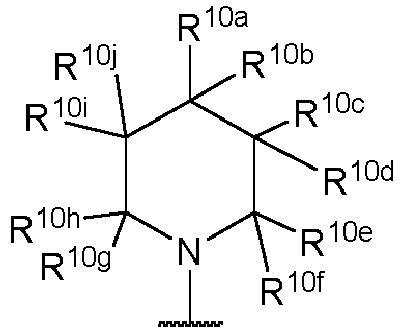 jeder von R10a, R10b, R10c, R10d, R10e, R10f, R10g, R10h, R10i und R10j H, Halogen, R10k oder R10l ist;oder alternativ jeder von dem Paar R10a und R10b, dem Paar R10c und R10d, dem Paar R10e und R10f, dem Paar R10g und R10h oder dem Paar R10i und R10j sich unabhängig mit dem an jedem von ihnen befestigten Kohlenstoffatom verbinden kann, sodass sich an dem Rx-Ring ein gesättigter oder teilweise gesättigter 3-, 4-, 5-, 6-gliedriger monocyclischer Spiroring bildet; wobei der 3-, 4-, 5-, 6-gliedrige monocyclische Ring 0, 1, 2 oder 3 N-Atome und 0, 1 oder 2 aus O und S ausgewählte Atome enthält, und wobei ferner der 3-, 4-, 5-, 6-gliedrige monocyclische Ring mit 0, 1, 2 oder 3 Gruppe(n), ausgewählt aus F, CI, Br, C1-6-Alkyl, C1-4-Halogenalkyl, -ORa, -OC1-4-Halogenalkyl, CN, -NRaRa oder Oxo, substituiert ist;R11 H oder C1-8-Alkyl ist;R12 H, R12a oder R12b ist;R13 R13a oder R13b ist;R6a, R10k, R12a und R13a unabhängig in jedem Fall aus der Gruppe ausgewählt sind, die aus einem gesättigten, teilweise gesättigten oder ungesättigten 3-, 4-, 5-, 6- oder 7-gliedrigen monocyclischen oder 4-, 5-, 6-, 7-, 8-, 9-, 10-, 11- oder 12-gliedrigen bicyclischen Ring, enthaltend 0, 1, 2 oder 3 N-Atome und 0, 1 oder 2 aus O und S ausgewählte Atome, der mit 0, 1, 2 oder 3 Gruppe(n), ausgewählt aus F, Cl, Br, C1-6-Alkyl, C1-4-Halogenalkyl, -ORa, -OC1-4-Halogenalkyl, CN, -C(=O)Rb, -C(=O)ORa, -C(=O)NRaRa, -C(=NRa)NRaRa, -OC(=O)Rb, -OC(=O)NRaRa, -OC2-6-Alkyl-NRaRa, -OC2-6-Alkyl-ORa, -SRa, -S(=O)Rb, -S(=O)2Rb, -S(=O)2NRaRa, -NRaRa, -N(Ra)C(=O)Rb, -N(Ra)C(=O)ORb, -N(Ra)C(=O)NRaRa, -N(Ra)C(=NRa)NRaRa, -N(Ra)S(=O)2Rb, -N(Ra)S(=O)2NRaRa, -NRaC2-6-Alkyl-NRaRa, -NRaC2-6-Alkyl-ORa, -C1-6-Alkyl-NRaRa, -C1-6-Alkyl-ORa, -C1-6-Alkyl-N(Ra)C(=O)Rb, -C1-6-Alkyl-OC(=O)Rb, -C1-6-Alkyl-C(=O)NRaRa, -C1-6-Alkyl-C(=O)ORa, R14 und Oxo, substituiert ist, besteht;R10l, R12b und R13b unabhängig in jedem Fall aus der Gruppe ausgewählt sind, die aus C1-6-Alkyl, substituiert mit 0, 1, 2, 3, 4 oder 5 Gruppe(n), ausgewählt aus F, Cl, Br, -C(=O)ORa, -ORa, -C1-2-Halogenalkyl, -OC1-4-Halogenalkyl, CN, NH2, NH(CH3) oder N(CH3)2, besteht;R14 unabhängig in jedem Fall aus der Gruppe ausgewählt ist, die aus einem gesättigten, teilweise gesättigten oder ungesättigten 3-, 4-, 5-, 6- oder 7-gliedrigen monocyclischen oder 4-, 5-, 6-, 7-, 8-, 9-, 10-, 11- oder 12-gliedrigen bicyclischen Ring, enthaltend 0, 1, 2 oder 3 N-Atome und 0, 1 oder 2 aus O und S ausgewählte Atome, der mit 0, 1, 2 oder 3 Gruppe(n), ausgewählt aus F, Cl, Br, C1-6-Alkyl, C1-4-Halogenalkyl, -ORa, -OC1-4-Halogenalkyl, CN, -C(=O)Rb, -C(=O)ORa, -C(=O)NRaRa, -C(=NRa)NRaRa, -OC(=O)Rb, -OC(=O)NRaRa, -OC2-6-Alkyl-NRaRa, -OC2-6-Alkyl-ORa, -SRa, -S(=O)Rb, -S(=O)2Rb, -S(=O)2NRaRa, -NRaRa, -N(Ra)C(=O)Rb, -N(Ra)C(=O)ORb, -N(Ra)C(=O)NRaRa, -N(Ra)C(=NRa)NRaRa, -N(Ra)S(=O)2Rb, -N(Ra)S(=O)2NRaRa, -NRaC2-6-Alkyl-NRaRa, -NRaC2-6-Alkyl-ORa, -C1-6-Alkyl-NRaRa, -C1-6-Alkyl-ORa, -C1-6-Alkyl-N(Ra)C(=O)Rb, -C1-6-Alkyl-OC(=O)Rb, -C1-6-Alkyl-C(=O)NRaRa, -C1-6-Alkyl-C(=O)ORa und Oxo, substituiert ist, besteht;Ra unabhängig in jedem Fall H oder Rb ist; undRb unabhängig in jedem Fall C1-6-Alkyl, Phenyl oder Benzyl ist, wobei das C1-6-Alkyl mit 0, 1, 2 oder 3 Substituenten, ausgewählt aus Halogen, -OH, -OC1-4-Alkyl, -NH2, -NHC1-4-Alkyl, -OC(=O)C1-4-Alkyl oder-N(C1-4-Alkyl)C1-4-Alkyl, substituiert ist; und das Phenyl oder Benzyl mit 0, 1, 2 oder 3 Substituenten, ausgewählt aus Halogen, C1-4-Alkyl, C1-3-Halogenalkyl, -OH, -OC1-4-Alkyl, -NH2, -NHC1-4-Alkyl, -OC(=O)C1-4-Alkyl oder -N(C1-4-Alkyl)C1-4-Alkyl, substituiert ist.
 - Verbindung gemäß Anspruch 1, wobei Rx

- Verbindung gemäß einem der Ansprüche 1-2, wobei:X1 -CR6 ist; aufweisend die Formel (la):
 X1 N ist; aufweisend die Formel (Ib):
- Verbindung gemäß einem der Ansprüche 1-3, wobei R3 H oder Methyl ist.
- Verbindung gemäß einem der Ansprüche 1-4, wobei jeder von R10c, R10d, R10e, R10f, R10g, R10h, R10i und R10j H, Halogen, C1-6-Alkyl oder C1-4-Halogenalkyl ist; und jeder von dem Paar R10a und R10b sich mit dem an jedem von ihnen befestigten Kohlenstoffatom verbindet, sodass sich an dem Rx-Ring ein gesättigter 3-, 4- oder 5-gliedriger monocyclischer Spiroring bildet; wobei der Ring 0, 1, 2 oder 3 N-Atome und 0 oder 1 aus O und S ausgewählte Atome enthält; oder
wobei jeder von R10c, R10d, R10e, R10f, R10g, R10h, R10i und R10j H, Methyl oder Ethyl ist; und jeder von dem Paar R10a und R10b sich mit dem an jedem von ihnen befestigten Kohlenstoffatom verbindet, sodass sich an dem Rx-Ring ein Cyclopropyl-, Cyclobutyl- oder Cyclopentyl-Spiroring bildet. - Verbindung gemäß einem der Ansprüche 1-5, wobei Rx aus Folgendem ausgewählt ist:

- Verbindung gemäß einem der Ansprüche 1-6, wobei Rx

- Verbindung gemäß einem der Ansprüche 1-7, wobei Z abwesend, NH-, -NHSO2-(CH2)0-4-, -N(CH3)-SO2-(CH2)0-4-, -NCH3SO2NH, -NHSO2NH-C(=O)-O-, -SO2NH-(CH2)0-4-, -(CH2)0-2-S(=O)(=NH)-, -(CH2)0-2-S-,-(CH2)0-2-S(=O)-, (CH3CH)-S(=O)-, -(CH2)0-2-SO2-, -O-, -P(=O), -(C=O)- oder -NH(C=O) ist.
- Verbindung gemäß einem der Ansprüche 1-8, wobeiR1 die Gruppe -Z-R12 ist, die -N=S(=O)-(R12)2 ist, wobei das Paar von zwei R12 sich alternativ mit dem an jedem von ihnen befestigten Schwefelatom verbinden kann, sodass sich ein gesättigter oder teilweise gesättigter 3-, 4-, 5- oder 6-gliedriger monocyclischer Ring, enthaltend 0, 1, 2 oder 3 N-Atome und 0, 1 oder 2 aus O und S ausgewählte Atome, bildet; der aus Folgendem ausgewählt ist:
 R1 -Z-R12 ist, wobei Z abwesend, NH-, -NHSO2-(CH2)0-4-, -N(CH3)-SO2-(CH2)0-4-, -NCH3SO2NH, -NHSO2NH-C(=O)-O-, -SO2NH-(CH2)0-4-, -(CH2)0-2-S(=O)(=NH)-, -(CH2)0-2-S-, -(CH2)0-2-S(=O)-, (CH3CH)-S(=O)-, -(CH2)0-2-SO2-, -O-, -P(=O), -(C=O)- oder -NH(C=O) ist; und R12 aus Folgendem ausgewählt ist:(a) H;(b) Cyclopropyl, Cyclobutyl, Cyclopentyl, Cyclohexyl, Oxiranyl, Oxetanyl, Tetrahydrofuranyl, Azetidinyl, Imidazolyl, Morpholinyl, Pyrrolidinyl, Piperazinyl,
 (c) C1-6-Alkyl, substituiert mit 0, 1, 2 oder 3 OH, F, -C(=O)OCH3, -NH2, -NH(CH3) oder -N(CH3)2; oderR1 eine Gruppe -Z-R12 ist, wobei Z -NHSO2- oder-SO2NH- ist; und R12 Oxetanyl, Cyclopropyl ist oder R12 C1-6-Alkyl, substituiert mit 0, 1, 2 oder 3 OH-Gruppe(n) ist; oder R1 eine Gruppe -Z-R12 ist, wobei Z -NHSO2- ist und R12 -CH2-CH2-OH ist.
 - Verbindung gemäß einem der Ansprüche 1-3, 4-5 oder 6-9,wobei R2 Halogen oder eine Gruppe -Y-R13 ist, wobei Y abwesend, -SO2NH-(CH2)0-4-, NH-, -NH-SO2-(CH)2)0-4-, -O-(CH2)0-4, -O-(CH(CH3))-, -(CH2)0-4-S(=O)(=NH)-, -(C=O)-, -(CH2)0-4-(C=O)-O- oder -(CH2)1-4 ist;R13 ein ungesättigter, teilweise gesättigter oder ungesättigter 3-, 4-, 5-, 6- oder 7-gliedriger monocyclischer oder 8-, 9-, 10-, 11 - oder 12-gliedriger bicyclischer Ring, enthaltend 0, 1, 2 oder 3 N-Atome und 0 oder 1 aus O und S ausgewählte Atome, ist, der mit 0, 1, 2 oder 3 Gruppe(n), ausgewählt aus F, Cl, Br, C1-6-Alkyl, C1-4-Halogenalkyl, -OH, -OC1-4-Halogenalkyl, CN, R14 und Oxo, substituiert ist; oder;R13 C1-6-Alkyl ist, das mit 0, 1, 2, 3, 4 oder 5 Gruppe(n), ausgewählt aus F, Cl, Br, -OH, -OC1-4-Halogenalkyl oder CN, substituiert ist; oderwobei R2 ein gesättigter 5- oder 6-gliedriger monocyclischer Ring ist, wobei jeder Ring 0, 1 oder 2 N-Atome und 0 oder 1 O-Atom(e) enthält, und wobei jeder Ring mit 0, 1, 2 oder 3 Gruppe(n), ausgewählt aus F, Cl, Br, C1-6-Alkyl, C1-4-Halogenalkyl, -OH, -OCH3, -OC1-4-Halogenalkyl, CN, R14 und Oxo, substituiert ist; oderwobei R2 Folgendes ist:(a) F, Br;(b) eine Gruppe -Y-R13, wobei Y abwesend ist; und R13 Morpholinyl, Piperidinyl, Azetidinyl, Pyrrolidinyl, Cyclopropyl, Cyclobutyl, Cyclopentyl, Cyclohexyl, Piperazinyl, Tetrahydrofuranyl, Tetrahydropyranyl, Pyridinyl, Pyrimidinyl, 3,6-Dihydro-2H-pyranyl,


wobei jeder Ring mit 0, 1, 2 oder 3 Gruppe(n), ausgewählt aus F, Cl, Br, Methyl, CF3, CH2OH, CH(CH3)OH, C(CH3)2OH, -OH, -OCHF2, CN, Oxo oder Cyclopropyl, substituiert ist; oder(c) eine Gruppe -Y-R13, wobei Y abwesend, -SO2NH-, NH, -O-, S(=O)(=NH)-, -O-(CH2), -O-(CH(CH3))-, C(=O)-, C(=O)-O-, -CH2C(=O)-O- oder-CH2- ist; und wobei R13
oder R13 H oder C1-6-Alkyl, das mit 0, 1, 2, 3, 4 oder 5 Gruppe(n), ausgewählt aus F, Cl, Br, Methyl, CF3, -OH oder CN, substituiert ist, ist; oderwobei R2 Folgendes ist: (a) Halogen; (b) eine Gruppe -Y-R13, wobei Y abwesend ist; und R13 Morpholinyl, Piperidinyl, Azetidinyl, Pyrrolidinyl, Cyclopropyl, Cyclobutyl, Cyclopentyl, Cyclohexyl, Piperazinyl, Tetrahydrofuranyl,


 wobei jeder Ring mit 0, 1, 2 oder 3 Gruppe(n), ausgewählt aus F, Cl, Br, Methyl, CF3, -OH, -OCHF2, CN und Oxo, substituiert ist; oder (c) eine Gruppe -Y-R13, wobei Y NH, -O-, -O-(CH2)-, -O-(CH2)-(CH2)- oder -O-(CH2)-(CH2)-(CH2)- ist, und wobei R13
 wobei R2
 wobei R2 Morpholinyl oder Piperidinyl ist, das mit 0, 1, 2 oder 3 Gruppe(n), ausgewählt aus F, Cl, Br, Methyl, CF3, -OH, -OCHF2, CN oder Oxo, substituiert ist; oderwobei R2 Morpholinyl ist, das mit 1, 2 oder 3 Methylgruppe(n) substituiert ist.
 - Verbindung gemäß einem der Ansprüche 1-10,wobei R4 aus H, F, Methyl, CN oder Br ausgewählt ist; oderwobei R4 H ist.
- Verbindung gemäß einem der Ansprüche 1-11,
wobei R5 H ist. - Verbindung gemäß einem der Ansprüche 1-12,
wobei R6 H, Methyl, Cyclopropyl, CN, CF3 oder Azetidinyl ist. - Verbindung gemäß einem der Ansprüche 1-13,
wobei R7 H ist. - Verbindung gemäß einem der Ansprüche 1-14,
wobei R8 H oder F ist. - Verbindung gemäß einem der Ansprüche 1-15,
wobei R9 H oder F ist. - Verbindung gemäß Anspruch 1, ausgewählt aus der Gruppe:
Bsp. Nr. chemische Struktur Bezeichnung 1 
4-(N-(2-Hydroxyethyl)sulfamoyl)-2-(6-azaspiro[2.5]octan-6-yl)-N-(6-(3,3,3-trifluorpropoxy)pyridin-2-yl)benzamid 1-1 
(R)-4-(N-(2-Hydroxyethyl)sulfamoyl)-N-(6-(2-methylmorpholino)pyridin-2-yl)-2-(6-azaspiro[2.5]octan-6-yl)benzamid 1-2 
N-(6-(4,4-Difluorpiperidin-1-yl)-4-methylpyridin-2-yl)-4-(N-(2-hydroxyethyl)sulfamoyl)-2-(6-azaspiro[2.5]octan-6-yl)benzamid 2 
(R)-4-(Isopropylsulfonyl)-N-(6-(2-methylmorpholino)pyridin-2-yl)-2-(6-azaspiro[2.5]octan-6-yl)benzamid 2-7 
(R)-4-((2-Hydroxyethyl)sulfonyl)-N-(4-methyl-6-(2-methylmorpholino)pyridin-2-yl)-2-(6-azaspiro[2.5]octan-6-yl)benzamid 3 
(R)-N-(6-(3-Hydroxypiperidin-1-yl)pyridin-2-yl)-4-((1-methylcyclopropan)-1-sulfonamido)-2-(6-azaspiro[2.5]octan-6-yl)benzamid 4 
(R)-N-(6-(3-Hydroxypiperidin-1-yl)pyridin-2-yl)-4-((methylsulfonyl)methyl)-2-(6-azaspiro[2.5]octan-6-yl)benzamid 5 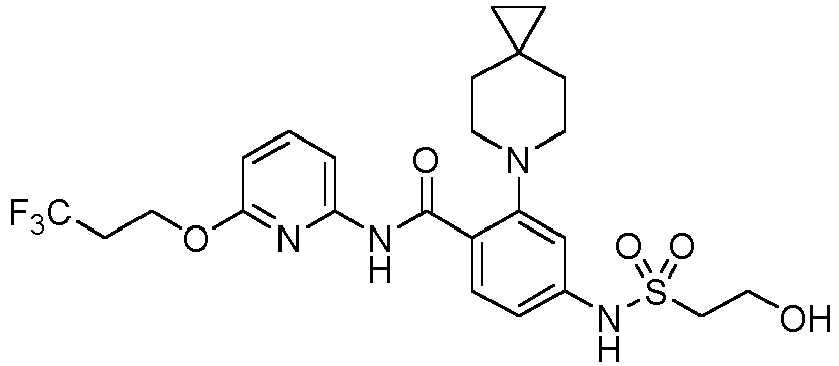
4-((2-Hydroxyethyl)sulfonamido)-2-(6-azaspiro[2.5]octan-6-yl)-N-(6-(3,3,3-trifluorpropoxy)pyridin-2-yl)benzamid 6 
N-(6-(4,4-Difluorpiperidin-1-yl)-4-methylpyridin-2-yl)-4-((2-hydroxyethyl)sulfonamido)-2-(6-azaspiro[2.5]octan-6-yl)benzamid 7-1 
N-(6-(3,3-Difluorcyclobutyl)-4-methylpyridin-2-yl)-4-((2-hydroxyethyl)sulfonamido)-2-(6-azaspiro[2.5]octan-6-yl)benzamid 7-12 
(R)-4-((2-Hydroxyethyl)sulfonamido)-N-(6-(2-methylmorpholino)pyridin-2-yl)-2-(6-azaspiro[2.5]octan-6-yl)benzamid 7-33 
N-(6-(3,3-Difluorazetidin-1-yl)-4-methylpyridin-2-yl)-4-((2-hydroxyethyl)sulfonamido)-2-(6-azaspiro[2.5]octan-6-yl)benzamid 7-44 
N-(6-(4,4-Difluorpiperidin-1-yl)pyrazin-2-yl)-4-((2-hydroxyethyl)sulfonamido)-2-(6-azaspiro[2.5]octan-6-yl)benzamid 8-1 
(R)-4-((2-Hydroxy-1-methylethyl)sulfonamido)-2-(6-azaspiro[2.5]octan-6-yl)-N-(6-(3,3,3-trifluorpropoxy)pyridin-2-yl)benzamid 8-2 
(S)-4-((2-Hydroxy-1-methylethyl)sulfonamido)-2-(6-azaspiro[2.5]octan-6-yl)-N-(6-(3,3,3-trifluorpropoxy)pyridin-2-yl)benzamid 9-7 
(S)-N-(6-(4,4-Difluorpiperidin-1-yl)-4-methylpyridin-2-yl)-4-((2-hydroxy-1-methylethyl)sulfonamido)-2-(6-azaspiro[2.5]octan-6-yl)benzamid 9-8 
(R)-N-(6-(4,4-Difluorpiperidin-1-yl)-4-methylpyridin-2-yl)-4-((2-hydroxy-1-methylethyl)sulfonamido)-2-(6-azaspiro[2.5]octan-6-yl)benzamid 10 
N-(6-(4,4-Difluorpiperidin-1-yl)-4-methylpyridin-2-yl)-4-((1- (hydroxymethyl)cyclopropan)-1-sulfonamido)-2-(6-azaspiro[2.5]octan-6-yl)benzamid 11 
N-(6-(3,3-Difluorazetidin-1-yl)-4-methylpyridin-2-yl)-4-((2-hydroxyethyl)sulfonamido)-2-(6-azaspiro[2.5]octan-6-yl)benzamid 14 
N-(6-(Cyclopropylmethoxy)pyridin-2-yl)-4-((1-methylcyclopropan)-1-sulfonamido)-2-(6-azaspiro[2.5]octan-6-yl)benzamid 16 
N-(6-(2-Hydroxy-2-methylpropoxy)-4-methylpyridin-2-yl)-4-((2-hydroxyethyl)sulfonamido)-2-(6-azaspiro[2.5]octan-6-yl)benzamid 17 
4-((2-Hydroxyethyl)sulfonamido)-N-(4-methyl-6-(3,3,3-trifluorpropoxy)pyridin-2-yl)-2-(6-azaspiro[2.5]octan-6-yl)benzamid 21 
N-(5-Cyan-6-(4,4-difluorpiperidin-1-yl)pyridin-2-yl)-4-((2-hydroxyethyl)sulfonamido)-2-(6-azaspiro[2.5]octan-6-yl)benzamid 22 
N-(6-(4,4-Difluorpiperidin-1-yl)-5-methylpyridin-2-yl)-4-((2-hydroxyethyl)sulfonamido)-2-(6-azaspiro[2.5]octan-6-yl)benzamid 23 
N-(6-(4,4-Difluorcyclohexyl)-4-methylpyridin-2-yl)-4-((2-hydroxyethyl)sulfonamido)-2-(6-azaspiro[2.5]octan-6-yl)benzamid 24 
(R)-N-(5-Fluor-6-(2-methylmorpholino)pyridin-2-yl)-4-((2-hydroxyethyl)sulfonamido)-2-(6-azaspiro[2.5]octan-6-yl)benzamid 25 
(R)-N-(4-Cyan-6-(2-methylmorpholino)pyridin-2-yl)-4-((2-hydroxyethyl)sulfonamido)-2-(6-azaspiro[2.5]octan-6-yl)benzamid 27-1 
2-(6-Azaspiro[2.5]octan-6-yl)-4-(S-cyclopropylsulfonimidoyl)-N-(6-(3,3,3-trifluorpropoxy)-2-pyridinyl)benzamid 27-2 
2-(6-Azaspiro[2.5]octan-6-yl)-4-(R-cyclopropylsulfonimidoyl)-N-(6-(3,3,3-trifluorpropoxy)-2-pyridinyl)benzamid - Verbindung gemäß einem der Ansprüche 1-17 zur Verwendung als Medikament.
- Eine pharmazeutische Zusammensetzung, beinhaltend die Verbindung gemäß einem der Ansprüche 1-17 oder das pharmazeutisch akzeptable Salz davon und ein pharmazeutisch akzeptables Verdünnungsmittel oder Trägermittel.
- Verbindung gemäß einem der Ansprüche 1-17 oder die Verbindung beinhaltende Zusammensetzung gemäß Anspruch 19 zur Verwendung in einem Verfahren zum Behandeln einer Erkrankung, die mit KIF18a-Hemmern behandelt werden kann, wobei das Verfahren das Verabreichen einer therapeutisch wirksamen Menge der Verbindung an einen Patienten, der dessen bedarf, beinhaltet;
wobei die Erkrankung Krebs ist, ausgewählt aus der Gruppe, die aus Folgendem besteht: (a) einem soliden oder hämatologisch-stämmigen Tumor, ausgewählt aus Krebs der Blase, des Endometriums, des Lungenplattenepithels, der Brust, des Dickdarms, der Niere, der Leber, der Lunge, kleinzelligem Lungenkarzinom, der Speiseröhre, der Gallenblase, des Gehirns, des Kopfes und Halses, des Eierstocks, der Bauchspeicheldrüse, des Magens, des Gebärmutterhalses, der Schilddrüse, der Prostata und der Haut, (b) einem hämatopoetischen Tumor der lymphoiden Linie, ausgewählt aus Leukämie, akuter lymphozytischer Leukämie, akuter lymphoblastischer Leukämie, B-Zellen-Lymphom, T-Zellen-Lymphom, Hodgkin-Lymphom, Non-Hodgkin-Lymphom, Haarzelllymphom und Burkitt-Lymphom, (c) einem hämatopoetischen Tumor der myeloischen Linie, ausgewählt aus akuten und chronischen myelogenen Leukämien, myelodysplastischem Syndrom und Promyelozytenleukämie, (d) einem Tumor mesenchymalen Ursprungs, ausgewählt aus Fibrosarkom und Rhabdomyosarkom, (e) einem Tumor des zentralen und peripheren Nervensystems, ausgewählt aus Astrozytom, Neuroblastom, Gliom und Schwannom, oder (f) einem Melanom, Seminom, Teratokarzinom, Osteosarkom, Xeroderma pigmentosum, Keratoakanthom, Schilddrüsenfollikelkrebs oder Kaposi-Sarkom. - Verbindung gemäß einem der Ansprüche 1-17 oder die Verbindung beinhaltende Zusammensetzung gemäß Anspruch 19 zur Verwendung in einem Verfahren zum Reduzieren der Größe eines soliden Tumors bei einem Individuum; oder in einem Verfahren zum Behandeln einer Zellproliferationsstörung bei einem Individuum; oder
in einem Verfahren zum Hemmen von KIF18A in einer Zelle.
Applications Claiming Priority (2)
| Application Number | Priority Date | Filing Date | Title |
|---|---|---|---|
| US201862783069P | 2018-12-20 | 2018-12-20 | |
| PCT/US2019/068172 WO2020132651A1 (en) | 2018-12-20 | 2019-12-20 | Kif18a inhibitors |
Publications (2)
| Publication Number | Publication Date |
|---|---|
| EP3897855A1 EP3897855A1 (de) | 2021-10-27 |
| EP3897855B1 true EP3897855B1 (de) | 2023-06-07 |
Family
ID=69411509
Family Applications (1)
| Application Number | Title | Priority Date | Filing Date |
|---|---|---|---|
| EP19845855.6A Active EP3897855B1 (de) | 2018-12-20 | 2019-12-20 | Kif18a-inhibitoren |
Country Status (9)
| Country | Link |
|---|---|
| US (1) | US12459932B2 (de) |
| EP (1) | EP3897855B1 (de) |
| JP (1) | JP7686559B2 (de) |
| AU (1) | AU2019403488B2 (de) |
| CA (1) | CA3123042A1 (de) |
| ES (1) | ES2953821T3 (de) |
| MA (1) | MA54550A (de) |
| MX (1) | MX2021007104A (de) |
| WO (1) | WO2020132651A1 (de) |
Families Citing this family (52)
| Publication number | Priority date | Publication date | Assignee | Title |
|---|---|---|---|---|
| MA54543A (fr) | 2018-12-20 | 2022-03-30 | Amgen Inc | Inhibiteurs de kif18a |
| JP7686559B2 (ja) | 2018-12-20 | 2025-06-02 | アムジエン・インコーポレーテツド | Kif18a阻害剤 |
| JP2022513967A (ja) | 2018-12-20 | 2022-02-09 | アムジエン・インコーポレーテツド | Kif18a阻害剤として有用なヘテロアリールアミド |
| AU2019401495B2 (en) * | 2018-12-20 | 2025-06-26 | Amgen Inc. | Heteroaryl amides useful as KIF18A inhibitors |
| EP4007638A1 (de) | 2019-08-02 | 2022-06-08 | Amgen Inc. | Pyridinderivate als kif18a-inhibitoren |
| EP4007752B1 (de) * | 2019-08-02 | 2025-09-24 | Amgen Inc. | Kif18a-inhibitoren |
| EP4007753B1 (de) | 2019-08-02 | 2025-09-24 | Amgen Inc. | Kif18a-inhibitoren |
| US20230233565A1 (en) * | 2020-05-11 | 2023-07-27 | University Of Vermont | A treatment approach involving kif18a inhibition for chromosomally unstable tumors |
| US20240059703A1 (en) | 2020-10-20 | 2024-02-22 | Amgen Inc. | Heterocyclic spiro compounds and methods of use |
| WO2022093856A1 (en) | 2020-10-27 | 2022-05-05 | Amgen Inc. | Heterocyclic spiro compounds and methods of use |
| MX2023012725A (es) | 2021-04-29 | 2024-09-23 | Amgen Inc | Compuestos de 2-aminobenzotiazol y metodos de uso de los mismos. |
| US20250214965A1 (en) * | 2021-06-25 | 2025-07-03 | Hangzhou Innogate Pharma Co., Ltd. | Compound as kif18a inhibitor |
| IL310863A (en) | 2021-08-26 | 2024-04-01 | Volastra Therapeutics Inc | Spiro indoline inhibitors of kif18a |
| WO2023041055A1 (zh) * | 2021-09-16 | 2023-03-23 | 微境生物医药科技(上海)有限公司 | Kif18a抑制剂 |
| AU2022389558A1 (en) * | 2021-11-19 | 2024-05-23 | Wigen Biomedicine Technology (shanghai) Co., Ltd. | Kif18a inhibitor |
| EP4479398A1 (de) | 2022-02-16 | 2024-12-25 | Amgen Inc. | Chinazolinverbindungen und ihre verwendung als inhibitoren mutierter kras-proteine |
| MX2024010045A (es) | 2022-02-16 | 2024-08-26 | Amgen Inc | Compuestos de quinazolina y uso de los mismos como inhibidores de proteinas mutantes kras. |
| JP2025508192A (ja) * | 2022-03-17 | 2025-03-21 | ウィゲン・バイオメディシン・テクノロジー・(シャンハイ)・カンパニー・リミテッド | Kif18a阻害剤 |
| TW202400582A (zh) * | 2022-05-13 | 2024-01-01 | 大陸商上海湃隆生物科技有限公司 | 驅動蛋白kif18a抑制劑及其應用 |
| CN116789637B (zh) * | 2022-05-13 | 2024-08-02 | 上海湃隆生物科技有限公司 | 驱动蛋白kif18a抑制剂及其应用 |
| KR20250027560A (ko) * | 2022-06-30 | 2025-02-26 | 쑤저우 젠하우스 바이오 컴퍼니 리미티드 | 질소 함유 화합물 및 이의 용도 |
| WO2024022508A1 (zh) * | 2022-07-29 | 2024-02-01 | 武汉人福创新药物研发中心有限公司 | Kif18a抑制剂及用途 |
| CN117510463A (zh) * | 2022-08-05 | 2024-02-06 | 长春金赛药业有限责任公司 | Kif18a抑制剂化合物、药物组合物及其制备方法和应用 |
| WO2024035950A1 (en) * | 2022-08-12 | 2024-02-15 | Accent Therapeutics, Inc. | Inhibitors of kif18a and uses thereof |
| TW202416973A (zh) | 2022-08-18 | 2024-05-01 | 美商雅客森醫療公司 | Kif18a抑制劑及其用途 |
| KR20250044780A (ko) * | 2022-09-08 | 2025-04-01 | 장춘 진사이언스 파마슈티컬 씨오., 엘티디. | Kif18a 억제제 화합물, 약제학적 조성물 및 이의 제조 방법과 적용 |
| CN119907796A (zh) * | 2022-09-09 | 2025-04-29 | 海南先声再明医药股份有限公司 | 酰胺类化合物、其组合物及用途 |
| CN119072473A (zh) * | 2022-09-30 | 2024-12-03 | 长春金赛药业有限责任公司 | 稠环类kif18a抑制剂化合物、药物组合物及其制备方法和应用 |
| CN119894878A (zh) * | 2022-10-13 | 2025-04-25 | 浙江海正药业股份有限公司 | 芳香酰胺类衍生物及其制备方法和用途 |
| WO2024083208A1 (zh) * | 2022-10-21 | 2024-04-25 | 杭州邦顺制药有限公司 | Kif18a蛋白抑制剂 |
| WO2024099398A1 (zh) * | 2022-11-10 | 2024-05-16 | 南京明德新药研发有限公司 | 一类含并杂环的磺酰胺类化合物及其应用 |
| AU2023382606A1 (en) | 2022-11-14 | 2025-05-08 | Amgen Inc. | Macrocyclic kras inhibitors and methods of use |
| JP2025538601A (ja) * | 2022-11-24 | 2025-11-28 | インベンティスバイオ カンパニー リミテッド | 複素環化合物、その製造方法および用途 |
| WO2024114730A1 (zh) * | 2022-11-30 | 2024-06-06 | 微境生物医药科技(上海)有限公司 | 一种用于癌症治疗的药物组合物 |
| EP4628486A1 (de) * | 2022-12-02 | 2025-10-08 | Shenzhen Zhongge Biological Technology Co., Ltd. | Amid- oder harnstoffverbindung |
| CN120265626A (zh) * | 2022-12-14 | 2025-07-04 | 浙江海正药业股份有限公司 | 芳香酰胺类衍生物、其制备方法和其在医药上的应用 |
| WO2024140799A1 (en) * | 2022-12-28 | 2024-07-04 | Insilico Medicine Ip Limited | Inhibitors of kif18a and uses thereof |
| CN120569373A (zh) * | 2023-01-05 | 2025-08-29 | 浙江海正药业股份有限公司 | 芳香酰胺类衍生物及其制备方法和医药上的用途 |
| CN120548308A (zh) * | 2023-01-20 | 2025-08-26 | 英矽智能科技知识产权有限公司 | Kif18a的抑制剂及其用途 |
| WO2024156288A1 (en) * | 2023-01-29 | 2024-08-02 | Shanghai Kygent Pharmaceutical Co., Ltd | Dnmt1 inhibitors, pharmaceutical compositions, and therapeutic applications |
| WO2024183710A1 (zh) * | 2023-03-06 | 2024-09-12 | 武汉人福创新药物研发中心有限公司 | 抑制kif18a的化合物及其用途 |
| MX2025012140A (es) * | 2023-04-13 | 2026-02-03 | Ideaya Biosciences Inc | Terapia combinada que comprende un inhibidor de mat2a y un inhibidor de la topoisomerasa, un inhibidor del empalme sulfonamida, o un inhibidor de kif18 |
| WO2025067239A1 (zh) * | 2023-09-26 | 2025-04-03 | 上海湃隆生物科技有限公司 | 驱动蛋白kif18a抑制剂及其应用 |
| WO2025194054A1 (en) | 2024-03-14 | 2025-09-18 | Amgen Inc. | Spirocyclic compounds as modulators of kras and uses thereof |
| TW202602882A (zh) | 2024-03-14 | 2026-01-16 | 美商安進公司 | 作為kras調節劑的大環化合物及其用途 |
| WO2025217247A1 (en) | 2024-04-10 | 2025-10-16 | Amgen Inc. | Tethered spiro-heterocyclic inhibitors of kras g12c mutant proteins and uses thereof |
| WO2025230862A1 (en) | 2024-04-29 | 2025-11-06 | Amgen Inc. | Macrocyclic amino compounds as modulators of kras and uses therof |
| WO2025230878A1 (en) | 2024-04-29 | 2025-11-06 | Amgen Inc. | Macrocyclic compounds as modulators of kras and uses thereof |
| WO2025240582A1 (en) | 2024-05-14 | 2025-11-20 | Amgen Inc. | Macrocyclic compounds as modulators of kras and uses thereof |
| WO2025242166A1 (en) * | 2024-05-22 | 2025-11-27 | InventisBio Co., Ltd. | Heterocyclic compounds, preparation methods and uses thereof |
| WO2026055477A1 (en) | 2024-09-06 | 2026-03-12 | Amgen Inc. | Macrocyclic compounds as modulators of kras and uses thereof |
| CN120665073B (zh) * | 2025-08-18 | 2025-10-28 | 山东绿叶制药有限公司 | 作为kif18a抑制剂的化合物及其用途 |
Family Cites Families (173)
| Publication number | Priority date | Publication date | Assignee | Title |
|---|---|---|---|---|
| PT72878B (en) | 1980-04-24 | 1983-03-29 | Merck & Co Inc | Process for preparing mannich-base hydroxamic acid pro-drugs for the improved delivery of non-steroidal anti-inflammatory agents |
| EP0090505B1 (de) | 1982-03-03 | 1990-08-08 | Genentech, Inc. | Menschliches Antithrombin III, DNS Sequenzen dafür, Expressions- und Klonierungsvektoren die solche Sequenzen enthalten und damit transformierte Zellkulturen, Verfahren zur Expression von Menschlichem Antithrombin III und diese enthaltende pharmazeutische Zusammensetzungen |
| GB8827305D0 (en) | 1988-11-23 | 1988-12-29 | British Bio Technology | Compounds |
| PT98990A (pt) | 1990-09-19 | 1992-08-31 | American Home Prod | Processo para a preparacao de esteres de acidos carboxilicos de rapamicina |
| US5892112A (en) | 1990-11-21 | 1999-04-06 | Glycomed Incorporated | Process for preparing synthetic matrix metalloprotease inhibitors |
| US5120842A (en) | 1991-04-01 | 1992-06-09 | American Home Products Corporation | Silyl ethers of rapamycin |
| US5100883A (en) | 1991-04-08 | 1992-03-31 | American Home Products Corporation | Fluorinated esters of rapamycin |
| US5118678A (en) | 1991-04-17 | 1992-06-02 | American Home Products Corporation | Carbamates of rapamycin |
| SG64322A1 (en) | 1991-05-10 | 1999-04-27 | Rhone Poulenc Rorer Int | Bis mono and bicyclic aryl and heteroaryl compounds which inhibit egf and/or pdgf receptor tyrosine kinase |
| US5118677A (en) | 1991-05-20 | 1992-06-02 | American Home Products Corporation | Amide esters of rapamycin |
| NZ243082A (en) | 1991-06-28 | 1995-02-24 | Ici Plc | 4-anilino-quinazoline derivatives; pharmaceutical compositions, preparatory processes, and use thereof |
| US5151413A (en) | 1991-11-06 | 1992-09-29 | American Home Products Corporation | Rapamycin acetals as immunosuppressant and antifungal agents |
| GB9125660D0 (en) | 1991-12-03 | 1992-01-29 | Smithkline Beecham Plc | Novel compound |
| GB9300059D0 (en) | 1992-01-20 | 1993-03-03 | Zeneca Ltd | Quinazoline derivatives |
| US5521184A (en) | 1992-04-03 | 1996-05-28 | Ciba-Geigy Corporation | Pyrimidine derivatives and processes for the preparation thereof |
| ZA935112B (en) | 1992-07-17 | 1994-02-08 | Smithkline Beecham Corp | Rapamycin derivatives |
| ZA935111B (en) | 1992-07-17 | 1994-02-04 | Smithkline Beecham Corp | Rapamycin derivatives |
| US5256790A (en) | 1992-08-13 | 1993-10-26 | American Home Products Corporation | 27-hydroxyrapamycin and derivatives thereof |
| GB9221220D0 (en) | 1992-10-09 | 1992-11-25 | Sandoz Ag | Organic componds |
| US5258389A (en) | 1992-11-09 | 1993-11-02 | Merck & Co., Inc. | O-aryl, O-alkyl, O-alkenyl and O-alkynylrapamycin derivatives |
| WO1994011384A1 (en) | 1992-11-13 | 1994-05-26 | Immunex Corporation | Novel cytokine designated elk ligand |
| US5455258A (en) | 1993-01-06 | 1995-10-03 | Ciba-Geigy Corporation | Arylsulfonamido-substituted hydroxamic acids |
| US5629327A (en) | 1993-03-01 | 1997-05-13 | Childrens Hospital Medical Center Corp. | Methods and compositions for inhibition of angiogenesis |
| US5516658A (en) | 1993-08-20 | 1996-05-14 | Immunex Corporation | DNA encoding cytokines that bind the cell surface receptor hek |
| WO1995009847A1 (en) | 1993-10-01 | 1995-04-13 | Ciba-Geigy Ag | Pyrimidineamine derivatives and processes for the preparation thereof |
| US5656643A (en) | 1993-11-08 | 1997-08-12 | Rhone-Poulenc Rorer Pharmaceuticals Inc. | Bis mono-and bicyclic aryl and heteroaryl compounds which inhibit EGF and/or PDGF receptor tyrosine kinase |
| CA2175215C (en) | 1993-11-19 | 2008-06-03 | Yat Sun Or | Semisynthetic analogs of rapamycin (macrolides) being immunomodulators |
| SK78196A3 (en) | 1993-12-17 | 1997-02-05 | Sandoz Ag | Rapamycin demethoxy-derivatives, preparation method thereof and pharmaceutical agent containing them |
| US5700823A (en) | 1994-01-07 | 1997-12-23 | Sugen, Inc. | Treatment of platelet derived growth factor related disorders such as cancers |
| IL112249A (en) | 1994-01-25 | 2001-11-25 | Warner Lambert Co | Pharmaceutical compositions containing di and tricyclic pyrimidine derivatives for inhibiting tyrosine kinases of the epidermal growth factor receptor family and some new such compounds |
| IL112248A0 (en) | 1994-01-25 | 1995-03-30 | Warner Lambert Co | Tricyclic heteroaromatic compounds and pharmaceutical compositions containing them |
| WO1995024190A2 (en) | 1994-03-07 | 1995-09-14 | Sugen, Inc. | Receptor tyrosine kinase inhibitors for inhibiting cell proliferative disorders and compositions thereof |
| EP0756627A1 (de) | 1994-04-15 | 1997-02-05 | Amgen Inc. | Hek5, hek7, hek8, hek11, neue eph-ähnliche tyrosinkinase-rezeptoren |
| DE59500788D1 (de) | 1994-05-03 | 1997-11-20 | Ciba Geigy Ag | Pyrrolopyrimidinderivate mit antiproliferativer Wirkung |
| US6303769B1 (en) | 1994-07-08 | 2001-10-16 | Immunex Corporation | Lerk-5 dna |
| US5919905A (en) | 1994-10-05 | 1999-07-06 | Immunex Corporation | Cytokine designated LERK-6 |
| US6057124A (en) | 1995-01-27 | 2000-05-02 | Amgen Inc. | Nucleic acids encoding ligands for HEK4 receptors |
| US5863949A (en) | 1995-03-08 | 1999-01-26 | Pfizer Inc | Arylsulfonylamino hydroxamic acid derivatives |
| DE69536015D1 (de) | 1995-03-30 | 2009-12-10 | Pfizer Prod Inc | Chinazolinone Derivate |
| CA2214086C (en) | 1995-04-03 | 2008-07-29 | Novartis Ag | Pyrazole derivatives and processes for the preparation thereof |
| ES2153031T4 (es) | 1995-04-20 | 2001-05-16 | Pfizer | Derivados del acido arilsulfonil hidroxamico como inhibidores de mmp y tnf. |
| GB9508538D0 (en) | 1995-04-27 | 1995-06-14 | Zeneca Ltd | Quinazoline derivatives |
| US5747498A (en) | 1996-05-28 | 1998-05-05 | Pfizer Inc. | Alkynyl and azido-substituted 4-anilinoquinazolines |
| US5880141A (en) | 1995-06-07 | 1999-03-09 | Sugen, Inc. | Benzylidene-Z-indoline compounds for the treatment of disease |
| US5650415A (en) | 1995-06-07 | 1997-07-22 | Sugen, Inc. | Quinoline compounds |
| US5985890A (en) | 1995-06-09 | 1999-11-16 | Novartis Ag | Rapamycin derivatives |
| SI9620103A (sl) | 1995-07-06 | 1998-10-31 | Novartis Ag | Pirolopirimidini in postopki za njihovo pripravo |
| DE19534177A1 (de) | 1995-09-15 | 1997-03-20 | Merck Patent Gmbh | Cyclische Adhäsionsinhibitoren |
| AR004010A1 (es) | 1995-10-11 | 1998-09-30 | Glaxo Group Ltd | Compuestos heterociclicos |
| GB9523675D0 (en) | 1995-11-20 | 1996-01-24 | Celltech Therapeutics Ltd | Chemical compounds |
| ATE225343T1 (de) | 1995-12-20 | 2002-10-15 | Hoffmann La Roche | Matrix-metalloprotease inhibitoren |
| AU1441497A (en) | 1996-01-23 | 1997-08-20 | Novartis Ag | Pyrrolopyrimidines and processes for their preparation |
| JP3406763B2 (ja) | 1996-01-30 | 2003-05-12 | 東レ・ダウコーニング・シリコーン株式会社 | シリコーンゴム組成物 |
| GB9603097D0 (en) | 1996-02-14 | 1996-04-10 | Zeneca Ltd | Quinazoline compounds |
| GB9603095D0 (en) | 1996-02-14 | 1996-04-10 | Zeneca Ltd | Quinazoline derivatives |
| DE19608588A1 (de) | 1996-03-06 | 1997-09-11 | Thomae Gmbh Dr K | Pyrimido [5,4-d]pyrimidine, diese Verbindungen enthaltende Arzneimittel, deren Verwendung und Verfahren zu ihrer Herstellung |
| DE19629652A1 (de) | 1996-03-06 | 1998-01-29 | Thomae Gmbh Dr K | 4-Amino-pyrimidin-Derivate, diese Verbindungen enthaltende Arzneimittel, deren Verwendung und Verfahren zu ihrer Herstellung |
| WO1997034895A1 (de) | 1996-03-15 | 1997-09-25 | Novartis Ag | NEUE N-7 HETEROCYCLYL-PYRROLO[2,3-d]PYRIMIDINE UND IHRE VERWENDUNG |
| EA001595B1 (ru) | 1996-04-12 | 2001-06-25 | Варнер-Ламберт Компани | Необратимые ингибиторы тирозинкиназ |
| GB9607729D0 (en) | 1996-04-13 | 1996-06-19 | Zeneca Ltd | Quinazoline derivatives |
| CA2258548C (en) | 1996-06-24 | 2005-07-26 | Pfizer Inc. | Phenylamino-substituted tricyclic derivatives for treatment of hyperproliferative diseases |
| AU735648B2 (en) | 1996-07-12 | 2001-07-12 | Ariad Pharmaceuticals, Inc. | Materials and method for treating or preventing pathogenic fungal infection |
| EP0818442A3 (de) | 1996-07-12 | 1998-12-30 | Pfizer Inc. | Cyclische Sulphonderivate als Metalloproteinase-Inhibitoren und zur Hemmung der Produktion von Tumornekrosefaktor |
| AR007857A1 (es) | 1996-07-13 | 1999-11-24 | Glaxo Group Ltd | Compuestos heterociclicos fusionados como inhibidores de proteina tirosina quinasa, sus metodos de preparacion, intermediarios uso en medicina ycomposiciones farmaceuticas que los contienen. |
| HRP970371A2 (en) | 1996-07-13 | 1998-08-31 | Kathryn Jane Smith | Heterocyclic compounds |
| EA199900021A1 (ru) | 1996-07-13 | 1999-08-26 | Глаксо, Груп Лимитед | Бициклические гетероароматические соединения в качестве ингибиторов протеинтирозинкиназы |
| KR20000067904A (ko) | 1996-07-18 | 2000-11-25 | 디. 제이. 우드, 스피겔 알렌 제이 | 매트릭스 메탈로프로테아제의 포스피네이트계 억제제 |
| ES2308787T3 (es) | 1996-08-16 | 2008-12-01 | Schering Corporation | Antigenos de superficie de celular de mamiferos; reactivos relacionados. |
| US6111090A (en) | 1996-08-16 | 2000-08-29 | Schering Corporation | Mammalian cell surface antigens; related reagents |
| KR20000068248A (ko) | 1996-08-23 | 2000-11-25 | 디. 제이. 우드, 스피겔 알렌 제이 | 아릴설포닐아미노 하이드록삼산 유도체 |
| WO1998007726A1 (en) | 1996-08-23 | 1998-02-26 | Novartis Ag | Substituted pyrrolopyrimidines and processes for their preparation |
| US6251911B1 (en) | 1996-10-02 | 2001-06-26 | Novartis Ag | Pyrimidine derivatives and processes for the preparation thereof |
| ID18494A (id) | 1996-10-02 | 1998-04-16 | Novartis Ag | Turunan pirazola leburan dan proses pembuatannya |
| AU4779897A (en) | 1996-10-02 | 1998-04-24 | Novartis Ag | Fused pyrazole derivatives and processes for their preparation |
| EP0837063A1 (de) | 1996-10-17 | 1998-04-22 | Pfizer Inc. | 4-Aminoquinazolinderivate |
| GB9621757D0 (en) | 1996-10-18 | 1996-12-11 | Ciba Geigy Ag | Phenyl-substituted bicyclic heterocyclyl derivatives and their use |
| JP3338064B2 (ja) | 1997-01-06 | 2002-10-28 | ファイザー・インク | 環状スルホン誘導体 |
| NZ336840A (en) | 1997-02-03 | 2001-01-26 | Pfizer Prod Inc | Arylsulfonylamino hydroxamic acid derivatives useful in the treatment of tumor necrosis factor and matrix metalloproteinase mediated diseases |
| WO1998033798A2 (en) | 1997-02-05 | 1998-08-06 | Warner Lambert Company | Pyrido[2,3-d]pyrimidines and 4-amino-pyrimidines as inhibitors of cell proliferation |
| JP2000507975A (ja) | 1997-02-07 | 2000-06-27 | ファイザー・インク | N−ヒドロキシ−β−スルホニルプロピオンアミド誘導体類及びそれらのマトリックスメタロプロテイナーゼ阻害薬としての使用 |
| EP0960098A1 (de) | 1997-02-11 | 1999-12-01 | Pfizer Inc. | Arylsulphonyl hydroxamsaurederivate |
| CO4950519A1 (es) | 1997-02-13 | 2000-09-01 | Novartis Ag | Ftalazinas, preparaciones farmaceuticas que las comprenden y proceso para su preparacion |
| US6150395A (en) | 1997-05-30 | 2000-11-21 | The Regents Of The University Of California | Indole-3-carbinol (I3C) derivatives and methods |
| AU8689298A (en) | 1997-08-05 | 1999-03-01 | Sugen, Inc. | Tricyclic quinoxaline derivatives as protein tyrosine kinase inhibitors |
| CA2299355C (en) | 1997-08-08 | 2005-09-27 | Pfizer Products Inc. | Aryloxyarylsulfonylamino hydroxamic acid derivatives |
| JP2001520039A (ja) | 1997-10-21 | 2001-10-30 | ヒューマン ジノーム サイエンシーズ, インコーポレイテッド | ヒト腫瘍壊死因子レセプター様タンパク質、tr11,tr11sv1およびtr11sv2 |
| GB9725782D0 (en) | 1997-12-05 | 1998-02-04 | Pfizer Ltd | Therapeutic agents |
| RS49779B (sr) | 1998-01-12 | 2008-06-05 | Glaxo Group Limited, | Biciklična heteroaromatična jedinjenja kao inhibitori protein tirozin kinaze |
| GB9800575D0 (en) | 1998-01-12 | 1998-03-11 | Glaxo Group Ltd | Heterocyclic compounds |
| GB9801690D0 (en) | 1998-01-27 | 1998-03-25 | Pfizer Ltd | Therapeutic agents |
| AU2591599A (en) | 1998-02-09 | 1999-08-23 | Genentech Inc. | Novel tumor necrosis factor receptor homolog and nucleic acids encoding the same |
| CA2322311C (en) | 1998-03-04 | 2009-10-13 | Bristol-Myers Squibb Company | Heterocyclo-substituted imidazopyrazine protein tyrosine kinase inhibitors |
| PA8469401A1 (es) | 1998-04-10 | 2000-05-24 | Pfizer Prod Inc | Derivados biciclicos del acido hidroxamico |
| PA8469501A1 (es) | 1998-04-10 | 2000-09-29 | Pfizer Prod Inc | Hidroxamidas del acido (4-arilsulfonilamino)-tetrahidropiran-4-carboxilico |
| SK287132B6 (sk) | 1998-05-29 | 2009-12-07 | Sugen, Inc. | Farmaceutická kompozícia obsahujúca pyrolom substituovaný 2-indolinón, súprava obsahujúca uvedenú kompozíciu a použitie pyrolom substituovaného 2-indolinónu |
| UA60365C2 (uk) | 1998-06-04 | 2003-10-15 | Пфайзер Продактс Інк. | Похідні ізотіазолу, спосіб їх одержання, фармацевтична композиція та спосіб лікування гіперпроліферативного захворювання у ссавця |
| CA2336848A1 (en) | 1998-07-10 | 2000-01-20 | Merck & Co., Inc. | Novel angiogenesis inhibitors |
| CA2341409A1 (en) | 1998-08-31 | 2000-03-09 | Merck And Co., Inc. | Novel angiogenesis inhibitors |
| EP1004578B1 (de) | 1998-11-05 | 2004-02-25 | Pfizer Products Inc. | 5-Oxo-pyrrolidine-2-Carbonsäure-Hydroxamidderivate |
| EP1158985B1 (de) | 1999-01-13 | 2011-12-28 | Bayer HealthCare LLC | GAMMA CARBOXYARYLSUBSTITUIERTE DIPHENYLHARNSTOFFVERBINDUNGEN ALS p38 KINASEHEMMER |
| JP2000256358A (ja) | 1999-03-10 | 2000-09-19 | Yamanouchi Pharmaceut Co Ltd | ピラゾール誘導体 |
| CN1660840A (zh) | 1999-03-30 | 2005-08-31 | 诺瓦提斯公司 | 治疗炎性疾病的酞嗪衍生物 |
| GB9912961D0 (en) | 1999-06-03 | 1999-08-04 | Pfizer Ltd | Metalloprotease inhibitors |
| ATE324444T1 (de) | 1999-06-07 | 2006-05-15 | Immunex Corp | Tek-antagonisten |
| US6521424B2 (en) | 1999-06-07 | 2003-02-18 | Immunex Corporation | Recombinant expression of Tek antagonists |
| WO2001003720A2 (en) | 1999-07-12 | 2001-01-18 | Genentech, Inc. | Promotion or inhibition of angiogenesis and cardiovascularization by tumor necrosis factor ligand/receptor homologs |
| ATE264863T1 (de) | 1999-08-24 | 2004-05-15 | Ariad Gene Therapeutics Inc | 28-epirapaloge |
| KR100881105B1 (ko) | 1999-11-05 | 2009-02-02 | 아스트라제네카 아베 | Vegf 억제제로서의 퀴나졸린 유도체 |
| WO2001037820A2 (en) | 1999-11-24 | 2001-05-31 | Sugen, Inc. | Ionizable indolinone derivatives and their use as ptk ligands |
| US6515004B1 (en) | 1999-12-15 | 2003-02-04 | Bristol-Myers Squibb Company | N-[5-[[[5-alkyl-2-oxazolyl]methyl]thio]-2-thiazolyl]-carboxamide inhibitors of cyclin dependent kinases |
| US6727225B2 (en) | 1999-12-20 | 2004-04-27 | Immunex Corporation | TWEAK receptor |
| NZ521437A (en) | 2000-02-25 | 2004-04-30 | Immunex Corp | Integrin antagonists suitable as inhibitors of angiogenesis |
| US6630500B2 (en) | 2000-08-25 | 2003-10-07 | Cephalon, Inc. | Selected fused pyrrolocarbazoles |
| BR0116452A (pt) | 2000-12-21 | 2003-09-30 | Glaxo Group Ltd | Composto, composição farmacêutica, uso de um composto |
| US7102009B2 (en) | 2001-01-12 | 2006-09-05 | Amgen Inc. | Substituted amine derivatives and methods of use |
| US6995162B2 (en) | 2001-01-12 | 2006-02-07 | Amgen Inc. | Substituted alkylamine derivatives and methods of use |
| US7105682B2 (en) | 2001-01-12 | 2006-09-12 | Amgen Inc. | Substituted amine derivatives and methods of use |
| US6878714B2 (en) | 2001-01-12 | 2005-04-12 | Amgen Inc. | Substituted alkylamine derivatives and methods of use |
| US20020147198A1 (en) | 2001-01-12 | 2002-10-10 | Guoqing Chen | Substituted arylamine derivatives and methods of use |
| GB0215676D0 (en) | 2002-07-05 | 2002-08-14 | Novartis Ag | Organic compounds |
| US7307088B2 (en) | 2002-07-09 | 2007-12-11 | Amgen Inc. | Substituted anthranilic amide derivatives and methods of use |
| TWI329112B (en) | 2002-07-19 | 2010-08-21 | Bristol Myers Squibb Co | Novel inhibitors of kinases |
| WO2004039795A2 (en) | 2002-10-29 | 2004-05-13 | Fujisawa Pharmaceutical Co., Ltd. | Amide compounds for the treatment of hyperlipidemia |
| US7618632B2 (en) | 2003-05-23 | 2009-11-17 | Wyeth | Method of treating or ameliorating an immune cell associated pathology using GITR ligand antibodies |
| US20060173033A1 (en) | 2003-07-08 | 2006-08-03 | Michaela Kneissel | Use of rapamycin and rapamycin derivatives for the treatment of bone loss |
| WO2005007190A1 (en) | 2003-07-11 | 2005-01-27 | Schering Corporation | Agonists or antagonists of the clucocorticoid-induced tumour necrosis factor receptor (gitr) or its ligand for the treatment of immune disorders, infections and cancer |
| WO2005016252A2 (en) | 2003-07-11 | 2005-02-24 | Ariad Gene Therapeutics, Inc. | Phosphorus-containing macrocycles |
| AR045134A1 (es) | 2003-07-29 | 2005-10-19 | Smithkline Beecham Plc | Compuesto de 1h - imidazo [4,5-c] piridin-ilo, composicion farmaceutica que lo comprende, proceso para prepararla, su uso para preparar dicha composicion farmaceutica, combinacion farmaceutica, uso de la combinacion farmaceutica para la preparacion de un medicamento, procedimientos para preparar dic |
| WO2005055808A2 (en) | 2003-12-02 | 2005-06-23 | Genzyme Corporation | Compositions and methods to diagnose and treat lung cancer |
| GB0409799D0 (en) | 2004-04-30 | 2004-06-09 | Isis Innovation | Method of generating improved immune response |
| US20060002932A1 (en) | 2004-06-04 | 2006-01-05 | Duke University | Methods and compositions for enhancement of immunity by in vivo depletion of immunosuppressive cell activity |
| DE602005020465D1 (de) | 2004-08-26 | 2010-05-20 | Pfizer | Enantiomerenreine aminoheteroaryl-verbindungen als proteinkinasehemmer |
| EP1799699A1 (de) | 2004-10-13 | 2007-06-27 | Wyeth | 17-hydroxywortmannin-analoga als pi3k-hemmer |
| US7776869B2 (en) | 2004-10-18 | 2010-08-17 | Amgen Inc. | Heteroaryl-substituted alkyne compounds and method of use |
| PT2343320T (pt) | 2005-03-25 | 2018-01-23 | Gitr Inc | Anticorpos anti-gitr e as suas utilizações |
| DK2439273T3 (da) | 2005-05-09 | 2019-06-03 | Ono Pharmaceutical Co | Humane monoklonale antistoffer til programmeret død-1(pd-1) og fremgangsmåder til behandling af cancer ved anvendelse af anti-pd-1- antistoffer alene eller i kombination med andre immunterapeutika |
| GB0510390D0 (en) | 2005-05-20 | 2005-06-29 | Novartis Ag | Organic compounds |
| WO2007011760A2 (en) | 2005-07-15 | 2007-01-25 | Kalypsys, Inc. | Inhibitors of mitotic kinesin |
| KR20080040007A (ko) | 2005-09-20 | 2008-05-07 | 화이자 프로덕츠 인크. | 티로신 키나제 억제제를 이용한 치료의 투여형 및 방법 |
| US20070135435A1 (en) | 2005-11-02 | 2007-06-14 | Xiangping Qian | Certain chemical entities, compositions, and methods |
| WO2007133822A1 (en) | 2006-01-19 | 2007-11-22 | Genzyme Corporation | Gitr antibodies for the treatment of cancer |
| MX2009005950A (es) | 2006-12-07 | 2009-10-12 | Genentech Inc | Compuestos inhibidores de fosfoinositido 3-quinasas y metodos de uso. |
| CA2679659C (en) | 2007-03-01 | 2016-01-19 | Novartis Ag | Pim kinase inhibitors and methods of their use |
| JP5383484B2 (ja) | 2007-04-24 | 2014-01-08 | 塩野義製薬株式会社 | 環式基で置換されたアミノジヒドロチアジン誘導体 |
| US8591886B2 (en) | 2007-07-12 | 2013-11-26 | Gitr, Inc. | Combination therapies employing GITR binding molecules |
| EP2205242B1 (de) | 2007-09-12 | 2015-04-15 | Genentech, Inc. | Kombinationen von phosphoinositid-3-kinase-inhibitor-verbindungen und chemotherapeutischen mitteln und anwendungsverfahren |
| JP5348725B2 (ja) | 2007-10-25 | 2013-11-20 | ジェネンテック, インコーポレイテッド | チエノピリミジン化合物の製造方法 |
| US20100168084A1 (en) | 2008-05-08 | 2010-07-01 | Huber L Julie | Therapeutic compounds and related methods of use |
| NZ590667A (en) | 2008-07-02 | 2013-01-25 | Emergent Product Dev Seattle | Tgf-b antagonist multi-target binding proteins |
| CN102149820B (zh) | 2008-09-12 | 2014-07-23 | 国立大学法人三重大学 | 能够表达外源gitr配体的细胞 |
| KR101790802B1 (ko) | 2009-09-03 | 2017-10-27 | 머크 샤프 앤드 돔 코포레이션 | 항-gitr 항체 |
| GB0919054D0 (en) | 2009-10-30 | 2009-12-16 | Isis Innovation | Treatment of obesity |
| CA2785907A1 (en) | 2009-12-29 | 2011-07-28 | Emergent Product Development Seattle, Llc | Ron binding constructs and methods of use thereof |
| WO2011084985A1 (en) | 2010-01-07 | 2011-07-14 | Boehringer Ingelheim International Gmbh | Cxcr3 receptor antagonists |
| WO2011085261A1 (en) * | 2010-01-08 | 2011-07-14 | Selexagen Therapeutics, Inc. | Hedgehog inhibitors |
| WO2013039954A1 (en) | 2011-09-14 | 2013-03-21 | Sanofi | Anti-gitr antibodies |
| WO2014007228A1 (ja) | 2012-07-03 | 2014-01-09 | 小野薬品工業株式会社 | ソマトスタチン受容体作動活性を有する化合物およびその医薬用途 |
| EP3033091B1 (de) | 2013-08-16 | 2022-09-07 | Versitech Limited | Probiotische zusammensetzung und ihre verwendung zur prävention und behandlung von hepatozellulärem karzinom |
| AU2014347027A1 (en) | 2013-11-06 | 2016-06-23 | Bristol-Myers Squibb Company | GSK -3 inhibitors |
| WO2015143654A1 (en) | 2014-03-26 | 2015-10-01 | Merck Sharp & Dohme Corp. | TrkA KINASE INHIBITORS,COMPOSITIONS AND METHODS THEREOF |
| JP6759514B2 (ja) | 2014-08-01 | 2020-09-23 | ヌエヴォリューション・アクティーゼルスカブNuevolution A/S | ブロモドメインに対して活性な化合物 |
| ES2878078T3 (es) | 2016-11-28 | 2021-11-18 | Bristol Myers Squibb Co | Inhibidores de GSK-3 |
| CA3068305A1 (en) | 2017-06-29 | 2019-01-03 | Rigel Pharmaceuticals, Inc. | Kinase inhibitors and methods for making and using |
| US20200339591A1 (en) | 2017-12-21 | 2020-10-29 | Gliapharm Sa | Compositions and methods of treatment for neurological disorders comprising a dementia |
| EP3755703B1 (de) | 2018-02-20 | 2022-05-04 | Incyte Corporation | N-(phenyl)-2-(phenyl)pyrimidin-4-carboxamid-derivate und verwandte verbindungen als hpk1 inhibitoren zur behandlung von krebs |
| WO2020006075A1 (en) | 2018-06-26 | 2020-01-02 | The Johns Hopkins University | Positron emission tomography (pet) radiotracers for imaging macrophage colony-stimulating factor 1 receptor (csf1r) in neuroinflammation |
| US12344595B2 (en) | 2018-11-02 | 2025-07-01 | Merck Sharp & Dohme Llc | 2-amino-n-phenyl-nicotinamides as NAV1.8 inhibitors |
| JP7288051B2 (ja) | 2018-11-02 | 2023-06-06 | メルク・シャープ・アンド・ドーム・エルエルシー | Nav1.8阻害薬としての2-アミノ-N-ヘテロアリール-ニコチンアミド類 |
| AU2019401495B2 (en) | 2018-12-20 | 2025-06-26 | Amgen Inc. | Heteroaryl amides useful as KIF18A inhibitors |
| JP2022513967A (ja) | 2018-12-20 | 2022-02-09 | アムジエン・インコーポレーテツド | Kif18a阻害剤として有用なヘテロアリールアミド |
| MA54543A (fr) | 2018-12-20 | 2022-03-30 | Amgen Inc | Inhibiteurs de kif18a |
| JP7686559B2 (ja) | 2018-12-20 | 2025-06-02 | アムジエン・インコーポレーテツド | Kif18a阻害剤 |
| MX2022012992A (es) * | 2020-04-14 | 2022-11-08 | Amgen Inc | Inhibidores de kif18a para el tratamiento de enfermedades neoplasicas. |
-
2019
- 2019-12-20 JP JP2021534697A patent/JP7686559B2/ja active Active
- 2019-12-20 AU AU2019403488A patent/AU2019403488B2/en active Active
- 2019-12-20 MX MX2021007104A patent/MX2021007104A/es unknown
- 2019-12-20 WO PCT/US2019/068172 patent/WO2020132651A1/en not_active Ceased
- 2019-12-20 US US17/416,411 patent/US12459932B2/en active Active
- 2019-12-20 EP EP19845855.6A patent/EP3897855B1/de active Active
- 2019-12-20 ES ES19845855T patent/ES2953821T3/es active Active
- 2019-12-20 MA MA054550A patent/MA54550A/fr unknown
- 2019-12-20 CA CA3123042A patent/CA3123042A1/en active Pending
Also Published As
| Publication number | Publication date |
|---|---|
| AU2019403488A1 (en) | 2021-06-24 |
| MA54550A (fr) | 2022-03-30 |
| US12459932B2 (en) | 2025-11-04 |
| AU2019403488B2 (en) | 2025-07-24 |
| MX2021007104A (es) | 2021-08-11 |
| CA3123042A1 (en) | 2020-06-25 |
| US20220073504A1 (en) | 2022-03-10 |
| JP7686559B2 (ja) | 2025-06-02 |
| JP2022514268A (ja) | 2022-02-10 |
| EP3897855A1 (de) | 2021-10-27 |
| WO2020132651A1 (en) | 2020-06-25 |
| ES2953821T3 (es) | 2023-11-16 |
Similar Documents
| Publication | Publication Date | Title |
|---|---|---|
| EP3897855B1 (de) | Kif18a-inhibitoren | |
| US12509442B2 (en) | KIF18A inhibitors | |
| EP3898616B1 (de) | Als kif18a-inhibitoren verwendbare heteroarylamide | |
| EP4007752B1 (de) | Kif18a-inhibitoren | |
| EP3898592B1 (de) | Als kif18a-inhibitoren verwendbare heteroarylamide | |
| EP4007753B1 (de) | Kif18a-inhibitoren | |
| EP4007756B1 (de) | Kif18a-inhibitoren |
Legal Events
| Date | Code | Title | Description |
|---|---|---|---|
| STAA | Information on the status of an ep patent application or granted ep patent |
Free format text: STATUS: UNKNOWN |
|
| STAA | Information on the status of an ep patent application or granted ep patent |
Free format text: STATUS: THE INTERNATIONAL PUBLICATION HAS BEEN MADE |
|
| PUAI | Public reference made under article 153(3) epc to a published international application that has entered the european phase |
Free format text: ORIGINAL CODE: 0009012 |
|
| STAA | Information on the status of an ep patent application or granted ep patent |
Free format text: STATUS: REQUEST FOR EXAMINATION WAS MADE |
|
| 17P | Request for examination filed |
Effective date: 20210629 |
|
| AK | Designated contracting states |
Kind code of ref document: A1 Designated state(s): AL AT BE BG CH CY CZ DE DK EE ES FI FR GB GR HR HU IE IS IT LI LT LU LV MC MK MT NL NO PL PT RO RS SE SI SK SM TR |
|
| RAV | Requested validation state of the european patent: fee paid |
Extension state: TN Effective date: 20210629 Extension state: MA Effective date: 20210629 |
|
| GRAP | Despatch of communication of intention to grant a patent |
Free format text: ORIGINAL CODE: EPIDOSNIGR1 |
|
| STAA | Information on the status of an ep patent application or granted ep patent |
Free format text: STATUS: GRANT OF PATENT IS INTENDED |
|
| INTG | Intention to grant announced |
Effective date: 20220812 |
|
| RAP3 | Party data changed (applicant data changed or rights of an application transferred) |
Owner name: AMGEN INC. |
|
| GRAJ | Information related to disapproval of communication of intention to grant by the applicant or resumption of examination proceedings by the epo deleted |
Free format text: ORIGINAL CODE: EPIDOSDIGR1 |
|
| STAA | Information on the status of an ep patent application or granted ep patent |
Free format text: STATUS: REQUEST FOR EXAMINATION WAS MADE |
|
| GRAP | Despatch of communication of intention to grant a patent |
Free format text: ORIGINAL CODE: EPIDOSNIGR1 |
|
| STAA | Information on the status of an ep patent application or granted ep patent |
Free format text: STATUS: GRANT OF PATENT IS INTENDED |
|
| INTC | Intention to grant announced (deleted) | ||
| INTG | Intention to grant announced |
Effective date: 20221216 |
|
| GRAS | Grant fee paid |
Free format text: ORIGINAL CODE: EPIDOSNIGR3 |
|
| GRAA | (expected) grant |
Free format text: ORIGINAL CODE: 0009210 |
|
| STAA | Information on the status of an ep patent application or granted ep patent |
Free format text: STATUS: THE PATENT HAS BEEN GRANTED |
|
| AK | Designated contracting states |
Kind code of ref document: B1 Designated state(s): AL AT BE BG CH CY CZ DE DK EE ES FI FR GB GR HR HU IE IS IT LI LT LU LV MC MK MT NL NO PL PT RO RS SE SI SK SM TR |
|
| REG | Reference to a national code |
Ref country code: GB Ref legal event code: FG4D |
|
| REG | Reference to a national code |
Ref country code: CH Ref legal event code: EP Ref country code: AT Ref legal event code: REF Ref document number: 1573168 Country of ref document: AT Kind code of ref document: T Effective date: 20230615 Ref country code: DE Ref legal event code: R096 Ref document number: 602019030724 Country of ref document: DE |
|
| P01 | Opt-out of the competence of the unified patent court (upc) registered |
Effective date: 20230627 |
|
| REG | Reference to a national code |
Ref country code: LT Ref legal event code: MG9D |
|
| REG | Reference to a national code |
Ref country code: NL Ref legal event code: MP Effective date: 20230607 |
|
| PG25 | Lapsed in a contracting state [announced via postgrant information from national office to epo] |
Ref country code: SE Free format text: LAPSE BECAUSE OF FAILURE TO SUBMIT A TRANSLATION OF THE DESCRIPTION OR TO PAY THE FEE WITHIN THE PRESCRIBED TIME-LIMIT Effective date: 20230607 Ref country code: NO Free format text: LAPSE BECAUSE OF FAILURE TO SUBMIT A TRANSLATION OF THE DESCRIPTION OR TO PAY THE FEE WITHIN THE PRESCRIBED TIME-LIMIT Effective date: 20230907 |
|
| REG | Reference to a national code |
Ref country code: AT Ref legal event code: MK05 Ref document number: 1573168 Country of ref document: AT Kind code of ref document: T Effective date: 20230607 |
|
| REG | Reference to a national code |
Ref country code: ES Ref legal event code: FG2A Ref document number: 2953821 Country of ref document: ES Kind code of ref document: T3 Effective date: 20231116 |
|
| PG25 | Lapsed in a contracting state [announced via postgrant information from national office to epo] |
Ref country code: RS Free format text: LAPSE BECAUSE OF FAILURE TO SUBMIT A TRANSLATION OF THE DESCRIPTION OR TO PAY THE FEE WITHIN THE PRESCRIBED TIME-LIMIT Effective date: 20230607 Ref country code: NL Free format text: LAPSE BECAUSE OF FAILURE TO SUBMIT A TRANSLATION OF THE DESCRIPTION OR TO PAY THE FEE WITHIN THE PRESCRIBED TIME-LIMIT Effective date: 20230607 Ref country code: LV Free format text: LAPSE BECAUSE OF FAILURE TO SUBMIT A TRANSLATION OF THE DESCRIPTION OR TO PAY THE FEE WITHIN THE PRESCRIBED TIME-LIMIT Effective date: 20230607 Ref country code: LT Free format text: LAPSE BECAUSE OF FAILURE TO SUBMIT A TRANSLATION OF THE DESCRIPTION OR TO PAY THE FEE WITHIN THE PRESCRIBED TIME-LIMIT Effective date: 20230607 Ref country code: HR Free format text: LAPSE BECAUSE OF FAILURE TO SUBMIT A TRANSLATION OF THE DESCRIPTION OR TO PAY THE FEE WITHIN THE PRESCRIBED TIME-LIMIT Effective date: 20230607 Ref country code: GR Free format text: LAPSE BECAUSE OF FAILURE TO SUBMIT A TRANSLATION OF THE DESCRIPTION OR TO PAY THE FEE WITHIN THE PRESCRIBED TIME-LIMIT Effective date: 20230908 |
|
| PG25 | Lapsed in a contracting state [announced via postgrant information from national office to epo] |
Ref country code: FI Free format text: LAPSE BECAUSE OF FAILURE TO SUBMIT A TRANSLATION OF THE DESCRIPTION OR TO PAY THE FEE WITHIN THE PRESCRIBED TIME-LIMIT Effective date: 20230607 |
|
| PG25 | Lapsed in a contracting state [announced via postgrant information from national office to epo] |
Ref country code: SK Free format text: LAPSE BECAUSE OF FAILURE TO SUBMIT A TRANSLATION OF THE DESCRIPTION OR TO PAY THE FEE WITHIN THE PRESCRIBED TIME-LIMIT Effective date: 20230607 |
|
| PG25 | Lapsed in a contracting state [announced via postgrant information from national office to epo] |
Ref country code: IS Free format text: LAPSE BECAUSE OF FAILURE TO SUBMIT A TRANSLATION OF THE DESCRIPTION OR TO PAY THE FEE WITHIN THE PRESCRIBED TIME-LIMIT Effective date: 20231007 |
|
| PG25 | Lapsed in a contracting state [announced via postgrant information from national office to epo] |
Ref country code: SM Free format text: LAPSE BECAUSE OF FAILURE TO SUBMIT A TRANSLATION OF THE DESCRIPTION OR TO PAY THE FEE WITHIN THE PRESCRIBED TIME-LIMIT Effective date: 20230607 Ref country code: SK Free format text: LAPSE BECAUSE OF FAILURE TO SUBMIT A TRANSLATION OF THE DESCRIPTION OR TO PAY THE FEE WITHIN THE PRESCRIBED TIME-LIMIT Effective date: 20230607 Ref country code: RO Free format text: LAPSE BECAUSE OF FAILURE TO SUBMIT A TRANSLATION OF THE DESCRIPTION OR TO PAY THE FEE WITHIN THE PRESCRIBED TIME-LIMIT Effective date: 20230607 Ref country code: PT Free format text: LAPSE BECAUSE OF FAILURE TO SUBMIT A TRANSLATION OF THE DESCRIPTION OR TO PAY THE FEE WITHIN THE PRESCRIBED TIME-LIMIT Effective date: 20231009 Ref country code: IS Free format text: LAPSE BECAUSE OF FAILURE TO SUBMIT A TRANSLATION OF THE DESCRIPTION OR TO PAY THE FEE WITHIN THE PRESCRIBED TIME-LIMIT Effective date: 20231007 Ref country code: EE Free format text: LAPSE BECAUSE OF FAILURE TO SUBMIT A TRANSLATION OF THE DESCRIPTION OR TO PAY THE FEE WITHIN THE PRESCRIBED TIME-LIMIT Effective date: 20230607 Ref country code: CZ Free format text: LAPSE BECAUSE OF FAILURE TO SUBMIT A TRANSLATION OF THE DESCRIPTION OR TO PAY THE FEE WITHIN THE PRESCRIBED TIME-LIMIT Effective date: 20230607 Ref country code: AT Free format text: LAPSE BECAUSE OF FAILURE TO SUBMIT A TRANSLATION OF THE DESCRIPTION OR TO PAY THE FEE WITHIN THE PRESCRIBED TIME-LIMIT Effective date: 20230607 |
|
| PG25 | Lapsed in a contracting state [announced via postgrant information from national office to epo] |
Ref country code: PL Free format text: LAPSE BECAUSE OF FAILURE TO SUBMIT A TRANSLATION OF THE DESCRIPTION OR TO PAY THE FEE WITHIN THE PRESCRIBED TIME-LIMIT Effective date: 20230607 |
|
| REG | Reference to a national code |
Ref country code: DE Ref legal event code: R097 Ref document number: 602019030724 Country of ref document: DE |
|
| PLBE | No opposition filed within time limit |
Free format text: ORIGINAL CODE: 0009261 |
|
| STAA | Information on the status of an ep patent application or granted ep patent |
Free format text: STATUS: NO OPPOSITION FILED WITHIN TIME LIMIT |
|
| PG25 | Lapsed in a contracting state [announced via postgrant information from national office to epo] |
Ref country code: DK Free format text: LAPSE BECAUSE OF FAILURE TO SUBMIT A TRANSLATION OF THE DESCRIPTION OR TO PAY THE FEE WITHIN THE PRESCRIBED TIME-LIMIT Effective date: 20230607 |
|
| PG25 | Lapsed in a contracting state [announced via postgrant information from national office to epo] |
Ref country code: SI Free format text: LAPSE BECAUSE OF FAILURE TO SUBMIT A TRANSLATION OF THE DESCRIPTION OR TO PAY THE FEE WITHIN THE PRESCRIBED TIME-LIMIT Effective date: 20230607 |
|
| 26N | No opposition filed |
Effective date: 20240308 |
|
| PG25 | Lapsed in a contracting state [announced via postgrant information from national office to epo] |
Ref country code: SI Free format text: LAPSE BECAUSE OF FAILURE TO SUBMIT A TRANSLATION OF THE DESCRIPTION OR TO PAY THE FEE WITHIN THE PRESCRIBED TIME-LIMIT Effective date: 20230607 |
|
| PG25 | Lapsed in a contracting state [announced via postgrant information from national office to epo] |
Ref country code: LU Free format text: LAPSE BECAUSE OF NON-PAYMENT OF DUE FEES Effective date: 20231220 |
|
| PG25 | Lapsed in a contracting state [announced via postgrant information from national office to epo] |
Ref country code: MC Free format text: LAPSE BECAUSE OF FAILURE TO SUBMIT A TRANSLATION OF THE DESCRIPTION OR TO PAY THE FEE WITHIN THE PRESCRIBED TIME-LIMIT Effective date: 20230607 |
|
| REG | Reference to a national code |
Ref country code: BE Ref legal event code: MM Effective date: 20231231 |
|
| PG25 | Lapsed in a contracting state [announced via postgrant information from national office to epo] |
Ref country code: MC Free format text: LAPSE BECAUSE OF FAILURE TO SUBMIT A TRANSLATION OF THE DESCRIPTION OR TO PAY THE FEE WITHIN THE PRESCRIBED TIME-LIMIT Effective date: 20230607 Ref country code: LU Free format text: LAPSE BECAUSE OF NON-PAYMENT OF DUE FEES Effective date: 20231220 |
|
| REG | Reference to a national code |
Ref country code: IE Ref legal event code: MM4A |
|
| PG25 | Lapsed in a contracting state [announced via postgrant information from national office to epo] |
Ref country code: IE Free format text: LAPSE BECAUSE OF NON-PAYMENT OF DUE FEES Effective date: 20231220 |
|
| PG25 | Lapsed in a contracting state [announced via postgrant information from national office to epo] |
Ref country code: BE Free format text: LAPSE BECAUSE OF NON-PAYMENT OF DUE FEES Effective date: 20231231 |
|
| PG25 | Lapsed in a contracting state [announced via postgrant information from national office to epo] |
Ref country code: IE Free format text: LAPSE BECAUSE OF NON-PAYMENT OF DUE FEES Effective date: 20231220 Ref country code: BE Free format text: LAPSE BECAUSE OF NON-PAYMENT OF DUE FEES Effective date: 20231231 |
|
| PG25 | Lapsed in a contracting state [announced via postgrant information from national office to epo] |
Ref country code: BG Free format text: LAPSE BECAUSE OF FAILURE TO SUBMIT A TRANSLATION OF THE DESCRIPTION OR TO PAY THE FEE WITHIN THE PRESCRIBED TIME-LIMIT Effective date: 20230607 |
|
| PG25 | Lapsed in a contracting state [announced via postgrant information from national office to epo] |
Ref country code: BG Free format text: LAPSE BECAUSE OF FAILURE TO SUBMIT A TRANSLATION OF THE DESCRIPTION OR TO PAY THE FEE WITHIN THE PRESCRIBED TIME-LIMIT Effective date: 20230607 |
|
| PG25 | Lapsed in a contracting state [announced via postgrant information from national office to epo] |
Ref country code: CY Free format text: LAPSE BECAUSE OF FAILURE TO SUBMIT A TRANSLATION OF THE DESCRIPTION OR TO PAY THE FEE WITHIN THE PRESCRIBED TIME-LIMIT; INVALID AB INITIO Effective date: 20191220 |
|
| PG25 | Lapsed in a contracting state [announced via postgrant information from national office to epo] |
Ref country code: HU Free format text: LAPSE BECAUSE OF FAILURE TO SUBMIT A TRANSLATION OF THE DESCRIPTION OR TO PAY THE FEE WITHIN THE PRESCRIBED TIME-LIMIT; INVALID AB INITIO Effective date: 20191220 |
|
| VS25 | Lapsed in a validation state [announced via postgrant information from nat. office to epo] |
Ref country code: MA Free format text: FAILURE TO ELECT DOMICILE IN THE NATIONAL COUNTRY Effective date: 20230908 |
|
| PG25 | Lapsed in a contracting state [announced via postgrant information from national office to epo] |
Ref country code: TR Free format text: LAPSE BECAUSE OF FAILURE TO SUBMIT A TRANSLATION OF THE DESCRIPTION OR TO PAY THE FEE WITHIN THE PRESCRIBED TIME-LIMIT Effective date: 20230607 |
|
| REG | Reference to a national code |
Ref country code: CH Ref legal event code: U11 Free format text: ST27 STATUS EVENT CODE: U-0-0-U10-U11 (AS PROVIDED BY THE NATIONAL OFFICE) Effective date: 20260101 |
|
| PGFP | Annual fee paid to national office [announced via postgrant information from national office to epo] |
Ref country code: DE Payment date: 20251126 Year of fee payment: 7 |
|
| PGFP | Annual fee paid to national office [announced via postgrant information from national office to epo] |
Ref country code: GB Payment date: 20251119 Year of fee payment: 7 |
|
| PGFP | Annual fee paid to national office [announced via postgrant information from national office to epo] |
Ref country code: IT Payment date: 20251119 Year of fee payment: 7 |
|
| PGFP | Annual fee paid to national office [announced via postgrant information from national office to epo] |
Ref country code: FR Payment date: 20251120 Year of fee payment: 7 |
|
| PGFP | Annual fee paid to national office [announced via postgrant information from national office to epo] |
Ref country code: ES Payment date: 20260102 Year of fee payment: 7 |
|
| PGFP | Annual fee paid to national office [announced via postgrant information from national office to epo] |
Ref country code: CH Payment date: 20260101 Year of fee payment: 7 |