EP4008207A1 - Procede et systeme de verification automatisee de la qualite de semelles de chaussures - Google Patents
Procede et systeme de verification automatisee de la qualite de semelles de chaussures Download PDFInfo
- Publication number
- EP4008207A1 EP4008207A1 EP21217801.6A EP21217801A EP4008207A1 EP 4008207 A1 EP4008207 A1 EP 4008207A1 EP 21217801 A EP21217801 A EP 21217801A EP 4008207 A1 EP4008207 A1 EP 4008207A1
- Authority
- EP
- European Patent Office
- Prior art keywords
- shoe sole
- sole
- shoe
- mold
- particles
- Prior art date
- Legal status (The legal status is an assumption and is not a legal conclusion. Google has not performed a legal analysis and makes no representation as to the accuracy of the status listed.)
- Granted
Links
Images


Classifications
-
- B—PERFORMING OPERATIONS; TRANSPORTING
- B29—WORKING OF PLASTICS; WORKING OF SUBSTANCES IN A PLASTIC STATE IN GENERAL
- B29D—PRODUCING PARTICULAR ARTICLES FROM PLASTICS OR FROM SUBSTANCES IN A PLASTIC STATE
- B29D35/00—Producing footwear
- B29D35/12—Producing parts thereof, e.g. soles, heels, uppers, by a moulding technique
- B29D35/14—Multilayered parts
- B29D35/148—Moulds or apparatus therefor
-
- A—HUMAN NECESSITIES
- A43—FOOTWEAR
- A43B—CHARACTERISTIC FEATURES OF FOOTWEAR; PARTS OF FOOTWEAR
- A43B13/00—Soles; Sole-and-heel integral units
-
- A—HUMAN NECESSITIES
- A43—FOOTWEAR
- A43B—CHARACTERISTIC FEATURES OF FOOTWEAR; PARTS OF FOOTWEAR
- A43B13/00—Soles; Sole-and-heel integral units
- A43B13/02—Soles; Sole-and-heel integral units characterised by the material
- A43B13/04—Plastics, rubber or vulcanised fibre
-
- A—HUMAN NECESSITIES
- A43—FOOTWEAR
- A43D—MACHINES, TOOLS, EQUIPMENT OR METHODS FOR MANUFACTURING OR REPAIRING FOOTWEAR
- A43D1/00—Foot or last measuring devices; Measuring devices for shoe parts
- A43D1/08—Measuring devices for shoe parts
-
- A—HUMAN NECESSITIES
- A43—FOOTWEAR
- A43D—MACHINES, TOOLS, EQUIPMENT OR METHODS FOR MANUFACTURING OR REPAIRING FOOTWEAR
- A43D111/00—Shoe machines with conveyors for jacked shoes or for shoes or shoe parts
- A43D111/006—Shoe machines with conveyors for jacked shoes or for shoes or shoe parts with special means to place the shoe or shoe part in the following machine
-
- A—HUMAN NECESSITIES
- A43—FOOTWEAR
- A43D—MACHINES, TOOLS, EQUIPMENT OR METHODS FOR MANUFACTURING OR REPAIRING FOOTWEAR
- A43D117/00—Racks for receiving or transporting shoes or shoe parts; Other conveying means
-
- A—HUMAN NECESSITIES
- A43—FOOTWEAR
- A43D—MACHINES, TOOLS, EQUIPMENT OR METHODS FOR MANUFACTURING OR REPAIRING FOOTWEAR
- A43D999/00—Subject matter not provided for in other groups of this subclass
-
- B—PERFORMING OPERATIONS; TRANSPORTING
- B29—WORKING OF PLASTICS; WORKING OF SUBSTANCES IN A PLASTIC STATE IN GENERAL
- B29D—PRODUCING PARTICULAR ARTICLES FROM PLASTICS OR FROM SUBSTANCES IN A PLASTIC STATE
- B29D35/00—Producing footwear
- B29D35/12—Producing parts thereof, e.g. soles, heels, uppers, by a moulding technique
- B29D35/122—Soles
-
- B—PERFORMING OPERATIONS; TRANSPORTING
- B29—WORKING OF PLASTICS; WORKING OF SUBSTANCES IN A PLASTIC STATE IN GENERAL
- B29D—PRODUCING PARTICULAR ARTICLES FROM PLASTICS OR FROM SUBSTANCES IN A PLASTIC STATE
- B29D35/00—Producing footwear
- B29D35/12—Producing parts thereof, e.g. soles, heels, uppers, by a moulding technique
- B29D35/14—Multilayered parts
- B29D35/142—Soles
-
- A—HUMAN NECESSITIES
- A43—FOOTWEAR
- A43D—MACHINES, TOOLS, EQUIPMENT OR METHODS FOR MANUFACTURING OR REPAIRING FOOTWEAR
- A43D2200/00—Machines or methods characterised by special features
- A43D2200/10—Fully automated machines, i.e. machines working without human intervention
-
- B—PERFORMING OPERATIONS; TRANSPORTING
- B29—WORKING OF PLASTICS; WORKING OF SUBSTANCES IN A PLASTIC STATE IN GENERAL
- B29K—INDEXING SCHEME ASSOCIATED WITH SUBCLASSES B29B, B29C OR B29D, RELATING TO MOULDING MATERIALS OR TO MATERIALS FOR MOULDS, REINFORCEMENTS, FILLERS OR PREFORMED PARTS, e.g. INSERTS
- B29K2075/00—Use of PU, i.e. polyureas or polyurethanes or derivatives thereof, as moulding material
-
- B—PERFORMING OPERATIONS; TRANSPORTING
- B29—WORKING OF PLASTICS; WORKING OF SUBSTANCES IN A PLASTIC STATE IN GENERAL
- B29K—INDEXING SCHEME ASSOCIATED WITH SUBCLASSES B29B, B29C OR B29D, RELATING TO MOULDING MATERIALS OR TO MATERIALS FOR MOULDS, REINFORCEMENTS, FILLERS OR PREFORMED PARTS, e.g. INSERTS
- B29K2105/00—Condition, form or state of moulded material or of the material to be shaped
- B29K2105/04—Condition, form or state of moulded material or of the material to be shaped cellular or porous
- B29K2105/048—Expandable particles, beads or granules
-
- G—PHYSICS
- G01—MEASURING; TESTING
- G01B—MEASURING LENGTH, THICKNESS OR SIMILAR LINEAR DIMENSIONS; MEASURING ANGLES; MEASURING AREAS; MEASURING IRREGULARITIES OF SURFACES OR CONTOURS
- G01B11/00—Measuring arrangements characterised by the use of optical techniques
- G01B11/24—Measuring arrangements characterised by the use of optical techniques for measuring contours or curvatures
- G01B11/25—Measuring arrangements characterised by the use of optical techniques for measuring contours or curvatures by projecting a pattern, e.g. one or more lines, moiré fringes on the object
- G01B11/2518—Projection by scanning of the object
Definitions
- the present invention relates to a method and an apparatus for automatically manufacturing shoe soles. Moreover, the present invention relates to shoe soles and shoes manufactured by such methods and apparatuses.
- One option to avoid or at least reduce the use of such dangerous substances is to provide shoe soles from particles that can be molded together by applying steam.
- Various methods for manufacturing a shoe sole from such particles are known, for example from EP 2 649 896 A2 , WO 2005/066250 A1 , WO 2012/065926 A1 , DE 10 2011 108 744 A1 , and EP 2 984 956 A1 . Further prior art in this regard is disclosed in EP 2 767 181 A1 , WO 2007/082838 A1 WO 2008/087078 A1 .
- EP 2 786 670 A1 a method for manufacturing a part of a shoe sole from particles, wherein the individual steps of the method are carried out at various processing stations of an automated production facility. While the disclosed facility somewhat improves the productivity of the automated manufacture of a shoe sole, the large number of automated manufacturing steps is still costly and difficult to implement.
- the underlying problem of the present invention is to provide improved methods and apparatuses for the automated manufacture of shoe soles from particles in order to at least partly overcome the above mentioned deficiencies of the prior art.
- the method comprises the steps of (a) loading a transfer device with at least one outsole element and at least one supporting element, (b) positioning the loaded transfer device adjacent or even between a first part and a second part of a sole mold, (c) transferring the at least one outsole element from the transfer device to the first part and transferring the at least one supporting element from the transfer device to the second part of the sole mold, (d) filling the sole mold with a plurality of individual particles and (e) applying a medium to bond and / or fuse the particles with each other and with the at least one outsole element.
- the claimed invention provides for the first time a highly efficient and automated method for the manufacture of shoe soles from particles.
- the positioning of the loaded transfer device with the two key elements for the final sole, namely the at least one outsole element and the at least one supporting element, adjacent the first part and the second part of a sole mold significantly simplifies the overall manufacture.
- the two elements no longer need to be manually arranged in the mold for the shoe sole.
- the two elements can be automatically integrated and / or joined to the molded particle sole when in the final step (e) the medium, such as steam, is applied.
- the medium such as steam
- the step of loading the transfer device may comprise the steps of attaching the at least one outsole element to a first side of a transfer device, rotating the transfer device and attaching the at least one supporting element to a second side of the transfer device opposite to the first side.
- Such an attachment of the two elements may further simplify their supply to the first and second part of the mold, in particular, if the transfer device is positioned between the first and the second part of the mold.
- the footprint of the apparatus performing the described method may be reduced as the positioning of both, the outsole element and the support element can be jointly performed by a single transfer device.
- the attaching steps comprise suctioning the at least one outsole element and / or the at least one supporting element.
- a suctioning operation can be largely independent of the variances in product manufacturing tolerances of the individual item and additionally, in the context of shoe manufacture, the difference in dimensions due to the requirement for a range of different shoe sizes. This advantage facilitates the automated production of shoe soles.
- a suctioning operation has the added advantage of improved attachment of flexible components, for example, a shoe outsole particularly when transferring flexible components into an accurately manufactured item, for example, a shoe mold.
- This advantage further facilitates the automated production of shoe soles, in particular, of shoe soles with different sizes.
- the step of transferring the at least one outsole element may comprise placing the at least one outsole element into at least one correspondingly shaped recess provided in the first part of the mold.
- the step of transferring the at least one supporting element may further comprise placing the at least one supporting element in a holding element provided in the second part of the mold.
- the recess and the holding element allow to securely position the two elements for the subsequent molding cycle.
- the steps of (d) filling the mold and (e) applying the medium to bond and / or fuse the particles with each other and with the at least one outsole element lead to a shoe sole with a correctly attached outsole element and a correctly integrated support element, without any adhesives having to be involved.
- the method further comprises the step of ejecting the molded shoe sole from the mold by means of ejecting devices integrated into the holding element for the supporting element.
- the ejecting means may support an automation of the molding process, as the manufactured sole may be automatically ejected after molding for further processing.
- the integration of the ejecting means into the holding element assures that there is apart from the holding element no further interference with the particles in the sole mold. In addition, no further robotic device is needed in this embodiment to remove the sole from the mold.
- the first part and / or the second part may be moved to close the mold prior to the step of filling the sole mold with a plurality of individual particles. Accordingly, after providing the at least one outsole element and the at least one supporting element, the first and the second part of the sole mold may jointly form a closed mold into which the individual particles can be filled. Any loss of particles is therefore reliably avoided. Also the medium used to bond / fuse the particles may not escape, when being applied to the particles.
- the method may further comprise the step of cooling the first part of sole mold when and / or after applying the medium.
- the step of bonding and / or fusing the particles with each other and to the at least one outsole element may require elevated temperatures, for example by using hot steam as a medium.
- elevated temperatures for example by using hot steam as a medium.
- the at least one outsole element is subjected to higher temperatures it may start to deform or even melt, so that fine structures of for example the profile of the outsole element may be distorted or even fully lost.
- This problem can be avoided or at least reduced by cooling the first part of the sole in which the at least one outsole element is placed.
- the cooling may allow to further shorten the overall cycle time so that in the end an even more efficient production of shoe soles maybe achieved.
- the method may further comprise the steps of removing the formed shoe soles and curing the formed shoe soles under the influence of heat.
- the curing may be provided outside the mold which is advantageous as the time for curing may take significantly longer than the time for molding the shoe soles. A new molding cycle can therefore start long before the curing step is finished.
- the medium comprises steam.
- steam is not expensive, relatively easy to handle and provides the necessary temperature for the bonding and / or fusing process of certain types of particles among each other and with the outsole and / or the support element.
- a further aspect of the invention is directed to an apparatus for automatically manufacturing shoe soles.
- the apparatus comprises a transfer device adapted to be loaded with at least one outsole element and at least one supporting element, a robotic device adapted to position the loaded transfer device adjacent or even between a first part and a second part of a sole mold, wherein the robotic device is further adapted to transfer the at least one outsole element from the transfer device to the first part and to transfer the at least one supporting element from the transfer device to the second part of the sole mold, a particle supply adapted to fill the sole mold with a plurality of individual particles and a medium supply, the medium being adapted to bond and / or fuse the particles with each other and with the at least one outsole element.
- the apparatus comprises a first and a second part of the sole mold, wherein the two parts are movable by means of at least one linear guiding rod.
- a linear closing movement of the two parts may be performed with comparatively high speed as the at least one guiding rod provides a high amount of directional stability.
- the present invention is directed to a shoe sole manufactured by one of the above summarized methods and / or apparatuses and to a shoe comprising such a sole.
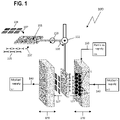
- Fig. 1 presents a schematic view of an embodiment of a manufacturing apparatus 100 according to the invention for automatically manufacturing shoe soles, for example for a sport shoe. In the following, the operation of the apparatus 100 will be described.
- the process starts with loading 107 a transfer plate 105 with at least one outsole element 110 and at least one supporting element 115.
- a transfer plate 105 with at least one outsole element 110 and at least one supporting element 115.
- an exemplary number of six pieces of each element 110 and 115 are loaded onto the transfer plate 105.
- the geometry for arranging the elements 110 and 115 onto the transfer plate 105 maybe selected freely depending on the available space.
- the loading step 107 may be executed manually by workers and / or automatically by machines, e.g. robots.
- the step of loading 107 the transfer device 105 comprises the step of attaching the outsole elements 110 to a first side of the transfer plate 105, rotating 150 the transfer plate 105 by means of a robot arm 122 and attaching the supporting elements to a second side of the transfer plate 105 opposite to the first side.
- the footprint of the apparatus 100 may be reduced as only a single transfer plate 105 is needed for the loading 107 of two types of elements for a plurality of shoe soles to be molded.
- the transfer may be performed not by the transfer plate 105 but by a more complex transfer object, e.g. a cube with six adjacent sides, in order to increase the number of outsole and / or supporting elements that can be transferred to the sole molds in a single movement.
- a more complex transfer object e.g. a cube with six adjacent sides
- the attaching step may further comprise that the transfer plate 105 is adapted to suction the outsole elements 110 and / or the supporting elements 115.
- a suctioning operation can be largely independent of the variances in product manufacturing tolerances of the individual item and additionally, in the context of shoe manufacture, the difference in dimensions due to the requirement for a range of different shoe sizes. This advantage facilitates the automated production of shoe soles and particularly facilitates manufacture of shoe soles with different sizes.
- the process includes a step 120 of moving the loaded transfer plate 105 by means of a robotic device 122 into a position between a plurality of first parts of a plurality of sole molds (not shown in Fig. 1 ) and a plurality of second parts 125 of the sole mold.
- the first parts and the second parts are described in more detail below with reference to Figs. 2a and 2b .
- the transfer plate 105 is in the described embodiment moved into a position between the pluralities of first and second parts, it is also conceivable to arrange the first and second parts initially in another configuration, for example side by side, before the transfer of the outsole elements and the supporting elements from the transfer plate to the first and second sole parts takes place.
- the schematic robotic device 122 comprises a rotatable arm, which may be moveable also in other directions so as to rotate or move the transfer plate in all three directions in space.
- the robotic device 122 may comprise other components such as additional arms for example for attaching a plurality of transfer plates 105.
- Fig. 1 also illustrates the subsequent step of transferring 127 the plurality of outsole elements 110 from the transfer plate 105 to the first parts (not shown in Fig. 1 ) of the sole molds and of transferring 127 the plurality of supporting elements 115 to the second parts 125 of the sole molds.
- the robotic device 122 may move into the middle location in between the two parts. Between the two mold parts the robotic device configuration may be such that the transfer plate 105 moves linearly with respect to the mold surfaces. The transfer plate 105 may then move up to the first parts which may be fixed and may push the plurality of outsole elements 110 into the cavity.
- the robotic device 122 positions the loaded transfer plate 105 with six outsole elements 110 and six supporting elements 115 between the first and second parts of the sole mold, the elements can be transferred at in a short amount of time into the corresponding first and / or second mold parts.
- the cycle time of the overall process is significantly reduced.
- the step of transferring 127 the at least one outsole element 110 further comprises placing the supporting elements 115 in a corresponding plurality of holding elements 160 ( FIG. 2b shows an example of such a holding element 220 in more detail) provided in the second parts 125 of the molds.
- the outsole elements 110 may be placed into a plurality of correspondingly shaped recesses 235 (shown in Fig. 2a ) provided in the first parts of the molds. It is apparent to the skilled person that the arrangement and the function of the first and the second parts of the sole molds could also be exchanged.
- the holding elements 160 and recesses 235 allow to securely position the two types of elements for the subsequent molding for each process.
- the steps of filling 130 the mold with particles and applying 140 the medium provide a final shoe sole that comprises both, a correctly attached outsole element 110 and a correctly integrated support element 115.
- the whole process can be performed without any adhesives being involved.
- the first and the second parts 125 are movable by a movement 170 to close the sole molds prior to a step 130 of filling each mold with a plurality of individual particles.
- the first and the second parts 125 of the sole molds provide a set of six mold cavities into which the individual particles can be filled.
- any loss of particles is therefore reliably avoided.
- only one part of the mold may be moveable. In the filling step 130, a high number of the particles may be supplied in a short amount of time so that the production cycle time is further reduced.
- Each sole mold may comprise at least one first opening 240 arranged in one or in both parts of the sole mold for supplying the particles.
- the first opening 240 is provided in the second part 210 of the mold. Providing more than one first opening may further accelerate the supply of the particles into the respective mold.
- the first opening 240 could be provided simply by opening a gap between the two parts of the mold and filling the particles through the gap.
- the apparatus 100 may comprise moveable pins for ejecting the molded shoe soles (not shown in the Figures).
- two of such moveable pins may be integrated into the at least one first opening 240, alternatively or additionally two of such moveable pins may be integrated into each holding element 160.
- the pins In a first position, the pins do not extend beyond the surface of the mold cavity and in a second position the moveable pins may extend out of the at least one first opening 240 or holding element 160 and thus push the manufactured sole out of the sole mold.
- other means may be provided to remove the molded sole from the mold such as compressed air or even an automatic gripper employing, for example, electrostatic, sectional or mechanical gripping means. It should be evident that other gripping means known in the state of the art of automatic grippers can also be used.
- the particles may, for example, be made from an expanded material such as expanded thermoplastic polyurethane pellets (eTPU) or expanded polyamide pellets (ePA) or expanded polyetherblockamide pellets (ePEBA). It is also conceivable that any other appropriate material for the purpose of shoe midsole manufacture may be used. Furthermore, the expanded particles may be randomly arranged or with a certain pattern inside the mold.
- eTPU expanded thermoplastic polyurethane pellets
- ePA expanded polyamide pellets
- ePEBA expanded polyetherblockamide pellets
- the expanded particles may be randomly arranged or with a certain pattern inside the mold.
- a medium is supplied in a next step 140 by a medium supply 145 to bond and / or fuse the particles with each other and with the at least one outsole element 110.
- a medium supply 145 to bond and / or fuse the particles with each other and with the at least one outsole element 110.
- only a single production step is needed, which replaces an individual attachment of each outsole element 110 after the midsole manufacture.
- the support element 115 can at the same time be automatically integrated into the sole made from the bonded / fused particles. As a result, the overall cycle time and the labor costs are reduced.
- Fig. 1 uses steam. Steam is inexpensive, easy to handle and provides the necessary temperature for the bonding and / or fusing process of certain types of particles, in particular the above mentioned particles from expanded thermoplastic polyurethane.
- the first parts 200 comprise at least one recess 235 which may be correspondingly shaped to the at least one outsole element 110.
- the plurality of recesses 235 may be arranged so that they may form essentially the negative of a complete outsole.
- the outsole elements 110 may be placed by the robotic device 122 in the recesses of the first parts of the mold prior to the molding process with the particles.
- the outsole elements 110 may be pre-manufactured, for example, by injection molding , compression molding, thermoforming or any other methods of converting 2D designs to 3D moldings as known to the skilled person in the art.
- the outsole elements 110 may at least partly be formed or molded in the first part 200 of the mold.
- a raw strip of outsole material can be positioned in the mold, which is then heated during molding of the particles and only then assumes the final outsole shape and at the same time connects to the molded particles.
- each first part 200 of the molds comprise at least two second openings 250.
- the second openings 250 maybe arranged adjacent to the recesses 235 to uniformly supply the medium to bond and / or fuse the particles with each other in order to form the midsole, wherein the midsole may be simultaneously connected to the outsole element 110 positioned in the mold.
- the first part 200 comprises a means 260 for cooling the first part 200 of the mold and / or the outsole elements arranged therein.
- the means for cooling 260 may be small openings on the surface of the first part 200 which may be connected to channels providing a cooling medium such as cold air or a suitable liquid, for example, water. If the pre-manufactured outsole elements 110 are subjected to higher temperatures during molding the particles, they may start to deform or even melt, so that fine structures of for example the profile of the outsole elements may be distorted or even fully lost. This problem can be avoided or at least reduced by cooling the first part 200 of the sole mold in which the at least one outsole element 110 is placed. Moreover, this may also allow to further shorten the overall cycle time.
- the second part 210 of the mold comprises a plurality of second openings 250 on the inner surface of the second part.
- the second openings 250 are arranged in an essentially regular pattern of elongated openings having a smaller length than the average size of the particles.
- Second openings 250 with such dimensions allow on the one hand the medium such as steam to reach practically all particles of the sole to be molded.
- individual particles or even a plurality thereof are not left without support in the mold, so that an unintended expansion of such particles into a larger second opening is avoided, which could cause an uneven sole surface.
- less or no particles can leave the sole mold through the second openings 250.
- the dense and regular pattern of second openings as shown in Fig. 2b may also provide a high quality of the molded particles as essentially the same amount of energy provided by the steam can be absorbed by the particles throughout the sole area.
- Fig. 2b also shows an exemplary holding element 220 in the midfoot portion of the final sole.
- the holding element allows to securely position a supporting element 115 in the second part.
- this is achieved by two static, but somewhat elastic pins 230.
- the two static pins 230 are formed to match the shape of a central portion of the supporting element 115. It is also possible that only one or more than two pins may be arranged to fix a supporting element at a predetermined position inside the second part of the sole mold. This may depend on the specific shape of the supporting element 115. In any case, no adhesives are needed to integrate the supporting element 115 in the molded particle sole.
- the holding element 220 maybe arranged in a heel portion and / or forefoot portion of the sole mold depending on the desired performance characteristics for the sole.
- Fig. 2a shows that the holding element 220 of the second part of the mold may have a corresponding counterpart 265 in the first part of the mold.
- This counterpart 265, may contribute to a secure positioning of the supporting element 215, when the mold is closed.
- the first part 200 and / or the second part 210 of the mold may be partly or even completely manufactured by an additive manufacturing method.
- the additive manufacturing method may involve laser sintering.
- other additive manufacturing methods such as 3D printing, stereolithography (SLA), selective laser melting (SLM) or direct metal laser sintering (DMLS), selective laser sintering (SLS), fused deposition modeling (FDM), etc. can alternatively or in addition be used to make the two parts 200 and 210.
- the first part 200 and / or the second part 210 may comprise stainless steel alloys, stainless hot-work steels, precipitation hardening stainless steels, tool steels, aluminum alloys, titanium alloys, commercially pure titanium, hot-work steels, bronze alloys, nickel based alloys, cobalt based alloys, in particular, cobalt chromium tungsten alloys, copper alloys, precious metal alloys.
- any other material or a mixture of at least two materials maybe used provided the material(s) have appropriate properties such as durability and / or conductivity
- any other material or a mixture of at least two materials may be used provided the material(s) have appropriate properties such as durability and / or conductivity of heat.
- Fig. 3 presents a side view of an apparatus 300 for the automated manufacturing of shoe soles according to the invention.
- the apparatus 300 may comprise one or more of the above explained features of the embodiment in Figs. 1 and 2a - 2b .
- the apparatus 300 also comprises a transfer plate 305 loaded with a plurality of outsole elements 310 and a plurality of supporting elements 315 on opposite sides of the transfer device 305.
- the apparatus 300 comprises a robotic device 317 adapted to position in a step 320 the loaded transfer plate 305 between a first carrier 330 for a plurality of first parts of sole molds and a second carrier 340 for a plurality of second parts of sole molds.
- the first parts on the first carrier 330 and the second parts on the second carrier 340 are moveable in a step 335 by means of a plurality of linear guiding rods 350.
- Such an embodiment provides a very reliably and simply way for closing the sole molds. If a larger number of first and seconds parts of the sole molds are attached to the two carriers in order to produce a higher number of shoe soles during each production cycle, the linear guiding rods 350 may provide an increased stability and precision for the overall apparatus 300.
- a linear closing movement of the two parts 330 and 340 may be performed with comparatively high speed as the at least one guiding rod 350 provides a high amount of directional stability. Again, this allows to reduce the cycle time and to a more efficient manufacturing of shoe soles.
- the apparatus 300 may further comprise a means for curing the formed shoe soles under the influence of heat (not shown).
- a means for curing the formed shoe soles under the influence of heat for example, after ejection by means of the above described ejection pins, the molded shoe soles may drop onto a conveyer belt that automatically take the soles to an oven.
- the soles may be cured, for example for several hours at an elevated temperature of more than 60°C, preferably at 70°C.
- Heat may be provided to said oven by a variety of means, for example, conventional oven heating elements known in the state of the art, high frequency (HF) electromagnetic radiation, radio frequency (RF) radiation, microwave (MW) radiation or different electromagnetic radiation, or electromagnetic fields in general, for supplying heat energy.
- the apparatus 300 may continue to run through several additional production cycles - which may be as short as a few seconds - to mold further shoe soles. In other words, providing a separate curing station further increases the productivity of the molding process and the corresponding apparatus.
- Fig. 4a presents a schematic view of another embodiment of a manufacturing system 400 for automatically manufacturing shoe soles, for example a sport shoe, performing a method as mentioned above and including one or more stations for automatically post processing.
- the manufacturing system 400 may comprise an apparatus 405 for the automated manufacture of shoe soles based on one or more of the above explained features of the embodiments in Figs. 1 , 2a - 2b and 3 .
- the manufacturing system 400 may comprise a movable loading table 407 on which at least one outsole element and at least one supporting element may be arranged for the step of loading the transfer device of the apparatus 405, similar to the transfer device 305 of Fig. 3 .
- the movable loading table 407 may be loaded at floor level and then may rise vertically to the height of the transfer device so that the step of loading the transfer device maybe performed.
- the movable loading table 407 may be movable in other directions, for example in a horizontal direction.
- the manufacturing process may be simplified and the transfer device may be faster loaded so that the cycle time may be reduced.
- the manufacturing system 400 for automatically manufacturing shoe soles may comprise means for releasing (not shown in Fig. 4a ) a first part of a mold comprising at least one recess as explained above, wherein the at least one recess may be shaped correspondingly to the at least one outsole element.
- Such means for releasing may be designed to enable quick or fast release to aid interchanging.
- the means for releasing may be designed in such a way to facilitate automated interchanging of the first part of the mold for different shoe sizes so that the overall cycle time for manufacturing a plurality of shoe soles may be reduced.
- the manufacturing system 400 may comprise means for automated unloading of the molded shoe soles from the molds.
- a robotic device using means for gripping for example, vacuum grippers having plates being larger than the manufactured shoe soles, may remove the molded shoe soles from the molds.
- the robotic device may slide vertically on a line in front of the molds. Additionally or alternatively, the robotic device may slide vertically and horizontally on a line in front of the molds. Moreover, there may be an end stop or end stops on the line to ensure, that the distance the robotic device can travel, can be controlled.
- the means for automated unloading of the molded shoe soles from the molds may comprise means for automatically detecting retained components, for example, outsole element or particles, in the molds.
- a vision system comprising at least one camera may be used, wherein the vision system may comprise means for comparing at least one picture of the mold with at least one reference picture.
- the at least one reference picture may be provided from a database.
- the manufacturing system 400 may comprise means for measuring the weight of the manufactured shoe sole, for example, a small weight scale to directly measure this weight. If the weight is within tolerances, then the manufactured shoe sole may be placed on a conveyer and maybe conveyed to a curing station 410, for example, an oven. In this context, measuring the weight of the shoe at an early stage may be useful to give early indications of problems, for example, problems within the foamer for foaming the particles of the midsole.
- the manufacturing system 400 may comprise at least one curing station 410 for curing a plurality of manufactured shoe soles, wherein the plurality of manufactured shoe soles may be placed onto a tray (not shown in Fig. 4a ).
- the tray may comprise a means for tracking, for example, a tracking system code.
- the tray may be removed from the at least one curing station 410, for example, by the means for automated unloading the molded shoe soles or another device, and may be placed on another conveyer to be taken to an automated quality check station 420 which will be explained in Fig. 4b .
- the finished shoe soles may be stored in at least one storage station 430.
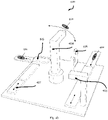
- Fig. 4b presents a detailed view of an embodiment according to another aspect of the present invention directed to a method for an automated quality check of a manufactured shoe sole.
- the method comprises the steps of (a.) generating a three-dimensional scan of the shoe sole and (b.) comparing the result of the three-dimensional scan with stored design data.
- the three-dimensional scan and the step of comparing which may be performed automatically by one or more entities, may significantly reduce the overall cycle time. This advantage facilitates the automated production of shoe soles.
- the three-dimensional scan may be generated while moving the shoe sole. Additionally or alternatively, the scanner may also be moved around the shoe sole. Both options follow the same idea that the whole shoe sole or component is carefully imaged. Moreover, the method may further comprise the step of taking at least one picture of the non-moving shoe sole. All these options follow the same idea of further significantly reducing the cycle time and reducing labor costs whilst performing the quality check and increasing repeatability, and precision.
- the step of comparing may be directed to identify physical and visible defects on one or more areas of the shoe sole, for example, unfused or excessively fused particles, dirt or foreign matter in / on the shoe sole etc.
- the method may comprise the step of measuring the weight of the shoe sole and / or measuring at least one key dimension of the shoe sole.
- dynamic properties such as cushioning, stiffness or flexing properties of the manufactured shoe sole may also be automatically investigated.
- the method further comprises the step of providing a means for tracking the shoe sole, preferably a quick response, QR, code.
- a means for tracking the shoe sole preferably a quick response, QR, code.
- QR quick response
- different information about the shoe sole e.g. material properties, shape, density, melting temperature, etc.
- any other code may be used such as UPC code, Micro QR code, Secure QR-code, iQR-Code or Frame QR, etc. or any other means for tracking such as RFID-Tags, transponders, etc.
- the method may further comprise the step of automatically storing the compared shoe sole in a storage station. It should be noted that each step as mentioned herein maybe automated or performed automatically.
- the term “automated” or “automatically” designates a process, which occurs with a reduction in, or a complete removal of, human intervention.
- the present invention is directed to a system for an automated quality check of a manufactured shoe sole performing a method according to one of the preceding embodiments.
- the system for an automated quality check of a manufactured shoe sole may be integrated into a system for automatically manufacturing shoe soles.
- both systems may be arranged in a common facility.
- the quality check system may be arranged next to one or more other stations of the system for automatically manufacturing shoe soles in the common facility (which could be a factory but also a reserved space in a retail store).
- the system for an automated quality check of a manufactured shoe sole may be arranged in another facility and the checked manufactured shoe soles may be then transported to the facility where the system for automatically manufacturing shoe soles is placed to perform steps of further processing.
- the method for an automated quality check of a manufactured shoe sole comprising randomly arranged particles may be performed by the automated quality check station 420 of the system 400.
- the operation of the automated quality check station 420 of the system 400 will be described.
- the shoe sole 421 is imaged by an image capture device 423, for example, a camera.
- the image capture device may take a single image of the shoe sole, for example, a two-dimensional picture. However, it is also possible that the image capture device takes multiple images and furthermore that the at least one image may comprise three-dimensional information, for example, by using at least two cameras to provide contour information of the surface(s).
- a robot device 424 equipped with gripping means, for example, needle grippers, picks up the shoe sole 421 to move the shoe sole to a further scanning area.
- the shoe sole may be moved directly to the scanning area by the robot or the robot may place the shoe sole onto an intermediate transport means, for example, conveying means 425 such as a conveyor belt.
- a three-dimensional scan is generated by a scanning unit 426. This may be done while the shoe sole 421 is static or when the shoe sole is moved over the scanning area.
- the scanning unit 426 may also comprise an image capture device (similar to the picture capture device 423) and a laser scanner. Other means for generating three-dimensional scans of the shoe sole 421 known in the prior art may be also used.
- the scanning unit 426 images the shoe sole in order to provide a visual and physical check of the product.
- the result of the three-dimensional scan is compared with stored design data.
- the stored design data may comprise a basic picture standard stored as a preset within the automated quality check station 420. This basic picture standard is compared with the three-dimensional scan and / or with the at least one picture from the surface(s) of the shoe sole 421 to provide an opinion of the quality of the shoe sole 421 to check if the shoe sole 421 is faulty or not.
- the automated quality check station 420 may comprise a machine learning unit (not shown) so that the station 420 may learn and improve its basic picture standards. Therefore, the step of comparing may be improved.
- the machine learning unit may use self-learning algorithms and models or may use the confirmation/declination of the opinion of the surface(s) by an external expert to state whether the shoe sole 421 is or isn't acceptable made.
- the shoe sole may be directly moved to the scanning area by the robot 424 or the robot 424 may place the shoe sole onto an intermediate transport means, for example, conveying means 425 such as a conveyor belt for transporting the shoe sole to the scale and a balance unit 427 to measure the weight of the shoe sole 421 and / or at least one key dimension of the shoe sole, for example, the length of the shoe sole 421.
- conveying means 425 such as a conveyor belt for transporting the shoe sole to the scale and a balance unit 427 to measure the weight of the shoe sole 421 and / or at least one key dimension of the shoe sole, for example, the length of the shoe sole 421.
- a means for tracking the shoe sole 421, for example, a QR code as mentioned above, maybe provided on the shoe sole 421.
- the information of the QR code may be created once the shoe sole 421 has been arranged within the foamer for foaming the particles of the midsole so that this information may identify the shoe sole 421 in the automated quality check station 420 and in the whole manufacturing system 400.
- the shoe sole 421 may be automatically stored in the storage station 430. It is possible that the quality check station 420 ends in the storage unit. Furthermore, it is also possible that the shoe soles may be directly moved to the storage area 430 by a robot or the shoe soles are transported to the storage unit 430 by an intermediate transport means, for example, conveying means 425 such as a conveyor belt. The shoe sole 421 may then be stored according to the information of the QR code.
- the at least one storage station 430 may comprise a plurality of storage boxes (not shown) comprising an electronic means, for example, RFID chips, to store the details of the shoe sole 421.
- Each storage box may be equipped with two shoe soles 421 corresponding to a finished pair of shoes.
- the storage boxes may slide out of the storage station 430 to be taken and stored elsewhere or in another storage box 430.
- the means for tracking may be used to derive information during further processing steps or stages, for example, customization.
Landscapes
- Engineering & Computer Science (AREA)
- Mechanical Engineering (AREA)
- Chemical & Material Sciences (AREA)
- Materials Engineering (AREA)
- Footwear And Its Accessory, Manufacturing Method And Apparatuses (AREA)
Priority Applications (1)
| Application Number | Priority Date | Filing Date | Title |
|---|---|---|---|
| EP25161881.5A EP4541573A3 (fr) | 2016-05-24 | 2017-05-23 | Procédé et appareil pour la fabrication automatique de semelles de chaussure |
Applications Claiming Priority (3)
| Application Number | Priority Date | Filing Date | Title |
|---|---|---|---|
| DE102016209045.3A DE102016209045B4 (de) | 2016-05-24 | 2016-05-24 | Verfahren und vorrichtung zum automatischen herstellen von schuhsohlen, sohlen und schuhe |
| PCT/EP2017/062407 WO2017202840A1 (fr) | 2016-05-24 | 2017-05-23 | Procédé et appareil de fabrication automatique de semelles de chaussures |
| EP17726249.0A EP3462963B1 (fr) | 2016-05-24 | 2017-05-23 | Procédé et appareil de fabrication automatique de semelles de chaussures |
Related Parent Applications (2)
| Application Number | Title | Priority Date | Filing Date |
|---|---|---|---|
| EP17726249.0A Division EP3462963B1 (fr) | 2016-05-24 | 2017-05-23 | Procédé et appareil de fabrication automatique de semelles de chaussures |
| EP17726249.0A Division-Into EP3462963B1 (fr) | 2016-05-24 | 2017-05-23 | Procédé et appareil de fabrication automatique de semelles de chaussures |
Related Child Applications (2)
| Application Number | Title | Priority Date | Filing Date |
|---|---|---|---|
| EP25161881.5A Division-Into EP4541573A3 (fr) | 2016-05-24 | 2017-05-23 | Procédé et appareil pour la fabrication automatique de semelles de chaussure |
| EP25161881.5A Division EP4541573A3 (fr) | 2016-05-24 | 2017-05-23 | Procédé et appareil pour la fabrication automatique de semelles de chaussure |
Publications (2)
| Publication Number | Publication Date |
|---|---|
| EP4008207A1 true EP4008207A1 (fr) | 2022-06-08 |
| EP4008207B1 EP4008207B1 (fr) | 2025-04-16 |
Family
ID=58794059
Family Applications (3)
| Application Number | Title | Priority Date | Filing Date |
|---|---|---|---|
| EP17726249.0A Active EP3462963B1 (fr) | 2016-05-24 | 2017-05-23 | Procédé et appareil de fabrication automatique de semelles de chaussures |
| EP25161881.5A Pending EP4541573A3 (fr) | 2016-05-24 | 2017-05-23 | Procédé et appareil pour la fabrication automatique de semelles de chaussure |
| EP21217801.6A Active EP4008207B1 (fr) | 2016-05-24 | 2017-05-23 | Procede et systeme de verification automatisee de la qualite de semelles de chaussures |
Family Applications Before (2)
| Application Number | Title | Priority Date | Filing Date |
|---|---|---|---|
| EP17726249.0A Active EP3462963B1 (fr) | 2016-05-24 | 2017-05-23 | Procédé et appareil de fabrication automatique de semelles de chaussures |
| EP25161881.5A Pending EP4541573A3 (fr) | 2016-05-24 | 2017-05-23 | Procédé et appareil pour la fabrication automatique de semelles de chaussure |
Country Status (6)
| Country | Link |
|---|---|
| US (3) | US20170341327A1 (fr) |
| EP (3) | EP3462963B1 (fr) |
| JP (1) | JP6839211B2 (fr) |
| CN (1) | CN109152440B (fr) |
| DE (1) | DE102016209045B4 (fr) |
| WO (1) | WO2017202840A1 (fr) |
Families Citing this family (46)
| Publication number | Priority date | Publication date | Assignee | Title |
|---|---|---|---|---|
| USD953709S1 (en) | 1985-08-29 | 2022-06-07 | Puma SE | Shoe |
| USD855953S1 (en) | 2017-09-14 | 2019-08-13 | Puma SE | Shoe sole element |
| DE102012206094B4 (de) | 2012-04-13 | 2019-12-05 | Adidas Ag | Sohlen für Sportschuhe, Schuhe und Verfahren zur Herstellung einer Schuhsohle |
| DE102013202306B4 (de) | 2013-02-13 | 2014-12-18 | Adidas Ag | Sohle für einen Schuh |
| DE102013202291C5 (de) | 2013-02-13 | 2026-01-15 | Adidas Ag | Dämpfungselement für Sportbekleidung und Schuh mit einem solchen Dämpfungselement |
| DE102013002519B4 (de) | 2013-02-13 | 2016-08-18 | Adidas Ag | Herstellungsverfahren für Dämpfungselemente für Sportbekleidung |
| US9930928B2 (en) | 2013-02-13 | 2018-04-03 | Adidas Ag | Sole for a shoe |
| USD776410S1 (en) | 2013-04-12 | 2017-01-17 | Adidas Ag | Shoe |
| DE102014215897B4 (de) | 2014-08-11 | 2016-12-22 | Adidas Ag | adistar boost |
| DE102014216115B4 (de) | 2014-08-13 | 2022-03-31 | Adidas Ag | Gemeinsam gegossene 3D Elemente |
| DE102014216992A1 (de) | 2014-08-26 | 2016-03-03 | Adidas Ag | Expandierte Polymerpellets |
| DE102015202013B4 (de) | 2015-02-05 | 2019-05-09 | Adidas Ag | Verfahren zur Herstellung eines Kunststoffformteils, Kunststoffformteil und Schuh |
| JP6679363B2 (ja) | 2015-03-23 | 2020-04-15 | アディダス アーゲー | ソールおよびシューズ |
| DE102015206486B4 (de) | 2015-04-10 | 2023-06-01 | Adidas Ag | Schuh, insbesondere Sportschuh, und Verfahren zur Herstellung desselben |
| DE102015206900B4 (de) | 2015-04-16 | 2023-07-27 | Adidas Ag | Sportschuh |
| DE102015209795B4 (de) | 2015-05-28 | 2024-03-21 | Adidas Ag | Ball und Verfahren zu dessen Herstellung |
| USD783264S1 (en) | 2015-09-15 | 2017-04-11 | Adidas Ag | Shoe |
| JP1581802S (fr) | 2016-03-23 | 2017-07-24 | ||
| DE102016209044B4 (de) | 2016-05-24 | 2019-08-29 | Adidas Ag | Sohlenform zum Herstellen einer Sohle und Anordnung einer Vielzahl von Sohlenformen |
| DE102016209046B4 (de) | 2016-05-24 | 2019-08-08 | Adidas Ag | Verfahren zur herstellung einer schuhsohle, schuhsohle, schuh und vorgefertigte tpu-gegenstände |
| DE102016209045B4 (de) * | 2016-05-24 | 2022-05-25 | Adidas Ag | Verfahren und vorrichtung zum automatischen herstellen von schuhsohlen, sohlen und schuhe |
| JP1584710S (fr) | 2016-11-02 | 2017-08-28 | ||
| DE102016223567A1 (de) | 2016-11-28 | 2018-05-30 | Adidas Ag | Verfahren zur Herstellung von Sportartikeln und Sportartikel |
| DE102016223980B4 (de) | 2016-12-01 | 2022-09-22 | Adidas Ag | Verfahren zur Herstellung eines Kunststoffformteils |
| USD850766S1 (en) | 2017-01-17 | 2019-06-11 | Puma SE | Shoe sole element |
| USD855297S1 (en) | 2017-02-21 | 2019-08-06 | Adidas Ag | Shoe |
| USD851889S1 (en) | 2017-02-21 | 2019-06-25 | Adidas Ag | Shoe |
| DE102017205830B4 (de) | 2017-04-05 | 2020-09-24 | Adidas Ag | Verfahren für die Nachbehandlung einer Vielzahl einzelner expandierter Partikel für die Herstellung mindestens eines Teils eines gegossenen Sportartikels, Sportartikel und Sportschuh |
| USD975417S1 (en) | 2017-09-14 | 2023-01-17 | Puma SE | Shoe |
| USD882927S1 (en) | 2017-09-20 | 2020-05-05 | Adidas Ag | Shoe mudguard |
| JP1617832S (fr) | 2017-09-21 | 2018-11-12 | ||
| US20190090585A1 (en) * | 2017-09-22 | 2019-03-28 | Wolverine Outdoors, Inc. | Sole assembly for article of footwear |
| USD899061S1 (en) | 2017-10-05 | 2020-10-20 | Adidas Ag | Shoe |
| EP3784086B1 (fr) * | 2018-04-27 | 2021-06-16 | Puma Se | Chaussure, en particulier chaussure de sport |
| JP1638395S (fr) | 2018-08-17 | 2019-08-05 | ||
| USD915055S1 (en) | 2018-12-03 | 2021-04-06 | Adidas Ag | Shoe |
| ES2941984T3 (es) | 2018-12-18 | 2023-05-29 | Puma SE | Zapato, en particular zapato deportivo, y procedimiento para su fabricación |
| USD928479S1 (en) | 2019-03-19 | 2021-08-24 | Adidas Ag | Footwear midsole |
| DE102019204579B4 (de) | 2019-04-01 | 2022-10-06 | Adidas Ag | Recycling eines Schuhs |
| USD938154S1 (en) | 2019-07-18 | 2021-12-14 | Adidas Ag | Footwear sole |
| US11396117B2 (en) * | 2019-10-03 | 2022-07-26 | Saucony, Inc. | Method of manufacturing footwear |
| US11859067B2 (en) | 2020-03-09 | 2024-01-02 | Nike, Inc. | Footwear mold assembly for injection-molding |
| USD944504S1 (en) | 2020-04-27 | 2022-03-01 | Puma SE | Shoe |
| CN111743269B (zh) * | 2020-05-29 | 2023-12-19 | 侯景忠 | 循环式产线系统及其运作方式 |
| USD1093824S1 (en) | 2021-07-13 | 2025-09-23 | Adidas Ag | Shoe midsole |
| DE102022210886A1 (de) | 2022-10-14 | 2024-04-25 | Adidas Ag | Verfahren zur Herstellung eines Schuhs, ein System zum Durchführen des Verfahrens und ein Schuh |
Citations (15)
| Publication number | Priority date | Publication date | Assignee | Title |
|---|---|---|---|---|
| US20020170650A1 (en) | 2001-05-21 | 2002-11-21 | Cheng-Hsian Chi | Method for making a shoe having a foamed midsole enclosed in the shoe |
| US6646922B2 (en) | 2001-05-31 | 2003-11-11 | Semiconductor Energy Laboratory Co., Ltd. | Nonvolatile memory and method of driving the same |
| WO2005066250A1 (fr) | 2004-01-06 | 2005-07-21 | Basf Aktiengesellschaft | Procedes de fabrication de chaussures |
| WO2007082838A1 (fr) | 2006-01-18 | 2007-07-26 | Basf Se | Mousse a base de polyurethane thermoplastique |
| WO2008087078A1 (fr) | 2007-01-16 | 2008-07-24 | Basf Se | Systèmes hybrides composés d'élastomères thermoplastiques moussés et de polyuréthanes |
| US20120056345A1 (en) | 2009-05-14 | 2012-03-08 | Lee Dong-Gun | Polyurethane-coated spandex fabric-fused midsole and apparatus and method for manufacturing the same |
| WO2012065926A1 (fr) | 2010-11-16 | 2012-05-24 | Basf Se | Nouvel élément amortisseur dans les semelles de chaussures |
| DE102011108744A1 (de) | 2011-07-28 | 2013-01-31 | Puma SE | Verfahren zur Herstellung einer Sohle oder eines Sohlenteils eines Schuhs |
| US20130126075A1 (en) | 2011-11-18 | 2013-05-23 | Columbia Sportswear North America, Inc. | Co-molded sole |
| US20130132038A1 (en) * | 2011-11-18 | 2013-05-23 | Nike, Inc. | Automated 3-D Modeling Of Shoe Parts |
| EP2649896A2 (fr) | 2012-04-13 | 2013-10-16 | Adidas AG | Semelles pour chaussures de sport |
| EP2767181A1 (fr) | 2013-02-13 | 2014-08-20 | adidas AG | Semelle pour chaussure |
| EP2786670A1 (fr) | 2013-02-13 | 2014-10-08 | Adidas AG | Procédés de fabrication d'éléments de rembourrage pour vêtements de sport |
| EP2984956A1 (fr) | 2014-08-13 | 2016-02-17 | adidas AG | Éléments 3d co-moulés |
| KR20160037252A (ko) * | 2014-09-19 | 2016-04-06 | 한국신발피혁연구원 | 신발 솔의 실시간 품질검사방법 |
Family Cites Families (280)
| Publication number | Priority date | Publication date | Assignee | Title |
|---|---|---|---|---|
| US1855098A (en) | 1930-02-14 | 1932-04-19 | Collins Charles Horace Russell | Apparatus for molding and curing footwear |
| DE941389C (de) | 1951-04-19 | 1956-04-12 | Basf Ag | Verfahren zur Herstellung poroeser Formkoerper aus thermoplastischen Kunststoffen |
| US3058162A (en) | 1960-04-11 | 1962-10-16 | Armstrong Cork Co | Method of making very low density cellular polystyrene products |
| US3193876A (en) | 1962-09-25 | 1965-07-13 | Thompson Ind Co Inc | Mold and heating apparatus therefor |
| GB1063353A (en) | 1963-03-16 | 1967-03-30 | Northern Rhodesia Tyre Service | Improvements relating to the manufacture of rubber footwear |
| US3424827A (en) | 1963-12-05 | 1969-01-28 | Sinclair Koppers Co | Process and apparatus for making shaped cellular articles from expandable thermoplastic resins |
| US3413682A (en) | 1964-08-31 | 1968-12-03 | Wucher Roland | Injection moulding apparatuses with rotating platform |
| US3315317A (en) | 1965-09-28 | 1967-04-25 | Int Vulcanizing Corp | Mold assembly for injection molding of bottoms to shoes |
| US3598672A (en) | 1966-03-23 | 1971-08-10 | Contraves Ag | Method of producing shaped bodies of low specific gravity |
| DE1704502A1 (de) | 1967-10-17 | 1971-05-27 | Buchmann Rudolf Ch | Vorrichtung zur Herstellung von geformten Platten aus thermoplastischen,vorexpandierten Schaumstoffteilchen |
| SE359557B (fr) | 1968-02-21 | 1973-09-03 | Basf Ag | |
| GB1275095A (en) | 1969-08-22 | 1972-05-24 | Alfred Freeman | Treatment of footwear |
| JPS5216167B2 (fr) | 1971-10-01 | 1977-05-07 | ||
| JPS4845560A (fr) | 1971-10-11 | 1973-06-29 | ||
| US3813201A (en) | 1972-05-01 | 1974-05-28 | Usm Corp | Shoe molds |
| JPS4920266A (fr) | 1972-06-16 | 1974-02-22 | ||
| GB1417522A (en) | 1973-04-16 | 1975-12-10 | Cemoss Equipment Ltd | Process for producing a model aircraft |
| GB1439101A (en) | 1974-01-07 | 1976-06-09 | Viges Spa | Automatic shoemaking machine |
| JPS50155569A (fr) | 1974-06-07 | 1975-12-15 | ||
| JPS5410052A (en) * | 1977-06-23 | 1979-01-25 | Tatsuo Fukuoka | Metal mold with temporary fixing means |
| FR2402526A1 (fr) | 1977-09-09 | 1979-04-06 | Isobox Barbier Sa | Dispositif et procede de moulage de matieres plastiques expansees, par rayonnement ultra-haute frequence |
| JPS54114354A (en) | 1978-02-24 | 1979-09-06 | Okamoto Riken Gomu Kk | Injectionnmolded shoes |
| JPS55129004A (en) | 1979-03-28 | 1980-10-06 | Kao Corp | Production of footwear bottom |
| US4441876A (en) | 1979-05-24 | 1984-04-10 | Michel Marc | Flow molding |
| JPS5620402U (fr) | 1979-07-26 | 1981-02-23 | ||
| JPS6046483B2 (ja) | 1980-02-13 | 1985-10-16 | 三菱電機株式会社 | 照明器具 |
| JPS575009A (en) | 1980-06-12 | 1982-01-11 | Mitsubishi Electric Corp | Optical distributor |
| DE3032246A1 (de) | 1980-08-27 | 1982-04-08 | Civag AG für Verpackungsforschung, Herisau | Verfahren und vorrichtung zur herstellung eines formlings mit vorerhitzung des formguts |
| JPS57180653A (en) | 1981-04-30 | 1982-11-06 | Kanebo Synthetic Fibers Ltd | Method for modifying and molding thermoplastic polyurethane resin |
| JPS5821304A (ja) | 1981-07-29 | 1983-02-08 | Hitachi Ltd | 磁気浮上鉄道用地上コイル |
| FR2511297B1 (fr) | 1981-08-13 | 1986-07-18 | Saplest Sa | Procede de fabrication de pieces en matiere synthetique expansee a caracteristiques physiques variables |
| JPS58136632A (ja) | 1982-01-14 | 1983-08-13 | Kanegafuchi Chem Ind Co Ltd | ポリオレフイン系樹脂発泡成形体の製造方法 |
| JPS58142828A (ja) | 1982-02-17 | 1983-08-25 | Toyoda Gosei Co Ltd | 内部発泡成形品の製造方法 |
| AT387542B (de) | 1983-02-11 | 1989-02-10 | Isovolta | Verfahren zum herstellen von phenol-aldehydharz- schaumstoffkoerpern |
| DE3437786A1 (de) | 1983-07-13 | 1986-04-17 | Keltsch, Bernhard, 8500 Nürnberg | Verfahren zum herstellen von schuheinlegesohlen |
| JPS6141402U (ja) | 1984-08-14 | 1986-03-17 | 株式会社神戸製鋼所 | エツジヤ−圧延機 |
| USD855953S1 (en) | 2017-09-14 | 2019-08-13 | Puma SE | Shoe sole element |
| DE3630930A1 (de) | 1986-09-11 | 1988-03-24 | Roehm Gmbh | Verfahren zur herstellung eines hartschaumstoffes mittels eines mikrowellen- oder hochfrequenzfeldes |
| US4902721A (en) | 1987-05-04 | 1990-02-20 | The Dow Chemical Company | Foamable thermoplastic polymers and a method for foaming |
| US4936030A (en) | 1987-06-23 | 1990-06-26 | Rennex Brian G | Energy efficient running shoe |
| EP0578272B1 (fr) | 1988-10-31 | 1997-02-26 | Mitsubishi Denki Kabushiki Kaisha | Structure poreuse |
| US5194190A (en) | 1989-03-31 | 1993-03-16 | General Electric Company | Process for impregantion of glass fiber reinforcement with thermoplastic resins |
| US5082436A (en) | 1989-07-14 | 1992-01-21 | General Electric Company | Apparatus for deforming thermoplastic material using RF heating |
| ES2091810T3 (es) | 1989-08-07 | 1996-11-16 | Nissan Motor | Molde de resina epoxy rellena con polvo metalico y metodo para su fabricacion. |
| JPH03166923A (ja) | 1989-11-25 | 1991-07-18 | Kanegafuchi Chem Ind Co Ltd | 樹脂発泡成形体の製造方法及びその装置 |
| US5128880A (en) * | 1990-05-11 | 1992-07-07 | Foot Image Technology, Inc. | Foot measurement and footwear sizing system |
| US5237520A (en) * | 1990-05-11 | 1993-08-17 | Foot Image Technology, Inc. | Foot measurement and footwear sizing system |
| AT398687B (de) | 1991-01-28 | 1995-01-25 | Koeflach Sportgeraete Gmbh | Verfahren zur herstellung eines schuhs und danach hergestellter schuh |
| USD340797S (en) | 1992-03-19 | 1993-11-02 | The Keds Corporation | Shoe sole bottom |
| US5314927A (en) | 1992-05-13 | 1994-05-24 | Showa Highpolymer Co., Ltd. | Polyester foamed articles and method for producing the same |
| IT1255364B (it) | 1992-09-15 | 1995-10-31 | Himont Inc | Processo per la preparazione di manufatti in polipropilene espanso mediante produzione di granuli pre-espansi e termoformatura per sinterizzazione degli stessi |
| US5343190A (en) | 1992-09-15 | 1994-08-30 | Rodgers Nicholas A | Signalling footwear |
| JPH06218830A (ja) | 1993-01-26 | 1994-08-09 | Teijin Ltd | 複合成形品の製造方法 |
| DE4307648A1 (de) | 1993-03-11 | 1994-09-15 | Basf Ag | Schaumstoffe auf Basis thermoplastischer Polyurethane sowie expandierbare, partikelförmige, thermoplastische Polyurethane, insbesondere geeignet zur Herstellung von Schaumstoff-Formkörpern |
| JPH06305039A (ja) | 1993-04-26 | 1994-11-01 | Murata Mfg Co Ltd | 機能傾斜材料の製造方法 |
| JP2826038B2 (ja) | 1993-04-28 | 1998-11-18 | 大塚サイエンス株式会社 | 電波吸収体およびその製造方法 |
| DE59408842D1 (de) | 1993-11-29 | 1999-11-25 | Greiner & Soehne C A | Formteil aus Kunststoffschaum sowie Verfahren und Vorrichtung zu dessen Herstellung |
| JPH07186151A (ja) | 1993-12-28 | 1995-07-25 | Toyota Motor Corp | 誘電加熱樹脂成形用の成形型 |
| US5518060A (en) | 1994-01-25 | 1996-05-21 | Brunswick Corporation | Method of producing polymeric patterns for use in evaporable foam casting |
| JPH0852761A (ja) | 1994-08-09 | 1996-02-27 | Dainippon Printing Co Ltd | 成型同時絵付方法 |
| JP3008236U (ja) * | 1994-08-25 | 1995-03-07 | 豊彦 西辺 | 重ね止め部を有する靴用成形型 |
| JP2608033B2 (ja) | 1994-11-04 | 1997-05-07 | 壽美子 福岡 | 靴の製造方法 |
| USD384794S (en) | 1995-02-24 | 1997-10-14 | Article Chaussant Europeen (ARCHE) | Shoe sole |
| JPH08239570A (ja) | 1995-03-01 | 1996-09-17 | Kuraray Co Ltd | ポリウレタン樹脂組成物 |
| DE29520911U1 (de) | 1995-10-24 | 1996-06-13 | Magna Zippex Autotechnik GmbH, 74374 Zaberfeld | Formvorrichtung zum Herstellen von Formteilen aus thermoplastischem und schäumbarem Kunststoff |
| US5885500A (en) * | 1995-12-20 | 1999-03-23 | Nike, Inc. | Method of making an article of footwear |
| US5718968A (en) | 1996-01-10 | 1998-02-17 | Motherlode, L.L.C. | Memory molded, high strength polystyrene |
| DE69612474T2 (de) | 1996-02-16 | 2001-08-30 | Iron Fox S.R.L., Villatora Di Saonara | Schuhmontiermaschine |
| IT251187Y1 (it) | 1996-03-01 | 2003-11-04 | Gore W L & Ass Srl | Calzatura con suola sagomata atta a determinare un effetto di ventilazventilazione internamente alla scarpa. |
| DE19633467C2 (de) | 1996-08-20 | 1999-01-21 | Fraunhofer Ges Forschung | Verfahren zur Herstellung von Verbundkörpern aus Kunststoff |
| EP0923442B1 (fr) | 1996-08-20 | 2002-03-13 | Fraunhofer-Gesellschaft Zur Förderung Der Angewandten Forschung E.V. | Procede pour la fabrication de corps composites en plastique |
| JPH1058475A (ja) | 1996-08-21 | 1998-03-03 | Tosoh Corp | 熱可塑性樹脂発泡粒子の型内成形方法 |
| JPH10138252A (ja) | 1996-11-06 | 1998-05-26 | Asahi Chem Ind Co Ltd | 断熱層被覆金型及びその金型を用いた合成樹脂の成形法 |
| DE19648804A1 (de) | 1996-11-26 | 1998-05-28 | Gefinex Gmbh | Stoßdämpfer |
| DE19654860A1 (de) | 1996-11-27 | 1998-05-28 | Gefinex Gmbh | Teilweise Befüllung von Formteilautomaten mit Kunststoffschaum-Beads |
| IT1290210B1 (it) | 1997-01-29 | 1998-10-22 | Pirelli | Metodo per la produzione di pneumatici,per la realizzazione di stampi di vulcanizzazione per detti pneumatici,pneumatici e stampi cosi' |
| DE19704700C1 (de) | 1997-02-07 | 1998-09-24 | Fraunhofer Ges Forschung | Definiert, feingliedrig und punktuell temperierbare Formen und Werkzeuge aus verschiedenen Materialien, insbesondere Metall, Kunststoff, Papier, Keramik und deren Mischungen, ihre Verwendung und Verfahren zur Temperierung von Formen und Werkzeugen |
| US6346210B1 (en) | 1997-02-14 | 2002-02-12 | The Rockport Company, Llc | Method of shaping susceptor-based polymeric materials |
| US5736167A (en) | 1997-02-27 | 1998-04-07 | Chang; Hui Hwa | Mold device for making safety shoe |
| US5937265A (en) | 1997-04-24 | 1999-08-10 | Motorola, Inc. | Tooling die insert and rapid method for fabricating same |
| US6086808A (en) * | 1997-08-19 | 2000-07-11 | Universal Ventures | Repositioning of articles between different positions within an intermittently accessible space |
| US6035554A (en) | 1997-09-11 | 2000-03-14 | Duncan; Donald L. | Asymmetrical reversible article of footwear |
| JP3047622U (ja) | 1997-09-30 | 1998-04-24 | 月星化成株式会社 | 靴胛被 |
| JPH11129275A (ja) | 1997-10-28 | 1999-05-18 | Jsp Corp | 型内成型発泡体の製造方法 |
| WO1999051415A1 (fr) | 1998-03-31 | 1999-10-14 | Daisen Industry Co., Ltd. | Procede de charge de materiau en perles, procede de moulage de resines expansees y recourant, et produit expanse moule resultant |
| JPH11291275A (ja) | 1998-04-10 | 1999-10-26 | Toyota Motor Corp | 熱可塑性樹脂発泡成形方法 |
| ITMI980919A1 (it) | 1998-04-29 | 1999-10-29 | Mec B D F S R L Off | Macchina per la lavorazione automatica di parti di calzature |
| US6325198B1 (en) | 1998-06-26 | 2001-12-04 | Eveready Battery Company, Inc. | High speed manufacturing system |
| JP2000037208A (ja) | 1998-07-24 | 2000-02-08 | Toyo Tire & Rubber Co Ltd | 2色ソール用金型 |
| DE19834100C2 (de) | 1998-07-29 | 2000-05-11 | Hennecke Gmbh | Verfahren und Vorrichtung zum Herstellen von Schaumstoffblöcken mit eckigem Querschnitt im Flocken-Verbund |
| US6432320B1 (en) | 1998-11-02 | 2002-08-13 | Patrick Bonsignore | Refrigerant and heat transfer fluid additive |
| DE19860611C1 (de) | 1998-12-29 | 2000-03-23 | Fraunhofer Ges Forschung | Verfahren zur Herstellung von Formkörpern aus Polymer-Schaumpartikeln |
| US6253159B1 (en) | 1998-12-31 | 2001-06-26 | Kimberly-Clark Worldwide, Inc. | Process control using multiple detections |
| JP2000279205A (ja) | 1999-03-31 | 2000-10-10 | Murai:Kk | インナーソールの中間成型品およびインナーソールの製造方法並びにその部分成型機 |
| US6464922B1 (en) * | 1999-12-10 | 2002-10-15 | Autotec, Inc. | Insertion device for plastic molding |
| DE10009665C1 (de) | 2000-02-29 | 2002-01-24 | Fraunhofer Ges Forschung | Verfahren und Vorrichtung zum thermischen Verbinden von Polymerschaumpartikeln |
| DE10033877A1 (de) | 2000-07-12 | 2002-03-14 | Fraunhofer Ges Forschung | Verfahren zur Herstellung von Formteilen aus Partikelschaum mit einer Deckschicht |
| JP2002119302A (ja) | 2000-10-16 | 2002-04-23 | Midori Anzen Co Ltd | 靴底及びその製造方法並びにこれを用いた靴 |
| JP2002144366A (ja) | 2000-11-16 | 2002-05-21 | Hikari Giken Kogyo Kk | 発泡成形物とその利用品 |
| DE10117979A1 (de) | 2001-01-05 | 2002-08-14 | Fraunhofer Ges Forschung | Formwerkzeug und Verfahren zu dessen Herstellung |
| US7100307B2 (en) | 2001-08-15 | 2006-09-05 | Barefoot Science Technologies Inc. | Footwear to enhance natural gait |
| CN2501679Y (zh) * | 2001-09-06 | 2002-07-24 | 罗枝芳 | 改进的鞋模 |
| JP3677740B2 (ja) * | 2001-10-19 | 2005-08-03 | 日精樹脂工業株式会社 | 帯状物への樹脂のインサート成形方法及び成形装置 |
| JP4001266B2 (ja) | 2001-11-08 | 2007-10-31 | アキレス株式会社 | 発泡樹脂製ブーツの製造方法 |
| TW592941B (en) | 2002-04-22 | 2004-06-21 | Jeng-Shian Ji | Method for producing an integral foam shoe body |
| JP2003310302A (ja) | 2002-04-24 | 2003-11-05 | Ain Kk Sogo Kenkyusho | 中空樹脂線条体を用いた靴底又は中敷及びその製造方法 |
| US7223087B2 (en) | 2002-05-29 | 2007-05-29 | Razmik Akopyan | Microwave molding of polymers |
| US20030232933A1 (en) | 2002-06-17 | 2003-12-18 | Didier Lagneaux | Reactive blend ploymer compositions with thermoplastic polyurethane |
| DE10328896A1 (de) | 2002-07-03 | 2004-01-22 | Fagerdala Deutschland Gmbh | Verbundwerkstoff und Verfahren zu seiner Herstellung |
| US6904330B2 (en) | 2002-08-07 | 2005-06-07 | Kimberly-Clark Worldwide, Inc. | Manufacturing information and troubleshooting system and method |
| US7225565B2 (en) | 2003-03-10 | 2007-06-05 | Adidas International Marketing B.V. | Intelligent footwear systems |
| CA2538358A1 (fr) | 2003-09-11 | 2005-03-24 | The Ex One Company | Articles fabriques en couches presentant des orifices de guidage de fluide de faible largeur et procedes de fabrication associes |
| US20070029698A1 (en) | 2003-09-11 | 2007-02-08 | Rynerson Michael L | Layered manufactured articles having small-diameter fluid conduction vents and method of making same |
| DE10342857A1 (de) | 2003-09-15 | 2005-04-21 | Basf Ag | Expandierbare thermoplastische Polyurethan-Blends |
| DE102004049060B4 (de) | 2003-10-16 | 2010-04-01 | Neue Materialien Bayreuth Gmbh | Verfahren zur Herstellung von Formkörpern aus Polymerschaumpartikeln |
| DE10355222A1 (de) | 2003-11-26 | 2005-06-23 | Hennecke Gmbh | Verfahren und Vorrichtung zur Herstellung von Schaumstoffblöcken im Flockenverbund |
| US20050144034A1 (en) | 2003-12-31 | 2005-06-30 | Hunter Charles P. | Injection molded footwear manufactufing system |
| DE202004003679U1 (de) | 2004-03-08 | 2004-05-13 | Kurtz Gmbh | Werkzeug zur Herstellung von Formteilen |
| DE102004028462A1 (de) | 2004-06-11 | 2005-12-29 | Continental Aktiengesellschaft | Reifenvulkanisierform mit mehreren zu einer umfangsmäßig geschlossenen Form zusammenfügbaren Profilsegmenten |
| JP2008504159A (ja) | 2004-06-28 | 2008-02-14 | ザ エクス ワン カンパニー | 気体透過性金型 |
| US20060043645A1 (en) | 2004-08-30 | 2006-03-02 | Goettsch David D | Vented mold and method |
| JP2006137032A (ja) | 2004-11-10 | 2006-06-01 | Kaneka Corp | 発泡合成樹脂成形体の製造方法 |
| EP1872924A1 (fr) | 2004-11-16 | 2008-01-02 | JSR Corporation | Procédé de fabrication de mousse moulée réticulée |
| CN1332623C (zh) * | 2004-12-13 | 2007-08-22 | 林忠信 | 双层发泡鞋底的制法 |
| AT501518A1 (de) | 2005-02-18 | 2006-09-15 | Nowy & Zorn Entwicklungs Gmbh | Schaumstoffprodukt |
| DE102005028056A1 (de) | 2005-06-16 | 2006-12-21 | Basf Ag | Thermoplastisches Polyurethan enthaltend Isocyanat |
| KR20080049752A (ko) | 2005-08-23 | 2008-06-04 | 바스프 에스이 | 발포 슬랩의 제조 방법 |
| JP5097710B2 (ja) | 2005-12-09 | 2012-12-12 | カウンシル オブ サイエンティフィック アンド インダストリアル リサーチ | 2工程ガソリンエンジンのための潤滑油組成物及びその調製方法 |
| DE102006001964A1 (de) | 2006-01-13 | 2007-07-19 | Robert Bosch Gmbh | Messgerät, insbesondere Entfernungsmessgerät |
| USD549432S1 (en) | 2006-01-24 | 2007-08-28 | Columbia Insurance Company | Outsole for a shoe |
| USD556989S1 (en) | 2006-05-18 | 2007-12-11 | Wolverine World Wide, Inc. | Footwear sole |
| DE102006024940A1 (de) | 2006-05-29 | 2007-12-20 | Apeg Agrar-Projektentwicklung Gmbh | Verfahren zur Herstellung eines Gegenstandes aus einem Schaumstoff enthaltenden Material und ein solcher Gegenstand |
| DE202006009569U1 (de) | 2006-06-16 | 2006-08-24 | Kurtz Gmbh | Vorrichtung zur Herstellung von Formteilen aus Schaumstoff-Partikeln |
| DE602006013160D1 (de) | 2006-12-01 | 2010-05-06 | Dow Global Technologies Inc | Metallgefüllte Polyurethanzusammensetzung und daraus hergestellte Formwerkzeuge |
| US7845097B2 (en) | 2006-12-07 | 2010-12-07 | Callaway Golf Company | Chemically-treated outsole assembly for a golf shoe |
| US7854071B2 (en) * | 2007-03-30 | 2010-12-21 | The Hong Kong University Of Science And Technology | Customized shoe and insole, method and apparatus for determining shape of a foot and for making a shoe or insole |
| DE202007006164U1 (de) | 2007-04-30 | 2007-08-23 | Michel, Thorsten | Vorrichtung für das Verhauten eines Formteiles aus geschäumten thermoplastischen Kunststoffpartikeln |
| AT505333A1 (de) | 2007-05-10 | 2008-12-15 | Greiner Perfoam Gmbh | Verfahren und vorrichtung zur herstellung eines formteils |
| US7941941B2 (en) | 2007-07-13 | 2011-05-17 | Nike, Inc. | Article of footwear incorporating foam-filled elements and methods for manufacturing the foam-filled elements |
| US8245378B2 (en) | 2007-09-13 | 2012-08-21 | Nike, Inc. | Method and apparatus for manufacturing components used for the manufacture of articles |
| US9572402B2 (en) | 2007-10-23 | 2017-02-21 | Nike, Inc. | Articles and methods of manufacturing articles |
| DE102007054723B4 (de) | 2007-11-14 | 2015-05-28 | Cl Schutzrechtsverwaltungs Gmbh | Formteil |
| US8513317B2 (en) | 2007-12-11 | 2013-08-20 | Kaneka Corporation | Process for producing expanded polyolefin resin particles and expanded polyolefin resin particles |
| USD593292S1 (en) | 2008-07-15 | 2009-06-02 | Columbia Insurance Company | Outsole for a shoe |
| DE102009030678A1 (de) | 2008-09-16 | 2010-04-15 | Huth, Michael, Dipl.-Kfm. | Schuh sowie Verfahren und Vorrichtung zur Herstellung desselben |
| KR20100032561A (ko) | 2008-09-18 | 2010-03-26 | 최진국 | 유도가열을 이용한 신발 중창 성형장치 |
| WO2010037028A1 (fr) | 2008-09-26 | 2010-04-01 | Nike International Ltd. | Systèmes et procédés d’utilisation de biscuits au phylon pour produire une semelle intercalaire à fermeté régionalisée |
| EP2335198A4 (fr) | 2008-09-26 | 2013-12-25 | Nike International Ltd | Procédé pour une production de chaussures efficace et localisée |
| CN102257126B (zh) | 2008-12-18 | 2014-07-09 | 纳幕尔杜邦公司 | 减少发酵过程中的丙二酸副产物 |
| BRPI0923834A2 (pt) | 2008-12-30 | 2015-07-21 | Basf Se | Método para a produção de corpos de espuma conformados, dispositivo para pressionar os corpos de espuma conformados sob efeito do calor, e, unidade irradiadora de microondas |
| DE102009004386A1 (de) | 2009-01-12 | 2010-07-15 | Fagerdala Capital Ab | Verfahren und Vorrichtung zur Herstellung von Formteilen aus Partikelschäumen |
| SG10201400519VA (en) | 2009-03-18 | 2014-05-29 | Lubrizol Advanced Mat Inc | Thermoplastic polyurethane with reduced tendency to bloom |
| CA2774339A1 (fr) | 2009-09-16 | 2011-03-24 | Nestec S.A. | Procedes et dispositifs de classement d'objets |
| WO2011086030A2 (fr) | 2010-01-14 | 2011-07-21 | Basf Se | Procédé de préparation de granulats expansibles contenant de l'acide polylactique |
| WO2011125540A1 (fr) | 2010-03-31 | 2011-10-13 | 三井化学株式会社 | Résine polyuréthane thermoplastique et article moulé |
| PL2563850T5 (pl) | 2010-04-27 | 2022-08-29 | Basf Se | Spienialny granulat poliamidowy |
| WO2011153133A1 (fr) | 2010-06-01 | 2011-12-08 | Ackley Machine Corporation | Système de vérification |
| US20120073161A1 (en) | 2010-09-24 | 2012-03-29 | Doyle Harold S | Pneumatically inflatable air bladder devices contained entirely within shoe sole or configured as shoe inserts |
| US9346237B2 (en) | 2010-10-27 | 2016-05-24 | Richard W. Roberts | Recyclable plastic structural articles and method of manufacture |
| GB2485848B (en) | 2010-11-29 | 2018-07-11 | Halliburton Energy Services Inc | Improvements in heat flow control for molding downhole equipment |
| JP5727210B2 (ja) | 2010-12-15 | 2015-06-03 | 株式会社ジェイエスピー | ポリオレフィン系樹脂発泡粒子成形体の製造方法、及びポリオレフィン系樹脂発泡粒子成形体 |
| US9936760B2 (en) | 2011-01-26 | 2018-04-10 | Deckers Outdoor Corporation | Injection molded shoe frame and method |
| US8922641B2 (en) | 2011-06-29 | 2014-12-30 | The Procter & Gamble Company | System and method for inspecting components of hygienic articles |
| WO2013050581A1 (fr) | 2011-10-06 | 2013-04-11 | Jsp International Sarl | Moulage de matière plastique particulaire |
| US8958901B2 (en) | 2011-11-18 | 2015-02-17 | Nike, Inc. | Automated manufacturing of shoe parts |
| DE202011109598U1 (de) | 2011-12-29 | 2012-02-10 | Kurtz Gmbh | Schäumvorrichtung zur Herstellung von Dämmplatten |
| MX2014008530A (es) | 2012-01-13 | 2014-08-21 | Johnson Controls Tech Co | Sistemas y metodos para fabricar partes de espuma. |
| NL2008240C2 (nl) | 2012-02-06 | 2013-08-08 | Synbra Tech Bv | Werkwijze voor het vervaardigen van schuimvormdelen. |
| ES2575398T3 (es) | 2012-03-31 | 2016-06-28 | F. Hoffmann-La Roche Ag | 4-Metil-dihidropirimidinas novedosas para el tratamiento y la profilaxis de la infección por el virus de la hepatitis B |
| WO2013149956A2 (fr) | 2012-04-05 | 2013-10-10 | Basf Se | Composition de polyuréthane thermoplastique et ses procédés de préparation |
| WO2013155088A1 (fr) | 2012-04-09 | 2013-10-17 | University Of Washington Through Its Center For Commercialization | Procédé d'augmentation de la densité de nucléation cellulaire dans des mousses à l'état solide |
| EP2836543B1 (fr) | 2012-04-13 | 2020-03-04 | Basf Se | Procédé de production de granulés expansés |
| EP2671633A1 (fr) | 2012-06-06 | 2013-12-11 | Basf Se | Procédé de transport de particules de polymère thermoplastiques moussées |
| JP5756923B2 (ja) | 2012-06-18 | 2015-07-29 | パナソニックIpマネジメント株式会社 | 射出成形方法および射出成形金型装置 |
| EP2682427A1 (fr) | 2012-07-06 | 2014-01-08 | Basf Se | Particule de polymère expansible à base de polyuréthane |
| US8961844B2 (en) | 2012-07-10 | 2015-02-24 | Nike, Inc. | Bead foam compression molding method for low density product |
| ES2612859T3 (es) | 2012-08-09 | 2017-05-19 | Basf Se | Espuma de combinación |
| CN202895563U (zh) | 2012-09-18 | 2013-04-24 | 陈岩玲 | 聚氨脂发泡鞋的生产模具 |
| US9456658B2 (en) | 2012-09-20 | 2016-10-04 | Nike, Inc. | Sole structures and articles of footwear having plate moderated fluid-filled bladders and/or foam type impact force attenuation members |
| USD728910S1 (en) | 2012-09-26 | 2015-05-12 | Ecco Sko A/S | Sole |
| EP2716153A1 (fr) | 2012-10-02 | 2014-04-09 | Basf Se | Garniture de sol d'écurie à base de mousse à particules de polyuréthane thermoplastique expansé |
| US11612209B2 (en) | 2012-12-19 | 2023-03-28 | New Balance Athletics, Inc. | Footwear with traction elements |
| JP6046483B2 (ja) | 2012-12-25 | 2016-12-14 | 株式会社ニューギン | 遊技機 |
| TW201427615A (zh) | 2013-01-04 | 2014-07-16 | Long John Tsung Right Ind Co Ltd | 自動化製程生產之鞋子及其製鞋方法 |
| US9675130B2 (en) * | 2013-01-24 | 2017-06-13 | Asics Corporation | Shoe and method for manufacturing thereof |
| EP2764972A1 (fr) | 2013-02-06 | 2014-08-13 | Jsp International SARL | Dilatation de matière particulaire |
| US9144956B2 (en) | 2013-02-12 | 2015-09-29 | Nike, Inc. | Bead foam compression molding method with in situ steam generation for low density product |
| DE102013202291C5 (de) | 2013-02-13 | 2026-01-15 | Adidas Ag | Dämpfungselement für Sportbekleidung und Schuh mit einem solchen Dämpfungselement |
| US9930928B2 (en) | 2013-02-13 | 2018-04-03 | Adidas Ag | Sole for a shoe |
| US9610746B2 (en) | 2013-02-13 | 2017-04-04 | Adidas Ag | Methods for manufacturing cushioning elements for sports apparel |
| DE102013202353B4 (de) | 2013-02-13 | 2020-02-20 | Adidas Ag | Sohle für einen Schuh |
| DE102013108053A1 (de) | 2013-07-26 | 2015-01-29 | Kurtz Gmbh | Verfahren und Vorrichtung zur Herstellung eines Partikelschaumstoffteils |
| WO2014128214A1 (fr) | 2013-02-20 | 2014-08-28 | Kurtz Gmbh | Procédé et dispositif pour produire une pièce en mousse particulaire |
| US9243104B2 (en) | 2013-03-15 | 2016-01-26 | Nike, Inc. | Article with controlled cushioning |
| BR112015022947A2 (pt) | 2013-03-15 | 2017-07-18 | Miller Herman Inc | componente de espuma de partículas possuindo uma superfície texturizada |
| US20140259753A1 (en) | 2013-03-15 | 2014-09-18 | Nike, Inc. | Modified thermoplastic elastomers for increased compatibility with supercritical fluids |
| US9498927B2 (en) | 2013-03-15 | 2016-11-22 | Nike, Inc. | Decorative foam and method |
| CN105209546B (zh) | 2013-03-20 | 2018-12-28 | 巴斯夫欧洲公司 | 聚氨酯基聚合物组合物 |
| USD709680S1 (en) | 2013-04-12 | 2014-07-29 | Adidas Ag | Shoe |
| USD776410S1 (en) | 2013-04-12 | 2017-01-17 | Adidas Ag | Shoe |
| PL3008122T3 (pl) | 2013-06-13 | 2018-01-31 | Basf Se | Sposób wytwarzania spienionego granulatu |
| DE102013012515A1 (de) | 2013-07-27 | 2014-03-27 | Daimler Ag | Verfahren zum Herstellen eines Bauteils aus Schaumpartikeln |
| US9926423B2 (en) | 2013-08-02 | 2018-03-27 | Nike, Inc. | Low density foam, midsole, footwear, and methods for making low density foam |
| CN103473595A (zh) | 2013-09-18 | 2013-12-25 | 北京顺特科技有限公司 | 导电胶式防复活射频标签及其制造方法 |
| CN105793337B (zh) | 2013-10-09 | 2018-12-14 | 巴斯夫欧洲公司 | 制备膨胀的聚酯泡沫颗粒的方法 |
| WO2015052267A1 (fr) | 2013-10-11 | 2015-04-16 | Basf Se | Injecteur permettant le remplissage d'un moule et procédé permettant de produire des pièces moulées à partir de particules polymères expansées |
| TWI656153B (zh) | 2013-10-11 | 2019-04-11 | 巴斯夫歐洲公司 | 膨脹熱塑性彈性體珠粒之製造 |
| DE102013221020B4 (de) | 2013-10-16 | 2020-04-02 | Adidas Ag | Speedfactory 3D |
| DE102013221018B4 (de) | 2013-10-16 | 2020-04-02 | Adidas Ag | Speedfactory 2D |
| TWI667285B (zh) | 2013-10-18 | 2019-08-01 | 德商巴斯夫歐洲公司 | 膨脹熱塑性彈性體之製造 |
| US9713356B2 (en) | 2013-10-28 | 2017-07-25 | Taylor Made Golf Company, Inc. | Golf shoe outsoles |
| EP3071637A1 (fr) | 2013-11-20 | 2016-09-28 | Basf Se | Articles expansés en polyuréthane thermoplastique autoscellables et procédé de formation associé |
| US9283583B2 (en) * | 2014-01-07 | 2016-03-15 | Nike, Inc. | System for shoe sole portion painting |
| DE102014201818A1 (de) | 2014-01-31 | 2015-08-06 | Eos Gmbh Electro Optical Systems | Verfahren und Vorrichtung zur verbesserten Steuerung des Energieeintrags in einem generativen Schichtbauverfahren |
| CN103951965B (zh) | 2014-05-09 | 2015-04-01 | 晋江国盛新材料科技有限公司 | 彩色tpu发泡材料、制备方法、用途以及利用该材料制备成型体、薄片、鞋材的方法 |
| DE102014107847A1 (de) | 2014-06-04 | 2015-12-17 | Eschmann Textures International Gmbh | Formwerkzeug für die Herstellung eines Kunststoffkörpers aus einem thermoplastischen Kunststoffmaterial |
| US9713357B2 (en) | 2014-07-15 | 2017-07-25 | Taylor Made Golf Company, Inc. | Asymmetric shoes |
| CN107073768B (zh) | 2014-08-06 | 2020-04-10 | 新平衡运动公司 | 用于形成在鞋履中使用的材料的注塑成型方法和通过所述方法制造的材料 |
| DE102014215897B4 (de) | 2014-08-11 | 2016-12-22 | Adidas Ag | adistar boost |
| ES2922802T3 (es) | 2014-08-12 | 2022-09-20 | Icee Holdings Pty Ltd | Método para crear un pliegue en una porción de material expandible |
| DE102014216992A1 (de) | 2014-08-26 | 2016-03-03 | Adidas Ag | Expandierte Polymerpellets |
| US10013711B2 (en) * | 2014-10-29 | 2018-07-03 | Superfeet Worldwide, Inc. | Shoe and/or insole selection system |
| US10441033B2 (en) | 2014-11-11 | 2019-10-15 | New Balance Athletics, Inc. | Method of providing decorative designs and structural features on an article of footwear |
| US9757880B2 (en) | 2015-01-13 | 2017-09-12 | Empire Technology Development Llc | Spatial heat treatment of additively manufactured objects |
| DE102015202013B4 (de) | 2015-02-05 | 2019-05-09 | Adidas Ag | Verfahren zur Herstellung eines Kunststoffformteils, Kunststoffformteil und Schuh |
| DE102015202014B4 (de) | 2015-02-05 | 2020-02-06 | Adidas Ag | Verfahren und Vorrichtung zur Herstellung eines Schuhs und damit hergestellter Schuh |
| JP6679363B2 (ja) | 2015-03-23 | 2020-04-15 | アディダス アーゲー | ソールおよびシューズ |
| USD765362S1 (en) | 2015-04-09 | 2016-09-06 | Nike, Inc. | Shoe midsole |
| DE102015206486B4 (de) | 2015-04-10 | 2023-06-01 | Adidas Ag | Schuh, insbesondere Sportschuh, und Verfahren zur Herstellung desselben |
| DE102015206900B4 (de) | 2015-04-16 | 2023-07-27 | Adidas Ag | Sportschuh |
| DE102015209795B4 (de) | 2015-05-28 | 2024-03-21 | Adidas Ag | Ball und Verfahren zu dessen Herstellung |
| TW201704339A (zh) | 2015-07-16 | 2017-02-01 | 日勝化工股份有限公司 | 熱塑性聚氨酯複合材組成物、熱塑性聚氨酯複合材及其製備方法、鞋材以及穿戴式裝置 |
| USD768362S1 (en) | 2015-07-22 | 2016-10-11 | Columbia Sportswear North America, Inc. | Footwear |
| CN205021904U (zh) | 2015-08-27 | 2016-02-10 | 怡菖股份有限公司 | 一种改良的鞋钉与鞋底定位成型结构 |
| US9961961B2 (en) | 2015-09-02 | 2018-05-08 | Nike, Inc. | Footbed with cork foot-contacting surface |
| USD783264S1 (en) | 2015-09-15 | 2017-04-11 | Adidas Ag | Shoe |
| EP3373760B1 (fr) | 2015-11-20 | 2020-06-24 | Nike Innovate C.V. | Structures en contact avec le sol pour articles chaussants |
| KR102419348B1 (ko) | 2015-12-07 | 2022-07-08 | 푸마 에스이 | 신발, 특히 스포츠 신발 |
| DE102015224885B4 (de) | 2015-12-10 | 2024-11-07 | Adidas Ag | Verfahren für die Platzierung von Patches und hergestellte Artikel |
| CN205291380U (zh) | 2015-12-25 | 2016-06-08 | 北京天成冠通能源科技有限公司 | 一种电磁感应加热式硫化机 |
| USD782169S1 (en) | 2015-12-28 | 2017-03-28 | Nike, Inc. | Shoe outsole |
| USD788420S1 (en) | 2015-12-28 | 2017-06-06 | Nike, Inc. | Shoe outsole |
| DE102016100690A1 (de) | 2016-01-18 | 2017-07-20 | Kurtz Gmbh | Verfahren und Vorrichtung zur Herstellung eines Partikelschaumstoffteils |
| CN105520278B (zh) | 2016-01-26 | 2019-05-03 | 浙江卓诗尼鞋业有限公司 | 制鞋精益化车间及其控制方法 |
| DE102016209045B4 (de) * | 2016-05-24 | 2022-05-25 | Adidas Ag | Verfahren und vorrichtung zum automatischen herstellen von schuhsohlen, sohlen und schuhe |
| DE102016208998B4 (de) | 2016-05-24 | 2019-08-22 | Adidas Ag | Verfahren und System zum automatischen Herstellen von Schuhen sowie Schuh |
| DE102016209044B4 (de) | 2016-05-24 | 2019-08-29 | Adidas Ag | Sohlenform zum Herstellen einer Sohle und Anordnung einer Vielzahl von Sohlenformen |
| DE102016209046B4 (de) | 2016-05-24 | 2019-08-08 | Adidas Ag | Verfahren zur herstellung einer schuhsohle, schuhsohle, schuh und vorgefertigte tpu-gegenstände |
| USD807622S1 (en) | 2016-06-03 | 2018-01-16 | Ecco Sko A/S | Sole for footwear |
| USD809259S1 (en) | 2016-08-15 | 2018-02-06 | Nike, Inc. | Shoe outsole |
| USD814758S1 (en) | 2016-08-15 | 2018-04-10 | Ecco Sko A/S | Sole |
| USD852475S1 (en) | 2016-08-17 | 2019-07-02 | Adidas Ag | Shoe |
| JP1582717S (fr) | 2016-09-02 | 2017-07-31 | ||
| CN106263226A (zh) | 2016-10-13 | 2017-01-04 | 陈茂双 | 环保缓震包裹性好的爆米花架桥鞋及其生产工艺 |
| JP1584710S (fr) | 2016-11-02 | 2017-08-28 | ||
| DE102016221676B4 (de) | 2016-11-04 | 2023-05-25 | Adidas Ag | Verfahren und Vorrichtung zum Verbinden eines Sohlenelements mit einem Schuhoberteilelement |
| USD811062S1 (en) | 2016-11-17 | 2018-02-27 | Nike, Inc. | Shoe outsole |
| DE102016223980B4 (de) | 2016-12-01 | 2022-09-22 | Adidas Ag | Verfahren zur Herstellung eines Kunststoffformteils |
| DE102016123214A1 (de) | 2016-12-01 | 2018-06-07 | Kurtz Gmbh | Vorrichtung zur Herstellung eines Partikelschaumstoffteils |
| US20180153254A1 (en) | 2016-12-07 | 2018-06-07 | Nike, Inc. | Rigid Sole Structures For Articles Of Footwear |
| USD852476S1 (en) | 2016-12-16 | 2019-07-02 | Puma SE | Shoe sole element |
| USD850766S1 (en) | 2017-01-17 | 2019-06-11 | Puma SE | Shoe sole element |
| USD855297S1 (en) | 2017-02-21 | 2019-08-06 | Adidas Ag | Shoe |
| USD851889S1 (en) | 2017-02-21 | 2019-06-25 | Adidas Ag | Shoe |
| DE102017205830B4 (de) | 2017-04-05 | 2020-09-24 | Adidas Ag | Verfahren für die Nachbehandlung einer Vielzahl einzelner expandierter Partikel für die Herstellung mindestens eines Teils eines gegossenen Sportartikels, Sportartikel und Sportschuh |
| KR102294768B1 (ko) | 2017-05-18 | 2021-08-30 | 나이키 이노베이트 씨.브이. | 인장 부품을 가지는 관절형 쿠션 물품 및 쿠션 물품 제조 방법 |
| JP2020525288A (ja) | 2017-06-27 | 2020-08-27 | コーニンクレッカ フィリップス エヌ ヴェKoninklijke Philips N.V. | 個人用の誘導加熱される金型 |
| DE102017008834B4 (de) | 2017-09-20 | 2022-06-30 | Adidas Ag | Schuh mit adaptivem Fersenelement |
| EP3488723B1 (fr) | 2017-11-22 | 2019-10-16 | Werkzeugbau Siegfried Hofmann GmbH | Moule pour fabriquer une semelle |
| DE102017223737B4 (de) | 2017-12-22 | 2025-08-28 | Adidas Ag | Verfahren zur Herstellung eines Schuhoberteils |
| USD869833S1 (en) | 2018-03-09 | 2019-12-17 | Puma SE | Shoe sole |
| USD887112S1 (en) | 2018-04-04 | 2020-06-16 | Puma SE | Shoe |
| US20200044326A1 (en) | 2018-08-03 | 2020-02-06 | Kymeta Corporation | Composite stack-up for flat panel metamaterial antenna |
| CN109318487A (zh) | 2018-11-08 | 2019-02-12 | 广东奔迪新材料科技有限公司 | 一种利用射频焊接技术成型的鞋类制备方法 |
| TWI765150B (zh) | 2019-04-18 | 2022-05-21 | 正合林興業股份有限公司 | 微波電磁加熱之發泡成型製程 |
| US11832688B2 (en) * | 2019-09-13 | 2023-12-05 | DIY Custom Insoles LLC | System and method for forming custom insoles for use in footwear |
| JP7538828B2 (ja) * | 2021-03-16 | 2024-08-22 | プーマ エス イー | 型から履物製品の一部を製造するための方法 |
| CA3233334A1 (fr) * | 2021-10-01 | 2023-04-06 | Giovanni MARESCA | Systeme et procede de fabrication de semelles interieures optimisant les schemas moteurs posturaux de mouvement et de position d'un patient |
| US20230248110A1 (en) * | 2022-02-07 | 2023-08-10 | Stephen M. Levine | Rapidly Manufacturable Shoe Having Custom Midsole and System and Method for Rapidly Manufacturing Shoe with Custom Midsole |
| US12408730B1 (en) * | 2022-09-23 | 2025-09-09 | Amazon Technologies, Inc. | Personalized shoe insoles |
-
2016
- 2016-05-24 DE DE102016209045.3A patent/DE102016209045B4/de active Active
-
2017
- 2017-05-23 WO PCT/EP2017/062407 patent/WO2017202840A1/fr not_active Ceased
- 2017-05-23 EP EP17726249.0A patent/EP3462963B1/fr active Active
- 2017-05-23 EP EP25161881.5A patent/EP4541573A3/fr active Pending
- 2017-05-23 EP EP21217801.6A patent/EP4008207B1/fr active Active
- 2017-05-23 US US15/602,537 patent/US20170341327A1/en not_active Abandoned
- 2017-05-23 JP JP2018561556A patent/JP6839211B2/ja active Active
- 2017-05-23 CN CN201780031941.3A patent/CN109152440B/zh active Active
-
2021
- 2021-08-09 US US17/397,446 patent/US11938697B2/en active Active
-
2024
- 2024-02-20 US US18/582,565 patent/US20240190096A1/en active Pending
Patent Citations (15)
| Publication number | Priority date | Publication date | Assignee | Title |
|---|---|---|---|---|
| US20020170650A1 (en) | 2001-05-21 | 2002-11-21 | Cheng-Hsian Chi | Method for making a shoe having a foamed midsole enclosed in the shoe |
| US6646922B2 (en) | 2001-05-31 | 2003-11-11 | Semiconductor Energy Laboratory Co., Ltd. | Nonvolatile memory and method of driving the same |
| WO2005066250A1 (fr) | 2004-01-06 | 2005-07-21 | Basf Aktiengesellschaft | Procedes de fabrication de chaussures |
| WO2007082838A1 (fr) | 2006-01-18 | 2007-07-26 | Basf Se | Mousse a base de polyurethane thermoplastique |
| WO2008087078A1 (fr) | 2007-01-16 | 2008-07-24 | Basf Se | Systèmes hybrides composés d'élastomères thermoplastiques moussés et de polyuréthanes |
| US20120056345A1 (en) | 2009-05-14 | 2012-03-08 | Lee Dong-Gun | Polyurethane-coated spandex fabric-fused midsole and apparatus and method for manufacturing the same |
| WO2012065926A1 (fr) | 2010-11-16 | 2012-05-24 | Basf Se | Nouvel élément amortisseur dans les semelles de chaussures |
| DE102011108744A1 (de) | 2011-07-28 | 2013-01-31 | Puma SE | Verfahren zur Herstellung einer Sohle oder eines Sohlenteils eines Schuhs |
| US20130126075A1 (en) | 2011-11-18 | 2013-05-23 | Columbia Sportswear North America, Inc. | Co-molded sole |
| US20130132038A1 (en) * | 2011-11-18 | 2013-05-23 | Nike, Inc. | Automated 3-D Modeling Of Shoe Parts |
| EP2649896A2 (fr) | 2012-04-13 | 2013-10-16 | Adidas AG | Semelles pour chaussures de sport |
| EP2767181A1 (fr) | 2013-02-13 | 2014-08-20 | adidas AG | Semelle pour chaussure |
| EP2786670A1 (fr) | 2013-02-13 | 2014-10-08 | Adidas AG | Procédés de fabrication d'éléments de rembourrage pour vêtements de sport |
| EP2984956A1 (fr) | 2014-08-13 | 2016-02-17 | adidas AG | Éléments 3d co-moulés |
| KR20160037252A (ko) * | 2014-09-19 | 2016-04-06 | 한국신발피혁연구원 | 신발 솔의 실시간 품질검사방법 |
Also Published As
| Publication number | Publication date |
|---|---|
| US20240190096A1 (en) | 2024-06-13 |
| JP2019516593A (ja) | 2019-06-20 |
| US20170341327A1 (en) | 2017-11-30 |
| US11938697B2 (en) | 2024-03-26 |
| US20210362450A1 (en) | 2021-11-25 |
| DE102016209045A1 (de) | 2017-11-30 |
| CN109152440A (zh) | 2019-01-04 |
| EP4008207B1 (fr) | 2025-04-16 |
| EP4541573A2 (fr) | 2025-04-23 |
| EP4541573A3 (fr) | 2025-05-21 |
| JP6839211B2 (ja) | 2021-03-03 |
| DE102016209045B4 (de) | 2022-05-25 |
| EP3462963A1 (fr) | 2019-04-10 |
| CN109152440B (zh) | 2021-03-26 |
| EP3462963B1 (fr) | 2022-02-09 |
| WO2017202840A1 (fr) | 2017-11-30 |
Similar Documents
| Publication | Publication Date | Title |
|---|---|---|
| US11938697B2 (en) | Method and apparatus for automatically manufacturing shoe soles | |
| EP2892710B1 (fr) | Système et procédé de production de lentilles ophtalmiques | |
| JP2020040410A5 (fr) | ||
| US20240042716A1 (en) | A mould device for direct injection moulding of footwear, a system comprising such a mould device and a direct injection moulding system | |
| EP2362823B1 (fr) | Systéme de transfert pout dispositif d'injection plastique, ainsi au'un procédé d'injection plastique effectué incluant de dispositif d'injection plastique | |
| US12565004B2 (en) | Additive manufacturing | |
| CN109600005A (zh) | 层叠铁芯的制造方法以及层叠铁芯的制造装置 | |
| CN109382959A (zh) | 树脂成形装置及树脂成形品制造方法 | |
| EP3860386B1 (fr) | Système de fabrication avec thermoformage pour une chaussure d'amortissement | |
| JP5111970B2 (ja) | 予備成形樹脂の製造方法および製造装置 | |
| US20150048550A1 (en) | Injection molding machine with improved output | |
| ITMI981588A1 (it) | Procedimento e macchina per lo stampaggio di materiale plastico espanso accoppiato a pellicole in particolare per realizzare elementi | |
| KR102291148B1 (ko) | 분말 성형물 성형 장치 및 성형 방법 | |
| JP6325368B2 (ja) | 粉末成形金型装置および粉末成形方法 | |
| JP2820762B2 (ja) | プラスチックレンズの加熱圧縮成形方法 |
Legal Events
| Date | Code | Title | Description |
|---|---|---|---|
| PUAI | Public reference made under article 153(3) epc to a published international application that has entered the european phase |
Free format text: ORIGINAL CODE: 0009012 |
|
| STAA | Information on the status of an ep patent application or granted ep patent |
Free format text: STATUS: REQUEST FOR EXAMINATION WAS MADE |
|
| 17P | Request for examination filed |
Effective date: 20211227 |
|
| AC | Divisional application: reference to earlier application |
Ref document number: 3462963 Country of ref document: EP Kind code of ref document: P |
|
| AK | Designated contracting states |
Kind code of ref document: A1 Designated state(s): AL AT BE BG CH CY CZ DE DK EE ES FI FR GB GR HR HU IE IS IT LI LT LU LV MC MK MT NL NO PL PT RO RS SE SI SK SM TR |
|
| STAA | Information on the status of an ep patent application or granted ep patent |
Free format text: STATUS: EXAMINATION IS IN PROGRESS |
|
| 17Q | First examination report despatched |
Effective date: 20230223 |
|
| P01 | Opt-out of the competence of the unified patent court (upc) registered |
Effective date: 20230523 |
|
| GRAP | Despatch of communication of intention to grant a patent |
Free format text: ORIGINAL CODE: EPIDOSNIGR1 |
|
| STAA | Information on the status of an ep patent application or granted ep patent |
Free format text: STATUS: GRANT OF PATENT IS INTENDED |
|
| INTG | Intention to grant announced |
Effective date: 20250127 |
|
| GRAS | Grant fee paid |
Free format text: ORIGINAL CODE: EPIDOSNIGR3 |
|
| GRAA | (expected) grant |
Free format text: ORIGINAL CODE: 0009210 |
|
| STAA | Information on the status of an ep patent application or granted ep patent |
Free format text: STATUS: THE PATENT HAS BEEN GRANTED |
|
| AC | Divisional application: reference to earlier application |
Ref document number: 3462963 Country of ref document: EP Kind code of ref document: P |
|
| AK | Designated contracting states |
Kind code of ref document: B1 Designated state(s): AL AT BE BG CH CY CZ DE DK EE ES FI FR GB GR HR HU IE IS IT LI LT LU LV MC MK MT NL NO PL PT RO RS SE SI SK SM TR |
|
| REG | Reference to a national code |
Ref country code: GB Ref legal event code: FG4D |
|
| REG | Reference to a national code |
Ref country code: CH Ref legal event code: EP Ref country code: DE Ref legal event code: R096 Ref document number: 602017089014 Country of ref document: DE |
|
| REG | Reference to a national code |
Ref country code: IE Ref legal event code: FG4D |
|
| PGFP | Annual fee paid to national office [announced via postgrant information from national office to epo] |
Ref country code: DE Payment date: 20250423 Year of fee payment: 9 |
|
| PGFP | Annual fee paid to national office [announced via postgrant information from national office to epo] |
Ref country code: GB Payment date: 20250520 Year of fee payment: 9 |
|
| PGFP | Annual fee paid to national office [announced via postgrant information from national office to epo] |
Ref country code: FR Payment date: 20250520 Year of fee payment: 9 |
|
| REG | Reference to a national code |
Ref country code: NL Ref legal event code: MP Effective date: 20250416 |
|
| PG25 | Lapsed in a contracting state [announced via postgrant information from national office to epo] |
Ref country code: NL Free format text: LAPSE BECAUSE OF FAILURE TO SUBMIT A TRANSLATION OF THE DESCRIPTION OR TO PAY THE FEE WITHIN THE PRESCRIBED TIME-LIMIT Effective date: 20250416 |
|
| REG | Reference to a national code |
Ref country code: AT Ref legal event code: MK05 Ref document number: 1784895 Country of ref document: AT Kind code of ref document: T Effective date: 20250416 |
|
| PG25 | Lapsed in a contracting state [announced via postgrant information from national office to epo] |
Ref country code: ES Free format text: LAPSE BECAUSE OF FAILURE TO SUBMIT A TRANSLATION OF THE DESCRIPTION OR TO PAY THE FEE WITHIN THE PRESCRIBED TIME-LIMIT Effective date: 20250416 Ref country code: FI Free format text: LAPSE BECAUSE OF FAILURE TO SUBMIT A TRANSLATION OF THE DESCRIPTION OR TO PAY THE FEE WITHIN THE PRESCRIBED TIME-LIMIT Effective date: 20250416 Ref country code: PT Free format text: LAPSE BECAUSE OF FAILURE TO SUBMIT A TRANSLATION OF THE DESCRIPTION OR TO PAY THE FEE WITHIN THE PRESCRIBED TIME-LIMIT Effective date: 20250818 |
|
| REG | Reference to a national code |
Ref country code: LT Ref legal event code: MG9D |
|
| PG25 | Lapsed in a contracting state [announced via postgrant information from national office to epo] |
Ref country code: GR Free format text: LAPSE BECAUSE OF FAILURE TO SUBMIT A TRANSLATION OF THE DESCRIPTION OR TO PAY THE FEE WITHIN THE PRESCRIBED TIME-LIMIT Effective date: 20250717 Ref country code: NO Free format text: LAPSE BECAUSE OF FAILURE TO SUBMIT A TRANSLATION OF THE DESCRIPTION OR TO PAY THE FEE WITHIN THE PRESCRIBED TIME-LIMIT Effective date: 20250716 |
|
| PG25 | Lapsed in a contracting state [announced via postgrant information from national office to epo] |
Ref country code: PL Free format text: LAPSE BECAUSE OF FAILURE TO SUBMIT A TRANSLATION OF THE DESCRIPTION OR TO PAY THE FEE WITHIN THE PRESCRIBED TIME-LIMIT Effective date: 20250416 |
|
| PG25 | Lapsed in a contracting state [announced via postgrant information from national office to epo] |
Ref country code: BG Free format text: LAPSE BECAUSE OF FAILURE TO SUBMIT A TRANSLATION OF THE DESCRIPTION OR TO PAY THE FEE WITHIN THE PRESCRIBED TIME-LIMIT Effective date: 20250416 |
|
| PG25 | Lapsed in a contracting state [announced via postgrant information from national office to epo] |
Ref country code: HR Free format text: LAPSE BECAUSE OF FAILURE TO SUBMIT A TRANSLATION OF THE DESCRIPTION OR TO PAY THE FEE WITHIN THE PRESCRIBED TIME-LIMIT Effective date: 20250416 |
|
| PG25 | Lapsed in a contracting state [announced via postgrant information from national office to epo] |
Ref country code: AT Free format text: LAPSE BECAUSE OF FAILURE TO SUBMIT A TRANSLATION OF THE DESCRIPTION OR TO PAY THE FEE WITHIN THE PRESCRIBED TIME-LIMIT Effective date: 20250416 |
|
| PG25 | Lapsed in a contracting state [announced via postgrant information from national office to epo] |
Ref country code: RS Free format text: LAPSE BECAUSE OF FAILURE TO SUBMIT A TRANSLATION OF THE DESCRIPTION OR TO PAY THE FEE WITHIN THE PRESCRIBED TIME-LIMIT Effective date: 20250716 |
|
| PG25 | Lapsed in a contracting state [announced via postgrant information from national office to epo] |
Ref country code: IS Free format text: LAPSE BECAUSE OF FAILURE TO SUBMIT A TRANSLATION OF THE DESCRIPTION OR TO PAY THE FEE WITHIN THE PRESCRIBED TIME-LIMIT Effective date: 20250816 |
|
| PG25 | Lapsed in a contracting state [announced via postgrant information from national office to epo] |
Ref country code: LV Free format text: LAPSE BECAUSE OF FAILURE TO SUBMIT A TRANSLATION OF THE DESCRIPTION OR TO PAY THE FEE WITHIN THE PRESCRIBED TIME-LIMIT Effective date: 20250416 |
|
| REG | Reference to a national code |
Ref country code: CH Ref legal event code: H13 Free format text: ST27 STATUS EVENT CODE: U-0-0-H10-H13 (AS PROVIDED BY THE NATIONAL OFFICE) Effective date: 20251223 |
|
| PG25 | Lapsed in a contracting state [announced via postgrant information from national office to epo] |
Ref country code: DK Free format text: LAPSE BECAUSE OF FAILURE TO SUBMIT A TRANSLATION OF THE DESCRIPTION OR TO PAY THE FEE WITHIN THE PRESCRIBED TIME-LIMIT Effective date: 20250416 Ref country code: SM Free format text: LAPSE BECAUSE OF FAILURE TO SUBMIT A TRANSLATION OF THE DESCRIPTION OR TO PAY THE FEE WITHIN THE PRESCRIBED TIME-LIMIT Effective date: 20250416 |
|
| PG25 | Lapsed in a contracting state [announced via postgrant information from national office to epo] |
Ref country code: LU Free format text: LAPSE BECAUSE OF NON-PAYMENT OF DUE FEES Effective date: 20250523 |
|
| PG25 | Lapsed in a contracting state [announced via postgrant information from national office to epo] |
Ref country code: CH Free format text: LAPSE BECAUSE OF NON-PAYMENT OF DUE FEES Effective date: 20250531 |
|
| REG | Reference to a national code |
Ref country code: DE Ref legal event code: R097 Ref document number: 602017089014 Country of ref document: DE |
|
| PG25 | Lapsed in a contracting state [announced via postgrant information from national office to epo] |
Ref country code: CZ Free format text: LAPSE BECAUSE OF FAILURE TO SUBMIT A TRANSLATION OF THE DESCRIPTION OR TO PAY THE FEE WITHIN THE PRESCRIBED TIME-LIMIT Effective date: 20250416 |
|
| PG25 | Lapsed in a contracting state [announced via postgrant information from national office to epo] |
Ref country code: EE Free format text: LAPSE BECAUSE OF FAILURE TO SUBMIT A TRANSLATION OF THE DESCRIPTION OR TO PAY THE FEE WITHIN THE PRESCRIBED TIME-LIMIT Effective date: 20250416 |
|
| PG25 | Lapsed in a contracting state [announced via postgrant information from national office to epo] |
Ref country code: SK Free format text: LAPSE BECAUSE OF FAILURE TO SUBMIT A TRANSLATION OF THE DESCRIPTION OR TO PAY THE FEE WITHIN THE PRESCRIBED TIME-LIMIT Effective date: 20250416 Ref country code: RO Free format text: LAPSE BECAUSE OF FAILURE TO SUBMIT A TRANSLATION OF THE DESCRIPTION OR TO PAY THE FEE WITHIN THE PRESCRIBED TIME-LIMIT Effective date: 20250416 |
|
| PG25 | Lapsed in a contracting state [announced via postgrant information from national office to epo] |
Ref country code: IT Free format text: LAPSE BECAUSE OF FAILURE TO SUBMIT A TRANSLATION OF THE DESCRIPTION OR TO PAY THE FEE WITHIN THE PRESCRIBED TIME-LIMIT Effective date: 20250416 |
|
| REG | Reference to a national code |
Ref country code: BE Ref legal event code: MM Effective date: 20250531 |
|
| PG25 | Lapsed in a contracting state [announced via postgrant information from national office to epo] |
Ref country code: MC Free format text: LAPSE BECAUSE OF FAILURE TO SUBMIT A TRANSLATION OF THE DESCRIPTION OR TO PAY THE FEE WITHIN THE PRESCRIBED TIME-LIMIT Effective date: 20250416 |
|
| PLBE | No opposition filed within time limit |
Free format text: ORIGINAL CODE: 0009261 |
|
| STAA | Information on the status of an ep patent application or granted ep patent |
Free format text: STATUS: NO OPPOSITION FILED WITHIN TIME LIMIT |
|
| REG | Reference to a national code |
Ref country code: CH Ref legal event code: L10 Free format text: ST27 STATUS EVENT CODE: U-0-0-L10-L00 (AS PROVIDED BY THE NATIONAL OFFICE) Effective date: 20260225 |
|
| 26N | No opposition filed |
Effective date: 20260119 |
|
| PG25 | Lapsed in a contracting state [announced via postgrant information from national office to epo] |
Ref country code: IE Free format text: LAPSE BECAUSE OF NON-PAYMENT OF DUE FEES Effective date: 20250523 |
|
| PG25 | Lapsed in a contracting state [announced via postgrant information from national office to epo] |
Ref country code: BE Free format text: LAPSE BECAUSE OF NON-PAYMENT OF DUE FEES Effective date: 20250531 |