EP4097099B1 - Agonistes hétérocycliques de glp-1 - Google Patents
Agonistes hétérocycliques de glp-1 Download PDFInfo
- Publication number
- EP4097099B1 EP4097099B1 EP21751080.9A EP21751080A EP4097099B1 EP 4097099 B1 EP4097099 B1 EP 4097099B1 EP 21751080 A EP21751080 A EP 21751080A EP 4097099 B1 EP4097099 B1 EP 4097099B1
- Authority
- EP
- European Patent Office
- Prior art keywords
- alkyl
- independently selected
- compound
- group
- optionally substituted
- Prior art date
- Legal status (The legal status is an assumption and is not a legal conclusion. Google has not performed a legal analysis and makes no representation as to the accuracy of the status listed.)
- Active
Links
Classifications
-
- A—HUMAN NECESSITIES
- A61—MEDICAL OR VETERINARY SCIENCE; HYGIENE
- A61K—PREPARATIONS FOR MEDICAL, DENTAL OR TOILETRY PURPOSES
- A61K31/00—Medicinal preparations containing organic active ingredients
- A61K31/13—Amines
- A61K31/155—Amidines (), e.g. guanidine (H2N—C(=NH)—NH2), isourea (N=C(OH)—NH2), isothiourea (—N=C(SH)—NH2)
-
- A—HUMAN NECESSITIES
- A61—MEDICAL OR VETERINARY SCIENCE; HYGIENE
- A61K—PREPARATIONS FOR MEDICAL, DENTAL OR TOILETRY PURPOSES
- A61K31/00—Medicinal preparations containing organic active ingredients
- A61K31/66—Phosphorus compounds
- A61K31/675—Phosphorus compounds having nitrogen as a ring hetero atom, e.g. pyridoxal phosphate
-
- A—HUMAN NECESSITIES
- A61—MEDICAL OR VETERINARY SCIENCE; HYGIENE
- A61K—PREPARATIONS FOR MEDICAL, DENTAL OR TOILETRY PURPOSES
- A61K38/00—Medicinal preparations containing peptides
- A61K38/16—Peptides having more than 20 amino acids; Gastrins; Somatostatins; Melanotropins; Derivatives thereof
- A61K38/17—Peptides having more than 20 amino acids; Gastrins; Somatostatins; Melanotropins; Derivatives thereof from animals; from humans
- A61K38/22—Hormones
- A61K38/26—Glucagons
-
- A—HUMAN NECESSITIES
- A61—MEDICAL OR VETERINARY SCIENCE; HYGIENE
- A61K—PREPARATIONS FOR MEDICAL, DENTAL OR TOILETRY PURPOSES
- A61K45/00—Medicinal preparations containing active ingredients not provided for in groups A61K31/00 - A61K41/00
- A61K45/06—Mixtures of active ingredients without chemical characterisation, e.g. antiphlogistics and cardiaca
-
- A—HUMAN NECESSITIES
- A61—MEDICAL OR VETERINARY SCIENCE; HYGIENE
- A61P—SPECIFIC THERAPEUTIC ACTIVITY OF CHEMICAL COMPOUNDS OR MEDICINAL PREPARATIONS
- A61P1/00—Drugs for disorders of the alimentary tract or the digestive system
- A61P1/16—Drugs for disorders of the alimentary tract or the digestive system for liver or gallbladder disorders, e.g. hepatoprotective agents, cholagogues, litholytics
-
- A—HUMAN NECESSITIES
- A61—MEDICAL OR VETERINARY SCIENCE; HYGIENE
- A61P—SPECIFIC THERAPEUTIC ACTIVITY OF CHEMICAL COMPOUNDS OR MEDICINAL PREPARATIONS
- A61P11/00—Drugs for disorders of the respiratory system
-
- A—HUMAN NECESSITIES
- A61—MEDICAL OR VETERINARY SCIENCE; HYGIENE
- A61P—SPECIFIC THERAPEUTIC ACTIVITY OF CHEMICAL COMPOUNDS OR MEDICINAL PREPARATIONS
- A61P13/00—Drugs for disorders of the urinary system
- A61P13/12—Drugs for disorders of the urinary system of the kidneys
-
- A—HUMAN NECESSITIES
- A61—MEDICAL OR VETERINARY SCIENCE; HYGIENE
- A61P—SPECIFIC THERAPEUTIC ACTIVITY OF CHEMICAL COMPOUNDS OR MEDICINAL PREPARATIONS
- A61P17/00—Drugs for dermatological disorders
-
- A—HUMAN NECESSITIES
- A61—MEDICAL OR VETERINARY SCIENCE; HYGIENE
- A61P—SPECIFIC THERAPEUTIC ACTIVITY OF CHEMICAL COMPOUNDS OR MEDICINAL PREPARATIONS
- A61P3/00—Drugs for disorders of the metabolism
-
- A—HUMAN NECESSITIES
- A61—MEDICAL OR VETERINARY SCIENCE; HYGIENE
- A61P—SPECIFIC THERAPEUTIC ACTIVITY OF CHEMICAL COMPOUNDS OR MEDICINAL PREPARATIONS
- A61P3/00—Drugs for disorders of the metabolism
- A61P3/04—Anorexiants; Antiobesity agents
-
- A—HUMAN NECESSITIES
- A61—MEDICAL OR VETERINARY SCIENCE; HYGIENE
- A61P—SPECIFIC THERAPEUTIC ACTIVITY OF CHEMICAL COMPOUNDS OR MEDICINAL PREPARATIONS
- A61P3/00—Drugs for disorders of the metabolism
- A61P3/06—Antihyperlipidemics
-
- A—HUMAN NECESSITIES
- A61—MEDICAL OR VETERINARY SCIENCE; HYGIENE
- A61P—SPECIFIC THERAPEUTIC ACTIVITY OF CHEMICAL COMPOUNDS OR MEDICINAL PREPARATIONS
- A61P3/00—Drugs for disorders of the metabolism
- A61P3/08—Drugs for disorders of the metabolism for glucose homeostasis
- A61P3/10—Drugs for disorders of the metabolism for glucose homeostasis for hyperglycaemia, e.g. antidiabetics
-
- A—HUMAN NECESSITIES
- A61—MEDICAL OR VETERINARY SCIENCE; HYGIENE
- A61P—SPECIFIC THERAPEUTIC ACTIVITY OF CHEMICAL COMPOUNDS OR MEDICINAL PREPARATIONS
- A61P9/00—Drugs for disorders of the cardiovascular system
-
- A—HUMAN NECESSITIES
- A61—MEDICAL OR VETERINARY SCIENCE; HYGIENE
- A61P—SPECIFIC THERAPEUTIC ACTIVITY OF CHEMICAL COMPOUNDS OR MEDICINAL PREPARATIONS
- A61P9/00—Drugs for disorders of the cardiovascular system
- A61P9/10—Drugs for disorders of the cardiovascular system for treating ischaemic or atherosclerotic diseases, e.g. antianginal drugs, coronary vasodilators, drugs for myocardial infarction, retinopathy, cerebrovascula insufficiency, renal arteriosclerosis
-
- A—HUMAN NECESSITIES
- A61—MEDICAL OR VETERINARY SCIENCE; HYGIENE
- A61P—SPECIFIC THERAPEUTIC ACTIVITY OF CHEMICAL COMPOUNDS OR MEDICINAL PREPARATIONS
- A61P9/00—Drugs for disorders of the cardiovascular system
- A61P9/12—Antihypertensives
-
- C—CHEMISTRY; METALLURGY
- C07—ORGANIC CHEMISTRY
- C07F—ACYCLIC, CARBOCYCLIC OR HETEROCYCLIC COMPOUNDS CONTAINING ELEMENTS OTHER THAN CARBON, HYDROGEN, HALOGEN, OXYGEN, NITROGEN, SULFUR, SELENIUM OR TELLURIUM
- C07F9/00—Compounds containing elements of Groups 5 or 15 of the Periodic Table
- C07F9/02—Phosphorus compounds
- C07F9/547—Heterocyclic compounds, e.g. containing phosphorus as a ring hetero atom
- C07F9/6561—Heterocyclic compounds, e.g. containing phosphorus as a ring hetero atom containing systems of two or more relevant hetero rings condensed among themselves or condensed with a common carbocyclic ring or ring system, with or without other non-condensed hetero rings
-
- C—CHEMISTRY; METALLURGY
- C07—ORGANIC CHEMISTRY
- C07F—ACYCLIC, CARBOCYCLIC OR HETEROCYCLIC COMPOUNDS CONTAINING ELEMENTS OTHER THAN CARBON, HYDROGEN, HALOGEN, OXYGEN, NITROGEN, SULFUR, SELENIUM OR TELLURIUM
- C07F9/00—Compounds containing elements of Groups 5 or 15 of the Periodic Table
- C07F9/02—Phosphorus compounds
- C07F9/547—Heterocyclic compounds, e.g. containing phosphorus as a ring hetero atom
- C07F9/6564—Heterocyclic compounds, e.g. containing phosphorus as a ring hetero atom having phosphorus atoms, with or without nitrogen, oxygen, sulfur, selenium or tellurium atoms, as ring hetero atoms
- C07F9/6568—Heterocyclic compounds, e.g. containing phosphorus as a ring hetero atom having phosphorus atoms, with or without nitrogen, oxygen, sulfur, selenium or tellurium atoms, as ring hetero atoms having phosphorus atoms as the only ring hetero atoms
- C07F9/65685—Heterocyclic compounds, e.g. containing phosphorus as a ring hetero atom having phosphorus atoms, with or without nitrogen, oxygen, sulfur, selenium or tellurium atoms, as ring hetero atoms having phosphorus atoms as the only ring hetero atoms the ring phosphorus atom being part of a phosphine oxide or thioxide
-
- C—CHEMISTRY; METALLURGY
- C07—ORGANIC CHEMISTRY
- C07F—ACYCLIC, CARBOCYCLIC OR HETEROCYCLIC COMPOUNDS CONTAINING ELEMENTS OTHER THAN CARBON, HYDROGEN, HALOGEN, OXYGEN, NITROGEN, SULFUR, SELENIUM OR TELLURIUM
- C07F9/00—Compounds containing elements of Groups 5 or 15 of the Periodic Table
- C07F9/02—Phosphorus compounds
- C07F9/547—Heterocyclic compounds, e.g. containing phosphorus as a ring hetero atom
- C07F9/6564—Heterocyclic compounds, e.g. containing phosphorus as a ring hetero atom having phosphorus atoms, with or without nitrogen, oxygen, sulfur, selenium or tellurium atoms, as ring hetero atoms
- C07F9/6581—Heterocyclic compounds, e.g. containing phosphorus as a ring hetero atom having phosphorus atoms, with or without nitrogen, oxygen, sulfur, selenium or tellurium atoms, as ring hetero atoms having phosphorus and nitrogen atoms with or without oxygen or sulfur atoms, as ring hetero atoms
- C07F9/6584—Heterocyclic compounds, e.g. containing phosphorus as a ring hetero atom having phosphorus atoms, with or without nitrogen, oxygen, sulfur, selenium or tellurium atoms, as ring hetero atoms having phosphorus and nitrogen atoms with or without oxygen or sulfur atoms, as ring hetero atoms having one phosphorus atom as ring hetero atom
-
- C—CHEMISTRY; METALLURGY
- C07—ORGANIC CHEMISTRY
- C07D—HETEROCYCLIC COMPOUNDS
- C07D471/00—Heterocyclic compounds containing nitrogen atoms as the only ring hetero atoms in the condensed system, at least one ring being a six-membered ring with one nitrogen atom, not provided for by groups C07D451/00 - C07D463/00
- C07D471/02—Heterocyclic compounds containing nitrogen atoms as the only ring hetero atoms in the condensed system, at least one ring being a six-membered ring with one nitrogen atom, not provided for by groups C07D451/00 - C07D463/00 in which the condensed system contains two hetero rings
- C07D471/04—Ortho-condensed systems
Definitions
- This disclosure relates to GLP-1 agonists, pharmaceutical compositions, and methods of use thereof.
- Incretin metabolic hormones including glucagon-like peptide-1 (GLP-1) and glucose-dependent insulinotropic polypeptide (GIP), are important in the regulation of glucose homeostasis.
- GLP-1 glucagon-like peptide-1
- GIP glucose-dependent insulinotropic polypeptide
- T2DM type 2 diabetes mellitus
- Typical onset occurs in obese or otherwise sedentary adults and begins with insulin resistance.
- lifestyle changes can be useful in management of this disorder, patients with T2DM may be required to take anti-diabetic medications, including dipeptidyl peptidase-4 inhibitors, SGLT2 inhibitors, and sulfonylureas, among others.
- GIP glucose-dependent insulinotropic polypeptide
- GLP-1 glucagon-like peptide 1
- US 2019/300526 A1 is said to disclose compounds, or pharmaceutically acceptable salts thereof, that are modulators of the C5a receptor.
- the present application describes heterocyclic GLP-1 agonists, as well as pharmaceutical compositions comprising the compounds disclosed herein. Also provided are compounds of Formula (I) or a pharmaceutically acceptable salt or solvate thereof, or a pharmaceutical composition thereof for use in methods for treating GLP-1-associated diseases, disorders, and conditions.
- compositions comprising a compound of Formula (I), or a pharmaceutically acceptable salt or solvate thereof, and a pharmaceutically acceptable excipient.
- the step of determining that the patient has type 2 diabetes mellitus includes performing an assay to determine the level of an analyte in a sample from the patient, wherein the analyte is selected from the group consisting of hemoglobin A1c (HbA1c), fasting plasma glucose, non-fasting plasma glucose, or any combination thereof.
- HbA1c hemoglobin A1c
- the level of HbA1c is greater than or about 6.5%.
- the level of fasting plasma glucose is greater than or about 126 mg/dL.
- the level of non-fasting plasma glucose is greater than or about 200 mg/dL.
- the methods further comprise obtaining a sample from the patient.
- the sample is a body fluid sample.
- the patient is about 40 to about 70 years old and is overweight or obese.
- the patient has a body mass index (BMI) greater than or about 22 kg/m 2 .
- the patient has a BMI greater than or about 30 kg/m 2 .
- the methods for the treatment of type 2 diabetes mellitus comprise a reduction in fasting plasma glucose levels.
- the fasting plasma glucose levels are reduced to about or below 100 mg/dL.
- the methods for the treatment of type 2 diabetes mellitus comprise a reduction in HbA1c levels.
- the HbA1c levels are reduced to about or below 5.7 %.
- the methods for the treatment of type 2 diabetes mellitus comprise a reduction in glucagon levels.
- the methods for the treatment of type 2 diabetes mellitus comprise an increase in insulin levels.
- the methods for the treatment of type 2 diabetes mellitus comprise a decrease in BMI.
- the BMI is decreased to about or below 25 kg/m 2 .
- the compound of Formula (I), or a pharmaceutically acceptable salt or solvate thereof, or a pharmaceutical composition thereof is administered orally.
- the methods of treatment for type 2 diabetes mellitus further comprise administering an additional therapy or therapeutic agent to the patient.
- the additional therapy or therapeutic agent is selected from the group consisting of an anti-diabetic agent, an anti-obesity agent, a GLP-1 receptor agonist, an agent to treat non-alcoholic steatohepatitis (NASH), gastric electrical stimulation, dietary monitoring, physical activity, or any combinations thereof.
- NASH non-alcoholic steatohepatitis
- the anti-diabetic agent is selected from the group consisting of a biguanide, a sulfonylurea, a glitazar, a thiazolidinedione, a dipeptidyl peptidase 4 (DPP-4) inhibitor, a meglitinide, a sodium-glucose linked transporter 2 (SGLT2) inhibitor, a glitazone, a GRP40 agonist, a glucose-dependent insulinotropic peptide (GIP), an insulin or insulin analogue, an alpha glucosidase inhibitor, a sodium-glucose linked transporter 1 (SGLT1) inhibitor, or any combinations thereof.
- DPP-4 dipeptidyl peptidase 4
- SGLT2 sodium-glucose linked transporter 2
- GRP40 agonist a glucose-dependent insulinotropic peptide
- GIP glucose-dependent insulinotropic peptide
- an insulin or insulin analogue an alpha glucosidas
- the biguanide is metformin.
- the anti-obesity agent is selected from the group consisting of neuropeptide Y receptor type 2 (NPYR2) agonist, a NPYR1 or NPYR5 antagonist, a human proislet peptide (HIP), a cannabinoid receptor type 1 (CB1R) antagonist, a lipase inhibitor, a melanocortin receptor 4 agonist, a farnesoid X receptor (FXR) agonist, phentermine, zonisamide, a norepinephrine/dopamine reuptake inhibitor, a GDF-15 analog, an opioid receptor antagonist, a cholecystokinin agonist, a serotonergic agent, a methionine aminopeptidase 2 (MetAP2) inhibitor, diethylpropion, phendimetrazine, benzphetamine, a fibroblast growth factor receptor (FGFR) modulator
- NPYR2
- the GLP-1 receptor agonist is selected from the group consisting of liraglutide, exenatide, dulaglutide, albiglutide, taspoglutide, lixisenatide, semaglutide, or any combinations thereof.
- the agent to treat NASH is selected from the group consisting of an FXR agonist, PF-05221304, a synthetic fatty acid-bile conjugate, an anti-lysyl oxidase homologue 2 (LOXL2) monoclonal antibody, a caspase inhibitor, a MAPK5 inhibitor, a galectin 3 inhibitor, a fibroblast growth factor 21 (FGF21) agonist, a niacin analogue, a leukotriene D4 (LTD4) receptor antagonist, an acetyl-CoA carboxylase (ACC) inhibitor, a ketohexokinase (KHK) inhibitor, an ileal bile acid transporter (IBAT) inhibitor, an apoptosis signal-regulating kinase 1 (ASK1) inhibitor, or any combinations thereof.
- the compound of Formula (I), or a pharmaceutically acceptable salt or solvate thereof, or a pharmaceutical composition thereof, and the additional therapeutic agent are administered as separate dosage
- the modulation results in an increase of insulin levels.
- the modulation results in a decrease of glucose levels.
- the disease, disorder, or condition is selected from the group consisting of type 1 diabetes mellitus, type 2 diabetes mellitus, early onset type 2 diabetes mellitus, idiopathic type 1 diabetes mellitus (Type 1b), youth-onset atypical diabetes (YOAD), maturity onset diabetes of the young (MODY), latent autoimmune diabetes in adults (LADA), obesity, weight gain from use of other agents, gout, excessive sugar craving, hypertriglyceridemia, dyslipidemia, malnutrition-related diabetes, gestational diabetes, kidney disease, adipocyte dysfunction, sleep apnea, visceral adipose deposition, eating disorders, cardiovascular disease, congestive heart failure, myocardial infarction, left ventricular hypertrophy, peripheral arterial disease, stroke, hemorrhagic stroke, ischemic stroke, transient ischemic attacks, atherosclerotic cardiovascular disease, traumatic brain injury, peripheral vascular disease, endothelial dysfunction, impaired vascular compliance, vascular
- the disease, disorder, or condition is selected from the group consisting of type 2 diabetes mellitus, early onset type 2 diabetes mellitus, obesity, weight gain from use of other agents, gout, excessive sugar craving, hypertriglyceridemia, dyslipidemia, gestational diabetes, kidney disease, adipocyte dysfunction, sleep apnea, visceral adipose deposition, eating disorders, cardiovascular disease, congestive heart failure, myocardial infarction, left ventricular hypertrophy, peripheral arterial disease, stroke, hemorrhagic stroke, ischemic stroke, transient ischemic attacks, atherosclerotic cardiovascular disease, hyperglycemia, post-prandial lipemia, metabolic acidosis, ketosis, hyperinsulinemia, impaired glucose metabolism, insulin resistance, hepatic insulin resistance, alcohol use disorder, chronic renal failure, metabolic syndrome, syndrome X, smoking cessation, premenstrual syndrome, angina pectoris, diabetic nephropathy, impaired glucose tolerance, diabetic neurode
- the disease, disorder, or condition includes, but is not limited to type 2 diabetes mellitus, early onset type 2 diabetes mellitus, obesity, weight gain from use of other agents, gout, excessive sugar craving, hypertriglyceridemia, dyslipidemia, gestational diabetes, adipocyte dysfunction, visceral adipose deposition, myocardial infarction, peripheral arterial disease, stroke, transient ischemic attacks, hyperglycemia, post-prandial lipemia, metabolic acidosis, ketosis, hyperinsulinemia, impaired glucose metabolism, insulin resistance, hepatic insulin resistance, chronic renal failure, syndrome X, angina pectoris, diabetic nephropathy, impaired glucose tolerance, diabetic neuropathy, diabetic retinopathy, skin and connective tissue disorders, foot ulcerations, or any combination thereof.
- heterocyclic GLP-1 agonists for use in the management of type 2 diabetes mellitus (T2DM) and other conditions where activation of GLP-1 activity is useful.
- halo or halogen means -F (sometimes referred to herein as “fluoro” or “fluoros”), -Cl (sometimes referred to herein as “chloro” or “chloros”), -Br (sometimes referred to herein as “bromo” or “bromos”), and -I (sometimes referred to herein as “iodo” or “iodos”).
- alkyl refers to saturated linear or branched-chain monovalent hydrocarbon radicals, containing the indicated number of carbon atoms.
- C 1-6 alkyl refers to saturated linear or branched-chain monovalent hydrocarbon radicals of one to six carbon atoms.
- Non-limiting examples of alkyl include methyl, ethyl, 1-propyl, isopropyl, 1-butyl, isobutyl, sec-butyl, tert-butyl, 2-methyl-2-propyl, pentyl, neopentyl, and hexyl.
- alkylene refers to a divalent alkyl containing the indicated number of carbon atoms.
- C 1-3 alkylene refers to a divalent alkyl having one to three carbon atoms (e.g., -CH 2 -, -CH(CH 3 )-, -CH 2 CH 2 -, or -CH 2 CH 2 CH 2 -).
- alkenyl refers to a linear or branched mono-unsaturated hydrocarbon chain, containing the indicated number of carbon atoms.
- C 2-6 alkenyl refers a linear or branched mono unsaturated hydrocarbon chain of two to six carbon atoms.
- Non-limiting examples of alkenyl include ethenyl, propenyl, butenyl, or pentenyl.
- alkynyl refers to a linear or branched di-unsaturated hydrocarbon chain, containing the indicated number of carbon atoms.
- C 2-6 alkynyl refers to a linear or branched di-unsaturated hydrocarbon chain having two to six carbon atoms.
- Non-limiting examples of alkynyl include ethynyl, propynyl, butynyl, or pentynyl.
- cycloalkyl refers to a saturated or partially saturated cyclic hydrocarbon, containing the indicated number of carbon atoms.
- C 3-6 cycloalkyl refers to a saturated or partially saturated cyclic hydrocarbon having three to six ring carbon atoms.
- Non-limiting examples of cycloalkyl include cyclopropyl, cyclobutyl, cyclopentyl, and cyclohexyl.
- Cycloalkyl may include multiple fused and/or bridged rings.
- Non-limiting examples of fused/bridged cycloalkyl includes: bicyclo[1.1.0]butane, bicyclo[2.1.0]pentane, bicyclo[1.1.1]pentane, bicyclo[3.1.0]hexane, bicyclo[2.1.1]hexane, bicyclo[3.2.0]heptane, bicyclo[4.1.0]heptane, bicyclo[2.2.1]heptane, bicyclo[3.1.1]heptane, bicyclo[4.2.0]octane, bicyclo[3.2.1]octane, bicyclo[2.2.2]octane, and the like.
- Cycloalkyl also includes spirocyclic rings (e.g., spirocyclic bicycle wherein two rings are connected through just one atom).
- spirocyclic cycloalkyls include spiro[2.2]pentane, spiro[2.5]octane, spiro[3.5]nonane, spiro[3.5]nonane, spiro[3.5]nonane, spiro[4.4]nonane, spiro[2.6]nonane, spiro[4.5]decane, spiro[3.6]decane, spiro[5.5]undecane, and the like.
- heterocyclyl refers to a mon-, bi-, tri-, or polycyclic nonaromatic ring system containing indicated number of ring atoms (e.g., 3-8 membered monocyclic, 8-12 membered bicyclic, or 11-14 membered tricyclic ring system) having 1-3 heteroatoms if monocyclic, 1-6 heteroatoms if bicyclic, or 1-9 heteroatoms if tricyclic or polycyclic, said heteroatoms selected from O, N, or S (e.g., carbon atoms and 1-3, 1-6, or 1-9 heteroatoms of N, O, or S if monocyclic, bicyclic, or tricyclic, respectively), wherein 0, 1, 2 or 3 atoms of each ring may be substituted by a substituent.
- ring atoms e.g., 3-8 membered monocyclic, 8-12 membered bicyclic, or 11-14 membered tricyclic ring system
- heterocyclyl groups include piperazinyl, pyrrolidinyl, dioxanyl, morpholinyl, tetrahydrofuranyl, and the like.
- Heterocyclyl may include multiple fused and bridged rings.
- Non-limiting examples of fused/bridged heteorocyclyl includes: 2-azabicyclo[1.1.0]butane, 2-azabicyclo[2.1.0]pentane, 2-azabicyclo[1.1.1]pentane, 3-azabicyclo[3.1.0]hexane, 5-azabicyclo[2.1.1]hexane, 3-azabicyclo[3.2.0]heptane, octahydrocyclopenta[c]pyrrole, 3-azabicyclo[4.1.0]heptane, 7-azabicyclo[2.2.1]heptane, 6-azabicyclo[3.1.1]heptane, 7-azabicyclo[4.2.0]octane, 2-azabicyclo[2.2.2]octane, 3-azabicyclo[3.2.1]octane, 2-oxabicyclo[1.1.0]butane, 2-oxabicyclo[2.1.0]pentane, 2-oxabicyclo[1.1.1]pentane
- Heterocyclyl also includes spirocyclic rings (e.g., spirocyclic bicycle wherein two rings are connected through just one atom).
- spirocyclic heterocyclyls include 2-azaspiro[2.2]pentane, 4-azaspiro[2.5]octane, 1-azaspiro[3.5]nonane, 2-azaspiro[3.5]nonane, 7-azaspiro[3.5]nonane, 2-azaspiro[4.4]nonane, 6-azaspiro[2.6]nonane, 1,7-diazaspiro[4.5]decane, 7-azaspiro[4.5]decane 2,5-diazaspiro[3.6]decane, 3-azaspiro[5.5]undecane, 2-oxaspiro[2.2]pentane, 4-oxaspiro[2.5]octane, 1-oxaspiro[3.5]nonane, 2-o
- aryl refers to a mono-, bi-, tri- or polycyclic hydrocarbon group containing the indicated numbers of carbon atoms, wherein at least one ring in the system is aromatic (e.g., C 6 monocyclic, C 10 bicyclic, or C 14 tricyclic aromatic ring system).
- aryl groups include phenyl, naphthyl, tetrahydronaphthyl, and the like.
- heteroaryl refers to a mono-, bi-, tri- or polycyclic group having indicated numbers of ring atoms (e.g., 5-6 ring atoms; e.g., 5, 6, 9, 10, or 14 ring atoms); wherein at least one ring in the system is aromatic (but does not have to be a ring which contains a heteroatom, e.g. tetrahydroisoquinolinyl, e.g., tetrahydroquinolinyl), and at least one ring in the system contains one or more heteroatoms independently selected from the group consisting of N, O, and S.
- Heteroaryl groups can either be unsubstituted or substituted with one or more substituents.
- heteroaryl include thienyl, pyridinyl, furyl, oxazolyl, oxadiazolyl, pyrrolyl, imidazolyl, triazolyl, thiodiazolyl, pyrazolyl, isoxazolyl, thiadiazolyl, pyranyl, pyrazinyl, pyrimidinyl, pyridazinyl, triazinyl, thiazolyl benzothienyl, benzoxadiazolyl, benzofuranyl, benzimidazolyl, benzotriazolyl, cinnolinyl, indazolyl, indolyl, isoquinolinyl, isothiazolyl, naphthyridinyl, purinyl, thienopyridinyl, pyrido[2,3- d ]
- haloalkyl refers to an alkyl radical as defined herein, wherein one or more hydrogen atoms is replaced with one or more halogen atoms.
- Non-limiting examples include fluoromethyl, difluoromethyl, trifluoromethyl, 2-fluoroethyl, 2,2-difluoroethyl, 2,2,2-trifluoroethyl, chloromethyl, dichloromethyl, chloroethyl, trichloroethyl, bromomethyl, and iodomethyl.
- alkoxy refers to an -O-alkyl radical, wherein the radical is on the oxygen atom.
- C 1-6 alkoxy refers to an -O-(C 1-6 alkyl) radical, wherein the radical is on the oxygen atom.
- alkoxy include methoxy, ethoxy, propoxy, isopropoxy, butoxy and tert-butoxy.
- haloalkoxy refers to an -O-haloalkyl radical, wherein the radical is on the oxygen atom.
- the term "compound,” is meant to include all stereoisomers, geometric isomers, tautomers, and isotopes of the structures depicted. Compounds herein identified by name or structure as one particular tautomeric form are intended to include other tautomeric forms unless otherwise specified.
- tautomer refers to compounds whose structures differ markedly in arrangement of atoms, but which exist in easy and rapid equilibrium, and it is to be understood that compounds provided herein may be depicted as different tautomers, and when compounds have tautomeric forms, all tautomeric forms are intended to be within the scope of the invention, and the naming of the compounds does not exclude any tautomer.
- GLP-1R or "GLP-1 receptor” as used herein is meant to include, without limitation, nucleic acids, polynucleotides, oligonucleotides, sense and antisense polynucleotide strands, complementary sequences, peptides, polypeptides, proteins, homologous, and/or orthologous GLP-1R molecules, isoforms, precursors, mutants, variants, derivatives, splice variants, alleles, different species, and active fragments thereof.
- GLP-1 associated disease as used herein is meant to include, without limitation, all those diseases, disorders, or conditions in which modulating glucagon-like peptide-1 (GLP-1) receptor signaling can alter the pathology and/or symptoms and/or progression of the disease, disorder, or condition.
- GLP-1 glucagon-like peptide-1
- GLP-1 agonist or "GLP-1 RA” as used herein refers to an agonist of the glucagon-like peptide-1 (GLP-1) receptor.
- GLP-1 RAs enhance glucose-dependent insulin secretion; suppress inappropriately elevated glucagon levels, both in fasting and postprandial states; and slow gastric emptying.
- Karla et al. Glucagon-like peptide-1 receptor agonists in the treatment of type 2 diabetes: Past, present, and future, Indian J Endocrinol Metab. 2016 Mar-Apr; 20(2): 254-267 .
- GLP-1 RAs have been shown to treat type 2 diabetes.
- GLP-1 RAs examples include, but are not limited to, albiglutide (TANZEUM ® ), dulaglutide (LY2189265, TRULICITY ® ), efpeglenatide, exenatide (BYETTA ® , BYDUREON ® , Exendin-4), liraglutide (VICTOZA ® , NN2211), lixisenatide (LYXUMIA ® ), semaglutide (OZEMPIC ® ), tirzepatide, ZP2929, NNC0113-0987, BPI-3016, and TT401. See, also, for example, additional GLP-1 receptor agonists described in U.S. Patent Nos.
- pharmaceutically acceptable indicates that the compound, or salt or composition thereof is compatible chemically and/or toxicologically with the other ingredients comprising a formulation and/or the patient being treated therewith.
- therapeutic compound as used herein is meant to include, without limitation, all compounds of Formula (I), or pharmaceutically acceptable salts or solvates thereof (e.g., a compound of any one of Formulas (IA), (IB), (IC), (ID), and (IE), or a pharmaceutically acceptable salt or solvate thereof), and all compositions (e.g., pharmaceutical compositions) wherein a compound of Formula (I), or a pharmaceutically acceptable salt or solvate thereof (e.g., a compound of any one of Formulas (IA), (IB), (IC), (ID), and (IE), or a pharmaceutically acceptable salt or solvate thereof) is a component of the composition.
- a compound of Formula (I), or a pharmaceutically acceptable salt or solvate thereof e.g., a compound of any one of Formulas (IA), (IB), (IC), (ID), and (IE), or a pharmaceutically acceptable salt or solvate thereof
- administration refers to a method of giving a dosage of a compound or pharmaceutical composition to a vertebrate or invertebrate, including a mammal, a bird, a fish, or an amphibian.
- the method of administration can vary depending on various factors, e.g., the components of the pharmaceutical composition, the site of the disease, and the severity of the disease.
- ⁇ ективное amount or “effective dosage” or “pharmaceutically effective amount” or “therapeutically effective amount,” as used herein, refer to a sufficient amount of a chemical entity (e.g., a compound of Formula (I), or a pharmaceutically acceptable salt or solvate thereof (e.g., a compound of any one of Formulas (IA), (IB), (IC), (ID), and (IE), or a pharmaceutically acceptable salt or solvate thereof)) being administered which will relieve to some extent one or more of the symptoms of the disease or condition being treated, and can include curing the disease. “Curing” means that the symptoms of active disease are eliminated.
- a chemical entity e.g., a compound of Formula (I), or a pharmaceutically acceptable salt or solvate thereof (e.g., a compound of any one of Formulas (IA), (IB), (IC), (ID), and (IE), or a pharmaceutically acceptable salt or solvate thereof)
- an "effective amount” for therapeutic uses is the amount of the composition comprising a compound as disclosed herein required to provide a clinically significant decrease in disease symptoms.
- An appropriate "effective" amount in any individual case is determined using any suitable technique, such as a dose escalation study.
- a "therapeutically effective amount" of a compound as provided herein refers to an amount of the compound that is effective as a monotherapy or combination therapy.
- excipient or “pharmaceutically acceptable excipient” means a pharmaceutically-acceptable material, composition, or vehicle, such as a liquid or solid filler, diluent, carrier, solvent, or encapsulating material.
- each component is "pharmaceutically acceptable” in the sense of being compatible with the other ingredients of a pharmaceutical formulation, and suitable for use in contact with the tissue or organ of humans and animals without excessive toxicity, irritation, allergic response, immunogenicity, or other problems or complications, commensurate with a reasonable benefit/risk ratio.
- composition refers to a mixture of a compound of Formula (I), or a pharmaceutically acceptable salt or solvate thereof (e.g., a compound of any one of Formulas (IA) , ( IB ) , ( IC ), ( ID ), and ( IE ) or a pharmaceutically acceptable salt or solvate thereof) as described herein with other chemical components (referred to collectively herein as "excipients"), such as carriers, stabilizers, diluents, dispersing agents, suspending agents, and/or thickening agents.
- excipients such as carriers, stabilizers, diluents, dispersing agents, suspending agents, and/or thickening agents.
- excipients such as carriers, stabilizers, diluents, dispersing agents, suspending agents, and/or thickening agents.
- excipients such as carriers, stabilizers, diluents, dispersing agents, suspending agents, and/or thickening agents.
- treat in the context of treating a disease, disorder, or condition, are meant to include alleviating or abrogating a disorder, disease, or condition, or one or more of the symptoms associated with the disorder, disease, or condition; or to slowing the progression, spread or worsening of a disease, disorder or condition or of one or more symptoms thereof.
- preventing is the prevention of the onset, recurrence or spread, in whole or in part, of the disease or condition as described herein, or a symptom thereof.
- subject refers to any animal, including mammals such as mice, rats, other rodents, rabbits, dogs, cats, swine, cattle, sheep, horses, primates, and humans.
- the term refers to a subject, particularly a mammalian subject, for whom diagnosis, prognosis, or therapy is desired or needed.
- the patient is a human.
- the subject has experienced and/or exhibited at least one symptom of the disease, disorder, or condition to be treated and/or prevented.
- treatment regimen and “dosing regimen” are used interchangeably to refer to the dose and timing of administration of each therapeutic agent in a combination of the invention.
- pharmaceutical combination refers to a pharmaceutical treatment resulting from the mixing or combining of more than one active ingredient and includes both fixed and non-fixed combinations of the active ingredients.
- combination therapy refers to a dosing regimen of two different therapeutically active agents (i.e., the components or combination partners of the combination), wherein the therapeutically active agents are administered together or separately in a manner prescribed by a medical care taker or according to a regulatory agency as defined herein.
- modulation refers to a regulation or an adjustment (e.g., increase or decrease) and can include, for example agonism, partial agonism or antagonism.
- Embodiments can include any one or more of the features delineated below and/or in the claims.
- Q 1 , Q 2 , Q 3 , Q 4 , and Q 5 are defined according to (AA).
- Q 3 is CR QB .
- Q 4 is N, CH, or CR QA .
- Q 4 is CR QB .
- Q 3 is N, CH, or CR QA .
- Q 1 is CH or CR QA . In certain embodiments, Q 1 is CH.
- Q 2 is CH or CR QA . In certain embodiments, Q 2 is CH.
- Q 5 is CH or CR QA . In certain embodiments, Q 5 is CH. In certain other embodiments, Q 5 is CR QA .
- Q 3 is CR QB ; and each one of Q 1 , Q 2 , Q 4 , and Q 5 is independently CH or CR QA . In certain of these embodiments, each one of Q 1 , Q 2 , Q 4 , and Q 5 is CH.
- Q 3 is CR QB ; and each one of Q 1 , Q 2 , Q 4 , and Q 5 is independently CH or CR QA
- one of Q 1 , Q 2 , Q 4 , and Q 5 is CR QA ; and each remaining one of Q 1 , Q 2 , Q 4 , and Q 5 is CH.
- Q 4 is CR QA ; and Q 1 , Q 2 , and Q 5 are CH.
- each one of Q 1 , Q 2 , Q 4 , and Q 5 is independently CH or CR QA
- two of Q 1 , Q 2 , Q 4 , and Q 5 are independently selected CR QA ; and each remaining one of Q 1 , Q 2 , Q 4 , and Q 5 is CH.
- Q 3 is CR QB ; one of Q 1 , Q 2 , Q 4 , and Q 5 is N; and each remaining one of Q 1 , Q 2 , Q 4 , and Q 5 is independently CH or CR QA .
- Q 4 is N.
- Q 1 , Q 2 , and Q 5 are CH.
- Q 3 is CR QB ; and the moiety is selected from the group consisting of:
- Q 3 is CR QB ; and the moiety is selected from the group consisting of:
- the moiety can be As another non-limiting example, the moiety can be
- Q 3 is CR QB ; and the moiety is selected from the group consisting of:
- the moiety can be any organic compound.
- the moiety can be any organic compound.
- the moiety can be any organic compound.
- the moiety can be any organic compound.
- Q 4 is CR QB ; and each one of Q 1 , Q 2 , Q 3 , and Q 5 is independently CH or CR QA . In certain of these embodiments, each one of Q 1 , Q 2 , Q 3 , and Q 5 is CH.
- Q 4 is CR QB ; and each one of Q 1 , Q 2 , Q 3 , and Q 5 is independently CH or CR QA
- one of Q 1 , Q 2 , Q 3 , and Q 5 is CR QA ; and each remaining one of Q 1 , Q 2 , Q 3 , and Q 5 is CH.
- Q 5 is CR QA ; and Q 1 , Q 2 , and Q 3 are CH.
- Q 4 is CR QB ; and each one of Q 1 , Q 2 , Q 3 , and Q 5 is independently CH or CR QA
- two of Q 1 , Q 2 , Q 3 , and Q 5 are independently selected CR QA ; and each remaining one of Q 1 , Q 2 , Q 3 , and Q 5 is CH.
- Q 2 and Q 3 are independently selected CR Qa ; and Q 1 and Q 5 are CH.
- Q 4 is CR QB ; one of Q 1 , Q 2 , Q 3 , and Q 5 is N; and each remaining one of Q 1 , Q 2 , Q 3 , and Q 5 is independently CH or CR QA .
- Q 4 is CR QB ; and the moiety is selected from the group consisting of:
- Q 4 is CR QB ; and the moiety is selected from the group consisting of:
- the moiety is wherein Q 4 and Q 5 are independently selected from the group consisting of N, CH, and CR QA .
- each of Q 4 and Q 5 is CH.
- Q 4 is CR QA ; and Q 5 is CH.
- Q 4 is N; and Q 5 is CR QA or CH.
- Q 5 is CH.
- the moiety is wherein Q 2 , Q 3 , and Q 5 are independently selected from the group consisting of N, CH, and CR QA .
- each of Q 2 , Q 3 , and Q 5 is CH.
- Q 5 is CR QA ; and each of Q 2 and Q 3 is CH.
- Q 5 is CH; and Q 2 and Q 3 are independently selected CR QA .
- R a and R b are the same.
- R a and R b are each propyl, such as isopropyl.
- R a and R b are each independently C 1-6 alkyl; and
- R a and R b are different.
- R a is C 1-3 alkyl (e.g., methyl or ethyl); and
- R b is C 4-6 alkyl (e.g., butyl such as tert-butyl).
- R a and R b are independently selected C 1-3 alkyl, provided that R a and R b are different.
- R QB can be wherein L Q is a bond, CH 2 , O, S, NH, or N(C 1-6 alkyl).
- R QB can be or
- each R QA is selected from the group consisting of: halo, cyano, C 1-6 alkyl, C 1-6 alkoxy, OH, and NR c R d .
- each R QA is selected from the group consisting of: halo, cyano, OH, and NR c R d .
- one occurrence of R QA is halo. In certain of these embodiments, one occurrence of R QA is -F.
- one occurrence of R QA is -OH.
- one occurrence of R QA is NR c R d .
- R QA is NH(C 1-3 alkyl) (e.g., NHMe, NHEt, or NHiPr).
- one occurrence of R QA is NH 2 .
- one occurrence of R QA is N(C 1-3 alkyl) 2 (e.g., NMe 2 ).
- one occurrence of R QA is morpholinyl.
- one occurrence of R QA is C 1-6 alkoxy optionally substituted with from 1-6 substituents each independently selected from the group consisting of: hydroxy, halo, and C 1-6 alkoxy. In certain of these embodiments, one occurrence of R QA is C 1-6 alkoxy optionally substituted with from 1-6 (e.g., 1-3) independently selected halo.
- R QA can be -OMe, -OCF 3 , or - OCHF 2 .
- R QA can be -OMe.
- R QA can be -OCF 3 .
- R QA can be -OCHF 2 .
- R QA is C 1-6 alkyl optionally substituted with from 1-6 independently selected R f . In certain of these embodiments, R QA is C 1-3 alkyl. As a non-limiting example of the foregoing embodiments, R QA can be methyl.
- R QA is C 1-3 alkyl substituted with from 1-6 independently selected halo.
- R QA can be CF 3 , CHF 2 , or CH 2 F (e.g., CF 3 or CHF 2 ).
- R QA is C 1-3 alkyl substituted with NR c R d .
- R QA can be CH 2 NHMe.
- each remaining R QA when present is an independently selected halo, such as -F.
- a pair of R QA on adjacent carbon atoms taken together with the atom to which each is attached, forms a ring including from 5-6 ring atoms, wherein from 1-2 ring atoms are heteroatoms each independently selected from the group consisting of O, N, and S, wherein said ring is optionally substituted with from 1-2 independently selected R h groups.
- a pair of R QA on adjacent carbon atoms taken together with the atom to which each is attached forms:
- a pair of R QA on adjacent carbon atoms, taken together with the atom to which each is attached forms:
- each remaining R QA when present is independently halo, cyano, or C 1-3 alkyl.
- L 2 is In certain of these embodiments, L 2A is a bond. In certain other embodiments, L 2A is CH 2 .
- L 2 is
- L 2 is In certain of these embodiments, n1 is 1. In certain other embodiments, n1 is 2 or 3. In certain embodiments, L 2A is a bond. In certain other embodiments, L 2A is C 1-2 alkylene.
- L 2 is In certain embodiments, L 2A is a bond. In certain other embodiments, L 2A is C 1-2 alkylene.
- L 2 is
- Ring A is C 6-10 aryl or 5-10 membered heteroaryl, each of which is optionally substituted with from 1-4 substituents each independently selected from the group consisting of halo, C 1-6 alkyl, C 1-6 haloalkyl, and C 1-6 alkoxy.
- Ring A is phenyl or pyridyl, each of which is optionally substituted with from 2-4 substituents each independently selected from the group consisting of halo, C 1-6 alkyl, C 1-6 haloalkyl, and C 1-6 alkoxy.
- Ring A is phenyl, which is optionally substituted with from 2-4 substituents each independently selected from the group consisting of halo (e.g., -F) and C 1-6 alkyl (e.g., C 1-3 alkyl).
- Ring A can be wherein R AA , R AB , and R AC are independently halo or C 1-6 alkyl.
- R AA and R AC can be independently selected C 1-3 alkyl (e.g., methyl); and/or R AB can be halo (e.g., -F).
- Ring A is pyridyl, which is optionally substituted with from 2-4 substituents each independently selected from the group consisting of halo and C 1-6 alkyl.
- Ring A can be 4-pyridyl, which is optionally substituted with from 2-4 substituents each independently selected from the group consisting of halo and C 1-6 alkyl.
- Ring A can be 3-pyridyl, which is optionally substituted with from 2-4 substituents each independently selected from the group consisting of halo and C 1-6 alkyl.
- Ring A can be 2-pyridyl, which is optionally substituted with from 2-4 substituents each independently selected from the group consisting of halo and C 1-6 alkyl.
- R 1 is H. In some embodiments, R 1 is C 1-6 alkyl.
- R 2 is H. In some embodiments, R 2 is C 1-6 alkyl.
- R 3 is H. In some embodiments, R 3 is C 1-6 alkyl (e.g., C 1-3 alkyl such as methyl).
- R 1 , R 2 , and R 3 are H. In certain other embodiments, R 1 and R 2 are H; and R 3 is C 1-6 alkyl. In certain of these embodiments, R 3 is methyl.
- R 1 is H; and R 2 and R 3 are independently selected C 1-6 alkyl.
- L 1 is -CH 2 - or -CH(C 1-6 alkyl)-.
- Ring B is
- R 4 , R 5 , and R 6 are each H or halo. In certain embodiments, R 4 , R 5 , and R 6 are each H or -F. As a non-limiting example of the foregoing embodiments, R 4 , R 5 , and R 6 are each H. As another non-limiting example, R 4 and R 5 are H; and R 6 is -F. In certain embodiments, R 7 is H. In certain other embodiments, R 7 is -F.
- Ring B is and each of R 4 , R 5 , R 6 , and R 7 is H.
- Ring B is each of R 4 , R 5 , and R 6 is H; and R 7 is -F.
- Ring B is selected from the group consisting of: (e.g., Ring B can be
- each of R 4 , R 5 , R 6 , and R 7 when present is independently selected from the group consisting of -H and halo.
- each of R 4 , R 5 , R 6 , and R 7 when present can be independently selected from the group consisting of -H and -F.
- At least one of L 3 and L 4 is a bond. In certain of these embodiments, both of L 3 and L 4 are bonds.
- L 3 is a bond; and L 4 is C 1-2 alkylene.
- L 4 is a bond; and L 3 is C 1-2 alkylene.
- L 3 and L 4 are each independently C 1-2 alkylene.
- R 8a and R 8b taken together with the carbon atom to which each is attached forms a C 3-8 cycloalkyl ring which is optionally substituted with from 1-2 independently selected C 1-6 alkyl, wherein the C 1-6 alkyl is optionally substituted with from 1-3 independently selected R f .
- R 8a and R 8b taken together with the carbon atom to which each is attached forms a C 3-5 cycloalkyl ring which is optionally substituted with from 1-2 independently selected C 1-6 alkyl, wherein the C 1-6 alkyl is optionally substituted with from 1-3 independently selected R f .
- R 8a and R 8b taken together with the carbon atom to which each is attached forms a C 3-4 cycloalkyl ring which is optionally substituted with from 1-2 independently selected C 1-6 alkyl.
- R 8a and R 8b taken together with the carbon atom to which each is attached forms (e.g., ), or
- R 8a and R 8b are each independently selected from the group consisting of H and C 1-6 alkyl.
- R 8a and R 8b can both be H.
- R 8a and R 8b can be an independently selected C 1-6 alkyl (e.g., C 1-3 alkyl).
- R 8a can be H; and R 8b can be C 1-6 alkyl (e.g., C 1-3 alkyl).
- the L 3 -C(R 8a R 8b )-L 4 -R 9 moiety is:
- R 9d is H or C 1-6 alkyl.
- R 9d can be H.
- the L 3 -C(R 8a R 8b )-L 4 -R 9 moiety is:
- R 9d is H or C 1-6 alkyl.
- R 9d can be H.
- R 9 is In certain of these embodiments, R 9d is H or C 1-6 alkyl.
- R 9d can be H.
- R 9 is In some embodiments, R 9 is In some embodiments, R 9 is
- R 9a is H.
- R 9b is H.
- R 9b is C 1-6 alkyl.
- the moiety is wherein Ring D is a C 3-6 cycloalkyl; and R 8c is selected from the group consisting of H and C 1-6 alkyl optionally substituted with from 1-3 independently selected R f .
- Non-limiting examples include: (e.g.,
- R 9 is In certain embodiments (when the moiety is ), R 9 is In certain of these embodiments, R 9d is H or C 1-6 alkyl. For example, R 9d can be H.
- Ring C is 3-12 membered heterocyclyl which is optionally substituted with from 1-3 independently selected R Ca .
- Ring C is 4-8 membered heterocyclyl which is optionally substituted with from 1-3 independently selected R Ca .
- Ring C is 5-6 membered heterocyclyl which is optionally substituted with from 1-3 independently selected R Ca .
- Ring C is tetrahydropyranyl which is optionally substituted with from 1-3 independently R Ca .
- Ring C can be selected from the group consisting of: (e.g., ).
- Ring C can be (e.g., >
- Ring C is morpholinyl which is optionally substituted with from 1-3 independently selected R Ca .
- Ring C can be (e.g., ).
- Ring C is 5-6 membered heteroaryl which is optionally substituted with from 1-3 independently selected R Ca .
- Ring C is C 3-10 cycloalkyl which is optionally substituted with from 1-3 R Ca . In some embodiments, Ring C is C 3-8 cycloalkyl which is optionally substituted with from 1-3 independently selected R Ca .
- Ring C can be (e.g., ).
- each R Ca is independently selected from the group consisting of halo, C 1-6 alkyl, C 1-6 alkoxy, and NR c R d .
- each R Ca is independently selected from the group consisting of: halo and C 1-6 alkyl.
- each R Ca is independently C 1-6 alkyl.
- each R Ca can be methyl.
- each R Ca is an independently selected halo.
- each R Ca can be -F.
- the compound of Formula ( I ) is a compound of Formula ( IA ):
- each of Q 4 and Q 5 is CH.
- Q 4 is CR QA ; and Q 5 is CH.
- Q 4 is CR QA ; and Q 5 is CR QA .
- Q 4 is CR QA ; and Q 5 is C-halo, such as CF.
- Q 4 is N; and Q 5 is CR QA or CH. In certain of these embodiments, Q 5 is CH.
- the compound of Formula (I) is a compound of Formula (IB):
- each of Q 2 , Q 3 , and Q 5 is CH.
- Q 5 is CR QA ; and each of Q 2 and Q 3 is CH.
- Q 5 is CH; and Q 2 and Q 3 are independently selected CR QA .
- Ring B is
- At least one of L 3 and L 4 is a bond.
- both of L 3 and L 4 are bonds.
- R 8a and R 8b taken together with the carbon atom to which each is attached forms a C 3-5 cycloalkyl ring which is optionally substituted with from 1-2 independently selected C 1-6 alkyl, wherein the C 1-6 alkyl is optionally substituted with from 1-3 independently selected R f .
- R 8a and R 8b taken together with the carbon atom to which each is attached forms a C 3-4 cycloalkyl ring which is optionally substituted with from 1-2 independently selected C 1-6 alkyl.
- R 8a and R 8b taken together with the carbon atom to which each is attached forms: or
- Ring C is 3-12 membered heterocyclyl which is optionally substituted with from 1-3 independently selected R Ca .
- Ring C is 5-6 membered heterocyclyl which is optionally substituted with from 1-3 independently selected R Ca .
- Ring C is tetrahydropyranyl which is optionally substituted with from 1-3 independently R Ca .
- Ring C can be selected from the group consisting of:
- Ring C is morpholinyl which is optionally substituted with from 1-3 independently selected R Ca .
- Ring C can be
- Ring C is C 3-8 cycloalkyl which is optionally substituted with from 1-3 R Ca .
- Ring C can be
- each R Ca is independently C 1-6 alkyl.
- each R Ca can be H.
- each R Ca is C 1-3 alkyl (e.g., methyl).
- each R Ca is an independently selected halo (e.g., -F).
- the compound of Formula (I) is a compound of Formula ( IC ): or a pharmaceutically acceptable salt or solvate thereof, wherein:
- Ring D is cyclopropyl
- Ring D is cyclobutyl
- R 8c is H.
- R 8c is C 1-3 alkyl.
- R 8c can be methyl.
- each R Cb is H.
- each R Cb is independently C 1-6 alkyl (e.g., C 1-3 alkyl (e.g., methyl)).
- Q 1 , Q 2 , Q 3 , Q 4 , and Q 5 are as defined according to (AA) .
- the moiety is wherein Q 4 and Q 5 are independently selected from the group consisting of N, CH, and CR QA ..
- each of Q 4 and Q 5 is CH.
- Q 4 is CR QA ; and Q 5 is CH.
- Q 4 is CR QA ; and Q 5 is CR QA . In certain of these embodiments, Q 4 is CR QA ; and Q 5 is C-halo, such as CF.
- Q 4 is N; and Q 5 is CR QA or CH. In certain of these embodiments, Q 5 is CH.
- the moiety is wherein Q 2 , Q 3 , and Q 5 are independently selected from the group consisting of N, CH, and CR QA .
- each of Q 2 , Q 3 , and Q 5 is CH.
- Q 5 is CR QA ; and each of Q 2 and Q 3 is CH.
- Q 5 is CH; and Qand Q 3 are independently selected CR QA .
- R a and R b are each independently selected from the group consisting of C 1-6 alkyl and C 3-6 cycloalkyl.
- R a and R b are each independently C 1-3 alkyl.
- R a and R b can be each methyl.
- R a and R b can each be ethyl.
- R a and R b can each be isopropyl.
- R a is methyl; and R b is tert-butyl.
- R a and R b are independently selected C 3-6 cycloalkyl.
- R a and R b can both be cyclopropyl.
- each R QA is selected from the group consisting of: halo, cyano, OH, and NR c R d .
- each R QA is selected from the group consisting of: -F, OH, and NHMe.
- a pair of R QA on adjacent carbon atoms, taken together with the atom to which each is attached forms a ring including from 5-6 ring atoms, wherein from 1-2 ring atoms are heteroatoms each independently selected from the group consisting of O, N, and S, wherein said ring is optionally substituted with from 1-2 independently selected R h groups.
- a pair of R QA on adjacent carbon atoms, taken together with the atom to which each is attached can form:
- a pair of R QA on adjacent carbon atoms, taken together with the atom to which each is attached can form: (e.g., R h is methyl).
- L 2 is
- Ring A is phenyl or pyridyl, each of which is optionally substituted with from 2-4 substituents each independently selected from the group consisting of halo, C 1-6 alkyl, C 1-6 haloalkyl, and C 1-6 alkoxy.
- Ring A is phenyl, which is optionally substituted with from 2-4 substituents each independently selected from the group consisting of halo and C 1-6 alkyl.
- Ring A is wherein R AA , R AB , and R AC are independently halo or C 1-6 alkyl.
- R AA and R AC can be independently C 1-6 alkyl, such as C 1-3 alkyl (e.g., methyl); and/or R AB can be halo (e.g., -F).
- R 1 and R 2 are H.
- R 3 is H.
- R 3 is C 1-6 alkyl.
- R 1 and R 2 are H; and R 3 is C 1-6 alkyl.
- R 3 can be methyl.
- R 4 , R 5 , and R 6 are each H or halo.
- R 4 , R 5 , and R 6 are each H or -F. In certain embodiments of Formula (IA), (IB), or (IC) , R 4 , R 5 , and R 6 are each H. In certain embodiments of Formula (IA), (IB), or (IC) , R 4 and R 5 are H; and R 6 is -F.
- R 7 is H.
- R 7 is -F.
- R 9 is ( IX-2 ). In certain of these embodiments, R 9d is H.
- the compound of Formula (I) is a compound of Formula (ID) : or a pharmaceutically acceptable salt or solvate thereof, wherein:
- R 1 and R 2 are H.
- R 3 is C 1-3 alkyl. In certain of these embodiments, R 3 is methyl.
- R 4 , R 5 , R 6 , and R 7 are H.
- R 9d is H.
- R AA and R AC are independently C 1-6 alkyl. In certain of these embodiments, R AA and R AC are methyl.
- R AB is halo. In certain of these embodiments, R AB is -F.
- each R Cb is H. In some embodiments of Formula (ID), each R Cb is C 1-3 alkyl. In certain of these embodiments, each R Cb is methyl.
- R a and R b are independently C 1-3 alkyl. In certain of these embodiments, R a and R b are methyl. In certain embodiments, R a and R b are ethyl. In certain embodiments, R a and R b are isopropyl.
- R a is methyl; and R b is tert-butyl.
- R a and R b are independently C 3-6 cycloalkyl.
- R a and R b can both be cyclopropyl.
- R QA is -F.
- R QA is -OH.
- R QA is NR c R d .
- R QA is NH(C 1-3 alkyl) (e.g., NHMe or NHEt).
- R QA is NH 2 .
- R QA is N(C 1-3 alkyl) 2 (e.g., NMe 2 ).
- R QA is C 1-6 alkoxy optionally substituted with from 1-6 independently selected halo. In certain of these embodiments, R QA is - OMe, -OCF 3 , or -OCHF 2 .
- R QA is C 1-3 alkyl. In certain of these embodiments, R QA is methyl. In some embodiments of Formula (ID), R QA is C 1-3 alkyl substituted with from 1-3 independently selected halo. In certain of these embodiments, R QA is -CF 3 or -CHF 2 .
- R QC is H.
- the compound is a compound of Formula ( S, S , S ) -(ID) or a pharmaceutically acceptable salt thereof, wherein R 3 is C 1-3 alkyl.
- the compound of Formula (I) is a compound of Formula (IE): or a pharmaceutically acceptable salt or solvate thereof, wherein:
- R AA and R AC are each independently C 1-3 alkyl.
- R AA and R AC can each be methyl.
- R AB is halo.
- R AB can be F.
- R AA and R AC are each independently C 1-3 alkyl; and R AB is halo.
- R AA and R AC can each be methyl; and R AB can be F.
- R 3 is C 1-3 alkyl.
- R 3 can be methyl.
- R QD is H.
- R QD is selected from the group consisting of: -NH 2 and -NH(C 1-3 alkyl).
- R QD can be -NH 2 .
- R QD can be -NHMe.
- R QD can be -NHEt.
- R QD is halo.
- R QD can be -F or -Cl.
- R QD is C 1-3 alkoxy optionally substituted with from 1-3 independently selected halo.
- R QD can be -OMe.
- R QD can be OCF 3 .
- R QD can be OCHF 2 .
- R QD is C 1-3 alkyl optionally substituted with from 1-3 independently selected halo.
- R QD can be methyl.
- R QD can be CF 3 .
- R 3 can be - CHF 2 .
- R a and R b are each an independently selected C 1-4 alkyl.
- R a and R b can each be methyl.
- R a and R b can each be ethyl.
- R a and R b can each be isopropyl.
- R a can be methyl; and R b can be tert- butyl.
- R a and R b are each an independently selected C 3-6 cycloalkyl.
- R a and R b can each be cyclopropyl.
- R a and R b taken together with the phosphorus atom to which each is attached form a ring including from 5-8 ring atoms, wherein from 0-1 ring atom (in addition to the phosphorus attached to R a and R b ) is a heteroatom independently selected from the group consisting of: O, S, and N.
- R a and R b taken together with the phosphorus atom to which each is attached can form
- R QC is H.
- R QC is halo.
- R QC can be -F.
- R QC is ortho to R QD .
- R QC is para to R QD .
- R QC is meta to R QD .
- R 8c is H. In some embodiments of Formula (IE) , R 8c is C 1-3 alkyl. For example, R 8c can be methyl.
- X B is CH. In some embodiments of Formula (IE) , X B is N.
- each R Cb is H. In some embodiments of Formula (IE) , each R Cb is an independently selected C 1-3 alkyl. For example, each R Cb can be methyl.
- X B is CH; and each R Cb is H. In some embodiments of Formula (IE) , X B is CH; and each R Cb is an independently selected C 1-3 alkyl (e.g., methyl). In some embodiments of Formula (IE) , X B is N; and each R Cb is H. In some embodiments of Formula (IE) , X B is N; and each R Cb is an independently selected C 1-3 alkyl (e.g., methyl).
- the compound is a compound of Formula ( S, S , S )- (IE) or a pharmaceutically acceptable salt thereof, wherein R 3 is C 1-3 alkyl.
- the compound is a compound of Formula Formula ( S, S, S )- (IE) .
- a compound of Formula (I) is selected from the group consisting of the compounds in Table C1 or a pharmaceutically acceptable salt or solvate thereof.
- Table C1 Compound # Structure 101 102 103 104 105 106 107 108 109 110 111 112 113 114 115 116 117 118 119 120 121 122 123 124 125 126 127 128 129 130 131 132 133 134 135 136 137 138 139 140 141 142 143 144 145 146 147 148 149 150
- the compound is selected from the group consisting of the compounds in Table C2 or a pharmaceutically acceptable salt or solvate thereof.
- Table C2 Compound # Structure 101a 102a 103a 104a 105a 106a 107a 108a 109a 110a 111a 112a 113a 114a 115a 116a 117a 118a 119a 120a 121a 122a 123a 124a 125a 126a 127a 128a 129a 130a 130b 131a 132a 133a 134a 135a 136a 137a 138a 139a 140a 141a 142a 143a 144a 145a 146a 146b 147a 148a 149a 150a
- the compounds of Formula (I) include pharmaceutically acceptable salts thereof.
- the compounds of Formula (I) also include other salts of such compounds which are not necessarily pharmaceutically acceptable salts, and which may be useful as intermediates for preparing and/or purifying compounds of Formula (I) and/or for separating enantiomers of compounds of Formula (I).
- Non-limiting examples of pharmaceutically acceptable salts of compounds of Formula (I) include trifluoroacetic acid salts.
- the compounds of Formula (I) or their salts may be isolated in the form of solvates, and accordingly that any such solvate is included within the scope of the present invention.
- compounds of Formula (I) and salts thereof can exist in unsolvated as well as solvated forms with pharmaceutically acceptable solvents such as water, ethanol, and the like.
- the compounds of Formula (I), including pharmaceutically acceptable salts or solvates thereof can be administered in the form of a pharmaceutical compositions.
- These compositions can be prepared in a manner well known in the pharmaceutical art, and can be administered by a variety of routes, depending upon whether local or systemic treatment is desired and upon the area to be treated. Administration can be topical (including transdermal, epidermal, ophthalmic and to mucous membranes including intranasal, vaginal and rectal delivery), pulmonary (e.g., by inhalation or insufflation of powders or aerosols, including by nebulizer; intratracheal or intranasal), oral or parenteral.
- topical including transdermal, epidermal, ophthalmic and to mucous membranes including intranasal, vaginal and rectal delivery
- pulmonary e.g., by inhalation or insufflation of powders or aerosols, including by nebulizer; intratracheal or intranasal
- Oral administration can include a dosage form formulated for once-daily or twice-daily (BID) administration.
- Parenteral administration includes intravenous, intraarterial, subcutaneous, intraperitoneal intramuscular or injection or infusion; or intracranial, e.g., intrathecal or intraventricular, administration.
- Parenteral administration can be in the form of a single bolus dose, or can be, for example, by a continuous perfusion pump.
- Pharmaceutical compositions and formulations for topical administration can include transdermal patches, ointments, lotions, creams, gels, drops, suppositories, sprays, liquids and powders. Conventional pharmaceutical carriers, aqueous, powder or oily bases, thickeners and the like may be necessary or desirable.
- compositions which contain, as the active ingredient, a compound of Formula (I), or a pharmaceutically acceptable salt or solvate thereof, in combination with one or more pharmaceutically acceptable excipients (carriers).
- a pharmaceutical composition prepared using a compound of Formula (I), or a pharmaceutically acceptable salt or solvate thereof.
- the composition is suitable for topical administration.
- the active ingredient is typically mixed with an excipient, diluted by an excipient or enclosed within such a carrier in the form of, for example, a capsule, sachet, paper, or other container.
- the excipient when it serves as a diluent, it can be a solid, semi-solid, or liquid material, which acts as a vehicle, carrier or medium for the active ingredient.
- the compositions can be in the form of tablets, pills, powders, lozenges, sachets, cachets, elixirs, suspensions, emulsions, solutions, syrups, aerosols (as a solid or in a liquid medium), ointments containing, for example, up to 10% by weight of the active compound, soft and hard gelatin capsules, suppositories, sterile injectable solutions, and sterile packaged powders.
- the composition is formulated for oral administration.
- the composition is a solid oral formulation.
- the composition is formulated as a tablet or capsule.
- compositions containing a compound of Formula (I), or a pharmaceutically acceptable salt or solvate thereof with a pharmaceutically acceptable excipient can be prepared by intimately mixing the compound of Formula (I), or a pharmaceutically acceptable salt or solvate thereof with a pharmaceutical carrier according to conventional pharmaceutical compounding techniques.
- the carrier can take a wide variety of forms depending upon the desired route of administration (e.g ., oral, parenteral).
- the composition is a solid oral composition.
- Suitable pharmaceutically acceptable carriers are well known in the art. Descriptions of some of these pharmaceutically acceptable carriers can be found in The Handbook of Pharmaceutical Excipients, published by the American Pharmaceutical Association and the Pharmaceutical Society of Great Britain .
- the compound or pharmaceutical composition can be administered in combination with one or more conventional pharmaceutical excipients.
- Pharmaceutically acceptable excipients include, but are not limited to, ion exchangers, alumina, aluminum stearate, lecithin, self-emulsifying drug delivery systems (SEDDS) such as d- ⁇ -tocopherol polyethylene glycol 1000 succinate, surfactants used in pharmaceutical dosage forms such as Tweens, poloxamers or other similar polymeric delivery matrices, serum proteins, such as human serum albumin, buffer substances such as phosphates, tris, glycine, sorbic acid, potassium sorbate, partial glyceride mixtures of saturated vegetable fatty acids, water, salts or electrolytes, such as protamine sulfate, disodium hydrogen phosphate, potassium hydrogen phosphate, sodium-chloride, zinc salts, colloidal silica, magnesium trisilicate, polyvinyl pyrrolidone, cellulose-based substances, polyethylene glycol
- Cyclodextrins such as ⁇ -, ⁇ , and ⁇ -cyclodextrin, or chemically modified derivatives such as hydroxyalkylcyclodextrins, including 2- and 3-hydroxypropyl- ⁇ -cyclodextrins, or other solubilized derivatives can also be used to enhance delivery of compounds described herein.
- Dosage forms or compositions containing a chemical entity as described herein in the range of 0.005% to 100% with the balance made up from non-toxic excipient may be prepared.
- the contemplated compositions may contain 0.001%-100% of a chemical entity provided herein, in one embodiment 0.1-95%, in another embodiment 75-85%, in a further embodiment 20-80%.
- Actual methods of preparing such dosage forms are known, or will be apparent, to those skilled in this art; for example, see Remington: The Science and Practice of Pharmacy, 22nd Edition (Pharmaceutical Press, London, UK. 2012 ).
- the compounds and pharmaceutical compositions described herein or a pharmaceutical composition thereof can be administered to patient in need thereof by any accepted route of administration.
- Acceptable routes of administration include, but are not limited to, buccal, cutaneous, endocervical, endosinusial, endotracheal, enteral, epidural, interstitial, intra-abdominal, intra-arterial, intrabronchial, intrabursal, intracerebral, intracisternal, intracoronary, intradermal, intraductal, intraduodenal, intradural, intraepidermal, intraesophageal, intragastric, intragingival, intraileal, intralymphatic, intramedullary, intrameningeal, intramuscular, intraovarian, intraperitoneal, intraprostatic, intrapulmonary, intrasinal, intraspinal, intrasynovial, intratesticular, intrathecal, intratubular, intratumoral, intrauterine, intravascular, intravenous, nasal (e.g.
- a compound of Formula (I), or a pharmaceutically acceptable salt or solvate thereof e.g., a compound of any one of Formulas (IA), (IB), (IC), (ID), and (IE), or a pharmaceutically acceptable salt or solvate thereof
- parenteral administration e.g., formulated for injection via the intraarterial, intrasternal, intracranial, intravenous, intramuscular, sub-cutaneous, or intraperitoneal routes.
- compositions can be prepared as injectables, either as liquid solutions or suspensions; solid forms suitable for use to prepare solutions or suspensions upon the addition of a liquid prior to injection can also be prepared; and the preparations can also be emulsified.
- the preparation of such formulations will be known to those of skill in the art in light of the present disclosure.
- devices are used for parenteral administration.
- such devices may include needle injectors, microneedle injectors, needle-free injectors, and infusion techniques.
- the pharmaceutical forms suitable for injectable use include sterile aqueous solutions or dispersions; formulations including sesame oil, peanut oil, or aqueous propylene glycol; and sterile powders for the extemporaneous preparation of sterile injectable solutions or dispersions.
- the form must be sterile and must be fluid to the extent that it may be easily injected.
- the form should be stable under the conditions of manufacture and storage and must be preserved against the contaminating action of microorganisms, such as bacteria and fungi.
- the carrier also can be a solvent or dispersion medium containing, for example, water, ethanol, polyol (for example, glycerol, propylene glycol, and liquid polyethylene glycol, and the like), suitable mixtures thereof, and vegetable oils.
- the proper fluidity can be maintained, for example, by the use of a coating, such as lecithin, by the maintenance of the required particle size in the case of dispersion, and by the use of surfactants.
- the prevention of the action of microorganisms can be brought about by various antibacterial and antifungal agents, for example, parabens, chlorobutanol, phenol, sorbic acid, thimerosal, and the like.
- isotonic agents for example, sugars or sodium chloride are included.
- prolonged absorption of the injectable compositions can be brought about by the use in the compositions of agents delaying absorption, for example, aluminum monostearate and gelatin.
- sterile injectable solutions are prepared by incorporating a compound of Formula (I), or a pharmaceutically acceptable salt or solvate thereof (e.g., a compound of any one of Formulas (IA), (IB), (IC), (ID), and (IE), or a pharmaceutically acceptable salt or solvate thereof) in the required amount in the appropriate solvent with various of the other ingredients enumerated above, as required, followed by filtered sterilization.
- dispersions are prepared by incorporating the various sterilized active ingredients into a sterile vehicle which contains the basic dispersion medium and the required other ingredients from those enumerated above.
- sterile powders are used for the preparation of sterile injectable solutions.
- the methods of preparation are vacuum-drying and freeze-drying techniques, which yield a powder of the active ingredient, plus any additional desired ingredient from a previously sterile-filtered solution thereof.
- pharmacologically acceptable excipients usable in a rectal composition as a gel, cream, enema, or rectal suppository include, without limitation, any one or more of cocoa butter glycerides, synthetic polymers such as polyvinylpyrrolidone, PEG (like PEG ointments), glycerine, glycerinated gelatin, hydrogenated vegetable oils, poloxamers, mixtures of polyethylene glycols of various molecular weights and fatty acid esters of polyethylene glycol, Vaseline, anhydrous lanolin, shark liver oil, sodium saccharinate, menthol, sweet almond oil, sorbitol, sodium benzoate, anoxid SBN, vanilla essential oil, aerosol, parabens in phenoxyethanol, sodium methyl p-oxybenzoate, sodium propyl p-oxybenzoate, diethylamine, carbomers, carbopol, methyloxybenzoate, macrogol cetostearyl ether
- suppositories can be prepared by mixing a compound of Formula (I), or a pharmaceutically acceptable salt or solvate thereof (e.g., a compound of any one of Formulas (IA), (IB), (IC), (ID), and (IE), or a pharmaceutically acceptable salt or solvate thereof) or pharmaceutical compositions as described herein with suitable non-irritating excipients or carriers such as cocoa butter, polyethylene glycol or a suppository wax which are solid at ambient temperature but liquid at body temperature and therefore melt in the rectum and release the active compound.
- suitable non-irritating excipients or carriers such as cocoa butter, polyethylene glycol or a suppository wax which are solid at ambient temperature but liquid at body temperature and therefore melt in the rectum and release the active compound.
- compositions for rectal administration are in the form of an enema.
- a compound of Formula (I), or a pharmaceutically acceptable salt or solvate thereof e.g., a compound of any one of Formulas (IA), (IB), (IC), (ID), and (IE), or a pharmaceutically acceptable salt or solvate thereof
- a pharmaceutical composition thereof is formulated for local delivery to the digestive or GI tract by way of oral administration (e.g., solid or liquid dosage forms.).
- solid dosage forms for oral administration include capsules, tablets, pills, powders, and granules.
- a compound of Formula (I), or a pharmaceutically acceptable salt or solvate thereof e.g., a compound of any one of Formulas (IA), (IB), (IC), (ID), and (IE), or a pharmaceutically acceptable salt or solvate thereof
- one or more pharmaceutically acceptable excipients such as sodium citrate or dicalcium phosphate and/or: a) fillers or extenders such as starches, lactose, sucrose, glucose, mannitol, and silicic acid, b) binders such as, for example, carboxymethylcellulose, alginates, gelatin, polyvinylpyrrolidinone, sucrose, and acacia, c) humectants such as glycerol, d) disintegrating agents such as agar-agar, calcium carbonate, potato or tapioca starch, alg
- the dosage form may also comprise buffering agents.
- solid compositions of a similar type may also be employed as fillers in soft and hard-filled gelatin capsules using such excipients as lactose or milk sugar as well as high molecular weight polyethylene glycols and the like.
- the pharmaceutical compositions will take the form of a unit dosage form such as a pill or tablet and thus the composition may contain, along with a compound of Formula (I), or a pharmaceutically acceptable salt or solvate thereof (e.g., a compound of any one of Formulas (IA), (IB), (IC), (ID), and (IE), or a pharmaceutically acceptable salt or solvate thereof) as provided herein, a diluent such as lactose, sucrose, dicalcium phosphate, or the like; a lubricant such as magnesium stearate or the like; and a binder such as starch, gum acacia, polyvinylpyrrolidine, gelatin, cellulose, cellulose derivatives or the like.
- a compound of Formula (I), or a pharmaceutically acceptable salt or solvate thereof e.g., a compound of any one of Formulas (IA), (IB), (IC), (ID), and (IE), or a pharmaceutically acceptable salt or solvate thereof
- another solid dosage form a powder, marume, solution or suspension (e.g ., in propylene carbonate, vegetable oils, PEG's, poloxamer 124 or triglycerides) is encapsulated in a capsule (gelatin or cellulose base capsule).
- a capsule gelatin or cellulose base capsule.
- unit dosage forms in which one or more compounds and pharmaceutical compositions as provided herein or additional active agents are physically separated are also contemplated; e.g ., capsules with granules (or tablets in a capsule) of each drug; two-layer tablets; two-compartment gel caps, etc.
- enteric coated or delayed release oral dosage forms are also contemplated.
- other physiologically acceptable compounds may include wetting agents, emulsifying agents, dispersing agents or preservatives that are particularly useful for preventing the growth or action of microorganisms.
- preservatives include, for example, phenol and ascorbic acid.
- the excipients are sterile and generally free of undesirable matter.
- these compositions can be sterilized by conventional, well-known sterilization techniques.
- sterility is not required for various oral dosage form excipients such as tablets and capsules.
- USP/NF United States Pharmacopeia/National Formulary
- a compound of Formula (I), or a pharmaceutically acceptable salt or solvate thereof e.g., a compound of any one of Formulas (IA), (IB), (IC), (ID), and (IE), or a pharmaceutically acceptable salt or solvate thereof
- a pharmaceutically acceptable salt or solvate thereof as described herein or a pharmaceutical composition thereof is formulated for ocular administration.
- ocular compositions can include, without limitation, one or more of any of the following: viscogens (e.g., Carboxymethylcellulose, Glycerin, Polyvinylpyrrolidone, Polyethylene glycol); Stabilizers (e.g., Pluronic (triblock copolymers), Cyclodextrins); Preservatives (e.g., Benzalkonium chloride, ETDA, SofZia (boric acid, propylene glycol, sorbitol, and zinc chloride; Alcon Laboratories, Inc.), Purite (stabilized oxychloro complex; Allergan, Inc.)).
- viscogens e.g., Carboxymethylcellulose, Glycerin, Polyvinylpyrrolidone, Polyethylene glycol
- Stabilizers e.g., Pluronic (triblock copolymers), Cyclodextrins
- Preservatives e.g., Benzalkonium chloride, ETDA, Sof
- a compound of Formula (I), or a pharmaceutically acceptable salt or solvate thereof e.g., a compound of any one of Formulas (IA), (IB), (IC), (ID), and (IE), or a pharmaceutically acceptable salt or solvate thereof) as described herein or a pharmaceutical composition thereof is formulated for topical administration to the skin or mucosa (e.g., dermally or transdermally).
- topical compositions can include ointments and creams.
- ointments are semisolid preparations that are typically based on petrolatum or other petroleum derivatives.
- creams containing the selected active agent are typically viscous liquid or semisolid emulsions, often either oil-in-water or water-in-oil.
- cream bases are typically water-washable, and contain an oil phase, an emulsifier and an aqueous phase.
- the oil phase also sometimes called the "internal" phase, is generally comprised of petrolatum and a fatty alcohol such as cetyl or stearyl alcohol; the aqueous phase usually, although not necessarily, exceeds the oil phase in volume, and generally contains a humectant.
- the emulsifier in a cream formulation is generally a nonionic, anionic, cationic or amphoteric surfactant.
- an ointment base should be inert, stable, nonirritating and non-sensitizing.
- compositions as described herein can include one or more one or more of the following: lipids, interbilayer crosslinked multilamellar vesicles, biodegradeable poly(D,L-lactic-co-glycolic acid) [PLGA]-based or poly anhydride-based nanoparticles or microparticles, and nanoporous particle-supported lipid bilayers.
- lipids interbilayer crosslinked multilamellar vesicles
- biodegradeable poly(D,L-lactic-co-glycolic acid) [PLGA]-based or poly anhydride-based nanoparticles or microparticles and nanoporous particle-supported lipid bilayers.
- the dosage for a compound of Formula (I), or a pharmaceutically acceptable salt or solvate thereof is determined based on a multiple factors including, but not limited to, type, age, weight, sex, medical condition of the patient, severity of the medical condition of the patient, route of administration, and activity of the compound or pharmaceutically acceptable salt or solvate thereof.
- proper dosage for a particular situation can be determined by one skilled in the medical arts.
- the total daily dosage may be divided and administered in portions throughout the day or by means providing continuous delivery.
- a compound of Formula (I), or a pharmaceutically acceptable salt or solvate thereof is administered at a dose from about 0.01 to about 1000 mg.
- a dose from about 0.01 to about 1000 mg.
- the dose is a therapeutically effective amount.
- a compound of Formula (I), or a pharmaceutically acceptable salt or solvate thereof is administered at a dosage of from about 0.0002 mg/Kg to about 100 mg/Kg (e.g., from about 0.0002 mg/Kg to about 50 mg/Kg; from about 0.0002 mg/Kg to about 25 mg/Kg; from about 0.0002 mg/Kg to about 10 mg/Kg; from about 0.0002 mg/Kg to about 5 mg/Kg; from about 0.0002 mg/Kg to about 1 mg/Kg; from about 0.0002 mg/Kg to about 0.5 mg/Kg; from about 0.0002 mg/Kg to about 0.1 mg/Kg; from about 0.001 mg/Kg to about 50 mg/Kg; from about 0.001 mg/Kg to about 25 mg
- a compound of Formula (I), or a pharmaceutically acceptable salt or solvate thereof e.g., a compound of any one of Formulas (IA), (IB), (IC), (ID), and (IE), or a pharmaceutically acceptable salt or solvate thereof
- a dosage of about 100 mg/Kg is administered as a dosage of about 100 mg/Kg.
- the foregoing dosages of a compound of Formula (I), or a pharmaceutically acceptable salt or solvate thereof can be administered on a daily basis (e.g., as a single dose or as two or more divided doses) or non-daily basis (e.g., every other day, every two days, every three days, once weekly, twice weeks, once every two weeks, once a month).
- the period of administration of a compound of Formula (I), or a pharmaceutically acceptable salt or solvate thereof is for 1 day, 2 days, 3 days, 4 days, 5 days, 6 days, 7 days, 8 days, 9 days, 10 days, 1 1 days, 12 days, 13 days, 14 days, 3 weeks, 4 weeks, 5 weeks, 6 weeks, 7 weeks, 8 weeks, 9 weeks, 10 weeks, 11 weeks, 12 weeks, 4 months, 5 months, 6 months, 7 months, 8 months, 9 months, 10 months, 1 1 months, 12 months, or more.
- a period of during which administration is stopped is for 1 day, 2 days, 3 days, 4 days, 5 days, 6 days, 7 days, 8 days, 9 days, 10 days, 1 1 days, 12 days, 13 days, 14 days, 3 weeks, 4 weeks, 5 weeks, 6 weeks, 7 weeks, 8 weeks, 9 weeks, 10 weeks, 1 1 weeks, 12 weeks, 4 months, 5 months, 6 months, 7 months, 8 months, 9 months, 10 months, 1 1 months, 12 months, or more.
- a compound of Formula (I), or a pharmaceutically acceptable salt or solvate thereof e.g., a compound of any one of Formulas (IA), (IB), (IC), (ID), and (IE), or a pharmaceutically acceptable salt or solvate thereof
- administration of the compound of Formula (I), or a pharmaceutically acceptable salt or solvate thereof e.g., a compound of any one of Formulas (IA), (IB), (IC), (ID), and (IE), or a pharmaceutically acceptable salt or solvate thereof
- a compound of Formula (I), or a pharmaceutically acceptable salt or solvate thereof is administered for a first period and a second period following the first period, with administration stopped during the second period, followed by a third period where administration of the compound of Formula (I), or a pharmaceutically acceptable salt or solvate thereof (e.g., a compound of any one of Formulas (IA), (IB), (IC), (ID), and (IE), or a pharmaceutically acceptable salt or solvate thereof) is started and then a fourth period following the third period where administration is stopped.
- the period of administration of a compound of Formula (I), or a pharmaceutically acceptable salt or solvate thereof e.g., a compound of any one of Formulas (IA), (IB), (IC), (ID), and (IE), or a pharmaceutically acceptable salt or solvate thereof
- a pharmaceutically acceptable salt or solvate thereof followed by a period where administration is stopped is repeated for a determined or undetermined period of time.
- a period of administration is for 1 day, 2 days, 3 days, 4 days, 5 days, 6 days, 7 days, 8 days, 9 days, 10 days, 11 days, 12 days, 13 days, 14 days, 3 weeks, 4 weeks, 5 weeks, 6 weeks, 7 weeks, 8 weeks, 9 weeks, 10 weeks, 11 weeks, 12 weeks, 4 months, 5 months, 6 months, 7 months, 8 months, 9 months, 10 months, 11 months, 12 months, or more.
- a period of during which administration is stopped is for 1 day, 2 days, 3 days, 4 days, 5 days, 6 days, 7 days, 8 days, 9 days, 10 days, 11 days, 12 days, 13 days, 14 days, 3 weeks, 4 weeks, 5 weeks, 6 weeks, 7 weeks, 8 weeks, 9 weeks, 10 weeks, 11 weeks, 12 weeks, 4 months, 5 months, 6 months, 7 months, 8 months, 9 months, 10 months, 11 months, 12 months, or more.
- a compound of Formula (I), or a pharmaceutically acceptable salt or solvate thereof e.g., a compound of any one of Formulas (IA), (IB), (IC), (ID), and (IE), or a pharmaceutically acceptable salt or solvate thereof
- is orally administered to the patient one or more times per day e.g., one time per day, two times per day, three times per day, four times per day per day or a single daily dose).
- a compound of Formula (I), or a pharmaceutically acceptable salt or solvate thereof is administered by parenteral administration to the patient one or more times per day (e.g., 1 to 4 timesone time per day, two times per day, three times per day, four times per day or a single daily dose).
- a compound of Formula (I), or a pharmaceutically acceptable salt or solvate thereof is administered by parenteral administration to the patient weekly.
- this disclosure features methods for treating a patient (e.g., a human) having a disease, disorder, or condition in which modulation of GLP-1R (e.g., repressed or impaired and/or elevated or unwanted GLP-1R) is beneficial for the treatment of the underlying pathology and/or symptoms and/or progression of the disease, disorder, or condition.
- the methods described herein can include or further include treating one or more conditions associated, co-morbid or sequela with any one or more of the conditions described herein.
- compounds of Formula (I), or a pharmaceutically acceptable salt or solvate thereof, or a pharmaceutical composition thereof for use in a method for treating a GLP-1 associated disease, disorder, or condition, the method comprising administering to a patient in need thereof an effective amount of a compound of Formula I, or a pharmaceutically acceptable salt or solvate thereof (e.g., a compound of any one of Formulas (IA), (IB), (IC), (ID), and (IE), or a pharmaceutically acceptable salt or solvate thereof), or a pharmaceutical composition as disclosed herein.
- a pharmaceutically acceptable salt or solvate thereof e.g., a compound of any one of Formulas (IA), (IB), (IC), (ID), and (IE), or a pharmaceutically acceptable salt or solvate thereof
- the disease, disorder, or condition includes, but is not limited to, type 1 diabetes mellitus, type 2 diabetes mellitus, early onset type 2 diabetes mellitus, idiopathic type 1 diabetes mellitus (Type 1b), youth-onset atypical diabetes (YOAD), maturity onset diabetes of the young (MODY), latent autoimmune diabetes in adults (LADA), obesity (including hypothalamic obesity and monogenic obesity), weight gain from use of other agents, idiopathic intracranial hypertension, Wolfram syndrome, gout, excessive sugar craving, hypertriglyceridemia, dyslipidemia, malnutrition-related diabetes, gestational diabetes, kidney disease, adipocyte dysfunction, sleep apnea, visceral adipose deposition, eating disorders, cardiovascular disease, congestive heart failure, myocardial infarction, left ventricular hypertrophy, peripheral arterial disease, stroke, hemorrhagic stroke, ischemic stroke, transient ischemic attacks, atherosclerotic cardiovascular disease, conges
- the disease, disorder, or condition includes, but is not limited to, type 2 diabetes mellitus, early onset type 2 diabetes mellitus, obesity, idiopathic intracranial hypertension, Wolfram syndrome, weight gain from use of other agents, gout, excessive sugar craving, hypertriglyceridemia, dyslipidemia, gestational diabetes, kidney disease (e.g., acute kidney disorder, tubular dysfunction, proinflammatory changes to the proximal tubules), adipocyte dysfunction, sleep apnea, visceral adipose deposition, eating disorders, cardiovascular disease, congestive heart failure, myocardial infarction, left ventricular hypertrophy, peripheral arterial disease, stroke, hemorrhagic stroke, ischemic stroke, transient ischemic attacks, atherosclerotic cardiovascular disease, hyperglycemia, post-prandial lipemia, metabolic acidosis, ketosis, hyperinsulinemia, impaired glucose metabolism, insulin resistance, hepatic insulin resistance, alcohol use disorder, chronic
- the disease, disorder, or condition includes, but is not limited to, type 2 diabetes mellitus, early onset type 2 diabetes mellitus, obesity, idiopathic intracranial hypertension, Wolfram syndrome, weight gain from use of other agents, gout, excessive sugar craving, hypertriglyceridemia, dyslipidemia, gestational diabetes, adipocyte dysfunction, visceral adipose deposition, myocardial infarction, peripheral arterial disease, stroke, transient ischemic attacks, hyperglycemia, post-prandial lipemia, metabolic acidosis, ketosis, hyperinsulinemia, impaired glucose metabolism, insulin resistance, hepatic insulin resistance, chronic renal failure, syndrome X, angina pectoris, diabetic nephropathy, impaired glucose tolerance, diabetic neuropathy, diabetic retinopathy, skin and connective tissue disorders, foot ulcerations, or any combination thereof.
- the compounds and pharmaceutical compositions and methods for treating a patient described herein induce one or more of a reduction of blood glucose levels (e.g., reduce blood glucose levels), a reductionc of blood hemoglobin A1c (HbA1c) levels, a promotion of insulin synthesis, a stimulation of insulin secretion, an increase in the mass of ⁇ -cells, a modulation of gastric acid secretion, a modulation of gastric emptying, a decrease in the body mass index (BMI), and/or a decrease in glucagon production (e.g., level).
- a reduction of blood glucose levels e.g., reduce blood glucose levels
- HbA1c blood hemoglobin A1c
- the compounds and pharmaceutical compositions and methods for treating a patient described herein can reduce blood glucose levels, reduce blood hemoglobin A1c (HbAlc) levels, promote insulin synthesis, stimulate insulin secretion, increase the mass of ⁇ -cells, modulate gastric acid secretion, modulate gastric emptying, decrease the body mass index (BMI), decrease glucagon production (e.g., level), or any combination thereof.
- the compounds and pharmaceutical compositions and methods for treating a patient described herein stabilize serum glucose and serum insulin levels (e.g., serum glucose and serum insulin concentrations).
- provided herein are compounds of Formula (I), or a pharmaceutically acceptable salt or solvate thereof, or a pharmaceutical composition thereof, for use in a method for reducing the risk (e.g., by about at least 20%, at least 30%, at least 40%, at least 50%, at least 60%, at least 70%, or at least 80%) of major adverse cardiovascular events (MACE) in a patient in need thereof, the method comprising administering to the patient an effective amount of a compound of Formula I, or a pharmaceutically acceptable salt or solvate thereof (e.g., a compound of any one of Formulas (IA), (IB), (IC), (ID), and (IE), or a pharmaceutically acceptable salt or solvate thereof), or a pharmaceutical composition as disclosed herein.
- MACE major adverse cardiovascular events
- the patient is an adult that has been diagnosed with type 2 diabetes (T2D). In certain embodiments, the patient is an adult that has been diagnosed with a heart disease. In certain embodiments, the patient is an adult that has been diagnosed with type 2 diabetes (T2D) and a heart disease. In certain embodiments, the patient is an adult that has type 2 diabetes (T2D). In certain embodiments, the patient is an adult that has a heart disease. In certain embodiments, the patient has type 2 diabetes (T2D) and a heart disease.
- the condition, disease or disorder is obesity and conditions, diseases or disorders that are associated with or related to obesity.
- obesity and obesity related conditions include symptomatic obesity, simple obesity, childhood obesity, morbid obesity, and abdominal obesity (central obesity characterized by abdominal adiposity).
- Non-limiting examples of symptomatic obesity include endocrine obesity (e.g., Cushing syndrome, hypothyroidism, insulinoma, obese type II diabetes, pseudohypoparathyroidism, hypogonadism), hypothalamic obesity, hereditary obesity (e.g., Prader-Willi syndrome, Laurence-Moon-Biedl syndrome), and drug-induced obesity (e.g., steroid, phenothiazine, insulin, sulfonylurea agent, or ⁇ -blocker-induced obesity).
- endocrine obesity e.g., Cushing syndrome, hypothyroidism, insulinoma, obese type II diabetes, pseudohypoparathyroidism, hypogonadism
- hypothalamic obesity e.g., hereditary obesity (e.g., Prader-Willi syndrome, Laurence-Moon-Biedl syndrome)
- drug-induced obesity e.g., steroid, phenothiazine, insulin,
- the condition, disease or disorder is associated with obesity.
- diseases or disorders include, without limitation, glucose tolerance disorders, diabetes (e.g., type 2 diabetes, obese diabetes), lipid metabolism abnormality, hyperlipidemia, hypertension, cardiac failure, hyperuricemia, gout, fatty liver (including non-alcoholic steatohepatitis (NASH)), coronary heart disease (e.g., myocardial infarction, angina pectoris), cerebral infarction (e.g., brain thrombosis, transient cerebral ischemic attack), bone or articular disease (e.g., knee osteoarthritis, hip osteoarthritis, spondylitis deformans, lumbago), sleep apnea syndrome, obesity hypoventilation syndrome (Pickwickian syndrome), menstrual disorder (e.g., abnormal menstrual cycle, abnormality of menstrual flow and cycle, amenorrhea, abnormal catamenial symptom), visceral obesity syndrome, urine incontinence
- diabetes e.g
- the condition, disease or disorder is diabetes.
- diabetes include type 1 diabetes mellitus, type 2 diabetes mellitus (e.g., diet-treated type 2-diabetes, sulfonylurea-treated type 2-diabetes, a far-advanced stage type 2-diabetes, long-term insulin-treated type 2-diabetes), diabetes mellitus (e.g., non-insulin-dependent diabetes mellitus, insulin-dependent diabetes mellitus), gestational diabetes, obese diabetes, autoimmune diabetes, and borderline type diabetes.
- type 1 diabetes mellitus e.g., type 2 diabetes mellitus (e.g., diet-treated type 2-diabetes, sulfonylurea-treated type 2-diabetes, a far-advanced stage type 2-diabetes, long-term insulin-treated type 2-diabetes), diabetes mellitus (e.g., non-insulin-dependent diabetes
- the condition, disease or disorder is type 2 diabetes mellitus (e.g., diet-treated type 2-diabetes, sulfonylurea-treated type 2-diabetes, a far-advanced stage type 2-diabetes, long-term insulin-treated type 2-diabetes).
- type 2 diabetes mellitus e.g., diet-treated type 2-diabetes, sulfonylurea-treated type 2-diabetes, a far-advanced stage type 2-diabetes, long-term insulin-treated type 2-diabetes.
- compounds of Formula ( I ), or a pharmaceutically acceptable salt or solvate thereof, or a pharmaceutical composition thereof for use in a method of treating a diabetes mellitus in a patient, the method comprising (a) determining that the patient has type 2 diabetes mellitus, and (b) administering to the patient a therapeutically effective amount of a compound of Formula I, or a pharmaceutically acceptable salt or solvate thereof (e.g., a compound of any one of a compound of any one of Formulas (IA), ( IB ), ( IC ), ( ID ), and ( IE ), or a pharmaceutically acceptable salt or solvate thereof, or a pharmaceutically acceptable salt or solvate thereof) or a pharmaceutical composition as disclosed herein.
- a pharmaceutically acceptable salt or solvate thereof e.g., a compound of any one of a compound of any one of Formulas ( IA ), ( IB ), ( IC ), ( ID ), and ( IE , or a pharmaceutically acceptable salt or solvate thereof, or a pharmaceutical
- the compounds and pharmaceutical compositions and methods for treating a patient with a condition, disease, or disorder (e.g., type 2 diabetes mellitus) described herein reduce fasting plasma glucose levels. In some embodiments, the compounds and pharmaceutical compositions and methods for treating a patient with a condition, disease, or disorder (e.g., type 2 diabetes mellitus) described herein reduce non-fasting plasma glucose levels. In some embodiments, the compounds and pharmaceutical compositions and methods for treating a patient with a condition, disease, or disorder (e.g., type 2 diabetes mellitus) described herein reduce HbA1c levels.
- the compounds and pharmaceutical compositions and methods for treating a patient with a condition, disease, or disorder (e.g., type 2 diabetes mellitus) described herein reduce glucagon levels. In some embodiments, the compounds and pharmaceutical compositions and methods for treating a patient with a condition, disease, or disorder (e.g., type 2 diabetes mellitus) described herein increase insulin levels. In some embodiments, the compounds and pharmaceutical compositions and methods for treating a patient with a condition, disease, or disorder (e.g., type 2 diabetes mellitus) described herein reduce BMI.
- a reduction in fasting plasma glucose levels of about 5% to about 95% indicates treatment of type 2 diabetes mellitus. In some embodiments, a reduction in fasting plasma glucose levels of about 15% to about 80% indicates treatment of type 2 diabetes mellitus. In some embodiments, a reduction in fasting plasma glucose levels of about 25% to about 60% indicates treatment of type 2 diabetes mellitus. In some embodiments, a reduction in fasting plasma glucose levels to about or below 126 mg/dL, about or below 110 mg/dL, or about or below 90 mg/dL indicates treatment of the type 2 diabetes mellitus.
- a reduction in non-fasting plasma glucose levels of about 5% to about 95% indicates treatment of type 2 diabetes mellitus. In some embodiments, a reduction in non-fasting plasma glucose levels of about 15% to about 80% indicates treatment of type 2 diabetes mellitus. In some embodiments, a reduction in non-fasting plasma glucose levels of about 25% to about 60% indicates treatment of type 2 diabetes mellitus. In some embodiments, a reduction in non-fasting plasma glucose levels to about or below 200 mg/dL, about or below 150 mg/dL, or about or below 130 mg/dL indicates treatment of type 2 diabetes mellitus.
- a reduction in HbAlc levels of about 5% to about 95% indicates treatment of type 2 diabetes mellitus. In some embodiments, a reduction in HbA1c levels of about 15% to about 80% indicates treatment of type 2 diabetes mellitus. In some embodiments, a reduction in HbAlc levels of about 25% to about 60% indicates treatment of type 2 diabetes mellitus. In some embodiments, reduction in HbA1c levels to about or below 6.5%, about or below 6.0%, or about or below 5.0% indicates treatment of type 2 diabetes mellitus.
- a reduction in glucagon levels of about 5% to about 95% indicates treatment of type 2 diabetes mellitus. In some embodiments, a reduction in glucagon levels of about 15% to about 80% indicates treatment of type 2 diabetes mellitus. In some embodiments, a reduction in glucagon levels of about 25% to about 60% indicates treatment of type 2 diabetes mellitus. In some embodiments, an increase in insulin levels of about 5% to about 95% indicates treatment of type 2 diabetes mellitus. In some embodiments, an increase in insulin levels of about 15% to about 80% indicates treatment of type 2 diabetes mellitus. In some embodiments, an increase in insulin levels of about 25% to about 60% indicates treatment of type 2 diabetes mellitus.
- a reduction in BMI of about 5% to about 95% indicates treatment of type 2 diabetes mellitus. In some embodiments, a reduction in BMI of about 15% to about 80% indicates treatment of the type 2 diabetes mellitus. In some embodiments, a reduction in BMI of about 25% to about 60% indicates treatment of type 2 diabetes mellitus. In some embodiments, a reduction in BMI of about 10%, about 15%, about 20%, about 25%, about 30%, about 35%, about 40%, about 45%, about 50%, about 55%, about 60%, about 65%, about 70%, about 75%, about 80%, about 85%, about 90%, or about 95% indicates treatment of type 2 diabetes mellitus. In some embodiments, a reduction in BMI to about or below 40, about or below 30, or about or below 20 indicates treatment of type 2 diabetes mellitus.
- the condition, disease or disorder is associated with diabetes (e.g., a complication of diabetes).
- disorders associated with diabetes include obesity, obesity-related disorders, metabolic syndrome, neuropathy, nephropathy (e.g., diabetic nephropathy), retinopathy, diabetic cardiomyopathy, cataract, macroangiopathy, osteopenia, hyperosmolar diabetic coma, infectious disease (e.g., respiratory infection, urinary tract infection, gastrointestinal infection, dermal soft tissue infections, inferior limb infection), diabetic gangrene, xerostomia, hypacusis, cerebrovascular disorder, diabetic cachexia, delayed wound healing, diabetic dyslipidemia peripheral blood circulation disorder, cardiovascular risk factors. (e.g., coronary artery disease, peripheral artery disease, cerebrovascular disease, hypertension, and risk factors related to unmanaged cholesterol and/or lipid levels, and/or inflammation), NASH, bone fracture, and cognitive dysfunction
- disorders related to diabetes include pre-diabetes, hyperlipidemia (e.g., hypertriglyceridemia, hypercholesterolemia, high LDL-cholesterolemia, low HDL-cholesterolemia, postprandial hyperlipemia), metabolic syndrome (e.g., metabolic disorder where activation of GLP-1R is beneficial, metabolic syndrome X), hypertension, impaired glucose tolerance (IGT), insulin resistance, and sarcopenia.
- hyperlipidemia e.g., hypertriglyceridemia, hypercholesterolemia, high LDL-cholesterolemia, low HDL-cholesterolemia, postprandial hyperlipemia
- metabolic syndrome e.g., metabolic disorder where activation of GLP-1R is beneficial, metabolic syndrome X
- hypertension e.g., impaired glucose tolerance (IGT), insulin resistance, and sarcopenia.
- ITT impaired glucose tolerance
- the condition, disease or disorder is diabetes and obesity (diabesity).
- the compounds described herein are useful in improving the therapeutic effectiveness of metformin.
- the condition, disease or disorder is a disorder of a metabolically important tissue.
- metabolically important tissues include liver, fat, pancreas, kidney, and gut.
- the condition, disease or disorder is a fatty liver disease.
- Fatty liver diseases include, but are not limited to, non-alcoholic fatty acid liver disease (NAFLD), steatohepatitis, non-alcoholic steatohepatitis (NASH), fatty liver disease resulting from hepatitis, fatty liver disease resulting from obesity, fatty liver disease resulting from diabetes, fatty liver disease resulting from insulin resistance, fatty liver disease resulting from hypertriglyceridemia, Abetalipoproteinemia, hyperlipoproteinemia, glycogen storage diseases, Weber-Christian disease, Wolman disease, acute fatty liver of pregnancy, and lipodystrophy.
- NAFLD non-alcoholic fatty acid liver disease
- NASH non-alcoholic steatohepatitis
- fatty liver disease resulting from obesity fatty liver disease resulting from diabetes
- fatty liver disease resulting from insulin resistance fatty liver disease resulting from hypertriglyceridemia
- Abetalipoproteinemia hyperlipoproteinemia
- Non-alcoholic fatty liver disease represents a spectrum of disease occurring in the absence of alcohol abuse and is typically characterized by the presence of steatosis (fat in the liver).
- NAFLD is believed to be linked to a variety of conditions, e.g., metabolic syndrome (including obesity, diabetes and hypertriglyceridemia) and insulin resistance. It can cause liver disease in adults and children and can ultimately lead to cirrhosis ( Skelly et al., J Hepatol 2001; 35: 195-9 ; Chitturi et al., Hepatology 2002; 35(2):373-9 ).
- NAFLD nonalcoholic fatty liver or NAFL
- NAFL nonalcoholic fatty liver or NAFL
- NASH non-alcoholic steatohepatitis
- disorders in metabolically important tissues include joint disorders (e.g., osteoarthritis, secondary osteoarthritis), steatosis (e.g., in the liver); fibrosis (e.g., in the liver); cirrhosis (e.g., in the liver); gall stones; gallbladder disorders; gastroesophageal reflux; sleep apnea; hepatitis; fatty liver; bone disorder characterized by altered bone metabolism, such as osteoporosis, including postmenopausal osteoporosis, poor bone strength, osteopenia, Paget's disease, osteolytic metastasis in cancer patients, osteodistrophy in liver disease and the altered bone metabolism caused by renal failure or haemodialysis, bone fracture, bone surgery, aging, pregnancy, protection against bone fractures, and malnutritionpolycystic ovary syndrome; renal disease (e.g., chronic renal failure, glomerulonephritis, glomerulosclerosis, nephrotic syndrome
- renal disease
- the condition, disease or disorder is a cardiovascular disease.
- cardiovascular disease include congestive heart failure, atherosclerosis, arteriosclerosis, coronary heart disease, coronary artery disease, congestive heart failure, coronary heart disease, hypertension, cardiac failure, cerebrovascular disorder (e.g., cerebral infarction), vascular dysfunction, myocardial infarction, elevated blood pressure (e.g., 130/85 mm Hg or higher), and prothrombotic state (exemplified by high fibrinogen or plasminogen activator inhibitor in the blood).
- cerebrovascular disorder e.g., cerebral infarction
- vascular dysfunction vascular dysfunction
- myocardial infarction myocardial infarction
- elevated blood pressure e.g., 130/85 mm Hg or higher
- prothrombotic state exemplified by high fibrinogen or plasminogen activator inhibitor in the blood.
- the condition, disease or disorder is related to a vascular disease.
- vascular diseases include peripheral vascular disease, macrovascular complications (e.g., stroke), vascular dysfunction, peripheral artery disease, abdominal aortic aneurysm, carotid artery disease, cerebrovascular disorder (e.g., cerebral infarction), pulmonary embolism, chronic venous insufficiency, critical limb ischemia, retinopathy, nephropathy, and neuropathy.
- the condition, disease or disorder is a neurological disorder (e.g., neurodegenerative disorder) or a psychiatric disorder.
- neurological disorders include idiopathic intracranial hypertension (IIH), brain insulin resistance, mild cognitive impairment (MCI), Alzheimer's disease (AD), Parkinson's disease (PD), anxiety, dementia (e.g., senile dementia), traumatic brain injury, Huntington's chores, tardive dyskinesia, hyperkinesia, mania, Morbus Parkinson, steel-Richard syndrome, Down's syndrome, myasthenia gravis, nerve trauma, brain trauma, vascular amyloidosis, cerebral hemorrhage I with amyloidosis, brain inflammation, Friedrich's ataxia, acute confusion disorder, amyotrophic lateral sclerosis (ALS), glaucoma, and apoptosis-mediated degenerative diseases of the central nervous system (e.g., Creutzfeld-Jakob Disease, bovine spongi
- IIH intracra
- the condition, disease or disorder is idiopathic intracranial hypertension.
- Idiopathic intracranial hypertension is characterized by increased intracranial pressure and papilloedema. See, e.g., Virdee et al. Ophthalmol Ther. 2020; 9(4):767-781 .
- the compounds and pharmaceutical compositions and methods described herein reduce cerebrospinal fluid secretion in a patient with idiopathic intracranial hypertension.
- the compounds and pharmaceutical compositions and methods described herein reduce intracranial pressure in a patient with idiopathic intracranial hypertension.
- the compounds and pharmaceutical compositions and methods described herein reduce one or more symptoms in a patient with idiopathic intracranial hypertension.
- Symptoms of idiopathic intracranial hypertension can include severe headaches and visual impairment.
- the patient with idiopathic intracranial hypertension is female.
- the patient with idiopathic intracranial hypertension is about 20 to about 30 years old.
- the patient with idiopathic intracranial hypertension is obese.
- the condition, disease or disorder is Wolfram syndrome.
- Wolfram syndrome is caused by biallelic mutations of the Wolframin ER transmembrane glycoprotein (Wfs1) gene. See, e.g., Seppa et al. Sci Rep 9, 15742 (2019 ).
- Wolfram syndrome can first appear as diabetes mellitus, followed by optic nerve atrophy, deafness, and symptoms of neurodegeneration.
- Patients with Wolfram syndrome can have symptoms of ataxia, sleep apnea, dysphagia, hearing loss, and loss of taste due to brainstem atrophy.
- the compounds and pharmaceutical compositions and methods described herein reduce neuroinflammation in a patient with Wolfram syndrome.
- the neuroinflammation is reduced in the inferior olive in the patient.
- the compounds and pharmaceutical compositions and methods described herein reduce retinal ganglion cell death in a patient with Wolfram syndrome.
- the compounds and pharmaceutical compositions and methods described herein reduce axonal degeneration in a patient with Wolfram syndrome.
- the compounds and pharmaceutical compositions and methods described herein reduce one or more symptoms (e.g., any of the symptoms described herein) in a patient with Wolfram syndrome.
- Non-limiting examples of psychiatric disorders include drug dependence/addiction (narcotics and amphetamines and attention deficit/hyperactivity disorder (ADHD).
- the compounds and pharmaceutical compositions described herein can be useful in improving behavioral response to addictive drugs, decreasing drug dependence, prevention drug abuse relapse, and relieving anxiety caused by the absence of a given addictive substance. See, e.g., U.S. Publication No. 20120021979A1 .
- the compounds and pharmaceutical compositions described herein are useful in improving learning and memory by enhancing neuronal plasticity and facilitation of cellular differentiation, and also in preserving dopamine neurons and motor function in Morbus Parkinson.
- the condition, disease or disorder is impaired fasting glucose (IFG), impaired fasting glycemia (IFG), hyperglycemia, insulin resistance (impaired glucose homeostasis), hyperinsulinemia, elevated blood levels of fatty acids or glycerol, a hypoglycemic condition, insulin resistant syndrome, paresthesia caused by hyperinsulinemia, hyperlipidaemia, hypercholesteremia, impaired wound healing, leptin resistance, glucose intolerance, increased fasting glucose, dyslipidemia (e.g., hyperlipidemia, atherogenic dyslipidemia characterized by high triglycerides and low HDL cholesterol), glucagonoma, hyperuricacidemia, hypoglycemia (e.g., nighttime hypoglycemia), and concomitant comatose endpoint associated with insulin.
- IGF impaired fasting glucose
- IGF impaired fasting glycemia
- hyperglycemia insulin resistance
- hyperinsulinemia elevated blood levels of fatty acids or glycerol
- the compounds and pharmaceutical compositions described herein can reduce or slow down the progression of borderline type, impaired fasting glucose or impaired fasting glycemia into diabetes.
- the condition, disease or disorder is an autoimmune disorder.
- autoimmune disorders include multiple sclerosis, experimental autoimmune encephalomyelitis, autoimmune disorder is associated with immune rejection, graft versus host disease, uveitis, optic neuropathies, optic neuritis, transverse myelitis, inflammatory bowel disease, rheumatoid arthritis, ankylosing spondylitis, systemic lupus erythematosus, myasthenia gravis, and Graves disease. See, e.g., U.S. Publication No. 20120148586A1 .
- the condition, disease or disorder is a stomach or intestine related disorder.
- these disorders include ulcers of any etiology (e.g. peptic ulcers, Zollinger-Ellison syndrome, drug-induced ulcers, ulcers related to infections or other pathogens), digestion disorders, malabsorption, short bowel syndrome, cul-de-sac syndrome, inflammatory bowel diseases (Crohn's disease and ulcerative colitis), celiac sprue, hypogammaglobulinemic sprue, chemotherapy and/or radiation therapy-induced mucositis and diarrhea, gastrointestinal inflammation, short bowel syndrome, colitis ulcerosa, gastric mucosal injury (e.g., gastric mucosal injury caused by aspirin), small intestinal mucosal injury, and cachexia (e.g., cancerous cachexia, tuberculous cachexia, cachexia associated with blood disease, cachexia associated with endocrine disease, cachexia associated with infectious disease, and cachexia caused by
- the compounds and pharmaceutical compositions described herein can be used to reduce body weight (e.g., excess body weight), prevent body weight gain, induce weight loss, decrease body fat, or reduce food intake in a patient (e.g., a patient in need thereof).
- the weight increase in a patient may be attributed to excessive ingestion of food or unbalanced diets, or may be weight increase derived from a concomitant drug (e.g., insulin sensitizers having a PPAR ⁇ agonist-like action, such as troglitazone, rosiglitazone, englitazone, ciglitazone, pioglitazone and the like).
- the weight increase may be weight increase before reaching obesity, or may be weight increase in an obese patient.
- the weight increase may also be medication-induced weight gain or weight gain subsequent to cessation of smoking.
- the weight gain is induced by the use of steroids or antipsychotics.
- the condition, disease or disorder is an eating disorder, such as hyperphagia, binge eating, bulimia, compulsive eating, or syndromic obesity such as Prader-Willi and Bardet-Biedl syndromes.
- eating disorder such as hyperphagia, binge eating, bulimia, compulsive eating, or syndromic obesity such as Prader-Willi and Bardet-Biedl syndromes.
- the condition, disease or disorder is an inflammatory disorder.
- inflammatory disorders include chronic rheumatoid arthritis, spondylitis deformans, arthritis deformans, lumbago, gout, post-operational or post-traumatic inflammation, bloating, neuralgia, laryngopharyngitis, cystitis, pneumonia, pancreatitis, enteritis, inflammatory bowel disease (including inflammatory large bowel disease), inflammation in metabolically important tissues including liver, fat, pancreas, kidney and gut, and a proinflammatory state (e.g., elevated levels of proinflammatory cytokines or markers of inflammation-like C-reactive protein in the blood).
- a proinflammatory state e.g., elevated levels of proinflammatory cytokines or markers of inflammation-like C-reactive protein in the blood.
- the condition, disease or disorder is cancer.
- suitable examples of cancer include breast cancer (e.g., invasive ductal breast cancer, noninvasive ductal breast cancer, inflammatory breast cancer), prostate cancer (e.g., hormone-dependent prostate cancer, hormone-independent prostate cancer), pancreatic cancer (e.g., ductal pancreatic cancer), gastric cancer (e.g., papillary adenocarcinoma, mucous adenocarcinoma, adenosquamous carcinoma), lung cancer (e.g., non-small cell lung cancer, small-cell lung cancer, malignant mesothelioma), colon cancer (e.g., gastrointestinal stromal tumor), rectal cancer (e.g., gastrointestinal stromal tumor), colorectal cancer (e.g., familial colorectal cancer, hereditary non-polyposis colorectal cancer, gastrointestinal stromal tumor), small intestinal cancer (e.g., non-Hodgkin's lymphom
- the condition, disease or disorder is related to the hypothalamic-pituitary-gonadal axis.
- the condition, disease or disorder is related to the hypothalamus-pituitary-ovary axis.
- the condition, disease or disorder is related to the hypothalamus-pituitary-testis axis.
- Hypothalamic-pituitary-gonadal axis diseases include, but are not limited to, hypogonadism, polycystic ovary syndrome, hypothyroidism, hypopituitarism, sexual dysfunction, and Cushing's disease.
- condition, disease or disorder associated with diabetes is related to the hypothalamic-pituitary-gonadal axis.
- the condition, disease or disorder is related to a pulmonary disease.
- Pulmonary diseases include, but are not limited to, asthma, idiopathic pulmonary fibrosis, pulmonary hypertension, obstructive sleep apnoea-hypopnoea syndrome, and chronic obstructive pulmonary disease (COPD) (e.g., emphysema, chronic bronchitis, and refractory (non-reversible) asthma).
- COPD chronic obstructive pulmonary disease
- the condition, disease or disorder associated with diabetes is a pulmonary disease.
- this disclosure contemplates both monotherapy regimens as well as combination therapy regimens.
- the methods described herein can further include administering one or more additional therapies (e.g., one or more additional therapeutic agents and/or one or more therapeutic regimens) in combination with administration of the compounds described herein.
- additional therapies e.g., one or more additional therapeutic agents and/or one or more therapeutic regimens
- the methods described herein include administering a compound described herein in combination with one or more of a diet therapy (e.g., dietary monitoring, diet therapy for diabetes), an exercise therapy (e.g., physical activity), blood sugar monitoring, gastric electrical stimulation (e.g., TANTALUS ® ), and diet modifications.
- a diet therapy e.g., dietary monitoring, diet therapy for diabetes
- an exercise therapy e.g., physical activity
- blood sugar monitoring e.g., blood sugar monitoring
- gastric electrical stimulation e.g., TANTALUS ®
- the compounds of Formula (I) e.g., a compound of any one of Formulas (IA), (IB), (IC), (ID), and (IE), or a pharmaceutically acceptable salt or solvate thereof), or a pharmaceutically acceptable salt or solvate thereof as described herein can be administered in combination with one or more additional therapeutic agents.
- Representative additional therapeutic agents include, but are not limited to, anti-obesity agents, therapeutic agents for diabetes, therapeutic agents for diabetic complications, therapeutic agents for hyperlipidemia, antihypertensive agents, diuretics, chemotherapeutics, immunotherapeutics, anti-inflammatory drugs, antithrombotic agents, anti-oxidants, therapeutic agents for osteoporosis, vitamins, antidementia drugs, erectile dysfunction drugs, therapeutic drugs for urinary frequency or urinary incontinence, therapeutic agents for NAFLD, therapeutic agents for NASH, and therapeutic agents for dysuria.
- the one or more additional therapeutic agents include those useful, for example, as anti-obesity agents.
- Non-limiting examples include monoamine uptake inhibitors (e.g., tramadol, phentermine, sibutramine, mazindol, fluoxetine, tesofensine), serotonin 2C receptor agonists (e.g., lorcaserin), serotonin 6 receptor antagonists, histamine H3 receptor modulator, GABA modulator (e.g., topiramate), including GABA receptor agonists (e.g., gabapentin, pregabalin), neuropeptide Y antagonists (e.g., velneperit), peptide YY or an analogue thereof, cannabinoid receptor antagonists (e.g., rimonabant, taranabant), ghrelin antagonists, ghrelin receptor antagonists, ghrelin acylation enzyme inhibitors, opioid receptor antagonists (e.g., G, G
- Patent No. 8,859,577 stearoyl-CoA desaturated enzyme inhibitors, microsomal triglyceride transfer protein inhibitors (e.g., R-256918), sodium-glucose cotransporter 2 (SGLT-2) inhibitors (e.g., JNJ-28431754, dapagliflozin, AVE2268, TS-033, YM543, TA-7284, ASP1941, remogliflozin, empagliflozin, canagliflozin, ipragliflozin, tofogliflozin, sergliflozin etabonate, remogliflozin etabonate, or ertugliflozin), SGLT-1 inhibitors, MCR-4 agonists, monoamine reuptake inhibitors, melanocytestimulating hormone analogs, 5HT2c agonists, galanin antagonists, anorectic agents (such as a bombe
- FGF21 preparations e.g., animal FGF21 preparations extracted from the pancreas of bovine or swine; human FGF21 preparations genetically synthesized using Escherichia coli or yeast; fragments or derivatives of FGF21), anorexigenic agents (e.g., P-57), human proislet peptide (HIP), melanocortin receptor 4 agonist (e.g., setmelanotide), melanin concentrating hormone receptor 1 antagonist, serotonergic agents (e.g.
- sibutramine, lorcaserin), farnesoid X receptor (FXR) agonist e.g., obeticholic acid, tropifexor, cilofexor, LY2562175, Met409, TERN-101, EDP305, compounds described in WO 2020/234726 and WO 2020/044266
- FXR farnesoid X receptor
- phentermine e.g., obeticholic acid, tropifexor, cilofexor, LY2562175, Met409, TERN-101, EDP305, compounds described in WO 2020/234726 and WO 2020/044266
- phentermine e.g., obeticholic acid, tropifexor, cilofexor, LY2562175, Met409, TERN-101, EDP305, compounds described in WO 2020/234726 and WO 2020/044266
- phentermine e.g., obeticholic acid, tropif
- the one or more additional therapeutic agents include those useful, for example, as anti-diabetic agents.
- Non-limiting examples include insulin and insulin preparations (e.g., animal insulin preparations extracted from the pancreas of bovine or swine; human insulin preparations genetically synthesized using Escherichia coli or yeast; zinc insulin; protamine zinc insulin; fragment or derivative of insulin (e.g., INS- 1), oral insulin preparation, synthetic human insulin), insulin sensitizers (e.g., pioglitazone or a salt thereof), biguanides (e.g., metformin, buformin or a salt thereof (e.g., hydrochloride, fumarate, succinate)), glucagon analogs (e.g., any of glucagon analogs described, e.g., in WO 2010/011439 ), agents which antagonize the actions of or reduce secretion of glucagon, sulfonylurea agents (e.g.
- glitazars e.g., aleglitazar, chiglitazar, saroglitazar, muraglitazar, tesaglitazar
- SGLT2 inhibitors e.g., JNJ-28431754, dapagliflozin, AVE2268, TS-033, YM543, TA-7284, ASP1941, THR1474, TS-071, ISIS388626, LX4211, remogliflozin, empagliflozin, canagliflozin, ipragliflozin, tofogliflozin, sergliflozin etabonate, remogliflozin etabonate, ertugliflozin, compounds described
- ⁇ -glucosidase inhibitors e.g., adiposin, camiglibose, pradimicin-Q, salbostatin, voglibose, acarbose, miglitol, emiglitate
- insulin secretagogues such as prandial glucose regulators (sometimes called "short-acting secretagogues"), e.g., meglitinides (e.g.
- cholinesterase inhibitors e.g., donepezil, galantamine, rivastigmine, tacrine
- NMDA receptor antagonists dual GLP-1/GIP receptor agonists (e.g., LBT-2000, ZPD1-70), GLP-1R agonists (e.g., exenatide, liraglutide, albiglutide, dulaglutide, abiglutide, taspoglutide, lixisenatide, semaglutide, AVE-0010, S4P and Boc5), and dipeptidyl peptidase IV (DPP-4) inhibitors (e.g., vildagliptin, dutogliptin, gemigliptin, alogliptin, saxagliptin, sitagliptin, linagliptin, berberine, adogliptin, anagliptin (SK-0403), ten
- the one or more additional therapeutic agents include those useful, for example, for treating NAFL and NASH.
- FXR agonists e.g., obeticholic acid
- PF-05221304, PPAR ⁇ / ⁇ agonists e.g., elafibranor
- a synthetic fatty acid-bile conjugate e.g., aramchol
- an anti-lysyl oxidase homologue 2 (LOXI,2) monoclonal antibody e.g., pumpuzumab
- LOXI,2 anti-lysyl oxidase homologue 2
- caspase inhibitor e.g., emricasan
- MAPK5 inhibitor e.g., GS-4997
- galectin 3 inhibitor e.g., GR-MD-02
- FGF21 fibroblast growth factor 21
- BMS-986036 a niacin analogue
- a CB1 receptor antagonist e.g., a CB1 receptor antagonist, an anti-CB1R antibody, glycyrrhizin, schisandra extract, ascorbic acid, glutathione, silymarin, lipoic acid, and d-alpha-tocopherol, ascorbic acid, glutathione, vitamin B-complex, glitazones/thiazolidinediones (e.g., troglitazone, rosiglitazone, pioglitazone, balaglitazone, rivoglitazone, lobeglitazone), metformin, cysteamine, sulfonylureas, alpha-glucosidase inhibitors, meglitinides, vitamin E, tetrahydrolipstatin, milk thistle protein, anti-virals, and anti-oxidants.
- glitazones/thiazolidinediones e.g., troglita
- the one or more additional therapeutic agents include those useful, for example, for treating diabetic complications.
- Non-limiting examples include aldose reductase inhibitors (e.g., tolrestat, epalrestat, zopolrestat, fidarestat, CT-112, ranirestat, lidorestat), neurotrophic factor and increasing agents thereof (e.g., NGF, NT-3, BDNF, neurotrophic production/secretion promoting agents described in WO01/14372 (e.g., 4-(4-chlorophenyl)-2-(2-methyl-1-imidazolyl)-5-[3-(2-methylphenoxyl)propyl]oxazole), compounds described in WO 2004/039365 ), PKC inhibitors (e.g., ruboxistaurin mesylate), AGE inhibitors (e.g., ALT946, N-phenacylthiazolium bromide (ALT766), EXO-226, pyridorin, pyridoxamine
- the one or more additional therapeutic agents include those useful, for example, for treating hyperlipidemia.
- Non-limiting examples include_HMG-COA reductase inhibitors (e.g., pravastatin, simvastatin, lovastatin, atorvastatin, fluvastatin, rosuvastatin, pitavastatin or a salt thereof (e.g., sodium salt, calcium salt)), squalene synthase inhibitors (e.g., compounds described in WO97/10224 , e.g., N-[[(3R,5S)- 1-(3-acetoxy-2,2-dimethylpropyl)-7-chloro-5-(2,3-dimethoxyphenyl)-2-oxo-1,2,3,5-tetrahydro-4, 1-benzoxazepin-3-yl]acetyl]piperidin-4-acetic acid), fibrate compounds (e.g., bezafibrate, clofibrate,
- the one or more additional therapeutic agents include those useful, for example, as anti-hypertensive agents.
- Non-limiting examples include angiotensin converting enzyme inhibitors (e.g., captopril, zofenopril, fbsinopril, enalapril, ceranopril, cilazopril, delapril, pentopril, quinapril, ramipril, lisinopril), angiotensin II antagonists (e.g., candesartan cilexetil, candesartan, losartan, losartan potassium, eprosartan, valsartan, telmisartan, irbesartan, tasosartan, olmesartan, olmesartan medoxomil, azilsartan, azilsartan medoxomil), calcium antagonists (e.g., manidipine, nifedipine,
- antihypertensive agents include: diruetics (e.g., chlorothiazide, hydrochlorothiazide, flumethiazide, hydroflumethiazide, bendroflumethiazide, methylchlorothiazide, trichloromethiazide, polythiazide, benzthiazide, ethacrynic acid triceynafen, chlorthalidone, torsemide, furosemide, musolimine, bumetanide, triamtrenene, amiloride, spironolactone), alpha adrenergic blockers, beta adrenergic blockers, calcium channel blockers (e.g., diltiazem, verapamil, nifedipine and amlodipine), vasodilators (e.g., hydralazine), renin inhibitors, AT-1 receptor antagonists (e.g., diruetics (
- Patent Nos. 5,612,359 and 6,043,265 dual ET/AII antagonist (e.g., compounds disclosed in WO 2000/01389 ), neutral endopeptidase (NEP) inhibitors, If channel blocker ivabradinand, vasopepsidase inhibitors (dual NEP-ACE inhibitors) (e.g., gemopatrilat and nitrates).
- dual ET/AII antagonist e.g., compounds disclosed in WO 2000/01389
- NEP neutral endopeptidase
- VEP-ACE inhibitors e.g., gemopatrilat and nitrates.
- the one or more additional therapeutic agents include those useful, for example, as diuretics.
- Non-limiting examples include_xanthine derivatives (e.g., theobromine sodium salicylate, theobromine calcium salicylate), thiazide preparations (e.g., ethiazide, cyclopenthiazide, trichloromethiazide, hydrochlorothiazide, hydroflumethiazide, benzylhydrochlorothiazide, penfluthiazide, polythiazide, methyclothiazide), antialdosterone preparations (e.g., spironolactone, triamterene), carbonic anhydrase inhibitors (e.g., acetazolamide) and chlorobenzenesulfonamide agents (e.g., chlortalidone, mefruside, indapamide).
- thiazide preparations e.g., ethiazide,
- the one or more additional therapeutic agents include those useful, for example, as immunotherapeutic agents.
- immunotherapeutic agents include microbial or bacterial compounds (e.g., muramyl dipeptide derivative, picibanil), polysaccharides having immunoenhancing activity (e.g., lentinan, sizofiran, krestin), cytokines obtained by genetic engineering approaches (e.g., interferon, interleukin (IL) such as IL-1, IL-2, IL-12), and colony-stimulating factors (e.g., granulocyte colony-stimulating factor, erythropoietin).
- IL interleukin
- colony-stimulating factors e.g., granulocyte colony-stimulating factor, erythropoietin.
- the one or more additional therapeutic agents include those useful, for example, as anti-thrombotic agents.
- Non-limiting examples include heparins (e.g., heparin sodium, heparin calcium, enoxaparin sodium, dalteparin sodium) warfarin (e.g., warfarin potassium); anti-thrombin drugs (e.g., aragatroban, dabigatran, boroarginine derivatives, boropeptides, heparins, hirudin, and melagatran), FXa inhibitors (e.g., rivaroxaban, apixaban, edoxaban, YM150, compounds described in WO02/06234 , WO 2004/048363 , WO 2005/030740 , WO 2005/058823 , and WO 2005/113504 ) thrombolytic agents (e.g., anistreplase, streptokinase, tenecteplase
- the one or more additional therapeutic agents include those useful, for example, for treating osteoporosis.
- Non-limiting examples include alfacalcidol, calcitriol, elcatonin, calcitonin salmon, estriol, ipriflavone, pamidronate disodium, alendronate sodium hydrate, incadronate disodium, and risedronate disodium.
- vitamins include vitamin B1 and vitamin B12.
- erectile dysfunction drugs include apomorphine and sildenafil citrate.
- Suitable examples of therapeutic agents for urinary frequency or urinary incontinence include flavorxate hydrochloride, oxybutynin hydrochloride and propiverine hydrochloride.
- Suitable examples of therapeutic agents for dysuria include acetylcholine esterase inhibitors (e.g., distigmine).
- Suitable examples of anti-inflammatory agents include nonsteroidal anti-inflammatory drugs such as aspirin, acetaminophen, indomethacin.
- exemplary additional therapeutic agents include agents that modulate hepatic glucose balance (e.g., fructose 1,6-bisphosphatase inhibitors, glycogen phosphorylase inhibitors, glycogen synthase kinase inhibitors, glucokinase activators), agents designed to treat the complications of prolonged hyperglycemia, such as aldose reductase inhibitors (e.g. epalrestat and ranirestat), agents used to treat complications related to micro-angiopathies, anti-dyslipidemia agents, such as HMG-CoA reductase inhibitors (statins, e.g.
- hepatic glucose balance e.g., fructose 1,6-bisphosphatase inhibitors, glycogen phosphorylase inhibitors, glycogen synthase kinase inhibitors, glucokinase activators
- agents designed to treat the complications of prolonged hyperglycemia such as aldose reductase inhibitors (e.g. epalrestat
- rosuvastatin pravastatin pitavastatin, lovastatin, atorvastatin, simvastatin, fluvastatin, itavastatin, ZD-4522
- HMG-CoA synthase inhibitors HMG-CoA synthase inhibitors
- cholesterol-lowering agents e.g., cholestyramine, questran , colestipol, and colesevelam
- cholesterol absorption inhibitors e.g.
- sterols such as phytosterols
- cholesteryl ester transfer protein (CETP) inhibitors inhibitors of the ileal bile acid transport system (IBAT inhibitors), diacylglyceryl acyltransferase 1 (DGAT1) inhibitors (e.g., AZD7687, LCQ908, compounds described in WO 2009/016462 , WO 2010/086820 ), monoacylglycerol O-acyltransferase inhibitors, ⁇ -amylase inhibitors (e.g., tendamistat, trestatin, AL-3688), ⁇ -glucoside hydrolase inhibitors, SIRT-1 activators, c-Jun N-terminal kinase (JNK) inhibitors, a VPAC2 receptor agonist, TGR5 receptor modulators (e.g., compounds described in ), GPBAR1 receptor modulators, GPR120 modulators, high affinity nicotinic acid receptor (HM74A) activators, carnitine palm
- alpha/beta blockers e.g. labetalol
- adrenergic receptor agonists including alpha-2 agonists (e.g. clonidine), angiotensin converting enzyme (ACE) inhibitors (e.g. lisinopril), calcium channel blockers, such as dihydropridines (e.g. nifedipine), phenylalkylamines (e.g. verapamil), and benzothiazepines (e.g. diltiazem), angiotensin II receptor antagonists (e.g. candesartan), aldosterone receptor antagonists (e.g.
- alpha-2 agonists e.g. clonidine
- angiotensin converting enzyme (ACE) inhibitors e.g. lisinopril
- calcium channel blockers such as dihydropridines (e.g. nifedipine), phenylalkylamines (e.g
- central alpha agonists e.g. clonidine
- diuretic agents e.g. furosemide, torsemide, bemetanide, ethacrynic acid
- thiazide-type diuretics e.g., chlorothiazide, hydrochlorothiazide, benzthiazide, hydroflumethiazide, bendroflumethiazide, methychlorthiazide, polythiazide, trichlormethiazide, indapamide
- phthalimidine-type diuretics e.g., chlorthalidone, metolazone
- quinazoline-type diuretics e.g., quinethazone
- potassium-sparing diuretics e.g., triamterene and amiloride
- thyroid receptor agonists e.g., compounds described in WO 2020/117987
- argatroban antiplatelet agents
- antiplatelet agents e.g., cyclooxygenase inhibitors (e.g. aspirin), non-steroidal anti-inflammatory drugs (NSAIDS), thromboxane-A2-receptor antagonists (e.g., ifetroban), thromboxane-A2-synthetase inhibitors, PDE inhibitors (e.g., Pletal, dipyridamole)), antagonists of purinergic receptors (e.g., P2Y1 and P2Y12), adenosine diphosphate (ADP) receptor inhibitors (e.g. clopidogrel), phosphodiesterase inhibitors (e.g.
- glycoprotein IIB/IIA inhibitors e.g. tirofiban, eptifibatide, and abcixima
- adenosine reuptake inhibitors e.g. dipyridamole
- noradrenergic agents e.g. phentermine
- serotonergic agents e.g. sibutramine, lorcaserin
- diacyl glycerolacyltransferase (DGAT) inhibitors e.g. sibutramine, lorcaserin
- DGAT diacyl glycerolacyltransferase
- feeding behavior modifying agents pyruvate dehydrogenase kinase (PDK) modulators, serotonin receptor modulators, monoamine transmission-modulating agents, such as selective serotonin reuptake inhibitors (SSRI) (e.g.
- fluoxetine noradrenaline reuptake inhibitors
- NARI noradrenaline-serotonin reuptake inhibitors
- MAOI monoamine oxidase inhibitors
- GPR40 agonists e.g., fasiglifam or a hydrate thereof, compounds described in WO 2004/041266 , WO 2004/106276 , WO 2005/063729 , WO 2005/063725 , WO 2005/087710 , WO 2005/095338 , WO 2007/013689 and WO 2008/001931
- SGLT1 inhibitors adiponectin or agonist thereof
- IKK inhibitors e.g., AS-2868
- somatostatin receptor agonists e.g., ACC2 inhibitors, cache
- the additional therapeutic agent or regimen is administered to the patient prior to contacting with or administering the compounds and pharmaceutical compositions (e.g., about one hour prior, or about 6 hours prior, or about 12 hours prior, or about 24 hours prior, or about 48 hours prior, or about 1 week prior, or about 1 month prior).
- the additional therapeutic agent or regimen is administered to the patient at about the same time as contacting with or administering the compounds and pharmaceutical compositions.
- the additional therapeutic agent or regimen and the compounds and pharmaceutical compositions are provided to the patient simultaneously in the same dosage form.
- the additional therapeutic agent or regimen and the compounds and pharmaceutical compositions are provided to the patient concurrently in separate dosage forms.
- the methods described herein further include the step of identifying a patient (e.g., a subject) in need of such treatment (e.g., by way of blood assay, body mass index, or other conventional method known in the art).
- the methods described herein further include the step of identifying a patient (e.g., patient) that has a disease, disorder, or condition as provided here (e.g., a GLP-1 associated disease, disorder, or condition).
- a patient e.g., patient
- a disease, disorder, or condition e.g., a GLP-1 associated disease, disorder, or condition.
- the methods described herein further include the step of identifying a patient (e.g., patient) that has type 2 diabetes mellitus.
- determining if the patient has type 2 diabetes mellitus includes performing an assay to determine the level of hemoglobin A1c (HbA1c), fasting plasma glucose, non-fasting plasma glucose, or any combination thereof.
- HbAlc hemoglobin A1c
- the level of HbAlc is about 6.5% to about 24.0%.
- the level of HbAlc is greater than or about 6.5%.
- the level of HbA1c is greater than or about 8.0%.
- the level of HbA1c is greater than or about 10.0%.
- the level of HbAlc is greater than or about 12.0%. In some embodiments, the level of HbAlc is greater than or about 14.0%. In some embodiments, the level of HbAlc is greater than or about 16.0%. In some embodiments, the level of HbAlc is greater than or about 18.0%. In some embodiments, the level of HbAlc is greater than or about 20.0%. In some embodiments, the level of HbA1c is greater than or about 22.0%. In some embodiments, the level of HbAlc is greater than or about 24.0%.
- the level of fasting plasma glucose is greater than or about 120 mg/dL to greater than or about 750 mg/dL. In some embodiments, the level of fasting plasma glucose is greater than or about 200 mg/dL to greater than or about 500 mg/dL. In some embodiments, the level of fasting plasma glucose is greater than or about 300 mg/dL to greater than or about 700 mg/dL.
- the level of non-fasting plasma glucose is greater than or about 190 mg/dL to greater than or about 750 mg/dL. In some embodiments, the level of non-fasting plasma glucose is greater than or about 250 mg/dL to greater than or about 450 mg/dL. In some embodiments, the level of non-fasting plasma glucose is greater than or about 400 mg/dL to greater than or about 700 mg/dL.
- determining if the patient has type 2 diabetes mellitus further includes determining the patient's BMI.
- the BMI of the patient is greater than or about 22 kg/m 2 to greater than or about 100 kg/m 2 . In some embodiments, the BMI of the patient is greater than or about 30 kg/m 2 to greater than or about 90 kg/m 2 . In some embodiments, the BMI of the patient is greater than or about 40 kg/m 2 to greater than or about 80 kg/m 2 . In some embodiments, the BMI of the patient is greater than or about 50 kg/m 2 to greater than or about 70 kg/m 2 .
- additional factors used for determining if the patient has type 2 diabetes mellitus further includes age and ethnicity of the patient.
- the patient's age is greater than or about 10 years. In some embodiments, the patient's age is greater than or about 15 years. In some embodiments, the patient's age is greater than or about 20 years. In some embodiments, the patient's age is greater than or about 25 years. In some embodiments, the patient's age is greater than or about 30 years. In some embodiments, the patient's age is greater than or about 35 years. In some embodiments, the patient's age is greater than or about 40 years. In some embodiments, the patient's age is greater than or about 42 years.
- the patient's age is greater than or about 44 years. In some embodiments, the patient's age is greater than or about 46 years. In some embodiments, the patient's age is greater than or about 48 years. In some embodiments, the patient's age is greater than or about 50 years. In some embodiments, the patient's age is greater than or about 52 years. In some embodiments, the patient's age is greater than or about 54 years. In some embodiments, the patient's age is greater than or about 56 years. In some embodiments, the patient's age is greater than or about 58 years. In some embodiments, the patient's age is greater than or about 60 years. In some embodiments, the patient's age is greater than or about 62 years.
- the patient's age is greater than or about 64 years. In some embodiments, the patient's age is greater than or about 66 years. In some embodiments, the patient's age is greater than or about 68 years. In some embodiments, the patient's age is greater than or about 70 years. In some embodiments, the patient's age is greater than or about 72 years. In some embodiments, the patient's age is greater than or about 74 years. In some embodiments, the patient's age is greater than or about 76 years. In some embodiments, the patient's age is greater than or about 78 years. In some embodiments, the patient's age is greater than or about 80 years. In some embodiments, the patient's age is greater than or about 85 years.
- the patient's age is greater than or about 90 years. In some embodiments, the patient's age is greater than or about 95 years. In some embodiments, the ethnicity of the patient may be African American, American Indian or Alaska Native, Asian American, Hispanics or Latinos, or Native Hawaiian or Pacific Islander.
- the patient is a pediatric patient.
- the term "pediatric patient” as used herein refers to a patient under the age of 21 years at the time of diagnosis or treatment.
- the term “pediatric” can be further be divided into various subpopulations including: neonates (from birth through the first month of life); infants (1 month up to two years of age); children (two years of age up to 12 years of age); and adolescents (12 years of age through 21 years of age (up to, but not including, the twenty-second birthday)).
- Berhman RE Kliegman R, Arvin AM, Nelson WE. Nelson Textbook of Pediatrics, 15th Ed. Philadelphia: W.B. Saunders Company, 1996 ; Rudolph AM, et al. Rudolph's Pediatrics, 21st Ed.
- a pediatric patient is from birth through the first 28 days of life, from 29 days of age to less than two years of age, from two years of age to less than 12 years of age, or 12 years of age through 21 years of age (up to, but not including, the twenty-second birthday).
- a pediatric patient is from birth through the first 28 days of life, from 29 days of age to less than 1 year of age, from one month of age to less than four months of age, from three months of age to less than seven months of age, from six months of age to less than 1 year of age, from 1 year of age to less than 2 years of age, from 2 years of age to less than 3 years of age, from 2 years of age to less than seven years of age, from 3 years of age to less than 5 years of age, from 5 years of age to less than 10 years of age, from 6 years of age to less than 13 years of age, from 10 years of age to less than 15 years of age, or from 15 years of age to less than 22 years of age.
- the patient is an adult patient.
- Schemes 1-3 delineate exemplary methods for preparing compounds of Formula (I) and intermediates useful for the synthesis of Formula (I) compounds.
- ester I1 (wherein R 4 is as defined for Formula I; is selected from the group consisting of: wherein R 5 , R 6 , and R 7 are as defined for Formula I ) is subjected to a metal-catalyzed cross-coupling reaction (e.g., Suzuki coupling using Pd(dppf)ClCH 2 Cl 2 in the presence of potassium carbonate) with an appropriate coupling partner such as a reagent with Formula (Ring C)-Y (wherein Ring C is as defined for Formula I; and Y is B(OH) 2 or boronate ester such as BPin) to provide compound I2.
- a metal-catalyzed cross-coupling reaction e.g., Suzuki coupling using Pd(dppf)ClCH 2 Cl 2 in the presence of potassium carbonate
- an appropriate coupling partner such as a reagent with Formula (Ring C)-Y (wherein Ring C is as defined for Formula I; and Y is B(OH) 2 or boronate ester
- I1 can be coupled with a reagent of Formula (Ring C')-Y wherein Ring C' is a partially saturated heterocyclyl, followed by hydrogenation (e.g., with palladium on carbon) to afford I2.
- a reagent of Formula (Ring C')-Y wherein Ring C' is a partially saturated heterocyclyl, followed by hydrogenation (e.g., with palladium on carbon) to afford I2.
- Ring C is tetrahydropyran-4-yl
- I1 can be coupled with (Ring-C')-Y of formula:
- I6 with a reagent I6b (wherein the dashed curve L x represents a C 2-5 alkylene optionally substituted with a C 1-6 alkyl, wherein the C 1-6 alkyl is optionally substituted with from 1-3 independently selected R f ) under basic conditions (e.g., KHMDS, DMPU) then provides I7, wherein Ring D' is a C 3-6 cycloalkyl which is optionally with a C 1-6 alkyl, wherein the C 1-6 alkyl is optionally substituted with from 1-3 independently selected R f .
- I6b can be wherein the Ring D' in the corresponding product is
- carboxylic acid I10 wherein R 3 is as defined for Formula I is subjected to amidation with an ammonium source (e.g., NH 4 Cl) under standard conditions for amide-bond formation (e.g., with a carboxyl activating agent such as HATU, in the presence of a base such as Hunig's base) to provide compound I11.
- an ammonium source e.g., NH 4 Cl
- carboxyl activating agent such as HATU
- Hunig's base Hunig's base
- I11 Under dehydrating conditions (e.g., with TFAA and pyridine at room temperature), I11 is converted into compound I12 which is subjected to acidic conditions (e.g., MeSO 3 H in THF at e.g., 65°C) to afford compound I13.
- acidic conditions e.g., MeSO 3 H in THF at e.g., 65°C
- Compound I13 is then coupled with I13b (wherein R 2 and R 3 are as defined for Formula I ) in a Michael-type addition to provide compound I14 (e.g., in the presence of NEt 3 in a polar protic solvent such as EtOH at elevated temperature such as 70°C), following protection of the amino nitrogen with the appropriate protecting group (i.e., Pg).
- Pg can be a carbamate protecting group such as Boc.
- I14 is subjected to an intramolecular Dieckmann-type condensation (e.g., with t-BuOK at room temperature) to provide I15.
- Reaction between I16 and I17b (e.g., in the presence of a polar aprotic solvent such as DMA) provides compound I17, whereupon treatment under acid (e.g., MeSO 3 H, THF, 60°C) followed by reprotection of the secondary amino group (e.g., with Boc 2 O) provides compound I18, wherein Pg is a nitrogen protecting group such as a carbamate protecting group like Boc.
- acid e.g., MeSO 3 H, THF, 60°C
- reprotection of the secondary amino group e.g., with Boc 2 O
- Pg is a nitrogen protecting group such as a carbamate protecting group like Boc.
- Compound I18 is then coupled with compound I18b wherein Q 1 -Q 5 are as defined for Formula I and X is a halo (e.g., -Br or -I) or pseudohalo (e.g., - OTf) (e.g., under typical Ullman coupling conditions known in the art) to provide compound I19.
- X is a halo (e.g., -Br or -I) or pseudohalo (e.g., - OTf) (e.g., under typical Ullman coupling conditions known in the art) to provide compound I19.
- the coupling can be carried out in the presence of CuI, K 2 CO 3 , and in NMP (e.g., at 130 °C). Removal of the nitrogen protecting group (i.e., Pg) on I19 (e.g., under acidic conditions such as HCl in dioxanes) then provides compound I20.
- Example 1 Synthesis of 3-((1S,2S)-1-(2-((S)-3-(3-(4-(Dimethylphosphoryl)phenyl)-2-oxo-2,3-dihydro-1H-imidazol-1-yl)-2-(4-fluoro-3,5-dimethylphenyl)-4-methyl-4,5,6,7-tetrahydro-2H-pyrazolo[4,3-c]pyridine-5-carbonyl)-5-(tetrahydro-2H-pyran-4-yl)-1H-indol-1-yl)-2-methylcyclopropyl)-1,2,4-oxadiazol-5(4H)-one (Compound 101a)
- Step B Ethyl 5-(tetrahydro-2H-pyran-4-yl)-1H-indole-2-carboxylate
- Step D 1-(Cyanomethyl)-5-(tetrahydro-2H-pyran-4-yl)-1H-indole-2-carboxylic acid
- Step E 1-(Cyanomethyl)-N-methyl-N-phenyl-5-(tetrahydro-2H-pyran-4-yl)-1H-indole-2-carboxamide
- Step F 1-((1S,2S)-1-Cyano-2-methylcyclopropyl)-N-methyl-N-phenyl-5-(tetrahydro-2H-pyran-4-yl)-1H-indole-2-carboxamide
- Step G N-Methyl-1-((1S,2S)-2-methyl-1-(5-oxo-4,5-dihydro-1,2,4-oxadiazol-3-yl)cyclopropyl)-N-phenyl-5-(tetrahydro-2H-pyran-4-yl)-1H-indole-2-carboxamide
- Step H 1-((1S,2S)-2-Methyl-1-(5-oxo-4,5-dihydro-1,2,4-oxadiazol-3-yl)cyclopropyl)-5-(tetrahydro-2H-pyran-4-yl)-1H-indole-2-carboxylic acid
- Step L (S)-Ethyl 3-((tert-butoxycarbonyl)(1-cyanopropan-2-yl) amino)propanoate
- Step M tert-Butyl (2S)-3-cyano-2-methyl-4-oxopiperidine-1-carboxylate
- Step N tert-Butyl (S)-3-amino-2-(4-fluoro-3, 5-dimethylphenyl)-4-methyl-2, 4, 6, 7-tetrahydro-5H-pyrazolo[4, 3-c]pyridine-5-carboxylate
- Step O tert-Butyl (S)-3-(3-(2,2-dimethoxyethyl)ureido)-2-(4-fluoro-3,5-dimethylphenyl)-4-methyl-2,4,6,7-tetrahydro-5H-pyrazolo[4,3-c]pyridine-5-carboxylate
- Step P tert-Butyl (S)-2-(4-fluoro-3,5-dimethylphenyl)-4-methyl-3-(2-oxo-2,3-dihydro-1H-imidazol-1-yl)-2,4,6,7-tetrahydro-5H-pyrazolo[4,3-c]pyridine-5-carboxylate
- Step Q tert-Butyl(S)-3-(3-(4-(dimethylphosphoryl)phenyl)-2-oxo-2,3-dihydro-1H-imidazol-1-yl)-2-(4-fluoro-3,5-dimethylphenyl)-4-methyl-2,4,6,7-tetrahydro-5H-pyrazolo [4,3-c] pyridine-5-carboxylate
- Step R (S)-3-(3-(4-(Dimethylphosphoryl)phenyl)-2-oxo-2,3-dihydro-1H-imidazol-1-yl)-2-(4-fluoro-3,5-dimethylphenyl)-4-methyl-4,5,6,7-tetrahydro-2H-pyrazolo[4,3-c]pyridin-5-ium chloride
- Step S 3-((1S,2S)-1-(2-((S)-3-(3-(4-(Dimethylphosphoryl)phenyl)-2-oxo-2,3-dihydro-1H-imidazol-1-yl)-2-(4-fluoro-3,5-dimethylphenyl)-4-methyl-4,5,6,7-tetrahydro-2H-pyrazolo[4,3-c]pyridine-5-carbonyl)-5-(tetrahydro-2H-pyran-4-yl)-1H-indol-1-yl)-2-methylcyclopropyl)-1,2,4-oxadiazol-5(4H)-one
- Step B (4-bromo-2-(methylamino)phenyl)diethylphosphine oxide
- Step C tert-butyl (S)-3-(3-(4-(diethylphosphoryl)-3-(methylamino)phenyl)-2-oxo-2,3-dihydro-1H-imidazol-1-yl)-2-(4-fluoro-3,5-dimethylphenyl)-4-methyl-2,4,6,7-tetrahydro-5H-pyrazolo[4,3-c]pyridine-5-carboxylate
- Step D (S)-1-(4-(diethylphosphoryl)-3-(methylamino)phenyl)-3-(2-(4-fluoro- 3,5-dimethylphenyl)-4-methyl-4,5,6,7-tetrahydro-2H-pyrazolo[4,3-c]pyridin-3-yl)-1,3-dihydro-2H-imidazol-2-one hydrochloride
- Step E 3-((1S,2S)-1-(2-((S)-3-(3-(4-(diethylphosphoryl)-3-(methylamino) phenyl)-2-oxo-2,3-dihydro-1H-imidazol-1-yl)-2-(4-fluoro-3,5-dimethylphenyl)-4-methyl-4,5,6,7-tetrahydro-2H-pyrazolo[4,3-c]pyridine-5-carbonyl)-5-(tetrahydro-2H-pyran-4-yl)-1H-indol-1-yl)-2-methylcyclopropyl)-1,2,4-oxadiazol-5(4H)-one
- Step A (2-amino-4-bromophenyl)diethylphosphine oxide
- Step B N-(5-bromo-2-(diethylphosphoryl)phenyl)cyclopropanecarboxamide
- Step B diallyl(4-bromophenyl)phosphine oxide
- Step A 4-(4-bromophenyl)-1-methyl-1,4-azaphosphinane 4-oxide
- Step A diethyl (4-bromo-2-fluorophenyl)phosphonate
- Step A 5-(4,4-difluorocyclohex-1-en-1-yl)-N-methyl-1-((1S,2S)-2-methyl-1-(5-oxo-4,5-dihydro-1,2,4-oxadiazol-3-yl)cyclopropyl)-N-phenyl-1H-indole-2-carboxamide
- Step B 5-(4,4-difluorocyclohexyl)-N-methyl-1-((1S,2S)-2-methyl-1-(5-oxo-4,5-dihydro-1,2,4-oxadiazol-3-yl)cyclopropyl)-N-phenyl-1H-indole-2-carboxamide
- Step A 5-(2,2-dimethylmorpholino)-N-methyl-1-((1S,2S)-2-methyl-1-(5-oxo-4,5-dihydro-1,2,4-oxadiazol-3-yl)cyclopropyl)-N-phenyl-1H-indole-2-carboxamide
- Step B 5-(2,2-dimethylmorpholino)-1-((1S,2S)-2-methyl-1-(5-oxo-4,5-dihydro-1,2,4-oxadiazol-3-yl)cyclopropyl)-IH-indole-2-carboxylic acid
- Step C 3-((1S,2S)-1-(2-((S)-3-(3-(4-(diethylphosphoryl)-3-(methylamino)phenyl)-2-oxo-2,3-dihydro-1H-imidazol-1-yl)-2-(4-fluoro-3,5-dimethylphenyl)-4-methyl-4,5,6,7-tetrahydro-2H-pyrazolo [4,3-c] pyridine-5-carbonyl)-5-(2,2-dimethylmorpholino)-1H-indol-1-yl)-2-methylcyclopropyl)-1,2,4-oxadiazol-5(4H)-one
- GLP-1 receptor Activation of GLP-1 receptor is known to stimulate cyclic AMP (cAMP) production in cells which indicates primary coupling to the G ⁇ s subunit of the G protein heterotrimeric complex.
- cAMP cyclic AMP
- Method 1 To optimize functional activity directed toward G ⁇ s coupling, a CHO-K1 cell line developed by DiscoverX stably expressing the GLP-1 Receptor is used. Cells expressing GLP-1 receptor are plated in a 384-well microtiter plates and incubated overnight at 37°C with 5% CO 2 to allow the cells to attach and grow. Media is then aspirated from the cells and replaced with 15 ⁇ L Hanks Balanced Salt Solution (HBSS) / 5 mM Hepes : 0.5 mM IBMX 0.1% BSA (pH 7.4) [Stimulation Buffer].
- HBSS Hanks Balanced Salt Solution
- BSA pH 7.4
- Plated cells are resuspended in Stimulation buffer and five microliters (5 ⁇ L) of the suspension is added to previously generated compound sample stocks at 4x final concentration in Stimulation Buffer are then added to the cells and allowed to incubate at 37°C for 30 or 60 minutes.
- the assay signal is generated using a europium chelate-labeled cAMP tracer which competes with cAMP for binding sites on a cAMP-specific monoclonal antibody labeled with ULight tm dye.
- a europium chelate-labeled cAMP tracer which competes with cAMP for binding sites on a cAMP-specific monoclonal antibody labeled with ULight tm dye.
- FRET transfer between the Eu chelate and ULIght tm labeled antibodies is detected.
- Free cAMP produced from stimulated cells competes with the Eu-cAMP tracer for binding to the ULight-mAb causing a decrease in the TR-FRET signal in a dose dependent manner.
- the method for detection of cAMP using using the Eu-chelate technology requires incubation with Eu-cAMP tracer solution + ULight-anti-cAMP solution for one hour at room temperature.
- Method 2 To optimize functional activity directed toward G ⁇ s coupling, a CHO-K1 cell line developed by DiscoverX stably expressing the GLP-1 Receptor is used. Cells expressing GLP-1 receptor are plated in a 384-well microtiter plates and incubated overnight at 37°C with 5% CO 2 to allow the cells to attach and grow. Media is then aspirated from the cells and replaced with 15 ⁇ L 2:1 Hanks Balanced Salt Solution (HBSS) / 10 mM Hepes: cAMP XS+ Ab reagent. Five microliters (5 ⁇ L) of previously generated compound sample stocks at 4x final concentration in assay buffer are then added to the cells and allowed to incubate at 37°C for 30 or 60 minutes.
- HBSS Hanks Balanced Salt Solution
- cAMP XS+ Ab reagent Five microliters (5 ⁇ L) of previously generated compound sample stocks at 4x final concentration in assay buffer are then added to the cells and allowed to incubate at 37°C for 30
- EFC enzyme fragment complementation
- the enzyme B-galactosidase is split into two complementary portions (EA and ED).
- the fragment ED is fused to cAMP and in the assay format competes with endogenous cAMP for binding to a cAMP specific antibody.
- Activated B-Gal is formed when exogenous EA fragment binds to free ED-cAMP (not bound to cAMP specific antibody).
- Activated enzyme levels are detected through conversion of B-gal chemiluminescent substrate which generates a detectable luminescence signal and read on standard microtiter plate.
- cAMP XS+ ED/CL lysis cocktail for one hour followed by incubation with 20 ⁇ L cAMP XS+ EA reagent for three hours at room temperature.
- Microplates are read following signal generation with a PerkinElmer Envision instrument utilizing chemiluminescent signal detection.
- Method 3 Activation of GLP-1 receptor is known to stimulate cyclic AMP (cAMP) production in cells which indicates primary coupling to the G ⁇ s subunit of the G protein heterotrimeric complex.
- cAMP cyclic AMP
- HEK293/CRE-Luc cell line developed by HDB stably expressing the GLP-1 Receptor was used. 200 ⁇ concentration of compound working solutions were prepared (Agilent Technologies Bravo) with 1/2log serial dilution in 384-well Echo LDV plate (Labcyte, Cat# LP-0200). 50 nL/well 200 ⁇ concentration of compound working solutions were moved to 384-well white low volume plate (Greiner,Cat#784075) using Labcyte ECHO550.
- HEK293/GLP1R/CRE-LUC(HD Biosciences) cell suspensions prepared with assay buffer [DPBS containing 0.5mM IBMX(Sigma,Cat# I5879) and 0.1% BSA(GENVIEW, Cat# FA016-100g)], 10 ⁇ L cell suspensions were added to each well of previous generated assay plate which already contains 50 nL compound at 200 ⁇ concentration using ThermoFisher Multidrop Combi (1000cells/well). Seal the plate and incubate at 37°C with 5% CO 2 for 30 min.
- cAMP assay signal was generated using cAMP dynamic 2 Kit (Cisbio). 5 ⁇ L cAMP-d2 working solution was added to each well, followed with 5 ⁇ L Anti-cAMP antibody-cryptate working solution added to each well using ThermoFisher Multidrop Combi. Incubate at room temperature for 1 hour protected from light. Read the fluorescence at 665 nm and 615 nm with Reader PerkinElmer EnVision.
- %Activity 100% x (mean RLU of test sample - mean RLU of vehicle control)/(mean RLU of MAX control - mean RLU of vehicle control))
- Table 1 shows the biological activity of compounds in GLP-1R agonist cAMP stimulation assay (EC 50 ) [nM] (Method 3) Compound Number GLP1R cAMP GLP1R cAMP Stimulation DR: EC 50 (nNI) [Species: Human, Assay Cell Line: HDB] Stimulation DR: pEC 50 (M) [Species: Human, Assay Cell Line: HDB] 101a B B 102a A A 105a B B 106a A A 107a C B 108a C B 109a B B 110a D B 111a A A 112a D B 113a C B 114a C B 115a C B 116a C B 117a C B 118a A A 119a C B 120a A A A 121a A A A 122a A A
- PK study was conducted on male Sprague Dawley (SD) rats by two delivery routes: intravenous (IV) and/or oral gavage (PO).
- Test article was formulated in solution for IV route and solution or suspension for PO route, respectively.
- test article was administered via vein (e.g. foot dorsal vein) injection (commonly at 0.2 to 1 mg/kg and 2 mL/kg) for IV route or via oral gavage (commonly at 5 to 100 mg/kg and 10 mL/kg) for PO route, respectively.
- Plasma samples were collected via serial bleeding at ⁇ 8 time points from 0.083 to 24 hrs post dose. Approximately 150 ⁇ L of blood/time point was collected into K 2 EDTA tube via tail vein. Blood samples were put on wet ice and centrifuged to obtain plasma samples and plasma samples were submitted to LC-MS/MS for sample analysis. Pharmacokinetics parameters, including clearance (IV), area under the curve (AUC) and oral bioavailability (F%), etc. were calculated by non-compartmental model using WinNonlin.
- Exemplary compounds of Formula (I) were tested using the protocol above.
- the compounds tested exhibited plasma clearance (L/hr/kg) in the range of 0.20 to 1.60 (e.g., between 0.20 to 0.80 (e.g., between 0.30 to 0.50); or between 1.00 to 1.60 (e.g., between 1.20 to 1.60)); and volume of distribution (L/Kg) in the range of between 0.40 to 0.70 (L/Kg).
- Cynomolgus monkeys (2.5-6.0 kg) were individually housed in stainless steel cages for the duration of the study under a controlled environment that was set to maintain a temperature of 18-26°C and relative humidity of 30-70%, a minimum of 10 air changes/hour.
- a time-controlled lighting system was used (light 7:00 AM - 7:00 PM) to provide a regular 12-hour light/12-hour dark diurnal cycle.
- the monkeys were provided with 3 meals per day consisting of 100 g of proprietary normal diet in the morning 9:00 - 10:00, one regular fruit (150 g) in the afternoon 14:00 - 15:00, and 100 g of proprietary normal diet in the afternoon 16:00 - 17:00. Drinking water was provided ad libitum. All animals were conducted baseline ivGTT and then selected animals assigned into pre-set groups base on the baseline ivGTT insulin AUC and their body weights.
- mice Prior to the start of the study, animals were acclimatized for 1 week. On day 1, all animals were dosed with vehicle via IV injection for 5min prior to IV glucose challenge. On day 9, all animals were dosed with either vehicle or compound via IV injection for 5min prior to IV glucose challenge.
- the ivGTT was conducted on day 1 and day 9, respectively.
- the overnight fasted animals were anaesthetized (Zoletil 50, intramuscularly, 5 mg/kg initial dose, and then maintenance dose at 2.5-5 mg/kg if needed).
- the animals were intravenously injected with 50% glucose at a dose of 0.5 g/kg (1 mL/kg) for 30 seconds via the saphenous vein or the appropriate peripheral vein.
- the whole blood samples (1.2 mL) were collected into EDTA-K2 tubes from a peripheral vein at the following time-points: - 6 (prior to compound dosing) and 1, 3, 5, 10, 20, 40 and 60 mins after glucose challenge.
- the collected blood samples were stored under wet-ice and then centrifuged at 3500 rpm, 4°C for 10 min within 60 min.
- the collected plasma samples (0.5 mL each) were stored in a freezer set to maintain -80°C until analysis for glucose, insulin and C-peptide.
- test compound groups approximately 1.0 mL of whole blood was collected into EDTA-K2 tubes from saphenous or cephalic vein at each time point of IVGTT on day 9. The collected blood samples were maintained on wet ice until centrifugation. Plasma was separated by centrifugation at 3500 rpm, 4°C for 10 minutes within 60 minutes of collection. Statistical analysis of the data was completed using GraphPad Prism (version 9, GraphPad Software Inc, La Jolla, CA).
- Exemplary compounds of Formula (I) were tested using the protocol above. Specifically, a test compound was iv injected into healthy NHPs at the dose selected from 0.03 to 0.30 mg/kg (e.g., dosed at 0.05 mg/kg). Following the procedures described above, a 2.0 to 6.0 fold (e.g., 3.0 to 5.0 fold) insulin secretion was induced in ivGTT, and a 10% to 40% (e.g., 30% to 40%) increase in glucose clearance rate was observed.
- a 2.0 to 6.0 fold e.g., 3.0 to 5.0 fold
- 10% to 40% e.g., 30% to 40%
Landscapes
- Health & Medical Sciences (AREA)
- Chemical & Material Sciences (AREA)
- Organic Chemistry (AREA)
- Life Sciences & Earth Sciences (AREA)
- General Health & Medical Sciences (AREA)
- Medicinal Chemistry (AREA)
- Pharmacology & Pharmacy (AREA)
- Animal Behavior & Ethology (AREA)
- Public Health (AREA)
- Veterinary Medicine (AREA)
- Engineering & Computer Science (AREA)
- Bioinformatics & Cheminformatics (AREA)
- Diabetes (AREA)
- Chemical Kinetics & Catalysis (AREA)
- General Chemical & Material Sciences (AREA)
- Nuclear Medicine, Radiotherapy & Molecular Imaging (AREA)
- Molecular Biology (AREA)
- Biochemistry (AREA)
- Epidemiology (AREA)
- Hematology (AREA)
- Obesity (AREA)
- Endocrinology (AREA)
- Emergency Medicine (AREA)
- Heart & Thoracic Surgery (AREA)
- Cardiology (AREA)
- Child & Adolescent Psychology (AREA)
- Gastroenterology & Hepatology (AREA)
- Zoology (AREA)
- Proteomics, Peptides & Aminoacids (AREA)
- Urology & Nephrology (AREA)
- Immunology (AREA)
- Pulmonology (AREA)
- Vascular Medicine (AREA)
- Dermatology (AREA)
- Pharmaceuticals Containing Other Organic And Inorganic Compounds (AREA)
- Plural Heterocyclic Compounds (AREA)
- Medicines That Contain Protein Lipid Enzymes And Other Medicines (AREA)
- Acyclic And Carbocyclic Compounds In Medicinal Compositions (AREA)
- Investigating Or Analysing Biological Materials (AREA)
- Heterocyclic Carbon Compounds Containing A Hetero Ring Having Nitrogen And Oxygen As The Only Ring Hetero Atoms (AREA)
Claims (42)
- Composé de formule (I) :
 ou sel ou solvate pharmaceutiquement acceptable correspondant,Q1, Q2, Q3, Q4, et Q5 étant tels que définis selon (AA) ou (BB) ci-dessous :
(AA)Q1 et Q5 étant indépendamment choisis dans le groupe constitué par N, CH, et CRQA ;Q2, Q3, et Q4 étant indépendamment choisis dans le groupe constitué par N, CH, CRQA, et CRQB, à condition qu'au moins l'un parmi Q2, Q3, et Q4 soit CRQB ;chaque ---- étant une simple liaison ou une double liaison, à condition que le cycle comprenant Q1-Q5 soit aromatique ;
(BB)Q1 étant une liaison ;Q2, Q3, Q4, et Q5 étant indépendamment choisis dans le groupe constitué par O, S, N, NH, NRc, CH, CRQA, et CRQB, à condition qu'au moins l'un parmi Q2, Q3, Q4, et Q5 soit CRQB ;chaque ---- étant une simple liaison ou une double liaison, à condition que le cycle comprenant Q1-Q5 soit aromatique ;RQB étant P (=O)RaRb, Ra et Rb étant indépendamment choisis dans le groupe constitué par C1-6 alkyle qui est éventuellement substitué par de 1-6 substituants chacun indépendamment choisis dans le groupe constitué par C1-6 alcoxy, C3-6 cycloalkyle, et halogéno ; C3-6 cycloalkyle éventuellement substitué par de 1-3 substituants chacun indépendamment choisis dans le groupe constitué par C1-3 alkyle et halogéno ; et C6-10 aryle éventuellement substitué par de 1-3 C1-3 alkyle indépendamment choisis ; ouRa et Rb pris ensemble avec l'atome de phosphore auquel chacun est fixé formant un cycle comprenant de 5-8 atomes de cycle, de 0-2 atomes de cycle (en plus du phosphore fixé à Ra et Rb) étant des hétéroatomes chacun indépendamment choisis dans le groupe constitué par : O, S, et N, le cycle étant éventuellement substitué par de 1-3 C1-6 alkyle indépendamment choisis ;chaque RQA étant indépendamment choisi dans le groupe constitué par : (a) halogéno ; (b) cyano ; (c) OH ; (d) -NRcRd ; (e) C (=O)NRcRd ; (f) S(=O)0-2Re ; (g) C1-6 alkyle éventuellement substitué par de 1-6 Rf indépendamment choisis ; (h) C1-6 alcoxy éventuellement substitué par de 1-6 substituants chacun indépendamment choisis dans le groupe constitué par : hydroxy, halogéno, et C1-6 alcoxy ; (i) hétérocyclyle à 3 à 12 chaînons éventuellement substitué par un ou plusieurs substituants chacun indépendamment choisis dans le groupe constitué par C1-6 alkyle et C (=O) (C1-6 alkyle) ; (j) C6-10 aryle éventuellement substitué par de 1-3 C (=O) (C1-6 alkyle) indépendamment choisis ; et (k) hétéroaryle à 5 à 10 chaînons éventuellement substitué par de 1-6 Rg indépendamment choisis ;ou une paire de RQA sur des atomes de carbone adjacents, pris ensemble avec l'atome auquel chacun est fixé, formant un cycle comprenant de 5-8 atomes de cycle, de 0-2 atomes de cycle étant des hétéroatomes chacun indépendamment choisis dans le groupe constitué par O, N, et S, ledit cycle étant éventuellement substitué par de 1-2 groupes Rh indépendamment choisis ;L2 étant choisi dans le groupe constitué par : aa représentant le point de fixation au cycle contenant Q1-Q5 ;n1 étant un entier de 1-3 ;L2A étant une liaison ou C1-10 alkylène ;RLa étant choisi dans le groupe constitué par H, C1-6 alkyle, et C(=O)(C1-6 alkyle) ;chacun parmi RLb et RLc étant indépendamment choisi dans le groupe constitué par H et C1-6 alkyle ;le cycle A étant C6-10 aryle, C5-7 cycloalkyle, hétérocyclyle à 5 à 7 chaînons, ou hétéroaryle à 5 à 10 chaînons, chacun desquels étant éventuellement substitué par de 1-5 substituants chacun indépendamment choisis dans le groupe constitué par halogéno, C1-6 alkyle, C1-6 halogénoalkyle, et C1-6 alcoxy ;R1, R2, et R3 étant chacun indépendamment choisis dans le groupe constitué par H et C1-6 alkyle qui est éventuellement substitué par de 1-6 substituants chacun indépendamment choisis dans le groupe constitué par halogéno, -OH, et C1-6 alcoxy ;L1 étant choisi dans le groupe constitué par : -C(=O)-, -CH2-, -CH(C1-6 alkyl) -, et -S(=O)2;le cycle B étant choisi dans le groupe constitué par :
 bb représentant le point de fixation à L1 ;R4, R5, R6, et R7 étant indépendamment choisis dans le groupe constitué par : H, halogéno, et C1-6 alkyle ;L3 étant une liaison ou C1-3 alkylène ;L4 étant une liaison ou C1-5 alkylène ;R8a et R8b étant indépendamment choisis dans le groupe constitué par : H et C1-6 alkyle éventuellement substitué par un ou plusieurs substituants indépendamment choisis dans le groupe constitué par halogéno et C3-15 cycloalkyle ; ouR8a et R8b pris ensemble avec l'atome de carbone auquel chacun est fixé formant un cycle C3-15 cycloalkyle qui est éventuellement substitué par de 1-3 C1-6 alkyle indépendamment choisis, le C1-6 alkyle étant éventuellement substitué par de 1-6 Rf indépendamment choisis ;R9 étant choisi dans le groupe constitué par : C(=O)OH, C(=O) (OC1-6 alkyle), C(=O)NR9aR9b, (IX-1), (IX-2), (IX-3), et (IX-4) :
 R9a étant H ou C1-6 alkyle ;R9b étant H, C1-6 alkyle, C(=O)(C1-6 alkyle), S(O)0-2(C1-6 alkyle), ou cyano ;R9c, R9d, R9e, R9f, et R9g étant chacun indépendamment choisis dans le groupe constitué par : H ; C1-6 alkyle éventuellement substitué par de 1-6 halogènes indépendamment choisis et C1-6 alcoxy ; et C (=O) (C1-6 alkyle) ;le cycle C étant choisi dans le groupe constitué par hétérocyclyle à 3 à 12 chaînons ; C3-15 cycloalkyle ; et hétéroaryle à 5 à 10 chaînons, chacun desquels étant éventuellement substitué par de 1-3 RCa ;chaque RCa étant indépendamment choisi dans le groupe constitué par : halogéno, C1-6 alkyle, C1-6 halogénoalkyle, C1-6 alcoxy, et NRcRd ;ou une paire de RCa sur les mêmes atomes de cycle ou sur des atomes de cycle différents, pris ensemble avec l'atome de cycle ou les atomes de cycle auxquels chacun est fixé, formant un cycle carbocyclique comprenant de 3-8 atomes de cycle ;chaque Rc et Rd étant indépendamment choisi dans le groupe constitué par : H, C1-6 alkyle, C (=O) (C1-6 alkyle), C(=O)(C3-6 cycloalkyle), C(=O)O(C1-6 alkyle), S(O)1-2(C1-6 alkyle), et S(O)1-2(C3-6 cycloalkyle), les C1-6 alkyle, C(=O)(C1-6 alkyle), C(=O)(C3-6 cycloalkyle), C(=O)O(C1-6 alkyle), S(O)1-2(C1-6 alkyle), et S(O)1-2(C3-6 cycloalkyle) étant chacun éventuellement substitués par de 1-6 substituants indépendamment choisis dans le groupe constitué par : -OH, halogéno, et C1-6 alcoxy ;Re étant H, C1-6 alkyle, ou C1-6 halogénoalkyle ;chaque Rf étant indépendamment choisi dans le groupe constitué par halogéno, -OH, NRcRd, C1-6 alcoxy, C1-6 halogénoalcoxy, et hétérocyclyle à 3 à 12 chaînons qui est éventuellement substitué par de 1-4 substituants chacun indépendamment choisis dans le groupe constitué par -OH, C1-6 alkyle, et hétérocyclyle à 3 à 12 chaînons ; chaque Rg étant indépendamment choisi dans le groupe constitué par : C1-6 alkyle, C1-6 alcoxy, NRcRd, et hétérocyclyle à 3 à 12 chaînons éventuellement substitué par un ou plusieurs substituants chacun indépendamment choisis dans le groupe constitué par C1-6 alkyle et C(=O)C1-6 alkyle ; etchaque Rh étant indépendamment choisi dans le groupe constitué par halogéno, cyano, C1-6 alkyle, C1-6 halogénoalkyle, -OH, NH2, NH(C1-3 alkyle), N(C1-3 alkyle)2, C1-3 alcoxy, et C1-3 halogénoalcoxy.
 - Composé selon la revendication 1, Q1, Q2, Q3, Q4, et Q5 étant tels que définis selon (AA).
- Composé selon la revendication 2,(i) Q3 étant CRQB ; et chacun parmi Q1, Q2, Q4, et Q5 étant indépendamment CH ou CRQA ; éventuellement, chacun parmi Q1, Q2, Q4, et Q5 étant CH ;ou éventuellement, l'un parmi Q1, Q2, Q4, et Q5 étant CRQA ; et chacun restant parmi Q1, Q2, Q4, et Q5 étant CH ; par exemple, Q4 étant CRQA ; et Q1, Q2, et Q5 étant CH ;ou éventuellement, deux parmi Q1, Q2, Q4, et Q5 étant CRQA indépendamment choisis ; et chacun restant parmi Q1, Q2, Q4, et Q5 étant CH ; ou(ii) Q3 étant CRQB ; l'un parmi Q1, Q2, Q4, et Q5 étant N ; et chacun restant parmi Q1, Q2, Q4, et Q5 étant indépendamment CH ou CRQA ;
éventuellement, Q4 étant N ; et/ou éventuellement, Q1, Q2, et Q5 étant CH ;
ou(iii) Q3 étant CRQB ; et le groupement

 (iv) Q4 étant CRQB ; et chacun parmi Q1, Q2, Q3, et Q5 étant indépendamment CH ou CRQA ;éventuellement, chacun parmi Q1, Q2, Q3, et Q5 étant CH ; ou éventuellement, l'un parmi Q1, Q2, Q3, et Q5 étant CRQA ; et chacun restant parmi Q1, Q2, Q3, et Q5 étant CH, par exemple, Q5 étant CRQA ; et Q1, Q2, et Q3 étant CH ; ou éventuellement, deux parmi Q1, Q2, Q3, et Q5 étant CRQA indépendamment choisis ; et chacun restant parmi Q1, Q2, Q3, et Q5 étant CH ;par exemple, Q2 et Q3 étant CRQA indépendamment choisis ; et Q1 et Q5 étant CH ; ou(v) Q4 étant CRQB ; l'un parmi Q1, Q2, Q3, et Q5 étant N ; et chacun restant parmi Q1, Q2, Q3, et Q5 étant indépendamment CH ou CRQA ; ou(vi) Q4 étant CRQB ; et le groupement

- Composé selon l'une quelconque des revendications 1-3, RQB étant P(=O)RaRb, (i) Ra et Rb étant indépendamment choisis dans le groupe constitué par C1-6 alkyle et C3-6 cycloalkyle ; ou(ii) Ra et Rb étant indépendamment C1-3 alkyle ;éventuellement, Ra et Rb étant les mêmes ou Ra et Rb étant différents.
- Composé selon l'une quelconque des revendications 1-4 partie (i), ou composé selon la revendication 4 partie (ii), Ra et Rb étant les mêmes, RQB étant P(=O)Me2 ; ouRQB étant P(=O)Et2 ; ouRQB étant P(=O)iPr2.
- Composé selon l'une quelconque des revendications 1-4 partie (i), ou composé selon la revendication 4 partie (ii), Ra et Rb étant différents, RQB étant P(=O)(Me)(tBu).
- Composé selon l'une quelconque des revendications 1-4 partie (i), RQB étant P(=O)RaRb, Ra et Rb étant chacun indépendamment C3-6 cycloalkyle ; et/ou RQB étant

- Composé selon l'une quelconque des revendications 1-3,(i) RQB étant P(=O)RaRb, Ra et Rb pris ensemble avec l'atome de phosphore auquel chacun est fixé formant un cycle comprenant de 5-8 atomes de cycle, de 0-2 atomes de cycle (en plus du phosphore fixé à Ra et Rb) étant des hétéroatomes chacun indépendamment choisis dans le groupe constitué par : O, S, et N, le cycle étant éventuellement substitué par de 1-3 C1-6 alkyle indépendamment choisis ; et/ou(ii) RQB étant P(=O)RaRb, Ra et Rb pris ensemble avec l'atome de phosphore auquel chacun est fixé formant un cycle comprenant de 5-6 atomes de cycle, de 0-1 atome de cycle (en plus du phosphore fixé à Ra et Rb) étant un hétéroatome choisi dans le groupe constitué par : O, S, et N, le cycle étant éventuellement substitué par de 1-2 C1-6 alkyle indépendamment choisis ; et/ou(iii) RQB étant
 (iv) RQB étant
- Composé selon l'une quelconque des revendications 1-8, une occurrence de RQA étant :(i) halogéno ; éventuellement, une occurrence de RQA étant -F ; ou(ii) OH ; ou(iii) NRcRd ; éventuellement, une occurrence de RQA étant(a) NH(C1-3 alkyle) ; ou(b) NH2 ; ou(c) N(C1-3 alkyle)2; ou(d) choisie dans le groupe constitué par NHC(=O)(C1-6 alkyle), NHC(=O)(C3-6 cycloalkyle), NHC(=O)O(C1-6 alkyle), NHS(O)1-2(C1-6 alkyle), et NHS(O)1-2(C3-6 cycloalkyle) ; éventuellement, une occurrence de RQA étant NHC(=O)(C1-3 alkyle), NHC(=O)(C3-6 cycloalkyle), ou NHS(O)2(C1-3 alkyle) ; ou(iv) hétérocyclyle à 5 à 6 chaînons éventuellement substitué par un ou plusieurs substituants chacun indépendamment choisis dans le groupe constitué par C1-6 alkyle et C (=O) (C1-6 alkyle) ; éventuellement, une occurrence de RQA étant morpholinyle ; ou(v) C1-6 alcoxy éventuellement substitué par de 1-6 substituants chacun indépendamment choisis dans le groupe constitué par : hydroxy, halogéno, et C1-6 alcoxy ; ou(vi) C1-6 alcoxy éventuellement substitué par de 1-6 halogènes indépendamment choisis ; éventuellement, RQA étant -Ome, -OCF3, ou -OCHF2 ; ou(vii) C1-6 alkyle éventuellement substitué par de 1-6 Rf indépendamment choisis ; ou(viii) C1-3 alkyle ou C1-3 alkyle substitué par de 1-6 halogènes indépendamment choisis, éventuellement, RQA étant méthyle, -CF3, ou -CHF2.
- Composé selon l'une quelconque des revendications 1-9, L2 étant

- Composé selon l'une quelconque des revendications 1-10, le cycle A étant(i) C6-10 aryle ou hétéroaryle à 5 à 10 chaînons, chacun desquels étant éventuellement substitué par de 1-4 substituants chacun indépendamment choisis dans le groupe constitué par halogéno, C1-6 alkyle, C1-6 halogénoalkyle, et C1-6 alcoxy ; ou(ii) phényle ou pyridinyle, chacun desquels étant éventuellement substitué par de 2-4 substituants chacun indépendamment choisis dans le groupe constitué par halogéno, C1-6 alkyle, C1-6 halogénoalkyle, et C1-6 alcoxy ; ou(iii) phényle, qui est éventuellement substitué par de 2-4 substituants chacun indépendamment choisis dans le groupe constitué par halogéno et C1-6 alkyle ; ou(iv) pyridinyle, qui est éventuellement substitué par de 2-4 substituants chacun indépendamment choisis dans le groupe constitué par halogéno et C1-6 alkyle ; ou(v)

- Composé selon l'une quelconque des revendications 1-11,(i) R1 et R2 étant H ; et R3 étant C1-6 alkyle ; éventuellement, R3 étant méthyle ; et/ou(ii) L1 étant C(=O) ; et/ou(iii) le cycle B étant
 (iv) R4, R5, et R6 étant chacun H ; et/ou(v) R7 étant H ; et/ou(vi) à la fois L3 et L4 étant des liaisons.
 - Composé selon l'une quelconque des revendications 1-12, R8a et R8b pris ensemble avec l'atome de carbone auquel chacun est fixé formant :(i) un cycle C3-8 cycloalkyle qui est éventuellement substitué par de 1-2 C1-6 alkyle indépendamment choisis, le C1-6 alkyle étant éventuellement substitué par de 1-3 Rf indépendamment choisis ; ou(ii) un cycle C3-5 cycloalkyle qui est éventuellement substitué par de 1-2 C1-6 alkyle indépendamment choisis, le C1-6 alkyle étant éventuellement substitué par de 1-3 Rf indépendamment choisis ; ou(iii) un cycle C3-4 cycloalkyle qui est éventuellement substitué par de 1-2 C1-6 alkyle indépendamment choisis ; ou(iv)
 (v)
(v)
- Composé selon l'une quelconque des revendications 1-13, R9 étant

- Composé selon l'une quelconque des revendications 1-12 partie (v), le groupement L3-C(R8aR8b)-L4-R9 étant :

- Composé selon l'une quelconque des revendications 14-15, R9d étant H.
- Composé selon l'une quelconque des revendications 1-16, le cycle C étant(i) hétérocyclyle à 3 à 12 chaînons qui est éventuellement substitué par de 1-3 RCa indépendamment choisis ; ou(ii) hétérocyclyle à 4 à 8 chaînons qui est éventuellement substitué par de 1-3 RCa indépendamment choisis ; ou(iii) hétérocyclyle à 5 à 6 chaînons qui est éventuellement substitué par de 1-3 RCa indépendamment choisis ; ou(iv) tétrahydropyranyle qui est éventuellement substitué par de 1-3 RCa indépendamment choisis ; ou(v) choisi dans le groupe constitué par :

 (vi) morpholinyle qui est éventuellement substitué par de 1-3 RCa indépendamment choisis ; ou(vii)
 (viii) C3-10 cycloalkyle qui est éventuellement substitué par de 1-3 RCa ; ou(ix) C3-8 cycloalkyle qui est éventuellement substitué par de 1-3 RCa ; ou(x)
- Composé selon l'une quelconque des revendications 1-17, chaque RCa étant indépendamment choisi dans le groupe constitué par : halogéno et C1-6 alkyle.
- Composé selon la revendication 1, le composé de formule (I) étant un composé de formule (IA) :
 Q4 et Q5 étant indépendamment choisis dans le groupe constitué par N, CH, et CRQA ;ou sel ou solvate pharmaceutiquement acceptable correspondant ;éventuellement,(i) chacun parmi Q4 et Q5 étant CH ; ou(ii) Q4 étant CRQA ; et Q5 étant CH ; ou(iii) Q4 étant N ; et Q5 étant CRQA ou CH, éventuellement, Q5 étant CH ; ou(iv) Q4 étant CRQA ; et Q5 étant CRQA.
 - Composé selon la revendication 19,(i) Ra et Rb étant chacun méthyle ; ou(ii) Ra et Rb étant chacun éthyle ; ou(iii) Ra et Rb étant chacun isopropyle ; ou(iv) Ra étant méthyle ; et Rb étant tert-butyle ; ou(v) Ra et Rb étant C3-6 cycloalkyle indépendamment choisis ; ou(vi) Ra et Rb étant tous deux cyclopropyle.
- Composé selon l'une quelconque des revendications 19-20,(i) chaque RQA étant choisi dans le groupe constitué par : halogéno ; cyano ; OH ; NRcRd ; C1-6 alkyle éventuellement substitué par de 1-6 Rf indépendamment choisis ; C1-6 alcoxy éventuellement substitué par de 1-6 substituants chacun indépendamment choisis dans le groupe constitué par : hydroxy, halogéno, et C1-6 alcoxy ; et hétérocyclyle à 3 à 12 chaînons éventuellement substitué par un ou plusieurs substituants chacun indépendamment choisis dans le groupe constitué par C1-6 alkyle et C (=O) (C1-6 alkyle) ; ou(ii) chaque RQA étant choisi dans le groupe constitué par : -F, OH, NH2 NHMe, NHEt, NHiPr, N(Me)2, NHC(=O)(cyclopropyle), NHS(O)2Me, méthyle, CF3, CHF2, OMe, OCF3, OCHF2, et morpholinyle ; ou(iii) une paire de RQA sur des atomes de carbone adjacents, pris ensemble avec l'atome auquel chacun est fixé, formant un cycle comprenant de 5-6 atomes de cycle, de 1-2 atomes de cycle étant des hétéroatomes chacun indépendamment choisis dans le groupe constitué par O, N, et S, ledit cycle étant éventuellement substitué par de 1-2 groupes Rh indépendamment choisis ; ou(iv) une paire de RQA sur des atomes de carbone adjacents, pris ensemble avec l'atome auquel chacun est fixé, formant :
 (v) une paire de RQA sur des atomes de carbone adjacents, pris ensemble avec l'atome auquel chacun est fixé, formant :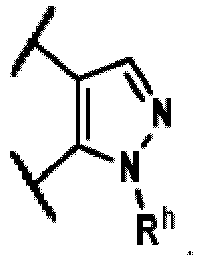
- Composé selon la revendication 1, le composé de formule (I) étant un composé de formule (ID) :
 ou sel ou solvate pharmaceutiquement acceptable correspondant,RAA, RAB, et RAC étant indépendamment halogéno ou C1-6 alkyle ;RQC étant H ou halogéno ; etchaque RCb étant indépendamment choisi dans le groupe constitué par H et RCa ; éventuellement,(i) R1 et R2 étant H ; et/ou(ii) R3 étant C1-3 alkyle ; éventuellement R3 étant méthyle ; et/ou(iii) R4, R5, R6, et R7 étant H ; et/ou(iv) R9d étant H ; et/ou(v) RAA et RAC étant indépendamment C1-6 alkyle ; éventuellement
RAA et RAC étant méthyle ; et/ou(vi) RAB étant halogéno ; éventuellement, RAB étant -F ; et/ou(vii) chaque RCb étant H ou méthyle, éventuellement, chaque RCb étant H. - Composé selon la revendication 22,(i) Ra et Rb étant indépendamment C1-3 alkyle ; ou(ii) Ra et Rb étant méthyle ; ou(iii) Ra et Rb étant éthyle ; ou(iv) Ra et Rb étant isopropyle ; ou(v) Ra étant méthyle ; et Rb étant tert-butyle ; ou(vi) Ra et Rb étant indépendamment C3-6 cycloalkyle ; ou(vii) Ra et Rb étant chacun cyclopropyle.
- Composé selon l'une quelconque des revendications 22-23,(i) RQA étant NRcRd ; éventuellement, RQA étant NH(C1-3 alkyle) ; et/ou(ii) RQC étant H.
- Composé selon l'une quelconque des revendications 22-24, le composé étant un composé de formule (S, S, S)-(ID)

- Composé selon l'une quelconque des revendications 1-25, le composé de formule I étant choisi dans le groupe constitué par les composés :


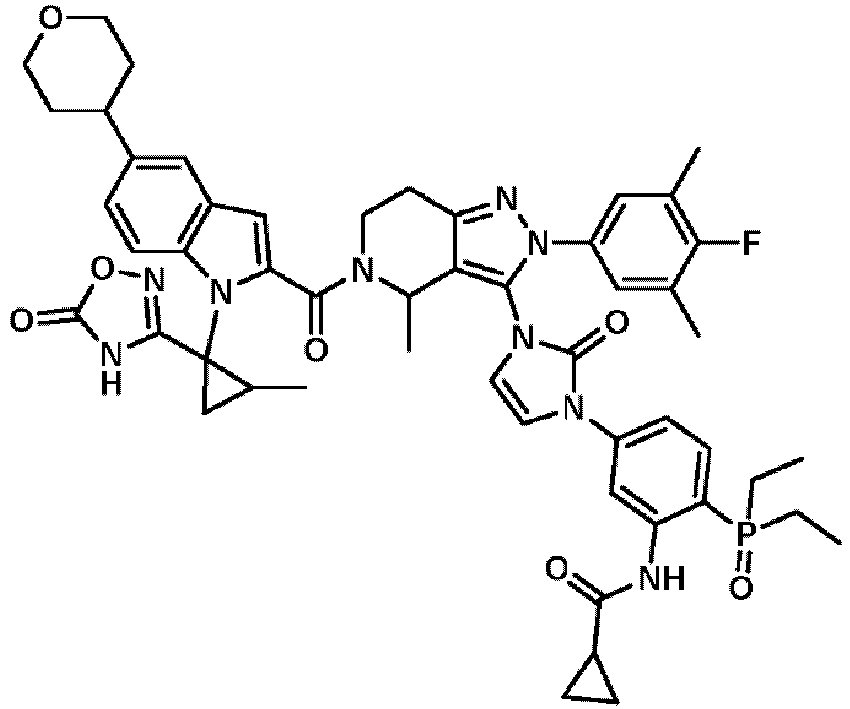


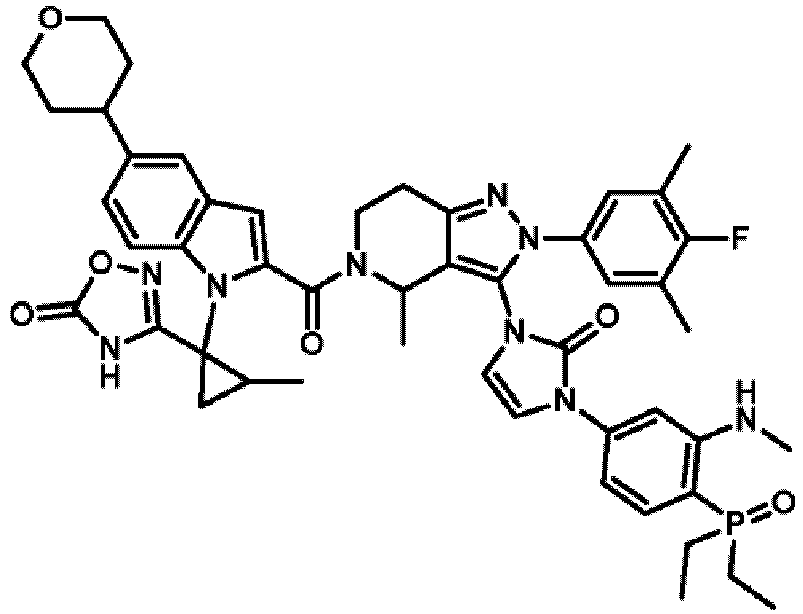


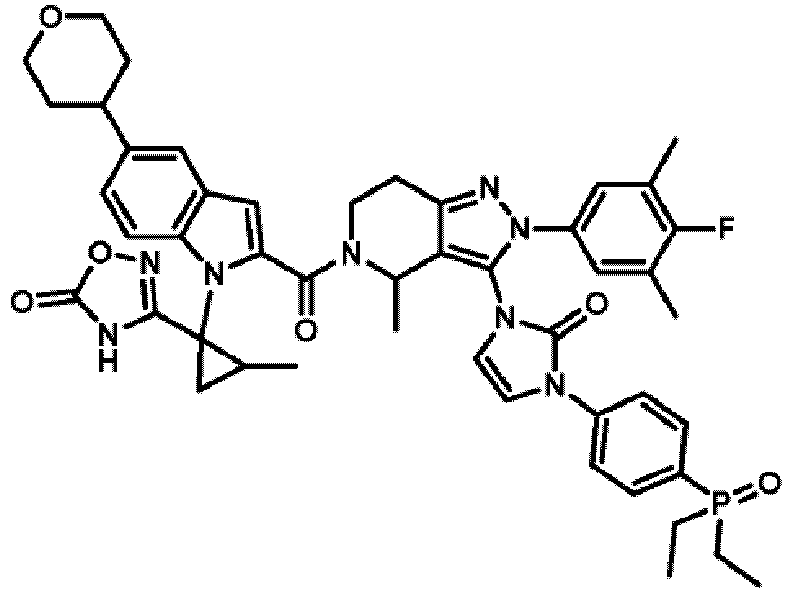


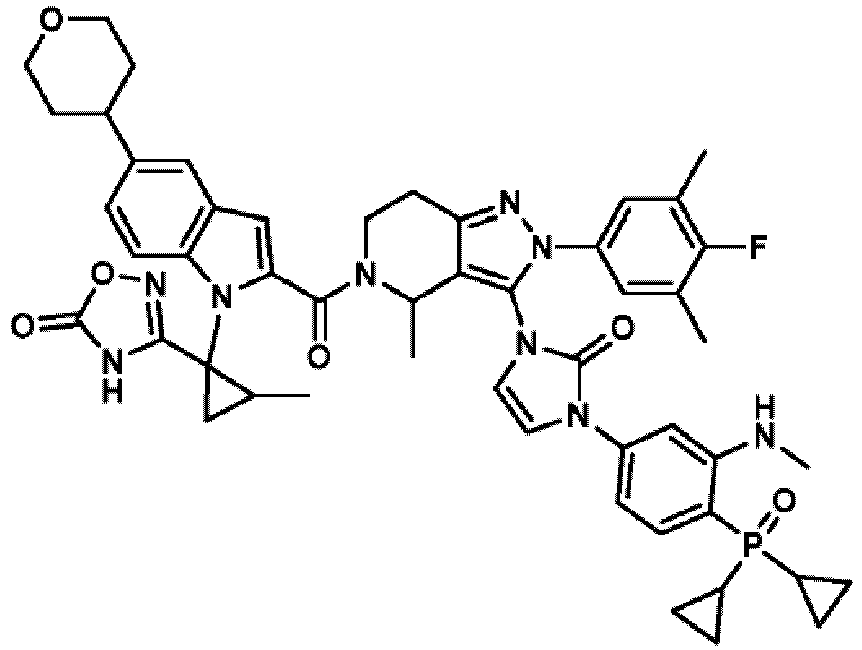


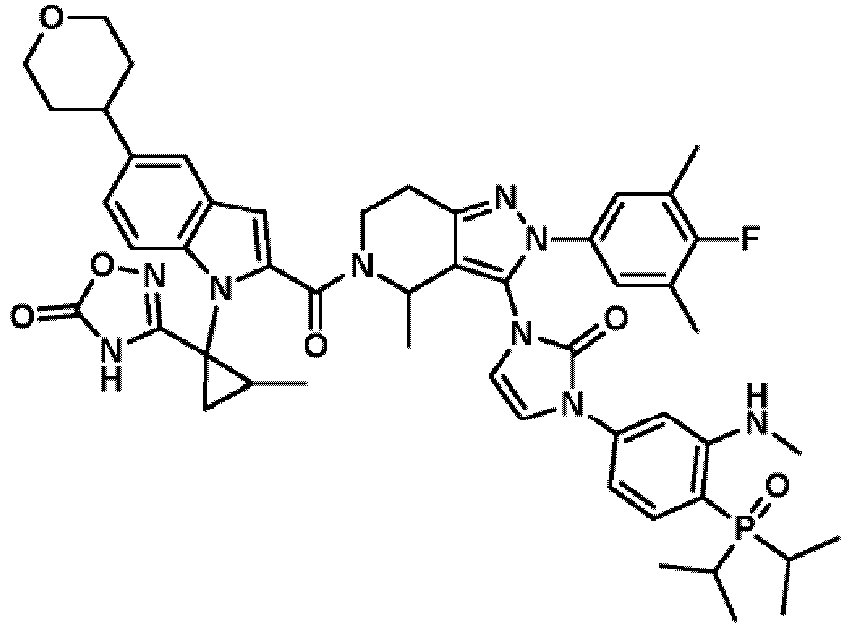


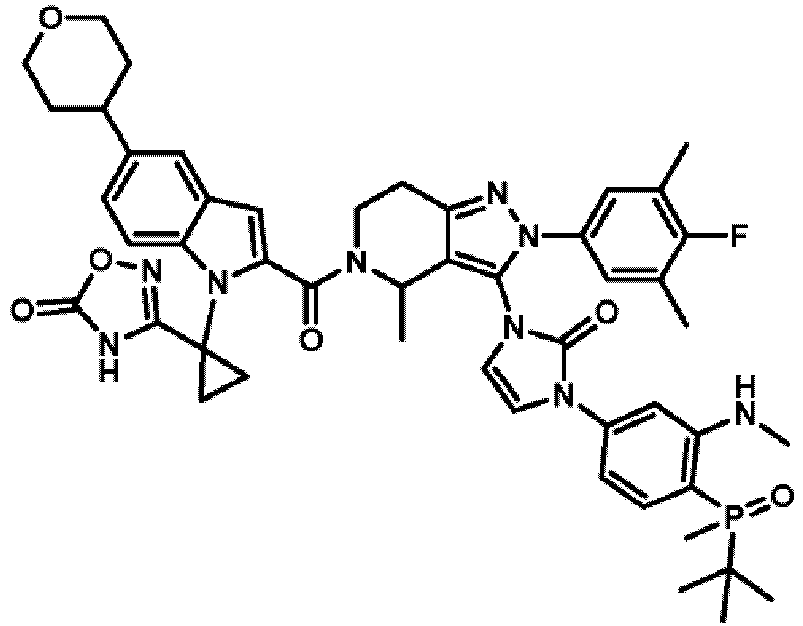


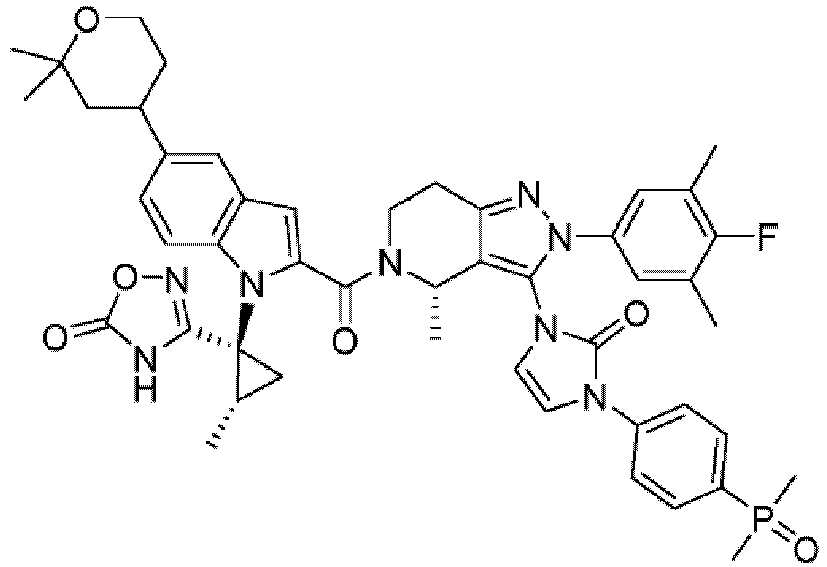


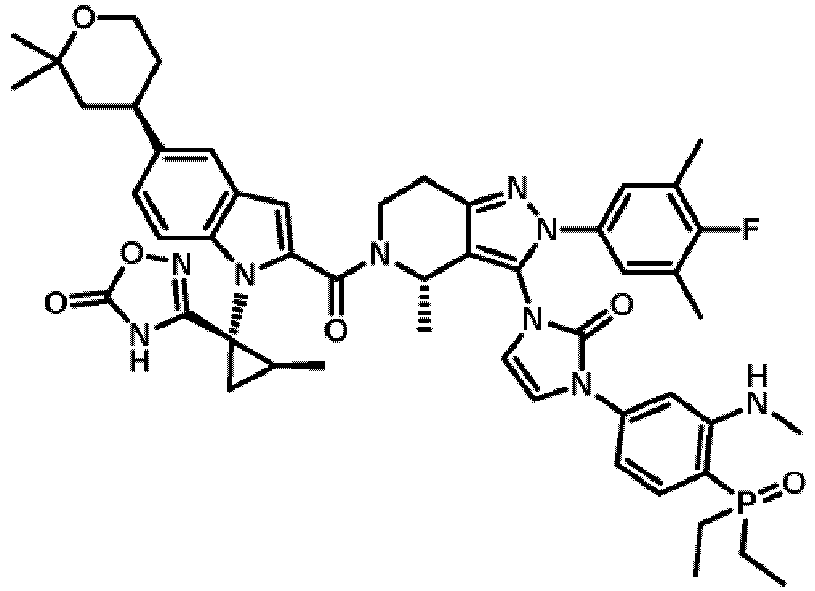


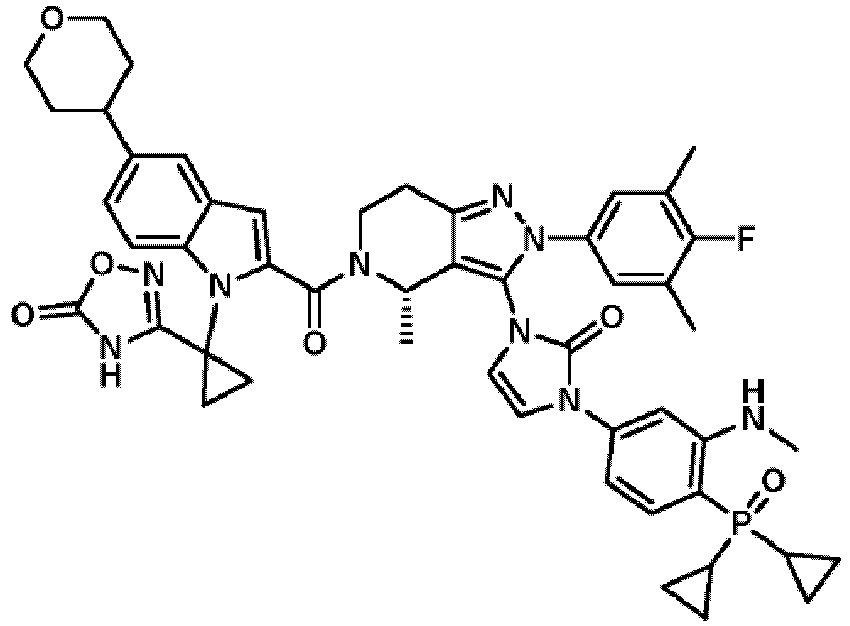


- Composé selon la revendication 1, le composé étant :

- Composé selon la revendication 1, le composé étant :

- Composé selon la revendication 1, le composé étant :
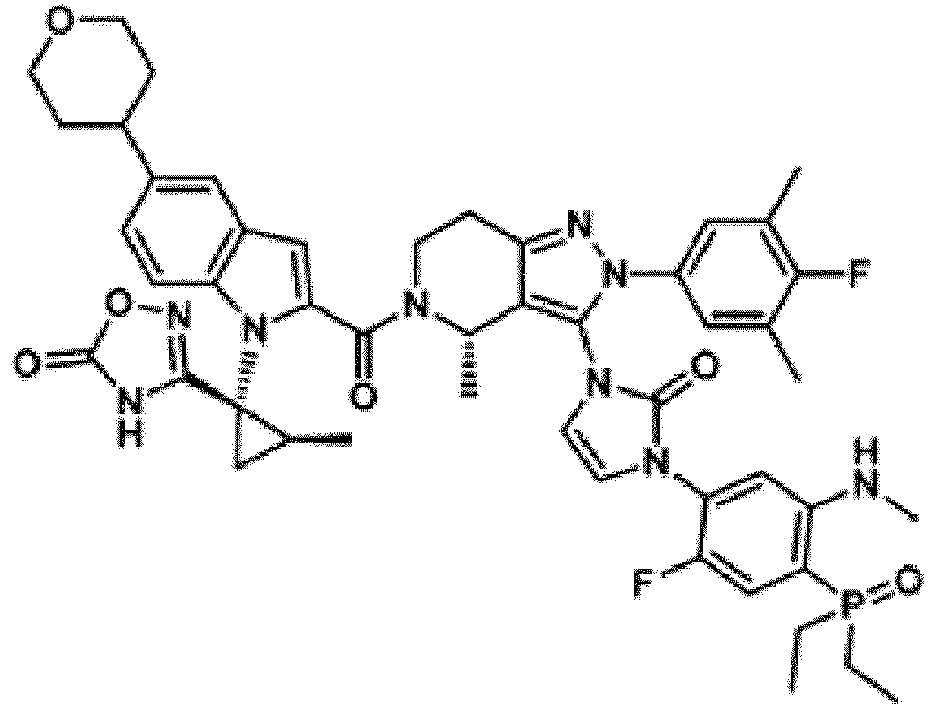
- Composé selon la revendication 1, le composé étant :

- Composé selon la revendication 1, le composé étant :

- Composé selon la revendication 1, le composé étant :

- Composé selon la revendication 1, le composé étant :

- Composé selon la revendication 1, le composé étant :

- Composé selon la revendication 1, le composé étant :

- Composé selon la revendication 1, le composé étant :

- Composition pharmaceutique comprenant un composé selon l'une quelconque des revendications 1 à 36, ou un sel ou un solvate pharmaceutiquement acceptable correspondant, et un excipient pharmaceutiquement acceptable.
- Composé selon l'une quelconque des revendications 1 à 36, ou sel ou solvate pharmaceutiquement acceptable correspondant, ou composition pharmaceutique selon la revendication 37, pour une utilisation dans un procédé pour le traitement du diabète sucré de type 2 chez un patient qui en a besoin, le procédé comprenant une administration au patient d'une quantité thérapeutiquement efficace du composé selon l'une quelconque des revendications 1 à 36, ou du sel ou du solvate pharmaceutiquement acceptable correspondant, ou de la composition pharmaceutique selon la revendication 37.
- Composé, ou sel pharmaceutiquement acceptable correspondant, ou composition pharmaceutique pour une utilisation selon la revendication 38, le composé selon l'une quelconque des revendications 1 à 36, ou le sel ou le solvate pharmaceutiquement acceptable correspondant, ou la composition pharmaceutique selon la revendication 37, étant administré(e) par voie orale.
- Composé selon l'une quelconque des revendications 1 à 36, ou sel pharmaceutiquement acceptable correspondant, ou composition pharmaceutique selon la revendication 37, pour une utilisation dans un procédé pour la modulation des taux d'insuline ou des taux de glucose chez un patient ayant besoin d'une telle modulation, le procédé comprenant une administration au patient d'une quantité thérapeutiquement efficace du composé selon l'une quelconque des revendications 1 à 36, ou du sel ou du solvate pharmaceutiquement acceptable correspondant, ou de la composition pharmaceutique selon la revendication 37.
- Composé selon l'une quelconque des revendications 1 à 36, ou sel pharmaceutiquement acceptable correspondant, ou composition pharmaceutique selon la revendication 37, pour une utilisation dans un procédé pour le traitement d'une maladie, d'un trouble ou d'une affection associé(e) à GLP-1, le procédé comprenant une administration à un patient qui en a besoin d'une quantité thérapeutiquement efficace du composé selon l'une quelconque des revendications 1 à 36, ou du sel ou du solvate pharmaceutiquement acceptable correspondant, ou de la composition pharmaceutique selon la revendication 37,la maladie, le trouble ou l'affection étant choisi(e) dans le groupe constitué par le diabète sucré de type 1, le diabète sucré de type 2, le diabète sucré de type 2 précoce, le diabète sucré de type 1 idiopathique (type 1b), le diabète atypique de l'adolescent (YOAD), le diabète de l'adolescent à maturité (MODY), le diabète auto-immun latent de l'adulte (LADA), l'obésité, la prise de poids due à l'utilisation d'autres agents, l'hypertension intracrânienne idiopathique, le syndrome de Wolfram, la goutte, l'envie excessive de sucre, l'hypertriglycéridémie, la dyslipidémie, le diabète lié à la malnutrition, le diabète gestationnel, les maladies rénales, le dysfonctionnement des adipocytes, l'apnée du sommeil, le dépôt d'adiposité viscérale, les troubles de l'alimentation, les maladies cardio-vasculaires, l'insuffisance cardiaque congestive, l'infarctus du myocarde, l'hypertrophie ventriculaire gauche, la maladie artérielle périphérique, l'accident vasculaire cérébral, l'accident vasculaire cérébral hémorragique, l'accident vasculaire cérébral ischémique, les accidents ischémiques transitoires, la maladie cardiovasculaire athérosclérotique, la lésion cérébrale traumatique, la maladie vasculaire périphérique, le dysfonctionnement endothélial, l'altération de la compliance vasculaire, la resténose vasculaire, la thrombose, l'hypertension, l'hypertension pulmonaire, la resténose après angioplastie, la claudication intermittente, l'hyperglycémie, la lipémie postprandiale, l'acidose métabolique, la cétose, l'hyperinsulinémie, l'altération du métabolisme du glucose, la résistance à l'insuline, la résistance hépatique à l'insuline, les troubles liés à la consommation d'alcool, l'insuffisance rénale chronique, le syndrome métabolique, le syndrome X, le sevrage tabagique, le syndrome prémenstruel, l'angine de poitrine, la néphropathie diabétique, l'altération de la tolérance au glucose, la neuropathie diabétique, la rétinopathie diabétique, la dégénérescence maculaire, la cataracte, la glomérulosclérose, l'arthrite, l'ostéoporose, le traitement de la toxicomanie, la dépendance à la cocaïne, le trouble bipolaire/trouble dépressif majeur, les troubles de la peau et du tissu conjonctif, les ulcérations du pied, le psoriasis, la polydipsie primaire, la stéatohépatite non alcoolique (NASH), la stéatose hépatique non alcoolique (NAFLD), la colite ulcéreuse, la maladie inflammatoire de l'intestin, la colite, le syndrome de l'intestin irritable, la maladie de Crohn, le syndrome de l'intestin court, la maladie de Parkinson, la maladie d'Alzheimer, les troubles cognitifs, la schizophrénie, le syndrome des ovaires polykystiques (SOPK), ou une quelconque combinaison correspondante ;éventuellement la maladie, le trouble ou l'affection étant choisi(e) dans le groupe constitué par le diabète sucré de type 2, le diabète sucré de type 2 précoce, l'obésité, la prise de poids due à l'utilisation d'autres agents, la goutte, l'envie excessive de sucre, l'hypertriglycéridémie, la dyslipidémie, le diabète gestationnel, les maladies rénales, le dysfonctionnement des adipocytes, l'apnée du sommeil, le dépôt d'adiposité viscérale, les troubles de l'alimentation, les maladies cardiovasculaires, l'insuffisance cardiaque congestive, l'infarctus du myocarde, l'hypertrophie ventriculaire gauche, la maladie artérielle périphérique, l'accident vasculaire cérébral, l'accident vasculaire cérébral hémorragique, l'accident vasculaire cérébral ischémique, l'accident ischémique transitoire, la maladie cardiovasculaire athérosclérotique, l'hyperglycémie, la lipémie postprandiale, l'acidose métabolique, la cétose, l'hyperinsulinémie, l'altération du métabolisme du glucose, la résistance à l'insuline, la résistance à l'insuline hépatique, les troubles liés à la consommation d'alcool, l'insuffisance rénale chronique, le syndrome métabolique, le syndrome X, le sevrage tabagique, le syndrome prémenstruel, l'angine de poitrine, la néphropathie diabétique, l'altération de la tolérance au glucose, la neuropathie diabétique, la rétinopathie diabétique, le trouble bipolaire/trouble dépressif majeur, les troubles de la peau et du tissu conjonctif, les ulcérations du pied, le psoriasis, la polydipsie primaire, la stéatohépatite non alcoolique (NASH), la stéatose hépatique non alcoolique (NAFLD), le syndrome de l'intestin court, la maladie de Parkinson, le syndrome des ovaires polykystiques (SOPK), l'hypertension intracrânienne idiopathique, le syndrome de Wolfram ou une quelconque combinaison correspondante ;éventuellement, la maladie, le trouble ou l'affection comprenant le diabète sucré de type 2, le diabète sucré de type 2 précoce, l'obésité, la prise de poids due à l'utilisation d'autres agents, la goutte, l'envie excessive de sucre, l'hypertriglycéridémie, la dyslipidémie, le diabète gestationnel, le dysfonctionnement des adipocytes, le dépôt d'adiposité viscérale, l'infarctus du myocarde, la maladie artérielle périphérique, l'accident vasculaire cérébral, les accidents ischémiques transitoires, l'hyperglycémie, la lipémie postprandiale, l'acidose métabolique, la cétose, l'hyperinsulinémie, l'altération du métabolisme du glucose, la résistance à l'insuline, la résistance hépatique à l'insuline, l'insuffisance rénale chronique, le syndrome X, l'angine de poitrine, la néphropathie diabétique, l'altération de la tolérance au glucose, la neuropathie diabétique, la rétinopathie diabétique, les troubles de la peau et du tissu conjonctif, les ulcérations du pied, l'hypertension intracrânienne idiopathique, le syndrome de Wolfram, ou une quelconque combinaison correspondante.
- Composé selon l'une quelconque des revendications 1 à 36, ou sel pharmaceutiquement acceptable correspondant, ou composition pharmaceutique selon la revendication 37, pour une utilisation dans un procédé pour le traitement de l'obésité, le procédé comprenant une administration à un patient qui en a besoin d'une quantité thérapeutiquement efficace du composé selon l'une quelconque des revendications 1 à 36, ou du sel ou du solvate pharmaceutiquement acceptable correspondant, ou de la composition pharmaceutique selon la revendication 37.
Priority Applications (6)
| Application Number | Priority Date | Filing Date | Title |
|---|---|---|---|
| HRP20241159TT HRP20241159T1 (hr) | 2020-02-07 | 2021-02-05 | Heterociklički agonisti za glp-1 |
| EP24183377.1A EP4458834A3 (fr) | 2020-02-07 | 2021-02-05 | Agonistes hétérocycliques de glp-1 |
| SI202130181T SI4097099T1 (sl) | 2020-02-07 | 2021-02-05 | Heterociklični agonisti GLP-1 |
| RS20240939A RS65877B1 (sr) | 2020-02-07 | 2021-02-05 | Heterociklični agonisti glp-1 |
| MA58498A MA58498B1 (fr) | 2020-02-07 | 2021-02-05 | Agonistes hétérocycliques de glp-1 |
| SM20240344T SMT202400344T1 (it) | 2020-02-07 | 2021-02-05 | Agonisti di glp-1 eterociclici |
Applications Claiming Priority (3)
| Application Number | Priority Date | Filing Date | Title |
|---|---|---|---|
| CN2020074537 | 2020-02-07 | ||
| CN2020109304 | 2020-08-14 | ||
| PCT/CN2021/075488 WO2021155841A1 (fr) | 2020-02-07 | 2021-02-05 | Agonistes hétérocycliques de glp-1 |
Related Child Applications (2)
| Application Number | Title | Priority Date | Filing Date |
|---|---|---|---|
| EP24183377.1A Division EP4458834A3 (fr) | 2020-02-07 | 2021-02-05 | Agonistes hétérocycliques de glp-1 |
| EP24183377.1A Division-Into EP4458834A3 (fr) | 2020-02-07 | 2021-02-05 | Agonistes hétérocycliques de glp-1 |
Publications (4)
| Publication Number | Publication Date |
|---|---|
| EP4097099A1 EP4097099A1 (fr) | 2022-12-07 |
| EP4097099A4 EP4097099A4 (fr) | 2023-09-27 |
| EP4097099B1 true EP4097099B1 (fr) | 2024-06-26 |
| EP4097099B9 EP4097099B9 (fr) | 2025-04-30 |
Family
ID=77199190
Family Applications (2)
| Application Number | Title | Priority Date | Filing Date |
|---|---|---|---|
| EP24183377.1A Pending EP4458834A3 (fr) | 2020-02-07 | 2021-02-05 | Agonistes hétérocycliques de glp-1 |
| EP21751080.9A Active EP4097099B9 (fr) | 2020-02-07 | 2021-02-05 | Agonistes hétérocycliques de glp-1 |
Family Applications Before (1)
| Application Number | Title | Priority Date | Filing Date |
|---|---|---|---|
| EP24183377.1A Pending EP4458834A3 (fr) | 2020-02-07 | 2021-02-05 | Agonistes hétérocycliques de glp-1 |
Country Status (30)
| Country | Link |
|---|---|
| US (2) | US11492365B2 (fr) |
| EP (2) | EP4458834A3 (fr) |
| JP (2) | JP7711074B2 (fr) |
| KR (1) | KR20220156535A (fr) |
| CN (4) | CN119841865A (fr) |
| AU (2) | AU2021216324B2 (fr) |
| CA (1) | CA3169975A1 (fr) |
| CL (1) | CL2022002105A1 (fr) |
| CO (1) | CO2022011065A2 (fr) |
| CR (1) | CR20220371A (fr) |
| DK (1) | DK4097099T3 (fr) |
| DO (1) | DOP2022000158A (fr) |
| ES (1) | ES2986788T3 (fr) |
| FI (1) | FI4097099T3 (fr) |
| HR (1) | HRP20241159T1 (fr) |
| HU (1) | HUE068174T2 (fr) |
| IL (2) | IL295281B2 (fr) |
| LT (1) | LT4097099T (fr) |
| MA (1) | MA58498B1 (fr) |
| MD (1) | MD4097099T2 (fr) |
| MX (1) | MX2022009524A (fr) |
| PE (1) | PE20231066A1 (fr) |
| PH (1) | PH12022552056A1 (fr) |
| PL (1) | PL4097099T3 (fr) |
| PT (1) | PT4097099T (fr) |
| RS (1) | RS65877B1 (fr) |
| SI (1) | SI4097099T1 (fr) |
| SM (1) | SMT202400344T1 (fr) |
| TW (1) | TWI901639B (fr) |
| WO (1) | WO2021155841A1 (fr) |
Families Citing this family (61)
| Publication number | Priority date | Publication date | Assignee | Title |
|---|---|---|---|---|
| JOP20190060A1 (ar) | 2016-09-26 | 2019-03-26 | Chugai Pharmaceutical Co Ltd | مشتق بيرازولو بيريدين له تأثير مساعد لمستقبل glp-1 |
| CR20210341A (es) | 2018-11-22 | 2021-11-25 | Qilu Regor Therapeutics Inc | Agonistas de glp-ir y usos de los mismos |
| US10954221B2 (en) | 2019-04-12 | 2021-03-23 | Qilu Regor Therapeutics Inc. | GLP-1R agonists and uses thereof |
| CA3157525A1 (fr) | 2019-10-25 | 2021-04-29 | Gilead Sciences, Inc. | Composes modulateurs de glp-1r |
| WO2021154796A1 (fr) | 2020-01-29 | 2021-08-05 | Gilead Sciences, Inc. | Composés modulateurs de glp-1r |
| CN119841865A (zh) | 2020-02-07 | 2025-04-18 | 加舒布鲁姆生物公司 | 杂环glp-1激动剂 |
| EP4211139A4 (fr) * | 2020-09-10 | 2024-12-18 | Gasherbrum Bio, Inc. | Agonistes hétérocycliques de glp-1 |
| EP4247804A1 (fr) | 2020-11-20 | 2023-09-27 | Gilead Sciences, Inc. | Composés modulateurs de glp-1r polyhétérocycliques |
| EP4304711A1 (fr) | 2021-03-11 | 2024-01-17 | Gilead Sciences, Inc. | Composés modulateurs de glp-1r |
| WO2022192430A1 (fr) | 2021-03-11 | 2022-09-15 | Gilead Sciences, Inc. | Composés modulateurs de glp-1r |
| WO2022202864A1 (fr) | 2021-03-24 | 2022-09-29 | 塩野義製薬株式会社 | Composition pharmaceutique contenant un agoniste du récepteur glp-1 comportant un cycle fusionné |
| PH12023552860A1 (en) | 2021-04-21 | 2024-05-20 | Gilead Sciences Inc | Carboxy-benzimidazole glp-1r modulating compounds |
| US20240366639A1 (en) * | 2021-08-12 | 2024-11-07 | Gasherbrum Bio, Inc. | Heterocyclic glp-1 agonists |
| IL310377A (en) | 2021-08-30 | 2024-03-01 | Mindrank Ai Ltd | Novel aryl ether substituted heterocyclic compound as glp1r agonist |
| WO2023038039A1 (fr) | 2021-09-08 | 2023-03-16 | 塩野義製薬株式会社 | Médicament destiné à la prévention et au traitement de maladies liées à l'activité anti-obésité |
| KR20240068737A (ko) | 2021-09-27 | 2024-05-17 | 테른스 파마슈티칼스, 인크. | Glp-1r 효능제로서의 벤즈이미다졸 카복실산 |
| AU2022375634A1 (en) | 2021-10-25 | 2024-06-06 | Terns Pharmaceuticals, Inc. | Compounds as glp-1r agonists |
| KR20240150488A (ko) | 2022-02-23 | 2024-10-15 | 테른스 파마슈티칼스, 인크. | Glp-1r 작용제로서의 화합물 |
| CN119137124A (zh) | 2022-03-09 | 2024-12-13 | 加舒布鲁姆生物公司 | 杂环glp-1激动剂 |
| US20260097037A1 (en) | 2022-09-22 | 2026-04-09 | Shionogi & Co., Ltd. | Fused ring compound having glp-1 receptor agonist effect |
| CN116003403B (zh) * | 2022-11-20 | 2024-07-23 | 药康众拓(北京)医药科技有限公司 | 一种氘代吲唑类化合物、药物组合物及其应用 |
| JP2026501171A (ja) | 2022-12-15 | 2026-01-14 | ガシャーブラム・バイオ・インコーポレイテッド | Glp-1アゴニスト活性を有する化合物の塩および固体形態 |
| EP4652167A1 (fr) * | 2023-01-17 | 2025-11-26 | Fochon Biosciences, Ltd. | Agonistes de glp-1 r et leurs utilisations |
| AU2024222719A1 (en) | 2023-02-16 | 2025-08-21 | Gasherbrum Bio, Inc. | Heterocyclic glp-1 agonists |
| US20240398794A1 (en) | 2023-04-07 | 2024-12-05 | Terns Pharmaceuticals, Inc. | COMBINATIONS OF GLP-1R AND THRß AGONISTS AND METHODS OF USE THEREOF |
| JP2025538520A (ja) | 2023-06-29 | 2025-11-28 | ウェイン バイオテクノロジー カンパニー,リミテッド | Glp-1受容体アゴニスト並びにその調製方法及び使用 |
| US20250019389A1 (en) | 2023-06-30 | 2025-01-16 | Gasherbrum Bio, Inc. | Heterocyclic agonists |
| CN120574224A (zh) * | 2023-06-30 | 2025-09-02 | 正大天晴药业集团股份有限公司 | 含多稠环结构的化合物 |
| WO2025014889A2 (fr) * | 2023-07-07 | 2025-01-16 | Procompounding, Llc | Formulations de sémaglutide |
| WO2025011664A1 (fr) | 2023-07-12 | 2025-01-16 | 歌礼制药(中国)有限公司 | Préparation d'agoniste de glp-1r et son procédé de préparation |
| WO2025015268A1 (fr) | 2023-07-13 | 2025-01-16 | Aconcagua Bio, Inc. | Modulateurs de l'activité du récepteur de la calcitonine et/ou du récepteur de l'amyline |
| WO2025015269A1 (fr) | 2023-07-13 | 2025-01-16 | Aconcagua Bio, Inc. | Composés, compositions et procédés |
| CN121712771A (zh) * | 2023-07-28 | 2026-03-20 | 上海翰森生物医药科技有限公司 | 一种苯并含氮杂环类衍生物调节剂、其制备方法和应用 |
| WO2025026436A1 (fr) * | 2023-08-02 | 2025-02-06 | 韦恩生物科技有限公司 | Composé cyclique fusionné contenant de l'azote, son procédé de préparation et son utilisation |
| WO2025045208A1 (fr) * | 2023-08-31 | 2025-03-06 | Gasherbrum Bio, Inc. | Agonistes de glp-1 à base de hétéroaryl-hétérocycloalkyl |
| TW202521533A (zh) * | 2023-09-14 | 2025-06-01 | 香港商歌禮製藥(中國)有限公司 | Glp-1r 激動劑及其治療方法 |
| WO2025080818A1 (fr) * | 2023-10-10 | 2025-04-17 | Sagimet Biosciences Inc. | Combinaisons d'inhibiteurs de fasn et d'agonistes de glp-1 pour des maladies hépatiques |
| WO2025097835A1 (fr) | 2023-11-10 | 2025-05-15 | 重庆医药工业研究院有限责任公司 | Composé agoniste de glp-1r et son utilisation |
| TW202527933A (zh) * | 2023-11-16 | 2025-07-16 | 大陸商西藏海思科製藥有限公司 | 咪唑-2-酮衍生物及其在醫藥上的應用 |
| US12291530B1 (en) | 2023-11-24 | 2025-05-06 | Ascletis Pharma (China) Co., Limited | GLP-1R agonist and therapeutic method thereof |
| WO2025119206A1 (fr) * | 2023-12-05 | 2025-06-12 | Fortvita Biologics Inc. | Composés ciblant le récepteur glp-1 et leurs utilisations |
| WO2025137307A1 (fr) * | 2023-12-20 | 2025-06-26 | Gasherbrum Bio, Inc. | Agonistes hétérocycliques de glp-1 |
| CN117447493A (zh) * | 2023-12-25 | 2024-01-26 | 药康众拓(北京)医药科技有限公司 | 氘代吲哚嗪类化合物、药物组合物及其应用 |
| CN117777111A (zh) * | 2023-12-26 | 2024-03-29 | 上海苏博医药科技有限公司 | 一种Orforglipron关键中间体的合成方法及其中间体 |
| WO2025148997A1 (fr) * | 2024-01-10 | 2025-07-17 | 海思科医药集团股份有限公司 | Dérivé de tétrahydropyridinopyrazole et son utilisation en médecine |
| WO2025158275A1 (fr) | 2024-01-24 | 2025-07-31 | Pfizer Inc. | Polythérapie utilisant des composés antagonistes du récepteur du polypeptide insulinotrope glucose-dépendant et des composés agonistes du récepteur glp-1 |
| WO2025171341A2 (fr) | 2024-02-08 | 2025-08-14 | Aconcagua Bio, Inc. | Composés et compositions pour traiter des états associés au récepteur de la calcitonine et/ou à l'activité du récepteur de l'amyline |
| WO2025171340A1 (fr) | 2024-02-08 | 2025-08-14 | Aconcagua Bio, Inc. | Traitement d'états associés au récepteur de la calcitonine et/ou de l'amyline |
| WO2025189141A1 (fr) | 2024-03-08 | 2025-09-12 | Annapurna Bio, Inc. | Méthodes de traitement de l'obésité et d'augmentation de la perte de poids |
| WO2025208093A1 (fr) * | 2024-03-28 | 2025-10-02 | Gila Therapeutics, Inc. | Compositions et méthodes pour le traitement de maladies métaboliques avec des agonistes du récepteur lingual topique |
| WO2025209515A1 (fr) * | 2024-04-03 | 2025-10-09 | 广州市联瑞制药有限公司 | Agoniste du récepteur glp-1, son procédé de préparation et son utilisation |
| WO2025237355A1 (fr) * | 2024-05-17 | 2025-11-20 | 成都地奥九泓制药厂 | Composé agoniste du récepteur glp-1, son procédé de préparation et son utilisation |
| WO2025255070A1 (fr) * | 2024-06-04 | 2025-12-11 | Avidence Therapeutics, Inc. | Formulation de tirzepatide injectable à base de microsphères |
| WO2025259825A1 (fr) | 2024-06-12 | 2025-12-18 | Eli Lilly And Company | Thérapies npa glp-1 pour maintenir une perte de poids corporel ou des niveaux de hba1c réduits suite à un traitement antérieur par glp-1 ra |
| WO2025264023A1 (fr) * | 2024-06-19 | 2025-12-26 | Chong Kun Dang Pharmaceutical Corp. | Agoniste du récepteur de glp-1 et ses utilisations |
| WO2025261454A1 (fr) * | 2024-06-19 | 2025-12-26 | 上海翰森生物医药科技有限公司 | Régulateur de dérivé de macrocycle contenant de l'azote, son procédé de préparation et son utilisation |
| WO2026012449A1 (fr) * | 2024-07-12 | 2026-01-15 | 联邦生物科技(珠海横琴)有限公司 | Composé hétérocyclique ayant un effet agoniste du récepteur glp-1 et utilisation d'un composé hétérocyclique |
| WO2026032183A1 (fr) * | 2024-08-05 | 2026-02-12 | Rongchang Pharmaceuticals, Ltd. | Composé cyclique fusionné contenant de l'azote, composition pharmaceutique et utilisation associée |
| WO2026031819A1 (fr) * | 2024-08-06 | 2026-02-12 | Insilico Medicine Ip Limited | Nouveaux composés utilisés en tant qu'agonistes de glp-1r et leurs utilisations |
| CN119775163A (zh) * | 2024-10-23 | 2025-04-08 | 诚达药业股份有限公司 | 一种(s)-3-氨基丁腈盐酸盐类化合物及其制备方法 |
| CN119176808B (zh) * | 2024-11-25 | 2025-12-26 | 山东法恩新材料科技有限公司 | 一种glp-1激动剂及其制备方法和应用 |
Family Cites Families (147)
| Publication number | Priority date | Publication date | Assignee | Title |
|---|---|---|---|---|
| HU212435B (en) | 1990-06-07 | 1996-06-28 | Sandoz Ag | Herbicidal compositions containing substituted phthalides and heterocyclic phthalides as active ingredient and process for preparation of their active ingredients. |
| FI960095L (fi) | 1993-07-09 | 1996-01-09 | Schering Corp | Menetelmä atsetidinonien syntetitoimiseksi |
| US5612359A (en) | 1994-08-26 | 1997-03-18 | Bristol-Myers Squibb Company | Substituted biphenyl isoxazole sulfonamides |
| JPH08295646A (ja) | 1995-04-26 | 1996-11-12 | Teijin Ltd | ビス(ヒドロキシエトキシフェニル)化合物の製造方法 |
| AU6944296A (en) | 1995-09-13 | 1997-04-01 | Takeda Chemical Industries Ltd. | Benzoxazepine compounds, their production and use as lipid lowering agents |
| US6187774B1 (en) | 1996-03-04 | 2001-02-13 | Yoshitomi Pharmaceutical Industries, Ltd. | Fused heterocyclic compounds and pharmaceutical applications thereof |
| EP1021451A4 (fr) | 1997-01-13 | 2001-02-14 | Penn State Res Found | Synthese et catalyse asymetriques faisant appel a des composes heterocycliques chiraux |
| TW536540B (en) | 1997-01-30 | 2003-06-11 | Bristol Myers Squibb Co | Endothelin antagonists: N-[[2'-[[(4,5-dimethyl-3-isoxazolyl)amino]sulfonyl]-4-(2-oxazolyl)[1,1'-biphenyl]-2-yl]methyl]-N,3,3-trimethylbutanamide and N-(4,5-dimethyl-3-isoxazolyl)-2'-[(3,3-dimethyl-2-oxo-1-pyrrolidinyl)methyl]-4'-(2-oxazolyl)[1,1'-biphe |
| US6628343B1 (en) | 1997-05-23 | 2003-09-30 | Sony Corporation | Television signal reception circuit, automatic phase shift control circuit and equal amplitude addition circuit |
| IT1292461B1 (it) | 1997-07-03 | 1999-02-08 | Great Lakes Chemical Italia | Composti fotocromatici,procedimento per la loro preparazione e loro utilizzo in materiali polimerici |
| WO2000001389A1 (fr) | 1998-07-06 | 2000-01-13 | Bristol-Myers Squibb Co. | Biphenyl sulfonamides en tant que doubles antagonistes de recepteurs d'angiotensine et d'endotheline |
| AU5994900A (en) | 1999-07-09 | 2001-01-30 | Isis Innovation Limited | Compounds for inhibiting diseases and preparing cells for transplantation |
| AR035016A1 (es) | 1999-08-25 | 2004-04-14 | Takeda Chemical Industries Ltd | Composicion de azol promotor de produccion/secrecion de neurotrofina, compuesto prodroga del mismo, composicion farmaceutica que lo comprende y uso del mismo para preparar esta ultima. |
| PH12000002657B1 (en) | 1999-10-12 | 2006-02-21 | Bristol Myers Squibb Co | C-aryl glucoside SGLT2 inhibitors |
| WO2002006234A1 (fr) | 2000-07-17 | 2002-01-24 | Takeda Chemical Industries, Ltd. | Derives de sulfonate, procede de production et utilisation de ces derives |
| WO2002046164A1 (fr) | 2000-12-07 | 2002-06-13 | Astrazeneca Ab | Composes therapeutiques |
| IL156339A0 (en) | 2000-12-08 | 2004-01-04 | Ortho Mcneil Pharm Inc | Indazolyl-substituted pyrroline compounds as kinase inhibitors |
| CA2450555A1 (fr) | 2001-06-25 | 2003-01-03 | Merck & Co., Inc. | Composes d'heteroaryle fondus (pyrimidyle)(phenyle) substitues inhibiteurs de p38 et de la kinase pkg |
| AU2003207774A1 (en) | 2002-01-30 | 2003-09-02 | Montana State University | Pestalotiopsis microsporia isolates and compounds derived therefrom |
| NZ534582A (en) | 2002-02-27 | 2006-03-31 | Pfizer Prod Inc | ACC inhibitors |
| JP2006505533A (ja) | 2002-09-17 | 2006-02-16 | アクテリオン ファマシューティカルズ リミテッド | 1−ピリジン−4−イル−尿素誘導体 |
| NZ540381A (en) | 2002-11-01 | 2007-11-30 | Takeda Pharmaceutical | 5-membered aromatic heterocycle derivatives as prophylactic and therapeutic agents for treating neuropathy |
| AU2003277576A1 (en) | 2002-11-08 | 2004-06-07 | Takeda Pharmaceutical Company Limited | Receptor function controlling agent |
| AU2003284596A1 (en) | 2002-11-22 | 2004-06-18 | Takeda Pharmaceutical Company Limited | Imidazole derivative, process for producing the same, and use |
| US20040259179A1 (en) | 2003-05-30 | 2004-12-23 | Gerd Assmann | Sterol markers as diagnostic tools in the prevention of atherosclerotic diseases and as tools to aid in the selection of agents to be used for the prevention and treatment of atherosclerotic disease |
| EP1630152A4 (fr) | 2003-05-30 | 2009-09-23 | Takeda Pharmaceutical | Compose cyclique condense |
| SI1668014T1 (sl) | 2003-09-17 | 2009-06-30 | Janssen Pharmaceutica Nv | Kondenzirane heterociklične spojine kot modulatorji serotoninskih receptorjev |
| US7534887B2 (en) | 2003-09-30 | 2009-05-19 | Takeda Pharmaceutical Company Limited | Thiazoline derivative and use of the same |
| JP4769082B2 (ja) | 2003-12-17 | 2011-09-07 | 武田薬品工業株式会社 | ウレア誘導体、その製造法及び用途 |
| MXPA06006745A (es) | 2003-12-18 | 2006-08-18 | Novo Nordisk As | Compuestos glp-1 novedosos. |
| WO2005066136A1 (fr) | 2003-12-22 | 2005-07-21 | Eli Lilly And Company | Derives bicycliques en tant que modulateurs de ppar |
| AU2004309271A1 (en) | 2003-12-25 | 2005-07-14 | Takeda Pharmaceutical Company Limited | 3-(4-benzyloxyphenyl)propanoic acid derivatives |
| EP1698624B1 (fr) | 2003-12-26 | 2012-06-27 | Takeda Pharmaceutical Company Limited | Derives d'acide phenylpropanoique |
| US7786165B2 (en) | 2004-03-15 | 2010-08-31 | Takeda Pharmaceutical Company Limited | Aminophenylpropanoic acid derivative |
| JP4859665B2 (ja) | 2004-03-30 | 2012-01-25 | 武田薬品工業株式会社 | アルコキシフェニルプロパン酸誘導体 |
| JP4604086B2 (ja) | 2004-05-07 | 2010-12-22 | エグゼリクシス, インコーポレイテッド | Rafモジュレーターおよびその使用方法 |
| TWI396686B (zh) | 2004-05-21 | 2013-05-21 | Takeda Pharmaceutical | 環狀醯胺衍生物、以及其製品和用法 |
| UA84208C2 (en) | 2004-05-25 | 2008-09-25 | Пфайзер Продактс Инк. | Tetraazabenzo(e)azulene derivatives and analogs thereof |
| WO2005121138A2 (fr) | 2004-06-03 | 2005-12-22 | Rigel Pharmaceuticals, Inc. | Composes heterotricycliques utilises comme inhibiteurs du vhc |
| US20050287100A1 (en) | 2004-06-08 | 2005-12-29 | Lebre Caroline | Cosmetic composition comprising a semi-crystalline polymer and a dispersion of polymer in fatty phase |
| GB0419481D0 (en) | 2004-09-02 | 2004-10-06 | Cancer Rec Tech Ltd | Isoindolin-1-one derivatives |
| MX2007003336A (es) | 2004-09-21 | 2007-06-05 | Athersys Inc | Acidos aceticos de indol que muestran antagonismo de receptor crth2 y usos de los mismos. |
| US20060275288A1 (en) | 2005-01-20 | 2006-12-07 | Grihalde Nelson D | GLP-1 receptor agonist and allosteric modulator monoclonal antibodies and uses thereof |
| US8318699B2 (en) | 2005-01-31 | 2012-11-27 | The Trustees Of The University Of Pennsylvania | Tumor necrosis factor inhibitors |
| TWI372629B (en) | 2005-03-18 | 2012-09-21 | Novo Nordisk As | Acylated glp-1 compounds |
| EP2308839B1 (fr) | 2005-04-20 | 2017-03-01 | Takeda Pharmaceutical Company Limited | Composés hétérocycliques condensés |
| CN101223167B (zh) | 2005-07-15 | 2011-08-31 | 弗·哈夫曼-拉罗切有限公司 | 杂芳基稠合的环状胺 |
| JP5084503B2 (ja) | 2005-07-29 | 2012-11-28 | 武田薬品工業株式会社 | シクロプロパンカルボン酸化合物 |
| JPWO2007013694A1 (ja) | 2005-07-29 | 2009-02-12 | 武田薬品工業株式会社 | フェノキシアルカン酸化合物 |
| KR20080033524A (ko) | 2005-08-10 | 2008-04-16 | 다케다 야쿠힌 고교 가부시키가이샤 | 당뇨병 치료제 |
| JP2007063225A (ja) | 2005-09-01 | 2007-03-15 | Takeda Chem Ind Ltd | イミダゾピリジン化合物 |
| CA2627426A1 (fr) | 2005-11-11 | 2007-05-18 | Markus Boehringer | Nouvelles amines cycliques fusionnees a un carbocyclyle |
| US20100048660A1 (en) | 2006-02-10 | 2010-02-25 | Graham Michael Wynne | Treatment of duchenne muscular dystrophy |
| JP5190448B2 (ja) | 2006-04-20 | 2013-04-24 | ファイザー・プロダクツ・インク | グルコキナーゼ仲介疾患を予防および治療するための縮合フェニルアミド複素環化合物 |
| BRPI0713378A8 (pt) | 2006-06-27 | 2018-01-02 | Takeda Pharmaceutical | composto, pró-droga, modulador da função do receptor gpr40, agente farmacêutico uso do composto, e, método de produção de uma forma opticamente ativa de um composto |
| US7919598B2 (en) | 2006-06-28 | 2011-04-05 | Bristol-Myers Squibb Company | Crystal structures of SGLT2 inhibitors and processes for preparing same |
| WO2008014219A2 (fr) | 2006-07-24 | 2008-01-31 | Smithkline Beecham Corporation | Dérivés de thiozolidinedione utilisés en tant qu'inhibiteurs de la p13-kinase |
| EP2077267A4 (fr) | 2006-10-18 | 2010-04-07 | Takeda Pharmaceutical | Composé hétérocyclique fusionné |
| US7652133B2 (en) | 2006-10-19 | 2010-01-26 | Takeda Pharmaceutical Company Limited | Indole compound |
| WO2008053341A2 (fr) | 2006-11-03 | 2008-05-08 | Glenmark Pharmaceuticals S.A. | Nouveaux ligands de récepteurs cannabinoïdes, compositions pharmaceutiques les contenant et procédés pour leur préparation |
| EA200900613A1 (ru) | 2006-11-29 | 2009-10-30 | Пфайзер Продактс Инк. | Спирокетоновые ингибиторы ацетил-коа-карбоксилаз |
| US20130012485A1 (en) | 2006-12-22 | 2013-01-10 | Baeschlin Daniel Kaspar | Organic compounds |
| WO2008093639A1 (fr) | 2007-01-29 | 2008-08-07 | Takeda Pharmaceutical Company Limited | Composé de pyrazole |
| EP2118066A1 (fr) | 2007-02-09 | 2009-11-18 | Takeda Pharmaceutical Company Limited | Composés à cycles fusionnés utiles en tant qu'agonistes partiels de ppar-gamma |
| GB0706072D0 (en) | 2007-03-28 | 2007-05-09 | Sterix Ltd | Compound |
| JPWO2008136428A1 (ja) | 2007-04-27 | 2010-07-29 | 武田薬品工業株式会社 | 含窒素5員複素環化合物 |
| EP2157859A4 (fr) | 2007-06-19 | 2011-01-12 | Takeda Pharmaceutical | Composés d'indazole permettant d'activer la glucokinase |
| US20090036425A1 (en) | 2007-08-02 | 2009-02-05 | Pfizer Inc | Substituted bicyclolactam compounds |
| GB0715087D0 (en) | 2007-08-03 | 2007-09-12 | Summit Corp Plc | Drug combinations for the treatment of duchenne muscular dystrophy |
| WO2009036275A1 (fr) | 2007-09-13 | 2009-03-19 | Link Medicine Corporation | Traitement de maladies neurodégénératives au moyen d'analogues de l'indatraline |
| WO2009099736A2 (fr) | 2008-02-06 | 2009-08-13 | Lead Therapeutics, Inc. | Inhibiteurs à base de composés benzoxazole-carboxamide de l’activité poly(adp-ribose)polymérase (parp) |
| TW201000107A (en) | 2008-04-09 | 2010-01-01 | Infinity Pharmaceuticals Inc | Inhibitors of fatty acid amide hydrolase |
| US20110009443A1 (en) | 2008-05-28 | 2011-01-13 | Kevin Daniel Freeman-Cook | Pyrazolospiroketone Acetyl-Coa Carboxylase Inhibitors |
| WO2009144554A1 (fr) | 2008-05-28 | 2009-12-03 | Pfizer, Inc. | Inhibiteurs de la pyrazolospirocétone acétl-coa carboxylase |
| DK2300035T3 (en) | 2008-06-17 | 2015-11-16 | Univ Indiana Res & Tech Corp | Mixed GIP-based agonists for the treatment of metabolic diseases and obesity |
| EP2318370A1 (fr) | 2008-07-29 | 2011-05-11 | Pfizer Inc. | Hétéroaryles fluorés |
| MY155418A (en) | 2008-08-28 | 2015-10-15 | Pfizer | Dioxa-bicyclo[3.2.1]octane-2,3,4-triol derivatives |
| US8735391B2 (en) | 2008-09-26 | 2014-05-27 | University Of Kansas | Synthesis of functionalized octahydro-isoquinolin-1-one-8-carboxamides, octahydro-isoquinolin-1-one-8-carboxylic esters and analogs, and therapeutic methods |
| WO2010086820A1 (fr) | 2009-02-02 | 2010-08-05 | Pfizer Inc. | Dérivés de 4-amino-5-oxo-7,8-dihydropyrimido[5,4-f][1,4]oxazépin-6(5h)-yl)phényle |
| AR075051A1 (es) | 2009-02-05 | 2011-03-02 | Schering Corp | Compuestos antidiabeticos que contienen ftalazina |
| MY151246A (en) | 2009-03-11 | 2014-04-30 | Pfizer | Benzofuranyl derivatives |
| US20110319379A1 (en) | 2009-03-11 | 2011-12-29 | Corbett Jeffrey W | Substituted Indazole Amides And Their Use As Glucokinase Activators |
| WO2010106457A2 (fr) | 2009-03-20 | 2010-09-23 | Pfizer Inc. | 3-oxa-7-azabicyclo[3,3.1]nonanes |
| WO2010128414A1 (fr) | 2009-05-08 | 2010-11-11 | Pfizer Inc. | Modulateurs du gpr119 |
| CA2759843A1 (fr) | 2009-05-08 | 2010-11-10 | Pfizer Inc. | Modulateurs de gpr119 |
| NZ596467A (en) | 2009-06-05 | 2014-01-31 | Pfizer | L- ( piperidin-4-yl) -pyrazole derivatives as gpr 119 modulators |
| US20120148586A1 (en) | 2009-08-27 | 2012-06-14 | Joyce Ching Tsu Chou | Glucagon-like protein-1 receptor (glp-1r) agonists for treating autoimmune disorders |
| US8455516B2 (en) | 2010-01-15 | 2013-06-04 | Touro University | HIV-1 fusion inhibitors and methods |
| US20120021979A1 (en) | 2010-06-24 | 2012-01-26 | Vanderbilt University | GLP-1 receptor modulation of addiction, neuropsychiatric disorders and erectile dysfunction |
| HRP20161178T1 (hr) | 2010-09-30 | 2016-11-04 | Pfizer Inc. | N1-PIRAZOLOSPIROKETONSKI INHIBITORI ACETIL-CoA-KARBOKSILAZE |
| WO2012065065A1 (fr) | 2010-11-12 | 2012-05-18 | Follica, Inc. | Procédés et compositions pour moduler la pousse de cheveux, la cicatrisation de plaie et la révision de cicatrice |
| JP5687120B2 (ja) | 2011-04-20 | 2015-03-18 | ユニチカ株式会社 | ポリアリレート樹脂 |
| JP5805982B2 (ja) | 2011-04-20 | 2015-11-10 | ユニチカ株式会社 | ポリアリレート樹脂フィルムおよび気体分離膜 |
| EP2753642B8 (fr) | 2011-09-06 | 2017-12-13 | Novo Nordisk A/S | Dérivés de glp-1 |
| KR101401705B1 (ko) | 2012-01-31 | 2014-06-27 | 울산대학교 산학협력단 | 로듐 촉매를 이용한 이소인돌린 유도체의 합성방법 |
| WO2013151975A1 (fr) | 2012-04-02 | 2013-10-10 | Northeastern University | Compositions et procédés d'inhibition de méthyltransférases |
| US20150272939A1 (en) | 2012-10-02 | 2015-10-01 | Yale University | Identification of Small Molecule Inhibitors of Jumonji AT-Rich Interactive Domain 1A (JARID1A) and 1B (JARID1B) Histone Demethylase |
| WO2014101120A1 (fr) | 2012-12-28 | 2014-07-03 | Merck Sharp & Dohme Corp. | Composés de 7-méthoxy-[1,2,4]triazolo[1,5-c]quinazoline-5-amine à substitution hétérobicyclo présentant des propriétés d'antagoniste d'a2a |
| EP2953681B1 (fr) | 2013-02-06 | 2017-03-15 | Boehringer Ingelheim International GmbH | Nouveaux acides indanyloxydihydrobenzofuranylacétiques |
| CN109867630A (zh) | 2013-06-11 | 2019-06-11 | 赛尔基因第二国际有限公司 | 新型glp-1受体调节剂 |
| CN103421006B (zh) | 2013-08-18 | 2016-06-22 | 上海师范大学 | 2,3,5,7-四取代二氢吡唑并六氢吡啶衍生物及其制备方法和应用 |
| EP2857550A1 (fr) | 2013-10-02 | 2015-04-08 | Basf Se | Précurseurs d'amine pour déposer du graphène |
| EP3172199B1 (fr) | 2014-07-25 | 2020-07-01 | Celgene International II Sarl | Dérivés de pyrimidine comme modulateurs du récepteur glp-1 |
| EP2993174A1 (fr) | 2014-09-08 | 2016-03-09 | Helmholtz Zentrum München Deutsches Forschungszentrum für Gesundheit und Umwelt GmbH | Dérivés de pyrazolopyridine et leur utilisation en thérapie |
| CN105646459A (zh) | 2014-11-13 | 2016-06-08 | 上海和辉光电有限公司 | 一种化合物及其制备方法和应用 |
| WO2016118639A1 (fr) | 2015-01-20 | 2016-07-28 | The Trustees Of Columbia University In The City Of New York | Oxydants de la pdi à petite molécule et leur utilisation |
| WO2017116204A1 (fr) | 2015-12-31 | 2017-07-06 | 한미약품 주식회사 | Triple activateur activant le récepteur du glucagon, du glp-1 et du gip |
| WO2017182983A1 (fr) | 2016-04-22 | 2017-10-26 | Sabic Global Technologies B.V. | Procédés de production de 2-aryl-3,3-bis(hydroxyaryl)phtalimidines |
| EP3445748B1 (fr) | 2016-04-22 | 2022-06-15 | SHPP Global Technologies B.V. | Procédés de fabrication des 2-aryl-3,3-bis(4-hydroxyaryl) phthalimidines et polymeres dérivés de ceux-ci |
| WO2017182986A1 (fr) | 2016-04-22 | 2017-10-26 | Sabic Global Technologies B.V. | Procédés de production de 2-aryl-3,3-bis(hydroxyaryl)phtalimidines |
| AR109179A1 (es) | 2016-08-19 | 2018-11-07 | Pfizer | Inhibidores de diacilglicerol aciltransferasa 2 |
| JOP20190060A1 (ar) * | 2016-09-26 | 2019-03-26 | Chugai Pharmaceutical Co Ltd | مشتق بيرازولو بيريدين له تأثير مساعد لمستقبل glp-1 |
| WO2018106818A1 (fr) | 2016-12-07 | 2018-06-14 | Kura Oncology, Inc. | Procédés de promotion de la prolifération de cellules bêta |
| EP3555064B9 (fr) | 2016-12-16 | 2023-03-01 | Pfizer Inc. | Agonistes du récepteur glp-1 et leurs utilisations |
| DK3600270T3 (da) | 2017-03-31 | 2023-07-10 | Aurigene Oncology Ltd | Forbindelser og sammensætninger til behandling af hæmatologiske lidelser |
| TWI782056B (zh) | 2017-07-14 | 2022-11-01 | 日商鹽野義製藥股份有限公司 | 具有mgat2抑制活性的縮合環衍生物 |
| JP7461104B2 (ja) | 2017-11-29 | 2024-04-03 | 中外製薬株式会社 | Glp-1受容体アゴニスト作用を持つピラゾロピリジン誘導体を含有する医薬組成物 |
| ES2980175T3 (es) | 2017-12-22 | 2024-09-30 | Chemocentryx Inc | Compuestos anulares fusionados en 6,5 sustituidos con diarilo como inhibidores de C5aR |
| US10800784B2 (en) | 2018-02-01 | 2020-10-13 | Japan Tobacco Inc. | Nitrogen-containing heterocyclic amide compound and pharmaceutical use thereof |
| WO2019158731A1 (fr) | 2018-02-16 | 2019-08-22 | Ucb Biopharma Sprl | Dérivés cycliques 6,5 hétérobicycliques pharmaceutiques |
| CN111801331A (zh) | 2018-02-28 | 2020-10-20 | 诺华股份有限公司 | 吲哚-2-羰基化合物及其用于治疗乙型肝炎的用途 |
| US20190284340A1 (en) | 2018-03-14 | 2019-09-19 | SABIC Global Technologies B.V | 3-oxo-2-arylisoindoline diphthalonitrile monomers, methods of manufacture, thermosetting compositions comprising the same, and uses thereof |
| US20190284341A1 (en) | 2018-03-14 | 2019-09-19 | Sabic Global Technologies B.V. | 3-oxo-2-alkylisoindoline diphthalonitrile monomers, methods of manufacture, thermosetting compositions comprising the same, and uses thereof |
| WO2019195159A1 (fr) * | 2018-04-02 | 2019-10-10 | Chemocentryx, Inc. | Promédicaments d'antagonistes de c5ar bicycliques fusionnés |
| CA3045644C (fr) | 2018-06-13 | 2024-01-16 | Pfizer Inc. | Antagonistes du recepteur glp-1 et leurs utilisations |
| ES2943510T3 (es) | 2018-06-15 | 2023-06-13 | Pfizer | Agonistas del receptor GLP-1 y usos del mismo |
| US20220388953A1 (en) | 2018-06-27 | 2022-12-08 | The Hong Kong Polytechnic University | Compounds with antimicrobial activity |
| US11923622B2 (en) | 2018-08-02 | 2024-03-05 | Nokia Solutions And Networks Oy | Antenna and wireless communication device |
| CR20210110A (es) | 2018-08-31 | 2021-05-13 | Pfizer | Combinaciones para tratamiento de ehna/ehgna y enfermedades relacionadas |
| AR117189A1 (es) | 2018-11-02 | 2021-07-21 | Aicuris Gmbh & Co Kg | Derivados de 6,7-dihidro-4h-pirazolo[1,5-a]pirazin indol-2-carboxamidas activos contra el virus de la hepatitis b (vhb) |
| PY1991603A (es) | 2018-11-02 | 2020-09-17 | Aicuris Gmbh & Co Kg | Nueva 6,7-dihidro-4h-pirazolo [1,5-a] pirazina indole -2-carboxamidas activas contra el virus de la hepatitis b (vhb) |
| CR20210341A (es) | 2018-11-22 | 2021-11-25 | Qilu Regor Therapeutics Inc | Agonistas de glp-ir y usos de los mismos |
| CN111217796B (zh) | 2018-11-26 | 2021-12-14 | 上海亚舸生物科技有限公司 | 一类螺环-二吡咯甲烷/二吡咯甲川化合物及其制备方法和应用 |
| CN111217842B (zh) | 2018-11-26 | 2023-01-31 | 上海亚舸生物科技有限公司 | 一类螺环-二吡咯甲烷硼配合物/二吡咯甲川硼配合物及其制备方法和应用 |
| EP3890748A4 (fr) | 2018-12-05 | 2022-12-21 | Viking Therapeutics, Inc. | Compositions et procédés de traitement de troubles hépatiques |
| EP3889150A4 (fr) | 2018-12-25 | 2022-02-23 | Shanghai Meiyue Biotech Development Co., Ltd. | Composé servant d'inhibiteur d'irak |
| WO2020163236A1 (fr) | 2019-02-04 | 2020-08-13 | The General Hospital Corporation | Traitement du syndrome du qt long congénital |
| AU2020256647B2 (en) | 2019-04-12 | 2025-07-31 | Qilu Regor Therapeutics Inc. | GLP-1R agonists and uses thereof |
| WO2020234726A1 (fr) | 2019-05-20 | 2020-11-26 | Pfizer Inc. | Combinaisons comprenant du benzodioxol en tant qu'agonistes de glp-1r destinées à être utilisées dans le traitement de la nash/nafld et de maladies associées |
| TWI751585B (zh) | 2019-06-28 | 2022-01-01 | 美商美國禮來大藥廠 | 類升糖素肽1受體促效劑 |
| WO2021018023A1 (fr) | 2019-08-01 | 2021-02-04 | 济南泰达领创医药技术有限公司 | Modulateur du récepteur glp-1 à petites molécules |
| CN110804059B (zh) | 2019-09-30 | 2024-03-12 | 郑州泰基鸿诺医药股份有限公司 | 氨基甲酸酯类化合物、药物组合物及其应用 |
| CA3157525A1 (fr) | 2019-10-25 | 2021-04-29 | Gilead Sciences, Inc. | Composes modulateurs de glp-1r |
| JP7386997B2 (ja) | 2019-11-15 | 2023-11-27 | イルドン ファーマシューティカル カンパニー リミテッド | Glp-1受容体アゴニストおよびその使用 |
| CN119841865A (zh) | 2020-02-07 | 2025-04-18 | 加舒布鲁姆生物公司 | 杂环glp-1激动剂 |
| WO2021160127A1 (fr) | 2020-02-13 | 2021-08-19 | Gasherbrum Bio, Inc. | Agonistes hétérocycliques de glp-1 |
| FI4143183T3 (fi) | 2020-04-29 | 2026-01-07 | Gasherbrum Bio Inc | Heterosyklisiä glp-1-agonisteja |
-
2021
- 2021-02-05 CN CN202411276296.XA patent/CN119841865A/zh active Pending
- 2021-02-05 FI FIEP21751080.9T patent/FI4097099T3/fi active
- 2021-02-05 MD MDE20221353T patent/MD4097099T2/ro unknown
- 2021-02-05 PT PT217510809T patent/PT4097099T/pt unknown
- 2021-02-05 DK DK21751080.9T patent/DK4097099T3/da active
- 2021-02-05 CR CR20220371A patent/CR20220371A/es unknown
- 2021-02-05 CA CA3169975A patent/CA3169975A1/fr active Pending
- 2021-02-05 ES ES21751080T patent/ES2986788T3/es active Active
- 2021-02-05 IL IL295281A patent/IL295281B2/en unknown
- 2021-02-05 PE PE2022001553A patent/PE20231066A1/es unknown
- 2021-02-05 MX MX2022009524A patent/MX2022009524A/es unknown
- 2021-02-05 RS RS20240939A patent/RS65877B1/sr unknown
- 2021-02-05 LT LTEPPCT/CN2021/075488T patent/LT4097099T/lt unknown
- 2021-02-05 SI SI202130181T patent/SI4097099T1/sl unknown
- 2021-02-05 CN CN202411276293.6A patent/CN119874775A/zh active Pending
- 2021-02-05 TW TW110104566A patent/TWI901639B/zh active
- 2021-02-05 PH PH1/2022/552056A patent/PH12022552056A1/en unknown
- 2021-02-05 SM SM20240344T patent/SMT202400344T1/it unknown
- 2021-02-05 AU AU2021216324A patent/AU2021216324B2/en active Active
- 2021-02-05 KR KR1020227030940A patent/KR20220156535A/ko active Pending
- 2021-02-05 PL PL21751080.9T patent/PL4097099T3/pl unknown
- 2021-02-05 WO PCT/CN2021/075488 patent/WO2021155841A1/fr not_active Ceased
- 2021-02-05 EP EP24183377.1A patent/EP4458834A3/fr active Pending
- 2021-02-05 CN CN202411276299.3A patent/CN119823184A/zh active Pending
- 2021-02-05 HU HUE21751080A patent/HUE068174T2/hu unknown
- 2021-02-05 CN CN202180013186.2A patent/CN115698003B/zh active Active
- 2021-02-05 MA MA58498A patent/MA58498B1/fr unknown
- 2021-02-05 HR HRP20241159TT patent/HRP20241159T1/hr unknown
- 2021-02-05 EP EP21751080.9A patent/EP4097099B9/fr active Active
- 2021-02-05 JP JP2022548499A patent/JP7711074B2/ja active Active
-
2022
- 2022-01-07 US US17/571,351 patent/US11492365B2/en active Active
- 2022-06-29 US US17/853,755 patent/US11926643B2/en active Active
- 2022-08-04 CO CONC2022/0011065A patent/CO2022011065A2/es unknown
- 2022-08-04 DO DO2022000158A patent/DOP2022000158A/es unknown
- 2022-08-04 CL CL2022002105A patent/CL2022002105A1/es unknown
-
2025
- 2025-06-11 AU AU2025204346A patent/AU2025204346A1/en active Pending
- 2025-07-09 JP JP2025115515A patent/JP2025160228A/ja active Pending
- 2025-09-28 IL IL323624A patent/IL323624A/en unknown
Also Published As
Similar Documents
| Publication | Publication Date | Title |
|---|---|---|
| EP4097099B1 (fr) | Agonistes hétérocycliques de glp-1 | |
| EP4143183B1 (fr) | Agonistes hétérocycliques du glp -1 | |
| EP4192831B1 (fr) | Agonistes hétérocycliques de glp-1 | |
| US20240366639A1 (en) | Heterocyclic glp-1 agonists | |
| US20230165846A1 (en) | Heterocyclic glp-1 agonists | |
| WO2023169456A1 (fr) | Agonistes hétérocycliques de glp-1 | |
| WO2023151575A1 (fr) | Agonistes hétérocycliques de glp-1 | |
| HK40118610A (en) | Heterocyclic glp-1 agonists | |
| HK40083559A (en) | Heterocyclic glp-1 agonists | |
| HK40083559B (en) | Heterocyclic glp-1 agonists | |
| BR122025025148A2 (pt) | Compostos intermediários e seus processos de preparação | |
| BR122025025149A2 (pt) | Compostos agonistas de glp-1 heterocíclicos, composição farmacêutica compreendendo os mesmos, usos dos referidos compostos e método para preparar um composto | |
| HK40085148A (en) | Heterocyclic glp-1 agonists | |
| HK40085148B (zh) | 杂环glp-1激动剂 |
Legal Events
| Date | Code | Title | Description |
|---|---|---|---|
| STAA | Information on the status of an ep patent application or granted ep patent |
Free format text: STATUS: THE INTERNATIONAL PUBLICATION HAS BEEN MADE |
|
| PUAI | Public reference made under article 153(3) epc to a published international application that has entered the european phase |
Free format text: ORIGINAL CODE: 0009012 |
|
| STAA | Information on the status of an ep patent application or granted ep patent |
Free format text: STATUS: REQUEST FOR EXAMINATION WAS MADE |
|
| 17P | Request for examination filed |
Effective date: 20220831 |
|
| AK | Designated contracting states |
Kind code of ref document: A1 Designated state(s): AL AT BE BG CH CY CZ DE DK EE ES FI FR GB GR HR HU IE IS IT LI LT LU LV MC MK MT NL NO PL PT RO RS SE SI SK SM TR |
|
| REG | Reference to a national code |
Ref country code: HK Ref legal event code: DE Ref document number: 40083559 Country of ref document: HK |
|
| P01 | Opt-out of the competence of the unified patent court (upc) registered |
Effective date: 20230527 |
|
| REG | Reference to a national code |
Ref legal event code: R079 Ref country code: DE Ref legal event code: R079 Ref document number: 602021014902 Country of ref document: DE Free format text: PREVIOUS MAIN CLASS: C07D0471040000 Ipc: C07F0009530000 |
|
| STAA | Information on the status of an ep patent application or granted ep patent |
Free format text: STATUS: EXAMINATION IS IN PROGRESS |
|
| A4 | Supplementary search report drawn up and despatched |
Effective date: 20230829 |
|
| RIC1 | Information provided on ipc code assigned before grant |
Ipc: C07F 9/6584 20060101ALI20230823BHEP Ipc: C07F 9/6568 20060101ALI20230823BHEP Ipc: C07F 9/6561 20060101ALI20230823BHEP Ipc: A61K 45/06 20060101ALI20230823BHEP Ipc: A61K 38/26 20060101ALI20230823BHEP Ipc: A61K 31/675 20060101ALI20230823BHEP Ipc: A61K 31/155 20060101ALI20230823BHEP Ipc: A61P 9/00 20060101ALI20230823BHEP Ipc: A61P 3/06 20060101ALI20230823BHEP Ipc: A61P 3/04 20060101ALI20230823BHEP Ipc: A61P 3/10 20060101ALI20230823BHEP Ipc: A61K 33/42 20060101ALI20230823BHEP Ipc: A61K 31/4725 20060101ALI20230823BHEP Ipc: A61K 31/4709 20060101ALI20230823BHEP Ipc: A61K 31/444 20060101ALI20230823BHEP Ipc: A61K 31/437 20060101ALI20230823BHEP Ipc: C07D 471/04 20060101ALI20230823BHEP Ipc: C07F 9/53 20060101AFI20230823BHEP |
|
| 17Q | First examination report despatched |
Effective date: 20230911 |
|
| GRAP | Despatch of communication of intention to grant a patent |
Free format text: ORIGINAL CODE: EPIDOSNIGR1 |
|
| STAA | Information on the status of an ep patent application or granted ep patent |
Free format text: STATUS: GRANT OF PATENT IS INTENDED |
|
| INTG | Intention to grant announced |
Effective date: 20240327 |
|
| RAP3 | Party data changed (applicant data changed or rights of an application transferred) |
Owner name: GASHERBRUM BIO, INC. |
|
| GRAS | Grant fee paid |
Free format text: ORIGINAL CODE: EPIDOSNIGR3 |
|
| GRAA | (expected) grant |
Free format text: ORIGINAL CODE: 0009210 |
|
| STAA | Information on the status of an ep patent application or granted ep patent |
Free format text: STATUS: THE PATENT HAS BEEN GRANTED |
|
| AK | Designated contracting states |
Kind code of ref document: B1 Designated state(s): AL AT BE BG CH CY CZ DE DK EE ES FI FR GB GR HR HU IE IS IT LI LT LU LV MC MK MT NL NO PL PT RO RS SE SI SK SM TR |
|
| REG | Reference to a national code |
Ref country code: GB Ref legal event code: FG4D Ref country code: TN Ref legal event code: VAGR Ref document number: TN/P/2024/000212 Country of ref document: TN |
|
| REG | Reference to a national code |
Ref country code: CH Ref legal event code: EP |
|
| REG | Reference to a national code |
Ref country code: DK Ref legal event code: T3 Effective date: 20240708 |
|
| REG | Reference to a national code |
Ref country code: DE Ref legal event code: R096 Ref document number: 602021014902 Country of ref document: DE |
|
| REG | Reference to a national code |
Ref country code: PT Ref legal event code: SC4A Ref document number: 4097099 Country of ref document: PT Date of ref document: 20240719 Kind code of ref document: T Free format text: AVAILABILITY OF NATIONAL TRANSLATION Effective date: 20240710 |
|
| REG | Reference to a national code |
Ref country code: FI Ref legal event code: FGE |
|
| REG | Reference to a national code |
Ref country code: NL Ref legal event code: FP |
|
| REG | Reference to a national code |
Ref country code: SE Ref legal event code: TRGR |
|
| REG | Reference to a national code |
Ref country code: MA Ref legal event code: VAGR Ref document number: 58498 Country of ref document: MA Kind code of ref document: B1 |
|
| REG | Reference to a national code |
Ref country code: SK Ref legal event code: T3 Ref document number: E 44871 Country of ref document: SK |
|
| REG | Reference to a national code |
Ref country code: ES Ref legal event code: FG2A Ref document number: 2986788 Country of ref document: ES Kind code of ref document: T3 Effective date: 20241112 |
|
| REG | Reference to a national code |
Ref country code: EE Ref legal event code: FG4A Ref document number: E024605 Country of ref document: EE Effective date: 20240918 |
|
| REG | Reference to a national code |
Ref country code: GR Ref legal event code: EP Ref document number: 20240402102 Country of ref document: GR Effective date: 20241111 |
|
| REG | Reference to a national code |
Ref country code: HR Ref legal event code: T1PR Ref document number: P20241159 Country of ref document: HR |
|
| REG | Reference to a national code |
Ref country code: HU Ref legal event code: AG4A Ref document number: E068174 Country of ref document: HU |
|
| REG | Reference to a national code |
Ref country code: AT Ref legal event code: UEP Ref document number: 1697627 Country of ref document: AT Kind code of ref document: T Effective date: 20240626 |
|
| REG | Reference to a national code |
Ref country code: HR Ref legal event code: ODRP Ref document number: P20241159 Country of ref document: HR Payment date: 20241224 Year of fee payment: 5 |
|
| REG | Reference to a national code |
Ref country code: MD Ref legal event code: VAGR Ref document number: 4097099 Country of ref document: MD Date of ref document: 20250228 Kind code of ref document: T2 |
|
| REG | Reference to a national code |
Ref country code: DE Ref legal event code: R097 Ref document number: 602021014902 Country of ref document: DE |
|
| PGFP | Annual fee paid to national office [announced via postgrant information from national office to epo] |
Ref country code: PT Payment date: 20250205 Year of fee payment: 5 |
|
| REG | Reference to a national code |
Ref country code: CH Ref legal event code: PK Free format text: BERICHTIGUNG B9 |
|
| PGFP | Annual fee paid to national office [announced via postgrant information from national office to epo] |
Ref country code: GR Payment date: 20250116 Year of fee payment: 5 Ref country code: CH Payment date: 20250301 Year of fee payment: 5 |
|
| PGFP | Annual fee paid to national office [announced via postgrant information from national office to epo] |
Ref country code: CZ Payment date: 20250116 Year of fee payment: 5 |
|
| PGFP | Annual fee paid to national office [announced via postgrant information from national office to epo] |
Ref country code: MT Payment date: 20250224 Year of fee payment: 5 |
|
| PLBE | No opposition filed within time limit |
Free format text: ORIGINAL CODE: 0009261 |
|
| STAA | Information on the status of an ep patent application or granted ep patent |
Free format text: STATUS: NO OPPOSITION FILED WITHIN TIME LIMIT |
|
| PGFP | Annual fee paid to national office [announced via postgrant information from national office to epo] |
Ref country code: AL Payment date: 20250207 Year of fee payment: 5 |
|
| 26N | No opposition filed |
Effective date: 20250327 |
|
| VSFP | Annual fee paid to validation state [announced via postgrant information from national office to epo] |
Ref country code: MD Payment date: 20241218 Year of fee payment: 5 |
|
| PGFP | Annual fee paid to national office [announced via postgrant information from national office to epo] |
Ref country code: CY Payment date: 20250128 Year of fee payment: 5 |
|
| VSFP | Annual fee paid to validation state [announced via postgrant information from national office to epo] |
Ref country code: MA Payment date: 20250120 Year of fee payment: 5 |
|
| PGFP | Annual fee paid to national office [announced via postgrant information from national office to epo] |
Ref country code: GB Payment date: 20251218 Year of fee payment: 6 Ref country code: LT Payment date: 20251222 Year of fee payment: 6 |
|
| PGFP | Annual fee paid to national office [announced via postgrant information from national office to epo] |
Ref country code: MK Payment date: 20251216 Year of fee payment: 6 |
|
| PGFP | Annual fee paid to national office [announced via postgrant information from national office to epo] |
Ref country code: FI Payment date: 20251230 Year of fee payment: 6 |
|
| PGFP | Annual fee paid to national office [announced via postgrant information from national office to epo] |
Ref country code: FR Payment date: 20251128 Year of fee payment: 6 Ref country code: NL Payment date: 20251215 Year of fee payment: 6 |
|
| VSFP | Annual fee paid to validation state [announced via postgrant information from national office to epo] |
Ref country code: MD Payment date: 20251216 Year of fee payment: 6 |
|
| PGFP | Annual fee paid to national office [announced via postgrant information from national office to epo] |
Ref country code: SE Payment date: 20251210 Year of fee payment: 6 |
|
| PGFP | Annual fee paid to national office [announced via postgrant information from national office to epo] |
Ref country code: IE Payment date: 20251209 Year of fee payment: 6 |
|
| PGFP | Annual fee paid to national office [announced via postgrant information from national office to epo] |
Ref country code: LV Payment date: 20251219 Year of fee payment: 6 |
|
| PGFP | Annual fee paid to national office [announced via postgrant information from national office to epo] |
Ref country code: PL Payment date: 20251212 Year of fee payment: 6 |
|
| PGFP | Annual fee paid to national office [announced via postgrant information from national office to epo] |
Ref country code: BG Payment date: 20251215 Year of fee payment: 6 Ref country code: EE Payment date: 20251229 Year of fee payment: 6 |
|
| PGFP | Annual fee paid to national office [announced via postgrant information from national office to epo] |
Ref country code: SK Payment date: 20251223 Year of fee payment: 6 |
|
| PGFP | Annual fee paid to national office [announced via postgrant information from national office to epo] |
Ref country code: SI Payment date: 20251226 Year of fee payment: 6 |
|
| REG | Reference to a national code |
Ref country code: HR Ref legal event code: ODRP Ref document number: P20241159 Country of ref document: HR Payment date: 20251223 Year of fee payment: 6 |
|
| PGFP | Annual fee paid to national office [announced via postgrant information from national office to epo] |
Ref country code: LU Payment date: 20260129 Year of fee payment: 6 |
|
| REG | Reference to a national code |
Ref country code: CH Ref legal event code: U11 Free format text: ST27 STATUS EVENT CODE: U-0-0-U10-U11 (AS PROVIDED BY THE NATIONAL OFFICE) Effective date: 20260301 |
|
| PGFP | Annual fee paid to national office [announced via postgrant information from national office to epo] |
Ref country code: HU Payment date: 20260122 Year of fee payment: 6 |
|
| PGFP | Annual fee paid to national office [announced via postgrant information from national office to epo] |
Ref country code: SM Payment date: 20260129 Year of fee payment: 6 |
|
| PGFP | Annual fee paid to national office [announced via postgrant information from national office to epo] |
Ref country code: ES Payment date: 20260305 Year of fee payment: 6 Ref country code: MC Payment date: 20260129 Year of fee payment: 6 |
|
| PGFP | Annual fee paid to national office [announced via postgrant information from national office to epo] |
Ref country code: NO Payment date: 20260211 Year of fee payment: 6 Ref country code: DK Payment date: 20260213 Year of fee payment: 6 Ref country code: DE Payment date: 20251210 Year of fee payment: 6 |
|
| PGFP | Annual fee paid to national office [announced via postgrant information from national office to epo] |
Ref country code: HR Payment date: 20260119 Year of fee payment: 6 Ref country code: AT Payment date: 20260127 Year of fee payment: 6 |
|
| PGFP | Annual fee paid to national office [announced via postgrant information from national office to epo] |
Ref country code: RO Payment date: 20260112 Year of fee payment: 6 Ref country code: BE Payment date: 20260105 Year of fee payment: 6 Ref country code: IT Payment date: 20260122 Year of fee payment: 6 |
|
| VSFP | Annual fee paid to validation state [announced via postgrant information from national office to epo] |
Ref country code: MA Payment date: 20260130 Year of fee payment: 6 |
|
| PGFP | Annual fee paid to national office [announced via postgrant information from national office to epo] |
Ref country code: RS Payment date: 20260114 Year of fee payment: 6 |
|
| PGFP | Annual fee paid to national office [announced via postgrant information from national office to epo] |
Ref country code: IS Payment date: 20260204 Year of fee payment: 6 |
|
| PGFP | Annual fee paid to national office [announced via postgrant information from national office to epo] |
Ref country code: TR Payment date: 20260203 Year of fee payment: 6 |