EP4235275A2 - Polymerzusammensetzung mit einem nanogradienten des brechungsindexes - Google Patents
Polymerzusammensetzung mit einem nanogradienten des brechungsindexes Download PDFInfo
- Publication number
- EP4235275A2 EP4235275A2 EP23179814.1A EP23179814A EP4235275A2 EP 4235275 A2 EP4235275 A2 EP 4235275A2 EP 23179814 A EP23179814 A EP 23179814A EP 4235275 A2 EP4235275 A2 EP 4235275A2
- Authority
- EP
- European Patent Office
- Prior art keywords
- lens
- polymeric matrix
- dimensional polymeric
- matrix
- cross
- Prior art date
- Legal status (The legal status is an assumption and is not a legal conclusion. Google has not performed a legal analysis and makes no representation as to the accuracy of the status listed.)
- Pending
Links
Images



Classifications
-
- G—PHYSICS
- G02—OPTICS
- G02B—OPTICAL ELEMENTS, SYSTEMS OR APPARATUS
- G02B1/00—Optical elements characterised by the material of which they are made; Optical coatings for optical elements
- G02B1/04—Optical elements characterised by the material of which they are made; Optical coatings for optical elements made of organic materials, e.g. plastics
- G02B1/041—Lenses
-
- C—CHEMISTRY; METALLURGY
- C08—ORGANIC MACROMOLECULAR COMPOUNDS; THEIR PREPARATION OR CHEMICAL WORKING-UP; COMPOSITIONS BASED THEREON
- C08F—MACROMOLECULAR COMPOUNDS OBTAINED BY REACTIONS ONLY INVOLVING CARBON-TO-CARBON UNSATURATED BONDS
- C08F220/00—Copolymers of compounds having one or more unsaturated aliphatic radicals, each having only one carbon-to-carbon double bond, and only one being terminated by only one carboxyl radical or a salt, anhydride ester, amide, imide or nitrile thereof
- C08F220/02—Monocarboxylic acids having less than ten carbon atoms; Derivatives thereof
- C08F220/10—Esters
- C08F220/26—Esters containing oxygen in addition to the carboxy oxygen
- C08F220/28—Esters containing oxygen in addition to the carboxy oxygen containing no aromatic rings in the alcohol moiety
-
- A—HUMAN NECESSITIES
- A61—MEDICAL OR VETERINARY SCIENCE; HYGIENE
- A61L—METHODS OR APPARATUS FOR STERILISING MATERIALS OR OBJECTS IN GENERAL; DISINFECTION, STERILISATION OR DEODORISATION OF AIR; CHEMICAL ASPECTS OF BANDAGES, DRESSINGS, ABSORBENT PADS OR SURGICAL ARTICLES; MATERIALS FOR BANDAGES, DRESSINGS, ABSORBENT PADS OR SURGICAL ARTICLES
- A61L27/00—Materials for grafts or prostheses or for coating grafts or prostheses
- A61L27/14—Macromolecular materials
- A61L27/16—Macromolecular materials obtained by reactions only involving carbon-to-carbon unsaturated bonds
-
- A—HUMAN NECESSITIES
- A61—MEDICAL OR VETERINARY SCIENCE; HYGIENE
- A61F—FILTERS IMPLANTABLE INTO BLOOD VESSELS; PROSTHESES; DEVICES PROVIDING PATENCY TO, OR PREVENTING COLLAPSING OF, TUBULAR STRUCTURES OF THE BODY, e.g. STENTS; ORTHOPAEDIC, NURSING OR CONTRACEPTIVE DEVICES; FOMENTATION; TREATMENT OR PROTECTION OF EYES OR EARS; BANDAGES, DRESSINGS OR ABSORBENT PADS; FIRST-AID KITS
- A61F2/00—Filters implantable into blood vessels; Prostheses, i.e. artificial substitutes or replacements for parts of the body; Appliances for connecting them with the body; Devices providing patency to, or preventing collapsing of, tubular structures of the body, e.g. stents
- A61F2/0077—Special surfaces of prostheses, e.g. for improving ingrowth
-
- A—HUMAN NECESSITIES
- A61—MEDICAL OR VETERINARY SCIENCE; HYGIENE
- A61F—FILTERS IMPLANTABLE INTO BLOOD VESSELS; PROSTHESES; DEVICES PROVIDING PATENCY TO, OR PREVENTING COLLAPSING OF, TUBULAR STRUCTURES OF THE BODY, e.g. STENTS; ORTHOPAEDIC, NURSING OR CONTRACEPTIVE DEVICES; FOMENTATION; TREATMENT OR PROTECTION OF EYES OR EARS; BANDAGES, DRESSINGS OR ABSORBENT PADS; FIRST-AID KITS
- A61F2/00—Filters implantable into blood vessels; Prostheses, i.e. artificial substitutes or replacements for parts of the body; Appliances for connecting them with the body; Devices providing patency to, or preventing collapsing of, tubular structures of the body, e.g. stents
- A61F2/02—Prostheses implantable into the body
- A61F2/14—Eye parts, e.g. lenses or corneal implants; Artificial eyes
- A61F2/16—Intraocular lenses
-
- A—HUMAN NECESSITIES
- A61—MEDICAL OR VETERINARY SCIENCE; HYGIENE
- A61F—FILTERS IMPLANTABLE INTO BLOOD VESSELS; PROSTHESES; DEVICES PROVIDING PATENCY TO, OR PREVENTING COLLAPSING OF, TUBULAR STRUCTURES OF THE BODY, e.g. STENTS; ORTHOPAEDIC, NURSING OR CONTRACEPTIVE DEVICES; FOMENTATION; TREATMENT OR PROTECTION OF EYES OR EARS; BANDAGES, DRESSINGS OR ABSORBENT PADS; FIRST-AID KITS
- A61F2/00—Filters implantable into blood vessels; Prostheses, i.e. artificial substitutes or replacements for parts of the body; Appliances for connecting them with the body; Devices providing patency to, or preventing collapsing of, tubular structures of the body, e.g. stents
- A61F2/02—Prostheses implantable into the body
- A61F2/14—Eye parts, e.g. lenses or corneal implants; Artificial eyes
- A61F2/16—Intraocular lenses
- A61F2/1613—Intraocular lenses having special lens configurations, e.g. multipart lenses; having particular optical properties, e.g. pseudo-accommodative lenses, lenses having aberration corrections, diffractive lenses, lenses for variably absorbing electromagnetic radiation, lenses having variable focus
-
- A—HUMAN NECESSITIES
- A61—MEDICAL OR VETERINARY SCIENCE; HYGIENE
- A61L—METHODS OR APPARATUS FOR STERILISING MATERIALS OR OBJECTS IN GENERAL; DISINFECTION, STERILISATION OR DEODORISATION OF AIR; CHEMICAL ASPECTS OF BANDAGES, DRESSINGS, ABSORBENT PADS OR SURGICAL ARTICLES; MATERIALS FOR BANDAGES, DRESSINGS, ABSORBENT PADS OR SURGICAL ARTICLES
- A61L27/00—Materials for grafts or prostheses or for coating grafts or prostheses
- A61L27/14—Macromolecular materials
- A61L27/22—Polypeptides or derivatives thereof, e.g. degradation products
- A61L27/24—Collagen
-
- A—HUMAN NECESSITIES
- A61—MEDICAL OR VETERINARY SCIENCE; HYGIENE
- A61L—METHODS OR APPARATUS FOR STERILISING MATERIALS OR OBJECTS IN GENERAL; DISINFECTION, STERILISATION OR DEODORISATION OF AIR; CHEMICAL ASPECTS OF BANDAGES, DRESSINGS, ABSORBENT PADS OR SURGICAL ARTICLES; MATERIALS FOR BANDAGES, DRESSINGS, ABSORBENT PADS OR SURGICAL ARTICLES
- A61L27/00—Materials for grafts or prostheses or for coating grafts or prostheses
- A61L27/14—Macromolecular materials
- A61L27/26—Mixtures of macromolecular compounds
-
- A—HUMAN NECESSITIES
- A61—MEDICAL OR VETERINARY SCIENCE; HYGIENE
- A61L—METHODS OR APPARATUS FOR STERILISING MATERIALS OR OBJECTS IN GENERAL; DISINFECTION, STERILISATION OR DEODORISATION OF AIR; CHEMICAL ASPECTS OF BANDAGES, DRESSINGS, ABSORBENT PADS OR SURGICAL ARTICLES; MATERIALS FOR BANDAGES, DRESSINGS, ABSORBENT PADS OR SURGICAL ARTICLES
- A61L27/00—Materials for grafts or prostheses or for coating grafts or prostheses
- A61L27/40—Composite materials, i.e. containing one material dispersed in a matrix of the same or different material
- A61L27/44—Composite materials, i.e. containing one material dispersed in a matrix of the same or different material having a macromolecular matrix
- A61L27/48—Composite materials, i.e. containing one material dispersed in a matrix of the same or different material having a macromolecular matrix with macromolecular fillers
-
- A—HUMAN NECESSITIES
- A61—MEDICAL OR VETERINARY SCIENCE; HYGIENE
- A61L—METHODS OR APPARATUS FOR STERILISING MATERIALS OR OBJECTS IN GENERAL; DISINFECTION, STERILISATION OR DEODORISATION OF AIR; CHEMICAL ASPECTS OF BANDAGES, DRESSINGS, ABSORBENT PADS OR SURGICAL ARTICLES; MATERIALS FOR BANDAGES, DRESSINGS, ABSORBENT PADS OR SURGICAL ARTICLES
- A61L27/00—Materials for grafts or prostheses or for coating grafts or prostheses
- A61L27/50—Materials characterised by their function or physical properties, e.g. injectable or lubricating compositions, shape-memory materials, surface modified materials
-
- C—CHEMISTRY; METALLURGY
- C08—ORGANIC MACROMOLECULAR COMPOUNDS; THEIR PREPARATION OR CHEMICAL WORKING-UP; COMPOSITIONS BASED THEREON
- C08F—MACROMOLECULAR COMPOUNDS OBTAINED BY REACTIONS ONLY INVOLVING CARBON-TO-CARBON UNSATURATED BONDS
- C08F220/00—Copolymers of compounds having one or more unsaturated aliphatic radicals, each having only one carbon-to-carbon double bond, and only one being terminated by only one carboxyl radical or a salt, anhydride ester, amide, imide or nitrile thereof
- C08F220/02—Monocarboxylic acids having less than ten carbon atoms; Derivatives thereof
- C08F220/04—Acids; Metal salts or ammonium salts thereof
-
- C—CHEMISTRY; METALLURGY
- C08—ORGANIC MACROMOLECULAR COMPOUNDS; THEIR PREPARATION OR CHEMICAL WORKING-UP; COMPOSITIONS BASED THEREON
- C08F—MACROMOLECULAR COMPOUNDS OBTAINED BY REACTIONS ONLY INVOLVING CARBON-TO-CARBON UNSATURATED BONDS
- C08F220/00—Copolymers of compounds having one or more unsaturated aliphatic radicals, each having only one carbon-to-carbon double bond, and only one being terminated by only one carboxyl radical or a salt, anhydride ester, amide, imide or nitrile thereof
- C08F220/02—Monocarboxylic acids having less than ten carbon atoms; Derivatives thereof
- C08F220/10—Esters
- C08F220/20—Esters of polyhydric alcohols or phenols, e.g. 2-hydroxyethyl (meth)acrylate or glycerol mono-(meth)acrylate
-
- C—CHEMISTRY; METALLURGY
- C08—ORGANIC MACROMOLECULAR COMPOUNDS; THEIR PREPARATION OR CHEMICAL WORKING-UP; COMPOSITIONS BASED THEREON
- C08J—WORKING-UP; GENERAL PROCESSES OF COMPOUNDING; AFTER-TREATMENT NOT COVERED BY SUBCLASSES C08B, C08C, C08F, C08G or C08H
- C08J3/00—Processes of treating or compounding macromolecular substances
- C08J3/24—Crosslinking, e.g. vulcanising, of macromolecules
- C08J3/245—Differential crosslinking of one polymer with one crosslinking type, e.g. surface crosslinking
-
- C—CHEMISTRY; METALLURGY
- C08—ORGANIC MACROMOLECULAR COMPOUNDS; THEIR PREPARATION OR CHEMICAL WORKING-UP; COMPOSITIONS BASED THEREON
- C08J—WORKING-UP; GENERAL PROCESSES OF COMPOUNDING; AFTER-TREATMENT NOT COVERED BY SUBCLASSES C08B, C08C, C08F, C08G or C08H
- C08J3/00—Processes of treating or compounding macromolecular substances
- C08J3/28—Treatment by wave energy or particle radiation
-
- C—CHEMISTRY; METALLURGY
- C08—ORGANIC MACROMOLECULAR COMPOUNDS; THEIR PREPARATION OR CHEMICAL WORKING-UP; COMPOSITIONS BASED THEREON
- C08J—WORKING-UP; GENERAL PROCESSES OF COMPOUNDING; AFTER-TREATMENT NOT COVERED BY SUBCLASSES C08B, C08C, C08F, C08G or C08H
- C08J7/00—Chemical treatment or coating of shaped articles made of macromolecular substances
- C08J7/12—Chemical modification
- C08J7/123—Treatment by wave energy or particle radiation
-
- C—CHEMISTRY; METALLURGY
- C08—ORGANIC MACROMOLECULAR COMPOUNDS; THEIR PREPARATION OR CHEMICAL WORKING-UP; COMPOSITIONS BASED THEREON
- C08L—COMPOSITIONS OF MACROMOLECULAR COMPOUNDS
- C08L33/00—Compositions of homopolymers or copolymers of compounds having one or more unsaturated aliphatic radicals, each having only one carbon-to-carbon double bond, and only one being terminated by only one carboxyl radical, or of salts, anhydrides, esters, amides, imides or nitriles thereof; Compositions of derivatives of such polymers
- C08L33/04—Homopolymers or copolymers of esters
- C08L33/06—Homopolymers or copolymers of esters of esters containing only carbon, hydrogen and oxygen, which oxygen atoms are present only as part of the carboxyl radical
- C08L33/08—Homopolymers or copolymers of acrylic acid esters
-
- C—CHEMISTRY; METALLURGY
- C08—ORGANIC MACROMOLECULAR COMPOUNDS; THEIR PREPARATION OR CHEMICAL WORKING-UP; COMPOSITIONS BASED THEREON
- C08L—COMPOSITIONS OF MACROMOLECULAR COMPOUNDS
- C08L33/00—Compositions of homopolymers or copolymers of compounds having one or more unsaturated aliphatic radicals, each having only one carbon-to-carbon double bond, and only one being terminated by only one carboxyl radical, or of salts, anhydrides, esters, amides, imides or nitriles thereof; Compositions of derivatives of such polymers
- C08L33/04—Homopolymers or copolymers of esters
- C08L33/14—Homopolymers or copolymers of esters of esters containing halogen, nitrogen, sulfur, or oxygen atoms in addition to the carboxy oxygen
-
- C—CHEMISTRY; METALLURGY
- C08—ORGANIC MACROMOLECULAR COMPOUNDS; THEIR PREPARATION OR CHEMICAL WORKING-UP; COMPOSITIONS BASED THEREON
- C08L—COMPOSITIONS OF MACROMOLECULAR COMPOUNDS
- C08L89/00—Compositions of proteins; Compositions of derivatives thereof
-
- A—HUMAN NECESSITIES
- A61—MEDICAL OR VETERINARY SCIENCE; HYGIENE
- A61F—FILTERS IMPLANTABLE INTO BLOOD VESSELS; PROSTHESES; DEVICES PROVIDING PATENCY TO, OR PREVENTING COLLAPSING OF, TUBULAR STRUCTURES OF THE BODY, e.g. STENTS; ORTHOPAEDIC, NURSING OR CONTRACEPTIVE DEVICES; FOMENTATION; TREATMENT OR PROTECTION OF EYES OR EARS; BANDAGES, DRESSINGS OR ABSORBENT PADS; FIRST-AID KITS
- A61F2/00—Filters implantable into blood vessels; Prostheses, i.e. artificial substitutes or replacements for parts of the body; Appliances for connecting them with the body; Devices providing patency to, or preventing collapsing of, tubular structures of the body, e.g. stents
- A61F2/02—Prostheses implantable into the body
- A61F2/14—Eye parts, e.g. lenses or corneal implants; Artificial eyes
- A61F2/16—Intraocular lenses
- A61F2/1613—Intraocular lenses having special lens configurations, e.g. multipart lenses; having particular optical properties, e.g. pseudo-accommodative lenses, lenses having aberration corrections, diffractive lenses, lenses for variably absorbing electromagnetic radiation, lenses having variable focus
- A61F2/1624—Intraocular lenses having special lens configurations, e.g. multipart lenses; having particular optical properties, e.g. pseudo-accommodative lenses, lenses having aberration corrections, diffractive lenses, lenses for variably absorbing electromagnetic radiation, lenses having variable focus having adjustable focus; power activated variable focus means, e.g. mechanically or electrically by the ciliary muscle or from the outside
- A61F2/1627—Intraocular lenses having special lens configurations, e.g. multipart lenses; having particular optical properties, e.g. pseudo-accommodative lenses, lenses having aberration corrections, diffractive lenses, lenses for variably absorbing electromagnetic radiation, lenses having variable focus having adjustable focus; power activated variable focus means, e.g. mechanically or electrically by the ciliary muscle or from the outside for changing index of refraction, e.g. by external means or by tilting
-
- A—HUMAN NECESSITIES
- A61—MEDICAL OR VETERINARY SCIENCE; HYGIENE
- A61F—FILTERS IMPLANTABLE INTO BLOOD VESSELS; PROSTHESES; DEVICES PROVIDING PATENCY TO, OR PREVENTING COLLAPSING OF, TUBULAR STRUCTURES OF THE BODY, e.g. STENTS; ORTHOPAEDIC, NURSING OR CONTRACEPTIVE DEVICES; FOMENTATION; TREATMENT OR PROTECTION OF EYES OR EARS; BANDAGES, DRESSINGS OR ABSORBENT PADS; FIRST-AID KITS
- A61F2/00—Filters implantable into blood vessels; Prostheses, i.e. artificial substitutes or replacements for parts of the body; Appliances for connecting them with the body; Devices providing patency to, or preventing collapsing of, tubular structures of the body, e.g. stents
- A61F2/02—Prostheses implantable into the body
- A61F2/14—Eye parts, e.g. lenses or corneal implants; Artificial eyes
- A61F2/16—Intraocular lenses
- A61F2/1613—Intraocular lenses having special lens configurations, e.g. multipart lenses; having particular optical properties, e.g. pseudo-accommodative lenses, lenses having aberration corrections, diffractive lenses, lenses for variably absorbing electromagnetic radiation, lenses having variable focus
- A61F2/1637—Correcting aberrations caused by inhomogeneities; correcting intrinsic aberrations, e.g. of the cornea, of the surface of the natural lens, aspheric, cylindrical, toric lenses
- A61F2/1645—Toric lenses
-
- A—HUMAN NECESSITIES
- A61—MEDICAL OR VETERINARY SCIENCE; HYGIENE
- A61F—FILTERS IMPLANTABLE INTO BLOOD VESSELS; PROSTHESES; DEVICES PROVIDING PATENCY TO, OR PREVENTING COLLAPSING OF, TUBULAR STRUCTURES OF THE BODY, e.g. STENTS; ORTHOPAEDIC, NURSING OR CONTRACEPTIVE DEVICES; FOMENTATION; TREATMENT OR PROTECTION OF EYES OR EARS; BANDAGES, DRESSINGS OR ABSORBENT PADS; FIRST-AID KITS
- A61F2/00—Filters implantable into blood vessels; Prostheses, i.e. artificial substitutes or replacements for parts of the body; Appliances for connecting them with the body; Devices providing patency to, or preventing collapsing of, tubular structures of the body, e.g. stents
- A61F2/0077—Special surfaces of prostheses, e.g. for improving ingrowth
- A61F2002/0081—Special surfaces of prostheses, e.g. for improving ingrowth directly machined on the prosthetic surface, e.g. holes, grooves
-
- A—HUMAN NECESSITIES
- A61—MEDICAL OR VETERINARY SCIENCE; HYGIENE
- A61F—FILTERS IMPLANTABLE INTO BLOOD VESSELS; PROSTHESES; DEVICES PROVIDING PATENCY TO, OR PREVENTING COLLAPSING OF, TUBULAR STRUCTURES OF THE BODY, e.g. STENTS; ORTHOPAEDIC, NURSING OR CONTRACEPTIVE DEVICES; FOMENTATION; TREATMENT OR PROTECTION OF EYES OR EARS; BANDAGES, DRESSINGS OR ABSORBENT PADS; FIRST-AID KITS
- A61F2/00—Filters implantable into blood vessels; Prostheses, i.e. artificial substitutes or replacements for parts of the body; Appliances for connecting them with the body; Devices providing patency to, or preventing collapsing of, tubular structures of the body, e.g. stents
- A61F2/02—Prostheses implantable into the body
- A61F2/14—Eye parts, e.g. lenses or corneal implants; Artificial eyes
- A61F2/16—Intraocular lenses
- A61F2002/1681—Intraocular lenses having supporting structure for lens, e.g. haptics
- A61F2002/1689—Intraocular lenses having supporting structure for lens, e.g. haptics having plate-haptics
-
- A—HUMAN NECESSITIES
- A61—MEDICAL OR VETERINARY SCIENCE; HYGIENE
- A61F—FILTERS IMPLANTABLE INTO BLOOD VESSELS; PROSTHESES; DEVICES PROVIDING PATENCY TO, OR PREVENTING COLLAPSING OF, TUBULAR STRUCTURES OF THE BODY, e.g. STENTS; ORTHOPAEDIC, NURSING OR CONTRACEPTIVE DEVICES; FOMENTATION; TREATMENT OR PROTECTION OF EYES OR EARS; BANDAGES, DRESSINGS OR ABSORBENT PADS; FIRST-AID KITS
- A61F2/00—Filters implantable into blood vessels; Prostheses, i.e. artificial substitutes or replacements for parts of the body; Appliances for connecting them with the body; Devices providing patency to, or preventing collapsing of, tubular structures of the body, e.g. stents
- A61F2/02—Prostheses implantable into the body
- A61F2/14—Eye parts, e.g. lenses or corneal implants; Artificial eyes
- A61F2/16—Intraocular lenses
- A61F2002/1696—Having structure for blocking or reducing amount of light transmitted, e.g. glare reduction
-
- A—HUMAN NECESSITIES
- A61—MEDICAL OR VETERINARY SCIENCE; HYGIENE
- A61F—FILTERS IMPLANTABLE INTO BLOOD VESSELS; PROSTHESES; DEVICES PROVIDING PATENCY TO, OR PREVENTING COLLAPSING OF, TUBULAR STRUCTURES OF THE BODY, e.g. STENTS; ORTHOPAEDIC, NURSING OR CONTRACEPTIVE DEVICES; FOMENTATION; TREATMENT OR PROTECTION OF EYES OR EARS; BANDAGES, DRESSINGS OR ABSORBENT PADS; FIRST-AID KITS
- A61F2/00—Filters implantable into blood vessels; Prostheses, i.e. artificial substitutes or replacements for parts of the body; Appliances for connecting them with the body; Devices providing patency to, or preventing collapsing of, tubular structures of the body, e.g. stents
- A61F2/02—Prostheses implantable into the body
- A61F2/14—Eye parts, e.g. lenses or corneal implants; Artificial eyes
- A61F2/16—Intraocular lenses
- A61F2002/16965—Lens includes ultraviolet absorber
-
- A—HUMAN NECESSITIES
- A61—MEDICAL OR VETERINARY SCIENCE; HYGIENE
- A61F—FILTERS IMPLANTABLE INTO BLOOD VESSELS; PROSTHESES; DEVICES PROVIDING PATENCY TO, OR PREVENTING COLLAPSING OF, TUBULAR STRUCTURES OF THE BODY, e.g. STENTS; ORTHOPAEDIC, NURSING OR CONTRACEPTIVE DEVICES; FOMENTATION; TREATMENT OR PROTECTION OF EYES OR EARS; BANDAGES, DRESSINGS OR ABSORBENT PADS; FIRST-AID KITS
- A61F2210/00—Particular material properties of prostheses classified in groups A61F2/00 - A61F2/26 or A61F2/82 or A61F9/00 or A61F11/00 or subgroups thereof
- A61F2210/0061—Particular material properties of prostheses classified in groups A61F2/00 - A61F2/26 or A61F2/82 or A61F9/00 or A61F11/00 or subgroups thereof swellable
-
- A—HUMAN NECESSITIES
- A61—MEDICAL OR VETERINARY SCIENCE; HYGIENE
- A61F—FILTERS IMPLANTABLE INTO BLOOD VESSELS; PROSTHESES; DEVICES PROVIDING PATENCY TO, OR PREVENTING COLLAPSING OF, TUBULAR STRUCTURES OF THE BODY, e.g. STENTS; ORTHOPAEDIC, NURSING OR CONTRACEPTIVE DEVICES; FOMENTATION; TREATMENT OR PROTECTION OF EYES OR EARS; BANDAGES, DRESSINGS OR ABSORBENT PADS; FIRST-AID KITS
- A61F2240/00—Manufacturing or designing of prostheses classified in groups A61F2/00 - A61F2/26 or A61F2/82 or A61F9/00 or A61F11/00 or subgroups thereof
- A61F2240/001—Designing or manufacturing processes
-
- A—HUMAN NECESSITIES
- A61—MEDICAL OR VETERINARY SCIENCE; HYGIENE
- A61F—FILTERS IMPLANTABLE INTO BLOOD VESSELS; PROSTHESES; DEVICES PROVIDING PATENCY TO, OR PREVENTING COLLAPSING OF, TUBULAR STRUCTURES OF THE BODY, e.g. STENTS; ORTHOPAEDIC, NURSING OR CONTRACEPTIVE DEVICES; FOMENTATION; TREATMENT OR PROTECTION OF EYES OR EARS; BANDAGES, DRESSINGS OR ABSORBENT PADS; FIRST-AID KITS
- A61F2250/00—Special features of prostheses classified in groups A61F2/00 - A61F2/26 or A61F2/82 or A61F9/00 or A61F11/00 or subgroups thereof
- A61F2250/0014—Special features of prostheses classified in groups A61F2/00 - A61F2/26 or A61F2/82 or A61F9/00 or A61F11/00 or subgroups thereof having different values of a given property or geometrical feature, e.g. mechanical property or material property, at different locations within the same prosthesis
-
- A—HUMAN NECESSITIES
- A61—MEDICAL OR VETERINARY SCIENCE; HYGIENE
- A61F—FILTERS IMPLANTABLE INTO BLOOD VESSELS; PROSTHESES; DEVICES PROVIDING PATENCY TO, OR PREVENTING COLLAPSING OF, TUBULAR STRUCTURES OF THE BODY, e.g. STENTS; ORTHOPAEDIC, NURSING OR CONTRACEPTIVE DEVICES; FOMENTATION; TREATMENT OR PROTECTION OF EYES OR EARS; BANDAGES, DRESSINGS OR ABSORBENT PADS; FIRST-AID KITS
- A61F2250/00—Special features of prostheses classified in groups A61F2/00 - A61F2/26 or A61F2/82 or A61F9/00 or A61F11/00 or subgroups thereof
- A61F2250/0014—Special features of prostheses classified in groups A61F2/00 - A61F2/26 or A61F2/82 or A61F9/00 or A61F11/00 or subgroups thereof having different values of a given property or geometrical feature, e.g. mechanical property or material property, at different locations within the same prosthesis
- A61F2250/0053—Special features of prostheses classified in groups A61F2/00 - A61F2/26 or A61F2/82 or A61F9/00 or A61F11/00 or subgroups thereof having different values of a given property or geometrical feature, e.g. mechanical property or material property, at different locations within the same prosthesis differing in optical properties
-
- A—HUMAN NECESSITIES
- A61—MEDICAL OR VETERINARY SCIENCE; HYGIENE
- A61L—METHODS OR APPARATUS FOR STERILISING MATERIALS OR OBJECTS IN GENERAL; DISINFECTION, STERILISATION OR DEODORISATION OF AIR; CHEMICAL ASPECTS OF BANDAGES, DRESSINGS, ABSORBENT PADS OR SURGICAL ARTICLES; MATERIALS FOR BANDAGES, DRESSINGS, ABSORBENT PADS OR SURGICAL ARTICLES
- A61L2400/00—Materials characterised by their function or physical properties
- A61L2400/12—Nanosized materials, e.g. nanofibres, nanoparticles, nanowires, nanotubes; Nanostructured surfaces
-
- A—HUMAN NECESSITIES
- A61—MEDICAL OR VETERINARY SCIENCE; HYGIENE
- A61L—METHODS OR APPARATUS FOR STERILISING MATERIALS OR OBJECTS IN GENERAL; DISINFECTION, STERILISATION OR DEODORISATION OF AIR; CHEMICAL ASPECTS OF BANDAGES, DRESSINGS, ABSORBENT PADS OR SURGICAL ARTICLES; MATERIALS FOR BANDAGES, DRESSINGS, ABSORBENT PADS OR SURGICAL ARTICLES
- A61L2430/00—Materials or treatment for tissue regeneration
- A61L2430/16—Materials or treatment for tissue regeneration for reconstruction of eye parts, e.g. intraocular lens, cornea
-
- B—PERFORMING OPERATIONS; TRANSPORTING
- B29—WORKING OF PLASTICS; WORKING OF SUBSTANCES IN A PLASTIC STATE IN GENERAL
- B29D—PRODUCING PARTICULAR ARTICLES FROM PLASTICS OR FROM SUBSTANCES IN A PLASTIC STATE
- B29D11/00—Producing optical elements, e.g. lenses or prisms
- B29D11/00009—Production of simple or compound lenses
- B29D11/00355—Production of simple or compound lenses with a refractive index gradient
-
- C—CHEMISTRY; METALLURGY
- C08—ORGANIC MACROMOLECULAR COMPOUNDS; THEIR PREPARATION OR CHEMICAL WORKING-UP; COMPOSITIONS BASED THEREON
- C08F—MACROMOLECULAR COMPOUNDS OBTAINED BY REACTIONS ONLY INVOLVING CARBON-TO-CARBON UNSATURATED BONDS
- C08F220/00—Copolymers of compounds having one or more unsaturated aliphatic radicals, each having only one carbon-to-carbon double bond, and only one being terminated by only one carboxyl radical or a salt, anhydride ester, amide, imide or nitrile thereof
- C08F220/02—Monocarboxylic acids having less than ten carbon atoms; Derivatives thereof
- C08F220/10—Esters
- C08F220/26—Esters containing oxygen in addition to the carboxy oxygen
- C08F220/28—Esters containing oxygen in addition to the carboxy oxygen containing no aromatic rings in the alcohol moiety
- C08F220/281—Esters containing oxygen in addition to the carboxy oxygen containing no aromatic rings in the alcohol moiety and containing only one oxygen, e.g. furfuryl (meth)acrylate or 2-methoxyethyl (meth)acrylate
-
- C—CHEMISTRY; METALLURGY
- C08—ORGANIC MACROMOLECULAR COMPOUNDS; THEIR PREPARATION OR CHEMICAL WORKING-UP; COMPOSITIONS BASED THEREON
- C08J—WORKING-UP; GENERAL PROCESSES OF COMPOUNDING; AFTER-TREATMENT NOT COVERED BY SUBCLASSES C08B, C08C, C08F, C08G or C08H
- C08J2333/00—Characterised by the use of homopolymers or copolymers of compounds having one or more unsaturated aliphatic radicals, each having only one carbon-to-carbon double bond, and only one being terminated by only one carboxyl radical, or of salts, anhydrides, esters, amides, imides, or nitriles thereof; Derivatives of such polymers
- C08J2333/04—Characterised by the use of homopolymers or copolymers of compounds having one or more unsaturated aliphatic radicals, each having only one carbon-to-carbon double bond, and only one being terminated by only one carboxyl radical, or of salts, anhydrides, esters, amides, imides, or nitriles thereof; Derivatives of such polymers esters
- C08J2333/14—Characterised by the use of homopolymers or copolymers of compounds having one or more unsaturated aliphatic radicals, each having only one carbon-to-carbon double bond, and only one being terminated by only one carboxyl radical, or of salts, anhydrides, esters, amides, imides, or nitriles thereof; Derivatives of such polymers esters of esters containing halogen, nitrogen, sulfur, or oxygen atoms in addition to the carboxy oxygen
-
- C—CHEMISTRY; METALLURGY
- C08—ORGANIC MACROMOLECULAR COMPOUNDS; THEIR PREPARATION OR CHEMICAL WORKING-UP; COMPOSITIONS BASED THEREON
- C08L—COMPOSITIONS OF MACROMOLECULAR COMPOUNDS
- C08L2203/00—Applications
- C08L2203/02—Applications for biomedical use
-
- C—CHEMISTRY; METALLURGY
- C08—ORGANIC MACROMOLECULAR COMPOUNDS; THEIR PREPARATION OR CHEMICAL WORKING-UP; COMPOSITIONS BASED THEREON
- C08L—COMPOSITIONS OF MACROMOLECULAR COMPOUNDS
- C08L33/00—Compositions of homopolymers or copolymers of compounds having one or more unsaturated aliphatic radicals, each having only one carbon-to-carbon double bond, and only one being terminated by only one carboxyl radical, or of salts, anhydrides, esters, amides, imides or nitriles thereof; Compositions of derivatives of such polymers
- C08L33/04—Homopolymers or copolymers of esters
- C08L33/06—Homopolymers or copolymers of esters of esters containing only carbon, hydrogen and oxygen, which oxygen atoms are present only as part of the carboxyl radical
- C08L33/062—Copolymers with monomers not covered by C08L33/06
- C08L33/066—Copolymers with monomers not covered by C08L33/06 containing -OH groups
-
- G—PHYSICS
- G02—OPTICS
- G02C—SPECTACLES; SUNGLASSES OR GOGGLES INSOFAR AS THEY HAVE THE SAME FEATURES AS SPECTACLES; CONTACT LENSES
- G02C2202/00—Generic optical aspects applicable to one or more of the subgroups of G02C7/00
- G02C2202/12—Locally varying refractive index, gradient index lenses
-
- G—PHYSICS
- G02—OPTICS
- G02C—SPECTACLES; SUNGLASSES OR GOGGLES INSOFAR AS THEY HAVE THE SAME FEATURES AS SPECTACLES; CONTACT LENSES
- G02C7/00—Optical parts
- G02C7/02—Lenses; Lens systems ; Methods of designing lenses
- G02C7/022—Ophthalmic lenses having special refractive features achieved by special materials or material structures
Definitions
- An ionized radiation-absorbed, dose sensitive, highly flexible polymeric composition that exhibits multidirectional changes in refractive index. Also provided is a method of producing a precision multi-directional gradient of refractive index in a polymeric composition.
- a lens that has a refractive index that varies in a controlled way throughout its body is referred to as a gradient refractive index (GRIN) lens.
- the refractive index typically changes as a gradient, in that it varies gradually throughout the body of the lens.
- the naturally occurring human crystalline lens is an example of a lens having a gradient of refractive index.
- IOL intraocular lens
- Methodology for forming GRIN IOLs is desirable, in that optical parameters, such as image quality, focal length, and depth of focus, can be defined for the manufactured lens by controlling the variation in refractive index.
- This methodology enables ophthalmic lenses (e.g., IOLs) to be manufactured to specification for a particular patient's vision correction requirements.
- Methodology that enables refractive index modification of a previously manufactured ophthalmic lens would be desirable, as would methodology for preparation of GRIN lenses for applications other than intraocular use.
- One aspect of the disclosure is a lens, optionally an ophthalmic lens, including an optic body made from a copolymer having a three-dimensional polymeric matrix, wherein the three dimensional polymeric matrix of the copolymer has a non-uniform cross-link density.
- the three dimensional polymeric matrix may include a first region with fewer cross links than a second region.
- the first region and the second region may be within a gradient of cross-link density.
- the three dimensional polymeric matrix may further include a third region that is not within the gradient, the third region including a layer having a uniform cross-link density.
- the first region may be closer to a periphery of the optic body than the second region.
- the first region may be a first layer with a first cross-link density
- the second region may be a second layer with a second cross-link density.
- the first region may be a surface layer of the optic body, the first region having fewer cross-links than the second region.
- the first region may be closer to a periphery of the optic body.
- the entire optic body may have a gradient cross-link density.
- the three-dimensional polymeric matrix may have a refractive index distribution substantially the same as a refractive index distribution of a natural crystalline lens.
- a shape of the optic body may be substantially the same as a shape of a natural crystalline lens.
- the entire optic body may not have a gradient cross-link density.
- the optic body may be a toric lens.
- the copolymer may include at least one non-ionic acrylic monomer and at least one ionic monomer.
- the copolymer may further comprise a collagen material.
- the ionic monomer may be an organic acid.
- a weight ratio of the non-ionic acrylic monomer to the ionic monomer may be 10:1 to 10,000:1, such as 50:1 to 200:1, such as 75:1 to 175:1, such as 75:1, 100:1, 125:1, 150:1, or 175:1.
- the non-ionic acrylic monomer may be hydroxyethylmethacrylate.
- the non-uniform crosslink density of the matrix may be adapted to create an anti-reflection surface layer in the optic body when the optic body is exposed to aqueous in an eye.
- An anti-reflection layer may comprise a region of the matrix that is 50 nm to 400 nm thick.
- the anti-reflection layer may comprise a region of the matrix that is .1 micron to 10 microns thick.
- the anti-reflection layer may comprise a region of the matrix that is 1 micron to 100 microns thick.
- the anti-reflection surface layer may be at least partially disposed around a central aperture formed in the optic body.
- the optic body may be an optic body of an IOL.
- the three-dimensional matrix may be dimensionally stable through steam sterilization as part of a "wet pack" and is hydrolytically stable during long term use.
- the non-uniform cross-link density may adapt the optic body, when placed in an eye and exposed to aqueous, to focus light from a wide range of distances without moving or changing shape, optionally with a vergence of 0 to 3 D, optionally 0 to 2.5 D, optionally 0 to 2 D, optionally 0 to 1.5 D, optionally 0 to 1.0 D.
- the non-uniform cross-link density may adapt the optic body, when placed in an eye and exposed to aqueous, to correct for astigmatism.
- the three dimensional polymeric matrix may have a lower cross-link density near a surface of the optic body than in a region further inward relative to the surface.
- the lens may further comprise a non-optic body portion (e.g., one or more haptics), and wherein the non-optic body portion includes a non-optic three-dimensional polymeric matrix, wherein the non-optic three dimensional polymeric matrix has a non-uniform cross-link density.
- a non-optic body portion e.g., one or more haptics
- the non-optic body portion includes a non-optic three-dimensional polymeric matrix, wherein the non-optic three dimensional polymeric matrix has a non-uniform cross-link density.
- the lens may further comprise a hydrating solution to which the optic body has been exposed, wherein the non-uniform cross-link density causes the three-dimensional polymeric matrix to swell in a non-uniform manner when hydrated in the solution, thereby creating a non-uniform refractive index within the optic body.
- the hydrating solution may be a balanced salt solution.
- the hydrating solution may include constituent parts such that when the lens is exposed to aqueous humor in an eye, the amount of swelling in the three-dimensional polymeric matrix will not substantially change.
- the hydrating solution may be a balanced salt solution.
- the hydrating solution may include constituent parts such that when the lens is exposed to aqueous humor in an eye, the amount of swelling in the three-dimensional polymeric matrix increases.
- the hydrating solution may be a sodium chloride solution.
- the hydrating solution may include constituent parts such that when the lens is exposed to aqueous humor in an eye, the amount of swelling in the three-dimensional polymeric matrix decreases.
- the hydrating solution may include at least one of magnesium ions or calcium ions.
- the non-uniform refractive index may include first and second discrete layers having first and second refractive indices, respectively.
- the non-uniform cross-link density may further include a gradient cross-link density.
- One aspect of the disclosure is a method of placing any of the lenses herein in a hydrating solution, wherein placing the lens in the hydrating solution causes a non-uniform swelling of the matrix, thereby creating a non-uniform refractive index in the optic body.
- the method may include placing the lens in a balanced salt solution.
- One aspect of the disclosure is a method of implanting any of the lenses herein, wherein the method of implanting causes a change in the swelling in the matrix.
- Implanting may cause the matrix to swell more in at least a portion of the matrix.
- Implanting may cause a decrease in swelling in at least a portion of the matrix.
- Implanting the lens may cause the lens to increase in overall volume to an implanted configuration.
- One aspect of the disclosure is a method of implanting any of the lenses herein, wherein the method of implanting does not causes a substantial change in the swelling in the matrix.
- One aspect of the disclosure is a method of implanting any of the lenses herein, wherein implanting the lens comprises inserting the lens through a delivery device in a state in which the lens has a smaller volume than a lens volume in a fully hydrated, implanted state.
- One aspect of the disclosure is a method for inducing a refractive index gradient in a three-dimensional polymeric matrix, the method including providing a formed body (e.g., already cured) having a three-dimensional polymeric matrix comprising a copolymer system prepared from at least one non-ionic acrylic monomer and at least one ionic monomer; and irradiating the three-dimensional polymeric matrix with ionizing energy in a pattern configured to thereby create a non-uniform cross-link density within the matrix.
- a formed body e.g., already cured
- the method can be used in combination with any of the lenses herein.
- the ionizing energy may be electron beams.
- the ionizing energy may be x-rays.
- the method may further include maintaining the body in a stationary position, and wherein irradiating comprises moving an ionizing energy source in at least one direction.
- the method may include maintaining an ionizing energy source in a stationary position, and moving the body in at least one direction during the irradiating step.
- the method may include moving both the body and the energy source, simultaneously or serially, or any combination thereof.
- the irradiating step may create a gradient of cross-link density in at least a portion of the matrix.
- the irradiating step may create a gradient of cross-link density in substantially the entire matrix.
- the irradiating step may create a first layer with a first cross-link density less than a cross-link density of a second region the matrix.
- the first layer may be a surface layer of the body.
- the copolymer system may further comprise a collagen material.
- the ionic monomer may be an organic acid.
- the at least one non-ionic acrylic monomer may be hydroxyethylmethacrylate, and wherein the at least one ionic monomer may be an acrylic monomer.
- the body may be an optic body of an intraocular lens.
- the irradiated three-dimensional polymeric matrix may be dimensionally stable through steam sterilization as part of a "wet pack" and may be hydrolytically stable during long term use.
- the irradiating step may create a surface anti-reflective layer, optionally from 50 nm to 400 nm thick, optionally from .1 microns to 10 microns thick, or optionally from 1 micron to 100 microns thick.
- the irradiating step may create a non-uniform cross-link density such that, when the body is hydrated in aqueous in an eye, the body is adapted to focus light from a wide range of distances without moving or changing shape, optionally with a vergence of 0 to 3 D, optionally 0 to 2.5D, optionally 0 to 2D, optionally 0 to 1.5 D.
- the irradiating step can be initiated after one or more peripheral support (e.g., haptics) have already been formed integrally with the formed body.
- peripheral support e.g., haptics
- the ionizing energy may be X-rays.
- One aspect of the disclosure includes lenses (e.g., ophthalmic lenses) that have been manufactured with a refractive index ("RI") that varies in a controlled way throughout their lens bodies.
- RI refractive index
- the RI varies in only a portion of the lens body.
- the varying RI may be a gradient RI, while in some examples it may refer generally to one or more layers of the body each having a different RI.
- the lenses herein may include one or more body regions having a gradient RI, as well as one or more body regions having a uniform RI, and any combination thereof.
- One aspect of this disclosure is related to methods of creating the varying RI in the lens.
- the methods of creating the variable RI in the lens body occur after the body of the material has been formed, i.e., after curing one or more monomers to form a cured body of polymeric material. This is in contrast to alternative approaches that may create a varying RI during the process of forming the body.
- the methods herein that create the varying RI may take place after one or more optic surfaces have already been formed in an optic body (e.g., via lathing to create the one or more optic surfaces).
- the methods that create the varying RI may occur prior to forming one or more optic surfaces of an optic body.
- the methods may occur prior to an anterior and/or a posterior surface of an optic body being formed (e.g., lathing).
- the methods may be performed on, for example, a cured body of polymeric material (e.g., a cylindrical button), after which one or more optical surfaces may then be formed thereon.
- An exemplary advantage of the methods described herein is it can be used on a wide variety of optic bodies that have been formed using known curing techniques. This allows for existing techniques to be used to form a body of material (e.g., curing), after which the methods herein can be utilized to modify the RI in one or more regions of the lens in a very controlled manner to treat a wide variety of optical disorders (e.g., astigmatism) or to modify the lens in other ways to create a desired optical effect (e.g., creating an anti-reflective surface layer in an outermost region of the lens).
- a body of material e.g., curing
- the methods herein can be utilized to modify the RI in one or more regions of the lens in a very controlled manner to treat a wide variety of optical disorders (e.g., astigmatism) or to modify the lens in other ways to create a desired optical effect (e.g., creating an anti-reflective surface layer in an outermost region of the lens).
- RI reactive index
- any of the lenses herein may have one or more regions that have a gradient RI. Any of the lenses herein may have one or more regions that interface where there is an abrupt change in RI between the regions. Any of the lenses herein may have one or more regions that have a constant RI. Any of the lenses herein may include any combination of the exemplary regions set forth in this paragraph. Any of the methods of use herein may be utilized to create any of the lenses set forth in this paragraph.
- the natural human crystalline lens is a gradient refractive index lens (GRIN) and the RI typically changes as a gradient, in that it varies gradually throughout the body of the lens.
- the methods herein can facilitate the manufacture of lenses that have similar performance to the crystalline lens of the eye by defining optical parameters, such as image quality, focal length, and depth of focus, by controlling the variation in refractive index, and the manufactured lenses are GRIN lenses.
- optical parameters such as image quality, focal length, and depth of focus
- the manufactured lenses are GRIN lenses.
- Portions of the lens may also have a constant RI.
- the disclosure herein includes methods of creating desired RI profiles within an already-formed lens.
- the techniques herein apply ionizing energy in a particular pattern or manner to a formed polymeric material, and in some instances the ionizing energy may be electron beams.
- the electron beams (or other ionizing energy) cause bonds to break in the formed polymeric material.
- the polymeric material is hydrated in solution (e.g., balanced salt solution ("BSS") or other solvents (e.g., water)
- BSS balanced salt solution
- the polymeric material swells.
- the swelling of the polymeric material causes a reduction in the RI.
- the applied energy can be used to vary the RI in the lens in a controlled and predictable manner to create a desired RI profile for the lens.
- first and second components are cross-linked to produce a three-dimensional structural random copolymer.
- Chemical crosslinking can be conducted using a combination of initiators and/or crosslinkers and/or catalysts.
- crosslinking can be initiated by using Compton electrons indirectly generated in a nuclear irradiator.
- a cesium 137 or cobalt 60 source can be employed that provides gamma radiation that penetrates into the material of the lens, ionizes the material and generates Compton electrons (i.e., the electrons that are detached during ionization).
- Both the chemical crosslinking method and the nuclear irradiator crosslinking method provide an environment that results in a uniform crosslinking rate within the reaction region, and thus a homogeneous polymer can be produced.
- the copolymer can take the form of a tangled coil in BSS instead of being linear.
- the random three-dimensional crosslinked coils only form when the intermolecular forces between the copolymer and the solvent molecules are equal to the forces between the solvent molecules, and also equal to the forces between copolymer chain segments.
- the random three-dimensional crosslinked coils form if, during the polymerization/crosslinking process, a destructive process occurs during the end gelation equilibrating point so that construction and destruction rates become equal. Again, this can be possible with either chemical crosslinking or a radiation process.
- a combination of initiators and/or crosslinkers and/or catalysts that are promoting crosslinking are matched by the action of an inhibitor.
- crosslinking and bond breakage begin to take place at the same rate when the crosslinking density reaches a critical level.
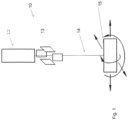
- FIG. 1 conceptually illustrates system 10, which includes ionizing energy source 12, ionizing energy 14, and already-formed (cured) polymeric body 15.
- Polymeric body 15 may or may not yet have optic surfaces formed thereon.
- the polymeric body 15 may be mounted in a stable manner and then irradiated using ionizing energy 14. If electron beams are the ionizing energy, electron beam technology as is employed in electron beam lithography for semiconductor manufacture can readily be adapted for use in the methods of the embodiments herein. Electron beam technology enables one to draw custom patterns (direct-write) with sub-10 nm resolution.
- Deflection plates 13 are also shown, which are used to create a potential that deflects the beam onto the body 15.
- a static lens can be provided, and an electron beam can be provided that can move relative to the static lens to produce a pattern of irradiation.
- a stationary source may be used and the polymeric body may be adapted to be moved, such as is shown in the optional degrees of freedom illustrated as arrows in figure 1 .
- both the source and the lens may be moved.
- the pattern of irradiation is defined by electron energy and the direction and position at which electrons hit the lens, and the time for which any position in space is being irradiated.
- a lens adapted to be moved e.g., in 6 degrees of freedom as illustrated in figure 1
- a configuration in which both the lens and the electron beam are moved can also be employed.
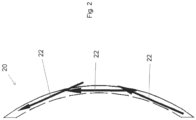
- An exemplary aspect of the method that can be varied to control the resulting RI profile of the lens is the angle of incidence of the electrons.
- Figure 2 illustrates this concept, showing lens 20 and energy 22 hitting the lens at glancing (shallow) angles.
- Lens 20 may be moved relative to the energy source (now shown for simplicity), the energy source may be moved relative to the lens, or both the lens and energy source may be moved.
- This application of ionizing energy differs from the irradiator described above for crosslinking (for forming the polymeric body) in that the ionizing energy in this step is directed in a specific pattern across the lens.
- the beam interacts with the polymeric material, bonds in the polymer backbone are broken, and the refractive index is changed when the polymeric body swells when placed in solution (e.g., BSS, aqueous).
- solution e.g., BSS, aqueous
- the resulting combinations of selected parameters can produce a GRIN in a material that is capable of withstanding steam sterilization (with water inside the material). Different absorbed doses of radiation have a directly proportional effect on the swelling index, and the resulting effect on the polymer system provides the mechanism to form the GRIN.
- Figures 3A, 3B, 4A and 4B illustrate generally how ionizing energy applied to a polymeric material can increase the amount of swelling when hydrated, and thus result in a greater reduction in RI.
- Figure 3A illustrates a formed polymeric material with crosslinks 30 generally indicated as squares (only three are labeled). This may be referred to as a "dry" state.
- Figure 3B illustrates the polymeric material when hydrated in solution (e.g., in BSS, magnesium, calcium, etc.). In figure 3B the polymeric material has swelled relative to its dry state in figure 3A .
- the positive charges 32 (only three labeled for clarity) repeal each other.
- Figure 4A illustrate a polymeric material after exposure to ionizing energy 40. As can be seen, some crosslinks 42 have been broken due to the exposure to the ionizing energy 41. Figure 4A , like figure 3A , can be referred to as dry state of the polymeric material.
- Figure 4B illustrates the polymer after being hydrated in solution (e.g., in BSS, magnesium, calcium, etc.). As can be seen when comparing figure 3B and 4B , the polymeric material (at least where it was exposed to ionizing energy) swells to a greater extent after ionizing energy absorption compared to no exposure to ionizing energy.
- solution e.g., in BSS, magnesium, calcium, etc.
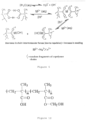
- Figure 5 illustrates in additional detail the manner in which swelling occurs.
- the copolymer will increase its swell in solution in the presence of calcium and magnesium cations.
- Ca 2+ and Mg 2+ ions are present inside the material due to diffusion from the solution in which the lens is positioned (e.g., aqueous humor), the swelling variation can be controlled in the lens. Greater swelling indicates more water in the matrix, and therefore a lower refractive index.
- Figure 5 illustrates the chemical processes involved for polymethylmethacrylate (PMMA), and can be modified for use with acrylates.
- PMMA polymethylmethacrylate
- the initial polymerization produces a hydrophilic polymer that swells in the presence of Ca 2+ and Mg 2+ ions.
- Irradiation with an electron beam breaks bonds in this synthetic polymer chain, and allows a change in RI (e.g., RI gradient) to be created.
- This technique can be used in any of the methods herein (e.g., creating an anti-reflective layer).
- the lenses herein, after cross-linking, are generally referred to as being in a dry state.
- solution e.g., BSS, aqueous of the eye
- the polymeric material When placed in solution (e.g., BSS, aqueous of the eye), the polymeric material will swell relative to the dry state. The amount of swelling depends on the solution in which the lens is placed.
- a lens is packaged for shipping and/or storage, and is then implanted in an eye when ready for use.
- the lenses herein can be packaged in BSS (exposure to which causes some degree of swelling of the dry polymeric material), and once implanted they are exposed to aqueous, which may cause slight additional swelling.
- any of the lenses herein can be stored/packaged in a solution such that after implantation, the lenses undergo substantially no additional swelling. This may be beneficial if it is desired that the lens when implanted be as close to the final size as possible. For example, it may be desirable that a lens be implanted in a "full" size so that it is properly stabilized immediately when implanted.
- a lens in a size that is smaller (i.e., less swelled) than in its final fully implanted size.
- an implanted lens it may be desirable that an implanted lens be smaller so that it is easier to advance through a delivery tool, after which it expands to a greater extent to its final, implanted, size.
- the degree of swelling post-implantation can be controlled as desired based on the application.
- the general methods herein that utilize an electron beam to create a gradient refractive index profile in at least a portion of a lens can also be used to customize a lens to an individual patient.
- This approach provides a wide variety of possibilities, in that many patient needs can be met by using the techniques herein.
- a particular patient may benefit from a particular RI profile in the lens.
- the techniques herein can be tailored as needed to create the particular RI profile in the lens.
- electron beams can advantageously be employed for surface or bulk modification
- other energy may also be used, such as X-rays, leptons, protons, positrons, or ionizing radiation from radioactive sources such as from ⁇ or ⁇ sources.
- One aspect of the disclosure is methods of manufacturing that fabricate lenses, such as intraocular lenses (e.g., IOLs, artificial replacement for the crystalline lens of the eye) with a multi-directional gradient of refractive index (GRIN) that can be controlled in magnitude and in a continuously varying multitude of ways.
- the GRIN lens material is dimensionally stable through steam sterilization as part of a "wet pack,” and is hydrolytically stable during long term use. Since the GRIN of the lens is due to the lens material, with a narrow three-dimensional crosslinking distribution, it is unchanged during long term use.
- an exemplary application of these methods is the creation of an anti-reflection layer in the lens by producing a thin layer of base material that has had its refractive index lowered.
- Figure 6 illustrates an exemplary lens 50 with a thin anti-reflection layer 52 formed therein, with main lens body portion 54.
- An anti-reflection layer i.e., a surface layer
- An anti-reflection layer may be useful because it reduces stray light within the eye that can cause dysphotopsia, and it also reduces unwanted reflections in lens applications other than IOLs.
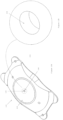
- Figures 13A and 13B illustrate an additional exemplary lens 100, including optic portion 102 and peripheral support 104.
- Optic portion 102 includes an aperture 106 (in this embodiment is a central aperture) extending through the optic portion 102.
- Figure 13B illustrates region 108 of the optic that forms the aperture that may be irradiated using methods herein to create an anti-reflection layer at the location of the aperture. This may help reduce the scattering of light at the location of the aperture.
- an anti-reflection layer can be manipulated to form an anti-reflection layer.
- electrons having low energy e.g., 500 eV up to 10 keV
- high flux high rate of flow of electrons through the surface
- an antireflective layer can be created by, for example, breaking chemical bonds at the surface whereby RI and/or reflectivity is reduced.
- electrons in the range of 0.5 keV to 2 keV can be employed, with an absorbed radiation dose in the range of 4-8 Mrad.
- the dose may be higher or lower, and can also be dependent on the composition of the irradiated substrate chemical.
- electrons with an energy of about 0.3 to 1 keV can be used with a high flux.
- the desired thickness is one quarter of the wavelength of light in the modified surface layer, which is reduced from the wavelength in air by a factor equal to the RI. Accordingly, the layer will be about 100 to 200 nm in thickness.
- the thickness in some embodiments may be somewhat smaller or larger than from about 100 to 200 nm, e.g., from about 50 to 400 nm, wherein the thickness is defined as 1/e of the maximum RI change.
- the thickness is 0.1 microns to 10 microns. In some embodiments the thickness is 1 micron to 10 micron.
- a more step-like layer can be created by varying the electron energy during exposure.
- the angle of incidence of light onto the lens's curved surface can be taken into consideration by varying the thickness of the surface layer as a function of the distance from the center of the lens.
- beta radiation is typically of higher energy (e.g., 90 Sr ⁇ 90 Y at 546 keV) and its use can be limited by the thickness of the layer desired or, for applications other than anti-reflection layers, by the thickness of the lens itself. For an IOL, this thickness is between 0.05 mm and 5 mm. Also, the energy of beta radiation cannot be tuned, unlike electron radiation. When compared to the electron radiation graph shown in figure 7, figure 8 illustrates the relatively higher energy range for beta radiation.
- An additional exemplary application is to create lenses that focus light from a wide range of distances without moving or changing shape whereby light entering the lens from different directions and incident on different surface positions on the lens will experience optical pathways through the lens that differ due to RI variations throughout the lens. Focusing light from a wide range of distances is useful to patients fitted with the lens, as IOLs do not typically provide accommodation similar to that provided by the native crystalline lens. Additionally, the technology can be useful in other lens applications, such as camera lenses designed with a large depth of field.
- the change in refractive index for the surface lens material relative to the bulk lens material depends on the absorbed radiation dose.
- Figure 9 shows the percentage change in refractive index, wherein 100% refers to a surface RI unchanged from the bulk and 0% refers to the surface RI being reduced to the RI of the solution in which it is held (e.g., a balanced salt solution in packaging, aqueous humor in the eye).
- Another exemplary application of the general technique described herein is creating an extended surface layer over a thickness of several wavelengths that does not cause destructive interference of light reflected from both surfaces.
- This can be represented by figure 6 , but region 52 would be a gradient RI rather than a layer with a uniform RI.
- the RI of the outer surface of the material is reduced to match as closely as possible (e.g., 10% or less variance, such as 5% or less variance) the RI of aqueous humor.
- the small change in RI between the lens and aqueous humor results in less reflection.
- Multiple directional incidence angles of irradiation can be used to create different three-dimensional (3D) patterns of the gradient refractive index in the bulk of the lens, or on the surface of the lens, or both.
- the change in RI is determined by electron energy (penetration) and absorbed dose (magnitude of effect), such that different patterns can be achieved by varying the lens-beam orientation.
- Predictions of the effect can be made by calculating, for all the positions in the 3D matrix, how deep the position is within the lens relative to the direction of the electron beam and the absorbed dose at that position, and integrating over time as the beam is moved.
- the aforementioned methodology is particularly useful in the surface modification of a lens, examples of which have been described herein.
- high energy e.g., from 10 keV to 700 keV, inclusive
- electrons can be employed for penetration deeper into the bulk of the lens.
- the energy of the beam can thus be modified as needed to penetrate to the depth(s) desired for a particular application.
- FIG. 10 illustrates exemplary lens 60 that can be created using methods herein.
- Lens 60 is created to function like the natural crystalline lens, with a gradually changing RI as indicated by the internal lines that represent refractive index contours in the figure.
- Lens 60 may be implanted in a capsular bag to replace a removed native crystalline lens. In figure 10 , anterior is towards the bottom of the page, and posterior is towards the top of the page.
- Lens 60 is an example of an optic body that has a three-dimensional polymeric matrix with a refractive index distribution substantially the same as a refractive index distribution of a natural crystalline lens.
- Lens 60 is also an example of an optic body that has a shape that is substantially the same as a shape of a natural crystalline lens.
- the lens 60 in figure 10 is an example of a lens that can be adapted so that it swells to a final implanted state (size) after implantation.
- lens 60 it may be desirable that lens 60 have a smaller delivery size to ease the delivery through a lens inserter, then swell (expand) to a greater state once inserted so that it is better secured within the eye (e.g., within a capsular bag).
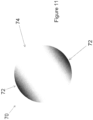
- Figure 11 illustrates an alternative optic body 70 with a varying RI in the optic body that can be created using the methods herein.
- Optic body 70 can be incorporated into any suitable ophthalmic lens (e.g., an IOL with one or more haptics).
- Ionizing energy can be applied to a polymeric body to create optic body 70.
- Region 74 may be considered a lower RI region compared to regions 72.
- the RI may vary continuously (gradient) through the lens 70.
- Lens 70 is an example of a lens that is configured to treat ametropia (via a spherical component of the lens shape) and astigmatism (via a cylindrical component of the lens shape).
- the degree of change in RI between regions 72 and 74 can be any suitable degree.
- a further embodiment of the methods described herein is the creation of an embedded Fresnel lens within a conventionally shaped lens, e.g., a bi-convex lens or a bi-concave lens.
- a conventionally shaped lens e.g., a bi-convex lens or a bi-concave lens.
- lens surfaces need to be curved.
- the center has to have a central thickness that increases with optical power and for a biconcave lens the edge thickness that increases with optical power.
- a Fresnel lens has a shape that segments the curvatures into different sectors thus reducing the thickness of the lens.
- One disadvantage of a Fresnel lens is that it can have sharply changing curvatures that can scatter light.
- Fresnel lens By producing the Fresnel lens within a conventionally shaped lens, some of the power can come from the outer shape of the conventional lens and more power can be obtained by replicating a Fresnel lens within the conventional lens by creating curved zones of increased power. Furthermore, Fresnel lenses can be designed to have more than one focus to provide simultaneously, for instance, good focus at far distance and near, or good focus at far distance and near and an intermediate distance. Furthermore, the interaction between the different refractive zones of the Fresnel lens can create beneficial diffractive effects and control of the exact shape of the refractive zones can reduce scatter and create better images.
- One aspect of this disclosure is a copolymer material or a combination of copolymer materials that can be used to make a GRIN lens.
- the lens can be incorporated into, e.g., an IOL.
- Properties of IOL materials include high elasticity to allow ease of insertion into the eye, low reflectivity to avoid dysphotopsia, good biocompatibility (e.g., does not leech toxic materials into the eye), and be mechanically capable of accurately holding a stable shape that is composed of a lens and supporting elements without disturbing or irritating the existing structure of the eye.
- Some ophthalmic devices may include one or more peripheral supports (e.g., one or more haptics, such as plate haptics or arm haptics) that extend radially outward from an optic, and provide support to the optic when placed in an eye. Any of the methods of irradiating herein may occur after the optic and any peripheral support(s) have been formed into an integral structure (e.g. via lathing, molding, machining, or any combination thereof).
- peripheral supports e.g., one or more haptics, such as plate haptics or arm haptics
- the methods of creating non-uniform cross-link densities herein may also be used on non-optic body portions (e.g., one or more haptics) of a lens. At least a portion of the non-optic body portion may also be irradiated to create a varying refractive index. This may be helpful to reduce light scattering in some subjects who have relatively larger pupils, where more light passes through the non-optic portion due to the larger pupil size. All of the methods of irradiating and swelling described herein may thus also be used on a non-optic portion of a lens, as well as on an optic body.
- non-optic body portions e.g., one or more haptics
- the copolymer system of certain embodiments is composed of a large proportion of a non-ionic acrylic monomer and a small proportion of an ionic monomer such as an organic acid.
- organic acid encompasses acids made up of molecules containing organic radicals ((hydro)carbon containing moieties). Such acids include, for example, acrylic acid, formic acid (H-COOH), acetic acid (CH 3 COOH) and citric acid (C 6 H 8 O 7 ), each of which contain the ionizable -COOH group.
- acrylic as applied to monomers includes synthetic plastic resins derived from acrylic acids.
- hydrophilic monomers and hydrophobic monomers must be selected such that the hydrophobic monomer(s) is soluble in the hydrophilic monomer(s).
- the hydrophilic monomer acts as a solvent for the hydrophobic monomer.
- Suitable monomers can be readily selected by those of ordinary skill in the art to which the present disclosure pertains.
- acrylic monomers examples include 4-methacryloxy-2-hydroxybenzophenone, ethyl-3-benzoil acrylate, N-propyl methacrylate) N-propyl methacrylate (acrylic), ethyl-methacrylate, methyl methacrylate, n-heptyl methacrylate, 2-hydroxyethyl methacrylate (HEMA), hydroxypropyl methacrylate, 2-hydroxyethyl methacrylate, hydroxypropyl methacrylate poly(ethylene glycol)n monomethacrylate, 4-hydroxybutyl methacrylate, and other monomers as are known in the art.
- HEMA 2-hydroxyethyl methacrylate
- the targeted amount of swelling can therefore be modified by manipulating salt content within the copolymer system when the lens is outside of the eye.
- the lens can expand more or less once implanted in the eye when exposed to aqueous, depending on the solution in which it is placed prior to implantation.
- Copolymers can be modified by adding collagen or a similar biological molecule to the polymer, in which case the radiation method can be employed. This formulation method provides the structural and dimensional characteristics of the resulting material from which an IOL with GRIN can be produced.
- Any type of collagen from any source can be employed. Suitable collagen materials include, but are not limited to, collagen obtained from pig's eye sclera or cornea, or fibroblasts (e.g., artificially produced or cultured from genetically modified yeast, etc.).
- the collagen is a naturally stable polyenic, which comprises hydrophobic, hydroxylic and polarized amino-acids, e.g., telo-collagen.
- Copolymeric materials comprising collagen materials are described in U.S. Pat. No.
- Forming a polymeric body may include mixing a nonionic acrylic monomer with the ionic monomer (e.g., an acid such as formic acid).
- the weight ratio of nonionic acrylic monomer to ionic monomer can be in the range of about 10:1 to about 10,000:1, e.g., 50:1 to 200:1, e.g., 75:1, 100:1, 125:1, 150:1, or 175:1. Additional steps in an exemplary method of preparing an exemplary material may be described in U.S. App. No. 62/765,088 , whose priority is claimed herein, and the disclosure of which is incorporated by reference herein for all purposes.
- an IOL (or other lens) can be manufactured in a traditional manner using, for example, a lathe and mill or with a mold, and can then be modified using a second irradiation process.
- the change in RI as a function of radiation absorbed is influenced by factors, such as the concentration of anionic components, such as methacrylic acid and acrylic acid, which are crosslinked into the copolymer.
- concentration of the anionic components influence the swell factor, which in turn influences RI. More swelling correlates with a lower RI, and a higher concentration of the anionic components results in more swelling (and thus lower RI).
- concentration of bi-cations in physiological and BSS ranges are as follows: magnesium 0.7-2.0 mmol/L and calcium 1-3.5 mmol/L.
- the propensity for the material to swell is determined by anionic components, such as methacrylic acid and acrylic acid, that are crosslinked into the copolymer. Excess monomers are typically removed during the extraction process.
- the ratios of the two different monomers within the copolymer structure, the absorbed dose, and the electron energy can be varied within moderate ranges to achieve different balances of properties within the resulting GRIN lens.
- a desired RI profile can be created in the lens.
- the optical aberrations of a patient's visual system can be measured using a device such as a wavefront aberrometer and the required lens correcting for the aberrations can be calculated. Thereafter, a three-dimensional irradiation plan can be developed whereby the dose at any point in the lens, as a function of electron energy, can be calculated and an irradiation plan, consisting of beam position and angle, electron flux and electron energy, can be produced.
- Lenses for different patients can be produced from one single design of a single refractive index lens or the geometrical properties of the lens can be used as additional degrees of freedom (design parameters). There is thus great flexibility in how the methods herein can be used to create a wide variety of lenses based on the desired refractive index profile.
- An exemplary polymer may be a structural copolymer produced from hydroxyethylmethacrylate monomers as a major component and acrylic acid as a minor component. The weight ratio may be as indicated above.
- Figure 12 shows such a portion of a polymer chain with the acrylic acid side group (left) and methacrylate side group (right).
- the copolymer is produced either chemically or during nuclear irradiation (described above), and then amended using the electron beam irradiation methods (or other ionizing energy source) described herein to create the GRIN lens.
- An absorbed dose radiation sensitive refractive index changing copolymer composition comprising a methacrylic ionic monomer and a methacrylic nonionic monomer that is sensitive to electron beam bombardment can be employed in preparing materials with varying refractive index that are also compatible with use in the eye.
- low energy as used herein is a broad term, and refers without limitation to 500 eV to 10 keV, inclusive.
- high energy is a broad term, and refers without limitation to 10 keV to 700 keV, inclusive.
Landscapes
- Health & Medical Sciences (AREA)
- Chemical & Material Sciences (AREA)
- Medicinal Chemistry (AREA)
- Life Sciences & Earth Sciences (AREA)
- Oral & Maxillofacial Surgery (AREA)
- Veterinary Medicine (AREA)
- Public Health (AREA)
- General Health & Medical Sciences (AREA)
- Animal Behavior & Ethology (AREA)
- Transplantation (AREA)
- Chemical Kinetics & Catalysis (AREA)
- Polymers & Plastics (AREA)
- Organic Chemistry (AREA)
- Epidemiology (AREA)
- Dermatology (AREA)
- Physics & Mathematics (AREA)
- Ophthalmology & Optometry (AREA)
- Engineering & Computer Science (AREA)
- Biomedical Technology (AREA)
- Vascular Medicine (AREA)
- Heart & Thoracic Surgery (AREA)
- Cardiology (AREA)
- Optics & Photonics (AREA)
- General Physics & Mathematics (AREA)
- Biophysics (AREA)
- Composite Materials (AREA)
- Materials Engineering (AREA)
- General Chemical & Material Sciences (AREA)
- Prostheses (AREA)
- Materials For Medical Uses (AREA)
- Compositions Of Macromolecular Compounds (AREA)
- Eyeglasses (AREA)
Applications Claiming Priority (3)
| Application Number | Priority Date | Filing Date | Title |
|---|---|---|---|
| US201862765088P | 2018-08-17 | 2018-08-17 | |
| EP19850556.2A EP3837571B1 (de) | 2018-08-17 | 2019-08-19 | Polymerzusammensetzung mit einem nanogradienten des brechungsindexes |
| PCT/US2019/047058 WO2020037314A1 (en) | 2018-08-17 | 2019-08-19 | Polymeric composition exhibiting nanogradient of refractive index |
Related Parent Applications (2)
| Application Number | Title | Priority Date | Filing Date |
|---|---|---|---|
| EP19850556.2A Division-Into EP3837571B1 (de) | 2018-08-17 | 2019-08-19 | Polymerzusammensetzung mit einem nanogradienten des brechungsindexes |
| EP19850556.2A Division EP3837571B1 (de) | 2018-08-17 | 2019-08-19 | Polymerzusammensetzung mit einem nanogradienten des brechungsindexes |
Publications (2)
| Publication Number | Publication Date |
|---|---|
| EP4235275A2 true EP4235275A2 (de) | 2023-08-30 |
| EP4235275A3 EP4235275A3 (de) | 2023-12-13 |
Family
ID=69525909
Family Applications (2)
| Application Number | Title | Priority Date | Filing Date |
|---|---|---|---|
| EP23179814.1A Pending EP4235275A3 (de) | 2018-08-17 | 2019-08-19 | Polymerzusammensetzung mit einem nanogradienten des brechungsindexes |
| EP19850556.2A Active EP3837571B1 (de) | 2018-08-17 | 2019-08-19 | Polymerzusammensetzung mit einem nanogradienten des brechungsindexes |
Family Applications After (1)
| Application Number | Title | Priority Date | Filing Date |
|---|---|---|---|
| EP19850556.2A Active EP3837571B1 (de) | 2018-08-17 | 2019-08-19 | Polymerzusammensetzung mit einem nanogradienten des brechungsindexes |
Country Status (7)
| Country | Link |
|---|---|
| US (3) | US10774164B2 (de) |
| EP (2) | EP4235275A3 (de) |
| JP (3) | JP7203223B2 (de) |
| KR (2) | KR102560250B1 (de) |
| CN (1) | CN112867944A (de) |
| ES (1) | ES2956033T3 (de) |
| WO (1) | WO2020037314A1 (de) |
Families Citing this family (7)
| Publication number | Priority date | Publication date | Assignee | Title |
|---|---|---|---|---|
| KR102249250B1 (ko) | 2014-09-09 | 2021-05-07 | 스타 서지컬 컴퍼니 | 확장된 피사계 심도 및 향상된 원거리 시력의 안과용 임플란트 |
| US12127934B2 (en) | 2014-09-09 | 2024-10-29 | Staar Surgical Company | Method of Providing Modified Monovision to a Subject with a First Lens and a Second Lens |
| KR102560250B1 (ko) | 2018-08-17 | 2023-07-27 | 스타 서지컬 컴퍼니 | 나노 구배의 굴절률을 나타내는 중합체 조성물 |
| CA3234381A1 (en) | 2021-10-04 | 2023-04-13 | Staar Surgical Company | Ophthalmic implants for correcting vision with a tunable optic, and methods of manufacture and use |
| WO2024227156A2 (en) * | 2023-04-27 | 2024-10-31 | Vadient Optics, Llc | Hybrid optical elements integrating homogeneous and heterogeneous composition |
| WO2025240913A1 (en) * | 2024-05-16 | 2025-11-20 | Staar Surgical Company | Intraocular lenses |
| WO2025265100A1 (en) * | 2024-06-21 | 2025-12-26 | Staar Surgical Company | Intraocular lenses and methods of manufacture |
Citations (10)
| Publication number | Priority date | Publication date | Assignee | Title |
|---|---|---|---|---|
| US5654349A (en) | 1994-07-22 | 1997-08-05 | Staar Surgical Company, Inc. | Biocompatible optically transparent polymeric material based upon collagen and method of making |
| US5661218A (en) | 1994-07-22 | 1997-08-26 | Staar Surgical Company, Inc. | Biocompatible optically transparent polymeric material based upon collagen and method of making |
| US5910537A (en) | 1994-07-22 | 1999-06-08 | Staar Surgical Company Inc. | Biocompatible, optically transparent, ultraviolet light absorbing, polymeric material based upon collagen and method of making |
| US7789910B2 (en) | 2006-06-28 | 2010-09-07 | Bausch & Lomb Incorporated | Optical material and method for modifying the refractive index |
| US8337553B2 (en) | 2006-06-28 | 2012-12-25 | Bausch & Lomb Incorporated | Optical material and method for modifying the refractive index |
| US8486055B2 (en) | 2007-06-26 | 2013-07-16 | Bausch & Lomb Incorporated | Method for modifying the refractive index of ocular tissues |
| US8617147B2 (en) | 2007-06-26 | 2013-12-31 | University Of Rochester | Method for modifying the refractive index of ocular tissues |
| US8901190B2 (en) | 2008-05-19 | 2014-12-02 | University Of Rochester | Optical hydrogel material with photosensitizer and method for modifying the refractive index |
| US9144491B2 (en) | 2011-06-02 | 2015-09-29 | University Of Rochester | Method for modifying the refractive index of an optical material |
| US9545340B1 (en) | 2007-06-26 | 2017-01-17 | University Of Rochester | Multi-photon absorption for femtosecond micromachining and refractive index modification of tissues |
Family Cites Families (304)
| Publication number | Priority date | Publication date | Assignee | Title |
|---|---|---|---|---|
| US4525043A (en) | 1977-11-11 | 1985-06-25 | Leonard Bronstein | Contact lens |
| US4529657A (en) | 1978-05-30 | 1985-07-16 | Ppg Industries, Inc. | Method for lowering the surface energy of glass |
| US4199231A (en) | 1978-08-21 | 1980-04-22 | Evans Carl H | Hydrogel contact lens |
| US4373225A (en) | 1979-07-06 | 1983-02-15 | Friedrich Wilh. Schwing, Gmbh | Piping valve with a housing for the transfer of a wiper insertable in conduits that supply pressurized viscous material, preferably concrete |
| EP0064812B1 (de) | 1981-04-29 | 1985-08-14 | Pilkington P.E. Limited | Künstliche Augenlinse |
| JPS5872939A (ja) * | 1981-10-28 | 1983-05-02 | Hitachi Ltd | ネガ形感放射線薄膜の形成方法 |
| JPS58114032A (ja) * | 1981-12-28 | 1983-07-07 | Fujitsu Ltd | パタ−ン形成方法 |
| US4504982A (en) | 1982-08-05 | 1985-03-19 | Optical Radiation Corporation | Aspheric intraocular lens |
| US4640595A (en) | 1984-05-02 | 1987-02-03 | David Volk | Aspheric contact lens |
| US4787904A (en) | 1984-07-06 | 1988-11-29 | Severin Sanford L | Hydrophillic intraocular lens |
| US4681102A (en) | 1985-09-11 | 1987-07-21 | Bartell Michael T | Apparatus and method for insertion of an intra-ocular lens |
| US4752123A (en) | 1985-11-19 | 1988-06-21 | University Optical Products Co. | Concentric bifocal contact lens with two distance power regions |
| ATE45800T1 (de) | 1985-11-21 | 1989-09-15 | Werner Fiala | Verfahren zur temperaturerhoehung von katalysatoren und vorrichtung zur durchfuehrung des verfahrens. |
| US4990582A (en) * | 1986-07-18 | 1991-02-05 | Salamone Joseph C | Fluorine containing soft contact lens hydrogels |
| US4710193A (en) | 1986-08-18 | 1987-12-01 | David Volk | Accommodating intraocular lens and lens series and method of lens selection |
| US4731079A (en) | 1986-11-26 | 1988-03-15 | Kingston Technologies, Inc. | Intraocular lenses |
| AU594233B2 (en) | 1987-04-10 | 1990-03-01 | University Of Florida | Improved ocular implants and methods for their manufacture |
| AU3238593A (en) | 1987-05-20 | 1994-07-04 | Frederick A. Dr. Hauber | Intraocular achromatic lens |
| US4769035A (en) | 1987-06-02 | 1988-09-06 | Kelman Charles D | Artificial lens and the method for implanting such lens |
| US4835189A (en) | 1987-06-05 | 1989-05-30 | G. D. Searle & Co. | Phenolic thioalkylamides as inhibitors of 5-lipoxygenase |
| US4769033A (en) | 1987-07-02 | 1988-09-06 | Nordan Lee T | Intraocular multifocal lens |
| US7192444B2 (en) | 1987-08-24 | 2007-03-20 | Advanced Medical Optics, Inc. | Aspheric soft lens |
| US5001009A (en) | 1987-09-02 | 1991-03-19 | Sterilization Technical Services, Inc. | Lubricious hydrophilic composite coated on substrates |
| US4834750A (en) | 1987-09-17 | 1989-05-30 | Ioptex Research, Inc. | Deformable-elastic intraocular lens |
| US4981342A (en) | 1987-09-24 | 1991-01-01 | Allergan Inc. | Multifocal birefringent lens system |
| IL85860A (en) | 1988-03-24 | 1992-06-21 | Amir Cohen | Contact lens |
| US5073021A (en) | 1989-03-17 | 1991-12-17 | Environmental Research Institute Of Michigan | Bifocal ophthalmic lens constructed from birefringent material |
| FR2647227B1 (fr) | 1989-05-19 | 1991-08-23 | Essilor Int | Composant optique, tel qu'implant intra-oculaire ou lentille de contact, propre a la correction de la vision d'un individu |
| RU2033165C1 (ru) | 1989-10-13 | 1995-04-20 | Межотраслевой научно-технический комплекс "Микрохирургия глаза" | Способ получения пластичного материала из коллагена |
| AU646249B2 (en) | 1990-03-15 | 1994-02-17 | Werner Fiala | Multifocal bi-refringent lens with matched bi-refringence |
| US5476514A (en) | 1990-04-27 | 1995-12-19 | Cumming; J. Stuart | Accommodating intraocular lens |
| US5437647A (en) | 1990-05-09 | 1995-08-01 | Safety Syringes, Inc. | Disposable self-shielding aspirating syringe |
| FR2664678B1 (fr) | 1990-07-10 | 1993-06-25 | Cricket Sa | Bruleur catalytique. |
| US5229797A (en) | 1990-08-08 | 1993-07-20 | Minnesota Mining And Manufacturing Company | Multifocal diffractive ophthalmic lenses |
| US5260727A (en) | 1990-10-22 | 1993-11-09 | Oksman Henry C | Wide depth of focus intraocular and contact lenses |
| US5290892A (en) | 1990-11-07 | 1994-03-01 | Nestle S.A. | Flexible intraocular lenses made from high refractive index polymers |
| AU652389B2 (en) | 1990-11-07 | 1994-08-25 | Nestle S.A. | Polymers and their use for ophthalmic lenses |
| US5217491A (en) | 1990-12-27 | 1993-06-08 | American Cyanamid Company | Composite intraocular lens |
| EP0503111A1 (de) | 1991-03-13 | 1992-09-16 | Toyohiko Kashiwagi | Verfahren und Vorrichtung zur Herstellung einer asphärischen Linse |
| US5198844A (en) | 1991-07-10 | 1993-03-30 | Johnson & Johnson Vision Products, Inc. | Segmented multifocal contact lens |
| US5245366A (en) | 1991-10-31 | 1993-09-14 | Svochak Jan B | Bifocal contact lens and method of making same |
| CZ282423B6 (cs) | 1992-01-28 | 1997-07-16 | Johnson & Johnson Vision Products, Inc. | Multifokální refrakční čočka a způsob její výroby |
| ATE145126T1 (de) | 1992-04-03 | 1996-11-15 | Adatomed Pharma Chiron | Intraokularlinsenset |
| US5470892A (en) * | 1992-05-01 | 1995-11-28 | Innotech, Inc. | Polymerizable resin for forming clear, hard plastics |
| US5620450A (en) | 1992-09-30 | 1997-04-15 | Staar Surgical Company, Inc. | Transverse hinged deformable intraocular lens injecting apparatus |
| PT723429E (pt) | 1992-09-30 | 2002-09-30 | Vladimir Feingold | Sistema de insercao de lentes intra-oculares |
| US5499987A (en) | 1992-09-30 | 1996-03-19 | Staar Surgical Company | Deformable intraocular lens cartridge |
| US5616148A (en) | 1992-09-30 | 1997-04-01 | Staar Surgical Company, Inc. | Transverse hinged deformable intraocular lens injecting apparatus |
| US5331073A (en) | 1992-11-09 | 1994-07-19 | Allergan, Inc. | Polymeric compositions and intraocular lenses made from same |
| US5822091A (en) | 1993-02-22 | 1998-10-13 | Baker; Kenneth M. | Extreme depth-of-field optical lens and holographic projector system for its production |
| US5771088A (en) | 1993-03-27 | 1998-06-23 | Pilkington Barnes Hind, Inc. | Contact lens designed to accommodate and correct for the effects of presbyopia |
| RU2033114C1 (ru) | 1993-04-22 | 1995-04-20 | Межотраслевой научно-технический комплекс "Микрохирургия глаза" | Искусственный хрусталик глаза |
| ES2142869T3 (es) | 1993-04-30 | 2000-05-01 | Alcon Lab Inc | Metodo para reducir la pegajosidad de polimeros acrilicos blandos. |
| US5329363A (en) | 1993-06-15 | 1994-07-12 | U. S. Precision Lens Incorporated | Projection lens systems having reduced spherochromatism |
| US5603774A (en) | 1993-09-27 | 1997-02-18 | Alcon Laboratories, Inc. | Method for reducing tackiness of soft acrylic polymers |
| US5436678A (en) | 1993-09-30 | 1995-07-25 | Wilmington Partners L.P. | Aspheric multifocal contact lens |
| JPH07184989A (ja) | 1993-12-28 | 1995-07-25 | Kuraray Co Ltd | 血液適合性医療用高分子材料および医療材料 |
| CA2185685A1 (en) | 1994-03-17 | 1995-09-21 | Werner Fiala | Zoned lens |
| US5517260A (en) | 1994-03-28 | 1996-05-14 | Vari-Site, Inc. | Ophthalmic lens having a progressive multifocal zone and method of manufacturing same |
| US5523316A (en) * | 1994-06-23 | 1996-06-04 | Alcon Laboratories, Inc. | Intraocular irrigating solution containing agent for controlling IOP |
| US5654363A (en) | 1994-07-22 | 1997-08-05 | Staar Surgical Company, Inc. | Biocompatible optically transparent polymeric material based upon collagen and method of making |
| US5654388A (en) | 1994-07-22 | 1997-08-05 | Staar Surgical Company, Inc. | Biocompatible optically transparent polymeric material based upon collagen and method of making |
| DE69532816T2 (de) | 1994-10-06 | 2005-03-17 | Staar Surgical Co., Monrovia | Intraokulare kontaktlinse |
| US5574518A (en) | 1995-01-10 | 1996-11-12 | Les Laboratoires Opti-Centre Inc. | System incorporation two different sphero-non-spherical contact lenses for correcting presbytia |
| JP2967093B2 (ja) | 1995-02-23 | 1999-10-25 | ホーヤ株式会社 | 軟性眼内レンズ |
| FR2731081B1 (fr) * | 1995-02-27 | 1997-04-11 | Essilor Int | Procede d'obtention d'un article transparent a gradient d'indice de refraction |
| US6165490A (en) | 1996-04-05 | 2000-12-26 | Staar Surgical Ag | Biological material, method of preparing such materials, uses thereof and products made therefrom |
| US5929969A (en) | 1995-05-04 | 1999-07-27 | Johnson & Johnson Vision Products, Inc. | Multifocal ophthalmic lens |
| HUP9601126A3 (en) | 1995-05-04 | 1999-10-28 | Johnson & Johnson Vision Prod | Concentric, aspheric, multifocal lens |
| US5684560A (en) | 1995-05-04 | 1997-11-04 | Johnson & Johnson Vision Products, Inc. | Concentric ring single vision lens designs |
| IL118065A0 (en) | 1995-05-04 | 1996-08-04 | Johnson & Johnson Vision Prod | Aspheric toric lens designs |
| US5715031A (en) | 1995-05-04 | 1998-02-03 | Johnson & Johnson Vision Products, Inc. | Concentric aspheric multifocal lens designs |
| WO1996039106A1 (en) | 1995-06-06 | 1996-12-12 | Scientific Optics, Inc. | Asymmetric bifocal intraocular lens |
| JP3206004B2 (ja) | 1995-06-07 | 2001-09-04 | アルコン ラボラトリーズ, インコーポレイテッド | 改良された高屈折率の眼科用レンズ材料 |
| US6045578A (en) | 1995-11-28 | 2000-04-04 | Queensland University Of Technology | Optical treatment method |
| RU2089198C1 (ru) | 1995-11-30 | 1997-09-10 | Межотраслевой научно-технический комплекс "Микрохирургия глаза" | Способ получения биоматериала для использования в офтальмологии |
| US6150472A (en) * | 1995-12-22 | 2000-11-21 | Holland Biomaterials Group B.V. | Multi-functional site containing polymers, and applications thereof |
| US5702440A (en) | 1996-01-26 | 1997-12-30 | Allergan | Multifocal ophthalmic lens for dim-lighting conditions |
| FR2744908B1 (fr) | 1996-02-20 | 1998-06-12 | W K Et Associes | Implant intraoculaire myopique |
| BR9707766A (pt) * | 1996-02-29 | 1999-07-27 | Minnesota Mining & Mfg | Corpo ótico |
| FR2745711B1 (fr) | 1996-03-05 | 1998-05-07 | Ioltechnologie Production | Implant souple formant lentille intraoculaire de chambre posterieure |
| US5717049A (en) | 1996-03-25 | 1998-02-10 | Pharmacia Iovision, Inc. | High refractive index hydrogels prepared from polymers and copolymers of N-benzyl-N-methylacrylamide |
| US5864378A (en) | 1996-05-21 | 1999-01-26 | Allergan | Enhanced monofocal IOL or contact lens |
| US5913989A (en) | 1996-07-08 | 1999-06-22 | Alcan International Limited | Process for producing aluminum alloy can body stock |
| US5716364A (en) | 1996-07-10 | 1998-02-10 | Allergan | IOL insertion apparatus and method for making and using same |
| US5859685A (en) | 1996-07-18 | 1999-01-12 | Innotech, Inc. | Achromatic ophthalmic lenses |
| US5922821A (en) | 1996-08-09 | 1999-07-13 | Alcon Laboratories, Inc. | Ophthalmic lens polymers |
| US5843186A (en) | 1996-12-20 | 1998-12-01 | Implemed, Inc. | Intraocular lens with antimicrobial activity |
| US5766245A (en) | 1996-12-30 | 1998-06-16 | Staar Surgical, Ag | Intraocular lens for correcting moderate to severe hypermetropia |
| US5947975A (en) | 1997-03-07 | 1999-09-07 | Canon Staar Co., Inc. | Inserting device for deformable intraocular lens |
| DE19738345C1 (de) * | 1997-09-02 | 1999-05-06 | Mdp Medical Device Polymers Gm | Intraokularlinse |
| US5843188A (en) | 1997-10-20 | 1998-12-01 | Henry H. McDonald | Accommodative lens implantation |
| US6148862A (en) | 1998-03-27 | 2000-11-21 | Applied Power Inc. | Solenoid valve coil pack |
| US6088322A (en) | 1998-05-07 | 2000-07-11 | Broome; Barry G. | Single objective lens for use with CD or DVD optical disks |
| US6036891A (en) | 1998-05-11 | 2000-03-14 | Pharmacia & Upjohn | Polymerizable hydrophilic ultraviolet light absorbing monomers |
| US6457826B1 (en) | 1998-08-06 | 2002-10-01 | John B. W. Lett | Multifocal aspheric lens |
| US6120148A (en) | 1998-10-05 | 2000-09-19 | Bifocon Optics Gmbh | Diffractive lens |
| US6241766B1 (en) | 1998-10-29 | 2001-06-05 | Allergan Sales, Inc. | Intraocular lenses made from polymeric compositions |
| US6245106B1 (en) | 1998-10-29 | 2001-06-12 | Allergan Sales, Inc. | Intraocular lenses made from polymeric compositions and monomers useful in said compositions |
| US6238975B1 (en) | 1998-11-25 | 2001-05-29 | Advanced Micro Devices, Inc. | Method for improving electrostatic discharge (ESD) robustness |
| US6210005B1 (en) | 1999-02-04 | 2001-04-03 | Valdemar Portney | Multifocal ophthalmic lens with reduced halo size |
| WO2000054094A1 (en) | 1999-03-12 | 2000-09-14 | Bausch & Lomb Incorporated | Multifocal lens article |
| US6203973B1 (en) | 1999-03-25 | 2001-03-20 | Eastman Kodak Company | Polymer latexes with core-shell morphology |
| US6488708B2 (en) | 1999-04-09 | 2002-12-03 | Faezeh Sarfarazi | Open chamber, elliptical, accommodative intraocular lens system |
| US8247511B2 (en) * | 1999-04-12 | 2012-08-21 | Advanced Vision Science, Inc. | Water plasticized high refractive index polymer for ophthalmic applications |
| US6179420B1 (en) | 1999-04-21 | 2001-01-30 | Johnson & Johnson Vision Products, Inc. | Multifocal ophthalmic lenses |
| US20030060881A1 (en) | 1999-04-30 | 2003-03-27 | Advanced Medical Optics, Inc. | Intraocular lens combinations |
| US20060238702A1 (en) | 1999-04-30 | 2006-10-26 | Advanced Medical Optics, Inc. | Ophthalmic lens combinations |
| US6790232B1 (en) | 1999-04-30 | 2004-09-14 | Advanced Medical Optics, Inc. | Multifocal phakic intraocular lens |
| US6386357B1 (en) | 1999-07-12 | 2002-05-14 | Hoya Healthcare Corporation | Soft intraocular lens-folding device and storage case |
| US6536899B1 (en) | 1999-07-14 | 2003-03-25 | Bifocon Optics Gmbh | Multifocal lens exhibiting diffractive and refractive powers |
| US6451056B1 (en) | 1999-08-09 | 2002-09-17 | J. Stuart Cumming | Lens for increased depth of focus |
| US6271281B1 (en) | 1999-08-26 | 2001-08-07 | Medennium, Inc. | Homopolymers containing stable elasticity inducing crosslinkers and ocular implants made therefrom |
| FR2803921B1 (fr) | 2000-01-14 | 2002-04-05 | Essilor Int | Jeu de deux lentilles ophtalmiques, gamme et procede pour constituer un tel jeu |
| CA2682118A1 (en) | 2000-03-24 | 2001-09-27 | Novartis Ag | Crosslinkable or polymerizable prepolymers |
| US6398809B1 (en) | 2000-04-12 | 2002-06-04 | Bausch & Lomb Incorporated | Intraocular lens |
| US6547822B1 (en) | 2000-05-03 | 2003-04-15 | Advanced Medical Optics, Inc. | Opthalmic lens systems |
| US6537317B1 (en) | 2000-05-03 | 2003-03-25 | Advanced Medical Optics, Inc. | Binocular lens systems |
| MXPA02011538A (es) | 2000-05-23 | 2003-06-06 | Pharmacia Groningen Bv | Metodos para obtener lentes oftalmicas que brinden al ojo reduccion de aberraciones. |
| US6609793B2 (en) | 2000-05-23 | 2003-08-26 | Pharmacia Groningen Bv | Methods of obtaining ophthalmic lenses providing the eye with reduced aberrations |
| US6506212B2 (en) | 2000-07-07 | 2003-01-14 | Medennium, Inc. | Anatomically compatible posterior chamber phakic refractive lenses |
| US7178918B2 (en) | 2000-09-08 | 2007-02-20 | Griffin Richard A | Ophthalmic lenses with induced aperture and redundant power regions |
| US6474814B1 (en) | 2000-09-08 | 2002-11-05 | Florida Optical Engineering, Inc | Multifocal ophthalmic lens with induced aperture |
| WO2002027389A1 (en) | 2000-09-29 | 2002-04-04 | Fiala Werner J | Ophthalmic lens with surface structures |
| US6511180B2 (en) | 2000-10-10 | 2003-01-28 | University Of Rochester | Determination of ocular refraction from wavefront aberration data and design of optimum customized correction |
| US6500181B1 (en) | 2000-10-17 | 2002-12-31 | Valdemar Portney | Instrument for folding and inserting anterior chamber intraocular lenses |
| US7152975B2 (en) * | 2000-11-10 | 2006-12-26 | Cooper Vision, Inc. | Junctionless ophthalmic lenses and methods for making same |
| US20010044657A1 (en) | 2000-11-30 | 2001-11-22 | Kellan Robert E. | Phakic or aphakic intraocular lens assembly |
| SE0004829D0 (sv) | 2000-12-22 | 2000-12-22 | Pharmacia Groningen Bv | Methods of obtaining ophthalmic lenses providing the eye with reduced aberrations |
| US20020120330A1 (en) | 2001-02-27 | 2002-08-29 | Galin Miles A. | Refractive anterior chamber intraocular implant |
| US6576012B2 (en) | 2001-03-28 | 2003-06-10 | Advanced Medical Optics, Inc. | Binocular lens systems |
| SE0101293D0 (sv) | 2001-04-11 | 2001-04-11 | Pharmacia Groningen Bv | Technical field of the invention |
| US20030014107A1 (en) | 2001-06-28 | 2003-01-16 | Michael Reynard | Multifocal phakic intraocular lens |
| US6533416B1 (en) | 2001-07-20 | 2003-03-18 | Ocular Sciences, Inc. | Contact or intraocular lens and method for its preparation |
| US6520638B1 (en) | 2001-08-14 | 2003-02-18 | Johnson & Johnson Vision Care, Inc. | Methods for designing multifocal ophthalmic lenses |
| DE60230173D1 (de) | 2001-10-19 | 2009-01-15 | Bausch & Lomb | Presbyopiekorrektur |
| US20030097177A1 (en) | 2001-11-21 | 2003-05-22 | Tran Son Trung | Posterior chamber phakic lens |
| JP4009185B2 (ja) | 2001-11-30 | 2007-11-14 | 株式会社メニコン | コンタクトレンズの製作方法 |
| FR2833154B1 (fr) | 2001-12-12 | 2004-11-19 | Ioltechnologie Production | Cassette et injecteur de lentille intraoculaire souple et procede d'injection de telles lentilles |
| US20030187505A1 (en) | 2002-03-29 | 2003-10-02 | Xiugao Liao | Accommodating intraocular lens with textured haptics |
| US7008979B2 (en) | 2002-04-30 | 2006-03-07 | Hydromer, Inc. | Coating composition for multiple hydrophilic applications |
| AU2003273559A1 (en) | 2002-05-31 | 2003-12-19 | Carl Zeiss Meditec Ag | Method for controlling a device for treating the human eye |
| US6737448B2 (en) | 2002-06-03 | 2004-05-18 | Staar Surgical Company | High refractive index, optically clear and soft hydrophobic acrylamide copolymers |
| FR2841767B1 (fr) | 2002-07-03 | 2005-04-22 | Ioltechnologie Production | Lentille intraoculaire accommodative |
| US20040087963A1 (en) | 2002-08-07 | 2004-05-06 | Alexei Ossipov | Medical device having increased lubricity |
| US20040059343A1 (en) | 2002-09-25 | 2004-03-25 | Kevin Shearer | Novel enhanced system for intraocular lens insertion |
| JP2004121433A (ja) | 2002-09-30 | 2004-04-22 | Nidek Co Ltd | 眼内レンズ |
| JP5096662B2 (ja) | 2002-10-04 | 2012-12-12 | カール ツアイス ヴィジョン ゲーエムベーハー | レンズを製造する方法およびこの方法により製造されたレンズ |
| US6709103B1 (en) | 2002-10-31 | 2004-03-23 | Johnson & Johnson Vision Care, Inc. | Methods for designing multifocal ophthalmic lenses |
| US7381221B2 (en) | 2002-11-08 | 2008-06-03 | Advanced Medical Optics, Inc. | Multi-zonal monofocal intraocular lens for correcting optical aberrations |
| SE0203564D0 (sv) | 2002-11-29 | 2002-11-29 | Pharmacia Groningen Bv | Multifocal opthalmic lens |
| FR2848182B1 (fr) | 2002-12-04 | 2006-02-03 | Eurocrystal | Procede et dispositif d'emballage sterile d'une lentille intraoculaire hydrophile souple prete a l'emploi |
| US8911086B2 (en) | 2002-12-06 | 2014-12-16 | Amo Manufacturing Usa, Llc | Compound modulation transfer function for laser surgery and other optical applications |
| DE10258332A1 (de) | 2002-12-12 | 2004-07-08 | Rodenstock Gmbh | Brillenglaspaar |
| US7036931B2 (en) | 2003-01-29 | 2006-05-02 | Novartis Ag | Ophthalmic lenses |
| US6802606B2 (en) | 2003-02-04 | 2004-10-12 | Johnson & Johnson Vision Care, Inc. | Multifocal contact lens pairs |
| CA2522787C (en) | 2003-04-18 | 2012-09-18 | Visx, Incorporated | Systems and methods for correcting high order aberrations in laser refractive surgery |
| US6923539B2 (en) | 2003-05-12 | 2005-08-02 | Alcon, Inc. | Aspheric lenses |
| DE10325841A1 (de) | 2003-06-06 | 2004-12-30 | Acritec Gmbh | Intraokularlinse |
| JP2005002377A (ja) | 2003-06-10 | 2005-01-06 | Osaka Prefecture | ダイヤモンドライクカーボン膜の形成方法 |
| WO2005001553A1 (en) | 2003-06-30 | 2005-01-06 | Fiala Werner J | Intra-ocular lens or contact lens exhibiting large depth of focus |
| US20050027354A1 (en) | 2003-07-28 | 2005-02-03 | Advanced Medical Optics, Inc. | Primary and supplemental intraocular lens |
| US7780678B2 (en) | 2003-08-13 | 2010-08-24 | Bausch & Lomb Incorporated | Thermal treatment to improve intraocular lens inserter lubricity |
| JP2005062965A (ja) | 2003-08-19 | 2005-03-10 | Fuji Photo Film Co Ltd | アルバム作成システムにおける管理コンピュータおよび画像要求用コンピュータ |
| US7422604B2 (en) | 2003-08-28 | 2008-09-09 | Bausch & Lomb Incorporated | Preloaded IOL injector |
| US6899425B2 (en) | 2003-10-28 | 2005-05-31 | Johnson & Johnson Vision Care, Inc. | Multifocal ophthalmic lenses |
| US7503655B2 (en) | 2003-11-19 | 2009-03-17 | Vision Crc Limited | Methods and apparatuses for altering relative curvature of field and positions of peripheral, off-axis focal positions |
| JP2007516054A (ja) | 2003-12-23 | 2007-06-21 | アドバンスト メディカル オプティクス, インコーポレーテッド | 医療用デバイスのための滑性生体適合性被覆剤 |
| US7645300B2 (en) | 2004-02-02 | 2010-01-12 | Visiogen, Inc. | Injector for intraocular lens system |
| US7458976B2 (en) | 2005-03-02 | 2008-12-02 | Advanced Medical Optics, Inc. | Devices and methods for storing, loading, and delivering an intraocular lens |
| BE1015950A3 (fr) | 2004-03-15 | 2005-12-06 | Physiol | Implant intraoculaire. |
| US20110218623A1 (en) | 2004-04-30 | 2011-09-08 | Jon Dishler | Small Diameter Inlays |
| FR2869794B1 (fr) | 2004-05-06 | 2007-04-06 | Contactologie Appliquee Lca Sa | Dispositif de conditionnement pour injecteur de lentille intraoculaire. |
| US7341345B2 (en) | 2004-07-19 | 2008-03-11 | Massachusetts Eye & Ear Infirmary | Ocular wavefront-correction profiling |
| US7157538B2 (en) | 2004-08-13 | 2007-01-02 | Alcon, Inc. | Covalently-bound, hydrophilic coating compositions for surgical implants |
| US7061693B2 (en) | 2004-08-16 | 2006-06-13 | Xceed Imaging Ltd. | Optical method and system for extended depth of focus |
| US20080086208A1 (en) | 2004-08-24 | 2008-04-10 | Nordan T Lee | Foldable Intraocular Lens With Adaptable Haptics |
| CN101039635A (zh) | 2004-08-24 | 2007-09-19 | 视觉隔膜技术股份有限公司 | 具有可适应触觉件的可折叠的眼内透镜 |
| US20060064162A1 (en) * | 2004-09-17 | 2006-03-23 | Klima William L | 333Intraocular lens device |
| US7188949B2 (en) | 2004-10-25 | 2007-03-13 | Advanced Medical Optics, Inc. | Ophthalmic lens with multiple phase plates |
| EP2527908B1 (de) | 2004-10-25 | 2019-03-20 | Johnson & Johnson Surgical Vision, Inc. | Ophthalmische Linse mit mehreren diffraktiven Zonen |
| US7455691B2 (en) | 2004-11-03 | 2008-11-25 | Biovision, Ag | Intraocular and intracorneal refractive lenses |
| ITTO20040825A1 (it) | 2004-11-23 | 2005-02-23 | Cogliati Alvaro | Lente artificiale in particolare lente a contatto o lente intra-oculare per la correzione della presbiopia eventualmente associata ad altri difetrti visivi, e relativo metodo di fabbricazione |
| US20060116764A1 (en) | 2004-12-01 | 2006-06-01 | Simpson Michael J | Apodized aspheric diffractive lenses |
| US20060116763A1 (en) | 2004-12-01 | 2006-06-01 | Simpson Michael J | Contrast-enhancing aspheric intraocular lens |
| US7325927B2 (en) | 2005-01-11 | 2008-02-05 | The University Of Houston | Method of filtering data for the objective classification of eyes |
| TWI410696B (zh) * | 2005-02-15 | 2013-10-01 | Univ Queensland | 控制近視的方法與裝置 |
| DE102005013558A1 (de) | 2005-03-23 | 2006-09-28 | Carl Zeiss Meditec Ag | Verfahren und Vorrichtung zur Erhöhung der Tiefenschärfe eines optischen Systems |
| ATE434993T1 (de) | 2005-04-05 | 2009-07-15 | Alcon Inc | Verfahren zur gestaltung von linsen für das menschliche auge unter verwendung optimaler formfaktoren |
| US7857848B2 (en) | 2005-05-05 | 2010-12-28 | Key Medical Technologies, Inc. | Infinite refractive index gradient (IRIG) polymers for ocular implant and contact lens applications |
| US7073906B1 (en) | 2005-05-12 | 2006-07-11 | Valdemar Portney | Aspherical diffractive ophthalmic lens |
| US7261412B2 (en) | 2005-06-30 | 2007-08-28 | Visx, Incorporated | Presbyopia correction through negative high-order spherical aberration |
| US20070050023A1 (en) | 2005-08-29 | 2007-03-01 | Bausch & Lomb Incorporated | Preloaded injector for intraocular lenses and methods of making and using |
| BE1016898A3 (fr) | 2005-12-19 | 2007-09-04 | Physiol | Implant intraoculaire de chambre posterieure. |
| EP3391854A1 (de) | 2006-01-12 | 2018-10-24 | Brien Holden Vision Institute | Verfahren und vorrichtung zur steuerung der peripheren bildposition zur verminderung von myopieprogression |
| US20070168028A1 (en) | 2006-01-18 | 2007-07-19 | Alcon Manufacturing, Ltd. | Posterior chamber phakic intraocular lens |
| JP2009528855A (ja) | 2006-03-03 | 2009-08-13 | シー・アール・バード・インコーポレーテッド | 抗菌性コーティング |
| DE102006021521A1 (de) | 2006-05-05 | 2007-11-08 | Carl Zeiss Meditec Ag | Asphärische künstliche Augenlinse und Verfahren für die Konstruktion einer solchen |
| US20070258143A1 (en) | 2006-05-08 | 2007-11-08 | Valdemar Portney | Aspheric multifocal diffractive ophthalmic lens |
| EP2018595B1 (de) | 2006-05-16 | 2022-07-06 | Essilor International | Korrektur von aberrationen höherer ordnung zur optimierung der menschlichen visuellen funktion |
| US7879089B2 (en) | 2006-05-17 | 2011-02-01 | Alcon, Inc. | Correction of higher order aberrations in intraocular lenses |
| JP5160812B2 (ja) | 2006-05-18 | 2013-03-13 | スター・ジャパン株式会社 | 眼内挿入用レンズの挿入器具 |
| US7918886B2 (en) | 2006-05-25 | 2011-04-05 | Visioncare Ophthalmic Technologies Inc. | Double insertion intraocular implant |
| US20070282438A1 (en) | 2006-05-31 | 2007-12-06 | Xin Hong | Intraocular lenses with enhanced off-axis visual performance |
| AR062067A1 (es) | 2006-07-17 | 2008-10-15 | Novartis Ag | Lentes de contacto toricas con perfil de potencia optica controlado |
| US20080027537A1 (en) | 2006-07-26 | 2008-01-31 | Calhoun Vision, Inc. | Method for improved retinal safety using the light adjustable lens (LAL) |
| US8114095B2 (en) | 2006-11-10 | 2012-02-14 | Bausch & Lomb Incorporated | Intraocular lens injection apparatus and method |
| WO2008065573A1 (en) | 2006-11-27 | 2008-06-05 | Koninklijke Philips Electronics N.V. | Lens system for scanning device |
| EP2095175A1 (de) | 2006-12-19 | 2009-09-02 | Novartis AG | Brillengläser für optimale sichtkorrektur |
| WO2008080464A1 (de) | 2006-12-22 | 2008-07-10 | Dr. Schmidt Intraocularlinsen Gmbh | Intraokularlinse |
| US8580228B2 (en) | 2006-12-27 | 2013-11-12 | Chevron U.S.A. Inc. | Treatment of cold start engine exhaust |
| BRPI0806505A2 (pt) | 2007-01-11 | 2014-04-22 | Alcon Res Ltd | Sistema ótico alternante: mesclando e ajustando as propriedades óticas para maximizar os benefícios da visão binocular |
| US9522061B2 (en) | 2007-02-15 | 2016-12-20 | Novartis Ag | Lens delivery system |
| US20080225409A1 (en) | 2007-03-12 | 2008-09-18 | Christopher Carl Alexay | Wide Band Achromatic Visible to Near-Infrared Lens Design |
| TWI487516B (zh) | 2007-08-22 | 2015-06-11 | Novartis Ag | 老花眼的治療系統 |
| US8747466B2 (en) | 2007-08-27 | 2014-06-10 | Amo Groningen, B.V. | Intraocular lens having extended depth of focus |
| US8974526B2 (en) | 2007-08-27 | 2015-03-10 | Amo Groningen B.V. | Multizonal lens with extended depth of focus |
| US9216080B2 (en) | 2007-08-27 | 2015-12-22 | Amo Groningen B.V. | Toric lens with decreased sensitivity to cylinder power and rotation and method of using the same |
| US8740978B2 (en) | 2007-08-27 | 2014-06-03 | Amo Regional Holdings | Intraocular lens having extended depth of focus |
| US7625086B2 (en) | 2007-08-28 | 2009-12-01 | Johnson & Johnson Vision Care, Inc. | Method of designing multifocal contact lenses |
| US20090059163A1 (en) | 2007-08-30 | 2009-03-05 | Pinto Candido D | Ophthalmic Lens Having Selected Spherochromatic Control and Methods |
| US8216629B2 (en) | 2007-10-29 | 2012-07-10 | Advanced Vision Science, Inc. | Lubricious intraocular lens insertion device |
| US20090157179A1 (en) | 2007-12-11 | 2009-06-18 | Pinto Candido D | Ophthalmic Lenses Providing an Extended Depth of Field |
| US9724190B2 (en) | 2007-12-13 | 2017-08-08 | Amo Groningen B.V. | Customized multifocal ophthalmic lens |
| ATE523810T1 (de) | 2008-02-15 | 2011-09-15 | Amo Regional Holdings | System, brillenglas und verfahren zur erweiterung der fokustiefe |
| WO2015038614A1 (en) * | 2013-09-12 | 2015-03-19 | Battelle Memorial Institute | Methods of altering the refractive index of materials |
| US10254562B2 (en) | 2008-04-04 | 2019-04-09 | Battelle Memorial Institute | Methods for tailoring the refractive index of lenses |
| US10018853B2 (en) * | 2008-04-04 | 2018-07-10 | Battelle Memorial Institute | Methods of altering the refractive index of materials |
| US8231219B2 (en) | 2008-04-24 | 2012-07-31 | Amo Groningen B.V. | Diffractive lens exhibiting enhanced optical performance |
| CA2722274C (en) | 2008-04-24 | 2018-10-02 | Amo Regional Holdings | Diffractive lens exhibiting enhanced optical performance |
| US7871162B2 (en) | 2008-04-24 | 2011-01-18 | Amo Groningen B.V. | Diffractive multifocal lens having radially varying light distribution |
| US8167940B2 (en) | 2008-05-06 | 2012-05-01 | Novartis Ag | Aspheric toric intraocular lens |
| US8231673B2 (en) * | 2008-05-06 | 2012-07-31 | Novartis Ag | Non-invasive power adjustable intraocular lens |
| CA2731817A1 (en) | 2008-05-13 | 2009-11-19 | Amo Regional Holdings | Intraocular lens having extended depth of focus |
| US8862447B2 (en) | 2010-04-30 | 2014-10-14 | Amo Groningen B.V. | Apparatus, system and method for predictive modeling to design, evaluate and optimize ophthalmic lenses |
| RU2508565C2 (ru) | 2008-07-15 | 2014-02-27 | Алькон, Инк. | Линза с увеличенной глубиной фокуса (edof) для усиления псевдоаккомодации с использованием динамики зрачка |
| US20100188636A1 (en) | 2008-07-30 | 2010-07-29 | Pinto Candido D | Multifocal ophthalmic lens having reduced ghosting |
| US20100079723A1 (en) | 2008-10-01 | 2010-04-01 | Kingston Amanda C | Toric Ophthalimc Lenses Having Selected Spherical Aberration Characteristics |
| US8771348B2 (en) | 2008-10-20 | 2014-07-08 | Abbott Medical Optics Inc. | Multifocal intraocular lens |
| US8292953B2 (en) | 2008-10-20 | 2012-10-23 | Amo Groningen B.V. | Multifocal intraocular lens |
| TWI455734B (zh) | 2008-11-20 | 2014-10-11 | Alcon Res Ltd | 帶有具內部塗層之匣的人工水晶體輸送裝置 |
| US20100131059A1 (en) | 2008-11-26 | 2010-05-27 | Anew Optics, Inc. | Intraocular lens optic |
| ES2441946T3 (es) | 2008-12-18 | 2014-02-07 | Novartis Ag | Lente intraocular con profundidad de foco extendida |
| US8960901B2 (en) | 2009-02-02 | 2015-02-24 | Johnson & Johnson Vision Care, Inc. | Myopia control ophthalmic lenses |
| CA2753639C (en) | 2009-03-05 | 2016-08-16 | Amo Regional Holdings | Multizonal lens with enhanced performance |
| ES2507493T3 (es) | 2009-03-18 | 2014-10-15 | Ophthalmopharma Ag | Dispositivo para sujetar, plegar e inyectar una lente intraocular |
| CA2763037C (en) | 2009-05-22 | 2019-04-02 | Abbott Medical Optics Inc. | Ophthalmic lenses with enhanced surface and methods of fabrication thereof |
| GB2468367B (en) | 2009-05-27 | 2011-02-16 | See Again Europ Ltd | Intraocular lens systems and methods |
| JP5247597B2 (ja) | 2009-06-03 | 2013-07-24 | 株式会社シード | 湿潤性ハイドロゲルコンタクトレンズ及びその製造方法 |
| GB2472872B (en) | 2009-08-18 | 2014-12-31 | Carl Zeiss Meditec Sas | Holding device for an intraocular lens, packaging and transport means for an intraocular lens and injector device for an intraocular lens. |
| KR101030689B1 (ko) | 2009-08-26 | 2011-04-22 | 장세창 | 백내장 시술 후 안구 내에 렌즈를 삽입하기 위한 주입기 |
| EP2363426A1 (de) * | 2010-02-26 | 2011-09-07 | Université de Liège | Organische Zusammensetzungen für mehrmals anpassbare optische Elemente und solche Elemente |
| US20130261744A1 (en) | 2010-06-01 | 2013-10-03 | Elenza, Inc. | Implantable ophthalmic device with an aspheric lens |
| US9301833B2 (en) | 2012-04-20 | 2016-04-05 | Staar Surgical Company | Pre-loaded injector for use with intraocular lens |
| US10736732B2 (en) | 2010-06-21 | 2020-08-11 | James Stuart Cumming | Intraocular lens with longitudinally rigid plate haptic |
| EP2585000A1 (de) | 2010-06-25 | 2013-05-01 | Elenza, Inc. | Implantierbare ophthalmische vorrichtungen mit zirkularer asymetrischer optik sowie verfahren |
| NL2005182C2 (en) | 2010-07-30 | 2012-01-31 | Oculentis B V | Intraocular lens injector system. |
| US9687340B2 (en) | 2010-08-24 | 2017-06-27 | Abbott Medical Optics Inc. | Protective cap for an insertion device and other insertion device features |
| EP2651334B1 (de) | 2010-12-17 | 2018-06-20 | Abbott Medical Optics Inc. | Ophthalmische linse und herstellungsverfahren mit mindestens einer rotationsasymmetrischen diffraktiven struktur |
| US8894204B2 (en) | 2010-12-17 | 2014-11-25 | Abbott Medical Optics Inc. | Ophthalmic lens, systems and methods having at least one rotationally asymmetric diffractive structure |
| US9931200B2 (en) | 2010-12-17 | 2018-04-03 | Amo Groningen B.V. | Ophthalmic devices, systems, and methods for optimizing peripheral vision |
| EP2656139B1 (de) | 2010-12-23 | 2020-01-22 | Brien Holden Vision Institute Limited | Torische linse mit erweiterter fokustiefe |
| CN202086618U (zh) | 2011-01-14 | 2011-12-28 | 爱博诺德(北京)医疗科技有限公司 | 人工晶体保持器和预装式人工晶体植入器 |
| CN102106764B (zh) | 2011-01-14 | 2014-03-05 | 爱博诺德(北京)医疗科技有限公司 | 人工晶体保持器和预装式人工晶体植入器 |
| AU2012298703B2 (en) | 2011-08-24 | 2017-05-11 | Amo Groningen B.V. | Ophthalmic devices, systems, and methods for optimizing peripheral vision |
| US10874505B2 (en) | 2011-09-16 | 2020-12-29 | Rxsight, Inc. | Using the light adjustable lens (LAL) to increase the depth of focus by inducing targeted amounts of asphericity |
| DE102011114752A1 (de) | 2011-09-29 | 2013-04-04 | Carl Zeiss Ag | Linse mit einem erweiterten Fokusbereich |
| US9855136B2 (en) | 2012-01-19 | 2018-01-02 | Eyebright Medical Technology (Beijing) Co., Ltd. | Posterior chamber intraocular lens |
| TWI588560B (zh) | 2012-04-05 | 2017-06-21 | 布萊恩荷登視覺協會 | 用於屈光不正之鏡片、裝置、方法及系統 |
| CA2871046C (en) | 2012-04-20 | 2020-02-25 | Vijay Gulati | Pre-loaded injector for use with intraocular lens |
| US9823493B2 (en) | 2012-08-30 | 2017-11-21 | Johnson & Johnson Vision Care, Inc. | Compliant dynamic translation zones for contact lenses |
| EP2890287B1 (de) | 2012-08-31 | 2020-10-14 | Amo Groningen B.V. | Linse mit mehreren ringen sowie systeme und verfahren für erweiterte fokustiefe |
| US9201250B2 (en) | 2012-10-17 | 2015-12-01 | Brien Holden Vision Institute | Lenses, devices, methods and systems for refractive error |
| KR20150083092A (ko) | 2012-11-09 | 2015-07-16 | 스타 서지컬 컴퍼니 | 백내장 수술 및 굴절교정 수술용 자유형 프로그레시브 다초점 굴절렌즈 |
| EP2928413B1 (de) | 2012-12-04 | 2019-08-14 | AMO Groningen B.V. | Linsen, systeme und verfahren zur personalisierten binokularen presbyopiekorrektur |
| WO2014100325A1 (en) | 2012-12-21 | 2014-06-26 | Abbott Medical Optics Inc. | Accommodating intraocular lens providing progressive power change |
| US20160198942A1 (en) | 2012-12-31 | 2016-07-14 | Amo Development, Llc | Vergence weighting systems and methods for treatment of presbyopia and other vision conditions |
| US10441676B2 (en) * | 2013-01-15 | 2019-10-15 | Medicem Institute s.r.o. | Light-adjustable hydrogel and bioanalogic intraocular lens |
| CA3193600A1 (en) * | 2013-03-21 | 2014-09-25 | Shifamed Holdings, Llc | Accommodating intraocular lens |
| DK2983618T3 (da) | 2013-04-10 | 2019-07-15 | Dave Jagrat Natavar | Fakisk linseanordning med åbninger og koncentriske ringformede zoner |
| US9636216B2 (en) | 2013-04-19 | 2017-05-02 | Staar Surgical Company | Injector cartridge with improved lubricity |
| SG2013035662A (en) * | 2013-05-08 | 2014-12-30 | Menicon Singapore Pte Ltd | Systems and methods for printing on a contact lens |
| GB201314428D0 (en) | 2013-08-12 | 2013-09-25 | Qureshi M A | Intraocular lens system and method |
| US20160221283A1 (en) * | 2013-09-12 | 2016-08-04 | Battelle Memorial Institute | Methods for tailoring the refractive index of lenses |
| AU2015229830B2 (en) * | 2014-03-13 | 2018-12-20 | California Institute Of Technology | Light-triggered shape-changeable hydrogels and their use in optical devices |
| AU2015277207B2 (en) | 2014-06-19 | 2018-03-29 | Omega Ophthalmics Llc | Prosthetic capsular devices, systems, and methods |
| US20160038277A1 (en) | 2014-08-11 | 2016-02-11 | Amo Development, Llc | Optical Surface Systems and Methods for Treatment of Presbyopia and Other Vision Conditions |
| WO2016035055A1 (en) | 2014-09-05 | 2016-03-10 | Hoya Corporation | Wide depth of focus vortex intraocular lenses and associated methods |
| BR112017004767A2 (pt) | 2014-09-09 | 2017-12-12 | Staar Surgical Co | lente intraocular com orifício central para fluxo de fluido aprimorado e difusão de luz minimizada |
| US12127934B2 (en) | 2014-09-09 | 2024-10-29 | Staar Surgical Company | Method of Providing Modified Monovision to a Subject with a First Lens and a Second Lens |
| KR102249250B1 (ko) | 2014-09-09 | 2021-05-07 | 스타 서지컬 컴퍼니 | 확장된 피사계 심도 및 향상된 원거리 시력의 안과용 임플란트 |
| US20190076242A1 (en) | 2017-09-08 | 2019-03-14 | Candido Dionisio Pinto | Methods of providing extended depth of field and/or enhanced distance visual acuity |
| ES2529267B1 (es) | 2014-09-25 | 2015-12-18 | Sergio Oscar Luque | Lente intraocular multifocal con profundidad de campo extendida |
| US10008131B2 (en) * | 2014-12-29 | 2018-06-26 | Novartis Ag | Ophthalmic procedure simulation with artificial eye |
| US20160262876A1 (en) | 2015-03-09 | 2016-09-15 | Charles DeBoer | Intraocular Lens with Enhanced Depth of Focus and Reduced Aberration |
| US10285807B2 (en) | 2015-04-14 | 2019-05-14 | Z Optics LLC | High definition and extended depth of field intraocular lens |
| EP3294213A1 (de) | 2015-05-01 | 2018-03-21 | Medicem Ophthalmic (CY) Limited | Verfahren und vorrichtung zur optimierung des sehvermögens durch individuelle anpassung der sphärischen aberration des auges |
| KR20180019609A (ko) | 2015-05-26 | 2018-02-26 | 스타 서지컬 컴퍼니 | 제어된 축방향 변위형 후방 유수정체 안내렌즈 |
| EP3413840A1 (de) | 2016-02-09 | 2018-12-19 | AMO Groningen B.V. | Gleitsichtintraokularlinse und verfahren zur verwendung und herstellung |
| US9968440B2 (en) | 2016-02-29 | 2018-05-15 | Novartis Ag | Ophthalmic lens having an extended depth of focus |
| ES2912080T3 (es) | 2016-03-09 | 2022-05-24 | Staar Surgical Co | Implantes oftálmicos con mayor profundidad de campo y agudeza visual mejorada a distancia |
| US10859857B2 (en) | 2016-03-22 | 2020-12-08 | Johnson & Johnson Vision Care, Inc. | Pulsed plus lens designs for myopia control, enhanced depth of focus and presbyopia correction |
| US11045309B2 (en) | 2016-05-05 | 2021-06-29 | The Regents Of The University Of Colorado | Intraocular lens designs for improved stability |
| KR102560250B1 (ko) | 2018-08-17 | 2023-07-27 | 스타 서지컬 컴퍼니 | 나노 구배의 굴절률을 나타내는 중합체 조성물 |
-
2019
- 2019-08-19 KR KR1020217007827A patent/KR102560250B1/ko active Active
- 2019-08-19 ES ES19850556T patent/ES2956033T3/es active Active
- 2019-08-19 US US16/544,567 patent/US10774164B2/en active Active
- 2019-08-19 KR KR1020237023727A patent/KR102894709B1/ko active Active
- 2019-08-19 EP EP23179814.1A patent/EP4235275A3/de active Pending
- 2019-08-19 WO PCT/US2019/047058 patent/WO2020037314A1/en not_active Ceased
- 2019-08-19 CN CN201980068679.9A patent/CN112867944A/zh active Pending
- 2019-08-19 JP JP2021532286A patent/JP7203223B2/ja active Active
- 2019-08-19 EP EP19850556.2A patent/EP3837571B1/de active Active
-
2020
- 2020-08-14 US US16/994,167 patent/US11427665B2/en active Active
-
2022
- 2022-07-22 US US17/814,354 patent/US20220363795A1/en active Pending
- 2022-12-26 JP JP2022207732A patent/JP7324927B2/ja active Active
-
2023
- 2023-07-31 JP JP2023124866A patent/JP7706510B2/ja active Active
Patent Citations (14)
| Publication number | Priority date | Publication date | Assignee | Title |
|---|---|---|---|---|
| US5654349A (en) | 1994-07-22 | 1997-08-05 | Staar Surgical Company, Inc. | Biocompatible optically transparent polymeric material based upon collagen and method of making |
| US5661218A (en) | 1994-07-22 | 1997-08-26 | Staar Surgical Company, Inc. | Biocompatible optically transparent polymeric material based upon collagen and method of making |
| US5910537A (en) | 1994-07-22 | 1999-06-08 | Staar Surgical Company Inc. | Biocompatible, optically transparent, ultraviolet light absorbing, polymeric material based upon collagen and method of making |
| US8932352B2 (en) | 2006-06-28 | 2015-01-13 | University Of Rochester | Optical material and method for modifying the refractive index |
| US8337553B2 (en) | 2006-06-28 | 2012-12-25 | Bausch & Lomb Incorporated | Optical material and method for modifying the refractive index |
| US7789910B2 (en) | 2006-06-28 | 2010-09-07 | Bausch & Lomb Incorporated | Optical material and method for modifying the refractive index |
| US8486055B2 (en) | 2007-06-26 | 2013-07-16 | Bausch & Lomb Incorporated | Method for modifying the refractive index of ocular tissues |
| US8512320B1 (en) | 2007-06-26 | 2013-08-20 | Bausch & Lomb Incorporated | Method for modifying the refractive index of ocular tissues |
| US8617147B2 (en) | 2007-06-26 | 2013-12-31 | University Of Rochester | Method for modifying the refractive index of ocular tissues |
| US9492323B2 (en) | 2007-06-26 | 2016-11-15 | University Of Rochester | Method for modifying the refractive index of ocular tissues |
| US9545340B1 (en) | 2007-06-26 | 2017-01-17 | University Of Rochester | Multi-photon absorption for femtosecond micromachining and refractive index modification of tissues |
| US8901190B2 (en) | 2008-05-19 | 2014-12-02 | University Of Rochester | Optical hydrogel material with photosensitizer and method for modifying the refractive index |
| US9060847B2 (en) | 2008-05-19 | 2015-06-23 | University Of Rochester | Optical hydrogel material with photosensitizer and method for modifying the refractive index |
| US9144491B2 (en) | 2011-06-02 | 2015-09-29 | University Of Rochester | Method for modifying the refractive index of an optical material |
Non-Patent Citations (2)
| Title |
|---|
| "Microprobe Analysis", 1973, JOHN WILEY & SONS, pages: 571 |
| MALYUGIN ET AL., MIDDLE EAST AFR. J. OPHTHALMOL., vol. 21, no. 1, January 2014 (2014-01-01), pages 32 - 39 |
Also Published As
| Publication number | Publication date |
|---|---|
| US20220363795A1 (en) | 2022-11-17 |
| KR102560250B1 (ko) | 2023-07-27 |
| JP2023153918A (ja) | 2023-10-18 |
| US10774164B2 (en) | 2020-09-15 |
| US11427665B2 (en) | 2022-08-30 |
| EP3837571B1 (de) | 2023-08-02 |
| JP2023036838A (ja) | 2023-03-14 |
| KR20230113645A (ko) | 2023-07-31 |
| ES2956033T3 (es) | 2023-12-12 |
| KR20210076901A (ko) | 2021-06-24 |
| EP4235275A3 (de) | 2023-12-13 |
| JP7324927B2 (ja) | 2023-08-10 |
| CN112867944A (zh) | 2021-05-28 |
| US20200071440A1 (en) | 2020-03-05 |
| JP7706510B2 (ja) | 2025-07-11 |
| JP2021533964A (ja) | 2021-12-09 |
| EP3837571A1 (de) | 2021-06-23 |
| EP3837571A4 (de) | 2021-12-22 |
| US20200377635A1 (en) | 2020-12-03 |
| KR102894709B1 (ko) | 2025-12-03 |
| JP7203223B2 (ja) | 2023-01-12 |
| BR112021002881A2 (pt) | 2021-05-11 |
| WO2020037314A1 (en) | 2020-02-20 |
Similar Documents
| Publication | Publication Date | Title |
|---|---|---|
| US20220363795A1 (en) | Polymeric composition exhibiting nanogradient of refractive index | |
| AU2015229830B2 (en) | Light-triggered shape-changeable hydrogels and their use in optical devices | |
| KR102222448B1 (ko) | 개방부 및 동심 환형 구역을 갖는 파킥 렌즈 | |
| US20080027537A1 (en) | Method for improved retinal safety using the light adjustable lens (LAL) | |
| KR101796801B1 (ko) | 마스크형 안구 내 임플란트 및 렌즈 | |
| CN106554506B (zh) | 通过诱导靶向量的非球面性,使用光可调节的透镜(lal)增加聚焦深度 | |
| CN102438549A (zh) | 用于形成和修改晶状体的系统以及由此形成的晶状体 | |
| EP3188690B1 (de) | Für weitsichtigkeitskorrektur oder kombinierte astigmatismus und presbyopie angepasste intraokularlinse | |
| JP2008522679A (ja) | 移植可能な眼内用平面/凸面、両凸面、平面/凹面、または凸面/凹面レンズの製造方法、この方法の実施のための開放金型、およびこの方法を使用して作られたレンズ | |
| BR112021002881B1 (pt) | Lentes intraoculares com um gradiente multidirecional de índice de refração | |
| US20210205070A1 (en) | Intraocular implant and method for producing an intraocular implant |
Legal Events
| Date | Code | Title | Description |
|---|---|---|---|
| PUAI | Public reference made under article 153(3) epc to a published international application that has entered the european phase |
Free format text: ORIGINAL CODE: 0009012 |
|
| STAA | Information on the status of an ep patent application or granted ep patent |
Free format text: STATUS: THE APPLICATION HAS BEEN PUBLISHED |
|
| AC | Divisional application: reference to earlier application |
Ref document number: 3837571 Country of ref document: EP Kind code of ref document: P |
|
| AK | Designated contracting states |
Kind code of ref document: A2 Designated state(s): AL AT BE BG CH CY CZ DE DK EE ES FI FR GB GR HR HU IE IS IT LI LT LU LV MC MK MT NL NO PL PT RO RS SE SI SK SM TR |
|
| REG | Reference to a national code |
Ref country code: DE Ref legal event code: R079 Free format text: PREVIOUS MAIN CLASS: G02C0007040000 Ipc: G02B0001040000 |
|
| PUAL | Search report despatched |
Free format text: ORIGINAL CODE: 0009013 |
|
| AK | Designated contracting states |
Kind code of ref document: A3 Designated state(s): AL AT BE BG CH CY CZ DE DK EE ES FI FR GB GR HR HU IE IS IT LI LT LU LV MC MK MT NL NO PL PT RO RS SE SI SK SM TR |
|
| RIC1 | Information provided on ipc code assigned before grant |
Ipc: G02C 7/04 20060101ALI20231108BHEP Ipc: G02C 7/02 20060101ALI20231108BHEP Ipc: G02B 1/04 20060101AFI20231108BHEP |
|
| STAA | Information on the status of an ep patent application or granted ep patent |
Free format text: STATUS: REQUEST FOR EXAMINATION WAS MADE |
|
| 17P | Request for examination filed |
Effective date: 20240426 |
|
| RBV | Designated contracting states (corrected) |
Designated state(s): AL AT BE BG CH CY CZ DE DK EE ES FI FR GB GR HR HU IE IS IT LI LT LU LV MC MK MT NL NO PL PT RO RS SE SI SK SM TR |