EP4509918A1 - Masque, dispositif photolithographique, procédé de fabrication de masque et procédé de photolithographie basé sur un masque - Google Patents
Masque, dispositif photolithographique, procédé de fabrication de masque et procédé de photolithographie basé sur un masque Download PDFInfo
- Publication number
- EP4509918A1 EP4509918A1 EP22936720.6A EP22936720A EP4509918A1 EP 4509918 A1 EP4509918 A1 EP 4509918A1 EP 22936720 A EP22936720 A EP 22936720A EP 4509918 A1 EP4509918 A1 EP 4509918A1
- Authority
- EP
- European Patent Office
- Prior art keywords
- mask
- modulation
- light
- photochromic material
- frequency band
- Prior art date
- Legal status (The legal status is an assumption and is not a legal conclusion. Google has not performed a legal analysis and makes no representation as to the accuracy of the status listed.)
- Pending
Links
Images


Classifications
-
- G—PHYSICS
- G03—PHOTOGRAPHY; CINEMATOGRAPHY; ANALOGOUS TECHNIQUES USING WAVES OTHER THAN OPTICAL WAVES; ELECTROGRAPHY; HOLOGRAPHY
- G03F—PHOTOMECHANICAL PRODUCTION OF TEXTURED OR PATTERNED SURFACES, e.g. FOR PRINTING, FOR PROCESSING OF SEMICONDUCTOR DEVICES; MATERIALS THEREFOR; ORIGINALS THEREFOR; APPARATUS SPECIALLY ADAPTED THEREFOR
- G03F1/00—Originals for photomechanical production of textured or patterned surfaces, e.g., masks, photo-masks, reticles; Mask blanks or pellicles therefor; Containers specially adapted therefor; Preparation thereof
-
- G—PHYSICS
- G03—PHOTOGRAPHY; CINEMATOGRAPHY; ANALOGOUS TECHNIQUES USING WAVES OTHER THAN OPTICAL WAVES; ELECTROGRAPHY; HOLOGRAPHY
- G03F—PHOTOMECHANICAL PRODUCTION OF TEXTURED OR PATTERNED SURFACES, e.g. FOR PRINTING, FOR PROCESSING OF SEMICONDUCTOR DEVICES; MATERIALS THEREFOR; ORIGINALS THEREFOR; APPARATUS SPECIALLY ADAPTED THEREFOR
- G03F7/00—Photomechanical, e.g. photolithographic, production of textured or patterned surfaces, e.g. printing surfaces; Materials therefor, e.g. comprising photoresists; Apparatus specially adapted therefor
- G03F7/70—Microphotolithographic exposure; Apparatus therefor
- G03F7/70216—Mask projection systems
- G03F7/70283—Mask effects on the imaging process
- G03F7/70291—Addressable masks, e.g. spatial light modulators [SLMs], digital micro-mirror devices [DMDs] or liquid crystal display [LCD] patterning devices
-
- G—PHYSICS
- G02—OPTICS
- G02F—OPTICAL DEVICES OR ARRANGEMENTS FOR THE CONTROL OF LIGHT BY MODIFICATION OF THE OPTICAL PROPERTIES OF THE MEDIA OF THE ELEMENTS INVOLVED THEREIN; NON-LINEAR OPTICS; FREQUENCY-CHANGING OF LIGHT; OPTICAL LOGIC ELEMENTS; OPTICAL ANALOGUE/DIGITAL CONVERTERS
- G02F1/00—Devices or arrangements for the control of the intensity, colour, phase, polarisation or direction of light arriving from an independent light source, e.g. switching, gating or modulating; Non-linear optics
- G02F1/01—Devices or arrangements for the control of the intensity, colour, phase, polarisation or direction of light arriving from an independent light source, e.g. switching, gating or modulating; Non-linear optics for the control of the intensity, phase, polarisation or colour
- G02F1/0126—Opto-optical modulation, i.e. control of one light beam by another light beam, not otherwise provided for in this subclass
-
- G—PHYSICS
- G03—PHOTOGRAPHY; CINEMATOGRAPHY; ANALOGOUS TECHNIQUES USING WAVES OTHER THAN OPTICAL WAVES; ELECTROGRAPHY; HOLOGRAPHY
- G03F—PHOTOMECHANICAL PRODUCTION OF TEXTURED OR PATTERNED SURFACES, e.g. FOR PRINTING, FOR PROCESSING OF SEMICONDUCTOR DEVICES; MATERIALS THEREFOR; ORIGINALS THEREFOR; APPARATUS SPECIALLY ADAPTED THEREFOR
- G03F1/00—Originals for photomechanical production of textured or patterned surfaces, e.g., masks, photo-masks, reticles; Mask blanks or pellicles therefor; Containers specially adapted therefor; Preparation thereof
- G03F1/38—Masks having auxiliary features, e.g. special coatings or marks for alignment or testing; Preparation thereof
-
- G—PHYSICS
- G03—PHOTOGRAPHY; CINEMATOGRAPHY; ANALOGOUS TECHNIQUES USING WAVES OTHER THAN OPTICAL WAVES; ELECTROGRAPHY; HOLOGRAPHY
- G03F—PHOTOMECHANICAL PRODUCTION OF TEXTURED OR PATTERNED SURFACES, e.g. FOR PRINTING, FOR PROCESSING OF SEMICONDUCTOR DEVICES; MATERIALS THEREFOR; ORIGINALS THEREFOR; APPARATUS SPECIALLY ADAPTED THEREFOR
- G03F1/00—Originals for photomechanical production of textured or patterned surfaces, e.g., masks, photo-masks, reticles; Mask blanks or pellicles therefor; Containers specially adapted therefor; Preparation thereof
- G03F1/50—Mask blanks not covered by G03F1/20 - G03F1/34; Preparation thereof
-
- G—PHYSICS
- G03—PHOTOGRAPHY; CINEMATOGRAPHY; ANALOGOUS TECHNIQUES USING WAVES OTHER THAN OPTICAL WAVES; ELECTROGRAPHY; HOLOGRAPHY
- G03F—PHOTOMECHANICAL PRODUCTION OF TEXTURED OR PATTERNED SURFACES, e.g. FOR PRINTING, FOR PROCESSING OF SEMICONDUCTOR DEVICES; MATERIALS THEREFOR; ORIGINALS THEREFOR; APPARATUS SPECIALLY ADAPTED THEREFOR
- G03F1/00—Originals for photomechanical production of textured or patterned surfaces, e.g., masks, photo-masks, reticles; Mask blanks or pellicles therefor; Containers specially adapted therefor; Preparation thereof
- G03F1/68—Preparation processes not covered by groups G03F1/20 - G03F1/50
-
- G—PHYSICS
- G03—PHOTOGRAPHY; CINEMATOGRAPHY; ANALOGOUS TECHNIQUES USING WAVES OTHER THAN OPTICAL WAVES; ELECTROGRAPHY; HOLOGRAPHY
- G03F—PHOTOMECHANICAL PRODUCTION OF TEXTURED OR PATTERNED SURFACES, e.g. FOR PRINTING, FOR PROCESSING OF SEMICONDUCTOR DEVICES; MATERIALS THEREFOR; ORIGINALS THEREFOR; APPARATUS SPECIALLY ADAPTED THEREFOR
- G03F7/00—Photomechanical, e.g. photolithographic, production of textured or patterned surfaces, e.g. printing surfaces; Materials therefor, e.g. comprising photoresists; Apparatus specially adapted therefor
- G03F7/70—Microphotolithographic exposure; Apparatus therefor
- G03F7/708—Construction of apparatus, e.g. environment aspects, hygiene aspects or materials
- G03F7/70858—Environment aspects, e.g. pressure of beam-path gas, temperature
- G03F7/70866—Environment aspects, e.g. pressure of beam-path gas, temperature of mask or workpiece
- G03F7/70875—Temperature, e.g. temperature control of masks or workpieces via control of stage temperature
Definitions
- the present disclosure generally relates to the technical field of lithography, and more particularly, to a mask, a lithographing apparatus, a method of manufacturing a mask, and a lithographing method based on a mask.
- a patterned structure is typically formed using a mask.
- the pattern thereon is not easy to be altered.
- a defect is present in the mask or introduced during the process of the use of the mask, it is difficult to repair the defect.
- the mask typically has a high cost.
- An objective of the present disclosure is to provide a mask, a lithographing apparatus, a method of manufacturing a mask, and a lithographing method based on a mask.
- a mask comprising: a substrate configured to be transmissive to an exposure beam for lithography, wherein the exposure beam is in a first frequency band; and a photochromic layer provided on one side of the substrate and comprising a photochromic material, the photochromic layer being configured to generate a corresponding mask pattern under illumination of a modulation beam with a spatial structure, wherein the photochromic material is in a non-light-transmitting state or a light-transmitting state to the exposure beam based on whether the photochromic material is illuminated by modulation light in the modulation beam, and the modulation beam is in a second frequency band separated from the first frequency band.
- the substrate comprises at least one of quartz or calcium fluoride.
- the photochromic material is configured to be in the non-light-transmitting state to the exposure beam when illuminated by the modulation light in the modulation beam; and the photochromic material is configured to be in the light-transmitting state to the exposure beam when not illuminated by the modulation light in the modulation beam.
- the photochromic material is configured to be in the light-transmitting state to the exposure beam when illuminated by the modulation light in the modulation beam; and the photochromic material is configured to be in the non-light-transmitting state to the exposure beam when not illuminated by the modulation light in the modulation beam.
- transmittance to the exposure beam is 60% ⁇ 99%.
- transmittance to the exposure beam is 5% ⁇ 30%.
- a wavelength corresponding to the first frequency band comprises 193 ⁇ 405 nm.
- a wavelength corresponding to the first frequency band comprises at least one of 193 nm, 248 nm, 325 nm, 365 nm, or 405 nm.
- a wavelength corresponding to the second frequency band comprises 500 ⁇ 580 nm, or 580 ⁇ 1100 nm, or a part of 500 ⁇ 580 nm, or a part of 580 ⁇ 1100 nm.
- a wavelength corresponding to the second frequency band comprises 633 nm.
- the photochromic layer comprises a photochromic material in a shape of continuous film.
- a thickness of the photochromic layer is 50 ⁇ 200 nm or 200 ⁇ 5000 nm.
- the photochromic material comprises at least one of an organic photochromic material or an inorganic photochromic material.
- the photochromic material comprises 1,2-bis(5,5'-dimethyl-2,2'-bithiophen-yl)perfluorocyclopent-1-ene.
- the mask further comprises: a modulation light source configured to generate a modulation beam with a spatial structure.
- the modulation light source comprises: a first optical generator configured to generate an initial beam in a second frequency band, the initial beam having a uniform light intensity distribution on a section perpendicular to its travelling direction; and a spatial optical modulator configured to convert the initial beam into the modulation beam with the spatial structure under the action of a control signal, wherein the control signal is generated based on a mask pattern.
- the modulation beam is a near-field beam relative to the photochromic layer.
- the mask further comprises: a temperature controller comprising a temperature maintaining unit configured to be provided adjacent to the mask or the photochromic layer, to maintain a temperature of the mask within a preset temperature range.
- a lithographing apparatus comprising: the mask as described above; and a control module configured to generate a control signal according to a design layout, the control signal being used for generating a modulation beam with a spatial structure corresponding to the design layout.
- the lithographing apparatus further comprises: a modulation light source configured to generate the modulation beam with the spatial structure.
- the modulation light source comprises: a first optical generator configured to generate an initial beam in a second frequency band, the initial beam having a uniform light intensity distribution on a section perpendicular to its travelling direction; and a spatial optical modulator configured to convert the initial beam into the modulation beam with the spatial structure under the action of a control signal, wherein the control signal is generated according to a mask pattern.
- the lithographing apparatus further comprises: a temperature controller comprising a temperature maintaining unit configured to be provided adjacent to the mask or the photochromic layer, to maintain a temperature of the mask within a preset temperature range.
- the lithographing apparatus further comprises: a second optical generator configured to generate an exposure beam in a first frequency band.
- the exposure beam has a uniform light intensity distribution on a section perpendicular to its travelling direction.
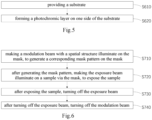
- a method of manufacturing a mask comprising: providing a substrate, the substrate configured to be transmissive to an exposure beam for lithography, wherein the exposure beam is in a first frequency band; and forming a photochromic layer on one side of the substrate, the photochromic layer comprising a photochromic material and configured to generate a corresponding mask pattern under illumination of a modulation beam with a spatial structure, wherein the photochromic material is in a non-light-transmitting state or a light-transmitting state to the exposure beam based on whether the photochromic material is illuminated by modulation light in the modulation beam, and the modulation beam is in a second frequency band separated from the first frequency band.
- a lithographing method based on a mask comprising: making a modulation beam with a spatial structure illuminate on the mask, to generate a corresponding mask pattern on the mask; after generating the mask pattern, making the exposure beam illuminate on a wafer via the mask, to expose the wafer; after exposing the wafer, turning off the exposure beam; and after turning off the exposure beam, turning off the modulation beam.
- an intensity of the modulation beam is greater than that of the exposure beam.
- the lithographing method further comprises: operating a temperature controller to maintain a temperature of the mask within a present temperature range.
- terminologies "comprise”, “include”, and “contain” used in the description indicate the presence of the stated feature, but do not exclude the presence of one or more other features.
- the terminology “and/or” used in the description includes any and all combinations of one or more of associated listed items.
- the terminologies "between X and Y” and “between about X and Y” used in this description should be construed to include X and Y.
- the terminology “between about X and Y” used in this description means “between about X and about Y”
- the terminology “from about X to Y” used in this description means “from about X to about Y”.
- an element when it is stated that an element is “on”, “attached” to, “connected” to, “coupled” to, or “contacted” with another element, etc., the element can be directly on, attached to, connected to, coupled to, or contacted with the other element, or an intermediate element may be present.
- an element when it is stated that an element is “directly on”, “directly attached” to, “directly connected” to, “directly coupled” to, or “directly contacted” with another element, no intermediate element will be present.
- a feature being arranged to be “adjacent” to another feature may refer to the feature having a portion overlapped with or located above or below the adjacent feature.
- spatial relation terminologies such as “above”, “below”, “left”, “right”, “front”, “rear”, “high”, and “low” may describe the relation between one feature and another feature in the accompanying drawings.
- the spatial relation terminology encompasses different orientations of an equipment in use or operation in addition to the orientation shown in the drawings. For example, when the equipment in the drawings is inverted, the feature originally described to be “below” another feature may be described to be “above” the other feature at this time.
- the equipment may also be otherwise oriented (rotated 90 degrees or in another orientation), and at this time, the relative spatial relation may be interpreted accordingly.
- the desired device or chip structure is formed typically using the lithography technology based on the mask.
- one or more masks may be fabricated in advance in the light of corresponding process procedures, wherein the pattern on each mask may correspond to one layer in the layout or to a plurality of layers that can be prepared in a same procedure.
- the mask may include the substrate (e.g., quartz glass) which can cause the exposure beam (e.g., ultraviolet light, etc.) for changing the property of the resist (photoresist) to transmit through, and the plated film (e.g., the metal chromium film) that is deposited on the substrate for preventing the exposure beam descirbed above from transmitting through.
- the substrate e.g., quartz glass
- the exposure beam e.g., ultraviolet light, etc.
- the plated film e.g., the metal chromium film
- the chromium film with a thickness of several tens of nanometers and the resist positioned on the chromium film may be sequentially deposited on the quartz glass, then the desired pattern may be formed on the resist by means of laser direct writing or electron beam exposure, and then the chromium exposed from the resist may be wet-etched or dry-etched to form the pattern corresponding to the desired structure on the chromium film.
- the means of laser direct writing is typically used for forming the mask with the minimum linewidth of above 300 nm, and the means of electron beam exposure can be used for forming the mask with the minimum linewidth of less than 300 nm.
- the cost of a single sheet of mask is approximately tens of thousands of dollars, and the cost of a complete set of masks for the complete device or chip production process might be up to millions of dollars.
- the cost of a complete set of masks for the complete device or chip production process might be up to millions of dollars.
- its structure is difficult to be altered.
- the amount of a single batch of chips including a central processing unit (CPU), a dynamic random access memory (DRAM), a flash memory and the like, is typically in the order of millions or even hundreds of millions, so that the cost of fabricating the mask can be well shared, and thus, the lithography process based on the mask can be widely applied to the fabrication and production of these devices or chips.
- the defect present in the mask might also result in a great increase in the cost of producing the devices or chips. Specifically, if a minor defect is present in the mask, time needs to be spent on detection and repair of the defect; and if a major defect is present in the mask, the entire mask might have to be discarded.
- the present disclosure provides a programmable, rewritable and reusable digital lithography mask.
- the light-transmitting state of a corresponding pixel region in the mask can be reversibly changed by controlling a modulation beam with a spatial structure to illuminate on the mask with the photochromic material, such that the pattern on the same mask can be changed as required, thereby realizing reuse of the mask and further reducing the production cost of the devices or chips.
- the mask may include the substrate 110 and the photochromic layer 120.
- the substrate 110 may be configured to be transmissive to the exposure beam for lithography to avoid impeding the lithographing process.
- the exposure beam may be in the first frequency band, which typically corresponds to the frequency band where partial ultraviolet light is located.
- the wavelength corresponding to the first band may include 193 ⁇ 405 nm.
- the wavelength corresponding to the first band may include at least one of 193 nm, 248 nm, 325 nm, 365 nm, or 405 nm.
- the substrate 110 may be made of the material with a certain structural strength for supporting other layers of the mask provided thereon.
- the substrate 110 may be made of quartz glass, calcium fluoride glass, or the like.
- the photochromic layer 120 may be provided on one side of the substrate 110, and the photochromic layer 120 may include a photochromic material and generate a corresponding mask pattern under illumination of the modulation beam with the spatial structure.
- the modulation beam 930 with the spatial structure specifically refers to the beam having the non-uniform intensity distribution on the section perpendicular to its travelling direction.
- the modulation light intensity of partial region may be zero, while another region may have a non-zero modulation light intensity.
- the photochromic material will be in a non-light-transmitting state or a light-transmitting state to the exposure beam based on whether it is illuminated by modulation light in the modulation beam, to form accordingly the non-light-transmitting region and the light-transmitting region in the mask, thereby generating a desired mask pattern.
- the photochromic material when the photochromic material is opposite to the region on the section of the modulation beam 930 that has the non-zero modulation light intensity, i.e., the photochromic material is illuminated by the modulation light in the modulation beam 930, this part of photochromic material will absorb the modulation light and be in the non-light-transmitting state to the exposure beam (for example, the organic photochromic material absorbs the modulation light as the deexcitation light and generates a high absorption rate to the ultraviolet light as the exposure beam, resulting in that this part of organic photochromic material is in the non-light-transmitting state to the exposure beam), corresponding to the non-transmissive region 122 to the exposure beam 920 of the photochromic material shown in Fig.
- the light-transmitting region 121 and the non-light-transmitting region 122 to the exposure beam 920 can be formed in the photochromic layer 120, and the combination of these regions can form the desired mask pattern in the mask.
- this part of photochromic material when the photochromic material is opposite to the region on the section of the modulation beam that has the non-zero modulation light intensity, i.e. when the photochromic material is illuminated by the modulation light in the modulation beam, this part of photochromic material may be in the light-transmitting state to the exposure beam; and when the photochromic material is opposite to the region on the section of the modulation beam that has the modulation light intensity of zero, i.e., the photochromic material is not illuminated by the modulation light in the modulation beam, this part of photochromic material can be in the non-light-transmitting state to the exposure beam.
- the non-light-transmitting state (or light-transmitting state) of the photochromic material may be maintained only when the modulation light illuminates on the photochromic material, and once the modulation light is removed, the photochromic material will recover to its default state. Therefore, when lithography is performed using a mask including such photochromic material, it is necessary to keep the modulation beam illuminating on the mask while exposing the wafer/sample using the exposure beam, to maintain the light-transmitting and non-light-transmitting regions in the mask unchanged, or keep the mask pattern unchanged, until the lithography is completed.
- the modulation beam 930 cannot cause the change in the property of the resist (for example, photoresist), which requires that the modulation beam 930 is in the second frequency band separated from the first frequency band for the exposure beam 920.
- the separated first and second frequency bands refer to that any frequency in the first frequency band is different from that in the second frequency band.
- the wavelength corresponding to the second frequency band may include 500 ⁇ 580 nm, or 580 ⁇ 1100 nm, or a part of 500 ⁇ 580 nm, or a part of 580 ⁇ 1100 nm.
- a wavelength corresponding to the second frequency band may be 633 nm.
- transmittance of the photochromic material in the light-transmitting and non-light-transmitting states should meet a certain requirement.
- transmittance to the exposure beam can be 60% ⁇ 99%; and when the photochromic material is in the non-light-transmitting state, its transmittance to the exposure beam can be 5% ⁇ 30%.
- the photochromic material can include at least one of an organic photochromic material or an inorganic photochromic material.
- a common organic photochromic material may include tetracene solution, benzalphenylhydrazines solution, osazones solution, or the like in a liquid state, and 2,3,4,4-tetrachloronaphthalen-1-(4H)-one, spironaphthoxazines type organic material, diarylethene type material, azobenzene derivative, 1,2-bis(5,5'-dimethyl-2,2'-bithiophen-yl)perfluorocyclopent-1-ene, or the like in a solid state, while the inorganic photochromic material may include a various of transition metal oxides and composites thereof, such as wolfram oxide (WO x ), molybdenum trioxide (MoO 3 ), vanadium pentoxide (V 2 O 5 ), and titanium dioxide (TiO 2 ).
- the photochromic material that can be used should have at least the following properties: (1) the light-transmitting state and the non-light-transmitting state of the photochromic material can be reversibly switched under the control of the modulation beam, to realize the rewritable and reusable mask, that is, in the case of not being illuminated by the modulation light in the modulation beam, the photochromic material has a sufficiently high transmittance to the exposure beam in the first frequency band, and in the case of being illuminated by the modulation light in the modulation beam, it has a sufficiently low transmittance to the exposure beam in the first frequency band; alternatively, in the case of not being illuminated by the modulation light in the modulation beam, it has a sufficiently low transmittance to the exposure beam in the first frequency band, and in the case of being illuminated by the modulation light in the modulation beam, it has a sufficiently high transmittance to the exposure beam in the first frequency band; and (2) the second frequency band
- 1,2-bis(5,5'-dimethyl-2,2'-bithiophen-yl)perfluorocyclopent-1-ene may be used as the photochromic material in the mask.
- another photochromic material corresponding to the corresponding frequency band may be selected, which is not limited herein.
- a photochromic material with good heat dissipation and low required modulation beam intensity can be selected to reduce a great increase in the mask temperature due to the illumination of the modulation beam, thereby improving reliability of the lithography.
- the photochromic layer 120 may include the photochromic material in a shape of continuous film, to facilitate the preparation of the mask by means of deposition such as lamination, spin coating, and spraying.
- the thickness of the photochromic layer 120 may be 50 ⁇ 200 nm or 200-5000 nm.
- a patterned photochromic layer may be formed as needed, and the above patterned photochromic layer may be formed by means of laser direct writing, electron beam direct writing, and lithographing based on another mask, or the like.
- the photochromic material in a liquid state may be used as needed, and at this time, a blocking layer may be further provided above the photochromic layer 120, so that the liquid photochromic material is limited between the substrate 110 and the blocking layer, to maintain the stable property of the structure of the mask, thereby ensuring the exposure effect.
- a modulation light source 200 may be further included, and the modulation light source 200 may be regarded as a part of the mask, or provided, independently of the mask, in the lithographing apparatus including the mask.
- the modulation light source 200 may be configured to generate the modulation beam with the spatial structure.
- the modulation light source 200 may include a first optical generator 210 and a spatial optical modulator 220, wherein the first optical generator 210 may be configured to generate an initial beam in the second frequency band, the initial beam having a uniform light intensity distribution on the section perpendicular to its travelling direction; and the spatial optical modulator 220 may be configured to convert the initial beam into the modulation beam with the spatial structure under the action of the control signal generated according to the mask pattern.
- the spatial structure of the modulation beam corresponds to the desired mask pattern, to form corresponding light-transmitting and non-light-transmitting regions by the modulation beam illuminating on the photochromic material on the mask.
- the spatial optical modulator may be an optical phase modulator.
- the spatial optical modulator may achieve pixels with the number of 4160x2464 and the pixel period of 3.74 ⁇ m.
- a pattern with a period of 6 ⁇ 8 ⁇ m that is composed of minute optical spots with a size of 3 ⁇ 4 ⁇ m may be formed on the mask by using the modulation beam with a wavelength of 633 nm.
- the minimum linewidth which can be processed is 1 ⁇ m or so, and the area for a single exposure can be 1 ⁇ 1 cm 2 .
- the yield described above is 100 times that of laser direct writing, and thus can meet the lithographing requirement of a next generation of printed circuit boards and chip packaging, etc.
- the wavelength of the modulation beam is 633 nm
- the minimum resolution of the pattern that can be generated by the modulation beam is 400 nm or so
- the lithographing linewidth of about 100 nm can be achieved, which can meet the lithographing requirement of many subsequent processes of the chip. If it is desired to further improve the linewidth accuracy of the mask while improving the yield, a spatial optical modulator of 10000x10000 or more pixels can be developed.
- the minimum linewidth on the mask is typically 400 nm or so, but by combining higher-fold reduced projection lithography, such as a tenfold (10x) reduced projection lithography technology, and performing exposure using a deep ultraviolet (DUV) exposure beam of 193 nm, for example, the minimum linewidth for the lithographing can be further improved to below 45 nm to meet the production requirement of advanced chips.
- higher-fold reduced projection lithography such as a tenfold (10x) reduced projection lithography technology
- DUV deep ultraviolet
- the exposure beam generated by the second optical generator 300 may be a near-field beam relative to the mask.
- the modulation beam generated by the modulation light source 200 may also be a near-field beam relative to the photochromic layer in the mask, to avoid an influence on precision that is caused by the optical diffraction effect of a far-field beam and to improve the accuracy of the mask pattern.
- a temperature controller 400 may be further included.
- the temperature controller 400 may be regarded as being included in the mask, or being provided, independently of the mask, in the lithographing apparatus including the mask.
- the temperature controller 400 may include a temperature maintaining unit, which may be configured to be provided adjacent to the substrate 110 or the photochromic layer 120 to maintain the temperature of the mask within a preset temperature range.
- the temperature controller may be a liquid cooled temperature controller, a thermoelectric semiconductor temperature controller, etc., which is not limited herein.
- the light intensity of the exposure beam required in the exposure process is typically 10 ⁇ 10000 mW/cm 2
- the light intensity of the modulation beam for changing the light-transmitting state of the photochromic material is typically required to be within a range of 10 ⁇ 10000 W/cm 2 .
- the light intensity of the modulation beam with the wavelength of 633 nm might be more than 1000 times that of the exposure beam with the wavelength of 325 nm.
- the mask By maintaining the mask within the preset temperature range using the temperature controller 400, the mask can be prevented from being damaged under the action of the strong modulation beam, and it can be even realized that the photochromic material in the mask is excited using a modulation beam with higher intensity (e.g. 100 kW/cm 2 ), to rapidly change the light-transmitting state of the photochromic material and obtain the desired transmittance as ideal as possible.
- a modulation beam with higher intensity e.g. 100 kW/cm 2
- the reversible change in the light-transmitting state of individual pixel region can be controlled using the photochromic material therein.
- a corresponding mask pattern can be directly formed based on a data file of the required structure of the device or chip, and the mask pattern on the same mask can be erased and rewritten, which achieves reuse of the mask, improves the utilization efficiency of the mask, reduces the cost of fabricating the device or chip, and avoids a series of problems caused by overhigh mask cost in traditional lithography.
- a lithographing apparatus may include a body 100 of the mask as described above and a control module 500.
- the lithographing apparatus may further include at least one of the modulation light source 200 as described above, a second optical generator 300 configured to generate the exposure beam in the first frequency band (the exposure beam typically has a uniform light intensity distribution on the section perpendicular to its travelling direction, or has a uniform light intensity distribution at least in the central region of the section), or the temperature controller 400 as described above.
- the control module 500 may be configured to generate, according to the layout, the control signal, for generating the modulation beam with the spatial structure corresponding to the layout.
- control module 500 may be configured to generate a plurality of mask patterns corresponding to one or more layers in the layout of the device or chip, and generate a corresponding control signal according to individual mask pattern. Further, the control module 500 may transmit the control signal to the spatial optical modulator 220, so that the spatial optical modulator 220 changes the light-transmitting state of individual pixel region in the mask.
- a corresponding reversible mask can be directly manufactured using the data file of the pattern to be exposed; by combining the 10x reduced projection and LELE (Litho-Etch-Litho-Etch) technology and the like, the lithographing apparatus can meet the production requirement of small-batch chips of 14 nm or even more advanced process nodes.
- LELE Litho-Etch-Litho-Etch
- the fabrication of complex devices or chips can be efficiently and accurately completed through only one or a few reusable and rewritable masks, which reduces the cost of fabricating the devices or chips, and facilitates rapid updating, mass production and better market penetration of the devices or chips.
- a method of manufacturing a mask which may include, as shown in Fig. 5 :
- a lithographing method based on the mask as described above which may include, as shown in Fig. 6 :
- the modulation beam should be kept in the on state in the whole exposure process, to guarantee correctness of the mask pattern.
- the intensity of the modulation beam may be greater than that of the exposure beam.
- the lithographing method may further include: operating a temperature controller to maintain a temperature of the mask within a present temperature range.
Landscapes
- Physics & Mathematics (AREA)
- General Physics & Mathematics (AREA)
- Health & Medical Sciences (AREA)
- Toxicology (AREA)
- Engineering & Computer Science (AREA)
- Environmental & Geological Engineering (AREA)
- Epidemiology (AREA)
- Public Health (AREA)
- Atmospheric Sciences (AREA)
- Life Sciences & Earth Sciences (AREA)
- Nonlinear Science (AREA)
- Optics & Photonics (AREA)
- Exposure And Positioning Against Photoresist Photosensitive Materials (AREA)
- Preparing Plates And Mask In Photomechanical Process (AREA)
Applications Claiming Priority (2)
| Application Number | Priority Date | Filing Date | Title |
|---|---|---|---|
| CN202210373932.5A CN114690534B (zh) | 2022-04-11 | 2022-04-11 | 掩模版、光刻装置、掩模版的制造方法和基于掩模版的光刻方法 |
| PCT/CN2022/126146 WO2023197553A1 (fr) | 2022-04-11 | 2022-10-19 | Masque, dispositif photolithographique, procédé de fabrication de masque et procédé de photolithographie basé sur un masque |
Publications (2)
| Publication Number | Publication Date |
|---|---|
| EP4509918A1 true EP4509918A1 (fr) | 2025-02-19 |
| EP4509918A4 EP4509918A4 (fr) | 2026-05-06 |
Family
ID=82143615
Family Applications (1)
| Application Number | Title | Priority Date | Filing Date |
|---|---|---|---|
| EP22936720.6A Pending EP4509918A4 (fr) | 2022-04-11 | 2022-10-19 | Masque, dispositif photolithographique, procédé de fabrication de masque et procédé de photolithographie basé sur un masque |
Country Status (5)
| Country | Link |
|---|---|
| US (1) | US20240402612A1 (fr) |
| EP (1) | EP4509918A4 (fr) |
| JP (1) | JP2025504159A (fr) |
| CN (1) | CN114690534B (fr) |
| WO (1) | WO2023197553A1 (fr) |
Families Citing this family (3)
| Publication number | Priority date | Publication date | Assignee | Title |
|---|---|---|---|---|
| CN114690534B (zh) * | 2022-04-11 | 2025-03-07 | 西湖大学 | 掩模版、光刻装置、掩模版的制造方法和基于掩模版的光刻方法 |
| CN115079512A (zh) * | 2022-07-11 | 2022-09-20 | 上海传芯半导体有限公司 | 掩模基版、掩模版及光刻设备 |
| CN115016225B (zh) * | 2022-08-04 | 2022-11-15 | 上海传芯半导体有限公司 | 掩模基版、掩模版及光刻设备 |
Family Cites Families (19)
| Publication number | Priority date | Publication date | Assignee | Title |
|---|---|---|---|---|
| JPS644687A (en) * | 1987-06-26 | 1989-01-09 | Sumitomo Electric Industries | Method of controlling photochromic reaction |
| JPH08203799A (ja) * | 1995-01-20 | 1996-08-09 | Toshiba Corp | 露光装置とパターン形成方法 |
| US6342941B1 (en) * | 1996-03-11 | 2002-01-29 | Nikon Corporation | Exposure apparatus and method preheating a mask before exposing; a conveyance method preheating a mask before exposing; and a device manufacturing system and method manufacturing a device according to the exposure apparatus and method |
| DE19831777A1 (de) * | 1998-07-15 | 2000-02-03 | Norbert Hampp | Lichtmodulator mit photochromer Schicht |
| US8994920B1 (en) * | 2010-05-07 | 2015-03-31 | Kenneth C. Johnson | Optical systems and methods for absorbance modulation |
| JP2000221661A (ja) * | 1999-02-02 | 2000-08-11 | Seiko Epson Corp | フォトマスク及びそれを備えた露光装置 |
| US6383690B1 (en) * | 1999-12-09 | 2002-05-07 | Autologic Information International, Inc. | Platemaking system and method using an imaging mask made from photochromic film |
| JP4410108B2 (ja) * | 2002-08-09 | 2010-02-03 | スイッチ マテリアルズ インコーポレイテッド | フォトクロミックかつエレクトロクロミックな化合物、該化合物の合成方法及び該化合物の使用方法 |
| JP2004149659A (ja) * | 2002-10-30 | 2004-05-27 | Asahi Glass Co Ltd | フォトクロミック性色素、膜形成用組成物およびフォトクロミック性の膜を有する物品 |
| EP1576419A4 (fr) * | 2002-12-09 | 2006-07-12 | Pixelligent Technologies Llc | Masque photolithographique programmable et materiaux photo-instables a base de particules semiconductrices de taille nanometrique et leurs applications |
| CN101813881B (zh) * | 2009-02-20 | 2012-02-29 | 北京京东方光电科技有限公司 | 半色调掩模版及其制造方法 |
| CN101576709A (zh) * | 2009-06-10 | 2009-11-11 | 昆山龙腾光电有限公司 | 光罩及其制造方法 |
| JP5598125B2 (ja) * | 2010-07-09 | 2014-10-01 | 三菱瓦斯化学株式会社 | 逆フォトクロミック材料 |
| US9454086B2 (en) * | 2011-10-14 | 2016-09-27 | University Of Utah Research Foundation | Programmable photolithography |
| US9063434B2 (en) * | 2013-01-11 | 2015-06-23 | University Of Utah Research Foundation | Sub-diffraction-limited patterning and imaging via multi-step photoswitching |
| CN103235451A (zh) * | 2013-04-23 | 2013-08-07 | 北京京东方光电科技有限公司 | 掩膜板及其制造方法 |
| CN111944135B (zh) * | 2020-08-20 | 2021-08-03 | 中国科学院宁波材料技术与工程研究所 | 一种光致变色三元共聚酯及其制备方法与应用 |
| CN114690534B (zh) * | 2022-04-11 | 2025-03-07 | 西湖大学 | 掩模版、光刻装置、掩模版的制造方法和基于掩模版的光刻方法 |
| CN114675507B (zh) * | 2022-04-11 | 2025-03-25 | 西湖大学 | 光刻装置和光刻系统 |
-
2022
- 2022-04-11 CN CN202210373932.5A patent/CN114690534B/zh active Active
- 2022-10-19 JP JP2024546300A patent/JP2025504159A/ja active Pending
- 2022-10-19 EP EP22936720.6A patent/EP4509918A4/fr active Pending
- 2022-10-19 US US18/699,734 patent/US20240402612A1/en active Pending
- 2022-10-19 WO PCT/CN2022/126146 patent/WO2023197553A1/fr not_active Ceased
Also Published As
| Publication number | Publication date |
|---|---|
| WO2023197553A1 (fr) | 2023-10-19 |
| US20240402612A1 (en) | 2024-12-05 |
| JP2025504159A (ja) | 2025-02-06 |
| EP4509918A4 (fr) | 2026-05-06 |
| CN114690534B (zh) | 2025-03-07 |
| CN114690534A (zh) | 2022-07-01 |
Similar Documents
| Publication | Publication Date | Title |
|---|---|---|
| EP4509918A1 (fr) | Masque, dispositif photolithographique, procédé de fabrication de masque et procédé de photolithographie basé sur un masque | |
| JP5225822B2 (ja) | リソグラフィ方法および装置 | |
| CN114675507B (zh) | 光刻装置和光刻系统 | |
| US20210294203A1 (en) | Lithography Mask with a Black Border Regions and Method of Fabricating the Same | |
| US11073755B2 (en) | Mask with multilayer structure and manufacturing method by using the same | |
| KR20160016506A (ko) | Id 패턴의 결함이 프린트될 가능성을 완화시키는 방법 | |
| US20030117598A1 (en) | Method and apparatus for exposing photoresists using programmable masks | |
| US6596656B2 (en) | Manufacturing use of photomasks with an opaque pattern comprising an organic layer photoabsorptive to exposure light with wavelengths exceeding 200 NM | |
| KR100614292B1 (ko) | 일루미네이터 제어식 톤 반전 프린팅 | |
| CN111880383A (zh) | 一种高密度光刻图案处理方法 | |
| Rothschild | A roadmap for optical lithography | |
| US20080003525A1 (en) | Method for Projecting High Resolution Patterns | |
| US20050106474A1 (en) | Method for controlling linewidth in advanced lithography masks using electrochemistry | |
| CN114779570A (zh) | 掩模版、光刻装置和用于制造掩模版的方法 | |
| US6844916B2 (en) | Method for improving image quality and for increasing writing speed during exposure of light-sensitive layers | |
| WO2006132453A1 (fr) | Dispositif matriciel à ouverture d’échelle nano/micro à modulation de lumière possédant une couche d'immersion et système d’enregistrement à motif d’échelle nano grande vitesse utilisant ledit dispositif | |
| CN113504710B (zh) | 光刻工艺中的多次曝光的方法 | |
| US20250264810A1 (en) | Method of configuring extreme ultraviolet (euv) source, and euv exposure method using the euv source | |
| US20080160455A1 (en) | Exposure Method, Method for Forming Projecting and Recessed Pattern, and Method for Manufacturing Optical Element | |
| JP2003084446A (ja) | 格子パターンの露光方法および露光装置 | |
| CN118466126A (zh) | 曝光方法 | |
| CN112034691A (zh) | 一种阴阳文互补光强掩膜版双光束投影光刻装置及方法 | |
| KR20020072914A (ko) | 반도체 소자의 노광 장치 |
Legal Events
| Date | Code | Title | Description |
|---|---|---|---|
| STAA | Information on the status of an ep patent application or granted ep patent |
Free format text: STATUS: UNKNOWN |
|
| STAA | Information on the status of an ep patent application or granted ep patent |
Free format text: STATUS: THE INTERNATIONAL PUBLICATION HAS BEEN MADE |
|
| PUAI | Public reference made under article 153(3) epc to a published international application that has entered the european phase |
Free format text: ORIGINAL CODE: 0009012 |
|
| STAA | Information on the status of an ep patent application or granted ep patent |
Free format text: STATUS: REQUEST FOR EXAMINATION WAS MADE |
|
| 17P | Request for examination filed |
Effective date: 20240206 |
|
| AK | Designated contracting states |
Kind code of ref document: A1 Designated state(s): AL AT BE BG CH CY CZ DE DK EE ES FI FR GB GR HR HU IE IS IT LI LT LU LV MC ME MK MT NL NO PL PT RO RS SE SI SK SM TR |
|
| RIN1 | Information on inventor provided before grant (corrected) |
Inventor name: SONG, CHUNYAN Inventor name: LI, XIJUN |
|
| DAV | Request for validation of the european patent (deleted) | ||
| DAX | Request for extension of the european patent (deleted) |