EP4538372A2 - Anti-trop2-antikörper - Google Patents
Anti-trop2-antikörper Download PDFInfo
- Publication number
- EP4538372A2 EP4538372A2 EP25157261.6A EP25157261A EP4538372A2 EP 4538372 A2 EP4538372 A2 EP 4538372A2 EP 25157261 A EP25157261 A EP 25157261A EP 4538372 A2 EP4538372 A2 EP 4538372A2
- Authority
- EP
- European Patent Office
- Prior art keywords
- amino acid
- antibody
- seq
- acid sequence
- heavy chain
- Prior art date
- Legal status (The legal status is an assumption and is not a legal conclusion. Google has not performed a legal analysis and makes no representation as to the accuracy of the status listed.)
- Pending
Links
Images













Classifications
-
- A—HUMAN NECESSITIES
- A61—MEDICAL OR VETERINARY SCIENCE; HYGIENE
- A61K—PREPARATIONS FOR MEDICAL, DENTAL OR TOILETRY PURPOSES
- A61K47/00—Medicinal preparations characterised by the non-active ingredients used, e.g. carriers or inert additives; Targeting or modifying agents chemically bound to the active ingredient
- A61K47/50—Medicinal preparations characterised by the non-active ingredients used, e.g. carriers or inert additives; Targeting or modifying agents chemically bound to the active ingredient the non-active ingredient being chemically bound to the active ingredient, e.g. polymer-drug conjugates
- A61K47/51—Medicinal preparations characterised by the non-active ingredients used, e.g. carriers or inert additives; Targeting or modifying agents chemically bound to the active ingredient the non-active ingredient being chemically bound to the active ingredient, e.g. polymer-drug conjugates the non-active ingredient being a modifying agent
- A61K47/68—Medicinal preparations characterised by the non-active ingredients used, e.g. carriers or inert additives; Targeting or modifying agents chemically bound to the active ingredient the non-active ingredient being chemically bound to the active ingredient, e.g. polymer-drug conjugates the non-active ingredient being a modifying agent the modifying agent being an antibody, an immunoglobulin or a fragment thereof, e.g. an Fc-fragment
- A61K47/6889—Conjugates wherein the antibody being the modifying agent and wherein the linker, binder or spacer confers particular properties to the conjugates, e.g. peptidic enzyme-labile linkers or acid-labile linkers, providing for an acid-labile immuno conjugate wherein the drug may be released from its antibody conjugated part in an acidic, e.g. tumoural or environment
-
- A—HUMAN NECESSITIES
- A61—MEDICAL OR VETERINARY SCIENCE; HYGIENE
- A61K—PREPARATIONS FOR MEDICAL, DENTAL OR TOILETRY PURPOSES
- A61K31/00—Medicinal preparations containing organic active ingredients
- A61K31/33—Heterocyclic compounds
- A61K31/395—Heterocyclic compounds having nitrogen as a ring hetero atom, e.g. guanethidine or rifamycins
- A61K31/435—Heterocyclic compounds having nitrogen as a ring hetero atom, e.g. guanethidine or rifamycins having six-membered rings with one nitrogen as the only ring hetero atom
- A61K31/47—Quinolines; Isoquinolines
- A61K31/4738—Quinolines; Isoquinolines ortho- or peri-condensed with heterocyclic ring systems
- A61K31/4745—Quinolines; Isoquinolines ortho- or peri-condensed with heterocyclic ring systems condensed with ring systems having nitrogen as a ring hetero atom, e.g. phenantrolines
-
- A—HUMAN NECESSITIES
- A61—MEDICAL OR VETERINARY SCIENCE; HYGIENE
- A61K—PREPARATIONS FOR MEDICAL, DENTAL OR TOILETRY PURPOSES
- A61K39/00—Medicinal preparations containing antigens or antibodies
- A61K39/395—Antibodies; Immunoglobulins; Immune serum, e.g. antilymphocytic serum
-
- A—HUMAN NECESSITIES
- A61—MEDICAL OR VETERINARY SCIENCE; HYGIENE
- A61K—PREPARATIONS FOR MEDICAL, DENTAL OR TOILETRY PURPOSES
- A61K47/00—Medicinal preparations characterised by the non-active ingredients used, e.g. carriers or inert additives; Targeting or modifying agents chemically bound to the active ingredient
- A61K47/50—Medicinal preparations characterised by the non-active ingredients used, e.g. carriers or inert additives; Targeting or modifying agents chemically bound to the active ingredient the non-active ingredient being chemically bound to the active ingredient, e.g. polymer-drug conjugates
- A61K47/51—Medicinal preparations characterised by the non-active ingredients used, e.g. carriers or inert additives; Targeting or modifying agents chemically bound to the active ingredient the non-active ingredient being chemically bound to the active ingredient, e.g. polymer-drug conjugates the non-active ingredient being a modifying agent
- A61K47/68—Medicinal preparations characterised by the non-active ingredients used, e.g. carriers or inert additives; Targeting or modifying agents chemically bound to the active ingredient the non-active ingredient being chemically bound to the active ingredient, e.g. polymer-drug conjugates the non-active ingredient being a modifying agent the modifying agent being an antibody, an immunoglobulin or a fragment thereof, e.g. an Fc-fragment
- A61K47/6801—Drug-antibody or immunoglobulin conjugates defined by the pharmacologically or therapeutically active agent
- A61K47/6803—Drugs conjugated to an antibody or immunoglobulin, e.g. cisplatin-antibody conjugates
-
- A—HUMAN NECESSITIES
- A61—MEDICAL OR VETERINARY SCIENCE; HYGIENE
- A61K—PREPARATIONS FOR MEDICAL, DENTAL OR TOILETRY PURPOSES
- A61K47/00—Medicinal preparations characterised by the non-active ingredients used, e.g. carriers or inert additives; Targeting or modifying agents chemically bound to the active ingredient
- A61K47/50—Medicinal preparations characterised by the non-active ingredients used, e.g. carriers or inert additives; Targeting or modifying agents chemically bound to the active ingredient the non-active ingredient being chemically bound to the active ingredient, e.g. polymer-drug conjugates
- A61K47/51—Medicinal preparations characterised by the non-active ingredients used, e.g. carriers or inert additives; Targeting or modifying agents chemically bound to the active ingredient the non-active ingredient being chemically bound to the active ingredient, e.g. polymer-drug conjugates the non-active ingredient being a modifying agent
- A61K47/68—Medicinal preparations characterised by the non-active ingredients used, e.g. carriers or inert additives; Targeting or modifying agents chemically bound to the active ingredient the non-active ingredient being chemically bound to the active ingredient, e.g. polymer-drug conjugates the non-active ingredient being a modifying agent the modifying agent being an antibody, an immunoglobulin or a fragment thereof, e.g. an Fc-fragment
- A61K47/6801—Drug-antibody or immunoglobulin conjugates defined by the pharmacologically or therapeutically active agent
- A61K47/6803—Drugs conjugated to an antibody or immunoglobulin, e.g. cisplatin-antibody conjugates
- A61K47/68031—Drugs conjugated to an antibody or immunoglobulin, e.g. cisplatin-antibody conjugates the drug being an auristatin
-
- A—HUMAN NECESSITIES
- A61—MEDICAL OR VETERINARY SCIENCE; HYGIENE
- A61K—PREPARATIONS FOR MEDICAL, DENTAL OR TOILETRY PURPOSES
- A61K47/00—Medicinal preparations characterised by the non-active ingredients used, e.g. carriers or inert additives; Targeting or modifying agents chemically bound to the active ingredient
- A61K47/50—Medicinal preparations characterised by the non-active ingredients used, e.g. carriers or inert additives; Targeting or modifying agents chemically bound to the active ingredient the non-active ingredient being chemically bound to the active ingredient, e.g. polymer-drug conjugates
- A61K47/51—Medicinal preparations characterised by the non-active ingredients used, e.g. carriers or inert additives; Targeting or modifying agents chemically bound to the active ingredient the non-active ingredient being chemically bound to the active ingredient, e.g. polymer-drug conjugates the non-active ingredient being a modifying agent
- A61K47/68—Medicinal preparations characterised by the non-active ingredients used, e.g. carriers or inert additives; Targeting or modifying agents chemically bound to the active ingredient the non-active ingredient being chemically bound to the active ingredient, e.g. polymer-drug conjugates the non-active ingredient being a modifying agent the modifying agent being an antibody, an immunoglobulin or a fragment thereof, e.g. an Fc-fragment
- A61K47/6801—Drug-antibody or immunoglobulin conjugates defined by the pharmacologically or therapeutically active agent
- A61K47/6803—Drugs conjugated to an antibody or immunoglobulin, e.g. cisplatin-antibody conjugates
- A61K47/68037—Drugs conjugated to an antibody or immunoglobulin, e.g. cisplatin-antibody conjugates the drug being a camptothecin [CPT] or derivatives
-
- A—HUMAN NECESSITIES
- A61—MEDICAL OR VETERINARY SCIENCE; HYGIENE
- A61K—PREPARATIONS FOR MEDICAL, DENTAL OR TOILETRY PURPOSES
- A61K47/00—Medicinal preparations characterised by the non-active ingredients used, e.g. carriers or inert additives; Targeting or modifying agents chemically bound to the active ingredient
- A61K47/50—Medicinal preparations characterised by the non-active ingredients used, e.g. carriers or inert additives; Targeting or modifying agents chemically bound to the active ingredient the non-active ingredient being chemically bound to the active ingredient, e.g. polymer-drug conjugates
- A61K47/51—Medicinal preparations characterised by the non-active ingredients used, e.g. carriers or inert additives; Targeting or modifying agents chemically bound to the active ingredient the non-active ingredient being chemically bound to the active ingredient, e.g. polymer-drug conjugates the non-active ingredient being a modifying agent
- A61K47/68—Medicinal preparations characterised by the non-active ingredients used, e.g. carriers or inert additives; Targeting or modifying agents chemically bound to the active ingredient the non-active ingredient being chemically bound to the active ingredient, e.g. polymer-drug conjugates the non-active ingredient being a modifying agent the modifying agent being an antibody, an immunoglobulin or a fragment thereof, e.g. an Fc-fragment
- A61K47/6835—Medicinal preparations characterised by the non-active ingredients used, e.g. carriers or inert additives; Targeting or modifying agents chemically bound to the active ingredient the non-active ingredient being chemically bound to the active ingredient, e.g. polymer-drug conjugates the non-active ingredient being a modifying agent the modifying agent being an antibody, an immunoglobulin or a fragment thereof, e.g. an Fc-fragment the modifying agent being an antibody or an immunoglobulin bearing at least one antigen-binding site
- A61K47/6851—Medicinal preparations characterised by the non-active ingredients used, e.g. carriers or inert additives; Targeting or modifying agents chemically bound to the active ingredient the non-active ingredient being chemically bound to the active ingredient, e.g. polymer-drug conjugates the non-active ingredient being a modifying agent the modifying agent being an antibody, an immunoglobulin or a fragment thereof, e.g. an Fc-fragment the modifying agent being an antibody or an immunoglobulin bearing at least one antigen-binding site the antibody targeting a determinant of a tumour cell
-
- A—HUMAN NECESSITIES
- A61—MEDICAL OR VETERINARY SCIENCE; HYGIENE
- A61K—PREPARATIONS FOR MEDICAL, DENTAL OR TOILETRY PURPOSES
- A61K47/00—Medicinal preparations characterised by the non-active ingredients used, e.g. carriers or inert additives; Targeting or modifying agents chemically bound to the active ingredient
- A61K47/50—Medicinal preparations characterised by the non-active ingredients used, e.g. carriers or inert additives; Targeting or modifying agents chemically bound to the active ingredient the non-active ingredient being chemically bound to the active ingredient, e.g. polymer-drug conjugates
- A61K47/51—Medicinal preparations characterised by the non-active ingredients used, e.g. carriers or inert additives; Targeting or modifying agents chemically bound to the active ingredient the non-active ingredient being chemically bound to the active ingredient, e.g. polymer-drug conjugates the non-active ingredient being a modifying agent
- A61K47/68—Medicinal preparations characterised by the non-active ingredients used, e.g. carriers or inert additives; Targeting or modifying agents chemically bound to the active ingredient the non-active ingredient being chemically bound to the active ingredient, e.g. polymer-drug conjugates the non-active ingredient being a modifying agent the modifying agent being an antibody, an immunoglobulin or a fragment thereof, e.g. an Fc-fragment
- A61K47/6835—Medicinal preparations characterised by the non-active ingredients used, e.g. carriers or inert additives; Targeting or modifying agents chemically bound to the active ingredient the non-active ingredient being chemically bound to the active ingredient, e.g. polymer-drug conjugates the non-active ingredient being a modifying agent the modifying agent being an antibody, an immunoglobulin or a fragment thereof, e.g. an Fc-fragment the modifying agent being an antibody or an immunoglobulin bearing at least one antigen-binding site
- A61K47/6851—Medicinal preparations characterised by the non-active ingredients used, e.g. carriers or inert additives; Targeting or modifying agents chemically bound to the active ingredient the non-active ingredient being chemically bound to the active ingredient, e.g. polymer-drug conjugates the non-active ingredient being a modifying agent the modifying agent being an antibody, an immunoglobulin or a fragment thereof, e.g. an Fc-fragment the modifying agent being an antibody or an immunoglobulin bearing at least one antigen-binding site the antibody targeting a determinant of a tumour cell
- A61K47/6857—Medicinal preparations characterised by the non-active ingredients used, e.g. carriers or inert additives; Targeting or modifying agents chemically bound to the active ingredient the non-active ingredient being chemically bound to the active ingredient, e.g. polymer-drug conjugates the non-active ingredient being a modifying agent the modifying agent being an antibody, an immunoglobulin or a fragment thereof, e.g. an Fc-fragment the modifying agent being an antibody or an immunoglobulin bearing at least one antigen-binding site the antibody targeting a determinant of a tumour cell the tumour determinant being from lung cancer cell
-
- A—HUMAN NECESSITIES
- A61—MEDICAL OR VETERINARY SCIENCE; HYGIENE
- A61K—PREPARATIONS FOR MEDICAL, DENTAL OR TOILETRY PURPOSES
- A61K47/00—Medicinal preparations characterised by the non-active ingredients used, e.g. carriers or inert additives; Targeting or modifying agents chemically bound to the active ingredient
- A61K47/50—Medicinal preparations characterised by the non-active ingredients used, e.g. carriers or inert additives; Targeting or modifying agents chemically bound to the active ingredient the non-active ingredient being chemically bound to the active ingredient, e.g. polymer-drug conjugates
- A61K47/51—Medicinal preparations characterised by the non-active ingredients used, e.g. carriers or inert additives; Targeting or modifying agents chemically bound to the active ingredient the non-active ingredient being chemically bound to the active ingredient, e.g. polymer-drug conjugates the non-active ingredient being a modifying agent
- A61K47/68—Medicinal preparations characterised by the non-active ingredients used, e.g. carriers or inert additives; Targeting or modifying agents chemically bound to the active ingredient the non-active ingredient being chemically bound to the active ingredient, e.g. polymer-drug conjugates the non-active ingredient being a modifying agent the modifying agent being an antibody, an immunoglobulin or a fragment thereof, e.g. an Fc-fragment
- A61K47/6835—Medicinal preparations characterised by the non-active ingredients used, e.g. carriers or inert additives; Targeting or modifying agents chemically bound to the active ingredient the non-active ingredient being chemically bound to the active ingredient, e.g. polymer-drug conjugates the non-active ingredient being a modifying agent the modifying agent being an antibody, an immunoglobulin or a fragment thereof, e.g. an Fc-fragment the modifying agent being an antibody or an immunoglobulin bearing at least one antigen-binding site
- A61K47/6851—Medicinal preparations characterised by the non-active ingredients used, e.g. carriers or inert additives; Targeting or modifying agents chemically bound to the active ingredient the non-active ingredient being chemically bound to the active ingredient, e.g. polymer-drug conjugates the non-active ingredient being a modifying agent the modifying agent being an antibody, an immunoglobulin or a fragment thereof, e.g. an Fc-fragment the modifying agent being an antibody or an immunoglobulin bearing at least one antigen-binding site the antibody targeting a determinant of a tumour cell
- A61K47/6859—Medicinal preparations characterised by the non-active ingredients used, e.g. carriers or inert additives; Targeting or modifying agents chemically bound to the active ingredient the non-active ingredient being chemically bound to the active ingredient, e.g. polymer-drug conjugates the non-active ingredient being a modifying agent the modifying agent being an antibody, an immunoglobulin or a fragment thereof, e.g. an Fc-fragment the modifying agent being an antibody or an immunoglobulin bearing at least one antigen-binding site the antibody targeting a determinant of a tumour cell the tumour determinant being from liver or pancreas cancer cell
-
- A—HUMAN NECESSITIES
- A61—MEDICAL OR VETERINARY SCIENCE; HYGIENE
- A61K—PREPARATIONS FOR MEDICAL, DENTAL OR TOILETRY PURPOSES
- A61K47/00—Medicinal preparations characterised by the non-active ingredients used, e.g. carriers or inert additives; Targeting or modifying agents chemically bound to the active ingredient
- A61K47/50—Medicinal preparations characterised by the non-active ingredients used, e.g. carriers or inert additives; Targeting or modifying agents chemically bound to the active ingredient the non-active ingredient being chemically bound to the active ingredient, e.g. polymer-drug conjugates
- A61K47/51—Medicinal preparations characterised by the non-active ingredients used, e.g. carriers or inert additives; Targeting or modifying agents chemically bound to the active ingredient the non-active ingredient being chemically bound to the active ingredient, e.g. polymer-drug conjugates the non-active ingredient being a modifying agent
- A61K47/68—Medicinal preparations characterised by the non-active ingredients used, e.g. carriers or inert additives; Targeting or modifying agents chemically bound to the active ingredient the non-active ingredient being chemically bound to the active ingredient, e.g. polymer-drug conjugates the non-active ingredient being a modifying agent the modifying agent being an antibody, an immunoglobulin or a fragment thereof, e.g. an Fc-fragment
- A61K47/6835—Medicinal preparations characterised by the non-active ingredients used, e.g. carriers or inert additives; Targeting or modifying agents chemically bound to the active ingredient the non-active ingredient being chemically bound to the active ingredient, e.g. polymer-drug conjugates the non-active ingredient being a modifying agent the modifying agent being an antibody, an immunoglobulin or a fragment thereof, e.g. an Fc-fragment the modifying agent being an antibody or an immunoglobulin bearing at least one antigen-binding site
- A61K47/6851—Medicinal preparations characterised by the non-active ingredients used, e.g. carriers or inert additives; Targeting or modifying agents chemically bound to the active ingredient the non-active ingredient being chemically bound to the active ingredient, e.g. polymer-drug conjugates the non-active ingredient being a modifying agent the modifying agent being an antibody, an immunoglobulin or a fragment thereof, e.g. an Fc-fragment the modifying agent being an antibody or an immunoglobulin bearing at least one antigen-binding site the antibody targeting a determinant of a tumour cell
- A61K47/6863—Medicinal preparations characterised by the non-active ingredients used, e.g. carriers or inert additives; Targeting or modifying agents chemically bound to the active ingredient the non-active ingredient being chemically bound to the active ingredient, e.g. polymer-drug conjugates the non-active ingredient being a modifying agent the modifying agent being an antibody, an immunoglobulin or a fragment thereof, e.g. an Fc-fragment the modifying agent being an antibody or an immunoglobulin bearing at least one antigen-binding site the antibody targeting a determinant of a tumour cell the tumour determinant being from stomach or intestines cancer cell
-
- A—HUMAN NECESSITIES
- A61—MEDICAL OR VETERINARY SCIENCE; HYGIENE
- A61K—PREPARATIONS FOR MEDICAL, DENTAL OR TOILETRY PURPOSES
- A61K47/00—Medicinal preparations characterised by the non-active ingredients used, e.g. carriers or inert additives; Targeting or modifying agents chemically bound to the active ingredient
- A61K47/50—Medicinal preparations characterised by the non-active ingredients used, e.g. carriers or inert additives; Targeting or modifying agents chemically bound to the active ingredient the non-active ingredient being chemically bound to the active ingredient, e.g. polymer-drug conjugates
- A61K47/51—Medicinal preparations characterised by the non-active ingredients used, e.g. carriers or inert additives; Targeting or modifying agents chemically bound to the active ingredient the non-active ingredient being chemically bound to the active ingredient, e.g. polymer-drug conjugates the non-active ingredient being a modifying agent
- A61K47/68—Medicinal preparations characterised by the non-active ingredients used, e.g. carriers or inert additives; Targeting or modifying agents chemically bound to the active ingredient the non-active ingredient being chemically bound to the active ingredient, e.g. polymer-drug conjugates the non-active ingredient being a modifying agent the modifying agent being an antibody, an immunoglobulin or a fragment thereof, e.g. an Fc-fragment
- A61K47/6835—Medicinal preparations characterised by the non-active ingredients used, e.g. carriers or inert additives; Targeting or modifying agents chemically bound to the active ingredient the non-active ingredient being chemically bound to the active ingredient, e.g. polymer-drug conjugates the non-active ingredient being a modifying agent the modifying agent being an antibody, an immunoglobulin or a fragment thereof, e.g. an Fc-fragment the modifying agent being an antibody or an immunoglobulin bearing at least one antigen-binding site
- A61K47/6851—Medicinal preparations characterised by the non-active ingredients used, e.g. carriers or inert additives; Targeting or modifying agents chemically bound to the active ingredient the non-active ingredient being chemically bound to the active ingredient, e.g. polymer-drug conjugates the non-active ingredient being a modifying agent the modifying agent being an antibody, an immunoglobulin or a fragment thereof, e.g. an Fc-fragment the modifying agent being an antibody or an immunoglobulin bearing at least one antigen-binding site the antibody targeting a determinant of a tumour cell
- A61K47/6865—Medicinal preparations characterised by the non-active ingredients used, e.g. carriers or inert additives; Targeting or modifying agents chemically bound to the active ingredient the non-active ingredient being chemically bound to the active ingredient, e.g. polymer-drug conjugates the non-active ingredient being a modifying agent the modifying agent being an antibody, an immunoglobulin or a fragment thereof, e.g. an Fc-fragment the modifying agent being an antibody or an immunoglobulin bearing at least one antigen-binding site the antibody targeting a determinant of a tumour cell the tumour determinant being from skin, nerves or brain cancer cell
-
- A—HUMAN NECESSITIES
- A61—MEDICAL OR VETERINARY SCIENCE; HYGIENE
- A61K—PREPARATIONS FOR MEDICAL, DENTAL OR TOILETRY PURPOSES
- A61K47/00—Medicinal preparations characterised by the non-active ingredients used, e.g. carriers or inert additives; Targeting or modifying agents chemically bound to the active ingredient
- A61K47/50—Medicinal preparations characterised by the non-active ingredients used, e.g. carriers or inert additives; Targeting or modifying agents chemically bound to the active ingredient the non-active ingredient being chemically bound to the active ingredient, e.g. polymer-drug conjugates
- A61K47/51—Medicinal preparations characterised by the non-active ingredients used, e.g. carriers or inert additives; Targeting or modifying agents chemically bound to the active ingredient the non-active ingredient being chemically bound to the active ingredient, e.g. polymer-drug conjugates the non-active ingredient being a modifying agent
- A61K47/68—Medicinal preparations characterised by the non-active ingredients used, e.g. carriers or inert additives; Targeting or modifying agents chemically bound to the active ingredient the non-active ingredient being chemically bound to the active ingredient, e.g. polymer-drug conjugates the non-active ingredient being a modifying agent the modifying agent being an antibody, an immunoglobulin or a fragment thereof, e.g. an Fc-fragment
- A61K47/6835—Medicinal preparations characterised by the non-active ingredients used, e.g. carriers or inert additives; Targeting or modifying agents chemically bound to the active ingredient the non-active ingredient being chemically bound to the active ingredient, e.g. polymer-drug conjugates the non-active ingredient being a modifying agent the modifying agent being an antibody, an immunoglobulin or a fragment thereof, e.g. an Fc-fragment the modifying agent being an antibody or an immunoglobulin bearing at least one antigen-binding site
- A61K47/6851—Medicinal preparations characterised by the non-active ingredients used, e.g. carriers or inert additives; Targeting or modifying agents chemically bound to the active ingredient the non-active ingredient being chemically bound to the active ingredient, e.g. polymer-drug conjugates the non-active ingredient being a modifying agent the modifying agent being an antibody, an immunoglobulin or a fragment thereof, e.g. an Fc-fragment the modifying agent being an antibody or an immunoglobulin bearing at least one antigen-binding site the antibody targeting a determinant of a tumour cell
- A61K47/6869—Medicinal preparations characterised by the non-active ingredients used, e.g. carriers or inert additives; Targeting or modifying agents chemically bound to the active ingredient the non-active ingredient being chemically bound to the active ingredient, e.g. polymer-drug conjugates the non-active ingredient being a modifying agent the modifying agent being an antibody, an immunoglobulin or a fragment thereof, e.g. an Fc-fragment the modifying agent being an antibody or an immunoglobulin bearing at least one antigen-binding site the antibody targeting a determinant of a tumour cell the tumour determinant being from a cell of the reproductive system: ovaria, uterus, testes, prostate
-
- A—HUMAN NECESSITIES
- A61—MEDICAL OR VETERINARY SCIENCE; HYGIENE
- A61P—SPECIFIC THERAPEUTIC ACTIVITY OF CHEMICAL COMPOUNDS OR MEDICINAL PREPARATIONS
- A61P35/00—Antineoplastic agents
-
- C—CHEMISTRY; METALLURGY
- C07—ORGANIC CHEMISTRY
- C07D—HETEROCYCLIC COMPOUNDS
- C07D491/00—Heterocyclic compounds containing in the condensed ring system both one or more rings having oxygen atoms as the only ring hetero atoms and one or more rings having nitrogen atoms as the only ring hetero atoms, not provided for by groups C07D451/00 - C07D459/00, C07D463/00, C07D477/00 or C07D489/00
- C07D491/22—Heterocyclic compounds containing in the condensed ring system both one or more rings having oxygen atoms as the only ring hetero atoms and one or more rings having nitrogen atoms as the only ring hetero atoms, not provided for by groups C07D451/00 - C07D459/00, C07D463/00, C07D477/00 or C07D489/00 in which the condensed system contains four or more hetero rings
-
- C—CHEMISTRY; METALLURGY
- C07—ORGANIC CHEMISTRY
- C07K—PEPTIDES
- C07K16/00—Immunoglobulins [IG], e.g. monoclonal or polyclonal antibodies
- C07K16/18—Immunoglobulins [IG], e.g. monoclonal or polyclonal antibodies against material from animals or humans
- C07K16/28—Immunoglobulins [IG], e.g. monoclonal or polyclonal antibodies against material from animals or humans against receptors, cell surface antigens or cell surface determinants
- C07K16/30—Immunoglobulins [IG], e.g. monoclonal or polyclonal antibodies against material from animals or humans against receptors, cell surface antigens or cell surface determinants from tumour cells
-
- C—CHEMISTRY; METALLURGY
- C07—ORGANIC CHEMISTRY
- C07K—PEPTIDES
- C07K16/00—Immunoglobulins [IG], e.g. monoclonal or polyclonal antibodies
- C07K16/18—Immunoglobulins [IG], e.g. monoclonal or polyclonal antibodies against material from animals or humans
- C07K16/28—Immunoglobulins [IG], e.g. monoclonal or polyclonal antibodies against material from animals or humans against receptors, cell surface antigens or cell surface determinants
- C07K16/30—Immunoglobulins [IG], e.g. monoclonal or polyclonal antibodies against material from animals or humans against receptors, cell surface antigens or cell surface determinants from tumour cells
- C07K16/3023—Lung
-
- C—CHEMISTRY; METALLURGY
- C07—ORGANIC CHEMISTRY
- C07K—PEPTIDES
- C07K16/00—Immunoglobulins [IG], e.g. monoclonal or polyclonal antibodies
- C07K16/18—Immunoglobulins [IG], e.g. monoclonal or polyclonal antibodies against material from animals or humans
- C07K16/28—Immunoglobulins [IG], e.g. monoclonal or polyclonal antibodies against material from animals or humans against receptors, cell surface antigens or cell surface determinants
- C07K16/30—Immunoglobulins [IG], e.g. monoclonal or polyclonal antibodies against material from animals or humans against receptors, cell surface antigens or cell surface determinants from tumour cells
- C07K16/303—Liver or Pancreas
-
- C—CHEMISTRY; METALLURGY
- C07—ORGANIC CHEMISTRY
- C07K—PEPTIDES
- C07K16/00—Immunoglobulins [IG], e.g. monoclonal or polyclonal antibodies
- C07K16/18—Immunoglobulins [IG], e.g. monoclonal or polyclonal antibodies against material from animals or humans
- C07K16/28—Immunoglobulins [IG], e.g. monoclonal or polyclonal antibodies against material from animals or humans against receptors, cell surface antigens or cell surface determinants
- C07K16/30—Immunoglobulins [IG], e.g. monoclonal or polyclonal antibodies against material from animals or humans against receptors, cell surface antigens or cell surface determinants from tumour cells
- C07K16/3046—Stomach, Intestines
-
- C—CHEMISTRY; METALLURGY
- C07—ORGANIC CHEMISTRY
- C07K—PEPTIDES
- C07K16/00—Immunoglobulins [IG], e.g. monoclonal or polyclonal antibodies
- C07K16/18—Immunoglobulins [IG], e.g. monoclonal or polyclonal antibodies against material from animals or humans
- C07K16/28—Immunoglobulins [IG], e.g. monoclonal or polyclonal antibodies against material from animals or humans against receptors, cell surface antigens or cell surface determinants
- C07K16/30—Immunoglobulins [IG], e.g. monoclonal or polyclonal antibodies against material from animals or humans against receptors, cell surface antigens or cell surface determinants from tumour cells
- C07K16/3053—Skin, nerves, brain
-
- C—CHEMISTRY; METALLURGY
- C07—ORGANIC CHEMISTRY
- C07K—PEPTIDES
- C07K16/00—Immunoglobulins [IG], e.g. monoclonal or polyclonal antibodies
- C07K16/18—Immunoglobulins [IG], e.g. monoclonal or polyclonal antibodies against material from animals or humans
- C07K16/28—Immunoglobulins [IG], e.g. monoclonal or polyclonal antibodies against material from animals or humans against receptors, cell surface antigens or cell surface determinants
- C07K16/30—Immunoglobulins [IG], e.g. monoclonal or polyclonal antibodies against material from animals or humans against receptors, cell surface antigens or cell surface determinants from tumour cells
- C07K16/3069—Reproductive system, e.g. ovaria, uterus, testes, prostate
-
- A—HUMAN NECESSITIES
- A61—MEDICAL OR VETERINARY SCIENCE; HYGIENE
- A61K—PREPARATIONS FOR MEDICAL, DENTAL OR TOILETRY PURPOSES
- A61K39/00—Medicinal preparations containing antigens or antibodies
- A61K2039/505—Medicinal preparations containing antigens or antibodies comprising antibodies
-
- C—CHEMISTRY; METALLURGY
- C07—ORGANIC CHEMISTRY
- C07K—PEPTIDES
- C07K2317/00—Immunoglobulins specific features
- C07K2317/20—Immunoglobulins specific features characterized by taxonomic origin
- C07K2317/24—Immunoglobulins specific features characterized by taxonomic origin containing regions, domains or residues from different species, e.g. chimeric, humanized or veneered
-
- C—CHEMISTRY; METALLURGY
- C07—ORGANIC CHEMISTRY
- C07K—PEPTIDES
- C07K2317/00—Immunoglobulins specific features
- C07K2317/70—Immunoglobulins specific features characterized by effect upon binding to a cell or to an antigen
- C07K2317/77—Internalization into the cell
-
- C—CHEMISTRY; METALLURGY
- C07—ORGANIC CHEMISTRY
- C07K—PEPTIDES
- C07K2317/00—Immunoglobulins specific features
- C07K2317/90—Immunoglobulins specific features characterized by (pharmaco)kinetic aspects or by stability of the immunoglobulin
- C07K2317/92—Affinity (KD), association rate (Ka), dissociation rate (Kd) or EC50 value
Definitions
- the present invention relates to an antibody-drug conjugate having an antitumor drug conjugated to an anti-TROP2 antibody via a linker structure moiety, the conjugate being useful as an antitumor drug.
- An antibody-drug conjugate having a drug with cytotoxicity conjugated to an antibody, whose antigen is expressed on a surface of cancer cells and which also binds to an antigen capable of cellular internalization, and therefore can deliver the drug selectively to cancer cells and is thus expected to cause accumulation of the drug within cancer cells and to kill the cancer cells (see, Non Patent Literatures 1 to 3).
- ADC antibody-drug conjugate
- Mylotarg Gamtuzumab ozogamicin (registered trademark) in which calicheamicin is conjugated to an anti-CD33 antibody is approved as a therapeutic agent for acute myeloid leukemia.
- Adcetris (Brentuximab vedotin (registered trademark)), in which auristatin E is conjugated to an anti-CD30 antibody, has recently been approved as a therapeutic agent for Hodgkin's lymphoma and anaplastic large cell lymphoma (see, Non Patent Literature 4).
- the drugs contained in ADCs which have been approved until now target DNA or tubulin.
- DE-310 is a complex in which exatecan is conjugated to a biodegradable carboxymethyldextran polyalcohol polymer via a GGFG peptide spacer (Patent Literature 3).
- exatecan is conjugated to a biodegradable carboxymethyldextran polyalcohol polymer via a GGFG peptide spacer (Patent Literature 3).
- GGFG peptide spacer GGFG peptide spacer
- the hTROP2 gene constitutes the TACSTD gene family, together with human TROP-1 (EpCAM, EGP-2, TACSTD1) gene having about 50% homology (Non Patent Literature 21).
- the hTROP2 protein is constituted by a signal sequence consisting of N-terminal 26 amino acid residues, an extracellular domain consisting of 248 amino acid residues, a transmembrane domain consisting of 23 amino acid residues, and an intracellular domain consisting of 26 amino acid residues.
- the extracellular domain has four N-linked glycosylation sites and is known to have an apparent molecular weight of about 10 kD plus the theoretical calculated value 35 kD (Non Patent Literature 19).
- hTROP2 was found to transduce calcium signals in tumor cells (Non Patent Literature 20).
- hTROP2 is phosphorylated at an intracellular residue serine 303 by protein kinase C, which is a Ca 2+ -dependent kinase (Non Patent Literature 18), and has a PIP 2 -binding sequence in the intracellular domain, suggesting signaling functions in tumor cells (Non Patent Literature 22).
- the inventors thought that, when an antitumor compound exatecan is converted into an antibody-drug conjugate, via a linker structure moiety, by conjugation to the anti-TROP2 antibody, which is capable of targeting tumor cells, that is having a property capable of recognizing tumor cells, a property capable of binding to tumor cells, a property of internalizing within tumor cells, or the like, the cytocidal activity based on the antibody can be acquired, the antitumor compound can be more surely delivered to tumor cells to specifically exhibit the antitumor effect of the compound in tumor cells, and thus the antitumor effect can be surely exhibited, and a dose of the antitumor compound can be reduced compared to a case of administering the compound alone, and thus an influence of the antitumor compound on normal cells can be alleviated so that higher safety can be achieved.
- the inventors created a linker with a specific structure and succeeded in obtaining an antibody-drug conjugate in which the anti-TROP2 antibody and exatecan are conjugated to each other via the linker, and confirmed an excellent antitumor effect exhibited by the conjugate to thereby complete the present invention.
- the present invention relates to the followings.
- the present invention further relates to each of the followings.
- n 3 represents an integer of 2 to 8
- n 4 represents an integer of 1 to 6
- (maleimid-N-yl)- is a group represented by the following formula: wherein the nitrogen atom is a connecting position.
- an anti-TROP2 antibody-drug conjugate having an antitumor compound exatecan conjugated via a linker with a specific structure, an excellent antitumor effect and safety can be achieved.
- the anti-TROP2 antibody-drug conjugate of the present invention is an antitumor drug in which an anti-TROP2 antibody is conjugated to an antitumor compound via a linker structure moiety and explained in detail hereinbelow.
- the anti-TROP2 antibody used in the anti-TROP2 antibody-drug conjugate of the present invention may be derived from any species, and preferred examples of the species can include humans, rats, mice, and rabbits. In case when derived from other than human species, it is preferably chimerized or humanized using a well known technique.
- the antibody of the present invention may be a polyclonal antibody or a monoclonal antibody and is preferably a monoclonal antibody.
- the anti-TROP2 antibody can be obtained using a method usually carried out in the art, which involves immunizing animals with an antigenic polypeptide and collecting and purifying antibodies produced in vivo.
- the origin of the antigen is not limited to humans, and the animals may be immunized with an antigen derived from a non-human animal such as a mouse, a rat and the like.
- the cross-reactivity of antibodies binding to the obtained heterologous antigen with human antigens can be tested to screen for an antibody applicable to a human disease.
- antibody-producing cells which produce antibodies against the antigen are fused with myeloma cells according to a method known in the art (e.g., Kohler and Milstein, Nature (1975) 256, p. 495-497 ; and Kennet, R. ed., Monoclonal Antibodies, p. 365-367, Plenum Press, N.Y. (1980 )) to establish hybridomas, from which monoclonal antibodies can in turn be obtained.
- a method known in the art e.g., Kohler and Milstein, Nature (1975) 256, p. 495-497 ; and Kennet, R. ed., Monoclonal Antibodies, p. 365-367, Plenum Press, N.Y. (1980 )
- the antigen can be obtained by genetically engineering host cells to produce a gene encoding the antigenic protein. Specifically, vectors that permit expression of the antigen gene are prepared and transferred to host cells so that the gene is expressed. The antigen thus expressed can be purified.
- the antibody can be also obtained using a method of immunizing animals with the above-described genetically engineered antigen-expressing cells or a cell line expressing the antigen.
- the anti-TROP2 antibody that can be used in the present invention is not particularly limited, and, for example, those specified by the amino acid sequences shown in the Sequence Listing of the present application can be preferably used.
- the anti-TROP2 antibody used in the present invention preferably has properties as described below.
- cancer and “tumor” as used herein are used with the same meaning.
- gene includes not only DNA, but also mRNA thereof, cDNA thereof, and cRNA thereof.
- polypeptide and “protein” as used herein are used without distinction.
- cell as used herein also includes cells in an animal individual and cultured cells.
- TROP2 is a member of the TACSTD family expressed in human trophoblasts and is a single-pass transmembrane type 1 cell membrane protein involved in immune resistance, which is common to human trophoblasts and cancer cells.
- TROP2 protein can be directly purified from the TROP2-expressing cells of a human or a non-human mammal (such as a rat or a mouse) and used, or a cell membrane fraction of the above-described cells can be prepared and used. Further, TROP2 can be obtained by in vitro synthesis thereof or production thereof in a host cell through genetic engineering.
- TROP2 The DNA sequence and amino acid sequence of TROP2 are available on a public database and can be referred to, for example, under Accession Nos. NM_002353 and NP_002344 (NCBI).
- the human TROP2 protein is constituted by a signal sequence consisting of N-terminal 26 amino acid residues, an extracellular domain consisting of 248 amino acid residues, a transmembrane domain consisting of 23 amino acid residues, and an intracellular domain consisting of 26 amino acid residues.
- a monoclonal antibody can be obtained from a hybridoma established by fusing antibody-producing cells which produce an antibody against TROP2 with myeloma cells according to a known method (for example, Kohler and Milstein, Nature, (1975) 256, pp. 495-497 ; Kennet, R. ed., Monoclonal Antibodies, pp. 365-367, Plenum Press, N.Y. (1980 )).
- a vector capable of expressing TROP2 gene is produced, and the resulting vector is transfected into a host cell to express the gene, and then, the expressed TROP2 is purified.
- the above-described genetically engineered TROP2-expressing cells or a cell line expressing TROP2 may be used as the TROP2 protein.
- a method of obtaining an antibody against TROP2 is specifically described.
- Examples of the antigen to be used for producing the anti-TROP2 antibody include TROP2, or a polypeptide consisting of a partial amino acid sequence comprising at least 6 consecutive amino acids of TROP2, or a derivative obtained by adding a given amino acid sequence or carrier thereto.
- TROP2 can be purified directly from human tumor tissues or tumor cells and used. Further, TROP2 can be obtained by synthesizing it in vitro or by producing it in a host cell by genetic engineering.
- the antigen can be obtained by synthesizing it in a solution containing an enzyme, a substrate and an energy substance required for transcription and translation, or by expressing TROP2 in another prokaryotic or eucaryotic transformed host cell.
- the antigen can also be obtained as a secretory protein by expressing a fusion protein obtained by ligating the extracellular domain of TROP2, which is a membrane protein, to the constant region of an antibody in an appropriate host-vector system.
- TROP2 cDNA can be obtained by, for example, a so-called PCR method in which a polymerase chain reaction (hereinafter referred to as "PCR"; see Saiki, R. K., et al., Science, (1988) 239, pp. 487-489 ) is performed using a cDNA library expressing TROP2 cDNA as a template and primers which specifically amplify TROP2 cDNA.
- PCR polymerase chain reaction
- prokaryotic host cells examples include Escherichia coli and Bacillus subtilis.
- the host cells are transformed by a plasmid vector comprising a replicon, i.e., a replication origin derived from a species compatible with the host, and a regulatory sequence.
- the vector preferably has a sequence capable of imposing phenotypic selectivity on the transformed cell.
- the thus obtained transformant can be cultured according to a method usually carried out in the art, and by the culturing of the transformant, a target polypeptide is produced intracellularly or extracellularly.
- a suitable medium to be used for the culturing can be selected by those skilled in the art from various commonly used culture media depending on the employed host cells. If Escherichia coli is employed, for example, an LB medium supplemented with an antibiotic such as ampicillin or IPMG as needed can be used.
- TROP2 prepared by the method as described above or a partial peptide thereof can be used.
- the antigen obtained in the step (a) is mixed with an adjuvant such as Freund's complete or incomplete adjuvant or auxiliary agent such as aluminum potassium sulfate and the resulting mixture is used as an immunogen to immunize an experimental animal.
- an adjuvant such as Freund's complete or incomplete adjuvant or auxiliary agent such as aluminum potassium sulfate
- the resulting mixture is used as an immunogen to immunize an experimental animal.
- the experimental animal is immunized with antigen-expressing cells as an immunogen.
- any animal used in a known hybridoma production method can be used without hindrance. Specifically, for example, a mouse, a rat, a goat, sheep, cattle, a horse, or the like can be used. However, from the viewpoint of ease of availability of myeloma cells to be fused with the extracted antibody-producing cells, a mouse or a rat is preferably used as the animal to be immunized.
- the strain of a mouse or a rat to be used is not particularly limited, and in the case of a mouse, for example, various strains such as A, AKR, BALB/c, BDP, BA, CE, C3H, 57BL, C57BL, C57L, DBA, FL, HTH, HT1, LP, NZB, NZW, RF, R III, SJL, SWR, WB, and 129 and the like can be used, and in the case of a rat, for example, Wistar, Low, Lewis, Sprague, Dawley, ACI, BN, Fischer and the like can be used.
- mice and rats can be obtained from breeders/distributors of experimental animals, for example, CLEA Japan, Inc. and Charles River Laboratories Japan, Inc.
- the age of such mouse or rat at the time of immunization is preferably 5 to 12 weeks of age, more preferably 6 to 8 weeks of age.
- TROP2 In order to immunize an animal with TROP2 or a recombinant thereof, for example, a known method described in detail in, for example, Weir, D. M., Handbook of Experimental Immunology Vol. I. II. III., Blackwell Scientific Publications, Oxford (1987 ); Kabat, E. A. and Mayer, M. M., Experimental Immunochemistry, Charles C Thomas Publisher Springfield, Illinois (1964 ) or the like can be used.
- a preferred specific method in the present invention is, for example, as follows.
- the administration schedule of the antigen varies depending on the type of animal to be immunized, individual difference or the like. However, in general, an administration schedule in which the frequency of administration of the antigen is 3 to 6 times and the dosing interval is 2 to 6 weeks is preferred, and an administration schedule in which the frequency of administration of the antigen is 3 to 4 times and the dosing interval is 2 to 4 weeks is more preferred.
- a booster immunization is performed 1 to 6 weeks, preferably 1 to 4 weeks, more preferably 1 to 3 weeks after the administration of the antigen as described above.
- the immunogen is cells, 1 ⁇ 10 6 to 1 ⁇ 10 7 cells are employed.
- the dose of the antigen at the time of performing the booster immunization varies depending on the type or size of animal or the like, however, in the case of, for example, a mouse, the dose is generally set to 0.05 to 5 mg, preferably 0.1 to 0.5 mg, more preferably about 0.1 to 0.2 mg.
- the immunogen is cells, 1 ⁇ 10 6 to 1 ⁇ 10 7 cells are employed.
- Spleen cells or lymphocytes including antibody-producing cells are aseptically removed from the immunized animal after 1 to 10 days, preferably 2 to 5 days, more preferably 2 to 3 days from the booster immunization. At this time, the antibody titer is measured, and if an animal having a sufficiently increased antibody titer is used as a supply source of the antibody-producing cells, the subsequent procedure can be carried out more efficiently.
- Examples of the method of measuring the antibody titer to be used here include an RIA method and an ELISA method, but the method is not limited thereto.
- the measurement of the antibody titer in the invention can be carried out according to the procedures as described below.
- a purified or partially purified antigen is adsorbed to the surface of a solid phase such as a 96-well plate for ELISA, and the surface of the solid phase having no antigen adsorbed thereto is covered with a protein unrelated to the antigen such as bovine serum albumin (BSA).
- BSA bovine serum albumin
- the surface is brought into contact with a serially-diluted sample (for example, mouse serum) as a primary antibody to allow the antibody in the sample to bind to the antigen.
- the separation of the antibody-producing cells from the spleen cells or lymphocytes of the immunized animal can be carried out according to a known method (for example, Kohler et al., Nature (1975), 256, p. 495 ; Kohler et al., Eur. J. Immunol. (1977), 6, p. 511 ; Milstein et al., Nature (1977), 266, p. 550 ; Walsh, Nature (1977), 266, p. 495 ).
- the myeloma cells to be used for cell fusion are not particularly limited and suitable cells can be selected from known cell lines. However, in consideration of convenience when a hybridoma is selected from fused cells, it is preferred to use an HGPRT (hypoxanthine-guanine phosphoribosyl transferase) deficient strain whose selection procedure has been established.
- HGPRT hyperxanthine-guanine phosphoribosyl transferase
- examples of the HGPRT-deficient strain include X63-Ag8(X63), NS1-ANS/1(NS1), P3X63-Ag8.U1(P3U1), X63-Ag8.653(X63.653), SP2/0-Ag14 (SP2/0), MPC11-45.6TG1.7 (45.6TG), FO, S149/5XXO, and BU.1 derived from mice; 210.RSY3.Ag.1.2.3(Y3) derived from rats; and U266AR(SKO-007), GM1500 ⁇ GTG-A12(GM1500), UC729-6, LICR-LOW-HMy2(HMy2) and 8226AR/NIP4-1(NP41) derived from humans.
- HGPRT-deficient strains are available from, for example, ATCC or the like.
- the cells are subcultured in a normal medium (for example, an ASF104 medium (manufactured by Ajinomoto Co., Ltd.) containing 10% FCS) to ensure not less than 2 x 10 7 cells on the day of cell fusion.
- a normal medium for example, an ASF104 medium (manufactured by Ajinomoto Co., Ltd.) containing 10% FCS
- a chemical method in which the antibody-producing cells and the myeloma cells are mixed in a solution containing a polymer such as polyethylene glycol at a high concentration, a physical method using electric stimulation, or the like can be used.
- a specific example of the chemical method is as described below.
- the method of selecting hybridomas obtained by the above-described cell fusion is not particularly limited. Usually, an HAT (hypoxanthine, aminopterin, thymidine) selection method ( Kohler et al., Nature (1975), 256, p. 495 ; Milstein et al., Nature (1977), 266, p. 550 ) is used.
- HAT hyperxanthine, aminopterin, thymidine
- a known method such as a methylcellulose method, a soft agarose method, or a limiting dilution method can be used (see, for example, Barbara, B. M. and Stanley, M. S.: Selected Methods in Cellular Immunology, W. H. Freeman and Company, San Francisco (1980 )).
- a three-dimensional culture method such as a methylcellulose method is preferred.
- the group of hybridomas produced by cell fusion are suspended in a methylcellulose medium such as ClonaCell-HY Selection Medium D (manufactured by StemCell Technologies, Inc., #03804) and cultured.
- a monoclonal antibody By culturing the thus selected hybridoma, a monoclonal antibody can be efficiently obtained. However, prior to culturing, it is preferred to perform screening of a hybridoma which produces a target monoclonal antibody.
- the measurement of the antibody titer in the invention can be carried out by, for example, an ELISA method explained in item (b) described above.
- the isotype and subclass of the thus obtained monoclonal antibody can be determined as follows.
- examples of the identification method include an Ouchterlony method, an ELISA method, and an RIA method.
- the monoclonal antibody competes with the TINA1 antibody for the binding to TROP2 (that is, the monoclonal antibody inhibits the binding between the TINA1 antibody and TROP2)
- the monoclonal antibody binds to the same epitope as the anti-TROP2 antibody even if the specific epitope sequence or structure has not been determined.
- the monoclonal antibody binds to the same epitope as the anti-TROP2 antibody, the monoclonal antibody is strongly expected to have the antigen-binding affinity and a biological activity equivalent to that of the TINA1 antibody.
- the antibody of the invention includes not only the above-described monoclonal antibody against TROP2 but also a recombinant antibody obtained by artificial modification for the purpose of decreasing heterologous antigenicity to humans such as a chimeric antibody, a humanized antibody and a human antibody. These antibodies can be produced using a known method.
- chimeric antibody an antibody in which antibody variable and constant regions are derived from different species, for example, a chimeric antibody in which a mouse- or rat-derived antibody variable region is connected to a human-derived antibody constant region can be exemplified (see Proc. Natl. Acad. Sci. USA, 81, 6851-6855, (1984 )).
- an antibody obtained by integrating only a complementarity determining region (CDR) into a human-derived antibody see Nature (1986) 321, pp. 522-525 ), and an antibody obtained by grafting a part of the amino acid residues of the framework as well as the CDR sequence to a human antibody by a CDR-grafting method (International Publication No. WO 90/07861 ) can be exemplified.
- CDR complementarity determining region
- the humanized antibody derived from the TINA1 antibody is not limited to a specific humanized antibody as long as the humanized antibody has all 6 types of CDR sequences of the TINA1 antibody.
- the heavy chain variable region of the TINA1 antibody has CDRH1 (TAGMQ) consisting of an amino acid sequence represented by SEQ ID NO: 23 in the Sequence Listing, CDRH2 (WINTHSGVPKYAEDFKG) consisting of an amino acid sequence represented by SEQ ID NO: 24 in the Sequence Listing, and CDRH3 (SGFGSSYWYFDV) consisting of an amino acid sequence represented by SEQ ID NO: 25 in the Sequence Listing.
- the light chain variable region of the TINA1 antibody has CDRL1 (KASQDVSTAVA) consisting of an amino acid sequence represented by SEQ ID NO: 26 in the Sequence Listing, CDRL2 (SASYRYT) consisting of an amino acid sequence represented by SEQ ID NO: 27 in the Sequence Listing, and CDRL3 (QQHYITPLT) consisting of an amino acid sequence represented by SEQ ID NO: 28 in the Sequence Listing.
- CDRL1 KASQDVSTAVA
- CDRL2 SASYRYT
- CDRL3 QQHYITPLT
- severe refers to 1 to 10, 1 to 9, 1 to 8, 1 to 7, 1 to 6, 1 to 5, 1 to 4, 1 to 3, or 1 or 2.
- the homology between two amino acid sequences can be determined using default parameters of Blast algorithm version 2.2.2 ( Altschul, Stephen F., Thomas L. Madden, Alejandro A. Schaeffer, Jinghui Zhang, Zheng Zhang, Webb Miller, and David J. Lipman (1997), "Gapped BLAST and PSI-BLAST: a new generation of protein database search programs", Nucleic Acids Res. 25: 3389-3402 ).
- the Blast algorithm can be used also through the Internet by accessing the site www.ncbi.nlm.nih.gov/blast.
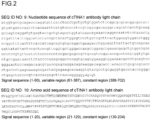
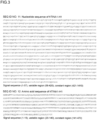
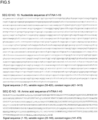
- an amino acid sequence consisting of amino acid residues 1 to 19 is a signal sequence
- an amino acid sequence consisting of amino acid residues 20 to 140 is a variable region
- an amino acid sequence consisting of amino acid residues 141 to 470 is a constant region.
- the sequence of SEQ ID NO: 12, 14 and 16 are shown in Fig. 3 , 4 and 5 respectively.
- an amino acid sequence consisting of amino acid residues 1 to 20 is a signal sequence
- an amino acid sequence consisting of amino acid residues 21 to 129 is a variable region
- an amino acid sequence consisting of amino acid residues 130 to 234 is a constant region.
- the sequence of SEQ ID NO: 18, 20 and 22 are shown in Fig. 6 , 7 and 8 respectively.
- the antibody of the invention includes a human antibody which binds to TROP2.
- An anti-TROP2 human antibody refers to a human antibody having only a sequence of an antibody derived from a human chromosome.
- the anti-TROP2 human antibody can be obtained by a method using a human antibody-producing mouse having a human chromosome fragment comprising heavy and light chain genes of a human antibody (see Tomizuka, K. et al., Nature Genetics (1997) 16, pp. 133-143 ; Kuroiwa, Y. et al., Nucl. Acids Res. (1998) 26, pp. 3447-3448 ; Yoshida, H. et al., Animal Cell Technology: Basic and Applied Aspects vol.
- a recombinant DNA technique by using cDNAs encoding each of such a heavy chain and a light chain of a human antibody, and preferably a vector comprising such cDNAs, eukaryotic cells are transformed, and a transformant cell which produces a recombinant human monoclonal antibody is cultured, whereby the antibody can also be obtained from the culture supernatant.
- a method of obtaining a phage display-derived human antibody selected from a human antibody library is also known.
- a phage display method in which a variable region of a human antibody is expressed on the surface of a phage as a single-chain antibody (scFv), and a phage which binds to an antigen is selected ( Nature Biotechnology (2005), 23, (9), pp. 1105-1116 ) can be used.
- scFv single-chain antibody
- a newly produced human antibody binds to a partial peptide or a partial tertiary structure to which the TINA1 antibody binds, it can be determined that the human antibody binds to the same epitope as the TINA1 antibody. Further, by confirming that the human antibody competes with the TINA1 antibody for the binding to TROP2 (that is, the human antibody inhibits the binding between the TINA1 antibody and TROP2), it can be determined that the human antibody binds to the same epitope as the TINA1 antibody even if the specific epitope sequence or structure has not been determined. When it is confirmed that the human antibody binds to the same epitope as the TINA1 antibody, the human antibody is strongly expected to have a biological activity equivalent to that of the TINA1 antibody.
- an antibody labeled so as to enable the detection or isolation of the antibody or an antigen of the invention for example, an enzyme-labeled antibody, a fluorescence-labeled antibody, and an affinity-labeled antibody are also included in the meaning of the modified variant.
- an enzyme-labeled antibody, a fluorescence-labeled antibody, and an affinity-labeled antibody are also included in the meaning of the modified variant.
- Such a modified variant of the antibody of the invention is useful for improving the stability and blood retention of the antibody, reducing the antigenicity thereof, detecting or isolating an antibody or an antigen, and so on.
- the antibody can also be purified utilizing the binding property of the antibody to the antigen.
- the antitumor compound to be conjugated to the anti-TROP2 antibody-drug conjugate of the present invention is explained.
- the antitumor compound used in the present invention is not particularly limited if it is a compound having an antitumor effect and a substituent group or a partial structure allowing connecting to a linker structure.
- the antitumor compound moiety is released to exhibit the antitumor effect of the antitumor compound.
- the linker is cleaved at a connecting position to drug, the antitumor compound is released in its unmodified structure to exhibit its intrinsic antitumor effect.
- exatecan (((1S,9S)-1-amino-9-ethyl-5-fluoro-2,3-dihydro-9-hydroxy-4-methyl-1H,12H-benzo[de]pyrano[3',4':6,7]indolizino[1,2-b]quinoline-10,13(9H,15H)-dione; shown in the following formula), one of the camptothecin derivatives, can be preferably used.
- exatecan has not been commercialized as an antitumor drug.
- the compound can be easily obtained by a known method and the amino group at position 1 can be preferably used as a connecting position to the linker structure. Further, although exatecan can be also released in tumor cells while part of the linker is still attached thereto, it is an excellent compound exhibiting an excellent antitumor effect even in such structure.
- exatecan has a camptothecin structure
- the equilibrium shifts to a structure with a closed lactone ring (closed ring) in an aqueous acidic medium (for example, pH 3 or so) but it shifts to a structure with an open lactone ring (open ring) in an aqueous basic medium (for example, pH 10 or so).
- a drug conjugate being introduced with an exatecan residue corresponding to the closed ring structure and the open ring structure is also expected to have the same antitumor effect and it is needless to say that any of these states is within the scope of the present invention.
- the number of conjugated drug molecules per antibody molecule is a key factor having an influence on the efficacy and safety.
- Production of the antibody-drug conjugate is performed by defining the reaction condition including the amounts of use of raw materials and reagents for reaction so as to have a constant number of conjugated drug molecules, and the antibody-drug conjugate is generally obtained as a mixture containing different numbers of conjugated drug molecules, unlike the chemical reaction of a low-molecular-weight compound.
- the number of drugs conjugated in an antibody molecule is expressed or specified by the average value, that is, the average number of conjugated drug molecules.
- n 3 is an integer of 2 to 8, and preferably 2 to 5.
- the amino acid constituting L P in the linker is not particularly limited, however, examples thereof include an L- or a D-amino acid, preferably an L-amino acid. And, it can be an amino acid having a structure such as ⁇ -alanine, ⁇ -aminocaproic acid, or ⁇ -aminobutyric acid in addition to an ⁇ -amino acid, further, it can be a non-natural type amino acid such as N-methylated amino acid.
- the amino acid sequence of L P is not particularly limited, but examples of the constituting amino acid include phenylalanine (Phe; F), tyrosine (Tyr; Y), leucine (Leu; L), glycine (Gly; G), alanine (Ala; A), valine (Val; V), lysine (Lys; K), citrulline (Cit), serine (Ser; S), glutamic acid (Glu; E), and aspartic acid (Asp; D).
- preferred examples include phenylalanine, glycine, valine, lysine, citrulline, serine, glutamic acid, and aspartic acid.
- drug release pattern can be controlled.
- the number of the amino acid can be between 2 to 7.
- the average conjugated number of said drug-linker structure moiety per antibody can be 1 to 10. Preferably, it is 2 to 8, and more preferably 3 to 8.
- the preferred linker can be constructed by connecting preferred structures shown for each part of the linker explained above.
- the linker structure those with the following structure can be preferably used.
- the left terminal of the structure is a connecting position with the antibody and the right terminal is a connecting position with the drug.
- AB represents an antibody having a sulfhydryl group
- L 1' represents L 1 linker structure in which the linker terminal is a maleimidyl group (formula shown below)
- the compound of the formula (1) in the above reaction formula is interpreted as a structure in which one structure moiety corresponding from drug to the linker terminal connects to one antibody.
- the antibody-drug conjugate (1) can be produced by reacting the compound (2), which is obtainable by the method described below, with the antibody (3a) having a sulfhydryl group.
- Examples include: Traut's reagent is reacted with the amino group of the antibody; N-succinimidyl S-acetylthioalkanoates are reacted with the amino group of the antibody followed by reaction with hydroxylamine; after reacting with N-succinimidyl 3-(pyridyldithio)propionate, the antibody is reacted with a reducing agent; the antibody is reacted with a reducing agent such as dithiothreitol, 2-mercaptoethanol, and tris(2-carboxyethyl)phosphine hydrochloride (TCEP) to reduce the disulfide bond in a hinge part in the antibody to form a sulfhydryl group, but it is not limited thereto.
- TCEP tris(2-carboxyethyl)phosphine hydrochloride
- the antibody-drug conjugate (1) in which 2 to 8 drug molecules are conjugated per antibody can be produced.
- the solution containing the compound (2) dissolved therein is added to a buffer solution containing the antibody (3a) having a sulfhydryl group for the reaction.
- the buffer solution which may be used include sodium acetate solution, sodium phosphate, and sodium borate.
- pH for the reaction is 5 to 9, and more preferably the reaction is performed near pH 7.
- the solvent for dissolving the compound (2) include an organic solvent such as dimethyl sulfoxide (DMSO), dimethylformamide (DMF), dimethyl acetamide (DMA), and N-methyl-2-pyridone (NMP).
- the organic solvent solution containing the compound (2) dissolved therein is added at 1 to 20% v/v to a buffer solution containing the antibody (3a) having a sulfhydryl group for the reaction.
- the reaction temperature is 0 to 37°C, more preferably 10 to 25°C, and the reaction time is 0.5 to 2 hours.
- the reaction can be terminated by deactivating the reactivity of unreacted compound (2) with a thiol-containing reagent.
- the thiol-containing reagent include cysteine and N-acetyl-L-cysteine (NAC). More specifically, 1 to 2 molar equivalents of NAC are added to the compound (2) used and, by incubating at room temperature for 10 to 30 minutes, the reaction can be terminated.
- NAP-25 column (Cat. No. 17-0852-02, GE Healthcare Japan Corporation) using Sephadex G-25 carrier was equilibrated with phosphate buffer (10 mM, pH 6.0; it is referred to as PBS6.0/EDTA in the specification) containing sodium chloride (137 mM) and ethylene diamine tetraacetic acid (EDTA, 5 mM) according to the method defined by the manufacturer.
- PBS6.0/EDTA ethylene diamine tetraacetic acid
- Aqueous solution of the antibody was applied in an amount of 2.5 mL to single NAP-25 column, and then the fraction (3.5 mL) eluted with 3.5 mL of PBS6.0/EDTA was collected. The resulting fraction was concentrated by the Common procedure A. After measuring the concentration of the antibody using the Common procedure B, the antibody concentration was adjusted to 10 mg/mL using PBS6.0/EDTA.
- NAP-25 column (Cat. No. 17-0852-02, GE Healthcare Japan Corporation) using Sephadex G-25 carrier was equilibrated with phosphate buffer (50 mM, pH 6.5; it is referred to as PBS6.5/EDTA in the specification) containing sodium chloride (50 mM) and EDTA (2 mM) according to the method defined by the manufacturer.
- PBS6.5/EDTA phosphate buffer
- Aqueous solution of the antibody was applied in an amount of 2.5 mL to single NAP-25 column, and then the fraction (3.5 mL) eluted with 3.5 mL of PBS6.5/EDTA was collected. The resulting fraction was concentrated by the Common procedure A. After measuring the concentration of the antibody using the Common procedure B, the antibody concentration was adjusted to 20 mg/mL using PBS6.5/EDTA.
- NAP-25 column was equilibrated with any buffer selected from commercially available phosphate buffer (PBS7.4, Cat. No. 10010-023, Invitrogen), sodium phosphate buffer (10 mM, pH 6.0; it is referred to as PBS6.0) containing sodium chloride (137 mM), and acetate buffer containing sorbitol (5%) (10 mM, pH 5.5; it is referred to as ABS in the specification).
- Aqueous solution of the antibody-drug conjugate reaction was applied in an amount of about 1.5 mL to the NAP-25 column, and then eluted with the buffer in an amount defined by the manufacturer to collect the antibody fraction.
- the collected fraction was again applied to the NAP-25 column and, by repeating 2 to 3 times in total the gel filtration purification process for eluting with buffer, the antibody-drug conjugate excluding non-conjugated drug linker and a low-molecular-weight compound (tris(2-carboxyethyl)phosphine hydrochloride (TCEP), N-acetyl-L-cysteine (NAC), and dimethyl sulfoxide) was obtained.
- TCEP tris(2-carboxyethyl)phosphine hydrochloride
- NAC N-acetyl-L-cysteine
- dimethyl sulfoxide dimethyl sulfoxide
- the conjugated drug concentration in the antibody-drug conjugate can be calculated by measuring UV absorbance of an aqueous solution of the antibody-drug conjugate at two wavelengths of 280 nm and 370 nm, followed by performing the calculation shown below.
- a 280 represents the absorbance of an aqueous solution of the antibody-drug conjugate at 280 nm
- a 370 represents the absorbance of an aqueous solution of the antibody-drug conjugate at 370 nm
- a A,280 represents the absorbance of an antibody at 280 nm
- a A,370 represents the absorbance of an antibody at 370 nm
- a D,280 represents the absorbance of a conjugate precursor at 280 nm
- a D,370 represents the absorbance of a conjugate precursor at 370 nm
- ⁇ A,280 represents the molar absorption coefficient of an antibody at 280 nm
- ⁇ A,370 represents the molar absorption coefficient of an antibody at 370 nm
- ⁇ D,280 represents the molar absorption coefficient of a conjugate precursor at 280 nm
- ⁇ D,370 represents the molar absorption coefficient of a conjugate precursor at 370 nm
- C A represents the antibody concentration in an antibody
- ⁇ A,280 , ⁇ A,370 , ⁇ D,280 , and ⁇ D,370 previously prepared values (estimated value based on calculation or measurement value obtained by UV measurement of the compound) are used.
- ⁇ A,280 can be estimated from the amino acid sequence of an antibody using a known calculation method ( Protein Science, 1995, vol. 4, 2411-2423 ).
- ⁇ A,370 is generally zero.
- C A and C D By measuring A 280 and A 370 of an aqueous solution of the antibody-drug conjugate and solving the simultaneous equations (I) and (II) using the values, C A and C D can be obtained. Further, by diving C D by C A , the average number of conjugated drug per antibody can be obtained.
- An antibody-drug conjugate solution (about 1 mg/mL, 60 ⁇ L) is mixed with an aqueous dithiothreitol (DTT) solution (100 mM, 15 ⁇ L). The mixture is incubated at 37°C for 30 minutes to cleave the disulfide bond between the L chain and the H chain of the antibody-drug conjugate. The resulting sample is used in HPLC analysis.
- DTT dithiothreitol
- Detection peaks can be assigned to any of L 0 , L 1 , H 0 , H 1 , H 2 , and H 3 by the comparison of retention times with L 0 and H 0 .
- peak area values are corrected in response to the number of conjugated drug linker molecules according to the following expression using the molar absorption coefficients of the L chain, the H chain, and the drug linker.
- the measured molar extinctio coefficient (280 nm) of the drug linker As for the molar extinctio coefficient (280 nm) of the drug linker, the measured molar extinctio coefficient (280 nm) of a compound in which the maleimide group was converted to succinimide thioether by the reaction of each drug linker with mercaptoethanol or N-acetylcysteine was used. [F-3-3] The peak area ratio (%) of each chain is calculated for the total of the corrected values of peak areas according to the following expression.
- a compound having -NH-CH 2 CH 2 -, -NH-CH 2 CH 2 CH 2 -, -NH-CH 2 CH 2 CH 2 CH 2 -, -NH-CH 2 CH 2 CH 2 CH 2 CH 2 -, -NH-CH 2 -O-CH 2 -, or - NH-CH 2 CH 2 -O-CH 2 - is preferred as a production intermediate.
- a compound having -NH-CH 2 CH 2 CH 2 -, -NH-CH 2 -O-CH 2 -, or -NH-CH 2 CH 2 -O-CH 2 is more preferred.
- n 3 is an integer of 2 to 5
- L 2 is a single bond
- -NH-(CH 2 )n 1 -L a -(CH 2 )n 2 - is -NH-CH 2 CH 2 -, -NH-CH 2 CH 2 CH 2 -, -NH-CH 2 CH 2 CH 2 CH 2 -, -NH-CH 2 CH 2 CH 2 CH 2 -, -NH-CH 2 -O-CH 2 -, or -NH-CH 2 CH 2 -O-CH 2 - is preferred as a production intermediate.
- a compound in which -NH-(CH 2 )n 1 -L a -(CH 2 )n 2 - is -NH-CH 2 CH 2 -, -NH-CH 2 CH 2 CH 2 -, -NH-CH 2 -O-CH 2 -, or -NH-CH 2 CH 2 -O-CH 2 - is more preferred.
- a compound in which n 3 is an integer of 2 or 5 is further preferred.
- n 3 is an integer of 2 to 5
- n 4 is an integer of 2 to 4
- -NH-(CH 2 )n 1 -L a -(CH 2 )n 2 - is -NH-CH 2 CH 2 -, -NH-CH 2 CH 2 CH 2 -, -NH-CH 2 CH 2 CH 2 CH 2 -, -NH-CH 2 CH 2 CH 2 CH 2 -, -NH-CH 2 CH 2 CH 2 CH 2 CH 2 -, -NH-CH 2 -O-CH 2 -, or -NH-CH 2 CH 2 -O-CH 2 - is preferred as a production intermediate.
- a compound in which n 4 is an integer of 2 or 4 is more preferred.
- a compound in which -NH-(CH 2 )n 1 -L a -(CH 2 )n 2 - is -NH-CH 2 CH 2 CH 2 -, -NH-CH 2 -O-CH 2 -, or -NH-CH 2 CH 2 -O-CH 2 - is further preferred.
- L 1' represents a maleimidyl group
- P 1 , P 2 , and P 3 each represents a protecting group
- Reaction reagents and conditions that are commonly used for peptide synthesis can be employed for the reaction.
- active ester there are various kinds of active ester.
- it can be produced by reacting phenols such as p-nitrophenol, N-hydroxy benzotriazole, N-hydroxy succinimide, or the like, with the carboxylic acid (5) using a condensing agent such as N,N'-dicyclohexylcarbodiimide or 1-ethyl-3-(3-dimethylaminopropyl)carbodiimide hydrochloride.
- the active ester can be also produced by a reaction of the carboxylic acid (5) with pentafluorophenyl trifluoroacetate or the like; a reaction of the carboxylic acid (5) with 1-benzotriazolyl oxytripyrrolidinophosphonium hexafluorophosphite; a reaction of the carboxylic acid (5) with diethyl cyanophosphonate (salting-in method); a reaction of the carboxylic acid (5) with triphenylphosphine and 2,2'-dipyridyl disulfide (Mukaiyama's method); a reaction of the carboxylic acid (5) with a triazine derivative such as 4-(4,6-dimethoxy-1,3,5-triazin-2-yl)-4-methylmorpholinium chloride (DMTMM); or the like.
- DTMM 4-(4,6-dimethoxy-1,3,5-triazin-2-yl)-4-methylmorpholinium chloride
- reaction can be also performed by, e.g., an acid halide method by which the carboxylic acid (5) is treated with acid halide such as thionyl chloride and oxalyl chloride in the presence of a base.
- acid halide such as thionyl chloride and oxalyl chloride
- a sulfoxide solvent such as dimethyl sulfoxide and sulfolane
- a ketone solvent such as acetone and methyl ethyl ketone
- an alcohol solvent such as methanol and ethanol
- Examples of the other protecting group for an amino group can include an alkanoyl group such as acetyl group; an alkoxycarbonyl group such as methoxycarbonyl group and ethoxycarbonyl group; an arylmethoxy carbonyl group such as paramethoxybenzyloxy carbonyl group, and para (or ortho)nitroybenzyloxy carbonyl group; an arylmethyl group such as benzyl group and triphenyl methyl group; an aroyl group such as benzoyl group; and an aryl sulfonyl group such as 2,4-dinitrobenzene sulfonyl group and orthonitrobenzene sulfonyl group.
- the protecting group P 1 can be selected depending on, e.g., properties of a compound having an amino group to be protected.
- the compound (7) By deprotecting the protecting group P 1 for the terminal amino group of the compound (6) obtained, the compound (7) can be produced.
- reagents and conditions can be selected depending on the protecting group.
- the compound (9) can be produced by derivatizing the peptide carboxylic acid (8) having the N terminal protected with P 2 into an active ester, mixed acid anhydride, or the like and reacting it with the compound (7) obtained.
- the reaction conditions, reagents, base, and inert solvent used for forming a peptide bond between the peptide carboxylic acid (8) and the compound (7) can be suitably selected and used from those described for the synthesis of the compound (6).
- the protecting group P 2 can be suitably selected and used from those described for the protecting group of the compound (6), and the selection can be made based on, e.g., the properties of the compound having an amino group to be protected.
- the compound (9) can be also produced.
- the compound (9) can be also produced by the following method, for example.
- the compound (13) can be produced by derivatizing the peptide carboxylic acid (8) having the N terminal protected with P 2 into active ester, mixed acid anhydride, or the like and reacting it in the presence of a base with the amine compound (12) having the carboxy group protected with P 3 .
- the reaction conditions, reagents, base, and inert solvent used for forming a peptide bond between the peptide carboxylic acid (8) and the compound (12) can be suitably selected and used from those described for the synthesis of the compound (6).
- Examples of the protecting group for an amino group include, for example, an alkyloxy carbonyl group such as tert-butyloxy carbonyl group, methoxycarbonyl group, and ethoxycarbonyl group; allyloxycarbonyl group, or an arylmethoxy carbonyl group such as 9-fluorenylmethyloxy carbonyl group, benzyloxy carbonyl group, paramethoxybenzyloxy carbonyl group, and para (or ortho)nitroybenzyloxy carbonyl group; an alkanoyl group such as acetyl group; an arylmethyl group such as benzyl group and triphenyl methyl group; an aroyl group such as benzoyl group; and an aryl sulfonyl group such as 2,4-dinitrobenzene sulfonyl group or orthonitrobenzene sulfonyl group.
- an alkyloxy carbonyl group such as tert-butyloxy carbon
- the protecting group P 3 for a carboxy group a protecting group commonly used as a protecting group for a carboxy group in organic synthetic chemistry, in particular, peptide synthesis can be used.
- Specific examples include esters with an alkyl group such as a methyl group, an ethyl group, or a tert-butyl, allyl esters, and benzyl esters, and the protective group can be suitably selected from the above-described protective groups.
- the protecting group for an amino group and the protecting group for a carboxy group can be those preferably removed by a different method or different conditions.
- a representative example includes a combination in which P 2 is a tert-butyloxy carbonyl group and P 3 is a benzyl group.
- the protecting groups can be selected from the aforementioned ones depending on, e.g., the properties of a compound having an amino group and a carboxy group to be protected. For removal of the protecting groups, reagents and conditions can be selected depending on the protecting group.
- the compound (14) By deprotecting the protecting group P 3 for the carboxy group of the compound (13) obtained, the compound (14) can be produced.
- reagents and conditions are selected depending on the protecting group.
- the compound (9) can be produced by derivatizing the compound (14) obtained into active ester, mixed acid anhydride, acid halide, or the like and reacting with the compound (4) in the presence of a base.
- reaction reagents and conditions that are generally used for peptide synthesis can be also used, and the reaction conditions, reagents, base, and inert solvent used for the reaction can be suitably selected from those described for the synthesis of the compound (6).
- the compound (2) can be also produced by the following method, for example.
- the compound (15) By deprotecting the protecting group P 2 for the amino group of the compound (13), the compound (15) can be produced.
- reagents and conditions can be selected depending on the protecting group.
- the compound (17) By deprotecting the protecting group for the carboxy group of the compound (16) obtained, the compound (17) can be produced. This deprotection can be carried out similarly to the deprotection at carboxy group for producing the compound (14).
- the compound (2) can be produced by derivatizing the compound (17) into active ester, mixed acid anhydride, acid halide, or the like and reacting it with the compound (4) in the presence of a base.
- reaction reagents and conditions that are generally used for peptide synthesis can be also used, and the reaction conditions, reagents, base, and inert solvent used for the reaction can be suitably selected from those described for the synthesis of the compound (6).
- L 1' corresponds to L 1 having a structure in which the terminal is converted to a maleimidyl group
- P 4 represents a protecting group
- the compound (2) can be produced by derivatizing the compound (20) obtained into active ester, mixed acid anhydride, or the like and reacting it with the compound (7).
- reaction reagents and conditions that are generally used for peptide synthesis can be also used, and the reaction conditions, reagents, base, and inert solvent used for the reaction can be suitably selected from those described for the synthesis of the compound (6).
- L P is as defined above, L represents an acyl group which is an alkanoyl group such as an acetyl group or an alloy group such as a benzoyl group, a hydrogen atom, or the like, X and Y each represent an oligopeptide consisting of 1 to 3 amino acids, P 5 and P 7 each represent a protecting group for an amino group, and P 6 represents a protecting group for a carboxy group.
- Examples of the acid which may be used here can include inorganic acid such as hydrofluoric acid, hydrogen chloride, sulfuric acid, nitric acid, phosphoric acid, and boric acid; an organic acid such as acetic acid, citric acid, paratoluene sulfonic acid, and methanesulfonic acid; and a Lewis acid such as tetrafluoroborate, zinc chloride, tin chloride, aluminum chloride, and iron chloride. Among them, sulfonic acids, particularly, paratoluene sulfonic acid is preferable.
- the base any one of the aforementioned base can be suitably selected and used.
- Preferred examples thereof include an alkali metal alkoxide such as potassium tert-butoxide; an alkali metal hydroxide such as sodium hydroxide and potassium hydroxide; alkali metal hydride such as sodium hydride and potassium hydride; organometallic base represented by dialkylamino lithium such as lithium diisopropylamide; and organometallic base of bissilylamine such as lithium bis(trimethylsilyl)amide.
- the solvent to be used for the reaction include an ether solvent such as tetrahydrofuran and 1,4-dioxane; and an aromatic hydrocarbon solvent such as benzene and toluene. Those solvents can be prepared as a mixture with water.
- the protecting group for an amino group as exemplified by P 5 is not particularly limited if it is a group commonly used for protection of an amino group. Representative examples include the protecting groups for an amino group that are described in Production method 2. However, in the present reaction, there may be a case in which the protecting group for an amino group as exemplified by P 5 is cleaved off. In such case, it is necessary to perform a reaction with a suitable reagent for protecting an amino group as it may be required to introduce the protecting group again.
- the compound (26) can be produced by derivatizing the carboxylic acid (24) into active ester, mixed acid anhydride, acid halide, or the like and reacting it with the compound (4) or a pharmacologically acceptable salt thereof to produce the compound (25) followed by removing the protecting group P 5 of the compound (25) obtained.
- the same reagents and reaction conditions as those described for Production method 2 can be used.
- a compound labeled with various radioactive or non-radioactive isotopes is also included in the present invention.
- One or more atoms constituting the antibody-drug conjugate of the present invention may contain an atomic isotope at non-natural ratio.
- Examples of the atomic isotope include deuterium ( 2 H), tritium ( 3 H), iodine-125 ( 125 I), and carbon-14 ( 14 C).
- the compound of the present invention may be radioactive-labeled with a radioactive isotope such as tritium ( 3 H), iodine-125 ( 125 I), carbon-14 ( 14 C), copper-64 ( 64 Cu), zirconium-89 ( 89 Zr), iodine-124 ( 124 I), fluorine-18 ( 18 F), indium-111 ( 111 I), carbon-11 ( 11 C) and iodine-131 ( 131 I).
- the compound labeled with a radioactive isotope is useful as a therapeutic or prophylactic agent, a reagent for research such as an assay reagent and an agent for diagnosis such as an in vivo diagnostic imaging agent. Without being related to radioactivity, any isotope variant type of the antibody-drug conjugate of the present invention is within the scope of the present invention.
- the anti-TROP2 antibody-drug conjugate of the present invention can be selectively used as a drug for chemotherapy, which is a main method for treating cancer, and as a result, can delay development of cancer cells, inhibit growth thereof, and further kill the cancer cells.
- This can allow cancer patients to be free from symptoms caused by cancer or achieve improvement in QOL of cancer patients and attains a therapeutic effect by sustaining the lives of the cancer patients.
- the anti-TROP2 antibody-drug conjugate of the present invention does not accomplish killing cancer cells, it can achieve higher QOL of cancer patients while achieving their longer-term survival, by inhibiting or controlling the growth of cancer cells.
- the anti-TROP2 antibody-drug conjugate of the present invention can be expected to exert a therapeutic effect by administration as systemic therapy to patients, and additionally, by local administration to cancer tissues.
- Examples of the cancer type to which the anti-TROP2 antibody-drug conjugate of the present invention is applied include lung cancer, kidney cancer, urothelial cancer, colorectal cancer, prostate cancer, glioblastoma multiforme, ovarian cancer, pancreatic cancer, breast cancer, melanoma, liver cancer, bladder cancer, gastric cancer, cervical cancer, head and neck cancer, or esophageal cancer, however, it is not limited to them as long as it is a cancer cell expressing, in a cancer cell as a treatment subject, a protein which the antibody within the antibody-drug conjugate can recognize.
- the anti-TROP2 antibody-drug conjugate of the present invention can be administered as a pharmaceutical composition containing at least one pharmaceutically suitable ingredient.
- the pharmaceutical composition above typically contains at least one pharmaceutical carrier (for example, sterilized liquid).
- the liquid includes, for example, water and oil (petroleum oil and oil of animal origin, plant origin, or synthetic origin).
- the oil may be, for example, peanut oil, soybean oil, mineral oil, or sesame oil.
- Water is a more typical carrier when the pharmaceutical composition above is intravenously administered.
- Saline solution, an aqueous dextrose solution, and an aqueous glycerol solution can be also used as a liquid carrier, in particular, for an injection solution.
- a suitable pharmaceutical vehicle is known in the art.
- the pharmaceutical composition of the present invention may be a pharmaceutical composition containing only the anti-TROP2 antibody-drug conjugate of the present application or a pharmaceutical composition containing the anti-TROP2 antibody-drug conjugate and at least one cancer treating agent other than the conjugate.
- the anti-TROP2 antibody-drug conjugate of the present invention can be administered with other cancer treating agent.
- the anti-cancer effect may be enhanced accordingly.
- Another anti-cancer agent used for such purpose may be administered to an individual simultaneously with, separately from, or subsequently to the antibody-drug conjugate, and it may be administered while varying the administration interval for each.
- the pharmaceutical composition can be formulated into a lyophilization formulation or a liquid formulation as a formulation having desired composition and required purity.
- a lyophilization formulation it may be a formulation containing suitable formulation additives that are used in the art.
- a liquid formulation it can be formulated as a liquid formulation containing various formulation additives that are used in the art.
- each BALB/c mouse (6 weeks old) was intraperitoneally immunized with NCI-H322 cells (1 ⁇ 10 7 cells).
- the mouse was intraperitoneally immunized with 1 ⁇ 10 6 NCI-H322 cells at 1-week intervals.
- the mouse was immunized through the tail vein and intraperitoneally with the NCI-H322 cells at 1 ⁇ 10 6 cells/200 ⁇ l PBS for each route. Spleen cells were excised 3 days after the final immunization.
- P3U1 cells (mouse myeloma cell line) were recovered and centrifuged at 1500 rpm at room temperature for 5 minutes. An EDTA (0.02%) solution (10 ml) was added to the P3U1 cells, followed by treatment at 37°C for 5 minutes. The P3U1 cell suspension was centrifuged at 1500 rpm at room temperature for 5 minutes. The supernatant was discarded and resuspended in an RPMI 1640 FBS(-) medium (10 ml).
- the spleen cells and the myeloma cells were mixed at a ratio of 5:1 and centrifuged (1200 rpm, 5 minutes).
- the obtained cells in the precipitated fraction was well loosened, and polyethylene glycol-4000 (PEG-4000; 1 mL) was then gradually added thereto over about 1 minute with stirring.
- an RPMI medium (1 mL) was added to the fluid containing the cell several times with inerval of 1 minute, and an RPMI medium was then added thereto to adjust the total amount to 50 mL.
- the cell suspension was centrifuged (900 rpm, 5 minutes), and the obtained cells in the precipitated fraction were mildly loosened and then gently suspended in a HAT medium (PRMI 1640 medium supplemented with 10% fetal bovine serum and HAT Media Supplement; 100 mL).
- the suspension was dispensed at 200 ⁇ L/well to a 96-well plate for culture and cultured until 50% confluency in a 5% CO 2 incubator of 37°C.
- the NCI-H322 cells were seeded at 5 ⁇ 10 3 cells/well to a 96-well plate and cultured at 37°C for 48 hours. The cells were washed with 150 ⁇ l/well of PBS twice, and each hybridoma culture supernatant (50 ⁇ l) was added to each well and reacted at 4°C for 1 hour. The cells were washed with 150 ⁇ l/well of PBS twice.
- An adenovirus Ax3CAZ3-FZ33 ⁇ -galactosidase-expressing adenovirus modified with Z33 fiber so as to bind to an antibody (see U.S. Patent Application Publication No.
- Lysis Solution was added thereto at 50 ⁇ l/well, and the mixture was left at room temperature for 10 minutes.
- This cell lysate (10 ⁇ L) was diluted 100-fold with Galacton-Plus Galacto Reaction Buffer Diluent, then added to a White microwell SH 96 well plate (Nunc/Thermo Fisher Scientific, Inc.), and reacted at room temperature for 1 hour. Accelerator II was added thereto at 150 ⁇ l/well. Chemiluminescence was measured for 5 seconds using a multi-label counter Wallac 1420 ARVOsx (PerkinElmer, Inc.), and the infective dose of the virus in the NCI-H322 cells was indicated with the average value per second as RLU (amount of luminescence).
- Pristane (2,6,10,14-tetramethylpentadecane; 0.5 ml) was intraperitoneally administered in advance to each 8- to 10-week old mouse or nude mouse, which was then raised for 2 weeks.
- Each monoclonal antibody-producing hybridoma obtained in Example 1 was intraperitoneally injected to the mouse. After 10 to 21 days, the hybridoma was allowed to cause ascitic canceration, and the ascites was then collected. The obtained ascites was centrifuged to remove solid matter.
- antibodies were purified by salting out with 40 to 50% ammonium sulfate, a caprylic acid precipitation method, a DEAE-Sepharose column, and a protein G column, and IgG or IgM fractions were collected and used as purified monoclonal antibodies.
- NCI-H322 cells 5 ⁇ 10 6 NCI-H322 cells were recovered and washed with PBS three times.
- EZ-Link Sulfo-NHS-Biotin (Pierce/Thermo Fisher Scientific, Inc.) was suspended in PBS at a concentration of 0.1 mg/ml.
- the NCI-H322 cells were rotated at room temperature for 30 minutes in biotin/PBS solution, then washed with 100 mM glycine/PBS solution (25 ml) twice, and then washed with PBS (25 ml) three times.
- the cells thus washed were resuspended in a lysis buffer (150 mM NaCl, 50 mM Tris-HCl pH 7.6, 1% NP-40 + Protease inhibitor, 1 tablet/50 ml of Complete EDTA free (Hoffmann-La Roche Ltd.); 2 ml) and treated at 4°C for 30 minutes.
- Protein G Sepharose/lysis buffer (50% slurry; 30 ⁇ l) obtained by replacing a buffer of Protein G Sepharose (Protein G Sepharose 4 Fast Flow (GE Healthcare Japan Corporation)) with a lysis buffer was added to the cell lysate, and the mixture was rotated at 4°C for 1 hour and then centrifuged at 4°C for 5 minutes to recover a supernatant.
- the TINA1 antibody (3 ⁇ g) was added to the supernatant, and the mixture was rotated at 4°C for 1 hour. Then, Protein G Sepharose/lysis buffer (50% slurry; 60 ⁇ l) was added thereto, and the mixture was rotated at 4°C for 2 hours. Protein G Sepharose was washed with a lysis buffer (1 ml) six times and then resuspended in 1 ⁇ SDS sample buffer/5% 2-ME (2-mercaptoethanol) buffer (62.5 mM Tris-HCl (pH 6.8 at 25°C), 2% (w/v) SDS, 10% glycerol, and 0.01% (w/v) phenol red). The suspension was treated at 100°C for 5 minutes, and the solution was then recovered and used as a sample for SDS-PAGE (polyacrylamide gel electrophoresis).
- SDS-PAGE polyacrylamide gel electrophoresis
- the SDS-PAGE sample prepared in 3-1) was electrophoresed at 20 mA using Ready Gels J 5-20% (Bio-Rad Laboratories, Inc.) and then blotted at 0.1 mA/cm 2 from the gel to the membrane.
- the membrane was washed with PBS-T (PBS(-)-0.05% Tween 20) for 5 minutes and then blocked for 1 hour.
- the membrane was washed with PBS-T for 5 minutes tree times and then reacted with Streptavidin-horseradish peroxidase conjugate (Amersham Biosciences Corp.; diluted 2000-fold with PBS-T for use) for 1 hour.
- the antigen of the TINA1 antibody was predicted to be TROP2 from the band pattern, overexpression analysis by gene transfer of cDNA was conducted without mass spectrometry. As a result of FACS analysis, the TINA1 antibody exhibited a strong positive response in CHOK1 cells expressing human TROP2, indicating the antigen of the TINA1 antibody is TROP2.
- a recombinant fusion protein DT3C was produced for the purpose of measuring internalization activity and immunotoxin activity of an antibody.
- This DT3C is a protein having a catalytic domain of diphtheria toxin (DT) and three antibody-binding regions of protein G.
- DT3C specifically binds to an Fc moiety of an antibody, is stable, and induces cell death by inhibiting protein synthesis when taken up into cells.
- DT3C specifically binds to an Fc moiety of an antibody, is stable, and induces cell death by inhibiting protein synthesis when taken up into cells.
- the internalization effect of antibody and the cytocidal effect thereof by immunotoxin can be observed at the same time ( Yamaguchi, M., Hamada, H., et al., Biochemical and Biophysical Research Communications 454 (2014) 600-603 ).
- Anti-TROP2 antibodies TINA1 (immunogen: lung cancer line NCI-H322), KCL7A3 and KCL2D6 (immunogen: pancreatic cancer cell line KCL-MOH1), Pr1E11 and Pr8H10 (immunogen: prostate cancer cell line Pc-1), and NY16 and NY17 (immunogen: pancreatic cancer cell line PK-1) obtained by the method of Example 1 or a method equivalent thereto, and commercially available 77220 (R&D Systems Inc.) were evaluated for their internalization activity and immunotoxin activity in the same manner as in Example 4-3). As a result, among the 8 anti-TROP2 antibodies, the TINA1 antibody had the strongest activity ( Figure 12 ).
- mRNA was prepared from the TINA1 antibody-producing hybridoma using mRNA Isolation kit (Roche Applied Science).
- UPM Universal Primer A Mix: included in SMARTer RACE cDNA Amplification Kit
- an oligonucleotide having a sequence of 5'-AGAGTTCCAGGTCAAGGTCACTGGCTCAGG-3' SEQ ID NO: 33: primer mG2aVR2
- UPM included in SMARTer RACE cDNA Amplification Kit was used, and mG2aVR2 was designed from the sequence of a mouse heavy chain (IgG2a) constant region on a database.
- the sequencing analysis was carried out using a gene sequence analysis apparatus ("ABI PRISM 3700 DNA Analyzer” or "Applied Biosystems 3730xl Analyzer", Applied Biosystems, Inc.), and the sequencing reaction employed Gene Amp 9700 (Applied Biosystems, Inc.).
- UPM Universal Primer A Mix: included in SMARTer RACE cDNA Amplification Kit
- an oligonucleotide having a sequence of 5'-AGTCCAACTGTTCAGGACGCCATTTTGTCG-3' SEQ ID NO: 34: primer mKVR2
- UPM included in SMARTer RACE cDNA Amplification Kit was used, and mKVR2 was designed from the sequence of a mouse light chain constant region on a database.
- the determined nucleotide sequence of the cDNA encoding the light chain variable region of the TINA1 antibody is shown in SEQ ID NO: 3 of the Sequence Listing, and the amino acid sequence encoded thereby is shown in SEQ ID NO: 4.
- a DNA fragment containing the cDNA encoding the heavy chain variable region of the TINA1 antibody was amplified using the heavy chain variable region-encoding cDNA obtained in Example 5-1-3) as a template, KOD-Plus- (Toyobo Co., Ltd.), and a primer set described below, and inserted to a restriction enzyme BlpI-cleaved site of the chimeric and humanized IgG1-type heavy chain expression vector pCMA-G1 using In-Fusion HD PCR cloning kit (Clontech Laboratories, Inc.) to construct a cTINA1 antibody heavy chain expression vector.
- the obtained expression vector was designated as "pCMA-G1/cTINA1".
- nucleotide sequence of the cTINA1 antibody heavy chain is shown in SEQ ID NO: 7, and the amino acid sequence encoded thereby is shown in SEQ ID NO: 8.
- the nucleotide sequence of SEQ ID NO: 7 and the amino acid sequence of SEQ ID NO: 8 are also described in Figure 1 .
- a DNA fragment containing the cDNA encoding the light chain variable region of the TINA1 antibody was amplified using the light chain variable region-encoding cDNA obtained in Example 5-1-4) as a template, KOD-Plus- (Toyobo Co., Ltd.), and a primer set described below, and inserted to a restriction enzyme BsiWI-cleaved site of the chimeric and humanized antibody light chain expression general-purpose vector pCMA-LK using In-Fusion HD PCR cloning kit (Clontech Laboratories, Inc.) to construct a cTINA1 antibody light chain expression vector.
- the obtained expression vector was designated as "pCMA-LK/cTINA1".
- nucleotide sequence of the cTINA1 antibody light chain is shown in SEQ ID NO: 9, and the amino acid sequence encoded thereby is shown in SEQ ID NO: 10.
- the nucleotide sequence of SEQ ID NO: 9 and the amino acid sequence of SEQ ID NO: 10 are also described in Figure 2 .
- FreeStyle 293F cells (Invitrogen Corp.) in the logarithmic growth phase were diluted with a FreeStyle 293 expression medium (Invitrogen Corp.) to 9.6 mL, then seeded in a 30 mL Square Storage Bottle (Nalgene/Thermo Fisher Scientific, Inc.), and then shake-cultured at 90 rpm for 1 hour in an 8% CO 2 incubator of 37°C. Polyethyleneimine (Polyscience #24765; 30 ⁇ g) was dissolved in Opti-Pro SFM (Invitrogen Corp.; 200 ⁇ L).
- the light chain expression vector (6 ⁇ g) and the heavy chain expression vector (4 ⁇ g) prepared using PureLink HiPure Plasmid kit (Invitrogen Corp.) were added to Opti-Pro SFM (Invitrogen Corp.; 200 ⁇ L).
- the expression vector/Opti-Pro SFM mixed solution (200 ⁇ L) was added to the polyethyleneimine/Opti-Pro SFM mixed solution (200 ⁇ L), and the mixture was gently stirred, further left for 5 minutes, and then added to the FreeStyle 293F cells.
- a culture supernatant obtained by shake culture at 90 rpm for 7 days in an 8% CO 2 incubator of 37°C was filtered through Minisart-Plus filter (Sartorius AG) and used as a sample for evaluation.
- the human chimeric TINA1 antibody obtained by the combination of pCMA-G1/cTINA1 and pCMA-LK/cTINA1 was designated as a "cTINA1 antibody”.
- the amino acid residues of the framework regions in HuPR1A3 were aligned with the amino acid residues of the framework regions of TINA1 to identify the positions of amino acids that did not match therebetween. The positions of these residues were analyzed using the three-dimensional model of TINA1 constructed above. Then, the donor residues to be grafted onto the acceptor were selected according to the criteria provided by Queen et al. (Proc. Natl. Acad. Sci. USA 86, 10029-10033 (1989 )). Some donor residues thus selected were transferred to the acceptor antibody to construct the humanized TINA1 sequence as described in Examples below.
- a sequence consisting of nucleotides 1 to 57, a sequence consisting of nucleotides 58 to 420, and a sequence consisting of nucleotides 421 to 1410 in the nucleotide sequence of SEQ ID NO: 13 encode the signal sequence, the heavy chain variable region sequence, and the heavy chain constant region sequence, respectively.
- the nucleotide sequence of SEQ ID NO: 13 and the amino acid sequence of SEQ ID NO: 14 are also described in Figure 4 .
- a humanized TINA1 light chain designed by involving the replacement of amino acid position 23 (valine) with glutamine, amino acid position 28 (histidine) with proline, amino acid position 29 (lysine) with serine, amino acid position 30 (phenylalanine) with serine, amino acid position 31 (methionine) with leucine, amino acid position 33 (threonine) with alanine, amino acid position 40 (serine) with threonine, amino acid position 62 (glutamine) with lysine, amino acid position 63 (serine) with alanine, amino acid position 80 (aspartic acid) with serine, amino acid position 83 (threonine) with serine, amino acid position 90 (alanine) with aspartic acid, amino acid position 93 (phenylalanine) with leucine, amino acid position 98 (valine) with leucine, amino acid position 100 (alanine) with proline, amino acid position 103 (leucine) with phenylalanine,
- the amino acid sequence of the hTINA1-L1-type light chain is described in SEQ ID NO: 18 of the Sequence Listing.
- a sequence consisting of amino acid residues 1 to 20, a sequence consisting of amino acid residues 21 to 129, and a sequence consisting of amino acid residues 130 to 234 in the amino acid sequence of SEQ ID NO: 18 correspond to the signal sequence, the light chain variable region, and the light chain constant region, respectively.
- the nucleotide sequence encoding the amino acid sequence of SEQ ID NO: 18 is described in SEQ ID NO: 17 of the Sequence Listing.
- a sequence consisting of nucleotides 1 to 60, a sequence consisting of nucleotides 61 to 387, and a sequence consisting of nucleotides 388 to 702 in the nucleotide sequence of SEQ ID NO: 17 encode the signal sequence, the light chain variable region sequence, and the light chain constant region sequence, respectively.
- the nucleotide sequence of SEQ ID NO: 17 and the amino acid sequence of SEQ ID NO: 18 are also described in Figure 6 .
- a humanized TINA1 light chain designed by involving the replacement of amino acid position 28 (histidine) with proline, amino acid position 29 (lysine) with serine, amino acid position 30 (phenylalanine) with serine, amino acid position 31 (methionine) with leucine, amino acid position 33 (threonine) with alanine, amino acid position 40 (serine) with threonine, amino acid position 62 (glutamine) with lysine, amino acid position 63 (serine) with alanine, amino acid position 80 (aspartic acid) with serine, amino acid position 83 (threonine) with serine, amino acid position 90 (alanine) with aspartic acid, amino acid position 93 (phenylalanine) with leucine, amino acid position 98 (valine) with leucine, amino acid position 100 (alanine) with proline, amino acid position 103 (leucine) with phenylalanine, amino acid position 120 (alanine) with glutamine
- amino acid sequence of the hTINA1-L2-type light chain is described in SEQ ID NO: 20 of the Sequence Listing.
- a sequence consisting of amino acid residues 1 to 20, a sequence consisting of amino acid residues 21 to 129, and a sequence consisting of amino acid residues 130 to 234 in the amino acid sequence of SEQ ID NO: 20 correspond to the signal sequence, the light chain variable region, and the light chain constant region, respectively.
- the nucleotide sequence encoding the amino acid sequence of SEQ ID NO: 20 is described in SEQ ID NO: 19 of the Sequence Listing.
- a humanized TINA1 light chain designed by involving the replacement of amino acid position 28 (histidine) with proline, amino acid position 29 (lysine) with serine, amino acid position 30 (phenylalanine) with serine, amino acid position 31 (methionine) with leucine, amino acid position 33 (threonine) with alanine, amino acid position 40 (serine) with threonine, amino acid position 62 (glutamine) with lysine, amino acid position 63 (serine) with glutamine, amino acid position 80 (aspartic acid) with serine, amino acid position 83 (threonine) with serine, amino acid position 90 (alanine) with aspartic acid, amino acid position 93 (phenylalanine) with leucine, amino acid position 98 (valine) with leucine, amino acid position 100 (alanine) with proline, amino acid position 103 (leucine) with phenylalanine, amino acid position 120 (alanine) with glutamine, amino
- a DNA fragment containing a hTINA1-H1 variable region-encoding DNA sequence shown in nucleotide positions 36 to 437 of the nucleotide sequence of hTINA1-H1 represented by SEQ ID NO: 11 of the Sequence Listing was synthesized (GeneArt Artificial Gene Synthesis service).
- a DNA fragment containing a hTINA1-H2 variable region-encoding DNA sequence shown in nucleotide positions 36 to 437 of the nucleotide sequence of hTINA1-H2 represented by SEQ ID NO: 13 of the Sequence Listing was synthesized (GeneArt Artificial Gene Synthesis service), and a hTINA1-H2 expression vector was constructed in the same manner as in Example 7-1-1).
- the obtained expression vector was designated as "pCMA-G1/hTINA1-H2".
- a DNA fragment containing a hTINA1-L1 variable region-encoding DNA sequence shown in nucleotide positions 38 to 402 of the nucleotide sequence of hTINA1-L1 represented by SEQ ID NO: 17 of the Sequence Listing was synthesized (GeneArt Artificial Gene Synthesis service).
- a DNA fragment containing a hTINA1-L2 variable region-encoding DNA sequence shown in nucleotide positions 38 to 402 of the nucleotide sequence of hTINA1-L2 represented by SEQ ID NO: 19 of the Sequence Listing was synthesized (GeneArt Artificial Gene Synthesis service), and a hTINA1-L2 expression vector was constructed in the same manner as in Example 7-2-1).
- the obtained expression vector was designated as "pCMA-LK/hTINA1-L2".
- a DNA fragment containing a hTINA1-L3 variable region-encoding DNA sequence shown in nucleotide positions 38 to 402 of the nucleotide sequence of hTINA1-L3 represented by SEQ ID NO: 21 of the Sequence Listing was synthesized (GeneArt Artificial Gene Synthesis service), and a hTINA1-L3 expression vector was constructed in the same manner as in Example 7-2-1).
- the obtained expression vector was designated as "pCMA-LK/hTINA1-L3".
- the hTINA1 antibody obtained by the combination of pCMA-G1/hTINA1-H1 and pCMA-LK/hTINA1-L1 was designated as "hTINA1-H1L1"; the hTINA1 antibody obtained by the combination of pCMA-G1/hTINA1-H2 and pCMA-LK/hTINA1-L1 was designated as "hTINA1-H2L1"; the hTINA1 antibody obtained by the combination of pCMA-G1/hTINA1-H2 and pCMA-LK/hTINA1-L2 was designated as "hTINA1-H2L2"; and the hTINA1 antibody obtained by the combination of pCMA-G1/hTINA1-H3 and pCMA-LK/hTINA1-L3 was designated as "hTINA1-H3L3".
- FreeStyle 293F cells (Invitrogen Corp.) were subcultured and cultured according to the manual. 1.2 ⁇ 10 9 FreeStyle 293F cells (Invitrogen Corp.) in the logarithmic growth phase were seeded in 3 L Fernbach Erlenmeyer Flask (Corning Inc.), then diluted with a FreeStyle 293 expression medium (Invitrogen Corp.) to 1.0 ⁇ 10 6 cells/ml, and then shake-cultured at 90 rpm for 1 hour in an 8% CO 2 incubator of 37°C. Polyethyleneimine (Polyscience #24765; 3.6 mg) was dissolved in Opti-Pro SFM (Invitrogen Corp.; 20 ml).
- the light chain expression vector (0.8 mg) and the heavy chain expression vector (0.4 mg) prepared using PureLink HiPure Plasmid kit (Invitrogen Corp.) were added to Opti-Pro SFM (Invitrogen Corp.; 20 ml).
- the expression vector/Opti-Pro SFM mixed solution (20 ml) was added to the polyethyleneimine/Opti-Pro SFM mixed solution (20 ml), and the mixture was gently stirred, further left for 5 minutes, and then added to the FreeStyle 293F cells.
- a culture supernatant obtained by shake culture at 90 rpm for 7 days in an 8% CO 2 incubator of 37°C was filtered through Disposable Capsule Filter (ADVANTEC #CCS-045-E1H).
- Each antibody was purified from the culture supernatant obtained in 7-3-2) above by two steps using rProtein A affinity chromatography (4 to 6°C) and ceramic hydroxyapatite (room temperature). Buffer replacement steps after the rProtein A affinity chromatography purification and after the ceramic hydroxyapatite purification were carried out at 4 to 6°C.
- the culture supernatant was applied to MabSelect SuRe (manufactured by GE Healthcare Japan Corporation, HiTrap column) equilibrated with PBS. After entry of the whole culture supernatant in the column, the column was washed with PBS in an amount at least twice the column volume.
- antibody-containing fractions were collected by elution with 2 M arginine hydrochloride solution (pH 4.0).
- the fractions were buffer-replaced with PBS by dialysis (Thermo Fisher Scientific, Inc., Slide-A-Lyzer Dialysis Cassette) and then diluted 5-fold with a buffer of 5 mM sodium phosphate and 50 mM MES (pH 7.0).
- the resulting antibody solution was applied to a ceramic hydroxyapatite column (Bio-Rad Laboratories, Inc., Bio-Scale CHT Type-I Hydroxyapatite Column) equilibrated with a buffer of 5 mM NaPi, 50 mM MES, and 30 mM NaCl (pH 7.0).
- Antibody-containing fractions were collected by linear concentration gradient elution using sodium chloride.
- the fractions were buffer-replaced with HBSor (25 mM histidine/5% sorbitol, pH 6.0) by dialysis (Thermo Fisher Scientific, Inc., Slide-A-Lyzer Dialysis Cassette).
- a DNA fragment containing an hRS7 antibody light chain variable region-encoding DNA sequence shown in nucleotide positions 38 to 402 of the nucleotide sequence of the hRS7 antibody light chain represented by SEQ ID NO: 31 of the Sequence Listing was synthesized (GeneArt Artificial Gene Synthesis service), and an hRS7 antibody light chain expression vector was constructed in the same manner as in Example 7-2-1).
- the obtained expression vector was designated as "pCMA-LK/hRS7".
- the amino acid sequence of the hRS7 antibody heavy chain is shown in SEQ ID NO: 32 of the Sequence Listing.
- the hRS7 antibody was produced in the same manner as in Example 7-3-2) by the combination of pCMA-G1/hRS7 and pCMA-LK/hRS7.
- the antibody was purified from the culture supernatant obtained in 1-3-1) in the same manner as in Example 7-3-3).
- the running buffer used was HBS-EP+ (10 mM HEPES pH 7.4, 0.15 M NaCl, 3 mM EDTA, 0.05% Surfactant P20).
- the culture supernatant containing the antibody was added for 80 seconds onto the anti-human IgG (Fab) antibody-immobilized chip, and then, serial dilutions (1 to 1000 nM) of the antigen were each added thereto at a flow rate of 30 ⁇ L/min for 300 seconds. Subsequently, the dissociation phase was monitored for 600 seconds. 10 mM Gly-HCl (pH 1.5) containing 20% DMSO was added thereto as a regenerating solution at a flow rate of 10 ⁇ l/min for 60 seconds.
- Each antibody was assayed for its dissociation constant for an antigen (Recombinant Human TROP-2 Fc chimera) using Biacore 3000 (GE Healthcare Japan Corporation) by the capture method of capturing the antibody as a ligand onto an immobilized anti-human IgG (Fab) antibody and assaying the antigen as an analyte.
- Biacore 3000 GE Healthcare Japan Corporation
- the running buffer used was HBS-EP+ (10 mM HEPES pH 7.4, 0.15 M NaCl, 3 mM EDTA, 0.05% Surfactant P20).
- the antibody was added for 1 min onto the anti-human IgG (Fab) antibody-immobilized chip, and then, serial dilutions (1 to 1000 nM) of the antigen were each added thereto at a flow rate of 30 ⁇ L/min for 300 seconds. Subsequently, the dissociation phase was monitored for 600 seconds. 25 mM NaOH diluted with a running buffer was added twice thereto as a regenerating solution at a flow rate of 100 ⁇ l/min for 3 seconds. The data was analyzed in the same manner as above.
- Process 2 4-Amino-N-[(1S,9S)-9-ethyl-5-fluoro-9-hydroxy-4-methyl-10,13-dioxo-2,3,9,10,13,15-hexahydro-1H,12H-benzo[de]pyrano[3',4':6,7]indolizino[1,2-b]quinolin-1-yl]butaneamide trifluoroacetate
- N-(tert-Butoxycarbonyl)glycylglycyl-L-phenylalanylglycine (0.081 g, 0.19 mmol) was dissolved in dichloromethane (3 mL), N-hydroxysuccinimide (0.021 g, 0.19 mol) and 1-ethyl-3-(3-dimethylaminopropyl)carbodiimide hydrochloride (0.036 g, 0.19 mmol) were added and then stirred for 3.5 hours.
- the reaction solution was added dropwise to an N,N-dimethylformamide solution (1.5 mL) charged with the compound (0.080 g, 0.15 mmol) obtained in Process 2 above, and stirred at room temperature for 4 hours.
- the hTINA1-H1L1 produced in Example 7 was prepared to have antibody concentration of 10 mg/mL with PBS6.0/EDTA by using the Common procedure B (as absorption coefficient at 280 nm, 1.54 was used) and Common procedure C described in Production method 1.
- the solution (10.0 mL) was collected into a 50 mL tube and charged with an aqueous solution of 10 mM TCEP (Tokyo Chemical Industry Co., Ltd.) (0.317 mL; 4.6 equivalents per antibody molecule) and an aqueous solution of 1 M dipotassium hydrogen phosphate (Nacalai Tesque, Inc.; 0.500 mL). After confirming that the solution had pH of 7.4 ⁇ 0.1, the disulfide bond at hinge part in the antibody was reduced by incubating at 37°C for 1 hour.
- Antibody concentration 2.70 mg/mL, antibody yield: 94.5 mg (95%), and average number of conjugated drug molecules (n) per antibody molecule measured by Common procedure E: 6.6.
- Antibody concentration 2.08 mg/mL, antibody yield: 18.7 mg (94%), and average number of conjugated drug molecules (n) per antibody molecule measured by Common procedure E: 6.1.
- the hTINA1-H1L1 produced in Example 7 was prepared to have antibody concentration of 10 mg/mL with PBS6.0/EDTA by using the Common procedure B (as absorption coefficient at 280 nm, 1.54 was used) and Common procedure C described in Production method 1.
- the solution (5.0 mL) was collected into a 15 mL container, charged with an aqueous solution of 1 M dipotassium hydrogen phosphate (Nacalai Tesque, Inc.; 0.0813 mL) with stirring, and then stirred at 37°C for 10 minutes.
- the hTINA1-H1L1 produced in Example 7 was prepared to have antibody concentration of 10.0 mg/mL with PBS6.0/EDTA by using the Common procedure B (as absorption coefficient at 280 nm, 1.54 was used) and Common procedure C described in Production method 1.
- the solution (5.00 mL) was collected into a 15 mL container, charged with an aqueous solution of 1 M dipotassium hydrogen phosphate (Nacalai Tesque, Inc.; 0.0813 mL) with stirring, and then stirred at 37°C for 10 minutes.
- Antibody concentration 2.04 mg/mL
- antibody yield 18.4 mg (92%)
- average number of conjugated drug molecules (n) per antibody molecule measured by Common procedure E 6.2.
- N,N-dimethylformamide 50.0 mL
- N-hydroxysuccinimide (0.101 g, 0.878 mmol)
- N-[(9H-Fluoren-9-ylmethoxy)carbonyl]glycylglycyl-L-phenylalanine Japanese Patent Laid-Open No. 2002-60351 ; 0.440 g, 0.878 mmol
- N,N'-dicyclohexylcarbodiimide 0.181 g, 0.878 mmol
- the hTINA1-H1L1 produced in Example 7 was prepared to have antibody concentration of 10 mg/mL with PBS6.0/EDTA by using the Common procedure B (as absorption coefficient at 280 nm, 1.54 was used) and Common procedure C described in Production method 1.
- the solution (10.0 mL) was collected into a 50 mL tube and charged with an aqueous solution of 10 mM TCEP (Tokyo Chemical Industry Co., Ltd.) (0.317 mL; 4.6 equivalents per antibody molecule) and an aqueous solution of 1 M dipotassium hydrogen phosphate (Nacalai Tesque, Inc.; 0.500 mL). After confirming that the solution had pH of 7.4 ⁇ 0.1, the disulfide bond at hinge part in the antibody was reduced by incubating at 37°C for 1 hour.
- Antibody concentration 2.70 mg/mL, antibody yield: 94.5 mg (95%), and average number of conjugated drug molecules (n) per antibody molecule measured by Common procedure E: 6.4.
- the hTINA1-H1L1 produced in Example 7 was prepared to have antibody concentration of 10 mg/mL with PBS6.0/EDTA by using the Common procedure B (as absorption coefficient at 280 nm, 1.54 was used) and Common procedure C described in Production method 1.
- the solution (2.0 mL) was collected into a 4 mL tube and charged with an aqueous solution of 10 mM TCEP (Tokyo Chemical Industry Co., Ltd.) (0.0690 mL; 5.0 equivalents per antibody molecule) and an aqueous solution of 1 M dipotassium hydrogen phosphate (Nacalai Tesque, Inc.; 0.0299 mL). After confirming that the solution had pH of 7.0 ⁇ 0.1, the disulfide bond at hinge part in the antibody was reduced by incubating at 37°C for 1 hour.
- Antibody concentration 2.04 mg/mL
- antibody yield 18.4 mg (92%)
- average number of conjugated drug molecules (n) per antibody molecule measured by Common procedure E 5.7.
- the hTINA1-H1L1 produced in Example 7 was prepared to have antibody concentration of 10 mg/mL with PBS6.0/EDTA by using the Common procedure B (as absorption coefficient at 280 nm, 1.54 was used) and Common procedure C described in Production method 1.
- the solution (30.0 mL) was collected into a 100 mL container, charged with an aqueous solution of 1 M dipotassium hydrogen phosphate (Nacalai Tesque, Inc.; 0.4875 mL) with stirring, and then stirred at 37°C for 10 minutes.
- the hTINA1-H1L1 produced in Example 7 was prepared to have antibody concentration of 10 mg/mL with PBS6.0/EDTA by using the Common procedure B (as absorption coefficient at 280 nm, 1.54 was used) and Common procedure C described in Production method 1.
- the solution (5.0 mL) was collected into a 15 mL container, charged with an aqueous solution of 1 M dipotassium hydrogen phosphate (Nacalai Tesque, Inc.; 0.0813 mL) with stirring, and then stirred at 37°C for 10 minutes.
- the hRS7 produced in Reference Example 1 was prepared to have antibody concentration of 10 mg/mL with PBS6.0/EDTA by using the Common procedure B (as absorption coefficient at 280 nm, 1.56 was used) and Common procedure C described in Production method 1.
- the solution (2.0 mL) was collected into a 4 mL tube and charged with an aqueous solution of 10 mM TCEP (Tokyo Chemical Industry Co., Ltd.) (0.0690 mL; 5.0 equivalents per antibody molecule) and an aqueous solution of 1 M dipotassium hydrogen phosphate (Nacalai Tesque, Inc.; 0.0299 mL). After confirming that the solution had pH of 7.0 ⁇ 0.1, the disulfide bond at hinge part in the antibody was reduced by incubating at 37°C for 1 hour.
- Antibody concentration 2.07 mg/mL
- antibody yield 18.6 mg (93%)
- average number of conjugated drug molecules (n) per antibody molecule measured by Common procedure E 5.6.
- the hTINA1-H1L1 produced in Example 7 was prepared to have antibody concentration of 10 mg/mL with PBS6.0/EDTA by using the Common procedure B (as absorption coefficient at 280 nm, 1.54 was used) and Common procedure C described in Production method 1.
- the solution (3.0 mL) was collected into a 15 mL container, charged with an aqueous solution of 1 M dipotassium hydrogen phosphate (Nacalai Tesque, Inc.; 0.0488 mL) with stirring, and then stirred at 37°C for 10 minutes.
- the hRS7 produced in Reference Example 1 was prepared to have antibody concentration of 10 mg/mL with PBS6.0/EDTA by using the Common procedure B (as absorption coefficient at 280 nm, 1.54 was used) and Common procedure C described in Production method 1.
- the solution (10.0 mL) was collected into a 50 mL tube and charged with an aqueous solution of 10 mM TCEP (Tokyo Chemical Industry Co., Ltd.) (0.317 mL; 4.6 equivalents per antibody molecule) and an aqueous solution of 1 M dipotassium hydrogen phosphate (Nacalai Tesque, Inc.; 0.500 mL). After confirming that the solution had pH of 7.4 ⁇ 0.1, the disulfide bond at hinge part in the antibody was reduced by incubating at 37°C for 1 hour.
- Antibody concentration 2.78 mg/mL, antibody yield: 97.3 mg (97%), and average number of conjugated drug molecules (n) per antibody molecule: 5.6.
- the hTINA1-H1L1 produced in Example 7 was prepared to have antibody concentration of 10 mg/mL by replacing the medium with PBS6.0/EDTA by using the Common procedure B (as absorption coefficient at 280 nm, 1.54 was used) and Common procedure C described in Production method 1.
- the solution (100 mL) was placed in a 250 mL polycarbonate Erlenmeyer flask, charged with an aqueous solution of 1 M dipotassium hydrogen phosphate (1.4 mL) at room temperature with stirring using a magnetic stirrer, and then charged with an aqueous solution of 10 mM TCEP (1.62 mL; 2.5 equivalents per antibody molecule).
- This filtrate was subjected to ultrafiltration purification using an ultrafiltration apparatus composed of an ultrafiltration membrane (Merck Japan, Pellicon XL Cassette, Ultracell 30 KDa), a tube pump (Cole-Parmer International, MasterFlex Pump model 77521-40, Pump Head model 7518-00), and a tube (Cole-Parmer International, MasterFlex Tube L/S16).
- an ultrafiltration apparatus composed of an ultrafiltration membrane (Merck Japan, Pellicon XL Cassette, Ultracell 30 KDa), a tube pump (Cole-Parmer International, MasterFlex Pump model 77521-40, Pump Head model 7518-00), and a tube (Cole-Parmer International, MasterFlex Tube L/S16).
- an ultrafiltration apparatus composed of an ultrafiltration membrane (Merck Japan, Pellicon XL Cassette, Ultracell 30 KDa), a tube pump (Cole-Parmer International, MasterFlex Pump model 77521-40, Pump Head model 7518-00), and
- Antibody concentration 9.96 mg/mL, antibody yield: 876 mg (88%), average number of conjugated drug molecules (n) per antibody molecule measured by Common procedure E: 3.8, and average number of conjugated drug molecules (n) per antibody molecule measured by Common procedure F: 3.8.
- mice 5- to 6-week-old female BALB/c-nu/nu mice (Charles River Laboratories Japan, Inc.) were acclimatized for 4 to 7 days under SPF conditions before use in the experiment. The mice were fed with sterilized solid feed (FR-2, Funabashi Farms Co., Ltd) and given sterilized tap water (prepared by the addition of 5 to 15 ppm sodium hypochlorite solution).
- FR-2 sterilized solid feed
- tap water prepared by the addition of 5 to 15 ppm sodium hypochlorite solution.
- All of the antibody-drug conjugates were diluted with physiological saline (Otsuka Pharmaceutical Factory, Inc.) and used at a volume of 10 mL/kg for intravenous administration to the tail of each mouse.
- a human colorectal cancer cell line COLO205 was purchased from ATCC and suspended in physiological saline. 2 ⁇ 10 6 cells of the suspension were subcutaneously transplanted to the right abdomen of each female BALB/c-nu/nu mouse (Day 0), and the mice were randomly grouped at Day 7.
- the antibody-drug conjugate (1), (6), or (12) was intravenously administered at a dose of 10 mg/kg to the tail of each mouse at Days 7, 14, and 21.
- the non-conjugated hTINA1-H1L1 antibody and hRS7 antibody were each administered as a negative control at a dose of 25 mg/kg through the same route as above.
- the administration of the antibody-drug conjugate (1) or (6) remarkably decreased the tumor volume compared to the administration of the antibody-drug conjugate (12), and both of the antibody-drug conjugates exerted a tumor growth inhibitory effect ( Figure 13 ).
- the abscissa depicts the number of days, and the ordinate depicts the tumor volume.
- This tumor graft was subcutaneously transplanted to the right abdomen of each female BALB/c-nu/nu mouse (Day 0), and the mice were randomly grouped at Day 16.
- the antibody-drug conjugate (1), (6), or (12) was intravenously administered at a dose of 10 mg/kg to the tail of each mouse at Days 16, 23, and 30.
- the non-conjugated hTINA1-H1L1 antibody and hRS7 antibody were each administered as a negative control at a dose of 25 mg/kg through the same route as above.
- the administration of the antibody-drug conjugate (1) or (6) remarkably decreased the tumor volume compared to the administration of the antibody-drug conjugate (12), and both of the antibody-drug conjugates exerted a tumor growth inhibitory effect ( Figure
- This tumor graft was subcutaneously transplanted to the right abdomen of each female BALB/c-nu/nu mouse (Day 0), and the mice were randomly grouped at Day 18.
- the antibody-drug conjugate (1), (6), or (12) was intravenously administered at a dose of 10 mg/kg to the tail of each mouse at Days 18, 25, and 32.
- the non-conjugated hTINA1-H1L1 antibody and hRS7 antibody were each administered as a negative control at a dose of 25 mg/kg through the same route as above.
- the administration of the antibody-drug conjugate (1) or (6) remarkably decreased the tumor volume compared to the administration of the antibody-drug conjugate (12), and both of the antibody-drug conjugates exerted a tumor growth inhibitory effect ( Figure 15
- COLO205 was subcutaneously transplanted to each female BALB/c-nu/nu mouse in the same manner as in Example 21-a) (Day 0), and the mice were randomly grouped at Day 11.
- the antibody-drug conjugate (2) or (5) at a dose of 10 mg/kg and the antibody-drug conjugate (7) or (10) at a dose of 3 mg/kg were intravenously administered , respectively, to the tail of each mouse at Days 11, 18, and 25. All of the antibody-drug conjugates (2), (5), (7), and (10) administered exerted a tumor growth inhibitory effect ( Figure 16 ).
- Bx-PC3 was subcutaneously transplanted to each female BALB/c-nu/nu mouse in the same manner as in Example 21-b) (Day 0), and the mice were randomly grouped at Day 25.
- the antibody-drug conjugate (2), (5), (7), or (10) was intravenously administered at a dose of 3 mg/kg to the tail of each mouse at Days 25 and 32. All of the antibody-drug conjugates (2), (5), (7), and (10) administered exerted a tumor growth inhibitory effect ( Figure 17 ).
- COLO205 was subcutaneously transplanted to each female BALB/c-nu/nu mouse in the same manner as in Example 21-a) (Day 0), and the mice were randomly grouped at Day 9.
- the antibody-drug conjugate (3), (4), (8), or (9) was intravenously administered at a dose of 10 mg/kg to the tail of each mouse at Days 9 and 16. All of the antibody-drug conjugates (3), (4), (8), and (9) administered exerted a tumor growth inhibitory effect ( Figure 18 ).
- Bx-PC3 was subcutaneously transplanted to each female BALB/c-nu/nu mouse in the same manner as in Example 21-b) (Day 0), and the mice were randomly grouped at Day 21.
- the antibody-drug conjugate (3), (4), (8), or (9) was intravenously administered at a dose of 3 mg/kg to the tail of each mouse at Days 21 and 28. All of the antibody-drug conjugates (3), (4), (8), and (9) administered exerted a tumor growth inhibitory effect ( Figure 19 ).
- CFPAC-1 was subcutaneously transplanted to each female BALB/c-nu/nu mouse in the same manner as in Example 21-l (Day 0), and the mice were randomly grouped at Day 14.
- the antibody-drug conjugate (8) or (13) was intravenously administered at a dose of 1 mg/kg to the tail of each mouse at Day 14. All of the antibody-drug conjugates (8) or (13) administered exerted a tumor growth inhibitory effect ( Figure 25 ).
- Each cell suspension was seeded at 90 ⁇ L/well to a 96-well microplate for cell culture.
- the antibody-drug conjugate (4) or (8) diluted with RPMI1640 Medium to 100 nM, 20 nM, 4 nM, 0.8 nM, 0.16 nM, 0.032 nM, or 0.0064 nM, or RPMI1640 Medium for comparison was added thereto at 10 ⁇ L/well, and the cells were cultured under 5% CO 2 at 37°C for 6 days. After the culture, the microplate was taken out of the incubator and left standing at room temperature for 30 minutes. The culture solution was charged with an equal amount of CellTiter-Glo Luminescent Cell Viability Assay (Promega) and stirred for 10 minutes by using a plate mixer. After cell lysis, luminescence intensity was measured by using a plate reader
- Rate of cell growth inhibition % a / b ⁇ 100
- GI 50 (nM) antilog ((50 - f) ⁇ (LOG 10 (d) - LOG 10 (c)) / (f - e) + LOG 10 (d))
- the antibody-drug conjugates (4) and (8) exhibited a cell growth inhibitory effect of GI 50 ⁇ 1 (nM) on the TROP2 antigen-positive cell lines BxPC3, NCI-H292, NIH:OVCAR-3, CFPAC-1, FaDu, Calu-3, and CaOV3.
- these antibody-drug conjugates exhibit no cell growth inhibitory effect (> 100 (nM)) on the TROP2 antigen-negative cell lines Calu-6 and A375.
Landscapes
- Health & Medical Sciences (AREA)
- Life Sciences & Earth Sciences (AREA)
- Chemical & Material Sciences (AREA)
- Immunology (AREA)
- Medicinal Chemistry (AREA)
- Engineering & Computer Science (AREA)
- General Health & Medical Sciences (AREA)
- Bioinformatics & Cheminformatics (AREA)
- Cell Biology (AREA)
- Organic Chemistry (AREA)
- Animal Behavior & Ethology (AREA)
- Public Health (AREA)
- Veterinary Medicine (AREA)
- Pharmacology & Pharmacy (AREA)
- Epidemiology (AREA)
- Biochemistry (AREA)
- Molecular Biology (AREA)
- Proteomics, Peptides & Aminoacids (AREA)
- Biophysics (AREA)
- Genetics & Genomics (AREA)
- Oncology (AREA)
- General Chemical & Material Sciences (AREA)
- Chemical Kinetics & Catalysis (AREA)
- Reproductive Health (AREA)
- Biomedical Technology (AREA)
- Neurology (AREA)
- Gastroenterology & Hepatology (AREA)
- Nuclear Medicine, Radiotherapy & Molecular Imaging (AREA)
- Neurosurgery (AREA)
- Pulmonology (AREA)
- Gynecology & Obstetrics (AREA)
- Pregnancy & Childbirth (AREA)
- Microbiology (AREA)
- Mycology (AREA)
- Peptides Or Proteins (AREA)
- Medicinal Preparation (AREA)
- Medicines Containing Antibodies Or Antigens For Use As Internal Diagnostic Agents (AREA)
- Pharmaceuticals Containing Other Organic And Inorganic Compounds (AREA)
- Oil, Petroleum & Natural Gas (AREA)
- Preparation Of Compounds By Using Micro-Organisms (AREA)
Applications Claiming Priority (4)
| Application Number | Priority Date | Filing Date | Title |
|---|---|---|---|
| JP2013267548 | 2013-12-25 | ||
| EP14874745.4A EP3088419B1 (de) | 2013-12-25 | 2014-12-24 | Anti-trop2-antikörper-wirkstoff-konjugat |
| PCT/JP2014/006421 WO2015098099A1 (ja) | 2013-12-25 | 2014-12-24 | 抗trop2抗体-薬物コンジュゲート |
| EP18187671.5A EP3424955B1 (de) | 2013-12-25 | 2014-12-24 | Verfahren zur herstellung eines anti-trop2-antikörper-wirkstoff-konjugats |
Related Parent Applications (3)
| Application Number | Title | Priority Date | Filing Date |
|---|---|---|---|
| EP18187671.5A Division-Into EP3424955B1 (de) | 2013-12-25 | 2014-12-24 | Verfahren zur herstellung eines anti-trop2-antikörper-wirkstoff-konjugats |
| EP18187671.5A Division EP3424955B1 (de) | 2013-12-25 | 2014-12-24 | Verfahren zur herstellung eines anti-trop2-antikörper-wirkstoff-konjugats |
| EP14874745.4A Division EP3088419B1 (de) | 2013-12-25 | 2014-12-24 | Anti-trop2-antikörper-wirkstoff-konjugat |
Publications (2)
| Publication Number | Publication Date |
|---|---|
| EP4538372A2 true EP4538372A2 (de) | 2025-04-16 |
| EP4538372A3 EP4538372A3 (de) | 2025-06-25 |
Family
ID=53477995
Family Applications (3)
| Application Number | Title | Priority Date | Filing Date |
|---|---|---|---|
| EP25157261.6A Pending EP4538372A3 (de) | 2013-12-25 | 2014-12-24 | Anti-trop2-antikörper |
| EP14874745.4A Active EP3088419B1 (de) | 2013-12-25 | 2014-12-24 | Anti-trop2-antikörper-wirkstoff-konjugat |
| EP18187671.5A Active EP3424955B1 (de) | 2013-12-25 | 2014-12-24 | Verfahren zur herstellung eines anti-trop2-antikörper-wirkstoff-konjugats |
Family Applications After (2)
| Application Number | Title | Priority Date | Filing Date |
|---|---|---|---|
| EP14874745.4A Active EP3088419B1 (de) | 2013-12-25 | 2014-12-24 | Anti-trop2-antikörper-wirkstoff-konjugat |
| EP18187671.5A Active EP3424955B1 (de) | 2013-12-25 | 2014-12-24 | Verfahren zur herstellung eines anti-trop2-antikörper-wirkstoff-konjugats |
Country Status (31)
| Country | Link |
|---|---|
| US (5) | US9850312B2 (de) |
| EP (3) | EP4538372A3 (de) |
| JP (7) | JP6130517B2 (de) |
| KR (11) | KR101941758B1 (de) |
| CN (3) | CN105849126B (de) |
| AU (4) | AU2014371934B2 (de) |
| CA (1) | CA2933666C (de) |
| CY (1) | CY1121246T1 (de) |
| DK (2) | DK3424955T3 (de) |
| ES (2) | ES2703903T3 (de) |
| FI (2) | FI3424955T3 (de) |
| FR (1) | FR25C1038I1 (de) |
| HR (2) | HRP20190056T1 (de) |
| HU (3) | HUE072129T2 (de) |
| IL (4) | IL291446B2 (de) |
| LT (2) | LT3088419T (de) |
| MX (3) | MX375928B (de) |
| MY (2) | MY208703A (de) |
| NL (1) | NL301345I2 (de) |
| NO (1) | NO2025042I1 (de) |
| PH (2) | PH12016501233A1 (de) |
| PL (2) | PL3424955T3 (de) |
| PT (2) | PT3088419T (de) |
| RS (2) | RS58173B1 (de) |
| RU (1) | RU2743077C2 (de) |
| SG (2) | SG10201902571VA (de) |
| SI (2) | SI3424955T1 (de) |
| SM (2) | SMT202500227T1 (de) |
| TR (1) | TR201900176T4 (de) |
| TW (6) | TWI812438B (de) |
| WO (1) | WO2015098099A1 (de) |
Families Citing this family (165)
| Publication number | Priority date | Publication date | Assignee | Title |
|---|---|---|---|---|
| PT3088419T (pt) | 2013-12-25 | 2019-01-11 | Daiichi Sankyo Co Ltd | Conjugado de anticorpo anti-trop2-fármaco |
| HRP20190431T1 (hr) | 2014-01-31 | 2019-04-19 | Daiichi Sankyo Company, Limited | Anti-her2 antitijelo-lijek konjugat |
| ES2754348T3 (es) * | 2014-04-10 | 2020-04-17 | Daiichi Sankyo Co Ltd | Conjugado de (anticuerpo anti-HER2)-fármaco |
| US20170151281A1 (en) | 2015-02-19 | 2017-06-01 | Batu Biologics, Inc. | Chimeric antigen receptor dendritic cell (car-dc) for treatment of cancer |
| CN116059395A (zh) | 2015-06-29 | 2023-05-05 | 第一三共株式会社 | 用于选择性制造抗体-药物缀合物的方法 |
| KR102590454B1 (ko) | 2016-07-07 | 2023-10-17 | 더 보드 어브 트러스티스 어브 더 리랜드 스탠포드 주니어 유니버시티 | 항체-애쥬번트 접합체 |
| CN108066772B (zh) * | 2016-11-14 | 2021-07-13 | 中国科学院上海药物研究所 | 靶向tacstd2的抗体与药物偶联体(adc)分子 |
| EP3552626A4 (de) * | 2016-12-12 | 2020-06-10 | Daiichi Sankyo Company, Limited | Kombination aus antikörper-wirkstoff-konjugat und immun-checkpoint-inhibitor |
| EP3572428A4 (de) | 2017-01-17 | 2020-12-30 | Daiichi Sankyo Company, Limited | Anti-gpr20-antikörper und anti-gpr20-antikörper-arzneimittel-konjugat |
| TWI855528B (zh) * | 2017-05-15 | 2024-09-11 | 日商第一三共股份有限公司 | 抗體-藥物結合物之製造方法 |
| CN107446050A (zh) * | 2017-08-11 | 2017-12-08 | 百奥泰生物科技(广州)有限公司 | Trop2阳性疾病治疗的化合物及方法 |
| KR20200044044A (ko) | 2017-08-23 | 2020-04-28 | 다이이찌 산쿄 가부시키가이샤 | 항체-약물 콘주게이트의 제제 및 그 동결 건조 방법 |
| KR20250084239A (ko) * | 2017-08-31 | 2025-06-10 | 다이이찌 산쿄 가부시키가이샤 | 항체-약물 콘주게이트의 개량 제조 방법 |
| JP7248578B2 (ja) | 2017-08-31 | 2023-03-29 | 第一三共株式会社 | 抗体-薬物コンジュゲートの新規製造方法 |
| SG11202001430SA (en) | 2017-09-29 | 2020-04-29 | Daiichi Sankyo Co Ltd | Antibody-pyrrolobenzodiazepine derivative conjugate |
| HRP20240756T1 (hr) | 2018-05-18 | 2024-09-13 | Daiichi Sankyo Co., Ltd. | Anti-muc1-eksatekan antitijelo-lijek konjugat |
| EP3821005A4 (de) * | 2018-07-09 | 2022-10-26 | Genequantum Healthcare (Suzhou) Co., Ltd. | Gegen trophoblast-antigen 2 (trop2) spezifische antikörper |
| BR112021001194A2 (pt) | 2018-07-25 | 2021-04-27 | Daiichi Sankyo Company, Limited | métodos para produzir um conjugado anticorpo-fármaco e para produzir uma composição farmacêutica |
| TWI846717B (zh) | 2018-07-27 | 2024-07-01 | 日商第一三共股份有限公司 | 辨識抗體-藥物結合物之藥物部位的蛋白質 |
| EP3831412A4 (de) * | 2018-07-31 | 2022-04-27 | Daiichi Sankyo Company, Limited | Behandlung von metastatischem gehirntumor durch verabreichung eines antikörper-arzneimittel-konjugats |
| TW202019487A (zh) | 2018-08-06 | 2020-06-01 | 日商第一三共股份有限公司 | 抗體-藥物結合物及微管蛋白抑制劑之組合 |
| EP3842546A4 (de) | 2018-08-23 | 2022-06-29 | Daiichi Sankyo Company, Limited | Sensitivitätsmarker für antikörperarzneimittelkonjugate |
| WO2020094670A1 (en) | 2018-11-05 | 2020-05-14 | Synaffix B.V. | Antibody-conjugates for targeting of tumours expressing trop-2 |
| US20220016257A1 (en) | 2018-11-14 | 2022-01-20 | Daiichi Sankyo Company, Limited | Anti-cdh6 antibody-pyrrolobenzodiazepine derivative conjugate |
| SG11202106248XA (en) * | 2018-12-11 | 2021-07-29 | Daiichi Sankyo Co Ltd | Combination of antibody-drug conjugate with parp inhibitor |
| CA3124330A1 (en) | 2018-12-21 | 2020-06-25 | Daiichi Sankyo Company, Limited | Combination of antibody-drug conjugate and kinase inhibitor |
| CN117679532A (zh) * | 2019-02-15 | 2024-03-12 | 上海药明合联生物技术有限公司 | 用于制备具有改善的同质性的抗体-药物缀合物的方法 |
| US12109273B2 (en) | 2019-02-15 | 2024-10-08 | Wuxi Xdc Singapore Private Limited | Process for preparing antibody-drug conjugates with improved homogeneity |
| JP2022525594A (ja) | 2019-03-15 | 2022-05-18 | ボルト バイオセラピューティクス、インコーポレーテッド | Her2を標的とする免疫結合体 |
| US12458818B2 (en) | 2019-03-19 | 2025-11-04 | CSPC Megalith Biopharmaceutical Co., Ltd. | Anti-trophoblast cell surface antigen 2 (TROP2) antibodies and antibody drug conjugates comprising same |
| TWI856078B (zh) | 2019-03-25 | 2024-09-21 | 日商第一三共股份有限公司 | 抗體–吡咯并苯二氮呯衍生物結合物、其製造方法及其用途 |
| BR112021017350A2 (pt) | 2019-03-27 | 2021-11-16 | Daiichi Sankyo Co Ltd | Combinação de conjugado de anticorpo-derivado de pirrolobenzodiazepina e inibidor de parp |
| CR20210541A (es) | 2019-03-29 | 2021-12-20 | Medimmune Ltd | Compuestos y conjugados de estos |
| HUE065484T2 (hu) * | 2019-04-26 | 2024-05-28 | Immunogen Inc | Camptothecin-származékok |
| IL288485B2 (en) * | 2019-05-29 | 2026-04-01 | Daiichi Sankyo Co Ltd | Anti-TROP2 antibody conjugates - a drug for use in cancer treatment |
| WO2020249063A1 (en) * | 2019-06-13 | 2020-12-17 | Bio-Thera Solutions, Ltd. | Methods for the treatment of trop2 positive diseases |
| WO2021027851A1 (zh) * | 2019-08-12 | 2021-02-18 | 凯惠科技发展(上海)有限公司 | 一种trop2抗体及其制备方法、其偶联物和应用 |
| CN112646038B (zh) * | 2019-10-11 | 2025-06-03 | 迈威(上海)生物科技股份有限公司 | 抗人Trop-2抗体及其应用 |
| US10980836B1 (en) | 2019-12-11 | 2021-04-20 | Myeloid Therapeutics, Inc. | Therapeutic cell compositions and methods of manufacturing and use thereof |
| WO2021136475A1 (en) * | 2019-12-31 | 2021-07-08 | Genequantum Healthcare (Suzhou) Co., Ltd. | A drug conjugate and applications thereof |
| CN114901694A (zh) * | 2019-12-31 | 2022-08-12 | 启德医药科技(苏州)有限公司 | 抗trop2抗体、抗体-药物缀合物及其应用 |
| CN115052632B (zh) * | 2020-01-15 | 2025-01-14 | 北京海步医药科技有限公司 | 靶向多肽-药物缀合物及其用途 |
| TWI891714B (zh) * | 2020-01-22 | 2025-08-01 | 大陸商江蘇恆瑞醫藥股份有限公司 | 抗trop-2抗體-依喜替康類似物偶聯物及其醫藥用途 |
| US20230330248A1 (en) * | 2020-03-06 | 2023-10-19 | Daiichi Sankyo Company, Limited | Antibody-drug conjugate including novel cyclic dinucleotide derivative |
| CN115398010A (zh) | 2020-03-20 | 2022-11-25 | 免疫医疗公司 | 用于戈沙妥珠单抗疗法的生物标志物 |
| CN115298220B (zh) * | 2020-03-24 | 2024-12-20 | 上海翰森生物医药科技有限公司 | 抗体-药物偶联物及其医药用途 |
| CN113527496B (zh) * | 2020-04-16 | 2022-03-04 | 上海洛启生物医药技术有限公司 | 抗Trop2纳米抗体及其应用 |
| CA3176626A1 (en) | 2020-05-08 | 2021-11-11 | David Dornan | Elastase-substrate, peptide linker immunoconjugates, and uses thereof |
| CA3188014A1 (en) * | 2020-06-22 | 2021-12-30 | Baili-Bio (Chengdu) Pharmaceutical Co., Ltd. | Anti-trop2 antibody |
| EP4171651A1 (de) | 2020-06-24 | 2023-05-03 | AstraZeneca UK Limited | Kombination aus antikörper-wirkstoff-konjugat und atm-inhibitor |
| IL299368A (en) | 2020-06-24 | 2023-02-01 | Astrazeneca Uk Ltd | A combination of an antibody-drug conjugate and an ATR inhibitor |
| WO2021260583A1 (en) | 2020-06-24 | 2021-12-30 | Astrazeneca Uk Limited | Combination of antibody-drug conjugate and dna-pk inhibitor |
| WO2021260582A1 (en) | 2020-06-24 | 2021-12-30 | Astrazeneca Uk Limited | Combination of antibody-drug conjugate and aurora b inhibitor |
| US20230233540A1 (en) | 2020-06-24 | 2023-07-27 | Astrazeneca Uk Limited | Combination of antibody-drug conjugate and cdk9 inhibitor |
| WO2022001864A1 (zh) * | 2020-06-28 | 2022-01-06 | 昆山新蕴达生物科技有限公司 | 一种抗体-药物偶联物,其制备方法及应用 |
| US20230277679A1 (en) * | 2020-07-17 | 2023-09-07 | Daiichi Sankyo Company, Limited | Method for producing antibody-drug conjugate |
| CN116234586A (zh) | 2020-08-13 | 2023-06-06 | 博尔特生物治疗药物有限公司 | 吡唑并氮呯免疫缀合物及其用途 |
| BR112023006337A2 (pt) | 2020-10-09 | 2023-05-09 | Astrazeneca Uk Ltd | Produto farmacêutico, uso de um conjugado anticorpo anti-her2-fármaco ou um inibidor seletivo de parp1, e, método de tratamento do câncer |
| CN112321715B (zh) * | 2020-11-03 | 2022-05-10 | 博奥信生物技术(南京)有限公司 | 抗trop2纳米抗体及其制备方法和应用 |
| JP2023549140A (ja) * | 2020-11-04 | 2023-11-22 | マイエロイド・セラピューティクス,インコーポレーテッド | 操作されたキメラ融合タンパク質組成物およびその使用方法 |
| KR20230106645A (ko) | 2020-11-11 | 2023-07-13 | 다이이찌 산쿄 가부시키가이샤 | 항체-약물 콘주게이트와 항 SIRPα 항체의 조합 |
| CN116615250A (zh) | 2020-11-12 | 2023-08-18 | 第一三共株式会社 | 通过施用抗b7-h3抗体-药物缀合物的间皮瘤治疗 |
| AU2020482223A1 (en) * | 2020-12-18 | 2023-07-27 | Shanghai Fudan-Zhangjiang Bio-Pharmaceutical Co., Ltd. | Trop2 targeting antibody-drug conjugate, and preparation method and use therefor |
| WO2022153195A1 (en) | 2021-01-13 | 2022-07-21 | Memorial Sloan Kettering Cancer Center | Anti-dll3 antibody-drug conjugate |
| CN116761824B (zh) * | 2021-01-18 | 2024-06-21 | 上海药明合联生物技术有限公司 | 工程化抗-trop2抗体及其抗体-药物偶联物 |
| AU2021423664B2 (en) | 2021-01-28 | 2026-02-05 | Genequantum Healthcare (Suzhou) Co., Ltd. | Ligase fusion proteins and applications thereof |
| TW202241454A (zh) | 2021-02-01 | 2022-11-01 | 日商第一三共股份有限公司 | 抗體-免疫賦活化劑共軛物之新穎製造方法 |
| CN116917341B (zh) | 2021-03-12 | 2025-09-23 | 第一三共株式会社 | 糖链以及包含糖链的医药品的制造方法 |
| KR20240013094A (ko) | 2021-03-17 | 2024-01-30 | 마이얼로이드 테라퓨틱스, 인크. | 조작된 키메라 융합 단백질 조성물 및 그의 사용 방법 |
| CN117940168A (zh) | 2021-03-26 | 2024-04-26 | 博尔特生物治疗药物有限公司 | 2-氨基-4-甲酰胺-苯并氮杂䓬免疫缀合物及其用途 |
| TW202304520A (zh) | 2021-03-26 | 2023-02-01 | 美商博特生物治療公司 | 2-胺基-4-羧醯胺-苯并氮呯免疫結合物及其用途 |
| CN117337195A (zh) * | 2021-04-29 | 2024-01-02 | 上海汇连生物医药有限公司 | 抗体偶联药物的制备方法及应用 |
| BR112023023642A2 (pt) | 2021-05-11 | 2024-01-30 | Myeloid Therapeutics Inc | Métodos e composições para integração genômica |
| CN115429893A (zh) | 2021-06-02 | 2022-12-06 | 百奥泰生物制药股份有限公司 | 药物偶联物及其用途 |
| JP7673255B2 (ja) | 2021-06-11 | 2025-05-08 | ギリアード サイエンシーズ, インコーポレイテッド | Mcl-1阻害剤と抗体薬物コンジュゲートとの組み合わせ |
| TWI910028B (zh) | 2021-06-11 | 2025-12-21 | 美商基利科學股份有限公司 | Mcl-1抑制劑與抗癌劑之組合 |
| CN115558026A (zh) * | 2021-07-02 | 2023-01-03 | 和迈生物科技有限公司 | 抗trop2单域抗体及其应用 |
| MX2024000895A (es) | 2021-07-21 | 2024-02-06 | Jiangsu Hengrui Pharmaceuticals Co Ltd | Composicion farmaceutica que contiene el conjugado del farmaco anticuerpo anti-trop2 y su aplicacion. |
| AU2022347380A1 (en) | 2021-09-15 | 2024-04-11 | Daiichi Sankyo Company, Limited | Antibody-drug conjugate for use in methods of treating chemotherapy-resistant cancer |
| MX2024004048A (es) | 2021-10-18 | 2024-04-25 | Daiichi Sankyo Co Ltd | Conjugado anticuerpo-farmaco anti-cd37. |
| AU2022375782B2 (en) | 2021-10-28 | 2026-02-26 | Gilead Sciences, Inc. | Pyridizin-3(2h)-one derivatives |
| CN118475372A (zh) | 2021-10-29 | 2024-08-09 | 博尔特生物治疗药物有限公司 | 具有半胱氨酸突变抗体的tlr激动剂免疫缀合物及其用途 |
| AU2022376954B2 (en) | 2021-10-29 | 2026-04-23 | Gilead Sciences, Inc. | Cd73 compounds |
| CA3237844A1 (en) | 2021-11-15 | 2023-05-19 | Systimmune, Inc. | Bispecific antibody-camptothecin drug conjugate and pharmaceutical use thereof |
| AU2022392822A1 (en) | 2021-11-18 | 2024-05-02 | Astrazeneca Uk Limited | Combination of antibody-drug conjugate and parp1 selective inhibitor |
| KR20240113514A (ko) | 2021-11-30 | 2024-07-22 | 다이이찌 산쿄 가부시키가이샤 | 프로테아제 분해성 마스크 항체 |
| AU2022402061A1 (en) | 2021-12-03 | 2024-07-11 | Systimmune, Inc. | Anti-human trop2 antibody-camptothecin drug conjugate and medical use thereof |
| CN118201965A (zh) * | 2021-12-07 | 2024-06-14 | 正大天晴药业集团股份有限公司 | 抗trop-2抗体或其抗原结合片段 |
| KR20240120744A (ko) | 2021-12-16 | 2024-08-07 | 맵웰 (상하이) 바이오사이언스 컴퍼니, 리미티드 | 캄프토테신 화합물 및 이의 접합체 |
| CA3237577A1 (en) | 2021-12-22 | 2023-06-29 | Gilead Sciences, Inc. | Ikaros zinc finger family degraders and uses thereof |
| AU2022419982B2 (en) | 2021-12-22 | 2026-04-16 | Gilead Sciences, Inc. | Ikaros zinc finger family degraders and uses thereof |
| CA3240724A1 (en) | 2021-12-28 | 2023-07-06 | Astrazeneca Uk Limited | Combination of antibody-drug conjugate and atr inhibitor |
| JP2025503511A (ja) | 2021-12-28 | 2025-02-04 | アストラゼネカ ユーケー リミテッド | 抗体-薬物コンジュゲート及びrasg12c阻害剤の組み合わせ |
| KR20240135654A (ko) * | 2022-01-26 | 2024-09-11 | 바이오사이토젠 파마슈티컬스 (베이징) 컴퍼니 리미티드 | 항-her2/trop2 항체 및 이의 용도 |
| TW202340168A (zh) | 2022-01-28 | 2023-10-16 | 美商基利科學股份有限公司 | Parp7抑制劑 |
| KR20240141757A (ko) | 2022-02-09 | 2024-09-27 | 다이이찌 산쿄 가부시키가이샤 | 환경 응답성 마스킹 항체 및 그 이용 |
| TW202346322A (zh) | 2022-03-02 | 2023-12-01 | 日商第一三共股份有限公司 | 含Fc分子之製造方法 |
| CA3255700A1 (en) * | 2022-03-16 | 2023-09-21 | Astrazeneca Uk Limited | A scoring method for an anti-trop2 antibody‑drug conjugate therapy |
| EP4493554A1 (de) | 2022-03-17 | 2025-01-22 | Gilead Sciences, Inc. | Degrader der ikaros-zinkfingerfamilie und verwendungen davon |
| IL315366A (en) | 2022-03-23 | 2024-11-01 | Synaffix Bv | Antibody pairs for targeting PTK7-expressing tumors |
| CN119212731A (zh) | 2022-03-23 | 2024-12-27 | 新锐生物技术公司 | 用于靶向表达Trop-2的肿瘤的抗体缀合物 |
| IL316044A (en) * | 2022-04-06 | 2024-11-01 | Ligachem Biosciences Inc | Antibody-drug conjugate comprising antibody against human trop2 and use thereof |
| EP4508083A1 (de) | 2022-04-13 | 2025-02-19 | Gilead Sciences, Inc. | Kombinationstherapie zur behandlung von tumorantigenexprimierenden krebsarten |
| KR20250004779A (ko) | 2022-04-13 | 2025-01-08 | 길리애드 사이언시즈, 인코포레이티드 | Trop-2 발현 암을 치료하기 위한 병용 요법 |
| CR20240451A (es) | 2022-04-21 | 2024-12-04 | Gilead Sciences Inc | Compuestos de modulación de kras g12d |
| WO2023209591A1 (en) | 2022-04-27 | 2023-11-02 | Daiichi Sankyo Company, Limited | Combination of antibody-drug conjugate with ezh1 and/or ezh2 inhibitor |
| TW202400650A (zh) | 2022-05-11 | 2024-01-01 | 日商第一三共股份有限公司 | 抗體與cd47抑制劑之組合 |
| JP2025517908A (ja) | 2022-05-24 | 2025-06-12 | 第一三共株式会社 | 抗cdh6抗体-薬物コンジュゲートの投薬量レジメン |
| WO2023240135A2 (en) | 2022-06-07 | 2023-12-14 | Actinium Pharmaceuticals, Inc. | Bifunctional chelators and conjugates |
| EP4545099A1 (de) | 2022-06-27 | 2025-04-30 | Bio-Thera Solutions, Ltd. | Verfahren zur behandlung von soliden tumoren |
| PE20250758A1 (es) | 2022-07-01 | 2025-03-13 | Gilead Sciences Inc | Compuestos de cd73 |
| WO2024012566A2 (en) | 2022-07-15 | 2024-01-18 | Genequantum Healthcare (Suzhou) Co., Ltd. | Antibody, linkers, payload, conjugates and applications thereof |
| WO2024207177A1 (en) * | 2023-04-04 | 2024-10-10 | Genequantum Healthcare (Suzhou) Co., Ltd. | Antibody, linkers, payload, conjugates and applications thereof |
| CA3262449A1 (en) | 2022-07-28 | 2024-02-01 | Astrazeneca Uk Limited | COMBINATION OF AN ANTIBODY-DRUG CONJUGATE AND A BISPECIFIC CHECKPOINT INHIBITOR |
| KR20240032207A (ko) * | 2022-08-31 | 2024-03-12 | 경북대학교 산학협력단 | Trop2에 결합하는 펩타이드 및 이의 용도 |
| WO2024050031A2 (en) * | 2022-08-31 | 2024-03-07 | Bionecure Therapeutics Inc | Novel camptothecin derivatves as antibody-drug conjugates (adc) payloads |
| WO2024053574A1 (ja) | 2022-09-09 | 2024-03-14 | 第一三共株式会社 | 新規なオリゴ糖、該オリゴ糖の製造中間体、及びそれらの製造方法 |
| IL319963A (en) | 2022-10-19 | 2025-05-01 | Multitude Therapeutics Inc | Antibodies, antibody-drug conjugates, compositions and uses thereof |
| KR20250089539A (ko) | 2022-10-19 | 2025-06-18 | 멀티튜드 테라퓨틱스 인코퍼레이티드 | 항체-약물 접합체, 그의 제조 방법 및 그의 항-종양 용도 |
| WO2024097812A1 (en) | 2022-11-04 | 2024-05-10 | Gilead Sciences, Inc. | Therapy for treating bladder cancer |
| US20240166705A1 (en) | 2022-11-07 | 2024-05-23 | Xencor, Inc. | Il18-fc fusion proteins |
| TW202440169A (zh) | 2022-11-30 | 2024-10-16 | 日商第一三共股份有限公司 | 抗體-藥物結合物與dnmt抑制劑之組合 |
| CN120225509A (zh) | 2022-12-22 | 2025-06-27 | 吉利德科学公司 | Prmt5抑制剂及其用途 |
| CN120981252A (zh) | 2023-02-14 | 2025-11-18 | 博尔特生物治疗药物有限公司 | 氮杂-苯并氮杂䓬免疫缀合物及其用途 |
| WO2024186626A1 (en) | 2023-03-03 | 2024-09-12 | Bolt Biotherapeutics, Inc. | Aza-bicyclic sting agonist immunoconjugates, and uses thereof |
| CN120813389A (zh) | 2023-03-14 | 2025-10-17 | 第一三共株式会社 | 抗cdh6抗体-药物缀合物和vegf抑制剂的组合 |
| CN120916790A (zh) * | 2023-03-27 | 2025-11-07 | 台湾浩鼎生技股份有限公司 | Trop2耦合生物分子、医药组合物及方法 |
| TW202438107A (zh) * | 2023-03-28 | 2024-10-01 | 大陸商江蘇恆瑞醫藥股份有限公司 | 抗trop2抗體聯合靶向trop2的藥物治療癌症的用途 |
| CN120917143A (zh) | 2023-03-29 | 2025-11-07 | 第一三共株式会社 | 抗cd25抗体及抗cd25抗体-药物偶联物 |
| AU2024248799A1 (en) | 2023-03-31 | 2025-10-23 | Daiichi Sankyo Company, Limited | Combination of anti-CDH6 antibody-drug conjugate and HIF-2alpha inhibitor |
| TW202506190A (zh) | 2023-04-05 | 2025-02-16 | 日商第一三共股份有限公司 | 利用抗muc1抗體-藥物結合物投予的藥劑低敏感性癌之治療方法 |
| JPWO2024214685A1 (de) | 2023-04-10 | 2024-10-17 | ||
| AU2024252725A1 (en) | 2023-04-11 | 2025-11-06 | Gilead Sciences, Inc. | Kras modulating compounds |
| WO2024213091A1 (en) | 2023-04-13 | 2024-10-17 | Genequantum Healthcare (Suzhou) Co., Ltd. | Combination of antibody-drug conjugate and anti-pd-1 antibody, and use thereof |
| KR20250175330A (ko) | 2023-04-19 | 2025-12-16 | 다이이찌 산쿄 가부시키가이샤 | 항체-약물 콘주게이트와 다른 약제의 조합 |
| PE20260121A1 (es) | 2023-04-21 | 2026-01-16 | Gilead Sciences Inc | Inhibidores de prmt5 y usos de los mismos |
| AR132494A1 (es) | 2023-04-24 | 2025-07-02 | Merck Sharp & Dohme Llc | Aglutinantes de trop2 y conjugados de estos |
| CN119074949A (zh) | 2023-06-05 | 2024-12-06 | 江苏迈威康新药研发有限公司 | 抗b7-h3的抗体或其片段以及靶向b7-h3的抗体药物偶联物 |
| AU2024306338A1 (en) | 2023-06-30 | 2026-01-08 | Gilead Sciences, Inc. | Kras modulating compounds |
| WO2025005240A1 (ja) | 2023-06-30 | 2025-01-02 | 第一三共株式会社 | 活性炭材料を使用する精製工程を含む抗体-薬物コンジュゲートの製造方法 |
| KR20260046403A (ko) | 2023-07-26 | 2026-04-07 | 길리애드 사이언시즈, 인코포레이티드 | Parp7 저해제 |
| WO2025024811A1 (en) | 2023-07-26 | 2025-01-30 | Gilead Sciences, Inc. | Parp7 inhibitors |
| WO2025042953A1 (en) * | 2023-08-22 | 2025-02-27 | The Research Foundation For The State University Of New York | Antibody-drug complexes with topoisomerase inhibitors |
| JPWO2025047983A1 (de) | 2023-08-31 | 2025-03-06 | ||
| AU2024337913A1 (en) | 2023-09-08 | 2026-03-26 | Gilead Sciences, Inc. | Pyrimidine-containing polycyclic derivatives as kras g12d modulating compounds |
| US20250101042A1 (en) | 2023-09-08 | 2025-03-27 | Gilead Sciences, Inc. | Kras g12d modulating compounds |
| TW202523359A (zh) | 2023-10-24 | 2025-06-16 | 英商阿斯特捷利康英國股份有限公司 | 抗體-藥物結合物與抗pd-1/tim-3雙特異性結合蛋白質之組合 |
| US20250154172A1 (en) | 2023-11-03 | 2025-05-15 | Gilead Sciences, Inc. | Prmt5 inhibitors and uses thereof |
| TW202535479A (zh) | 2023-12-05 | 2025-09-16 | 英商阿斯特捷利康英國股份有限公司 | 抗體藥物結合物與血腦屏障穿透性parp1選擇性抑制劑之組合 |
| WO2025137640A1 (en) | 2023-12-22 | 2025-06-26 | Gilead Sciences, Inc. | Azaspiro wrn inhibitors |
| TW202542201A (zh) | 2023-12-29 | 2025-11-01 | 瑞士商T O A D 腫瘤學股份有限公司 | 抗psma軛合物及其使用方法 |
| WO2025146173A1 (zh) * | 2024-01-05 | 2025-07-10 | 信达生物制药(苏州)有限公司 | 抗体以及包含其与tlr7/8激动剂的免疫偶联物及其用途 |
| WO2025149014A1 (en) | 2024-01-12 | 2025-07-17 | Genequantum Healthcare (Suzhou) Co., Ltd. | Pharmaceutical composition |
| TW202535951A (zh) * | 2024-01-15 | 2025-09-16 | 大陸商石藥集團巨石生物製藥有限公司 | 結合trop2的抗體或抗體片段及包含其的藥物偶聯物 |
| WO2025155626A1 (en) * | 2024-01-16 | 2025-07-24 | Obi Pharma, Inc. | Method for antibody-drug conjugate quality improvement |
| KR20250161438A (ko) | 2024-05-07 | 2025-11-17 | 국민대학교산학협력단 | Trop2에 대한 인간항체 및 이의 용도 |
| WO2025238587A1 (en) | 2024-05-16 | 2025-11-20 | Daiichi Sankyo Company, Limited | Combination of anti-b7-h3 antibody-drug conjugate and androgen receptor signaling inhibitor |
| WO2025245003A1 (en) | 2024-05-21 | 2025-11-27 | Gilead Sciences, Inc. | Prmt5 inhibitors and uses thereof |
| WO2025250825A1 (en) * | 2024-05-30 | 2025-12-04 | Sutro Biopharma, Inc. | Anti-trop2 antibodies, compositions comprising anti-trop2 antibodies and methods of making and using anti-trop2 antibodies |
| WO2026015418A1 (en) * | 2024-07-10 | 2026-01-15 | Harpoon Therapeutics, Inc. | Trop2 targeting trispecific protein for treatment of cancer |
| WO2026039365A1 (en) | 2024-08-12 | 2026-02-19 | Gilead Sciences, Inc. | Kras modulating compounds |
| WO2026055185A1 (en) | 2024-09-04 | 2026-03-12 | Bolt Biotherapeutics, Inc. | Sting agonist immunoconjugates and uses thereof |
| WO2026052764A1 (en) | 2024-09-06 | 2026-03-12 | Astrazeneca Uk Limited | A scoring method for an anti-trop2 antibody drug conjugate therapy |
| WO2026089992A1 (en) | 2024-10-21 | 2026-04-30 | Gilead Sciences, Inc. | Prmt5 inhibitors and uses thereof |
| CN121154845A (zh) * | 2025-10-29 | 2025-12-19 | 赣南医科大学 | Immu-132与iacs010759联用在制备抗食管鳞癌药物中的应用及相关药物 |
Citations (26)
| Publication number | Priority date | Publication date | Assignee | Title |
|---|---|---|---|---|
| WO1990007861A1 (en) | 1988-12-28 | 1990-07-26 | Protein Design Labs, Inc. | CHIMERIC IMMUNOGLOBULINS SPECIFIC FOR p55 TAC PROTEIN OF THE IL-2 RECEPTOR |
| WO1992001047A1 (en) | 1990-07-10 | 1992-01-23 | Cambridge Antibody Technology Limited | Methods for producing members of specific binding pairs |
| WO1992020791A1 (en) | 1990-07-10 | 1992-11-26 | Cambridge Antibody Technology Limited | Methods for producing members of specific binding pairs |
| JPH0559061A (ja) | 1991-01-16 | 1993-03-09 | Dai Ichi Seiyaku Co Ltd | 六環性化合物 |
| WO1993006213A1 (en) | 1991-09-23 | 1993-04-01 | Medical Research Council | Production of chimeric antibodies - a combinatorial approach |
| WO1993011236A1 (en) | 1991-12-02 | 1993-06-10 | Medical Research Council | Production of anti-self antibodies from antibody segment repertoires and displayed on phage |
| WO1993019172A1 (en) | 1992-03-24 | 1993-09-30 | Cambridge Antibody Technology Limited | Methods for producing members of specific binding pairs |
| JPH0687746A (ja) | 1992-07-16 | 1994-03-29 | Dai Ichi Seiyaku Co Ltd | 抗腫瘍剤 |
| WO1995001438A1 (en) | 1993-06-30 | 1995-01-12 | Medical Research Council | Sbp members with a chemical moiety covalently bound within the binding site; production and selection thereof |
| WO1995015388A1 (en) | 1993-12-03 | 1995-06-08 | Medical Research Council | Recombinant binding proteins and peptides |
| JPH08337584A (ja) | 1995-04-10 | 1996-12-24 | Dai Ichi Seiyaku Co Ltd | 縮合六環式アミノ化合物、これを含有する医薬及びその製法 |
| WO1997046260A1 (fr) | 1996-06-06 | 1997-12-11 | Daiichi Pharmaceutical Co., Ltd. | Complexes medicamenteux |
| WO1999054342A1 (en) | 1998-04-20 | 1999-10-28 | Pablo Umana | Glycosylation engineering of antibodies for improving antibody-dependent cellular cytotoxicity |
| WO2000025825A1 (en) | 1998-10-30 | 2000-05-11 | Daiichi Pharmaceutical Co., Ltd. | Dds compounds and method for assaying the same |
| WO2000061739A1 (fr) | 1999-04-09 | 2000-10-19 | Kyowa Hakko Kogyo Co., Ltd. | Methode de regulation de l'activite d'une molecule immunologiquement fonctionnelle |
| JP2002060351A (ja) | 2000-03-22 | 2002-02-26 | Dai Ichi Seiyaku Co Ltd | 水酸基を有する薬物を含むdds化合物 |
| WO2002031140A1 (en) | 2000-10-06 | 2002-04-18 | Kyowa Hakko Kogyo Co., Ltd. | Cells producing antibody compositions |
| WO2003038043A2 (en) | 2001-11-01 | 2003-05-08 | Uab Research Foundation | Combinations of dr5 antibody and other therapeutic agents |
| WO2003074566A2 (en) | 2002-03-01 | 2003-09-12 | Immunomedics, Inc. | Rs7 antibodies |
| WO2008144891A1 (en) | 2007-05-30 | 2008-12-04 | F. Hoffmann-La Roche Ag | Humanized and chimeric anti-trop-2 antibodies that mediate cancer cell cytotoxicity |
| WO2011068845A1 (en) | 2009-12-02 | 2011-06-09 | Immunomedics, Inc. | Combining radioimmunotherapy and antibody-drug conjugates for improved cancer therapy |
| US7999083B2 (en) | 2002-12-13 | 2011-08-16 | Immunomedics, Inc. | Immunoconjugates with an intracellularly-cleavable linkage |
| WO2011145744A1 (ja) | 2010-05-17 | 2011-11-24 | 株式会社リブテック | in vivoで抗腫瘍活性を有する抗ヒトTROP-2抗体 |
| WO2011155579A1 (ja) | 2010-06-10 | 2011-12-15 | 北海道公立大学法人札幌医科大学 | 抗Trop-2抗体 |
| WO2013068946A2 (en) | 2011-11-11 | 2013-05-16 | Rinat Neuroscience Corp. | Antibodies specific for trop-2 and their uses |
| WO2013077458A1 (ja) | 2011-11-22 | 2013-05-30 | 株式会社リブテック | in vivoで抗腫瘍活性を有する抗ヒトTROP-2抗体 |
Family Cites Families (55)
| Publication number | Priority date | Publication date | Assignee | Title |
|---|---|---|---|---|
| WO1989006692A1 (en) | 1988-01-12 | 1989-07-27 | Genentech, Inc. | Method of treating tumor cells by inhibiting growth factor receptor function |
| US5658920A (en) | 1991-01-16 | 1997-08-19 | Daiichi Pharmaceutical Co., Ltd. | Substituted 1H,12H-benz-[DE]pyrano[3',4':6,7] indolizino[1,2-B]quinoline-10,13(9H,15H)-dione compound |
| ATE255131T1 (de) | 1991-06-14 | 2003-12-15 | Genentech Inc | Humanisierter heregulin antikörper |
| US6214345B1 (en) | 1993-05-14 | 2001-04-10 | Bristol-Myers Squibb Co. | Lysosomal enzyme-cleavable antitumor drug conjugates |
| US6504029B1 (en) | 1995-04-10 | 2003-01-07 | Daiichi Pharmaceutical Co., Ltd. | Condensed-hexacyclic compounds and a process therefor |
| SG50747A1 (en) | 1995-08-02 | 1998-07-20 | Tanabe Seiyaku Co | Comptothecin derivatives |
| JPH1095802A (ja) | 1995-12-28 | 1998-04-14 | Tanabe Seiyaku Co Ltd | カンプトテシン誘導体 |
| CA2192725C (en) | 1995-12-28 | 2004-04-20 | Kenji Tsujihara | Camptothecin derivatives |
| TW409058B (en) | 1996-06-06 | 2000-10-21 | Daiichi Seiyaku Co | Method for preparation of a drug complex |
| JPH1171280A (ja) | 1997-06-26 | 1999-03-16 | Tanabe Seiyaku Co Ltd | 医薬組成物 |
| JPH1192405A (ja) | 1997-09-19 | 1999-04-06 | Dai Ichi Seiyaku Co Ltd | 薬物複合体 |
| HK1040052B (zh) | 1998-05-22 | 2006-09-15 | 第一制药株式会社 | 药物复合物 |
| BRPI0012196B8 (pt) | 1999-06-25 | 2021-05-25 | Genentech Inc | artigo industrializado |
| CA2412582A1 (en) | 2000-06-29 | 2002-01-03 | Daiichi Pharmaceutical Co., Ltd. | Dds compound and process for the preparation thereof |
| RU2003100532A (ru) | 2000-07-13 | 2004-07-20 | Дайити Фармасьютикал Ко., Лтд. (JP) | Фармацевтические композиции, содержащие соединение соединения dds |
| KR100573565B1 (ko) | 2001-08-29 | 2006-04-25 | 주식회사 포스코 | 요철부가 형성된 실린더 링과 이 실린더 링이 결합된 맨드릴 |
| JP2005511627A (ja) * | 2001-11-20 | 2005-04-28 | シアトル ジェネティクス,インコーポレーテッド | 抗cd30抗体を使用する免疫学的疾患の治療 |
| US8877901B2 (en) | 2002-12-13 | 2014-11-04 | Immunomedics, Inc. | Camptothecin-binding moiety conjugates |
| US9745380B2 (en) * | 2002-03-01 | 2017-08-29 | Immunomedics, Inc. | RS7 antibodies |
| JP4472351B2 (ja) * | 2002-03-01 | 2010-06-02 | イミューノメディクス、インコーポレイテッド | インターナライジング抗cd74抗体およびその使用方法 |
| JP4959136B2 (ja) | 2002-12-13 | 2012-06-20 | イミューノメディクス、インコーポレイテッド | 細胞内で開裂可能な結合を有する免疫接合体 |
| US20040202666A1 (en) * | 2003-01-24 | 2004-10-14 | Immunomedics, Inc. | Anti-cancer anthracycline drug-antibody conjugates |
| CA2558399C (en) | 2004-03-02 | 2015-05-19 | Seattle Genetics, Inc. | Partially loaded antibodies and methods of their conjugation |
| US7517903B2 (en) | 2004-05-19 | 2009-04-14 | Medarex, Inc. | Cytotoxic compounds and conjugates |
| MXPA06014065A (es) | 2004-06-01 | 2007-01-31 | Genentech Inc | Conjugados de droga-anticuerpo y metodos. |
| HRP20141111T1 (hr) | 2004-07-22 | 2015-01-02 | Genentech, Inc. | Sastav her2-protutijela |
| US8802820B2 (en) | 2004-11-12 | 2014-08-12 | Xencor, Inc. | Fc variants with altered binding to FcRn |
| AU2005316844A1 (en) * | 2004-11-29 | 2006-06-22 | Seattle Genetics, Inc. | Engineered antibodies and immunoconjugates |
| ES2710439T3 (es) | 2005-01-21 | 2019-04-25 | Genentech Inc | Dosificación fija de anticuerpos HER |
| DE102005009099A1 (de) | 2005-02-28 | 2006-08-31 | Ktb Tumorforschungsgesellschaft Mbh | Proteinbindende Camptothecin-Peptid-Derivate und diese enthaltende Arzneimittel |
| DE102005009084A1 (de) | 2005-02-28 | 2006-08-31 | Ktb Tumorforschungsgesellschaft Mbh | Proteinbindende Anthrazyklin-Peptid-Derivate und diese enthaltende Arzneimittel |
| US7833979B2 (en) * | 2005-04-22 | 2010-11-16 | Amgen Inc. | Toxin peptide therapeutic agents |
| WO2007140371A2 (en) * | 2006-05-30 | 2007-12-06 | Genentech, Inc. | Antibodies and immunoconjugates and uses therefor |
| SI2032606T1 (sl) | 2006-05-30 | 2014-02-28 | Genentech, Inc. | Protitelesa in imunokonjugati in njihove uporabe |
| US7780340B2 (en) | 2006-11-30 | 2010-08-24 | Advanced Process Technologies, Inc. | Cheese vat having fluid accessible seal assembly |
| EP2281006B1 (de) | 2008-04-30 | 2017-08-02 | Immunogen, Inc. | Vernetzer und ihre verwendung |
| EP2277044B1 (de) | 2008-05-13 | 2015-06-17 | Genentech, Inc. | Analyse von antikörper-arzneimittel konjugaten mittels perlenbasierter affinitätserfassung und massenspektrometrie |
| CN102282168A (zh) | 2008-11-18 | 2011-12-14 | 梅里麦克制药股份有限公司 | 人血清白蛋白接头以及其结合物 |
| CA2750038C (en) * | 2009-02-05 | 2016-10-04 | Oncoxx S.R.L. | Anti-trop-2 monoclonal antibodies and uses thereof in the treatment and diagnosis of tumors |
| CA2768494A1 (en) | 2009-07-22 | 2011-01-27 | Enzon Pharmaceuticals, Inc. | Methods of treating her2 positive cancer with her2 receptor antagonist in combination with multi-arm polymeric conjugates of 7-ethyl-10-hydroxycamptothecin |
| WO2011022474A2 (en) | 2009-08-18 | 2011-02-24 | Baker Hughes Incorporated | Method of forming polystalline diamond elements, polycrystalline diamond elements, and earth boring tools carrying such polycrystalline diamond elements |
| WO2011038159A2 (en) | 2009-09-24 | 2011-03-31 | Seattle Genetics, Inc. | Dr5 ligand drug conjugates |
| CA2797095A1 (en) * | 2010-05-13 | 2011-11-17 | Indiana University Research And Technology Corporation | Glucagon superfamily peptides exhibiting nuclear hormone receptor activity |
| CN103037903A (zh) | 2010-05-18 | 2013-04-10 | 天蓝制药公司 | 用于治疗自身免疫性疾病或其它疾病的组合物和方法 |
| JP5913307B2 (ja) | 2010-07-12 | 2016-04-27 | コヴェックス・テクノロジーズ・アイルランド・リミテッド | 多機能性抗体複合体 |
| WO2012074757A1 (en) * | 2010-11-17 | 2012-06-07 | Genentech, Inc. | Alaninyl maytansinol antibody conjugates |
| MX2014007121A (es) | 2011-12-14 | 2014-09-04 | Seattle Genetics Inc | Nuevos conjugados de principio activo-ligante (adc) y su uso. |
| US20130280282A1 (en) | 2012-04-24 | 2013-10-24 | Daiichi Sankyo Co., Ltd. | Dr5 ligand drug conjugates |
| AU2013274078A1 (en) | 2012-06-14 | 2015-01-29 | Ambrx, Inc. | Anti-PSMA antibodies conjugated to nuclear receptor ligand polypeptides |
| WO2014057687A1 (ja) | 2012-10-11 | 2014-04-17 | 第一三共株式会社 | 抗体-薬物コンジュゲート |
| WO2014061277A1 (ja) * | 2012-10-19 | 2014-04-24 | 第一三共株式会社 | 親水性構造を含むリンカーで結合させた抗体-薬物コンジュゲート |
| JP6262768B2 (ja) | 2013-01-03 | 2018-01-17 | セルトリオン, インク. | 抗体−リンカー−薬物結合体、その製造方法およびそれを含む抗癌剤組成物 |
| PT3088419T (pt) * | 2013-12-25 | 2019-01-11 | Daiichi Sankyo Co Ltd | Conjugado de anticorpo anti-trop2-fármaco |
| HRP20190431T1 (hr) * | 2014-01-31 | 2019-04-19 | Daiichi Sankyo Company, Limited | Anti-her2 antitijelo-lijek konjugat |
| CN111228511B (zh) * | 2014-04-10 | 2024-06-18 | 第一三共株式会社 | 抗her3抗体-药物偶联物 |
-
2014
- 2014-12-24 PT PT14874745T patent/PT3088419T/pt unknown
- 2014-12-24 KR KR1020167015563A patent/KR101941758B1/ko active Active
- 2014-12-24 CN CN201480071134.0A patent/CN105849126B/zh active Active
- 2014-12-24 SG SG10201902571VA patent/SG10201902571VA/en unknown
- 2014-12-24 CA CA2933666A patent/CA2933666C/en active Active
- 2014-12-24 RU RU2019134399A patent/RU2743077C2/ru active
- 2014-12-24 FI FIEP18187671.5T patent/FI3424955T3/fi active
- 2014-12-24 SG SG11201605215YA patent/SG11201605215YA/en unknown
- 2014-12-24 SI SI201432104T patent/SI3424955T1/sl unknown
- 2014-12-24 HR HRP20190056TT patent/HRP20190056T1/hr unknown
- 2014-12-24 KR KR1020217009822A patent/KR102288093B1/ko active Active
- 2014-12-24 MY MYPI2022004109A patent/MY208703A/en unknown
- 2014-12-24 HU HUE18187671A patent/HUE072129T2/hu unknown
- 2014-12-24 SM SM20250227T patent/SMT202500227T1/it unknown
- 2014-12-24 KR KR1020197000700A patent/KR102088169B1/ko active Active
- 2014-12-24 EP EP25157261.6A patent/EP4538372A3/de active Pending
- 2014-12-24 PT PT181876715T patent/PT3424955T/pt unknown
- 2014-12-24 CN CN202010034409.0A patent/CN111228510B/zh active Active
- 2014-12-24 SI SI201430973T patent/SI3088419T1/sl unknown
- 2014-12-24 AU AU2014371934A patent/AU2014371934B2/en active Active
- 2014-12-24 KR KR1020227015978A patent/KR102444529B1/ko active Active
- 2014-12-24 RS RS20181597A patent/RS58173B1/sr unknown
- 2014-12-24 RS RS20250560A patent/RS66909B1/sr unknown
- 2014-12-24 PL PL18187671.5T patent/PL3424955T3/pl unknown
- 2014-12-24 KR KR1020217024615A patent/KR102351164B1/ko active Active
- 2014-12-24 TR TR2019/00176T patent/TR201900176T4/tr unknown
- 2014-12-24 IL IL291446A patent/IL291446B2/en unknown
- 2014-12-24 WO PCT/JP2014/006421 patent/WO2015098099A1/ja not_active Ceased
- 2014-12-24 LT LTEP14874745.4T patent/LT3088419T/lt unknown
- 2014-12-24 ES ES14874745T patent/ES2703903T3/es active Active
- 2014-12-24 KR KR1020227031871A patent/KR102491710B1/ko active Active
- 2014-12-24 KR KR1020207006601A patent/KR102237803B1/ko active Active
- 2014-12-24 KR KR1020237016957A patent/KR102879156B1/ko active Active
- 2014-12-24 ES ES18187671T patent/ES3030494T3/es active Active
- 2014-12-24 EP EP14874745.4A patent/EP3088419B1/de active Active
- 2014-12-24 HU HUE14874745A patent/HUE042512T2/hu unknown
- 2014-12-24 IL IL320281A patent/IL320281A/en unknown
- 2014-12-24 DK DK18187671.5T patent/DK3424955T3/da active
- 2014-12-24 JP JP2015554565A patent/JP6130517B2/ja active Active
- 2014-12-24 EP EP18187671.5A patent/EP3424955B1/de active Active
- 2014-12-24 HR HRP20250673TT patent/HRP20250673T1/hr unknown
- 2014-12-24 LT LTEP18187671.5T patent/LT3424955T/lt unknown
- 2014-12-24 KR KR1020257035895A patent/KR20250156860A/ko active Pending
- 2014-12-24 MX MX2016008192A patent/MX375928B/es active IP Right Grant
- 2014-12-24 CN CN202310800520.XA patent/CN116987193A/zh active Pending
- 2014-12-24 DK DK14874745.4T patent/DK3088419T3/en active
- 2014-12-24 PL PL14874745T patent/PL3088419T3/pl unknown
- 2014-12-24 SM SM20190006T patent/SMT201900006T1/it unknown
- 2014-12-24 MY MYPI2016001186A patent/MY195162A/en unknown
- 2014-12-24 KR KR1020237002152A patent/KR102535900B1/ko active Active
- 2014-12-24 KR KR1020227000880A patent/KR102399141B1/ko active Active
- 2014-12-25 TW TW111132669A patent/TWI812438B/zh active
- 2014-12-25 TW TW112127350A patent/TWI852695B/zh active
- 2014-12-25 TW TW103145458A patent/TWI633893B/zh active
- 2014-12-25 TW TW109138661A patent/TWI779386B/zh active
- 2014-12-25 TW TW113126428A patent/TWI910725B/zh active
- 2014-12-25 TW TW107124674A patent/TWI712423B/zh active
-
2016
- 2016-06-20 MX MX2020009971A patent/MX2020009971A/es unknown
- 2016-06-20 MX MX2020009970A patent/MX2020009970A/es unknown
- 2016-06-20 US US15/187,179 patent/US9850312B2/en active Active
- 2016-06-20 IL IL246361A patent/IL246361B/en active IP Right Grant
- 2016-06-22 PH PH12016501233A patent/PH12016501233A1/en unknown
-
2017
- 2017-04-13 JP JP2017079392A patent/JP6449366B2/ja active Active
- 2017-11-22 US US15/821,662 patent/US10227417B2/en active Active
-
2018
- 2018-12-05 JP JP2018227733A patent/JP6832907B2/ja active Active
-
2019
- 2019-01-02 CY CY20191100002T patent/CY1121246T1/el unknown
- 2019-01-24 US US16/256,715 patent/US11008398B2/en active Active
- 2019-06-24 IL IL267618A patent/IL267618B/en unknown
-
2020
- 2020-03-31 AU AU2020202305A patent/AU2020202305B2/en active Active
- 2020-08-03 JP JP2020131505A patent/JP7030909B2/ja active Active
- 2020-11-13 PH PH12020551943A patent/PH12020551943A1/en unknown
-
2021
- 2021-04-14 US US17/230,543 patent/US20210238303A1/en not_active Abandoned
-
2022
- 2022-02-22 JP JP2022025259A patent/JP7259104B2/ja active Active
-
2023
- 2023-02-16 AU AU2023200883A patent/AU2023200883B2/en active Active
- 2023-04-05 JP JP2023061539A patent/JP2023085465A/ja active Pending
-
2024
- 2024-12-10 JP JP2024215015A patent/JP2025038022A/ja active Pending
-
2025
- 2025-03-04 US US19/069,955 patent/US20250257146A1/en active Pending
- 2025-09-10 NO NO2025042C patent/NO2025042I1/no unknown
- 2025-09-12 FI FIC20250031C patent/FIC20250031I1/fi unknown
- 2025-09-15 HU HUS2500038C patent/HUS2500038I1/hu unknown
- 2025-09-16 FR FR25C1038C patent/FR25C1038I1/fr active Active
- 2025-09-30 NL NL301345C patent/NL301345I2/nl unknown
-
2026
- 2026-03-13 AU AU2026201915A patent/AU2026201915A1/en active Pending
Patent Citations (28)
| Publication number | Priority date | Publication date | Assignee | Title |
|---|---|---|---|---|
| WO1990007861A1 (en) | 1988-12-28 | 1990-07-26 | Protein Design Labs, Inc. | CHIMERIC IMMUNOGLOBULINS SPECIFIC FOR p55 TAC PROTEIN OF THE IL-2 RECEPTOR |
| WO1992001047A1 (en) | 1990-07-10 | 1992-01-23 | Cambridge Antibody Technology Limited | Methods for producing members of specific binding pairs |
| WO1992020791A1 (en) | 1990-07-10 | 1992-11-26 | Cambridge Antibody Technology Limited | Methods for producing members of specific binding pairs |
| JPH0559061A (ja) | 1991-01-16 | 1993-03-09 | Dai Ichi Seiyaku Co Ltd | 六環性化合物 |
| WO1993006213A1 (en) | 1991-09-23 | 1993-04-01 | Medical Research Council | Production of chimeric antibodies - a combinatorial approach |
| WO1993011236A1 (en) | 1991-12-02 | 1993-06-10 | Medical Research Council | Production of anti-self antibodies from antibody segment repertoires and displayed on phage |
| WO1993019172A1 (en) | 1992-03-24 | 1993-09-30 | Cambridge Antibody Technology Limited | Methods for producing members of specific binding pairs |
| JPH0687746A (ja) | 1992-07-16 | 1994-03-29 | Dai Ichi Seiyaku Co Ltd | 抗腫瘍剤 |
| WO1995001438A1 (en) | 1993-06-30 | 1995-01-12 | Medical Research Council | Sbp members with a chemical moiety covalently bound within the binding site; production and selection thereof |
| WO1995015388A1 (en) | 1993-12-03 | 1995-06-08 | Medical Research Council | Recombinant binding proteins and peptides |
| JPH08337584A (ja) | 1995-04-10 | 1996-12-24 | Dai Ichi Seiyaku Co Ltd | 縮合六環式アミノ化合物、これを含有する医薬及びその製法 |
| WO1997046260A1 (fr) | 1996-06-06 | 1997-12-11 | Daiichi Pharmaceutical Co., Ltd. | Complexes medicamenteux |
| WO1999054342A1 (en) | 1998-04-20 | 1999-10-28 | Pablo Umana | Glycosylation engineering of antibodies for improving antibody-dependent cellular cytotoxicity |
| WO2000025825A1 (en) | 1998-10-30 | 2000-05-11 | Daiichi Pharmaceutical Co., Ltd. | Dds compounds and method for assaying the same |
| WO2000061739A1 (fr) | 1999-04-09 | 2000-10-19 | Kyowa Hakko Kogyo Co., Ltd. | Methode de regulation de l'activite d'une molecule immunologiquement fonctionnelle |
| JP2002060351A (ja) | 2000-03-22 | 2002-02-26 | Dai Ichi Seiyaku Co Ltd | 水酸基を有する薬物を含むdds化合物 |
| WO2002031140A1 (en) | 2000-10-06 | 2002-04-18 | Kyowa Hakko Kogyo Co., Ltd. | Cells producing antibody compositions |
| WO2003038043A2 (en) | 2001-11-01 | 2003-05-08 | Uab Research Foundation | Combinations of dr5 antibody and other therapeutic agents |
| WO2003074566A2 (en) | 2002-03-01 | 2003-09-12 | Immunomedics, Inc. | Rs7 antibodies |
| US7999083B2 (en) | 2002-12-13 | 2011-08-16 | Immunomedics, Inc. | Immunoconjugates with an intracellularly-cleavable linkage |
| US20110293513A1 (en) | 2002-12-13 | 2011-12-01 | Immunomedics, Inc. | Immunoconjugates with an Intracellularly-Cleavable Linkage |
| WO2008144891A1 (en) | 2007-05-30 | 2008-12-04 | F. Hoffmann-La Roche Ag | Humanized and chimeric anti-trop-2 antibodies that mediate cancer cell cytotoxicity |
| WO2011068845A1 (en) | 2009-12-02 | 2011-06-09 | Immunomedics, Inc. | Combining radioimmunotherapy and antibody-drug conjugates for improved cancer therapy |
| WO2011145744A1 (ja) | 2010-05-17 | 2011-11-24 | 株式会社リブテック | in vivoで抗腫瘍活性を有する抗ヒトTROP-2抗体 |
| WO2011155579A1 (ja) | 2010-06-10 | 2011-12-15 | 北海道公立大学法人札幌医科大学 | 抗Trop-2抗体 |
| US20120237518A1 (en) | 2010-06-10 | 2012-09-20 | Kyowa Hakko Kirin Co., Ltd | Anti-trop-2 antibody |
| WO2013068946A2 (en) | 2011-11-11 | 2013-05-16 | Rinat Neuroscience Corp. | Antibodies specific for trop-2 and their uses |
| WO2013077458A1 (ja) | 2011-11-22 | 2013-05-30 | 株式会社リブテック | in vivoで抗腫瘍活性を有する抗ヒトTROP-2抗体 |
Non-Patent Citations (62)
| Title |
|---|
| "Antibodies: A Laboratory Manual", 1988, COLD SPRING HARBOR LABORATORY |
| ALLEY, S. C. ET AL., CURRENT OPINION IN CHEMICAL BIOLOGY, vol. 14, 2010, pages 529 - 537 |
| ALTSCHUL, STEPHEN F.THOMAS L. MADDENALEJANDRO A. SCHAEFFERJINGHUI ZHANGZHENG ZHANGWEBB MILLERDAVID J. LIPMAN: "Gapped BLAST and PSI-BLAST: a new generation of protein database search programs", NUCLEIC ACIDS RES., vol. 25, 1997, pages 3389 - 3402, XP002905950, DOI: 10.1093/nar/25.17.3389 |
| ANALYTICAL BIOCHEMISTRY, vol. 360, 2007, pages 75 - 83 |
| ANNU. REV. IMMUNOL, vol. 12, 1994, pages 433 - 455 |
| BIO TECHNIQUES, vol. 28, January 2000 (2000-01-01), pages 162 - 165 |
| CALABRESE G ET AL., CYTOGENET. CELL GENET, vol. 92, no. 1-2, 2001, pages 164 - 165 |
| CARMEN, S ET AL., BRIEFINGS IN FUNCTIONAL GENOMICS AND PROTEOMICS, vol. 1, no. 2, 2002, pages 189 - 203 |
| CELL DEATH AND DIFFERENTIATION, vol. 15, 2008, pages 751 - 761 |
| DAMLE N.K., EXPERT OPIN. BIOL. THER, vol. 4, 2004, pages 1445 - 1452 |
| DE JAGER, R. ET AL., ANN N Y ACAD SCI, vol. 922, 2000, pages 260 - 273 |
| DUCRY, L. ET AL., BIOCONJUGATE CHEM, vol. 21, 2010, pages 5 - 13 |
| EL SEWEDY T ET AL., INT. J. CANCER, vol. 75, no. 2, 1998, pages 324 - 330 |
| FAULK WP ET AL., PROC. NATL. ACAD. SCI, vol. 75, no. 4, 1978, pages 1947 - 1951 |
| FONG D ET AL., BR. J. CANCER, vol. 99, no. 8, 2008, pages 1290 - 1295 |
| FONG D ET AL., MOD. PATHOL., vol. 21, no. 2, 2008, pages 186 - 191 |
| FORNARO M ET AL., INT. J. CANCER, vol. 62, no. 5, 1995, pages 610 - 618 |
| GLUZMAN, Y., CELL, vol. 23, 1981, pages 175 - 182 |
| HERMANSON, G.T: "Strategies for Protein Purification and Characterization: A Laboratory Course Manual", 1996, COLD SPRING HARBOR LABORATORY PRESS, pages: 56 - 136 |
| INOUE, K ET AL.: "Polymer Drugs in the Clinical Stage", 2003, pages: 145 - 153 |
| J. MED. CHEM, vol. 35, 1992, pages 2928 |
| J. ORG. CHEM., vol. 51, 1986, pages 3196 |
| JOTO, N ET AL., INT J CANCER, vol. 72, 1997, pages 680 - 686 |
| JOURNAL OF CHROMATOGRAPHY A, vol. 705, 1995, pages 129 - 134 |
| KABAT, E. A.AND MAYER, M. M.: "Experimental Immunochemistry", 1964, CHARLES C THOMAS PUBLISHE |
| KOHLER ET AL., EUR. J. IMMUNOL, vol. 6, September 1977 (1977-09-01), pages 511 |
| KOHLERMILSTEIN, NATURE, vol. 256, 1975, pages 495 - 497 |
| KUMAZAWA, E ET AL., CANCER CHEMOTHER. PHARMACOL, vol. 42, 1998, pages 210 - 220 |
| KUMAZAWA, E ET AL., CANCER SCI, vol. 95, 2004, pages 168 - 175 |
| KUMAZAWA, E.TOHGO, A., EXP. OPIN. INVEST. DRUGS, vol. 7, 1998, pages 625 - 632 |
| KUROIWA, Y ET AL., NUCL. ACIDS RES, vol. 26, 1998, pages 3447 - 3448 |
| LINNENBACH A ET AL., PROC. NATL. ACAD. SCI., vol. 86, no. 1, 1989, pages 27 - 31 |
| LIPINSKI M ET AL., PROC. NATL. ACAD. SCI, vol. 78, no. 8, 1981, pages 5147 - 5150 |
| LORI BURTON, PHARMACEUTICAL DEVELOPMENT AND TECHNOLOGY, vol. 12, 2007, pages 265 - 273 |
| METHODS IN ENZYMOLOGY, vol. 203, 1991, pages 121 - 153 |
| MILSTEIN ET AL., NATURE, vol. 266, 1977, pages 495 |
| MITSUI, I. ET AL., JPN J. CANCER RES., vol. 86, 1995, pages 776 - 782 |
| MOLECULAR BIOLOGY OF THE CELL, vol. 15, December 2004 (2004-12-01), pages 5268 - 5282 |
| MUHLMANN G ET AL., J. CLIN. PATHOL., vol. 62, no. 2, 2009, pages 152 - 158 |
| NATURE BIOTECHNOLOGY, vol. 23, no. 9, 2005, pages 1105 - 1116 |
| NATURE, vol. 321, 1986, pages 522 - 525 |
| NING S ET AL., NEUROL. SCI., vol. 34, no. 10, 2013, pages 1745 - 1750 |
| NUC. ACID RES, vol. 35, 2007, pages 301 - 303 |
| NUC. ACID RES., vol. 29, 2001, pages 205 - 206 |
| OHMACHI T ET AL., CLIN. CANCER RES, vol. 12, no. 10, 2006, pages 3057 - 3063 |
| PROC. NATL. ACAD. SCI. USA, vol. 81, 1984, pages 6851 - 6855 |
| PROTEIN SCIENCE, vol. 4, 1995, pages 2411 - 2423 |
| QUEEN ET AL., PROC. NATL. ACAD. SCI. USA, vol. 86, 1989, pages 10029 - 10033 |
| SAIKI, R. K. ET AL., SCIENCE, vol. 239, 1988, pages 487 - 489 |
| SENTER P. D. ET AL., NATURE BIOTECHNOLOGY, vol. 30, 2012, pages 631 - 637 |
| SIRIWARDENA, D ET AL., OPHTHALMOLOGY, vol. 109, no. 3, 2002, pages 427 - 431 |
| SOEPENBERG, O ET AL., CLINICAL CANCER RESEARCH, vol. 11, 2005, pages 703 - 711 |
| TAKIGUCHI, S. ET AL., JPN J. CANCER RES., vol. 88, 1997, pages 760 - 769 |
| TOMIZUKA, K ET AL., NATURE GENETICS, vol. 16, 1997, pages 133 - 143 |
| TOMIZUKA, K ET AL., PROC. NATL. ACAD. SCI. USA, vol. 97, 2000, pages 722 - 727 |
| URLAUB, GCHASIN, L. A., PROC. NATL. ACAD. SCI. USA, vol. 77, 1980, pages 4126 - 4220 |
| WANG J ET AL., MOL. CANCER THER., vol. 7, no. 2, 2008, pages 280 - 285 |
| WEIR, D. M.: "Handbook of Experimental Immunology", vol. 1-2-3, 1978, BLACKWELL SCIENTIFIC PUBLICATIONS |
| WENTE M. N ET AL., INVESTIGATIONAL NEW DRUGS, vol. 23, 2005, pages 339 - 347 |
| WORMSTONE, I. M ET AL., INVESTIGATIVE OPHTHALMOLOGY & VISUAL SCIENCE, vol. 43, no. 7, 2002, pages 2301 - 2308 |
| YAMAGUCHI, M.HAMADA, H. ET AL., BIOCHEMICAL AND BIOPHYSICAL RESEARCH COMMUNICATIONS, vol. 454, 2014, pages 600 - 636 |
| YOSHIDA, H ET AL.: "Animal Cell Technology: Basic and Applied Aspects", vol. 10, 1999, KLUWER ACADEMIC PUBLISHERS, pages: 69 - 73 |
Also Published As
Similar Documents
| Publication | Publication Date | Title |
|---|---|---|
| US20250257146A1 (en) | Anti-trop2 antibody-drug conjugate | |
| HK40122796A (en) | Anti-trop2 antibody | |
| HK40002989A (en) | Method for producing an anti-trop2 antibody-drug conjugate | |
| HK40002989B (en) | Method for producing an anti-trop2 antibody-drug conjugate | |
| HK1229817A1 (en) | Anti-trop2 antibody-drug conjugate | |
| HK1229817B (en) | Anti-trop2 antibody-drug conjugate | |
| BR112016013704B1 (pt) | Conjugado de anticorpo-fármaco anti-trop2,fármaco antitumor e/ou anticâncer,composição farmacêutica e uso dos mesmos. |
Legal Events
| Date | Code | Title | Description |
|---|---|---|---|
| PUAI | Public reference made under article 153(3) epc to a published international application that has entered the european phase |
Free format text: ORIGINAL CODE: 0009012 |
|
| STAA | Information on the status of an ep patent application or granted ep patent |
Free format text: STATUS: REQUEST FOR EXAMINATION WAS MADE |
|
| 17P | Request for examination filed |
Effective date: 20250211 |
|
| AC | Divisional application: reference to earlier application |
Ref document number: 3088419 Country of ref document: EP Kind code of ref document: P Ref document number: 3424955 Country of ref document: EP Kind code of ref document: P |
|
| AK | Designated contracting states |
Kind code of ref document: A2 Designated state(s): AL AT BE BG CH CY CZ DE DK EE ES FI FR GB GR HR HU IE IS IT LI LT LU LV MC MK MT NL NO PL PT RO RS SE SI SK SM TR |
|
| REG | Reference to a national code |
Ref country code: DE Ref legal event code: R079 Free format text: PREVIOUS MAIN CLASS: C12N0015090000 Ipc: A61K0039395000 |
|
| PUAL | Search report despatched |
Free format text: ORIGINAL CODE: 0009013 |
|
| AK | Designated contracting states |
Kind code of ref document: A3 Designated state(s): AL AT BE BG CH CY CZ DE DK EE ES FI FR GB GR HR HU IE IS IT LI LT LU LV MC MK MT NL NO PL PT RO RS SE SI SK SM TR |
|
| RIC1 | Information provided on ipc code assigned before grant |
Ipc: C12Q 1/68 20180101ALI20250516BHEP Ipc: C12N 15/09 20060101ALI20250516BHEP Ipc: A61P 35/00 20060101ALI20250516BHEP Ipc: A61K 47/68 20170101ALI20250516BHEP Ipc: A61K 31/4745 20060101ALI20250516BHEP Ipc: C07K 16/28 20060101ALI20250516BHEP Ipc: A61K 39/395 20060101AFI20250516BHEP |
|
| REG | Reference to a national code |
Ref country code: HK Ref legal event code: DE Ref document number: 40122796 Country of ref document: HK |
|
| P01 | Opt-out of the competence of the unified patent court (upc) registered |
Free format text: CASE NUMBER: UPC_APP_0010803_4538372/2025 Effective date: 20251022 |