EP4549566A2 - Administration, ingénierie et optimisation de systèmes, procédés et compositions pour la manipulation de séquences et applications thérapeutiques - Google Patents
Administration, ingénierie et optimisation de systèmes, procédés et compositions pour la manipulation de séquences et applications thérapeutiques Download PDFInfo
- Publication number
- EP4549566A2 EP4549566A2 EP25158109.6A EP25158109A EP4549566A2 EP 4549566 A2 EP4549566 A2 EP 4549566A2 EP 25158109 A EP25158109 A EP 25158109A EP 4549566 A2 EP4549566 A2 EP 4549566A2
- Authority
- EP
- European Patent Office
- Prior art keywords
- sequence
- crispr
- protein
- cells
- delivery
- Prior art date
- Legal status (The legal status is an assumption and is not a legal conclusion. Google has not performed a legal analysis and makes no representation as to the accuracy of the status listed.)
- Pending
Links
Images


































Classifications
-
- A—HUMAN NECESSITIES
- A01—AGRICULTURE; FORESTRY; ANIMAL HUSBANDRY; HUNTING; TRAPPING; FISHING
- A01K—ANIMAL HUSBANDRY; AVICULTURE; APICULTURE; PISCICULTURE; FISHING; REARING OR BREEDING ANIMALS, NOT OTHERWISE PROVIDED FOR; NEW BREEDS OF ANIMALS
- A01K67/00—Rearing or breeding animals, not otherwise provided for; New or modified breeds of animals
- A01K67/027—New or modified breeds of vertebrates
- A01K67/0275—Genetically modified vertebrates, e.g. transgenic
-
- A—HUMAN NECESSITIES
- A01—AGRICULTURE; FORESTRY; ANIMAL HUSBANDRY; HUNTING; TRAPPING; FISHING
- A01K—ANIMAL HUSBANDRY; AVICULTURE; APICULTURE; PISCICULTURE; FISHING; REARING OR BREEDING ANIMALS, NOT OTHERWISE PROVIDED FOR; NEW BREEDS OF ANIMALS
- A01K67/00—Rearing or breeding animals, not otherwise provided for; New or modified breeds of animals
- A01K67/027—New or modified breeds of vertebrates
- A01K67/0275—Genetically modified vertebrates, e.g. transgenic
- A01K67/0278—Knock-in vertebrates, e.g. humanised vertebrates
-
- A—HUMAN NECESSITIES
- A61—MEDICAL OR VETERINARY SCIENCE; HYGIENE
- A61K—PREPARATIONS FOR MEDICAL, DENTAL OR TOILETRY PURPOSES
- A61K48/00—Medicinal preparations containing genetic material which is inserted into cells of the living body to treat genetic diseases; Gene therapy
-
- A—HUMAN NECESSITIES
- A61—MEDICAL OR VETERINARY SCIENCE; HYGIENE
- A61P—SPECIFIC THERAPEUTIC ACTIVITY OF CHEMICAL COMPOUNDS OR MEDICINAL PREPARATIONS
- A61P1/00—Drugs for disorders of the alimentary tract or the digestive system
- A61P1/16—Drugs for disorders of the alimentary tract or the digestive system for liver or gallbladder disorders, e.g. hepatoprotective agents, cholagogues, litholytics
-
- A—HUMAN NECESSITIES
- A61—MEDICAL OR VETERINARY SCIENCE; HYGIENE
- A61P—SPECIFIC THERAPEUTIC ACTIVITY OF CHEMICAL COMPOUNDS OR MEDICINAL PREPARATIONS
- A61P11/00—Drugs for disorders of the respiratory system
-
- A—HUMAN NECESSITIES
- A61—MEDICAL OR VETERINARY SCIENCE; HYGIENE
- A61P—SPECIFIC THERAPEUTIC ACTIVITY OF CHEMICAL COMPOUNDS OR MEDICINAL PREPARATIONS
- A61P13/00—Drugs for disorders of the urinary system
- A61P13/12—Drugs for disorders of the urinary system of the kidneys
-
- A—HUMAN NECESSITIES
- A61—MEDICAL OR VETERINARY SCIENCE; HYGIENE
- A61P—SPECIFIC THERAPEUTIC ACTIVITY OF CHEMICAL COMPOUNDS OR MEDICINAL PREPARATIONS
- A61P19/00—Drugs for skeletal disorders
- A61P19/08—Drugs for skeletal disorders for bone diseases, e.g. rachitism, Paget's disease
-
- A—HUMAN NECESSITIES
- A61—MEDICAL OR VETERINARY SCIENCE; HYGIENE
- A61P—SPECIFIC THERAPEUTIC ACTIVITY OF CHEMICAL COMPOUNDS OR MEDICINAL PREPARATIONS
- A61P19/00—Drugs for skeletal disorders
- A61P19/08—Drugs for skeletal disorders for bone diseases, e.g. rachitism, Paget's disease
- A61P19/10—Drugs for skeletal disorders for bone diseases, e.g. rachitism, Paget's disease for osteoporosis
-
- A—HUMAN NECESSITIES
- A61—MEDICAL OR VETERINARY SCIENCE; HYGIENE
- A61P—SPECIFIC THERAPEUTIC ACTIVITY OF CHEMICAL COMPOUNDS OR MEDICINAL PREPARATIONS
- A61P21/00—Drugs for disorders of the muscular or neuromuscular system
-
- A—HUMAN NECESSITIES
- A61—MEDICAL OR VETERINARY SCIENCE; HYGIENE
- A61P—SPECIFIC THERAPEUTIC ACTIVITY OF CHEMICAL COMPOUNDS OR MEDICINAL PREPARATIONS
- A61P25/00—Drugs for disorders of the nervous system
-
- A—HUMAN NECESSITIES
- A61—MEDICAL OR VETERINARY SCIENCE; HYGIENE
- A61P—SPECIFIC THERAPEUTIC ACTIVITY OF CHEMICAL COMPOUNDS OR MEDICINAL PREPARATIONS
- A61P25/00—Drugs for disorders of the nervous system
- A61P25/14—Drugs for disorders of the nervous system for treating abnormal movements, e.g. chorea, dyskinesia
-
- A—HUMAN NECESSITIES
- A61—MEDICAL OR VETERINARY SCIENCE; HYGIENE
- A61P—SPECIFIC THERAPEUTIC ACTIVITY OF CHEMICAL COMPOUNDS OR MEDICINAL PREPARATIONS
- A61P25/00—Drugs for disorders of the nervous system
- A61P25/14—Drugs for disorders of the nervous system for treating abnormal movements, e.g. chorea, dyskinesia
- A61P25/16—Anti-Parkinson drugs
-
- A—HUMAN NECESSITIES
- A61—MEDICAL OR VETERINARY SCIENCE; HYGIENE
- A61P—SPECIFIC THERAPEUTIC ACTIVITY OF CHEMICAL COMPOUNDS OR MEDICINAL PREPARATIONS
- A61P25/00—Drugs for disorders of the nervous system
- A61P25/18—Antipsychotics, i.e. neuroleptics; Drugs for mania or schizophrenia
-
- A—HUMAN NECESSITIES
- A61—MEDICAL OR VETERINARY SCIENCE; HYGIENE
- A61P—SPECIFIC THERAPEUTIC ACTIVITY OF CHEMICAL COMPOUNDS OR MEDICINAL PREPARATIONS
- A61P25/00—Drugs for disorders of the nervous system
- A61P25/28—Drugs for disorders of the nervous system for treating neurodegenerative disorders of the central nervous system, e.g. nootropic agents, cognition enhancers, drugs for treating Alzheimer's disease or other forms of dementia
-
- A—HUMAN NECESSITIES
- A61—MEDICAL OR VETERINARY SCIENCE; HYGIENE
- A61P—SPECIFIC THERAPEUTIC ACTIVITY OF CHEMICAL COMPOUNDS OR MEDICINAL PREPARATIONS
- A61P27/00—Drugs for disorders of the senses
- A61P27/02—Ophthalmic agents
-
- A—HUMAN NECESSITIES
- A61—MEDICAL OR VETERINARY SCIENCE; HYGIENE
- A61P—SPECIFIC THERAPEUTIC ACTIVITY OF CHEMICAL COMPOUNDS OR MEDICINAL PREPARATIONS
- A61P29/00—Non-central analgesic, antipyretic or antiinflammatory agents, e.g. antirheumatic agents; Non-steroidal antiinflammatory drugs [NSAID]
-
- A—HUMAN NECESSITIES
- A61—MEDICAL OR VETERINARY SCIENCE; HYGIENE
- A61P—SPECIFIC THERAPEUTIC ACTIVITY OF CHEMICAL COMPOUNDS OR MEDICINAL PREPARATIONS
- A61P3/00—Drugs for disorders of the metabolism
-
- A—HUMAN NECESSITIES
- A61—MEDICAL OR VETERINARY SCIENCE; HYGIENE
- A61P—SPECIFIC THERAPEUTIC ACTIVITY OF CHEMICAL COMPOUNDS OR MEDICINAL PREPARATIONS
- A61P3/00—Drugs for disorders of the metabolism
- A61P3/06—Antihyperlipidemics
-
- A—HUMAN NECESSITIES
- A61—MEDICAL OR VETERINARY SCIENCE; HYGIENE
- A61P—SPECIFIC THERAPEUTIC ACTIVITY OF CHEMICAL COMPOUNDS OR MEDICINAL PREPARATIONS
- A61P31/00—Antiinfectives, i.e. antibiotics, antiseptics, chemotherapeutics
- A61P31/12—Antivirals
-
- A—HUMAN NECESSITIES
- A61—MEDICAL OR VETERINARY SCIENCE; HYGIENE
- A61P—SPECIFIC THERAPEUTIC ACTIVITY OF CHEMICAL COMPOUNDS OR MEDICINAL PREPARATIONS
- A61P31/00—Antiinfectives, i.e. antibiotics, antiseptics, chemotherapeutics
- A61P31/12—Antivirals
- A61P31/14—Antivirals for RNA viruses
-
- A—HUMAN NECESSITIES
- A61—MEDICAL OR VETERINARY SCIENCE; HYGIENE
- A61P—SPECIFIC THERAPEUTIC ACTIVITY OF CHEMICAL COMPOUNDS OR MEDICINAL PREPARATIONS
- A61P31/00—Antiinfectives, i.e. antibiotics, antiseptics, chemotherapeutics
- A61P31/12—Antivirals
- A61P31/14—Antivirals for RNA viruses
- A61P31/18—Antivirals for RNA viruses for HIV
-
- A—HUMAN NECESSITIES
- A61—MEDICAL OR VETERINARY SCIENCE; HYGIENE
- A61P—SPECIFIC THERAPEUTIC ACTIVITY OF CHEMICAL COMPOUNDS OR MEDICINAL PREPARATIONS
- A61P35/00—Antineoplastic agents
-
- A—HUMAN NECESSITIES
- A61—MEDICAL OR VETERINARY SCIENCE; HYGIENE
- A61P—SPECIFIC THERAPEUTIC ACTIVITY OF CHEMICAL COMPOUNDS OR MEDICINAL PREPARATIONS
- A61P35/00—Antineoplastic agents
- A61P35/02—Antineoplastic agents specific for leukemia
-
- A—HUMAN NECESSITIES
- A61—MEDICAL OR VETERINARY SCIENCE; HYGIENE
- A61P—SPECIFIC THERAPEUTIC ACTIVITY OF CHEMICAL COMPOUNDS OR MEDICINAL PREPARATIONS
- A61P37/00—Drugs for immunological or allergic disorders
- A61P37/02—Immunomodulators
-
- A—HUMAN NECESSITIES
- A61—MEDICAL OR VETERINARY SCIENCE; HYGIENE
- A61P—SPECIFIC THERAPEUTIC ACTIVITY OF CHEMICAL COMPOUNDS OR MEDICINAL PREPARATIONS
- A61P43/00—Drugs for specific purposes, not provided for in groups A61P1/00-A61P41/00
-
- A—HUMAN NECESSITIES
- A61—MEDICAL OR VETERINARY SCIENCE; HYGIENE
- A61P—SPECIFIC THERAPEUTIC ACTIVITY OF CHEMICAL COMPOUNDS OR MEDICINAL PREPARATIONS
- A61P7/00—Drugs for disorders of the blood or the extracellular fluid
-
- A—HUMAN NECESSITIES
- A61—MEDICAL OR VETERINARY SCIENCE; HYGIENE
- A61P—SPECIFIC THERAPEUTIC ACTIVITY OF CHEMICAL COMPOUNDS OR MEDICINAL PREPARATIONS
- A61P9/00—Drugs for disorders of the cardiovascular system
-
- C—CHEMISTRY; METALLURGY
- C12—BIOCHEMISTRY; BEER; SPIRITS; WINE; VINEGAR; MICROBIOLOGY; ENZYMOLOGY; MUTATION OR GENETIC ENGINEERING
- C12N—MICROORGANISMS OR ENZYMES; COMPOSITIONS THEREOF; PROPAGATING, PRESERVING, OR MAINTAINING MICROORGANISMS; MUTATION OR GENETIC ENGINEERING; CULTURE MEDIA
- C12N15/00—Mutation or genetic engineering; DNA or RNA concerning genetic engineering, vectors, e.g. plasmids, or their isolation, preparation or purification; Use of hosts therefor
- C12N15/01—Preparation of mutants without inserting foreign genetic material therein; Screening processes therefor
-
- C—CHEMISTRY; METALLURGY
- C12—BIOCHEMISTRY; BEER; SPIRITS; WINE; VINEGAR; MICROBIOLOGY; ENZYMOLOGY; MUTATION OR GENETIC ENGINEERING
- C12N—MICROORGANISMS OR ENZYMES; COMPOSITIONS THEREOF; PROPAGATING, PRESERVING, OR MAINTAINING MICROORGANISMS; MUTATION OR GENETIC ENGINEERING; CULTURE MEDIA
- C12N15/00—Mutation or genetic engineering; DNA or RNA concerning genetic engineering, vectors, e.g. plasmids, or their isolation, preparation or purification; Use of hosts therefor
- C12N15/09—Recombinant DNA-technology
- C12N15/10—Processes for the isolation, preparation or purification of DNA or RNA
- C12N15/102—Mutagenizing nucleic acids
-
- C—CHEMISTRY; METALLURGY
- C12—BIOCHEMISTRY; BEER; SPIRITS; WINE; VINEGAR; MICROBIOLOGY; ENZYMOLOGY; MUTATION OR GENETIC ENGINEERING
- C12N—MICROORGANISMS OR ENZYMES; COMPOSITIONS THEREOF; PROPAGATING, PRESERVING, OR MAINTAINING MICROORGANISMS; MUTATION OR GENETIC ENGINEERING; CULTURE MEDIA
- C12N15/00—Mutation or genetic engineering; DNA or RNA concerning genetic engineering, vectors, e.g. plasmids, or their isolation, preparation or purification; Use of hosts therefor
- C12N15/09—Recombinant DNA-technology
- C12N15/10—Processes for the isolation, preparation or purification of DNA or RNA
- C12N15/1034—Isolating an individual clone by screening libraries
- C12N15/1082—Preparation or screening gene libraries by chromosomal integration of polynucleotide sequences, HR-, site-specific-recombination, transposons, viral vectors
-
- C—CHEMISTRY; METALLURGY
- C12—BIOCHEMISTRY; BEER; SPIRITS; WINE; VINEGAR; MICROBIOLOGY; ENZYMOLOGY; MUTATION OR GENETIC ENGINEERING
- C12N—MICROORGANISMS OR ENZYMES; COMPOSITIONS THEREOF; PROPAGATING, PRESERVING, OR MAINTAINING MICROORGANISMS; MUTATION OR GENETIC ENGINEERING; CULTURE MEDIA
- C12N15/00—Mutation or genetic engineering; DNA or RNA concerning genetic engineering, vectors, e.g. plasmids, or their isolation, preparation or purification; Use of hosts therefor
- C12N15/09—Recombinant DNA-technology
- C12N15/11—DNA or RNA fragments; Modified forms thereof; Non-coding nucleic acids having a biological activity
- C12N15/113—Non-coding nucleic acids modulating the expression of genes, e.g. antisense oligonucleotides; Antisense DNA or RNA; Triplex- forming oligonucleotides; Catalytic nucleic acids, e.g. ribozymes; Nucleic acids used in co-suppression or gene silencing
-
- C—CHEMISTRY; METALLURGY
- C12—BIOCHEMISTRY; BEER; SPIRITS; WINE; VINEGAR; MICROBIOLOGY; ENZYMOLOGY; MUTATION OR GENETIC ENGINEERING
- C12N—MICROORGANISMS OR ENZYMES; COMPOSITIONS THEREOF; PROPAGATING, PRESERVING, OR MAINTAINING MICROORGANISMS; MUTATION OR GENETIC ENGINEERING; CULTURE MEDIA
- C12N15/00—Mutation or genetic engineering; DNA or RNA concerning genetic engineering, vectors, e.g. plasmids, or their isolation, preparation or purification; Use of hosts therefor
- C12N15/09—Recombinant DNA-technology
- C12N15/63—Introduction of foreign genetic material using vectors; Vectors; Use of hosts therefor; Regulation of expression
-
- C—CHEMISTRY; METALLURGY
- C12—BIOCHEMISTRY; BEER; SPIRITS; WINE; VINEGAR; MICROBIOLOGY; ENZYMOLOGY; MUTATION OR GENETIC ENGINEERING
- C12N—MICROORGANISMS OR ENZYMES; COMPOSITIONS THEREOF; PROPAGATING, PRESERVING, OR MAINTAINING MICROORGANISMS; MUTATION OR GENETIC ENGINEERING; CULTURE MEDIA
- C12N15/00—Mutation or genetic engineering; DNA or RNA concerning genetic engineering, vectors, e.g. plasmids, or their isolation, preparation or purification; Use of hosts therefor
- C12N15/09—Recombinant DNA-technology
- C12N15/63—Introduction of foreign genetic material using vectors; Vectors; Use of hosts therefor; Regulation of expression
- C12N15/79—Vectors or expression systems specially adapted for eukaryotic hosts
- C12N15/82—Vectors or expression systems specially adapted for eukaryotic hosts for plant cells, e.g. plant artificial chromosomes (PACs)
- C12N15/8201—Methods for introducing genetic material into plant cells, e.g. DNA, RNA, stable or transient incorporation, tissue culture methods adapted for transformation
- C12N15/8213—Targeted insertion of genes into the plant genome by homologous recombination
-
- C—CHEMISTRY; METALLURGY
- C12—BIOCHEMISTRY; BEER; SPIRITS; WINE; VINEGAR; MICROBIOLOGY; ENZYMOLOGY; MUTATION OR GENETIC ENGINEERING
- C12N—MICROORGANISMS OR ENZYMES; COMPOSITIONS THEREOF; PROPAGATING, PRESERVING, OR MAINTAINING MICROORGANISMS; MUTATION OR GENETIC ENGINEERING; CULTURE MEDIA
- C12N15/00—Mutation or genetic engineering; DNA or RNA concerning genetic engineering, vectors, e.g. plasmids, or their isolation, preparation or purification; Use of hosts therefor
- C12N15/09—Recombinant DNA-technology
- C12N15/63—Introduction of foreign genetic material using vectors; Vectors; Use of hosts therefor; Regulation of expression
- C12N15/79—Vectors or expression systems specially adapted for eukaryotic hosts
- C12N15/85—Vectors or expression systems specially adapted for eukaryotic hosts for animal cells
-
- C—CHEMISTRY; METALLURGY
- C12—BIOCHEMISTRY; BEER; SPIRITS; WINE; VINEGAR; MICROBIOLOGY; ENZYMOLOGY; MUTATION OR GENETIC ENGINEERING
- C12N—MICROORGANISMS OR ENZYMES; COMPOSITIONS THEREOF; PROPAGATING, PRESERVING, OR MAINTAINING MICROORGANISMS; MUTATION OR GENETIC ENGINEERING; CULTURE MEDIA
- C12N15/00—Mutation or genetic engineering; DNA or RNA concerning genetic engineering, vectors, e.g. plasmids, or their isolation, preparation or purification; Use of hosts therefor
- C12N15/09—Recombinant DNA-technology
- C12N15/63—Introduction of foreign genetic material using vectors; Vectors; Use of hosts therefor; Regulation of expression
- C12N15/79—Vectors or expression systems specially adapted for eukaryotic hosts
- C12N15/85—Vectors or expression systems specially adapted for eukaryotic hosts for animal cells
- C12N15/8509—Vectors or expression systems specially adapted for eukaryotic hosts for animal cells for producing genetically modified animals, e.g. transgenic
-
- C—CHEMISTRY; METALLURGY
- C12—BIOCHEMISTRY; BEER; SPIRITS; WINE; VINEGAR; MICROBIOLOGY; ENZYMOLOGY; MUTATION OR GENETIC ENGINEERING
- C12N—MICROORGANISMS OR ENZYMES; COMPOSITIONS THEREOF; PROPAGATING, PRESERVING, OR MAINTAINING MICROORGANISMS; MUTATION OR GENETIC ENGINEERING; CULTURE MEDIA
- C12N15/00—Mutation or genetic engineering; DNA or RNA concerning genetic engineering, vectors, e.g. plasmids, or their isolation, preparation or purification; Use of hosts therefor
- C12N15/09—Recombinant DNA-technology
- C12N15/63—Introduction of foreign genetic material using vectors; Vectors; Use of hosts therefor; Regulation of expression
- C12N15/79—Vectors or expression systems specially adapted for eukaryotic hosts
- C12N15/85—Vectors or expression systems specially adapted for eukaryotic hosts for animal cells
- C12N15/86—Viral vectors
-
- C—CHEMISTRY; METALLURGY
- C12—BIOCHEMISTRY; BEER; SPIRITS; WINE; VINEGAR; MICROBIOLOGY; ENZYMOLOGY; MUTATION OR GENETIC ENGINEERING
- C12N—MICROORGANISMS OR ENZYMES; COMPOSITIONS THEREOF; PROPAGATING, PRESERVING, OR MAINTAINING MICROORGANISMS; MUTATION OR GENETIC ENGINEERING; CULTURE MEDIA
- C12N15/00—Mutation or genetic engineering; DNA or RNA concerning genetic engineering, vectors, e.g. plasmids, or their isolation, preparation or purification; Use of hosts therefor
- C12N15/09—Recombinant DNA-technology
- C12N15/87—Introduction of foreign genetic material using processes not otherwise provided for, e.g. co-transformation
- C12N15/90—Stable introduction of foreign DNA into chromosome
-
- C—CHEMISTRY; METALLURGY
- C12—BIOCHEMISTRY; BEER; SPIRITS; WINE; VINEGAR; MICROBIOLOGY; ENZYMOLOGY; MUTATION OR GENETIC ENGINEERING
- C12N—MICROORGANISMS OR ENZYMES; COMPOSITIONS THEREOF; PROPAGATING, PRESERVING, OR MAINTAINING MICROORGANISMS; MUTATION OR GENETIC ENGINEERING; CULTURE MEDIA
- C12N15/00—Mutation or genetic engineering; DNA or RNA concerning genetic engineering, vectors, e.g. plasmids, or their isolation, preparation or purification; Use of hosts therefor
- C12N15/09—Recombinant DNA-technology
- C12N15/87—Introduction of foreign genetic material using processes not otherwise provided for, e.g. co-transformation
- C12N15/90—Stable introduction of foreign DNA into chromosome
- C12N15/902—Stable introduction of foreign DNA into chromosome using homologous recombination
- C12N15/907—Stable introduction of foreign DNA into chromosome using homologous recombination in mammalian cells
-
- C—CHEMISTRY; METALLURGY
- C12—BIOCHEMISTRY; BEER; SPIRITS; WINE; VINEGAR; MICROBIOLOGY; ENZYMOLOGY; MUTATION OR GENETIC ENGINEERING
- C12N—MICROORGANISMS OR ENZYMES; COMPOSITIONS THEREOF; PROPAGATING, PRESERVING, OR MAINTAINING MICROORGANISMS; MUTATION OR GENETIC ENGINEERING; CULTURE MEDIA
- C12N9/00—Enzymes; Proenzymes; Compositions thereof; Processes for preparing, activating, inhibiting, separating or purifying enzymes
- C12N9/14—Hydrolases (3)
- C12N9/16—Hydrolases (3) acting on ester bonds (3.1)
- C12N9/22—Ribonucleases [RNase]; Deoxyribonucleases [DNase]
-
- C—CHEMISTRY; METALLURGY
- C12—BIOCHEMISTRY; BEER; SPIRITS; WINE; VINEGAR; MICROBIOLOGY; ENZYMOLOGY; MUTATION OR GENETIC ENGINEERING
- C12N—MICROORGANISMS OR ENZYMES; COMPOSITIONS THEREOF; PROPAGATING, PRESERVING, OR MAINTAINING MICROORGANISMS; MUTATION OR GENETIC ENGINEERING; CULTURE MEDIA
- C12N9/00—Enzymes; Proenzymes; Compositions thereof; Processes for preparing, activating, inhibiting, separating or purifying enzymes
- C12N9/96—Stabilising an enzyme by forming an adduct or a composition; Forming enzyme conjugates
-
- G—PHYSICS
- G16—INFORMATION AND COMMUNICATION TECHNOLOGY [ICT] SPECIALLY ADAPTED FOR SPECIFIC APPLICATION FIELDS
- G16B—BIOINFORMATICS, i.e. INFORMATION AND COMMUNICATION TECHNOLOGY [ICT] SPECIALLY ADAPTED FOR GENETIC OR PROTEIN-RELATED DATA PROCESSING IN COMPUTATIONAL MOLECULAR BIOLOGY
- G16B20/00—ICT specially adapted for functional genomics or proteomics, e.g. genotype-phenotype associations
-
- G—PHYSICS
- G16—INFORMATION AND COMMUNICATION TECHNOLOGY [ICT] SPECIALLY ADAPTED FOR SPECIFIC APPLICATION FIELDS
- G16B—BIOINFORMATICS, i.e. INFORMATION AND COMMUNICATION TECHNOLOGY [ICT] SPECIALLY ADAPTED FOR GENETIC OR PROTEIN-RELATED DATA PROCESSING IN COMPUTATIONAL MOLECULAR BIOLOGY
- G16B20/00—ICT specially adapted for functional genomics or proteomics, e.g. genotype-phenotype associations
- G16B20/20—Allele or variant detection, e.g. single nucleotide polymorphism [SNP] detection
-
- G—PHYSICS
- G16—INFORMATION AND COMMUNICATION TECHNOLOGY [ICT] SPECIALLY ADAPTED FOR SPECIFIC APPLICATION FIELDS
- G16B—BIOINFORMATICS, i.e. INFORMATION AND COMMUNICATION TECHNOLOGY [ICT] SPECIALLY ADAPTED FOR GENETIC OR PROTEIN-RELATED DATA PROCESSING IN COMPUTATIONAL MOLECULAR BIOLOGY
- G16B20/00—ICT specially adapted for functional genomics or proteomics, e.g. genotype-phenotype associations
- G16B20/30—Detection of binding sites or motifs
-
- G—PHYSICS
- G16—INFORMATION AND COMMUNICATION TECHNOLOGY [ICT] SPECIALLY ADAPTED FOR SPECIFIC APPLICATION FIELDS
- G16B—BIOINFORMATICS, i.e. INFORMATION AND COMMUNICATION TECHNOLOGY [ICT] SPECIALLY ADAPTED FOR GENETIC OR PROTEIN-RELATED DATA PROCESSING IN COMPUTATIONAL MOLECULAR BIOLOGY
- G16B20/00—ICT specially adapted for functional genomics or proteomics, e.g. genotype-phenotype associations
- G16B20/50—Mutagenesis
-
- G—PHYSICS
- G16—INFORMATION AND COMMUNICATION TECHNOLOGY [ICT] SPECIALLY ADAPTED FOR SPECIFIC APPLICATION FIELDS
- G16B—BIOINFORMATICS, i.e. INFORMATION AND COMMUNICATION TECHNOLOGY [ICT] SPECIALLY ADAPTED FOR GENETIC OR PROTEIN-RELATED DATA PROCESSING IN COMPUTATIONAL MOLECULAR BIOLOGY
- G16B30/00—ICT specially adapted for sequence analysis involving nucleotides or amino acids
- G16B30/10—Sequence alignment; Homology search
-
- A—HUMAN NECESSITIES
- A01—AGRICULTURE; FORESTRY; ANIMAL HUSBANDRY; HUNTING; TRAPPING; FISHING
- A01K—ANIMAL HUSBANDRY; AVICULTURE; APICULTURE; PISCICULTURE; FISHING; REARING OR BREEDING ANIMALS, NOT OTHERWISE PROVIDED FOR; NEW BREEDS OF ANIMALS
- A01K2217/00—Genetically modified animals
- A01K2217/05—Animals comprising random inserted nucleic acids (transgenic)
-
- A—HUMAN NECESSITIES
- A01—AGRICULTURE; FORESTRY; ANIMAL HUSBANDRY; HUNTING; TRAPPING; FISHING
- A01K—ANIMAL HUSBANDRY; AVICULTURE; APICULTURE; PISCICULTURE; FISHING; REARING OR BREEDING ANIMALS, NOT OTHERWISE PROVIDED FOR; NEW BREEDS OF ANIMALS
- A01K2217/00—Genetically modified animals
- A01K2217/05—Animals comprising random inserted nucleic acids (transgenic)
- A01K2217/052—Animals comprising random inserted nucleic acids (transgenic) inducing gain of function
-
- A—HUMAN NECESSITIES
- A01—AGRICULTURE; FORESTRY; ANIMAL HUSBANDRY; HUNTING; TRAPPING; FISHING
- A01K—ANIMAL HUSBANDRY; AVICULTURE; APICULTURE; PISCICULTURE; FISHING; REARING OR BREEDING ANIMALS, NOT OTHERWISE PROVIDED FOR; NEW BREEDS OF ANIMALS
- A01K2217/00—Genetically modified animals
- A01K2217/07—Animals genetically altered by homologous recombination
-
- A—HUMAN NECESSITIES
- A01—AGRICULTURE; FORESTRY; ANIMAL HUSBANDRY; HUNTING; TRAPPING; FISHING
- A01K—ANIMAL HUSBANDRY; AVICULTURE; APICULTURE; PISCICULTURE; FISHING; REARING OR BREEDING ANIMALS, NOT OTHERWISE PROVIDED FOR; NEW BREEDS OF ANIMALS
- A01K2217/00—Genetically modified animals
- A01K2217/07—Animals genetically altered by homologous recombination
- A01K2217/072—Animals genetically altered by homologous recombination maintaining or altering function, i.e. knock in
-
- A—HUMAN NECESSITIES
- A01—AGRICULTURE; FORESTRY; ANIMAL HUSBANDRY; HUNTING; TRAPPING; FISHING
- A01K—ANIMAL HUSBANDRY; AVICULTURE; APICULTURE; PISCICULTURE; FISHING; REARING OR BREEDING ANIMALS, NOT OTHERWISE PROVIDED FOR; NEW BREEDS OF ANIMALS
- A01K2227/00—Animals characterised by species
- A01K2227/10—Mammal
- A01K2227/105—Murine
-
- A—HUMAN NECESSITIES
- A01—AGRICULTURE; FORESTRY; ANIMAL HUSBANDRY; HUNTING; TRAPPING; FISHING
- A01K—ANIMAL HUSBANDRY; AVICULTURE; APICULTURE; PISCICULTURE; FISHING; REARING OR BREEDING ANIMALS, NOT OTHERWISE PROVIDED FOR; NEW BREEDS OF ANIMALS
- A01K2267/00—Animals characterised by purpose
- A01K2267/03—Animal model, e.g. for test or diseases
-
- C—CHEMISTRY; METALLURGY
- C12—BIOCHEMISTRY; BEER; SPIRITS; WINE; VINEGAR; MICROBIOLOGY; ENZYMOLOGY; MUTATION OR GENETIC ENGINEERING
- C12N—MICROORGANISMS OR ENZYMES; COMPOSITIONS THEREOF; PROPAGATING, PRESERVING, OR MAINTAINING MICROORGANISMS; MUTATION OR GENETIC ENGINEERING; CULTURE MEDIA
- C12N15/00—Mutation or genetic engineering; DNA or RNA concerning genetic engineering, vectors, e.g. plasmids, or their isolation, preparation or purification; Use of hosts therefor
- C12N15/09—Recombinant DNA-technology
- C12N15/63—Introduction of foreign genetic material using vectors; Vectors; Use of hosts therefor; Regulation of expression
- C12N15/79—Vectors or expression systems specially adapted for eukaryotic hosts
-
- C—CHEMISTRY; METALLURGY
- C12—BIOCHEMISTRY; BEER; SPIRITS; WINE; VINEGAR; MICROBIOLOGY; ENZYMOLOGY; MUTATION OR GENETIC ENGINEERING
- C12N—MICROORGANISMS OR ENZYMES; COMPOSITIONS THEREOF; PROPAGATING, PRESERVING, OR MAINTAINING MICROORGANISMS; MUTATION OR GENETIC ENGINEERING; CULTURE MEDIA
- C12N2310/00—Structure or type of the nucleic acid
- C12N2310/10—Type of nucleic acid
-
- C—CHEMISTRY; METALLURGY
- C12—BIOCHEMISTRY; BEER; SPIRITS; WINE; VINEGAR; MICROBIOLOGY; ENZYMOLOGY; MUTATION OR GENETIC ENGINEERING
- C12N—MICROORGANISMS OR ENZYMES; COMPOSITIONS THEREOF; PROPAGATING, PRESERVING, OR MAINTAINING MICROORGANISMS; MUTATION OR GENETIC ENGINEERING; CULTURE MEDIA
- C12N2310/00—Structure or type of the nucleic acid
- C12N2310/10—Type of nucleic acid
- C12N2310/20—Type of nucleic acid involving clustered regularly interspaced short palindromic repeats [CRISPR]
-
- C—CHEMISTRY; METALLURGY
- C12—BIOCHEMISTRY; BEER; SPIRITS; WINE; VINEGAR; MICROBIOLOGY; ENZYMOLOGY; MUTATION OR GENETIC ENGINEERING
- C12N—MICROORGANISMS OR ENZYMES; COMPOSITIONS THEREOF; PROPAGATING, PRESERVING, OR MAINTAINING MICROORGANISMS; MUTATION OR GENETIC ENGINEERING; CULTURE MEDIA
- C12N2320/00—Applications; Uses
- C12N2320/10—Applications; Uses in screening processes
- C12N2320/11—Applications; Uses in screening processes for the determination of target sites, i.e. of active nucleic acids
-
- C—CHEMISTRY; METALLURGY
- C12—BIOCHEMISTRY; BEER; SPIRITS; WINE; VINEGAR; MICROBIOLOGY; ENZYMOLOGY; MUTATION OR GENETIC ENGINEERING
- C12N—MICROORGANISMS OR ENZYMES; COMPOSITIONS THEREOF; PROPAGATING, PRESERVING, OR MAINTAINING MICROORGANISMS; MUTATION OR GENETIC ENGINEERING; CULTURE MEDIA
- C12N2320/00—Applications; Uses
- C12N2320/30—Special therapeutic applications
-
- C—CHEMISTRY; METALLURGY
- C12—BIOCHEMISTRY; BEER; SPIRITS; WINE; VINEGAR; MICROBIOLOGY; ENZYMOLOGY; MUTATION OR GENETIC ENGINEERING
- C12N—MICROORGANISMS OR ENZYMES; COMPOSITIONS THEREOF; PROPAGATING, PRESERVING, OR MAINTAINING MICROORGANISMS; MUTATION OR GENETIC ENGINEERING; CULTURE MEDIA
- C12N2750/00—MICROORGANISMS OR ENZYMES; COMPOSITIONS THEREOF; PROPAGATING, PRESERVING, OR MAINTAINING MICROORGANISMS; MUTATION OR GENETIC ENGINEERING; CULTURE MEDIA ssDNA viruses
- C12N2750/00011—Details
- C12N2750/14011—Parvoviridae
- C12N2750/14111—Dependovirus, e.g. adenoassociated viruses
- C12N2750/14141—Use of virus, viral particle or viral elements as a vector
- C12N2750/14143—Use of virus, viral particle or viral elements as a vector viral genome or elements thereof as genetic vector
-
- C—CHEMISTRY; METALLURGY
- C12—BIOCHEMISTRY; BEER; SPIRITS; WINE; VINEGAR; MICROBIOLOGY; ENZYMOLOGY; MUTATION OR GENETIC ENGINEERING
- C12N—MICROORGANISMS OR ENZYMES; COMPOSITIONS THEREOF; PROPAGATING, PRESERVING, OR MAINTAINING MICROORGANISMS; MUTATION OR GENETIC ENGINEERING; CULTURE MEDIA
- C12N2800/00—Nucleic acids vectors
- C12N2800/22—Vectors comprising a coding region that has been codon optimised for expression in a respective host
-
- G—PHYSICS
- G16—INFORMATION AND COMMUNICATION TECHNOLOGY [ICT] SPECIALLY ADAPTED FOR SPECIFIC APPLICATION FIELDS
- G16B—BIOINFORMATICS, i.e. INFORMATION AND COMMUNICATION TECHNOLOGY [ICT] SPECIALLY ADAPTED FOR GENETIC OR PROTEIN-RELATED DATA PROCESSING IN COMPUTATIONAL MOLECULAR BIOLOGY
- G16B30/00—ICT specially adapted for sequence analysis involving nucleotides or amino acids
Definitions
- the present invention generally relates to the delivery, engineering, optimization and therapeutic applications of systems, methods, and compositions used for the control of gene expression involving sequence targeting, such as genome perturbation or gene-editing, that relate to Clustered Regularly Interspaced Short Palindromic Repeats (CRISPR) and components thereof.
- sequence targeting such as genome perturbation or gene-editing
- CRISPR Clustered Regularly Interspaced Short Palindromic Repeats
- the CRISPR-Cas system does not require the generation of customized proteins to target specific sequences but rather a single Cas enzyme can be programmed by a short RNA molecule to recognize a specific DNA target. Adding the CRISPR-Cas system to the repertoire of genome sequencing techniques and analysis methods may significantly simplify the methodology and accelerate the ability to catalog and map genetic factors associated with a diverse range of biological functions and diseases. To utilize the CRISPR-Cas system effectively for genome editing without deleterious effects, it is critical to understand aspects of engineering, optimization and cell-type/tissue/organ specific delivery of these genome engineering tools, which are aspects of the claimed invention.
- An exemplary CRISPR complex comprises a CRISPR enzyme complexed with a guide sequence hybridized to a target sequence within the target polynucleotide.
- the guide sequence is linked to a tracr mate sequence, which in turn hybridizes to a tracr sequence.
- the invention provides methods for using one or more elements of a CRISPR-Cas system.
- the CRISPR complex of the invention provides an effective means for modifying a target polynucleotide.
- the CRISPR complex of the invention has a wide variety of utilities including modifying (e.g., deleting, inserting, translocating, inactivating, activating) a target polynucleotide in a multiplicity of cell types in various tissues and organs.
- modifying e.g., deleting, inserting, translocating, inactivating, activating
- a target polynucleotide in a multiplicity of cell types in various tissues and organs.
- the CRISPR complex of the invention has a broad spectrum of applications in, e.g., gene or genome editing, gene therapy, drug discovery, drug screening, disease diagnosis, and prognosis.
- aspects of the invention relate to Cas9 enzymes having improved targeting specificity in a CRISPR-Cas9 system having guide RNAs having optimal activity, smaller in length than wild-type Cas9 enzymes and nucleic acid molecules coding therefor, and chimeric Cas9 enzymes, as well as methods of improving the target specificity of a Cas9 enzyme or of designing a CRISPR-Cas9 system comprising designing or preparing guide RNAs having optimal activity and/or selecting or preparing a Cas9 enzyme having a smaller size or length than wild-type Cas9 whereby packaging a nucleic acid coding therefor into a delivery vector is more advanced as there is less coding therefor in the delivery vector than for wild-type Cas9, and/or generating chimeric Cas9 enzymes.
- a Cas9 enzyme may comprise one or more mutations and may be used as a generic DNA binding protein with or without fusion to a functional domain.
- the mutations may be artificially introduced mutations or gain- or loss-of-function mutations.
- the mutations may include but are not limited to mutations in one of the catalytic domains (D10 and H840) in the RuvC and HNH catalytic domains, respectively. Further mutations have been characterized.
- the transcriptional activation domain may be VP64.
- the transcriptional repressor domain may be KRAB or SID4X.
- mutated Cas 9 enzyme being fused to domains which include but are not limited to a transcriptional activator, repressor, a recombinase, a transposase, a histone remodeler, a demethylase, a DNA methyltransferase, a cryptochrome, a light inducible/controllable domain or a chemically inducible/controllable domain.
- the invention provides for methods to generate mutant tracrRNA and direct repeat sequences or mutant chimeric guide sequences that allow for enhancing performance of these RNAs in cells. Aspects of the invention also provide for selection of said sequences.
- aspects of the invention also provide for methods of simplifying the cloning and delivery of components of the CRISPR complex.
- a suitable promoter such as the U6 promoter
- a DNA oligo is amplified with a DNA oligo and added onto the guide RNA.
- the resulting PCR product can then be transfected into cells to drive expression of the guide RNA.
- aspects of the invention also relate to the guide RNA being transcribed in vitro or ordered from a synthesis company and directly transfected.
- the invention provides for methods to improve activity by using a more active polymerase.
- the expression of guide RNAs under the control of the T7 promoter is driven by the expression of the T7 polymerase in the cell.
- the cell is a eukaryotic cell.
- the eukaryotic cell is a human cell.
- the human cell is a patient specific cell.
- the invention provides for methods of reducing the toxicity of Cas enzymes.
- the Cas enzyme is any Cas9 as described herein, for instance any naturally-occurring bacterial Cas9 as well as any chimaeras, mutants, homologs or orthologs.
- the Cas9 is delivered into the cell in the form of mRNA. This allows for the transient expression of the enzyme thereby reducing toxicity.
- the invention also provides for methods of expressing Cas9 under the control of an inducible promoter, and the constructs used therein.
- the invention provides for methods of improving the in vivo applications of the CRISPR-Cas system.
- the Cas enzyme is wildtype Cas9 or any of the modified versions described herein, including any naturally-occurring bacterial Cas9 as well as any chimaeras, mutants, homologs or orthologs.
- An advantageous aspect of the invention provides for the selection of Cas9 homologs that are easily packaged into viral vectors for delivery.
- Cas9 orthologs typically share the general organization of 3-4 RuvC domains and a HNH domain. The 5' most RuvC domain cleaves the non-complementary strand, and the HNH domain cleaves the complementary strand. All notations are in reference to the guide sequence.
- the catalytic residue in the 5' RuvC domain is identified through homology comparison of the Cas9 of interest with other Cas9 orthologs (from S. pyogenes type II CRISPR locus, S. thermophilus CRISPR locus 1, S. thermophilus CRISPR locus 3, and Franciscilla novicida type II CRISPR locus), and the conserved Asp residue (D10) is mutated to alanine to convert Cas9 into a complementary-strand nicking enzyme. Similarly, the conserved His and Asn residues in the HNH domains are mutated to Alanine to convert Cas9 into a non-complementary-strand nicking enzyme. In some embodiments, both sets of mutations may be made, to convert Cas9 into a non-cutting enzyme.
- the CRISPR enzyme is a type I or III CRISPR enzyme, preferably a type II CRISPR enzyme.
- This type II CRISPR enzyme may be any Cas enzyme.
- a preferred Cas enzyme may be identified as Cas9 as this can refer to the general class of enzymes that share homology to the biggest nuclease with multiple nuclease domains from the type II CRISPR system.
- the Cas9 enzyme is from, or is derived from, spCas9 or saCas9.
- Applicants mean that the derived enzyme is largely based, in the sense of having a high degree of sequence homology with, a wildtype enzyme, but that it has been mutated (modified) in some way as described herein
- Cas and CRISPR enzyme are generally used herein interchangeably, unless otherwise apparent.
- residue numberings used herein refer to the Cas9 enzyme from the type II CRISPR locus in Streptococcus pyogenes.
- this invention includes many more Cas9s from other species of microbes, such as SpCas9, SaCas9, St1Cas9 and so forth. Further examples are provided herein.
- the skilled person will be able to determine appropriate corresponding residues in Cas9 enzymes other than SpCas9 by comparison of the relevant amino acid sequences.
- a specific amino acid replacement is referred to using the SpCas9 numbering, then, unless the context makes it apparent this is not intended to refer to other Cas9 enzymes, the disclosure is intended to encompass corresponding modifications in other Cas9 enzymes.
- codon optimized sequence in this instance optimized for humans (i.e. being optimized for expression in humans) is provided herein, see the SaCas9 human codon optimized sequence. Whilst this is preferred, it will be appreciated that other examples are possible and codon optimization for a host species is known.
- the invention provides for methods of enhancing the function of Cas9 by generating chimeric Cas9 proteins.
- Chimeric Cas9 proteins chimeric Cas9s may be new Cas9 containing fragments from more than one naturally occurring Cas9. These methods may comprise fusing N-terminal fragments of one Cas9 homolog with C-terminal fragments of another Cas9 homolog. These methods also allow for the selection of new properties displayed by the chimeric Cas9 proteins.
- the modification may occur ex vivo or in vitro, for instance in a cell culture and in some instances not in vivo. In other embodiments, it may occur in vivo.
- the invention provides a method of modifying an organism or a non-human organism by manipulation of a target sequence in a genomic locus of interest comprising: delivering a non-naturally occurring or engineered composition comprising :
- any or all of the polynucleotide sequence encoding a CRISPR enzyme, guide sequence, tracr mate sequence or tracr sequence may be RNA.
- the polynucleotides encoding the sequence encoding a CRISPR enzyme, the guide sequence, tracr mate sequence or tracr sequence may be RNA and may be delivered via liposomes, nanoparticles, exosomes, microvesicles, or a gene-gun.
- the RNA sequence includes the feature.
- the polynucleotide is DNA and is said to comprise a feature such a tracr mate sequence
- the DNA sequence is or can be transcribed into the RNA including the feature at issue.
- the feature is a protein, such as the CRISPR enzyme
- the DNA or RNA sequence referred to is, or can be, translated (and in the case of DNA transcribed first).
- the invention provides a method of modifying an organism, e.g., mammal including human or a non-human mammal or organism by manipulation of a target sequence in a genomic locus of interest comprising delivering a non-naturally occurring or engineered composition comprising a viral or plasmid vector system comprising one or more viral or plasmid vectors operably encoding a composition for expression thereof, wherein the composition comprises: (A) a non-naturally occurring or engineered composition comprising a vector system comprising one or more vectors comprising I.
- a first regulatory element operably linked to a CRISPR-Cas system chimeric RNA (chiRNA) polynucleotide sequence wherein the polynucleotide sequence comprises (a) a guide sequence capable of hybridizing to a target sequence in a eukaryotic cell, (b) a tracr mate sequence, and (c) a tracr sequence, and II.
- chiRNA CRISPR-Cas system chimeric RNA
- a first regulatory element operably linked to (a) a guide sequence capable of hybridizing to a target sequence in a eukaryotic cell, and (b) at least one or more tracr mate sequences, II. a second regulatory element operably linked to an enzyme-coding sequence encoding a CRISPR enzyme, and III.
- a third regulatory element operably linked to a tracr sequence wherein components I, II and III are located on the same or different vectors of the system, wherein when transcribed, the tracr mate sequence hybridizes to the tracr sequence and the guide sequence directs sequence-specific binding of a CRISPR complex to the target sequence, and wherein the CRISPR complex comprises the CRISPR enzyme complexed with (1) the guide sequence that is hybridized to the target sequence, and (2) the tracr mate sequence that is hybridized to the tracr sequence.
- components I, II and III are located on the same vector. In other embodiments, components I and II are located on the same vector, while component III is located on another vector.
- components I and III are located on the same vector, while component II is located on another vector. In other embodiments, components II and III are located on the same vector, while component I is located on another vector. In other embodiments, each of components I, II and III is located on different vectors.
- the invention also provides a viral or plasmid vector system as described herein.
- the vector is a viral vector, such as a lenti- or baculo- or preferably adeno-viral/adeno-associated viral vectors, but other means of delivery are known (such as yeast systems, microvesicles, gene guns/means of attaching vectors to gold nanoparticles) and are provided.
- a viral vector such as a lenti- or baculo- or preferably adeno-viral/adeno-associated viral vectors, but other means of delivery are known (such as yeast systems, microvesicles, gene guns/means of attaching vectors to gold nanoparticles) and are provided.
- one or more of the viral or plasmid vectors may be delivered via liposomes, nanoparticles, exosomes, microvesicles, or a gene-gun.
- Applicants also mean the epigenetic manipulation of a target sequence. This may be of the chromatin state of a target sequence, such as by modification of the methylation state of the target sequence (i.e. addition or removal of methylation or methylation patterns or CpG islands), histone modification, increasing or reducing accessibility to the target sequence, or by promoting 3D folding.
- the invention provides a method of treating or inhibiting a condition caused by a defect in a target sequence in a genomic locus of interest in a subject (e.g., mammal or human) or a non-human subject (e.g., mammal) in need thereof comprising modifying the subject or a non-human subject by manipulation of the target sequence and wherein the condition is susceptible to treatment or inhibition by manipulation of the target sequence comprising providing treatment comprising: delivering a non-naturally occurring or engineered composition comprising an AAV or lentivirus vector system comprising one or more AAV or lentivirus vectors operably encoding a composition for expression thereof, wherein the target sequence is manipulated by the composition when expressed, wherein the composition comprises: (A) a non-naturally occurring or engineered composition comprising a vector system comprising one or more vectors comprising I.
- a first regulatory element operably linked to a CRISPR-Cas system chimeric RNA (chiRNA) polynucleotide sequence wherein the polynucleotide sequence comprises (a) a guide sequence capable of hybridizing to a target sequence in a eukaryotic cell, (b) a tracr mate sequence, and (c) a tracr sequence, and II.
- chiRNA CRISPR-Cas system chimeric RNA
- a first regulatory element operably linked to (a) a guide sequence capable of hybridizing to a target sequence in a eukaryotic cell, and (b) at least one or more tracr mate sequences, II. a second regulatory element operably linked to an enzyme-coding sequence encoding a CRISPR enzyme, and III.
- a third regulatory element operably linked to a tracr sequence wherein components I, II and III are located on the same or different vectors of the system, wherein when transcribed, the tracr mate sequence hybridizes to the tracr sequence and the guide sequence directs sequence-specific binding of a CRISPR complex to the target sequence, and wherein the CRISPR complex comprises the CRISPR enzyme complexed with (1) the guide sequence that is hybridized to the target sequence, and (2) the tracr mate sequence that is hybridized to the tracr sequence.
- components I, II and III are located on the same vector. In other embodiments, components I and II are located on the same vector, while component III is located on another vector.
- components I and III are located on the same vector, while component II is located on another vector. In other embodiments, components II and III are located on the same vector, while component I is located on another vector. In other embodiments, each of components I, II and III is located on different vectors.
- the invention also provides a viral (e.g. AAV or lentivirus) vector system as described herein. , and can be part of a vector system as described herein.
- Some methods of the invention can include inducing expression.
- the organism or subject is a eukaryote (including mammal including human) or a non-human eukaryote or a non-human animal or a non-human mammal.
- the organism or subject is a non-human animal, and may be an arthropod, for example, an insect, or may be a nematode.
- the organism or subject is a plant.
- the organism or subject is a mammal or a non-human mammal.
- a non-human mammal may be for example a rodent (preferably a mouse or a rat), an ungulate, or a primate.
- the organism or subject is algae, including microalgae, or is a fungus.
- the viral vector is an AAV or a lentivirus, and can be part of a vector system as described herein.
- the CRISPR enzyme is a Cas9.
- the expression of the guide sequence is under the control of the T7 promoter and is driven by the expression of T7 polymerase.
- the invention in some embodiments comprehends a method of delivering a CRISPR enzyme comprising delivering to a cell mRNA encoding the CRISPR enzyme.
- the CRISPR enzyme is a Cas9.
- the invention also provides methods of preparing the vector systems of the invention, in particular the viral vector systems as described herein.
- the invention in some embodiments comprehends a method of preparing the AAV of the invention comprising transfecting plasmid(s) containing or consisting essentially of nucleic acid molecule(s) coding for the AAV into AAV-infected cells, and supplying AAV rep and/or cap obligatory for replication and packaging of the AAV.
- the AAV rep and/or cap obligatory for replication and packaging of the AAV are supplied by transfecting the cells with helper plasmid(s) or helper virus(es).
- the helper virus is a poxvirus, adenovirus, herpesvirus or baculovirus.
- the poxvirus is a vaccinia virus.
- the cells are mammalian cells. And in some embodiments the cells are insect cells and the helper virus is baculovirus. In other embodiments, the virus is a lentivirus.
- pathogens are often host-specific.
- Fusarium oxysporum f . sp. lycopersici causes tomato wilt but attacks only tomato
- Plants have existing and induced defenses to resist most pathogens. Mutations and recombination events across plant generations lead to genetic variability that gives rise to susceptibility, especially as pathogens reproduce with more frequency than plants. In plants there can be non-host resistance, e.g., the host and pathogen are incompatible.
- Horizontal Resistance e.g., partial resistance against all races of a pathogen, typically controlled by many genes
- Vertical Resistance e.g., complete resistance to some races of a pathogen but not to other races, typically controlled by a few genes.
- Plant and pathogens evolve together, and the genetic changes in one balance changes in other. Accordingly, using Natural Variability, breeders combine most useful genes for Yield, Quality, Uniformity, Hardiness, Resistance.
- the sources of resistance genes include native or foreign Varieties, Heirloom Varieties, Wild Plant Relatives, and Induced Mutations, e.g., treating plant material with mutagenic agents.
- plant breeders are provided with a new tool to induce mutations. Accordingly, one skilled in the art can analyze the genome of sources of resistance genes, and in Varieties having desired characteristics or traits employ the present invention to induce the rise of resistance genes, with more precision than previous mutagenic agents and hence accelerate and improve plant breeding programs.
- the invention further comprehends a composition of the invention or a CRISPR enzyme thereof (including or alternatively mRNA encoding the CRISPR enzyme) for use in medicine or in therapy.
- the invention comprehends a composition according to the invention or a CRISPR enzyme thereof (including or alternatively mRNA encoding the CRISPR enzyme) for use in a method according to the invention.
- the invention provides for the use of a composition of the invention or a CRISPR enzyme thereof (including or alternatively mRNA encoding the CRISPR enzyme) in ex vivo gene or genome editing.
- the invention comprehends use of a composition of the invention or a CRISPR enzyme thereof (including or alternatively mRNA encoding the CRISPR enzyme) in the manufacture of a medicament for ex vivo gene or genome editing or for use in a method according of the invention.
- the invention comprehends in some embodiments a composition of the invention or a CRISPR enzyme thereof (including or alternatively mRNA encoding the CRISPR enzyme), wherein the target sequence is flanked at its 3' end by a PAM (protospacer adjacent motif) sequence comprising 5'-motif, especially where the Cas9 is (or is derived from) S. pyogenes or S. aureus Cas9.
- a suitable PAM is 5'-NRG or 5'-NNGRR (where N is any Nucleotide) for SpCas9 or SaCas9 enzymes (or derived enzymes), respectively, as mentioned below.
- SpCas9 or SaCas9 are those from or derived from S. pyogenes or S. aureus Cas9.
- Apects of the invention comprehend improving the specificity of a CRISPR enzyme, e.g. Cas9, mediated gene targeting and reducing the likelihood of off-target modification by the CRISPR enzyme, e.g. Cas9.
- the invention in some embodiments comprehends a method of modifying an organism or a non-human organism by minimizing off-target modifications by manipulation of a first and a second target sequence on opposite strands of a DNA duplex in a genomic locus of interest in a cell comprising delivering a non-naturally occurring or engineered composition comprising :
- a first CRISPR-Cas system chimeric RNA (chiRNA) polynucleotide sequence wherein the first polynucleotide sequence comprises:
- a second CRISPR-Cas system chiRNA polynucleotide sequence wherein the second polynucleotide sequence comprises:
- a polynucleotide sequence encoding a CRISPR enzyme comprising at least one or more nuclear localization sequences and comprising one or more mutations wherein (a), (b) and (c) are arranged in a 5' to 3' orientation, wherein when transcribed, the first and the second tracr mate sequence hybridize to the first and second tracr sequence respectively and the first and the second guide sequence directs sequence-specific binding of a first and a second CRISPR complex to the first and second target sequences respectively, wherein the first CRISPR complex comprises the CRISPR enzyme complexed with (1) the first guide sequence that is hybridized to the first target sequence, and (2) the first tracr mate sequence that is hybridized to the first tracr sequence, wherein the second CRISPR complex comprises the CRISPR enzyme complexed with (1) the second guide sequence that is hybridized to the second target sequence, and (2) the second tracr mate sequence that is hybridized to the second tracr sequence, wherein the polynucleotide sequence
- any or all of the polynucleotide sequence encoding the CRISPR enzyme, the first and the second guide sequence, the first and the second tracr mate sequence or the first and the second tracr sequence is/are RNA.
- the polynucleotides encoding the sequence encoding the CRISPR enzyme, the first and the second guide sequence, the first and the second tracr mate sequence or the first and the second tracr sequence is/are RNA and are delivered via liposomes, nanoparticles, exosomes, microvesicles, or a gene-gun.
- the first and second tracr mate sequence share 100% identity and/or the first and second tracr sequence share 100% identity.
- the polynucleotides may be comprised within a vector system comprising one or more vectors.
- the CRISPR enzyme is a Cas9 enzyme, e.g. SpCas9.
- the CRISPR enzyme comprises one or more mutations in a catalytic domain, wherein the one or more mutations are selected from the group consisting of D10A, E762A, H840A, N854A, N863A and D986A.
- the CRISPR enzyme has the D10A mutation.
- the first CRISPR enzyme has one or more mutations such that the enzyme is a complementary strand nicking enzyme
- the second CRISPR enzyme has one or more mutations such that the enzyme is a non-complementary strand nicking enzyme.
- the first enzyme may be a non-complementary strand nicking enzyme
- the second enzyme may be a complementary strand nicking enzyme.
- the first guide sequence directing cleavage of one strand of the DNA duplex near the first target sequence and the second guide sequence directing cleavage of the other strand near the second target sequence results in a 5' overhang.
- the 5' overhang is at most 200 base pairs, preferably at most 100 base pairs, or more preferably at most 50 base pairs.
- the 5' overhang is at least 26 base pairs, preferably at least 30 base pairs or more preferably 34-50 base pairs.
- the invention also provides a vector system as described herein.
- the system may comprise one, two, three or four different vectors.
- Components I, II, III and IV may thus be located on one, two, three or four different vectors, and all combinations for possible locations of the components are herein envisaged, for example: components I, II, III and IV can be located on the same vector; components I, II, III and IV can each be located on different vectors; components I, II, II I and IV may be located on a total of two or three different vectors, with all combinations of locations envisaged, etc.
- any or all of the polynucleotide sequence encoding the CRISPR enzyme, the first and the second guide sequence, the first and the second tracr mate sequence or the first and the second tracr sequence is/are RNA.
- the first and second tracr mate sequence share 100% identity and/or the first and second tracr sequence share 100% identity.
- the CRISPR enzyme is a Cas9 enzyme, e.g. SpCas9.
- the CRISPR enzyme comprises one or more mutations in a catalytic domain, wherein the one or more mutations are selected from the group consisting of D10A, E762A, H840A, N854A, N863A and D986A.
- the CRISPR enzyme has the D10A mutation.
- the first CRISPR enzyme has one or more mutations such that the enzyme is a complementary strand nicking enzyme
- the second CRISPR enzyme has one or more mutations such that the enzyme is a non-complementary strand nicking enzyme.
- the first enzyme may be a non-complementary strand nicking enzyme
- the second enzyme may be a complementary strand nicking enzyme.
- one or more of the viral vectors are delivered via liposomes, nanoparticles, exosomes, microvesicles, or a gene-gun.
- the first guide sequence directing cleavage of one strand of the DNA duplex near the first target sequence and the second guide sequence directing cleavage of other strand near the second target sequence results in a 5' overhang.
- the 5' overhang is at most 200 base pairs, preferably at most 100 base pairs, or more preferably at most 50 base pairs.
- the 5' overhang is at least 26 base pairs, preferably at least 30 base pairs or more preferably 34-50 base pairs.
- the invention in some embodiments comprehends a method of modifying a genomic locus of interest by minimizing off-target modifications by introducing into a cell containing and expressing a double stranded DNA molecule encoding a gene product of interest an engineered, non-naturally occurring CRISPR-Cas system comprising a Cas protein having one or more mutations and two guide RNAs that target a first strand and a second strand of the DNA molecule respectively, whereby the guide RNAs target the DNA molecule encoding the gene product and the Cas protein nicks each of the first strand and the second strand of the DNA molecule encoding the gene product, whereby expression of the gene product is altered; and, wherein the Cas protein and the two guide RNAs do not naturally occur together.
- the Cas protein nicking each of the first strand and the second strand of the DNA molecule encoding the gene product results in a 5' overhang.
- the 5' overhang is at most 200 base pairs, preferably at most 100 base pairs, or more preferably at most 50 base pairs.
- the 5' overhang is at least 26 base pairs, preferably at least 30 base pairs or more preferably 34-50 base pairs.
- Embodiments of the invention also comprehend the guide RNAs comprising a guide sequence fused to a tracr mate sequence and a tracr sequence.
- the Cas protein is codon optimized for expression in a eukaryotic cell, preferably a mammalian cell or a human cell.
- the Cas protein is a type II CRISPR-Cas protein, e.g. a Cas 9 protein.
- the Cas protein is a Cas9 protein, e.g. SpCas9.
- the Cas protein has one or more mutations selected from the group consisting of D10A, E762A, H840A, N854A, N863A and D986A.
- the Cas protein has the D10A mutation.
- aspects of the invention relate to the expression of the gene product being decreased or a template polynucleotide being further introduced into the DNA molecule encoding the gene product or an intervening sequence being excised precisely by allowing the two 5' overhangs to reanneal and ligate or the activity or function of the gene product being altered or the expression of the gene product being increased.
- the gene product is a protein.
- the invention also comprehends an engineered, non-naturally occurring CRISPR-Cas system comprising a Cas protein having one or more mutations and two guide RNAs that target a first strand and a second strand respectively of a double stranded DNA molecule encoding a gene product in a cell, whereby the guide RNAs target the DNA molecule encoding the gene product and the Cas protein nicks each of the first strand and the second strand of the DNA molecule encoding the gene product, whereby expression of the gene product is altered; and, wherein the Cas protein and the two guide RNAs do not naturally occur together.
- the guide RNAs may comprise a guide sequence fused to a tracr mate sequence and a tracr sequence.
- the Cas protein is a type II CRISPR-Cas protein.
- the Cas protein is codon optimized for expression in a eukaryotic cell, preferably a mammalian cell or a human cell.
- the Cas protein is a type II CRISPR-Cas protein, e.g. a Cas 9 protein.
- the Cas protein is a Cas9 protein, e.g. SpCas9.
- the Cas protein has one or more mutations selected from the group consisting of D10A, E762A, H840A, N854A, N863A and D986A.
- the Cas protein has the D10A mutation.
- aspects of the invention relate to the expression of the gene product being decreased or a template polynucleotide being further introduced into the DNA molecule encoding the gene product or an intervening sequence being excised precisely by allowing the two 5' overhangs to reanneal and ligate or the activity or function of the gene product being altered or the expression of the gene product being increased.
- the gene product is a protein.
- the invention also comprehends an engineered, non-naturally occurring vector system comprising one or more vectors comprising:
- the guide RNAs may comprise a guide sequence fused to a tracr mate sequence and a tracr sequence.
- the Cas protein is a type II CRISPR-Cas protein.
- the Cas protein is codon optimized for expression in a eukaryotic cell, preferably a mammalian cell or a human cell.
- the Cas protein is a type II CRISPR-Cas protein, e.g. a Cas 9 protein.
- the Cas protein is a Cas9 protein, e.g. SpCas9.
- the Cas protein has one or more mutations selected from the group consisting of D10A, E762A, H840A, N854A, N863A and D986A.
- the Cas protein has the D10A mutation.
- aspects of the invention relate to the expression of the gene product being decreased or a template polynucleotide being further introduced into the DNA molecule encoding the gene product or an intervening sequence being excised precisely by allowing the two 5' overhangs to reanneal and ligate or the activity or function of the gene product being altered or the expression of the gene product being increased.
- the gene product is a protein.
- the vectors of the system are viral vectors.
- the vectors of the system are delivered via liposomes, nanoparticles, exosomes, microvesicles, or a gene-gun.
- the invention provides a method of modifying a target polynucleotide in a eukaryotic cell.
- the method comprises allowing a CRISPR complex to bind to the target polynucleotide to effect cleavage of said target polynucleotide thereby modifying the target polynucleotide, wherein the CRISPR complex comprises a CRISPR enzyme complexed with a guide sequence hybridized to a target sequence within said target polynucleotide, wherein said guide sequence is linked to a tracr mate sequence which in turn hybridizes to a tracr sequence.
- said cleavage comprises cleaving one or two strands at the location of the target sequence by said CRISPR enzyme. In some embodiments, said cleavage results in decreased transcription of a target gene. In some embodiments, the method further comprises repairing said cleaved target polynucleotide by homologous recombination with an exogenous template polynucleotide, wherein said repair results in a mutation comprising an insertion, deletion, or substitution of one or more nucleotides of said target polynucleotide. In some embodiments, said mutation results in one or more amino acid changes in a protein expressed from a gene comprising the target sequence.
- the method further comprises delivering one or more vectors to said eukaryotic cell, wherein the one or more vectors drive expression of one or more of: the CRISPR enzyme, the guide sequence linked to the tracr mate sequence, and the tracr sequence.
- said vectors are delivered to the eukaryotic cell in a subject.
- said modifying takes place in said eukaryotic cell in a cell culture.
- the method further comprises isolating said eukaryotic cell from a subject prior to said modifying.
- the method further comprises returning said eukaryotic cell and/or cells derived therefrom to said subject.
- the invention provides a method of modifying expression of a polynucleotide in a eukaryotic cell.
- the method comprises allowing a CRISPR complex to bind to the polynucleotide such that said binding results in increased or decreased expression of said polynucleotide; wherein the CRISPR complex comprises a CRISPR enzyme complexed with a guide sequence hybridized to a target sequence within said polynucleotide, wherein said guide sequence is linked to a tracr mate sequence which in turn hybridizes to a tracr sequence.
- the method further comprises delivering one or more vectors to said eukaryotic cells, wherein the one or more vectors drive expression of one or more of: the CRISPR enzyme, the guide sequence linked to the tracr mate sequence, and the tracr sequence.
- the invention provides a method of generating a model eukaryotic cell comprising a mutated disease gene.
- a disease gene is any gene associated with an increase in the risk of having or developing a disease.
- the method comprises (a) introducing one or more vectors into a eukaryotic cell, wherein the one or more vectors drive expression of one or more of: a CRISPR enzyme, a guide sequence linked to a tracr mate sequence, and a tracr sequence; and (b) allowing a CRISPR complex to bind to a target polynucleotide to effect cleavage of the target polynucleotide within said disease gene, wherein the CRISPR complex comprises the CRISPR enzyme complexed with (1) the guide sequence that is hybridized to the target sequence within the target polynucleotide, and (2) the tracr mate sequence that is hybridized to the tracr sequence, thereby generating a model eukaryotic cell comprising
- said cleavage comprises cleaving one or two strands at the location of the target sequence by said CRISPR enzyme. In some embodiments, said cleavage results in decreased transcription of a target gene. In some embodiments, the method further comprises repairing said cleaved target polynucleotide by homologous recombination with an exogenous template polynucleotide, wherein said repair results in a mutation comprising an insertion, deletion, or substitution of one or more nucleotides of said target polynucleotide. In some embodiments, said mutation results in one or more amino acid changes in a protein expression from a gene comprising the target sequence.
- the invention provides for a method of selecting one or more prokaryotic cell(s) by introducing one or more mutations in a gene in the one or more prokaryotic cell (s), the method comprising: introducing one or more vectors into the prokaryotic cell (s), wherein the one or more vectors drive expression of one or more of: a CRISPR enzyme, a guide sequence linked to a tracr mate sequence, a tracr sequence, and an editing template; wherein the editing template comprises the one or more mutations that abolish CRISPR enzyme cleavage; allowing homologous recombination of the editing template with the target polynucleotide in the cell(s) to be selected; allowing a CRISPR complex to bind to a target polynucleotide to effect cleavage of the target polynucleotide within said gene, wherein the CRISPR complex comprises the CRISPR enzyme complexed with (1) the guide sequence that is hybridized to the target sequence within the target polynucle
- the CRISPR enzyme is Cas9.
- the cell to be selected may be a eukaryotic cell. Aspects of the invention allow for selection of specific cells without requiring a selection marker or a two-step process that may include a counter-selection system.
- the invention provides for methods of modifying a target polynucleotide in a eukaryotic cell.
- the method comprises allowing a CRISPR complex to bind to the target polynucleotide to effect cleavage of said target polynucleotide thereby modifying the target polynucleotide, wherein the CRISPR complex comprises a CRISPR enzyme complexed with a guide sequence hybridized to a target sequence within said target polynucleotide, wherein said guide sequence is linked to a tracr mate sequence which in turn hybridizes to a tracr sequence.
- this invention provides a method of modifying expression of a polynucleotide in a eukaryotic cell.
- the method comprises increasing or decreasing expression of a target polynucleotide by using a CRISPR complex that binds to the polynucleotide.
- one or more vectors comprising a tracr sequence, a guide sequence linked to the tracr mate sequence, a sequence encoding a CRISPR enzyme is delivered to a cell.
- the one or more vectors comprises a regulatory element operably linked to an enzyme-coding sequence encoding said CRISPR enzyme comprising a nuclear localization sequence; and a regulatory element operably linked to a tracr mate sequence and one or more insertion sites for inserting a guide sequence upstream of the tracr mate sequence.
- the guide sequence directs sequence-specific binding of a CRISPR complex to a target sequence in a cell.
- the CRISPR complex comprises a CRISPR enzyme complexed with (1) the guide sequence that is hybridized to the target sequence, and (2) the tracr mate sequence that is hybridized to the tracr sequence.
- a target polynucleotide can be inactivated to effect the modification of the expression in a cell. For example, upon the binding of a CRISPR complex to a target sequence in a cell, the target polynucleotide is inactivated such that the sequence is not transcribed, the coded protein is not produced, or the sequence does not function as the wild-type sequence does. For example, a protein or microRNA coding sequence may be inactivated such that the protein is not produced.
- the CRISPR enzyme comprises one or more mutations selected from the group consisting of D10A, E762A, H840A, N854A, N863A or D986A and/or the one or more mutations is in a RuvC1 or HNH domain of the CRISPR enzyme or is a mutation as otherwise as discussed herein.
- the CRISPR enzyme has one or more mutations in a catalytic domain, wherein when transcribed, the tracr mate sequence hybridizes to the tracr sequence and the guide sequence directs sequence-specific binding of a CRISPR complex to the target sequence, and wherein the enzyme further comprises a functional domain.
- the functional domain is a transcriptional activation domain, preferably VP64. In some embodiments, the functional domain is a transcription repression domain, preferably KRAB. In some embodiments, the transcription repression domain is SID, or concatemers of SID (eg SID4X). In some embodiments, the functional domain is an epigenetic modifying domain, such that an epigenetic modifying enzyme is provided. In some embodiments, the functional domain is an activation domain, which may be the P65 activation domain.
- the CRISPR enzyme is a type I or III CRISPR enzyme, but is preferably a type II CRISPR enzyme.
- This type II CRISPR enzyme may be any Cas enzyme.
- a Cas enzyme may be identified as Cas9 as this can refer to the general class of enzymes that share homology to the biggest nuclease with multiple nuclease domains from the type II CRISPR system.
- the Cas9 enzyme is from, or is derived from, spCas9 or saCas9.
- Applicants mean that the derived enzyme is largely based, in the sense of having a high degree of sequence homology with, a wildtype enzyme, but that it has been mutated (modified) in some way as described herein.
- Cas and CRISPR enzyme are generally used herein interchangeably, unless otherwise apparent.
- residue numberings used herein refer to the Cas9 enzyme from the type II CRISPR locus in Streptococcus pyogenes.
- this invention includes many more Cas9s from other species of microbes, such as SpCas9, SaCa9, St1Cas9 and so forth.
- codon optimized sequence in this instance optimized for humans (i.e. being optimized for expression in humans) is provided herein, see the SaCas9 human codon optimized sequence. Whilst this is preferred, it will be appreciated that other examples are possible and codon optimization for a host species is known.
- delivery is in the form of a vector which may be a viral vector, such as a lenti- or baculo- or preferably adeno-viral/adeno-associated viral vectors, but other means of delivery are known (such as yeast systems, microvesicles, gene guns/means of attaching vectors to gold nanoparticles) and are provided.
- a vector may mean not only a viral or yeast system (for instance, where the nucleic acids of interest may be operably linked to and under the control of (in terms of expression, such as to ultimately provide a processed RNA) a promoter), but also direct delivery of nucleic acids into a host cell.
- the vector may be a viral vector and this is advantageously an AAV
- viral vectors as herein discussed can be employed, such as lentivirus.
- baculoviruses may be used for expression in insect cells. These insect cells may, in turn be useful for producing large quantities of further vectors, such as AAV or lentivirus vectors adapted for delivery of the present invention.
- a method of delivering the present CRISPR enzyme comprising delivering to a cell mRNA encoding the CRISPR enzyme.
- the CRISPR enzyme is truncated, and/or comprised of less than one thousand amino acids or less than four thousand amino acids, and/or is a nuclease or nickase, and/or is codon-optimized, and/or comprises one or more mutations, and/or comprises a chimeric CRISPR enzyme, and/or the other options as herein discussed.
- AAV and lentiviral vectors are preferred.
- the target sequence is flanked or followed, at its 3' end, by a PAM suitable for the CRISPR enzyme, typically a Cas and in particular a Cas9.
- a suitable PAM is 5'-NRG or 5'-NNGRR for SpCas9 or SaCas9 enzymes (or derived enzymes), respectively.
- SpCas9 or SaCas9 are those from or derived from S. pyogenes or S. aureus Cas9.
- the invention relates to the engineering and optimization of systems, methods and compositions used for the control of gene expression involving sequence targeting, such as genome perturbation or gene-editing, that relate to the CRISPR-Cas system and components thereof.
- sequence targeting such as genome perturbation or gene-editing
- the Cas enzyme is Cas9.
- An advantage of the present methods is that the CRISPR system avoids off-target binding and its resulting side effects. This is achieved using systems arranged to have a high degree of sequence specificity for the target DNA.
- Cas9 optimization may be used to enhance function or to develop new functions, one can generate chimeric Cas9 proteins. Examples that the Applicants have generated are provided in Example 6.
- Chimeric Cas9 proteins can be made by combining fragments from different Cas9 homologs. For example, two example chimeric Cas9 proteins from the Cas9s described herein. For example, Applicants fused the N-term of St1Cas9 (fragment from this protein is in bold) with C-term of SpCas9.
- chimeric Cas9s include any or all of: reduced toxicity; improved expression in eukaryotic cells; enhanced specificity; reduced molecular weight of protein, for example, making the protein smaller by combining the smallest domains from different Cas9 homologs; and/or altering the PAM sequence requirement.
- the Cas9 may be used as a generic DNA binding protein.
- Cas9 as a generic DNA binding protein by mutating the two catalytic domains (D10 and H840) responsible for cleaving both strands of the DNA target.
- a transcriptional activation domain VP64
- Other transcriptional activation domains are known.
- transcriptional activation is possible.
- gene repression in this case of the beta-catenin gene
- Cas9 repressor DNA-binding domain
- Cas9 and one or more guide RNA can be delivered using adeno associated virus (AAV), lentivirus, adenovirus or other plasmid or viral vector types, in particular, using formulations and doses from, for example, US Patents Nos. 8,454,972 (formulations, doses for adenovirus), 8,404,658 (formulations, doses for AAV) and 5,846,946 (formulations, doses for DNA plasmids) and from clinical trials and publications regarding the clinical trials involving lentivirus, AAV and adenovirus.
- AAV the route of administration, formulation and dose can be as in US Patent No. 8,454,972 and as in clinical trials involving AAV.
- the route of administration, formulation and dose can be as in US Patent No. 8,404,658 and as in clinical trials involving adenovirus.
- the route of administration, formulation and dose can be as in US Patent No 5,846,946 and as in clinical studies involving plasmids.
- Doses may be based on or extrapolated to an average 70 kg individual, and can be adjusted for patients, subjects, mammals of different weight and species. Frequency of administration is within the ambit of the medical or veterinary practitioner (e.g., physician, veterinarian), depending on usual factors including the age, sex, general health, other conditions of the patient or subject and the particular condition or symptoms being addressed.
- the viral vectors can be injected into the tissue of interest.
- the expression of Cas9 can be driven by a cell-type specific promoter.
- liver-specific expression might use the Albumin promoter and neuron-specific expression might use the Synapsin I promoter.
- Transgenic animals are also provided.
- Preferred examples include animals comprising Cas9, in terms of polynucleotides encoding Cas9 or the protein itself. Mice, rats and rabbits are preferred.
- To generate transgenic mice with the constructs as exemplified herein one may inject pure, linear DNA into the pronucleus of a zygote from a pseudo pregnant female, e.g. a CB56 female. Founders may then be identified, genotyped, and backcrossed to CB57 mice. The constructs may then be cloned and optionally verified, for instance by Sanger sequencing. Knock outs are envisaged where for instance one or more genes are knocked out in a model.
- knockins are also envisaged (alone or in combination).
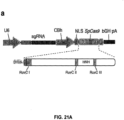
- An example knockin Cas9 mouse was generated and this is exemplified, but Cas9 knockins are preferred.
- To generate a Cas9 knock in mice one may target the same constitutive and conditional constructs to the Rosa26 locus, as described herein ( Figs. 25A-B and 26 ).
- Methods of US Patent Publication Nos. 20120017290 and 20110265198 assigned to Sangamo BioSciences, Inc. directed to targeting the Rosa locus may be modified to utilize the CRISPR Cas system of the present invention.
- the methods of US Patent Publication No. 20130236946 assigned to Cellectis directed to targeting the Rosa locus may also be modified to utilize the CRISPR Cas system of the present invention.
- conditional Cas9 mouse Applicants have shown in 293 cells that the Cas9 conditional expression construct can be activated by co-expression with Cre. Applicants also show that the correctly targeted R1 mESCs can have active Cas9 when Cre is expressed. Because Cas9 is followed by the P2A peptide cleavage sequence and then EGFP Applicants identify successful expression by observing EGFP. Applicants have shown Cas9 activation in mESCs. This same concept is what makes the conditional Cas9 mouse so useful. Applicants may cross their conditional Cas9 mouse with a mouse that ubiquitously expresses Cre (ACTB-Cre line) and may arrive at a mouse that expresses Cas9 in every cell.
- ACTB-Cre line a mouse that expresses Cas9 in every cell.
- transgenic animals are also provided, as are transgenic plants, especially crops and algae.
- the transgenic plants may be useful in applications outside of providing a disease model. These may include food or feed production through expression of, for instance, higher protein, carbohydrate, nutrient or vitamin levels than would normally be seen in the wildtype.
- transgenic plants especially pulses and tubers, and animals, especially mammals such as livestock (cows, sheep, goats and pigs), but also poultry and edible insects, are preferred.
- Transgenic algae or other plants such as rape may be particularly useful in the production of vegetable oils or biofuels such as alcohols (especially methanol and ethanol), for instance. These may be engineered to express or overexpress high levels of oil or alcohols for use in the oil or biofuel industries.
- alcohols especially methanol and ethanol
- AAV Adeno associated virus
- AAV is advantageous over other viral vectors for a couple of reasons:
- AAV has a packaging limit of 4.5 or 4.75 Kb. This means that Cas9 as well as a promoter and transcription terminator have to be all fit into the same viral vector. Constructs larger than 4.5 or 4.75 Kb will lead to significantly reduced virus production. SpCas9 is quite large, the gene itself is over 4.1 Kb, which makes it difficult for packing into AAV. Therefore embodiments of the invention include utilizing homologs of Cas9 that are shorter.
- an additional vector is used to deliver a homology-direct repair template.
- Promoter used to drive Cas9 coding nucleic acid molecule expression can include: AAV ITR can serve as a promoter: this is advantageous for eliminating the need for an additional promoter element (which can take up space in the vector). The additional space freed up can be used to drive the expression of additional elements (gRNA, etc.). Also, ITR activity is relatively weaker, so can be used to reduce toxicity due to over expression of Cas9.
- promoters CMV, CAG, CBh, PGK, SV40, Ferritin heavy or light chains, etc.
- promoters for brain expression, can use promoters: SynapsinI for all neurons, CaMKIIalpha for excitatory neurons, GAD67 or GAD65 or VGAT for GABAergic neurons, etc.
- Albumin promoter For liver expression, can use Albumin promoter.
- ICAM ICAM
- hematopoietic cells can use IFNbeta or CD45.
- Promoter used to drive guide RNA can include:
- the AAV can be AAV1, AAV2, AAV5 or any combination thereof.
- AAV8 is useful for delivery to the liver. The above promoters and vectors are preferred individually.
- RNA delivery is also a useful method of in vivo delivery.
- Fig. 27 shows delivery and in vivo mouse brain Cas9 expression data. It is possible to deliver Cas9 and gRNA (and, for instance, HR repair template) into cells using liposomes or nanoparticles.
- delivery of the CRISPR enzyme, such as a Cas9 and/or delivery of the RNAs of the invention may be in RNA form and via microvesicles, liposomes or nanoparticles.
- Cas9 mRNA and gRNA can be packaged into liposomal particles for delivery in vivo.
- Liposomal transfection reagents such as lipofectamine from Life Technologies and other reagents on the market can effectively deliver RNA molecules into the liver.
- NHEJ efficiency is enhanced by co-expressing end-processing enzymes such as Trex2 ( Dumitrache et al. Genetics. 2011 August; 188(4): 787-797 ). It is preferred that HR efficiency is increased by transiently inhibiting NHEJ machineries such as Ku70 and Ku86. HR efficiency can also be increased by co-expressing prokaryotic or eukaryotic homologous recombination enzymes such as RecBCD, RecA.
- the CRISPR enzyme for instance a Cas9, and/or any of the present RNAs, for instance a guide RNA, can be delivered using adeno associated virus (AAV), lentivirus, adenovirus or other viral vector types, or combinations thereof.
- Cas9 and one or more guide RNAs can be packaged into one or more viral vectors.
- the viral vector is delivered to the tissue of interest by, for example, an intramuscular injection, while other times the viral delivery is via intravenous, transdermal, intranasal, oral, mucosal, or other delivery methods. Such delivery may be either via a single dose, or multiple doses.
- the actual dosage to be delivered herein may vary greatly depending upon a variety of factors, such as the vector chose, the target cell, organism, or tissue, the general condition of the subject to be treated, the degree of transformation/modification sought, the administration route, the administration mode, the type of transformation/modification sought, etc.
- Such a dosage may further contain, for example, a carrier (water, saline, ethanol, glycerol, lactose, sucrose, calcium phosphate, gelatin, dextran, agar, pectin, peanut oil, sesame oil, etc.), a diluent, a pharmaceutically-acceptable carrier (e.g., phosphate-buffered saline), a pharmaceutically-acceptable excipient, an adjuvant to enhance antigenicity, an immunostimulatory compound or molecule, and/or other compounds known in the art.
- a carrier water, saline, ethanol, glycerol, lactose, sucrose, calcium phosphate, gelatin, dextran, agar, pectin, peanut oil, sesame oil, etc.
- a pharmaceutically-acceptable carrier e.g., phosphate-buffered saline
- a pharmaceutically-acceptable excipient e.g., an adju
- the adjuvant herein may contain a suspension of minerals (alum, aluminum hydroxide, aluminum phosphate) on which antigen is adsorbed; or water-in-oil emulsion in which antigen solution is emulsified in oil (MF-59, Freund's incomplete adjuvant), sometimes with the inclusion of killed mycobacteria (Freund's complete adjuvant) to further enhance antigenicity (inhibits degradation of antigen and/or causes influx of macrophages).
- Adjuvants also include immunostimulatory molecules, such as cytokines, costimulatory molecules, and for example, immunostimulatory DNA or RNA molecules, such as CpG oligonucleotides. Such a dosage formulation is readily ascertainable by one skilled in the art.
- the dosage may further contain one or more pharmaceutically acceptable salts such as, for example, a mineral acid salt such as a hydrochloride, a hydrobromide, a phosphate, a sulfate, etc.; and the salts of organic acids such as acetates, propionates, malonates, benzoates, etc.
- auxiliary substances such as wetting or emulsifying agents, pH buffering substances, gels or gelling materials, flavorings, colorants, microspheres, polymers, suspension agents, etc. may also be present herein.
- Suitable exemplary ingredients include microcrystalline cellulose, carboxymethylcellulose sodium, polysorbate 80, phenylethyl alcohol, chlorobutanol, potassium sorbate, sorbic acid, sulfur dioxide, propyl gallate, the parabens, ethyl vanillin, glycerin, phenol, parachlorophenol, gelatin, albumin and a combination thereof.
- the delivery is via an adenovirus, which may be at a single booster dose containing at least 1 ⁇ 10 5 particles (also referred to as particle units, pu) of adenoviral vector.
- the dose preferably is at least about 1 ⁇ 10 6 particles (for example, about 1 ⁇ 10 6 -1 ⁇ 10 12 particles), more preferably at least about 1 ⁇ 10 7 particles, more preferably at least about 1 ⁇ 10 8 particles (e.g., about 1 ⁇ 10 8 -1 ⁇ 10 11 particles or about 1 ⁇ 10 8 -1 ⁇ 10 12 particles), and most preferably at least about 1 ⁇ 10 0 particles (e.g., about 1* ⁇ 10 9 -1 ⁇ 10 10 particles or about 1 ⁇ 10 9 -1 ⁇ 10 12 particles), or even at least about 1 x 10 10 particles (e.g., about 1 ⁇ 10 10 -1 ⁇ 10 12 particles) of the adenoviral vector.
- the dose comprises no more than about 1 ⁇ 10 14 particles, preferably no more than about 1 x 10 13 particles, even more preferably no more than about 1 x 10 12 particles, even more preferably no more than about 1 x 10 11 particles, and most preferably no more than about 1 x 10 10 particles (e.g., no more than about 1 ⁇ 10 9 articles).
- the dose may contain a single dose of adenoviral vector with, for example, about 1 ⁇ 10 6 particle units (pu), about 2 ⁇ 10 6 pu, about 4 ⁇ 10 6 pu, about 1 ⁇ 10 7 pu, about 2 ⁇ 10 7 pu, about 4 ⁇ 10 7 pu, about 1 ⁇ 10 8 pu, about 2 ⁇ 10 8 pu, about 4 ⁇ 10 8 pu, about 1 ⁇ 10 9 pu, about 2 ⁇ 10 9 pu, about 4 ⁇ 10 9 pu, about 1 x 10 10 pu, about 2 x 10 10 pu, about 4 x 10 10 pu, about 1 x 10 11 pu, about 2 x 10 11 pu, about 4 x 10 11 pu, about 1 x 10 12 pu, about 2 x 10 12 pu, or about 4 x 10 12 pu of adenoviral vector.
- adenoviral vector with, for example, about 1 ⁇ 10 6 particle units (pu), about 2 ⁇ 10 6 pu, about 4 ⁇ 10 6 pu, about 1 ⁇ 10 7 pu, about 2 ⁇ 10 7 pu
- the adenoviral vectors in U.S. Patent No. 8,454,972 B2 to Nabel, et. al., granted on June 4, 2013 ; incorporated by reference herein, and the dosages at col 29, lines 36-58 thereof.
- the adenovirus is delivered via multiple doses.
- the delivery is via an AAV.
- a therapeutically effective dosage for in vivo delivery of the AAV to a human is believed to be in the range of from about 20 to about 50 ml of saline solution containing from about 1 x 10 10 to about 1 x 10 10 functional AAV/ml solution. The dosage may be adjusted to balance the therapeutic benefit against any side effects.
- the AAV dose is generally in the range of concentrations of from about 1 ⁇ 10 5 to 1 ⁇ 10 50 genomes AAV, from about 1 ⁇ 10 8 to 1 ⁇ 10 20 genomes AAV, from about 1 x 10 10 to about 1 ⁇ 10 16 genomes, or about 1 x 10 11 to about 1 ⁇ 10 16 genomes AAV.
- a human dosage may be about 1 ⁇ 10 13 genomes AAV. Such concentrations may be delivered in from about 0.001 ml to about 100 ml, about 0.05 to about 50 ml, or about 10 to about 25 ml of a carrier solution. Other effective dosages can be readily established by one of ordinary skill in the art through routine trials establishing dose response curves. See, for example, U.S. Patent No. 8,404,658 B2 to Hajjar, et al., granted on March 26, 2013 , at col. 27, lines 45-60.
- the delivery is via a plasmid.
- the dosage should be a sufficient amount of plasmid to elicit a response.
- suitable quantities of plasmid DNA in plasmid compositions can be from about 0.1 to about 2 mg, or from about 1 ⁇ g to about 10 ⁇ g.
- the doses herein are based on an average 70 kg individual.
- the frequency of administration is within the ambit of the medical or veterinary practitioner (e.g., physician, veterinarian), or scientist skilled in the art.
- Lentiviruses are complex retroviruses that have the ability to infect and express their genes in both mitotic and post-mitotic cells.
- the most commonly known lentivirus is the human immunodeficiency virus (HIV), which uses the envelope glycoproteins of other viruses to target a broad range of cell types.
- HIV human immunodeficiency virus
- lentiviral transfer plasmid pCasES10
- pMD2.G VSV-g pseudotype
- psPAX2 gag/pol/rev/tat
- Transfection was done in 4mL OptiMEM with a cationic lipid delivery agent (50uL Lipofectamine 2000 and 100ul Plus reagent). After 6 hours, the media was changed to antibiotic-free DMEM with 10% fetal bovine serum.
- Lentivirus may be purified as follows. Viral supernatants were harvested after 48 hours. Supernatants were first cleared of debris and filtered through a 0.45um low protein binding (PVDF) filter. They were then spun in a ultracentrifuge for 2 hours at 24,000 rpm. Viral pellets were resuspended in 50ul of DMEM overnight at 4C. They were then aliquotted and immediately frozen at -80C.
- PVDF 0.45um low protein binding
- minimal non-primate lentiviral vectors based on the equine infectious anemia virus are also contemplated, especially for ocular gene therapy (see, e.g., Balagaan, J Gene Med 2006; 8: 275 - 285, Published online 21 November 2005 in Wiley InterScience (www.interscience.wiley.com). DOI: 10.1002/jgm.845 ).
- RetinoStat ® an equine infectious anemia virus-based lentiviral gene therapy vector that expresses angiostatic proteins endostain and angiostatin that is delivered via a subretinal injection for the treatment of the web form of age-related macular degeneration is also contemplated (see, e.g., Binley et al., HUMAN GENE THERAPY 23:980-991 (September 2012 )) may be modified for the CRISPR-Cas system of the present invention.
- self-inactivating lentiviral vectors with an siRNA targeting a common exon shared by HIV tat/rev, a nucleolar-localizing TAR decoy, and an anti-CCR5-specific hammerhead ribozyme may be used/and or adapted to the CRISPR-Cas system of the present invention.
- a minimum of 2.5 ⁇ 10 6 CD34+ cells per kilogram patient weight may be collected and prestimulated for 16 to 20 hours in X-VIVO 15 medium (Lonza) containing 2mML-glutamine, stem cell factor (100 ng/ml), Flt-3 ligand (Flt-3L) (100 ng/ml), and thrombopoietin (10 ng/ml) (CellGenix) at a density of 2 ⁇ 10 6 cells/ml.
- Prestimulated cells may be transduced with lentiviral at a multiplicity of infection of 5 for 16 to 24 hours in 75-cm 2 tissue culture flasks coated with fibronectin (25 mg/cm 2 ) (RetroNectin,Takara Bio Inc.).
- Lentiviral vectors have been disclosed as in the treatment for Parkinson's Disease, see, e.g., US Patent Publication No. 20120295960 and US Patent Nos. 7303910 and 7351585 .
- Lentiviral vectors have also been disclosed for the treatment of ocular diseases, see e.g., US Patent Publication Nos. 20060281180 , 20090007284 , US20110117189 ; US20090017543 ; US20070054961 , US20100317109 .
- Lentiviral vectors have also been disclosed for delivery to the train, see, e.g., US Patent Publication Nos. US20110293571 ; US20110293571 , US20040013648 , US20070025970 , US20090111106 and US Patent No. US7259015 .
- RNA delivery The CRISPR enzyme, for instance a Cas9, and/or any of the present RNAs, for instance a guide RNA, can also be delivered in the form of RNA.
- Cas9 mRNA can be generated using in vitro transcription.
- Cas9 mRNA can be synthesized using a PCR cassette containing the following elements: T7_promoter-kozak sequence (GCCACC)-Cas9-3' UTR from beta globin-polyA tail (a string of 120 or more adenines).
- the cassette can be used for transcription by T7 polymerase.
- Guide RNAs can also be transcribed using in vitro transcription from a cassette containing T7_promoter-GG-guide RNA sequence.
- the CRISPR enzyme and/or guide RNA can be modified using pseudo-U or 5-Methyl-C.
- mRNA delivery methods are especially promising for liver delivery currently.
- AAV8 is particularly preferred for delivery to the liver.
- CRISPR enzyme mRNA and guide RNA may be delivered simultaneously using nanoparticles or lipid envelopes.
- nanoparticles based on self assembling bioadhesive polymers are contemplated, which may be applied to oral delivery of peptides, intravenous delivery of peptides and nasal delivery of peptides, all to the brain.
- Other embodiments, such as oral absorption and ocular deliver of hydrophobic drugs are also contemplated.
- the molecular envelope technology involves an engineered polymer envelope which is protected and delivered to the site of the disease (see, e.g., Mazza, M. et al. ACSNano, 2013. 7(2): 1016-1026 ; Siew, A., et al. Mol Pharm, 2012. 9(1):14-28 ; Lalatsa, A., et al. J Contr Rel, 2012.
- nanoparticles that can deliver RNA to a cancer cell to stop tumor growth developed by Dan Anderson's lab at MIT may be used/and or adapted to the CRISPR Cas system of the present invention.
- the Anderson lab developed fully automated, combinatorial systems for the synthesis, purification, characterization, and formulation of new biomaterials and nanoformulations. See, e.g., Alabi et al., Proc Natl Acad Sci U S A. 2013 Aug 6;110(32):12881-6 ; Zhang et al., Adv Mater. 2013 Sep 6;25(33):4641-5 ; Jiang et al., Nano Lett.
- US patent application 20110293703 relates to lipidoid compounds are also particularly useful in the administration of polynucleotides, which may be applied to deliver the CRISPR Cas system of the present invention.
- the aminoalcohol lipidoid compounds are combined with an agent to be delivered to a cell or a subject to form microparticles, nanoparticles, liposomes, or micelles.
- the agent to be delivered by the particles, liposomes, or micelles may be in the form of a gas, liquid, or solid, and the agent may be a polynucleotide, protein, peptide, or small molecule.
- the minoalcohol lipidoid compounds may be combined with other aminoalcohol lipidoid compounds, polymers (synthetic or natural), surfactants, cholesterol, carbohydrates, proteins, lipids, etc. to form the particles. These particles may then optionally be combined with a pharmaceutical excipient to form a pharmaceutical composition.
- US Patent Publication No. 0110293703 also provides methods of preparing the aminoalcohol lipidoid compounds.
- One or more equivalents of an amine are allowed to react with one or more equivalents of an epoxide-terminated compound under suitable conditions to form an aminoalcohol lipidoid compound of the present invention.
- all the amino groups of the amine are fully reacted with the epoxide-terminated compound to form tertiary amines.
- all the amino groups of the amine are not fully reacted with the epoxide-terminated compound to form tertiary amines thereby resulting in primary or secondary amines in the aminoalcohol lipidoid compound.
- a diamine or polyamine may include one, two, three, or four epoxide-derived compound tails off the various amino moieties of the molecule resulting in primary, secondary, and tertiary amines. In certain embodiments, all the amino groups are not fully functionalized. In certain embodiments, two of the same types of epoxide-terminated compounds are used. In other embodiments, two or more different epoxide-terminated compounds are used.
- the synthesis of the aminoalcohol lipidoid compounds is performed with or without solvent, and the synthesis may be performed at higher temperatures ranging from 30.-100 C., preferably at approximately 50.-90 C.
- the prepared aminoalcohol lipidoid compounds may be optionally purified.
- the mixture of aminoalcohol lipidoid compounds may be purified to yield an aminoalcohol lipidoid compound with a particular number of epoxide-derived compound tails. Or the mixture may be purified to yield a particular stereo- or regioisomer.
- the aminoalcohol lipidoid compounds may also be alkylated using an alkyl halide (e.g., methyl iodide) or other alkylating agent, and/or they may be acylated.
- US Patent Publication No. 0110293703 also provides libraries of aminoalcohol lipidoid compounds prepared by the inventive methods. These aminoalcohol lipidoid compounds may be prepared and/or screened using high-throughput techniques involving liquid handlers, robots, microtiter plates, computers, etc. In certain embodiments, the aminoalcohol lipidoid compounds are screened for their ability to transfect polynucleotides or other agents (e.g., proteins, peptides, small molecules) into the cell.
- agents e.g., proteins, peptides, small molecules
- US Patent Publication No. 20130302401 relates to a class of poly(beta-amino alcohols) (PBAAs) has been prepared using combinatorial polymerization.
- PBAAs poly(beta-amino alcohols)
- the inventive PBAAs may be used in biotechnology and biomedical applications as coatings (such as coatings of films or multilayer films for medical devices or implants), additives, materials, excipients, non-biofouling agents, micropatterning agents, and cellular encapsulation agents.
- coatings such as coatings of films or multilayer films for medical devices or implants
- additives such as coatings of films or multilayer films for medical devices or implants
- materials such as coatings of films or multilayer films for medical devices or implants
- additives such as coatings of films or multilayer films for medical devices or implants
- materials such as coatings of films or multilayer films for medical devices or implants
- excipients such as coatings of films or multilayer films for medical devices or implants
- these coatings reduce the recruitment of inflammatory cells, and reduce fibrosis, following the subcutaneous implantation of carboxylated polystyrene microparticles.
- These polymers may be used to form polyelectrolyte complex capsules for cell encapsulation.
- the invention may also have many other biological applications such as antimicrobial coatings, DNA or siRNA delivery, and stem cell tissue engineering.
- US Patent Publication No. 20130302401 may be applied to the CRISPR Cas system of the present invention.
- lipid nanoparticles are contemplated.
- an antitransthyretin small interfering RNA encapsulated in lipid nanoparticles may be applied to the CRISPR Cas system of the present invention.
- Doses of about 0.01 to about 1 mg per kg of body weight administered intravenously are contemplated.
- Medications to reduce the risk of infusion-related reactions are contemplated, such as dexamethasone, acetampinophen, diphenhydramine or cetirizine, and ranitidine are contemplated.
- Multiple doses of about 0.3 mg per kilogram every 4 weeks for five doses are also contemplated.
- LNPs have been shown to be highly effective in delivering siRNAs to the liver (see, e.g., Tabernero et al., Cancer Discovery, April 2013, Vol. 3, No. 4, pages 363-470 ) and are therefore contemplated for delivering CRISPR Cas to the liver.
- a dosage of about four doses of 6 mg/kg of the LNP every two weeks may be contemplated.
- Tabernero et al. demonstrated that tumor regression was observed after the first 2 cycles of LNPs dosed at 0.7 mg/kg, and by the end of 6 cycles the patient had achieved a partial response with complete regression of the lymph node metastasis and substantial shrinkage of the liver tumors.
- the charge of the LNP must be taken into consideration.
- cationic lipids combined with negatively charged lipids to induce nonbilayer structures that facilitate intracellular delivery.
- ionizable cationic lipids with pKa values below 7 were developed (see, e.g., Rosin et al, Molecular Therapy, vol. 19, no. 12, pages 1286-2200, Dec. 2011 ).
- Negatively charged polymers such as siRNA oligonucleotides may be loaded into LNPs at low pH values (e.g., pH 4) where the ionizable lipids display a positive charge.
- the LNPs exhibit a low surface charge compatible with longer circulation times.
- ionizable cationic lipids Four species of ionizable cationic lipids have been focused upon, namely 1,2-dilineoyl-3-dimethylammonium-propane (DLinDAP), 1,2-dilinoleyloxy-3-N,N-dimethylaminopropane (DLinDMA), 1,2-dilinoleyloxy-keto-N,N-dimethyl-3-aminopropane (DLinKDMA), and 1,2-dilinoleyl-4-(2-dimethylaminoethyl)-[1,3]-dioxolane (DLinKC2-DMA).
- DLinDAP 1,2-dilineoyl-3-dimethylammonium-propane
- DLinDMA 1,2-dilinoleyloxy-3-N,N-dimethylaminopropane
- DLinKDMA 1,2-dilinoleyloxy-keto-N,N-dimethyl-3
- LNP siRNA systems containing these lipids exhibit remarkably different gene silencing properties in hepatocytes in vivo, with potencies varying according to the series DLinKC2-DMA>DLinKDMA>DLinDMA>>DLinDAP employing a Factor VII gene silencing model (see, e.g., Rosin et al, Molecular Therapy, vol. 19, no. 12, pages 1286-2200, Dec. 2011 ).
- a dosage of 1 ⁇ g/ml levels may be contemplated, especially for a formulation containing DLinKC2-DMA.
- Preparation of LNPs and CRISPR Cas encapsulation may be used/and or adapted from Rosin et al, Molecular Therapy, vol. 19, no. 12, pages 1286-2200, Dec. 2011 ).
- the cationic lipids 1,2-dilineoyl-3-dimethylammonium-propane (DLinDAP), 1,2-dilinoleyloxy-3-N,N-dimethylaminopropane (DLinDMA), 1,2-dilinoleyloxyketo-N,N-dimethyl-3-aminopropane (DLinK-DMA), 1,2-dilinoleyl-4-(2-dimethylaminoethyl)-[1,3]-dioxolane (DLinKC2-DMA), (3-o-[2" -(methoxypolyethyleneglycol 2000) succinoyl]-1,2-dimyristoylsn-glycol (PEG-S-DMG), and R-3-[( ⁇
- Cholesterol may be purchased from Sigma (St Louis, MO).
- the specific CRISPR Cas RNA may be encapsulated in LNPs containing DLinDAP, DLinDMA, DLinK-DMA, and DLinKC2-DMA (cationic lipid:DSPC:CHOL: PEGS-DMG or PEG-C-DOMG at 40:10:40:10 molar ratios).
- 0.2% SP-DiOC18 Invitrogen, Burlington, Canada
- Encapsulation may be performed by dissolving lipid mixtures comprised of cationic lipid:DSPC:cholesterol:PEG-c-DOMG (40:10:40:10 molar ratio) in ethanol to a final lipid concentration of 10 mmol/l.
- This ethanol solution of lipid may be added drop-wise to 50 mmol/l citrate, pH 4.0 to form multilamellar vesicles to produce a final concentration of 30% ethanol vol/vol.
- Large unilamellar vesicles may be formed following extrusion of multilamellar vesicles through two stacked 80 nm Nuclepore polycarbonate filters using the Extruder (Northern Lipids, Vancouver, Canada).
- Encapsulation may be achieved by adding RNA dissolved at 2 mg/ml in 50 mmol/l citrate, pH 4.0 containing 30% ethanol vol/vol drop-wise to extruded preformed large unilamellar vesicles and incubation at 31 °C for 30 minutes with constant mixing to a final RNA/lipid weight ratio of 0.06/1 wt/wt. Removal of ethanol and neutralization of formulation buffer were performed by dialysis against phosphate-buffered saline (PBS), pH 7.4 for 16 hours using Spectra/Por 2 regenerated cellulose dialysis membranes.
- PBS phosphate-buffered saline
- Nanoparticle size distribution may be determined by dynamic light scattering using a NICOMP 370 particle sizer, the vesicle/intensity modes, and Gaussian fitting (Nicomp Particle Sizing, Santa Barbara, CA). The particle size for all three LNP systems may be ⁇ 70 nm in diameter.
- siRNA encapsulation efficiency may be determined by removal of free siRNA using VivaPureD MiniH columns (Sartorius Stedim Biotech) from samples collected before and after dialysis. The encapsulated RNA may be extracted from the eluted nanoparticles and quantified at 260 nm.
- siRNA to lipid ratio was determined by measurement of cholesterol content in vesicles using the Cholesterol E enzymatic assay from Wako Chemicals USA (Richmond, VA).
- Preparation of large LNPs may be used/and or adapted from Rosin et al, Molecular Therapy, vol. 19, no. 12, pages 1286-2200, Dec. 2011 .
- a lipid premix solution (20.4 mg/ml total lipid concentration) may be prepared in ethanol containing DLinKC2-DMA, DSPC, and cholesterol at 50:10:38.5 molar ratios.
- Sodium acetate may be added to the lipid premix at a molar ratio of 0.75:1 (sodium acetate:DLinKC2-DMA).
- the lipids may be subsequently hydrated by combining the mixture with 1.85 volumes of citrate buffer (10 mmol/l, pH 3.0) with vigorous stirring, resulting in spontaneous liposome formation in aqueous buffer containing 35% ethanol.
- the liposome solution may be incubated at 37 °C to allow for time-dependent increase in particle size. Aliquots may be removed at various times during incubation to investigate changes in liposome size by dynamic light scattering (Zetasizer Nano ZS, Malvern Instruments, Worcestershire, UK).
- the liposomes should their size, effectively quenching further growth.
- RNA may then be added to the empty liposomes at an siRNA to total lipid ratio of approximately 1:10 (wt:wt), followed by incubation for 30 minutes at 37 °C to form loaded LNPs. The mixture may be subsequently dialyzed overnight in PBS and filtered with a 0.45- ⁇ m syringe filter.
- Spherical Nucleic Acid (SNA TM ) constructs and other nanoparticles (particularly gold nanoparticles) are also contemplate as a means to delivery CRISPR/Cas system to intended targets.
- Significant data show that AuraSense Therapeutics' Spherical Nucleic Acid (SNA TM ) constructs, based upon nucleic acid-functionalized gold nanoparticles, are superior to alternative platforms based on multiple key success factors, such as:
- the constructs demonstrate a transfection efficiency of 99% with no need for carriers or transfection agents.
- Therapeutic targeting The unique target binding affinity and specificity of the constructs allow extremely specificity for matched target sequences (i.e., limited off-target effects).
- the constructs can enter a variety of cultured cells, primary cells, and tissues with no apparent toxicity.
- the constructs elicit minimal changes in global gene expression as measured by whole-genome microarray studies and cytokine-specific protein assays.
- nucleic acid-based therapeutics may be applicable to numerous disease states, including inflammation and infectious disease, cancer, skin disorders and cardiovascular disease.
- Citable literature includes: Cutler et al.,. J. Am. Chem. Soc. 2011 133:9254-9257 , Hao et al., Small. 2011 7:3158-3162 , Zhang et al., ACS Nano. 2011 5:6962-6970 , Cutler et al., J. Am. Chem. Soc. 2012 134:1376-1391 , Young et al.,. Nano Lett. 2012 12:3867-71 , Zheng et al., Proc. Natl. Acad. Sci. USA. 2012 109:11975-80 , Mirkin, Nanomedicine 2012 7:635-638 Zhang et al., J. Am. Chem. Soc.
- Self-assembling nanoparticles with siRNA may be constructed with polyethyleneimine (PEI) that is PEGylated with an Arg-Gly-Asp (RGD) peptide ligand attached at the distal end of the polyethylene glycol (PEG), for example, as a means to target tumor neovasculature expressing integrins and used to deliver siRNA inhibiting vascular endothelial growth factor receptor-2 (VEGF R2) expression and thereby tumor angiogenesis (see, e.g., Schiffelers et al., Nucleic Acids Research, 2004, Vol. 32, No. 19 ).
- PEI polyethyleneimine
- RGD Arg-Gly-Asp
- VEGF R2 vascular endothelial growth factor receptor-2
- Nanoplexes may be prepared by mixing equal volumes of aqueous solutions of cationic polymer and nucleic acid to give a net molar excess of ionizable nitrogen (polymer) to phosphate (nucleic acid) over the range of 2 to 6.
- the electrostatic interactions between cationic polymers and nucleic acid resulted in the formation of polyplexes with average particle size distribution of about 100 nm, hence referred to here as nanoplexes.
- a dosage of about 100 to 200 mg of CRISPR Cas is envisioned for delivery in the self-assembling nanoparticles of Schiffelers et al.
- the nanoplexes of Bartlett et al. may also be applied to the present invention.
- the nanoplexes of Bartlett et al. are prepared by mixing equal volumes of aqueous solutions of cationic polymer and nucleic acid to give a net molar excess of ionizable nitrogen (polymer) to phosphate (nucleic acid) over the range of 2 to 6.
- the electrostatic interactions between cationic polymers and nucleic acid resulted in the formation of polyplexes with average particle size distribution of about 100 nm, hence referred to here as nanoplexes.
- DOTA-NHSester 1,4,7,10-tetraazacyclododecane-1,4,7,10-tetraacetic acid mono(N-hydroxysuccinimide ester)
- DOTA-NHSester 1,4,7,10-tetraazacyclododecane-1,4,7,10-tetraacetic acid mono(N-hydroxysuccinimide ester)
- the amine modified RNA sense strand with a 100-fold molar excess of DOTA-NHS-ester in carbonate buffer (pH 9) was added to a microcentrifuge tube. The contents were reacted by stirring for 4 h at room temperature.
- the DOTA-RNAsense conjugate was ethanol-precipitated, resuspended in water, and annealed to the unmodified antisense strand to yield DOTA-siRNA.
- Tf-targeted and nontargeted siRNA nanoparticles may be formed by using cyclodextrin-containing polycations. Typically, nanoparticles were formed in water at a charge ratio of 3 (+/-) and an siRNA concentration of 0.5 g/liter. One percent of the adamantane-PEG molecules on the surface of the targeted nanoparticles were modified with Tf (adamantane-PEG-Tf). The nanoparticles were suspended in a 5% (wt/vol) glucose carrier solution for injection.
- the nanoparticles consist of a synthetic delivery system containing: (1) a linear, cyclodextrin-based polymer (CDP), (2) a human transferrin protein (TF) targeting ligand displayed on the exterior of the nanoparticle to engage TF receptors (TFR) on the surface of the cancer cells, (3) a hydrophilic polymer (polyethylene glycol (PEG) used to promote nanoparticle stability in biological fluids), and (4) siRNA designed to reduce the expression of the RRM2 (sequence used in the clinic was previously denoted siR2B+5).
- CDP linear, cyclodextrin-based polymer
- TF human transferrin protein
- TFR TF receptors
- siRNA designed to reduce the expression of the RRM2 (sequence used in the clinic was previously denoted siR2B+5).
- the TFR has long been known to be upregulated in malignant cells, and RRM2 is an established anti-cancer target.
- nanoparticles (clinical version denoted as CALAA-01) have been shown to be well tolerated in multi-dosing studies in non-human primates.
- Davis et al.'s clinical trial is the initial human trial to systemically deliver siRNA with a targeted delivery system and to treat patients with solid cancer.
- Davis et al. investigated biopsies from three patients from three different dosing cohorts; patients A, B and C, all of whom had metastatic melanoma and received CALAA-01 doses of 18, 24 and 30 mg m -2 siRNA, respectively.
- CRISPR Cas system of the present invention Similar doses may also be contemplated for the CRISPR Cas system of the present invention.
- the delivery of the invention may be achieved with nanoparticles containing a linear, cyclodextrin-based polymer (CDP), a human transferrin protein (TF) targeting ligand displayed on the exterior of the nanoparticle to engage TF receptors (TFR) on the surface of the cancer cells and/or a hydrophilic polymer (for example, polyethylene glycol (PEG) used to promote nanoparticle stability in biological fluids).
- CDP linear, cyclodextrin-based polymer
- TF human transferrin protein
- TFR TF receptors
- hydrophilic polymer for example, polyethylene glycol (PEG) used to promote nanoparticle stability in biological fluids
- Exosomes are endogenous nano-vesicles that transport RNAs and proteins which can deliver short interfering (si)RNA to the brain in mice.
- siRNAs and proteins which can deliver short interfering (si)RNA to the brain in mice.
- Alvarez-Erviti et al. 2011, Nat Biotechnol 29: 341 ) used self-derived dendritic cells for exosome production. Targeting was achieved by engineering the dendritic cells to express Lamp2b, an exosomal membrane protein, fused to the neuron-specific RVG peptide3. Purified exosomes were loaded with exogenous siRNA by electroporation.
- RVG-targeted exosomes delivered GAPDH siRNA specifically to neurons, microglia, oligodendrocytes in the brain, resulting in a specific gene knockdown. Pre-exposure to RVG exosomes did not attenuate knockdown, and non-specific uptake in other tissues was not observed. The therapeutic potential of exosome-mediated siRNA delivery was demonstrated by the strong mRNA (60%) and protein (62%) knockdown of BACE1, a therapeutic target in Alzheimer's disease.
- Alvarez-Erviti et al. harvested bone marrow from inbred C57BL/6 mice with a homogenous major histocompatibility complex (MHC) haplotype.
- MHC major histocompatibility complex
- GM-CSF granulocyte/macrophage-colony stimulating factor
- exosomes produced were physically homogenous, with a size distribution peaking at 80 nm in diameter as determined by nanoparticle tracking analysis (NTA) and electron microscopy.
- NTA nanoparticle tracking analysis
- Alvarez-Erviti et al. obtained 6-12 ⁇ g of exosomes (measured based on protein concentration) per 10 6 cells.
- siRNA-RVG exosomes induced immune responses in vivo by assessing IL-6, IP-10, TNF ⁇ and IFN- ⁇ serum concentrations.
- siRNA-RVG exosome treatment nonsignificant changes in all cytokines were registered similar to siRNA-transfection reagent treatment in contrast to siRNA-RVG-9R, which potently stimulated IL-6 secretion, confirming the immunologically inert profile of the exosome treatment.
- exosomes encapsulate only 20% of siRNA
- delivery with RVG-exosome appears to be more efficient than RVG-9R delivery as comparable mRNA knockdown and greater protein knockdown was achieved with fivefold less siRNA without the corresponding level of immune stimulation.
- This experiment demonstrated the therapeutic potential of RVG-exosome technology, which is potentially suited for long-term silencing of genes related to neurodegenerative diseases.
- the exosome delivery system of Alvarez-Erviti et al. may be applied to deliver the CRISPR-Cas system of the present invention to therapeutic targets, especially neurodegenerative diseases.
- a dosage of about 100 to 1000 mg of CRISPR Cas encapsulated in about 100 to 1000 mg of RVG exosomes may be contemplated for the present invention.
- El-Andaloussi et al. discloses how exosomes derived from cultured cells can be harnessed for delivery of siRNA in vitro and in vivo. This protocol first describes the generation of targeted exosomes through transfection of an expression vector, comprising an exosomal protein fused with a peptide ligand. Next, El-Andaloussi et al. explain how to purify and characterize exosomes from transfected cell supernatant. Next, El-Andaloussi et al. detail crucial steps for loading siRNA into exosomes. Finally, El-Andaloussi et al.
- exosome-mediated siRNA delivery is evaluated by functional assays and imaging.
- the entire protocol takes ⁇ 3 weeks. Delivery or administration according to the invention may be performed using exosomes produced from self-derived dendritic cells.
- Exosomes are nano-sized vesicles (30-90nm in size) produced by many cell types, including dendritic cells (DC), B cells, T cells, mast cells, epithelial cells and tumor cells. These vesicles are formed by inward budding of late endosomes and are then released to the extracellular environment upon fusion with the plasma membrane. Because exosomes naturally carry RNA between cells, this property might be useful in gene therapy.
- DC dendritic cells
- B cells B cells
- T cells T cells
- mast cells epithelial cells
- tumor cells tumor cells.
- Exosomes from plasma are prepared by centrifugation of buffy coat at 900g for 20 min to isolate the plasma followed by harvesting cell supernatants, centrifuging at 300g for 10 min to eliminate cells and at 16 500g for 30 min followed by filtration through a 0.22 mm filter. Exosomes are pelleted by ultracentrifugation at 120 000g for70 min. Chemical transfection of siRNA into exosomes is carried out according to the manufacturer's instructions in RNAi Human/Mouse Starter Kit (Quiagen, Hilden, Germany). siRNA is added to 100 ml PBS at a final concentration of 2 mmol/ml. After adding HiPerFect transfection reagent, the mixture is incubated for 10 min at RT.
- exosomes are re-isolated using aldehyde/sulfate latex beads.
- the chemical transfection of CRISPR Cas into exosomes may be conducted similarly to siRNA.
- the exosomes may be co-cultured with monocytes and lymphocytes isolated from the peripheral blood of healthy donors. Therefore, it may be contemplated that exosomes containing CRISPR Cas may be introduced to monocytes and lymphocytes of and autologously reintroduced into a human. Accordingly, delivery or administration according to the invention may beperformed using plasma exosomes.
- Liposomes are spherical vesicle structures composed of a uni- or multilamellar lipid bilayer surrounding internal aqueous compartments and a relatively impermeable outer lipophilic phospholipid bilayer. Liposomes have gained considerable attention as drug delivery carriers because they are biocompatible, nontoxic, can deliver both hydrophilic and lipophilic drug molecules, protect their cargo from degradation by plasma enzymes, and transport their load across biological membranes and the blood brain barrier (BBB) (see, e.g., Spuch and Navarro, Journal of Drug Delivery, vol. 2011, Article ID 469679, 12 pages, 2011. doi:10.1155/2011/469679 for review ).
- BBB blood brain barrier
- Liposomes can be made from several different types of lipids; however, phospholipids are most commonly used to generate liposomes as drug carriers. Although liposome formation is spontaneous when a lipid film is mixed with an aqueous solution, it can also be expedited by applying force in the form of shaking by using a homogenizer, sonicator, or an extrusion apparatus (see, e.g., Spuch and Navarro, Journal of Drug Delivery, vol. 2011, Article ID 469679, 12 pages, 2011. doi:10.1155/2011/469679 for review ).
- liposomes may be added to liposomes in order to modify their structure and properties.
- either cholesterol or sphingomyelin may be added to the liposomal mixture in order to help stabilize the liposomal structure and to prevent the leakage of the liposomal inner cargo.
- liposomes are prepared from hydrogenated egg phosphatidylcholine or egg phosphatidylcholine, cholesterol, and dicetyl phosphate, and their mean vesicle sizes were adjusted to about 50 and 100 nm. (see, e.g., Spuch and Navarro, Journal of Drug Delivery, vol. 2011, Article ID 469679, 12 pages, 2011. doi:10.1155/2011/469679 for review ).
- Conventional liposome formulation is mainly comprised of natural phospholipids and lipids such as 1,2-distearoryl-sn-glycero-3-phosphatidyl choline (DSPC), sphingomyelin, egg phosphatidylcholines and monosialoganglioside. Since this formulation is made up of phospholipids only, liposomal formulations have encountered many challenges, one of the ones being the instability in plasma. Several attempts to overcome these challenges have been made, specifically in the manipulation of the lipid membrane. One of these attempts focused on the manipulation of cholesterol.
- DSPC 1,2-distearoryl-sn-glycero-3-phosphatidyl choline
- DOPE 1,2-dioleoyl-sn-glycero-3-phosphoethanolamine
- Trojan Horse liposomes are desirable and protocols may be found at http://cshprotocols.cshlp.org/content/2010/4/pdb.prot5407.long. These particles allow delivery of a transgene to the entire brain after an intravascular injection. Without being bound by limitation, it is believed that neutral lipid particles with specific antibodies conjugated to surface allow crossing of the blood brain barrier via endocytosis. Applicant postulates utilizing Trojan Horse Liposomes to deliver the CRISPR family of nucleases to the brain via an intravascular injection, which would allow whole brain transgenic animals without the need for embryonic manipulation. About 1-5 g of DNA may be contemplated for in vivo administration in liposomes.
- the CRISPR Cas system may be administered in liposomes, such as a stable nucleic-acid-lipid particle (SNALP) (see, e.g., Morrissey et al., Nature Biotechnology, Vol. 23, No. 8, August 2005 ).
- SNALP stable nucleic-acid-lipid particle
- Daily intravenous injections of about 1, 3 or 5 mg/kg/day of a specific CRISPR Cas targeted in a SNALP are contemplated.
- the daily treatment may be over about three days and then weekly for about five weeks.
- a specific CRISPR Cas encapsulated SNALP administered by intravenous injection to at doses of abpit 1 or 2.5 mg/kg are also contemplated (see, e.g., Zimmerman et al., Nature Letters, Vol. 441, 4 May 2006 ).
- the SNALP formulation may contain the lipids 3-N-[(wmethoxypoly(ethylene glycol) 2000) carbamoyl] -!
- PEG-C-DMA 1,2-dilinoleyloxy-N,N-dimethyl-3-aminopropane
- DSPC 1,2-distearoyl-sn-glycero-3-phosphocholine
- cholesterol in a 2:40:10:48 molar per cent ratio (see, e.g., Zimmerman et al., Nature Letters, Vol. 441, 4 May 2006 ).
- SNALPs stable nucleic-acid-lipid particles
- the SNALP liposomes may be prepared by formulating D-Lin-DMA and PEG-C-DMA with distearoylphosphatidylcholine (DSPC), Cholesterol and siRNA using a 25:1 lipid/siRNA ratio and a 48/40/10/2 molar ratio of Cholesterol/D-Lin-DMA/DSPC/PEG-C-DMA.
- DSPC distearoylphosphatidylcholine
- Cholesterol and siRNA using a 25:1 lipid/siRNA ratio and a 48/40/10/2 molar ratio of Cholesterol/D-Lin-DMA/DSPC/PEG-C-DMA.
- the resulted SNALP liposomes are about 80-100 nm in size.
- a SNALP may comprise synthetic cholesterol (Sigma-Aldrich, St Louis, MO, USA), dipalmitoylphosphatidylcholine (Avanti Polar Lipids, Alabaster, AL, USA), 3-N-[(w-methoxy poly(ethylene glycol)2000)carbamoyl]-1,2-dimyrestyloxypropylamine, and cationic 1,2-dilinoleyloxy-3-N,Ndimethylaminopropane (see, e.g., Geisbert et al., Lancet 2010; 375: 1896-905 ).
- a dosage of about 2 mg/kg total CRISPR Cas per dose administered as, for example, a bolus intravenous infusion may be contemplated.
- a SNALP may comprise synthetic cholesterol (Sigma-Aldrich), 1,2-distearoyl-sn-glycero-3-phosphocholine (DSPC; Avanti Polar Lipids Inc.), PEG-cDMA, and 1,2-dilinoleyloxy-3-(N;N-dimethyl)aminopropane (DLinDMA) (see, e.g., Judge, J. Clin. Invest. 119:661-673 (2009 )).
- Formulations used for in vivo studies may comprise a final lipid/RNA mass ratio of about 9:1.
- the stability profile of RNAi nanomedicines has been reviewed by Barros and Gollob of Alnylam Pharmaceuticals (see, e.g., Advanced Drug Delivery Reviews 64 (2012) 1730-1737 ).
- the stable nucleic acid lipid particle is comprised of four different lipids - an ionizable lipid (DLinDMA) that is cationic at low pH, a neutral helper lipid, cholesterol, and a diffusible polyethylene glycol (PEG)-lipid.
- the particle is approximately 80 nm in diameter and is charge-neutral at physiologic pH.
- the ionizable lipid serves to condense lipid with the anionic siRNA during particle formation.
- the ionizable lipid When positively charged under increasingly acidic endosomal conditions, the ionizable lipid also mediates the fusion of SNALP with the endosomal membrane enabling release of siRNA into the cytoplasm.
- the PEG-lipid stabilizes the particle and reduces aggregation during formulation, and subsequently provides a neutral hydrophilic exterior that improves pharmacokinetic properties.
- Tekmira Pharmaceuticals recently completed a phase I single-dose study of SNALP-ApoB in adult volunteers with elevated LDL cholesterol. ApoB is predominantly expressed in the liver and jejunum and is essential for the assembly and secretion of VLDL and LDL. Seventeen subjects received a single dose of SNALP-ApoB (dose escalation across 7 dose levels). There was no evidence of liver toxicity (anticipated as the potential dose-limiting toxicity based on preclinical studies). One (of two) subjects at the highest dose experienced flu-like symptoms consistent with immune system stimulation, and the decision was made to conclude the trial.
- ALN-TTR01 which employs the SNALP technology described above and targets hepatocyte production of both mutant and wild-type TTR to treat TTR amyloidosis (ATTR).
- TTR amyloidosis TTR amyloidosis
- FAP familial amyloidotic polyneuropathy
- FAC familial amyloidotic cardiomyopathy
- SSA senile systemic amyloidosis
- ALN-TTR01 was administered as a 15-minute IV infusion to 31 patients (23 with study drug and 8 with placebo) within a dose range of 0.01 to 1.0 mg/kg (based on siRNA). Treatmentwaswell tolerated with no significant increases in liver function tests. Infusion-related reactions were noted in 3 of 23 patients at ⁇ 0.4 mg/kg; all responded to slowing of the infusion rate and all continued on study. Minimal and transient elevations of serum cytokines IL-6, IP-10 and IL-1ra were noted in two patients at the highest dose of 1 mg/kg (as anticipated from preclinical and NHP studies). Lowering of serum TTR, the expected pharmacodynamics effect of ALN-TTR01, was observed at 1 mg/kg.
- a SNALP may be made by solubilizing a cationic lipid, DSPC, cholesterol and PEG-lipid were solubilized in ethanol at a molar ratio of 40:10:40:10, respectively (see, Semple et al., Nature Niotechnology, Volume 28 Number 2 February 2010, pp. 172-177 ).
- the lipid mixture was added to an aqueous buffer (50 mM citrate, pH 4) with mixing to a final ethanol and lipid concentration of 30% (vol/vol) and 6.1 mg/ml, respectively, and allowed to equilibrate at 22 °C for 2 min before extrusion.
- the hydrated lipids were extruded through two stacked 80 nm pore-sized filters (Nuclepore) at 22 °C using a Lipex Extruder (Northern Lipids) until a vesicle diameter of 70-90 nm, as determined by dynamic light scattering analysis, was obtained. This generally required 1-3 passes.
- the siRNA (solubilized in a 50 mM citrate, pH 4 aqueous solution containing 30% ethanol) was added to the pre-equilibrated (35 °C) vesicles at a rate of ⁇ 5 ml/min with mixing.
- siRNA/lipid ratio 0.06 (wt/wt) was reached, the mixture was incubated for a further 30 min at 35 °C to allow vesicle reorganization and encapsulation of the siRNA.
- the ethanol was then removed and the external buffer replaced with PBS (155 mM NaCl, 3 mM Na2HPO4, 1 mM KH2PO4, pH 7.5) by either dialysis or tangential flow diafiltration.
- siRNA were encapsulated in SNALP using a controlled step-wise dilution method process.
- the lipid constituents of KC2-SNALP were DLin-KC2-DMA (cationic lipid), dipalmitoylphosphatidylcholine (DPPC; Avanti Polar Lipids), synthetic cholesterol (Sigma) and PEG-C-DMA used at a molar ratio of 57.1:7.1:34.3:1.4.
- SNALP were dialyzed against PBS and filter sterilized through a 0.2 ⁇ m filter before use.
- Mean particle sizes were 75-85 nm and 90-95% of the siRNA was encapsulated within the lipid particles.
- the final siRNA/lipid ratio in formulations used for in vivo testing was ⁇ 0.15 (wt/wt).
- LNP-siRNA systems containing Factor VII siRNA were diluted to the appropriate concentrations in sterile PBS immediately before use and the formulations were administered intravenously through the lateral tail vein in a total volume of 10 ml/kg. This method may be extrapolated to the CRISPR Cas system of the present invention.
- cationic lipids such as amino lipid 2,2-dilinoleyl-4-dimethylaminoethyl-[1,3]-dioxolane (DLin-KC2-DMA) may be utilized to encapsulate CRISPR Cas similar to SiRNA (see, e.g., Jayaraman, Angew. Chem. Int. Ed. 2012, 51, 8529 -8533 ).
- a preformed vesicle with the following lipid composition may be contemplated: amino lipid, distearoylphosphatidylcholine (DSPC), cholesterol and (R)-2,3-bis(octadecyloxy) propyl-1-(methoxy poly(ethylene glycol)2000)propylcarbamate (PEG-lipid) in the molar ratio 40/10/40/10, respectively, and a FVII siRNA/total lipid ratio of approximately 0.05 (w/w).
- the particles may be extruded up to three times through 80 nm membranes prior to adding the CRISPR Cas RNA.
- Particles containing the highly potent amino lipid 16 may be used, in which the molar ratio of the four lipid components 16, DSPC, cholesterol and PEG-lipid (50/10/38.5/1.5) which may be further optimized to enhance in vivo activity.
- lipids may be formulated with the CRISPR Cas system of the present invention to form lipid nanoparticles (LNPs).
- Lipids include, but are not limited to, DLin-KC2-DMA4, C12-200 and colipids disteroylphosphatidyl choline, cholesterol, and PEG-DMG may be formulated with CRISPR Cas instead of siRNA (see, e.g., Novobrantseva, Molecular Therapy-Nucleic Acids (2012) 1, e4; doi:10.1038/mtna.2011.3 ) using a spontaneous vesicle formation procedure.
- the component molar ratio may be about 50/10/38.5/1.5 (DLin-KC2-DMA or C12-200/disteroylphosphatidyl choline/cholesterol/PEG-DMG).
- the final lipid:siRNA weight ratio may be ⁇ 12:1 and 9:1 in the case of DLin-KC2-DMA and C12-200 lipid nanoparticles (LNPs), respectively.
- the formulations may have mean particle diameters of ⁇ 80 nm with >90% entrapment efficiency. A 3 mg/kg dose may be contemplated.
- Tekmira has a portfolio of approximately 95 patent families, in the U.S. and abroad, that are directed to various aspects of LNPs and LNP formulations (see, e.g., U.S. Pat. Nos. 7,982,027 ; 7,799,565 ; 8,058,069 ; 8,283,333 ; 7,901,708 ; 7,745,651 ; 7,803,397 ; 8,101,741 ; 8,188,263 ; 7,915,399 ; 8,236,943 and 7,838,658 and European Pat. Nos .1766035 ; 1519714 ; 1781593 and 1664316 ), all of which may be used/and or adapted to the present invention.
- the CRISPR Cas system may be delivered encapsulated in PLGA Microspheres such as that further described in US published applications 20130252281 and 20130245107 and 20130244279 (assigned to Moderna Therapeutics) which relate to aspects of formulation of compositions comprising modified nucleic acid molecules which may encode a protein, a protein precursor, or a partially or fully processed form of the protein or a protein precursor.
- the formulation may have a molar ratio 50:10:38.5:1.5-3.0 (cationic lipid:fusogenic lipid:cholesterol:PEG lipid).
- the PEG lipid may be selected from, but is not limited to PEG-c-DOMG, PEG-DMG.
- the fusogenic lipid may be DSPC. See also, Schrum et al., Delivery and Formulation of Engineered Nucleic Acids , US published application 20120251618 .
- Nanomerics' technology addresses bioavailability challenges for a broad range of therapeutics, including low molecular weight hydrophobic drugs, peptides, and nucleic acid based therapeutics (plasmid, siRNA, miRNA).
- Specific administration routes for which the technology has demonstrated clear advantages include the oral route, transport across the blood-brain-barrier, delivery to solid tumours, as well as to the eye. See, e.g., Mazza et al., 2013, ACS Nano. 2013 Feb 26;7(2):1016-26 ; Uchegbu and Siew, 2013, J Pharm Sci. 102(2):305-10 and Lalatsa et al., 2012, J Control Release. 2012 Jul 20;161(2):523-36 .
- US Patent Publication No. 20050019923 describes cationic dendrimers for delivering bioactive molecules, such as polynucleotide molecules, peptides and polypeptides and/or pharmaceutical agents, to a mammalian body.
- the dendrimers are suitable for targeting the delivery of the bioactive molecules to, for example, the liver, spleen, lung, kidney or heart.
- Dendrimers are synthetic 3-dimensional macromolecules that are prepared in a step-wise fashion from simple branched monomer units, the nature and functionality of which can be easily controlled and varied.
- Dendrimers are synthesised from the repeated addition of building blocks to a multifunctional core (divergent approach to synthesis), or towards a multifunctional core (convergent approach to synthesis) and each addition of a 3-dimensional shell of building blocks leads to the formation of a higher generation of the dendrimers.
- Polypropylenimine dendrimers start from a diaminobutane core to which is added twice the number of amino groups by a double Michael addition of acrylonitrile to the primary amines followed by the hydrogenation of the nitriles. This results in a doubling of the amino groups.
- Polypropylenimine dendrimers contain 100% protonable nitrogens and up to 64 terminal amino groups (generation 5, DAB 64).
- Protonable groups are usually amine groups which are able to accept protons at neutral pH.
- the use of dendrimers as gene delivery agents has largely focused on the use of the polyamidoamine. and phosphorous containing compounds with a mixture of amine/amide or N--P(O 2 )S as the conjugating units respectively with no work being reported on the use of the lower generation polypropylenimine dendrimers for gene delivery.
- Polypropylenimine dendrimers have also been studied as pH sensitive controlled release systems for drug delivery and for their encapsulation of guest molecules when chemically modified by peripheral amino acid groups. The cytotoxicity and interaction of polypropylenimine dendrimers with DNA as well as the transfection efficacy of DAB 64 has also been studied.
- cationic dendrimers such as polypropylenimine dendrimers
- display suitable properties such as specific targeting and low toxicity, for use in the targeted delivery of bioactive molecules, such as genetic material.
- derivatives of the cationic dendrimer also display suitable properties for the targeted delivery of bioactive molecules.
- Supercharged proteins are a class of engineered or naturally occurring proteins with unusually high positive or negative net theoretical charge. Both supernegatively and superpositively charged proteins exhibit a remarkable ability to withstand thermally or chemically induced aggregation. Superpositively charged proteins are also able to penetrate mammalian cells. Associating cargo with these proteins, such as plasmid DNA, siRNA, or other proteins, can enable the functional delivery of these macromolecules into mammalian cells both in vitro and in vivo. David Liu's lab reported the creation and characterization of supercharged proteins in 2007 ( Lawrence et al., 2007, Journal of the American Chemical Society 129, 10110-10112 ).
- +36 GFP is an effective plasmid delivery reagent in a range of cells.
- plasmid DNA is a larger cargo than siRNA, proportionately more +36 GFP protein is required to effectively complex plasmids.
- Applicants have developed a variant of +36 GFP bearing a C-terminal HA2 peptide tag, a known endosome-disrupting peptide derived from the influenza virus hemagglutinin protein. The following protocol has been effective in a variety of cells, but as above it is advised that plasmid DNA and supercharged protein doses be optimized for specific cell lines and delivery applications.
- implantable devices are also contemplated for delivery of the CRISPR Cas system.
- US Patent Publication 20110195123 discloses an implantable medical device which elutes a drug locally and in prolonged period is provided, including several types of such a device, the treatment modes of implementation and methods of implantation.
- the device comprising of polymeric substrate, such as a matrix for example, that is used as the device body, and drugs, and in some cases additional scaffolding materials, such as metals or additional polymers, and materials to enhance visibility and imaging.
- RNA interference RNA interference
- si RNA si RNA
- sh RNA sh RNA
- antisense RNA/DNA ribozyme and nucleoside analogs. Therefore, this system may be used/and or adapted to the CRISPR Cas system of the present invention.
- the modes of implantation in some embodiments are existing implantation procedures that are developed and used today for other treatments, including brachytherapy and needle biopsy. In such cases the dimensions of the new implant described in this invention are similar to the original implant. Typically a few devices are implanted during the same treatment procedure.
- a drug delivery implantable or insertable system including systems applicable to a cavity such as the abdominal cavity and/or any other type of administration in which the drug delivery system is not anchored or attached, comprising a biostable and/or degradable and/or bioabsorbable polymeric substrate, which may for example optionally be a matrix. It should be noted that the term "insertion” also includes implantation.
- the drug delivery system is preferably implemented as a "Loder” as described in US Patent Publication 20110195123 .
- the polymer or plurality of polymers are biocompatible, incorporating an agent and/or plurality of agents, enabling the release of agent at a controlled rate, wherein the total volume of the polymeric substrate, such as a matrix for example, in some embodiments is optionally and preferably no greater than a maximum volume that permits a therapeutic level of the agent to be reached. As a non-limiting example, such a volume is preferably within the range of 0.1 m 3 to 1000 mm 3 , as required by the volume for the agent load.
- the Loder may optionally be larger, for example when incorporated with a device whose size is determined by functionality, for example and without limitation, a knee joint, an intra-uterine or cervical ring and the like.
- the drug delivery system (for delivering the composition) is designed in some embodiments to preferably employ degradable polymers, wherein the main release mechanism is bulk erosion; or in some embodiments, non degradable, or slowly degraded polymers are used, wherein the main release mechanism is diffusion rather than bulk erosion, so that the outer part functions as membrane, and its internal part functions as a drug reservoir, which practically is not affected by the surroundings for an extended period (for example from about a week to about a few months). Combinations of different polymers with different release mechanisms may also optionally be used.
- the concentration gradient at the surface is preferably maintained effectively constant during a significant period of the total drug releasing period, and therefore the diffusion rate is effectively constant (termed "zero mode" diffusion).
- constant it is meant a diffusion rate that is preferably maintained above the lower threshold of therapeutic effectiveness, but which may still optionally feature an initial burst and/or fluctuate, for example increasing and decreasing to a certain degree.
- the diffusion rate is preferably so maintained for a prolonged period, and it can be considered constant to a certain level to optimize the therapeutically effective period, for example the effective silencing period.
- the drug delivery system optionally and preferably is designed to shield the nucleotide based therapeutic agent from degradation, whether chemical in nature or due to attack from enzymes and other factors in the body of the subject.
- the drug delivery system as described in US Patent Publication 20110195123 is optionally associated with sensing and/or activation appliances that are operated at and/or after implantation of the device, by non and/or minimally invasive methods of activation and/or acceleration/deceleration, for example optionally including but not limited to thermal heating and cooling, laser beams, and ultrasonic, including focused ultrasound and/or RF (radiofrequency) methods or devices.
- sensing and/or activation appliances that are operated at and/or after implantation of the device, by non and/or minimally invasive methods of activation and/or acceleration/deceleration, for example optionally including but not limited to thermal heating and cooling, laser beams, and ultrasonic, including focused ultrasound and/or RF (radiofrequency) methods or devices.
- RF radiofrequency
- the site for local delivery may optionally include target sites characterized by high abnormal proliferation of cells, and suppressed apoptosis, including tumors, active and or chronic inflammation and infection including autoimmune diseases states, degenerating tissue including muscle and nervous tissue, chronic pain, degenerative sites, and location of bone fractures and other wound locations for enhancement of regeneration of tissue, and injured cardiac, smooth and striated muscle.
- the site for local delivery also may optionally include sites enabling performing preventive activities including pregnancy, prevention of infection and aging.
- the site for implantation of the composition, or target site preferably features a radius, area and/or volume that is sufficiently small for targeted local delivery.
- the target site optionally has a diameter in a range of from about 0.1 mm to about 5 cm.
- the location of the target site is preferably selected for maximum therapeutic efficacy.
- the composition of the drug delivery system (optionally with a device for implantation as described above) is optionally and preferably implanted within or in the proximity of a tumor environment, or the blood supply associated thereof.
- composition (optionally with the device) is optionally implanted within or in the proximity to pancreas, prostate, breast, liver, via the nipple, within the vascular system and so forth.
- the target location is optionally selected from the group consisting of (as non-limiting examples only, as optionally any site within the body may be suitable for implanting a Loder): 1. brain at degenerative sites like in Parkinson or Alzheimer disease at the basal ganglia, white and gray matter; 2. spine as in the case of amyotrophic lateral sclerosis (ALS); 3. uterine cervix to prevent HPV infection; 4. active and chronic inflammatory joints; 5. dermis as in the case of psoriasis; 6. sympathetic and sensoric nervous sites for analgesic effect; 7. Intra osseous implantation; 8. acute and chronic infection sites; 9. Intra vaginal; 10. Inner ear--auditory system, labyrinth of the inner ear, vestibular system; 11.
- ALS amyotrophic lateral sclerosis
- uterine cervix to prevent HPV infection
- active and chronic inflammatory joints 5. dermis as in the case of psoriasis; 6. sympathetic and sensoric nervous sites for an
- insertion of the system is associated with injection of material to the ECM at the target site and the vicinity of that site to affect local pH and/or temperature and/or other biological factors affecting the diffusion of the drug and/or drug kinetics in the ECM, of the target site and the vicinity of such a site.
- the release of said agent could be associated with sensing and/or activation appliances that are operated prior and/or at and/or after insertion, by non and/or minimally invasive and/or else methods of activation and/or acceleration/deceleration, including laser beam, radiation, thermal heating and cooling, and ultrasonic, including focused ultrasound and/or RF (radiofrequency) methods or devices, and chemical activators.
- sensing and/or activation appliances that are operated prior and/or at and/or after insertion, by non and/or minimally invasive and/or else methods of activation and/or acceleration/deceleration, including laser beam, radiation, thermal heating and cooling, and ultrasonic, including focused ultrasound and/or RF (radiofrequency) methods or devices, and chemical activators.
- the drug preferably comprises a gene silencing biological RNAi drug, for example for localized cancer cases in breast, pancreas, brain, kidney, bladder, lung, and prostate as described below.
- RNAi drug for example for localized cancer cases in breast, pancreas, brain, kidney, bladder, lung, and prostate as described below.
- many drugs other than siRNA are applicable to be encapsulated in Loder, and can be used in association with this invention, as long as such drugs can be encapsulated with the Loder substrate, such as a matrix for example.
- Such drugs include approved drugs that are delivered today by methods other than of this invention, including Amphotericin B for fungal infection; antibiotics such as in osteomyelitis; pain killers such as narcotics; anti degenerative such as in Alzheimer or Parkinson diseases in a Loder implanted in the vicinity of the spine in the case of back pain.
- Such a system may be used and/or adapted to deliver the CRISPR Cas system of the present invention.
- the drug may optionally be siRNA that silence smooth muscle cells, including H19 silencing, or a drug selected from the group consisting of taxol, rapamycin and rapamycin-analogs.
- the Loder is preferably either a Drug Eluting Stent (DES), with prolonged release at constant rate, or a dedicated device that is implanted separately, in association to the stent. All of this may be used/and or adapted to the CRISPR Cas system of the present invention.
- DES Drug Eluting Stent
- RNAs may have therapeutic properties for interfering with such abnormal gene expression.
- Local delivery of anti apoptotic, anti inflammatory and anti degenerative drugs including small drugs and macromolecules may also optionally be therapeutic.
- the Loder is applied for prolonged release at constant rate and/or through a dedicated device that is implanted separately. All of this may be used and/or adapted to the CRISPR Cas system of the present invention.
- psychiatric and cognitive disorders are treated with gene modifiers.
- Gene knockdown with silencing RNA is a treatment option.
- Loders locally delivering nucleotide based agents to central nervous system sites are therapeutic options for psychiatric and cognitive disorders including but not limited to psychosis, bi-polar diseases, neurotic disorders and behavioral maladies.
- the Loders could also deliver locally drugs including small drugs and macromolecules upon implantation at specific brain sites. All of this may be used and/or adapted to the CRISPR Cas system of the present invention.
- silencing of innate and/or adaptive immune mediators at local sites enables the prevention of organ transplant rejection.
- Local delivery of silencing RNAs and immunomodulating reagents with the Loder implanted into the transplanted organ and/or the implanted site renders local immune suppression by repelling immune cells such as CD8 activated against the transplanted organ. All of this may be used/and or adapted to the CRISPR Cas system of the present invention.
- vascular growth factors including VEGFs and angiogenin and others are essential for neovascularization.
- Local delivery of the factors, peptides, peptidomimetics, or suppressing their repressors is an important therapeutic modality; silencing the repressors and local delivery of the factors, peptides, macromolecules and small drugs stimulating angiogenesis with the Loder is therapeutic for peripheral, systemic and cardiac vascular disease.
- the method of insertion may optionally already be used for other types of tissue implantation and/or for insertions and/or for sampling tissues, optionally without modifications, or alternatively optionally only with non-major modifications in such methods.
- Such methods optionally include but are not limited to brachytherapy methods, biopsy, endoscopy with and/or without ultrasound, such as ERCP, stereotactic methods into the brain tissue, Laparoscopy, including implantation with a laparoscope into joints, abdominal organs, the bladder wall and body cavities.
- CRISPR enzyme mRNA and guide RNA might also be delivered separately.
- CRISPR enzyme mRNA can be delivered prior to the guide RNA to give time for CRISPR enzyme to be expressed.
- CRISPR enzyme mRNA might be administered 1-12 hours (preferably around 2-6 hours) prior to the administration of guide RNA.
- CRISPR enzyme mRNA and guide RNA can be administered together.
- a second booster dose of guide RNA can be administered 1-12 hours (preferably around 2-6 hours) after the initial administration of CRISPR enzyme mRNA + guide RNA.
- CRISPR enzyme mRNA and/or guide RNA might be useful to achieve the most efficient levels of genome modification.
- CRISPR enzyme mRNA and guide RNA delivered For minimization of toxicity and off-target effect, it will be important to control the concentration of CRISPR enzyme mRNA and guide RNA delivered.
- Optimal concentrations of CRISPR enzyme mRNA and guide RNA can be determined by testing different concentrations in a cellular or animal model and using deep sequencing the analyze the extent of modification at potential off-target genomic loci. For example, for the guide sequence targeting 5'-GAGTCCGAGCAGAAGAAGAA-3' in the EMX1 gene of the human genome, deep sequencing can be used to assess the level of modification at the following two off-target loci, 1: 5'-GAGTCCTAGCAGGAGAAGAA-3' and 2: 5'-GAGTCTAAGCAGAAGAAGAA-3'. The concentration that gives the highest level of on-target modification while minimizing the level of off-target modification should be chosen for in vivo delivery.
- CRISPR enzyme nickase mRNA for example S. pyogenes Cas9 with the D10A mutation
- CRISPR enzyme nickase mRNA can be delivered with a pair of guide RNAs targeting a site of interest.
- the two guide RNAs need to be spaced as follows. Guide sequences in red (single underline) and blue (double underline) respectively (these examples are based on the PAM requirement for Streptococcus pyogenes Cas9).
- Overhang length (bp) Guide RNA design guide sequence and PAM color coded) 14 13 12 11 10 9 8 7 6 5 4 3 2 1 blunt 1 2 3 4 5 6 7 8 12 13 14 15 16 17
- the 5' overhang is at most 200 base pairs, preferably at most 100 base pairs, or more preferably at most 50 base pairs.
- the 5' overhang is at least 26 base pairs, preferably at least 30 base pairs or more preferably 34-50 base pairs or 1-34 base pairs.
- the first guide sequence directing cleavage of one strand of the DNA duplex near the first target sequence and the second guide sequence directing cleavage of other strand near the second target sequence results in a blunt cut or a 3' overhang.
- the 3' overhang is at most 150, 100 or 25 base pairs or at least 15, 10 or 1 base pairs. In preferred embodiments the 3' overhang is 1-100 basepairs.
- aspects of the invention relate to the expression of the gene product being decreased or a template polynucleotide being further introduced into the DNA molecule encoding the gene product or an intervening sequence being excised precisely by allowing the two 5' overhangs to reanneal and ligate or the activity or function of the gene product being altered or the expression of the gene product being increased.
- the gene product is a protein.
- each guide used in these assays is able to efficiently induce indels when paired with wildtype Cas9, indicating that the relative positions of the guide pairs are the most important parameters in predicting double nicking activity.
- Cas9n and Cas9H840A nick opposite strands of DNA
- substitution of Cas9n with Cas9H840A with a given sgRNA pair should result in the inversion of the overhang type.
- a pair of sgRNAs that will generate a 5' overhang with Cas9n should in principle generate the corresponding 3' overhang instead. Therefore, sgRNA pairs that lead to the generation of a 3' overhang with Cas9n might be used with Cas9H840A to generate a 5' overhang.
- PCSK9 liver, proprotein convertase subtilisin kexin 9
- PCSK9 Proprotein convertase subtilisin kexin 9
- PCSK9 is a member of the subtilisin serine protease family.
- PCSK9 is primarily expressed by the liver and is critical for the down regulation of hepatocyte LDL receptor expression. LDL-C levels in plasma are highly elevated in humans with gain of function mutations in PCSK9, classifying them as having severe hypercholesterolemia. Therefore, PCSK9 is an attractive target for CRISPR.
- PCS9K-targeted CRISPR may be formulated in a lipid particle and for example administered at about 15, 45, 90, 150, 250 and 400 ⁇ g/kg intraveneously (see, e.g., http://www.alnylam.com/capella/wp-content/uploads/2013/08/ALN-PCS02-001-Protocol-Lancet.pdf).
- Ex-vivo somatic cell gene therapy requires an accessible and robust cell type that is amenable to multiple transfections and subject to controlled proliferation.
- Special problems associated with the use of non-B-cell somatic cells include the processing of proinsulin to insulin, and the conferment of sensitivity to glucose-stimulated proinsulin biosynthesis and regulated insulin release.
- Preliminary studies using fibroblasts, pituitary cells, kidney (COS) cells and ovarian (CHO) cells suggest that these challenges could be met, and that ex-vivo somatic cell gene therapy offers a feasible approach to insulin replacement therapy.
- the system of Bailey et al. may be used/and or adapted to the CRISPR Cas system of the present invention for delivery to the liver.
- VA-coupled liposomes 200 nmol of vitamin A (retinol, Sigma) dissolved in DMSO was mixed with the liposome suspensions (100 nmol as DC-16-4) by vortexing in a 1.5 ml tube at 25 1C.
- VA-lip-siRNAgp46 a solution of siRNAgp46 (580 pmol/ml in DDW) was added to the retinol-coupled liposome solution with stirring at 25 C.
- the ratio of siRNA to DC-16-4 was 1:11.5 (mol/mol) and the siRNA to liposome ratio (wt/wt) was 1:1.
- any free vitamin A or siRNA that was not taken up by liposomes were separated from liposomal preparations using a micropartition system (VIVASPIN 2 concentrator 30,000 MWCO PES, VIVASCIENCE).
- the liposomal suspension was added to the filters and centrifuged at 1,500g for 5 min 3 times at 25 1C. Fractions were collected and the material trapped in the filter was reconstituted with PBS to achieve the desired dose for in vitro or in vivo use.
- Three injections of 0.75 mg/kg siRNA were given every other day to rats.
- the system of Sato et al. may be used/and or adapted to the CRISPR Cas system of the present invention for delivery to the liver by delivering about 0.5 to 1 mg/kg of CRISPR Cas RNA in the liposomes as described by Sato et al. to humans.
- SATA-modified siRNAs are synthesized by reaction of 5' aminemodified siRNA with 1 weight equivalents (wt eq) of Nsuccinimidyl-S-acetylthioacetate (SATA) reagent (Pierce) and 0.36 wt eq of NaHCO 3 in water at 4°C for 16 h.
- SATA Nsuccinimidyl-S-acetylthioacetate
- NaHCO 3 NaHCO 3
- PBAVE (30 mg/ml in 5mMTAPS, pH 9) is modified by addition of 1.5 wt % SMPT (Pierce). After a 1-h incubation, 0.8 mg of SMPT-PBAVE was added to 400 ⁇ l of isotonic glucose solution containing 5 mM TAPS (pH 9). To this solution was added 50 ⁇ g of SATA-modified siRNA. For the dose-response experiments where [PBAVE] was constant, different amounts of siRNA are added. The mixture is then incubated for 16 h. To the solution is then added 5.6 mg of Hepes free base followed by a mixture of 3.7 mg ofCDM-NAGand 1.9mg of CDM-PEG.
- CDM-PEG and CDM-NAG are synthesized from the acid chloride generated by using oxalyl chloride.
- To the acid chloride is added 1.1 molar equivalents polyethylene glycol monomethyl ether (molecular weight average of 450) to generate CDM-PEG or (aminoethoxy)ethoxy-2-(acetylamino)-2-deoxy- ⁇ -D-glucopyranoside to generate CDM-NAG.
- the final product is purified by using reverse-phase HPLC with a 0.1% TFA water/acetonitrile gradient. About 25 to 50 ⁇ g of siRNA was delivered to mice.
- the system of Rozema et al. may be applied to the CRISPR Cas system of the present invention for delivery to the liver, for example by envisioning a dosage of about 50 to about 200 mg of CRISPR Cas for delivery to a human.
- Delivery options for the brain include encapsulation of CRISPR enzyme and guide RNA in the form of either DNA or RNA into liposomes and conjugating to molecular Trojan horses for trans-blood brain barrier (BBB) delivery.
- BBB trans-blood brain barrier
- Molecular Trojan horses have been shown to be effective for delivery of B-gal expression vectors into the brain of non-human primates.
- the same approach can be used to delivery vectors containing CRISPR enzyme and guide RNA.
- Xia CF and Boado RJ, Pardridge WM Antibody-mediated targeting of siRNA via the human insulin receptor using avidin-biotin technology. Mol Pharm. 2009 May-Jun;6(3):747-51.
- siRNA short interfering RNA
- mAb monoclonal antibody
- avidin-biotin a receptor-specific monoclonal antibody
- the authors also report that because the bond between the targeting mAb and the siRNA is stable with avidin-biotin technology, and RNAi effects at distant sites such as brain are observed in vivo following an intravenous administration of the targeted siRNA.
- Zhang et al. (Mol Ther. 2003 Jan;7(1):11-8 .)) describe how expression plasmids encoding reporters such as luciferase were encapsulated in the interior of an "artificial virus" comprised of an 85 nm pegylated immunoliposome, which was targeted to the rhesus monkey brain in vivo with a monoclonal antibody (MAb) to the human insulin receptor (HIR).
- MAb monoclonal antibody
- HIR human insulin receptor
- the HIRMAb enables the liposome carrying the exogenous gene to undergo transcytosis across the blood-brain barrier and endocytosis across the neuronal plasma membrane following intravenous injection.
- the level of luciferase gene expression in the brain was 50-fold higher in the rhesus monkey as compared to the rat.
- Widespread neuronal expression of the beta-galactosidase gene in primate brain was demonstrated by both histochemistry and confocal microscopy. The authors indicate that this approach makes feasible reversible adult transgenics in 24 hours. Accordingly, the use of immunoliposome is preferred. These may be used in conjunction with antibodies to target specific tissues or cell surface proteins.
- RNA Ribonucleic acid
- nanoparticles Cho, S., Goldberg, M., Son, S., Xu, Q., Yang, F., Mei, Y., Bogatyrev, S., Langer, R. and Anderson, D., Lipid-like nanoparticles for small interfering RNA delivery to endothelial cells, Advanced Functional Materials, 19: 3112-3118, 2010
- exosomes Schroeder, A., Levins, C., Cortez, C., Langer, R., and Anderson, D., Lipid-based nanotherapeutics for siRNA delivery, Journal of Internal Medicine, 267: 9-21, 2010, PMID: 20059641 ).
- exosomes have been shown to be particularly useful in delivery siRNA, a system with some parallels to the CRISPR system.
- El-Andaloussi S, et al. (“Exosome-mediated delivery of siRNA in vitro and in vivo.” Nat Protoc. 2012 Dec;7(12):2112-26. doi: 10.1038/nprot.2012.131. Epub 2012 Nov 15 .) describe how exosomes are promising tools for drug delivery across different biological barriers and can be harnessed for delivery of siRNA in vitro and in vivo.
- Their approach is to generate targeted exosomes through transfection of an expression vector, comprising an exosomal protein fused with a peptide ligand. The exosomes are then purify and characterized from transfected cell supernatant, then siRNA is loaded into the exosomes. Delivery or administration according to the invention can be performed with exosomes, in particular but not limited to the brain.
- Vitamin E may be conjugated with CRISPR Cas and delivered to the brain along with high density lipoprotein (HDL), for example in a similar manner as was done by Uno et al. (HUMAN GENE THERAPY 22:711-719 (June 2011 )) for delivering short-interfering RNA (siRNA) to the brain.
- Mice were infused via Osmotic minipumps (model 1007D; Alzet, Cupertino, CA) filled with phosphate-buffered saline (PBS) or free TocsiBACE or Toc-siBACE/HDL and connected with Brain Infusion Kit 3 (Alzet).
- a brain-infusion cannula was placed about 0.5mm posterior to the bregma at midline for infusion into the dorsal third ventricle.
- Uno et al. found that as little as 3 nmol of Toc-siRNA with HDL could induce a target reduction in comparable degree by the same ICV infusion method.
- a similar dosage of CRISPR Cas conjugated to ⁇ -tocopherol and co-administered with HDL targeted to the brain may be contemplated for humans in the present invention, for example, about 3 nmol to about 3 ⁇ mol of CRISPR Cas targeted to the brain may becontemplated.
- Zou et al. (HUMAN GENE THERAPY 22:465-475 (April 2011 )) describes a method of lentiviral-mediated delivery of short-hairpin RNAs targeting PKC ⁇ for in vivo gene silencing in the spinal cord of rats.
- Zou et al. administered about 10 ⁇ l of a recombinant lentivirus having a titer of 1 ⁇ 10 9 transducing units (TU)/ml by an intrathecal catheter.
- a similar dosage of CRISPR Cas expressed in a lentiviral vector targeted to the brain may be contemplated for humans in the present invention, for example, about 10-50 ml of CRISPR Cas targeted to the brain in a lentivirus having a titer of 1 ⁇ 10 9 transducing units (TU)/ml may becontemplated.
- TU transducing units
- Targeted deletion of genes is preferred. Examples are exemplified in Example 18. Preferred are, therefore, genes involved in cholesterol biosynthesis, fatty acid biosynthesis, and other metabolic disorders, genes encoding mis-folded proteins involved in amyloid and other diseases, oncogenes leading to cellular transformation, latent viral genes, and genes leading to dominant-negative disorders, amongst other disorders.
- Applicants prefer gene delivery of a CRISPR-Cas system to the liver, brain, ocular, epithelial, hematopoetic, or another tissue of a subject or a patient in need thereof, suffering from metabolic disorders, amyloidosis and protein-aggregation related diseases, cellular transformation arising from genetic mutations and translocations, dominant negative effects of gene mutations, latent viral infections, and other related symptoms, using either viral or nanoparticle delivery system.
- Therapeutic applications of the CRISPR-Cas system include Glaucoma, Amyloidosis, and Huntington's disease. These are exemplified in Example 20 and the features described therein are preferred alone or in combination.
- AAV spinocerebellar ataxia type 1
- SCA1 spinocerebellar ataxia type 1
- AAV1 and AAV5 vectors are preferred and AAV titers of about 1 ⁇ 10 12 vector genomes/ml are desirable.
- CRISPR-Cas guide RNAs that target the vast majority of the HIV-1 genome while taking into account HIV-1 strain variants for maximal coverage and effectiveness.
- host immune cells could be a) isolated, transduced with CRISPR-Cas, selected, and re-introduced in to the host or b) transduced in vivo by systemic delivery of the CRISPR-Cas system.
- the first approach allows for generation of a resistant immune population whereas the second is more likely to target latent viral reservoirs within the host. This is discussed in more detail in the Examples section.
- US Patent Publication No. 20130171732 assigned to Sangamo BioSciences, Inc. relates to insertion of an anti-HIV transgene into the genome, methods of which may be applied to the CRISPR Cas system of the present invention.
- the CXCR4 gene may be targeted and the TALE system of US Patent Publication No. 20100291048 assigned to Sangamo BioSciences, Inc. may be modified to the CRISPR Cas system of the present invention.
- the method of US Patent Publication Nos. 20130137104 and 20130122591 assigned to Sangamo BioSciences, Inc. and US Patent Publication No. 20100146651 assigned to Cellectis may be more generally applicable for transgene expression as it involves modifying a hypoxanthine-guanine phosphoribosyltransferase (HPRT) locus for increasing the frequency of gene modification.
- HPRT hypoxanthine-guanine phosphoribosyltransferase
- the present invention generates a gene knockout cell library. Each cell may have a single gene knocked out. This is exemplified in Example 23.
- This library is useful for the screening of gene function in cellular processes as well as diseases.
- To make this cell library one may integrate Cas9 driven by an inducible promoter (e.g. doxycycline inducible promoter) into the ES cell.
- an inducible promoter e.g. doxycycline inducible promoter
- To make the ES cell library one may simply mix ES cells with a library of genes encoding guide RNAs targeting each gene in the human genome. One may first introduce a single BxB1 attB site into the AAVS1 locus of the human ES cell.
- each guide RNA gene may be contained on a plasmid that carries of a single attP site. This way BxB1 will recombine the attB site in the genome with the attP site on the guide RNA containing plasmid.
- To generate the cell library one may take the library of cells that have single guide RNAs integrated and induce Cas9 expression. After induction, Cas9 mediates double strand break at sites specified by the guide RNA.
- the immunogenicity of protein drugs can be ascribed to a few immunodominant helper T lymphocyte (HTL) epitopes. Reducing the MHC binding affinity of these HTL epitopes contained within these proteins can generate drugs with lower immunogenicity ( Tangri S, et al. ("Rationally engineered therapeutic proteins with reduced immunogenicity” J Immunol. 2005 Mar 15;174(6):3187-96 .)
- the immunogenicity of the CRISPR enzyme in particular may be reduced following the approach first set out in Tangri et al with respect to erythropoietin and subsequently developed. Accordingly, directed evolution or rational design may be used to reduce the immunogenicity of the CRISPR enzyme (for instance a Cas9) in the host species (human or other species).
- Example 28 Applicants used 3 guideRNAs of interest and able to visualize efficient DNA cleavage in vivo occurring only in a small subset of cells. Essentially, what Applicants have shown here is targeted in vivo cleavage. In particular, this provides proof of concept that specific targeting in higher organisms such as mammals can also be achieved. It also highlights multiplex aspect in that multiple guide sequences (i.e. separate targets) can be used simultaneously (in the sense of co-delivery). In other words, Applicants used a multiple approach, with several different sequences targeted at the same time, but independently.
- Example 34 A suitable example of a protocol for producing AAV, a preferred vector of the invention is provided in Example 34.
- Trinucleotide repeat disorders are preferred conditions to be treated. These are also exemplified herein.
- US Patent Publication No. 20110016540 describes use of zinc finger nucleases to genetically modify cells, animals and proteins associated with trinucleotide repeat expansion disorders.
- Trinucleotide repeat expansion disorders are complex, progressive disorders that involve developmental neurobiology and often affect cognition as well as sensori-motor functions.
- Trinucleotide repeat expansion proteins are a diverse set of proteins associated with susceptibility for developing a trinucleotide repeat expansion disorder, the presence of a trinucleotide repeat expansion disorder, the severity of a trinucleotide repeat expansion disorder or any combination thereof. Trinucleotide repeat expansion disorders are divided into two categories determined by the type of repeat. The most common repeat is the triplet CAG, which, when present in the coding region of a gene, codes for the amino acid glutamine (Q).
- polyglutamine disorders comprise the following diseases: Huntington Disease (HD); Spinobulbar Muscular Atrophy (SBMA); Spinocerebellar Ataxias (SCA types 1, 2, 3, 6, 7, and 17); and Dentatorubro-Pallidoluysian Atrophy (DRPLA).
- the remaining trinucleotide repeat expansion disorders either do not involve the CAG triplet or the CAG triplet is not in the coding region of the gene and are, therefore, referred to as the non-polyglutamine disorders.
- the non-polyglutamine disorders comprise Fragile X Syndrome (FRAXA); Fragile XE Mental Retardation (FRAXE); Friedreich Ataxia (FRDA); Myotonic Dystrophy (DM); and Spinocerebellar Ataxias (SCA types 8, and 12).
- FAAXA Fragile X Syndrome
- FAAXE Fragile XE Mental Retardation
- FRDA Friedreich Ataxia
- DM Myotonic Dystrophy
- SCA types 8, and 12 Spinocerebellar Ataxias
- the proteins associated with trinucleotide repeat expansion disorders are typically selected based on an experimental association of the protein associated with a trinucleotide repeat expansion disorder to a trinucleotide repeat expansion disorder.
- the production rate or circulating concentration of a protein associated with a trinucleotide repeat expansion disorder may be elevated or depressed in a population having a trinucleotide repeat expansion disorder relative to a population lacking the trinucleotide repeat expansion disorder.
- Differences in protein levels may be assessed using proteomic techniques including but not limited to Western blot, immunohistochemical staining, enzyme linked immunosorbent assay (ELISA), and mass spectrometry.
- the proteins associated with trinucleotide repeat expansion disorders may be identified by obtaining gene expression profiles of the genes encoding the proteins using genomic techniques including but not limited to DNA microarray analysis, serial analysis of gene expression (SAGE), and quantitative real-time polymerase chain reaction (Q-PCR).
- genomic techniques including but not limited to DNA microarray analysis, serial analysis of gene expression (SAGE), and quantitative real-time polymerase chain reaction (Q-PCR).
- Non-limiting examples of proteins associated with trinucleotide repeat expansion disorders include AR (androgen receptor), FMR1 (fragile X mental retardation 1), HTT (huntingtin), DMPK (dystrophia myotonica-protein kinase), FXN (frataxin), ATXN2 (ataxin 2), ATN1 (atrophin 1), FEN1 (flap structure-specific endonuclease 1), TNRC6A (trinucleotide repeat containing 6A), PABPN1 (poly(A) binding protein, nuclear 1), JPH3 (junctophilin 3), MED15 (mediator complex subunit 15), ATXN1 (ataxin 1), ATXN3 (ataxin 3), TBP (TATA box binding protein), CACNA1A (calcium channel, voltage-dependent, P/Q type, alpha 1A subunit), ATXN80S (ATXN8 opposite strand (non-protein coding)), PPP2R2
- G protein guanine nucleotide binding protein
- beta polypeptide 2 ribosomal protein L14
- ATXN8 ataxin 8
- INSR insulin receptor
- TTR transthyretin
- EP400 E1A binding protein p400
- GIGYF2 GYF protein 2
- OGG1 8-oxoguanine DNA glycosylase
- STC1 stanniocalcin 1
- CNDP1 carnosine dipeptidase 1 (metallopeptidase M20 family)
- coli (S. cerevisiae)
- NCOA3 nuclear receptor coactivator 3
- ERDA1 expanded repeat domain, CAG/CTG 1
- TSC1 tuberous sclerosis 1
- COMP cartilage oligomeric matrix protein
- GCLC glycolutamate-cysteine ligase, catalytic subunit
- RRAD Ras-related associated with diabetes
- MSH3 mutS homolog 3
- GLA galactosidase, alpha
- CBL Cas-Br-M (murine) ecotropic retroviral transforming sequence
- FTH1 ferritin, heavy polypeptide 1
- IL12RB2 interleukin 12 receptor, beta 2
- OTX2 orthodenticle homeobox 2
- HOXA5 homeobox A5
- POLG2 polymerase (DNA directed), gamma 2, accessory subunit)
- DLX2 distal-less homeobox 2
- SIRPA signal-regulatory protein alpha
- OTX1 orthodenticle homeobox 1
- AHRR aryl-hydrocarbon receptor repressor
- MANF mesencephalic astrocyte-derived neurotrophic factor
- TMEM158 transmembrane protein 158 (gene/pseudogene)
- ENSG00000078687 GLA (galactosidase, alpha
- CBL Cas-Br-M
- Preferred proteins associated with trinucleotide repeat expansion disorders include HTT (Huntingtin), AR (androgen receptor), FXN (frataxin), Atxn3 (ataxin), Atxn1 (ataxin), Atxn2 (ataxin), Atxn7 (ataxin), Atxn10 (ataxin), DMPK (dystrophia myotonica-protein kinase), Atn1 (atrophin 1), CBP (creb binding protein), VLDLR (very low density lipoprotein receptor), and any combination thereof.
- a method of gene therapy for the treatment of a subject having a mutation in the CFTR gene comprises administering a therapeutically effective amount of a CRISPR-Cas gene therapy particle, optionally via a biocompatible pharmaceutical carrier, to the cells of a subject.
- the target DNA comprises the mutation deltaF508.
- the mutation is repaired to the wildtype.
- the mutation is a deletion of the three nucleotides that comprise the codon for phenylalanine (F) at position 508. Accordingly, repair in this instance requires reintroduction of the missing codon into the mutant.
- an adenovirus/AAV vector system is introduced into the host cell, cells or patient.
- the system comprises a Cas9 (or Cas9 nickase) and the guide RNA along with a adenovirus/AAV vector system comprising the homology repair template containing the F508 residue.
- This may be introduced into the subject via one of the methods of delivery discussed earlier.
- the CRISPR-Cas system may be guided by the CFTRdelta 508 chimeric guide RNA. It targets a specific site of the CFTR genomic locus to be nicked or cleaved.
- the repair template is inserted into the cleavage site via homologous recombination correcting the deletion that results in cystic fibrosis or causes cystic fibrosis related symptoms.
- This strategy to direct delivery and provide systemic introduction of CRISPR systems with appropriate guide RNAs can be employed to target genetic mutations to edit or otherwise manipulate genes that cause metabolic, liver, kidney and protein diseases and disorders such as those in Table B.
- the CRISPR/Cas9 systems of the present invention can be used to correct genetic mutations that were previously attempted with limited success using TALEN and ZFN.
- WO2013163628 A2 Genetic Correction of Mutated Genes, published application of Duke University describes efforts to correct, for example, a frameshift mutation which causes a premature stop codon and a truncated gene product that can be corrected via nuclease mediated non-homologous end joining such as those responsible for Duchenne Muscular Dystrophy, ("DMD”) a recessive, fatal, X-linked disorder that results in muscle degeneration due to mutations in the dystrophin gene.
- DMD Duchenne Muscular Dystrophy
- Dystrophin is a cytoplasmic protein that provides structural stability to the dystroglycan complex of the cell membrane that is responsible for regulating muscle cell integrity and function.
- the dystrophin gene or "DMD gene” as used interchangeably herein is 2.2 megabases at locus Xp21. The primary transcription measures about 2,400 kb with the mature mRNA being about 14 kb. 79 exons code for the protein which is over 3500 amino acids. Exon 51 is frequently adjacent to frame-disrupting deletions in DMD patients and has been targeted in clinical trials for oligonucleotide-based exon skipping.
- the present invention also contemplates delivering the CRISPR-Cas system to the blood.
- the CRISPR Cas system of the present invention is also contemplated to treat hemoglobinopathies, such as thalassemias and sickle cell disease. See, e.g., International Patent Publication No. WO 2013/126794 for potential targets that may be targeted by the CRISPR Cas system of the present invention.
- US Patent Publication Nos. 20110225664 , 20110091441 , 20100229252 , 20090271881 and 20090222937 assigned to Cellectis relates to CREI variants , wherein at least one of the two I-CreI monomers has at least two substitutions, one in each of the two functional subdomains of the LAGLIDADG core domain situated respectively from positions 26 to 40 and 44 to 77 of I-CreI, said variant being able to cleave a DNA target sequence from the human interleukin-2 receptor gamma chain (IL2RG) gene also named common cytokine receptor gamma chain gene or gamma C gene.
- IL2RG human interleukin-2 receptor gamma chain
- the target sequences identified in US Patent Publication Nos. 20110225664 , 20110091441 , 20100229252 , 20090271881 and 20090222937 may be utilized for the CRISPR Cas system of the present invention.
- SCID Severe Combined Immune Deficiency
- IL2RG encodes the gamma C protein ( Noguchi, et al., Cell, 1993, 73, 147-157 ), a common component of at least five interleukin receptor complexes. These receptors activate several targets through the JAK3 kinase ( Macchi et al., Nature, 1995, 377, 65-68 ), which inactivation results in the same syndrome as gamma C inactivation; (ii) mutation in the ADA gene results in a defect in purine metabolism that is lethal for lymphocyte precursors, which in turn results in the quasi absence of B, T and NK cells; (iii) V(D)J recombination is an essential step in the maturation of immunoglobulins and T lymphocytes receptors (TCRs).
- TCRs T lymphocytes receptors
- HSCs Hematopoietic Stem Cells
- US Patent Publication No. 20110182867 assigned to the Children's Medical Center Corporation and the President and Fellows of Harvard College relates to methods and uses of modulating fetal hemoglobin expression (HbF) in a hematopoietic progenitor cells via inhibitors of BCL11A expression or activity, such as RNAi and antibodies.
- the targets disclosed in US Patent Publication No. 20110182867 , such as BCL11A may be targeted by the CRISPR Cas system of the present invention for modulating fetal hemoglobin expression. See also Bauer et al. (Science 11 October 2013: Vol. 342 no. 6155 pp. 253-257 ) and Xu et al. (Science 18 November 2011: Vol. 334 no. 6058 pp. 993-996 ) for additional BCL11A targets.
- the present invention also contemplates delivering the CRISPR-Cas system to one or both ears.
- cochlear implants are looking into whether gene therapy could be used to aid current deafness treatments-namely, cochlear implants. Deafness is often caused by lost or damaged hair cells that cannot relay signals to auditory neurons. In such cases, cochlear implants may be used to respond to sound and transmit electrical signals to the nerve cells. But these neurons often degenerate and retract from the cochlea as fewer growth factors are released by impaired hair cells.
- US patent application 20120328580 describes injection of a pharmaceutical composition into the ear (e.g., auricular administration), such as into the luminae of the cochlea (e.g., the Scala media, Sc vestibulae, and Sc tympani), e.g., using a syringe, e.g., a single-dose syringe.
- a pharmaceutical composition into the ear (e.g., auricular administration), such as into the luminae of the cochlea (e.g., the Scala media, Sc vestibulae, and Sc tympani), e.g., using a syringe, e.g., a single-dose syringe.
- one or more of the compounds described herein can be administered by intratympanic injection (e.g., into the middle ear), and/or injections into the outer, middle, and/or inner ear.
- intratympanic injection e.g
- Injection can be, for example, through the round window of the ear or through the cochlear capsule.
- Other inner ear administration methods are known in the art (see, e.g., Salt and Plontke, Drug Discovery Today, 10:1299-1306, 2005 ).
- the pharmaceutical composition in another mode of administration, can be administered in situ, via a catheter or pump.
- a catheter or pump can, for example, direct a pharmaceutical composition into the cochlear luminae or the round window of the ear and/or the lumen of the colon.
- Exemplary drug delivery apparatus and methods suitable for administering one or more of the compounds described herein into an ear, e.g., a human ear, are described by McKenna et al., (U.S. Publication No. 2006/0030837 ) and Jacobsen et al., (U.S. Pat. No. 7,206,639 ).
- a catheter or pump can be positioned, e.g., in the ear (e.g., the outer, middle, and/or inner ear) of a patient during a surgical procedure. In some embodiments, a catheter or pump can be positioned, e.g., in the ear (e.g., the outer, middle, and/or inner ear) of a patient without the need for a surgical procedure.
- one or more of the compounds described herein can be administered in combination with a mechanical device such as a cochlear implant or a hearing aid, which is worn in the outer ear.
- a mechanical device such as a cochlear implant or a hearing aid, which is worn in the outer ear.
- An exemplary cochlear implant that is suitable for use with the present invention is described by Edge et al., (U.S. Publication No. 2007/0093878 ).
- the modes of administration described above may be combined in any order and can be simultaneous or interspersed.
- the present invention may be administered according to any of the Food and Drug Administration approved methods, for example, as described in CDER Data Standards Manual, version number 004 (which is available at fda.give/cder/dsm/DRG/drg00301.htm).
- the cell therapy methods described in US patent application 20120328580 can be used to promote complete or partial differentiation of a cell to or towards a mature cell type of the inner ear (e.g., a hair cell) in vitro. Cells resulting from such methods can then be transplanted or implanted into a patient in need of such treatment.
- the cell culture methods required to practice these methods including methods for identifying and selecting suitable cell types, methods for promoting complete or partial differentiation of selected cells, methods for identifying complete or partially differentiated cell types, and methods for implanting complete or partially differentiated cells are described below.
- Cells suitable for use in the present invention include, but are not limited to, cells that are capable of differentiating completely or partially into a mature cell of the inner ear, e.g., a hair cell (e.g., an inner and/or outer hair cell), when contacted, e.g., in vitro, with one or more of the compounds described herein.
- a hair cell e.g., an inner and/or outer hair cell
- Exemplary cells that are capable of differentiating into a hair cell include, but are not limited to stem cells (e.g., inner ear stem cells, adult stem cells, bone marrow derived stem cells, embryonic stem cells, mesenchymal stem cells, skin stem cells, iPS cells, and fat derived stem cells), progenitor cells (e.g., inner ear progenitor cells), support cells (e.g., Deiters' cells, pillar cells, inner phalangeal cells, tectal cells and Hensen's cells), and/or germ cells.
- stem cells e.g., inner ear stem cells, adult stem cells, bone marrow derived stem cells, embryonic stem cells, mesenchymal stem cells, skin stem cells, iPS cells, and fat derived stem cells
- progenitor cells e.g., inner ear progenitor cells
- support cells e.g., Deiters' cells, pillar cells, inner phalangeal cells, tectal cells and Hen
- Such suitable cells can be identified by analyzing (e.g., qualitatively or quantitatively) the presence of one or more tissue specific genes.
- gene expression can be detected by detecting the protein product of one or more tissue-specific genes.
- Protein detection techniques involve staining proteins (e.g., using cell extracts or whole cells) using antibodies against the appropriate antigen.
- the appropriate antigen is the protein product of the tissue-specific gene expression.
- a first antibody i.e., the antibody that binds the antigen
- a second antibody directed against the first e.g., an anti-IgG
- This second antibody is conjugated either with fluorochromes, or appropriate enzymes for colorimetric reactions, or gold beads (for electron microscopy), or with the biotin-avidin system, so that the location of the primary antibody, and thus the antigen, can be recognized.
- the CRISPR Cas molecules of the present invention may be delivered to the ear by direct application of pharmaceutical composition to the outer ear, with compositions modified from US Published application, 20110142917 .
- the pharmaceutical composition is applied to the ear canal. Delivery to the ear may also be refered to as aural or otic delivery.
- RNA molecules of the invention are delivered in liposome or lipofectin formulations and the like and can be prepared by methods well known to those skilled in the art. Such methods are described, for example, in U.S. Pat. Nos. 5,593,972 , 5,589,466 , and 5,580,859 , which are herein incorporated by reference.
- siRNA has recently been successfully used for inhibition of gene expression in primates (see for example. Tolentino et al., Retina 24(4):660 which may also be applied to the present invention.
- Qi et al. discloses methods for efficient siRNA transfection to the inner ear through the intact round window by a novel proteidic delivery technology which may be applied to the CRISPR Cas system of the present invention (see, e.g., Qi et al., Gene Therapy (2013), 1-9 ).
- TAT-DRBDs TAT double stranded RNA-binding domains
- TAT-DRBDs TAT double stranded RNA-binding domains
- cochlear implant function can be improved by good preservation of the spiral ganglion neurons, which are the target of electrical stimulation by the implant and brain derived neurotrophic factor (BDNF) has previously been shown to enhance spiral ganglion survival in experimentally deafened ears.
- BDNF brain derived neurotrophic factor
- Rejali et al. tested a modified design of the cochlear implant electrode that includes a coating of fibroblast cells transduced by a viral vector with a BDNF gene insert. To accomplish this type of ex vivo gene transfer, Rejali et al.
- transduced guinea pig fibroblasts with an adenovirus with a BDNF gene cassette insert and determined that these cells secreted BDNF and then attached BDNF-secreting cells to the cochlear implant electrode via an agarose gel, and implanted the electrode in the scala tympani.
- Rejali et al. determined that the BDNF expressing electrodes were able to preserve significantly more spiral ganglion neurons in the basal turns of the cochlea after 48 days of implantation when compared to control electrodes and demonstrated the feasibility of combining cochlear implant therapy with ex vivo gene transfer for enhancing spiral ganglion neuron survival.
- Such a system may be applied to the CRISPR Cas system of the present invention for delivery to the ear.
- the present invention also contemplates delivering the CRISPR-Cas system to one or both eyes.
- the CRISPR-Cas system may be used to correct ocular defects that arise from several genetic mutations further described in Genetic Diseases of the Eye, Second Edition, edited by Elias I. Traboulsi, Oxford University Press, 2012 .
- lentiviral vectors for administration to the eye, lentiviral vectors, in particular equine infectious anemia viruses (EIAV) are particularly preferred.
- EIAV equine infectious anemia viruses
- minimal non-primate lentiviral vectors based on the equine infectious anemia virus are also contemplated, especially for ocular gene therapy (see, e.g., Balagaan, J Gene Med 2006; 8: 275 - 285, Published online 21 November 2005 in Wiley InterScience (www.interscience.wiley.com). DOI: 10.1002/jgm.845 ).
- the vectors are contemplated to have cytomegalovirus (CMV) promoter driving expression of the target gene.
- CMV cytomegalovirus
- Intraocular injections may be performed with the aid of an operating microscope.
- eyes may be prolapsed by gentle digital pressure and fundi visualised using a contact lens system consisting of a drop of a coupling medium solution on the cornea covered with a glass microscope slide coverslip.
- the tip of a 10-mm 34-gauge needle, mounted on a 5- ⁇ l Hamilton syringe may be advanced under direct visualisation through the superior equatorial sclera tangentially towards the posterior pole until the aperture of the needle was visible in the subretinal space. Then, 2 ⁇ l of vector suspension may be injected to produce a superior bullous retinal detachment, thus confirming subretinal vector administration.
- This approach creates a self-sealing sclerotomy allowing the vector suspension to be retained in the subretinal space until it is absorbed by the RPE, usually within 48 h of the procedure. This procedure may be repeated in the inferior hemisphere to produce an inferior retinal detachment.
- the needle tip may be advanced through the sclera 1 mm posterior to the corneoscleral limbus and 2 ⁇ l of vector suspension injected into the vitreous cavity.
- the needle tip may be advanced through a corneoscleral limbal paracentesis, directed towards the central cornea, and 2 ⁇ l of vector suspension may be injected.
- the needle tip may be advanced through a corneoscleral limbal paracentesis, directed towards the central cornea, and 2 ⁇ l of vector suspension may be injected.
- These vectors may be injected at titres of either 1.0-1.4 ⁇ 10 10 or 1.0-1.4 ⁇ 10 9 transducing units (TU)/ml.
- RetinoStat ® an equine infectious anemia virus-based lentiviral gene therapy vector that expresses angiostatic proteins endostain and angiostatin that is delivered via a subretinal injection for the treatment of the web form of age-related macular degeneration is also contemplated (see, e.g., Binley et al., HUMAN GENE THERAPY 23:980-991 (September 2012 )).
- Such a vector may be modified for the CRISPR-Cas system of the present invention.
- Each eye may be treated with either RetinoStat ® at a dose of 1.1 ⁇ 10 5 transducing units per eye (TU/eye) in a total volume of 100 ⁇ l.
- an E1-, partial E3-, E4-deleted adenoviral vector may be contemplated for delivery to the eye.
- Twenty-eight patients with advanced neovascular age-related macular degeneration (AMD) were given a single intravitreous injection of an E1-, partial E3-, E4-deleted adenoviral vector expressing human pigment ep- ithelium-derived factor (AdPEDF.ll) (see, e.g., Campochiaro et al., Human Gene Therapy 17:167-176 (February 2006 )).
- AdPEDF.ll human pigment ep- ithelium-derived factor
- Adenoviral vector-mediated ocular gene transfer appears to be a viable approach for the treatment of ocular disorders and could be applied to the CRISPR Cas system.
- the sd-rxRNA ® system of RXi Pharmaceuticals may be used/and or adapted for delivering CRISPR Cas to the eye.
- a single intravitreal administration of 3 ⁇ g of sd-rxRNA results in sequence-specific reduction of PPIB mRNA levels for 14 days.
- the the sd-rxRNA ® system may be applied to the CRISPR Cas system of the present invention, contemplating a dose of about 3 to 20 mg of CRISPR administered to a human.
- Millington-Ward et al. (Molecular Therapy, vol. 19 no. 4, 642-649 apr. 2011 ) describes adeno-associated virus (AAV) vectors to deliver an RNA interference (RNAi)-based rhodopsin suppressor and a codon-modified rhodopsin replacement gene resistant to suppression due to nucleotide alterations at degenerate positions over the RNAi target site.
- RNAi RNA interference
- An injection of either 6.0 ⁇ 10 8 vp or 1.8 ⁇ 10 10 vp AAV were subretinally injected into the eyes by Millington-Ward et al.
- the AAV vectors of Millington-Ward et al. may be applied to the CRISPR Cas system of the present invention, contemplating a dose of about 2 ⁇ 10 11 to about 6 ⁇ 10 13 vp administered to a human.
- Dalkara et al. (Sci Transl Med 5, 189ra76 (2013 ) also relates to in vivo directed evolution to fashion an AAV vector that delivers wild-type versions of defective genes throughout the retina after noninjurious injection into the eyes' vitreous humor.
- Dalkara describes a a 7mer peptide display library and an AAV library constructed by DNA shuffling of cap genes from AAV1, 2, 4, 5, 6, 8, and 9.
- the rcAAV libraries and rAAV vectors expressing GFP under a CAG or Rho promoter were packaged and and deoxyribonuclease-resistant genomic titers were obtained through quantitative PCR.
- the libraries were pooled, and two rounds of evolution were performed, each consisting of initial library diversification followed by three in vivo selection steps.
- P30 rho-GFP mice were intravitreally injected with 2 ml of iodixanol-purified, phosphate-buffered saline (PBS)-dialyzed library with a genomic titer of about 1 ⁇ 10 12 vg/ml.
- PBS phosphate-buffered saline
- the AAV vectors of Dalkara et al. may be applied to the CRISPR Cas system of the present invention, contemplating a dose of about 1 ⁇ 10 15 to about 1 ⁇ 10 16 vg/ml administered to a human.
- the rhodopsin gene may be targeted for the treatment of retinitis pigmentosa (RP), wherein the system of US Patent Publication No. 20120204282 assigned to Sangamo BioSciences, Inc. may be modified in accordance of the CRISPR Cas system of the present invention.
- RP retinitis pigmentosa
- US Patent Publication No. 20130202678 assigned to Academia Sinica relates to methods for treating retinopathies and sight-threatening ophthalmologic disorders relating to delivering of the Puf-A gene (which is expressed in retinal ganglion and pigmented cells of eye tissues and displays a unique anti-apoptotic activity) to the sub-retinal or intravitreal space in the eye.
- desirable targets are zgc:193933, prdm1a, spata2, tex10, rbb4, ddx3, zp2.2, Blimp-1 and HtrA2, all of which may be targeted by the CRISPR Cas system of the present invention.
- Wu Cell Stem Cell,13:659-62, 2013 ) designed a guide RNA that led Cas9 to a single base pair mutation that causes cataracts in mice, where it induced DNA cleavage. Then using either the other wild-type allele or oligos given to the zygotes repair mechanisms corrected the sequence of the broken allele and corrected the cataract-causing genetic defect in mutant mouse.
- Macular degeneration is the primary cause of visual impairment in the elderly, but is also a hallmark symptom of childhood diseases such as Stargardt disease, Sorsby fundus, and fatal childhood neurodegenerative diseases, with an age of onset as young as infancy. Macular degeneration results in a loss of vision in the center of the visual field (the macula) because of damage to the retina.
- Currently existing animal models do not recapitulate major hallmarks of the disease as it is observed in humans.
- the available animal models comprising mutant genes encoding proteins associated with MD also produce highly variable phenotypes, making translations to human disease and therapy development problematic.
- US Patent Publication No. 20120159653 relates to editing of any chromosomal sequences that encode proteins associated with MD which may be applied to the CRISPR Cas system of the present invention.
- the proteins associated with MD are typically selected based on an experimental association of the protein associated with MD to an MD disorder. For example, the production rate or circulating concentration of a protein associated with MD may be elevated or depressed in a population having an MD disorder relative to a population lacking the MD disorder. Differences in protein levels may be assessed using proteomic techniques including but not limited to Western blot, immunohistochemical staining, enzyme linked immunosorbent assay (ELISA), and mass spectrometry.
- the proteins associated with MD may be identified by obtaining gene expression profiles of the genes encoding the proteins using genomic techniques including but not limited to DNA microarray analysis, serial analysis of gene expression (SAGE), and quantitative real-time polymerase chain reaction (Q-PCR).
- proteins associated with MD include but are not limited to the following proteins: (ABCA4) ATP-binding cassette, sub-family A (ABC1), member 4 ACHM1 achromatopsia (rod monochromacy) 1 ApoE Apolipoprotein E (ApoE) C1QTNF5 (CTRP5) C1q and tumor necrosis factor related protein 5 (C1QTNF5) C2 Complement component 2 (C2) C3 Complement components (C3) CCL2 Chemokine (C-C motif) Ligand 2 (CCL2) CCR2 Chemokine (C-C motif) receptor 2 (CCR2) CD36 Cluster of Differentiation 36 CFB Complement factor B CFH Complement factor CFH H CFHR1 complement factor H-related 1 CFHR3 complement factor H-related 3 CNGB3 cyclic nucleotide gated channel beta 3 CP ceruloplasmin (CP) CRP C reactive protein (CRP) CST3 cystatin C or cystatin 3 (ABCA4) ATP-bind
- the proteins associated with MD whose chromosomal sequence is edited may be the ATP-binding cassette, sub-family A (ABC1) member 4 protein (ABCA4) encoded by the ABCR gene, the apolipoprotein E protein (APOE) encoded by the APOE gene, the chemokine (C-C motif) Ligand 2 protein (CCL2) encoded by the CCL2 gene, the chemokine (C-C motif) receptor 2 protein (CCR2) encoded by the CCR2 gene, the ceruloplasmin protein (CP) encoded by the CP gene, the cathepsin D protein (CTSD) encoded by the CTSD gene, or the metalloproteinase inhibitor 3 protein (TIMP3) encoded by the TIMP3 gene.
- ABSC1 sub-family A
- APOE apolipoprotein E protein
- CCR2 chemokine (C-C motif) Ligand 2 protein
- CCR2 chemokine (C-C motif) receptor 2 protein
- CP cerulo
- the genetically modified animal is a rat
- the edited chromosomal sequence encoding the protein associated with MD may be: (ABCA4) ATP-binding cassette, NM_000350 sub-family A (ABC1), member 4 APOE Apolipoprotein E NM_138828 (APOE) CCL2 Chemokine (C-C NM_031530 motif) Ligand 2 (CCL2) CCR2 Chemokine (C-C NM_021866 motif) receptor 2 (CCR2) CP ceruloplasmin (CP) NM_012532 CTSD Cathepsin D (CTSD) NM_134334 TIMP3 Metalloproteinase NM_012886 inhibitor 3 (TIMP3)
- the animal or cell may comprise 1, 2, 3, 4, 5, 6, 7 or more disrupted chromosomal sequences encoding a protein associated with MD and zero, 1, 2, 3, 4, 5, 6, 7 or more chromosomally integrated sequences encoding the disrupted protein associated with
- the edited or integrated chromosomal sequence may be modified to encode an altered protein associated with MD.
- MD-related chromosomal sequences have been associated with MD.
- Non-limiting examples of mutations in chromosomal sequences associated with MD include those that may cause MD including in the ABCR protein, E471K (i.e. glutamate at position 471 is changed to lysine), R1129L (i.e. arginine at position 1129 is changed to leucine), T1428M (i.e. threonine at position 1428 is changed to methionine), R1517S (i.e. arginine at position 1517 is changed to serine), I1562T (i.e.
- isoleucine at position 1562 is changed to threonine
- G1578R i.e. glycine at position 1578 is changed to arginine
- V64I i.e. valine at position 192 is changed to isoleucine
- G969B i.e. glycine at position 969 is changed to asparagine or aspartate
- TIMP3 protein S156C (i.e. serine at position 156 is changed to cysteine), G166C (i.e. glycine at position 166 is changed to cysteine), G167C (i.e. glycine at position 167 is changed to cysteine), Y168C (i.e.
- tyrosine at position 168 is changed to cysteine
- S170C i.e. serine at position 170 is changed to cysteine
- Y172C i.e. tyrosine at position 172 is changed to cysteine
- S181C i.e. serine at position 181 is changed to cysteine
- the present invention also contemplates delivering the CRISPR-Cas system to the heart.
- a myocardium tropic adena-associated virus AAVM
- AAVM41 myocardium tropic adena-associated virus
- Administration may be systemic or local.
- a dosage of about 1-10 ⁇ 10 14 vector genomes are contemplated for systemic administration. See also, e.g., Eulalio et al. (2012) Nature 492: 376 and Somasuntharam et al. (2013) Biomaterials 34: 7790 .
- Cardiovascular diseases generally include high blood pressure, heart attacks, heart failure, and stroke and TIA. Any chromosomal sequence involved in cardiovascular disease or the protein encoded by any chromosomal sequence involved in cardiovascular disease may be utilized in the methods described in this disclosure.
- the cardiovascular-related proteins are typically selected based on an experimental association of the cardiovascular-related protein to the development of cardiovascular disease. For example, the production rate or circulating concentration of a cardiovascular-related protein may be elevated or depressed in a population having a cardiovascular disorder relative to a population lacking the cardiovascular disorder.
- Differences in protein levels may be assessed using proteomic techniques including but not limited to Western blot, immunohistochemical staining, enzyme linked immunosorbent assay (ELISA), and mass spectrometry.
- the cardiovascular-related proteins may be identified by obtaining gene expression profiles of the genes encoding the proteins using genomic techniques including but not limited to DNA microarray analysis, serial analysis of gene expression (SAGE), and quantitative real-time polymerase chain reaction (Q-PCR).
- the chromosomal sequence may comprise, but is not limited to, IL1B (interleukin 1, beta), XDH (xanthine dehydrogenase), TP53 (tumor protein p53), PTGIS (prostaglandin 12 (prostacyclin) synthase), MB (myoglobin), IL4 (interleukin 4), ANGPT1 (angiopoietin 1), ABCG8 (ATP-binding cassette, sub-family G (WHITE), member 8), CTSK (cathepsin K), PTGIR (prostaglandin 12 (prostacyclin) receptor (IP)), KCNJ11 (potassium inwardly-rectifying channel, subfamily J, member 11), INS (insulin), CRP (C-reactive protein, pentraxin-related), PDGFRB (platelet-derived growth factor receptor, beta polypeptide), CCNA2 (cyclin A2), PDGFB (platelet-derived growth factor beta polypeptide (s), IL1
- ACE angiotensin I converting enzyme peptidyl-dipeptidase A 1)
- TNF tumor necrosis factor
- IL6 interleukin 6 (interferon, beta 2)
- STN statin
- SERPINE1 serotonin peptidase inhibitor
- clade E nonin, plasminogen activator inhibitor type 1
- ALB albumin
- ADIPOQ adiponectin, C1Q and collagen domain containing
- APOB apolipoprotein B (including Ag(x) antigen)
- APOE apolipoprotein E
- LEP laeptin
- MTHFR 5,10-methylenetetrahydrofolate reductase (NADPH)
- APOA1 apolipoprotein A-I
- EDN1 endothelin 1
- NPPB natriuretic peptide precursor B
- NOS3 nitric oxide synthase 3
- GNRH1 gonadotropin-releasing hormone 1 (luteinizing-releasing hormone)
- PAPPA pregnancy-associated plasma protein A, pappalysin 1
- ARR3 arrestin 3, retinal (X-arrestin)
- NPPC natriuretic peptide precursor C
- AHSP alpha hemoglobin stabilizing protein
- PTK2 PTK2 protein tyrosine kinase 2
- IL13 interleukin 13
- MTOR mechanistic target of rapamycin (serine/threonine kinase)
- ITGB2 integratedin, beta 2 (complement component 3 receptor 3 and 4 subunit)
- GSTT1 glutthione S-transferase theta 1
- IL6ST interleukin 6 signal transducer (gp130, oncostatin M receptor)
- CPB2 carboxypeptidase B2 (plasma)
- CYP1A2 cytochrome P450
- CAMP cathelicidin antimicrobial peptide
- ZC3H12A zinc finger CCCH-type containing 12A
- AKR1B1 aldo-keto reductase family 1, member B1 (aldose reductase)
- DES desmin
- MMP7 matrix metallopeptidase 7 (matrilysin, uterine)
- AHR aryl hydrocarbon receptor
- CSF1 colony stimulating factor 1 (macrophage)
- HDAC9 histone deacetylase 9
- CTGF connective tissue growth factor
- KCNMA1 potassium large conductance calcium-activated channel, subfamily M, alpha member 1
- UGT1A UDP glucuronosyltransferase 1 family, polypeptide A complex locus
- PRKCA protein kinase C, alpha
- COMT catechol-.beta.-methyltransferase
- S100B S100 calcium binding
- the chromosomal sequence may further be selected from Pon1 (paraoxonase 1), LDLR (LDL receptor), ApoE (Apolipoprotein E), Apo B-100 (Apolipoprotein B-100), ApoA (Apolipoprotein(a)), ApoA1 (Apolipoprotein A1), CBS (Cystathione B-synthase), Glycoprotein IIb/IIb, MTHRF (5,10-methylenetetrahydrofolate reductase (NADPH), and combinations thereof.
- Pon1 paraoxonase 1
- LDLR LDL receptor
- ApoE Apolipoprotein E
- Apo B-100 Apolipoprotein B-100
- ApoA Adoprotein(a)
- ApoA1 Adpolipoprotein A1
- CBS Cystathione B-synthase
- Glycoprotein IIb/IIb Glycoprotein IIb/IIb
- the chromosomal sequences and proteins encoded by chromosomal sequences involved in cardiovascular disease may be chosen from Cacna1C, Sod1, Pten, Ppar(alpha), Apo E, Leptin, and combinations thereof.
- the present invention also contemplates delivering the CRISPR-Cas system to the kidney.
- Delivery strategies to induce cellular uptake of the therapeutic nucleic acid include physical force or vector systems such as viral-, lipid- or complex- based delivery, or nanocarriers. From the initial applications with less possible clinical relevance, when nucleic acids were addressed to renal cells with hydrodynamic high pressure injection systemically, a wide range of gene therapeutic viral and non-viral carriers have been applied already to target posttranscriptional events in different animal kidney disease models in vivo ( Csaba Révész and Péter Hamar (2011). Delivery Methods to Target RNAs in the Kidney, Gene Therapy Applications, Prof.
- Nuclear factor kappa-b (NFkB) Acute renal injury Ischemia-reperfusion n.a. Feng et al., Transplantation, (May 2009), Vol. 87, No. 9, pp. (1283-1289 ) Hydrodynamic /Viral Lipofectamine 2000 Apoptosis antagonizing transcription factor (AATF) Acute renal injury Ischemia-reperfusion Apoptosis, oxidative stress, caspase activation, membrane lipid peroxidation Xie & Guo, Am Soc Nephrol, (Dec 2006), Vol. 17, No. 12, pp.
- NFkB Nuclear factor kappa-b
- AATF Apoptosis antagonizing transcription factor
- Yuan et al. (Am J Physiol Renal Physiol 295: F605-F617, 2008 ) investigated whether in vivo delivery of small interfering RNAs (siRNAs) targeting the 12/15-lipoxygenase (12/15-LO) pathway of arachidonate acid metabolism can ameliorate renal injury and diabetic nephropathy (DN) in a streptozotocininjected mouse model of type 1 diabetes.
- siRNAs small interfering RNAs
- DN diabetic nephropathy
- Yuan et al. used double-stranded 12/15-LO siRNA oligonucleotides conjugated with cholesterol. About 400 ⁇ g of siRNA was injected subcutaneously into mice.
- the method of Yuang et al. may be applied to the CRISPR Cas system of the present invention contemplating a 1-2 g subcutaneous injection of CRISPR Cas conjugated with cholesterol to a human for delivery to the kidneys.
- Molitoris et al. (J Am Soc Nephrol 20: 1754-1764, 2009 ) exploited proximal tubule cells (PTCs), as the site of oligonucleotide reabsorption within the kidney to test the efficacy of siRNA targeted to p53, a pivotal protein in the apoptotic pathway, to prevent kidney injury. Naked synthetic siRNA to p53 injected intravenously 4 h after ischemic injury maximally protected both PTCs and kidney function. Molitoris et al.'s data indicates that rapid delivery of siRNA to proximal tubule cells follows intravenous administration.
- mice were injected with doses of siP53, 0.33; 1, 3, or 5mg/kg, given at the same four time points, resulting in cumulative doses of 1.32; 4, 12, and 20 mg/kg, respectively. All siRNA doses tested produced a SCr reducing effect on day one with higher doses being effective over approximately five days compared with PBS-treated ischemic control rats. The 12 and 20 mg/kg cumulative doses provided the best protective effect.
- the method of Molitoris et al. may be applied to the CRISPR Cas system of the present invention contemplating 12 and 20 mg/kg cumulative doses to a human for delivery to the kidneys.
- RNA interference pathway to temporarily inhibit expression of the pro-apoptotic protein p53 and is being developed to protect cells from acute ischemia/reperfusion injuries such as acute kidney injury that can occur during major cardiac surgery and delayed graft function that can occur following renal transplantation.
- Shimizu et al. J Am Soc Nephrol 21: 622-633, 2010 ) developed a system to target delivery of siRNAs to glomeruli via poly(ethylene glycol)-poly(L-lysine)-based vehicles.
- the siRNA/nanocarrier complex was approximately 10 to 20 nm in diameter, a size that would allow it to move across the fenestrated endothelium to access to the mesangium.
- Shimizu et al. detected siRNAs in the blood circulation for a prolonged time.
- CRISPR Cas system of the present invention contemplating a dose of about of 10-20 ⁇ mol CRISPR Cas complexed with nanocarriers in about 1-2 liters to a human for intraperitoneal administration and delivery to the kidneys.
- the present invention also contemplates delivering the CRISPR-Cas system to oneor both lungs.
- AAV-2-based vectors were originally proposed for CFTR delivery to CF airways, other serotypes such as AAV-1, AAV-5, AAV-6, and AAV-9 exhibit improved gene transfer efficiency in a variety of models of the lung epithelium (see, e.g., Li et al., Molecular Therapy, vol. 17 no. 12, 2067-2077 Dec 2009 ).
- AAV-1 was demonstrated to be ⁇ 100-fold more efficient than AAV-2 and AAV-5 at transducing human airway epithelial cells in vitro,5 although AAV-1 transduced murine tracheal airway epithelia in vivo with an efficiency equal to that of AAV-5.
- AAV-5 is 50-fold more efficient than AAV-2 at gene delivery to human airway epithelium (HAE) in vitro and significantly more efficient in the mouse lung airway epithelium in vivo.
- AAV-6 has also been shown to be more efficient than AAV-2 in human airway epithelial cells in vitro and murine airways in vivo.8
- AAV-9 was shown to display greater gene transfer efficiency than AAV-5 in murine nasal and alveolar epithelia in vivo with gene expression detected for over 9 months suggesting AAV may enable long-term gene expression in vivo, a desirable property for a CFTR gene delivery vector.
- CF and non-CF HAE cultures may be inoculated on the apical surface with 100 ⁇ l of AAV vectors for hours (see, e.g., Li et al., Molecular Therapy, vol. 17 no. 12, 2067-2077 Dec 2009 ).
- the MOI may vary from 1 ⁇ 10 3 to 4 ⁇ 10 5 vector genomes/cell, depending on virus concentration and purposes of the experiments.
- the above cited vectors are contemplated for the delivery and/or administration of the invention.
- Zamora et al. (Am J Respir Crit Care Med Vol 183. pp 531-538, 2011 ) reported an example of the application of an RNA interference therapeutic to the treatment of human infectious disease and also a randomized trial of an antiviral drug in respiratory syncytial virus (RSV)-infected lung transplant recipients.
- RSV respiratory syncytial virus
- Zamora et al. performed a randomized, double-blind, placebocontrolled trial in LTX recipients with RSV respiratory tract infection. Patients were permitted to receive standard of care for RSV. Aerosolized ALN-RSV01 (0.6 mg/kg) or placebo was administered daily for 3 days. This study demonstrates that an RNAi therapeutic targeting RSV can be safely administered to LTX recipients with RSV infection.
- Three daily doses of ALN-RSV01 did not result in any exacerbation of respiratory tract symptoms or impairment of lung function and did not exhibit any systemic proinflammatory effects, such as induction of cytokines or CRP.
- Pharmacokinetics showed only low, transient systemic exposure after inhalation, consistent with preclinical animal data showing that ALN-RSV01, administered intravenously or by inhalation, is rapidly cleared from the circulation through exonucleasemediated digestion and renal excretion.
- the method of Zamora et al. may be applied to the CRISPR Cas system of the present invention and an aerosolized CRISPR Cas, for example with a dosage of 0.6 mg/kg, may be contemplated for the present invention.
- Example 22 demonstrates gene transfer or gene delivery of a CRISPR-Cas system in airways of subject or a patient in need thereof, suffering from cystic fibrosis or from cystic fibrosis (CF) related symptoms, using adeno-associated virus (AAV) particles.
- AAV adeno-associated virus
- CF cystic fibrosis
- a repair strategy for Cystic Fibrosis delta F508 mutation This type of strategy should apply across all organisms.
- suitable patients may include: Human, non-primate human, canine, feline, bovine, equine and other domestic animals.
- Applicants utilized a CRISPR-Cas system comprising a Cas9 enzyme to target deltaF508 or other CFTR-inducing mutations.
- aerosolized AAV vector system per lung endobronchially delivered while spontaneously breathing.
- aerosolized delivery is preferred for AAV delivery in general.
- An adenovirus or an AAV particle may be used for delivery.
- Suitable gene constructs, each operably linked to one or more regulatory sequences, may be cloned into the delivery vector.
- Cbh or EF1a promoter for Cas9, U6 or H1 promoter for chimeric guide RNA A preferred arrangement is to use a CFTRdelta508 targeting chimeric guide, a repair template for deltaF508 mutation and a codon optimized Cas9 enzyme (preferred Cas9s are those with nuclease or nickase activity) with optionally one or more nuclear localization signal or sequence(s) (NLS(s)), e.g., two (2) NLSs. Constructs without NLS are also envisaged.
- the PAM may contain a NGG or a NNAGAAW motif.
- the present method comprises manipulation of a target sequence in a genomic locus of interest comprising delivering a non-naturally occurring or engineered composition comprising a viral vector system comprising one or more viral vectors operably encoding a composition for expression thereof, wherein the composition comprises:
- CF include any genetic disorder and examples of these are well known.
- Another preferred method or use of the invention is for correcting defects in the EMP2A and EMP2B genes that have been identified to be associated with Lafora disease.
- a "guide sequence” may be distinct from “guide RNA”.
- a guide sequence may refer to an approx. 20bp sequence, within the guide RNA, that specifies the target site.
- the Cas9 is (or is derived from) SpCas9.
- preferred mutations are at any or all or positions 10, 762, 840, 854, 863 and/or 986 of SpCas9 or corresponding positions in other Cas9s (which may be ascertained for instance by standard sequence comparison tools.
- any or all of the following mutations are preferred in SpCas9: D10A, E762A, H840A, N854A, N863A and/or D986A; as well as conservative substitution for any of the replacement amino acids is also envisaged.
- the same (or conservative substitutions of these mutations) at corresponding positions in other Cas9s are also preferred.
- Particularly preferred are D10 and H840 in SpCas9.
- residues corresponding to SpCas9 D10 and H840 are also preferred. These are advantageous as they provide nickase activity.
- Such mutations may be applied to all aspects of the present invention, not only treatment of CF.
- Schwank et al. (Cell Stem Cell, 13:653-58, 2013 ) used CRISPR/Cas9 to correct a defect associated with cystic fibrosis in human stem cells.
- the team's target was the gene for an ion channel, cystic fibrosis transmembrane conductor receptor (CFTR).
- CFTR cystic fibrosis transmembrane conductor receptor
- a deletion in CFTR causes the protein to misfold in cystic fibrosis patients.
- CFTR cystic fibrosis transmembrane conductor receptor
- Using cultured intestinal stem cells developed from cell samples from two children with cystic fibrosis Schwank et al. were able to correct the defect using CRISPR along with a donor plasmid containing the reparative sequence to be inserted. The researchers then grew the cells into intestinal "organoids," or miniature guts, and showed that they functioned normally. In this case, about half of clonal organoids underwent the proper genetic correction
- the present invention also contemplates delivering the CRISPR-Cas system to muscle(s).
- 200 ⁇ l containing 2 ⁇ 10 12 or 5 ⁇ 10 12 vg of vector in physiological solution were injected into the tail vein using a 25-gauge Terumo syringe.
- the method of Bortolanza et al. may be applied to an AAV expressing CRISPR Cas and injected into humans at a dosage of about 2 ⁇ 10 15 or 2 ⁇ 10 16 vg of vector.
- Dumonceaux et al. inhibit the myostatin pathway using the technique of RNA interference directed against the myostatin receptor AcvRIIb mRNA (sh-AcvRIIb).
- the restoration of a quasi-dystrophin was mediated by the vectorized U7 exon-skipping technique (U7-DYS).
- Adeno-associated vectors carrying either the sh-AcvrIIb construct alone, the U7-DYS construct alone, or a combination of both constructs were injected in the tibialis anterior (TA) muscle of dystrophic mdx mice. The injections were performed with 10 11 AAV viral genomes.
- the method of Dumonceaux et al. may be applied to an AAV expressing CRISPR Cas and injected into humans, for example, at a dosage of about 10 14 to about 10 15 vg of vector.
- Mst-siRNAs (final concentration, 10 mM) were mixed with ATCOL (final concentration for local administration, 0.5%) (AteloGene, Kohken, Tokyo, Japan) according to the manufacturer's instructions. After anesthesia of mice (20-week-old male C57BL/6) by Nembutal (25 mg/kg, i.p.), the Mst-siRNA/ATCOL complex was injected into the masseter and biceps femoris muscles.
- the method of Kinouchi et al. may be applied to CRISPR Cas and injected into a human, for example, at a dosage of about 500 to 1000 ml of a 40 ⁇ M solution into the muscle.
- Hagstrom et al. (Molecular Therapy Vol. 10, No. 2, August 2004 ) describe an intravascular, nonviral methodology that enables efficient and repeatable delivery of nucleic acids to muscle cells (myofibers) throughout the limb muscles of mammals.
- the procedure involves the injection of naked plasmid DNA or siRNA into a distal vein of a limb that is transiently isolated by a tourniquet or blood pressure cuff.
- Nucleic acid delivery to myofibers is facilitated by its rapid injection in sufficient volume to enable extravasation of the nucleic acid solution into muscle tissue.
- High levels of transgene expression in skeletal muscle were achieved in both small and large animals with minimal toxicity.
- Evidence of siRNA delivery to limb muscle was also obtained.
- plasmid DNA intravenous injection into a rhesus monkey a threeway stopcock was connected to two syringe pumps (Model PHD 2000; Harvard Instruments), each loaded with a single syringe.
- pDNA (15.5 to 25.7 mg in 40 -100 ml saline) was injected at a rate of 1.7 or 2.0 ml/s. This could be scaled up for plasmid DNA expressing CRISPR Cas of the present invention with an injection of about 300 to 500 mg in 800 to 2000 ml saline for a human.
- adenoviral vector injections into a rat 2 ⁇ 10 9 infectious particles were injected in 3 ml of normal saline solution (NSS). This could be scaled up for an adenoviral vector expressing CRISPR Cas of the present invention with an injection of about 1 ⁇ 10 13 infectious particles were injected in 10 liters of NSS for a human.
- siRNA a rat was injected into the great saphenous vein with 12.5 ⁇ g of a siRNA and a primate was injected injected into the great saphenous vein with 750 ⁇ g of a siRNA.
- This could be scaled up for a CRISPR Cas of the present invention for example, with an injection of about 15 to about 50 mg into the great saphenous vein of a human.
- the present invention also contemplates delivering the CRISPR-Cas system to the skin.
- Hickerson et al. Molecular Therapy-Nucleic Acids (2013) 2, e129 relates to a motorized microneedle array skin delivery device for delivering self-delivery (sd)-siRNA to human and murine skin.
- the primary challenge to translating siRNA-based skin therapeutics to the clinic is the development of effective delivery systems.
- Substantial effort has been invested in a variety of skin delivery technologies with limited success.
- the naked pain associated with the hypodermic needle injection precluded enrollment of additional patients in the trial, highlighting the need for improved, more "patient-friendly" (i.e., little or no pain) delivery approaches.
- Microneedles represent an efficient way to deliver large charged cargos including siRNAs across the primary barrier, the stratum corneum, and are generally regarded as less painful than conventional hypodermic needles.
- Motorized "stamp type" microneedle devices including the motorized microneedle array (MMNA) device used by Hickerson et al., have been shown to be safe in hairless mice studies and cause little or no pain as evidenced by (i) widespread use in the cosmetic industry and (ii) limited testing in which nearly all volunteers found use of the device to be much less painful than a flushot, suggesting siRNA delivery using this device will result in much less pain than was experienced in the previous clinical trial using hypodermic needle injections.
- MMNA motorized microneedle array
- the MMNA device (marketed as Triple-M or Tri-M by Bomtech Electronic Co, Seoul, South Korea) was adapted for delivery of siRNA to mouse and human skin.
- sd-siRNA solution up to 300 ⁇ l of 0.1 mg/ml RNA
- the disposable Tri-M needle cartridge (Bomtech), which was set to a depth of 0.1 mm.
- deidentified skin obtained immediately following surgical procedures
- All intradermal injections were performed using an insulin syringe with a 28-gauge 0.5-inch needle.
- the MMNA device and method of Hickerson et al. could be used and/or adapted to deliver the CRISPR Cas of the present invention, for example, at a dosage of up to 300 ⁇ l of 0.1 mg/ml CRISPR Cas to the skin.
- Leachman et al. (Molecular Therapy, vol. 18 no. 2, 442-446 Feb. 2010 ) relates to a phase Ib clinical trial for treatment of a rare skin disorder pachyonychia congenita (PC), an autosomal dominant syndrome that includes a disabling plantar keratoderma, utilizing the first short-interfering RNA (siRNA)-based therapeutic for skin.
- This siRNA called TD101, specifically and potently targets the keratin 6a (K6a) N171K mutant mRNA without affecting wild-type K6a mRNA.
- the dose-escalation schedule is presented below: Week Dose no.
- 0.1 ml of a 1.0 mg/ml solution of TD101 or vehicle alone was administered to symmetric calluses.
- Six rising dose-volumes were completed without an adverse reaction to the increases: 0.1, 0.25, 0.5, 1.0, 1.5, and 2.0 ml of a 1.0 mg/ml solution of TD101 solution per injection.
- the concentration of TD101 was then increased each week from 1 mg/ml up to a final concentration of 8.5 mg/ml.
- Similar dosages are contemplated for the administration of a CRISPR Cas that specifically and potently targets the keratin 6a (K6a) N171K mutant mRNA.
- Zheng et al. show that spherical nucleic acid nanoparticle conjugates (SNA-NCs), gold cores surrounded by a dense shell of highly oriented, covalently immobilized siRNA, freely penetrate almost 100% of keratinocytes in vitro, mouse skin, and human epidermis within hours after application.
- SNA-NCs spherical nucleic acid nanoparticle conjugates
- Zheng et al. demonstrated that a single application of 25 nM epidermal growth factor receptor (EGFR) SNA-NCs for 60 h demonstrate effective gene knockdown in human skin.
- EGFR epidermal growth factor receptor
- a similar dosage may be contemplated for CRISPR Cas immobilized in SNA-NCs for administration to the skin.
- the present invention may also be applied to treat hepatitis B virus (HBV).
- HBV hepatitis B virus
- the CRISPR Cas system must be adapted to avoid the shortcomings of RNAi, such as the risk of oversatring endogenous small RNA pathways, by for example, optimizing dose and sequence (see, e.g., Grimm et al., Nature vol. 441, 26 May 2006 ).
- low doses such as about 1-10 ⁇ 10 14 particles per humane are contemplated.
- the CRISPR Cas system directed against HBV may be administered in liposomes, such as a stable nucleic-acid-lipid particle (SNALP) (see, e.g., Morrissey et al., Nature Biotechnology, Vol. 23, No. 8, August 2005 ).
- SNALP stable nucleic-acid-lipid particle
- Daily intravenous injections of about 1, 3 or 5 mg/kg/day of CRISPR Cas targeted to HBV RNA in a SNALP are contemplated.
- the daily treatment may be over about three days and then weekly for about five weeks.
- the system of Chen et al. may be used/and or adapted for the CRISPR Cas system of the present invention.
- Chen et al. use a double-stranded adenoassociated virus 8-pseudotyped vector (dsAAV2/8) to deliver shRNA.
- dsAAV2/8 double-stranded adenoassociated virus 8-pseudotyped vector
- a single administration of dsAAV2/8 vector (1 ⁇ 10 12 vector genomes per mouse), carrying HBV-specific shRNA, effectively suppressed the steady level of HBV protein, mRNA and replicative DNA in liver of HBV transgenic mice, leading to up to 2-3 log 10 decrease in HBV load in the circulation.
- a CRISPR Cas system directed to HBV may be cloned into an AAV vector, such as a dsAAV2/8 vector and administered to a human, for example, at a dosage of about 1 ⁇ 10 15 vector genomes to about 1 ⁇ 10 16 vector genomes per human.
- Wooddell et al. (Molecular Therapy vol. 21 no. 5, 973-985 May 2013 ) may be used/and or adapted to the CRISPR Cas system of the present invention.
- Woodell et al. show that simple coinjection of a hepatocyte-targeted, N-acetylgalactosamine-conjugated melittin-like peptide (NAG-MLP) with a liver-tropic cholesterol-conjugated siRNA (chol-siRNA) targeting coagulation factor VII (F7) results in efficient F7 knockdown in mice and nonhuman primates without changes in clinical chemistry or induction of cytokines.
- chol-siRNA liver-tropic cholesterol-conjugated siRNA
- F7 coagulation factor VII
- Intraveinous coinjections for example, of about 6 mg/kg of NAG-MLP and 6 mg/kg of HBV specific CRISPR Cas may be envisioned for the present invention.
- about 3 mg/kg of NAG-MLP and 3 mg/kg of HBV specific CRISPR Cas may be delivered on day one, followed by administration of about about 2-3 mg/kg of NAG-MLP and 2-3 mg/kg of HBV specific CRISPR Cas two weeks later.
- the present invention may also be applied to treat hepatitis C virus (HCV).
- HCV hepatitis C virus
- the methods of Roelvinki et al. may be applied to the CRISPR Cas system.
- an AAV vector such as AAV8 may be a contemplated vector and for example a dosage of about 1.25 ⁇ 10 11 to 1.25 ⁇ 10 13 vector genomes per kilogram body weight (vg/kg) may be contemplated.
- RNA interference offers therapeutic potential for this disorder by reducing the expression of HTT, the disease-causing gene of Huntington's disease (see, e.g., McBride et al., Molecular Therapy vol. 19 no. 12 Dec. 2011, pp. 2152-2162 ), therefore Applicant postulates that it may be used/and or adapted to the CRISPR-Cas system.
- the CRISPR-Cas system may be generated using an algorithm to reduce the off-targeting potential of antisense sequences.
- the CRISPR-Cas sequences may target either a sequence in exon 52 of mouse, rhesus or human huntingtin and expressed in a viral vector, such as AAV.
- Animals, including humans, may be injected with about three microinjections per hemisphere (six injections total): the first 1 mm rostral to the anterior commissure (12 ⁇ l) and the two remaining injections (12 ⁇ l and 10 ⁇ l, respectively) spaced 3 and 6 mm caudal to the first injection with 1e12 vg/ml of AAV at a rate of about 1 ⁇ l/minute, and the needle was left in place for an additional 5 minutes to allow the injectate to diffuse from the needle tip.
- DiFiglia et al. (PNAS, October 23, 2007, vol. 104, no. 43, 17204-17209 ) observed that single administration into the adult striatum of an siRNA targeting Htt can silence mutant Htt, attenuate neuronal pathology, and delay the abnormal behavioral phenotype observed in a rapid-onset, viral transgenic mouse model of HD.
- a similar dosage of CRISPR Cas targeted to Htt may be contemplated for humans in the present invention, for example, about 5-10 ml of 10 ⁇ M CRISPR Cas targeted to Htt may be injected intrastriatally.
- Boudreau et al. injects 5 ⁇ l of recombinant AAV serotype 2/1 vectors expressing htt-specific RNAi virus (at 4 ⁇ 10 12 viral genomes/ml) into the straiatum.
- a similar dosage of CRISPR Cas targeted to Htt may be contemplated for humans in the present invention, for example, about 10-20 ml of 4 ⁇ 10 12 viral genomes/ml) CRISPR Cas targeted to Htt may be injected intrastriatally.
- a CRISPR Cas targetd to HTT may be administered continuously (see, e.g., Yu et al., Cell 150, 895-908, August 31, 2012 ).
- Yu et al. utilizes osmotic pumps delivering 0.25 ml/hr (Model 2004) to deliver 300 mg/day of ss-siRNA or phosphate-buffered saline (PBS) (Sigma Aldrich) for 28 days, and pumps designed to deliver 0.5 ⁇ l/hr (Model 2002) were used to deliver 75 mg/day of the positive control MOE ASO for 14 days.
- CRISPR Cas targeted to Htt were filled with ss-siRNA or MOE diluted in sterile PBS and then incubated at 37 C for 24 or 48 (Model 2004) hours prior to implantation. Mice were anesthetized with 2.5% isofluorane, and a midline incision was made at the base of the skull. Using stereotaxic guides, a cannula was implanted into the right lateral ventricle and secured with Loctite adhesive. A catheter attached to an Alzet osmotic mini pump was attached to the cannula, and the pump was placed subcutaneously in the midscapular area. The incision was closed with 5.0 nylon sutures. A similar dosage of CRISPR Cas targeted to Htt may be contemplated for humans in the present invention, for example, about 500 to 1000 g/day CRISPR Cas targeted to Htt may be administered.
- Stiles et al. (Experimental Neurology 233 (2012) 463-471 ) implanted an intraparenchymal catheter with a titanium needle tip into the right putamen. The catheter was connected to a SynchroMed ® II Pump (Medtronic Neurological, Minneapolis, MN) subcutaneously implanted in the abdomen. After a 7 day infusion of phosphate buffered saline at 6 ⁇ L/day, pumps were re-filled with test article and programmed for continuous delivery for 7 days. About 2.3 to 11.52 mg/d of siRNA were infused at varying infusion rates of about 0.1 to 0.5 ⁇ L/min. A similar dosage of CRISPR Cas targeted to Htt may be contemplated for humans in the present invention, for example, about 20 to 200 mg/day CRISPR Cas targeted to Htt may be administered.
- US Patent Publication No. 20130253040 assigned to Sangamo may also be also be adapted from TALES to the CRISPR Cas system of the present invention for treating Huntington's Disease.
- the invention uses nucleic acids to bind target DNA sequences. This is advantageous as nucleic acids are much easier and cheaper to produce than proteins, and the specificity can be varied according to the length of the stretch where homology is sought. Complex 3-D positioning of multiple fingers, for example is not required.
- polynucleotide refers to a polymeric form of nucleotides of any length, either deoxyribonucleotides or ribonucleotides, or analogs thereof.
- Polynucleotides may have any three dimensional structure, and may perform any function, known or unknown.
- polynucleotides coding or non-coding regions of a gene or gene fragment, loci (locus) defined from linkage analysis, exons, introns, messenger RNA (mRNA), transfer RNA, ribosomal RNA, short interfering RNA (siRNA), short-hairpin RNA (shRNA), micro-RNA (miRNA), ribozymes, cDNA, recombinant polynucleotides, branched polynucleotides, plasmids, vectors, isolated DNA of any sequence, isolated RNA of any sequence, nucleic acid probes, and primers.
- loci locus defined from linkage analysis, exons, introns, messenger RNA (mRNA), transfer RNA, ribosomal RNA, short interfering RNA (siRNA), short-hairpin RNA (shRNA), micro-RNA (miRNA), ribozymes, cDNA, recombinant polynucleotides, branched poly
- a polynucleotide may comprise one or more modified nucleotides, such as methylated nucleotides and nucleotide analogs. If present, modifications to the nucleotide structure may be imparted before or after assembly of the polymer.
- the sequence of nucleotides may be interrupted by non-nucleotide components.
- a polynucleotide may be further modified after polymerization, such as by conjugation with a labeling component.
- wild type is a term of the art understood by skilled persons and means the typical form of an organism, strain, gene or characteristic as it occurs in nature as distinguished from mutant or variant forms.
- variable should be taken to mean the exhibition of qualities that have a pattern that deviates from what occurs in nature.
- nucleic acid molecules or polypeptides mean that the nucleic acid molecule or the polypeptide is at least substantially free from at least one other component with which they are naturally associated in nature and as found in nature.
- “Complementarity” refers to the ability of a nucleic acid to form hydrogen bond(s) with another nucleic acid sequence by either traditional Watson-Crick base pairing or other non-traditional types.
- a percent complementarity indicates the percentage of residues in a nucleic acid molecule which can form hydrogen bonds (e.g., Watson-Crick base pairing) with a second nucleic acid sequence (e.g., 5, 6, 7, 8, 9, 10 out of 10 being 50%, 60%, 70%, 80%, 90%, and 100% complementary).
- Perfectly complementary means that all the contiguous residues of a nucleic acid sequence will hydrogen bond with the same number of contiguous residues in a second nucleic acid sequence.
- Substantially complementary refers to a degree of complementarity that is at least 60%, 65%, 70%, 75%, 80%, 85%, 90%, 95%, 97%, 98%, 99%, or 100% over a region of 8, 9, 10, 11, 12, 13, 14, 15, 16, 17, 18, 19, 20, 21, 22, 23, 24, 25, 30, 35, 40, 45, 50, or more nucleotides, or refers to two nucleic acids that hybridize under stringent conditions.
- stringent conditions for hybridization refer to conditions under which a nucleic acid having complementarity to a target sequence predominantly hybridizes with the target sequence, and substantially does not hybridize to non-target sequences. Stringent conditions are generally sequence-dependent, and vary depending on a number of factors. In general, the longer the sequence, the higher the temperature at which the sequence specifically hybridizes to its target sequence. Non-limiting examples of stringent conditions are described in detail in Tijssen (1993), Laboratory Techniques In Biochemistry And Molecular Biology-Hybridization With Nucleic Acid Probes Part I, Second Chapter “Overview of principles of hybridization and the strategy of nucleic acid probe assay", Elsevier, N.Y .
- complementary or partially complementary sequences are also envisaged. These are preferably capable of hybridising to the reference sequence under highly stringent conditions.
- relatively low-stringency hybridization conditions are selected: about 20 to 25° C lower than the thermal melting point (T m ).
- T m is the temperature at which 50% of specific target sequence hybridizes to a perfectly complementary probe in solution at a defined ionic strength and pH.
- highly stringent washing conditions are selected to be about 5 to 15° C lower than the T m .
- moderately-stringent washing conditions are selected to be about 15 to 30° C lower than the T m .
- Highly permissive (very low stringency) washing conditions may be as low as 50° C below the T m , allowing a high level of mis-matching between hybridized sequences.
- Other physical and chemical parameters in the hybridization and wash stages can also be altered to affect the outcome of a detectable hybridization signal from a specific level of homology between target and probe sequences.
- Preferred highly stringent conditions comprise incubation in 50% formamide, 5 ⁇ SSC, and 1% SDS at 42° C, or incubation in 5 ⁇ SSC and 1% SDS at 65° C, with wash in 0.2 ⁇ SSC and 0.1% SDS at 65° C.
- Hybridization refers to a reaction in which one or more polynucleotides react to form a complex that is stabilized via hydrogen bonding between the bases of the nucleotide residues.
- the hydrogen bonding may occur by Watson Crick base pairing, Hoogstein binding, or in any other sequence specific manner.
- the complex may comprise two strands forming a duplex structure, three or more strands forming a multi stranded complex, a single self-hybridizing strand, or any combination of these.
- a hybridization reaction may constitute a step in a more extensive process, such as the initiation of PCR, or the cleavage of a polynucleotide by an enzyme.
- a sequence capable of hybridizing with a given sequence is referred to as the "complement" of the given sequence.
- genomic locus or “locus” (plural loci) is the specific location of a gene or DNA sequence on a chromosome.
- a “gene” refers to stretches of DNA or RNA that encode a polypeptide or an RNA chain that has functional role to play in an organism and hence is the molecular unit of heredity in living organisms.
- genes include regions which regulate the production of the gene product, whether or not such regulatory sequences are adjacent to coding and/or transcribed sequences.
- a gene includes, but is not necessarily limited to, promoter sequences, terminators, translational regulatory sequences such as ribosome binding sites and internal ribosome entry sites, enhancers, silencers, insulators, boundary elements, replication origins, matrix attachment sites and locus control regions.
- expression of a genomic locus or “gene expression” is the process by which information from a gene is used in the synthesis of a functional gene product.
- the products of gene expression are often proteins, but in non-protein coding genes such as rRNA genes or tRNA genes, the product is functional RNA.
- the process of gene expression is used by all known life - eukaryotes (including multicellular organisms), prokaryotes (bacteria and archaea) and viruses to generate functional products to survive.
- expression of a gene or nucleic acid encompasses not only cellular gene expression, but also the transcription and translation of nucleic acid(s) in cloning systems and in any other context.
- expression also refers to the process by which a polynucleotide is transcribed from a DNA template (such as into and mRNA or other RNA transcript) and/or the process by which a transcribed mRNA is subsequently translated into peptides, polypeptides, or proteins.
- Transcripts and encoded polypeptides may be collectively referred to as "gene product.” If the polynucleotide is derived from genomic DNA, expression may include splicing of the mRNA in a eukaryotic cell.
- polypeptide refers to polymers of amino acids of any length.
- the polymer may be linear or branched, it may comprise modified amino acids, and it may be interrupted by non amino acids.
- the terms also encompass an amino acid polymer that has been modified; for example, disulfide bond formation, glycosylation, lipidation, acetylation, phosphorylation, or any other manipulation, such as conjugation with a labeling component.
- amino acid includes natural and/or unnatural or synthetic amino acids, including glycine and both the D or L optical isomers, and amino acid analogs and peptidomimetics.
- domain refers to a part of a protein sequence that may exist and function independently of the rest of the protein chain.
- sequence identity is related to sequence homology. Homology comparisons may be conducted by eye, or more usually, with the aid of readily available sequence comparison programs. These commercially available computer programs may calculate percent (%) homology between two or more sequences and may also calculate the sequence identity shared by two or more amino acid or nucleic acid sequences.
- the capping region of the dTALEs described herein have sequences that are at least 95% identical or share identity to the capping region amino acid sequences provided herein.
- Sequence homologies may be generated by any of a number of computer programs known in the art, for example BLAST or FASTA, etc.
- a suitable computer program for carrying out such an alignment is the GCG Wisconsin Bestfit package (University of Wisconsin, U.S.A; Devereux et al., 1984, Nucleic Acids Research 12:387 ).
- Examples of other software than may perform sequence comparisons include, but are not limited to, the BLAST package (see Ausubel et al., 1999 ibid - Chapter 18), FASTA ( Atschul et al., 1990, J. Mol. Biol., 403-410 ) and the GENEWORKS suite of comparison tools. Both BLAST and FASTA are available for offline and online searching (see Ausubel et al., 1999 ibid, pages 7-58 to 7-60). However it is preferred to use the GCG Bestfit program.
- Percentage (%) sequence homology may be calculated over contiguous sequences, i.e., one sequence is aligned with the other sequence and each amino acid or nucleotide in one sequence is directly compared with the corresponding amino acid or nucleotide in the other sequence, one residue at a time. This is called an "ungapped" alignment. Typically, such ungapped alignments are performed only over a relatively short number of residues.
- Calculation of maximum % homology therefore first requires the production of an optimal alignment, taking into consideration gap penalties.
- a suitable computer program for carrying out such an alignment is the GCG Wisconsin Bestfit package ( Devereux et al., 1984 Nuc. Acids Research 12 p387 ).
- Examples of other software than may perform sequence comparisons include, but are not limited to, the BLAST package (see Ausubel et al., 1999 Short Protocols in Molecular Biology, 4th Ed. - Chapter 18 ), FASTA ( Altschul et al., 1990 J. Mol. Biol. 403-410 ) and the GENEWORKS suite of comparison tools.
- BLAST and FASTA are available for offline and online searching (see Ausubel et al., 1999, Short Protocols in Molecular Biology, pages 7-58 to 7-60 ). However, for some applications, it is preferred to use the GCG Bestfit program.
- a new tool, called BLAST 2 Sequences is also available for comparing protein and nucleotide sequences (see FEMS Microbiol Lett. 1999 174(2): 247-50 ; FEMS Microbiol Lett. 1999 177(1): 187-8 and the website of the National Center for Biotechnology information at the website of the National Institutes for Health).
- % homology may be measured in terms of identity
- the alignment process itself is typically not based on an all-or-nothing pair comparison.
- a scaled similarity score matrix is generally used that assigns scores to each pair-wise comparison based on chemical similarity or evolutionary distance.
- An example of such a matrix commonly used is the BLOSUM62 matrix - the default matrix for the BLAST suite of programs.
- GCG Wisconsin programs generally use either the public default values or a custom symbol comparison table, if supplied (see user manual for further details). For some applications, it is preferred to use the public default values for the GCG package, or in the case of other software, the default matrix, such as BLOSUM62.
- percentage homologies may be calculated using the multiple alignment feature in DNASIS TM (Hitachi Software), based on an algorithm, analogous to CLUSTAL ( Higgins DG & Sharp PM (1988), Gene 73(1), 237-244 ).
- DNASIS TM Hagachi Software
- CLUSTAL Higgins DG & Sharp PM (1988), Gene 73(1), 237-244
- % homology preferably % sequence identity. The software typically does this as part of the sequence comparison and generates a numerical result.
- sequences may also have deletions, insertions or substitutions of amino acid residues which produce a silent change and result in a functionally equivalent substance.
- Deliberate amino acid substitutions may be made on the basis of similarity in amino acid properties (such as polarity, charge, solubility, hydrophobicity, hydrophilicity, and/or the amphipathic nature of the residues) and it is therefore useful to group amino acids together in functional groups.
- Amino acids may be grouped together based on the properties of their side chains alone. However, it is more useful to include mutation data as well.
- the sets of amino acids thus derived are likely to be conserved for structural reasons. These sets may be described in the form of a Venn diagram ( Livingstone C.D. and Barton G.J.
- Embodiments of the invention include sequences (both polynucleotide or polypeptide) which may comprise homologous substitution (substitution and replacement are both used herein to mean the interchange of an existing amino acid residue or nucleotide, with an alternative residue or nucleotide) that may occur i.e., like-for-like substitution in the case of amino acids such as basic for basic, acidic for acidic, polar for polar, etc.
- Non-homologous substitution may also occur i.e., from one class of residue to another or alternatively involving the inclusion of unnatural amino acids such as ornithine (hereinafter referred to as Z), diaminobutyric acid ornithine (hereinafter referred to as B), norleucine ornithine (hereinafter referred to as O), pyriylalanine, thienylalanine, naphthylalanine and phenylglycine.
- Z ornithine
- B diaminobutyric acid ornithine
- O norleucine ornithine
- pyriylalanine pyriylalanine
- thienylalanine thienylalanine
- naphthylalanine phenylglycine
- Variant amino acid sequences may include suitable spacer groups that may be inserted between any two amino acid residues of the sequence including alkyl groups such as methyl, ethyl or propyl groups in addition to amino acid spacers such as glycine or ⁇ -alanine residues.
- alkyl groups such as methyl, ethyl or propyl groups
- amino acid spacers such as glycine or ⁇ -alanine residues.
- a further form of variation which involves the presence of one or more amino acid residues in peptoid form, may be well understood by those skilled in the art.
- the peptoid form is used to refer to variant amino acid residues wherein the ⁇ -carbon substituent group is on the residue's nitrogen atom rather than the ⁇ -carbon.
- the invention provides for vectors that are used in the engineering and optimization of CRISPR-Cas systems.
- a "vector” is a tool that allows or facilitates the transfer of an entity from one environment to another. It is a replicon, such as a plasmid, phage, or cosmid, into which another DNA segment may be inserted so as to bring about the replication of the inserted segment.
- a vector is capable of replication when associated with the proper control elements.
- the term “vector” refers to a nucleic acid molecule capable of transporting another nucleic acid to which it has been linked. Vectors include, but are not limited to, nucleic acid molecules that are single-stranded, double-stranded, or partially double-stranded; nucleic acid molecules that comprise one or more free ends, no free ends (e.g.
- vectors refers to a circular double stranded DNA loop into which additional DNA segments can be inserted, such as by standard molecular cloning techniques.
- viral vector wherein virally-derived DNA or RNA sequences are present in the vector for packaging into a virus (e.g. retroviruses, replication defective retroviruses, adenoviruses, replication defective adenoviruses, and adeno-associated viruses (AAVs)).
- viruses e.g. retroviruses, replication defective retroviruses, adenoviruses, replication defective adenoviruses, and adeno-associated viruses (AAVs).
- Viral vectors also include polynucleotides carried by a virus for transfection into a host cell.
- vectors are capable of autonomous replication in a host cell into which they are introduced (e.g. bacterial vectors having a bacterial origin of replication and episomal mammalian vectors). Other vectors (e.g., non-episomal mammalian vectors) are integrated into the genome of a host cell upon introduction into the host cell, and thereby are replicated along with the host genome. Moreover, certain vectors are capable of directing the expression of genes to which they are operatively-linked. Such vectors are referred to herein as "expression vectors.” Common expression vectors of utility in recombinant DNA techniques are often in the form of plasmids.
- Recombinant expression vectors can comprise a nucleic acid of the invention in a form suitable for expression of the nucleic acid in a host cell, which means that the recombinant expression vectors include one or more regulatory elements, which may be selected on the basis of the host cells to be used for expression, that is operatively-linked to the nucleic acid sequence to be expressed.
- "operably linked" is intended to mean that the nucleotide sequence of interest is linked to the regulatory element(s) in a manner that allows for expression of the nucleotide sequence (e.g. in an in vitro transcription/translation system or in a host cell when the vector is introduced into the host cell).
- aspects of the invention relate to bicistronic vectors for chimeric RNA and Cas9.
- Bicistronic expression vectors for chimeric RNA and Cas9 are preferred.
- Cas9 is preferably driven by the CBh promoter.
- the chimeric RNA may preferably be driven by a U6 promoter. Ideally the two are combined.
- the chimeric guide RNA typically consists of a 20bp guide sequence (Ns) and this may be joined to the tracr sequence (running from the first "U" of the lower strand to the end of the transcript). The tracr sequence may be truncated at various positions as indicated.
- the guide and tracr sequences are separated by the tracr-mate sequence, which may be GUUUUAGAGCUA. This may be followed by the loop sequence GAAA as shown. Both of these are preferred examples.
- Applicants have demonstrated Cas9-mediated indels at the human EMX1 and PVALE loci by SURVEYOR assays. ChiRNAs are indicated by their "+n" designation, and crRNA refers to a hybrid RNA where guide and tracr sequences are expressed as separate transcripts. Throughout this application, chimeric RNA may also be called single guide, or synthetic guide RNA (sgRNA).
- the loop is preferably GAAA, but it is not limited to this sequence or indeed to being only 4bp in length.
- preferred loop forming sequences for use in hairpin structures are four nucleotides in length, and most preferably have the sequence GAAA. However, longer or shorter loop sequences may be used, as may alternative sequences.
- the sequences preferably include a nucleotide triplet (for example, AAA), and an additional nucleotide (for example C or G). Examples of loop forming sequences include CAAA and AAAG.
- regulatory element is intended to include promoters, enhancers, internal ribosomal entry sites (IRES), and other expression control elements (e.g. transcription termination signals, such as polyadenylation signals and poly-U sequences).
- regulatory elements are described, for example, in Goeddel, GENE EXPRESSION TECHNOLOGY: METHODS IN ENZYMOLOGY 185, Academic Press, San Diego, Calif. (1990 ).
- Regulatory elements include those that direct constitutive expression of a nucleotide sequence in many types of host cell and those that direct expression of the nucleotide sequence only in certain host cells (e.g., tissue-specific regulatory sequences).
- a tissue-specific promoter may direct expression primarily in a desired tissue of interest, such as muscle, neuron, bone, skin, blood, specific organs (e.g. liver, pancreas), or particular cell types (e.g. lymphocytes). Regulatory elements may also direct expression in a temporal-dependent manner, such as in a cell-cycle dependent or developmental stage-dependent manner, which may or may not also be tissue or cell-type specific.
- a vector comprises one or more pol III promoter (e.g. 1, 2, 3, 4, 5, or more pol III promoters), one or more pol II promoters (e.g. 1, 2, 3, 4, 5, or more pol II promoters), one or more pol I promoters (e.g.
- pol III promoters include, but are not limited to, U6 and H1 promoters.
- pol II promoters include, but are not limited to, the retroviral Rous sarcoma virus (RSV) LTR promoter (optionally with the RSV enhancer), the cytomegalovirus (CMV) promoter (optionally with the CMV enhancer) [see, e.g., Boshart et al, Cell, 41:521-530 (1985 )], the SV40 promoter, the dihydrofolate reductase promoter, the ⁇ -actin promoter, the phosphoglycerol kinase (PGK) promoter, and the EF1 ⁇ promoter.
- RSV Rous sarcoma virus
- CMV cytomegalovirus
- PGK phosphoglycerol kinase
- enhancer elements such as WPRE; CMV enhancers; the R-U5' segment in LTR of HTLV-I ( Mol. Cell. Biol., Vol. 8(1), p. 466-472, 1988 ); SV40 enhancer; and the intron sequence between exons 2 and 3 of rabbit ⁇ -globin ( Proc. Natl. Acad. Sci. USA., Vol. 78(3), p. 1527-31, 1981 ).
- WPRE WPRE
- CMV enhancers the R-U5' segment in LTR of HTLV-I
- SV40 enhancer SV40 enhancer
- the intron sequence between exons 2 and 3 of rabbit ⁇ -globin Proc. Natl. Acad. Sci. USA., Vol. 78(3), p. 1527-31, 1981 .
- the design of the expression vector can depend on such factors as the choice of the host cell to be transformed, the level of expression desired, etc.
- a vector can be introduced into host cells to thereby produce transcripts, proteins, or peptides, including fusion proteins or peptides, encoded by nucleic acids as described herein (e.g., clustered regularly interspersed short palindromic repeats (CRISPR) transcripts, proteins, enzymes, mutant forms thereof, fusion proteins thereof, etc.).
- CRISPR clustered regularly interspersed short palindromic repeats
- CRISPR transcripts e.g. nucleic acid transcripts, proteins, or enzymes
- CRISPR transcripts can be expressed in bacterial cells such as Escherichia coli, insect cells (using baculovirus expression vectors), yeast cells, or mammalian cells. Suitable host cells are discussed further in Goeddel, GENE EXPRESSION TECHNOLOGY: METHODS IN ENZYMOLOGY 185, Academic Press, San Diego, Calif. (1990 ).
- the recombinant expression vector can be transcribed and translated in vitro, for example using T7 promoter regulatory sequences and T7 polymerase.
- Vectors may be introduced and propagated in a prokaryote or prokaryotic cell.
- a prokaryote is used to amplify copies of a vector to be introduced into a eukaryotic cell or as an intermediate vector in the production of a vector to be introduced into a eukaryotic cell (e.g. amplifying a plasmid as part of a viral vector packaging system).
- a prokaryote is used to amplify copies of a vector and express one or more nucleic acids, such as to provide a source of one or more proteins for delivery to a host cell or host organism.
- Fusion vectors add a number of amino acids to a protein encoded therein, such as to the amino terminus of the recombinant protein.
- Such fusion vectors may serve one or more purposes, such as: (i) to increase expression of recombinant protein; (ii) to increase the solubility of the recombinant protein; and (iii) to aid in the purification of the recombinant protein by acting as a ligand in affinity purification.
- a proteolytic cleavage site is introduced at the junction of the fusion moiety and the recombinant protein to enable separation of the recombinant protein from the fusion moiety subsequent to purification of the fusion protein.
- Such enzymes, and their cognate recognition sequences include Factor Xa, thrombin and enterokinase.
- Example fusion expression vectors include pGEX (Pharmacia Biotech Inc; Smith and Johnson, 1988.
- GST glutathione S-transferase
- E. coli expression vectors examples include pTrc ( Amrann et al., (1988) Gene 69:301-315 ) and pET 11d ( Studier et al., GENE EXPRESSION TECHNOLOGY: METHODS IN ENZYMOLOGY 185, Academic Press, San Diego, Calif. (1990) 60-89 ).
- a vector is a yeast expression vector.
- yeast Saccharomyces cerivisae examples include pYepSec1 ( Baldari, et al., 1987. EMBO J. 6: 229-234 ), pMFa ( Kuijan and Herskowitz, 1982. Cell 30: 933-943 ), pJRY88 ( Schultz et al., 1987. Gene 54: 113-123 ), pYES2 (Invitrogen Corporation, San Diego, Calif.), and picZ (InVitrogen Corp, San Diego, Calif.).
- a vector drives protein expression in insect cells using baculovirus expression vectors.
- Baculovirus vectors available for expression of proteins in cultured insect cells include the pAc series ( Smith, et al., 1983. Mol. Cell. Biol. 3: 2156-2165 ) and the pVL series ( Lucklow and Summers, 1989. Virology 170: 31-39 ).
- a vector is capable of driving expression of one or more sequences in mammalian cells using a mammalian expression vector.
- mammalian expression vectors include pCDM8 ( Seed, 1987. Nature 329: 840 ) and pMT2PC ( Kaufman, et al., 1987. EMBO J. 6: 187-195 ).
- the expression vector's control functions are typically provided by one or more regulatory elements.
- commonly used promoters are derived from polyoma, adenovirus 2, cytomegalovirus, simian virus 40, and others disclosed herein and known in the art.
- the recombinant mammalian expression vector is capable of directing expression of the nucleic acid preferentially in a particular cell type (e.g., tissue-specific regulatory elements are used to express the nucleic acid).
- tissue-specific regulatory elements are known in the art.
- suitable tissue-specific promoters include the albumin promoter (liver-specific; Pinkert, et al., 1987. Genes Dev. 1: 268-277 ), lymphoid-specific promoters ( Calame and Eaton, 1988. Adv. Immunol. 43: 235-275 ), in particular promoters of T cell receptors ( Winoto and Baltimore, 1989. EMBO J.
- a regulatory element is operably linked to one or more elements of a CRISPR system so as to drive expression of the one or more elements of the CRISPR system.
- CRISPRs Clustered Regularly Interspaced Short Palindromic Repeats
- SPIDRs Sacer Interspersed Direct Repeats
- the CRISPR locus comprises a distinct class of interspersed short sequence repeats (SSRs) that were recognized in E. coli ( Ishino et al., J. Bacteriol., 169:5429-5433 [1987 ]; and Nakata et al., J.
- the CRISPR loci typically differ from other SSRs by the structure of the repeats, which have been termed short regularly spaced repeats (SRSRs) ( Janssen et al., OMICS J. Integ. Biol., 6:23-33 [2002 ]; and Mojica et al., Mol. Microbiol., 36:244-246 [2000 ]).
- SRSRs short regularly spaced repeats
- the repeats are short elements that occur in clusters that are regularly spaced by unique intervening sequences with a substantially constant length (Mojica et al., [2000], supra).
- CRISPR loci have been identified in more than 40 prokaryotes (See e.g., Jansen et al., Mol.
- CRISPR system refers collectively to transcripts and other elements involved in the expression of or directing the activity of CRISPR-associated (“Cas”) genes, including sequences encoding a Cas gene, a tracr (trans-activating CRISPR) sequence (e.g. tracrRNA or an active partial tracrRNA), a tracr-mate sequence (encompassing a "direct repeat” and a tracrRNA-processed partial direct repeat in the context of an endogenous CRISPR system), a guide sequence (also referred to as a "spacer” in the context of an endogenous CRISPR system), or other sequences and transcripts from a CRISPR locus.
- a tracr trans-activating CRISPR
- tracr-mate sequence encompassing a "direct repeat” and a tracrRNA-processed partial direct repeat in the context of an endogenous CRISPR system
- guide sequence also referred to as a "spacer” in the context of an endogenous CRISPR system
- one or more elements of a CRISPR system is derived from a type I, type II, or type III CRISPR system.
- one or more elements of a CRISPR system is derived from a particular organism comprising an endogenous CRISPR system, such as Streptococcus pyogenes.
- a CRISPR system is characterized by elements that promote the formation of a CRISPR complex at the site of a target sequence (also referred to as a protospacer in the context of an endogenous CRISPR system).
- target sequence refers to a sequence to which a guide sequence is designed to have complementarity, where hybridization between a target sequence and a guide sequence promotes the formation of a CRISPR complex.
- a target sequence may comprise any polynucleotide, such as DNA or RNA polynucleotides.
- a target sequence is located in the nucleus or cytoplasm of a cell.
- direct repeats may be identified in silico by searching for repetitive motifs that fulfill any or all of the following criteria:
- 2 of these criteria may be used, for instance 1 and 2, 2 and 3, or 1 and 3. In some embodiments, all 3 criteria may be used.
- candidate tracrRNA may be subsequently predicted by sequences that fulfill any or all of the following criteria:
- 2 of these criteria may be used, for instance 1 and 2, 2 and 3, or 1 and 3. In some embodiments, all 3 criteria may be used.
- chimeric synthetic guide RNAs may incorporate at least 12 bp of duplex structure between the direct repeat and tracrRNA.
- the CRISPR system is a type II CRISPR system and the Cas enzyme is Cas9, which catalyzes DNA cleavage.
- the Cas enzyme is Cas9, which catalyzes DNA cleavage.
- Enzymatic action by Cas9 derived from Streptococcus pyogenes or any closely related Cas9 generates double stranded breaks at target site sequences which hybridize to 20 nucleotides of the guide sequence and that have a protospacer-adjacent motif (PAM) sequence (examples include NGG/NRG or a PAM that can be determined as described herein) following the 20 nucleotides of the target sequence.
- PAM protospacer-adjacent motif
- CRISPR activity through Cas9 for site-specific DNA recognition and cleavage is defined by the guide sequence, the tracr sequence that hybridizes in part to the guide sequence and the PAM sequence. More aspects of the CRISPR system are described in Karginov and Hannon, The CRISPR system: small RNA-guided defence in bacteria and archaea, Mole Cell 2010, January 15; 37(1): 7 .
- the type II CRISPR locus from Streptococcus pyogenes SF370 which contains a cluster of four genes Cas9, Cas1, Cas2, and Csn1, as well as two non-coding RNA elements, tracrRNA and a characteristic array of repetitive sequences (direct repeats) interspaced by short stretches of non-repetitive sequences (spacers, about 30bp each).
- DSB targeted DNA double-strand break
- tracrRNA hybridizes to the direct repeats of pre-crRNA, which is then processed into mature crRNAs containing individual spacer sequences.
- the mature crRNA:tracrRNA complex directs Cas9 to the DNA target consisting of the protospacer and the corresponding PAM via heteroduplex formation between the spacer region of the crRNA and the protospacer DNA.
- Cas9 mediates cleavage of target DNA upstream of PAM to create a DSB within the protospacer ( Fig. 2A ).
- Fig. 2B demonstrates the nuclear localization of the codon optimized Cas9.
- the RNA polymerase III-based U6 promoter was selected to drive the expression of tracrRNA ( Fig. 2C ).
- a U6 promoter-based construct was developed to express a pre-crRNA array consisting of a single spacer flanked by two direct repeats (DRs, also encompassed by the term "tracr-mate sequences"; Fig. 2C ).
- the initial spacer was designed to target a 33-base-pair (bp) target site (30-bp protospacer plus a 3-bp CRISPR motif (PAM) sequence satisfying the NGG recognition motif of Cas9) in the human EMX1 locus ( Fig. 2C ), a key gene in the development of the cerebral cortex.
- bp 33-base-pair
- PAM 3-bp CRISPR motif
- a CRISPR complex comprising a guide sequence hybridized to a target sequence and complexed with one or more Cas proteins
- formation of a CRISPR complex results in cleavage of one or both strands in or near (e.g. within 1, 2, 3, 4, 5, 6, 7, 8, 9, 10, 20, 50, or more base pairs from) the target sequence.
- the tracr sequence which may comprise or consist of all or a portion of a wild-type tracr sequence (e.g.
- one or more vectors driving expression of one or more elements of a CRISPR system are introduced into a host cell such that expression of the elements of the CRISPR system direct formation of a CRISPR complex at one or more target sites.
- a Cas enzyme, a guide sequence linked to a tracr-mate sequence, and a tracr sequence could each be operably linked to separate regulatory elements on separate vectors.
- two or more of the elements expressed from the same or different regulatory elements may be combined in a single vector, with one or more additional vectors providing any components of the CRISPR system not included in the first vector.
- CRISPR system elements that are combined in a single vector may be arranged in any suitable orientation, such as one element located 5' with respect to ("upstream" of) or 3' with respect to ("downstream" of) a second element.
- the coding sequence of one element may be located on the same or opposite strand of the coding sequence of a second element, and oriented in the same or opposite direction.
- a single promoter drives expression of a transcript encoding a CRISPR enzyme and one or more of the guide sequence, tracr mate sequence (optionally operably linked to the guide sequence), and a tracr sequence embedded within one or more intron sequences (e.g. each in a different intron, two or more in at least one intron, or all in a single intron).
- the CRISPR enzyme, guide sequence, tracr mate sequence, and tracr sequence are operably linked to and expressed from the same promoter.
- a vector comprises one or more insertion sites, such as a restriction endonuclease recognition sequence (also referred to as a "cloning site").
- one or more insertion sites e.g. about or more than about 1, 2, 3, 4, 5, 6, 7, 8, 9, 10, or more insertion sites are located upstream and/or downstream of one or more sequence elements of one or more vectors.
- a vector comprises an insertion site upstream of a tracr mate sequence, and optionally downstream of a regulatory element operably linked to the tracr mate sequence, such that following insertion of a guide sequence into the insertion site and upon expression the guide sequence directs sequence-specific binding of a CRISPR complex to a target sequence in a eukaryotic cell.
- a vector comprises two or more insertion sites, each insertion site being located between two tracr mate sequences so as to allow insertion of a guide sequence at each site.
- the two or more guide sequences may comprise two or more copies of a single guide sequence, two or more different guide sequences, or combinations of these.
- a single expression construct may be used to target CRISPR activity to multiple different, corresponding target sequences within a cell.
- a single vector may comprise about or more than about 1, 2, 3, 4, 5, 6, 7, 8, 9, 10, 15, 20, or more guide sequences. In some embodiments, about or more than about 1, 2, 3, 4, 5, 6, 7, 8, 9, 10, or more such guide-sequence-containing vectors may be provided, and optionally delivered to a cell.
- a vector comprises a regulatory element operably linked to an enzyme-coding sequence encoding a CRISPR enzyme, such as a Cas protein.
- Cas proteins include Cas1, Cas1B, Cas2, Cas3, Cas4, Cas5, Cas6, Cas7, Cas8, Cas9 (also known as Csn1 and Csx12), Cas10, Csy1, Csy2, Csy3, Cse1, Cse2, Csc1, Csc2, Csa5, Csn2, Csm2, Csm3, Csm4, Csm5, Csm6, Cmr1, Cmr3, Cmr4, Cmr5, Cmr6, Csb1, Csb2, Csb3, Csx17, Csx14, Csx10, Csx16, CsaX, Csx3, Csx1, Csx15, Csf1, Csf2, Csf3, Csf4, homologues thereof, or modified versions thereof.
- the unmodified CRISPR enzyme has DNA cleavage activity, such as Cas9.
- the CRISPR enzyme directs cleavage of one or both strands at the location of a target sequence, such as within the target sequence and/or within the complement of the target sequence. In some embodiments, the CRISPR enzyme directs cleavage of one or both strands within about 1, 2, 3, 4, 5, 6, 7, 8, 9, 10, 15, 20, 25, 50, 100, 200, 500, or more base pairs from the first or last nucleotide of a target sequence.
- a vector encodes a CRISPR enzyme that is mutated to with respect to a corresponding wild-type enzyme such that the mutated CRISPR enzyme lacks the ability to cleave one or both strands of a target polynucleotide containing a target sequence.
- an aspartate-to-alanine substitution (D10A) in the RuvC I catalytic domain of Cas9 from S. pyogenes converts Cas9 from a nuclease that cleaves both strands to a nickase (cleaves a single strand).
- mutations that render Cas9 a nickase include, without limitation, H840A, N854A, and N863A.
- two or more catalytic domains of Cas9 may be mutated to produce a mutated Cas9 substantially lacking all DNA cleavage activity.
- a D10A mutation is combined with one or more of H840A, N854A, or N863A mutations to produce a Cas9 enzyme substantially lacking all DNA cleavage activity.
- a CRISPR enzyme is considered to substantially lack all DNA cleavage activity when the DNA cleavage activity of the mutated enzyme is less than about 25%, 10%, 5%, 1%, 0.1%, 0.01%, or lower with respect to its non-mutated form.
- the enzyme is not SpCas9
- mutations may be made at any or all residues corresponding to positions 10, 762, 840, 854, 863 and/or 986 of SpCas9 (which may be ascertained for instance by standard sequence comparison tools .
- any or all of the following mutations are preferred in SpCas9: D10A, E762A, H840A, N854A, N863A and/or D986A; as well as conservative substitution for any of the replacement amino acids is also envisaged.
- the same (or conservative substitutions of these mutations) at corresponding positions in other Cas9s are also preferred.
- Particularly preferred are D10 and H840 in SpCas9 .
- residues corresponding to SpCas9 D10 and H840 are also preferred.
- a Cas enzyme may be identified Cas9 as this can refer to the general class of enzymes that share homology to the biggest nuclease with multiple nuclease domains from the type II CRISPR system. Most preferably, the Cas9 enzyme is from, or is derived from, spCas9 or saCas9. By derived, Applicants mean that the derived enzyme is largely based, in the sense of having a high degree of sequence homology with, a wildtype enzyme, but that it has been mutated (modified) in some way as described herein.
- Cas and CRISPR enzyme are generally used herein interchangeably, unless otherwise apparent.
- residue numberings used herein refer to the Cas9 enzyme from the type II CRISPR locus in Streptococcus pyogenes.
- this invention includes many more Cas9s from other species of microbes, such as SpCas9, SaCa9, St1Cas9 and so forth.
- codon optimized sequence in this instance optimized for humans (i.e. being optimized for expression in humans) is provided herein, see the SaCas9 human codon optimized sequence. Whilst this is preferred, it will be appreciated that other examples are possible and codon optimization for a host species is known.
- an enzyme coding sequence encoding a CRISPR enzyme is codon optimized for expression in particular cells, such as eukaryotic cells.
- the eukaryotic cells may be those of or derived from a particular organism, such as a mammal, including but not limited to human, mouse, rat, rabbit, dog, or non-human mammal or primate.
- processes for modifying the germ line genetic identity of human beings and/or processes for modifying the genetic identity of animals which are likely to cause them suffering without any substantial medical benefit to man or animal, and also animals resulting from such processes may be excluded.
- codon optimization refers to a process of modifying a nucleic acid sequence for enhanced expression in the host cells of interest by replacing at least one codon (e.g. about or more than about 1, 2, 3, 4, 5, 10, 15, 20, 25, 50, or more codons) of the native sequence with codons that are more frequently or most frequently used in the genes of that host cell while maintaining the native amino acid sequence.
- codon bias differs in codon usage between organisms
- mRNA messenger RNA
- tRNA transfer RNA
- Codon usage tables are readily available, for example, at the " Codon Usage Database” available at www.kazusa.orjp/codon/ (visited Jul. 9, 2002 ), and these tables can be adapted in a number of ways. See Nakamura, Y., et al. "Codon usage tabulated from the international DNA sequence databases: status for the year 2000” Nucl. Acids Res. 28:292 (2000 ).
- codon optimizing a particular sequence for expression in a particular host cell are also available, such as Gene Forge (Aptagen; Jacobus, PA), are also available.
- one or more codons e.g. 1, 2, 3, 4, 5, 10, 15, 20, 25, 50, or more, or all codons
- one or more codons in a sequence encoding a CRISPR enzyme correspond to the most frequently used codon for a particular amino acid.
- NLSs Nuclear localization sequences
- a vector encodes a CRISPR enzyme comprising one or more nuclear localization sequences (NLSs), such as about or more than about 1, 2, 3, 4, 5, 6, 7, 8, 9, 10, or more NLSs.
- the CRISPR enzyme comprises about or more than about 1, 2, 3, 4, 5, 6, 7, 8, 9, 10, or more NLSs at or near the amino-terminus, about or more than about 1, 2, 3, 4, 5, 6, 7, 8, 9, 10, or more NLSs at or near the carboxy-terminus, or a combination of these (e.g. one or more NLS at the amino-terminus and one or more NLS at the carboxy terminus).
- the CRISPR enzyme comprises at most 6 NLSs.
- an NLS is considered near the N- or C-terminus when the nearest amino acid of the NLS is within about 1, 2, 3, 4, 5, 10, 15, 20, 25, 30, 40, 50, or more amino acids along the polypeptide chain from the N- or C-terminus.
- Non-limiting examples of NLSs include an NLS sequence derived from: the NLS of the SV40 virus large T-antigen, having the amino acid sequence PKKKRKV; the NLS from nucleoplasmin (e.g. the nucleoplasmin bipartite NLS with the sequence KRPAATKKAGQAKKKK); the c-myc NLS having the amino acid sequence PAAKRVKLD or RQRRNELKRSP; the hRNPA1 M9 NLS having the sequence NQSSNFGPMKGGNFGGRSSGPYGGGGQYFAKPRNQGGY; the sequence RMRIZFKNKGKDTAELRRRRVEVSVELRKAKKDEQILKRRNV of the IBB domain from importin-alpha; the sequences VSRKRPRP and PPKKARED of the myoma T protein; the sequence POPKKKPL of human p53; the sequence SALIKKKKKMAP of mouse c-abl IV; the sequences DRLRR and PKQKKRK of the influenza
- the one or more NLSs are of sufficient strength to drive accumulation of the CRISPR enzyme in a detectable amount in the nucleus of a eukaryotic cell.
- strength of nuclear localization activity may derive from the number of NLSs in the CRISPR enzyme, the particular NLS(s) used, or a combination of these factors.
- Detection of accumulation in the nucleus may be performed by any suitable technique.
- a detectable marker may be fused to the CRISPR enzyme, such that location within a cell may be visualized, such as in combination with a means for detecting the location of the nucleus (e.g. a stain specific for the nucleus such as DAPI).
- Cell nuclei may also be isolated from cells, the contents of which may then be analyzed by any suitable process for detecting protein, such as immunohistochemistry, Western blot, or enzyme activity assay. Accumulation in the nucleus may also be determined indirectly, such as by an assay for the effect of CRISPR complex formation (e.g. assay for DNA cleavage or mutation at the target sequence, or assay for altered gene expression activity affected by CRISPR complex formation and/or CRISPR enzyme activity), as compared to a control no exposed to the CRISPR enzyme or complex, or exposed to a CRISPR enzyme lacking the one or more NLSs.
- an assay for the effect of CRISPR complex formation e.g. assay for DNA cleavage or mutation at the target sequence, or assay for altered gene expression activity affected by CRISPR complex formation and/or CRISPR enzyme activity
- a guide sequence is any polynucleotide sequence having sufficient complementarity with a target polynucleotide sequence to hybridize with the target sequence and direct sequence-specific binding of a CRISPR complex to the target sequence.
- the degree of complementarity between a guide sequence and its corresponding target sequence, when optimally aligned using a suitable alignment algorithm is about or more than about 50%, 60%, 75%, 80%, 85%, 90%, 95%, 97.5%, 99%, or more.
- Optimal alignment may be determined with the use of any suitable algorithm for aligning sequences, non-limiting example of which include the Smith-Waterman algorithm, the Needleman-Wunsch algorithm, algorithms based on the Burrows-Wheeler Transform (e.g. the Burrows Wheeler Aligner), ClustalW, Clustal X, BLAT, Novoalign (Novocraft Technologies; available at www.novocraft.com), ELAND (Illumina, San Diego, CA), SOAP (available at soap.genomics.org.cn), and Maq (available at maq.sourceforge.net).
- Burrows-Wheeler Transform e.g. the Burrows Wheeler Aligner
- ClustalW Clustal X
- BLAT Novoalign
- ELAND Illumina, San Diego, CA
- SOAP available at soap.genomics.org.cn
- Maq available at maq.sourceforge.net.
- a guide sequence is about or more than about 5, 10, 11, 12, 13, 14, 15, 16, 17, 18, 19, 20, 21, 22, 23, 24, 25, 26, 27, 28, 29, 30, 35, 40, 45, 50, 75, or more nucleotides in length. In some embodiments, a guide sequence is less than about 75, 50, 45, 40, 35, 30, 25, 20, 15, 12, or fewer nucleotides in length. The ability of a guide sequence to direct sequence-specific binding of a CRISPR complex to a target sequence may be assessed by any suitable assay.
- the components of a CRISPR system sufficient to form a CRISPR complex may be provided to a host cell having the corresponding target sequence, such as by transfection with vectors encoding the components of the CRISPR sequence, followed by an assessment of preferential cleavage within the target sequence, such as by Surveyor assay as described herein.
- cleavage of a target polynucleotide sequence may be evaluated in a test tube by providing the target sequence, components of a CRISPR complex, including the guide sequence to be tested and a control guide sequence different from the test guide sequence, and comparing binding or rate of cleavage at the target sequence between the test and control guide sequence reactions.
- Other assays are possible, and will occur to those skilled in the art.
- a guide sequence may be selected to target any target sequence.
- the target sequence is a sequence within a genome of a cell.
- Exemplary target sequences include those that are unique in the target genome.
- a unique target sequence in a genome may include a Cas9 target site of the form MMMMMMMMNNNNNNNNNNNNNNXGG where NNNNNNNNNNXGG (N is A, G, T, or C; and X can be anything) has a single occurrence in the genome.
- a unique target sequence in a genome may include an S.
- a unique target sequence in a genome may include a Cas9 target site of the form MMMMMMMMNNNNNNNNNNNNXAGAAW where NNNNNNNNNNXXAGAAW (N is A, G, T, or C; X can be anything; and W is A or T) has a single occurrence in the genome.
- a unique target sequence in a genome may include an S .
- a unique target sequence in a genome may include a Cas9 target site of the form MMMMMMMMNNNNNNNNNNNNNNNNNNNNNNXGGXG where NNNNNNNNNNXGGXG (N is A, G, T, or C; and X can be anything) has a single occurrence in the genome.
- a unique target sequence in a genome may include an S .
- N is A, G, T, or C; and X can be anything
- M may be A, G, T, or C, and need not be considered in identifying a sequence as unique.
- a guide sequence is selected to reduce the degree secondary structure within the guide sequence. In some embodiments, about or less than about 75%, 50%, 40%, 30%, 25%, 20%, 15%, 10%, 5%, 1%, or fewer of the nucleotides of the guide sequence participate in self-complementary base pairing when optimally folded.
- Optimal folding may be determined by any suitable polynucleotide folding algorithm. Some programs are based on calculating the minimal Gibbs free energy. An example of one such algorithm is mFold, as described by Zuker and Stiegler (Nucleic Acids Res. 9 (1981), 133-148 ).
- Another example folding algorithm is the online webserver RNAfold, developed at Institute for Theoretical Chemistry at the University of Vienna, using the centroid structure prediction algorithm (see e.g. A.R. Gruber et al., 2008, Cell 106(1): 23-24 ; and PA Carr and GM Church, 2009, Nature Biotechnology 27(12): 1151-62 ).
- a tracr mate sequence includes any sequence that has sufficient complementarity with a tracr sequence to promote one or more of: (1) excision of a guide sequence flanked by tracr mate sequences in a cell containing the corresponding tracr sequence; and (2) formation of a CRISPR complex at a target sequence, wherein the CRISPR complex comprises the tracr mate sequence hybridized to the tracr sequence.
- degree of complementarity is with reference to the optimal alignment of the tracr mate sequence and tracr sequence, along the length of the shorter of the two sequences.
- Optimal alignment may be determined by any suitable alignment algorithm, and may further account for secondary structures, such as self-complementarity within either the tracr sequence or tracr mate sequence.
- the degree of complementarity between the tracr sequence and tracr mate sequence along the length of the shorter of the two when optimally aligned is about or more than about 25%, 30%, 40%, 50%, 60%, 70%, 80%, 90%, 95%, 97.5%, 99%, or higher.
- the tracr sequence is about or more than about 5, 6, 7, 8, 9, 10, 11, 12, 13, 14, 15, 16, 17, 18, 19, 20, 25, 30, 40, 50, or more nucleotides in length.
- the tracr sequence and tracr mate sequence are contained within a single transcript, such that hybridization between the two produces a transcript having a secondary structure, such as a hairpin.
- the transcript or transcribed polynucleotide sequence has at least two or more hairpins. In preferred embodiments, the transcript has two, three, four or five hairpins. In a further embodiment of the invention, the transcript has at most five hairpins.
- the portion of the sequence 5' of the final "N" and upstream of the loop corresponds to the tracr mate sequence
- the portion of the sequence 3' of the loop corresponds to the tracr sequence
- Further non-limiting examples of single polynucleotides comprising a guide sequence, a tracr mate sequence, and a tracr sequence are as follows (listed 5' to 3'), where "N" represents a base of a guide sequence, the first block of lower case letters represent the tracr mate sequence, and the second block of lower case letters represent the tracr sequence, and the final poly-T sequence represents the transcription terminator: (1) NNNNNNNNNNNNNNNNNNNNNNNNNNNNNNNNNNNNNNNNNNgttttgtactctcaagatttaGAAAtaaatcttgcagaagctacaaagataa ggcttcatgccgaaatcaacaccctgtcattttatggcagggtgttt
- sequences (1) to (3) are used in combination with Cas9 from S. thermophilus CRISPR1.
- sequences (4) to (6) are used in combination with Cas9 from S. pyogenes.
- the tracr sequence is a separate transcript from a transcript comprising the tracr mate sequence.
- a recombination template is also provided.
- a recombination template may be a component of another vector as described herein, contained in a separate vector, or provided as a separate polynucleotide.
- a recombination template is designed to serve as a template in homologous recombination, such as within or near a target sequence nicked or cleaved by a CRISPR enzyme as a part of a CRISPR complex.
- a template polynucleotide may be of any suitable length, such as about or more than about 10, 15, 20, 25, 50, 75, 100, 150, 200, 500, 1000, or more nucleotides in length.
- the template polynucleotide is complementary to a portion of a polynucleotide comprising the target sequence.
- a template polynucleotide might overlap with one or more nucleotides of a target sequences (e.g. about or more than about 1, 5, 10, 15, 20, or more nucleotides).
- the nearest nucleotide of the template polynucleotide is within about 1, 5, 10, 15, 20, 25, 50, 75, 100, 200, 300, 400, 500, 1000, 5000, 10000, or more nucleotides from the target sequence.
- the CRISPR enzyme is part of a fusion protein comprising one or more heterologous protein domains (e.g. about or more than about 1, 2, 3, 4, 5, 6, 7, 8, 9, 10, or more domains in addition to the CRISPR enzyme).
- a CRISPR enzyme fusion protein may comprise any additional protein sequence, and optionally a linker sequence between any two domains.
- protein domains that may be fused to a CRISPR enzyme include, without limitation, epitope tags, reporter gene sequences, and protein domains having one or more of the following activities: methylase activity, demethylase activity, transcription activation activity, transcription repression activity, transcription release factor activity, histone modification activity, RNA cleavage activity and nucleic acid binding activity.
- epitope tags include histidine (His) tags, V5 tags, FLAG tags, influenza hemagglutinin (HA) tags, Myc tags, VSV-G tags, and thioredoxin (Trx) tags.
- reporter genes include, but are not limited to, glutathione-S-transferase (GST), horseradish peroxidase (HRP), chloramphenicol acetyltransferase (CAT) beta-galactosidase, beta-glucuronidase, luciferase, green fluorescent protein (GFP), HcRed, DsRed, cyan fluorescent protein (CFP), yellow fluorescent protein (YFP), and autofluorescent proteins including blue fluorescent protein (BFP).
- GST glutathione-S-transferase
- HRP horseradish peroxidase
- CAT chloramphenicol acetyltransferase
- beta-galactosidase beta-galactosidase
- beta-glucuronidase beta-galactosidase
- luciferase green fluorescent protein
- GFP green fluorescent protein
- HcRed HcRed
- DsRed cyan fluorescent protein
- a CRISPR enzyme may be fused to a gene sequence encoding a protein or a fragment of a protein that bind DNA molecules or bind other cellular molecules, including but not limited to maltose binding protein (MBP), S-tag, Lex A DNA binding domain (DBD) fusions, GAL4 DNA binding domain fusions, and herpes simplex virus (HSV) BP16 protein fusions. Additional domains that may form part of a fusion protein comprising a CRISPR enzyme are described in US20110059502 , incorporated herein by reference. In some embodiments, a tagged CRISPR enzyme is used to identify the location of a target sequence.
- MBP maltose binding protein
- DBD Lex A DNA binding domain
- HSV herpes simplex virus
- a CRISPR enzyme may form a component of an inducible system.
- the inducible nature of the system would allow for spatiotemporal control of gene editing or gene expression using a form of energy.
- the form of energy may include but is not limited to electromagnetic radiation, sound energy, chemical energy and thermal energy.
- inducible system examples include tetracycline inducible promoters (Tet-On or Tet-Off), small molecule two-hybrid transcription activations systems (FKBP, ABA, etc), or light inducible systems (Phytochrome, LOV domains, or cryptochrome).
- the CRISPR enzyme may be a part of a Light Inducible Transcriptional Effector (LITE) to direct changes in transcriptional activity in a sequence-specific manner.
- the components of a light may include a CRISPR enzyme, a light-responsive cytochrome heterodimer (e.g. from Arabidopsis thaliana), and a transcriptional activation/repression domain.
- LITE Light Inducible Transcriptional Effector
- the invention provides methods comprising delivering one or more polynucleotides, such as or one or more vectors as described herein, one or more transcripts thereof, and/or one or proteins transcribed therefrom, to a host cell.
- the invention further provides cells produced by such methods, and animals comprising or produced from such cells.
- a CRISPR enzyme in combination with (and optionally complexed with) a guide sequence is delivered to a cell.
- Conventional viral and non-viral based gene transfer methods can be used to introduce nucleic acids in mammalian cells or target tissues. Such methods can be used to administer nucleic acids encoding components of a CRISPR system to cells in culture, or in a host organism.
- Non-viral vector delivery systems include DNA plasmids, RNA (e.g. a transcript of a vector described herein), naked nucleic acid, and nucleic acid complexed with a delivery vehicle, such as a liposome.
- Viral vector delivery systems include DNA and RNA viruses, which have either episomal or integrated genomes after delivery to the cell.
- Methods of non-viral delivery of nucleic acids include lipofection, microinjection, biolistics, virosomes, liposomes, immunoliposomes, polycation or lipid:nucleic acid conjugates, naked DNA, artificial virions, and agent-enhanced uptake of DNA.
- Lipofection is described in e.g., U.S. Pat. Nos. 5,049,386 , 4,946,787 ; and 4,897,355 ) and lipofection reagents are sold commercially (e.g., Transfectam TM and Lipofectin TM ).
- Cationic and neutral lipids that are suitable for efficient receptor-recognition lipofection of polynucleotides include those of Felgner, WO 91/17424 ; WO 91/16024 . Delivery can be to cells (e.g. in vitro or ex vivo administration) or target tissues (e.g. in vivo administration).
- lipid:nucleic acid complexes including targeted liposomes such as immunolipid complexes
- the preparation of lipid:nucleic acid complexes, including targeted liposomes such as immunolipid complexes is well known to one of skill in the art (see, e.g., Crystal, Science 270:404-410 (1995 ); Blaese et al., Cancer Gene Ther. 2:291-297 (1995 ); Behr et al., Bioconjugate Chem. 5:382-389 (1994 ); Remy et al., Bioconjugate Chem. 5:647-654 (1994 ); Gao et al., Gene Therapy 2:710-722 (1995 ); Ahmad et al., Cancer Res. 52:4817-4820 (1992 ); U.S. Pat. Nos.
- RNA or DNA viral based systems for the delivery of nucleic acids take advantage of highly evolved processes for targeting a virus to specific cells in the body and trafficking the viral payload to the nucleus.
- Viral vectors can be administered directly to patients (in vivo) or they can be used to treat cells in vitro, and the modified cells may optionally be administered to patients (ex vivo).
- Conventional viral based systems could include retroviral, lentivirus, adenoviral, adeno-associated and herpes simplex virus vectors for gene transfer. Integration in the host genome is possible with the retrovirus, lentivirus, and adeno-associated virus gene transfer methods, often resulting in long term expression of the inserted transgene. Additionally, high transduction efficiencies have been observed in many different cell types and target tissues.
- Lentiviral vectors are retroviral vectors that are able to transduce or infect non-dividing cells and typically produce high viral titers. Selection of a retroviral gene transfer system would therefore depend on the target tissue. Retroviral vectors are comprised of cis-acting long terminal repeats with packaging capacity for up to 6-10 kb of foreign sequence. The minimum cis-acting LTRs are sufficient for replication and packaging of the vectors, which are then used to integrate the therapeutic gene into the target cell to provide permanent transgene expression.
- Widely used retroviral vectors include those based upon murine leukemia virus (MuLV), gibbon ape leukemia virus (GaLV), Simian Immuno deficiency virus (SIV), human immuno deficiency virus (HIV), and combinations thereof (see, e.g., Buchscher et al., J. Virol. 66:2731-2739 (1992 ); Johann et al., J. Virol. 66:1635-1640 (1992 ); Sommnerfelt et al., Virol. 176:58-59 (1990 ); Wilson et al., J. Virol. 63:2374-2378 (1989 ); Miller et al., J. Virol. 65:2220-2224 (1991 ); PCT/US94/05700 ).
- MiLV murine leukemia virus
- GaLV gibbon ape leukemia virus
- SIV Simian Immuno deficiency virus
- HAV human immuno deficiency virus
- Cocal vesiculovirus envelope pseudotyped retroviral vector particles are contemplated (see, e.g., US Patent Publication No. 20120164118 assigned to the Fred Hutchinson Cancer Research Center).
- Cocal virus is in the Vesiculovirus genus, and is a causative agent of vesicular stomatitis in mammals.
- Cocal virus was originally isolated from mites in Trinidad ( Jonkers et al., Am. J. Vet. Res. 25:236-242 (1964 )), and infections have been identified in Trinidad, Brazil, and Argentina from insects, cattle, and horses. Many of the vesiculoviruses that infect mammals have been isolated from naturally infected arthropods, suggesting that they are vector-borne.
- Antibodies to vesiculoviruses are common among people living in rural areas where the viruses are endemic and laboratory-acquired; infections in humans usually result in influenza-like symptoms.
- the Cocal virus envelope glycoprotein shares 71.5% identity at the amino acid level with VSV-G Indiana, and phylogenetic comparison of the envelope gene of vesiculoviruses shows that Cocal virus is serologically distinct from, but most closely related to, VSV-G Indiana strains among the vesiculoviruses. Jonkers et al., Am. J. Vet. Res. 25:236-242 (1964 ) and Travassos da Rosa et al., Am. J. Tropical Med. & Hygiene 33:999-1006 (1984 ).
- the Cocal vesiculovirus envelope pseudotyped retroviral vector particles may include for example, lentiviral, alpharetroviral, betaretroviral, gammaretroviral, deltaretroviral, and epsilonretroviral vector particles that may comprise retroviral Gag, Pol, and/or one or more accessory protein(s) and a Cocal vesiculovirus envelope protein.
- the Gag, Pol, and accessory proteins are lentiviral and/or gammaretroviral.
- adenoviral based systems may be used.
- Adenoviral based vectors are capable of very high transduction efficiency in many cell types and do not require cell division. With such vectors, high titer and levels of expression have been obtained. This vector can be produced in large quantities in a relatively simple system.
- Adeno-associated virus vectors may also be used to transduce cells with target nucleic acids, e.g., in the in vitro production of nucleic acids and peptides, and for in vivo and ex vivo gene therapy procedures (see, e.g., West et al., Virology 160:38-47 (1987 ); U.S. Pat. No. 4,797,368 ; WO 93/24641 ; Kotin, Human Gene Therapy 5:793-801 (1994 ); Muzyczka, J. Clin. Invest. 94:1351 (1994 ). Construction of recombinant AAV vectors are described in a number of publications, including U.S. Pat. No.
- Packaging cells are typically used to form virus particles that are capable of infecting a host cell. Such cells include 293 cells, which package adenovirus, and ⁇ 2 cells or PA317 cells, which package retrovirus.
- Viral vectors used in gene therapy are usually generated by producer a cell line that packages a nucleic acid vector into a viral particle. The vectors typically contain the minimal viral sequences required for packaging and subsequent integration into a host, other viral sequences being replaced by an expression cassette for the polynucleotide(s) to be expressed. The missing viral functions are typically supplied in trans by the packaging cell line. For example, AAV vectors used in gene therapy typically only possess ITR sequences from the AAV genome which are required for packaging and integration into the host genome.
- Viral DNA is packaged in a cell line, which contains a helper plasmid encoding the other AAV genes, namely rep and cap, but lacking ITR sequences.
- the cell line may also infected with adenovirus as a helper.
- the helper virus promotes replication of the AAV vector and expression of AAV genes from the helper plasmid.
- the helper plasmid is not packaged in significant amounts due to a lack of ITR sequences. Contamination with adenovirus can be reduced by, e.g., heat treatment to which adenovirus is more sensitive than AAV.
- AAV is considered an ideal candidate for use as a transducing vector.
- Such AAV transducing vectors can comprise sufficient cis-acting functions to replicate in the presence of adenovirus or herpesvirus or poxvirus (e.g., vaccinia virus) helper functions provided in trans.
- Recombinant AAV rAAV
- rAAV Recombinant AAV
- these vectors the AAV cap and/or rep genes are deleted from the viral genome and replaced with a DNA segment of choice.
- Current AAV vectors may accommodate up to 4300 bases of inserted DNA.
- rAAV there are a number of ways to produce rAAV, and the invention provides rAAV and methods for preparing rAAV.
- plasmid(s) containing or consisting essentially of the desired viral construct are transfected into AAV-infected cells.
- a second or additional helper plasmid is cotransfected into these cells to provide the AAV rep and/or cap genes which are obligatory for replication and packaging of the recombinant viral construct. Under these conditions, the rep and/or cap proteins of AAV act in trans to stimulate replication and packaging of the rAAV construct.
- Two to Three days after transfection rAAV is harvested. Traditionally rAAV is harvested from the cells along with adenovirus.
- rAAV is advantageously harvested not from the cells themselves, but from cell supernatant.
- rAAV can be prepared by a method that comprises or consists essentially of: infecting susceptible cells with a rAAV containing exogenous DNA including DNA for expression, and helper virus (e.g., adenovirus, herpesvirus, poxvirus such as vaccinia virus) wherein the rAAV lacks functioning cap and/or rep (and the helper virus (e.g., adenovirus, herpesvirus, poxvirus such as vaccinia virus) provides the cap and/or rev function that the rAAV lacks); or infecting susceptible cells with a rAAV containing exogenous DNA including DNA for expression, wherein the recombinant lacks functioning cap and/or rep, and
- helper virus e.g., adenovirus, herpesvirus, poxvirus such as vaccinia virus
- the invention provides rAAV that contains or consists essentially of an exogenous nucleic acid molecule encoding a CRISPR (Clustered Regularly Interspaced Short Palindromic Repeats) system, e.g., a plurality of cassettes comprising or consisting a first cassette comprising or consisting essentially of a promoter, a nucleic acid molecule encoding a CRISPR-associated (Cas) protein (putative nuclease or helicase proteins), e.g., Cas9 and a terminator, and a two, or more, advantageously up to the packaging size limit of the vector, e.g., in total (including the first cassette) five, cassettes comprising or consisting essentially of a promoter, nucleic acid molecule encoding guide RNA (gRNA) and a terminator (e.g., each cassette schematically represented as Promoter-gRNA1-terminator, Promoter-gRNA2-terminator ...
- CRISPR Clustered Regularly
- Promoter-gRNA(N)-terminator (where N is a number that can be inserted that is at an upper limit of the packaging size limit of the vector), or two or more individual rAAVs, each containing one or more than one cassette of a CRISPR system, e.g., a first rAAV containing the first cassette comprising or consisting essentially of a promoter, a nucleic acid molecule encoding Cas, e.g., Cas9 and a terminator, and a second rAAV containing a plurality, four, cassettes comprising or consisting essentially of a promoter, nucleic acid molecule encoding guide RNA (gRNA) and a terminator (e.g., each cassette schematically represented as Promoter-gRNA1-terminator, Promoter-gRNA2-terminator ...
- gRNA nucleic acid molecule encoding guide RNA
- Promoter-gRNA(N)-terminator (where N is a number that can be inserted that is at an upper limit of the packaging size limit of the vector).
- N is a number that can be inserted that is at an upper limit of the packaging size limit of the vector.
- the promoter is in some embodiments advantageously human Synapsin I promoter (hSyn).
- a host cell is transiently or non-transiently transfected with one or more vectors described herein.
- a cell is transfected as it naturally occurs in a subject.
- a cell that is transfected is taken from a subject.
- the cell is derived from cells taken from a subject, such as a cell line. A wide variety of cell lines for tissue culture are known in the art.
- cell lines include, but are not limited to, C8161, CCRF-CEM, MOLT, mIMCD-3, NHDF, HeLa-S3, Huh1, Huh4, Huh7, HUVEC, HASMC, HEKn, HEKa, MiaPaCell, Panc1, PC-3, TF1, CTLL-2, C1R, Rat6, CV1, RPTE, A10, T24, J82, A375, ARH-77, Calu1, SW480, SW620, SKOV3, SK-UT, CaCo2, P388D1, SEM-K2, WEHI-231, HB56, TIB55, Jurkat, J45.01, LRMB, Bcl-1, BC-3, IC21, DLD2, Raw264.7, NRK, NRK-52E, MRC5, MEF, Hep G2, HeLa B, HeLa T4, COS, COS-1, COS-6, COS-M6A, BS-C-1 monkey kidney epithelial, BALB
- a cell transfected with one or more vectors described herein is used to establish a new cell line comprising one or more vector-derived sequences.
- a cell transiently transfected with the components of a CRISPR system as described herein (such as by transient transfection of one or more vectors, or transfection with RNA), and modified through the activity of a CRISPR complex, is used to establish a new cell line comprising cells containing the modification but lacking any other exogenous sequence.
- cells transiently or non-transiently transfected with one or more vectors described herein, or cell lines derived from such cells are used in assessing one or more test compounds.
- one or more vectors described herein are used to produce a non-human transgenic animal or transgenic plant.
- the transgenic animal is a mammal, such as a mouse, rat, or rabbit.
- Methods for producing transgenic animals and plants are known in the art, and generally begin with a method of cell transfection, such as described herein.
- a fluid delivery device with an array of needles may be contemplated for delivery of CRISPR Cas to solid tissue.
- a device of US Patent Publication No. 20110230839 for delivery of a fluid to a solid tissue may comprise a plurality of needles arranged in an array; a plurality of reservoirs, each in fluid communication with a respective one of the plurality of needles; and a plurality of actuators operatively coupled to respective ones of the plurality of reservoirs and configured to control a fluid pressure within the reservoir.
- each of the plurality of actuators may comprise one of a plurality of plungers, a first end of each of the plurality of plungers being received in a respective one of the plurality of reservoirs, and in certain further embodiments the plungers of the plurality of plungers are operatively coupled together at respective second ends so as to be simultaneously depressable. Certain still further embodiments may comprise a plunger driver configured to depress all of the plurality of plungers at a selectively variable rate. In other embodiments each of the plurality of actuators may comprise one of a plurality of fluid transmission lines having first and second ends, a first end of each of the plurality of fluid transmission lines being coupled to a respective one of the plurality of reservoirs.
- the device may comprise a fluid pressure source, and each of the plurality of actuators comprises a fluid coupling between the fluid pressure source and a respective one of the plurality of reservoirs.
- the fluid pressure source may comprise at least one of a compressor, a vacuum accumulator, a peristaltic pump, a master cylinder, a microfluidic pump, and a valve.
- each of the plurality of needles may comprise a plurality of ports distributed along its length.
- the invention provides for methods of modifying a target polynucleotide in a eukaryotic cell, which may be in vivo, ex vivo or in vitro.
- the method comprises sampling a cell or population of cells from a human or non-human animal, or a plant, and modifying the cell or cells. Culturing may occur at any stage ex vivo.
- the cell or cells may even be re-introduced into the non-human animal or plant. For re-introduced cells it is particularly preferred that the cells are stem cells.
- the method comprises allowing a CRISPR complex to bind to the target polynucleotide to effect cleavage of said target polynucleotide thereby modifying the target polynucleotide, wherein the CRISPR complex comprises a CRISPR enzyme complexed with a guide sequence hybridized to a target sequence within said target polynucleotide, wherein said guide sequence is linked to a tracr mate sequence which in turn hybridizes to a tracr sequence.
- the invention provides a method of modifying expression of a polynucleotide in a eukaryotic cell.
- the method comprises allowing a CRISPR complex to bind to the polynucleotide such that said binding results in increased or decreased expression of said polynucleotide; wherein the CRISPR complex comprises a CRISPR enzyme complexed with a guide sequence hybridized to a target sequence within said polynucleotide, wherein said guide sequence is linked to a tracr mate sequence which in turn hybridizes to a tracr sequence.
- Similar considerations and conditions apply as above for methods of modifying a target polynucleotide. In fact, these sampling, culturing and reintroduction options apply across the aspects of the present invention.
- the CRISPR complex may comprise a CRISPR enzyme complexed with a guide sequence hybridized to a target sequence, wherein said guide sequence may be linked to a tracr mate sequence which in turn may hybridize to a tracr sequence. Similar considerations and conditions apply as above for methods of modifying a target polynucleotide.
- kits containing any one or more of the elements disclosed in the above methods and compositions. Elements may be provided individually or in combinations, and may be provided in any suitable container, such as a vial, a bottle, or a tube. In some embodiments, the kit includes instructions in one or more languages, for example in more than one language.
- a kit comprises one or more reagents for use in a process utilizing one or more of the elements described herein.
- Reagents may be provided in any suitable container.
- a kit may provide one or more reaction or storage buffers.
- Reagents may be provided in a form that is usable in a particular assay, or in a form that requires addition of one or more other components before use (e.g. in concentrate or lyophilized form).
- a buffer can be any buffer, including but not limited to a sodium carbonate buffer, a sodium bicarbonate buffer, a borate buffer, a Tris buffer, a MOPS buffer, a HEPES buffer, and combinations thereof.
- the buffer is alkaline.
- the buffer has a pH from about 7 to about 10.
- the kit comprises one or more oligonucleotides corresponding to a guide sequence for insertion into a vector so as to operably link the guide sequence and a regulatory element.
- the kit comprises a homologous recombination template polynucleotide.
- the kit comprises one or more of the vectors and/or one or more of the polynucleotides described herein. The kit may advantageously allows to provide all elements of the systems of the invention.
- the invention provides methods for using one or more elements of a CRISPR system.
- the CRISPR complex of the invention provides an effective means for modifying a target polynucleotide.
- the CRISPR complex of the invention has a wide variety of utility including modifying (e.g., deleting, inserting, translocating, inactivating, activating) a target polynucleotide in a multiplicity of cell types.
- the CRISPR complex of the invention has a broad spectrum of applications in, e.g., gene therapy, drug screening, disease diagnosis, and prognosis.
- An exemplary CRISPR complex comprises a CRISPR enzyme complexed with a guide sequence hybridized to a target sequence within the target polynucleotide.
- the guide sequence is linked to a tracr mate sequence, which in turn hybridizes to a tracr sequence.
- this invention provides a method of cleaving a target polynucleotide.
- the method comprises modifying a target polynucleotide using a CRISPR complex that binds to the target polynucleotide and effect cleavage of said target polynucleotide.
- the CRISPR complex of the invention when introduced into a cell, creates a break (e.g., a single or a double strand break) in the genome sequence.
- the method can be used to cleave a disease gene in a cell.
- the break created by the CRISPR complex can be repaired by a repair processes such as the error prone non-homologous end joining (NHEJ) pathway or the high fidelity homology-directed repair (HDR) ( Fig. 29 ).
- NHEJ error prone non-homologous end joining
- HDR high fidelity homology-directed repair
- an exogenous polynucleotide template can be introduced into the genome sequence.
- the HDR process is used modify genome sequence.
- an exogenous polynucleotide template comprising a sequence to be integrated flanked by an upstream sequence and a downstream sequence is introduced into a cell.
- the upstream and downstream sequences share sequence similarity with either side of the site of integration in the chromosome.
- a donor polynucleotide can be DNA, e.g., a DNA plasmid, a bacterial artificial chromosome (BAC), a yeast artificial chromosome (YAC), a viral vector, a linear piece of DNA, a PCR fragment, a naked nucleic acid, or a nucleic acid complexed with a delivery vehicle such as a liposome or poloxamer.
- DNA e.g., a DNA plasmid, a bacterial artificial chromosome (BAC), a yeast artificial chromosome (YAC), a viral vector, a linear piece of DNA, a PCR fragment, a naked nucleic acid, or a nucleic acid complexed with a delivery vehicle such as a liposome or poloxamer.
- the exogenous polynucleotide template comprises a sequence to be integrated (e.g., a mutated gene).
- the sequence for integration may be a sequence endogenous or exogenous to the cell. Examples of a sequence to be integrated include polynucleotides encoding a protein or a non-coding RNA (e.g., a microRNA).
- the sequence for integration may be operably linked to an appropriate control sequence or sequences.
- the sequence to be integrated may provide a regulatory function.
- the upstream and downstream sequences in the exogenous polynucleotide template are selected to promote recombination between the chromosomal sequence of interest and the donor polynucleotide.
- the upstream sequence is a nucleic acid sequence that shares sequence similarity with the genome sequence upstream of the targeted site for integration.
- the downstream sequence is a nucleic acid sequence that shares sequence similarity with the chromosomal sequence downstream of the targeted site of integration.
- the upstream and downstream sequences in the exogenous polynucleotide template can have 75%, 80%, 85%, 90%, 95%, or 100% sequence identity with the targeted genome sequence.
- the upstream and downstream sequences in the exogenous polynucleotide template have about 95%, 96%, 97%, 98%, 99%, or 100% sequence identity with the targeted genome sequence. In some methods, the upstream and downstream sequences in the exogenous polynucleotide template have about 99% or 100% sequence identity with the targeted genome sequence.
- An upstream or downstream sequence may comprise from about 20 bp to about 2500 bp, for example, about 50, 100, 200, 300, 400, 500, 600, 700, 800, 900, 1000, 1100, 1200, 1300, 1400, 1500, 1600, 1700, 1800, 1900, 2000, 2100, 2200, 2300, 2400, or 2500 bp.
- the exemplary upstream or downstream sequence have about 200 bp to about 2000 bp, about 600 bp to about 1000 bp, or more particularly about 700 bp to about 1000 bp.
- the exogenous polynucleotide template may further comprise a marker.
- a marker may make it easy to screen for targeted integrations. Examples of suitable markers include restriction sites, fluorescent proteins, or selectable markers.
- the exogenous polynucleotide template of the invention can be constructed using recombinant techniques (see, for example, Sambrook et al., 2001 and Ausubel et al., 1996).
- a double stranded break is introduced into the genome sequence by the CRISPR complex, the break is repaired via homologous recombination an exogenous polynucleotide template such that the template is integrated into the genome.
- the presence of a double-stranded break facilitates integration of the template.
- this invention provides a method of modifying expression of a polynucleotide in a eukaryotic cell.
- the method comprises increasing or decreasing expression of a target polynucleotide by using a CRISPR complex that binds to the polynucleotide.
- a target polynucleotide can be inactivated to effect the modification of the expression in a cell. For example, upon the binding of a CRISPR complex to a target sequence in a cell, the target polynucleotide is inactivated such that the sequence is not transcribed, the coded protein is not produced, or the sequence does not function as the wild-type sequence does. For example, a protein or microRNA coding sequence may be inactivated such that the protein is not produced.
- control sequence refers to any nucleic acid sequence that effects the transcription, translation, or accessibility of a nucleic acid sequence. Examples of a control sequence include, a promoter, a transcription terminator, and an enhancer are control sequences.
- the inactivated target sequence may include a deletion mutation (i.e., deletion of one or more nucleotides), an insertion mutation (i.e., insertion of one or more nucleotides), or a nonsense mutation (i.e., substitution of a single nucleotide for another nucleotide such that a stop codon is introduced).
- a deletion mutation i.e., deletion of one or more nucleotides
- an insertion mutation i.e., insertion of one or more nucleotides
- a nonsense mutation i.e., substitution of a single nucleotide for another nucleotide such that a stop codon is introduced.
- a method of the invention may be used to create a plant, an animal or cell that may be used as a disease model.
- disease refers to a disease, disorder, or indication in a subject.
- a method of the invention may be used to create an animal or cell that comprises a modification in one or more nucleic acid sequences associated with a disease, or a plant, animal or cell in which the expression of one or more nucleic acid sequences associated with a disease are altered.
- Such a nucleic acid sequence may encode a disease associated protein sequence or may be a disease associated control sequence. Accordingly, it is understood that in embodiments of the invention, a plant, subject, patient, organism or cell can be a non-human subject, patient, organism or cell.
- the invention provides a plant, animal or cell, produced by the present methods, or a progeny thereof.
- the progeny may be a clone of the produced plant or animal, or may result from sexual reproduction by crossing with other individuals of the same species to introgress further desirable traits into their offspring.
- the cell may be in vivo or ex vivo in the cases of multicellular organisms, particularly animals or plants.
- a cell line may be established if appropriate culturing conditions are met and preferably if the cell is suitably adapted for this purpose (for instance a stem cell).
- Bacterial cell lines produced by the invention are also envisaged. Hence, cell lines are also envisaged.
- the disease model can be used to study the effects of mutations on the animal or cell and development and/or progression of the disease using measures commonly used in the study of the disease.
- a disease model is useful for studying the effect of a pharmaceutically active compound on the disease.
- the disease model can be used to assess the efficacy of a potential gene therapy strategy. That is, a disease-associated gene or polynucleotide can be modified such that the disease development and/or progression is inhibited or reduced.
- the method comprises modifying a disease-associated gene or polynucleotide such that an altered protein is produced and, as a result, the animal or cell has an altered response.
- a genetically modified animal may be compared with an animal predisposed to development of the disease such that the effect of the gene therapy event may be assessed.
- this invention provides a method of developing a biologically active agent that modulates a cell signaling event associated with a disease gene.
- the method comprises contacting a test compound with a cell comprising one or more vectors that drive expression of one or more of a CRISPR enzyme, a guide sequence linked to a tracr mate sequence, and a tracr sequence; and detecting a change in a readout that is indicative of a reduction or an augmentation of a cell signaling event associated with, e.g., a mutation in a disease gene contained in the cell.
- a cell model or animal model can be constructed in combination with the method of the invention for screening a cellular function change.
- a model may be used to study the effects of a genome sequence modified by the CRISPR complex of the invention on a cellular function of interest.
- a cellular function model may be used to study the effect of a modified genome sequence on intracellular signaling or extracellular signaling.
- a cellular function model may be used to study the effects of a modified genome sequence on sensory perception.
- one or more genome sequences associated with a signaling biochemical pathway in the model are modified.
- An altered expression of one or more genome sequences associated with a signaling biochemical pathway can be determined by assaying for a difference in the mRNA levels of the corresponding genes between the test model cell and a control cell, when they are contacted with a candidate agent.
- the differential expression of the sequences associated with a signaling biochemical pathway is determined by detecting a difference in the level of the encoded polypeptide or gene product.
- nucleic acid contained in a sample is first extracted according to standard methods in the art.
- mRNA can be isolated using various lytic enzymes or chemical solutions according to the procedures set forth in Sambrook et al. (1989), or extracted by nucleic-acid-binding resins following the accompanying instructions provided by the manufacturers.
- the mRNA contained in the extracted nucleic acid sample is then detected by amplification procedures or conventional hybridization assays (e.g. Northern blot analysis) according to methods widely known in the art or based on the methods exemplified herein.
- amplification means any method employing a primer and a polymerase capable of replicating a target sequence with reasonable fidelity.
- Amplification may be carried out by natural or recombinant DNA polymerases such as TaqGold TM , T7 DNA polymerase, Klenow fragment of E.coli DNA polymerase, and reverse transcriptase.
- a preferred amplification method is PCR.
- the isolated RNA can be subjected to a reverse transcription assay that is coupled with a quantitative polymerase chain reaction (RT-PCR) in order to quantify the expression level of a sequence associated with a signaling biochemical pathway.
- RT-PCR quantitative polymerase chain reaction
- Detection of the gene expression level can be conducted in real time in an amplification assay.
- the amplified products can be directly visualized with fluorescent DNA-binding agents including but not limited to DNA intercalators and DNA groove binders. Because the amount of the intercalators incorporated into the double-stranded DNA molecules is typically proportional to the amount of the amplified DNA products, one can conveniently determine the amount of the amplified products by quantifying the fluorescence of the intercalated dye using conventional optical systems in the art.
- DNA-binding dye suitable for this application include SYBR green, SYBR blue, DAPI, propidium iodine, Hoeste, SYBR gold, ethidium bromide, acridines, proflavine, acridine orange, acriflavine, fluorcoumanin, ellipticine, daunomycin, chloroquine, distamycin D, chromomycin, homidium, mithramycin, ruthenium polypyridyls, anthramycin, and the like.
- probe-based quantitative amplification relies on the sequence-specific detection of a desired amplified product. It utilizes fluorescent, target-specific probes (e.g., TaqMan ® probes) resulting in increased specificity and sensitivity. Methods for performing probe-based quantitative amplification are well established in the art and are taught in U.S. Patent No. 5,210,015 .
- probes are allowed to form stable complexes with the sequences associated with a signaling biochemical pathway contained within the biological sample derived from the test subject in a hybridization reaction.
- antisense used as the probe nucleic acid
- the target polynucleotides provided in the sample are chosen to be complementary to sequences of the antisense nucleic acids.
- the target polynucleotide is selected to be complementary to sequences of the sense nucleic acid.
- Hybridization can be performed under conditions of various stringency. Suitable hybridization conditions for the practice of the present invention are such that the recognition interaction between the probe and sequences associated with a signaling biochemical pathway is both sufficiently specific and sufficiently stable. Conditions that increase the stringency of a hybridization reaction are widely known and published in the art. See, for example, ( Sambrook, et al., (1989); Nonradioactive In Situ Hybridization Application Manual, Boehringer Mannheim, second editi on).
- the hybridization assay can be formed using probes immobilized on any solid support, including but are not limited to nitrocellulose, glass, silicon, and a variety of gene arrays. A preferred hybridization assay is conducted on high-density gene chips as described in U.S. Patent No. 5,445,934 .
- the nucleotide probes are conjugated to a detectable label.
- Detectable labels suitable for use in the present invention include any composition detectable by photochemical, biochemical, spectroscopic, immunochemical, electrical, optical or chemical means.
- a wide variety of appropriate detectable labels are known in the art, which include fluorescent or chemiluminescent labels, radioactive isotope labels, enzymatic or other ligands.
- a fluorescent label or an enzyme tag such as digoxigenin, ⁇ -galactosidase, urease, alkaline phosphatase or peroxidase, avidin/biotin complex.
- the detection methods used to detect or quantify the hybridization intensity will typically depend upon the label selected above.
- radiolabels may be detected using photographic film or a phosphoimager.
- Fluorescent markers may be detected and quantified using a photodetector to detect emitted light.
- Enzymatic labels are typically detected by providing the enzyme with a substrate and measuring the reaction product produced by the action of the enzyme on the substrate; and finally colorimetric labels are detected by simply visualizing the colored label.
- An agent-induced change in expression of sequences associated with a signaling biochemical pathway can also be determined by examining the corresponding gene products. Determining the protein level typically involves a) contacting the protein contained in a biological sample with an agent that specifically bind to a protein associated with a signaling biochemical pathway; and (b) identifying any agent:protein complex so formed.
- the agent that specifically binds a protein associated with a signaling biochemical pathway is an antibody, preferably a monoclonal antibody.
- the reaction is performed by contacting the agent with a sample of the proteins associated with a signaling biochemical pathway derived from the test samples under conditions that will allow a complex to form between the agent and the proteins associated with a signaling biochemical pathway.
- the formation of the complex can be detected directly or indirectly according to standard procedures in the art.
- the agents are supplied with a detectable label and unreacted agents may be removed from the complex; the amount of remaining label thereby indicating the amount of complex formed.
- an indirect detection procedure may use an agent that contains a label introduced either chemically or enzymatically.
- a desirable label generally does not interfere with binding or the stability of the resulting agent:polypeptide complex.
- the label is typically designed to be accessible to an antibody for an effective binding and hence generating a detectable signal.
- labels suitable for detecting protein levels are known in the art.
- Non-limiting examples include radioisotopes, enzymes, colloidal metals, fluorescent compounds, bioluminescent compounds, and chemiluminescent compounds.
- agent:polypeptide complexes formed during the binding reaction can be quantified by standard quantitative assays. As illustrated above, the formation of agent:polypeptide complex can be measured directly by the amount of label remained at the site of binding.
- the protein associated with a signaling biochemical pathway is tested for its ability to compete with a labeled analog for binding sites on the specific agent. In this competitive assay, the amount of label captured is inversely proportional to the amount of protein sequences associated with a signaling biochemical pathway present in a test sample.
- a number of techniques for protein analysis based on the general principles outlined above are available in the art. They include but are not limited to radioimmunoassays, ELISA (enzyme linked immunoradiometric assays), "sandwich” immunoassays, immunoradiometric assays, in situ immunoassays (using e.g., colloidal gold, enzyme or radioisotope labels), western blot analysis, immunoprecipitation assays, immunofluorescent assays, and SDS-PAGE.
- radioimmunoassays ELISA (enzyme linked immunoradiometric assays), "sandwich” immunoassays, immunoradiometric assays, in situ immunoassays (using e.g., colloidal gold, enzyme or radioisotope labels), western blot analysis, immunoprecipitation assays, immunofluorescent assays, and SDS-PAGE.
- Antibodies that specifically recognize or bind to proteins associated with a signaling biochemical pathway are preferable for conducting the aforementioned protein analyses.
- antibodies that recognize a specific type of post-translational modifications e.g., signaling biochemical pathway inducible modifications
- Post-translational modifications include but are not limited to glycosylation, lipidation, acetylation, and phosphorylation. These antibodies may be purchased from commercial vendors.
- anti-phosphotyrosine antibodies that specifically recognize tyrosine-phosphorylated proteins are available from a number of vendors including Invitrogen and Perkin Elmer.
- Anti-phosphotyrosine antibodies are particularly useful in detecting proteins that are differentially phosphorylated on their tyrosine residues in response to an ER stress.
- proteins include but are not limited to eukaryotic translation initiation factor 2 alpha (eIF-2 ⁇ ).
- eIF-2 ⁇ eukaryotic translation initiation factor 2 alpha
- these antibodies can be generated using conventional polyclonal or monoclonal antibody technologies by immunizing a host animal or an antibody-producing cell with a target protein that exhibits the desired post-translational modification.
- tissue-specific, cell-specific or subcellular structure specific antibodies capable of binding to protein markers that are preferentially expressed in certain tissues, cell types, or subcellular structures.
- An altered expression of a gene associated with a signaling biochemical pathway can also be determined by examining a change in activity of the gene product relative to a control cell.
- the assay for an agent-induced change in the activity of a protein associated with a signaling biochemical pathway will dependent on the biological activity and/or the signal transduction pathway that is under investigation.
- a change in its ability to phosphorylate the downstream substrate(s) can be determined by a variety of assays known in the art. Representative assays include but are not limited to immunoblotting and immunoprecipitation with antibodies such as anti-phosphotyrosine antibodies that recognize phosphorylated proteins.
- kinase activity can be detected by high throughput chemiluminescent assays such as AlphaScreen TM (available from Perkin Elmer) and eTag TM assay ( Chan-Hui, et al. (2003) Clinical Immunology 111: 162-174 ).
- high throughput chemiluminescent assays such as AlphaScreen TM (available from Perkin Elmer) and eTag TM assay ( Chan-Hui, et al. (2003) Clinical Immunology 111: 162-174 ).
- pH sensitive molecules such as fluorescent pH dyes can be used as the reporter molecules.
- the protein associated with a signaling biochemical pathway is an ion channel
- fluctuations in membrane potential and/or intracellular ion concentration can be monitored.
- Representative instruments include FLIPRTM (Molecular Devices, Inc.) and VIPR (Aurora Biosciences). These instruments are capable of detecting reactions in over 1000 sample wells of a microplate simultaneously, and providing real-time measurement and functional data within a second or even a minisecond.
- a suitable vector can be introduced to a cell or an embryo via one or more methods known in the art, including without limitation, microinjection, electroporation, sonoporation, biolistics, calcium phosphate-mediated transfection, cationic transfection, liposome transfection, dendrimer transfection, heat shock transfection, nucleofection transfection, magnetofection, lipofection, impalefection, optical transfection, proprietary agent-enhanced uptake of nucleic acids, and delivery via liposomes, immunoliposomes, virosomes, or artificial virions.
- the vector is introduced into an embryo by microinjection.
- the vector or vectors may be microinjected into the nucleus or the cytoplasm of the embryo.
- the vector or vectors may be introduced into a cell by nucleofection.
- target polynucleotides include a sequence associated with a signaling biochemical pathway, e.g., a signaling biochemical pathway-associated gene or polynucleotide.
- target polynucleotides include a disease associated gene or polynucleotide.
- a "disease-associated" gene or polynucleotide refers to any gene or polynucleotide which is yielding transcription or translation products at an abnormal level or in an abnormal form in cells derived from a disease-affected tissues compared with tissues or cells of a non disease control.
- a disease-associated gene also refers to a gene possessing mutation(s) or genetic variation that is directly responsible or is in linkage disequilibrium with a gene(s) that is responsible for the etiology of a disease.
- the transcribed or translated products may be known or unknown, and may be at a normal or abnormal level.
- the target polynucleotide of a CRISPR complex can be any polynucleotide endogenous or exogenous to the eukaryotic cell.
- the target polynucleotide can be a polynucleotide residing in the nucleus of the eukaryotic cell.
- the target polynucleotide can be a sequence coding a gene product (e.g., a protein) or a non-coding sequence (e.g., a regulatory polynucleotide or a junk DNA).
- a gene product e.g., a protein
- a non-coding sequence e.g., a regulatory polynucleotide or a junk DNA.
- PAM protospacer adjacent motif
- PAMs are typically 2-5 base pair sequences adjacent the protospacer (that is, the target sequence) Examples of PAM sequences are given in the examples section below, and the skilled person will be able to identify further PAM sequences for use with a given CRISPR enzyme.
- the target polynucleotide of a CRISPR complex may include a number of disease-associated genes and polynucleotides as well as signaling biochemical pathway-associated genes and polynucleotides as listed in US provisional patent applications 61/736,527 and 61/748,427 having Broad reference BI-2011/008/WSGR Docket No. 44063-701.101 and BI-2011/008/WSGR Docket No. 44063-701.102 respectively, both entitled SYSTEMS METHODS AND COMPOSITIONS FOR SEQUENCE MANIPULATION filed on December 12, 2012 and January 2, 2013, respectively, the contents of all of which are herein incorporated by reference in their entirety.
- target polynucleotides include a sequence associated with a signaling biochemical pathway, e.g., a signaling biochemical pathway-associated gene or polynucleotide.
- target polynucleotides include a disease associated gene or polynucleotide.
- a "disease-associated" gene or polynucleotide refers to any gene or polynucleotide which is yielding transcription or translation products at an abnormal level or in an abnormal form in cells derived from a disease-affected tissues compared with tissues or cells of a non disease control.
- a disease-associated gene also refers to a gene possessing mutation(s) or genetic variation that is directly responsible or is in linkage disequilibrium with a gene(s) that is responsible for the etiology of a disease.
- the transcribed or translated products may be known or unknown, and may be at a normal or abnormal level.
- Examples of disease-associated genes and polynucleotides are listed in Tables A and B. Disease specific information is available from McKusick-Nathans Institute of Genetic Medicine, Johns Hopkins University (Baltimore, Md.) and National Center for Biotechnology Information, National Library of Medicine (Bethesda, Md.), available on the World Wide Web. Examples of signaling biochemical pathway-associated genes and polynucleotides are listed in Table C.
- genes, diseases and proteins can result in production of improper proteins or proteins in improper amounts which affect function.
- genes, diseases and proteins are hereby incorporated by reference from US Provisional application 61/736,527 filed December 12, 2012 .
- Such genes, proteins and pathways may be the target polynucleotide of a CRISPR complex.
- B-cell non-Hodgkin lymphoma BCL7A, BCL7; Leukemia (TAL1, TCL5, SCL, TAL2, FLT3, NBS1, NBS, ZNFN1A1, IK1, LYF1, HOXD4, HOX4B, BCR, CML, PHL, ALL, ARNT, KRAS2, RASK2, GMPS, AF10, ARHGEF12, LARG, KIAA0382, CALM, CLTH, CEBPA, CEBP, CHIC2, BTL, FLT3, KIT, PBT, LPP, NPM1, NUP214, D9S46E, CAN, CAIN, RUNX1, CBFA2, AML1, WHSC1L1, NSD3, FLT3, AF1Q, NPM1, NUMA1, ZNF145, PLZF, PML, MYL, STAT5B, AF10, CALM, CLTH, ARL11, ARLTS1, P2RX7,
- Inflammation and immune related diseases and disorders AIDS (KIR3DL1, NKAT3, NKB1, AMB11, KIR3DS1, IFNG, CXCL12, SDF1); Autoimmune lymphoproliferative syndrome (TNFRSF6, APT1, FAS, CD95, ALPS1A); Combined immunodeficiency, (IL2RG, SCIDX1, SCIDX, IMD4); HIV-1 (CCL5, SCYA5, D17S136E, TCP228), HIV susceptibility or infection (IL10, CSIF, CMKBR2, CCR2, CMKBR5, CCCKR5 (CCR5)); Immunodeficiencies (CD3E, CD3G, AICDA, AID, HIGM2, TNFRSF5, CD40, UNG, DGU, HIGM4, TNFSF5, CD40LG, HIGM1, IGM, FOXP3, IPEX, AIID, XPID, PIDX, TNFRSF14B, TACI); Inflammation (IL-10
- Amyloid neuropathy TTR, PALB
- Amyloidosis APOA1, APP, AAA, CVAP, AD1, GSN, FGA, LYZ, TTR, PALB
- Cirrhosis KRT18, KRT8, CIRH1A, NAIC, TEX292, KIAA1988
- Cystic fibrosis CFTR, ABCC7, CF, MRP7
- Glycogen storage diseases SLC2A2, GLUT2, G6PC, G6PT, G6PT1, GAA, LAMP2, LAMPB, AGL, GDE, GBE1, GYS2, PYGL, PFKM
- Hepatic adenoma, 142330 TCF1, HNF1A, MODY3
- Muscular / Skeletal diseases and disorders Becker muscular dystrophy (DMD, BMD, MYF6), Duchenne Muscular Dystrophy (DMD, BMD); Emery-Dreifuss muscular dystrophy (LMNA, LMN1, EMD2, FPLD, CMD1A, HGPS, LGMD1B, LMNA, LMN1, EMD2, FPLD, CMD1A); Facioscapulohumeral muscular dystrophy (FSHMD1A, FSHD1A); Muscular dystrophy (FKRP, MDC1C, LGMD2I, LAMA2, LAMM, LARGE, KIAA0609, MDC1D, FCMD, TTID, MYOT, CAPN3, CANP3, DYSF, LGMD2B, SGCG, LGMD2C, DMDA1, SCG3, SGCA, ADL, DAG2, LGMD2D, DMDA2, SGCB, LGMD2E, SGCD, SGD, LGMD2F, C
- ALS Neurological and neuronal diseases and disorders ALS (SOD1, ALS2, STEX, FUS, TARDBP, VEGF (VEGF-a, VEGF-b, VEGF-c); Alzheimer disease (APP, AAA, CVAP, AD1, APOE, AD2, PSEN2, AD4, STM2, APBB2, FE65L1, NOS3, PLAU, URK, ACE, DCP1, ACE1, MPO, PACIP1, PAXIP1L, PTIP, A2M, BLMH, BMH, PSEN1, AD3); Autism (Mecp2, BZRAP1, MDGA2, Sema5A, Neurexin 1, GLO1, MECP2, RTT, PPMX, MRX16, MRX79, NLGN3, NLGN4, KIAA1260, AUTSX2); Fragile X Syndrome (FMR2, FXR1, FXR2, mGLUR5); Huntington's disease and disease like disorders (HD, IT15, PRNP, PRIP,
- Occular diseases and disorders Age-related macular degeneration (Abcr, Ccl2, Cc2, cp (ceruloplasmin), Timp3, cathepsinD, Vldlr, Ccr2); Cataract (CRYAA, CRYA1, CRYBB2, CRYB2, PITX3, BFSP2, CP49, CP47, CRYAA, CRYA1, PAX6, AN2, MGDA, CRYBA1, CRYB1, CRYGC, CRYG3, CCL, LIM2, MP19, CRYGD, CRYG4, BFSP2, CP49, CP47, HSF4, CTM, HSF4, CTM, MIP, AQP0, CRYAB, CRYA2, CTPP2, CRYBB1, CRYGD, CRYG4, CRYBB2, CRYB2, CRYGC, CRYG3, CCL, CRYAA, CRYA1, GJA8, CX50, CAE1, GJA3, CX46, CZP3, CAE3, CCM1, CAM
- Embodiments of the invention also relate to methods and compositions related to knocking out genes, amplifying genes and repairing particular mutations associated with DNA repeat instability and neurological disorders ( Robert D. Wells, Tetsuo Ashizawa, Genetic Instabilities and Neurological Diseases, Second Edition, Academic Press, Oct 13, 2011 - Medical ). Specific aspects of tandem repeat sequences have been found to be responsible for more than twenty human diseases ( New insights into repeat instability: role of RNA•DNA hybrids. McIvor EI, Polak U, Napierala M. RNA Biol. 2010 Sep-Oct;7(5):551-8 ). The CRISPR-Cas system may be harnessed to correct these defects of genomic instability.
- a further aspect of the invention relates to utilizing the CRISPR-Cas system for correcting defects in the EMP2A and EMP2B genes that have been identified to be associated with Lafora disease.
- Lafora disease is an autosomal recessive condition which is characterized by progressive myoclonus epilepsy which may start as epileptic seizures in adolescence.
- a few cases of the disease may be caused by mutations in genes yet to be identified.
- the disease causes seizures, muscle spasms, difficulty walking, dementia, and eventually death. There is currently no therapy that has proven effective against disease progression.
- the genetic brain diseases may include but are not limited to Adrenoleukodystrophy, Agenesis of the Corpus Callosum, Aicardi Syndrome, Alpers' Disease, Alzheimer's Disease, Barth Syndrome, Batten Disease, CADASIL, Cerebellar Degeneration, Fabry's Disease, Gerstmann-Straussler-Scheinker Disease, Huntington's Disease and other Triplet Repeat Disorders, Leigh's Disease, Lesch-Nyhan Syndrome, Menkes Disease, Mitochondrial Myopathies and NINDS Colpocephaly. These diseases are further described on the website of the National Institutes of Health under the subsection Genetic Brain Disorders.
- the condition may be neoplasia. In some embodiments, where the condition is neoplasia, the genes to be targeted are any of those listed in Table A (in this case PTEN and so forth). In some embodiments, the condition may be Age-related Macular Degeneration. In some embodiments, the condition may be a Schizophrenic Disorder. In some embodiments, the condition may be a Trinucleotide Repeat Disorder. In some embodiments, the condition may be Fragile X Syndrome. In some embodiments, the condition may be a Secretase Related Disorder. In some embodiments, the condition may be a Prion - related disorder. In some embodiments, the condition may be ALS. In some embodiments, the condition may be a drug addiction. In some embodiments, the condition may be Autism. In some embodiments, the condition may be Alzheimer's Disease. In some embodiments, the condition may be inflammation. In some embodiments, the condition may be Parkinson's Disease.
- US Patent Publication No. 20110023145 describes use of zinc finger nucleases to genetically modify cells, animals and proteins associated with autism spectrum disorders (ASD).
- ASDs Autism spectrum disorders
- ASDs are a group of disorders characterized by qualitative impairment in social interaction and communication, and restricted repetitive and stereotyped patterns of behavior, interests, and activities.
- the three disorders, autism, Asperger syndrome (AS) and pervasive developmental disorder-not otherwise specified (PDD-NOS) are a continuum of the same disorder with varying degrees of severity, associated intellectual functioning and medical conditions.
- ASDs are predominantly genetically determined disorders with a heritability of around 90%.
- US Patent Publication No. 20110023145 comprises editing of any chromosomal sequences that encode proteins associated with ASD which may be applied to the CRISPR Cas system of the present invention.
- the proteins associated with ASD are typically selected based on an experimental association of the protein associated with ASD to an incidence or indication of an ASD. For example, the production rate or circulating concentration of a protein associated with ASD may be elevated or depressed in a population having an ASD relative to a population lacking the ASD. Differences in protein levels may be assessed using proteomic techniques including but not limited to Western blot, immunohistochemical staining, enzyme linked immunosorbent assay (ELISA), and mass spectrometry.
- ELISA enzyme linked immunosorbent assay
- the proteins associated with ASD may be identified by obtaining gene expression profiles of the genes encoding the proteins using genomic techniques including but not limited to DNA microarray analysis, serial analysis of gene expression (SAGE), and quantitative real-time polymerase chain reaction (Q-PCR).
- genomic techniques including but not limited to DNA microarray analysis, serial analysis of gene expression (SAGE), and quantitative real-time polymerase chain reaction (Q-PCR).
- Non limiting examples of disease states or disorders that may be associated with proteins associated with ASD include autism, Asperger syndrome (AS), pervasive developmental disorder-not otherwise specified (PDD-NOS), Rett's syndrome, tuberous sclerosis, phenylketonuria, Smith-Lemli-Opitz syndrome and fragile X syndrome.
- proteins associated with ASD include but are not limited to the following proteins: ATP10C aminophospholipid- MET MET receptor transporting ATPase tyrosine kinase (ATP10C) BZRAP1 MGLUR5 (GRM5) Metabotropic glutamate receptor 5 (MGLUR5) CDH10 Cadherin-10 MGLUR6 (GRM6) Metabotropic glutamate receptor 6 (MGLUR6) CDH9 Cadherin-9 NLGN1 Neuroligin-1 CNTN4 Contactin-4 NLGN2 Neuroligin-2 CNTNAP2 Contactin-associated SEMA5A Neuroligin-3 protein-like 2 (CNTNAP2) DHCR7 7-dehydrocholesterol NLGN4X Neuroligin-4 X- reductase (DHCR7) linked DOC2A Double C2-like domain- NLGN4Y Neuroligin-4 Y- containing protein alpha linked DPP6 Dipeptidyl NLGN5 Neuroligin-5 aminopeptidase-like protein 6 EN
- the proteins associated with ASD whose chromosomal sequence is edited may be the benzodiazapine receptor (peripheral) associated protein 1 (BZRAP1) encoded by the BZRAP1 gene, the AF4/FMR2 family member 2 protein (AFF2) encoded by the AFF2 gene (also termed MFR2), the fragile X mental retardation autosomal homolog 1 protein (FXR1) encoded by the FXR1 gene, the fragile X mental retardation autosomal homolog 2 protein (FXR2) encoded by the FXR2 gene, the MAM domain containing glycosylphosphatidylinositol anchor 2 protein (MDGA2) encoded by the MDGA2 gene, the methyl CpG binding protein 2 (MECP2) encoded by the MECP2 gene, the metabotropic glutamate receptor 5 (MGLUR5) encoded by the MGLURS-1 gene (also termed
- the genetically modified animal is a rat
- the edited chromosomal sequence encoding the protein associated with ASD is as listed below: BZRAP1 benzodiazapine receptor XM_002727789, (peripheral) associated XM_213427, protein 1 (BZRAP1) XM_002724533, XM_001081125 AFF2 (FMR2) AF4/FMR2 family member 2 XM_219832, (AFF2) XM_001054673 FXR1 Fragile X mental NM_001012179 retardation, autosomal homolog 1 (FXR1) FXR2 Fragile X mental NM_001100647 retardation, autosomal homolog 2 (FXR2) MDGA2 MAM domain containing NM_199269 glycosylphosphatidylinositol anchor 2 (MDGA2) MECP2 Methyl CpG binding NM_022673 protein 2 (
- Exemplary animals or cells may comprise one, two, three, four, five, six, seven, eight, or nine or more inactivated chromosomal sequences encoding a protein associated with ASD, and zero, one, two, three, four, five, six, seven, eight, nine or more chromosomally integrated sequences encoding proteins associated with ASD.
- the edited or integrated chromosomal sequence may be modified to encode an altered protein associated with ASD.
- Non-limiting examples of mutations in proteins associated with ASD include the L18Q mutation in neurexin 1 where the leucine at position 18 is replaced with a glutamine, the R451C mutation in neuroligin 3 where the arginine at position 451 is replaced with a cysteine, the R87W mutation in neuroligin 4 where the arginine at position 87 is replaced with a tryptophan, and the I425V mutation in serotonin transporter where the isoleucine at position 425 is replaced with a valine.
- a number of other mutations and chromosomal rearrangements in ASD-related chromosomal sequences have been associated with ASD and are known in the art. See, for example, Freitag et al. (2010) Eur. Child. Adolesc. Psychiatry 19:169-178 , and Bucan et al. (2009) PLoS Genetics 5: e1000536 , the disclosure of which is incorporated by reference herein in its entirety.
- proteins associated with Parkinson's disease include but are not limited to ⁇ -synuclein, DJ-1, LRRK2, PINK1, Parkin, UCHL1, Synphilin-1, and NURR1.
- addiction-related proteins may include ABAT for example.
- inflammation-related proteins may include the monocyte chemoattractant protein-1 (MCP1) encoded by the Ccr2 gene, the C-C chemokine receptor type 5 (CCR5) encoded by the Ccr5 gene, the IgG receptor IIB (FCGR2b, also termed CD32) encoded by the Fcgr2b gene, or the Fc epsilon R1g (FCER1g) protein encoded by the Fcerlg gene, for example.
- MCP1 monocyte chemoattractant protein-1
- CCR5 C-C chemokine receptor type 5
- FCGR2b also termed CD32
- FCER1g Fc epsilon R1g
- cardiovascular diseases associated proteins may include IL1B (interleukin 1, beta), XDH (xanthine dehydrogenase), TP53 (tumor protein p53), PTGIS (prostaglandin I2 (prostacyclin) synthase), MB (myoglobin), IL4 (interleukin 4), ANGPT1 (angiopoietin 1), ABCG8 (ATP-binding cassette, sub-family G (WHITE), member 8), or CTSK (cathepsin K), for example.
- IL1B interleukin 1, beta
- XDH xanthine dehydrogenase
- TP53 tumor protein p53
- PTGIS prostaglandin I2 (prostacyclin) synthase)
- MB myoglobin
- IL4 interleukin 4
- ANGPT1 angiopoietin 1
- ABCG8 ATP-binding cassette, sub-family G (WHITE), member 8
- US Patent Publication No. 20110023153 describes use of zinc finger nucleases to genetically modify cells, animals and proteins associated with Alzheimer's Disease. Once modified cells and animals may be further tested using known methods to study the effects of the targeted mutations on the development and/or progression of AD using measures commonly used in the study of AD - such as, without limitation, learning and memory, anxiety, depression, addiction, and sensory motor functions as well as assays that measure behavioral, functional, pathological, metaboloic and biochemical function.
- the present disclosure comprises editing of any chromosomal sequences that encode proteins associated with AD.
- the AD-related proteins are typically selected based on an experimental association of the AD-related protein to an AD disorder. For example, the production rate or circulating concentration of an AD-related protein may be elevated or depressed in a population having an AD disorder relative to a population lacking the AD disorder. Differences in protein levels may be assessed using proteomic techniques including but not limited to Western blot, immunohistochemical staining, enzyme linked immunosorbent assay (ELISA), and mass spectrometry.
- the AD-related proteins may be identified by obtaining gene expression profiles of the genes encoding the proteins using genomic techniques including but not limited to DNA microarray analysis, serial analysis of gene expression (SAGE), and quantitative real-time polymerase chain reaction (Q-PCR).
- Examples of Alzheimer's disease associated proteins may include the very low density lipoprotein receptor protein (VLDLR) encoded by the VLDLR gene, the ubiquitin-like modifier activating enzyme 1 (UBA1) encoded by the UBA1 gene, or the NEDD8-activating enzyme E1 catalytic subunit protein (UBE1C) encoded by the UBA3 gene, for example.
- VLDLR very low density lipoprotein receptor protein
- UBA1 ubiquitin-like modifier activating enzyme 1
- UBE1C NEDD8-activating enzyme E1 catalytic subunit protein
- proteins associated with AD include but are not limited to the proteins listed as follows: Chromosomal Sequence Encoded Protein ALAS2 Delta-aminolevulinate synthase 2 (ALAS2) ABCA1 ATP-binding cassette transporter (ABCA1) ACE Angiotensin I-converting enzyme (ACE) APOE Apolipoprotein E precursor (APOE) APP amyloid precursor protein (APP) AQP1 aquaporin 1 protein (AQP1) BIN1 Myc box-dependent-interacting protein 1 or bridging integrator 1 protein (BIN1) BDNF brain-derived neurotrophic factor (BDNF) BTNL8 Butyrophilin-like protein 8 (BTNL8) C10RF49 chromosome 1 open reading frame 49 CDH4 Cadherin-4 CHRNB2 Neuronal acetylcholine receptor subunit beta-2 CKLFSF2 CKLF-like MARVEL transmembrane domain- containing protein 2 (CKLFSF2) CLEC4E C-type lectin
- the proteins associated with AD whose chromosomal sequence is edited may be the very low density lipoprotein receptor protein (VLDLR) encoded by the VLDLR gene, the ubiquitin-like modifier activating enzyme 1 (UBA1) encoded by the UBA1 gene, the NEDD8-activating enzyme E1 catalytic subunit protein (UBE1C) encoded by the UBA3 gene, the aquaporin 1 protein (AQP1) encoded by the AQP1 gene, the ubiquitin carboxyl-terminal esterase L1 protein (UCHL1) encoded by the UCHL1 gene, the ubiquitin carboxyl-terminal hydrolase isozyme L3 protein (UCHL3) encoded by the UCHL3 gene, the ubiquitin B protein (UBB) encoded by the UBB gene, the microtubule-associated protein tau (MAPT) encoded by the MAPT gene, the protein tyrosine phosphatase receptor type A protein (PTPRA) encoded by the PTP
- VLDLR
- the genetically modified animal is a rat
- the edited chromosomal sequence encoding the protein associated with AD is as as follows: APP amyloid precursor protein (APP) NM_019288 AQP1 aquaporin 1 protein (AQP1) NM_012778 BDNF Brain-derived neurotrophic factor NM_012513 CLU clusterin protein (also known as NM_053021 apoplipoprotein J) MAPT microtubule-associated protein NM_017212 tau (MAPT) PICALM phosphatidylinositol binding NM_053554 clathrin assembly protein (PICALM) PSEN1 presenilin 1 protein (PSEN1) NM_019163 PSEN2 presenilin 2 protein (PSEN2) NM_031087 PTPRA protein tyrosine phosphatase NM_012763 receptor type A protein (PTPRA) SORL1 sortilin-related receptor L(DLR NM_053519, class
- APP am
- the animal or cell may comprise 1, 2, 3, 4, 5, 6, 7, 8, 9,10, 11, 12, 13, 14, 15 or more disrupted chromosomal sequences encoding a protein associated with AD and zero, 1, 2, 3, 4, 5, 6, 7, 8, 9, 10, 11, 12, 13, 14, 15 or more chromosomally integrated sequences encoding a protein associated with AD.
- the edited or integrated chromosomal sequence may be modified to encode an altered protein associated with AD.
- a number of mutations in AD-related chromosomal sequences have been associated with AD.
- the V7171 i.e. valine at position 717 is changed to isoleucine
- missense mutation in APP causes familial AD.
- cysteine at position 410 is changed to tyrosine
- familial Alzheimer's type 3 Mutations in the presenilin-2 protein, such as N141 I (i.e. asparagine at position 141 is changed to isoleucine), M239V (i.e. methionine at position 239 is changed to valine), and D439A (i.e. aspartate at position 439 is changed to alanine) cause familial Alzheimer's type 4.
- N141 I i.e. asparagine at position 141 is changed to isoleucine
- M239V i.e. methionine at position 239 is changed to valine
- D439A i.e. aspartate at position 439 is changed to alanine
- Other associations of genetic variants in AD-associated genes and disease are known in the art. See, for example, Waring et al. (2008) Arch. Neurol. 65:329-334 , the disclosure of which is incorporated by reference herein in its entirety
- proteins associated Autism Spectrum Disorder may include the benzodiazapine receptor (peripheral) associated protein 1 (BZRAP1) encoded by the BZRAP1 gene, the AF4/FMR2 family member 2 protein (AFF2) encoded by the AFF2 gene (also termed MFR2), the fragile X mental retardation autosomal homolog 1 protein (FXR1) encoded by the FXR1 gene, or the fragile X mental retardation autosomal homolog 2 protein (FXR2) encoded by the FXR2 gene, for example.
- BZRAP1 benzodiazapine receptor (peripheral) associated protein 1
- AFF2 AF4/FMR2 family member 2 protein
- FXR1 fragile X mental retardation autosomal homolog 1 protein
- FXR2 fragile X mental retardation autosomal homolog 2 protein
- proteins associated Macular Degeneration may include the ATP-binding cassette, sub-family A (ABC1) member 4 protein (ABCA4) encoded by the ABCR gene, the apolipoprotein E protein (APOE) encoded by the APOE gene, or the chemokine (C-C motif) Ligand 2 protein (CCL2) encoded by the CCL2 gene, for example.
- ABC1 sub-family A
- APOE apolipoprotein E protein
- CCL2 Ligand 2 protein
- proteins associated Schizophrenia may include NRG1, ErbB4, CPLX1, TPH1, TPH2, NRXN1, GSK3A, BDNF, DISC1, GSK3B, and combinations thereof.
- proteins involved in tumor suppression may include ATM (ataxia telangiectasia mutated), ATR (ataxia telangiectasia and Rad3 related), EGFR (epidermal growth factor receptor), ERBB2 (v-erb-b2 erythroblastic leukemia viral oncogene homolog 2), ERBB3 (v-erb-b2 erythroblastic leukemia viral oncogene homolog 3), ERBB4 (v-erb-b2 erythroblastic leukemia viral oncogene homolog 4), Notch 1, Notch2, Notch 3, or Notch 4, for example.
- ATM ataxia telangiectasia mutated
- ATR ataxia telangiectasia and Rad3 related
- EGFR epidermatitise
- ERBB2 v-erb-b2 erythroblastic leukemia viral oncogene homolog 2
- ERBB3 v-erb-b2 erythroblastic leukemia viral on
- proteins associated with a secretase disorder may include PSENEN (presenilin enhancer 2 homolog (C. elegans)), CTSB (cathepsin B), PSEN1 (presenilin 1), APP (amyloid beta (A4) precursor protein), APH1B (anterior pharynx defective 1 homolog B (C. elegans)), PSEN2 (presenilin 2 (Alzheimer disease 4)), or BACE1 (beta-site APP-cleaving enzyme 1), for example.
- US Patent Publication No. 20110023146 describes use of zinc finger nucleases to genetically modify cells, animals and proteins associated with secretase-associated disorders.
- Secretases are essential for processing pre-proteins into their biologically active forms. Defects in various components of the secretase pathways contribute to many disorders, particularly those with hallmark amyloidogenesis or amyloid plaques, such as Alzheimer's disease (AD).
- AD Alzheimer's disease
- a secretase disorder and the proteins associated with these disorders are a diverse set of proteins that effect susceptibility for numerous disorders, the presence of the disorder, the severity of the disorder, or any combination thereof.
- the present disclosure comprises editing of any chromosomal sequences that encode proteins associated with a secretase disorder.
- the proteins associated with a secretase disorder are typically selected based on an experimental association of the secretase--related proteins with the development of a secretase disorder. For example, the production rate or circulating concentration of a protein associated with a secretase disorder may be elevated or depressed in a population with a secretase disorder relative to a population without a secretase disorder.
- Differences in protein levels may be assessed using proteomic techniques including but not limited to Western blot, immunohistochemical staining, enzyme linked immunosorbent assay (ELISA), and mass spectrometry.
- proteomic techniques including but not limited to Western blot, immunohistochemical staining, enzyme linked immunosorbent assay (ELISA), and mass spectrometry.
- the protein associated with a secretase disorder may be identified by obtaining gene expression profiles of the genes encoding the proteins using genomic techniques including but not limited to DNA microarray analysis, serial analysis of gene expression (SAGE), and quantitative real-time polymerase chain reaction (Q-PCR).
- proteins associated with a secretase disorder include PSENEN (presenilin enhancer 2 homolog (C. elegans)), CTSB (cathepsin B), PSEN1 (presenilin 1), APP (amyloid beta (A4) precursor protein), APH1B (anterior pharynx defective 1 homolog B (C.
- IL1R1 interleukin 1 receptor, type I
- PROK1 prokineticin 1
- MAPK3 mitogen-activated protein kinase 3
- NTRK1 neurotrophic tyrosine kinase, receptor, type 1
- IL13 interleukin 13
- MME membrane metallo-endopeptidase
- TKT transketolase
- CXCR2 chemokine (C-X-C motif) receptor 2
- IGFIR insulin-like growth factor 1 receptor
- RARA retinoic acid receptor, alpha
- CREBBP CREB binding protein
- PTGS1 prostaglandin-endoperoxide synthase 1 (prostaglandin G/H synthase and cyclooxygenase)
- GALT galactose-1-phosphate uridylyltransferase
- CHRM1 cholinergic receptor, muscarinic 1
- ATXN1 aminotyrosine
- the genetically modified animal or cell may comprise 1, 2, 3, 4, 5, 6, 7, 8, 9, 10 or more disrupted chromosomal sequences encoding a protein associated with a secretase disorder and zero, 1, 2, 3, 4, 5, 6, 7, 8, 9, 10 or more chromosomally integrated sequences encoding a disrupted protein associated with a secretase disorder.
- proteins associated with Amyotrophic Lateral Sclerosis may include SOD1 (superoxide dismutase 1), ALS2 (amyotrophic lateral sclerosis 2), FUS (fused in sarcoma), TARDBP (TAR DNA binding protein), VAGFA (vascular endothelial growth factor A), VAGFB (vascular endothelial growth factor B), and VAGFC (vascular endothelial growth factor C), and any combination thereof.
- SOD1 superoxide dismutase 1
- ALS2 amotrophic lateral sclerosis 2
- FUS fused in sarcoma
- TARDBP TAR DNA binding protein
- VAGFA vascular endothelial growth factor A
- VAGFB vascular endothelial growth factor B
- VAGFC vascular endothelial growth factor C
- ALS amyotrophyic lateral sclerosis
- Motor neuron disorders and the proteins associated with these disorders are a diverse set of proteins that effect susceptibility for developing a motor neuron disorder, the presence of the motor neuron disorder, the severity of the motor neuron disorder or any combination thereof.
- the present disclosure comprises editing of any chromosomal sequences that encode proteins associated with ALS disease, a specific motor neuron disorder.
- the proteins associated with ALS are typically selected based on an experimental association of ALS--related proteins to ALS. For example, the production rate or circulating concentration of a protein associated with ALS may be elevated or depressed in a population with ALS relative to a population without ALS.
- Differences in protein levels may be assessed using proteomic techniques including but not limited to Western blot, immunohistochemical staining, enzyme linked immunosorbent assay (ELISA), and mass spectrometry.
- proteomic techniques including but not limited to Western blot, immunohistochemical staining, enzyme linked immunosorbent assay (ELISA), and mass spectrometry.
- the proteins associated with ALS may be identified by obtaining gene expression profiles of the genes encoding the proteins using genomic techniques including but not limited to DNA microarray analysis, serial analysis of gene expression (SAGE), and quantitative real-time polymerase chain reaction (Q-PCR).
- proteins associated with ALS include but are not limited to the following proteins: SOD1 superoxide dismutase 1, ALS3 amyotrophic lateral soluble sclerosis 3 SETX senataxin ALS5 amyotrophic lateral sclerosis 5 FUS fused in sarcoma ALS7 amyotrophic lateral sclerosis 7 ALS2 amyotrophic lateral DPP6 Dipeptidyl-peptidase 6 sclerosis 2 NEFH neurofilament, heavy PTGS1 prostaglandin- polypeptide endoperoxide synthase 1 SLC1A2 solute carrier family 1 TNFRSF10B tumor necrosis factor (glial high affinity receptor superfamily, glutamate transporter), member 10b member 2 PRPH peripherin HSP90AA1 heat shock protein 90 kDa alpha (cytosolic), class A member 1 GRIA2 glutamate receptor, IFNG interferon, gamma ionotropic, AMPA 2
- FIG. 4 homolog, SAC1 kinesin binding 2 lipid phosphatase domain containing NIF3L1 NIF3 NGG1 interacting INA internexin neuronal factor 3-like 1 intermediate filament protein, alpha PARD3B par-3 partitioning COX8A cytochrome c oxidase defective 3 homolog B subunit VIIIA CDK15 cyclin-dependent kinase HECW1 HECT, C2 and WW 15 domain containing E3 ubiquitin protein ligase 1 NOS1 nitric oxide synthase 1 MET met proto-oncogene SOD2 superoxide dismutase 2, HSPB1 heat shock 27 kDa mitochondrial protein 1 NEFL neurofilament, light CTSB cathepsin B polypeptide ANG angiogenin, HSPA8 heat shock 70 kDa ribonuclease, RNase A protein 8 family, 5 VAPB VAMP (vesicle- ESR1 estrogen receptor 1 associated membrane protein)-associated
- the animal or cell may comprise 1, 2, 3, 4, 5, 6, 7, 8, 9, 10 or more disrupted chromosomal sequences encoding a protein associated with ALS and zero, 1, 2, 3, 4, 5, 6, 7, 8, 9, 10 or more chromosomally integrated sequences encoding the disrupted protein associated with ALS.
- Preferred proteins associated with ALS include SOD1 (superoxide dismutase 1), ALS2 (amyotrophic lateral sclerosis 2), FUS (fused in sarcoma), TARDBP (TAR DNA binding protein), VAGFA (vascular endothelial growth factor A), VAGFB (vascular endothelial growth factor B), and VAGFC (vascular endothelial growth factor C), and any combination thereof.
- proteins associated with prion diseases may include SOD1 (superoxide dismutase 1), ALS2 (amyotrophic lateral sclerosis 2), FUS (fused in sarcoma), TARDBP (TAR DNA binding protein), VAGFA (vascular endothelial growth factor A), VAGFB (vascular endothelial growth factor B), and VAGFC (vascular endothelial growth factor C), and any combination thereof.
- proteins related to neurodegenerative conditions in prion disorders may include A2M (Alpha-2-Macroglobulin), AATF (Apoptosis antagonizing transcription factor), ACPP (Acid phosphatase prostate), ACTA2 (Actin alpha 2 smooth muscle aorta), ADAM22 (ADAM metallopeptidase domain), ADORA3 (Adenosine A3 receptor), or ADRA1D (Alpha-1D adrenergic receptor for Alpha-1D adrenoreceptor), for example.
- A2M Alpha-2-Macroglobulin
- AATF Apoptosis antagonizing transcription factor
- ACPP Acid phosphatase prostate
- ACTA2 Actin alpha 2 smooth muscle aorta
- ADAM22 ADAM metallopeptidase domain
- ADORA3 Adosine A3 receptor
- ADRA1D Alpha-1D adrenergic receptor for Alpha-1D adrenoreceptor
- proteins associated with Immunodeficiency may include A2M [alpha-2-macroglobulin]; AANAT [arylalkylamine N-acetyltransferase]; ABCA1 [ATP-binding cassette, sub-family A (ABC1), member 1]; ABCA2 [ATP-binding cassette, sub-family A (ABC1), member 2]; or ABCA3 [ATP-binding cassette, sub-family A (ABC1), member 3]; for example.
- A2M alpha-2-macroglobulin
- AANAT arylalkylamine N-acetyltransferase
- ABCA1 ATP-binding cassette, sub-family A (ABC1), member 1]
- ABCA2 ATP-binding cassette, sub-family A (ABC1), member 2]
- ABCA3 ATP-binding cassette, sub-family A (ABC1), member 3]
- proteins associated with Trinucleotide Repeat Disorders include AR (androgen receptor), FMR1 (fragile X mental retardation 1), HTT (huntingtin), or DMPK (dystrophia myotonica-protein kinase), FXN (frataxin), ATXN2 (ataxin 2), for example.
- proteins associated with Neurotransmission Disorders include SST (somatostatin), NOS1 (nitric oxide synthase 1 (neuronal)), ADRA2A (adrenergic, alpha-2A-, receptor), ADRA2C (adrenergic, alpha-2C-, receptor), TACR1 (tachykinin receptor 1), or HTR2c (5-hydroxytryptamine (serotonin) receptor 2C), for example.
- neurodevelopmental-associated sequences include A2BP1 [ataxin 2-binding protein 1], AADAT [aminoadipate aminotransferase], AANAT [arylalkylamine N-acetyltransferase], ABAT [4-aminobutyrate aminotransferase], ABCA1 [ATP-binding cassette, sub-family A (ABC1), member 1], or ABCA13 [ATP-binding cassette, sub-family A (ABC1), member 13], for example.
- A2BP1 ataxin 2-binding protein 1
- AADAT aminoadipate aminotransferase
- AANAT arylalkylamine N-acetyltransferase
- ABAT 4-aminobutyrate aminotransferase
- ABCA1 ATP-binding cassette, sub-family A (ABC1), member 1
- ABCA13 ATP-binding cassette, sub-family A (ABC1), member 13
- preferred conditions treatable with the present system include may be selected from: Aicardi-Goutines Syndrome; Alexander Disease; Allan-Herndon-Dudley Syndrome; POLG-Related Disorders; Alpha-Mannosidosis (Type II and III); Alström Syndrome; Angelman; Syndrome; Ataxia-Telangiectasia; Neuronal Ceroid-Lipofuscinoses; Beta-Thalassemia; Bilateral Optic Atrophy and (Infantile) Optic Atrophy Type 1; Retinoblastoma (bilateral); Canavan Disease; Cerebrooculofacioskeletal Syndrome 1 [COFS1]; Cerebrotendinous Xanthomatosis; Cornelia de Lange Syndrome; MAPT-Related Disorders; Genetic Prion Diseases; Dravet Syndrome; Early-Onset Familial Alzheimer Disease; Friedreich Ataxia [FRDA]; Fryns Syndrome; Fucosidosis; Fukuyama Congenital Muscular Dystrophy; Galactosialidosis; Gau
- the present system can be used to target any polynucleotide sequence of interest.
- Some examples of conditions or diseases that might be usefully treated using the present system are included in the Tables above and examples of genes currently associated with those conditions are also provided there. However, the genes exemplified are not exhaustive.
- wild type StCas9 refers to wild type Cas9 from S thermophilus, the protein sequence of which is given in the SwissProt database under accession number G3ECR1.
- S pyogenes Cas9 is included in SwissProt under accession number Q99ZW2.
- Example 1 CRISPR Complex Activity in the Nucleus of a Eukaryotic Cell
- An example type II CRISPR system is the type II CRISPR locus from Streptococcus pyogenes SF370, which contains a cluster of four genes Cas9, Cas1, Cas2, and Csn1, as well as two non-coding RNA elements, tracrRNA and a characteristic array of repetitive sequences (direct repeats) interspaced by short stretches of non-repetitive sequences (spacers, about 30bp each).
- DSB targeted DNA double-strand break
- tracrRNA hybridizes to the direct repeats of pre-crRNA, which is then processed into mature crRNAs containing individual spacer sequences.
- the mature crRNA:tracrRNA complex directs Cas9 to the DNA target consisting of the protospacer and the corresponding PAM via heteroduplex formation between the spacer region of the crRNA and the protospacer DNA.
- Cas9 mediates cleavage of target DNA upstream of PAM to create a DSB within the protospacer ( Fig. 2A ).
- This example describes an example process for adapting this RNA-programmable nuclease system to direct CRISPR complex activity in the nuclei of eukaryotic cells.
- HEK cell line HEK 293FT Human embryonic kidney (HEK) cell line HEK 293FT (Life Technologies) was maintained in Dulbecco's modified Eagle's Medium (DMEM) supplemented with 10% fetal bovine serum (HyClone), 2mM GlutaMAX (Life Technologies), 100U/mL penicillin, and 100 ⁇ g/mL streptomycin at 37°C with 5% CO 2 incubation.
- DMEM Dulbecco's modified Eagle's Medium
- HyClone fetal bovine serum
- 2mM GlutaMAX Human neuro2A
- streptomycin 100U/mL
- streptomycin 100 ⁇ g/mL streptomycin at 37°C with 5% CO 2 incubation.
- HEK 293FT or N2A cells were seeded into 24-well plates (Corning) one day prior to transfection at a density of 200,000 cells per well. Cells were transfected using Lipofectamine 2000 (Life Technologies) following the manufacturer's recommended protocol. For each well of a 24-well plate a total of 800ng of plasmids were used.
- HEK 293FT or N2A cells were transfected with plasmid DNA as described above. After transfection, the cells were incubated at 37°C for 72 hours before genomic DNA extraction. Genomic DNA was extracted using the QuickExtract DNA extraction kit (Epicentre) following the manufacturer's protocol. Briefly, cells were resuspended in QuickExtract solution and incubated at 65°C for 15 minutes and 98°C for 10 minutes. Extracted genomic DNA was immediately processed or stored at -20°C.
- the genomic region surrounding a CRISPR target site for each gene was PCR amplified, and products were purified using QiaQuick Spin Column (Qiagen) following manufacturer's protocol.
- a total of 400ng of the purified PCR products were mixed with 2 ⁇ l 10X Taq polymerase PCR buffer (Enzymatics) and ultrapure water to a final volume of 20 ⁇ l, and subjected to a re-annealing process to enable heteroduplex formation: 95°C for 10min, 95°C to 85°C ramping at - 2°C/s, 85°C to 25°C at - 0.25°C/s, and 25°C hold for 1 minute.
- HEK 293FT and N2A cells were transfected with plasmid DNA, and incubated at 37°C for 72 hours before genomic DNA extraction as described above.
- the target genomic region was PCR amplified using primers outside the homology arms of the homologous recombination (HR) template. PCR products were separated on a 1% agarose gel and extracted with MinElute GelExtraction Kit (Qiagen). Purified products were digested with HindIII (Fermentas) and analyzed on a 6% Novex TBE poly-acrylamide gel (Life Technologies).
- RNA secondary structure prediction was performed using the online webserver RNAfold developed at Institute for Theoretical Chemistry at the University of Vienna, using the centroid structure prediction algorithm (see e.g. A.R. Gruber et al., 2008, Cell 106(1): 23-24 ; and PA Carr and GM Church, 2009, Nature Biotechnology 27(12): 1151-62 ).
- HEK 293FT cells were maintained and transfected as stated above. Cells were harvested by trypsinization followed by washing in phosphate buffered saline (PBS). Total cell RNA was extracted with TRI reagent (Sigma) following manufacturer's protocol. Extracted total RNA was quantified using Naonodrop (Thermo Scientific) and normalized to same concentration.
- RNAs were mixed with equal volumes of 2X loading buffer (Ambion), heated to 95°C for 5 min, chilled on ice for 1 min, and then loaded onto 8% denaturing polyacrylamide gels (SequaGel, National Diagnostics) after pre-running the gel for at least 30 minutes. The samples were electrophoresed for 1.5 hours at 40W limit. Afterwards, the RNA was transferred to Hybond N+ membrane (GE Healthcare) at 300 mA in a semi-dry transfer apparatus (Bio-rad) at room temperature for 1.5 hours. The RNA was crosslinked to the membrane using autocrosslink button on Stratagene UV Crosslinker the Stratalinker (Stratagene).
- the membrane was pre-hybridized in ULTRAhyb-Oligo Hybridization Buffer (Ambion) for 30 min with rotation at 42°C, and probes were then added and hybridized overnight. Probes were ordered from IDT and labeled with [gamma- 32 P] ATP (Perkin Elmer) with T4 polynucleotide kinase (New England Biolabs). The membrane was washed once with pre-warmed (42°C) 2xSSC, 0.5% SDS for 1 min followed by two 30 minute washes at 42°C. The membrane was exposed to a phosphor screen for one hour or overnight at room temperature and then scanned with a phosphorimager (Typhoon).
- CRISPR locus elements including tracrRNA, Cas9, and leader were PCR amplified from Streptococcus pyogenes SF370 genomic DNA with flanking homology arms for Gibson Assembly. Two Bsa I type IIS sites were introduced in between two direct repeats to facilitate easy insertion of spacers ( Fig. 8 ). PCR products were cloned into EcoRV-digested pACYC184 downstream of the tet promoter using Gibson Assembly Master Mix (NEB). Other endogenous CRISPR system elements were omitted, with the exception of the last 50bp of Csn2.
- Oligos (Integrated DNA Technology) encoding spacers with complimentary overhangs were cloned into the BsaI-digested vector pDC000 (NEB) and then ligated with T7 ligase (Enzymatics) to generate pCRISPR plasmids.
- T7 ligase Enzymatics
- Fig. 6A shows results of a Northern blot analysis of total RNA extracted from 293FT cells transfected with U6 expression constructs carrying long or short tracrRNA, as well as SpCas9 and DR-EMX1(1)-DR. Left and right panels are from 293FT cells transfected without or with SpRNase III, respectively.
- U6 indicate loading control blotted with a probe targeting human U6 snRNA. Transfection of the short tracrRNA expression construct led to abundant levels of the processed form of tracrRNA ( ⁇ 75bp). Very low amounts of long tracrRNA are detected on the Northern blot.
- RNA polymerase III-based U6 promoter was selected to drive the expression of tracrRNA ( Fig. 2C ).
- a U6 promoter-based construct was developed to express a pre-crRNA array consisting of a single spacer flanked by two direct repeats (DRs, also encompassed by the term "tracr-mate sequences"; Fig. 2C ).
- the initial spacer was designed to target a 33-base-pair (bp) target site (30-bp protospacer plus a 3-bp CRISPR motif (PAM) sequence satisfying the NGG recognition motif of Cas9) in the human EMX1 locus ( Fig. 2C ), a key gene in the development of the cerebral cortex.
- bp 33-base-pair
- PAM 3-bp CRISPR motif
- HEK 293FT cells were transfected with combinations of CRISPR components. Since DSBs in mammalian nuclei are partially repaired by the non-homologous end joining (NHEJ) pathway, which leads to the formation of indels, the Surveyor assay was used to detect potential cleavage activity at the target EMX1 locus ( Fig. 7 ) (see e.g. Guschin et al., 2010, Methods Mol Biol 649: 247 ).
- NHEJ non-homologous end joining
- Fig. 12 provides an additional Northern blot analysis of crRNA processing in mammalian cells.
- Fig. 12A illustrates a schematic showing the expression vector for a single spacer flanked by two direct repeats (DR-EMX1(1)-DR). The 30bp spacer targeting the human EMX1 locus protospacer 1 (see Fig. 6 ) and the direct repeat sequences are shown in the sequence beneath Fig. 12A . The line indicates the region whose reverse-complement sequence was used to generate Northern blot probes for EMX1(1) crRNA detection.
- Fig. 12B shows a Northern blot analysis of total RNA extracted from 293FT cells transfected with U6 expression constructs carrying DR-EMX1(1)-DR.
- DR-EMX1(1)-DR was processed into mature crRNAs only in the presence of SpCas9 and short tracrRNA and was not dependent on the presence of SpRNase III.
- the mature crRNA detected from transfected 293FT total RNA is ⁇ 33bp and is shorter than the 39-42bp mature crRNA from S. pyogenes.
- Fig. 2 illustrates the bacterial CRISPR system described in this example.
- Fig. 2A illustrates a schematic showing the CRISPR locus 1 from Streptococcus pyogenes SF370 and a proposed mechanism of CRISPR-mediated DNA cleavage by this system.
- Mature crRNA processed from the direct repeat-spacer array directs Cas9 to genomic targets consisting of complimentary protospacers and a protospacer-adjacent motif (PAM).
- PAM protospacer-adjacent motif
- Cas9 mediates a double-strand break in the target DNA.
- Fig. 2B illustrates engineering of S.
- Fig. 2C illustrates mammalian expression of SpCas9 and SpRNase III driven by the constitutive EF1a promoter and tracrRNA and pre-crRNA array (DR-Spacer-DR) driven by the RNA Pol3 promoter U6 to promote precise transcription initiation and termination.
- DR-Spacer-DR pre-crRNA array
- a protospacer from the human EMX1 locus with a satisfactory PAM sequence is used as the spacer in the pre-crRNA array.
- Fig. 2D illustrates surveyor nuclease assay for SpCas9-mediated minor insertions and deletions.
- SpCas9 was expressed with and without SpRNase III, tracrRNA, and a pre-crRNA array carrying the EMX1 -target spacer.
- Fig. 2E illustrates a schematic representation of base pairing between target locus and EMX1 -targeting crRNA, as well as an example chromatogram showing a micro deletion adjacent to the SpCas9 cleavage site.
- a chimeric crRNA-tracrRNA hybrid design was adapted, where a mature crRNA (comprising a guide sequence) may be fused to a partial tracrRNA via a stem-loop to mimic the natural crRNA:tracrRNA duplex.
- a bicistronic expression vector was created to drive co-expression of a chimeric RNA and SpCas9 in transfected cells.
- the bicistronic vectors were used to express a pre-crRNA (DR-guide sequence-DR) with SpCas9, to induce processing into crRNA with a separately expressed tracrRNA (compare Fig. 11B top and bottom).
- FIG. 8 provides schematic illustrations of bicistronic expression vectors for pre-crRNA array ( Figure 8A ) or chimeric crRNA (represented by the short line downstream of the guide sequence insertion site and upstream of the EF1 ⁇ promoter in Fig. 8B ) with hSpCas9, showing location of various elements and the point of guide sequence insertion.
- the expanded sequence around the location of the guide sequence insertion site in Fig. 8B also shows a partial DR sequence (GTTTAGAGCTA) and a partial tracrRNA sequence (TAGCAAGTTAAAATAAGGCTAGTCCGTTTTT).
- Guide sequences can be inserted between BbsI sites using annealed oligonucleotides.
- RNA design for the oligonucleotides are shown below the schematic illustrations in Fig. 8 , with appropriate ligation adapters indicated.
- WPRE represents the Woodchuck hepatitis virus posttranscriptional regulatory element.
- the efficiency of chimeric RNA-mediated cleavage was tested by targeting the same EMX1 locus described above. Using both Surveyor assay and Sanger sequencing of amplicons, Applicants confirmed that the chimeric RNA design facilitates cleavage of human EMX1 locus with approximately a 4.7% modification rate ( Fig. 3 ).
- Fig. 13 illustrates the selection of some additional targeted protospacers in human PVALB ( Fig. 13A ) and mouse Th ( Fig. 13B ) loci. Schematics of the gene loci and the location of three protospacers within the last exon of each are provided.
- the underlined sequences include 30bp of protospacer sequence and 3bp at the 3' end corresponding to the PAM sequences.
- Protospacers on the sense and anti-sense strands are indicated above and below the DNA sequences, respectively.
- a modification rate of 6.3% and 0.75% was achieved for the human PVALB and mouse Th loci respectively, demonstrating the broad applicability of the CRISPR system in modifying different loci across multiple organisms ( Fig. 5 ). While cleavage was only detected with one out of three spacers for each locus using the chimeric constructs, all target sequences were cleaved with efficiency of indel production reaching 27% when using the co-expressed pre-crRNA arrangement ( Figs. 6 and 13 ).
- Fig. 11 provides a further illustration that SpCas9 can be reprogrammed to target multiple genomic loci in mammalian cells.
- Fig. 11A provides a schematic of the human EMX1 locus showing the location of five protospacers, indicated by the underlined sequences.
- Fig. 11B provides a schematic of the pre-crRNA/trcrRNA complex showing hybridization between the direct repeat region of the pre-crRNA and tracrRNA (top), and a schematic of a chimeric RNA design comprising a 20bp guide sequence, and tracr mate and tracr sequences consisting of partial direct repeat and tracrRNA sequences hybridized in a hairpin structure (bottom).
- Fig. 11C Results of a Surveyor assay comparing the efficacy of Cas9-mediated cleavage at five protospacers in the human EMX1 locus is illustrated in Fig. 11C .
- Each protospacer is targeted using either processed pre-crRNA/tracrRNA complex (crRNA) or chimeric RNA (chiRNA).
- crRNA pre-crRNA/tracrRNA complex
- chiRNA chimeric RNA
- RNA Since the secondary structure of RNA can be crucial for intermolecular interactions, a structure prediction algorithm based on minimum free energy and Boltzmann-weighted structure ensemble was used to compare the putative secondary structure of all guide sequences used in the genome targeting experiment (see e.g. Gruber et al., 2008, Nucleic Acids Research, 36: W70 ). Analysis revealed that in most cases, the effective guide sequences in the chimeric crRNA context were substantially free of secondary structure motifs, whereas the ineffective guide sequences were more likely to form internal secondary structures that could prevent base pairing with the target protospacer DNA. It is thus possible that variability in the spacer secondary structure might impact the efficiency of CRISPR-mediated interference when using a chimeric crRNA.
- FIG. 22 illustrates single expression vectors incorporating a U6 promoter linked to an insertion site for a guide oligo, and a Cbh promoter linked to SpCas9 coding sequence.
- the vector shown in Fig. 22b includes a tracrRNA coding sequence linked to an H1 promoter.
- Fig. 3A illustrates results of a Surveyor nuclease assay comparing the cleavage efficiency of Cas9 when paired with different mutant chimeric RNAs.
- Single-base mismatch up to 12-bp 5' of the PAM substantially abrogated genomic cleavage by SpCas9, whereas spacers with mutations at farther upstream positions retained activity against the original protospacer target ( Fig. 3B ).
- SpCas9 has single-base specificity within the last 12-bp of the spacer. Furthermore, CRISPR is able to mediate genomic cleavage as efficiently as a pair of TALE nucleases (TALEN) targeting the same EMX1 protospacer.
- TALEN TALE nucleases
- Fig. 3C provides a schematic showing the design of TALENs targeting EMX1
- RNA to program sequence-specific DNA cleavage defines a new class of genome engineering tools for a variety of research and industrial applications.
- CRISPR system can be further improved to increase the efficiency and versatility of CRISPR targeting.
- Optimal Cas9 activity may depend on the availability of free Mg 2+ at levels higher than that present in the mammalian nucleus (see e.g. Jinek et al., 2012, Science, 337:816 ), and the preference for an NGG motif immediately downstream of the protospacer restricts the ability to target on average every 12-bp in the human genome ( Fig. 9 , evaluating both plus and minus strands of human chromosomal sequences).
- FIG. 10 illustrates adaptation of the Type II CRISPR system from CRISPR 1 of Streptococcus thermophilus LMD-9 for heterologous expression in mammalian cells to achieve CRISPR-mediated genome editing.
- Fig. 10A provides a Schematic illustration of CRISPR 1 from S. thermophilus LMD-9.
- Figure 10B illustrates the design of an expression system for the S. thermophilus CRISPR system.
- Human codon-optimized hStCas9 is expressed using a constitutive EF1 ⁇ promoter. Mature versions of tracrRNA and crRNA are expressed using the U6 promoter to promote precise transcription initiation. Sequences from the mature crRNA and tracrRNA are illustrated. A single base indicated by the lower case "a" in the crRNA sequence is used to remove the polyU sequence, which serves as a RNA polIII transcriptional terminator.
- Fig. 10C provides a schematic showing guide sequences targeting the human EMX1 locus.
- Fig. 10D shows the results of hStCas9-mediated cleavage in the target locus using the Surveyor assay. RNA guide spacers 1 and 2 induced 14% and 6.4%, respectively.
- Fig. 14 provides a schematic of additional protospacer and corresponding PAM sequence targets of the S. thermophilus CRISPR system in the human EMX1 locus. Two protospacer sequences are highlighted and their corresponding PAM sequences satisfying NNAGAAW motif are indicated by underlining 3' with respect to the corresponding highlighted sequence. Both protospacers target the anti-sense strand.
- a software program is designed to identify candidate CRISPR target sequences on both strands of an input DNA sequence based on desired guide sequence length and a CRISPR motif sequence (PAM) for a specified CRISPR enzyme.
- PAM CRISPR motif sequence
- target sites for Cas9 from S. pyogenes, with PAM sequences NGG may be identified by searching for 5'-N x -NGG-3' both on the input sequence and on the reverse-complement of the input.
- target sites for Cas9 of S. thermophilus CRISPR1 with PAM sequence NNAGAAW, may be identified by searching for 5'-N x -NNAGAAW-3' both on the input sequence and on the reverse-complement of the input.
- thermophilus CRISPR3, with PAM sequence NGGNG may be identified by searching for 5'-N x -NGGNG-3' both on the input sequence and on the reverse-complement of the input.
- the value "x" in N x may be fixed by the program or specified by the user, such as 20.
- the program filters out sequences based on the number of times they appear in the relevant reference genome.
- the filtering step may be based on the seed sequence.
- results are filtered based on the number of occurrences of the seed:PAM sequence in the relevant genome.
- the user may be allowed to choose the length of the seed sequence.
- the user may also be allowed to specify the number of occurrences of the seed:PAM sequence in a genome for purposes of passing the filter.
- the default is to screen for unique sequences. Filtration level is altered by changing both the length of the seed sequence and the number of occurrences of the sequence in the genome.
- the program may in addition or alternatively provide the sequence of a guide sequence complementary to the reported target sequence(s) by providing the reverse complement of the identified target sequence(s).
- An example visualization of some target sites in the human genome is provided in Fig. 18 .
- RNAs comprising a guide sequence, a tracr mate sequence, and a tracr sequence in a single transcript
- Fig. 16a illustrates a schematic of a bicistronic expression vector for chimeric RNA and Cas9. Cas9 is driven by the CBh promoter and the chimeric RNA is driven by a U6 promoter.
- the chimeric guide RNA consists of a 20bp guide sequence (Ns) joined to the tracr sequence (running from the first "U" of the lower strand to the end of the transcript), which is truncated at various positions as indicated.
- Figs. 16b and 16c Results of SURVEYOR assays for Cas9-mediated indels at the human EMX1 and PVALB loci are illustrated in Figs. 16b and 16c , respectively. Arrows indicate the expected SURVEYOR fragments. ChiRNAs are indicated by their "+n" designation, and crRNA refers to a hybrid RNA where guide and tracr sequences are expressed as separate transcripts. Quantification of these results, performed in triplicate, are illustrated by histogram in Figs. 17a and 17b , corresponding to Figs. 16b and 16c , respectively ("N.D.” indicates no indels detected).
- Protospacer IDs and their corresponding genomic target, protospacer sequence, PAM sequence, and strand location are provided in Table D. Guide sequences were designed to be complementary to the entire protospacer sequence in the case of separate transcripts in the hybrid system, or only to the underlined portion in the case of chimeric RNAs.
- Table D protospacer ID genomic target protospacer sequence (5' to 3') PAM strand 1 EMX1 GGACATCGAT GTCACCTCCAATGACTAGGG TGG + 2 EMX1 CATTGGAGGT GACATCGATGTCCTCCCCAT TGG - 3 EMX1 GGAAGGGCCT GAGTCCGAGCAGAAGAAGAA GGG + 4 PVALB GGTGGCGAGA GGGGCCGAGATTGGGTGTTC AGG + 5 PVALB ATGCAGGAGG GTGGCGAGAGGGGCCGAGAT TGG +
- chiRNA(+n) indicate that up to the +n nucleotide of wild-type tracrRNA is included in the chimeric RNA construct, with values of 48, 54, 67, and 85 used for n.
- Chimeric RNAs containing longer fragments of wild-type tracrRNA (chiRNA(+67) and chiRNA(+85)) mediated DNA cleavage at all three EMX1 target sites, with chiRNA(+85) in particular demonstrating significantly higher levels of DNA cleavage than the corresponding crRNA/tracrRNA hybrids that expressed guide and tracr sequences in separate transcripts ( Figs. 16b and 17a ).
- Two sites in the PVALB locus that yielded no detectable cleavage using the hybrid system (guide sequence and tracr sequence expressed as separate transcripts) were also targeted using chiRNAs.
- chiRNA(+67) and chiRNA(+85) were able to mediate significant cleavage at the two PVALB protospacers ( Figs. 16c and 17b ).
- Figs. 16c and 17b the two PVALB protospacers
- the CRISPR-Cas system is an adaptive immune mechanism against invading exogenous DNA employed by diverse species across bacteria and archaea.
- the type II CRISPR-Cas9 system consists of a set of genes encoding proteins responsible for the "acquisition" of foreign DNA into the CRISPR locus, as well as a set of genes encoding the "execution” of the DNA cleavage mechanism; these include the DNA nuclease (Cas9), a non-coding transactivating cr-RNA (tracrRNA), and an array of foreign DNA-derived spacers flanked by direct repeats (crRNAs).
- the tracRNA and crRNA duplex guide the Cas9 nuclease to a target DNA sequence specified by the spacer guide sequences, and mediates double-stranded breaks in the DNA near a short sequence motif in the target DNA that is required for cleavage and specific to each CRISPR-Cas system.
- the type II CRISPR-Cas systems are found throughout the bacterial kingdom and highly diverse in in Cas9 protein sequence and size, tracrRNA and crRNA direct repeat sequence, genome organization of these elements, and the motif requirement for target cleavage.
- One species may have multiple distinct CRISPR-Cas systems.
- Applicants analyzed Cas9 orthologs to identify the relevant PAM sequences and the corresponding chimeric guide RNA. Having an expanded set of PAMs provides broader targeting across the genome and also significantly increases the number of unique target sites and provides potential for identifying novel Cas9s with increased levels of specificity in the genome.
- the specificity of Cas9 orthologs can be evaluated by testing the ability of each Cas9 to tolerate mismatches between the guide RNA and its DNA target.
- the specificity of SpCas9 has been characterized by testing the effect of mutations in the guide RNA on cleavage efficiency. Libraries of guide RNAs were made with single or multiple mismatches between the guide sequence and the target DNA. Based on these findings, target sites for SpCas9 can be selected based on the following guidelines:
- a target site within the locus of interest such that potential 'off-target' genomic sequences abide by the following four constraints: First and foremost, they should not be followed by a PAM with either 5'-NGG or NAG sequences. Second, their global sequence similarity to the target sequence should be minimized. Third, a maximal number of mismatches should lie within the PAM-proximal region of the off-target site. Finally, a maximal number of mismatches should be consecutive or spaced less than four bases apart.
- Example 7 Methodological improvement to simplify cloning and delivery.
- Applicants Rather than encoding the U6-promoter and guide RNA on a plasmid, Applicants amplified the U6 promoter with a DNA oligo to add on the guide RNA. The resulting PCR product may be transfected into cells to drive expression of the guide RNA.
- Example 8 Methodological improvement to improve activity:
- RNA polymerase III e.g. U6 or H1 promoters
- T7 polymerase in eukaryotic cells to drive expression of guide RNAs using the T7 promoter.
- One example of this system may involve introduction of three pieces of DNA:
- Example 9 Methodological improvement to reduce toxicity of Cas9: Delivery of Cas9 in the form of mRNA.
- humanized SpCas9 may be amplified using the following primer pair:
- Applicants transfect the Cas9 mRNA into cells with either guide RNA in the form of RNA or DNA cassettes to drive guide RNA expression in eukaryotic cells.
- Example 10 Methodological improvement to reduce toxicity of Cas9: Use of an inducible promoter
- inducible system examples include tetracycline inducible promoters (Tet-On or Tet-Off), small molecule two-hybrid transcription activations systems (FKBP, ABA, etc), or light inducible systems (Phytochrome, LOV domains, or cryptochrome).
- Example 11 Improvement of the Cas9 system for in vivo application
- Cas9 with small molecular weight.
- Most Cas9 homologs are fairly large.
- the SpCas9 is around 1368aa long, which is too large to be easily packaged into viral vectors for delivery.
- a graph representing the length distribution of Cas9 homologs is generated from sequences deposited in GenBank ( Fig. 23 ). Some of the sequences may have been mis-annotated and therefore the exact frequency for each length may not necessarily be accurate. Nevertheless it provides a glimpse at distribution of Cas9 proteins and suggest that there are shorter Cas9 homologs.
- CjCas9 can be easily packaged into AAV, lentiviruses, Adenoviruses, and other viral vectors for robust delivery into primary cells and in vivo in animal models.
- the Cas9 protein from S. aureus is used. >Campylobacter jejuni Cas9 (CjCas9)
- the putative tracrRNA element for this CjCas9 is:
- the Direct Repeat sequence is: ATTTTACCATAAAGAAATTTAAAAAGGGACTAAAAC
- chimeric guideRNA for CjCas9 is:
- Applicants For enhanced function or to develop new functions, Applicants generate chimeric Cas9 proteins by combining fragments from different Cas9 homologs. For example, two example chimeric Cas9 proteins:
- chimeric Cas9 The benefit of making chimeric Cas9 include:
- Example 13 Utilization of Cas9 as a generic DNA binding protein
- D10 and H840 catalytic domains responsible for cleaving both strands of the DNA target.
- VP64 transcriptional activation domain
- Applicants titrated the ratio of chiRNA (Sox2.1 and Sox2.5) to Cas9 (NLS-VP64-NLS-hSpCas9-NLS-VP64-NLS), transfected into 293 cells, and quantified using RT-qPCR. These results indicate that Cas9 can be used as a generic DNA binding domain to upregulate gene transcription at a target locus.
- Applicants use these constructs to assess transcriptional activation (VP64 fused constructs) and repression (Cas9 only) by RT-qPCR.
- Applicants assess the cellular localization of each construct using anti-His antibody, nuclease activity using a Surveyor nuclease assay, and DNA binding affinity using a gel shift assay.
- the gel shift assay is an EMSA gel shift assay.
- the constitutively active Cas9 nuclease is expressed in the following context: pCAG-NLS-Cas9-NLS-P2A-EGFP-WPRE-bGHpolyA.
- pCAG is the promoter
- NLS is a nuclear localization signal
- P2A is the peptide cleavage sequence
- EGFP is enhanced green fluorescent protein
- WPRE is the woodchuck hepatitis virus posttranscriptional regulatory element
- bGHpolyA is the bovine growth hormone poly-A signal sequence ( Figs. 25A-B ).
- the conditional version has one additional stop cassette element, loxP-SV40 polyA x3-loxP, after the promoter and before NLS-Cas9-NLS (i.e. pCAG-loxP-SV40polyAx3-loxP-NLS-Cas9-NLS-P2A-EGFP-WPRE-bGHpolyA).
- the important expression elements can be visualized as in Fig. 26 .
- the constitutive construct should be expressed in all cell types throughout development, whereas, the conditional construct will only allow Cas9 expression when the same cell is expressing the Cre recombinase. This latter version will allow for tissue specific expression of Cas9 when Cre is under the expression of a tissue specific promoter.
- Cas9 expression could be induced in adult mice by putting Cre under the expression of an inducible promoter such as the TET on or off system.
- Each plasmid was functionally validated in three ways: 1) transient transfection in 293 cells followed by confirmation of GFP expression; 2) transient transfection in 293 cells followed by immunofluorescence using an antibody recognizing the P2A sequence; and 3) transient transfection followed by Surveyor nuclease assay.
- the 293 cells may be 293FT or 293 T cells depending on the cells that are of interest. In a preferred embodiment the cells are 293FT cells.
- the results of the Surveyor were run out on the top and bottom row of the gel for the conditional and constitutive constructs, respectively. Each was tested in the presence and absence of chimeric RNA targeted to the hEMX1 locus (chimeric RNA hEMX1.1). The results indicate that the construct can successfully target the hEMX1 locus only in the presence of chimeric RNA (and Cre in the conditional case).
- the gel was quantified and the results are presented as average cutting efficiency and standard deviation for three samples.
- Transgenic Cas9 mouse To generate transgenic mice with constructs, Applicants inject pure, linear DNA into the pronucleus of a zygote from a pseudo pregnant CB56 female. Founders are identified, genotyped, and backcrossed to CB57 mice. The constructs were successfully cloned and verified by Sanger sequencing.
- Rosa26 short homology arm - constitutive/conditional Cas9 expression cassette - pPGK-Neo-Rosa26 long homology arm - pPGK-DTA.
- pPGK is the promoter for the positive selection marker Neo, which confers resistance to neomycin, a 1 kb short arm, a 4.3 kb long arm, and a negative selection diphtheria toxin (DTA) driven by PGK.
- the two constructs were electroporated into R1 mESCs and allowed to grow for 2 days before neomycin selection was applied. Individual colonies that had survived by days 5-7 were picked and grown in individual wells. 5-7 days later the colonies were harvested, half were frozen and the other half were used for genotyping. Genotyping was done by genomic PCR, where one primer annealed within the donor plasmid (AttpF) and the other outside of the short homology arm (Rosa26-R) Of the 22 colonies harvested for the conditional case, 7 were positive (Left). Of the 27 colonies harvested for the constitutive case, zero were positive (Right). It is likely that Cas9 causes some level of toxicity in the mESC and for this reason there were no positive clones.
- conditional Cas9 mouse Applicants have shown in 293 cells that the Cas9 conditional expression construct can be activated by co-expression with Cre. Applicants also show that the correctly targeted R1 mESCs can have active Cas9 when Cre is expressed. Because Cas9 is followed by the P2A peptide cleavage sequence and then EGFP Applicants identify successful expression by observing EGFP. This same concept is what makes the conditional Cas9 mouse so useful. Applicants may cross their conditional Cas9 mouse with a mouse that ubiquitously expresses Cre (ACTB-Cre line) and may arrive at a mouse that expresses Cas9 in every cell. It should only take the delivery of chimeric RNA to induce genome editing in embryonic or adult mice.
- conditional Cas9 mouse is crossed with a mouse expressing Cre under a tissue specific promoter, there should only be Cas9 in the tissues that also express Cre.
- This approach may be used to edit the genome in only precise tissues by delivering chimeric RNA to the same tissue.
- Example 15 Cas9 diversity and chimeric RNAs
- the CRISPR-Cas system is an adaptive immune mechanism against invading exogenous DNA employed by diverse species across bacteria and archaea.
- the type II CRISPR-Cas system consists of a set of genes encoding proteins responsible for the "acquisition" of foreign DNA into the CRISPR locus, as well as a set of genes encoding the "execution” of the DNA cleavage mechanism; these include the DNA nuclease (Cas9), a non-coding transactivating cr-RNA (tracrRNA), and an array of foreign DNA-derived spacers flanked by direct repeats (crRNAs).
- the tracrRNA and crRNA duplex guide the Cas9 nuclease to a target DNA sequence specified by the spacer guide sequences, and mediates double-stranded breaks in the DNA near a short sequence motif in the target DNA that is required for cleavage and specific to each CRISPR-Cas system.
- the type II CRISPR-Cas systems are found throughout the bacterial kingdom and highly diverse in in Cas9 protein sequence and size, tracrRNA and crRNA direct repeat sequence, genome organization of these elements, and the motif requirement for target cleavage.
- One species may have multiple distinct CRISPR-Cas systems.
- Applicants have also optimized Cas9 guide RNA using in vitro methods.
- Applicants show that the following mutations can convert SpCas9 into a nicking enzyme: D10A, E762A, H840A, N854A, N863A, D986A.
- Applicants provide sequences showing where the mutation points are located within the SpCas9 gene ( Fig. 24A-M ). Applicants also show that the nickases are still able to mediate homologous recombination. Furthermore, Applicants show that SpCas9 with these mutations (individually) do not induce double strand break.
- Cas9 orthologs all share the general organization of 3-4 RuvC domains and a HNH domain.
- the 5' most RuvC domain cleaves the non-complementary strand, and the HNH domain cleaves the complementary strand. All notations are in reference to the guide sequence.
- the catalytic residue in the 5' RuvC domain is identified through homology comparison of the Cas9 of interest with other Cas9 orthologs (from S. pyogenes type II CRISPR locus, S. thermophilus CRISPR locus 1, S. thermophilus CRISPR locus 3, and Franciscilla novicida type II CRISPR locus), and the conserved Asp residue is mutated to alanine to convert Cas9 into a complementary-strand nicking enzyme. Similarly, the conserved His and Asn residues in the HNH domains are mutated to Alanine to convert Cas9 into a non-complementary-strand nicking enzyme.
- constructs were designed and tested (Table 1). These constructs are used to assess transcriptional activation (VP64 fused constructs) and repression (Cas9 only) by RT-qPCR. Applicants assess the cellular localization of each construct using anti-His antibody, nuclease activity using a Surveyor nuclease assay, and DNA binding affinity using a gel shift assay.
- dCas9 can be used as a generic DNA binding domain to repress gene expression.
- Applicants report an improved dCas9 design as well as dCas9 fusions to the repressor domains KRAB and SID4x.
- telomere sequence was characterized by qPCR: pXRP27, pXRP28, pXRP29, pXRP48, pXRP49, pXRP50, pXRP51, pXRP52, pXRP53, pXRP56, pXRP58, pXRP59, pXRP61, and pXRP62.
- dCas9 repressor plasmid was co-transfected with two guide RNAs targeted to the coding strand of the beta-catenin gene.
- RNA was isolated 72 hours after transfection and gene expression was quantified by RT-qPCR.
- the endogenous control gene was GAPDH.
- Two validated shRNAs were used as positive controls. Negative controls were certain plasmids transfected without gRNA, these are denoted as "pXRP## control".
- the plasmids pXRP28, pXRP29, pXRP48, and pXRP49 could repress the beta-catenin gene when using the specified targeting strategy.
- These plasmids correspond to dCas9 without a functional domain (pXRP28 and pXRP28) and dCas9 fused to SID4x (pXRP48 and pXRP49).
- Table 1 pXRP024-pLenti2-EF1a-VP64-NLS-FLAG-Linker-dCas9-NLS-gLuc-2A-GFP-WPRE pXRP025-pLenti2-EF1a-VP64-NLS-GGGGS 3 Linker-dCas9-NLS-gLuc-2A-GFP-WPRE pXRP026-pLenti2-EF1a-VP64-NLS-EAAAK 3 Linker-dCas9-NLS-gLuc-2A-GFP-WPRE pXRP027-pLenti2-EF1a-NLS-FLAG-Linker-dCas9-NLS-gLuc-2A-GFP-WPRE pXRP028-pLenti2-EF1a-NLS-GGGGS 3 Link
- Example 18 Targeted deletion of genes involved in cholesterol biosynthesis, fatty acid biosynthesis, and other metabolic disorders, genes encoding mis-folded proteins involved in amyloid and other diseases, oncogenes leading to cellular transformation, latent viral genes, and genes leading to dominant-negative disorders, amongst other disorders.
- Applicants demonstrate gene delivery of a CRISPR-Cas system in the liver, brain, ocular, epithelial, hematopoetic, or another tissue of a subject or a patient in need thereof, suffering from metabolic disorders, amyloidosis and protein-aggregation related diseases, cellular transformation arising from genetic mutations and translocations, dominant negative effects of gene mutations, latent viral infections, and other related symptoms, using either viral or nanoparticle delivery system.
- Study Design Subjects or patients in need thereof suffering from metabolic disorders, amyloidosis and protein aggregation related disease which include but are not limited to human, non-primate human, canine, feline, bovine, equine, other domestic animals and related mammals.
- the CRISPR-Cas system is guided by a chimeric guide RNA and targets a specific site of the human genomic loci to be cleaved. After cleavage and non-homologous end-joining mediated repair, frame-shift mutation results in knock out of genes.
- Applicants select guide-RNAs targeting genes involved in above-mentioned disorders to be specific to endogenous loci with minimal off-target activity.
- Two or more guide RNAs may be encoded into a single CRISPR array to induce simultaneous double-stranded breaks in DNA leading to micro-deletions of affected genes or chromosomal regions.
- DNA sequences of interest include protein-coding exons, sequences including and flanking known dominant negative mutation sites, sequences including and flanking pathological repetitive sequences.
- early coding exons closest to the start codon offer best options for achieving complete knockout and minimize possibility of truncated protein products retaining partial function.
- Applicants analyze sequences of interest for all possible targetable 20-bp sequences immediately 5' to a NGG motif (for SpCas9 system) or a NNAGAAW (for St1Cas9 system). Applicants choose sequences for unique, single RNA-guided Cas9 recognition in the genome to minimize off-target effects based on computational algorithm to determine specificity.
- oligos are ligated into suitable vector depending on the delivery method:
- Plasmids carrying guide sequences are transfected into human embryonic kidney (HEK293T) or human embryonic stem (hES) cells, other relevant cell types using lipid-, chemical-, or electroporation-based methods.
- HEK293T human embryonic kidney
- hES human embryonic stem
- lipid-, chemical-, or electroporation-based methods For a 24-well transfection of HEK293T cells ( ⁇ 260,000 cells), 500ng of total DNA is transfected into each single well using Lipofectamine 2000.
- hES cells 1ug of total DNA is transfected into a single well using Fugene HD.
- RNA delivery of Cas9 and chimeric RNA is shown in Fig. 28 .
- Cells are harvested 72-hours post-transfection and assayed for indel formation as an indication of double-stranded breaks.
- genomic region around target sequence is PCR amplified ( ⁇ 400-600 bp amplicon size) using high-fidelity polymerase.
- Products are purified, normalized to equal concentration, and slowly annealed from 95°C to 4°C to allow formation of DNA heteroduplexes.
- Post annealing, the Cel-I enzyme is used to cleave heteroduplexes, and resulting products are separated on a polyacrylamide gel and indel efficiency calculated.
- AAV or Lentivirus production is described elsewhere.
- Nanoparticle formulation RNA mixed into nanoparticle formulation
- Phenotypic assays include blood levels of HDL, LDL, lipids,
- DNA is extracted from tissue using commercial kits; indel assay will be performed as described for in vitro demonstration.
- Therapeutic applications of the CRISPR-Cas system are amenable for achieving tissue-specific and temporally controlled targeted deletion of candidate disease genes. Examples include genes involved in cholesterol and fatty acid metabolism, amyloid diseases, dominant negative diseases, latent viral infections, among other disorders.
- Example 19 Targeted integration of repair for genes carrying disease-causing mutations; reconstitution of enzyme deficiencies and other related diseases.
- Example 20 Therapeutic application of the CRISPR-Cas system in Glaucoma, Amyloidosis, and Huntington's disease
- Glaucoma Applicants design guide RNAs to target the first exon of the mycilin (MYOC) gene. Applicants use adenovirus vectors (Ad5) to package both Cas9 as well as a guide RNA targeting the MYOC gene. Applicants inject adenoviral vectors into the trabecular meshwork where cells have been implicated in the pathophysiology of glaucoma. Applicants initially test this out in mouse models carrying the mutated MYOC gene to see whether they improve visual acuity and decrease pressure in the eyes. Therapeutic application in humans employ a similar strategy.
- Ad5 adenovirus vectors
- Amyloidosis Applicants design guide RNAs to target the first exon of the transthyretin (TTR) gene in the liver. Applicants use AAV8 to package Cas9 as well as guide RNA targeting the first exon of the TTR gene. AAV8 has been shown to have efficient targeting of the liver and will be administered intravenously. Cas9 can be driven either using liver specific promoters such as the albumin promoter, or using a constitutive promoter. A pol3 promoter drives the guide RNA.
- TTR transthyretin
- Applicants utilize hydrodynamic delivery of plasmid DNA to knockout the TTR gene.
- Applicants deliver a plasmid encoding Cas9 and the guideRNA targeting Exon1 of TTR.
- RNA for Cas9, and guide RNA
- RNA can be packaged using liposomes such as Invivofectamine from Life Technologies and delivered intravenously.
- liposomes such as Invivofectamine from Life Technologies and delivered intravenously.
- Applicants modify the Cas9 mRNA using 5' capping.
- Applicants also incorporate modified RNA nucleotides into Cas9 mRNA and guide RNA to increase their stability and reduce immunogenicity (e.g. activation of TLR).
- Applicants administer multiple doses of the virus, DNA, or RNA.
- Huntington's Disease Applicants design guide RNA based on allele specific mutations in the HTT gene of patients. For example, in a patient who is heterozygous for HTT with expanded CAG repeat, Applicants identify nucleotide sequences unique to the mutant HTT allele and use it to design guideRNA. Applicants ensure that the mutant base is located within the last 9 bp of the guide RNA (which Applicants have ascertained has the ability to discriminate between single DNA base mismatches between the target size and the guide RNA).
Landscapes
- Health & Medical Sciences (AREA)
- Life Sciences & Earth Sciences (AREA)
- Engineering & Computer Science (AREA)
- Genetics & Genomics (AREA)
- Chemical & Material Sciences (AREA)
- Bioinformatics & Cheminformatics (AREA)
- Organic Chemistry (AREA)
- General Health & Medical Sciences (AREA)
- Biotechnology (AREA)
- Biomedical Technology (AREA)
- Zoology (AREA)
- Wood Science & Technology (AREA)
- General Engineering & Computer Science (AREA)
- Molecular Biology (AREA)
- Veterinary Medicine (AREA)
- Medicinal Chemistry (AREA)
- Animal Behavior & Ethology (AREA)
- Physics & Mathematics (AREA)
- Pharmacology & Pharmacy (AREA)
- Public Health (AREA)
- Nuclear Medicine, Radiotherapy & Molecular Imaging (AREA)
- General Chemical & Material Sciences (AREA)
- Chemical Kinetics & Catalysis (AREA)
- Biophysics (AREA)
- Biochemistry (AREA)
- Microbiology (AREA)
- Plant Pathology (AREA)
- Neurology (AREA)
- Neurosurgery (AREA)
- Virology (AREA)
- Environmental Sciences (AREA)
- Physical Education & Sports Medicine (AREA)
- Bioinformatics & Computational Biology (AREA)
- Theoretical Computer Science (AREA)
- Spectroscopy & Molecular Physics (AREA)
- Medical Informatics (AREA)
- Evolutionary Biology (AREA)
- Proteomics, Peptides & Aminoacids (AREA)
- Analytical Chemistry (AREA)
- Rheumatology (AREA)
Applications Claiming Priority (17)
| Application Number | Priority Date | Filing Date | Title |
|---|---|---|---|
| US201261736527P | 2012-12-12 | 2012-12-12 | |
| US201361748427P | 2013-01-02 | 2013-01-02 | |
| US201361758468P | 2013-01-30 | 2013-01-30 | |
| US201361769046P | 2013-02-25 | 2013-02-25 | |
| US201361791409P | 2013-03-15 | 2013-03-15 | |
| US201361802174P | 2013-03-15 | 2013-03-15 | |
| US201361806375P | 2013-03-28 | 2013-03-28 | |
| US201361814263P | 2013-04-20 | 2013-04-20 | |
| US201361819803P | 2013-05-06 | 2013-05-06 | |
| US201361828130P | 2013-05-28 | 2013-05-28 | |
| US201361836123P | 2013-06-17 | 2013-06-17 | |
| US201361835931P | 2013-06-17 | 2013-06-17 | |
| US201361847537P | 2013-07-17 | 2013-07-17 | |
| PCT/US2013/074667 WO2014093622A2 (fr) | 2012-12-12 | 2013-12-12 | Délivrance, fabrication et optimisation de systèmes, de procédés et de compositions pour la manipulation de séquences et applications thérapeutiques |
| EP23192255.0A EP4299741A3 (fr) | 2012-12-12 | 2013-12-12 | Administration, ingénierie et optimisation de systèmes, procédés et compositions pour manipulation de séquence et applications thérapeutiques |
| EP13814362.3A EP2931897B1 (fr) | 2012-12-12 | 2013-12-12 | Délivrance, fabrication et optimisation de systèmes, de procédés et de compositions pour la manipulation de séquences et applications thérapeutiques |
| EP15179123.3A EP3031921B1 (fr) | 2012-12-12 | 2013-12-12 | Administration, ingénierie et optimisation de systèmes, procédés et compositions pour manipulation de séquence et applications thérapeutiques |
Related Parent Applications (4)
| Application Number | Title | Priority Date | Filing Date |
|---|---|---|---|
| EP13814362.3A Division EP2931897B1 (fr) | 2012-12-12 | 2013-12-12 | Délivrance, fabrication et optimisation de systèmes, de procédés et de compositions pour la manipulation de séquences et applications thérapeutiques |
| EP15179123.3A Division EP3031921B1 (fr) | 2012-12-12 | 2013-12-12 | Administration, ingénierie et optimisation de systèmes, procédés et compositions pour manipulation de séquence et applications thérapeutiques |
| EP23192255.0A Division EP4299741A3 (fr) | 2012-12-12 | 2013-12-12 | Administration, ingénierie et optimisation de systèmes, procédés et compositions pour manipulation de séquence et applications thérapeutiques |
| EP23192255.0A Previously-Filed-Application EP4299741A3 (fr) | 2012-12-12 | 2013-12-12 | Administration, ingénierie et optimisation de systèmes, procédés et compositions pour manipulation de séquence et applications thérapeutiques |
Publications (2)
| Publication Number | Publication Date |
|---|---|
| EP4549566A2 true EP4549566A2 (fr) | 2025-05-07 |
| EP4549566A3 EP4549566A3 (fr) | 2025-07-09 |
Family
ID=49883289
Family Applications (5)
| Application Number | Title | Priority Date | Filing Date |
|---|---|---|---|
| EP15179123.3A Active EP3031921B1 (fr) | 2012-12-12 | 2013-12-12 | Administration, ingénierie et optimisation de systèmes, procédés et compositions pour manipulation de séquence et applications thérapeutiques |
| EP17199166.4A Active EP3327127B1 (fr) | 2012-12-12 | 2013-12-12 | Administration, ingénierie et optimisation de systèmes, procédés et compositions pour manipulation de séquence et applications thérapeutiques |
| EP23192255.0A Pending EP4299741A3 (fr) | 2012-12-12 | 2013-12-12 | Administration, ingénierie et optimisation de systèmes, procédés et compositions pour manipulation de séquence et applications thérapeutiques |
| EP25158109.6A Pending EP4549566A3 (fr) | 2012-12-12 | 2013-12-12 | Administration, ingénierie et optimisation de systèmes, procédés et compositions pour la manipulation de séquences et applications thérapeutiques |
| EP13814362.3A Active EP2931897B1 (fr) | 2012-12-12 | 2013-12-12 | Délivrance, fabrication et optimisation de systèmes, de procédés et de compositions pour la manipulation de séquences et applications thérapeutiques |
Family Applications Before (3)
| Application Number | Title | Priority Date | Filing Date |
|---|---|---|---|
| EP15179123.3A Active EP3031921B1 (fr) | 2012-12-12 | 2013-12-12 | Administration, ingénierie et optimisation de systèmes, procédés et compositions pour manipulation de séquence et applications thérapeutiques |
| EP17199166.4A Active EP3327127B1 (fr) | 2012-12-12 | 2013-12-12 | Administration, ingénierie et optimisation de systèmes, procédés et compositions pour manipulation de séquence et applications thérapeutiques |
| EP23192255.0A Pending EP4299741A3 (fr) | 2012-12-12 | 2013-12-12 | Administration, ingénierie et optimisation de systèmes, procédés et compositions pour manipulation de séquence et applications thérapeutiques |
Family Applications After (1)
| Application Number | Title | Priority Date | Filing Date |
|---|---|---|---|
| EP13814362.3A Active EP2931897B1 (fr) | 2012-12-12 | 2013-12-12 | Délivrance, fabrication et optimisation de systèmes, de procédés et de compositions pour la manipulation de séquences et applications thérapeutiques |
Country Status (15)
| Country | Link |
|---|---|
| US (10) | US20140179770A1 (fr) |
| EP (5) | EP3031921B1 (fr) |
| JP (5) | JP2016501531A (fr) |
| KR (1) | KR20150105956A (fr) |
| CN (2) | CN110872583A (fr) |
| AU (4) | AU2013359199C1 (fr) |
| BR (1) | BR112015013784A2 (fr) |
| DK (2) | DK3327127T3 (fr) |
| ES (2) | ES2883590T3 (fr) |
| IL (2) | IL239317B (fr) |
| MX (2) | MX389793B (fr) |
| RU (1) | RU2721275C2 (fr) |
| SG (3) | SG10201912328UA (fr) |
| WO (1) | WO2014093622A2 (fr) |
| ZA (1) | ZA201504132B (fr) |
Families Citing this family (916)
| Publication number | Priority date | Publication date | Assignee | Title |
|---|---|---|---|---|
| US9217155B2 (en) | 2008-05-28 | 2015-12-22 | University Of Massachusetts | Isolation of novel AAV'S and uses thereof |
| US8734809B2 (en) | 2009-05-28 | 2014-05-27 | University Of Massachusetts | AAV's and uses thereof |
| DK3622815T3 (da) | 2009-07-08 | 2023-06-26 | Kymab Ltd | Gnavermodeller og terapeutiske molekyler |
| US9445581B2 (en) | 2012-03-28 | 2016-09-20 | Kymab Limited | Animal models and therapeutic molecules |
| EP3444346B1 (fr) | 2010-04-23 | 2022-07-27 | University of Massachusetts | Traitement de troubles liés au cholestérol basé sur aav |
| US9719068B2 (en) | 2010-05-06 | 2017-08-01 | Children's Hospital Medical Center | Methods and systems for converting precursor cells into intestinal tissues through directed differentiation |
| CN103429739B (zh) | 2010-05-12 | 2018-11-13 | 哥伦比亚大学纽约管理委员会 | 制备产生和分泌胰岛素的肠内分泌细胞的方法 |
| CA2831144A1 (fr) | 2011-03-23 | 2012-09-27 | Pioneer Hi-Bred International, Inc. | Procedes de production d'un locus complexe de caracteristique transgenique |
| AU2012236099A1 (en) | 2011-03-31 | 2013-10-03 | Moderna Therapeutics, Inc. | Delivery and formulation of engineered nucleic acids |
| EP3318635A1 (fr) | 2011-04-21 | 2018-05-09 | University of Massachusetts | Compositions à base de raav et procédés pour traiter des déficiences en anti-trypsine alpha-1 |
| US10323236B2 (en) | 2011-07-22 | 2019-06-18 | President And Fellows Of Harvard College | Evaluation and improvement of nuclease cleavage specificity |
| BR112014006394A2 (pt) | 2011-09-19 | 2017-03-28 | Kymab Ltd | manipulação de diversidade genética de imunoglobulina e terapêuticos multi-anticorpos |
| WO2013045916A1 (fr) | 2011-09-26 | 2013-04-04 | Kymab Limited | Chaînes légères substituts (cls) chimères comprenant vpreb humain |
| GB201117313D0 (en) | 2011-10-07 | 2011-11-16 | Gt Biolog Ltd | Bacterium for use in medicine |
| EP3604555B1 (fr) | 2011-10-14 | 2024-12-25 | President and Fellows of Harvard College | Séquençage par assemblage de structure |
| US9253965B2 (en) | 2012-03-28 | 2016-02-09 | Kymab Limited | Animal models and therapeutic molecules |
| ES2991004T3 (es) | 2011-12-22 | 2024-12-02 | Harvard College | Métodos para la detección de analitos |
| GB201122458D0 (en) | 2011-12-30 | 2012-02-08 | Univ Wageningen | Modified cascade ribonucleoproteins and uses thereof |
| US9745548B2 (en) | 2012-03-15 | 2017-08-29 | Flodesign Sonics, Inc. | Acoustic perfusion devices |
| US10689609B2 (en) | 2012-03-15 | 2020-06-23 | Flodesign Sonics, Inc. | Acoustic bioreactor processes |
| US9752113B2 (en) | 2012-03-15 | 2017-09-05 | Flodesign Sonics, Inc. | Acoustic perfusion devices |
| US10322949B2 (en) | 2012-03-15 | 2019-06-18 | Flodesign Sonics, Inc. | Transducer and reflector configurations for an acoustophoretic device |
| US10704021B2 (en) | 2012-03-15 | 2020-07-07 | Flodesign Sonics, Inc. | Acoustic perfusion devices |
| US9458450B2 (en) | 2012-03-15 | 2016-10-04 | Flodesign Sonics, Inc. | Acoustophoretic separation technology using multi-dimensional standing waves |
| US10967298B2 (en) | 2012-03-15 | 2021-04-06 | Flodesign Sonics, Inc. | Driver and control for variable impedence load |
| US9950282B2 (en) | 2012-03-15 | 2018-04-24 | Flodesign Sonics, Inc. | Electronic configuration and control for acoustic standing wave generation |
| US9637739B2 (en) | 2012-03-20 | 2017-05-02 | Vilnius University | RNA-directed DNA cleavage by the Cas9-crRNA complex |
| WO2013139861A1 (fr) | 2012-03-20 | 2013-09-26 | Luc Montagnier | Procédés et compositions pharmaceutiques pour le traitement de troubles du syndrome de l'autisme |
| GB2502127A (en) | 2012-05-17 | 2013-11-20 | Kymab Ltd | Multivalent antibodies and in vivo methods for their production |
| US10251377B2 (en) | 2012-03-28 | 2019-04-09 | Kymab Limited | Transgenic non-human vertebrate for the expression of class-switched, fully human, antibodies |
| US10737953B2 (en) | 2012-04-20 | 2020-08-11 | Flodesign Sonics, Inc. | Acoustophoretic method for use in bioreactors |
| SG11201406547YA (en) | 2012-04-25 | 2014-11-27 | Regeneron Pharma | Nuclease-mediated targeting with large targeting vectors |
| WO2013163628A2 (fr) | 2012-04-27 | 2013-10-31 | Duke University | Correction génétique de gènes ayant subi une mutation |
| US20130297023A1 (en) * | 2012-05-07 | 2013-11-07 | Hee-Jeong Im Sampen | Methods and Devices For Treating Intervertebral Disc Disease |
| AU2013266968B2 (en) | 2012-05-25 | 2017-06-29 | Emmanuelle CHARPENTIER | Methods and compositions for RNA-directed target DNA modification and for RNA-directed modulation of transcription |
| EP3196301B1 (fr) | 2012-07-11 | 2018-10-17 | Sangamo Therapeutics, Inc. | Compositions et procédés pour le traitement de maladies génétiques monofactorielles |
| US10648001B2 (en) | 2012-07-11 | 2020-05-12 | Sangamo Therapeutics, Inc. | Method of treating mucopolysaccharidosis type I or II |
| AU2013335451C1 (en) | 2012-10-23 | 2024-07-04 | Toolgen Incorporated | Composition for cleaving a target DNA comprising a guide RNA specific for the target DNA and Cas protein-encoding nucleic acid or Cas protein, and use thereof |
| PL3360964T3 (pl) | 2012-12-06 | 2020-03-31 | Sigma-Aldrich Co. Llc | Modyfikacja i regulacja genomu oparta na crispr |
| US8697359B1 (en) | 2012-12-12 | 2014-04-15 | The Broad Institute, Inc. | CRISPR-Cas systems and methods for altering expression of gene products |
| US20140186843A1 (en) | 2012-12-12 | 2014-07-03 | Massachusetts Institute Of Technology | Methods, systems, and apparatus for identifying target sequences for cas enzymes or crispr-cas systems for target sequences and conveying results thereof |
| CN113355357B (zh) | 2012-12-12 | 2024-12-03 | 布罗德研究所有限公司 | 对用于序列操纵的改进的系统、方法和酶组合物进行的工程化和优化 |
| WO2014093655A2 (fr) | 2012-12-12 | 2014-06-19 | The Broad Institute, Inc. | Fabrication et optimisation de systèmes, de procédés et de compositions pour la manipulation de séquence avec des domaines fonctionnels |
| EP2931899A1 (fr) | 2012-12-12 | 2015-10-21 | The Broad Institute, Inc. | Génomique fonctionnelle employant des systèmes crispr-cas, des compositions, des procédés, des banques d'inactivation et leurs applications |
| EP3031921B1 (fr) | 2012-12-12 | 2025-03-12 | The Broad Institute, Inc. | Administration, ingénierie et optimisation de systèmes, procédés et compositions pour manipulation de séquence et applications thérapeutiques |
| WO2014093709A1 (fr) | 2012-12-12 | 2014-06-19 | The Broad Institute, Inc. | Procédés, modèles, systèmes et appareil pour identifier des séquences cibles pour les enzymes cas ou des systèmes crispr-cas pour des séquences cibles et transmettre les résultats associés |
| EP2840140B2 (fr) * | 2012-12-12 | 2023-02-22 | The Broad Institute, Inc. | Procédé utilisant de composants CRISPR-cas pour la mutation de cellules procaryotiques |
| DK2931891T3 (da) * | 2012-12-17 | 2019-08-19 | Harvard College | Rna-styret modificering af menneskelige genomer |
| CA2898184A1 (fr) | 2013-01-16 | 2014-07-24 | Emory University | Complexes d'acide nucleique cas9 et leurs utilisations |
| EP2971184B1 (fr) | 2013-03-12 | 2019-04-17 | President and Fellows of Harvard College | Procédé de génération d'une matrice tridimensionnelle contenant des acides nucléiques |
| RU2662932C2 (ru) | 2013-03-14 | 2018-07-31 | Карибо Биосайенсиз, Инк. | Композиции и способы с участием нуклеиновых кислот, нацеленных на нуклеиновые кислоты |
| US10760064B2 (en) | 2013-03-15 | 2020-09-01 | The General Hospital Corporation | RNA-guided targeting of genetic and epigenomic regulatory proteins to specific genomic loci |
| EP2971165A4 (fr) | 2013-03-15 | 2016-11-23 | Moderna Therapeutics Inc | Elimination de fragments d'adn dans des procédés de production d'arnm |
| US11332719B2 (en) * | 2013-03-15 | 2022-05-17 | The Broad Institute, Inc. | Recombinant virus and preparations thereof |
| WO2014204578A1 (fr) | 2013-06-21 | 2014-12-24 | The General Hospital Corporation | Utilisation de nucléases foki à guidage arn (rfn) afin d'augmenter la spécificité pour l'édition de génome par guidage arn |
| CN112301024A (zh) * | 2013-03-15 | 2021-02-02 | 通用医疗公司 | 使用RNA引导的FokI核酸酶(RFN)提高RNA引导的基因组编辑的特异性 |
| WO2014152031A1 (fr) | 2013-03-15 | 2014-09-25 | Moderna Therapeutics, Inc. | Purification d'acide ribonucléique |
| US9234213B2 (en) | 2013-03-15 | 2016-01-12 | System Biosciences, Llc | Compositions and methods directed to CRISPR/Cas genomic engineering systems |
| US9788534B2 (en) | 2013-03-18 | 2017-10-17 | Kymab Limited | Animal models and therapeutic molecules |
| US9828582B2 (en) | 2013-03-19 | 2017-11-28 | Duke University | Compositions and methods for the induction and tuning of gene expression |
| EP4286517A3 (fr) | 2013-04-04 | 2024-03-13 | President and Fellows of Harvard College | Utilisations thérapeutiques de l'édition de génome au moyen de systèmes crispr/cas |
| CA2908253C (fr) * | 2013-04-04 | 2024-01-09 | Trustees Of Dartmouth College | Compositions et procedes pour l'excision in vivo d'adn proviral de vih-1 |
| GB201306536D0 (en) | 2013-04-10 | 2013-05-22 | Gt Biolog Ltd | Polypeptide and immune modulation |
| DK3456831T3 (da) | 2013-04-16 | 2021-09-06 | Regeneron Pharma | Målrettet modifikation af rottegenom |
| US9783618B2 (en) | 2013-05-01 | 2017-10-10 | Kymab Limited | Manipulation of immunoglobulin gene diversity and multi-antibody therapeutics |
| US11707056B2 (en) | 2013-05-02 | 2023-07-25 | Kymab Limited | Animals, repertoires and methods |
| US9783593B2 (en) | 2013-05-02 | 2017-10-10 | Kymab Limited | Antibodies, variable domains and chains tailored for human use |
| CN105683376A (zh) * | 2013-05-15 | 2016-06-15 | 桑格摩生物科学股份有限公司 | 用于治疗遗传病状的方法和组合物 |
| AU2014273082B2 (en) * | 2013-05-29 | 2018-11-08 | Cellectis | A method for producing precise DNA cleavage using Cas9 nickase activity |
| US9267135B2 (en) | 2013-06-04 | 2016-02-23 | President And Fellows Of Harvard College | RNA-guided transcriptional regulation |
| SG10201913068PA (en) * | 2013-06-04 | 2020-02-27 | Harvard College | Rna-guided transcriptional regulation |
| MX374532B (es) * | 2013-06-17 | 2025-03-06 | Broad Inst Inc | Suministro, uso y aplicaciones terapéuticas de los sistemas y composiciones crispr-cas, para actuar sobre trastornos y enfermedades utilizando componentes víricos. |
| WO2014204724A1 (fr) | 2013-06-17 | 2014-12-24 | The Broad Institute Inc. | Administration, modification et optimisation de systèmes guides tandems, méthodes et compositions pour la manipulation de séquence |
| CN105492611A (zh) | 2013-06-17 | 2016-04-13 | 布罗德研究所有限公司 | 用于序列操纵的优化的crispr-cas双切口酶系统、方法以及组合物 |
| EP3725885A1 (fr) | 2013-06-17 | 2020-10-21 | The Broad Institute, Inc. | Génomique fonctionnelle utilisant des systèmes crispr-cas, compositions, procédés, cribles et applications de ces systèmes |
| RU2716420C2 (ru) | 2013-06-17 | 2020-03-11 | Те Брод Инститьют Инк. | Доставка и применение систем crispr-cas, векторов и композиций для целенаправленного воздействия и терапии в печени |
| EP3019595A4 (fr) * | 2013-07-09 | 2016-11-30 | Utilisations thérapeutiques d'édition du génome avec des systèmes crispr/cas | |
| EP3666892A1 (fr) * | 2013-07-10 | 2020-06-17 | President and Fellows of Harvard College | Protéines cas9 orthogonales pour la régulation et l'édition de gènes avec arn guide |
| CA2917348A1 (fr) | 2013-07-11 | 2015-01-15 | Moderna Therapeutics, Inc. | Compositions comprenant des polynucleotides synthetiques codant pour des proteines liees a crispr et des arnsg synthetiques et methodes d'utilisation |
| JP6482546B2 (ja) * | 2013-07-19 | 2019-03-13 | ラリクス・バイオサイエンス・リミテッド・ライアビリティ・カンパニーLarix Bioscience, Llc | 二重対立遺伝子ノックアウトを生成するための方法および組成物 |
| US11306328B2 (en) | 2013-07-26 | 2022-04-19 | President And Fellows Of Harvard College | Genome engineering |
| US9163284B2 (en) | 2013-08-09 | 2015-10-20 | President And Fellows Of Harvard College | Methods for identifying a target site of a Cas9 nuclease |
| US9359599B2 (en) | 2013-08-22 | 2016-06-07 | President And Fellows Of Harvard College | Engineered transcription activator-like effector (TALE) domains and uses thereof |
| CN120574876A (zh) | 2013-08-22 | 2025-09-02 | 纳幕尔杜邦公司 | 使用向导rna/cas内切核酸酶系统的植物基因组修饰及其使用方法 |
| JP7118588B2 (ja) | 2013-08-29 | 2022-08-16 | テンプル ユニヴァーシティ オブ ザ コモンウェルス システム オブ ハイヤー エデュケイション | Hiv感染のrnaガイド処置のための方法および組成物 |
| US9322037B2 (en) | 2013-09-06 | 2016-04-26 | President And Fellows Of Harvard College | Cas9-FokI fusion proteins and uses thereof |
| US9526784B2 (en) | 2013-09-06 | 2016-12-27 | President And Fellows Of Harvard College | Delivery system for functional nucleases |
| US9228207B2 (en) | 2013-09-06 | 2016-01-05 | President And Fellows Of Harvard College | Switchable gRNAs comprising aptamers |
| US9745569B2 (en) | 2013-09-13 | 2017-08-29 | Flodesign Sonics, Inc. | System for generating high concentration factors for low cell density suspensions |
| EP3988649B1 (fr) * | 2013-09-18 | 2024-11-27 | Kymab Limited | Procédés, cellules et organismes |
| AU2014330922A1 (en) | 2013-10-01 | 2016-03-03 | Kymab Limited | Animal models and therapeutic molecules |
| EP3052511A4 (fr) | 2013-10-02 | 2017-05-31 | Moderna Therapeutics, Inc. | Molécules de polynucléotides et leurs utilisations |
| WO2015065964A1 (fr) | 2013-10-28 | 2015-05-07 | The Broad Institute Inc. | Génomique fonctionnelle utilisant des systèmes crispr-cas, compositions, procédés, cribles et applications de ces systèmes |
| CN106459995B (zh) | 2013-11-07 | 2020-02-21 | 爱迪塔斯医药有限公司 | 使用统治型gRNA的CRISPR相关方法和组合物 |
| CA2930877A1 (fr) * | 2013-11-18 | 2015-05-21 | Crispr Therapeutics Ag | Systeme crips-cas, materiels et procedes |
| US10787684B2 (en) * | 2013-11-19 | 2020-09-29 | President And Fellows Of Harvard College | Large gene excision and insertion |
| KR102170502B1 (ko) | 2013-12-11 | 2020-10-28 | 리제너론 파마슈티칼스 인코포레이티드 | 게놈의 표적화된 변형을 위한 방법 및 조성물 |
| EP3080279B1 (fr) | 2013-12-11 | 2018-09-26 | Regeneron Pharmaceuticals, Inc. | Procédés et compositions pour la modification ciblée d'un génome |
| EP3470089A1 (fr) * | 2013-12-12 | 2019-04-17 | The Broad Institute Inc. | Administration, utilisation et applications thérapeutiques des systèmes et compositions crispr-cas pour cibler les troubles et les maladies au moyen de composants d'administration de particules |
| SG10201804975PA (en) | 2013-12-12 | 2018-07-30 | Broad Inst Inc | Delivery, Use and Therapeutic Applications of the Crispr-Cas Systems and Compositions for HBV and Viral Diseases and Disorders |
| US20150165054A1 (en) | 2013-12-12 | 2015-06-18 | President And Fellows Of Harvard College | Methods for correcting caspase-9 point mutations |
| WO2015089364A1 (fr) | 2013-12-12 | 2015-06-18 | The Broad Institute Inc. | Structure cristalline d'un système crispr-cas, et ses utilisations |
| JP6712948B2 (ja) | 2013-12-12 | 2020-06-24 | ザ・ブロード・インスティテュート・インコーポレイテッド | 組成物、及びヌクレオチドリピート障害におけるcrispr−cas系の使用方法 |
| JP7103750B2 (ja) | 2013-12-12 | 2022-07-20 | ザ・ブロード・インスティテュート・インコーポレイテッド | ゲノム編集のためのCRISPR-Cas系及び組成物の送達、使用及び治療適用 |
| EP3080259B1 (fr) | 2013-12-12 | 2023-02-01 | The Broad Institute, Inc. | Ingénierie de systèmes, procédés et compositions guides optimisées avec de nouvelles architectures pour la manipulation de séquences |
| JP6793547B2 (ja) | 2013-12-12 | 2020-12-02 | ザ・ブロード・インスティテュート・インコーポレイテッド | 最適化機能CRISPR−Cas系による配列操作のための系、方法および組成物 |
| WO2015089427A1 (fr) | 2013-12-12 | 2015-06-18 | The Broad Institute Inc. | Systèmes crispr-cas et méthodes de modification de l'expression de produits géniques, informations structurales et enzymes cas modulaires inductibles |
| WO2015105955A1 (fr) | 2014-01-08 | 2015-07-16 | Flodesign Sonics, Inc. | Dispositif d'acoustophorèse avec double chambre acoustophorétique |
| EP3099801B1 (fr) * | 2014-01-31 | 2020-03-18 | Factor Bioscience Inc. | Rna synthétique pour l'utilisation dans le traitement de l'épidermolyse bulleuse dystrophique |
| EP3690044B1 (fr) | 2014-02-11 | 2024-01-10 | The Regents of the University of Colorado, a body corporate | Ingénierie génomique multiplexe validée ayant recours au système crispr |
| US10286084B2 (en) | 2014-02-18 | 2019-05-14 | Duke University | Compositions for the inactivation of virus replication and methods of making and using the same |
| US10072251B2 (en) | 2014-02-19 | 2018-09-11 | University Of Massachusetts | Recombinant AAVS having useful transcytosis properties |
| EP3110971B1 (fr) | 2014-02-27 | 2019-05-08 | The Broad Institute Inc. | Expression de gènes d'équilibrage des lymphocytes t et leurs procédés d'utilisation |
| US11028388B2 (en) | 2014-03-05 | 2021-06-08 | Editas Medicine, Inc. | CRISPR/Cas-related methods and compositions for treating Usher syndrome and retinitis pigmentosa |
| ES2745769T3 (es) | 2014-03-10 | 2020-03-03 | Editas Medicine Inc | Procedimientos y composiciones relacionados con CRISPR/CAS para tratar la amaurosis congénita de Leber 10 (LCA10) |
| US11339437B2 (en) | 2014-03-10 | 2022-05-24 | Editas Medicine, Inc. | Compositions and methods for treating CEP290-associated disease |
| US11141493B2 (en) | 2014-03-10 | 2021-10-12 | Editas Medicine, Inc. | Compositions and methods for treating CEP290-associated disease |
| CA2942515C (fr) | 2014-03-18 | 2025-12-09 | University Of Massachusetts | Compositions a base de virus adeno-associe recombinant raav et methodes de traitement de la sclerose laterale amyotrophique |
| EP3122880B1 (fr) | 2014-03-26 | 2021-05-05 | Editas Medicine, Inc. | Méthodes liées à crispr/cas et compositions pour le traitement de la drépanocytose |
| EP3540061A1 (fr) | 2014-04-02 | 2019-09-18 | Editas Medicine, Inc. | Méthodes se rapportant à crispr/cas, et compositions pour traiter le glaucome à angle ouvert primaire |
| WO2015164786A1 (fr) | 2014-04-25 | 2015-10-29 | University Of Massachusetts | Vecteurs de virus adéno-associés recombinants utiles pour réduire une immunité contre des produits transgéniques |
| WO2015168108A2 (fr) * | 2014-04-28 | 2015-11-05 | Rxi Pharmaceuticals Corporation | Procédés de traitement du cancer au moyen d'un acide nucléique deciblage de mdm2 ou mycn |
| EP3140403A4 (fr) * | 2014-05-09 | 2017-12-20 | Université Laval | Prévention et traitement de la maladie d'alzheimer par édition du génome à l'aide du système crispr/cas |
| US10182987B2 (en) * | 2014-05-20 | 2019-01-22 | National University Corporation Hokkaido University | Lipid membrane structure for intracellular delivery of siRNA |
| SG10201801654RA (en) | 2014-05-28 | 2018-04-27 | Childrens Hospital Med Ct | Methods and systems for converting precursor cells into gastric tissues through directed differentiation |
| WO2015184259A1 (fr) * | 2014-05-30 | 2015-12-03 | The Board Of Trustees Of The Leland Stanford Junior University | Compositions et méthodes pour traiter des infections virales latentes |
| WO2015187825A2 (fr) | 2014-06-03 | 2015-12-10 | University Of Massachusetts | Compositions et méthodes de modulation de l'expression de la dysferline |
| HRP20200529T1 (hr) | 2014-06-06 | 2020-09-04 | Regeneron Pharmaceuticals, Inc. | Postupci i pripravci za modificiranje ciljnog lokusa |
| WO2015196128A2 (fr) | 2014-06-19 | 2015-12-23 | Moderna Therapeutics, Inc. | Molécules d'acide nucléique alternatives et leurs utilisations |
| CN106604994B (zh) | 2014-06-23 | 2021-12-14 | 通用医疗公司 | 通过测序评估的DSBs的全基因组无偏鉴定(GUIDE-Seq) |
| ES2781323T3 (es) | 2014-06-23 | 2020-09-01 | Regeneron Pharma | Montaje de ADN mediado por nucleasas |
| US10487314B2 (en) | 2014-06-26 | 2019-11-26 | The Trustees Of Columbia University In The City Of New York | Inhibition of serotonin expression in gut enteroendocrine cells results in conversion to insulin-positive cells |
| SI3161128T1 (sl) | 2014-06-26 | 2019-02-28 | Regeneron Pharmaceuticals, Inc. | Postopki in sestavki za ciljano genetsko spremembo in postopki uporabe |
| US9744483B2 (en) | 2014-07-02 | 2017-08-29 | Flodesign Sonics, Inc. | Large scale acoustic separation device |
| US10760040B1 (en) | 2014-07-03 | 2020-09-01 | NanoCav, LLC | Mechanical transfection devices and methods |
| US10081816B1 (en) * | 2014-07-03 | 2018-09-25 | Nant Holdings Ip, Llc | Mechanical transfection devices and methods |
| EP2966170A1 (fr) * | 2014-07-10 | 2016-01-13 | Heinrich-Pette-Institut Leibniz-Institut für experimentelle Virologie-Stiftung bürgerlichen Rechts - | Inactivation du virus d'hépatite B |
| WO2016007948A1 (fr) * | 2014-07-11 | 2016-01-14 | Pioneer Hi-Bred International, Inc. | Modification de caractère agronomique au moyen d'arn guide/endonucléase cas, systèmes et procédés d'utilisation |
| US10676754B2 (en) | 2014-07-11 | 2020-06-09 | E I Du Pont De Nemours And Company | Compositions and methods for producing plants resistant to glyphosate herbicide |
| WO2016007839A1 (fr) | 2014-07-11 | 2016-01-14 | President And Fellows Of Harvard College | Méthodes de marquage et de détection à haut rendement de caractéristiques biologiques in situ à l'aide de microscopie |
| US10407683B2 (en) | 2014-07-16 | 2019-09-10 | Modernatx, Inc. | Circular polynucleotides |
| US10077453B2 (en) | 2014-07-30 | 2018-09-18 | President And Fellows Of Harvard College | CAS9 proteins including ligand-dependent inteins |
| US9850521B2 (en) * | 2014-08-01 | 2017-12-26 | Agilent Technologies, Inc. | In vitro assay buffer for Cas9 |
| CN106714845A (zh) * | 2014-08-11 | 2017-05-24 | 得克萨斯州大学系统董事会 | 通过crispr/cas9介导的基因编辑预防肌营养不良 |
| WO2016025759A1 (fr) * | 2014-08-14 | 2016-02-18 | Shen Yuelei | Système "knock-in" d'adn |
| WO2016028682A1 (fr) | 2014-08-17 | 2016-02-25 | The Broad Institute Inc. | Édition du génome à l'aide de nickases cas9 |
| SG11201701245QA (en) * | 2014-08-27 | 2017-03-30 | Caribou Biosciences Inc | Methods for increasing cas9-mediated engineering efficiency |
| EP3188763B1 (fr) | 2014-09-02 | 2020-05-13 | The Regents of The University of California | Procédés et compositions pour assurer la modification de l'adn cible arn dépendante |
| MX2017002930A (es) | 2014-09-12 | 2017-06-06 | Du Pont | Generacion de sitios de integracion especifica de sitio para loci de rasgos complejos en maiz y soja, y metodos de uso. |
| WO2016049024A2 (fr) | 2014-09-24 | 2016-03-31 | The Broad Institute Inc. | Administration, utilisation et applications thérapeutiques des systèmes crispr-cas et compositions permettant de modéliser la concurrence de multiples mutations cancéreuses in vivo |
| WO2016049163A2 (fr) | 2014-09-24 | 2016-03-31 | The Broad Institute Inc. | Utilisation et production d'animaux transgéniques chd8 +/- possédant des phénotypes de comportement caractéristiques d'un trouble du spectre autistique |
| WO2016049251A1 (fr) | 2014-09-24 | 2016-03-31 | The Broad Institute Inc. | Administration, utilisation et applications thérapeutiques de systèmes crispr-cas et compositions de modélisation de mutations dans des leucocytes |
| WO2016049258A2 (fr) | 2014-09-25 | 2016-03-31 | The Broad Institute Inc. | Criblage fonctionnel avec systèmes crisp-cas fonctionnels optimisés |
| CN104293831A (zh) * | 2014-09-28 | 2015-01-21 | 上海云舜生物技术有限公司 | 建立高血压小鼠模型的方法及其用途 |
| US10370432B2 (en) | 2014-10-03 | 2019-08-06 | University Of Massachusetts | Heterologous targeting peptide grafted AAVS |
| EP3200830B1 (fr) | 2014-10-03 | 2020-09-09 | University of Massachusetts | Vecteurs aav identifiés au moyen de banques à efficacité élevée |
| JP6723230B2 (ja) * | 2014-10-09 | 2020-07-15 | ザ リージェンツ オブ ザ ユニバーシティ オブ カリフォルニア | 神経障害性疼痛を治療するためのcsf1−dap12経路のメンバー遺伝子の標的破壊 |
| WO2016057755A1 (fr) * | 2014-10-09 | 2016-04-14 | Anthrogenesis Corporation | Exosomes de cellules adhérentes dérivés du placenta et utilisations associées |
| ES3015369T3 (en) * | 2014-10-09 | 2025-05-05 | Seattle Childrens Hospital Dba Seattle Childrens Res Inst | Long poly (a) plasmids and methods for introduction of long poly (a) sequences into the plasmid |
| AU2015330699B2 (en) | 2014-10-10 | 2021-12-02 | Editas Medicine, Inc. | Compositions and methods for promoting homology directed repair |
| BR112017007770A2 (pt) | 2014-10-15 | 2018-01-16 | Regeneron Pharma | cultura in vitro, população de hipscs, método para modificar um locus-alvo genômico, e, hipsc. |
| WO2016061523A1 (fr) * | 2014-10-17 | 2016-04-21 | Howard Hughes Medical Institute | Sondes génomiques |
| AU2015331848B2 (en) | 2014-10-17 | 2022-03-03 | Children's Hospital Medical Center, D/B/A Cincinnati Children's Hospital Medical Center | In vivo model of human small intestine using pluripotent stem cells and methods of making and using same |
| CN107073051B (zh) | 2014-10-21 | 2021-08-24 | 马萨诸塞大学 | 重组aav变体及其用途 |
| EP3212788A2 (fr) | 2014-10-27 | 2017-09-06 | The Broad Institute, Inc. | Compositions, procédés et utilisation de criblage létal synthétique |
| US10258697B2 (en) * | 2014-10-29 | 2019-04-16 | Massachusetts Eye And Ear Infirmary | Efficient delivery of therapeutic molecules in vitro and in vivo |
| TWI716367B (zh) * | 2014-10-31 | 2021-01-21 | 麻省理工學院 | 用於常間回文重複序列叢集(crispr)之大量平行組合性基因學 |
| RU2716991C2 (ru) | 2014-11-05 | 2020-03-17 | Вояджер Терапьютикс, Инк. | Полинуклеотиды aadc для лечения болезни паркинсона |
| EP3215623A4 (fr) | 2014-11-06 | 2018-09-26 | President and Fellows of Harvard College | Cellules ne présentant pas d'expression en surface de b2m et procédés pour l'administration allogène de ces cellules |
| EP4464338A3 (fr) | 2014-11-07 | 2025-02-12 | Editas Medicine, Inc. | Systèmes pour améliorer l'édition génomique médiée par crispr/cas |
| WO2016077687A1 (fr) | 2014-11-14 | 2016-05-19 | Voyager Therapeutics, Inc. | Compositions et méthodes de traitement de la sclérose latérale amyotrophique (sla) |
| KR20230145206A (ko) | 2014-11-14 | 2023-10-17 | 보이저 테라퓨틱스, 인크. | 조절성 폴리뉴클레오티드 |
| KR102531016B1 (ko) | 2014-11-21 | 2023-05-10 | 리제너론 파마슈티칼스 인코포레이티드 | 쌍 형성된 가이드 rna를 사용하는 표적화된 유전자 변형을 위한 방법 및 조성물 |
| EP3224381B1 (fr) | 2014-11-25 | 2019-09-04 | The Brigham and Women's Hospital, Inc. | Méthode d'identification d'une personne présentant une prédisposition à souffrir ou souffrant d'une maladie cardiométabolique |
| CA2969145A1 (fr) | 2014-11-26 | 2016-06-02 | The Regents Of The University Of California | Compositions therapeutiques comprenant des facteurs de transcription et leurs procedes de preparation et d'utilisation |
| GB201421096D0 (en) | 2014-11-27 | 2015-01-14 | Imp Innovations Ltd | Genome editing methods |
| CA2969619A1 (fr) | 2014-12-03 | 2016-06-09 | Agilent Technologies, Inc. | Arn guide comportant des modifications chimiques |
| CN116059378A (zh) | 2014-12-10 | 2023-05-05 | 明尼苏达大学董事会 | 用于治疗疾病的遗传修饰的细胞、组织和器官 |
| EP3889260A1 (fr) | 2014-12-12 | 2021-10-06 | The Broad Institute, Inc. | Arn guides protégés (pgrnas) |
| WO2016094872A1 (fr) | 2014-12-12 | 2016-06-16 | The Broad Institute Inc. | Guides désactivés pour facteurs de transcription crispr |
| WO2016094874A1 (fr) | 2014-12-12 | 2016-06-16 | The Broad Institute Inc. | Guides escortés et fonctionnalisés pour systèmes crispr-cas |
| WO2016094880A1 (fr) | 2014-12-12 | 2016-06-16 | The Broad Institute Inc. | Administration, utilisation et applications thérapeutiques de systèmes crispr et compositions pour l'édition de génome de cellules souches hématopoïétiques (hsc) |
| US10196613B2 (en) | 2014-12-19 | 2019-02-05 | Regeneron Pharmaceuticals, Inc. | Stem cells for modeling type 2 diabetes |
| EP3234192B1 (fr) | 2014-12-19 | 2021-07-14 | The Broad Institute, Inc. | Identification non biaisée de cassures bicaténaires et réarrangement génomique par séquençage de capture d'insert à l'échelle du génome |
| ES2947714T3 (es) | 2014-12-19 | 2023-08-17 | Regeneron Pharma | Métodos y composiciones para la modificación genética dirigida a través de múltiples direccionamientos en un solo paso |
| EP3400953A1 (fr) | 2014-12-23 | 2018-11-14 | 4D Pharma Research Limited | Polypeptide pirin et modulation immunitaire |
| WO2016106236A1 (fr) | 2014-12-23 | 2016-06-30 | The Broad Institute Inc. | Système de ciblage d'arn |
| AR103260A1 (es) | 2014-12-23 | 2017-04-26 | 4D Pharma Res Ltd | Modulación inmunitaria |
| CA2970370A1 (fr) | 2014-12-24 | 2016-06-30 | Massachusetts Institute Of Technology | Crispr presentant ou associe avec un domaine de destabilisation |
| WO2016108926A1 (fr) | 2014-12-30 | 2016-07-07 | The Broad Institute Inc. | Modélisation et dépistage génétique in vivo, médiés par crispr, de la croissance tumorale et de métastases |
| JP2018500037A (ja) | 2014-12-31 | 2018-01-11 | シンセティック ジェノミクス インコーポレーテッド | 高効率なインビボゲノム編集のための組成物及び方法 |
| EP3245232B1 (fr) | 2015-01-12 | 2021-04-21 | The Regents of The University of California | Cas9 hétérodimère et procédés d'utilisation associés |
| US10059940B2 (en) | 2015-01-27 | 2018-08-28 | Minghong Zhong | Chemically ligated RNAs for CRISPR/Cas9-lgRNA complexes as antiviral therapeutic agents |
| US9650617B2 (en) | 2015-01-28 | 2017-05-16 | Pioneer Hi-Bred International. Inc. | CRISPR hybrid DNA/RNA polynucleotides and methods of use |
| EP3250689B1 (fr) | 2015-01-28 | 2020-11-04 | The Regents of The University of California | Procédés et compositions pour le marquage d'un acide nucléique cible monocaténaire |
| WO2016130600A2 (fr) | 2015-02-09 | 2016-08-18 | Duke University | Compositions et procédés pour l'édition de l'épigénome |
| EP3256170B1 (fr) | 2015-02-13 | 2020-09-23 | University of Massachusetts | Compositions et procédés pour l'administration transitoire de nucléases |
| WO2016138488A2 (fr) | 2015-02-26 | 2016-09-01 | The Broad Institute Inc. | Expression génique influant sur l'équilibre entre lymphocytes t, compositions de matières et leurs procédés d'utilisation |
| EP3265560B1 (fr) | 2015-03-02 | 2021-12-08 | Sinai Health System | Facteurs de recombinaison homologue |
| KR20230156800A (ko) | 2015-03-03 | 2023-11-14 | 더 제너럴 하스피탈 코포레이션 | 변경된 PAM 특이성을 갖는 조작된 CRISPR-Cas9 뉴클레아제 |
| CN104673816A (zh) * | 2015-03-05 | 2015-06-03 | 广东医学院 | 一种pCr-NHEJ载体及其构建方法及其用于细菌基因定点敲除的应用 |
| CN106032540B (zh) * | 2015-03-16 | 2019-10-25 | 中国科学院上海生命科学研究院 | CRISPR/Cas9核酸内切酶体系的腺相关病毒载体构建及其用途 |
| GB2536650A (en) | 2015-03-24 | 2016-09-28 | Augmedics Ltd | Method and system for combining video-based and optic-based augmented reality in a near eye display |
| US20180066253A1 (en) * | 2015-03-26 | 2018-03-08 | Yale University | Methods and compositions for modifying endothelial cells |
| BR112017017260A2 (pt) | 2015-03-27 | 2018-04-17 | Du Pont | construções de dna, vetor, célula, plantas, semente, método de expressão de rna e método de modificação de local alvo |
| EP3300507A4 (fr) * | 2015-04-02 | 2019-03-13 | Agenovir Corporation | Méthodes et compositions d'administration génique |
| CA2981077A1 (fr) * | 2015-04-03 | 2016-10-06 | Dana-Farber Cancer Institute, Inc. | Composition et procedes de correction genomique de cellules b |
| KR102888521B1 (ko) | 2015-04-06 | 2025-11-19 | 더 보드 어브 트러스티스 어브 더 리랜드 스탠포드 주니어 유니버시티 | Crispr/cas-매개 유전자 조절을 위한 화학적으로 변형된 가이드 rna |
| GB201506509D0 (en) | 2015-04-16 | 2015-06-03 | Univ Wageningen | Nuclease-mediated genome editing |
| JP2018522249A (ja) | 2015-04-24 | 2018-08-09 | エディタス・メディシン、インコーポレイテッド | Cas9分子/ガイドrna分子複合体の評価 |
| US11046955B2 (en) | 2015-04-24 | 2021-06-29 | University Of Massachusetts | Modified AAV constructs and uses thereof |
| US11021699B2 (en) | 2015-04-29 | 2021-06-01 | FioDesign Sonics, Inc. | Separation using angled acoustic waves |
| US11377651B2 (en) | 2016-10-19 | 2022-07-05 | Flodesign Sonics, Inc. | Cell therapy processes utilizing acoustophoresis |
| US11708572B2 (en) | 2015-04-29 | 2023-07-25 | Flodesign Sonics, Inc. | Acoustic cell separation techniques and processes |
| CN107921148A (zh) | 2015-05-08 | 2018-04-17 | 哈佛学院校长同事会 | 通用供体干细胞和相关方法 |
| WO2016182893A1 (fr) | 2015-05-08 | 2016-11-17 | Teh Broad Institute Inc. | Génomique fonctionnelle utilisant des systèmes crispr-cas pour la mutagenèse de saturation d'éléments non codants, compositions, procédés, bibliothèques et leurs applications |
| CA2986310A1 (fr) | 2015-05-11 | 2016-11-17 | Editas Medicine, Inc. | Systemes crispr/cas9 optimises et procedes d'edition de genes dans des cellules souches |
| WO2016187717A1 (fr) * | 2015-05-26 | 2016-12-01 | Exerkine Corporation | Exosomes utiles pour l'édition génomique |
| WO2016196282A1 (fr) * | 2015-05-29 | 2016-12-08 | Agenovir Corporation | Compositions et méthodes de traitement du vph ciblé sur les cellules |
| US10117911B2 (en) | 2015-05-29 | 2018-11-06 | Agenovir Corporation | Compositions and methods to treat herpes simplex virus infections |
| CN108025188A (zh) | 2015-06-01 | 2018-05-11 | 天普大学-联邦高等教育系统 | 用于hiv感染的rna导向治疗的方法和组合物 |
| US10883103B2 (en) | 2015-06-02 | 2021-01-05 | Monsanto Technology Llc | Compositions and methods for delivery of a polynucleotide into a plant |
| EP3303585A4 (fr) | 2015-06-03 | 2018-10-31 | Board of Regents of the University of Nebraska | Traitement des données d'une séquence d'adn utilisant un adn monocaténaire |
| GB201509578D0 (en) * | 2015-06-03 | 2015-07-15 | Univ Singapore | Vectors |
| WO2016196655A1 (fr) | 2015-06-03 | 2016-12-08 | The Regents Of The University Of California | Variants de cas9 et procédés d'utilisation associés |
| CN108026526B (zh) | 2015-06-09 | 2023-05-12 | 爱迪塔斯医药公司 | 用于改善移植的crispr/cas相关方法和组合物 |
| WO2016203221A1 (fr) | 2015-06-15 | 2016-12-22 | 4D Pharma Research Limited | Compositions comprenant des souches bactériennes |
| NZ737752A (en) | 2015-06-15 | 2022-02-25 | 4D Pharma Res Ltd | Compositions comprising bacterial strains |
| MA41060B1 (fr) | 2015-06-15 | 2019-11-29 | 4D Pharma Res Ltd | Compositions comprenant des souches bactériennes |
| MA41010B1 (fr) | 2015-06-15 | 2020-01-31 | 4D Pharma Res Ltd | Compositions comprenant des souches bactériennes |
| SMT201900588T1 (it) | 2015-06-15 | 2019-11-13 | 4D Pharma Res Limited | Blautia stercoris e wexlerae per uso nel trattamento di malattie infiammatorie ed autoimmuni |
| WO2016205728A1 (fr) | 2015-06-17 | 2016-12-22 | Massachusetts Institute Of Technology | Enregistrement d'événements cellulaires médié par crispr |
| AU2016279077A1 (en) | 2015-06-18 | 2019-03-28 | Omar O. Abudayyeh | Novel CRISPR enzymes and systems |
| TWI906646B (zh) | 2015-06-18 | 2025-12-01 | 美商博得學院股份有限公司 | 降低脫靶效應的crispr酶突變 |
| US9790490B2 (en) | 2015-06-18 | 2017-10-17 | The Broad Institute Inc. | CRISPR enzymes and systems |
| WO2016205749A1 (fr) | 2015-06-18 | 2016-12-22 | The Broad Institute Inc. | Nouvelles enzymes crispr et systèmes associés |
| WO2016205759A1 (fr) | 2015-06-18 | 2016-12-22 | The Broad Institute Inc. | Modification et optimisation de systèmes, de méthodes, d'enzymes et d'échafaudages guides d'orthologues de cas9 et variant pour la manipulation de séquences |
| US10954513B2 (en) * | 2015-06-18 | 2021-03-23 | University Of Utah Research Foundation | RNA-guided transcriptional regulation and methods of using the same for the treatment of back pain |
| WO2016205745A2 (fr) | 2015-06-18 | 2016-12-22 | The Broad Institute Inc. | Tri cellulaire |
| US10648020B2 (en) | 2015-06-18 | 2020-05-12 | The Broad Institute, Inc. | CRISPR enzymes and systems |
| WO2016208776A1 (fr) | 2015-06-25 | 2016-12-29 | 株式会社国際電気通信基礎技術研究所 | Dispositif de prédiction reposant sur un système associé à plusieurs organes et programme de prédiction |
| US20180171302A1 (en) * | 2015-06-26 | 2018-06-21 | Domenico ACCILI | Genetically Modified IPS Cells That Carry a Marker to Report Expression of Neurogenin3, TPH2, FOXO1 and/or Insulin Genes |
| WO2017004261A1 (fr) | 2015-06-29 | 2017-01-05 | Ionis Pharmaceuticals, Inc. | Arn crispr modifié et arn crispr simple modifié et utilisations correspondantes |
| US10456452B2 (en) | 2015-07-02 | 2019-10-29 | Poseida Therapeutics, Inc. | Compositions and methods for improved encapsulation of functional proteins in polymeric vesicles |
| US20170000743A1 (en) * | 2015-07-02 | 2017-01-05 | Vindico NanoBio Technology Inc. | Compositions and Methods for Delivery of Gene Editing Tools Using Polymeric Vesicles |
| US10808247B2 (en) | 2015-07-06 | 2020-10-20 | Phio Pharmaceuticals Corp. | Methods for treating neurological disorders using a synergistic small molecule and nucleic acids therapeutic approach |
| CN108025074A (zh) * | 2015-07-25 | 2018-05-11 | 哈比卜·弗罗斯特 | 用于为癌症和其他病理状态提供治疗或治愈的系统、装置和方法 |
| US11459540B2 (en) | 2015-07-28 | 2022-10-04 | Flodesign Sonics, Inc. | Expanded bed affinity selection |
| WO2017019867A1 (fr) * | 2015-07-28 | 2017-02-02 | Danisco Us Inc | Systèmes d'édition du génome et méthodes d'utilisation |
| US11474085B2 (en) | 2015-07-28 | 2022-10-18 | Flodesign Sonics, Inc. | Expanded bed affinity selection |
| GB2592821B (en) * | 2015-07-31 | 2022-01-12 | Univ Minnesota | Modified cells and methods of therapy |
| EP4512819A3 (fr) | 2015-08-12 | 2025-08-06 | The General Hospital Corporation | Compositions et procédés qui favorisent la réponse à l'hypoxie ou à l'hypoxie pour le traitement et la prévention d'un dysfonctionnement mitochondrial et de troubles du stress oxydatif |
| CA3033909A1 (fr) | 2015-08-14 | 2017-02-23 | The University Of Sydney | Inhibition de la connexine 45 pour la therapie |
| WO2017031370A1 (fr) | 2015-08-18 | 2017-02-23 | The Broad Institute, Inc. | Procédés et compositions permettant de changer la fonction et la structure de boucles et/ou de domaines de chromatine |
| WO2017035416A2 (fr) * | 2015-08-25 | 2017-03-02 | Duke University | Compositions et procédés d'amélioration de la spécificité dans l'ingénierie génomique à l'aide d'endonucléases guidées par arn |
| US9926546B2 (en) | 2015-08-28 | 2018-03-27 | The General Hospital Corporation | Engineered CRISPR-Cas9 nucleases |
| JP6799586B2 (ja) | 2015-08-28 | 2020-12-16 | ザ ジェネラル ホスピタル コーポレイション | 遺伝子操作CRISPR−Cas9ヌクレアーゼ |
| US9512446B1 (en) | 2015-08-28 | 2016-12-06 | The General Hospital Corporation | Engineered CRISPR-Cas9 nucleases |
| IL241462A0 (en) | 2015-09-10 | 2015-11-30 | Yeda Res & Dev | Heterologous engineering of betalain pigments in plants |
| WO2017044843A1 (fr) | 2015-09-11 | 2017-03-16 | The General Hospital Corporation | Interrogation complète de dsb nucléasiques et séquençage (find-seq) |
| EP3350333B2 (fr) | 2015-09-17 | 2025-08-06 | ModernaTX, Inc. | Polynucléotides contenant une région de queue de stabilisation |
| EP3353296B1 (fr) | 2015-09-24 | 2020-11-04 | Editas Medicine, Inc. | Utilisation d'exonucléases pour améliorer l'édition de génome à médiation par crispr/cas |
| JP2018529353A (ja) | 2015-09-30 | 2018-10-11 | ザ ジェネラル ホスピタル コーポレイション | 配列決定法による切断事象の包括的生体外報告(CIRCLE−seq) |
| WO2017062754A1 (fr) * | 2015-10-07 | 2017-04-13 | New York University | Compositions et procédés pour augmenter l'activité crispr par inhibition de polq |
| US12241053B2 (en) | 2015-10-09 | 2025-03-04 | The Brigham And Women's Hospital, Inc. | Modulation of novel immune checkpoint targets |
| EP4089175A1 (fr) | 2015-10-13 | 2022-11-16 | Duke University | Ingénierie génomique avec systèmes crispr de type i dans des cellules eucaryotes |
| EP3364997B1 (fr) | 2015-10-22 | 2024-01-17 | University of Massachusetts | Aspartoacylase en thérapie génique dans le traitement de la maladie de canavan |
| WO2017070516A1 (fr) | 2015-10-22 | 2017-04-27 | University Of Massachusetts | Vecteurs du sérotype de virus adéno-associés ciblant la prostate |
| CN116814590A (zh) | 2015-10-22 | 2023-09-29 | 布罗德研究所有限公司 | Vi-b型crispr酶和系统 |
| IL310721B2 (en) | 2015-10-23 | 2025-11-01 | Harvard College | Nucleobase editors and uses thereof |
| EP3368687B1 (fr) | 2015-10-27 | 2021-09-29 | The Broad Institute, Inc. | Compositions et procédés de ciblage de variations de séquences spécifiques du cancer |
| WO2017075335A1 (fr) | 2015-10-28 | 2017-05-04 | Voyager Therapeutics, Inc. | Expression régulable au moyen d'un virus adéno-associé (vaa) |
| US11092607B2 (en) | 2015-10-28 | 2021-08-17 | The Board Institute, Inc. | Multiplex analysis of single cell constituents |
| WO2017075294A1 (fr) | 2015-10-28 | 2017-05-04 | The Board Institute Inc. | Dosages utilisés pour le profilage de perturbation massivement combinatoire et la reconstruction de circuit cellulaire |
| WO2017075451A1 (fr) | 2015-10-28 | 2017-05-04 | The Broad Institute Inc. | Compositions et procédés d'évaluation et de modulation des réponses immunitaires par détection et ciblage de pou2af1 |
| WO2017075478A2 (fr) | 2015-10-28 | 2017-05-04 | The Broad Institute Inc. | Compositions et méthodes d'évaluation et de modulation des réponses immunitaires à l'aide de signatures génétiques de cellules immunitaires |
| WO2017075465A1 (fr) | 2015-10-28 | 2017-05-04 | The Broad Institute Inc. | Compositions et procédés d'évaluation et de modulation des réponses immunitaires par détection et ciblage de gata3 |
| AU2016349288A1 (en) | 2015-11-03 | 2018-05-31 | President And Fellows Of Harvard College | Method and apparatus for volumetric imaging of a three-dimensional nucleic acid containing matrix |
| EP3373938A4 (fr) * | 2015-11-09 | 2019-05-15 | Seattle Children's Hospital (DBA Seattle Children's Research Institute) | Nouveau système de vecteurs à base d'arn pour une expression génique transitoire et stable |
| WO2017083722A1 (fr) * | 2015-11-11 | 2017-05-18 | Greenberg Kenneth P | Compositions crispr et leurs méthodes d'utilisation pour la thérapie génique |
| EP4036228A1 (fr) | 2015-11-13 | 2022-08-03 | Avellino Lab USA, Inc. | Procédés pour le traitement de dystrophies cornéennes |
| KR102877920B1 (ko) | 2015-11-16 | 2025-10-30 | 더 리서치 인스티튜트 앳 네이션와이드 칠드런스 하스피탈 | 티틴-기반 근증 및 다른 티틴성병증의 치료를 위한 물질 및 방법 |
| US11905521B2 (en) | 2015-11-17 | 2024-02-20 | The Chinese University Of Hong Kong | Methods and systems for targeted gene manipulation |
| AU2016355178B9 (en) | 2015-11-19 | 2019-05-30 | Massachusetts Institute Of Technology | Lymphocyte antigen CD5-like (CD5L)-interleukin 12B (p40) heterodimers in immunity |
| CN108513545B (zh) | 2015-11-20 | 2020-11-03 | 4D制药研究有限公司 | 包含细菌菌株的组合物 |
| GB201520497D0 (en) | 2015-11-20 | 2016-01-06 | 4D Pharma Res Ltd | Compositions comprising bacterial strains |
| CA3005968A1 (fr) | 2015-11-23 | 2017-06-01 | The Regents Of The University Of California | Suivi et manipulation d'arn cellulaire par distribution nucleaire de crispr/cas9 |
| CN116064748A (zh) * | 2015-11-25 | 2023-05-05 | 综合基因技术公司 | 用于变体检测的方法 |
| US20210395799A1 (en) * | 2015-11-25 | 2021-12-23 | Integrated Dna Technologies, Inc. | Methods for variant detection |
| KR102787119B1 (ko) | 2015-11-30 | 2025-03-27 | 듀크 유니버시티 | 유전자 편집에 의한 인간 디스트로핀 유전자의 교정을 위한 치료용 표적 및 사용 방법 |
| WO2017093969A1 (fr) | 2015-12-04 | 2017-06-08 | Novartis Ag | Compositions et procédés d'immuno-oncologie |
| US12110490B2 (en) | 2015-12-18 | 2024-10-08 | The Broad Institute, Inc. | CRISPR enzymes and systems |
| CN105624191A (zh) * | 2015-12-24 | 2016-06-01 | 江苏大学 | 一种建立cyp2d1基因敲除大鼠模型的方法 |
| CN105624196A (zh) * | 2015-12-24 | 2016-06-01 | 江苏大学 | 一种建立cyp2c11基因敲除大鼠模型的方法 |
| CN105548420B (zh) * | 2015-12-30 | 2019-08-02 | 上海泽润生物科技有限公司 | Mops残留量的检测方法 |
| RU2018127657A (ru) | 2015-12-30 | 2020-01-31 | Новартис Аг | Виды терапии на основе иммуноэффекторных клеток с улучшенной эффективностью |
| IL260532B2 (en) | 2016-01-11 | 2023-12-01 | Univ Leland Stanford Junior | Chimeric proteins- containing systems and uses thereof in regulating gene expression |
| MX2018008345A (es) | 2016-01-11 | 2018-12-06 | Univ Leland Stanford Junior | Proteínas quiméricas y métodos de inmunoterapia. |
| US10053693B2 (en) | 2016-01-19 | 2018-08-21 | Mubin I. Syed | Method for controlling obesity using minimally invasive means |
| JP6914274B2 (ja) | 2016-01-22 | 2021-08-04 | ザ・ブロード・インスティテュート・インコーポレイテッド | Crisprcpf1の結晶構造 |
| CA3011939A1 (fr) | 2016-02-02 | 2017-08-10 | University Of Massachusetts | Procede pour ameliorer l'efficacite de l'administration au systeme nerveux central d'un gene aav par voie systemique |
| CA3012344A1 (fr) | 2016-02-12 | 2017-08-17 | University Of Massachusetts | Agents therapeutiques a base de micro-arn anti-angiogeniques pour l'inhibition de la neovascularisation corneenne |
| AU2017219605B2 (en) * | 2016-02-15 | 2023-04-13 | Temple University - Of The Commonwealth System Of Higher Education | Excision of retroviral nucleic acid sequences |
| US10973930B2 (en) | 2016-02-18 | 2021-04-13 | The Penn State Research Foundation | Generating GABAergic neurons in brains |
| US20190249172A1 (en) | 2016-02-18 | 2019-08-15 | The Regents Of The University Of California | Methods and compositions for gene editing in stem cells |
| US20190144942A1 (en) | 2016-02-22 | 2019-05-16 | Massachusetts Institute Of Technology | Methods for identifying and modulating immune phenotypes |
| US10286073B2 (en) * | 2016-02-23 | 2019-05-14 | Ilisa Tech, Inc. | Magnetic control of gene delivery in vivo |
| EP3420089B1 (fr) * | 2016-02-26 | 2021-12-29 | LanzaTech NZ, Inc. | Systèmes crispr/cas pour des bactéries fixant c-1 |
| JP2019507610A (ja) | 2016-03-04 | 2019-03-22 | インドア バイオテクノロジーズ インコーポレイテッド | CRISPR−Casゲノム編集に基づく、Fel d1ノックアウト並びに関連組成物及び方法 |
| GB201612191D0 (en) | 2016-07-13 | 2016-08-24 | 4D Pharma Plc | Compositions comprising bacterial strains |
| ME03487B (fr) | 2016-03-04 | 2020-01-20 | 4D Pharma Plc | Compositions comprenant des souches bactériennes de blautia pour le traitement de l'hypersensibilité viscérale |
| CN109414414A (zh) | 2016-03-16 | 2019-03-01 | 戴维·格拉德斯通研究所 | 用于治疗肥胖症和/或糖尿病以及用于鉴定候选治疗剂的方法和组合物 |
| US11427861B2 (en) | 2016-03-17 | 2022-08-30 | Massachusetts Institute Of Technology | Methods for identifying and modulating co-occurant cellular phenotypes |
| EP3219799A1 (fr) | 2016-03-17 | 2017-09-20 | IMBA-Institut für Molekulare Biotechnologie GmbH | Expression sgrna crispr conditionnelle |
| US11597924B2 (en) | 2016-03-25 | 2023-03-07 | Editas Medicine, Inc. | Genome editing systems comprising repair-modulating enzyme molecules and methods of their use |
| US11512311B2 (en) | 2016-03-25 | 2022-11-29 | Editas Medicine, Inc. | Systems and methods for treating alpha 1-antitrypsin (A1AT) deficiency |
| JP6432962B2 (ja) | 2016-03-29 | 2018-12-05 | 株式会社国際電気通信基礎技術研究所 | 腎機能低下、慢性腎疾患及び腎不全からなる群から選択される少なくとも一種の疾患を予防、又は治療するための有効成分の候補物質のスクリーニング方法 |
| EP3466446B1 (fr) * | 2016-03-29 | 2023-12-27 | Karydo Therapeutix, Inc. | Composition pharmaceutique ou composition alimentaire et procédé d'évaluation de l'effet d'un principe actif in vivo |
| LT3436077T (lt) * | 2016-03-30 | 2025-06-25 | Intellia Therapeutics, Inc. | Lipidų nanodalelių vaisto formos, skirtos crispr/cas komponentams |
| US11207426B2 (en) | 2016-04-05 | 2021-12-28 | University Of Massachusetts | Compositions and methods for selective inhibition of grainyhead-like protein expression |
| US11236313B2 (en) | 2016-04-13 | 2022-02-01 | Editas Medicine, Inc. | Cas9 fusion molecules, gene editing systems, and methods of use thereof |
| US20190127713A1 (en) | 2016-04-13 | 2019-05-02 | Duke University | Crispr/cas9-based repressors for silencing gene targets in vivo and methods of use |
| US11413356B2 (en) | 2016-04-15 | 2022-08-16 | University Of Massachusetts | Methods and compositions for treating metabolic imbalance |
| AU2017257274B2 (en) | 2016-04-19 | 2023-07-13 | Massachusetts Institute Of Technology | Novel CRISPR enzymes and systems |
| EP3445853A1 (fr) | 2016-04-19 | 2019-02-27 | The Broad Institute, Inc. | Complexes cpf1 à activité d'indel réduite |
| KR20260004568A (ko) | 2016-04-19 | 2026-01-08 | 더 브로드 인스티튜트, 인코퍼레이티드 | 신규한 crispr 효소 및 시스템 |
| EP4613756A3 (fr) | 2016-04-25 | 2025-11-12 | President And Fellows Of Harvard College | Procedes de reaction en chaine d'hybridation pour detection moleculaire in situ |
| WO2017189542A1 (fr) * | 2016-04-26 | 2017-11-02 | University Of Georgia Research Foundation, Inc. | Plantes ayant une méthylation réduite de nucléotides de cytosine, et procédés d'utilisation |
| US11213594B2 (en) | 2016-04-29 | 2022-01-04 | Poseida Therapeutics, Inc. | Poly(histidine)-based micelles for complexation and delivery of proteins and nucleic acids |
| US11085035B2 (en) | 2016-05-03 | 2021-08-10 | Flodesign Sonics, Inc. | Therapeutic cell washing, concentration, and separation utilizing acoustophoresis |
| US11214789B2 (en) | 2016-05-03 | 2022-01-04 | Flodesign Sonics, Inc. | Concentration and washing of particles with acoustics |
| CN109415685B (zh) | 2016-05-05 | 2023-07-04 | 儿童医院医疗中心 | 用于体外制造胃底组织的方法和与其相关的组合物 |
| KR20240056729A (ko) | 2016-05-18 | 2024-04-30 | 보이저 테라퓨틱스, 인크. | 조절성 폴리뉴클레오티드 |
| CN113831407B (zh) * | 2016-05-20 | 2024-06-11 | 瑞泽恩制药公司 | 用于使用多个引导rna来破坏免疫耐受性的方法 |
| US10767175B2 (en) | 2016-06-08 | 2020-09-08 | Agilent Technologies, Inc. | High specificity genome editing using chemically modified guide RNAs |
| US11882815B2 (en) | 2016-06-15 | 2024-01-30 | University Of Massachusetts | Recombinant adeno-associated viruses for delivering gene editing molecules to embryonic cells |
| CN109642231A (zh) | 2016-06-17 | 2019-04-16 | 博德研究所 | Vi型crispr直向同源物和系统 |
| AU2017280353B2 (en) | 2016-06-24 | 2021-11-11 | Inscripta, Inc. | Methods for generating barcoded combinatorial libraries |
| WO2018005445A1 (fr) | 2016-06-27 | 2018-01-04 | The Broad Institute, Inc. | Compositions et méthodes pour la détection et le traitement du diabète |
| US12595478B2 (en) | 2016-06-29 | 2026-04-07 | The Broad Institute, Inc. | Crispr-Cas systems having destabilization domain |
| TWI802545B (zh) | 2016-07-13 | 2023-05-21 | 英商4D製藥有限公司 | 包含細菌菌株之組合物 |
| MA45670A (fr) | 2016-07-13 | 2019-05-22 | Vertex Pharma | Procédés, compositions et kits pour augmenter l'efficacité d'édition du génome |
| JP7490211B2 (ja) | 2016-07-19 | 2024-05-27 | デューク ユニバーシティ | Cpf1に基づくゲノム編集の治療適用 |
| EP3492096A4 (fr) * | 2016-07-28 | 2020-04-15 | Institute for Basic Science | Composition pharmaceutique pour le traitement de maladies oculaires, contenant une protéine cas9 et un arn guide |
| JP2019523009A (ja) | 2016-07-29 | 2019-08-22 | リジェネロン・ファーマシューティカルズ・インコーポレイテッドRegeneron Pharmaceuticals, Inc. | C末端切断型フィブリリン−1の発現をもたらす変異を有するマウス |
| BR112019001887A2 (pt) | 2016-08-02 | 2019-07-09 | Editas Medicine Inc | composições e métodos para o tratamento de doença associada a cep290 |
| US11078481B1 (en) | 2016-08-03 | 2021-08-03 | KSQ Therapeutics, Inc. | Methods for screening for cancer targets |
| CN110214183A (zh) | 2016-08-03 | 2019-09-06 | 哈佛大学的校长及成员们 | 腺苷核碱基编辑器及其用途 |
| WO2018031683A1 (fr) | 2016-08-09 | 2018-02-15 | President And Fellows Of Harvard College | Protéines de fusion cas9-recombinase programmables et utilisations associées |
| BR112019002779A2 (pt) * | 2016-08-12 | 2019-05-14 | Toolgen Incorporated | elemento imunorregulador manipulado e imunidade alterada por este |
| WO2018035387A1 (fr) | 2016-08-17 | 2018-02-22 | The Broad Institute, Inc. | Nouveaux systèmes et enzymes crispr |
| EP4485466A3 (fr) | 2016-08-17 | 2025-04-02 | The Broad Institute Inc. | Nouvelles enzymes crispr et systèmes |
| EP3500967A1 (fr) | 2016-08-17 | 2019-06-26 | The Broad Institute, Inc. | Méthodes d'identification de systèmes crispr-cas de classe 2 |
| WO2018035364A1 (fr) | 2016-08-17 | 2018-02-22 | The Broad Institute Inc. | Produit et procédés utiles pour moduler et évaluer des réponses immunitaires |
| IL315358A (en) * | 2016-08-18 | 2024-11-01 | Univ California | CRISPR-CAS genome engineering using a modular AAV delivery system |
| US20220056440A1 (en) * | 2016-08-20 | 2022-02-24 | Tara Moore | Crispr gene editing for autosomal dominant diseases |
| WO2020225754A1 (fr) | 2019-05-06 | 2020-11-12 | Mcmullen Tara | Édition de gènes crispr pour maladies autosomiques dominantes |
| JP2019524149A (ja) | 2016-08-20 | 2019-09-05 | アベリノ ラボ ユーエスエー インコーポレイテッドAvellino Lab USA, Inc. | 一本鎖ガイドRNA、CRISPR/Cas9システム、及びそれらの使用方法 |
| US11542509B2 (en) | 2016-08-24 | 2023-01-03 | President And Fellows Of Harvard College | Incorporation of unnatural amino acids into proteins using base editing |
| CN118853848A (zh) | 2016-08-31 | 2024-10-29 | 哈佛学院董事及会员团体 | 将生物分子的检测组合到使用荧光原位测序的单个试验的方法 |
| US11078483B1 (en) | 2016-09-02 | 2021-08-03 | KSQ Therapeutics, Inc. | Methods for measuring and improving CRISPR reagent function |
| US11525119B2 (en) | 2016-09-06 | 2022-12-13 | The Children's Medical Center Corporation | Immune cells derived from induced pluripotent stem cell |
| WO2018049025A2 (fr) | 2016-09-07 | 2018-03-15 | The Broad Institute Inc. | Compositions et procédés pour évaluer et moduler des réponses immunitaires |
| IL247752A0 (en) | 2016-09-11 | 2016-11-30 | Yeda Res & Dev | Compositions and methods for modulating gene expression for site-directed mutagenesis |
| US12188059B2 (en) | 2016-09-13 | 2025-01-07 | The Broad Institute, Inc. | Proximity-dependent biotinylation and uses thereof |
| US10457940B2 (en) | 2016-09-22 | 2019-10-29 | University Of Massachusetts | AAV treatment of Huntington's disease |
| US20190225974A1 (en) | 2016-09-23 | 2019-07-25 | BASF Agricultural Solutions Seed US LLC | Targeted genome optimization in plants |
| US20200199599A1 (en) * | 2016-09-23 | 2020-06-25 | Dsm Ip Assets B.V. | A guide-rna expression system for a host cell |
| US12499971B2 (en) | 2016-09-28 | 2025-12-16 | The Broad Institute, Inc. | Systematic screening and mapping of regulatory elements in non-coding genomic regions, methods, compositions, and applications thereof |
| MX2019003674A (es) | 2016-09-30 | 2021-01-08 | Univ California | Enzimas modificadoras de ácido nucleico guiadas por arn y métodos de uso de estas. |
| BR112019006388A2 (pt) | 2016-09-30 | 2019-06-25 | Univ California | enzimas modificadoras de ácido nucleico guiadas por rna e métodos de uso das mesmas |
| US10669539B2 (en) | 2016-10-06 | 2020-06-02 | Pioneer Biolabs, Llc | Methods and compositions for generating CRISPR guide RNA libraries |
| US12447213B2 (en) | 2016-10-07 | 2025-10-21 | The Broad Institute, Inc. | Modulation of novel immune checkpoint targets |
| KR20260019012A (ko) | 2016-10-07 | 2026-02-09 | 인티그레이티드 디엔에이 테크놀로지스 아이엔씨. | S. 피오게네스 cas9 돌연변이 유전자 및 이에 의해 암호화되는 폴리펩티드 |
| AU2017341849B2 (en) | 2016-10-13 | 2024-03-21 | University Of Massachusetts | AAV capsid designs |
| KR102622411B1 (ko) | 2016-10-14 | 2024-01-10 | 프레지던트 앤드 펠로우즈 오브 하바드 칼리지 | 핵염기 에디터의 aav 전달 |
| GB201617559D0 (en) | 2016-10-17 | 2016-11-30 | University Court Of The University Of Edinburgh The | Swine comprising modified cd163 and associated methods |
| CN110520530A (zh) | 2016-10-18 | 2019-11-29 | 明尼苏达大学董事会 | 肿瘤浸润性淋巴细胞和治疗方法 |
| WO2018075830A1 (fr) | 2016-10-19 | 2018-04-26 | Flodesign Sonics, Inc. | Extraction par affinité de cellules par un procédé acoustique |
| EP3535396A1 (fr) | 2016-11-01 | 2019-09-11 | Novartis AG | Procédés et compositions pour améliorer l'édition de gènes |
| EP4553082A3 (fr) | 2016-11-04 | 2025-08-20 | Children's Hospital Medical Center | Compositions d'organoïdes hépatiques et leurs procédés de fabrication et d'utilisation |
| WO2018089386A1 (fr) | 2016-11-11 | 2018-05-17 | The Broad Institute, Inc. | Modulation de la différenciation, du maintien et/ou de la fonction de cellules épithéliales intestinales par l'action des lymphocytes t |
| KR102437228B1 (ko) * | 2016-11-14 | 2022-08-30 | 주식회사 툴젠 | 인위적으로 조작된 sc 기능 조절 시스템 |
| EP3548507A4 (fr) | 2016-12-05 | 2020-07-15 | Children's Hospital Medical Center | Organoïdes du côlon et leurs procédés de préparation et d'utilisation |
| CN110506128A (zh) | 2016-12-09 | 2019-11-26 | 博德研究所 | 基于crispr效应系统的诊断 |
| US12404514B2 (en) | 2016-12-09 | 2025-09-02 | The Broad Institute, Inc. | CRISPR-systems for modifying a trait of interest in a plant |
| GB201621123D0 (en) | 2016-12-12 | 2017-01-25 | 4D Pharma Plc | Compositions comprising bacterial strains |
| AU2017378427A1 (en) | 2016-12-14 | 2019-06-20 | Ligandal, Inc. | Methods and compositions for nucleic acid and protein payload delivery |
| EP3555297A1 (fr) | 2016-12-19 | 2019-10-23 | Editas Medicine, Inc. | Évaluation du clivage de nucléases |
| WO2018119359A1 (fr) | 2016-12-23 | 2018-06-28 | President And Fellows Of Harvard College | Édition du gène récepteur ccr5 pour protéger contre l'infection par le vih |
| KR20230125856A (ko) * | 2016-12-23 | 2023-08-29 | 프레지던트 앤드 펠로우즈 오브 하바드 칼리지 | Pcsk9의 유전자 편집 |
| WO2018124005A1 (fr) * | 2016-12-27 | 2018-07-05 | 中外製薬株式会社 | Procédé d'évaluation de l'immunogénicité d'une substance d'essai |
| JP7229923B2 (ja) | 2017-01-06 | 2023-02-28 | エディタス・メディシン、インコーポレイテッド | ヌクレアーゼ切断を評価する方法 |
| CN106632693B (zh) * | 2017-01-19 | 2021-05-25 | 上海科技大学 | 具有多个核定位序列的SpyCas9蛋白及其应用 |
| RU2019126483A (ru) | 2017-01-23 | 2021-02-24 | Ридженерон Фармасьютикалз, Инк. | Варианты 17-бета-гидроксистероиддегидрогеназы 13 (hsd17b13) и их применение |
| TW201839136A (zh) | 2017-02-06 | 2018-11-01 | 瑞士商諾華公司 | 治療血色素異常症之組合物及方法 |
| WO2018147343A1 (fr) * | 2017-02-07 | 2018-08-16 | Edigene Corporation | Méthode de traitement de maladies associées à une expression élevée de kras au moyen d'un système crispr-gndm |
| US20190367924A1 (en) * | 2017-02-17 | 2019-12-05 | Temple University - Of The Commonwealth System Of Higher Education | Gene editing therapy for hiv infection via dual targeting of hiv genome and ccr5 |
| CN110612353A (zh) * | 2017-03-03 | 2019-12-24 | 加利福尼亚大学董事会 | 经由抑制性tRNAs和脱氨酶对突变进行RNA靶向 |
| US10687520B2 (en) | 2017-03-07 | 2020-06-23 | The Board Of Regents Of The University Of Texas System | Generation and correction of a humanized mouse model with a deletion of dystrophin exon 44 |
| US12390514B2 (en) | 2017-03-09 | 2025-08-19 | President And Fellows Of Harvard College | Cancer vaccine |
| EP3592853A1 (fr) | 2017-03-09 | 2020-01-15 | President and Fellows of Harvard College | Suppression de la douleur par édition de gène |
| US11542496B2 (en) | 2017-03-10 | 2023-01-03 | President And Fellows Of Harvard College | Cytosine to guanine base editor |
| WO2018170184A1 (fr) | 2017-03-14 | 2018-09-20 | Editas Medicine, Inc. | Systèmes et méthodes pour le traitement d'hémoglobinopathies |
| US11104937B2 (en) | 2017-03-15 | 2021-08-31 | The Broad Institute, Inc. | CRISPR effector system based diagnostics |
| KR20190140918A (ko) | 2017-03-15 | 2019-12-20 | 더 브로드 인스티튜트, 인코퍼레이티드 | 바이러스 검출을 위한 crispr 이펙터 시스템 기반 진단 |
| US11174515B2 (en) | 2017-03-15 | 2021-11-16 | The Broad Institute, Inc. | CRISPR effector system based diagnostics |
| JP2020511141A (ja) | 2017-03-15 | 2020-04-16 | ザ・ブロード・インスティテュート・インコーポレイテッド | 新規Cas13bオルソログCRISPR酵素及び系 |
| WO2018170515A1 (fr) | 2017-03-17 | 2018-09-20 | The Broad Institute, Inc. | Méthodes d'identification et de modulation de phénotypes cellulaires présents en même temps |
| CA3057330A1 (fr) * | 2017-03-21 | 2018-09-27 | Anthony P. Shuber | Traitement du cancer avec des complexes d'endonuclease cas |
| WO2018175636A2 (fr) * | 2017-03-22 | 2018-09-27 | Novartis Ag | Compositions et procédés d'immuno-oncologie |
| KR20240116572A (ko) | 2017-03-23 | 2024-07-29 | 프레지던트 앤드 펠로우즈 오브 하바드 칼리지 | 핵산 프로그램가능한 dna 결합 단백질을 포함하는 핵염기 편집제 |
| WO2018175924A1 (fr) | 2017-03-24 | 2018-09-27 | The Broad Institute, Inc. | Procédés et compositions pour réguler les réponses inflammatoires des cellules lymphoïdes innées |
| US11963966B2 (en) | 2017-03-31 | 2024-04-23 | Dana-Farber Cancer Institute, Inc. | Compositions and methods for treating ovarian tumors |
| WO2018183921A1 (fr) | 2017-04-01 | 2018-10-04 | The Broad Institute, Inc. | Méthodes et compositions de détection et de modulation d'une signature génique de résistance à l'immunothérapie d'un cancer |
| AU2018251801B2 (en) | 2017-04-12 | 2024-11-07 | Massachusetts Institute Of Technology | Novel type VI CRISPR orthologs and systems |
| US12331319B2 (en) | 2017-04-12 | 2025-06-17 | The Broad Institute, Inc. | Respiratory and sweat gland ionocytes |
| EP3610266A4 (fr) | 2017-04-12 | 2021-04-21 | Massachusetts Eye and Ear Infirmary | Signature tumorale pour métastase, compositions de matière et leurs procédés d'utilisation |
| US11618928B2 (en) | 2017-04-12 | 2023-04-04 | The Broad Institute, Inc. | CRISPR effector system based diagnostics for malaria detection |
| US12590288B2 (en) | 2017-04-12 | 2026-03-31 | The Broad Institute, Inc. | Method of treating an inflammatory disease by administering an agent which binds a surface receptor on a tuft cell that induces an ILC class 2 inflammatory response |
| WO2018191750A2 (fr) | 2017-04-14 | 2018-10-18 | The Broad Institute Inc. | Nouvelle distribution de grandes charges utiles |
| JP7248586B2 (ja) | 2017-04-14 | 2023-03-29 | チルドレンズ ホスピタル メディカル センター | 複数ドナー幹細胞組成物およびそれを作製する方法 |
| WO2018195129A1 (fr) | 2017-04-17 | 2018-10-25 | University Of Maryland, College Park | Cultures de cellules embryonnaires et leurs procédés d'utilisation |
| MX2019012398A (es) | 2017-04-18 | 2020-09-25 | Broad Inst Inc | Composiciones para detectar secreciones y metodos de uso. |
| KR102746223B1 (ko) | 2017-04-20 | 2024-12-27 | 이제네시스, 인크. | 유전자 변형 동물의 생성 방법 |
| US11591589B2 (en) | 2017-04-21 | 2023-02-28 | The General Hospital Corporation | Variants of Cpf1 (Cas12a) with altered PAM specificity |
| US12208140B2 (en) | 2017-04-21 | 2025-01-28 | The Broad Institute, Inc. | Targeted delivery to beta cells |
| US11696954B2 (en) * | 2017-04-28 | 2023-07-11 | Exicure Operating Company | Synthesis of spherical nucleic acids using lipophilic moieties |
| US11499151B2 (en) | 2017-04-28 | 2022-11-15 | Editas Medicine, Inc. | Methods and systems for analyzing guide RNA molecules |
| US11072816B2 (en) | 2017-05-03 | 2021-07-27 | The Broad Institute, Inc. | Single-cell proteomic assay using aptamers |
| US11591601B2 (en) | 2017-05-05 | 2023-02-28 | The Broad Institute, Inc. | Methods for identification and modification of lncRNA associated with target genotypes and phenotypes |
| JP2020518258A (ja) | 2017-05-05 | 2020-06-25 | ボイジャー セラピューティクス インコーポレイテッドVoyager Therapeutics,Inc. | 筋萎縮性側索硬化症(als)治療組成物および方法 |
| JP7235391B2 (ja) | 2017-05-08 | 2023-03-08 | ツールゲン インコーポレイテッド | 人工的に操作された免疫細胞 |
| WO2018208910A1 (fr) | 2017-05-09 | 2018-11-15 | The Broad Institute Inc. | Fonction du microbiome intestinal prédisant la réponse à une thérapie biologique anti-intégrine dans des maladies intestinales inflammatoires |
| US11859179B2 (en) | 2017-05-09 | 2024-01-02 | University Of Massachusetts | Methods of treating amyotrophic lateral sclerosis (ALS) |
| EP3622070A2 (fr) | 2017-05-10 | 2020-03-18 | Editas Medicine, Inc. | Crispr/arn-guidé systèmes et procédés nucléases transgéniques |
| WO2018208998A1 (fr) | 2017-05-10 | 2018-11-15 | The Regents Of The University Of California | Édition dirigée d'arn cellulaire par administration nucléaire de crispr/cas9 |
| EP3622092A4 (fr) | 2017-05-11 | 2021-06-23 | The Broad Institute, Inc. | Procédés et compositions d'utilisation de sous-types de lymphocytes infiltrant les tumeurs cd8 + et leurs signatures géniques |
| CA3063405A1 (fr) * | 2017-05-12 | 2018-11-15 | President And Fellows Of Harvard College | Diagnostic de cancer precoce universel |
| US11560566B2 (en) | 2017-05-12 | 2023-01-24 | President And Fellows Of Harvard College | Aptazyme-embedded guide RNAs for use with CRISPR-Cas9 in genome editing and transcriptional activation |
| WO2018213459A1 (fr) * | 2017-05-16 | 2018-11-22 | Wisconsin Alumni Research Foundation | Système et procédé de formation en masse de motifs de structures moléculaires |
| US11866697B2 (en) | 2017-05-18 | 2024-01-09 | The Broad Institute, Inc. | Systems, methods, and compositions for targeted nucleic acid editing |
| WO2018213726A1 (fr) | 2017-05-18 | 2018-11-22 | The Broad Institute, Inc. | Systèmes, procédés et compositions d'édition ciblée d'acides nucléiques |
| DK3630136T3 (da) | 2017-05-22 | 2021-05-25 | 4D Pharma Res Ltd | Sammensætninger, der omfatter bakteriestammer |
| EP3630942B1 (fr) | 2017-05-24 | 2022-11-30 | 4D Pharma Research Limited | Compositions comprenant des souches bactériennes |
| EP3630849A4 (fr) | 2017-05-25 | 2021-01-13 | The General Hospital Corporation | Architectures d'éditeur de base bipartite (bbe) et édition de doigt de zinc de type ii-c-cas9 |
| CA3102054A1 (fr) | 2017-06-05 | 2018-12-13 | Fred Hutchinson Cancer Research Center | Havres genomiques securitaires pour therapies genetiques dans des cellules souches humaines et nanoparticules modifiees pour permettre des therapies genetiques ciblees |
| MX2019014640A (es) | 2017-06-09 | 2020-10-05 | Editas Medicine Inc | Nucleasas de repeticiones palíndromicas agrupadas y regularmente interespaciadas de proteina asociada 9 (cas9) genomanipuladas. |
| WO2018232195A1 (fr) | 2017-06-14 | 2018-12-20 | The Broad Institute, Inc. | Compositions et procédés ciblant le composant 3 du complément pour inhiber la croissance tumorale |
| SMT202000555T1 (it) | 2017-06-14 | 2020-11-10 | 4D Pharma Res Limited | Composizioni comprendenti un ceppo batterico del genere megaspaera e loro usi |
| SMT202000695T1 (it) | 2017-06-14 | 2021-01-05 | 4D Pharma Res Limited | Composizioni comprendenti ceppi batterici |
| CA3066189A1 (fr) | 2017-06-14 | 2018-12-20 | 4D Pharma Research Limited | Compositions comprenant des souches bacteriennes |
| JOP20190269A1 (ar) | 2017-06-15 | 2019-11-20 | Voyager Therapeutics Inc | بولي نوكليوتيدات aadc لعلاج مرض باركنسون |
| US10011849B1 (en) | 2017-06-23 | 2018-07-03 | Inscripta, Inc. | Nucleic acid-guided nucleases |
| MX2019015413A (es) | 2017-06-23 | 2020-07-20 | Univ Kentucky Res Found | Metodo. |
| US9982279B1 (en) | 2017-06-23 | 2018-05-29 | Inscripta, Inc. | Nucleic acid-guided nucleases |
| KR102761791B1 (ko) | 2017-06-26 | 2025-02-05 | 더 브로드 인스티튜트, 인코퍼레이티드 | 표적화된 핵산 편집을 위한 crispr/cas-아데닌 데아미나아제 기반 조성물, 시스템 및 방법 |
| BR112019027692A2 (pt) * | 2017-06-28 | 2020-11-24 | University Of South Florida | gene ube3a modificado para uma abordagem terapêutica genética para a síndrome de angelman |
| US20200140896A1 (en) | 2017-06-30 | 2020-05-07 | Novartis Ag | Methods for the treatment of disease with gene editing systems |
| US10392616B2 (en) | 2017-06-30 | 2019-08-27 | Arbor Biotechnologies, Inc. | CRISPR RNA targeting enzymes and systems and uses thereof |
| EP3645021A4 (fr) | 2017-06-30 | 2021-04-21 | Intima Bioscience, Inc. | Vecteurs viraux adéno-associés destinés à la thérapie génique |
| WO2019010384A1 (fr) | 2017-07-07 | 2019-01-10 | The Broad Institute, Inc. | Procédés de conception de séquences de guidage pour nucléases guidées |
| US12415000B2 (en) | 2017-07-07 | 2025-09-16 | The Broad Institute, Inc. | CRISPR system based antiviral therapy |
| US12049643B2 (en) | 2017-07-14 | 2024-07-30 | The Broad Institute, Inc. | Methods and compositions for modulating cytotoxic lymphocyte activity |
| US11866726B2 (en) | 2017-07-14 | 2024-01-09 | Editas Medicine, Inc. | Systems and methods for targeted integration and genome editing and detection thereof using integrated priming sites |
| US12105089B2 (en) | 2017-07-17 | 2024-10-01 | The Broad Institute, Inc. | Cell atlas of the healthy and ulcerative colitis human colon |
| WO2019017321A1 (fr) * | 2017-07-18 | 2019-01-24 | 国立大学法人京都大学 | Procédé d'induction de mutation génétique |
| US12239646B2 (en) | 2017-07-19 | 2025-03-04 | Dana-Farber Cancer Institute, Inc. | Cancer diagnostic and treatment |
| CN111801345A (zh) | 2017-07-28 | 2020-10-20 | 哈佛大学的校长及成员们 | 使用噬菌体辅助连续进化(pace)的进化碱基编辑器的方法和组合物 |
| EP3585161A1 (fr) | 2017-07-31 | 2020-01-01 | Regeneron Pharmaceuticals, Inc. | Évaluation de la recombinaison induite par crispr/cas avec un acide nucléique donneur exogène in vivo |
| BR102017016440A2 (pt) | 2017-07-31 | 2019-03-19 | Universidade Federal Do Rio Grande Do Sul | Composição para terapia gênica do sistema nervoso central, processo de obtenção e uso da mesma |
| KR20200033259A (ko) | 2017-07-31 | 2020-03-27 | 리제너론 파마슈티칼스 인코포레이티드 | 생체내에서 CRISPR/Cas-매개된 파괴 또는 삭제 및 외인성 도너 핵산과의 CRISPR/Cas-유도된 재조합을 평가하기 위한 방법 및 조성물 |
| CN110891420B (zh) * | 2017-07-31 | 2022-06-03 | 瑞泽恩制药公司 | Cas转基因小鼠胚胎干细胞和小鼠及其应用 |
| CA3073448A1 (fr) | 2017-08-23 | 2019-02-28 | The General Hospital Corporation | Nucleases crispr-cas9 genetiquement modifiees presentant une specificite pam modifiee |
| EP3676376B1 (fr) | 2017-08-30 | 2025-01-15 | President and Fellows of Harvard College | Éditeurs de bases à haut rendement comprenant une gam |
| US20190083457A1 (en) * | 2017-09-15 | 2019-03-21 | The Borad Of Trustees Of The Leland Stanford Junior University | Mitochondrial aldehyde dehydrogenase-2 modulators for protecting, expanding and increasing the potency of hematopoietic stem cells |
| AU2018338318B2 (en) | 2017-09-21 | 2022-12-22 | Massachusetts Institute Of Technology | Systems, methods, and compositions for targeted nucleic acid editing |
| CN111448321A (zh) | 2017-09-22 | 2020-07-24 | 马萨诸塞大学 | Sod1双表达载体及其用途 |
| CN111386043A (zh) * | 2017-09-27 | 2020-07-07 | 先锋国际良种公司 | 作物保护剂的土壤施用 |
| JP2020535160A (ja) * | 2017-09-28 | 2020-12-03 | タンデム カンパニー,リミテッド | 癌治療用の新規な組換え原形質膜をベースとする小胞体 |
| EP3688161A1 (fr) * | 2017-09-29 | 2020-08-05 | Intellia Therapeutics, Inc. | Compositions et méthodes pour l'édition du gène ttr et le traitement de l'amyloïdose attr |
| US20190098879A1 (en) | 2017-09-29 | 2019-04-04 | Regeneron Pharmaceuticals, Inc. | Non-Human Animals Comprising A Humanized TTR Locus And Methods Of Use |
| WO2019070755A1 (fr) | 2017-10-02 | 2019-04-11 | The Broad Institute, Inc. | Procédés et compositions pour détecter et moduler une signature génétique de résistance à l'immunothérapie dans un cancer |
| WO2019071048A1 (fr) | 2017-10-04 | 2019-04-11 | The Broad Institute, Inc. | Systèmes, procédés et compositions d'édition ciblée d'acides nucléiques |
| CN111630162A (zh) | 2017-10-04 | 2020-09-04 | 博德研究所 | 基于crispr效应系统的诊断 |
| WO2019071054A1 (fr) | 2017-10-04 | 2019-04-11 | The Broad Institute, Inc. | Procédés et compositions permettant de modifier la fonction et la structure de boucles et/ou de domaines de chromatine |
| EP3694603B1 (fr) | 2017-10-10 | 2026-04-08 | Children's Hospital Medical Center | Compositions de tissus oesophagiens et/ou d'organoïdes et leurs procédés de fabrication |
| WO2019075197A1 (fr) | 2017-10-11 | 2019-04-18 | The General Hospital Corporation | Procédés de détection de désamination génomique parasite et spécifique de site induite par des technologies d'édition de base |
| KR20250107288A (ko) | 2017-10-16 | 2025-07-11 | 더 브로드 인스티튜트, 인코퍼레이티드 | 아데노신 염기 편집제의 용도 |
| US11680296B2 (en) | 2017-10-16 | 2023-06-20 | Massachusetts Institute Of Technology | Mycobacterium tuberculosis host-pathogen interaction |
| CA3079681A1 (fr) | 2017-10-20 | 2019-04-25 | Fred Hutchinson Cancer Research Center | Systemes et methodes pour produire des lymphocytes b genetiquement modifies pour exprimer des anticorps selectionnes |
| WO2019135816A2 (fr) | 2017-10-23 | 2019-07-11 | The Broad Institute, Inc. | Nouveaux modificateurs d'acide nucléique |
| WO2019089803A1 (fr) | 2017-10-31 | 2019-05-09 | The Broad Institute, Inc. | Procédés et compositions pour l'étude de l'évolution cellulaire |
| EP3704245A1 (fr) | 2017-11-01 | 2020-09-09 | Novartis AG | Arn synthétiques et procédés d'utilisation |
| WO2019089804A1 (fr) | 2017-11-01 | 2019-05-09 | The Regents Of The University Of California | Compositions de casy et procédés d'utilisation |
| WO2019090175A1 (fr) | 2017-11-02 | 2019-05-09 | Arbor Biotechnologies, Inc. | Nouveaux constituants et systèmes de transposon associés à crispr |
| EP3710039A4 (fr) | 2017-11-13 | 2021-08-04 | The Broad Institute, Inc. | Méthodes et compositions de traitement du cancer par ciblage de la voie clec2d-klrb1 |
| WO2019094955A1 (fr) | 2017-11-13 | 2019-05-16 | The Broad Institute, Inc. | Méthodes et compositions pour cibler des programmes oncogènes et de développement dans les gliomes h3k27m |
| US12221720B2 (en) | 2017-11-13 | 2025-02-11 | The Broad Institute, Inc. | Methods for determining spatial and temporal gene expression dynamics during adult neurogenesis in single cells |
| CN120310773A (zh) | 2017-11-16 | 2025-07-15 | 阿斯利康(瑞典)有限公司 | 用于改善基于Cas9的敲入策略的有效性的组合物和方法 |
| US12458411B2 (en) | 2017-12-07 | 2025-11-04 | Augmedics Ltd. | Spinous process clamp |
| US12521201B2 (en) | 2017-12-07 | 2026-01-13 | Augmedics Ltd. | Spinous process clamp |
| WO2019113506A1 (fr) | 2017-12-07 | 2019-06-13 | The Broad Institute, Inc. | Procédés et compositions pour multiplexer un séquençage de noyaux isolés et de cellules isolées |
| KR102439221B1 (ko) | 2017-12-14 | 2022-09-01 | 프로디자인 소닉스, 인크. | 음향 트랜스듀서 구동기 및 제어기 |
| US12406749B2 (en) | 2017-12-15 | 2025-09-02 | The Broad Institute, Inc. | Systems and methods for predicting repair outcomes in genetic engineering |
| EP3727394A4 (fr) | 2017-12-21 | 2021-09-08 | Children's Hospital Medical Center | Organoïdes humains numérisés et méthodes d'utilisation de ceux-ci |
| WO2019126709A1 (fr) | 2017-12-22 | 2019-06-27 | The Broad Institute, Inc. | Systèmes cas12b, procédés et compositions pour l'édition de base d'adn ciblée |
| US11994512B2 (en) | 2018-01-04 | 2024-05-28 | Massachusetts Institute Of Technology | Single-cell genomic methods to generate ex vivo cell systems that recapitulate in vivo biology with improved fidelity |
| AU2019207409B2 (en) | 2018-01-12 | 2023-02-23 | Basf Se | Gene underlying the number of spikelets per spike qtl in wheat on chromosome 7a |
| MA51619A (fr) | 2018-01-17 | 2021-04-14 | Vertex Pharma | Inhibiteurs de la protéine kinase dépendante de l'adn |
| JP7466448B2 (ja) | 2018-01-17 | 2024-04-12 | バーテックス ファーマシューティカルズ インコーポレイテッド | Dna-pk阻害剤 |
| BR112020013626A2 (pt) | 2018-01-17 | 2020-12-01 | Vertex Pharmaceuticals Incorporated | compostos de quinoxalinona, composições, métodos e kits para aumentar a eficiência de edição de genoma |
| EP3740580A4 (fr) | 2018-01-19 | 2021-10-20 | Duke University | Ingénierie génomique avec des systèmes crispr-cas dans des eucaryotes |
| AU2019213047B2 (en) | 2018-01-29 | 2025-07-24 | Massachusetts Institute Of Technology | CRISPR effector system based diagnostics |
| AR114350A1 (es) | 2018-01-31 | 2020-08-26 | Res Institute At Nationwide ChildrenS Hospital | Terapia genética para la distrofia muscular de cinturas del tipo 2c |
| WO2019152857A1 (fr) * | 2018-02-02 | 2019-08-08 | Gong Chen | Méthodes et matériels pour traiter des lésions cérébrales |
| EP3735248A4 (fr) * | 2018-02-09 | 2021-11-17 | Empirico Inc. | Procédé pour inhiber ou éliminer des maladies éosinophiliques des voies respiratoires et des états associés |
| US20210032612A1 (en) * | 2018-02-22 | 2021-02-04 | Avellino Lab Usa, Inc. | CRISPR/Cas9 Systems, and Methods of Use Thereof |
| WO2019165168A1 (fr) | 2018-02-23 | 2019-08-29 | Pioneer Hi-Bred International, Inc. | Nouveaux orthologues de cas9 |
| WO2019168950A1 (fr) * | 2018-02-27 | 2019-09-06 | The University Of North Carolina At Chapel Hill | Méthodes et compositions de traitement du syndrome d'angelman |
| WO2019178427A1 (fr) | 2018-03-14 | 2019-09-19 | Arbor Biotechnologies, Inc. | Nouveaux systèmes et enzymes de ciblage d'adn crispr |
| WO2019178428A1 (fr) | 2018-03-14 | 2019-09-19 | Arbor Biotechnologies, Inc. | Nouveaux systèmes et enzymes de ciblage d'adn et d'arn crispr |
| KR102907245B1 (ko) | 2018-03-14 | 2026-01-05 | 에디타스 메디신, 인코포레이티드 | 혈색소병증 치료를 위한 시스템 및 방법 |
| KR101889683B1 (ko) * | 2018-03-14 | 2018-08-17 | 유병탁 | 철골 구조 시공 방법 |
| US20190284553A1 (en) | 2018-03-15 | 2019-09-19 | KSQ Therapeutics, Inc. | Gene-regulating compositions and methods for improved immunotherapy |
| EP3592140A1 (fr) | 2018-03-19 | 2020-01-15 | Regeneron Pharmaceuticals, Inc. | Modulation de la transcription chez des animaux à l'aide de systèmes crispr/cas |
| CN112153990A (zh) * | 2018-03-23 | 2020-12-29 | 纽约市哥伦比亚大学理事会 | 用于常染色体显性疾病的基因编辑 |
| JP7522038B2 (ja) | 2018-04-06 | 2024-07-24 | ザ チルドレンズ メディカル センター コーポレーション | 体細胞リプログラミングおよびインプリンティングのモジュレートのための組成物および方法 |
| US11898203B2 (en) | 2018-04-17 | 2024-02-13 | The General Hospital Corporation | Highly sensitive in vitro assays to define substrate preferences and sites of nucleic-acid binding, modifying, and cleaving agents |
| WO2019204585A1 (fr) | 2018-04-19 | 2019-10-24 | Massachusetts Institute Of Technology | Détection de rupture simple brin dans un adn double brin |
| HUE059223T2 (hu) | 2018-04-24 | 2022-10-28 | Kws Saat Se & Co Kgaa | Jobb emészthetõségû növények és marker haplotípusok |
| US11957695B2 (en) | 2018-04-26 | 2024-04-16 | The Broad Institute, Inc. | Methods and compositions targeting glucocorticoid signaling for modulating immune responses |
| WO2019210268A2 (fr) | 2018-04-27 | 2019-10-31 | The Broad Institute, Inc. | Protéomique basée sur le séquençage |
| JP2021522787A (ja) * | 2018-04-30 | 2021-09-02 | オレゴン ヘルス アンド サイエンス ユニバーシティ | 遺伝子治療の方法 |
| EP3787543A4 (fr) | 2018-05-02 | 2022-01-19 | Augmedics Ltd. | Enregistrement d'un marqueur fiduciel pour un système de réalité augmentée |
| WO2019213626A1 (fr) * | 2018-05-03 | 2019-11-07 | President And Fellows Of Harvard College | Réparation dirigée par homologie in vivo dans le cœur, le muscle squelettique, et les cellules souches musculaires |
| WO2019213660A2 (fr) | 2018-05-04 | 2019-11-07 | The Broad Institute, Inc. | Compositions et procédés de modulation de la signalisation du cgrp pour réguler les réponses inflammatoires des cellules lymphoïdes innées |
| AU2019265019B2 (en) | 2018-05-11 | 2025-11-06 | Beam Therapeutics Inc. | Methods of substituting pathogenic amino acids using programmable base editor systems |
| KR20210019996A (ko) | 2018-05-15 | 2021-02-23 | 보이저 테라퓨틱스, 인크. | 파킨슨병의 치료를 위한 조성물 및 방법 |
| WO2019222555A1 (fr) | 2018-05-16 | 2019-11-21 | Arbor Biotechnologies, Inc. | Nouveaux systèmes et composants associés à crispr |
| KR20210045360A (ko) | 2018-05-16 | 2021-04-26 | 신테고 코포레이션 | 가이드 rna 설계 및 사용을 위한 방법 및 시스템 |
| US12157760B2 (en) | 2018-05-23 | 2024-12-03 | The Broad Institute, Inc. | Base editors and uses thereof |
| CN108707628B (zh) * | 2018-05-28 | 2021-11-23 | 上海海洋大学 | 斑马鱼notch2基因突变体的制备方法 |
| WO2019232542A2 (fr) | 2018-06-01 | 2019-12-05 | Massachusetts Institute Of Technology | Procédés et compositions pour détecter et moduler des signatures géniques micro-environnementales à partir du lcr de patients présentant des métastases |
| WO2019236995A1 (fr) | 2018-06-08 | 2019-12-12 | University Of Massachusetts | Oligonucléotides antisens pour restaurer l'expression de la protéine dysferline dans des cellules de patients souffrant d'une dysferlinopathie |
| GB201809588D0 (en) * | 2018-06-12 | 2018-07-25 | Univ Bristol | Materials and methods for modulating intraocular and intracranial pressure |
| US12036240B2 (en) | 2018-06-14 | 2024-07-16 | The Broad Institute, Inc. | Compositions and methods targeting complement component 3 for inhibiting tumor growth |
| EP3814519A1 (fr) | 2018-06-26 | 2021-05-05 | The Broad Institute, Inc. | Compositions, systèmes et procédés d'amplification à base de crispr/cas et de transposase |
| AU2019291827A1 (en) | 2018-06-26 | 2020-12-24 | Massachusetts Institute Of Technology | Crispr double nickase based amplification compositions, systems, and methods |
| WO2020006036A1 (fr) | 2018-06-26 | 2020-01-02 | Massachusetts Institute Of Technology | Procédés et systèmes d'amplification fondés sur un système effecteur crispr et diagnostics associés |
| EP3814369A1 (fr) | 2018-06-29 | 2021-05-05 | Stichting Het Nederlands Kanker Instituut- Antoni van Leeuwenhoek Ziekenhuis | Agonistes du récepteur tweak destinés à être utilisés en combinaison avec une immunothérapie anticancéreuse |
| KR20210028162A (ko) | 2018-06-29 | 2021-03-11 | 더 리서치 인스티튜트 앳 네이션와이드 칠드런스 하스피탈 | 지대근 이영양증 2a형을 치료하기 위한 재조합 아데노 연관 바이러스 생성물 및 방법 |
| EP3823633A4 (fr) | 2018-06-29 | 2023-05-03 | Editas Medicine, Inc. | Molécules de guidage synthétiques, compositions et procédés associés |
| US12522807B2 (en) | 2018-07-09 | 2026-01-13 | The Broad Institute, Inc. | RNA programmable epigenetic RNA modifiers and uses thereof |
| JP2021530212A (ja) | 2018-07-13 | 2021-11-11 | ザ リージェンツ オブ ザ ユニバーシティ オブ カリフォルニアThe Regents Of The University Of California | レトロトランスポゾンベースの送達媒体及びその使用方法 |
| US20210284981A1 (en) * | 2018-07-24 | 2021-09-16 | The Regents Of The University Of California | Rna-guided nucleic acid modifying enzymes and methods of use thereof |
| EP4678727A3 (fr) | 2018-07-26 | 2026-03-11 | Children's Hospital Medical Center | Tissus hépato-biliaire-pancréatiques et leurs procédés de fabrication |
| SG11202102068TA (en) | 2018-07-31 | 2021-03-30 | Broad Inst Inc | Novel crispr enzymes and systems |
| GB201812603D0 (en) | 2018-08-02 | 2018-09-19 | British American Tobacco Investments Ltd | Method |
| JP2021532815A (ja) | 2018-08-07 | 2021-12-02 | ザ・ブロード・インスティテュート・インコーポレイテッド | 新規Cas12b酵素およびシステム |
| KR102103103B1 (ko) | 2018-08-16 | 2020-04-21 | (주)라트바이오 | 인위적 뉴클레아제를 생산하는 형질전환 동물 및 형질전환 배아 |
| KR20210058816A (ko) | 2018-08-18 | 2021-05-24 | 프레지던트 앤드 펠로우즈 오브 하바드 칼리지 | 원 위치에 유전자 편집 |
| WO2020041384A1 (fr) | 2018-08-20 | 2020-02-27 | The Broad Institute, Inc. | Dérivés de 3-phényl-2-cyano-azétidine inhibiteurs de l'activité nucléase guidée par l'arn |
| US12421507B2 (en) | 2018-08-20 | 2025-09-23 | The Broad Institute, Inc. | Methods and compositions for optochemical control of CRISPR-CAS9 |
| US20210324357A1 (en) | 2018-08-20 | 2021-10-21 | The Brigham And Women's Hospital, Inc. | Degradation domain modifications for spatio-temporal control of rna-guided nucleases |
| WO2020068304A2 (fr) | 2018-08-20 | 2020-04-02 | The Broad Institute, Inc. | Inhibiteurs de liaison de cible de nucléase guidée par arn et leurs utilisations |
| US12275964B2 (en) | 2018-08-22 | 2025-04-15 | The Regents Of The University Of California | Variant type V CRISPR/Cas effector polypeptides and methods of use thereof |
| WO2020051507A1 (fr) | 2018-09-06 | 2020-03-12 | The Broad Institute, Inc. | Ensembles d'acides nucléiques destinés à être utilisés dans une administration ciblée |
| WO2020056170A1 (fr) | 2018-09-12 | 2020-03-19 | Fred Hutchinson Cancer Research Center | Réduction de l'expression de cd33 pour protéger sélectivement des cellules thérapeutiques |
| CA3112026A1 (fr) | 2018-09-12 | 2020-03-19 | Children's Hospital Medical Center | Compositions d'organoides pour la production de cellules souches hematopoietiques et leurs derives |
| AU2019343045A1 (en) | 2018-09-18 | 2021-05-13 | Vnv Newco Inc. | ARC-based capsids and uses thereof |
| WO2020072816A1 (fr) | 2018-10-03 | 2020-04-09 | The Broad Institute, Inc. | Diagnostics basés sur un système effecteur crispr pour la détection de fièvres hémorragiques |
| US12331320B2 (en) | 2018-10-10 | 2025-06-17 | The Research Foundation For The State University Of New York | Genome edited cancer cell vaccines |
| US20220401460A1 (en) | 2018-10-10 | 2022-12-22 | Dana-Farber Cancer Institute, Inc. | Modulating resistance to bcl-2 inhibitors |
| WO2020076976A1 (fr) | 2018-10-10 | 2020-04-16 | Readcoor, Inc. | Indexation moléculaire spatiale tridimensionnelle |
| US20220411783A1 (en) | 2018-10-12 | 2022-12-29 | The Broad Institute, Inc. | Method for extracting nuclei or whole cells from formalin-fixed paraffin-embedded tissues |
| US20210379057A1 (en) | 2018-10-16 | 2021-12-09 | Massachusetts Institute Of Technology | Nutlin-3a for use in treating a mycobacterium tuberculosis infection |
| CN109295081B (zh) * | 2018-10-17 | 2020-06-12 | 中国人民解放军第四军医大学 | 一种LDLR-Lamp2b融合基因、表达载体及其应用 |
| US11407995B1 (en) | 2018-10-26 | 2022-08-09 | Inari Agriculture Technology, Inc. | RNA-guided nucleases and DNA binding proteins |
| WO2020092453A1 (fr) | 2018-10-29 | 2020-05-07 | The Broad Institute, Inc. | Éditeurs de nucléobases comprenant geocas9 et utilisations associées |
| WO2020092057A1 (fr) | 2018-10-30 | 2020-05-07 | Yale University | Compositions et procédés de génération rapide et modulaire de lymphocytes t récepteurs d'antigènes chimériques |
| CN112955249A (zh) | 2018-11-01 | 2021-06-11 | 纳幕尔杜邦公司 | 用于制造农业芯的受控释放的系统和方法 |
| GB201817971D0 (en) | 2018-11-02 | 2018-12-19 | British American Tobacco Investments Ltd | Method |
| US11434477B1 (en) | 2018-11-02 | 2022-09-06 | Inari Agriculture Technology, Inc. | RNA-guided nucleases and DNA binding proteins |
| US12402610B2 (en) | 2018-11-09 | 2025-09-02 | The Broad Institute, Inc. | Methods and compositions for modulating innate lymphoid cell pathogenic effectors |
| US12165743B2 (en) | 2018-11-09 | 2024-12-10 | The Broad Institute, Inc. | Compressed sensing for screening and tissue imaging |
| WO2020097445A1 (fr) | 2018-11-09 | 2020-05-14 | Inari Agriculture, Inc. | Nucléases guidées par arn et protéines de liaison à l'adn |
| CN114045308B (zh) * | 2018-11-13 | 2024-11-05 | 四川横竖生物科技股份有限公司 | 基于hNPY与hAgRP的基因过表达嵌合动物模型、工程猴模型及应用 |
| AU2019380590A1 (en) | 2018-11-14 | 2021-07-01 | Massachusetts Institute Of Technology | Multiplexing highly evolving viral variants with Sherlock detection method |
| MX2021005701A (es) | 2018-11-14 | 2021-09-23 | Broad Inst Inc | Sistema crispr a base de sistemas y métodos de diagnóstico de gotas. |
| GB201818715D0 (en) | 2018-11-16 | 2019-01-02 | British American Tobacco Investments Ltd | Method |
| US11766296B2 (en) | 2018-11-26 | 2023-09-26 | Augmedics Ltd. | Tracking system for image-guided surgery |
| US12258594B2 (en) | 2018-12-05 | 2025-03-25 | The Broad Institute, Inc. | Cas proteins with reduced immunogenicity and methods of screening thereof |
| BR112021010853A2 (pt) | 2018-12-05 | 2021-08-31 | Intellia Therapeutics, Inc. | Lipídios de amina modificados |
| AU2019392748A1 (en) * | 2018-12-05 | 2021-06-10 | Fred Hutchinson Cancer Center | Reduced and minimal manipulation manufacturing of genetically-modified cells |
| KR20200071198A (ko) | 2018-12-10 | 2020-06-19 | 네오이뮨텍, 인코퍼레이티드 | Nrf2 발현 조절 기반 T 세포 항암면역치료법 |
| US20250043366A1 (en) | 2018-12-13 | 2025-02-06 | The Broad Institute, Inc. | Tiled assays using crispr-cas based detection |
| WO2020123887A2 (fr) | 2018-12-14 | 2020-06-18 | Pioneer Hi-Bred International, Inc. | Nouveaux systèmes crispr-cas d'édition du génome |
| US12264323B2 (en) | 2018-12-17 | 2025-04-01 | The Broad Institute, Inc. | CRISPR CPF1 direct repeat variants |
| US20220062394A1 (en) | 2018-12-17 | 2022-03-03 | The Broad Institute, Inc. | Methods for identifying neoantigens |
| CN113544266A (zh) | 2018-12-17 | 2021-10-22 | 博德研究所 | Crispr相关转座酶系统和其使用方法 |
| KR102925054B1 (ko) | 2018-12-20 | 2026-02-10 | 리제너론 파마슈티칼스 인코포레이티드 | 뉴클레아제-매개 반복부 팽창 |
| US11739156B2 (en) | 2019-01-06 | 2023-08-29 | The Broad Institute, Inc. Massachusetts Institute of Technology | Methods and compositions for overcoming immunosuppression |
| WO2020146276A2 (fr) * | 2019-01-07 | 2020-07-16 | Emendobio Inc. | Compositions crispr et procédés pour favoriser l'édition génomique de l'adénosine désaminase 2 (ada2) |
| WO2020150265A1 (fr) | 2019-01-15 | 2020-07-23 | Empirico Inc. | Promédicaments d'inhibiteurs de l'alox-15 et leurs procédés d'utilisation |
| US12351837B2 (en) | 2019-01-23 | 2025-07-08 | The Broad Institute, Inc. | Supernegatively charged proteins and uses thereof |
| GB201900940D0 (en) | 2019-01-23 | 2019-03-13 | British American Tobacco Investments Ltd | Method |
| US12529092B2 (en) | 2019-01-28 | 2026-01-20 | The Broad Institute, Inc. | In-situ spatial transcriptomics |
| US11965159B2 (en) | 2019-01-29 | 2024-04-23 | The Broad Institute, Inc. | Compositions and methods for regulating proteins and nucleic acids activities |
| US12600943B2 (en) | 2019-02-01 | 2026-04-14 | The University Of Hong Kong | Innervated organoid compositions and methods of making same |
| US11946040B2 (en) | 2019-02-04 | 2024-04-02 | The General Hospital Corporation | Adenine DNA base editor variants with reduced off-target RNA editing |
| WO2020163856A1 (fr) | 2019-02-10 | 2020-08-13 | The J. David Gladstone Institutes, A Testamentary Trust Established Under The Will Of J. David Gladstone | Mitochondrie modifiée et ses méthodes d'utilisation |
| US20220098593A1 (en) * | 2019-02-13 | 2022-03-31 | Beam Therapeutics Inc. | Splice acceptor site disruption of a disease-associated gene using adenosine deaminase base editors, including for the treatment of genetic disease |
| CA3128755C (fr) | 2019-02-13 | 2024-06-04 | Beam Therapeutics Inc. | Compositions et methodes de traitement d'hemoglobinopathies |
| US20230053540A1 (en) | 2019-02-19 | 2023-02-23 | Massachusetts Institute Of Technology | Treatment of liver injury |
| AU2020229340A1 (en) | 2019-02-26 | 2021-09-16 | Research Institute At Nationwide Children's Hospital | Adeno-associated virus vector delivery of B-sarcoglycan and the treatment of muscular dystrophy |
| US12215382B2 (en) | 2019-03-01 | 2025-02-04 | The General Hospital Corporation | Liver protective MARC variants and uses thereof |
| MX2021010559A (es) | 2019-03-07 | 2021-12-15 | Univ California | Polipéptidos efectores de crispr-cas y métodos de uso de estos. |
| US20220154282A1 (en) | 2019-03-12 | 2022-05-19 | The Broad Institute, Inc. | Detection means, compositions and methods for modulating synovial sarcoma cells |
| EP3938499A1 (fr) | 2019-03-12 | 2022-01-19 | Max-Planck-Gesellschaft zur Förderung der Wissenschaften e.V. | Variants de cas9 à spécificité améliorée |
| US12419915B2 (en) | 2019-03-13 | 2025-09-23 | The Broad Institute, Inc. | Microglial progenitors for regeneration of functional microglia in the central nervous system and therapeutics uses thereof |
| WO2020186223A1 (fr) | 2019-03-14 | 2020-09-17 | The Broad Institute, Inc. | Dosages sherlock pour des maladies transmises par les tiques |
| US20220154258A1 (en) | 2019-03-14 | 2022-05-19 | The Broad Institute, Inc. | Crispr effector system based multiplex diagnostics |
| EP3937969A1 (fr) | 2019-03-14 | 2022-01-19 | The Broad Institute, Inc. | Compositions et procédés de modulation de la signalisation du cgrp pour réguler des cellules lymphoïdes innées intestinales |
| WO2020186213A1 (fr) | 2019-03-14 | 2020-09-17 | The Broad Institute, Inc. | Nouveaux modificateurs d'acide nucléique |
| CN120648640A (zh) | 2019-03-18 | 2025-09-16 | 瑞泽恩制药公司 | 用于鉴定tau接种或聚集的基因修饰因子的CRISPR/Cas筛选平台 |
| EP3769090B1 (fr) | 2019-03-18 | 2023-11-15 | Regeneron Pharmaceuticals, Inc. | Plate-forme de criblage crispr/cas pour révéler des vulnérabilités génétiques associées à une agrégation de tau |
| US12534714B2 (en) | 2019-03-18 | 2026-01-27 | The Broad Institute, Inc. | Type VII CRISPR proteins and systems |
| EP3942023A1 (fr) | 2019-03-18 | 2022-01-26 | The Broad Institute, Inc. | Compositions et méthodes de modulation de régulateurs métaboliques de pathogénicité de lymphocytes t |
| US20220152148A1 (en) | 2019-03-18 | 2022-05-19 | The Broad Institute, Inc. | Modulation of type 2 immunity by targeting clec-2 signaling |
| WO2020191233A1 (fr) | 2019-03-19 | 2020-09-24 | The Broad Institute, Inc. | Procédés et compositions pour l'édition de séquences nucléotidiques |
| CN111733225A (zh) * | 2019-03-25 | 2020-10-02 | 北京大学第一医院 | 一种可用于辅助氯吡格雷精准用药的prkg1基因snp标志物 |
| US20220195514A1 (en) | 2019-03-29 | 2022-06-23 | The Broad Institute, Inc. | Construct for continuous monitoring of live cells |
| WO2020206036A1 (fr) | 2019-04-01 | 2020-10-08 | The Broad Institute, Inc. | Nouveau modificateur d'acide nucléique |
| WO2020206046A1 (fr) | 2019-04-01 | 2020-10-08 | The Broad Institute, Inc. | Procédés et compositions pour thérapie cellulaire |
| AU2020256225B9 (en) | 2019-04-03 | 2025-04-10 | Regeneron Pharmaceuticals, Inc. | Methods and compositions for insertion of antibody coding sequences into a safe harbor locus |
| KR102661779B1 (ko) | 2019-04-04 | 2024-04-30 | 리제너론 파마슈티칼스 인코포레이티드 | 인간화 응고 인자 12 좌위를 포함하는 비-인간 동물 |
| RU2771374C1 (ru) | 2019-04-04 | 2022-05-04 | Редженерон Фармасьютикалс, Инк. | Способы для бесшовного внесения целевых модификаций в направленные векторы |
| US12473543B2 (en) | 2019-04-17 | 2025-11-18 | The Broad Institute, Inc. | Adenine base editors with reduced off-target effects |
| US20220213469A1 (en) | 2019-04-30 | 2022-07-07 | The Broad Institute, Inc. | Methods and compositions for barcoding nucleic acid libraries and cell populations |
| SG11202112161TA (en) * | 2019-05-03 | 2021-12-30 | Specific Biologics Inc | Lipid-encapsulated dual-cleaving endonuclease for dna and gene editing |
| US20230190819A1 (en) * | 2019-05-11 | 2023-06-22 | Youngsuk Yi | Compositions and methods containing exosomes |
| WO2020229533A1 (fr) | 2019-05-13 | 2020-11-19 | KWS SAAT SE & Co. KGaA | Tolérance à la sécheresse dans le maïs |
| WO2020232271A1 (fr) | 2019-05-14 | 2020-11-19 | The Broad Institute, Inc. | Compositions et procédés pour cibler des cellules multinucléées |
| GB201906768D0 (en) | 2019-05-14 | 2019-06-26 | British American Tobacco Investments Ltd | Method |
| US20220235340A1 (en) | 2019-05-20 | 2022-07-28 | The Broad Institute, Inc. | Novel crispr-cas systems and uses thereof |
| WO2020236972A2 (fr) | 2019-05-20 | 2020-11-26 | The Broad Institute, Inc. | Systèmes de ciblage d'acides nucléiques à constituants multiples autres que de classe i |
| JP7624410B2 (ja) * | 2019-05-21 | 2025-01-30 | アンスティチュ ナショナル ドゥ ラ サンテ エ ドゥ ラ ルシェルシュ メディカル | レット症候群の治療におけるコレステロール 24-ヒドロラーゼのための発現ベクター |
| AR118995A1 (es) | 2019-05-25 | 2021-11-17 | Kws Saat Se & Co Kgaa | Mejorador de la inducción de haploides |
| US20220226464A1 (en) | 2019-05-28 | 2022-07-21 | Massachusetts Institute Of Technology | Methods and compositions for modulating immune responses |
| AU2020283048A1 (en) | 2019-05-31 | 2021-12-23 | Children's Hospital Medical Center | Shaped organoid compositions and methods of making same |
| WO2020243661A1 (fr) | 2019-05-31 | 2020-12-03 | The Broad Institute, Inc. | Méthodes de traitement de troubles métaboliques par ciblage de l'adcy5 |
| US12497597B2 (en) | 2019-05-31 | 2025-12-16 | Children's Hospital Medical Center | Methods of generating and expanding hematopoietic stem cells |
| US11891618B2 (en) | 2019-06-04 | 2024-02-06 | Regeneron Pharmaceuticals, Inc. | Mouse comprising a humanized TTR locus with a beta-slip mutation and methods of use |
| MX2021015122A (es) | 2019-06-07 | 2022-04-06 | Regeneron Pharma | Animales no humanos que comprenden un locus de albumina humanizado. |
| US12188045B2 (en) | 2019-06-07 | 2025-01-07 | KSQ Therapeutics, Inc. | Guide RNA combinations and methods of use |
| CN113906134B (zh) | 2019-06-14 | 2025-06-24 | 瑞泽恩制药公司 | Tau蛋白病模型 |
| WO2020257514A1 (fr) * | 2019-06-21 | 2020-12-24 | Children's Medical Center Corporation | Procédés et compositions pour l'édition de gène spécifique d'allèle |
| SG11202111943UA (en) | 2019-07-02 | 2021-11-29 | Hutchinson Fred Cancer Res | Recombinant ad35 vectors and related gene therapy improvements |
| GB201909562D0 (en) | 2019-07-03 | 2019-08-14 | British American Tobacco Investments Ltd | Method |
| GB201909563D0 (en) | 2019-07-03 | 2019-08-14 | British American Tobacco Investments Ltd | Method |
| US12178666B2 (en) | 2019-07-29 | 2024-12-31 | Augmedics Ltd. | Fiducial marker |
| US11980506B2 (en) | 2019-07-29 | 2024-05-14 | Augmedics Ltd. | Fiducial marker |
| WO2021026294A1 (fr) | 2019-08-06 | 2021-02-11 | Children's Medical Center Corporation | Procédés et compositions pour la reconstitution de la microglie |
| EP3772542A1 (fr) | 2019-08-07 | 2021-02-10 | KWS SAAT SE & Co. KGaA | Modification de variation génétique dans des cultures par modulation de la protéine du point de contrôle de pachytène 2 |
| WO2021030627A1 (fr) | 2019-08-13 | 2021-02-18 | The General Hospital Corporation | Procédés de prédiction de résultats d'inhibition de point de contrôle et traitement associés |
| US12421557B2 (en) | 2019-08-16 | 2025-09-23 | The Broad Institute, Inc. | Methods for predicting outcomes and treating colorectal cancer using a cell atlas |
| RS65421B1 (sr) | 2019-08-21 | 2024-05-31 | Res Inst Nationwide Childrens Hospital | Isporuka adeno-asociranog virusnog vektora alfa-sarkoglikana i lečenje mišićne distrofije |
| WO2021041922A1 (fr) | 2019-08-30 | 2021-03-04 | The Broad Institute, Inc. | Systèmes de transposase mu associés à crispr |
| US20220333208A1 (en) | 2019-09-03 | 2022-10-20 | The Broad Institute, Inc. | Crispr effector system based multiplex cancer diagnostics |
| EP4028064A1 (fr) | 2019-09-12 | 2022-07-20 | The Broad Institute, Inc. | Capsides de virus adéno-associés modifiées |
| EP4028063A1 (fr) | 2019-09-13 | 2022-07-20 | Regeneron Pharmaceuticals, Inc. | Modulation de la transcription chez des animaux à l'aide de systèmes crispr/cas administrés par des nanoparticules lipidiques |
| US12264367B2 (en) | 2019-09-19 | 2025-04-01 | The Broad Institute, Inc. | Methods of in vivo evaluation of gene function |
| AU2020348872A1 (en) | 2019-09-20 | 2022-04-14 | Massachusetts Institute Of Technology | Compositions and methods for delivering cargo to a target cell |
| CN115175996A (zh) | 2019-09-20 | 2022-10-11 | 博德研究所 | 新颖vi型crispr酶和系统 |
| GB201913974D0 (en) * | 2019-09-27 | 2019-11-13 | King S College London | Vector |
| US12297426B2 (en) | 2019-10-01 | 2025-05-13 | The Broad Institute, Inc. | DNA damage response signature guided rational design of CRISPR-based systems and therapies |
| US11981922B2 (en) | 2019-10-03 | 2024-05-14 | Dana-Farber Cancer Institute, Inc. | Methods and compositions for the modulation of cell interactions and signaling in the tumor microenvironment |
| US12195725B2 (en) | 2019-10-03 | 2025-01-14 | Dana-Farber Cancer Institute, Inc. | Compositions and methods for modulating and detecting tissue specific TH17 cell pathogenicity |
| US11793787B2 (en) | 2019-10-07 | 2023-10-24 | The Broad Institute, Inc. | Methods and compositions for enhancing anti-tumor immunity by targeting steroidogenesis |
| US12435330B2 (en) | 2019-10-10 | 2025-10-07 | The Broad Institute, Inc. | Methods and compositions for prime editing RNA |
| AU2020368539A1 (en) | 2019-10-16 | 2022-04-28 | Massachusetts Institute Of Technology | Engineered muscle targeting compositions |
| EP4045522A1 (fr) | 2019-10-17 | 2022-08-24 | KWS SAAT SE & Co. KGaA | Amélioration de la résistance aux maladies des cultures par la régulation à la baisse de gènes répresseurs |
| US11844800B2 (en) | 2019-10-30 | 2023-12-19 | Massachusetts Institute Of Technology | Methods and compositions for predicting and preventing relapse of acute lymphoblastic leukemia |
| US12195723B2 (en) | 2019-11-08 | 2025-01-14 | The Broad Institute, Inc. | Engineered antigen presenting cells and uses thereof |
| US12521451B2 (en) | 2019-11-08 | 2026-01-13 | Regeneron Pharmaceuticals, Inc. | CRISPR and AAV strategies for x-linked juvenile retinoschisis therapy |
| CN110684801A (zh) * | 2019-11-13 | 2020-01-14 | 武汉华美生物工程有限公司 | 转导cas9基因到哺乳动物细胞进行基因编辑的方法 |
| CA3158963A1 (fr) | 2019-11-22 | 2021-05-27 | Samir Mitragotri | Liquides ioniques pour l'administration de medicaments |
| WO2021108363A1 (fr) | 2019-11-25 | 2021-06-03 | Regeneron Pharmaceuticals, Inc. | Régulation à la hausse médiée par crispr/cas d'un allèle ttr humanisé |
| US12241830B2 (en) | 2019-12-06 | 2025-03-04 | Broad Institute, Inc. | Living biosensors |
| EP3835309A1 (fr) | 2019-12-13 | 2021-06-16 | KWS SAAT SE & Co. KGaA | Procédé d'augmentation de la tolérance au froid ou au gel dans un usine |
| US11382712B2 (en) | 2019-12-22 | 2022-07-12 | Augmedics Ltd. | Mirroring in image guided surgery |
| EP4081533A4 (fr) | 2019-12-23 | 2024-03-20 | The Regents of The University of California | Polypeptides effecteurs crispr-cas et leurs méthodes d'utilisation |
| WO2021146641A1 (fr) | 2020-01-17 | 2021-07-22 | The Broad Institute, Inc. | Protéines cas de type ii-d de petite taille et leurs procédés d'utilisation |
| US12165747B2 (en) | 2020-01-23 | 2024-12-10 | The Broad Institute, Inc. | Molecular spatial mapping of metastatic tumor microenvironment |
| WO2021150919A1 (fr) | 2020-01-23 | 2021-07-29 | The Children's Medical Center Corporation | Différenciation de lymphocytes t exempts de stroma à partir de cellules souches pluripotentes humaines |
| WO2021151085A2 (fr) | 2020-01-24 | 2021-07-29 | The General Hospital Corporation | Enzymes crispr-cas ayant une activité sur cible améliorée |
| WO2021151073A2 (fr) | 2020-01-24 | 2021-07-29 | The General Hospital Corporation | Ciblage de génome non contraint avec des variants de crispr-cas9 génétiquement modifiés presque sans pam |
| EP4097251A1 (fr) | 2020-01-29 | 2022-12-07 | 10X Genomics, Inc. | Compositions et procédés pour la détection d'analytes |
| CN113281130B (zh) * | 2020-02-20 | 2024-08-23 | 中国科学院上海高等研究院 | 一种用于大尺寸脑组织的高效的高尔基染色方法 |
| EP3872190A1 (fr) | 2020-02-26 | 2021-09-01 | Antibodies-Online GmbH | Procédé d'utilisation de protocoles cut&run ou cut&tag pour valider le ciblage crispr-cas |
| CN115315519A (zh) * | 2020-02-28 | 2022-11-08 | 辉大(上海)生物科技有限公司 | VI-E型和VI-F型CRISPR-Cas系统及其用途 |
| KR20230004456A (ko) | 2020-03-04 | 2023-01-06 | 리제너론 파아마슈티컬스, 인크. | 면역 요법에 대한 종양 세포의 감작화를 위한 방법 및 조성물 |
| CN111321150B (zh) * | 2020-03-13 | 2020-12-04 | 广西壮族自治区水产科学研究院 | 一种LvCTL4基因及编码的蛋白质、蛋白质的获取方法、表达载体、重组菌和应用 |
| WO2021188734A1 (fr) | 2020-03-17 | 2021-09-23 | The Broad Institute, Inc. | Systèmes et procédés de diagnostic à haut rendement de système crispr |
| US20230102342A1 (en) | 2020-03-23 | 2023-03-30 | Regeneron Pharmaceuticals, Inc. | Non-human animals comprising a humanized ttr locus comprising a v30m mutation and methods of use |
| US11453907B2 (en) | 2020-03-23 | 2022-09-27 | The Broad Institute, Inc. | Crispr effector system based coronavirus diagnostics |
| CN121380024A (zh) | 2020-03-31 | 2026-01-23 | 阿伯生物技术公司 | 包含Cas12i2变体多肽的组合物及其用途 |
| US12057197B2 (en) | 2020-04-03 | 2024-08-06 | Creyon Bio, Inc. | Oligonucleotide-based machine learning |
| US20230159945A1 (en) | 2020-04-09 | 2023-05-25 | R.J. Reynolds Tobacco Company | Method |
| WO2021211734A1 (fr) * | 2020-04-15 | 2021-10-21 | The Regents Of The University Of California | Compositions et procédés de traitement |
| WO2021216623A1 (fr) | 2020-04-21 | 2021-10-28 | Aspen Neuroscience, Inc. | Édition génique de lrrk2 dans des cellules souches et procédé d'utilisation de cellules différenciées à partir de celles-ci |
| US20250263752A1 (en) | 2020-04-21 | 2025-08-21 | Aspen Neuroscience, Inc. | Gene editing of gba1 in stem cells and method of use of cells differentiated therefrom |
| EP4146797A1 (fr) | 2020-05-06 | 2023-03-15 | Orchard Therapeutics (Europe) Limited | Traitement pour les maladies neurodégénératives |
| IL297761A (en) | 2020-05-08 | 2022-12-01 | Broad Inst Inc | Methods and compositions for simultaneously editing two helices of a designated double-helix nucleotide sequence |
| EP4149622A4 (fr) * | 2020-05-12 | 2024-12-18 | Myogene Bio LLC | Agents immunosuppresseurs et méthodes de re-dosage d'administration virale pour thérapie génique |
| CA3178951A1 (fr) * | 2020-05-15 | 2021-11-18 | Yan Shi | Lymphocyte t, procede de preparation de ce dernier et ses applications |
| CN111521826A (zh) * | 2020-05-21 | 2020-08-11 | 江海松 | 外周血外泌体中Notch3蛋白作为分子标记的应用及一种检测试剂盒 |
| EP4176434A4 (fr) * | 2020-05-29 | 2024-09-11 | The General Hospital Corporation | Systèmes et procédés de modification stable et héréditaire par édition de précision (shape) |
| AR122206A1 (es) | 2020-05-29 | 2022-08-24 | Kws Saat Se & Co Kgaa | Inducción de haploides en plantas |
| US11389252B2 (en) | 2020-06-15 | 2022-07-19 | Augmedics Ltd. | Rotating marker for image guided surgery |
| WO2022010286A1 (fr) * | 2020-07-08 | 2022-01-13 | 경상국립대학교산학협력단 | Acide nucléique donneur utilisé pour la correction génique par assemblage d'extrémités médié par microhomologie et utilisations de celui-ci |
| US20230321278A1 (en) * | 2020-07-10 | 2023-10-12 | President And Fellows Of Harvard College | Aav vector delivery systems |
| CN111979241B (zh) * | 2020-07-23 | 2021-10-01 | 上海市第一人民医院 | 制备视网膜色素变性非人哺乳动物模型的方法 |
| WO2022018667A1 (fr) | 2020-07-24 | 2022-01-27 | Pfizer Inc. | Polythérapies utilisant des inhibiteurs de cdk2 et de cdc25a |
| EP4192486A4 (fr) | 2020-08-07 | 2024-05-01 | The Broad Institute, Inc. | Ciblage thérapeutique d'une dérégulation du phosphate dans le cancer par l'intermédiaire du complexe protéique xpr1 : kidins220 |
| US20220049303A1 (en) | 2020-08-17 | 2022-02-17 | Readcoor, Llc | Methods and systems for spatial mapping of genetic variants |
| US12239385B2 (en) | 2020-09-09 | 2025-03-04 | Augmedics Ltd. | Universal tool adapter |
| US12502163B2 (en) | 2020-09-09 | 2025-12-23 | Augmedics Ltd. | Universal tool adapter for image-guided surgery |
| CN116056564B (zh) | 2020-09-10 | 2025-02-18 | 孟山都技术公司 | 利用减数分裂和种系启动子增加基因编辑和定点整合事件 |
| CN114250228A (zh) * | 2020-09-22 | 2022-03-29 | 广州瑞风生物科技有限公司 | 靶向CTGF基因的gRNA及其应用 |
| WO2022188039A1 (fr) | 2021-03-09 | 2022-09-15 | Huigene Therapeutics Co., Ltd. | Système crispr/cas13 modifié et ses utilisations |
| WO2022068912A1 (fr) | 2020-09-30 | 2022-04-07 | Huigene Therapeutics Co., Ltd. | Système crispr/cas13 modifié et ses utilisations |
| CA3197730A1 (fr) | 2020-10-15 | 2022-04-21 | F. Hoffman-La Roche Ag | Constructions d'acide nucleique pour transcription de va-arn |
| RU2749307C1 (ru) * | 2020-10-30 | 2021-06-08 | Федеральное государственное бюджетное научное учреждение "Всероссийский научно-исследовательский институт сельскохозяйственной биотехнологии" (ФГБНУ ВНИИСБ) | Новая компактная нуклеаза CAS9 II типа из Anoxybacillus flavithermus |
| EP4001429A1 (fr) | 2020-11-16 | 2022-05-25 | Antibodies-Online GmbH | Analyse de sites de liaison crispr-cas et de clivage suivie d'un séquençage à haut débit (abc-seq) |
| WO2022120022A1 (fr) | 2020-12-02 | 2022-06-09 | Regeneron Pharmaceuticals, Inc. | Lignées cellulaires de biocapteurs crispr sam et procédés d'utilisation associés |
| CN114796493B (zh) * | 2021-01-28 | 2026-02-10 | 中国科学技术大学 | 血管源性bace1作为脑小血管损伤相关疾病的治疗靶点的用途 |
| AU2022220332A1 (en) | 2021-02-11 | 2023-08-24 | Arbor Biotechnologies, Inc. | Compositions comprising a variant cas12i4 polypeptide and uses thereof |
| CN112997966A (zh) * | 2021-03-08 | 2021-06-22 | 国家卫生健康委科学技术研究所 | 一种基于CRISPR/Cas9技术敲入miRNA-125a的小鼠模型及构建方法 |
| EP4305157A1 (fr) | 2021-03-09 | 2024-01-17 | Huidagene Therapeutics (Singapore) Pte. Ltd. | Système crispr/cas13 ingéniérisé et ses utilisations |
| WO2022204543A1 (fr) * | 2021-03-25 | 2022-09-29 | The Regents Of The University Of California | Procédés et matériaux pour le traitement de la maladie de huntington |
| CA3218511A1 (fr) | 2021-05-10 | 2022-11-17 | Sqz Biotechnologies Company | Methodes pour administrer des molecules d'edition genomique au noyau ou au cytosol d'une cellule et leurs utilisations |
| CN113180015A (zh) * | 2021-05-25 | 2021-07-30 | 四川省农业机械研究设计院 | 一种蚕房及三段式流水线养蚕方法 |
| EP4349979A4 (fr) | 2021-05-27 | 2024-08-21 | Institute Of Zoology, Chinese Academy Of Sciences | Nucléase cas12i modifiée, protéine effectrice et utilisation de celle-ci |
| WO2022251644A1 (fr) | 2021-05-28 | 2022-12-01 | Lyell Immunopharma, Inc. | Cellules immunitaires déficientes en nr4a3 et leurs utilisations |
| EP4347826A1 (fr) | 2021-06-02 | 2024-04-10 | Lyell Immunopharma, Inc. | Cellules immunitaires déficientes en nr4a3 et leurs utilisations |
| WO2022266652A1 (fr) * | 2021-06-18 | 2022-12-22 | Innovative Cellular Therapeutics Holdings, Ltd. | Cellules modifiées ciblant l'ecm tumorale et thérapie associée |
| US11896445B2 (en) | 2021-07-07 | 2024-02-13 | Augmedics Ltd. | Iliac pin and adapter |
| US20240325568A1 (en) | 2021-07-20 | 2024-10-03 | The Broad Institute, Inc. | Engineered targeting compositions for endothelial cells of the central nervous system vasculature and methods of use thereof |
| US20230048564A1 (en) | 2021-07-22 | 2023-02-16 | Arbor Biotechnologies, Inc. | Crispr-associated transposon systems and methods of using same |
| US12150821B2 (en) | 2021-07-29 | 2024-11-26 | Augmedics Ltd. | Rotating marker and adapter for image-guided surgery |
| WO2023006933A1 (fr) | 2021-07-30 | 2023-02-02 | KWS SAAT SE & Co. KGaA | Plantes présentant une digestibilité et des haplotypes marqueurs améliorés |
| CN113607963B (zh) * | 2021-08-11 | 2024-05-24 | 河南省人民医院 | 一种预测视网膜衰老进程的蛋白标志物、筛选方法及其应用 |
| EP4384608A1 (fr) | 2021-08-12 | 2024-06-19 | Arbor Biotechnologies, Inc. | Compositions comprenant un polypeptide cas12i3 variant et leurs utilisations |
| CN113373178A (zh) * | 2021-08-13 | 2021-09-10 | 上海南方模式生物科技股份有限公司 | 一种tlr8基因人源化动物模型的构建方法及应用 |
| US12475662B2 (en) | 2021-08-18 | 2025-11-18 | Augmedics Ltd. | Stereoscopic display and digital loupe for augmented-reality near-eye display |
| JP7125727B1 (ja) | 2021-09-07 | 2022-08-25 | 国立大学法人千葉大学 | 核酸配列改変用組成物および核酸配列の標的部位を改変する方法 |
| JP2024534945A (ja) | 2021-09-10 | 2024-09-26 | アジレント・テクノロジーズ・インク | 化学修飾を有するプライム編集のためのガイドrna |
| EP4596696A3 (fr) | 2021-09-28 | 2025-08-27 | Acrigen Biosciences | Compositions et procédés pour modifications d'acide nucléique |
| EP4412587A1 (fr) | 2021-10-08 | 2024-08-14 | President And Fellows Of Harvard College | Liquides ioniques pour l'administration de médicaments |
| CN113913428A (zh) * | 2021-10-14 | 2022-01-11 | 南通大学 | 靶向Tfap2a基因的小干扰RNA及其在制备治疗慢性疼痛药物方面的应用 |
| IL311962A (en) | 2021-10-14 | 2024-06-01 | Lonza Sales Ag | Modified producer cells for extracellular vesicle production |
| EP4219726A1 (fr) | 2021-10-15 | 2023-08-02 | Research Institute at Nationwide Children's Hospital | Vecteur de virus adéno-associé auto-complémentaire et son utilisation dans le traitement de la dystrophie musculaire |
| US20240415980A1 (en) | 2021-10-28 | 2024-12-19 | Regeneron Pharmaceuticals, Inc. | Crispr/cas-related methods and compositions for knocking out c5 |
| EP4426828A1 (fr) | 2021-11-01 | 2024-09-11 | Tome Biosciences, Inc. | Plateforme de construction unique pour administration simultanée d'une machinerie d'édition de gène et d'une cargaison d'acide nucléique |
| CN119120424A (zh) | 2021-11-02 | 2024-12-13 | 辉大(上海)生物科技有限公司 | 一种CRISPR-Cas12i系统 |
| CA3237482A1 (fr) | 2021-11-03 | 2023-05-11 | The J. David Gladstone Institutes, A Testamentary Trust Established Under The Will Of J. David Gladstone | Edition precise du genome a l'aide de retrons |
| WO2023093862A1 (fr) | 2021-11-26 | 2023-06-01 | Epigenic Therapeutics Inc. | Procédé de modulation de pcsk9 et ses utilisations |
| KR20240117571A (ko) | 2021-12-08 | 2024-08-01 | 리제너론 파마슈티칼스 인코포레이티드 | 돌연변이 마이오실린 질환 모델 및 이의 용도 |
| CN114107231B (zh) * | 2021-12-13 | 2023-08-18 | 重庆大学 | 实现全脑突触后神经元胞体标记的重组腺相关病毒及其应用 |
| WO2023108430A1 (fr) * | 2021-12-14 | 2023-06-22 | 中国医学科学院药用植物研究所 | Procédé d'identification des espèces végétales reposant sur l'analyse du génome entier et l'édition génomique, et application |
| GB202118058D0 (en) | 2021-12-14 | 2022-01-26 | Univ Warwick | Methods to increase yields in crops |
| US20230279442A1 (en) | 2021-12-15 | 2023-09-07 | Versitech Limited | Engineered cas9-nucleases and method of use thereof |
| US20250059239A1 (en) | 2021-12-17 | 2025-02-20 | Sana Biotechnology, Inc. | Modified paramyxoviridae fusion glycoproteins |
| WO2023115041A1 (fr) | 2021-12-17 | 2023-06-22 | Sana Biotechnology, Inc. | Glycoprotéines de fixation de paramyxoviridae modifiées |
| AU2022420615A1 (en) | 2021-12-22 | 2024-07-04 | Tome Biosciences, Inc. | Co-delivery of a gene editor construct and a donor template |
| AU2022424002A1 (en) | 2021-12-29 | 2024-06-13 | Bristol-Myers Squibb Company | Generation of landing pad cell lines |
| EP4463135A2 (fr) | 2022-01-10 | 2024-11-20 | Sana Biotechnology, Inc. | Méthodes de dosage et d'administration ex vivo de particules lipidiques ou de vecteurs viraux ainsi que systèmes et utilisations associés |
| WO2023141602A2 (fr) | 2022-01-21 | 2023-07-27 | Renagade Therapeutics Management Inc. | Rétrons modifiés et méthodes d'utilisation |
| EP4472646A1 (fr) | 2022-02-01 | 2024-12-11 | Sana Biotechnology, Inc. | Vecteurs lentiviraux ciblant cd3 et leurs utilisations |
| US20250230412A1 (en) | 2022-02-01 | 2025-07-17 | President And Fellows Of Harvard College | Methods and compositions for treating cancer |
| CA3242731A1 (fr) | 2022-02-02 | 2023-08-10 | Regeneron Pharmaceuticals, Inc. | Insertion d'anti-tfr:gaa et d'anti-cd63:gaa pour le traitement de la maladie de pompe |
| US20250163392A1 (en) | 2022-02-02 | 2025-05-22 | Inscripta, Inc. | Nucleic acid-guided nickase fusion proteins |
| WO2023150647A1 (fr) | 2022-02-02 | 2023-08-10 | Sana Biotechnology, Inc. | Procédés d'administration et de dosage répétés de particules lipidiques ou de vecteurs viraux et systèmes et utilisations connexes |
| EP4472407A1 (fr) | 2022-02-03 | 2024-12-11 | Nicoventures Trading Limited | Procédé de modulation de la teneur en alcaloïdes dans des plantes de tabac |
| JP2025505601A (ja) | 2022-02-03 | 2025-02-28 | ニコベンチャーズ トレーディング リミテッド | タバコ植物のアルカロイド含有量を調節する方法 |
| CA3243712A1 (fr) | 2022-02-04 | 2023-08-10 | Nicoventures Trading Limited | Procédé de modulation de la teneur en alcaloïdes dans des plants de tabac |
| CN114480497B (zh) * | 2022-02-28 | 2023-09-15 | 湖南师范大学 | 一种ep400基因敲除斑马鱼心力衰竭模型的构建及其应用的方法 |
| US20250161489A1 (en) | 2022-02-28 | 2025-05-22 | National University Corporation Tokai National Higher Education And Research System | Medicine for disease caused by frame-shift mutation |
| IL316038A (en) | 2022-04-04 | 2024-11-01 | Univ California | Preparations and methods for genetic complementation |
| GB202205149D0 (en) | 2022-04-07 | 2022-05-25 | Nicoventures Trading Ltd | Method |
| GB202205148D0 (en) | 2022-04-07 | 2022-05-25 | Nicoventures Trading Ltd | Method |
| GB202205562D0 (en) | 2022-04-14 | 2022-06-01 | Nicoventures Trading Ltd | Method |
| GB202205561D0 (en) | 2022-04-14 | 2022-06-01 | Nicoventures Trading Ltd | Method |
| WO2023205744A1 (fr) | 2022-04-20 | 2023-10-26 | Tome Biosciences, Inc. | Compositions d'insertion de gènes programmable |
| WO2023203521A1 (fr) | 2022-04-21 | 2023-10-26 | Augmedics Ltd. | Systèmes et procédés de visualisation d'image médicale |
| GB202206109D0 (en) | 2022-04-27 | 2022-06-08 | Nicoventures Trading Ltd | Method |
| GB202206107D0 (en) | 2022-04-27 | 2022-06-08 | Nicoventures Trading Ltd | Method |
| WO2023212677A2 (fr) | 2022-04-29 | 2023-11-02 | Regeneron Pharmaceuticals, Inc. | Identification de zones de sécurité extragéniques spécifiques de tissu pour des approches de thérapie génique |
| WO2023215831A1 (fr) | 2022-05-04 | 2023-11-09 | Tome Biosciences, Inc. | Compositions d'arn guide pour insertion de gène programmable |
| US20250302998A1 (en) | 2022-05-09 | 2025-10-02 | Regeneron Pharmaceuticals, Inc. | Vectors and methods for in vivo antibody production |
| EP4526324A1 (fr) | 2022-05-18 | 2025-03-26 | The Broad Institute, Inc. | Capsides virales modifiées présentant une stabilité accrue et leurs procédés d'utilisation |
| JP2025516823A (ja) | 2022-05-19 | 2025-05-30 | ライエル・イミュノファーマ・インコーポレイテッド | Nr4a3を標的とするポリヌクレオチド及びその使用 |
| WO2023225670A2 (fr) | 2022-05-20 | 2023-11-23 | Tome Biosciences, Inc. | Insertion de gène programmable ex vivo |
| JP2025521154A (ja) | 2022-05-31 | 2025-07-08 | リジェネロン・ファーマシューティカルズ・インコーポレイテッド | C9orf72反復伸長疾患のためのcrispr干渉療法 |
| WO2023235725A2 (fr) | 2022-05-31 | 2023-12-07 | Regeneron Pharmaceuticals, Inc. | Agents thérapeutiques à base de crispr pour une maladie d'expansion de répétition c9orf72 |
| IL317874A (en) | 2022-06-24 | 2025-02-01 | Tune Therapeutics Inc | Compounds, systems and methods for reducing low density lipoproteins through targeted gene suppression |
| GB2621813A (en) | 2022-06-30 | 2024-02-28 | Univ Newcastle | Preventing disease recurrence in Mitochondrial replacement therapy |
| CN115053861A (zh) * | 2022-06-30 | 2022-09-16 | 南方医科大学南方医院 | 一种基于免疫激活的精神分裂症动物模型的构建方法和应用 |
| AU2023307223A1 (en) | 2022-07-14 | 2025-02-20 | The Broad Institute, Inc. | Aav capsids that enable cns-wide gene delivery through interactions with the transferrin receptor |
| JP2025525569A (ja) | 2022-07-18 | 2025-08-05 | レナゲード セラピューティクス マネージメント インコーポレイテッド | 遺伝子編集成分、システム、及び使用方法 |
| EP4558625A1 (fr) | 2022-07-22 | 2025-05-28 | Arbor Biotechnologies, Inc. | Compositions comprenant une nucléase variante et utilisations associées |
| WO2024020587A2 (fr) | 2022-07-22 | 2024-01-25 | Tome Biosciences, Inc. | Insertion de gènes programmable par des cellules souches pléiopluripotentes |
| WO2024020567A1 (fr) | 2022-07-22 | 2024-01-25 | Arbor Biotechnologies, Inc. | Compositions comprenant un polypeptide variant et leurs utilisations |
| CN115109799A (zh) * | 2022-07-26 | 2022-09-27 | 华中科技大学同济医学院附属协和医院 | 一种小分子肽的融合质粒及其在抗肿瘤药物中的应用 |
| CN120659627A (zh) | 2022-07-29 | 2025-09-16 | 瑞泽恩制药公司 | 用于转铁蛋白受体(tfr)介导的脑和肌肉递送的组合物和方法 |
| JP2025525745A (ja) | 2022-08-05 | 2025-08-07 | リジェネロン・ファーマシューティカルズ・インコーポレイテッド | Tdp-43の凝集耐性バリアント |
| CN115247149B (zh) * | 2022-08-22 | 2023-06-16 | 华域生物科技(天津)有限公司 | 适用于nk细胞的培养基组合物及培养方法 |
| US20260055146A1 (en) | 2022-08-24 | 2026-02-26 | Sana Biotechnology, Inc. | Delivery of heterologous proteins |
| WO2024044723A1 (fr) | 2022-08-25 | 2024-02-29 | Renagade Therapeutics Management Inc. | Rétrons modifiés et méthodes d'utilisation |
| CA3265393A1 (fr) | 2022-08-26 | 2024-02-29 | KWS SAAT SE & Co. KGaA | Utilisation de gènes appariés pour la sélection hybride |
| JP2025531829A (ja) | 2022-09-13 | 2025-09-25 | オーグメディックス リミテッド | 画像誘導医療介入のための拡張現実アイウェア |
| WO2024064838A1 (fr) | 2022-09-21 | 2024-03-28 | Sana Biotechnology, Inc. | Particules lipidiques comprenant des glycoprotéines fixant des paramyxovirus variants et leurs utilisations |
| WO2024064958A1 (fr) | 2022-09-23 | 2024-03-28 | Lyell Immunopharma, Inc. | Procédés de culture de cellules déficientes en nr4a |
| WO2024064952A1 (fr) | 2022-09-23 | 2024-03-28 | Lyell Immunopharma, Inc. | Procédés de culture de cellules déficientes en nr4a surexprimant c-jun |
| KR20250075694A (ko) | 2022-09-28 | 2025-05-28 | 리제너론 파마슈티칼스 인코포레이티드 | 세포 기반 요법을 강화하기 위한 항체 저항성 변형 수용체 |
| WO2024077174A1 (fr) | 2022-10-05 | 2024-04-11 | Lyell Immunopharma, Inc. | Procédés de culture de cellules déficientes en nr4a |
| WO2024081820A1 (fr) | 2022-10-13 | 2024-04-18 | Sana Biotechnology, Inc. | Particules virales ciblant des cellules souches hématopoïétiques |
| EP4612184A1 (fr) | 2022-11-04 | 2025-09-10 | Regeneron Pharmaceuticals, Inc. | Protéines de liaison de sous-unité auxiliaire gamma 1 du canal calcique dépendant de la tension (cacng1) et administration médiée par cacng1 au muscle squelettique |
| KR20250116795A (ko) | 2022-11-14 | 2025-08-01 | 리제너론 파마슈티칼스 인코포레이티드 | 별아교세포로의 섬유아세포 성장 인자 수용체 3-매개된 전달을 위한 조성물 및 방법 |
| WO2024119157A1 (fr) | 2022-12-02 | 2024-06-06 | Sana Biotechnology, Inc. | Particules lipidiques avec cofusogènes et leurs procédés de production et d'utilisation |
| WO2024124044A1 (fr) | 2022-12-07 | 2024-06-13 | The Brigham And Women’S Hospital, Inc. | Compositions et procédés ciblant sat1 pour améliorer l'immunité antitumorale pendant la progression d'une tumeur |
| EP4638766A1 (fr) | 2022-12-20 | 2025-10-29 | NanoCell Therapeutics Holdings B.V. | Vecteurs viraux à intégration et à auto-inactivation et constructions et utilisations de ceux-ci |
| WO2024138194A1 (fr) | 2022-12-22 | 2024-06-27 | Tome Biosciences, Inc. | Plateformes, compositions et procédés d'insertion de gène programmable in vivo |
| WO2024155597A1 (fr) | 2023-01-17 | 2024-07-25 | Inscripta, Inc. | Procédés et compositions de co-expression d'arn polymérase t7arn et d'aptamères d'arn inhibiteurs |
| EP4652288A2 (fr) * | 2023-01-18 | 2025-11-26 | Fred Hutchinson Cancer Center | Cellules productrices de particules virales avec vecteurs viraux intégrés à des pastilles d'insertion |
| GB202300905D0 (en) | 2023-01-20 | 2023-03-08 | Nicoventures Trading Ltd | Method |
| WO2024159071A1 (fr) | 2023-01-27 | 2024-08-02 | Regeneron Pharmaceuticals, Inc. | Glycoprotéines de rhabdovirus modifiées et leurs utilisations |
| WO2024163842A2 (fr) | 2023-02-03 | 2024-08-08 | The Broad Institute, Inc. | Administration de gènes à l'endothélium cérébral pour traiter une neuropathologie dérivée d'un trouble de surcharge lysosomal |
| WO2024168253A1 (fr) | 2023-02-10 | 2024-08-15 | Possible Medicines Llc | Distribution d'un système de recombinaison guidé par arn |
| WO2024168265A1 (fr) | 2023-02-10 | 2024-08-15 | Possible Medicines Llc | Distribution de virus adéno-associé d'un système de recombinaison guidé par arn |
| GB202303077D0 (en) | 2023-03-02 | 2023-04-19 | Univ Oslo | Brassica plants with improved seed retention |
| WO2024192141A1 (fr) | 2023-03-13 | 2024-09-19 | Dana-Farber Cancer Institute, Inc. | Traitement de cancers présentant un état de cellule mésenchymateuse résistant aux médicaments |
| CN121358859A (zh) * | 2023-03-20 | 2026-01-16 | 维乎医疗有限公司 | 用于治疗心血管疾病的lpa基因的基于切口酶的体内编辑 |
| WO2024197185A1 (fr) | 2023-03-21 | 2024-09-26 | The Broad Institute, Inc. | Procédés et compositions pour disséquer la physiologie des organelles |
| WO2024206911A2 (fr) | 2023-03-30 | 2024-10-03 | Children's Hospital Medical Center | Organoïdes de qualité clinique |
| WO2024220560A1 (fr) | 2023-04-18 | 2024-10-24 | Sana Biotechnology, Inc. | Fusogènes de protéine g modifiés et particules lipidiques associées et procédés associés |
| WO2024220598A2 (fr) | 2023-04-18 | 2024-10-24 | Sana Biotechnology, Inc. | Vecteurs lentiviraux à deux génomes ou plus |
| EP4698666A1 (fr) | 2023-04-18 | 2026-02-25 | Sana Biotechnology, Inc. | Fusogènes de protéine g universelle et systèmes adaptateurs de ceux-ci et particules lipidiques et utilisations associées |
| TW202449159A (zh) | 2023-04-19 | 2024-12-16 | 美商旗艦先鋒創新有限責任(Vii)公司 | 用於產生文庫之組合物及方法 |
| WO2024226838A2 (fr) | 2023-04-25 | 2024-10-31 | The Brigham And Women's Hospital, Inc. | Traitement de maladies auto-immunes à état pathogène des lymphocytes t |
| CN121712899A (zh) * | 2023-04-27 | 2026-03-20 | 伦斯勒理工学院 | 用于在真核细胞中准确插入dna序列的重组酶 |
| WO2024234006A1 (fr) | 2023-05-11 | 2024-11-14 | Tome Biosciences, Inc. | Systèmes, compositions et procédés de ciblage de cellules endothéliales sinusoïdales hépatiques (lsecs) |
| WO2024238817A2 (fr) * | 2023-05-16 | 2024-11-21 | Fallon Jim Deceased | Systèmes et procédés pour un système d'administration intranasale de médicament |
| WO2024236547A1 (fr) | 2023-05-18 | 2024-11-21 | Inceptor Bio, Llc | Cellules phagocytaires modifiées exprimant des récepteurs antigéniques chimériques comprenant un domaine co-stimulateur de médiateur d'entrée du virus de l'herpès (hvem) et utilisations associées |
| WO2024238977A2 (fr) | 2023-05-18 | 2024-11-21 | Children's Hospital Medical Center | Organoïdes hépatiques ayant des nerfs sympathiques intrahépatiques, et leurs méthodes d'utilisation |
| EP4716750A1 (fr) | 2023-05-23 | 2026-04-01 | Sana Biotechnology, Inc. | Fusogènes en tandem et particules lipidiques associées |
| KR20260026049A (ko) | 2023-06-15 | 2026-02-25 | 리제너론 파아마슈티컬스, 인크. | 청력 장애에 대한 유전자 치료 |
| KR20260030105A (ko) | 2023-06-16 | 2026-03-05 | 에피제닉 테라퓨틱스 피티이 리미티드 | B형 간염 바이러스 유전자를 표적으로 하는 후성유전학적 편집 도구 |
| EP4731750A2 (fr) | 2023-06-23 | 2026-04-29 | Children's Hospital Medical Center | Procédés de culture en suspension sans matrice |
| WO2025006419A1 (fr) | 2023-06-26 | 2025-01-02 | Flagship Pioneering Innovations Vii, Llc | Plasmodium modifié et procédés associés |
| KR20260032927A (ko) | 2023-06-30 | 2026-03-10 | 리제너론 파마슈티칼스 인코포레이티드 | 상동성 지향 복구를 증가시키는 방법 및 조성물 |
| IL326018A (en) | 2023-07-28 | 2026-03-01 | Regeneron Pharma | Introduction of anti-TFR:GAA and anti-CD63:GAA for the treatment of Pompe disease |
| US20250049896A1 (en) | 2023-07-28 | 2025-02-13 | Regeneron Pharmaceuticals, Inc. | Anti-tfr:acid sphingomyelinase for treatment of acid sphingomyelinase deficiency |
| CN121693566A (zh) | 2023-07-28 | 2026-03-17 | 瑞泽恩制药公司 | 使用bGH-SV40L串联PolyA在单向基因插入期间增强转基因表达 |
| WO2025038750A2 (fr) | 2023-08-14 | 2025-02-20 | President And Fellows Of Harvard College | Méthodes et compositions pour le traitement du cancer |
| WO2025049524A1 (fr) | 2023-08-28 | 2025-03-06 | Regeneron Pharmaceuticals, Inc. | Récepteurs modifiés résistants aux anticorps cxcr4 |
| WO2025049788A1 (fr) | 2023-08-29 | 2025-03-06 | The Broad Institute, Inc. | Cribles génétiques optiques de circuits transcriptionnels intracellulaires et intercellulaires avec perturb-fish |
| WO2025046513A1 (fr) | 2023-08-29 | 2025-03-06 | Inceptor Bio, Llc | Procédés de fabrication de cellules d'origine myéloïde à partir de cellules souches hématopoïétiques et compositions et utilisations associées |
| AU2024335327A1 (en) | 2023-09-01 | 2026-03-26 | Renagade Therapeutics Management Inc. | Gene editing systems, compositions, and methods for treatment of vexas syndrome |
| WO2025050069A1 (fr) | 2023-09-01 | 2025-03-06 | Tome Biosciences, Inc. | Insertion de gène programmable à l'aide d'enzymes d'intégration modifiées |
| WO2025054202A1 (fr) | 2023-09-05 | 2025-03-13 | Sana Biotechnology, Inc. | Procédé de criblage d'un échantillon contenant un transgène à l'aide d'un code à barres unique |
| WO2025059533A1 (fr) | 2023-09-13 | 2025-03-20 | The Broad Institute, Inc. | Enzymes crispr et systèmes |
| WO2025064408A1 (fr) | 2023-09-18 | 2025-03-27 | The Broad Institute, Inc. | Compositions et méthodes de traitement d'une maladie cardiovasculaire |
| WO2025064591A1 (fr) * | 2023-09-19 | 2025-03-27 | The Regents Of The University Of California | Édition génique in vivo de locus tau par l'intermédiaire d'une administration de liponanoparticule |
| GB202314578D0 (en) | 2023-09-22 | 2023-11-08 | Univ Manchester | Methods of producing homoplasmic modified plants or parts thereof |
| WO2025072383A1 (fr) | 2023-09-25 | 2025-04-03 | The Broad Institute, Inc. | Cadres de lecture ouverts de virus, leurs utilisations et leurs procédés de détection |
| WO2025072803A1 (fr) | 2023-09-29 | 2025-04-03 | Children's Hospital Medical Center | Lésion et réparation de capillaire alvéolaire médiées par signalisation ntrk2 |
| WO2025075911A1 (fr) | 2023-10-02 | 2025-04-10 | Inscripta, Inc. | Synthases gpp modifiées |
| AU2024357861A1 (en) | 2023-10-12 | 2026-04-23 | Renagade Therapeutics Management Inc. | Nickase-retron template-based precision editing system and methods of use |
| WO2025085423A1 (fr) | 2023-10-19 | 2025-04-24 | The Broad Institute, Inc. | Procédé de ciblage de crispri multi-locus avec un seul guide tronqué |
| WO2025097055A2 (fr) | 2023-11-02 | 2025-05-08 | The Broad Institute, Inc. | Compositions et méthodes d'utilisation de lymphocytes t en immunothérapie |
| WO2025096916A1 (fr) | 2023-11-03 | 2025-05-08 | The Broad Institute, Inc. | Édition multisite dans des cellules vivantes |
| WO2025117544A1 (fr) | 2023-11-29 | 2025-06-05 | The Broad Institute, Inc. | Molécule de guidage oméga ingéniérisée et compositions iscb, systèmes et procédés d'utilisation associés |
| WO2025129158A1 (fr) | 2023-12-15 | 2025-06-19 | The Broad Institute, Inc. | Vésicules d'administration contenant des polypeptides arc modifiés et leurs utilisations |
| WO2025151838A1 (fr) | 2024-01-12 | 2025-07-17 | Sana Biotechnology, Inc. | Commutateurs de sécurité pour réguler la prolifération in vitro et in vivo de produits de thérapie cellulaire |
| WO2025155753A2 (fr) | 2024-01-17 | 2025-07-24 | Renagade Therapeutics Management Inc. | Système, guides et procédés d'édition de gènes améliorés |
| WO2025155923A1 (fr) | 2024-01-17 | 2025-07-24 | The Broad Institute, Inc. | Modifications de capsides de vaa permettant une administration améliorée de gènes à l'échelle du snc par l'intermédiaire d'interactions avec le récepteur de la transferrine |
| WO2025160155A1 (fr) | 2024-01-22 | 2025-07-31 | The Broad Institute, Inc. | Ciblage épigénétique de maladies à prions |
| WO2025166152A1 (fr) | 2024-02-02 | 2025-08-07 | The Broad Institute, Inc. | Perturbation et décodage multiplexés dans des criblages génétiques groupés |
| WO2025174765A1 (fr) | 2024-02-12 | 2025-08-21 | Renagade Therapeutics Management Inc. | Nanoparticules lipidiques comprenant des molécules d'arn codant destinées à être utilisées dans l'édition génique et comme vaccins et agents thérapeutiques |
| US20250276092A1 (en) | 2024-03-01 | 2025-09-04 | Regeneron Pharmaceuticals, Inc. | Methods and compositions for re-dosing aav using anti-cd40 antagonistic antibody to suppress host anti-aav antibody response |
| WO2025184529A1 (fr) | 2024-03-01 | 2025-09-04 | Sana Biotechnology, Inc. | Particules virales à présentation fusogène et compositions et procédés associés |
| WO2025212920A1 (fr) | 2024-04-03 | 2025-10-09 | Children's Hospital Medical Center | Organoïdes hépatiques à zones multiples |
| WO2025211949A1 (fr) * | 2024-04-05 | 2025-10-09 | 재단법인대구경북과학기술원 | Composition pour améliorer la mémoire et les fonctions cognitives ou prévenir ou traiter les maladies neurodégénératives, comprenant une protéine serpina1e en tant que principe actif |
| WO2025217174A1 (fr) | 2024-04-08 | 2025-10-16 | The Broad Institute, Inc. | Modifications de capside d'aav qui permettent une délivrance améliorée de gènes à l'échelle du snc par l'intermédiaire d'interactions avec l'anhydrase carbonique iv |
| WO2025217163A2 (fr) | 2024-04-08 | 2025-10-16 | The Broad Institute, Inc. | Nouveaux capsides aav se liant à cd59 humain |
| WO2025217202A1 (fr) | 2024-04-08 | 2025-10-16 | Children's Hospital Medical Center | Organoïde de canal biliaire |
| WO2025217398A1 (fr) | 2024-04-10 | 2025-10-16 | Lyell Immunopharma, Inc. | Procédés de culture de cellules avec milieu de culture amélioré |
| EP4677108A1 (fr) | 2024-04-22 | 2026-01-14 | Basecamp Research Ltd | Procédé et compositions pour détecter une édition hors cible |
| WO2025224182A2 (fr) | 2024-04-23 | 2025-10-30 | Basecamp Research Ltd | Plate-forme de construction unique pour l'administration simultanée d'une machinerie d'édition de gènes et d'une cargaison d'acide nucléique |
| WO2025235388A1 (fr) | 2024-05-06 | 2025-11-13 | Regeneron Pharmaceuticals, Inc. | Identification génomique des transgènes par séquençage à longue lecture à l'aide de nucleases |
| CN118376795B (zh) * | 2024-05-10 | 2025-10-31 | 厦门大学 | 尿液中n-糖基化蛋白组合作为靶标在早期诊断阿尔茨海默病中的应用 |
| WO2025244671A1 (fr) | 2024-05-22 | 2025-11-27 | The Scripps Research Institute | Compositions destinées à être utilisées dans le traitement de maladies à haplo-insuffisance |
| WO2025250808A1 (fr) | 2024-05-29 | 2025-12-04 | The Brigham And Women’S Hospital, Inc. | Compositions et méthodes d'administration anti-crispr |
| WO2025259669A1 (fr) | 2024-06-10 | 2025-12-18 | Regeneron Pharmaceuticals, Inc. | Procédés et systèmes de caractérisation d'oligonucléotides modifiés |
| WO2025265017A1 (fr) | 2024-06-20 | 2025-12-26 | Regeneron Pharmaceuticals, Inc. | Insertion de gène ass1 pour le traitement de la citrullinémie de type i |
| WO2026006542A2 (fr) | 2024-06-26 | 2026-01-02 | Yale University | Compositions et méthodes de réactivation basée sur crispr/cas9 du syndrome d'angelman humain |
| WO2026047626A1 (fr) | 2024-08-30 | 2026-03-05 | Inceptor Bio, Llc | Compositions et méthodes impliquant des cellules immunitaires modifiées pour se lier à des anticorps bispécifiques destinés à être utilisés en thérapie cellulaire |
| WO2026064425A2 (fr) | 2024-09-17 | 2026-03-26 | Dxome Co., Ltd. | Compositions de crispr-cas en image miroir |
| WO2026072529A1 (fr) | 2024-09-24 | 2026-04-02 | University Of Florida Research Foundation, Incorporated | Mettl7a pour une compétence embryonnaire améliorée |
| US20260092310A1 (en) | 2024-09-27 | 2026-04-02 | New England Biolabs, Inc. | Cas12a compositions and methods |
| WO2026080515A2 (fr) | 2024-10-08 | 2026-04-16 | Regeneron Pharmaceuticals, Inc. | Cellules et lignées cellulaires de biocapteur sam crispr et leurs procédés d'utilisation |
| CN119570025A (zh) * | 2024-11-19 | 2025-03-07 | 中国药科大学 | 一种聚乙烯亚胺衍生物及其作为基因药物载体应用 |
| CN121276067B (zh) * | 2025-12-08 | 2026-03-24 | 首都医科大学附属北京地坛医院 | 一种预测乙型肝炎相关肝衰竭患者继发感染的蛋白质组合、试剂盒及系统 |
Citations (100)
| Publication number | Priority date | Publication date | Assignee | Title |
|---|---|---|---|---|
| US4186183A (en) | 1978-03-29 | 1980-01-29 | The United States Of America As Represented By The Secretary Of The Army | Liposome carriers in chemotherapy of leishmaniasis |
| US4217344A (en) | 1976-06-23 | 1980-08-12 | L'oreal | Compositions containing aqueous dispersions of lipid spheres |
| US4235871A (en) | 1978-02-24 | 1980-11-25 | Papahadjopoulos Demetrios P | Method of encapsulating biologically active materials in lipid vesicles |
| US4261975A (en) | 1979-09-19 | 1981-04-14 | Merck & Co., Inc. | Viral liposome particle |
| US4485054A (en) | 1982-10-04 | 1984-11-27 | Lipoderm Pharmaceuticals Limited | Method of encapsulating biologically active materials in multilamellar lipid vesicles (MLV) |
| US4501728A (en) | 1983-01-06 | 1985-02-26 | Technology Unlimited, Inc. | Masking of liposomes from RES recognition |
| EP0264166A1 (fr) | 1986-04-09 | 1988-04-20 | Genzyme Corporation | Animaux transformés génétiquement sécrétant une protéine désirée dans le lait |
| US4774085A (en) | 1985-07-09 | 1988-09-27 | 501 Board of Regents, Univ. of Texas | Pharmaceutical administration systems containing a mixture of immunomodulators |
| US4797368A (en) | 1985-03-15 | 1989-01-10 | The United States Of America As Represented By The Department Of Health And Human Services | Adeno-associated virus as eukaryotic expression vector |
| US4837028A (en) | 1986-12-24 | 1989-06-06 | Liposome Technology, Inc. | Liposomes with enhanced circulation time |
| US4873316A (en) | 1987-06-23 | 1989-10-10 | Biogen, Inc. | Isolation of exogenous recombinant proteins from the milk of transgenic mammals |
| US4897355A (en) | 1985-01-07 | 1990-01-30 | Syntex (U.S.A.) Inc. | N[ω,(ω-1)-dialkyloxy]- and N-[ω,(ω-1)-dialkenyloxy]-alk-1-yl-N,N,N-tetrasubstituted ammonium lipids and uses therefor |
| US4946787A (en) | 1985-01-07 | 1990-08-07 | Syntex (U.S.A.) Inc. | N-(ω,(ω-1)-dialkyloxy)- and N-(ω,(ω-1)-dialkenyloxy)-alk-1-yl-N,N,N-tetrasubstituted ammonium lipids and uses therefor |
| US5049386A (en) | 1985-01-07 | 1991-09-17 | Syntex (U.S.A.) Inc. | N-ω,(ω-1)-dialkyloxy)- and N-(ω,(ω-1)-dialkenyloxy)Alk-1-YL-N,N,N-tetrasubstituted ammonium lipids and uses therefor |
| WO1991016024A1 (fr) | 1990-04-19 | 1991-10-31 | Vical, Inc. | Lipides cationiques servant a l'apport intracellulaire de molecules biologiquement actives |
| WO1991017424A1 (fr) | 1990-05-03 | 1991-11-14 | Vical, Inc. | Acheminement intracellulaire de substances biologiquement actives effectue a l'aide de complexes de lipides s'auto-assemblant |
| US5173414A (en) | 1990-10-30 | 1992-12-22 | Applied Immune Sciences, Inc. | Production of recombinant adeno-associated virus vectors |
| US5210015A (en) | 1990-08-06 | 1993-05-11 | Hoffman-La Roche Inc. | Homogeneous assay system using the nuclease activity of a nucleic acid polymerase |
| WO1993024641A2 (fr) | 1992-06-02 | 1993-12-09 | The United States Of America, As Represented By The Secretary, Department Of Health & Human Services | Virus adeno-associe a sequences terminales inversees utilisees comme promoteur |
| US5445934A (en) | 1989-06-07 | 1995-08-29 | Affymax Technologies N.V. | Array of oligonucleotides on a solid substrate |
| US5580859A (en) | 1989-03-21 | 1996-12-03 | Vical Incorporated | Delivery of exogenous DNA sequences in a mammal |
| WO1996039154A1 (fr) | 1995-06-06 | 1996-12-12 | Isis Pharmaceuticals, Inc. | Oligonucleotides de grande purete chirale ayant des liaisons phosphorothioate |
| US5593970A (en) | 1990-06-11 | 1997-01-14 | Biochem Pharma Inc. | Heterocyclic anthracycline analogs |
| WO1997003211A1 (fr) | 1995-07-13 | 1997-01-30 | Isis Pharmaceuticals, Inc. | Inhibition antisens de la replication du virus de l'hepatite b |
| US5846946A (en) | 1996-06-14 | 1998-12-08 | Pasteur Merieux Serums Et Vaccins | Compositions and methods for administering Borrelia DNA |
| US20030087817A1 (en) | 1999-01-12 | 2003-05-08 | Sangamo Biosciences, Inc. | Regulation of endogenous gene expression in cells using zinc finger proteins |
| US6603061B1 (en) | 1999-07-29 | 2003-08-05 | Monsanto Company | Agrobacterium-mediated plant transformation method |
| US20040013648A1 (en) | 2000-10-06 | 2004-01-22 | Kingsman Alan John | Vector system |
| US6750059B1 (en) | 1998-07-16 | 2004-06-15 | Whatman, Inc. | Archiving of vectors |
| US20040171156A1 (en) | 1995-06-07 | 2004-09-02 | Invitrogen Corporation | Recombinational cloning using nucleic acids having recombination sites |
| US20050019923A1 (en) | 2001-10-19 | 2005-01-27 | Ijeoma Uchegbu | Dendrimers for use in targeted delivery |
| EP1519714A1 (fr) | 2002-06-28 | 2005-04-06 | Protiva Biotherapeutics Inc. | Appareil liposomal et procedes de fabrication |
| US20050287127A1 (en) | 2003-11-13 | 2005-12-29 | Huawei Li | Use of stem cells to generate inner ear cells |
| US20060030837A1 (en) | 2004-01-29 | 2006-02-09 | The Charles Stark Draper Laboratory, Inc. | Drug delivery apparatus |
| EP1664316A1 (fr) | 2003-09-15 | 2006-06-07 | Protiva Biotherapeutics Inc. | Composes conjugues lipidiques polyethyleneglycol modifies et utilisations de ces composes |
| US20060281180A1 (en) | 2003-10-30 | 2006-12-14 | Philippa Radcliffe | Vectors |
| US20070054961A1 (en) | 1999-03-31 | 2007-03-08 | Malcolm Maden | Factor |
| EP1766035A1 (fr) | 2004-06-07 | 2007-03-28 | Protiva Biotherapeutics Inc. | Arn interferant encapsule dans des lipides |
| US7206639B2 (en) | 2002-03-15 | 2007-04-17 | Sarcos Investments Lc | Cochlear drug delivery system and method |
| US20070093878A1 (en) | 2005-09-08 | 2007-04-26 | Albert Edge | Cochlear implants containing biological cells and uses thereof |
| EP1781593A2 (fr) | 2004-06-07 | 2007-05-09 | Protiva Biotherapeutics Inc. | Lipides cationiques et leurs procédés d'utilisation |
| US7303910B2 (en) | 1997-09-25 | 2007-12-04 | Oxford Biomedica (Uk) Limited | Retroviral vectors comprising a functional splice donor site and a functional splice acceptor site |
| US7351585B2 (en) | 2002-09-03 | 2008-04-01 | Oxford Biomedica (Uk) Ltd. | Retroviral vector |
| US20080267903A1 (en) | 2004-10-14 | 2008-10-30 | Ijeoma Uchegbu | Bioactive Polymers |
| US20090007284A1 (en) | 2001-12-21 | 2009-01-01 | Philippa Radcliffe | Transgenic organism |
| US20090017543A1 (en) | 2005-12-22 | 2009-01-15 | Fraser Wilkes | Viral Vectors |
| US20090100536A1 (en) | 2001-12-04 | 2009-04-16 | Monsanto Company | Transgenic plants with enhanced agronomic traits |
| US20090222937A1 (en) | 2006-02-13 | 2009-09-03 | Cellectis | Meganuclease variants cleaving a dna target sequence from a xeroderma pigmentosum gene and uses thereof |
| US20090271881A1 (en) | 2006-07-18 | 2009-10-29 | Cellectis | Meganuclease variants cleaving a dna target sequence from a rag gene and uses thereof |
| US20100146651A1 (en) | 2006-11-14 | 2010-06-10 | Cellectis | Meganuclease variants cleaving a dna target sequence from the hprt gene and uses thereof |
| US7776321B2 (en) | 2001-09-26 | 2010-08-17 | Mayo Foundation For Medical Education And Research | Mutable vaccines |
| US20100229252A1 (en) | 2007-07-23 | 2010-09-09 | Cellectis | Meganuclease variants cleaving a dna target sequence from the human hemoglobin beta gene and uses thereof |
| US20100291048A1 (en) | 2009-03-20 | 2010-11-18 | Sangamo Biosciences, Inc. | Modification of CXCR4 using engineered zinc finger proteins |
| US7838658B2 (en) | 2005-10-20 | 2010-11-23 | Ian Maclachlan | siRNA silencing of filovirus gene expression |
| US20100311124A1 (en) | 2008-10-29 | 2010-12-09 | Sangamo Biosciences, Inc. | Methods and compositions for inactivating glutamine synthetase gene expression |
| US7868149B2 (en) | 1999-07-20 | 2011-01-11 | Monsanto Technology Llc | Plant genome sequence and uses thereof |
| US20110016540A1 (en) | 2008-12-04 | 2011-01-20 | Sigma-Aldrich Co. | Genome editing of genes associated with trinucleotide repeat expansion disorders in animals |
| US20110023153A1 (en) | 2008-12-04 | 2011-01-27 | Sigma-Aldrich Co. | Genomic editing of genes involved in alzheimer's disease |
| US20110023146A1 (en) | 2008-12-04 | 2011-01-27 | Sigma-Aldrich Co. | Genomic editing of genes involved in secretase-associated disorders |
| US20110023139A1 (en) | 2008-12-04 | 2011-01-27 | Sigma-Aldrich Co. | Genomic editing of genes involved in cardiovascular disease |
| US20110023144A1 (en) | 2008-12-04 | 2011-01-27 | Sigma-Aldrich Co. | Genomic editing of genes involved in amyotrophyic lateral sclerosis disease |
| US20110023145A1 (en) | 2008-12-04 | 2011-01-27 | Sigma-Aldrich Co. | Genomic editing of genes involved in autism spectrum disorders |
| WO2011028929A2 (fr) | 2009-09-03 | 2011-03-10 | The Regents Of The University Of California | Promoteur sensible aux nitrates |
| US20110059502A1 (en) | 2009-09-07 | 2011-03-10 | Chalasani Sreekanth H | Multiple domain proteins |
| US7915399B2 (en) | 2006-06-09 | 2011-03-29 | Protiva Biotherapeutics, Inc. | Modified siRNA molecules and uses thereof |
| US20110091441A1 (en) | 2007-08-03 | 2011-04-21 | Cellectis | Meganuclease variants cleaving a dna target sequence from the human interleukin-2 receptor gamma chain gene and uses thereof |
| US20110117189A1 (en) | 2008-07-08 | 2011-05-19 | S.I.F.I. Societa' Industria Farmaceutica Italiana S.P.A. | Ophthalmic compositions for treating pathologies of the posterior segment of the eye |
| US20110142917A1 (en) | 2008-06-06 | 2011-06-16 | Egvenia Alpert | Compositions and methods for treatment of ear disorders |
| US20110158957A1 (en) | 2009-11-10 | 2011-06-30 | Sangamo Biosciences, Inc. | Targeted disruption of T cell receptor genes using engineered zinc finger protein nucleases |
| US7982027B2 (en) | 2003-07-16 | 2011-07-19 | Protiva Biotherapeutics, Inc. | Lipid encapsulated interfering RNA |
| US20110182867A1 (en) | 2008-09-15 | 2011-07-28 | Children's Medical Center Corporation | Modulation of bcl11a for treatment of hemoglobinopathies |
| US20110195123A1 (en) | 2008-06-30 | 2011-08-11 | Silenseed Ltd. | Methods, compositions and systems for local delivery of drugs |
| US20110225664A1 (en) | 2008-09-08 | 2011-09-15 | Cellectis | Meganuclease variants cleaving a dna target sequence from a glutamine synthetase gene and uses thereof |
| US20110230839A1 (en) | 2007-08-14 | 2011-09-22 | Fred Hutchinson Cancer Research Center | Needle Array Assembly and Method for Delivering Therapeutic Agents |
| US20110265198A1 (en) | 2010-04-26 | 2011-10-27 | Sangamo Biosciences, Inc. | Genome editing of a Rosa locus using nucleases |
| US8058069B2 (en) | 2008-04-15 | 2011-11-15 | Protiva Biotherapeutics, Inc. | Lipid formulations for nucleic acid delivery |
| US20110293571A1 (en) | 2010-05-28 | 2011-12-01 | Oxford Biomedica (Uk) Ltd. | Method for vector delivery |
| US20110293703A1 (en) | 2008-11-07 | 2011-12-01 | Massachusetts Institute Of Technology | Aminoalcohol lipidoids and uses thereof |
| US8101741B2 (en) | 2005-11-02 | 2012-01-24 | Protiva Biotherapeutics, Inc. | Modified siRNA molecules and uses thereof |
| US20120159653A1 (en) | 2008-12-04 | 2012-06-21 | Sigma-Aldrich Co. | Genomic editing of genes involved in macular degeneration |
| US20120164118A1 (en) | 2009-05-04 | 2012-06-28 | Fred Hutchinson Cancer Research Center | Cocal vesiculovirus envelope pseudotyped retroviral vectors |
| US8236943B2 (en) | 2009-07-01 | 2012-08-07 | Protiva Biotherapeutics, Inc. | Compositions and methods for silencing apolipoprotein B |
| US20120204282A1 (en) | 2011-02-04 | 2012-08-09 | Sangamo Biosciences, Inc. | Methods and compositions for treating occular disorders |
| US20120251618A1 (en) | 2011-03-31 | 2012-10-04 | modeRNA Therapeutics | Delivery and formulation of engineered nucleic acids |
| US8283333B2 (en) | 2009-07-01 | 2012-10-09 | Protiva Biotherapeutics, Inc. | Lipid formulations for nucleic acid delivery |
| US20120295960A1 (en) | 2011-05-20 | 2012-11-22 | Oxford Biomedica (Uk) Ltd. | Treatment regimen for parkinson's disease |
| US20120328580A1 (en) | 2008-02-07 | 2012-12-27 | Albert Edge | Compounds that enhance atoh1 expression |
| US8404658B2 (en) | 2007-12-31 | 2013-03-26 | Nanocor Therapeutics, Inc. | RNA interference for the treatment of heart failure |
| US20130122591A1 (en) | 2011-10-27 | 2013-05-16 | The Regents Of The University Of California | Methods and compositions for modification of the hprt locus |
| US8454972B2 (en) | 2004-07-16 | 2013-06-04 | The United States Of America, As Represented By The Secretary, Department Of Health And Human Services | Method for inducing a multiclade immune response against HIV utilizing a multigene and multiclade immunogen |
| US20130145487A1 (en) | 2010-05-12 | 2013-06-06 | Cellectis | Meganuclease variants cleaving a dna target sequence from the dystrophin gene and uses thereof |
| US20130171732A1 (en) | 2011-10-06 | 2013-07-04 | Sangamo Biosciences, Inc. | Methods and compositions for regulating hiv infection |
| US20130183282A1 (en) | 2010-05-12 | 2013-07-18 | Cellectis | Meganuclease variants cleaving a DNA target sequence from the rhodopsin gene and uses thereof |
| US20130202678A1 (en) | 2008-07-29 | 2013-08-08 | Academia Sinica | Puf-a and related compounds for treatment of retinopathies and sight-threatening ophthalmologic disorders |
| WO2013126794A1 (fr) | 2012-02-24 | 2013-08-29 | Fred Hutchinson Cancer Research Center | Compositions et méthodes pour le traitement d'hémoglobinopathies |
| US20130236946A1 (en) | 2007-06-06 | 2013-09-12 | Cellectis | Meganuclease variants cleaving a dna target sequence from the mouse rosa26 locus and uses thereof |
| US20130245107A1 (en) | 2011-12-16 | 2013-09-19 | modeRNA Therapeutics | Dlin-mc3-dma lipid nanoparticle delivery of modified polynucleotides |
| US20130253040A1 (en) | 2012-02-29 | 2013-09-26 | c/o Sangamo BioSciences, Inc. | Methods and compositions for treating huntington's disease |
| US20130302401A1 (en) | 2010-08-26 | 2013-11-14 | Massachusetts Institute Of Technology | Poly(beta-amino alcohols), their preparation, and uses thereof |
| US10293703B2 (en) | 2014-10-22 | 2019-05-21 | Ford Global Technologies, Llc | Method for controlling a voltage source for charging a battery of a motor vehicle |
Family Cites Families (162)
| Publication number | Priority date | Publication date | Assignee | Title |
|---|---|---|---|---|
| US303910A (en) | 1884-08-19 | Enbaker | ||
| JPS6395765U (fr) | 1986-12-11 | 1988-06-21 | ||
| US4783989A (en) | 1987-03-05 | 1988-11-15 | Atlantic Richfield Company | Vapor pressure measurement apparatus and method |
| US7150982B2 (en) | 1991-09-09 | 2006-12-19 | Third Wave Technologies, Inc. | RNA detection assays |
| US5593972A (en) | 1993-01-26 | 1997-01-14 | The Wistar Institute | Genetic immunization |
| US7745416B2 (en) | 1995-04-11 | 2010-06-29 | The Regents Of The University Of California | Method for in vivo regulation of cardiac muscle contractility |
| WO1997000321A1 (fr) | 1995-06-14 | 1997-01-03 | Commonwealth Scientific And Industrial Research Organisation | Modulateurs de la reponse immunitaire et leur utilisation |
| US5622856A (en) | 1995-08-03 | 1997-04-22 | Avigen | High efficiency helper system for AAV vector production |
| US6251677B1 (en) | 1997-08-25 | 2001-06-26 | The Trustees Of The University Of Pennsylvania | Hybrid adenovirus-AAV virus and methods of use thereof |
| US6479808B1 (en) | 1999-07-07 | 2002-11-12 | The United States Of America As Represented By The Administrator Of The National Aeronautics And Space Administration | Method and systems for collecting data from multiple fields of view |
| US7033744B2 (en) * | 2001-03-16 | 2006-04-25 | Naoya Kobayashi | Method for proliferating a liver cell, a liver cell obtained thereby, and use thereof |
| EP1385538B1 (fr) | 2001-04-05 | 2013-01-30 | The Johns Hopkins University | Vaccins chimérique comprenant le domaine luminal de LAMP-1 ou LAMP-2 |
| IL159756A0 (en) | 2001-07-12 | 2004-06-20 | Univ Massachusetts | IN VIVO PRODUCTION OF SMALL INTERFERING RNAs THAT MEDIATE GENE SILENCING |
| EP1572885A2 (fr) | 2001-08-08 | 2005-09-14 | Genzyme Corporation | Procede pour traiter le diabete et d'autres troubles lies a la glycemie |
| WO2003016338A1 (fr) | 2001-08-15 | 2003-02-27 | Parker Hughes Institute | Structure cristalline du domaine kinase de btk |
| US7539579B2 (en) | 2002-04-09 | 2009-05-26 | Beattie Kenneth L | Oligonucleotide probes for genosensor chips |
| JP2006513694A (ja) | 2002-06-11 | 2006-04-27 | ザ スクリップス リサーチ インスティテュート | 人工転写因子 |
| CA2499188A1 (fr) | 2002-09-27 | 2004-04-08 | Cold Spring Harbor Laboratory | Interference arn basee sur les cellules, et procedes et compositions s'y rapportant |
| WO2004046321A2 (fr) * | 2002-11-15 | 2004-06-03 | Trustees Of Boston University | Cis/trans riboregulateurs |
| US20060178297A1 (en) | 2003-01-28 | 2006-08-10 | Troy Carol M | Systems and methods for silencing expression of a gene in a cell and uses thereof |
| NZ545000A (en) | 2003-07-03 | 2008-08-29 | Univ California | Genome mapping of functional DNA elements and cellular proteins |
| AU2004263865B2 (en) | 2003-08-08 | 2007-05-17 | Sangamo Therapeutics, Inc. | Methods and compositions for targeted cleavage and recombination |
| US20070134796A1 (en) | 2005-07-26 | 2007-06-14 | Sangamo Biosciences, Inc. | Targeted integration and expression of exogenous nucleic acid sequences |
| US8409861B2 (en) | 2003-08-08 | 2013-04-02 | Sangamo Biosciences, Inc. | Targeted deletion of cellular DNA sequences |
| FR2862659B1 (fr) | 2003-11-21 | 2006-02-10 | Pasteur Institut | Genome de legionella pneumophila souche paris- applications diagnostiques et epidemiologiques |
| US8053232B2 (en) | 2004-01-23 | 2011-11-08 | Virxsys Corporation | Correction of alpha-1-antitrypsin genetic defects using spliceosome mediated RNA trans splicing |
| US20070244031A1 (en) | 2004-01-27 | 2007-10-18 | Quan Lu | Methods and Compositions for Homozygous Gene Inactivation Using Collections of Pre-Defined Nucleotide Sequences Complementary Chromosomal Transcripts |
| US20050220796A1 (en) | 2004-03-31 | 2005-10-06 | Dynan William S | Compositions and methods for modulating DNA repair |
| FR2872170B1 (fr) | 2004-06-25 | 2006-11-10 | Centre Nat Rech Scient Cnrse | Lentivirus non interactif et non replicatif, preparation et utilisations |
| US7404969B2 (en) | 2005-02-14 | 2008-07-29 | Sirna Therapeutics, Inc. | Lipid nanoparticle based compositions and methods for the delivery of biologically active molecules |
| WO2006116756A1 (fr) * | 2005-04-28 | 2006-11-02 | Benitec, Limited. | Cassettes d'expression d'arni multiples en vue de la delivrance simultanee d'agents d'arni associes a des motifs d'expression heterozygotes |
| US7892224B2 (en) | 2005-06-01 | 2011-02-22 | Brainlab Ag | Inverse catheter planning |
| DK2341149T3 (en) * | 2005-08-26 | 2017-02-27 | Dupont Nutrition Biosci Aps | Use of CRISPR-associated genes (Cas) |
| EP1989307B1 (fr) | 2006-02-08 | 2012-08-08 | Quark Pharmaceuticals, Inc. | NOUVEAU TANDEM d'ARNsi |
| US9677123B2 (en) | 2006-03-15 | 2017-06-13 | Siemens Healthcare Diagnostics Inc. | Degenerate nucleobase analogs |
| CN101484588B (zh) | 2006-05-11 | 2013-11-06 | 阿尔尼拉姆医药品有限公司 | 抑制pcsk9基因表达的组合物和方法 |
| WO2008054544A2 (fr) | 2006-05-22 | 2008-05-08 | Immune Disease Institute, Inc. | Procédé d'administration à travers la barrière hématoencéphalique |
| WO2008093152A1 (fr) | 2007-02-01 | 2008-08-07 | Cellectis | Meganucleases heterodimeres obligatoires et leurs utilisations |
| US8173792B2 (en) | 2007-02-09 | 2012-05-08 | The Board Of Trustees Of The Leland Stanford Junior University | Method for regulating protein function in cells using synthetic small molecules |
| CN101688241B (zh) | 2007-03-02 | 2015-01-21 | 杜邦营养生物科学有限公司 | 具有改善的噬菌体抗性的培养物 |
| PE20090064A1 (es) | 2007-03-26 | 2009-03-02 | Novartis Ag | Acido ribonucleico de doble cadena para inhibir la expresion del gen e6ap humano y composicion farmaceutica que lo comprende |
| WO2008146289A2 (fr) | 2007-05-29 | 2008-12-04 | Celine Tezartes-Strauss | Vêtement avec coussinets de protection incorporés |
| US20100081707A1 (en) | 2008-02-21 | 2010-04-01 | Ali Robin R | Devices and methods for delivering polynucleotides into retinal cells of the macula and fovea |
| US20090280262A1 (en) | 2008-05-08 | 2009-11-12 | Chung Yuan Christian University | Method for forming composite membrane with porous coating layer and apparatus thereof |
| WO2010011961A2 (fr) | 2008-07-25 | 2010-01-28 | University Of Georgia Research Foundation, Inc. | Système procaryote arni-like et ses procédés d'utilisation |
| US20100076057A1 (en) | 2008-09-23 | 2010-03-25 | Northwestern University | TARGET DNA INTERFERENCE WITH crRNA |
| MX360460B (es) | 2008-10-20 | 2018-11-05 | Alnylam Pharmaceuticals Inc | Composiciones y metodos para inhibir la expresion de transtiretina. |
| US9404098B2 (en) | 2008-11-06 | 2016-08-02 | University Of Georgia Research Foundation, Inc. | Method for cleaving a target RNA using a Cas6 polypeptide |
| EP2352369B1 (fr) | 2008-12-04 | 2017-04-26 | Sangamo BioSciences, Inc. | Édition de génome chez des rats au moyen de nucléases en doigt de zinc |
| CA2746514C (fr) | 2008-12-10 | 2018-11-27 | Alnylam Pharmaceuticals, Inc. | Compositions d'arndb cible sur gnaq et procedes pour inhiber l'expression |
| WO2010075424A2 (fr) | 2008-12-22 | 2010-07-01 | The Regents Of University Of California | Compositions et procédés de réduction de gènes procaryotes |
| US20110239315A1 (en) | 2009-01-12 | 2011-09-29 | Ulla Bonas | Modular dna-binding domains and methods of use |
| EP2206723A1 (fr) | 2009-01-12 | 2010-07-14 | Bonas, Ulla | Domaines modulaires de liaison à l'ADN |
| TWI576432B (zh) | 2009-04-07 | 2017-04-01 | 陶氏農業科學公司 | 序列特異性核酸酶之奈米粒子媒介式遞送技術 |
| WO2011036510A1 (fr) | 2009-09-24 | 2011-03-31 | Cellectis | Variants de méganucléases clivant le génome du virus de l'herpès simplex et leurs utilisations |
| KR20100133319A (ko) | 2009-06-11 | 2010-12-21 | 주식회사 툴젠 | 표적 특이적인 게놈의 재배열을 위한 표적 특이적 뉴클레아제 및 이의 용도 |
| EP2443766A1 (fr) | 2009-06-15 | 2012-04-25 | Agc Automotive Americas R&D, Inc. | Système d'antenne et procédé d'optimisation d'un signal rf |
| EP2456877A4 (fr) * | 2009-07-24 | 2012-05-30 | Sigma Aldrich Co Llc | Procédé d'édition de génome |
| CA2769262C (fr) | 2009-07-28 | 2019-04-30 | Sangamo Biosciences, Inc. | Procedes et compositions de traitement de troubles de repetition tri-nucleotidique |
| US8586526B2 (en) | 2010-05-17 | 2013-11-19 | Sangamo Biosciences, Inc. | DNA-binding proteins and uses thereof |
| EP2504439B1 (fr) * | 2009-11-27 | 2016-03-02 | BASF Plant Science Company GmbH | Endonucléases optimisées et leurs utilisations |
| WO2011072246A2 (fr) | 2009-12-10 | 2011-06-16 | Regents Of The University Of Minnesota | Modification de l'adn induite par l'effecteur tal |
| WO2011076873A1 (fr) | 2009-12-23 | 2011-06-30 | MAX-PLANCK-Gesellschaft zur Förderung der Wissenschaften e.V. | Cibles de la grippe |
| EP2660318A1 (fr) | 2010-02-09 | 2013-11-06 | Sangamo BioSciences, Inc. | Modification génomique ciblée de molécules partiellement donneuses à simple brin |
| US10087431B2 (en) | 2010-03-10 | 2018-10-02 | The Regents Of The University Of California | Methods of generating nucleic acid fragments |
| US8927514B2 (en) | 2010-04-30 | 2015-01-06 | City Of Hope | Recombinant adeno-associated vectors for targeted treatment |
| MX2012013037A (es) | 2010-05-10 | 2013-07-29 | Univ California | Composiciones de endorribonucleasa y metodos de uso de las mismas. |
| US9512444B2 (en) | 2010-07-23 | 2016-12-06 | Sigma-Aldrich Co. Llc | Genome editing using targeting endonucleases and single-stranded nucleic acids |
| DK2601611T3 (da) | 2010-08-02 | 2021-02-01 | Integrated Dna Tech Inc | Fremgangsmåder til forudsigelse af stabilitet og smeltetemperaturer for nukleinsyreduplekser |
| US9549901B2 (en) | 2010-09-03 | 2017-01-24 | The Brigham And Women's Hospital, Inc. | Lipid-polymer hybrid particles |
| US9175280B2 (en) | 2010-10-12 | 2015-11-03 | Sangamo Biosciences, Inc. | Methods and compositions for treating hemophilia B |
| US9405700B2 (en) | 2010-11-04 | 2016-08-02 | Sonics, Inc. | Methods and apparatus for virtualization in an integrated circuit |
| CN105755044A (zh) | 2011-04-22 | 2016-07-13 | 加利福尼亚大学董事会 | 具有变异衣壳的腺相关病毒病毒体及其使用方法 |
| AU2012249390B2 (en) | 2011-04-27 | 2017-03-30 | Amyris, Inc. | Methods for genomic modification |
| WO2012164565A1 (fr) * | 2011-06-01 | 2012-12-06 | Yeda Research And Development Co. Ltd. | Compositions et procédés pour la régulation à la baisse de gènes procaryotes |
| CA2848417C (fr) | 2011-09-21 | 2023-05-02 | Sangamo Biosciences, Inc. | Procedes et compositions de regulation de l'expression d'un transgene |
| US20130122096A1 (en) | 2011-11-14 | 2013-05-16 | Silenseed Ltd. | Compositions for drug delivery and methods of manufacturing and using same |
| EP2780376B1 (fr) | 2011-11-18 | 2017-03-08 | Université Laval | Procédés et produits pour augmenter les taux de frataxine et les utilisations de ceux-ci |
| HK1202434A1 (en) | 2011-11-22 | 2015-10-02 | The Children's Hospital Of Philadelphia | Virus vectors for highly efficient transgene delivery |
| US20130137173A1 (en) | 2011-11-30 | 2013-05-30 | Feng Zhang | Nucleotide-specific recognition sequences for designer tal effectors |
| US8450107B1 (en) | 2011-11-30 | 2013-05-28 | The Broad Institute Inc. | Nucleotide-specific recognition sequences for designer TAL effectors |
| GB201122458D0 (en) | 2011-12-30 | 2012-02-08 | Univ Wageningen | Modified cascade ribonucleoproteins and uses thereof |
| US9637739B2 (en) | 2012-03-20 | 2017-05-02 | Vilnius University | RNA-directed DNA cleavage by the Cas9-crRNA complex |
| WO2013141680A1 (fr) | 2012-03-20 | 2013-09-26 | Vilnius University | Clivage d'adn dirigé par arn par le complexe cas9-arncr |
| WO2013151665A2 (fr) | 2012-04-02 | 2013-10-10 | modeRNA Therapeutics | Polynucléotides modifiés destinés à la production de protéines associées à une maladie humaine |
| AU2013204327B2 (en) | 2012-04-20 | 2016-09-01 | Aviagen | Cell transfection method |
| WO2013163628A2 (fr) | 2012-04-27 | 2013-10-31 | Duke University | Correction génétique de gènes ayant subi une mutation |
| AU2013266968B2 (en) | 2012-05-25 | 2017-06-29 | Emmanuelle CHARPENTIER | Methods and compositions for RNA-directed target DNA modification and for RNA-directed modulation of transcription |
| AU2013267209B2 (en) | 2012-06-01 | 2017-02-02 | Baruch S. Blumberg Institute | Modulation of hepatitis B virus cccDNA transcription |
| FR2993379B1 (fr) | 2012-07-10 | 2015-09-04 | Morpho | Procede de traitement comparatif securise |
| FR2995325B1 (fr) | 2012-09-11 | 2015-03-13 | Ct Tech De L Ind Des Papiers Cartons Et Celluloses | Procede de fabrication d'un support fibreux multicouche par fractionnement et stratification |
| AU2013329186B2 (en) | 2012-10-10 | 2019-02-14 | Sangamo Therapeutics, Inc. | T cell modifying compounds and uses thereof |
| AU2013335451C1 (en) | 2012-10-23 | 2024-07-04 | Toolgen Incorporated | Composition for cleaving a target DNA comprising a guide RNA specific for the target DNA and Cas protein-encoding nucleic acid or Cas protein, and use thereof |
| PL3360964T3 (pl) | 2012-12-06 | 2020-03-31 | Sigma-Aldrich Co. Llc | Modyfikacja i regulacja genomu oparta na crispr |
| WO2014093479A1 (fr) | 2012-12-11 | 2014-06-19 | Montana State University | Contrôle de la régulation génétique guidé par arn crispr (répétitions palindromiques groupées, courtes régulièrement espacées ) |
| US20140186843A1 (en) | 2012-12-12 | 2014-07-03 | Massachusetts Institute Of Technology | Methods, systems, and apparatus for identifying target sequences for cas enzymes or crispr-cas systems for target sequences and conveying results thereof |
| EP2840140B2 (fr) | 2012-12-12 | 2023-02-22 | The Broad Institute, Inc. | Procédé utilisant de composants CRISPR-cas pour la mutation de cellules procaryotiques |
| EP2931899A1 (fr) | 2012-12-12 | 2015-10-21 | The Broad Institute, Inc. | Génomique fonctionnelle employant des systèmes crispr-cas, des compositions, des procédés, des banques d'inactivation et leurs applications |
| WO2014093655A2 (fr) | 2012-12-12 | 2014-06-19 | The Broad Institute, Inc. | Fabrication et optimisation de systèmes, de procédés et de compositions pour la manipulation de séquence avec des domaines fonctionnels |
| CN113355357B (zh) * | 2012-12-12 | 2024-12-03 | 布罗德研究所有限公司 | 对用于序列操纵的改进的系统、方法和酶组合物进行的工程化和优化 |
| WO2014093709A1 (fr) | 2012-12-12 | 2014-06-19 | The Broad Institute, Inc. | Procédés, modèles, systèmes et appareil pour identifier des séquences cibles pour les enzymes cas ou des systèmes crispr-cas pour des séquences cibles et transmettre les résultats associés |
| US8697359B1 (en) | 2012-12-12 | 2014-04-15 | The Broad Institute, Inc. | CRISPR-Cas systems and methods for altering expression of gene products |
| EP3031921B1 (fr) | 2012-12-12 | 2025-03-12 | The Broad Institute, Inc. | Administration, ingénierie et optimisation de systèmes, procédés et compositions pour manipulation de séquence et applications thérapeutiques |
| IL239344B2 (en) | 2012-12-12 | 2024-06-01 | Broad Inst Inc | Systems engineering, methods and optimal guiding components for sequence manipulation |
| US20140310830A1 (en) | 2012-12-12 | 2014-10-16 | Feng Zhang | CRISPR-Cas Nickase Systems, Methods And Compositions For Sequence Manipulation in Eukaryotes |
| DK2931891T3 (da) | 2012-12-17 | 2019-08-19 | Harvard College | Rna-styret modificering af menneskelige genomer |
| CA2898184A1 (fr) | 2013-01-16 | 2014-07-24 | Emory University | Complexes d'acide nucleique cas9 et leurs utilisations |
| US11135273B2 (en) | 2013-02-07 | 2021-10-05 | The Rockefeller University | Sequence specific antimicrobials |
| US10660943B2 (en) | 2013-02-07 | 2020-05-26 | The Rockefeller University | Sequence specific antimicrobials |
| US9163837B2 (en) | 2013-02-27 | 2015-10-20 | Siemens Aktiengesellschaft | Flow conditioner in a combustor of a gas turbine engine |
| RU2662932C2 (ru) | 2013-03-14 | 2018-07-31 | Карибо Биосайенсиз, Инк. | Композиции и способы с участием нуклеиновых кислот, нацеленных на нуклеиновые кислоты |
| CN112301024A (zh) | 2013-03-15 | 2021-02-02 | 通用医疗公司 | 使用RNA引导的FokI核酸酶(RFN)提高RNA引导的基因组编辑的特异性 |
| US9234213B2 (en) | 2013-03-15 | 2016-01-12 | System Biosciences, Llc | Compositions and methods directed to CRISPR/Cas genomic engineering systems |
| RU2619488C2 (ru) | 2013-03-27 | 2017-05-16 | Вилко Аг | Способ поточного обследования и/или тестирования устройств и аппарат для осуществления такого способа |
| CA2908253C (fr) | 2013-04-04 | 2024-01-09 | Trustees Of Dartmouth College | Compositions et procedes pour l'excision in vivo d'adn proviral de vih-1 |
| EP4286517A3 (fr) | 2013-04-04 | 2024-03-13 | President and Fellows of Harvard College | Utilisations thérapeutiques de l'édition de génome au moyen de systèmes crispr/cas |
| CN105683376A (zh) | 2013-05-15 | 2016-06-15 | 桑格摩生物科学股份有限公司 | 用于治疗遗传病状的方法和组合物 |
| AU2014273082B2 (en) | 2013-05-29 | 2018-11-08 | Cellectis | A method for producing precise DNA cleavage using Cas9 nickase activity |
| US9267135B2 (en) | 2013-06-04 | 2016-02-23 | President And Fellows Of Harvard College | RNA-guided transcriptional regulation |
| SG10201913068PA (en) | 2013-06-04 | 2020-02-27 | Harvard College | Rna-guided transcriptional regulation |
| WO2014197748A2 (fr) | 2013-06-05 | 2014-12-11 | Duke University | Édition et régulation géniques à guidage arn |
| WO2014204724A1 (fr) | 2013-06-17 | 2014-12-24 | The Broad Institute Inc. | Administration, modification et optimisation de systèmes guides tandems, méthodes et compositions pour la manipulation de séquence |
| EP3725885A1 (fr) | 2013-06-17 | 2020-10-21 | The Broad Institute, Inc. | Génomique fonctionnelle utilisant des systèmes crispr-cas, compositions, procédés, cribles et applications de ces systèmes |
| MX374532B (es) | 2013-06-17 | 2025-03-06 | Broad Inst Inc | Suministro, uso y aplicaciones terapéuticas de los sistemas y composiciones crispr-cas, para actuar sobre trastornos y enfermedades utilizando componentes víricos. |
| CN105492611A (zh) | 2013-06-17 | 2016-04-13 | 布罗德研究所有限公司 | 用于序列操纵的优化的crispr-cas双切口酶系统、方法以及组合物 |
| RU2716420C2 (ru) | 2013-06-17 | 2020-03-11 | Те Брод Инститьют Инк. | Доставка и применение систем crispr-cas, векторов и композиций для целенаправленного воздействия и терапии в печени |
| CN105683379A (zh) | 2013-06-17 | 2016-06-15 | 布罗德研究所有限公司 | 用于对有丝分裂后细胞的疾病和障碍进行靶向和建模的系统、方法和组合物的递送、工程化和优化 |
| CN103343120B (zh) | 2013-07-04 | 2015-03-04 | 中国科学院遗传与发育生物学研究所 | 一种小麦基因组定点改造方法 |
| CA2917348A1 (fr) | 2013-07-11 | 2015-01-15 | Moderna Therapeutics, Inc. | Compositions comprenant des polynucleotides synthetiques codant pour des proteines liees a crispr et des arnsg synthetiques et methodes d'utilisation |
| CN103388006B (zh) | 2013-07-26 | 2015-10-28 | 华东师范大学 | 一种基因定点突变的构建方法 |
| JP7118588B2 (ja) | 2013-08-29 | 2022-08-16 | テンプル ユニヴァーシティ オブ ザ コモンウェルス システム オブ ハイヤー エデュケイション | Hiv感染のrnaガイド処置のための方法および組成物 |
| US9322037B2 (en) | 2013-09-06 | 2016-04-26 | President And Fellows Of Harvard College | Cas9-FokI fusion proteins and uses thereof |
| US9526784B2 (en) | 2013-09-06 | 2016-12-27 | President And Fellows Of Harvard College | Delivery system for functional nucleases |
| WO2015048577A2 (fr) | 2013-09-27 | 2015-04-02 | Editas Medicine, Inc. | Compositions et méthodes relatives aux répétitions palindromiques groupées, courtes et régulièrement espacées |
| WO2015048690A1 (fr) | 2013-09-27 | 2015-04-02 | The Regents Of The University Of California | Petits arn guides optimisés et méthodes d'utilisation |
| WO2015065964A1 (fr) | 2013-10-28 | 2015-05-07 | The Broad Institute Inc. | Génomique fonctionnelle utilisant des systèmes crispr-cas, compositions, procédés, cribles et applications de ces systèmes |
| CN106459995B (zh) | 2013-11-07 | 2020-02-21 | 爱迪塔斯医药有限公司 | 使用统治型gRNA的CRISPR相关方法和组合物 |
| CA2930877A1 (fr) | 2013-11-18 | 2015-05-21 | Crispr Therapeutics Ag | Systeme crips-cas, materiels et procedes |
| EP3470089A1 (fr) | 2013-12-12 | 2019-04-17 | The Broad Institute Inc. | Administration, utilisation et applications thérapeutiques des systèmes et compositions crispr-cas pour cibler les troubles et les maladies au moyen de composants d'administration de particules |
| JP6712948B2 (ja) | 2013-12-12 | 2020-06-24 | ザ・ブロード・インスティテュート・インコーポレイテッド | 組成物、及びヌクレオチドリピート障害におけるcrispr−cas系の使用方法 |
| WO2015089427A1 (fr) | 2013-12-12 | 2015-06-18 | The Broad Institute Inc. | Systèmes crispr-cas et méthodes de modification de l'expression de produits géniques, informations structurales et enzymes cas modulaires inductibles |
| WO2015089364A1 (fr) | 2013-12-12 | 2015-06-18 | The Broad Institute Inc. | Structure cristalline d'un système crispr-cas, et ses utilisations |
| CN103668472B (zh) | 2013-12-31 | 2014-12-24 | 北京大学 | 利用CRISPR/Cas9系统构建真核基因敲除文库的方法 |
| WO2015113063A1 (fr) | 2014-01-27 | 2015-07-30 | Georgia Tech Research Corporation | Procédés et systèmes pour l'identification de sites hors cible crispr/cas |
| CN103779358A (zh) * | 2014-01-27 | 2014-05-07 | 京东方科技集团股份有限公司 | 一种阵列基板及其制作方法、显示装置 |
| EP3155116A4 (fr) | 2014-06-10 | 2017-12-27 | Massachusetts Institute Of Technology | Procédé d'édition génique |
| JP6323228B2 (ja) | 2014-07-18 | 2018-05-16 | 富士電機株式会社 | 電力変換装置 |
| WO2016022866A1 (fr) | 2014-08-07 | 2016-02-11 | Agilent Technologies, Inc. | Arn guide bloqué en cis |
| WO2016028682A1 (fr) | 2014-08-17 | 2016-02-25 | The Broad Institute Inc. | Édition du génome à l'aide de nickases cas9 |
| WO2016049024A2 (fr) * | 2014-09-24 | 2016-03-31 | The Broad Institute Inc. | Administration, utilisation et applications thérapeutiques des systèmes crispr-cas et compositions permettant de modéliser la concurrence de multiples mutations cancéreuses in vivo |
| EP3215623A4 (fr) | 2014-11-06 | 2018-09-26 | President and Fellows of Harvard College | Cellules ne présentant pas d'expression en surface de b2m et procédés pour l'administration allogène de ces cellules |
| KR20230156800A (ko) | 2015-03-03 | 2023-11-14 | 더 제너럴 하스피탈 코포레이션 | 변경된 PAM 특이성을 갖는 조작된 CRISPR-Cas9 뉴클레아제 |
| EP3711488A1 (fr) | 2015-05-06 | 2020-09-23 | Snipr Technologies Limited | Modification de populations microbiennes et de microbiotes |
| WO2016205759A1 (fr) | 2015-06-18 | 2016-12-22 | The Broad Institute Inc. | Modification et optimisation de systèmes, de méthodes, d'enzymes et d'échafaudages guides d'orthologues de cas9 et variant pour la manipulation de séquences |
| TWI906646B (zh) | 2015-06-18 | 2025-12-01 | 美商博得學院股份有限公司 | 降低脫靶效應的crispr酶突變 |
| US9926546B2 (en) | 2015-08-28 | 2018-03-27 | The General Hospital Corporation | Engineered CRISPR-Cas9 nucleases |
| US9512446B1 (en) | 2015-08-28 | 2016-12-06 | The General Hospital Corporation | Engineered CRISPR-Cas9 nucleases |
| JP6186470B2 (ja) | 2016-04-20 | 2017-08-23 | パイオニア株式会社 | 音響装置、音量制御方法、音量制御プログラム及び記録媒体 |
| EP3585898A1 (fr) | 2017-02-22 | 2020-01-01 | CRISPR Therapeutics AG | Matériaux et procédés pour le traitement de l'ataxie spinocérébelleuse de type 1 (sca1) et d'autres états ou troubles liés au gène de l'ataxie spinocérébelleuse de type 1 (atxn1) |
| KR102085165B1 (ko) | 2017-11-10 | 2020-03-05 | 주식회사 엘지화학 | 유기 금속 화합물 및 이를 포함하는 유기 발광 소자 |
| CN119700703A (zh) | 2019-01-17 | 2025-03-28 | 佐治亚技术研究公司 | 含有氧化的胆固醇的药物递送系统 |
| CA3145913A1 (fr) | 2019-07-29 | 2021-02-04 | James Everett Dahlman | Nanomateriaux contenant des lipides contraints et utilisations correspondantes |
-
2013
- 2013-12-12 EP EP15179123.3A patent/EP3031921B1/fr active Active
- 2013-12-12 CN CN201910837608.2A patent/CN110872583A/zh active Pending
- 2013-12-12 RU RU2015128057A patent/RU2721275C2/ru active
- 2013-12-12 MX MX2015007550A patent/MX389793B/es unknown
- 2013-12-12 EP EP17199166.4A patent/EP3327127B1/fr active Active
- 2013-12-12 IL IL239317A patent/IL239317B/en unknown
- 2013-12-12 EP EP23192255.0A patent/EP4299741A3/fr active Pending
- 2013-12-12 SG SG10201912328UA patent/SG10201912328UA/en unknown
- 2013-12-12 BR BR112015013784A patent/BR112015013784A2/pt not_active Application Discontinuation
- 2013-12-12 SG SG11201504523UA patent/SG11201504523UA/en unknown
- 2013-12-12 EP EP25158109.6A patent/EP4549566A3/fr active Pending
- 2013-12-12 IL IL293526A patent/IL293526A/en unknown
- 2013-12-12 KR KR1020157018653A patent/KR20150105956A/ko active Pending
- 2013-12-12 SG SG10201707569YA patent/SG10201707569YA/en unknown
- 2013-12-12 JP JP2015547543A patent/JP2016501531A/ja active Pending
- 2013-12-12 WO PCT/US2013/074667 patent/WO2014093622A2/fr not_active Ceased
- 2013-12-12 US US14/104,837 patent/US20140179770A1/en not_active Abandoned
- 2013-12-12 EP EP13814362.3A patent/EP2931897B1/fr active Active
- 2013-12-12 ES ES17199166T patent/ES2883590T3/es active Active
- 2013-12-12 ES ES13814362.3T patent/ES2658401T3/es active Active
- 2013-12-12 DK DK17199166.4T patent/DK3327127T3/da active
- 2013-12-12 DK DK13814362.3T patent/DK2931897T3/en active
- 2013-12-12 CN CN201380072752.2A patent/CN105164264B/zh active Active
- 2013-12-12 AU AU2013359199A patent/AU2013359199C1/en active Active
-
2014
- 2014-02-18 US US14/183,512 patent/US20140242699A1/en not_active Abandoned
- 2014-09-09 US US14/481,339 patent/US20150020223A1/en not_active Abandoned
-
2015
- 2015-06-08 ZA ZA2015/04132A patent/ZA201504132B/en unknown
- 2015-06-12 MX MX2022001378A patent/MX2022001378A/es unknown
-
2016
- 2016-11-11 US US15/349,603 patent/US11041173B2/en active Active
-
2017
- 2017-02-10 US US15/430,260 patent/US20170152528A1/en active Pending
-
2019
- 2019-03-05 JP JP2019039953A patent/JP7013406B2/ja active Active
- 2019-12-18 AU AU2019283878A patent/AU2019283878B2/en active Active
-
2021
- 2021-04-30 US US17/245,952 patent/US12252707B2/en active Active
-
2022
- 2022-01-19 JP JP2022006048A patent/JP7228059B2/ja active Active
- 2022-06-01 AU AU2022203759A patent/AU2022203759B2/en active Active
-
2023
- 2023-02-10 JP JP2023018822A patent/JP7736729B2/ja active Active
- 2023-06-30 US US18/217,352 patent/US20240035048A1/en active Pending
- 2023-06-30 US US18/217,357 patent/US20230399662A1/en active Pending
-
2025
- 2025-01-16 US US19/025,611 patent/US20250250589A1/en active Pending
- 2025-03-14 US US19/079,830 patent/US20250382642A1/en active Pending
- 2025-05-22 AU AU2025203782A patent/AU2025203782A1/en active Pending
- 2025-08-28 JP JP2025142590A patent/JP2025181841A/ja active Pending
Patent Citations (114)
| Publication number | Priority date | Publication date | Assignee | Title |
|---|---|---|---|---|
| US4217344A (en) | 1976-06-23 | 1980-08-12 | L'oreal | Compositions containing aqueous dispersions of lipid spheres |
| US4235871A (en) | 1978-02-24 | 1980-11-25 | Papahadjopoulos Demetrios P | Method of encapsulating biologically active materials in lipid vesicles |
| US4186183A (en) | 1978-03-29 | 1980-01-29 | The United States Of America As Represented By The Secretary Of The Army | Liposome carriers in chemotherapy of leishmaniasis |
| US4261975A (en) | 1979-09-19 | 1981-04-14 | Merck & Co., Inc. | Viral liposome particle |
| US4485054A (en) | 1982-10-04 | 1984-11-27 | Lipoderm Pharmaceuticals Limited | Method of encapsulating biologically active materials in multilamellar lipid vesicles (MLV) |
| US4501728A (en) | 1983-01-06 | 1985-02-26 | Technology Unlimited, Inc. | Masking of liposomes from RES recognition |
| US4946787A (en) | 1985-01-07 | 1990-08-07 | Syntex (U.S.A.) Inc. | N-(ω,(ω-1)-dialkyloxy)- and N-(ω,(ω-1)-dialkenyloxy)-alk-1-yl-N,N,N-tetrasubstituted ammonium lipids and uses therefor |
| US4897355A (en) | 1985-01-07 | 1990-01-30 | Syntex (U.S.A.) Inc. | N[ω,(ω-1)-dialkyloxy]- and N-[ω,(ω-1)-dialkenyloxy]-alk-1-yl-N,N,N-tetrasubstituted ammonium lipids and uses therefor |
| US5049386A (en) | 1985-01-07 | 1991-09-17 | Syntex (U.S.A.) Inc. | N-ω,(ω-1)-dialkyloxy)- and N-(ω,(ω-1)-dialkenyloxy)Alk-1-YL-N,N,N-tetrasubstituted ammonium lipids and uses therefor |
| US4797368A (en) | 1985-03-15 | 1989-01-10 | The United States Of America As Represented By The Department Of Health And Human Services | Adeno-associated virus as eukaryotic expression vector |
| US4774085A (en) | 1985-07-09 | 1988-09-27 | 501 Board of Regents, Univ. of Texas | Pharmaceutical administration systems containing a mixture of immunomodulators |
| EP0264166A1 (fr) | 1986-04-09 | 1988-04-20 | Genzyme Corporation | Animaux transformés génétiquement sécrétant une protéine désirée dans le lait |
| US4837028A (en) | 1986-12-24 | 1989-06-06 | Liposome Technology, Inc. | Liposomes with enhanced circulation time |
| US4873316A (en) | 1987-06-23 | 1989-10-10 | Biogen, Inc. | Isolation of exogenous recombinant proteins from the milk of transgenic mammals |
| US5589466A (en) | 1989-03-21 | 1996-12-31 | Vical Incorporated | Induction of a protective immune response in a mammal by injecting a DNA sequence |
| US5580859A (en) | 1989-03-21 | 1996-12-03 | Vical Incorporated | Delivery of exogenous DNA sequences in a mammal |
| US5445934A (en) | 1989-06-07 | 1995-08-29 | Affymax Technologies N.V. | Array of oligonucleotides on a solid substrate |
| WO1991016024A1 (fr) | 1990-04-19 | 1991-10-31 | Vical, Inc. | Lipides cationiques servant a l'apport intracellulaire de molecules biologiquement actives |
| WO1991017424A1 (fr) | 1990-05-03 | 1991-11-14 | Vical, Inc. | Acheminement intracellulaire de substances biologiquement actives effectue a l'aide de complexes de lipides s'auto-assemblant |
| US5593970A (en) | 1990-06-11 | 1997-01-14 | Biochem Pharma Inc. | Heterocyclic anthracycline analogs |
| US5210015A (en) | 1990-08-06 | 1993-05-11 | Hoffman-La Roche Inc. | Homogeneous assay system using the nuclease activity of a nucleic acid polymerase |
| US5173414A (en) | 1990-10-30 | 1992-12-22 | Applied Immune Sciences, Inc. | Production of recombinant adeno-associated virus vectors |
| WO1993024641A2 (fr) | 1992-06-02 | 1993-12-09 | The United States Of America, As Represented By The Secretary, Department Of Health & Human Services | Virus adeno-associe a sequences terminales inversees utilisees comme promoteur |
| WO1996039154A1 (fr) | 1995-06-06 | 1996-12-12 | Isis Pharmaceuticals, Inc. | Oligonucleotides de grande purete chirale ayant des liaisons phosphorothioate |
| US20040171156A1 (en) | 1995-06-07 | 2004-09-02 | Invitrogen Corporation | Recombinational cloning using nucleic acids having recombination sites |
| WO1997003211A1 (fr) | 1995-07-13 | 1997-01-30 | Isis Pharmaceuticals, Inc. | Inhibition antisens de la replication du virus de l'hepatite b |
| US5846946A (en) | 1996-06-14 | 1998-12-08 | Pasteur Merieux Serums Et Vaccins | Compositions and methods for administering Borrelia DNA |
| US7303910B2 (en) | 1997-09-25 | 2007-12-04 | Oxford Biomedica (Uk) Limited | Retroviral vectors comprising a functional splice donor site and a functional splice acceptor site |
| US6750059B1 (en) | 1998-07-16 | 2004-06-15 | Whatman, Inc. | Archiving of vectors |
| US20030087817A1 (en) | 1999-01-12 | 2003-05-08 | Sangamo Biosciences, Inc. | Regulation of endogenous gene expression in cells using zinc finger proteins |
| US20070054961A1 (en) | 1999-03-31 | 2007-03-08 | Malcolm Maden | Factor |
| US20100317109A1 (en) | 1999-03-31 | 2010-12-16 | Malcolm Maden | Factor |
| US7868149B2 (en) | 1999-07-20 | 2011-01-11 | Monsanto Technology Llc | Plant genome sequence and uses thereof |
| US6603061B1 (en) | 1999-07-29 | 2003-08-05 | Monsanto Company | Agrobacterium-mediated plant transformation method |
| US7259015B2 (en) | 2000-10-06 | 2007-08-21 | Oxford Biomedia (Uk) Limited | Vector system |
| US20040013648A1 (en) | 2000-10-06 | 2004-01-22 | Kingsman Alan John | Vector system |
| US20090111106A1 (en) | 2000-10-06 | 2009-04-30 | Kyri Mitrophanous | Vector System |
| US20070025970A1 (en) | 2000-10-06 | 2007-02-01 | Oxford Biomedica (Uk) Limited | Vector system |
| US7776321B2 (en) | 2001-09-26 | 2010-08-17 | Mayo Foundation For Medical Education And Research | Mutable vaccines |
| US20050019923A1 (en) | 2001-10-19 | 2005-01-27 | Ijeoma Uchegbu | Dendrimers for use in targeted delivery |
| US20090100536A1 (en) | 2001-12-04 | 2009-04-16 | Monsanto Company | Transgenic plants with enhanced agronomic traits |
| US20090007284A1 (en) | 2001-12-21 | 2009-01-01 | Philippa Radcliffe | Transgenic organism |
| US7206639B2 (en) | 2002-03-15 | 2007-04-17 | Sarcos Investments Lc | Cochlear drug delivery system and method |
| US7901708B2 (en) | 2002-06-28 | 2011-03-08 | Protiva Biotherapeutics, Inc. | Liposomal apparatus and manufacturing methods |
| EP1519714A1 (fr) | 2002-06-28 | 2005-04-06 | Protiva Biotherapeutics Inc. | Appareil liposomal et procedes de fabrication |
| US7351585B2 (en) | 2002-09-03 | 2008-04-01 | Oxford Biomedica (Uk) Ltd. | Retroviral vector |
| US7982027B2 (en) | 2003-07-16 | 2011-07-19 | Protiva Biotherapeutics, Inc. | Lipid encapsulated interfering RNA |
| US7803397B2 (en) | 2003-09-15 | 2010-09-28 | Protiva Biotherapeutics, Inc. | Polyethyleneglycol-modified lipid compounds and uses thereof |
| EP1664316A1 (fr) | 2003-09-15 | 2006-06-07 | Protiva Biotherapeutics Inc. | Composes conjugues lipidiques polyethyleneglycol modifies et utilisations de ces composes |
| US20060281180A1 (en) | 2003-10-30 | 2006-12-14 | Philippa Radcliffe | Vectors |
| US20050287127A1 (en) | 2003-11-13 | 2005-12-29 | Huawei Li | Use of stem cells to generate inner ear cells |
| US20060030837A1 (en) | 2004-01-29 | 2006-02-09 | The Charles Stark Draper Laboratory, Inc. | Drug delivery apparatus |
| US7799565B2 (en) | 2004-06-07 | 2010-09-21 | Protiva Biotherapeutics, Inc. | Lipid encapsulated interfering RNA |
| US7745651B2 (en) | 2004-06-07 | 2010-06-29 | Protiva Biotherapeutics, Inc. | Cationic lipids and methods of use |
| EP1766035A1 (fr) | 2004-06-07 | 2007-03-28 | Protiva Biotherapeutics Inc. | Arn interferant encapsule dans des lipides |
| EP1781593A2 (fr) | 2004-06-07 | 2007-05-09 | Protiva Biotherapeutics Inc. | Lipides cationiques et leurs procédés d'utilisation |
| US8454972B2 (en) | 2004-07-16 | 2013-06-04 | The United States Of America, As Represented By The Secretary, Department Of Health And Human Services | Method for inducing a multiclade immune response against HIV utilizing a multigene and multiclade immunogen |
| US20080267903A1 (en) | 2004-10-14 | 2008-10-30 | Ijeoma Uchegbu | Bioactive Polymers |
| US20070093878A1 (en) | 2005-09-08 | 2007-04-26 | Albert Edge | Cochlear implants containing biological cells and uses thereof |
| US7838658B2 (en) | 2005-10-20 | 2010-11-23 | Ian Maclachlan | siRNA silencing of filovirus gene expression |
| US8101741B2 (en) | 2005-11-02 | 2012-01-24 | Protiva Biotherapeutics, Inc. | Modified siRNA molecules and uses thereof |
| US8188263B2 (en) | 2005-11-02 | 2012-05-29 | Protiva Biotherapeutics, Inc. | Modified siRNA molecules and uses thereof |
| US20090017543A1 (en) | 2005-12-22 | 2009-01-15 | Fraser Wilkes | Viral Vectors |
| US20090222937A1 (en) | 2006-02-13 | 2009-09-03 | Cellectis | Meganuclease variants cleaving a dna target sequence from a xeroderma pigmentosum gene and uses thereof |
| US7915399B2 (en) | 2006-06-09 | 2011-03-29 | Protiva Biotherapeutics, Inc. | Modified siRNA molecules and uses thereof |
| US20090271881A1 (en) | 2006-07-18 | 2009-10-29 | Cellectis | Meganuclease variants cleaving a dna target sequence from a rag gene and uses thereof |
| US20100146651A1 (en) | 2006-11-14 | 2010-06-10 | Cellectis | Meganuclease variants cleaving a dna target sequence from the hprt gene and uses thereof |
| US20130236946A1 (en) | 2007-06-06 | 2013-09-12 | Cellectis | Meganuclease variants cleaving a dna target sequence from the mouse rosa26 locus and uses thereof |
| US20100229252A1 (en) | 2007-07-23 | 2010-09-09 | Cellectis | Meganuclease variants cleaving a dna target sequence from the human hemoglobin beta gene and uses thereof |
| US20110091441A1 (en) | 2007-08-03 | 2011-04-21 | Cellectis | Meganuclease variants cleaving a dna target sequence from the human interleukin-2 receptor gamma chain gene and uses thereof |
| US20110230839A1 (en) | 2007-08-14 | 2011-09-22 | Fred Hutchinson Cancer Research Center | Needle Array Assembly and Method for Delivering Therapeutic Agents |
| US8404658B2 (en) | 2007-12-31 | 2013-03-26 | Nanocor Therapeutics, Inc. | RNA interference for the treatment of heart failure |
| US20120328580A1 (en) | 2008-02-07 | 2012-12-27 | Albert Edge | Compounds that enhance atoh1 expression |
| US8058069B2 (en) | 2008-04-15 | 2011-11-15 | Protiva Biotherapeutics, Inc. | Lipid formulations for nucleic acid delivery |
| US20110142917A1 (en) | 2008-06-06 | 2011-06-16 | Egvenia Alpert | Compositions and methods for treatment of ear disorders |
| US20110195123A1 (en) | 2008-06-30 | 2011-08-11 | Silenseed Ltd. | Methods, compositions and systems for local delivery of drugs |
| US20110117189A1 (en) | 2008-07-08 | 2011-05-19 | S.I.F.I. Societa' Industria Farmaceutica Italiana S.P.A. | Ophthalmic compositions for treating pathologies of the posterior segment of the eye |
| US20130202678A1 (en) | 2008-07-29 | 2013-08-08 | Academia Sinica | Puf-a and related compounds for treatment of retinopathies and sight-threatening ophthalmologic disorders |
| US20110225664A1 (en) | 2008-09-08 | 2011-09-15 | Cellectis | Meganuclease variants cleaving a dna target sequence from a glutamine synthetase gene and uses thereof |
| US20110182867A1 (en) | 2008-09-15 | 2011-07-28 | Children's Medical Center Corporation | Modulation of bcl11a for treatment of hemoglobinopathies |
| US20100311124A1 (en) | 2008-10-29 | 2010-12-09 | Sangamo Biosciences, Inc. | Methods and compositions for inactivating glutamine synthetase gene expression |
| US20110293703A1 (en) | 2008-11-07 | 2011-12-01 | Massachusetts Institute Of Technology | Aminoalcohol lipidoids and uses thereof |
| US20120159653A1 (en) | 2008-12-04 | 2012-06-21 | Sigma-Aldrich Co. | Genomic editing of genes involved in macular degeneration |
| US20110023145A1 (en) | 2008-12-04 | 2011-01-27 | Sigma-Aldrich Co. | Genomic editing of genes involved in autism spectrum disorders |
| US20110023144A1 (en) | 2008-12-04 | 2011-01-27 | Sigma-Aldrich Co. | Genomic editing of genes involved in amyotrophyic lateral sclerosis disease |
| US20110016540A1 (en) | 2008-12-04 | 2011-01-20 | Sigma-Aldrich Co. | Genome editing of genes associated with trinucleotide repeat expansion disorders in animals |
| US20110023153A1 (en) | 2008-12-04 | 2011-01-27 | Sigma-Aldrich Co. | Genomic editing of genes involved in alzheimer's disease |
| US20110023146A1 (en) | 2008-12-04 | 2011-01-27 | Sigma-Aldrich Co. | Genomic editing of genes involved in secretase-associated disorders |
| US20110023139A1 (en) | 2008-12-04 | 2011-01-27 | Sigma-Aldrich Co. | Genomic editing of genes involved in cardiovascular disease |
| US20100291048A1 (en) | 2009-03-20 | 2010-11-18 | Sangamo Biosciences, Inc. | Modification of CXCR4 using engineered zinc finger proteins |
| US20120164118A1 (en) | 2009-05-04 | 2012-06-28 | Fred Hutchinson Cancer Research Center | Cocal vesiculovirus envelope pseudotyped retroviral vectors |
| US8236943B2 (en) | 2009-07-01 | 2012-08-07 | Protiva Biotherapeutics, Inc. | Compositions and methods for silencing apolipoprotein B |
| US8283333B2 (en) | 2009-07-01 | 2012-10-09 | Protiva Biotherapeutics, Inc. | Lipid formulations for nucleic acid delivery |
| WO2011028929A2 (fr) | 2009-09-03 | 2011-03-10 | The Regents Of The University Of California | Promoteur sensible aux nitrates |
| US20110059502A1 (en) | 2009-09-07 | 2011-03-10 | Chalasani Sreekanth H | Multiple domain proteins |
| US20110158957A1 (en) | 2009-11-10 | 2011-06-30 | Sangamo Biosciences, Inc. | Targeted disruption of T cell receptor genes using engineered zinc finger protein nucleases |
| US20110265198A1 (en) | 2010-04-26 | 2011-10-27 | Sangamo Biosciences, Inc. | Genome editing of a Rosa locus using nucleases |
| US20120017290A1 (en) | 2010-04-26 | 2012-01-19 | Sigma Aldrich Company | Genome editing of a Rosa locus using zinc-finger nucleases |
| US20130183282A1 (en) | 2010-05-12 | 2013-07-18 | Cellectis | Meganuclease variants cleaving a DNA target sequence from the rhodopsin gene and uses thereof |
| US20130145487A1 (en) | 2010-05-12 | 2013-06-06 | Cellectis | Meganuclease variants cleaving a dna target sequence from the dystrophin gene and uses thereof |
| US20110293571A1 (en) | 2010-05-28 | 2011-12-01 | Oxford Biomedica (Uk) Ltd. | Method for vector delivery |
| US20130302401A1 (en) | 2010-08-26 | 2013-11-14 | Massachusetts Institute Of Technology | Poly(beta-amino alcohols), their preparation, and uses thereof |
| US20120204282A1 (en) | 2011-02-04 | 2012-08-09 | Sangamo Biosciences, Inc. | Methods and compositions for treating occular disorders |
| US20120251618A1 (en) | 2011-03-31 | 2012-10-04 | modeRNA Therapeutics | Delivery and formulation of engineered nucleic acids |
| US20120295960A1 (en) | 2011-05-20 | 2012-11-22 | Oxford Biomedica (Uk) Ltd. | Treatment regimen for parkinson's disease |
| US20130171732A1 (en) | 2011-10-06 | 2013-07-04 | Sangamo Biosciences, Inc. | Methods and compositions for regulating hiv infection |
| US20130122591A1 (en) | 2011-10-27 | 2013-05-16 | The Regents Of The University Of California | Methods and compositions for modification of the hprt locus |
| US20130137104A1 (en) | 2011-10-27 | 2013-05-30 | The Regents Of The University Of California | Methods and compositions for modification of the hprt locus |
| US20130245107A1 (en) | 2011-12-16 | 2013-09-19 | modeRNA Therapeutics | Dlin-mc3-dma lipid nanoparticle delivery of modified polynucleotides |
| US20130244279A1 (en) | 2011-12-16 | 2013-09-19 | modeRNA Therapeutics | Formulation and delivery of plga microspheres |
| US20130252281A1 (en) | 2011-12-16 | 2013-09-26 | modeRNA Therapeutics | Formulation and delivery of plga microspheres |
| WO2013126794A1 (fr) | 2012-02-24 | 2013-08-29 | Fred Hutchinson Cancer Research Center | Compositions et méthodes pour le traitement d'hémoglobinopathies |
| US20130253040A1 (en) | 2012-02-29 | 2013-09-26 | c/o Sangamo BioSciences, Inc. | Methods and compositions for treating huntington's disease |
| US10293703B2 (en) | 2014-10-22 | 2019-05-21 | Ford Global Technologies, Llc | Method for controlling a voltage source for charging a battery of a motor vehicle |
Non-Patent Citations (228)
| Title |
|---|
| A.R. GRUBER ET AL., CELL, vol. 106, no. 1, 2008, pages 23 - 24 |
| ADVANCED DRUG DELIVERY REVIEWS, vol. 64, 2012, pages 1730 - 1737 |
| AHMAD ET AL., CANCER RES., vol. 52, 1992, pages 4817 - 4820 |
| AHMAD, S. ET AL., J ROYAL SOC INTERFACE, vol. 7, 2010, pages 423 - 33 |
| AIUTI ET AL., NAT. MED., vol. 8, 2002, pages 423 - 425 |
| AKINC ET AL., NAT. BIOTECH., vol. 26, 2010, pages 561 - 569 |
| ALABI ET AL., PROC NATL ACAD SCI U S A., vol. 110, no. 32, 6 August 2013 (2013-08-06), pages 12881 - 6 |
| ALTSCHUL ET AL., J. MOL. BIOL., 1990, pages 403 - 410 |
| ALVAREZ-ERVITI ET AL., NAT BIOTECHNOL, vol. 29, 2011, pages 341 |
| ANDERSON, SCIENCE, vol. 256, 1992, pages 808 - 813 |
| AUSUBEL ET AL., SHORT PROTOCOLS IN MOLECULAR BIOLOGY, 1999, pages 7 - 60 |
| BAILEY ET AL., J MOL MED (BERL)., vol. 77, no. 1, January 1999 (1999-01-01), pages 244 - 9 |
| BALAGAAN: "J Gene Med 2006", vol. 8, 21 November 2005, WILEY INTERSCIENCE, pages: 275 - 285 |
| BARTLETT ET AL., PNAS, vol. 104, no. 39, 25 September 2007 (2007-09-25) |
| BAUER ET AL., SCIENCE, vol. 342, no. 6155, 11 October 2013 (2013-10-11), pages 253 - 257 |
| BINLEY ET AL., HUMAN GENE THERAPY, vol. 23, September 2012 (2012-09-01), pages 980 - 991 |
| BLAESE ET AL., CANCER GENE THER., vol. 2, 1995, pages 291 - 297 |
| BORTOLANZA ET AL., MOLECULAR THERAPY, vol. 19, no. 11, November 2011 (2011-11-01), pages 2055 - 2064 |
| BOSHART ET AL., CELL, vol. 185, 1985, pages 521 - 530 |
| BOUDREAU ET AL., MOLECULAR THERAPY, vol. 17, no. 6, June 2009 (2009-06-01) |
| BOUSSO ET AL., PROC. NATL., ACAD. SCI. USA, vol. 97, 2000, pages 274 - 278 |
| BUCAN ET AL., PLOS GENETICS, vol. 5, 2009, pages e1000536 |
| BUCHSCHER ET AL., J. VIROL., vol. 66, 1992, pages 2731 - 2739 |
| BUNTING ET AL., HUM. GENE THER., vol. 11, 2000, pages 2353 - 2364 |
| BUNTING ET AL., NAT. MED, vol. 4, 1998, pages 58 - 64 |
| BYRNERUDDLE, PROC. NATL. ACAD. SCI. USA, vol. 86, 1989, pages 5473 - 5477 |
| CALAMEEATON, ADV. IMMUNOL., vol. 43, 1988, pages 235 - 275 |
| CAMPESTILGHMAN, GENES DEV., vol. 3, 1989, pages 537 - 546 |
| CAMPOCHIARO ET AL., HUMAN GENE THERAPY, vol. 17, February 2006 (2006-02-01), pages 167 - 176 |
| CAVAZZANA-CALVO ET AL., ANNU. REV. MED, vol. 56, 2005, pages 585 - 602 |
| CAVAZZANA-CALVO ET AL., ANNU. REV. MED., vol. 56, 2005, pages 585 - 602 |
| CAVAZZANA-CALVO ET AL., BLOOD, vol. 87, 1996, pages 3103 - 3107 |
| CAVAZZANA-CALVO ET AL., SCIENCE, vol. 288, 2000, pages 669 - 672 |
| CHAN-HUI ET AL., CLINICAL IMMUNOLOGY, vol. 111, 2003, pages 162 - 174 |
| CHEN ET AL., GENE THERAPY, vol. 14, 2007, pages 11 - 19 |
| CHO, S.GOLDBERG, M.SON, SXU, QYANG, FMEI, YBOGATYREV, SLANGER, R.ANDERSON, D.: "Lipid-like nanoparticles for small interfering RNA delivery to endothelial cells", ADVANCED FUNCTIONAL MATERIALS, vol. 19, 2010, pages 3112 - 3118, XP001548633, DOI: 10.1002/adfm.200900519 |
| CHOI ET AL., PROC. NATL. ACAD. SCI. USA., vol. 110, no. 19, 2013, pages 7625 - 7630 |
| COELHO ET AL., N ENGL J MED, vol. 369, 2013, pages 819 - 29 |
| CRONICAN ET AL., ACS CHEMICAL BIOLOGY, vol. 5, 2010, pages 747 - 752 |
| CRONICAN ET AL., CHEMISTRY & BIOLOGY, vol. 18, 2011, pages 833 - 838 |
| CRYSTAL, SCIENCE, vol. 270, 1995, pages 404 - 410 |
| CUTLER ET AL., J. AM. CHEM. SOC., vol. 133, 2011, pages 9254 - 9257 |
| CUTLER ET AL., J. AM. CHEM. SOC., vol. 134, 2012, pages 16488 - 1691 |
| DALKARA ET AL., SCI TRANSL MED, vol. 5, 2013, pages 189 - 76 |
| DAVIS ET AL., NATURE, vol. 464, 15 April 2010 (2010-04-15) |
| DEVEREUX ET AL., NUC. ACIDS RESEARCH, vol. 12, 1984, pages 387 |
| DEVEREUX ET AL., NUCLEIC ACIDS RESEARCH, vol. 12, 1984, pages 387 |
| DIFIGLIA ET AL., PNAS, vol. 104, no. 43, 23 October 2007 (2007-10-23), pages 17204 - 17209 |
| DIGIUSTO ET AL., SCI TRANSL MED, vol. 2, 2010, pages 36 - 43 |
| DUMITRACHE ET AL., GENETICS, vol. 188, no. 4, August 2011 (2011-08-01), pages 787 - 797 |
| DUMONCEAUX ET AL., MOLECULAR THERAPY, vol. 18, no. 5, May 2010 (2010-05-01), pages 881 - 887 |
| EDLUND ET AL., SCIENCE, vol. 230, 1985, pages 912 - 916 |
| EL-ANDALOUSSI ET AL., NATURE PROTOCOLS, vol. 7, 2012, pages 2112 - 2126 |
| EULALIO ET AL., NATURE, vol. 492, 2012, pages 376 |
| FEMS MICROBIOL LETT., vol. 177, no. 1, 1999, pages 187 - 50 |
| FISCHER ET AL., IMMUNOL. REV, vol. 203, 2005, pages 98 - 109 |
| FISCHER ET AL., IMMUNOL. REV., vol. 203, 2005, pages 98 - 109 |
| FREITAG ET AL., EUR. CHILD. ADOLESC. PSYCHIATRY, vol. 19, 2010, pages 169 - 178 |
| GAO ET AL., GENE THERAPY, vol. 2, 1995, pages 710 - 722 |
| GARRETT, N.L. ET AL., J BIOPHOTONICS, vol. 5, no. 5-6, 2012, pages 458 - 68 |
| GARRETT, N.L. ET AL., J RAMAN SPECT, vol. 43, no. 5, 2012, pages 681 - 688 |
| GASIUNAS ET AL., PROC. NATL. ACAD. SCI. USA, vol. 109, 2012, pages E2579 |
| GASPAR ET AL., LANCET, vol. 364, 2004, pages 2181 - 2187 |
| GEISBERT ET AL., LANCET, vol. 375, 2010, pages 1896 - 905 |
| GIBLETT ET AL., LANCET, vol. 2, 1972, pages 1067 - 1069 |
| GRIMM ET AL., NATURE, vol. 441, 26 May 2006 (2006-05-26) |
| GRIMM, D. ET AL., J. VIROL., vol. 82, 2008, pages 5887 - 5911 |
| GROENEN ET AL., MOL. MICROBIOL., vol. 10, 1993, pages 1057 - 1065 |
| GRUBER ET AL., NUCLEIC ACIDS RESEARCH, vol. 36, 2008, pages W70 |
| GUSCHIN ET AL., METHODS MOL BIOL, vol. 649, 2010, pages 247 |
| HACEIN-BEY ET AL., BLOOD, vol. 92, 1998, pages 4090 - 4097 |
| HAGSTROM ET AL., MOLECULAR THERAPY, vol. 10, no. 2, August 2004 (2004-08-01) |
| HAO ET AL., SMALL, vol. 7, 2011, pages 3158 - 3162 |
| HERMONATMUZYCZKA, PNAS, vol. 81, 1984, pages 6466 - 6470 |
| HICKERSON ET AL., MOLECULAR THERAPY-NUCLEIC ACIDS, vol. 2, 2013, pages e129 |
| HIGGINS DGSHARP PM, GENE, vol. 69, no. 1, 1988, pages 301 - 315 |
| HIRSCHHORN ET AL., NAT. GENET., vol. 13, 1996, pages 290 - 295 |
| HOE ET AL., EMERG. INFECT. DIS., vol. 5, 1999, pages 254 - 263 |
| HORWELL DC, TRENDS BIOTECHNOL., vol. 13, no. 4, 1995, pages 132 - 134 |
| ISHINO ET AL., J. BACTERIOL., vol. 169, 1987, pages 5429 - 5433 |
| JANSEN ET AL., MOL. MICROBIOL., vol. 43, 2002, pages 1565 - 1575 |
| JANSSEN ET AL., OMICS J. INTEG. BIOL., vol. 6, 2002, pages 23 - 33 |
| JAYARAMAN, ANGEW. CHEM. INT. ED., vol. 51, 2012, pages 8529 - 8533 |
| JENSEN ET AL., SCI. TRANSL. MED., vol. 5, 2013, pages 209 - 152 |
| JIANG ET AL., NANO LETT., vol. 13, no. 3, 13 March 2013 (2013-03-13), pages 1059 - 64 |
| JINEK ET AL., SCIENCE, vol. 337, 2012, pages 816 |
| JOHANN ET AL., J. VIROL, vol. 66, 1992, pages 1635 - 1640 |
| JONKERS ET AL., AM. J. VET. RES., vol. 25, 1964, pages 236 - 242 |
| JUDGE, J. CLIN. INVEST, vol. 119, 2009, pages 661 - 673 |
| JUNG ET AL., MOLECULAR THERAPY, vol. 21, no. 4, April 2013 (2013-04-01), pages 834 - 841 |
| KARAGIANNIS ET AL., ACS NANO., vol. 6, no. 10, 23 October 2012 (2012-10-23), pages 8484 - 7 |
| KARGINOVHANNON: "The CRISPR system: small RNA-guided defence in bacteria and archaea", MOLE CELL, vol. 37, no. 1, 15 January 2010 (2010-01-15), pages 7, XP055016972, DOI: 10.1016/j.molcel.2009.12.033 |
| KAUFMAN ET AL., EMBO J., vol. 6, 1987, pages 187 - 195 |
| KESSELGRUSS, SCIENCE, vol. 249, 1990, pages 374 - 379 |
| KINOUCHI ET AL., GENE THERAPY, vol. 15, 2008, pages 1126 - 1130 |
| KOTIN, HUMAN GENE THERAPY, vol. 5, 1994, pages 793 - 801 |
| KREMERPERRICAUDET, BRITISH MEDICAL BULLETIN, vol. 51, no. 1, 1995, pages 31 - 44 |
| KUIJANHERSKOWITZ, CELL, vol. 30, 1982, pages 933 - 943 |
| LALATSA ET AL., J CONTROL RELEASE., vol. 161, no. 2, 20 July 2012 (2012-07-20), pages 523 - 36 |
| LALATSA, A. ET AL., J CONTR REL, vol. 161, no. 2, 2012, pages 523 - 36 |
| LALATSA, A. ET AL., MOL PHARM, vol. 9, no. 6, 2012, pages 1764 - 74 |
| L-ANDALOUSSI S: "Exosome-mediated delivery of siRNA in vitro and in viv", NAT PROTOC., vol. 7, no. 12, December 2012 (2012-12-01), pages 2112 - 26, XP055129954, DOI: 10.1038/nprot.2012.131 |
| LAWRENCE ET AL., JOURNAL OF THE AMERICAN CHEMICAL SOCIETY, vol. 129, 2007, pages 10110 - 10112 |
| LEE ET AL., NAT NANOTECHNOL., vol. 7, no. 6, 3 June 2012 (2012-06-03), pages 389 - 93 |
| LEWIS ET AL., NAT. GEN., vol. 32, 2002, pages 107 - 108 |
| LI ET AL., MOLECULAR THERAPY, vol. 17, no. 12, December 2009 (2009-12-01), pages 2067 - 2077 |
| LI, GENE THERAPY, vol. 19, 2012, pages 775 - 780 |
| LIN-YANGA ET AL., PNAS, vol. 106, no. 10, 10 March 2009 (2009-03-10) |
| LIVINGSTONE C.D.BARTON G.J.: "Protein sequence alignments: a strategy for the hierarchical analysis of residue conservation", COMPUT. APPL. BIOSCI., vol. 9, 1993, pages 745 - 756 |
| LUCKLOWSUMMERS, VIROLOGY, vol. 170, 1989, pages 31 - 39 |
| MACCHI ET AL., NATURE, vol. 377, 1995, pages 65 - 68 |
| MAKAROVA ET AL., NAT REV MICROBIOL, vol. 9, 2011, pages 467 |
| MASEPOHL ET AL., BIOCHIM. BIOPHYS. ACTA, vol. 1307, 1996, pages 26 - 30 |
| MAZZA ET AL., ACS NANO., vol. 7, no. 2, 26 February 2013 (2013-02-26), pages 1016 - 26 |
| MAZZA, M. ET AL., ACSNANO, vol. 7, no. 2, 2013, pages 1016 - 1026 |
| MCBRIDE ET AL., MOLECULAR THERAPY, vol. 19, no. 12, December 2011 (2011-12-01), pages 2152 - 2162 |
| MCIVOR EIPOLAK UNAPIERALA M, RNA BIOL., vol. 7, no. 5, September 2010 (2010-09-01), pages 551 - 8 |
| MCNAUGHTON ET AL., PROC. NATL. ACAD. SCI. USA, vol. 106, 2009, pages 6111 - 6116 |
| MICHAEL S D KORMANN ET AL.: "Expression of therapeutic proteins after delivery of chemically modified mRNA in mice", NATURE BIOTECHNOLOGY, vol. 29, 9 January 2011 (2011-01-09), pages 154 - 157, XP055040839, DOI: 10.1038/nbt.1733 |
| MILLER ET AL., J. VIROL., vol. 65, 1991, pages 2220 - 2224 |
| MILLER, NATURE, vol. 357, 1992, pages 455 - 460 |
| MILLINGTON-WARD ET AL., MOLECULAR THERAPY, vol. 19, no. 4, April 2011 (2011-04-01), pages 642 - 649 |
| MIRKIN ET AL., SMALL |
| MIRKIN, NANOMEDICINE, vol. 7, 2012, pages 635 - 638 |
| MITANICASKEY, TIBTECH, vol. 11, 1993, pages 167 - 175 |
| MOJICA ET AL., MOL. MICROBIOL., vol. 17, 1995, pages 85 - 93 |
| MOJICA ET AL., MOL. MICROBIOL., vol. 36, 2000, pages 244 - 246 |
| MOL. CELL. BIOL., vol. 8, no. 1, 1988, pages 466 - 472 |
| MOLITORIS ET AL., J AM SOC NEPHROL, vol. 20, 2009, pages 1754 - 1764 |
| MORRELL ET AL.: "Crop genomics:advances and applications", NAT REV GENET., vol. 13, no. 2, 29 December 2011 (2011-12-29), pages 85 - 96 |
| MORRISSEY ET AL., NATURE BIOTECHNOLOGY, vol. 23, no. 8, August 2005 (2005-08-01) |
| MUKHERJEA ET AL., ANTIOXIDANTS & REDOX SIGNALING, vol. 13, no. 5, 2010 |
| MUZYCZKA, J. CLIN. INVEST., vol. 94, 1994, pages 1351 |
| NAKAGAWA ET AL., NAT. BIOTECHNOL., vol. 26, 2008, pages 101 - 106 |
| NAKAMURA, Y. ET AL.: "Codon usage tabulated from the international DNA sequence databases: status for the year 2000", NUCL. ACIDS RES, vol. 28, 2000, pages 292, XP002941557, DOI: 10.1093/nar/28.1.292 |
| NAKATA ET AL., J. BACTERIOL., vol. 171, 1989, pages 3553 - 3556 |
| NISHIKOMORI ET AL., BLOOD, vol. 103, 2004, pages 4565 - 4572 |
| NOGUCHI ET AL., CELL, vol. 73, 1993, pages 147 - 157 |
| OAKESLIEBERMAN, CLIN ORTHOP RELAT RES., vol. 379, October 2000 (2000-10-01), pages 101 - 12 |
| OKITA ET AL., NATURE, vol. 448, 2007, pages 260 - 262 |
| PA CARRGM CHURCH, NATURE BIOTECHNOLOGY, vol. 27, no. 12, 2009, pages 1151 - 62 |
| PARDRIDGE ET AL., COLD SPRING HARB PROTOC, 2010 |
| PINKERT ET AL., GENES DEV., vol. 1, 1987, pages 268 - 277 |
| PROC. NATL. ACAD. SCI. USA., vol. 78, no. 3, 1981, pages 1527 - 31 |
| QI ET AL., GENE THERAPY, 2013, pages 1 - 9 |
| QU, X., BIOMACROMOLECULES, vol. 7, no. 12, 2006, pages 3452 - 9 |
| QUEENBALTIMORE, CELL, vol. 33, 1983, pages 741 - 748 |
| RAN ET AL., CELL, vol. 154, no. 6, 12 September 2013 (2013-09-12), pages 1380 - 9 |
| REICH ET AL., MOL. VISION., vol. 9, 2003, pages 210 - 216 |
| REJALI ET AL., HEAR RES., vol. 228, no. 1-2, June 2007 (2007-06-01), pages 180 - 7 |
| REMY ET AL., BIOCONJUGATE CHEM., vol. 5, 1994, pages 647 - 654 |
| ROBERT D. WELLSTETSUO ASHIZAWA: "Genetic Instabilities and Neurological Diseases", 13 October 2011, ACADEMIC PRESS |
| ROELVINKI ET AL., MOLECULAR THERAPY, vol. 20, no. 9, September 2012 (2012-09-01), pages 1737 - 1749 |
| ROZEMA ET AL., PNAS, vol. 104, no. 32, 7 August 2007 (2007-08-07) |
| SALTPLONTKE, DRUG DISCOVERY TODAY, vol. 10, 2005, pages 1299 - 1306 |
| SAMBROOK ET AL.: "Nonradioactive In Situ Hybridization Application Manual", 1989 |
| SAMULSKI ET AL., J. VIROL., vol. 63, 1989, pages 03822 - 3828 |
| SAPRANAUSAKS ET AL., NUCLEIC ACIDS RESCH, vol. 39, 2011, pages 9275 |
| SAPRANAUSKAS ET AL., NUCLEIC ACIS RESEARCH, vol. 39, 2011, pages 9275 |
| SATO ET AL., NATURE BIOTECHNOLOGY, vol. 26, no. 4, April 2008 (2008-04-01), pages 431 - 442 |
| SCHIFFELERS ET AL., NUCLEIC ACIDS RESEARCH, vol. 40, no. 17, 2012, pages e130 |
| SCHROEDER, ALEVINS, C.CORTEZ, CLANGER, RANDERSON, D: "Lipid-based nanotherapeutics for siRNA delivery", JOURNAL OF INTERNAL MEDICINE, vol. 267, 2010, pages 9 - 21, XP055574390, DOI: 10.1111/j.1365-2796.2009.02189.x |
| SCHRUM ET AL., DELIVERY AND FORMULATION OF ENGINEERED NUCLEIC ACIDS |
| SCHULTZ ET AL., GENE, vol. 54, 1987, pages 113 - 123 |
| SCHWANK ET AL., CELL STEM CELL, vol. 13, 2013, pages 653 - 58 |
| SEED, NATURE, vol. 329, 1987, pages 840 |
| SEMPLE ET AL., NATURE NIOTECHNOLOGY, vol. 28, no. 2, February 2010 (2010-02-01), pages 172 - 177 |
| SHALEK ET AL., NANO LETTERS, 2012 |
| SHEN ET AL., FEBS LET., vol. 539, 2003, pages 111 - 114 |
| SHIMIZU ET AL., J AM SOC NEPHROL, vol. 21, 2010, pages 622 - 633 |
| SIMEONI ET AL., NAR, vol. 31, no. 11, 2003, pages 2717 - 2724 |
| SIMON RJ ET AL., PNAS, vol. 89, no. 20, 1992, pages 9367 - 9371 |
| SMITH ET AL., MOL. CELL. BIOL., vol. 3, 1983, pages 2156 - 2165 |
| SOMASUNTHARAM, BIOMATERIALS, vol. 34, 2013, pages 7790 |
| SOMMNERFELT ET AL., VIROL, vol. 176, 1990, pages 58 - 59 |
| SORENSEN ET AL., J. MOL. BIOL., vol. 327, 2003, pages 761 - 766 |
| SOUDAIS ET AL., BLOOD, vol. 95, 2000, pages 3071 - 3077 |
| SPUCHNAVARRO, JOURNAL OF DRUG DELIVERY, vol. 2011, 2011, pages 12 |
| STEPHAN ET AL., N. ENGL. J. MED., vol. 335, 1996, pages 1563 - 1567 |
| STILES ET AL., EXPERIMENTAL NEUROLOGY, vol. 233, 2012, pages 463 - 471 |
| SU XFRICKE JKAVANAGH DGIRVINE DJ: "In vitro and in vivo mRNA delivery using lipid-enveloped pH-responsive polymer nanoparticles", MOL PHARM., vol. 8, no. 3, 6 June 2011 (2011-06-06), pages 774 - 87 |
| TABERNERO ET AL., CANCER DISCOVERY, vol. 3, no. 4, April 2013 (2013-04-01), pages 363 - 470 |
| TAKAHASHI ET AL., CELL, vol. 131, no. 5, 2007, pages 834 - 835 |
| TAKAHASHIYAMANAKA, CELL, vol. 126, 2006, pages 663 - 76 |
| TANGRI S ET AL.: "Rationally engineered therapeutic proteins with reduced immunogenicity", J IMMUNOL., vol. 174, no. 6, 15 March 2005 (2005-03-15), pages 3187 - 96 |
| TAYLOR W.R.: "The classification of amino acid conservation", J. THEOR. BIOL., vol. 119, 1986, pages 205 - 218, XP055050432, DOI: 10.1016/S0022-5193(86)80075-3 |
| THOMPSON ET AL., METHODS IN ENZYMOLOGY, vol. 503, 2012, pages 293 - 319 |
| THOMPSON ET AL., NUCLEIC ACID THERAPEUTICS, vol. 22, no. 4, 2012 |
| THOMPSON, D.B. ET AL., CHEMISTRY & BIOLOGY, vol. 19, no. 7, 2012, pages 831 - 843 |
| TIJSSEN: "Laboratory Techniques In Biochemistry And Molecular Biology-Hybridization With Nucleic Acid Probes Part I", 1993, ELSEVIER, article "Overview of principles of hybridization and the strategy of nucleic acid probe assay" |
| TOLENTINO ET AL., RETINA, vol. 24, no. 4, pages 660 |
| TRATSCHIN ET AL., MOL. CELL. BIOL., vol. 4, 1984, pages 2072 - 2081 |
| TRATSCHIN ET AL., MOL. CELL. BIOL., vol. 5, 1985, pages 3251 - 3260 |
| TRAVASSOS DA ROSA ET AL., AM. J. TROPICAL MED. & HYGIENE, vol. 33, 1984, pages 999 - 1006 |
| TREMBLAY ET AL.: "Transcription Activator-Like Effector Proteins Induce the Expression of the Frataxin Gene", HUMAN GENE THERAPY, vol. 23, no. 8, August 2012 (2012-08-01), pages 883 - 890, XP055069316, DOI: 10.1089/hum.2012.034 |
| UCHEGBU, I.F. ET AL., INT J PHARM, vol. 224, 2001, pages 185 - 199 |
| UCHEGBU, I.F., EXPERT OPIN DRUG DELIV, vol. 3, no. 5, 2006, pages 629 - 40 |
| UCHEGBUSIEW, J PHARM SCI., vol. 102, no. 2, 2013, pages 305 - 10 |
| UNO ET AL., HUMAN GENE THERAPY, vol. 22, June 2011 (2011-06-01), pages 711 - 719 |
| VAN BRUNT, BIOTECHNOLOGY, vol. 6, no. 10, 1988, pages 1149 - 1154 |
| VAN EMBDEN ET AL., J. BACTERIOL., vol. 182, 2000, pages 2393 - 2401 |
| VIGNE, RESTORATIVE NEUROLOGY AND NEUROSCIENCE, vol. 8, 1995, pages 35 - 36 |
| WADA ET AL., PROC. NATL. ACAD. SCI. USA, vol. 98, 2001, pages 8697 - 8702 |
| WARING ET AL., ARCH. NEUROL., vol. 65, 2008, pages 329 - 334 |
| WEINTRAUB, NATURE, vol. 495, 2013, pages S14 - S16 |
| WEST ET AL., VIROLOGY, vol. 160, 1987, pages 38 - 47 |
| WHITEHEAD ET AL., ACS NANO., vol. 6, no. 8, 28 August 2012 (2012-08-28), pages 6922 - 9 |
| WINOTOBALTIMORE, EMBO J., vol. 8, 1989, pages 729 - 733 |
| WOODDELL ET AL., MOLECULAR THERAPY, vol. 21, no. 5, May 2013 (2013-05-01), pages 973 - 985 |
| XIA CFBOADO RJPARDRIDGE WM: "Antibody-mediated targeting of siRNA via the human insulin receptor using avidin-biotin technology", MOL PHARM, vol. 6, no. 3, May 2009 (2009-05-01), pages 747 - 51, XP055088899, DOI: 10.1021/mp800194y |
| XIA ET AL., NAT. BIOTECH, vol. 20, 2002, pages 1006 - 1010 |
| XIA ET AL., NATURE MEDICINE, vol. 10, no. 8, August 2004 (2004-08-01) |
| XU, SCIENCE, vol. 334, no. 6058, 18 November 2011 (2011-11-18), pages 993 - 996 |
| YATES ET AL., BLOOD, vol. 100, 2002, pages 3942 - 3949 |
| YOUNG ET AL., NANO LETT, vol. 12, 2012, pages 3867 - 71 |
| YU ET AL., CELL, vol. 150, 31 August 2012 (2012-08-31), pages 895 - 908 |
| YU ET AL., GENE THERAPY, vol. 1, 1994, pages 13 - 26 |
| YU ET AL., SCIENCE, vol. 318, no. 5858, 2007, pages 1917 - 1920 |
| YUAN ET AL., AM J PHYSIOL RENAL PHYSIOL, vol. 295, 2008, pages F605 - F617 |
| ZAMORA ET AL., AM J RESPIR CRIT CARE MED, vol. 183, 2011, pages 531 - 538 |
| ZHANG ET AL., ACS NANO, vol. 5, 2011, pages 6962 - 6970 |
| ZHANG ET AL., ADV MATER, vol. 25, no. 33, 6 September 2013 (2013-09-06), pages 4641 - 5 |
| ZHANG ET AL., MOL THER., vol. 7, no. 1, January 2003 (2003-01-01), pages 11 - 8 |
| ZHENG ET AL., PNAS, vol. 109, no. 30, 24 July 2012 (2012-07-24), pages 11975 - 11980 |
| ZHENG ET AL., PROC. NATL. ACAD. SCI. USA., vol. 109, 2012, pages 11975 - 80 |
| ZIMMERMAN ET AL., NATURE LETTERS, vol. 441, 4 May 2006 (2006-05-04) |
| ZOU ET AL., HUMAN GENE THERAPY, vol. 22, April 2011 (2011-04-01), pages 465 - 475 |
| ZUKERSTIEGLER, NUCLEIC ACIDS RES., vol. 9, 1981, pages 133 - 148 |
Also Published As
Similar Documents
| Publication | Publication Date | Title |
|---|---|---|
| US12252707B2 (en) | Delivery, Engineering and optimization of systems, methods and compositions for sequence manipulation and therapeutic applications | |
| US20210361779A1 (en) | Delivery, use and therapeutic applications of the crispr-cas systems and compositions for targeting disorders and diseases using viral components | |
| US20200340015A1 (en) | Delivery, use and therapeutic applications of the crispr-cas systems and compositions for targeting disorders and diseases using particle delivery components | |
| EP3011032B1 (fr) | Délivrance, modification et optimisation de systèmes, procédés et compositions pour cibler et modéliser des maladies et des troubles liés aux cellules post-mitotiques | |
| HK1252619B (en) | Delivery, engineering and optimization of systems, methods and compositions for sequence manipulation and therapeutic applications | |
| HK1220725B (en) | Delivery, engineering and optimization of systems, methods and compositions for sequence manipulation and therapeutic applications | |
| HK1215048B (en) | Delivery, engineering and optimization of systems, methods and compositions for sequence manipulation and therapeutic applications |
Legal Events
| Date | Code | Title | Description |
|---|---|---|---|
| PUAI | Public reference made under article 153(3) epc to a published international application that has entered the european phase |
Free format text: ORIGINAL CODE: 0009012 |
|
| STAA | Information on the status of an ep patent application or granted ep patent |
Free format text: STATUS: THE APPLICATION HAS BEEN PUBLISHED |
|
| AC | Divisional application: reference to earlier application |
Ref document number: 2931897 Country of ref document: EP Kind code of ref document: P Ref document number: 3031921 Country of ref document: EP Kind code of ref document: P Ref document number: 4299741 Country of ref document: EP Kind code of ref document: P |
|
| AK | Designated contracting states |
Kind code of ref document: A2 Designated state(s): AL AT BE BG CH CY CZ DE DK EE ES FI FR GB GR HR HU IE IS IT LI LT LU LV MC MK MT NL NO PL PT RO RS SE SI SK SM TR |
|
| REG | Reference to a national code |
Ref country code: DE Ref legal event code: R079 Free format text: PREVIOUS MAIN CLASS: C12N0015100000 Ipc: C12N0015630000 |
|
| PUAL | Search report despatched |
Free format text: ORIGINAL CODE: 0009013 |
|
| P01 | Opt-out of the competence of the unified patent court (upc) registered |
Free format text: CASE NUMBER: APP_24434/2025 Effective date: 20250522 |
|
| AK | Designated contracting states |
Kind code of ref document: A3 Designated state(s): AL AT BE BG CH CY CZ DE DK EE ES FI FR GB GR HR HU IE IS IT LI LT LU LV MC MK MT NL NO PL PT RO RS SE SI SK SM TR |
|
| RIC1 | Information provided on ipc code assigned before grant |
Ipc: C12N 9/22 20060101ALI20250604BHEP Ipc: C12N 15/10 20060101ALI20250604BHEP Ipc: C12N 15/86 20060101ALI20250604BHEP Ipc: C12N 15/85 20060101ALI20250604BHEP Ipc: C12N 15/63 20060101AFI20250604BHEP |
|
| STAA | Information on the status of an ep patent application or granted ep patent |
Free format text: STATUS: REQUEST FOR EXAMINATION WAS MADE |
|
| 17P | Request for examination filed |
Effective date: 20251231 |