US4962486A - Boundary-free semiconductor memory device having a plurality of slide access memories - Google Patents
Boundary-free semiconductor memory device having a plurality of slide access memories Download PDFInfo
- Publication number
- US4962486A US4962486A US07/204,135 US20413588A US4962486A US 4962486 A US4962486 A US 4962486A US 20413588 A US20413588 A US 20413588A US 4962486 A US4962486 A US 4962486A
- Authority
- US
- United States
- Prior art keywords
- bits
- memory
- access memories
- signals
- column
- Prior art date
- Legal status (The legal status is an assumption and is not a legal conclusion. Google has not performed a legal analysis and makes no representation as to the accuracy of the status listed.)
- Expired - Fee Related
Links
Images




Classifications
-
- G—PHYSICS
- G11—INFORMATION STORAGE
- G11C—STATIC STORES
- G11C7/00—Arrangements for writing information into, or reading information out from, a digital store
-
- G—PHYSICS
- G11—INFORMATION STORAGE
- G11C—STATIC STORES
- G11C8/00—Arrangements for selecting an address in a digital store
- G11C8/12—Group selection circuits, e.g. for memory block selection, chip selection, array selection
-
- G—PHYSICS
- G06—COMPUTING OR CALCULATING; COUNTING
- G06T—IMAGE DATA PROCESSING OR GENERATION, IN GENERAL
- G06T1/00—General purpose image data processing
- G06T1/60—Memory management
Definitions
- the present invention relates to a semiconductor memory device, and more particularly, to the enlargement of a boundary-free semiconductor memory device (hereinafter, referred to as a slide access memory) in which data in two-dimensional memory cells including data in a memory cell designated by an address signal is accessed.
- a boundary-free semiconductor memory device hereinafter, referred to as a slide access memory
- the semiconductor memory device according to the present invention can be used in multi-dimensional data processing such as video data processing.
- a video memory device In video data processing or the like, a video memory device is used for storing video data, and such a device often stores video data in correspondence with pictures displayed in a graphic display or the like.
- data processing or dust removing processing such as compression processing, difference processing, smoothing processing, and the like are often carried out, and for such processing in addition to access to a desired memory cell, it is necessary to access data in memory cells at the periphery of the desired memory cell. Therefore, in a video memory or the like a prompt access to memory cells at the periphery of a desired memory cell, as well as the memory cell per se, is required.
- the above-mentioned requirement is applied to processing for accessing every word unit such as a matrix calculation and three-dimensional data processing, as well as processing for accessing every memory cell unit.
- the efficiency of this type of processing is improved by providing a function for promptly reading stored data of adjacent addresses.
- boundary-free semiconductor memory device semiconductor access memory
- the rectangular shape of accessed bits can be easily reduced or enlarged, and the large capacity and high integration of the device are not affected (see U.S. Pat. No. 811,297).
- an object of the present invention is to provide a boundary-free semiconductor memory device including a plurality of slide access memories, on a small scale.
- a plurality of slide access memories in which a voluntary rectangular group of bits can be accessed, are arranged in an n-rows and m-columns matrix, and connected to common data lines.
- a first access means accesses the same rectangular group of bits in each of the slide access memories and interconnects these bit groups to the input/output portion incorporated into each of the slide access memories.
- a second access means selects the input/output portions of each of the slide access memories to enable on disable the operation thereof in accordance with a special bit position, or a pointing bit position, thereby connecting only a desired group of bits to common data lines and thus enlarging the scope of the slide access memories.
- FIG. 1 is a diagram illustrating a bit map configuration of a slide memory system before enlargement
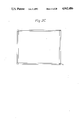
- FIGS. 2A to 2C are diagrams explaining boundary-free chips
- FIG. 3 is a diagram illustrating a bit map configuration of a slide access memory system after enlargement
- FIG. 4 is a block circuit diagram illustrating an example of a suggested slide access memory system after enlargement
- FIG. 5 is a block circuit illustrating a basic configuration according to the present invention.
- FIG. 6 is a block circuit diagram illustrating a first embodiment of the boundary-free semiconductor memory device according to the present invention.
- FIG. 7 is a block diagram of the slide access memory device (chip) of FIG. 6;
- FIG. 8 is a circuit diagram of the latch circuit of FIG. 7;
- FIG. 9 is a circuit diagram of the I/O logic circuit of FIG. 7;
- FIG. 10 is a circuit diagram of the X decoder (Y decoder) of FIG. 9;
- FIGS. 11A through 11D are diagrams explaining the operation of the circuit of FIG. 9;
- FIGS. 12A and 12B is a detailed circuit diagram of the main circuit of FIG. 7;
- FIG. 13 is a diagram showing an allocation of a bit map to memory cell blocks in FIG. 7;
- FIG. 14 is a detailed circuit diagram of the cell block of FIG. 12;
- FIG. 15 partial detailed diagram of FIG. 14,
- FIG. 16 detailed circuit diagram of the selector of FIG. 14
- FIG. 17 is a detailed circuit diagram of the row-side switch (column-side switch) of FIG. 12;
- FIG. 18 is a diagram explaining a row boundary-free chip
- FIGS. 19A through 19C are diagrams showing data of the accessed cell blocks of FIG. 12;
- FIG. 20 is a circuit diagram of the bus arranging circuit of FIG. 12;
- FIG. 21 is a partial circuit diagram of FIG. 20.
- FIGS. 22A and 22B are diagrams explaining the location of the pointing bit
- FIG. 23 is a circuit diagram of the output portion of FIG. 6;
- FIG. 24 is a circuit diagram showing one bit of the circuit of FIG. 23;
- FIG. 25 is a block circuit diagram illustrating a second embodiment of the boundary-free semiconductor memory device according to the present invention.
- FIG. 26 is a circuit diagram of the X decoder (Y decoder) of FIG. 25;
- FIG. 27 is a block diagram of the slide access memory device (chip) of FIG. 25;
- FIG. 28 is a circuit diagram of the I/O logic circuit of FIG. 27.
- FIG. 29 is a circuit diagram of the X decoder (Y decoder) of FIG. 28.
- a boundary-free slide access memory (chip) is now explained with reference to FIG. 1.
- FIG. 1 shows a logical bit map configuration of 1 Mbits. Namely, 1024 memory cells are arranged along the X-direction, and 1024 memory cells are arranged along the Y-direction. In this case, a selection of one row is carried out by 10 bits of row address signals RA0 to RA9, and a selection of one column is carried out by 10 bits of column address signals CA0 to CA9. Note, it is considered at this point that a rectangular bit group of 4 ⁇ 4 bits are simultaneously accessed. In this case, when a pointing bit PB is indicated and accessed on the bit map, peripheral bits (surrounded by a thick line) are also accessed. Since any bit on the bit map can be such a pointing bit PB, no boundary exists within a chip, and thus the chip is a boundary-free memory device.
- a chip boundary exists and, in order to eliminate this chip boundary, the boundary is cycled. For example, as illustrated in FIG. 2A, when the boundary of an accessed bit group exceeds a row boundary of the chip, a region of small row addresses is simultaneously accessed. Also, as illustrated in FIG. 2B, when the boundary of an accessed bit group exceeds a column boundary of the chip, a region of small column addresses is simultaneously accessed. Further, as illustrated in FIG. 2C, when the boundary of an accessed bit group exceeds both the row boundary and the column boundary, a region of small row addresses and small column addresses is simultaneously accessed and thus, a chip boundary-free semiconductor memory device is obtained.
- FIG. 4 a suggested slide memory system after enlargement is illustrated on FIG. 4.
- a selector SEL is provided for each of the slide access memories SM 00 , SM 01 , . . .
- chip select signals X cs0 , X cs1 , X 2 , and X cs3 from an X decoder DECX and chip select signals Y cs0 , Y cs1 , Y cs2 , and Y cs3 from an Y decoder DECY are supplied to all of the selectors SEL, thereby accessing a desired rectangular group of 4 ⁇ 4 bits.
- the X decoder DECX (or the Y decoder DECY) receives two column address signals CA10 and CA11 (or two row address signals RA10 and RA11), to make one of the chip select signals X cs0 , X cs1 , X cs2 , and X cs3 (or the chip select signals Y cs0 , Y cs1 , Y cs1 , and Y cs2 ) low level.
- the X decoder DECX (or the Y decoder DECY) is comprised of tour NAND circuits G X0 , G X1 , G X2 , and G X3 (or G Y0 , G Y1 , G Y2 , and G Y3 ).
- the size of the entire system is increased because a selection of 4 ⁇ 4 bits for each slide access memory is carried out from the exterior of the slide access memories. Also, the connections for the selectors are increased, thus increasing the power consumption, i.e., reducing the efficiency, and increasing the cost of manufacturing the memory system.
- FIG. 5 which illustrates a basic configuration showing a principle of the present invention
- slide access memories SM 00 , SM 01 , . . . , and SM n-l , m-l are arranged in an n rows ⁇ m column matrix.
- These slide access memories incorporate input/output portions, and an access of a voluntary rectangular group of bits is possible.
- sixteen data lines D 0 to D 15 are commonly connected to the input/output portions of the slide access memories, and a first access means accesses the same rectangular group of bits for each of the slide access memories to interconnect these groups to the input/output portions thereof.
- a second access means selects each bit of the input/output portions of the slide access memories to enable or disable the operation of each selected bit.
- the first access means accesses the same rectangular group of bits, but this is often split due to the boundary-free configuration, as shown in FIG. 5, of each of the slide access memories, and the second access means enables or disables each bit of the input/output portions of the slide access memories.
- the slide access memory SM 00 the input/output portions connected to a frame portion including a pointing bit PB are enabled, and the input/output portions connected to the other shaded portions are disabled in for example, a high impedance state.
- the slide access memories SM 01 , SM 10 , and SM 11 the input/output portions connected to framed portions, and the input/output portions connected to shaded portions are disabled.
- FIG. 6 which is a first embodiment of the present invention realizing the principle of FIG. 5
- slide access memories SM 00 , SM 01 , . . . , and SM 33 are arranged in four-rows and four-columns.
- the memory such as SM 00 including a pointing bit PB is activated by the chip select signals X cs0 and Y cs0 , and this pointing bit PB is selected by the row address signals RA0 to RA9 and the column address signals CA0 to CA9 (not shown).
- a data request signal is transmitted from a terminal O 1 , O 2 , or O 3 of the memory SM 00 to a terminal I 1 , I 2 , or I 3 of the memory SM 01 , SM 10 , or SM 11 .
- various control signals RAS, CAS, R/W, OE, and the like are supplied commonly to the memories SM 00 , SM 01 , . . . , and SM 33 .
- FIG. 7 which is a detailed block circuit diagram of the slide access memory SM ij of FIG. 6, reference 701 designates a main circuit including address decoders, a memory cell array, 702 a clock generating circuit for generating various clock signals, and 703 an input/output (I/O) logic circuit for generating bit mask read signals R 0 to R 15 and bit mask write signals W 0 to W 15 for controlling the latch circuit 704.
- the latch circuit 704 is used for connecting internal data lines MD 0 to MD 15 to the data lines D 0 to D 15 commonly connected to the memories.
- one bit of the latch circuit 704 is comprised of a write buffr WB k controlled by the bit mask write signal W k in a write mode, and a read buffer RB k controlled by the bit mask read signal R k in a read mode.
- the write buffer WB k comprises an inverter 801, AND circuits 802 and 803, and a pushpull circuit formed by N channel MOS transistors 804 and 805.
- the read buffer RB k comprises an inverter 806, AND circuits 807 and 808, and a pushpull circuit formed by N channel MOS transistors 809 and 810.
- the AND circuits 802 and 803 are enabled, i.e., the write buffer WB k is turned ON, to connect the common data line D k to the internal data line MD k , and the AND circuits 807 and 808 are disabled, i.e., the pushpull circuit formed by the transistors 809 and 810 are in a high impedance state.
- the AND circuits 807 and 808 are enabled, i.e., the read buffer RB k is turned ON, to connect the internal data line MD k to the common data line D k , and the AND circuits 802 and 803 are disabled, i.e., the pushpull circuit formed by the transistors 804 and 805 are in a high impedance state.
- the outputs X 0 , X 1 , X 2 and X 3 and the signal O 1 , of the X decoder 901 are as shown in TABLE 1.
- the outputs Y 0 , Y 1 , Y 2 , and Y 3 and the signal O 2 of the Y decoder 902 are as shown in TABLE 2.
- the gate circuit G k is also comprised of three gate circuits G k1 , G k2 , and G k3 .
- the latter two gate circuits G k2 and G k3 receive a write enable signal WE and a read enable signal RE, respectively, from the clock generating circuit 702 and, therefore, in a write mode, a bit mask write signal W k is generated, and in a read mode, a bit mask read signal R k is generated.
- FIGS. 11A through 11D An example of the operation of the circuit of FIG. 9 is explained with reference to FIGS. 11A through 11D. For example,
- X address (CA0 to CA9) 3FD (HEXADECIMAL)
- Y address (RA0 to RA9) 3FE (HEXADECIMAL)
- the gate circuits G 0 , G 1 , G 2 , G 4 , G 5 , and G 6 are turned ON and, as a result, the shaded portions as indicated in FIG. 11A are accessed.
- PB is a pointing bit.
- the terminal I 1 thereof receives "0" of the signal O 1 from the chip SM 00 so that the X decoder 901 and the Y decoder 902 of the I/O logic circuit 703 are activated.
- the terminal I 2 thereof receives "0" of the signal O 2 from the chip SM00 so that the X decoder 901 and the Y decoder 902 of the I/O logic circuit 703 are activated.
- the terminal I 1 thereof receives "0" of the signal O 3 from the chip SM 00 so that the X decoder 901 and the Y decoder 902 of the I/O logic circuit 703 are activated.
- the main circuit 701 of FIG. 7 will be explained.
- bit memory cells are divided into 16 cell blocks B 00 B 01 , . . . , and B 33 , i.e., each of the cell blocks B 00 B 01 , . . . , and B 33 is 64 K (65536) bits.
- bit map see FIG. 1 of the memory cells is allocated to the blocks as illustrated in FIG. 13.
- a row decoder RD0 is provided commonly for the four cell blocks B 00 , B 01 , B 02 , and B 03 ; a row decoder RD1 is provided commonly for the four cell blocks B 10 , B 11 , B 12 , and B 13 ; a row decoder RD2 is provided commonly for the four cell blocks B 20 , B 21 , B 22 , and B 23 ; and a row decoder RD3 is provided commonly for the four cell blocks B 30 , B 31 , B 32 , and B 33 .
- These row decoders RD0 to RD3 have the same configuration.
- a column decoder CD0 is provided commonly for the four cell blocks B 00 , B 10 , B 20 , and B 30 ; a column decoder CD1 is provided commonly for the four cell blocks B 01 , B 11 , B 21 , and B 31 ; a column decoder CD2 is provided commonly for the four cell blocks B 02 , B 12 , B 22 , and B 32 ; and a column decoder CD3 is provided commonly for the four cell blocks B 03 , B 13 , B 23 , and B 33 .
- These column decoders CD0 to CD3 also have the same configuration.
- the upper 8 bits RA2 to RA9 are incremented by +1 (decimal denotation) by an incrementer circuit INR, and as a result, two addresses, i.e., +0 address (through state) and +1 address (incremental state) are supplied to row-side switches RSW0 to RSW3.
- the row-side switches RSW0 to RSW3 switch the +0 address and the +1 address in accordance with the lower two bits RA0 and RA1 of the ten-bit row address signals, and supply them to the row decoder RD0 to RD3.
- the upper 8 bits CA2 to CA9 are incremented by +1 (decimal denotation) by an incremental circuit INC, and as a result, two addresses, i.e., +0 address (through state) and +1 address (incremental state) are supplied to column-side switches CSW0 to CSW3.
- the column-side switches CSW0 to CSW3 switch the +0 address and the +1 address in accordance with the lower two bits CA0 and CA1 of the ten-bit row address signals, and supply them to the column decoders CD0 to CD3.
- one-bit outputs of the column-side switches CSW0 to CSW3 are transmitted to selectors S 00 , S 10 , S 20 , and S 30 ; . . . ; S 30 , S 31 , S 32 , and S 33 .
- the sixteen selectors S 00 , S 10 , S 20 , and S 30 ; . . . ; S 30 , S 31 , S 32 , and S 33 are connected by block data buses BDB1 and BDB2 to a bus arranging circuit BAC1.
- the bus BDB1 includes sixteen lines for signals BDB 00 to BDB 03 , BDB 10 to BDB 13 , and their inverted signals
- the bus BDB2 includes sixteen lines for signals BDB 20 , to BDB 23 , BDB 30 to BDB 33 , and their inverted signals.
- the bus arranging circuit BAC1 controls the connections between the selector S 00 to S 33 and input/output terminals MD 0 to MD 15 in accordance with the lower bits RA0, RA1, CA0 and CA1.
- a control circuit CONT controls various portions in accordance with a chip enable CE, a read/write signal R/W, and the like, from the clock generating circuit 702 of FIG. 7.
- FIG. 14 which is a detailed circuit diagram of the cell block B ij of FIG. 12, folded bit lines are used. That is, as illustrated in FIG. 15 memory cells are provided at every other intersection of a pair of bit lines and word lines on one side of each sense amplifier SA.
- the sense amplifier SA of FIG. 15 is comprised of P-channel transistors between a line PSA and bit lines BL0 and BL0, and N-channel transistors between a line NSA and bit lines BL0 and BL0 and when the lines PSA and NSA are made high and low, respectively, the sense amplifier SA is operated.
- the row decoder RD i selects one word line from 256 word lines WL i ,0, WL i ,1, . .
- the column decoder CD j selects two pairs of bit lines such as BL0 and BL0; and BL1 and BL1 by the column selection signals CD j ,0, CD j ,1, . . .
- the switch S ij is comprised of two data bus latches L0 and L1 and two selectors SEL0 and SEL1. As illustrated in FIG. 16, each of the selectors is comprised of an inverter I, AND circuits G1 and G2, and an OR circuit G 3 . That is, in accordance with a bit CSW j of a column address, one of the data bus latches L0 and L1 is connected to the block data buses BDB ij and BDB ij .
- each of the column decoders CD j since each of the column decoders CD j has a 128-bit configuration, this contributes to a reduction of the column decoders, which is helpful in maintaining a large capacity and high integration of a device.
- a cell block configuration is only one example, and the present invention can be applied to an open bit line type.
- each of the column decoders CD j is constructed to be able to directly select one bit line pair from 256 pairs of bit lines. In this case, all of the 8 bit addresses from the column-side switches CSW0 to CSW3 are supplied to all of the respective column decoders CD j , and the switch S ij is deleted.
- the Y coordinate of the bit map is
- each cell block B ij the above-mentioned switching of the cases of +0 (through) and +1 (through) must be carried out, but since one row decoder such as RD0 is provided commonly for four cell blocks such as B 00 , B 01 B 02 , and B 03 for one row, and one column decoder such as CD0 is provided commonly for cell blocks such as B 00 , B 10 , B 20 , and B 30 , only eight switches are provided, i.e., the row-side switches RSW0 to RSW3 and the column-side switches CSW0 to CSW3.
- each of the switches RSW0 to RSW3 (or CSW0 to CSW3) is comprises of a decoder DEC1 for decoding the lower two bits RA0 and RA1 of a row address (or CA0 and CA1 of a column address), and an 8 bit selector SEL which operates in accordance with the output SWT of the decoder DEC1
- the decoding logic of the decoder DEC1 is dependent on each of the switches, and the circuit thereof satisfies the logic equation indicated in TABLE 3.
- FIG. 18 is a diagram showing a row address boundary
- three thick lines in the traverse direction indicate row boundaries by the upper 8 bits RA9 to RA2.
- the four blocks B 0j , B 1j , B 2j , and B 3j have a difference in the lower two bits on the Y coordinate (row) of the bit map plane.
- 4 ⁇ 4 bit groups are accessed, there are four kinds of cases I, II, III, and IV.
- TABLE 4 is transformed into logic equations by the lower two bits RA1 and RA0 indicating the pointing bit position, thus obtaining TABLE 3.
- a boundary-free 4 ⁇ 4 bit group can be accessed, for example, can be read from the bit map, but when data is transmitted to interval input/output terminals MD 0 MD 15 , this is disadvantageous to the peripheral processing of video data.
- a 4 ⁇ 4 bit group corresponding to a block as illustrated in FIG. 19A is read without arrangement, the relationship between the pointing bit (PB) and the other peripheral bits on the bit map is not a logic relationship, as illustrated in FIG. 19B.
- an arrangement of the input/output terminals as illustrated in FIG. 19C is desired. That is,
- the bus arranging circuit BAC is comprised of a demultiplexer circuit DMPX (actually, 16 demultiplexers) which connects the block data bus BDB ij (BDB ij ), connected to the cell block B ij , to one of the input/output terminals MD 0 to MD 15 , and a decoder DEC2 for controlling the demultiplexers of the demultiplexer circuit DMPX.
- DMPX demultiplexer circuit
- the decoder DEC2 controls the demultiplexer circuit DMPX in accordance with the lower 4 bits RA1, RA0, CA1, and CA0 of a row address and a column address.
- an AND circuit within the demultiplexer circuit DMPX is constructed by a complementary metal oxide semiconductor (CMOS) switch as illustrated in FIG. 21.
- CMOS complementary metal oxide semiconductor
- the bus arranging circuit BAC connects the bus block B ij to the internal input/output terminal MD k as indicated in TABLE 5.
- FIG. 23 which is a circuit diagram showing the output portion of FIG. 6, as explained above, the input/output data lines D 0 to D 15 are provided commonly for the slide access memories SM 00 , SM 01 , SM 02 , . . . , and SM 33 , but the input/output data line such as D 0 is connected to only one of the slide access memories SM 00 to SM 33 .
- the read buffer RB 0 of the slide access memory SM 01 when the read buffer RB 0 of the slide access memory SM 01 is turned ON, the read buffers RB 0 corresponding to the internal input/output data line MD 0 of the other slide access memories SM 00 to S 02 , . . . are in a high impedance state.
- FIG. 25 which illustrates a second embodiment of the present invention realizing the principle of FIG. 5, when it is necessary to access the slide access memories such as SM 01 , SM 10 , or SM 11 , adjacent to the slide access memory SM 00 , auxiliary chip selection signals X c0-cs0 to X c0-cs3 from the X decoder DECX' and auxiliary chip selection signals Y c0-cs0 to e,ovs/Y/ c0-cs3 from a Y decoder DECY' carry out an access request. Therefore, the terminals O 1 to O 3 and I 1 to I 3 of FIG.
- FIG. 27 which is a block circuit diagram of the slide access memory SM ij of FIG. 25, the I/O logic circuit 703' is different from the I/O logic circuit 703 of FIG. 7. Namely, the I/O logic circuit 703' is simplified when compared with the I/O logic circuit 703 of FIG. 9, as illustrated in FIG. 23, since the gate circuits 908, 909, 910 of FIG. 9 become unnecessary. Also, an X decoder 2701 and a Y decoder 2702 are simplified when compared with the X decoder 901 and the Y decoder 902 of FIG. 9, as illustrated in FIG. 29, since the generation of the chip selection signals O 1 , O 2 , and O 3 become unnecessary.
- the pointing bit PB is located at a left and upper position of the bit group, but it is possible to change the pointing bit PB as illustrated in FIG. 22B.
- bit map is given by a plane (two-dimensions X and Y)
- present invention can be extended for a space (three-dimensions X, Y, and Z) by using a similar hierarchy technique.
- the number of connection and the number of elements needed for the extension of the slide access memory system can be decreased, thus reducing the size of the entire system.
Landscapes
- Engineering & Computer Science (AREA)
- Physics & Mathematics (AREA)
- General Physics & Mathematics (AREA)
- Theoretical Computer Science (AREA)
- Microelectronics & Electronic Packaging (AREA)
- Dram (AREA)
- Static Random-Access Memory (AREA)
- Image Input (AREA)
Applications Claiming Priority (2)
| Application Number | Priority Date | Filing Date | Title |
|---|---|---|---|
| JP62143254A JPS63308785A (ja) | 1987-06-10 | 1987-06-10 | 半導体記憶装置 |
| JP62-143254 | 1987-06-10 |
Publications (1)
| Publication Number | Publication Date |
|---|---|
| US4962486A true US4962486A (en) | 1990-10-09 |
Family
ID=15334471
Family Applications (1)
| Application Number | Title | Priority Date | Filing Date |
|---|---|---|---|
| US07/204,135 Expired - Fee Related US4962486A (en) | 1987-06-10 | 1988-06-08 | Boundary-free semiconductor memory device having a plurality of slide access memories |
Country Status (5)
| Country | Link |
|---|---|
| US (1) | US4962486A (de) |
| EP (1) | EP0295186B1 (de) |
| JP (1) | JPS63308785A (de) |
| KR (1) | KR910003381B1 (de) |
| DE (1) | DE3851181D1 (de) |
Cited By (4)
| Publication number | Priority date | Publication date | Assignee | Title |
|---|---|---|---|---|
| US5289429A (en) * | 1991-04-11 | 1994-02-22 | Kabushiki Kaisha Toshiba | Address decoder which variably selects multiple rows and/or columns and semiconductor memory device using same |
| US5315560A (en) * | 1992-05-25 | 1994-05-24 | Mitsubishi Denki Kabushiki Kaisha | Semiconductor memory device having a write per bit function in page mode |
| US5408632A (en) * | 1990-06-15 | 1995-04-18 | Matsushita Electric Industrial Co., Ltd. | Semiconductor memory having a bit position decoder and date re-ordering circuitry for arranging bits in a word of data |
| GB2378952A (en) * | 2000-05-31 | 2003-02-26 | Ciba Sc Holding Ag | Stabiliser mixtures |
Citations (5)
| Publication number | Priority date | Publication date | Assignee | Title |
|---|---|---|---|---|
| JPS59110086A (ja) * | 1982-12-14 | 1984-06-25 | Nippon Telegr & Teleph Corp <Ntt> | 集積記憶回路 |
| JPS59180324A (ja) * | 1983-03-31 | 1984-10-13 | Fujitsu Ltd | 半導体記憶装置 |
| JPS6158058A (ja) * | 1984-08-29 | 1986-03-25 | Fujitsu Ltd | 半導体記憶装置 |
| EP0209749A2 (de) * | 1985-06-25 | 1987-01-28 | Ascii Corporation | Speichersystem und Schnittstelle darin |
| US4811297A (en) * | 1986-12-16 | 1989-03-07 | Fujitsu Limited | Boundary-free semiconductor memory device |
Family Cites Families (3)
| Publication number | Priority date | Publication date | Assignee | Title |
|---|---|---|---|---|
| JPS5519733B2 (de) * | 1972-09-05 | 1980-05-28 | ||
| JPS56140390A (en) * | 1980-04-04 | 1981-11-02 | Nippon Electric Co | Picture memory |
| US4460958A (en) * | 1981-01-26 | 1984-07-17 | Rca Corporation | Window-scanned memory |
-
1987
- 1987-06-10 JP JP62143254A patent/JPS63308785A/ja active Pending
-
1988
- 1988-06-08 US US07/204,135 patent/US4962486A/en not_active Expired - Fee Related
- 1988-06-10 EP EP88401439A patent/EP0295186B1/de not_active Expired - Lifetime
- 1988-06-10 KR KR1019880007000A patent/KR910003381B1/ko not_active Expired
- 1988-06-10 DE DE3851181T patent/DE3851181D1/de not_active Expired - Lifetime
Patent Citations (5)
| Publication number | Priority date | Publication date | Assignee | Title |
|---|---|---|---|---|
| JPS59110086A (ja) * | 1982-12-14 | 1984-06-25 | Nippon Telegr & Teleph Corp <Ntt> | 集積記憶回路 |
| JPS59180324A (ja) * | 1983-03-31 | 1984-10-13 | Fujitsu Ltd | 半導体記憶装置 |
| JPS6158058A (ja) * | 1984-08-29 | 1986-03-25 | Fujitsu Ltd | 半導体記憶装置 |
| EP0209749A2 (de) * | 1985-06-25 | 1987-01-28 | Ascii Corporation | Speichersystem und Schnittstelle darin |
| US4811297A (en) * | 1986-12-16 | 1989-03-07 | Fujitsu Limited | Boundary-free semiconductor memory device |
Cited By (5)
| Publication number | Priority date | Publication date | Assignee | Title |
|---|---|---|---|---|
| US5408632A (en) * | 1990-06-15 | 1995-04-18 | Matsushita Electric Industrial Co., Ltd. | Semiconductor memory having a bit position decoder and date re-ordering circuitry for arranging bits in a word of data |
| US5289429A (en) * | 1991-04-11 | 1994-02-22 | Kabushiki Kaisha Toshiba | Address decoder which variably selects multiple rows and/or columns and semiconductor memory device using same |
| US5315560A (en) * | 1992-05-25 | 1994-05-24 | Mitsubishi Denki Kabushiki Kaisha | Semiconductor memory device having a write per bit function in page mode |
| GB2378952A (en) * | 2000-05-31 | 2003-02-26 | Ciba Sc Holding Ag | Stabiliser mixtures |
| GB2378952B (en) * | 2000-05-31 | 2004-04-21 | Ciba Sc Holding Ag | Stabiliser mixtures |
Also Published As
| Publication number | Publication date |
|---|---|
| KR890001084A (ko) | 1989-03-18 |
| KR910003381B1 (ko) | 1991-05-28 |
| EP0295186A2 (de) | 1988-12-14 |
| EP0295186A3 (de) | 1991-02-20 |
| DE3851181D1 (de) | 1994-09-29 |
| JPS63308785A (ja) | 1988-12-16 |
| EP0295186B1 (de) | 1994-08-24 |
Similar Documents
| Publication | Publication Date | Title |
|---|---|---|
| EP1995735B1 (de) | Speichervorrichtung, Speichersteuerung und Speichersystem | |
| EP2009644B1 (de) | Speichervorrichtung, Speichersteuerung und Speichersystem | |
| US20010010057A1 (en) | Semiconductor integrated circuit, computer system, data processor and data processing method | |
| US5815456A (en) | Multibank -- multiport memories and systems and methods using the same | |
| US4811297A (en) | Boundary-free semiconductor memory device | |
| CA1207916A (en) | Cmos multiport general purpose register | |
| US4962486A (en) | Boundary-free semiconductor memory device having a plurality of slide access memories | |
| JP3096362B2 (ja) | シリアルアクセスメモリ | |
| US7020042B2 (en) | Compact decode and multiplexing circuitry for a multi-port memory having a common memory interface | |
| JP2003016787A (ja) | 不揮発性半導体記憶装置および情報機器 | |
| JP2865712B2 (ja) | 半導体記憶装置 | |
| US6795371B2 (en) | Semiconductor memory apparatus of which data are accessible by different addressing type | |
| JPS61289596A (ja) | 半導体記憶装置 | |
| US4831587A (en) | Memory address circuit having function of exchanging selected bits of address input | |
| JPH0444355B2 (de) | ||
| JPH01248395A (ja) | マルチプレクサ | |
| JP4427575B2 (ja) | 半導体記憶装置及びその動作制御方法 | |
| JPH0831276B2 (ja) | 半導体メモリ | |
| JPH0587913B2 (de) | ||
| JPH0415555B2 (de) | ||
| JPH032941A (ja) | 画像メモリ装置 | |
| HK1005277A (en) | Multibank-multiport memories and systems and methods using the same | |
| JPH03230391A (ja) | 半導体記憶装置 | |
| HK1010014A (en) | A memory architecture using conserved adressing and systems and methods using the same |
Legal Events
| Date | Code | Title | Description |
|---|---|---|---|
| AS | Assignment |
Owner name: FUJITSU LIMITED, 1015, KAMIKODANAKA, NAKAHARA-KU, Free format text: ASSIGNMENT OF ASSIGNORS INTEREST.;ASSIGNORS:MASUDA, YUSUKE;OGAWA, JUNJI;REEL/FRAME:004905/0556 Effective date: 19880525 Owner name: FUJITSU LIMITED,JAPAN Free format text: ASSIGNMENT OF ASSIGNORS INTEREST;ASSIGNORS:MASUDA, YUSUKE;OGAWA, JUNJI;REEL/FRAME:004905/0556 Effective date: 19880525 |
|
| FEPP | Fee payment procedure |
Free format text: PAYOR NUMBER ASSIGNED (ORIGINAL EVENT CODE: ASPN); ENTITY STATUS OF PATENT OWNER: LARGE ENTITY |
|
| FPAY | Fee payment |
Year of fee payment: 4 |
|
| REMI | Maintenance fee reminder mailed | ||
| LAPS | Lapse for failure to pay maintenance fees | ||
| FP | Lapsed due to failure to pay maintenance fee |
Effective date: 19981009 |
|
| STCH | Information on status: patent discontinuation |
Free format text: PATENT EXPIRED DUE TO NONPAYMENT OF MAINTENANCE FEES UNDER 37 CFR 1.362 |