US5254515A - Catalyst for decomposing nitrogen oxides and a method of purifying a waste gas containing nitrogen oxides - Google Patents
Catalyst for decomposing nitrogen oxides and a method of purifying a waste gas containing nitrogen oxides Download PDFInfo
- Publication number
- US5254515A US5254515A US07/721,659 US72165990A US5254515A US 5254515 A US5254515 A US 5254515A US 72165990 A US72165990 A US 72165990A US 5254515 A US5254515 A US 5254515A
- Authority
- US
- United States
- Prior art keywords
- sub
- catalyst
- ion
- nox
- waste gas
- Prior art date
- Legal status (The legal status is an assumption and is not a legal conclusion. Google has not performed a legal analysis and makes no representation as to the accuracy of the status listed.)
- Expired - Fee Related
Links
- 239000003054 catalyst Substances 0.000 title claims abstract description 82
- MWUXSHHQAYIFBG-UHFFFAOYSA-N nitrogen oxide Inorganic materials O=[N] MWUXSHHQAYIFBG-UHFFFAOYSA-N 0.000 title claims description 24
- 239000002912 waste gas Substances 0.000 title abstract description 28
- 238000000034 method Methods 0.000 title description 41
- BPQQTUXANYXVAA-UHFFFAOYSA-N Orthosilicate Chemical compound [O-][Si]([O-])([O-])[O-] BPQQTUXANYXVAA-UHFFFAOYSA-N 0.000 claims abstract description 49
- 239000000203 mixture Substances 0.000 claims abstract description 29
- XEEYBQQBJWHFJM-UHFFFAOYSA-N Iron Chemical group [Fe] XEEYBQQBJWHFJM-UHFFFAOYSA-N 0.000 claims description 15
- JPVYNHNXODAKFH-UHFFFAOYSA-N Cu2+ Chemical compound [Cu+2] JPVYNHNXODAKFH-UHFFFAOYSA-N 0.000 claims description 12
- 229910052804 chromium Inorganic materials 0.000 claims description 10
- 239000011651 chromium Substances 0.000 claims description 10
- VYZAMTAEIAYCRO-UHFFFAOYSA-N Chromium Chemical compound [Cr] VYZAMTAEIAYCRO-UHFFFAOYSA-N 0.000 claims description 9
- 229910001431 copper ion Inorganic materials 0.000 claims description 9
- 150000002500 ions Chemical class 0.000 claims description 8
- 229910052787 antimony Inorganic materials 0.000 claims description 7
- 229910021472 group 8 element Inorganic materials 0.000 claims description 7
- 229910052742 iron Inorganic materials 0.000 claims description 7
- 239000010936 titanium Substances 0.000 claims description 7
- 229910052719 titanium Inorganic materials 0.000 claims description 7
- RTAQQCXQSZGOHL-UHFFFAOYSA-N Titanium Chemical compound [Ti] RTAQQCXQSZGOHL-UHFFFAOYSA-N 0.000 claims description 6
- 229910001413 alkali metal ion Inorganic materials 0.000 claims description 6
- WATWJIUSRGPENY-UHFFFAOYSA-N antimony atom Chemical compound [Sb] WATWJIUSRGPENY-UHFFFAOYSA-N 0.000 claims description 6
- 239000010955 niobium Substances 0.000 claims description 6
- 229910052758 niobium Inorganic materials 0.000 claims description 6
- GUCVJGMIXFAOAE-UHFFFAOYSA-N niobium atom Chemical compound [Nb] GUCVJGMIXFAOAE-UHFFFAOYSA-N 0.000 claims description 6
- GPRLSGONYQIRFK-UHFFFAOYSA-N hydron Chemical compound [H+] GPRLSGONYQIRFK-UHFFFAOYSA-N 0.000 claims description 5
- 239000000126 substance Substances 0.000 claims description 5
- 229910017052 cobalt Inorganic materials 0.000 claims description 4
- 239000010941 cobalt Substances 0.000 claims description 4
- GUTLYIVDDKVIGB-UHFFFAOYSA-N cobalt atom Chemical compound [Co] GUTLYIVDDKVIGB-UHFFFAOYSA-N 0.000 claims description 4
- 238000002441 X-ray diffraction Methods 0.000 claims description 3
- 238000006243 chemical reaction Methods 0.000 abstract description 36
- 238000005342 ion exchange Methods 0.000 abstract description 28
- 239000010949 copper Substances 0.000 abstract description 27
- 230000000694 effects Effects 0.000 abstract description 22
- 229910052802 copper Inorganic materials 0.000 abstract description 15
- RYGMFSIKBFXOCR-UHFFFAOYSA-N Copper Chemical compound [Cu] RYGMFSIKBFXOCR-UHFFFAOYSA-N 0.000 abstract description 14
- QVGXLLKOCUKJST-UHFFFAOYSA-N atomic oxygen Chemical compound [O] QVGXLLKOCUKJST-UHFFFAOYSA-N 0.000 abstract description 13
- 239000001301 oxygen Substances 0.000 abstract description 13
- 229910052760 oxygen Inorganic materials 0.000 abstract description 13
- 239000000446 fuel Substances 0.000 abstract description 11
- 230000003247 decreasing effect Effects 0.000 abstract description 7
- 238000002485 combustion reaction Methods 0.000 abstract description 5
- 239000000463 material Substances 0.000 abstract description 4
- 230000003197 catalytic effect Effects 0.000 abstract 1
- 239000007789 gas Substances 0.000 description 21
- VYPSYNLAJGMNEJ-UHFFFAOYSA-N Silicium dioxide Chemical compound O=[Si]=O VYPSYNLAJGMNEJ-UHFFFAOYSA-N 0.000 description 16
- 150000001875 compounds Chemical class 0.000 description 13
- 150000004760 silicates Chemical class 0.000 description 13
- 239000010457 zeolite Substances 0.000 description 11
- 238000002156 mixing Methods 0.000 description 10
- XLYOFNOQVPJJNP-UHFFFAOYSA-N water Substances O XLYOFNOQVPJJNP-UHFFFAOYSA-N 0.000 description 10
- 125000001477 organic nitrogen group Chemical group 0.000 description 9
- 239000002994 raw material Substances 0.000 description 9
- VEXZGXHMUGYJMC-UHFFFAOYSA-N Hydrochloric acid Chemical compound Cl VEXZGXHMUGYJMC-UHFFFAOYSA-N 0.000 description 8
- HNPSIPDUKPIQMN-UHFFFAOYSA-N dioxosilane;oxo(oxoalumanyloxy)alumane Chemical compound O=[Si]=O.O=[Al]O[Al]=O HNPSIPDUKPIQMN-UHFFFAOYSA-N 0.000 description 8
- 238000006722 reduction reaction Methods 0.000 description 8
- RUTXIHLAWFEWGM-UHFFFAOYSA-H iron(3+) sulfate Chemical compound [Fe+3].[Fe+3].[O-]S([O-])(=O)=O.[O-]S([O-])(=O)=O.[O-]S([O-])(=O)=O RUTXIHLAWFEWGM-UHFFFAOYSA-H 0.000 description 7
- 229910000360 iron(III) sulfate Inorganic materials 0.000 description 7
- QAOWNCQODCNURD-UHFFFAOYSA-N Sulfuric acid Chemical compound OS(O)(=O)=O QAOWNCQODCNURD-UHFFFAOYSA-N 0.000 description 6
- 229910021536 Zeolite Inorganic materials 0.000 description 6
- 239000003638 chemical reducing agent Substances 0.000 description 6
- 238000001027 hydrothermal synthesis Methods 0.000 description 6
- 230000009467 reduction Effects 0.000 description 6
- 239000000377 silicon dioxide Substances 0.000 description 6
- QGZKDVFQNNGYKY-UHFFFAOYSA-N Ammonia Chemical compound N QGZKDVFQNNGYKY-UHFFFAOYSA-N 0.000 description 5
- 229910018404 Al2 O3 Inorganic materials 0.000 description 4
- IJGRMHOSHXDMSA-UHFFFAOYSA-N Atomic nitrogen Chemical compound N#N IJGRMHOSHXDMSA-UHFFFAOYSA-N 0.000 description 4
- UGFAIRIUMAVXCW-UHFFFAOYSA-N Carbon monoxide Chemical compound [O+]#[C-] UGFAIRIUMAVXCW-UHFFFAOYSA-N 0.000 description 4
- PNEYBMLMFCGWSK-UHFFFAOYSA-N aluminium oxide Inorganic materials [O-2].[O-2].[O-2].[Al+3].[Al+3] PNEYBMLMFCGWSK-UHFFFAOYSA-N 0.000 description 4
- 239000007864 aqueous solution Substances 0.000 description 4
- 229910002091 carbon monoxide Inorganic materials 0.000 description 4
- 238000010531 catalytic reduction reaction Methods 0.000 description 4
- 238000000354 decomposition reaction Methods 0.000 description 4
- -1 for example Substances 0.000 description 4
- 229930195733 hydrocarbon Natural products 0.000 description 4
- 150000002430 hydrocarbons Chemical class 0.000 description 4
- WGYKZJWCGVVSQN-UHFFFAOYSA-N propylamine Chemical compound CCCN WGYKZJWCGVVSQN-UHFFFAOYSA-N 0.000 description 4
- 239000011541 reaction mixture Substances 0.000 description 4
- 229910017344 Fe2 O3 Inorganic materials 0.000 description 3
- 229910021578 Iron(III) chloride Inorganic materials 0.000 description 3
- YXFVVABEGXRONW-UHFFFAOYSA-N Toluene Chemical compound CC1=CC=CC=C1 YXFVVABEGXRONW-UHFFFAOYSA-N 0.000 description 3
- 150000001768 cations Chemical class 0.000 description 3
- 238000010438 heat treatment Methods 0.000 description 3
- 239000001257 hydrogen Substances 0.000 description 3
- 229910052739 hydrogen Inorganic materials 0.000 description 3
- 229910001387 inorganic aluminate Inorganic materials 0.000 description 3
- RBTARNINKXHZNM-UHFFFAOYSA-K iron trichloride Chemical compound Cl[Fe](Cl)Cl RBTARNINKXHZNM-UHFFFAOYSA-K 0.000 description 3
- VNWKTOKETHGBQD-UHFFFAOYSA-N methane Chemical compound C VNWKTOKETHGBQD-UHFFFAOYSA-N 0.000 description 3
- 229910052680 mordenite Inorganic materials 0.000 description 3
- 238000007254 oxidation reaction Methods 0.000 description 3
- BASFCYQUMIYNBI-UHFFFAOYSA-N platinum Substances [Pt] BASFCYQUMIYNBI-UHFFFAOYSA-N 0.000 description 3
- 239000011148 porous material Substances 0.000 description 3
- 235000019353 potassium silicate Nutrition 0.000 description 3
- 238000007493 shaping process Methods 0.000 description 3
- 229910052708 sodium Inorganic materials 0.000 description 3
- 239000011734 sodium Substances 0.000 description 3
- NTHWMYGWWRZVTN-UHFFFAOYSA-N sodium silicate Chemical compound [Na+].[Na+].[O-][Si]([O-])=O NTHWMYGWWRZVTN-UHFFFAOYSA-N 0.000 description 3
- 238000003756 stirring Methods 0.000 description 3
- 101100352919 Caenorhabditis elegans ppm-2 gene Proteins 0.000 description 2
- 229910021555 Chromium Chloride Inorganic materials 0.000 description 2
- 229910002651 NO3 Inorganic materials 0.000 description 2
- NHNBFGGVMKEFGY-UHFFFAOYSA-N Nitrate Chemical compound [O-][N+]([O-])=O NHNBFGGVMKEFGY-UHFFFAOYSA-N 0.000 description 2
- KDLHZDBZIXYQEI-UHFFFAOYSA-N Palladium Chemical compound [Pd] KDLHZDBZIXYQEI-UHFFFAOYSA-N 0.000 description 2
- KYQCOXFCLRTKLS-UHFFFAOYSA-N Pyrazine Chemical compound C1=CN=CC=N1 KYQCOXFCLRTKLS-UHFFFAOYSA-N 0.000 description 2
- JUJWROOIHBZHMG-UHFFFAOYSA-N Pyridine Chemical compound C1=CC=NC=C1 JUJWROOIHBZHMG-UHFFFAOYSA-N 0.000 description 2
- QAOWNCQODCNURD-UHFFFAOYSA-L Sulfate Chemical compound [O-]S([O-])(=O)=O QAOWNCQODCNURD-UHFFFAOYSA-L 0.000 description 2
- 239000002253 acid Substances 0.000 description 2
- 239000003513 alkali Substances 0.000 description 2
- 150000001340 alkali metals Chemical class 0.000 description 2
- 229910000323 aluminium silicate Inorganic materials 0.000 description 2
- DIZPMCHEQGEION-UHFFFAOYSA-H aluminium sulfate (anhydrous) Chemical compound [Al+3].[Al+3].[O-]S([O-])(=O)=O.[O-]S([O-])(=O)=O.[O-]S([O-])(=O)=O DIZPMCHEQGEION-UHFFFAOYSA-H 0.000 description 2
- VSCWAEJMTAWNJL-UHFFFAOYSA-K aluminium trichloride Chemical compound Cl[Al](Cl)Cl VSCWAEJMTAWNJL-UHFFFAOYSA-K 0.000 description 2
- 229910021529 ammonia Inorganic materials 0.000 description 2
- 239000011230 binding agent Substances 0.000 description 2
- 238000001354 calcination Methods 0.000 description 2
- 230000008859 change Effects 0.000 description 2
- QSWDMMVNRMROPK-UHFFFAOYSA-K chromium(3+) trichloride Chemical compound [Cl-].[Cl-].[Cl-].[Cr+3] QSWDMMVNRMROPK-UHFFFAOYSA-K 0.000 description 2
- GVPFVAHMJGGAJG-UHFFFAOYSA-L cobalt dichloride Chemical compound [Cl-].[Cl-].[Co+2] GVPFVAHMJGGAJG-UHFFFAOYSA-L 0.000 description 2
- 229910052681 coesite Inorganic materials 0.000 description 2
- OPQARKPSCNTWTJ-UHFFFAOYSA-L copper(ii) acetate Chemical compound [Cu+2].CC([O-])=O.CC([O-])=O OPQARKPSCNTWTJ-UHFFFAOYSA-L 0.000 description 2
- 229910052906 cristobalite Inorganic materials 0.000 description 2
- 239000013078 crystal Substances 0.000 description 2
- 150000002431 hydrogen Chemical class 0.000 description 2
- 229910052757 nitrogen Inorganic materials 0.000 description 2
- 150000002894 organic compounds Chemical class 0.000 description 2
- 230000003647 oxidation Effects 0.000 description 2
- 239000000843 powder Substances 0.000 description 2
- 238000002360 preparation method Methods 0.000 description 2
- 229910052703 rhodium Inorganic materials 0.000 description 2
- 239000010948 rhodium Substances 0.000 description 2
- 239000000741 silica gel Substances 0.000 description 2
- 229910002027 silica gel Inorganic materials 0.000 description 2
- 229910052710 silicon Inorganic materials 0.000 description 2
- 239000010703 silicon Substances 0.000 description 2
- 238000004513 sizing Methods 0.000 description 2
- 239000007787 solid Substances 0.000 description 2
- 229910052682 stishovite Inorganic materials 0.000 description 2
- 238000011282 treatment Methods 0.000 description 2
- 229910052905 tridymite Inorganic materials 0.000 description 2
- CYNYIHKIEHGYOZ-UHFFFAOYSA-N 1-bromopropane Chemical compound CCCBr CYNYIHKIEHGYOZ-UHFFFAOYSA-N 0.000 description 1
- GIAFURWZWWWBQT-UHFFFAOYSA-N 2-(2-aminoethoxy)ethanol Chemical compound NCCOCCO GIAFURWZWWWBQT-UHFFFAOYSA-N 0.000 description 1
- HZAXFHJVJLSVMW-UHFFFAOYSA-N 2-Aminoethan-1-ol Chemical compound NCCO HZAXFHJVJLSVMW-UHFFFAOYSA-N 0.000 description 1
- VEXZGXHMUGYJMC-UHFFFAOYSA-M Chloride anion Chemical compound [Cl-] VEXZGXHMUGYJMC-UHFFFAOYSA-M 0.000 description 1
- 229910021274 Co3 O4 Inorganic materials 0.000 description 1
- VGGSQFUCUMXWEO-UHFFFAOYSA-N Ethene Chemical compound C=C VGGSQFUCUMXWEO-UHFFFAOYSA-N 0.000 description 1
- 239000005977 Ethylene Substances 0.000 description 1
- PIICEJLVQHRZGT-UHFFFAOYSA-N Ethylenediamine Chemical compound NCCN PIICEJLVQHRZGT-UHFFFAOYSA-N 0.000 description 1
- DGAQECJNVWCQMB-PUAWFVPOSA-M Ilexoside XXIX Chemical compound C[C@@H]1CC[C@@]2(CC[C@@]3(C(=CC[C@H]4[C@]3(CC[C@@H]5[C@@]4(CC[C@@H](C5(C)C)OS(=O)(=O)[O-])C)C)[C@@H]2[C@]1(C)O)C)C(=O)O[C@H]6[C@@H]([C@H]([C@@H]([C@H](O6)CO)O)O)O.[Na+] DGAQECJNVWCQMB-PUAWFVPOSA-M 0.000 description 1
- PCNDJXKNXGMECE-UHFFFAOYSA-N Phenazine Natural products C1=CC=CC2=NC3=CC=CC=C3N=C21 PCNDJXKNXGMECE-UHFFFAOYSA-N 0.000 description 1
- WTKZEGDFNFYCGP-UHFFFAOYSA-N Pyrazole Chemical compound C=1C=NNC=1 WTKZEGDFNFYCGP-UHFFFAOYSA-N 0.000 description 1
- KJTLSVCANCCWHF-UHFFFAOYSA-N Ruthenium Chemical compound [Ru] KJTLSVCANCCWHF-UHFFFAOYSA-N 0.000 description 1
- GSEJCLTVZPLZKY-UHFFFAOYSA-N Triethanolamine Chemical compound OCCN(CCO)CCO GSEJCLTVZPLZKY-UHFFFAOYSA-N 0.000 description 1
- 101100020289 Xenopus laevis koza gene Proteins 0.000 description 1
- 238000010521 absorption reaction Methods 0.000 description 1
- 230000009471 action Effects 0.000 description 1
- 239000000654 additive Substances 0.000 description 1
- 230000000996 additive effect Effects 0.000 description 1
- 229910052783 alkali metal Inorganic materials 0.000 description 1
- 229910001420 alkaline earth metal ion Inorganic materials 0.000 description 1
- 150000004645 aluminates Chemical class 0.000 description 1
- 229910052782 aluminium Inorganic materials 0.000 description 1
- XAGFODPZIPBFFR-UHFFFAOYSA-N aluminium Chemical compound [Al] XAGFODPZIPBFFR-UHFFFAOYSA-N 0.000 description 1
- ANBBXQWFNXMHLD-UHFFFAOYSA-N aluminum;sodium;oxygen(2-) Chemical compound [O-2].[O-2].[Na+].[Al+3] ANBBXQWFNXMHLD-UHFFFAOYSA-N 0.000 description 1
- 150000001412 amines Chemical class 0.000 description 1
- 150000003868 ammonium compounds Chemical class 0.000 description 1
- FAPDDOBMIUGHIN-UHFFFAOYSA-K antimony trichloride Chemical compound Cl[Sb](Cl)Cl FAPDDOBMIUGHIN-UHFFFAOYSA-K 0.000 description 1
- 125000004429 atom Chemical group 0.000 description 1
- 230000015572 biosynthetic process Effects 0.000 description 1
- 238000009835 boiling Methods 0.000 description 1
- UNYSKUBLZGJSLV-UHFFFAOYSA-L calcium;1,3,5,2,4,6$l^{2}-trioxadisilaluminane 2,4-dioxide;dihydroxide;hexahydrate Chemical compound O.O.O.O.O.O.[OH-].[OH-].[Ca+2].O=[Si]1O[Al]O[Si](=O)O1.O=[Si]1O[Al]O[Si](=O)O1 UNYSKUBLZGJSLV-UHFFFAOYSA-L 0.000 description 1
- 238000003421 catalytic decomposition reaction Methods 0.000 description 1
- 229910052676 chabazite Inorganic materials 0.000 description 1
- 239000011248 coating agent Substances 0.000 description 1
- 238000000576 coating method Methods 0.000 description 1
- 239000008119 colloidal silica Substances 0.000 description 1
- 238000001816 cooling Methods 0.000 description 1
- 229910000365 copper sulfate Inorganic materials 0.000 description 1
- XTVVROIMIGLXTD-UHFFFAOYSA-N copper(II) nitrate Chemical compound [Cu+2].[O-][N+]([O-])=O.[O-][N+]([O-])=O XTVVROIMIGLXTD-UHFFFAOYSA-N 0.000 description 1
- ARUVKPQLZAKDPS-UHFFFAOYSA-L copper(II) sulfate Chemical compound [Cu+2].[O-][S+2]([O-])([O-])[O-] ARUVKPQLZAKDPS-UHFFFAOYSA-L 0.000 description 1
- 229910052878 cordierite Inorganic materials 0.000 description 1
- 239000002178 crystalline material Substances 0.000 description 1
- 239000002274 desiccant Substances 0.000 description 1
- ZBCBWPMODOFKDW-UHFFFAOYSA-N diethanolamine Chemical compound OCCNCCO ZBCBWPMODOFKDW-UHFFFAOYSA-N 0.000 description 1
- JSKIRARMQDRGJZ-UHFFFAOYSA-N dimagnesium dioxido-bis[(1-oxido-3-oxo-2,4,6,8,9-pentaoxa-1,3-disila-5,7-dialuminabicyclo[3.3.1]nonan-7-yl)oxy]silane Chemical compound [Mg++].[Mg++].[O-][Si]([O-])(O[Al]1O[Al]2O[Si](=O)O[Si]([O-])(O1)O2)O[Al]1O[Al]2O[Si](=O)O[Si]([O-])(O1)O2 JSKIRARMQDRGJZ-UHFFFAOYSA-N 0.000 description 1
- WEHWNAOGRSTTBQ-UHFFFAOYSA-N dipropylamine Chemical compound CCCNCCC WEHWNAOGRSTTBQ-UHFFFAOYSA-N 0.000 description 1
- 238000001035 drying Methods 0.000 description 1
- 229910052675 erionite Inorganic materials 0.000 description 1
- 238000001914 filtration Methods 0.000 description 1
- XLYOFNOQVPJJNP-UHFFFAOYSA-M hydroxide Chemical compound [OH-] XLYOFNOQVPJJNP-UHFFFAOYSA-M 0.000 description 1
- 150000004679 hydroxides Chemical class 0.000 description 1
- 230000000977 initiatory effect Effects 0.000 description 1
- 229910052500 inorganic mineral Inorganic materials 0.000 description 1
- 229910052809 inorganic oxide Inorganic materials 0.000 description 1
- 229910052909 inorganic silicate Inorganic materials 0.000 description 1
- 239000007788 liquid Substances 0.000 description 1
- 230000007246 mechanism Effects 0.000 description 1
- 229910021645 metal ion Inorganic materials 0.000 description 1
- 150000001457 metallic cations Chemical group 0.000 description 1
- 150000001455 metallic ions Chemical class 0.000 description 1
- 239000011707 mineral Substances 0.000 description 1
- 239000002808 molecular sieve Substances 0.000 description 1
- TWNQGVIAIRXVLR-UHFFFAOYSA-N oxo(oxoalumanyloxy)alumane Chemical class O=[Al]O[Al]=O TWNQGVIAIRXVLR-UHFFFAOYSA-N 0.000 description 1
- 125000004430 oxygen atom Chemical group O* 0.000 description 1
- 229910052763 palladium Inorganic materials 0.000 description 1
- 229910052697 platinum Inorganic materials 0.000 description 1
- 231100000572 poisoning Toxicity 0.000 description 1
- 230000000607 poisoning effect Effects 0.000 description 1
- UMJSCPRVCHMLSP-UHFFFAOYSA-N pyridine Natural products COC1=CC=CN=C1 UMJSCPRVCHMLSP-UHFFFAOYSA-N 0.000 description 1
- 150000003242 quaternary ammonium salts Chemical class 0.000 description 1
- 229910052761 rare earth metal Inorganic materials 0.000 description 1
- MHOVAHRLVXNVSD-UHFFFAOYSA-N rhodium atom Chemical compound [Rh] MHOVAHRLVXNVSD-UHFFFAOYSA-N 0.000 description 1
- SONJTKJMTWTJCT-UHFFFAOYSA-K rhodium(iii) chloride Chemical compound [Cl-].[Cl-].[Cl-].[Rh+3] SONJTKJMTWTJCT-UHFFFAOYSA-K 0.000 description 1
- 229910052707 ruthenium Inorganic materials 0.000 description 1
- YBCAZPLXEGKKFM-UHFFFAOYSA-K ruthenium(iii) chloride Chemical compound [Cl-].[Cl-].[Cl-].[Ru+3] YBCAZPLXEGKKFM-UHFFFAOYSA-K 0.000 description 1
- 150000003839 salts Chemical class 0.000 description 1
- 150000003335 secondary amines Chemical class 0.000 description 1
- RMAQACBXLXPBSY-UHFFFAOYSA-N silicic acid Chemical compound O[Si](O)(O)O RMAQACBXLXPBSY-UHFFFAOYSA-N 0.000 description 1
- 239000002002 slurry Substances 0.000 description 1
- 229910001388 sodium aluminate Inorganic materials 0.000 description 1
- URGAHOPLAPQHLN-UHFFFAOYSA-N sodium aluminosilicate Chemical compound [Na+].[Al+3].[O-][Si]([O-])=O.[O-][Si]([O-])=O URGAHOPLAPQHLN-UHFFFAOYSA-N 0.000 description 1
- 239000011973 solid acid Substances 0.000 description 1
- 238000001179 sorption measurement Methods 0.000 description 1
- 239000000758 substrate Substances 0.000 description 1
- 238000003786 synthesis reaction Methods 0.000 description 1
- 150000003512 tertiary amines Chemical class 0.000 description 1
- OSBSFAARYOCBHB-UHFFFAOYSA-N tetrapropylammonium Chemical class CCC[N+](CCC)(CCC)CCC OSBSFAARYOCBHB-UHFFFAOYSA-N 0.000 description 1
- BGQMOFGZRJUORO-UHFFFAOYSA-M tetrapropylammonium bromide Chemical compound [Br-].CCC[N+](CCC)(CCC)CCC BGQMOFGZRJUORO-UHFFFAOYSA-M 0.000 description 1
- XJDNKRIXUMDJCW-UHFFFAOYSA-J titanium tetrachloride Chemical compound Cl[Ti](Cl)(Cl)Cl XJDNKRIXUMDJCW-UHFFFAOYSA-J 0.000 description 1
- YFTHZRPMJXBUME-UHFFFAOYSA-N tripropylamine Chemical compound CCCN(CCC)CCC YFTHZRPMJXBUME-UHFFFAOYSA-N 0.000 description 1
- 229910052720 vanadium Inorganic materials 0.000 description 1
- GPPXJZIENCGNKB-UHFFFAOYSA-N vanadium Chemical compound [V]#[V] GPPXJZIENCGNKB-UHFFFAOYSA-N 0.000 description 1
- 238000005406 washing Methods 0.000 description 1
Images

Classifications
-
- B—PERFORMING OPERATIONS; TRANSPORTING
- B01—PHYSICAL OR CHEMICAL PROCESSES OR APPARATUS IN GENERAL
- B01D—SEPARATION
- B01D53/00—Separation of gases or vapours; Recovering vapours of volatile solvents from gases; Chemical or biological purification of waste gases, e.g. engine exhaust gases, smoke, fumes, flue gases, aerosols
- B01D53/34—Chemical or biological purification of waste gases
- B01D53/92—Chemical or biological purification of waste gases of engine exhaust gases
- B01D53/94—Chemical or biological purification of waste gases of engine exhaust gases by catalytic processes
- B01D53/9445—Simultaneously removing carbon monoxide, hydrocarbons or nitrogen oxides making use of three-way catalysts [TWC] or four-way-catalysts [FWC]
- B01D53/945—Simultaneously removing carbon monoxide, hydrocarbons or nitrogen oxides making use of three-way catalysts [TWC] or four-way-catalysts [FWC] characterised by a specific catalyst
-
- C—CHEMISTRY; METALLURGY
- C01—INORGANIC CHEMISTRY
- C01B—NON-METALLIC ELEMENTS; COMPOUNDS THEREOF; METALLOIDS OR COMPOUNDS THEREOF NOT COVERED BY SUBCLASS C01C
- C01B33/00—Silicon; Compounds thereof
- C01B33/20—Silicates
- C01B33/26—Aluminium-containing silicates, i.e. silico-aluminates
- C01B33/28—Base exchange silicates, e.g. zeolites
- C01B33/2807—Zeolitic silicoaluminates with a tridimensional crystalline structure possessing molecular sieve properties; Isomorphous compounds wherein a part of the aluminium ore of the silicon present may be replaced by other elements such as gallium, germanium, phosphorus; Preparation of zeolitic molecular sieves from molecular sieves of another type or from preformed reacting mixtures
- C01B33/2884—Zeolitic silicoaluminates with a tridimensional crystalline structure possessing molecular sieve properties; Isomorphous compounds wherein a part of the aluminium ore of the silicon present may be replaced by other elements such as gallium, germanium, phosphorus; Preparation of zeolitic molecular sieves from molecular sieves of another type or from preformed reacting mixtures the aluminium or the silicon in the network being partly replaced
-
- Y—GENERAL TAGGING OF NEW TECHNOLOGICAL DEVELOPMENTS; GENERAL TAGGING OF CROSS-SECTIONAL TECHNOLOGIES SPANNING OVER SEVERAL SECTIONS OF THE IPC; TECHNICAL SUBJECTS COVERED BY FORMER USPC CROSS-REFERENCE ART COLLECTIONS [XRACs] AND DIGESTS
- Y02—TECHNOLOGIES OR APPLICATIONS FOR MITIGATION OR ADAPTATION AGAINST CLIMATE CHANGE
- Y02A—TECHNOLOGIES FOR ADAPTATION TO CLIMATE CHANGE
- Y02A50/00—TECHNOLOGIES FOR ADAPTATION TO CLIMATE CHANGE in human health protection, e.g. against extreme weather
- Y02A50/20—Air quality improvement or preservation, e.g. vehicle emission control or emission reduction by using catalytic converters
-
- Y—GENERAL TAGGING OF NEW TECHNOLOGICAL DEVELOPMENTS; GENERAL TAGGING OF CROSS-SECTIONAL TECHNOLOGIES SPANNING OVER SEVERAL SECTIONS OF THE IPC; TECHNICAL SUBJECTS COVERED BY FORMER USPC CROSS-REFERENCE ART COLLECTIONS [XRACs] AND DIGESTS
- Y02—TECHNOLOGIES OR APPLICATIONS FOR MITIGATION OR ADAPTATION AGAINST CLIMATE CHANGE
- Y02T—CLIMATE CHANGE MITIGATION TECHNOLOGIES RELATED TO TRANSPORTATION
- Y02T10/00—Road transport of goods or passengers
- Y02T10/10—Internal combustion engine [ICE] based vehicles
- Y02T10/12—Improving ICE efficiencies
Definitions
- the present invention relates to a catalyst for the removal of nitrogen oxides (which will hereinafter be referred to as "NOx”) from a waste gas containing NOx, in particular, a catalyst for directly decomposing NOx, and to a method of purifying a gas containing NOx, in particular, a gas containing NOx, CO and hydrocarbons (which will hereinafter be referred to as "HC").
- NOx nitrogen oxides
- HC hydrocarbons
- NOx in a combustion waste gas exhausted from industrial plants, cars, etc. is a material causing photochemical smog
- development of a method of removing it is an important and urgent social problem from the standpoint of protecting the environment. It is particularly difficult to remove NO of NOx gases and various methods have been proposed to solve this problem up to the present time.
- a catalytic reduction method has been proposed and developed, as an effective means, but this method needs a reducing agent such as ammonia, hydrogen, carbon monoxide, etc. and a special apparatus for recovering or decomposing the unreacted reducing agent.
- a catalytic decomposition method is a method comprising only passing a waste gas through a catalyst bed to decompose NOx into nitrogen and oxygen without need of a special additive.
- This method is very simple and accordingly, it is most preferable.
- Pt, CuO and Co 3 O 4 have NO decomposing activity, but they tend to be subject to poisoning with oxygen as a decomposition product and cannot be a practical catalyst [Toshio Uchijima, "Hyomen (Surface)" Vol. 18, No. 3 (1980), page 132].
- harmful materials such as NOx, CO, HC, etc. which are considered to cause photochemical smog are contained in combustion waste gases exhausted from gasoline engines of cars, diesel engines of buses, tracks, etc. and it is an important and urgent social problem to develop a method of removing them from the standpoint of protecting the environment.
- This catalytic reduction method is a method comprising passing a waste gas through a catalyst bed in the presence of a reducing gas and thereby converting NOx into unharmful nitrogen, which is classified into two methods depending on the variety of the reducing agents.
- these methods are the so-called non-selective reduction method wherein reduction of a waste gas is carried out by adding a reducing gas such as hydrogen, carbon monoxide, hydrocarbons, etc. and contacting with a catalyst and the so-called selective reduction method wherein the reduction is carried out by adding a reducing gas such as ammonia, etc. and contacting with a catalyst.
- the former method has the disadvantage that the reducing agent is reacted with oxygen jointly present in the gas and then the removal reaction of NOx proceeds, resulting in need of the reducing agent in a large amount, but in a case where a waste gas such as exhausted from internal combustion engines of cars previously contains a reducing agent such as carbon monoxide, hydrocarbons, etc.
- the non-selective reduction method is more advantageous for removing NOx in the waste gas.
- a catalyst for the removal of NOx in waste gases from cars it is preferable to use one for the non-selective reduction reaction.
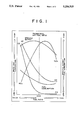
- a waste gas from a car has a gas composition as shown in FIG. 1, and when a three way catalyst capable of simultaneously removing NOx, CO and HC is used, the gas composition is as shown in FIG. 2, and the three components of NOx, CO and HC are removed approximately at the theoretical fuel ratio.
- the engine combustion waste gas at the theoretical air fuel ratio has the following composition:
- HC includes a wide range of C 1 to C 7 , i.e. methane (CH 4 ) to toluene (C 7 H 8 ), and accordingly, in the following reaction schemes, HC is represented by ethylene (C 2 H 4 ).
- the catalyst obtained by supporting copper ion on silica gel by an ion exchange method has a considerably high initial activity, but the activity is rapidly lowered with the passage of time.
- the catalyst obtained by subjecting a Y-type zeolite or mordenite to ion-exchange with copper has a low decomposition activity in the presence of oxygen.
- the catalyst obtained by subjecting a ZSM-5 type zeolite to ion-exchange with copper has a problem that the decomposition activity of NO is high, but the selectivity in the conversion of NO into N 2 (2NO ⁇ N 2 +O 2 ) is low (Japanese Patent Laid-Open Publication No. 125250/1985).
- the three way catalyst When using the three way catalyst having been put to practical use for the purpose of purifying a waste gas from a car engine, oxygen is consumed by the oxidation reactions of the above described reactions (1) and (2) and the reduction reactions of NO of the above described reactions (3) to (5) proceed under such a state that the oxygen concentration is considerably lowered. Therefore, the three way catalyst is effective only near the theoretical air fuel ratio (14.6) and it is difficult to reduce NOx in a high air fuel ratio zone in which the rate of fuel consumption can be decreased ["Shokubai (Catalyst)" Vol. 29, No. 7, 1987, p 598-609].
- composition of a waste gas from a diesel engine is as follows:
- the inventors have made various efforts to solve the above described problems of the prior art and consequently, have found that the crystalline silicate having the specified composition and crystalline structure and having been subjected to ion-exchange with copper has not only a very high activity as a catalyst of catalytically decomposing NO, but also a high selectivity for the conversion of NO into N 2 and exhibits a stable activity even in the presence of oxygen and SOx, and when using this catalyst, NOx, CO and HC are decreased near the theoretical air fuel ratio and in a range of higher than the theoretical air fuel ratio, i.e. in the presence of oxygen, that is to say, the above described reactions (1) to (7) take place.
- the present invention is based on this finding.
- the present invention provides a catalyst for decomposing nitrogen oxides, comprising a crystalline silicate having a chemical composition represented by the general formula in the terms of mole ratios of oxides under dehydrated state,
- R is at least one of alkali metal ions and hydrogen ion
- M is iron and chromium or iron and cobalt, in combination, are preferable.
- the present invention provides a method of purifying a waste gas containing nitrogen oxides, carbon monoxide and hydrocarbons, comprising contacting the waste gas at a temperature of 300° to 800° C. a catalyst comprising a crystalline silicate having a chemical composition represented by the general formula in the terms of mole ratios of oxides under dehydrated state,
- R is at least one of alkali metal ions and hydrogen ion
- M is iron and chromium or iron and cobalt, in combination, are preferable.
- FIG. 1 a graph showing a composition of a waste gas from a car (no catalyst)
- FIG. 2 is a graph showing a composition of a waste gas in the case of using a three way catalyst.
- the catalyst of the present invention has a very high activity in the decomposition of NO, which can be maintained for a long time.
- the oxidation and reduction cycle of copper ion-exchanged (Cu 2+ ⁇ Cu + ) can readily be carried out, which is probably due to that a mechanism of releasing oxygen at a relatively low temperature is combined with the peculiar crystalline structure of the catalyst of the present invention, the structure stability and the heat resistance.
- the catalyst used in the present invention has the feature that on Cu + , CO tends to be activated and NO tends to be decomposed, and on the crystalline silicate, HC tends to be activated.
- Zeolite is a crystalline aluminosilicate containing zeolitic water, as shown by an etymology of Greek "boiling water", and its composition is generally represented by the following general formula:
- n is the atomic valence of a cation M
- x is a numeral in the range of 0.8 ⁇ 2
- y is a numeral of at least 2
- z is a numeral of at least 0.
- the fundamental structure of the aluminosilicate is such that SiO 4 tetrahedrons having 4 oxygens coordinated at the peaks round the silicon and AlO 4 tetrahedrons having aluminum positioned at the center instead of the silicon are regularly and three-dimensionally combined with owning jointly the oxygen atoms in such a manner that the O/(Al+Si) atomic ratio is 2.
- a three-dimensional network structure having pores differing in size and shape is formed depending upon the combining system of these tetrahedrons with each other.
- the negative charge of the AlO 4 tetrahedron is electrically neutralized by combining with cations such as alkali metal or alkaline earth metal ions.
- the thus formed pores have a size of 2 ⁇ 3 ⁇ to 10 and several ⁇ , but can be varied by exchanging the metallic cation bonded to the AlO 4 tetrahedrons with another metallic ion differing in size and atomic valence.
- Zeolites have widely been used, utilizing the pores thereof, as drying agents of gases or liquids on commercial scale, molecular sieves for adsorbing and separating molecules in a mixture of two or more molecules from each other or industrial catalysts utilizing the property thereof that those in which the metal ion is exchanged with hydrogen ion functions as a solid acid.
- Zeolites have a number of varieties which are respectively named in different names depending upon the crystalline structures characterized by X-ray diffraction patterns.
- Naturally occurring zeolites there are chabazite, erionite, mordenite, clinoputyrolite and the like.
- synthetic zeolite there are A, X, Y, large and port type mordenite, ZSM-5 and the like.
- zeolites what can be used in the present invention are limited to the crystalline silicates each having the specified composition and structure. These crystalline silicates do not naturally occur, but can be synthesized by the following procedures:
- the above described crystalline silicate used in the present invention can be synthesized by preparing a reaction mixture containing a silica source, an oxide source such as of Group VIII elements, rare earth elements, titanium, vanadium, chromium, niobium and antimony, an alumina source, an alkali source, water and an organic nitrogen-containing compounds and then heating the mixture for a time and at a temperature sufficient to form the crystalline silicate.
- a silica source such as of Group VIII elements, rare earth elements, titanium, vanadium, chromium, niobium and antimony
- an alumina source such as of Group VIII elements, rare earth elements, titanium, vanadium, chromium, niobium and antimony
- an alumina source such as of Group VIII elements, rare earth elements, titanium, vanadium, chromium, niobium and antimony
- an alumina source such as of Group VIII elements, rare earth elements, titanium, vanadium, chromium, ni
- silica source there can be used any silica compounds commonly used in the synthesis of zeolites, for example, solid silica powders, colloidal silica and silicates such as water glass.
- the sources of Group VIII elements, titanium, chromium, niobium and antimony can be used in the form of compounds such as sulfate, nitrate, chloride, etc.
- Examples of Group VIII elements are iron, cobalt, ruthenium, rhodium, platinum, palladium, etc.
- alumina source there can be used compounds such as aluminum chloride, nitrate, sulfate, oxide and hydroxide. Above all, sodium aluminate is most suitable.
- alkali source there can be used compounds such as hydroxides, aluminates and silicates of alkali metals such as sodium.
- the organic nitrogen-containing compound as one raw material for the hydrothermal synthesis of crystalline silicates include the following materials:
- Organic Amines primary amines such as n-propylamine, monoethanolamine, etc. secondary amines such as dipropylamine, diethanolamine, etc. tertiary amines such as tripropylamine, triethanolamine, etc. ethylenediamine, diglycolamine or mixtures of the above described compounds and halogenated hydrocarbons (brominated propyl) quaternary ammonium salts such as tetrapropylammonium salt, etc.
- the crystalline silicate of the present invention is characterized in that a part of Al in the structure of a zeolite of the prior art is replaced by a Group VIII element, titanium, chromium, niobium or antimony and the SiO 2 /(M 2 O 3 +Al 2 O 3 ) ratio is 12 or more, and is prepared from a reaction mixture having the following composition:
- the crystalline silicate of the present invention is synthesized by heating the above described mixture of the raw materials at a temperature and for a time sufficient to form the crystalline silicate. That is, the hydrothermal synthesis temperature is generally 80° to 300° C., preferably 130° to 200° C. and the hydrothermal synthesis time is generally 0.5 to 14 days, preferably 1 to 10 days.
- the pressure is not particularly restricted, but the hydrothermal synthesis is preferably carried out at an autogeneous pressure.
- the hydrothermal synthetic reaction is carried out by heating a mixture of raw materials at a desired temperature and continuing, while stirring if necessary, until the crystalline silicate is formed. After the crystal is thus formed, the reaction mixture is cooled to room temperature, filtered, washed with water and the crystal grains are classified, ordinarily followed by drying for about 5 to 24 hours at a temperature of at least 100° C.
- the crystalline silicate prepared by the above described procedures is used as a catalyst as it is or after shaping in a suitable size by mixing with a binding agent that has hitherto been used for shaping a catalyst according to the well-known technique.
- the crystalline silicate of the present invention is a porous crystalline material having a regular and constant crystalline structure, which has generally X-diffraction patterns as shown in Table 1:
- the crystalline silicate obtained by the above described hydrothermal synthesis contains an alkali metal ion such as Na + , an ion of an organic nitrogen-containing compound such as (C 3 H 7 ) 4 N + .
- an alkali metal ion such as Na +
- an ion of an organic nitrogen-containing compound such as (C 3 H 7 ) 4 N + .
- a method comprising calcining the silicate in the air at a temperature of 400° to 700° C. for 2 to 48 hours to remove the organic nitrogen-containing compounds and then immersing in a strong acid such as hydrochloric acid
- a method comprising immersing the silicate in an aqueous solution of an ammonium compound to convert it into the NH 4 type and then calcining to convert it into the H type.
- the ion-exchange sites such as alkali metal ions and hydrogen ions in the crystalline silicate obtained by the above described method are replaced by copper ions by the following method to obtain the catalyst of the present invention (which will hereinafter be referred to as "the present catalyst” sometimes).
- the ion-exchange is carried out by an ordinary method comprising immersing the crystalline silicate in an aqueous solution in which a mineral acid salt such as copper sulfate, copper nitrate, etc. or an organic acid salt such as copper acetate is dissolved.
- a mineral acid salt such as copper sulfate, copper nitrate, etc. or an organic acid salt such as copper acetate is dissolved.
- concentration of copper ion in the aqueous solution can suitably by chosen depending on the aimed exchange ratio of copper ion and the copper ion exchanges a cation in the crystalline silicate in any form of Cu + , Cu 2+ and CuOH + .
- the ion-exchanged silicate is then adequately washed with water and dried to obtain the present catalyst.
- the copper ion exchange ratio of the present catalyst should be at least 10% based on all the exchangeable ions contained in the crystalline silicate as the catalyst substrate and as the NO-decomposing activity is increased with the exchange ratio, this should preferably be present in the range of 40 to 200%. If the exchange ratio is lower than 10%, no effective NO decomposing activity is obtained.
- the exchange ratio of copper shows the ratio of copper ion in the ion-exchange sites, which is calculated assuming that two Na + atoms are ion-exchanged by one Cu 2+ atom.
- an exchange ratio of 200% shows such a state that all the ion-exchange sites are ion-exchanged with copper, i.e. Cu is ion-exchanged under the state of one Cu atom.
- the NO decomposing catalyst of the present invention can be used at a wider temperature range, i.e. at 300° to 1000° C., preferably 400° to 700° C., as compared with that of the prior art.
- the present catalyst When using the present catalyst on a commercial scale, it is preferably shaped in a suitable form, for example, a spherical form, columnar form, honeycomb form by the use of an inorganic oxide such as silica or alumina, as a binder, optionally using an organic shaping aid.
- a suitable form for example, a spherical form, columnar form, honeycomb form by the use of an inorganic oxide such as silica or alumina, as a binder, optionally using an organic shaping aid.
- the crystalline silicate before the ion-exchange with copper can be previously shaped and the shaped body is then exchanged with copper ion to obtain a catalyst, which can be regarded as the catalyst of the present invention.
- the size of the shaped body is not particularly limited.
- the catalyst of the present invention is preferably shaped in a monolithic body, or is preferably used after coating a monolithic support with the present catalyst.
- a crystalline silicate was synthesized by the following procedure:
- the thus resulting mixture was mixed with a suitable amount of sulfuric acid to adjust the pH to about 9, adequately mixed with propylamine and propyl bromide, as an organic nitrogen-containing compound, in a proportion of 20 times as much as the sum of the moles of Fe 2 O 3 and Al 2 O 3 and then charged in a stainless autoclave of 500 cc.
- the above described mixture was reacted at 160° C. for 3 hours while stirring at about 500 rpm. After cooling, the reaction mixture was subjected to filtration to separate a solid content, adequately washed with water until the pH of the washing water be about 8, dried at 110° C. for 12 hours and calcined at 550° C. for 3 hours.
- This product had a crystalline grain diameter of about 1 ⁇ m and a compotion in the terms of moles of oxides under dehydrated state:
- Crystalline Silicate 1 The procedure of preparing Crystalline Silicate 1 was repeated except changing the amounts of ferric sufate and aluminum sulfate used in the preparation of the raw materials of Crystalline Silicate 1 into those tabulated below in terms of the mole ratio of Fe 2 O 3 and Al 2 O 3 , thus preparing Crystalline Silicates 2 to 4:
- Crystalline Silicate 1 was repeated except using hydrochloric acid instead of the sulfuric acid, and cobalt chloride, ruthenium chloride, rhodium chloride, titanium chloride, chromium chloride or antimony chloride respectively in an amount of the same mole as Fe 2 O 3 in terms of the oxide instead of the ferric sulfate, thus preparing Crystalline Silicates 5 to 10.
- These crystalline silicates had compositions exclusive of the organic nitrogen-containing compounds, represented by the following formula in the terms of mole ratios of oxides under dehydrated state:
- M represents Ca, Ru, Rh, Ti, Cr or Sb in the order of Crystalline Silicates 5 to 10.
- Crystalline Silicate 1 The procedure of preparing Crystalline Silicate 1 was repeated except changing the SiO 2 /(0.1Fe 2 O 3 +0.9Al 2 O 3 ) ratio into 20 and 200 in the preparation of Crystalline Silicate 1, thus obtaining Crystalline Silicates 11 and 12.
- Catalysts 1 to 12 were subjected to sizing in 16 to 32 meshes, 0.5 g of each of the catalysts was packed in a flow reactor of normal pressure fixed bed type, and was then subjected to an activity estimation test under the following conditions. The results are shown in Table 2:
- the reacted NO was all converted into N 2 and O 2 .
- the catalyst used in the present invention exhibited a high acvctivity with a decreased change of activity with the passage of time even when using a gas containing SO 2 .
- Example 1 The procedure of Example 1 was repeated except not adding ferric sulfate during mixing the raw materials for Crystalline Silicate 1 of Example 1, mixing them to give the following molar ratio:
- the product was then subjected to ion-exchange with copper (Cu ion-exchange ratio 105%) in an analogous manner to Example 1 and to activity estimating test under the same conditions, thus resulting in that the NO conversion ratio was high, i.e. 74% and the conversion ratio of the reacted NO into N 2 was low, i.e. 72% due to more byproduced NO 2 , etc.
- Catalysts 1 to 12 of Example 1 were subjected to sizing in 16 to 32 meshes, 0.5 g of each of the catalysts was packed in a flow reactor of normal pressure fixed bed type, and was then subjected to an activity estimation test under the following conditions. The results are shown in Table 4:
- the catalyst used in the present invention exhibited a high activity for NO, CO and HC with a decreased change of activity with the passage of time, even when using a gas containing SO 2 .
- the catalyst consisting of the crystalline silicate in which copper is incorporated according to the present invention can effectively be used as a catalyst for decomposing NOx in a waste gas into N 2 and O 2 .
- NOx, CO and HC contained in a waste gas can effectively be decreased by the use of the catalyst consisting of the crystalline silicate in which copper is incorporated according to the present invention.
Landscapes
- Chemical & Material Sciences (AREA)
- Engineering & Computer Science (AREA)
- Organic Chemistry (AREA)
- Health & Medical Sciences (AREA)
- Environmental & Geological Engineering (AREA)
- Geology (AREA)
- General Life Sciences & Earth Sciences (AREA)
- Combustion & Propulsion (AREA)
- Life Sciences & Earth Sciences (AREA)
- Biomedical Technology (AREA)
- Inorganic Chemistry (AREA)
- Analytical Chemistry (AREA)
- General Chemical & Material Sciences (AREA)
- Oil, Petroleum & Natural Gas (AREA)
- Chemical Kinetics & Catalysis (AREA)
- Catalysts (AREA)
- Exhaust Gas Treatment By Means Of Catalyst (AREA)
Applications Claiming Priority (4)
| Application Number | Priority Date | Filing Date | Title |
|---|---|---|---|
| JP28199689A JPH03143547A (ja) | 1989-10-31 | 1989-10-31 | 窒素酸化物分解触媒 |
| JP1303194A JP2695668B2 (ja) | 1989-11-24 | 1989-11-24 | 窒素酸化物含有排ガスの浄化方法 |
| JP1-303194 | 1989-11-24 | ||
| JP1-281996 | 1990-10-31 |
Publications (1)
| Publication Number | Publication Date |
|---|---|
| US5254515A true US5254515A (en) | 1993-10-19 |
Family
ID=26554422
Family Applications (1)
| Application Number | Title | Priority Date | Filing Date |
|---|---|---|---|
| US07/721,659 Expired - Fee Related US5254515A (en) | 1989-10-31 | 1990-10-30 | Catalyst for decomposing nitrogen oxides and a method of purifying a waste gas containing nitrogen oxides |
Country Status (5)
| Country | Link |
|---|---|
| US (1) | US5254515A (fr) |
| EP (1) | EP0451291B1 (fr) |
| CA (1) | CA2045128C (fr) |
| DE (1) | DE69020539T2 (fr) |
| WO (1) | WO1991006508A1 (fr) |
Cited By (8)
| Publication number | Priority date | Publication date | Assignee | Title |
|---|---|---|---|---|
| US5374410A (en) * | 1992-07-08 | 1994-12-20 | Grasselli; Robert K. | NOx abatement process |
| US5776423A (en) * | 1994-05-10 | 1998-07-07 | Engelhard Corporation | Trimetallic zeolite catalyst and method of NOx abatement using the same |
| US5925590A (en) * | 1994-05-25 | 1999-07-20 | Eltron Research, Inc. | Catalysts utilizing oxygen-deficient metal oxide compound for removal of exhaust gas constituents |
| US6555080B1 (en) * | 2001-07-13 | 2003-04-29 | Chevron U.S.A. Inc. | Using zeolite SSZ-57 for reduction of oxides of nitrogen in a gas stream |
| US20040101475A1 (en) * | 2000-12-08 | 2004-05-27 | Mertens Machteld Maria | Crystalline molecular sieves |
| US20110076229A1 (en) * | 2008-05-21 | 2011-03-31 | Basf Se | PROCESS FOR THE DIRECT SYNTHESIS OF Cu CONTAINING ZEOLITES HAVING CHA STRUCTURE |
| US20110165040A1 (en) * | 2010-11-03 | 2011-07-07 | Ford Global Technologies, Llc | Device for remediating emissions and method of manufacture |
| CN110621402A (zh) * | 2017-03-20 | 2019-12-27 | 巴斯夫公司 | 选择性催化还原制品和系统 |
Families Citing this family (1)
| Publication number | Priority date | Publication date | Assignee | Title |
|---|---|---|---|---|
| EP0678325B1 (fr) * | 1991-07-09 | 1999-05-06 | Mitsubishi Jukogyo Kabushiki Kaisha | Catalyseur et méthode pour la purification de gaz d'échappement |
Citations (4)
| Publication number | Priority date | Publication date | Assignee | Title |
|---|---|---|---|---|
| US4735927A (en) * | 1985-10-22 | 1988-04-05 | Norton Company | Catalyst for the reduction of oxides of nitrogen |
| US4845063A (en) * | 1982-10-15 | 1989-07-04 | Mobil Oil Corporation | Zeolite catalyst of improved hydrothermal stability |
| US5059567A (en) * | 1986-05-22 | 1991-10-22 | Pq Zeolite B. V. | Process for the preparation of a modified zeolite |
| US5098687A (en) * | 1984-04-26 | 1992-03-24 | Uop | Substituted aluminosilicate compositions and process for preparing same |
Family Cites Families (7)
| Publication number | Priority date | Publication date | Assignee | Title |
|---|---|---|---|---|
| JPS51147470A (en) * | 1975-06-12 | 1976-12-17 | Toa Nenryo Kogyo Kk | A process for catalytic reduction of nitrogen oxides |
| CA1139731A (fr) * | 1979-01-15 | 1983-01-18 | Mae K. Rubin | Procede d'obtention d'un produit a base de zsm-12 et emploi comme catalyseur |
| US4297328A (en) * | 1979-09-28 | 1981-10-27 | Union Carbide Corporation | Three-way catalytic process for gaseous streams |
| EP0115031A1 (fr) * | 1982-12-23 | 1984-08-08 | Union Carbide Corporation | Tamis moléculaire en ferrosilicate |
| US4554396A (en) * | 1984-09-18 | 1985-11-19 | Mobil Oil Corporation | Olefin upgrading with ferrosilicate zeolite catalyst |
| JP2555637B2 (ja) * | 1987-10-07 | 1996-11-20 | 東ソー株式会社 | 銅含有ゼオライトの製造方法 |
| DE68912262T2 (de) * | 1988-10-07 | 1994-05-11 | Sakai Chemical Industry Co | Katalysatoren und Verfahren zur Denitrierung. |
-
1990
- 1990-10-30 EP EP90915829A patent/EP0451291B1/fr not_active Expired - Lifetime
- 1990-10-30 US US07/721,659 patent/US5254515A/en not_active Expired - Fee Related
- 1990-10-30 WO PCT/JP1990/001394 patent/WO1991006508A1/fr not_active Ceased
- 1990-10-30 CA CA002045128A patent/CA2045128C/fr not_active Expired - Fee Related
- 1990-10-30 DE DE69020539T patent/DE69020539T2/de not_active Expired - Fee Related
Patent Citations (4)
| Publication number | Priority date | Publication date | Assignee | Title |
|---|---|---|---|---|
| US4845063A (en) * | 1982-10-15 | 1989-07-04 | Mobil Oil Corporation | Zeolite catalyst of improved hydrothermal stability |
| US5098687A (en) * | 1984-04-26 | 1992-03-24 | Uop | Substituted aluminosilicate compositions and process for preparing same |
| US4735927A (en) * | 1985-10-22 | 1988-04-05 | Norton Company | Catalyst for the reduction of oxides of nitrogen |
| US5059567A (en) * | 1986-05-22 | 1991-10-22 | Pq Zeolite B. V. | Process for the preparation of a modified zeolite |
Cited By (15)
| Publication number | Priority date | Publication date | Assignee | Title |
|---|---|---|---|---|
| US5374410A (en) * | 1992-07-08 | 1994-12-20 | Grasselli; Robert K. | NOx abatement process |
| US5776423A (en) * | 1994-05-10 | 1998-07-07 | Engelhard Corporation | Trimetallic zeolite catalyst and method of NOx abatement using the same |
| US5925590A (en) * | 1994-05-25 | 1999-07-20 | Eltron Research, Inc. | Catalysts utilizing oxygen-deficient metal oxide compound for removal of exhaust gas constituents |
| US20040101475A1 (en) * | 2000-12-08 | 2004-05-27 | Mertens Machteld Maria | Crystalline molecular sieves |
| US7074384B2 (en) * | 2000-12-08 | 2006-07-11 | Exxonmobil Chemical Patents Inc. | Crystalline molecular sieves |
| US6555080B1 (en) * | 2001-07-13 | 2003-04-29 | Chevron U.S.A. Inc. | Using zeolite SSZ-57 for reduction of oxides of nitrogen in a gas stream |
| US20110076229A1 (en) * | 2008-05-21 | 2011-03-31 | Basf Se | PROCESS FOR THE DIRECT SYNTHESIS OF Cu CONTAINING ZEOLITES HAVING CHA STRUCTURE |
| EP2551240A2 (fr) | 2008-05-21 | 2013-01-30 | Basf Se | Procédé de synthèse directe de zéolites de structure CHA contenant du cuivre |
| US8715618B2 (en) | 2008-05-21 | 2014-05-06 | Basf Se | Process for the direct synthesis of Cu containing zeolites having CHA structure |
| US9272272B2 (en) | 2008-05-21 | 2016-03-01 | Basf Se | Process for the direct synthesis of Cu containing zeolites having CHA structure |
| EP3778484A1 (fr) | 2008-05-21 | 2021-02-17 | Basf Se | Procédé pour la synthèse directe de cu contenant des zéolites ayant une structure cha |
| US20110165040A1 (en) * | 2010-11-03 | 2011-07-07 | Ford Global Technologies, Llc | Device for remediating emissions and method of manufacture |
| CN110621402A (zh) * | 2017-03-20 | 2019-12-27 | 巴斯夫公司 | 选择性催化还原制品和系统 |
| CN110621402B (zh) * | 2017-03-20 | 2023-04-14 | 巴斯夫公司 | 选择性催化还原制品和系统 |
| US11724248B2 (en) | 2017-03-20 | 2023-08-15 | Basf Corporation | Selective catalytic reduction articles and systems |
Also Published As
| Publication number | Publication date |
|---|---|
| CA2045128C (fr) | 2000-08-22 |
| DE69020539D1 (de) | 1995-08-03 |
| CA2045128A1 (fr) | 1991-05-01 |
| EP0451291A1 (fr) | 1991-10-16 |
| WO1991006508A1 (fr) | 1991-05-16 |
| EP0451291B1 (fr) | 1995-06-28 |
| EP0451291A4 (en) | 1992-03-25 |
| DE69020539T2 (de) | 1995-11-02 |
Similar Documents
| Publication | Publication Date | Title |
|---|---|---|
| JPH0417097B2 (fr) | ||
| CA2056952C (fr) | Catalyseur servant a la purification des gaz d'echappement | |
| US5543125A (en) | Method of purifying non-containing exhaust gases using iron containing mordenite | |
| US5254515A (en) | Catalyst for decomposing nitrogen oxides and a method of purifying a waste gas containing nitrogen oxides | |
| US5695728A (en) | Method for removal of nitrogen oxides | |
| JP4957176B2 (ja) | 窒素酸化物浄化触媒及び窒素酸化物浄化方法 | |
| JP2659840B2 (ja) | 窒素酸化物含有排ガスの浄化方法 | |
| JPH07328437A (ja) | アンモニア分解触媒 | |
| JP2695668B2 (ja) | 窒素酸化物含有排ガスの浄化方法 | |
| JP2734480B2 (ja) | 窒素酸化物の分解触媒 | |
| JPH03143547A (ja) | 窒素酸化物分解触媒 | |
| JP3229117B2 (ja) | アンモニア分解方法 | |
| JPH0889758A (ja) | アンモニア分解方法 | |
| JPH0435747A (ja) | 窒素酸化物の分解触媒 | |
| JP3482661B2 (ja) | 窒素酸化物の除去方法 | |
| JPH03101837A (ja) | 窒素酸化物の分解触媒の製造方法 | |
| JP3286996B2 (ja) | 排ガス浄化触媒 | |
| JP3395220B2 (ja) | 窒素酸化物の除去方法 | |
| JP3482658B2 (ja) | 窒素酸化物除去方法 | |
| JPH06335618A (ja) | アンモニア分解方法 | |
| JPH03127628A (ja) | 窒素酸化物の直接接触分解触媒 | |
| JPS60100528A (ja) | 炭化水素を製造する方法 | |
| JPH05245387A (ja) | 窒素酸化物を浄化する方法 | |
| JPH04363145A (ja) | 亜酸化窒素の直接接触分解触媒 | |
| JPH04210243A (ja) | 排ガス浄化触媒 |
Legal Events
| Date | Code | Title | Description |
|---|---|---|---|
| AS | Assignment |
Owner name: MITSUBISHI JUKOGYO KABUSHIKI KAISHA, JAPAN Free format text: ASSIGNMENT OF ASSIGNORS INTEREST.;ASSIGNOR:IMAI, TETSUYA;REEL/FRAME:005885/0076 Effective date: 19910621 |
|
| FEPP | Fee payment procedure |
Free format text: PAYOR NUMBER ASSIGNED (ORIGINAL EVENT CODE: ASPN); ENTITY STATUS OF PATENT OWNER: LARGE ENTITY |
|
| FPAY | Fee payment |
Year of fee payment: 4 |
|
| FPAY | Fee payment |
Year of fee payment: 8 |
|
| REMI | Maintenance fee reminder mailed | ||
| LAPS | Lapse for failure to pay maintenance fees | ||
| STCH | Information on status: patent discontinuation |
Free format text: PATENT EXPIRED DUE TO NONPAYMENT OF MAINTENANCE FEES UNDER 37 CFR 1.362 |
|
| FP | Lapsed due to failure to pay maintenance fee |
Effective date: 20051019 |