US9199897B2 - Methods for preparing squalene - Google Patents
Methods for preparing squalene Download PDFInfo
- Publication number
- US9199897B2 US9199897B2 US13/696,591 US201113696591A US9199897B2 US 9199897 B2 US9199897 B2 US 9199897B2 US 201113696591 A US201113696591 A US 201113696591A US 9199897 B2 US9199897 B2 US 9199897B2
- Authority
- US
- United States
- Prior art keywords
- squalene
- distillation
- composition
- denaturing
- emulsion
- Prior art date
- Legal status (The legal status is an assumption and is not a legal conclusion. Google has not performed a legal analysis and makes no representation as to the accuracy of the status listed.)
- Active
Links
Images

Classifications
-
- C—CHEMISTRY; METALLURGY
- C07—ORGANIC CHEMISTRY
- C07C—ACYCLIC OR CARBOCYCLIC COMPOUNDS
- C07C11/00—Aliphatic unsaturated hydrocarbons
- C07C11/21—Alkatrienes; Alkatetraenes; Other alkapolyenes
-
- A—HUMAN NECESSITIES
- A61—MEDICAL OR VETERINARY SCIENCE; HYGIENE
- A61K—PREPARATIONS FOR MEDICAL, DENTAL OR TOILETRY PURPOSES
- A61K39/00—Medicinal preparations containing antigens or antibodies
- A61K39/39—Medicinal preparations containing antigens or antibodies characterised by the immunostimulating additives, e.g. chemical adjuvants
-
- A—HUMAN NECESSITIES
- A61—MEDICAL OR VETERINARY SCIENCE; HYGIENE
- A61K—PREPARATIONS FOR MEDICAL, DENTAL OR TOILETRY PURPOSES
- A61K31/00—Medicinal preparations containing organic active ingredients
- A61K31/01—Hydrocarbons
-
- A—HUMAN NECESSITIES
- A61—MEDICAL OR VETERINARY SCIENCE; HYGIENE
- A61K—PREPARATIONS FOR MEDICAL, DENTAL OR TOILETRY PURPOSES
- A61K39/00—Medicinal preparations containing antigens or antibodies
- A61K39/12—Viral antigens
- A61K39/145—Orthomyxoviridae, e.g. influenza virus
-
- A—HUMAN NECESSITIES
- A61—MEDICAL OR VETERINARY SCIENCE; HYGIENE
- A61K—PREPARATIONS FOR MEDICAL, DENTAL OR TOILETRY PURPOSES
- A61K47/00—Medicinal preparations characterised by the non-active ingredients used, e.g. carriers or inert additives; Targeting or modifying agents chemically bound to the active ingredient
- A61K47/06—Organic compounds, e.g. natural or synthetic hydrocarbons, polyolefins, mineral oil, petrolatum or ozokerite
-
- A—HUMAN NECESSITIES
- A61—MEDICAL OR VETERINARY SCIENCE; HYGIENE
- A61K—PREPARATIONS FOR MEDICAL, DENTAL OR TOILETRY PURPOSES
- A61K47/00—Medicinal preparations characterised by the non-active ingredients used, e.g. carriers or inert additives; Targeting or modifying agents chemically bound to the active ingredient
- A61K47/06—Organic compounds, e.g. natural or synthetic hydrocarbons, polyolefins, mineral oil, petrolatum or ozokerite
- A61K47/08—Organic compounds, e.g. natural or synthetic hydrocarbons, polyolefins, mineral oil, petrolatum or ozokerite containing oxygen, e.g. ethers, acetals, ketones, quinones, aldehydes, peroxides
- A61K47/10—Alcohols; Phenols; Salts thereof, e.g. glycerol; Polyethylene glycols [PEG]; Poloxamers; PEG/POE alkyl ethers
-
- A—HUMAN NECESSITIES
- A61—MEDICAL OR VETERINARY SCIENCE; HYGIENE
- A61K—PREPARATIONS FOR MEDICAL, DENTAL OR TOILETRY PURPOSES
- A61K47/00—Medicinal preparations characterised by the non-active ingredients used, e.g. carriers or inert additives; Targeting or modifying agents chemically bound to the active ingredient
- A61K47/06—Organic compounds, e.g. natural or synthetic hydrocarbons, polyolefins, mineral oil, petrolatum or ozokerite
- A61K47/24—Organic compounds, e.g. natural or synthetic hydrocarbons, polyolefins, mineral oil, petrolatum or ozokerite containing atoms other than carbon, hydrogen, oxygen, halogen, nitrogen or sulfur, e.g. cyclomethicone or phospholipids
-
- A—HUMAN NECESSITIES
- A61—MEDICAL OR VETERINARY SCIENCE; HYGIENE
- A61K—PREPARATIONS FOR MEDICAL, DENTAL OR TOILETRY PURPOSES
- A61K9/00—Medicinal preparations characterised by special physical form
- A61K9/10—Dispersions; Emulsions
- A61K9/107—Emulsions ; Emulsion preconcentrates; Micelles
-
- A—HUMAN NECESSITIES
- A61—MEDICAL OR VETERINARY SCIENCE; HYGIENE
- A61P—SPECIFIC THERAPEUTIC ACTIVITY OF CHEMICAL COMPOUNDS OR MEDICINAL PREPARATIONS
- A61P31/00—Antiinfectives, i.e. antibiotics, antiseptics, chemotherapeutics
-
- A—HUMAN NECESSITIES
- A61—MEDICAL OR VETERINARY SCIENCE; HYGIENE
- A61P—SPECIFIC THERAPEUTIC ACTIVITY OF CHEMICAL COMPOUNDS OR MEDICINAL PREPARATIONS
- A61P31/00—Antiinfectives, i.e. antibiotics, antiseptics, chemotherapeutics
- A61P31/12—Antivirals
- A61P31/14—Antivirals for RNA viruses
- A61P31/16—Antivirals for RNA viruses for influenza or rhinoviruses
-
- B—PERFORMING OPERATIONS; TRANSPORTING
- B01—PHYSICAL OR CHEMICAL PROCESSES OR APPARATUS IN GENERAL
- B01D—SEPARATION
- B01D3/00—Distillation or related exchange processes in which liquids are contacted with gaseous media, e.g. stripping
- B01D3/10—Vacuum distillation
-
- B—PERFORMING OPERATIONS; TRANSPORTING
- B01—PHYSICAL OR CHEMICAL PROCESSES OR APPARATUS IN GENERAL
- B01D—SEPARATION
- B01D3/00—Distillation or related exchange processes in which liquids are contacted with gaseous media, e.g. stripping
- B01D3/14—Fractional distillation or use of a fractionation or rectification column
- B01D3/143—Fractional distillation or use of a fractionation or rectification column by two or more of a fractionation, separation or rectification step
-
- B—PERFORMING OPERATIONS; TRANSPORTING
- B01—PHYSICAL OR CHEMICAL PROCESSES OR APPARATUS IN GENERAL
- B01L—CHEMICAL OR PHYSICAL LABORATORY APPARATUS FOR GENERAL USE
- B01L3/00—Containers or dishes for laboratory use, e.g. laboratory glassware; Droppers
- B01L3/10—Wash bottles
-
- C—CHEMISTRY; METALLURGY
- C07—ORGANIC CHEMISTRY
- C07C—ACYCLIC OR CARBOCYCLIC COMPOUNDS
- C07C7/00—Purification; Separation; Use of additives
- C07C7/04—Purification; Separation; Use of additives by distillation
-
- C—CHEMISTRY; METALLURGY
- C12—BIOCHEMISTRY; BEER; SPIRITS; WINE; VINEGAR; MICROBIOLOGY; ENZYMOLOGY; MUTATION OR GENETIC ENGINEERING
- C12N—MICROORGANISMS OR ENZYMES; COMPOSITIONS THEREOF; PROPAGATING, PRESERVING, OR MAINTAINING MICROORGANISMS; MUTATION OR GENETIC ENGINEERING; CULTURE MEDIA
- C12N7/00—Viruses; Bacteriophages; Compositions thereof; Preparation or purification thereof
-
- A—HUMAN NECESSITIES
- A61—MEDICAL OR VETERINARY SCIENCE; HYGIENE
- A61K—PREPARATIONS FOR MEDICAL, DENTAL OR TOILETRY PURPOSES
- A61K39/00—Medicinal preparations containing antigens or antibodies
- A61K2039/555—Medicinal preparations containing antigens or antibodies characterised by a specific combination antigen/adjuvant
- A61K2039/55511—Organic adjuvants
- A61K2039/55566—Emulsions, e.g. Freund's adjuvant, MF59
-
- C—CHEMISTRY; METALLURGY
- C12—BIOCHEMISTRY; BEER; SPIRITS; WINE; VINEGAR; MICROBIOLOGY; ENZYMOLOGY; MUTATION OR GENETIC ENGINEERING
- C12N—MICROORGANISMS OR ENZYMES; COMPOSITIONS THEREOF; PROPAGATING, PRESERVING, OR MAINTAINING MICROORGANISMS; MUTATION OR GENETIC ENGINEERING; CULTURE MEDIA
- C12N2760/00—MICROORGANISMS OR ENZYMES; COMPOSITIONS THEREOF; PROPAGATING, PRESERVING, OR MAINTAINING MICROORGANISMS; MUTATION OR GENETIC ENGINEERING; CULTURE MEDIA ssRNA viruses negative-sense
- C12N2760/00011—Details
- C12N2760/16011—Orthomyxoviridae
- C12N2760/16034—Use of virus or viral component as vaccine, e.g. live-attenuated or inactivated virus, VLP, viral protein
Definitions
- This invention is in the field of manufacturing squalene having a purity suitable for pharmaceutical applications.
- squalene a branched, unsaturated terpenoid called squalene, (C 30 H 50 ; [(CH 3 ) 2 C[ ⁇ CHCH 2 CH 2 C(CH 3 )] 2 ⁇ CHCH 2 ⁇ ] 2 ; 2,6,10,15,19,23-hexamethyl-2,6,10,14,18,22-tetracosa-hexaene; CAS RN 7683-64-9).
- Squalene is known for use in oil-in-water emulsions in human vaccines, for instance the MF59 emulsion that is used for adjuvanting influenza vaccines. Squalene is also used in other pharmaceutical products (e.g. ointments, suppositories) and in cosmetics.
- shark liver oils Current sources for squalene are primarily fish oils, and in particular shark liver oils.
- problems associated with the use of squalene extracted from shark liver oil particularly if rigorous manufacturing standards (such as those used during the production of MF59 by Novartis) are not upheld.
- sharks may be infected by pathogens that are also infectious for humans or that produce substances that are harmful to humans, and TSE or TSE-like shark agents may exist [e.g. references 1-3].
- sharks can contain human toxins, such as carchatoxin.
- sharks can contain proteins to which humans can be allergic.
- a common fish protein to which humans are allergic is parvalbumin which is found in sharks.
- squalene that is suitable for pharmaceutical use, i.e. a product that meets regulatory standards and does not contain contaminants, pathogens, viruses, human toxins or proteins that could be harmful to humans.
- the process of the present invention is particularly useful for the purification of squalene derived from shark liver oil.
- the present invention provides a method for preparing squalene from a composition comprising squalene from an animal source, said method comprising steps of: (a) a purification distillation carried out at a temperature T 1 ; (b) a denaturing distillation carried out at a temperature T 2 ; wherein steps (a) and (b) may be performed in either order; T 1 and T 2 are sufficient to cause squalene to boil; T 2 >T 1 ; and T 2 ⁇ 200° C.
- the animal source is typically a fish source, such as shark liver oil (or an extract thereof) i.e. the invention provides a method for preparing squalene from shark liver oil or from a shark liver oil extract.
- the present invention further provides a method for preparing squalene from a squalene-containing composition, comprising steps of (a) a purification distillation carried out at a temperature T 1 ; (b) a denaturing distillation carried out at a temperature T 2 ; wherein steps (a) and (b) may be performed in either order; T 1 and T 2 are sufficient to cause squalene to boil; T 1 ⁇ 140° C. and T 2 ⁇ 200° C.
- the squalene-containing composition can usefully be shark liver oil or an extract thereof.
- the present invention further provides a method for re-distillation of a composition comprising at least 99% squalene, said re-distillation being a denaturing distillation carried out at a temperature T 2 , wherein T 2 ⁇ 200° C.
- This re-distillation may reduce the moisture content of the composition e.g. to ⁇ 0.01%.
- the method of the present invention can be used to produce a product that is suitable for pharmaceutical applications.
- the method of the present invention can be used to produce purified squalene that does not contain contaminants, pathogens, viruses, human toxins or proteins, in particular the protein parvalbumin, which could be harmful to humans.
- the present invention further provides a method for the manufacture of an oil-in-water emulsion, comprising preparing an emulsion using squalene prepared according to the methods described above.
- the present invention further provides a method for preparing a vaccine composition, comprising preparing an emulsion as described above and combining the emulsion with an antigen.
- the present invention further provides a method for preparing a vaccine kit comprising preparing an emulsion as described above and packaging the emulsion into a kit as a kit component together with an antigen component.
- the present invention further provides squalene prepared according to the methods of the present invention.
- the present invention further provides an oil-in-water emulsion comprising squalene prepared according to the methods of the present invention.
- the present invention further provides the use of squalene prepared according to the methods of the present invention in a vaccine.
- composition comprising squalene may be derived from any suitable source, e.g. black liquor soap skimmings; tall oil soap; crude tall oil; tall oil pitch; sugarcane oil; residues from extraction, degumming, and refining of oils and fats; distillation residues of fatty acids and esters; deodorization distillates of vegetable oils; olive oil; soybean oil; rice bran oil; shark liver oil; beef tallow; coffee oil; fish oil; cod liver oil; wheat germ oil; corn germ oil; palm oils; andiroba oils; and oil from tomato residues.
- the composition comprising squalene may be derived from shark liver oil.
- the purification distillation removes impurities from a composition comprising squalene to produce a purified composition.
- the composition comprising squalene is generally a liquid. Prior to purification distillation, the composition comprising squalene may contain impurities such as squalamine; alkylglycerols; fatty acids (e.g. omega-3-fatty acids); vitamins A and D; pristine; triglycerides; glycerol ethers and fatty alcohols.
- the purification distillation is carried out at a temperature T 1 , wherein T 1 may be sufficient to cause squalene to boil, i.e. T 1 may be greater than or equal to the boiling point of squalene.
- T 1 may be sufficient to cause squalene to boil, i.e. T 1 may be greater than or equal to the boiling point of squalene.
- the boiling point of squalene is 429-430° C. at 760 mm Hg (i.e. 1 atmosphere).
- the boiling point of a liquid is the temperature at which the vapor pressure of the liquid phase of a compound equals the external pressure acting on the surface of the liquid. Therefore, the boiling point of squalene, and hence the lower limit of T 1 , will depend on the external pressure acting on the surface of the composition comprising squalene. This phenomenon is well known in the art and the skilled person would be able to calculate the observed boiling point of squalene at a given distillation pressure used. Alternatively, the skilled person would be able to calculate the required distillation pressure based on a desired observed boiling point of squalene. Such calculations may be carried out using a nomograph.
- the purification distillation can be carried out at a temperature of at least 70° C., e.g. at least 75° C., or at least 80° C. In another embodiment, the purification distillation can be carried out at a temperature of less than 140° C., e.g. less than 130° C., less than 120° C., less than 110° C., less than 100° C. less than 95° C., less than 90° C., or less than 85° C.
- the purification distillation can be carried out in a near vacuum.
- the purification distillation can be carried out at a pressure of at least 0.5 ⁇ m Hg, e.g. at least 0.75 ⁇ m Hg, or at least 1 ⁇ m Hg.
- the purification distillation can be carried out at a pressure of less than 5 ⁇ m Hg, e.g. less than 2.5 ⁇ m Hg, or less than 2 ⁇ m Hg.
- the purification distillation can result in a composition which comprises at least 95% squalene, e.g. at least 96% squalene, at least 97% squalene, at least 98% squalene, at least 99% squalene, at least 99.5% squalene, at least 99.8% squalene, at least 99.9% squalene, or even 100% squalene.
- at least 95% squalene e.g. at least 96% squalene, at least 97% squalene, at least 98% squalene, at least 99% squalene, at least 99.5% squalene, at least 99.8% squalene, at least 99.9% squalene, or even 100% squalene.
- GC gas chromatography
- a GC technique may be conducted by injecting a sample of squalene in hexane onto a gas chromatograph equipped with a flame ionization detector (FID). The analysis can be performed on a 30 m ⁇ 0.32 mm ⁇ 0.50 mm capillary column maintained at 200° C. for 2 minutes and then ramped at 12° C. per minute to 310° C., where it is held for 9 minutes. The injection port and the FID are maintained at 300° C. and 320° C. respectively. Identity of the squalene peak is established using GC/MS (gas chromatography using a mass selective detector). Purity is reported as the area of the squalene peak as a percentage of the sum of the areas of all the peaks in the chromatogram.
- the purification distillation may be carried out prior to the denaturing distillation, resulting in a purified composition. Alternatively, the purification distillation may be carried out after the denaturing distillation, resulting in a denatured, purified composition.
- a common fish protein to which humans may be allergic is parvalbumin, which is found in sharks.
- contaminant proteins or materials may have been introduced to the squalene composition, e.g. following the purification distillation or as degradation products of the squalene.
- Possible contaminant proteins or materials include acetone, acetaldehyde, formaldehyde, and water.
- the denaturing distillation step denatures and/or removes proteins, in particular parvalbumin and any contaminant proteins, from the composition comprising squalene, thus providing a denatured composition.
- a further advantage of the method of the present invention is that the denaturing distillation can ensure that any potential viruses present in the composition comprising squalene are inactivated and/or removed from the purified composition.
- the denatured composition is therefore safer for human use than a non-denatured composition.
- the boiling point of squalene will depend on the external pressure acting on the surface of the composition comprising squalene.
- the temperature at which any proteins present in the composition comprising squalene will be denatured is generally independent of the external pressure acting on the surface of the composition comprising squalene. Therefore, the denaturing distillation may be carried out at a specific temperature, irrespective of the pressure under which the distillation is performed. In particular, the denaturing distillation may be carried out at a temperature T 2 , wherein T 2 may be greater than or equal to 200° C. e.g.
- the denaturing distillation may be carried out at a temperature of less than 500° C., e.g. less than 480° C., less than 450° C., less than 420° C., less than 400° C., less than 350° C., or less than 300° C.
- the denaturing distillation can be carried out at a near vacuum.
- the denaturing distillation can be carried out at a pressure of at least 0.5 mm Hg, e.g. at least 0.6 mm Hg, at least 0.7 mm Hg, or at least 0.8 mm Hg.
- the denaturing distillation can be carried out at a pressure of less than 5 mm Hg, e.g. less than 4 mm Hg, less than 3 mm Hg, less than 2 mm Hg, less than 1.5 mm Hg, less than 1 mm Hg, or less than 0.9 mm Hg.
- the composition comprising squalene is brought into contact with a hot surface.
- the hot surface may be maintained at the temperature T 2 , as defined above, and the pressure surrounding the hot surface may be the pressures defined above for the denaturing distillation.
- the pressure surrounding the hot surface may be selected to ensure that the observed boiling point of squalene is T 2 or less.
- the composition comprising squalene is contacted with the hot surface, those components of the composition, including squalene, whose boiling point is below T 2 at the pressure surrounding the hot surface will volatilize.
- Non-volatile components e.g. proteins, remain on the hot surface and may be denatured and separated from the squalene.
- the composition comprising squalene may comprise from 85% to 99.9% squalene, e.g. from 90% to 99.5% squalene, from 95% to 99.5% squalene, or from 97% to 99.5% squalene.
- the denaturing distillation can produce a squalene composition having a higher percentage of squalene.
- the denaturing distillation produces can result in a denatured composition comprising at least 95% squalene, e.g. at least 99% squalene, at least 99.5% squalene, at least 99.9% squalene, or even 100% squalene.
- the denaturing distillation can result in a denatured composition comprising less than 0.5% protein, e.g. less than 0.1% protein, less than 0.01% protein, or 0% protein. Therefore, the present invention provides squalene comprising less than 0.5% protein, e.g. less than 0.1% protein, less than 0.01% protein, or 0% protein.
- the denaturing distillation may be carried out after the purification distillation, resulting in a purified, denatured composition.
- T 2 may be greater than T 1 .
- T 2 ⁇ T 1 may be from 10° C. to 300° C., e.g. from 30° C. to 250° C., from 50° C. to 200° C., or from 80° C. to 150° C.
- the purification and denaturing distillations may be carried out without the addition of solvents.
- the composition comprising squalene may be subjected to saponification.
- Saponification will usually be carried out prior to distillation steps (a) and (b), discussed above.
- saponification may be carried out in between distillation steps (a) and (b), in whichever order they are performed.
- saponification may be carried out after distillation steps (a) and (b).
- Saponification may destroy proteins present in the composition comprising squalene.
- saponification may not remove all the proteins present. Any residual proteins remaining in the composition comprising squalene after saponification may be removed though a denaturing distillation step.
- the combination of saponification and denaturing distillation is advantageous as it improves the chances that the squalene does not contain any proteins.
- Saponification is the hydrolysis of an ester under basic conditions to form an alcohol and the salt of a carboxylic acid.
- a base e.g. NaOH or KOH
- saponification may be advantageous because it can increase the difference between the boiling points of the saponified products and the boiling points of the unsaponified products, making separation by distillation, e.g. the purification and/or the denaturing distillation, more efficient.
- the saponified products may be removed by another means, e.g. by centrifugation.
- the removal of the fatty acid esters by saponification can result in a saponified composition comprising squalene, which can be of improved purity (i.e. a higher % of squalene) compared to the unsaponified composition comprising squalene.
- the squalene produced by the method of the present invention may have a saponification value of less than 4 mg/ml, e.g. less than 3 mg/ml, less than 2 mg/ml, or less than 1 mg/ml. This measurement indicates the amount of saponifiable species present in the squalene.
- the saponification value may be determined as the hydrolyzing and neutralizing equivalents of sodium hydroxide as described in US Pharmacopeia (USP) ⁇ 401>.
- a saponification value obtained using NaOH can be converted to a KOH values by multiplying it by the ratio of the molecular weights of KOH and NaOH (1.403).
- the squalene produced by the method of the present invention may have an acid value of less than or equal to 1 mg KOH/g, e.g. less than or equal to 0.8 mg KOH/g, less than or equal to 0.6 mg KOH/g, less than or equal to 0.5 mg KOH/g, less than or equal to 0.4 mg KOH/g, less than or equal to 0.2 mg KOH/g, less than or equal to 0.1 mg KOH/g, less than or equal to 0.05 mg KOH/g, less than or equal to 0.03 mg KOH/g, less than or equal to 0.02 mg KOH/g, or less than or equal to 0.01 mg KOH/g.
- the acid value may be determined as the as the neutralizing equivalents of potassium hydroxide consumed by squalene as described in USP ⁇ 401>.
- composition comprising squalene
- it can be used for preparation of downstream products e.g. medicines, oil-in-water emulsion adjuvants, etc.
- squalene be kept sterile following distillation treatment and prior to the preparation of the downstream product.
- the downstream product is an emulsion
- the distillation and emulsion apparatuses could form a closed system to avoid contamination of the squalene prior to formation of the emulsion.
- the squalene could be kept under an inert atmosphere, e.g. nitrogen, prior to preparation of the downstream product.
- Oil-in-water emulsions have been found to be particularly suitable for use in adjuvanting vaccines.
- Emulsions prepared according to the invention include squalene and at least one surfactant, in addition to an aqueous component.
- the emulsions may contain additional oils.
- the oil(s) and surfactant(s) are biodegradable (metabolisable) and biocompatible.
- Oil combinations of squalene and tocopherols can be used. Where a composition includes a tocopherol, any of the ⁇ , ⁇ , ⁇ , ⁇ , ⁇ or ⁇ tocopherols can be used, but ⁇ -tocopherols are preferred. D- ⁇ -tocopherol and DL- ⁇ -tocopherol can both be used. A preferred ⁇ -tocopherol is DL- ⁇ -tocopherol.
- the tocopherol can take several forms e.g. different salts and/or isomers. Salts include organic salts, such as succinate, acetate, nicotinate, etc. If a salt of a tocopherol is used, the preferred salt is the succinate.
- An oil combination comprising squalene and a tocopherol (e.g. DL- ⁇ -tocopherol) is useful.
- An oil content in the range of 2-20% (by volume) is typical.
- the aqueous component can be plain water (e.g. w.f.i.) or can include further components e.g. solutes. For instance, it may include salts to form a buffer e.g. citrate or phosphate salts, such as sodium salts.
- Typical buffers include: a phosphate buffer; a Tris buffer; a borate buffer; a succinate buffer; a histidine buffer; or a citrate buffer. Buffers will typically be included in the 5-20 mM range.
- the surfactant is preferably biodegradable (metabolisable) and biocompatible.
- Surfactants can be classified by their ‘HLB’ (hydrophile/lipophile balance), where a HLB in the range 1-10 generally means that the surfactant is more soluble in oil than in water, and a HLB in the range 10-20 are more soluble in water than in oil.
- Emulsions preferably comprise at least one surfactant that has a HLB of at least 10 e.g. at least 15, or preferably at least 16.
- the invention can be used with surfactants including, but not limited to: the polyoxyethylene sorbitan esters surfactants (commonly referred to as the Tweens), especially polysorbate 20 and polysorbate 80; copolymers of ethylene oxide (EO), propylene oxide (PO), and/or butylene oxide (BO), sold under the DOWFAXTM tradename, such as linear EO/PO block copolymers; octoxynols, which can vary in the number of repeating ethoxy (oxy-1,2-ethanediyl) groups, with octoxynol-9 (Triton X-100, or t-octylphenoxypolyethoxyethanol) being of particular interest; (octylphenoxy)polyethoxyethanol (IGEPAL CA-630/NP-40); phospholipids such as phosphatidylcholine (lecithin); polyoxyethylene fatty ethers derived from lauryl, cetyl, steary
- surfactants can be included in the emulsion e.g. Tween 80/Span 85 mixtures, or Tween 80/Triton-X100 mixtures.
- a combination of a polyoxyethylene sorbitan ester such as polyoxyethylene sorbitan monooleate (Tween 80) and an octoxynol such as t-octylphenoxypolyethoxyethanol (Triton X-100) is also suitable.
- Another useful combination comprises laureth 9 plus a polyoxyethylene sorbitan ester and/or an octoxynol.
- Useful mixtures can comprise a surfactant with a HLB value in the range of 10-20 (e.g. Tween 80, with a HLB of 15.0) and a surfactant with a HLB value in the range of 1-10 (e.g. Span 85, with a HLB of 1.8).
- Preferred amounts of surfactants are: polyoxyethylene sorbitan esters (such as Tween 80) 0.01 to 2%; octyl- or nonylphenoxy polyoxyethanols (such as Triton X-100, or other Triton series detergents) 0.001 to 0.1%; polyoxyethylene ethers (such as laureth 9) 0.1 to 20%.
- Squalene-containing oil-in-water emulsions containing polysorbate 80 surfactant are preferred.
- the oil-in-water emulsion may be manufactured using a method comprising the steps of: (i) preparation of a first emulsion having a first average oil droplet size, also known as a preliminary emulsion or a pre-emulsion; (ii) microfluidization of the first emulsion to form a second emulsion having a second average oil droplet size which is less than the first average oil droplet size; and (iii) filtration of the second emulsion.
- the first emulsion may be prepared through homogenization.
- the oil droplets in the emulsion are generally less than 5 ⁇ m in diameter, and may even have a sub-micron diameter, with these small sizes conveniently being achieved with a microfluidiser to provide stable emulsions. Droplets with a size less than 220 nm are preferred as they can be subjected to filter sterilization.
- Specific oil-in-water emulsion adjuvants that can be made using squalene prepared according to the invention include, but are not limited to:
- compositions of these emulsions may be modified by dilution or concentration (e.g. by an integer, such as 2 or 3 or by a fraction, such as 2 ⁇ 3 or 3 ⁇ 4), in which their ratios stay the same.
- concentration e.g. by an integer, such as 2 or 3 or by a fraction, such as 2 ⁇ 3 or 3 ⁇ 4
- a 2-fold concentrated MF59 would have about 10% squalene, about 1% polysorbate 80 and about 1% sorbitan trioleate.
- Concentrated forms can be diluted (e.g. with an antigen solution) to give a desired final concentration of emulsion.
- Emulsions of the invention are ideally stored at between 2° C. and 8° C. They should not be frozen. They should ideally be kept out of direct light. In particular, squalene-containing emulsions and vaccines of the invention should be protected to avoid photochemical breakdown of squalene. If emulsions of the invention are stored then this is preferably in an inert atmosphere e.g. N 2 or argon.
- an inert atmosphere e.g. N 2 or argon.
- oil-in-water emulsion adjuvants on their own to patients (e.g. to provide an adjuvant effect for an antigen that has been separately administered to the patient), it is more usual to admix the adjuvant with an antigen prior to administration, to form an immunogenic composition e.g. a vaccine.
- an immunogenic composition e.g. a vaccine.
- Mixing of emulsion and antigen may take place extemporaneously, at the time of use, or can take place during vaccine manufacture, prior to filling.
- the methods of the invention can be applied in both situations.
- a method of the invention may include a further process step of admixing an emulsion comprising squalene prepared according to the present invention with an antigen component.
- it may include a further step of packaging the adjuvant into a kit as a kit component together with an antigen component.
- the invention can be used when preparing mixed vaccines or when preparing kits including antigen and adjuvant ready for mixing.
- the volumes of bulk antigen and emulsion that are mixed will typically be greater than 1 liter e.g. ⁇ 5 liters, ⁇ 10 liters, ⁇ 20 liters, ⁇ 50 liters, etc.
- the volumes that are mixed will typically be smaller than 1 milliliter e.g. ⁇ 0.6 ml, ⁇ 0.5 ml, ⁇ 0.4 ml, ⁇ 0.3 ml, ⁇ 0.2 ml, etc.
- substantially 1:1 e.g. between 1.1:1 and 1:1.1, preferably between 1.05:1 and 1:1.05, and more preferably between 1.025:1 and 1:1.025.
- an excess of emulsion or an excess of antigen may be used [13]. Where an excess volume of one component is used, the excess will generally be at least 1.5:1 e.g. ⁇ 2:1, ⁇ 2.5:1, ⁇ 3:1, ⁇ 4:1, ⁇ 5:1, etc.
- antigen and adjuvant are presented as separate components within a kit, they are physically separate from each other within the kit, and this separation can be achieved in various ways.
- the components may be in separate containers, such as vials.
- the contents of two vials can then be mixed when needed e.g. by removing the contents of one vial and adding them to the other vial, or by separately removing the contents of both vials and mixing them in a third container.
- one of the kit components is in a syringe and the other is in a container such as a vial.
- the syringe can be used (e.g. with a needle) to insert its contents into the vial for mixing, and the mixture can then be withdrawn into the syringe.
- the mixed contents of the syringe can then be administered to a patient, typically through a new sterile needle. Packing one component in a syringe eliminates the need for using a separate syringe for patient administration.
- the two kit components are held together but separately in the same syringe e.g. a dual-chamber syringe, such as those disclosed in references 14-21 etc.
- a dual-chamber syringe such as those disclosed in references 14-21 etc.
- kits components will generally all be in liquid form.
- a component typically the antigen component rather than the emulsion component
- the other component is in liquid form.
- the two components can be mixed in order to reactivate the dry component and give a liquid composition for administration to a patient.
- a lyophilized component will typically be located within a vial rather than a syringe.
- Dried components may include stabilizers such as lactose, sucrose or mannitol, as well as mixtures thereof e.g. lactose/sucrose mixtures, sucrose/mannitol mixtures, etc.
- One possible arrangement uses a liquid emulsion component in a pre-filled syringe and a lyophilized antigen component in a vial.
- vaccines contain components in addition to emulsion and antigen then these further components may be included in one these two kit components, or may be part of a third kit component.
- Suitable containers for mixed vaccines of the invention, or for individual kit components include vials and disposable syringes. These containers should be sterile.
- the vial is preferably made of a glass or plastic material.
- the vial is preferably sterilized before the composition is added to it.
- vials are preferably sealed with a latex-free stopper, and the absence of latex in all packaging material is preferred.
- a vial has a butyl rubber stopper.
- the vial may include a single dose of vaccine/component, or it may include more than one dose (a ‘multidose’ vial) e.g. 10 doses.
- a vial includes 10 ⁇ 0.25 ml doses of emulsion.
- Preferred vials are made of colorless glass.
- a vial can have a cap (e.g. a Luer lock) adapted such that a pre-filled syringe can be inserted into the cap, the contents of the syringe can be expelled into the vial (e.g. to reconstitute lyophilized material therein), and the contents of the vial can be removed back into the syringe.
- a needle can then be attached and the composition can be administered to a patient.
- the cap is preferably located inside a seal or cover, such that the seal or cover has to be removed before the cap can be accessed.
- the syringe will not normally have a needle attached to it, although a separate needle may be supplied with the syringe for assembly and use.
- Safety needles are preferred.
- 1-inch 23-gauge, 1-inch 25-gauge and 5 ⁇ 8-inch 25-gauge needles are typical.
- Syringes may be provided with peel-off labels on which the lot number, influenza season and expiration date of the contents may be printed, to facilitate record keeping.
- the plunger in the syringe preferably has a stopper to prevent the plunger from being accidentally removed during aspiration.
- the syringes may have a latex rubber cap and/or plunger.
- Disposable syringes contain a single dose of vaccine.
- the syringe will generally have a tip cap to seal the tip prior to attachment of a needle, and the tip cap is preferably made of a butyl rubber. If the syringe and needle are packaged separately then the needle is preferably fitted with a butyl rubber shield.
- the emulsion may be diluted with a buffer prior to packaging into a vial or a syringe.
- Typical buffers include: a phosphate buffer; a Tris buffer; a borate buffer; a succinate buffer; a histidine buffer; or a citrate buffer. Dilution can reduce the concentration of the adjuvant's components while retaining their relative proportions e.g. to provide a “half-strength” adjuvant.
- Containers may be marked to show a half-dose volume e.g. to facilitate delivery to children.
- a syringe containing a 0.5 ml dose may have a mark showing a 0.25 ml volume.
- a glass container e.g. a syringe or a vial
- a container made from a borosilicate glass rather than from a soda lime glass.
- antigens can be used with oil-in-water emulsions, including but not limited to: viral antigens, such as viral surface proteins; bacterial antigens, such as protein and/or saccharide antigens; fungal antigens; parasite antigens; and tumor antigens.
- the invention is particularly useful for vaccines against influenza virus, HIV, hookworm, hepatitis B virus, herpes simplex virus, rabies, respiratory syncytial virus, cytomegalovirus, Staphylococcus aureus , chlamydia, SARS coronavirus, varicella zoster virus, Streptococcus pneumoniae, Neisseria meningitidis, Mycobacterium tuberculosis, Bacillus anthracis , Epstein Barr virus, human papillomavirus, etc.
- influenza virus HIV, hookworm, hepatitis B virus, herpes simplex virus, rabies, respiratory syncytial virus, cytomegalovirus, Staphylococcus aureus , chlamydia, SARS coronavirus, varicella zoster virus, Streptococcus pneumoniae, Neisseria meningitidis, Mycobacterium tuberculosis, Bacillus
- a solution of the antigen will normally be mixed with the squalene-containing emulsion e.g. at a 1:1 volume ratio. This mixing can either be performed by a vaccine manufacturer, prior to filling, or can be performed at the point of use, by a healthcare worker.
- compositions made using the methods of the invention are pharmaceutically acceptable. They may include components in addition to the squalene-containing emulsion and the optional antigen.
- the composition may include a preservative such as thiomersal or 2-phenoxyethanol. It is preferred, however, that the vaccine should be substantially free from (i.e. less than 5 ⁇ g/ml) mercurial material e.g. thiomersal-free [46,47]. Vaccines and components containing no mercury are more preferred.
- the pH of a composition will generally be between 5.0 and 8.1, and more typically between 6.0 and 8.0 e.g. between 6.5 and 7.5.
- a process of the invention may therefore include a step of adjusting the pH of the vaccine prior to packaging.
- the composition is preferably sterile.
- the composition is preferably non-pyrogenic e.g. containing ⁇ 1 EU (endotoxin unit, a standard measure) per dose, and preferably ⁇ 0.1 EU per dose.
- the composition is preferably gluten free.
- the composition may include material for a single immunization, or may include material for multiple immunizations (i.e. a ‘multidose’ kit).
- a preservative is preferred in multidose arrangements.
- Vaccines are typically administered in a dosage volume of about 0.5 ml, although a half dose (i.e. about 0.25 ml) may be administered to children.
- the invention provides kits and compositions prepared using the methods of the invention.
- the compositions prepared according to the methods of the invention are suitable for administration to human patients, and the invention provides a method of raising an immune response in a patient, comprising the step of administering such a composition to the patient.
- the invention also provides these kits and compositions for use as medicaments.
- the invention also provides the use of: (i) an aqueous preparation of an antigen; and (ii) an oil-in-water emulsion comprising squalene prepared according to the invention, in the manufacture of a medicament for raising an immune response in a patient.
- the immune response raised by these methods and uses will generally include an antibody response, preferably a protective antibody response.
- compositions can be administered in various ways.
- the most preferred immunization route is by intramuscular injection (e.g. into the arm or leg), but other available routes include subcutaneous injection, intranasal [48-50], oral [51], intradermal [52,53], transcutaneous, transdermal [54], etc.
- Vaccines prepared according to the invention may be used to treat both children and adults.
- the patient may be less than 1 year old, 1-5 years old, 5-15 years old, 15-55 years old, or at least 55 years old.
- the patient may be elderly (e.g. ⁇ 50 years old, preferably ⁇ 65 years), the young (e.g. ⁇ 5 years old), hospitalized patients, healthcare workers, armed service and military personnel, pregnant women, the chronically ill, immunodeficient patients, and people travelling abroad.
- the vaccines are not suitable solely for these groups, however, and may be used more generally in a population.
- Vaccines of the invention may be administered to patients at substantially the same time as (e.g. during the same medical consultation or visit to a healthcare professional) other vaccines.
- composition “comprising” encompasses “including” as well as “consisting” e.g. a composition “comprising” X may consist exclusively of X or may include something additional e.g. X+Y.
- a process comprising a step of mixing two or more components does not require any specific order of mixing.
- components can be mixed in any order. Where there are three components then two components can be combined with each other, and then the combination may be combined with the third component, etc.
- the various steps of the methods may be carried out at the same or different times, in the same or different geographical locations, e.g. countries, and by the same or different people or entities.
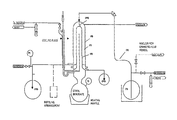
- FIG. 1 shows a schematic of a distillation apparatus which may be used for the purification and/or denaturing distillation steps of the method of the present invention.
- the process described with reference to FIG. 1 may be carried out without the addition of any solvent to the composition comprising squalene.
- the composition comprising squalene is placed in a feed vessel ( 1 ) overlaid with nitrogen.
- One end of an inlet line ( 3 ) has a polypropylene prefilter and is placed in the feed vessel, while the other end of the inlet line has a stainless steel needle (19-ga.) which is inserted into the top of a distillation apparatus (5).
- the distillation apparatus comprises a chamber ( 7 ) shaped like a tube with a cylindrical “hot finger” ( 9 ) protruding through the centre.
- Ethyl benzoate which has a boiling point of 212° C., is heated below the finger to provide heat to the wall of the hot finger.
- a solvent having a higher boiling point could be used to increase the temperature of the hot finger.
- the distillation apparatus may be evacuated.
- the composition comprising squalene may be drawn into the distillation apparatus, e.g. through the use of a lower pressure within the distillation apparatus, through the stainless steel needle and dripped ( 11 ) onto the heated wall of the hot finger.
- the pressure within the distillation apparatus should be selected to lower the boiling point of squalene to 212° C. or less (e.g. approximately 1.5 mm Hg or less).
- the volatilized components will condense on the outer wall of the chamber ( 7 ), which will be cooled by the ambient air, and will run down the walls into a collection flask ( 13 ), which may also be under vacuum.
- Non-volatile components e.g. proteins, remain on the wall of the hot finger and flow down into the residue flask ( 15 ). Extremely volatile components may be drawn off through the vacuum line, reducing their levels in the squalene condensate.
- Squalene which has already been subjected to purification distillation was distilled using this apparatus. Regardless of source, the final squalene regularly had a purity of ⁇ 99.9%, an acid value of ⁇ 0.03 mg KOH/g, and a saponification value ⁇ 2 mg/g.
- the denaturing distillation reduced the moisture content of the squalene e.g. from 0.022% to 0.010%, from 0.006 to 0.005%, or from 0.010% to 0.006%.
- the saponification value is the number of mg of potassium hydroxide required to neutralize the free acids and saponify the esters contained in 1.0 g of the substance.
- the acidity of fats and fixed oils may be expressed as the number of mL of 0.1 N alkali required to neutralize the free acids in 10.0 g of substance.
- the Acid Value is the number of mg of alkali required to neutralize the free acids in 1.0 g of the substance.
- Procedure dissolve about 10.0 g of the substance, accurately weighed, in 50 mL of a mixture of equal volumes of alcohol and ether (which has been neutralized to phenolphthalein with 0.1 N sodium hydroxide) contained in a flask. If the test specimen does not dissolve in the cold solvent, connect the flask with a suitable condenser and warm slowly, with frequent shaking, until the specimen dissolves. Add 1 mL of phenolphthalein TS, and titrate with 0.1 N sodium hydroxide VS until the solution remains faintly pink after shaking for 30 seconds. Calculate either the Acid Value.
- volume of 0.1 N alkali VS required for the titration is less than 2 mL, a more dilute titrant may be used, or the sample size may be adjusted accordingly.
- the results may be expressed in terms of the volume of titrant or in terms of the equivalent volume of 0.1 N sodium hydroxide.
- a squalene composition was spiked with specified quantities of contaminants (e.g. water) as well as possible decomposition products of the squalene (e.g. formaldehyde, acetaldehyde and acetone).
- the spiked solutions underwent a denaturing distillation according to the present invention and were analyzed for the spiked species.
Landscapes
- Health & Medical Sciences (AREA)
- Chemical & Material Sciences (AREA)
- Life Sciences & Earth Sciences (AREA)
- Organic Chemistry (AREA)
- Medicinal Chemistry (AREA)
- General Health & Medical Sciences (AREA)
- Veterinary Medicine (AREA)
- Public Health (AREA)
- Animal Behavior & Ethology (AREA)
- Pharmacology & Pharmacy (AREA)
- Epidemiology (AREA)
- Chemical Kinetics & Catalysis (AREA)
- Engineering & Computer Science (AREA)
- General Chemical & Material Sciences (AREA)
- Virology (AREA)
- Oil, Petroleum & Natural Gas (AREA)
- Immunology (AREA)
- Microbiology (AREA)
- Mycology (AREA)
- Genetics & Genomics (AREA)
- Zoology (AREA)
- Wood Science & Technology (AREA)
- Bioinformatics & Cheminformatics (AREA)
- Water Supply & Treatment (AREA)
- Analytical Chemistry (AREA)
- Dispersion Chemistry (AREA)
- Pulmonology (AREA)
- Biochemistry (AREA)
- Biotechnology (AREA)
- General Engineering & Computer Science (AREA)
- Biomedical Technology (AREA)
- Molecular Biology (AREA)
- Nuclear Medicine, Radiotherapy & Molecular Imaging (AREA)
- Communicable Diseases (AREA)
- Oncology (AREA)
- Clinical Laboratory Science (AREA)
- Biophysics (AREA)
- Medicines Containing Antibodies Or Antigens For Use As Internal Diagnostic Agents (AREA)
- Organic Low-Molecular-Weight Compounds And Preparation Thereof (AREA)
- Medicinal Preparation (AREA)
Priority Applications (1)
| Application Number | Priority Date | Filing Date | Title |
|---|---|---|---|
| US13/696,591 US9199897B2 (en) | 2010-05-12 | 2011-05-12 | Methods for preparing squalene |
Applications Claiming Priority (3)
| Application Number | Priority Date | Filing Date | Title |
|---|---|---|---|
| US39544810P | 2010-05-12 | 2010-05-12 | |
| PCT/IB2011/001397 WO2011141819A1 (en) | 2010-05-12 | 2011-05-12 | Improved methods for preparing squalene |
| US13/696,591 US9199897B2 (en) | 2010-05-12 | 2011-05-12 | Methods for preparing squalene |
Related Parent Applications (1)
| Application Number | Title | Priority Date | Filing Date |
|---|---|---|---|
| PCT/IB2011/001397 A-371-Of-International WO2011141819A1 (en) | 2010-05-12 | 2011-05-12 | Improved methods for preparing squalene |
Related Child Applications (2)
| Application Number | Title | Priority Date | Filing Date |
|---|---|---|---|
| US14/921,665 Continuation US9545440B2 (en) | 2010-05-12 | 2015-10-23 | Methods for preparing squalene |
| US14/921,665 Division US9545440B2 (en) | 2010-05-12 | 2015-10-23 | Methods for preparing squalene |
Publications (2)
| Publication Number | Publication Date |
|---|---|
| US20130209510A1 US20130209510A1 (en) | 2013-08-15 |
| US9199897B2 true US9199897B2 (en) | 2015-12-01 |
Family
ID=44358794
Family Applications (5)
| Application Number | Title | Priority Date | Filing Date |
|---|---|---|---|
| US13/696,591 Active US9199897B2 (en) | 2010-05-12 | 2011-05-12 | Methods for preparing squalene |
| US14/921,665 Active US9545440B2 (en) | 2010-05-12 | 2015-10-23 | Methods for preparing squalene |
| US15/358,196 Active US9867877B2 (en) | 2010-05-12 | 2016-11-22 | Methods for preparing squalene |
| US15/842,010 Active US10517947B2 (en) | 2010-05-12 | 2017-12-14 | Methods for preparing squalene |
| US16/672,885 Active US11077186B2 (en) | 2010-05-12 | 2019-11-04 | Methods for preparing squalene |
Family Applications After (4)
| Application Number | Title | Priority Date | Filing Date |
|---|---|---|---|
| US14/921,665 Active US9545440B2 (en) | 2010-05-12 | 2015-10-23 | Methods for preparing squalene |
| US15/358,196 Active US9867877B2 (en) | 2010-05-12 | 2016-11-22 | Methods for preparing squalene |
| US15/842,010 Active US10517947B2 (en) | 2010-05-12 | 2017-12-14 | Methods for preparing squalene |
| US16/672,885 Active US11077186B2 (en) | 2010-05-12 | 2019-11-04 | Methods for preparing squalene |
Country Status (20)
| Country | Link |
|---|---|
| US (5) | US9199897B2 (pt) |
| EP (4) | EP2569267B2 (pt) |
| JP (2) | JP5946188B2 (pt) |
| KR (1) | KR101875894B1 (pt) |
| CN (2) | CN102892734B (pt) |
| AU (1) | AU2011251706B2 (pt) |
| BR (1) | BR112012028711B1 (pt) |
| CA (1) | CA2798924C (pt) |
| EA (1) | EA027142B1 (pt) |
| ES (4) | ES2817446T3 (pt) |
| IL (1) | IL222855A (pt) |
| MX (1) | MX352758B (pt) |
| NZ (1) | NZ603918A (pt) |
| PL (4) | PL2569267T5 (pt) |
| PT (3) | PT3489211T (pt) |
| SG (2) | SG185419A1 (pt) |
| SI (1) | SI2569267T1 (pt) |
| TR (1) | TR201905021T4 (pt) |
| WO (1) | WO2011141819A1 (pt) |
| ZA (1) | ZA201208381B (pt) |
Cited By (1)
| Publication number | Priority date | Publication date | Assignee | Title |
|---|---|---|---|---|
| US20160051670A1 (en) * | 2010-05-12 | 2016-02-25 | Novartis Ag | Methods for preparing squalene |
Families Citing this family (16)
| Publication number | Priority date | Publication date | Assignee | Title |
|---|---|---|---|---|
| PL2575870T3 (pl) * | 2010-06-04 | 2017-05-31 | Wyeth Llc | Preparaty szczepionek |
| MX372965B (es) | 2012-03-08 | 2020-04-01 | Glaxosmithkline Biologicals Sa | Formulaciones adyuvadas de vacunas de difteria, tetanos y tos ferina (dtp) de refuerzo. |
| JP6324961B2 (ja) | 2012-09-06 | 2018-05-16 | ノバルティス アーゲー | 血清群b髄膜炎菌とd/t/pとの組み合わせワクチン |
| EP2906239A1 (en) | 2012-10-12 | 2015-08-19 | GlaxoSmithKline Biologicals SA | Non-cross-linked acellular pertussis antigens for use in combination vaccines |
| US20150320852A1 (en) | 2012-12-18 | 2015-11-12 | Glaxosmithkline Biologicals Sa | Conjugates for protecting against diphtheria and/or tetanus |
| US9809618B2 (en) * | 2013-09-30 | 2017-11-07 | Aak Ab | Enrichment of triterpine esters |
| US10238739B2 (en) | 2014-12-02 | 2019-03-26 | Novartis Ag | Manufacture of surfactant-containing compositions with enhanced stability |
| EP3802471A1 (en) * | 2018-06-08 | 2021-04-14 | Amyris, Inc. | Synthesis of e,e-farnesol, farnesyl acetate and squalene from farnesene via farnesyl chloride |
| JP7555929B2 (ja) * | 2018-12-24 | 2024-09-25 | 遠大賽威信生命科学(南京)有限公司 | B型肝炎を治療するための薬物製剤、その製造方法及び用途 |
| WO2023056089A1 (en) | 2021-10-03 | 2023-04-06 | Eisai R&D Management Co., Ltd. | Immunological adjuvant formulations comprising tlr4 agonist e6020 |
| CN113956125B (zh) * | 2021-11-11 | 2022-10-11 | 宜春大海龟生命科学有限公司 | 一种植物角鲨烷的组合物及其制备方法和应用 |
| WO2023250129A1 (en) * | 2022-06-24 | 2023-12-28 | Amyris, Inc. | Compositions and methods for the purification of squalene |
| WO2024126194A1 (en) | 2022-12-12 | 2024-06-20 | Evonik Operations Gmbh | Process for obtaining plant-based squalene |
| WO2025053947A1 (en) * | 2023-09-07 | 2025-03-13 | Avantor Performance Materials, Llc | Synthetic triterpenes composition, method of production and applications thereof |
| WO2025072133A1 (en) * | 2023-09-25 | 2025-04-03 | Mary Kay Inc. | Cosmetic composition and uses thereof |
| WO2024261351A2 (en) | 2024-05-08 | 2024-12-26 | Vaccine Formulation Institute Ch Ltd. | Immunologically active saponin fractions and adjuvant formulations |
Citations (16)
| Publication number | Priority date | Publication date | Assignee | Title |
|---|---|---|---|---|
| JPH06116171A (ja) | 1992-10-06 | 1994-04-26 | Nippon Fine Chem Co Ltd | 天然スクワレンの精製方法 |
| JPH07309785A (ja) | 1994-05-20 | 1995-11-28 | Nisshin Oil Mills Ltd:The | 油脂からのスクワラン精製方法 |
| JP2000191550A (ja) | 1998-12-24 | 2000-07-11 | Nippon Petrochem Co Ltd | アジュバント組成物 |
| US6165481A (en) * | 1997-12-25 | 2000-12-26 | Nippon Petrochemicals Company, Inc. | Highly pure squalane, raw material for pharmaceuticals and cosmetics prepared by using the same and method for producing the same |
| US20050250953A1 (en) * | 2002-08-20 | 2005-11-10 | May Choo Y | Extraction of palm vitamin E, phytosterols and squalene from palm oil |
| US20060140969A1 (en) * | 2003-09-04 | 2006-06-29 | Biomay Produktions-Und Handels-Aktiengesellschaft | Hypoallergenic polypeptides based on fish parvalbumin |
| CN1810744A (zh) | 2006-02-23 | 2006-08-02 | 华南农业大学 | 一种制备角鲨烯的方法 |
| US20070092525A1 (en) * | 2005-02-07 | 2007-04-26 | Institut National De La Sante Et De La Recherche Medicale (Inserm) | Polypeptide derived from gp41, a vaccine composition comprising said polypeptide, and uses for treating an infection by an hiv virus in an individual |
| WO2007052155A2 (en) | 2005-11-04 | 2007-05-10 | Novartis Vaccines And Diagnostics Srl | Influenza vaccine with reduced amount of oil-in-water emulsion as adjuvant |
| WO2008056263A2 (en) | 2006-11-08 | 2008-05-15 | Novartis Ag | Quality control methods for oil-in-water emulsions containing squalene |
| WO2008142175A1 (es) | 2007-05-18 | 2008-11-27 | Universidad De Cordoba | Procedimiento de obtencion de escualeno |
| US20090047353A1 (en) * | 2005-11-04 | 2009-02-19 | Novartis Vaccines And Diagnostics Srl | Changing th1/th2 balance in split influenza vaccines with adjuvants |
| CN101597204A (zh) | 2009-07-09 | 2009-12-09 | 天津大学 | 以橄榄油为原料提取高纯度角鲨烯的方法 |
| WO2010004193A1 (fr) | 2008-07-07 | 2010-01-14 | Sophim | Procede d'extraction de squalene, de sterols et de vitamine e contenus dans des condensats de raffinage physique et/ou dans des distillats de desodorisation d'huiles vegetales |
| WO2010023551A2 (en) | 2008-08-28 | 2010-03-04 | Michael Broeker | Production of squalene from hyper-producing yeasts |
| CN101830770A (zh) | 2010-06-02 | 2010-09-15 | 天津大学 | 从植物油脱臭馏出物中提取角鲨烯的方法 |
Family Cites Families (32)
| Publication number | Priority date | Publication date | Assignee | Title |
|---|---|---|---|---|
| US4060082A (en) | 1976-08-16 | 1977-11-29 | Mpl, Inc. | Dual-ingredient medication dispenser |
| JPS57200142A (en) | 1981-06-01 | 1982-12-08 | Micron Kk | Calculus removing tool |
| NZ209308A (en) | 1983-08-30 | 1991-08-27 | Genentech Inc | Vaccine against hsv involving a truncated membrane-free derivative of a membrane-bound protein |
| ES533744A0 (es) * | 1984-06-27 | 1985-05-01 | Bendiberica Sa | Mecanismo de direccion asistida compacto |
| JPH0348427A (ja) | 1989-04-04 | 1991-03-01 | Matsushita Electric Ind Co Ltd | バイポーラ半導体装置とその製造方法 |
| CA2017507C (en) | 1989-05-25 | 1996-11-12 | Gary Van Nest | Adjuvant formulation comprising a submicron oil droplet emulsion |
| JPH0614756Y2 (ja) | 1991-06-26 | 1994-04-20 | 株式会社アルテ | 組み立て式の2室式容器兼用注射器 |
| US5496284A (en) | 1994-09-27 | 1996-03-05 | Waldenburg; Ottfried | Dual-chamber syringe & method |
| DE19612966B4 (de) | 1996-04-01 | 2009-12-10 | Novartis Vaccines And Diagnostics Gmbh & Co. Kg | MDCK-Zellen und Verfahren zur Vermehrung von Influenzaviren |
| AU3186297A (en) | 1996-07-05 | 1998-02-02 | Debiotech S.A. | Dual-chamber syringe for mixing two substances prior to injection |
| US6090598A (en) * | 1997-01-30 | 2000-07-18 | Fuji Oil Company, Limited | Enzymatic process for interesterification of fats and oils using distillation |
| GB9716578D0 (en) | 1997-08-05 | 1997-10-08 | Brf International | Lipid removal |
| US5971953A (en) | 1998-01-09 | 1999-10-26 | Bachynsky; Nicholas | Dual chamber syringe apparatus |
| WO1999017820A1 (en) | 1997-10-03 | 1999-04-15 | Texas Pharmaceuticals, Inc. | Improved dual chamber syringe apparatus |
| DE19835749C1 (de) | 1998-08-07 | 2000-02-03 | Dieter Perthes | Fertig-Spritze für nicht-stabile Arzneimittel |
| GB9923176D0 (en) | 1999-09-30 | 1999-12-01 | Smithkline Beecham Biolog | Novel composition |
| MY134424A (en) | 2001-05-30 | 2007-12-31 | Saechsisches Serumwerk | Stable influenza virus preparations with low or no amount of thiomersal |
| US7208627B2 (en) * | 2003-12-18 | 2007-04-24 | Nippon Shokubai Co., Ltd | Alkylborazine compound and production method for the same |
| KR101153898B1 (ko) | 2004-03-23 | 2012-06-18 | 니프로 가부시키가이샤 | 프리필드 시린지 |
| US8703095B2 (en) | 2005-07-07 | 2014-04-22 | Sanofi Pasteur S.A. | Immuno-adjuvant emulsion |
| SI1951299T1 (sl) * | 2005-11-04 | 2012-04-30 | Novartis Vaccines & Diagnostic | Cepiva proti influenci, ki vkljuäśujejo kombinacije adjuvantov iz delcev in imunopotenciatorjev |
| FR2896162B1 (fr) | 2006-01-13 | 2008-02-15 | Sanofi Pasteur Sa | Emulsion huile dans eau thermoreversible |
| EA015817B1 (ru) | 2006-10-12 | 2011-12-30 | Глаксосмитклайн Байолоджикалс С.А. | Иммуногенная композиция, содержащая адъювант в виде эмульсии "масло в воде" |
| EP3173097A3 (en) † | 2009-02-10 | 2017-07-12 | Seqirus UK Limited | Influenza vaccines with reduced amounts of squalene |
| CN101697204B (zh) | 2009-10-23 | 2013-02-20 | 北京派瑞根科技开发有限公司 | 电子签章 |
| EP2506834B1 (en) | 2009-12-03 | 2016-03-02 | Novartis AG | Circulation of components during homogenization and microfluidization of emulsions |
| DE102009056884B4 (de) | 2009-12-03 | 2021-03-18 | Novartis Ag | Impfstoff-Adjuvantien und verbesserte Verfahren zur Herstellung derselben |
| DE102009056883B4 (de) | 2009-12-03 | 2012-08-16 | Novartis Ag | Impfstoff-Adjuvantien und verbesserte Verfahren zur Herstellung derselben |
| DE102009056871A1 (de) | 2009-12-03 | 2011-06-22 | Novartis AG, 4056 | Impfstoff-Adjuvantien und verbesserte Verfahren zur Herstellung derselben |
| CN104688687A (zh) | 2009-12-03 | 2015-06-10 | 诺华股份有限公司 | 疫苗佐剂制备中的亲水过滤 |
| NZ603918A (en) * | 2010-05-12 | 2015-04-24 | Novartis Ag | Improved methods for preparing squalene |
| JP6116171B2 (ja) | 2012-09-24 | 2017-04-19 | 株式会社ダスキン | 左右開閉型払拭体保持具、払拭体及び清掃用具 |
-
2011
- 2011-05-12 NZ NZ603918A patent/NZ603918A/en unknown
- 2011-05-12 ES ES19151232T patent/ES2817446T3/es active Active
- 2011-05-12 PT PT191512326T patent/PT3489211T/pt unknown
- 2011-05-12 SG SG2012081329A patent/SG185419A1/en unknown
- 2011-05-12 CN CN201180023553.3A patent/CN102892734B/zh active Active
- 2011-05-12 PL PL11738802T patent/PL2569267T5/pl unknown
- 2011-05-12 ES ES13164769T patent/ES2597158T5/es active Active
- 2011-05-12 SI SI201130114T patent/SI2569267T1/sl unknown
- 2011-05-12 EA EA201291225A patent/EA027142B1/ru not_active IP Right Cessation
- 2011-05-12 PT PT131647695T patent/PT2620423T/pt unknown
- 2011-05-12 EP EP11738802.5A patent/EP2569267B2/en active Active
- 2011-05-12 WO PCT/IB2011/001397 patent/WO2011141819A1/en not_active Ceased
- 2011-05-12 AU AU2011251706A patent/AU2011251706B2/en active Active
- 2011-05-12 US US13/696,591 patent/US9199897B2/en active Active
- 2011-05-12 ES ES11738802.5T patent/ES2453316T5/es active Active
- 2011-05-12 EP EP13164769.5A patent/EP2620423B2/en active Active
- 2011-05-12 BR BR112012028711-7A patent/BR112012028711B1/pt active IP Right Grant
- 2011-05-12 SG SG10201503689TA patent/SG10201503689TA/en unknown
- 2011-05-12 PL PL13164769T patent/PL2620423T5/pl unknown
- 2011-05-12 PL PL19151232T patent/PL3489211T3/pl unknown
- 2011-05-12 MX MX2012013027A patent/MX352758B/es active IP Right Grant
- 2011-05-12 TR TR2019/05021T patent/TR201905021T4/tr unknown
- 2011-05-12 PL PL16176832T patent/PL3103784T3/pl unknown
- 2011-05-12 KR KR1020127031750A patent/KR101875894B1/ko active Active
- 2011-05-12 ES ES16176832T patent/ES2717266T3/es active Active
- 2011-05-12 PT PT16176832T patent/PT3103784T/pt unknown
- 2011-05-12 JP JP2013509635A patent/JP5946188B2/ja active Active
- 2011-05-12 CN CN201510345002.9A patent/CN105125488A/zh active Pending
- 2011-05-12 EP EP19151232.6A patent/EP3489211B1/en not_active Revoked
- 2011-05-12 EP EP16176832.0A patent/EP3103784B1/en not_active Revoked
- 2011-05-12 CA CA2798924A patent/CA2798924C/en active Active
-
2012
- 2012-11-05 IL IL222855A patent/IL222855A/en active IP Right Grant
- 2012-11-07 ZA ZA2012/08381A patent/ZA201208381B/en unknown
-
2015
- 2015-06-02 JP JP2015111935A patent/JP2015157858A/ja active Pending
- 2015-10-23 US US14/921,665 patent/US9545440B2/en active Active
-
2016
- 2016-11-22 US US15/358,196 patent/US9867877B2/en active Active
-
2017
- 2017-12-14 US US15/842,010 patent/US10517947B2/en active Active
-
2019
- 2019-11-04 US US16/672,885 patent/US11077186B2/en active Active
Patent Citations (17)
| Publication number | Priority date | Publication date | Assignee | Title |
|---|---|---|---|---|
| JPH06116171A (ja) | 1992-10-06 | 1994-04-26 | Nippon Fine Chem Co Ltd | 天然スクワレンの精製方法 |
| JPH07309785A (ja) | 1994-05-20 | 1995-11-28 | Nisshin Oil Mills Ltd:The | 油脂からのスクワラン精製方法 |
| JP3484227B2 (ja) | 1994-05-20 | 2004-01-06 | 日清オイリオ株式会社 | 油脂からのスクワラン精製方法 |
| US6165481A (en) * | 1997-12-25 | 2000-12-26 | Nippon Petrochemicals Company, Inc. | Highly pure squalane, raw material for pharmaceuticals and cosmetics prepared by using the same and method for producing the same |
| JP2000191550A (ja) | 1998-12-24 | 2000-07-11 | Nippon Petrochem Co Ltd | アジュバント組成物 |
| US20050250953A1 (en) * | 2002-08-20 | 2005-11-10 | May Choo Y | Extraction of palm vitamin E, phytosterols and squalene from palm oil |
| US20060140969A1 (en) * | 2003-09-04 | 2006-06-29 | Biomay Produktions-Und Handels-Aktiengesellschaft | Hypoallergenic polypeptides based on fish parvalbumin |
| US20070092525A1 (en) * | 2005-02-07 | 2007-04-26 | Institut National De La Sante Et De La Recherche Medicale (Inserm) | Polypeptide derived from gp41, a vaccine composition comprising said polypeptide, and uses for treating an infection by an hiv virus in an individual |
| WO2007052155A2 (en) | 2005-11-04 | 2007-05-10 | Novartis Vaccines And Diagnostics Srl | Influenza vaccine with reduced amount of oil-in-water emulsion as adjuvant |
| US20090047353A1 (en) * | 2005-11-04 | 2009-02-19 | Novartis Vaccines And Diagnostics Srl | Changing th1/th2 balance in split influenza vaccines with adjuvants |
| CN1810744A (zh) | 2006-02-23 | 2006-08-02 | 华南农业大学 | 一种制备角鲨烯的方法 |
| WO2008056263A2 (en) | 2006-11-08 | 2008-05-15 | Novartis Ag | Quality control methods for oil-in-water emulsions containing squalene |
| WO2008142175A1 (es) | 2007-05-18 | 2008-11-27 | Universidad De Cordoba | Procedimiento de obtencion de escualeno |
| WO2010004193A1 (fr) | 2008-07-07 | 2010-01-14 | Sophim | Procede d'extraction de squalene, de sterols et de vitamine e contenus dans des condensats de raffinage physique et/ou dans des distillats de desodorisation d'huiles vegetales |
| WO2010023551A2 (en) | 2008-08-28 | 2010-03-04 | Michael Broeker | Production of squalene from hyper-producing yeasts |
| CN101597204A (zh) | 2009-07-09 | 2009-12-09 | 天津大学 | 以橄榄油为原料提取高纯度角鲨烯的方法 |
| CN101830770A (zh) | 2010-06-02 | 2010-09-15 | 天津大学 | 从植物油脱臭馏出物中提取角鲨烯的方法 |
Non-Patent Citations (19)
| Title |
|---|
| A Pietsch, P Jaeger. "Concentration of squalene from shark liver oil by short-path distillation." European Journal of Lipid Science and Technology, vol. 109, 2007, pp. 1077-1082. * |
| Assignment from inventor Maninder Hora to Novartis Vaccines and Diagnostics, Inc. |
| Assignment from Novartis Vaccines & Diagnostics, Inc. to Novartis AG. |
| Brito et al., "An Alternative Renewable Source of Squalene for use in Emulsion Adjuvants," Vaccine, 29:6262-6268 (2011). |
| C.B. Fox et al., Monitoring the effects of component structure and source on formulation stability and adjuvant activity of oil-in-water emulsions. Colloids and Surfaces B: Biointeifaces, 65 (2008) 98-105. |
| Chua et al. Separation of squalene from palm fatty acid distillate using adsorption chromatography. Eur. J. Lipid Sci. Technol. 109 (2007) 1083-1087. * |
| EMEC, European Medicines Agency, CHMP Assessment Report for FOCETRIA, Pandemic Influenza Vaccines (Surface Antigen, Inactivated, Adjuvanted) A/California/Jul. 2009 (HIN1)v Like Strain (X-179A), Sep. 24, 2009. |
| English translations of sections of JP 2000-1915300 A. |
| http://www.ema.europa.eu/ema/index.jsp?curl=pages/medicines/human/medicines/000710/human med000796.jsp&mid=WCb01ac058001d124, 2 pages, (accessed Sep. 24, 2014). |
| M.T. Tham, Distillation-an introduction, Vapour Liquid Equilibria, http://lorien.ncl.ac.uk/ming/distil/distilvle.htm, 1997-2005. |
| M.T. Tham, Distillation-an introduction. Factors Affecting Distillation Column Operation, http://lorien.ncl.ac.uk/ming/distil/distilop.htm, 1997-2005. |
| Makidon et al., "Characterization of Stability and Nasal Delivery Systems for Immunization with Nanoemulsion-Based Vaccines," Journal of Aerosol Medicine and Pulmonary Drug Delivery, 23(2):77-89 (2010). |
| Notice of Opposition to a European Patent-Opposition against the grant of European Patent Application No. 2 569 267 B1, Patent Application No. 11738802.5, Mention of date of grant: Dec. 25, 2013, Statement of Opposition filed by GlaxoSmithKline Biologicals, 29 pages, Sep. 25, 2014. |
| Ott et al., "Design and Evaluation of a Safe and Potent Adjuvant for human Vaccines," Vaccine Design, the Subunit and Adjuvant Approach. Pharmaceutical Biotechnology, vol. 6 (1995). |
| Ott et al., "The Adjuvant MF59: A 10-year Perspective," Vaccine Adjuvants: Preparation Methods and Research Protocols, Methods in Molecular Medicine, vol. 42, Chapter 12, p. 211-228 (2000). |
| Pietsch et al., "Concentration of Squalene from Shark Liver Oil by Short-Path Distillation," Eur. J. Lipid Sci. Technol, 109:1077-1082 (2007). |
| Pressure Temperature Nomograph. |
| Response to Notice to Opposition for EP Patent No. 2 569 267. |
| Vscuum Distillation, http://en.wikipedia.org/w/index.pho?title=Vacuum distillation&oldid=288287808, 3 pages, Apr. 23, 2010. |
Cited By (6)
| Publication number | Priority date | Publication date | Assignee | Title |
|---|---|---|---|---|
| US20160051670A1 (en) * | 2010-05-12 | 2016-02-25 | Novartis Ag | Methods for preparing squalene |
| US9545440B2 (en) * | 2010-05-12 | 2017-01-17 | Novartis Ag | Methods for preparing squalene |
| US9867877B2 (en) * | 2010-05-12 | 2018-01-16 | Novartis Ag | Methods for preparing squalene |
| US20180169225A1 (en) * | 2010-05-12 | 2018-06-21 | Novartis Ag | Methods for preparing squalene |
| US10517947B2 (en) * | 2010-05-12 | 2019-12-31 | Novartis Ag | Methods for preparing squalene |
| US11077186B2 (en) * | 2010-05-12 | 2021-08-03 | Novartis Ag | Methods for preparing squalene |
Also Published As
Similar Documents
| Publication | Publication Date | Title |
|---|---|---|
| US9199897B2 (en) | Methods for preparing squalene | |
| CA2668854C (en) | Quality control methods for oil-in-water emulsions containing squalene | |
| HK1231847A (en) | Manufacture of an oil-in-water emulsion comprising squalene | |
| HK1231847A1 (en) | Manufacture of an oil-in-water emulsion comprising squalene | |
| HK1231847B (en) | Manufacture of an oil-in-water emulsion comprising squalene | |
| HK1186459A (en) | Improved methods for preparing squalene | |
| HK1186459B (en) | Improved methods for preparing squalene | |
| HK1146240A (en) | Quality control methods for oil-in-water emulsions containing squalene |
Legal Events
| Date | Code | Title | Description |
|---|---|---|---|
| AS | Assignment |
Owner name: NOVARTIS VACCINES AND DIAGNOSTICS, INC., CALIFORNI Free format text: ASSIGNMENT OF ASSIGNORS INTEREST;ASSIGNOR:HORA, MANINDER;REEL/FRAME:031108/0888 Effective date: 20130205 Owner name: NOVARTIS AG, SWITZERLAND Free format text: ASSIGNMENT OF ASSIGNORS INTEREST;ASSIGNOR:NOVARTIS VACCINES & DIAGNOSTICS, INC.;REEL/FRAME:031109/0003 Effective date: 20130221 |
|
| STCF | Information on status: patent grant |
Free format text: PATENTED CASE |
|
| MAFP | Maintenance fee payment |
Free format text: PAYMENT OF MAINTENANCE FEE, 4TH YEAR, LARGE ENTITY (ORIGINAL EVENT CODE: M1551); ENTITY STATUS OF PATENT OWNER: LARGE ENTITY Year of fee payment: 4 |
|
| MAFP | Maintenance fee payment |
Free format text: PAYMENT OF MAINTENANCE FEE, 8TH YEAR, LARGE ENTITY (ORIGINAL EVENT CODE: M1552); ENTITY STATUS OF PATENT OWNER: LARGE ENTITY Year of fee payment: 8 |
|
| AS | Assignment |
Owner name: SEQIRUS UK LIMITED, UNITED KINGDOM Free format text: ASSIGNMENT OF ASSIGNORS INTEREST;ASSIGNOR:NOVARTIS AG;REEL/FRAME:069642/0293 Effective date: 20241217 |